The cover image was adapted from the original by the transcriber and is placed in the public domain.
The listed errata have been corrected in the text.
PUBLICATIONS OF THE UNIVERSITY OF MANCHESTER
HISTORICAL SERIES
No. XXXVI
THE EARLY
ENGLISH COTTON INDUSTRY
Published by the University of Manchester at
THE UNIVERSITY PRESS (H. M. McKechnie, Secretary) 12 Lime Grove, Oxford Road, MANCHESTER
LONGMANS, GREEN & CO. London: 39 Paternoster Row New York: 443-449 Fourth Avenue and Thirtieth Street Chicago: Prairie Avenue and Twenty-fifth Street Bombay: 8 Hornby Road Calcutta: 6 Old Court House Street Madras: 167 Mount Road
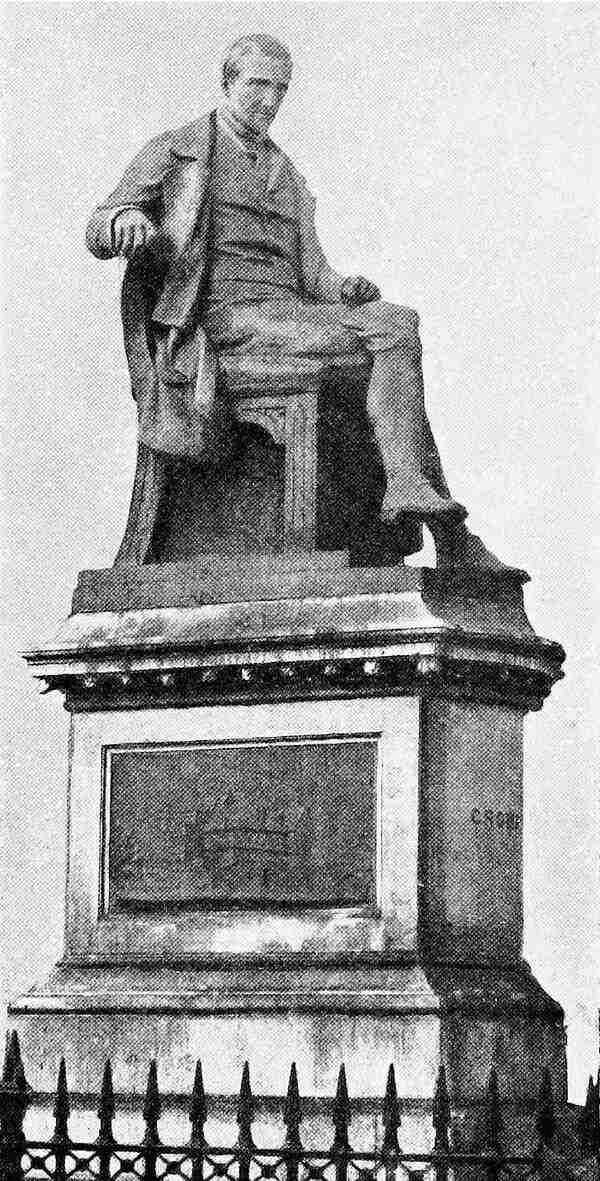
STATUE OF SAMUEL CROMPTON
NELSON SQUARE, BOLTON
On the base there is a representation of Hall-i’-th’-Wood
which can just be distinguished in the photograph
WITH SOME UNPUBLISHED LETTERS OF
SAMUEL CROMPTON
BY
GEORGE W. DANIELS, M.A.
SENIOR LECTURER IN ECONOMICS IN THE UNIVERSITY OF MANCHESTER
INTRODUCTORY CHAPTER BY
GEORGE UNWIN, M.A.
PROFESSOR OF ECONOMIC HISTORY IN THE UNIVERSITY OF MANCHESTER
MANCHESTER: AT THE UNIVERSITY PRESS
12 LIME GROVE, OXFORD ROAD
LONGMANS, GREEN & CO.
LONDON, NEW YORK, BOMBAY, ETC.
1920
PUBLICATIONS OF THE UNIVERSITY OF MANCHESTER
No. CXXXIII
PREFACE
In view of what is said by Professor Unwin in his introductory
chapter concerning the business material of the
firm of M‘Connel & Kennedy, the reason why this small
volume has been written requires little explanation.
From the time this material was kindly placed at our
disposal by Mr. J. W. M‘Connel, grandson of one of the
founders of the firm, my interest has been centred mainly
in the development of the English cotton industry from
its beginning to about the end of the third decade of the
nineteenth century.
Fortunately this investigation fitted in well with work
on which I was already engaged. For some time previously
the preparation of lectures for students of the
Tutorial classes, conducted by the University of Manchester
in conjunction with the Workers’ Educational
Association, had caused me to turn my attention to
the sources of the social and economic history of the late
seventeenth and the early eighteenth centuries, with the
object of enabling me to speak with a little more confidence
than I could gain from easily accessible books.
Last summer when I began that which has developed
into the following chapters my intention was to write a
few pages of introduction to the succeeding letters of
Samuel Crompton, and later to publish a volume dealing
with the English cotton industry throughout the period
mentioned. Much of what appears in this volume was
intended to form the first part of that work, but the
second part has been left for a separate volume. There
are, therefore, many gaps and deficiencies in the present
volume. Some of these gaps, I trust, may be filled and
deficiencies supplied at a later date.
My obligations are very numerous and in some cases
extend to much more than appears in this volume. To
the late Humphrey Chetham I am indebted for providing
in Manchester the library which bears his name, in
the reading-room of which I have spent so many delightful
hours.
Mr. H. Crossley, the present librarian, has rendered me
untiring assistance in searching out the authorities that
I have used, as have the librarians of the Manchester
Reference Library and the Christie Library. Miss F.
Collier has assisted me in many ways, but particularly
in the tedious task of wading page by page through the
Journals of the House of Commons and the files of The
Manchester Mercury and making extracts therefrom.
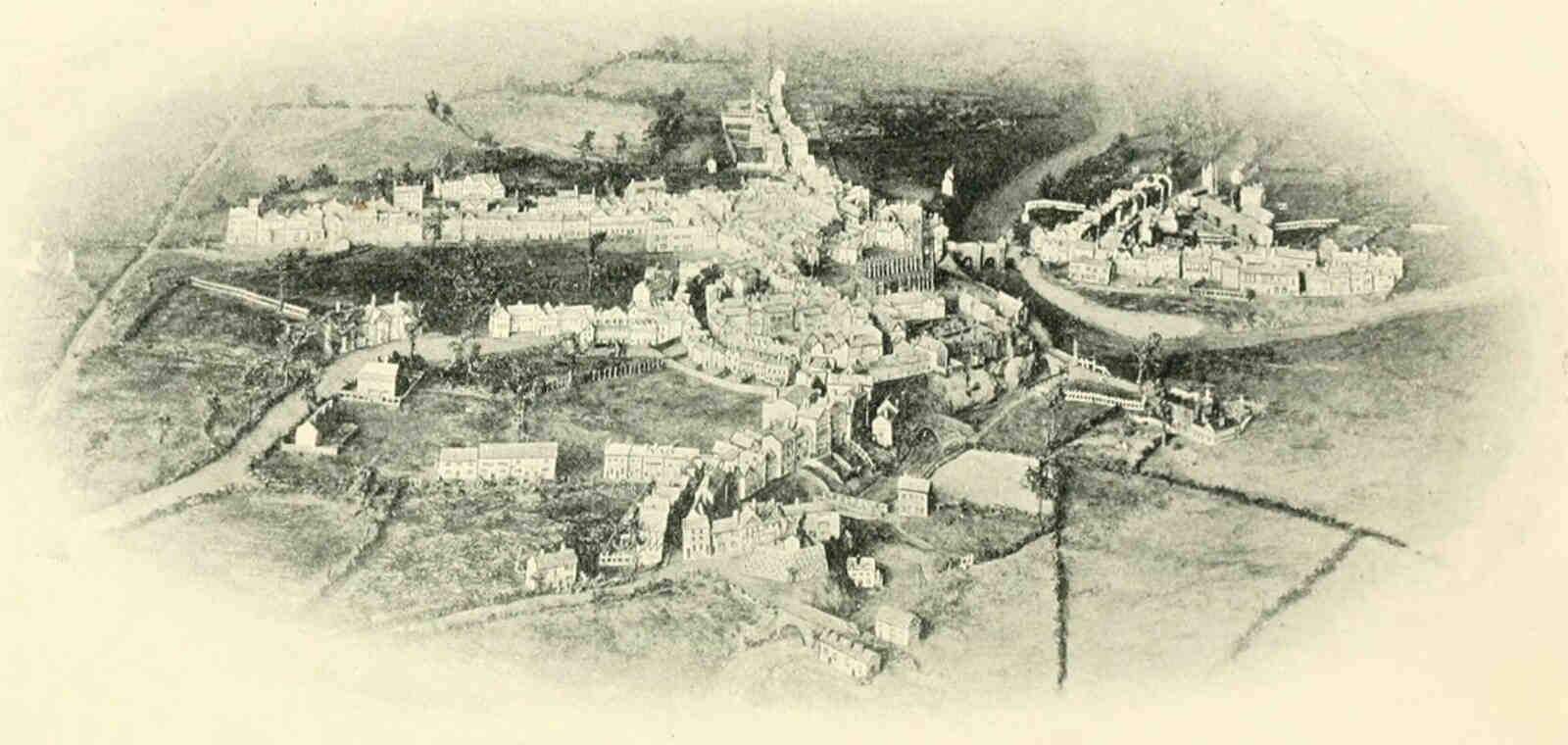
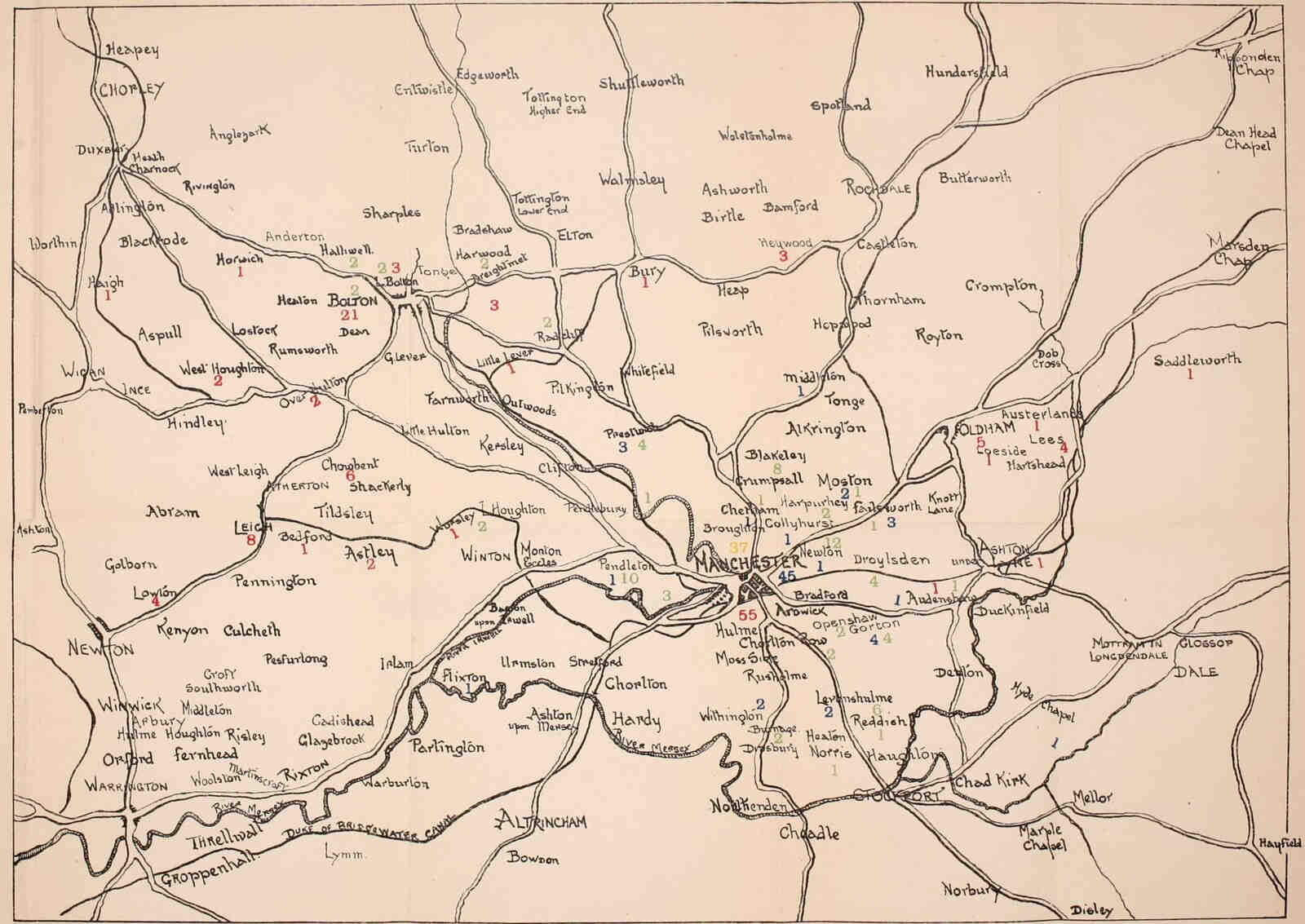
Miss P. Heap has sketched the map from the one published
in 1795 with Aikin’s Thirty to Forty Miles Round
Manchester. The Corporation of the Royal Exchange
Assurance, through its Manchester manager, Mr. J.
Loudon, has granted me permission to reproduce the
photograph of the model of Manchester in the seventeenth
and early eighteenth centuries. The model has been
constructed by Mr. H. Yates of Moss Side, Manchester,
and is a remarkable piece of work. It is based upon
“A Plan of Manchester and Salford, taken about 1650”
(referred to on p. 25) and must have involved an enormous
amount of research, as by far the greater part of its
detail is based upon contemporary documents and prints.
It is to be hoped that before long the model may find
a permanent resting-place in some Manchester public
institution.
Too late for me to avail myself of the information they
contain, I find that Mr. Loudon has published a series of
articles in The Royal Exchange Assurance Magazine, entitled
“Manchester Memoirs.” In writing these articles
Mr. Loudon has made use of such records of the Corporation
as were not destroyed when the Royal Exchange
was burned down in January, 1838. Sufficient remain,
however, to indicate their value in the elucidation of the
social and economic history of the Manchester district
in the eighteenth century, and the part that was played
by the Corporation in its development. Records are
still in existence of policies taken out by prominent
Manchester business men at that time, including one
by Richard Arkwright, in 1785, when he insured his
Manchester factory for £5000.
In addition to the persons already mentioned, I am
indebted to Mr. Thomas Midgley, Curator of Chadwick
Museum, Bolton, for valuable information and for the
photograph of Crompton’s statue; to Mr. J. Wadsworth,
of the staff of The Manchester Guardian, for
important references; to Mr. H. L. Beales, of the
University of Sheffield, for compiling the index; and to
Professor D. H. Macgregor for reading my proofs. To
Mr. H. M. M‘Kechnie, the Secretary of the University
Press, I am deeply grateful, as he has advised my every
step while the book has been passing through the press,
and has helped me in many other ways.
But my greatest debt is to Professor George Unwin.
Whatever taste for social and economic history I now
possess, or may acquire, I owe to him. He has contributed
far more to this volume than the introductory
chapter. But my deepest obligation is for his companionship,
which for many years has been to me a
constant source of encouragement and inspiration.
I.—The stimulus given to research in economic history
by the discovery of Messrs. M‘Connel’s records and
of Crompton’s letters; central position in economic
history occupied by commerce and industry of
textiles; Lancashire cotton industry a graft on
this old stock.
II.—Beginning of cotton manufacture in Europe;
mediæval gilds in textile trades; rise of an organised
journeyman class in fourteenth century; but
in the sixteenth century the centre of the labour
problem was the small master, whose well-being
was dependent on free flow of capital and credit.
III.—Industrial conditions in seventeenth-century
Lancashire resembled those in mediæval Florence
and Douai, but differed vitally by the absence
of a monopoly of capital; such a monopoly was
developing in the Merchant Adventurers and other
companies in Elizabeth’s reign; and led to a crisis
in the textile industries in 1586-1587; the expansion
of the northern textile industries due to its exceptional
freedom.
IV.—The removal of restrictions on the free flow of
capital a main factor in the Industrial Revolution;
illustrations of this from the careers of William
Radcliffe, David Dale, and Nathan Meyer Rothschild.
I.—The development of the English cotton industry
the classic example of the Industrial Revolution
movement; its importance as an indication of what
the transition from the domestic to the factory
system of organisation involved, 1-2; cotton and
cotton-cloth common articles of import before the
sixteenth century; “cottons” a prominent
Lancashire manufacture in the early sixteenth
century; unsuccessful attempts to regulate the manufacture,
2-6; necessity for caution in accepting the
view that cotton was not used in the manufacture
of Lancashire cloths in the sixteenth century, 7-8.
II.—Authentic evidence of a considerable manufacture
of cotton in Lancashire; petition of London
merchants (1621); testimony of Lewis Roberts
(1641); fustian manufacture probably introduced
in second half of the sixteenth century, 8-12;
extent of the manufacture indicated in petitions
from Lancashire (1654); possible effect of Thirty
Years’ War; Fuller’s account of Lancashire fustian
manufacture (1662); Bolton the staple place for
fustians in the seventeenth century, 13-16.
III.—Countries from which cotton-wool imported in the
seventeenth and eighteenth centuries; cotton-yarn
and fine cotton-fabrics imported by East
India Company, 16; John Barkstead’s schemes
(1691) for manufacture of calicoes and muslins and
their failure, 16-19; opposition of silk and woollen
trades to import of dyed or printed calicoes; resulting
Act (1700) followed by import of plain calicoes
which were printed and dyed in England; Act
(1721) prohibits their wear or use; opposition to
Act from manufacturers of cotton in Dorset, 19-21;
increasing prominence of fustians rouses opposition;
petitions from Lancashire, Cheshire, and Derbyshire
result in “Manchester Act” (1736); use or
wear of printed goods made of linen-warp and
cotton-wool declared lawful; progress of cotton
manufacture, 1730-1764, 22-24.
IV.—Development of Manchester trade, 1650-1750;
distinction between smallware, check, and fustian
branches; fustian especially regarded as the cotton
manufacture; some goods made entirely of cotton
in first half of eighteenth century but majority
probably of mixed character; worsted and silk
utilised and linen largely manufactured, 25-29.
I.—Clothiers in the Northern cloth district; Martin
Byrom of Manchester (1520); statute (1543) refers
to Irish merchants and others who sell linen-yarn
and wool on credit in Manchester; petition of
Lancashire clothiers against restrictions on middlemen
(1577), 30-31; wealthy men engaged in
Lancashire cloth trade—e.g. the Tippings, Mosleys,
Chethams; their charitable bequests; extent of
their concerns, 32-34; Humphrey Chetham bought
goods for London market; employed workpeople
in spinning yarn and in weaving and finishing cloth;
typical clothier of the domestic system, 35-36;
small independent producers not typical workpeople
in Manchester district in early eighteenth
century; evidence of statutes; changes in
organisation of fustian manufacture; testimony
of Ogden and Guest, 36-39.
II.—Organisation of smallware trade; manufacturers,
undertakers, journeymen, apprentices; changes
in first half of eighteenth century; combination of
workpeople; articles (1747-1753) aim at enforcing
apprenticeship and limiting number of apprentices,
40-42; increasing price of food and consequent
disturbances; smallware weavers attempt to
raise wages; prosecution and submission at
Lancaster Assizes (1760), 42-45; Lord Mansfield’s
charge on combinations in Lancashire (1758);
combination of check-weavers; dispute with
employers and strike in Manchester area; the
“document”; demand regulation of trade under
statute 5 Eliz.; proposals for settlement of dispute
by weavers and Mr. Percival; submission and
prosecution at Lancaster Assizes (1759); Lord
Mansfield’s comments on Statute of Apprentices;
later history of smallware weavers’ combination;
economic and social significance of the combinations;
their relation to earlier associations and to
modern trade unions, 45-55.
III.—Distribution of manufacturers and workpeople in
Manchester area in first half of eighteenth century;
connections maintained by “putting out” system,
56; trade in raw materials; cotton imported
through London, Liverpool, Whitehaven, Lancaster;
wool reached manufacturers through inland traders;
linen yarn spun in England and Scotland, but
Ireland and the Continent most important sources
of supply; qualities of yarn, and goods in which
used; cotton merchants and yarn merchants in
Manchester; foreign trading-connections; Manchester
goods exported to West Indies, Africa, Italy,
Germany, North America, Russia, Asiatic Turkey,
57-60; inland trade carried on by travelling merchants
with pack-horses; partly displaced from early
eighteenth century by “riders-out” who solicited
orders; goods forwarded by carriers; development
of communications; importance of petty-chapmen;
links between manufacturing centres
and country districts; organisation of their trade
and capital involved; economic development
during century preceding great inventions in
cotton industry, 60-66; tables relating to manufacturers,
merchants, crofters, and carriers in
Manchester area (1772), 67-71.
I.—Modern cotton industry dates from great inventions;
inventions relate especially to spinning
and preparatory processes, but earliest successful
efforts in weaving; “Dutch” loom introduced into
Manchester district in early eighteenth century;
John Kay invents “flying-shuttle” (1733); first
used in woollen industry; other inventions of Kay;
Robert Kay effects improvement in hand-loom
(1760); more complicated loom introduced for
figured goods; discrepancy between spinning and
weaving, 72-74; types of spinning-wheel in use—“Jersey”
wheel, “Brunswick” wheel; methods
of cleaning and carding cotton; Lewis Paul’s
patent for roller-spinning (1738); and for carding
(1748); lack of success; carding-machine introduced
into Lancashire (1760), 75-78; need for
improved spinning-machine; Society of Arts
offers reward for invention (1761); inventions of
the “spinning-jenny” (patented 1770) and the
“water-frame” (patented 1769); description of
spinning process by the spinning-wheel, the jenny,
and the water-frame; Arkwright erects factory at
Cromford (1771) and takes out “carding” patent
(1775), 79-81; attacks upon new machinery by
workpeople; not fully explained by effects of its
introduction, 82-83.
II.—Outbreak of Seven Years’ War ushers in century
of unrest in England due mainly to political causes;
unrest frequently broke out in riots; conditions in
sixties and seventies of eighteenth century; efforts
of Parliament to cope with rising food prices;
agitation against trading middlemen; attack
made upon jenny during period of industrial
depression and high prices at close of Seven Years’
War; and upon Arkwright’s machinery when
American War of Independence dominated the
situation; workpeople state their case against
machinery to Parliament; counter-petition by
manufacturers; decision of Parliamentary Committee,
83-91.
Failure of attempts to obstruct use of Arkwright’s
machinery; Act (1774) reduces duty and removes
prohibition on printed calicoes, 92-93; patents
of Hargreaves and Arkwright challenged by manufacturers;
Hargreaves’ failure to uphold his
patent; his claim to invention of jenny questioned
by Guest; his later career, 92-97; Arkwright’s
characteristics; his association with Jedediah
Strutt; development of his concerns, 97-100;
infringements of his patents; fails to secure verdict
in law-suit (1781); Arkwright’s Case; requests
Parliament to consolidate his patents and continue
them until 1789; opposition of Manchester Committee
of Trade; secures verdict in second law-suit
(February, 1785); agitation in Manchester;
application for new trial; Thomas Highs’ claim to
invention of roller-spinning; Arkwright loses
verdict in third trial (June, 1785); application for
new trial refused (November, 1785); Arkwright’s
achievements, 100-112.
I.—The work of Samuel Crompton; begins efforts to
produce improved yarn at Hall-i’-th’-Wood (1772);
invents “mule” (1779); prices obtained for his
yarn; consents to make machine public, 113-116;
character of the mule and its method of spinning;
probable reasons why patent not applied for;
treatment of Crompton in 1780 and its effects;
asserts unacquaintance with Arkwright’s rollers,
117-122.
II.—Mule at first worked by hand in cottages; improvements
in the mule; the “Billy”; mule
supersedes jenny in cotton spinning; and water-frame
in finer counts, 122-124; application of
water-power; attempts to invent “self-actor”
mule; increase in size and appearance in town
factories, 124-126; early fine cotton-spinners;
immigration of Scotsmen; fine spinning and
machine making combined; rise of specialised
firms, 126-128; fine cotton fabrics made from
mule-spun yarn; effect upon Eastern cotton
industry; testimony of John Kennedy; markets
for fine yarn in late eighteenth and early nineteenth
centuries; transition in the English cotton-industry;
import of cotton from United States,
126-132.
III.—Social effects of the transition; William Radcliffe’s
account; examination of the view that combined
agricultural and industrial occupations prevailed
in country districts of Lancashire before the coming
of factories; evidence from Manchester Mercury,
Aikin, Parliamentary reports; Radcliffe’s account
of the township of Mellor; 1801 census returns
relating to Mellor; Gaskell’s account of the classes
in country districts affected by the transition;
yeomen and artisans; improvement in material
position of artisans and elevation of lower class;
many yeomen turned to industry and some achieved
success as manufacturers; number engaged
in Lancashire textile industry who combined
agricultural and industrial occupations relatively
small; similar conclusion regarding number of
small independent producers, 132-144; improved
position of weavers reacted upon other trades and
attracted labour; the Napoleonic War; mid-eighteenth
century conditions repeated and intensified;
effects upon social and economic
development; and upon the problem of industrial
relationships, 144-148.
Crompton takes up residence at Oldhams; begins
spinning business at Bolton (1791); subscription
(1802-1803) partial failure owing to outbreak of
war; extends his business; difficulties of his
position; attempts to arouse interest in his case,
149-153; application to Parliament decided upon;
collects information concerning effect of the mule
in England, Scotland, and Ireland (1811-1812);
petition presented to Parliament and referred to
Committee; period of distress and riots; delay
in proceedings; grant of £5000; Crompton’s disappointment,
153-158; failure of business
concerns; subscription raised for annuity (1824);
second petition to Parliament; Crompton’s death
(1827); memorials of Crompton; improvements
in the mule; its position in the world’s cotton
industry, 158-165.
In the year 1906 one of the oldest and largest firms in
the cotton industry, that of Messrs. M‘Connel & Co. Ltd.,
published, under the title of A Century of Fine Cotton
Spinning, a brief history of their business, including some
deeply interesting extracts from their earliest letter-books.
The use of this material in 1913, when a second
edition had been issued, by a research student of the
University, Mr. W. Bradburn, M.A., prompted inquiries
about the original sources and led to the discovery of
what is probably a unique set of economic documents—the
entire record of a great industrial and commercial
enterprise during the forty years of its most rapid
expansion. In an upper storey of one of Messrs.
M‘Connel’s mills in Ancoats, Mr. Daniels and myself
found not only a great array of day-books, cash-books,
ledgers and letter-books for the period 1795-1835, but
also the whole correspondence, invoices, receipts, etc.,
of the firm neatly endorsed and carefully packed year
by year into tin boxes, each box having the date duly
painted upon it. It almost seemed as if the firm had
from the first foreseen the lively interest which their
achievements would excite in the economic historian of
the future, and the fact that one of its early members,
Mr. John Kennedy, made a number of valuable contributions
to the history of the cotton industry in the Transactions
of the Manchester Literary and Philosophical Society
and elsewhere lends reasonableness to this supposition.
These records were generously placed at the disposal
of the University for the purposes of research. They
have already enabled Mr. Daniels to cast much new light
on the vicissitudes of the cotton trade during the revolutionary
and Napoleonic wars, and he hopes in time to
illustrate by their aid many aspects of the cotton industry
during the most important period of its development.
In the meantime a new stimulus has been given to the
investigation of origins. These had never been exhaustively
studied, and the discovery amongst Messrs.
M‘Connel’s business correspondence of a series of original
letters of Samuel Crompton which, though written in the
year 1812, are concerned with his invention of the mule,
more than thirty years before, furnished an additional
reason for the reconsideration of the earliest history of
the industry which has been attempted in this volume.
From the earliest recorded times down to the period
of the Industrial Revolution, the textile crafts and the
commerce based upon them had in more than one
important sense occupied a central position in economic
history. The weaving of home-spun fabrics had always
furnished the main transitional link between the world
of the self-subsisting agriculturalist and the world of
specialised industry. Moreover, this almost universally
diffused domestic manufacture, organised for the
supply of distant markets, represents a phase of industrial
development historically intermediate between
the “handcraft system” of the mediæval city and the
factory system of the nineteenth century; and the
fabrics thus produced, the silks of China, Italy and
France, the cottons of India and Central Asia, the fine
woollens of Flanders and Florence, the kerseys and
broadcloths of England, the linens of Holland and
Silesia, the fustians of Barcelona and Bavaria, have
been in turn during twenty centuries amongst the chief
commodities of international and intercontinental trade.
For these reasons the story of the textile crafts affords
better illustrations than could be obtained from any other
source of three of the main aspects of economic history—i.e.
(1) that of social differentiation and the formation of
classes; (2) that of the development of industrial and
commercial organisation, and (3) that of the development
of the industrial and commercial policies of modern
states. That the Lancashire cotton industry possesses
this representative character is a commonplace. In no
other modern industry can the emergence and separate
organisation of a wage-earning class, the development
of the factory system and the world market, the story of
industrial legislation and of British commercial policy
in the nineteenth century be so adequately studied.
But the cotton industry is, as Mr. Daniels has shown, a
new graft on an old stock. Long before it passed under
the factory system it was organised on a capitalist basis,
derived in all probability from the fustian manufacture
which it had displaced. The account of the disputes of
the smallware and check weavers with their employers
in 1758-1759, and of their formation and enforced repudiation
of box clubs, shows clearly that whilst, as
regards their economic dependence on their employers,
their status differed little from that of the hand-loom
weaver in the early nineteenth century; their methods
of combined action were essentially the same as those
that prevailed amongst the textile crafts in the fifteenth
century. A brief consideration, therefore, of the earlier
phases in the organisation of labour and capital in the
textile industries as a whole may serve to place the
modern cotton industry on the right historical perspective
and help to account for the unique rapidity of its
expansion.
It is in the first half of the twelfth century that we
get the first evidence of the production of cotton fabrics
in the Christian countries of Europe. Edward Baines,
who in his excellent and scholarly account[1] of the origins
of the cotton industry dated its European beginnings
from the reign of Abderahman the Great (A.D. 912-961)
in Moorish Spain, and showed that it had become well
established in Barcelona by the thirteenth century, could
not find any trace of it in Italy before the beginning of
the fourteenth century. Recent research[2] has, however,
proved that by the middle of the twelfth century there
already existed a flourishing export trade from Genoa
to the Levant of the fustians of Northern Italy and
Tuscany and of the light cottons (pignolato) of Piacenza;
so that the fustians which are found on sale at the
Champagne fairs[3] at that period were probably from
Italy as well as from Spain. The frequent mention of
cotton wool and yarn as articles of commerce makes it
probable that fabrics containing cotton were produced
in Flanders during the fourteenth century. At the same
time a fustian manufacture began to grow up around
Ulm and Augsburg, deriving its cotton supplies through
Venice, which acquired a European reputation in the
sixteenth century.[4]
Of the great range of new social classes engaged in,
or concerned with, the textile industries that were built
up during the Middle Ages by the creative energy of
free fellowship, it is impossible here to attempt any
account. There were gilds of weavers which secured in
the twelfth century chartered right of marketing and
autonomy before the rise of municipal self-government[5];
gilds of importers and exporters of cloth formed amongst
the wealthy class that administered the first forms of
civic independence[6]; gilds of tailors or cloth-cutters
(Gewand-schneider) that attempted to monopolise the
right to retail trade[7]; gilds of small masters in the
auxiliary crafts—of fullers, dyers and shearmen seeking
to maintain an independent contact with the market[8];
and finally, gilds of wage-earning journeymen who never
secured full recognition of their right to a separate
organisation. The conflict between these class interests
was a main factor in municipal politics during the fourteenth
century and culminated not infrequently in
revolution.
In 1345 a dispute at Ghent between the fullers and
their employers, the weavers and clothmakers about a
piece-work rate led to a pitched battle in which hundreds
were slain.[9] For a few months during the Ciompi rising
of 1378 the nine thousand textile wage-earners of
Florence maintained themselves by a temporary transformation
of the gild constitution on an equal footing
with the wealthier classes of the city, but were then
obliged to fall back on that Friendly Society form of
organisation out of which the Lancashire weavers in the
eighteenth century constructed their later trade unions.[10]
Elsewhere in many places the struggle of the town wage-earners
for recognition was carried on with varying success
during the fifteenth century. In 1453 the journeymen
fullers of Brussels formed part of an international
federation comprising forty-two towns and cities whose
objects were to limit the supply of labour and to exclude
all workers from towns in their black list.[11] The journeymen
weavers followed the example of the fullers and their
black list included the whole of England as well as the
cities of Malines and Ypres. The records of the last
successful strike of the fullers of Leyden in 1478 show
that their fraternity, though it included small masters,
was mainly representative of the journeyman class.[12]
From that time till the end of the seventeenth century
we hear little of the activities of the journeymen. In
all cases where they expanded, the textile industries
outgrew the limits of the town economy and drew supplies
both of capital and labour from sources outside the
corporate boroughs and the gilds. The textile workers
became in every country a much larger and more important
section of the community than before, but their
centre of gravity shifted from the journeyman wage-earner
to the working master who was essentially a small
capitalist and receiver of credit, and whose economic
well-being depended primarily upon a free flow of capital
and credit.[13] It remains to consider briefly how this was
affected by the mercantilist policy of the state.
Capitalist employers and even, to some extent, our
wage-earning proletariat were to be found as early as
the close of the thirteenth century in the chief urban
centres of the textile industries in Flanders and Italy; and
at first sight there seems little to distinguish the industrial
conditions and the class relations prevailing in those
centres from those described as existing in Lancashire
between the sixteenth and the eighteenth centuries.
The patrician draper of Douai in the last quarter of the
thirteenth century[14] ran his business on lines which we
find still maintained by the Chethams and the Mosleys
of seventeenth-century Manchester. In both cases
the capitalist was primarily a merchant with agents or
partners in other cities, who bought his raw material
from abroad and helped to put his goods on a distant
market. At the industrial centre he had a warehouse
and also a workshop where he employed a few workers
chiefly in finishing the cloth or in preparing the material
for manufacture. But his relation with most of those
who were in effect his workpeople was ostensibly that of
a trader. He sold them the materials of their craft and
bought the finished products, allowing them credit for
the interval.
The other form of industrial organisation found in
eighteenth-century Manchester, in which the materials
were delivered through putters-out to the cottage workers
of the surrounding country, had been already fully
developed by the Wool Gild of fourteenth-century
Florence.[15]
What constitutes the vital difference between the
conditions at Douai and Florence on the one hand, and
those in Lancashire on the other hand, was the virtual
monopoly of the employing function and of the supply
of capital or credit which the civic constitution of the
thirteenth and fourteenth centuries gave to the patrician
merchant or to the members of the wool gild, and which
was entirely absent from the Manchester fustian or
cotton industry. The weaver who obtained his materials
from the Chethams or Mosleys might, if their terms were
better, have got credit from the Irish yarn dealers or
other “foreigners” who visited the Manchester market,
and he was free to set up as an independent manufacturer
as soon as he had acquired the necessary capital or credit.
Such freedom, however, was by no means universal or
even normal in the textile industries of sixteenth-century
England. A monopoly of the employing function had
grown up in the corporate burghs which were the older
centres of the industry and the effect of the industrial
and commercial policy of the sixteenth century was to
give a national sanction to this monopoly, and to put a
ban upon expansion or improvement.
One of the main instruments of that policy was the
company of Merchant Adventurers. This was a cartel
of English merchants, mainly Londoners, which had
gradually gained a control of the export trade of cloth
to Antwerp—the chief Continental market. Throughout
the sixteenth century it sought to prevent the English
clothier from exporting his own cloth and the foreign
merchant from coming to buy it in England. At the
same time it restricted the number of its own members
and limited the amount of trade done by each. So far,
therefore, from having been, as is commonly supposed,
the main organ for the expansion of English trade, it
constituted, in fact, the main hindrance to that expansion.
In 1551-1552 the government of Edward VI., in
order to raise from the Adventurers a desperately needed
loan, gave an official sanction to their monopoly. It
stopped the trade of the Hanseatic merchants who had
recently been exporting over one-third of the rapidly
increasing output of English cloth,[16] and it authorised the
Adventurers to exclude other native merchants from the
trade. As the Adventurers could not find a market for
the whole national output, they complained of over-production.[17]
The corporate boroughs which were the
older privileged centres of the industry naturally supported
this complaint, and a series of enactments from
1552 to 1563 (including the Statute of Weavers and the
Statute of Apprentices) which endeavoured to restrict
the expansion of the textile manufactures in the country
districts were largely due to the combined influence of
these two vested interests and to the fiscal needs of the
Government.
The Hanseatic trade was restored under Philip and
Mary, and during the first half of Elizabeth’s reign the
German merchants continued to find a market for a
considerable quantity of English cloth.
This additional channel through which capital and
credit could flow in and out of the country was rendered
more indispensable by the gradual stoppage of trade
with Central Europe through the Netherlands. But in
the second decade of Elizabeth fresh hostilities arose
between the Merchant Adventurers who had settled at
Hamburg and the Hanseatic League with the result
that the German merchants were in 1576 excluded from
trading in Blackwell Hall, and later in 1580 deprived of
all their remaining privileges in England, whilst the
Adventurers lost their foothold in Hamburg.[18] At the
very moment when the foreign channels for the export
trade were thus being closed the native channels were
being seriously narrowed through the action of the same
vested interests. The monopoly of the Merchant
Adventurers extended only to the Low Countries and
Germany. The trade with Spain and the Baltic, with
Venice and the Levant and Morocco had been free to all
Englishmen and had been opened up by enterprising
merchants, frequently from the lesser parts, who more
truly deserved the title of Adventurers than the corporate
monopolists of the markets nearer home. But between
1575 and 1588 each of these branches of foreign commerce
was monopolised by a chartered syndicate formed after
the model of the Merchant Adventurers and controlled
largely by the same group of Londoners. Prices went
up by leaps and bounds. “When every nation,” said
Harrison, “was permitted to bring in her own commodities
... we had sugar for fourpence the pound that now ...
is well worth half-a-crown, raisins and currants for a
penny that now are bidden at sixpence. I do not deny
that the navy of the land is in part maintained by their
traffic, but so is the price of wares kept up now that they
have gotten the only sale of things upon pretence of
better futherance of the common wealth into their own
hands.”[19]
Far more serious, however, was the monopoly of the
export trade in cloth. In 1586 the Privy Council was
receiving alarming reports of the discontent in Somerset.
The poorer sort, who were wont to live by spinning,
carding and working of wool, were starving for lack of
work and on the point of rebellion. An accidental fire
at Bath was taken for a beacon lighted to proclaim a
general rising. “This great matter of the lack of work,”
writes Burleigh to Hatton, “not only of cloths, which
presently is the greatest, but of all other commodities
which are restrained from Spain, Portugal, Barbary,
France, Flanders, Hamburg and the States, cannot but,
in process of time, work a great change and dangerous
issue to the people of the Realm, who heretofore in time
of outward peace lived thereby, and without it must
either perish for want or fall into violence to feed and
fill their lewd appetites with open spoil of others, which
is the root of rebellion.”
The remedy proposed by Burleigh was to undo at one
stroke the whole effect of the restrictions that had been
accumulating since 1564. To have more sales there
must be more buyers and more ships. The Hanseatic
trade must be restored. Other alien merchants must
receive the same liberty and be encouraged to use it by
lower export duties.[20] Blackwell Hall must be opened
again to German buyers, and if the Londoners refused, a
cloth hall must be set up at Westminster. Finally, the
exportation of cloth must be free to all English merchants
whether members of the Adventurers’ Company or not.[21]
But the application of these sound remedies was frustrated
by the war with Spain and the reign of Elizabeth
closed with a period of intensified monopoly and of
commercial depression.[22]
The expansion of the textile industries of England,
which there is no reason to doubt was taking place at
this period, is clearly not to be placed to the credit
of Elizabethan statesmanship. It took place almost
entirely in the district exempted from the Weavers
Acts. Foremost amongst those districts were Lancashire
and the West Riding, which thus enjoyed the
advantages of comparative laissez faire at a time when
restrictions on the creation and the free flow of capital
were part of the accepted national policy.
The importance for the expansion of British industry
of the subsequent removal of those restrictions can be
best understood if we compare the conditions under
which English woollen industry was developing at the
close of the sixteenth century with those that prevailed
in the cotton industry at the close of the eighteenth
century. In the earlier period, of course, there was
nothing to correspond to the jenny, the mule, and the
steam-engine. But certain conditions quite as essential
to the development of the industry are common to both
cases—above all, a rapid accumulation of new capital
and a simultaneous expansion of organising ability. It
was a vital factor in both these developments that the
capital and ability accumulating in one field should be
free to flow over into and fertilise other fields.
This is clearly shown in the instructive case of William
Radcliffe, whose account of the transition of the cotton
industry to the factory system has been critically discussed
and set in a new light by Mr. Daniels. William
Radcliffe commenced working life as a hand-loom weaver
at Mellor. Any young man, he tells us, of moderate
ability and self-confidence could have got on at that
time. The capital accumulating in his hands enabled
him to give out work, exactly as a sixteenth-century
clothier would have done, to all the villages round.
Within about fifteen years he was finding employment
for one thousand hand-looms; he had £11,000 invested
in the business; a bank gave him credit for £5000.
Most of this capital and credit was employed, not in the
manufacture itself, but in trade. It was represented by
large quantities of piece goods on their way to the consumer,
but still unsold. The new captain of industry
could not extend his enterprise unless he used his capital
to find a new market. For this purpose Radcliffe took
as his partner a young Scot with more education than
himself, who brought another Scot into the business, and
who regularly visited Frankfort and Leipzig to open a
market for the firm’s muslins. Or let us take the case
of David Dale, the father-in-law of Robert Owen and the
founder of the New Lanark Mills. He commenced life,
like Radcliffe, as a hand-loom weaver, but soon became
clerk to a mercer who very likely found work for weavers.
Then we find him importing foreign yarns to set weavers
at work on his own account and taking in a partner to
help him. With the capital thus acquired he started a
whole series of spinning mills—the first in Scotland—and
the need of finding an outlet for his yarns led him to
extend his operations to weaving and dyeing. Finally,
as he was getting on in years, he disposed of his manufacturing
interests to younger and more energetic men
like his son-in-law, and withdrew his own capital and
organising ability into the less speculative field of banking.
In the cases of Dale and Radcliffe we see capital
accumulated in industry flowing over into commerce
and banking. But all were not so successful as Dale.
Even Radcliffe came to grief in his later years and was
dependent on the capital of others. And in many cases
capital and credit are to be observed flowing in the
opposite direction. The merchant who imported cotton
enabled the young manufacturer to set up for himself by
giving him three months’ credit, whilst the exporting
merchant rendered similar assistance by paying for the
manufacturer’s output week by week. It was in this
way, by a flow of capital inwards from commerce, that
most of the early industrial enterprises of Lancashire got
started and the immense expansion of the cotton industry
was rendered possible. One other example will
serve to complete the account and to show the international
significance of the development at the moment
when Radcliffe was sending out his partner to Germany.
Nathan Meyer Rothschild was buying Manchester goods
at Frankfort for transmission to more easterly markets.
Some quarrel with a Manchester merchant led him to
think that he could make better use of his capital by
settling in Manchester himself. His father supplied
him with £20,000, and he arrived to take part in an almost
feverish expansion of the industry. He found there
were three separate profits to be made in the manufacture:
one upon the supply of the raw material, one
upon the manufacturing, and one upon the dyeing and
spinning. His capital and organising ability enabled
him to combine all three. In half-a-dozen years he had
turned his £20,000 to £60,000, and then, obeying the
instinct of his race and following the signs of the times,
he withdrew his capital to banking and became one of the
leading figures in the London money market.[23]
Enough has been written—perhaps too much—by
way of introduction to the new and valuable chapters
which the researches of Mr. Daniels have added to the
history of the Lancashire cotton industry—enough if
I have succeeded in indicating the historical background
of the industry and the world-wide character of the
development—too much if I have anticipated here
and there some of the more important conclusions that
Mr. Daniels has drawn from his investigations.
G. Unwin.
CHAPTER I THE DEVELOPMENT OF A COTTON MANUFACTURE — I — II — III — IV
THE EARLY ENGLISH
COTTON INDUSTRY
At the present time the British cotton industry, which
is almost entirely localised in Lancashire and in the
adjoining parts of Cheshire and Yorkshire, is the largest
of the world’s textile industries.[24] The year 1770,
immediately after Arkwright obtained his first patent,
marks a well-defined division in its history. From this
date expansion became conspicuous and the industry
became definitely organised on the lines of the factory
system. Previously expansion had been comparatively
slow, and the domestic system of organisation had prevailed.
The expansion of the cotton industry, therefore,
is an outstanding example of the transition which is now
known as the Industrial Revolution—a movement which,
it is not too much to say, found its centre within the area
in which the cotton industry is now concentrated, and
from thence has spread to all the economically advanced
countries of the world. In the following pages we shall be
mainly concerned with the earlier period and with some
aspects of the transition, and it is hoped that some light
will be thrown upon the question as to what the transition
involved, particularly as regards the organisation of the
cotton industry, and the economic relationships of the
classes engaged therein.
At what date cotton was first used in the manufacture
of cloth in England is somewhat obscure. When Baines
wrote his History of the Cotton Manufacture he had found
only two references to the import of cotton-wool from
the end of the thirteenth to the beginning of the sixteenth
centuries,[25] and it has generally been assumed that,
during this period, it was imported only in small quantities,
and used for minor purposes, such as candle-wicks.
It has recently been shown, however, that, throughout
the intervening centuries, cotton was a common article of
import, figuring in the customs at many English ports,[26]
and while as yet there is little evidence as to its uses, the
knowledge of its regular import suggests that it may
have been put to more important uses than that just
mentioned.
Cotton cloth, or cloth partly made of cotton, had been
imported long before the sixteenth century, and, in the
early years of that century, there is ample evidence of
its import, as well as an increasing amount of evidence
of the import of the raw material.[27] About the same
time the word “cottons” as the name of a cloth manufactured
in Lancashire becomes conspicuous. In 1514,
in a statute regulating the manufacture of cloth, cottons
are mentioned, but are excluded from its provisions, as
they are from the provisions of a similar statute twenty
years later.[28] Also Hakluyt records the fact that,
between the years 1511 and 1534, cottons were included
among the cloth exports of the country,[29] and about the
year 1538 we get Leland’s reference: “Bolton upon
Moore Market stondith most by cottons and cowrse
yarne. Divers villages in the Mores about Bolton do
make cottons.”[30]
Until the middle of the century it appears that the
manufacture of cottons was unregulated, but in 1551
a comprehensive statute was passed relating to the
manufacture of cloth throughout the country, and
“all and everie cottonnes called Manchester Lancashire
and Cheshire Cottonnes” and “all cloths called Manchester
Rugges otherwise named Friezes” were included
within its scope.[31] By the regulations of this statute, the
lengths, breadths and weights of these cloths were fixed,
and also the amount of stretching to which they could be
subjected. After this time the regulations were continued
and modified in numerous statutes enacted
during the remainder of the sixteenth century and in
the early seventeenth century.
The next important statute affecting the Lancashire
cloth industry, however, was the Weavers’ Act of 1555.[32]
The main purpose of this Act was to prevent the increase
of clothiers outside corporate towns, and, to secure this
end, country clothiers were forbidden to have more
than one loom each in their possession, while country
weavers were limited to two looms, and also to two
apprentices. Every weaver had to serve a seven years’
apprenticeship, and no person not already engaged in
weaving or in causing to be woven any kind of broad
white woollen cloth was allowed to begin, except in
towns or in places where such cloth had been commonly
made for the last ten years.
When the Act was passed, York, Cumberland, Northumberland
and Westmorland were exempted from
its provisions, but Lancashire was included. At this
time the county was still largely a country district with
a cloth industry that had not yet become famous,
though there is much evidence that it was expanding.
Consequently, had the Act remained unmodified, the
development of the county and the expansion of its
industry might have been seriously checked. Two years
after its enactment, however, several additional counties
were exempted from its provisions, except as regards
apprenticeship, and Lancashire and Cheshire were included
among them.[33]
From the beginning, considerable difficulty was
experienced in regulating the manufacture of cloth in
Lancashire. In the 1551 Act, the breadth allowed for
Manchester cottons and friezes was narrower than for
ordinary cloths, and when the Weavers’ Act was modified
a provision was introduced which allowed them to be
made in half-pieces. By 1566 more serious difficulties
had been revealed. In an Act passed in that year,[34]
it was stated that clothiers “inordinately seeking their
own singular gains” were accustomed to carry away
divers cottons, friezes, and rugs, and sell them before the
Aulnager had fixed the Queen’s seal on them, and in
some instances they had even counterfeited the seal.
To meet these difficulties it was enacted that deputy
Aulnagers should be appointed, to be situated at Manchester,
Rochdale, Bolton, Blackburn and Bury. In view
of the fact that, about this time, in addition to these places,
the cloths were mentioned in connection with Salford,
Leigh and Radcliffe,[35] it is probable that their manufacture
was so extensive that, even if the clothiers had been
more willing to conform to the regulations, the task of
the Aulnager was too large to be efficiently performed.
But there were other difficulties. The clothiers protested
that it was impossible for them to conform to
the lengths, breadths, and weights laid down in the
statutes without the undoing of great numbers of poor
people commonly engaged in making the cloths, and
further alterations had to be made. The alterations
were mainly in the direction of allowing the cloths to be
made considerably lighter, but ten years later a writer
condemned all kinds of northern cloths for false dyeing,
for shortness of weight and for stretching.[36]
By the last years of the sixteenth century the problem
of regulation was still unsolved, and apparently it was
decided that even more vigorous measures should be
adopted. In 1597 an Act[37] was passed “against the
deceitful stretching and tentering of Northern cloth,”
and, in the preamble, it was stated that notwithstanding
the many good and wholesome laws enacted hitherto,
the cloths had grown worse and worse, were more
stretched and strained, and were made lighter than ever
before. The remedy adopted was to prohibit all tenters
or engines for stretching cloth in the northern counties,
and the Justices of Peace had to appoint overseers to
enforce the regulations as to length and weight. In the
year following the enactment of this statute a report
was sent to the Council,[38] in which it was stated that,
although sundry letters had been written to the Justices
of Peace in Lancashire and Yorkshire, pointing out their
duty in enforcing the statute, the regulations which it
contained had not been observed. Consequently a
recommendation was made that two honest men be
appointed to inspect the making of kersies, northern
dozens and cottons, with power to enforce the regulations.
In the last year of Elizabeth’s reign it was found necessary
to pass another similar statute with application to the
whole country.[39]
The mere record of the futile attempts to enforce
these statutes is sufficient proof that they were inappropriate
to the situation. During the sixteenth century
considerable changes were taking place in the English
cloth industry. It was the period when the “New
Drapery” was being introduced and attempts were being
made to regulate it on the lines of the “Old Drapery.”
The regulations never corresponded with the facts of the
case and their effective enforcement was impossible.[40]
It was not only the length, breadth, and weight of the
cloths that caused difficulty. What were regarded as
inferior materials were being introduced into them,
something which the statute of 1551 attempted to cope
with. This was not a new grievance at that time, but
in the sixteenth century it may have had a new significance.
In 1606 an attempt was made to distinguish
between cloths made of perfect wool and those into
which Flocks, Thrums, and Lambs’ Wool entered, by
insisting that the latter should have a black yarn on the
one edge and only a selvedge on the other. Afterwards,
no person had to put any Hair, Flocks, Thrums, or any
yarn made of Lambs’ Wool or other deceivable thing or
things, in or upon any Woollen Cloth, Half-Cloth, Frieze,
Dozen, Bays, Penistone, Cotton, Taunton Cloth, Bridgewater,
Dunster Cotton, or any other cloth, upon pain of
forfeiting such cloth.[41]
At this point this reference is important for our
purpose in the evidence it offers that, at this time,
cottons were regarded as a species of woollen cloth. All
the references in the sixteenth century have the same
implication,[42] and even as late as 1700, when all duties,
subsidies, etc., imposed by previous Acts were swept
away, cottons were still enumerated among “manufactures
of wool.”[43] Moreover, the processes mentioned
in connection with the making of cottons were those
applicable to woollen goods. It appears, therefore, that
cottons were not cotton fabrics in the modern sense.
The cottons of the sixteenth century were an important
manufacture not peculiar to Lancashire alone: they were
made in other manufacturing districts. In an account
of woollen goods exported between Michaelmas 1594
and Michaelmas 1595 the following figures were given:—baize,
10,976 pieces; cottons, 168,065 pieces; woollen
stockings, 34,085 pairs; sayes, 4256 pieces; English
Norwich, 339[44]; and, about the same time, Manchester
cottons were enumerated among the principal exports
of the country.[45]
But, while it can be definitely stated that cottons were
regarded as woollen goods in the sixteenth century, it is
hard to resist a suspicion that the vegetable fibre, cotton,
may have been used in the manufacture of Lancashire
cloths. The fact that they were regarded as woollens
is not, of itself, conclusive, as, at that time, cotton was
usually called cotton-wool.[46] Further, there is the
circumstance of their comparatively light weight, and
also the difficulty of their makers complying with the
regulations laid down for them. Possibly these facts may
be explained by the use of the materials mentioned in
the statutes, and certainly similar difficulties appear to
have been experienced over a wide range of fabrics. On
the whole, the commonly accepted view, that Manchester
cottons and other goods usually mentioned along with
them were really woollen goods, appears to have justification,
although, perhaps, it should not be stated
without a caution.
Until recently there was no authentic evidence before
1641 that anything which might be called a cotton
manufacture had become established in Lancashire. In
that year, in the oft-quoted passage of Lewis Roberts,
it was stated that “the towne of Manchester in Lancashire
must be also herein remembered, and worthily
for their incouragement commended, who buy yarne of
the Irish in great quantity, and weaving it returne the
same againe in Linen into Ireland to sell; neither doth
the industry rest here, for they buy cotton woole in
London that comes first from Cyprus and Smyrna, and
at home worke the same, and perfit it into Fustians,
Vermilions, Dymities, and other such stuffes; and then
returne it to London, where the same is vented and sold,
and not seldome sent into forrain parts, who have means
at far easier termes, to provide themselves of the said
first materials.” The same writer also informs us that
“the Levant or Turkey Company ... brings ...
great quantity of cotton and of cotton yarne ... into
England.”[47]
We are now indebted to an American investigator[48]
for the discovery of an earlier piece of evidence, in the
form of a petition “as well of divers merchants and
citizens of London that use buying and selling of fustians
made in England as of makers of the same fustians”
which is so important and not yet so well known that the
relevant passages must be quoted: “About 20 years
past divers people in this kingdom, but chiefly in the
county of Lancaster, have found out the trade of making
of the fustians, made of a kind of bombast or down, being
a fruit of the earth growing upon little shrubs or bushes,
brought into this kingdom by the Turkey Merchants,
from Smyrna, Cyprus, Acra, and Sydon, but commonly
called cotton-wool; and also of linen-yarn most part
brought out of Scotland, and other some made in England,
and no part of the same fustians of any wool at all, for
which said bombast and yarn imported, his Majesty hath
a great yearly sum of money for the custom and subsidy
thereof. There is at least 40 thousand pieces of fustian
of this kind yearly made in England, the subsidy to
his Majesty of the materials for making of every piece
coming to between 8d. and 10d. the piece; and thousands
of poor people set on working of these fustians. The
right honourable Duke of Lennox in 11 of Jacobus, 1613,
procured a patent from his Majesty of alnager of new
draperies for 60 years, upon pretence that wool was
converted into other sorts of commodities to the loss of
customs and subsidies for wool transported beyond seas;
and therein is inserted into his patent, searching and
sealing, and subsidy for 80 several stuffs; and amongst
the rest these fustians or other stuffs of this kind of
cotton-wool and subsidy and a fee for the same, and
forfeiture of 20s. for putting any to sale unsealed, the
moiety of the same forfeiture to the said duke, and power
thereby given to the duke or to his deputies, to enter
any man’s house, to search for any such stuffs and seize
them till the forfeiture be paid; and if any resist such
search to forfeit 10l. and power thereby given to the
lord treasurer or chancellor of the Exchequer, to make
new ordinances or grant commissions for the aid of the
duke and his officers in execution of their office.”
The probable date of this petition is 1621, and its
importance in relation to the beginning of the English
cotton industry is evident. Although the “thousands”
mentioned as employed in the making of fustians at the
time is a stereotyped number in petitions, and may
perhaps be somewhat discounted, the facts that a cotton
manufacture had become established in England and
that it had attained a considerable magnitude are placed
beyond doubt.[49]
A little more light appears to be thrown upon the
petition in a pamphlet which was published in 1613, the
year in which the patent of the Duke of Lennox was
extended[50] to include “80 several stuffs; and amongst
the rest these fustians or other stuffs of this kind of
cotton wool.” The pamphlet was written by John
May, a “deputie alneger” who at the time was out of
office, under the title, A Declaration of the Estate of
Clothing now used within this Realme of England. With
an Apologie for the Alneger showing the necessarie use of
his Office, and was dedicated in obsequious terms “to
the Duke of Lenox ... Alneger generall for the Realme
of England and the Dominion of Wales.” The writer
was concerned with the deceits that had crept into the
clothing trade generally, owing to lack of supervision,
but he was particularly anxious about the “many sorts
of cloth or stuffs lately invented which have got new
godfathers to name them in fantasticall fashion that
they which weare them, know not how to name them,
which are generally called newe draperie.”[51]
It is not without significance that in no part of his
pamphlet does he give any inkling that he knew that
any of the new goods were other than woollen goods,
rather he implies the contrary.
Seeing that the Duke of Lennox secured the extension
of his patent in the year this pamphlet was published,
and that the writer was, at least potentially, an interested
party, the connection between the two seems fairly clear.
Moreover, his apparent lack of knowledge that some of
the new cloths were not made of wool may help to
explain the complaint in the petition, that fustians
had been brought under regulation as though they were
woollen fabrics.[52] At any rate, the pamphleteer specifically
mentions fustians, among the new drapery, as requiring
the attention of the Aulnager: “There is also a late
commodite in greate use of making within the Kingdom
which setteth many people on worke, called Fustians,
which for want of government are so decayed by falsehood,
keeping neither order in goodnesse nor assize,
insomuch that the makers thereof, in this short time of
use are wearie of their trades, and it is thought will
returne again to the place whence it came, who doe
still observe their sorts and goodnesse, in such true manner
as by their seales they are sould, keeping up the credit
of that which they make: what a shame is this to our
nation, to be so void of reason and government, that a
good trade should bee suppressed for want of good order
amongst themselves, and have so good a president from
others.”[53]
Whether or not the writer of the pamphlet knew of
what materials fustians were made, in this passage he
supplies further evidence that in 1613 their manufacture
in this country was regarded as recent, and he also
indicates that the manufacture had been introduced from
some other country. According to Dr. Cunningham, the
beginning of the new drapery “can be traced to the
immigration of 406 persons who were driven out of
Flanders in 1561 ... where the cotton manufacture
had been a flourishing industry,”[54] and the immigration
continued later in the century.[55] Dr. Cunningham surmised,[56]
as did Baines when he wrote his book in 1835,[57]
that the cotton manufacture was introduced into
England by the immigrants, and that it commenced,
therefore, in the second half of the sixteenth century.
It would appear that their views have justification.
Beginning at that time, a sufficient period would have
elapsed by 1620 to allow the manufacture to grow to the
stage indicated in the petition. Whether, in view of the
considerations already adduced, cotton had been used
in the manufacture of cloth before the immigrations
must be left a doubtful question.
After the reference of Lewis Roberts in 1641 to the
manufacture of fustians in Lancashire, there is no lack
of evidence to the same effect. The first piece of evidence
which may be noticed is of particular importance, in that
it gives another indication of the extent of the industry,
and suggests a fact which may have had a bearing upon
its growth in this country.
At the beginning of 1654 trade in Lancashire, in
common with the rest of the country, was in a state of
depression owing to the restrictions on foreign intercourse
consequent upon the Dutch War.[58] During the early
months of the year petitions were presented to the
Council by “traders for cotton wool, and fustians, and
poor weavers in Lancashire on behalf of themselves
and several thousands” to allow the import of cotton-wool
“to prevent the ruin of the great manufacture of
fustians and the makers and weavers.”[59]
In April, the following reasons were presented to the
Council on behalf of the poor of Lancashire for liberty
to bring in cotton-wool from France, Holland, etc.
“The dearth of wool is worse to them than that of
bread 3 years since, and now there are not 5 bags of
wool in all the merchants’ hands in Lancashire for 20,000
poor in Lancashire who are employed in the manufacture
of fustians. Mr. Seed and Mr. Winstanley, who reported
150 or 200 sacks of prize-wool, that they might gain time
to sell their own wool, now confess that it proved 20 or
30 bags and the sale was prohibited. Unless cotton-wool
be brought much lower, the manufacture will
revert to Hamburg, whence our cheaper making gained
it, for they can buy wool at 6d. or 7d., and we have to
pay 18d. or 20d. Whilst we can have no supply but
from the Straits, and that through the Turkey merchants,
we cannot be supplied at such rates as will preserve our
manufacture from ruin, as we cannot raise the price of
our fustians on account of the lower price at Hamburg
viz. 16s. a piece which we cannot afford under 20s.,
though they used to be 12s. or 13s. We beg therefore
a dispensation as regards wool from the Act which
enriches strangers and destroys the people of this nation.
Such laws were better buried in oblivion than to bury
alive the poor.”[60]
From these petitions it is evident that in 1654 there
was a definitely established industry in Lancashire
dependent for its prosperity upon regular supplies of
cotton-wool. But, also, when what is known of the
position in Germany in the first part of the seventeenth
century is taken into account, the petition just quoted
may have a further significance.
Whatever may have been the case in England prior
to the sixteenth century regarding the use of cotton in
the manufacture of cloth, at that time it had been so
used in Germany for more than two centuries. In the
fourteenth century a cloth called “barchent,” which
like the English fustian consisted of a linen warp and
cotton weft, was woven, and at that time found a widespread
market. The early seats of the industry were
Ulm and Augsburg, where the famous Fugger family
rose to fame on the basis of barchent-weaving. Later
the industry spread to other parts of Germany, to Alsace
and to the towns along the northern trade-route. Before
the end of the sixteenth century Nürnberg, Hof,
Zwickau, Leipzig and Chemnitz were all engaged in
cotton spinning and weaving, with the result that, at
that time, Germany was far ahead of all other European
countries in cotton manufacture. Before the end of the
first quarter of the seventeenth century the country
began to suffer one of the greatest devastations known
to history through the outbreak of the Thirty Years’
War, and its cotton manufacture almost disappeared.[61]
In addition, therefore, to the immigration of Flemings
and to the destruction of industry in their country, it
seems reasonable, particularly in view of the statement
in the above petition that the manufacture in which
cotton-wool was used had been gained from Hamburg,
to look to the decay of the German industry as part
of the explanation of the rise into prominence of the
English fustian manufacture in the first half of the
seventeenth century.
When Fuller came to write of Lancashire in 1662 it
was the fustian manufacture that especially attracted
his attention. After referring to the various kinds of
foreign fustians (including Augsburg fustians) which
had long been imported into the country, he states that
“These retain their old names to this day, though these
several sorts are made in this county, whose Inhabitants
buying the cotton-wool or yarne, coming from beyond
the sea, make it here into fustians, to the good employment
of the Poor and great improvement of the Rich
therein, serving many people for their outsides, and their
betters for the Lineings of their garments. Bolton is
the staple-place for this commodity, being brought
thither from all parts of the county. As for Manchester,
the Cottons thereof carry away the credit in our nation,
and so they did an hundred and fifty years agoe. For
when learned Leland on the cost of King Henry the
Eighth, with his Guide, travailed Lancashire he called
Manchester the fairest and quickest Town in this county
and sure I am, it hath lost neither spruceness nor spirits
since that time.” He also mentions other products for
which Manchester was noted to which reference will be
made later.[62]
One point that should be noticed is that Fuller refers
to Bolton as the centre of the fustian manufacture, while
he mentions cottons, as a distinct fabric, especially in
connection with Manchester. Though the manufacture
of cotton had certainly made progress by this time,
there is no substantial reason for thinking that the
cottons referred to by him were different from the
cottons of the sixteenth century. The fact is that
the development of the cotton manufacture is definitely
associated with the manufacture of fustians. In the
middle of the eighteenth century, although other fabrics
were then produced which had a stronger claim to be
called cotton fabrics than had fustians, the words cotton
manufacture still meant pre-eminently the manufacture
of fustians.[63]
Further, the association of fustians in the seventeenth
century with Bolton rather than with Manchester was
probably justified. As we shall see, in its early stages
the fustian manufacture was mainly, if not altogether,
carried on in the outside districts. So far as Manchester
was concerned, the manufacture of fustians appears, at
first, to have been added to another branch of manufacture
at a later date than when Fuller wrote. Before
dealing with other branches of manufacture, however,
it will be advisable to continue the history of the fustian
manufacture into the thirties of the eighteenth century,
which years mark an important stage in its development.
At the close of the seventeenth century, the annual
import of cotton-wool amounted to nearly 2,000,000 lbs.,
and was still brought mainly from the Levant and
the islands of the Mediterranean, though in the previous
century some was imported from Africa.[64] In the
seventeenth century, excellent witness is borne to the
importance it had attained, by those interested in floating
companies for colonisation putting forward prospects
of its growth as an inducement to subscribers to their
schemes.[65] Before the end of the century, cotton from
the British plantations had assumed a prominent place,
and from this time the European West Indian colonies,
with South America, became the most important sources
of supply until the end of the eighteenth century, when
they in turn were displaced by the United States. Also,
during these two centuries, cotton-yarn and fine cotton
fabrics were imported by the East India Company from
the ancient home of the cotton industry in the East.[66]
Apparently it was this import of fine cotton fabrics
which in 1691 attracted the attention of John Barkstead,
merchant, of London, and threatened to bring the
developing cotton industry into the hands of a patentee.
Mr. Barkstead was evidently an enterprising individual
who was interested not only in the cotton industry, but
also in the silk industry, and in copper mining.
We get the first glimpse of him in October, 1690, when
he presented a petition, in which he pointed out that the
workmanship of the fine thrown silk imported amounted
to one quarter of its value, the benefits of which would
be enjoyed by the poor if it were performed at home.
As he had found out an engine which would achieve the
desired end, he requested the grant of a patent for fourteen
years to enable him to introduce it. In the same month
a warrant for the patent was issued, but there is no
clear indication that the claim stated in the petition
materialised.[67] In May, 1692, however, in a warrant
issued to prepare a Bill for incorporating a company for
winding silk, he appeared as the first governor[68]; and in
July of the preceding year as an assistant in a company
which had as its object the purchase of lands where
copper was expected to be found.[69]
It was in this month that he presented a petition, in
which he claimed that, by his industry and at great
expense, he had “procured cotton wool from the West
Indies, to be spun so extraordinarily fine, as to be fit
to make such cloths commonly called callicoes ... as
well as in the East Indies,” and prayed for a patent for
his invention.[70] A few days later a warrant was issued
to prepare a Bill to grant this prayer.[71] Whether in
the meantime his idea had developed, or he had evolved
a new one, it is difficult to say, but in the following month
his name as petitioner again appeared, this time in connection
with an invention for “making calicoes, muslins,
and other fine cloths of that sort (out of the cotton wool
of the growth and produce of the Plantations in the
West Indies) to as great perfection as those which are
brought over and imported hither from Calicut and other
places in the East Indies.”[72] Again a warrant was
issued to prepare a Bill for the grant of a patent which
he evidently secured.[73]
The next step was the customary one of applying for
a charter of incorporation in order to exploit the invention.
Consequently two months later (October, 1691)
we find Mr. Barkstead and five other London merchants,
including one of the assistants in the silk-winding company,
pointing out that the “said Barkstead has found
out an invention for making calicoes and muslins, etc.,
out of Cotton wool for which he has a patent for 14 years,
but that the undertaking requiring at least £100,000
stock to carry on and manage the said invention, the
petitioners humbly pray to be incorporated with the
Earl of Nottingham as their first governor.” The
petition was referred to the Attorney or Solicitor-General,
but fortunately the scheme does not appear to have come
to anything.[74]
As a matter of fact, although this incident is interesting,
like the majority of schemes of a similar character
relating to other industries, it cannot be regarded as of
any importance in the development of the cotton industry
in this country. The idea of supplanting the fine cotton
fabrics of the East by home productions was, no doubt,
an attractive one—doubly so because in 1691 the existing
East India Company was being vigorously opposed by a
rival syndicate. In the same month as the above charter
was applied for, a petition was presented to the House
of Commons, in the name of the London merchants,
attacking the existing company, and less than five
months later an address was presented to the King
praying that he would dissolve it and incorporate a
new one.[75] It may well have been that Mr. Barkstead’s
scheme was a part of, or at any rate a symptom of, the
opposition then prevailing, and had very little substantial
foundation. His application for a patent stands
altogether on a different footing from those of the next
century, when the machinery to which they referred did
actually attain the end which he claimed to have in view.
In the seventeenth century this was impossible: at
that time, it is questionable whether any fabrics consisting
entirely of cotton were produced in the country at all.
In any case it is certain that the chief products of the
English cotton manufacture were the hybrid fustians
consisting of a linen warp and cotton weft.
After the collapse of Mr. Barkstead’s scheme the
English cotton industry does not appear to have had
much attraction for men with grandiose aims, until the
South Sea period arrived, when two companies were
proposed, each with a capital of £2,000,000, one “for
making calico in Great Britain and encouraging the
growth of cotton in the plantations,” and the other “for
the cotton manufacture in Lancashire,” while there was
also “A proposal by several ladies and others to make,
print and paint and stain callicoes in England and
also fine linen as fine as any Holland to be made of
British flax.” Subscribers to the latter scheme had
to be women dressed in calico.[76] How this scheme
fits into its historical environment will at once become
apparent.
Before the end of the seventeenth century the import
of fabrics from the East had created considerable agitation
among those engaged in the silk and woollen trades, and
demands were made for legislative interference. In
1700 an Act was passed,[77] by which the import of printed
or dyed calicoes was prohibited, and their sale or use
either for apparel or furniture made subject to a penalty.
The prohibition was speedily followed by an import
of plain calicoes which were printed or dyed in this
country, and as early as 1703, petitions for further
restrictions were again being presented to Parliament.[78]
For some years little notice was taken of them, but from
1719 the petitions became a flood,[79] with the result that,
in 1721, another Act[80] was passed which prohibited the
use or wear of printed or dyed calicoes, whether the
printing or dyeing had been performed in England or
elsewhere.
It has been stated that one of the reasons for the failure
of the Act of 1700 was that “Lancashire men set to work
to produce cloth of linen warp and cotton weft which
was sent to London to be printed and dyed in imitation
of the prohibited Oriental fabrics.”[81] It appears, however,
that there is little or no justification for this view.
At a time when petitions to Parliament were regarded
almost as a positive obligation on the part of anyone who
had a real or imaginary grievance, it is exceedingly
improbable, had such been the case, that the Lancashire
men would have failed to make their voices heard.
Apparently, not a single petition was presented from
the county in opposition to the proposed legislation
by those engaged in making cloth of the character mentioned,
while there was at least one in favour of it.[82]
Moreover, it is significant that no mention of such a
cloth is to be found in the petitions praying for restriction.
The opposition to the Bill came mainly from the
towns of Scotland engaged in the linen industry, where
it was feared that linens would be included, and this
opposition was successful, as British linens were specifically
excluded from the Act.[83]
Singularly enough, the opposition on behalf of a cotton
manufacture came, not from Lancashire, but from Dorset
in the following petition, which is of sufficient interest in
the early history of the English cotton industry to be
quoted in full:
A “Petition of the Mayor, Aldermen, Bailiffs, Capital
Burgesses and principal inhabitants of the Borough of
Weymouth and Melcomb Regis in the County of Dorset,
together with the Merchants, Masters of Ships, Master
workmen, Weavers and Spinners of Cotton Wool imported
from the British Plantations and manufactured
in the town aforesaid, in behalf of themselves and many
hundred of poor Cotton spinners in that neighbourhood
was presented to the House and read, setting forth, that
for many years past a manufacture had been carried on
in the said town for making Cotton Wool imported from
the British Plantations into cloth of divers kinds, more
particularly into such fabrics as imitate calicoes; which
having, of late years, been printed and dyed, have
afforded the manufacturers opportunity to support the
Poor in that town and neighbourhood thereof. That the
petitioners are apprehensive that the manufacture of
cotton cloth in that town may, under the name of
calicoes, be interdicted the weaving, by which means
many hundred families of poor cotton spinners will be
reduced to want, and the Manufacture of that town
entirely lost: and praying that the Cotton cloth manufactured
in that town, both checqued, printed, and dyed,
may be permitted to be worn in the same manner and
liable to the same duties as the Manufacture of British
and Irish Linens are permitted.”[84]
The apprehension of the petitioners was justified, as
a motion to refer their petition to the Committee of the
whole House, then concerned with the Bill for more
stringent restrictions on the use and wear of printed or
dyed calicoes, was passed in the negative by 190 votes
to 68.[85] In the Act of 1721 the prohibition included
any printed stuff made of cotton or mixed therewith,
but from its scope muslins, neckcloths, and fustians
were excluded.[86]
The above petition is distinctly interesting, not only
as evidence that cotton was manufactured in Dorset,
but also in that there is no suggestion that the cloths
were not composed solely of cotton, and this at a time
when it is improbable that such cloths were manufactured
to any extent in Lancashire.
The fustian manufacture had been in existence in the
country for more than a century, and, by 1720, must
have been of considerable importance, but apparently
a stage had not been reached when printed fustians
were seriously competitive with other kinds of printed
cloth.
The prohibition of the use of printed calicoes had its
effect, however, in stimulating the printing of other
fabrics,[87] and after the passing of the Act of 1721 it is
clear that printed fustians began to occupy a prominent
place in the cloth trade of the country, which again called
forth opposition from those engaged in the woollen trades
which came to a head in 1735.
This time the opposition, which centred in Norwich,
took the form of instituting prosecutions under the 1721
Act, of inserting notices in newspapers and distributing
them, informing the public that the wearing or using of
printed fustians was illegal. As printed fustians had
been excluded from the scope of the Act, there was no
illegality, but the opposition was sufficient to call forth
a petition from the fustian manufacturers in Manchester
and other parts of Lancashire, and in the counties of
Cheshire and Derbyshire, appealing for the Act to be
explained so that the question would be placed beyond
doubt.[88] In the evidence on the petition[89] a strong case
was presented on behalf of merchants engaged in foreign
trade—particularly in the import of cotton—and of
fustian manufacturers, it being stated that several
thousand persons from five to seventy years of age were
employed in the manufacture. One witness asserted
that he and his brother employed upwards of 600 looms
in the weaving of fustians, and as one weaver required
four spinners to supply him with yarn, he computed that
upwards of 3000 persons were dependent upon them for
employment—a striking case of large-scale production,
in the sense of numbers employed, nearly forty years
before the appearance of the factory in the cotton
industry.
In little over a month after the petition was presented
the “Manchester Act”[90] was passed, which explained the
1721 Act, so as definitely to exclude from its scope printed
goods made of linen yarn and cotton-wool, manufactured
in Great Britain. It will be noticed that even this Act
did not remove the prohibition on the use of printed
goods made entirely of cotton. The justification given
in the Act for allowing the use of printed goods, when
made of linen-yarn and cotton-wool, was that they were
“a branch of the ancient fustian manufacture of this
kingdom.” So far as petitions were concerned, the only
opposition to the “Manchester Act” came from the
Company of Weavers in London, on the ground that
fustians could only with great difficulty be distinguished
from Indian calicoes, and that the use of the latter
would be made easy; and from the Gentlemen, Landowners,
Occupiers of Land, Wool-staplers, Wool-combers,
and Weavers of the City of Peterborough, who desired
the Bill which preceded the Act to be explained for
the general good of the wool and silk manufactures.[91]
On the other hand, the traders of Wakefield supported
the Bill with the argument that a restriction on the
import of cotton-wool, which the prohibition of printed
fustians would involve, would prejudice their export of
woollens, and the woollen manufacturers of Burnley
adopted a similar attitude; also, the Bill was whole-heartedly
supported by the merchants engaged in foreign
trade at Glasgow, Whitehaven and Lancaster.[92]
From the thirties of the eighteenth century until the
coming of the great inventions the cotton industry made
slow but steady progress. The import of cotton-wool
which in 1730 amounted to 1,545,472 lbs. reached 3,870,392
lbs. in 1764, but it was not until the eighties that a
startling increase was seen; the average import in the
last two years of that decade amounted to 32,000,000 lbs.[93]
At that time the organisation of the industry, the methods
of manufacture, and the character of its products, were
undergoing the changes which mark the early stages
of the industry in its present form.
In considering the development which took place
from the middle of the seventeenth century to the last
quarter of the eighteenth as regards other textile commodities
produced in the Manchester district, a useful
starting-point is given by a writer about 1650, who
described the trade of the town as “not inferior to that
of many cities in the kingdom, chiefly consisting in
woollen frizes, fustians, sack-cloths, mingled stuffs,
caps, inkles, tapes, points, etc., whereby not only the
better sort of men are employed, but also the very
children by their own labour can maintain themselves.”[94]
By permission of the Corporation of the Royal Exchange Assurance, A.D. 1720]
MANCHESTER IN THE SEVENTEENTH AND EARLY EIGHTEENTH CENTURIES
The enumeration of commodities in this account,
which is very similar to that given by Fuller in 1662,
may be compared with another contained in an account
of Manchester and its trade in 1751, which may be
regarded as holding good in the main for a considerable
time later: “Ye present Inhabitants ... are in
particular known to be an Industrious people; the
Reason of their being so numerous is ye flourishing trade
follow’d here for a long time known by ye name of
Manchester Trade wch not only makes ye town but ye
Country round about for several miles populous, industrious
& wealthy. The trade consists chiefly of
three general branches, viz. The Fustian or Cotton
Manufacturs, ye Check Trade & Small Wares. The
Fustian Manufacture call’d Manchester Cottons, has
been long in ye place & neighbourhood, & is of late
much improv’d by several modern Inventions in dying
and printing. The Check Trade includes several Articles,
as Stuffs for Aprons, Gowns, Shirts, Ticking, Bolstering,
&c. But ye Small Ware Business comprehends most as
Inckle, Lace of many sorts, Tapes, Filleting, &c. All
these Trades employ both a great number & almost
all sorts of Hands not only of Men both Rich & Poor
but of Women & Children, even of 5 or 6 years old, who
by Spinning, Winding, or Weaving, may earn more here
than in any other part of ye Kingdom.... There is not
any Town in ye nation excepting our Sea Ports yt may be
compared to it in Trade as appears from ye number of
Packs of Goods wch go weekly out of ye Town, wch
amount in a moderate Computation to 500.”
It will be noticed that a distinction is made between
three general branches of trade, a distinction which an
analysis of the first Manchester Directory, compiled twenty
years later, shows to have had a sound basis.[95] At this
point, however, we are concerned with the development
which had taken place during the century which intervened
between the two quotations, a development which
can be traced in Ogden’s Description of Manchester,
published in 1783.[96] Unfortunately he gives no definite
dates as to the changes to which he refers, but the
development of the three general branches of trade carried
on in the town is fairly clearly indicated.
In addition to the manufacture of such commodities
as those mentioned in the 1651 reference, he informs
us that bolsters, bed-ticks, linen-girth web, and boot-straps
were among the early manufactures, but that the
trade in ticks and webs was soon lost to the West of
England. This led to those concerned in making them
turning to the manufacture of coarse checks, striped
hollands, hooping and canvas.[97] As time went on “the
manufacturers of check made great advances in trade
and introduced new articles.” What they appear to
have done was to progress in the direction of making
goods consisting entirely of cotton and mainly of
cotton.[98]
But there was another line of development pursued
by those engaged in the manufacture of laces, inkles,
tapes, and filleting. At an early stage these men added
“divers kinds of bindings and worsted smallwares,”[99]
and later when “it was found that the Dutch enjoyed
the manufacture of fine Holland tapes unrivalled: plans
were therefore procured, and ingenious mechanics invited
over to construct swivel engines, at great expense, but
adapted to light work for which they were first intended,
on so true a principle, that they have been employed in
most branches of smallwares with success.”[100]
As regards the fustian manufacture, Ogden implies
that, at first, it was not carried on in Manchester to any
extent, and in this respect his statement is supported
by that of Fuller in 1662. Referring to an early date,
Ogden states that “Fustians were made about Bolton,
Leigh, and the places adjacent, but Bolton was the
principal market for them, where they were bought in
the grey by Manchester chapmen, who finished and sold
them in the country.”[101] When we get to 1772, however,
it is evident that there were a large number of fustian
manufacturers in the town,[102] and in the petition which
resulted in the 1736 “Manchester Act” “manufacturers
of fustians in the town of Manchester” were certainly
prominent. Ogden’s account of the matter is that the
smallware “manufactory has not been sufficient to
employ large capitals without the aid of some other
branch. The fustian trade has been added to it, first
as an auxiliary, and then embraced as a principal, where
there was capital to support it.”[103]
Probably the development which took place was,
that as fustians came to be printed, and their manufacture
extended, some smallware manufacturers turned
part of their capital into that trade, and later adopted
it altogether, while others no doubt began in business as
manufacturers of fustians. Thus by the middle of the
eighteenth century, and particularly by 1772, the three
branches of trade in Manchester could be fairly clearly
distinguished from one another, although at that date
some manufacturers were engaged in more than one of
the three trades.[104]
The term fustian, it may be noticed, comprehended a
large range of goods of which herring-bones, pillows for
pockets and outside wear, strong cotton ribs and
baragons, broad-raced linen thicksets and tufts, dyed,
with white diapers, striped dimities, and lining jeans,
are mentioned by Ogden.[105] Cotton thicksets and cotton
velvets were also attempted, but in neither of these was
much success attained until the later years of the eighteenth
century owing to lack of better methods of dressing,
bleaching, dyeing and finishing.[106] If thread[107] and
sail-cloth[108] are added to the commodities which have
been mentioned, also woollens, which were mainly produced
in the districts directly north and north-east of
Manchester, probably the principal textile goods manufactured
in Lancashire until the seventies of the
eighteenth century have been included in the list.
At the present day, it is difficult to discover the exact
materials of which some of the goods mentioned were
made, but as the smallware weavers were always known
as worsted smallware weavers, it may be assumed that
worsted entered largely into their products. With
checks, and fustians, linen was a more prominent material,
but into these cotton certainly entered, as it probably
did into the majority of goods to some extent, and silk
was also utilised.[109] Frequently it has been stated[110] that
no goods were made entirely of cotton in England until
Arkwright began to spin by rollers, but the statement is
inaccurate. Maybe they were not produced to a large
extent compared with mixed goods, but that they were
made in the Manchester district before that time is
distinctly stated by Ogden.[111] What is certain is that
linen was largely manufactured. In a petition presented
to the House of Commons in 1713 it was stated that in
Lancashire 60,000 persons were engaged in its manufacture,[112]
and this and other petitions show that they
were situated in almost every part of the county.[113]
CHAPTER II THE ORGANISATION OF THE COTTON MANUFACTURE — I — II — III
“One writeth that about Anno 1520 there were three
famous clothiers living in the North Countrey viz. Cuthbert
of Kendal, Hodgkins of Halifax, and Martin Brian,
some say Byrom of Manchester. Every one of these kept
a greate number of servants at worke, Spinners, Carders,
Fullers, Dyers, Shearemen, &c., to the greate admiration
of all that came to beehould them.”[114] This reference,
and another in a statute of 1543, contain all the information
we possess of the organisation of the Lancashire
cloth industry, either on its industrial or commercial
side, in the first half of the sixteenth century. From the
reference in the statute, it appears that Manchester, in the
middle of the sixteenth century, was not particularly noted
for its wealth, though it was noted for the “good order
strayte and true dealing of the inhabitantes.” Consequently
“many strangers, as wel of Ireland as of other
places within this realme, haue resorted to the saide
towne with lynnen yarne, woolles, and other necessary
wares for makinge of clothes, to be sold there, and haue
used to credit & truste the poor inhabitantes of the
same towne, which were not able and had not redy money
to paye in hande for the saide yarnes woolles and wares
vnto such time the saide credites with their industry
labour and peynes myght make clothes of the said wolles
yarns and other necessary wares, and solde the same, to
contente and paye their creditours, wherein hath consisted
much of the common wealth of the saide towne,
and many poore folkes had lyunge, and children and
seruants there vertuously brought up in honest and true
labour, out of all ydlenes.”[115]
In 1577 some clothiers of Lancashire presented a
petition praying that a statute passed in the reign of
Edward VI.,[116] which imposed restrictions on middlemen
buying and selling wool, should not be enforced. Under
the terms of the statute, wool-growers were only allowed
to sell their product either to a merchant of the staple
or to persons actually engaged in its manufacture.
This arrangement was unsuitable to the petitioners as
they were “poore cotegers whose habylitye wyll not
stretche neyther to buye any substance of woolles to
mayntayne worke and labor, nor yet to fetche the same
(the growyth of wolles being foure or fyve score myles
at the leaste distant)” and they feared that if the
statute were enforced “the trade will be driven into a
fewe riche men’s hands, so that the poore shall not be
paid for their worke, but as it pleaseth the riche.”[117]
Judging from this reference, it would appear that the
conditions described as existing in Manchester more
than thirty years before were still typical of Lancashire.
Possibly this may have been the case in some parts of
the county, but it is clear that, in the last quarter of the
sixteenth century, and in the early years of the next
century, there were many men of means resident in the
Manchester district engaged in the cloth industry.
Especially prominent at this time were the Tippings,
the Mosleys and the Chethams, and there were also
others.[118] These men were variously described as
clothiers, linen drapers, chapmen, silk weavers, mercers
and glovers.[119] In 1607 Anthony Mosley of Manchester,
clothier, third son of Edward Mosley, Gentleman, and
younger son of Sir Nicholas Mosley, Lord of the
Manor of Manchester, left a considerable fortune, and
out of it bequeathed £500 for the building of an alms-house
in the town, and for the purchasing of lands to
belong to it, for the maintenance of the aged and the
impotent, on condition that £1500 more were raised
within a year.[120] At least two of this man’s sons
became clothiers, one of them who died in 1628 leaving
£5 to be distributed to the poor of Manchester at his
funeral.[121] The bequeathing of money for charitable
purposes was a frequent occurrence with the men
engaged in the cloth industry in Manchester at this
time. In 1621 William Mosier, chapman, left £10 to
the churchwardens in trust for the use, maintenance
and relief of the aged and impotent poor in the town,[122]
and these benefactions reached their culmination in the
monumental bequest of Humphrey Chetham, founder of
Chetham’s Hospital and Library.
Some idea of the extent to which Anthony Mosley
was engaged in the cloth trade may be gathered from
the facts that at home he had cloth to the value of £247,
and abroad (evidently in the hands of traders and
finishers) to the value of £224.[123] He had debts owing to
him to the extent of nearly £1300, of which sum £850
had been put into stock “with Francis Locker by
indentures.” To what extent the other portion was
owing for cloth is not clear, but the fact that a debt was
owing by a mercer suggests that some of it was.
It is in connection with the Chethams, however, and
particularly with Humphrey Chetham, whose life covered
the period from 1580 to 1653,[124] that we get the most
valuable information concerning the organisation of the
cloth industry in the Manchester district in the seventeenth
century. Besides Humphrey, three of his brothers
were engaged in “Manchester trade.”[125] In 1597 he
was apprenticed to Mr. Samuel Tipping, a Manchester
linendraper, to whom his eldest brother, James, was
also apprenticed, while another brother, George, was
apprenticed to Mr. George Tipping, the younger brother
of Samuel, who again was a “grosser and linen draper.”[126]
About 1605 George and Humphrey Chetham entered
into a partnership which was renewed and continued
until the death of the former at the end of 1626, though
after 1619, rather than to extend their mercantile
business, they invested their capital in land.[127]
Their concern consisted of two branches, one in
Manchester and the other in London, where George was
a citizen and a member of the Merchant Taylors’ Company.[128]
In 1619, when a new deed of partnership was
drawn up, Humphrey was described as a “chapman”
and his brother as a “grocer,” and their business was
said to consist “in the trade of buying and selling fustians
and other wares and merchandises.” George had to
manage “the factory and business of the joint-trade in
and about the city of London,” and Humphrey had to do
the same in and about Manchester, and in any other
parts of England. At this time they had a joint stock
of about £10,000.[129]
When Fuller wrote his account of Humphrey Chetham
he stated that three brothers of the family were engaged
in the Manchester trade, and that they dealt chiefly
in fustians purchased in the Bolton market, which they
sent to London, and from this account it has been generally
deduced that they were simply dealers in fustians.
With the publication of an authentic life of Humphrey
Chetham it has become apparent that he was more than
this. In the Manchester district he bought “friezes,
fustians, coattons, and haberdasherye,” which he not
only sent in large quantities to the London market, but
sold them by retail in Manchester. He was a general
merchant who purchased a large variety of goods in all
parts of the Manchester district. In addition he was a
“manufacturer” employing people over an extensive
area in spinning yarn, and in weaving and finishing
cloth, and other members of the family were similarly
engaged.[130]
In 1626 his accounts reveal several significant facts[131]:
Money lent in various sums (the highest
being £200 and the lowest £1, 10s.
£785
9
4
To Wool sold to a great many persons (the
regular price being £21 for 1 pack of
Cypress wool 12xx (score weight))
124
18
8
For Irish yeorne (yarn)
89
13
4
For (dossen) dozen yeorne
1
14
6
Wooll sould by retale
18
8
0
Ditto
210
13
0
In all
£1230
16
10
From these accounts it is evident that Chetham dealt
in cotton (Cypress wool) and also in linen yarn (Irish
yarn), the two principal materials for the manufacture
of fustians. The next fact has reference to the economic
relationships which existed between him and those who
worked the materials. A popular view is that in
Lancashire up to the coming of the factory, in the latter
years of the eighteenth century, the majority of the
workpeople were more or less independent producers
who usually bought their materials, and after working
them into cloth sold it to traders such as Chetham.
That this was not generally the case in the first half of
the eighteenth century is certain, and that it obtained
as a general rule in the previous century is seriously open
to question. As already mentioned, Chetham employed
spinners and weavers, and the above accounts suggest
that when he sold cotton and yarn, much of it was sold
in small quantities, and also that it was sold on credit.
This means that Chetham, if he did not employ the buyers
in the ordinary sense, financed them to the extent of
the cost of their raw materials, and if so to this extent
they were economically dependent upon him, as they
probably were for the disposal of the product. The
probability is that, in his day, Chetham’s position in the
economic organisation was little different, if any, from
that of the typical capitalist “clothier” of the domestic
system who gave out work to workpeople, and paid them
for their labour when its product was returned to him.[132]
This does not necessarily mean that, at this time,
there were no small semi-independent producers in the
rising cotton industry. Probably there were, and for a
long time afterwards, but it is extremely doubtful whether
they should be regarded as the typical workpeople.
Rather, the evidence points to the contrary. In 1702
a petition was presented from the West Country clothing
district complaining of the master weavers paying their
workpeople in truck, instead of in money, and the
allegations of the petition were found to be true,[133]
with the result that a Bill was ordered to deal with the
matter, which in the same year became an Act.[134] In
the Act provision was made to restrain workpeople
from embezzling materials delivered to them by clothiers
and others, and within the scope of the Act those
engaged in the cotton and fustian manufactures were
included. At first the Act was a temporary measure,
and referred only to the woollen, fustian, cotton, and
iron manufactures of the kingdom. In 1710 it was made
perpetual,[135] and in 1740 the leather manufacture was included.[136]
In 1749 the scope of the Act was extended to
the fur, hemp, flax, mohair and silk manufactures, and
a provision was inserted for preventing unlawful combinations
of all persons employed in all the trades
mentioned.[137] None of the petitions presented from
Lancashire in the first part of the eighteenth century
gives the slightest reason for thinking that the system
of organisation implied in the provisions of the 1702 Act
did not generally obtain in the county during the first
half of the eighteenth century. In the check and smallware
branches of Manchester trade it certainly did, and
it is extremely probable that long before 1770 the same
can be said of the fustian branch.
In considering the position in this branch, it must be
borne in mind that, at first, it was probably not carried
on in and immediately about Manchester to the same
extent as the other two. Taking Ogden as our authority
he speaks of Manchester chapmen going to Bolton and
other markets to buy fustian pieces from the weavers,
“every weaver then procuring yarn or cotton as they
could” as the original system.[138] When this original
system was general he does not state, but the general
impression he gives is that it was not later than the
early years of the eighteenth century. In any case,
the system was not sufficient to meet the demands
of the traders, and “To remedy this inconvenience,
some of them furnished warps and wool to the weavers
and employed persons to put warps out to weaving by
commission; and encouraged many weavers to fetch
them from Manchester, endeavouring to secure the
honesty and care of their workmen, upon bringing in
the piece, by the force of good usage and prompt payment;
but reserving to themselves a power of abatement,
for deficiency in the spinning and workmanship.”[139]
The next quotation carries us to the sixties, when the
jenny was introduced for spinning. “From the time
that the original system was changed in the fustian
branch, of buying pieces in the grey from the weavers,
by delivering them out work, the custom of giving them
out weft in the cops, which obtained for a while grew
into disuse, as there was no detecting the knavery of
spinners till a piece came in woven; so that the practice
was changed, and wool given with warps, the weaver
answering for the spinning; and the weavers, in a
scarcity of spinning, have been paid less for the weft
than they gave the spinner, but durst not complain,
much less abate the spinner lest their looms should
stand unemployed: but when jennies were introduced,
and children could work on them, the case was altered,
and many who had been insolent before, were glad to
be employed in carding and slubbing for these engines.”[140]
It will be noticed that the change mentioned in this
quotation did not mean a reversion to the original
system—the giving out of work continued—but the
weaver was made responsible for the spinning as well
as for the weaving. This change is easily understood
and may well have taken place owing to the friction that
would arise through abatements for bad work.
But during the period covered by the two quotations,
another change had taken place which is referred to by
Guest. He informs us that it was in 1740 that “the
Manchester merchants began to give out warps and raw
cotton to the weavers, receiving them back in cloth and
paying for the carding, roving, spinning and weaving”[141]
and that about 1750 there arose, chiefly in the country
districts, a class of “second-rate merchants called fustian-masters,”
who “gave out a warp and raw cotton to
the weaver, paying the weaver for the weaving and
spinning.”[142]
In view of the legislation just referred to, it is evident
that the first date mentioned by Guest cannot be taken
as marking the beginning of the system of giving out
work in the fustian trade, and perhaps the second date
relating to the appearance of country fustian masters
should not be strictly regarded. With these reservations,
however, there is much evidence that Guest’s
statements were based upon facts which belong to the
first part of the eighteenth century. The increased
prominence of printed fustians and the proceedings which
led to the Act of 1736 indicate that the fustian trade was
expanding. About the same time, changes were taking
place in commercial organisation, and it is exceedingly
probable that the number of fustian manufacturers was
increasing with accompanying changes in industrial
organisation. In 1772, when we get definite evidence, it
is certain that a large number of fustian manufacturers
existed in the country districts, and altogether their
number was far greater than either check or smallware
manufacturers.[143] The conclusion that may be drawn
from the statements of both Ogden and Guest, and from
other evidence, is that even if it be true that before the
first part of the eighteenth century the greater proportion
of fustian weavers were semi-independent producers,
who themselves bought their raw materials, and sold
their product to traders, by the middle of the century
they were certainly the workpeople of capitalist employers,
as probably many of them were long before that
time.
Fortunately, there is ample evidence of the organisation
of the check and smallware trades in the fifties of
the eighteenth century, and this evidence is important in
that it shows clearly the relations which existed between
the employers and the workpeople engaged in these
trades at that time. In both trades the relations were
exceedingly strained, and in both the workpeople
attempted, through combination, to maintain and advance
their economic position. As a matter of fact,
the worsted smallware weavers had had some form of
combination for some years. In 1756 their articles
contained regulations concerning their trade which dated
back to 1747. The articles show that there were two
main classes engaged in the trade: first, the manufacturers,
who were the real employers; second, the
undertakers, journeymen, and apprentices. Their aim
was to protect the interests of the latter class, particularly
of the undertakers. The difficulties they were intended
to meet are revealed in The Worsted Smallware
Weavers’ Apology issued in 1756,[144] and the Apology also
throws light on the development of the trade during the
preceding thirty years.
Before that time the work had been performed in a
single loom, but, about that time, this loom was displaced
by a Dutch loom,[145] which, instead of weaving one piece
at a time wove twelve or fourteen, and also improvement
took place in the character of the product. In 1756, the
weavers asserted, there were three times as many Dutch
looms in use in Manchester as there ever had been single
looms. As a consequence of the improvements, the
scope of employment had widened and many of the
poorer sort of people had entered the trade, while the
generality of manufacturers had acquired such large
fortunes as enabled them to vie with some of the best
gentlemen in the county. With the weavers the case
was different, owing, they asserted, to their own
conduct in taking too many apprentices on any terms,
and for any length of time, and also, for a small sum
of money, taking persons into the trade who were immediately
recognised as journeymen. As a result, the
trade had become overcrowded with labour, and many
who had entered it had gone back to their old occupations,
while others had turned to day labouring in the summer
and returned to the loom only in the winter, when they
were content to work on any terms, which soon became
the general rule. Moreover, men who had served only
a year or two lowered the standard of workmanship,
as in such a short time they were unable to learn the
theory of the trade.
The first article, dated 1747, laid down that no undertaker
should take apprentices for less than seven years,
unless they were fifteen years of age, when they might
be taken for six years. Masters taking apprentices had
to enter them in the weavers’ register-book, twopence
to be paid on entry, and, when an apprentice had served
his time, a blank had to be taken out for which fourpence
had to be paid. Afterwards the apprentice was free to
work either as a journeyman or as an undertaker. In a
later article it was agreed that if any member went to
work, or undertook work, for any master that had never
made goods before 1st January 1753, “the same shall
not be accounted one of us.” Later in the year, it was
agreed that no undertaker should take more than three
apprentices, and, in the next year, it was further
agreed that every undertaker should demand a blank
from any journeymen or journeywomen when they
came to work with him, and if an undertaker failed
to comply with this regulation he must forfeit five
shillings to the box. In the last article, dated 11th
August 1753, it was agreed that any undertaker bringing
up his sons or daughters to the trade should enter
them in the register at twenty years of age, when
they should receive a blank which would enable them
to work as journeymen or undertakers for any master
in the trade.
There are several points of interest in these articles.
In the first place, it is evident that the master manufacturers
as well as the weavers took apprentices, and
that the weavers wished to bring them under their
control. In the second place, it appears that women were
recognised in the trade as subject to the same conditions
as men. Thirdly, the increasing stringency of the articles
suggests either that the combination was developing, or
that the articles were not attaining the end in view.
Probably both suggestions are correct.
In 1756 the problem of remuneration had become
acute, and the organisation was evidently on the point
of taking an active interest in the matter. This increased
activity was the beginning of trouble which culminated
at the Lancaster Lent Assizes in 1760. To understand
the position during these years it will be advisable to
glance at the general situation in the country.
As early as 1753 there had been serious disturbances
consequent upon a rise in the price of food. At Bristol
it had been necessary to call out the military to prevent
the plundering of corn vessels in the harbour, and similar
measures had been adopted to maintain the peace at
Manchester and Leeds, which was only accomplished
with loss of life.[146] At the beginning of the year the
price of wheat in Manchester ranged from 18s. to 20s.
per load—20 Winchester pecks—and other cereals in
proportion. Then there began a rise which in August
had brought the average price of wheat to 25s. to 26s.,
which continued throughout 1754.[147] Early in 1755 the
prices had come down, and remained almost without
change at 21s. to 22s. for more than twelve months.
From about May, 1756, prices began to rise again.
In June they stood at 27s. to 28s., in December at
34s. to 36s., in February, 1757, at 39s. to 40s., and in
July at 43s. to 45s. Then they began to fall, reaching
30s. to 31s. in December, and in October, 1758, the old
price of 21s. to 22s. had been regained.
Reports of rioting in every part of the country began
in the autumn of 1756, and were constantly repeated
until the end of the following year,[148] and the distress
extended to Scotland and Ireland, the King subscribing
£20,000 for relief in the latter country.[149] At Liverpool
in November, 1756, it was decided to buy several thousand
pounds’ worth of grain, at the expense of the town, to
be retailed to the poor at cost price, and a subscription
list was opened at Manchester in the following month
for a similar purpose, when between £700 and £800 were
immediately subscribed.[150]
In the view of the populace the evil was due to the
action of trading middlemen engrossing and holding back
supplies, and in Manchester, as in other places, when a
riot broke out, in which a number of colliers from Clifton
took part, the object of attack was certain corn dealers,
who vainly protested that, instead of engrossing, they
had imported corn from remote parts of the kingdom
and thus lowered prices.[151] A proclamation of the King
against the forestalling, regrating and engrossing of corn
was issued in Manchester,[152] and apparently in every other
town in the country, while threats of prosecution, of
which the gentlemen of the town were prepared to bear
the expense, were issued against the guilty persons, could
they be discovered.[153]
It was in these circumstances that the worsted smallware
weavers of Manchester began to show a greater
activity than hitherto, and issued their Apology. They
complained of the rise in the prices of provisions and
asserted that, eighteen or twenty years before, undertakers
could have kept five apprentices for what it now
cost to keep three. In 1756 they had commenced to
hold meetings once a month. The hands employed by
each manufacturer were regarded as a “shop.” Each
shop appointed a person to represent the whole shop,
and when the representatives met once a month they
formed the trade society.[154] Already the manufacturers
suspected that the proceedings were to their detriment,
and the weavers were aware that they were likely to
meet with a great deal of censure and scornful sneers,
but they consoled themselves with the thought that
they were as the Nazarenes, and those who held them in
contempt were as the Jews.
The next evidence of the existence of the society appears
in January, 1759, when the following notice was issued
in The Manchester Mercury[155]:—“Whereas all combinations
and meetings among Weavers or other handicraft
workmen or servants to consult how to raise wages, or
make other rules or orders among themselves that have
a tendency to ruin and destroy the trade in which they
are employed is contrary to the Laws of the Kingdom.
And whereas there is at this time in and about this town
an unlawful combination among the Worsted smallware
weavers, under the name of being members or
being connected with or payers to a Box. This is to
give notice that all persons who are in any ways concerned
in those unlawful combinations, or are in any ways
aiding or assisting thereto, will be prosecuted to the
utmost rigour of the law; and that no weavers will be
taken to work that are in any ways concerned in those
unlawful combinations.”
The next important act in the life of this association
was performed at Lancaster Assizes in the following
year, when a number of worsted smallware weavers
answered to an indictment for a combination to raise
wages. The prosecution was not proceeded with as the
defendants handed in the following submission, which
was read in the open court, and afterwards signed by them.
“We do hereby, each for himself, and as far as we can
for the other weavers of the same Trade agree to work
for the prices already agreed upon with our respective
masters, or such other wages as the circumstances of the
Trade make reasonable for the time being. We hereby
promise and engage, each for himself that we will never
enter into, or promote, or encourage any Combination
whatsoever, for the raising wages, or any other unlawful
purpose whatsoever. And we declare against, and will
oppose, any agreement or Combination ... or that any
money shall be applied ... to the support of any
person, or persons, who shall refuse to work for reasonable,
or the usual wages, being able and requested so to
do, or in any wise whatsoever towards the forming or
supporting any combination to raise wages or other
unlawful purpose whatsoever. That the Box or contribution
may be permitted till the debt already incurred
be discharged and the defendants promise to produce
the Box and show their accounts therein, to any of the
Masters in any part of Manchester upon a reasonable
notice for that purpose, and that when the Debt is discharged,
the contribution shall cease and the Box be
destroyed, and in the meantime, the Indentures shall
be delivered to the Parties thereto if they desire it.”[156]
The combination of the worsted smallware weavers
was not the only one in the Manchester district in the
late fifties of the eighteenth century. As already
mentioned, the check-weavers had also combined.
So acute had the position become that at the Autumn
Assizes held at Lancaster in 1758 Lord Mansfield “had
been informed of great disturbances in Lancashire,
occasioned by several thousands having left their work
and entered into combinations for raising their wages,
and appointed meetings at stated times, formed themselves
into a committee at such meetings, and established
Boxes and fixed stewards in every Township for collecting
money for supporting such weavers as should by their
Committee be ordered to leave their masters, and made
other dangerous and illegal regulations; that they had
insulted and abused several weavers who had refused to
join in their schemes and continued to work; and had
dropt incendiary letters, with threats to masters that
had opposed their designs; his Lordship sensible of the
pernicious consequences of such illegal proceedings as
being not only destructive of Trade and Manufactures,
but of the Peace of the Public adapted his charge to the
occasion, and strongly urged to the Jury the necessity
of suppressing all such combinations and conspiracies
on any pretence whatsoever; gave them an account of
all the attempts of the like nature that had been made
at different times and in different parts of the kingdom,
and told them that an active and vigilant execution of
the Laws in being, had always been sufficient to suppress
such attempts, and, if properly executed, would have
the same effect upon the present that it had always met
with on similar occasions.” As the judge had spoken
without notes, he could not oblige the Grand Jury with
this charge in writing, as they requested, but he issued
a warrant for the apprehension of nineteen stewards
concerned in the combination, and prosecutions were recommended
against others as being equally culpable.[157]
The judge’s charge was intended, no doubt, to be of
general application, but it appears that it had particular
reference to the check-weavers. The story of their
combination can be gathered from the pages of The
Manchester Mercury, supplemented by A Letter to a Friend:
occasioned by the late Disputes betwixt the Check-makers
of Manchester and their Weavers, written by Thomas
Percival[158] in 1759. Mr. Percival had been mentioned to
the judge as one who had assisted the weavers in their
efforts to combine,[159] and his letter was a pungent reply to
the charges. It appears that originally there were two
main points of dispute between the check manufacturers
and the weavers: first, the question of a standard length
of cloth for weaving, and second, the question of “unfair
weavers.”[160] Ultimately these questions led to a combination
and a turn-out of several weeks in which the
weavers in Manchester and for many miles around were
involved.
According to Mr. Percival’s account, he was approached
by some of his neighbours, check-weavers, about a year
before he wrote his letter, when they informed him that
they had been solicited to enter a Box to oppose the unlawful
practices of their masters. At the time he advised
them not to do so, but some of them became members
and later the dispute became an open breach.[161]
In April, 1758, a notice was issued in The Manchester
Mercury drawing attention to the fact that “Weavers
employed in manufactures carried on in Manchester
and neighbouring towns, had formed themselves into
unlawful clubs and societies, and had entered into combinations
and subscriptions,” and that anyone who would
not enter, or would withdraw, would be protected and
employed.[162] This notice had not the desired effect, and
it seems probable that the turn-out began in May or
at the beginning of June. Early in July the situation
had become acute and the weavers of Ashton sent to
ask Mr. Percival whether they were doing right, to which
he replied that “if they were doing what the world said,
they were doing excessive wrong.”[163]
About this time the weavers met at Manchester, and
put forward a set of proposals for a settlement of the
dispute, which was followed by two other sets, one drawn
up at Ashton, and the other by Mr. Percival himself.
In the first, the weavers proposed that a statute length
of eighty yards should be fixed for check, and of sixty
yards for cotton hollands, cotton linen and similar
articles, and that, if the length was different, the price
paid for weaving should vary in proportion. Also, that
the masters should not employ unfair weavers, so called
because they would not subscribe to the charity stock
to assist poor weavers and to prosecute offenders.
The weavers insisted that they had no other object in
view but to support and maintain their trade with
experienced and honest workmen, and to bring it under
the statute 5 Eliz.[164]
It appears that, about this time, a suggestion was
made that the dispute should be referred to the country
gentlemen for settlement, or to Mr. Percival alone, and
also that he saw the above proposals, and that he disapproved
of them.[165]
In any case, a second set of proposals was addressed
to him from Ashton by the weavers, with the request
that, if he thought proper, he would put them into form
and make such alterations as he might find necessary for
bringing about an accommodation between the parties.[166]
In these proposals, it was suggested that seven men
should be appointed by each side, including one or two
magistrates, and that the magistrates should choose
(presumably from among those who had been thus
appointed) four persons who had been in the trade, but
who had no present connection with it, to settle the
differences. Cases of spoiled work, which the master
and weaver concerned could not settle, were to be
referred to two persons chosen by them, both parties to
submit to their decision. The masters were to allow
the weavers to keep a charity box, and the weavers were
to have liberty to take two or more apprentices, but not
for a shorter period than seven years, and no person was
to be acknowledged as a weaver unless he or she had
served that time, although all weavers then engaged
in the trade were to be recognised. The weavers still
asked that a standard length of eighty yards should be
fixed for certain kinds of goods, but the length of other
kinds was to be fixed by the committee, and wages were
to be agreeable to the times as heretofore.[167]
Evidently Mr. Percival did not consider that these
proposals would effect a settlement, and proceeded to
draw up a set of his own. Generally, his proposals did
not differ from the proposals from Ashton, except in the
vital point of the “box.” He proposed that a box should
be kept up for the relief of poor weavers, and for the
prosecution of offenders, but that the funds should not
be used to the detriment of the masters. To disarm
the suspicion of the masters, he proposed that they should
become contributors to the box, and that no money
should be taken out of it (except for the relief of the poor)
without the knowledge of at least two of them, which
arrangement the weavers thought very hard, and Mr.
Percival himself was afraid that they would not agree to
it, but they did so.[168] A further proposal made by him
was that an Act of Parliament should be moved for, on
the joint-petition and at the joint-expense of the masters
and weavers, to fix the lengths and breadths of cloth,
and to enforce a seven years’ apprenticeship in the
trade.[169]
Mr. Percival’s proposal as regards the box, and also
the proposals from Ashton, will be best understood by
noticing the masters’ case as it was stated in a letter
addressed to him by one of them. In this letter it was
claimed that it was impossible with justice to fix a
standard length of cloth as the weavers proposed, but
that the masters were willing to agree upon a length
“as near as possible.” Further, it was insisted that the
weavers must give up their combination, and sign a
paper to that effect, and that the masters must not be
obliged to turn off unfair weavers. Apparently, the
master who wrote this letter was an extremist, as Mr.
Percival expressly excepts from his indictment some
masters who did not take up this attitude concerning the
combination.[170]
The paper which the weavers were required to sign
appeared in The Manchester Mercury on the same date as
the letter sent to Mr. Percival, and ran as follows:—
“We whose names are hereunto subscribed being
members of the Weavers Society, and contributed or
promised to contribute to their Box, do hereby engage
that we will quit the said Box; and neither by ourselves
or (sic) any person for us, pay towards supporting it,
nor have any further concern therein.”[171] In the following
month the charge already referred to was delivered
by Lord Mansfield, and in October a notice was published
setting forth that “The Manufacturers in the Check
Trade having found on Enquiry that the principal Boxes
are destroyed, and the collections or contributions ceased,
Work will now be delivered throughout the Town, and
the Weavers may apply where they choose as usual.”[172]
In the meantime, however, it appears that the
threatened apprehensions had been effected, and at the
Lancaster Spring Assizes in 1759 thirteen check-weavers
from Manchester, two from Pendleton, two from Salford,
and one from Rusholme, were charged with “having
unlawfully met and assembled together and illegally
and unjustly combined and confederated that they would
not work at less than 2s. the piece above the usual wage
or price of eighty yards check.”[173] At the trial a plea
for lenity was put in, and, as the weavers conducted
themselves in a correct manner, the only penalty imposed
was a fine of 1s. each. In his address to them,
Lord Mansfield suggested that they had been drawn into
the combination by designing men, and pointed out the
danger of combinations in raising wages above what had
been customary and what the trade would bear, thus
driving capital away. His remarks on the apprenticeship
clauses of the Elizabethan Act deserve notice, seeing that
they were made more than half-a-century before the
clauses were repealed: “If none must employ, or be
employed, in any branch of trade, but who have served
a limited number of years to that branch, the particular
trade will be lodged in few hands, to the danger of the
public, and the liberty of setting up trades, and the
foundations of the present flourishing condition of
Manchester will be destroyed. In the infancy of trade,
the Act of Queen Elizabeth might be well calculated for
public weal, but now when it is grown to that perfection
we see it, it might perhaps be of utility to have those
laws repealed, as tending to cramp and tie down that
knowledge it was first necessary to obtain by rule.”
In conclusion, the Judge admonished the check-weavers
to “Go home and sin no more lest a worse thing happen
unto you.”[174]
This account of these two combinations in Manchester
and district in the fifties of the eighteenth century is of
considerable interest in several respects. Mr. and Mrs.
Webb have drawn attention to the fact that, in these
years, we get the final breakdown of the mediæval
authoritative system of regulation of industrial relationships,
and the above account supports their view.[175] Also
they have shown that from the early years of the century
combinations of wage-earners were coming into existence
in various trades. Such combinations were especially
prominent among the West of England textile workers[176]:
it is evident that the textile workers in Lancashire were
proceeding on similar lines. But even more interesting
is the link which these Manchester combinations provide
between the older forms of association on the one hand
and the modern trade union on the other. The proposals
put forward by Mr. Percival, which the check-weavers
reluctantly accepted, would have involved almost exactly
the same arrangements as those described by Professor
Unwin as existing between the members of the Yeomanry
Organisations and the members of the Livery Companies.[177]
As the arm of the law intervened, it is not likely the
proposals came to anything, but this does not necessarily
mean that the law quashed the combinations. Judging
from the later history of the smallware weavers, it appears
that they gained in strength. The next glimpse we get
of their combination is in 1781, when a dispute was in
existence which certainly continued for more than two
months. The first evidence of it is a notice which the
weavers delivered to their employers, in which it was
stated that the whole trade had unanimously resolved
that if they did not set their men to work, agreeable
to a list of prices accompanying the notice, no smallware
weaver in Lancashire would ever work for them again.[178]
On their side, the masters asserted that they were willing
to adjust wages, but insisted that the real difficulty was
that the weavers had adopted the “extraordinary”
step of “swearing two masters out of the trade,”[179] which,
they claimed, was contrary to all law and equity.
Ultimately the masters delivered the following proposals
to the weavers, which are interesting not only as an
indication of the respectful way in which the weavers
had to be dealt with, but also as the reference to the
“shop” suggests that even if there had been a break in
the life of their combination, re-establishment had taken
place on the same basis of organisation as that of twenty-five
years before: “It is hereby mutually agreed between
the smallware manufacturers and their weavers (the
masters and one of each shop having subscribed the same)
that all differences are settled and adjusted, and that all
the said weavers look upon and esteem all their said
employers as fair and upon an equal footing in the Trade,
notwithstanding whatever may have been inconsiderately
said or done during our late difference or dispute; and
we the said weavers on behalf of the whole trade consider
every workman at full liberty to take work for any of
the said employers without exception.” Apparently
these proposals were not altogether satisfactory to the
weavers, who replied that it had been unanimously
determined by the whole trade that no other notice
except one that they transmitted should be published:
“By mutual agreement betwixt the Smallware Manufacturers
and their Weavers the differences respecting
prices subsisting between them are amicably settled to
the satisfaction of both parties.”[180] The masters seem
to have been equally reluctant to accept this notice, but
as no others appear we may assume that the dispute was
near its end.
Sometimes it is implied, particularly in popular writings,
that the transition from the domestic system, as it
existed in the early eighteenth century, to the factory
system involved a great change in economic relationships,
almost that it marked the emergence of capitalist
employers. If disproof of this view were required, this
account of the disputes in the smallware and the check
trades in Manchester, a generation before factories
definitely appeared in the district, would do something
to supply it. The fact is, of course, that the domestic
system was a system of capitalist employers, and the
typical workpeople were in every essential respect
related to these employers in the same way as after the
factory made its appearance. In the domestic system
the employer’s capital was mainly embodied in the
materials that were given out to workpeople, and they
received a wage remuneration from him for the operations
they performed upon them. Between the journeymen
and apprentices, and the employer, there frequently
intervened persons such as the “undertakers” mentioned
in connection with the smallware trade, but these
men were essentially employees, even though in many
cases, no doubt, they might own three or four looms.
In the factory, the workpeople, who previously had been
scattered over a more or less wide area, were drawn
together under one roof, and their operations supervised
by foremen and managers; the capital of the employers
was now embodied in materials, buildings, plant and
machinery; the least change was seen in the economic
relationships between employers and workpeople. If
it is true that labour became more dependent upon
capital, it is equally true that capital became more
dependent upon labour—on both sides the dependence
involved was one of a greater co-operation in the processes
of production.
But there was an important social change, closely
connected with the decay of authoritative regulations
which had been proceeding from the seventeenth century.
As these regulations disappeared, the way was opened
for the workpeople to begin to organise themselves
as a new social class. Along with the development of
the system of organisation which became dominant from
the eighteenth century, the modern trade union movement
was born, and through the greater part of the
century it was also developing. Unfortunately, before
the end of the century, under the stress of conditions
consequent upon the Revolutionary and Napoleonic
wars, its natural growth was checked, and it did not
begin to thrive again until these conditions had passed
away.
To complete this brief account of the organisation of
the Lancashire textile industry before the coming of
the factory and the rise of the new cotton manufacture,
it is necessary to say something of the ways in which the
manufacturers were connected with their workpeople,
and also of their connections with the markets for raw
materials and for finished products.
As regards the first point, it must be borne in mind
that, while Manchester was the centre where the greater
number of manufacturers were situated, a large number,
particularly in the fustian branch, lived in the surrounding
smaller towns and country districts. A glance at
the following tables and the accompanying map will
show that the country fustian manufacturers formed an
outer semicircle of Manchester, with three outstanding
points at Leigh, Bolton and Oldham. The country
check-makers formed an inner circle, while the crofters
(bleachers) were distributed in another circle, with a
tendency to concentrate in the neighbourhood of the
town.
Owing to this distribution of manufacturers, it is
evident that most of the workpeople would be within
easy reach of an employer, and probably the most usual
thing was for them to fetch their materials from his
house, or warehouse, and after working upon them,
to return the product. The smaller manufacturers no
doubt performed the “putting-out” function themselves,
but the larger manufacturers employed men for this
purpose, as the frequent advertisements for “putters-out”
show. Also we can gather from the same source
that in some cases “putters-out” for the town manufacturers
lived in the country, and that country
manufacturers sometimes worked on commission for
men in the towns.[181] That some of the manufacturers
were men of considerable wealth may be surmised from
the frequent mention of their marriages into prominent
families, and to ladies possessing “genteel fortunes.”
In this way it is not unlikely that much capital found its
way into the Lancashire textile industry, and proved
useful in enabling the manufacturers to extend their
concerns.[182]
In the seventeenth and the early eighteenth centuries,
as at the present day, little of the raw material used in
the Lancashire textile industry was produced in the
county; one way in which wool reached the worsted
manufacturers is given in a quotation below.[183] But more
important than wool were linen-yarn and cotton. Until
the West Indian colonies and South America became
important sources of the supply of cotton, it was chiefly
imported through London, indeed it was not until
cotton-growing had developed in the United States that
London lost its position to Liverpool as the chief port of
entry.[184] Early in the eighteenth century, however, much
was imported by Liverpool merchants, and it was also
imported through Whitehaven and Lancaster, both these
ports having an important trade with the West Indies
in the eighteenth century and into the nineteenth.[185]
Of the linen-yarn used, some was spun in this country,
and Scotland also contributed to the supply, and, as
already noticed, in the reign of Henry VIII., merchants
from Ireland carried on a trade in linen-yarn with
Manchester, which they sold to the inhabitants on credit.[186]
In the eighteenth century, that country with the Continental
towns of Hamburg, Bremen, Dantzig, and
Königsberg had become the important sources of supply,
so far as the Manchester district was concerned, where
English and Scotch yarn were little used.[187] The finest
quality was Irish web-yarn, which was used in the
Blackburn manufacture, Drogheda yarn and Sligo yarn
occupying the second and third places, with Hamburg
and Bremen yarn as substitutes; fine Sligo yarn was
also used as weft for African goods and for handkerchiefs.[188]
The yarn from Dantzig and Königsberg
(known as Ermland yarn from the bishopric of Ermland)
was used in the manufacture of sheeting, and this yarn
and Derry tow yarn were also made into checks and
other goods for exportation.[189]
Both cotton and yarn reached the manufacturers
through cotton merchants and yarn merchants, of whom
there were many in Manchester.[190] Trading connections
with Germany were maintained through travellers who
sought orders from Manchester merchants and manufacturers,
and German houses had branches in the town;
also, Manchester tradesmen went to Germany themselves.[191]
In addition, both cotton and yarn were sold
by Manchester shopkeepers, who advertised these commodities
along with such incongruous articles of merchandise
as Dr. Daffey’s elixir, Anderson’s pills, tea,
toys, jewellery, fiddle-strings, etc.[192]
As the raw materials reached the manufacturers
through Manchester merchants, so did the finished
products reach their markets.[193] In the case of the
Chethams at the beginning of the seventeenth century,
as we have seen, one part of their establishment was
in Manchester and the other in London, and the same
system was in vogue with firms in the eighteenth century.
The Chethams appear to have confined themselves to
home trade, mainly to that with the London market,
although they had dealings with Irish manufacturers and
sent goods to the Irish markets.[194] In the sixteenth and
the seventeenth centuries, however, Manchester goods
were exported to foreign countries, and during the first
part of the next century considerable progress appears
to have been made particularly in trade to the British
Plantations.[195]
The statement of Aikin that in the first decades of
the eighteenth century the trade was carried on through
wholesale dealers at London, Bristol, and other ports,
is probably correct, and there is also evidence of the
accuracy of his later statement that, during the twenty
or thirty years before he wrote (1795), “the increase
of foreign trade has caused many of the Manchester
manufacturers to travel abroad, and agents and partners
to be fixed for a considerable time on the continent, as
well as foreigners to reside in Manchester.”[196] The fact
that, in 1770, a group of Manchester merchants were
sufficiently interested in the effects of a destructive fire
at Antigua Island to open a subscription for the relief
of the sufferers, suggests important trading connections
with the West Indies, and in considering how these
connections were maintained, an announcement in the
previous year of the death of a Manchester merchant
at Jamaica is significant.[197]
As already noticed, cotton goods were manufactured
for the African trade about the middle of the eighteenth
century, and Guest informs us that about that time
fustians began to be exported in considerable quantities
to Italy, Germany and North America.[198] Writing of the
time prior to the great changes in the cotton industry,
Radcliffe states that the Manchester manufacturing
merchants either themselves, or through merchants at
London, Bristol, or Hull, carried on a large trade
with the Levant, sending goods as “adventures” to
the fairs of Asiatic Turkey which afterwards reached
the markets in the interior of Asia. But, according
to Radcliffe, the most important trade, particularly in
fustians, “the old staple, by which these manufacturing
merchants were raised to their princely rank,” was that
with the North of China, carried on through Russia,
a portion being “sent up the Black Sea, or overland
from Smyrna by the Turkey Company,” and “another
portion found its way, in modern times, through Leipsic
to Moscow, and down the Volga to the Caspian Sea.”[199]
An indication of how Manchester goods were distributed
about the country at the beginning of the
eighteenth century is given in two petitions presented
to the House of Commons from some of the inhabitants
of Manchester and Stockport in 1704.[200] The petitioners
protested against their being regarded as hawkers and
pedlars under an Act passed a few years previously,
whereas in reality they were wholesale dealers who distributed
goods to many parts of the kingdom by means
of horse carriage. Aikin’s account of the position at
this time supplements their statement: “When the
Manchester trade began to extend, the chapmen used to
keep gangs of pack-horses, and accompany them to the
principal towns with goods in packs, which they opened
and sold to shopkeepers, lodging what was unsold in
small stores at the inns. The pack-horses brought back
sheep’s wool which was bought on the journey and sold
to the makers of worsted yarn at Manchester, or to the
clothiers at Rochdale, Saddleworth, and the West Riding
of Yorkshire.”[201]
The pack-horse method of carriage was not peculiar
to Manchester trade, but obtained generally. The
system of travelling merchants was, however, especially
characteristic of the Lancashire and Yorkshire cloth
area, and these merchants were known as “Manchester
men.”[202] In view of the fact that they were frequently
men of considerable wealth, it is easy to understand
why they disliked being regarded as hawkers and
pedlars subject to duties on account of their particular
kind of trade. From Leeds these “‘Manchester men’
used to go with Droves of Pack-horses loaden with ...
goods to all the fairs and Market-towns almost all over
the Island, not to sell by Retale, but to the shops by
Wholesale, giving large credit. It was ordinary for one
of these men to carry a thousand pounds worth of Cloth
with him at a Time; and, having sold that, to send his
Horses back for as much more; and this very often in a
Summer.”[203] In all probability the description is generally
true of Manchester in the early eighteenth century.
But, at this time, the public carrier was beginning to
displace the pack-horse,[204] and consequent upon his
emergence, the particular class of merchants referred to
ceased to travel with their goods, instead, they carried
patterns and solicited orders, and afterwards dispatched
the goods by the carriers. Thus there arose a class of
men known as “riders-out,” and after the middle of the
century advertisements for them become very frequent
in The Manchester Mercury. “It was during the forty
years from 1730 to 1770 that (Manchester) trade was
greatly pushed by sending these riders all over the
kingdom.”[205]
But this system could not develop fully until improvements
in communications had been effected. So far as
Lancashire was concerned, a start was made in 1720
with the Mersey and Irwell Navigation Act, though the
contemplated scheme for a navigable waterway between
Manchester and Liverpool was not completed until
nearly twenty years later.[206] In the early fifties, road
improvements were attracting much attention in
Manchester, and the next twenty years witnessed a great
advance in this direction in all parts of the country.[207]
This development in road communication was accompanied
by further development in water communication,
the Act for the construction of the canal from Worsley
to Manchester in 1759 marking a new starting-point.
In 1762 the Act was passed for the canal from Manchester
to Runcorn, where it joined the Mersey to Liverpool,
and when it was completed the two towns were doubly
linked by the old and the new navigations. The extent
to which Manchester was connected with the rest of the
country by road in 1772 may be seen from the number
and the destination of the regular carriers in the town
at that time.[208]
With these developments the system of travelling
about the country with goods, although it had changed
its character somewhat, had not lost its importance, nor
did it lose it for a long time. It was carried on by “petty
chapmen,” and it was to such men that the terms hawkers
and pedlars now applied. In the eighties of the eighteenth
century a controversy arose, or rather one that
had been simmering through the century reached the
boiling point, which shows that men, thus designated,
were still of great importance in inland trade.
As a result of the Seven Years’ War, and the
American War of Independence,[209] the country was faced
with a financial crisis out of which the egregious “Sinking
Fund” emerged, and many new taxes were levied to
raise the required revenue. None raised such opposition
in Manchester as the “fustian-tax” and the successful
efforts to obtain its repeal were celebrated by an annual
dinner for many years afterwards.[210] But the agitation
against this tax was local, compared with that which
arose in 1785 in connection with a tax on shops, and
a proposal to repeal the licences of hawkers and pedlars,
which was intended to make the shop-tax palatable. The
proposal was carried into effect to the extent that
additional duties were levied on hawkers and pedlars
and their trade was regulated.
Before the proposal had taken the form of a Bill
the manufacturers of Manchester entered a vigorous
protest against it, as they did on other occasions after
the Bill had become an Act.[211] For four years petitions
and counter-petitions rained upon the House of Commons
from all parts of the country, occupying a considerable
portion of its Journals until 1789, when the shop-tax
was repealed, and the Act relating to hawkers and
pedlars amended.[212] The chief arguments of the shopkeepers
against the itinerant tradesmen do not require
recapitulation as they are still vigorously maintained.
The minor arguments, that they dealt in smuggled and
stolen goods and that they corrupted the minds and
morals of the younger part of the community, may be
attributed to the shopkeepers’ zeal in controversy.[213]
What the hawkers and pedlars—or petty chapmen—did,
in fact, was to perform the useful function of linking
up the country districts with the manufacturing and
trading centres. In the first Manchester petition the
chapmen were described as carrying goods from house to
house in the country villages and districts remote from
towns. It also referred to their great number in Lancashire,
Staffordshire, Derbyshire, Yorkshire and Cheshire,
and stated that their purchases were more considerable
than had been apprehended, which no doubt was true.
The manufacturers of Glasgow attributed to the chapmen
no small part in the extension of manufactures in England
and Scotland, through their introducing goods into
places where otherwise they would not have been sent.[214]
The best witness to their importance at this time is the
multitude of petitions presented in their favour from the
manufacturers and traders in every considerable town.
From these petitions the organisation of the trade can
be clearly visualised. The custom was for the chapmen
to obtain their goods from manufacturers and traders
on credit, and then to sell them on credit. In this way
a considerable amount of capital was used in the trade.
The hawkers and pedlars of Halifax and neighbourhood
asserted that they had outstanding debts to the amount
of £40,000, and that they again were indebted for large
sums to merchants and manufacturers in London,
Glasgow, Manchester, Leicester, Nottingham, Carlisle,
etc.[215] But there were also capitalist traders in some
parts of the country who, apparently, were solely engaged
in supplying the chapmen with goods on credit.
This appears to have been the case with a member of
“The Society of Travelling Scotchmen of Bridgnorth”
who claimed to have £5000 employed in the trade.[216]
His method was to buy goods from manufacturers in
different parts of Great Britain and Ireland, and to
supply them to the chapmen on credit, and, at the time,
he had £3000 owing to him, while they had £1500 owing
to them. Two members of a similar society at Shrewsbury,
who pursued the same method, claimed to have
£20,000 in the trade, with outstanding debts to the
amount of £16,000, while the chapmen whom they
supplied were in a similar position to the amount of
£10,000.[217] Even allowing for some exaggeration in the
petitions, there can be little doubt of the importance of
the trade thus carried on at this time.[218] Possibly it
was of more importance than some branches of trade
of a more spectacular character, which, for that reason,
often attract more attention.
In the preceding chapter it has been shown that a
textile manufacture, which could be called a cotton
manufacture, had become established in Lancashire
certainly by the beginning of the seventeenth century.
From what has been said so far, it will be apparent that
the manufacture was by no means in a state of stagnation
during the century and a half before 1770.
Economically and politically, the period was a favourable
one for development. The turmoil of the seventeenth
century had an economic as well as a political significance.
It marks the time when the opportunist regulations
of industry and commerce, which are sometimes
regarded as constituting part of a positive policy to
further the welfare of the national community, definitely
failed, notwithstanding much futile effort which continued
into the next century.[219]
Consequently, the cotton manufacture was comparatively
unhampered by such regulations, and it is not
surprising that, particularly from the early years of
the eighteenth century, development was taking place
in all directions. Quite apart from the remarkable
inventions of machinery and the discovery of a new
source of power, it is more than probable that the
latter years of the century would have witnessed considerable
changes. Before these events, the developments
in industrial and commercial organisation, and in
communications, pointed to the fact that a wider economy
was emerging. It was in such conditions that a new
cotton manufacture made its appearance in Lancashire.
ANALYSIS OF CERTAIN TRADES IN MANCHESTER IN 1772
All the following tables have been compiled from the first Manchester Directory
In the fustian list there are 22 partnerships, in the check list 20, in
the smallware list 11, in the silk and linen list 9, in the woollen list 2,
and in the merchants’ list 2.
COUNTRY TRADESMEN WITH WAREHOUSES IN
MANCHESTER IN 1772
Fustian Manufacturers
Locality
No.
Bolton
21
Little Bolton
3
Cocky Moor (Nr. Bolton)
3
Horwich
1
Little Lever
1
Over Hulton
2
Leigh
8
Bedford (Leigh)
1
Chowbent
6
Lowton
4
Astley
2
West Houghton
2
Oldham
5
Lees
3
Clarkfield
1
Austerlands
1
Loeside
1
Saddleworth
1
Heywood
3
Bury
1
Audenshaw
1
Ashton
1
Worsley
1
Haigh (Wigan)
1
Unidentified
3
Total
77
Check Manufacturers
Locality
No.
Gorton
4
Prestwich
3
Levenshulme
2
Rusholme
1
Fallowfield
1
Moston
2
Newton (Manchester)
1
Collyhurst
1
Cheetham
1
Pendleton
1
Flixton
1
Middleton
1
Audenshaw
1
Failsworth
3
Werneth Low
1
Unidentified
2
Total
26
Miscellaneous
Locality
Description
No.
Ardwick
Yarn Merch’t Chapmen
2
Collyhurst
Woollen Manufacturers
2
Cheetham
Yarn Merch’t Chapmen
2
Burnage
Yarn Merch’t
1
Crumpsall
Linen and Cotton Merchant
1
Blackley
Frieze Maker
1
Audenshaw
Woollen Manufacturer
1
Patricroft
Yarn Merch’t
1
Wigan
Cotton Merchant
1
Total
12
CROFTERS OR WHITSTERS IN THE MANCHESTER
AREA IN 1772[232]
Locality
No.
Newton (Manchester)
12
Droylsden
4
Gorton
4
Openshaw
2
Audenshaw
1
Levenshulme
6
Kirkmanshulme
2
Burnage
2
Heaton Norris
1
Reddish
1
Blackley
8
Moston
1
Harpurhey
2
Failsworth
1
Cheetham
1
Kersal
1
Prestwich
4
Radcliffe
2
Bolton
2
Little Bolton
2
Harwood (Bolton)
2
Halliwell (Bolton)
2
Oldfield Lane (Salford)
3
Pendleton
10
Worsley
2
Total
78
Map showing the location of Manufacturers and Crofters in the Manchester area in 1772
The figures correspond with those in the preceding tables e. g. Manchester, 55 Fustian Manufacturers.
Fustian Manufacturers red figures
Check
”
blue
”
Smallware
”
yellow
”
Crofters
”
green
”
REGULAR CARRIERS FROM MANCHESTER IN 1772
Destination
No.
Days of Departure
London
6
5, Wed. Sat. 1, Tu.
Birmingham
1
Fri.
Bolton
2
Tu. Th. Sat.
Bristol
1
Wed.
Burnley
2
Tu. Th. Sat.
Bury
1
Tu. Th. Sat.
Cambridge
1
Th.
Chester
2
1, Tu. Th. Sat. 1, Th.
Chorley
1
Tu. Th. Sat.
Chowbent
1
Tu. Th. Sat.
Colne
1
Fri.
Derby
1
Th.
Doncaster
1
Sat.
Halifax
2
1, Tu. Th. Sat. 1, Mon. Th.
Huddersfield
1
Mon. Th. Sat.
Lancaster
1
Mon. Fri.
Leeds
1
Tu. Th. Sat.
Liverpool
1
Tu. Th. Sat.
Macclesfield
1
Tu. Th. Sat.
Newcastle-on-Tyne
1
Th.
Northwich
2
Tu. Th. Sat.
Nottingham
2
1, Th. 1, Sat.
Pontefract
1
Sat.
Preston
1
Mon. Fri.
Rochdale
2
Tu. Th. Sat.
Salop
1
Sat.
Sheffield
2
1, Th. 1, Fri.
Stockport
2
Every day
Wakefield
1
Tu. Th. Sat.
Wigan
2
Tu. Th. Sat.
York
1
Sat.
One stage-coach ran to London, and one to Liverpool, each on three days
of the week.
On the Old Navigation between Manchester and Liverpool 21 vessels were
engaged. On the New Navigation between Manchester and Warrington
9 vessels were engaged, also a number of open vessels called Tuns, and
between Warrington and Liverpool 11 vessels were engaged. A 40 Tun Boat
sailed between Manchester and Altrincham three days a week, and coal boats
arrived in Manchester from Worsley every day.
CHAPTER III THE COMING OF MACHINERY: KAY TO ARKWRIGHT — I — II
The statement made at the close of the last chapter, that
a new cotton manufacture arose in Lancashire in the
latter years of the eighteenth century is justified, notwithstanding
the fact that goods made entirely of cotton
had undoubtedly been manufactured in the county
before, possibly to a larger extent than there is positive
evidence to show. From 1770 the cotton industry,
as it is now known, began its growth, and this event
must always be attributed in large measure to the inventions
associated with the names of James Hargreaves,
Richard Arkwright, and Samuel Crompton. Their
inventions represent a culmination of a series of endeavours
to improve the processes of cotton manufacture
which reach back to the thirties of the eighteenth century—the
time, it may be noticed, when the “Manchester
Act” was secured. Generally these endeavours had
reference to spinning and the processes preparatory to
it, but it was in weaving that the first invention appeared
which attained much success.
At this time, in the Manchester district, there were two
types of loom in use, the “Dutch” loom and the ordinary
hand-loom. The first was introduced, apparently about
the beginning of the century, for narrow fabrics of which
it could weave several at once.[233] In this loom the shuttle
was sent through the warp by the action of cog-wheels,
which was a slow and cumbrous process, and unsuitable
for the weaving of wider fabrics.[234] In the ordinary hand-loom,
the shuttle was sent to and fro through the warp
by hand. The invention referred to was that of the
“flying shuttle” by Kay, of Bury, for which he took out
a patent in 1733.[235] This invention, which was for use in
the ordinary hand-loom, consisted mainly of a “picking-peg”
contrivance, by means of which the weaver could
jerk the shuttle through the warp, using only one hand.[236]
Although exceedingly simple, the invention, when
combined with other improvements, was of great importance,
as it enabled the weaver to work more quickly,
with a less expenditure of effort, and weave a width of
cloth which had required two weavers before. For some
reason, the invention does not appear to have been used
much in the cotton industry for about thirty years after
its appearance, although it was used in the Yorkshire
woollen industry, regardless of the claims of the inventor.[237]
Besides his invention of the “flying shuttle,” Kay effected
a considerable improvement in the reeds for looms, and
in 1745 took out a patent for a power-loom, and also
applied his ingenuity to carding and spinning, but in
these latter efforts he apparently attained little success.[238]
In 1760 his son Robert effected another improvement
in the loom by his invention of the “drop-box,”
which enabled the weaver “to use any one of three
shuttles, each containing a different coloured weft, without
the trouble of taking them from and replacing
them in the lathe.”[239] In 1764 the elder Kay made
an appeal to the Society of Arts for recognition of
his work, and claimed to have many more inventions
that he had not put forward, owing, as he said, to the
treatment he had received from those engaged in the
cotton and woollen industries, and from Parliament.
The story of his difficulties, of his emigration to France,
and of his death there, is so well known as not to require
repetition.[240]
The inventions of the flying shuttle and the drop-box,
with the introduction of Dutch looms, were the most
important developments in weaving in the first part of
the eighteenth century. But there was another development
which should be noticed, referred to by Ogden,
which, he states, gave rise to a new and important branch
of trade in the Manchester district. Owing to the greater
variety of patterns attempted in figured goods, a more
complicated loom became necessary, as well as the employment
of a boy to manipulate the treadles for the
raising and lowering of the warps which was required
in the weaving of such goods. The goods produced were
consequently known by the name of “draw-boys.” But
the complicated loom was also more expensive, and it is
significant that, at this time, weavers were having “looms
mounted for them at great expense which the employers
advanced.”[241]
With this progress in weaving, and with an expanding
market, it was inevitable that efforts would be made to
effect improvements in the methods of preparing the
raw material, and in spinning. In 1736, before the
Committee of the House of Commons which reported
in favour of the petition to allow printed fustians to be
freely manufactured, the statement was made that four
spinners were required to supply one weaver with material,
and all the authorities substantiate the statement and
emphasise the difficulties which existed owing to the
discrepancy.[242]
At the beginning of the eighteenth century, in this
country, the only thing that could be called a machine
used in the operations necessary in transforming raw
cotton into yarn was the spinning-wheel. One or other
of two wheels was commonly used for cotton-spinning:
the “Jersey” wheel or the “Brunswick” wheel, the
latter differing from the former mainly in the fact that
it had a treadle, so that it could be worked by the foot.
On these wheels only one thread was spun, and the
spinning was intermittent with the winding of the spun
thread. The “Saxony” wheel was an improvement
upon these, but was most commonly used for flax and
wool spinning. With this wheel there was a contrivance
known as a “Flier” which enabled the processes of
spinning and winding to proceed simultaneously, and
sometimes two spindles were attached to it, the spinner
thus forming a thread with each hand. The “Saxony”
wheel, however, was not so suitable for cotton-spinning
as the others.[243]
The cotton, before spinning, was cleaned by hand or,
at most, by lightly beating it with a cane, while the
carding operation was performed by means of hand-cards.[244]
These cards were little more than two brushes
with wire bristles, the cotton being placed on one brush,
and by the other being drawn over it, the fibres were
straightened out ready for the next process. Some
progress was made in carding by increasing the surface
of the cards, making one a fixture, and hanging the other
round a pulley with a weight to balance it. Thus the
workman was left with the task of moving this card to
and fro over the cotton on the fixed card as required.
These cards were known as stock-cards as distinguished
from the hand-cards.[245]
It was particularly to carding and to spinning that the
inventors gave their attention, and during more than
thirty years before Arkwright took out his first patent
numerous efforts were made to discover improved
mechanical means of performing the operations. Apart
from the invention of the “spinning-jenny,” which,
though not patented until the year following Arkwright’s
patent, was in use some years before, the most notable
efforts were those of Lewis Paul, whose title to fame is
enhanced by his friendship with Dr. Samuel Johnson.[246]
It is now generally accepted that, in the patent taken
out by Paul in 1738, the idea of attenuating cotton by
rollers was embodied, so that question need not be
discussed.[247] Evidently Paul was born in London and
died there, but during part of his life he lived in Birmingham,
and it appears that the invention was carried through
at this place, with the assistance of John Wyatt as workman.[248]
Whatever the merits of the invention may have
been, it is clear that in the hands of Paul and his friends
it did not attain much success. None of them appears
to have possessed the push and business instinct of
Richard Arkwright, and it may have been to this lack,
as much as to lack of inventive genius, that the non-success
was due.
Certainly there was faith in the invention, and Paul
himself claimed that, in the course of twenty years, he
made more than £20,000 out of it as patentee.[249] It
was used in at least one factory at London, in one at
Birmingham, and in one at Northampton. The
machinery at Birmingham was turned by animal-power,
and at Northampton by water-power, and at the
latter place fifty hands were employed in the factory.[250]
It seems evident, however, that, whatever the reason,
when the term of the patent expired in 1752 faith in the
invention had also largely expired, and Paul attempted
to get it introduced into a Foundling Hospital in London.[251]
During the next six years he made improvements in the
machine, and in 1758 obtained another patent for it,
but shortly afterwards he died, and the honour of carrying
the use of rollers in spinning to a successful issue was
left to others.[252]
But it is not only in connection with spinning that
Paul’s name has to be remembered. Whatever failings
he may have had, he was certainly a man of an inventive
turn of mind. It is recorded that in 1742 he granted
a licence in consideration of £200, for the right to use
a “pinking” machine he had invented.[253] But more
important in relation to the cotton industry was his
invention of a carding-machine, for which he secured
a patent in 1748.[254] Earlier in the same year a man
named Daniel Bourne had also taken out a patent
for a carding-machine,[255] and after a time the principal
processes of the two machines were combined in one
machine, though it is to Paul’s invention that the
most important method of carding the finer qualities
of cotton at the present day is traced.[256] Both these
machines, however, were lacking in that they had no
“doffing” arrangement, which prevented continuous
working, but the deficiency in this respect was afterwards
removed by Arkwright with his crank and comb
device, while others improved the imperfect feeding
arrangement.[257]
Paul’s carding-machine did not find its way into
Lancashire until about 1760, when it was introduced by
a man named Morris, who lived in the neighbourhood of
Wigan.[258] Soon afterwards it was adopted, or one based
upon it made, by the founder of the famous Peel family
at Blackburn, who, in carrying on his experiments,
employed James Hargreaves, best known in connection
with the “spinning-jenny.” For a long time it was
supposed that the credit for the crank and comb was
due to Hargreaves, but later it was recognised that it
more properly belonged to Arkwright.[259]
By 1760 the need for improvements in spinning had
become more than pressing, and this decade marks a
period of great activity and great achievements, though,
as already suggested, it was not so much a period of new
achievements as one in which efforts extending over
more than a generation attained success. In 1754 a
patent for a spinning-machine had been taken out by a
man named Taylor, but it does not appear to have come
to anything.[260] In 1761 the Society of Arts issued an
advertisement offering rewards “for the best invention
of a machine that will spin six threads of wool, flax, hemp,
or cotton at one time, and that will require but one
person to work and attend it,” and several were forthcoming,
but apparently none was completely satisfactory.
One six-thread machine, however, was examined by the
Committee of Manufacturers in 1763 and a reward
granted to the person who had presented it.[261]
In the year following the grant of this reward, James
Hargreaves is supposed to have conceived the invention
of the “spinning-jenny,”[262] though it did not become
prominent before 1767 and was not patented until 1770.
In the meantime, Arkwright had brought the method
of spinning by rollers to a stage at which he could apply
for a patent, which he obtained in 1769. When the two
methods of spinning are compared, it may be seen that
spinning by rollers was the greater departure from the
customary method of spinning cotton.
When cotton has been carded, its transformation into
yarn consists in gradually attenuating the cotton and
twisting it into a thread. In the eighteenth century, the
whole process could be definitely divided into two stages.
In the first, the carded cotton was made into a continuous
but comparatively thick cord called roving;
in the second, the roving was attenuated and spun into
yarn. The spinning operation was therefore a continuation
of the roving operation, and with the ordinary
spinning-wheel both were performed in essentially the
same way. In spinning, the roving was attached to the
spindle, and the spinner with one hand extended the
roving, and with the other turned the wheel, which
caused the spindle to revolve, and thus gave the necessary
twist to the attenuated roving. When this operation
had been performed, the spinner, with one hand, again
turned the wheel, the spindle again revolving, this time
to wind the yarn upon it, while the other hand was
engaged in giving in the yarn for the winding. Clearly
this system admitted of only one thread being spun at a
time.
In the invention of the “jenny” the action of that
hand of the spinner which attenuated the roving and
gave in the yarn for winding was mechanically reproduced,
but instead of the spinner being able to operate
only one spindle, as many could be operated as could be
conveniently introduced. The bobbins round which the
rovings were coiled, and the spindles, were fixed in a
frame. The ends of the rovings were attached to the
spindles, passing between a clasp arrangement which
formed part of a movable carriage. While the clasp
was open, the carriage was first drawn out from the
spindles until the required length of rovings for spinning
had passed through. Then the clasp was closed, and
the rovings, thus gripped, were attenuated by the
carriage being drawn further out. Simultaneously, the
wheel, which caused the spindles to revolve, was turned
to give the required twist to the thread. Then, as the
carriage was moved back to its first position, the wheel
was again slowly turned, this time to wind the spun
thread on the spindles. Thus the action of one hand
of the spinner remained the same, but the other was now
used in opening and closing the clasp and in moving the
carriage to and fro.
From the beginning, the effect of this invention was
to multiply many times the amount of yarn that could
be spun by a spinner, and the size of the jenny was soon
increased. In 1767 it was said to contain eight spindles;
when Hargreaves took out his patent in 1770 the specification
mentioned sixteen or more; in 1784 the number
had increased to eighty; and ultimately as many as one
hundred and twenty are said to have been introduced.[263]
Although the jenny did not make the rovings, and its
movements depended upon hand power, it represented
a great advance in spinning, and its mechanism was so
simple that it could be worked by children.[264] The
thread it produced, however, was not completely satisfactory
for the warp in cotton goods, as it was not
“capable of giving that hardness of twist and fineness
which was necessary to form the threads of the warp.”[265]
This defect was supplied by the invention of spinning
by rollers patented by Arkwright—the water-frame as it
came to be called—as the characteristic feature of the
yarn thus spun was its suitability for the warp. The
jenny and the water-frame, therefore, were complementary
rather than substitutional machines. When
the patent for spinning by rollers was taken out in 1769,
as with the jenny, it was still intended that the rovings
should be made on the spinning-wheel. But with
Arkwright’s method, instead of the rovings being
attenuated by a long stretch, the operation was performed
by their passing between rollers moving at different
velocities, which had the same effect. For the twisting
and the winding of the thread the “Flier” spindle
mentioned in connection with the “Saxony” wheel
was utilised. Consequently, the spinning and winding
operations proceeded simultaneously, whereas with the
jenny they were intermittent.[266]
Before Arkwright obtained his second patent in 1775,
sometimes called the “carding” patent, the roller method
had been extended to the rovings, and as he and others
had effected the improvements, already mentioned, in
the carding machine, the whole of the operations required
in transforming the raw cotton into yarn could
be performed by machinery.[267]
In the 1769 patent Arkwright provided for the
machinery to be driven by horse-power. Two years
later he erected his factory at Cromford, where water-power
was available. But at this time another power
to drive it was in preparation, Watt having taken out
his patent for his steam-engine in the same year as
Arkwright obtained his first patent.[268] It was not,
however, until the last decade of the eighteenth century
that Watt’s steam-engine was much used in the cotton
industry, its first application in this direction being
made at Papplewick in Nottinghamshire in 1785, and
it was not introduced into Manchester until 1789.[269]
There had been earlier efforts to utilise steam, as in 1783
Ogden could state that in Manchester a factory had been
erected in which “Mr. Arkwright’s machines are setting
to work by a steam-engine, for carding and spinning of
cotton.”[270]
The new spinning machinery was not introduced into
use without opposition, but the opposition to its use was
small, compared with the opposition to the patents
granted in connection with it. Before the patents were
taken out, both Hargreaves and Arkwright had left
Lancashire for Nottingham. As already mentioned,
Hargreaves did not obtain his patent until 1770, and his
removal to Nottingham followed upon a machine-breaking
episode in 1767, when the jenny was the object
of attention. Arkwright removed in the following year,
and his machinery appears to have been immune from
attack until 1779—ten years after he had obtained his
first patent.
In that year a rising took place in north-west Lancashire,
when an attack was made upon the factories in the
neighbourhood of Chorley, particularly upon one at
Birkacre, owned by Arkwright and his partners, and the
machinery destroyed. Afterwards the mob intended
to proceed to Bolton, Manchester, and Stockport, and
finally to reach Cromford, breaking the machinery as
they went along.[271] Consequently, it is hardly surprising
that the inhabitants of Manchester were alarmed, and
called a meeting of magistrates, merchants, and gentlemen,
when it was resolved “to embody and arm a sufficient
number of soldiers and proper persons to defend the town
and neighbourhood.”[272] Fortunately their services were
not required, as the rising terminated at Bolton. In the
next year, one of Arkwright’s partners petitioned the
House of Commons for redress for the destruction of
the factory at Birkacre, claiming that he had suffered
loss to the extent of £4400, owing, as he insisted, to lack
of protection from the civil and military authorities.[273]
In the references to the risings which took place in
Lancashire against machinery, there is usually an implication
that they were largely due to the effects of its
introduction upon the position of the operatives. Neither
in 1767, nor in 1779, nor on other occasions when such
risings occurred, is this implication strongly justified.
Invariably, a satisfactory explanation requires attention
to be paid to conditions prevailing at the time, due to
entirely other causes, and at this point a slight digression
may be permitted for a glance at the general situation.
It is not too much to say that the outbreak of the
Seven Years’ War in 1756 marks the beginning of a
century of unrest in England, in which economic causes
have to be regarded as the effects of political causes.
No sooner had the Seven Years’ War concluded than
the conflict with the American colonies began, and was
a constantly disturbing factor until long after peace was
signed in 1783.[274] Scarcely was there time to recuperate
from this conflict, when the Revolutionary and Napoleonic
Wars commenced, which left a dreadful aftermath the
gathering of which required more than a quarter of a
century after the battle of Waterloo. The position
attained by the average workman in 1750 was not reached
again until the end of this period. The price of food
suffered great fluctuations, and at times rose to an
enormous height, while remuneration lagged behind,
and employment was uncertain.[275] At various times the
unrest broke out into open riots, and in these riots
resentment against economic changes was an incident.
Mention has been made earlier of the conditions in
the late fifties. These conditions were matched in the
sixties, and in the seventies. At the beginning of 1759
the price of wheat had fallen to the neighbourhood of
20s. a load in Manchester, at which it remained until the
spring of 1762, when it began to rise again, reaching an
average of 25s. 6d. in 1763. In 1764 there was a further
increase to more than 30s., which continued through
1765 and into the following year.
With the rise of prices the agitation against forestallers
and engrossers revived, and at least one preacher in the
Manchester district took as the text of his sermon:
“He that withholdeth corn the people shall curse him:
but blessing shall be upon the head of him that selleth
it,”[276] but more than admonition was considered necessary.
In 1762 a riot took place in Manchester in which people
from Oldham, Saddleworth, Ashton, etc., joined, which
was regarded as so serious that the King offered his
pardon to any two persons who would turn informers.[277]
Early in 1764 Parliament instituted an inquiry regarding
the high price of provisions, when the conclusion
was arrived at, that the evil was due to forestallers
and engrossers. Apparently, however, it was not easy
to find a remedy, as a few months later the King,
by the advice of the Privy Council, offered a reward
of £100 for the discovery of any unlawful combination
to raise prices, and in Derbyshire, the miners, finding
wheat at 8s. 4d. a bushel, decided to take matters into
their own hands, and fixed a price of 5s., at which they
cleared the market.[278]
At the beginning of 1766 Parliament again took action
by allowing the import of prohibited cereals, and prohibiting
the export of others. In September, in answer
to the numerous petitions which had been presented,
three proclamations were issued: one, which enforced
the sixteenth-century laws against forestallers and
engrossers; another, which laid an embargo on all
vessels loaded with wheat and flour in any port of Great
Britain and prohibited distillation from wheat; while
another prolonged the embargo and extended it to
vessels having on board barley or malt.[279] In November
of the same year, an Assize of Bread began to be issued
in Manchester, and was continued weekly for some
months.[280]
In February, 1767, riots were again reported from
Derbyshire, and two months later the Mayor and
Corporation of Chester were threatened with murder if
they did not prevent forestalling. In July, a statement
appeared that, although provisions had been imported
into the country, food was no cheaper, and with pathetic
insistence the cause was still sought in the trading
activities of “harpies who prey on the vitals of the
public.”[281]
During this year an agricultural society came into
existence for the Hundred of Salford, and another in
Manchester whose activities extended over a radius of
twenty miles from the town.[282] Both these societies were
exceedingly active for a long period in encouraging
improvements by the offer of premiums, and articles on
various aspects of agriculture became a common feature
in The Manchester Mercury. That the distress during
these years was widespread is shown by similar accounts
to those mentioned, from all parts of England, from
Ireland and Scotland, and from the Continent as well.[283]
The rise in the price of food was no doubt an important
factor in the distress of this time, but as a fundamental
cause it had no more relation to the distress than the
manipulations of traders had to the rise. The fundamental
cause was to be found in the conditions created
by the Seven Years’ War and the succeeding trouble with
the American colonies and the consequent dislocation of
trade. The conclusion of the Seven Years’ War was
followed by a crisis in which a large number of commercial
houses in Amsterdam, Hamburg, and other
German towns, came to the ground.[284] “The failures were
by some ascribed to the large sums owing by the British
and French armies, and by others to the vast quantity
of base money issued by the German princes during the
war, for which the merchants expected to receive the
value, or at least a considerable part of the value it was
issued for. It is reasonable to believe that both these
causes operated, and that even the peace, by suddenly
drawing off the trade enjoyed by those neutral places
during the war might be instrumental in producing a
derangement in the affairs of those concerned in it.”[285]
Owing to the action of the authorities in issuing something
of the nature of a “moratorium” in favour of the
merchants, and to the assistance of the “Lombard
houses,” in Amsterdam and Hamburg, the acute period
of the crisis does not appear to have been of long duration.
To assist the recovery, British merchants were
obliged to extend their credits to their correspondents,
and to send them remittances, and in turn they were
supported by the Bank of England.[286] In these circumstances
it is not surprising that on account of the failures
trade on the Continent was said to be at a stand.[287]
The conditions in England are sufficiently indicated by
what has been said, and by the petitions presented to
the House of Commons complaining of high food prices
and of the decay of trade.[288]
With the passing of the crisis, conditions might have
improved but for the trouble with the American
colonies, which hampered trade more than almost
anything else could have done. This was inevitable
owing to the character of the trade with these
colonies. The northern colonies imported much
from Great Britain, but exported little directly to this
country. The imports were paid for by the colonies
exporting to the West Indies and to the Continent, and
by their carrying trade. Thus a check to American
trade dislocated the circle of commerce and imposed a
check all round.[289] The trade was so important that
during a considerable part of the period over which the
trouble extended it was carried on regardless of prohibitions,
which, rather than lessening the volume of
the trade, checked its expansion, and increased its uncertainty.[290]
When the position was more serious, as in
the months intervening between the passing of the Stamp
Act in 1765 and its repeal in the following year, Parliament
was belaboured with petitions from the trading and
manufacturing towns, in which attention was drawn to
the character of the trade, to the derangement caused by
its stoppage, and to the effect upon the working population
already in a state of rebellion owing to the high
cost of living.[291]
Such were the general conditions when the jenny was
introduced into the cotton manufacture, and, in the
circumstances, the attack made upon it is not difficult
to understand. A riotous and destructive spirit was
abroad, engendered by the conditions of the time. To
smash a machine, which apparently would reduce the
demand for labour, must have appeared to a disinterested
spectator almost as a praiseworthy act.
When the attack was made upon Arkwright’s machines
in 1779, the conflict with America and its consequences
still dominated the situation. In a petition of cotton
spinners in and adjoining the county of Lancaster,
presented to the House of Commons in April, 1780,
and in the evidence given before a Committee of the
House two months later, the position was described in
detail.[292] In the petition it was stated that before the
beginning of the dispute with the American colonies
the cotton manufacture in Lancashire had employed
thousands of men, women and children, but of late
years it had much decreased, and the workpeople were
destitute of employment and in extreme distress. When
Spain entered the war, exports to that country and to
its dependencies had been prohibited; trade to the West
Indies and Africa had been checked; and British ships
had been excluded from the Mediterranean ports.
In addition to the stoppage of trade from these causes,
an evil of great magnitude had arisen in the cotton
industry through the introduction of patent machines
and engines, which, with the other events, threatened
the workpeople with total loss of employment, and had
reduced them to despair. It was owing to these facts
that, in the preceding September, several thousands had
assembled and demolished one of the largest patent
machines and a number of smaller ones, and in order to
appease them, the magistrates, inhabitants, and manufacturers
of Wigan had held a public meeting, and had
engaged to lay their grievances before Parliament. In
the meantime the use of the machines and engines worked
by water and horses for the carding, roving, and spinning
of cotton had been suspended. Still further,
it was claimed that the goods thus produced were inferior
to those produced by hand, and this, it was feared,
would diminish trade still more, as the reduction of price
was not equal to the difference of quality. Moreover, the
machines were a monopoly for the advantage of patentees
and proprietors, to the loss and detriment of the public,
and Parliament therefore was asked to grant relief.
Evidently this petition was an ex parte statement,
in which the antagonism to Arkwright’s patent of
others besides workpeople engaged in the cotton trade
found expression. Shortly afterwards a counter-petition
was presented by the agent for cotton manufacturers
in the town and neighbourhood of Manchester,
in which it was insisted that, if the previous petition
received favourable consideration, evil consequences
would follow, as the patent machines and engines would
be used in the cotton manufacture abroad.[293]
At this juncture, the questions at issue were considered
by the above-mentioned Committee of the House, and
in the evidence the assertions of the first petition were
repeated, with additions. Referring to the stock hand-cards
which had been in use before the patent machines
were introduced, it was claimed that they not only performed
better work, but that they found more employment,
as it required nine persons working by hand to
do as much as one with a patent machine. From the
evidence, it appears that by 1780, although the larger
jennies were still regarded with disfavour, the jennies
containing twenty-four spindles had come into favour,
and were set against the patent machines to show
that they were not required, particularly as there were
many looms unemployed, and as people were generally
out of work in winter. Possibly the reason for the
partiality shown to the smaller jennies was contained in
the assertion that they were in the hands of the poor.
As regards remuneration, it was stated that sixteen
years before, a woman with a single spindle could earn
10d. to 15d. a day, but then only 3d. to 5d.; those on
jennies of twenty-four spindles could earn 8s. to 9s. a
week, but then, only 4s. to 6s.
As may be expected, this evidence was not accepted
without question by witnesses on the other side, although
some of it was not altogether controverted. It has to
be recognised that the first effect of the introduction of
the new spinning machinery was not to improve the
position of the spinners so much as that of the weavers,
and just as one side stressed the case of the spinners,
the other stressed the case of the weavers. It was,
therefore, admitted that the earnings of spinners had
varied of late years, and that in the preceding year a
spinner with a single spindle could earn only about 3d.
or 4d. a day, but it was claimed that by working on the
jenny, at the time the evidence was given, 2s. to 2s. 6d.
a day could be earned. Further, the argument of the
opposing witnesses that the Poor Rates had increased was
admitted, but this increase, it was asserted, was due to
various causes unconnected with machinery.
More positively, it was stated that during the preceding
ten years the cotton manufacture had doubled,
that the number of looms had trebled, that the wages
of weavers had increased, and that if more looms existed
they could be employed.[294] Owing to the introduction
of the patent machines by which cotton warps could be
produced at a lower price, a calico manufacture had been
established and the manufacture of quiltings improved,
and without the machines it would be impossible to meet
the demand for these warps. The complaint regarding
quality was altogether repudiated; on the contrary, the
opposite was strongly affirmed, and a great expansion
was anticipated, as the patent cotton warp had been found
to answer as well as linen warp for many goods other
than those for which it was then used.
The evidence in favour of the patent machines so
impressed the Committee that the gist of it was embodied
in a series of resolutions, and agreed to by the House
without opposition—indeed there was no other reasonable
course. The evils complained of in the first petition
were due to the use of the patent machines only in a
small degree; they were much more the social consequence
of the conflict proceeding at the time.
CHAPTER IV THE OPPOSITION TO THE PATENTS
The episodes of 1767 and 1779 were the two most important
direct attempts to obstruct the use of the new
spinning machinery, and there is no reason to think that
they were in any degree effective.[295] As already mentioned,
more important opposition was directed against the
patents granted to Hargreaves and Arkwright, and this
came from those who wished to use the machinery
without complying with the rights the patents conferred.
Any opposition of this class to its use was secondary
to their opposition to the patents, and as the patent of
Hargreaves was never upheld, the machine to which it
referred was always freely used.
As regards Arkwright’s machinery, the nearest approach
to obstruction of its use took the form, first, of refusing
to use the yarn made by it, which led Arkwright and his
partners to utilise it themselves in making cotton calicoes,
thus giving rise to a new branch of manufacture; and
secondly, when it was found that this manufacture was
hampered by the Acts passed in 1714 and 1721, by
opposing their efforts in 1774 to secure modification of
the Acts.[296] By the 1714 Act, calicoes had been made
subject to an additional excise duty of 3d., making 6d.
in all, and by the 1721 Act the wear or use of printed
calicoes had been prohibited. The 1736 Act, it will be
remembered, had modified the 1721 Act only in so far
as goods made with a linen warp were concerned. The
modifications requested by Arkwright and his partners
were the removal of the additional duty, and of the
prohibition, and as their efforts were successful, goods
made wholly of cotton, even though printed, were henceforth
on the same footing as mixed goods.[297]
The patent granted to Hargreaves was opposed
immediately it was obtained. Arkwright was more
fortunate in his patents, although they were certainly
infringed. It was not until 1781, however—twelve years
after the grant of his first patent, and six years after the
grant of his second—that he began a series of actions
for infringements.
Hargreaves’ patent “for the more expeditious spinning,
drawing, and twisting cotton” was dated 12th July
1770.[298] On 17th July 1770, and for some weeks following,
a notice appeared in The Manchester Mercury from James
Hargravs (sic.) & Co., informing the public of the
fact, and offering a reward of ten guineas for information
as to “Persons who shall make, use, or vend, or in any
ways imitate the said machines or engines.” On 25th
September another notice appeared, drawing attention
to the one from Hargreaves, and pointing out that
“there are several and various sorts of wheel-machines
or engines made and used in and about the Town of
Manchester for the more expeditious spinning, drawing,
and twisting of cotton” and inviting manufacturers and
others concerned in these operations to a meeting at
the Bull’s Head Inn, on 2nd October, “to consider of
several matters relating to, and concerning the advertisement
and the machines above mentioned.”
What happened at this meeting it is impossible
definitely to say. Baines’ account of the matter is that
Hargreaves “Finding that several of the Lancashire
manufacturers were using the jenny ... gave notice
of actions against them: the manufacturers met, and
sent a delegate to Nottingham, who offered Hargreaves
£3000 for permission to use the machine; but he at
first demanded £7000, and at last stood out for £4000.
The negotiations being broken off, the actions proceeded;
but before they came to trial, Hargreaves’
attorney (Mr. Evans) was informed that his client, before
leaving Lancashire, had sold some jennies to obtain
clothing for his children (of whom he had six or seven);
and in consequence of this, which was true, the attorney
gave up the actions in despair of obtaining a verdict.”[299]
This account was based upon information obtained
in Nottingham nearly seventy years after the event, the
informant, apparently, being the son of Hargreaves’
partner, then in his eighty-third year.[300] The account
may be correct, and it is impossible definitely to disprove
it, but, from the tone of the notice calling the meeting
in Manchester on 2nd October, it seems hardly credible
that an offer of the kind mentioned would be made at
that time, neither is it likely from the general attitude
of the manufacturers to patentees that it would be
made at any other time. Some months later, however,
another notice appeared calling a meeting of manufacturers
of cotton, again at the Bull’s Head Inn, to
consider “special affairs” relating to their trade.[301]
But, at this meeting, it is extremely probable that the
“special affairs” had reference not to Hargreaves but
to the famous Thomas Highs, who at this time had left
Leigh for Manchester, and who, according to Guest,
was the original inventor both of the spinning-jenny
and of the method of spinning by rollers patented by
Arkwright.[302]
In a well-known passage Guest states that in addition
to his other achievements Highs “constructed what
may be termed a double jenny,” which “was publicly
worked in Manchester Exchange in 1772 ... and the
manufacturers on that occasion subscribed 200 guineas,
and presented them to Highs as a reward for his ingenuity.”[303]
As a matter of fact, the exhibition took
place in 1771 and was advertised in The Manchester
Mercury in the following terms:—“Mr. Hayes’s new
invented machine for Spinning Cotton is now fix’d up
in the Exchange where all persons concerned in the
Manufacturing of Cotton will have an opportunity of
viewing it.”[304]
This notice appeared on 2nd July, two weeks after
the notice calling the meeting just referred to, and the
connection between the two notices seems fairly clear.
It is a reasonable assumption that the “special affairs”
discussed at the meeting were the question of purchasing
the machine of Highs, which may well have been, as
Guest suggests, an extension of the principle of the
jenny then in use, for there can be little doubt that the
jenny was widely in use at this time.[305] Evidently something
was known of it before Hargreaves left Lancashire,
and if it is true that he had also mounted and sold some
jennies, it is probable that by 1770 it was well known,
and that it was included among the “machines and
engines made and used about the town of Manchester”
mentioned in the notice calling the meeting shortly after
he obtained his patent. If such was the case, the
opposition to the patent and Hargreaves’ failure to
uphold it can be easily understood.
But, as already mentioned, Guest claims that the
original machine was not the invention of Hargreaves,
but the invention of Thomas Highs, and that Hargreaves’
relation to it was that he added a considerable improvement.
The evidence put forward by Guest on behalf
of Highs rests mainly on statements made by old men
sixty years after the event, and considerable suspicion
of such evidence is excusable particularly when it has
been elicited by an ardent man out to establish a case.[306]
Moreover, it is a remarkable fact that no one—not even
Highs himself—appears openly to have put forward the
claim until Guest published his first book in 1823,
although the controversy over Arkwright’s patents, in
which Highs figured so prominently, afforded many
opportunities.
Yet, notwithstanding these difficulties, it is not easy
to put aside as baseless all the evidence adduced by
Guest in support of his case. That Highs was a man
with an extraordinary aptitude for invention is undoubted,
and it is not improbable, in the activity to
discover improved methods of spinning in the sixties
of the eighteenth century, that he did experiment with
a machine at least similar to the jenny. At the same
time, it is scarcely less probable that others did likewise.[307]
As already pointed out, the jenny reproduced mechanically
the hand operations necessary in spinning with the
wheel, and a machine of the character of the jenny was
the obvious line of advance. Although Highs was a
man in whose mind the idea of the jenny was likely to
originate, it is impossible, on the evidence, to say that it
did so. What does seem clear is, that it was in association
with Hargreaves that the jenny became a practicable
machine, although when it left his hands it was not a
perfect machine and quickly underwent improvements.[308]
Nevertheless, it had made possible the spinning of weft
with a facility before unknown, and it maintained its
position in the cotton industry for a long period, when it
was largely superseded by the “mule.”
Probably, as M. Mantoux suggests,[309] Hargreaves did
not at first realise the importance of what had been
achieved, which would explain his tardy application for
a patent. Doubtless the application in 1770 was induced
by the increasing use of the jenny, and by the fact that
Arkwright had been sufficiently enterprising to obtain
a patent for his machinery in the preceding year. That
Hargreaves was unfortunate in his patent need not be
questioned, but it is some satisfaction to know, on the
authority of Baines and others,[310] that in his business at
Nottingham, where he and his partner, Thomas James,
are claimed to have established the first cotton-mill in
the world,[311] he was at least moderately successful.
Whatever Hargreaves’ success may have been, there
can be no question of the success attained by Richard
Arkwright. That Arkwright was a great inventor may
be disputed, but that he was a great man of business it
is impossible to deny. It may be stated with some
confidence that, had his name not been associated with
the invention of machinery, he would have gained a
prominent place in the early stages of modern industry.
All that is known of his career supports the view. It
was pre-eminently this characteristic which distinguished
him from his less fortunate contemporaries. Whether
the idea of spinning by rollers was his own or not, it is
clear that when he left Preston for Nottingham in 1768,
he realised that he had in his possession an invention
which, with the aid of capital, would bring him material
success, and he was able to convince others of the fact.
His association with Samuel Need and Jedediah Strutt[312]—particularly
with the latter—was the tactical point in
his career in the cotton industry. Strutt, by previous inventions,
had already shown his ability as a mechanician[313];
he was also an established business man and a capitalist,
able to realise the possibilities of Arkwright’s machinery.
In every respect he was an ideal partner for Arkwright,
and there can be little doubt that, if all the facts were
known, much of the improvement of the machinery would
have to be ascribed to him: the recorded instance of his
rubbing the spinning rollers with chalk to prevent the
cotton sticking to them is significant.[314]
With Arkwright thus established, with his machinery
with its potentialities, in the very district where silk-mills—the
precursors of cotton-mills—had begun to
arise more than a generation before,[315] the modern cotton
industry organised on the lines of the factory system
was inevitably born. It should be borne in mind that
in the twelve years during which the privileges of the
patents were enjoyed Arkwright and his partners did
not merely hold the patents and draw premiums from
them. In 1771 they erected their factory at Cromford
in which, eight years later, three hundred workpeople
were said to be employed. This was followed in 1773
by another at Derby, erected for the specific purpose of
carrying on the new manufacture of calico. In 1776
another factory was erected at Belper; about the same
time the one at Birkacre was established; and in 1780
the one at Manchester was erected, which was said to
have cost £4000, and to be sufficiently large to contain
six hundred workpeople.[316]
In 1782 it was estimated by Arkwright and his partners
that they had £30,000 embodied in factories, while
licences for the use of the patent machinery had been
issued to “adventurers” in the counties of Derby,
Leicester, Nottingham, Worcester, Stafford, York, Hertford
and Lancaster, in connection with which these men
had invested at least £60,000. Altogether, at this time,
it was claimed, the cotton industry thus organised
employed “upwards of five thousand persons, and a
capital on the whole of not less than £200,000.”[317] According
to Arkwright’s statement, “it was not till upwards
of five years had elapsed after obtaining his first patent,
and more than £12,000 had been expended in machinery
and buildings, that any profit accrued to himself and
partners.”[318] This date would roughly coincide with the
Act they obtained relating to the manufacture and sale
of calicoes, and with the grant of the second patent.
Witness to the progress that was being made after
this date is borne by the infringements of the patents,
which led to the institution of nine actions by Arkwright,
only one of which came to trial in 1781. It is quite
certain that privileges such as Arkwright enjoyed were
not viewed with favour in Manchester. Since February,
1774, a Committee for the Protection of Trade had existed
in the town, and continued to exist until July, 1781,
when it was succeeded by another, representative of the
Cotton and Linen, the Silk, and the Smallware Manufacturers
of Manchester and District.[319]
Judging from the frequent notices published in the
newspapers by the first committee, its activities seem to
have largely consisted in keeping the inhabitants of the
town on tenterhooks regarding the presence of foreigners,
who had come for the purpose of carrying away trade
secrets, and who, apparently, adopted the most dramatic
methods to discover them. However, the committee
was interested in other matters, among which was the
question of patents. In 1776 a notice appeared warning
the public against infringing a patent which had been
granted to a man named Wolstenholme, for the manufacture
of cotton velveteen. Before very long the committee
also issued a notice expressing the opinion that
the invention to which the patent referred was not new,
and that any person might safely manufacture the cloth
without being liable to damages.[320] There can be little
doubt as to the side on which the sympathies of Manchester
manufacturers lay when Arkwright instituted his
actions in 1781.
In February of that year a notice appeared[321] drawing
attention to the fact that Arkwright had served several
persons in Manchester and neighbourhood with writs
for infringing one or both of his patents, and inviting
those concerned to attend a meeting. In the following
month[322] another meeting was called of merchants, manufacturers,
and others, interested in the cotton trade of
the town and neighbourhood, to consider the most
effectual means of obtaining free and general use of the
engines and inventions for the manufacturing of cotton,
and for opposing attempts to obtain a monopoly. The
leader in this movement was Mr. Robert Peel, later
Sir Robert Peel, the father of the statesman, who, at the
time, was building up even a greater concern than
Arkwright’s, and to whom a revocation of the patents
meant much.[323] To meet the expense of the ensuing legal
proceedings a subscription was raised, twenty-two firms
subscribing at the rate of 1s. a spindle employed by
them.[324]
The action tried in 1781, in which a Colonel Morduant
was the defendant, had reference to the infringement of
the 1775 patent—the carding patent. The defence put
forward was that the specification relating to it was
insufficient, and on this ground the verdict went against
Arkwright.[325] In the following year he drew up his
Case, in which he admitted the obscurity of the specification,
but claimed that his object was to prevent the
introduction of his machines into other countries.[326] The
main point of the Case, however, was the request it
contained. Arkwright’s second patent had been declared
invalid, and normally the term of the first patent would
expire in July, 1783. He now requested Parliament,
as a reward for the services he had rendered to the
country, to consolidate the two patents, and to allow
them to run for the remainder of the normal term of the
second patent—until the end of 1789.[327] This request,
if granted, would have preserved to him the second
patent for its normal term, and have extended the life
of his first patent for six and a half years.
Immediately the Committee of Trade in Manchester
summoned the manufacturers to oppose the request,
and a petition against it was presented to Parliament.[328]
It is evident that there was a determination that neither
Arkwright nor anyone else should have a patent if it
could be prevented, for about the same time we find the
Committee deciding to raise £200 for a man named
Milne, who had invented a machine to expedite cotton
roving, with a proviso that, if more than that sum were
raised, the surplus should be devoted to opposing
Arkwright’s application.[329] It is not unlikely that
Arkwright pressed his case upon Parliament in the months
immediately preceding the expiration of his first patent
in 1783, for at this time the Committee of Trade called
another meeting in order to oppose him.[330] With this
continued opposition from the centre most interested,
and with foreign affairs absorbing so much of the attention
of ministers, it is hardly surprising that Parliament
took no action.
For a period of two years the matter lay in abeyance,
except that Arkwright, whose partnership with the
Strutts had now been dissolved,[331] collected evidence to
prove that the specification of his 1775 patent was
sufficient for the construction of his machinery. On
the strength of this evidence he then instituted another
action for its infringement, which came to trial in
February, 1785.[332] Certainly the action could not have
been instituted at a more appropriate time for catching
the Manchester manufacturers with their hands full of
other things. In August, 1784, the Bill had been introduced
levying the “fustian tax,” which roused a tremendous
agitation in the town that continued until the
Bill for its repeal was introduced eight months later.[333]
Also, just before the trial, the Irish commercial propositions
had passed the Irish Parliament, and to these the
Manchester manufacturers were vehemently opposed, and
none more so than Robert Peel, who, in his evidence before
the Committee considering the question, claimed at the
time to employ 6800 workpeople, and to pay an annual
excise of £20,000. If the propositions were accepted,
he asserted, it would pay him to transfer his operations
to Ireland, where from the cheapness of labour, and
exemption from taxes, he would retain a superiority of
thirteen per cent.[334]
The fact that Arkwright caught the Manchester manufacturers
at a busy moment may have had a bearing
upon the result of the trial, which, it is probable, was
different from what they anticipated. The question at
issue was the sufficiency of the specification of the 1775
patent, and they do not appear to have been prepared
to offer evidence regarding the originality of Arkwright
as the inventor, as they apparently were at the first
trial,[335] and as they decidedly were at the third. Arkwright
put forward witnesses, including James Watt, to prove
that machines could be made, and that they actually
had been made, from his specification, and so gained the
verdict.[336]
If the assertion ever was made that there was collusion
between the plaintiff and the defendant to secure a
verdict for the former,[337] it was probably made in Manchester.[338]
In any case, there can be no doubt of the
sensation the result of the trial created in the town.
Notwithstanding the anxiety about other matters, a
vigorous campaign was at once commenced to reverse it.
Complaint was made of Arkwright’s claim having been
allowed to lie dormant for so long. Relying on the
validity of the verdict in the first trial, a great number
of works had been completed, and others were nearing
completion, which would employ thousands of poor,
and which represented a capital outlay of more than
£200,000. Unless relief were obtained, a great number
of individuals who had embarked their all would be
ruined, and would depart to other countries. Moreover,
it was insisted, it was not only those using
Arkwright’s spinning machinery who were involved,
but also those using the jenny, for they would be deprived
of the use of the carding machinery. By the verdict,
“this great manufactory, the envy of Europe, will in
great degree lie at the mercy of one man, who has
already received by far, greater emoluments than any
other individual, or united body of discoverers ever
did.”[339]
The greatest fear was expressed that the cotton
industry would move to Ireland and Scotland, where,
it was asserted, Arkwright’s machinery was working
without restriction. In so far as Arkwright had power
to prevent it, this was extremely unlikely, but apparently
there was something in the statement that in conjunction
with “several eminent merchants” he was preparing
to establish large works in Scotland. It was about this
time that he came into contact with David Dale, and
played some part in the erection of the famous New
Lanark Mills, where, fifteen years later, the famous
Manchester cotton-spinner, Robert Owen, “entered upon
the government.”[340]
There can be no doubt that the reversal of the verdict
of the 1781 trial had created a difficult situation, and a
writ was at once applied for, to test the validity of the
1775 patent, and the trial took place in June, 1785, little
more than four months after the second trial. This time
the attack was made not merely on the ground of the
insufficiency of the specification, but also on the ground
that the roving operation patented in 1775 was simply
a repetition of the spinning operation patented in 1769,
for which the patent had expired. But, in addition, the
claim of Arkwright to be the inventor of the spinning
machinery for which he had enjoyed a patent for its
full term was disputed, and the same as regards the
carding machinery included in the 1775 patent.
The second point may be dismissed without discussion.
Undoubtedly the spinning and the roving operations
were essentially the same; the application of the rollers
to carded cotton to produce roving was a repetition of
their application to roving to produce yarn. Moreover,
the question whether the new application was sufficient
to justify an extension of the patent was secondary to
the question whether Arkwright could be regarded
as the inventor of the rollers. As regards the carding
machinery part of the patent, damaging evidence was
given by the widow and son of Hargreaves, and by a
workman formerly employed by him, who stated emphatically
that Hargreaves was the inventor of the crank
and comb device, which was an immensely important
part of the carding machinery, while others claimed
either to have invented or used this, and other parts of
the carding machinery, before Arkwright obtained his
patent.[341]
At the trial Arkwright was unable to produce much
evidence to rebut that given against him, though he
claimed to be able to do so shortly afterwards, particularly
as regards his invention of the crank and comb,[342]
and apparently in this matter he had a strong case.
Before Baines finished his History of the Cotton Manufacture
he was quite convinced, by information obtained
from the son of Hargreaves’ partner at Nottingham,
that, though Hargreaves’ relatives might have spoken in
good faith at the trial, instead of the crank and comb
having reached Arkwright from Hargreaves, as was
implied, the case was exactly the opposite.[343] Assuming
that the information obtained by Baines was correct,
it must be recognised that Arkwright was unfortunate, as
there can be little doubt that the evidence given regarding
the crank and comb must have influenced the view
taken of his claim to have been the inventor of the
spinning rollers.[344]
In the effort to refute the claim of Arkwright as the
inventor, the important witnesses were Thomas Highs
and John Kay. The story has been often told and need
not be repeated at length. Briefly stated, Highs was
put forward as the real inventor, and Kay as the person
from whom Arkwright obtained information of the
invention, which he patented in 1769. For some years
before 1766 Highs and Kay had lived at Leigh as neighbours,
and, according to Guest, in 1763 or 1764 the latter
assisted the former in his efforts, already referred to,
to construct the spinning-jenny.[345] About 1766 apparently,
Highs conceived the idea of spinning by rollers,
at any rate, in his evidence, he claimed to have made
them in the following year. Kay, by this time, had gone
to live at Warrington, where he followed the trade of
clockmaking, and Highs employed him to make the
wheels necessary to give different velocities to the rollers,
and also a model.[346] Another remarkable claim of Highs
was that, at this time, he used the rollers not only to
spin but to rove as well, which Arkwright did not
publicly claim to do until 1775. According to his own
statement, however, he did not proceed with the rollers
beyond the experimental stage, owing, as he said, to his
inability through poverty, nor did he mention the invention
for fear of losing it.
In the meantime, Arkwright, who lived at Bolton, is
supposed to have heard of Highs’ experiments and to
have sought out Kay with the object of obtaining
knowledge of them. In his evidence, Kay stated that
Arkwright visited him at Warrington in 1767, and that
he made two models of Highs’ method of rollers for
Arkwright, who took them away. Shortly afterwards
he accompanied Arkwright to Preston (where the
machinery was brought to a practicable stage), then to
Nottingham, remaining in Arkwright’s employment some
four or five years. At the end of this time trouble arose
between them and they parted more or less as enemies.[347]
Apart from a statement of Highs that Kay’s wife
told him of what had passed between her husband and
Arkwright, there is only Kay’s testimony, which was not
always convincing, to go upon, and clearly under the
circumstances he was not likely to err in Arkwright’s
favour. On the other hand, it is incredible that the
two could have been associated as they were without
Highs’ experiments having been mentioned, assuming
that he had carried on any experiments. In view of the
statements of Highs, this can hardly be doubted: there
is nothing to suggest that he was deliberately untruthful.
At the same time, this does not prove that Arkwright
had not conceived the idea of spinning by rollers before
his contact with Kay at Warrington. The difficult
point to explain is why Arkwright sought out Kay at all,
coupled with the fact that, from this time, he devoted
his whole activity to the construction of the spinning-machine.
The statement that previously he had been
experimenting in mechanics, and that he sought out Kay
for some purpose thus connected, does nothing but leave
the difficulty unsolved.
The only other scrap of evidence regarding the question
as to whether Arkwright did obtain Highs’ invention,
was contained in a reference of Highs to a conversation
he had with Arkwright at Manchester, when he charged
him with having obtained it. Arkwright’s attitude, on
this occasion, as described by Highs, was, however, as
appropriate to a man with a clear conscience, who had
no desire to enter into an unpleasant argument, as to a
man who was guilty and wished to evade a charge.[348]
One point that may be noticed is that as this conversation
was said to have taken place about the time when Highs’
machine was exhibited in the Exchange, the date of
the exhibition, as revealed by its advertisement, fixes
the conversation one year nearer to the time when
Arkwright took out his first patent than has always been
supposed. On the side of Highs, the great difficulty
is to explain why his claim was allowed to lie so long
in abeyance, seeing that he was not without friends in
Manchester, men, moreover, who, it may be assumed,
would not have been slow to attack Arkwright’s patent
had the slightest opportunity been offered.
On the evidence given at the third trial, not only
as regards the invention of the rollers, but as regards
the other questions at issue, no other decision was
possible than one that involved the annulment of Arkwright’s
patent, and it was arrived at without hesitation.
It does not necessarily follow that the evidence was complete,
and on one point, as already noticed, it probably
was not. In an application for a new trial, made shortly
afterwards, evidence regarding the crank and comb, similar
to that obtained by Baines, and from the same source,
was mentioned, and also evidence to rebut that given
by Kay and Highs. The judges, however, were convinced
that there was not sufficient ground for the application
and in November, 1785, the patent was cancelled.[349]
After the trial, The Manchester Mercury, in a comment
on the evidence, stated that it appeared from it, that the
most material engines in Arkwright’s patent for preparing
cotton were the cylinder carding-engine and the
roving-engine. The first was so old that its origin could
not be traced, and improvements had been added to it
by Hargreaves, Whittaker, Wood and others, long before
Arkwright claimed it. The roving-engine and the
spinning-engine were one and the same thing, and the
evidence proved that it was invented by Mr. Hayes of
Leigh, although Arkwright had enjoyed a monopoly of it
for fourteen years, while the real inventor was prevented
by poverty from seeking redress.[350]
There is some truth in this view, but certainly not the
whole truth. It must be recognised that neither Highs
nor Arkwright was the first to conceive the principle
of attenuating cotton by the roller-method. That
honour undoubtedly belongs to Lewis Paul, and the
principle was crudely stated in the specification[351] of the
patent he obtained, and embodied in the machinery he
constructed, thirty years before either of them had begun
to experiment. But how far were these men or either
of them indebted to Paul for knowledge of the method?
Taking into account the lives and the characters of the
two men, Arkwright was more likely to have been
acquainted with it than Highs. In his peregrinations
about the country he had the opportunity, and with his
unbounded push and curiosity it is fairly certain that, if
anything could be known of it, Arkwright was the man
to know it. Indeed, if Kay’s account of the conversation
he had with Arkwright at Warrington may be trusted,
he went far to avow the fact.[352]
It cannot be said, of course, that Highs had not heard
of the method, but in his case it was less likely and, as
mentioned in connection with the jenny, he was just the
type of man in whose mind ideas were likely to originate
anew.[353] About Arkwright there was not the same
suggestion of originality. He was just the type of man,
however, who, having got an inkling of Paul’s method,
and then gaining a knowledge of Highs’ experiments
through Kay, would carry the roller method to a practicable
issue. Whether the idea was his own, or whether
he was carrying the work of Paul, or Highs, or both, it is
certain that it was with Arkwright that the method of
spinning by rollers came into use, and of the carding
machinery, for which again, as we have seen, some credit
was due to Paul, the same may be said.
In certain respects Arkwright was undoubtedly a great
man. He became prominent when ideas of invention
were fermenting in men’s minds, and even if all that was
affirmed at the third trial of the obligations he owed to
others were true, somehow, in his hands, their achievements
were carried a long step towards perfection, and
were collated into a successful system. From the early
cotton industry, against great odds, he gained wealth;
perhaps that was his supreme aim; even so, what he
gained was a trifle compared with the pecuniary value
of his achievements. On the whole, perhaps it was just
as well that Arkwright’s career as patentee concluded
when it did. As we have seen, by 1780 he had several
concerns under his control; also, in 1785, he had great
schemes on hand in Scotland. Baines informs us that
“he contemplated entering into the most extensive
mercantile transactions, and buying up all the cotton
in the world, in order to make an enormous profit by the
monopoly.”[354] Had Arkwright maintained his position
for a little longer, his name might have been handed
down to posterity, not only in connection with the invention
of spinning by rollers, and with the early factory
system, but also as the earliest of the great modern Trust
magnates.
CHAPTER V THE MULE AND THE RISE OF A NEW COTTON MANUFACTURE — I — II — III
To combine in a superior spinning-machine, the most
important principles of those with which the names of
James Hargreaves and Richard Arkwright are associated,
is the task accomplished by Samuel Crompton. This
machine was the “mule,” and whatever doubt there may
be as to the real inventor of the jenny and the rollers,
no serious doubt has ever been cast upon the title of
Crompton as the inventor of the mule. In the
letters printed in the following pages he informs us how,
where, why, and when he invented the machine, and some
indication is given of its effects upon the development
of a new cotton manufacture. In addition, we have a
vivid account of his efforts, and of the measures taken,
to obtain adequate recompense for his ingenuity as
inventor. The letters are so complete in themselves that,
in many respects, little needs to be added to them. But
after a lapse of one hundred and forty years from the
date when Crompton began to invent his machine, it
should be possible to place it more adequately in its
relations than it was when the letters were written.
To give a detailed account of Crompton’s life and
labours is not required, as that task has been excellently
performed by his fellow-townsman, Gilbert J. French,
and also by his staunch friend, John Kennedy.[355] But,
in association with these letters, to give some of the
outstanding facts of his career will be considered excusable
and even necessary.
When Crompton was born, on the 3rd of December 1753,
his parents lived at Firwood Fold, a hamlet in the township
of Tonge, in the parish of Bolton, but about a mile
outside the town. Soon after his birth they removed
to another cottage in the same township, and, when he
was about five years old, they took up their residence
in a portion of a large picturesque dwelling near by,
which Lancashire folk call Hall-i’-th’-Wood.[356] It was here
where, according to his own account, as early as 1772,
he began his endeavours to discover a method of producing
a better quality of yarn than that which he as a
weaver had to use.[357] This was two years after Hargreaves
had taken out his belated patent for the jenny, and three
years after Arkwright had obtained his patent for the
rollers. Two or three years before 1772, Crompton is
stated to have spun upon a jenny,[358] and, if the statement
is correct, it substantiates the view already expressed,
that before Hargreaves took out his patent the jenny was
in common use.
From “The Hall i’ th’ Wood,” Bolton
A Portfolio of Measured Drawings issued by the Manchester School of Architecture
It was not until 1778, however, that Crompton began
to construct the machine, which, known at first by the
names of the “Hall-i’-th’ Wood Wheel” and the “Muslin
Wheel,” later became known as the “Mule.” The
machine was completed in 1779, and until the beginning
of 1780 he spun upon it both warp and weft yarn for
his own use as a weaver.[359] At this time he devoted
himself entirely to spinning, as well he might, seeing that
he obtained as much as 14s. per lb. for 40’s yarn, and
as much as 25s. for 60’s.[360] These prices indicate the
intense demand for yarn of the quality spun by his
method. They also explain why during 1780 he “was
beset on every side by people of various descriptions from
the distance of 60 miles and upwards as well as by my
neighbours” anxious to learn his secret.[361] Before the
end of the year, convinced that he could not retain it,
he consented to make his machine public, on the promise
of a liberal subscription, “and received by subscription
only so much as built me a new one with 4 spindles more
than my first,”[362] which had 48.[363]
The obvious question which suggests itself is, why
did not Crompton patent his machine? Some light may
be thrown upon this question by considering what was
its relation to the jenny on the one hand, and to
Arkwright’s machinery on the other, for which, it must
be remembered, Arkwright was in possession of full
patent rights until 1781. Even the verdict of that year
did not legally terminate the rights conferred by his first
patent, which continued until 1783. The two bases of
Crompton’s “mule” were undoubtedly the principle
of the jenny and the principle of the rollers, hence the
name. If proof were required that neither the jenny nor
Arkwright’s machine produced a completely satisfactory
thread for fine work, the demand for Crompton’s yarn
in 1780 would supply it. But there was the further
consideration that the jenny produced a soft thread which
was only really suitable for wefts, while the characteristic
feature of the thread spun by Arkwright’s machinery was
that it was hard and suitable for warps.
One of the defects of Arkwright’s yarn was that it
tended to be uneven, and with the rollers there was no
satisfactory method of correcting it, though Arkwright
attempted to do so by passing the rovings through
several machines before they reached the final stage.
But the yarn lacked the “stretch” which was given to
it by means of the movable carriage which, as we have
seen, was an essential feature of the mechanism of the
jenny. Crompton’s method was to pass the roving
between rollers and then, by availing himself of the
movable carriage, to get the “stretch.” Thus he obtained
the advantages of both methods, and the result
was a thread of much better quality and finer than that
produced previously, and it was not only suitable for
wefts, but also for warps, particularly for those required
in the manufacture of fine cotton fabrics.[364]
But the mule was more than a combination of the
jenny and the rollers; although this in itself was an
important development in spinning. As just mentioned,
with the mule method of spinning, the roving was first
passed between rollers and so partly attenuated. When
the required length had passed between them, they
stopped, and thus acted like the clasp arrangement on
the movable carriage of the jenny. But whereas, in the
jenny, the spindles were fixed in the frame, in the mule
they were fixed in the movable carriage, which receded
from the rollers as the partly attenuated roving was
given out, and continued to recede when the rollers
stopped, thus attenuating it still more, while at the same
time the spindles were revolved to give the required
twist to the thread. Then, as in the jenny, the carriage
was moved back to its first position, and the spindles
were again revolved to wind the spun thread on to them.
The important thing about the “stretch” in the machine
invented by Crompton was that he “made the spindles
recede from the rollers in such a way that the yarn
was subjected to the least possible strain until it had
been strengthened by twisting or spinning. As a
result the yarn produced by the ‘mule’ was more
even and smooth, and could be spun thinner or of
higher ‘counts’ than had been possible on any earlier
machines.”[365]
If ever the labours of anyone have deserved the grant
of a patent, surely it was so in the case of Crompton.
Even though his machine was based upon the jenny and
the rollers, it marked an immense advance in the development
of spinning machinery. Usually it is surmised
that he did not obtain a patent owing to lack of funds.
Probably it was much more due to his lack of the business
qualities which Arkwright possessed in abundance,
coupled with difficulties connected with the character
of the machine, and with the views regarding patents
prevalent at the time.
French refers to the fact that, before the machine was
made public, Crompton had shown it in confidence to
Mr. John Pilkington, a merchant and manufacturer of
Bolton, who gave evidence on his behalf before the
Committee in 1812, and finds it difficult to explain why
he did not advise Crompton to secure a patent and assist
him in doing so.[366] As regards Mr. Pilkington, it is almost
certain that his action is to be explained on the ground
of the prevalent dislike to patents. Apparently, what
he advised Crompton to do, was to make his machine
public on the understanding that a subscription should be
raised to reward him for its invention.[367] In giving this
advice, he was acting quite in accordance with the
method of reward which then generally commended
itself, and, there is reason to think, commended itself to
Mr. Pilkington. Reference has already been made to
the Committee of Trade in Manchester, which came into
existence in 1781,[368] on the dissolution of the committee
which had existed since 1774. Whether Mr. Pilkington
was a member of the Committee before 1781 it is impossible
to say, but he was certainly a member of the
Committee appointed in that year, and it was this
Committee which was so prominent in opposition to
Arkwright’s patent, and which, as we have seen, when
it was most actively engaged in this direction, raised a
subscription to reward an inventor.[369]
As regards that part of the explanation connected
with the character of the mule, it has to be borne in mind
that its use involved the use of the rollers, for which
Arkwright already held a patent. Only by some arrangement
with him could the mule have been openly brought
into use, and it is hard to believe that this fact was not
recognised, and, seeing that such an arrangement would
probably have been in Arkwright’s interest, that it did
not influence Mr. Pilkington’s advice.
In 1807 a writer insisted upon the relation between
the mule and the rollers and claimed that, at first, the
mule was not used publicly without Arkwright’s permission.[370]
Evidence that such permission was given in
any case is difficult to discover, but apart from it, the
statement of Ure that had not Arkwright’s patent been
annulled, the mule, as embodying the system of rollers,
must have remained in abeyance until the end of its
term, seems justified.[371] Unless the view is taken that
the verdict in the 1781 trial annulled the patent of 1769
(which was never claimed), this means that the mule
could not be freely used until 1783, notwithstanding that
verdict, and, as the 1775 patent contained the system
of rollers, it would come under legal restriction again
during the short period that intervened between the
second and third trials in 1785.
But this suggests another point: is it not probable
that the appearance of the mule does much to explain
the infringements of Arkwright’s patent against which
he instituted the actions in 1781? Similarly, does it not
do much to explain the energy with which the actions
were defended, particularly in view of the fact that
Peel’s firm was included among those that subscribed
£1, 1s. in order that Crompton would give publicity
to his machine? Unless some arrangement had been
made, Arkwright would have every inducement to
prevent the mule coming into use; on the other side,
an opportunity was presented of outwitting Arkwright,
and of securing the free use of a machine even superior
to that for which he held a patent. Here, it appears,
we get the elements of the trouble which culminated
in the trial of 1781.
Whatever justification there may have been for the
opposition to Arkwright’s patent, the action of those
engaged in the cotton industry in regard to Crompton
in 1780 was despicable. An inhabitant of Bolton writing
in 1799 stated that “the inventor received from the
subscription of individuals 100l. for making his invention
public; the sum of 200l. he says was promised him,
which promise was never fulfilled.”[372] It may have been
that Crompton did give his consent on the promise of
such a sum: a similar sum was given to Highs in 1771
and suggested for the man Milne in 1782, and may
have been regarded as customary.[373] Be this as it may,
Crompton did not obtain it in 1780, and his treatment at
that time must always remain as a reproach to those
concerned.
By nature Crompton was probably a man of rather
gloomy temperament. He would probably have been
as happy as was possible to him, with a modest competence,
living his life in a corner, but there can be little
doubt that this incident accentuated what nature had
endowed him with, and he brooded over the injustice
to the end of his life. Moreover, it is probable that it
checked the exercise of his inventive genius. Four or
five years later he was experimenting with a carding-machine,[374]
which, French tells us, he ultimately destroyed
in the belief that it would be purloined.[375] In view of the
date of the experiment one cannot help wondering
whether it was carried on during the short period in
1785, when Arkwright’s patent rights were temporarily
restored, and had as its object the displacement of his
carding machinery.
By the time these patent rights were finally annulled
considerable improvements had been effected in the
mule, and from about that date there followed a great
extension of its use. Up to 1783 Mr. Kennedy did not
think that Crompton’s machine was in use to the extent
of a thousand spindles,[376] and it must be recognised that
it was in a crude state of construction when it left his
hands. Crompton was not a practical mechanic and
his work was performed with the simplest tools. He was
acquainted with the jenny, but he informed Mr. Kennedy
that, when he constructed his machine, he was unacquainted
with Arkwright’s rollers.[377] This may have
meant, not that he had not heard of them, but that he
had not seen them at work, which is not improbable,
seeing that, at that time, they were only in use by
Arkwright himself, and by those who had purchased the
right to use them. If Crompton had neither heard of
them nor seen them, it appears that he would have to
be regarded as another discoverer of the roller method.
The evidence is too slight, however, to allow a confident
assertion on this point. Mr. Kennedy’s statement that
Crompton at first used a single pair of rollers, expecting
to attenuate the roving by pressure, and on the failure
of this method was led to adopt a second pair, one pair
revolving at a higher speed than the other, certainly
suggests that he had no previous close acquaintance with
the roller method.[378] Indeed, one having heard of it,
but not having seen it, might well have proceeded on
these lines.
Like the jenny and unlike the water-frame, the mule
in its early stages was entirely worked by hand, and was
chiefly used in the cottages in country districts.[379] The
method of spinning by it soon became well known
“from the circumstance of the high wages that could be
obtained by those working on it, above the ordinary
wages of other artisans, such as shoemakers, joiners,
hat-makers, &c. who on that account left their previous
employment.... By their industry, skill, and economy,
these men first becoming proprietors of perhaps a
single mule, and persevering in habits so intimately
connected with success, were afterwards the most extensive
spinners in the trade.”[380]
It was also by such men that many minor improvements
were effected in the mule: “For in the course of
their working the machine if there was any little thing
out of gear, each workman endeavoured to fill up the
deficiency with some expedient suggested by his former
trade; the smith suggested a piece of iron, the shoemaker
a welt of leather, &c., all of which had a good
effect in improving the machine. Each put what he
thought best to the experiment, and that which was
good was retained.... It would be vain to enumerate
all the little additions to Crompton’s original machine;
also as they arose so much out of one another, it is
impossible to give to every claimant, what is exactly his
due for improvements.”[381]
But there were more conspicuous improvements
effected in the mule during the first six or seven years
after it was made public, and among them were those of
Henry Stones of Horwich, who, it is believed, was the
first maker of mules after Crompton, either for his own
use or for the use of others. His improvements consisted
in the introduction of metal rollers, in place of
wooden ones, and of a self-acting contrivance to stop
them when they had given out the required length of
roving, while various devices came into use for measuring
the number of revolutions necessary for this purpose.
One effect of the improvements of Stones was to allow
the mule to be enlarged to 100 or 130 spindles.[382] Soon
afterwards a man named Baker of Bury introduced
other improvements which enabled the whole machine
to be further enlarged, and another man, Hargreaves of
Toddington (Tottington near Bury?), contrived a method
for bringing out the carriage.[383]
But, in addition to improvements, there was also a
development in connection with the mule in these early
years. This was the invention of a machine called the
“Billy” by a man at Stockport who, it may be noticed,
again received a premium as a reward for his ingenuity.[384]
Up to this time the mule had been used solely for the
spinning of yarn. The rovings for spinning had to be
made either on the spinning-wheel, or by Arkwright’s
machinery. The “Billy” was a modification of the
mule, or rather a combination of the mule and the jenny;
but, instead of spinning rovings into yarn, it made the
carded cotton into rovings. With this machine rovings
could be made for the use of the mule, the jenny, or even
the water-frame, to any required degree of fineness, and
at a greatly reduced cost.[385] This modification of the
mule, therefore, extended its own use, but it was not so
with the jenny, although it was the jenny-spinners who
subscribed the premium for the inventor.
At this time the jenny had superseded the hand-wheel
and was in use over a wide area, including such centres
as Blackburn, Bury, Oldham, Ashton, and Stockport,
but the stage had been reached when in turn, so far as
cotton-spinning was concerned, the jenny was to be
superseded by the mule.[386] To a lesser extent the same
may be said of the mule in relation to the water-frame.
The mule, however, was pre-eminently a machine for
spinning the finer counts of yarn; it was owing to this
fact that it gave rise to new branches of trade; in
spinning warp yarn and the coarser counts generally
there was still scope for Arkwright’s spinning-machine.
The mule and the jenny were rivals in a way, and to an
extent that the mule and the water-frame were not.[387]
Even this rivalry was absent as between the mule and
Arkwright’s machinery for the processes preparatory
to spinning, and with the cancellation of his patent
roving-making for a time became a distinct business.
This was exceedingly important to the small spinners,
to whom the rovings were chiefly sold, as they now got
the advantage of methods of preparation previously
confined to mill-owners who had adopted the patent
machinery.[388]
In 1790 William Kelly, manager of New Lanark
Mills before Robert Owen came into possession, first
applied water-power to the mule, and this at once led
to its further enlargement.[389] Taking advantage of the
greater driving power available, a Manchester machine-maker
named Wright constructed a double mule, which
gradually superseded the single mule. With this new
construction, which contained about 400 spindles, “the
spinner could superintend and operate upon four times
the quantity of spindles compared with the former
method.”[390]
The application of water-power did not mean, of
course, that afterwards all the operations of the mule
were mechanically performed, but, in 1792, Kelly took
out a patent for a “self-actor” mule, which he expected
young people would be able to operate. In later years
the reason he put forward for its not coming permanently
into use was that, owing to the introduction of the
double mule and the rapid increase in the number of
spindles, mule-minding continued to be the task of a
man. Apparently there were other reasons, as, notwithstanding
numerous efforts, a satisfactory “self-actor”
mule was not invented until 1825, when a patent
was taken out by Richard Roberts, the famous Manchester
machine-maker, who also gave the finishing
touches to the power-loom.[391] In the meantime, various
other improvements had been effected in the mule, one
of which was due to John Kennedy,[392] to whose writings
we are indebted for so much of the information we
possess of the development of the cotton industry in the
later years of the eighteenth and the early years of the
nineteenth centuries.
We have just seen that one consequence of the application
of artificial power to the driving of the mule was
an increase in its size. Another consequence, closely
associated with the one mentioned, was the appearance
of the mule in factories, as contrasted with the garrets
of cottages, where it had been previously employed. So
long as artificial power meant water-power, factories
were necessarily erected by the side of streams, mainly
in the country districts. When steam-power became
available they could just as well be erected in the towns,
and with the increasing complexity of machinery the
presence there of skilful mechanics, who were lacking
in the country districts, was an item of importance.[393]
This transition became conspicuous about 1790,[394]
and at this time several men who later became noted
cotton-spinners were entering the industry. It was
now that Robert Owen heard “about great and extraordinary
discoveries that were beginning to be introduced
into Manchester for spinning cotton by new and
curious machinery” and was induced to leave Satterfield’s
to become a maker of mules.[395] Also John
Kennedy and his partner James M‘Connel were on the
point of founding the firm, among whose business material
the following letters of Samuel Crompton have been
discovered.[396] Enough has been said to indicate the
eminence of John Kennedy in the cotton industry, and
a novelist of a later day, taking as her hero a Manchester
Blue-Coat apprentice in the early years of the nineteenth
century, could indicate in no better way the exalted
stage he had reached in his career than by allowing her
readers to see him in conversation, almost as an equal,
with the Manchester cotton-spinner, James M‘Connel.[397]
Both these men were members of a group of Scottish
youths that migrated into Lancashire from a country
district in Kirkcudbrightshire in the early eighties of the
eighteenth century,[398] and they were not the only members
of the group to gain prominent positions in Manchester.
The brothers Adam and George Murray were equally
prominent as cotton-spinners; James Kennedy, brother
of John Kennedy, was scarcely less prominent as the
head of another cotton-spinning concern; while a brother
of James M‘Connel became manager of M‘Connel &
Kennedy’s factory. If, to this group, we add Jonathan
Pollard, and the Houldsworths, of whom Thomas and
John were spinners in Manchester, while Henry left
Manchester for Glasgow in 1799, and established a
concern there, we have comprehended the principal
spinners of fine yarn in the British cotton industry in the
early years of the nineteenth century.[399] All these men
commenced in business within a few years of each other,
those of whom we have definite information having little
capital, and, like Robert Owen, most of them commenced
not so much as spinners as makers of cotton machinery.
When James M‘Connel, John Kennedy, and Adam
Murray left Scotland they became apprenticed to a
man named Cannan, an uncle of James M‘Connel, who
himself had migrated from the same district some time
before.[400] This man was a machine-maker, and had
established himself at Chowbent, a village about twelve
miles from Manchester, which a gazetteer published in
1830 still noted for the excellent quality of cotton
machinery made there.[401] Thus, so far as these men were
concerned, there was nothing surprising in the fact that
when they began business in Manchester it was primarily
as machine-makers.
But there were other reasons which have to be taken
into account. At this time the making of cotton
machinery had not become a specialised branch of
industry, and there was a lack of experienced workmen.
The firm of Dobson & Rothwell, of Bolton (now the
famous firm of Dobson & Barlow), only commenced in
1790, while the birth of other textile machinery firms
lay far in the future.[402] Machine-making, indeed, was the
business of workers in wood rather than of workers in
metal. It was almost impossible for anyone to begin
spinning on any considerable scale with the new machinery
without first making it. As the spinning firm of
M‘Connel & Kennedy expanded, it continued to make
machinery for its own use long after it had ceased to
accept orders from outsiders.
It was such men as these who became prominent when
Crompton’s mule was being introduced into town
factories. Their businesses in their early stages were a
mixture of machine-making and fine cotton-spinning,
and in either branch they could prosper. But, as regards
many of them, the intense demand for the fine yarns
produced by the mule, turned the balance in favour of
spinning, and, as soon as convenient, they left the
making of machinery to specialised firms.
Although every branch of the cotton manufacture was
affected in greater or lesser degree by Crompton’s invention,
it was to the finer branches that it was supremely
important. The previous inventions had made possible
the manufacture of cotton calicoes, and had improved
the manufacture of other goods, but they were not
adequate to produce the quality of material required
for the finest fabrics. For these, consumers in this
country were still dependent upon the long-established
cotton industry in the East. Five years before the
date of Arkwright’s first patent Joseph Shaw, of
Bolton, had attempted to make British muslins at a
place called Anderton, near Chorley, but with little
success, owing to the lack of suitable yarn.[403] It was
this deficiency which Crompton’s machine supplied.
In the evidence given in 1812 before the Committee
on Crompton’s petition it was claimed that the manufacture
of the fine fabrics, the cambrics, and the muslins,
which then existed was to be attributed almost entirely
to the fine yarns produced by the mule.[404] Thus in the
invention of the mule may be found one of the chief
causes of the transference of the seat of an industry to
the Western from the Eastern world, where it had been
situated from time immemorial.[405] Even as the Committee
was sitting, the cotton manufacturers of the United
Kingdom were turning their eyes towards the East, not
as a market from which cotton fabrics were imported,
but as an extensive market for goods that they produced.[406]
A century later, of their immense exports
nearly one half was disposed of in that part of the
world.[407]
Regarding this development of the manufacture of
fine cotton goods in this country, a witness has left us
such a succinct account that it cannot be omitted:
“About 1790, the muslin trade received a stimulus at
Stockport, from the efforts of the late Samuel Oldknow,
whose spirit of enterprise extended to this branch of our
manufacture. He took new ground by copying some of
the fabrics imported from India, which at that time
supplied this kingdom with all the finer fabrics, and
which the mule-spun yarn alone could imitate. He
was very successful in carrying on the ingenious processes
which he had devised; but the French Revolution
creating a panic and general stagnation for a time, he
abandoned this branch of the trade, and betook himself
to his large water-mill at Mellor, which was built in the
year 1790. On his retiring from the manufacturing of
fine muslin, Messrs. Horrocks, who had just established
themselves at Preston as mule-spinners, took up what he
had laid down. They became extensive manufacturers
of cloth similar to that made by Oldknow, and supplied
the same market, London. This gave a new stimulus
in that district, and immediately upon the subsiding of
the panic caused by the French Revolution, a market
sprang up on the Continent for yarns of all kinds, but
principally for muslin yarns, up to the highest numbers
that could be pronounced.... The Scotch in Lanarkshire,
Renfrewshire, being long in the habit of weaving fine
cambric from flax yarn, and silk friezes, had also turned
their hands to the manufacture of fine cotton fabrics
principally from the fine yarns produced by Hargreaves’
and other subsequent machines. The Lancashire manufacturers
followed them in the thicker and firmer fabrics,
and about 1805 or 1806 the Nottingham lace trade
sprang up. Mr. Heathcote (formerly a whitesmith)
invented a machine by which he could make lace similar
to that of Brussels and Buckingham, which was worked
by hand; and he principally if not wholly, at first, used
fine flax yarns. Twofold fine cotton twisted together
was found to answer very well as a substitute; and as it
required the finest yarns, a great impulse was given
towards perfecting the production of fine cotton yarn.
It bore a high price, as the lace manufacturer had only
to compete with hand-spun thread, and hand-made
lace.”[408]
In this account Mr. Kennedy implies the existence of
markets for fine yarns in Lancashire, at Nottingham,
Glasgow, and on the Continent. To these must be added
the market at Belfast, where, in 1800, in the town and
within a circuit of ten miles 37,000 people were said to
be employed in the cotton manufacture.[409] Glasgow was
the most important market that the firm of M‘Connel
& Kennedy supplied with fine yarns during Mr. Kennedy’s
connection with it, which terminated in 1826, but from
1795 until that date merchants and manufacturers in
Belfast and neighbourhood were among its most important
customers.[410]
From what has been said it will be apparent, so far
as the development of the cotton industry is concerned,
that the period from the introduction of the jenny and
Arkwright’s machinery to the first years of the nineteenth
century may be divided into two parts, with a date
about 1790 marking the division. During the first part
the problem of providing adequate supplies of yarn for
all kinds of cotton cloth was definitely solved, and a new
cotton manufacture and a new system of organisation
were born. In the second part that which had been
achieved during the preceding twenty years was developed
and consolidated, and the cotton industry, in its spinning
branch, assumed its modern form. The average import
of cotton from 1776 to 1780 amounted to 6-3/4 million
pounds; from 1786 to 1790 the amount reached 25-1/2
million pounds; from 1796 to 1800 it increased to 37-1/2
million pounds; and during the next five years to nearly
58-1/2 million pounds; afterwards it increased very little
until the conclusion of the war.[411] During the last decades
of the eighteenth century cotton, particularly of the
finer kinds, had assumed a new importance, and as a
direct consequence of the developments in England, the
problem of its adequate supply was already being solved
by our kinsmen across the Atlantic.[412] In 1790 the
United States had only just commenced to send small
quantities of cotton into Great Britain; fifteen years
later the import was no less than 32-1/2 million pounds.[413]
To a brief consideration of certain other important
changes that took place during the period, a classic
passage written by William Radcliffe forms a useful
introduction: “From the year 1770 to 1788 a complete
change had gradually been effected in the spinning of
yarns. That of wool had disappeared altogether, and
that of linen was also nearly gone; cotton, cotton, cotton
was become the almost universal material for employment.
The hand wheels, with the exception of one
establishment, were all thrown into lumber-rooms, the
yarn was all spun on common jennies, the carding for all
numbers up to 40 hanks in the pound was done on carding-engines;
but the finer numbers of 60 to 80 were still
carded by hand, it being a general opinion at that time
that machine-carding would never answer for fine
numbers. In weaving no great alteration had taken place
during these eighteen years save the introduction of the
fly-shuttle, a change in the woollen looms to fustians
and calico, and the linen nearly gone, except the few
fine fabrics in which there was a mixture of cotton. To
the best of my recollection there was no increase of looms
during this period—but rather a decrease.... But
the mule-twist now coming into vogue, for the warp,
as well as weft, added to the water-twist and common
jenny yarns, with an increasing demand for every fabric
the loom could produce, put all hands in request of every
age and description. The fabrics made from wool or
linen vanished, while the old loom-shops being insufficient,
every lumber room, even old barns, cart-houses, and
outbuildings of any description were repaired, windows
broke through old blank walls and all fitted up for
loom-shops. This source of making room being at length
exhausted, new weavers’ cottages with loom-shops rose
up in every direction; all immediately filled, and when
in full work the weekly circulation of money, as the price
of labour only, rose to five times the amount ever before
experienced in this subdivision, every family bringing
home weekly 40, 60, 80, 100, or even 120 shillings per
week!!!”[414]
In this passage the transition from the use of the hand-wheel
in spinning, and the manufacture of woollen, linen,
and mixed goods, to the use of the inventions, and the
manufacture of all kinds of cotton goods is vividly
described. There is abundant evidence, in addition to
that given by Radcliffe, of the prosperity of the weavers
as a consequence of the changes,[415] but this is a matter
which must be considered along with another, especially
as much turns upon them in estimating the social consequences
of the transition.
Reference has already been made to the view that in
the Lancashire textile industry, prior to this transition,
the operations were performed by more or less independent
producers and some evidence was presented to the contrary.
But in addition to this view there is another—indeed,
between the two there is a close connection—that
these producers were at least part-time agriculturalists
engaged in cultivating small farms.[416] Mainly this
view has been based upon another passage by Radcliffe,
and it has also been influenced, no doubt, by Defoe’s
picturesque account of a number of small clothiers in
Yorkshire.[417]
Just as there is nothing in the petitions presented to
Parliament from Lancashire in the eighteenth century to
support the independent-producer view, but much that
suggests the contrary, so as regards the small-farmer view:
it is difficult to imagine independent producers and small
farmers striving to form themselves into trade unions.
At the same time Radcliffe’s statement cannot be dismissed
as baseless. It is rather a question as to how
far his description of the township of Mellor is to be
regarded as of general application, and as to how much
should be deduced from it regarding the extent to which
industrial and agricultural occupations were associated.
Evidence to show that such association did exist may
be found in the fairly frequent advertisements in The
Manchester Mercury of small farms, with loom-houses,
suitable for weavers. Aikin, whose book was published
in 1795, refers to the size of farms in the parish of
Middleton as “from twenty to thirty acres, which are
occupied mostly by weavers, who alternately engage
themselves in the pursuits of husbandry and the more
lucrative one of the shuttle,” and again, in the neighbouring
parish of Rochdale, “The farms, being generally
occupied by manufacturers, are small, seldom exceeding
70l. per annum.”[418] In Lancashire, he states, “the more
general size of farms is from 50 down to 20 acres, or even
as much only as will keep a horse or a cow,” and further,
“The yeomanry, formerly numerous and respectable,
have generally diminished of late, many of them having
entered into trade: but in their stead, a number of small
proprietors have been introduced, whose chief subsistence
depends upon manufactures, but who have purchased
land round their houses, which they cultivate by way of
convenience and variety.”[419]
Evidence regarding the association of industrial and
agricultural occupations continues until beyond the first
quarter of the nineteenth century. At that time it
could be stated that “in Lancashire there appears to be
among the hand-loom weavers two classes almost wholly
distinct from each other; the one, who though they take
in work in their own houses or cellars, are congregated
in the large manufacturing towns; and the other,
scattered in small hamlets, or single houses, in various
districts throughout the manufacturing county....
It appears that persons of this description, for many years
past, have been occupiers of small farms of a few acres,
which they have held at high rents; and combining the
business of a hand-loom weaver, with that of a working
farmer, have assisted to raise the rent of their land from
the profits of their loom.”[420]
In view of this mass of evidence, statements which
imply that, in the eighteenth century, the Lancashire
textile industry was carried on by part-time industrialists
would seem to have solid foundation. Nevertheless,
even more cautious statements require considerable
qualification. In the first place, for obvious reasons,
we must rule out the great majority of those engaged in
the industry who lived in Manchester and its immediate
neighbourhood, and also those in the other centres of
congregated population.[421] These were evidently in a
similar position to the first class mentioned in the above
quotation. In the eighteenth century, as in the early
nineteenth, those who were associated with both agriculture
and industry have to be sought in country
districts such as that to which Radcliffe refers.
But a careful reading of what Radcliffe says will show
that, even in Mellor, a distinction has to be drawn
between the small farmers who “got their rent partly
in some branch of trade, such as weaving woollen, linen,
or cotton,” and the cottagers who “were employed
entirely in this manner, except for a few weeks in the
harvest.” Evidently the members of the latter class
could not be regarded as agriculturalists in any reasonable
sense, although, apparently, they had small gardens
attached to their cottages. What proportion the
cottagers bore to the small farmers it is impossible to say
with certainty, but it seems extremely probable that they
were in a considerable majority.
In 1795 Aikin described Mellor as having “a chapel
of the Church of England round which are a few straggling
houses,”[422] but probably this description referred only
to the centre of the township. When the 1801 census
was taken the following particulars were collected:—the
township consisted of 270 houses of which 19 were
uninhabited, and the remainder contained 301 families.
It had a population of 1670 (805 males and 865 females),
of whom 68 were employed chiefly in agriculture and
945 chiefly in trade, manufactures or handicraft, leaving
657 not included in these two classes.[423] Between 1770
(the date mentioned by Radcliffe) and 1801 population
generally had increased, though it is hardly likely that
it would have increased much in a place like Mellor;
indeed, the fact that, at the latter date, there were
19 houses uninhabited strongly suggests that within a
considerable time it had neither increased nor decreased
to any extent. If it can be assumed that the number of
families was the same in 1770 as in 1801, then allowing
55 of these to have been farmer families (Radcliffe’s
fifty or sixty), 246 families would be left as otherwise
occupied: roughly a proportion of 9 to 2. Even allowing
for a considerable increase in the number of families by
1801, it appears that in 1770 the farmer families must
have been greatly outnumbered by the others.
Though the description of the parish of Middleton by
Aikin is not so picturesque as the description of the township
of Mellor by Radcliffe, it is not improbable, without
any great distortion of facts, that one might be used
for the other, and no doubt for other places as well.
In some cases (as in the six or seven mentioned by
Radcliffe in Mellor) it appears that of the two occupations
the agricultural may have been the more prominent,
and that in others they were more equal. If French’s
statement relating to Bolton in 1753 may be accepted as
correct, this was evidently the case in the country
districts in the neighbourhood of that town at that time.[424]
Even in cases where industrial activities were of least
importance, taking into account the size of farms and
other evidence, there can be little doubt that a spinning-wheel
was to be found in the farm-houses.[425] Starting
from these, we appear to get a gradation with industrial
activities becoming more and more important, until we
reach the cottagers mentioned by Radcliffe, who can
hardly be regarded as engaged in agricultural activities
at all. In the country districts it was these cottagers,
and the small farmers of the type to which he refers, who
constituted the main supply of manufacturing labour.
This view is substantiated in the writings of Dr. Gaskell,
which are of particular importance in regard to the
question under consideration, as expressing the views of
a man who intensely disliked the factory system, and
who naturally was inclined to present the system which
it displaced in as favourable a light as possible.[426]
He distinguished between three classes in the country
districts who were affected by the transition in industry:
the yeomen or small freeholders who apparently were entirely
engaged in agriculture; a superior class of artisans,
primarily engaged in manufacturing, but who commonly
rented some land as an accessory; a secondary or inferior
class of artisans entirely dependent upon manufacturing.[427]
Clearly, the members of this second class correspond to
Radcliffe’s small farmers, and the members of the third
to his cottagers. According to Gaskell, the yeomen were
anything but an enterprising class; they cultivated their
land as had their forefathers and regarded innovation as
rank heresy, with the result that, in the agricultural
changes of the eighteenth century which accompanied
the industrial changes, they failed to keep pace with the
march of events.[428] The farming of the second class was
slovenly and definitely subordinate to their industrial
activities; its importance in Gaskell’s view was that it
gave to the members of the class opportunity for a
healthy employment and raised them above the rank of
mere labourers, and, as generally the weavers had much
spare time on their hands owing to irregularity of work,
it is evident that it would be useful in providing a subsidiary
occupation.[429] The members of the third class,
who merely had a garden, were especially prone to suffer
from the scarcity of yarn and irregularity of work, and
on occasion they underwent severe privation, the uncertainty
of their livelihood engendering lack of forethought,
improvidence, and carelessness in expenditure.[430]
With the coming of the jenny and the mule the
circumstances of the two latter classes were changed, as
without extra outlay of capital more cloth could be
produced by their looms, and consequently they derived
great benefit from the inventions. Indeed, Gaskell
asserts that a material improvement had been gradually
taking place in their position during the half-century
preceding the application of steam-power to weaving,[431]
not so much because of increased payment for their
labour, as because of a constantly increasing supply of
yarn, which enabled them to turn out a greater and
more regular quantity of cloth.[432]
One of the first effects of the improvement was to
cause the superior class of artisans to abandon their
agricultural activities, owing to the fact that their labour
with the loom had become so much more profitable.
Gaskell fully recognised this material advance, but considered
that it was gained at the expense of a lowered
status; previously the members of this class had been
on a level with the yeoman; by the change they had
become labourers.[433] The effect upon the inferior class
of artisans was that they were at once elevated to a
position of equality with the superior class, and though
Gaskell recognised that the amalgamation raised their
general character as a body, and gave them community
of interest and feeling, the change did not favourably
impress him.[434] Whatever else Gaskell may have been,
he was certainly not a strong believer in the elimination
of class distinctions.
But the effects of these developments in industry
extended to the yeomen. Previously, although the
members of this class had not been noted for their
efficiency in farming, they had been able to maintain
their position owing to the still less efficiency of the
farmer-manufacturers who had served them as a bulwark,
and, as the latter disappeared from agriculture, and as new
methods and a new type of cultivator appeared, the
yeomen lost the markets they had previously supplied.
At this stage many of the yeomen turned their attention
to the new machines which were being introduced
into industry and purchased them, in five-sevenths of
the cases having to borrow money, generally on mortgage.
But as a result, for a time, a large quantity of yarn was
produced in old farm-houses. Difficulties soon arose,
owing, on the one hand, to the erection of factories where
the machinery was driven by water-power, and, on the
other, to the rapid improvements in machinery.[435] In
competition with the factories, the profits of those who
had embarked on spinning in the farm-houses decreased,
and through the other cause, the latest jenny bought
in one year could hardly produce enough yarn in the
following year to repay the outlay. Consequently, they
were compelled to dispose of the machine or to arrange
an exchange with a maker on disadvantageous terms.
In Gaskell’s opinion the number of machines thus
thrown back into the market facilitated the growth of
factories. Although a machine was obsolete before a
domestic spinner had time to cover the first cost, yet,
worked along with others and driven by water-power,
such a machine was a profitable investment. Thus
many of the members of the yeomen class lost their
position in agriculture, and later became incapable of
maintaining their position in industry. But it was not
the case with all of them. A few, Gaskell states, shook
off their slothful habits of body and mind and were
successful in their new sphere of activity, several of the
most eminently successful of the steam manufacturers
springing from this class.[436]
This account of one aspect of the transition in industry,
coming from a man whose writings were a vigorous attack
upon the system that emerged, and corroborated as it is
by much independent evidence, may, in general outline,
be accepted as undoubtedly trustworthy. But its chief
importance for our purpose is the indication it gives of
the extent to which those engaged in the textile industries
in the country districts in the eighteenth century were
connected with agriculture, and also in its giving at
least part of the explanation of the break-down of the
connection during the transition period. Apparently
the principal link was constituted by those whom Gaskell
regarded as a superior class of artisans, and whom
Radcliffe called small-farmers. Of the two it is fairly
evident that Gaskell’s designation was the more appropriate.
Whether this class was absolutely a large number
it is impossible to say: possibly what has been suggested
regarding Mellor may give some indication of its relative
number in the country districts. But when we take
into account the total number engaged in the Lancashire
textile industry in the towns and in the country districts,
the conclusion that the relative number of part-time
agriculturalists was small would seem to have abundant
justification. They can hardly be regarded as the
typical workpeople.
But there is another question: To what extent were
those in the country districts independent producers,
and thus different from those in the towns, whose position
in this respect has already been considered? That
there may have been some independent producers is
probably true,[437] but there is little reason to think that
the number was large. Gaskell states that “the yarn
... which was wanted by the weaver was received or
delivered by agents who travelled for wholesale houses
or depôts were established in particular neighbourhoods
where he could call weekly.”[438] This is clearly the
“putting-out” system which has been described, and
under this system, although the workpeople worked in
their own houses they could not be regarded as independent
producers.
The agents mentioned by Gaskell were evidently
employees of the manufacturers, but, as frequent advertisements
show, there were also men in the country districts
who described themselves as “putters-out,” and others,
who apparently differed very little from them, who were
ready to undertake work on commission. Then there
were the country fustian manufacturers, some of whom,
indeed, probably occupied a position little different from
the others, as they too sometimes declared themselves
ready to make goods on commission.[439] The relation of
these men to the workpeople is indicated in the statement
of one of them that he had “a quantity of approved
weavers at command.”[440] In the country districts of
Lancashire in the eighteenth century there is ample
reason for saying that the great majority of workpeople
in the textile industry were employed by these various
types of men. Generally their position was little, if
any, different from the position of the workpeople in the
towns—indeed, as we have seen, the smallware weavers’
combination in 1758 extended to country districts such
as Ashton and Royton.
In view of the evidence, it can safely be said that
among the first effects of the developments in the
Lancashire textile industry in the eighteenth century
was an improvement in the position of the workpeople,
especially of the weavers, and that, after the cancellation
of Arkwright’s patent, and the fuller utilisation of the
mule, there was a great burst of prosperity. As is well
known, this period of prosperity was not of long duration;
soon the weavers were plunged into a longer period of
distress. Weavers formerly engaged in other branches
of trade turned to cotton.[441] Great numbers of agricultural
labourers became weavers, with the effect of
raising wages in their former occupation.[442] But in
addition, and far more important, was the war, as a
consequence of which the natural expansion of markets
was impeded and the course of trade marked by violent
fluctuations and crises. During this period even the
mule-spinners, whose career as the “aristocracy” of
labour in the cotton trade had now commenced, had to
undergo severe privation, but their higher skill and
superior organisation prevented them from sinking into
the depths of distress which was the lot of the weavers.[443]
The transition in the cotton industry is, of course,
only part of that general transition in industry and
agriculture in England which is now concisely known
as the Industrial Revolution, and sometimes the last
decades of the eighteenth and the early decades of the
nineteenth centuries are taken to cover the period of the
transition. That the movement was proceeding apace
in these years there can be no doubt, but it would be
erroneous to regard what happened then as more than
an acceleration of what had been taking place before.
At any rate, so far as the cotton industry is concerned,
from the moment that we can take hold of anything that
may be called a cotton industry a continuous development
can be traced in all directions. Even the inventions
of the jenny and the water-frame, when viewed in their
right relations, are seen as the outcome of efforts extending
over more than thirty years preceding their appearance,
and come as something expected, rather than as
something sudden and unique.
Frequently, and with much justification, the view is
taken of this transition period, particularly of the last
decade of the eighteenth and the first decades of the
nineteenth centuries, that it was a time of great distress
and of social retrogression for a large part of the population,
and considerable stress is laid upon the economic
movement as a cause. A priori the idea that an economic
movement such as we have been considering, which was
characterised on the one hand by a greater power of
production, and on the other by an expanding economic
unity could, of itself, be a cause of widespread distress
and of social retrogression is a hard one to accept.
Moreover, when the previous position in Lancashire and
the effects the economic movement was having upon
it are taken into account, there seems no good reason
why it should be accepted for this period. The movement,
in its early stages, was undoubtedly much more
constructive than destructive. An explanation of what
transpired later has to be sought in causes which distorted
the economic movement, and, especially during
that portion of the period mentioned, such causes are
not far to seek.
Attention has been drawn to the unrest that prevailed
in the country during the period from the outbreak of
the Seven Years’ War to beyond the conclusion of the
American War, and from what has obtained in similar
circumstances, both before and since, that the fundamental
cause was to be found in the wars can hardly
be doubted. Indeed, as we have seen, notwithstanding
much confused thinking, the fact was occasionally
recognised at the time.
In 1793, when the war commenced which was destined
to continue almost without intermission for nearly a
quarter of a century, a similar cause at once began to
operate, but with greater intensity, owing to the economic
changes which had already taken place, and which were
revealing their most striking results at that time. In
considering this stage of the Industrial Revolution it
must be borne in mind that, as a result of the war, the
economic changes were probably intensified and concentrated
in this country to an extent they would not have
been in time of peace; on the other hand, movements
which were making for social development were checked
by the exercise of political power. It is here where we
get the connection between the economic movement and
the social retrogression and evils of the time. In the
circumstances created by the war, anything which
appeared to obstruct the working of the economic or
political machinery was not to be tolerated, and legislation
was invoked to clear away possible impediments.
In the nature of the case, the legislation was an expression
of the views of those in whose hands lay political
power—class legislation of which the Combination
Acts and the General Enclosure Act are prominent
examples.[444]
The Napoleonic War thus becomes the dominant
factor in the social and economic history of the later
Industrial Revolution period. Owing to its occurrence,
the economic movement in this country was distorted,
and the increased power of production, instead of improving
the material welfare of the community, had to
be devoted to the prosecution of the war; social development
was thwarted and thrown back; and the relationships
between employers and workpeople, with which
the latter, in the middle of the eighteenth century, in
Lancashire, had shown their dissatisfaction and were
striving through combination to modify, were continued
and solidified, and left as a heritage to the nineteenth
and the twentieth centuries.
In view of the growth and activity of trade unions
during the eighteenth century, is it too much to say
that, had not the war broken out, and had they been
allowed to develop as they certainly were developing,
problems of industrial relationships which have yet to be
solved would have been faced a century ago, and possibly
solutions found which would have meant that the present
system would have been a considerable modification on
that which now exists? However this may be, it may
be said that the social retrogression and evils which
mark the Industrial Revolution period are only in a
very secondary sense to be attributed to the economic
movement: the primary cause is to be found in the
war in which the country was engaged.
CHAPTER VI CONCERNING THE AFFAIRS OF SAMUEL CROMPTON
It now remains to follow the fortunes of Samuel Crompton
to the time when he wrote the following letters. Some
time before 1785 he left Hall-i’-th’-Wood and went
to live at Oldhams, in the township of Sharples, about
three miles north of Bolton, where he combined the
business of a small farmer with that of a spinner.[445]
During his residence at this place, Robert Peel is said
to have visited him with the object of persuading him
to enter his employment, or even to become a partner
with him. French suggests that the main reason for
Crompton’s refusal was a dislike of Peel, which was
maintained to the end of his life. This may have been
the case, of course, but his references to Sir Robert (as he
then was) in the following letters do not betray any
animosity, and Peel certainly appears to have exerted
himself on his behalf.[446] In the last year of his residence
at Oldhams, Crompton occupied the office of overseer
of the poor for the township of Sharples, a fact in which
there is nothing surprising. Crompton can only be
regarded as a working man, but that he had fully utilised
his limited opportunities of education, his letters and
other attainments show.[447]
In 1791 he removed to a house in King Street, Bolton,
where in the attics, and in those of the two adjoining
houses, he carried on his spinning business, in which
he was assisted by two of his sons. One of the strongest
proofs that Crompton was not a man of business is that,
at this time, he did not establish himself as a successful
spinner, as did others with whom he was acquainted.
It can hardly have been lack of capital which prevented
him, for he must have possessed as much as his friend
John Kennedy, who, in this very year, began in business
with James M‘Connel, and it is known that between them
they only raised £250.[448]
The next interesting event in Crompton’s career, so
far as the following letters are concerned, occurred in
1802-1803, and, as regards this event, French stands in
need of considerable correction. He informs us that
“In 1800 some gentlemen of Manchester, sensible that
Mr. Crompton had been ill used and neglected, agreed
without his previous knowledge to promote a subscription
on such a scale as would result in a substantial reward
for his labours, a provision for his family, and a sufficient
security for his comfort during life. The principal promoters
of this scheme were Mr. George Lee and Mr.
Kennedy.”[449]
As a matter of fact, this subscription was only in its
initial stages at the very end of 1802, and, as Crompton
states, must have just got under way[450] when the war
broke out again in May, 1803, after a short pause of little
more than eighteen months. Further, if French’s
suggestion is that Crompton did not know of the subscription
until after it was launched, the necessary
correction is supplied in one of the letters, in which we see
that Crompton himself was active in striving to make it
a success.[451]
As a consequence of French’s imperfect knowledge of
the exact time of the subscription, the explanation which
he offers of the comparatively small sum raised is clearly
wide of the mark: “But this hopeful scheme, generous
and noble in its intention, followed the usual course of
Crompton’s evil fortune. Before it could be carried out
the country was suffering from a failure in the crops and
consequent high price of food, a lamentable war broke
out, the horrors of the French Revolution approached
their crisis, trade was all but extinguished—and the
result was a sum quite inadequate to the proposed
purpose or to his deserts.”[452]
It is true that the year 1800 was a terrible year, with
high food prices, as was the greater part of the next year,
but before the end food prices had fallen considerably,
and the cotton trade was entering upon somewhat of a
boom, the spinning branch was increasing, and in the
following summer a large number of new factories were
erected in Manchester.[453] Thus the time could not have
been more propitious for the promotion of the subscription,
and it is more than probable that a far larger
sum than the £300 to £400 which Crompton mentions
would have been raised had not, as he says, the war
broken out again.
Although French’s explanation of the comparative
failure of the subscription is incorrect, his comment on
the ill fortune which dogged Crompton’s footsteps may
be agreed with. At the same time, it is exceedingly
doubtful whether the amount of the subscription would
have reached the £5000 which he obtained by Parliamentary
grant in 1812. If anything like that amount
had been raised, one fears that the application to Parliament
nine years later might not have been so well
supported, and a perusal of the letters may also suggest
the fear that, even if such had been the case, it might
have fallen upon deaf ears so far as Parliament was
concerned.
Shortly after Crompton received the proceeds of the
subscription, he used a portion to extend his business
of spinning and weaving, renting the top floor of a
factory, where he employed three men, one woman and
six children.[454] One sore complaint that he had to make
was the difficulty he experienced in keeping his workpeople,
owing to inducements to leave him offered by
those who expected to learn something from them. In
later years he actually attributed his lack of success in
the spinning business to this fact, and stated that on
account of it he was obliged for years to give up spinning.[455]
French goes so far as to say that one of Crompton’s sons
was unable to resist inducements of this character and in
consequence left his father’s service.[456] There is nothing
intrinsically improbable in the statement, for one thing
of which there does appear to be ample evidence is that
whatever troubles Crompton had to contend with from
outsiders during his career, he did not receive much
support from his own kindred in bearing them. In view
of Crompton’s character, it is not an unreasonable
assumption that the somewhat persistent efforts to
obtain recompense adequate to his services were due
more to them than to himself.
In 1807, he wrote to Sir Joseph Banks, President of the
Royal Society, with the object of interesting him in his
case, and suggested that it might be brought before the
King and his ministers.[457] Owing probably to the letter
having been wrongly addressed, it reached the Society
of Arts, and was considered by the committee, when the
secretary was instructed to send a reply, but for some
reason no reply reached Crompton, which led him to
believe that he had been slighted. It appears that, in
some way, this fact must have become known, and the
matter was reconsidered in March, 1811, when an answer
was sent, which drew from Crompton a tart rejoinder, in
reply to which he was informed that the Society of Arts
was unable to do anything, as it did not possess funds
to give large rewards, although, actually, Crompton
had not applied to the Society for a reward. The whole
incident was unfortunate, and undoubtedly did much
further to embitter him, convinced as he already was
that the world was against him.[458]
At this time Crompton, although by no means wealthy,
according to his standard of living, was in fairly easy
circumstances, and “had even lent a few hundred
pounds,” but French suggests that he was anxious about
the future position of his family.[459] However this may
have been, it is clear that, shortly after the incident with
the Society of Arts had terminated, a move was made
which, in the next year, resulted in the application to
Parliament for financial recognition of his services as
inventor. Of the negotiations in London immediately
preceding the grant eventually made to him a clear
account is given in the following letters.
With a view to the application, he collected information
of the extent to which the mule was used and of its
effects upon the cotton industry in England, Scotland
and Ireland, and on the basis of this information a
petition was prepared for presentation to Parliament.[460]
To ensure its being influentially signed, Mr. Kennedy
and Mr. Lee again exerted themselves whole-heartedly,
and several references to the matter appear in the
correspondence of M‘Connel & Kennedy with their agent
and customers in Scotland in the last days of 1811 and
the first days of 1812.
When the 1803 subscription was launched the conditions
were favourable, but the same cannot be said of
this time. From the recommencement of the war in
the spring of 1803, trade, at the best, had run an unsteady
course. During the intervening period the Napoleonic
decrees and the British Orders in Council had come into
operation, and had created friction between this country
and the United States, which, constantly growing more
intense, led to retaliatory measures on the other side of
the Atlantic, and in 1812 to war with England. Only
in 1809 and in the early part of 1810 was there an active
trade during the period, and this burst of activity followed
upon a terrible period of distress in 1808, when, with the
district in a state of insurrection, a petition signed by
50,000 persons was presented from Manchester, and
another from Bolton signed by 30,000, praying that peace
negotiations might be opened.
The succeeding trade boom is partly to be explained
by a frenzy of speculative shipments to South America,
and when it came to an end it was followed by a hurricane
of bankruptcies which swept over England and Scotland,
reached Ireland, and caused anxious concern in the
United States. The situation, bad though it was in
1808, was even worse in the latter part of 1810 and in
1811 and during the greater part of 1812. In 1811, the
Luddite risings began in the hosiery districts of Nottingham,
Derby, and Leicester, and early in 1812 extended
to Yorkshire, Lancashire, and Cheshire. In April of
the latter year Manchester was in a state of rebellion.
In one riot an attack was made upon the Exchange;
in another, a few days later, upon the Shudehill market;
and, on both occasions, it was considered necessary to
call out the military to deal with the rioters. In the
Shudehill riot, however, force was supplemented by the
fixing of a maximum price for potatoes, which had to be
sold in small quantities.[461]
It was in such circumstances, not to mention the drain
of a war which had continued almost uninterruptedly
for nearly twenty years, that Crompton’s petition was
prepared and presented, and a grant of £5000 made to him.
In view of the sums granted to others who had conferred
benefits on the nation by their ingenuity, this amount
was certainly paltry, but perhaps it should be placed
to the credit of those concerned that his appeal received
the attention it did.
The parliamentary proceedings extended from 5th
March to 25th June. French states that Crompton
proceeded to London in February, but, as his letters show,
he was already there in the previous month.[462] It was
not until 5th March that the matter came before the
House of Commons, when the Chancellor of the Exchequer,
by command of the Prince Regent, acquainted the House
that His Royal Highness, having been informed of the
contents of Crompton’s petition, recommended it to the
consideration of the House.
On this occasion no debate took place, nor evidently
on any other until 24th June, when the grant was moved.
On the first occasion the petition was referred to a
Committee with power to send for persons, papers and
records.[463] The next occasion was on 18th March, when
the Committee was instructed to submit to the House
minutes of evidence concerning the case, and any observations
upon it. A striking comment upon the conditions
of the time is that on the very same page of the
Journals on which this record appears,[464] there is also a
petition from Bolton—Crompton’s home—pointing out
that the people in that neighbourhood were “so nearly to
actual starvation that they think it would be highly imprudent
any longer to delay communicating their situation
to the House”; that the manufacturers had been
reduced to the necessity of working for one-fourth of what
they obtained before the commencement of the war with
France; and that the necessaries of life had nearly
doubled in price. Convinced that the war was the
immediate cause of their distress, they asked for parliamentary
reform on the ground that “if the house consisted
of representatives of the people only, it would not
for any doubtful prospect of benefit to our allies consent
to expose the people of this country to the certain misery,
ruin, and starvation which the continuance of the war
must bring upon them.”
Certainly the Committee did not delay carrying out
the order of the House in the matter of Crompton’s petition,
as the evidence was taken on the same day as the
order was given.[465] Evidently some little “engineering”
had taken place as a comparison of the evidence with
the series of questions and answers prepared beforehand
will show.[466] If the record of the proceedings is a
correct account of what took place at the meeting, it is
difficult to believe that the chairman and at least one
witness had not the evidence already before them.
On 24th March the Committee presented its report, when
it was ordered to be printed and to lie on the table.
Again, during the preceding four days, petitions had been
presented from Blackburn and Preston, drawing attention
to the parlous state of public affairs, and insisting that
the lower classes had difficulty in obtaining a bare subsistence;
that the middle classes were rapidly sinking
to the position of the lower; and suggesting similar
remedies to those of their fellow-petitioners at Bolton.[467]
So far as Parliament was concerned, Crompton’s
petition now lay in abeyance for three months, and his
activity in keeping alive interest in it is described in his
letter of 15th April,[468] at which time a state of insurrection
prevailed in Manchester and in other places for miles
around the town. On 11th May Mr. Perceval was
assassinated, and shortly afterwards the Ministry, of
which he had been the head, resigned, and it was not
easy to form a new one. Crompton’s case must have
had influential support, otherwise it could hardly have
been kept to the front in the confusion of these days.
French evidently believed that the death of Mr. Perceval
prevented Crompton obtaining a larger amount than
that which was granted. This may have been so, but
a perusal of Mr. Lee’s letter does not give much ground
for the belief.[469]
On 24th June the matter again came before the House
of Commons, when Lord Stanley, who had been chairman
of the Committee charged with the case, brought it
forward, and in his speech repeated the arguments of
the petition,[470] and ended by moving “That a sum not
exceeding £5000 be granted to Mr. Crompton as a remuneration
for his invention,” which was formally
seconded by Mr. Blackburne, and the Chancellor of the
Exchequer expressed himself satisfied that this remuneration
was deserved. The only other member who appears
to have addressed the House on this occasion was Mr.
D. Giddy, who, so far as his speech is recorded, expressed
no definite opinion as to the adequacy of the grant,
but suggested that, as he considered the case of a
“transcendent” character, it should be made without
fee or deduction. The resolution was then agreed to,
and the following day was formally ratified.[471]
Throughout the proceedings Crompton had studiously
refrained from expressing any opinion as to the sum to
which he thought himself entitled, trusting rather to
“British generosity” and “to the dignity of the giver
and the merit of the receiver,” but it is clear that he was
bitterly disappointed with the amount of the grant.[472]
It can hardly have come as a surprise to his friends,
although it is equally clear that they thought that he
ought to have received at least double the amount. The
statement of Mr. Lee that “Crompton’s plain appearance
has been in his favour by inducing the members to
suppose that he would be satisfied with a small grant and
therefore they were willing to assist him” is significant
both as regards gaining their support of a grant, and its
amount, although it is hard to believe that the £10,000
which Mr. Lee thought reasonable would have roused
much opposition.[473] Moreover, although the suggestion of
Mr. Giddy that the £5000 should be paid without any
fee or deduction was included in the final resolution, it
appears that it was not strictly carried out, and that
the sum Crompton actually received was considerably
reduced by expenses.[474]
After the grant had been made, anxious to provide
for his sons, Crompton embarked upon the bleaching
business, with two of them as partners, at Over Darwen,
four miles from Bolton. He also entered into a partnership
with another son and with a Mr. Wylde, as cotton
merchants and spinners, while with two other sons he
continued his old business of spinning and manufacturing
at Bolton.[475] As regards the bleaching concern, “the
unfavourable state of the times, the inexperience and
mismanagement of his sons, a bad situation, and a tedious
lawsuit, conspired in a very short time to put an end to
this establishment.”[476] The business into which he had
entered with his son and Mr. Wylde appears to have
succeeded little better. After a considerable loss the
partnership was dissolved, and Crompton’s son, taking
£1500 as his share of capital, set up in business on his
own account at Oldham, which again was a failure.
Even in the concern at Bolton there was disharmony,
and ultimately the sons left it and Crompton carried it
on alone.[477]
By 1824, having then reached the age of seventy years,
he was reduced to poverty. The end of his career is
recorded by John Kennedy, and surely no one could
have left a record based upon more intimate and sympathetic
knowledge of Crompton’s trials and achievements:
“Messrs. Hicks & Rothwell, of Bolton, myself
and some others, in that neighbourhood and in Manchester,
had in 1824 recourse to a second subscription, to purchase
a life annuity for him, which produced £63 per annum.
The amount raised for this purpose was collected in
small sums, from one to ten pounds, some of which were
contributed by the Swiss and French spinners, who
acknowledged his merits and pitied his misfortunes.
At the same time his portrait was engraved for his
benefit, and a few impressions were disposed of: he
enjoyed this small annuity only two years. He died
June 26th, 1827.”[478]
In the year following that in which the annuity was
purchased a movement, in which a Mr. J. Brown, of
Bolton, was the prominent figure, was set on foot to
bring Crompton’s case again before Parliament, with a
view to a second grant. The pamphlet, to which references
have already been made, was written by Mr.
Brown and published with extracts from Crompton’s
correspondence; a memorial was drawn up, which,
according to French, was extensively signed by inhabitants
of Bolton, the application for signatures being
confined to that town, and in 1826 a petition was presented
to Parliament.[479]
From French’s account of the effort, it may be gathered
that it aroused no widespread interest, and it is significant
that when John Kennedy wrote his Brief Memoir of
Samuel Crompton in 1830 he made no mention of it.
Probably he thought, as one cannot help thinking at the
present day, that it was unfortunate that the effort was
made. It must have been apparent at that time, with
Crompton well over seventy years of age, that a grant
of a large sum of money would be of little use to him
even had there been any possibility of an application
being successful. Its only virtue was that it gave
Parliament an opportunity of increasing the inadequate
grant made in 1812. But, even as regards that grant,
one is compelled to recognise that, had it been larger,
it is unlikely, taking into account the peculiar difficulties
with which Crompton had to contend, that his position
in 1824 would have been very different from what it was.
Instead of making a grant of a lump sum in 1812, the
more suitable method of reward in Crompton’s case and,
as a general rule, in all such cases, would have been
that of his friends twelve years later: to have granted
him a suitable pension.
As already mentioned, Crompton died in the sixth
month of 1827. When French published the first edition
of his book in 1859, Crompton’s memory was in danger
of neglect, but, mainly owing to the interest thus aroused,
the danger was averted, and when he published his third
edition in 1862, a monument had been erected over
Crompton’s grave in the churchyard of his native parish,[480]
and a statue was in course of preparation, the cost of
both being defrayed by voluntary public subscription.
The statue which stands in Nelson Square, Bolton,
was unveiled on 24th September 1862, when an address
was given by Mr. Henry Ashworth, cotton spinner,[481]
in which he spoke of the effect of the inventions of
Crompton and others upon the development of the cotton
trade and upon the people of Bolton and Lancashire.
On the same occasion “Mr. Rickson, pointing to Mr. John
Crompton, the son of the inventor, who was seated by
the side of the statue, expressed hope that they would
not forget him, but would raise a subscription to place
him above indigence for the remainder of his days.”[482]
Apparently something was done in this direction, as in
the next month Lord Palmerston directed that a gratuity
of £50 should be made to him, and it is a remarkable
fact, in view of the conditions that prevailed when his
father received his grant in 1812, that again, at this time,
owing to the civil war in America, the distress in Bolton
was so great that a public meeting had to be called to
consider the situation, when a sum of £4000 was subscribed
for relief.[483]
Another memorial of Crompton which the town of
Bolton now possesses is Hall-i’-th’-Wood, where the
idea of the mule took rise in the inventor’s mind, and in
1779 assumed material form.[484] The Hall is outside the
town and overlooks it, but at the present day, although
the surrounding country has undergone such changes,
it is not difficult to realise what it must have been one
hundred and fifty years ago. The town was then known
as Bolton-le-Moors, and in 1773 with Little Bolton and
the Manor of Bolton contained 5339 inhabitants.[485] From
the centre of a sparsely populated country district, it
has been transformed into the centre of the fine cotton
spinning industry of England, and of the world. The
town is now the county borough of Bolton, with a population
approaching 200,000, and with the district, according
to a recent return, contains one hundred and twelve firms
engaged in the cotton industry, working nearly seven and
a half million spindles, and over twenty-four thousand
looms.[486] In its commercial organisation the town stands
as a witness to the world economy which has come into
existence; in its industrial organisation, as a witness
to the existence of the factory system. It is these facts,
with all that they imply, which form the most striking
memorial to Crompton, who, as one among other outstanding
figures of his day, played no small part in the
development of which they are the expression.
Sufficient has been said in the previous chapter to
indicate the place which Crompton’s invention occupied
in the development of the cotton industry during the
latter years of the eighteenth and the early years of the
nineteenth centuries. A striking thing was the rapid
increase in the size of the machine, particularly after
1790. The first mule constructed by Crompton contained
only 48 spindles; in 1795 the smallest mule made by
M‘Connel & Kennedy appears to have had 144 spindles.
In February of that year a correspondent was informed
“in respect to what number of spindles may be most
profitable, it is difficult to fix, as what was thought best
only two years ago is now thought too small.... We
are now making from 180 to 288 spindles.” Three
months later, in reply to another correspondent, it was
stated that most of the mules were then made to go by
steam or water, and in the next year we find them supplying
mules to work in pairs, the two containing 372
spindles. In 1799 they were making single mules with
300 spindles, and in the same year Dobson & Rothwell
were making them with 408 spindles.[487] When Ure
published his Cotton Manufacture in 1836 the largest
mules then in use apparently contained somewhat over
500 spindles. At the present day they are made to
three times the size, a pair of mules containing 2000 to
2500 spindles being common.
But in addition to enlargement the mule as invented
by Crompton has, of course, undergone vast improvements.
As we have seen, movements originally performed
by hand soon came to be performed by mechanical
means, the culmination of this kind of improvement
being reached in the invention of the “self-actor” mule.[488]
Yet, notwithstanding these and other improvements, it
can still be said that the fundamental motions of the
mule remain the same as in Crompton’s original machine.
For a time in the early part of the nineteenth century
the mule came into use to such an extent that it appeared
that it would entirely displace the water-frame. With
the appearance of the “Throstle,” which was really an
important improvement in the water-frame, the tendency
was somewhat checked, and later in the century with
other improvements the supremacy of the mule was
again challenged. Consequently the great rival of the
mule at the present day in the world’s cotton industry
is the “Ring Spinning Frame,” which may be regarded
as standing in much the same relation to the original
water-frame, as does the self-actor mule to the original
mule. The following figures show the position in recent
years:—
COTTON-SPINNING SPINDLES. SPINNERS’ RETURNS,
31ST AUGUST IN EACH YEAR[489]
Great Britain
All Countries including Great Britain
Mule Spindles in work as per Returns
Ring Spindles in work as per Returns
Mule Spindles in work as per Returns
Ring Spindles in work as per Returns
1910
40,101,083
7,987,430
65,051,239
54,421,786
1911
39,977,255
8,050,925
65,231,044
56,046,153
1912
39,848,727
8,885,218
65,311,070
61,426,062
1913
40,493,532
9,312,236
64,325,243
65,570,408
From these figures it will be seen that in Great Britain
the mule still vastly predominates, and that in other
countries the opposite is the case.[490] It is unnecessary to
enumerate here the particular economic advantages of
one machine compared with the other,[491] but in explanation
of the international position it has to be borne in
mind that, for spinning the higher qualities of yarn,
the mule is superior to the ring-frame, also, that it is
a much more complicated machine, and requires more
highly skilled labour for its construction and operation.[492]
As regards such labour, this country has been highly
favoured compared with most of the other countries
where the cotton industry is carried on. Even so, it
appears that in British cotton mills ring-spindles are
increasing at a greater rate than mule-spindles, and in
the mills of other countries the fact is more pronounced.
Whether the above figures represent a permanent tendency
a longer period will be required to show, but, in any
case, it is certain that the development of the cotton
industry during the past century and a half, particularly
in the United Kingdom, cannot be fully understood apart
from the service which has been rendered by the invention
of Samuel Crompton.
CHAPTER VII LETTERS OF SAMUEL CROMPTON
In view of what has been said in the last two chapters,
the following letters explain themselves. The first
has reference to the 1803 subscription, and the others
to the parliamentary grant in 1812. As will be seen,
four of the letters were sent in the first place to Crompton’s
family, and then, apparently, handed to Mr. Kennedy.
The others, including the one from Mr. Lee, were addressed
either to Mr. Kennedy or to the firm of M‘Connel &
Kennedy. The letters form a consecutive narrative,
but in order to present a full account of the matter to
which they refer, the petition to the House of Commons,
and the evidence before the Committee appointed in
connection with it, have been introduced in their appropriate
places.
As Crompton did not pay much attention to punctuation,
and was prone to abbreviate, a few stops have been
introduced, and some abbreviated words printed in
full; also a few words [in brackets] have been added.
Otherwise the letters are printed as Crompton wrote
them.
King Street, Bolton.
30 Decr 1802.
Gentlemen,
According to your request [I] have Applied to
Several Gentn in this neighbourhood who were personally
concerned in, & Subscribers to the machine or Spinning
wheele which I had made. I then lived at a place called
Hall-oth-Wood & they went by that name here—with
you they have the name of Mule.
About the year 1772 I Began to Endeavour to find
out if possible a better Method of making Cotton Yarn
than was then in Generall Use, being Grieved at the
bad yarn I had to Weave. But, to be short, it took
me Six years, that is till the year 1778, before I could
make up my mind what plan to Adopt that would be
equal to the task I hoped it would perform. It took
from 1778 to 1779 to finish it. From 1779 to the beginning
[of] 1780 I spun upon it for my own use both warp
and weft. In the beginning of the year 1780 I Began
to Spin only & left off Weaving.
In the end of 1780 it was made public & if any more
particulars should be wanting I shall give them if
necessary. [I] have applied to Messrs. Peter Ainsworth
and Son, Mr. Jno. Pilkington, Mr. Fogg, Mr. Jas Carlile
was not at home when I called.
Mr. Richd Ainsworth sugested, if you should agree, to
alow a little more time before you published your
Circular Letter, that is to apoint a meeting[493] next Tuesday
but one, & he & others who are sincere friends to the
cause would attend it, & in the meign time he would
write to Sir Robert Peel, Mr. Jno. Horrocks, Mr. Wm
Yates of Bury, Mr. Thos Ainsworth, who is now in London,—all
of whom he is confident will be happy in the
opertunity of joining you in the business. If you should
Aprove of this Idea of Apointing a Meeting next Tuesday
but one, you’l please to Write by return of post so
that there may be time to acquaint those Gentn of
your kind purpose & also you’l please to name the
time and place of the Meeting, but if not you’l please
to write me, and those Gentn that are at hand will
give you their names by Letter and also every other
Suport in their power.
I Remain Gentn
Your Most Obedient Humble Servant
Saml. Crompton.
On the blank sheet of the above letter there is a rough
draft of one from Mr. Kennedy to Crompton, in which
he advises him to get Mr. Pilkington and Mr. Ainsworth
and any other neighbours he thinks proper to add
their names to those of the persons who had already
signed the circular letter “which is to show that you are
the inventor.” Afterwards, Mr. Kennedy explained, the
circular letter would be printed, and sent to those who
were likely to be friends to the cause, and those who had
already promised their support would make their subscriptions,
and call upon others to do the same.
To theMerchants, Manufacturers, Cotton Spinners,
Bleachers, Printers, &c., of these United
Kingdoms.
Gentlemen,
The Machine for Spining cotton so well known
by the name of the Hall-oth-wood wheele, to which name
succeded that of the Mule, is well known in this country
to be my Invention, to complet which to my satisfaction
cost me years of study and personall labour, and at the
expence of every Shilling I had in the world, unaided by
any one and unknown to all. At first I only spun on it
occasionally (being a weaver), but I had not used it
constantly more than Six Months before I was beset
on every side by people of various descriptions from the
distance of 60 Miles and upwards as well as my neighbours.
So that in a few Months I saw that certain ruin was
before me if I continued to work it, there were so many
persons desirous to see the Machine. To prevent them
I could not keep to my work, whose Curiosoty was excited
by the superior quality and fineness of the yarn I spun
hitherto unknown and which at that time the trade was
much in want of. To destroy what had cost me so much
labour and expence I could not think of, what to do I
knew not. The principall men then in the trade made
proposals to me that if I would let the machine be shown
to the public they would make a liberall Subscription
to which I assented in preference to destroying it, and
received by subscription only so much as built me a new
one with 4 Spindles more than my first, as the book of
subscription which I have by me will prove. At that
time 1780 the cotton trade was in its infancy, and I
dare affirm that its rapid Increase was owing under Divine
Providence to this Invention. If I had destroyed,
rather than give it up I do not hessitate to say this
country would have lost that piece of Mechanism that
has produced and increased one of the first Manufactories
in Europe viz. the fine Muslin and cambric, and also
the extention of many Sorts of cotton goods that were
made in an inferior manner before, all of which would
now have been lost to us without this Machine. In the
year 1802 and 3 a number of liberall minded gentlemen
at Manchester proposed for my aprobation to begin a
subscription which was meant to extend not only to
England but to Scotland and Ireland but the war
breaking out at the time it was just begun at Manchester
and its vicinity, and the difficulties consequent thereon
prevented its progress and thitherto it has been dropt
the promoters of which sent me what had been received
viz betwixt 3 and 400 pounds it being part of what had
been subscribed and for whose unsolicited generosity
I shall ever feel thankfull, which sum I was requested
to accept not [as] a remuneration but as an acknowledgment
of the validity of my claim to the invention, So
that I have yet to receive that recompence I have many
thousand times been told within the last 30 years was
my due. I am now geting into years and if ever I am
to receive any compensation it cannot be much longer
deferred. On a Moderate calculation the Invention has
given employment for many years to thousands of
Machine makers and Spinners, and perhaps to 50,000
Weavers and in the agregate reconing from the raw
material not less than 300,000 Men, Women & Children,
its extencive use has caused the increased growth and
import of cotton to an immence extent to the great
advantage of landowners, merchants, and planters.
In short it has been the cause of our cotton Manufactories
being envied by, and unrivaled in the world. After
appealing thus openly to the public which I now for the
first time find myself disposed to do, and the present
state of trade being such as to discourage any appeal
or application to individuals I am desirous to prefer
my claims to parliment which has been liberall on other
occasions and which no doubt will give them due consideration,
having the sanction of the principal people
concerned in the trade who are proper whitnesses and
judges of my right thereto. I therefore solicit such
gentlemen who approve of my Intention and who think
me entitled to a compensation to sign their names to
this paper and they will have the gratefull acknowledgment
of their
Humble Servt
Saml. Crompton.
Bolton, 22nd April 1811.
Certificate presented to the Chancellor of the
Exchequer in 1812, signed by Commercial Firms
and Manufacturers:—[494]
We, the undersigned, being interested in the cotton
manufacture, certify that we are perfectly satisfied with
the correctness of the memorials prefixed, and are convinced
of Mr. Samuel Crompton’s just claim to public
remuneration for the originality, utility, and extent of
his improvement in cotton-spinning.
John Pilkington
Thomas Ridgway and Sons
Thomas Ainsworth and Co.
Peter Ainsworth and Son
Samuel Oldknow
M‘Connel and Kennedy
Phillips and Lee
Greg and Ewart
Henry and John Barton and Co.
Arthur Clegg
William Douglas and Co.
William Jones
Nathaniel Gould
H. and W. Fielden
Richard Birley
Reduced Facsimile of Crompton’s Handwriting (see p. 168)
Peter Marsland
James Robinson
A. and Geo. Murray
Birley and Hornby
James Kennedy
James Bateman
Robert Peel, Jun.
Peel, Yates and Co.
J. T. and G. Touchet and Co.
Thos. and John Drinkwater
The New Lanark Company
James and John M‘Hewham
Henry Houldsworth
James Dunlop
R. Thompson and Sons
William Yates
William Fox
John Simpson
Horrocks and Co.
John Gladstone
John Forster
Ewart, Rutson and Co.
George Case
Thomas Earle
William Roscoe
James Finlay and Co.
William Stirling and Sons
Todd, Shorbridge and Co.
William and John Orr
For the Linwood Company, Andrew Brown.
Petition presented to the House of Commons,
5th March 1812.
A Petition of Samuel Crompton of Bolton-en-le-Moors,
in the County of Lancaster, Cotton Spinner, being offered
to be presented;
Mr. Chancellor of the Exchequer, by command of His
Royal Highness The Prince Regent, acquainted the
House, that His Royal Highness, having been informed
of the contents of the said Petition, recommends it to
the consideration of the House.
Then the said Petition was brought up, and read;
setting forth, That, in the year 1769, Sir Richard
Arkwright obtained a Patent for the use of a Machine
by him invented for spinning Cotton, commonly called
a Water Frame, the benefit of which invention he
exclusively enjoyed during the full period of fourteen
years, and derived great advantage therefrom; and that
the above Machine, although excellent for the purposes
to which it could be applied, was exceedingly limited
in its application, it being, from its construction, utterly
incapable of spinning weft of any kind, or of producing
twist of very fine texture; and that, to remedy this
defect, the Petitioner, in the year 1779, completed the
discovery of a Machine, now called a Mule, but which
for several years bore the name of the Hall of the Wood
Wheel, from the name of the then place of residence of
the Petitioner; and that the Petitioner’s Machine not
only removed the pre-existing defects in the art of
spinning, by being capable of producing every then
known description of weft as well as twist of a very
superior quality, but gave birth to a new manufacture
in this country of fine Cambrics and Muslins, by producing
yarns of treble the fineness, and of a much more soft and
pleasant texture, than any which had ever before been
spun in Great Britain; and that the merit of the
Petitioner’s Machine soon brought it into general use,
and has been the means of extending the Cotton manufacture
to more than double the amount to which it was
before carried on, whereby all persons employed in the
Cotton manufactory, and the Public in general, have been
greatly benefited; and that, notwithstanding the very
great and numerous advantages derived by this country
from the Petitioner’s labours, the Petitioner has hitherto
received no adequate reward for his discovery, the
Petitioner having, in the first instance, been induced to
give up his discovery to the Public by the solicitations
of a great number of very respectable merchants and
Manufacturers; and that the Petitioner stated his case
to the Officers of His Majesty’s Government, and was
not able to obtain their determination thereon until the
time limited by the House for receiving Petitions for
Private Bills had elapsed: And praying, That leave may
be given to present a Petition for such remuneration for
his said discovery, and giving up the use thereof for the
benefit of the Public, as may be deemed meet.
Ordered, That leave be given to present a Petition, as
desired.
Then a Petition of the said Samuel Crompton was
presented, and read; containing the like allegations as
the last preceding Petition: And praying the House
to grant him such remuneration for his said discovery,
and giving up the use thereof for the benefit of the
Public, as may be deemed meet.
Ordered, That the said Petition be referred to a
Committee:—And it is referred to the Lord Stanley,
Mr. Blackburne, &c., And they are to meet To-morrow,
in the Speaker’s Chamber; and have Power to send for
persons papers and records.[495]
Swan, Lad Lane, London.
23d Jany. 1812.
Messrs. M‘Connell & Kennedy. Gentn,
I take the Liberty of writing you and all
enquiring friends that I yesterday left the memorial and
Sketch of the petition as drawn up at Manchester and a
letter from Lord Stanley at Mr. Sp. Percival’s[496] Downing
St, and also my address [but] have heard nothing since.
Lord Stanley is attending for Collonel Stanley on the
county business, he is very active in my case and neglects
no opertunity of [approaching] the chancellor of the
exchequer. He has wrote to him twice and twice
[approached] him going into the house, but as there
is only Lord and Collonel Stanley from the whole County
of Lancaster that I know of in town I do not expect
much to be done. Sir Robert Peel is not here and
finding that his opinion is looked to by [the] government
have wrote Wm. Yates Esqr. on the subject and expect
an answer to morrow. I have to thank Mr. Ewart for
his letter to Mr. Rennie who introduced me to one of the
members his friend the only one yet in town, Collonel
Stanley is confined to his Bed. He was a little Better
yesterday and hopes he will soon be able to move about.
I have nothing more particular except to Mr. Lee to
inform him that I have not availed myself of Mr. Duckworth’s
Letter to Mr. Jones as I found Coll. Stanley
aproved a Mr. White who he said did for him all the
County Business and who has appeared hitherto desirous
that my buisness should not be subject to much expence.
He is a very inteligent man and understands my buisness
well, but like the Manchester people he says I must get
hold of Sir Robert Peel. When he comes I shall not fail
to try what can be done. [I] have call’d at his house
twice and have been told he was expected tomorrow.
If any thing further occurs I will not fail to write some
of my friends and you will please shew this to any one
you may think proper.
I am Gentn.
your Most
Obdt. Sert,
Saml. Crompton.
P.S. My son George will probably be in Manchester
on Saturday, you will find him in Whites Court, M‘Donalds
Lane, the firm is Wright & Crompton. If you shew him
this it will much oblidge. I have not heard from any
one since I left home but hope they are all well.
February 14, 1812 (postmark).
Mr. John Kennedy, Manchr. Sir,
Yours of the 11th I have just now received [but]
will defer all thanks and acknowledgments till I see you.
I am just now returned from Mr. Percival’s Downing
St. Mr. Blackburn went with me & we met there by
appointment at twelve o’clock Sir Robt Peel, Lord
Stanley, Mr. Horrocks, & Mr. Houston, and had an
audience of more than an hour. I can only say that all
present that went on my acct. used every argument in
their power to induce Mr. P. to think favourably on the
subject. He said he had perused the Memorial and
the petition with particular attention before we were
admitted and did not appear hostile to it. I can only add
that he promised Mr. Blackburn to give him an answer
on Monday next. Whatever is the result you may rely
uppon it I shall be satisfied, and must say that if the
Memorial Sanctioned as [it] was & the petition in the
state I brought with me from Manchr and the gentn
that went with me is not sufficient to engage the attention
of [the] Government I know not what is, and must also
say that it is of no use to pursue it any further. In
regard to what sum to ask I beg you will set your mind
at rest, you may depend uppon it I never shall ask any
sum, what I ask for is a candid and full statement of my
case, and an apeal to Brittish generosoty, I remain,
Dear sir, Yours most
Respectfully
Saml. Crompton.
My best respects to all friends and will write some of
them when any thing occurs worth your notice. I hope
they are all well.
London, Lad Lane,
21 Feby. 1812.
Dear Children,
Yours of the 15th I duly recd and am very
happy to hear that George is recovered and that you are
all well, and I find myself much better than I was at first.
I intend this day to call on Mr. Lever to repeat what I
aplied for before. A week to day since I wrote Messrs.
M‘Connell & Kennedy perhaps they have shewn it you.
On Monday last Mr. Blackburn applied to Mr. Percival
for his answer promised, which had been forgot on
Tuesday [and] he got his consent for the petition to be
brought in. On Wednesday Mr. B. got it back from
Mr. Percival’s office and on Thursday Lord Stanley wrote
Mr. Percival and has this day got a written answer from
Mr. Percival. I yesterday morning waited on Sir R.
Peel whose kindness I must ever remember in reviewing
the petition, before I went to Lord Stanley by appointment
made the night before at the House of Commons.
I was with him two hours. I this day have been with
[him] an hour, he is determined to bring it in. As he
had to Introduce it to the Minister, you see what progress
I am making and if but slow I now think I shall get a
hearing and if the letters I have written to my numerous
friends are preserved I perhaps might remember many
things which otherwise I may forget. I am very happy
to find Mr. T. Ainsworth is here I supt with him last night.
If I had Duncan’s Art of Weaving it would be of some
service. I lent it Mr. T. Ainsworth some time back.
I believe it is not returned but you [can] easyly get it,
and if you send [it] by some friend that may be coming
you know how to direct it. You will shew this on
Tuesday to some of my Manchester friends and give my
best respects to them and all enquiring friends. Mr.
Haire is here and [I] will send by him Mr. Davy’s catalogue
which Jas. Rushton wanted. You also may inform
J. Seddon I have seen Mrs. Cook. She now lives at
Clapham Common, Surry. She informs me that all the
accts. were sent to her sister at Liverpool. You will
not shew this to any but the Manchr Gentn and either
them or you shall hear from me when I have any thing
to write. In hopes that this will find them and you all
well I still remain
Your Affectionate father,
Saml. Crompton.
Swan, Lad Lane,
28 Feby. 1812.
Dear Children,
I last night recd the book and a letter from
William[497] per favour of Mr. Morris who slept here last
night. We sat up till late. I am happy to hear you are
all well. I, the night before yesterday, recd the petition
from Mr. White as it is intended to be presented and
reading it at home I signed it and as directed I took it
Lord Stanley yesterday who said he would see me at the
house, where I waited till after 7 o’clock and he not
appearing, I went home. Yesterday Mr. T. Ainsworth
and I paid a visit to Lord Stanley & Collonell Stanley
who is yet confined, they both recd our visit very kindly.
I this Morning called on Mr. T. A. who is coming down
to night by the Mail, and offered to carry me a letter
or render me any service he could. I am now 3 o’clock
returned from Mr. White’s office Westminster Hall
where I went by appointment made last night. My
intent was to give him a good drilling as I expect to have
to depend on him greatly, and will say I think him a most
excellent schollar. You will shew this my friends at
Manchester and as I mean to write some of them in a
few days concerning evidence & any thing else which
may occur, I remain always remembering you with
sincere respect,
Saml. Crompton.
The following letter is undated, and as it was sent by
a Mr. Willoughby, it contains no postmark. It is evident
from its contents, however, that it is here given in its
correct chronological order.
[Mr. John Kennedy.] Sir,
You I trust will have heard that Mr. S. Horrocks,
and T. Ainsworth are both gone down to Lancashire,
and both expect to be here again about the middle of
next month. There are a great many members not yet
arived that we could wish to see before the buisness is
brought forward. The petition is lying with Lord
Stanley who has Mr. Percival’s written consent to receive
the petition, and in its present form the claim must
be made out by evidence. I prevailed on Mr. Ainsworth
while he was here to write out a number of questions
with their answers according to his own view of the
subject, which I will subjoin if my paper will contain
them, and as I must have evidence, I also must be
prepared where to find [it] at an appointed time of which
I can have any Sufficent notice [for] Mr. T. Ainsworth
from Bolton, one or two from Manchester and one from
Glasgow and also one [from] Ireland if any such could be
found. I presume the whole of the evidence would be
gone through in one day or two and if my Manchester
friends can find me one or two on whom I can rely on at
the time appointed, it would add greatly to the number
of obligations that have been received from them by
their Humble Servant
Saml. Crompton.
Coppy of T. A.’s Questions and Answers
How long have you been conversant in the Cotton
Trade of the County of Lancaster? Near 40 years.
Can you speak as to the extent of the cotton trade
30 years ago comparatively to what it is at present?
In proportion of 20 for 1.
To what do you in a great measure impute this rapid
increase of this trade? To the invention of Machinery
and most particularly that used in Spinning.
To what invention in Spinning Machinery do you most
particularly allude? First to Mr. Arkwright’s for which
he obtained a patent and made an immence fortune,
next to his, Mr. Crompton’s which may be called an
invention though it had the aid of some parts of Mr.
Arkwright’s.
Can you describe the principals of Mr. Ark’s Machine
and the effects it is calculated to produce? The thread
in Mr. A’s was made in the rollers only, and the twist
from the spindle [was] given by a bobbin and fly which
compelled a hard thread fit only for warp.
Wherein does Mr. Crompton’s Machine differ? The
fineness of the thread may either all, or in part, be made
in the Rollers the twist is given from the Spindle without
the use of bobbin and fly, it may be made hard for warp
superior to any thing that can be produced by Mr. A’s
Machine, or it may be made soft for weft which Mr. A’s
cannot at all produce.
Had Mr. C’s Machine been introduced before Mr. A’s
would it alone have answered the demands of the trade?
I think we could at this moment entirely do without
Mr. A’s machine having Mr. Crompton’s.
Had the trade been without Mr. C’s machine could the
Manufactory have gone on to the extent it is? If at
this moment Mr. C’s machine could be taken from the
trade one half of the Trade would be lost with it.
What proportion of the trade do you suppose the invention
of Mr. C. has given rise unto? I think more than
one half I believe 2/3ds of the piece goods Manufactory.
What branch of the piece goods Manufactory? Particularly
every branch but almost intirely Muslins,
Cambrics and all fine fabrics. To the Scotch fancy
Manufactory which is the most valuable in the Kingdom
intirely.
How do you make out the Scotch Manufy. to be
valuable beyond the other parts of the cotton trade?
Because the raw material imported of which the fabric
consists is not more than 5 p. ct. of its value when sent
again abroad, as I may state that the raw material
costing 20s. is by the labour of this country made of the
value of 20£.
And do you impute this branch of trade to the merrits
of Mr. C’s Invention? I so far impute it to this cause
that I cannot conceive how it could ever have been
carried on without it.
Would not Mr. Arkwright’s Machine have supplied
this trade? In no sort of proportion perhaps not as
one to six.
Was not this fancy trade in Scotland supplied before
the invention of fine spinning with linnen yarn? I
believe it was from the continent, perhaps the linnen
imported might cost 10£ and by the Scotch manufactory
be made worth 20£ but even this Trade bore no proportion
in extent, and at this moment would have been
nearly lost for want of Material.
Is there no other Machine calculated for fine yarns?
Is there not one called a Jenny? The Jenny is the
oldest of all the Machines after one spindle but any merrit
it possesses is mostly borrowed from Mr. Crompton’s
and in that improved state it is not calculated but for
low good waste, etc.[498]
Have you any certain Knowledge that what is now
called the mule is the same in principal as the Hall-oth-Wood
Machine and that it was the sole invention of
S. Crompton? Yes no other person ever laid claim to
it, it was so admitted at the time, and a small subscription
raised. It has the sanction of the whole trade and there
is not a shadow of a doubt entertained.
How many people does this Machine now employ?
In spinning only, perhaps 70,000, in weaving and all
that follows, 150,000 but the work it produces if it was
possible for single hand wheeles to produce the article
as in the East Indies it would take 3 or 4 millions to
spin only.
If the trade of Lancashire has received such advantages
from it should not the individuals in the trade
made the remuneration?
The county of Lancashire and other counties have
got a deal of employ through it, but the country in
generall has had the real benefit. It has brought Millions
into the exchequer, it has increased the trade of Merchants
immensely, it has increased the value of the landed
property, of course, and I think it fit and right where
it has given Wealth there is the most proper place to
apply for remuneration. If Mr. Crompton had only a
Bankers commision upon what (in my humble opinion)
has gone into the exchequer, created as it were by his
invention, he would be a very rich man.
What is your opinion as to remuneration? My
opinion is that a great nation should act in its own
character and not do a little thing in reward for great
services nor measure its bounty either by the wants or
expectations of the recipient, but weigh it solely by the
dignity of the giver and the Merrit of the receiver.
P.S. You will see that the above is the spontaneous
production of the Moment, and the person or persons
if you can find any that will volunteer on this occasion
([with] every part of which I flatter myself you are
acquainted) with volunteer evidence, will be much
stronger than any forced one, and in my opinion every
[witness] should be provided with a set of questions
which he feels himself best able to answer, and indeed
with any other which some other [witness] may be
better calculated to answer than himself, which would
be our case to select and propose them before the
Committe.[499]
S. C.
Lad Lane, 6 March, 1812.
Dear Children,
I last night wrote Mr. T. Ainsworth of which
he can inform you. I have also this day writen to Mr.
Lee, who I have informed that I would write you and
request that you on receipt of this will go to Mr. T.
Ainsworth and request him to say when he can come up
as the Petition is presented and a Committe appointed,
who will sit where we are prepared to meet them. Mr.
Blackburn is very desirous that the report may be
made before the Easter Holliday. You will then immediatly
let Mr. Lee know who will I trust be able to
write me so that I may give notice to the committe of
the time we are prepared to meet them. I should feel
very happy if Rich. Ainsworth, Esq, would volunteer to
give evidence as a Bleacher. You will leave the proposing
of it to T. Ainsworth if he thinks it proper. I
have nothing further at present to add but that I hope
you are all well and that you will immediatly attend to
the above and lose no time in order that we may if
possible go into the committe on Thursday next.
I am as ever yours Most Affectiony,
Saml. Crompton.
P.S. I should be glad to hear from you and also
that you will inform me as I have not the means here
that you have of informing me of the name of the gentleman
and the sum he obtained from the Government of
this Country who first introduced the Machine from
abroad for the Silk Throwing Machine in the Silk Manufacture
and the amount of the Support he received from
the government of this Country. If I remember right
you will find it either in England Described, or Guthrie’s
Geography and that the Machine was first erected either
at Derby or Nottingham.
S. C.
The above letter was evidently handed to Mr. Kennedy
with the following note added by Crompton’s son:—
Sir,
We have this day waited on Mr. Thos. Ainsworth
who cannot possibly go to London this week but he has
wrote to his son in London who will inform my father
when T. A. will be in town. Mr. Rich. Ainsworth is
confined with the gout and could not possibly go but
at the hazard of his Life. We will one of us come over
to Manchester on Monday and call on you if possible.
I remain for Self & Brother
Your Obdt. St.
Geo. Crompton.
Bolton, March 8th, 1812.
Lad Lane, 7 March 1812.
Dear Children,
I wrote you yesterday which I hope you duly
recd. and that you understand what I meant and hope
you have immediately attended to it. I first this
morning attended on Richd. Ainsworth who was then
reading a letter from his father who expected to be here
in course of next week. T. Ainsworth knows and I
trust my Manchester friends do also, that Committes
sit neither on Saterday nor Sundays of course. I flatter
myself the evidence will be got through in two sittings
so that if it should be found that we cannot give timely
notice to the committe for Thursday next I hope we shall
be able to say Monday next. I then went to J. Blackburn,
Esqr, who said he was fully satisfied with every step
I had taken. You will show this to Mr. Thos. Ainsworth
and act according as he advices. Since writing the
above I have been with Sir Robt Peel. I have shewn
him Mr. Lee’s letter [and] he seems to think the buisness
of the committe will be got through very soon. I think
that notice should be given to the committe at least two
days before the time. But of this T. Ainsworth can
speak to. I subjoin a list of the committe
Lord Stanley.
Collonel Stanley.
J. Blackburn.
Sir Robt. Peel.
Richd. Sharp.
A. Houston.
D. Giddy.
Rt. Honble. Sp. Percival.
Rt. Honble. Geo. Rose.
J. Hodson.
Saml. Horrocks.
Peter Patten.
W. Wilberforce.
Lord Milton.
D. Davenport.
Wilbraham Bootle.
Genl. Gascoigne.
Sir Jas. Graham.
Gen. Tarleton.
Lord A. Hamilton.
A. Spir.
I will only add that if those that come could furnish
themselves with a few samples of spinning (as those I
have with me are much defaced having carried them so
long) to shew to those of the committe that are as yet
unacquainted with the case in hand it might be of some
service. But [I] will leave all this to their better judgment,
the samples I have are 1, 3, 210 and 310. I hope
you will lose no time in attending to what T. A. advises,
as I am not aware there will be much more need of
anything further but what must be done here after the
evidence is given so as the report can be made.
Hoping you are all well and each attending to his post,
I remain, your Most respectfully.
Saml. Crompton.
P.S. It would perhaps be of some use if some Acct.
could be given how much the Machine is used in and
has improved the woollen Manufacture, though it may
not be essentiall.
Report from the Committee on the Petition of
Samuel Crompton of Bolton-en-le-Moors, in
the County of Lancaster, Cotton Spinner.
The Committee to whom the Petition of Samuel
Crompton, of Bolton-en-le-Moors in the county of
Lancaster, Cotton Spinner, was referred: and who were
empowered to report their Observations thereupon to the
House, and also the Minutes of the Evidence taken
before them;—Have, pursuant to the Order of the
House, examined the matter of the said Petition; and
have agreed upon the following Report:
Your Committee have called before them several
Witnesses, whose Evidence they have hereunto subjoined,
and beg leave to state, that from the Evidence
so adduced before them, it appears to Your Committee
the Petitioner has fully proved his Claim as to the discovery
of the machine called “The Mule,” described
in the said Petition; and that it also appeared from the
said Evidence that the Public have for a long course of
years derived great and extensive benefit from the use
of the said Machine, but that the Petitioner had derived
little or no advantage therefrom; in consequence of
which Your Committee beg leave to observe, that the
Petitioner appears to them to be highly deserving of a
National Reward.
MINUTES OF EVIDENCE
COMMITTEE on the petition ofMr. Samuel Crompton.[500]
Mercurii, 18º; die Martij, 1812,
The Lord Stanleyin the Chair.
Sir Robert Peel a Member of the Committee, stated,
That in the year 1769, Sir Richard Arkwright obtained
a Patent for the use of a Machine by him invented, for
spinning cotton, commonly called a Water Frame, the
benefit of which invention he exclusively enjoyed during
the full period of fourteen years, and derived great
advantage therefrom; and the above Machine, although
excellent for purposes to which it could be applied, was
exceedingly limited in its application, it being, from its
construction, utterly incapable of spinning weft of any
kind, or of producing twist of very fine texture.
Mr. John Pilkington, Merchant and Manufacturer at
Bolton; called in, and Examined.
At what period were you first acquainted with Mr.
Crompton’s Machine?—I did not see it till the year 1780,
when the yarn produced by Mr. Crompton from his
Machine drew the attention of the Cotton Manufacturers.
At that time I went to Mr. Crompton’s house, and I saw
his Machine: soon after which I drew up a paper with a
view to obtain for Mr. Crompton a reward for making
public his invention, by a subscription amongst the
Manufacturers; but the amount of which subscription
proved very inadequate to my expectations and my
opinion of his deserts.
Has Mr. Crompton’s invention produced any material
improvement and extension in the cotton manufacture?—Previous
to the invention of Mr. Crompton’s Machine, the
muslin manufacture had been attempted, but without
success; since that period it has been progressively
advancing, and at present I believe the major part of the
cotton cloth manufactured in this kingdom is spun upon
the Machine invented by Mr. Crompton.
In consequence of drawing up that paper, and your
commencing a subscription for Mr. Crompton, upon the
faith of that subscription being adequate to its merits
and his expectation, did he permit his invention to be
made public?—It was I think in expectation of a much
larger reward than he obtained, that Mr. Crompton
permitted myself and some others to see his Machine;
but I saw it in confidence before the subscription was
entered into.
Did Mr. Crompton allow his invention to be made
public in consequence of that subscription?—Yes, but
which subscription he did not know the amount of,
at the time he allowed his invention to be made public;
and that subscription, it afterwards appeared, fell
infinitely short of his and my expectations.
Do you recollect the amount of that subscription?—About
£106.
Do you think the sum of money Mr. Crompton has
received at different times, in any degree adequate to
the utility of the invention, or to the expectations
entertained?—Certainly not.
Mr. George Lee, Cotton Spinner, of the House of Phillips
and Lee, of Manchester; called in, and Examined.
Does the Machine invented by Mr. Crompton produce
yarn superior in fineness and quality to any other
machine?—It does.
Could yarns adapted to cotton, cambrics, and muslins,
be spun equal in quality or cheapness by any other
machine?—They could not.
Is Mr. Crompton’s Machine in general use?—In very
extensive and general use.
To what extent is Mr. Crompton’s Machine used?—From
the most exact calculation which I have been able
to obtain, there are four millions of spindles upon Mr.
Crompton’s principle.
How many persons are employed directly in working
machinery upon Mr. Crompton’s principle?—There
cannot be less than seventy thousand directly.
What quantity of cotton wool is spun by Mules
annually?—About forty millions of pounds.
What would be the amount of duty paid to Government
upon the same materials spun by Mules?—About
three hundred and fifty thousand pounds annually.
What is the amount of wages paid for spinning by
Mules, compared with all other machinery for that
purpose?—Double the amount in wages is paid for
spinning by Mr. Crompton’s Machine to that by all other
machines for cotton spinning.
Do you mean that two-thirds of the cotton spinning
is upon the principle of Mr. Crompton’s invention?—I
do.
Has the cost of yarns, and consequently of cotton
cloth, been materially diminished by Mr. Crompton’s
invention?—Very materially indeed.
Are you aware of the circumstances relative to a
subscription that was entered into?—Yes, in the year
1800 or 1801, a number of gentlemen, thinking Mr.
Crompton had been neglected, agreed to solicit subscriptions,
for the purpose of making him a liberal remuneration:
I attended with those gentlemen, and
applied amongst others to Mr. Arkwright; Mr. Arkwright’s
answer was, that he would contribute to it cheerfully,
candidly acknowledging the merit of the invention, and
at the same time observing that Mr. Crompton had been
his most bitter rival, for that he had superseded the
Machine of his father’s invention, in the finer yarns;
and he subscribed thirty guineas. We collected only
about £400; we expected to have got a much greater
sum; but in consequence of the distresses from the war
breaking out, we found the result of our applications very
inadequate to our expectations and his deserts. From
the difficulty of collecting even what had been subscribed,
and still more of obtaining any addition to it,
we discontinued our applications. The money which
was collected was paid to Mr. Crompton, not amounting
in the whole to £500, I believe.
Was that subscription commenced in consequence of
any solicitation from Mr. Crompton?—No, it was spontaneous
on our part, entirely from a sense of his just
claim upon the public.
Mr. James Watt, of the House of Boulton, Watt & Company,
of Birmingham; called in, and Examined.
Have you erected many Steam Engines for turning
machinery upon Mr. Crompton’s principle?—A considerable
number; I conceive about two-thirds of the power
of steam engines we have erected for spinning cotton,
has been applied to turning spindles upon Mr. Crompton’s
construction.
Mr. Thomas Ainsworth, of the House of Ainsworth &
Company, of Bolton; called in, and Examined.
How long have you been conversant with the cotton
trade in the county of Lancaster?—About thirty-seven
years.
Can you speak as to the extent of the cotton trade
thirty years ago, compared with what it is at present?—I
think it is increased in proportion as twenty to
one.
To what do you, in a great measure, attribute this
rapid increase of the trade?—To the invention of
machinery, and most particularly that used in spinning.
To what invention in spinning-machinery do you most
particularly allude?—The first kind of machine beyond
the one-spindle wheel was what was called a Jenny;
the next was Mr. Arkwright’s, for which he obtained
a patent; and the next was Mr. Crompton’s.
To which of those do you most particularly allude,
as imputing to it the rapid increase of the trade; or
do you impute it to them altogether?—There was a
progressive increase; first by the Jenny, and then by
Mr. Arkwright’s invention; but the great increase, and
that which accomplished the main object, was Mr.
Crompton’s.
Can you describe the principle of Mr. Arkwright’s
Machine, and the effect it is calculated to produce?—The
thread of Mr. Arkwright’s Machine is made through
rollers only, and twisted up to the rollers, which compels
a hard thread and fit only for warps.
Wherein does Mr. Crompton’s Machine differ?—Mr.
Crompton’s Machine consists of rollers, in which the
thread is drawn; but after the rollers have done delivering
the thread, he can accommodate it either to warp
or woof.
What proportion of the present trade do you suppose
the invention of Mr. Crompton has given rise to?—Full
one half; I think two-thirds.
To what branch of the piece-goods manufactured,
particularly?—To the fine fabrics, cambricks and
muslins, particularly the Scotch manufactory.
How do you make out its value, as applied to the
Scotch manufacture, beyond the other parts of the
cotton trade?—By being of so very fine a fabric, such
fine yarns being wanted for that manufacture beyond
what would be wanted for the heavy cloth we manufacture
in Lancashire. I do not know how the Scotch
manufacture would ever have been carried on without
the yarn Mr. Crompton’s Machine produces, particularly
book muslins.
You impute that branch of trade to the merit of Mr.
Crompton’s invention?—In a great measure; I think
the Scotch trade is in a great measure beholden to Mr.
Crompton’s invention.
Would not Mr. Arkwright’s Machine have supplied
that trade?—In a very limited and a very inferior way
indeed, and only for the coarser fabrics; the quality
of the yarn that composes a great part of the Scotch
manufacture could not have been produced without Mr.
Crompton’s invention.
Have you any certain knowledge that what is now
called the Mule is the same in principle as the Hall of the
Wood Machine, and that it was the sole invention of Mr.
Crompton? It was generally admitted so to be at the
time, and a subscription was entered into to reward him
for it. The principle is the same, certainly.
How many people does this Machine now employ?—I
believe, by calculation, about 70,000, and it is supposed
about 150,000 weavers.
Do you conceive Mr. Crompton to have received an
adequate recompense from the public for this invention?—No,
I think it falls far short indeed.
You have said, that the Mule spins a finer kind of
yarn than the other machinery, and enables the manufacturer
to make a finer species of goods than could
have been otherwise made?—Yes.
Is there a greater number of Weavers employed in
consequence of that, than would otherwise have been
employed?—A very considerable number.
Mr. Joseph Ridgeway, of the House of Thomas Ridgeway
& Son, near Bolton; called in, and Examined.
Have the cotton cloths bleached by you, and spun by
Mules, been increasing in quality during the last twenty
years?—Very much.
What proportion do they constitute of the whole
quantity sent to you to be bleached?—At least four
fifths.
Jovis, 19º; die Martij, 1812.
The Lord Stanleyin the Chair.
Mr. George Leeagain called in, and Examined.
What do you suppose is the value of the machinery,
buildings, and power engaged in spinning, upon Mr.
Crompton’s principle?—Between three and four millions
sterling.
London, 21 March 1812.
Dear Sirs,
We compleated our Evidence on Thursday—the
Committee were very favourably disposed—but
Sir R. Peel & Mr. Houston intimated to me that there was
an implied Condition with Mr. Percival that the Sum
should be very moderate before he would listen to them.
I ask’d him how much & he said two thousand pounds
at which I expressed great Surprize & Disappointment
and as soon as the Evidence was completed so that they
could not soften it down, as they had the Petition, by
expunging the most material points, viz. the actual
Benefit & Amount of Machinery, Wages, Cotton & Duty,
I told Sir Robert everybody in Lancashire would think
such a Sum inadequate; he then asked me if I had the
public Purse what I would give. I answered not less
than Ten thousand & double that if he had not stated
so many discouraging Circumstances.
The fact is Crompton’s plain appearance has been in
his favour by inducing the Members to suppose he would
be satisfied with a small sum & therefore they were
willing to assist him. His Claim to national Honour &
Interest must now be pressed upon them as they cannot
recede & there is no Risque I believe of the Bill [not]
passing and it must obtain better terms.
I thought a few hurried Lines would be acceptable from
Yrs sincerely,
G. A. Lee.
Kensington, 15 Apl. 1812.
Messrs. M‘Connell & Kennedy. Gentn,
I once more take the liberty to write you and
though I have not yet any thing finally conclusive,
yet I can inform you what state the buisness which
brought me here stands in. During the hollidays there
was nothing done and last week Lord Stanley, Sir Rt
Peel and many others were out of town so that nothing
was done. Sir Rt P. came on Saterday and he sent a
servant to acquaint me. I had wrote him at Tamworth
last week. I also wrote the Chancellor of the Exchequer.
Mr. Blackburn on seeing it insisted on sealing it and that
I should Immediately carry it to the office. On Monday
Morning I determined to try to Move on. I first went
to Sir Rt Peel and found [him] at home and took his
advice. I then went to Lord Stanley’s but too early.
I then went to Mr. Blackburn’s then back to Lord Stanley’s
from there to Mr. Horrocks’s & then to Lad Lane &
Sir R.’s warehouse, from there to Westminster, stopt
3 hours there and spoke to many members and then
came here after that. This is one day’s ramble and I
only relate it that you form some little Idea what it is
if ever you undertake a piece of business the means of
executing which may lay scattered over this over grown
place. Since I came here I have recovered my health
for which I feel very thankfull. Lord Stanley, Sir Rt
Peel, T. Blackburn, Mr. Percival, Mr. D. Giddy, & many
others say they are very desirous to bring it to issue
very soon and the only point now is in what form to
bring it before the House. Mr. Percival finds some
Difficulty in putting it in what is called the apropriation
act, there having been complaints made against that
plan of proceeding though it is done without expence.
They have all promised it shall not sleep untill it is in
train to be finished. If it is by bill Sir Robt. says it will
be necessary to have the same evidence to appear before
the House of Lords as has been to the Commons. I
believe their intention is to device some plan to do
without bill if possible, both to save time and expence,
but as this is a part I cannot act in, it being gone out of
my reach, yet I can talk about it and the moment I
know any thing certain I will write some of my friends
who I hope are all well and please to give my best respects
to all inquiring friends. I yesterday had a ramble
about the same as Monday and came from the house
with Mr. Blackburn who was going to Lord Derby’s to
meet a party some of which interest themselves much in
my case. Whether opertunity would he had to bring
it before the company he could not say but he would not
neglect if opertunity offered. I am as ever Gentn
Your Much oblidged
Humble Servant,
Saml. Crompton.
P.S. You will please shew this Mr. Lee, Mr. Ewart,
and any other you may think proper.
ADDITIONAL NOTES
Page 10, note 1.—In connection with the petition quoted by Mr.
Price the question arises as to how nearly it fixes the exact date
of the beginning of the fustian manufacture in England. The
most definite statement on the question the petition contains is
the “20 years past” since the trade was “found out” which, as
Mr. Price mentions, would fix the date about the opening year
of the seventeenth century. Moreover, this date seems to be a
reliable one, owing to the fact that the petitioners mention a
patent granted in 1594 for sealing “all sorts of new draperies”
in which they imply that fustians made partly of cotton were not
included. According to their statement it would appear that
such fustians were not brought within the scope of a patent
until 1613.
From the following quotation, however, it appears that fustians
were included in a patent granted in 1594: “Patent to the
Alnagers for sealing cloth from Midsummer 1594, to search and
seal and exact duties on all the new draperies as French serges,
worsteds, fustians, blankets, etc., made in England chiefly by
strangers, which have hitherto been exported free, no officers
being appointed to search them, and to seal such as are good and
merchantable ware, and cut the ends of those that are not;
also settling the subsidies to be paid thereon, which are granted
to the patentees on payment of £66, 13s. 4d., yearly giving them
the right of search, also a writ of assistance therein” (S.P.D.
Eliz., vol. ccxlix. 20). Assuming that the fustians here mentioned
were similar to those referred to in the petition, it would
appear that goods made partly of cotton were manufactured in
England in 1594, and that they had gained sufficient prominence
to be brought under supervision.
Support for this view may be found in some observations
made in 1606, upon an Act for the alnage of narrow draperies
(S.P.D. Add., vol. xxxviii. 104). These observations are interesting
not only as regards fustians but also in the indication given
of the application of the old type of regulations to new kinds of
goods. In justification of the Act the following among other
reasons were set forth: That it was based on the statutes for
woollen manufactures, the reasons moving it and the offences
committed being of the same nature. Also upon necessity
because since the trades of making stuffs began, vices had crept
in which were causing the trades to decay. Also upon the
interest of the Crown and upon the right of His Majesty to take
fees, “for as he is by statutes interested in the alnage and subsidy
of woollen goods—there being at the time of making the same
statutes no other stuffs made in England—he should take like
alnage and subsidy of things made within this realm as his predecessors.”
That the increased price per piece would not be
more than 3d. at the most; and that fustian weavers for themselves
had been petitioners to Her late Majesty for reformation
of abuses committed amongst them.
The reference to the fustian-weavers certainly suggests that
fustians would be included among the stuffs other than woollens,
and if so there can be little doubt that they were of the same
character as those to which the petition quoted by Mr. Price
refers. Moreover, if the fustian-weavers had reached a stage
in the reign of Elizabeth—even in the last year of her reign—when
they could petition for reformation of abuses, it is not
unreasonable to suppose that a fustian-manufacture would have
commenced in 1594, and that the fabrics produced were included
in the patent granted to the Alnagers in that year.
Even this does not fix the date when the manufacture began,
but earlier dependable evidence is difficult to find. Before the
end of the sixteenth century two statutes had been passed relating
to fustians, but in the first, which appeared in 1495-1496 (11 Hen.
VII., e. 27), it was definitely stated that they were imported,
although they were sheared in this country. The statute also
makes clear that the fustians were at least composed partly of
cotton. The second appeared in 1597-1598 (39 Eliz., c. 11) and
was a continuance of the first. In this statute no mention was
made of the fustians being imported, nor was it stated that they
were manufactured in this country, but the weaving of fustians
was said to have “lately grown to more use than ever it was
before time.” This statement, and the fact that it was thought
advisable to re-enact the statute, may reasonably be taken to
support the view that, in the nineties of the sixteenth century,
a manufacture of fustians had commenced in England.
One other fact worth notice is that when a fustian manufacture
had certainly become established in the Manchester district much
of the linen-yarn used was imported from Ireland. This trade,
however, was carried on as early as 1543 (ante, p. 30), and a
conjecture is raised as to whether fustians may not have been
made in the Manchester district at that time, but under another
name. In the Victoria County History of Lancashire, ii., p. 296,
it is stated that “the manufacture of ‘fustians’ a mixture of
wool and linen, and subsequently styled ‘cottons’” was in
existence in the neighbourhood of Manchester at the close of the
fifteenth century. The identification of fustians with cottons
at this early date is tempting, and would explain much, but it
does not seem to be warranted by available evidence. As far
as such evidence goes, it appears that the beginning of the fustian-manufacture
has to be sought in the industrial changes of the
second half of the sixteenth century, and that, in England,
fustians made partly of cotton were a species of the “new
drapery.”
Page 10, note 2.—A patent was granted in connection with
new draperies in 1594 and was transferred to the Duke of Lennox
after the accession of James I. (Price, ibid.).
Page 93, continuation of note.—23 Geo. III., c. 21, gave bounties
on the export of British printed cottons ranging from 1/2d. to
1-1/2d. per yard and allowed drawback of the excise duty.
Page 99, continuation of note.—Defoe (Tour through Great
Britain (1769 edition), iii., pp. 73-74, 104) has references to
silk mills at Derby, Stockport and Sheffield.
Page 142, note 3.—It is not likely that the table (ante, p. 69)
includes all in the country districts who called themselves fustian
manufacturers. In the Directory those given in the table were
described as having a warehouse in Manchester.
Page 161, continuation of note.—It is stated that in 1842
Crompton’s children received £200 from the Royal Bounty Fund
in consideration of their father’s invention (Bolton: Its Trade
and Commerce (1919), p. 80).
[23]Memoirs of Sir T. F. Buxton, ed. by his son, 288-289.
[24] Outside the area mentioned, Glasgow and neighbourhood is
the only centre in the United Kingdom where the industry is
carried on to a considerable extent (Report of Committee on
Textile Trades (1918), pp. 45, 49. (Cd. 9070)).
[26] Gras, The Early English Customs System (1918), pp. 119, 161,
167, 193, 222, 271, 452, 503, 554-555, 635, 647, 696. In 1507
there is an entry of cotton wolle “spowne.”
In a Chronological History of Bolton to 1873, compiled for The
Bolton Chronicle, it is stated that cotton yarns were spun at
Horwich in 1510.
[27] Fustians were imported into Lynn at the end of the fourteenth
century, and there are many references to the import of cotton-russet
in 1509 (Gras, ibid., pp. 436, 581 et seq.). In the inventory
of the goods of Alexander Staney (1477) “12 yards of white
osborner fustian” are mentioned (Lancashire and Cheshire
Wills, Chetham Society, vol. iii., N.S.).
[28] 6 Hen. VIII., c. 9; 27 Hen. VIII., c. 12. In view of what
will be said later, it may be noticed that, in the first of these
statutes, regulations were laid down regarding the delivery of
wool, by clothiers, for breaking, combing, carding and spinning,
and the amounts of wool or yarn to be redelivered by workpeople.
[29] Baines, History of the Cotton Manufacture, p. 96.
[30]The Itinerary of John Leland, edited by Thomas Hearne
(1711), vii., p. 41.
[33] 4 and 5 Philip and Mary, c. 5. Ashley, Economic History
(1909), vol. i., pp. 233-235. Unwin, Industrial Organisation in
the XVIth and XVIIth Centuries (1904), pp. 92-93. In 1558-1559
and 1575-1576 other places were exempted, and in 1623-1624
the Act was finally repealed.
[36]State Papers Domestic, Eliz., vol. iii., 38. Economic Journal,
x., p. 24. According to the 1551 statute, a piece of cottons had
to be 22 goads in length, 3/4 yard in breadth and 30 lbs. in weight.
In 1566 the length had to be 21 goads or 20 goads at least, the
same breadth as before, but only 21 lbs. in weight. In 1551 a
piece of frieze had to be 36 yards in length, 3/4 yard in breadth
and 48 lbs. in weight. In 1566 the length was 35 to 36 yards,
the same breadth as before, but only 44 lbs. in weight.
[40] These facts are borne out in the writings of the apologists for
regulation. Cf. John May, A Declaration of the Estate of Clothing
now used within this Realme of England (1613).
[42] At the end of the sixteenth century Camden referred to
Manchester as “eminent for its woollen cloth or Manchester
cottons” (Britannia, Gibson’s edition (1772), ii., p. 143).
[45]Ibid., vol. cclv. 56. In 1580 the merchants and citizens
of Chester petitioned that Chester might be made the only port
for Manchester cottons, which petition was ultimately granted
(Ibid.Add., vol. xxvi., 90. Ibid., vol. clviii. 2). In 1605 it was
stated that “the most part of English cloth transported for
France is made up of the coarsest wools as kerseys, cottons, and
bays, serving for linings” (Ibid.Add., vol. xxxvii. 60).
[46] In the eighteenth century a writer well acquainted with
Manchester manufactures still referred to cotton as wool
(Infra, pp. 37-38).
[47]The Treasure of Traffike (London, 1641), pp. 32-34.
[48] W. H. Price, “On the Beginning of the Cotton Industry in
England,” Quarterly Journal of Economics, vol. xx., pp. 608-613.
He quotes from London Guildhall Library, vol. Beta, Petition
and Parliamentary Matters, 1620-1621, No. 16 (old No. 25). My
attention was drawn to this reference by its being quoted by
S. J. Chapman in V.C.H. Lancs., ii., p. 380. Mr. Price also gives
a reference (State Papers Domestic, lix. 5) of the presumed date,
1610, where a petitioner asks the Earl of Salisbury for confirmation
of a grant made to him for reformation of frauds daily
committed in the manufacture of “bombazine cotton such as
groweth in the land of Persia being no kind of wool.”
[52] The fact that the writer of the pamphlet makes no mention
of cotton in connection with fustians raises a speculation as to
the character of the following species of new drapery. He
certainly implies that it was something distinct from the “cottons”
mentioned so frequently in the sixteenth century: “A sort of
cloth is made called Manchester or Lancashire plaines to make
cottons, which containe about a yard in breadth; these are often
bought by merchants and others, which cut them to length
according to a kersie, and hath them dressed and dyed in forme
to a kersie, the which are not onely vented in foreign parts, but
many of them vented in the Realme; which cloth proves very
unprofitable in wearing” (p. 32).
[73]Ibid., H.O. Warrant Book, vi., p. 164. For a reference to
this patent see French, Life and Times of Samuel Crompton (1859),
pp. 233-234.
[74]S.P.D., Petition Entry Book, i., p. 198. It is apparent that
it was much the same set of men who were interested in all
Barkstead’s schemes. Another assistant in the silk-winding
company appeared with Barkstead as assistant in the copper
mines company. I have been unable to find any trace of the
cotton company, and Professor W. R. Scott informs me that
he does not think the company was actually floated even if a
charter was granted. By those acquainted with the exhaustive
character of Professor Scott’s work his statement will be regarded
as conclusive.
[87] “I proceed to another visible increase of trade, which spreads
daily among us, and affects not England only, but Scotland and
Ireland also, though the consumption depends wholly upon
England, and that is, the printing or painting of linen. The late
Acts prohibiting the use and weaving of painted callicoes either
in clothes, equipages, or house furniture, were without question
aimed at improving the consumption of our woollen manufacture,
and in part it had an effect that way. But the humour of the
people running another way, and being used to and pleased with
the light, easie, and gay dress of the callicoes, the callicoe printers
fell to work to imitate those callicoes by making the same stamps
and impressions, and with the same beauty of colours, upon linen,
and thus they fell upon the two branches of linen called Scots
cloth and Irish linen. So that this is an article wholly new in
trade, and indeed the printing itself is wholly new; for it is but
a few years ago since no such thing as painting or printing of linen
or callicoe was known in England; all being supplied so cheap
and performed so very fine in India, that nothing but a prohibition
of the foreign printed callicoes could raise it up to a manufacture
at home; whereas now it is so increased, that the parliament has
thought it of magnitude sufficient to levy a tax upon it, and a
considerable revenue is raised by it” (A Plan of the English
Commerce (1728), p. 296, quoted in Baines’ Cotton Manufacture,
pp. 260-261). A good brief account of the early development of
calico printing in this country is given in two lectures by Edmund
Potter, of Manchester, vol. iii., The Monthly Literary and Scientific
Lecturer, 1852. The trade began in the neighbourhood of
London in the last years of the seventeenth century and was
first established in Lancashire in 1764. Shortly afterwards the
first Robert Peel became interested in it and carried it on with
great vigour. “Peel was to calico printing what Arkwright
was to spinning.” See also Report of Committee on Manufactures,
Commerce, and Shipping (1833), p. 237.
[93] Baines, History of the Cotton Manufacture, pp. 346-347.
[94] Quoted from Aikin’s A Description of the Country from Thirty
to Forty Miles round Manchester (1795), p. 154. The description
originally appeared with “A Plan of Manchester and Salford
taken about 1650.” This plan was inserted in the sheet of another
“Plan of the towns of Manchester and Salford,” first published in
1741, and republished with small alterations in 1746 and 1751.
The 1751 plan has been reissued with Procter’s Memorials of
Bygone Manchester (1880). These plans are important for our
purpose as the letterpress accompanying them contains a description
of Manchester and Salford from which the second quotation
in the text is taken. The whole of the letterpress is given
by Procter, ibid., pp. 350-356.
[95] See tables infra, pp. 67-68. In 1603, and in 1613, the Town
Jury of Manchester dealt with complaints of the keeping of a
Friday market in the open street for the sale of “Sackclothe,
Incle-points, Garteringe, Threede, Buttons, and other Smallwares”
to the prejudice of the Saturday market (Manchester
Court Leet Records, vol. ii., pp. 189, 287).
[96] Republished in 1887 under the title of Manchester a Hundred
Years Ago, and edited with an introduction by William E. A.
Axon. A comparison of the portion of Aikin’s Manchester dealing
with the trade of the town will show that this is the “printed
account” from which his information was obtained. The references
in the above text are to the 1887 reprint.
[107]J.H.C., pp. 76-78, 1737. In his evidence on a petition
relating to linens, threads, tapes, etc., John Marriot, threadmaker,
Manchester, stated that the thread manufacture in Lancashire
had more than doubled during the preceding twenty-four
years.
[108] Warrington was especially noted for this manufacture. In
March, 1749 (J.H.C.), it was stated in evidence from Warrington
that 5000 people were thus employed. In the evidence given on
this occasion instances were mentioned of one manufacturer at
Reading having 500 families, comprehending 2000 persons, on
his books as employees. Another at Deptford had 46 looms
employed and 500 poor families. See also J.H.C., xxvi., p. 781,
1754. Three principal hosiers at Nottingham had 100 frames
each. For evidence as to manufacture of sail-cloth at Warrington,
see also Aikin, Manchester, p. 302; Pococke, Travels Through
England, i., p. 9.
[110] By Ure and Espinasse definitely, by Baines more cautiously.
Ure, Cotton Manufacture, i., p. 223. Espinasse, Lancashire
Worthies, p. 415. Baines, ibid., pp. 101, 322.
[111] Ogden, ibid., pp. 78-79. After referring to various goods
produced in Manchester, certainly before 1770, he proceeds:
“To these succeeded washing hollands all cotton in the warp
which were a good article with the housewives, till yarn was mixed
with the warp and ruined their character.” He also refers to
the manufacture of cotton goods for the African trade. The
statements of the other writers are, of course, based upon the fact
that it was difficult to spin a cotton thread suitable for warp with
the existing appliances. Even so, cotton goods were made in other
countries, and cotton yarn was imported. As regards the use
of the word “yarn” in the eighteenth century in England, it was
not often used with reference to cotton, but usually to linen yarn.
Cf. Ogden, ibid., p. 92: “If cotton comes down to a reasonable
price, the warps made of this twist would be as cheap as those
made of yarn, and keep the money here which was sent abroad
for that article, there being no comparison between yarn and
cotton warps for goodness.”
[114] Hollingworth, Mancuniensis, Willis’s Edition (1839), p. 28.
In the introduction to this edition the following facts are given
of the author:—Richard Hollingworth was a Fellow of Christ
College, Manchester, and died on 11th November 1656, in Manchester,
after being imprisoned and deprived of the income
arising from his fellowship in consequence of the breaking up of
the collegiate body by Colonel Thomas Birch of Birch Hall,
near Manchester, acting under the command of the Committee of
Sequestration. In the Chetham Library there are two manuscript
copies, and in both the date is given as 1120, but in one
it is corrected “a mistake for 1520 about 12 H. 8,” a correction
which is obviously justified.
[115] 33 Henry VIII., c. xv., quoted by Baines, ibid., pp. 92-93.
[118] In 1578 the will of James Rillston, of Manchester, “cotton
man,” was proved at Chester. Evidently he was in partnership
with his cousin, who resided in London, to whom he used to
send “packs” of cottons, worth £11, 11s. each. He owned
“houses, shoppes, chambers, and warehouses” in Deansgate.
One of his sons became a citizen and grocer of London, and
married the eldest daughter of Richard Tipping, Linen Draper
of Manchester. In the will of Edward Hanson, mercer and
grocer of Manchester (1584), the statement appears that “Wm
Napton, Wm Woodcocke, and Thos Sawell citizens and grocers
of London oweth me for six packs of cottons at 10l. xvs. a pack
the sum of 64l. 10s.” Mr. Hanson was Boroughreeve of Manchester
in 1569 (Manchester Court Leet Records, vol. i., pp. 203-204, 245).
[119]Lancashire and Cheshire Wills, Chetham Society, New Series,
vol. iii.
[120]Lancashire and Cheshire Wills, ibid., N.S., vol. xxviii.,
pp. 15 et seq. If the sum mentioned were not raised the £500
had to be put out at eight per cent. interest for ten years, and of
the annual £40 thus raised, £5 had to be used for repairing the
Parish church of Manchester, £5 to be devoted to the support of
poor scholars of the free schools in Manchester, Middleton or
Rochdale going to either university, £10 to the maintenance of
bridges and highways in the Parish of Manchester, £10 to fuel
and apparel for the poor of Manchester and Salford, £5 to the
poor of Rochdale, and £5 to poor folks next of kin to the testator
and to his wife. At the end of the ten years the £500 had to go
to his children.
[128]Ibid., p. 7. This system of having a branch in Manchester
and one in London was apparently customary at the time. It
seems to have obtained in the case of William Mosier, mentioned
above. Cf. ante, p. 32, note.
[130] Raines and Sutton, Life of Humphrey Chetham, pp. 8-15, 123-124.
Chetham employed people in Manchester, Ashton, Hollinwood,
Eccles and other places.
[132]Cf. Unwin, Industrial Organisation in the XVIth and XVIIth
Centuries, pp. 235-236, where a classification of clothiers is
given from a State document, 1615.
[137] 22 Geo. II., c. 27. Professor Ashley has drawn attention to
the significance of these Acts (Economic Organisation of England
(1914), p. 145). Cf.J.H.C., xvi., p. 311, 1709: “Petition of
divers principal traders and dealers in linen manufactures on
behalf of themselves and several thousand workmen employed by
them in the said trade in Manchester and adjacent parts.”
[139] Ogden, ibid., p. 74. It will be noticed that the statement
regarding wool being given to the weavers means cotton-wool
ready spun—weft—as is made clear in the next quotation.
[154]Smallware Weavers’ Apology, p. 9. There is no reason to
think the word “shop” referred to a workshop in the ordinary
sense. Possibly the place where work was given out and taken
in was called a shop.
[157]Manchester Mercury, 5th September 1758. Gentleman’s
Magazine, 12th August 1758. Smollett, ibid., v. 439-440.
[158] Mr. Thomas Percival (1719-1762) must not be confused with
Dr. Thomas Percival who, later in the century, became prominent
in his endeavours to improve the conditions in the cotton factories
particularly as regards children. The Thomas Percival referred
to in the text lived at Royton, near Oldham. The check
manufacturers spoke of him as “a landed proprietor” and as
one who was “known to be an enemy of oppression of all kinds.”
He was a Justice of Peace, a Whig in politics, and wrote in
opposition to the High Church clergy and the non-jurors in Manchester.
In his day he was well known as an antiquarian and
was elected F.R.S. in 1756 and F.S.A. in 1760 (Dict. of Nat.
Biog., xliv., p. 383).
[164]Letter to a Friend, App. I. The Act referred to is the Statute
of Apprentices, 1563, and it is evident that the check-weavers were
giving to it, as did other workpeople during the eighteenth and
early nineteenth centuries, an interpretation which was not in the
minds of its originators. The two clauses of the Act upon which
they invariably fixed were those relating to the assessment of
wages and to apprentices. The original Act, among other things,
authorised Justices of the Peace to assess wages, taking into account
“the plenty or scarcity of the time.” The wages thus assessed
were maxima not minima, and penalties were provided for those
who paid or received more than the maxima. In 1603 the
statute was re-enacted, and, at this time, so far as the workers in
the woollen industry were concerned, the rates fixed were to be
minima, but it appears that few assessments were made on this
basis—they were made on the “not more” basis, not on the
“not less.” In the industrial changes of the eighteenth and
early nineteenth centuries workpeople desired the latter, and
frequently requested the enforcement of the Act with this object
in view, and it figured prominently in the demands of the rising
organisations. The clause relating to apprenticeship laid down
that after the passing of the Act no one should exercise “any
art, mistery, or manual occupation” without first serving a seven
years’ apprenticeship, and why the workpeople in the eighteenth
and the early nineteenth centuries desired the enforcement of
this clause is clearly explained by the same reasons as underlay
their desire for the assessment of wages. The Statute of
Apprentices cannot be fully understood unless it is read as a
whole, with a background given by the conditions in the middle
of the sixteenth century. When this is done the statute becomes
important not as a great constructive piece of statesmanship,
but as indicating the outlook of statesmen on the social
and industrial problems of their day, and as a futile attempt to
check the operation of forces which for long had been irresistibly
making for change. The wages clause was finally repealed in
1813 and the apprenticeship clause in the following year, but long
before they had become practically obsolete (Unwin, Industrial
Organisation, pp. 137-141, 252; Tawney, The Assessment of
Wages in England by Justices of the Peace; Cunningham, Growth
of English Industry and Commerce, pp. 25-44; S. and B. Webb,
History of Trade Unionism, chap. i.).
[170]Ibid., p. 8. As another example of the number of people
employed by one concern in the early eighteenth century, it
may be noticed that one check-maker stated that he would
employ 500 weavers if he had not to turn off unfair men.
[176]Ibid., p. 28. The first instances given by Mr. and Mrs. Webb
from The Journals of the House of Commons of combinations in
this district are in 1717. Earlier instances appear in 1706 from
Taunton and Bristol. In the Taunton petition it is stated
“that within 4 or 5 years” weavers in most towns where woollen
manufactures are made have formed themselves into clubs
(J.H.C., xv., p. 312).
[177]Industrial Organisation in the XVIth and the XVIIth
Centuries, pp. 51, 58-61, 123, 135, 198-199, 208-210, 229-234.
[180]Manchester Mercury, 2nd October 1781. In addition to the
smallware weavers there is evidence of organisation in the
following trades before 1790: silk weavers, hatters, calico and
fustian printers, cotton-spinners, and paper-makers. The hatters
were presented with the “document” as early as 11th February
1777 (Manchester Mercury).
[181] For “putting-out” system, see Radcliffe, Origin of Power
Loom Weaving (1828), pp. 13, 16, 68. Gaskell, The Manufacturing
Population of England Anterior to the Application of Steam
(1833), p. 17.
[182] In Mr. Percival’s Letter to a Friend the following passage
appears which is none the less informative because it is satirical:
“Another objection against me in common with other gentlemen,
is, that we envy these check-makers; really, sir, I wonder what
any country gentleman can be supposed to envy them for! Is
it their houses? What country gentleman has reason to envy
the possessor of a house of four, five, or six rooms of a floor
with warehouses under and warping rooms over?... Is it their
furniture? See one room drest out like a baby house.... Is
it their equipages? Surely no, when one sees their chariots or
post-chaises, with a pair of callender tits, and the callender
lad for coachman, it must set any spectator a-laughing at the
grotesque, did not the honest horses by hanging down their heads
shew that they were ashamed of their employment. Is it their
cookery? Here indeed I am almost at a stand to find a reason,
which a Manchester check-maker will allow for a good one,
why the country gentlemen do not envy their cookery; but on
recollection I have one; they must allow it as a maxim, that the
heart grieves not at what the eye sees not; and no country gentleman
that I have ever heard of, could ever yet certify what was
for dinner in the house of a Manchester check-maker. The reason
their good wives believe we envy them their cookery, is, that
when they move into the country for some weeks in the summer,
the cook is too covetous to move his shop after them, and, as
they know not how to get in their own families, anything more
than plain boiled or roast, they are wise enough to believe
nobody knows more, and because they are half starved whilst
they are out of the town of Manchester, imagine there is no good
livelihood anywhere else. Is it their fine clothes? Upon my
honour I know many country gentlemen better dressed. Is it
their handsome perriwigs? to comfort us country folks, I know
few with worse heads ...” (pp. 9-10).
[184]Treasure of Traffike, p. 32. Ellison, Cotton Trade of Great
Britain, p. 170.
[185]J.H.C., xxii., pp. 566-567. Slack, Remarks on Cotton
(early nineteenth-century pamphlet). Aikin, England Delineated
(1790), pp. 39, 83. Aikin, England Described (1818),
pp. 26, 87.
[186]Ante, pp. 30-31. In 1639 the Town Jury of Manchester ordered
“that Anne Thorp, widow, shall have the keepinge of the scales
and waights usuall for wayinge of Ireish yarne” (Court Leet
Records, iii., p. 321). It was stated in evidence before a Committee
of the House of Commons in 1736 by one witness that he
bought linen-yarn, from a person in Northumberland, in one
transaction, to the value of £1000 (J.H.C., xxii., pp. 566-567).
[187]Life and Correspondence of Samuel Hibbert Ware (1882),
pp. 96-98.
[191] Ware, ibid., pp. 17-18. In these pages some memoranda
of a commercial traveller for a Dantzig house preserved among
Dr. Ware’s papers are given. Manchester Mercury, 3rd March
1772, contains a notice of the funeral of Daniel Kahl, eminent yarn
merchant, partner of Delius & Kahl, Bremen.
[193] While there apparently was a distinction between merchants
and manufacturers it should not be drawn too rigidly. Cf.
Radcliffe, ibid., p. 131: “All those great merchants were manufacturers
with scarcely an exception.”
[194] Raines and Sutton, Life of Humphrey Chetham, pp. 13, 127.
[195]J.H.C., xiv., p. 498; xvi., p. 311; xviii., p. 543; xxiii.,
pp. 76-78.
[196] Aikin, Manchester, pp. 182-184. Radcliffe, ibid., p. 93.
[197]Manchester Mercury, 29th November 1769; 6th February 1770.
[198]Ante, p. 29, note. Guest, Compendious History of the Cotton
Manufacture, p. 12. About this time Manchester traders figure
in the petitions against the African and the Hudson Bay
Companies.
[209] National Debt, 1756, £72,000,000. End of Seven Years’ War,
1763, £136,600,000. End of American War, 1783, £238,000,000
(Bastable, Public Finance, pp. 632-633).
[210]Life and Correspondence of Samuel Hibbert Ware, pp. 99-101.
The Bill was introduced in August, 1784, and was quickly passed.
It was resolved to repeal it in June, 1785. For the agitation, see
Manchester Mercury and pamphlets published during these
months. Details of the tax are given by Baines, ibid., p. 328.
[211]J.H.C., xl., p. 1001; xli., p. 283; xliv., p. 295.
[218] The hawkers and pedlars of London and Westminster stated
that they composed part of a body which numbered 1400 in
England alone (ibid., p. 1007).
[219] The year 1623 marks an important date in this connection.
Unwin, ibid., p. 190, also The Gilds and Companies of London,
ch. xvii. Professor W. R. Scott’s Joint-Stock Companies to 1720,
is a storehouse of fundamental facts relating to the economic
history of the sixteenth and seventeenth centuries.
[235] John Kay was born near Bury in 1704, but lived at Colchester
at the time of the invention. He returned to Bury some time
after 1745, and lived there apparently until about 1753
(Espinasse, Lancashire Worthies (1874), pp. 310-318).
[236] Ogden, ibid. (1783), p. 89, states that “the fly shuttle”
is “in such estimation here (in Manchester) as to be used generally
even on narrow goods.”
[237] Guest, ibid., p. 9. Espinasse, ibid., p. 313.
[241] Ogden, ibid., pp. 76-77. This loom was the predecessor of
the Jacquard loom. Chapman, ibid., pp. 22-23.
[242]Ante, p. 23. Ogden, ibid., p. 87. Guest, ibid., pp. 11-12.
[243] Kennedy, Brief Memoir of Samuel Crompton, Manchester
Literary and Philosophical Society, vol. v., Second Series (1831),
p. 324. Souvenir of Royal Visit to Bolton, 10th July 1913,
pp. 12, 13. The sections on cotton-spinning, and on early cotton
machinery, were written by Mr. Thomas Midgley, Curator of
Chadwick Museum, Bolton, and contain a clear exposition of the
spinning processes. In the museum there is an excellent collection
of the early machinery of Hargreaves, Arkwright, and
Crompton, as well as of more ancient machinery.
[244] Dobson, Evolution of the Spinning Machine (1911), p. 28.
[245]Ibid., pp. 33-35. Kennedy, Rise and Progress of the Cotton
Trade, Manchester Literary and Philosophical Society, vol. iii.,
Second Series (1815), pp. 118-119. Mr. Kennedy states that before
the coming of the great inventions the endeavours to find better
methods filled the cottages with little improvements, and that the
multiplication of instruments was forcing the work out of cottages.
“Here,” he says “commences the factory system” (p. 118).
[246] Cole, Some Account of Lewis Paul. Paper read at the meeting
of the British Association, 1858. Reproduced by French, Life
and Times of Samuel Crompton (1859), App. III. The references
are to the pages in French’s book.
[247] For the contrary view, Ure, Cotton Manufacture, i., pp. 237
et seq. The proximity of the date of the patent to that of Kay’s
patent and the “Manchester Act” is a fact again worthy of
notice.
[248] French, ibid., pp. 269-270. Espinasse, ibid., p. 341.
[265] Guest, British Cotton Manufacture (1828), p. 147. Ogden states
that the larger jennies were used for making warps until they
were superseded by the water-frame (ibid., p. 91).
[266]Souvenir of Royal Visit to Bolton, pp. 16-17.
[274] It will be borne in mind that the trouble with America began
immediately the Seven Years’ War concluded, with the attempt
to impose, with increased energy, “the colonial policy” which
at once was met by commercial reprisals that greatly dislocated
trade and called forth loud protests from British merchants.
Macpherson, Annals of Commerce (1805), see under years 1763-1790.
Smith, Wars Between England and America (1914).
[275] Meredith, Economic History of England. See Chart B for
variations in the amount of wheat which could be purchased with
the daily wage of a carpenter and an agricultural labourer.
Tooke, History of Prices; Martineau, History of the Peace;
Wilks, The Half Century (1852); J. L. and B. Hammond, The
Village Labourer; The Town Labourer; The Skilled Labourer.
[280] Regarding this Assize the following notice, based upon 31
Geo. II., c. 29., was issued in The Manchester Mercury, 18th Nov.
1766:—“In every Assize of Bread respect shall he had to the
Market Price of Grain and Meal and Flour making reasonable
allowance to the Baker for his Labour and Profit. In order to
know the Price of Meal and Flour in proportion to the Price of
Wheat, the Magistrates and Justices of Peace are to take notice
that the Peck loaf of each sort of Bread is to weigh, when well
baken, 17 lbs. 6 ozs. avoirdupois, and the rest in proportion; and
that every sack of Meal or Flour is to weigh 2 cwt. 2 qrs. (not 280
lbs.) and that from every sack of Meal or Flour there ought to
be produced 20 such Peck loaves of Bread.”
“By this rule from every Manchester load of flour weighing
240 lbs. there ought to be produced 297 lbs. 13 oz. 12 drs., of
Bread of each sort well baken. The price of 296 lbs. 7 oz. 8 drs.
of Wheaten Bread consisting of 1d. 2d. 6d. 12d. 18d. loaves
according to the above Assize is 44s. The Price of a load of
Flour is 30s., allowance to Baker is 14s. The Price of 297 lbs.
10 ozs. 15 drs. of Household Bread consisting of such loaves is
32s. 10d. Price of a load of Flour is 27s. 6d. Allowance to
Baker is 5s. 4d.”
Assize of Bread for Manchester and Salford
10th November 1766[A]
[289]Ibid., pp. 396-397. “This trade united all the advantages
which the wisest and most philanthropic philosopher, or the
most enlightened legislator, could wish to derive from commerce.
It gave bread to the industrious in North America by carrying
off their lumber, which must otherwise rot on their hands, and
their fish, great part of which without it would be absolutely
unsaleable, together with their spare produce and stock of every
kind; it furnished the West India planters with those articles
without which the operations of their plantations must be at a
stand; and it produced a fund for employing a great number of
industrious manufacturers in Great Britain; thus taking off the
superfluities, providing for the necessities, and promoting the
happiness of all concerned.” Cf. Bryan Edwards, History of
the West Indies, Book IV., ch. iv. (1801 edition). Pitman, The
Development of the British West Indies (1917), pp. 212, 256-257,
271-273, 320, 360, also the charts (pp. 244, 264), showing the
balance of trade between the West Indies and England.
[294] A fustian-weaver was said to be able to earn 1s. to 2s. a day.
Fustian-weavers appear always to have been a poorly paid class.
Cf. Report on State of Children Employed in Manufactories (1816),
p. 99, Evidence of Mr. George Gould: “In the fustian trade
I think there never was a period when a good hand could get
above thirteen or fourteen shillings.”
[295] An attack was made on the first Robert Peel’s machinery
when he lived at Peel Fold near Blackburn. “Mr. Peel was
accustomed to say that the destruction of his machinery by the
populace was a very fortunate occurrence for him, inasmuch as
he was forced thereby to adopt Arkwright’s machinery, which
otherwise he never should have done, he having a strong and not
unnatural affection for his own inventions” (Wheeler, History
of Manchester (1824), p. 519).
[296] Arkwright’s Case, p. 99. The Case is quoted in Arkwright’s
Patent Trial, 25th June 1785.
[304]Ibid., p. 203. It will be noticed that in this reference, as
in others of the time, the name of the inventor is given as Hayes.
I have used the name Highs in the text as he has become best
known to posterity by that name. Guest states that it is written
Highs in the parish register (ibid., p. 18).
[305] According to Ogden, who, it will be remembered, published
his Description of Manchester in 1783, the aim of Highs’ machine
was to produce a yarn suitable for warps. After referring to the
introduction of the jenny and the risings against it, which called
forth an address from Dorning Rasbotham, a magistrate who
lived near Bolton, in which he urged that it would be to the
interest of the workpeople to encourage jennies, Ogden proceeds:
“This seasonable address produced a general acquiescence in
the use of these engines, to a certain number of spindles, but they
were soon multiplied to three or four times the quantity; nor
did the invention of ingenious mechanics rest here, for the demand
for twist for warps was greater as weft grew plenty, therefore
engines were soon constructed for this purpose: one in
particular was purchased at a price which was a considerable
reward for the contriver’s ingenuity, and exposed at the Exchange,
where he spun on it, and all that were disposed to see the operation
were admitted gratis” (pp. 90-91).
[306] Guest, History of the Cotton Manufacture, pp. 13-14, 53-54.
also British Cotton Manufacture.
[307] “Ce que Hargreaves trouva, beaucoup d’autres l’avaient
cherché en même temps que lui.... C’est ainsi que Hargreaves
put être accusé de n’être pas le premier ou le seul auteur de son
invention” (Mantoux, La Révolution au XVIIIe Siècle, p. 210).
[310] Baines, ibid., pp. 162-163. Abram, History of Blackburn,
205-206. Baines mentions that Hargreaves’ widow received
£400 as her husband’s share in his business. Abram adds the
information that Hargreaves left property of the estimated value
of £4000, but states that about the middle of the nineteenth
century two of his daughters were living in poverty in Manchester
and that a subscription was raised with difficulty on their behalf.
[311] Wylie and Briscoe, History of Nottingham, p. 101.
[315] Smiles, Industry and Invention (1884), ch. iv., “John Lombe:
Introducer of the Silk Industry into England.”
The number of workpeople employed by one concern in the
silk industry, many years before the appearance of the factory
in the cotton industry, is, perhaps, not always realised. In the
sixties of the eighteenth century, the silk manufacturers in various
parts of the country petitioned the House of Commons regarding
the decline of their trade, and in the evidence on the petition
some interesting figures were given. One silk-throwster asserted
that he had employed as many as 1500 workpeople at a time:
500 in London, 200 in Gloucester, 400 in Dorset, and 400 in
Cheshire. Of this number about 1400 were women and children,
and 100 men. A Spitalfields throwster asserted that, in 1760,
he employed 400 workpeople, but the most striking figures were
given in two sets of tables relating to certain firms in London and
Macclesfield:
State of Several Silk-Throwsters in London and
Macclesfield in the Years 1761, 1762, 1763, 1764
LONDON
Men, women and children employed by
1761
1762
1763
1764
Spragg, Hopkins, and White
800
700
300
John Graham
500
350
240
120
John Powell
400
300
170
Triquett and Bunney
300
300
200
130
Sam Nicolls
300
300
200
150
MACCLESFIELD
Men, women and children employed by
1761
1762
1763
1764
Philip Clows
720
690
540
370
Glover and Co.
400
400
300
180
Bradock and Hall
360
360
260
20
Langford, Robinson and Co.
350
350
280
180
Bradburn and Gosling
271
200
110
30
Swain and Gosling
229
190
123
35
W. Hall
140
120
90
70
As regards Macclesfield, it was stated that, in addition to the
above, there were not less than twelve silk-mills of inferior note
in the town which in 1761-1762 employed 1000 hands or thereabouts.
The machines used were called “mills” and the
numbers employed by each of the above Macclesfield concerns
were given—e.g. Philip Clows had 20, 19, 16, and 10 pairs
employed in the years 1761, 1762, 1763, and 1764 (J.H.C.,
xxx., pp. 208-219). See infra, p. 197.
[316] Mantoux, ibid., pp. 217-221. Espinasse, ibid., pp. 392, 413,
420.
[319]Manchester Mercury, 8th March 1774; 17th July 1781.
This second committee consisted of sixteen members, ten for
cotton and linen, and three each for silk and smallware. A
cotton manufactures company also came into existence in Manchester
about October, 1774, which finally closed its accounts in
November, 1778. This company apparently existed for the
purpose of buying cotton in large quantities and then disposing
of it to those who would sign an agreement to purchase from
the company for six months. It seems to have arisen out of an
agitation against the cotton dealers in Manchester (ibid.
20th September, 4th October, 22nd November, 1774; 10th
November 1778, and many other dates. Cf. the Feltmakers’
Project in the seventeenth century described by Unwin,
Industrial Organisation in the XVIth and XVIIth Centuries, pp.
156-164).
[336] It appears that Watt had a personal interest in the matter.
Writing to Matthew Boulton after Arkwright had been non-suited
in 1781, he stated: “Though I do not love Arkwright,
I don’t like the precedent of setting aside patents through
default of specification. I fear for our own.... I begin to
have little faith in patents; for according to the enterprising
genius of the present age, no man can have a profitable patent
but it will be pecked at.” And a few days later: “I am tired
of making improvements which by some quirk or wresting of the
law may be taken from us as I think has been done in the case
of Arkwright, who has been condemned merely because he did
not specify quite clearly. This was injustice, because it is plain
that he has given this trade a being—has brought his invention
into use and made it of great public utility. Wherefore he
deserved all the money he has got. In my opinion his patent
should not have been invalidated without it had clearly appeared
that he did not invent the things in question. I fear we shall be
served with the same sauce for the good of the public! and in that
case I shall certainly do what he threatens. This you may be
assured of, that we are as much envied here as he is in Manchester,
and all the bells in Cornwall would be rung at our overthrow”
(Letters dated 30th July and 13th August 1781. Smiles, Boulton
and Watt (1904 Edition), p. 274).
[338] Was it generally known in Manchester that an action was
pending or were the manufacturers over-confident? So far
as newspaper notices were concerned, the activity which preceded
the first and the third trials was absent. Two days before the
action was tried The Manchester Mercury, which could not be accused
of favour to Arkwright, contained the following paragraph:
“Rd. Arkwright, Esq., has established a Sunday school at
Cromford, in Derbyshire, which already consists of two hundred
children. Pleasing it is to the friends of humanity, when power
like his is so happily united with the will to do good!” (15th
February 1785).
[340]Ibid. Espinasse, ibid., 449 et seq. Robert Owen, Autobiography,
i., p. 56.
[341]Trial, 25th June 1785. Evidence of Elizabeth Hargreaves,
George Hargreaves, and others regarding the crank and comb.
On other points John Lees, Henry Marsland, Thomas Hall, and
the partners Pilkington and Wood.
[344] Actually the leading counsel against Arkwright in the third
trial asserted that the crank and comb device so impressed the
jury in the second trial as to gain Arkwright the verdict on that
occasion (Trial, 25th June 1785, p. 19).
[345] Guest, History of Cotton Manufacture, pp. 13, 53. The
question of the jenny was not dealt with at the trial, of course.
[348]Trial, 25th June 1785, Highs’ evidence. Evidently Arkwright
made a gesture of impatience, and suggested that even if Highs
had any claim to the invention, he had not gone forward with it,
and, in such a case, another man had the right to do so.
[353] In addition to his relation to the machines mentioned in the
text Guest asserts that Highs effected some improvement in the
carding-machine (British Cotton Manufacture, p. 204).
[355] French, The Life and Times of Samuel Crompton, first edition,
1859. The references which follow are to this edition. Kennedy,
A Brief Memoir of Samuel Crompton, Manchester Literary and
Philosophical Society, vol. v., second series, 1831.
[361]Infra, p. 168. Accepting a view held by Crompton’s descendants
that Arkwright paid a surreptitious visit to Crompton
intent upon discovering his secret, French (ibid., pp. 79-80),
referring to a passage similar to the above in one of Crompton’s
letters, suggests that in it there is a hidden reference to Arkwright
as “Cromford, where Arkwright then resided, is about sixty miles
from Bolton.” May not the proverb, “Give a dog a bad
name ...” do something to explain some of the statements
made regarding this man?
[363] Letter addressed to Sir Joseph Banks, 30th October 1807.
Brown, The Basis of Mr. Samuel Crompton’s Claims, p. 24. In
the agreement on which the machine was made public fifty-five
individuals and firms promised to subscribe £1, 1s. each,
twenty-seven 10s. 6d., one 7s. 6d. and one 5s. The agreement
concluded with a statement that “a contribution is desired from
every well-wisher of the trade.” It is said that some of those
included in the list did not subscribe, and, according to Mr.
Kennedy’s account, Crompton, at this time, received only about
£50. In the evidence before the Committee on Crompton’s
petition in 1812, the amount was stated as £106. Brown, ibid.,
pp. 24, 31. French, ibid., pp. 84, 271, 272. Infra, p. 187.
[364]Souvenir of Royal Visit to Bolton, pp. 20-21. Baines, ibid.,
p. 197-199.
[373]Ante, p. 103. This is not to suggest that if Crompton
had received £200 he would have been adequately recompensed.
What sum would have been adequate recompense?
No one, in 1780, could have fully realised the importance
of invention as only the future could reveal it. Had the subscription
been considerably larger Crompton’s grievance might
have been lessened though not averted.
[376] Kennedy, ibid., p. 330. In 1788 the writer of a pamphlet
estimated that there were at work 550 mule machines of ninety
spindles each, and 20,070 hand-jennies of eighty spindles. Aikin,
Manchester, p. 179.
[378] Kennedy, ibid., 325. Arkwright claimed that he got his
first hint of the use of rollers for spinning by seeing a red-hot
iron bar elongated by them. Ure, ibid., i., p. 271.
[379] Kennedy, Rise and Progress of the Cotton Trade, Manchester
Literary and Philosophical Society, vol. iii., second series (1815),
p. 127.
[386]Ibid., p. 330. According to Guest, at the time he wrote
(1828) the jenny was used in the woollen industry even more
extensively than ever it had been in the cotton industry (British
Cotton Manufacture, p. 147).
[387] Baines, ibid., p. 198. Evidence of Mr. G. A. Lee before the
Committee on Crompton’s petition. Infra, p. 188.
Autobiography of Robert Owen, i., pp. 25-26: “My three
spinners were spinning the cotton yarn on my three mules from
rovings. I had no machinery to make rovings, and was obliged
to purchase them,—they were the half-made materials to be spun
into thread. I had become acquainted with two industrious
Scotchmen, of the names of M‘Connel and Kennedy, who had
also commenced about the same time as myself to make cotton
machinery upon a small scale, and they had now proceeded so
far as to make some of the machinery for preparing the cotton
for the mule spinning machinery so far as to enable them to make
the rovings, which they sold in that state to the spinners at a
good profit.... This was in the year 1790.... They could
then only make the rovings, without finishing the thread; and
I could only finish the thread, without being competent to make
the rovings.”
[391] William Fairbairn in Baines’ Lancashire and Cheshire, VI.
clxxii. Roberts is an interesting case of a man being the owner
of nearly a hundred patents and yet dying in poverty.
[392] John Kennedy “was the first to introduce the double speed
or twisting motion to Crompton’s mule, and he may be considered
as the immediate successor of Arkwright and Crompton”
(Fairbairn, ibid., cxcvii.).
[393] Kennedy, Rise and Progress of the Cotton Trade, pp. 121-122,
126-129. Report on State of Children employed in Manufactories
(1816), p. 344.
[397] Banks, The Manchester Man, ch. xxxii. The author was
misinformed as to the Christian name of Mr. M‘Connel.
[398] Kennedy, Early Recollections (1849), pp. 9-10.
[399]Report on State of Children employed in Manufactories,
pp. 234, 244.
[400] Kennedy, Early Recollections (1849), pp. 9-10. This man
evidently gathered round himself a small colony of Scotsmen as
there are others mentioned.
[401] Clarke, The New Lancashire Gazetteer, pp. 33-34.
[402] Dobson, Evolution of the Spinning Machine, pp. 108 et seq.
[403] Clarke, Lancashire Gazetteer, p. 4. In the paragraph in which
the above information is contained it is stated that in 1782,
“after Sir Richard Arkwright’s improvements had furnished an
abundant supply of that article (yarn), the manufacture was
renewed here by Mr. Oldknow, who realised a large fortune in
the production of Balasore handkerchiefs, and jaconet, and
japanned muslins.” Cf. Autobiography of Robert Owen, i., p. 25:
“The first British muslins were made when I was an apprentice
with Mr. M‘Guffog (1781-1784), by a Mr. Oldknow at Stockport
... who must have commenced this branch in 1780, 1781, or
1782.... When I first went to Mr. M‘Guffog, there were no
other muslins for sale except those made in the East Indies, and
known as East India Muslins; but while I was with him, Mr.
Oldknow began to manufacture a fabric which he called, by way
of distinction, British Mull Muslin.” Cf. also quotation from
Mr. Kennedy on pp. 130-131. Both Owen and Kennedy speak
of Oldknow carrying on his manufacture at Stockport. If the
information given in the Gazetteer is correct, it appears that he
commenced elsewhere. The reference in the Gazetteer to Arkwright’s
machinery ought to be, perhaps, to Crompton’s mule.
If not, it would appear that Oldknow first began to experiment
with yarn produced by the water-frame, and later utilised that
produced by the mule.
[405] “The manufacture of cotton cloth was at its best in India
until very recent times, and the fine Indian muslins were in great
demand and commanded high prices, both in the Roman Empire
and in Mediæval Europe. The industry was one of the main
factors in the wealth of ancient India, and the transfer of that
industry to England and the United States, and the cheapening
of the process by mechanical ginning, spinning and weaving, is
perhaps the greatest single factor in the economic history of
our own time” (Schoff, The Periplus of the Erythrean Sea (1912),
p. 71).
[406] In 1815 a small amount of British yarn was sent to India;
six years later it had become a regular export, and in 1829
amounted to 3,185,639 lbs. In 1815, 800,000 yards of British
cloth were sent, and in 1830, 45,000,000 yards (Ure, ibid., i., p. 118).
In 1831 the manufacturers and dealers in Bengal presented a
petition regarding the import of British cotton goods (Baines,
ibid., pp. 81-82).
[407] Before the outbreak of the European War it was estimated
that nearly 80 per cent. of the total value of piece goods produced
in the United Kingdom were exported. In 1913, British India
took 36 per cent. and China 12 per cent. of the piece goods
exported (Report of Committee on Textile Trades (1918), p. 60).
[408] Kennedy, Brief Memoir of Samuel Crompton, pp. 339, 344-345.
Heathcote’s machine was patented about 1809 and soon
afterwards he is said to have obtained five guineas a yard for
lace which in 1844 could be equalled at eighteenpence a yard
(Dodd, Textile Manufactures of Great Britain (1844), pp. 210-211).
[413] Hammond, The Cotton Industry (1897), p. 16. Ibid., App. I.
[414]The Origin of Power-Loom Weaving (1828), pp. 61-62.
[415] French, ibid., pp. 115-116. Many lists of wages are given
in the reports of various parliamentary committees—e.g.Report
on Commerce, Manufactures and Shipping (1833), p. 699. The
following are the prices paid for weaving (on the hand-loom) a
6-4ths, 60 reed cambric, 120 picks in one inch. They were taken
in June in each year. In 1795-1796 the length was 20 yards and
afterwards 24 yards. A weaver working one piece a week was
said to be in full employment. The prices are interesting, not
only as showing the decline during the period they cover, but
also as the fluctuations indicate the state of trade with remarkable
accuracy:
Year
Price
s.
d.
1795
33
3
1796
33
3
1797
29
0
1798
30
0
1799
25
0
1800
25
0
1801
25
0
1802
29
0
1803
24
0
1804
20
0
1805
25
0
1806
22
0
1807
18
0
1808
14
0
1809
16
0
1810
19
6
1811
14
0
1812
14
0
1813
15
0
1814
24
0
1815
14
0
1816
12
0
1817
9
0
1818
9
0
1819
9
6
1820
9
0
1821
8
6
1822
8
6
1823
8
6
1824
8
6
1825
8
6
1826
7
6
1827
6
0
1828
6
0
1829
5
6
1830
5
6
1831
5
6
1832
5
6
1833
5
6
[416] Cf. Warner, Landmarks in English Industrial History (1905),
pp. 292-294.
[417] Defoe, A Tour Through Great Britain (1769 edition), iii.,
pp. 144-145. The passage by Radcliffe runs as follows:—“In
the year 1770, the land in our township (Mellor) was occupied
by between fifty and sixty farmers; rents, to the best of my
recollection, did not exceed 10s per statute acre, and out of these
fifty or sixty farmers, there were only six or seven who raised
their rents directly from the produce of their farms; all the rest
got their rent partly in some branch of trade, such as spinning
and weaving woollen, linen, or cotton. The cottagers were
employed entirely in this manner, except for a few weeks in
the harvest. Being one of those cottagers, and intimately acquainted
with all the rest, as well as with every farmer, I am the
better able to relate particularly how the change from the old
system of hand-labour to the new one of machinery operated in
raising the price of land in the subdivision I am speaking of.
Cottage rents at that time, with convenient loom-shop and a small
garden attached, were from one and a half to two guineas per
annum. The father of a family would earn from eight shillings
to half-a-guinea at his loom, and his sons, if he had one, two, or
three, alongside of him, six or eight shillings each per week;
but the great sheet-anchor of all cottages and small farms was
the labour attached to the hand-wheel, and when it is considered
that it required six to eight hands to prepare and spin yarn, of
any of the three materials I have mentioned, sufficient for the
consumption of one weaver—this shows clearly the inexhaustible
source there was for labour for every person from the age of
seven to eighty years (who retained their sight and could move
their hands) to earn their bread, say one to three shillings per
week, without going to the parish” (pp. 59-60).
[420] Reports, etc., 1826-1827, v., p. 5. Quoted by Chapman,
Lancashire Cotton Industry, p. 11. Other references are given
in the same page.
[421] “The domestic manufacturers resided generally in the outskirts
of large towns or at still more remote distances” (Gaskell,
The Manufacturing Population of England (1833), p. 17).
[425] Aikin, ibid., p. 47: “On the dairy farms (in Cheshire) one
woman servant is kept to every ten cows, who is employed in
winter in spinning and other household business, but in milking
is assisted by all the other servants of the farm.”
[426] Dr. Gaskell’s views are contained in The Manufacturing
Population of England (1833) and Artisans and Machinery (1836),
the latter being a reprint of the former with additions.
[427] “The great body of hand-loom weavers had at all times been
divided by a well-defined line of demarcation into two very
distinct classes. This distinction arose from the circumstance of
their being landholders or being entirely dependent upon weaving
for their support.” (Manufacturing Population, p. 36).
[431] He gives 1806 as the date of the introduction of power looms.
It was about this time that, through the efforts of Horrocks,
Johnson and Radcliffe, they became practicable. In February,
1807, Robert Owen wrote to M‘Connel and Kennedy inquiring
about “the improvements presently in progress in weaving by
power.”
[436]Manufacturing Population, pp. 43-45. In Artisans and
Machinery, p. 33, he mentions Peel, Strutt and others. Cf. Aikin,
ante, p. 136.
[437] In the parish of Oldham “there were a considerable number
of weavers who worked on their own account and held at the
same time small pieces of land” (Butterworth, History of
Oldham, p. 101. Quoted by Chapman, ibid., p. 11).
[441] Gaskell, ibid., p. 46-47. Report of Committee on Cotton
Weavers’, etc., Petitions (1803)., p. 16.
[442]Report of Committee on Cotton Weavers’ Petitions (1808), p. 24.
[443] Some information regarding the state of trade is given in
two papers by the present writer on “The Cotton Trade during
the Revolutionary and Napoleonic Wars” (Transactions of the
Manchester Statistical Society, 1916, 1917). The mule-spinners
were combined in the early nineties of the eighteenth century,
and although they claimed, in answer to the assertion that their
combination was illegal, that it existed only to relieve their
fellow-labourers in distress, they managed to conduct wages
disputes in an efficient manner. The combination continued
to exist after the Combination Acts were passed. In 1803 the
master spinners in the town and neighbourhood of Manchester
resolved to form themselves into an Association and raise a fund
of £20,000 by each member contributing in proportion to the
number of spindles he employed in order to defeat “this dangerous
and unjust combination” (Circular dated 7th October 1803).
[444] There is a striking resemblance between the situation during
the Napoleonic War and that during the recent European War.
In this country there was the same fear about the food supply and
similar efforts were made to conserve and increase it. In 1795
the members of the Houses of Parliament agreed by resolution
to restrict the consumption of wheaten bread in their families,
and their example was followed by various bodies throughout the
country. In The Manchester Mercury numerous recipes appeared
for making bread out of ingredients other than wheat. The Board
of Agriculture experimented in making bread with substitutes
for wheat and publicly exhibited no fewer than eighty different
sorts (Curtler, A Short History of English Agriculture (1909), p. 230).
The General Enclosure Act avowedly had as its aim an increase in
the food supply and was passed during a terrible time of distress.
Except that allotments were not regarded with much favour,
the agricultural legislation was closely analogous to that of the
recent war period. In the political and the industrial spheres the
Combination Act took the place of sections of the Munitions Acts
and the Defence of the Realm Acts. “Under the shadow of the
French Revolution the English governing classes regarded all
associations of the common people with the utmost alarm. In this
general terror lest insubordination should develop into rebellion
were merged both the capitalist’s objection to high wages and the
politician’s dislike of Democratic institutions” (Webb, History
of Trade Unionism, p. 64). Necessarily the vast proportion of the
national expenditure (including loans to Allies) went to provide war
materials of British manufacture, and war services, and there were
the same complaints of the agricultural, the merchant, and the
tradesmen, classes becoming rich out of war profits. Also,
generally speaking, there was a great increase of employment,
particularly in connection with the army, the navy, and Government
offices. In the industrial sphere periods of intense pressure
alternated with periods of great depression when distress was
rampant. The great distinction between the two periods is
evidently to be attributed to the social and political development
which had taken place during the intervening century whereby
flagrant class legislation had become impossible. Much information
of a reliable character concerning conditions during the
Napoleonic War is given by Lowe, in The Present State of
England (1822). In the correspondence of M‘Connel and Kennedy
to and from their customers in England, Scotland, Ireland and
on the Continent, the industrial situation is indicated day by day
from 1795 until beyond the conclusion of the war.
[447] He was something of a musician, building himself an organ
and composing several hymn tunes. French, ibid., pp. 133 et
seq. The organ and some of the MSS. of his music are now in
Hall-i’-th’-Wood.
[449] French, ibid., p. 123. Mr. Lee was manager for Mr. Drinkwater
prior to Robert Owen occupying that position. He left
to become partner in 1791 in a firm which attained a prominent
position in Manchester under the name of Phillips & Lee
(Autobiography of Robert Owen, pp. 26-29).
[453] Transactions, Manchester Statistical Society, Feb., 1916.
[454] French, p. 125. “In 1803 he supplied the fourth part of a
sum raised to build a place of worship for the religious body with
which he had connected himself in Bury Street, Little Bolton”
(ibid., p. 132).
[455] “And though I pushed on, intending to have a good share in
the spinning line, yet I found there was an evil which I had not
foreseen, and of much greater magnitude than giving up the
machine, viz., that I must be always teaching green hands,
employ none, or quit the country; it being believed that if I
taught them, they knew their business well. So that for years
I had no choice left but to give up spinning, or quit my native
land.... But to this day, though it is more than thirty years
since my first machine was shown to the public, I am hunted
and watched with as much never-ceasing care as if I was the
most notorious villain that ever disgraced the human form; and
do affirm, that if I were to go to a smithy to get a common nail
made, if opportunity offered to the bystanders, they would
examine it most minutely to see if it was anything but a nail”
(Letter quoted by Brown, The Basis of Mr. Samuel Crompton’s
Claims, p. 30).
[478] Kennedy, ibid., pp. 323-324. Messrs. Hicks & Rothwell
along with men like Isaac and Benjamin Dobson, of the famous
engineering firm, used to meet at “The Sign of the Black Horse”
in Bolton, where they had formed a “prosecution” club in 1801.
Crompton belonged to this club, his name appearing in 1810,
and as a member of the Committee in 1819. The scheme of an
annuity appears to have originated and have been carried through
by this group of men along with Mr. Kennedy and others. The
minutes of the club are preserved in the Chadwick Museum,
Bolton. In Manchester also there was a “prosecution” society
known by the name of “The Society for the Prosecution of
Felons.” In both cases the society appears to have come into
existence to check the small thefts and the pilfering of materials
used in the businesses of the members. Cf. Dobson, Evolution
of the Spinning Machine, p. 115.
[480] On 24th January 1861 (A Chronological History of Bolton
to 1875).
[481] Author of The Cotton Trade of Lancashire (1870) and other
similar publications.
[482] Account of the ceremony at Hall-i’-th’-Wood.
[483]Chronological History of Bolton, 6th October 1862. See
infra, p. 197.
[484] The place was purchased in 1899 by Mr. W. H. Lever (now Lord
Leverhulme) and presented by him, with a sum of money for its
restoration, to the Corporation of Bolton. It is now open to the
public as a museum, and contains, among other interesting things,
many Crompton relics.
[488] It was not until the last quarter of the nineteenth century
that the self-actor mule entirely displaced the hand-mule (Chapman,
ibid., pp. 69-70).
[489]Report of the Tenth International Cotton Congress, pp. 591,
600, 610, 717.
[490] In this connection, of course, Great Britain really means the
United Kingdom.
[491] They are discussed in Ellison, Cotton Trade of Great Britain,
pp. 33-35.
[492]Souvenir of Royal Visit to Bolton, pp. 27-28.
[493] ... suggested, if you should agree, that a little more time
should be allowed, before you published your circular letter,
in order to call a meeting....
[494] Brown, The Basis of Mr. Samuel Crompton’s Claims, pp. 32-33.
[498] In the margin opposite this answer the words “The Billy”
are written. Ante, p. 123.
[499] A comparison of these questions and answers with the
evidence given by Mr. Ainsworth before the Committee, which
sat some time later, will show that one is largely a repetition
of the other.