The various methods which are used in dyeing wool have, of course,
underlying them certain principles on which they are based, and on the
observance of which much of the success of the process depends.
Sometimes these principles are overlooked by dyers, with the result
that they do not get good results from their work. It must be obvious
to any person with any technical knowledge that all processes of
dyeing either wool or silk, or cotton or any other fibre, must take
into consideration the properties of the fibre on the one hand, and
that of the dye-stuff on the other. Wool must be treated differently
from cotton, a process of dyeing which gives good results with the
latter fibre would lead to nothing but disastrous effects with wool or
silk; on the other hand, processes are used in the dyeing of wool
which could not be possibly used for cotton on account of the very
different properties of the fibre.
A few words as to the properties of wool as far as they relate to the
methods of dyeing may be of use. Wool has the property of resisting
the action of acids in a great degree, so that it may be treated with
even strong acids with impunity. On the other hand, alkalies and
alkaline solutions have strong action on it; the caustic alkalies
rapidly dissolve wool, and their use must be avoided in all cases of
dyeing this fibre. The carbonates of the alkalies have not so strong
an action, and therefore may be used in moderation; nevertheless, too
strong solutions of these should not be used. Soap has no
disintegrating action on wool, and soap solutions may be used whenever
necessary for cleansing or dyeing wool. Ammonia has no action on wool,
and it may be used in place of soap if desired. There is one feature
of wool that must be alluded to here, and that is its felting
property. When wool is boiled with water and is handled a good deal,
the fibres clot or felt together into a firm coherent mass. This
should be avoided as much as possible, and when wool is cleansed and
dyed in the loose condition it is absolutely necessary that every care
be taken to avoid felting. This condition is much influenced by the
temperature and the condition of the bath in which the wool is being
treated, too high a temperature or too prolonged a treatment tends to
increase the felting, therefore in dyeing wool prolonged treatment at
the boil must be avoided.
Further, the condition of the bath has some influence on this point;
it is found that an alkaline bath tends to considerably increase the
felting properties of the wool, and on this account dyers invariably
avoid the use of both the caustic and carbonated alkalies. Strong soap
liquors have also some influence in the direction of increasing the
felting, therefore soap should not be used if it can possibly be done
without. Ammonia has not so strong a felting action as the other
alkalies. Acids, on the other hand, exert a retarding action on the
felting of the wool, and this is a matter of some interest and
importance in the dyeing of wool, as an acid condition of the bath is
necessary for dyeing by far the great majority of colouring matters on
this fibre. Alkaline salts, such as Glauber's salt and common salt,
exert little or no influence on this felting property, and can be
added to dye-baths with impunity, and in many cases with good effect,
so far as the quality of dyeing is concerned.
So far as the properties of the wool are concerned, it is seen
that an acid condition of the dye-bath will work better than an
alkaline condition, and wherever it is possible to use acids such
should be added.
What has been said in regard to wool is equally true of all fibres
derived from animals in the same way as wool is, such as horse-hair,
fur of rabbits, hares and other animals, although, of course, there
are some minor differences between different furs in their resistance
to the action of acids and alkalies.
The next feature that influences the methods of dyeing wool is the
varying properties of the dye-stuffs, or colouring matters. It is
obvious that those which, like Magenta or Saffranine, have a strong
affinity for the wool fibre must be dyed differently from those which,
like Alizarine and Gambine, have no direct affinity for the wool
fibre, and, further, which require the aid of mordants before they can
be dyed, and on the character of which mordants the colour that is
fixed on the fibre depends.
The dye-stuffs, independently of the question whether they be derived
from natural sources or be of artificial origin, may be roughly
divided into five groups, some of which may also be subdivided again
as will be shown later on. These groups may be named the (1) Neutral,
(2) Basic, (3) Acid, (4) Mordant, and (5) Indigo dye-stuffs. The first
two classes are practically dyed in the same way; but as there is a
great difference in the chemical composition of the colouring matters
comprised in them, it will be best to consider them separately.
First Method.--This method is used in applying the now large and
increasing group of azo dye-stuffs, which are characterised by being
able to dye unmordanted cotton from a simple boiling bath. The
dye-stuffs that are applied by the method now to be described include
such as Benzopurpurine, Chrysamine, Chrysophenine, Titan red, Titan
yellow, Benzo brown, Diamine
red, Diamine brown, Diamine
blue, Congo blue, Congo red, etc. The dyeing is done in a bath at the
boil. If the bath contained only the dye-stuffs there would be a
liability for the dyeing to be uneven, to prevent which a saline
compound, such as salt, is added. Taking it all round, salt is the
best body to add as it suits all colours very well indeed. Then come
Glauber's salts; borax and phosphate of soda can also be used, but,
owing to their slight alkaline properties, they are not so good as the
neutral salts, like the two first named. When these colouring matters
are dyed on cotton some of them dye best in a bath containing potash
or soda, but these bodies, for reasons previously pointed out, are not
available in wool dyeing, and should never be used. Wool dyes best in
a slightly acid bath, and this may be taken advantage of in dyeing the
yellows and blues of this group by adding a small quantity of acetic
acid. The reds, as a rule, are affected by acids, and, therefore, it
is not possible to use an acid bath with Benzopurpurine, Congo red,
with the possible exception of the Titan reds and scarlets, Diamine
scarlet, Benzo fast scarlet, Purpuramine, which are faster to acetic
acid than the other reds of this class of dye-stuffs.
Probably the best plan of dyeing these colours is to first heat the
bath to about 160° F., then enter the goods, and turn over two or
three times to ensure that they are thoroughly impregnated with
dye-liquor. The bath is now raised to the boil, and, steam being
turned off, the goods are handled without further steam until the
desired shade is obtained. Another plan is to enter the goods when the
bath is at about 150° F., and, after raising to the boil, to work for
half to one hour at that heat; but the plan first described gives
rather better results, and is far preferable. The dye-baths, as a
rule, are not completely exhausted, except when very pale shades are
being dyed; in no case is it necessary to throw the dye-bath away, but
simply to add the required amount of dye-stuff for a
new
batch; with those colouring matters which are not entirely exhausted
from the bath a smaller amount, generally about three-fourths only, is
required to be added, with about one-third the quantity of salt which
was added to the first bath. Of course it is not advisable to keep the
same bath or liquor in work always, but after about twenty or thirty
batches of goods are dyed to throw it away and start a fresh liquor.
As a rule it will be found that these dye-stuffs are more thoroughly
taken up from the bath than is the case in dyeing cotton; thus often
with the same amount of dye-stuff in proportion to the material used
the wool will dye rather a deeper shade than will cotton. In some
cases, especially with the blues and violets, the shade is greatly
different on wool from what it is on cotton, being generally redder
and much stronger. (See the chapter on Union Dyeing.) While the shades
are somewhat faster to light on wool than they are on cotton, they are
no faster to soaping and in some cases not so fast. What may be the
function of the salt, or other such added substance, is not very
clear, probably it plays the same part as to similar bodies in dyeing
the basic dye-stuffs. The dye-stuffs which are referred to above are
all derived from coal-tar, and in the recipes which follow many
examples of their use will be found.
There are but few natural dye-stuffs that have any direct affinity for
wool. Turmeric, saffron, anotta, are about the only representatives,
and these are not of much importance in wool dyeing by themselves,
although they are sometimes used in conjunction with other natural
dye-stuffs, when they are applied by a process which is adapted more
especially for the other dye-stuff which is used.
Second Method.--The method of wool dyeing now being dealt with does
not differ essentially from that described above, but as it is applied
to quite a different class of dye-stuffs it is thought better to
consider it as a second method. The
dye-stuffs made use of
in this method are what are called the basic coal-tar colours, and it
may be remarked in passing that there are no natural colouring matters
having the same properties. These dye-stuffs are derived from a number
of so-called colour bases, such as Rosaniline, Pararosaniline,
Methylrosaniline, Phenyl-rosaniline, and Auramine base. Many of these
are colourless bodies containing the Amidogen group NH2, which
imparts to them basic properties enabling them to combine with solids
to form salts, and these salts have a strong colouring power. They
form the commercial dye-stuffs Magenta, Saffranine, Thioflavine T,
Auramine, Benzoflavine, Brilliant green, Methyl violet, etc., and
these are salts (usually the hydrochloride) of colour bases. All these
basic dye-stuffs have strong affinity for the wool fibre, and will
immediately combine with it, dyeing it in colours which resist
washing, etc., to a considerable extent, although there are great
differences between the various members of the group in this respect.
It has been shown that what takes place in dying wool with these
colouring matters is that the colour base combines with the fibre the
acid of the dye-stuff remaining in the dye-liquor.
Although it is possible to dye wool with the basic dyes from a plain
bath containing water only, yet the results are not satisfactory,
especially when working on a large scale; and for dyeing pale shades
especially, the affinity of the dye-stuff for the fibre is so great
that the first portions of the goods which are entered into the
dye-bath have a great tendency to absorb all the dye-stuff, or the
larger proportion of it, so that uneven dyeing is the result, one end
of the piece of cloth being darker than the other end. This defect is
particularly accentuated when pale tints are being dyed, the colouring
matter being completely absorbed before all the goods are entered into
the bath, but it may be remedied by adding the dye-stuff to the bath
in small quantities at intervals during the
process of
dyeing. The best and most satisfactory method, however, is to add to
the bath 10 per cent. of the weight of the wool of Glauber's salt, or
some other neutral alkaline salt, which addition almost entirely
prevents any defect of uneven dyeing. How these assistant mordants act
is somewhat uncertain, the explanation generally given is that they
exert a slightly solvent action on the dye-stuff, and so prevent it
from going upon the fibre too readily. This is scarcely an adequate
explanation, but in want of a better it will have to stand.
The affinity of the basic dyes for wool increases with increase of
temperature. This is a property that has an important bearing on the
method of dyeing, and to any person who pays some attention to theory
in its practical applications it indicates the most rational method of
working, which is to enter the goods into the bath cold, or, at the
most, at a hand heat, then, after working a short time to get the
goods thoroughly impregnated with the dye-stuff, to gradually raise
the temperature to the boil and work for from half an hour to an hour
longer, even if before this time the dye-bath be exhausted. The reason
for giving a fair length of time in the bath is to get the colour
properly fixed on the fibre. The combination of the dye-stuff and the
fibre is a chemical one, and, as stated above, the dye-stuff has to be
decomposed so that the base may combine with the essential constituent
of the wool fibre, while it is obvious that this decomposition and
then the union of the colour base with the wool must take time, and as
it is effected more easily and completely at the boiling point, it is
advisable to work the goods in the bath so as to fully insure that
they are given the necessary time for the chemical change to take
place.
The dye-bath is generally completely exhausted of colour, but if
fairly clean it need not be thrown away, but used for another batch of
wool by simply adding more Glauber's salt and
dye-stuff.
After a time the bath gets too dirty to used, when it may be thrown
away, and a new dye-liquor made up.
In dyeing for pale shades it is best to add the dye-stuff in small
quantities at intervals during the process of dyeing, and to run the
goods quickly through the bath, so as not to give the dye-stuff too
much opportunity to become absorbed by a portion of the goods only.
Working according to the hints given above, the dyeing of wool with
the basic coal-tar colours may be carried out in a very satisfactory
manner.
Third Method.--This method consists in dyeing the wool in a bath
containing the dye-stuff, a little acid (usually sulphuric) with the
addition of Glauber's salt, or some other alkaline salt, the essential
feature or principle being that the bath is an acid one. This method
is applicable to the large group of azo dye-stuffs derived from coal
tar, and also to the acid dyes prepared from the basic coal-tar
colours by the process of sulphonation.
It is also used to apply indigo carmine to wool, probably the only
good example of a natural dye-stuff applied by this process. Most of
the natural colouring matters, such as logwood and fustic, belong to
another group of dye-stuffs.
The simple azo dyes are combinations of two or more organic bases,
united together by a peculiar and characteristic group of nitrogen
atoms. Such azo colours are, however, insoluble in water, and
therefore they cannot be used in dyeing and textile colouring,
although the firm of Messrs. Read Holliday & Sons years ago patented a
process whereby these insoluble azo colours could be developed on the
cotton fibre direct, and thus fabrics made from that fibre could be
dyed in fast colours. When these insoluble azo colours are treated
with sulphuric acid they are converted into sulpho acids, undergoing
what is called sulphonation, an operation of the greatest
importance and value in the preparation of dye-stuffs. The preparation
of indigo extract or indigo carmine from indigo is also a case of
sulphonation. The sulpho-acids of the azo colours, of the basic dyes,
and of indigo are usually insoluble in water, although there are great
differences in their properties in this respect. They will combine
with bases such as soda, calcium and potash to form salts which are
soluble in water, and it is usually in the form of sodium salts that
these azo and acid dye-stuffs are sold to the dyer and calico printer.
It is this power of combination with bases that makes them of value in
wool dyeing. As Knecht and other authorities have pointed out, the
wool fibre contains a basic principle capable of combining with acid
bodies, and in wool dyeing with the colouring matters under
discussion, this combination occurs between the sulpho-acid of the
dye-stuff and the basic principle of the wool fibre.
This points to the fact that the dye-stuffs of this class do not
combine with the wool in the form in which they are supplied to the
dyer as sodium salts, which is shown by a property that many if not
all of them possess, of not dyeing the wool fibre in a neutral bath.
If a piece of wool be immersed in a solution of, say, a scarlet or
indigo extract, which is neutral it is not dyed. The dye-liquor may
penetrate thoroughly throughout the fabric, but if the piece of wool
be lifted out, and allowed to drain, nearly all the liquor will drain
away, and leave the wool nearly if not quite white, showing that the
dye-stuff in the form in which it is sold has no affinity for the wool
fibre. If now a few drops of sulphuric acid be added to the dye-liquor
the wool will become dyed. The sulphuric acid liberates the free
sulpho-acid of the dye-stuff, and this is now in a form to combine
with the wool fibre, which it does. This is the fundamental principle
underlying the acid method for dyeing wool with the acid group of
colouring matters.
The
practical application of the principle laid down above is
a matter of simplicity compared with the other methods of dyeing. The
composition of the bath is given above. It is best to enter the wool
at from 150° to 160° F. and then to raise the temperature slowly to
the boil. This method of proceeding gives time for the free colour
acid of the dye to be liberated from the dye-stuff on the one hand,
and for its combination with the wool fibre on the other. In dyeing
pale tints with acid dye-stuffs it is a good plan not to add the acid
until after the goods have been entered into the bath and worked for a
short time to enable them to become impregnated with the dye-liquor;
the acid may be then added, and the dyeing may be finished as usual.
By this plan of working more even dyeings can be obtained than by
simply entering the goods direct into an acidified dye-liquor.
Any kind of acid may be employed, but generally sulphuric acid is
used, partly because it is cheap, and partly because it is the
commonest acid known. Acetic acid is also used in many cases.
Fourth Method.--We now come to the fourth method of dyeing wool.
Strictly, perhaps, it is not a single method, but a group of methods,
which are used to supply a certain class of dye-stuffs to the wool
fibre; but as the governing principle depends upon the peculiar
property of the dye-stuffs now to be noticed, which underlies all the
variations of the process of dyeing, it has been thought better to
speak of the fourth method rather than to subdivide further, in which
case the fundamental principle might be lost sight of.
The class of dye-stuffs included in the fourth group was named by
Bancroft the "adjective" group, because they require the aid of a
second body, named the mordant, to properly develop and to fix the
colour of the dye-stuff on the wool. It is sometimes known as the
"mordant dye-stuff" class,
and this is perhaps its best
name. This group of colouring matters comprises dye-stuffs of both
natural and artificial origin, the latter of which are getting very
numerous and valuable, and bid fair to displace the natural members of
the group. With but few exceptions the adjective dye-stuffs are not
colouring matters of themselves, i.e., they will not dye wool or
other fibres by themselves. Some are coloured bodies, such as fustic,
logwood, Persian berries, Anthracene yellow, etc., but many are not
so, and some possess but little colour, which, moreover, gives no clue
to the colours that can be developed therefrom.
All the colouring matters of this class possess either a distinctively
acid character, or belong to the class of phenols, which, while not
being true acids, still possess weak acid functions that enable them
to combine with bases like acids. These bodies have the property of
combining with bases and metallic oxides, such as soda, potash, iron,
alumina, chrome, tin, nickel, cobalt, etc., forming a series of salts.
Those of soda and potash are usually soluble in water, while those of
the other metals are insoluble, and are usually of strong colour. It
is on this property of forming these insoluble coloured bodies, colour
lakes, as they are called, that the value of the adjective dye-stuffs
in dyeing depends.
The group of adjective colouring matters may be subdivided into two
divisions, not depending upon any differences in the mode of
application, but upon certain differences in the results they give.
Perhaps the best example of an adjective dye-stuff is Alizarine. This
body has a faint red colour, but of itself possesses absolutely no
colouring power. When, however, it is brought into combination with
such metallic oxide as alumina, iron and chrome, then it forms
coloured bodies, the colour of which varies with the metal with which
it is in union, thus with alumina, it is a bright red; with iron, a
dark violet, almost black; with chrome, a
deep red; with
tin, a scarlet; and so on. This is a representative of the true
adjective dyes, which comprise most of the so-called Alizarine
dye-stuffs, and logwood, fustic, and most of the natural dye-stuffs.
Another division of the group includes a few colouring matters of
recent introduction, like Azo green, Alizarine yellow, Galloflavine,
Anthracene yellow, Flavazol, etc., which, while forming insoluble
colour lakes with metallic oxides, do not give different colours with
different metals.
This class of dye-stuffs, owing to their forming these insoluble
colours, gives really fast colours, capable of resisting lengthened
exposure to light and air, and resisting washing, acids and alkalies.
Of course there are differences between the various members of the
group in this respect, and even the resisting power of an individual
member depends a good deal on the metal with which it is combined, and
the care with which the process of dyeing has been carried out.
In the dyeing of these adjective dye-stuffs, upon the various fibres,
and on wool in any particular, the object is to bring about in any
convenient way the formation on the fibre of the metallic combination
of the colouring principle and the mordant, and it is obvious that if
a satisfactory result is to be obtained, then this must be done in a
very thorough manner. There are three ways in which this combination
of colouring principle and mordant may be brought about in dyeing wool
with these bodies, we may either mordant the wool first, and then
apply the dye-stuff, or we may impregnate the wool with the dye-stuff
first, and then fix or develop the colour afterwards, or, lastly, we
may carry on both operations in one process. Each of these methods
will now be discussed, and their relative advantages pointed out.
The mordanting method is one of the most generally useful. It consists
in first causing a combination of the metal
with the wool
fibre. This is carried out by boiling the wool in a solution of the
metal, such as bichromate of potash, chrome alum or chrome fluoride
when chrome is to be used as a mordant, with alum or sulphate of
alumina when alumina is required to be deposited on the fibre, and
with copperas when iron is to be the mordant. It is best to add a
little oxalic acid, cream of tartar, or tartaric acid to the
mordanting bath, which addition helps in the decomposition of the
metallic salt by the wool fibre, and the deposition of the metallic
oxide on the wool. With bichromate of potash, sulphuric acid is often
used, much depending upon the character of the mordant required. Some
dye-stuffs, such as logwood for blacks, work best when the wool is
mordanted with chromic acid, which is effected when sulphuric acid is
the assistant mordant. Other dye-stuffs, such as fustic, Persian
berries and Alizarine yellow, are best dyed on a basic chrome mordant,
which is effected when tartar or oxalic acid is the assistant mordant
used, or when some other form of chrome compound than bichrome is
employed.
The actual mordanting is done by boiling the wool in a bath of the
mordant, the quantity of which should be varied according to the
particular mordant that is being employed and to the quantity of
dye-stuffs which is to be used. It is obvious that for a fixing deep
shade of, say, Alizarine on the wool, a larger quantity of mordant
will be required than to fix a pale shade; sometimes this point is
overlooked and the same amount of mordant employed for pale or deep
shades. The best plan of carrying out the mordanting is to enter the
wool in the cold bath or at a hand heat, and then raise to the boil
and continue the boiling for one hour; of course the goods should be
kept turned over during the process to facilitate the even mordanting
of the wool. A great deal of the success of dyeing with the dye-stuffs
now under consideration depends
upon the efficiency with
which the mordanting has been carried out. If this is at all unevenly
done then no amount of care in the succeeding dyeing process will lead
to the development of an even dyeing. After the mordanting is finished
the goods should be rinsed with water, but it is not necessary to dry
them.
The next stage in the process is the actual dyeing operations, which
is done by immersing the mordanted wool in a bath of the dye-stuff or
mixture of dye-stuffs.
The fundamental principle is to bring about the combination between
the colouring principle of the dye-stuff and the metallic oxide which
has been deposited on the wool in the previous mordanting process. As
neither of these bodies, however, is very energetic it follows that
the action must be a slow one, and, therefore, time is a highly
important factor in the dyeing of wool by the mordanting process. The
combination between the dye-stuff and the mordant is influenced also
by temperature, and is most active at the boiling point of water. It
is, therefore, needful to conduct this operation at that temperature,
but it would be a wrong way to introduce the mordanted material into a
boiling bath of the dye-stuff; nothing would conduce to uneven dyeing
so much as that course. The best method of working, which, moreover,
is most particularly applicable to the series of Alizarine dye-stuffs,
is to enter the goods in a cold bath of the dye-stuff, and to work
them for a short time to get them thoroughly impregnated, a condition
which is essential if even dyeing is the goal aimed at, then to raise
the temperature of the bath gradually to the boil, the goods being in
the meantime well worked. The dyeing is continued for from one to one
and a half hours at the boil.
It is important in dyeing by this process, especially when using
Alizarine, to keep the temperature of the bath as uniform as possible,
and the goods well worked. Alizarine, and some
other members
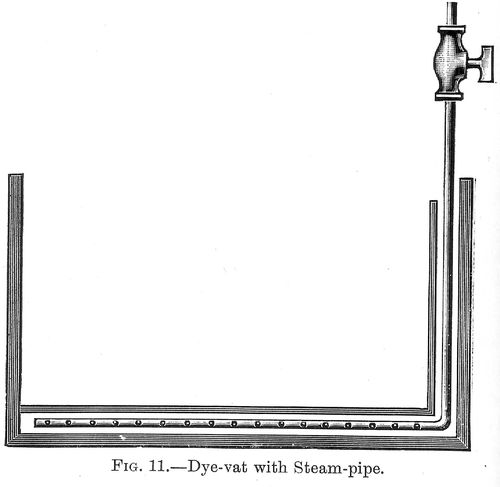
of this class, are rather sensitive to heat, and if a dye-vat be hot
at the bottom and cold at the top uneven dyeing is sure to be the
result; this is due to the greater affinity of the Alizarine for the
mordant at the high than at the low temperature, and thus more is
fixed on to the wool. The remedy for this is to so construct the
heating arrangements of the vat that the temperature shall be as
uniform as possible, while the goods should be kept continually turned
over, and every portion of them brought into intimate contact with the
dye-liquor. The continuance of the dyeing operations for one and a
half to two hours after the vat has reached the boil is necessary to
properly develop and fix the colour on the fibre; a short boil leaves
the goods of a poor shade, without any solidity about it, and the
colour is loose, while a longer boil brings up a solid shade and a
fast colour.
Although it is not absolutely necessary to add any acid to the
dye-bath during the dyeing operations, yet as the Alizarines and most
of this class of dye-stuffs dye better in a slightly acid bath it is
advisable to add a small quantity of acetic acid, say about one pint
to every 100 lb. of goods; this serves to correct any alkalinity of
the water, which may be due to its containing any lime. Dye-stuffs of
the acid class, such as indigo extract, Cloth red, Acid magenta, etc.,
may be used along with the Alizarine dye-stuffs, in which case the
addition of acid to the dye-bath becomes necessary, but too great an
excess of acid should be avoided, as it interferes somewhat with the
dyeing of the mordant dyes.
This is by far the best and most generally used method of applying
these mordant dyes. It is not a costly process, being indeed
economical, as it only requires just the right amounts of drugs and
dye-stuffs, and there is the minimum loss of material in the
mordanting and dye-baths. Shades can be brought up with the greatest
ease, although it is well in
the dyeing to add rather less
dye-stuff than is actually required, and to add more when it is seen
how the shade is coming up. The labour is the most important item in
the mordanting and dyeing method.
The proportions of material used to the weight of the wool are: Of
bichromate of potash, 3 per cent. for full shades, and 1 per cent. for
pale shades; of fluoride of chrome, the same quantities; of acetate of
chrome, according to the strength of the solution used; of alum, 10 to
20 per cent.; of sulphate of alumina, 5 to 10 per cent.; of copperas,
5 to 10 per cent.; of tartar, 1-1/2 to 2-1/2 per cent.; of oxalic
acid, 1 to 1-1/2 per cent.; of sulphuric acid, 1 per cent.; of argol,
2-1/2 to 5 per cent.; of tartaric acid, 1 to 1-1/2 per cent.; but of
course in an article like this it is impossible to give definite
quantities.
Second Method. Stuffing and Saddening.--This method consists in
first treating the wool with a solution of the dye-stuff, and then
with a solution of the mordant required to develop and fix the colour.
This method is more particularly applicable to such dye-stuffs as
camwood, cutch, logwood, madder, fustic, etc., the colouring
principles of which have some affinity for the wool fibre and will
directly combine with it. It is not suitable for the application of
the Alizarine colours. The saddening may be and is commonly done in
the same bath, that is, after the wool has been stuffed it is lifted,
the mordant--copperas, bluestone, bichrome, or alum--is added, and the
wool is re-entered into the bath. This cannot be considered a good
method of working; the shades obtained are full and deep and fairly
fast, but there is usually a considerable loss of colouring matter, as
the wool in no case abstracts the whole of the dye-stuff from the
bath; what excess is left combines with the mordant when the latter is
added, forming an insoluble colour lake, which falls down to the
bottom of the dye-vat and is wasted, or it may go upon the
wool in a loose, unfixed form, and cause it to rub badly and come off
in milling. Then it is rather difficult to dye to shade, much of the
result depending on conditions over which the dyer has little control.
Working as he does with dye-stuffs of unknown colouring power, which
may vary from time to time with every fresh batch of material, it is
evident that, although the same quantities may be used at all times,
at one time a deeper shade may be obtained than at another, and as it
is impossible to see what is going to be the result, and if by
mischance the shade does not come deep enough it cannot well be
rectified by adding a quantity of dye-wood to the bath, because the
mordant in the latter will prevent the colouring matter from being
properly extracted, and only a part of that which is extracted is
fixed on the wool, the rest being thrown away in the dye-bath, and
partly on the particles of wood themselves, when logwood, camwood,
etc., are used in the form of chips or powder. Dyers being well aware
of this, are in the habit when mistakes occur of bringing up to shade
with soluble dye-stuffs--archil, indigo extract, and such like.
This method, as stated above, is very wasteful, not only of
dye-stuffs, but of mordants. In no case does the wool absorb the whole
of the colouring matter from the bath, the unabsorbed portion goes
down to the bottom of the bath when the mordant is added, so that when
the dyeing is finished, the dye-bath is charged with a large quantity
of colouring matter in an unusable form which has to be thrown away,
thus at once adding to the pollution of the river into which it is
run, and to the cost of the process of dyeing. As attention is being
directed more and more to the question of the prevention of pollution
of rivers, and as the waste liquors from dye-works add to the apparent
pollution to a very considerable extent, dyers will have to develop
other modes of dyeing than that of stuffing and saddening in one bath.
The
principle of dyeing by stuffing and saddening may be
carried out by the use of two separate baths; in fact, it is done in
the case of dyeing a cutch brown from cutch and bichromate of potash.
The goods are first treated in a bath of the dye-wood for a short
time, then rinsed, and the colour is developed by padding into a
saddening bath of the mordant. By this method the baths, which are
never quite exhausted, can be retained for future use, only requiring
about 1/2 to 3/4 of the original quantities to be added for each
succeeding batch of the goods, in fact, in some cases, as in cutch,
old baths work better than new ones.
The advantage attached to this method of working is that arising from
economy of dye-stuff and mordant, and the reduction of the pollution
of the stream on which the works are situated. The disadvantages are
that the cost of labour is increased by there being two baths instead
of one, and that the shades obtained are not always so full as with
the one-bath method. This, of course, can be remedied by running the
goods through the baths again, which, however, adds to the cost of the
process, but there is this much to be said, the shade can be better
brought up than by the one-bath process. In some cases the methods of
mordanting, dyeing and saddening are combined together in the dyeing
of wool, thus, for instance, a brown can be dyed by first mordanting
with bichrome, then dyeing with camwood and saddening in the same bath
with copperas. The shades obtained are fairly fast and will stand
milling. The disadvantages of this process are the same as those
attached to the dyeing and saddening in one bath.
Now we come to the last method of dyeing wool with mordant and
colours, that in which the operation is carried out in one bath. This
can only be done in those cases where the colour lake that is formed
is somewhat soluble in dye-liquors, which usually have slightly acid
properties; or
where the affinity between the two bodies
(colouring matter and mordant) is too great. This method can be
carried out in, for instance, dyeing a cochineal scarlet with tin
crystals, a yellow from fustic and alum, a black from logwood and
copperas and bluestone, a red from madder and bichrome, and the dyeing
of the Alizarine colours by the use of chrome fluoride, etc.
The shades obtained are usually not so deep as those got by the
mordanting and dyeing process, but are frequently nearly so. In some
cases, as in dyeing with fustic or logwood, it gives rather brighter
colours, due to the fact that the tanning matters present in the
dye-stuffs is not fixed on the wool, as is the case with the
mordanting method, but is retained in the dye-bath. For dyeing with
logwood and copperas or bluestone the process is not a good one, as it
does not give as full shades as by the ordinary process. For dyeing
with the Alizarine colours, using chrome fluoride as the mordant, it
can be applied with fair success. There are advantages in the saving
of time and labour and in the amount of steam required, all of which
are important items in dyeing.
It is rather troublesome to match off by this process, but it can be
done. For light shades the process will be found very useful, as these
cost less than by any other process. The dye-baths may be retained for
future use, although in process of time they become too dirty for use,
when they must be thrown away.
Level Dyeing.--The first condition for successful dyeing is that the
fibres to be treated are absolutely clean. A careful washing is not
enough for this purpose. Cleanliness is undoubtedly the condition
which the fibre must possess to enable the dye to hold on and not to
come off the fibre, this latter causes a loss of dye-stuff, soils the
whites, and gives rise to trouble between the dyer and finisher; it is
also
the condition for making the dye go on the wool evenly.
The washing must be done at the boil, so that the fibre is well wetted
out and all the air bubbles adhering to it are driven out. But this is
not enough; it must be accompanied by a scouring operation, not only
in the case of fibres of which the dyer does not know whether they
have been scoured, but also when they have already been scoured and
bleached. The kind of scouring that the fibres receive in this case
need only be of a comparatively light character, but it must never be
omitted, even for dark shades, as the traces of grease which the fibre
contains are the causes of nearly irremediable stains in the dyeing
operations. Even in dyeing black wool it is of the greatest importance
to have the fibre suitably scoured.
The fatty matters which the fibre contains may belong to the
components of the fibre itself and be natural matters, but in the case
of wool yarns and cloths they are mostly dressing oils, from which the
dyer cannot be too anxious to free the wool before dyeing. Some
practical methods of preparatory treatment of the fibres before dyeing
may therefore be described here with advantage.
Cotton is boiled off at actual boiling heat for two hours, with 8 per
cent. of its weight of carbonate of soda and a little soft soap, which
treatment is sufficient for dark colours.
For light colours it is necessary that the cotton be bleached. Wool is
scoured with soda and soap in the proportion of 10 lb. soda and 2 lb.
Marseilles soap for 100 lb. wool. Silk is scoured by boiling for one
and a half hours in a boiling bath with 30 per cent. of its weight of
soap. For light colours a second boiling should be given, with 15 per
cent.
The careful cleaning of wool previous to dyeing is of exceptional
importance. Raw wool is cleaned with carbonate of soda and ammonia.
For 50 lb. wool to be cleaned 6 lb. carbonate
of soda and
1-1/2 lb. ammonia are added to a bath of 150 gallons water. The wool
is laid down in it for twenty minutes at 35° C., taken up, squeezed,
treated for fifteen minutes in another bath, with 5 lb. carbonate of
soda and then rinsed. The first bath must be renewed as often as
possible, because it contains all the impurities. In the case of
woollen yarn 30 lb. require two tubs of 40 gallons capacity. The first
tub is to contain 35 gallons water and 2 lb. ammonia at 10° Be. After
working the skeins for three minutes in it they are left to stand for
fifteen minutes, then wrung out, and the operation is repeated in the
second tub. Finally, the yarn is rinsed several times in soft water.
Woollen piece goods are treated in a large wooden tub at 40° C. with
4 lb. carbonate of soda and 2 lb. carbonate of ammonia for 80 lb.
material. The pieces are moved about for twenty minutes, laid down in
the bath overnight, again turned for ten minutes and hydro-extracted.
They may also be handled for forty minutes in a bath of 2 oz. ammonia
for 100 lb. wool at 60° C., and then for twenty minutes in clear water
at 60° C.
After wetting or preparatory treatment, it will be best to proceed
immediately to dyeing; if the fibres be left in a heap for too long a
time, there is danger that they may become heated, or at least that
the moisture may be irregularly distributed by the occurrence of
partial drying, causing an uneven fixation of the colour in the first
stages of dyeing. The first two conditions of successful dyeing are,
therefore, a suitable wetting out and scouring. The dyer, however,
must not be less careful to see that the dye-bath is what it ought to
be.
Whenever possible the dye-stuff must be dissolved separately, or at
least the bath not entered before the dye-stuff is well dissolved.
Artificial dye-stuffs require particular attention to this point,
because the presence of undissolved particles
is the cause
of irregularities, such as streaks, or, at least, specks. The solution
is mostly made hot as follows: After pouring water at 180° F. upon the
dye-stuff, stir gently, strain through flannel or through a very fine
sieve, and pour more water upon the residue until nothing more is
dissolved. As is well known, the artificial dye-stuffs often contain
insoluble matter, resins, etc. It is therefore advisable to use only
soft water for this operation.
The solutions of artificial dye-stuffs are ordinarily made at the rate
of 1 to 5 lb. per 10 gallons of water, 2 lb. being the proportion
mostly employed. This depends more or less on the solubility of the
dye-stuff. Old solutions sometimes contain crystals of the dye-stuff
which have separated out. These should be redissolved by heating
before the solution is used. But it is best to make only such a
quantity of solution as will suffice for immediate requirements.
With paste colours care should be taken to keep them in closed vessels
in such a manner that they will not become hard by evaporation, and
they should not be kept in any place where they are likely to freeze
in winter time. In such an event it is not an uncommon circumstance
for the casks or other vessels containing them to burst, with a
consequent loss of dye-stuff. Before any of the paste is withdrawn
from the cask, it is advisable to stir well up with a wooden stirrer.
In adding dye-stuff during the actual dyeing operation, it is
advisable to add the dye-stuff to the bath in two or three portions,
always taking out the goods before adding each lot of dye-stuff, and
stirring up the contents of the bath before re-entering the goods.
Another important condition of obtaining a level dyeing is to proceed
slowly, beginning with a weak bath at a moderate temperature, and
rising gradually to a boil. If necessary to retard the dyeing from the
commencement, then an assistant mordant is added to the dye-bath, in
the shape of soda crystals or phosphate of soda for the
benzidine colours on cotton; bisulphate of soda or Glauber's salt in
dyeing with azo colours or acid colours on wool; or tartar may be used
in most cases with good effect, causing the wool to have a softer
feel. Finally, the evenness of the dyeing is much increased by the
frequent turning over of the material in the dye-bath, so managing
this in the case of wool as to avoid felting.
When dyeing with a mordant, the dyer should see that the mordanting
operation is thoroughly well done, for as much care is required for
the mordanting as for the actual dyeing; in fact, if anything, the
mordanting should be done with rather more care, as if it be at all
defective no amount of care in the following dyeing operations will
ensure a level dyeing. Chrome mordanted wool should be dyed without
delay, as it is rather sensitive to light, especially the yellow sort,
which gradually changes into the green sort of chromed wool.
One peculiarity of dyed wool is that it will continue to take up
colour after it is removed from the dye-bath, especially if it
contains any of the hot dye-liquor, therefore it is very desirable to
wash the wool as soon as possible after its removal from the dye-bath.
It is best, however, not to take the wool out of the hot bath, but to
leave it in until the bath becomes cool, and then to take it out, by
this means the colour becomes deeper and more solid looking, and is
faster on the wool.
One cause of irregular dyeing may be mentioned, as it is occasionally
met with, namely, the presence of foreign fibres in the goods, cotton
in wool fabrics, and even of different varieties of the same fibre.
All dyers know that dead or immature cotton will not dye up properly,
a fact or defect more especially met with in indigo dyeing than
probably in any other colour. Then wools from different breeds of
sheep vary considerably in their dyeing power. Fine wools take up
more colour than coarse, and, consequently, even from the same
bath, will come out a deeper shade; if a fabric, therefore, contains
the two kinds of cotton, or the two kinds of wool, they will not dye
up evenly.
In the preceding sections brief notes have been given about the
principal methods of dyeing wool, with some indications of the dyes
which can be used under each method. In the succeeding sections will
be given a number of recipes showing how, and with what dye-stuffs,
various colours, shades and tints can be dyed upon wool. It will be
understood that these recipes are applicable to all kinds of woollen
fabrics, loose wool, slubbing, yarns in any form, woven worsted or
woollen cloths, felts of any kind, etc., all these different forms
require handling in a different way; it would not do, for instance, to
treat a quantity of slubbing in the same way as a piece of worsted
cloth, while hanks of yarn require a different mode of handling to a
quantity of hat bodies. The different kinds of woollen fabrics require
to be dealt with in different kinds of machines, and this has already
been dealt with in the chapter on Dyeing Machinery and Dyeing
Manipulations.
To describe and illustrate the application of all the various woollen
dye-stuffs, whether of natural or artificial origin, and to show the
great variety of shades, etc., which can be obtained with them, either
all one or in combination, would require not one, but many volumes of
the size that this present work is intended to be. Therefore, it
becomes necessary to make a selection from the best-known and most
used of the various dyes, and illustrate their application by a number
of recipes, all of which, unless otherwise stated, are intended to be
for 100 lb. weight of woollen material of any kind. It may also be
pointed out that, as a rule, the recipes may be applied to the dyeing
of fabrics made with other animal fibres than the wool of the sheep,
as, for
alpaca, cashmere, camel-hair, hare or rabbit fur,
etc., inasmuch, as, with the exception of silk, all animal fibres
practically possess the same dyeing properties.
It will be convenient to point out here that a very large proportion
of the shades dyed on wool and other fabrics are obtained, not by the
use of a single dye-stuff, although this should always be done,
whenever possible, but by the combination of two or more dye-stuffs
together in various proportions. It is truly astonishing what a great
range of shades can thus be dyed by using two or three dyes suitably
mixed together, and one of the things which go to making a successful
dyer and colourist is the grasping of this fact by careful
observation, and working accordingly. Dyers will find much assistance
in acquiring a knowledge of colour and colour mixing from the two
little books on Colour, by Mr. George H. Hurst, and the Science of
Colour Mixing, by Mr. David Paterson, both issued by Messrs. Scott,
Greenwood & Co., the publishers of the present work.
Black on Wool.--Until within a comparatively recent time black was
dyed on wool solely by the use of logwood, combined with a few other
natural dye-stuffs, such as fustic, indigo, etc., but of late the
researches of colour chemists have resulted in the production of a
large number of black dyes obtained from various coal-tar products.
These have come largely into use, but still, so far they have not been
able to entirely displace logwood, chiefly on the score of greater
cost, the use of the natural dye still remaining the cheapest way of
producing a black on wool; although the blacks yielded by some of the
coal-tar black dyes are superior to it in point of intensity of colour
and fastness to scouring, acids and light, as well as being easier to
dye.
Blacks may be obtained from logwood by several methods, either by
previous mordanting of the wool or by the stuffing and saddening
methods, or by the one-bath process. The following
recipes
will show how these various methods are carried out in practice:--
Chrome Logwood Black.--The wool is first mordanted by boiling for
one and a half hours with 3 lb. bichromate of potash and 1 lb. of
sulphuric acid, working well the whole of the time. It is not
advisable to exceed the amounts of either the bichromate or the acid
here given, these quantities will result in a full bloomy black being
obtained, but any excess gives rise to greyish dull blacks, which are
undesirable. After mordanting rinse well with water, when the goods
will be quite ready for the dye-bath.
The dyeing is done in a bath made from a decoction of 40 lb. of good
logwood. It is perhaps preferable to start cold or only lukewarm,
raise to the boil and work for one hour, then lift, rinse well, and
pass into a boiling bath made from 1 lb. of bichromate of potash and
1/4 lb. of sulphuric acid for half an hour. This extra chrome bath
fixes any colouring matter which may have been absorbed by the wool
but not properly fixed by the mordant already on, it leads to fuller
shades which are faster to rubbing and milling.
The mordanting bath may be kept standing and used again for fresh lots
of wool, in which case it is only necessary to add 2-1/2 lb. of
bichromate of potash and 1 lb. sulphuric acid to the bath for each
additional lot of wool that is being dealt with. Old mordant baths
work rather better than new ones, but the use cannot be prolonged
indefinitely, there comes a time when the bath gets too dirty to use
and then it must be thrown away.
During the operation the bichromate of potash becomes more or less
decomposed and there is formed on the wool fibre a deposit of chromic
acid and chromic oxide, this deposit forms the mordant that in the
subsequent dye-bath combines with and fixes the colouring matter, the
hæmatoxylin of the logwood, and develops the black on the wool.
In
place of sulphuric acid, hydrochloric acid can be used
with some advantage as regards the proportion of bichromate
decomposed, and therefore an increase in the amount of chromium oxide
deposited on the wool.
This gives a deep blue black, somewhat wanting in bloom. The following
recipe gives a much bloomier black, but is rather more expensive to
dye.
Chrome Logwood Black.--Mordant by boiling in a bath containing 3 lb.
bichromate of potash and 7 lb. tartar. Dye and otherwise treat as in
the last recipe; 4 lb. of tartaric acid used in place of the tartar,
gives rather brighter and bloomier shades. The use of so-called tartar
substitutes is not to be recommended, they give no better results than
does sulphuric acid and are much dearer to use.
A somewhat greener shade of black than is yielded by either of the
above two recipes is the following:--
Chrome Logwood Black.--Mordant the wool in a bath containing 4 lb.
oxalic acid and 3 lb. bichromate of potash, afterwards dyeing as in
the first recipe.
All the above recipes give blacks of a bluish tone, which on the whole
have a good bloomy and solid appearance. Often what is called a jet
black is wanted, this can be obtained by following the recipe given
below.
Chrome Logwood Jet Black.--Mordant the wool by any of the methods
given above. The dyeing is done in a bath made from 40 lb. logwood and
5 lb. fustic, working as described in the first recipe. Using these
properties a good jet black is obtained, which is quite satisfactory
on the score of solidity and fastness. It is not advisable to exceed
the quantity of fustic here given, or otherwise the black will have a
tendency to assume a greenish tone that is not at all desirable. This
greening becomes more marked when from 7-1/2 to 10 lb. of fustic is
used, or if alum be added to the mordant along with the bichromate of
potash.
Chrome
blacks are the best blacks which can be obtained from
logwood. They have, however, a tendency to turn green on exposure to
the weather, which tendency seems to be most prevalent in those blacks
in which sulphuric acid has been used as the acid constituent of the
mordanting bath. The greening may be reduced to a minimum by adding to
the dye-bath about 1 to 2 lb. of Alizarine. Another plan which has
been followed is to give the wool a bottom with 5 to 6 lb. of camwood
or peachwood, then mordanting and dyeing us usual.
Logwood Black on Wool.--Boil first for one hour with a decoction of
8 lb. camwood, then lay down for fifty minutes in a boiling bath of
3 lb. bichromate of potash, 1 lb. alum, 1 lb. tartar. It is a good
plan to allow the goods to hang overnight.
The dye-bath is prepared with 45 lb. logwood, 8 lb. fustic, 4 lb.
sumac. Dye one hour at the boil, wash and dry.
Indigo Black.--This is sometimes called woaded black, and has an
excellent reputation as a fast black. It is dyed by first giving the
wool a medium blue bottom in the indigo vat by the method of vat
dyeing, which will be described later on, and then dyeing by either
the second or third recipe given above. The use of sulphuric acid is
rather to be avoided in dyeing an indigo vat with chrome and logwood,
as the chromic acid set free during the process is likely to attack
and by destroying the indigo to materially reduce the intensity of the
blue bottom. Or, after blueing in the vat, the black may be dyed or
topped on by the process with copperas, which will be described below.
Iron Logwood Black.--Mordant the wool by boiling one and a half to
two hours in a bath made with 5 lb. copperas, 2 lb. bluestone, 2 lb.
alum, and 10 lb. argol. The dyeing is done in a bath of 50 lb.
logwood.
It is not advisable to use more argol than is here given, for
although a little excess will not materially affect the beauty or
brilliancy of the resulting shade, yet such excess is wasteful, and
makes the dyeing cost more than it otherwise would. On the other hand,
too little will cause the shade to become greyish in tone and wanting
in solidity. The copper sulphate (bluestone) added increases the
fastness of the finished black to light, the best proportions to add
are from 2 lb. to 4 lb. for 100 lb. of wool. The shade obtained in the
above recipe is of a bluish-violet hue, if a jet black be wanted, add
5 lb. of fustic to the dye-bath. Another and very common method of
working is the "stuffing and saddening" process, given in the next
recipe.
Iron Logwood Black.--Make a bath of 50 lb. logwood, 6 lb. fustic,
and 1 lb. sumac. Work the wool in this for one hour at the boil, lift,
allow the bath to become cool, then add 6 lb. of copperas (ferrous
sulphate) and 2 lb. bluestone; re-enter the wool, raise the
temperature to the boil, and work half an hour, then lift, wash and
dry. On the whole the first method is the most economical and yields
the best blacks, fastest to rubbing.
The iron-copper-logwood blacks are not so fast to acids as the
chrome-logwood blacks, but they are rather faster to light and air,
and equally so to scouring and milling.
One-bath methods of dyeing blacks are sometimes preferred by wool
dyers. Of these the following is an example.
Logwood Black.--Make a dye-bath with 50 lb. logwood, 5 lb. fustic,
6 lb. copperas, 2 lb. copper sulphate, and 4 lb. oxalic acid. Enter
the goods and work at the boil to shade. The oxalic acid is added for
the purpose of retaining the logwood-iron-copper black lake, which is
formed on mixing the various ingredients together in solution. On
boiling the wool in the liquor the fibre gradually extracts out the
dye matter and becomes dyed. The use of some of the so-called "direct
blacks" (noir reduit, Bonsor's black) is based on the same
principle.
These dyes are mixtures of logwood, fustic or other dye-stuff with
copperas, bluestone and oxalic acid, and only require adding to water
to make the dye-bath. This method of working enables logwood to be
used in conjunction with dihydroxynaphthalene and some other coal-tar
derivatives to obtain blacks of good solidity and much faster to
light, air, acids and scouring than the ordinary logwood blacks.
Another recipe for a one-bath logwood black, using the extracts in
place of the dye-wood itself, is the following:--
Logwood Black.--Prepare a dye-bath with 12 lb. logwood extract,
2 lb. fustic extract, 6 lb. copperas, 4 lb. bluestone, 3 lb. oxalic
acid, 2 lb. tartar. Boil the goods in this for one hour.
Some dyers use the dye-woods and prepare from them a decoction by
boiling in water; in some respects this is the most economical plan,
only the dyer has to get rid of the spent dye-wood from which the
colouring matter has been extracted, and this is not always an easy
matter. Some dyeing machines (Smithson's) have been devised which
contain as one of their features a dye-wood extractor, in which the
extraction of the colouring matter of the wood proceeds at the same
time as the dyeing. Good results are got with such machines, although
they leave something to be desired.
Many dyers use the dye-wood extracts which are now made on a large
scale. These are for the dyer much more convenient to use, although
naturally rather more costly. They are approximately five times the
strength of the dye-wood, but they vary very greatly in this respect.
Logwood blacks can be readily distinguished from nearly all other
blacks, in that by treatment with moderately strong hydrochloric acid
they turn a bright red.
No other natural dye-stuff is used in the dyeing of black than these
here given.
Of
late years many black dyes derived from coal tar have been
placed on the market. Among these may be enumerated the Acid Blacks of
Messrs. Bead Holliday & Sons; the Naphthol and Naphthylamine Blacks of
Leopold Cassella & Co.; the Victoria Blacks of the Farbenfabriken
vorm, Fr. Bayer & Co.; the Wool Blacks of the Actiengesellschaft für
Anilin Fabrikation; the Azo Blacks of the Farbwerke vorm, Meister,
Lucius & Bruning; and one or two other blacks. These blacks are dyed
very simply, as will be seen from the recipes given below, showing
their application in the production of blacks of a great variety of
tone. None of them dye a true jet black, but generally a bluish black
or a violet black, but the tone may be readily changed to a jet or
dead black by the addition of a little orange, yellow or green
dye-stuff.
They give blacks of a very solid appearance and very bright in tone,
and have the advantage over the logwood blacks of leaving the wool
more supple and less liable to be felted. Moreover, as a rule they are
faster to acids, alkalies and milling than are the logwood blacks, and
as regards fastness to light they excel that dye-stuff. Unfortunately
they are more costly to use, which tells against their entirely
displacing logwood in dyeing blacks on wool.
Still, year by year their use is increasing, and as their price
becomes less their employment will yet further extend. They may be
combined with logwood, as they will dye with equal facility on
mordanted and unmordanted wool.
Violet Black on Wool.--Make the dye-bath with 4 lb. Acid Black B, or
Acid Black B B, 3 lb. sulphuric acid, and 10 lb. Glauber's salt. Work
at the boil for one hour. The B brand of these blacks gives shades
slightly redder in tone than the B B. The blacks are quite fast to
light and acids, but not to soaping.
Blue Black on Wool.--Dye as in the last recipe, but use Acid
Black S. This dye-stuff produces bluer shades of black than
either B or B B, and they are faster to soaping.
Jet Black on Wool.--Make the dye-bath with 4-1/2 lb. Acid Black S,
1/2 lb. Fast Yellow F Y, 3 lb. sulphuric acid, and 10 lb. Glauber's
salt. This shows how, by the addition of a little yellow dye-stuff,
the blue shade may be changed to a full jet black.
Blue Black on Wool.--The dye-bath is made with 4-1/2 lb. Naphthol
Black B (or 6 lb. Naphthol Black 3 B), 4 lb. sulphuric acid, and
10 lb. Glauber's salt. Work at the boil for one hour, then lift, wash
and dry. The Naphthol Blacks have long been used in wool dyeing, and
give excellent results, the 3 B brand dyeing much bluer shades than
the B brand. There is also a 4 R brand giving violet blacks. These
blacks are quite fast to acids and alkalies, are fast to light, and
resist washing very well, the B brand being the fastest. The following
recipe shows how a full jet shade can be obtained for these blacks:--
Jet Black on Wool.--Prepare the dye-bath with 4-1/2 lb, Naphthol
Black B, 1 lb. Naphthol Green B, 1/4 lb. Indian Yellow, 4 lb.
sulphuric acid, and 10 lb. Glauber's salt.
Blue Black on Wool.--Make the dye-bath with 5 lb. Anthracite Black
B, 10 lb. Glauber's salt, and 5 lb. bisulphate of soda, working at the
boil for one hour. Anthracite Black does not require a bath so acid as
do some other coal-tar blacks. The shade obtained is a full blue
black, which is fast to acids; alkalies turn it a little bluer, and
soaping causes some loss of colour.
Violet Black on Wool.--Make the dye-bath with 5 lb. Anthracite
Black R, and 10 lb. bisulphate of soda. The black thus obtained is a
good one, fairly fast to acids, alkalies and soaping.
Dead Black on Wool.--Make the dye-bath with 6 lb. Anthracite
Black R, 1 lb. Anthracene Yellow C, and 10 lb. bisulphate
of
soda. Work at the boil for one hour, then lift, add 3 lb. fluoride of
chrome and work again at the boil for twenty minutes. This black is a
very fine one, and is very fast.
Violet Black on Wool.--Make the dye-bath with 4 lb. Naphthylamine
Black D, 10 lb. Glauber's salt, and 5 lb. acetic acid. This black is
pretty fast to acids, alkalies and light, but is somewhat loose to
soaping, and, therefore, cannot be used for black goods that have to
be strongly milled. Naphthylamine Black 4 B dyes somewhat bluer shades
than the B brand.
Blue Black on Wool.--Prepare the dye-bath with 6 lb. Victoria Blue
Black, 20 lb. Glauber's salt, and 1-1/2 lb. acetic acid, working at
the boil for one hour. A fine blue black, is obtained which is quite
fast to acids, washing and light.
Greenish Black on Wool.--The dye-bath is made with 3 lb. Victoria
Black Blue, 2 lb. Fast Yellow F Y, 20 lb. Glauber's, salt, and
1/1-2 lb. acetic acid. The dyeing is done at the boil and takes about
an hour. This shade has a good full tone, and is fast.
Jet Black on Wool.--Make the dye-bath with 4 lb. Victoria Black B,
1/2 lb. Fast Yellow F Y, 10 lb. Glauber's salt, and 2 lb. sulphuric
acid, working at the boil for one hour. A very fine shade is thus
obtained, which is fast to acids, alkalies and soaping. By omitting
the Fast Yellow a blue black is obtained, while by using Acid Green
instead a greener tone is given to the black. In place of the Victoria
Black B the two other brands, 5 G, and G, of these blacks may be used.
These give equally fast blacks of a deeper and more jet black.
Black on Wool.--Prepare a bath with 5 lb. acetic acid, 9° Tw.; enter
the wool for one hour, then lift and add 5lb. Naphthol Black 3 B, and
1/4 lb. Indian Yellow. Re-enter the goods and boil for one hour, wash
and dry.
Many of the black dyes--Naphthol Black, Naphthylamine Blacks,
Naphthyl Blue Black N, Acid Black B, etc.--are capable of slowly
dyeing wool from neutral baths, that is, containing only Glauber's
salt, or rather more quickly if a little acetic acid be present. Such
dyes are very useful for dyeing heavily milled or felted fabrics, such
as hat bodies for instance, as then the dye possesses greater
penetrative properties and passes more into the substance of the
fabric, which is, therefore, better dyed through. Also they are
suitable for dyeing half-wool fabrics as will be seen on referring to
the chapter dealing with the dyeing of union or cotton-wool fabrics.
It is quite possible to dye a black on wool by using a combination of
acid and azo dye-stuffs, and below is given a recipe illustrating this
method; it is one, however, rarely adopted.
Blue-Black on Wool.--Prepare the dye-bath with 10 lb. Glauber's
salt, 2 lb. Patent Blue, 6 oz. Brilliant Orange, 4 oz. Amaranth, 4 oz.
Acid Violet N, 4 lb. sulphuric acid. Enter the goods at about 150° F.,
raise to the boil and work to shade; lift, wash and dry. It may be of
interest to note that by using a mixture of Azo Rubine and Acid green
good blacks can be got.
There is a range of Acid and Azo dyes which are capable of dyeing from
the usual acid baths on to wool, and yet can be developed and fixed on
the fibre to good, full blacks. Types of such dyes are Anthracene
Chrome Black F F, Diamond Black F, Chrome Patent Black D G and D G G,
Fast Chrome Black, etc. Generally the blacks dyed on wool with these
dyes are very fine, have a full, bloomy appearance, and are very fast.
They are much used in dyeing hat bodies and fine cloths which have to
be very fast to the weather.
The method of application will be gleaned from the recipes given
below.
Black.--Prepare
a dye-bath with 5 lb. Chromotrop S, 1/4 lb.
Azo Yellow, 50 lb. Glauber's salt. Work for one and a half hours at
the boil, then add 4 lb. sulphuric acid. Work at the boil for another
half hour, then lift. Add to the same dye-bath 3 lb. bichromate of
potash. Re-enter the goods and work at the boil for half an hour, then
lift, rinse and dry.
Jet Black.--Mordant the wool by boiling for one hour in a bath made
from 4 lb. bichromate of potash and 3 lb. of tartar. Then rinse, and
dye in a bath containing 3-1/2 lb. Diamond Black, 1-1/4 lb. Alizarine
Cyanine R R R double, and 1 lb. Gambine Yellow, working at the boil
for from one to one and a half hours.
Diamond Black on Wool.--Mordant by boiling for one hour with 3 lb.
bichromate of potash, 1 lb. oxalic acid. Wash and dry in a bath made
with 2 lb. Diamond Black, 2 lb. acetic acid. Work at 120° F. for one
hour, then heat to boil, and work until the dye is fully fixed. Lift,
wash and dry.
A more common method of using the Diamond Black is given in the
following recipe.
Diamond Black.--Prepare a dye-bath with 10 lb. Glauber's salt,
2-1/2 lb. Diamond Black, 1/2 lb. Diamond Green. Boil for an hour, then
pass through a fresh bath of 2 lb. bichromate of potash for
three-quarters of an hour at the boil; wash and dry.
This gives a fine jet shade of black, quite fast to a strong milling,
and to light, alkalies and acids. Diamond Black by itself gives bluish
shades. This dye is much used in the hat-dyeing trade.
Violet Black.--Mordant the wool by boiling for one and a half hours
in a bath made with 3 lb. fluoride of chrome and 1 lb. oxalic acid,
then rinse and dye in a bath containing 25 lb. Alizarine Cyanine
Black G, 5 lb. acetate of ammonia, and 1 lb. acetic acid, working at
the boil for one and a half hours. A
fine full shade is
obtained which is quite fast to acids, milling and light.
Brown Black.--Mordant the wool as in the last recipe, then dye in a
new bath 25 lb. Alizarine Cyanine Black G, 3 lb. Anthracene Brown,
5 lb. acetate of ammonia, and 1 lb. acetic acid, working at the boil
for one to one and a half hours.
Jet Black.--Mordant as in either of the above recipes, then dye in a
bath containing 20 lb. Alizarine Black S W, and 2 lb. acetic acid.
This black possesses a great degree of resistance to acid, alkali,
milling and light, and is one of the best blacks at the disposal of
the dyer.
Reddish Black on Wool.--Prepare the dye-bath containing 5 lb.
Chromotrop 2 B, 10 lb. Glauber's salt, and 4 lb. sulphuric acid, work
at the boil for one hour, then lift. Add to the same bath 3 lb.
bichromate of potash and 1 lb. sulphuric acid, and work half an hour
longer.
Blue Black.--Make the dye-bath with 6 lb. Chromotrop 10 B and 4 lb.
sulphuric acid; dye, and develop the black by adding to the same bath
3 lb. bichromate of potash and 1 lb. sulphuric acid.
Jet Black.--Prepare the dye-bath with 5-1/2 lb. Chromotrop S,
1/4 lb. Alizarine Yellow G G W, 10 lb. Glauber's salt, and 4 lb.
sulphuric acid. Slowly raise to the boil and work for one hour, then
add to the same dye-bath 3 lb. bichromate of potash, and 1 lb.
sulphuric acid, working at the boil for one hour.
These are but a few examples of how the Chromotrops (one of the most
interesting series of dye-stuffs at the service of the dyer) may be
used to dye blacks. They of themselves dye brilliant reds, from bright
scarlet (2 R), crimson (6 B), and purple (8 B and 10 B), to maroon and
clarets (S and S B). These being turned black on being chromed, give
various shades--blue blacks, violet blacks, and jet blacks, which have
the merit of being fast to acids, strong milling, and light in a
great
degree. The blue and violet blacks may be converted to
jet shades by adding to the dye-bath some yellow dye-stuff, such as
Azo Yellow, Alizarine Yellow, or Gambine Yellow, which will resist the
action of the bichrome in the developing bath.
Chromotrop blacks while so very fast have the disadvantage of being
expensive, but by combining them with logwood it is possible to obtain
blacks that have a great degree of resistance to light, acids and
milling. They are in this respect much superior to pure logwood
blacks, while the cost is not prohibitive.
The following recipe will serve as an example of how these two
dye-stuffs may be combined:--
Jet Black.--Make a bath with 2 lb. Chromotrop S, 15 lb. Glauber's
salt, and 5 lb. hydrochloric acid. Work in this bath for one hour,
then add 2-1/2 lb. bichromate of potash, and work again for half an
hour, at the boil. Lift, rinse and dye in a new bath containing 25 lb.
logwood, 1 lb. fustic extract and 1/4 lb. sulphuric acid, working at
the boil for an hour.
Violet Black on Wool.--Dye the wool in the Chromotrop bath, and
develop as in the last recipe. The final dye-bath is made with 6 lb.
logwood, 8 oz. Patent Blue B, and 4 lb. sulphuric acid. By using
logwood alone blue blacks can be dyed, by increasing the proportion of
fustic a greener tone can be obtained, while by the use of a larger
proportion of Chromotrop a redder tone of black is the result.
Jet Black.--Make the dye-bath with 20 lb. Glauber's salt, and 6 lb.
Nyanza Black; when obtained is a good one and of solid appearance.
Alkalies turn it red, but it is fast to dilute acid and soaping.
Black.--Prepare the dye-bath with 10 lb. Glauber's salt, 5 lb.
oxalate of ammonia, 5 lb. acetic acid and 6 lb. Anthracene Chrome
Black F. Work at the boil for three-quarters of
an hour, or
until the bath is exhausted of dye-stuff, then add 1-1/2 lb.
bichromate of potash and 2 lb. hydrochloric acid to the same bath and
work for half an hour longer.
The Anthracene Chrome Blacks, of which there are three brands, F, 5 B
and F E, are excellent dyes, producing very fine blacks, and owing to
the slowness of dyeing and great penetrative properties are very
suitable for dyeing hat felts and other closely woven fabrics. The 5 B
dyes more bluish shades than the F, while the F E brand gives full
black. By combining these with Anthracene Yellow B N, Anthracene Acid
Brown G, or other similar dyes, jet blacks can be got as per the
following recipe:--
Jet Black.--Make the dye-bath with 6 lb. Anthracene Chrome
Black F E, 5 oz. Anthracene Yellow B N, 10 lb. Glauber's salt, 2 lb.
oxalate of ammonia and 5 lb. acetic acid, after dyeing, and the
dye-bath, is exhausted of colour, add 1-1/2 lb. bichromate of potash
and 3 lb. hydrochloric acid, and boil again for half an hour. Finish
in the usual way.
One of the reasons for adding the oxalate of ammonia, is to
precipitate out any lime which may be in the water in such a form that
it will not react with the dye-stuff.
Fast Black.--Mordant the yarn with copperas (sulphate of iron). Dye
in a bath with 5 lb. Gambine Y, 2 lb. Acid Mauve, 2 lb. bisulphate of
soda. Proceed as described for full green.
Blue Black--3-1/2 lb. Naphthylamine Black S, 10 lb. Glauber's salt,
and 5 lb. acetic acid; to fully exhaust the dye-bath add 8 lb.
bisulphate of soda.
Jet Black.--5 lb. Naphthylamine Black S, 1/4 lb. Fast Acid
Green B N, 10 lb. Glauber's salt, and 5 lb. acetic acid, adding 8 lb.
bisulphate of soda to exhaust the bath.
Blue Black.--Give a deep blue bottom in the indigo vat and dye with
2 lb. Anthracite Black B, 10 lb. Glauber's salt and 2 lb. acetic acid.
Greys on Wool.--The dyeing of greys follows very naturally after
the dyeing of blacks, for from a broad point of view greys are
simply light blacks, and any dye-stuffs that will dye black will if
used in smaller proportions give greys. There is a great variety of
tone among greys: reddish greys, bluish greys, greenish greys, and so
on. They may be dyed in a considerable variety of ways from a large
number of dye-stuffs, both natural and artificial. Of these two
classes the latter gives the best result as far as regards brightness
of tone, and as regards other properties the greys obtained from the
artificial coal-tar colours are fully equal to those from natural
dyes.
A large number of recipes are in use by dyers for the production of
greys, so many that it becomes almost an impossibility to do more than
give a mere fraction of them here. However, a number of representative
recipes will be given, covering all classes of dye-stuffs capable of
being used for the purpose, and thus forming a guide to the methods of
dyeing and the proportions of dye-stuffs to be used.
Light Grey.--Dye at the boil for three-quarters of an hour, in a
bath containing 1 lb. perchloride of tin, 3 lb. alum, 3 oz. indigo
extract, and 2 oz. cochineal.
Slate Grey.--Mordant by boiling with 4 lb. alum and 1 lb. argol,
then dye with 6 lb. logwood, 6 oz. cudbear and 3 oz. indigo extract.
Slate Grey.--Another method is to boil the wool with 10 lb. logwood,
2 lb. Glauber's salt and 1 lb. sulphuric acid for three-quarters of an
hour, then lift, add 1 lb. copperas, and re-enter the wool, working at
the boil for three-quarters of an hour, then lift, wash and dry.
Reddish Grey.--Boil for an hour with 10 lb. fustic, 11 lb. cutch,
1/2 lb. bichromate of potash and 1-1/2 lb. copperas.
Pearl Grey.--Give a light blue ground in the indigo vat, then dye in
a new bath with 2 lb. muriate of tin and 3/4 lb. cochineal, working at
the boil to shade.
Silver
Grey.--Prepare a bath with 3/4 lb. tannic acid; work
for an hour in a warm bath, then sadden with 3 lb. nitrate of iron to
shade, then lift, wash and dry.
Pearl Grey.--Prepare a bath with 3 lb. fluoride of chrome and 4 lb.
Alizarine Bordeaux B. Enter into the bath when cold, then heat to the
boil and work for one and a half hours, then lift, wash and dry.
Silver Grey.--The dye-bath is made with 3 lb. fluoride of chrome and
6-1/2 oz. Alizarine Cyanine G G, the dyeing being done as in the last
recipe.
Greenish Grey.--A good shade is dyed with 3 lb. fluoride of chrome,
4 oz. Alizarine Bordeaux B, and 4 oz. Diamond Flavine G, working as
given in the above recipe.
Grey.--Give a pale blue bottom with an indigo vat, then dye in a
bath containing 1 lb. fluoride of chrome, 1/2 oz. Diamine Fast Red F,
and 3/4 oz. Anthracene Yellow C; work at the boil for one hour, lift,
wash, and dry.
Dark Grey.--A very fine dark grey, almost approaching a black is
obtained by the following plan: bottom the wool with a medium blue by
means of the indigo vat, dye in a bath containing 1 lb. fluoride of
chrome, 3 oz. Diamine Fast Red F, and 3 oz. Anthracene Yellow C.
Slate Grey.--A good slate grey of a slightly greenish tone can be
dyed in a bath of 5 lb. acetate of ammonia, 3/4 lb. Acid Blue 4 S, and
1/4 lb. Titan Brown R, working at the boil to shade.
Pale Slate Grey.--The dyeing is done in a bath made with 5 lb.
acetate of ammonia, 5 oz. Acid Blue 4 S, and 1-1/2 oz. Titan Brown R,
working at the boil for one hour.
Silver Grey.--A very nice shade is dyed with 3 oz. Acid Blue 4 S,
1/4 oz. Titan Red, and 5 oz. acetate of ammonia.
Silver Grey.--A shade similar to the last is dyed in a bath
containing 10 lb. Glauber's salt, 5 lb. bisulphate of soda, and
3/4 oz. Anthracite Black R. By adding a little Thiocarmine R
the shade can be turned bluer in tone, while the addition of a little
Milling Yellow O, or Titan Yellow, turns it to the green side.
Pearl Grey.--Make the dye-bath with 10 lb. Glauber's salt, 5 lb.
acetic acid, and 3/4 lb. Naphthylamine Black D. This gives fine shades
of pearl grey.
Bluish Grey.--Mordant the wool by boiling in a bath made with 2 lb.
bichromate of potash, 1 lb. tartar, and 1 lb. sulphuric acid. Dye in a
bath containing 2 oz. Diamine Black (or 3/4 oz. Diamond Black and
1-1/2 oz. Alizarine Cyanine R), working at the boil for an hour and a
half.
Grey.--This can be dyed with 3 oz. Nyanza Black B, and 10 lb.
Glauber's salt, working at the boil.
Reddish Grey.--A good full shade is dyed with 1-1/2 oz. Cyanole
extra, 1/4 oz. Orange extra, 3/4 oz. Archil Substitute N, 10 lb.
Glauber's salt and 3 lb. sulphuric acid.
Slate Grey.--The dye-bath is made with 3 oz. Cyanole extra, 1/2 oz.
Archil Substitute N, 3/4 oz. Orange extra, 10 lb. Glauber's salt and
2 lb. sulphuric acid.
Bright Pearl Grey.--Prepare a dye-bath with 3/4 oz. Patent Blue,
1/2 oz. Acid Violet N, 3/4 oz. Orange G, 10 lb. Glauber's salt and
2 lb. sulphuric acid.
Stone Grey on Wool.--The dye-bath is made with 1/2 oz.
Chromotrop 2 R, 3/4 oz. Cyanole extra, 1-1/2 oz. Fast Acid Blue R,
3/4 oz. Acid Yellow, 20 lb. Glauber's salt, 3 lb. acetic acid. Enter
at 80° F., then warm slowly and work to shade, lift, wash and dry.
These recipes will probably be sufficient to show the lines on which
greys may be obtained in wool dyeing. It may be added that from the
Acid Blacks B, B B, and S, good greys of a violet tone may be
obtained, using from 1/2 to 3/4 oz. dye-stuff. The Naphthol Blacks
will also be found useful in the same way, while the greys from
Anthracene Chrome Blacks and the Alizarine blacks are very good and
fast.
Red
Shades on Wool.--The number of red shades that may be
dyed on wool is infinite. They range over every variety of tint of
red, from the palest blush-rose to the deepest crimson, and from the
most brilliant pink to the dullest grenat shade.
It is quite impossible here to describe the dyeing of every imaginable
shade of red, while the great variety of red dye-stuffs, both natural
and artificial, adds to the difficulty of dealing in the space at
command with all the various methods and dyes that may be used in the
dyeing of reds on wool.
The methods that may be adopted for dyeing red shades on wool are many
and various, depending not only on the particular dye-stuff used, but
often on the particular shade that is being dyed. One method, which
will yield a pale and useful tint with a particular dye-stuff, would
fail if a full shade were necessary.
The greater number of red shades are now dyed by means of the
artificial dye-stuffs, as these are much easier to dye than are the
natural dyes, and they give, on the whole, more even and brilliant
shades, while as regards fastness to milling, acids, and light they
are fully equal, and in most cases superior, to the natural dyes.
The Direct Red Dyes.--Of this group of red dye-stuffs, Benzopurpurine,
Titan Scarlet, Diamine Fast Red F, and Benzo Fast Red are types; many
of them have been found to be very serviceable in wool dyeing. They
may be dyed either from plain baths containing common salt or
Glauber's salt, or from baths containing common salt or Glauber's salt
and a little acetic acid.
Alkaline or soap baths do not work well as a rule, and must be avoided
in wool dyeing. Generally the dye-bath is exhausted of colour, and
full shades are easily obtained, while these reds are in general
remarkable for the evenness and
uniformity of tint which can
be produced. The reds so dyed are, on the whole, fairly fast to
soaping, and can be used for dyeing goods that have to be milled,
while their resistance to light and air is fairly good. Benzopurpurine
and Diamine Red are more or less affected by acids, but the Titan Red
and some of the more modern reds, Diamine Brilliant Scarlet, Benzo
Fast Scarlets, are all fast to acids. The fastness to washing and
light of some of them, Benzo Fast Red, Diamine Fast Red F, Titan Red,
is much increased by adding, after the wool has been dyed, 3 per cent.
of fluoride of chromium to the dye-bath, and working a little longer.
The dyeing with these colours is done at the boil, and the goods may
be entered direct into the boiling bath without fear of uneven shades
being produced. This bath may be kept as a standing one, simply adding
as each lot is dyed the necessary quantity of dye-stuff, a little
fresh water to bring the bath up to its original volume, and a
corresponding quantity of the salt originally added. The wool can then
be entered and dyed.
In place of using salt or Glauber's salt, acetate of ammonia is an
excellent assistant for this class of dyes.
The following are some recipes for dyeing various shades of red on
wool with this class of dyes.
Scarlet.--The dye-bath is made with 3 lb. Titan Scarlet C B, and
10 lb. acetate of ammonia. This gives a good bright shade of scarlet,
which is fast to acids and soaping, although not fast to light.
Scarlet.--Dye in a bath made with 3 lb. Diamine Scarlet B and 10 lb.
Glauber's salt. This yields a light shade, not so fast to acids as the
last, but equally fast to soaping and light.
Scarlet.--Make the dye-bath with 3 lb. Benzopurpurine 4 B, and
10 lb. Glauber's salt. This also gives a good shade of Scarlet fast to
soaping. It is turned dark blue by acids, and is
not fast to
light. It is very largely used on underwear goods, but is not so
satisfactory for this as the Titan Scarlet C B, or Benzo Fast
Scarlet B S.
Scarlet.--The dye-bath may be made with 3 lb. Brilliant Congo G,
10 lb. Glauber's salt and 2 lb. acetate of ammonia. This gives a
satisfactory shade of scarlet.
Bright Scarlet.--The dye-bath prepared with 2 lb. Geranine G, 5 lb.
sulphate of soda, 5 lb. acetate of ammonia. Work at the boil for one
hour, then wash and dry.
Dark Crimson.--Prepare a dye-bath with 1-1/2 lb. Chrysophenine,
1-1/2 lb. Hessian Violet, 25 lb. salt. Heat to 150° F., enter the
goods, heat to boil and dye boiling for one hour, take out, rinse and
wash.
Scarlet.--A brilliant shade of scarlet can be dyed in a bath of
3 lb. Benzo Fast Red, 1 lb. Chrysophenine, 10 lb. Glauber's salt and
2 lb. acetic acid.
Fast Red.--Dye the wool in a bath boiling, containing 1 lb. Diamine
Fast Red F, 10 lb. Glauber's salt, and 2 lb. acetic acid, until the
bath is exhausted, then add 3 lb. fluoride of Chrome and work half an
hour longer at the boil.
Bordeaux.--Dye with 3 lb. Diamine Bordeaux, and 10 lb. Glauber's
salt.
Pink.--Dye with 2 lb. Diamine Rose B D, 10 lb. Glauber's salt and
1 lb. acetic acid.
The basic red dyes are not very numerous, and comprise Magenta,
Saffranine, Acridine Reds, Acridine Scarlets, Rhoduline Reds,
Rhodamine and Neutral Beds. For successful dyeing they require a
perfectly neutral bath. This bath should contain 10 per cent. of
Glauber's salt, and is started cold and not too strong; when all the
material has been entered the steam may be turned on and the
temperature slowly raised, the material being turned over and over.
The operation is continued only until the bath has been exhausted of
colour, when it is stopped, and the wool taken out, and washed
and dried. The liquor in the dye-baths may be allowed to cool
down, and then it may be used for making the dye-bath for a second lot
of goods, or it may be run away. It is best not to add the dye to the
bath all at once, but in several portions as the work proceeds. The
affinity of the wool for the basic dyes is usually so strong that if
all were added to the dye-bath at the start, then the first portion of
the goods entered might take up all, or nearly all, the colour,
leaving but little for the last portion; the consequence being that
the goods are dyed of an uneven colour, deeper in some parts than
others. This defect is remedied by adding the dye in portions,
entering the goods rather quickly, working cold, or by adding a little
acetic acid and plenty of Glauber's salt. Notwithstanding all these
precautions it is quite possible for the shades to come up somewhat
uneven. These remarks are applicable not only to the basic reds but to
the whole range of basic dyes, hence this class of dye-stuffs is but
little used in the dyeing of wool.
Crimson.--Make the dye-bath with 2 lb. Magenta, and 15 lb. Glauber's
salt, working as described above. This gives a fine crimson shade
which, however, is not fast to soaping or to light. The quantity of
dye-stuff given above should not be exceeded or the shades may come up
bronzy, this may be avoided if a trace of acetic acid is added to the
dye-bath.
Crimson.--Dye with 2-1/2 lb. of Saffranine and 15 lb. Glauber's
salt. This dyes a fine Crimson shade.
Deep Red.--Use 3 lb. Rhoduline Red and 10 lb. Glauber's salt.
Scarlet.--The dye-bath is made with 1 lb. Saffranine Prima, 1 lb.
Auramine, and 10 lb. Glauber's salt. The goods are entered into the
dye-bath at about 120° F., and well worked about, then the temperature
is raised slowly. When the dye-bath is exhausted the goods are lifted,
washed and dried. There are no pure basic scarlets, and the above and
similar combinations
of a basic red and a basic yellow are
the only ways in which a scarlet can be dyed on wool with basic
coal-tar colours.
The basic colours are, in general, the hydrochlorides of some colour
base, and in the process of dyeing the acid constituent of the wool
fibre unites with the colour base, while the hydrochloric acid which
is liberated passes into the dye-bath.
The acid reds are a very large group of red dyes, of somewhat varied
chemical composition, which all have the property of dyeing from baths
containing Glauber's salt and sulphuric acid or acetic acid, the usual
proportions being 10 per cent. of the former, and 2 to 5 per cent. of
the acid. Some are best dyed from a bath containing bisulphate of
soda. The dyeing should be started cold, or at a lukewarm heat, then
steam should be turned on and the temperature raised to the boil, at
which it is maintained for an hour; this boiling serving to more
intimately fix the dye-stuff on the woollen fibre.
The Eosine reds, of which Eosine in its various brands, Rose Bengale,
Phloxine, Saffrosine and Erythrosine, are examples, are best dyed upon
wool from a bath containing Glauber's salt and a little acetic acid.
They do not require a very acid bath, hence the reason of using acetic
acid. The method of dyeing is that given above as for basic reds,
namely, enter into cold, or at most lukewarm bath, and raise the heat
slowly, continuing the work until the shade required has been
obtained. It is a good plan to start work in a neutral bath, and then
when the material has become thoroughly impregnated with the
dye-liquor to add the acetic acid. The shades obtained from these
Eosine reds are remarkable for their brilliance, but unfortunately
their fastness to light, washing, etc., is but slight, although it may
be increased by treating the dyed wool in a bath of alum or acetate of
lead.
Some
of the acid reds, e.g., Acid Magenta, Acid Violet,
belong to the group of sulphonated basic dyes. The vast majority
belong to the group of azo dyes, which can be employed to dye from
palest pinks to the deepest crimson reds. Some dye very brilliant
shades, others only yield dull reds. Some dye shades remarkable for
their fastness to all agencies, soap, acids, alkalies, light and air;
others dye shades which may be fast to soap, but loose to acids and
light. Generally even shades are readily obtained on any kind of
woollen fabric. It is practically impossible to name all the acid reds
that are known and that may be used, but a fairly representative
series of recipes will be given.
Ponceau.--Wet out, then prepare a bath with 2 lb. Ponceau R, 10 lb.
Glauber's salt, 2 lb. sulphuric acid. Enter the wool in the cold,
bring to a boil and work to shade, wash and dry.
Crushed Strawberry.--Prepare a bath containing 10 lb. Glauber's
salt, 4 oz. Scarlet R S, 9 oz. Indigo extract, 2 oz. Orange Y, 4 oz.
sulphuric acid. Enter wool at 160° F., give four turns, raise
temperature slowly to a boil, and turn to shade, lift and wash.
Scarlet.--Prepare a dye-bath with 2 lb. Azo cochineal, 10 lb.
Glauber's salt, 4 lb. sulphuric acid. Work at the boil until the full
shade is obtained, then lift, wash and dry.
Terra Cotta Red.--The dye-bath is made from 2-1/2 lb. Fast Acid
Magenta B, 2-1/2 lb. Fast Yellow F Y, 10 lb. Glauber's salt, 2 lb.
sulphuric acid. Work at the boil to shade.
Fast Scarlet.--Prepare a dye-bath with 3 lb. Glauber's salt,
1-1/4 lb. sulphuric acid, 2-1/2 lb. Brilliant Scarlet 4 R. Work at the
boil for one and a half hours.
Scarlet.--Make the dye-bath with 2 lb. Scarlet 2 R J, 10 lb.
Glauber's salt and 2 lb. sulphuric acid. The goods may be entered at
about 150° F., and the temperature raised at the boil and maintained
at that heat for one hour, then the goods are lifted, rinsed and
dried.
The
method given in the above recipes is that usually
followed with the acid colours. When closely woven or thick goods are
being dyed, where it is desired that the colour should penetrate well
into the substance of the goods, the following modification of working
may be adopted:--
The dye-bath is made up with the dye-stuff and Glauber's salt only,
and the goods are worked in this at the boil until they are thoroughly
impregnated with the dye-stuff liquor, then the acid is added in small
quantities at a time, and the dyeing is continued for one hour to fix
the colouring matter on the wool fibre. The goods may then be lifted
out, washed and dried.
Scarlet.--Make the dye-bath with 2 lb. Scarlet F R, 10 lb. Glauber's
salt and 2 lb. sulphuric acid. In place of scarlet F R, the F 2 R or
F 3 R brands may be used, the latter giving the reddest shades.
Scarlet.--Make the dye-bath with 2 lb. Scarlet O O, 10 lb. Glauber's
salt and 2 lb. sulphuric acid. Scarlet O dyes a yellower shade of
scarlet, while scarlets O O and O O O dye slightly redder shades.
Scarlet.--The dye-bath is made with 3 lb. Brilliant Ponceau 2 R,
10 lb. Glauber's salt and 10 lb. bisulphate of soda. This gives a
brilliant shade of scarlet. Brilliant Ponceau G, used in the same way,
gives a much yellower tone of scarlet, the R gives a slightly yellower
tone, while the 3 and 4 R brands dye redder shades.
Bluish Red.--The dye-bath is made with 2 lb. Brilliant Croceine B,
10 lb. Glauber's salt, and 10 lb. bisulphate of soda. Brilliant
croceine B B and the brand M dye redder shades of scarlet.
Red.--Make the dye-bath with 3 lb. Milling Red R, 20 lb. Glauber's
salt, and 5 lb. acetic acid. This is a good bright shade, and is quite
fast to soaping and milling.
Deep Scarlet.--Dye with 3 lb. Chromotrop R, 10 lb. Glauber's
salt, and 2 lb. sulphuric acid. This scarlet is very fast to
milling, acid and light.
Red.--Make the dye-bath with 2 lb. Victoria Scarlet R, 1 lb.
Victoria Rubine O, 10 lb. Glauber's salt, and 4 lb. sulphuric acid. A
fine deep scarlet red is obtained.
Scarlet.--Dye with 2 lb. Brilliant Orseille C, 10 lb. Glauber's
salt, and 3 lb. sulphuric acid. This gives a bright bluish shade of
scarlet.
Red.--Dye with 1 lb. Emin Red and 5 lb. bisulphate of soda.
Scarlet.--Make the dye-bath with 3 lb. Croceine Scarlet 3 R, 10 lb.
Glauber's salt, and 2 lb. sulphuric acid.
Fawn Red.--Make the dye-bath with 1-1/2 oz. Cyanole, 1-1/2 oz.
Orange extra, 2-1/2 oz. Archil Substitute N, 10 lb. Glauber's salt,
and 2 lb. sulphuric acid. This gives a nice light tint of fawn red, of
a somewhat bluish tone.
Deep Fawn Red.--A very deep shade of fawn red is dyed with 4-1/2 oz.
Cyanole, 2-1/4 lb. Orange extra, 1-1/4 lb. Archil Substitute N, 10 lb.
Glauber's salt, and 2 lb. sulphuric acid. The same dye-stuffs are used
as in the last, but the result is a deeper shade, of a yellow tone.
Crushed Strawberry Red.--Use 4 oz. Chromotrop 2 R, 2 oz. Cyanine B,
1 oz. Azo yellow, 10 lb. Glauber's salt, and 2 lb. sulphuric acid.
Pale Lilac Rose.--Dye with 1 oz. Chromotrop 2 R, 1/2 oz. Cyanine B,
1/2 oz. Azo yellow, 10 lb. Glauber's salt, and 2 lb. sulphuric acid.
Deep Fawn.--Dye with 3-1/4 oz. Chromotrop 2 R, 1-1/2 oz. Orange G,
2 oz. Cyanine B, 4 oz. Fast Acid Blue R, 10 lb. acetic acid, and
20 lb. Glauber's salt.
Crimson.--Make the dye-bath with 3 lb. Titan Red 6 B, 20 lb. salt,
with a little acetic acid, and work at the boil. This gives a fine
shade of crimson, fast to acids and capable of standing milling very
well.
Deep
Crimson.--A bright and deep crimson is dyed with 4 lb.
Fast Acid Magenta B, 10 lb. Glauber's salt, and 3 lb. sulphuric acid,
working at the boil.
Pale Crimson.--Make the dye-bath with 2 lb. Fast Acid Magenta B,
10 lb. Glauber's salt, and 2 lb. sulphuric acid, working at the boil.
Level shades are readily obtained, and the dye is fast to washing.
Deep Crimson.--Make the dye-bath with 4 lb. Azo Fuchsine G, 10 lb.
Glauber's salt, and 2 lb. sulphuric acid. This gives a very deep shade
of crimson, of a bluish tone.
Bluish Crimson.--Use in the dye-bath 2 lb. Azo Fuchsine G, 10 lb.
Glauber's salt, and 2 lb. sulphuric acid.
Pale Bluish Crimson.--Use in the dye-bath 1 lb. Azo Fuchsine G,
10 lb. Glauber's salt, and 2 lb. sulphuric acid. This gives a very
bright shade of pale crimson. The B brand of the Azo Fuchsines gives
slightly bluer shades than the above.
Deep Crimson.--A very solid crimson is dyed in a bath containing
3 lb. Azo Red A, 2 oz. Orange extra, 2 oz. Cyanole extra, 10 lb.
Glauber's salt, and 2 lb. sulphuric acid. Work at the boil.
Bright Crimson.--A fine bluish crimson can be dyed on wool with
4 lb. Azo Red A, 10 lb. Glauber's salt, and 10 lb. bisulphate of soda.
Work at the boil.
Deep Crimson.--A good shade can be dyed with 6 lb. Amaranth, 10 lb.
Glauber's salt, and 10 lb. bisulphate of soda, working at the boil.
Brilliant Pale Bluish Crimson.--A really brilliant shade, bordering
on a violet red, is dyed in a bath containing 1-1/2 lb. Fast Acid
Violet R, 10 lb. Glauber's salt, and 2 lb. sulphuric acid.
Bluish Crimson.--Make the dye-bath with 3 lb. Croceine Scarlet,
10 lb. Glauber's salt, and 2 lb. sulphuric acid. This gives a good
full shade of a bluish tone and very bright.
Bluish Crimson.--Dye with 3 lb. Chromotrop 6 B, 10 lb.
Glauber's
salt, and 3 lb. sulphuric acid. This gives a fine
tint, very fast to acids, milling and light.
Purple.--Make the dye-bath with 3 lb. Chromotrop 10 B, 10 lb.
Glauber's salt, and 3 lb. sulphuric acid.
The Chromotrops are remarkable for the fulness of the shades they dye,
the brightness of their tint, and their fastness to acids, washing and
light.
Purple.--Use 4 lb. Azo Fuchsine B, 10 lb. Glauber's salt, and 2 lb.
sulphuric acid.
Bluish Purple.--A very dark shade of purple is dyed with 4 lb. Azo
Acid Violet 4 R, 10 lb. Glauber's salt, and 2 lb. sulphuric acid.
Bordeaux Reds.--These are shades that lie intermediately between the
scarlets and the crimsons. They are in general duller than the
scarlets, and have a more solid and fuller look; while they are less
blue in tone than the crimson. They can be obtained from a large
variety of dye-stuffs, and the recipes given below may be regarded as
typical examples.
Bright Bordeaux Red.--Make the dye-bath with 1 lb. Azo Bordeaux,
10 lb. Glauber's salt, and 2 lb. sulphuric acid, working at the boil
to shade. This is a very bright shade, of a somewhat bluish tone.
Cherry Red.--Make the dye-bath with 2-1/2 lb. Fast Acid Magenta B,
2-1/2 lb. Fast Yellow, 10 lb. Glauber's salt, and 2 lb. sulphuric
acid. This gives a fine deep shade.
Bright Cherry Red.--A very yellow shade of red, fast to milling, is
dyed by making a dye-bath with 1-1/2 lb. Anthracene Yellow C, 3 lb.
Diamine Fast Red F, 10 lb. Glauber's salt, 5 lb. acetate of soda, and
2 lb. bisulphate of soda. Work at the boil for one hour, then lift,
add 3 lb. fluoride of chrome, re-enter the wool and work half an hour
longer; wash and dry.
Deep Bordeaux Red.--The dye-bath is made with 4 lb. Diamine Fast
Red F, 5 lb. acetate of soda, and 3 lb. bisulphate of
soda.
Work at the boil for one hour, then lift, add to the bath 3 lb.
fluoride of chrome, re-enter the goods and work again for half an
hour; lift, wash and dry.
Bright Cherry Red.--Make a dye-bath with 4 lb. Benzo Fast Red,
10 lb. Glauber's salt, and 2 lb. acetic acid. Work at the boil for one
hour, then lift, add 3 lb. fluoride of chrome, re-enter the goods and
work for half an hour longer; wash and dry.
Cherry Red.--Make the dye-bath with 2 lb. Azo Fuchsine G, 1-1/2 lb.
Fast Yellow, 10 lb. Glauber's salt, and 2 lb. sulphuric acid. Work at
the boil for one hour.
Bluish Bordeaux Red.--For a very fast shade use 8 oz. Fast Acid
Violet R, 8 oz. Orange G, 3/4 oz. Patent Blue B, 10 lb. Glauber's
salt, and 2 lb. sulphuric acid. Work at the boil for one hour.
Bright Bordeaux Red.--A good bright and fast shade of red is dyed
with 3-1/2 lb. Emin Red and 7 lb. bisulphate of soda. Work at the boil
for one hour, then lift, add 3 lb. fluoride of chrome, work for
three-quarters of an hour, then lift, wash and dry.
Bordeaux Red.--Use 3 lb. Titan Scarlet D, 1/4 lb. Titan Brown O, and
20 lb. salt. Work at the boil for one hour, then lift, wash and dry.
Claret Reds.--Claret reds are very useful shades and are great
favourites of the dress-loving public. They are dark reds of a yellow
tone, and can be dyed upon wool in a variety of ways, of which the
following recipes just indicate a few.
Claret.--Make the dye-bath with 4 lb. Milling red R, 10 lb.
Glauber's salt, and 4 lb. sulphuric acid.
Claret.--Use 4 lb. Archil Substitute N, 10 lb. Glauber's salt, and
2 lb. sulphuric acid.
Claret.--Make the dye-bath with 2 lb. Bordeaux B L, 10 lb. Glauber's
salt, and 2 lb. sulphuric acid.
Claret.--A deep shade is dyed with 2-1/2 lb. Victoria Scarlet R,
2 lb. Victoria Rubine O, 1 oz. Cyanine Scarlet R, 2 lb.
Victoria Rubine O, 1 oz. Cyanine B, 10 lb. Glauber's salt, and 2 lb.
sulphuric acid.
Claret.--A fine deep shade is dyed with 2 lb. Azo Red A, 1/4 lb.
Orange extra, 1/4 lb. Cyanole, 10 lb. Glauber's salt, and 2 lb.
sulphuric acid.
Maroon Reds.--From clarets to maroons is not a wide interval, they are
both dark shade reds, the former tending to a yellow tone, the latter
to a more bluish shade of red. A few recipes will be given to show
some of the best methods of dyeing maroons.
Maroon.--Use 6 lb. Amaranth B, 10 lb. Glauber's salt, and 2 lb.
sulphuric acid. This gives a fine bright shade.
Deep Maroon.--Make the dye-bath with 4-1/2 lb. Fast Acid
Violet 10 B, 80 lb. Glauber's salt, and 3 lb. sulphuric acid. This
gives a fine blue shade of maroon of great depth.
Maroon.--The dye-bath is made with 3 lb. Azo acid violet 4 R, 1 lb.
Fast Yellow S, 1-1/2 oz. Fast Green Bluish, 10 lb. Glauber's salt, and
2 lb. sulphuric acid.
Deep Maroon.--Make the dye-bath with 2 lb. Acid Magenta, 1/2 lb.
Orange O, 1/2 lb. Patent Blue V, 10 lb. Glauber's salt, and 2 lb.
sulphuric acid.
Deep Maroon.--Make a dye-bath with 3 lb. Azo Acid Rubine, 1-1/2 oz.
Acid Black B B, 10 lb. Glauber's salt, and 2 lb. sulphuric acid.
Maroon.--The dye-bath is made with 3 lb. Milling Red B, 1-1/2 oz.
Naphthol Black 4 R, 10 lb. Glauber's salt, and 3 lb. sulphuric acid.
Deep Maroon.--Make the dye-bath with 1-1/2 lb. Victoria Scarlet R,
13 oz. Victoria Rubine O, 1/2 lb. Victoria Yellow, 2 lb. Keton Blue G,
10 lb. Glauber's salt, and 3 lb. sulphuric acid.
Bright Red.--A good shade is dyed with 4 lb. Lanafuchsine S G, and
10 lb. bisulphate of soda. Lanafuchsine S B dyes somewhat bluer
shades.
Fast
Red.--Dye with 4 lb. Milling Red B, 10 lb. Glauber's
salt, and 2 lb. sulphuric acid.
Bright Scarlet.--Dye with 3 lb. Brilliant Cochineal 2 R, 10 lb.
Glauber's salt, and 3 lb. sulphuric acid.
Deep Scarlet.--Dye with 3 lb. Brilliant Ponceau 4 R, 10 lb.
Glauber's salt, and 2 lb. sulphuric acid.
Pinks.--Pink.--Use 1-1/2 oz. Erythesine D, and 5 lb. acetic acid.
These two pinks are very much alike and are very bright.
Bluish Pink.--Use 1-1/2 oz. Rose Bengale and 5 lb. acetic acid.
Pink.--Make the dye-bath with 3 oz. Azo Cochineal, 10 lb. Glauber's
salt, and 2 lb. sulphuric acid.
Bluish Pink.--Make the dye-bath with 3/4 to 1 oz. Fast Acid Violet R
and a little Orange G, 10 lb. Glauber's salt, and 2 lb. sulphuric
acid.
Pink.--By using 1-1/2 oz. Fast Acid Violet R, 3/4 oz. Orange G,
10 lb. Glauber's salt, and 2 lb. sulphuric acid, a good full pink is
obtained.
Bluish Pink.--Use 2 oz. Fast Acid Violet R, 10 lb. Glauber's salt,
and 2 lb. sulphuric acid.
Many of the other acid reds may be used for dyeing pinks if from 2 to
4 oz. of dye-stuff be used.
Pink.--Use in the dye-bath 1-1/2 oz. Diamine Fast Red F, 5 lb.
acetate of soda, and 3 lb. bisulphate of soda.
Coral Red.--Make the dye-bath with 1/2 lb. Diamine Scarlet B, 10 lb.
Glauber's salt, and 1 lb. acetic acid.
Dark Cherry Red.--The dye-bath is made with 2-1/2 lb. Orange G G,
1 lb. Brilliant Orseille C, 3/4 oz. Cyanole extra, 10 lb. Glauber's
salt, and 2 lb. sulphuric acid.
Deep Crimson.--Use in the dye-bath 4 lb. Brilliant Orseille C,
1-1/2 oz. Cyanole extra, 3 oz. Orange G G, 10 lb. Glauber's salt, and
2 lb. sulphuric acid.
Scarlet.--Make the dye-bath with 4 lb. Lanafuchsine S G, and 10 lb.
bisulphate of soda. Work at the boil to shade.
Crimson.--Make
the dye-bath with 4 lb. Lanafuchsine S B,
and 10 lb. bisulphate of soda. Work at the boil to shade.
The Lanafuchsines, of which there are three brands, S G, S B, and 6 B,
dye very good level shades of red from scarlet to crimson, which are
of good fastness to milling, acids and light.
Salmon.--Use 1/2 lb. Rhodamine B, 1/4 oz. Naphthol Yellow S, 10 lb.
Glauber's salt, and 2 lb. acetic acid.
Rose Red.--Use 1/4 lb. Lanafuchsine S B, 3 oz. Lanafuchsine S G,
10 lb. Glauber's salt, and 1 lb. sulphuric acid.
Salmon Red.--Use 1-1/2 oz. Lanafuchsine S G, 1/4 oz. Fast Yellow S,
10 lb. Glauber's salt, and 1/2 lb. sulphuric acid.
Deep Crimson.--The dye-bath is made with 2 lb. Naphthol Red C, 9 oz.
Acid Magenta, 3/4 oz. Cyanole extra, 10 lb. Glauber's salt, and 2 lb.
sulphuric acid.
Purple Red.--Dye with 2-1/2 lb. Naphthol Red C, 3/4 lb. Acid
Magenta, 1 oz. Cyanole extra, 10 lb. Glauber's salt, and 2 lb.
sulphuric acid.
Bordeaux Red.--Dye with 4 lb. Lanafuchsine S B, 1 oz. Orange extra,
10 lb. Glauber's salt, and 2 lb. sulphuric acid.
Fawn Red.--Dye with 1/4 lb. Orange G G, 3 oz. Lanafuchsine S B,
1/2 oz. Cyanole extra, 10 lb. Glauber's salt, and 2 lb. sulphuric
acid.
Salmon.--Prepare the dye-bath with 1/4 oz. Fast Acid Violet R,
1/2 oz. Orange G, 10 lb. Glauber's salt, 1 lb. sulphuric acid. Work at
the boil to shade.
The mordant reds are fairly numerous, and include both natural and
artificial red dye-stuffs. The principle or property on which the
application of this group of dye-stuffs to the dyeing of textile
fabrics depends is that they are of an acid character and combine with
metallic oxides, like those of iron, aluminium, or chromium to form
insoluble coloured bodies, or "colour lakes" as they are called. The
shade or tint
of these colour lakes depends, firstly, upon
the dye-stuff, and, secondly, upon the metallic oxide. Thus Alizarine
with alumina gives a scarlet, with chrome a dark red, and with iron a
dull violet. Alumina and chrome are the metallic mordants most
commonly used in the dyeing of reds; sometimes tin is used, but never
iron.
The coal-tar colour makers have placed at the service of dyers a great
variety of mordant dyes, which may be classified somewhat roughly into
groups, according to their chemical composition. The first group is
called phenolic colours. These contain the group, or radical OH,
hydroxyl, once or oftener. It is to the presence of this group that
they owe their acid character and the property of combination with
metallic oxides. To this group of dye-stuffs belong such dyes as
Alizarine, Alizarine Cyanine, Anthragallol, Gambine, Coerulein, and
some others. The natural red dye-stuffs, Cochineal, Brazil-wood,
madder, etc., probably belong to this class.
None of these are essentially dyes of themselves, and used alone will
not dye any fibre, it is only when they are brought into combination
with the mordant that they will dye the wool fibre.
The next group may be called hydroxy-azo dyes, and are quite of modern
introduction. They are azo dyes, one of whose constituents is a body
like salicylic acid, amido-benzoic acid, dihydroxy-naphthalene-sulpho
acid, which contain the group OH, hydroxyl with carboxyl COOH. The
first group imparts phenolic characters, while the second gives true
acid properties, and both of these acting together cause the dyes to
be able to form colour lakes with metallic oxides. There is one point
of difference between the two groups of dyes, the phenolic dyes are as
a rule not dyes of themselves, some of them are practically free from
colour, and it is only when brought into combination with the metallic
oxide or
mordant that they form a colour and dye a fibre. On
the other hand the azo mordants are in general colouring matters, and
can be used to dye wool without the aid of a mordant, the latter only
serving to make the colour faster to light, acids, milling, etc., and
it often has no material effect on the shade or tone of colour being
dyed. Alizarine Yellow G G, Gambine Yellow, Anthracene Yellow, Chrome
Violet, are examples of such dyes.
There are, however, some dyes (such as the Chromotrops, Azofuchsine,
Anthracene Acid Browns, etc.) on which the mordant has a marked
effect.
The methods adopted in practice for the application of this class of
dyes are many and varied. The mordants used are alum, alumina
sulphate, acetate of chrome, chrome alum, fluoride of chrome, ferrous
sulphate and tin chloride, while, in addition, along with these true
mordanting materials, assistant mordants are used, such as argol,
tartar, tartaric acid, lactic acid, lignorosine, oxalic acid and
sulphuric acid.
The mordanting may be done either before or after the dyeing, the
first plan being that commonly adopted with the phenolic colours,
while the second method may be used and is the best to use with
azo-mordant dyes. Sometimes the mordanting and dyeing may be done in
one bath, but this method is one which leads to a loss of colouring
matter and often to the production of colours which are loose to
rubbing, and cannot, therefore, be recommended.
Mordanting.--This operation is carried out in the same way in all
cases. The goods are entered into the bath at a temperature of about
150° F. The heat is raised to the boil, and is then maintained for one
and a half hours, after which the mordanted wool is lifted and well
rinsed, when it is ready for the dye-bath. As mordanting materials
bichromate of potash and fluoride of chrome are chiefly used when
chrome mordants are required, sometimes chrome alum.
With
these are used sulphuric acid, oxalic acid, cream of tartar or argol,
lactic acid, etc.
Which of these are used depends entirely on the results which are to
be got and the dye-stuff to be used, more particularly is this the
case when bichromate of potash is the mordanting material. When
sulphuric acid is used as the assistant along with the bichrome, then
there is formed on the wool fibre a deposit of chromic acid and
chromium oxide, and this exerts an oxidising effect on the colouring
matter or dye-stuff, which in some cases, as the Alizarine Blue,
Alizarine Yellow, etc., leads to a destructive effect, and, therefore,
the production of weak shades, so that it is not possible always to
use an oxidising mordant. When tartar, argol, oxalic acid, lactic
acids and other assistants of an organic nature are used, then a
different effect is obtained, the bichromate is completely decomposed,
and a deposit of chromium oxide formed on the wool. This does not
exert any action on the colouring matter, and hence this mordant is
known as the non-oxidising mordant. It may be pointed out that when
wool is mordanted with potassium or sodium bichromate and sulphuric
acid (oxidising mordant) it has a deep yellow colour, while when
mordanted with bichromate or other chrome salt, and the organic
assistants enumerated above (non-oxidising mordant), it has a green
colour, and one sign of a well-mordanted wool is when it has a good
bright tone free from yellowness.
Of the organic assistants tartar is undoubtedly the best in general
use, and, although slow in its action, leaves a good deposit of oxide
of chrome on the wool in a suitable condition to develop the best
results on dyeing. Argols are only an impure tartar. They can only be
used when dark shades are to be dyed. Oxalic acid does not work as
well as tartar, and there is not so much chrome oxide deposited on the
wool, while there is a slight tendency for a small proportion of this
to
be in the form of chromic acid. Of late years lactic acid
and lignorosine have been added to the list of assistant mordants;
both these give excellent results, they lead to a more complete and
more uniform decomposition of the bichromate, and therefore the
mordanting baths are more completely exhausted, so that rather less
bichromate is required; the shades which are obtained are in general
fuller and brighter. Examples of the use of these assistants will be
found among the recipes given below.
With fluoride of chrome either oxalic acid or tartar is used, and a
deposit of chromium oxide is formed on the wool, the general effect
being the same as when bichromate of potash is used with oxalic acid
or tartar.
Alumina is applied either in the form of alum or of sulphate of
alumina, argol or tartar being used as the assistant, oxide of alumina
being deposited on the fibre.
When ferrous sulphate (copperas) is used then tartar is almost
invariably used as the assistant mordant, oxalic acid only rarely.
The dyeing with mordant dyes must be done in a special way and with
great care, if uniform, level shades and fast colours are to be
obtained.
The dye-bath must be started cold, and the wool be entered and worked
for twenty to thirty minutes, the object being to cause the dye-stuffs
to penetrate well into the substance of the fibre, then the
temperature is slowly raised to the boil, not less than three-quarters
of an hour being taken in doing so; the temperature is maintained at
the boil for fully one and a half hours longer. During the boiling
operation the mordant and dye-stuff combine together, and form the
characteristic colour lake, and the boiling fixes this firmly on to
the wool.
The water used plays a very important part. If too hard in character,
the lime it contains shows a tendency to combine with
the
dye-stuff and form a colour lake, which is deposited in a loose form
on the wool or in the bath, tending to make the shades dull and loose
to rubbing. This defect can be remedied by adding a little acetic acid
to the dye-bath, say about 3 lb. to 100 gallons of the water. It
combines with and neutralises the influence of the lime, in so far as
the formation of a loose colour lake is concerned; still the lime does
unite with the dye-stuff, but the combination is formed more slowly,
and in or on the wool fibre so that it is fast.
By working in the manner laid down above very fast shades can be dyed
on wool with mordant dyes, and the following recipes will give the
other details as to tints, shades, quantities, etc., not noted above.
Claret.--Mordant, 2 lb. bichromate of potash and 2 lb. tartar; dye,
8 lb. Alizarine Claret R.
Fawn.--Mordant, 3 lb. bichromate of potash and 1-1/2 lb. tartar;
dye, 3 lb. Alizarine Orange N.
Maroon.--Mordant, 3 lb. bichromate of potash and 2-1/2 lb. tartar;
dye, 15 lb. Alizarine Orange N.
Deep Crimson.--Mordant, 3 lb. bichromate of potash and 2-1/2 lb.
tartar; dye, 8 lb. Alizarine Red 1 W S.
Lilac Rose.--Mordant, 1-1/2 lb. bichromate of potash and 1-1/2 lb.
tartar; dye, 1 lb. Alizarine Red 1 W S.
Crushed Strawberry Tint.--Mordant, 2 lb. bichromate of potash and
1-1/2 lb. tartar; dye, 3 lb. Alizarine Red 2 W S.
Deep Claret.--Mordant, 3 lb. bichromate of potash and 2-1/2 lb.
tartar; dye, 5 lb. Alizarine Red 1 W S.
Bright Fawn Red.--Mordant, 2 lb. bichromate of potash and 1-1/2 lb.
tartar; dye, 1 lb. Alizarine Red 5 W S.
Scarlet.--Mordant, 10 lb. alum and 6 lb. tartar; dye, 4 lb.
Alizarine Red 5 W S.
Rose.--Mordant, 6 lb. alum and 4 lb. tartar; dye, 1 lb. Alizarine
Red 1 W S.
Deep
Scarlet.--Mordant, 10 lb. alum and 6 lb. tartar; dye,
4 lb. Alizarine Red 1 W S.
Deep Maroon.--Mordant, 3 lb. bichromate of potash and 1 lb.
sulphuric acid; dye, 5 lb. Alizarine Red 3 W S.
Bright Maroon.--Mordant, 3 lb. bichromate of potash and 2 lb.
tartar; dye, 5 lb. Alizarine Red S W, 10 lb. Mordant Yellow.
Deep Fawn Red.--Mordant, 3 lb. bichromate of potash and 2-1/2 lb.
tartar; dye, 10 lb. Alizarine Orange W and 1 lb. Mordant Yellow.
These typical recipes are here given to show what tints may be
obtained from the alizarine and the quantity of dye-stuffs required.
By using other proportions of dye-stuffs than those given a variety of
other tints may be dyed.
The method of working described above is applicable to other mordant
dyeing colours besides the alizarine reds, such as Alizarine Orange,
Alizarine Blue, Anthracene Brown, Alizarine Cyanine, Galloflavine,
Gambine, Chrome Violet, etc. It will therefore not be required to
repeat this description of the process when the use of mordant colours
for producing other colours, such as blues, navies, drabs, browns,
etc., is dealt with.
Although the shades dyed with the alizarines and allied colouring
matters are lacking in the brilliance characteristic of the azo
scarlets, yet they have the very great advantage of being quite fast
to washing, acids and light.
There is another method of using those alizarine reds that are sold in
the form of powder, and which are distinguished by the letter S. They
are of some value in dyeing heavy woollen cloths, and the method is
indicated in the two recipes which follow:--
Brilliant Scarlet.--Prepare a dye-bath with 20 lb. Glauber's salt
and 4 lb. Alizarine Red 1 W S, boil the wool in this for
three-quarters of an hour; then lift, add to the same bath 4
lb. sulphuric acid, again work at the boil for three-quarters of
an hour; then lift, add 10 lb. alum, re-enter the goods, and work
three-quarters of an hour longer; then lift, wash and dry.
Claret.--Prepare a bath with 20 lb. Glauber's salt and 4 lb.
Alizarine Red 1 W S, boil for three-quarters of an hour; then lift,
add 4 lb. sulphuric acid, re-enter the wool, boil for three-quarters
of an hour; then lift, add 3 lb. bichromate of potash, re-enter the
wool, and boil for three-quarters of an hour longer; then lift, wash
and dry.
Bluish Red.--Mordant, 2 lb. bichromate of potash and 2 lb. lactic
acid; dye, 2 lb. Alizarine Red S. In this recipe there is used lactic
acid as the assistant, and a very fine shade results.
Red.--Mordant, 3 lb. lignorosine, 2 lb. bichromate of soda and 1 lb.
sulphuric acid; dye with 12 lb. Alizarine Orange 2 G.
Dark Bordeaux Red.--Mordant, 3 lb. lignorosine, 3 lb. bichromate of
soda and 1-1/2 lb. sulphuric acid; dye, 12 lb. Alizarine S X.
Dark Red.--Mordant, 3 lb. lignorosine, 2-1/2 lb. bichromate of soda
and 1-1/4 lb. sulphuric acid; dye, 6 lb. Alizarine Orange 2 G and
4 lb. Alizarine S X.
Lignorosine used as the assistant mordant in the above recipes works
very well, and gives bright shades.
Fast Bordeaux.--Prepare a bath with 4 lb. Chromogene I, 1-1/2 lb.
Alizarine Red 1 W S, 1 lb. Alizarine Red 5 W S, 1/2 lb. Fast Acid
Violet R, 10 lb. Glauber's salt and 3 lb. sulphuric acid. Work at the
boil for one hour, then lift; add to the same bath 3 lb. bichromate of
potash and 1-1/2 lb. sulphuric acid. Re-enter the goods and work to
shade, then lift, wash and dry.
Terra Cotta.--Make a dye-bath of 30 lb. Fustic, 8 lb. Turmeric,
30 lb. Sanders and 10 lb. Sumac. Boil the goods in
this for
one hour, then add 3 lb. sulphate of copper, previously dissolved in
water, boil for one hour; cool, sadden with Copperas, using about
3-1/2 lb. or less if required; then rinse and dry.
Another method is to mordant the goods at a boil for one and a half
hours in 2 lb. bichromate of potash and 2 lb. tartar. Drain and wash.
Dye in a fresh bath with 8 lb. sanders and 10 lb. fustic; afterwards
sadden with 1/4 lb. copperas; allow to stand one hour; wash and dry.
Orange Shades on Wool.
With Direct Dyes. Make a dye-bath with 2 lb. Titan Orange, 20 lb.
Glauber's salt, and 1/2 lb. acetic acid. Work at the boil for one and
a half hours, then lift, wash and dry.
Bright Orange.--Dye with 1-1/2 lb. Benzo Orange R, 10 lb. salt, and
1 lb. acetic acid, working at the boil for one hour.
Orange.--Dye with 2 lb. Chloramine Orange, 20 lb. salt, and a little
acetic acid, working at the boil for one hour.
Orange.--Dye with 2 lb. Diamine Orange G C, and 20 lb. Glauber's
salt.
Pale Orange.--Dye with 3 lb. Diamine Gold, 10 lb. Glauber's salt,
and 5 lb. ammonium acetate.
Reddish Orange.--Dye with 3 lb. Diamine Orange D C and 20 lb.
Glauber's salt.
Orange.--Dye with 2 lb. Diamine Scarlet B, 1 lb. Thioflavine S, and
20 lb. Glauber's salt.
Dark Orange.--Dye with 1 lb. Diamine Red 5 B, 1 lb. Thioflavine S,
and 20 lb. Glauber's salt.
With Acid Colours. Orange.--Dye with 2 lb. Ponceau 3 G, 10 lb.
Glauber's salt, and 2 lb. sulphuric acid.
Bright Orange.--Dye with 2 lb. Mandarine G, 10 lb. Glauber's salt,
and 2 lb. sulphuric acid.
Orange.--Dye with 2 lb. Croceine Orange, 10 lb. Glauber's salt, and
2 lb. sulphuric acid.
Bright
Orange.--Use 3 lb. Orange G G, 10 lb. Glauber's
salt, and 2 lb. sulphuric acid, boiling for one hour.
Orange.--Use 3 lb. Orange R, 10 lb. Glauber's salt, and 2 lb.
sulphuric acid. Work at the boil. Orange Extra will give a slightly
less red tone of orange, Croceine orange gives a good bright shade of
a yellowish tone.
There are several brands of Orange dyes which can be used; they differ
but little in shade from one another. In general they give fast
colours. The Tropæolines also dye orange shades, but they are not so
fast as the other dyes which have been named.
Gold Orange.--Make a dye-bath with 1/2 lb. Diamine scarlet B, 2 lb.
Anthracene Yellow C, 50 lb. Glauber's salt, 5 lb. acetate of ammonia.
Enter the wool, work for half an hour, then add 3 lb. bisulphate of
soda. Boil again for half an hour, then lift. Add 3 lb. fluoride of
chrome, re-enter the wool, boil again for half an hour, then lift,
wash and dry. This gives a very fast orange.
With Mordant Dyes. Old Gold.--Mordant with 3 lb. bichromate of
potash and 1 lb. sulphuric acid; dye with 6 lb. Alizarine Yellow R W.
Pale Orange.--Mordant with 6 lb. alum and 4 lb. tartar; dye with
1 lb. Alizarine Orange G G.
Deep Orange.--Mordant with 10 lb. alum and 6 lb. tartar; dye with
10 lb. Alizarine Orange N. This last dye-stuff gives a slightly redder
shade of Orange than does the Alizarine Orange G.
Deep Orange.--Dye in a bath with 1-3/4 lb. Azo Alizarine Orange R R,
10 lb. Glauber's salt, and 2 lb. sulphuric acid, and fix in the same
bath with 1 lb. bichromate of potash.
Orange.--Dye in a bath with 1 lb. Alizarine Red 1 W S, 2 lb. Mordant
Yellow O, 10 lb. Glauber's salt, and 2 lb. sulphuric acid, then fix
with 1-1/2 lb. bichromate of potash.
Orange.--Dye in a bath with 1 lb. Anthracene Red, 2 lb. Alizarine
Yellow, 10 lb. Glauber's salt and 2 lb. sulphuric acid. After
dyeing fix with 2 lb. fluoride of chrome.
Gold Orange. Mordant with 3 lb. bichromate of potash, and 2 lb.
tartar, for one and a half hours at the boil; rinse. Then dye in a new
bath with 1 lb. Alizarine Orange, 17 lb. Fustic extract. Work at
100° F. for half an hour, then heat gradually to the boil and dye for
one and a half hours at that temperature; lift, rinse and wash.
Olive Yellow on Worsted Yarn.--Mordant the yarn by boiling for one
hour or one and a half hours in a bath of 3 lb. bichromate of potash;
then dye in a bath of 1-1/2 lb. Gambine Yellow and 10 lb. of fustic
chips.
Red and orange form a kind of group of colours which shade off one
into the other almost imperceptibly by using a range of dyes such as
Croceine A Z, Brilliant Croceine 9 B, Brilliant Croceine 7 B,
Brilliant Croceine 5 B, Brilliant Croceine 3 B, Brilliant Croceine
M O O, Crystal Scarlet 6 R, Brilliant Cochineal 4 R, Brilliant
Croceine B, Brilliant Cochineal 2 R, Orange E N Z, and Croceine Orange
E N. It is possible to dye shades from a scarlet crimson to a bright
orange.
Yellow Shades on Wool.
The number of yellow dye-stuffs is very great, and the variety of
tints infinite. Yellow may be dyed with both natural and artificial
dye-stuffs, and the recipes given will include examples showing the
use of both kinds. Speaking generally, yellow dye-stuffs include
amongst them some of the fastest colours known, and there is a larger
proportion of fast yellow colouring matters than of any other class of
dye-stuffs.
With Acid Yellows. Bright Yellow.--Make the dye-bath with 1 lb. Fast
Yellow F Y, 10 lb. Glauber's salt, and 2 lb. sulphuric acid, working
at the boil to shade.
Olive
Yellow.--Prepare the dye-bath with 1 lb. Azo Carmine,
1-1/2 oz. indigo carmine, 1/2 lb. Fast Yellow, 10 lb. Glauber's salt,
and 2 lb. sulphuric acid, working at the boil to shade.
Maize Yellow.--Prepare a dye-bath with 5 lb. acetate of ammonia,
3 oz. Anthracene Yellow C, 1/4 oz. Diamine Fast Red F. Work for twenty
minutes at the boil, then add 3 lb. bisulphate of soda; work half an
hour longer, and then wash and dry.
Bright Canary.--Prepare a dye-bath with 4 lb. bisulphate of soda,
1/2 lb. Nitrazine Yellow. Heat the bath to about 120° F., enter the
goods and heat up to the boil, and work till the bath is exhausted,
then lift; add to the dye-bath 3 lb. alum, 3 lb. tin spirits; re-enter
the goods, and boil for twenty minutes longer; lift, wash and dry.
Bright Straw.--Dye with 3 oz. Phenoflavine and 20 lb. bisulphate of
soda.
Straw.--Make the dye-bath with 1-1/4 oz. Azo Yellow, 1 dr.
Cyanine B, 1 dr. Chromotrop 2 R, 10 lb. Glauber's salt, and 1 lb.
sulphuric acid.
Greenish Straw.--Dye with 1/4 oz. Cyanine B, 1 oz. Victoria Yellow,
1/4 oz. Chromotrop 2 B, 10 lb. Glauber's salt, and 1 lb. sulphuric
acid.
Olive Yellow.--Mordant with 3 lb. bichromate of potash and 1 lb.
sulphuric acid; dye with 3 lb. Milling yellow O and 1 lb. acetic acid.
Bright Yellow.--A good shade is dyed in a bath of 2 lb. Milling
yellow O, 10 lb. Glauber's salt, and 2 lb. sulphuric acid, working at
the boil.
Olive Yellow.--Dye with 1-1/2 lb. Titan Yellow R, 10 lb. common
salt, and 1 lb. acetic acid; after the colour has fully gone on to the
wool, add to the bath 1-1/2 lb. fluoride of chrome and maintain at the
boil for half an hour; then lift, wash and dry.
Deep Yellow.--The dye-bath is made with 1-1/2 lb. Titan Yellow R,
10 lb. common salt, and 1 lb. acetic acid, working at the
boil to shade.
Yellow.--A good shade is dyed with 1-1/2 lb. Titan Yellow Y, 10 lb.
common salt, and 1/2 lb. acetic acid, working at the boil to shade.
Golden Yellow.--Mordant with 3 lb. bichromate of potash and 2 lb.
tartar; dye with 1 lb. Anthracene Yellow C.
Deep Golden Yellow.--Make the dye-bath with 3 lb. Anthracene
Yellow C, and 3 lb. bisulphate of soda. Work at the boil for half an
hour, then lift; add 3 lb. fluoride of chrome, re-enter the wool and
work at the boil for another half-hour, then wash and dry.
Deep Olive Yellow.--Mordant with 3 lb. bichromate of potash and
2 lb. tartar; dye with 20 lb. fustic extract. This gives a very deep
shade of olive Yellow.
Bright Lemon Yellow.--Make the dye-bath with 10 lb. Gambine Yellow,
7 lb. alum, and 2 lb. oxalic acid. Enter cold, then slowly heat to the
boil and work to shade; then lift, wash and dry.
Leaf Yellow.--Mordant with 3 lb. bichromate of potash and 1/2 lb.
sulphuric acid; then dye with 2 lb. Gambine Y and 1 lb. Yellow N.
Deep Leaf Yellow.--A somewhat deeper shade than the last is dyed by
first mordanting with 2 lb. bichromate of potash and 1/2 lb. sulphuric
acid, then dyeing with 2 lb. Gambine R and 1 lb. Yellow N.
Lemon Yellow.--Prepare a bath with 40 lb. fustic, 6 lb. alum, 6 lb.
tartar, and 3/4 lb. tin crystals; enter the wool and work at the boil
for one and a half hours, then lift, wash and dry.
Olive Yellow.--Mordant, 3 lb. bichromate of potash and 2 lb. tartar;
dye, 3 lb. extract of fustic.
Deep Lemon.--Mordant, 3 lb. bichromate of potash and 2 lb. tartar;
dye, 1 lb. Alizarine Yellow G G W.
Golden
Yellow.--Mordant, 3 lb. bichromate of potash and
1 lb. sulphuric acid; dye, 10 lb. Alizarine Yellow G G W.
Light Straw.--Make the dye-bath with 3 oz. Anthracene Yellow B N,
5 lb. acetate of ammonia, and 3 lb. bisulphate of soda; work at the
boil to shade, then lift, wash and dry.
Old Gold.--A very fine shade of old gold is obtained by dyeing in a
bath of 3 lb. Anthracene Yellow C, 5 lb. acetate of ammonia, and 3 lb.
bisulphate of soda. Work at the boil for three-quarters of an hour,
then lift; add to the dye-bath 3 lb. fluoride of chrome, re-enter the
wool, and work for one and a half hours longer at the boil; lift, wash
and dry.
Deep Yellow.--Mordant, 3 lb. bichromate of potash and 2-1/2 lb.
tartar; dye, 2 lb. Mordant Yellow D.
Pale Olive Yellow.--Dye with 3 lb. Anthracene Yellow G G, 10 lb.
Glauber's salt, and 2 lb. acetic acid; after the dye-bath is exhausted
of colour add 3 lb. fluoride of chrome, and work at the boil half an
hour longer.
Gold Yellow.--Dye with 3 lb. Anthracene Yellow B N, 10 lb. Glauber's
salt, and 3 lb. acetic acid; after half an hour's boil, add 1-1/2 lb.
bichromate of potash, work for half an hour longer.
Gold Yellow.--Dye with 2 lb. Indian Yellow R, 10 lb. Glauber's salt,
and 2 lb. sulphuric acid.
Green Shades on Wool.
Of green shades there is an infinite variety, and these can be dyed in
several ways. Either a simple green dye-stuff may be used or mixtures
of blue and yellow dye-stuffs may be employed, this latter method
being extremely common. It is somewhat interesting to notice that,
notwithstanding the great prevalence of green in Nature, the dyer has
at his command no natural green dye-stuff, but must, if he prefers to
adopt natural dye-stuffs, use a mixture of blue and yellow dye-stuffs
to produce green shades. There are but few green colouring
matters derived from coal tar: Gambine, Dinitroso-resorcine, Alizarine
Green, Brilliant Green, Malachite Green, Azo Green, Fast Green,
Naphthol Green, Acid Green, Diamine Green, Benzo Green almost exhaust
the list. Compared with the numerous red and blue dyes which are
obtained from coal-tar products, green dyes are conspicuous by their
fewness. On the other hand, the dyer has in the blue and yellow dyes
from coal tar a means of producing any tint or shade of green he may
require.
Members of all the classes of basic, direct, acid, azo and mordant
dyes, can be found among the dye-stuffs which can be used in dyeing
green, and the methods and principles of their application have been
fully described in previous pages. The following recipes contain all
the practical information that is needed:--
With Direct Dyes. Dark Green.--The dye-bath is made with 1 lb. Titan
Blue 3 B, 1 lb. Titan Yellow Y, 2 lb. salt, and 1/2 lb. acetic acid.
Bright Green.--Prepare a dye-bath with 1 lb. Titan Yellow G, 1 lb.
Titan Blue 3 B, 20 lb. salt, and 1/2 lb. acetic acid, working at the
boil for one hour.
Dark Green.--Make a dye-bath with 4 lb. Acid Blue 4 S, 2 lb. Titan
Yellow Y, and 5 lb. acetate of ammonia, working at the boil to shade.
Blue Green.--Make the dye-bath with 6 lb. Acid Blue 4 S, 2-1/2 lb.
Titan Yellow Y, and 5 lb. acetate of ammonia, working at the boil to
shade.
Bottle Green.--The dye-bath is made with 5 lb. Acid Blue 4 S,
2-1/2 lb. Titan Yellow Y, and 5 lb. acetate of ammonia, working at the
boil to shade. The greens shown in the last three recipes are of a
very satisfactory character, and show how, by the use of acetate of
ammonia in the dye-bath, the direct dyeing Titan colours can be
combined with acid colours.
Green.--Make the dye-bath with 5 lb. Glauber's salt, 5 lb. acetate
of ammonia, 2 lb. Sulphon Cyanine, and 1-1/2 lb.
Chrysophenine.<7p>
Dark Green.--The dye-bath is made with 2 lb. Sulphon Cyanine,
3/4 lb. Chrysophenine, 5 lb. Glauber's salt, and 5 lb. acetate of
ammonia.
Pale Russian Green.--Make the dye-bath with 1/2 lb. Sulphon Cyanine,
2-1/2 oz. Chrysophenine, and 10 lb. Glauber's salt.
The last three shades have the merit of being fast to milling, and
fairly so to light.
Olive.--Make a dye-bath with 1 lb. Nyanza Black B, 1 lb. Chrysamine,
and 20 lb. Glauber's salt. Work at the boil to shade, lift, wash and
dry.
With Acid Dyes. Blue Green.--Make a dye-bath with 10 lb. Glauber's
salt, 2 lb. sulphuric acid, 2 lb. Patent Blue N, and 1 lb. Azo Yellow,
working at the boil.
Sage Green.--The dye-bath is made with 10 lb. Glauber's salt, 2 lb.
sulphuric acid, 2 lb. Azo Yellow, and 1 lb. Patent Blue N, working at
the boil.
Olive Green.--Make the dye-bath with 3 lb. Naphthol Green B, 10 lb.
Glauber's salt, 15 lb. bisulphate of soda, and 1 lb. copperas, working
at the boil to shade.
Bright Green.--Make the dye-bath with 10 lb. Glauber's salt, 5 lb.
bisulphate of soda, and 1-1/2 lb. Acid Green B, working at the boil to
shade.
Emerald Green.--The dye-bath is made with 1/2 lb. Acid Green B,
10 lb. Glauber's salt, and 2 lb. sulphuric acid. The wool might also
be previously mordanted with 15 lb. hyposulphite of soda, and 5 lb.
sulphuric acid at the boil for one and a half hours, when it will give
a bright shade of emerald green.
Grass Green.--Dye a medium indigo bottom on the wool from the vat,
then dye in a bath with 1 lb. Milling Yellow O, 5 lb. Glauber's salt,
and 5 lb. bisulphate of soda; lift, wash and dry.
The
last recipe shows the use of the indigo vat in giving the
blue constituent in dyeing greens and other compound colours on wool.
This, while being a very effective method of dyeing, yet necessitates
two operations which add very materially to the cost of dyeing such
shades, hence it is not used for dyeing low class woollen fabrics, but
for better class goods it is frequently adopted, fast colours being
thus obtained.
In thus using the indigo vat as a bottom dye regard to the properties
of indigo must be paid in carrying out any subsequent dyeing
operation, so that the indigo on the fibre be not destroyed. As a
rule, the indigo will resist any ordinary baths made with Glauber's
salt, acetate of ammonia, sulphuric or acetic acids, but it will not
resist mordanting operations with bichromate of potash, for the latter
salt destroys the indigo. Fluoride of chrome, chrome acetate, or alum,
may be used as mordants if necessary.
Pale Sea Green.--The dye-bath contains 1 oz. Cyanine B, 1 oz. Azo
Yellow, 5 lb. Glauber's salt, and 1 lb. sulphuric acid.
Moss Green.--The dye-bath is made with 1/2 oz. Chromotrop 2 R, 2 oz.
Cyanine B, 4 oz. Fast Acid Blue R, 3-1/4 oz. Azo Yellow, 5 lb. acetic
acid, and 10 lb. Glauber's salt.
Deep Moss Green.--Prepare the dye-bath with 4-1/2 oz. Cyanine B,
9 oz. Fast Acid Blue R, 4-1/2 oz. Azo yellow, 1/2 oz. Chromotrop 2 R,
5 lb. acetic acid, and 10 lb. Glauber's salt.
Blue Green.--A very fine shade of blue green is dyed with 9-1/2 oz.
Cyanine B, 1-1/4 lb. Fast Acid Blue R, 4 oz. Azo Yellow, 5 lb. acetic
acid, and 10 lb. Glauber's salt.
Emerald Green.--A pale, but brilliant shade of green is dyed with
1-1/4 oz. Patent Blue V, 4-1/4 oz. Azo Yellow, 10 lb. Glauber's salt,
and 2 lb. sulphuric acid.
Bright Leaf Green.--Dye in a bath with 13 oz. Victoria Yellow,
1/2 lb. Patent Blue V, 1/2 oz. Chromotrop 2 R, 10 lb. Glauber's
salt, and 2 lb. sulphuric acid.
Deep Leaf Green.--The dye-bath is made with 22 oz. Cyanine B, 1 lb.
Azo Yellow, 2-1/2 oz. Chromotrop 2 R, 10 lb. Glauber's salt, and 2 lb.
sulphuric acid.
Bright Peacock Green.--The dye-bath is made with 5 oz. Chromotrop
6 B, 4 oz. Patent Blue V, 7 oz. Azo Yellow, 10 lb. Glauber's salt, and
2 lb. sulphuric acid.
Dark Beige Green.--Make the dye-bath with 1/2 lb. Fast Green Bluish,
6 oz. Fast Yellow F Y, 4-1/2 oz. Azo Fuchsine G, 10 lb. Glauber's salt
and 2 lb. sulphuric acid.
Invisible Green.--Make the dye-bath with 1-1/2 lb. Fast Green
Bluish, 1-1/4 lb. Fast Yellow F Y, 1 lb. Azo Fuchsine G, 10 lb.
Glauber's salt and 2 lb. sulphuric acid.
Pale Sage Green.--Make the dye-bath with 1 lb. Azo Acid Brown,
1/2 lb. Fast Acid Violet 10 B, 10 lb. Glauber's salt and 2 lb.
sulphuric acid.
Bright Grass Green.--Make a dye-bath with 10 lb. Glauber's salt,
2 lb. sulphuric acid, 3/4 lb. Phenoflavine, 3/4 lb. Azo Carmine B, and
5-3/4 lb. extract of indigo.
Moss Green.--Prepare a dye-bath with 1 lb. Azo Acid Brown, 1/4 lb.
Fast Acid Violet 10 B, 10 lb. Glauber's salt and 2 lb. sulphuric acid.
Dark Sage Green.--Make the dye-bath with 3 lb. Azo Acid Brown,
1/2 lb. Fast Acid Violet 10 B, 10 lb. Glauber's salt and 2 lb.
sulphuric acid.
Emerald Green.--A fine shade of emerald green can be dyed in a bath
which is made from 1/2 lb. Fast Green Bluish, 1 lb. Fast Yellow F Y,
1 lb. Acid Violet 6 B, 10 lb. Glauber's salt and 2 lb. sulphuric acid.
Bottle Green.--Make a dye-bath with 1-1/2 lb. Victoria Violet 8 B S,
3/4 lb. Victoria Yellow, 2 oz. Naphthol Yellow S, 1 oz. Fast Acid
Violet R, 1/2 oz. Cyanine B, 10 lb. Glauber's salt and 2 lb. sulphuric
acid. Work for one hour at the boil, then
lift; add 3 lb.
fluoride of chrome, re-enter the wool, and work for half an hour at
the boil.
Pale Pea Green.--A fine bright shade is dyed in a bath containing
1-1/2 oz. Cyanole, 3/4 oz. Naphthol Yellow and 10 lb. bisulphate of
soda. By increasing the quantity of dye-stuff in proportion to the
material, fine deep shades of green can be dyed.
Deep Electric Green.--Make the dye-bath with 2 lb. Cyanole, 1 lb.
Indian Yellow G and 10 lb. bisulphate of soda, working at the boil for
one hour; then lift, wash and dry.
With Mordant Dyes. Green.--Mordant with 10 lb. alum, 1 lb.
bichromate of potash and 16 lb. tartar. Dye with 10 lb. indigo
extract, 2 lb. fustic extract and 3 lb. alum, working at the boil;
lift, wash and dry.
Dark Green.--Mordant with 3 lb. bichromate of potash, 8 lb. alum and
3 lb. tartar. Dye with 10 lb. extract of indigo, 2 lb. extract of
fustic and 3 lb. alum, working at the boil.
Sea Green.--Mordant with 3 lb. bichromate of potash and 2-1/2 lb.
tartar at the boil for one and a half hours. Dye with 1-1/4 lb.
Alizarine Blue D N W, 3-3/4 lb. Alizarine Yellow and 5 oz. Alizarine
Brown, at the boil for two hours.
Bronze Green.--Make a dye-bath with 2 lb. Cyanole extra, 2 lb.
Tropeoline O, 1 lb. Archil Substitute N and 10 lb. bisulphate of soda,
working at the boil to shade.
Green.--A very fine shade of green is dyed as follows: Mordant with
3 lb. bichromate of potash and 2-1/2 lb. tartar. Dye with 4 lb.
Alizarine Blue D N W, 1-1/2 lb. Patent Blue A and 2-3/4 lb. Alizarine
Yellow.
Blue Green.--Mordant as in the last recipe. Dye with 6 lb. Alizarine
Blue D N W, 1-1/2 lb. Patent Blue A, and 1-1/4 lb. Alizarine Yellow
G G W.
Bright Pale Sage Green.--Mordant with 3 lb. bichromate of potash and
2 lb. sulphuric acid. Dye with 5 lb. Alizarine Yellow
G G W,
3/4 lb. Alizarine Brown and 1-1/4 lb. Alizarine Blue D N W.
Deep Sage Green.--Mordant with 3 lb. bichromate of potash and
2-1/2 lb. tartar. Dye with 4 lb. Alizarine Yellow G G W, 3-1/4 lb.
Anthracene Brown and 2-1/4 lb. Alizarine Blue D N W.
Pale Sea Green.--Mordant with 2 lb. bichromate of potash and
1-1/2 lb. tartar. Dye with 1 lb. Coeruleine B.
Bottle Green.--Mordant with 3 lb. bichromate of potash and 2-1/2 lb.
tartar. Dye with 20 lb. Coeruleine S W.
Slate Green.--Mordant with 2 lb. bichromate of potash and 1-1/2 lb.
tartar. Dye with 3 lb. Alizarine Green S.
Invisible Green.--Mordant with 3 lb. bichromate of potash and
2-1/2 lb. tartar. Dye with 17-1/2 lb. Alizarine Green S.
Peacock Green.--Mordant with 3 lb. bichromate of potash and
2-1/2 lb. tartar. Dye with 8 lb. Alizarine Green S.
Dark Bottle Green.--Mordant with 4 lb. bichromate of potash and
3 lb. tartar. Dye with 15 lb. Anthracene Blue W G, and 1-1/2 lb.
Mordant Yellow.
Invisible Green.--Mordant with 3-1/2 lb. bichromate of potash and
2-1/2 lb. tartar, working at the boil for one and a half hours. Dye
with 20 lb. Alizarine Green S W, and 1 lb. acetic acid.
Sage Green.--Give a medium indigo ground to the wool in a vat, then
dye for one hour at the boil in a vat containing 1/2 lb. Anthracite
Black B, 2 lb. Anthracene Yellow C, 2 oz. Diamine Fast Red F, and
5 lb. acetate of ammonia; then lift, add 3 lb. fluoride of chrome,
re-enter into the dye-bath and work half an hour longer at the boil;
lift, wash and dry.
Peacock Green.--Give a medium indigo bottom on the vat, then dye for
one hour at the boil in a dye-bath made with 1/2 lb. Anthracene
Yellow C, 2 oz. Diamine Fast Red F, and 5 lb. acetic acid; then lift,
add 3 lb. fluoride of chrome, work for half an hour longer at the
boil, then lift, wash and dry.
Bottle Green.--Mordant by boiling in a bath of 3 lb. copperas
and 1 lb. oxalic acid. Dye in a bath with 15 lb. Gambine R.
Light Green.--Mordant with 3 lb. copperas and 1 lb. oxalic acid. Dye
with 2-1/2 lb. Gambine Y.
Medium Green.--Mordant as in the last dye with 10 lb. Gambine Y.
Deep Grass Green.--Mordant with 3 lb. bichromate of potash and
2-1/2 lb. tartar. Dye with 9 lb. Coerulein and 1-3/4 lb.
Galloflavine.
Bright Grass Green.--Mordant with 4 lb. copperas and 1 lb. oxalic
acid. Dye with 5 lb. Gambine Y, 1/2 lb. Yellow N, and 2 lb. bisulphate
of soda.
Shades dyed with Gambine are very fast to milling and light.
Pale Sage Green.--Mordant with 3 lb. bichromate of potash and 1 lb.
tartar. Dye with 1/2 lb. Milling Yellow O, 2 lb. Alizarine Black S W,
and 2 lb. acetic acid.
Medium Green.--Mordant with 2-1/2 lb. bichromate of potash and
1-1/2 lb. oxalic acid. Dye with 1-1/2 lb. Diamond Yellow B, 3-1/2 lb.
Brilliant Alizarine Blue G, and 1 lb. acetic acid.
Invisible Bronze Green.--Give a medium bottom on the indigo vat and
then mordant with 3 lb. fluoride of chrome and 2 lb. tartar. Finally
dye with 3 lb. Alizarine Bordeaux S, and 4 lb. Diamond Flavine,
working at the boil for two hours.
Pale Slate Green.--Mordant with 3 lb. bichromate of potash and
2-1/2 lb. tartar, and then dye with 1 lb. Alizarine Blue D N W,
Alizarine Yellow and 5 oz. Alizarine Brown.
Light Green.--Mordant in the usual way with 2-1/2 lb. bichromate of
potash and 2 lb. tartar. Dye with 1 lb. Methylene Blue and 1 lb.
fustic extract, working at the boil.
Fast Green.--Mordant with 8 lb. alum, 2 lb. bichromate of potash,
2 lb. sulphuric acid and 3/4 lb. tin salt. Dye with 20
lb.
indigo extract and 10 oz. fustic extract, working at the boil for one
and a half hours.
Bottle Green.--Mordant with 3 lb. bichromate of potash and 2-1/2 lb.
tartar. Dye with 4 lb. extract of fustic, 1 lb. extract of logwood,
and 2 oz. Anthracene Red. Work for one and a half hours, then add
3/4 lb. copperas, and work for half an hour longer.
Dark Green.--Mordant with 3 lb. bichromate of potash and 2-1/2 lb.
tartar. Dye with 1-1/2 lb. Methylene Blue, 1-1/2 lb. extract of
logwood, and 4 lb. extract of fustic, working at the boil for two
hours.
Olive.--Prepare a dye-bath with 1-1/2 lb. Yellow N, 1/4 lb. Archil
Substitute, 4 lb. extract of indigo, 10 lb. Glauber's salt, 2 lb.
sulphuric acid, and 2 lb. alum, working at the boil to shade.
Bright Green.--Prepare a dye-bath containing 8 oz. Acid Green Extra
and 10 per cent. bisulphate of soda. Enter at 130° F., raise to the
boil, boil for three-quarters of an hour, and rinse.
Bluish Green.--Prepare a dye-bath containing 8 oz. Fast Acid Green
B N and 10 lb. bisulphate of soda. Enter at 130° F., raise to the
boil, boil for three-quarters of an hour, and rinse.
Bluish Green.--Prepare a dye-bath containing 8 oz. Cyanole Green 6 G
and 10 lb. bisulphate of soda. Enter at 130° F., raise to the boil,
boil for three-quarters of an hour, and rinse.
Turquoise Green.--Prepare a dye-bath containing 8 oz. Cyanole
Green B and 10 lb. bisulphate of soda. Enter at 130° F., raise to the
boil, boil for three-quarters of an hour, and rinse.
Slate
Green.--Mordant the wool by boiling for one and a
half hours in a bath containing 3 lb. bichromate of potash, 1-1/4 lb.
Copper sulphate and 2-1/4 lb. tartar; then rinse well, and dye in a
bath containing 2-1/2 lb. Logwood Extract (dry), 1-1/4 lb. Fustic
Extract (dry), and 3 lb. Sumac. Enter the goods in a warm bath, work
for half an hour, then raise to the boil and work for three-quarters
of an hour; lift, and sadden by adding 6 oz. Copperas. After
re-entering the goods, work to shade.
Olive.--Boil two hours in a bath consisting of 1-1/2 lb. tin salt,
2-1/2 lb. bichromate of potash, 10 lb. alum and 2-1/2 lb. sulphuric
acid. Then enter in a boiling dye-bath containing 1-1/2 lb. alum,
4 lb. fustic extract and 3-1/2 lb. indigo extract.
Fulling Fast Olive.--For one hour upon a bath containing 50 lb.
Fustic, 5 lb. Bluestone, 2 lb. Tartar, 4 lb. Sumac, 1 lb. Copperas;
lift and wash.
Fast Bright Olive.--Boil for one hour upon a bath of 50 lb. Fustic,
3 lb. Bluestone, 2 lb. tartar, 1 lb. copperas, 2 oz. indigo extract.
Yellow Olive.--Prepare a bath containing 10 lb. Glauber's salt,
1-1/2 lb. Anthracene Yellow B N, 2 lb. extract of indigo, 3 oz. Orange
E N Z, 4 lb. sulphuric acid. Enter yarn at 160° F., give three turns,
raise the temperature slowly to the boil, turn to shade; lift, and
wash.
Olive Green.--Mordant with 2 lb. potash bichromate, 1-1/2 lb.
sulphate of copper, 1/2 lb. sulphuric acid. Boil for an hour and a
half. Dye in a bath with 8 lb. Fustic extract, 5 lb. Sumac, 5 lb.
Logwood, at the boil for an hour and a half.
Olive Bronze.--Make the dye-bath with 10 oz. Fast Yellow S, 5 lb.
Indigo extract, 5 oz. Orange E N Z, 4 lb. sulphuric acid, 10 lb.
Glauber's salt. Enter yarn at 140° F., work for a few minutes, then
bring slowly to the boil and work to shade.
Emerald Green.--Prepare the dye-bath with 1 lb. Acid Green
B N, 2 oz. Naphthol Yellow S, 10 lb. Glauber's salt, 2 lb. sulphuric
acid. Enter cold, then raise to the boil and work for a quarter of an
hour; wash and dry.
Invisible Green.--First mordant the wool in a bath containing 3 lb.
bichromate of potash, 1-1/2 lb. copper sulphate, 1 lb. sulphuric acid.
Work at the boil for one and a half hours, then dye in a fresh bath
containing 2 lb. Milling Yellow O, 2 lb. Logwood extract, 20 lb.
Glauber's salt. Work at the boil for one and a half hours, then lift,
wash and dry.
Sea Green.--Prepare a dye-bath with 5 lb. Glauber's salt, 2 lb.
sulphuric acid, 2 lb. indigo extract, 1/2 per cent. Acid Green blue
shade. Dye as usual.
Cyprus Green B, and Cyprus Blue B, belong to a new group of dyes that
owe their value in wool dyeing to the fact that the dyeings after
being treated with copper sulphate become very fast to light and
washing. Three per cent. of each gives very full shades of bluish
green or dark blue. The dyeing is done with Glauber's salt and acetic
acid when reddish shades are got; these in a bath of copper sulphate
turn green or blue.
Blue Shades on Wool.
There are a very large number of blue artificial dyes of every class,
but only a few natural ones, indigo and logwood, and with these every
imaginable tint and shade of blue from the palest sky tints to the
darkest navy blue or blue black can be produced.
While some of the blue colouring matters possess no great powers of
resistance to light, air, washing, etc., the great majority are
remarkable for their fastness to those destructive agencies.
There are but two natural dye-stuffs, indigo and logwood, from which
blue tints can be dyed. With the former, a great variety of shades can
be dyed of a satisfactory character as regards
fastness;
with the latter, only dark blues can be dyed, these are fairly fast to
milling, but only moderately so to light.
The artificial blues derived from coal tar are very numerous, and
representatives of all classes, direct, basic, acid and mordant of
dye-stuffs may be found among them. The direct blue dyes do not work
very well on wool. They are apt to dye very red, and somewhat dull
shades, which are, however, fairly fast to washing and light. The
basic blue dyes are fairly numerous, and may be used to dye from pale
sky to deep navy tints. They are apt to work somewhat unevenly on to
wool, owing to their great affinity for the fibre. They give shades
possessing some degree of resistance to light, but which are not very
fast to washing and milling, although, in this respect, there are very
great differences among them. The acid dyeing blues are fairly
numerous, but they dye a great variety of tints, usually fairly fast
to washing, milling and light. The mordant blues are pretty numerous
and of great value for dyeing wool, as they give shades which are
remarkable for their fastness to light, acids and milling, hence they
are most extensively used, especially for dyeing fabrics that are
subject to very hard wear.
Indigo Dyeing.--It will be most convenient to begin the description of
the methods of dyeing blues by showing how, and in what manner, indigo
is applied in wool dyeing.
The dyeing of indigo on wool is effected in two ways, either in the
usual way with acid baths, as with acid scarlets, when the so-called
indigo extract is used, or in vats, when indigo itself forms the
dye-stuff.
Indigo is, as all dyers know, or should know, a natural dye-stuff,
prepared from the leaves and twigs of the indigo plant by a species of
fermentation which produces the indigo in a soluble form from the
indigo substance in the plant, followed by oxidation which results in
the separation of the indigo from this solution.
It
comes into this country in the form of lumps, which have a
dark blue to bronze blue colour. The dye-stuff is insoluble in water,
cold alcohol, alkalies or weak acids. When heated with strong and
fuming sulphuric acid it dissolves, forming a blue liquor from which
the colouring matter may be obtained on addition of soda in the form
of a paste, which is used in wool and silk dyeing under the name of
indigo extract. But dissolving in sulphuric acid materially affects
the properties of indigo as a dye-stuff, as will be seen later on.
By the action of reducing agents the insoluble blue indigo is
converted into a soluble white indigo. This body is rather unstable,
and on exposure to the air it rapidly becomes oxidised and converted
back again into the blue indigo. Upon this principle is based the
application of indigo in dyeing by means of the vat.
Various methods may be adopted to cause the indigo to become
dissolved. These may be divided into two groups: (1) Fermentation
vats, in which the action of reducing agents is brought about through
the influences of the fermentation of organic bodies, such as woad,
bran, treacle, etc; (2) Chemical vats in which the reducing effect is
brought about by the reaction of various agents on one another.
Of such vats the copperas and lime and the hydrosulphite vats are
examples. The fermentation vats, when in good order, work well and
give good results, but they are most difficult to prepare or set. The
chemical vats are the easiest to work, and (especially the
hydrosulphite vats) are coming to the fore, and are gradually driving
out the fermentation vats.
The actual method of dyeing with the indigo vat is the same with all
methods of preparation. The material to be dyed is well wetted or
wrung out in water. It is then dipped into the vat, handled a few
minutes to ensure its thorough impregnation, then lifted out, the
surplus liquor wrung out, and
the material exposed to the
air, when the indigo white on it soon absorbs oxygen and turns into
blue indigo.
With these few preliminary remarks the methods of setting the various
indigo vats will now be described in detail.
Woad Indigo Vats.--This is one of the most difficult of the various
methods of setting vats. There are so many opportunities for it to go
wrong, and to be able to set a woad vat successfully will go far to
make a man a successful indigo dyer. No two woad vat dyers use exactly
the same recipe in setting a woad vat, and each considers he has a
secret art by means of which he ensures the successful working of this
vat, and this he jealously guards. All these differences in the manner
of setting the vat are brought about not by any radical differences in
the materials used, but by some unnoticed differences in other
surroundings; differences in the mean temperature of the water used,
in the general conditions of the atmosphere of the indigo shed and in
other similar circumstances, all of which have a material influence on
the development of the vat, but which are, in the majority of cases,
overlooked by the indigo dyer, the result being that a method of
working which is successful in one place would not be so in another.
The fermentation processes depend upon the reducing action brought
about by certain organisms of the nature of the yeast plant which grow
and develop in such vats.
To ensure the proper growth and development of these organisms every
condition must be perfect, correct temperature, proper proportions of
food for them to live on, and a certain degree of alkalinity or
acidity of the vat, and these points are most difficult to regulate as
they will vary very much from time to time.
A successful vat maker is one who closely observes his vats, and the
way in which they are working, and who, as the
result of
such observations, is able to tell in what way his vats are deficient,
so that he may know how to supply that deficiency.
The following method of setting a woad vat may be adopted. It is
calculated for 100 gallons of liquor. The vat is filled with hot
water, and 80 lb. of woad are allowed to steep overnight in it, having
first been well stirred into the water, so as to ensure that every
part is wetted out. The next morning there is added 8 lb. madder,
12 lb. bran, 5 lb. quick-lime (previously slaked with water), and
2-1/2 lb. soda. These are thoroughly stirred together, then from 5 to
7-1/2 lb. indigo is stirred in. The indigo should have been previously
ground into a fine paste with water. The temperature of the vat should
now be maintained at from 115° to 125° F. for two to three days, at
the end of which time it ought to be in a state of quiet working.
Should it be found that the fermentation is going on too rapidly, a
little lime may be thrown in, which will retard it. On the other hand,
if it should not be going on with sufficient energy, this may be
remedied by adding a little bran, or better, a little treacle.
When in perfect condition the vat should have a slight smell of
ammonia. If this is not noticed it indicates that the vat is deficient
in alkalinity, and a little more lime should be added. Soda may be
used in the place of lime, but it is so much more energetic in
character that any additions of it have to be made with great care, or
the vat will become too alkaline in character, and the fermentation
will go on too rapidly, the ammoniacal odour is lost, and a peculiar
putrid smell takes its place. As soon as this is noticed, lime ought
to be added to retard the fermentation and to develop the ammoniacal
smell. The colour of a good well-set vat is olive brown.
When all the indigo is dissolved and the colour of the vat
is a clear olive yellow to brown the vat is then ready for dyeing, and
may be used for a long time, until, in fact, the deposit gets too
large and the wool becomes dirtied. But it must not be continually
worked, or it will give bad shades and loose colours. When in a bad
condition it will usually turn of a dark brown colour, and give dull
greenish shades. To remedy this there should be added some bran,
treacle, and a little madder, as well as indigo, and the vat should be
left for a day, at a temperature of 130° F., to get up to full
strength again. Every night when in work indigo ought to be added to
the vat in proportion to that consumed during the day, with bran and
lime, the latter in not too great amount, just sufficient to keep it
of the necessary alkalinity.
Hydrosulphite Vat.--This is one of the best vats to use in dyeing with
indigo on wool, or, indeed, on any textile fabric. It is easy to
prepare and cleanly to work. While depending solely on chemical action
for its preparation and use, it is freer from those peculiar defects
to which organic vats, like the woad vats, are liable.
There is a further advantage about this vat, it is not necessary to
prepare each individual vat separately, but a strong mother liquor or
concentrated indigo solution may be prepared, and this only requires
letting down with water to produce a vat of any required strength.
In the preparation of this vat, which was devised by Schutzenberger
and Lalande, bisulphite of soda and zinc dust are used with either
quick-lime or caustic soda. The bisulphite of soda is allowed to act
on the zinc as will be detailed when an acid solution of sodium
hydrosulphite NaHSO2, more strictly hydrogen sodium hydrosulphite,
is obtained. The acid solution of hydrosulphite has the property of
rapidly reducing and dissolving indigo, and this solution may be used
in dyeing. To prepare the hydrosulphite a vessel
which is
fitted with an agitator and can be closed is filled with zinc, either
in the form of dust, foils, or granules. Then bisulphite of soda of
50° to 60° Tw. strength is poured over the zinc in sufficient quantity
to cover it. All access of air should be avoided as much as possible,
as it leads to oxidation. In the case of using zinc powder the action
is often so rapid as to lead to heating, which also should be avoided.
The operation takes from an hour to two hours, when the liquor may be
drawn off. It must be used immediately to dissolve the indigo; or
otherwise, as it is a very unstable body, it is liable to decompose
and become oxidised, when it loses its solvent properties. If more
hydrosulphite is required, fresh bisulphite may be poured over the
zinc which is left unused in the vessel; if no more is wanted the zinc
which is left should be well rinsed in water and the vessel filled
with water, so as to prevent any oxidation of the zinc, and so keep it
ready for use when required. The liquor thus made will usually have a
specific gravity of 62° Tw. The zinc which is used up in the
preparation of the liquor is replaced by fresh zinc from time to time.
The liquor so obtained is, as stated above, rather unstable, and
contains acid sodium hydrosulphite. By mixing with milk of lime, the
acidity is neutralised, zinc oxide and calcium sulphite are thrown
down, and a solution of neutral sodium hydrosulphite is obtained which
is more stable and can be kept longer without decomposition. To
prepare this, take 10 gallons of the acid liquor, as prepared in the
manner described above, and mix it with 48 lb. of milk of lime, which
is made from 2 lb. good quick-lime. Stir well together, allow all
sediment to settle, or better, filter-press the mass. A liquor of
36° Tw. strength will usually be obtained. Do not let it stand too
long before use, make it alkaline by adding a little lime.
To make the mother or stock indigo, the following method of
procedure may be adopted. Indigo, say 10 lb., is ground into as fine a
paste as possible with 13 lb. milk of lime, of such a strength that 1
gallon shall contain 30 oz. quick-lime. To this is then added so much
of either the acid or the neutral sodium hydrosulphite as can be made
from 90 lb. of bisulphite of soda, the mixture being kept at 150° F.,
until a comparatively clear, greenish yellow solution is obtained,
this will contain about 1 lb. of indigo per gallon.
This mother liquor may be used in setting the vat as follows. The vat
is filled with water which is heated to 120° F., about 200 gallons
being used. To this is then added 1 gallon of either hydrosulphite or
bisulphite of soda to destroy the free oxygen it contains, and prevent
it from oxidising the indigo solution, which is next added. The
quantity of the latter is solely regulated by the depth of shade it is
desired to dye, and as soon as the requisite quantity has been added
the dyeing may be proceeded with at once, and the first portion of
goods put through will soon show the dyer whether too much or too
little of the mother indigo has been added.
Continued use and the consequent agitation of the vat thereby
generated causes it to become oxidised, and the vat acquires a
greenish colour, and does not give fast colours. When this is noticed
the use of the vat is stopped; it is heated to about 160° F., and a
little lime and hydrosulphite added, when all the oxidised indigo in
the vat will speedily be reduced, and the vat put into a workable
condition again. By use this vat tends to become alkaline, and
consequently will spoil the wool, making it harsh and brittle. This is
remedied by adding a little hydrochloric acid.
Holliday's Patent Indigo Vat.--Messrs. Read Holliday & Sons have
patented an improved method of making an indigo solution and the
method of using it. They supply the indigo in the form of solution in
two strengths, ordinary and concentrated. Both are used in the same
way, only of the latter less,
about one-fourth to one-third,
is required than of the former. For those who would wish to buy their
indigo ready prepared for use these are very convenient forms.
The best way of working the vat for wool is the following: 40 gallons
of water heated to about 50° C., add 1/4 lb. of a mixture of 1-1/4
gallons bisulphite of soda, 52° Tw., and 1 lb. zinc dust, and, say,
1/2 gallon to 2 gallons, of the patent indigo solution, according to
the depth of shade required. The boiled out wool is worked below the
surface of the liquor for about three minutes, then taken out, and the
excess of liquor squeezed back into the vat, the whole operation is
repeated until the shade is arrived at. After dyeing, rinse in an acid
bath of 1° to 2° Tw.
The advantages of this new vat are that brighter shades are obtained
and the darker shades with fewer dips, while the goods are dyed
cleaner and the shades are more quickly obtained, and, we think,
somewhat faster than by the other process.
There is also the advantage that no lime or other alkali is used with
this new indigo vat. The wool should be boiled out before dipping, if
the best results and even shades are desired.
Potash-Indigo Vat.--This is also a fermentation vat, and is set in the
following manner: 5 lb. of madder and 4 lb. of bran are mixed with 50
gallons of water and heated for from three to four hours, until a
temperature of from 180° to 212° F. is attained. Then 15 lb. of
carbonate of potash are added and the liquor is allowed to cool down
to about 120° F. Next 10 lb., more or less according to shade
required, of finely ground indigo is added, and the whole is left for
from forty-eight to sixty hours to ferment, being stirred up at
intervals of twelve hours. This vat ferments in much the same way as
the woad vat, and presents the same general appearances. It is not so
liable to get out of order as the woad
vat, and in
consequence is much more easily managed. It does not, however, give
such bright shades as either of the vats previously described, but it
dyes a little quicker, and deeper shades can be produced. It is the
best vat to use where indigo dyeing is carried on at irregular
intervals, also for dyeing dark shades of navy blue and for giving an
indigo bottom for dark blues, browns and greens. Such shades stand
milling and alkalies very well.
Soda-Indigo Vat.--The soda-indigo vat is set in the following manner:
100 lb. bran is boiled with 200 gallons of water for three hours, then
the liquor is allowed to cool from 100° to 120° F. Then 20 lb. of soda
crystals, 5 lb. slaked lime, and 10 to 15 lb. ground indigo are added,
the mixture being left for two or three days to ferment, and stirred
up at intervals.
Sometimes a little more soda or a little lime is added, as may be
judged from the appearance of the vat, these appearances being
practically the same as those met with in the woad vat, which have
already been described in detail.
The soda vat closely resembles the potash vat, but is cheaper to
produce. It keeps its dyeing power longer, but is somewhat more liable
to get out of order. It is like the potash vat, easier to manage than
the woad vat, as with all the woad vats it is necessary after working
them for a day to replenish them with a little indigo, soda, or
potash, as the case may be, and a little bran.
Cleaner vats are obtained if treacle be substituted for the bran, but
the latter ferments better, and gives better results in working.
Urine-Indigo Vat.--This vat has almost, if not quite, gone out of use,
being a rather unpleasant vat to work with, with few advantages over
other vats. One advantage it possesses over the woad and potash vats
is that it is the best for working on a small scale, but the modern
zinc reduction vats run it
very close in this respect. The
vat is made as follows: To 50 gallons of stale urine 4 lb. of common
salt are added, and the mixture heated to from 120° F. to 140° F. Then
1 lb. madder and 1 lb. ground indigo are added, and the mass is well
stirred. Then the mixture is allowed to stand until the indigo is
completely reduced, when the vat is ready for dyeing.
Indigo-Indophenol Vat.--Messrs. Durand, Huguenin & Co. have introduced
the use of Indophenol along with indigo in wool dyeing. Indophenol can
be reduced in the same way as indigo, and fibres dipped in this
reduced product on exposure to air turn blue in the same way as if
dipped in an indigo vat.
By itself indophenol has not met with much favour from dyers for a
variety of reasons, but it has been found that, mixed with indigo, it
can be used in dyeing with some advantage on the score of cheapness.
The newly mixed vat is made in the following manner:--
In a convenient vessel 26 gallons of water, 15 lb. zinc dust, ground
into a paste with 6 gallons of water, and 7 gallons bisulphite of soda
of 55° Tw. strong are mixed. Then 8 pints caustic soda lye of 72° Tw.,
and 16 pints liquor ammonia are added, and the whole mass is well
stirred up; 22 lb. good indigo of about 70 per cent. indigotine and
7-1/4 lb. Indophenol are thoroughly ground into a paste with 7 gallons
of water and 2 pints caustic soda lye of 72° Tw. The paste is added to
the previous mixture, and, after being well stirred in, sufficient
water is added to make the total volume of liquor up to 100 gallons.
The mass is stirred up from time to time during a period of from
thirty-six to forty-eight hours, by which time, as a rule, the indigo
and Indophenol will have been completely reduced, and the vat have
acquired a canary-yellow colour; if it has not, add a little more zinc
dust and bisulphite of soda. It is ready for use when it has a good
yellow colour.
This
forms what may be called a "mother," or stock vat, from
which the dyeing vat is made in the following manner: Take a
sufficient quantity of water to make the dyeing vat, add some
hydrosulphite of soda (see below) to destroy any oxidising action the
vat liquor may have, then add sufficient of the stock vat to give the
required shade, this point is one which must be determined by
experience. The vat is now quite ready for use, and the wool is
entered and treated in the usual manner.
After dyeing each lot of wool it is advisable to add some of the stock
vat to replace the indigo abstracted by the goods. When a number of
dyeings have been done, it is possible that the vat may become charged
with oxidised indigo and lose its clean, yellow colour. It may be
restored to its former conditions by adding some hydrosulphite of
soda. Of course, after considerable use this, like all other indigo
vats, becomes too highly charged with sediment, etc., to give
excellent results, in which case the only thing that can be done is to
throw the old vat away and start a new one.
The hydrosulphite of soda referred to above is made in the following
way: 4-1/2 lb. zinc dust are ground into a paste with 5-1/2 gallons of
water and then mixed with 4 gallons bisulphite of soda at 55° Tw.,
stirring well so as to keep the temperature down. Then add 3 pints
caustic soda lye of 72° Tw., and 3-1/2 pints liquor ammonia. Finally,
add sufficient water to make 13 gallons. After standing for two or
three days the preparation is ready for use. It should be alkaline in
property; if not, add a little ammonia to make it so. This vat gives
very good bright shades, from sky blue to dark navy, which are equally
as fast as pure indigo shades.
Sometimes woollen goods dyed with indigo rub badly. The causes of this
defect vary from time to time, and in many instances are often obscure
in their origin. All goods intended for indigo dyeing, and more
especially when shades fast
to rubbing are desired, should
be thoroughly cleansed, and before passing into the indigo vat should
be thoroughly freed from any soap which may have been used in the
boiling out. Then, after dyeing, they ought to be well rinsed in water
and passed through a sour made with sulphuric acid (2 lb. in 10
gallons), and then washed again. Vats highly charged with sedimentary
matter, or with zinc or lime, are often the cause of loose shades. The
remedy is obvious, viz., the discarding of such vats and the
preparation of new ones, in fact old vats are perhaps more fruitful
sources of loose shades than any other cause. Soft water suits indigo
dyeing better than hard water, and is to be preferred.
It is not advisable to attempt to get full or deep shades of indigo at
one dip, for such would necessitate the use of strong baths. Dyeings
produced in this way are liable to rub badly, because the indigo lies
mostly on the surface, to which it is more or less mechanically
attached. Light shades of indigo are fast to rubbing, and by repeated
dippings in a light vat or a medium shade vat deep shades of fair
fastness to rubbing can be got.
As repeatedly stated, no indigo vat can be worked continuously with
good results; the continual agitation induced by the passage of the
yarns or cloths into the liquor brings the liquor into contact with
the air, and oxidation sets in, resulting in the indigo being thrown
out of the liquor in its original form. When this happens the vat
loses its original clear yellow or yellowish-brown colour and becomes
greenish, a sure sign that the vat is getting out of condition to give
good results. The remedy has been pointed out in dealing with each
kind of vat, and consists essentially in adding to the vat more of the
active reducing agent and allowing the vat to rest a while.
The dye-vats may be either round tubs or square wooden tanks; for yarn
in hanks, when cloths or warps are being dyed,
these may be
fitted with winces and guide rollers so as to draw materials through
the liquor.
The hawking machine shown in figure 22 is also very good for indigo
cloth dyeing, and is largely used for this purpose.
Figure 23 also shows an excellent machine for indigo dyeing on cloth.
In this the vat has a frame carrying guide rollers, round which the
cloth passes, so that it travels several times through the vat liquor
in its passage from one end of the vat to the other, the amount of
liquor in the vat being so arranged that the cloth is entirely
immersed the whole time. After going through the liquor the cloth
passes between a pair of squeezing rollers, in order to have any
surplus liquor taken out, then it traverses the space between sets of
guide rollers arranged over the vat, during which time the indigo
becomes
oxidised and the blue develops, while finally it is
plaited down on a table. The illustration clearly shows the working of
the machine.
Dyeing Wool with Indigo Extract.--Sulphonated indigo, prepared by
dissolving indigo in sulphuric acid, is sold under the name of "indigo
extract," or "indigo carmine," in two forms--paste (containing,
perhaps, 25 to 30 per cent. actual colour) and powder. Both forms are
freely soluble in water, although some makes are more so than others.
This quality of solubility is dependent upon the proportion of
sulphuric acid which may have been used in the preparation of the
extract. When this is small, what is termed indigo monosulphonic acid
only is formed, which is but slightly soluble in water, and gives red
shades. If a larger proportion of acid be used, then the indigo
disulphonic acid is formed, which is fairly easily soluble in water,
and gives bluer shades than the former.
As all forms of indigo extract are regular articles of commerce,
details for their preparation will not be given here. It will suffice
to say that indigo is heated with strong sulphuric acid until test
samples show that the indigo has been completely dissolved, and it is
then diluted with water and filtered. Sometimes it is sold in this
condition under the term "chemic," but if this be used in dyeing wool
it gives rather unsatisfactory results. When "sour extract" is
required, the liquor filtered out is next treated with salt until all
the colour has been precipitated out, when it is filtered off,
drained, pressed and sold. Should "neutral" or "sweet" extract be
required, then the acid liquor is neutralised with soda, and the
product is salted out as before, drained and pressed to a suitable
consistence. It is then sold as "indigo extract," or dried, at
150° F., to a powder, which is known as "indigo carmine".
All forms of indigo extract are dyed on wool from baths of
Glauber's salt and sulphuric acid, and therefore they can be classed
with the acid-dyeing coal-tar colours. Indigo extract is notable for
its level dyeing and penetrative properties, but it is not fast to
light or milling.
Messrs. Read Holliday & Sons have a powder form of indigo extract
which will be found very useful and to give better shades than the
usual run of paste extract, while it only takes about one-fifth the
quantity to give a similar shade. Working at the boil should be
avoided with indigo extract, as tending to make the shades greenish in
tone; from 170° to 180° F. will usually be found hot enough to dye
good shades.
Indigo extract is not much used by itself in dyeing blues on wool, but
it is extensively employed along with other dye-stuffs to produce an
immense variety of shades--drabs, greens, fawns, greys, lilacs, etc.,
of which some examples will be given later on.
Indigo Blue.--Prepare a bath with 10 lb. indigo extract, 5 lb.
sulphuric acid, and 10 lb. Glauber's salt. Work just under the boil to
shade.
Sky Blue.--The dye-bath contains 1 lb. indigo extract, 2 lb.
sulphuric acid, and 10 lb. Glauber's salt. Work at about 160° F. to
shade.
Dyeing Wool Blue with Logwood.--This method of dyeing blue on wool has
lost much of its importance since the introduction of the artificial
dyes, but it is still employed when a blue fast to milling is wanted.
Logwood gives dark navy blue shades. The process is as follows: The
wool is first mordanted by boiling for one and a half hours in a bath
of 3 lb. bichromate of potash and 2-1/2 lb. of tartar. The operation
must be so carried out that the non-oxidising green chrome mordant is
developed on the fibre, and therefore the boiling must be thorough. In
place of tartar, argols and oxalic acid are frequently used, while
lactic acid or lignorosine might
be employed. The dyeing is
done in a bath of 20 to 25 lb. logwood, or 5 to 8 lb. logwood extract;
the bath is started cold, heated slowly to the boil, and kept at that
heat for one to one and a half hours. Between the mordanting and
dyeing the wool should be well rinsed.
Dyeing Blue with Coal-tar Dyes.
The blue dyes derived from coal tar are very numerous, direct, basic,
acid and mordant blues being known. The direct and basic dyes are very
little used, but the acid and mordant dyes are extensively employed,
as is indicated in the following recipes.
Dyeing with Direct Dyes. Pale Blue.--Prepare a dye-bath with 1/2 lb.
Sulphon Cyanine and 10 lb. Glauber's salt. Enter the goods, and work
at the boil for one hour, then lift, wash and dry.
Black Blue.--Prepare a dye-bath with 3 lb. Sulphon Cyanine, 5 lb.
Glauber's salt, and 5 lb. acetate of ammonia; work at the boil for one
hour. Sulphon cyanine works well with other dye-stuffs, and gives
shades which are fast to milling.
Dyeing with Acid Dyes. Bright Blue.--Prepare a bath with 2 lb. borax
and 1 lb. Alkali Blue B. Enter the wool at about 170° F., then heat to
the boil, and work for half an hour; then lift, rinse lightly, and
pass into a weak sour bath, with sulphuric acid to raise to the
colour.
Soda may be used in place of borax, but the latter salt maintains the
softness of the wool fibre better.
By using various brands of Alkali Blue (3 R to 7 B), various shades of
blue from a reddish with the 3 R to a pure blue with the 6 B and 7 B
brands may be dyed. The Alkali Blues are fairly fast to light.
Dark Blue.--Prepare a dye-bath with 2 lb. Serge Blue, 10 lb.
Glauber's salt, and 2 lb. sulphuric acid, working at the boil
for one hour. This is a very common way of dyeing blues on
serges, cashmeres and worsted goods. In place of serge blue, what are
known as Blackley blues, or Dewsbury blues, may be employed. These
have a similar composition, but vary a little in the tint of blue they
give.
Navy Blue.--Prepare a dye-bath with 2 lb. Induline A, 10 lb.
Glauber's salt, and 2 lb. sulphuric acid, working at the boil for one
hour.
The Indulines are very useful colouring matters for dyeing navy or
dark blues on wool. They have the defect of being liable to give
uneven shades. This may be remedied by omitting the acid when first
making up the bath, entering the wool, working for half an hour to
thoroughly impregnate the material with the dye-liquor, then adding
the acid, and continuing the working for another half-hour. Or the
wool may be treated to a weak chlorine bath before it is dyed, by
first passing it through a weak hydrochloric acid bath and then
through a bath of bleaching powder. By using acetic acid in place of
sulphuric acid more even shades are obtained.
Blue.--Prepare a dye-bath with 1 lb. Acid Blue 1 V, 9 oz. Acid
Violet 1 V, 10 lb. Glauber's salt and 2 lb. sulphuric acid, working at
the boil for one hour.
Blue Black.--For this the dye-bath is made with 8 lb. Acid Blue 1 V,
10 lb. Glauber's salt, and 2 lb. sulphuric acid, working at the boil
for one hour.
Deep Navy Blue.--A very good shade is dyed with 5 lb. Acid Blue 1 V,
3 lb. Acid violet 1 V, 10 lb. Glauber's salt, and 2 lb. sulphuric
acid, working at the boil for one hour.
Deep Navy.--Prepare a dye-bath with 1 lb. Fast acid Magenta B, 3 lb.
Wool Blue B X, 4-3/4 oz. Orange I I, 5 lb. sulphuric acid, and 10 lb.
Glauber's salt, working at the boil for one hour.
The Patent Blues work exceedingly well on wool, giving good bright
shades of a fair degree of fastness. The following recipes
will give some idea of the nature of the shades which may be obtained
from them, while later on their use in combination with other dyes for
the production of compound shades will be shown.
Bright Blue.--Prepare a dye-bath with 2 lb. Patent Blue N, or Patent
Blue superior, 10 lb. Glauber's salt, and 2 lb. sulphuric acid,
working at the boil for one hour.
Bright Greenish Blue.--Use 2 lb. Patent Blue V, 10 lb. Glauber's
salt, and 2 lb. sulphuric acid.
Royal Blue.--Use 2 lb. Patent Blue B, or 2 lb. Patent Blue J (No.
3), 10 lb. Glauber's salt, and 2 lb. sulphuric acid. Patent Blue J
(No. 3) gives slightly more violet shades than Patent Blue N, but
there is not much difference between them.
Saxony Blue.--Use 2 lb. Patent Blue J (No. 00), 2 lb. sulphuric
acid, and 10 lb. Glauber's salt. Patent Blue J (No. 00) dyes shades
very closely resembling those dyed with indigo extract, and where the
latter is used in the dyeing of compound shades the former might be
substituted.
Brilliant Royal Blue.--Prepare a bath with 1-1/2 lb. New Victoria
Blue B, and 10 lb. Glauber's salt. Enter at about 100° F., then raise
to the boil and work for one hour. This gives a very brilliant shade
of blue of a violet tone.
Sky Blue.--Prepare a dye-bath with 1-1/2 oz. New Victoria Blue B and
2 lb. Glauber's salt, working in the manner described in the last
recipe.
Dark Blue.--Prepare a dye-bath with 1-1/2 oz. Acid Violet 5 B, and
1-1/2 lb. Fast Green Bluish, 10 lb. Glauber's salt, and 2 lb.
sulphuric acid, working at the boil to shade; then lift, wash and dry.
Deep Blue.--Make a dye-bath with 4 lb. Chromotrop 6 B, 10 lb.
Glauber's salt, and 4 lb. acetic acid. Work for one hour at the boil;
then lift, add 2 lb. bichromate of potash and 3 lb. acetic acid,
re-enter the goods and work for one hour longer; lift, wash and dry.
The
blues produced from the Chromotrops according to the last
recipe are full, solid-looking shades, and have a great degree of
fastness to milling and light. Some other examples showing the
production of blue shades from the Chromotrops will be given later on.
Violet Blue.--Prepare a dye-bath with 2 lb. Victoria Violet 8 B S,
10 lb. Glauber's salt, and 2 lb. sulphuric acid, working at the boil
to shade; then lift, wash and dry.
Deep Blue.--A fine deep blue is dyed on wool from a bath containing
6 lb. Victoria Violet 8 B S, 10 lb. Glauber's salt, and 2 lb.
sulphuric acid, working at the boil to shade.
Deep Sky Blue.--A fine shade is dyed in a bath containing 4 oz.
Cyanole extra, 10 lb. Glauber's salt and 2 lb. acetic acid.
Electric Blue.--Make the dye-bath with 4 oz. Cyanole extra, 1 oz.
Acid Green extra, and 10 lb. bisulphate of soda.
Bright Blue.--A very fine shade of blue can be dyed in a bath
containing 3 lb. Cyanole extra and 10 lb. bisulphate of soda.
Dark Navy Blue.--Prepare the dye-bath with 4 lb. Cyanole extra,
9 oz. Archil Substitute N, and 10 lb. bisulphate of soda.
Dark Navy.--Prepare the dye-bath with 5 lb. Black Blue O, 1-3/4 oz.
Formyl Violet S 4 B, 4 oz. Patent Blue V, 25 lb. Glauber's salt, and
4 lb. bisulphate of soda, adding 1 lb. sulphuric acid when the dyeing
is about half done.
The navy blues given in the last few recipes possess the merit of
considerable resistance to light, air and milling.
Pale Blue.--Make the dye-bath with 1/2 oz. Chromotrop 2 R, 4 oz.
Cyanine B, 7-1/2 oz. Fast Acid Blue R, 1/2 oz. Azo Yellow, 10 lb.
acetic acid, and 15 lb. Glauber's salt.
Peacock Blue.--A fine shade is dyed with 14 oz. Cyanine B, 1-1/2 lb.
Fast Acid Blue R, 2 oz. Azo Yellow, 10 lb. acetic acid, and 15 lb.
Glauber's salt.
Dark
Invisible Blue.--Make the dye-bath with 2 lb. Victoria
Black Blue, 10 lb. Glauber's salt, and 3 lb. sulphuric acid.
Bright Blue.--A very fine shade of blue, not, however, fast to
light, is dyed from a bath containing 1/2 lb. Victoria Blue B, and
10 lb. Glauber's salt.
Bright Electric Blue.--Prepare a dye-bath with 3/4 lb. Glacier Blue,
10 lb. Glauber's salt and 3 lb. sulphuric acid, working at the boil.
This gives a very bright green shade of blue.
Dark Peacock Blue.--Make the dye-bath with 1 lb. Naphthol Blue
Black, 10 lb. Glauber's salt, and 3 lb. sulphuric acid.
Peri Wool Blues B & G dye wool in very fast dark blue shades from
baths of Glauber's salt and acetic acid. They are dye-stuffs which
form with copper blue colour lakes of some fastness. The copper is
amalgamated with the dye-stuffs as put on the market.
Pale Navy Blue.--Mordant, 4 lb. bichromate of potash and 1-1/2 lb.
oxalic acid. Dye, 2-1/2 lb. Alizarine Bordeaux B.
Navy Blue.--Mordant, 4 lb. bichromate of potash and 2 lb. oxalic
acid. Dye, 7 lb. Alizarine Bordeaux G.
Bright Violet Blue.--Mordant, 3 lb. fluoride of chrome and 2 lb.
oxalic acid. Dye, 3/4 lb. Celestine Blue B.
Navy Blue.--A reddish shade of navy blue is dyed by mordanting with
3 lb. fluoride of chrome and 2 lb. oxalic acid, and dyeing with 3 lb.
Celestine Blue B and 3/4 lb. Diamond Black.
The Alizarine Cyanines are excellent dye-stuffs for giving dark blue
and navy blue shades on wool. They dye fairly easily, and uniform
shades are readily obtained, while they possess some considerable
penetrative power, so that they are well adapted for dyeing heavy
piece goods. The following recipes show their use and indicate the
character of the shades
the various brands yield. It may be
added that the shades are fast to light and milling.
Red Navy Blue.--Mordant, 4 lb. bichromate of potash, 2 lb. tartar,
and 1-1/2 oz. sulphuric acid. Dye, 6 lb. Alizarine Cyanine R R R
double. By using a mordant of 4 lb. fluoride of chrome and 2 lb.
oxalic acid the shade is made brighter and not so red in tone.
Dark Blue.--A red shade of blue almost approaching a navy is
obtained by mordanting with bichromate of potash, as in the last
recipe, and dyeing with 12 lb. Alizarine Cyanine R R, or with 13 lb.
Alizarine Cyanine R. The shade with the latter dye-stuff is scarcely
so red as with the former.
Dark Blue.--Mordant with 4 lb. fluoride of chrome and 2 lb. oxalic
acid and dye with 13 lb. Alizarine Cyanine R.
Dark Blue.--A somewhat brighter and less red shade than is obtained
by working as in the last recipe is given by mordanting with 3 lb.
bichromate of potash, 2 lb. tartar, and 2-1/2 oz. sulphuric acid, and
then dyeing with 17 lb. Alizarine Cyanine G extra.
Dark Blue.--Mordant with 3-1/2 lb. bichromate of potash, 2 lb.
tartar, and 3 oz. sulphuric acid. Dye with 18 lb. Alizarine Cyanine
G G.
Peacock Blue.--Mordant with 4 lb. fluoride of chrome and 2 lb.
oxalic acid. Dye with 18 lb. Alizarine Cyanine G G.
The addition of from 2 lb. to 5 lb. acetate of ammonia in working with
the Alizarine Cyanines is a considerable advantage, by causing the
dye-stuff to penetrate the fibre better and to give more uniform
shades.
Medium Blue.--Mordant with 3 lb. bichromate of potash and 2 lb.
oxalic acid. Dye with 5 lb. Brilliant Alizarine Blue G, and 2 lb.
acetic acid.
Black Blue.--Mordant as in the last. Dye with 20 lb. Brilliant
Alizarine Blue G and 2 lb. acetic acid.
Dark Navy.--Mordant as in the last recipe and dye with 5
lb. Alizarine Cyanine 3 R double, 5 lb. Alizarine Blue G W, 2 lb.
Brilliant Alizarine Blue G, and 2 lb. acetic acid.
Medium Blue.--Mordant as in the last. Dye with 5 lb. Alizarine Blue
G W, 2-1/2 lb. Brilliant Alizarine Blue G, and 2 lb. acetic acid.
Lavender Blue.--Mordant with 3 lb. bichromate of potash and
2-1/4 lb. tartar. Dye with 2 lb. Alizarine Blue A.
Navy.--Mordant as in the last recipe, and dye with 20 lb. Alizarine
Blue A.
Deep Sky Blue.--Mordant with 3 lb. bichromate of potash and 1 lb.
oxalic acid, then dye with 2-1/2 lb. Chrome Blue.
Bright Blue.--A very fine bright shade is obtained by mordanting as
in the last, and then dyeing with 10 lb. Chrome Blue.
Lilac Blue.--Mordant with 2 lb. bichromate of potash and 1-1/2 lb.
tartar. Dye with 4 lb. Alizarine Blue D N W. Alizarine Blue R gives
somewhat bluer shades than the D N W brand.
Slate Blue.--Mordant with 3 lb. bichromate of potash and 2-1/2 lb.
tartar. Dye with 2-1/2 lb. Alizarine Blue D N W, 4 oz. Alizarine
Brown, and 1-2/3 oz. Alizarine Yellow.
Peacock Blue.--Mordant with 3 lb. bichromate of potash and 2-1/2 lb.
tartar. Dye with 6 lb. Alizarine Blue D N W, 3 lb. Alizarine Yellow,
and 1-1/2 lb. Patent Blue A, adding a little acetic acid to the
dye-bath.
Paris Blue.--Mordant as in the last recipe. Dye with 3 lb. Galleine,
1 lb. Alizarine Blue D N W, and 1 lb. Patent Blue A, adding a little
acetic acid.
Grey Blue.--Mordant as above and dye with 4-1/2 lb. Alizarine Blue
D N W, and 1 lb. Alizarine Brown.
Blue.--Mordant with 10 lb. alum, 3 lb. tartar, and 2 lb. oxalic
acid. Dye with 15 lb. Anthracene Blue W G, 3 lb. acetate of lime, and
1 lb. tannic acid.
Red Navy.--Mordant as in the last recipe and dye with 15
lb. Anthracene Blue B W, 3 lb. acetate of lime, and 3/4 lb.
tannic acid.
Dark Blue.--Mordant with 1 lb. bichromate of potash and 2 lb.
tartar. Then dye with 20 lb. Anthracene Blue W B. Anthracene Blue W G
gives slightly greener shades than the W B brand, while the W R blue
gives redder shades.
Grounding wool with various tints of indigo is a favourite method of
producing many useful shades on wool. In general it is a good plan, as
the bottom so given is a fast and permanent one, and is not in any way
affected (so far as the stability of the colour is concerned) by the
subsequent dyeing operations, care of course being taken that these
are the usual acid or mordanting baths. The only drawback against
bottoming with indigo is the increased cost of dyeing necessitated by
the extra labour, and materials required to dye the bottom. As to the
methods and materials required, they are just those usually employed
in indigo dyeing, and these have been described. The hydrosulphite
vat, or Messrs. Holliday's patent indigo, is, perhaps, the most
convenient method to adopt.
Dark Slate.--Give a medium indigo bottom, then mordant with 3 lb.
fluoride of chrome and 1 lb. oxalic acid, and dye with 1-1/2 lb.
Anthracene Brown W, 1/2 lb. Alizarine Bordeaux G, and 1 oz. Diamond
Flavine.
Dark Navy.--Give a medium indigo bottom in the vat, then mordant
with 3 lb. fluoride of chrome and 1-1/2 lb. tartar, finally dyeing
with 6-1/2 lb. Alizarine Cyanine G, and 1-1/2 lb. Alizarine
Bordeaux G.
Dark Blue.--Give a medium indigo bottom, then mordant with 6 lb.
fluoride of chrome and 2 lb. oxalic acid, finally dyeing with 14 lb.
Alizarine Cyanine Black.
Blue Black.--Give a deep indigo bottom in the vat, then mordant with
3 lb. bichromate of potash and 2 lb. tartar, finally
dyeing
with 6 lb. Alizarine Cyanine Black and 1-1/2 lb. Alizarine Cyanine 3 R
double.
Violet Shades on Wool.
Violet shades can only be obtained from the coal-tar colours, and of
these there are not many. The recipes which are given below will serve
to show what dye-stuffs are available, and will give some idea of the
tints they dye.
With Direct Dyes. Pale Violet.--Prepare the dye-bath with 1/2 lb.
Sulphon Cyanine, 1/4 lb. Geranine B, 5 lb. Glauber's salt, and 5 lb.
acetate of ammonia, working at the boil for one hour.
With Basic Dyes. Violet.--The dye-bath is made with 1 lb. Methyl
Violet 3 B, and 10 lb. Glauber's salt. A fine pure shade of violet is
obtained. Methyl Violet is made in many brands, distinguished as B,
B B, 2 B, 4 B, etc. By using either one or the other of these, a
variety of tints of violet, from a red shade with Methyl Violet R
through violet (B) to a violet blue with Methyl Violet 7 B, can be
dyed.
Puce.--A very bright shade of puce is dyed by using Methyl Violet R,
and 10 lb. Glauber's salt.
With Acid Dyes. Violet.--Make the dye-bath with 2 lb. Acid Violet
4 B S, 10 lb. Glauber's salt, and 2 lb. sulphuric acid. This gives a
pure violet shade. If Acid Violet 6 B S be used a bluer shade is
obtained.
Reddish Puce.--A very bright red tint of puce is obtained by using
2 lb. Acid Violet 4 R S, 10 lb. Glauber's salt, and 2 lb. sulphuric
acid.
Bluish Violet.--Make the dye-bath with 3 lb. Acid Violet 5 B, 10 lb.
Glauber's salt, and 2 lb. sulphuric acid, working at the boil for one
hour.
Lavender.--Use 4 oz. Acid Violet 5 B, 1 oz. Azo Fuchsine G, 1/16 oz.
Fast Green bluish, 10 lb. Glauber's salt and 2 lb. sulphuric acid.
Deep Violet.--A fine deep shade is obtained by using 2-3/4 lb.
Chromotrop
6 R, 2-1/2 lb. Cyanine B, 10 lb. Glauber's salt,
and 2 lb. sulphuric acid, working at the boil for one hour.
Mauve.--Use 2 lb. Acid Mauve B, 10 lb. Glauber's salt, and 2 lb.
sulphuric acid.
Bright Violet.--Use 2 lb. Formyl Violet S 4 B, 10 lb. Glauber's
salt, and 2 lb. sulphuric acid.
Bright Violet.--Use 2 lb. Acid Violet 6 B N, 10 lb. Glauber's salt,
and 2 lb. sulphuric acid.
Violet.--Use 2 lb. Acid Violet N, 2 lb. sulphuric acid, and 10 lb.
Glauber's salt.
With Mordant Dyes. Violet.--Mordant the wool with 3 lb. bichromate
of potash and 2 lb. tartar, and dye with 10 lb. Chrome Violet.
Dark Violet.--Mordant as in the last recipe. Then dye with 3 lb.
Chrome Bordeaux 6 B double and 2 lb. Brilliant Alizarine blue G.
Brown Shades on Wool.
Brown is a very important colour, of which there is an infinite
variety of shades and it can be dyed in a great variety of ways and
from a variety of dye-stuffs, as will be seen on looking through the
recipes which follow, although these do not by any means exhaust the
methods by which browns may be dyed on woollen goods, but they may be
taken as representative and will serve to show by what combinations of
dyes various tints of browns may be obtained.
With Direct Dyes. Brown.--Make the dye-bath with 1 lb. Nyanza
Black B, 2 lb. Congo Brown R, and 20 lb. Glauber's salt, working at
the boil for one hour; then lift, wash and dry.
With Acid Dyes. Yellow Brown.--Make the dye-bath with 1 lb. Azo
Carmine, 1 lb. Fast Yellow, 1 lb. Indigo Carmine D, 10 lb. Glauber's
salt, and 2 lb. sulphuric acid. A good shade is thus obtained.
Olive
Brown.--Use 3/4 lb. Azo Acid Violet 4 R, 2 lb. Fast
Yellow, 3 oz. Fast Green bluish, 10 lb. Glauber's salt, and 2 lb.
sulphuric acid, working at the boil for one hour; then lift, wash and
dry.
Dark Chestnut.--Dye in a bath containing 6-1/2 oz. Patent Blue V,
3-1/4 oz. Acid Violet V, 1 lb. Azo Yellow, 2 lb. Orange No. 2, 10 lb.
Glauber's salt, and 2 lb. sulphuric acid, working at the boil for one
hour; then lift, wash and dry.
Mouse.--Make the dye-bath with 4 oz. Patent Blue V, 1-2/3 oz. Acid
Violet N, 13 oz. Orange G, 10 lb. Glauber's salt, and 2 lb. sulphuric
acid.
Deep Seal.--Dye in a bath containing 1 lb. Orange G G, 1/2 lb.
Patent Blue J 3, 1/2 lb. Azo Yellow, 3-1/4 oz. Acid Violet N, 10 lb.
Glauber's salt, and 2 lb. sulphuric acid.
Deep Brown.--Make the dye-bath with 1-3/4 lb. Chromotrop 2 R,
1-1/4 lb. Victoria Yellow, 4 lb. Keton Blue G, 2-1/2 oz. Acid Violet
5 B E, 25 lb. Glauber's salt, and 4 lb. sulphuric acid, working at the
boil for one hour.
Walnut.--A fine shade can be dyed with 1-3/4 lb. Azo Acid Magenta G,
14-1/2 oz. Patent Blue V, 3/4 lb. Victoria Yellow, 15 lb. Glauber's
salt and 2 lb. sulphuric acid.
Olive Brown.--Make a dye-bath with 2 lb. sulphuric acid, 10 lb.
Glauber's salt, 1 lb. Azo Fuchsine G, 1/2 lb. Fast Yellow, and 1/2 lb.
Fast Green extra bluish.
Dark Olive Brown.--A very fine shade can be dyed with 1 lb. Fast
Acid Violet 10 B, 1-1/2 lb. Orange 11, 1/2 lb. Fast Green bluish,
7 oz. Fast Yellow, 20 lb. Glauber's salt, and 3 lb. sulphuric acid.
Walnut.--Use 1 lb. Cyanole, 1 lb. Orange extra, 1/2 lb. Archil
Substitute N, 10 lb. Glauber's salt and 2 lb. sulphuric acid, working
at the boil for one hour.
Dark Seal.--Use 1 lb. Cyanole, 1 lb. Orange extra, 10 lb. Glauber's
salt and 2 lb. sulphuric acid.
Golden Brown.--A fine shade is dyed with 1-1/4 lb. Victoria Yellow,
9-1/2 oz. Chromotrop 2 R, 3-1/2 oz. Patent Blue V, 10 lb.
Glauber's salt and 2 lb. sulphuric acid.
With Mordant Dyes. Golden Brown.--Make the dye-bath with 1 lb.
Diamine Fast Red F, 1-1/2 lb. Anthracene Yellow C, and 5 lb. acetate
of ammonia. Work for half an hour; then add 5 lb. bisulphate of soda
and work for half an hour longer, then add 3 lb. fluoride of chrome,
and work for half an hour at the boil.
Bright Golden Brown.--Use 3/4 lb. Diamine Fast Red F, 1-1/2 lb.
Anthracene Yellow C, 5 lb. bisulphate of soda, as indicated in the
last recipe. The shades so obtained are very fine, and have the merit
of being fast to washing and light.
Chestnut.--Give a medium indigo bottom in the vat, then dye in a
bath containing 1-3/4 lb. Anthracene Yellow C, 1 lb. Diamine Fast
Red F, and 5 lb. bisulphate of soda. Work again for half an hour, then
add 3 lb. fluoride of chrome, and work again for another half hour;
lift, wash and dry.
Dark Brown.--Use a dye-bath containing 1-1/4 lb. Diamine Fast Red F,
3/4 lb. Anthracene Yellow C, 1-1/2 lb. Anthracite Black B, and 5 lb.
acetate of ammonia. After half an hour's boiling, add 5 lb. bisulphate
of soda, work half an hour longer, add 3 lb. fluoride of chrome, and
work together another half hour; then lift, wash and dry.
Brown.--A very fine shade can be dyed in the following way: First
give a medium indigo bottom in the vat, then mordant in a bath
containing 3 lb. bichromate of potash and 2-1/2 lb. tartar, and
finally dye in a bath made from 1-1/2 lb. Alizarine Orange R, 4 lb.
Diamond Flavine, and 2 lb. acetic acid.
Dark Seal.--Give a medium indigo bottom in the vat, and Mordant with
3 lb. bichromate of potash and 2-1/2 lb. tartar, and finally dye in a
bath containing 3-1/2 lb. Alizarine Orange R, 1 lb. Anthracene
Brown R, 2 lb. Diamond Flavine, and 2 lb. acetic acid.
Brown.--A
full shade is dyed by first mordanting with
3 lb. bichromate of potash and 2 lb. tartar, and then dyeing with
10 lb. Anthracene Brown W, and 1 lb. Mordant Yellow.
Buff.--Mordant as in the last, and dye with 5 lb. Anthracene
Brown W, and 1/4 lb. Mordant Yellow O.
Nut.--Mordant with 3 lb. bichromate of potash and 1 lb. oxalic acid,
and dye with 20 lb. Diamond Brown.
Pale Old Gold Brown.--Mordant as in the last, and dye with 5 lb.
Diamond Brown.
Dark Violet Brown.--Mordant as in the last recipes, and dye with
30 lb. Chrome Brown R.
Bright Chestnut.--Mordant with 3 lb. bichromate of potash and 1 lb.
sulphuric acid, and dye with 30 lb. Gambine R.
Pale Chestnut.--Mordant as in the last recipes, and dye with 20 lb.
Gambine Y.
Olive Brown.--Mordant as in the last recipes, and dye with 10 lb.
Gambine B. The browns dyed with Gambine have the merit of being fast
to milling and light.
Dark Brown.--Mordant with 3 lb. bichromate of potash and 2-1/2 lb.
tartar; then dye with 15 lb. Alizarine Brown.
Bright Buff.--Mordant as in the last recipe; then dye with 4-3/4 lb.
Alizarine Brown, 4 lb. Alizarine Yellow, 1-3/4 oz. Alizarine Blue
D N W, and 2 lb. acetic acid.
Dark Violet Brown.--Mordant with 3 lb. bichromate of potash and
2-1/2 lb. tartar. Then dye with 18 lb. Alizarine Brown, 6 lb.
Alizarine Orange H, and 2 lb. acetic acid.
Dark Walnut.--Mordant with 3 lb. bichromate of potash and 1 lb.
sulphuric acid; then dye with 8 lb. Alizarine Brown, 2 lb. Alizarine
Red 3 W S, and 2 lb. Alizarine Yellow G G W.
Mode Colours on Wool.
Under the general designation of "mode colours" are included a great
variety of tints or shades unusually described more
specifically as drabs, buffs, greys, fawns, slates, etc. It is
impossible here to do more than give a few recipes for their
production.
With Direct Dyes. Drab.--Make a dye-bath with 3 oz. Nyanza Black B,
1-1/2 oz. Chrysamine G, 2 oz. Congo orange R, and 20 lb. Glauber's
salt, working at the boil for one hour; then lift, wash and dry.
With Acid Dyes. Bright Buff.--Dye in a bath containing 3/4 oz. each
Cyanole, Orange extra, and Indian Yellow R, 10 lb. Glauber's salt, and
2 lb. sulphuric acid.
Slate.--Use a dye-bath containing 3 oz. Cyanole, 1/4 oz. Archil
Substitute N, 1/2 oz. Orange extra, 10 lb. Glauber's salt, and 2 lb.
sulphuric acid.
Silver Grey.--Use 1-1/4 oz. Orange extra, 3/4 oz. Archil
Substitute N, 10 lb. Glauber's salt and 2 lb. sulphuric acid.
Pale Drab.--Make the dye-bath with 1/2 oz. Cyanine B, 3/4 oz. Azo
Yellow, 1/4 oz. Chromotrop 2 R, 10 lb. Glauber's salt and 2 lb.
sulphuric acid.
Grey.--Make the dye-bath with 1 oz. Chromotrop 2 R, 1-1/4 oz.
Cyanine B, 2-1/2 oz. Fast Acid Blue R, 2 oz. Azo Yellow, 10 lb.
Glauber's salt and 5 lb. acetic acid.
Bright Fawn.--The dye-bath is made with 2 oz. Chromotrop 2 R, 8 oz.
Orange G, 2-1/4 oz. Fast Acid Blue R, 1-1/4 oz. Cyanine B, 10 lb.
Glauber's salt and 5 lb. acetic acid.
Dark Buff.--Use 2 oz. Cyanine B, 5 oz. Azo Yellow, 2-1/2 oz.
Chromotrop 2 R, 10 lb. Glauber's salt and 2 lb. sulphuric acid.
Lilac Grey.--Use 3 oz. each Fast Acid Violet 10 B, Fast Green
bluish, and Fast Yellow, 10 lb. Glauber's salt and 2 lb. sulphuric
acid.
Pale Fawn Drab.--Use 1 oz. Patent Blue V, 1 oz. Rhodamine, 1-3/4 oz.
Orange G, 10 lb. Glauber's salt and 2 lb. sulphuric acid.
Dark
Grey.--Use 1 lb. Wool Grey R, 10 lb. Glauber's salt
and 2 lb. sulphuric acid.
Stone.--Use 1 oz. Patent Blue J B, 1-3/4 oz. Orange G, 10 lb.
Glauber's salt and 2 lb. sulphuric acid.
Pale Fawn Brown.--Use 4 oz. Fast Acid Violet R, 2 oz. Patent Blue
J O O, 3 oz. Orange G, 10 lb. Glauber's salt and 3 lb. sulphuric acid.
Drab.--Use 3 oz. Azo Carmine, 1-1/2 oz. Fast Yellow, 1-1/4 oz.
Indigo Carmine D, 10 lb. Glauber's salt and 2 lb. sulphuric acid.
Lilac.--Use 1/2 lb. Azo carmine, 1/2 lb. Indigo Carmine D, 1-1/2 oz.
Fast Yellow, 10 lb. Glauber's salt and 2 lb. sulphuric acid.
With Mordant Dyes. Pale Drab.--Mordant with 2 lb. bichromate of
potash and 1-1/2 lb. tartar. Dye with 1 lb. Alizarine Brown paste.
Violet Grey.--Mordant as in the last recipe, and dye with 1 lb.
Alizarine Grey B.
Pale Fawn.--Mordant with 3 lb. bichromate of potash and 2-1/2 lb.
tartar, and dye with 4-1/2 lb. Alizarine Yellow, 13 oz. Alizarine
Brown, 11-1/2 oz. Alizarine Orange N, and 2 lb. acetic acid.
Pale Stone.--Mordant with 2 lb. bichromate of potash and 1-1/2 lb.
tartar. Dye with 13 oz. Alizarine Yellow and 1-1/4 lb. Alizarine
Brown.
Dark Slate.--Mordant with 3 lb. bichromate of potash and 2 lb.
tartar. Dye with 2-1/2 lb. Alizarine Blue D N W, and 10 oz. Alizarine
Yellow.
Lavender Grey.--Mordant with 2 lb. bichromate of potash and
1-1/2 lb. tartar. Dye with 13 oz. Alizarine Blue D N W, and 2 oz.
Galleine.
Drab.--Mordant as in the last recipe; then dye with 4 oz. Alizarine
Blue, 1-1/2 lb. Alizarine Yellow and 14 oz. Alizarine Brown.
Drab.--Mordant
with 3 lb. bichromate of potash and 1 lb.
sulphuric acid, and dye with 1 lb. Gambine R.
Dark Grey.--Give a light indigo bottom in the vat, and then dye in a
bath containing 3/4 oz. Diamine Fast Red F, 3/4 oz. Anthracene
Yellow C, and 5 lb. acetate of ammonia. Work at the boil for half an
hour, then add 5 lb. bisulphate of soda, work half an hour longer,
then add 1 lb. fluoride of chrome, and work for another half hour at
the boil; then lift, wash and dry.