I have been at some pains to demonstrate the dangers
and inconveniences which are inseparable from houses
built, as are the majority of town houses, upon an area
which is wholly insufficient when considered in relation to
their cubic contents.
Feeling, as I do, that the question of space round the
dwelling is of the greatest importance—so important that
every other sanitary regulation sinks into insignificance
when compared with it—I have endeavoured to show
how detached houses may, to their great advantage, be
independent of the public sewers, and equally independent,
if their owner choose, of public water supplies; and this
I have done in the hope that in country places, and places
which are developing, the precious boon of living in a
detached house may be recognised.
While I am not slow to admit that water under pressure
is a great advantage if it be wisely used, I have pointed
out persistently for some years that our present system of
water-carried sewage gives a 'fatal facility' to the overcrowding
of houses, and has made life, of a sort, physically
possible under conditions of overcrowding which have never
been equalled in the history of the world.
In China and the East generally, be it remembered, the
large population lives upon one plane. It has been left to
Europe and America to try the experiment of piling the
city populations in heaps, of housing them in many-storeyed
buildings, some of which (in America) are fifty times the
height of a man.
The facilities for overcrowding which are afforded by
big schemes of water-supply and sewerage are now well
understood, and have caused the formation of 'Building
Societies' throughout the country. A large number of
these societies during the past few years have been proved
to have been dishonestly managed, and have involved widespread
financial disaster amongst the poor and thrifty.
The mode of proceeding of these societies is to buy up,
on the outskirts of towns having a system of sewers and
a common water-supply, plots of land abutting on roads
which have been sewered at the expense of the ratepayers.
These plots are then sold to purchasers who pay 10 per
cent. deposit for possession, and pay the rest of the
purchase money in monthly or quarterly instalments for a
term of years, 10 or 15, as the case may be, with 5 per cent.
interest. Thus the artisan, having paid a most exorbitant
price for a plot of ground, starts in life with a mortgage
round his neck, and probably finds, should anything interfere
with the regular payment of instalments, that he has
a hard-faced usurer to deal with, who merely concealed his
identity behind the title of 'Company, Limited.'
The accompanying diagram (fig. 31) gives a good idea of
the development of a district subsequent to sewering. It
has been copied from the prospectus of a Building Society.
A A A is an old road having houses on the north side only;
B B B is an old road with houses on the south side only,
i.e., seven dwelling houses in a course of more than half a
mile.
The space between A A A and B B B was, until a few months
ago, a market garden full of fruit trees, and about nine
acres in extent.
A few years ago A A A and B B B were sewered at the
expense of the ratepayers, and very soon afterwards this
market garden was bought by a 'Building Society' and
converted into a 'building estate.'
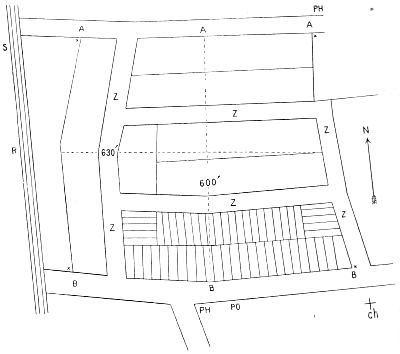
Fig. 31.
It is obviously a very 'eligible' estate, for there is a
Railway (R.), with a Station (S.), a Post and Telegraph
Office (P.O.), a Church (Ch.), and two Public Houses (P.H.).
None of the elements of modern civilisation are wanting.
After the sewering of roads A A A and B B B, the District
Council, in a fit of zealous extravagance, destroyed the
gravel paths at the side of B, and put a 12 by 6 inch kerb,
and laid half a mile of granolithic pavement for the benefit
of the aforesaid seven houses.
When the Building Society issued its prospectus the
plots abutting on the old roads A A A and B B B were sold
at once, and the reason is obvious, viz., that the roads are
ready made and sewered; and a note with regard to road
B B B says, 'This road is a highway maintainable by the local
authorities, who will provide a proper footway in front of the
plots in due course.' The ratepayers as a whole are to
provide pavements for the speculative builder in this
particular instance, and it is evident that the owners of the
plot and the Local Council had come to an agreement in the
matter. The houses abutting on the new roads, Z Z Z, will,
in addition to the purchase money for the land, be charged
3s. per foot frontage for sewers, and 'also such a proportion
as their surveyor shall assess of the expense of repairing
and maintaining the road or roads, until the same shall be
handed over to the local authorities.' On an adjoining
property the cost of 'making up' a private road was
estimated at 12s. per foot run, so that the cost would amount
to between 10l. and 11l. for a plot having a frontage of
18 feet, and might form a ruinous charge on some of the
corner plots.
The ground will accommodate 177 plots, and the plots
facing the old roads fetched 3l. a foot. Of these there is
room for fifty-nine, having a frontage of 20 feet each, so that
the price paid for these at 60l. per plot would be over 3,500l.;
and if the remaining 118 plots fetched 40l. each (4,720l.), the
total price realised for this 9 acres would be over 8,000l., in
addition to the charge for sewerage and road-making.
When, moreover, it is remembered that the society may
possibly hold a mortgage on every plot and every house, for
which they get 5 per cent. and excellent security, it will
be admitted that running a 'Building Society' is a tolerably
profitable business.
If all these plots are sold there will be a population of
over 1,200 persons on 9 acres of ground, and the ratepayers
will be at the charge not only of educating the children, but
of providing hospitals for the segregation of infectious
diseases, allotments, free libraries, open spaces, and additions
to the sewerage works for dealing with the sewage of 1,200
persons.
When a 'progressive' municipality sets to work to
'develop' its district (a speculative and hazardous process,
which it should leave to private enterprise), the ratepayer
soon begins to see that a great diversity of interests has to
be served.
The little shopkeeper (and it is of this class that
Boards and Councils are largely composed) wants the
greatest number of people on the smallest space; and he
sees that in proportion as the dwelling has an insufficient
curtilage, so are its inhabitants wholly and entirely dependent
on the shop.
The person with a fixed income who settles in a district
wishes the district to remain picturesque, rural, and quiet,
and, above all, he desires that the 'rates' may be kept
down. He naturally objects to be taxed for the sewering
of country roads in order that the fields may be covered
with courts and alleys of jerry-built houses, and equally he
objects to be taxed in order that every railway station in
the country may display a large invitation to trippers to
invade his solitude and make his life a burden.
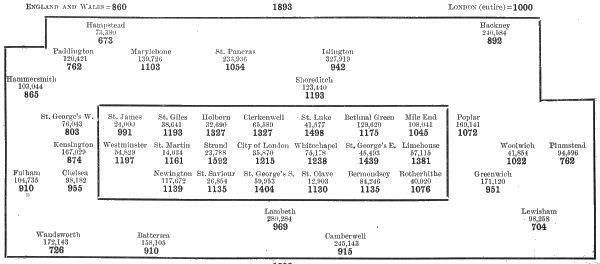
All sanitarians are agreed that mortality and density
of populations are directly proportional. The following
figures, taken from Table R (p. xlvii.) of the decennial
supplement of the Registrar-General (1895), show this very
clearly, as does also the diagram of the mortality figures for
London (p. 144).
| Persons to a square mile |
Death-rate (corrected) |
| 138 |
12·70 |
| 187 |
14·48 |
| 307 |
16·47 |
| 662 |
18·55 |
| 1,803 |
20·43 |
| 3,299 |
22·30 |
| 4,295 |
24·51 |
| 19,584 |
33·00 |
The corrected death-rate for 'Urban England,' as given
by the same authority, is 22·32, as against 16·95 for 'Rural
England.'
To form a just estimate of the comparative healthiness
or unhealthiness of a great city like London is no easy
matter. The composition of the population is, especially in
the central parts, so abnormal in regard to age and sex that
unless corrections be made for this abnormality any
comparison of London with other places is futile. Such
corrections are now made by the Registrar-General.
It is probable that in no city are the annual variations of
population greater than in London. The population of
June (the height of the season) and the population of
September (when 'everybody is out of town') must be very
different. In September the rich go to the country, the
shopkeepers go to the seaside, and the poorest of the poor
go hop-picking. The School Board attendances for the first
week of September show a deficit of 80,700 children, or 11·1
per cent., figures which clearly demonstrate that the autumn
exodus is not limited to the wealthy classes.
It is at this season that we see paragraphs in the paper
to the effect that the death-rate of some London parish
for the Michaelmas quarter reached an incredibly low figure,
and we are asked to infer that the population, thanks to
the wise policy pursued by the vestry, is fast making for
immortality. Of course such statements are not worth
the paper they are written on, because there are no data
as to population, and the period chosen is so short as to be
valueless.
In estimating the death-rates of different sanitary areas
of London it has been customary for the last six years to
distribute the deaths occurring in institutions to the districts
to which the deceased 'belonged,' and to exclude entirely
the deaths of persons belonging to districts outside registration
London; in this way about 1·5 per cent. of the deaths
occurring in registration London may be excluded. This
manœuvre helps to diminish the London death-rate, but, as
no account is taken of sick people who leave London to die
elsewhere, it is manifestly an unjustifiable thing to do.
If the strangers who die in London institutions are to
be excluded, it is a question whether all strangers merely
sojourning in London ought not to be excluded from the
estimate of population. Again, a man comes from the
country and is knocked down by a vehicle in the street and
dies in a London hospital; or during a sojourn in London he
gets caught in a London fog and dies of bronchitis; or he
'catches' influenza, or pneumonia, or diphtheria in London
and dies. Surely the deaths of these three ought to be
credited to London in all fairness. It is a very dangerous
thing to 'cook' statistics, and we do not get much nearer
the truth by doing so.
The best indication, probably, as to whether the conditions
of life in any locality are healthy or the reverse is the
infant mortality; in this way we exclude the fallacies due to
abnormal age distribution, because we compare identical
age periods; and the proportion of the sexes among
children is practically the same everywhere. We exclude
also the influences of occupation. By studying the
mortality of children under five we are studying the influence
of the home and home surroundings on the incidence
of disease, which is particularly what we wish to do.
In the decennial supplement of the Registrar-General
published in 1896, Dr. Tatham gives a table (Table II. p.
lxxxii. et seq.) of the 'annual death-rate per million living
among children under five years of age, from all causes and
from several causes, 1881-90.' This valuable table ought to
be most widely studied. Being based upon statistics of ten
years intervening between the censuses of 1881 and 1891,
the estimates of population have a maximum of reliability,
because we are relieved of the errors inseparable from
statistics referring only to short periods of time.
It is constantly stated that London is the healthiest
city in the world, a statement which, if true, must make us
very sorry for the other cities. In Dr. Tatham's table,
alluded to above, he first deals with counties.
We find that the death-rate of children under five from
all causes in England was 56,825 per million; that the
highest death-rate among children was in Lancashire
(72,795), and the next highest was in the county of London
(68,164). The lowest death-rate was in the county of
Dorset (35,651).
Table Legend:
A = Smallpox
B = Measles
C = Scarlet fever
D = Diphtheria
E = Whooping cough
F = Fever
G = Diarrhœa
H = Tuberculosis Disease
I = Respiratory Disease
| |
All Causes |
A |
B |
C |
D |
E |
F |
G |
H |
I |
| Lancashire |
72,795 |
37 |
5,053 |
2,454 |
706 |
3,805 |
285 |
6,461 |
5,364 |
17,037 |
| London |
68,164 |
240 |
4,743 |
1,780 |
1,371 |
5,342 |
165 |
5,444 |
6,581 |
16,021 |
| Hampshire |
42,222 |
10 |
2,005 |
505 |
939 |
2,508 |
280 |
2,783 |
3,299 |
9,011 |
| Dorsetshire |
35,651 |
4 |
1,748 |
488 |
493 |
1,815 |
62 |
1,305 |
2,401 |
9,390 |
I have also thrown in Hampshire, because not only is
it my own county, but it is a mixed county, largely rural,
but also containing the big towns of Southampton and
Portsmouth.
Looking at these four in tabular form, we see that in
Lancashire the mortality from measles, scarlet fever, fever,
diarrhœa, and respiratory disease was greater than in
London; and in London the mortality from small-pox,
diphtheria, whooping cough, and tuberculous disease was
greater than in Lancashire.
In Hampshire and Dorsetshire the mortality was very
much less from every cause than in either Lancashire or
London.
It is important to point out that the deaths of children
from tuberculous disease are greater in London than in any
other county, and that the deaths from tuberculous and
respiratory diseases combined are greater in London than
in Lancashire.
We have seen that the mortality of children under five
averaged for the whole of London 68,164 in the decennium
1881-90, while that for England and Wales was 56,825, or,
omitting the last three figures, let us say they were 68
and 57.
Examining the various registration districts more closely,
we find that the child mortality was less than the average
for England and Wales in four London districts only, viz.,
Lewisham (44), Hampstead (48), Woolwich (51), and Wandsworth
(56), districts which are all on the outskirts of the
place we call London. Certain other districts had a child
mortality less than the average of London as a whole, viz.,
Camberwell (59), Hackney (60), Islington (61), Paddington
and Kensington (63), Greenwich (63), St. Pancras (66),
Fulham, Poplar, and Lambeth (67).
All the other districts had a child mortality greater than
the average of London, viz., Mile End (69), St. George's,
Hanover Square (71), Westminster (72), Chelsea and St.
Olave's (73), Marylebone (75), Bethnal Green (76), Shoreditch
(78), St. Saviour's (79), St. Giles's (80), Holborn (82),
Whitechapel (85), St. George's in the East (87), the City
(90), Stepney (99) and the Strand (109).
With the exception of the City, Stepney, and the Strand,
there are only two registration districts in the whole country
which have a child mortality over 90, viz., Manchester (93)
and Liverpool (114). To Liverpool therefore belongs the
distinction of being the most unwholesome place for little
children in the whole country, and the 'Strand,' which constitutes
the very centre of London, comes next.
Let us examine these figures more closely, and let us
throw the child mortality of Liverpool and the Strand into
tabular form, and contrast them with the registration
district of Andover, in Hampshire, a district which I select
for reasons which will appear later.
Table Legend:
A = Smallpox
B = Measles
C = Scarlet fever
D = Diphtheria
E = Whooping cough
F = Fever
G = Diarrhœa
H = Tuberculosis Disease
I = Respiratory Disease
| |
All Causes |
A |
B |
C |
D |
E |
F |
G |
H |
I |
| Liverpool |
114,253 |
29 |
9,492 |
2,966 |
852 |
5,894 |
483 |
9,818 |
7,138 |
26,080 |
| Strand |
109,596 |
38 |
6,626 |
1,828 |
4,760 |
6,359 |
76 |
7,692 |
11,881 |
30,122 |
| Andover |
32,260 |
0 |
1,227 |
307 |
225 |
2,505 |
153 |
1,074 |
2,096 |
7,209 |
From this table it appears that the mortality from
measles, scarlet-fever, and diarrhœa was greater in Liverpool
than in the Strand; but that the other diseases
scheduled were more fatal in the Strand than in Liverpool.
We have previously pointed out that the deaths of children
from tuberculous and respiratory diseases are greater
in London than in any other county, and now we find that
the death-rate of children from these two classes of diseases
amounted in the 'Strand' to 42,003, far and away the
highest figure in the country, Liverpool coming second with
33,218. The death-rate of children from the same causes
in Andover was only 9,305, considerably less than a quarter
of the Strand death-rate.
Thanks to vaccination and the purity of the water-supply
the mortality in the Strand from small-pox and fever is very
small, but the mortality of children from the acute air-borne
contagia (measles, whooping cough, scarlet-fever, and diphtheria),
and still more from the chronic air-borne contagia,
is fearful to contemplate.
The big mortality from tuberculous disease forces upon
us the reflection that a large number of children who
become tuberculous in the 'Strand' do not die within the
age limits with which we are concerned, but drop off later
in life after years of invalidism and suffering. We have
seen that children under five are decimated yearly in the
Strand. How many more are crippled for life?
The deaths of children under one year of age per 1,000
births is a safe criterion of the health conditions of a
locality. This figure for the ten years 1881-90 was, for the
whole of England and Wales, 142. In London, we find that
in five districts (Hampstead 117, Lewisham 121, Woolwich
124, Hackney 137, and Wandsworth 141) this mortality
was below the average of the whole country, while in the
remaining twenty-five districts it was above the average.
In Paddington, Islington, Camberwell, Lambeth, Greenwich,
Mile End, Poplar, and Marylebone, it was above 142
and under 150. In St. Pancras, Kensington, St. George's
(Hanover Square), St. Giles's, Bethnal Green, and St. Olave's,
it was above 150 and under 160; in Chelsea, Fulham, Westminster,
Holborn, Shoreditch, and St. Saviour's, it was over
160 and under 170. The City was 171, Whitechapel 173,
St. George's-in-the-East 182, Stepney 196, the Strand 226.
To show what this figure of 226—the infant mortality of
the Strand—means, I will give the infant mortality of
some of the worst towns in Lancashire: in Liverpool 219,
Wigan 161, Bolton 163, Salford 183, Manchester 193,
Ashton-under-Lyne 173, Oldham 169, Rochdale 145,
Burnley 184, Blackburn 178, Preston 203. On the other
hand, one may say that the infant mortality of Andover,
which has just adopted a great part of the London Building
Act, with the approval of the Local Government Board, was
(for the ten years 1881-90) 91, or 23 per cent. less than
the best of the London districts, and nearly 60 per cent.
better than the Strand.
Glancing at the other Hampshire districts, one may
note that in the New Forest the infant mortality was as low
as 80, and that it was only in Portsea Island (139),
Alverstoke (123), and Southampton (135) that even the
lowest of the metropolitan figures were approached. It is
interesting to note that even the worst districts in Hampshire
are below the average of the whole kingdom in the
matter of infant mortality.
I have previously alluded to the high mortality of the
Strand registration district, and my remarks on one occasion
were contemptuously dismissed, with the criticism that
it was unfair to judge of the state of London by the health
of the slums.
It becomes necessary therefore to say that the Strand
registration district includes the Temple, St. Clement
Danes, the Precinct of the Savoy, St. Mary-le-Strand,
St. Paul, Covent Garden, and St. Martin's in the Fields.
Its southern boundary extends from the Temple Stairs
to Whitehall Court, along the Thames Embankment. From
Whitehall Court, the western boundary runs through the
'Horse Guards' and through the middle of Buckingham
Palace to the top of Constitution Hill. It includes the
whole of the Green Park, but none of the houses abutting
on it, with the exception, I believe, of Stafford House.
From Stafford House the northern boundary runs south of
Pall Mall, and includes Clarence House, St. James's Palace,
the War Office, Marlborough House, and Carlton House
Terrace. Thence the boundary runs up the Haymarket,
along the north side of Leicester Square and Long Acre to
Drury Lane and by Sardinia Street and the south side of
Lincoln's Inn Fields to Chancery Lane, the south end of
which constitutes its eastern boundary.
This district includes parts of four royal palaces and
also Somerset House, Horse Guards, Admiralty, War
Office, National Gallery, and National Portrait Gallery.
In it are to be found five churches (Temple, St. Clement,
St. Mary, St. Martin, St. Paul, Covent Garden), Exeter
Hall, and more than twenty of the largest and best known
theatres and music-halls. The Constitutional and National
Liberal Clubs are within its boundaries, and its numerous
huge hotels are famous throughout the world.
The worst parts of the district are in the north-east,
but one must mention that it does not include the Seven
Dials or the north half of Drury Lane. Clare Market, the
south end of Drury Lane, Drury Court and Bedfordbury, are
the slums of the Strand registration district. It is not a
poor district. The percentage of persons 'in poverty' in
London as a whole is given by Mr. Charles Booth as 30·7,
while that for the Strand is only 23·9.
Many of the labourers employed in Covent Garden
Market and in the theatres earn very good wages, but Mr.
Booth specially mentions the fact that in some of the lowest
districts house rent is very dear. Wages is a relative term,
and the potential prosperity of a person is only to be determined
by subtracting from the earnings the cost of the
necessaries of life, inclusive of house rent.
It is obvious, however, that the prime necessary of life
(fresh air) is not to be had in the Strand at any price.
It may be well to add that the Strand sanitary area
is not co-terminous with the Strand registration district,
which we have been considering. The chief difference is
that the former includes St. Anne's, Soho, and excludes St.
Martin's in the Fields.
This district of the 'Strand,' which I have chosen
because it is the most unhealthy district in London, and in
some respects the worst in the whole country, is, so to say,
the pulpit from which the British have preached sanitation
to the whole world. In it we find the offices of the Registrar-General
and the London County Council; the Temple,
where Sanitary Bills are drafted, and the Law Courts,
where the sanitary law is administered; the Royal College
of Physicians; the Examination Hall where candidates for
diplomas of Public Health and Medicine are examined, and
also the offices of the 'Lancet' and the 'British Medical
Journal.' The Royal College of Surgeons, the Local Government
Board and Imperial Parliament, if not within, are
only just outside its limits.
It is doubtful if any district in London or any other city
is better provided with open spaces than the Strand. St.
James's Park and the Green Park are both partly within
its limits. It has the Embankment and the Thames to
the south, the Temple Gardens to the east, Lincoln's Inn
Fields to the north-east, and Trafalgar Square in the
centre. It is wonderfully provided with what are miscalled
'lungs,' but it is evident that lungs are of little good if the
blood only circulates in them occasionally on a Sunday. It
is well to bear this fact in mind, because our municipal
governors sometimes talk as if the provision of 'open spaces'
at exorbitant and extravagant cost could compensate
for overcrowding in the dwelling, with a lack of light and
air therein.
It is in the Strand, more than in any other district, that
houses have been built of great height and enormous cubic
capacity without any curtilage whatever. I have attended
'banquets' at more than one hostelry in this district where
150 or 200 persons have been fed in a room having no
outside windows of any kind, and where, late in the evening,
the guests have been provided with a little fresh (!) air by
opening glass partitions communicating with a huge 'coffee-room'
or table d'hôte room. These rooms are made by
enclosing what ought to be open courts in the centre of
these huge hotels, and their utilisation is only possible
because of the perfection to which the science of artificial
illumination has been brought. There can be no health
without daylight, and sunlight, and fresh air, but the electric
light is good enough to make money by.
To a greater or less extent, throughout London the height
of the houses has been gradually raised, and the available
curtilage has been built upon. This is seen in the dwellings
of the rich, and there is no doubt that the conditions
which lead to overcrowding are all intensified in the poorer
quarters.
Part V. of the London Building Act, 1894, provides for
open spaces about buildings and height of building.
It provides, in the case of new houses in new streets, for
an open space in the rear, exclusively belonging to such
building, of at least 150 square feet, free from erections
except W.C. and ashpit. Where the ground storey is not inhabited,
this open space may be provided at a height of
16 feet above the level of the pavement. The open space
must extend the entire width of the building and have a
depth of 10 feet at least.
A diagonal line drawn from the rear of the open space
on the pavement level, and inclining towards the building
at an angle of 63°·5, shall clear the top of such building
save chimneys, dormers, gables, &c. This means that the
house may be at all levels twice as high as the space is
deep.
When a house abuts at the rear on a street or permanent
'open space,' then no private open space or curtilage need
be provided.
'Nothing in this section shall apply to houses abutting
in the rear on the river Thames, or on a public park, or on
an 'open space' of not less than 80 feet in depth which is
dedicated to the public, or the maintenance of which as an
open space is secured permanently or to the satisfaction of
the Council by covenant or otherwise.'
In new streets less than 50 feet wide no house may
be erected having a height greater than the width of the
street.
No house may be more than 80 feet high without the
special permission of the Council.
These regulations, from the point of view of health, are
as bad as can be, because they put a premium, so to say, on
buildings of enormous cubic capacity. We have seen that
the provisions as to private curtilage are limited to a back
yard 10 feet deep, but in the case of houses abutting on two
streets, front and back, or abutting on a street and 'open
space' 80 feet deep, these restrictions are dispensed with.
If an open space, acquired and maintained at enormous
cost, is to be an excuse for surrounding it with huge blocks
of 'flats' 80 feet high, it is not difficult to see that their
effect on the public health will be mischievous rather than
beneficial. There is no advantage in looking out on an open
space through a closed window, and the great problem in
London is how to manage that young children under school
age are to breathe the external air which is essential to their
proper development. In the country the perambulator is
pushed into the garden, and through the open door the
mother at her work can have an eye upon her children.
But for a family occupying a set of rooms in a 'model
dwelling,' when the father is gone to work, the elder children
at school, and the mother busy, there is nothing for it but
to allow the children to breathe the air of the living-rooms,
fouled from many sources. These children seldom breathe
external air, and never breathe really fresh air. When they
are a little older, they fluctuate between crowded two-storeyed
schools, a fetid home, and an 'open space' (perhaps 80 feet
wide and surrounded by houses 80 feet high!). Is it to be
wondered at that the even tenor of their way is interrupted
by diphtheria and scarlet fever, or that 22 per cent. die
without ever keeping a birthday, and that children under
five are more than decimated annually?
One must rejoice to think that in new houses (mostly)
on the outskirts the little child will have a back yard to play
in, having an area of at least 150 square feet (with deductions
for the permitted erections).
The little child in the 'Strand' will enjoy no such luxury,
and how it is to get any fresh air before it is old enough to
play in the fearfully crowded and dangerous streets is a
mystery.
'Thou art so full of misery
Were it not better not to be?'
These regulations of the London Building Act seem to
point to the fact that 'betterment' really means overcrowding
in houses of enormous cubic capacity.
I shall be told, and rightly, that the horrible overcrowding
of houses in the centre of London is caused by
the high price of building land, and that it cannot be prevented.
Further, I shall be told that, in spite of the overcrowding
and general unsanitary conditions, rents are
increasing. This is also true as regards some districts,
but, as I have said before, there is no relation between
hygiene and money-getting. But there is no reason why
we should deceive ourselves as to the results of overcrowding.
They are set forth with absolute plainness by the Registrar-General,
and we must be thankful that we have an official
statistician who is above local considerations, and who
does not feel himself called upon to keep unpleasant facts
in the background. There is yet one Balaam among the
prophets.
I have for years combated the oft-repeated statements
as to the 'healthiness' of London, not because I expect
that London will alter its way, but because rural places
and the Colonies should not blindly follow the lead of
London, in the belief that they are following a good
sanitary model, and that disastrous consequences will not
inevitably follow upon a reckless overcrowding of houses.
The prime object of overcrowding was for safety.
Cities were originally walled fortresses, and people crowded
into them for protection, and were killed by epidemics
instead of by their enemies. Modern sanitation favours
overcrowding, and this it is which makes it so popular, for
overcrowding favours money-getting.
When sewer pipes and water pipes are laid throughout
a district it becomes possible (but not till then) to build
houses without curtilage, except a 10-foot back yard.
If, therefore, rural places are reckless enough to perpetrate
a 'sewage scheme,' it becomes very necessary to
check the overcrowding of houses.
I am sorry to say that the Local Government Board
does not appear to be sensible of this necessity.
My reason for this statement is (to quote an example
within my own knowledge) that the Local Government
Board a little more than a year ago sanctioned the adoption
of 'model' (!) by-laws by the borough of Andover, and on
examining these by-laws, which cover 69 closely printed
large octavo pages, and comprise hundreds of sections and
sub-sections, the bulk of which must be quite incomprehensible
to the Town Council, I find that as regards buildings
many of the clauses are practically identical with those of
the London Building Act.
The Local Government Board does not seem to recognise
that circumstances alter cases, and that the regulations
which may be beneficial in the crowded and filthy slums of
a great city, may he mischievous in a village or country
town. Andover is an exceedingly healthy little town, as
the table on p. 99 will show, and in it there must be very
few, if any, houses more than 50 feet high, and the great
majority of the houses and cottages have large yards or
gardens.
And yet the Local Government Board sanctions regulations
for this town which permit the erection of dwelling
houses a hundred feet high! with a backyard 25 feet deep!!
and it further allows the adoption of the minimum of 150
square feet of back yard for dwelling houses.
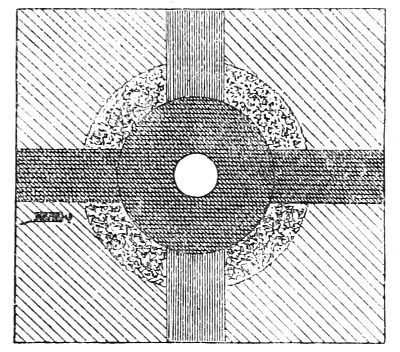
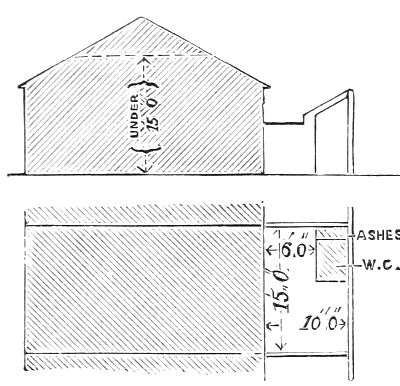
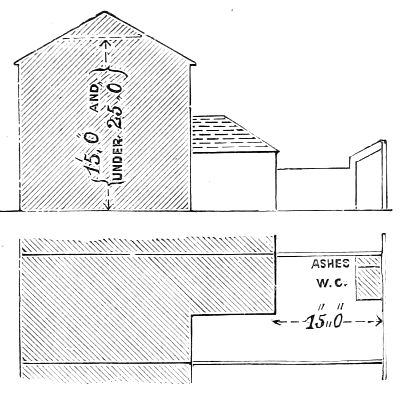
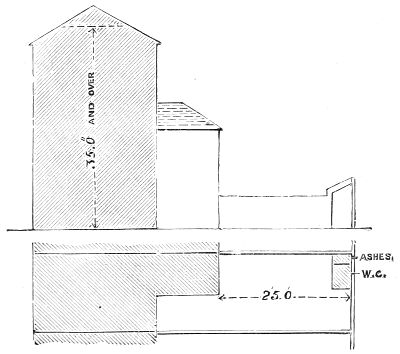
In illustration of this, reference may be made to figs. 32,
33, 34, which are borrowed from Knight's 'Model By-laws,'
published under the authority of the Local Government
Board. Fig. 32 shows the 'model' open space for a
cottage, fig. 33 for a house up to 25 feet high, and fig.
34 the maximum which is necessary, even though the
house be 100 feet high or more.
These regulations may be good in London, but when
such regulations are printed in the by-laws of rural places
they become dangerous and wicked suggestions, which one
fears the local builders will not be slow to adopt, especially
if the town be sewered throughout, which happily as yet is
not the case.
These elaborate building regulations as applied to
country places are absurd. I do not say that in the case
of houses abutting on the streets and which touch other
houses some control by the local authority is not necessary,
or that the local authority is not to exercise supervision
as to the manner of making connections of houses with
sewers, water pipes, and gas pipes.
But it is clear that all harassing regulations are out of
place when they are applied to isolated dwellings which are
wholly detached and separated by a moderate interval (say
a distance equal to the height) from the boundaries of
other premises. The man who builds a detached house
ought to be encouraged, and not worried, and the insurance
offices and the owner may be left to see that the construction
of the house is good enough.
These by-laws contain a prohibition of overhanging
storeys (in the old English fashion), which may be reasonable
enough in crowded streets, but are unreasonable and
silly when applied to isolated dwellings. A friend of mine
had a fancy to build a house of this kind in the middle of
three acres of land which he bought in Hertfordshire, and
after he had been at the expense of getting out his plans,
&c., he found that such a building was against the by-laws.
However, he discovered means to 'square' the local jacks-in-office,
and his very pretty house was built, and is a
decided ornament to the district.
These by-laws are an expense to ratepayers, and they
increase the cost of buildings. Elaborate plans and descriptions
have to be furnished, and the buildings have to be
inspected at various periods of their construction, and, of
course, all variations of plan which may appear necessary
in the course of construction must also be submitted and
'passed' by the local authority. It may happen that there
are members of the local council who understand the
technicalities of the building trade; but even if this be the
case, it is manifestly unjust that the plans of a builder who
is outside the council should be submitted to and judged
by a competitor who happens to be inside. As a rule, the
council is completely in the hands of the local surveyor, and
the local surveyor exercises despotic power over all building
operations.
This leads us to ask the question, 'What is a surveyor?'
Lawyers and doctors have to be 'legally qualified,' and the
ratepayers have some guarantee that the town clerk and
medical officer of health know something of their business.
But it is difficult to get a similar guarantee with regard to
that terrible despot, the surveyor to the local board.
Whether the surveyor be learned or ignorant in the
matters which he undertakes to survey must always be a
matter of doubt, but it is evident that a person who exercises
such arbitrary power ought on no account to be
allowed to practise his profession for his private gain.
Humanum est errare. We must not expect an impossible
standard of morality in any man, and no surveyor ought
to be placed in the invidious position of sitting in judgment
on his own plans.
These arbitrary by-laws must tend to check building
operations, and to hinder the development of the art of the
architect and the science of the builder. The restrictions
are another instance of
'Art made tongue-tied by authority,
And Folly, doctor-like, controlling skill;'
and I feel certain that, in the interests of the public health,
builders of isolated dwellings ought to be allowed to escape
from the despotism which is so dear to modern democracy.
Everything which tends to encourage the provision of
adequate space round dwellings is a great gain.
Such by-laws as I have quoted, when applied to country
places, and when no exceptions such as I have indicated
are made, are a downright incentive to overcrowding, and
mischievous in the highest degree.
Everything which increases the cost of the dwelling
must tend to increase overcrowding.
The London rents are enormous; the artisan pays 7s.
or 8s. for accommodation which he could get in a village
for 1s. 6d., and in a country town for 2s. 6d.
The rich man pays his 200l., 300l., or more for a house
(without a square inch of curtilage) which out of London
would fetch 40l. or 50l. at most.
In London it happens, probably, more often than elsewhere
that people pay in house-rent a sum which is an
excessive proportion of their income, and their finances feel
the strain of slight increments to the cost of the dwelling,
and they are often driven to take lodgers or 'paying-guests';
or people apparently well off give up their houses and take
a 'flat,' in which the crowding is excessive.
This kind of thing goes on among the well-to-do classes,
and certainly to a greater extent among the poor.
When we consider the charges, other than rent, in
London as compared with country houses, we must never
forget that, rents being three or more times as high in
London as elsewhere, the rating in the pound ought to be
multiplied by three or four before we can compare London
rates with country rates.
Or we must take some other basis of comparison,
such as the area occupied or the cubic contents. A
house which I lived in in London for twenty-five
years occupies an area of 18 by 72 feet, or 1,296 square
feet, or 144 square yards.
The rent was originally 180l., which was raised to 200l.
when the lease was renewed in 1892; i.e. the rent was
originally 1l. 5s. per square yard, and is now 1l. 8s. per
square yard. 'The rateable value' has been gradually
pushed up from 150l. to 184l., and the gross value has lately
been set down at 220l., or 10 per cent. more than the rent
(because the tenant undertakes to do the repairs).
The changes other than rent have been as follows:—
| |
1873 |
1896 |
| |
|
£ |
s. |
d. |
£ |
s. |
d. |
| Income Tax |
} |
9 |
15 |
0 |
14 |
18 |
4 |
| Inhabited House Duty |
} |
| Parochial Rates |
|
30 |
0 |
0 |
55 |
19 |
4 |
| Water |
|
6 |
8 |
0 |
7 |
10 |
6 |
| Total |
|
46 |
3 |
0 |
78 |
8 |
2 |
| Rent |
|
180 |
0 |
0 |
200 |
0 |
0 |
| Grand total |
|
226 |
3 |
0 |
278 |
8 |
2 |
Thus it will be seen that the cost of this house
(which has not been enlarged in any way) has been
increased by 23 per cent. The rent has increased 11 per
cent., or 20l. a year. The rates have increased by nearly
87 per cent., or very nearly 26l. a year.
The imperial taxes have increased nearly 53 per cent.,
or 5l. 3s. 4d. per year, and the water by nearly 18 per cent.,
or 1l. 2s. 6d. per year. It will be noted that while
the tenant in this case submitted to an increase of 11 per
cent., the charges over which the tenant has practically no
control have increased in a much higher ratio, and now
amount to 78l. 8s. 2d., or more than 10s. 6d. per square
yard of occupied land, the total cost of the house being
1l. 18s. 6d. per square yard, or, including repairs, more
than 2l. per square yard.
The total obligatory charges (rent, rates, taxes, and
water), which in 1873 were 226l., had risen in 1896 to 278l.
In the same time the interest on 100l. invested in Consols
has fallen from 3l. 5s. to 2l. 10s.
In 1893 a sum of 7,000l. invested in Consols would
have paid the obligatory charges on this house. In 1896
these charges could only be met by a sum of 11,000l.
invested in Consols.
Looked at in this way, the cost of the dwelling has
risen 57 per cent. in 23 years, the size of the dwelling
remaining constant.
The charge for water has been included because no
house is habitable without it, and in this case the tenant
cannot sink a well, because the house is totally without
curtilage of any kind, and the rain-water having fallen
through the London air is so foully dirty as to be unusable.
The householders of London rightly view with alarm
the rapid increase of the sum levied for rates. This sum
has increased at the rate of more than 3 per cent. per
annum during the twenty-five years I lived in the
house I have been describing, and now amounts to rather
more than 7s. 6d. per square yard occupied. The average
householder is naturally nervous and apprehensive; he is
getting unwilling to take a house for a long term, and is
squeezing his household into 'flats,' in which (as the landlord
pays the rates) the yearly expenditure on house
accommodation is fairly calculable. The attractiveness of
the flat is further enhanced by short-term leases, so that,
should illness or a financial mishap befall him, he will be
less heavily weighted than would be the case if he were the
owner of a long, unmarketable lease.
I think we may take it for granted that if the well-to-do
classes are showing a tendency to overcrowd, this tendency
will be found to get progressively more intense as we
descend in the social scale. The well-to-do occupiers of
flats have to be content with what may be called 'rather
close quarters,' but their servants are often squeezed into
rooms scarcely bigger than cupboards. It is not conceivable
that those who are in a dependent position will have
better accommodation than those whom they serve.
The final question is, What can be done to prevent overcrowding
of houses and of persons in the house?
I freely admit that very little can be done in big towns,
and people must be left to judge for themselves as to
whether they will allow their children to run the extra risk
of death, crippling disease, or defective development, inseparable
from life in a crowded city. The statistics of
the Registrar-General (i.e. the Annual Summary and the
Decennial Supplement) show clearly what these risks are,
but it is necessary to add that some of the local statistics
manifest at times an undue desire to minimise the mortality
of the district from which they emanate.
A great metropolitan city like London, concerning
which we are educated from our cradles to utter big boasts,
exercises an enormous influence on public opinion, but it is
perfectly clear that she is a dangerous model to follow in
the matter of house-construction.
I call to mind the case of a great London builder who
bought a country mansion in a park. He was a very able
man, but when he carried out some alterations and additions
to his new house he found it impossible to cast away
his town-bred ideas, and accordingly built underground
kitchens and coal cellars, and had the coals put into his
cellar through a plate in the pavement just outside the
drawing-room window. He had been so long accustomed
to build houses with a minimum of area, that when he had
an unlimited space at his disposal he failed to utilise or
appreciate the advantages of such a boon.
Country places should be careful to avoid the adoption,
as by-laws, of regulations originally framed with the idea
of mitigating the horrors of the London slums. With
regard to these regulations, it must be remembered that
'the trail of the Cockney is over them all,' and it has been
shown that regulations, especially as to space round
dwellings, which may be beneficial in the Seven Dials
become mischievous suggestions when printed and circulated
as the by-laws of a country district. It seems
almost incredible that the Local Government Board should
sanction the adoption of some of these by-laws by country
communities.
The exigencies of space in London have led to the
construction of underground offices, with the result that at
least a tenth of the inhabitants of modern London are
cave-dwellers; and in the by-laws from which I have
quoted I find no attempt to penalise, or in any way to
restrict, the perpetration of similar barbarities in the
country.
If there be underground 'offices,' the drains of the
house will leave it at a level of some 10 feet below the
ground level, and the public sewer must be at least 11
feet underground, and the laying of sewers at such a depth
is relatively expensive. As there are extra charges for
high level water service, ought there not to be similar extra
charges for low level drain service?
The great blot on modern sanitary legislation is the
entire absence of any encouragement for the sanitary well-doers.
Sanitary legislation is founded on a basis of mischievous
lop-sided socialism, in which the sanitary well doer
is heavily taxed for the support of the jerry-builder, and is
called upon to pay for all the shortcomings of the negligent
and filthy.
Encouragement ought to be given to the man who
builds a house with ample curtilage; and if such house be
removed from all other dwellings by a distance equal to its
height, he ought to be freed from the restrictions of harassing
by-laws, and the despotic control of district surveyors
whose credentials are often of the flimsiest, and whose
ideas are stereotyped.
The idea which was prevalent a few years ago, that open
spaces should be taxed at 'site value' is, one must hope,
dead. Its obviously mischievous tendency needs no comment.
The only equitable basis for calculating the rateable
value of a house for sanitary purposes is the cubic capacity,
because, as a broad rule, the bigger the house the greater
is the amount of work which it throws upon streets and
sewers. The 'grounds' or 'curtilage' of a house ought to
be very leniently taxed, although one must admit that
streets and pavements ought to be paid for in proportion to
house and ground frontage.
If a man spend money in beautifying his house without
enlarging it, this ought not to entail an increase in rateable
value for sanitary purposes. Such beautifyings are good
for trade in a proper sense, and ought not in the interests
of the community to be checked.
The rich man who has a fancy for a fine house has
already had his income handsomely taxed, and it seems
scarcely just or wise that he should be further directly taxed
for spending his income.
Horses if of similar dimensions used to be equally taxed,
and no distinction was made between the 'Thoroughbred'
and the 'Screw,' which was quite equitable, because the
owner of the former had already paid income tax.
I have been at some pains to point out that in country
or semi-rural districts, where it is possible to give a house a
decent curtilage or small garden, it is easy for a householder
to make the sanitation of his dwelling quite independent
of the local authority. In fact, the householder is
able if he be so minded to make his sanitation complete, and
to finish, on his own premises and to his own profit, that
'circulation of organic matter' which is a law of Nature,
and the only true basis upon which the science of sanitation
can possibly stand firm.
The householder can do piecemeal what no public
authority has ever succeeded in doing wholesale, albeit that
millions of money have been wasted in silly attempts.
Why should not the householder be encouraged? One
method of encouragement would be to allow him to pay for
water by meter, if he be so minded, exactly as he pays for
gas. Such a measure as this would effectually solve the
water difficulty everywhere.
On referring to p. 113 it will be seen that in 1873 I paid
6l. 8s. per annum for water. As there were no fixed baths
and washing was not done at home, I reckon the water
consumption was not more than seventeen gallons per head
per diem.
In 1873 my household averaged nine persons, so that
the yearly consumption of water was not more than
9 × 17 × 365 = 55,845 gallons (say 56,000), which, at 6l. 8s.,
means about 2s. 3d. per 1,000 gallons.
In 1896 I reckon that my household averaged four and
a half persons, and that the yearly consumption of water
was 28,000 gallons, which, at 7l. 10s. 6d., means very nearly
5s. 6d. per 1,000. Suppose that this house stood in the
country, and that it were possible to adopt dry methods of
sanitation, this would reduce the water consumption by
about one-third, say to 12 gallons per head, or 19,000
gallons a year for the household of 1896. At a shilling per
1,000 gallons, which I believe is a fair price, the water bill
would fall to 19s.
At a shilling per 1,000 gallons, twelve gallons per diem,
or 4,380 gallons per year, would cost 4s. 4d. per head, or a
penny per head per week. If in a country place the rain-water
were stored the annual cost for water would be still
less.
It may be well to add the twelve gallons per diem
allows for a daily sponge bath, and that on this quantity
of water absolute domestic and personal cleanliness can be
maintained. An excess of water is a pure luxury, and it
should be remembered that sewage difficulties are largely
proportionate to the amount of water which has to be dealt
with.
The supply of water by meter would effectually check
waste, which no by-laws and regulations can effect; and if
the water mains were frozen, the water companies, very
properly, would be the chief losers, and the householder
would not be called upon to pay for that which he had
never been supplied with.
In the matter of water 'enough is as good as a feast,'
and it is idle to imagine that the public health will be improved
by a reckless extravagance in this or any other
direction.
Finally, is it not possible to consider the sanitary well-doer
in the matter of sewerage rates? As it is, the householder
who perfects and completes the sanitation of his
house on his own premises, very possibly pays more than
he who throws the whole of the trouble and expense on the
public authority.
He who takes trouble in this matter is regarded as a
fool by the majority, who say, 'He has got to pay rates; why
should he bother.'
That the burden of public authorities and the pollution
of rivers would be very much lessened by the recognition
of the well-doer, there can be no doubt.
In considering the rating of a house for sewerage works
it is clear that every sink, W.C., bath or gully discharging
its contents into a public sewer ought to be charged, and
such charge should be progressive; thus, if 5s. were paid for
one such discharge hole, 7s. 6d. should be paid for the second,
10s. for the third, 12s. 6d. for the fourth, and so on. In
this way a cottage with one kitchen sink only would pay 5s.,
but a mansion with, say, 10 sinks, baths, and W.C., would
pay 8l. 2s. 6d. Such charges are analogous to the charges
made by water companies, which are higher for the better
class of house. If this or something like this were done,
the fixed charges on the house would produce a considerable
sum, which would go far towards paying the municipal bills
for scavenging and sewering. The balance would have
to be raised by a rate on the buildings themselves, which
rate should be in proportion to the cubic contents of the
buildings, without reference to their curtilage, because
large curtilage tends to improve the public health more than
all the clauses of all the sanitary Acts that ever were
devised.
The cubic contents should alone be considered in making
assessments for rates. If a man spend money in making
his house more wholesome without increasing its size, and
thereby increases its value, it is clearly not in the interests
of the public health that he should be fined by the sanitary
authority for so doing. Nevertheless this is done daily.
That a man should pay for so much water as he uses
and for no more, and that he should pay the municipality
for personal services directly in proportion to those services,
seem to be two propositions so simple and so equitable, and
so absolutely fundamental for all just dealing, that one
cannot be surprised at the trouble which follows the neglect
of them.
Great as are the sanitary evils connected with overcrowding,
it is probable that the moral and social harm which
results from it is infinitely more important; and yet we
find that our modern socialistic legislation does everything
to encourage and nothing to discourage this greatest of
sanitary and social ills.
It is strange that the cubic contents of a building should
be a factor which is rigorously excluded from consideration
when rating and building regulations are being considered.
It seems to the writer to be obvious that it is by far the most
important factor, and one which cannot be neglected if our
municipal regulations are to have any permanence. The
Metropolitan Building Act we have seen puts a premium on
large buildings, by abolishing all restrictions as to curtilage,
provided the building runs from street to street or from
street to 'open space,' and never considers the enormous
dangers of these large buildings in relation to epidemic
disease and fire.
Every country place would do well to enact that—
- (1) The height of a house shall in no case be greater than
the width of the street upon which it abuts.
- (2) Every house shall have a minimum private curtilage
upon the ground level, and entirely free from buildings
which shall equal the cubic contents of the house divided
by 50.
In the second paragraph I have chosen 50 for my
divisor, because the average width of a street and the
average height of the four-storeyed house are not far from
50 feet.
Let us take the case of an ordinary four-storeyed
house (with no basement) having an area of 20 × 50 and
50 feet high. Then the curtilage would be (20 × 50 × 50) / 50
= 1,000; i.e., the house must have a curtilage exactly equal
to the area occupied by the building—a back yard probably,
50 feet deep and 20 feet wide. If in addition to the four
storeys there be a basement of 12,500 cubic feet, then an
additional 250 square feet of curtilage would be required,
and the builder who is tempted to overcrowd would be
constantly checked by the price he has to pay for his
obligatory curtilage.
The high price of building land is largely due to there
being practically no restriction as to the cubic contents
permissible on a certain area.
If we take the smaller two-storeyed cottages, having a
width of 15 feet, a depth of 25, and a height of 20 feet, then
the curtilage would be (15 × 25 × 20) / 50 = 150, which is the
minimum of the 'model' by-laws. If the builder put a
basement to this cottage of 3,750 cubic feet, he would have
to provide additional 75 square feet of curtilage, and thus a
check would be put upon underground dwellings and high
buildings which obstruct the light and air. On the other
hand, there need be no restrictions on the height or cubic
contents of any building provided its curtilage be ample.
If it were possible for the first house considered to have
a height of 100 feet in addition to its basement, then, the
cubic contents being 112,500 feet, the curtilage would have
to be 2,250 square feet, and the house and curtilage combined
would occupy some 3,250 square feet, or rather less
than 1⁄13 of an acre.
It is probable that a comprehensive rule of this kind
would satisfactorily keep builder and site speculator in
order, while it placed a minimum of restriction on the
originality and fancy of architect and builder.
Builders of houses wholly detached from other houses
or boundaries by a distance equal to the height of the
house should be allowed to escape altogether from the
harassing 'model' by-laws and the tyranny of the surveyor.
I would say finally—
1. That overcrowding is the greatest of all sanitary evils,
and far and away the greatest of all moral evils.
2. That whatever increases the cost of the dwelling
inevitably increases overcrowding.
3. That overcrowding is facilitated by modern methods
of sanitation.
4. That, unless the crowding of houses be prevented,
great schemes of sewerage and water-supply will eventually
make the health of a district worse instead of better.
5. That 'open spaces' and public gardens do not compensate
for the lack of light and air in the dwelling or
of curtilage around it.
What one may call municipal luxuries are not
permissible if they permanently increase the cost of the
dwelling.
If such luxuries be self-supporting they may be permissible,
but it is clear to my mind that, as a rule, they should
be left to be provided by private munificence or voluntary
public subscription. They ought never to be paid for out
of the rates.
The avowed policy of many municipalities is to practise
a maximum of extravagance, in the belief that such extravagance
benefits the poor, and these vicarious philanthropists
receive a willing support from those who are directly
interested in such schemes.
6. That if great schemes for sewerage, or water supply, or
the provision of open spaces, be effected by loans which
increase the rates for long terms, and thereby permanently
increase the cost of the dwelling, they will inevitably lead to
a deterioration in the public health and morals. Some of
these schemes facilitate overcrowding, while increased rates,
by raising the cost of the dwelling, compel it.
7. Municipal ostentation is wholly indefensible. To
build palatial offices costing a million and more of money,
and thereby saddle the ratepayers with another loan, is
indefensible. To buy a cocked hat for the mayor out of
the rates (as did a less ambitious municipality) is equally
indefensible, and serves no useful purpose except to raise a
laugh.
We have been long accustomed to hear that our chief
sanitary necessity in this world is pure water. This would
be quite true if we were fish. But it is obvious that the
purity of the air we breathe is of far greater importance than
the purity of the water we drink, seeing that we must take
a draught of air about twenty times a minute, while many
of us do not take a draught of raw water from week's end to
week's end.
If the huge death-rate of the Strand were due to impure
water, we may be sure that there would be no lack of
discussion thereupon; but as it is due to overcrowding, and
the filthiness of the air consequent upon overcrowding, we
hear nothing about it. To make any serious attempt to check
overcrowding would interfere with trade, and therefore it is
considered silly and futile to discuss such a matter. Any
man who supposes that considerations of hygiene will be
allowed to interfere with trade, is, I think, deceived. At
all events, I have no such belief.
My sole object in discussing these matters is to warn
country places against blindly following the lead of London
in sanitary matters.