Archaic and variable spelling has been preserved as printed in the original book except as indicated in the text by a dashed line under the change. Hover the mouse over the word and the original text will appear. A list of these changes can be found here.
Missing/extra quote marks were silently corrected, however, punctuation has not been changed to comply with modern standards. Inconsistency in hyphenation and accented words has also been retained.
Two deviations in paragraph-ending punctuation in the original book should be noted: on Page 14, the paragraph beginning, “Within, a toy entry led....” and on Page 42, “There was that about him....” Both paragraphs end with a comma and have been retained, although throughout the book a colon was used to end these types of paragraphs in which dialogue immediately followed.
Illustrations have been moved where necessary so that they are not in the middle of a paragraph.
THE DUST FLOWER
Books By
BASIL KING
The Dust Flower
The Empty Sack
Going West
The City of Comrades
Abraham’s Bosom
The Lifted Veil
The Side of the Angels
The Letter of the Contract
The Way Home
The Wild Olive
The Inner Shrine
The Street Called Straight
Let No Man Put Asunder
In the Garden of Charity
The Steps of Honor
The High Heart
HARPER & BROTHERS
Established 1817
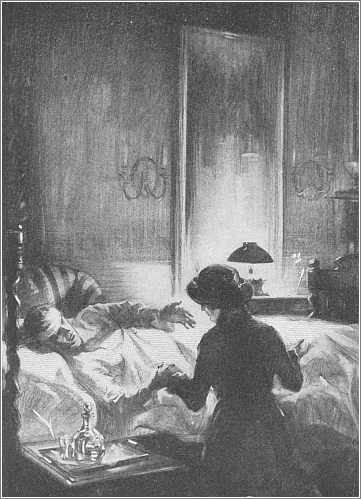
THEN SLOWLY, SLOWLY LETTY SANK ON HER KNEES, BOWING HER HEAD ON THE HANDS WHICH DREW HER CLOSER. [See p. 350]
The DUST FLOWER
ByBASIL KING Author of “THE EMPTY SACK” “THE INNER SHRINE” ETC.
With Illustrations by HIBBARD V. B. KLINE
Publishers Harper & Brothers New York and London MCMXXII
THE DUST FLOWER
Copyright, 1922
Harper & Brothers
Printed in the U. S. A.
First Edition
H-W
ILLUSTRATIONS — THE DUST FLOWER — THE DUST FLOWER
PAGE
Then Slowly, Slowly Letty Sank on Her Knees, Bowing Her head on the Hands Which Drew Her Closer
It is not often that you see a man tear his hair, but
this is exactly what Rashleigh Allerton did. He
tore it, first, because of being under the stress of great
agitation, and second, because he had it to tear—a
thick, black shock with a tendency to part in the
middle, but brushed carefully to one side. Seated on
the extreme edge of one of Miss Walbrook’s strong,
slender armchairs, his elbows on his knees, he dug his
fingers into the dark mass with every fresh taunt
from his fiancée.
She was standing over him, high-tempered, imperious.
“So it’s come to this,” she said, with decision;
“you’ve got to choose between a stupid, vulgar
lot of men, and me.”
He gritted his teeth. “Do you expect me to give
up all my friends?”
“All your friends! That’s another matter. I’m
speaking of half a dozen profligates, of whom you
seem determined—I must say it, Rash; you force
me to it—of whom you seem determined to be one.”
He jumped to his feet, a slim, good-looking, well-dressed
figure in spite of the tumbled effect imparted
by excitement. “But, good heavens, Barbara, what
have I been doing?”
4
“I don’t pretend to follow you there. I only know
the condition in which you came here from the club
last night.”
He was honestly bewildered. “Came here from
the club last night? Why—why, I wasn’t so bad.”
Standing away from him, she twirled the engagement
solitaire as if resisting the impulse to snatch
it off. “That would be a question of point of view,
wouldn’t it? If Aunt Marion hadn’t been here––”
“I’d only had––”
“Please, Rash! I don’t want to know the details.”
“But I want you to know them. I’ve told you a
dozen times that if I take so much as a cocktail or a
glass of sherry I’m all in, when another fellow can
take ten times as much and not––”
“Rash, dear, I haven’t known you all my life without
being quite aware that you’re excitable. ‘Crazy
Rash’ we used to call you when we were children, and
Crazy Rash you are still. But that’s not my point.”
“Your point is that that infernal old Aunt Marion
of yours doesn’t like me.”
“She’s not infernal, and she’s not old, but it’s true
that she doesn’t like you. All the more reason, then,
that when she gave her consent to our engagement on
condition that you’d give up your disgusting
habits––”
He raced away from her to the other side of the
room, turning to face her like an exasperated animal
at bay.
The room was noteworthy, and of curiously feminine
refinement. Expressing Miss Marion Walbrook as it
did, it made no provision for the coarse and
5
lounging habits of men, Miss Walbrook’s world being
a woman’s world. All was straight, slender, erect,
and hard in the way that women like for occasions
of formality. It was evident, too, that Miss Walbrook’s
women friends were serious, if civilized.
There was no place here for the slapdash, smoking
girl of the present day.
The tone which caught your eye was that of dusky
gold, thrown out first from the Chinese rug in imperial
yellow, but reflected from a score of surfaces
in rich old satinwood, discreetly mounted in ormolu.
On the French-paneled walls there was but one picture,
Sargent’s portrait of Miss Walbrook herself,
an exquisite creature, with the straight, thin lines
of her own table legs and the grace which makes no
appeal to men. Not that she was of the type colloquially
known as a “back number,” or a person to
be ignored. On the contrary, she was a pioneer of
the day after to-morrow, the herald of an epoch when
the blundering of men would be replaced by superior
intelligence.
You must know these facts with regard to Miss
Walbrook, the aunt, in order to understand Miss
Walbrook, the niece. The latter was not the pupil of the
former, since she was too intense and high-handed
to be the pupil of anyone. Nevertheless she had
caught from her wealthy and public-spirited relative
certain prepossessions which guided her points of view.
Without having beauty, Miss Barbara Walbrook
impressed you as Someone, and as Someone dressed
by the most expensive houses in New York. For
beauty her lips were too full, her eyes too slanting,
6
and her delicate profile too much like that of an ancient
Egyptian princess. The princess was perhaps what
was most underscored in her character, the being who
by some indefinable divine right is entitled to her own
way. She didn’t specially claim her way; she only
couldn’t bear not getting it.
Rashleigh Allerton, being of the easy-going type,
had no objection to her getting her own way, but he
sometimes rebelled against her manner of taking it.
So rebelling now, he tried to give her to understand
that he was master.
“If you marry me, Barbe, you’ll have to take me as
I am—disgusting habits and all.”
It was the wrong tone, the whip to the filly that
should have been steered gently.
“But I suppose there’s no law to compel me to
marry you.”
“Only the law of honor.”
Her whole personality was aflame. “You talk of
honor!”
“Yes I talk of it. Why shouldn’t I?”
“Do you know anything about it?”
“Would you marry a man who didn’t?”
“I haven’t married any one—as yet.”
“But you’re going to marry me, I presume.”
“Considering the facts, that’s a good deal in the
way of presumption, isn’t it?”
They reached the place to which they came once
in every few weeks, where each had the impulse to
hurt the other cruelly.
“If it’s so much presumption as all that,” he demanded,
“what’s the meaning of that ring?”
7
“Oh, I don’t have to go on wearing it.” Crossing
the room she pulled it off and held it out toward him
“Do you want it back?”
He shrank away from her. “Don’t be a fool
Barbe. You may go too far.”
“That’s what I’m afraid of—that I’ve gone too
far already.”
“In what way?”
“In the way that’s brought us face to face like this.
If I’d never promised to marry you I shouldn’t now
have to—to reconsider.”
“Oh, so that’s it. You’re reconsidering.”
“Don’t you see that I have to? If you make me
as unhappy as you can before marriage, what’ll it be
afterward?”
“And how happy are you making me?”
Holding the ring between the thumb and forefinger
of the right hand, she played at putting it back, without
doing it. “So there you are! Isn’t that another
reason for reconsidering—for both of us?”
“Don’t you care anything about me?”
“You make it difficult—after such an exhibition as
that of last night, right before Aunt Marion. Can’t
you imagine that there are situations in which I feel
ashamed?”
It was then that he spoke the words which changed
the current of his life. “And can’t you imagine that
there are situations in which I resent being badgered
by a bitter-tongued old maid, to say nothing of a
girl––” He knew how “crazy” he was, but the
habit of getting beyond his own control was one
of long standing—“to say nothing of a girl who’s
8
more like an old maid than a woman going to be
married.”
With a renewed attempt at being master he pointed
at the ring which she was still holding within an inch
of its finger. “Put that back.”
“I think not.”
“Then if you don’t––”
“Well—what?”
Plunging his hands into the pockets of his coat,
he began tearing up and down the room. “Look
here, Barbe. This kind of thing can’t possibly go on.”
“Which is what I’m trying to tell you, isn’t it?”
“Very well, then; we can stop it.”
“Certainly—in one way.”
“The way of getting married, with no more shilly-shallying
about it.”
“On the principle that if you’re hanging over a
precipice the best thing you can do is to fall.”
He continued to race up and down the room, all
nerves and frenzy. “Don’t we care about each other?”
She answered carefully. “I think you care about
me to the extent that you believe I’d make a good
mistress of the house your mother left you, and
which, you say, is like an empty sepulcher. If you
didn’t have it on your hands, I don’t imagine it would
have occurred to you to ask me.”
“Well, that’s all right. Now what about you?”
“You’ve already answered that question for yourself.”
She stiffened haughtily. “I’m an old maid.
I haven’t been brought up by Aunt Marion for nothing.
I’ve an old maid’s ways and outlooks and habits.
I resented your saying it a minute ago, and yet it’s
9
true. I’ve known for years that it was true. It
wouldn’t be fair for me to marry any man. So here
it is, Rash.” Crossing the floor-space she held out
the ring again. “You might as well take it first as
last.”
He drew back from her, his features screwed up
like those of a tragic mask. “Do you mean it?”
“Do I seem to be making a joke?”
Averting his face, he swept the mere sight of the
ring away from him. “I won’t touch the thing.”
“And I can’t keep it. So there!”
It fell with a little shivery sound to a bare spot on
the floor, rolling to the edge of a rug, where it stopped.
Each looked down at it.
“So you mean to send me to the devil! All right!
Just watch and you’ll see me go.”
She was walking away from him, but turned again.
“If you mean by that that you put the responsibility
for your abominable life on me––”
“Abominable life! Me! Just because I’m not one
of the white-blooded Nancies which your aunt thinks
the only ones fit to be called men––”
But he couldn’t go on. He was choking. The sole
relief to his indignation was in once more tearing
round the room, while Miss Walbrook moved to the
fluted white mantelpiece, where, with her foot resting
on the attenuated Hunt Diedrich andirons she bowed
her head against an attenuated Hunt Diedrich antelope
in bronze.
She was not softened or repentant. She knew she
would become so later; but she knew too that her
tempers had to work themselves off by degrees. Their
10
quarrels having hitherto been rendered worth while
by their reconciliations, she took it for granted that
the same thing would happen once more though, as
she expressed it to herself, she would have died before
taking the first step. The obvious thing was for him
to pick up the ring from off the floor, bring it to her
humbly while her back was turned on him, and beseech
her to allow him to slip it on where it belonged;
whereupon she would consider as to whether she would
do so or not. In her present frame of mind, so she
told herself, she would not. Nothing would induce
her to do anything of the kind. He had betrayed the
fact that he knew something as to which she was
desperately sensitive, which other people knew, but
which she had always supposed to have escaped his
observation—that she was like an old maid.
She was. She was only twenty-five, but she had
been like an old maid at fifteen. It had been a joke
till she was twenty, after which it had continued as a
joke to her friends, but a grief to herself. She was
distinguished, aristocratic, intellectual, accomplished,
and Aunt Marion would probably see to it that she
was left tolerably well off; nevertheless she had picked
up from her aunt, or perhaps had inherited from the
same source, the peculiar quality of the woman who
would probably not marry. Because she knew it and
bewailed it, it had come like a staggering blow to
learn that Rash knew it, and perhaps bewailed it too.
The least he could do to atone for that offense would
be to beg her, to implore her on his bended knees, to
wear his ring again; and she might not do it even then.
The dramatic experience was worth waiting for,
11
however, and so with spirit churning she leaned her
hot brow against the thin, cool flank of Hunt Diedrich’s
antelope. She knew by the fierce grinding of
his steps on the far side of the room that he hadn’t
yet picked up the ring; but there was no hurry as to
that. Since she would never, never forgive him for
knowing what she thought he didn’t know—forgive
him in her heart, that was to say—not if she married
him ten times over, or to the longest day he lived,
there was plenty of time for reaching friendly terms
again. Her anger had not yet blown off, nor had she
stabbed him hard enough. As with most people subject
to storms of hot temper, stabs, given and received,
were all in her day’s work. They relieved for the
moment the pressure of emotion, leaving no permanent
ill-will behind them.
She heard him come to a halt, but did not turn to
look at him.
“So it’s all over!”
As a peg on which to hang a retort the words would
serve as well as any others. “It seems so, doesn’t it?”
“And you don’t care whether I go to the devil or
not?”
“What’s the good of my caring when you seem
determined to do it anyhow?”
He allowed a good minute to pass before saying,
“Well, if you don’t marry me some other woman will.”
“Very likely; and if you make her a promise to
reform I hope you’ll keep your word.”
“She won’t be likely to exact any such condition.”
“Then you’ll probably be happier with her than
you could have been with me.”
12
Having opened up the way for him to make some
protest to which she could have remained obdurate,
she waited for it to come. But nothing did come.
Had she turned, she would have seen that he had
grown white, that his hands were clenched and his
lips compressed after a way he had and that his wild,
harum-scarum soul was worked up to an extraordinary
intensity; but she didn’t turn. She was waiting for
him to pick up the ring, creep along behind her, and
seize the hand resting on the mantelpiece, according
to the ritual she had mentally foreordained. But without
stooping or taking a step he spoke again.
“I picked up a book at the club the other day.”
Not being interested, she made no response.
“It was the life of an English writing-guy.”
Though wondering what he was working up to, she
still held her peace.
“Gissing, the fellow’s name was. Ever hear of
him?”
The question being direct, she murmured: “Yes;
of course. What of it?”
“Ever hear how he got married?”
“Not that I remember.”
“When something went wrong—I’ve forgotten
what—he went out into the street with a vow. It
was a vow to marry the first woman he met who’d
marry him.”
A shiver went through her. It was just such a
foolhardy thing as Rashleigh himself was likely to
attempt. She was afraid. She was afraid, and yet
reangered just when her wrath was beginning to die
down.
13
“And he did it!” he cried, with a force in which
it was impossible for her not to catch a note of personal
implication.
It was unlikely that he could be trying to trap her by
any such cheap melodramatic threat as this; and
yet––
When several minutes had gone by in a silence which
struck her soon as awesome, she turned slowly round,
only to find herself alone.
She ran into the hall, but there was no one there.
He must have gone downstairs. Leaning over the
baluster, she called to him.
“Rash! Rash!”
But only Wildgoose, the manservant, answered
from below. “Mr. Allerton had just left the ’ouse,
miss.”
14
Chapter II
While Allerton and Miss Walbrook had been
conducting this debate a dissimilar yet parallel
scene was enacted in a mean house in a mean street
on the other side of the Park. Viewed from the outside,
the house was one of those survivals of more
primitive times which you will still run across in the
richest as well as in the poorest districts of New York.
A tiny wooden structure of two low stories, it connected
with the sidewalk by a flight of steps of a third
of the height of the whole façade. Flat-roofed and
clap-boarded, it had once been painted gray with white
facings, but time, weather, and soot had defaced these
neat colors to a hideous pepper-and-salt.
Within, a toy entry led directly to a toy stairway,
and by a door on the left into a toy living-room. In
the toy living-room a man of forty-odd was saying to
a girl of perhaps twenty-three,
“So you’ll not give it up, won’t you?”
The girl cringed as the man stood over her, but
pressing her hand over something she had slipped
within the opening at the neck of her cheap shirtwaist,
she maintained her ground. The face she raised to
him was at once terrified and determined, tremulous
with tears and yet defiant with some new exercise of
will power.
“No, I’ll not give it up.”
“We’ll see.”
15
He said it quietly enough, the menace being less in
his tone than in himself. He was so plainly the cheap
sport bully that there could have been nothing but a
menace in his personality. Flashy male good looks
got a kind of brilliancy from a set of big, strong teeth
the whiter for their contrast with a black, brigand-like
mustache. He was so well dressed in his cheap sport
way as to be out of keeping with the dilapidation of
the room, in which there was hardly a table or a chair
which stood firmly on its legs, or a curtain or a covering
which didn’t reek with dust and germs. A worn,
thin carpet gaped in holes; what had once been a
sofa stood against a wall, shockingly disemboweled.
Through a door ajar one glimpsed a toy kitchen where
the stove had lost a leg and was now supported by a
brick. It was plain that the master of the house was
one of those for whom any lair is sufficient as a home
as long as he can cut a dash outside.
Quiveringly, as if in terror of a blow, the girl explained
herself breathlessly: “The castin’ director sent
for me just as I was makin’ tracks for home. He ast
me if this was the on’y suit I had. When I ’lowed
it was, he just said he couldn’t use me any more till
I got a new one.”
The man took the tone of superior masculine knowledge.
“That wasn’t nothin’ but bull. What if he does
chuck you? I know every movin’ picture studio round
N’York. I’ll get you in somewheres else. Come now,
Letty. Fork out. I need the berries. I owe some one.
I was only waitin’ for you to come home.”
She clutched her breast more tightly. “I gotta have
a new suit anyhow.”
16
“Well, I’ll buy you a new suit when I get the bones.
Didn’t I give you this one?”
She continued, still breathlessly: “Two years ago—a
marked-down misses’ it was even then—all right
if I was on’y sixteen—but now when I’m near twenty-three—and
it’s in rags anyhow—and all out of style—and
in pitchers you’ve gotta be––”
“They’se plenty pitchers where they want that character—to
pass in a crowd, and all that.”
“To pass in a crowd once or twice, yes; but when
all you can do is to pass in a crowd, and wear the same
old rig every time you pass in it––”
He cut her protests short by saying, with an air of
finality: “Well, anyhow I’ve got to have the bucks.
Can’t go out till I get ’em. So hand!”
With lips compressed and eyes swimming, she shook
her head.
“Better do it. You’ll be sorry if you don’t. I can
pass you that tip straight now.”
“If you was laughed at every time you stepped onto
the lot––”
“There’s worse things than bein’ laughed at. I can
tell you that straight now.”
“Nothin’s worse than bein’ laughed at, not for a
girl of my age there ain’t.”
Watching his opportunity he caught her off her
guard. Her eyes having wandered to the coat she
had just taken off, a worn gray thing with edgings of
worn gray squirrel fur, he wrenched back with an
unexpected movement the hand that clutched something
to her breast, thrust two fingers of his other hand
within her corsage, and extracted her pay-envelope.
17
It took her by such surprise that she was like a mad
thing, throwing herself upon him and battling for her
treasure, though any possibility of her getting it back
from him was hopeless. It was so easy for him to
catch her by the wrists and twist them that he laughed
while he was doing it.
“You little cat! You see what you bring on yourself.
And you’re goin’ to get worse. I can tell you
that straight now.”
Still twisting her arms till she writhed, though
without a moan or a cry, he backed her toward the
disemboweled sofa, on whose harsh, exposed springs
she fell. Then he sprang on her a new surprise.
“How dare you wear them rings? They was your
mother’s rings. I bought and paid for ’em. They’re
mine.”
“Oh, don’t take them off,” she begged. “You can
keep the money––”
“Sure I can keep the money,” he grinned, wrenching
from her fingers the plain gold band he had given
her mother as a wedding ring, as well as another,
bigger, broader, showier, and set with two infinitesimal
white points claiming to be diamonds.
Though he had released her hands, she now
stretched them out toward him pleadingly. “Aw, give
’em back to me. They’se all I’ve got in the world to
care about—just because she wore ’em. You can take
anything else I’ve got––”
“All right, then. I’ll take this.”
With a deftness which would have done credit to
a professor of legerdemain he unbuckled the strap of
her little wrist-watch, putting the thing into his pocket.
18
“I give that to your mother too. You don’t need it,
and it may be useful to me. What else have you got?”
She struggled to her feet. He was growing more
dangerous than she had ever known him to be even
when he had beaten her.
“I ain’t got nothin’ else.”
“Oh, yes, you have. You gotta purse. I seen you
with it. Where is it?”
The fear in her eyes sent his toward her jacket,
thrown on the chair when she had come in. With an
“Ah!” of satisfaction he pounced on it. As he held
it upside down and shook it, a little leather wallet
clattered to the floor. She sprang for it, but again
he was too quick for her.
“So!” he snarled, with his glittering grin. “You
thought you’d get it, did you?” He rattled the few
coins, copper and silver, into the palm of his hand, and
unfolded a one-dollar bill. “You must owe me this
money. Who’s give you bed and board for the last
ten year, I’d like to know? How much have you ever
paid me?”
“Only all I ever earned—which you stole from me.”
“Stole from you, did I? Well, you won’t fling
that in my face any more.” He handed her her coat.
“Put that on,” he commanded.
“What for?” She held it without obeying the
order. “What’s the good o’ goin’ out and me without
a cent?”
“Put it on.”
Her lip quivered; she began to suspect his intention.
“I do’ wanta.”
“Oh, very well! Please yourself. You got your
19
hat on already.” Seizing her by the shoulders he
steered her toward the door. “Now march.”
Though she refused to march, it was not difficult
for him to force her.
“This’ll teach you to valyer a good home when you
got one. You’ll deserve to find the next one different.”
She almost shrieked: “You’re not going to turn
me out?”
“Well, what does it look as if I was doin’?”
“I won’t go! I won’t go! Where can I go?”
“What I’m doin’ ’ll help you to find out.”
He had her now in the entry, where in spite of her
struggles he had no difficulty in unlocking the door,
pushing her out, and relocking the door behind her.
“Lemme in! Lemme in! Oh, please, lemme in!”
He stood in the middle of the living-room, listening
with pleasure and smiling his brigand’s smile. He
was not as bad as you might think. He did mean to
let her in eventually. His smile and his pleasure
sprang purely from the fact that his lesson was so
successful. With this in her mind, she wouldn’t withstand
him a second time.
She rattled the door by the handle. She beat upon
the panels. She implored.
Still smiling, he filled his pipe. Let her keep it up.
It would do her good. He remembered that once when
he had turned her mother out at night, she had sat
on the steps till he let her in at dawn before the police
looked round that way. History would repeat itself.
The daughter would do the same. He was only giving
her the lesson she deserved.
Meanwhile she was experiencing a new sensation,
20
that of outrage. For the first time in her life she was
swept by pride in revolt. She hadn’t known that any
such emotion could get hold of her. As a matter of
fact she hadn’t known that so strong a support to the
inner man lay within the depths of human nature.
Accustomed to being cowed, she had hardly understood
that there was any other way to feel. Only
within a day or two had something which you or I
would have called spirit, but for which she had no
name, disturbed her with unexpected flashes, like those
of summer lightning.
While waiting for the camera, for instance, in the
street scene in “The Man with the Emerald Eye,” a
“fresh thing” had said, with a wink at her companions,
“Say, did you copy that suit from a pattern in Chic?”
Letty had so carefully minded her own business
and tried to be nice to every one that the titter which
went round at her expense hurt her with a wound
impelling her to reply, “No; I ordered it at Margot’s.
You look as if you got your things there too, don’t
you?” Nevertheless, she was so stung by the sarcasm
that the commendation she overheard later, that the
Gravely kid had a tongue, didn’t bring any consolation.
Without knowing that what she felt now was an
intensified form of the same rebellion against scorn,
she knew it was not consistent with some inborn sense
of human dignity to stand there pleading to be let into
a house from which she was locked out, even though
it was the only spot on earth she could call home. Still
less was it possible when, round the foot of the steps,
a crowd began to gather, jeering at her passionate
beseechings. For the most part they were children,
21
Slavic, Semitic, Italian. Amid their cries of, “Go it,
Sis!” now in English and now in strange equivalents
of Latin, or Polish, or even Hebraic origin, she was
suddenly arrested by the consciousness of personal
humiliation.
She turned from the door to face the street. It was
one of those streets not rare in New York which the
civic authorities abandon in despair. A gash of children
and refuse cut straight from river to Park, it
got its chief movement from push-carts of fruit and
other foods, while the “wash” of five hundred families
blew its banners overhead. Vendors of all kinds
uttered their nasal or raucous cries, in counterpoint to
the treble screams of little boys and girls.
Letty had always hated it, but it was something
more than hatred which she felt for it now. Beyond
the children adults were taking a rest from the hawking
profession to comment with grins on the sight of
a girl locked out of her own home. She was probably
a very bad girl to call for that kind of treatment,
and therefore one on whom they should spend some
derision.
They were spending it as she turned. It was an
experience on a large scale of what the girl in the
studio had inflicted. She was a thing to be scorned,
and of all the hardships in the world scorn, now that
she was aware of it, was the one she could least submit
to.
So pride came to her rescue. Throwing her coat
across her arm she went down the steps, passed
through the hooting children, one or two of whom
pulled her by the skirt, passed through the bearded
22
Jews, and the bronzed Italians, and the flat-nosed
Slavs, passed through the women who had come out
on the sidewalk at this accentuation of the daily din,
passed through the barrows and handcarts and piles of
cabbages and fruit, and went her way.
23
Chapter III
Exactly at this minute Rashleigh Allerton was
standing outside Miss Walbrook’s door, glancing
up and down Fifth Avenue and over at the Park.
It was the hour after luncheon when pedestrians become
numerous. For his purpose they could not be
very numerous; they must be reasonably spaced apart.
And already a veritable stream of women had begun
to flow down the long, gentle slope, while a few, like
fish, were stemming the current by making progress
against it. None of them was his “affair.” Young,
old, short, tall, blond, brunette, they were without
exception of the class indiscriminately lumped as
ladies. Since you couldn’t go to the devil because you
had married a lady, even on the wild hypothesis that
one of these sophisticated beings would without introduction
or formality marry him, it would be better not
to let himself in for the absurdity of the proposal.
When there was a break in the procession, he darted
across the street and made his way into the Park.
Here there was no one in sight as far as the path
continued without a bend. He was going altogether
at a venture. Round the curve of the woodland way
there might swing at any second the sibyl who would
point his life downward.
He was aware, however, that in sibyls he had a
preference. If she was to send him to the devil, she
must be of the type which he qualified as a “drab.”
24
Without knowing the dictionary meaning of the word,
he felt that it implied whatever would contrast most
revoltingly with Barbara Walbrook. Seeing with her
own eyes to what she had driven him, her heart would
be wrung. That was all he asked for, the wringing of
her heart. It might be a mad thing for him to punish
himself so terribly just to punish her, but he was mad
anyhow. Madness gave him the satisfaction which
some men got from thrift, and others from cleverness.
He would keep the vow with which he had slipped out
of Miss Walbrook’s drawing room. It was all that
life had left for him.
That was, he wouldn’t pick and choose. He would
take them as they came. He had not stipulated with
himself that she must be a “drab.” It was only what
he hoped. She must be the first woman he met who
would marry him. Age, appearance, refinement, vulgarity
were not to be considered. Picking and choosing
on his part would only take his destiny out of the
hands of Fate, where he preferred that it should lie.
Had any one passed him, he would have seemed the
more perturbed because of his being so well-dressed.
He was one of the few New Yorkers as careful of
appearances as many Londoners. With the finish that
comes of studied selection in hat, stick, and gloves, as
well as all small accessories of the costliest, he might
have been going to or coming from a wedding.
He was imposing, therefore, to a short, stout, elderly
woman with whom he suddenly found himself face
to face as the path took a sharp sweep to the south.
The shrubs which had kept them hidden from each
other gave place here to open stretches of lawn. When
25
Allerton paused and lifted his hat, the woman naturally
paused, too.
She was a red-faced woman crowned with a bonnet
of the style introduced by Mrs. Langtry in 1878, but
worn on this occasion some degrees off center. On
her arm she carried a flat basket of which the contents,
decently covered with a towel, might have been freshly
laundered shirts. Being stopped by a gentleman of
Allerton’s impressiveness and plainly suffering expression,
her face grew motherly and sympathetic.
“Madam, I wish to ask if you’ll marry me?”
Even a dull brain couldn’t fail to catch words
hammered out with this force of precision. The
woman didn’t wait to have them repeated. Dropping
her basket as it was, she took to flight. Flight was
the word. A modern Atalanta of Wellesley or Bryn
Mawr might have envied the chamois leaps which
took the good creature across the grass to the protection
of a man with a lawn-mower.
Allerton couldn’t pause to watch her, for a new
sibyl was advancing. To his disgust rather than not,
she was young and pretty, a nursemaid pushing a
baby-cart into which a young man of two was strapped.
While far more likely to take him than the stout old
party still skipping the greensward like a mountain
roe, she would be much less plausible as a reason for
going to the evil one. But a vow was a vow, and he
was in for it.
His approach was the same as on the previous occasion.
Lifting his hat ceremoniously, he said with the
same distinctness of utterance, “Madam, I wish to ask
if you’ll marry me?”
26
The girl, who had paused when he did, leaned on
the pusher of her go-cart, studying him calmly. Chewing
something with a slow, rotary movement of the
lips and chin, she broke the action with a snap before
quite completing the circle, to begin all over again.
“Oh, you do, do you?” was her quiet response.
“If you please.”
She studied him again, with the same semi-circular
motion of the jaw. She might have been weighing
his proposal.
“Say, is this one of them club initiation stunts, or
have you just got a noive?”
“Am I to take that as a yes or a no?”
“And am I to take you as one of them smart-Alecks,
or a coily-headed nut?”
He saw a way out. “I’m generally considered a
curly-headed nut.”
“Then it’s me for the exit-in-case-of-fire, so ta-ta.”
She laughed back at him over her shoulder. “Wish
you luck with your next.”
But fate was already on him in another form. A
lady of fifty or thereabouts was coming up the path,
refined, sedate, mistress of herself, the one type of all
others most difficult to accost. All the same he must
do it. He must keep on doing it till some one yielded
to his suit. The rebuffs to which he had been subjected
did no more than inflame his will.
Approaching the new sibyl with the same ceremoniousness,
he repeated the same words in the same precise
tone. The lady stood off, eyed him majestically
through a lorgnette, and spoke with a force which
came from quietude.
27
“I know who you are. You’re Rashleigh Allerton.
You ought to be ashamed with a shame that would
strike you to the ground. I’m a friend of Miss
Marion Walbrook’s. I’m on my way to see her and
shall not mention this encounter. We work on the
same committee of the League for the Suppression of
Men’s Clubs. The lamentable state in which I see
you convinces me once more of the need of our work,
if our men are to become as we hope to see them. I
bid you a good afternoon.”
With the dignity of a queen she passed on and out
of sight, leaving him with the sting of a whiplash on
his face.
But the name of Miss Walbrook, connected with
that of the League which was her pet enthusiasm for
the public weal, only served as an incitement. He
would go through with it now at any cost. By nightfall
he would be at police-headquarters for insulting
women, or he would have found a bride.
Walking on again, the path was clear before him as
far as he could see. Having thus a few minutes to
reflect, he came to the conclusion that his attacks had
been too precipitate. He should feel the ground before
him, leading the sibyl a little at a time, so as to
have her mentally prepared. There were methods of
“getting acquainted” to which he should apply himself
first of all.
But getting acquainted with the old Italian peasant
woman, bowed beneath a bundle, who was the next
he would have to confront, being out of the question,
he resolved to side-step destiny by slipping out of the
main path and following a branch one. Doing so, he
28
came into less frequented regions, while his steps took
him up a low hill burnished with the tints of mid-October.
Trees and shrubs were flame-colored, copper-colored,
wine-colored, differing only in their diffuseness
of hue from the concentrated gorgeousness of
amaranth, canna, and gladiolus. The sounds of the
city were deadened here to a dull rumble, while the
vibrancy of the autumn afternoon excited his taut
nerves.
At the top of the hill he paused. There was no one
in sight who could possibly respond to his quest. He
wondered for a second if this were not a hint to him
to abandon it. But doing that he would abandon his
revenge, and by abandoning his revenge he would concede
everything to this girl who had so bitterly
wronged him. Ever since he could remember they
had been pals, and for at least ten years he had vaguely
thought of asking her to marry him when it came
to his seeking a wife. It was true, the hint she had
thrown out, that he had felt himself in no great need
of a wife till his mother had died some eighteen
months previously, and he had found himself with a
cumbrous old establishment on his hands. That had
given the decisive turn to his suit. He had asked her.
She had taken him. And since then, in the course of
less than ten weeks, if they had had three quarrels
they had had thirty. He had taken them all more or
less good-naturedly—till to-day. To-day was too
much. He could hardly say why it was too much,
unless it was as the last straw, but he felt it essential
to his honor to show her by actual demonstration the
ruin she had made of him.
29
Looking about him for another possibility, he
noticed that at the spot where the path, having serpentined
down the little hillside, rejoined the main
footway there was a bench so placed that its occupant
would have a view along several avenues at once.
Since it was obviously a vantage point for such
strategy as his, he had taken the first steps down toward
it when a little gray figure emerged from behind
a group of blue Norway spruces. She went dejectedly
to the bench, sitting down at an extreme end of it.
Wrought up to a fit of tension far from rare with
him, Allerton stood with his nails digging into his
clenched palms and his thin lips pressed together. He
was sure he was looking at a “drab.” All the shoddy,
outcast meanings he had read into the word were
under the bedraggled feathers of this battered black
hat or compressed within the forlorn squirrel-trimmed
gray suit. The dragging movement, the hint of dropping
on the seat not from fatigue but from desperation,
completed the picture his imagination had already
painted of some world-worn, knocked-about creature
who had come to the point at which, in his own phrase,
she was “all in.”
As far as this described Letty Gravely, he was
wrong. She was not “all in.” She was never more
mentally alert than at that very minute. If she moved
slowly, if she sank on the seat as if too beaten down
by events to do more, it was because her mind was so
intensely centered on her immediate problems.
She had, in fact, just formed a great resolution.
Whatever became of her, she would never go back to
Judson Flack, her stepfather. This had not been
30
clearly in her mind when she had gone down his steps
and walked away, but the occasion presented itself now
as one to be seized. In seizing it, however, the alternatives
were difficult. She was without a cent, a
shelter, a job, a friend, or the prospect of a meal. It
was probable that there was not at that minute in
New York a human being so destitute. Before nightfall
she would have to find some nominal motive for
living or be arrested as a vagrant.
She was not appalled. For the first time in her life
she was relatively free from fear. Even with nothing
but her person as she stood, she was her own mistress.
No big dread hung over her—that is, no big dread
of the kind represented by Judson Flack. She might
jump into the river or go to the bad, but in either case
she would do it of her own free will. Merely to have
the exercise of her own free will gave her the kind of
physical relief which a human being gets from stretching
limbs cramped and crippled by chains.
Besides, there was in her situation an underlying
possibility of adventure. This she didn’t phrase, since
she didn’t understand it. She only had the intuition in
her heart that where “the world is all before you,
where to choose your place of rest, and Providence
your guide,” Providence becomes your guide. Verbally
she put it merely in the words, “Things happen,”
though as to what could happen between half-past
three in the afternoon and midnight, when she would
possibly be in jail, she could not begin to imagine.
So absorbed was she in this momentous uncertainty
that she scarcely noticed that some one had seated
himself at the other end of the bench. It was a public
31
place; it was likely that some one would. She felt
neither curiosity nor resentment. A lack of certain
of the feminine instincts, or their retarded development,
left her without interest in the fact that the
newcomer was a man. From the slight glance she had
given him when she heard his step, she judged him to
be what she estimated as an elderly man, quite far into
the thirties.
She went back to her own thoughts which were
practical. There were certain measures which she
could take at once, after which there would be no
return. Once more she was not appalled. She had
lived too near the taking of these steps to be shocked
by them. Everything in life is a question of relativity,
and in the world which her mother had entered on
marrying Judson Flack the men were all so near the
edge of the line which separates the criminal from the
non-criminal that it seemed a natural thing when they
crossed it, while the women....
But as her thoughts were dealing with this social
problem in its bearing on herself, her neighbor spoke.
“Funny to watch those kids playing with the pup,
isn’t it?”
She admitted that it was, that watching children
and young animals was a favorite sport with her. She
answered simply, because being addressed by strange
men with whom she found herself in proximity was
sanctioned by the etiquette of her society. To resent
it would be putting on airs, besides which it would
cut off social intercourse between the sexes. It
had happened to her many a time to have engaging
conversations with chance young men beside
32
her in the subway, never seeing them before or
afterward.
So Allerton found getting acquainted easier than he
had expected. The etiquette of his society not sanctioning
this directness of response on her part, he drew
the conclusion that she was accustomed to “meeting
fellows halfway.” As this was the sort of person he
was looking for, he found in the freedom nothing to
complain of.
With the openness of her social type she gave
details of her biography without needing to be
pressed.
“You’re a New York girl?”
“I am now. I didn’t use to be.”
“What were you to begin with?”
“Momma brought me from Canada after my father
died. That’s why I ain’t got no friends here.”
At this appeal for sympathy his glance stole suspiciously
toward her, finding his first conjectures somewhat
but not altogether verified. She was young apparently,
and possibly pretty, though as to neither
point did he care. He would have preferred more
“past,” more “mystery,” more “drama,” but since you
couldn’t have everything, a young person utterly unfit
to be his wife would have to be enough. He continued
to draw out her story, not because he cared anything
about hearing it, but in order to spring his question
finally without making her think him more unbalanced
than he was.
“Your father was a Canadian?”
“Yes; a farmer. Momma used to say she was about
as good to work a farm as a cat to run a fire-engine.
33
When he died, she sold out for four thousand dollars
and come to New York.”
“To work?”
“No, to have a good time. She’d never had a good
time, momma hadn’t, and she was awful pretty. So
she said she’d just blow herself to it while she had
the berries in her basket. That was how she met
Judson Flack. I suppose you know who he is. Everybody
does.”
“I’m afraid I haven’t the pleasure.”
“Oh, I don’t know as you’d find it any big pleasure.
Momma didn’t, not after she’d give him a try.”
“Who and what is he?”
“He calls hisself a man about town. I call him a
bum. Poor momma married him.”
“And wasn’t happy, I suppose.”
“Not after he’d spent her wad, she wasn’t. She
was crazy about him, and when she found out that all
he’d cared about was her four thousand plunks—well,
it was her finish.”
“How long ago was that?”
“About four years now.”
“And what have you been doing in the meanwhile?”
“Keepin’ house for Judson Flack most of the time—till
I quit.”
“Oh, you’ve quit?”
“Sure I’ve quit.” She was putting her better foot
forward. “Now I’m in pitchers.”
He glanced at her again, having noticed already that
she scarcely glanced at him. Her profile was toward
him as at first, an irregular little profile of lifts and
tilts, which might be appealing, but was not beautiful.
34
The boast of being in pictures, so incongruous
with her woefully dilapidated air, did not amuse him.
He knew how large a place a nominal connection
with the stage took in the lives of certain ladies.
Even this poor little tramp didn’t hesitate to make
the claim.
“And you’re doing well?”
She wouldn’t show the white feather. “Oh, so so!
I—I get along.”
“You live by yourself?”
“I—I do now.”
“Don’t you find it lonely?”
“Not so lonely as livin’ with Judson Flack.”
“You’re—you’re happy?”
A faint implication that she might look to him for
help stirred her fierce independence. “Gee, yes! I’m—I’m
doin’ swell.”
“But you wouldn’t mind a change, I suppose?”
For the first time her eyes stole toward him, not
in suspicion, and still less in alarm, but in one of the
intenser shades of curiosity. It was almost as if he was
going to suggest to her something “off the level” but
which would nevertheless be worth her while. She was
used to these procedures, not in actual experience but
from hearing them talked about. They made up a
large part of what Judson Flack understood as “business.”
She felt it prudent to be as non-committal
as possible.
“I ain’t so sure.”
She meant him to understand that being tolerably
satisfied with her own way of life, she was not enthusiastic
over new experiments.
35
His next observation was no surprise to her. “I’m
a lawyer.”
She was sure of that. There were always lawyers
in these subterranean affairs—“shyster” was a word
she had heard applied to them—and this man looked
the part. His thin face, clear-cut profile, and skin
which showed dark where he shaved, were all,
in her judgment, signs of the sinister. Even his
clothes, from his patent leather shoes with spats
to his dark blue necktie with a pearl in it, were those
which an actor would wear in pictures to represent
a “shark.”
She was turning these thoughts over in her mind
when he spoke again.
“I’ve an office, but I don’t practise much. It takes
all my time to manage my own estate.”
She didn’t know what this meant. It sounded like
farming, but you didn’t farm in New York, or do it
from an office anyhow. “I guess he’s one of them
gold-brick nuts,” she commented to herself, “but he
won’t put nothin’ over on me.”
In return for her biography he continued to give
his, bringing out his facts in short, hard statements
which seemed to hurt him. It was this hurting him
which she found most difficult to reconcile with her
gold brick theory and the suspicion that he was a
“shark.”
“My father was a lawyer, too. Rather well known
in his day. One time ambassador to Vienna.”
Ambassador to Vienna! She didn’t know where
Vienna was or the nature of an ambassador, but
she did know that it sounded grand, so she looked
36
at him attentively. It was either more gold brick or
else....
Then something struck her—“smote her” would
be perhaps the more accurately descriptive word, since
the effect was on her heart. This man was sick. He
was suffering. She had often seen women suffer, but
men rarely, and this was one of the rare instances.
Something in her was touched. She couldn’t imagine
why he talked to her or what he wanted of her, but
a pity which had never yet been called upon was astir
among her emotions.
As for the minute he said no more, her next words
came out only because she supposed them to betray
the kindly interest of which he was in need.
“Then I suppose he left you a big fat wad.”
“Yes; but it doesn’t do me any good. I mean, it
doesn’t make me happy—when I’m not.”
“I guess it’d make you a good deal less happy if you
didn’t have it.”
“Perhaps so; I don’t think about it either way.”
He added, after tense compression of the lips; “I’m
all alone in the world—like you.”
She was sure now that something was coming,
though of what nature lay beyond her speculative
power. She wondered if he could have fallen in love
with her at first sight, realizing a favorite dream she
often had in the subway. Hundreds of times she had
beguiled the minutes by selecting one or another of
the wealthy lawyers and bankers, whom she supposed
to be her fellow-travelers there, seeing him smitten by
a glance at her, following her when she got out, and
laying his heart and coronet at her feet before she had
37
run up the steps. If this man were not a shyster lawyer
or a gold brick nut, he might possibly be doing that.
“It’s about a girl,” he burst out suddenly. “Half
an hour ago she kicked me out.”
“Did she know you had all that dough?”
“Yes, she knew I had all that dough. But she said
that since I was going to the devil, I had better go.”
He drew a long breath. “Well, I’m going—perhaps
quicker than she thinks.”
“Will you do yourself any good by that?”
“No, but I’ll do her harm.”
“How?”
“I’ll show her what she’s made of me.”
“She can’t make anything of you in half an hour
or in half a year—not so long as you’ve got your wad
back of you. If you was to be kicked out with your
pay-envelope stole, and your mother’s rings pulled off
your fingers, and her wrist-watch from your wrist,
and even your carfare––”
“Is that what’s happened to you?”
“Sure! Half an hour ago, too. Judson Flack!
But why should I worry? Something’ll happen before
night.”
He became emphatic. “Yes, and I’ll tell you what it
will be. You put your finger on it just now when
you said she couldn’t make anything out of men in half
an hour. Well, it’s got to be something that would
take just that time—an hour at the most—and fatal.
Now do you see?”
She shook her head.
He swung fully round on her from his end of the
bench. “Think,” he commanded.
38
As if with a premonitory notion of what he meant,
she answered coldly: “What’s the good o’ me
thinkin’? I’ve got nothin’ to do with it.”
“You might have.”
“I can’t imagine what, unless it’d be––” Realizing
what she had been about to say, she broke off in
confusion, coloring to the eyes.
He nodded. “I see you understand. I want you to
come off somewhere and marry me.”
She took it more calmly than if she hadn’t thought
him mad. “But—but you said you’d be—be goin’ to
the devil.”
“Well?”
His look, his tone, conveyed the idea, which penetrated
to her mind but slowly. When it did, the surging
color became a flush, hot and painful.
So here it was again, the thing she had been running
away from. It had outwitted and outrun her,
meeting her again just at the instant when she thought
she was shaking it off. She was so indignant with the
thing that she almost overlooked the man. She too
swung round from her end of the bench, so that they
confronted each other, with the length of the seat
between them. It was her habit to put things plainly,
though now she did it with a burning heart.
“This is the way you mean it, isn’t it?—you’d go to
the devil because you’d married me.”
The half-minute before he answered was occupied
not merely in thinking what to say but in noticing,
now that he had her in full-face, that her large, brown
irises seemed to be sprinkled with gold dust. Otherwise
her appearance struck him simply as blurred, as if
39
it had been brightly enough drawn as to color and line,
only rubbed over and defaced by the hand of misery.
“I don’t want you to get me wrong,” he explained.
“It’s not a question of my marrying you in particular.
I’ve said I’d marry the first girl I met who’d marry
me.”
The gold-brown eyes scintillated with a thousand
tiny stars. “Say, and am I the first?”
“No; you’re the fourth.” He added, so that she
should be under no misconception as to what he was
about: “You can take me or leave me. That’s up to
you. But if you take me, I want you to understand
that it’ll be on a purely business basis.”
She repeated, as if to memorize the words, “A
purely business basis.”
“Exactly. I’m not looking for a wife. I only
want a woman to marry—a woman to whom I can
point and say, See there! I’ve married—that.”
“And that’d be me.”
“If you undertook the job.”
“The job of—of bein’ laughed at—jeered at––”
“I’d be the one who’d be laughed at and jeered at.
Nobody would think anything about you. They wouldn’t
remember how you looked or know your
name. If you got sick of it after a bit, and decided to
cut and run, you could do it. I’d see that you were
well treated—for the rest of your life.”
She studied him long and earnestly. “Say, are you
crazy?”
“I’m all on edge, if that’s what you mean. But
there’s nothing for you to be afraid of. I shan’t do
you any harm at any time.”
40
“You only want to do harm to yourself. I’d be
like the awful kind o’ pill which a fellow’ll swaller
to commit suicide.” She rose, not without a dignity
of her own. “Well, mister, if I’m your fourth, I
guess you’ll have to look about you for a fifth.”
“Where are you going?”
He asked the question without rising. She answered
as if her choice of objectives was large.
“Oh, anywheres.”
“Which means nowhere, doesn’t it?”
“Oh, not exactly. It means—it means—the first
place I fetch up.”
“The first place you fetch up may be the police-station,
if the things you said just now are true.”
“The police-station is safe, anyways.”
“And you think the place I’d take you to wouldn’t
be. Well, you’re wrong. It’ll be as safe as a church
for as long as you like to stay; and when you want to
go—lots of money to go with.”
Facing away from him toward the city, she said
over her shoulder: “There’s things money couldn’t
pay you for. Bein’ looked down on is one.”
She was about to walk on, but he sprang after her,
catching her by the sleeve.
“Look here! Be a sport. You’ve got the chance of
your lifetime. It’ll mean no more to you than a part
they’d give you in pictures—just a rôle—and pay you
a lot better.”
She was not blind to the advantages he laid before
her. True, it might be what she qualified as “bull”
to get her into a trap; only she didn’t believe it. This
man with the sick mind and anguished face was none
41
of the soft-spoken fiends whose business it is to ensnare
young girls. She knew all about them from
living with Judson Flack, and couldn’t be mistaken.
This fellow might be crazy, but he was what he said.
If he said he wouldn’t do her any harm, he wouldn’t.
If he said he would pay her well, he would. The main
question was as to whether or not, just for the sake
of getting something to eat and a place to sleep, she
could deliberately put herself in a position in which the
man who had married her would have gone to the
devil because he had married her.
As he held her by the sleeve looking down at her,
and she, half turned, was looking up at him, this
was the battle she was fighting. Hitherto her
impulse had been to run away from the scorn of
her inferiority; now she was asking herself what
would happen if she took up its challenge and
fought it on its own ground. What if I do? was
the way the question framed itself, but aloud she
made it.
“If I said I would, what would happen first?”
“We’d go and get a license. Then we’d find a
minister. After that I should give you something to
eat, and then I’d take you home.”
“Where would that be?”
He gave her his address in East Sixty-seventh
Street, only a few doors from Fifth Avenue, but her
social sophistication was not up to the point of seeing
the significance of this. Neither did her imagination
try to picture the home or to see it otherwise than as
an alternative to the police-station, or worse, as a lodging
for the night.
42
“And what would happen to me when I got to your
home?”
“You’d have your own room. I shouldn’t interfere
with you. You’d hardly ever see me. You could stay
as long as you liked or as short as you liked, after
the first week or two.”
There was that about him which carried conviction.
She believed him. As an alternative to having nowhere
to go, what he offered her was something, and
something with that spice of adventure of which she
had been dreaming only a few minutes earlier. She
couldn’t be worse off than she was now, and if it gave
her the chance of a hand-to-hand tussle with the
world-pride which had never done anything but look
down on her, she would be fighting what she held
as her worst enemy. She braced herself to say,
The impetuosity of his motion almost took her
breath away as she tried to keep pace with him.
“By the way, what’s your name?” he asked, before
they reached Fifth Avenue.
She told him, but was too overwhelmed with what
she had undertaken to dare to ask him his.
43
Chapter IV
“Nao!”
The strong cockney negative was also an exclamation.
It came from Mrs. Courage, the cook-housekeeper,
who stood near the kitchen range making the
coffee for breakfast. She was a woman who looked
her name, born not merely to do battle, but to enjoy
being in the midst of it.
Jane, the waitress, was the next to speak. “Nettie
Duckett, you ought to be ashymed to sye them words,
you that’s been taught to ’ope the best of everyone.”
Jane had fluttered in from the pantry with the covered
dish for the toast. Jane still fluttered at her
work, as she had done for the past thirty years. The
late Mrs. Allerton had liked her about the table because
she was swift, deft, and moved lightly. A thin little
woman, with a profile resembling that of Punch’s
Judy, and a smile of cheerful piety, she yielded to time
only by a process of drying up.
Nettie Duckett was quick in her own defense, but
breathless, too, from girlish laughter. “I can’t ’elp
syin’ what I see, now can I? There she was ’arf
dressed in the little back spare-room. Oh, the commonest
thing! You wouldn’t ’a wanted to sweep ’er
out with a broom.”
“Pretty goin’s on I must sye,” Jane commented.
“’Ope the best of everyone I will, but when you think
that we was all on the top floor––”
44
“Pretty goin’s off there’ll be, I can tell you that,”
Mrs. Courage declared in her rich, decided bass.
“Just let me ’ave a word with Master Rashleigh. I’ll
tell ’im what ’is ma would ’ave said. She left ’im to
me, she did. ‘Courage,’ she’s told me many a time,
‘that boy’ll be your boy after I’m gone.’ As good as
mykin’ a will, I call it. And now to think that with
us right ’ere in the ’ouse.... Where’s Steptoe? Do
’e know anything about it?”
“Do ’e know anything about what?” The question
came from Steptoe himself, who appeared on the
threshold.
The three women maintained a dramatic silence,
while the old butler-valet looked from one to another.
“Seems as if there was news,” he observed dryly.
“Tell ’im, Nettie,” Mrs. Courage commanded.
Nettie was the young thing of the establishment,
Mrs. Courage’s own niece, brought from England
when the housemaid’s place fell vacant on Bessie’s
unexpected marriage to Walter Wildgoose, Miss Walbrook’s
indoor man. Indeed she had been brought
from England before Bessie’s marriage, of which
Mrs. Courage had had advance information, so that
as soon as Bessie left, Nettie was on the spot to be
smuggled into the Allerton household. Steptoe had
not forgiven this underhand movement on Mrs. Courage’s
part, seeing that in the long-ago both she and
Jane had been his own nominees, and that he considered
the household posts as gifts at his disposal.
“I’ll ’ave to make a clean sweep o’ the lot o’ them,” he
had more than once declared at those gatherings at
which the English butlers and valets of upper Fifth
45
Avenue discuss their complex of interests. Forty
years in the Allerton family had made him not merely
its major-domo but in certain respects its head. His
tone toward Nettie was that of authority with a note
of disapprobation.
“Speak, girl, and do it without giggling. What
’ave you to tell?”
Though she couldn’t do it without giggling Nettie
repeated the story she had given to her aunt and Jane.
She had gone into the small single back bedroom on
the floor below Mr. Allerton’s, and there was a half-dressed
girl ‘a-puttin’ up of ’er ’air.’ According to
her own statement Nettie had passed away on the spot,
being able, however, to articulate the question, “What
are you a’doin’ of ’ere?” To this the young woman
had replied that Mr. Allerton had brought her in on
the previous evening, telling her to sleep there, and
there she had slept. Nettie’s information could go no
further, but it was considered to go far enough.
“So what do you sye to that?” Mrs. Courage demanded
of Steptoe; “you that’s always so ready to
defend my young lord?”
Steptoe was prepared to stand back to back with
his employer. “I don’t defend ’im. I’m not called on
to defend ’im. It’s Mr. Rashleigh’s ’ouse. Any guest
of ’is must be your guest and mine.”
“And what about Miss Walbrook, ’er that’s to be
missus ’ere in the course of a few weeks?”
Steptoe colored, frostily. “She’s not missus ’ere
yet; and if she ever comes, there’ll be stormy weather
for all of us. New missuses don’t generally get on
with old servants like us—that’s been in the family
46
for so many years—but when they don’t, it ain’t them
as gets notice.”
A bell rang sharply. Steptoe sprang to attention.
“There’s Mr. Rashleigh now. Don’t you women go
to mykin’ a to-do. There’s lots o’ troubles that ’ud
never ’ave ’appened if women ’ad been able to ’old
their tongues.”
“But I suppose, Steptoe, you don’t deny that there’s
such a thing as right.”
“I don’t deny that there’s such a thing as right,
Mrs. Courage, but I only wonder if you knows more
about it than the rest of us.”
In Allerton’s room Steptoe found the young master
of the house half dressed. Standing before a mirror,
he was brushing his hair. His face and eyes, the
reflection of which Steptoe caught in the glass, were
like those of a man on the edge of going insane.
The old valet entered according to his daily habit
and without betraying the knowledge of anything unusual.
All the same his heart was sinking, as old
hearts sink when beloved young ones are in trouble.
The boy was his darling. He had been with his father
for ten years before the lad was born, and had watched
his growth with a more than paternal devotion. “’E’s
all I ’ave,” he often said to himself, and had been known
to let out the fact in the afore-mentioned group of
English upper servants, a small but exclusive circle
in the multiplex life of New York.
In Steptoe’s opinion Master Rash had never had a
chance. Born many years after his parents had lived
together childlessly, he had come into the world constitutionally
neurasthenic. Steptoe had never known
47
a boy who needed more to be nursed along and coaxed
along by affection, and now and then by indulgence.
Instead, the system of severity had been applied with
results little short of calamitous. He had been sent
to schools famous for religion and discipline, from
which he reacted in the first weeks of freedom in college,
getting into dire academic scrapes. Further severity
had led to further scrapes, and further scrapes
to something like disgrace, when the war broke out
and a Red Cross job had kept him from going to the
bad. The mother had been a self-willed and selfish
woman, claiming more from her son than she ever gave
him, and never perceiving that his was a nature requiring
a peculiar kind of care. After her death Steptoe
had prayed for a kind, sweet wife to come to the
boy’s rescue, and the answer had been Miss Barbara
Walbrook.
When the engagement was announced, Steptoe had
given up hope. Of Miss Walbrook as a woman he
had nothing to complain. Walter Wildgoose reported
her a noble creature, splendid, generous, magnificent,
only needing a strong hand. She was of the type not
to be served but to be mastered. Rashleigh Allerton
would goad her to frenzy, and she would do the same
by him. She was already doing it. For weeks past
Steptoe could see it plainly enough, and what would
happen after they were married God alone knew.
For himself he saw no future but to hang on after the
wedding as long as the new mistress of the house
would allow him, take his dismissal as an inevitable
thing, and sneak away and die.
It was part of Steptoe’s training not to notice anything
48
till his attention was called to it. So having said
his “Good-morning, sir,” he went to the closet, took
down the hanger with the coat and waistcoat belonging
to the suit of which he saw that Allerton had put on
the trousers, and waited till the young man was ready
for his ministrations.
Allerton was still brushing his hair, as he said over
his shoulder: “There’s a young woman in the house,
Steptoe. Been here all night.”
“Yes, sir; I know—in the little back spare-room.”
“Who told you?”
“Nettie went in for a pincushion, Mr. Rash, and
the young woman was a-doin’ of ’er ’air.”
“What did Nettie say?”
“It ain’t what Nettie says, sir, if I may myke so bold.
It’s what Mrs. Courage and Jane says.”
“Tell Mrs. Courage and Jane they needn’t be
alarmed. The young woman is—” Steptoe caught
the spasm which contracted the boy’s face—“the young
woman is—my wife.”
“Quite so, sir.”
If Allerton went no further, Steptoe could go no
further; but inwardly he was like a man reprieved at
the last minute, and against all hope, from sentence of
death. “Then it won’t be ’er,” was all he could say to
himself, “’er” being Barbara Walbrook. Whatever
calamity had happened, that calamity at least would be
escaped, which was so much to the good.
His arms trembled so that he could hardly hold up
the waistcoat for Allerton to slip it on. But he didn’t
slip it on. Instead he wheeled round from the mirror,
threw the brushes with a crash to the toilet table, and
49
cried with a rage all the more raging for being impotent:
“Steptoe, I’ve been every kind of fool.”
“Yes, sir, I expect so.”
“You’ve got to get me out of it, Steptoe. You
must find a way to save me.”
“I’ll do my best, sir.” The joy of cooperation with
the lad almost made up for the anguish at his anguish.
“What ’ud it be—you must excuse me, Mr. Rash—but
what ’ud it be that you’d like me to save you
from?”
Allerton threw out his arms. “From this crazy
marriage. This frightful mix-up. I went right off the
handle yesterday. I was an infernal idiot. And now
I’m in for it. Something’s got to be done, Steptoe,
and I can’t think of any one but you to do it.”
“Quite so, sir. Will you ’ave your wystcoat on now,
sir? You’re ready for it, I see. I’ll think it over,
Mr. Rash, and let you know.”
While first the waistcoat and then the coat were
extended and slipped over the shoulders, Allerton did
his best to put Steptoe in possession of the mad facts
of the previous day. Though the account he gave was
incoherent, the old man understood enough.
“It wasn’t her fault, you must understand,” Allerton
explained further, as Steptoe brushed his hat.
“She didn’t want to. I persuaded her. I wanted to do
something that would wring Miss Walbrook’s heart—and
I’ve done it! Wrung my own, too! What’s to
become of me, Steptoe? Is the best thing I can do to
shoot myself? Think it over. I’m ready to. I’m
not sure that it wouldn’t be a relief to get out of this
50
rotten life. I’m all on edge. I could jump out of that
window as easily as not. But it wasn’t the girl’s fault.
She’s a poor little waif of a thing. You must look
after her and keep me from seeing her again, but she’s
not bad—only—only—Oh, my God! my God!”
He covered his face with his hands and rocked himself
about, so that Steptoe was obliged to go on brushing
till his master calmed himself.
“Do you think, sir,” he said then, “that this is the
’at to go with this ’ere suit? I think as the brown one
would be a lot chicker—tone in with the sort of fawn
stripe in the blue like, and ketch the note in your tie.”
He added, while diving into the closet in search of the
brown hat and bringing it out, “There’s one thing I
could say right now, Mr. Rash, and I think it might
’elp.”
“What is it?”
“Do you remember the time when you ’urt your leg
’unting down in Long Island?”
“Yes; what about it?”
“You was all for not payin’ it no attention and for
’oppin’ about as if you ’adn’t ’urt it at all. A terr’ble
fuss you myde when the doctor said as you was to
keep still. Anybody ’ud ’ave thought ’e’d bordered a
hamputation. And yet it was keepin’ still what got
you out o’ the trouble, now wasn’t it?”
“Well?”
“Well, now you’re in a worse trouble still it might
do the syme again. I’m a great believer in keepin’ still,
I am.”
Allerton was off again. “How in thunder am I to
keep still when––?”
51
“I’ll tell you one wye, sir. Don’t talk. Don’t do
nothink. Don’t beat your ’ead against the wall. Be
quiet. Tyke it natural. You’ve done this thing. Well,
you ’aven’t committed a murder. You ’aven’t even
done a wrong to the young lydy to whom you was
engyged. By what I understand she’d jilted you, and
you was free to marry any one you took a mind to.”
“Nominally, perhaps, but––”
“If you’re nominally free, sir, you’re free, by what
I can understand; and if you’ve gone and done a
foolish thing it ain’t no one’s business but your own.”
“Yes, but I can’t stand it!”
“O’ course you can’t stand it, sir, but it’s because
you can’t stand it that I’m arskin’ of you to keep just
as quiet as you can. Mistykes in our life is often like
the twists we’ll give to our bodies. They’ll ache most
awful, but let nyture alone and she’ll tyke care of ’em.
It’s jest so with our mistykes. Let life alone and she’ll
put ’em stryght for us, nine times out o’ ten, better
than we can do it by workin’ up into a wax.”
Calmed to some extent Allerton went off to the club
for breakfast, being unable to face this meal at home.
Steptoe tidied up the room. He was troubled and yet
relieved. It was a desperate case, but he had always
found that in desperate cases desperate remedies were
close at hand.
52
Chapter V
“See that the poor thing gets some breakfast,” had
been Allerton’s parting command, and having finished
the room, Steptoe went down the flight of stairs
to carry out this injunction.
He was on the third step from the landing when
the door of the back room opened, and a little, gray
figure, hatted and jacketed, crept out stealthily. She
was plainly ready for the street, an intention understood
by Beppo, the late Mrs. Allerton’s red cocker
spaniel, who was capering about her in the hope of
sharing the promenade.
As Steptoe came to a halt, the girl ran toward him.
“Oh, mister, I gotta get out of this swell dump.
Show me the way, for God’s sake!”
To say that Steptoe was thinking rapidly would be
to describe his mental processes incorrectly. He never
thought; he received illuminations. Some such enlightenment
came to him now, inducing him to say,
ceremoniously, “Madam can’t go without ’er breakfast.”
“I don’t want any breakfast,” she protested, breathlessly.
“All I want is to get away. I’m frightened.”
“I assure madam that there’s nothink to be afryde
of in this ’ouse. Mr. Allerton is the most honorable—”
he pronounced the initial h—“young man that
hever was born. I valeted ’is father before ’im and
know that ’e wouldn’t ’urt a fly. If madam’ll trust
53
me—Besides, Mr. Allerton left word with me as you
was to be sure to ’ave your breakfast, and I shouldn’t
know how to fyce ’im if ’e was to know that you’d
gone awye without so much as a hegg.”
She wrung her hands. “I don’t want to see him.
I couldn’t.”
“Madam won’t see ’im. ’E’s gone for the dye. ’E
don’t so often heat at ’ome—’ardly never.”
Of the courses before her Letty saw that yielding
was the easiest. Besides, it would give her her breakfast,
which was a consideration. Though she had
nominally dined on the previous evening, she had not
been able to eat; she had been too terrified. Never
would she forget the things that had happened after
she had given her consent in the Park.
Not that outwardly they had been otherwise than
commonplace. It was going through them at all! The
man was as nearly “off his chump”—the expression
was hers—as a human being could be without laying
himself open to arrest. After calling the taxi in Fifth
Avenue he had walked up and down, compelling her
to walk by his side, for a good fifteen minutes before
making her get in and springing in beside her. At the
house opposite he had stared and stared, as if hoping
that some one would look out. During the drive to
the place where they got the license, and later to the
minister’s house, he spoke not a word. In the restaurant
to which he took her afterward, the most glorious
place she had ever been in, he ordered a feast suited
to a queen, but she could hardly do more than taste it.
She felt that the waiter was looking at them strangely,
and she didn’t know the uses of the knives and forks.
54
The man she had married offered her no help, neither
speaking to her nor giving her a glance. He himself
ate but little, lost in some mental maze to which she
had no clue.
After dinner he had proposed the theatre, but she
had refused. She couldn’t go anywhere else with him.
Wherever they moved, a thousand eyes were turned
in amazement at the extraordinary pair. He saw
nothing, but she was alive to it all—more conscious
of her hat and suit than even in the street scene in
“The Man with the Emerald Eye.” Once and for all
she became aware that the first standard for human
valuation is in clothes.
In the end they had got into another taxi, to be
driven round and round the Park and out along the
river bank, till he decided that they might go home.
During all this time he hardly noticed her. Once he
asked her if she was warm enough, and once if she
would like to get out and take a walk along the parapet
above the river, but otherwise he was withdrawn into
a world which he kept shut and locked against her.
That left her alone. She had never felt so much
alone in her life, not even in the days which followed
her mother’s death. It was as if she had been snatched
away from everything with which she was familiar,
to find herself stranded in a country of fantastic
dreams.
Then there was the house and the little back room.
By the use of his latchkey they had entered a palace
huge and dark. Letty didn’t know that people lived
with so much space around them. Only a hall light
burned in a many-colored oriental lamp, and in the
55
half-gloom the rooms on each side of the entry were
cavernous. There was not a servant, not a sound.
The only living thing was a little dog which pattered
out of the obscurity and, raising his paws against her
skirt, adopted her instantaneously.
“He was my mother’s dog,” Allerton explained
briefly. “He likes women, but not men, though he’s
never taken to the women in the house. He’ll probably
like you. His name is Beppo. I’ll show you up at
once.”
The grandeur of the staircase was overpowering,
and the little back spare-room of a magnificence beyond
all her experience outside of movie-sets. The flowers
on the chintz coverings were prettier than real ones,
and there was a private bath. Letty had heard of
private baths, but no picture she had ever painted
equaled this dainty apartment in which everything
was of spotless white except where a flight of blue-gray
gulls skimmed over a blue summer sea.
The objects in the bedroom were too lovely to live
with. On the toilet table were boxes and trays which
Letty supposed must be priceless, and a set of brushes
with silver backs. She couldn’t brush her hair with
a brush with a silver back, because it would be journeying
too far beyond real life into that of fairy
princesses. On opening the closet to hang up her
jacket the very hangers were puffed and covered with
the “sweetest flowered silks,” so she hung her jacket
on a peg.
But she wasn’t comfortable, she wasn’t happy.
Alice had traveled too far into Wonderland, and too
suddenly. Unwillingly she lay down in a bed too clean
56
and soft for the human form, but she couldn’t sleep
in it. She could only tremble and toss and lie awake
and wish for the morning. With the dawn she would
be up and off, before any one caught sight of her.
For Allerton had used words which had terrified
her more than anything that had yet happened or
been said—“the other women in the house!” Not
till then had she sufficiently visualized the life into
which he was taking her to understand that there
would be other women there. Now that she knew it,
she couldn’t face them. She could have faced men.
Men, after all, were simple creatures with only a rudimentary
power of judgment. But women! God! She
pulled the eiderdown about her head so as not to cry
out so loudly that she would be heard. What mad
thing had she done? What had she let herself in for?
She didn’t ask what kind of women they would be—members
of his family or servants. She didn’t care.
All women were alike. The woman was not born who
wouldn’t view a girl in her unconventional situation,
“and especially in that rig”—once more the expression
was her own—without a condemnation which Letty
could not and would not submit herself to. So she
would get up and steal away with the first gleam of
light.
She got up with the first gleam of light, but she
couldn’t steal away. Once more she was afraid. Unlocking
the door, she dared not venture out. Who
knew where, in that palace of cavernous apartments,
she might meet a woman, or what the woman would
say to her? When Nettie walked in later, humming
a street air, Letty almost died from shame. For one
57
thing, she hadn’t yet put on her shirtwaist, which in
itself was poor enough, and as she stood exposed without
it, any other of her sex could see.... She had
once been on the studio lot when a girl of about her
own age, a “supe” like herself, was arrested for thieving
in the women’s dressing-rooms. Letty had never
forgotten the look in that girl’s face as she passed out
through the crowd of her colleagues. In Nettie’s presence
she felt like that girl’s look.
She had no means of telling the time, but when she
could no longer endure the imprisonment she decided
to make a bolt for it. She hadn’t been thieving, and
so they couldn’t do anything to her—and there was a
chance at least that she might get away. Opening the
door cautiously, she stole out on the landing, and there
was, not a woman, but a man!
Joy! A man would listen to her appeal. He would
see that she was poor, common, unequal to a dump so
swell, and would be human and tender. He was a nice
looking old man too—she was able to notice that—with
a long, kindly face on which there were two
spots of bloom as if he had been rouged. So she
capitulated to his plea, making only the condition that
if she took the hegg—she pronounced the word as he
did, not being sure as to what it meant—she should
be free to go.
“Certainly, if madam wishes it. I’m sure the last
thing Mr. Allerton would desire would be to detain
madam against ’er will.”
She allowed herself to be ushered down the monumental
stairs and into the dining-room, which awed
her with the solemnity of a church. She knew at once
58
that she wouldn’t be able to eat amid this stateliness
any more than in the glitter of last evening’s restaurant.
She had yielded, however, and there was nothing
for it but to sit down at the head of the table in the
chair which Steptoe drew out for her. Guessing at
her most immediate embarrassment, he showed her
what to do by unfolding the napkin and laying it in
her lap.
“Now, if madam will excuse me, I’ll slip awye and
tell Jyne.”
But telling Jyne was not so simple a matter as it
looked. The council in the kitchen, which at first
had been a council and no more, was now a council of
war. As Steptoe entered, Mrs. Courage was saying:
“I shall go to Mr. Rashleigh ’imself and tell ’im
that hunder the syme roof with a baggage none of
us will stye.”
“You can syve yourself the trouble, Mrs. Courage,”
Steptoe informed her. “Mr. Rash ’as just gone out.
Besides, I’ve good news for all of you.” He waited
for each to take an appropriate expression, Mrs. Courage
determined, Jane with face eager and alight,
Nettie tittering behind her hand. “Miss Walbrook,
which all of us ’as dreaded, is not a-comin’ to our
midst. The young lydy Nettie see in the back spare-room
is Mr. Rashleigh’s wife.”
“Wife!” Mrs. Courage threw up her hands and
staggered backward. “’Im that ’is mother left to
me! ‘Courage,’ says she, ‘when I’m gone––’”
Jane crept forward, horrified, stunned. “Them
things can’t be, Steptoe.”
“Mr. Rash told me so ’imself. I don’t know what
59
more we want than that.” Steptoe was not without
his diplomacy. “It’s a fine thing for us, girls. This
sweet young lydy is not goin’ to myke us no trouble
like what the other one would, and belongs right in
our own class.”
“’Enery Steptoe, speak for yourself,” Mrs. Courage
said, severely. “There’s no baggages in my class,
nor never was, nor never will be.”
Jane began to cry. “I’m sure I try to think the
best of everyone, but when such awful things ’appens
and ’omes is broken up––”
“Jynie,” Steptoe said with authority, “the young
missus is wytin’ for ’er breakfast. ’Ave the goodness
to tyke ’er in ’er grypefruit.”
“Jyne Cakebread,” Mrs. Courage declared, with an
authority even greater than Steptoe’s, “the first as
tykes a grypefruit into that dinin’-room, to set before
them as I shouldn’t demean myself to nyme, comes
hunder my displeasure.”
“I couldn’t, Steptoe,” Jane pleaded helplessly. “All
my life I’ve wyted on lydies. ’Ow can you expect
me to turn over a new leaf at my time o’ life?”
“Nettie?” Steptoe made the appeal magisterially.
“Oh, I’ll do it,” Nettie giggled. “’Appy to get
another look at ’er. I sye, she’s a sight!”
But Mrs. Courage barred the way. “My niece will
wyte on people of doubtful conduck over my dead
corpse.”
“Very well, then, Mrs. Courage,” Steptoe reasoned.
“If you won’t serve the new missus, Mr. Rashleigh,
will ’ave to get some one else who will.”
“Mr. Rashleigh will ’ave to do that very selfsame
60
thing. Not another night will none of us sleep hunder
this paternal roof with them that their very presence
is a houtrage. ’Enery Steptoe was always a time-server,
and a time-server ’e will be, but as for us
women, we shall see the new missus in goin’ in to
give ’er notice. Not a month’s notice, it won’t be.
This range as I’ve cooked at for nearly thirty years
I shall cook at no more, not so much as for lunch.
Oh, dear! Oh, dear! What’s the world comin’ to?”
In spite of her strength of character Mrs. Courage
threw her apron over her head and burst into tears.
Jane was weeping already.
“There, there, aunt,” Nettie begged, patting her
relative between the shoulders. “What’s the good o’
goin’ on like that just because a silly ass ’as married
beneath ’im?”
Mrs. Courage pulled her apron from her face to
cry out with passion:
“If ’e was goin’ to disgryce ’imself like that, why
couldn’t ’e ’a taken you?”
So Steptoe waited on Letty himself, bringing in the
grapefruit, the coffee, the egg, and the toast, and seeing
that she knew how to deal with each in the proper
forms. He was so brooding, so yearning, so tactful,
as he bent over her, that she was never at a loss as to
the fork or spoon she ought to use, or the minute at
which to use it. Under his protection Letty ate.
She ate, first because she was young and hungry, and
then because she felt him standing between her and
all vague terrors. By the time she had finished, he
moved in front of her, where he could speak as one
human being to another.
61
Taking an empty plate from the table to put it on
the sideboard, he said: “I ’ope madam is chyngin’ ’er
mind about leavin’ us.”
Letty glanced up shyly in spite of being somewhat
reassured. “What’ud be the good of my changin’ my
mind when—when I’m not fit to stay?”
“Madam means not fit in the sense that––”
“I’m not a lady.”
Resting one hand on the table, he looked down
into her eyes with an expression such as Letty had
never before seen in a human face.
“I could myke a lydy of madam.”
At the sound of these quiet words, so confidently
spoken, something passed through Letty’s frame to
be described only by the hard-worked word, a thrill.
It was a double current of vibration, partly of upleaping
hope, partly of the desperate sense of her own
limitations. A hundred points of gold dust were
aflame in her irises as she said:
“You mean that you’d put me wise? Oh, but I’d
never learn!”
“On the contrary, I think madam would pick up
very quick.”
“And I’d never be able to talk the right––”
“I could learn madam to talk just as good
as me.”
It seemed too much. She clasped her hands. It
was the nearest point she had ever reached to ecstasy.
“Oh, do you think you could? You talk somethin’
beautiful, you do!”
He smiled modestly. “I’ve always lived with the
best people, and I suppose I ketch their wyes. I know
62
what a gentleman is—and a lydy. I know all a
lydy’s little ’abits, and before two or three months
was over madam ’ud ’ave them as natural as natural,
if she wouldn’t think me overbold.”
“When ’ud you begin?”
The bright spot deepened in each cheek. “I’ve
begun already, if madam won’t think me steppin’ out
o’ my plyce to sye so, in showin’ madam the spoons
and forks for the different––”
Letty colored, too. “Yes, I saw that. I take it
as very kind. But—” she looked at him with a puzzled
knitting of the brows—“but what makes you
take all this trouble for me?”
“I’ve two reasons, madam, but I’ll only tell you one
of ’em just now. The other’ll keep. I’ll myke it
known to you if—if all goes as I ’ope.” He straightened
himself up. “I don’t often speak o’ this,” he
continued, “because among us butlers and valets it
wouldn’t be understood. Most of us is what’s known
as conservative, all for the big families and the old
wyes. Well, so am I—to a point. But––”
He moved a number of objects on the table before
he could go on. “I wasn’t born to the plyce I ’old
now,” he explained after getting his material at command.
“I wasn’t born to nothink. I was what they
calls in England a foundlin’—a byby what’s found—what
’is parents ’ave thrown awye. I don’t know who
my father and mother was, or what was my real
nyme. ’Enery Steptoe is just a nyme they give me at
the Horphanage. But I won’t go into that. I’m just
tryin’ to tell madam that my life was a ’ard one, quite
a ’ard one, till I come to New York as footman for
63
Mr. Allerton’s father, and afterward worked up to be
’is valet and butler.”
He cleared his throat. Expressing ideals was not
easy. “I ’ope madam will forgive me if I sye that
what it learned me was a fellow-feelin’ with my own
sort—with the poor. I’ve often wished as I could go
out among the poor and ryse them up. I ain’t a
socialist—a little bit of a anarchist perhaps, but nothink
extreme—and yet—Well, if Mr. Rashleigh had married
a rich girl, I would ’a tyken it as natural and
done my best for ’im, but since ’e ’asn’t—Oh, can’t
madam see? It’s—it’s a kind o’ pride with me to find
some one like—like what I was when I was ’er age—out
in the cold like—and bring ’er in—and ’elp ’er to
tryne ’erself—so—so as—some day—to beat the best—them
as ’as ’ad all the chances––”
He was interrupted by the tinkle of the telephone.
It was a relief. He had said all he needed to say, all
he knew how to say. Whether madam understood it
or not he couldn’t tell, since she didn’t seize ideas
quickly.
“If madam will excuse me now, I’ll go and answer
that call.”
But Letty sprang up in alarm. “Oh, don’t leave
me. Some of them women will blow in––”
“None of them women will come—” he threw a
delicate emphasis on the word—“if madam’ll just sit
down. They don’t mean to come. I’ll explyne that to
madam when I come back, if she’ll only not leave
this room.”
64
Chapter VI
“Good morning, Steptoe. Will you ask Mr.
Allerton if he’ll speak to Miss Walbrook?”
“Mr. Allerton ’as gone to the New Netherlands
club for ’is breakfast, miss.”
“Oh, thanks. I’ll call him up there.”
She didn’t want to call him up there, at a club,
where a man must like to feel safe from feminine
intrusion, but the matter was too pressing to permit
of hesitation. Since the previous afternoon she
had gone through much searching of heart. She
was accustomed to strong reactions from tempestuousness
to penitence, but not of the violence of
this one.
Summoned to the telephone, Allerton felt as if
summoned to the bar of judgment. He divined who
it was, and he divined the reason for the call.
“Good morning, Rash!”
His voice was absolutely dead. “Good morning,
Barbara!”
“I know you’re cross with me for calling you at
the club.”
“Oh, no! Not at all!”
“But I couldn’t wait any longer. I wanted you to
know—I’ve got it on again, Rash—never to come off
any more.”
He was dumb. Thirty seconds at least went by,
and he had made no response.
65
“Aren’t you glad?”
“I—I could have been glad—if—if I’d known you
were going to do it.”
“And now you know that it’s done.”
He repeated in his lifeless voice, “Yes, now I know
that it’s done.”
“Well?”
Again he was silent. Two or three times he tried to
find words, producing nothing but a stammering of
incoherent syllables. “I—I can’t talk about it here,
Barbe,” he managed to articulate at last. “You must
let me come round and see you.”
It was her voice now that was dead. “When will
you come, Rash?”
“Now—at once—if you can see me.”
“Then come.”
She put up the receiver without saying more. He
knew that she knew. She knew at least that something
had happened which was fatal to them both.
She received him not in the drawing-room, but
in a little den on the right of the front door which
was also alive with Miss Walbrook’s modern personality.
A gold-colored portière from Albert Herter’s
looms screened them from the hall, and the
chairs were covered with bits of Herter tapestry
representing fruits. A cabinet of old white Bennington
faience stood against a wall, which was further
adorned with three or four etchings of Sears Gallagher’s.
Barbara wore a lacy thing in hydrangea-colored
crêpe de chine, loosely girt with a jade-green
ribbon tasselled in gold, the whole bringing out the
faintly Egyptian note in her personality.
66
They dispensed with a greeting, because she spoke
the minute he crossed the threshold of the room.
“Rash, what is it? Why couldn’t you tell me on
the telephone?”
He wished now that he had. It would have saved
this explanation face to face. “Because I couldn’t.
Because—because I’ve been too much of an idiot
to—to tell you about it—either on the telephone or in
any other way.”
“How?” He thought she must understand, but
she seemed purposely dense. “Sit down. Tell me
about it. It can’t be so terrible—all of a sudden like
this.”
He couldn’t sit down. He could only turn away
from her and gulp in his dry throat. “You remember
what I said—what I said—yesterday—about—about
the—the Gissing fellow?”
She nodded fiercely. “Yes. Go on. Get it out.”
“Well—well—I’ve—I’ve done that.”
She threw out her arms. She threw back her head
till the little nut-brown throat was taut. The cry
rent her. It rent him.
“You—fool!”
He stood with head hanging. He longed to run
away, and yet he longed also to throw himself at her
feet. If he could have done exactly as he felt impelled,
he would have laid his head on her breast and
wept like a child.
She swung away from him, pacing the small room
like a frenzied animal. Her breath came in short,
hard pantings that were nearly sobs. Suddenly she
stopped in front of him with a sort of calm.
67
“What made you?”
He barely lifted his agonized black eyes. “You,”
She was in revolt again. “I? What did I do?”
“You—you threw away my ring. You said it was
all—all over.”
“Well? Couldn’t I say that without driving you
to act the madman? No one but a madman would
have gone out of this house and—” She clasped
her forehead in her hands with a dramatic lifting of
the arms. “Oh! It’s too much! I don’t care about
myself. But to have it on your conscience that a man
has thrown his life away––”
He asked meekly, “What good was it to me when
you wouldn’t have it?”
She stamped her foot. “Rash, you’ll drive me
insane. Your life might be no good to you at all,
and yet you might give it a chance for twenty-four
hours—that isn’t much, is it?—before you—” She
caught herself up. “Tell me. You don’t mean to
say that you’re married?”
He nodded.
“To whom?”
“Her first name is Letty. I’ve forgotten the second
name.”
“Where did you find her?”
“Over there in the Park.”
“And she went and married you—like that?”
“She was all alone—chucked out by a stepfather––”
She burst into a hard laugh. “Oh, you baby! You
believed that? The kind of story that’s told by nine
of the––”
BY THE TIME HE HAD FINISHED, HIS HEART WAS A LITTLE EASED AND SOME OF HER TENDERNESS BEGAN TO FLOW TOWARD HIM
68
He interrupted quickly. “Don’t call her anything,
Barbe—I mean any kind of a bad name. She’s all
right as far as that goes. There’s a kind that couldn’t
take you in.”
“There’s no kind that couldn’t take you in!”
“Perhaps not, but it’s the one thing in—in this
whole idiotic business that’s on the level—I mean she
is. I’d give my right hand to put her back where I
found her yesterday—just as she was—but she’s
straight.”
She dropped into a chair. The first wild tumult
of rage having more or less spent its force, she began,
with a kind of heart-broken curiosity, to ask for the
facts. She spoke nervously, beating a palm with a
gold tassel of her girdle. “Begin at the beginning.
Tell me all about it.”
He leaned on the mantelpiece, of which the only
ornaments were a child’s head in white and blue terra
cotta by Paul Manship, balanced by a pair of old
American glass candlesticks, and told the tale as consecutively
as he could. He recounted everything, even
to the bringing her home, the putting her in the little,
back spare-room, and her adoption by Beppo, the red
cocker spaniel. By the time he had finished, his heart
was a little eased, and some of her tenderness toward
him was beginning to flow forth. She was like that,
all wrath at one minute, all gentleness the next.
Springing to her feet, she caught him by the arm,
pressing herself against him.
“All right, Rash. You’ve done it. That’s settled.
But it can be undone again.”
He pressed her head back from him, resting the
69
knot of her hair in the hollow of his palm and looking
down into her eyes.
“How can it be undone?”
“Oh, there must be ways. A man can’t be allowed
to ruin his life—to ruin two lives—for a prank. We’ll
just have to think. If you made it worth while for
her to take you, you can make it worth while for her
to let you go. She’ll do it.”
“She’d do it, of course. She doesn’t care. I’m
nothing to her, not any more than she to me. I
shan’t see her any more than I can help. I suppose
she must stay at the house till—I told Steptoe to look
after her.”
She took a position at one end of the mantelpiece,
while he faced her from the other. She gave him
wise counsel. He was to see his lawyers at once and
tell them the whole story. Lawyers always saw the
way out of things. There was the Bellington boy
who married a show-girl. She had been bought off,
and the lawyers had managed it. Now the Bellington
boy was happily married to one of the Plantagenet
Jones girls and lived at Marillo Park. Then there was
the Silliman boy who had married the notorious Kate
Cookesley. The lawyers had found the way out of
that, too, and now the Silliman boy was a secretary
of the American Embassy in Rome. Accidents such
as had happened to Rash were regrettable of course,
but it would be folly to think that a perfectly good
life must be done for just because it had got a crack
in it.
“We’ll play the game, of course,” she wound up.
“But it’s a game, and the stronger side must win.
70
What should you say of my going to see her—she
needn’t know who I am further than that I’m a friend
of yours—and finding out for myself?”
“Finding out what?”
“Finding out her price, silly. What do you suppose?
A woman can often see things like that where
a man would be blind.”
He didn’t know. He thought it might be worth
while. He would leave it to her. “I’m not worth
the trouble, Barbe,” he said humbly.
With this she agreed. “I know you’re not. I can’t
think for a minute why I take it or why I should
like you. But I do. That’s straight.”
“And I adore you, Barbe.”
She shrugged her shoulders with a little, comic
grimace. “Oh, well! I suppose every one has his
own way of showing adoration, but I must say that
yours is original.”
“If it’s original to be desperate when the woman
you worship drives you to despair––”
There was another little comic grimace, though less
comic than the first time. “Oh, yes, I know. It’s
always the woman whom a man worships that’s in
the wrong. I’ve noticed that. Men are never impossible—all
of their own accord.”
“I could be as tame as a cat if––”
“If it wasn’t for me. Thank you, Rash. I said
just now I was fond of you, and I should have to
be to—to stand for all the––”
“I’m not blaming you, Barbe. I’m only––”
“Thanks again. The day you’re not blaming me is
certainly one to be marked with a white stone, as the
71
Romans used to say. But if it comes to blaming any
one, Rash, after what happened yesterday––”
“What happened yesterday wasn’t begun by me.
It would never have entered my mind to do the crazy
thing I did, if you hadn’t positively and finally—as I
thought—flung me down. I think you must do me
that justice, Barbe—that justice, at the least.”
“Oh, I do you justice enough. I don’t see that you
can complain of that. It seems to me too that I
temper justice with mercy to a degree that—that most
people find ridiculous.”
“By most people I suppose you mean your aunt.”
“Oh, do leave Aunt Marion out of it. You can’t
forgive the poor thing for not liking you. Well, she
doesn’t, and I can’t help it. She thinks you’re a––”
“A fool—as you were polite enough to say just
now.”
She spread her hands apart in an attitude of protestation.
“Well, if I did, Rash, surely you must
admit that I had provocation.”
“Oh, of course. The wonder is that with the provocation
you can––”
“Forgive you, and try to patch it up again after
this frightful gash in the agreement. Well, it is a
wonder. I don’t believe that many girls––”
“I only want you to understand, Barbe, that the
gash in the agreement was made, not by what I did,
but what you did. If you hadn’t sent me to the devil,
I shouldn’t have been in such a hurry to go there.”
She was off. “Yes, there you are again. Always
me! I’m the one! You may be the gunpowder, the
perfectly harmless gunpowder, but it would never
72
blow up if I didn’t come as the match. I make all
the explosions. I set you crazy. I send you to the
devil. I make you go and marry a girl you never
laid eyes on in your life before.”
So it was the same old scene all over again, till
both were exhausted, and she had flung herself into
a chair to cover her face with her hands and burst
into tears. Instantly he was on his knees beside her.
“Barbe! Barbe! My beloved Barbe! Don’t cry.
I’m a brute. I’m a fool. I’m not satisfied with
breaking my own heart, but I must go to work and
break yours. Oh, Barbe, forgive me. I’m all to
pieces. Forgive me and let me go away and shoot
myself. What’s the good of a poor, wrecked creature
like me hanging on and making such a mess of things?
Let me kill myself before I kill you––”
“Oh, hush!”
Seizing his head, she pressed it against her bosom
convulsively. By the shaking of his shoulders, she
felt him sob. He was a poor creature. She was saying
so to herself. But just because he was, something
in her yearned over him. He could be different; he
could be stronger and of value in the world if there
was only some one to handle him rightly. She could
do it—if she could only learn to handle herself. She
would learn to handle herself—for his sake. He was
worth saving. He had fine qualities, and a good heart
most of all. It was his very fineness which put him
out of place in a world like that of New York. He
was a delicate, brittle, highly-wrought thing which
should be touched only with the greatest care, and all
his life he had been pushed and hurtled about as if
73
he were a football player or a business man. With
the soul of a poet or a painter or a seer, he had been
treated like the typical rough-and-ready American lad,
till the sensitive nature had been brutalized, maimed,
and frenzied.
She knew that. It was why she cared for him.
Even when they were children she had seen that he
wasn’t getting fair treatment, either at home or in
school or among the boys and girls with whom they
both grew up. He was the exception, and American
life allowed only for the rule. If you couldn’t conform
to the rule, you were guyed and tormented and
ejected. Among all his associates she alone knew
what he suffered, and because she knew it a vast pity
made her cling to him. He had forced himself into
the life of clubs, into the life of society, into the life
of other men as other men lived their lives, and the
effect on him had been so nearly ruinous that it was
no wonder if he was always on the edge of nervous
explosion. His very wealth which might have been a
protection was, under the uniform pressure of American
social habit, an incitement to him to follow the
wrong way. She knew it, and she alone. She could
save him, and she alone. She could save him, if she
could first of all save herself.
With his head pressed against her she made the
vow as she had made it fifty times already. She would
be gentle with him; she would be patient; she would
let him work off on her the agony of his suffering
nerves, and smile at him through it all. She would
help him out of the idiotic situation in which he found
himself. The other girl was only an incident, as the
74
show-girl had been to the Bellington boy, and could
be disposed of. She attached to that only a secondary
importance in comparison with the whole thing—her
saving him. She would save him, even if it meant
rooting out every instinct in her soul.
But as he made his way blindly back to the club,
his own conclusions were different. He must go to
the devil. He must go to the devil now, whatever else
he did. Going to the devil would set her free from him.
It was the only thing that would. It would set him
free from the other woman, set him free from life
itself. Life tortured him. He was a misfit in it.
He should never have been born. He had always
understood that his parents hadn’t wanted children
and that his coming had been resented. You couldn’t
be born like that and find it natural to be in the world.
He had never found it natural. He couldn’t remember
the time when he hadn’t been out of his element in
life, and now he must recognize the fact courageously.
It would be easy enough. He had worked up an
artificial appetite for all that went under the head
of debauchery. It had meant difficult schooling at
first, because his natural tastes were averse to that
kind of thing, but he had been schooled. Schooled
was the word, since his training had begun under the
very roof where his father had sent him to get religion
and discipline. There had been no let-up in this educational
course, except when he himself had stolen
away, generally in solitude, for a little holiday.
But as he put it to himself, he knew all the roads
and by-paths and cross-country leaps that would take
him to the gutter, and to the gutter he would go.
75
Chapter VII
And all this while Letty was in the dining-room,
learning certain lessons from her new-found
friend.
For some little time she had been alone. Steptoe
finished his conversation with Miss Walbrook on the
telephone, but did not come back. She sat at the
table feeding Beppo with bread and milk, but wondering
if, after all, she hadn’t better make a bolt for it.
She had had her breakfast, which was an asset to the
good, and nothing worse could happen to her out in
the open world than she feared in this great dim,
gloomy house. She had once crept in to look at the
cathedral and, overwhelmed by its height, immensity,
and mystery, had crept out again. Its emotional suggestions
had been more than she could bear. She
felt now as if her bed had been made and her food
laid out in that cathedral—as if, as long as she remained,
she must eat and sleep in this vast, pillared
solemnity.
And that was only one thing. There were small
practical considerations even more terrible to confront.
If Nettie were to appear again ...
But it was as to this that Steptoe was making his
appeal. “I sye, girls, don’t you go to mykin’ a fuss
and spoilin’ your lives, when you’ve got a chanst as’ll
never come again.”
Mrs. Courage answered for them all. To sacrifice
76
decency to self-interest wasn’t in them, nor never
would be. Some there might be, like ’Enery Steptoe,
who would sell their birthright for a mess of pottage,
but Mary Ann Courage was not of that company, nor
any other woman upon whom she could use her influence.
If a hussy had been put to reign over them,
reigned over by a hussy none of them would be. All
they asked was to see her once, to deliver the ultimatum
of giving notice.
“It’s a strynge thing to me,” Steptoe reasoned,
“that when one poor person gets a lift, every other
poor person comes down on ’em.”
“And might we arsk who you means by poor persons?”
“Who should I mean, Mrs. Courage, but people
like us? If we don’t ’ang by each other, who will
’ang by us, I should like to know? ’Ere’s one of us
plyced in a ’igh position, and instead o’ bein’ proud of
it, and givin’ ’er a lift to carry ’er along, you’re all
for mykin’ it as ’ard for ’er as you can. Do you call
that sensible?”
“I call it sensible for everyone to stye in their
proper spere.”
“So that if a man’s poor, you must keep ’im poor,
no matter ’ow ’e tries to better ’imself. That’s what
your proper speres would come to.”
But argument being of no use, Steptoe could only
make up his mind to revolution in the house. “The
poor’s very good to the poor when one of ’em’s in
trouble,” was his summing up, “but let one of ’em
’ave an extry stroke of luck, and all the rest’ll jaw
against ’im like so many magpies.” As a parting shot
77
he declared on leaving the kitchen, “The trouble with
you girls is that you ain’t got no class spunk, and that’s
why, in sperrit, you’ll never be nothink but menials.”
This lack of esprit de corps was something he
couldn’t understand, but what he understood less was
the need of the heart to touch occasionally the high
points of experience. Mrs. Courage and Jane, to say
nothing of Nettie, after thirty years of domestic
routine had reached the place where something in the
way of drama had become imperative. The range
and the pantry produce inhibitions as surely as the
desk or the drawing-room. On both natures inhibitions
had been packed like feathers on a seabird, till
the soul cried out to be released from some of them.
It might mean going out from the home that had
sheltered them for years, and breaking with all their
traditions, but now that the chance was there, neither
could refuse it. To a virtuous woman, starched and
stiffened in her virtue, steeped in it, dyed in it, permeated
by it through and through, nothing so stirs
the dramatic, so quickens the imagination, so calls
the spirit to the purple emotional heights, as contact
with the sister she knows to be a hussy. For Jane
Cakebread and Mary Ann Courage the opportunity
was unique.
“Then I’ll go. I’ll go straight now.”
As Steptoe brought the information that the three
women of the household were coming to announce
the resignation of their posts, Letty sprang to her
feet.
“May I arsk madam to sit down again and let me
explyne?”
78
Taking this as an order, she sank back into her
chair again. He stood confronting her as before, one
hand resting lightly on the table.
“Nothink so good won’t ’ave ’appened in this ’ouse
since old Mrs. Allerton went to work and died.”
Letty’s eyes shone with their tiny fires, not in pleasure
but in wonder.
“When old servants is good, they’re good, but even
when they’re good, there’s times when you can’t ’elp
wishin’ as ’ow the Lord ’ud be pleased to tyke them
to ’Imself.”
He allowed this to sink in before going further.
“The men’s all right, for the most part. Indoor
work comes natural to ’em, and they’ll swing it
without no complynts. But with the women it’s
kick, kick, kick, and when they’re worn theirselves
out with kickin’, they’ll begin to kick again.
What’s plye for a man, for them ain’t nothink but
slyvery.”
Letty listened as one receiving revelations from
another world.
“I ain’t what they call a woman-’ater. I believe
as God made woman for a purpose. Only I can’t
bring myself to think as the human race ’as rightly
found out yet what that purpose is. God’s wyes is
always dark, and when it comes to women, they’re
darker nor they are elsewheres. One thing I do know,
and we’ll be a lot more comfortable when more of us
finds it out—that God never made women for the
’ome.”
In spite of her awe of him, Letty found this doctrine
difficult to accept.
79
“If God didn’t make ’em for the home, mister,
where on earth would you put ’em?”
The wintry color came out again on the old man’s
cheeks. “If madam would call me Steptoe,” he said
ceremoniously, “I think she’d find it easier. I mean,”
he went on, reverting to the original theme, “that ’E
didn’t make ’em to be cooks and ’ousemaids and parlormaids,
and all that. That’s men’s work. Men’ll
do it as easy as a bird’ll sing. I never see the woman
yet as didn’t fret ’erself over it, like a wild animal’ll
fret itself in a circus cage. It spiles women to put
’em to ’ousework, like it always spiles people to put
’em to jobs for which the Lord didn’t give ’em no
haptitude.”
Letty was puzzled, but followed partially.
“I’ve watched ’em and watched ’em, and it’s always
the syme tyle. They’ll go into service young and
joyous like, but it won’t be two or three years before
they’ll have growed cat-nasty like this ’ere Jyne Cykebread
and Mary Ann Courage. Madam ’ud never
believe what sweet young things they was when I
first picked ’em out—Mrs. Courage a young widow,
and Jynie as nice a girl as madam ’ud wish to see,
only with the features what Mrs. Allerton used to call
a little hover-haccentuated. And now—!” He
allowed the conditions to speak for themselves without
criticizing further.
“It’s keepin’ ’em in a ’ome what’s done it. They
knows it theirselves—and yet they don’t. Inside
they’ve got the sperrits of young colts that wants to
kick up their ’eels in the pasture. They don’t mean no
worse nor that, only when people comes to Jynie’s age
80
and Mrs. Courage’s they ’ave to kick up their ’eels
in their own wye. If madam’ll remember that, and
be pytient with them like–––”
Letty cried in alarm, “But it’s got nothin’ to do with
me!”
“If madam’ll excuse me, it’s got everything to do
with ’er. She’s the missus of this ’ouse.”
“Oh, no, I ain’t. Mr. Allerton just brung me
here––”
Once more there was the delicate emphasis with
which he had corrected other slips. “Mr. Allerton
brought madam, and told me to see that she was put
in ’er proper plyce. If madam’ll let me steer the
thing, I’ll myke it as easy for ’er as easy.”
He reflected as to how to make the situation clear
to her. “I’ve been readin’ about the time when our
lyte Queen Victoria come to the throne as quite a
young girl. She didn’t know nothin’ about politics
or presidin’ at councils or nothin’. But she had
a prime minister—a kind of hupper servant, you
might sye—’er servant was what ’e always called
’imself—and whatever ’e told ’er to do, she done.
Walked through it all, you might sye, till she got
the ’ang of it, but once she did get the ’ang of
it—well, there wasn’t no big-bug in the world that
our most grycious sovereign lydy couldn’t put it all
hover on.”
Once more he allowed her time to assimilate this
parable.
“Now if madam would only think of ’erself as
called in youth to reign hover this ’ouse––”
“Oh, but I couldn’t!”
81
“And yet it’s madam’s duty, now that she’s married
to its ’ead––”
“Yes, but he didn’t marry me like that. He married
me—all queer like. This was the way.”
She poured out the story, while Steptoe listened
quietly. There being no elements in it of the kind
he called “shydy,” he found it romantic. No one had
ever suspected the longings for romance which had filled
his heart and imagination when he was a poor little
scullion boy; but the memory of them, with some of the
reality, was still fresh in his hidden inner self. Now it
seemed as if remotely and vicariously romance might
be coming to him after all, through the boy he adored.
On her tale his only comment was to say: “I’ve
been readin’—I’m a great reader,” he threw in parenthetically,
“wonderful exercise for the mind, and
learns you things which you wouldn’t be likely to ’ear
tell of—but I’ve been readin’ about a king—I’ll show
you ’is nyme in the book—what fell in love with a
beggar myde––”
“Oh, but Mr. Allerton didn’t fall in love with me.”
“That remynes to be seen.”
She lifted her hands in awed amazement. “Mister—I
mean, Steptoe—you—you don’t think––?”
The subway dream of love at first sight was as
tenacious in her soul as the craving for romance in his.
He nodded. “I’ve known strynger things to
’appen.”
“But—but—he couldn’t—” it was beyond her power
of expression, though Steptoe knew what she meant—“not
him!”
He answered judicially. “’E may come to it. It’ll
82
be a tough job to bring ’im—but if madam’ll be
guided by me–––”
Letty collapsed. Her spirit grew faint as the spirit
of Christian when he descried far off the walls of the
Celestial City, with the Dark River rolling between
him and it. Letty knew the Dark River must be there,
but if beyond it there lay the slightest chance of the
Celestial City....
She came back to herself, as it were, on hearing
Steptoe say that the procession from the kitchen
would presently begin to form itself.
“Now if madam’ll be guided by me she’ll meet this
situytion fyce to fyce.”
“Oh, but I’d never know what to say.”
“Madam won’t need to say nothink. She won’t ’ave
to speak. ’Ere they’ll troop in—” a gesture described
Mrs. Courage leading the advance through the doorway—“and
’ere they’ll stand. Madam’ll sit just
where she’s sittin’—a little further back from the tyble—lookin’
over the mornin’ pyper like—” he placed the
paper in her hand—“and as heach gives notice,
madam’ll just bow ’er ’ead. See?”
Madam saw, but not exactly.
“Now if she’ll just move ’er chair––”
The chair was moved in such a way as to make it
seem that the occupant, having finished her breakfast,
was giving herself a little more space.
“And if madam would remove ’er ’at and jacket,
she’d—she’d seem more like the lydy of the ’ouse at
’ome.”
Letty took off these articles of apparel, which Steptoe
whisked out of sight.
83
“Now I’ll be Mrs. Courage comin’ to sye, ‘Madam,
I wish to give notice.’ Madam’ll lower the pyper
just enough to show ’er inclinin’ of ’er ’ead, assentin’
to Mrs. Courage leavin’ ’er. Mrs. Courage will be all
for ’avin’ words—she’s a great ’and for words, Mrs.
Courage is—but if madam won’t sye nothin’ at all,
the wind’ll be out o’ Mrs. Courage’s syles like. Now,
will madam be so good––?”
Having passed out into the hall, he entered with
Mrs. Courage’s majestic gait, pausing some three feet
from the table to say:
“Madam, things bein’ as they are, and me not
wishin’ to stye no longer in the ’ouse where I’ve served
so many years, I beg to give notice that I’m a givin’
of notice and mean to quit right off.”
Letty lowered the paper from before her eyes, jerking
her head briskly.
“Ye-es,” Steptoe commended doubtfully, “a lettle
too—well, too habrupt, as you might sye. Most lydies—real
’igh lydies, like the lyte Mrs. Allerton—inclines
their ’ead slow and gryceful like. First, they throws
it back a bit, so as to get a purchase on it, and then
they brings it forward calm like, lowerin’ it stytely—Perhaps
if madam’ud be me for a bit—that ’ud be
Mrs. Courage—and let me sit there and be ’er, I
could show ’er––”
The places were reversed. It was Letty who came
in as Mrs. Courage, while Steptoe, seated in the
chair, lowered the paper to the degree which he
thought dignified. Letty mumbled something like the
words the hypothetical Mrs. Courage was presumed
to use, while Steptoe slowly threw back his head for
84
the purchase, bringing it forward in condescending
grace. Language could not have given Mrs. Courage
so effective a retort courteous.
Letty was enchanted. “Oh, Steptoe, let me have
another try. I believe I could swing the cat.”
Again the places were reversed. Steptoe having repeated
the rôle of Mrs. Courage, Letty imitated him
as best she could in getting the purchase for her bow
and catching his air of high-bred condescension.
“Better,” he approved, “if madam wouldn’t lower
’er ’ead quite so far back’ard. You see, madam, a
lydy don’t know she’s throwin’ back ’er ’ead so as to
get a grip on it. She does it unconscious like, because
bein’ of a ’aughty sperrit she ’olds it ’igh natural.
If madam’ll only stiffen ’er neck like, as if sperrit ’ad
made ’er about two inches taller than she is––”
Having seized this idea, Letty tried again, with
such success that Mrs. Courage was disposed of.
Jane Cakebread followed next, with Nettie last of all.
Unaware of his possession of histrionic ability, Steptoe
gave to each character its outstanding traits, fluttering
like Jane, and giggling like Nettie, not in zeal for a
newly discovered interpretative art, but in order that
Letty might be nowhere caught at a disadvantage.
He was delighted with her quickness in imitation.
“Couldn’t ’ave done that better myself,” he declared
after Nettie had been dismissed for the third or fourth
time. “When it comes to the inclinin’ of the ’ead I
should sye as madam was about letter-perfect, as
they sye on the styge. If Mr. Rash was to see it,
’e’d swear as ’is ma ’ad come back again.”
A muffled sound proceeded from the back part of
85
the hallway, with some whispering and once or twice
Nettie’s stifled cackle of a laugh.
“’Ere they are,” he warned her. “Madam must be
firm and control ’erself. There’s nothink for ’er to
be afryde of. Just let ’er think of the lyte Queen
Victoria, called to the throne when younger even than
madam is––”
A shuffling developed into one lone step, heavy,
stately, and funereal. Doing her best to emulate the
historic example held up to her, Letty lengthened her
neck and stiffened it. A haughty spirit seemed to
rise in her by the mere process of the elongation. She
was so nervous that the paper shook in her hand, but
she knew that if the Celestial City was to be won, she
could shrink from no tests which might lead her on to
victory.
Steptoe had relapsed into the major-domo’s office,
announcing from the doorway, “Mrs. Courage to see
madam, if madam will be pleased to receive ’er.”
Madam indicated that she was so pleased, scrambling
after the standard of the maiden sovereign of
Windsor Castle giving audience to princes and
ambassadors.
86
Chapter VIII
“I’m ’ere.”
Letty couldn’t know, of course, that this announcement,
made in a menacing female bass, was
due to the fact that three swaying bodies had been
endeavoring so to get round the deployed paper wings
as to see what was hidden there, and had found their
efforts vain. All she could recognize was the summons
to the bar of social judgment. To the bar of
social judgment she would have gone obediently, had
it not been for that rebelliousness against being
“looked down upon” which had lately mastered her.
As it was, she lengthened her neck by another half
inch, receiving from the exercise a new degree of
self-strengthening.
“Mrs. Courage is ’ere, madam,” Steptoe seconded,
“and begs to sye as she’s givin’ notice to quit madam’s
service––”
The explosion came as if Mrs. Courage was
strangling.
“When I wants words took out of my mouth by
’Enery Steptoe or anybody else I’ll sye so. If them
as I’ve come into this room to speak to don’t feel
theirselves aible to fyce me––”
“Madam’ll excuse an old servant who’s outlived ’er
time,” Steptoe intervened, “and not tyke no notice.
They always abuses the kindness that’s been showed
’em, and tykes liberties which––”
87
But not for nothing had Mrs. Courage been born
to the grand manner.
“When ’Enery Steptoe talks of old servants out-livin’
their time and tykin’ liberties ’e speaks of what ’e
knows all about from personal experience. ’E was
an old man when I was a little thing not so high.”
The appeal was to the curiosity of the girl behind
the screen. To judge of how high Mrs. Courage
had not been at a time when Steptoe was already
an old man she might be enticed from her fortifications.
But the pause only offered Steptoe a new
opportunity.
“And so, if madam can dispense with ’er services,
which I understand madam can, Mrs. Courage will be
a-leavin’ of us this morning, with all our good wishes,
I’m sure. Good-dye to you, Mary Ann, and God bless
you after all the years you’ve been with us. Madam’s
givin’ you your dismissal.”
Obedient to her cue Letty lowered her guard just
enough to incline her head with the grace Steptoe had
already pronounced “letter perfect.” The shock to
Mrs. Courage can best be narrated in her own terms
to Mrs. Walter Wildgoose later in the day.
“Airs! No one couldn’t imagine it, Bessie, what
’adn’t seen it for theirselves—what them baggages’ll
do—smokin’—and wearin’ pearl necklaces—and ’avin’
their own limousines—all that I’ve seen and ’ad got
used to—but not the President’s wife—not Mary
Queen of England—could ’a myde you feel as if you
was dirt hunder their feet like what this one—and ’er
with one of them marked down sixty-nine cent
blouses that ’adn’t seen the wash since—and as for
88
looks—why, she didn’t ’ave a look to bless ’erself—and
a-’oldin’ of ’erself like what a empress might—and
bowin’ ’er ’ead, and goin’ back to ’er pyper, as if
I’d disturbed ’er at ’er readin’—and the dead and
spitten image of ’Enery Steptoe ’imself she is—and
you know ’ow many times we’ve all wondered as to
why ’e didn’t marry—and ’im with syvings put by—Jynie
thinks as ’e’s worth as much as—and you know
what a ’and Jynie is for ferritin’ out what’s none of
’er business—why, if Jynie Cykebread could ’a myde
’erself Jynie Steptoe—but that’s somethink wild
’orses wouldn’t myke poor Jynie see—that no man
wouldn’t look at ’er the second time if it wasn’t for
to laugh—pitiful, I call it, at ’er aige—and me
always givin’ the old rip to know as it was no use ’is
’angin’ round where I was—as if I’d marry agyne,
and me a widda, as you might sye, from my crydle—and
if I did, it wouldn’t ’a been a wicked old varlet
what I always suspected ’e was leadin’ a double life—and
now to see them two fyces together—why, I
says, ’ere’s the explanytion as plyne as plyne can make
it....”
All of which might have been true in rhetoric, but
not in fact. For what had really given Mrs. Courage
the coup de grace we must go back to the scene of
the morning.
Ignoring both Letty’s inclination of the head and
Steptoe’s benediction she had shown herself hurt
where she was tenderest.
“Now that there’s no one to ryse their voice agynst
the disgryce brought on this family but me––”
“Speak right up, Jynie. Don’t be afryde. Madam
89
won’t eat you. She knows that you’ve come to give
notice––”
Mrs. Courage struggled on. “No one ain’t goin’
to bow me out of the ’ouse I’ve been cook-’ousekeeper
in these twenty-seven year––”
“Sorry as madam’ll be to lose you, Jynie, she won’t
stand in the wye of your gettin’ a better plyce––”
Mrs. Courage’s roar being that of the wounded
lioness she was, the paper shook till it rattled in
Letty’s hand.
“I will be listened to. I’ve a right to be ’eard. My
’eart’s been as much in this ’ouse and family as
’Enery Steptoe’s ’eart; and to see shyme and ruin come
upon it––”
Steptoe’s interruption was in a tone of pleased
surprise.
“Why, you still ’ere, Mary Ann? We thought
you’d tyken leave of us. Madam didn’t know you
was speakin’. She won’t detyne you, madam won’t.
You and Jynie and Nettie’ll all find cheques for your
wyges pyde up to a month a ’ead, as I know Mr.
Rashleigh’d want me to do....”
Shame and ruin! Letty couldn’t follow the further
unfoldings of Steptoe’s diplomacy because of
these two words. They summed up what she brought—what
she had been married to bring—to a house
of which even she could see the traditions were of
honor. Vaguely aware of voices which she attributed
to Jane and Nettie, her spirit was in revolt against
the rôle for which her rashness of yesterday had let
her in, and which Steptoe was forcing upon her.
Jane was still whimpering and sniffling:
90
“I’m sure I never dreamed that things would ’appen
like what ’as ’appened—and us all one family, as you
might sye—’opin’ the best of everyone––”
“Jynie, stop,” Mrs. Courage’s voice had become
low and firm, with emotion in its tone, making
Letty catch her breath. “My ’eart’s breakin’,
and I ain’t a-goin’ to let it break without mykin’
them that’s broken it know what they’ve done
to me.”
“Now, Mary Ann,” Steptoe tried to say, peaceably,
“madam’s grytely pressed for time––”
“’Enery Steptoe, do you suppose that you’re the
only one in the world as ’as loved that boy? Ain’t
’e my boy just as much as ever ’e was yours?”
“’E’s boy to them as stands by ’im, Mrs. Courage—and
stands by them that belongs to ’im. The first
thing you do is to quit––”
“I’m not quittin’; I’m druv out. I’m druv out at
a hour’s notice from the ’ome I’ve slyved for all my
best years, leavin’ dishonor and wickedness in my
plyce––”
Letty could endure no more. Dashing to the floor
the paper behind which she crouched she sprang to
her feet.
“Is that me?” she demanded.
The surprise of the attack caught Mrs. Courage off
her guard. She could only open her mouth, and close
it again, soundlessly and helplessly. Jane stared, her
curiosity gratified at last. Nettie turned to whisper
to Jane, “There; what did I tell you? The commonest
thing!” Steptoe nodded his head quietly. In
this little creature with her sudden flame, eyes all fire
91
and cheeks of the wine-colored damask rose, he seemed
to find a corroboration of his power of divining
character.
It seemed long before Mrs. Courage had found the
strength to live up to her convictions, by faintly murmuring:
“Who else?”
“Then tell me what you accuse me of?”
Mrs. Courage saw her advantage. “We ain’t ’ere
to accuse nobody of nothink. If it’s ’intin’ that I’d tyke
awye anyone’s character it’s a thing I’ve ’ardly ever
done, and no one can sye it of me. All we want is to
give our notice––”
“Then why don’t you do it—and go?”
Once more Steptoe intervened, diplomatically.
“That’s what Mrs. Courage is a-doin’ of, madam.
She’s finished, ain’t you Mary Ann? Jynie and
Nettie is finished too––”
But it was Letty now who refused this mediation.
“No, they ain’t finished. Let ’em go on.”
But no one did go on. Mrs. Courage was now
dumb. She was dumb and frightened, falling back
on her two supporters. All three together they huddled
between the portières. If Steptoe could have
calmed his protégée he would have done it; but she
was beyond his control.
“Am I the ruin and shame to this house that you
was talkin’ about just now? If I am, why don’t you
speak out and put it to me plain?”
There was no response. The spectators looked on
as if they were at the theater.
“What have you all got against me anyhow?” Letty
insisted, passionately. “What did I ever do to you?
92
What’s women’s hearts made of, that they can’t let a
poor girl be?”
Mrs. Courage had so far recovered as to be able
to turn from one to another, to say in pantomime that
she had been misunderstood. Jane began to cry;
Nettie to laugh.
“Even if I was the bad girl you’re tryin’ to make
me out I should think other women might show me a
little pity. But I’m not a bad girl—not yet. I may
be. I dunno but what I will. When I see the hateful
thing bein’ good makes of women it drives me to do
the other thing.”
This was the speech they needed to justify
themselves. To be good made women hateful!
Their dumb-crambo to each other showed that
anyone who said so wild a thing stood already self-condemned.
But Letty flung up her head with a mettle which
Steptoe hadn’t seen since the days of the late Mrs.
Allerton.
“I’m not in this house to drive no one else out of
it. Them that have lived here for years has a right
to it which I ain’t got. You can go, and let me
stay; or you can stay, and let me go. I’m the wife of
the owner of this house, who married me straight
and legal; but I don’t care anything about that. You
don’t have to tell me I ain’t fit to be his wife, because
I know it as well as you do. All I’m sayin’ is that
you’ve got the choice to stay or go; and whichever
you do, I’ll do different.”
Never in her life had she spoken so many words
at one time. The effort drained her. With a torrent
93
of dry sobs that racked her body she dropped back
into her chair.
The hush was that of people who find the tables
turned on themselves in a way they consider unwarranted.
Of the general surprise Steptoe was quick
to take advantage.
“There you are, girls. Madam couldn’t speak no
fairer, now could she?”
To this there was neither assent or dissent; but it
was plain that no one was ready to pick up the glove
so daringly thrown down.
“Now what I would suggest,” Steptoe went on,
craftily, “is that we all go back to the kitchen and talk
it over quiet like. What we decide to do we can tell
madam lyter.”
For consent or refusal Jane and Nettie looked to
Mary Ann, whose attitude was that of rejecting parley.
She might, indeed, have rejected it, had not
Letty, bowing her head on the arms she rested on the
table, begun to cry bitterly.
It was then that you saw Mrs. Courage at her best.
The gesture with which she swept her subordinates
back into the hall was that of the supremacy of will.
“It shan’t be said as I crush,” she declared, nobly,
directing Steptoe’s attention to the weeping girl.
“Where there’s penitence I pity. God grant as them
tears may gush out of an aichin’ ’eart.”
94
Chapter IX
By the time Letty was drying her eyes, her heart
somewhat eased, Steptoe had come back. He
came back with a smile. Something had evidently
pleased him.
“So that’s all over. Madam won’t be bothered
with other people’s cat-nasty old servants after
to-dye.”
She felt a new access of alarm. “But they’re not
goin’ away on account o’ me? Don’t let ’em do it.
Lemme go instead. Oh, mister, I can’t stay here,
where everything’s so different from what I’m used to.”
He still smiled, his gentle old man’s smile which
somehow gave her confidence.
“Madam won’t sye that after a dye or two. It’s
new to ’er yet, of course; but if she’ll always remember
that I’m ’ere, to myke everythink as easy as
easy––”
“But what are you goin’ to do, with no cook, and
no chambermaid––?”
Standing with the corner of the table between him
and her, he was saying to himself, “If Mr. Rash
could only see ’er lookin’ up like this—with ’er eyes
all starry—and her cheeks with them dark-red roses—red
roses like you’d rubbed with a little black....”
But he suspended the romantic longing to say, aloud:
“If madam will permit me I’ll tyke my measures as
I’ve wanted to tyke ’em this long spell back.”
95
Madam was not to worry as to the three women
who were leaving the house, inasmuch as they had
long been intending to leave it. Both Mrs. Courage
and Jane, having graduated to the stage of “accommodating,”
were planning to earn more money by easier
work. Nettie, since coming to America, had learned
that housework was menial, and was going to be a
milliner.
Madam’s remorse being thus allayed he told what
he hoped to do for madam’s comfort. There would
be no more women in the house, not till madam herself
brought them back. An English chef who had
lost an eye in the war, and an English waiter, ready
to do chamberwork, who had left a foot on some
battlefield, were prepared under Steptoe’s direction to
man the house. No woman whose household cares
had not been eased by men, in the European fashion,
knew what it was to live. A woman waited on by
women only was kept in a state of nerves. Nerves
were infectious. When one woman in a household
got them the rest were sooner or later their prey.
Unless strongly preventative measures were adopted
they spread at times to the men. America was a dreadful
country for nerves and it mostly came of women
working with women; whereas, according to Steptoe’s
psychology, men should work with women and women
with men. There were thousands of women who
were bitter in heart at cooking and making beds
who would be happy as linnets in offices and shops;
and thousands of men who were dying of boredom
in offices and shops who would be in their element
cooking and making beds.
96
“One of the things the American people ’as got
back’ards, if madam’ll allow me to sye so, is that
’ouse’old work is not fit for a white man. When you
come to that the American people ain’t got a sense of
the dignity of their ’omes. They can’t see their ’omes
as run by anything but slyves. All that’s outside the
dinin’ room and the drorin’ room and the masters’
bedrooms the American sees as if it was a low-down
thing, even when it’s hunder ’is own roof. Colored
men, yellow men, may cook ’is meals and myke ’is
bed; but a white man’d demean ’imself. A poor old
white man like me when ’e’s no longer fit for ’ard
outdoor work ain’t allowed to do nothink; when all
the time there’s women workin’ their fingers to the
bone that ’e could be a great ’elp to, and who ’e’d
like to go to their ’elp.”
This was one reason, he argued, why the question
of domestic aid in America was all at sixes and sevens.
It was not considered humanly. It was more than a
question of supply and demand; it was one of
national prejudice. A rich man could have a French
chef and an English butler, and as many strapping
indoor men—some of them much better fitted for
manual labor—as he liked, and find it a social glory;
while a family of moderate means were obliged to pay
high wages to crude incompetent women from the
darkest backwaters of European life, just because they
were women.
“And the women’s mostly to blyme,” he reasoned.
“They suffers—nobody knows what they suffers
better nor me—just because they ain’t got the spunk
to do anything but suffer. They’ve got it all in their
97
own ’ands, and they never learn. Men is slow to
learn; but women don’t ’ardly ever learn at all.”
Letty was thinking of herself, as she glanced up at
this fount of wisdom with the question:
“Don’t none of ’em?”
Having apparently weighed this already he had his
answer. “None that’s been drilled a little bit before
’and. Once let woman feel as so and so is the custom,
and for ’er that custom, whether good or bad, is there
to stye. They sye that chyngin’ ’er mind is a woman’s
privilege; but the woman that chynged ’er mind about
a custom is one I never met yet.”
She took him as seriously as he took himself.
“Don’t you like women, mister—I mean, Steptoe?”
He pondered before replying. “I don’t know as I
could sye. I’ve never ’ad a chance to see much of
women except in ’ousework, where they’re out of
their element and tyken at a disadvantage. I don’t
like none I’ve ever run into there, because none of
’em never was no sport.”
The inquiry in her golden eyes led him a little
further.
“No one ain’t a sport what sighs and groans over
their job, and don’t do it cheerful like. No one ain’t
a sport what undertykes a job and ain’t proud of it.
If a woman will go into ’ousework let ’er do it honorable.
If she chooses to be a servant let ’er be a servant,
and not be ashymed to sye she is one. So if
madam arsks me if I like ’em I ’ave to confess I
don’t, because as far as I see women I mostly ’ear ’em
complyne.”
Her admiration was quite sincere as she said: “I
98
shouldn’t think they’d complain if they had you to
put ’em wise.”
He corrected gently. “If they ’ad me to tell ’em.”
“If they ’ad you to tell ’em,” she imitated, meekly.
“Madam mustn’t pick up the bad ’abit of droppin’
’er haitches,” he warned, parentally. “I’ll learn ’er a
lot, but that’s one thing I mustn’t learn ’er. I don’t do
it often—Oh, once in a wye, mybe—but that’s something
madam speaks right already—just like all Americans.”
Delighted that there was one thing about her that
was right already she reminded him of what he had
said, that women never learned.
“I said women as ’ad been drilled a bit. But madam’s
different. Madam comes into this ’ouse newborn,
as you might sye; and that’ll myke it easier for
’er and me.”
“You mean that I’ll not be a kicker.”
Once more he smiled his gentle reproof. “Oh,
madam wouldn’t be a kicker any’ow. Jynie or Nettie
or Mary Ann Courage or even me—we might be
kickers; but if madam was to hobject to anything
she’d be—displeased.”
She knitted her brows. The distinction was difficult.
He saw he had better explain more fully.
“It’s only the common crowd what kicks. It’s only
the common crowd what uses the expression. A man
might use it—I mean a real ’igh gentleman like Mr.
Rashleigh—and get awye with it—now and then—if
’e didn’t myke a ’abit of it; but when a woman does
it she rubberstamps ’erself. Now, does madam see?
A lydy couldn’t be a lydy—and kick. The lyte Mrs.
99
Allerton would never demean ’erself to kick; she’d
only show displeasure.”
With a thumb and two fingers Letty marked off on
the table the three points as to which she had received
information that morning. She must say brought,
and not brung; she must say tell, and not put wise;
she must not kick, but show displeasure. Neither
must she drop her aitches, though to do so would have
been an effort. The warning only raised a suspicion
that in the matter of speech there might be a higher
standard than Steptoe’s. If ever she heard Rashleigh
Allerton speak again she resolved to listen to him
attentively.
She came back from her reverie on hearing Steptoe
say:
“With madam it’s a cyse of beginning from the
ground up, more or less as you would with a byby; so
I ’ope madam’ll forgive me if I drop a ’int as to what
we must do before goin’ any farther.”
Once more he read her question in the starry little
flames in her eyes.
“It’s—clothes.”
The damask red which had ebbed surged slowly
back again. It surged back under the transparent
white skin, as red wine fills a glass. Her lips parted
to stammer the confession that she had no clothes
except those she wore; but she couldn’t utter a syllable.
“I understand madam’s position, which is why I
mention it. You might sye as clothes is the ABC
of social life, and if we’re to work from the ground
up we must begin there.”
100
She forced it out at last, but the statement seemed
to tear her.
“I can’t get clothes. I ain’t got no money.”
“Oh, money’s no hobject,” he smiled. “Mr. Rash
’as plenty of that, and I know what ’e’d like me to do.
There never was ’is hequal for the ’open ’and. If
madam’ll leave it to me....”
Allerton’s office was much what you would have
expected it to be, bearing to other offices the same
relation as he to other business men. He had it because
not to have it wouldn’t have been respectable. A young
American who didn’t go to an office every day would
hardly have been a young American. An office, then,
was a concession to public sentiment, as well as some
faint justification of himself.
It was in the latter sense that he chiefly took it,
making it a subject of frequent reference. In his
conversation such expressions as “my office,” or “due
at my office,” were introduced more often than
there was occasion for. The implication that he
had work to do gave him status, enabling him to
sit down among his cronies and good-naturedly take
their fun.
He took a good deal of fun, never having succeeded
in making himself the standardized type who escapes
the shafts of ridicule. It was kindly fun, which, while
viewing him as a white swan in a flock of black ones,
recognized him as a swan, and this was as much as he
could expect. To pass in the crowd was all he asked
for, even when he only passed on bluff. If he couldn’t
wholly hide the bluff he could keep it from being
101
flagrantly obtrusive; and toward that end an office
was a help.
It was an office situated just where you would
have expected to find it—far enough downtown to
be downtown, and yet not so far downtown as to
make it a trouble to get there. Being on the eastern
side of Washington Square, it had a picturesque
outlook, and the merit of access from East Sixty-seventh
Street through the long straight artery of
Fifth Avenue.
It was furnished, too, just as you might have known
he would furnish it, in the rich and sober Style Empire,
and yet not so exclusively in the Style Empire
as to make the plain American business man fear he
had dropped into Napoleon’s library at Malmaison.
That is what Rashleigh would have liked, but other
men could do what in him would be thought finicky.
To take the “cuss” off his refinement, as he put it to
Barbara, he scattered modern American office bits
among his luscious brown surfaces, adorned with
wreaths and lictors’ sheaves in gold, though to himself
the wrong note was offensive.
But wrong notes and right notes were the same to
him as, on this particular morning, he dragged himself
there because it was the hour. His office staff in
the person of old Mr. Radbury was already on the
spot, and had sorted the letters for the day. These
were easily dealt with. Reinvestment, or new opportunities
for investment, were their principal themes,
and the only positive duty to attend to was in the
endorsement of dividend checks for deposit. A few
directions being given to Mr. Radbury as to such letters
102
as were to be answered, Allerton had nothing
to do but stroll to the window and look out.
It was what he did perhaps fifty times in the course
of the two or three hours daily, or approximately
daily, which he spent there. He did so now. He did
so because it put off for a few minutes longer the
fierce, exasperating, acrid pleasure of doing worse.
To do worse had been his avowed object in coming
to the office that morning, and not the answering of
letters or the raking in of checks.
Looking down from his window on the tenth floor
he asked himself the fruitless question which millions
of other men have asked when folly has got them into
trouble. Among these thousands who, viewed from
that height, had a curious resemblance to ants, was
there such a fool as he was? From the Square they
streamed into Fifth Avenue; from Fifth Avenue they
streamed into the Square. In the Square and round
the Square they squirmed and wriggled and dawdled
their seemingly aimless ways. Great green lumbering
omnibuses disgorged one pack of them merely to
suck up another. Motors whirled them toward uptown,
toward downtown, or east, or west, by twos
and threes, or as individuals. Like ants their general
effect was black, with here and there a moving spot
of color, or of intermingling colors, as of flowers in
the wind, or tropic birds.
He watched a figure detach itself from the mass
swirling round a debouching omnibus. It was a little
black figure, just clearly enough defined to show that
it was a man. Because it was a man it had been a fool.
Because it had been a fool it had dark chambers in its
103
life which it would never willingly open. But it had
doubtless got something for its folly. It might have
lost more than it had gained, but it could probably
reckon up and say, “At least I had my fun.”
And he had had none. He had squandered his
whole life on a single act of insanity which even in
the action had produced nothing but disgust. He
hadn’t merely swindled himself; he had committed a
kind of suicide which made death silly and grotesque.
The one thing that could save him a scrap of dignity—and
such a sorry scrap!—would be going to the devil
by the shortest way.
He had come to the office to begin. He would
begin by the means that seemed obvious. Now that
going to the devil was a task he saw, as he had not
seen hitherto, how curiously few were the approaches
that would take him there. Song being only an accompaniment,
he was limited to the remaining two of
the famous and familiar trio.
Very well! Limited as he was he would make the
most of them. Knowing something of their merits he
knew there was a bestial entertainment to be had from
both. It was a kind of entertainment which his cursed
fastidiousness had always loathed; but now his reckoning
would be different. If he got anything he
should not feel so wastefully thrown away. He would
be selling himself first and making his bargain afterwards;
but some meager balance would stand to his
credit, if credit it could be called. When the devil had
been reached the world he knew would pardon him
because it was the devil, and not—what it was in truth—an
idiotic state of nerves.
104
At the minute when Letty was leaping to her feet
to take her stand he swung away from the window.
First going to Mr. Radbury’s door he closed it softly.
Luckily the old man, an inheritance from his, Allerton’s,
father, was deaf and incurious. Like most clerks
who had clerked their way up to seventy he was buried
in clerking’s little round. He wouldn’t come in till
the letters were finished, certainly not for an hour,
and by that time Allerton would be.... He almost
smiled at the old man’s probable consternation on finding
him so before the middle of the day. Any time
would be bad enough; but in the high forenoon....
He went to a cabinet which was said to have found
its way via Bordentown from the furnishings of
Queen Caroline Murat. Having opened it he took
out a bottle and a glass. On the label of the bottle
was a kilted Highlander playing on the pipes. A
siphon of soda was also in the cabinet, but he left it
there. What he had to do would be done more quickly
without its mitigation.
While Allerton was making these preparations Judson
Flack, in pajamas and slippers, was standing in
his toy kitchen, looking helplessly at a small gas stove.
It was the hour in the middle of the morning at which
he was accustomed to be waked with the information
that his coffee and eggs were ready. The forenoon
being what he called his slack time he found the earlier
part of it most profitably used for sleep.
“Curse the girl!”
The adjuration was called forth by the fact that he
didn’t know where anything was, or how anything
105
should be done. From the simple expedient of going
for his breakfast to one of the cheap restaurants with
which he was familiar he was cut off by the fact of an
unlucky previous night. He simply didn’t have the
bones. This was not to say that he was penniless, but
that in view of more public expenses later in the day
it would be well for him to economize where economy
was so obvious. He never had an appetite in the morning
anyway. With irregular eating and drinking all
through the evening and far toward daylight, he found
a cup of coffee and an egg....
It was easy, he knew, to make the one and boil the
other, but he was out of practice. He couldn’t remember
doing anything of the sort since the days
before he married Letty’s mother. Even then he had
never tried this new-fangled thing, the gas stove, so
that besides being out of practice he was at a loss.
“Curse the girl!”
The resources of the kitchen being few exploration
didn’t take him long. He found bread, butter, milk
that had turned sour, the usual condiments, some
coffee in a canister, and a single egg. If he could
only light the confounded gas stove....
A small white handle offering itself for experiment,
he turned it timidly, applying a match to a geometrical
pattern of holes. He jumped back as from an exploding
cannon.
“Curse the girl!”
Having found the way, however, the next attempt
was more successful. Soon he had two geometrical
patterns of holes burning in steady blue buttons of
flame. On the one he placed the coffee-pot into which
106
he had turned a pint of water and a cupful of coffee;
on the other a saucepan half full of water containing
his egg. This being done he retired to the bathroom
for the elements of a toilet.
“Curse the girl!”
Washing, shaving, turning up his mustache with
the little curling tongs, he observed with self-pity his
increasing haggardness. He observed it also with dismay.
Looks were as important to him as to an actress.
His rôle being youth, high spirits, and the devil-may-care,
the least trace of the wearing out would do for
him. He had noticed some time ago that he was beginning
to show fatal signs, which had the more emphatically
turned his thoughts to the provision Letty
might prove for his old age.
“Curse the girl!”
It was cursing the girl which reminded him that he
had allowed more than the necessary time for his
breakfast to be ready for consumption. Hurrying
back to the kitchen he found the egg gracefully dancing
as the water boiled. He fished it out with a spoon
and took it in his hand, but he didn’t keep it there.
Dashing it to the table, whence it crashed upon the
floor, he positively screamed.
“Curse the girl!”
He cursed her now licking and sucking the tips of
his fingers and examining them to see if they were
scalded. No such calamity having occurred he took
up the coffee pot, leaving the mashed egg where it lay.
Ladling a spoonful of sugar into a cup, and adding
the usual milk, he poured in the coffee, which became
a muddy dark brown mixture, with what appeared to
107
be a porridge of seeds floating on the top. One sip,
which induced a diabolical grimace, and he threw the
beverage at the opposite wall as if it was a man he
meant to insult.
“Curse the girl!”
The appeal to the darker powers being accompanied
now by a series of up-to-date terms of objurgation, the
mere act of utterance, mental or articulate, churned
him to a frenzy. Seizing the coffee pot which he had
replaced on the gas stove he hurled it too against the
wall. It struck, splathered the hideous liquor over a
hideous calsomining which had once been blue, and
fell to the floor like a living thing knocked insensible.
The resemblance maddened him still more. It
might have been Letty, struck down after having provoked
him beyond patience. He rushed at it. He
hurled it again. He hurled it again. He hurled it
again. The exercise gave relief not only to his lawful
resentment against Letty, but to those angers over his
luck of last night which as “a good loser” he hadn’t
been at liberty to show. No one knew the repressions
he was obliged to put upon himself; but now his inhibitions
could come off in this solitary passion of
destruction.
When the coffee pot was a mere shapeless mass he
picked up the empty cup. It was a thick stone-china
cup, with a bar meant to protect his mustache across
the top, a birthday present from Letty’s mother. The
association of memories acted as a further stimulus.
Smash! After the cup went the stone-china sugar
bowl. Smash! After the sugar bowl the plate with
the yellow chunk of butter. Smash! After the butter
108
plate the milk jar, a clumsy, lumpy thing, which
merely gurgled out a splash of milk and fell without
breaking.
“Curse the girl! Curse the girl! Curse the girl!
I’ll learn her to go away and leave me! I’ll find her
and drag her back if she’s in....”
109
Chapter X
While Letty was beginning a new experience
Judson Flack was doing his best to carry out his
threat. That is to say, he was making the round of the
studios in which his step-daughter had occasionally
found work, discreetly asking if she had been there
that day. It was all he could think of doing. To the
best of his knowledge she had no friends with whom
she could have taken refuge, though the suspicion
crossed his mind that she might have drowned herself
to spite him.
As a matter of fact Letty was asking the question
if she wasn’t making a mistake in not doing so, either
literally or morally. Never before in her life had
she been up against this problem of insufficiency.
Among the hard things she had known she had not
known this; and now that she was involved in it,
it seemed to her harder than everything else put
together.
In her humble round, bitter as it was, she had always
been considered competent. It was the sense of her
competence that gave her the self-respect enabling
her to bear up. According to her standards she could
keep house cleverly, and could make a dollar go as
far as other girls made two. When she got her first
chance in a studio, through an acquaintance of Judson
Flack’s, she didn’t shrink from it, and had more
than once been chosen by a director to be that member
110
of a crowd who moves in the front and expresses
the crowd psychologically. Had she only had the
clothes....
And now she was to have them. As far as that
went she was not merely glad; she was one sheer
quiver of excitement. It was not the end she shrank
from; it was the means. If she could only have had
fifty dollars to go “poking round” where she knew
that bargains could be found, she might have enjoyed
the prospect; but Steptoe could only “take measures”
on the grand scale to which he was accustomed.
The grand scale frightened her, chiefly because she
was dressed as she was dressed. It was her first
thought and her last one. When Steptoe told her the
hour at which he had asked Eugene to bring round the
car the mere vision of herself stepping into it made
her want to sink into the ground. Eugene didn’t live
in the house—she had discovered that—and so would
bring the stare of another pair of eyes under whose
scrutiny she would have to pass. Those of the three
women having already scorched her to the bone, she
would have to be scorched again.
She tried to say this to Steptoe, as they stood in
the drawing-room window waiting for the car; but
she didn’t know how to make him understand it.
When she tried to put it into words, the right words
wouldn’t come. Steptoe had taken as general what
she was trying to explain to him in particular.
“It’ll be very important to madam to fyce what’s
’ard, and to do it bryve like. It’ll be the mykin’ of ’er
if she can. ’Umble ’ill is pretty stiff to climb; but
them as gets to the top of it is tough.”
111
She thought this over silently. He meant that if she
set herself to take humiliations as they came, dragging
herself up over them, she would be the stronger for
it in the end.
“It’d ’ave been better for Mr. Rashleigh,” he mused,
“if ’e’d ’ad ’ad somethink of the kind to tackle in ’is
life; it’d ’ave myde ’im more of a man. But because
’e adn’t—Did madam ever notice,” he broke off to
ask, “’ow them as ’as everythink myde easy for ’em
begins right off to myke things ’ard for theirselves.
It’s a kind of law like. It’s just as if nyture didn’t
mean to let no one escype. When a man’s got no
troubles you can think of, ’e’ll go to work to create
’em.”
“Didn’t he”—she had never yet pronounced the
name of the man who had married her—”didn’t he
ever have any troubles?”
“’E was fretted terrible—crossed like—rubbed up
the wrong wye, as you might sye,—but a real trouble
like what you and me ’ave ’ad plenty of—never! It’s
my opinion that trouble is to char-ac-ter what a peg’ll
be to a creepin’ vine—something to which the vine’ll
’ook on and pull itself up by. Where there’s nothink
to ketch on to the vine’ll grow; but it’ll grow in a
’eap of flop.” There was a tremor in his tone as he
summed up. “That’s somethink like my poor boy.”
Letty found this interesting. That in these exalted
circles there could be a need of refining chastisement
came to her as a surprise.
“The wife as I’ve always ’oped for ’im,” Steptoe
went on, “is one that’d know what trouble was, and
’ow to fyce it. ’E’d myke a grand ’usband to a woman
112
who was—strong. But she’d ’ave to be the wall what
the creepin’ vine could cover all over and—and
beautify.”
“That wouldn’t be me.”
“If I was madam I wouldn’t be so sure of that.
It don’t do to undervalyer your own powers. If I’d
’a done that I wouldn’t ’a been where I am to-dye.
Many’s the time, when I was no more than a poor little
foundlin’ boy in a ’ome I’ve said to myself, I’m fit for
somethink big. Somethink big I always meant to be.
When it didn’t seem possible for me to aim so ’igh
I’d myde up my mind to be a valet and a butler. It
comes—your hambition does. What you’ve first got
to do is to form it; and then you’ve got to stick to it
through thick and thin.”
To say what she said next Letty had to break down
barrier beyond barrier of inhibition and timidity.
“And if I was to—to form the—the ambition—to be—to
be the kind of wall you was talkin’ about just
now––”
“That wouldn’t be hambition; it’d be—consecrytion.”
He allowed her time to get the meaning of this
before going on.
“But madam mustn’t expect not to find it ’ard.
Consecrytion is always ’ard, by what I can myke out.
When Mr. Rash was a little ’un ’e used to get Miss
Pye, ’is governess, to read to ’im a fairy tyle about a
little mermaid what fell in love with a prince on land.
Bein’ in love with ’im she wanted to be with ’im,
natural like; but there she was in one element, as you
might sye, and ’im in another.”
113
“That’d be like me.”
“Which is why I’m tellin’ madam of the story.
Well, off the little mermaid goes to the sea-witch to
find out ’ow she could get rid of ’er fish’s tyle and ’ave
two feet for to walk about in the prince’s palace.
Well, the sea-witch she up and tells ’er what she’d
’ave to do. Only, says she, if you do that you’ll ’ave
to pye for it with every step you tykes; for every
step you tykes’ll be like walkin’ on sharp blydes. Now,
says she, to the little mermaid, do you think it’d be
worth while?”
In Letty’s eyes all the stars glittered with her
eagerness for the dénouement. “And did she think
it was worth while—the little mermaid?”
“She did; but I’ll give madam the tyle to read for
’erself. It’s in the syme little book what Miss Pye
used to read out of—up in Mr. Rash’s old nursery.”
With the pride of a royal thing conscious of its
royalty the car rolled to the door and stopped. It
was the prince’s car, while she, Letty, was a mermaid
born in an element different from his, and encumbered
with a fish’s tail. She must have shown this in
her face, for Steptoe said, with his fatherly smile:
“Madam may ’ave to walk on blydes—but it’ll be
in the Prince’s palace.”
It’ll be in the Prince’s palace! Letty repeated this
to herself as she followed him out to the car. Holding
the door open for her, Eugene, who had been told
of her romance, touched his cap respectfully. When
she had taken her seat he tucked the robe round her,
respectfully again. Steptoe marked the social difference
between them by sitting beside Eugene.
114
Rolling down Fifth Avenue Letty was as much at
a loss to account for herself as Elijah must have been
in the chariot of fire. She didn’t know where she was
going. She was not even able to ask. The succession
of wonders within twenty-four hours blocked the
working of her faculties. She thought of the girls
who sneered at her in the studios—she thought of
Judson Flack—and of what they would say if they
were to catch a glimpse of her.
She was not so unsophisticated as to be without
some appreciation of the quarter of New York in
which she found herself. She knew it was the “swell”
quarter. She knew that the world’s symbols of money
and display were concentrated here, and that in some
queer way she, poor waif, had been given a command
of them. One day homeless, friendless, and penniless,
and the next driving down Fifth Avenue in a limousine
which might be called her own!
The motor was slowing down. It was drawing to
the curb. They had reached the place to which Steptoe
had directed Eugene. Letty didn’t have to look
at the name-plate to know she was where the great
stars got their gowns, and that she was being invited
into Margot’s!
You know Margot’s, of course. A great international
house, Margot—the secret is an open one—is
but the incognita of a business-like English countess
who finds it financially profitable to sign articles on
costume written by someone else, and be sponsor for
the newest fashions which someone else designs. As
a way of turning an impoverished historic title to
account it is as good as any other.
115
Without knowing who Margot was Letty knew
what she was. She couldn’t have frequented studios
without hearing that much, and once or twice in her
wanderings about the city she had paused to admire
the door. It was all there was to admire, since Margot,
to Letty’s regret, didn’t display confections behind
plate-glass.
It was a Flemish château which had been a residence
before business had traveled above Forty-second
Street. A man in livery would have barred them
from passing the wrought-iron grille had it not been
for the car from which they had emerged. Only
people worthy of being customers of the house could
afford such cars, and he saw that Steptoe was a
servant. What Letty was he couldn’t see, for servants
of great houses never looked so nondescript.
In the great hall a beautiful staircase swept to an
upper floor, but apart from a Louis Seize mirror and
console flanked by two Louis Seize chairs there was
nothing and no one to be seen. Steptoe turned to
the right into a vast saloon with a cinnamon-colored
carpet and walls of cool French gray. A group of
gilded chairs were the only furnishings, except for a
gilded canapé between two French windows draped
with cinnamon-colored hangings. A French fender
with French andirons filled the fireplace, and on the
white marble mantelpiece stood a garniture de
cheminée, a clock and two vases, in biscuit de Sèvres.
At the end of the room opposite the windows a
woman in black, with coiffure à la Marcel, sat at a
white-enamelled desk working with a ledger. A second
woman in black, also with coiffure à la Marcel,
116
stood holding open the doors of a white-enamelled
wardrobe, gazing at its multi-colored contents. Two
other women in black, still with coiffure à la Marcel,
were bending over a white-enamelled drawer in a series
of white-enamelled drawers, discussing in low tones.
There were no customers. For such a house the season
had not yet begun. Though in this saloon voices
were pitched as low as for conversation in a church,
the sharp catgut calls of Frenchwomen—and of
French dressmakers especially—came from a room
beyond.
Overawed by this vastness, simplicity, and solemnity,
Steptoe and Letty stood barely within the door,
waiting till someone noticed them. No one did so till
the woman holding open the wardrobe doors closed
them and turned round. She did not come forward
at once; she only stared at them. Still keeping her
eye on the newcomers she called the attention of the
ladies occupied with the drawer, who lifted themselves
up. They too stared. The lady at the desk
stared also.
It was the lady of the wardrobe who advanced at
last, slowly, with dignity, her hands genteelly clasped
in front of her. She seemed to be saying, “No, we
don’t want any,” or, “I’m sorry we’ve nothing to give
you,” by her very walk. Letty, with her gift for
dramatic interpretation, could see this, though Steptoe,
familiar as he was with ladies whom he would have
classed as “’igher,” was not daunted. He too went
forward, meeting madam half way.
Of what was said between them Letty could hear
nothing, but the expression on the lady’s face was
117
dissuasive. She was telling Steptoe that he had come
to the wrong place, while Steptoe was saying no.
From time to time the lady would send a glance toward
Letty, not in disdain, but in perplexity. It was perplexity
which reached its climax when Steptoe drew
from an inside pocket an impressive roll of bills.
The lady looked at the bills, but she also looked at
Letty. The honor of a house like Margot’s is not
merely in making money; it is in its clientèle. To
have a poor little waif step in from the street....
And yet it was because she was a poor little waif
that she interested the ladies looking on. She was so
striking an exception to their rule that her very coming
in amazed them. One of the two who had remained
near the open drawer came forward into conference
with her colleague, adding her dissuasions to those
which Steptoe had already refused to listen to.
“There are plenty of other places to which you
could go,” Letty heard this second lady say, “and
probably do better.”
Steptoe smiled, that old man’s smile which was
rarely ineffective. “Madam don’t ’ave to tell me as
there’s plenty of other plyces to which I could go;
but there’s none where I could do as well.”
“What makes you think so?”
“I’m butler to a ’igh gentleman what ’e used to
entertyne quite a bit when ’is mother was alive. I’ve
listened to lydies talkin’ at tyble. No one can’t tell
me. I know.”
Both madams smiled. Each shot another glance at
Letty. It was plain that they were curious as to her
identity. One of them made a venture.
118
“And is this your—your daughter?”
Steptoe explained, not without dignity, that the
young lady was not his daughter, but that she had
come into quite a good bit of money, and had done it
sudden like. She needed a ’igh, grand outfit, though
for the present she would be content with three or
four of the dresses most commonly worn by a lydy
of stytion. He preferred to nyme no nymes, but he
was sure that even Margot would not regret her confidence—and
he had the cash, as they saw, in his
pocket.
Of this the result was an exchange between the
madams of comprehending looks, while, in French,
one said to the other that it might be well to consult
Madame Simone.
Madame Simone, who bustled in from the back
room, was not in black, but in frowzy gray; her
coiffure was not à la Marcel, but as Letty described
it, “all anyway.” A short, stout, practical Frenchwoman,
she had progressed beyond the need to consider
looks, and no longer considered them. The two
shapely subordinates with whom Steptoe had been
negotiating followed her at a distance like attendants.
She disposed of the whole matter quickly, addressing
the attendants rather than the postulants for Margot’s
favor.
“Mademoiselle she want an outfit—good!—bon!
We don’t know her, but what difference does that
make to me?—qu’est ce que c’est que cela me fait?
Money is money, isn’t it?—de l’argent c’est de l’argent,
n’est-ce pas?—at this time of year especially—à cette
saison de l’année surtout.”
119
To Steptoe and Letty she said: “’Ave the goodness
to sit yourselves ’ere. Me, I will show you what
we ’ave. A street costume first for mademoiselle. If
mademoiselle will allow me to look at her—Ah, oui!
Ze taille—what you call in Eenglish the figure—is
excellent. Très chic. With ze proper closes mademoiselle
would have style—de l’élégance naturelle—that
sees itself—cela se voit—oui—oui––”
Meditating to herself she studied Letty, indifferent
apparently to the actual costume and atrocious hat,
like a seeress not viewing what is at her feet but
events of far away.
With a sudden start she sprang to her convictions.
“I ’ave it. J’y suis.” A shrill piercing cry like that
of a wounded cockatoo went down the long room.
“Alphonsine! Alphonsine!”
Someone appeared at the door of the communicating
rooms. Madame Simone gave her orders in a few
sharp staccato French sentences. After that Letty
and Steptoe found themselves sitting on two of the
gilded chairs, unexpectedly alone. The other ladies
had returned to their tasks. Madame Simone had
gone back to the place whence they had summoned
her. Nothing had happened. It seemed to be all
over. They waited.
“Ain’t she goin’ to show us nothin’?” Letty whispered
anxiously. “They always do.”
Steptoe was puzzled but recommended patience.
He couldn’t think that Madame could have begun so
kindly, only to go off and leave them in the lurch.
It was not what he had looked for, any more than she;
but he had always found patient waiting advantageous.
120
Perhaps ten minutes had gone by when a new figure
wandered toward them. Strutted would perhaps be
the better word, since she stepped like a person for
whom stepping means a calculation. She was about
Letty’s height, and about Letty’s figure. Moreover,
she was pretty, with that haughtiness of mien which
turns prettiness to beauty. What was most disconcerting
was her coming straight toward Letty, and
standing in front of her to stare.
Letty colored to the eyes—her deep, damask flush.
The insult was worse than anything offered by Mrs.
Courage; for Mrs. Courage after all was only a servant,
and this a young lady of distinction. Letty had
never seen anyone dressed with so much taste, not
even the stars as they came on the studio lot in their
everyday costumes. Indignant as she was she could
appreciate this delicate seal-brown cloth, with its bits
of gold braid, and darling glimpses of sage-green
wherever the lining showed indiscreetly. The hat was
a darling too, brown with a feather between brown
and green, the one color or the other according as the
wearer moved.
If it hadn’t been for this cool insolence.... And
then the young lady deliberately swung on her heel,
which was high, to move some five or six yards away,
where she stood with her back to them. It was a
darling back—with just enough gold braid to relieve
the simplicity, and the tiniest revelation of sage-green.
Letty admired it the more poignantly for its cold contempt
of herself.
Steptoe was not often put out of countenance, but it
seemed to have happened now. “I can’t think,” he
121
murmured, as one who contemplates the impossible,
“that the French madam can ’ave been so civil to
begin with, just to go and make a guy of us.”
“If all her customers is like this––” Letty began.
But the young lady of distinction turned again,
stepping a few paces toward the back of the room,
swinging on herself, stepping a few paces toward the
front of the room, swinging on herself again, and all
the while flinging at Letty glances which said: “If
you want to see scorn, this is it.”
“I wish the French madam’d come back agyne,”
he murmured, from half closed lips. “We ’aven’t
come ’ere to be myde a spectacle of—not for no one.”
And just then the seal-brown figure strolled away,
as serenely and impudently as she had come.
“Well, of all––!”
Letty’s exclamation was stifled by the fact that as
the first young lady of distinction passed out a second
crossed her coming in. They took no notice of each
other, though the newcomer walked straight up to
Letty, not to stare but to toss up her chin with a hint
of laughter suppressed. Laughter, suppressed or unsuppressed,
was her note. She was all fair-haired,
blue-eyed vivacity. It was a relief to Letty that she
didn’t stare. She twitched, she twisted, she pirouetted,
striking dull gleams from an embroidery studded
with turquoise and jade—but she hadn’t the hard
unconscious arrogance of the other one.
All the same it pained Letty that great ladies should
be so beautiful. Not that this one was beautiful of
122
face—she wasn’t—only piquant—but the general
effect was beautiful. It showed what money and the
dressmaker could do. If she, Letty could have had
a dress and a hat like this!—a blue or a green, it was
difficult to say which—with these strips of jade and
turquoise on a ground of the purplish-greenish-blue
she remembered as that of the monkshood in the old
farm garden in Canada—and the darlingest hat, with
one long feather beginning as green and graduating
through every impossible shade of green and blue till
it ended in a monkshood tip....
No wonder the girl’s blue eyes danced and quizzed
and laughed. As a matter of fact, Letty commented,
the eyes brought a little too much blue into the composition.
It was her only criticism. As a whole it
lacked contrast. If she herself had worn this costume—with
her gold-stone eyes—and brown hair—and
rich coloring, when she had any color—blue was
always a favorite shade with her—when she could
choose, which wasn’t often—she remembered as a
child on the farm how she used to plaster herself with
the flowers of the blue succory—the dust-flower they
called it down there because it seemed to thrive like
the disinherited on the dust of the wayside—not but
what the seal-brown was adorable....
The spectacle grew dazzling, difficult for Steptoe
to keep up with. He and Letty were plainly objects
of interest to these grand folk, because there were
now four or five of them. They advanced, receded,
came up and studied them, wheeled away, smiled sometimes
at each other with the high self-assurance of
beauty and position, pranced, pawed, curveted, were
123
noble or coquettish as the inner self impelled, but
always the embodiment of overweening pride. Among
the “real gentry,” as he called them, there had unfailingly
been for him and his colleagues a courtesy which
might have been called only a distinction in equality,
whereas these high-steppers....
It was a relief to see the French madam bustling in
again from the room at the back. Steptoe rose. He
meant to express himself. Letty hoped he would.
For people who brought money in their hands this
treatment was too much. When Steptoe advanced to
meet madam, she went with him. As her champion
she must bear him out.
But madam forestalled them. “I ’ope that mademoiselle
has seen something what she like. Me, I
thought the brown costume—cœur de le marguerite
jaune we call it ziz season––”
Letty was quick. She had heard of mannequins,
the living models, though so remotely as to give her
no visualized impression. Suddenly knowing what
they had been looking at she adapted herself before
Steptoe could get his protest into words.
“I liked the seal-brown; but for me I thought the
second one––”
While this question was being put, and Steptoe
was rising to what he saw as the real occasion,
Rashleigh Allerton too was having a new experience.
He couldn’t understand it; he couldn’t understand
himself. Not that that was strange, since he had
hardly ever understood himself at any time; but now
he was, as he expressed it, “absolutely stumped.”
He had put on the table the bottle on which the
kilted Highlander was playing on the pipes; he had
poured himself a glass. It was what he called a good
stiff glass, meant, metaphorically, to kill or cure, and
he hoped it would be to kill.
And that was all.
He had sat looking at it, or he had looked at it while
walking about; but he had only looked at it. It was
as far as he could go. Now that to go farther had
become what he called a duty the perversity of his
nerves was such that they refused. It was like him.
He could always do the forbidden, the dare-devil, the
crazily mad; but when it came to the reasonable and
straightforward something in him balked. Here he
was at what should have been the beginning of the
end, and the demon which at another time would
have driven him on was holding him back. Temptation
had worked itself round the other way. It
was temptation not to do, when saving grace lay
in doing.
125
An hour or more had gone by when Mr. Radbury
knocked at the door, timidly.
“Come in, Radbury,” Allerton cried, in a gayety he
didn’t feel. “Have a drink.”
Mr. Radbury looked at the bottle and the glass.
He looked at his young employer, who with his hands
in his pockets, was again standing by the window.
It was the first time in all the years of his service,
first with the father and then with the son, that this
invitation had been given him.
“Thanks, Mr. Rash,” he said, with a thick, shaky
utterance. “Liquor and I are strangers. I wish I
could feel––”
But the old man’s trembling anxiety forced on
Allerton the fact that the foolish game was up. “All
right, Radbury. Was only joking. No harm done.
Had only taken the thing out to—to look at it.”
Before sitting down to read and sign the letters he
put both glass and bottle back into the keeping of
Queen Caroline Murat, saying to himself as he did
so: “I must find some other way.”
He was thrown back thus on Barbara’s suggestion
of a few hours earlier. He must get rid of the girl!
He had scarcely as yet considered this proposal, though
not because he deemed it unworthy of himself. Nothing
could be unworthy of himself. A man who was
so little of a man as he was entitled to do anything,
however base, and feel no shame. It was simply
that his mind hadn’t worked round to looking at
the thing as feasible. And yet it was; plainly it
was. The law allowed for it, if one only took advantage
of the law’s allowances. It would be beastly, of
126
course; and more beastly for him than the average
of men; but because it was beastly it were better
done at once, before the girl got used to luxurious
surroundings.
But even this resolution, speedy as it was, came a
little late. By evening Letty was already growing
used to luxurious surroundings, and finding herself
at home in them.
First, there were no longer any women in the
house, and with the three men—Steptoe’s friends being
already installed—she found herself safe from the
prying and criticizing feminine.
Secondly, some of the new clothes had already come
home, and she was now wearing the tea-gown she
had long dreamt of but had never aspired to possess.
It was of a blue so dark as to be almost black, with a
flame colored bar across the breast, harmonizing with
her hair and eyes. Of her eyes she wasn’t thinking;
but her hair....
That, however, was another part of the day’s fairy
tale.
When the dresses had been bought and paid for
madame presumed to Steptoe that mademoiselle was
under some rich gentleman’s protection. Taking
words at their face value, as she, Letty, did herself,
Steptoe admitted that she was. Madam made it plain
that she understood this honor, which often came to
girls of the humblest classes, and the need there could
be for supplementing wardrobes suddenly. After
that it was confidence for confidence. Madame had
seen that in the matter of lingerie mademoiselle “left
to desire,” and though Margot made no specialty in
127
this line, they happened to have on an upper floor a
consignment just arrived from Paris, and if monsieur
would allow mademoiselle to come up and inspect
it.... Then it was Madame Simone’s coiffeur. At
least it was the coiffeur whom Madame Simone
recommended, who came to the house, after Letty
had donned a peignoir from the consignment just
arrived from Paris.... And now, at half past nine
in the evening, it was the memory of a day of mingled
agony and enchantment.
Having looked her over as he summoned her to
dinner, Steptoe had approved of her. He had approved
of her with an inner emphasis stronger than
he expressed. Letty didn’t know how she knew this;
but she knew. She knew that her transformation was
a surprise to him. She knew that though he had
hoped much from her she was giving him more than
he had hoped. Nothing that he said told her this,
but something in his manner—in his yearning as he
passed her the various dishes and tactfully showed her
how to help herself, in the tenderness with which he
repeated correctly her little slips in words—something
in this betrayed it.
She knew it, too, when after dinner he begged her
not to escape to the little back room, but to take her
place in the drawing-room.
“Madam’ll find that it’ll pass the time for ’er.
Maybe too Mr. Rashleigh’ll come in. ’E does sometimes—early
like. I’ve known ’im to come ’ome by
’alf past nine, and if ’is ma wasn’t sittin’ in the drorin’
room ’e’d be quite put out. Lydies mostly wytes till
their ’usbands comes in; and in cyse madam’d feel
128
lonely I’ll leave the door open to the back part of the
’ouse, and she’ll ’ear me talkin’ to the boys.”
The October evening being chilly he lit a fire.
Drawing up in front of it a small armchair, suited for
a lady’s use, he placed behind it a table with an electric
lamp. Letty smiled up at him. He had never
seen her smile before, and now that he did he made
to himself another comment of approval.
“You’re awful good to me.”
He reflected as to how he could bring home to her
the grammatical mistake.
“Madam finds me horfly good, does she? P’rhaps
that’s because madam don’t know that ’er comin’ to
this ’ouse gratifies a tyste o’ mine for which I ain’t
never ’ad no gratificytion.”
As he put a footstool to her feet he caught the
question she so easily transmitted by her eyes.
“P’raps madam can hunderstand that after doin’
things all my life for people as is used to ’em I’ve
’ad a kind o’ cryvin’ to do ’em for them as ’aven’t ’ad
nothink, and who could enjoy them more. I told
madam yesterday I was somethink of a anarchist, and
that’s ’ow I am—wantin’ to give the poor a wee little
bit of what the rich ’as to throw awye.”
Later he brought her an old red book, open at a
page on which she read, The Little Mermaid.
Her heart leaped. It was from this volume that
Miss Pye had read to the Prince when he was a child.
She let her eyes run along the opening words.
“Far out in the sea the water is as blue as the
petals of the cornflower, and clear as the purest glass.”
She liked this sentence. It took her into a blue
129
world. It was curious, she thought, how much meaning
there was in colors. If you looked through red
glass the world was angry; if through yellow, it was
lit with an extraordinary sun; if through blue, you
had the sensation of universal happiness. She supposed
that that was why blue flowers always made you
feel that there was a want in life which ought to be
supplied—and wasn’t.
She remembered a woman who had a farm near
them in Canada, who grew only blue flowers in her
garden. The neighbors said she was crazy; but she,
Letty, had liked that garden better than all the
gardens she knew. She would go there and talk to
that woman, and listen to what she had to say of
Nature’s peculiar love of blue. The sea and sky were
loveliest when they were blue, and so were the birds.
There were blue stones, the woman said, precious
stones, and other stones that were little more than
rocks, which said something to the heart when pearls
and diamonds spoke only to the eyes. In the fields,
orchards, and gardens, white flowers, yellow flowers,
red flowers were common; but blue flowers were rare
and retiring, as if they guarded a secret which men
should come and search out.
To this there was only one exception. Letty would
notice as she trudged back to her father’s farm that
along the August roadsides there was a blue flower—of
a blue you would never see anywhere else, not even
in the sky—which grew in the dust, and lived on dust,
and out of the dust drew elements of beauty such as
roses and lilies couldn’t boast of. “That means,” the
crazy woman said, “that there’s nothing so dry, or
130
parched, or sterile, that God can’t take it and fashion
from it the most priceless treasures of loveliness, if
we only had the eyes to see them.”
Letty never forgot this, and during all the intervening
years the dust flower, with its heavenly color,
had been the wild growing thing she loved best. It
spoke to her. It not only responded to the ache she
felt within herself, but gave a promise of assuagement.
She had never expected the fulfilment of that promise,
but was it possible that now it was going to be kept?
With her eyes on the fire she saw the color of the
dust flower close to the flaming wood. It was the
closest of all the colors, the one the burning heart kept
nearest to itself. It seemed to be, as the crazy woman
said, dear to Nature itself, its own beloved secret,
the secret which, even when written in the dust of the
wayside, or in the fire on the hearth, hardly anyone
read or found out.
And as she was dreaming of this and of her Prince,
Rashleigh was walking up the avenue, saying to himself
that he must make an end of it. He was walking
home because, having dined at the Club, he found
himself too restless to stay there. Walking relieved
his nerves, and enabled him to think. He must have
the thing over and done with. She would go decently,
of course, since, as he had promised her, she would
have plenty of money to go with—plenty of money for
the rest of her life—and that was the sole consideration.
She would doubtless be as glad to escape as he
to have her disappear. After that, so his lawyer had
assured him in the afternoon, the legal steps would be
relatively easy.
131
Letting himself in with his latchkey he was surprised
to see a light in the drawing-room. It had
not been lighted up at night, as far as he could remember,
since the days when his mother was accustomed
to sit there. If he came home early he had
always used the library, which was on the other side
of the house and at the back.
He went into the front drawing-room, which was
empty; but a fire burnt in the back one, and before it
someone was seated. It was not the girl he had found
in the park. It was a lady whom he didn’t recognize,
but clearly a lady. She was reading a book, and had
evidently not heard his entrance or his step.
With the shadows of the front drawing-room behind
him he stood between the portieres, and looked.
He had looked for some seconds before the lady raised
her eyes. She raised them with a start. Slowly there
stole into her cheek the dark red of confusion. She
dropped the book. She rose.
It wasn’t till she rose that he knew her. It wasn’t
till he knew her that he was seized by an astonishment
which almost made him laugh. It wasn’t till he almost
laughed that he went forward with the words, which
insensibly bridged some of the gulf between them:
“Oh! So this is—you!”
132
Chapter XII
Letty had not heard Allerton’s entrance or approach
because for the first time in her life she
was lost in the magic of Hans Andersen.
“The sun had just gone down as the little mermaid
lifted her head above the water. The clouds were
brilliant in purple and gold, and through the pale,
rose-tinged air the evening star shone clear and bright.
The air was warm and mild; the sea at rest. A great
ship with three masts lay close by, only one sail unfurled,
for there was no breath of air, and the sailors
sat aloft in the rigging or leaned lazily over the bulwarks.
Music and singing filled the air, and as the
sky darkened hundreds of Chinese lanterns were
lighted. It seemed as if the flags of every nation were
hung out. The little mermaid swam up to the cabin
window, and every time she rose upon the waves she
could see through the clear glass that the room was
full of brilliantly dressed people. Handsomest of all
was the young prince with the great dark eyes.”
Allerton’s eyes were dark, and though she did not
consider him precisely young, the analogy between
him and the hero of the tale was sufficient to take her
eyes from the book and to set her to dreaming.
“He could not be more than sixteen years old, and
this was his birthday. All this gaiety was in honor
of him; the sailors danced upon the deck; and when
the young prince came out a myriad of rockets flew
133
high in the air, with a glitter like the brightest noontide,
and the little mermaid was so frightened that she dived
deep down under the water. She soon rose up again,
however, and it seemed as if all the stars of heaven
were falling round her in golden showers. Never had
she seen such fireworks; great, glittering suns wheeled
by her, fiery fishes darted through the blue air, and all
was reflected back from the quiet sea. The ship was
lighted up so that one could see the smallest rope.
How handsome the young prince looked! He shook
hands with everybody, and smiled, as the music rang
out into the glorious night. It grew late, but the
little mermaid could not turn her eyes away from the
ship and the handsome prince.”
Once more Letty’s thought wandered from the page.
She too would have watched her handsome prince,
no matter what the temptation to look elsewhere.
“The colored lanterns were put out, no rocket rose
in the air, no cannon boomed from the portholes; but
deep below there was a surging and a murmuring.
The mermaid sat still, cradled by the waves, so that
she could look in at the cabin window. But now the
ship began to make more way. One sail after another
was unfurled; the waves rose higher; clouds gathered
in the sky; and there was a distant flash of lightning.
The storm came nearer. All the sails were taken in,
and the ship rocked giddily, as she flew over the foaming
billows; the waves rose mountain-high, as if they
would swallow up the very masts, but the good ship
dived like a swan into the deep black trough, and rose
bravely to the foaming crest. The little mermaid
thought it was a merry journey, but the sailors were
134
of a different opinion. The ship strained and creaked;
the timbers shivered as the thunder strokes of the
waves fell fast; heavy seas swept the decks; the mainmast
snapped like a reed; and the ship lurched heavily,
while the water rushed into the hold. Then the young
princess began to understand the danger, and she herself
was often threatened by the falling masts, yards,
and spars. One moment it was so dark that she could
see nothing, but when the lightning flamed out the ship
was as bright as day. She sought for the young
prince, and saw him sinking down through the water
as the ship parted. The sight pleased her, for she
knew he must sink down to her home. But suddenly
she remembered that men cannot live in the water,
and that he would only reach her father’s palace a
lifeless corpse. No; he must not die! She swam to
and fro among the drifting spars, forgetting that
they might crush her with their weight; she dived and
rose again, and reached the prince just when he felt
that he could swim no longer in the stormy sea. His
arms were beginning to fail him, his beautiful eyes
were closed; in another moment he must have sunk,
had not the little mermaid come to his aid. She kept
his head above water, and let the waves carry them
whither they would.”
Letty didn’t want Allerton’s life to be in danger,
but she would have loved saving it. She fell to pondering
possible conditions in which she could perform
this feat, while he ran no risk whatever.
“The next day the storm was over; not a spar of
the ship was left in sight. The sun rose red and
glowing upon the waves, and seemed to pour down
135
new life upon the prince, though his eyes remained
closed. The little mermaid kissed his fair white forehead
and stroked back his wet hair. He was like the
marble statue in her little garden, she thought. She
kissed him again, and prayed that he might live.”
Letty saw herself seated somewhere in a mead,
Allerton lying unconscious with his head in her lap,
though the circumstances that brought them so together
remained vague.
“Suddenly the dry land came in sight before her,
high blue mountains on whose peaks the snow lay
white, as if a flock of swans had settled there. On
the coast below were lovely green woods, and close
on shore a building of some kind, the mermaid didn’t
know whether it was church or cloister. Citrons and
orange trees grew in the garden, and before the porch
were stately palm trees. The sea ran in here and
formed a quiet bay, unruffled, but very deep. The
little mermaid swam with the prince to the white
sandy shore, laid him on the warm sand, taking care
that his head was left where the sun shone warmest.
Bells began to chime and ring through all parts of
the building, and several young girls entered the
garden. The little mermaid swam farther out, behind
a tiny cliff that rose above the waves. She showered
sea-foam on her hair that no one might see its golden
glory, and then waited patiently to see if anyone would
come to the aid of the young prince.”
To Letty that was the heart-breaking part of the
story, the leaving the beloved one to others. It was
what she and the little mermaid had in common, unless
she too could get rid of her fish’s tail at the cost of
136
walking on blades. But for the little mermaid there
the necessity was, as she, Letty read on.
“Before long a young girl came by; she gave a
start of terror and ran back to call for assistance.
Several people came to her aid, and after a while the
little mermaid saw the prince recover his consciousness,
and smile upon the group around him. But he
had no smile for her; he did not even know that she
had saved him. Her heart sank, and when she had
seen him carried into the large building, she dived
sorrowfully down to her father’s palace.”
Lifting her eyes to meditate on this situation Letty
saw Allerton standing between the portières. Her
dream of being little mermaid to his prince went out
like a pricked bubble. Though he neither smiled nor
sneered she knew he was amused at her, with a bitterness
in his amusement. In an instant she saw her
transformation as it must appear to him. She had
spent his money recklessly, and made herself look
ridiculous. All the many kinds of shame she had ever
known focused on her now, making her a glowing
brand of humiliations. She stood helpless. Hans
Andersen dropped to the floor with a soft thud.
Nevertheless, it was she who spoke first.
“I suppose you—you think it funny to see me
rigged up like this?”
He took time to pick up the book she had dropped
and hand it back to her. “Won’t you sit down again?”
While she seated herself and he followed her example
she continued to stammer on. “I—I thought
I ought to—to look proper for the house as long as
I was in it.”
137
Her phrasing gave him an opening. “You’re quite
right. I should like you to get whatever would help
you in—in your profession before you—before you
leave us.”
Quick to seize the implications here she took them
with the submission of those whose lots have always
depended on other people’s wills.
“I’ll go whenever you want me to.”
Relieved as he was by this willingness he was
anxious not to seem brutal. “I’d—I’d rather you consulted
your own wishes about that.”
She put on a show of nonchalance. “Oh, I don’t
care. It’ll be just—just as you say when.”
He would have liked to say when at that instant, but
a pretense at courtesy had to be maintained. “There’s
no hurry—for a day or two.”
“You said a week or two yesterday.”
“Oh, did I? Well, then, we’ll say a week or two now.”
“Oh, not for me,” she hastened to assure him.
“I’d just as soon go to-night.”
“Have you hated it as much as that?”
“I’ve hated some of it.”
“Ah, well! You needn’t be bothered with it long.”
Her candor was of the kind which asks questions
frankly. “Haven’t you got any more use for me?”
“I’m afraid—” it was not easy to put it into the
right words—“I’m afraid I was mistaken yesterday.
I put you in—in a false position with no necessity for
doing so.”
It took her a few seconds to get the force of this.
“Do you mean that you didn’t need me to be—to be a
shame and a disgrace to you at all?”
138
“Did I put it in that way?”
“Well, didn’t you?”
The fact that she was now dressed as she was
made it more embarrassing to him to be crude than
it had been when addressing the homeless and shabby
little “drab.”
“I don’t know what I said then. I was—I was
upset.”
“And you’re upset very easy, ain’t you?” She corrected
herself quickly: “aren’t you?”
“I suppose that’s true. What of it?”
“Oh, nothing. I—I just happen to know a way
you can get over that—if you want to.”
He smiled. “I’m afraid my nervousness is too
deeply seated—I may as well admit that I’m nervous—you
saw it for yourself––”
“Oh, I saw you was—you were—sick up here—”
she touched her forehead—“as soon as you begun to
talk to me.”
Grateful for this comprehension he tried to use it to
his advantage. “So that you understand how I could
go off the hooks––”
“Sure! My mother’d go off ’em the least little
thing, till—till she done—till she did—the way I told
her.”
“Then some of these days I may ask you to—but
just now perhaps we’d better talk about––”
“When I’m to get out.”
Her bluntness of expression hurt him. “That’s
not the way I should have put it––”
“But it’s the way you’d ’a’ meant, isn’t it?”
He was the more disconcerted because she said this
139
gently, with the same longing in her face and eyes as
in that of the little mermaid bending over the unconscious
prince.
The unconscious prince of the moment merely said:
“You mustn’t think me more brutal than I am––”
“Oh, I don’t think you’re brutal. You’re just a
little dippy, ain’t—aren’t—you? But that’s because
you let yourself go. If when you feel it comin’ on
you’d just—but perhaps you’d rather be dippy.
Would you?”
If he could have called these wide goldstone eyes
with their tiny flames maternal it is the word he
would have chosen. In spite of the difficulty of the
minute he was conscious of a flicker of amusement.
“I don’t know that I would, but––”
“After I’m gone shall we—shall we stay married?”
This being the real question he was glad she faced
it with the directness which gave her a kind of charm.
He admitted that. She had the charm of everything
which is genuine of its kind. She made no pretense.
Her expression, her voice, her lack of sophistication,
all had the limpidity of water. He felt himself thanking
God for it. “He alone knows what kind of hands
I might have fallen into yesterday, crazy fool that I
am.” Of this child, crude as she was, he could make
his own disposition.
So in answer to her question he told her he had
seen his lawyer in the afternoon—he was a lawyer
himself but he didn’t practice—and the great man had
explained to him that of all the processes known to
American jurisprudence the retracing of such steps
as they had taken on the previous day was one of the
140
simplest. What the law had joined the law could put
asunder, and was well disposed toward doing so.
There being several courses which they could adopt,
he put them before her one by one. She listened with
the sort of attention which shows the mind of the
listener to be fixed on the speaker, rather than on anything
he says. Not being obliged to ask questions or
to make answers she could again see him as the handsome,
dark-eyed prince whom she would have loved to
save from drowning or any other fate.
Of all he said she could attach a meaning to but one
word: “desertion.” Even in the technical marital
sense she knew vaguely its significance. She thought
of it with a tightening about the heart. Any desertion
of him of which she would be capable would be like
that of the little mermaid when she dived sorrowfully
down to her father’s palace, leaving him with those to
whom he belonged. It was this thought which
prompted a question flung in among his observations,
though the link in the train of thought was barely
traceable:
“Is she takin’ you back—the girl you told me about
yesterday?”
He looked puzzled. “Did I tell you about a girl
yesterday?”
“Why, sure! You said she kicked you out––”
“Well, she hadn’t. I—I didn’t know I’d gone so
far as to say––”
“Oh, you went a lot farther than that. You said
you were goin’ to the devil. Ain’t you? I mean,
aren’t you?”
“I—I don’t seem able to.”
141
“You’re the first fellow I’ve ever heard say that.”
“I’m the first fellow I’ve ever heard say it myself.
But I tried to-day—and I couldn’t.”
“What did you do?”
“I tried to get drunk.”
She half rose, shrinking away from him. “Not—not
you!”
“Yes. Why not? I’ve been drunk before—not
often, but––”
“Don’t tell me,” she cried, hastily. “I don’t want to
know. It’s too––”
“But I thought it was just the sort of thing you’d
be––”
“I’d be used to. So it is. But that’s the reason.
You’re—you’re different. I can’t bear to think of
it—not with you.”
“But I’m just like any other man.”
“Oh, no, you’re not.”
He looked at her curiously. “How am I—how am
I—different?”
“Oh, other men are just men, and you’re a—a kind
of prince.”
“You wouldn’t think so if you were to know me
better.”
“But I’m not goin’ to know you better, and I’d
rather think of you as I see you are.” She dropped
this theme to say: “So the other girl––”
“She didn’t mean it at all.”
“She’d be crazy if she did. But what made her let
you think so?”
“She’s—she’s simply that sort; goes off the hooks
too.”
142
“Oh! So there’ll be a pair of you.”
“I’m afraid so.”
“That’ll be bloody murder, won’t it? Momma was
that way with Judson Flack. Hammer and tongs—the
both of them—till I took her in hand, and––”
“And what happened then?”
“She calmed down and—and died.”
“So that it didn’t do her much good, did it?”
“It did her that much good that she died. Death
was better than the way she was livin’ with Judson
Flack—and it wasn’t always his fault. I do’ wanta
defend him, but momma got so that if he did have a
quiet spell she’d go and stir him up. There’s not much
hope for two married people that lives like that, do
you think?”
“But you say your mother, under your instruction,
got over it.”
“Yes, but it was too late. The more she got over it
the more he’d lambaste her, and when her money was
all gone––”
“But do you think all—all hot-tempered couples
have to go it in that way?”
She made a little hunching movement of the
shoulders. “It’s mostly cat and dog anyhow. You
and her—the other girl—won’t be much worse than
others.”
“But you think we’ll be worse, to some extent at
least.”
She ignored this to say, wistfully: “I suppose
you’re awful fond of her.”
“I think I can say as much as that.”
“And is she fond of you?”
143
“She says so.”
“If she is I don’t see how she could—” Her voice
trailed away. Her eyes forsook his face to roam the
shadows of the room. She added to herself rather
than to him: “I couldn’t ha’ done it if it was me.”
“Oh, if you were in love––”
The eyes wandered back from the shadows to rest
on him again. They were sorrowful eyes, and unabashed.
A child’s would have had this unreproachful
ache in them, or a dog’s. Though he didn’t know
what it meant it disturbed him into leaving his sentence
there.
It occurred to him then that they were forgetting
the subject in hand. He had not expected to be able
to converse with her, yet something like conversation
had been taking place. It had come to him, too, that
she had a mind, and now that he really looked at
her he saw that the face was intelligent. Yesterday
that face had been no more to him than a smudge,
without character, and almost featureless, while
to-day....
The train of his thought being twofold he could
think along one line, and speak along another. “So if
you go to see my lawyer he’ll suggest different things
that you could do––”
“I’d rather do whatever ’ud make it easiest for
you.”
“You’re very kind, but I think I’d better not suggest.
I’ll leave that to him and you. He knows
already that he’s to supply you with whatever money
you need for the present; and after everything is
settled I’ll see that you have––”
144
The damask flush which Steptoe had admired stole
over a face flooded with alarm. She spoke as she rose,
drawing a little back from him. “I do’ want any
money.”
He looked up at her in protestation. “Oh, but you
must take it.”
She was still drawing back, as if he was threatening
her with something that would hurt. “I do’
want to.”
“But it was part of our bargain. You don’t understand
that I couldn’t––”
“I didn’t make no such—” She checked herself.
Her mother had rebuked her for this form of speech
a thousand times. She said the sentence over as she
felt he would have said it, as the people would have
said it among whom she had lived as a child. The
cadence of his speech, the half forgotten cadences of
theirs, helped her ear and her intuitions. “I didn’t
make any such bargain,” she managed to bring out,
at last. “You said you’d give me money; but I never
said I’d take it.”
He too rose. He began to feel troubled. Perhaps
she wouldn’t be at his disposition after all. “But—but
I couldn’t stand it if you didn’t let me––”
“And I couldn’t stand it if I did.”
“But that’s not reasonable. It’s part of the whole
thing that I should look out for your future after
what––”
“I know what you mean,” she declared, tremblingly.
“You think that because I’m—I’m beneath you that
I ain’t got—that I haven’t got—no sense of what a
girl should do and what she shouldn’t do. But you’re
145
wrong. Do you suppose I didn’t know all about how
crazy it was when I went with you yesterday? Of
course I did. I was as much to blame as you.”
“Oh, no, you weren’t. Apart from your being what
you call beneath me—and I don’t admit that you are—I’m
a great deal older than you––”
“You’re only older in years. In livin’ I’m twice
your age. Besides I’m all right here––” she touched
her forehead again—“and I could see first thing that
you was a fellow that needed to be took—to be taken—care
of.”
“Oh, you did!”
She strengthened her statement with an affirmative
nod. “Yes, I did.”
“Well, then, I’ve always paid the people who’ve
taken care of me––”
“Oh, but you didn’t ask me to take care of you, and
I didn’t take no care. You wanted me to be a disgrace
to you, and I thought so little of myself that I said I’d
go and be it. Now I’ve got to pay for that, not be
paid for it.”
Her head was up with what Steptoe considered to
be mettle. Though the picture she presented was
stamped on his mind as resembling the proud mien of
the girl in Whistler’s Yellow Buskin, he didn’t think
of that till later.
“There’s one thing I must ask you to remember,” he
said, in a tone he tried to make firm, “that I couldn’t
possibly accept from you anything in the way of
sacrifice.”
Her eyes were wide and earnest. “But I never
thought of makin’ anything in the way of sacrifice.”
146
“It would be sacrifice for you to help me get out of
this scrape, and have nothing at all to the good.”
“But I’d have lots to the good.” She reflected.
“I’d have rememberin’.”
“What have you got to remember?”
With her child’s lack of self-consciousness she
looked him straight in the eyes. “You—for one
thing.”
“Me!” He had hardly the words for his amazement.
“For heaven’s sake, what can you have to
remember about me that—that could give you any
pleasure?”
“Oh, I didn’t say it would give me any pleasure.
I said I’d have it. It’d be mine—something no one
couldn’t take away from me.”
“But if it doesn’t do you any good––”
“It does me good if it makes me richer, don’t it?”
“Richer to—to remember me?”
She nodded, with a little twisted smile, beginning to
move toward the door. Over her shoulder she said:
“And it isn’t only you. There’s—there’s Steptoe.”
147
Chapter XIII
Making her nod suffice for a good-night, Letty,
with the red volume of Hans Andersen under
her arm, passed out into the hall. It was not easy to
carry herself with the necessary nonchalance, but she
got strength by saying inwardly: “Here’s where I
begin to walk on blades.” The knowledge that she
was doing it, and that she was doing it toward an
end, gave her a dignity of carriage which Allerton
watched with sharpened observation.
Reaching the little back spare room she found the
door open, and Steptoe sweeping up the hearth before a
newly lighted fire. Beppo, whose basket had been
established here, jumped from his shelter to paw up
at her caressingly. With the hearth-brush in his hand
Steptoe raised himself to say:
“Madam’ll excuse me, but I thought as the evenin’
was chilly––”
“He doesn’t want me to stay.”
She brought out the fact abruptly, lifelessly, because
she couldn’t keep it back. The calm she
had been able to maintain downstairs was breaking
up, with a quivering of the lip and two rolling
tears.
Slowly and absently Steptoe dusted his left hand
with the hearth-brush held in his right. “If madam’s
goin’ to decide ’er life by what another person wants
she ain’t never goin’ to get nowhere.”
148
There were tears now in the voice. “Yes, but when
it’s—him.”
“’Im or anybody else, we all ’ave to fight for what
we means to myke of our own life. It’s a poor gyme
in which I don’t plye my ’and for all I think it’ll win.”
“Do you mean that I should—act independent?”
“’Aven’t madam an independent life?”
“Havin’ an independent life don’t make it easier to
stay where you’re not wanted.”
“Oh, if madam’s lookin’ first for what’s easy––”
“I’m not. I’m lookin’ first for what he’ll like.”
Hanging the hearth-brush in its place he took the
tongs to adjust a smoking log. “I’ve been lookin’ for
what ’e’d like ever since ’e was born; and now I see
that gettin’ so much of what ’e liked ’asn’t been good for
’im. If madam’d strike out on ’er own line, whether ’e
liked it or not, and keep at it till ’e ’ad to like it––”
“Oh, but when it’s—” she sought for the right
word—“when it’s so humiliatin’––”
“Humiliatin’ things is not so ’ard to bear, once
you’ve myde up your mind as they’re to be borne.”
He put up the tongs, to busy himself with the poker.
“Madam’ll find that humiliation is a good deal like that
there quinine; bitter to the tyste, but strengthenin’.
I’ve swallered lots of it; and look at me to-dye.”
“I know as well as he does that it’s all been a crazy
mistake––”
“I was readin’ the other day—I’m fond of a good
book, I am—occupies the mind like—but I was readin’
about a circus man in South Africa, what ’e myde a
mistyke and took the wrong tryle—and just when ’e
was a-givin’ ’imself up for lost among the tigers and
149
the colored savages ’e found ’e’d tumbled on a mine of
diamonds. Big ’ouse in Park Lyne in London now,
and ’is daughter married to a Lord.”
“Oh, I’ve tumbled into the mine of diamonds all
right. The question is––”
“If madam really tumbled, or was led by the ’and
of Providence.”
She laughed, ruefully. “If that was it the hand of
Providence ’d have to have some pretty funny ways.”
“I’ve often ’eard as the wyes of Providence was
strynge; but I ain’t so often ’eard as Providence ’ad
got to myke ’em strynge to keep pyce with the wyes
of men. Now if the ’and of Providence ’ad picked
out madam for Mr. Rash, it’d ’ave to do somethink
out of the common, as you might sye, to bring together
them as man had put so far apart.” He looked
round the room with the eye of a head-waiter inspecting
a table in a restaurant. “Madam ’as everythink?
Well, if there’s anythink else she’s only got to ring.”
Bowing himself out he went down the stairs to
attend to those duties of the evening which followed
the return of the master of the house. In the library
and dining-room he saw to the window fastenings,
and put out the one light left burning in each room.
In the hall he locked the door with the complicated
locks which had helped to guarantee the late Mrs.
Allerton against burglars. There was not only a bolt,
a chain, and an ordinary lock, but there was an ingenious
double lock which turned the wrong way when
you thought you were turning it the right, and could
otherwise baffle the unskilful. Occupied with this task
he could peep over his shoulder, through the unlighted
150
front drawing-room, and see his adored one standing
on the hearthrug, his hands clasped behind him, and
his head bent, in an attitude of meditation.
Steptoe, having much to say to him, felt the nervousness
of a prime minister going into the presence
of a sovereign who might or might not approve his
acts. It was at once the weakness and the strength of
his position that his rule was based on an unwritten
constitution. Being unwritten it allowed of a borderland
where powers were undefined. Powers being
undefined his scope was the more easily enlarged,
though now and then he found that the sovereign rebelled
against the mayor of the palace and had to be
allowed his way.
But the sovereign was nursing no seeds of the kind
of discontent which Steptoe was afraid of. As a
matter of fact he was thinking of the way in which
Letty had left the room. The perspective, the tea-gown,
the effectively dressed hair, enabled him to perceive
the combination of results which Madame
Simone had called de l’élégance naturelle. She had
that; he could see it as he hadn’t seen it hitherto. It
must have given what value there was to her poor
little rôles in motion pictures. Now that his eye had
caught it, it surprised, and to some degree disturbed,
him. It was more than the show-girl’s inane prettiness,
or the comely wax-work face of the girl on the
cover of a magazine. With due allowance for her
Anglo-Saxonism and honesty, she was the type of
woman to whom “things happen.” Things would
happen to her, Allerton surmised, beyond anything she
could experience in his cumbrous and antiquated house.
151
This queer episode would drop behind her as an episode
and no more, and in the multitude of future incidents
she would almost forget that she had known him.
He hoped to God that it would be so, and yet....
He was noting too that she hadn’t taxed him, in
the way of calling on his small supply of nervous
energy. Rather she had spared it, and he felt himself
rested. After a talk with Barbara he was always
spent. Her emotional furies demanded so much of
him that they used him up. This girl, on the contrary,
was soothing. He didn’t know how she was soothing;
but she was. He couldn’t remember when he had
talked to a woman with so little thought of what he
was to say and how he was to say it, and heaven only
knew that the things to be said between them were
nerve-racking enough. But they had come out of their
own accord, those nerve-racking things, probably, he
reasoned, because she was a girl of inferior class with
whom he didn’t have to be particular.
She was quick, too, to catch the difference between
his speech and her own. She was quick—and pathetic.
Her self-correction amused him, with a strain of pity
in his amusement. If a girl like that had only had a
chance.... And just then Steptoe broke in on his
musing by entering the room.
The first subject to be aired was that of the changes
in the household staff, and Steptoe raised it diplomatically.
Mrs. Courage and Jane had taken offense
at the young lydy’s presence, and packed themselves
off in dishonorable haste. Had it not been that two
men friends of his own were ready to come at an
hour’s notice the house would have been servantless
152
till he had procured strangers. No condemnation
could be too severe for Mrs. Courage and Jane, for
not content with leaving the house in dudgeon they
had insulted the young lydy before they went.
“Sooner or lyter they would ’a’ went any’ow. For
this long time back they’ve been too big for their
boots, as you might sye. If Mr. Rash ’ad married
the other young lydy she wouldn’t ’a’ stood ’em a
week. It don’t do to keep servants too long, not
when they’ve got no more than a menial mind, which
Jynie and Mrs. Courage ’aven’t. The minute they
’eard that this young lydy was in the ’ouse.... And
beautiful the wye she took it, Mr. Rash. I never see
nothink finer on the styge nor in the movin’ pictures.
Like a young queen she was, a-tellin’ ’em that she
’adn’t come to this ’ouse to turn out of it them as ’ad
’ad it as their ’ome, like, and that she’d put it up to
them. If they went she’d stye; but if they styed she’d
go––”
“She’s going anyhow.”
Steptoe moved away to feel the fastenings of the
back windows. “That’ll be a relief to us, sir, won’t
it?” he said, without turning his head.
“It’ll make things easier—certainly.”
“I was just ’opin’ that it mightn’t be—well, not too
soon.”
“What do you mean by too soon?”
“Well, sir, I’ve been thinkin’ it over through the
dye, just as you told me to do this mornin,’ and I
figger out—” on a table near him he began to arrange
the disordered books and magazines—“I figger out
that if she was to go it’d better be in a wye agreeable
153
to all concerned. It wouldn’t do, I syes to myself, for
Mr. Rash to bring a young woman into this ’ouse
and ’ave ’er go awye feelin’ anythink but glad she’d
come.”
“That’ll be some job.”
“It’ll be some job, sir; but it’ll be worth it. It
ain’t only on the young lydy’s account; it’ll be on Mr.
Rash’s.”
“On Mr. Rash’s—how?”
The magazines lapping over each other in two long
lines, he straightened them with little pats. “What I
suppose you mean to do, sir, is to get out o’ this
matrimony and enter into the other as you thought as
you wasn’t goin’ to enter into.”
“Well?”
“And when you’d entered into the other you
wouldn’t want it on your mind—on your conscience,
as you might sye—that there was a young lydy in the
world as you’d done a kind o’ wrong to.”
Allerton took three strides across the corner of the
room, and three strides back to the fireplace again.
“How am I going to escape that? She says she won’t
let me give her any money.”
“Oh, money!” Steptoe brushed money aside as if
it had no value. “She wouldn’t of course. Not ’er
sort.”
“But what is ’er sort. She seemed one thing yesterday,
and to-day she’s another.”
“That’s somethink like what I mean. That young
lydy ’as growed more in twenty-four hours than lots’d
grow in twenty-four years.” He considered how best
to express himself further. “Did Mr. Rash ever
154
notice that it isn’t bein’ born of a certain kind o’
family as’ll myke a man a gentleman? Of course ’e
did. But did ’e ever notice that a man’ll often not
be born of a certain kind o’ family, and yet be a
gentleman all the syme?”
“I know what you’re driving at; but it depends on
what you mean by a gentleman.”
“And I couldn’t ’ardly sye—not no more than I
could tell you what the smell of a flower was, not even
while you was a-smellin’ of it. You know a gentleman’s
a gentleman, and you may think it’s this or that
what mykes ’im so, but there ain’t no wye to put it
into words. Now you, Mr. Rash, anybody’d know
you was a gentleman what merely looked at you
through a telescope; but you couldn’t explyne it, not
if you was took all to pieces like the works of a clock.
It ain’t nothink you do and nothink you sye, because
if we was to go by that––”
“Good Lord, stop! We’re not talking about me.”
“No, Mr. Rash. We’re talkin’ about the queer thing
it is what mykes a gentleman, and I sye that I can’t
sye. But I know. Now, tyke Eugene. ’E’s just a
chauffeur. But no one couldn’t be ten minutes with
Eugene and not know ’e’s a gentleman through and
through. Obligin’—good-mannered—modest—polite
to the very cat ’e is—and always with that nice smile—wouldn’t
you sye as Eugene was a gentleman, if
anybody was to arsk you, Mr. Rash?”
“If they asked me from that point of view—yes—probably.
But what has that to do with it?”
“It ’as this to do with it that when you arsk me
what sort that young lydy is I ’ave to reply as she’s
155
not the sort to accept money from strynge gentlemen,
because it ain’t what she’s after.”
“Then what on earth is she after? Whatever it
is she can have it, if I can only find out what it is.”
Steptoe answered this in his own way. “It’s very
’ard for the poor to see so much that’s good and beautiful
in the world, and know that they can’t ’ave none
of it. I felt that myself before I worked up to where
I am now. ’Ere in New York a poor boy or a poor
girl can’t go out into the street without seein’ the
things they’re cryvin’ for in their insides flaunted
at ’em like—shook in their fyces—while the law
and the police and the church and everythink what
mykes our life says to ’em, ‘There’s none o’ this for
you.’”
“Well, money would buy it, wouldn’t it?”
“Money’d buy it if money knew what to buy. But
it don’t. Mr. Rash must ’ave noticed that there’s
nothink ’elplesser than the people with money what
don’t know ’ow to spend it. I used to be that wye
myself when I’d ’ave a little cash. I wouldn’t know
what to blow myself to what wouldn’t be like them
vulgar new-rich. But the new-rich is vulgar only
because our life ’as put the ’orse before the cart with
’em, as you might sye, in givin’ them the money
before showin’ ’em what to do with it.”
Having straightened the lines of magazines to the
last fraction of an inch he found a further excuse for
lingering by moving back into their accustomed places
the chairs which had been disarranged.
“You ’ave to get the syme kind of ’ang of things
as you and me’ve got, Mr. Rash, to know what it is
156
you want, and ’ow to spend your money wise like.
Pleasure isn’t just in ’avin’ things; it’s in knowin’
what’s good to ’ave and what ain’t. Now this young
lydy’d be like a child with a dime sent into a ten-cent
store to buy whatever ’e’d like. There’s so many
things, and all the syme price, that ’e’s kind of confused
like. First ’e thinks it’ll be one thing, and then
’e thinks it’ll be another, and ’e ends by tykin’ the
wrong thing, because ’e didn’t ’ave nothink to tell
’im ’ow to choose. Mr. Rash wouldn’t want a young
lydy to whom ’e’s indebted, as you might sye, to be
like that, now would ’e?”
“It doesn’t seem to me that I’ve got anything to do
with it. If I offer her the money, and can get her to
take it––”
“That’s where she strikes me as wiser than Mr.
Rash, for all she don’t know but so little. That much
she knows by hinstinck.”
“Then what am I going to do?”
“That’d be for Mr. Rash to sye. If it was me––”
The necessity for getting an armchair exactly beneath
a portrait seemed to cut this sentence short.
“Well, if it was you—what then?”
“Before I’d give ’er money I’d teach ’er the ’ang
of our kind o’ life, like. That’s what she’s aichin’
and cryvin’ for. A born lydy she is, and ’ankerin’
after a lydy’s wyes, and with no one to learn ’em to
’er––”
“But, good heavens, I can’t do that.”
“No, Mr. Rash, but I could, if you was to leave ’er
’ere for a bit. I could learn ’er to be a lydy in the
course of a few weeks, and ’er so quick to pick up.
157
Then if you was to settle a little hincome on ’er she
wouldn’t––”
Allerton took the bull by the horns. “She wouldn’t
be so likely to go to the bad. That’s what you mean,
isn’t it?”
Moving behind Allerton, who continued to stand on
the hearthrug, Steptoe began poking the embers, making
them safe for the night.
“Did Mr. Rash ever notice that goin’ to the bad, as
’e calls it, ain’t the syme for them as ’ave nothink as
it looks to them as ’ave everythink? When you’re
’ungry for food you heats the first thing you can lie
your ’ands on; and when you’re ’ungry for life you
do the first thing as’ll promise you the good you’re
lookin’ for. What people like you and me is hapt
to call goin’ to the bad ain’t mostly no more than
a ’ankerin’ for good which nothink don’t seem to
feed.”
Allerton smiled. “That sounds to me as if it might
be dangerous doctrine.”
“What excuses the poor’ll often seem dyngerous
doctrine to the rich, Mr. Rash. Our kind is awful
afryde of their kind gettin’ a little bit of what they’re
longin’ for, and especially ’ere in America. When
we’ve took from them most of the means of ’aving a
little pleasure lawful, we call it dyngerous if they tyke
it unlawful like, and we go to work and pass laws
agynst them. Protectin’ them agynst theirselves we
sye it is, and we go at it with a gun.”
“But we’re talking of––”
“Of the young lydy, sir. Quite so. It’s on ’er
account as I’m syin’ what I’m syin’. You arsk me if
158
I think she’ll go to the bad in cyse we turn ’er out, and
I sye that––”
Allerton started. “There’s no question of our turning
her out. She’s sick of it.”
“Then that’d be my point, wouldn’t it, sir? If
she goes because she’s sick of it, why, then, natural
like, she’ll look somewhere else for what—for what
she didn’t find with us. You may call it goin’ to the
bad, but it’ll be no more than tryin’ to find in a wrong
wye what life ’as denied ’er in a right one.”
Allerton, who had never in his life been asked to
bear moral responsibility, was uneasy at this philosophy,
changing the subject abruptly.
“Where did she get the clothes?”
“Me and ’er, Mr. Rash, went to Margot’s this
mornin’ and bought a bunch of ’em.”
“The deuce you did! And you used my name?”
“No, sir,” Steptoe returned, with dignity, “I used
mine. I didn’t give no ’andle to gossip. I pyde for
the things out o’ some money I ’ad in ’and—my own
money, Mr. Rash—and ’ad ’em all sent to me. I
thought as we was mykin’ a mistyke the young lydy’d
better look proper while we was mykin’ it; and I
knew Mr. Rash’d feel the syme.”
The situation was that in which the fainéant king
accepts the act of the mayor of the palace because it
is Hobson’s choice. Moreover, he was willing that
she should have the clothes. If she wouldn’t take
money she would at least apparently take them, which,
in a measure, would amount to the same thing. He
was dwelling on this bit of satisfaction when Steptoe
continued.
159
“And as long as the young lydy remynes with us,
Mr. Rash, I thought it’d be discreeter like not to ’ave
no more women pokin’ about, and tryin’ to find out
what ’ad better not be known. It mykes it simpler
as she ’erself arsks to be called Miss Gravely––”
“Oh, she does?”
“Yes, sir; and that’s what I’ve told William and
Golightly, the waiter and the chef, is ’er nyme. It
mykes it all plyne to ’em––”
“Plain? Why, they’ll think––”
“No, sir. They won’t think. When it comes to
what’s no one’s business but your own women thinks;
men just haccepts. They tykes things for granted,
and don’t feel it none of their affair. Mr. Rash’ll ’ave
noticed that there’s a different kind of honor among
women from what there is among men. I don’t sye
but what the women’s is all right, only the men’s is
easier to get on with.”
There being no response to these observations Steptoe
made ready to withdraw. “And shall you stye
’ome for breakfast, sir?”
“I’ll see in the morning.”
“Very good, sir. I’ve locked up the ’ouse and seen
to everythink, if you’ll switch off the lights as you
come up. Good-night, Mr. Rash.”
“Good-night.”
160
Chapter XIV
While this conversation was taking place Letty,
in the back spare room, was conducting a ceremonial
too poignant for tears. There were tears in
her heart, but her eyes only smarted.
Taking off the blue-black tea-gown, she clasped it
in her arms and kissed it. Then, on one of the padded
silk hangers, she hung it far in the depths of the
closet, where it wouldn’t scorch her sight in the
morning.
Next she arrayed herself in a filmy breakfast thing,
white with a copper-colored sash matching some of
the tones in her hair and eyes, and simple with an
angelic simplicity. Standing before the long mirror
she surveyed herself mournfully. But this robe too
she took off, kissed, and laid away.
Lastly she put on the blue-green costume, with the
turquoise and jade embroidery. She put on also the
hat with the feather which shaded itself from green
into monkshood blue. She put on a veil, and a pair of
white gloves. For once she would look as well as she
was capable of looking, though no one should see her
but herself.
Viewing her reflection she grew frightened. It was
the first time she had ever seen her personal potentialities.
She had long known that with “half a chance”
she could emerge from the cocoon stage of the old
gray rag and be at least the equal of the average; but
161
she hadn’t expected so radical a change. She was
not the same Letty Gravely. She didn’t know what
she was, since she was neither a “star” nor a “lady,”
the two degrees of elevation of which she had had
experience. All she could feel was that with the advantages
here presented she had the capacity to be
either. Since, apparently, the becoming a lady was
now excluded from her choice of careers, “stardom”
would still have been within her reach, only that she
was not to get the necessary “half a chance.” That
was the bitter truth of it. That was to be the result
of her walking on blades. All the same, as walking on
blades would help her prince she was resolved to walk
on them. For her mother’s sake, even for Judson
Flack’s, she had done things nearly as hard, when she
had not had this incentive.
The incentive nerved her to take off the blue-green
costume, kissing it a last farewell, and laying it to
rest, as a mother a dead baby in its coffin. Into the
closet went the bits of lingerie from the consignment
just arrived from Paris, and the other spoils of the
day. When everything was buried she shut the door
upon it, as in her heart she was shutting the door on
her poor little fledgling hopes. Nothing remained to
torment her vision, or distract her from what she had
to do. The old gray rag and the battered black hat
were all she had now to deal with.
She slept little that night, since she was watching
not for daylight but for that first stirring in the
streets which tells that daylight is approaching. Having
neither watch nor clock the stirring was all she
had to go by. When it began to rumble and creak
162
and throb faintly in and above the town she got up
and dressed.
So far had she travelled in less than forty-eight
hours that the old gray rag, and not the blue-green
costume, was now the disguise. In other words, once
having tasted the prosperous she had found it the
natural. To go back to poverty was not merely hard;
it was contrary to all spontaneous dictates. Dimly
she had supposed that in reverting to the harness she
had worn she would find herself again; but she only
discovered that she was more than ever lost.
Very softly she unlocked her door to peep out at
the landing. The house was ghostly and still, but it
was another sign of her development that she was no
longer afraid of it. Space too had become natural,
while dignity of setting had seemed to belong to her
ever since she was born. Turning her back on these
conditions was far more like turning her back on home
than it had been when she walked away from Judson
Flack’s.
She crept out. It was so dark that she was obliged
to wait till objects defined themselves black against
black before she could see the stairs. She listened too.
There were sounds, but only such sounds as all houses
make when everyone is sleeping. She guessed, it was
pure guessing, that it must be about five o’clock.
She stole down the stairs. The necessity for keeping
her mind on moving noiselessly deadened her
thought to anything else. She neither looked back to
what she was leaving behind, nor forward to what she
was going to. Once she had reached the street it
would be time enough to think of both. She had the
163
fact in the back of her consciousness, but she kept it
there. Out in the street she would feel grief for the
prince and his palace, and terror at the void before her;
but she couldn’t feel them yet. Her one impulse was
to escape.
At the great street door she could see nothing; but
she could feel. She found the key and turned it easily.
As the door did not then yield to the knob she fumbled
till she touched the chain. Slipping that out of its
socket she tried the door again, but it still refused to
open. There must be something else! Rich houses
were naturally fortresses! She discovered the bolt
and pulled it back.
Still the door was fixed like a rock. She couldn’t
make it out. A lock, a chain, a bolt! Surely that
must be everything! Perhaps she had turned the key
the wrong way. She turned it again, but only with the
same result. She found she could turn the key either
way, and still leave the door immovable.
Perhaps she didn’t pull it hard enough. Doors
sometimes stuck. She pulled harder; she pulled with
her whole might and main. She could shake the door;
she could make it rattle. The hanging chain dangled
against the woodwork with a terrifying clank. If
anyone was lying awake she would sound like a burglar—and
yet she must get out.
Now that she was balked, to get out became an
obsession. It became more of an obsession the more
she was balked. It made her first impatient, and then
frantic. She turned the key this way and that way.
She pulled and tugged. The perspiration came out on
her forehead. She panted for breath; she almost
164
sobbed. She knew there was a “trick” to it. She
knew it was a simple trick because she had seen Steptoe
perform it on the previous day; but she couldn’t find
out what it was. The effort made her only the more
desperate.
She was not crying; she was only gasping—in
raucous, exhausted, nervous sobs. They came shorter
and harder as she pitted her impotence against this
unyielding passivity. She knew it was impotence, and
yet she couldn’t desist; and she couldn’t desist because
she grew more and more frenzied. It was the kind of
frenzy in which she would have dashed herself wildly,
vainly against the force that blocked her with its pitiless
resistance, only that the whole hall was suddenly
flooded with a blaze of light.
It was light that came so unexpectedly that her
efforts were cut short. Even her hard gasps were
silenced, not in relief but in amazement. She remained
so motionless that she could practically see
herself, thrown against this brutal door, her arms
spread out on it imploringly.
Seconds that seemed like minutes went by before
she found strength to detach herself and turn.
Amazement became terror. On the halfway landing
of the stairs stood a figure robed in scarlet from head
to foot, with flying indigo lapels. He was girt with
an indigo girdle, while the mass of his hair stood up
as in tongues of forked black flame. The countenance
was terrible, in mingled perplexity and wrath.
She saw it was the prince, but a prince transformed
by condemnation.
“What on earth does this mean?”
165
He came down the rest of the stairs till he stood on
the lowest step. She advanced toward him pleadingly.
“I was—I was trying to get out.”
“What for?”
“I—I—I must get away.”
“Well, even so; is this the way to do it? I thought
someone was tearing the house down. It woke me up.”
“I was goin’ this way because—because I didn’t
want you to know what’d become of me.”
“Yes, and have you on my mind.”
“I hoped I’d be takin’ myself off your mind.”
“If you want to take yourself off my mind there’s
a perfectly simple means of doing it.”
“I’ll do anything—but take money.”
“And taking money is the only thing I ask of you.”
“I can’t. It’d—it’d—shame me.”
“Shame you? What nonsense!”
She reflected fast. “There’s two ways a woman can
take money from a man. The man may love her and
marry her; or perhaps he don’t marry her, but loves her
just the same. Then she can take it; but when––”
“When she only renders him a—a great service––”
“Ah, but that’s just what I didn’t do. You said
you wanted me to send you to the devil—and now
you ain’t a-goin’ to go.”
He grew excited. “But, good Lord, girl, you don’t
expect me to go to the devil just to keep my word
to you.”
“I don’t want you to do anything just to keep your
word to me,” she returned, fiercely. “I only want you
to let me get away.”
166
He came down the remaining step, beginning to
pace back and forth as he always did when approaching
the condition he called “going off the hooks.”
Letty found him a marvelous figure in his scarlet robe,
and with his mass of diabolic black hair.
“Yes, and if I let you get away, where would you
get away to?”
“Oh, I’ll find a place.”
“A place in jail as a vagrant, as I said the other
day.”
“I’d rather be in jail,” she flung back at him, “than
stay where I’m not wanted.”
“That’s not the question.”
“It’s the biggest question of all for me. It’d be the
biggest for you too if you were in my place.” She
stretched out her hands to him. “Oh, please show me
how to work the door, and let me go.”
He flared as he was in the habit of flaring whenever
he was opposed. “You can go when we’ve settled the
question of what you’ll have to live on.”
“I’ll have myself to live on—just as I had before
I met you in the Park.”
“Nothing is the same for you or for me as before
I met you in the Park.”
“No, but we want to make it the same, don’t we?
You can’t—can’t marry the other girl till it is.”
“I can’t marry the other girl till I know you’re
taken care of.”
“Money wouldn’t take care of me. That’s where
you’re makin’ your mistake. You rich people think
that money will do anything. So it will for you; but
it don’t mean so awful much to me.” Her eyes, her
167
lips, her hands besought him together. “Think now!
What would I do with money if I had it? It ain’t as
if I was a lady. A lady has ways of doin’ nothin’
and livin’ all the same; but a girl like me don’t know
anything about them. I’d go crazy if I didn’t work—or
I’d die—or I’d do somethin’ worse.”
It was because his nerves were on edge that he cried
out: “I don’t care a button what you do. I’m thinking
of myself.”
She betrayed the sharpness of the wound only by a
deepening of the damask flush. “I’m thinkin’ of you,
too. Wouldn’t you rather have everything come right
again—so that you could marry the other girl—and
know that I’d done it for you free—and not that you’d
just bought me off?”
“You mean, wouldn’t I rather that all the generosity
should be on your side––”
“I don’t care anything about generosity. I
wouldn’t be doin’ it for that. It’d be because––”
He flung out his arms. “Well—why?”
“Because I’d like to do something for you––”
“Do something for me by making me a cad.” He
was beside himself. “That’s what it would come to.
That’s what you’re playing for. I should be a
cad. You dress yourself up again in this ridiculous
rig––”
“It’s not a ridic’lous rig. It’s my own clothes––”
“Your own clothes now are—are what I saw you in
when I came home last evening. You can’t go back
to that thing. We can’t go back in any way.” He
seemed to make a discovery. “It’s no use trying to
be what we were in the Park, because we can’t be.
168
Whatever we do must be in the way of—of going on
to something else.”
“Well, that’d be something else, if you’d just let me
go, and do the desertion stunt you talked to me
about––”
“I’ll not let you do it unless I pay you for it.”
“But it’d be payin’ me for it if—if you’d just let
me do it. Don’t you see I want to?”
“I can see that you want to keep me in your debt.
I can see that I’d never have another easy moment in
my life. Whatever I did, and whoever I married, I
should have to owe it to you.”
“Well, couldn’t you—when I owe so much to you?”
“There you go! What do you owe to me? Nothing
but getting you into an infernal scrape––”
“Oh, no! It’s not been that at all. You’d have
to be me to understand what it has been. It’ll be something
to think of all the rest of my life—whatever
I do.”
“Yes, and I know how you’ll think of it.”
“Oh, no, you don’t. You couldn’t. It’s nothin’ to
you to come into this beautiful house and see its lovely
kind of life; but for me––”
“Oh, don’t throw that sort of thing at me,” he
flamed out, striding up and down. “Steptoe’s been
putting that into your head. He’s strong on the sentimental
stuff. You and he are in a conspiracy against
me. That’s what it is. It’s a conspiracy. He’s got
something up his sleeve—I don’t know what—and he’s
using you as his tool. But you don’t come it over
me. I’m wise, I am. I’m a fool too. I know it well
enough. But I’m not such a fool as to––”
169
She was frightened. He was going “off the hooks.”
She knew the signs of it. This rapid speech, one word
leading to another, had always been her mother’s first
sign of super-excitement, until it ended in a scream.
If he were to scream she would be more terrified than
she had ever been in her life. She had never heard a
man scream; but then she had never seen a man grow
hysterical.
His utterance was the more clear-cut and distinct
the faster it became.
“I know what it is. Steptoe thinks I’m going
insane, and he’s made you think so too. That’s why
you want to get away. You’re afraid of me. Well,
I don’t wonder at it; but you’re not going. See?
You’re not going. You’ll go when I send you; but
you’ll not go before. See? I’ve married you, haven’t
I? When all is said and done you’re my wife. My
wife!” He laughed, between gritted teeth. “My
wife! That’s my wife!” He pointed at her. “Rashleigh
Allerton who thought so much of himself has
married that—and she’s trying to do the generous
by him––”
Going up to him timidly, she laid her hand on his
arm. “Say, mister, would you mind countin’ ten?”
The appeal took him so much by surprise that, both
in his speech and in his walk, he stopped abruptly.
She began to count, slowly, and marking time with her
forefinger. “One—two—three—four—five—six—seven—eight—nine—ten.”
He stared at her as if it was she who had gone “off
the hooks.” “What do you mean by that?”
“Oh, nothin’. Now you can begin again.”
170
“Begin what?”
“What you was—what you were sayin’.”
“What I was saying?” He rubbed his hand across
his forehead, which was wet with cold perspiration.
“Well, what was I saying?”
He was not only dazed, but a pallor stole over his
skin, the more ghastly in contrast with his black hair
and his scarlet dressing-gown.
“Isn’t there no place you can lay down? I always
laid momma down after a spell of this kind. It did
her good to sleep and she always slept.”
He said, absently: “There’s a couch in the library.
I can’t go back to bed.”
“No, you don’t want to go back to bed,” she agreed,
as if she was humoring a child. “You wouldn’t sleep
there––”
“I haven’t slept for two nights,” he pleaded, in
excuse for himself, “not since––”
Taking him by the arm she led him into the library,
which was in an ell behind the back drawing-room. It
was a big, book-lined room with worn, shiny, leather-covered
furnishings. On the shiny, leather-covered
couch was a cushion which she shook up and smoothed
out. Over its foot lay an afghan the work of the late
Mrs. Allerton.
“Now, lay down.”
He stretched himself out obediently, after which
she covered him with the afghan. When he had closed
his eyes she passed her hand across his forehead, on
which the perspiration was still thick and cold. She
remembered that a bottle of Florida water and a paper
fan were among the luxuries of the back spare room.
171
“Don’t you stir,” she warned him. “I’m goin’ to
get you something.”
Absorbed in her tasks as nurse she forgot to make the
sentimental reflections in which she would otherwise
have indulged. Back to the room from which she had
fled she hurried with no thought that she was doing so.
From the grave of hope she disinterred a half dozen
of the spider-web handkerchiefs to which a few
hours previously she had bid a touching adieu. With
handkerchiefs, fan, and Florida water, she flew
back to her patient, who opened his eyes as she
approached.
“I don’t want to be fussed over––” he was beginning,
fretfully.
“Lie still,” she commanded. “I know what to do.
I’m used to people who are sick—up here.”
“Up here” was plainly the forehead which she
mopped softly with a specimen from Margot’s Parisian
consignment. He closed his eyes. His features
relaxed to an expression of relief. Relief gave place
to repose when he felt her hand with the cool scented
essence on his brow. It passed and passed again,
lightly, soothingly, consolingly. Drowsily he thought
that it was Barbara’s hand, but a Barbara somehow
transformed, and grown tenderer.
He was asleep. She sat fanning him till a feeble
daylight through an uncurtained window warned her
to switch off the electricity. Coming back to her place,
she continued to fan him, quietly and deftly, with no
more than a motion of the wrist. She had the nurse’s
wrist, slender, flexible; the nurse’s hand, strong,
shapely, with practical spatulated finger-tips. After
172
all, he was in some degree the drowning unconscious
prince, and she the little mermaid.
“He’ll be ashamed when he wakes up. He’ll not like
to find me sittin’ here.”
It was broad daylight now. He was as sound asleep
as a child. Since she couldn’t disturb him by rising
she rose. Since she couldn’t disturb him even by kissing
him she kissed him. But she wouldn’t kiss his lips,
nor so much as his cheek or his brow. Very humbly
she knelt and kissed his feet, outlined beneath the
afghan. Then she stole away.
173
Chapter XV
The interlacing of destinies is such that you will
not be surprised to learn that the further careers
of Letty Gravely, of Barbara Walbrook, of Rashleigh
Allerton now turned on Mademoiselle Odette Coucoul,
whose name not one of the three was ever destined to
hear.
On his couch in the library Allerton slept till after
nine, waking in a confusion which did not preclude a
sense of refreshment. At the same minute Madame
Simone was finishing her explanations to Mademoiselle
Coucoul as to what was to be done to the seal-brown
costume, which Steptoe had added to Letty’s
wardrobe, in order to conceal the fact that it was a
model of a season old, and not the new creation its
purchasers supposed. Taking in her instructions with
Gallic precision mademoiselle was already at work
when Miss Tina Vanzetti paused at her door. The
door was that of a small French-paneled room, once
the boudoir of the owner of the Flemish chateau, but
set apart now by Madame Simone for jobs requiring
deftness.
Miss Vanzetti, whose Neapolitan grandfather had
begun his American career as a boot-black in Brooklyn,
was of the Americanized type of her race. She
could not, of course, eliminate her Latinity of eye
and tress nor her wild luxuriance of bust, but English
was her mother-tongue, and the chewing of gum
174
her national pastime. She chewed it now, slowly,
thoughtfully, as she stood looking in on Mademoiselle
Odette, who was turning the skirt this way and
that, searching out the almost invisible traces of use
which were to be removed.
“So she’s give you that to do, has she? Some stunt,
I’ll say. Gee, she’s got her gall with her, old Simone,
puttin’ that off on the public as something new. If
I had a dollar for every time Mamie Gunn has walked
in and out to show it to customers I’d buy a set of
silver fox.”
Mademoiselle’s smile was radiant, not because she
had radiance to shed, but because her lips and teeth
framed themselves that way. She too was of her
race, alert, vivacious, and as neat as a trivet, as became
a former midinette of the rue de la Paix and a
daughter of Batignolles.
“Madame she t’ink it all in de beezeness,” she contented
herself with saying.
With her left hand Miss Vanzetti put soft touches
to the big black coils of her back hair. “See that
kid that all these things is goin’ to? Gee, but she’s
beginnin’ to step out. I know her. Spotted her the
minute she come in to try on. Me and she went to
the same school. Lived in the same street. Name of
Letty Gravely.”
Seeing that she was expected to make a response
mademoiselle could think of nothing better than to
repeat in her pretty staccato English: “Name of
Let-ty Grav-el-ly.”
“Stepfather’s name was Judson Flack. Company-promoter
he called himself. Mother croaked three or
175
four years ago, just before we moved to Harlem.
Never saw no more of her till she walked in here with
the old white slaver what’s payin’ for the outfit.
Gee, you needn’t tell me! S’pose she’ll hit the pace
till some fella chucks her. Gee, I’m sorry. Awful
slim chance a girl’ll get when some guy with a wad
blows along and wants her.” The theme exhausted
Miss Vanzetti asked suddenly: “Why don’t you
never come to the Lantern?”
In her broken English mademoiselle explained that
she didn’t know the American dances, but that a fella
had promised to teach her the steps. She had met him
at the house of a cousin who was married to a waiter
chez Bouquin. Ver’ beautiful fella, he was, and had
invited her to a chop suey dinner that evening, with
the dance at the Lantern to wind up with. Most
ver’ beautiful fella, single, and a detective.
“Good for you,” Miss Vanzetti commanded. “If you
don’t dance you might as well be dead, I’ll say. Keeps
you thin, too; and the music at the Lantern is swell.”
The incident is so slight that to get its significance
you must link it up with the sound of the telephone
which, as a simultaneous happening, was waking Judson
Flack from his first real sleep after an uncomfortable
night. Nothing but the fear lest by ignoring
the call the great North Dakota Oil Company whose
shares would soon be on the market, would be definitely
launched without his assistance dragged him
from his bed.
“Hello?”
A woman’s voice inquired: “Is this Hudson
283-J?”
176
“You bet.”
“Is Miss Gravely in?”
“Just gone out. Only round the corner. Back in a
few minutes. Say, sister, I’m her stepfather, and
’ll take the message.”
“Tell her to come right over to the Excelsior
Studio. Castin’ director’s got a part for her. Real
part. Small but a stunner. Outcast girl. I s’pose
she’s got some old duds to dress it in?”
“Sure thing!”
“Well, tell her to bring ’em along. And say, listen!
I don’t mind passing you the tip that the castin’ director
has his eye on that girl for doin’ the pathetic
stunt; so see she ain’t late.”
“Y’betcha.”
That an ambitious man, growing anxious about his
future, was thus placed in a trying situation will be
seen at once. The chance of a lifetime was there and
he was unable to seize it. Everyone knew that by
these small condensations of nebular promise stars
were eventually evolved, and to have at his disposal
the earnings of a star....
It seemed providential then that on dropping into
the basement eating place at which he had begun to
take his breakfasts he should fall in with Gorry
Larrabin. They were not friends, or rather they
were better than friends; they were enemies who
found each other useful. Mutually antipathetic, they
quarrelled, but could not afford to quarrel long. A
few days or a few weeks having gone by, they met
with a nod, as if no hot words had been passed.
It was such an occasion now. Ten days earlier
177
Judson had called Gorry to his teeth “no detective,
but a hired sneak.” Gorry had retorted that, hired
sneak as he was, he would have Judson Flack “in the
jug” as a promoter of faked companies before the year
was out. One word had led to another, and only the
intervention of friends to both parties had kept the
high-spirited fellows from exchanging blows. But the
moment had come round again when each had an axe
to grind, so that as Judson hung up his hat near the
table at which Gorry, having finished his breakfast,
was smoking and picking his teeth, the nod of reconciliation
was given and returned.
“Say, why don’t you sit down here?”
Politely Gorry indicated the unoccupied side of his
own table. It was a small table covered with a white
oil-cloth, and tolerably clean.
“Don’t mind if I do,” was the other’s return of
courtesy, friendly relations being thus re-established.
Having given his order to a stunted Hebrew maid
of Polish culture, Judson Flack launched at once into
the subject of Letty. He did this for a two-fold
reason. First, his grievance made the expression of
itself imperative, and next, Gorry being a hanger-on
of that profession which lives by knowing what other
people don’t might be in a position to throw light on
Letty’s disappearance. If he was he gave no sign of
it. As a matter of fact he was not, but he meant to
be. He remembered the girl; had admired her; had
pointed out to several of his friends that she had
only to doll herself up in order to knock spots out
of a lot of good lookers of recognized supremacy.
Odette Coucoul’s description of him as “most ver’
178
beautiful fella” was not without some justification.
Regular, clean-cut features, long and thin, were the complement
of a slight well-knit figure, of which the only
criticism one could make was that it looked slippery.
Slipperiness was perhaps his ruling characteristic, a
softness of movement suggesting a cat, and a habit
of putting out and drawing back a long, supple, snake-like
hand which made you think of a pickpocket.
Eyes that looked at you steadily enough impressed
you as untrustworthy chiefly because of a dropping of
the pupil of the left, through muscular inability.
“Awful sorry, Judson,” was his summing up of
sympathy with his companion’s narrative. “Any dope
I get I’ll pass along to you.”
Between gentlemen, however, there are understandings
which need not be put into words, the principle of
nothing for nothing being one of them. The conversation
had not progressed much further before Gorry
felt at liberty to say:
“Now, about this North Dakota Oil, Judson. I’d
like awful well to get in on the ground floor of that.
I’ve got a little something to blow in; and there’s a lot
of suckers ready to snap up that stock before you
print the certificates.”
Diplomacy being necessary here Judson practiced it.
Gorry might indeed be seeking a way of turning an
honest penny; but then again he might mean to sell
out the whole show. On the one hand you couldn’t
trust him, and on the other it wouldn’t do to offend
him so long as there was a chance of his getting news
of the girl. Judson could only temporize, pleading
his lack of influence with the bunch who were getting
179
up the company. At the same time he would do his
utmost to work Gorry in, on the tacit understanding
that nothing would be done for nothing.
Allerton too had breakfasted late, at the New
Netherlands Club, and was now with Miss Barbara
Walbrook, who received him in the same room, and
wearing the same hydrangea-colored robe, as on the
previous morning. He had called her up from the
Club, asking to be allowed to come once more at this
unconventional hour in order to communicate good
news.
“She’s willing to do anything,” he stated at once,
making the announcement with the glee of evident
relief. “In fact, it was by pure main force that I kept
her from running away from the house this morning.”
He was dashed that she did not take these tidings
with his own buoyancy. “What made you stop her?”
she asked, in some wonder. “Sit down, Rash. Tell
me the whole thing.”
Though she took a chair he was unable to do so.
His excitement now was over the ease with which the
difficulty was going to be met. He could only talk
about it in a standing position, leaning on the mantelpiece,
or stroking the head of the Manship terra cotta
child, while she gazed up at him, nervously beating
her left palm with the black and gold fringe of her
girdle.
“I stopped her because—well, because it wouldn’t
have done.”
“Why wouldn’t it have done? I should think that
it’s just what would have done.”
180
“Let her slip away penniless, and—and without
friends?”
“She’d be no more penniless and without friends
than she was when—when you—” she sought for the
right word—“when you picked her up.”
“No, of course not; only now the—the situation is
different.”
“I don’t see that it is—much. Besides, if you were
to let her run away first, so that you get—whatever
the law wants you to get, you could see that she wasn’t
penniless and without friends afterwards. Most
likely that’s what she was expecting.”
His countenance fell. “I—I don’t think so.”
“Oh, you wouldn’t think so as long as she could
bamboozle you. I was simply thinking of your getting
what she probably wants to give you—for a price.”
“I don’t think you do her justice, Barbe. If you’d
seen her––”
“Very well; I shall see her. But seeing her won’t
make any difference in my opinion.”
“She’ll not strike you as anything wonderful of
course; but I know she’s as straight as they make ’em.
And so long as she is––”
“Well, what then?”
“Why, then, it seems to me, we must be straight on
our side.”
“We’ll be straight enough if we pay her her price.”
“There’s more to it than that.”
“Oh, there is? Then how much more?”
“I don’t know that I can explain it.” He lifted one
of the Stiegel candlesticks and put it back in its place.
“I simply feel that we can’t—that we can’t let all the
181
magnanimity be on her side. If she plays high, we’ve
got to play higher.”
“I see. So she’s got you there, has she?”
“I wish you wouldn’t be disagreeable about it,
Barbe.”
“My dear Rash,” she expostulated, “it isn’t being
disagreeable to have common sense. It’s all the more
necessary for me not to abnegate that, for the simple
reason that you do.”
He hurled himself to the other end of the mantelpiece,
picking up the second candlestick and putting it
down with force. “It’s surely not abnegating common
sense just to—to recognize honesty.”
“Please don’t fiddle with those candlesticks. They’re
the rarest American workmanship, and if you were to
break one of them Aunt Marion would kill me. I’ll
feel safer about you if you sit down.”
“All right. I’ll sit down.” He drew to him a small
frail chair, sitting astride on it. “Only please don’t
fidget me.”
“Would you mind taking that chair?” She pointed
to something solid and masculine by Phyffe. “That
little thing is one of Aunt Marion’s pet pieces of old
Dutch colonial. If anything were to happen to it—But
you were talking about recognizing honesty,” she
continued, as he moved obediently. “That’s exactly
what I should like you to do, Rash, dear—with your
eyes open. If I’m not looking anyone can pull the
wool over them, whether it’s this girl or someone
else.”
“In other words I’m a fool, as you were good
enough to say––”
182
“Oh, do forget that. I couldn’t help saying it, as
I think you ought to admit; but don’t keep bringing
it up every time I do my best to meet you pleasantly.
I’m not going to quarrel with you any more, Rash.
I’ve made a vow to that effect and I’m going to keep
it. But if I’m to keep it on my side you mustn’t
badger me on yours. It doesn’t do me any good, and
it does yourself a lot of harm.” Having delivered
this homily she took a tone of brisk cheerfulness.
“Now, you said over the phone that you were coming
to tell me good news.”
“Well, that was it.”
“What was it?”
“That she was ready to do anything—even to disappear.”
“And you wouldn’t let her.”
“That I couldn’t let her—with nothing to show
for it.”
“But she will have something to show for it—in the
end. She knows that as well as I do. Do you suppose
for a minute that she doesn’t understand the
kind of man she’s dealing with?”
“You mean that––?”
“Rash, dear, no girl who knows as much as this
girl knows could help seeing at a glance that she’s got
a pigeon to pluck, as the French say, and of course
she means to pluck it. You can’t blame her for that,
being what she is; but for heaven’s sake let her pluck
it in her own way. Don’t be a simpleton. Angels
shouldn’t rush in where fools would fear to tread—and
you are an angel, Rash, though I suppose I’m the
only one in the world who sees it.”
183
“Thank you, Barbe. I know you feel kindly toward
me, and that, as you say, you’re the only one in the
world who does. That’s all right, I acknowledge it,
and I’m grateful. What I don’t like is to see you
taking it for granted that this girl is merely playing
a game––”
“Rash, do you remember those two winters I
worked in the Bleary Street Settlement? and do you
remember that the third winter I said that I’d rather
enlist in the Navy that go back to it again? You all
thought that I was cynical and hard-hearted, but I’ll
tell you now what the trouble was. I went down there
thinking I could teach those girls—that I could do
them good—and raise them up—and have them call
me blessed—and all that. Well, there wasn’t one of
them who hadn’t forgotten more than I ever knew—who
wasn’t working me when I supposed she was
hanging on my wisdom—who wasn’t laughing at me
behind my back when I was under the delusion that
she was following my good example. And if you’ve
got one of them on your hands she’ll fool the eyes
out of your head.”
“You think so,” he said, drily. “Then I don’t.”
“In that case there’s no use discussing it any
further.”
“There may be after you’ve seen her.”
“How can I see her?”
“You can go to the house.”
“And tell her I know everything?”
“If you like. You could say I told you in confidence—that
you’re an old friend of mine.”
“And nothing else?”
184
“Since you only want to size her up I should think
that would be enough.”
She nodded, slowly. “Yes, I think you’re right.
Better not give anything away we can keep to ourselves.
Now tell me what happened this morning.
You haven’t done it yet.”
He told her everything—how he had been waked
by hearing someone fumbling with the lock of the
door, whether inside or outside the house he couldn’t
tell—how he had gone to the head of the stairs and
switched on the lower hall light—how she had flung
herself against the door as a little gray bird might
dash itself against its cage in its passion to escape.
“She staged it well, didn’t she? She must have
brains.”
“She has brains all right, but I don’t think––”
“She knew of course that if she made enough noise
someone would come, and she’d get the credit for good
intentions.”
“I really don’t think, Barbe.... Now let me tell
you. You’ll see what she’s like. I felt very much as
you do. I was right on the jump. Got all worked up.
Would have gone clean off the hooks if––”
There followed the narrative of his loss of temper,
of his wild talk, of her clever strategy in counting
ten—“just like a cold douche it was”—and the faint
turn he so often had after spells of emotion. To convince
Miss Walbrook of the queer little thing’s ingenuousness
he told how she had made him lie down on
the library couch, covered him up, rubbed his brow
with Florida water, and induced the best sleep he had
had in months.
185
She surprised him by springing to her feet, her
arms outspread. “You great big idiot! Really there’s
no other name for you!”
He gazed up at her in amazement. “What’s the
matter now?”
Flinging her hands about she made inarticulate
sounds of exasperation beyond words.
“There, there; that’ll do,” she threw off, when he
jumped to her side, to calm her by taking her in his
arms. “I’m not off the hooks. I don’t want anyone
to rub Florida water on my brow—and hold my hand—and
cradle me to sleep––”
“She didn’t,” he exclaimed, with indignation. “She
never touched my hand. She just––”
“Oh, I know what she did—and of course I’m
grateful. I’m delighted that she was there to do it—delighted.
I quite see now why you couldn’t let her
go, when you knew your fit was coming on. I’ve seen
you pretty bad, but I’ve never seen you as bad as that;
and I must say I never should have thought of counting
ten as a cure for it.”
“Well, she did.”
“Quite so! And if I were you I’d never go anywhere
without her. I’d keep her on hand in case I took
a turn––”
He was looking more and more reproachful. “I
must say, Barbe, I don’t think you’re very reasonable.”
She pushed him from her with both hands against
his shoulders. “Go away, for heaven’s sake! You’ll
drive me crazy. I’m not going to lose my temper with
you. I’ll never do it again. I’ve got you to bear with,
and I’m going to bear with you. But go! No, go
186
now! Don’t stop to make explanations. You can do
that later. I’ll lay in a supply of Florida water and
an afghan....”
He went with that look on his face which a well
meaning dog will wear when his good intentions are
being misinterpreted. On his way to the office he kept
saying to himself: “Well I don’t know what to do.
Whatever I say she takes me up the wrong way. All
I wanted was for her to understand that the little
thing is a good little thing....”
187
Chapter XVI
While Allerton was making these reflections
Steptoe was summoned to the telephone.
“Is this you, Steptoe? I’m Miss Barbara Walbrook.”
Steptoe braced himself. In conversing with Miss
Barbara Walbrook he always felt the need of inner
strengthening. “Yes, Miss Walbrook?”
“Mr. Allerton tells me you’ve a young woman at
the house.”
“We ’ave a young lydy. Certainly, miss.”
“And Mr. Allerton has asked me to call on her.”
Steptoe’s training as a servant permitted him no
lapses of surprise. “Quite so, miss. And when was
it you’d be likely to call?”
“This afternoon about four-thirty. Perhaps you
could arrange to have me see her alone.”
“Oh, there ain’t likely to be no one ’ere, miss.”
“And another thing, Steptoe. Mr. Allerton has
asked me just to call as an old friend of his. So
you’ll please not say to her that—well, anything about
me. I’m sure you understand.”
Steptoe replied that he did understand, and having
put up the receiver he pondered.
What could it mean? What could be back of it?
How would this unsophisticated girl meet so skilful
an antagonist. That Miss Walbrook was coming as
an antagonist he had no doubt. In his own occasional
188
meetings with her she had always been a superior, a
commander, to whom even he, ’Enery Steptoe, had been
a servitor requiring no further consideration. With so
gentle an opponent as madam she would order and be
obeyed.
At the same time he could not alarm madam, or
allow her to shirk the encounter. She had that in her,
he was sure, which couldn’t but win out, however much
she might be at a disadvantage. His part would be
to reduce her disadvantages to a minimum, allowing
her strong points to tell. Her strong points, he
reckoned, were innocence, an absence of self-consciousness,
and, to the worldly-wise, a disconcerting
candor. Steptoe analyzed in the spirit and not verbally;
but he analyzed.
For Letty the morning had been feverish, chiefly
because of her uncertainty. Was it the wish of the
prince that she should go, or was it not? If it was
his wish, why had he not let her? If, on the other
hand, he desired her to stay, what did he mean to do
with her? He had passed her on the way out to breakfast
at the Club—she had been standing in the hall—and
he had smiled.
What was the significance of that smile? She sat
down in the library to think. She sat down in the
chair she had occupied while he lay on the couch,
and reconstructed that scene which now, for all her
life, would thrill her with emotional memories. There
he had lain, his head on the very indentation which
the cushion still bore, his feet here, where she had
pressed her lips to them. She had actually had her
hand on his brow, she had smoothed back his hair,
189
and had hardly noted at the time that such was her
extraordinary privilege.
She came back to the fact that he had smiled at her.
It would have been an enchanting smile from anyone,
but coming from a prince it had all the romantic
effulgence with which princes’ smiles are infused.
How much of that romantic effulgence came automatically
from the prince because he was a prince,
and how much of it was inspired by herself? Was
any of it inspired by herself? When all was said and
done this last was the great question.
It brought her where so many things brought her,
to the dream of love at first sight. Could it have
happened to him as it had happened to herself? It
was so much in her mental order of things that she
was far from considering it impossible. Improbable,
yes; she would admit as much as that; but impossible,
no! To be sure she had been in the old gray rag;
but Steptoe had informed her that there were kings
who went about falling in love with beggar-maids.
She would have loved being one of those beggar-maids;
and after all, was she not?
True, there was the other girl; but Letty found it
hard to see her as a reality. Besides, she had, in
appearance at least, treated him badly. Might it not
easily have come about that she, Letty, had caught
his heart in the rebound? She quite understood that
if the prince had fallen in love with her at first sight,
there might be convulsion in his inner self without,
as yet, a comprehension on his part of the nature of
his passion.
She had reached this point when Steptoe entered the
190
library on one of his endless tasks of re-arranging
that which seemed to be in sufficiently good order.
Putting the big desk to rights he said over his
shoulder:
“Perhaps I’d better tell madam as she’s to ’ave a
caller this afternoon.”
Letty sprang up in alarm. “A—what?”
“A lydy what’ll myke a call. Oh, madam don’t need
to be afryde. She’s an old friend o’ Mr. Rash’s, and’ll
want, no doubt, to be a friend o’ madam too.”
“But what does she know about me?”
“Mr. Rash must ’a told ’er. She spoke to me just
now on the telephone, and seemed to know everything.
She said she’d be ’ere this afternoon about four-thirty,
if madam’d be so good as to give ’er a cup o’ tea.”
“Me?”
Having invented the cup of tea for his own purpose
Steptoe went on to explain further. “It’s what
the ’igh lydies mostly gives each other about ’alf
past four or five o’clock, and madam couldn’t homit it
without seemin’ as if she didn’t know what’s what.
It’ll be very important for madam to tyke ’er position
from the start. If the lydy is comin’ friendly like
she’d be ’urt if madam wasn’t friendly too.”
Letty had seen the giving and taking of tea in more
than one scene in the movies, and had also, from a
discreet corner, witnessed the enacting of it right in the
“set” on the studio lot. She remembered one time in
particular when Luciline Lynch, the star in Our
Crimson Sins, had driven Frank Redgar, the director,
almost out of his senses by her inability to get the
right turn of the wrist. Letty, too, had been almost
191
out of her senses with the longing to be in Luciline
Lynch’s place, to do the thing in what was obviously
the way. But now that she was confronted with the
opportunity in real life she saw the situation otherwise.
“And I won’t be able to talk right,” was the difficulty
she raised next.
“That’ll be a chance for madam to listen and ketch
on. She’s horfly quick, madam is, and by listenin’ to
Miss Walbrook, that’s the lydy’s nyme, and listenin’
to ’erself—” He broke off to emphasize this line of
suggestion—“it’s listenin’ to ’erself that’ll ’elp madam
most. It’s a thing as ’ardly no one does. If they did
they’d be ’orrified at their squawky voices and bad
pernounciation. If I didn’t listen to myself, why, I’d
talk as bad as anyone, but—Well, as I sye, this’ll
give madam a chance. All the time what Miss Walbrook
is speakin’ madam can be listenin’ to ’er and
listenin’ to ’erself too, and if she mykes mistykes this
time she’ll myke fewer the next.”
Letty was pondering these hints as he continued.
“Now if madam wouldn’t think me steppin’ out of
my plyce I’d suggest that me and ’er ’as a little tea
of our own like—right now—in the drorin’ room—and
I’ll be Miss Walbrook—and William’ll be William—and
madam’ll be madam—and we’ll get it letter-perfect
before ’and, just as with Mary Ann Courage
and Jyne.”
No sooner said than done. Letty was already wearing
the white filmy thing with the copper-sash, buried
with solemn rites on the previous night, but disinterred
that morning, which did very well as a tea-gown.
Steptoe placed her in the corner of the sofa
192
which the lyte Mrs. Allerton had generally occupied
when “receivin’ company”, and William brought in
the tea-equipage on a gorgeous silver tray.
Before he did this it had been necessary to school
William to his part, which, to do him justice, he carried
out with becoming gravity. Any reserves he
might have felt were expressed to Golightly by a
wink behind Steptoe’s back before he left the kitchen.
The wink was the more expressive owing to the fact
that Golightly and William had already summed up
the old fellow as “balmy on the bean,” while their part
was to humor him. Plain as a bursting shell seemed
to William Miss Gravely’s position in the household,
and Steptoe’s chivalry toward her an eccentricity
which a sense of humor could enjoy. Otherwise they
justified his reading of the fundamental non-morality
of men, in bringing no condemnation to bear on anyone
concerned. Being themselves two almost incapacitated
heroes, with jobs likely to prove “soft,” it was
wise, they felt, to enter into Steptoe’s comedy. At
half past ten in the morning, therefore, Golightly prepared
tea and buttered toast, while William arranged
the tea-tray with those over-magnificent appointments
which had been “the lyte Mrs. Allerton’s tyste.”
From her corner of the sofa Letty heard the butler
announce, in a voice stately but not stentorian: “Miss
Barbara Walbrook.”
He was so near the door that to step out and step
in again was the work of a second. In stepping in
again he trod daintily, wriggling the back part of his
person, better to simulate the feminine. In order
that Letty should nowhere be caught unaware he put
193
out his hand languidly, back upward, as princesses do
when they expect it to be kissed.
“So delighted to find you at ’ome, Mrs. Allerton.
It’s such a very fine dye I was sure as you’d be out.”
Rising from her corner Letty shook the relaxed
hand as she might have shaken a dog’s tail. “Very
pleased to meet you.”
From the histrionic Steptoe lapsed at once into the
critical. “I think if madam was to sye, ‘So glad to be
at ’ome, Miss Walbrook; do let me ring for tea,’ it’d
be more like the lyte Mrs. Allerton.”
Obediently Letty repeated this formula, had the
bell pointed out to her, and rang. The ladies having
seated themselves, Miss Walbrook continued to improvise
on the subject of the weather.
“Some o’ these October dyes’ll be just like summer
time! and then agyne there’ll be a nip in the wind as’ll
fairly freeze you. A good time o’ year to get out your
furs, and I’m sure I ’ope as ’ow the moths ’aven’t
gone and got at ’em. Horfly nasty things them moths.
They sye as everything in the world ’as a use; but
I’m sure I don’t see what use there is for moths,
eatin’ ’oles in the seats of gentlemen’s trousers, no
matter what you do to keep the coat-closet aired—and
everything like that. What do you sye, Mrs.
Allerton?”
Letty was relieved of the necessity of answering
by the entrance of William with the tray, after which
her task became easier. Used to making “a good cup
of tea” in an ordinary way, the doing it with this formal
ceremoniousness was only a matter of revision.
As if it was yesterday she recalled the instructions
194
given to Luciline Lynch, “Lemon?—cream?—one
lump?—two lumps?” so that Miss Walbrook was
startled by her readiness. She, Miss Walbrook, was
betrayed, in fact, into some confusion of personality,
stating that she would have cream and no sugar, and
that furthermore Englishmen like herself ’ardly ever
took lemon in their tea, and in her opinion no one ever
did to whom the tea-drinking ’abit was ’abitual.
“It’s a question of tyste,” Miss Walbrook continued,
sipping with a soft siffling noise in the way he considered
to be ladylike. “Them that ’as drunk tea
with their mother’s milk, as you might sye, ’ll tyke
cream and sugar, one or both; but them that ’as picked
up the ’abit in lyter life ’ll often condescend to lemon.”
What the rehearsal did for Letty was to make the
mechanical task familiar, while she concentrated her
attention on Miss Walbrook.
It has to be admitted that to Barbara Walbrook
Letty was a shock. Having worked for two years in
the Bleary Street Settlement she had her preconceived
ideas of what she was to find, and she found something
so different that her first consciousness was that of
being “sold.”
Steptoe had received her at the door, and having
ushered her into the drawing-room announced, “Miss
Barbara Walbrook,” as if she had been calling on a
duchess. From the semi-obscurity of the back drawing-room
a small lithe figure came forward a step or
two. The small lithe figure was wearing a tea-gown
of which so practiced an eye as Miss Walbrook’s
could not but estimate the provenance and value, while
a sweet voice said:
195
“I’m so glad to be at home, Miss Walbrook. Do
let me ring for tea.”
Before a protest could be voiced the bell had been
rung, so that Miss Walbrook found herself sitting
in the chair Steptoe had used in the morning, and
listening to her hostess as you listen to people in a
dream.
“Beautiful weather for October, isn’t it? Some of
these October days’ll be just like summer time. And
then again there’ll be a nip in the wind that’ll fairly
freeze you. A good time of year to get out your furs,
isn’t it? and I’m sure I hope the moths ain’t—haven’t—got
at them. Awfully nasty things moths––”
Letty’s further efforts were interrupted by William
bearing the tray as he had borne it in the morning,
and in the minutes of silence while he placed it Miss
Walbrook could go through the mental process known
as pulling oneself together.
But she couldn’t pull herself together without a
sense of outrage. She had expected to feel shame,
vicariously for Rash; she had not expected to be asked
to take part in a horrible bit of play-acting. This
dressing-up; this mock hospitality; this desecration of
the things which “dear Mrs. Allerton” had used; this
mingling of ignorance and pretentiousness, inspired
a rage prompting her to fling the back of her hand at
the ridiculous creature’s face. She couldn’t do that,
of course. She couldn’t even express herself as she
felt. She had come on a mission, and she must carry
out that mission; and to carry out the mission she must
be as suave as her indignation would allow of. She
was morally the mistress of this house. Rash and all
196
Rash owned belonged to her. To see this strumpet
sitting in her place....
It did nothing to calm her that while she was pressing
Rash’s ring into her flesh, beneath her glove, this
vile thing was wearing a plain gold band, just as if
she was married. She could understand that if they
had absurdly walked through an absurd ceremony the
absurd minister who performed it might have insisted
on this absurd symbol; but it should have been
snatched from the creature’s hand the minute the business
was ended. They owed that to her. Hers was
the only claim Rash had to consider, and to allow this
farce to be enacted beneath his roof....
But she remembered that Letty didn’t know who
she was, or why she had come, or the degree to which
she, Barbara Walbrook, saw through this foolery.
Letty repeated her little formula: “Lemon?—cream?—one
lump?—two lumps?” though before she
reached the end of it her voice began to fail. Catching
the hostility in the other woman’s bearing, she
felt it the more acutely because in style, dress, and
carriage this was the model she would have chosen for
herself.
Miss Walbrook waved hospitality aside. “Thank
you, no; nothing in the way of tea.” She nodded over
her shoulder towards William’s retreating form.
“Who’s that man?”
Her tone was that of a person with the right to
inquire. Letty didn’t question that right, knowing the
extent to which she herself was an usurper. “His
name is William.”
“How did he come here?”
197
“I—I don’t know.”
“Where are Nettie and Jane?”
“They’ve—they’ve left.”
“Left? Why?”
“I—I don’t know.”
“And has Mrs. Courage left too?”
Letty nodded, the damask flush flooding her cheeks
darkly.
“When? Since—since you came?”
Letty nodded again. She knew now that this was
the bar of social judgment of which she had been
afraid.
The social judge continued. “That must be very
hard on Mr. Allerton.”
Letty bowed her head. “I suppose it is.”
“He’s not used to new people about him, and it’s
not good for him. I don’t know whether you’ve seen
enough of him to know that he’s something of an
invalid.”
“I know—” she touched her forehead—“that he’s
sick up here.”
“Oh, do you? Then I shouldn’t have thought that
you’d have—” but she dropped this line to take up
another. “Yes, he’s always been so. When he was
a boy they were afraid he might be epileptic; and
though he never was as bad as that he’s always needed
to be taken care of. He can do very wild and foolish
things as—as you’ve discovered for yourself.”
Letty felt herself now a little shameful lump of
misery. This woman was so experienced, so right.
She spoke with a decision and an authority which
made love at first sight a fancy to blush at. Letty
198
could say nothing because there was nothing to say,
and meanwhile the determined voice went on.
“It’s terrible for a man like him to make such a
mistake, because being what he is he can’t grapple with
it as a stronger or a coarser man would do.”
But here Letty saw something that might be faintly
pleaded in her own defence. “He says he wouldn’t
ha’ made the mistake if that—that other girl hadn’t
been crazy.”
Barbara drew herself up. “Did he—did he say
that?”
“He said something like it. He said she went off
the hooks, just like he did himself.” She raised her
eyes. “Do you know her, Miss Walbrook?”
“Yes, I know her.”
“She must be an awful fool.”
Barbara prayed for patience. “What—what makes
you say so?”
“Oh, just what he’s said.”
“And what has he said? Has he talked about her
to you?”
“He hasn’t talked about her. He’s just—just let
things out.”
“What sort of things?”
“Only that sort.” She added, as if to herself: “I
don’t believe he thinks much of her.”
Barbara’s self-control was miraculous. “I’ve understood
that he was very much in love with her.”
“Well, perhaps he is.” Letty’s little movement of
the shoulders hinted that an expert wouldn’t be of
this opinion. “He may think he is, anyhow.”
“But if he thinks he is––”
199
Letty’s eyes rested on her visitor with their compelling
candor. “I don’t believe men know much
about love, do you, Miss Walbrook?”
“It depends. All men haven’t had as much experience
of it as I suppose you’ve had––”
“Oh, I haven’t had any.” The candor of the eyes
was now in the whole of the truthful face. “Nobody
was ever in love with me—never. I never had a
fella—nor nothing.”
In spite of herself Barbara believed this. She
couldn’t help herself. She could hear Rash saying
that whatever else was wrong in the ridiculous business
the girl herself was straight. All the same the discussion
was beneath her. It was beneath her to listen to
opinions of herself coming from such a source. If
Rash didn’t “think much of her” there was something
to “have out” with him, not with this little street-waif
dressed up with this ludicrous mummery. The sooner
she ended the business on which she had come the
sooner she would get a legitimate outlet for the passion
of jealousy and rage consuming her.
“But we’re wandering away from my errand. I
won’t pretend that I’ve come of my own accord. I’m
a very old friend of Mr. Allerton’s, and he’s asked
me—or practically asked me—to come and find
out––”
For what she was to come and find out she lacked for
a minute the right word, and so held up the sentence.
“What I’d take to let him off?”
The form of expression was so crude that once more
Barbara was startled. “Well, that’s what it would
come to.”
200
“But I’ve told him already that—that I want to let
him off anyhow.”
“Yes? And on what terms?”
“I don’t want any terms.”
“Oh, but there must be terms. He couldn’t let you
do it––”
“He could let me do it for him, couldn’t he? I’d
go through fire, if it’d make him a bit more comfortable
than he is.”
Barbara could not believe her ears. “Do you want
me to understand that––?”
“That I’ll do whatever will make him happy just
to make him happy? Yes. That’s it. He didn’t need
to send no one—to send anyone—to ask me, because
I’ve told him so already. He wants me to get out.
Well, I’m ready to get out. He wants me to go to
the bad. Well, I’m ready––”
“Yes; he understands all that. But, don’t you see?
a man in his position couldn’t take such a sacrifice
from a girl in yours––”
“Unless he pays me for it in cash.”
“That’s putting it in a nutshell. If you owned a
house, for instance, and I wanted it, I’d buy it from
you and pay you for it; but I couldn’t take it as a
gift, no matter how liberal you were nor how much I
needed it.”
“I can see that about a house; but your own self
is different. I could sell a house when I couldn’t sell—myself.”
“Oh, but would you call that selling yourself?”
“It’d be selling myself—the way I look at it. When
I’m so ready to do what he wants I can’t see why he
201
don’t let me.” She added, tearfully: “Did he tell
you about this morning?”
She nodded. “Yes, he told me about that.”
“Well, I would have gone then if—if I’d known
how to work the door.”
“Oh, that’s easy enough.”
“Do you know?”
“Why, yes.”
“Will you show me?”
Miss Walbrook rose. “It’s so simple.” She continued,
as they went toward the door: “You see, Mr.
Allerton’s mother always kept a lot of valuable jewelry
in the house, and she was afraid of burglars. She
had the most wonderful pearls. I suppose Mr. Allerton
has them still, locked away in some bank. Burglars
would never come in by the front door, my aunt
used to tell her, but—” They reached the door itself.
“Now, you see, there’s a common lock, a bolt, and a
chain––”
Letty explained that she had discovered them
already.
“But, you see these two little brass knobs over here?
That’s the trick. You push this one this way, and that
one that way, and the door is locked with an extra
double lock, which hardly anyone would suspect.
See?”
She shook the door which resisted as it had resisted
Letty in the morning.
“Now! You push that one this way, and this one
that way—and there you are!”
She opened the door to show how easily the thing
could be done; and the door being open she passed out.
202
She had not intended to go in this way; but, after
all, was not her mission accomplished? It was nothing
to her whether this girl accepted money, or whether
she did not. The one thing essential was that she
should take herself away; and if she was sincere in
what she said she had now the means of doing it.
Without troubling herself to take her leave Miss Walbrook
went down the steps.
Before turning toward Fifth Avenue she glanced
back. Letty was standing in the open doorway, her
flaming eyes wide, her expression puzzled and
wounded. “It’s nothing to me,” Barbara repeated to
herself firmly; but because she was a lady, as she
understood the word lady, almost before she was a
woman, she smiled faintly, with a distant, and yet not
discourteous, inclination of the head.
203
Chapter XVII
It was because she was a lady, as she understood
the word lady, that by the time she had walked the
few steps into Fifth Avenue Miss Walbrook already
felt the inner reproach of having done something
mean. To do anything mean was so strange to her
that she didn’t at first recognize the sensation. She
only found herself repeating two words, and repeating
them uneasily: “Noblesse oblige!”
Nevertheless, on the principle that all’s fair in love
and war, she fought this off. “Either she must go or
I must.” That she herself should go was not to be
considered; therefore the other must go, and by the
shortest way. The shortest way was the way she
had shown her, and which the girl herself was desirous
to take. There was no more than that to the situation.
There was no more than that to the situation unless
it was that the strong was taking a poor advantage
of the weak. But then, why shouldn’t the strong take
any advantage it possessed? What otherwise was the
use of being strong? The strong prevailed, and the
weak went under. That was the law of life. To suppose
that the weak must prevail because it was weak
was sheer sentimentality. All the same, those two
inconvenient words kept dinning in her ears: “Noblesse
oblige!”
She began to question the honesty which in Letty’s
presence had convinced her. It was probably not
204
honesty at all. She had known girls in the Bleary
Street Settlement who could persuade her that black
was white, but who had proved on further knowledge
to be lying all round the compass. When it wasn’t
lying it was bluff. It was possible that Letty was
only bluffing, that in her pretense at magnanimity she
was simply scheming for a bigger price. In that case
she, Barbara, had called the bluff very skilfully. She
had put her in a position in which she could be taken
at her word. Since she was ready to go, she could go.
Since she was ready to go to the bad....
Miss Walbrook was not prim. She knew too much
of the world to be easily shocked, in the old conventional
sense. Besides, her Bleary Street work had
brought her into contact with girls who had gone to
the bad, and she had not found them different from
other girls. If she hadn’t known....
She could contemplate without horror, therefore,
Letty’s taking desperate steps—if indeed she hadn’t
taken them long ago—and yet she herself didn’t want
to be involved in the proceeding. It was one thing to
view an unfortunate situation from which you stood
detached, and another to be in a certain sense the
cause of it. She would not really be the cause of it,
whatever the girl did, since she, the girl, was a free
agent, and of an age to know her own mind. Moreover,
the secret of the door was one which she couldn’t
help finding out in any case. She, Miss Walbrook,
could dismiss these scruples; and yet there was that
uncomfortable sing-song humming through her brain:
“Noblesse oblige! Noblesse oblige!”
“I must get rid of it,” she said to herself, as Wildgoose
205
admitted her. “I’ve got to be on the safe side.
I can’t have it on my mind.”
Going to the telephone before she had so much as
taken off her gloves she was answered by Steptoe.
“This is Miss Walbrook again, Steptoe. I should
like to speak to—to the young woman.”
Steptoe who had found Letty crying after Miss
Walbrook’s departure answered with resentful politeness.
“I’ll speak to Mrs. Allerton, miss. She may be
aible to come to the telephone.”
“Ye-es?” came later, in a feeble, teary voice.
“This is Miss Walbrook again. I’m sorry to
trouble you the second time.”
“Oh, that doesn’t matter.”
“I merely wanted to say, what perhaps I should have
said before I left, that I hope you won’t—won’t use
the information I gave you as I was leaving—at any
rate not at once.”
“Do you mean the door?”
“Exactly. I was afraid after I came away that you
might do something in a hurry––”
“It’ll have to be in a hurry if I do it at all.”
“Oh, I don’t see that. In any case, I’d—I’d think
it over. Perhaps we could have another talk about it,
and then––”
Something was said which sounded like a faint,
“Very well,” so that Barbara put up the receiver.
Her conscience relieved she could open the dams
keeping back the fiercer tides of her anger. Rash had
talked about her to this girl! He had given her to
understand that she was a fool! He had allowed it to
appear that “he didn’t think much of her!” No matter
206
what he had said, the girl had been able to make these
inferences. What was more, these inferences might
be true. Perhaps he didn’t think much of her! Perhaps
he only thought he was in love with her! The
idea was so terrible that it stilled her, as approaching
seismic storm will still the elements. She moved about
the drawing-room, taking off her gloves, her veil, her
hat, and laying them together on a table, as if she
was afraid to make a sound. She was standing beside
that table, not knowing what to do next, or where to
go, when Wildgoose came to the door to announce,
“Mr. Allerton.”
“I’ve seen her.” Without other form of greeting,
or moving from beside the table, she picked up her
gloves, threw them down again, picked them up again,
threw them down again, with the nervous action of
the hands which betrayed suppressed excitement. “I
didn’t believe her—quite.”
“But you didn’t disbelieve her—wholly?”
“It’s a difficult case.”
“I’ve got you into an awful scrape, Barbe.”
She threw down the gloves with special vigor. “Oh,
don’t begin on that. The scrape’s there. What we
have to find is the way out.”
“Well, do you see it any more clearly?”
“Do you?”
He came near to her. “I see this—that I can’t let
her throw herself away for me. I’ve been thinking it
over, and I want to ask your opinion of this plan.
Let’s sit down.”
She thought his plan the maddest that was ever
proposed, and yet she accepted it. She accepted it
207
because she was suspicious, jealous, and unhappy.
“It’ll give me the chance to watch—and see,” she said
to herself, as he talked.
In his opinion Letty couldn’t take their point of
view because she was so inexperienced. It seemed to
her a simple thing to go away, leaving them with the
responsibilities of her future on their consciences; and
it would not seem other than a simple thing till she
saw life more as they did. To bring her to this degree
of culture they must be subtle with her, and patient.
They mustn’t rush things. They mustn’t let her rush
them. To end the situation in such a way as to make
for happiness they must end it at a point where all
would be best for all concerned. For Barbara and
himself nothing would be best which was not also best
for the girl. What would be best for the girl would be
some degree of education, of knowledge of the world,
so that she might go back to the life whence they had
plucked her less likely to be a prey to the vicious. In
that case, if they supplied her with a little income she
would know what to do with it, and would perhaps
marry some man in her own class able to take care of her.
Barbara’s impulse was to cry out: “That’s the most
preposterous suggestion I ever heard of in my life!”
But she controlled this quite reasonable prompting because
another voice said to her: “This will give you
the opportunity to keep an eye on them. If he’s not
true in his love for you—if there is an infatuation on
his part for this common and vulgar creature—you’ll
be able to detect it.” Jealousy loving to suffer she
was willing to inflict torture on herself for the sake
of catching him in disloyalty.
208
Expecting a storm, and bringing out what he considered
his wise proposals with great embarrassment,
Allerton was surprised and pleased at the sympathetic
calm in which she received them.
“So that you’d suggest––?”
“Our keeping her on a while longer, and making
friends with her. I’d like it tremendously if you’d be
a friend to her, because you could do more for her than
anyone.”
“More than you?”
“Oh, I’d do my bit too,” he assured her, innocently.
“I could put her up to a lot of things, seeing her every
day as I should. But you’re the one I should really
count on.”
Because the words hurt her more than any she
could utter; she said, quietly: “I suppose you remember
sometimes that after all she’s your wife.”
He sprang to his feet. Knowing that he did at
times remember it he tried to deny it. “No, I don’t.
She’s not. I don’t admit it. I don’t acknowledge it.
If you care anything about me, Barbe, you’ll never
say that again.”
He came and knelt beside her, taking her hands
and kissing them. Laying his head in her lap, he
begged to be caressed, as if he had been a dog.
Nevertheless by half past nine that evening he was
at home, sitting by the fireside with Letty, and beginning
his special part in the great experiment.
“She’s not my wife,” he kept repeating to himself
poignantly, as he walked up the Avenue from the
Club; “she’s not—she’s not. But she is a poor child
toward whom I’ve undertaken grave responsibilities.”
209
Because the responsibilities were grave, and she was
a poor child, his attitude toward her began to be
paternal. It was the more freely paternal because
Barbe approved of what he was undertaking. Had she
disapproved he might have undertaken it all the same,
but he couldn’t have done it with this whole-heartedness.
He would have been haunted by the fear of
her displeasure; whereas now he could let himself go.
“We don’t want to keep you a prisoner, or detain
you against your will,” he said, with regard to the
incident of the morning, “but if you’ll stay with us a
little longer, I think we can convince you of our
good intentions.”
“Who’s—we?”
She shot the question at him, as she lay back in
her chair, the red book in her lap. He smiled inwardly
at the ready pertinence with which she went to
a point he didn’t care to discuss.
“Well, then, suppose I said—I? That’ll do, won’t
it?”
She shot another question, her flaming eyes half
veiled. “How long would you want me to stay?”
“Suppose we didn’t fix a time? Suppose we just
left it—like that?”
The question rose to her lips: “But in the end I’m
to go?” only, on second thoughts she repressed it.
She preferred that the situation should be left “like
that,” since it meant that she was not at once to be
separated from the prince. The fact that she was
legally the prince’s wife had as little reality to her as
to him. Could she have had what she yearned for
law or no law would have been the same to her. But
210
since she couldn’t have that, it was much that he
should come like this and sit with her by the fire in
the evening.
He leaned forward and took the book from her
lap. “What are you reading? Oh, this! I haven’t
looked at it for years.” He glanced at the title. “The
Little Mermaid! That used to be my favorite. It
still is. When I was in Copenhagen I went to see the
little bronze mermaid sitting on a rock on the shore.
It’s a memorial to Hans Andersen. She’s quite startling
for a minute—till you know what it is. Where
are you at?”
Pointing out the line at which she had stopped her
hand touched his, but all the consciousness of the
accident was on her side. He seemed to notice nothing,
beginning to read aloud to her, with no suspicion
that sentiment existed.
“Many an evening and morning she rose to the
place where she had left the prince. She watched the
fruits in the garden ripen and fall; she saw the snow
melt from the high mountains; but the prince she
never saw, and she came home sadder than ever. Her
one consolation was to sit in her little garden, with
her arms clasped round the marble statue which was
like the prince––”
“That’d be me,” Letty whispered to herself; “my
arms clasped round a marble statue—like my prince—but
only a marble statue.”
“Her flowers were neglected,” Allerton read on,
“and grew wild in a luxuriant tangle of stem and
blossom, reaching the branches of the willow-tree, and
making the whole place dark and dim. At last she
211
could bear it no longer and she told one of her sisters––”
“I wouldn’t tell my sister, if I had one,” Letty
assured herself. “I’d never tell no one. It’s more
like my own secret when I keep it to myself. Nobody’ll
ever know—not even him.”
“The other sisters learned the story then, but they
told it to no one but a few other mermaids, who told
it to their intimate friends. One of these friends
knew who the prince was, and told the princess where
he came from and where his kingdom lay. Now she
knew where he lived; and many a night she spent
there, floating on the water. She ventured nearer to
the land than any of her sisters had done. She
swam up the narrow lagoon, under the carved
marble balcony; and there she sat and watched the
prince when he thought himself alone in the moonlight.
She remembered how his head had rested
on her breast, and how she had kissed his brow; but
he would never know, and could not even dream
of her.”
Letty had not kissed her prince’s brow, but she had
kissed his feet; but he would never know that, and
would dream of her no more than this other prince
of the little thing who loved him.
Allerton continued to read on, partly because the
old tale came back to him with its enchanting loveliness,
partly because reading aloud would be a feature
of his educational scheme, and partly because it
soothed him to be doing it. He could never read to
Barbara. Once, when he tried it, the sound of his
voice and the monotony of his cadences, so got on her
212
nerves that she stopped him in the middle of a word.
But this girl with her uncritical mind, and her gratitude
for small bits of kindliness, gave him confidence
in himself by her rapt way of listening.
She did listen raptly, since a prince’s reading must
always be more arresting than that of ordinary
mortals, and also because, both consciously and subconsciously,
she was taking his pronunciation as a
standard.
And just at this minute her name was under discussion
in a brilliant gathering at The Hindoo Lantern,
in another quarter of New York.
If you know The Hindoo Lantern you know how
much it depends on atmosphere. Once a disused warehouse
in a section of the city which commerce had
forsaken, the enthusiasm for the dance which arose
about 1910, has made it a temple. It gains, too, by
being a temple of the esoteric. The Hindoo Lantern
is not everybody’s lantern, and does not swing in the
open vulgar street. You might live in New York a
hundred years and unless you were one of the initiated
and privileged, you might never know of its
existence.
You could not so much as approach it were it not
first explained to you what you ought to do. You
must pass through a tobacconist’s, which from the
street looks like any other tobacconist’s, after which
you traverse a yard, which looks like any other yard,
except that it is bounded by a wall in which there is
a small and unobtrusive door. Beside the small and
unobtrusive door there hangs a bell-rope, of the ancient
213
kind suggesting the convent or the Orient. The bell-rope
pulls a bell; the bell clangs overhead; the door
is opened cautiously by a Hindoo lad, or, as some say,
a mulatto boy dressed as a Hindoo. If you are with
a friend of the institution you will be admitted without
more inspection; but should you be a stranger there
will be a scrutiny of your passports. Assuming, however,
that you go in, you will find a small courtyard,
in which at last The Hindoo Lantern hangs mystic,
suggestive, in oriental iron-work, and panels of colored
glass.
Having passed beneath this symbol you will enter
an antechamber rich in the magic of the East. In a
reverent obscurity you will find Buddha on the right,
Vishnu on the left, with flowers set before the one,
while incense burns before the other. Somewhere in
the darkness an Oriental woman will be seated on the
ground, twanging on a sarabar, and now and then
crooning a chant of invitation to come and share in
darksome rites. You will thus be “worked up” to a
sense of the mysterious before you pass the third gate
of privilege into the shrine itself.
Here you will discover the large empty oval of floor,
surrounded by little tables for segregation and refreshment,
with which the past ten years have made us
familiar. The place will be buzzing with the hum of
voices, merry with duologues of laughter, and steaming
with tobacco smoke. A jazz-band will strike up,
coughing out the nauseated, retching intervals so
stimulating to our feet, and two by two, in driblets,
streamlets, and lastly in a volume, the guests will take
the floor.
214
In the way of “steps” all the latest will be on exhibition.
You will see the cow-trot, the rabbit-jump,
the broom-stick, the washerwoman’s dip. Everyone
who is anyone will be here, if not on one night then
on another, in a jovial fraternity steeped in the spirit
of democracy. Revelry will be sustained on lemonade
and a resinous astringent known locally as beer, while
a sense of doing the forbidden will be in the air. For
commercial reasons it will be needful to keep it in the
air, since in the proceedings themselves there will be
nothing more occult, or more inciting to iniquity, than
a kindergarten game.
Hither Mr. Gorry Larrabin had brought Mademoiselle
Odette Coucoul, to teach her the new dances.
As a matter of fact, he had just led her back to their
little table, inconspicuously placed in the front row,
after putting her through the paces of the camel-step.
Mademoiselle had found it entrancing, so much more
novel in the motion than the antiquated valses she had
danced in France. Mr. Larrabin had retreated like
a camel walking backwards, while she had advanced
like a camel going forwards. The art was in lifting
the foot quite high, throwing it slightly backwards,
and setting it down with a delicate deliberation, while
you craned the neck before you with a shake of the
Adam’s apple. To incite you to produce this effect
the jazz-band urged you onward with a sob, a gulp,
a moan, an effect of strangulation, till finally it tore
up the seat of your being as if you had been suddenly
struck sea-sick.
“Mon Dieu, but it is lofely,” mademoiselle gurgled,
laughing in her breathlessness. “It is terr-i-bul to call
215
no one a camel—un chameau—in France; but here
am I a—chameau!”
Gorry took this with puzzled amusement. “What’s
the matter with calling anyone a camel? I don’t see
any harm in that.”
Mademoiselle hid her face in confusion. “Oh, but
it is terr-i-bul, terr-i-bul! It is almost so worse as
to call no one a—how you say zat word in Eenglish?—a
cow, n’est ce pas?—une vache—and zat is the
most bad name what you can call no one.”
Looking across the room Gorry was struck with an
idea. “Well, there’s a—what d’ye call it—a vashe—over
there. See that guy with the girl with the cream-colored
hair—fella with a big black mustache, like a
brigand in a play? There’s a vashe all-righty; and yet
I’ve got to keep in with him.”
As he explained his reasons for keeping in with the
“vashe” in question mademoiselle contented herself
with shedding radiance and paying no attention.
Neither did she pay attention when he went on to tell
of the girl who had disappeared, and of her stepfather’s
reasons for finding her. She woke to cognizance
of the subject only when Gorry repeated the
exact words of Miss Tina Vanzetti that morning:
“Name of Letty Gravely.”
It was mademoiselle’s turn for repetition. “But me,
I know dat name. I ’ear it not so long ago. Name
of Let-ty Grav-el-ly! I sure ’ear zat name all recently.”
She reflected, tapping her forehead with
vivacity. “Mais quand? Mais oui? C’était—Ah!”
The exclamation was the sharp cry of discovery.
“Tina Vanzetti—my frien’! She tell me zis morning.
216
Zat girl—Let-ty Grav-el-ly—she come chez
Margot with ole man—what he keep ze white slave—and
he command her grand beautiful trousseau—Tina
Vanzetti she will give me ze address—and I will
tell you—and you will tell him—and he will put you
on to riche affairs––”
“It’ll be dollars and cents in the box office for me,”
Gorry interpreted, forcibly, while the band belched
forth a chord like the groan of a dying monster, calling
them again to their feet.
“‘Remember,’ said the witch,” Allerton continued
to read, “‘when you have once assumed a human form
you can never again be a mermaid—never return to
your home or to your sisters more. Should you fail
to win the prince’s love, so that he leaves father and
mother for your sake, and lays his hand in yours
before the priest, an immortal soul will never be
granted you. On the same day that he marries another
your heart will break, and you will drift as sea-foam
on the water.’ ‘So let it be,’ said the little mermaid,
turning pale as death.’”
Allerton lifted his eyes from the book. “Does it
bore you?”
There was no mistaking her sincerity. “No! I love it.”
“Then perhaps we’ll read a lot of things. After
this we’ll find a good novel, and then possibly somebody’s
life. You’d like that, wouldn’t you?”
Her joy was such that he could hardly hear the
“Yes,” for which he was listening. He listened because
he was so accustomed to boring people that to
know he was not boring them was a consolation.
217
“Is there anybody’s life—his biography—that you’d
be specially interested in?”
She answered timidly and yet daringly. “Could
we—could we read the life of the late Queen Victoria—when
she was a girl?”
“Oh, easily! I’ll hunt round for one to-day. Now
let me tell you about Hans Andersen. He was born
in Denmark, so that he was a Dane. You know
where Denmark is on the map, don’t you?”
“I think I do. It’s there by Germany isn’t it?”
“Quite right. But let me get the atlas, and we’ll
look it up.”
He was on his feet when she summoned her forces
for a question. “Do you read like this to—to the girl
you’re engaged to?”
“No,” he said, reddening. “She—she doesn’t like
it. She won’t let me. But wait a minute. I’ll go
and get the atlas.”
“‘On the same day that he marries another,’ Letty
repeated to herself, as she sat alone, ‘your heart will
break, and you will drift as sea-foam on the water.’
‘So let it be,’ said the little mermaid.”
218
Chapter XVIII
On the next afternoon Allerton reported to Miss
Walbrook the success of his first educational
evening.
“She’s very intelligent, very. You’d really be
pleased with her, Barbe. Her mind is so starved that
it absorbs everything you say to her, as a dry soil
will drink up rain.”
Regarding him with the mysterious Egyptian expression
which had at times suggested the reincarnation
of some ancient spirit Barbara maintained the
stillness which had come upon her on the previous
day. “That must be very satisfactory to you, Rash.”
He agreed the more enthusiastically because of believing
her at one with him in this endeavor. “You
bet! The whole thing is going to work out. She’ll
pick up our point of view as if she was born to it.”
“And you’re not afraid of her picking up anything
else?”
“Anything else of what kind?”
“She might fall in love with you, mightn’t she?”
“With me? Nonsense! No one would fall in love
with me who––”
Her mysterious Egyptian smile came and went.
“You can stop there, Rash. It’s no use being more
uncomplimentary than you need to be. And then,
too, you might fall in love with her.”
“Barbe!” He cried out, as if wounded. “You’re
219
really too absurd. She’s a good little thing, and she’s
had the devil’s own luck––”
“They always do have. That was one thing I learnt
in Bleary Street. It was never a girl’s own fault.
It was always the devil’s own luck.”
“Well, isn’t it, now, when you come to think of
it? You can’t take everything away from people, and
expect them to have the same standards as you and
me. Think of the mess that people of our sort make
of things, even with every advantage.”
“We’ve our own temptations, of course.”
“And they’ve got theirs—without our pull in the
way of carrying them off. You should hear Steptoe––”
“I don’t want to hear Steptoe. I’ve heard him too
much already.”
“What do you mean by that?”
“What can I mean by it but just what I say? I
should think you’d get rid of him.”
Having first looked puzzled, with a suggestion of
pain, he ended with a laugh. “You might as well
expect me to get rid of an old grandfather. Steptoe
wouldn’t let me, if I wanted to.”
“He doesn’t like me.”
“Oh, that’s just your imagination, Barbe. I’ll answer
for him when it comes to––”
“You needn’t take the trouble to do that, because
I don’t like him.”
“Oh, but you will when you come to understand him.”
“Possibly; but I don’t mean to come to understand
him. Old servants can be an awful nuisance,
Rash––”
220
“But Steptoe isn’t exactly an old servant. He’s
more like––”
“Oh, I know what he’s like. He’s a habit; and
habits are always dangerous, even when they’re good.
But we’re not going to quarrel about Steptoe yet. I
just thought I’d put you on your guard––”
“Against him?”
“He’s a horrid old schemer, if that’s what you want
me to say; but then it may be what you like.”
“Well, I do,” he laughed, “when it comes to him.
He’s been a horrid old schemer as long as I remember
him, but always for my good.”
“For your good as he sees it.”
“For my good as a kind old nurse might see it. He’s
limited, of course; but then kind old nurses generally
are.”
To be true to her vow of keeping the peace she
forced back her irritations, and smiled. “You’re an
awful goose, Rash; but then you’re a lovable goose,
aren’t you?” She beckoned, imperiously. “Come
here.”
When he was on his knees beside her chair she
pressed back his face framed by her two hands. “Now
tell me. Which do you love most—Steptoe or me?”
He cast about him for two of her special preferences.
“And you tell me; which do you love most, a
saddle-horse or an opera?”
“If I told you, which should I be?—the opera or
the saddle-horse?”
“If I told you, which would you give up?”
So they talked foolishly, as lovers do in the chaffing
stage, she trying to charm him into promising to get
221
rid of Steptoe, he charmed by her willingness to
charm him. Neither remembered that technically he
was a married man; but then neither had ever taken
his marriage to Letty as a serious breach in their
relations.
While he was thus on his knees the kindly old nurse
was giving to Letty a kindly old nurse’s advice.
“If madam ’ud go out and tyke a walk I think it’d
do madam good.”
To madam the suggestion had elements of mingled
terror and attraction. “But, Steptoe, I couldn’t go
out and take a walk unless I dressed up in the new outdoor
suit.”
“And what did madam buy it for?—with the ’at
and the vyle, and everythink, just like the lyte Mrs.
Allerton.”
It was the argument she was hoping for. In the
first place she was used to the freedom of the streets;
and in the second the outdoor suit was calling her.
Letty’s love of dress was more than a love of appearing
at her best, though that love was part of it; it
was a love of the clothes themselves, of fabrics,
colors, and fashions. When her dreams were not of
wandering knights who loved her at a glance—bankers,
millionaires, casting directors in motion-picture
studios, or, in high flights of imagination, incognito
English lords—they dealt in costumes of magic
tissue, of hues suited to her hair and eyes, in which
the world saw and greeted her, not as the poor little
waif whom Judson Flack had put out of doors, but
the true Letty Gravely of romance. The Letty Gravely
222
of romance was the real Letty Gravely, a being set
free from the cruel, the ugly, the carking, the sordid,
to flourish in a sunlight she knew to be shining
somewhere.
Oddly enough her vision had come partly true; and
yet so out of focus that she couldn’t see its truth.
It was like the sunlight which she knew to be shining
somewhere, with a wrong refraction in its rays. The
world into which she had been carried was like that
in a cubist picture which someone had shown her at
the studio. It bore a relation to the world she knew,
but a relation in which whatever she had supposed
to be perpendicular was oblique, and whatever she had
supposed to be oblique was horizontal, and nothing
as she had been accustomed to find it. It made her
head swim. It was literally true that she was afraid
to move lest she should make a misstep through an
error in her sense of planes.
But clothes she understood. In the swirling of her
universe they formed a rock to which her intelligence
could cling. They kept her sane. In a sense they kept
her happy. When all outside was confusion and topsy-turvyness
she could retire among Margot’s cartons,
and find herself on solid ground. I should be sorry
to record the hours she spent before the long mirror
in the little back spare room. Here her imagination
could give itself free range. She was Luciline Lynch,
and Mercola Merch, and Lisabel Anstey, and any
other star of whom she admired the attainments; she
could play a whole series of parts from which her
lack of a wardrobe had hitherto excluded her. From
time to time she ventured, like Steptoe, to be Barbara
223
Walbrook herself, though assuming the role with less
intrepidity than he.
It was easier, she found, to be any of the stars
than Barbara Walbrook, for the reason that the latter
was “the real thing.” She was living her part, not
playing it. She was “letter perfect,” in Steptoe’s
sense, not because a director moved her person this
way, or turned her head that way, but because life had
so infused her that she did what was right unconsciously.
Letty, by pretending to enter at the door and
come forward to the mirror as to a living presence,
studied what was right by imitation. Miss Walbrook
walked with a swift, easy gait which suggested the
precision of certain strong birds when swooping on
their prey. Between the door and the mirror Letty
aimed at the same effect till she made a discovery.
“I can’t do it her way; I can only do it my way.”
The ways were different; yet each could be effective.
That too was a discovery. Nature had no rule
to which every individual was obliged to conform.
The individual was, in a measure, his own rule, and
got his attractiveness from being so. The minute
you abandoned your own gifts to cultivate those with
which Nature had blessed someone else you lost not
only your identity but your charm.
Letty worked this out as something like a principle.
However many the hints she took it would be
folly to try to be anything but herself. After all, it
was what gave her value to a star, her personality. If
Luciline Lynch whom Nature had endowed with the
grand manner had tried to be Mercola Merch who was
all vivacious wickedness—well, anyone could see! So,
224
if Barbara Walbrook suggested an eagle on the wing
and she, Letty Gravely, was only a sparrow in the
street, the sparrow would be more successful as a
sparrow than in trying to emulate the eagle.
And yet there was a value to good models which at
first she found difficult to reconcile with this truth
of personal independence. This too she thought out.
“It’s like a way to do your hair,” was her method of
expressing it. “You do what’s in fashion, but you
twist it so that it suits your own style. It isn’t the
fashion that makes you look right; it’s in being true
to what suits you.”
There was, however, in Barbara Walbrook a something
deeper than this which at first eluded her. It was
in Rashleigh Allerton too. It was in Lisabel Anstey,
and in a few other stars, but not in Mercola Merch,
nor in Luciline Lynch. “It’s the whole business,”
Letty summed up to herself, “and yet I don’t know
what it is. Unless I can put my finger on it....”
She was just at this point when Steptoe addressed
her on the subject of going out. That she do so was
part of his programme. Madam would not be madam
till she felt herself free to come and go; and till
madam was madam Mr. Rash would not understand
who it was they had in the ’ouse. That he didn’t
understand it yet was partly due to madam ’erself
who didn’t understand it on ’er side. To cultivate this
understanding in madam was Steptoe’s immediate aim,
in which Beppo, the little cocker spaniel, unexpectedly
came to his assistance.
As the two stood conversing at the foot of the
stairs Beppo lilted down, with that air of having no
225
one to love which he had worn during all the eighteen
months since his mistress had died. The cocker
spaniel’s heart, as everyone knows, is imbued with the
principle of one life, one love. It has no room for
two loves; it has still less room for that general amiability
to which most dogs are born. Among the
human race it singles out one; and to that one it is
faithful. In separation it seeks no substitute; in
bereavement it rarely forms a second tie. To everyone
but Beppo the removal of Mrs. Allerton had made
the world brighter. He alone had mourned that presence
with a grief which sought neither comfort nor
mitigation. He had followed his routine; he had
eaten and slept; he had gone out when he was taken
out and come in when he was brought in; but he had
lived shut up within himself, aloof in his sorrow. For
the first time in all those eighteen months he had come
out of this proud gloom when Rashleigh’s key had
turned in the door that night, and Letty had entered
the house.
The secret call which Beppo had heard can never
be understood by men till men have developed more
of their latent faculties. As he lay in his basket something
reached him which he recognized as a summons
to a new phase of usefulness. Out of the lethargy of
mourning he had jumped with an obedient leap that
took him through the obscurity of the house to where
a frightened girl had need of a little dog’s sympathy.
Of that sympathy he had been lavish; and now that
there was new discussion in the air he came with his
contribution.
In words Steptoe had to be his interpreter. “That,
226
poor little dog as ’as growed so fond of madam don’t
get ’alf the exercise he ought to be give. If madam
was to tyke ’im out like for a little stroll up the
Havenue....”
Thus it happened that in less than half an hour
Letty found herself out in the October sunlight,
dressed in her blue-green costume, with all the details
to “correspond,” and leading Beppo on the leash. To
lead Beppo on the leash, as Steptoe had perceived, gave
a reason for an excursion which would otherwise have
seemed motiveless. But she was out. She was out
in conditions in which even Judson Flack, had he met
her, could hardly have detected her. Gorgeously
arrayed as she seemed to herself she was dressed with
the simplicity which stamps the French taste. There
was nothing to make her remarked, especially in a
double procession of women so many of whom were
remarkable. Had you looked at her twice you would
have noted that while skill counted for much in her
gentle, well-bred appearance, a subtle, unobtrusive,
native distinction counted for most; but you would
have been obliged to look at her twice before noting
anything about her. She was a neatly dressed girl,
with an air; but on that bright afternoon in Fifth
Avenue neatly dressed girls with an air were as buttercups
in June.
Seizing this fact Letty felt more at her ease. No
one was thinking her conspicuous. She was passing
in the crowd. She was not being “spotted” as the
girl who a short time before had had nothing but the
old gray rag to appear in. She could enjoy the walk—and
forget herself.
227
Then it came to her suddenly that this was the
secret of which she was in search, the power to forget
herself. She must learn to do things so easily that
she would have no self-consciousness in doing them.
In big things Barbara Walbrook might think of herself;
but in all little things, in the way she spoke and
walked and bore herself toward others, she acted as
she breathed. It seemed wonderful to Letty, this
assurance that you were right in all the fundamentals.
It was precisely in the fundamentals that she was so
likely to be wrong. It was where girls of her sort
suffered most; in the lack of the elementary. One
could bluff the advanced, or make a shot at it; but the
elementary couldn’t be bluffed, and no shot at it
would tell. It betrayed you at once. You must have
it. You must have it as you had the circulation of
your blood, as something so basic that you didn’t need
to consider it. That was her next discovery, as with
Beppo tugging at the end of his tether she walked
onward.
She was used to walking; she walked strongly, and
with a trudging sturdiness, not without its grace. She
came to the part of Fifth Avenue where the great
houses begin to thin out, and vacant lots, as if ashamed
of their vacancy, shrink behind boardings vivid with
the news of picture-plays. It was the year when they
were advertising the screen-masterpiece, Passion
Aflame; and here was depicted Luciline Lynch, a torch
in her hand, her hair in maenadic dishevelment, leading
on a mob to set fire to a town. Letty herself
having been in that mob paused in search of her face
among the horde of the great star’s followers. It
228
was a blob of scarlet and green from which she
dropped her eyes, only to have them encounter a
friend of long standing.
At the foot of the boarding, and all in a row, was
a straggling band of dust-flowers. It was late in the
season, yet not too late for their bit of blue heaven to
press in among the ways of men. She was not surprised
to find them there. Ever since the crazy woman had
pointed out the mission of this humble little helper
of the human race she had noted its persistency in
haunting the spots which beauty had deserted. You
found it in the fields, it was true; but you found it
rarely, sparsely, raggedly, blooming, you might say,
with but little heart for its bloom. Where other
flowers had been frightened away; where the poor
crowded; where factories flared; where junk-heaps
rusted; where backyards baked; where smoke defiled;
where wretchedness stalked; where crime brooded;
where the land was unkempt; where the human spirit
was sodden—there the celestial thing multiplied its
celestial growths, blessing the eyes and making the
heart leap. It mattered little that so few gave it a
thought or regarded it as other than a weed; there
were always those few, who knew that it spelled beauty,
who knew that it spelled something more.
Letty was of those few. She was of those few for
old sake’s sake, but also for the sake of a new yearning.
Slipping off a glove she picked a few of the
dusty stalks, even though she knew that once taken
from their task of glorifying the dishonored the blue
stars would shut almost instantly. “They’ll wither in
a few days now,” she said, in self-excuse; “and anyhow
229
I’ll leave most of them.” Having shaken off
the dust she fastened them in her corsage, blue against
her blue-green.
They were her symbol for happiness springing up
in the face of despair, and from a soil where you would
expect it to be choked. She herself was happy to-day
as she could not remember ever to have been happy
in her life. For the first time she was passing among
decent people decently; and then—it was the great
hope beyond which she didn’t look—the prince might
read with her again that evening.
But as she turned from Fifth Avenue into East
Sixty-seventh Street the prince was approaching his
door from the other direction. Even she was aware
that it was contrary to his habits to appear at home by
five in the afternoon. She didn’t know, of course,
that Barbara had so stimulated his enthusiasm for the
educational course that he had come on the chance of
taking it up at the tea hour. He could not remember
that Barbara had ever before been so sympathetic to
one of his ideas. The fact encouraged his feeble
belief in himself, and made him love her with richer
tenderness.
In the gentle girl of quietly distinguished mien he
saw nothing but a stranger till Beppo strained at his
leash and barked. Even then it took him half a
minute to get his powers of recognition into play. He
stopped at the foot of his steps, watching her approach.
By doing so he made the approach more difficult
for her. The heart seemed to stop in her body. She
could scarcely breathe. Each step was like walking on
blades, yet like walking on blades with a kind of
230
ecstasy. Luckily Beppo pranced and pulled in such a
way that she was forced to give him some attention.
The prince’s first words were also a distraction
from terrors and enchantments which made her feel
faint.
“Where did you get the poor man’s coffee?”
The question by puzzling her gave her some relief.
Pointing at the sprays in her corsage he went on:
“That’s what the country people often call the
chicory weed in France.”
She was able to gasp feebly: “Oh, does it grow
there?”
“I think it grows pretty nearly everywhere. It’s
one of the most classic wild flowers we know anything
about. The ancient Egyptians dried its leaves to give
flavor to their salad, and I remember being told at
Luxor that the modern Copts and Arabs do the same.
You see it’s quite a friendly little beast to man.”
It eased her other feelings to tell him about the
crazy woman in Canada, and her reading of the dust-flower’s
significance.
“That’s a good idea too,” Allerton agreed, smiling
down into her eyes. “There are people like that—little
dust-flowers cheering up the wayside for the rest of
us poor brutes.”
She said, wistfully: “I suppose you’ve known a lot
of them.”
THE PRINCE’S FIRST WORDS WERE ALSO A DISTRACTION FROM TERRORS, AND ENCHANTMENTS WHICH MADE HER FEEL FAINT
231
As he laughed his eyes rested on a man sauntering
toward them from the direction of Fifth Avenue.
“I’ve known about two—” his eyes came back to
smile again down into hers—“or one.” He started
as a man starts who receives a new suggestion. “I
say! Let’s go in and look up chicory and succory in
the encyclopedia. Then we’ll know all about it. It
seems to me, too,” he went on, reminiscently, “that
I read a little poem about this very blue flower—by
Margaret Deland, I think it was—only a few weeks
ago. I believe I could put my hand on it. Come
along.”
As he sprang up the steps the pearly gates were
opening again before Letty when the man whom
Allerton had seen sauntering toward them actually
passed by. Passing he lifted his hat politely, smiled,
and said, “Good afternoon, Miss Gravely,” like any
other gentleman. He was a good-looking slippery
young man, with a cast in his left eye.
Because she was a woman before she was a lady,
as she understood the word lady, Letty responded
with, “Good afternoon,” and a little inclination of the
head. He was several doors off before she bethought
herself sufficiently to take alarm.
“Who’s that?” Allerton demanded, looking down
from the third or fourth step.
“I’m sure I haven’t an idea. I think he must be
some camera-man who’s seen me when they’ve been
shooting the pitch—” she made the correction almost
in time—“who’s seen me when they’ve been shooting
the pick-tures. I can’t think of anything else.”
They watched the retreating form till, without a
backward glance, it turned into Madison Avenue.
“Come along in,” Allerton called then, in a tone
intended to disperse misgiving, “and let’s begin.”
Ten minutes later he was reading in the library,
from a big volume open on his knees, how for over a
232
century the chicory root had been dried and ground in
France, and used to strengthen the cheaper grades of
coffee, when Letty broke in, as if she had not been
following him:
“I don’t think that fella could have been a camera-man
after all. No camera-man would ha’ noticed me
in the great big bunch I was always in.”
“Oh, well, he can’t do you any harm anyhow,”
Allerton assured her. “I’ll just finish this, and then
I’ll look for the poem by Mrs. Deland.”
With her veil and gloves in her lap Letty sat
thoughtful while he passed from shelf to shelf in
search of the smaller volume. Of her real suspicion,
that the man was a friend of Judson Flack’s, she
decided not to speak.
Seated once more in front of her, and bending
slightly toward her, Allerton read:
“Oh, not in ladies’ gardens,
My peasant posy!
Smile thy dear blue eyes,
Nor only—nearer to the skies—
In upland pastures, dim and sweet—
But by the dusty road
Where tired feet
Toil to and fro;
Where flaunting Sin
May see thy heavenly hue,
Or weary Sorrow look from thee
Toward a more tender blue.”
Allerton glanced up from the book. “Pretty, isn’t
it?”
233
She admitted that it was, and then added: “And
yet there was the times when the castin’ director put
me right in the front, to register what the crowd
behind me was thinkin’ about. He might ha’ noticed
me then.”
“Yes, of course; that must have been it. Now
wouldn’t you like me to read that again? You must
always read a poem a second or third time to really
know what it’s about.”
Meanwhile a poem of another sort was being read
to Miss Barbara Walbrook by her aunt, who had
entered the drawing-room within five minutes after
Allerton had left it. During those five minutes
Barbara had remained seated, plunged into reverie.
The problem with which she had to deal was the
degree to which she was right or wrong in permitting
Rashleigh to go on in his crazy course. That this
outcast girl was twining herself round his heart was
a fact growing too obtrusive to be ignored. Had
Rashleigh been as other men decisive action would
have been imperative. But he was not as other men,
and there lay the possibilities she found difficult.
If the aunt couldn’t help the niece to solve the
difficult question she at least could compel her to take
a stand.
As she entered the drawing-room she came from
out of doors, a slender, unfleshly figure, all intellect
and idea. Her vices being wholly of the spirit were
not recognized as vices, so that she passed as the
highest type of the good woman which the continent
of America knows anything about. Being the highest
234
type of the good woman she had, moreover,
the privilege which American usage accords to all
good women of being good aggressively. No other
good woman in the world enjoys this right to the
same degree, a fact to which we can point with pride.
The good English woman, the good French woman,
the good Italian woman, are obliged by the customs
of their countries to direct their goodness into
channels in which it is relatively curbed. The good
American woman, on the other hand, is never so
much at home as when she is on the warpath. Her
goodness being the only standard of goodness which
the country accepts she has the right to impose it by
any means she can harness to her purposes. She is
the inspiration of our churches, and the terror of our
constituencies. She is behind state legislatures and
federal congresses and presidential cabinets. They
may elude her lofty purposes, falsify her trust, and
for a time hoodwink her with male chicaneries; but
they are always afraid of her, and in the end they
do as she commands. Among the coarsely, stupidly,
viciously masculine countries of the world the American
Republic is the single and conspicuous matriarchate,
ruled by its good women. Of these rulers Miss
Marion Walbrook was as representative a type as
could be found, high, pure, zealous, intolerant of
men’s weaknesses, and with only spiritual immoralities
of her own.
Seated in one of her slender upright armchairs she
had the impressiveness of goodness fully conscious of
itself. A document she held in her hand gave her the
judicial air of one entitled to pass sentence.
235
“I’m sorry, Barbara; but I’ve some disagreeable
news for you.”
Barbara woke. “Indeed?”
“I’ve just come from Augusta Chancellor’s. She
talked about—that man.”
“What did she say?”
“She said two or three things. One was that she’d
met him one day in the Park when he decidedly wasn’t
himself.”
“Oh, it’s hard to say when he’s himself and
when he isn’t. He’s what the French would call un
original.”
“Oh, I don’t know about that. The originality of
men is commonplace as it’s most novel. This man is
on a par with the rest, if you call it original for him
to have a woman in the house.”
Barbara feigned languidness. “Well, it is—the way
he has her there.”
“The way he has her there? What do you mean
by that?”
“I mean what I say. There’s no one else in the
world who would take a girl under his roof in the
way Rash has taken this girl.”
“How, may I ask, did he take her?”
Having foreseen that one day she should be in this
position Barbara had made up her mind as to how
much she should say. “He found her.”
“Oh, they all do that. They generally find them
in the Park.”
“Exactly; it’s just what he did.”
“I guessed—it was only guessing mind you—that
he also tried to find Augusta Chancellor.”
236
“Oh, possibly. He’d go as far as that, if he saw her
doing anything he thought not respectable.”
“Barbara, please! You’re talking about a friend of
mine, one of my colleagues. Let’s return to—I hope
you won’t find the French phrase invidious—to our
mutton.”
“Oh, very well! Rash found the girl homeless—penniless—with
no friends. Her stepfather had
turned her out. Another man would have left her
there, or turned her over to the police. Rash took
her to his own house, and since then we’ve both been
helping her to—to get on her feet.”
“Helping her to get on her feet in a way that’s
driven from the house the good old women who’ve
been there for nearly thirty years.”
“Oh, you know that too, do you?”
“Why, certainly. Jane, that was the parlor maid,
is very intimate with Augusta Chancellor’s cook; and
she says—Jane does—that he’s actually married the
creature.”
Barbara shrugged her shoulders. “I can’t help what
the servants say, Aunt Marion. I’m trying to be a
friend to the girl, and help her to pull herself together.
Of course I recognize the fact that Rash has been
foolish—quixotic—or whatever you like to call it;
but he hasn’t kept anything from me.”
“And you’re still engaged to him?”
“Of course I’m still engaged to him.” She held out
her left hand. “Look at his ring.”
“Then why don’t you get married?”
“Are you in such a hurry to get rid of me?”
The question being a pleasantry Miss Walbrook
237
took it with a gentle smile. When she resumed it
was with a slight flourish of the document in her hand
and another turn to the conversation.
“I went to the bank this morning. I’ve brought
home my will. I’m thinking of making some changes
in it.”
Barbara looked non-committal, as if the subject
had nothing to do with herself.
“The question I have to decide,” Miss Walbrook
pursued, “is whether to leave everything to you, in the
hope that you’ll carry on my work––”
“I shouldn’t know how.”
“Or whether to establish a trust––”
“I should do that decidedly.”
“And let it fall into the hands of a pack of men.”
“It will fall into the hands of a pack of men, whatever
you do with it.”
“And yet if you had it in charge––”
“Some man would get hold of it, Aunt Marion.”
“Which is what I’m debating. I’m not so very
sure––”
“That I shall marry in the end?”
“Well, you’re not married yet ... and if you
were to change your mind ... the world has such a
need of consecrated women with men so unscrupulous
and irresponsible ... we must break their power
some day ... and now that we’ve got the opportunity ...
all I want you to understand is that if
you shouldn’t marry there’d be a great career in store
for you....”
238
Chapter XIX
By the end of twenty-four hours the possibility of
this great career quickened Barbara’s zeal for
taking a hand in Letty’s education. Not only did that
impulse of furious jealousy, by which she meant at
first to leave it wholly to Rash, begin to seem dangerous,
but there was a world to consider and throw off
the scent. Now that Augusta Chancellor knew that
the girl was beneath Rash’s roof all their acquaintances
would sooner or later be in possession of the fact. It
was Barbara’s part, therefore, to play the game in such
a way that a bit of quixotism would be the most foolish
thing of which Rash would be suspected.
That she would be playing a game she knew in
advance. She must hide her suspicions; she must
control her sufferings. She must pretend to have
confidence in Rash, when at heart she cried against
him as an infant and a fool. Never was woman in
such a ridiculous situation as that into which she had
been thrust; never was heart so wild to ease itself by
invective and denunciation; and never was the padlock
fixed so firmly on the lips. Hour by hour the man
she loved was being weaned and won away from her;
and she must stand by with grimacing smiles, instead
of throwing up her arms in dramatic gestures and
calling on her gods to smite and smash and annihilate.
Since, however, she had a game to play, a game she
would play, though she did it quivering with protest
and repulsion.
239
“Do you mind if I take the car this afternoon, Aunt
Marion, since you’re not going to use it.”
“Take it of course; but where are you going?”
“I thought I would ask that protégée of Rash
Allerton’s, of whom we were speaking yesterday, to
come for a drive with me. But if you’d rather I
didn’t––”
“I’ve nothing to do with it. It’s entirely for you to
say. The car is yours, of course.”
The invitation being transmitted by telephone Steptoe
urged Letty to accept it. “It’ll be all in the wye
of madam’s gettin’ used to things—a bit at a time
like.”
“But I don’t think she likes me.”
“If madam won’t stop to think whether people likes
’er or not I think madam ’d get for’arder. Besides
madam’ll pretty generally always find as love-call
wykes love-echo, as the syin’ goes.”
Which, as a matter of fact, was what Letty did
find. She found it from the minute of entering the
car and taking her seat, when Miss Walbrook exclaimed
heartily: “What a lovely dress! And the
hat’s too sweet! Suits you exactly, doesn’t it? My
dear, I’ve the greatest bother ever to find a hat that
doesn’t make me look like a scarecrow.”
From the naturalness of the tone there was no
suspecting the cost of these words to the speaker, and
the subject was one in which Letty was at home. In
turn she could compliment Miss Walbrook’s appearance,
duly admiring the toque of prune-colored velvet,
with a little bunch of roses artfully disposed, and the
coat of prune-colored Harris tweed. In further discussing
240
the length of the new skirts and the chances
of the tight corset coming back they found topics of
common interest. The fact that they were the topics
which came readiest to the lips of both made it possible
to maintain the conversation at its normal give-and-take,
while each could pursue the line of her own
summing up of the other.
To Letty Miss Walbrook seemed friendlier than
she had expected, only spasmodically so. Her kindly
moods came in spurts of which the inspiration soon
gave out. “I think she’s sad,” was Letty’s comment
to herself. Sadness, in Letty’s use of words, covered
all the emotions not distinctly cheerful or hilarious.
She knew nothing about Miss Walbrook, except
that it appeared from this conversation that she lived
with an aunt, whose car they were using. That she
was a friend of the prince’s had been several times
repeated, but all information ended there. To Letty
she seemed old—between thirty and forty. Had she
known her actual age she would still have seemed old
from her knowledge of the world and general sophistication.
Letty’s own lack of sophistication kept her a
child when she was nearly twenty-three. That Miss
Walbrook was the girl to whom the prince was engaged
had not yet crossed her thought.
At the same time, since she knew that girl she
brought her to the forefront of Letty’s consciousness.
She was never far from the forefront of her consciousness,
and of late speculation concerning her had
become more active. If she approached the subject with
the prince he reddened and grew ill at ease. The present
seemed, therefore, an opportunity to be utilized.
241
They were deep in the northerly avenues of the
Park, when apropos of the dress topic, Letty said,
suddenly: “I suppose she’s awfully stylish—the girl
he’s engaged to.”
The response was laconic: “She’s said to be.”
“Is she pretty?”
“I don’t think you could say that.”
“Then what does he see in her?”
“Whatever people do see in those they’re in love
with. I’m afraid I’m not able to define it.”
Dropping back into her corner Letty sighed. She
knew this mystery existed, the mystery of falling in
love for reasons no one was able to explain. It was
the ground on which she hoped that at first sight
someone would fall in love with her. If he didn’t
do it for reasons beyond explanation he would, of
course, not do it at all.
It was some minutes before another question trembled
to her lips. “Does she—does she know about
me?”
“Oh, naturally.”
“And did she—did she feel very bad?”
Barbara’s long eyes slid round in Letty’s direction,
though the head was not turned. “How should you
feel yourself, if it had happened to you?”
“It’d kill me.”
“Well, then?” She let Letty draw her own conclusions
before adding: “It’s nearly killed her.”
Letty cowered. She had never thought of this.
That she herself suffered she knew; that the prince
suffered she also knew; but that this unknown girl,
whatever her folly, lay smitten to the heart brought a
242
new complication into her ideas. “Even if he ever
did come to—” she held up her unspoken sentence
there—“I’d ha’ stolen him from her.”
There was little more conversation after that. Each
had her motives for reflections and silences. They
were nearing the end of the drive when Letty said
again:
“What would you do if you was—if you were—me?”
“I’d do whatever I felt to be highest.”
To Letty this was a beautiful reply, and proof of
a beautiful nature. Moreover, it was indirectly a
compliment to herself, in that she could be credited
with doing what she felt to be highest as well as
anyone else. In her life hitherto she had been figuratively
kicked and beaten into doing what she couldn’t
resist. Now she was considered capable of acting
worthily of her own accord. It inspired a new sentiment
toward Miss Walbrook.
She thought, too, that Miss Walbrook liked her a
little better. Perhaps it was the fulfillment of Steptoe’s
adage, love-call wakes love-echo. She was sure
that somehow this call had gone out from her to Miss
Walbrook, and that it hadn’t gone out in vain.
It hadn’t gone out in vain, in that Miss Walbrook
was able to say to herself, with some conviction,
“That’s the way it will have to be done.” It was a
way of which her experiences in Bleary Street had
made her skeptical. Among those whom she called
the lower orders innocence, ingenuousness, and integrity
were qualities for which she had ceased to look.
She didn’t look for them anywhere with much confidence;
243
but she had long ago come to the conclusion
that the poor were schemers, and were obliged to be
schemers because they were poor. Something in
Letty impressed her otherwise. “That’s the way,” she
continued to nod to herself. “It’s no use trusting to
Rash. I’ll get her; and she’ll get him; and so we
shall work it.”
Arrived in East Sixty-seventh Street she went in
with Letty and had tea. But it was she who sat in
dear Mrs. Allerton’s corner of the sofa, and when
William brought in the tray she said, “Put it here,
William,” as one who speaks with authority. Of
this usurpation of the right to dispense hospitality
Letty did not see the significance, being glad to have
it taken off her hands.
Not so, however, with Steptoe who came in with a
covered dish of muffins. Having placed it before Miss
Walbrook he turned to Letty.
“Madam ain’t feelin’ well?”
Letty’s tone expressed her surprise. “Why, yes.”
“Madam’ll excuse me. As madam ain’t presidin’ at
’er own tyble I was afryde––”
It being unnecessary to say more he tiptoed out,
leaving behind him a declaration of war, which Miss
Walbrook, without saying anything in words, was not
slow to pick up. “Insufferable,” was her comment to
herself. Of the hostile forces against her this, she
knew, was the most powerful.
Neither did Rash perceive the significance of
Barbara’s place at the tea-table when he entered about
five o’clock, though she was quick to perceive the
significance of his arrival. It was not, however, a
244
point to note outwardly, so that she lifted her hand
above the tea-kettle, letting him bend over it, as she
exclaimed:
“Welcome to our city! Do sit down and make
yourself at home. Letty and I have been for a drive,
and are all ready to enjoy a little male society.”
The easy tone helped Allerton over his embarrassment,
first in finding the two women face to face,
then in coming so unexpectedly face to face with
them, and lastly in being caught by Barbara coming
home at this unexpected hour. Knowing what the
situation must mean to her he admired her the more
for her sangfroid and social flexibility.
She took all the difficulties on herself. “Letty and
I have been making friends, and are going to know
each other awfully well, aren’t we?” A smile at
Letty drew forth Letty’s smile, to Rashleigh’s satisfaction,
and somewhat to his bewilderment. But
Barbara, handing him a cup of tea, addressed him
directly. “Who do you think is engaged? Guess.”
He guessed, and guessed wrong. He guessed a
second time, and guessed wrong. There followed a
conversation about people they knew, with regard to
which Letty was altogether an outsider. Now and
then she recognized great names which she had read
in the papers, tossed back and forth without prefixes
of Mr. or Miss, and often with pet diminutives. The
whole represented a closed corporation of intimacies
into which she could no more force her way than a
worm into a billiard ball. Rash who was at first
beguiled by the interchange of personalities began to
experience a sense of discomfort that Letty should
245
be so discourteously left out; but Barbara knew that
it was best for both to force the lesson home. Rash
must be given to understand how lost he would be
with any outsider as his companion; and Letty must
be made to realize how hopelessly an outsider she
would always be.
But no lesson should be urged to the quick at a
single sitting, so that Barbara broke off suddenly to
ask why he had come home. In the same way as she
had given the order to William she spoke with the
authority of one at liberty to ask the question. Not
to give the real reason he said that it was to write a
letter and change his clothes.
“And you’re going back to the Club?”
He replied that he was going to dine with a bachelor
friend at his apartment.
“Then I’ll wait and drop you at the Club. You can
go on from there afterwards. I’ve got the time.”
This too was said with an authority against which
he felt himself unable to appeal.
Having written a note and changed to his dinner
jacket he rejoined them in the drawing-room. Barbara
held out her hand to Letty, with a briskness indicating
relief.
“So glad we had our drive. I shall come soon
again. I wish it could be to-morrow, but my aunt
will be using the car.”
“There’s my car,” Allerton suggested.
“Oh, so there is.” Barbara took this proposal as a
matter of course. “Then we’ll say to-morrow. I’ll
call up Eugene and tell him when to come for me.”
With Allerton beside her, and driving down Fifth
246
Avenue, she said: “I see how to do it, Rash. You
must leave it to me.”
He replied in the tone of a child threatened with
the loss of his rôle in a game. “I can’t leave it to you
altogether.”
“Then leave it to me as much as you can. I see
what to do and you don’t. Furthermore, I know
just how to do it.”
“You’re wonderful, Barbe,” he said, humbly.
“I’m wonderful so long as you don’t interfere with
me.”
“Oh, well, I shan’t do that.”
She turned to him sharply. “Is that a promise?”
“Why do you want a promise?” he asked, in some
wonder.
“Because I do.”
“That is, you can’t trust me.”
“My dear Rash, who could trust you after what––?”
“Oh, well, then, I promise.”
“Then that’s understood. And if anything happens,
you won’t go hedging and saying you didn’t
mean it in that way?”
“It seems to me you’re very suspicious.”
“One’s obliged to foresee everything with you,
Rash. It isn’t as if one was dealing with an ordinary
man.”
“You mean that I’m to give you carte blanche,
and have no will of my own at all.”
“I mean that when I’m so reasonable, you must try
to be reasonable on your side.”
“Well, I will.”
247
As they drew up in front of the New Netherlands
Club, he escaped without committing himself further.
If he dined with a bachelor friend that night he
must have cut the evening short, for at half past
nine he re-entered the back drawing-room where Letty
was sitting before the fire, her red book in her lap.
She sat as a lover stands at a tryst as to which there
is no positive engagement. To fortify herself against
disappointment she had been trying to persuade herself
that he wouldn’t come, and that she didn’t expect
him.
He came, but he came as a man who has something
on his mind. Almost without greeting he sat down,
took the book from her lap and proceeded to look up
the place at which he had left off.
“Miss Walbrook’s lovely, isn’t she?” she said,
before he had found the page.
“She’s a very fine woman,” he assented. “Do you
remember where we stopped?”
“It was at, ‘So let it be, said the little mermaid,
turning pale as death.’ You know her very well,
don’t you?”
“Oh, very well indeed. I think we begin here:
‘But you will have to pay me also––’”
“Have you known her very long?”
“All my life, more or less.”
“She says she knows the girl you’re engaged to.”
“Yes, of course. We all know each other in our
little set. Now, if you’re ready, I’ll begin to read.”
“‘But you will have to pay me also,’ said the witch;
‘and it is not a little that I ask. Yours is the loveliest
voice in the world, and you trust to that, I dare say,
248
to charm your love. But you must give it to me.
For my costly drink I claim the best thing you possess.
I shall give you my own blood, so that my
draught may be as sharp as a two-edged sword.’
‘But if you take my voice from me, what have I left?’
asked the little mermaid, piteously. ‘Your loveliness,
your graceful movements, your speaking eyes. Those
are enough to win a man’s heart. Well, is your courage
gone? Stretch out your little tongue, that I may
cut it off, and you shall have my magic potion.’ ‘I
consent,’ said the little mermaid.”
Letty cried out: “So that when she’d be with him
she’d understand everything, and not be able to tell
him anything.”
“I’m afraid,” he smiled, “that that’s what’s ahead
of her, poor thing.”
“Oh, but that—” she could hardly utter her distress—“Oh,
but that’s worse than anything in the
world.”
He looked up at her curiously. “Would you rather
I didn’t go on?”
“No, no; please. I—I want to hear it all.”
At The Hindoo Lantern Mr. Gorry Larrabin and
Mr. Judson Flack found themselves elbow to elbow
outside the rooms where their respective ladies were
putting the final touches to their hats and hair before
entering the grand circle. It was an opportunity
especially on Gorry’s part, to seal the peace which had
been signed so recently.
“Hello, Judson. What’s the prospects in oil?”
Judson’s tone was pessimistic. “Not a thing doin’,
249
Gorry. Awful slow bunch, that lump of nuts I’m in
with on this. Mentioned your name to one or two of
’em; but no enterprise. Boneheads that wouldn’t know
a white man from a crane.” That he understood what
Gorry understood became clear as he continued:
“Friend o’ mine at the Excelsior passes me the tip that
they’ve held up that play they were goin’ to put my
girl into. Can’t get anyone else that would swing the
part. Waitin’ for her to turn up again. I suppose
you haven’t heard anything, Gorry?”
Gorry looked him in the eyes as straight as was
possible for a man with a cast in the left one. “Not
a thing, Judson; not a thing.”
The accent was so truthful that Judson gave his
friend a long comprehending look. He was sure that
Gorry would never speak with such sincerity if he
was sincere.
“Well, I’m on the job, Gorry,” he assured him, “and
one of these days you’ll hear from me.”
“I’m on the job too, Judson; and one of these
days––”
But as Mademoiselle Coucoul emerged from the
dressing-room and shed radiance, Gorry was obliged
to go forward.
250
Chapter XX
It was May.
In spite of her conviction that she knew what to do
and how it to do it, Barbara perceived that at the end
of seven months they were much where they had been
in the previous October. If there was a change it was
that all three, Rashleigh, Letty, and herself, had grown
strained and intense.
Outwardly they strove to maintain a semblance of
friendship. For that Barbara had worked hard, and
in a measure had succeeded. She had held Rash; she
had won Letty.
She had more than won Letty; she had trained her.
All that in seven months a woman of the world could
do for an unformed and ignorant child she had done.
Her experience at Bleary Street had helped her in
this; and Letty had been quick. She had seized not
only those small points of speech and action foundational
to rising in the world, but the point of view
of those who had risen. She knew how, Barbara was
sure, that there were certain things impossible to
people such as those among whom she had been
thrown.
Since it was May it was the end of a season, and
the minute Barbara had long ago chosen for a masterstroke.
Each of the others felt the crisis as near as
she did herself.
“It’s got to end,” Letty confessed to her, as amid
251
the soft loveliness of springtime, they were again
driving in the Park.
Barbara chose her words. “I suppose he feels that
too.”
“Then why don’t he let me end it?”
“I fancy that that’s a difficult position for a man.
If you ask his permission beforehand he feels obliged
to say––”
“And perhaps,” Letty suggested, “he’s too tender-hearted.”
“That’s part of it. He is tender-hearted. Besides
that, his position is grotesque—a man with whom two
women are in love. To one of them he’s been nominally
married, while to the other he’s bound by every tie
of honor. No wonder he doesn’t see his way. If
he moves toward the one he hurts the other—a man to
whom it’s agony to hurt a fly.”
“Does the other girl still feel the way she did?”
“She’s killing herself. She’s breaking her heart.
Nobody knows it but him and her—and even he
doesn’t take it in. But she is.”
“I suppose she thinks I’m something awful.”
“Does it matter to you what she thinks?”
“I don’t want her to hate me.”
“Oh, I shouldn’t say she did that. She feels that,
considering everything, you might have acted with
more decision.”
“But he won’t let me.”
“And he never will, if you wait for that.”
“Then what do you think I ought to do?”
“That’s where I find you weak, Letty, since you
ask me the question. No one can tell you what to
252
do—and he least of all. It’s a situation in which one
of you must withdraw—either you or the other girl.
But, don’t you see? he can’t say so to either.”
“And if one of us must withdraw you think it
should be me.”
“I have to leave that to you. You’re the one who
butted in. I know it wasn’t your fault—that the fault
was his entirely; but we recognize the fact that he’s—how
shall I put it?—not quite responsible. We women
have to take the burden of the thing on ourselves, if
it’s ever to be put right.”
In her corner of the car Letty thought this over.
The impression on her mind was the deeper since, for
several months past, she had watched the prince growing
more and more unhappy. He was less nervous
than he used to be, less excitable; and for that he had
told her the credit was due to herself. “You soothe
me,” he had once said to her, in words she would
always treasure; and yet as his irritability decreased
his unhappiness seemed to grow. She could only infer
that he was mourning over the girl to whom he was
engaged, and on whom he had inflicted a great wrong.
For the last few weeks Letty’s mind had occupied
itself with her almost more than with the prince
himself.
“Do you think I shall ever see her?” she asked,
suddenly now.
Barbara reflected. “I think you could if you wanted
to.”
“Should you arrange it?”
“I could.”
“You’re sure she’d be willing to see me?”
253
“Yes; I know she would.”
“When could you do it?”
“Whenever you like.”
“Soon?”
“Yes; sooner perhaps than—” Barbara spoke
absently, as if a new idea was taking possession of
her mind—“sooner perhaps than you think.”
“And you say she’s breaking her heart?”
“A little more, and it will be broken.”
By the time Letty had been set down at the door in
East Sixty-seventh Street the afternoon had grown
chilly. In the back drawing-room Steptoe was on his
knees lighting the fire. Letty came and stood behind
him. Without preliminary of any kind she said,
quietly:
“Steptoe, it’s got to end.”
Expecting a protest she was surprised that he should
merely blow on the shivering flame, saying, in the
interval between two long breaths: “I agrees with
madam.”
“And it’s me that must end it.”
He blew gently again. “I guess that’d be so too.”
She thought of the little mermaid leaping into the
sea, and trembling away into foam. “If he wants to
marry the girl he’s in love with he’ll never do it the
way we’re living now.”
He rose from his knees, dusting one hand against
the other. “Madam’s quite right. ’E won’t—not
never.”
She threw out her arms, and moaned. “And, O
Steptoe! I’m so tired of it.”
“Madam’s tired of––?”
254
“Of living here, and doing nothing, and just watching
and waiting, and nothing never happening––”
“Does madam remember that, the dye when she first
come I said there was two reasons why I wanted to
myke ’er into a lydy?”
Letty nodded.
“The one I told ’er was that I wanted to ’elp someone
who was like what I used to be myself.”
“I remember.”
“And the other, what I didn’t tell madam, I’ll tell ’er
now. It was—it was I was ’opin’ that a woman’d come
into my poor boy’s life as’d comfort ’im like––”
“And she didn’t come.”
“’E ain’t seen that she’s come. I said it’d be a
tough job to bring ’im to fallin’ in love with ’er like;
but it’s been tougher than what I thought it’d be.”
“So that I must—must do something.”
“Looks as if madam’d ’ave to.”
“I suppose you know that there’s an easy way for
me to do it?”
“Nothink ain’t so very easy; but if madam ’as a
big enough reason––”
She felt the necessity of being plain. “I suppose
that if he hadn’t picked me up in the Park that day
I’d have gone to the bad anyhow.”
“If madam’s thinkin’ about goin’ to the bad––”
She threw up her head defiantly. “Well, I am.
What of it?”
“I was just thinkin’ as I might ’elp ’er a bit about
that.”
She was puzzled. “I don’t think you know what I
said. I said I was––”
255
“Goin’ to the bad, madam. That’s what I understood.
But madam won’t find it so easy, not ’avin
’ad no experience like, as you might sye.”
“I didn’t know you needed experience—for that.”
“All good people thinks that wye, madam; but
when you tackle it deliberate like, there’s quite a trick
to it.”
“And do you know the trick?” was all she could
think of saying.
“I may not know the very hidentical trick madam’d
be in want of—’er bein’ a lydy, as you might sye—but
I could put ’er in the wye of findin’ out.”
“You don’t think I could find out for myself?”
“You see, it’s like this. I used to know a young
man what everythink went ag’in’ ’im. And one dye
’e started out for to be a forgerer like—so as ’e’d be
put in jyle—and be took care of—board and lodgin’
free—and all that. Well, out ’e starts, and not knowin’
the little ins and outs, as you might sye, everythink
went agin ’im, just as it done before. And, would
madam believe it? that young man ’e hended by studying
for the ministry. Madam wouldn’t want to myke
a mistyke like that, now would she?”
Letty turned this over in her mind. A career parallel
to that of this young man would effect none of
the results she was aiming at.
“Then what would you suggest?” she asked, at
last.
“I could give madam the address of a lydy—an
awful wicked lydy, she is—what’d put madam up to
all the ropes. If madam was to go out into the cold
world, like, this lydy’d give ’er a home. Besides the
256
address I’d give madam a sign like—so as the lydy’d
know it was somethink special.”
“A sign? I don’t know what you mean.”
“It’d be this, madam.” He drew from his pocket a
small silver thimble. “This’d be a password to the
lydy. The minute she’d see it she’d know that the
time ’ad come.”
“What time?”
“That’s somethink madam’d find out. I couldn’t
explyne it before’and.”
“It sounds very queer.”
“It’d be very queer. Goin’ to the bad is always
queer. Madam wouldn’t look for it to be like ’avin’
a gentleman lead ’er in to dinner.”
“What’s she like—the lady?”
“That’s somethink madam’d ’ave to wyte and see.
She wouldn’t seem so wicked, not at first sight, as
you might sye. But time’d tell. If madam’d be
pytient—well, I wouldn’t like to sye.” He eyed the
fire. “I think that fire’ll burn now, madam; and if
it don’t, madam’ll only ’ave to ring.”
He was at the door when Letty, feeling the end of
all things to be at hand, ran after him, laying her
fingers on his sleeve.
“Oh, Steptoe; you’ve been so good to me!”
He relaxed from his dignity sufficiently to let his
hand rest on hers, which he patted gently. “I’ve been
madam’s servant—and my boy’s.”
“I shall never think of you as a servant—never.”
The frosty color rose into his cheeks. “Then
madam’ll do me a great wrong.”
“To me you’re so much higher than a servant––”
257
“Madam’ll find that there ain’t nothink ’igher than
a servant. There’s a lot about service in the pypers
nowadyes, crackin’ it up, like; but nobody don’t seem
to remember that servants knows more about that
than what other people do, and servants don’t remember
it theirselves. So long as I can serve madam, just
as I’ve served my boy––”
“Oh, but, Steptoe, I shall have gone to the bad.”
“That’d be all the syme to me, madam. At my time
o’ life I don’t see no difference between them as ’as
gone to the bad and them as ’as gone to the good, as
you might sye. I only sees—people.”
Left alone Letty went back to the fire, and stood
gazing down at it, her foot on the fender. So it was the
end. Even Steptoe said so. In a sense she was relieved.
She was relieved at the prospect of being freed
from her daily torture. The little mermaid walking on
blades in the palace of the prince, and forever dumb,
had known bliss, but bliss so akin to anguish that
her heart was consumed by it. The very fact that
the prince himself suffered from the indefinable misery
which her presence seemed to bring made escape the
more enticing.
She was so buried in this reflection as to have heard
no sound in the house, when Steptoe announced in
his stately voice: “Miss Barbara Walbrook.” Having
parted from this lady half an hour earlier Letty
turned in some surprise.
“I’ve come back again,” was the explanation, sent
down the long room. “Don’t let William bring in
tea,” the imperious voice commanded Steptoe. “We
wish to be alone.” There was the same abruptness as
258
she halted within two or three feet of where Letty
stood, supporting herself with a hand on the edge of
the mantelpiece. “I’ve come back to tell you something.
I made up my mind to it all at once—after I
left you a few minutes ago. Now that I’ve done it I
feel easier.”
Letty didn’t know which was uppermost in her
mind, curiosity or fear. “What—what is it?” she
asked, trembling.
“I’ve given up the fight. I’m out of it.”
Letty crept forward. “You’ve—you’ve done
what?”
“I told you in the Park that one or the other of us
would have to withdraw––”
“One or the other of—of us?”
“Exactly and I’ve done it.”
With horror in her face and eyes Letty crept nearer
still. “But—but I don’t understand.”
“Oh, yes, you do. How can you help understanding.
You must have seen all along that––”
“Not that—that you were—the other girl. Oh, not
that!”
“Yes, that; of course; why not?”
“Because—because I—I couldn’t bear it.”
“You can bear it if I can, can’t you—if I’ve had to
bear it all these weeks and months.”
“Yes, but that’s—” she covered her face with her
hands—“that’s what makes it so terrible.”
“Of course it makes it terrible; but it isn’t as terrible
now as it was—to you anyhow.”
“But why do you withdraw when—when you love
him—and he loves you––?”
259
“I do it because I want to throw all the cards on
the table. It’s what my common sense has been telling
me to do all along, only I’ve never worked round
to it till we had our talk this afternoon. Now I
see––”
“What do you see, Miss Walbrook?”
“I see that we’ve got to give him a clean sheet, or
he’ll never know where he is. He can’t decide between
us because he’s in an impossible position. We’ll
have to set him absolutely free, so that he may begin
again. I’ll do it on my side. You can do—what
you like.”
She went as abruptly as she came, leaving Letty
clearer than ever as to her new course.
By midnight she was ready. In the back spare room
she waited only to be sure that all in the house were
asleep.
She had heard Allerton come in about half past
nine, and the whispering of voices told that Steptoe
was making his explanations, that she was out of
sorts, had dined in her room, and begged not to be
disturbed. At about half past ten she heard the
prince go upstairs to his own room, though she fancied
that outside her door he had paused for a second to
listen. That was the culminating minute of her self-repression.
Once it was over, and he had gone on his
way, she knew the rest would be easier.
By midnight she had only to wait quietly. In the
old gray rag and the battered black hat she surveyed
herself without emotion. Since making her last
attempt to escape her relation to all these things had
changed. They had become less significant, less important.
260
The emblems of the higher life which in
the previous autumn she had buried with ritual and
regret she now packed away in the closet, with hardly
a second thought. The old gray rag which had then
seemed the livery of a degraded life was now no
more than the resumption of her reality.
“I’ll go as I came,” she had been saying to herself,
all the evening. “I know he’d like me to take the
things he’s given me; but I’d rather be just what I
was.”
If there was any ritual in what she had done since
Miss Walbrook had left her it was in the putting away
of small things by which she didn’t want to be
haunted.
“I couldn’t do it with this on,” she said of the plain
gold band on her finger, to which, as a symbol of
marriage, she had never attached significance in any
case.
She took it off, therefore, and laid it on the dressing
table.
“I couldn’t do it with this in my pocket,” she said
of the purse containing a few dollars, with which
Steptoe had kept her supplied.
This too she laid on the dressing table, becoming
as penniless as when Judson Flack had put her out of
doors. Somehow, to be penniless seemed to her an
element in her new task, and an excuse for it.
Since Allerton had never made her a present there
was nothing of this kind to discard. It had been part
of his non-committal, impersonal attitude toward her
that he had never given her a concrete sign that she
meant anything to him whatever. He had thanked
261
her on occasions for the comforting quality he found
in her presence. He had, in so many words, recognized
the fact that when he got into a tantrum of
nerves she could bring him out of it as no one else
had ever done. He had also imparted to her the discovery
that in reading to her, and trying to show her
the point of view of a life superior to her own, he
had for the first time in his life done something for
someone else; but he had never gone beyond all this or
allowed her to think that his heart was not given to
“the girl he was engaged to.” In that at least he had
been loyal to the mysterious princess, as the little mermaid
could not but see.
She was not consciously denuded, as she would have
felt herself six months earlier. As to that she was
not thinking anything at all. Her motive, in setting
free the prince from the “drag” on him which she
now recognized herself to be, filled all her mental
horizons. So dominated was she by this overwhelming
impulse as to have no thought even for self-pity.
When a clock somewhere struck one she took it as
the summons. From the dressing-table she picked up
the scrawl in Steptoe’s hand, giving the name of Miss
Henrietta Towell, at an address at Red Point, L. I.
She knew Red Point, on the tip of Long Island, as
a distant, partially developed suburb of Brooklyn. In
the previous year she had gone with a half dozen other
girl “supes” from the Excelsior Studio to “blow in”
a quarter looking at the ocean steamers passing in and
out. She had no intention of intruding on Miss Towell,
but she couldn’t hurt Steptoe’s feelings by leaving the
address behind her.
262
For the same reason she took the silver thimble
which stood on the scrap of paper. On its rim she
read the inscription, “H.T. from H.S.” but she made
no attempt to unravel the romance behind it. She
merely slipped the scrawl and the thimble into the
pocket of her jacket, and stood up.
She took no farewells. To do so would have unnerved
her. On the landing outside her door she
listened for a possible sound of the prince’s breathing,
but the house was still. In the lower hall she resisted
the impulse to slip into the library and kiss the place
where she had kissed his feet on the memorable morning
when her hand had been on his brow. “That won’t
help me any,” were the prosaic words with which she
put the suggestion away from her. If the little mermaid
was to leap over the ship’s side and dissolve into
foam the best thing she could do was to leap.
The door no longer held secrets. She had locked
it and unlocked it a thousand times. Feeling for the
chain in the darkness she slipped it out of its socket;
she drew back the bolt; she turned the key. Her
fingers found the two little brass knobs, pressing this
one that way, and that one this way. The door rolled
softly as she turned the handle.
Over the threshold she passed into a world of silence,
darkness, electricity, and stars. She closed the door
noiselessly. She went down the steps.
263
Chapter XXI
Having the choice between going southward
either by Fifth Avenue or by Madison Avenue,
Letty took the former for the reason that there were
no electric cars crashing through it, so that she would
be less observed. It seemed to her important to get
as far from East Sixty-seventh Street as possible before
letting a human glance take note of her personality,
even as a drifting silhouette.
In this she was fortunate. For the hour between
one and two in the early morning this part of Fifth
Avenue was unusually empty. There was not a pedestrian,
and only a rare motor car. When one of the
latter flashed by she shrank into the shadow of a great
house, lest some eye of miraculous discernment should
light on her. It seemed to her that all New York
must be ready to read her secret, and be on the watch
to turn her back.
She didn’t know why she was going southward
rather than northward, except that southward lay
the Brooklyn Bridge, and beyond the Brooklyn Bridge
lay Beehive Valley, and within Beehive Valley the
Excelsior Studio, and in the Excelsior Studio the faint
possibility of a job. She was already thinking in
the terms that went with the old gray rag and the
battered hat, and had come back to them as to her
mother-tongue. In forsaking paradise for the
limbo of outcast souls she was at least supported
264
by the fact that in the limbo of outcast souls she was
at home.
She was not frightened. Now that she was out of
the prince’s palace she had suddenly become sensationless.
She was like a soul which having reached the
other side of death is conscious only of release from
pain. She was no longer walking on blades; she was
no longer attempting the impossible. Between her
and the life which Barbara Walbrook understood the
few steps she had taken had already marked the gulf.
The gulf had always been there, yawning, unbridgeable,
only that she, Letty Gravely, had tried to shut her
eyes to it. She had tried to shut her eyes to it in the
hope that the man she loved might come to do the
same. She knew now how utterly foolish any such
hope had been.
She would have perceived this earlier had he not
from time to time revived the hope when it was about
to flicker out. More than once he had confessed to
depending on her sympathy. More than once he had
told her that she drew out something he had hardly
dared think he possessed, but which made him more of
a man. Once he harked back to the dust flower, saying
that as its humble and heavenly bloom brightened
the spots bereft of beauty so she cheered the lonely and
comfortless places in his heart. He had said these
things not as one who is in love, but as one who is
grateful, only that between gratitude and love she had
purposely kept from drawing the distinction.
She did not reproach him. On the contrary, she
blessed him even for being grateful. That meed he
gave her at least, and that he should give her anything
265
at all was happiness. Leaving his palace she did so
with nothing but grateful thoughts on her own side.
He had smiled on her always; he had been considerate,
kindly, and very nearly tender. For what he called
the wrong he had done her, which she held to be no
wrong at all, he would have made amends so magnificent
that the mere acceptance would have overwhelmed
her. Since he couldn’t give her the one thing she
craved her best course was like the little mermaid to
tremble into foam, and become a spirit of the wind.
It was what she was doing. She was going without
leaving a trace. A girl more important than she couldn’t
have done it so easily. A Barbara Walbrook had she
attempted a freak so mad, would be discovered within
twenty-four hours. It was one of the advantages of
extreme obscurity that you came and went without notice.
No matter how conspicuously a Letty Gravely passed
it would not be remembered that she had gone by.
With regard to this, however, she made one reserve.
She couldn’t disappear forever, not any more than
Judith of Bethulia when she went to the tent of Holofernes.
The history of Judith was not in Letty’s mind,
because she had never heard of it; there was only the
impulse to the same sort of sacrifice. Since Israel
could be delivered only in one way, that way Judith
had been ready to take. To Letty her prince was her
Israel. One day she would have to inform him that
the Holofernes of his captivity was slain—that at
last he was free.
There were lines along which Letty was not imaginative,
and one of those lines ran parallel to Judith’s
experience. When it came to love at first sight, she
266
could invent as many situations as there were millionaires
in the subway. In interpreting a part she had
views of her own beyond any held by Luciline Lynch.
As to matters of dress her fancy was boundless.
Her limitations were in the practical. Among practical
things “going to the bad” was now her chief
preoccupation. She had always understood that when
you made up your mind to do it you had only to
present yourself. The way was broad; the gate wide
open. There were wicked people on every side eager
to pull you through. You had only to go out into the
street, after dark especially—and there you were!
Having walked some three or four blocks she made
out the figure of a man coming up the hill toward
her. Her heart stopped beating; her knees quaked.
This was doom. She would meet it, of course, since
her doom would be the prince’s salvation; but she
couldn’t help trembling as she watched it coming on.
By the light of an arc-lamp she saw that he was in
evening dress. The wicked millionaires who, in
motion-pictures, were the peril of young girls, were
always so attired. Iphigenia could not have trodden
to the altar with a more consuming mental anguish
than Letty as she dragged herself toward this approaching
fate; but she did so drag herself without
mercy. For a minute as he drew near she was on the
point of begging him to spare her; but she saved herself
in time from this frustration of her task.
The man, a young stock-broker in a bad financial
plight, scarcely noticed that a female figure was passing
him. Had the morrow’s market been less a matter
of life and death to him he might have thrown her a
267
glance; but as it was she did not come within the range
of his consciousness. To her amazement, and even to
her consternation, Letty saw him go onward up the
hill, his eyes straight before him, and his profile
sharply cut in the electric light.
She explained the situation by the fact that he
hadn’t seen her at all. That a man could actually see
a girl, in such unusual conditions, and still go by
inoffensively, was as contrary to all she had heard of
life as it would have been to the principles of a Turkish
woman to suppose that one of this sex could behold
her face and not fall fiercely in love with her.
As, however, two men were now coming up the hill
together Letty was obliged to re-organize her forces
to meet the new advance.
She couldn’t reason this time that they hadn’t seen
her, because their heads turned in her direction, and
the intonation of the words she couldn’t articulately
hear was that of faint surprise. Further than that
there was no incident. They were young men too,
also in evening dress, and of the very type of which
all her warnings had bidden her beware. The immunity
from insult was almost a matter for chagrin.
As she approached Fifty-ninth Street encounters
were nearly as numerous as they would have been in
daylight; but Letty went on her way as if, instead of
the old gray rag, she wore the magic cloak of invisibility.
So it was during the whole of the long half
mile between Fifty-ninth Street and Forty-second
Street. In spite of the fact that she was the only unescorted
woman she saw, no invitation “to go to the
bad” was proffered her. “There’s quite a trick to it,”
268
Steptoe had said, in the afternoon; and she began to
think that there was.
At Forty-second Street, for no reason that she could
explain, she turned into the lower and quieter spur of
Madison Avenue, climbing and descending Murray
Hill. Here she was almost alone. Motor-car traffic
had practically ceased; foot-passengers there were
none; on each side of the street the houses were
somber and somnolent. The electric lamps flared as
elsewhere, but with little to light up.
Her sense of being lost became awesome. It began
to urge itself in on her that she was going nowhere,
and had nowhere to go. She was back in the days
when she had walked away from Judson Flack’s, without
the same heart in the adventure. She recalled
now that on that day she had felt young, daring, equal
to anything that fate might send; now she felt curiously
old and experienced. All her illusions had been dished
up to her at once and been blown away as by a hurricane.
The little mermaid who had loved the prince
and failed to win his love in return could have nothing
more to look forward to.
She was drifting, drifting, when suddenly from the
shadow of a flight of broad steps a man stalked out
and confronted her. He confronted her with such
evident intention that she stopped. Not till she
stopped could she see that he was a policeman in his
summer uniform.
“Where you goin’, sister?”
“I ain’t goin’ nowheres.”
She fell back on the old form of speech as on another
tongue.
269
“Where you come from then?”
Feeling now that she had gone to the bad, or was
at the beginning of that process, she made a reply
that would seem probable. “I come from a fella I’ve
been—I’ve been livin’ with.”
“Gee!” The tone was of deepest pity. “Darned
sorry to hear you’re in that box, a nice girl like you.”
“I ain’t such a nice girl as you might think.”
“Gee! Anyone can see you’re a nice girl, just from
the way you walk.”
Letty was astounded. Was the way you walked
part of Steptoe’s “trick to it?” In the hope of getting
information she said, still in the secondary tongue:
“What’s the matter with the way I walk?”
“There’s nothin’ the matter with it. That’s the
trouble. Anyone can see that you’re not a girl that’s
used to bein’ on the street at this hour of the night.
Ain’t you goin’ anywheres?”
Fear of the police-station suddenly made her faint.
If she wasn’t going anywheres he might arrest her.
She bethought her of Steptoe’s scrawled address.
“Yes, I’m goin’ there.”
As he stepped under the arc-light to read it she saw
that he was a fatherly man, on the distant outskirts
of youth, who might well have a family of growing
boys and girls.
“That’s a long ways from here,” he said, handing
the scrap of paper back to her. “Why don’t you
take the subway? At this time of night there’s a
train every quarter of an hour.”
“I ain’t got no bones. I’m footin’ it.”
“Footin’ it all the way to Red Point? You? Gee!”
270
Once more Letty felt that about her there was something
which put her out of the key of her adventure.
“Well, what’s there against me footin’ it?”
“There’s nothin’ against you footin’ it—on’y you
don’t seem that sort. Haven’t you got as much as
two bits? It wouldn’t come to that if you took the
subway over here at––”
“Well, I haven’t got two bits; nor one bit; nor
nothin’ at all; so I guess I’ll be lightin’ out.”
She had nodded and passed, when a stride of his
long legs brought him up to her again. “Well, see
here, sister! If you haven’t got two bits, take this.
I can’t have you trampin’ all the way over to Red
Point—not you!”
Before knowing what had happened Letty found
her hand closing over a silver half-dollar, while her
benefactor, as if ashamed of his act, was off again on
his beat. She ran after him. Her excitement was
such that she forgot the secondary language.
“Oh, I couldn’t accept this from you. Please!
Don’t make me take it. I’m—” She felt it the moment
for making the confession, and possibly getting hints—“I’m—I’m
goin’ to the bad, anyhow.”
“Oh, so that’s the talk! I thought you said you’d
gone to the bad already. Oh, no, sister; you don’t
put that over on me, not a nice looker like you!”
She was almost sobbing. “Well, I’m going—if—if
I can find the way. I wish you’d tell me if there’s a
trick to it.”
“There’s one trick I’ll tell you, and that’s the way
to Red Point.”
“I know that already.”
271
“Then, if you know that already, you’ve got my
four bits, which is more than enough to take you there
decent.” He lifted his hand, with a warning forefinger.
“Remember now, little sister, as long as you
spend that half dollar it’ll bind you to keep good.”
He tramped off into the darkness, leaving Letty
perplexed at the ways of wickedness, as she began
once more to drift southward.
But she drifted southward with a new sense of misgiving.
Danger was mysteriously coy, and she didn’t
know how to court it. True, there was still time
enough, but the debut was not encouraging. When
she had gone forth from Judson Flack’s she had felt
sure that adventure lay in wait for her, and Rashleigh
Allerton had responded almost instantaneously. Now
she had no such confidence. On the contrary; all her
premonitions worked the other way. Perhaps it was
the old gray rag. Perhaps it was her lack of feminine
appeal. Men had never flocked about her as they
flocked about some girls, like bees about flowers. If
she was a flower, she was a dust flower, a humble
thing, at home in the humblest places, and never regarded
as other than a weed.
She wandered into Fourth Avenue, reaching Astor
Place. From Astor Place she descended the city by
the long artery of Lafayette Street, in which teams
rumbled heavily, and all-night workers shouted raucously
to each other in foreign languages. One of a
band of Italians digging in the roadway, with colored
lanterns about them, called out something at her, the
nature of which she could only infer from the laughter
of his compatriots. Here too she began to notice other
272
women like herself, shabby, furtive, unescorted, with
terrible eyes, aimlessly drifting from nowhere to
nowhere. There were not many of them; only one at
long intervals; but they frightened her more than
the men.
They frightened her because she saw what she must
look like herself, a thing too degraded for any man
to want. She was not that yet, perhaps; but it was
what she might become. They were not wholly new to
her, these women; and they all had begun at some such
point as that from which she was starting out. Very
well! She was ready to go this road, if only by this
road her prince could be freed from her. Since she
couldn’t give up everything for him in one way, she
would do it in another. The way itself was more or
less a matter of indifference—not entirely, perhaps, but
more or less. If she could set him free in any way
she would be content.
The rumble and stir of Lafayette Street alarmed
her because it was so foreign. The upper part of the
town had been empty and eerie. This quarter was
eerie, alien, and occupied. It was difficult for her
to tell what so many people were doing abroad because
their aims seemed different from those of daylight.
What she couldn’t understand struck her as
nefarious; and what struck her as nefarious filled her
with the kind of terror that comes in dreams.
By these Italians, Slavs, and Semites she was more
closely scrutinized than she had been elsewhere. She
was scrutinized, too, with a hint of hostility in the
scrutiny. In their jabber of tongues they said things
about her as she passed. Wild-eyed women, working
273
by the flare of torches with their men, resented her
presence in the street. They insulted her in terms
she couldn’t understand, while the men laughed in
frightful, significant jocosity. The unescorted women
alone looked at her with a hint of friendliness. One
of them, painted, haggard, desperate, awful, stopped as
if to speak to her; but Letty sped away like a snowbird
from a shrike.
At a corner where the cross-street was empty she
turned out of this haunted highway, presently finding
herself lost in a congeries of old-time streets of which
she had never heard. Her only knowledge of New
York was of streets crossing each other at right
angles, numbered, prosaic, leaving no more play to
the fancy than a sum in arithmetic. Here the ways
were narrow, the buildings tall, the night effects fantastic.
In the lamp light she could read signs bearing
names as unpronounceable as the gibbering monkey-speech
in Lafayette Street. Warehouses, offices, big
wholesale premises, lairs of highly specialized businesses
which only the few knew anything about,
offered no place for human beings to sleep, and little
invitation to the prowler. Now and then a marauding
cat darted from shadow to shadow, but otherwise she
was as nearly alone as she could imagine herself being
in the heart of a great city.
Still she went on and on. In the effort to escape
this overpowering solitude she turned one corner and
then another, now coming out beneath the elevated
trains, now on the outskirts of docks where she was
afraid of sailors. She was afraid of being alone, and
afraid of the thoroughfares where there were people.
274
On the whole she was more afraid of the thoroughfares
where there were people, though her fear soon
entered the unreasoning phase, in which it is fear and
nothing else. Still headed vaguely southward she zigzagged
from street to street, helpless, terrified, longing
for day.
She was in a narrow street of which the high
weird gables on either side recalled her impressions
on opening a copy of Faust, illustrated by Gustave
Doré, which she found on the library table in East
Sixty-seventh Street. On her right the elevated and
the docks were not far away, on the left she could
catch, through an occasional side street the distant
gleam of Broadway. Being afraid of both she kept
to the deep canyon of unreality and solitude, though she
was afraid of that. At least she was alone; and yet to
be alone chilled her marrow and curdled her blood.
Suddenly she heard the clank of footsteps. She
stopped to listen, making them out as being on the
other side of the street, and advancing. Before she
had dared to move on again a man emerged from the
half light and came abreast of her. As he stopped
to look across at her, Letty hurried on.
The man also went on, but on glancing over her
shoulder to make sure that she was safe she saw him
pause, cross to her side of the street, and begin to
follow her. That he followed her was plain from his
whole plan of action. The ring of his footsteps told
her that he was walking faster than she, though in
no precise hurry to overtake her. Rather, he seemed
to be keeping her in sight, and watching for some
opportunity.
275
It was exactly what men did when they robbed and
murdered unprotected women. She had read of scores
of such cases, and had often imagined herself as
being stalked by this kind of ghoul. Now the thing
which she had greatly feared having come upon her
she was nearly hysterical. If she ran he would run
after her. If she only walked on he would overtake
her. Before she could reach the docks on one side or
Broadway on the other, where she might find possible
defenders, he could easily have strangled her and
rifled her fifty cents.
It was still unreasoning fear, but fear in which
there was another kind of prompting, which made her
wheel suddenly and walk back towards him. She
noticed that as she did so, he stopped, wavered, but
came on again.
Before the obscurity allowed of her seeing what
type of man he was she cried out, with a half
sob:
“Oh, mister, I’m so afraid! I wish you’d help me.”
“Sure!” The tone had the cheery fraternal ring
of commonplace sincerity. “That’s what I turned
round for. I says, that girl’s lost, I says. There’s
places down here that’s dangerous, and she don’t know
where she is.”
Hysterical fear became hysterical relief. “And
you’re not going to murder me?”
“Gee! Me? What’d I murder you for? I’m a
plumber.”
His tone making it seem impossible for a plumber
to murder anyone she panted now from a sense of
reassurance and security. She could see too that he
276
was a decent looking young fellow in overalls, off on
an early job.
“Where you goin’ anyhow?” he asked, in kindly
interest. “The minute I see you on the other side of
the street, I says Gosh, I says! That girl’s got to be
watched, I says. She don’t know that these streets
down by the docks is dangerous.”
She explained that she was on her way to Red
Point, Long Island, and that having only fifty cents
she was sparing of her money.
“Gee! I wouldn’t be so economical if it was me.
That ain’t the only fifty cents in the world. Look-a-here!
I’ve got a dollar. You must take that––”
“Oh, I couldn’t.”
“Shucks! What’s a dollar? You can pay me back
some time. I’ll give you my address. It’s all right.
I’m married. Three kids. And say, if you send me
back the dollar, which you needn’t do, you know—but
if you must—sign a man’s name to the letter, because
my wife—well, she’s all right, but if––”
Letty escaped the necessity of accepting the dollar
by assuring him that if he would tell her the way to
the nearest subway station she would use a portion
of her fifty cents.
“I’ll go with you,” he declared, with breezy fraternity.
“No distance. They’re expecting me on a
job up there in Waddle Street, but they’ll wait. Pipe
burst—floodin’ a loft where they’ve stored a lot of
jute—but why worry?”
As they threaded the broken series of streets toward
the subway he aired the matrimonial question.
“Some think as two can live on the same wages as
277
one. All bunk, I’ll say. My wife used to be in the
hair line. Some little earner too. Had an electric
machine that’d make hair grow like hay on a marsh.
Two dollars a visit she got. When we was married
she had nine hunderd saved. I had over five hunderd
myself. We took a weddin’ tour; Atlantic City.
Gettin’ married’s a cinch; but stayin’ married—she’s
all right, my wife is, only she’s kind o’ nervous like
if I look sideways at any other woman—which I
hardly ever do intentional—only my wife’s got it into
her head that....”
At the entrance to the subway Letty shook hands
with him and thanked him.
“Say,” he responded, “I wish I could do something
more for you; but I got to hike it back to Waddle
Street. Look-a-here! You stick to the subway and
the stations, and don’t you be in a hurry to get to your
address in Red Point till after daylight. They can’t
be killin’ nobody over there, that you’d need to be in
such a rush, and in the stations you’d be safe.”
To a degree that was disconcerting Letty found
this so. Having descended the stairs, purchased a
ticket, and cast it into the receptacle appointed for that
purpose, she saw herself examined by the colored man
guarding the entry to the platform. He sat with his
chair tilted back, his feet resting on the chain which
protected part of the entrance, picking a set of brilliant
teeth. Letty, trembling, nervous, and only partly
comforted by the cavalier who was now on his way
to Waddle Street, shrank from the colored man’s gaze
and was going down the platform where she could be
away from it. Her progress was arrested by the sight
278
of two men, also waiting for the train, who on perceiving
her started in her direction.
The colored man lifted his feet lazily from the chain,
brought his chair down to four legs, put his toothpick
in his waistcoat pocket, and dragged himself up.
“Say, lady,” he drawled, on approaching her, “I
think them two fellas is tough. You stay here by me.
I’ll not let no one get fresh with you.”
Languidly he went back to his former position and
occupation, but when after long waiting, the train
drew in he unhooked his feet again from the chain,
rose lazily, and accompanied Letty across the otherwise
empty platform.
“Say, brother,” he said to the conductor, “don’t let
any fresh guy get busy with this lady. She’s alone,
and timid like.”
“Sure thing,” the conductor replied, closing the
doors as Letty stepped within. “Sit in this corner,
lady, next to me. The first mutt that wags his jaw at
you’ll get it on the bean.”
Letty dropped as she was bidden into the corner,
dazed by the brilliant lighting, and the greasy unoccupied
seats. She was alone in the car, and the kindly
conductor having closed his door she felt a certain
sense of privacy. The train clattered off into the
darkness.
Where was she going? Why was she there? How
was she ever to accomplish the purpose with which
two hours earlier she had stolen away from East
Sixty-seventh Street? Was it only two hours earlier?
It seemed like two years. It seemed like a space of
time not to be reckoned....
279
She was tired as she had never been tired in her
life. Her head sank back into the support made by
the corner.
“There’s quite a trick to it,” she found herself repeating,
though in what connection she scarcely knew.
“An awful wicked lydy, she is, what’d put madam up
to all the ropes.” These words too drifted through
her mind, foolishly, drowsily, without obvious connection.
She began to wish that she was home again
in the little back spare room—or anywhere—so long
as she could lie down—and shut her eyes—and go to
sleep....
280
Chapter XXII
It was Steptoe who discovered that the little back
spare room was empty, though William had informed
him that he thought it strange that madam
didn’t appear for breakfast. Steptoe knew then
that what he had expected had come to pass, and if
earlier than he had looked for it, perhaps it was just
as well. Having tapped at madam’s door and received
no answer he ventured within. Everything
there confirming his belief, he went to inform
Mr. Rash.
As Mr. Rash was shaving in the bathroom Steptoe
plodded round the bedroom, picking up scattered
articles of clothing, putting outside the door the shoes
which had been taken off on the previous night, digging
another pair of shoes from the shoe-cupboard,
and otherwise busying himself as usual. Even when
Mr. Rash had re-entered the bedroom the valet made no
immediate reference to what had happened in the
house. He approached the subject indirectly by saying,
as he laid out an old velvet house-jacket on the
bed:
“I suppose if Mr. Rash ain’t goin’ out for ’is breakfast
’e’ll put this on for ’ome.”
Mr. Rash, who was buttoning his collar before the
mirror said over his shoulder: “But I am going out
for my breakfast. Why shouldn’t I? I always do.”
Steptoe carried the house-jacket back to the closet.
281
“I thought as Mr. Rash only did that so as madam
could ’ave the dinin’ room to ’erself, private like.”
As a way of expressing the fact that Allerton had
never eaten a meal with Letty the choice of words
was neat.
“Well? What then?”
“Oh, nothink, sir. I was only thinkin’ that, as
madam was no longer ’ere––”
Allerton wheeled round, his fingers clawing at the
collar-stud, his face growing bloodless. “No longer
here? What the deuce do you mean?”
“Oh, didn’t Mr. Rash know? Madam seems to ’ave
left us. I supposed that after I’d gone upstairs last
night Mr. Rash and ’er must ’ave ’ad some sort of
hunderstandin’—and she went.”
“Went?” Allerton’s tone was almost a scream.
Leaping on the old man he took him by the shoulders,
snaking him. “Damn you! Get it out! What are
you trying to tell me?”
Steptoe quaked and cowered. “Why, nothink, sir.
Only when William said as madam didn’t come down
to ’er breakfast I went to ’er door and tapped—and
there wasn’t no one in the room. Mr. Rash ’ad better
go and see for ’imself.”
The young man not only released the older one,
but pushed him aside with a force which sent him
staggering backwards. Over the stairs he scrambled,
he plunged. Though he had never entered the back
spare room since allotting it to Letty as her own he
threw the door open now as if the place was on fire.
But by the time Steptoe had followed and reached
the threshold Allerton had calmed suddenly. He stood
282
in front of the open closet vaguely examining its contents.
He picked up the little gold band, chucked it
a few inches into the air, caught it, and put it down.
He looked into the little leather purse, poured out its
notes and pennies into his hand, replaced them, and
put that also down again. He opened the old red
volume lying on the table by the bed, finding The
Little Mermaid marked by two stiff dried sprays of
dust flower, which more than ever merited its name.
When he turned round to where Steptoe, white and
scared by this time, was standing in the open doorway,
his, Allerton’s, face was drawn, in mingled convulsion
and bewilderment. With two strides he was across
the room.
“Tell me what you know about this, you confounded
old schemer, before I kick you out.”
Shivering and shaking, Steptoe nevertheless held
himself with dignity. “I’ll tell you what I know, Mr.
Rash, though it ain’t very much. I know that madam
’as ’ad it in ’er mind for some time past that unless
she took steps Mr. Rash’d never be free to marry
the young lydy what ’e was in love with.”
“What did she mean by taking steps?”
“I don’t know exactly, but I think it was the kind o’
steps as’d give Mr. Rash ’is release quicker nor any
other.”
Allerton’s arm was raised as if to strike a blow.
“And you let her?”
The old face was set steadily. “I didn’t do nothin’
but what Mr. Rash ’imself told me to do.”
“Told you to do?”
“Yes, Mr. Rash; six months ago; the mornin’ after
283
you’d brought madam into the ’ouse. I was to get
you out of the marriage, you said; but I think madam
’as done it all of ’er own haccord.”
“But why? Why should she?”
Steptoe smiled, dimly. “Oh, don’t Mr. Rash see?
Madam ’ad give ’erself to ’im ’eart and spirit and soul.
If she couldn’t go to the good for ’im, she’d go to the
bad. So long as she served ’im, it didn’t matter to
madam what she done. And if I was Mr. Rash––”
Allerton’s spring was like that of a tiger. Before
Steptoe felt that he had been seized he was on his
back on the floor, with Allerton kneeling on his chest.
“You old reptile! I’m going to kill you.”
“You may kill me, Mr. Rash, but it won’t make no
difference to madam ’avin’ loved you––”
Two strong hands at his throat choked back more
words, till the sound of his strangling startled Allerton
into a measure of self-control. He scrambled to
his feet again.
“Get up.”
Steptoe dragged himself up, and after dusting himself
with his fingers stood once more passive and
respectful, as if nothing violent had occurred.
“If I was Mr. Rash,” he went on, imperturbably,
“I’d let well enough alone.”
It was Allerton who was breathless. “Wha—what
do you mean by well enough alone?”
“Well the wye I see it, it’s this wye. Mr. Rash is
married to one young lydy and wants to marry another.”
He broke off to ask, significantly: “I suppose
that’d be so, Mr. Rash?”
“Well, what then?”
284
“Why, then, ’e can’t marry the other young lydy
till the young lydy what ’e’s married to sets ’im free.
Now that young lydy what ’e’s married to ’as started
out to set ’im free, and if I was Mr. Rash I’d let ’er.”
“You’d let her throw herself away for me?”
“I’d let ’er do anythink what’d show I knowed my
own mind, Mr. Rash. If it wouldn’t be steppin’ out
of my place to sye so, I wish Mr. Rash could tell
which of these two young lydies ’e wanted, and which
’e’d be willin’ for to––”
“How can I tell that when—when both have a claim
on me?”
“Yes, but only one ’as a clyme on Mr. Rash now.
Madam ’as given up ’er clyme, so as to myke things
easier for ’im. There’s only one clyme now for Mr.
Rash to think about, and that mykes everythink
simple.”
An embarrassed cough drew Steptoe’s attention to
the fact that someone was standing in the hall outside.
It was William with a note on a silver tray. Beside
the note stood a small square package, tied with a
white ribbon, which looked as if it contained a piece
of wedding cake. His whisper of explanation was the
word, “Wildgoose,” but a cocking of his eye gave
Steptoe to understand that William was quite aware
of wading in the current of his employer’s love-affairs.
Moreover, the fact that Steptoe and his master should
be making so free with the little back spare room was
in William’s judgment evidence of drama.
“What’s this?”
Glancing at the hand-writing on the envelope, and
taking in the fact that a small square package, looking
285
like a bit of wedding cake stood beside it, Allerton
jumped back. Steptoe might have been presenting
him with a snake.
“I don’t know, Mr. Rash. William ’as just brought
it up. Someone seems to ’ave left it at the door.”
As Steptoe continued to stand with his offering
held out Allerton had no choice but to take up the
letter and break the seal. He read it with little grunts
intended to signify ironic laughter, but which betrayed
no more than bitterness of soul.
“Dear Rash:
I have come to see that we shall never get out of
the impasse in which we seem to have been caught
unless someone takes a stand. I have therefore decided
to take one. Of the three of us it is apparently
easiest for me, so that I am definitely breaking our
engagement and sending you back your ring. Any
claim I may have had on you I give up of my own
accord, so that as far as I am concerned you are free.
This will simplify your situation, and enable you to
act according to the dictates of your heart. Believe
me, dear Rash, affectionately yours
Barbara Walbrook.”
Though it was not his practice to take his valet into
the secret of his correspondence the circumstances
were exceptional. Allerton handed the letter to Steptoe
without a word. As the old man was feeling for
his glasses and adjusting them to his nose Mr. Rash
turned absently away, picking up the volume of Hans
286
Andersen, from which the sprays of dust flower
tumbled out. On putting them back his eyes fell upon
the words, which someone had marked with a pencil:
“Day by day she grew dearer to the prince; but he
loved her as one loves a child. The thought of making
her his queen never crossed his mind.”
A spasm passed over his face. He turned the page
impatiently. Here he caught the words which had
been underlined:
“I am with him every day. I will watch over him—love
him—and sacrifice my life for him.”
Shutting the book with a bang, and throwing it on
the table, he wheeled round to where Steptoe, having
folded the letter, was taking off his spectacles.
“Well, what do you say to that?”
“What I’d sye to that, Mr. Rash, is that it’s as good
as a legal document. If any young lydy what wrote
that letter was to bring a haction for breach, this ’ere
pyper’d nyle ’er.”
“So where am I now?”
“Free as a lark, Mr. Rash. One young lydy ’as
turned you down, and the other ’as gone to the bad
for you; so if you was to begin agyne with a third
you’d ’ave a clean sheet.”
He groaned aloud. “Ah, go to ––”
But without stating the place to which Steptoe was
to go he marched out of the room, and back to his
dressing upstairs.
More dispassionate was the early morning scene in
the little basement eating house in which the stunted
Hebrew maid of Polish culture was serving breakfast
287
to two gentlemen who had plainly met by appointment.
Beside the one was an oblong packet, of which some
of the contents, half displayed, had the opulent engraved
decorations of stock certificates.
The other gentleman, resembling an operatic brigand
a little the worse for wear, was saying with conviction:
“Oil! Don’t talk to me! No, sir! There’s
enough oil in Milligan Center alone to run every car
in Europe and America at this present time; while if
you include North Milligan, where it’s beginnin’ to
shoot like the Old Faithful geyser––”
“Awful obliged to you, Judson,” the other took up,
humbly. “I thought that bunch o’ nuts ’d never––”
“So did I, Gorry. I’ve sweated blood over this job
all winter. Queer the way men are made. Now you’d
hardly believe the work I’ve had to show that lot of
boneheads that because a guy’s a detective in one
line, he ain’t a detective in every line. Homicide, I
said, was Gorry Larrabin’s specialty, and where there’s
no homicide he’s no more a detective than a busted
rubber tire.”
“You’ve said it,” Gorry corroborated, earnestly.
“One of the cussed things about detectin’ is that fellas
gets afraid of you. Think because you’re keepin’ up
your end you must be down on every little thing, and
that you ain’t a sport.”
“Must be hard,” Judson said, sympathetically.
“I’ll tell you it’s hard. Lots of fun I’d like to be
let in on—but you’re kept outside.”
The drawbacks of the detective profession not being
what Judson chiefly had on his mind he allowed the
subject to drop. An interval of silence for the consumption
288
of a plateful of golden toasties permitted
Gorry to begin again reminiscently.
“By the way, Judson, do you remember that about
six months ago you was chewin’ over that girl of
yours, and what had become of her?”
To himself Judson said: “That’s the talk; now
we’re comin’ to business.” Aloud he made it: “Why,
yes. Seems to me I do. She’s been gone so long
I’d almost forgot her.”
“Well, what d’ye know? Last night—lemme see,
was it last night?—no, night before last—I kind o’
got wind of her.”
“Heaven’s sake!”
“Guy I know was comin’ through East Sixty-seventh
Street, and there was my lady, dressed to beat
the band, leadin’ one of them little toy dogs, and
talkin’ to a swell toff that lives in one of them houses.
Got the number here in my pocket-book.”
While he was searching his pocket-book Judson
asked, breathlessly: “Couldn’t be no mistake?”
“It’s nix on mistakes. That guy don’t make ’em.
Surest thing on the force. He said, ‘Good afternoon,
Miss Gravely’; and she said, ‘Good afternoon’ back
to him—just like that. The guy walked on and turned
a corner; but when he peeped back, there was the
couple goin’ into the house just like husband and
wife. What d’ye know?”
“What do I know? I know I’ll spill his claret for
him before the week is out.”
“Ah, here it is! Knew I had that address on me
somewheres.” He handed the scrap of paper across
the table. “That’s his name and number. Seems to
289
me you may have a good thing there, Judson, if you
know how to work it.”
In another early morning scene the ermine was
cleaning her nest; and you know how fastidious she
is supposed to be as to personal spotlessness. The
ermine in question did not belie her reputation, as
you would have seen by a glance at the three or four
rooms which made up what she called her “flat.”
Nothing was ever whiter than the wood-work of
the “flat” and its furnishings. Nothing was ever
whiter than the little lady’s dress. The hair was white,
and even the complexion, the one like silver, the other
like the camelia. Having breakfasted from white
dishes placed on a white napkin, she was busy with a
carpet-sweeper sweeping up possible crumbs. In an
interval of the carpet-sweeper’s buzz she heard the
telephone.
“Hello!” The male voice was commanding.
“Yes?” The response was sweetly precise.
“Is this Red Point 3284-W?”
“It is.”
“Can I speak to Miss Henrietta Towell?”
“This is Miss Henrietta Towell.”
“This is the Brooklyn Bridge Emergency Hospital.
Do you know a girl named Letitia Rashleigh?”
There was a second’s hesitation. “I was once a
lady’s maid to a lady whose maiden name was Rashleigh.
I think there may be a connection somewhere.”
“She was found unconscious on a car in the subway
last night and brought in here.”
“And has she mentioned me?”
290
“She hasn’t mentioned anyone since she came to;
but we find your address on a paper in her pocket.”
“That seems singular, but I expect there’s a purpose
behind it. Is that everything she had?”
“No; she had forty-five cents and a thimble.”
“A thimble! Just an ordinary thimble.”
“Yes, an ordinary thimble, except that it has initials
on the edge. ‘H.T. from H.S.’ Does that mean anything
to you?”
“Yes; that means something to me. May I ask how
to reach the hospital?”
This being explained Miss Towell promised to
appear without delay, begging that in the meantime
everything be done for Miss Rashleigh’s comfort.
She was not perturbed. She was not surprised.
She did not wonder who Letitia Rashleigh could be,
or why her address should be found in the girl’s
pocket. She was as quiet and serene as if such incidents
belonged to every day’s work.
Dressed for the street she was all in black. A
mantua covered with bugles and braid dropped from
her shoulders, while a bonnet which rose to a pointed
arch above her brow, and allowed the silver knob of
her hair to escape behind, gave her a late nineteenth
century dignity. Before leaving the house she took
two volumes from her shelves—read first in one, then
in the other—sat pensive for a while, with head bent
and eyes shaded—after which she replaced her books,
turned the key in her door, and set forth for Brooklyn
Bridge.
291
Chapter XXIII
“Why you should hold me responsible,” Barbara
was saying, “I can’t begin to imagine. Surely
I’ve done everything I could to simplify matters, to
straighten them out, and to give you a chance to
rectify your folly. I’ve effaced myself; I’ve broken
my heart; I’ve promised Aunt Marion to go in for a
job for which I’m not fitted and don’t care a rap; and
yet you come here, accusing me––”
“But, Barbe, I’m not accusing you! If I’m accusing
anyone it’s myself. Only I can’t speak without
your taking me up––”
“There you go! Oh, Rash, dear, if you’d only been
able to control yourself nothing of this would have
happened—not from the first.”
She was pacing up and down the little reception
room, and rubbing her hands together, while the twisting
of the fish-tail of her hydrangea-colored robe, like
an eel in agony, emphasized her agitation. Rashleigh
was seated, his elbows on his knees, his head bowed
between his hands, of which the fingers clutched and
tore at the masses of his hair. Only when he spoke
did he lift his woe-begone black eyes.
“Well, I didn’t control myself,” he admitted, impatiently;
“that’s settled. Why go back to it? The
question is––”
“Yes; why go back to it? That’s you all over,
Rash. You can do what no one else in his senses
292
would ever think of doing; and when you’ve upset
the whole apple cart it must never be referred to again.
I’m to accept, and keep silence. Well, I’ve kept
silence. I’ve gone all winter like a muzzled dog. I’ve
wheedled that girl, and kow-towed to her, and made
her think I was fond of her—which I am in a way—you
may not believe it, but I am—and what’s the
result? She gets sick of the whole business; runs
away; and you come here and throw the whole blame
on me.”
He tried to speak with special calmness. “Barbe,
listen to me. What I said was this––”
She came to a full stop in front of him, her arms
outspread. “Oh, Rash, dear, I know perfectly well
what you said. You don’t have to go all over it again.
I’m not deaf. If you would only not be so excitable––”
He jumped to his feet. “I’m excitable, I know,
Barbe. I confess it. Everybody knows it. What I’m
trying to tell you is that I’m not excited now.”
She laughed, a little mocking laugh, and started once
more to pace up and down. “Oh, very well! You’re
not excited now. Then that’s understood. You never
are excited. You’re as calm as a mountain.” She
paused again, though at a distance. “Now? What
is it you’re going to do? That’s what you’ve come to
ask me, isn’t it? Are you going to run after her?
Are you going to let her go? Are you going to
divorce her, if she gives you the opportunity? If
you divorce her are you going to––?”
“But, Barbe, I can’t decide all these questions now.
What I want to do is to find her.”
293
“Well, I haven’t got her here? Why don’t you go
after her? Why don’t you apply to the police? Why
don’t you––?”
“Yes, but that’s just what I want to discuss with
you. I don’t like applying to the police. If I do it’ll
get into the papers, and the whole thing become so
odious and vulgar––”
“And it’s such an exquisite idyll now!”
He threw back his head. “She’s an exquisite
idyll—in her way.”
“There! That’s what I wanted to hear you say!
I’ve thought you were in love with her––”
He remembered the penciled lines in Hans Andersen.
“If I have been, it’s as you may be in love with
an innocent little child––”
She laughed again, wildly, almost hysterically.
“Oh, Rash, don’t try to get that sort of thing off on
me. I know how men love innocent little children.
You can see the way they do it any night you choose
to hang round the stage-door of a theatre where the
exquisite idylls are playing in musical comedy.”
“Don’t Barbe! Not when you’re talking about her!
I know she’s an ignorant little thing; but to me she’s
like a wild-flower––”
“Wild-flowers can be cultivated, Rash.”
“Yes, but the wild-flower she’s most like is the one
you see in the late summer all along the dusty highways––”
She put up both palms in a gesture of protestation.
“Oh, Rash, please don’t be poetical. It gets on my
nerves. I can’t stand it. I like you in every mood
but your sentimental one.” She came to a halt beside
294
the mantelpiece, on which she rested an elbow, turning
to look at him. “Now tell me, Rash! Suppose
I wasn’t in the world at all. Or suppose you’d never
heard of me. And suppose you found yourself married
to this girl, just as you are—nominally—legally—but
not really. Would you—would you make it—really?”
They exchanged a long silent look. His eyes had
not left hers when he said: “I—I might.”
“Good! Now suppose she wasn’t in the world at
all, or that you’d never heard of her. And suppose
that you and I were—were on just the same terms that
we are to-day. Would you—would you want to
marry me? Answer me truly.”
“Why, yes; of course.”
“Now suppose that she and I were standing together,
and you were led in to choose between us. And
suppose you were absolutely free and untrammelled in
your choice, with no question as to her feelings or
mine to trouble you. Which would you take? Answer
me just as truly and sincerely as you can.”
He took time to think, wheeling away from her,
and walking up and down the little room with his
hands behind his back. It occurred to neither that
Barbara having broken the “engagement,” and returned
the ring, the choice before him was purely
hypothetical. Their relations were no more affected
by the note she had written him that morning than
by the ceremony through which he and Letty had
walked in the previous year.
To Barbara the suspense was almost unbearable. In
a minute or two, and with a word or two, she would
295
know how life for the future was to be cast. She
would have before her the possibility of some day becoming
a happy wife—or a great career like her aunt’s.
Pausing in his walk he confronted her just as he
stood, his hands still clasped behind his back. Her
own attitude, with elbow resting on the mantelpiece,
was that of a woman equal to anything.
He spoke slowly. “Just as truly and sincerely as
I can answer you—I don’t know.”
She stirred slightly, but otherwise gave no sign of
her impatience. “And is there anything that would
help you to find out?”
He shook his head. “Nothing that I can think of,
unless––”
“Yes? Unless—what?”
“Unless it’s something that would unlock what’s
locked in my subconsciousness.”
“And what would that be?”
“I haven’t the faintest idea.”
She moved from the mantelpiece with a gesture of
despair. “Rash, you’re absolutely and hopelessly
impossible.”
“I know that,” he admitted, humbly.
With both fists clenched she stood in front of him.
“I could kill you.”
He hung his head. “Not half so easily as I could
kill myself.”
Letty’s judgment on Miss Henrietta Towell was
different from yours and mine. She found her just
what she had expected to see from the warnings long
ago issued by Mrs. Judson Flack in putting her
296
daughter on her guard. In going about the city she,
Letty, was always to be suspicious of elderly ladies,
respectably dressed, enticingly mannered, and with
what seemed like maternal intentions. The more any
one of these traits was developed, the more suspicious
Letty was to be. With these instructions carefully at
heart she would have been suspicious of Henrietta
Towell in any case; but with Steptoe’s description to
fall back upon she couldn’t but feel sure.
By the time Miss Towell had arrived at the hospital
Letitia Rashleigh had sufficiently recovered to be
dressed and seated in the armchair placed beside the
bed in the small white ward. On one low bedpost
the jacket had been hung, and on the other the battered
black hat.
“There’s nothing the matter with her,” the nurse
explained to Miss Towell, before entering the ward.
“She had fainted in the subway, but I think it was only
from fatigue, and perhaps from lack of food. She’s
quite well nourished, only she didn’t seem to have
eaten any supper, and was evidently tired from a long
and frightening walk. She gives us no explanation of
herself, and is disinclined to talk, and if it hadn’t been
that she had your address in her pocket––”
“I think I know how she got that. From her name
I judge that she’s a relative of the family in which I
used to be employed; but as they were all very wealthy
people––”
“Even very wealthy people often have poor relations.”
“Yes, of course; but I was with this family for so
many years that if there’d been any such connection
297
I think I must have heard of it. However, it makes
no difference to me, and I shall be glad to be of use
to her, especially as she has in her possession an
article—a thimble it is—which once belonged to me.”
At the bedside the nurse made the introduction.
“This is the lady whose address you had in your
pocket. She very kindly said she’d come and see what
she could do for you.”
Having placed a chair for Miss Towell the nurse
withdrew to attend to other patients in the ward, of
whom there were three or four.
Letty regarded the newcomer with eyes that seemed
lustreless in spite of their tiny gold flames. Having a
shrewd idea of what she would mean to her visitor
she felt it unnecessary to express gratitude. In a
certain sense she hated her at sight. She hated her
bugles and braid and the shape of her bonnet, as the
criminal about to be put to death might hate the
executioner’s mask and gaberdine. The more Miss
Towell was sweet-spoken and respectable, the more
Letty shrank from these tokens of hypocrisy in one
who was wicked to the core. “She wouldn’t seem so
wicked, not at first,” Steptoe had predicted, “but
time’d tell.” Well, Letty didn’t need time to tell, since
she could see for herself already. She could see from
the first words addressed to her.
“You needn’t tell me anything about yourself, dear,
that you don’t want me to know. If you’re without a
place to go to, I shall be glad if you’ll come home with
me.”
It was the invitation Letty had expected, and to
which she meant to respond. Knowing, however,
298
what was behind it she replied more ungraciously than
she would otherwise have done. “Oh, I don’t mind
talking about myself. I’m a picture-actress, only I’ve
been out of a job. I haven’t worked for over six
months. I’ve been—I’ve been visiting.”
Miss Towell lowered her eyes, and spoke with modesty.
“I suppose you were visiting people who knew—who
knew the person who—who gave you my address
and the thimble?”
This question being more direct than she cared for
Letty was careful to answer no more than, “Yes.”
Miss Towell continued to sit with eyes downcast,
and as if musing. Two or three minutes went by before
she said, softly: “How is he?”
Letty replied that he was very well, and in the same
place where he had been so long. Another interval
of musing was followed by the simple statement:
“We differed about religion.”
This remark had no modifying effect on Letty’s
estimate of Miss Towell’s character, since religion was
little more to her than a word. Neither was she interested
in dead romance between Steptoe and Miss
Towell, all romance being summed up in her prince.
That flame burned with a pure and single purpose
to wed him to the princess with whom he was in love,
while the little mermaid became first foam, and then
a spirit of the air. It took little from the poetry of
this dissolution that it could be achieved only by trundling
over Brooklyn Bridge, and through a nexus of
dreary streets. In Letty’s outlook on her mission the
end glorified the means, however shady or degraded.
It was precisely this spirit—mistaken, if you choose
299
to call it so—which animated Judith of Bethulia,
Monna Vanna, and Boule de Suif. Letty didn’t class
herself with these heroines; she only felt as they did,
that there was something to be done. On that something
a man’s happiness depended; on it another
woman’s happiness depended too; on it her own happiness
depended, since if it wasn’t done she would feel
herself a clog to be cursed. To be cursed by the
prince would mean anguish far more terrible than
any punishment society could mete out to her.
“If you feel equal to it we might go now, dear,”
Miss Towell suggested, on waking from her dreams
of what might have been. “I wish I could take you
in a taxi; but I daresay you won’t mind the tram.”
Letty rose briskly. “No, I shan’t mind it at all.”
She looked Miss Towell significantly in the eyes, hoping
that her words would carry all the meaning she
was putting into them. “I shan’t mind—anything you
want me to do, no matter what.”
Miss Towell smiled, sweetly. “Thank you, dear.
That’ll be very nice. I shan’t ask you to do much,
because it’s your problem, you know, and you must
work it out. I’ll stand by; but standing by is about all
we can do for each other, when problems have to be
faced. Don’t you think it is?”
As this language meant nothing to Letty, she
thanked the nurse, smiled at the other patients, and,
trudging at Miss Towell’s side with her quaintly sturdy
grace, went forth to her great sacrifice.
Allerton had drawn from his conversation with
Barbara this one practical suggestion. As he had
300
months before consulted his lawyer, Mr. Nailes, as
to ways of losing Letty after she had been found,
he might consult him as to ways of finding her now
that she had been lost. Mr. Nailes would not go to
the police. He would apply to some discreet house of
detectives who would do the work discreetly.
“Then, I presume, you’ve changed your mind about
this marriage,” was Mr. Nailes’ not unnatural inference,
“and mean to go on with it.”
“N-not exactly.” Allerton was still unable to define
his intentions. “I only don’t want her to disappear—like
this.”
Mr. Nailes pondered. He was a tall, raw-boned
man, of raw-boned countenance, to whom the law
represented no system of divine justice, but a means
by which Eugene Nailes could make money, as his
father had made it before him. Having inherited his
father’s practice he had inherited Rashleigh Allerton,
the two fathers having had a long-standing business
connection. Mr. Nailes had no high opinion of Rashleigh
Allerton—in which he was not peculiar—but a
client with so much money was entitled to his way. At
the same time he couldn’t have been human without
urging a point of common sense.
“If you don’t want to—to continue your—your relation
with this—this lady, doesn’t it strike you that
now might be a happy opportunity––?”
Allerton did what he did rarely; he struck the table
with his fist. “I want to find her.”
The words were spoken with so much force that
to Mr. Nailes they were conclusive. It was far from
his intention to compel anyone to common sense, and
301
least of all a man whose folly might bring increased
fees to the firm of Nailes, Nailes, and Nailes.
It was agreed that steps should be taken at once,
and that Mr. Nailes would report in the evening.
Gravely was the name Allerton was sure she would
use, and the only one that needed to be mentioned.
It needed only to be mentioned too that Mr. Nailes
was acting for a client who preferred to remain
anonymous.
It was further agreed that Mr. Nailes should report
at Allerton’s office at ten that evening, in person if
there was anything to discuss, by telephone if there
was nothing. This was convenient for Mr. Nailes,
who lived in the neighborhood of Washington Square,
while it protected Rash from household curiosity. At
ten that night he was, therefore, in the unusual position
of pacing the rooms he had hardly ever seen
except by daylight.
Not Letty’s disappearance was uppermost in his
mind, for the moment, but his own inhibitions.
“My God, what’s the matter with me?” he was
muttering to himself. “Am I going insane? Have I
been insane all along? Why can’t I say which of
these two women I want, when I can have either?”
He placed over against each other the special set
of spells which each threw upon his heart.
Barbara was of his own world; she knew the people
he knew; she had the same interests, and the same way
of showing them. Moreover, she had in a measure
grown into his life. Their friendship was not only
intimate it was one of long standing. Though she
worried, hectored, and exasperated him, she had fits
302
of generous repentance, in which she mothered him
adorably. This double-harness of comradeship had
worked for so many years that he couldn’t imagine
wearing it with another.
And yet Letty pulled so piteously at his heart that
he fairly melted in tenderness toward her. Everything
he knew as appeal was summed up in her soft voice,
her gentle manner, her humility, her unquestioning
faith in himself. No one had ever had faith in him
before. To Barbe he was a booby when he was not a
baby. To Letty he was a hero, strong, wise, commanding.
It wasn’t merely his vanity that she touched;
it was his manliness. Barbe suppressed his manliness,
because she herself was so imperious. Letty depended
on it, and therefore drew it out. Because she believed
him a man, he could be a man; whereas with Barbe,
as with everyone else, he was a creature to be liked,
humored, laughed at, and good-naturedly despised.
He was sick of being liked, humored, and laughed
at; he rebelled with every atom in him that was masculine
at being good-naturedly despised. To find anyone
who thought him big and vigorous was to his
starved spirit, as the psalmist says, sweeter also than
honey and the honeycomb. In having her weakness
to hold up he could for the first time in his life feel
himself of use.
If there was no Barbe in the world he could have
taken Letty as the mate his soul was longing for. Yet
how could he deal such a blow at Barbe’s loyalty? She
had protected him during all his life, from boyhood
upwards. Between him and derision she had stood
like a young lioness. How could he deny her now?—no
303
matter what frail, gentle hands were clinging
around his heart?
“How can I? How can I? How can I?”
He was torturing himself with this question when
the telephone rang, and he knew that Letty had not
been found.
“No; nothing,” were the words of Mr. Nailes.
“No one of the name has been reported at any of the
hospitals, or police stations, or any other public institution.
They’ve applied at all the motion-picture
studios round New York; but still with no result.
This, of course, is only the preliminary search, as
much as they’ve been able to accomplish in one afternoon
and evening. You mustn’t be disappointed.
To-morrow is likely to be more successful.”
Rash was, therefore, thrown back on another phase
of his situation. Letty was lost. She was not only
lost, but she had run away from him. She had not
only run away from him, but she had done it so that
he might be rid of her. She had not only done it so
that he might be rid of her, but....
His spirit balked. His imagination could work no
further. Horror staggered him. A mother who
knows that her child is in the hands of kidnappers
who will have no mercy might feel something like the
despair and helplessness which sent him chafing and
champing up and down the suite of rooms, cursing
himself uselessly.
Suddenly he paused. He was in front of the cabinet
which had come via Bordentown from Queen
Caroline Murat. Behind its closed door there was
still the bottle on the label of which a kilted Highlander
304
was dancing. He must have a refuge from
his thoughts, or else he would go mad. He was already
as near madness as a man could come and still be
reckoned sane.
He opened the door of the cabinet. The bottle and
the glass stood exactly where he had placed them on
that morning when he had tried to begin going to
the devil, and had failed. Now there was no longer
that same mysterious restraint. He was not thinking
of the devil; he was thinking only of himself. He
must still the working of his mind. Anything would
do that would drug his faculties, and so....
It was after midnight when he dragged himself out
of a stupor which had not been sleep. Being stupor,
however, it was that much to the good. He had
stopped thinking. He couldn’t think. His head didn’t
ache; it was merely sore. He might have been dashing
it against the wall, as figuratively he had done.
His body was sore too—stiff from long sitting in the
same posture, and bruised as if from beating. All
that was nothing, however, since misery only stunned
him. To be stunned was what he had been working
for.
Out in the air the wind of the May night was comforting.
It soothed his nerves without waking the
dormant brain. Instead of looking for a taxi he began
walking up the Avenue. Walking too was a
relief. It allowed him to remain as stupefied as at
first, and yet stirred the circulation in his limbs. He
meant to walk till he grew tired, after which he would
jump on an electric bus.
But he did not grow tired. He passed the great
305
milestones, Fourteenth Street, Twenty-third Street,
Forty-second Street, Fifty-ninth Street, and not till
crossing the last did he begin to feel fagged. He was
then so near home that the impulse of doggedness
kept him on foot. He was a strong walker, and
physically in good condition, without being wholly
robust. Had it not been for the kilted Highlander
he would hardly have felt fatigue; but as it was, the
corner of East Sixty-seventh Street found him as
spent as he cared to be.
Advancing toward his door he saw a man coming in
the other direction. There was nothing in that, and
he would scarcely have noticed him, only for the fact
that at this hour of the night pedestrians in the
quarter were rare. In addition to that the man, having
reached the foot of Allerton’s own steps, stood
there waiting, as if with intention.
Through the obscurity Rash could see only that the
man was well built, flashily dressed, and that he wore
a sweeping mustache. In his manner of standing
and waiting there was something significant and menacing.
Arrived at the foot of the steps Allerton could
do no less than pause to ask if the stranger was
looking for anyone.
“Is your name Allerton?”
“Yes; it is.”
“Then I want my girl.”
It was some seconds before Rash could get his
dulled mind into play. Moreover, the encounter was
of a kind which made him feel sick and disgusted.
“Whom do you mean?” he managed to ask, at
last.
306
“You know very well who I mean. I mean Letty
Gravely. I’m her father; and by God, if you don’t
give her up—with big damages––”
“I can’t give her up, because she’s not here.”
“Not here? She was damn well here the day
before yesterday.”
“Yes; she was here the day before yesterday; but
she disappeared last night.”
“Ah, cut that kind o’ talk. I’m wise, I am. You
can’t put that bunk over on me. She’s in there, and
I’m goin’ to get her.”
“I wish she was in there; but she’s not.”
“How do I know she’s not?”
“I’m afraid you’ll have to take my word for it.”
“Like hell I’ll take your word for it. I’m goin’
to see for myself.”
“I don’t see how you’re going to do that.”
“I’m goin’ in with you.”
“That wouldn’t do you any good. Besides, I can’t
let you.”
The man became more bullying. “See here, son.
This game is my game. Did j’ever see a thing like
this?”
Watching the movement of his hand Rash saw
the handle of a revolver displayed in a side pocket.
“Yes, I’ve seen a thing like that; but even if it
was loaded—which I don’t believe it is—you’ve too
much sense to use it. You might shoot me, of course;
but you wouldn’t find the girl in the house, because
she isn’t there.”
“Well, I’m goin’ to see. You march. Up you
go, and open that door, and I’ll follow you.”
307
“Oh, no, you won’t.” Allerton looked round for
the policeman who occasionally passed that way; but
though a lighted car crashed down Madison Avenue
there was no one in sight. He might have called in
the hope of waking the men upstairs, but that seemed
cowardly. Though in a physical encounter with a
ruffian like this he could hardly help getting the worst
of it—especially in his state of half intoxication—it
was the encounter itself that he loathed, even more
than the defeat. “Oh, no, you won’t,” he repeated,
taking one step upward, and turning to defend his
premises. “I don’t mean that you shall come into
this house, or ever see the girl again, if I can prevent
it.”
“Oh, you don’t, don’t you?”
“No, I don’t.”
“Then take that.”
The words were so quickly spoken, and the blow
in his face so unexpected, that Rash staggered backwards.
Being on a step he had little or no footing,
and having been drinking his balance was the more
quickly lost.
“And that!”
A second blow in the face sent him down like a
stone, without a struggle or a cry.
He fell limply on his back, his feet slipping to the
sidewalk, his body sagging on the steps like a bit of
string, accidentally dropped there. The hat, which
fell off, remained on the step beside the head it had
been covering.
The man leaped backward, as if surprised at his
own deed. He looked this way and that, to see if
308
he had been observed. A lighted car crashed up
Madison Avenue, but otherwise the street remained
empty. Creeping nearer the steps he bent over his
victim, whose left hand lay helpless and outstretched.
Timidly, gingerly, he put his fingers to the pulse,
starting back from it with a shock. He spoke but
two words, but he spoke them half aloud.
“Dead! God!”
Then he walked swiftly away into Madison Avenue,
where he soon found a car going southward.
309
Chapter XXIV
Barbara was late for breakfast. Miss Walbrook,
the aunt, was scanning the morning paper,
her refined, austere Americanism being as noticeable
in the dining-room as elsewhere in the house. Everything
was slender and strong; everything was American,
unless it was the Persian rug. On the paneled
walls there were but three portraits, a Boston ancestress,
in lace cap and satins, painted by Copley; a
Philadelphia ancestor in the Continental uniform,
painted by Gilbert Stuart; and her New York grandmother,
painted by Thomas Sully, looking over her
shoulder with the wild backward glance that artist
gives to the girl Victoria in the Metropolitan Museum.
In a flat cabinet along a wall was the largest collection
of old American glass to be found in the country.
Barbara rushed in, with apologies for being late.
“I didn’t sleep a wink. It doesn’t seem to me as if
I should ever sleep again. Where’s my cup?”
“Wildgoose will bring it. As the coffee had grown
cold he took that and the cup to keep warm. What’s
the matter?”
Wildgoose stepped in with the missing essentials.
A full-fed, round-faced, rubicund man of fifty-odd
he looked a perennial twenty-five. Barbara began
to minister to herself.
“Oh, everything’s the matter. I told you yesterday
that that girl had run away. Well, I begin to
wish she’d run back again.”
310
Miss Walbrook, the elder, had this in common
with Miss Henrietta Towell, that she believed it best
for everyone to work out his own salvation. Barbara
had her personal life to live, and while her aunt would
help her to live it, she wouldn’t guide her choice.
She continued, therefore, to scan the paper till her
niece should say something more.
She said it, not because she wanted to give information,
but because she was temperamentally outspoken.
“I begin to wish there were no men in the
world. If women are men in a higher stage of development,
why didn’t men die out, so that we could be
rid of them? Isn’t that what we generally get from
the survival of the fittest?”
Miss Walbrook’s thin, clear smile suggested the
edge of a keenly tempered blade. “I’ve never said
that women were men in a higher stage of development.
I’ve said that in their parallel states of development
women had advanced a stage beyond men.
You may say of every generation born that women
begin where men leave off. I suppose that that’s
what’s meant by the myth of Eve springing from
Adam’s side. It was to be noticed even then, in the
prehistoric, in the age that formed the great legends.
Adam was asleep, when Eve as a vital force leaped
away from him. If it wasn’t for Eve’s vitality the
human race would still be in the Stone Age.”
Barbara harked back to what for her was the practical.
“Some of us are in the Stone Age as it is.
I’m sure Rash Allerton is as nearly an elemental as
one can be, and still belong to clubs and drive in
motorcars.”
311
Miss Walbrook risked her principles of non-interference
so far as to say: “It’s part of our feminine
lack of development that we’re always inclined to
look back on the elemental with pity, and even with
regret. The woman was never born who didn’t have
in her something of Lot’s wife.”
“Thank you, Aunt Marion. In a way that lets
me out. If I’m no weaker than the rest of my
sex––”
“Than many of the rest of your sex.”
“Very well, then; than many of the rest of my
sex; if I’m no weaker than that I don’t have to lose
my self-respect.”
“You don’t have to lose your self-respect; you only
risk—your reason.”
Barbara stared at her. “That’s the very thing I’m
afraid of. I’d give anything for peace of mind.
How did you know?”
“Oh, it doesn’t call for much astuteness. I don’t
suppose there’s a married woman in the world in
full command of her wits. You’ve noticed how
foolish most of them are. That’s why. It isn’t that
they were born foolish. They’ve simply been addled
by enforced adaptation to mates of lower intelligence.
Oh, I’m not scolding. I’m merely stating a natural,
observed, psychological fact. The woman who marries
says good-bye to the orderly working of her
faculties. For that she may get compensations, with
which I don’t intend to find fault. But compensations
or no, to a clear-thinking woman like––”
“Like yourself, Aunt Marion.”
“Very well; like myself, if you will; but to a clear-thinking
312
woman it’s as obvious as daylight that her
married sisters are partially demented. They may
not know it; the partially demented never do. And
it’s no good telling them, because they don’t believe
you. I’m only saying it to you to warn you in
advance. If you part with your reason, it’s something
to know that you do it of your own free will.”
Once more Barbara confined herself to the case in
hand. “Still, I don’t believe every man is as trying
as Rash Allerton.”
“Not in his particular way, perhaps. But if it’s
not in one way then it’s in another.”
“Even he wouldn’t be so bad if he could control
himself. At the minute when he’s tearing down the
house he wants you to tell him that he’s calm.”
“If he didn’t want you to tell him that it would be
something equally preposterous. There’s little to
choose between men.”
Barbara grew thoughtful. “Still, if people didn’t
marry the human race would die out.”
“And would there be any harm in that? It’s not
a danger, of course; but if it was, would anyone in
his senses want to stop it? Looking round on the
human race to-day one can hardly help saying that
the sooner it dies out the better. Since we can’t kill
it off, it’s well to remember––”
“To remember what, Aunt Marion?”
Miss Walbrook reflected as to how to express herself
cautiously. “To remember that—in marrying—and
having children—children who will have to face
the highly probable miseries of the next generation—Well,
I’m glad there’ll be no one to reproach me
313
with his being in the world, either as his mother or
his ancestress.”
“They say Rash’s father and mother didn’t want
him in the world, and I sometimes wish they’d had
their way. If he wasn’t here—or if he was dead—I
believe I could be happier. I shouldn’t be forever
worrying about him. I shouldn’t have him on my
mind. I often wonder if it’s—if it’s love I feel for
him—or only an agonizing sense of responsibility.”
The door being open Walter Wildgoose waddled
to the threshold, where he stood with his right hand
clasped in his left. “Mr. Steptoe at Mr. Allerton’s
to speak to Miss Barbara on the telyphone, please.”
Barbara gasped. “Oh, Lord! I wonder what it is
now!”
Left to herself Miss Walbrook resumed her scanning
of the paper, but she resumed it with the faintest
quiver of a smile on her thin, cleanly-cut lips. It
was the kind of smile which indicates patient hope, or
the anticipation of something satisfactory.
“Oh!”
The exclamation was so loud as to be heard all the
way from the telephone, which was in another part
of the house. Miss Walbrook let the paper fall, sat
bolt upright, and listened.
“Oh! Oh!”
It was like a second, and repeated, explosion. Miss
Walbrook rose to her feet; the paper rustled to the
floor.
“Oh! Oh!”
The sound was that which human beings make
when the thing told them is more than they can bear.
314
Barbara cried out as if someone was beating her with
clubs, and she was coming to her knees.
She was not coming to her knees. When her
aunt reached her she was still standing by the little
table in the hall which held the telephone, on which
she had hung up the receiver. She supported herself
with one hand on the table, as a woman does when all
she can do is not to fall senseless.
“It’s—it’s Rash,” she panted, as she saw her aunt
appear. “Somebody has—has killed him.”
Miss Walbrook stood with hands clasped, like one
transfixed. “He’s dead?—after all?”
Barbara nodded, tearlessly. She could stammer
out the words, but no more. “Yes—all but!”
In the flat at Red Point there was another and dissimilar
breakfast scene. For the first time in her
life Letty was having coffee and toast in bed. The
window was open, and between the muslin curtains,
which puffed in the soft May wind, she could see
the ocean with steamers and ships on it.
The room was tiny, but it was spotless. Everything
was white, except where here and there it was
tied up with a baby-blue ribbon. Anything that could
be tied with a baby-blue ribbon was so tied.
Letty thought she had never seen anything so
dainty, though her experienced eye could detect the
fact that nothing had really cost money. As an opening
to the career on which she had embarked the
setting was unexpected, while the method of her
treatment was bewildering. In the black recesses of
her heart Miss Henrietta Towell might be hiding all
315
those feline machinations which Mrs. Judson Flack had
led Letty to believe a part of the great world’s stock-in-trade;
but it couldn’t be denied that she hid them well.
Letty didn’t know what to make of it. “There’s
quite a trick to it,” Steptoe had warned her; but the
explanation seemed inadequate to the phenomena.
Sipping her coffee and crunching her toast she was
driven to ponder on the ways of wickedness. She had
expected them to be more obvious. All her information
was to the effect that an unprotected girl in a
world of males was a lamb among lions, a victim
with no way of escape. That she was a lamb among
lions, and a victim with no way of escape, she was
still prepared to believe; only the preliminaries puzzled
her. Instead of being crude, direct, indelicate,
they were subtle and misleading. After twenty-four
hours in Miss Towell’s spare room there was still no
hint of anything but coddling.
“You see, my dear,” Miss Towell had said, “if I
don’t nurse you back to real ’ealth, him that gave you
the thimble might be displeased with me.”
It was not often that Miss Towell dropped an h or
added one; but in moments of emotion early habit was
too strong for her.
Coming into the room now, on some ermine’s errand
of neatness, she threw a glance at Letty, and said:
“You don’t look like a Rashleigh, do you, dear? But
then you never can tell anything about families from
looks, can you?”
It was her nearest approach as yet to the personal,
and Letty considered as to how she was to meet it.
“I’m not a Rashleigh—not really—only by—by marriage.
316
Rashleigh isn’t my real name. It’s—it’s the
name I’m going by in pictures.”
“Oh!”
Miss Towell’s exclamation was the subdued one of
acquiescence. She knew that ladies in pictures often
preferred names other than their own, and if Letty
was not a Rashleigh it “explained things.” That is,
it explained how anyone called Rashleigh could be
wandering about in this friendless way, though it
made ’Enery Steptoe’s intervention the more mysterious.
It was conceivable that he might act on behalf
of a genuine Rashleigh, however out at elbow; but
that he should take such pains for a spurious one, and
go to the length of sending the sacred silver thimble
as a pledge, rendered the situation puzzling.
Schooled by her religious precepts to taking her
duties as those of a minute at a time Miss Towell
made no effort to force the girl’s confidence, and especially
since Letty, like most young people in trouble,
was on her guard against giving it. So long as she
preferred to be shut up within herself, shut up within
herself she should remain. Miss Towell felt that, for
the moment at least, her own responsibility was limited
to making the child feel that someone cared for her.
At the same time she couldn’t have been a lonely
woman with a love-story behind her without the impulse
to dwell a little longingly on the one romantic
incident in her experience. Though it had never come
to anything, the fact that it had once opened its shy
little flower made a sweet bright place to which her
thoughts could retire.
The references came spasmodically and without context,
317
as the little white lady busied herself in waiting
on Letty or in the care of her room.
“I haven’t seen him since a short time after the mistress
went away.”
Letty felt herself coloring. Though not prudish
there were words she couldn’t get used to. Besides
which she had never thought that Steptoe.... But
Miss Towell pursued her memories.
“It always worried him that I should hold views
different from his but I couldn’t submit to dictation,
now, could I, dear?”
Once more Letty felt herself awkwardly placed.
The only interpretation she could put on Miss Towell’s
words referring to moral reformation on her hostess’s
part she said, as non-committally as might be: “He’s
a good deal of a stickler.”
“He’s been so long in a high position that he becomes—well,
I won’t be ’arsh—but he becomes a little
harbitrary. That’s where it was. He was a little
harbitrary. With a mistress who allowed him a great
deal of his own way—well, you can hardly blame him,
can you, dear?”
Letty forced herself to accept the linguistic standard
of the world. “I suppose if she hadn’t allowed him a
great deal of his own way he’d have looked somewhere
else.”
“That he could easily have done. He had temptations
enough—a man like him. Why, dear, there was
a lady in Park Avenue did everything she could that
wasn’t positively dishonorable to win him away––”
“He must have been younger and better looking
than he is now,” Letty hazarded, bluntly.
318
“Oh, it wasn’t a question of looks. Of course if
she’d considered that, why, any foolish young fellow—but
she knew what she would have got.”
Not being at her ease in this kind of conversation,
and finding the effort to see Steptoe as Lothario difficult,
Letty became blunt again. “He must have had
an awful crush on the first one.”
“It wasn’t her exactly; it was the boy.”
“Oh, there was a boy?”
“Why of course, dear! Didn’t you know that?”
“Whose boy was it?”
“Why, the mistress’s boy; but I don’t think he––”
Letty understood the pronoun as applying to Steptoe—“I
don’t think he ever realized that he wasn’t his very
own.” Straightening the white cover on the chest of
drawers Miss Towell shook her head. “It was a sad
case.”
“What made it sad?”
“A lovely boy he was. Had a kind word for everyone,
even for the cat. But somehow his father and
mother—well, they were people of the world, and
they hadn’t wanted a child, and when he came—and
he so delicate always—I could have cried over him.”
Letty’s heart began to swell; her lip trembled. “I
know someone like that myself.”
“Do you, dear? Then I’m sure you understand.”
Partly because the minute was emotional, and partly
from a sense that she needed to explain herself, Letty
murmured, more or less indistinctly: “It’s on his
account that I’m here.”
Failing to see the force of this Miss Towell was
content to say: “I’m glad you were led to me, dear.
319
There’s always a power to shepherd us along, if we’ll
only let ourselves be guided.”
To Letty the moment had arrived when plainness of
speech was imperative. Leaning across the tray, which
still stood on her lap, she gazed up at her hostess with
eager, misty eyes. “He said you’d teach me all the
ropes.”
Miss Towell paused beside the bed, to look inquiringly
at the tense little face. “The ropes of what,
dear?”
“Of what—” it was hard to express—“of what
you—you used to be yourself. You don’t seem like
it now,” she added, desperately, “but you were, weren’t
you?”
“Oh, that!” The surprise was in the discovery that
an American girl of Letty’s age could entertain so
sensible a purpose. “Why, of course, dear! I’ll tell
you all I know, and welcome.”
“There’s quite a trick to it, isn’t there?”
“Well, it’s more than a trick. There are two or
three things which you simply have to be.”
“Oh, I know that. That’s what frightens me.”
“You needn’t be afraid, once you’ve made up your
mind to it.” She leaned above the bed to relieve Letty
of the tray. “For instance—you don’t mind my asking
questions do you?”
“Oh, no! You can ask me anything.”
“Then the first thing is this: Are you pretty good
as a needle-woman?”
Letty was astounded. “Why—why you don’t have
to sew, do you?”
“Certainly, dear. That’s one of the most important
320
things you’d be called on to do. You’d never get anywhere
if you weren’t quick with your needle and
thread. And then there’d be hair-dressing. You have
to know something about that. I don’t say that you
must be a professional; but for the simpler occasions—after
that there’s packing. That’s something we
often overlook, and where French girls have us at a
disadvantage. They pack so beautifully.”
Letty was entirely at sea. “Pack what?”
“Pack trunks, dear.”
“What for?”
“For travel; for moving from town to country; or
from country to town; or making visits; you see
you’re always on the go. Oh, it’s more than a trick;
it’s quite an art; only—” She smiled at Letty as she
stood holding the tray, before carrying it out—“only,
I shouldn’t have supposed you’d be thinking of that
when you act in moving pictures.”
“I—I thought I might do both.”
“Now, I should say that that’s one thing you couldn’t
do, dear. If you took up this at all you’d find it so
absorbing––”
“And you’re very unhappy too, aren’t you? I’ve
always heard you were.”
“Well, that would depend a good deal on yourself.
There’s nothing in the thing itself to make you unhappy;
but sometimes there are other women––”
Letty’s eyes were flaming. “They say they’re
awful.”
“Oh, not always. It’s a good deal as you carry
yourself. I made it a point to keep my position and
respect the position of others. It wasn’t always easy,
321
especially with Mary Ann Courage and Janie Cakebread;
but––”
Letty’s head fell back on the pillow. Her eyes
closed. A merry-go-round was spinning in her head.
Where was she? How had she come there? What
was she there for? Where was the wickedness she
had been told to look for everywhere? Having gone
in search of it, and expected to find it lying in wait
from the first minute of passing the protecting door,
she had been shuffled along from one to another, with
exasperating kindness, only to be brought face to face
with Jane Cakebread and Mary Ann Courage at the
end.
Miss Towell having borne away the tray, Letty
struggled out of bed, and put on the woollen dressing
gown thrown over a chair by the bedside. This was
no place for her. Beehive Valley was not far off, and
her forty-five cents would more than suffice to take
her there. She would see the casting director. She
would get a job. With food to eat and a place to
sleep as a starting point she would find her own way
to wickedness, releasing the prince in spite of all the
mishaps which kept her as she was.
But she trembled so that having wrapped the dressing
gown about her she was obliged to sit down again.
She would have to be crafty. She must get this woman
to help her with her dressing, without suspecting what
she meant to do. How could she manage that? She
must try to think.
She was trying to think when she heard the ring
of the telephone. It suggested an idea. Some time—not
this time, of course—when the telephone rang and
322
the woman was answering it, she, Letty, would be
able to slip away. The important thing was to do her
hair and get her clothes on.
“Yes?... Yes?” There was a little catch to the
breath, a smothered laugh, a smothered sigh. “Oh,
so this is you!... Yes, I got it.... Seeing it again
gave me quite a turn.... I never expected that you’d
keep it all this time, but.... Yes, she’s here....
No; she didn’t come exactly of her own accord, but
I—I found her.... I could tell you about it easier
if you were—it’s so hard on the telephone when there’s
so much to say—but perhaps you don’t care to....
Yes, she’s quite well—only a little tired—been worked
up somehow—but a day or so in bed.... Oh, very
sensible ... and she wants me to teach her how to
be a lady’s maid....”
So that was it! Steptoe had been treacherous.
Letty would never believe in anyone again. She
could make these reflections hurriedly because the voice
at the telephone was silent.
“Oh!”
It was the same exclamation as that of Barbara
Walbrook, but in another tone—a tone of distress,
sharp, sympathetic. Pulling the dressing gown about
her, frightened, tense, Letty knew that something had
gone wrong.
“Oh! Oh!... last night, did you say?...
early this morning....”
Letty crept to where her hostess was seated at the
telephone. “What is it?”
But Miss Towell either didn’t hear the question or
was too absorbed to answer it. “Oh, ’Enery, try to
323
remember that God is his life—that there can be no
death to be afraid of when––”
Letty snatched the receiver from the other woman’s
hands, and fell on her knees beside the little table.
“Oh, what is it? What is it? It’s me; Letty! Something’s
happened. I’ve got to know.”
Amazed and awed by the force of this intrusion
Miss Towell stood up, and moved a little back.
Over the wire Steptoe’s voice sounded to Letty
like the ghost of his voice, broken, dead.
“I think if I was madam I’d come back.”
“But what’s happened? Tell me that first.”
“It’s Mr. Rash.”
“Yes, I know it’s Mr. Rash. But what is it? Tell
me quickly, for God’s sake.”
“’E’s been ’it.”
Her utterance was as nearly as possible a cry. “But
he hasn’t been killed?”
“Madam’d find ’im alive—if she ’urried.”
When Letty rose from her knees she was strong.
She was calm, too, and competent. She further surprised
Miss Towell by the way in which she took
command.
“I must hurry. They want me at once. Would
you mind helping me to dress?”
324
Chapter XXV
“The queer thing about it, miss,” Steptoe was saying
to Barbara, “is that I didn’t ’ear no noise. My
winder is just above the front door, two floors up,
and it was open. I always likes an open winder,
especially when the weather begins to get warm—makes
it ’ealthier like, and so––”
“Yes, but tell me just how he is.”
“That’s what I’m comin’ to, miss. The minute I
see what an awful styte we was in, I says, Miss Walbrook,
she’ll ’ave to know, I says; and so I called up.
Well, as I was a-tellin you, miss, I couldn’t sleep all
night, ’ardly not any, thinkin of all what ’ad ’appened
in the ’ouse, in the course of a few months, as you
might sye—and madam run awye—and Mr. Rash ’e
not ’ome—and it one o’clock and lyter. Not but what
’e’s often lyter than that, only last night I ’ad that kind
of a feelin’ which you’ll get when you know things is
not right, and you don’t ’ardly know ’ow you know
it.”
“Yes, Steptoe,” she interposed, eagerly; “but is he
conscious now? That’s what I want to hear about.”
Steptoe’s expression of grief lay in working up to
a dramatic climax dramatically. He didn’t understand
the hurried leaps and bounds by which you took the
tragic on the skip, as if it were not portentous. In
his response to Miss Walbrook there was a hint of
irritation, and perhaps of rebuke.
325
“I couldn’t sye what ’e is now, miss, as the doctor
and the nurse is with ’im, and won’t let nobody in
till they decides whether ’e’s to live or die.” Rocking
himself back and forth in his chair he moaned in
stricken anticipation. “If ’e goes, I shan’t be long
after ’im. I may linger a bit, but the good Lord won’t
move me on too soon.”
Barbara curbed her impatience to reach the end,
going back to the beginning. “Well, then, was it you
who found ’im?”
“It was this wye, miss. Knowin’ ’e wasn’t in the
’ouse, I kep’ goin’ to my winder and listenin’—and
then goin’ back to bed agyne—I couldn’t tell you ’ow
many times; and then, if you’d believe it I must ’ave fell
asleep. No; I can’t believe as I was asleep. I just
seemed to come to, like, and as I laid there wonderin’
what time it was, seems to me as if I ’eard a kind of
a snore, like, not in the ’ouse, but comin’ up from the
street.”
“What time was that?”
“That’d be about ’alf past one. Well, up I gets
and creeps to the winder, and sure enough the snore
come right up from the steps. Seems to me, too, I
could see somethink layin’ there, all up and down the
steps, just as if it ’ad been dropped by haccident like.
My blood freezes. I slips into my thick dressin’
gown—no, it was my thin dressin’ gown—I always
keeps two—one for winter and one for summer—and
this spring bein’ so early like––”
“But in the end you got down stairs.”
“If I didn’t, miss, ’ow could I ’a’ found ’im? I
ain’t one to be afryde of dynger, not even ’ere in New
326
York, where you can be robbed and murdered without
’ardly knowin’ it—and the police that slow about
follerin’ up a clue––”
“And what happened when you’d opened the front
door?”
“I didn’t open it at once, miss. I put my hear to
the crack and listened. And there it was, a long kind
of snore, like—only it wasn’t just what you’d call a
snore. It was more like this.” He drew a deep, rasping,
stertorous breath. “Awful, it was, miss, just like
somebody in liquor. ‘It’s liquor,’ I says, and not
wantin’ to be mixed up in no low company I wasn’t
for openin’ the door at all––”
“But you did?”
“Not till I’d gone ’alf wye upstairs and down agyne.
I’m like that. I often thinks I’ll not do a thing, and
then I’ll sye to myself, ‘Now, perhaps I’d better, and
so it was that time. ’E’s out, I says, and who knows
but what ’e’s fell in a fynt like?’ So back I goes,
and I peeps out a little bit—just my nose out, as you
might sye, not knowin’ but what if there was low
company––”
“When did you find out who it was?”
“I knowed the ’at, like. It was that ’at what ’e
bought afore ’e bought the last one. No; I don’t
know but what ’e’s bought two since ’e bought that
one—a soft felt, and a cowboy what he never wore
but once or twice because it wasn’t becomin’. You’ll
’ave noticed, miss, that ’e ’ad one o’ them fyces what
don’t look well in nothink rakish—a real gentleman’s
fyce ’e ’ad—and them cowboy ’ats––”
“Well, when you saw that hat, what did you do?”
327
“For quite a spell I didn’t do nothink. I was all
blood-curdled, as you might sye. But by and by I
creeps out, and down the steps, and there ’e was, all
’uddled every wye––”
His lip trembled. In trying to go on he produced
only a few incoherent sounds. Reaching for his handkerchief,
he blew his nose, before being able to say
more.
“Well, the first thing I says to myself, miss, was,
Is ’e dead? It was a terrible thing to sye of one that’s
everythink in the world to me; but seein’ ’im there,
all crumpled up, with one leg one wye, and the other leg
another wye, and a harm throwed out ’elpless like—well,
what was I to think? miss—and ’im not aible to sye a
word, and me shykin’ like a leaf, and out of doors in
my thin dressin’ gown—if I’d ’ad on my thick one
I wouldn’t ’a’ felt so kind of shymeful like––”
“You might have known he wasn’t dead when you
heard him breathing.”
“I didn’t think o’ that. I thought as ’e was. And
when I see ’is poor harm stretched out so wild like I
creeps nearer and nearer, and me ’ardly aible to move—I
felt so bad—and I puts my finger on ’is pulse.
Might as well ’ave put it on that there fender. Then I
looks at ’is fyce and I see blood on ’is lip and ’is cheek.
‘Somethink’s struck ’im,’ I says; and then I just loses
consciousness, and puts back my ’ead, as you’ll see a
dog do when ’e ’owls, and I yells, ‘Police!’”
“Oh, you did that, did you?”
“I’m ashymed to sye it, miss, but I did; and who
should come runnin’ along but the policeman what in
the night goes up and down our beat. By that time
328
I’d got my ’and on ’is ’eart, and the policeman ’e calls
out from a distance, ‘Hi, there! What you doin’ to
that man?’ Thought I was murderin’ ’im, you see. I
says, ‘My boy, ’e is, and I’m tryin’ to syve ’is life.’
Well, the policeman ’e sees I’m in my dressin’ gown,
and don’t look as if I’d do ’im any ’arm, so ’e kind o’
picks up ’is courage, and blows ’is whistle, and another
policeman ’e runs up from the wye of the Havenue.
Then when there’s two of ’em they ain’t afryde no
more, so that the first one ’e comes up to me quite
bold like, and arsks me who’s killed, and what’s killed
’im, and I tells ’im ’ow I was layin’ awyke, with the
winder open, and Mr. Rash bein’ out I couldn’t sleep
like––”
“How long did they let him lie there?”
“Oh, not long. First they was for callin’ a hambulance;
but when I tells ’em that ’e’s my boy, and lives
in my ’ouse, they brings ’im in and we lays ’im on
the sofa in the libery, and I rings up Dr. Lancing,
and––”
But something in Barbara snapped. She could
stand no more. Not to cry out or break down she
sprang to her feet. “That’ll do, Steptoe. I know now
all I need to know. Thank you for telling me. I
shall stay here till the doctor or the nurse comes down.
If I want you again I’ll ring.”
“BUT BY AND BY I CREEPS OUT AND DOWN THE STEPS, AND THERE ’E WAS, ALL ’UDDLED EVERY WYE.”
329
Lashing up and down the drawing-room, wringing
her hands and moaning inwardly, Barbara reflected
on the speed with which Nemesis had overtaken her.
“If he wasn’t here—or if he was dead,” she had said,
“I believe I could be happier.” As long as she lived
she would hear the curious intonation in Aunt
Marion’s voice: “He’s dead?—after all?” It was in
that after all that she read the unspeakable accusation
of herself.
Waiting for the doctor was not long. On hearing
his step on the stair Barbara went out to meet him.
“How is he?” she asked, without wasting time over
self-introductions.
“It’s a little difficult to say as yet. The case is serious.
Just how serious we can’t tell to-day—perhaps
not to-morrow. I find no trace of fracture of the
cranium, or of laceration of the brain; but it’s too soon
to be sure. Dr. Brace and Dr. Wisdom, who’ve both
been here, are inclined to think that it may be no more
than a simple concussion. We must wait and see.”
Relieved to this extent Barbara went on to explain
herself. “I’m Miss Walbrook. I was engaged to Mr.
Allerton till—till quite recently. We’re still great
friends—the greatest friends. He had no near relations—only
cousins—and I doubt if any of them are
in New York as late in the season as this—and even
if they are he hardly knows them––”
The doctor, a cheery, robust man in the late thirties,
in his own line one of the ablest specialists in New
York, had a foible for social position and his success
in it. Even now, with such grave news to communicate,
he couldn’t divest himself of his dinner-party
manner or his smile.
“I’ve had the pleasure of meeting Miss Walbrook,
at the Essingtons’ dinner—the big one for Isabel—and
afterwards at the dance.”
“Oh, of course,” Barbara corroborated, though with
no recollection of the encounter. “I knew it was
330
somewhere, but I couldn’t quite recall—So I felt,
when the butler called me up, that I should be
here––”
“Quite so! quite so! You’ll find Miss Gallifer,
who’s with him now, a most competent nurse, and I
shall bring a good night nurse before evening.” The
professional side of the situation disposed of, he
touched tactfully on the romantic. “It will be a great
thing for me to know that in a masculine household
like this a woman with knowledge and authority is
running in and out. The more you can be here, Miss
Walbrook, the more responsibility you’ll take off my
hands.”
“May I be in his room—and help the nurse—or do
anything like that?”
“Quite so! quite so! I’m sure Miss Gallifer, who
can’t be there every minute of the time, you understand,
will be glad to feel that there’s someone she
can trust––”
“And he couldn’t know I was there?”
“Not unless he returned unexpectedly to consciousness,
which is possible, you understand––”
Her distress was so great that she hazarded a question
on which she would not otherwise have ventured.
“Doctor, you’re a physician. I can speak to you as
I shouldn’t speak to everyone. Suppose he did return
unexpectedly to consciousness, and found me there in
the room, do you think he’d be—annoyed?”
It was the sort of situation he liked, a part in the
intimate affairs of people of the first quality. “As to
his being annoyed I can’t say. It might be the very
opposite. What I know is this, that in the coming
331
back of the mind to its regular functions inhibitions
are often suspended––”
“And you mean by that––?”
“That the first few minutes in which the mind revives
are likely to be minutes of genuine reality. I
don’t say that the mind could keep it up. Very few
of us can be our genuine selves for more than flashes
at a time; but a returning consciousness doesn’t put
on its inhibitions till––”
“So that what you see in those few minutes you
can take as the truth.”
“I should say so. I’m not in a position to affirm it;
but the probabilities point that way.”
“And if there had been, let us say, a lesser affection,
something of recent origin, and lower in every
way––”
“I think that until it forged its influence again—if
it ever did—you’d see it forgotten or disowned.”
She tried to be even more explicit. “He’s perfectly
free, in every way. I broke off my engagement just
to make him free. The—the other woman, she, too,
has—has left him––”
“So that,” he summed up, “if in those first instants
of returning to the world you could read his choice
you’d be relieved of doubts for the future.”
Having made one or two small professional recommendations
he was about to go when Barbara’s mind
worked to another point. “You know, he’s been
very excitable.”
“So I’ve understood. I go a good deal to the
Chancellors’. You know them, of course. I’ve heard
about him there.”
332
“Well, then, if he got better, is there anything we
could do about that?”
“In a general way, yes. If you’re gentle with
him––”
“Oh, I am.”
“And if you try to smooth him down when you see
him beginning to be ruffled––”
“That’s just what I do, only it seems to excite him
the more.”
“Then, in that case, I should say, break the conversation
off. Go away from him. Let him alone.
Let him work out of it. Begin again later.”
“Ye-es, only—” she was wistful, unconvinced—“only
later it’s so likely to be the same thing over
again.”
He dodged the further issue by running up to explain
to the nurse Miss Walbrook’s position in the
house, and as helper in case of necessity. By the time
he had come down again Barbara’s anguish was visible.
“Oh, doctor, you think he will get better, don’t
you?”
He was at the front door. “I hope he will. Quite—quite
possibly he will. His pulse isn’t very strong
as yet, but—Well, Dr. Brace and Dr. Wisdom are
coming for another consultation this afternoon; only
his condition, you understand, is—well, serious.”
Barbara divined the malice beneath Steptoe’s indications,
as he conducted her upstairs. “That was the
lyte Mrs. Allerton’s room; that’s the front spare room;
and that’s our present madam’s room—when she’s ’ere—heach
with its barth. I’m sure if Miss Walbrook
was inclined to use the front spare room I’d be entirely
333
welcome, and ’ave put in clean towels, and everythink,
a-purpose.”
When Rash’s door was pointed out to her she
tapped. Miss Gallifer opened it, receiving her colleague
with a great big hearty smile. Great, big, and
hearty were the traits by which Miss Gallifer was
known among the doctors. Healthy, skilful, jolly,
and offhand, she carried the issues of life and death,
in which she was at home, with a lightness which
made her easy to work with. Some nurses would
have resented the intrusion of an outsider—professionally
speaking—like Miss Walbrook; but to Miss
Gallifer it was the more the merrier, even in the sickroom.
The very fact of coming to close quarters with
the type she knew as a “society girl” added spice to
the association.
For the first few seconds Barbara found her breeziness
a shock. She had expected something subdued,
hushed, funereal. Miss Gallifer hardly lowered her
voice, which was naturally loud, or quieted her manner,
which, when off duty, could be boisterous. It
was not boisterous now, of course; only quick, free,
spontaneous. Then Barbara saw the reason.
There was no need to lower the voice or quiet the
manner or soften the swish of rustling to and fro,
in presence of that still white form composed in the
very attitude of death. If Barbara hadn’t known he
was alive she wouldn’t have supposed it. She had seen
dead men before—her father, two brothers, other relatives.
They looked like this; this looked like them.
She said this to herself, and not he, because it seemed
the word.
334
But by the time she had moved forward and was
standing by the bed Miss Gallifer’s businesslike tone
became a comfort. You couldn’t take such a tone if
you thought there was danger; and in spite of the
hemming and hawing of the doctors Miss Gallifer
didn’t think there was.
“Oh, I’ve seen lots of such cases, and I say it’s a
simple concussion. Old Wisdom, he doesn’t know
anything. I wouldn’t consult him about an accident
to a cat. Laceration of the brain is always his first
diagnosis; and if the patient didn’t have it he’d get it
to him before he’d admit that he was wrong.”
Barbara put the question in which all her other
questions were enfolded. “Then you think he’ll get
better?”
“I shouldn’t be surprised.”
“Would you be surprised—the other way?”
“I think I should—on the whole. Pulse is poor.
That’s the worst sign.” She picked up the hand lying
outside the coverlet and put her finger-tips to the wrist,
doing it with the easy nonchalant carelessness with
which she might have seized an inanimate object, yet
knowing exactly what she was about. “H’m! Fifty-six!
That’s pretty low. If we could get it above
sixty—but still!” Dropping the hand with the same
indifference, yet continuing to know what she was
about, Miss Gallifer tossed aside the index of the pulse
as wholly non-convincing. “I’ve known cases where
the pulse would go down till there was almost no pulse
at all, and yet it would come up again.”
“So that you feel––?”
“Oh, he’ll do. I shouldn’t worry—yet. If he
335
wasn’t going to pull through there would be something––”
“Something to tell you?”
“Well, yes—if you put it that way. I most always
know with a patient. It isn’t anything in his condition.
It’s more like a hunch. There’s often the difference
between a doctor and a nurse. The doctor goes by
what he sees, the nurse by what she feels. Nine
times out of ten the doctor’ll see wrong and the nurse’ll
feel right—and there you are! You can’t go by
doctors. A lot of guess-work gumps, I often think;
and yet the laity need them for comfort.”
Making the most of all this Barbara asked, timidly:
“Is there anything I could do?”
“Well, no! There isn’t much that anyone can do.
You’ve just got to wait. If you’re going to stay––”
“I should like to.”
“Then you can be somewhere else in the house so
that I could call you—or you could sit right here—whichever
you preferred.”
“I’d rather sit right here, if I shouldn’t be in the
way.”
“Oh, when you’re in the way I’ll tell you.”
On this understanding Barbara sat down, in a small
low armchair not far from the foot of the bed. Miss
Gallifer also sat down, nearer to the window, taking
up a book which, as Barbara could see from the
“jacket” on the cover, bore the title, The Secret of
Violet Pryde. It was clear that there was nothing to
be done, since Miss Gallifer could so easily lose herself
in her novel.
Not till her jumble of impressions began to arrange
336
themselves did Barbara realize that she was in Rash’s
room, surrounded by the objects most intimate to
his person. Here the poor boy slept and dressed, and
lived the portion of his life which no one else could
share with him. In a sense they were rifling his
privacy, the secrecy with which every human being
has in some measure to surround himself. She recalled
a day in her childhood, after her parents and
both her brothers had died, when their house with
its contents was put up for sale. She remembered
the horror with which she had seen strangers walking
about in the rooms sanctified by loved presences,
and endeared to her holiest memories. Something of
that she felt now, as Miss Gallifer threw aside her
book, sprang lightly to her feet, hurried into Rash’s
bathroom, and came out with a towel slightly damped,
which she passed over the patient’s brow. She was
so horribly at ease! It was as if Rash no longer had
a personality whose rights one must respect.
But he might get better! Miss Gallifer believed
that he would! Barbara clung to that as an anchor in
this tempest of emotions. If he got better he would
open his eyes. If he opened his eyes it would be, for
a little while at least, with his inhibitions suspended.
If his inhibitions were suspended the thing he most
wanted would be in his first glance; and if his first
glance fell on her....
337
Chapter XXVI
Waiting was becoming dreamlike. She didn’t
find it tedious, or over-fraught with suspense.
On the contrary, it was soothing. It was a little
trance-like, too, almost as if she had been enwrapped
in Rash’s stillness.
It was so strange to see him still. It was so strange
to be still herself. Of her own being, as of his,
she had hardly any concept apart from the high
winds of excitement. Calm like this was new to her,
and because new it was appeasing, wonderful. It
was not unlike content, only the content which comes
in sleep, to be broken up by waking. Somewhere in
her nature she liked seeing him as he was, helpless,
inert, with no power of enraging her by being restive
to her will. It was, in its way, a repetition of what
she had said that morning: “If he wasn’t here—or
if he was dead!” Longing for peace, her stormy soul
seemed to know by instinct the price she would have
to pay for it. For peace to be possible Rash must pass
out of her life, and the thought of Rash passing out
of her life was agony.
While Miss Gallifer was downstairs at lunch
Barbara had the sweet, unusual sense of having him all
to herself. She had never so had him in their hours
together because the violence of their clashes had prevented
communion. Seated in this silence, in this
quietude, she felt him hers. There was no one to
338
dispute her claim, no one whose claim she had in any
way to recognize as superior. Letty’s claim she had
never recognized at all. It was accidental, spurious.
Letty herself didn’t put it forth—and even she was
gone. If Rash were to open his eyes he would see no
one but herself.
She was sorry when Miss Gallifer came back,
though there was no help for that; but Miss Gallifer
was obtrusive only when she chatted or moved
about. For much of the time she pursued the secret
of Violet Pryde with such assiduity that the room
became quiescent, and communion with Rash could
be re-established.
The awesome silence was disturbed only by the
turning of Miss Gallifer’s pages. It might have been
three o’clock. Once more Barbara was lost in the
unaccustomed hush, her eyes fixed on the white face
on the pillow, in almost hypnotic restfulness. The
pushing open of the door behind was so soft that she
didn’t notice. Miss Gallifer turned another page.
It was the sense that someone was in the room which
made Barbara glance over her shoulder and Miss
Gallifer look up. A little gray figure in a battered
black hat stood just within the door. She stood just
within the door, but with no consciousness of anything
or anyone in the room. She saw only the upturned
face and its deathlike fixity.
With slow, spellbound movement she began to come
forward. Barbara, who had never seen the Letty
who used to be, knew her now only by a terrified
intuition. Miss Gallifer was entirely at a loss, and
somewhat indignant. The little gray vagrant was
339
not of the type she had been used to treating with
respect.
“What are you doing here?” she asked quickly,
as soon as speech came to her.
Letty didn’t look at her, or remove her eyes from
the face on the pillow. A woman in a trance could
not have spoken with greater detachment or self-control.
“I came—to see.”
“Well, now that you’ve seen, won’t you please go
away, before I call the police?”
Of this Letty took no notice, going straight to the
bedside, while Miss Gallifer moved toward Barbara,
who stood as she had risen from her chair.
“Do you know who she is?” Miss Gallifer asked,
with curiosity greater than her indignation.
Barbara nodded. “Yes, I know who she is. I
thought she’d—disappeared.”
“Oh, they never disappear for long—not that kind.
What had I better do? Is she anything—to him?”
Barbara was saved the necessity of answering because
Letty, who was on the other side of the bed,
bent over and kissed the feet, as she had kissed them
once before.
“Is she dotty?” Miss Gallifer whispered. “Ought I
to take her by the shoulders and put her out the
door? I could, you know—a scrap of a thing like
that.”
Barbara whispered back. “I can’t tell you who she
is, but—but I wouldn’t interfere with her.”
“Oh, the doctor’ll do that. He’ll not––”
But Letty raised herself, addressing the nurse. “Is
he—dead?”
340
Miss Gallifer’s tone was the curt one we use to
inferiors. “No, he’s not dead.”
“Is he going to die?”
“Not this time, I think.”
Letty looked round her. “Well, I’ll just sit over
here.” She went to a chair at the back of the room,
in a corner on a line with the door. “I won’t give
any trouble. The minute he begins to—to live I’ll go.”
It was Barbara who arranged the matter peaceably,
mollifying Miss Gallifer. Without explaining who
Letty was she insisted on her right to remain. If
Miss Gallifer was mystified, it was no more than Miss
Towell was, or anyone else who touched the situation
at a tangent. To that Barbara was indifferent, while
Letty didn’t think of it.
In rallying her forces Barbara’s first recollection had
been, “I must be a sport.” With theoretical sporting
instincts she knew herself the kind of sport who
doesn’t always run true to form. Hating meanness
she could lapse into the mean, and toward Letty herself
had so lapsed. That accident she must guard
against. The issues were so big that whatever happened,
she couldn’t afford to reproach herself. Self-reproach
would not only magnify defeat but poison
success, since, if she availed herself of her advantages,
no success would ever prove worth while.
For her own sake rather than for Letty’s she made
use of the hour while the doctors were again in consultation
to explain the possibilities. She would have
the whole thing clearly understood. Whether or not
Letty did understand it she wasn’t quite sure, since she
seemed cut off from thought-communication. She
341
listened, nodded, was docile to instructions, but made
no response.
To be as lucid as possible Barbara put it in this way:
“Since you’ve left him, and I’ve broken my engagement
he’ll be absolutely free to choose; and yet, you
must remember, we may—we may both lose him.”
That both should lose him seemed indeed the more
probable after the consultation. All the doctors looked
grave, even Dr. Lancing. His dinner-party manner
had forsaken him as he talked to Barbara, his emphasis
being thrown on the word “prepared.” It was still
one of those cases in which you couldn’t tell, though
so far the symptoms were not encouraging. He felt
himself bound in honor to say as much as that, hoping,
however, for the best.
Closing the front door on him Barbara felt herself
shaken by a frightful possibility. If he never regained
consciousness that would “settle it.” The suspense
would be over. Her fate would be determined. She
would no longer have to wonder and doubt, to strive
or to cry. No longer would she run the risk of seeing
another woman get him. She would find that which
her tempestuous nature craved before everything—rest,
peace, release from the impulse to battle and dominate.
Not by words, not so much as by thought, but only
in wild emotion she knew that, as far as she was concerned,
it might be better for him to die. If he lived,
and chose herself, the storm would only begin again.
If he lived and chose the other....
But as to that she could see no reasonable prospect.
She had only to look at Letty, shrinking in her corner
of the bedroom, to judge any such mischance impossible.
342
She was so humble; so negligible; so much a
bit of flotsam of the streets. She had an appeal of
her own, of course; but an appeal so lowly as to be
obscured by the wayside dust which covered it. What
was the flower to which Rash had now and then compared
her? Wasn’t that what he called it—the dust
flower?—that ragged blue thing of byways and backyards,
which you couldn’t touch without washing your
hands afterwards. No, no! Not even the legal tie
which nominally bound them could hold in the face of
this inequality. It would be too grotesque.
The hours passed. The night nurse was now installed,
and was reading Keith Macdermot’s Destiny.
She was one of those tall, slender women whom you
see to be all bone. As businesslike as Miss Gallifer,
and quite as detached, Miss Moines was brisk and systematic.
It being her habit to subdue a household to
herself before she entered on her duties her eyes regarded
Miss Walbrook and Letty with the startled
glance of a horse’s.
For before going Miss Gallifer had given her a hint.
“You’ll have to do a lot of side-stepping here. This
is the famous House of Mystery. You’ll find two
nuts upstairs—that’s what I’d call them if they were
men—but they’re women—girls, sort of—and you’ve
just got to leave them alone. One’s a high-stepper—regular
society—was engaged to the patient and now
acts as if she’d married him; and the other—well, perhaps
you can make her out; I can’t. Seems a little
off. May be the poor castaway, once loved, and now
broken-hearted but faithful, you read about in books.
Anyhow, there they are, and you’d best let them be.
343
It won’t be for more than—well, I give him twenty-four
hours at the most. I begin to think that for once
old Wisdom is right. Good-looker too, poor fellow,
and can’t be more than thirty-five. I wonder what
could have happened? I suppose they’ll go into that
at the inquest.”
But Miss Moines was too systematic to have companions
in the room without marshaling them to some
form of duty. They needed to eat; they needed to
sleep. Now and then someone had to go out on the
landing and comfort or reassure Steptoe, who sat on
the attic stairs like a grief-stricken dog.
Letty was the first to consent to go and lie down.
She did so about nine o’clock, extracting a promise
that whatever happened she would be called at twelve.
If there was any change in the meantime—but that,
Miss Moines assured her, was understood in all such
ride-and-tie arrangements. At twelve Letty was to
return and Barbara lie down till three, with the same
proviso in case of the unexpected. But, so to put it,
the unexpected seemed improbable, in view of that
rigid form, and the white, upturned face.
“And yet,” Miss Moines confided to Barbara, “I
don’t think he’s as far gone as they think. Miss Gallifer
only changed her mind when they talked her round.
A doctor just sees the patient in glimpses, whereas a
nurse lives with him, and knows what he can stand.”
About eleven Miss Moines closed Keith Macdermot’s
Destiny, and took the pulse. She nodded as she
did so, with a slight exclamation of triumph. “Ah,
ha! Fifty-eight! That’s the first good sign. It may
not mean anything, but––”
344
Barbara was too exhausted to feel more than a
gleam of comfort. The lassitude being emotional
rather than physical Miss Moines detected it easily
enough, and sent her to rest before the hour agreed
upon. She went the more willingly, since the pulse
had risen and hope could begin once more.
On the stairs Steptoe raised his bowed head, with
a dazed stare. Seeing Miss Walbrook he stumbled to
his feet.
“’Ow is ’e now, miss?”
She told him the good news.
“Ah, thank God! Perhaps after all ’E’ll spare ’im.”
Steptoe informed Letty, who right on the stroke of
midnight returned to her post. “Pulse gone up two
of them degrees, madam. ’E’s goin’ to pull through!”
To Letty this was a signal. On going to rest in the
little back spare room she had thrown off her street
things, worn during all the hours of watching, and
put on the dressing gown she had left there a few
nights earlier. She was still wearing it, but at Steptoe’s
news she went back again. On passing him the
second time she was clad in the old gray rag and the
battered hat in which it would be easier to escape.
Steptoe said nothing; but he nodded to himself comprehendingly.
A clock struck two. Miss Moines was hungry.
Expecting to be hungry she had had a small tray, with
what she called a “lunch,” placed for her in the dining-room.
Had there been immediate danger she would
not have left her post; but with Letty there she saw no
harm in taking ten or fifteen minutes to conserve her
strength.
345
For the first time in all those hours Letty was alone
with him. Not expecting to be so left she was at first
frightened, then audacious. Except for the one time
when she had approached the bedside and kissed his
feet she had remained in her corner, watching with the
silent, motionless intentness of a little animal. Her
eyes hardly ever left the white face; but at this distance
even the white face was dim.
Now she was possessed by a great daring. She
would steal to the bedside again. Again she would
see the beloved features clearly. Again she would
have the amazing bliss of kissing the coverlet that
covered the dear feet. When Miss Moines returned
she would be back again in her corner, as if she had
never left it. If the pulse rose higher, if there was
further hope, if he seemed to be reviving, she could
slip away in the confusion of their joy.
She rose and listened. The house was as still as it
had been at other times when she had listened in the
night. She glided to the bed.
He lay as if he had been carved in stone, propped up
with pillows to make breathing easier, his arms outside
the coverlet. He was a little as he had been on the
morning when she had passed her hand across his
brow. As then, too, his hair rose in tongues of
diabolic flame.
She was near him. She was bending over him.
She was bending not above his feet, but above his
head. She knew how mad she was, but she couldn’t
help herself. Stooping—stooping—closer—closer—her
lips touched the forked black mane of his hair.
She leaped back. She leaped not only because of
346
her own boldness, but because he seemed to stir. It
was as if this kiss, so light, so imperceptible, had sent
a galvanic throbbing through his frame. She herself
felt it, as now and then in winter she had felt an
electric spark.
Her sin had found her out. She was terrified. He
lay just as he had lain before—only not quite—not
quite! His arms were not just as they had been; the
coverlet was slightly, ever so slightly, disturbed. The
nurse would see it and know that....
There was a stirring of a hand. It was so little of
a stirring that she thought her eyes must have deceived
her when it stirred again—a restless toss, like a
muscular contraction in sleep. She was not alarmed
now, only excited, and wondering what she ought to
do. She ought to run to the head of the stairs and
call Miss Moines, only that she couldn’t bring herself
to leave him.
Then, as she stood in her attitude of doubt, the eyes
opened and looked at her. They looked at her straight,
and yet glassily. They looked at her with no gladness
in the look, almost with no recognition. If anything
there was a kind of sickness there, as if the finding her
by his bedside was a disappointment.
“I know what it is,” she said to herself. “He wants—her.”
But the eyes closed again. The face was as white,
the profile as rigid, as ever.
She sped to Barbara, who was lying on a couch in
the front spare room. “Come! He woke up! He
wants you!”
Back in the bedroom she effaced herself. They
347
were all there now—Barbara, Steptoe, and Miss
Moines.
“It’s what he would do,” Miss Moines corroborated,
“if he was coming back.”
Letty had told part of what she had seen, but only
part of it. The rest was her secret. The little mermaid’s
kiss had left the prince as inanimate as before;
hers had brought him back to life!
It was the moment to run away. Miss Moines had
said that having once opened his eyes he would open
them again. When he did he mustn’t find her there.
They were all so intent on watching that this was her
opportunity.
They were all so intent—but Steptoe. She was
buttoning her jacket when she saw his eyes steal round
in her direction. A second later he had tiptoed back
into the hall, and closed the door behind him.
It was vexing, but not fatal. He had probably gone
for something. While he was getting it she would
elude him. One thing was certain—she couldn’t face
the look of disappointment in those sick dark eyes
again. She opened the door. She shut it noiselessly
behind her. Steptoe wasn’t there, and the way was free.
Barbara stood just where Letty had described herself
as standing when the eyes had given her that
glassy stare. To herself she seemed to stand there for
ever, though the time could be counted in minutes.
The pounding of her heart was like a pulsating of
the house.
The eyes opened again. They opened, first wearily,
and then with a fretful light which seemed to be
searching for what they couldn’t find.
348
Barbara stood still.
There was another stirring of the hand, irritated,
impatient. A little moan or groan was distinctly of
complaint. The eyes having rolled hither and thither
helplessly, the head turned slowly on the pillow so
as to see the other side of the room.
“He’s looking for something that he misses,” Miss
Moines explained, wonderingly. “What do you suppose
it can be?”
“He wants—her.”
Barbara found her at the street door, pleading with
Steptoe, who actually held her by the arm. The loud
whisper down the stairs was a cry as well as a
command.
“Come!”
At the bedroom door they parted. With a light instinctive
push Barbara forced Letty to go back to the
spot on which she had stood earlier. She herself went
to the other side of the bed, only to find that the head,
in which the eyes were closed again, was now turned
that way.
As if aware that some mysterious decision was approaching
Miss Moines kept herself in the background.
Steptoe had hardly advanced from the
threshold. Neither of the women by the bedside
seemed to breathe.
When the eyes opened for the third time the intelligence
in them was keener. On Barbara they rested
long, quietly, kindly, till memory came back.
With memory there was again that restless stirring,
that complaining moan. Once more, slowly, distressfully,
the head turned on the pillow.
349
On Letty the long, quiet, kindly regard lay as it had
lain on Barbara. They waited; but in the look there
was no more than that.
From two hearts two silent prayers were going up.
“Oh, God, end it somehow—and let me have peace!”
“Oh, God, make him live again—and give them to
each other!”
Then, when no one was expecting it, a faint smile
quivered on the lips, as if the returning mind saw
something long desired and comforting. Faintly,
feebly, unsteadily, the hands were raised toward the
dust flower. The lips moved, enough to form dumbly
the one word, “Come!”
The invitation was beyond crediting. Letty trembled,
and shrank back.
But from the support of the pillow the whole figure
leaned forward. The hands were lifted higher, more
firmly and more longingly. Strength came with the
need for strength. A smile which was of life, not
death, beamed on the features and brought color to
the face which had all these hours seemed carved
in stone.
“He’ll do now,” the nurse threw off, professionally.
“He’ll be up in a few days.”
It was Barbara who gave the sign to both Steptoe
and Miss Moines. By the imperiousness of her
gesture and her uplifted head she swept them out before
her. If she was leaving all behind her she was
leaving it superbly; but she wasn’t leaving all. Back
of her tumultuous passions a spirit was crying to
her spirit, “Now you’ll get what you want far more
than you want this—rest from vain desire.”
350
Letty approached the bedside slowly, as if drawn by
an enchantment. To the outstretched hands she
stretched out hers. The door was closed, and once
more she was alone with him.
But neither saw that for the space of a few inches
the closed door was opened again, and that an old
profile peered within. Then, as slowly, slowly, slowly,
Letty sank on her knees, bowing her head on the hands
which drew her closer, and closer still, a pair of old
lips smiled contentedly.
When the head drew back, the door was closed
again.
THE END
Additional Transcriber’s Notes:
The following changes were made to the original text.
Page 38: burred to blurred (her appearance struck him simply as blurred)
Page 207: musn’t to mustn’t (They mustn’t rush things.)
Page 264: unbridgable to unbridgeable (The gulf had always been there, yawning, unbridgeable,)