“CATFISH JOHN” lived several miles farther up the shore. He was nearly
eighty—at least, so he thought. Rheumatism had interfered with his
activities to a considerable extent, and his net reels on the beach were
getting a little harder to turn as the years rolled on. He considered
the invasion of the dune country by the newcomers a great misfortune,
although he was perfectly content to deal with them in a business way.
“Fifty years ago, when I fust come ’ere,” he said, “this country was
sumpen to live in. There was some o’ the Injuns ’ere, but they didn’t
never bother nobody. Thar was lots o’ game, an’ things ’round ’ere was
pretty wild.”
“How did you happen to come here, John?” I asked.
“I come from down East on the Erie Canal, an’ I traveled out ’ere to see
some land a feller was tryin’ to sell that ’e showed me on some maps ’e
had. He said it was pretty wet, but it had thousands o’ huckleberry
bushes on it, an’ the berries grew so thick the bushes all bent over
with ’em.
“I didn’t ’ave much money, an’ I didn’t expect to pay much out, but I
thought I’d come out an’ take a look at it. I didn’t see no
huckleberries, but it was wet sure ’nough. If I’d ’a’ gone on it I’d ’a’
had to gone in a boat an’ feel fer the land with a pole, an’ if I’d
wanted to live on it, I’d ’a’ had to growed some fins. It was a good
thing fer that feller that he didn’t git that thar land onto me afore
I’d seen it.
“After I’d bin ’round ’ere fer a while, I built a cabin over on the
river, five miles back o’ here. I got some slabs from the lumber comp’ny
that was skinnin’ out the pine an’ robbin’ the guvament, an’ put up a
good house. I stayed thar ’bout ten years, I guess.
“One night somebody knocked at the door. I opened it, an’ that stood
three fellers. I asked ’em in, an’ we smoked an’ talked fer awhile, an’
I cooked ’em some pork. I had about fifty pounds outside in a bar’l,
with a cover an’ a stone on it.
“In the mornin’ them fellers wanted to go fishin’. We went up the river
a ways, an’ chopped some holes in the ice, an’ caught a lot o’ pick’rel.
We took ’em to the cabin an’ put ’em on the roof to keep ’em away from
the varmints. In the mornin’ I got up, an’ all that pork an’ them fish
was gone, an’ so was them fellers. It’s bin forty years that I’ve bin
watchin’ now, an’ I haint never seen them fellers since.”
John then relapsed into a reflective silence, and shifted his quid of
“natural leaf,” that was filtering down through his unkempt whiskers.
“Them fellers” were preying on his vindictive mind.
“What do you do with them pitchers you make?” he asked.
“I just make them for fun.”
“I don’t see no fun makin’ them things. That was a feller along ’ere in
the spring that used to set under an umbreller, when it wasn’t rainin’.
He painted a pitcher o’ me, an’ then took it away with ’im. It had a lot
o’ paint on it, an’ it was all rough. I don’t think ’e amounted to
much.”
“Did it look like you, John?”
“I s’pose it did to him; ’e carried it off.”
John knew most of the outcasts along the beach for many miles. He
occasionally visited some of them, particularly Sipes, to obtain extra
supplies of fish, with an old gray horse and a dilapidated buggy
frame—both of which were also rheumatic. On the wheels back of the seat
he had mounted a big covered box for the fish, which he peddled over
into the back country. Some of the fish were very dead, and the whole
box was replete with mystery and suspicion.
“After the second day,” he said, “I sometimes give ’way them I haint
sold.” Even at this price, some of them were probably quite expensive.
Snuggled up against the bluff, near the shanty he lived in, was an
odd-looking little structure that John used for a smoke-house. When his
fish became a little too passé to permit of ready sales, or, as he
expressed it, “too soft,” he smoked them. Thus disguised, they were
again ready for the channels of commerce.
He generally included some smoked fish in his load when he started out,
and usually it was not their first trip.
While his thrift was commendable, it was always best to let the output
of that little smokehouse severely alone, for its roof, like charity,
covered a multitude of sins.
Sipes declared that he always knew when the old man “was gittin’ ready
to smoke fish, if the wind was right.”
His nickname had been acquired because of the yellow slimy things which
he procured from the sluggish river, when the storms prevented supplies
from the lake. A prodigious haul of catfish was made from the river one
spring by a settler, who turned the catch over to John to peddle on
shares.
“I loaded up them fish, an’ I peddled ’em clear to the Indianny line. I
was gone a week, an’ I sold ’em all. When I got back that feller said ’e
hadn’t never seen no fish peddled like them was.”
I tried to get him to talk about some of the characters he had met in
his travels, but he said he “didn’t never ask no questions of nobody.”
Then, after a long silence, he remarked, reflectively, “I guess them
fellers that stole the pork prob’ly left the country.”
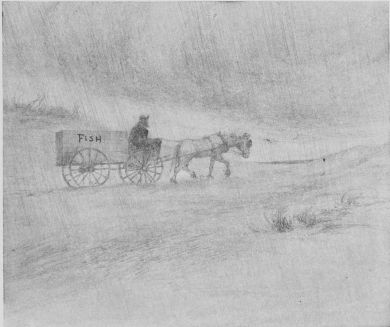
JOHN’S METHOD OF TAKING A BATH
Catfish John apparently relied on the heavenly rains, when he got caught
in them, to keep him clean, and on the golden sunshine that followed
them to remove the traces of these involuntary and infrequent ablutions.
I doubt if he suspected the existence of soap. Such cleanliness as he
possessed must have been in his heart, for it was invisible.
I once asked John to allow me to spend a day with him on one of his
peddling trips to the village, and he cheerfully consented.
“I don’t git lonesome, but it ’ud be nice to have somebody ’long,” he
said.
I was to meet him at five o’clock the following morning at Sipes’s
place. I inwardly rebelled at the unseemly hour, but those who would
derive the full measure of enjoyment with Catfish John must not be
particular about hours.
I rowed along the shore, and was at the trysting place promptly.
Fortunately I had a slight cold, and was thereby better enabled to
resist some of the odors that I was likely to encounter during the day.
Sipes was dumfounded when I explained the object of the early visit.
“You cert’nly must be lookin’ fer trouble,” he declared; “if ye want to
spend a day like that, why don’t ye go over an’ set quiet ’round ’is
smokehouse, instid o’ bein’ bumped along on ’is honey cart all day?”
The air was still, and the low, gentle swells out on the water were
opalescent in the early morning light. Sipes had just returned from a
visit to his set-lines and gill-nets, over a mile away in the lake. He
had started about two o’clock, and his boat on the beach contained the
slimy merchandise which we were to convert into what Sipes called
“cash-money” during the day.
We went down to the shore to inspect the catch. Numerous flopping tails
and other unavailing protests against uncongenial environment were
evident in the boat. There were fifteen or twenty Whitefish, about a
dozen carp, several suckers, and a lot of good-sized perch, which had
been found in the gill-nets. The set-lines had yielded two sturgeon, one
weighing about thirty-five pounds and the other over fifty. These two
finny victims dominated the boat.
“I swatted ’em when I took ’em in, but they seem to be gittin’ gay
agin,” remarked Sipes, as he reached for an old axe handle lying near
the bow. The struggling fish soon became quiet.
“There comes yer old college friend,” he said, as he glanced up the
beach. The rheumatic horse was patiently pulling the odd vehicle along
the shore, near the water line where the sand was firm, partially
concealing the bent figure with the faded slouch hat on the seat behind
him.
“I’d know that ol’ hat if I seen it at the South Pole,” said Sipes. “It
turns up in front an’ flops down behind. It’s got some little holes in
the top, through which some wind blows when ’e’s wearin’ it. He’s ’ad it
ever since I come on the beach, an’ that wasn’t yisterd’y, neither, an’
they ain’t no other lid that ’ud look right on John, an’ they ain’t
nobody else that ’ud wear it fer a minute. He needn’t never be ’fraid
that anybody’s goin’ to swipe it, ’specially ’round ’ere.”
After the conventional greetings, flavored with much bantering and
playful innuendoes by Sipes concerning the disreputable society which
some nice fresh fish were about to get into, the two worthies weighed
the catch, in installments, on some steelyards with a tin pan
attachment, which were kept in the shanty. Sipes made a memorandum with
a stubby pencil on the inside of the door, where his accounts were kept.
“I got so dam’ many things to think of that I can’t keep track of ’em
’less I jot ’em down,” he remarked, as he slowly and laboriously
inscribed some figures on the rough board.
John had a few fish in his box that he had found in his own nets that
morning, and a few more that Sipes said “didn’t look recent” and “must
’ave bin caught some time previous.”
The fish that Sipes had brought in were turned over to John on a
consignment basis. It was their custom to divide the proceeds equally.
Sipes considered that old John was “pufectly honest about everythin’ but
cash-money an’ fish.” He therefore kept “strict ’count o’ wot goes out
an’ wot comes back.” The inside of the door was covered with a maze of
hieroglyphics, the complicated records of previous transactions.
“If I wasn’t strictly honest at all times,” said Sipes, confidentially,
while John was out of hearing, “I’d slip some hunks o’ lead that I use
fer sinkers on the set-lines down the gullets o’ them sturgeon. I can
git lead fer six cents a pound an’ sturgeon is worth twenty. If anybody
found the hunks they’d think they’d bin eat offen the lines, but of
course I wouldn’t do nothin’ like that; an’ besides, them big fish has
to be dressed ’fore they’re weighed, an’ they ’ave to be cut in chunks
fer small sales. A sturgeon that only weighs about six or seven pounds
an’ don’t ’ave to be cut open ’fore ’e’s sold, can swallow a couple o’
sinkers without hurtin’ ’is digestion any.”
After all necessary details had been attended to, we climbed into the
seat and started. Sipes winked at me impressively, and his last words
were, “Don’t you fellers take in no bad money.”
He had several ways of opening and closing his single eye, which were
very different from winking it naturally. He would wink with the whole
side of his face, thereby conveying various subtle meanings which words
could not express.
As we departed, the old man, with a final wave of his hand, disappeared
into his shanty to prepare his breakfast. John had brought him a few
fresh eggs, and Sipes hoped that “they wouldn’t hatch ’fore they got to
the kittle.”
The poor old horse had rather a hard time pulling the additional burden
through the sand. This interesting animal was quite a character. He was
somewhere in the early twenties, and his name was “Napoleon.” John had
bought him from a farmer for ten dollars. The horse was sick and not
expected to live, but it transpired that what he really needed was a
long rest. This he was in a fair way of getting when John came to look
at him.
The old fisherman built a little shanty for him, put a lot of dead
leaves and straw into it, fed him well, and in the course of a few weeks
the patient began to evince an interest in his surroundings. “Doc”
Looney came over to see him and volunteered to prescribe, but John
refused to permit Doc to give anything but an opinion. Sipes claimed
that John had thereby greatly safeguarded the original investment.
“If Doc wouldn’t give patients nothin’ but opinions, most of ’em would
pull through, but ’is opinions’ll make me sick even when I’m well,”
Sipes declared.
Napoleon was finally able to get into the harness that was constructed
for him out of various straps and odds and ends of other harnesses that
John had picked up around the country. Several pieces of rope and frayed
clothes-line were also utilized, and when it was all assembled it was
quite an effective harness.
The convalescent was taken only on short trips at first, but he
gradually became stronger, and, with the exception of a limp in his left
foreleg, he got along very well. His speed was not great. He walked most
of the time, but occasionally broke into a peculiar trot that was not
quite as fast as his walk. His trotting was mostly up and down. Like
many people, whom we all know, he was inclined to mistake motion for
progress. He was more successful when he recognized his limitations,
and adhered strictly to the method of locomotion to which he was
naturally adapted.
His intelligence might be called selective. He understood “Whoa!”
perfectly, and obeyed it instantly, but “Giddap!” was not quite so clear
to him. He could not talk about his rheumatic leg, and thus suffered
from one great disadvantage that made him more agreeable to those around
him.
I asked John how the horse happened to be called Napoleon, but he did
not know. He was equally ignorant concerning the animal’s eminent
blood-stained namesake. He thought he “was some fightin’ feller in
Europe,” but did not know “which side ’e was on.”
The world execrates its petty criminals, and immortalizes its great
malefactors. As Napoleon, for selfish ends, caused the destruction of
countless lives, instead of one, his glory should reach even unto
Catfish John.
If the poor little horse had been called “Rembrandt” or “Shakespeare,”
the name would have been just as heavy for him to bear, but it would
suggest good instead of evil to enlightened minds. He was, however,
oblivious to all these things, and went on his humble way, thinking
probably only of his oats and the queer smells that emanated from the
fish-box.
We proceeded about half a mile along the shore, and took the road that
led through the sand hills into the back country. When we got to the
marshy strip, we bumped along over the corduroy for quite a distance,
but the road became better when we got to higher ground. As soon as we
arrived on firm soil, Napoleon stopped. A fat man with a green basket
was advancing hurriedly along the edge of the thin timber, about a
quarter of a mile away, and the horse probably surmised that his coming
was in some way connected with a rest.
The fat man was a picturesque figure, and we watched his progress with
interest. His embonpoint was rendered more conspicuous by the legs of
his breeches, which were about twice as large and not as long as
appeared to be necessary. The wide ends flapped to and fro about nine
inches above his feet as he ambled along. The garment was ridiculous
simply because it did not happen to be “in style” at the time. A faint
and mysterious whisper from the unknown gods who dictate the absurdities
in human attire would immediately invest its masses and contours with
elegance and propriety, and those we now wear would appear as
outrageous, artistically, as they really are. The freaks of vanity are
the mockeries of art.
“Them are high-water pants all right, an’ some day I’m goin’ to have
some like ’em,” remarked John.
It might be suggested that “trousers” are breeches which are in style,
and “pants” are those which are not. Gentlemen wear trousers and “gents”
wear “pants.”
“That ol’ feller lives in that brown house over in the clearin’ yonder,”
said John. “His name is Dan’l Smith. He’s got two sons, an’ them an’ ’is
wife do all the work now, an’ ’e’s got fat settin’ ’round an’ eatin’
everythin’ in sight. He trots over ’ere when ’e sees me comin’ an’ gits
fish. He’s partic’lar ’bout ’em bein’ fresh, an’ ’e likes to git ’em
when I first start out. He’s a good customer, but ’e owes me a lot o’
money. He says ’e’s got some money comin’ from a patent he’s inventin’,
an’ I’ll have to wait awhile. This patent’s to keep flies offen cows
when they’re bein’ milked, but I ain’t never seen it work. He drawed it
all out on some paper oncet, to show me, but I don’t know nothin’ ’bout
patents, an’ I couldn’t see just how it went. It’s some kind o’ thing
with little oars on it that ’e winds up an’ fastens on ’em, an’ then it
goes ’round an’ ’round. The little oars are all sticky with some goo ’e
puts on ’em, an’ the flies that don’t go ’way, when the little oars come
’round, git stuck on ’em, an’ can’t git off. The contraption’s got some
guide sticks on behind, an’ when the cows switch their tails, they have
to switch ’em back’ards an’ forrads, instid o’ sideways. There’s some
parts of it that ’e’s keepin’ secret, so’s none o’ them fellers down to
the store’ll git the patent fust.”
“Good mornin’, Dan’l!” said John cheerily, as the fat man came up, much
out of breath; “did ye have a hard time gittin’ through?”
“I got through all right, but it’s a good ways over ’ere from the house,
an’ I ain’t as frisky as I was oncet, an’ I’m ’fraid I’m gittin’ a
little rheumaticks in my legs. Wotcher got in th’ box to-day?”
Old John patiently sorted over the fish for inspection. The fat man
selected four, which he carefully put in his green basket, and covered
with leaves. He then waddled away with them and we drove on.
“I don’t never keep no ’counts,” said John, “but Dan’l’s got all them
fish marked down som’ers, that ’e’s got from me, an’ keeps track of ’em.
When ’e gits ’is money fer ’is patent ’e’s goin’ to fix it all up. Sipes
says we can git slews o’ them kind o’ customers, an’ ’e wants me to quit
givin’ ’im fish er else feed ’im on smoked ones fer awhile. He says if
we try to fat up all the fellers we meet on the road, the fish’ll all be
gone out o’ the lake ’fore we’re through, an’ ’e don’t want to be in on
it.”
While Napoleon and I may have regarded the fat man and the green basket
with some suspicion, John’s faith seemed secure.
We approached a weather-beaten house standing near the road. A
middle-aged woman in a gingham dress and brown shawl stood near the
fence. The nondescript rig had been seen coming. Travelers on the road
in the back country are so rare that a passing vehicle is an event; it
is always observed, and its mission thoroughly understood, if possible.
In no case during the day were we compelled to announce our arrival.
“Got any live ones this mornin’, John?” she asked.
“Anythin’ ye like,” he replied, as he raised the lid of the box. A
bargain was soon struck, and actual commerce had commenced. John put
eighteen cents into a big, greasy, leather pouch, the opening of which
was gathered with an old shoestring. He carried it in his side pocket.
He then gave the lines a shake, said “Giddap!” to Napoleon, and we moved
slowly on.
“That thar woman,” said he, “has bin married to two fellers. The fust
feller died right away, an’ the last one skipped off som’eres an’ never
come back. She’s got that little place an’ ’er father’s livin’ thar with
’er. He’s got money in the bank som’eres. He didn’t like neither o’ them
husbands, an’ now they’re gone’ e’s’ livin’ ’ere. She’s a nice woman,
but she made it hot fer them fellers, an’ if she’ll quit gittin’
married she’ll be all right. That house we’re comin’ to now b’longs to
ol’ Jedge Blossom. He’s a slick one. I had some trouble with some
fellers oncet, an’ went to the Jedge’s house to have ’im haul ’em into
court over to the county seat. We got beat in the case an’ them fellers
got discharged by the court, but the Jedge said I owed ’im ten dollars.
I didn’t have no ten dollars to spare, but I told ’im I’d leave ’im a
fish whenever I went by, so I must drop one off when we git thar.”
We stopped in front of the house. The old man reached back into the box
and pulled the slippery inmates over until he got hold of two that were
near the bottom. When they came up they did not look quite as attractive
as those I had seen in the boat. He climbed slowly and painfully down
and carried them around to the back door. On his return he remarked that
“them fish ain’t so awful good, but they’re a dam’ sight better’n some
o’ the law that ol’ bunch o’ whiskers ladled out fer me over to the
county seat. I never see ’im ’cept at the store when I go thar. The
Jedge’s got a turrible thirst, an’ most always ’e’s soused. I gen’rally
take the fish ’round an’ give ’em to the housekeeper, er else leave ’em
near the pump.”
With another “Giddap!” we continued our journey.
About a quarter of a mile farther on we met a little cross-eyed man with
stubby whiskers, carrying a big stiff satchel covered with shiny black
oilcloth. It did not seem very heavy. He swung it lightly back and forth
as he walked. He stopped and asked if we could direct him to “Sam
Peters’s place.” He explained that Peters was a relative of his and that
he had come to visit him. John told him that he had passed the cross
road that led to his destination, and offered to give him a ride back to
it, if he would sit up on the fish-box. The traveler gratefully accepted
the invitation. When we came to the corner where the cross-eyed man was
to leave us, he said that he “would like to buy a couple o’ fish, an’
take ’em over to Peters fer a present.”
Evidently he desired in this way to repay John for his ride; and thirty
cents dropped into the capacious maw of the greasy pouch.
The fish were wrapped up in a piece of newspaper, and the cross-eyed
man cautiously opened the satchel on the ground to insert the package.
To our great astonishment a large maltese cat jumped out, ran a few
yards, stopped, and gazed back at us with a scared look.
The cross-eyed man was much excited, but finally succeeded in capturing
the animal. He then explained that it belonged to his mother-in-law. It
“yowled so much nights” that after trying various other expedients, he
concluded to carry it away and give it to Peters, who had once told him
that he was fond of cats. He had got off at the railroad station, about
six miles away, and had walked the rest of the way.
The cat and the package were soon safely enclosed and he started off
down the road.
“That cat’ll prob’ly eat them fish up on the way to Peters’ place,” said
John, “but it’s my business to sell ’em an’ not to say what’s done with
’em afterwards.”
The cross-eyed man must also have had misgivings as to the security of
the fish, for we saw him stop in the distance, and open the satchel,
probably with a view of separating the contents while it was still
possible.
“I ain’t goin’ to stop at the next place,” said John. “When I drive in
thar the feller always comes out an’ jaws about half an hour, an’ then
sometimes don’t buy nothin’. When I go on by, if ’e wants a fish, ’e
comes out an’ yells fer me to stop. When ’e gits the fish ’is wife
hollers fer ’im to hustle up an’ fetch it to the house, out o’ the sun,
so I git away, an’ thar ain’t no time wasted.”
The old man’s acumen in this case resulted in the enrichment of the
greasy pouch to the extent of twenty-five cents, without objectionable
delay in the day’s business.
We were now getting into the sleepy village, and the houses were nearer
together. We stopped at several of them before we arrived at the general
store. The male population was lined up in chairs on the platform under
the awning, and a curious assortment of horses and vehicles stood around
in the neighborhood.
None of the horses looked as though they would run away if they were
not tied, but all of them were securely fastened to hitching rails and
posts.
We had a number of things to attend to at the store. A poor old
gray-haired woman, who lived alone at the edge of the village, had
requested John to “please see if there is a letter for me when you stop
at the post office, and bring it to me on your way back, if there is
one.”
John had presented her with a fish, and said that he always gave her one
when he went by, when he had a good supply.
“She’s bin expectin’ that letter fer nearly twenty years, from ’er son
that went away, but it don’t never come. She’s always waitin’ at the
gate, when I go back, to see if I git it.”
Alas, how many forlorn ones there are who wait, with hearts that ache,
through the lonesome years, for letters that “don’t never come!” Those
who have gone may have wandered far in the world—they may have
forgotten, or their fingers may have become cold and still, but there is
hope in one heart that only ends with life itself. A pen may sometimes
tremble, lips may sometimes falter, and eyes become dim, when the
thought comes that a mother’s love will be “waitin’ at the gate” when
the other loves in this world are dead.
We tied Napoleon tightly with a big piece of rope which it would be
utterly impossible for him to break if he should attempt to run away,
fixed a small bag of oats so that he could munch them, and went over to
the platform.
John was greeted with solemn nods, good-natured sallies, in which there
was more or less wit—generally less—and various questions about “the
fishin’.” One old fellow had “bin over to the river” and “seen a feller
with a couple o’ catfish an’ a pick’rel, but ’e’d bin all day gittin’
’em, an’ ’e didn’t need no wheelbarrow to git ’em home.”
We went inside the store to make a few purchases, and to inquire for any
mail which we might be able to leave with people who lived on the return
route.
John bought several pounds of number six shot, three dozen heavy lead
sinkers, and a pound of “natural leaf” for Sipes, and two pounds of
natural leaf for himself. I was tempted to purchase a few cakes of soap
and present them to John as a souvenir of the trip, but remembering that
it is the tactless people on this mundane sphere that have most of the
trouble, I changed my mind and purchased a big briar pipe for him. He
was greatly pleased with it, and thought that “in about six months
smokin’ it ’ud git mellered up an’ be a dam’ fine pipe.” We bought some
crackers, cheese and a can of sardines for our lunch, which we ate out
under one of the trees.
“I don’t know what Sipes has to ’ave so many sinkers fer,” remarked
John. “He wants me to git ’im a whole lot ev’ry time I come to town. I
guess ’e must use ’em fer bait, fer I offen find ’em in ’is fish when I
dress ’em.”
The expression on the old man’s face conveyed a suspicion that he was
not quite as gullible as he might be, and that Sipes’s strategy had not
entirely deceived him. He probably had his own quiet way of adjusting
matters on an equitable basis.
After lunch we spent a few minutes more with the wise ones in front of
the store, deposited our parcels under the seat, released the reluctant
horse and departed.
“Them fellers that set ’round that store don’t ’ave nothin’ else to do,”
said John. “They set inside in the winter time an’ do a lot o’ talkin’,
an’ sometimes I set with ’em just to hear what’s goin’ on. When it’s hot
they set outside an’ count the clouds, but they’re always settin’, an’
they don’t never hatch nothin’. Ev’ry year one or two of ’em drops off,
an’ thar ain’t many of ’em left to what thar was ten years ago. They
didn’t none of ’em amount to much, but I guess they’re just as well off
now as anybody else that’s dead.”
The contents of the greasy pouch had been sadly depleted at the store,
but we got more “cash-money” from the few remaining houses in the
village. The miller took three fish, and credited John’s account with
the amount of the sale. There was a debit on his books against John for
flour and meal furnished during the winter.
It was getting late in the afternoon, and it was a long way to John’s
smoke-house, where the unsold portion of the stock must be “dressed an’
put in pickle,” preparatory to smoking it.
We returned by the same route as we came. The poor old woman was
“waitin’ at the gate,” and turned sadly toward the house as we passed.
She carried her cross in silence, and the picture was pathetic.
On the way back we saw a sharp-featured man with red hair, who had come
out of a house and was waiting near the road.
“That feller,” declared John, as we approached the possible purchaser,
“gives me pains. He seen me goin’ by all right this mornin’, but ’e
didn’t come out. He’s a tight wad, an’ ’e thinks I’ll sell ’im fish fer
almost nothin’ before I’ll tote ’em back. I’ve got ’em all trained but
’im. Now you just watch me.”
When we stopped the man asked if we had “any cheap bargains in fresh
fish.”
“Yes,” said John, “I have, an’ I’ll tell ye what I’ll do. I hain’t sold
many to-day, an’ I’ve got about twenty left. If you’ll take the whole
bunch, you can have ’em fer a dollar an’ a half.”
“I can use two of ’em, at ten cents apiece, if you’ll let me pick ’em
out,” the man replied.
“Giddap!” said John, and we were once more on our way.
Pride is the most expensive thing in the world, and under various forms
it dominates mankind. I could not help but admire John’s resolute
sacrifice of this opportunity to add twenty cents in “cash-money” to the
greasy pouch, which sorely needed it, but evidently he was following a
policy that had in it much wisdom.
After crossing the marshy strip, we went through the sand hills, and
down the beach to Sipes’s place, where I had left my boat.
We found him peacefully smoking out in front of his shanty, apparently
without a care in the world.
John showed Sipes the fish he had brought back, and gave him the things
he had bought for him at the store. When the account was all figured
out, there was a balance of twelve cents in John’s favor, which Sipes
said “we’ll make up next time.” He was deeply disappointed that there
was no “cash-money” coming.
Sipes considered the fish that were to go to the smoke-house “a dead
loss, an’ they’d soon be worse’n that.” He wanted “nothin’ to do with
’em after they struck the morgue.” He looked upon the smoke-house as a
sink of iniquity, from which nothing good could possibly emanate.
I thanked John for his kindness in taking me with him, and bade him
good-bye. He and Napoleon departed, and soon faded away in the distance.
The old fisherman had retailed a great deal of the current gossip of the
country to me during the day. Humor and pathos, happiness and misery,
honesty and wickedness, and all the other elements that enter into the
stories of human lives, found their places in the day’s recital. The old
man has much benevolence in his heart. Most of his comments upon the
frailties of his fellow-creatures were tolerant and charitable. They
were usually tempered with sly quips, and a disposition to accord the
benefit of doubt.
He frequently gives away fish, on his various trips, to people who
cannot afford to buy them and to whom the food is most welcome, and
extends credit to others who he knows can never pay. He does all kinds
of little errands that his routes make possible, and altogether he is a
simple, good-natured soul.
Like everybody else, he is an infinitesimal item in the scheme of
creation, but there are many other items that are much more
objectionable than Catfish John. Cleanliness may be next to godliness,
but it is often associated with cussedness, so we can safely leave the
matter of John’s redemption to other agencies than soap.
Sipes once wisely remarked that “it’s no use tryin’ to tell ev’rybody
wot to do all the time, an’ I’ve quit. If ev’ry feller’d mind ’is own
business instid o’ butt’n in an’ tryin’ to boss ev’rybody else, there’d
be a lot less fussin’ goin’ on. The only way to git John clean ’ud be to
burn ’im, an’ they’s a lot o’ clean-lookin’ people that’ll come to that
long ’fore he does. He’s a nice ol’ feller.”


