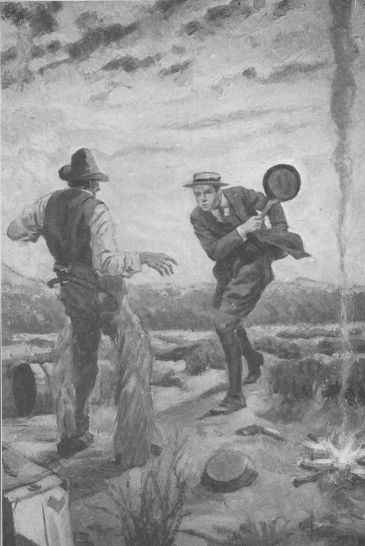
The remarkable change in Mr. Hicks' manner continued the next morning.
It was so radical that no one could fail to observe it and the comments
were frequent, while Mrs. Stott crowed openly.
From haughty independence he had become so anxious to please that he was
almost servile, and his manner toward the wife of the rising young
attorney particularly was that of a humble retainer fawning at the feet
of royalty. During breakfast he stood at a respectful distance, speaking
only when spoken to, and jumping to serve them.
This attitude quickly dissipated the fear which he had inspired in The
Happy Family, and by noon they were not only calling him "Hicks" but
"Ellery." Then, this stage of familiarity having been passed in safety,
Mr. Stott humorously dubbed him "Cookie," and the name was adopted by
everyone.
Mrs. Budlong ventured to complain that there was too much shortening in
the biscuit. This was a real test of the sincerity of his reformation
since, if such a thing were possible, he had been even more "touchy"
upon the subject of his cooking than his dignity. No one could doubt
but that the change was genuine when he not only received the criticism
meekly but actually thanked her for calling his attention to it.
Thus encouraged, Mr. Appel declared that he wished he would not fry the
ham to chips and boil the "daylights" out of the coffee. Mr. Hicks bowed
servilely and replied that he would try to remember in future. Mrs.
Stott took occasion to remark that his vegetables would be better for
less seasoning and more cooking, and Miss Gaskett thought his dried
fruit would be improved by soaking over night and additional sweetening.
Mr. Hicks received these criticisms in a humility that was pathetic when
compared with his former arrogance. He looked crushed as he stood with
bowed head and drooping shoulders as if his proud, untrammelled spirit
had been suddenly broken.
Miss Eyester felt sorry for him and asserted that she could not recall
when she had enjoyed food so much and eaten so heartily. Indeed, she had
been such a gourmand that she had gained a pound and six ounces, if the
scales upon which she had been weighed in Prouty were accurate.
Mr. Stott, however, who was in one of his waggish moods, undid all that
she might have accomplished in the way of soothing Hicks' injured
feelings, by inquiring facetiously if he would mind rolling him out a
couple of pie-crusts to be tanned and made into bedroom slippers.
Mr. Hicks laughed heartily along with the others, and only Wallie
caught the murderous glitter through his downcast lashes.
It developed that the Yellowstone Park was a place with which Hicks was
thoroughly familiar from having made several trips around the Circle. He
was not only acquainted with points of interest off the beaten track
passed unseen by the average tourist, but he suggested many original and
diverting sports—like sliding down a snowbank in a frying-pan—which
would not have occurred to any of them.
By the time the party had reached the Lake Hotel they were consulting
him like a Baedeker, and he answered every question, however foolish,
with a patience and an affability that were most praiseworthy. Their
manner toward him was a kind of patronizing camaraderie, while Mrs.
Stott treated him with the gracious tolerance of a great lady unbending.
A disbelief in the ability of the leopard to change its spots made
Wallie sceptical regarding Hicks' altered disposition, yet he did his
best to convince himself that he was wrong when Hicks went out and
caught a trout from the Yellowstone Lake expressly for Mrs. Stott's
supper.
It was a beautiful fish as it lay on the platter, brown, crisp, and
ornamented with lemon. Mr. Hicks offered it much as the head of John the
Baptist might have been brought to Salome.
"Thank you, Hicks," said Mrs. Stott, kindly.
"I hope you'll like it, ma'am," he murmured, humbly.
The mark of favour seemed to bear out Mrs. Stott's contention that
inferiors should not be treated as equals in any circumstances. Now,
with her fork in the fish, Mrs. Stott looked around the table and
inquired graciously if she might not divide it with someone?
Everyone politely declined except Mrs. Budlong, who looked at it so
wistfully that Mrs. Stott lost no time in transferring it to her plate.
She ate with gusto and declared after tasting it:
"It is delicious, simply delicious! I never remember eating another with
quite the same delicate flavour. I presume," addressing herself to Mr.
Hicks, who was standing with arms akimbo enjoying her enjoy it, "it is
due to something in the water?"
"I presume so," he replied, respectfully, and added: "The trout in the
Yellowstone Lake are said to be very nourishing."
It was natural that Mrs. Stott should feel a little flattered by this
evidence of partiality even from a menial, also she noticed that Mrs.
Budlong was following each mouthful with the eyes of a hungry bird-dog
so she could not refrain from saying further:
"It is such a delightful change from ham and bacon. I am not sure," she
averred, laughingly, "that I shall not eat the head and fins, even."
"I wish I was in such favour," Mrs. Budlong declared, enviously.
"Never mind, Honey Dumplin'," said Mr. Budlong, "I shall go out after
supper and catch your breakfast."
"You ought to get a boatload," Hicks added quickly, "if you find the
right place."
"I saw them jumping by the million where I was walking before supper."
Mr. Appel volunteered to conduct Mr. Budlong to the spot as soon as they
were finished eating.
Everyone who had fishing-tackle decided to avail himself of this
wonderful opportunity, and they all followed Mr. Appel except Mr. and
Mrs. Stott, who preferred to fish by themselves from the bridge over the
Yellowstone river.
They were the last to leave but returned in not more than twenty
minutes, Mr. Stott supporting his wife in what seemed to be a fainting
condition.
Wallie hastened forward to lend his assistance if necessary.
"Is she ill?" he inquired, solicitously.
"Ill! She is sick at her stomach and no wonder!" He was plainly angry
and appeared to direct his wrath at Wallie.
While Wallie wondered, it did not seem a propitious moment to ask
questions, and he would have turned away had Mr. Stott not said
peremptorily:
"Wait a minute. I want to speak to you."
Having laid Mrs. Stott, who was shuddering, on her blankets and
administered a few drops of aromatic spirits of ammonia, he dropped the
flap of her teepee and beckoned Wallie curtly:
"You come with me."
Wallie could not do else than follow him, his wonder growing as he led
the way to the camp kitchen where Mr. Hicks was engaged at the moment
in the task which he referred to as "pearl-diving."
He did not appear surprised to see them in his domain, on the contrary
he seemed rather to be expecting them, for immediately he took his hands
out of the dish-water, wiped them on the corner of his apron, and
reaching for a convenient stick of stove-wood laid it on the corner of
the table with a certain significance in the action.
"Make yourself to home, gents," he said, hospitably, indicating the
wagon-tongue and a cracker-box for seats, respectively. "Anything in
particular I can do for you?" He looked at Mr. Stott guilelessly.
"You can answer me a few questions." Mr. Stott fixed a sternly accusing
eye upon him. "Hicks, was, or was not, that trout you gave my wife,
wormy?"
Mr. Hicks, who seemed to relish the situation, pursed his lips and
considered. Finally he asked in a tone which showed that he had pride in
his legal knowledge:
"Will I or will I not incriminate myself by answering?"
"You probably will if I'm correct in my suspicions. I want the truth."
"Then," replied Mr. Hicks, while his hand slipped carelessly to the
stick of stove-wood, "if you force the issue, I will say that I've seen
a good many wormy trout come out of the Yellowstone but that was the
worst I ever met up with."
Mr. Stott advanced belligerently.
"And you dare boast of it!"
"I'm not boasting—I'm just telling you," replied Mr. Hicks, calmly. "An
Eye for an Eye, a Tooth for a Tooth, that's my motto, and your wife
thought I wasn't good enough to eat at the table with her."
"You hear?" Stott turned to Wallie furiously. "He did it on purpose. I
demand that you discharge this fellow!"
Mr. Hicks' fingers caressed the stove-wood while he waited Wallie's
answer.
Wallie squirmed between the two of them.
"It was reprehensible, Mr. Stott, I am more distressed than I can tell
you. I have no excuse to offer for Hicks' action, but the truth is, as
he knows and has taken advantage of it, I cannot replace him and it is
impossible to get along without a cook with so large a party."
"You will, then, not discharge him?" Stott demanded.
"I am helpless," Wallie reiterated.
Hicks grinned triumphantly.
"In that case," Mr. Stott declared in a tone which implied that a
tremendous upheaval of some kind would follow his decision, "my wife and
I will leave your party and continue through the Park by motor."
Wallie felt that it was useless to argue with any one so determined, so
he made no effort to persuade Mr. Stott to remain, though the deflection
of two more persons was a serious matter to him and Pinkey.
Without waiting to say good-bye to the others, the Stotts paid their
bill and departed, walking so erect in their indignation as they started
down the road toward the Lake Hotel that they seemed to lean backward.
It was not yet dark when Mr. Stott, stepping briskly and carrying his
Gladstone bag, raincoat, and umbrella in a jaunty manner, came into camp
announcing breezily that he had decided, upon reflection, not to "bite
off his nose to spite his face." He declared that he would not let the
likes of Ellery Hicks upset his plans for touring the Yellowstone, and
while his wife refused to return he meant to carry out his original
intention.
But the real reason for Mr. Stott's decision, as Wallie suspected from
the frequency with which he had discovered him sitting upon a log in
secluded spots counting his money, was that the hotel rates and motor
fare were far higher then he had anticipated.
Mrs. Stott's absence did not leave the gap which she had anticipated. In
fact, after the first evening her name was never mentioned, and Mr.
Stott's marital ties rested so lightly upon him that a stranger would
never have known they existed. He gravitated toward Miss Gaskett with a
promptitude which gave rise to the suspicion that he had had his eye
upon her, and Miss Gaskett responded so enthusiastically that it was a
matter for gossip.
It was noted that she took to doing her hair up at night on "wavers" and
used her lipstick with greater frequency, and whereas she had vowed she
meant never again to get in the saddle she now rode with Mr. Stott
daily.
The ladies who had known Miss Gaskett for twenty-five years, and nothing
to her discredit, were not prepared to say that she was a huzzy and a
vampire without further evidence, but they admitted to each other
privately that they always had felt there was something queer and not
quite straightforward about Mattie.
Miss Gaskett, who looked like a returned missionary that had had a hard
time of it carrying the Light into the dark places, seemed rather elated
than depressed at the aspersions cast upon her character, and by the
time they reached the "Paint Pots" she was flaunting Mr. Stott
shamelessly, calling him "Harry" before everybody, and in the evening
sitting with him by the camp-fire on the same saddle-blanket.
At Mammoth Hot Springs Mrs. Budlong showed her disapproval by refusing
to speak to Miss Gaskett, and Miss Gaskett replied by putting on a
peek-a-boo blouse that was a scandal.
But Mrs. Budlong herself was not in too high favour, since to the sin of
gluttony she had added that of lying and been caught at it. It was a
small matter, but, as Mrs. Appel declared indignantly, it is trifles
that betray character, and Mrs. Budlong was treated with marked coldness
by the ladies to whom she had prevaricated.
It was known beyond the question of a doubt that Mrs. Budlong had
purchased food and kept it in her teepee. Therefore, when asked for
something to ward off a faint feeling before dinner and she had denied
having anything, they were outspoken in their resentment.
"There she stood and lied to our faces," Mrs. Appel declared to her
husband afterward, "while her mouth was shining. I could smell sardines
on her and a big cracker crumb was lying on her bosom. Indeed, it's a
true saying they have in this country that to know people you must camp
with them. I never would have thought that of Hannah Budlong!"
It was because of this incident, and the strained relations which
resulted from her perfidy, that none of her erstwhile friends responded
to her invitation to join her in a bath in a beaver dam of which Mr.
Hicks told her when they camped early the next afternoon.
Mrs. Budlong's phlegmatic body contained an adventurous spirit, and the
delights of a bath in a beaver dam in the heart of a primeval forest
appealed to her strongly.
To Mr. Hicks, who sought her out purposely to tell her about it, she
confided:
"Hicks, underneath my worldly exterior I am a Child of Nature. I love
the simple, the primitive. I would live as a Wild Thing if I could
choose my environment."
Mr. Hicks nodded sympathetically and understandingly, and returned the
confidence.
"I am convinced that I was a faun when the world was young. There are
times when I feel the stirrings of my wild nature."
Mrs. Budlong regarded him attentively. She never had thought of him as a
faun but now she noticed that his ears were peculiar.
Nobody could have been more obliging and interesting than Mr. Hicks as
he guided her to the beaver dam and explained its construction. It had
long since been abandoned by the industrious animals that had built it,
but their work had been so well done that it was in as good condition as
when they had left it.
There was nothing to fear from beavers; anyway, Hicks assured her, he
never had known a beaver to attack anybody. In this isolated spot she
was as safe from intrusion as if she were in her own bathroom, and,
after tramping down a spot in the brush for her to stand on, he went
away declaring that he was sure she would have an experience she always
would remember.
Left alone, Mrs. Budlong felt of the water. It was, as Hicks had said,
even warmer than tepid from standing—an ideal temperature. The brush
grew high around the pond formed by the back-water and made a perfect
shelter. No fear of prying eyes need disturb her.
Then a daring thought came to her which made her black eyes sparkle.
Suppose she did not wear any bathing suit! What an adventure to relate
to her intimate friends when she returned to Mauch Chunk, Pennsylvania!
It laid hold of her imaginative mind, and the result was that Mrs.
Budlong hung her suit on a bush and went in au naturelle.
She waded in cautiously, for the bottom was soft and oozy and there were
little patches of green floating on the surface that she did not so much
like the looks of. Otherwise conditions were perfect, and Mrs. Budlong
submerged like a submarine when she reached the middle of it. She came
up and stood looking at the sky above her, enjoying the feeling of the
sunshine on her skin, and the soft, warm breeze that caressed her. She
smiled at an interested blue-jay, then submerged again, deeper, and the
tide rose so that the water lapped bushes and pebbles that had not been
wet all summer.
Her smile grew wider as she thought what the others were missing, and
was considering how much she dared embellish the adventure without being
detected, when, suddenly, a look of horror came to her face and stayed
there, while screams that sounded more like the screeches of a lynx or
mountain-lion than those of a human being scared the blue-jay and
brought those in camp up standing. Piercing, hair-raising, unnatural as
they were, Mr. Budlong recognized them.
"My wife! Help! Murder! Hicks, where is she? Find a weapon and come with
us!"
"I gotta get supper," Hicks replied, heartlessly.
Mr. Appel, Mr. Stott, and old Mr. Penrose dashed into their tents and
dashed out carrying firearms that had been sealed by the Park officials,
as is customary, while Mr. Budlong in his frenzy snatched a pair of
scissors from Miss Eyester and headed the posse which expected to pursue
the murderer. He was not a murderer yet, however, for Mrs. Budlong's
screams had not diminished in volume, although it was feared that worse
than death might already have befallen her. Her shrieks guided them like
a lighthouse siren, so they lost no time in taking wrong directions but,
at that, it was a considerable distance and Mr. Budlong, in spite of the
agonized thoughts which goaded him forward, was so handicapped by his
asthma that he gradually fell to the rear of the rescue party.
Mr. Stott was then in the lead, with Mr. Appel a close second, until the
latter, who was wearing bedroom slippers, stumped his toes against a
rock with such force that he believed them broken. He dropped down
immediately with the pain of it and sat weaving to and fro, clasping his
foot to his breast while the others passed him.
Mr. Stott called that help was arriving as he crashed through the brush
in the vicinity of the beaver dam. To his astonishment Mrs. Budlong
shrieked:
"Don't come!" and went on screaming. When he reached the pond he stopped
short and stood there, and old Mr. Penrose joined him an instant later.
Mr. Appel, alternately limping and hopping yet covering ground with
surprising rapidity, reached the others ahead of Mr. Budlong, who,
staggering with exhaustion, huge drops on his pallid face, and wheezing
like an old accordeon, all but fainted when he saw the wife of his
bosom.
Mrs. Budlong, looking like a corn-fed Aphrodite, stood in the middle of
the pool, with her fat white back, wet and glistening, flecked with
brown particles that resembled decayed vegetation.
"What's the matter, Honey Dumplin'?" cried Mr. Budlong, shocked and
bewildered.
For answer, Mrs. Budlong screamed the harder.
"I know!" piped up Mr. Appel. "She's covered with
leeches—blood-suckers—and can't get 'em off. I got 'em once swimmin'
in stagnant water."
When he spoke he called attention to the fact of his presence and that
of Mr. Stott and old Mr. Penrose. Instead of being grateful for the
information, and for the assistance the others had expected to render,
Mr. Budlong turned upon them all furiously:
"Get out of here you Peeping Toms and spying libertines! Haven't you any
shame about you?"
He raised the scissors so threateningly that as soon as they recovered
from their astonishment they retreated, but, at that, their haste was
not sufficient to appease an outraged husband. Mr. Budlong picked up a
pebble and threw it with such a sure aim that it bounced between Mr.
Stott's shoulder-blades.
When he had picked off the blood-suckers that were battening on Mrs.
Budlong, the two returned to camp and lost no time in serving notice on
Wallie that they were leaving by the first passing conveyance if they
had to buy it.
Whether or not Mr. Hicks had known of the leeches was a matter for much
discussion, and opinion was about equally divided as to his innocence.
He disclaimed all knowledge of them, however, and went about with the
air of one cruelly maligned.
His martyr-like pose was not convincing to Wallie, who could not rid
himself of the suspicion that the incident had been planned, though
Pinkey contended that he did not believe Hicks was "deep" enough to
think of anything like that.
"Anyhow, he's cost us three dudes," said Wallie, which remark was
sufficient to set Pinkey figuring with a stick.
"Three head of dudes at $5.00 a day for, say, eleven days is, say——"
"They're gone and that's all there is to it. The thing for us to do is
to see that no more leave," Wallie interrupted practically.
"I'm not worryin' about them," Pinkey replied, confidently, "if we can
jest hold that cook. We've got to humour him till we git through this
trip, then after he's paid off I aim to work him over and leave him for
somebody to drag out."
But as if to make amends for the loss he had caused his employers,
Hicks' manner grew increasingly saccharine and he redoubled his efforts
to provide entertainment for the guests. By the time they arrived at the
Cañon Hotel Wallie was questioning his suspicions of Hicks and felt
inclined to believe that he had been hasty in his judgment.
He was undoubtedly an asset, for the entire party hung on his words and
relied upon him to see that they missed nothing of interest. Mr. Stott
was indebted to him for an experience which relegated the Florida
hoot-owl to the background, though the thrill of the adventure was so
intermingled with anguish that it was impossible to tell where one left
off and the other began.
Sliding down the snow-covered side of a mountain in a frying-pan was
fraught with all the sensations Hicks had described and some he had
omitted.
When they had reached the particular spot which he had recommended for
the sport, in lieu of a frying-pan, Hicks gave Mr. Stott a well-worn
gold-pan that he had found somewhere.
Starting at the top with the party as spectators, Mr. Stott shot down
the side like the proverbial bullet, but midway his whoops of ecstasy
changed to cries of acute distress, owing to the fact that the friction
wore a hole through the pan to the size of a dollar, and Mr. Stott,
unable to stop his unique toboggan or endure the torture longer, turned
over and finished the trip on his stomach.
Mr. Stott's eyes often rested upon Hicks afterward with a questioning
look in them, but the cook's solicitude had been so genuine that cynical
as his legal training had made him, he was obliged to think that it was
purely an accident which might not happen one time in a million.
No point in the Park had been anticipated more than the camp at the
Cañon where Mr. Hicks averred that the bears came in swarms to regale
themselves upon the hotel garbage. Their tour thus far had been a
disappointment in that the wild animals, with which they had been
informed the Park teemed, were nowhere in evidence.
A deer had crossed the road ahead of them and they had gazed at a band
of elk through Mr. Penrose's field-glasses, but otherwise they had seen
nothing that they could not have seen in Pennsylvania.
Mr. Hicks' tales of the bears had aroused their interest to such a point
that as soon as the camp site was selected they loaded their cameras and
kodaks and set off immediately to get pictures while the light was
favourable.
It chanced to be one of the days, however, when the bears had no taste
for garbage and although they waited until nearly supper-time not a bear
put in its appearance. Mr. Penrose, in particular, was disappointed and
vexed about it, and while it was unreasonable to hold Hicks in any way
accountable for their absence, he could not refrain from saying
disagreeably:
"I think you have exaggerated this bear business, Hicks. I have no doubt
that a bear or two may come down occasionally, I have the word of others
for it, but as for droves of bears—swarms—I think you have
overstated."
Mr. Hicks cringed under the criticism, and admitted with a conciliatory
whine in his voice that was rather sickening:
"Perhaps I did enlarge a little, Mr. Penrose. Possibly I was
over-anxious to be interesting. I apologize sincerely if I have misled
and disappointed you. I hope, however, that you will yet have the
opportunity of seeing at least one before we leave here."
"No such luck," Mr. Penrose growled at him. "I haven't any idea that
I'll see even the tracks. It's a good idea to cut in two everything
you're told in this country and then divide it."
Mr. Penrose was so hard on Hicks that Mr. Appel interposed quickly:
"Do they ever come around at night, Cookie?"
"So I have been informed," Mr. Hicks replied, conservatively.
Pinkey was about to say that bears travelled more by night than in
daytime, when Mr. Appel declared that he intended to sleep in the
sleeping bag he had brought with him but which Mrs. Appel had not
permitted him to use because she felt nervous alone, in her teepee.
Mrs. Appel protested against Mr. Appel thus recklessly exposing himself
to danger but Mr. Appel was mulish in the matter.
"If, by chance, one should come into camp I would have a good look at
him. I may never have another such opportunity."
"If you want to take your life in your hands, well and good."
So, after supper, Mr. Appel unrolled his sleeping bag and spread it on a
level spot not far from the supply wagon. Then he kissed Mrs. Appel, who
turned her cheek to him, and buttoned himself into the bag.
The talk of bears had made Aunt Lizzie Philbrick so nervous that as an
extra precaution she pinned the flap of her tent down securely with a
row of safety-pins and Mr. Stott not only slept in more of his clothes
than usual but put a pair of brass knuckles under his pillow.
These brass knuckles had been presented to Mr. Stott by a grateful
client for whom he had obtained damages from a street railway company
for injuries received through being ejected from a saloon six months
prior to the date upon which he had fallen off the car step.
Brass knuckles and a convenient length of lead-pipe were favourite
weapons with the clientele which gave to the waiting room of Mr. Stott's
law office an odour reminiscent of a Wayfarers' Lodging House.
The night was a dark one, so dark in fact that old Mr. Penrose felt some
little hesitation when it came bed-time over going off to sleep by
himself in the brush where, owing to his unfortunate habit of snoring so
loud as to be beyond anything human, they now placed his teepee.
There was not a glimmer of moonlight or starlight to guide him as he
went stumbling and crashing through the brush to his rag residence. His
thoughts were not so much of four-footed visitors as of footpads and the
ease with which they could attack him and get away with his
grandfather's watch which he was wearing.
Out in the open, Mr. Appel was enjoying the novelty tremendously, though
he was a little too warm for comfort in his fleece-lined bag. But after
the last candle had been extinguished he called to his wife cheerily:
"Are you all right, dearie?"
Mrs. Appel was not to be so easily propitiated and did not answer, so he
called again:
"This is great—simply great! I wish you were with me."
Only Mr. Appel and his Maker knew that he screwed up his cheek and
winked at the fabrication.
Sleep came quickly to the tired tourists, and soon there was no sound
save the distant tinkle of the bell on one of the horses and the faint
rumble of Mr. Penrose's slumbers.
It was eleven o'clock or thereabouts, and the clouds had rifted letting
through the starlight, when dark forms began to lumber from the
surrounding woods and pad around the camp, sniffing at various objects
and breathing heavily.
There were bears of all sizes and ages, ranging from yearlings to
grandfathers whose birthdays were lost in antiquity. Mr. Appel, who was
a light sleeper and the first to discover them, would have sworn on a
monument of Bibles that there were at least fifty of them—the size of
mastodons.
Palpitating in his sleeping bag in the midst of them, he may be excused
for exaggeration, although, exactly, there were only eight of them.
The cold sweat broke out on Mr. Appel and he thought that surely the
thumping of his heart must attract their attention. In such mortal
terror as he never had experienced or imagined he quaked while he
speculated as to whether the bear that first discovered him would
disembowel him with one stroke of his mighty paw, and leave him, or
would scrunch his head between his paws and sit down and eat on him?
But once the bears had located the supply-wagon, they went about their
business like trained burglars. Standing on their hind legs, they
crowded about it, tearing open sacks, scattering food, tossing things
hither and thither, jostling each other and grunting when they found
something to their liking.
Their grunting and quarrelling finally awakened Hicks and McGonnigle,
who started up in their blankets, yelling. Their whoops aroused
everybody except old Mr. Penrose, who was sleeping with his deaf ear
uppermost and would not have heard a Big Bertha.
Mr. Stott slipped on his brass knuckles and stood with his head out of
the tent opening, adding his shouts to those of Hicks and McGonnigle,
who, by now, were hurling such missiles as they could lay their hands
on. Instead of having hysterics as might have been expected, Aunt Lizzie
Philbrick astonished herself and others by standing out in the open with
her petticoat over her nightgown, prepared to give battle with the heel
of her slipper to the first bear that attacked her.
It was not until Mr. Hicks got hold of two washbasins and used them as
cymbals that the bears paid any attention. But this sound, added to the
pandemonium of screaming women, finally frightened them. Then,
scattering in all directions, they started back to the shadows.
Suddenly Mr. Appel let out such a cry as seemed that it must not only
split his throat but rend the very heavens. Small wonder! A cinnamon
bear weighing in the neighbourhood of eight hundred pounds planted its
left hind foot in the pit of his stomach as it went galloping away to
the timber.
In the brush where Mr. Penrose had been sleeping tranquilly other things
were happening. In the midst of his slumbers, a dream in which he
thought he was being dragged to the fire like a calf for branding came
to him. The dream grew so real that it awakened him. He received a swift
and unpleasant impression that he was moving, then he was startled to
find that he was not only moving, but moving so rapidly that the canvas
bottom of his tent was scraping on the rocks and brush over which it
travelled.
Mr. Penrose was enraged instantly. At best he had little patience with
practical jokers and none at all with one who had the impudence to
awaken him. He called out angrily.
The tent stopped moving and there was quiet.
Mr. Penrose, who had raised himself on his elbow, laid down and was
about to begin where he had left off when his domicile resumed its
journey.
Now thoroughly aroused, he sprang up and tore at the flap-fastenings.
"This is going to stop right here!" he cried, furiously. "I do not
appreciate this odious Western humour. You have chosen the wrong person
to play your jokes on!"
He reached for the pointed fish-pole which was lying in its case in the
bottom of the tent and stepped through the opening.
A burly figure in a big overcoat stood in the deep shadow confronting
him.
Mr. Penrose was bare-footed and his soles were tender but he advanced
far enough to bring the pole down with a thwack upon the head of the
intruder.
"Woof! Woof!"
The answer raised his hair and galvanized his whiskers.
"Woof! Woof!" A great paw fanned the air—he could feel the wind from it
plainly as it reached out to cuff him—and the claws on the end of it
tore the front of the flannel shirt in which he slept to ribbons.
"Woof! Woof!" And then a roar that reverberated through the timber.
Mr. Penrose swore afterward that the hot breath of the brute was in his
face, but the statement is open to question since at the first "Woof!"
he had fallen into his tent backward.
No one dreamed of the adventure Mr. Penrose was having until he appeared
among them with his shirt bosom in shreds and trembling like an aspen.
In one hand he carried a sizeable chunk of bacon.
"This," he cried, brandishing it, "is what I found tied to my teepee!"
The explanation was obvious, someone had baited his tent for bear on
purpose, and, since there was no way of obtaining evidence against the
culprit, Mr. Penrose in his unreasoning rage accused everybody.
"Ever since I came, you have all had a pick on me!" He glared at them.
"You needn't think you're so smart I haven't seen it."
Everyone was so surprised at the accusation that they could only stare,
speechless, at him. With his white beard, rags, and bare-footed, Mr.
Penrose looked like the Count of Monte Cristo telling the world what he
was going to do to it as he added, waving the bacon:
"I'm going home to-morrow—to Delaware—back to my peach orchard—and if
any one of you ever say you know me—much less speak to me—I shall deny
it. I'm done with the whole caboodle of you!"
Protestations were useless and efforts to dissuade him from his purpose
of leaving. The next morning he packed his bag and started down the road
without saying good-bye to any one.
His departure reduced the party to half its original number, and that
was bad enough, but when by lunch-time Mr. Appel had developed a
soreness which led him to believe he was injured internally and should
consult a physician, the situation became infinitely worse to Wallie and
Pinkey.
As a matter of course they expected his wife to accompany him, but what
they had not known was that Miss Gaskett had been put in Mrs. Appel's
charge by her parents and in the light of her indiscreet conduct with
Mr. Stott it was deemed best that she should return with them.
It was a terrible disappointment to Miss Gaskett, who cried bitterly and
in an unguarded moment told her age, approximately, sobbing that it was
preposterous that one of her years should not be permitted to finish a
trip which she was so enjoying.
But Mrs. Appel was obdurate, declaring that she did not care to take the
responsibility of leaving her without a proper chaperon, since Aunt
Lizzie was too unworldly to be a safe guardian and Miss Eyester was
herself unmarried.
Miss Gaskett was compelled to succumb to the argument and the three were
driven to the nearest hotel after luncheon, leaving Wallie and Pinkey
with the sickening knowledge that now it was not possible to "break
even," to say nothing of a profit. Every day they were out would put
them in debt a little deeper, but they both were agreed they would
finish the trip whatever happened.
The evening was a gloomy one as compared to others, and although they
built a camp-fire as usual there was none of the customary gaiety around
it.
Mr. Stott sat alone on his saddle-blanket lost in meditation of a sombre
nature, and Pinkey and Miss Eyester whispered apart.
Wallie was in no mood for conversation, while Mr. Hicks, with the
delicacy which now marked his every action, smoked alone in the shadow,
making no effort to intrude himself upon his betters. Even "Red"
McGonnigle, reclining on his elbow staring into the embers, seemed
pensive and disinclined to take advantage of the opportunity which the
silence gave him to hear his own voice. So only Aunt Lizzie Philbrick
remained to give life to the party, and Aunt Lizzie, while a woman of
high principle and fine character, was, admittedly, not stimulating.
Aunt Lizzie had snow-white hair drawn tightly from her forehead and a
corpse-like pallor to match it. She could not possibly look any
different in her coffin, because so far as appearances went she might
have been dead for a decade. Her manner was helpless, her voice gentle
and hesitating, while in repose she ordinarily gave the impression of
being in a state of suspended animation.
But to-night she was strangely restless, her thin white hands fluttered
nervously, and she moved her camp chair so often that everyone wondered
silently what was the matter with her. There was a red spot on either
cheek which might have been the heat of the fire or excitement. At any
rate, it was plain to the least observant that Aunt Lizzie was perturbed
by something.
Finally, during one of her frequent movings, she inadvertently set the
leg of her camp chair in a hole and went over backward. Mr. Hicks, who
bounded from the shadow, was the first to reach her and everyone was
astonished to hear her cry, when he would have assisted her.
"Don't touch me!"
Everyone felt rather sorry for Hicks when he returned to his seat
crestfallen while Aunt Lizzie went off at a stiff-legged trot to her
teepee without saying good-night to anybody.
When some extraordinary accident was not befalling Aunt Lizzie, who
seemed the essence of mediocrity, she was always doing the unexpected,
so little was thought of it after the first surprise at her rudeness,
and the others shortly said good-night and retired also.
Wallie stood alone by the dying camp-fire, wondering what the morrow
might hold for him—if any bad luck could come that had not already
happened. If so, he could not imagine it, for it seemed he had run the
gamut of misfortune.
In this he was mistaken, for when they stopped at noon-day he received a
blow from the last quarter he had expected—Aunt Lizzie.
The day had not begun too auspiciously, for when something like two
miles on their journey Mr. Stott remembered that he had left his soap on
a rock, and since it was expensive soap felt he must return for it. He
had galloped the distance and back again, joining the party with his
horse sweating, and Wallie had warned him curtly that the day promised
to be a hot one and he must ride slowly.
"Please do not get ahead of the grub-wagon," Wallie had said with
emphasis.
Mr. Stott had done as requested just so long as it suited him, and then
passing Wallie with a little laugh of defiance had raced to lead the
procession. In consequence, when Hicks pulled to the roadside for lunch
somewhat earlier than usual, Mr. Stott did not know it and continued
riding.
The heat was terrific, and animals and humans suffered alike while the
gypsum dust which rose in clouds added to the discomfort. Gnats and
mosquitoes, deer-flies and "no-see-ems" attacked in clouds and as
viciously as if they had double rows of teeth and rapiers. It was the
most unpleasant day they had encountered, everyone's nerves were on
edge, and there has been more gaiety in a mourner's carriage than in the
surrey where "Red" tried vainly to interest Aunt Lizzie.
Wallie was too angry with Mr. Stott to care for luncheon, so after a
bite he betook himself to the shade of a tree, and sat down to smoke,
with his back against it.
He was thinking of the buckskin and how jaded it had looked that morning
and wondering if its already stiffened shoulders would get over it if he
pulled off its shoes and turned it into a soft pasture. His speculations
were interrupted by Aunt Lizzie, who stood before him twisting her
fingers in embarrassment.
A peerless beauty could not have passed unscathed through such a
morning, but the havoc it had wrought in Aunt Lizzie's looks was nothing
short of startling.
Her lids were inflamed and swollen from the bites of the "no-see-ems,"
her nose was red, and her eyes watered from the gypsum dust which
affected her like hay-fever, her sailor hat had slipped to the back of
her head and her "scolding locks" were hanging like a fringe over a
soiled linen collar. One would have said that Aunt Lizzie could have
traversed the earth unmolested, not excepting the bandits because of
whom she had fled Mexico.
Something of the sort passed through Wallie's mind as he waited the
explanation of her obvious confusion.
"I have something—very awkward—to say to you, Wallie."
The harried expression which was becoming chronic leaped into his eyes
at the introduction, as he asked himself what now might be portending.
"It's rather indelicate to discuss with a gentleman," she continued,
braiding her fingers.
Wallie was alarmed but, anxious to set her at her ease, he said
encouragingly:
"You can talk as freely to me as if I were your—father."
He had not had time to visualize himself as Aunt Lizzie's father when
she went on in a short-breathed fashion:
"I fear that I shall have to leave you, Wallie, as soon as possible."
Wallie's wonder grew, but he said nothing.
"I think—I fear—I believe," she stammered, "that Mr. Hicks is of a
very ardent temperament."
Wallie could not have spoken now had he wanted to.
"Since yesterday I have found him looking at me frequently in a peculiar
manner. Last night he stared at me with his burning eyes until I could
feel his hypnotic influence. I hope—I trust you will believe I have not
given him any encouragement?"
Wallie's jaw, which had fallen, prevented him from reassuring her that
he believed her blameless.
"So far, the tongue of scandal has never laid hands on me," she
declared, mixing her metaphors in her agitation, "but I feel that it is
a risk I should not take to travel about the country with a company of
men and only an unmarried woman in the party."
Wallie managed to mumble:
"You are as safe here as if you were in a convent, Aunt Lizzie."
It would have seemed from her expression that she preferred not to think
so, however.
"You understand how I feel, don't you?" she pleaded.
"Perfectly! Perfectly!" Wallie replied, too dazed to make any other
answer. He would have been only a little less astounded if the old lady
had announced her intention of opening a dance-hall upon her return to
Prouty.
Aunt Lizzie's desertion, and for such a reason, was the last thing he
had anticipated. It seemed like the final straw laid upon a back already
breaking. He watched her toddle away, and sat down again gloomily.
At the supply-wagon Mr. Hicks was putting the food away, commenting
profanely upon the flies, the heat, the tardiness of Mr. Stott, the
injustice of things in general, and in particular the sordid necessity
which obliged him to occupy this humble position when he was so
eminently fitted to fill a higher one.
He threw a stick at a "camp-robber" that had flown down and taken a
pick at a plate on a stump which contained the lunch he had saved for
Mr. Stott, and his expression was so diabolic that it was the first time
for many days that he had looked natural.
"Red" McGonnigle, with his hat over his face, dozed in the shade of the
bed-wagon. Aunt Lizzie busied herself with preparations for departure.
Miss Eyester perused the testimonials for a patent medicine contained in
a pamphlet left by previous campers. Insects droned, heat waves
shimmered, the horses stood sleeping in their nose-bags. It was a
peaceful noon-day scene, but Macpherson and Company, now sitting on
their heels discussing their prospects, or lack of them, had no eye for
it.
One thought was uppermost, their bubble was punctured, they were worse
than ruined, for their horses and outfit were mortgaged almost up to
their value, and in addition, they had borrowed at the bank, counting on
paying off all their indebtedness when the Park trip was finished.
"I s'pose I can git a job herdin' sheep—they's good money in it—but
I'll be an old man before I can afford to git married, to say nothin' of
the disgrace of it." Pinkey's voice sounded hopeless.
The plaint gave Wallie such a pang that he could not answer, but with a
twig played a game of tick-tack-toe in the dust, while he thought
bitterly that no one could blame Helene Spenceley for preferring Canby
to a person who seemed destined to failure in whatever he attempted.
He was another of the "four-flushers," he told himself, and the country
was full of them, who just fell short of doing something and being
somebody. Probably, in time, he would have no ambition beyond working
for a "grub-stake" in summer so he could "shack up" in winter. He would
let his hair grow, and go sockless, and buy new clothes rather than wash
his old ones, and eat from soiled dishes, and read mail-order catalogues
for entertainment, and dog-gone it! why couldn't he bring himself to
think of marrying some respectable girl like the blacksmith's daughter
there in Prouty, who had no chin and a fine complexion and cooked like
an angel and never said a cross word to anybody?
Since Wallie was too uncommunicative to be interesting, Pinkey got up
and left him to his reflections, remarking philosophically as he
departed to join Miss Eyester:
"Well, I never heard of anybody bein' hanged for owin' money, so I guess
there's no use in us goin' around with the double-breasted blues over
it. We might as well whistle and say we like it."
Wallie looked after his partner almost angrily.
Oh, yes, it was well enough for him to talk about being cheerful and not
worrying, but he guessed he would not be so chipper and so easily
resigned to disappointment if he had nothing more to which to look
forward than he had.
The lugubrious voice of Mr. Hicks declaiming reached him:
"Come, fill the Cup, and in the fire of Spring
Your Winter-garment of Repentance fling!
The Bird of Time has but a little way
To flutter—and the bird is on the wing."
That was the worst of it, Wallie thought despairingly. The Bird of Time
had but a little way to flutter. He was so old—twenty-seven! The
realization that he was still a failure at this advanced age increased
his misery. He was a fool to go on hoping that he meant anything to
Helene Spenceley or ever would; but, just the same—Wallie stood up and
squared his shoulders—if he couldn't have the woman he wanted there
wouldn't be any other! He would sell his place for what he could get for
it, pay his debts, and go to Tahiti and be a beach-comber, or to
Guatemala and start a revolution, or live a hermit in the Arctic Circle,
trapping for a fur company! He would do whatever he could to forget her.
Then, suddenly, he wished that he was a little boy again and could sit
on Aunt Mary's lap and lay his head on her shoulder the way he used to
when he came home from school with a sick headache. It always had
comforted him. A heartache was worse than a headache by a whole lot.
Somehow he was so lonely—so inexpressibly lonely. He had not felt like
this even that first winter on his homestead.
A lump rose in his throat to choke him, and he was about to turn away
lest someone see the mist in his eyes that blinded him, and that he felt
horribly ashamed of, when the sound of hoofs attracted his attention and
caused him to grow alert in an instant.
He was sure that it was Stott returning, and then he caught a glimpse of
him through the trees—galloping.
"Oh, here you are!" exclaimed that person, irritably, as he turned off
the road and came through the brush toward Wallie.
There was a bright shine in Wallie's eyes as he walked toward him.
"Why didn't you tell me you were going to camp in the middle of the
morning?" Stott demanded in his rasping voice as he dismounted.
Wallie returned evenly:
"You know as well as I do that choosing a camp is left to Hicks'
judgment. I told you not to get ahead of the supply-wagon."
"If you think I'm going to poke along behind like a snail, you're
mistaken!" Stott retorted.
Wallie's face went white under its tan, though his voice was quiet
enough as he answered:
"You'll 'poke' this afternoon, I'm thinking."
Stott turned sharply.
"What do you mean by that?"
"Just what I said. Look at that horse!"
The buckskin's head was hanging, its legs were trembling, there was not
a dry hair on it and the sweat was running in rivulets. Its sides were
swollen at the stirrup where the spurs had pricked it, and the corners
of its mouth were raw and bleeding.
Wallie continued and his voice now was savage:
"You're one of the people, and there's plenty like you, that ought to be
prevented by law from owning either a horse or a gun. This afternoon
you'll ride in the surrey or walk, as suits you."
Stott laughed insolently.
"Oh, I guess not!"
Wallie calmly loosened the latigo.
Stott took a step toward him with his heavy jaw thrust out and his hand
sought his hip pocket.
"Don't you take the saddle off that horse!" His tone was menacing.
A machine that had been purring in the distance passed, slowed up, and
stopped a little way beyond the camp. Wallie heard it but did not look
to see whom it might be bringing, as in answer to Stott's threat he
dropped the cinch and laid his hand upon the horn.
"If you think I'm bluffing——"
For answer, Wallie pulled off the saddle.
Stott hesitated for the fraction of a second, then his arm shot out and
Wallie dropped heavily from the blow beneath the ear which Stott dealt
him.
There was a sharp cry behind him, but Wallie did not look around as,
still dazed, he got to his feet slowly, with his eyes upon his
antagonist.
"I warned you!" Stott chortled, and he put his hand behind him to
conceal the brass knuckles he was wearing.
Helene Spenceley was there; her voice had told him; but he took no
account of that in the choking, blinding rage which now controlled him.
Before Stott could use his cowardly weapon again Wallie sprang for him,
and with the force and rapidity of a trained fighter landed blow after
blow on the heavy jaw which made a fine target.
"You——horse-killer! You——braggart and cheapskate! You——shyster
and ambulance chaser!" And with every epithet Wallie landed a punch that
made the lawyer stagger.
It was not "nice" language; it was not a "nice" thing to do, possibly,
and perhaps the "soft answer" would have been better, but the time had
passed when Wallie set any store by being merely "nice," and he had
forgotten Helene Spenceley's presence, though in any event it would have
made no difference.
There was only one thought in his mind as he sat astride Stott's chest
when Stott went down finally, and that was to make him say "Enough!" if
he had to hammer him past recognition.
This did not require so long as one would have thought, considering that
person's boasts as to his courage, but, at that, Stott might well be
excused for wishing to end the punishment he was receiving. In the face
above him, almost brutal in the fury that stamped it, there was no trace
to remind Stott of the youth who had painted cabbage roses and knit
sweaters.
"Let me up!" he cried, finally, struggling under the merciless blows
that rained upon him.
"Say it!" Wallie's voice was implacable.
"'Nough!" Stott whined it.
Wallie stopped immediately, and the attorney got to his feet, sullen
and humiliated. He stood for a moment rubbing his neck and eyeing
Wallie; then with a return of defiance flung at him:
"You'll pay for this, young fellow!"
Wallie's short laugh was mocking.
"Why don't you sue me for damages? I'd be flattered to death at the
implication that I had any money. It might help my credit."
With a shrug he turned and walked toward Helene Spenceley. Her eyes were
shining, and there was a singular smile on her face as he went up to
her, but whether she smiled or frowned did not seem to matter much to
Wallie.
He was not a pretty sight at the moment, and he knew it. A lump had
risen on his jaw and one eye was closing, his hair was powdered with
gypsum dust, and the sleeve of his shirt was torn out at the shoulder,
but he had no apologies to make for anything and there was that in his
manner which said so.
Helene laughed as she put out her hand to him.
"Was that a part of the regular programme or an impromptu feature of the
day's entertainment?"
"It's been brewing," Wallie replied, briefly.
"Aren't you surprised to see me?"
"Not particularly."
"Or glad?"
"I'm always that."
"This came yesterday while I was in Prouty, and I volunteered to deliver
it. I thought it might be important." She handed him a telegram.
"That was good of you." His face softened a little, and still more as he
read the message.
He passed it to Helene:
Will you come home if I tell you I was wrong and want you?
Aunt Mary.
Wallie mused softly:
"It must have been hard for her to write that."
"Will you go?" Helene asked, quickly.
Wallie did not answer. He stood motionless, staring at the road where
the heat waves shimmered, his absent gaze following a miniature cyclone
that picked up and whirled a little cloud of powdered gypsum, while
Helene waited.
Her eyes were upon his face with an expression that would have arrested
his attention if he had seen it, but he seemed to have forgotten her and
her question.
When he spoke, finally, it was to himself, rather, as if in denunciation
of the momentary temptation which the telegram had been to him.
"No!" emphatically, "I'm not going back like a prodigal who can't stand
the gaff any longer! I won't slink into a soft berth because it's
offered, and admit that I'm not man enough to stand up and take what
comes to me! I'm licked again—proper—and," harshly, "I don't expect
anybody to believe in me, but I won't stay licked if I can help it!"
"I'm said to be a good 'picker,' and I've always believed in you,
Wallace Macpherson," Helene said, slowly.
He stared his incredulity, then replied with ungracious irony:
"You've concealed it well."
"Flattery is bad for growing boys," she smiled mischievously.
"I'm sure you've never spoiled any one by it. You've treated me like a
hound, mostly."
Her eyes sparkled as she answered:
"I like hounds, if they have mettle."
"Even when they run themselves down following a cold trail?" he asked in
self-derision.
Her reply was interrupted by voices raised in altercation in the
vicinity of the supply-wagon. A clump of bushes concealed the
disputants, but they easily recognized the rasping nasal tones of Mr.
Stott and the menacing bellow peculiar to the cook in moments of
excitement.
The wrangle ended abruptly, and while Helene and Wallie stood wondering
as to what the silence meant, Pinkey with a wry smile upon his face came
toward them.
"Well, I guess we're out of the dude business," he said, laconically.
"What's the matter now?" Wallie demanded so savagely that the two burst
out laughing.
"Nothin' much, except that Hicks is runnin' Stott with the butcher-knife
and aims to kill him. I don't know as I blame him. He said his grub was
full of ants and looked like scraps for Fido."
Wallie was alarmed, but Pinkey reassured him.
"Don't worry! He won't catch him, unless he's got wings, the gait Stott
was travellin'. He'll be at the hotel in about twenty minutes—it's only
five miles. What do you make of this, pardner?" Pinkey handed him a worn
and grimy envelope as he added in explanation:
"I found it stuck in the cupboard of the wagon."
Wallie took the envelope, wondering grimly as he turned it over if there
was anything left that could surprise him. There was. On the back was
written:
Ellery Hicks INSULTED August 3rd, this year of our Lord, 1920.
Below, in pencil, was a list of the party with every name crossed out
save Mr. Stott's, and at the bottom, ornamented with many curlicues and
beautifully shaded, was the significant sentence, with the date as yet
blank:
Ellery Hicks AVENGED, August —— this year of our Lord, 1920.
CHAPTER XXV — "AND JUST THEN——"
Mr. Cone stood at his desk, looking all of ten years younger for his
rest at the Sanatorium. Indeed, it was difficult to reconcile this
smiling, affable host of the Magnolia House with the glaring maniac of
homicidal tendencies who had hung over the counter of The Colonial
Hotel, fingering the potato pen-wiper and hurling bitter personalities
at his patrons.
The Florida hostelry had just opened and the influx of guests promised a
successful season, yet there was a regret and a wistfulness in Mr.
Cone's brown eyes as they scanned the register, for in the long list
there was no name of any member of The Happy Family.
As all the world knows, sentiment has no place in business, yet for
sentimental reasons solely Mr. Cone had to date refused to rent to
strangers the rooms occupied for so many winters by the same persons.
Ordinarily, it was so well understood between them that they would
return and occupy their usual quarters that he reserved their rooms as a
matter of course and they notified him only when something occurred to
change their plans or detain them. But this winter, owing to the
circumstances in which they had parted, his common sense told him that
if they intended to return to the Magnolia House they would have so
informed him.
Nevertheless, so strong were the ties of friendship that Mr. Cone
determined to give them forty-eight hours longer, and if by then he had
no word from them, of course there was nothing to think but that the
one-time pleasant relations were ended forever.
There were strangers aplenty, the "newcomers" had arrived, and Miss Mary
Macpherson, but he wanted to see Henry Appel sitting on his veranda, and
Mrs. Budlong and "C. D.," and Miss Mattie Gaskett—in fact, he missed
one not more than another.
What did it matter, after all, he reflected, if "Cutie" had kittens in
the linen closet, and that Mrs. Appel used the hotel soap to do her
laundry? As Mr. Cone looked off across the blue waters of the Gulf,
which he could see through the wide open doorway, he wished with all his
heart that he had not "flown off the handle."
The Happy Family had been friends as well as patrons, and without
friends what did life amount to? The hotel was full of new people, but
in spite of his professional affability Mr. Cone was not one to "cotton"
to everybody, and it would be a long time, he told himself sadly, before
these old friends could be replaced in his affections.
He would have listened gladly to the story of how Mr. Appel got his
start in life; he was hungry for the sight of Mrs. C. D. Budlong sitting
like a potted oleander; he would have welcomed——
Mr. Cone's generous ears seemed suddenly to quiver, almost they went
forward like those of a startled burro. A voice—obstinate,
cantankerous—a voice that could belong to no one on earth but old Mr.
Penrose, was engaged outside in a wrangle with a taxi-cab driver!
Before Mr. Cone could get around the desk and at the door to greet him,
Mr. Penrose was striding across the office with the porter behind him,
round-shouldered under the weight of two portmanteaux and a bag of golf
clubs.
Mr. Penrose was the same, yet different in an elusive way that Mr. Cone
could not define exactly. There was an air about him which on the spur
of the moment he might have called "brigandish"—the way he wore his
hat, a slight swagger, a something lawless that surely he never had
acquired in his peach orchard in Delaware. When Mr. Penrose extended his
hand across the counter Mr. Cone noticed that he was wearing a leather
bracelet.
As they greeted each other like reunited brothers there was nothing in
the manner of either to indicate that they had parted on any but the
happiest terms, though Mr. Penrose's gaze wavered for an instant when he
asked:
"Is my room ready?"
"Since the day before yesterday," replied Mr. Cone, turning to the
key-rack. Then generously:
"What kind of a summer did you have? I trust, a pleasant one."
Mr. Penrose's faded eyes grew luminous. His voice quavered with eager
enthusiasm as he ignored the efforts of the bell-boy to draw his
attention to the fact that he was waiting to open his room for him.
"Superb! Magnificent! A wonderful experience! The Land of Adventure!
Cone," Mr. Penrose peered at him solemnly from under his bushy eyebrows,
"I know what it is to look into the jaws of Death, literally!" Mr.
Penrose could look into Mr. Cone's jaws also, for he was so impressive
that the lower one dropped automatically. He added: "I am thankful to be
alive to tell the story."
"You don't mean it!"
"Yes. Alone, unarmed, I defended myself against an attack from one of
the savage grizzlies of the Rocky Mountains."
Mr. Cone's eyes were as round as a child's awaiting a fairy tale. If Mr.
Penrose had needed encouragement they would have furnished it. He
continued:
"We were camped near the Cañon Hotel where the bears swarm—swarm like
flies over the garbage. A remarkable sight. It was a very dark night—so
dark, in fact, that I hesitated to go to my teepee, which was placed
apart that I might not be disturbed by the others. I must have my rest,
as you will remember.
"I had been asleep only a few minutes when I was awakened by the feeling
that something was happening. It was. My tent was moving—actually
bounding over rocks and hummocks.
"Believing myself the victim of a practical joke, I sprang out and
brought my fish-pole down on what I supposed to be the head of a fellow
disguised in a big overcoat. There was a roar that was plainly heard for
miles, and a monster grizzly struck at me.
"If it had not been for my presence of mind, that would have been the
end of me. Now it was all that saved me. As the bear, on his hind legs,
came toward me with his arms outstretched, to grapple, I ducked and came
up between them, and so close to his body that he was unable to sink his
terrible claws into me.
"He let out another roar—simply appalling—it will ring in my ears
forever—almost deafened me. Again my remarkable presence of mind came
to my rescue. I reached up and held his jaws open. It was my purpose to
dislocate the lower one, if possible.
"For fifteen minutes—twenty—perhaps—we fought desperately. Writhing,
struggling, I could feel the brute's hot breath on my face and his
lolling tongue dripped saliva. Finally, his heavy breathing told me he
was getting winded, and I knew that if my strength did not fail me I
should be the victor. Fortunately, I was in splendid physical condition.
Not once did I lose my presence of mind in this terrible crisis. I was
as calm as I am this minute, while the bear was letting out roars of
rage and pain that curdled the blood of those who heard them.
"At last I made a superhuman effort and backed the brute up against a
tree. Gripping his nose and jaw, I had doubled up my leg and thrust my
knee into his stomach, which was of course cruel punishment—when, just
then——"
A slight cough made Mr. Penrose turn quickly. Miss Mattie Gaskett, whose
eyes were nearly as large as Mr. Cone's at this version of the
encounter, was standing behind him with "Cutie" in a wicker basket.
Mr. Penrose looked disconcerted for a moment, and then that presence of
mind of which he boasted came to his assistance and he said
ingratiatingly:
"This young lady will vouch for the fact that my clothes were in
shreds—ribbons——"
"Why—er—yes, you had lost your shirt bosom," Miss Gaskett agreed,
doubtfully.
Remarking that he would finish the story when Mr. Cone had more leisure,
Mr. Penrose "skedaddled" after the bell-boy with unmistakable alacrity.
"And how is kitty?" inquired Mr. Cone, beaming upon Miss Gaskett. "Did
you take her with you this summer?"
As he lifted the cover and looked in the basket, "Cutie's" pupils
enlarged and she shrank from him. "Cutie" had a good memory.
"Luckily for her I did not," Miss Gaskett answered. "If I had, I should
have lost her."
"Lost her?"
"Coyotes."
"They would have eaten her?"
Miss Gaskett nodded.
"Undoubteely. They were thick as anything. They howled hideously every
morning before sunrise, and it was not safe to leave one's tent at night
without a weapon."
"Whew!" Mr. Cone's lips puckered in a whistle.
His astonishment inspired Miss Gaskett to continue:
"Yes, indeed! And once when I was out walking ever so far from everybody
I met one face to face. My first impulse was to run, but I thought if I
did so it might attack me, so, trying not to show that I was frightened,
I picked up a stick, and just then——"
Seeing that Mr. Cone's gaze wandered, Miss Gaskett paused to learn the
cause of it. She flushed as she found that Mrs. Budlong, with a smile
wreathing her face, was listening to the recital.
"I'll tell you the rest when you are not so busy," Miss Mattie said,
taking her key from Mr. Cone hastily.
Mrs. Budlong declared that her pleasure equalled his own when Mr. Cone
expressed his delight at seeing her, and there was no thought on the
minds of either as to the hotel rules she had violated or the food she
had carried away from the table in the front of her blouse and her
reticule.
"You are looking in splendid health, Mrs. Budlong," he asserted, quite
as if that lady ever had looked otherwise.
"Yes, the change benefited me greatly." A stranger might have gathered
from the plaintive note in her voice that prior to her trip she had
been an invalid.
"You, too, found the Western country interesting?"
"Oh, very! At heart, Mr. Cone, I am a Child of Nature, and the primitive
always appeals to me strongly," Mrs. Budlong hesitated and seemed
debating. Having made her decision she asked in an undertone:
"I can trust you?"
"Absolutely," replied Mr. Cone with emphasis, which intimated that the
torture chamber could not wring from him any secret she chose to
deposit.
"I had a very peculiar experience in the Yellowstone. I should never
mention it, if you were not more like a brother to me than a stranger.
It is altogether shocking."
Mr. Cone's eyes sparkled.
"Purely in a spirit of adventure, I took a bath in a beaver dam. It was
in a secluded spot, and so well protected that I went in—er—I did not
wear my bathing suit. The birds twittered. The arched trees made a green
canopy above me. The sunshine sparkled on the placid bosom of the water.
A gentle breeze, warm, sweet-scented, caressed me as I drank in the
beauty of the scene.
"Then I plunged in—the temperature was warmer than tepid—delightful. I
felt like a nymph, a water-sprite, or something, as I swam out to the
middle and found a footing. The bottom was rather oozy, and there were
green patches floating on the surface, otherwise it was ideal.
"Noticing a brown spot on my arm, I touched it. It was squashy and
pulpy. Then it moved! A leech—and it sunk a million feet into me as
soon as I attempted to remove it. I was black with them, if you will
believe me, literally covered. Repulsive, disgusting—blood-suckers,
sucking my blood like vacuum-cleaners, Mr. Cone! Imagine my horror."
Mr. Cone tried to.
"Another woman would have screamed or fainted," Mrs. Budlong continued,
"but I come of different stock, and ancestry will tell at such moments.
I am a Daughter of the Revolution and my father fought all through the
Civil War as a sutler. Not a sound passed my lips as I got back to
shore, somehow, and, weak from loss of blood, sank down to consider how
to get rid of the leeches.
"In emergencies I am a resourceful woman. Recalling that I had a
match—only one little match—in my sweater pocket, it occurred to me
that I might build a smudge and smoke them off. I scraped some leaves
together, struck my match, and, just then——"
But just then Mr. Budlong, who had stopped to look after the trunks,
scuffled in the doorway, and in his eagerness to greet him Mr. Cone
forgot completely the narrative Mrs. Budlong was reciting for his
benefit. Nor did he ever hear its termination.
Even as the proprietor stood at his desk wondering if the later train
had brought any more prodigals, a commotion on the veranda was followed
by the appearance of Mr. and Mrs. Henry Appel.
Mr. Appel was using a stick and walking with such difficulty that Mr.
Cone hurried forward and asked with real solicitude:
"My dear friend, whatever is the matter? Has your old enemy Rheumatism
again got his clutches on you?"
"Rheumatism!" Mr. Appel snorted. "You lie on your back with 2,000 pounds
on top of you and see how you like it!"
Mr. Cone was puzzled, and said so.
Mr. Appel explained tersely:
"A bear walked on me—that's all that happened. A silvertip stood on
the pit of my stomach and ground his heel into me."
"Tsch! tsch! tsch!" Mr. Cone's eyes were popping.
"If it were not for the fact that I'm quick in the head my wife would be
a widow. I was in my sleeping bag and saw the bear coming. I knew what
was going to happen, and that I had one chance in a thousand. It flashed
through my mind that a horned toad when threatened with danger will
inflate itself to such an extent that a wagon may pass over it, leaving
the toad uninjured. I drew a deep breath, expanded my diaphragm to its
greatest capacity, and lay rigid. It was all that saved me."
Again Mr. Cone's tongue against his teeth clicked his astonishment at
this extraordinary experience, and while he congratulated Mr. Appel upon
his miraculous escape he noted that he was wearing souvenirs of his trip
in the way of an elk-tooth scarf-pin and a hat-band of braided horse
hair.
The same train had brought Mrs. J. Harry Stott apparently, for the
elevator was barely closed upon the victim of the picturesque accident
to which Mr. Cone had just listened, when the office was illumined by
her gracious presence.
The last time that lady had extended a supine hand it had been to offer
him one of the most serious affronts that can befall a self-respecting
landlord; now the hand contained only cordiality, and in that spirit Mr.
Cone took it.
"You enjoyed your summer?" As Mr. Cone passed the pen for her to
register.
"Delightful! Altogether unique! Do you know, Mr. Cone, I never before
have fully appreciated my husband—his splendid courage?"
"Is that so?" Mr. Cone replied with polite interest.
"Yes, when put to the test he was magnificent. You see, we had a cook,
oh, a most offensive—a rully violent and dangerous person. In fact, it
was because of him that I left the party prematurely.
"It was plain that both Wallie and Pinkey were afraid of him, and dared
not discharge him, so, one day when he had been more objectionable than
usual, my husband took things into his own hands—he simply had to!
"Hicks—his name was Hicks—was disrespectful when Mr. Stott reprimanded
him for something, and then he attempted to strike my husband with a
pair of brass knuckles. Brass knuckles, it seems, are not a gentleman's
weapon, and the cowardly attack so infuriated Mr. Stott that he knocked
the bully down and took them away from him. He still has them. Before
he let him up he pummelled him well, I assure you. Mr. Stott doesn't
know how strong he is when angry. Such muscles!
"He punished the cook until he begged for mercy and promised to do
better. But as soon as he was on his feet he tried to stab my husband
with a bread-knife. Fancy! Mr. Stott took this away from him, also, and
ran him down the road with it. He ran him for seven miles—seven
miles, mind you! The cook was nearly dead when Mr. Stott let up on him.
I had to drag this story from my husband, little by little. But wasn't
it exciting?"
Mr. Cone, who never had thought of Mr. Stott as such a warrior, tried to
visualize the episode, and though he failed to do so he was greatly
impressed by it.
He stood for some time after Mrs. Stott had left him, reflecting
enviously that his life was dull and uneventful, and that he must seem a
poor stick to the heroes and heroines of such adventures. He wished that
he could think of some incident in his past to match these tales of
valour, but as he looked back the only thing that occurred to him was
the occasion upon which the laundress had stolen the cooking sherry and
gone to sleep in her chemise on the front veranda. She had fought like a
tiger when the patrol wagon came for her, and he had been the one to
hold her feet as she was carried to it. At the time he had been
congratulated upon the able and fearless manner in which he had met the
emergency, but a bout with an intoxicated laundress, though it had its
dangers, seemed a piffling affair as compared to a hand-to-hand combat
with a grizzly.
Gazing absently through the doorway and comforting himself by thinking
that perhaps he, too, had latent courage which would rise to heights of
heroism in propitious circumstances, he did not see Miss Eyester, who
had come in the side entrance, until she stood before him.
He had not expected Miss Eyester, because she was usually employed
during the winter, and it was only when a well-to-do relative sent her a
check that she could afford a few weeks in Florida. But Miss Eyester was
one of his favourites, and he immediately expressed the hope that she
was to stay the entire season, while he noticed that she was wearing a
mounted bear-claw for a hat-pin.
"No," she replied, blushing.
Not until then had Mr. Cone observed the Montana diamond flashing on her
finger.
"Ah-h?" He raised his eyebrows inquiringly.
Miss Eyester nodded.
"In January."
"A Western millionaire, I venture?" he suggested playfully.
"A stockman."
"Indeed?" A new respect was in Mr. Cone's manner. "Cattle?"
"Sheep," replied Miss Eyester, proudly. "Mr. Fripp is herding at
present."
In a week Mr. Cone was as familiar with the glorious summer which The
Happy Family had spent in the West as if he had been there. Although he
knew the story by heart he still thrilled when Mr. Penrose backed the
bear up against a tree and separated its jaws until it "moaned like a
human."
He continued to listen with flattering attention to the recital of the
intrepid spinster who would have given battle to a hungry coyote if it
had attacked her, as he did to the account of Mr. Stott's reckless
courage in putting to flight a notorious outlaw who had hired out as a
cook for some sinister purpose.
But, gradually, Mr. Cone began to detect discrepancies, and he noticed
also that the descriptions not only varied but grew more hair-raising
with repetition. Also, he guessed shrewdly that the reason the members
of The Happy Family never contradicted one another was that they dared
not.
The day came, finally, when Mr. Cone found it not only expedient but
necessary to arrange a signal with the operator at the switchboard for
certain contingencies. A close observer might have noticed that a
preliminary "That reminds me" was invariably followed by an imperative
announcement from the operator that Mr. Cone was wanted on the
telephone.
A haste which resembled flight frequently marked the departure of other
guests when a reminiscence seemed threatening until, forsooth, the time
arrived when they had only themselves for audience and their "That
reminds me" became "Do you remember?" The only wonder was, to those less
travelled, that The Happy Family ever had brought themselves to leave
that earthly paradise in Wyoming, even for the winter.
The only person whom their enthusiasm did not weary was Miss Mary
Macpherson, because directly and indirectly it all redounded to the
credit of her nephew, whom she now carefully called Wallace, as more
befitting the dignity of a successful "Dude Wrangler" than the
diminutive.
Wallie's refusal to accept her offer had brought tears of disappointment
to the eyes of the lonely woman, yet secretly she respected his pride
and boasted to strangers of his independence.
"My nephew, Wallace Macpherson—you may have heard of him? He has large
interests in Wyoming. Went West without a penny, practically; too proud
to accept help from any one—that's the Macpherson of it—and now, they
tell me, he is one of the important men of the country."
She was sometimes tempted to mention the extent of his holdings, and put
the acreage well up into the thousands, but since Miss Macpherson was a
truthful woman with a sensitive conscience, she contented herself with
declaring, merely:
"My nephew, Wallace Macpherson, has a large ranch, oh, a very large
place—several days' ride around it."
He was all she had, and blood is far thicker than water. She was hungry
for a sight of him, and every day increased her yearning. While letters
from him now arrived regularly, he said nothing in any of them of
coming to Florida. His extensive interests, she presumed, detained him,
and he was too good a business man to neglect affairs that needed him.
She had promised to go to him next summer, but next summer was a long
way off and there were times when she was strongly tempted to make the
journey in winter in spite of the northern blizzards of which, while
fanning themselves, they read with gusto.
A blizzard was raging at present, according to the paper from which Mr.
Appel was reading the headlines aloud to the group on the veranda. All
trains were stalled west of the Mississippi and there was three feet of
snow on the level in Denver.
"That reminds me——"
Only too well Mr. Cone knew what Mr. Budlong's remark portended. The
hotel proprietor was having an interesting conversation with Mrs. Appel
upon the relative merits of moth-preventatives, but he arose abruptly.
Mr. Budlong squared away again.
"That reminds me that I was wondering this morning how deep the snow
would be at that point where Mr. Stott slid down the glacier in the
gold-pan. By the way, Mr. Cone, have you heard that story? It's a good
one."
Edging toward the doorway, Mr. Cone fairly chattered in his vehemence:
"Oh, yes—yes—yes!"
Mr. Penrose interrupted eagerly:
"The drifts must be about forty feet high on that stretch south of The
Lolabama. There's a gap in the mountain where the wind comes through
a-whoopin'. I mean the place where the steer chased Aunt Lizzie—did any
one ever tell you that yarn, Cone?"
Mr. Cone, with one foot over the door-sill and clinging to the jamb, as
if he half expected they would wrench him loose and make him go back and
listen, answered with unmistakable irony:
"I think I recall having heard someone mention it."
It required more than irony to discourage Mr. Penrose, however, and he
insisted petulantly:
"Come on back here, Cone! I'll explain just how Wallie jumped that steer
and went to the ground with him. It's worth listening to twice."
Twice! Mr. Cone had heard it more times than he had fingers and toes.
"The telephone's ringing," he pleaded.
"Go answer it, then; looks like you'd want to learn something!"
Miss Macpherson had heard the story an even greater number of times than
Mr. Cone, but now she urged Mr. Penrose to repeat it, and he did so with
such spirit and so vividly that she shuddered almost continuously
through the telling. He concluded by asserting emphatically that if it
had not been for his foresight in providing himself with field-glasses,
the steer would have been running over the flat with Aunt Lizzie empaled
on its horns like a naturalist's butterfly, before any one could have
prevented it.
Mr. Appel opined, when Mr. Penrose had finished, that "Canby made a poor
showing."
"I could have done as well myself if I had been able to get there." He
added speculatively: "I suppose Canby and Miss Spenceley are engaged by
now—or married. Wallie hasn't mentioned it in his letters, has he?"
Miss Macpherson replied in the negative.
"He might not, anyway," remarked Mrs. Appel. "Helene was a nice girl,
and attractive, but I could see that she did not interest him."
Mrs. Budlong, who had one eye closed trying to thread a needle without
her glasses, observed succinctly:
"Men are funny."
She intended to qualify her statement by saying that some are funnier
than others, only, before she had time to do so, an exclamation from
Miss Macpherson attracted her attention. Following Miss Macpherson's
unbelieving stare she saw Helene and Wallie getting out of the motor-bus
with a certain air which her experienced eye recognized as "married."
Mrs. Budlong specialized in detecting newly wedded people and she was
seldom mistaken. Her cleverness along this line sometimes amounted to
clairvoyancy, but, in this instance, no one needed to be supernaturally
gifted to recognize the earmarks, for no man could look so radiantly
happy as Wallie unless he had inherited a million dollars—or married
the girl he wanted.
Miss Mary Macpherson threw her arms about her nephew's neck and kissed
him with an impetuosity seemingly incompatible with a lady who wore a
high starched collar in summer, and the others welcomed him with a
sincerity and warmth which made his eyes grow misty.
It was hard to believe, as he looked at them beaming upon him in genuine
fondness, that only a few short months before they had been barely
speaking to him, or that he had wished The Happy Family had, as the
saying is, a single neck that he might wring it.
Above the volley of questions and chatter he heard old Mr. Penrose's
querulous voice reproaching him:
"I hope you have the grace to be ashamed of yourself for not telling us,
Wallace!"
"If I look sheepish," Wallie replied, smiling, "it may be due to the
nature of my new occupation. You see," in reply to their looks of
inquiry, "Canby bought me out, to get rid of me, and for a far more
munificent sum than I ever expected. I re-invested, and am now," with
mock dignity, "a wool-grower—with one Mr. Fripp engaged as foreman."
Wallie's eyes twinkled as he added:
"I trust that the percentage of loss will not be so great as in the dude
business."
THE END
THE COUNTRY LIFE PRESS,
GARDEN CITY, N. Y.