As will be noted in the following chapter, it is
well in beginning dramatic work with children to
use for the first efforts very simple stories. Joseph
is too long and complicated for an early experiment.
We may begin our exposition of method with this
story, however, as it illustrates especially well the
details of the developing process.
At the first meeting the story was told in terms
that followed closely the Bible version. The children
were asked to select the big events, or pictures,
in Joseph's life. They readily spoke of his life
in Canaan as a boy; his being put into the pit
and sold to the merchants; his life in Egypt with
Potiphar; the prison experience and the interpretation
of Pharaoh's dream; the change of fortune in
becoming ruler of the land; the famine and the
visits of his brothers; and, finally, his kindness to
his father and brothers in giving them a home in
Egypt.
The story was told to the children very much as
follows:
Jacob was an old man, too old to care for his large flocks.
He sat in the door of his tent day after day, and sent his
twelve sons off with the sheep and goats to find grassy fields.
Now of all the twelve sons Jacob loved Joseph, a lad of
seventeen years, the best. Joseph was next to the youngest
and often stayed with his father while the older brothers went
away. Jacob gave Joseph a coat of many colors and showed
him often that he was the favorite. This made the older
brothers very jealous of Joseph, and they began to dislike him.
Once Joseph dreamed a dream, which he told to his
brothers, and it made them hate him all the more. He said
to them, "Hear, I pray you, this dream which I have
dreamed: Behold, we were binding sheaves in the field, and,
lo, my sheaf arose, and stood upright; and, behold, your
sheaves stood round about and bowed down to my sheaf."
Then his brothers said to him, "Shalt thou indeed reign over
us? or shalt thou have power over us?"
Then Joseph dreamed yet another dream, and he told
it again to his father and brothers, and said, "Behold, the
sun and moon and the eleven stars bowed down to me."
And his father said unto him, "What is this dream that thou
hast dreamed? Shall I and thy mother and thy brethren
indeed come to bow down ourselves to thee?" And the
brothers remembered what their father had said, and they
wished that harm might come to Joseph.
It happened soon after this that Jacob sent his ten older
sons with the flocks to Shechem, a place some distance away
where there was good grass. Now the brothers were gone
for so long a time that their father became anxious and
decided to send Joseph after them. He said to Joseph, "Do
not thy brethren feed the flock in Shechem? Go, I pray
thee, see whether it be well with thy brethren and well with
the flocks; and bring me word again." So Joseph took
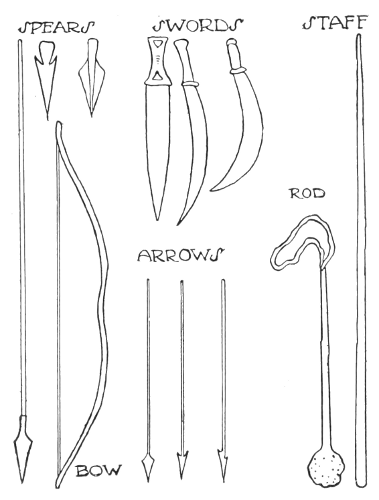
money and food in his bag, and his staff in his hand, and
went out to find his brothers.
At Shechem there were no brothers to be seen. Joseph
was wondering what he should do next, when he saw a man
coming toward him over the field. "What seekest thou?"
said the man. And Joseph answered, "I seek my brethren;
tell me, I pray thee, where they feed their flocks." "They
have departed from here," said the man, "and have gone
to Dothan." Then Joseph went after his brothers and
found them at Dothan.
Now when the brothers saw Joseph afar off, they knew
that it was he from his coat of many colors, and they
plotted against him. One of them said, "Behold, this
dreamer cometh. Come, now, let us slay him, and cast
him into some pit, and we will say unto our father that some
evil beast hath devoured him; and we shall see what will
become of his dreams." Reuben, one of the brothers, felt
more kindly toward Joseph than did the others and said
to them, "Let us not kill him, but let us cast him into this
pit that is near." Reuben thought that he would come
back later after the brothers had gone and help Joseph out
of the pit and take him to his father.
When Joseph came to his brothers, they quickly took the
coat of many colors from him and bound him and cast him
into an old well which was dry. Then they sat down to eat
bread. They had hardly become settled when one of them
cried out, "Behold, I see a caravan! It is a company of
Ishmaelites, with their camels bearing spicery and balm
and myrrh, going down to Egypt." Then Judah said,
"Why do we slay our brother and conceal his blood?
Come, let us sell him to these Ishmaelites, and let not our
hand be upon him, for he is our brother and our flesh."
The brothers were content to do as Judah had said. They
drew Joseph up out of the well, and when the Ishmaelites
came near they sold him to them for twenty pieces of silver.
And the brothers went away to kill a goat so that they
might dip Joseph's coat into the blood, that their father
might think that he had been killed by some wild animal.
Reuben did not know that Joseph had been sold, and
returned unto the pit after the brothers had left. When he
saw that Joseph was not there, he rent his clothes, and ran
after the others, crying, "The child is not, and I, whither
shall I go?"
And when the brothers brought Joseph's coat to their
father, they said, "This we have found, thou knowest if
it be thy son's coat." And Jacob knew it, and said, "It
is my son's coat; an evil beast hath devoured him."
Then Jacob put on sackcloth and ashes and mourned for
Joseph many days.
Now the Ishmaelites brought Joseph down into Egypt
and sold him to Potiphar, a captain of King Pharaoh's
guard. And Joseph was faithful and served the Lord, and
Potiphar saw that he could be trusted with great responsibility
and made him ruler over his household. But Potiphar's
wife grew jealous of Joseph and disliked him, and
told Potiphar things which were untrue about Joseph.
After awhile Potiphar began to believe his wife and he
decided that Joseph was not a good man, so he had Joseph
cast into prison.
And it came to pass that the butler and the baker of the
king of Egypt were put into prison at the same time that
Joseph was there, and they were placed in his ward. One
morning Joseph found them both very sad and he said unto
them, "Wherefore look ye so sadly today?" And they
said, "We have dreamed a dream and there is no one to
interpret it." Then Joseph said, "Do not interpretations
belong to God? Tell me your dreams, I pray you." And
they told him their dreams, and he gave them the meaning
thereof. To the chief butler he said, "Yet within three
days shall Pharaoh lift up thine head and restore thee to
thy place." But to the chief baker he said, "Yet within
three days shall Pharaoh lift up thy head from off thee, and
shall hang thee on a tree." And it came to pass that on the
third day Pharaoh gave a feast to his servants, and he
restored the chief butler to his place, but he hanged the
chief baker, as Joseph had interpreted.
At the end of two years Pharaoh dreamed a dream. He
was greatly troubled, and sent for all the wise men of the
land to tell him the meaning of his dream, but there was
none that could interpret it unto Pharaoh. Then the
chief butler spoke to the king and said, "I do remember
this day, that when Pharaoh was wroth with his servants
and put both me and the chief baker into the prison, that
we each dreamed dreams in one night; and there was a
young man there, a Hebrew, who interpreted to us our
dreams, and they came to pass as he interpreted, for the
chief baker was hanged and I was restored to my office."
Then Pharaoh sent for Joseph, and they brought him
in hastily out of the dungeon. And Pharaoh said, "I have
dreamed a dream, and there is none that can interpret it,
and I have heard say of thee that thou canst understand a
dream to interpret it." And Joseph answered Pharaoh,
"It is not in me; God shall give Pharaoh an answer of
peace." Then Pharaoh said, "In my dream, behold, I
stood upon the bank of a river; and there came up out of
the river seven fat cows, and they fed in a meadow. And,
behold, seven other cows came up after them, lean and ill
favored; and the lean and ill-favored cows did eat up the
fat and well-favored cows. Then I dreamed again, and,
behold, seven full ears of corn came upon one stalk, and
then seven ears, withered and thin, came up after them,
and devoured the good ears."
And Joseph said to Pharaoh, "God hath shewed Pharaoh
what he is about to do. This is the thing which he is about
to do: Behold, there will come seven years of plenty
throughout the land of Egypt; and there shall rise up after
them seven years of famine, and the famine shall consume
the land. Now, therefore, let Pharaoh look out a man,
discreet and wise, and set him over the land of Egypt, and
let him gather up all the food during the years of plenty
and lay it up in the cities, so that the land shall not perish
in the famine." And the thing was good in the eyes of
Pharaoh, and he said, "Can we find such a one as this is,
a man in whom the spirit of God is? Forasmuch as God
has shewed thee all this, there is none so discreet and wise
as thou art; thou shalt be over my house, and according
to thy word shall all my people be ruled." Pharaoh took
off his ring from his hand and clothed him in fine linen and
put a golden chain around his neck.
Joseph went out from the presence of Pharaoh and went
over all the land of Egypt. He gathered up the food for
seven years, and laid up the food in the cities. And the
seven years of plenteousness that were in all the land of
Egypt were ended, and the seven years of famine began,
and there was famine in all the lands. Then Joseph opened
the storehouses and sold to the Egyptians, and other
countries sent to buy grain from Joseph because they had
stored none.
Now in Canaan Jacob and his eleven sons were suffering
from the famine. They heard that there was food in Egypt,
so Jacob sent down all the brothers, except Benjamin, to
buy food. When they came before Joseph and bowed
themselves to the earth, they knew him not. But Joseph
saw his brothers, and he made himself strange unto them,
and treated them roughly, that they should not know him.
And when they bowed before him Joseph remembered the
dreams that he had dreamed of them. "Ye are spies,"
he said, "ye are come to see the bareness of the land."
They answered him, "We are true men, we are no spies.
Thy servants are twelve brothers, the sons of one man
in Canaan; and, behold, the youngest is this day with our
father, and one is not." "Hereby ye shall be proved,"
said Joseph, "if ye be true men; let one of your brethren
be bound in the prison while ye go and carry grain to your
father's house, but bring back your youngest brother to me."
The brothers took the food back to Canaan, to their
father's tent, and told him what the ruler in Egypt had said.
Jacob mourned and was loath to let Benjamin, his youngest
son, go back to Egypt with them. "My son shall not go
down with you," he said; "for his brother is dead and he is
left alone: if mischief befall him, then shall ye bring down
my gray hairs with sorrow to the grave." But the famine
was great in the land, and they had eaten up all the grain
which they brought from Egypt. The brothers would not
go down again until Jacob had consented to let them take
Benjamin with them. And Judah said unto his father,
"Send the lad with me and we will rise and go, that we may
live and not die. I will be surety for him; if I bring him
not back unto thee, then let me bear the blame forever."
Then Jacob answered, "If it must be so, do this: take the
best of the fruits in the land, and carry down the man a
present, a little balm, and a little honey, spices, and myrrh,
nuts, and almonds and take double money, and take also
your brother, and arise and go unto the man; and God
Almighty give you mercy before the man, that he may send
you away with your other brother and Benjamin."
And the men took the present and double the money
and Benjamin, and went down into Egypt, and stood before
Joseph. When Joseph saw Benjamin, he ordered that the
men be brought to his home, and that a feast be made ready,
and that the other brother be brought out of the prison.
But the men were afraid because they were brought into
Joseph's home, and they bowed themselves to the earth
before him and presented their gifts. Then Joseph was
greatly moved and said unto them, "Is your father well,
the old man of whom ye spake? Is he yet alive?" And
they answered, "Thy servant, our father, is in good health;
he is yet alive." And they bowed down their heads. Then
Joseph lifted up his eyes and saw Benjamin, his mother's
youngest son, and said, "Is this your younger brother of
whom ye spake unto me?" And he said to Benjamin,
"God be gracious unto thee, my son." Joseph was so overcome
by his love for Benjamin that he hastened out of the
room where he could weep alone. And he washed his face
and composed himself and commanded that the food be
served. They all ate and were merry, and Joseph helped
Benjamin to five times as much as he did the others.
Then Joseph commanded the steward to fill the men's
sacks with food, and to put each man's money back into his
sack, and to put his silver cup into the sack of the youngest.
As soon as the morning was light the men were sent away.
And when they were gone out of the city and were not yet
far off, Joseph sent a servant after them to search their sacks
for his silver drinking-cup, and he sent word that the one
who had it should be brought back to him.
Now the brothers were greatly distressed and protested
that they knew nothing of the cup. What was their
astonishment at finding their money in their sacks and the
cup in Benjamin's sack! Then they rent their clothes and
returned to the city. And Judah came to Joseph and fell
on the ground and said, "What shall we say unto my lord?
or how shall we clear ourselves? God hath found out our
sin, behold we are my lord's servants." Then Joseph said,
"Get up and go in peace unto thy father; I shall keep for
my servant only the man in whose sack the cup was found."
And Judah came near to Joseph and besought him that he
allow Benjamin to return to their father; he told him that
he had promised his father to bring the lad back safely,
and that it would kill the old man if they returned without
Benjamin. "Now therefore, I pray thee, let thy servant
abide as a bondman, instead of the lad." Then Joseph
could not refrain himself, and he wept before his brothers
and made himself known to them. "I am Joseph, do ye
not know me? Is my father yet alive?" And the brothers
were troubled, and they did not know how to answer him.
"Come near, I pray you." And they came near, and he
said again, "I am Joseph, your brother, whom ye sold into
Egypt. Now be not grieved nor angry with yourselves
that ye sold me hither, for God did send me before you to
preserve your lives. Haste ye, go up to my father, and
tell him that Joseph, his son, still liveth, and bring him
down unto me." And Joseph fell upon Benjamin's neck and
kissed him, and he kissed all his brothers, and they were
astonished, for they knew now that this was Joseph whom
they had sold.
Now the word was spread over Pharaoh's house that
Joseph's brethren had come, and it pleased Pharaoh greatly.
He came in where they were and said unto Joseph, "This
do ye: Say to your brethren that they are commanded
to go back into Canaan, and to pack all their household
goods, and to bring their father and their families, and all
their flocks, and to return into the land of Egypt, for all
the good of the land shall be theirs."
Then the brothers were joyful, and gave thanks unto
Pharaoh and to their brother, Joseph, and they left the
city to go back to their father. And when they came unto
Jacob and told him all, and showed him the wagons which
Joseph had sent to bring him down into Egypt, his soul
rejoiced, and he said, "It is enough; Joseph, my son, is
still alive: I will go and see him before I die."
The children decided that it would take a great
many scenes in order to act out the story adequately.
At first they mentioned seven or eight.
One child was asked to describe the first scene as
he thought it ought to be, and several others added
to the description. Volunteers were then called
upon to act it out then and there.
The first scene was placed in front of Jacob's
tent. Jacob is anxiously awaiting the return of his
ten sons with the flocks. He becomes worried
because they do not come, so he sends Joseph to
seek his brothers. Joseph accepts the command
and leaves the tent.
This scene was acted very naturally and spontaneously
by several groups of children. Each
time it was changed, for no two groups of children
interpreted the action or words alike.
The children who were not acting were made to
feel their responsibility also, for they were asked to
make note of the best parts. A general discussion
was held at the end of each presentation, in which
the good points were emphasized and suggestions
were given as to improvement. The criticism in
all of this work comes for the most part from the
children; the leader in charge directs it, but keeps
from imposing her opinions.
As the meetings of this dramatic club last but
one hour, nothing more could be done than work
out one scene at this first time. The children were
asked to think the story over and to come the next
Sunday prepared to suggest the second and third
scenes in detail.
At the next meeting the second and third scenes
were worked out in the same manner as the first.
The second scene places Joseph at Shechem.
Here he meets the man who tells him that his
brothers have gone to Dothan.
In the third scene the brothers are seated on the
ground eating and resting, with their shepherd
staffs beside them; they begin to talk about Joseph
and to tell of his dream and their hatred of him.
Just at this point Joseph runs in and gives his
father's message. He also tells of his experience
in Shechem in not finding them there. Then the
brothers take him and bind him and throw him
into the pit. The caravan comes along and
Joseph is sold and taken away. After the brothers
depart, Reuben, not knowing that Joseph has been
sold, comes back to the pit, hoping to help him out.
When he finds the boy gone, he weeps and goes
sorrowfully away. (A doorway which leads off
from the stage at the back was used for the pit.
There were no camels in the caravan; the men
walked by.)
During the next hour scenes which describe
Joseph's life in Egypt were roughly blocked out.
The children made up their words as they acted
the parts. The language at this stage was very
modern, but for the time being the emphasis was
placed upon the thought expressed and upon the
action.
Several of the older girls volunteered to write out
the first few scenes in order to bring the language
into better form. At the fourth meeting these
were brought in and discussed by the children.
The following is a version of the first scene just
as it was written by a girl of twelve years. It is
given here that the contrast may be seen between
this as a piece of work which may be made better
and the final play at the end of the chapter.
Jacob: It is time my sons are returning with their
flocks. See if thou canst see them coming.
[Exit servant.]
First Lady: Yes, they have been gone a long time. We
have only Joseph and Benjamin with us.
[Enter servant.]
Jacob: What didst thou see?
Servant: Master, I saw nothing of your sons.
Jacob: I shall send Joseph after them. Bring Joseph
hither. [Turns to another servant.] Bring a bag of food
for him to take with him on his journey.
[Servants leave. Jacob looks away, hoping to see his sons.]
Jacob: I do not see them. What can be the matter?
[Enter Joseph with servant.]
Second Lady: Joseph will be sure to find them.
Jacob: Joseph, my son, I am sending thee after thy
brethren. Take this food to Shechem and bring thy
brethren back to me.
Joseph: I will do as thou bidst.
[Jacob stands and puts his hand on Joseph.]
Jacob: May the Lord go with thee.
End
The third scene was written by a girl of eleven
years and was as follows:
[All brothers look down the road.]
All Brothers: What shall we do with him?
Seventh Brother: I know; let's kill him!
All except Reuben: Yea! Yea!
Reuben: Nay, do not kill him; let's put him in a deep pit.
Tenth Brother: Well, all right.
[Joseph appears; exit Reuben.]
Joseph: Ah, I have found ye at last, my brethren.
[All grab Joseph.]
Joseph: What have I done to deserve this?
Fourth Brother: Get some rope!
[Exit sixth brother and brings some rope back with him.
Eighth and ninth brothers bind Joseph with ropes. All
take hold of him and push him into the pit.]
Tenth Brother: But what shall we tell our father?
Eighth Brother: Let's tell him that Joseph was killed
by a wild beast.
Ninth Brother: We will take his coat of many colors,
which our father gave him, and dip it in the blood of a goat.
All: Yea! Yea!
[Seventh brother sees some merchants.]
Seventh Brother: I see merchants in the distance. Let's
sell Joseph to them.
[One brother goes after the merchants, while the others bring
Joseph from the pit. Merchants enter.]
Tenth Brother: What will ye give us for this lad?
Merchant: I guess we can give ye about twenty pieces
of silver.
[Merchants take Joseph with them. Brothers go on their
way. Enter Reuben after his brothers have gone.
He runs to the pit.]
Reuben: Joseph! Joseph! Where art thou? The lad
is gone. Whither shall I go?
[Reuben goes away, sobbing and wringing his hands.]
End
At the meeting when these were read the children
began to criticize the length of the play. One
little boy made the remark, "We keep telling the
same things over; why can't we leave out that
second scene? It is so short, and Joseph could
tell his brothers in the third scene that he didn't
find them at Shechem." This suggestion was
readily accepted, and as a consequence the second
scene was omitted. Then the entire group consciously
worked on the play to see what parts were
unnecessary. Several children had recently been
to the theater and had seen some good plays.
They told the others that there were few scenes
and that there was much left to the imagination
of the audience. The result was that this long-drawn-out
play was cut down to three essential
scenes. The first scene was placed at Dothan, and
was much the same as the original scene iii. The
second scene was placed at Pharaoh's palace where
Joseph was brought to interpret the king's dream.
The third represented the brothers coming to
Joseph with Benjamin, the youngest, ending with
Joseph's forgiveness of them and his sending for
Jacob, their father.
After these three scenes were decided upon, the
older children were asked to begin writing them out
in final form.
At the fifth meeting of the club all the children
sat in a circle with Bibles and pencils and paper
and, together with the leader, they formulated the
speeches, making them conform as nearly as possible
to those in the Bible. The work that had been
done outside was discussed and built upon. This
part of the procedure did not take as long a time
as it may seem, because the children knew so well
what thoughts they wanted to express—they had
lived the story so many times. They practiced
after this, using the words they had decided upon.
For the next meeting or two the children acted
out the play, trying each time to improve it by
better interpretations of the parts. The fact that
they had learned definite words did not in the least
check the freedom of the action or cause the play
to lose the spontaneity which first characterized
it, for the reason that the story had quite become
a part of the children before they decided upon the
set speeches.
The question arose as to which children should
take certain parts. In some instances several
wanted to learn the part of one particular character.
They were each given the opportunity of
learning it, and then at the next meeting each
acted it as best he or she could before the group.
The other children were judges and decided upon
the one who seemed to represent the character
best. Whenever this method of choosing characters
has been employed there has never been any
hard feeling on the part of a child because he was
not chosen. The justice of the choice is quickly
recognized when it comes in this way rather than
from the leader.
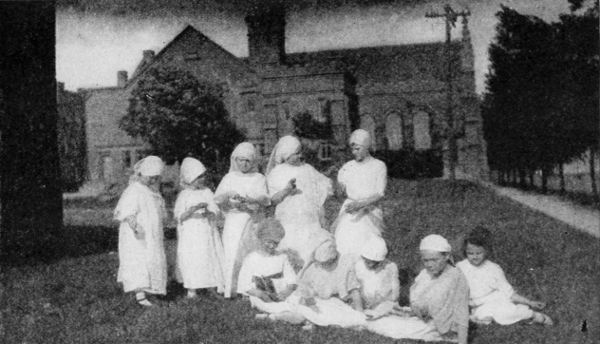
There were many little children in this club who
were scarcely old enough to learn a part or to say
very much. They were easily worked into the
caravan, or they took such parts as servants in
Pharaoh's court. Each child was made to feel that
one part was just as important as another and that
those who had nothing to say were very essential
elements because of their acting.
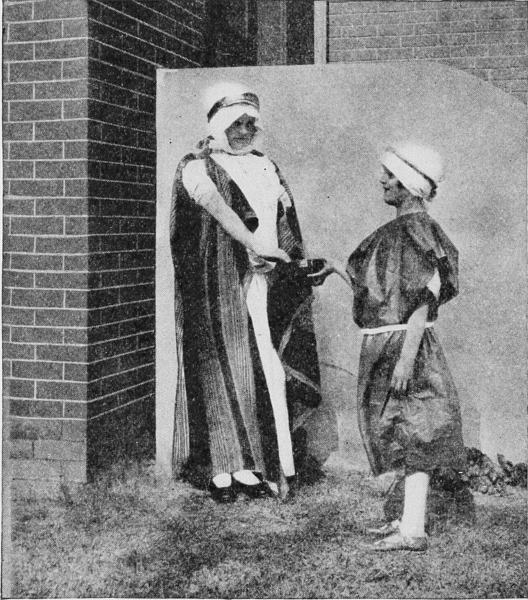
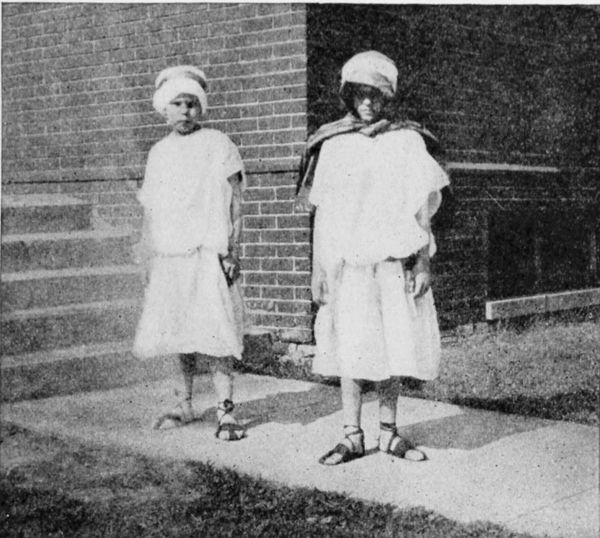
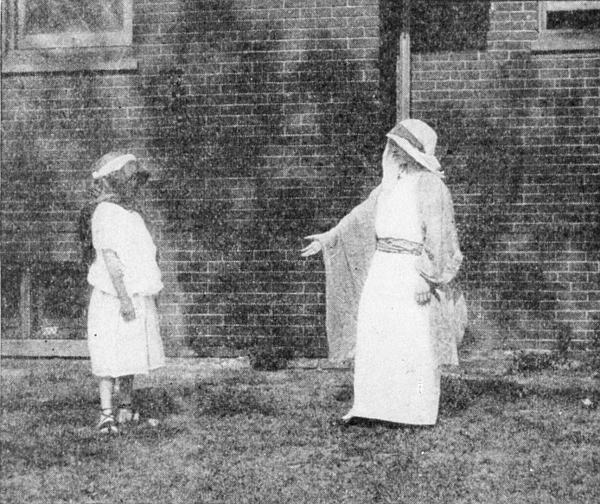
Eight or nine meetings were needed before the
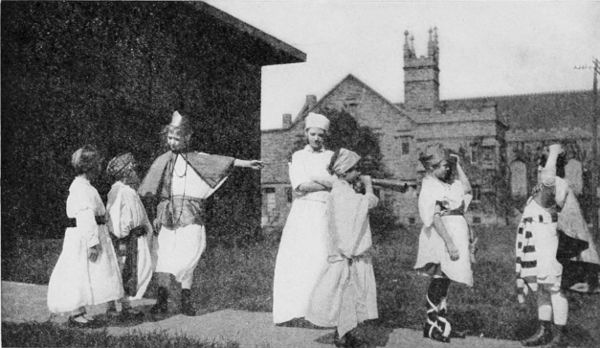
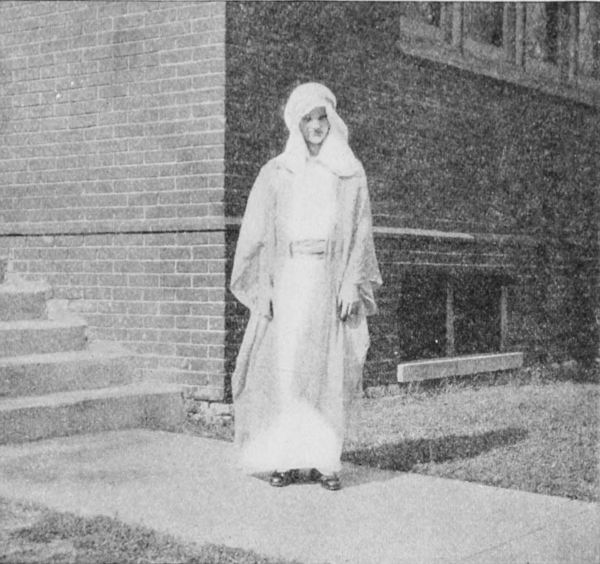
play was entirely finished. The children had very
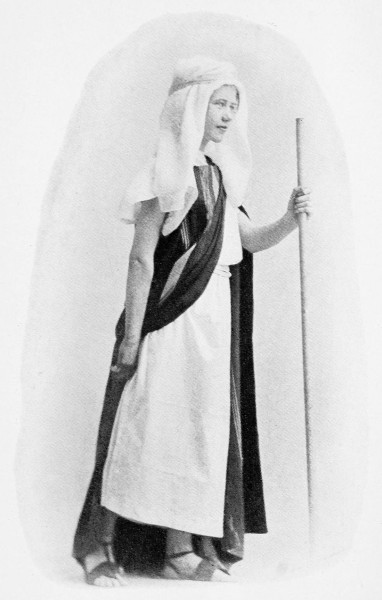
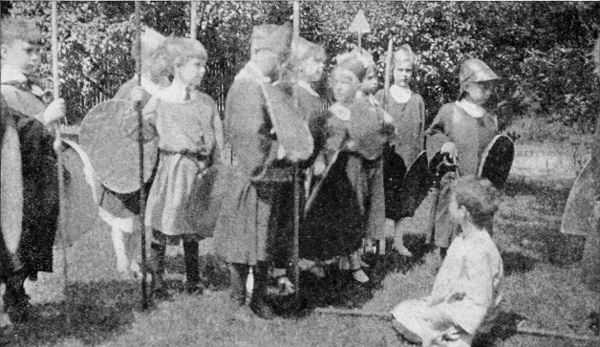
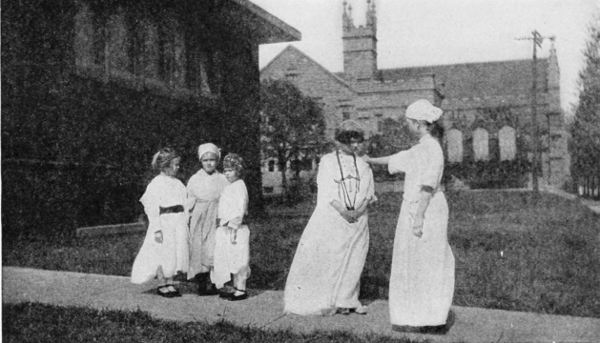
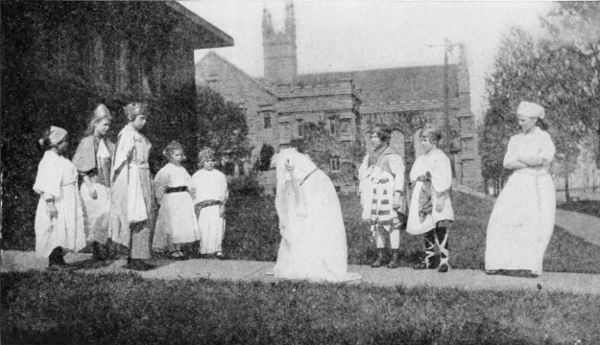
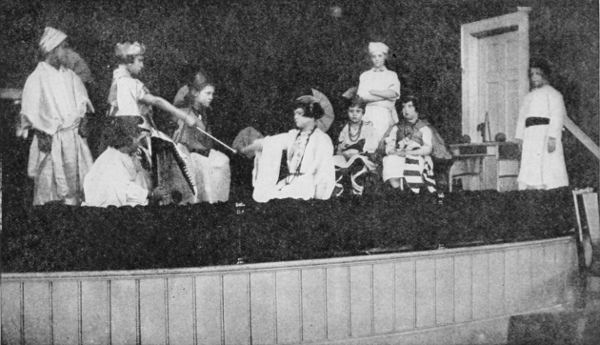
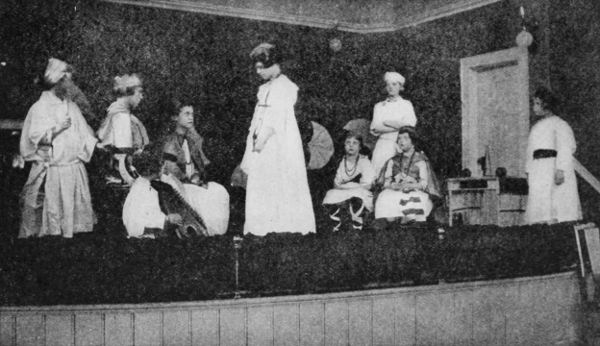
simple slips for costumes which they had been wearing
at each rehearsal. Bright-colored sashes and
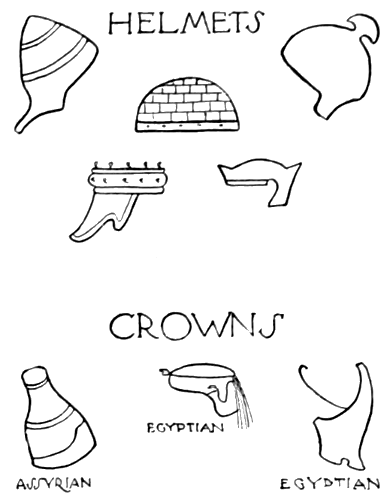
headdresses they brought from home. Pharaoh
was more gaily dressed than the others. The child
who took the part made for himself many ornaments
from gilt paper.
Very little attention was given to stage setting,
what was used was extremely simple. A few of
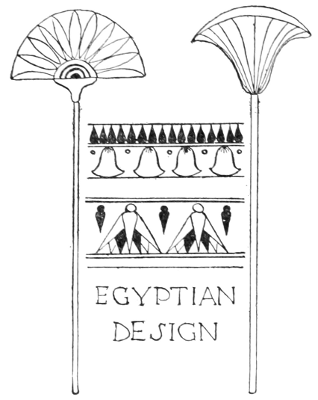
the older girls made designs from the Egyptian
lotus to stand around the walls of Pharaoh's
palace or to be carried by the servants. Colored
illustrations of Bible stories by Tissot were suggestive
helps in these details. The ten brothers
made themselves shepherd staffs from limbs of
trees. This small amount of stage setting and
costuming was used at many rehearsals and was all
that was necessary to produce the right atmosphere.
As soon as the children felt that the play represented
their best effort they invited their parents
and friends and presented it before them one
Sunday afternoon at the time for the regular
meeting.
It happened that a few days before the final
presentation four of the principal characters were
taken ill with measles and chicken-pox. Four
others, who had not given special attention to these
parts, but who had minor parts, assumed the
important rôles and went straight through the
play with no trouble whatever. The audience
never knew the difference and the children thought
that it was entirely natural that they should be
able to do this. The play all the way through was
characterized by a spirit of dignity and seriousness.
As direct results of this work in dramatization
it was noted that all the children had acquired a
certain freedom of expression, a self-confidence,
without conceit or too much sureness, and the
ability to work harmoniously with the group.
One or two timid children learned to forget themselves,
and one overconfident child was helped
by seeing that others could learn to do the part
even a little better than herself.
The children who took part in this little play of
Joseph will never forget it. Several years after
the play was given they were frequently referring
to it with great happiness. Joseph is one of their
favorite characters because they have lived through
his experiences with him.
The following is the play as it was given in its
final form. It is not to be taken as a play which
may be given to children to be learned as it is; it
is given here that there may be some idea of the
standard which may be reached.
Place: Dothan.
Characters: Reuben, Simeon, Levi, Judah, Issachar,
Zebulun, Dan, Naphtali, Gad, Asher, Joseph, Several
Ishmaelitish Merchants.
[The ten brothers are sitting and lounging on the ground,
eating bread.]
Reuben: Shall we stay longer in this place? Our
flocks have fed well in Shechem and Dothan. Let us
return again unto Canaan and to the tent of our father,
Jacob.
Judah: Oh, why should we go back? Our father loveth
us not! It is Joseph, our younger brother, that he favoreth!
Levi: Yes, this Joseph! This dreamer of dreams! He
thinketh he is greater than we. He thinketh he shall rule
over us!
Judah: Ye heard him when he said, "Hear this dream
which I have dreamed: Behold, we were binding sheaves
in the field, and, lo, my sheaf arose, and stood upright;
and, behold, your sheaves stood round about, and bowed
down to my sheaf."
Simeon: Ha! Shall he indeed reign over us? Or
shall he have dominion over us?
Levi: Yea, and he dreamed yet another dream, for he
said, "Behold, the sun and the moon and the eleven stars
bowed down unto me."
Dan: What is this dream which he has dreamed?
Shall his mother and father and eleven brethren indeed
come to bow down themselves to him?
Simeon: Joseph and his dreams are hateful unto me!
I was glad when our father said to us, "Take the flocks to
feed in Shechem," for now we are free of him.
Levi: It seemeth to me that I see this Joseph, this
dreamer whom we hate. He is yet afar off, but he surely
approacheth us!
Reuben: Can it be he?
Dan: Yes, for I see the coat of many colors, the coat
our father made for his favorite son.
Levi: Why should he come to us? Cannot our father
trust the flocks to our hands without sending this Joseph
to spy on us?
Dan: It is he! It is Joseph!
Simeon: What shall we do?
Judah: Our time is come. We despise him; let us
slay him.
Reuben: Nay, thou dost not mean to slay him!
Several: Nay! Nay!
Judah: We must surely slay him. We must rid ourselves
of this dreamer. Think how he said he should reign
over us! Let us be rid of him!
Simeon: Yes, thou art right—we must slay him.
Several: Yea, yea, slay him! Destroy him! He shall
dream no more such dreams!
Simeon: Behold, this dreamer cometh near! Come,
now, and let us slay him, and cast him into some pit, and
we will say, "Some evil beast hath devoured him," and we
shall see what will become of his dreams.
Reuben: Let us not kill him. Shed no blood, but cast
him into this pit that is in the wilderness, and lay no hand
upon him.
[Reuben goes away.]
[Joseph runs up. Gad lays one hand roughly on his shoulder.]
Gad: How comes it that thou art here? What is thy
business?
Joseph: My father commanded me and said, "Go, I
pray thee, and see whether it be well with thy brethren and
well with the flocks; and bring me word again." So he
sent me out of the vale of Hebron, and I came to Shechem.
And you were not there, and I came on after you and found
you here. What troubleth you? Hath aught happened
to the flocks?
Simeon: Hear his tale! This dreamer of dreams! So
he would reign over us, would he! Strip him of his coat
of many colors! This favored son!
[Brothers bind Joseph and cast him into the pit.]
Joseph: What have I done to deserve this?
[Brothers sit down again to eat their bread.]
Gad: Behold, I see a caravan!
Simeon: From what country?
Gad: It is a company of Ishmaelites, from Gilead, with
their camels, bearing spicery and balm and myrrh, going
down into Egypt.
Judah: What doth it profit if we slay our brother and
conceal his blood? Come, let us sell him to these Ishmaelites
and let not our hand be upon him, for he is our
brother and our flesh.
Several: So be it.
Gad: Hail the caravan, and bargain with these men.
Simeon [salutes the head man of the caravan; the brothers
listen attentively; Gad brings Joseph out of the pit]: What
wilt thou give us in exchange for this lad? We would sell
him.
Merchant [looks Joseph over, then consults with his men]:
Twenty pieces of silver will we give for him.
Simeon [to the brothers]: These merchants will give us
twenty pieces of silver for this dreamer.
All: Sell him! Sell him!
[Joseph is taken over by the merchants and they all move on.
The brothers are dividing out the money.]
Gad: The lad is gone with the merchants, but what
excuse shall we make unto our father?
Simeon: Say unto him that a wild beast hath devoured
him. Here is his coat of many colors—we will kill a goat
and dip the coat in the blood! Then our father, Jacob,
will grieve for his son!
All: As thou sayest, so let us do!
[Brothers move off stage, discussing the money. Reuben
comes back. He runs and looks in the pit. He tears his
clothes when he finds that Joseph is not there.]
Reuben: The child is not, and I, whither shall I go?
Place: Egypt. In Pharaoh's palace.
Characters: Pharaoh, Joseph, Wise Men, Chief
Butler, Servants.
[Pharaoh is sitting on his throne; many wise men come in
and bow down before him.]
Pharaoh: Arise, O wise men of Egypt! I have sent
for you this day because of a dream which troubleth me.
[Men stand up.]
Wise Men: What is thy dream, O King?
King: I dreamed, and, behold, I stood by a river, and
there came up out of the river seven fat cows, and they
fed in a meadow. And, behold, seven other cows came up
after them out of the river, ill-favored and lean. And the
ill-favored and lean cows did eat up the seven well-favored
and fat cows. Then did I awake, but the second time I
slept and dreamed. And, behold, seven good ears of corn
came up upon one stalk, and, behold, seven thin ears
sprung up after them, and the seven thin ears devoured
the seven full ears. And I awoke again, and, behold, it
was a dream. Now, is there one among you who can tell
me the meaning of these dreams, for my spirit is troubled
because of them?
[The wise men in turn come out and bow before the king
and say]:
First Wise Man: O my lord King, thy dream troubleth
me, but I am not able to interpret it.
Second Wise Man: O King, also, I cannot tell thee the
meaning of thy dream.
Third Wise Man: Most gracious King, I, also, am
unable to interpret thy dream.
Fourth Wise Man: O great Pharaoh, I regret that I
am unable to help thee.
Pharaoh [angrily]: Are ye called the wise men of Egypt,
and yet are ye not able to interpret a dream?
[The chief butler comes forward and falls before the king.]
Butler: O great King, I am only thy chief butler, but
I beg of thee allow me to speak.
King: Speak, butler, what wouldst thou say?
Butler: O King, I do remember my faults this day.
When Pharaoh was wroth with his servants and put me
in prison, both me and the chief baker, behold, we dreamed
a dream in one night, and there was a young man, a Hebrew,
and we told him, and he interpreted to us our dream. And
it came to pass as he interpreted unto us, for I was restored
unto mine office and the baker was hanged.
Pharaoh: Send for this young Hebrew; bring him into
my presence. [Servant goes out for Joseph.] Butler, who
is this boy that interpreted thy dream?
Butler: His name is Joseph, O King. He was brought
down from Canaan by a caravan and was sold to Potiphar,
the captain of Pharaoh's guard. But he displeased Potiphar,
so he was thrown into prison at the time thy servants were
there.
[Enter Joseph.
He falls on his face before Pharaoh.]
Pharaoh: I have dreamed a dream, and there is none
that can interpret it, and I have heard say of thee that thou
canst understand a dream to interpret it.
[Joseph rises.]
Joseph: It is not in me; God shall give Pharaoh an
answer of peace.
Pharaoh: [Repeats his dream to Joseph.]
[Joseph comes nearer to Pharaoh.]
Joseph: What God is about to do he sheweth unto
Pharaoh: Behold, there will come seven years of great
plenty throughout all the land of Egypt. And there shall
arise after them seven years of famine. And all the plenty
shall be forgotten throughout Egypt, and the famine shall
consume the land, and it shall be very grievous. Now
therefore let Pharaoh look out a man discreet and wise and
set him over the land of Egypt, and let him appoint officers
over the land. And let them gather all the food of those
good years that come, and lay up corn under the hand of
Pharaoh. And let them keep food in the cities. And
that food shall be stored against the seven years of famine,
that the land may not perish through famine.
Pharaoh: This plan seemeth good unto me. Can we
find such a one as this is, a man in whom the spirit of God is?
The Wise Men: Nay, O King, he is most wise.
Pharaoh: Forasmuch as God hath shewed thee all this,
thou shalt be over my house, and according to thy word
shall all my people be ruled, only in the throne will I be
greater than thou. See, I have set thee over all the land of
Egypt. [To his servants:] Bring a golden chain, and fine
raiment for this man.
[He puts a ring on Joseph's hand. When the clothes are
brought they are put around him, the chain on his neck, etc.]
Pharaoh: Thou shalt ride in the second chariot and all
my people shall bow the knee unto thee. [All people in the
room bow.] I am Pharaoh, and without thee shall no man
lift up his hand or foot in all the land of Egypt.
Joseph: May the Lord God give me power to do his will.
Place: Pharaoh's palace.
Characters: Joseph, His Eleven Brothers, Servants,
Pharaoh.
[Joseph is seated on his high seat. A servant comes in.]
Servant: Master, the men that came down from Canaan
to buy food of thee have returned and would have a word
with thee.
Joseph: Bring them in. [To another servant]: Go
see that a feast is prepared for these men.
[The brothers enter bringing Benjamin. They all fall on
their faces.]
Joseph: Arise! And have you returned bringing with
you your youngest brother?
Reuben: O sir, we have brought our youngest brother;
he is here.
[Benjamin is led forward. Joseph goes near and puts his
hand on Benjamin.]
Joseph: And is this your younger brother of whom ye
spake unto me? God be gracious unto thee, my son!
[To the brothers:] Is your father well, the old man of whom
ye spake? Is he yet alive?
Levi: Thy servant, our father [all bow heads], is in good
health; he is yet alive.
[Joseph turns away and begins to weep; he leaves them
abruptly and walks to the other side of the room.]
Joseph [to the servants]: Cause every man to go out
from me! [All begin to leave the room, brothers included.]
[To the brothers. He walks quickly after them and holds
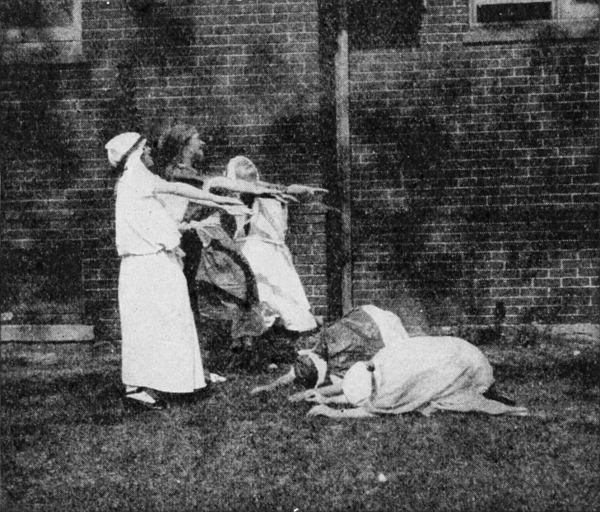
his arms out toward them.] Stay! I am Joseph; doth my
father yet live? Come near to me, I pray you. [They
come somewhat nearer and fall to the ground.] I am Joseph,
your brother, whom ye sold into Egypt. Now, therefore,
be not grieved nor angry with yourselves, that ye sold me
thither, for God did send me before you to preserve life.
For these two years hath the famine been in the land; and
yet there are five years more. God hath sent me before
you to save your lives. Haste ye, and go up to my father,
and say unto him, "Thus saith thy son Joseph, God hath
made me lord of all Egypt. Come down unto me, and tarry
not. And thou shalt be near unto me, thou and thy children,
and thy flocks, and thy herds and all thou hast. Oh,
do you not see that I am Joseph that speak unto you?"
[He weeps again and turns away.]
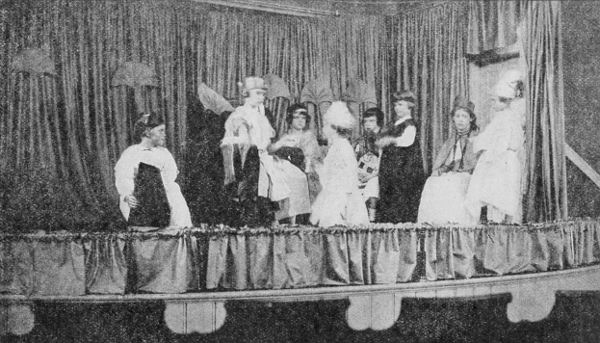 Fig. 1.—Pharaoh's court
Brothers: Joseph, our brother Joseph! Can he forgive
us?
[Pharaoh enters here]
Joseph: O King, these are my brethren, and from my
father's tent.
Pharaoh: Say unto thy brethren: "This do ye: Go
back unto the land of Canaan and take your father and
your household goods, and come unto me. And I will
give you the good of the land of Egypt, and ye shall eat
of the fat of the land. Now ye are commanded: This do
ye: Take ye wagons out of Egypt for your little ones, and
for your wives, and bring your father, and come, for the
good of the land shall be yours."
One Brother: We thank thee, O great Pharaoh, and our
brother Joseph. This is greater than we deserve. We will
bring our father down straightway.
Joseph: Praise be to God who has done this good thing!
End