Intense Application as a Student.—Habits of Study kept up during his Vacations.—First
Preparations made for Building at Monticello.—Letters to his
College Friend, John Page.—Anecdote of Benjamin Harrison.—Jefferson's
Devotion to his eldest Sister.—He witnesses the Debate on the Stamp
Act.—First Meeting with Patrick Henry.—His Opinion of him.—His superior
Education.—Always a Student.—Wide Range of Information.—Anecdote.—Death
of his eldest Sister.—His Grief.—Buries himself in his
Books.—Finishes his Course of Law Studies.—Begins to practise.—Collection
of Vocabularies of Indian Languages.—House at Shadwell burnt.—Loss
of his Library.—Marriage.—Anecdote of his Courtship.—Wife's
Beauty.—Bright Prospects.—Friendship for Dabney Carr.—His Talents.—His
Death.—Jefferson buries him at Monticello.—His Epitaph.
Great as were the charms and delights of the society
into which Jefferson was thrown in Williamsburg, they had
not the power to draw him off from his studies. On the
contrary, he seemed to find from his intercourse with such
men as Wythe and Small, fresh incentives to diligence in his
literary pursuits; and these, together with his natural taste
for study, made his application to it so intense, that had he
possessed a less vigorous and robust constitution, his health
must have given way. He studied fifteen hours a day.
During the most closely occupied days of his college life it
was his habit to study until two o'clock at night, and rise at
dawn; the day he spent in close application—the only recreation
being a run at twilight to a certain stone which stood
at a point a mile beyond the limits of the town. His habits
of study were kept up during his vacations, which were
spent at Shadwell; and though he did not cut himself off
from the pleasures of social intercourse with his friends and
family, yet he still devoted nearly three-fourths of his time
to his books. He rose in the morning as soon as the hands
of a clock placed on the mantle-piece in his chamber could
be distinguished in the gray light of early dawn. After
sunset he crossed the Rivanna in a little canoe, which was
kept exclusively for his own use, and walked up to the summit
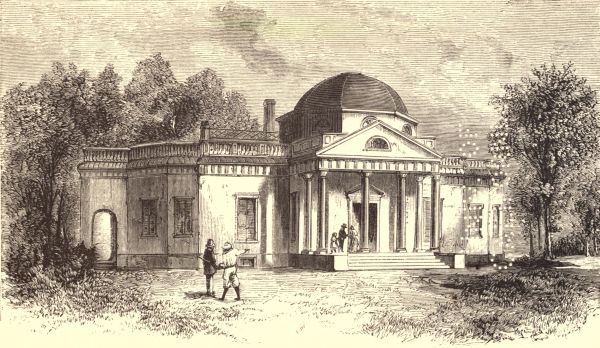
of his loved Monticello, where he was having the apex
of the mountain levelled down, preparatory to building.
The following extracts from letters written to his friends
while he was a college-boy, give a fair picture of the sprightliness
of his nature and his enjoyment of society.
To John Page—a friend to whom he was devotedly attached
all through life—he writes, Dec. 25, 1762:
You can not conceive the satisfaction it would give me to
have a letter from you. Write me very circumstantially
every thing which happened at the wedding. Was she[4]
there? because if she was, I ought to have been at the devil
for not being there too. If there is any news stirring in
town or country, such as deaths, courtships, or marriages, in
the circle of my acquaintance, let me know it. Remember
me affectionately to all the young ladies of my acquaintance,
particularly the Miss Burwells, and Miss Potters; and tell
them that though that heavy earthly part of me, my body,
be absent, the better half of me, my soul, is ever with them,
and that my best wishes shall ever attend them. Tell Miss
Alice Corbin that I verily believe the rats knew I was to
win a pair of garters from her, or they never would have
been so cruel as to carry mine away. This very consideration
makes me so sure of the bet, that I shall ask every body
I see from that part of the world, what pretty gentleman is
making his addresses to her. I would fain ask the favor of
Miss Becca Burwell to give me another watch-paper of her
own cutting, which I should esteem much more, though it
were a plain round one, than the nicest in the world cut by
other hands; however, I am afraid she would think this presumption,
after my suffering the other to get spoiled.
A few weeks later, he writes to Page, from Shadwell:
To tell you the plain truth, I have not a syllable to write
to you about. For I do not conceive that any thing can
happen in my world which you would give a curse to know,
or I either. All things here appear to me to trudge on in
one and the same round: we rise in the morning that we
may eat breakfast, dinner, and supper; and go to bed again
that we may get up the next morning and do the same; so
that you never saw two peas more alike than our yesterday
and to-day. Under these circumstances, what would you
have me say? Would you that I should write nothing but
truth? I tell you, I know nothing that is true. Or would
you rather that I should write you a pack of lies? Why,
unless they are more ingenious than I am able to invent,
they would furnish you with little amusement. What can
I do, then? Nothing but ask you the news in your world.
How have you done since I saw you? How did Nancy look
at you when you danced with her at Southall's? Have you
any glimmering of hope? How does R. B. do? Had I better
stay here and do nothing, or go down and do less? or, in
other words, had I better stay here while I am here, or go
down that I may have the pleasure of sailing up the river
again in a full-rigged flat? Inclination tells me to go, receive
my sentence, and be no longer in suspense; but reason
says, If you go, and your attempt proves unsuccessful, you
will be ten times more wretched than ever.... I have
some thoughts of going to Petersburg if the actors go there
in May. If I do, I do not know but I may keep on to Williamsburg,
as the birth-night will be near. I hear that Ben
Harrison[5] has been to Wilton: let me know his success.
In his literary pursuits and plans for the future, Jefferson
found a most congenial and sympathizing companion, as well
as a loving friend, in his highly-gifted young sister, Jane
Jefferson. Three years his senior, and a woman of extraordinary
vigor of mind, we can well imagine with what pride
and pleasure she must have watched the early development
and growth of her young brother's genius and learning.
When five years old, he had read all the books contained in
his father's little library, and we have already found him
sought out by the royal Governor, and chosen as one of his
favorite companions, when but a college-boy. Like himself,
his sister was devoted to music, and they spent many hours
together cultivating their taste and talent for it. Both
were particularly fond of sacred music, and she often gratified
her young brother by singing for him hymns.
We have seen, from his letters to his friend Page, that,
while a student in Williamsburg, Jefferson fell in love with
Miss Rebecca Burwell—one of the beauties of her day. He
was indulging fond dreams of success in winning the young
lady's heart and hand, when his courtship was suddenly cut
short by her, to him, unexpected marriage to another.
In the following year, 1765, there took place in the House
of Burgesses the great debate on the Stamp Act, in which
Patrick Henry electrified his hearers by his bold and sublime
flights of oratory. In the lobby of the House was seen
the tall, thin figure of Jefferson, bending eagerly forward to
witness the stirring scene—his face paled from the effects of
hard study, and his eyes flashing with the fire of latent genius,
and all the enthusiasm of youthful and devoted patriotism.
In allusion to this scene, he writes in his Memoir:
When the famous resolutions of 1765 against the Stamp
Act were proposed, I was yet a student of law in Williamsburg.
I attended the debate, however, at the door of the
lobby of the House of Burgesses, and heard the splendid display
of Mr. Henry's talents as a popular orator. They were
indeed great; such as I have never heard from any other
man. He appeared to me to speak as Homer wrote.
It was when on his way to Williamsburg to enter William
and Mary College, that Jefferson first met Henry.
They spent a fortnight together on that occasion, at the
house of Mr. Dandridge, in Hanover, and there began the
acquaintance and friendship between them which lasted
through life. While not considering Henry a man of education
or a well-read lawyer, Jefferson often spoke with enthusiasm
to his friends and family of the wonders and beauties
of his eloquence, and also of his great influence and signal
services in bringing about unanimity among the parties
which were found in the colony at the commencement of the
troubles with the mother-country. He frequently expressed
admiration for his intrepid spirit and inflexible courage.
Two years before his death we find him speaking of Henry
thus:
Wirt says he read Plutarch's Lives once a year. I don't
believe he ever read two volumes of them. On his visits to
court, he used always to put up with me. On one occasion
of the breaking up in November, to meet again in the spring,
as he was departing in the morning, he looked among my
books, and observed, "Mr. Jefferson, I will take two volumes
of Hume's Essays, and try to read them this winter." On
his return, he brought them, saying he had not been able to
get half way into one of them.
His great delight was to put on his hunting-shirt, collect a
parcel of overseers and such-like people, and spend weeks together
hunting in the "piny woods," camping at night and
cracking jokes round a light-wood fire.
It was to him that we were indebted for the unanimity
that prevailed among us. He would address the assemblages
of the people at which he was present in such strains
of native eloquence as Homer wrote in. I never heard any
thing that deserved to be called by the same name with
what flowed from him; and where he got that torrent of
language from is inconceivable. I have frequently shut my
eyes while he spoke, and, when he was done, asked myself
what he had said, without being able to recollect a word of
it. He was no logician. He was truly a great man, however—one
of enlarged views.
Mr. Jefferson furnished anecdotes, facts, and documents for
Wirt's Life of Henry, and Mr. Wirt submitted his manuscript
to him for criticism and review, which he gave, and
also suggested alterations that were made. We find, from
his letters to Mr. Wirt, that when the latter flagged and hesitated
as to the completion and publication of his work, it
was Jefferson who urged him on. In writing of Henry's
supposed inattention to ancient charters, we find him expressing
himself thus: "He drew all natural rights from a
purer source—the feelings of his own breast."[6]
In connection with this subject, we can not refrain from
quoting from Wirt the following fine description of Henry
in the great debate on the Stamp Act:
It was in the midst of this magnificent debate, while he
(Henry) was descanting on the tyranny of the obnoxious
act, that he exclaimed, in a voice of thunder, and with the
look of a god, "Cæsar had his Brutus, Charles the First his
Cromwell, and George the Third—" ("Treason!" cried the
Speaker. "Treason! treason!" echoed from every part of
the House. It was one of those trying moments which are
so decisive of character. Henry faltered not an instant; but
rising to a loftier altitude, and fixing on the Speaker an eye
of the most determined fire, he finished his sentence with the
firmest emphasis)—"may profit by their example. If this
be treason, make the most of it."[7]
When we think of the wonderful powers of this great
man, whose heaven-born eloquence so stirred the hearts of
men, how touching the meekness with which, at the close of
an eventful and honorable career, he thus writes of himself:
"Without any classical education, without patrimony, without
what is called the influence of family connection, and
without solicitation, I have attained the highest offices of
my country. I have often contemplated it as a rare and extraordinary
instance, and pathetically exclaimed, 'Not unto
me, not unto me, O Lord, but unto thy name be the praise!'"[8]
Jefferson continued to prosecute his studies at William
and Mary, and we have in the following incident a pleasing
proof of his generosity:
While at college, he was one year quite extravagant in
his dress, and in his outlay in horses. At the end of the
year he sent his account to his guardian; and thinking that
he had spent more of the income from his father's estate
than was his share, he proposed that the amount of his expenses
should be deducted from his portion of the property.
His guardian, however, replied good-naturedly, "No, no; if
you have sowed your wild oats in this manner, Tom, the
estate can well afford to pay your expenses."
When Jefferson left college, he had laid the broad and
solid foundations of that fine education which in learning
placed him head and shoulders above his contemporaries.
A fine mathematician, he was also a finished Greek, Latin,
French, Spanish, and Italian scholar. He carried with him
to Congress in the year 1775 a reputation for great literary
acquirements. John Adams, in his diary for that year, thus
speaks of him: "Duane says that Jefferson is the greatest
rubber-off of dust that he has met with; that he has learned
French, Italian, and Spanish, and wants to learn German."
His school and college education was considered by him
as only the vestibule to that palace of learning which is
reached by "no royal road." He once told a grandson that
from the time when, as a boy, he had turned off wearied
from play and first found pleasure in books, he had never
sat down in idleness. And when we consider the vast fund
of learning and wide range of information possessed by him,
and which in his advanced years won for him the appellation
of a "walking encyclopædia," we can well understand
how this must have been the case. His thirst for knowledge
was insatiable, and he seized eagerly all means of obtaining
it. It was his habit, in his intercourse with all classes of
men—the mechanic as well as the man of science—to turn
the conversation upon that subject with which the man was
best acquainted, whether it was the construction of a wheel
or the anatomy of an extinct species of animals; and after
having drawn from him all the information which he possessed,
on returning home or retiring to his private apartments,
it was all set down by him in writing—thus arranging
it methodically and fixing it in his mind.
An anecdote which has been often told of him will give
the reader an idea of the varied extent of his knowledge.
On one occasion, while travelling, he stopped at a country
inn. A stranger, who did not know who he was, entered
into conversation with this plainly-dressed and unassuming
traveller. He introduced one subject after another into the
conversation, and found him perfectly acquainted with each.
Filled with wonder, he seized the first opportunity to inquire
of the landlord who his guest was, saying that, when he
spoke of the law, he thought he was a lawyer; then turning
the conversation on medicine, felt sure he was a physician;
but having touched on theology, he became convinced that
he was a clergyman. "Oh," replied the landlord, "why I
thought you knew the Squire." The stranger was then astonished
to hear that the traveller whom he had found so
affable and simple in his manners was Jefferson.
The family circle at Shadwell consisted of six sisters, two
brothers, and their mother. Of the sisters, two married
early, and left the home of their youth—Mary as the wife of
Thomas Bolling, and Martha as that of the generous and
highly-gifted young Dabney Carr, the brilliant promise of
whose youth was so soon to be cut short by his untimely
death.
In the fall of the year 1765, the whole family was thrown
into mourning, and the deepest distress, by the death of Jane
Jefferson—so long the pride and ornament of her house.
She died in the twenty-eighth year of her age. The eldest
of her family, and a woman who, from the noble qualities of
her head and heart, had ever commanded their love and admiration,
her death was a great blow to them all, but was
felt by none so keenly as by Jefferson himself. The loss of
such a sister to such a brother was irreparable; his grief for
her was deep and constant; and there are, perhaps, few incidents
in the domestic details of history more beautiful than
his devotion to her during her life, and the tenderness of the
love with which he cherished her memory to the last days
of his long and eventful career. He frequently spoke of her
to his grandchildren, and even in his extreme old age said
that often in church some sacred air which her sweet voice
had made familiar to him in youth recalled to him sweet
visions of this sister whom he had loved so well and buried
so young.
Among his manuscripts we find the following touching
epitaph which he wrote for her:
"Ah, Joanna, puellarum optima,
Ah, ævi virentis flore prærepta,
Sit tibi terra lævis;
Longe, longeque valeto!"
After the death of his sister Jane, Jefferson had no congenial
intellectual companion left in the family at Shadwell;
his other sisters being all much younger than himself, except
one, who was rather deficient in intellect. It is curious to
remark the unequal distribution of talent in this family—each
gifted member seeming to have been made so at the
expense of one of the others.
In the severe affliction caused by the death of his sister,
Jefferson sought consolation in renewed devotion to his
books. After a five years' course of law studies, he was, as
we have seen from his Memoir, introduced to its practice, at
the bar of the General Court of Virginia, in the year 1767,
by his "beloved friend and mentor," George Wythe. Of
the extent of his practice during the eight years that it lasted,
we have ample proof in his account-books. These show
that during that time, in the General Court alone, he was
engaged in nine hundred and forty-eight cases, and that he
was employed as counsel by the first men in the colonies,
and even in the mother-country.
An idea of the impression made by him as an advocate in
the court-room is given in the following anecdote, which
we have from his eldest grandson, Mr. Jefferson Randolph.
Anxious to learn how his grandfather had stood as a pleader,
Mr. Randolph once asked an old man of good sense who
in his youth had often heard Jefferson deliver arguments in
court, how he ranked as a speaker, "Well," said the old gentleman,
in reply, "it is hard to tell, because he always took
the right side." Few speakers, we imagine, would desire a
greater compliment than that which the old man unconsciously
paid in his reply.
The works which Jefferson has left behind him as his
share in the revision of the laws of the State, place his erudition
as a lawyer beyond question, while to no man does
Virginia owe more for the preservation of her ancient records
than to him. In this last work he was indefatigable.
The manuscripts and materials for the early history of the
State had been partially destroyed and scattered by the
burning of State buildings and the ravages of war. These
Jefferson, as far as it was possible, collected and restored,
and it is to him that we owe their preservation at the present
day.
While in the different public offices which he held during
his life, Jefferson availed himself of every opportunity to get
information concerning the language of the Indians of North
America, and to this end he made a collection of the vocabularies
of all the Indian languages, intending, in the leisure of
his retirement from public life, to analyze them, and see if he
could trace in them any likeness to other languages. When
he left Washington, after vacating the presidential chair,
these valuable papers were packed in a trunk and sent, with
the rest of his baggage, around by Richmond, whence they
were to be sent up the James and Rivanna Rivers to Monticello.
Two negro boatmen who had charge of them, and
who, in the simplicity of their ignorance, took it for granted
that the ex-President was returning from office with untold
wealth, being deceived by the weight of the trunk, broke
into it, thinking that it contained gold. On discovering
their mistake, the papers were scattered to the wind; and
thus were lost literary treasures which might have been a
rich feast to many a philologist.
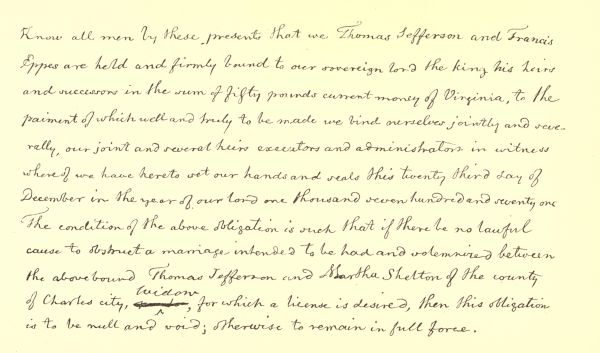
Marriage Licene-Bond (Fac-simile)
In the year 1770 the house at Shadwell was destroyed by
fire, and Jefferson then moved to Monticello, where his preparations
for a residence were sufficiently advanced to enable
him to make it his permanent abode. He was from home
when the fire took place at Shadwell, and the first inquiry
he made of the negro who carried him the news was after
his books. "Oh, my young master," he replied, carelessly,
"they were all burnt; but, ah! we saved your fiddle."
In 1772 Jefferson married Martha Skelton, the widow of
Bathurst Skelton, and the daughter of John Wayles, of
whom he speaks thus in his Memoir
Mr. Wayles was a lawyer of much practice, to which he
was introduced more by his industry, punctuality, and practical
readiness, than by eminence in the science of his profession.
He was a most agreeable companion, full of pleasantry
and humor, and welcomed in every society. He acquired
a handsome fortune, and died in May, 1773, leaving three
daughters. The portion which came on that event to Mrs.
Jefferson, after the debts were paid, which were very considerable,
was about equal to my own patrimony, and consequently
doubled the ease of our circumstances.
The marriage took place at "The Forest," in Charles City
County. The bride having been left a widow when very
young, was only twenty-three when she married a second
time.[9] She is described as having been very beautiful. A
little above middle height, with a lithe and exquisitely formed
figure, she was a model of graceful and queenlike carriage.
Nature, so lavish with her charms for her, to great personal
attractions, added a mind of no ordinary calibre. She was
well educated for her day, and a constant reader; she inherited
from her father his method and industry, as the accounts,
kept in her clear handwriting, and still in the hands of her
descendants, testify. Her well-cultivated talent for music
served to enhance her charms not a little in the eyes of such
a musical devotee as Jefferson.
So young and so beautiful, she was already surrounded by
suitors when Jefferson entered the lists and bore off the prize.
A pleasant anecdote about two of his rivals has been preserved
in the tradition of his family. While laboring under
the impression that the lady's mind was still undecided as
to which of her suitors should be the accepted lover, they
met accidentally in the hall of her father's house. They
were on the eve of entering the drawing-room, when the
sound of music caught their ear; the accompanying voices
of Jefferson and his lady-love were soon recognized, and the
two disconcerted lovers, after exchanging a glance, picked
up their hats and left.
The New-year and wedding festivities being over, the happy
bridal couple left for Monticello. Their adventures on
this journey of more than a hundred miles, made in the dead
of the winter, and their arrival at Monticello, were, years
afterwards, related as follows, by their eldest daughter, Mrs.
Randolph,[10] who heard the tale from her father's lips:
They left The Forest after a fall of snow, light then, but increasing
in depth as they advanced up the country. They
were finally obliged to quit the carriage and proceed on
horseback. Having stopped for a short time at Blenheim,
where an overseer only resided, they left it at sunset to pursue
their way through a mountain track rather than a road,
in which the snow lay from eighteen inches to two feet deep,
having eight miles to go before reaching Monticello. They
arrived late at night, the fires all out and the servants retired
to their own houses for the night. The horrible dreariness
of such a house at the end of such a journey I have
often heard both relate.
Too happy in each other's love, however, to be long troubled
by the "dreariness" of a cold and dark house, and having
found a bottle of wine "on a shelf behind some books,"
the young couple refreshed themselves with its contents,
and startled the silence of the night with song and merry
laughter.
Possessing a fine estate and being blessed with a beautiful
and accomplished wife, Jefferson seemed fairly launched upon
the great ocean of life with every prospect of a prosperous
and happy voyage. We find from his account-books that
his income was a handsome one for that day, being three
thousand dollars from his practice and two thousand from
his farms. This, as we have seen, was increased by the receipt
of his wife's fortune at her father's death.
Of the many friends by whom he was surrounded in his
college days Dabney Carr was his favorite; his friendship
for him was strengthened by the ties of family connection,
on his becoming his brother-in-law as the husband of his sister
Martha. As boys, they had loved each other; and when
studying together it was their habit to go with their books
to the well-wooded sides of Monticello, and there pursue their
studies beneath the shade of a favorite oak. So much attached
did the two friends become to this tree, that it became
the subject of a mutual promise, that the one who survived
should see that the body of the other was buried at
its foot. When young Carr's untimely death occurred Jefferson
was away from home, and on his return he found that
he had been buried at Shadwell. Being mindful of his promise,
he had the body disinterred, and removing it, placed it
beneath that tree whose branches now bend over such illustrious
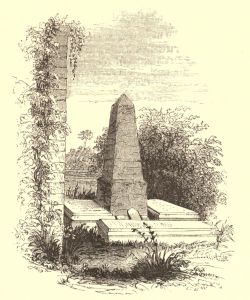
dead—for this was the origin of the grave-yard at
Monticello.
It is not only as Jefferson's friend that Dabney Carr lives
in history. The brilliancy of the reputation which he won
in his short career, has placed his name among the men who
stood first for talent and patriotism in the early days of the
Revolution. Jefferson himself, in describing his first appearance
in the Virginia House of Burgesses, pays a warm and
handsome tribute to his friend. He says:
I well remember the pleasure expressed in the countenance
and conversation of the members generally on this débût
of Mr. Carr, and the hopes they conceived as well from
the talents as the patriotism it manifested.... His
character was of a high order. A spotless integrity, sound
judgment, handsome imagination, enriched by education and
reading, quick and clear in his conceptions, of correct and
ready elocution, impressing every hearer with the sincerity
of the heart from which it flowed. His firmness was inflexible
in whatever he thought was right; but when no moral
principle stood in the way, never had man more of the milk
of human kindness, of indulgence, of softness, of pleasantry
of conversation and conduct. The number of his friends
and the warmth of their affection, were proofs of his worth,
and of their estimate of it.
We have again from Jefferson's pen a charming picture
of the domestic character of Carr, in a letter to his friend
John Page, written in 1770:
He (Carr) speaks, thinks, and dreams of nothing but his
young son. This friend of ours, Page, in a very small house,
with a table, half a dozen chairs, and one or two servants, is
the happiest man in the universe. Every incident in life he
so takes as to render it a source of pleasure. With as much
benevolence as the heart of man will hold, but with an utter
neglect of the costly apparatus of life, he exhibits to the
world a new phenomenon in life—the Samian sage in the tub
of the cynic.
The death of this highly-gifted young Virginian, whose
early life was so full of promise, took place on the 16th of
May, 1773, in the thirtieth year of his age. His wife, a woman
of vigorous understanding and earnest warmth of heart,
was passionately devoted to him, and his death fell like a
blight on her young life. She found in her brother a loving
protector for herself and a fatherly affection and guidance
for her six children—three sons and three daughters—who
were received into his family as his adopted children.
Among Jefferson's papers there was found, after his death,
the following, written on a sheet of note-paper:
INSCRIPTION ON MY FRIEND D. CARR'S TOMB.
Lamented shade, whom every gift of heaven
Profusely blest; a temper winning mild;
Nor pity softer, nor was truth more bright.
Constant in doing well, he neither sought
Nor shunned applause. No bashful merit sighed
Near him neglected: sympathizing he
Wiped off the tear from Sorrow's clouded eye
With kindly hand, and taught her heart to smile.
Mallet's Excursion.
Send for a plate of copper to be nailed on the tree at
the foot of his grave, with this inscription:
Still shall thy grave with rising flowers be dressed
And the green turf lie lightly on thy breast;
There shall the morn her earliest tears bestow,
There the first roses of the year shall blow,
While angels with their silver wings o'ershade
The ground now sacred by thy reliques made.
On the upper part of the stone inscribe as follows:
Here lie the remains of
Dabney Carr,
Son of John and Jane Carr, of Louisa County,
Who was born ——, 1744.
Intermarried with Martha Jefferson, daughter of Peter
and Jane Jefferson, 1765;
And died at Charlottesville, May 16, 1773,
Leaving six small children.
To his Virtue, Good Sense, Learning, and Friendship
this stone is dedicated by Thomas Jefferson, who, of all men living,
loved him most.