DOMESTIC ANNALS OF SCOTLAND — B Y ROBERT CHAMBERS, F.R.S.E., F.S.A.Sc., &c.
DOMESTIC ANNALS OF SCOTLAND.
From the Reformation to the Revolution.
SECOND EDITION.
VOLUME I.
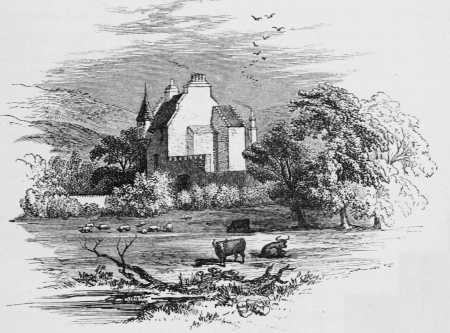
Bannatyne House, Strathmore.
W. & R. CHAMBERS, EDINBURGH AND LONDON.
MDCCCLIX.
Edinburgh:
Printed by W. and R. Chambers.
PREFACE TO THE FIRST EDITION.
It has occurred to me that a chronicle of domestic matters in Scotland from
the Reformation downwards—the period during which we see a progress
towards the present state of things in our country—would be an interesting
and instructive book. History has in a great measure confined itself to
political transactions and personages, and usually says little of the people,
their daily concerns, and the external accidents which immediately affect
their comfort. This I have always thought was much to be regretted, and
a general tendency to the same view has been manifested of late years.
I have therefore resolved to make an effort, in regard to my own country,
to detail her DOMESTIC ANNALS—the series of occurrences beneath the region
of history, the effects of passion, superstition, and ignorance in the people,
the extraordinary natural events which disturbed their tranquillity, the
calamities which affected their wellbeing, the traits of false political economy
by which that wellbeing was checked, and generally those things which enable
us to see how our forefathers thought, felt, and suffered, and how, on the
whole, ordinary life looked in their days.
Nor are these details, broken up and disjointed as they often are, without
a useful bearing on certain generalisations of importance, or devoid of
instruction for our own comparatively enlightened age. A good end is
obviously served by enumerating, for example, all the famines and all the
pestilences that have beset the country; for when this is done, it becomes
evident that famine and pestilence have been connected in the way of cause
and effect. For the astronomer, the meteorologist, and the naturalist, many
of the accounts of comets, meteors, and extraordinary natural productions here
given, must have some value.1 To the political economist, it may be of service
to see the accounts here drawn from contemporary records of the productiveness
and failure of many seasons, and of the varying proportions of
bad seasons to good throughout considerable spaces of time. As for the
numberless narratives and anecdotes illustrative of the mistaken zeal, the
irregular passions, the deplorable superstitions, and erroneous ideas and ways
in general, of our ancestors, they furnish beyond doubt a rich pabulum
for the student of human nature; nor may they be without some practical
utility amongst us, since many of the same errors continue in a reduced
style to exist, and it may help to extinguish them all the sooner, that we
are enabled here to look upon them in their most exaggerated and startling
form, and as essentially the products and accompaniments of ignorance and
barbarism.
It will probably be matter of regret that this work consists of a series
of articles generally brief and but little connected with each other, producing
on the whole a desultory effect. Might not the materials have been fused
into one continuous narration? I am very sensible how desirable this was
for literary effect; but I am at the same time assured that, in such a mode
of presenting the series of occurrences, there would have been a constant
temptation to generalise on narrow and insufficient grounds—to make singular
and exceptional incidents pass as characteristic beyond the just degree in
which they really are so—namely, as matters just possible in the course of
the national life of the period to which they refer. It seemed to me the
most honest plan, to present them detachedly under their respective dates,
thus allowing each to tell its own story, and have its own proper weight
with the reader, and no more, in completing the general picture.
As one means of conveying ‘the body of each age, its form and pressure,’
the language of the original contemporary narrators is given, wherever it was
sufficiently intelligible and concise. Thus each age in a manner tells its own
story. It has not been deemed necessary, however, to retain antiquated
modes of orthography, beyond what is required to indicate the old pronunciation,
nor have I scrupled occasionally to omit useless clauses of sentences,
when that seemed conducive to making the narration more readable. This
procedure will not be quite approved of by the rigid antiquary; but it will be
for the benefit of the bulk of ordinary readers.
In general, the events of political history are presented here in only
a brief narrative, such as seemed necessary for connection. But I have
introduced a few notices of these events where there was a contemporary
narration either characteristic in its style, or involving particulars which might
be deemed illustrative of the general feeling of the time.
BOOKS AND AUTHORITIES AS, FROM THEIR MORE FREQUENT
OCCURRENCE, ARE QUOTED IN AN ABRIDGED FORM.
D. O.—Diurnal of Remarkable Occurrents in Scotland, 1513-1575.
(Maitland Club.) 4to.
1833
Cal.—History of the Kirk of Scotland. By Mr David Calderwood.
(Wodrow Society.) 8 vols.
1842
Pit.—Criminal Trials in Scotland, from 1488 to 1624, with Historical
Notes and Illustrations. By Robert Pitcairn, Esq. 3 vols.4to. Edin.
1833
Knox.—History of the Reformation in Scotland. By John Knox. From MS. Edited by David Laing. 2 vols. (Wodrow Society.)
Edin.
1846
C. F.—Chronicle of Fortingall [a composition of the sixteenth century,
preserved in the charter-chest of the Marquis of Breadalbane, and printed in the same volume with the Black Book of
Taymouth, Edinburgh, 4to.
1855]
P. C. R.—Privy Council Record, MS. in General Register House, Edinburgh.
Mar.—Annales of Scotland from the year 1513 to the year 1591.
By George Marioreybanks, burges of Edinburghe. From MS. 8vo.
1814
Bir.—Diary of Robert Birrel, burges of Edinburghe, from 1532 to 1605.
Dalyell’s Fragments of Scottish History. From MS. 4to.
Edin.
1798
E. C. R.—Edinburgh Council Record, MS. in Council Chamber, Edinburgh.
H. K. J.—Historie of King James the Sext. 4to. Edin.
1825
C. C. R.—Canongate Council Record [extracts printed in Maitland Club
Miscellany, vol. ii.]
Ban.—Journal of the Transactions in Scotland, 1570, 1571, 1572, 1573.
By Richard Bannatyne, Secretary to John Knox. From MS.
8vo. Edin.
1806
Ken.—Historical Account of the Name of Kennedy. From MS. With
Notes by Robert Pitcairn. 4to.
1830
Ja. Mel.—Autobiography and Diary of Mr James Melville, 1556-1610.
From MS. Edited by Robert Pitcairn. (Wodrow Society.)
8vo.
1842
Bal.—Annales of Scotland, 1057-1603. By Sir James Balfour. From MS.
4 vols. 8vo. Edin.
1824
Spot.—History of the Church of Scotland. By the Right Rev. John
Spottiswoode, Archbishop of St Andrews. 3 vols. 8vo.
1847
Howes.—Chronicle of England. By Edmond Howes. Fol.
1615
H. of G.—History of the House of Douglas. By Mr David Hume of
Godscroft. 2 vols.
1748
Jo. R. B. Hist.—Historia Rerum Britannicarum, &c. Auctore Roberto
Johnstono. Fol. Amstel.
1655
R. G. K. E.—Register of the General Kirk of Edinburgh, 1574-1575.
Maitland Club Miscellany, vol. i.
B. U. K.—Booke of the Universall Kirk of Scotland. (Bannatyne Club.)
3 vols. 4to. Edin.
1839-40
Chr. Aber.—Chronicle of Aberdeen, 1491-1595. (Spalding Club Miscellany.)
Hist. Acc. Fam. Innes.—Historical Account of the Origine and Succession
of the Family of Innes, &c. From orig. MS. Edin.
1820
M. of S.—Mem. Som.—The Memorie of the Somervilles, &c. 2 vols. 8vo.
1815
Moy.—Memoirs of the Affairs of Scotland, 1577-1603. By David Moysie.
From MS. (Maitland Club.) 4to.
1830
Moy. R.—Idem, Ruddiman’s edition. 12mo.
1755
Ab. C. R.—Extracts from the Council Register of the Burgh of Aberdeen,
1570-1625. (Spalding Club.)
1848
Row.—Row’s History of the Kirk of Scotland. (Wodrow Society.)
1842
Pa. And.—History of Scotland. By Patrick Anderson. MS. Advocates’
Library.
M. of G.—Memorabilia of the City of Glasgow, selected from the Minute-books
of the Burgh. Glasgow, printed for private circulation.
1835
C. K. Sc.—Chronicle of the Kings of Scotland. From MS. (Maitland
Club.)
1830
Jo. Hist.—Johnston’s History of Scotland. MS. Advocates’ Library.
Chron. Perth.—The Chronicle of Perth, &c., from 1210 to 1668. (Maitland
Club.) 4to. Edin.
1831
G. H. S.—Genealogical History of the Earldom of Sutherland. By Sir
Robert Gordon, Bart. Fol. Edin.
1813
Stag. State.—The Staggering State of Scots Statesmen from 1550 to 1650.
By Sir John Scot of Scotstarvet. From MS. 12mo. Edin.
1754
S. A.—Acts of Parliament made by King James I., and his Royal Successors.
3 vols.
1682
Acts of the Parliament of Scotland. 11 vols. fol.
P. K. S. R.—Perth Kirk-Session Records. Spottiswoode Club Miscellany.
A. K. S. R.—Aberdeen Kirk-Session Records. (Spalding Club.) Aber.
1846
A. P. R.—Aberdeen Presbytery Records. (Spalding Club.) Aber.
1846
M. S. P.—State Papers, &c., of Thomas Earl of Melrose. (Abbotsford Club.)
2 vols. 4to. Edin.
1837
An. Scot.—Analecta Scotica: Collections illustrative of the Civil, Ecclesiastical,
and Literary History of Scotland. Edited by James
Maidment. 2 vols. Edin.
1834-38
R. P. L.—Selections from the Registers of the Presbytery of Lanark,
1623-1709. 4to. Edin.
1839
Foun. Hist. Ob.—Historical Observes, &c. By Sir John Lauder of Fountainhall.
4to. Edin.
1840
Foun. Dec.—Fountainhall’s Decisions of the Court of Session. 2 vols. fol.
Edin.
1759
Fount.—Historical Notices of Scottish Affairs, from the MSS. of Sir John
Lauder of Fountainhall. 2 vols. 4to. Edin.
1848
W. A.—Analecta, or Materials for a History of Remarkable Providences,
&c. By the Rev. Robert Wodrow. 4 vols. (Maitland Club.)
Edin.
1842
Stev. Hist. C. of Scot.—History of the Church of Scotland. By Andrew
Stevenson, writer in Edinburgh. 2d ed. Edin.
1844
B. A.—Book of Adjournal. MS. Advocates’ Library.
Gillies.—Historical Collections relating to Remarkable Periods of the
Success of the Gospel, &c. By John Gillies. 2 vols. Glas.
1754
Spal.—Memorials of the Troubles in Scotland and England, A.D. 1624-A.D.
1645. By John Spalding. 2 vols. 4to. (Spalding Club.)
Aber.
1850
Ab. Re.—A Little yet True Rehearsal of Several Passages of Affairs that
did occur from the year 1633 till this present year 1655.
Collected by a friend of Dr Alexander’s at Aberdeen. Sir
Lewis Stewart’s Collections. MS. Advocates’ Library.
Pa. Gordon.—A Short Abridgment of Britanes Distemper, from the year of
God 1639 to 1649. By Patrick Gordon of Ruthven. (Spalding
Club.)
1844
Carlyle.—Oliver Cromwell’s Letters and Speeches, with Elucidations by
Thomas Carlyle. 2 vols.
1845
Lam.—Diary of Mr John Lamont of Newton, 1649-1671. Edin.
1830
C. P. H.—Collections by a Private Hand at Edinburgh, 1650-1661.
Stevenson, Edin.
1832
Nic.—Diary of Public Transactions and other Occurrences, chiefly in
Scotland. By John Nicoll. 4to. Edin.
1836
R. C. E.—Register of the Committee of Estates. MS. General Register
House, Edinburgh.
Spreull.—Some Remarkable Passages of the Lord’s Providence towards Mr
John Spreull, Town-clerk of Glasgow, 1635-1664. Stevenson,
Edin.
1832
Law.—Memorials; or Memorable Things, &c., from 1638 to 1684. By the
Rev. Robert Law. From MS. Edin.
1818
Bail.—Letters and Journals of Robert Baillie, A.M., Principal of the
University of Glasgow. From MS. 3 vols. Edin.
1841
Kir.—Secret and True History of the Church of Scotland, from the
Restoration to the year 1678. By the Rev. James Kirkton.
4to. Edin.
1817
Pat. Walker.—Biographia Presbyteriana. [Lives of Alexander Peden, &c.,
by Patrick Walker.] 2 vols. Edin.
1827
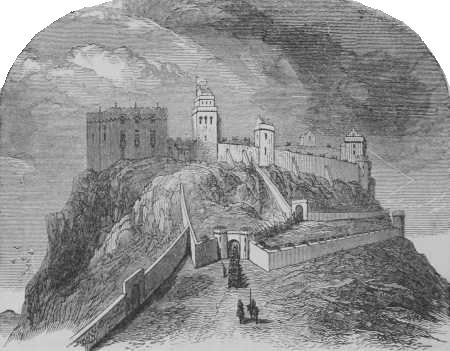
Edinburgh Castle, restored as in 1573.
DOMESTIC ANNALS OF SCOTLAND.
INTRODUCTORY.
Our attention lights, a few years after the middle of the sixteenth
century, on a little independent kingdom in the northern part
of the British island—a tract of country now thought romantic
and beautiful, then hard-favoured and sterile, chiefly mountainous,
penetrated by deep inlets of the sea, and suffering under a climate
not so objectionable on account of cold as humidity. It contains
a scattered population of probably seven hundred thousand:—the
Scots—thought to be a very ancient nation, descended from
a daughter of Pharaoh, king of Egypt, and living under a monarchy
believed to have originated about the time that Alexander conquered
India. A very poor, rude country it is, as it well might
be in that age, and seeing that it lay so far to the north and
so much out of the highway of civilisation. No well-formed
roads in it—no posts for letters or for travelling. A printing-press
in the head town, Edinburgh, but not another anywhere. A
regular localised court of law had not yet existed in it thirty years.
No stated means of education, excepting a few grammar-schools
in the principal towns, and three small universities. Society
consisted mainly of a large agricultural class, half enslaved to
the lords of the soil: above all, obliged to follow them in war.
Other industrial pursuits to be found only in the burghs, the
chief of which were Edinburgh, Glasgow, Stirling, Perth, Dundee,
and Aberdeen.
In reality, though it was not known then, the bulk of the people
of Scotland were a branch of the great Teutonic race which
possesses Germany and some other countries in the north-west
of Europe. Precisely the same people they were with the bulk
of the English, and speaking essentially the same language, though
for ages they had been almost incessantly at war with that richer
and more advanced community. As England, however, was
neighboured by Wales, with a Celtic people, so did Scotland contain
in its northern and more mountainous districts a Celtic people
also, rude, poor, proud, and of fiery temper, but brave and possessed
of virtues of their own, somewhat like the Circassians of our own
day. These Highland clansmen—whom the English of that time
contemptuously called Redshanks, with reference to their naked
hirsute limbs—were the relics of a greater nation, who once
occupied all Scotland, and of whose blood some portion was
mingled with that of the Scots of the Lowlands, producing a certain
fervour of character—‘perfervidum ingenium Scotorum’—which is
not found in purely Teutonic natures. The monarchy had originated
with them early in the sixth century of the Christian era,
and had gradually absorbed the rest of Scotland, even while its
original subjects were hemmed more and more within the hilly
north. But, by the marriages of female heirs, this thorn-encircled
crown had come, in the fourteenth century, into a family of
Norman-English extraction, bearing the name of Stuart.
The present monarch was ‘our Sovereign Lady Mary,’ a young
and beautiful woman, married to Francis II. of France. She had
been carried thither in a troublous time during her childhood,
and in her absence, a regent’s sceptre was swayed by her mother,
a princess of the House of Guise. Up to that time, Scotland,
like most of the rest of Europe, was observant of the Catholic
religion, and under vows of obedience to the pope of Rome.
But the reforming ideas of Luther and Melancthon, of Zuinglius
and Calvin, at length came to it, and surprising were the effects
thereof. As by some magical evolution, the great mass of the
people instantaneously threw off all regard to the authority of
the pope, with all their old habits of worship, professing instead
a reverence for the simple letter of Scripture, as interpreted to
them by the reforming preachers. Indignant at having been
so long blinded by the Catholic priesthood—whose sloth and
luxury likewise disgusted them—they attacked the churches and
monasteries, destroyed the altars and images—did not altogether
spare even the buildings, alleging that rooks were best banished
by pulling down their nests: in short, made a very complete
practical reformation through all the more important provinces.
This was done by the populace, with the countenance and help
of a party of the nobility and gentry; and the regent, Mary
de Guise, who was firm in the old faith, in vain strove to stem
the torrent. Obtaining troops from France, she did indeed
maintain for a time a resistance to the reforming lords and their
adherents. But they, again, were supported by some troops from
Elizabeth of England, whose interest it was to protestantise
Scotland; and so the Reformation got the ascendency. Mary
the Regent sunk into the grave, just about the time that her
faith came to its final and decisive ruin within her daughter’s
dominions.
This change may be considered as having been completed in
August 1560, when an irregular parliament, or assembly of the
Estates of the kingdom, abolished the jurisdiction of the
pope, proscribed the mass under the severest penalties, and
approved of a Confession of Faith resembling the articles which
had been established in England by Edward VI. The chief
feature of the new system was, that each parish should have its
own pastor, elected by the people, or at least a reader to read
the Scriptures and common prayers. While thus essentially
presbyterian, there was a trace of episcopal arrangements in the
appointment of ten superintendents (one of whom, however, was
a layman), whose duty it should be to go about and see that
the ordinary clergy did their duty. The great bulk of the possessions
and revenues of the old church fell into the hands of the
nobles, or remained with nominal bishops, abbots, and other
dignitaries, who continued formally to occupy their ancient places
in parliament, while the presbyterian clergy were insufficient
in number, and in general very poorly supported.
‘Lo here,’ then, ‘a nation born in one day; yea, moulded
into one congregation, and sealed as a fountain with a solemn oath
and covenant!’ So exclaims a clerical writer a hundred years
later; and we, who live two hundred years still further onward,
may well echo the words. But a little while ago, there were priests,
with vestments of ancient and gorgeous form, saying mass in
churches, which were the only elegant structures in the country.
The name of the pope was a word to bow at. Confession was one
of the duties of life. Barefooted friars wandered about in the
enjoyment of universal reverence. Any gentleman going out with
his sovereign on a military expedition, would have been thought
liable to every evil under the sun, and altogether a scandalous
person, if he did not beforehand obtain pardon for his sins from the
Grayfriars, and leave in their hands his most valuable possessions,
including the very titles of his estate, which he might hope to get
back if he survived; but otherwise, he well knew all would go to
the enriching of these same friars, who were under vows to live in
perpetual poverty.2 The king himself sought for his highest
religious comfort in pilgrimising to St Duthac’s shrine in Ross-shire,
or to the chapel of our Lady of Loretto, at Musselburgh. The
bishop of Aberdeen felt a solacement in the hour of death, in the
trust that his bowels would be buried, as he requested, in the Blackfriars
Monastery in Edinburgh.3 So lately as 1547, the Scotch,
fighting with the English at Pinkie, called out reproachful names to
them, on the score of their having deserted the ancient faith. But
here is now Scotland also converted, and that as it were in a day,
from all those old reverences and observances, and taken possession
of by a totally new set of ideas. The Bible in the vulgar tongue
has been suddenly laid open to them. Their minds, earnest and
reflecting, though unenlightened, have been impressed beyond
description by the tale of miraculous history which it unfolds, and
the deeply touching scheme for effecting the salvation of man which
the theologian constructs from it. They feel as if they had got
hold of something of priceless value, and in comparison with which
all the forms and rites of medieval Christianity are as dust and
rubbish. The Evangel, the True Religion, as they earnestly called
it, is henceforth all in all with this poor and homely, but resolute
people. Nothing inconsistent therewith can be listened to for a
moment. Scarcely can a dissentient be permitted to live in the
country. The state, too, must maintain this system, and this
system alone, or it is no state for them. Above all, the errors of
Popery must be unsparingly put down. The mass is idolatry: God,
in his Book, says that idolatry is a sin to be visited with the severest
judgments; therefore, if you wish to avoid judgments, you must
extinguish the mass. Even modified forms and rituals which have
been preserved by English Protestantism, as calculated to raise or
favour a spirit of devotion, and maintain a decency in worship, are
here regarded as but the rags of Rome, and spurned with nearly the
same vehemence as the mass itself. Scotland will have nothing but
a preacher to expound, and say a prayer. That, with the Bible in
the hands of the people, is enough for her. No hierarchy does she
require to maintain order in the church. Let the ministers meet in
local courts and in General Assembly, and settle everything by equal
votes. Bishops and archbishops are a popish breed, who must, if
possible, be kept at a distance.
Even one who may now take more charitable and lenient views
can scarcely fail to sympathise with, yea, admire, this little out-of-the-way
nation, in seeing it dictate and do thus against the might of
an ancient institution of such imposing dimensions as the Romish
Church. And to do it, too, in the teeth of their own ruling power,
such as it was. And all so effectually, that from that hour to
this, Rome, in all her back-surgings upon the ground she lost
in the sixteenth century, was never able to put Scottish Protestantism
once in the slightest danger. Undoubtedly, if there be
merit in a faithful contending for what is felt to be all-important
truth, it was a worthy thing, and one that shewed there was some
good metal in the constitution of the Scottish mind. It could not
surprise one that a people who acted thus, should also prove to be
a valiant and constant people under physical difficulties; that they
should make wonderful results out of a poor soil and climate;
that they should do some considerable things in the science of
thinking and in letters; and, above all, stand well to their own
opinions and ways, and to the maintenance of their political
liberties and national independence, frown, threaten, and drive at
them who might.
It was so—and yet—for every picture of noble humanity has its
reverse—it is forced upon us that the Scots were, at this very time,
a fearfully rude and ignorant people. As usual, they were so
without having the least consciousness of it: their greatest author
of that age, George Buchanan, speaks in perfect earnest of the
refinement of his own time, in comparison with the barbarism
of former days.4 But, whatever the age might be relatively
to past ages, it was rude in itself. The Scotland of that day
was ruder than the England of that day, ruder than many other
European states. Few persons could read or write. Few knew
aught beyond their daily calling. Men carried weapons, and
were apt to use them on light occasion. The lords, and the
rich generally, exercised enormous oppression upon the poor.
The government was a faction of nobles, as against all the rest.
When a man had a suit at law, he felt he had no chance without
using ‘influence.’ Was he to be tried for an offence?—his friends
considered themselves bound to muster in arms round the court
to see that he got fair-play; that is, to get him off unharmed if
they could. Men were accustomed to violence in all forms, as
to their daily bread. The house of a man of consideration was
a kind of castle: at the least, it was a tall narrow tower, with a
grated door and a wall of defence. No one in those days had
any general conceptions regarding the processes of nature. They
saw the grass grow and their bullocks feed, and thought no more
of it. Any extraordinary natural event, as an eclipse of the sun or
an earthquake, still more a comet, affected them as an immediate
expression of a frowning Providence. The great diseases, such as
pestilence, which arose in consequence of their uncleanly habits
and the wide-spread famines from which they often suffered,
appeared to them as divine chastisements; not perhaps for the
sins of those who suffered—which would have been comparatively
reasonable—but probably for the sins of a ruler who did not suffer
at all. The ruling class knew no more of a just public economy
than the poor. Through absurd attempts to raise the value of
coin by statute, the Scotch pound had fallen to a fraction of its
original worth. By ridiculous endeavours to control markets,
and adjust exportation and importation, mercantile freedom was
paralysed, and penury and scarcity among the poor greatly
increased. The good plant of Knowledge not being yet cultivated,
its weed-precursor, Superstition, largely prevailed. Bearded men
believed that a few muttered words could take away and give back
the milk of their cattle. An archbishop expected to be cured of
a deadly ailment by a charm pronounced by an ignorant countrywoman.
The forty-six men who met as the first General Assembly,
and drew from the Scriptures the Confession of Faith which they
handed down as stereotyped truth to after-generations, were
every one of them not more fully persuaded of the soundness of
any of the doctrines of that Confession, than they were of the
reality of sorcery, and felt themselves not more truly called upon
by the Bible to repress idolatry than to punish witches. They
were good men, earnest, and meaning well to God and man; but
they were men of the sixteenth century, ignorant, and rough in
many of their ways.
While, then, we shall see great occasion to admire the hardy
valour with which this people achieved their deliverance from
bondage, we must also be prepared for finding them full of
vehement intolerance towards all challenge of their own dogmas
and all adherence to alien forms of faith. We shall find them
utterly incapable of imagining a conscientious dissent, much less
of allowing for and respecting it. We must be prepared to see
them—while repudiating one set of superstitious incrustations upon
the original simple gospel—working it out on their own part in
creeds, plats, covenants, and church institutions generally, full
of mere human logic and device, but yet assumed to be as true
as if a divine voice had spoken and framed them, breathing war
and persecution towards all other systems, and practically operating
as a tyranny only somewhat less formidable than that which had
been put away.
REIGN OF MARY: 1561-1565.
The regent, Mary de Guise, having died in June 1560, while her
daughter Mary, the nominally reigning queen, was still in France,
the management of affairs fell into the hands of the body of nobles,
styled Lords of the Congregation, who had struggled for the establishment
of the Protestant faith. The chief of these was Lord
James Stuart, an illegitimate son of James V., and brother of the
queen—the man of by far the greatest sagacity and energy of his
age and country, and a most earnest votary of the new religion.
Becoming a widow in December 1560, by the death of her
husband, Francis II., Mary no longer had any tie binding her to
France, and consequently she resolved on returning to her own
dominions. When she arrived in Edinburgh, in August 1561, she
found the Protestant religion so firmly established, and so universally
accepted by the people—there being only some secluded
districts where Catholicism still prevailed—that, so far from having
a chance of restoring her kingdom to Rome, as she, ‘an unpersuaded
princess,’ might have wished to do, it was with the greatest
difficulty that she could be allowed to have the mass performed in
a private room in her palace. The people regarded her beautiful
face with affection; and, as she allowed her brother, Lord James,
and other Protestant nobles to act for her, her government was far
from unpopular.
Mary’s conduct towards the Protestant cause appeared as that of
one who submits to what cannot be resisted. Before she had been
fifteen months in the country, she accompanied her brother (whom
she created Earl of Moray) on an expedition to the north, where
she broke the power of the Gordon family, who boasted they could
restore the Catholic faith in three counties. What is still more
remarkable, she dealt with the patrimony of the church, accepting
part of the spoils for the use of the state. It is believed, nevertheless,
that she designed ultimately to act in concert with the
Catholic powers of the continent for the restoration of the old
religion in Scotland. One obvious motive for keeping on fair
terms with Protestantism for the present, lay in her hopes of
succeeding to the English crown, in the event of the death of
Elizabeth, whose next heir she was.
1561.
A custom, dating far back in Catholic times, prevailed in Edinburgh
in unchecked luxuriance down almost to the time of the
Reformation. It consisted in a set of unruly dramatic games, called
Robin Hood, the Abbot of Unreason, and the Queen of May, which
were enacted every year in the floral month just mentioned. The
interest felt by the populace in these whimsical merry-makings was
intense. At the approach of May, they assembled and chose some
respectable individuals of their number, very grave and reverend
citizens perhaps, to act the parts of Robin Hood and Little John,
of the Lord of Inobedience, or the Abbot of Unreason, and ‘make
sports and jocosities’5 for them. If the chosen actors felt it inconsistent
with their tastes, gravity, or engagements, to don a fantastic
dress, caper and dance, and incite their neighbours to do the like,
they could only be excused on paying a fine. On the appointed
day, always a Sunday or holiday, the people assembled in their best
attire and in military array, and marched in blithe procession to
some neighbouring field, where the fitting preparations had been
made for their amusement. Robin Hood and Little John robbed
bishops, fought with pinners, and contended in archery among
themselves, as they had done in reality two centuries before.6 The
Abbot of Unreason kicked up his heels and played antics like a
modern pantaloon. The popular relish for all this was such as can
scarcely now be credited. ‘A learned prelate [Latimer] preaching
before Edward VI., observes, that he once came to a town upon a
holiday, and gave information on the evening before of his design
to preach. But next day when he came to the church, he found
the door locked. He tarried half an hour ere the key could be
found, and instead of a willing audience, some one told him: “This
is a busy day with us; we cannot hear you. It is Robin Hood’s
day. The parish are gone abroad to gather for Robin Hood. I
pray you let [hinder] them not.” I was fain (says the bishop) to
give place to Robin Hood. I thought my rochet should have been
regarded, though I were not; but it would not serve. It was fain
to give place to Robin Hood’s men.’7
1561.
Such were the Robin Hood plays of Catholic and unthinking
times. By and by, when the Reformation approached, they were
found to be disorderly and discreditable, and an act of parliament
was passed against them.8 Still, while the upper and more serious
classes frowned, the common sort of people loved the sport too
much to resign it without a struggle. It came to be one of the
first difficulties of the men who had carried through the Reformation,
how to wrestle the people out of their love of the May-games.
In April 1561, one George Durie was chosen in Edinburgh as
Robin Hood and Lord of Inobedience, and on Sunday the 12th of
May, he and a great number of other persons came riotously into
the city, with an ensign and arms in their hands, in disregard of
both the act of parliament and an act of the town-council. Notwithstanding
an effort of the magistrates to turn them back, they
passed to the Castle Hill, and thence returned at their own pleasure.
For this offence a cordiner’s servant, named James Gillon, was
condemned to be hanged on the 21st of July.
1561.
July 21.
‘When the time of the poor man’s hanging approachit, and that
the [hangman] was coming to the gibbet with the ladder, upon which
the said cordiner should have been hangit, the craftsmen’s childer9
and servants past to armour; and first they housit Alexander
Guthrie and the provost and bailies in the said Alexander’s writing
booth, and syne came down again to the Cross, and dang down
the gibbet, and brake it in pieces, and thereafter passed to the
Tolbooth, whilk was then steekit [shut]; and when they could
not apprehend the keys thereof, they brought fore-hammers and
dang up the same Tolbooth door perforce, the provost, bailies, and
others looking thereupon; and when the said door was broken up,
ane part of them past in the same, and not allenarly [only]
brought the same condemnit cordiner forth of the said Tolbooth,
but also all the remanent persons being thereintill; and this done
they past down the Hie Gait [High Street], to have past forth
at the Nether Bow, whilk was then steekit, and because they could
not get furth thereat, they past up the Hie Gait again; and in
the meantime the provost, bailies, and their assisters being in
the writing-booth of Alexander Guthrie, past to the Tolbooth;
and in their passing up the said gait, they being in the Tolbooth,
as said is, shot forth at the said servants ane dag, and hurt ane
servant of the craftsmen’s. That being done, there was naething
but tak and slay; that is, the ane part shooting forth and
casting stanes, the other part shooting hagbuts in again; and sae
the craftsmen’s servants held them [conducted themselves] continually
fra three hours afternoon while [till] aucht at even, and
never ane man of the town steirit to defend their provost and
bailies. And then they sent to the masters of the craftsmen to
cause them, gif they might, to stay the said servants; wha purposed
to stay the same, but they could not come to pass, but the servants
said they wald have ane revenge for the man whilk was hurt.
And thereafter the provost sent ane messenger to the constable of
the Castle to come to stay the matter, wha came; and he with the
masters of the craftsmen treated on this manner, that the provost
and bailies should discharge all manner of actions whilk they had
against the said craftschilder in ony time bygane, and charged all
their masters to receive them in service as they did of before, and
promittit never to pursue them in time to come for the same. And
this being done and proclaimit, they skaled [disbanded], and the
provost and bailies came furth of the Tolbooth.’—D. O.
This was altogether an unprotestant movement, though springing
only from a thoughtless love of sport. We may see in the
attack on the Tolbooth a foreshadow of the doings of the Porteous
mob in a later age. It appears that the magistrates, though
reformers, were unpopular; hence the neutrality of the citizens,
who, when solicited to interfere for the defence of the city-rulers,
went to their four hours penny,11 and returned for answer:
‘They will be magistrates alone; let them rule the multitude
alone.’—Cal. Thirteen persons were afterwards ‘fylit’ by an
assize for refusing to help the magistrates.—Pit.
On its being known that Queen Mary was about to arrive in
Scotland from France, there was a great flocking of the upper
class of people from all parts of the country to Edinburgh, ‘as it
were to a common spectacle.’
Aug. 19.
The queen arrived with her two vessels in Leith Road, at seven in
the morning of a dull autumn-day. She was accompanied by her
three uncles of the House of Guise—the Duc d’Aumale, the Grand
Prior, and the Marquis d’Elbeuf; besides Monsieur d’Amville,
son of the constable of France, her four gentlewomen, called the
Maries, and many persons of inferior note. To pursue the narrative
of one who looked on the scene with an evil eye: ‘The very face
of heaven, the time of her arrival, did manifestly speak what
comfort was brought unto this country with her;’ to wit, sorrow,
dolour, darkness, and all impiety; for in the memory of man,
that day of the year, was never seen a more dolorous face of
the heaven, than was at her arrival, which two days after did
so continue; for beside the surface weet and corruption of the
air, the mist was so thick and so dark, that scarce might any
man espy ane other the length of twa butts. The sun was not
seen to shine two days before nor two days after. That forewarning
gave God unto us; but, alas, the most part were blind.
1561.
‘At the sound of the cannons which the galleys shot, the multitude
being advertised, happy was he and she that first might have
presence of the queen.... [At ten hours her hieness landed
upon the shore of Leith.] Because the palace of Holyroodhouse
was not thoroughly put in order ... she remained [in Andrew
Lamb’s house] in Leith till towards the evening, and then repaired
thither. In the way betwixt Leith and the Abbey, met her the
rebels of the crafts ... that had violated the authority of the
magistrates and had besieged the provost; but because she was
sufficiently instructed that all they did was done in despite of
the religion, they were easily appardoned. Fires of joy were set
forth all night, and a company of the most honest, with instruments
of music, and with musicians, gave their salutations at her chalmer
window. The melody, as she alleged, liked her weel; and she
willed the same to be continued some nichts after.’—Knox.
The magistrates of Edinburgh, although all of them zealous for
the reformed religion, resolved to give their young sovereign a
gallant reception, taxing the community for the expenses. It was
likewise thought good that, ‘for the honour and pleasure of our
sovereign, ane banquet sould be made upon Sunday next, to the
princes, our said sovereign’s kinsmen.’
Sep. 2.
The queen ‘made her entres in the burgh of Edinburgh in this
manner. Her hieness departed of Holyroodhouse, and rade by
the Lang Gate12 on the north side of the burgh, unto the time she
came to the Castle, where was ane yett [gate] made to her, at
the whilk she, accompanied by the maist part of the nobility of
Scotland, came in and rade up the castle-bank to the Castle, and
dined therein.’
1561.
‘When she had dined at twelve hours, her hieness came furth
of the Castle ..., at whilk departing the artillery shot vehemently.
Thereafter, when she was ridand down the Castle Hill,
there met her hieness ane convoy of the young men of the burgh,
to the number of fifty or thereby, their bodies and thies covered
with yellow taffetas, their arms and legs frae the knee down bare,
coloured with black, in manner of Moors; upon their heads black
hats, and on their faces black visors; in their mouths rings garnished
with untellable precious stanes; about their necks, legs, and arms,
infinite of chains of gold: together with saxteen of the maist honest
men of the town, clad in velvet gowns and velvet bonnets, bearand
and gangand about the pall under whilk her hieness rade; whilk
pall was of fine purpour velvet, lined with red taffetas, fringed with
gold and silk. After them was ane cart with certain bairns, together
with ane coffer wherein was the cupboard and propine [gift] whilk
should be propinit to her hieness. When her grace came forward
to the Butter Tron, the nobility and convoy procedand, there was
ane port made of timber in maist honourable manner, coloured with
fine colours, hung with sundry arms; upon whilk port was singand
certain bairns in the maist heavenly wise; under the whilk port
there was ane cloud opening with four leaves, in the whilk was put
ane bonnie bairn. When the queen’s hieness was coming through
the said port, the cloud openit, and the bairn descended down as it
had been ane angel, and deliverit to her hieness the keys of the
town, together with ane Bible and ane Psalm-buik coverit with fine
purpour velvet.13 After the said bairn had spoken some small
speeches, he delivered also to her hieness three writings, the tenour
whereof is uncertain. That being done, the bairn ascended in the
cloud, and the said cloud steekit.’
‘Thereafter the queen’s grace came down to the Tolbooth, at
the whilk was ... twa scaffats, ane aboon, and ane under that.
Upon the under was situate ane fair virgin called Fortune,
under the whilk was three fair virgins, all clad in maist precious
attirement, called ... , Justice, and Policy. And after ane
little speech made there, the queen’s grace came to the Cross,
where there was standand four fair virgins, clad in the maist
heavenly claithing, and frae the whilk Cross the wine ran out at
the spouts in great abundance. There was the noise of people
casting the glasses with wine.’
‘This being done, our lady came to the Salt Tron, where there
was some speakers; and after ane little speech, they burnt upon the
scaffat made at the said Tron the manner of ane sacrifice. Sae
that being done, she departed to the Nether Bow, where there was
ane other scaffat made, having ane dragon in the same, with some
speeches; and after the dragon was burnt, and the queen’s grace
heard ane psalm sung, her hieness passed to the abbey of Holyroodhouse,
with the said convoy and nobilities. There the bairns whilk
was in the cart with the propine made some speech concerning the
putting away of the mass, and thereafter sang ane psalm. And this
being done, the ... honest men remained in her outer chalmer,
and desired her grace to receive the said cupboard, whilk was double
over-gilt; the price thereof was 2000 merks; wha received the
same and thankit them thereof. And sae the honest men and
convoy come to Edinburgh.’—D. O.
The Sunday banquet to the queen’s uncles duly took place
in the cardinal’s lodging in Blackfriars’ Wynd. The entire
expenses on the occasion of this royal reception were 4000
merks.
1561.
Oct. 8.
Before the queen had been settled for many weeks in her capital,
the new-born zeal of the people against the old religion found vent
in a way that shewed in how little danger she was of being spoilt
by complaisance on the part of her subjects. The provost of
Edinburgh, Archibald Douglas, with the bailies and council,
‘causit ane proclamation to be proclaimit at the Cross of Edinburgh,
commanding and charging all and sundry monks, friars,
priests, and all others papists and profane persons, to pass furth of
Edinburgh within twenty-four hours, under the pain of burning of
disobeyers upon the cheek and harling of them through the town
upon ane cart. At the whilk proclamation, the queen’s grace was
very commovit.’—D. O. She had, after all, sufficient influence to
cause the provost and bailies to be degraded from their offices for
this act of zeal.
The autumn of this year, the weather was ‘richt guid and fair.’
In the winter quarter, the weather was still fair, and there was
‘peace and rest in all Scotland.’—C. F.
Dec. 16.
William Guild was convicted, notwithstanding his being a minor
and of weak mind, of ‘the thieftous stealing and taking forth of the
purse of Elizabeth Danielstone, the spouse of Niel Laing, hinging
upon her apron ... she being upon the High Street, standing
at the krame of William Speir ... in communing with him,
the time of the putting of ane string to ane penner and inkhorn,
whilk she had coft [bought] fra the said kramer, of ane signet of
gold, ane other signet of gold set with ane cornelian, ane gold ring
set with ane great sapphire, ane other gold ring with ane sapphire
formit like ane heart, ane gold ring set with ane turquois, ane
small double gold ring set with ane diamond and ane ruby, ane
auld angel-noble, and ane cusset ducat.’—Pit. This account of
the contents of Mrs Laing’s purse, in connection with the decorations
of the fifty young citizens who convoyed the queen in her
procession through the city, raises unexpected ideas as to the means
and taste of the middle classes in 1561.
1561.
Dec. 24.
Mr William Balfour, indweller in Leith, was convicted of
breaking the queen’s proclamation for the protection of the
reformed religion. One of his acts—‘He, accompanied with
certain wicked persons ... upon set purpose, came to the
parish kirk of Edinburgh, callit Sanct Giles Kirk, where John
Cairns was examining the common people of the burgh, before the
last communion ... and the said John, demanding of ane poor
woman, “Gif she had ony hope of salvation by her awn good
works,” he, the said Mr William, in despiteful manner and with
thrawn countenance, having naething to do in that kirk but to
trouble the said examination, said to the said John thir words:
“Thou demands of that woman the thing whilk thou nor nane of
thy opinion allows or keeps.” And, after gentle admonition made
to him by the said John, he said to him alsae thir words: “Thou
art ane very knave, and thy doctrine is very false, as all your
doctrine and teaching is.” And therewith laid his hand upon his
weapons, and provoking battle; doing therethrough purposely that
was in him to have raisit tumult amang the inhabitants of this
burgh.’—Pit.
1561-2.
Jan. 1.
Alexander Scott, a poet of that time, sometimes called the
Scottish Anacreon, because he sung so much of love, sent Ane New
Year Gift to the queen, in the form of a poetical address in twenty-eight
stanzas. ‘Welcome, illustrate lady, and our queen!’ it
begins. ‘This year sall richt and reason rule the rod’—‘this year
sall be of peace, tranquillity, and rest!’ says the sanguine bard,
speaking from his wishes rather than a contemplation of known
facts. He calls on Mary to found on the four cardinal virtues, to
cleave to Christ, and be the ‘protectrice of the puir.’ ‘Stanch all
strife’—‘the pulling down of policy reprove.’
‘At Cross gar cry by open proclamation,
Under great pains, that neither he nor she
Of haly writ have ony disputation,
But letterit men or learnit clerks thereto;
For limmer lads and little lasses low
Will argue baith with bishops, priests, and frier;
To danton this thou has eneuch to do,
God give thee grace against this guid new year!’
Mary would probably feel the force of the seventh line of this
stanza.
With commendable prudence, seeing he was addressing a papist
queen, honest Alexander says:
‘With mess nor matins noways will I mell,
To judge them justly passes my ingine;
They guide nocht ill that governs weel themsel.’
Yet he deems himself at liberty to remark—doubtless suspecting
that Mary would not be much displeased—that instead of old idols
has now come in another called Covetice, under whose auspices,
certain persons, while
On this Lord Hailes remarks: ‘The reformed clergy expected that
the tithes would be applied to charitable uses, to the advancement
of learning and the maintenance of the ministry. But the nobility,
when they themselves had become the exactors, saw nothing
rigorous in the payment of tithes, and derided those devout
imaginations.’15
In one verse of his poem, Scott makes pointed allusion to certain
prophecies which seemed to assign a brilliant future to Mary:
‘If saws be sooth to shaw thy celsitude,
What bairn should brook all Britain by the sea,
The prophecy expressly does conclude
The French wife of the Bruce’s blood should be:
Thou art by line from him the ninth degree,
And was King Francis’ perty maik and peer;
So by descent the same should spring of thee,
By grace of God against this good new year.’
The poet here undoubtedly had in view a prediction which occurs
in a rude metrical tract printed at Edinburgh by Robert Waldegrave
in 1603, under the title, ‘The Whole Prophesies of Scotland,
England, and somepart of France and Denmark, prophesied by
mervellous Merling, Beid, Bertlingtoun, Thomas Rymour, Waldhave,
&c., all according in one.’16 These so-called prophecies are
unintelligible rhapsodies about lions, dragons, foumarts, conflicts
of knights, of armies, and of navies—how there should be fighting
on a moor beside a cross, till by the multitude of slain the crow
should not find where the cross stood—how the dead shall rise,
‘and that shall be wonder’—how
‘When the man in the moon is most in his might,
Then shall Dunbarton turn up that is down,
And the mouth of Arran both at one time,
And the lord with the lucken hand his life shall he lose—’
and much more of the like kind.
1561-2.
From the style of the verse, which is in general alliterative, as
well as some of the allusions, it may be surmised that these
prophecies were written in the minority of James V., on the basis
of obscure popular sayings attributed to Merlin, Rymour, and other
early sages. The special passage which Alexander Scott refers to
was in Rymour’s prophecies, but also given in a slightly different
form in those of Bertlingtoun:
‘A French wife shall bear the son,
Shall rule all Britain to the sea,
That of the Bruce’s blood shall come,
As near as to the ninth degree.’
There can be no doubt that it is applicable to Queen Mary, who
was a French wife, and in the ninth degree of descent from Bruce;
and did we know for certain that it formed a part of the prophecies
made up in the minority of her father, it would be remarkable.
But the probability is, that the verse was a recent addition to the
old rhymes, a mere conjecture formed in the view of the possibility
and the hope that a child of Mary would succeed to the English
crown at the close of Elizabeth’s life. What makes the allusion
of Scott chiefly worthy of notice, is the knowledge it gives us of
the public mind being then possessed by such soothsayings. It
certainly was so, to a degree and with effects beyond what we
now may readily imagine.17
1561-2.
While Scotland was noted in the eyes of foreigners as a barren
land—Shakspeare comparing it for nakedness to the palm of the
hand18—its own people were fain to believe and eager to boast that
it was rich in minerals. In 1511, 1512, and 1513, James IV. had
gold-mines worked on Crawford Muir, in the upper ward of
Lanarkshire—a peculiarly sterile tract, scarcely any part of which is
less than a thousand feet above the sea. In the royal accounts for
those years, there are payments to Sir James Pettigrew, who
seems to have been chief of the enterprise, to Simon Northberge,
the master-finer, Andrew Ireland, the finer, and Gerald Essemer, a
Dutchman, the melter of the mine. Under the same king, in 1512,
a lead-mine was wrought at Wanlock-head, on the other side of the
same group of hills in Dumfriesshire. The operations, probably
interrupted by the disaster of Flodden, were resumed in 1526, under
James V., who gave a company of Germans a grant of the mines of
Scotland for forty-three years. Leslie tells us that these Germans,
with the characteristic perseverance of their countrymen, toiled
laboriously at gold-digging for many months in the surface alluvia
of the moor, and obtained a considerable amount of gold, but not
enough, we suspect, to remunerate the labour: otherwise the work
would surely have been continued.
We shall find that the search for the precious metals in the
mountainous district at the head of the vales of the Clyde and Nith,
did not now finally cease, but that it never proved remunerative
work. On the other hand, the lead-mines of the district have for
centuries, and down to the present day, borne a conspicuous place
in the economy of Scotland. It must be interesting to see the
traces of the first efforts to get at
‘the wealth
Hopetoun’s high mountains fill.’
Jan. 23.
John Acheson, master-cunyer, and John Aslowan, burgess of
Edinburgh, now completed an arrangement with Queen Mary, by
virtue of which they had licence to work the lead-mines of Glengoner
and Wanlock-head, and carry as much as twenty thousand
stone-weight of the ore to Flanders, or other foreign countries, for
which they bound themselves to deliver at the queen’s cunyie-house
before the 1st of August next, forty-five ounces of fine silver for
every thousand stone-weight of the ore, ‘extending in the hale to
nine hundred unces of utter fine silver.’
Acheson and Aslowan were continuing to work these mines in
August 1565, when the queen and her husband, King Henry,
granted a licence to John, Earl of Athole, ‘to win forty thousand
trone stane wecht, counting six score stanes for ilk hundred, of lead
ore, and mair, gif the same may guidly be won, within the nether
lead hole of Glengoner and Wanlock.’ The earl agreed to pay to
their majesties in requital fifty ounces of fine silver for every
thousand stone-weight of the ore.—P. C. R.
How the enterprise of Acheson and Aslowan ultimately succeeded
does not appear. We suspect that, to some extent, it prospered,
as the name Sloane, which seems the same as Aslowan, continued
to flourish at Wanlock-head so late as the days of Burns.
A similar licence, on similar terms, was granted by the king and
queen to James Carmichael, Master James Lindsay, and Andrew
Stevenson, burgesses of Edinburgh, referring, however, to any part
of the realm save ‘the mine and werk of Glengoner and Wanlock.’
1561-2.
Feb. 8.
The Lord James, newly created Earl of Mar (subsequently of
Moray), ‘was married-upon Annas Keith, daughter to William
Earl Marischal, in the kirk of Sanct Geil in Edinburgh, with sic
solemnity as the like has not been seen before; the hale nobility
of this realm being there present, and convoyit them down to
Holyroodhouse, where the banquet was made, and the queen’s
grace thereat.’ The solemnity was of a kind which seems rather
frisky for so zealous an upholder of the presbyterian cause. ‘At
even, after great and divers balling, and casting of fire-balls, fire-spears,
and running with horses,’ the queen created sundry knights.
Next day, ‘at even, the queen’s grace and the remaining lords
came up in ane honourable manner frae the palace of Holyroodhouse
to the Cardinal’s lodging in the Blackfrier Wynd, whilk was
preparit and hung maist honourably; and there her hieness suppit,
and the rest with her. After supper, the honest young men in
the town [the youths of the upper classes] came with ane convoy
to her, and other some came with merschance, well accouterit in
maskery, and thereafter departit to the said palace.’—D. O.
Feb.
There was ‘meikle snaw in all parts; mony deer and roes slain.’—C.
F.
1562.
Apr.
The queen was at St Andrews, inquiring into a conspiracy of
which the Duke of Chatelherault and the Earl of Bothwell had been
accused by the Duke’s son, the Earl of Arran. In the midst of the
affair, Arran proved to be ‘phrenetick.’ On the 4th of May, ‘my
Lords Arran, Bothwell, and the Commendator of Kilwinning came
fra St Andrews to the burgh of Edinburgh in this manner; that is
to say, my Lord Arran was convoyit in the queen’s grace’s coach,
because of the phrenesy aforesaid, and the Earl of Bothwell and my
Lord Commendator of Kilwinning rade, convoyit with twenty-four
horsemen, whereof was principal Captain Stewart, captain of the
queen’s guard.’—D. O.
1562.
This is not the first notice of a travelling vehicle that occurs in
our national domestic history. Several payments in connection
with a chariot belonging to the late Queen Mary de Guise, so early
as 1538, occur in the lord-treasurer’s books.19 It is not, however,
likely that either the chariot of the one queen or the coach of the
other was a wheeled vehicle, as, if we may trust to an authority
about to be quoted, such a convenience was as yet unknown even
in England.
‘In the year 1564, Guilliam Boonen, a Dutchman, became the
queen’s coachman, and was the first that brought the use of coaches
into England. And after a while, divers great ladies, with as great
jealousy of the queen’s displeasure, made them coaches, and rid in
them up and down the countries, to the great admiration of all the
beholders; but then, by little and little, they grew usual among
the nobility and others of sort, and within twenty years became a
great trade of coachmaking.
‘And about that time began long waggons to come in use, such
as now come to London from Canterbury, Norwich, Ipswich,
Gloucester, &c., with passengers and commodities. Lastly, even at
this time (1605) began the ordinary use of carouches.’—Howes’s
Chronicle.
The author of the Memorie of the Somervilles—who, however,
lived in the reign of Charles II., and probably wrote from tradition
only—says that the Regent Morton used a coach, which was the
second introduced into Scotland, the first being one which Alexander
Lord Seaton brought from France, when Queen Mary
returned from that country. It is to be remarked that the Lord
Seaton of that day was George, not Alexander; and it is evident
that Mary did not use a coach on her landing, or at her ceremonial
entry into Edinburgh.
To turn for a moment to one of the remoter and wilder parts of
the country—John Mackenzie of Kintail ‘was a great courtier
with Queen Mary. He feued much of the lands of Brae Ross.
When the queen sent her servants to know the condition of the
gentry of Ross, they came to his house of Killin; but before their
coming he had gotten intelligence that it was to find out the condition
of the gentry of Ross that they were coming; whilk made
him cause his servants to put ane great fire of fresh arn [alder]
wood when they came, to make a great reek; also he caused
kill a great bull in their presence; whilk was put altogether into
ane kettle to their supper. When the supper came, there were
a half-dozen great dogs present, to sup the broth of the bull,
whilk put all the house through-other with their tulyie. When
they ended the supper, ilk ane lay where they were. The gentlemen
thought they had gotten purgatory on earth, and came away
as soon as it was day; but when they came to the houses of
Balnagowan, and Foulis, and Milton, they were feasted like princes.
1562.
‘When they went back to the queen, she asked who were the
ablest men they saw in Ross. They answered: “They were
all able men, except that man that was her majesty’s great courtier,
Mackenzie—that he did both eat and lie with his dogs.” “Truly,”
said the queen, “it were a pity of his poverty—he is the best man
of them all.” Then the queen did call for all the gentry of Ross
to take their land in feu, when Mackenzie got the cheap feu, and
more for his thousand merks than any of the rest got for five.’20
Sep. 23.
This day commenced a famous disputation between John
Knox and Quintin Kennedy, abbot of Crossraguel, concerning
the doctrines of popery. Kennedy was uncle to the Earl of
Cassillis, a young Protestant noble, and the greatest man in the
west of Scotland. The birth and ecclesiastical rank of the abbot
made him an important person in his province, and he possessed
both zeal for the ancient religion and talents to set it in its fairest
light. Early in September, John Knox, coming into Ayrshire
for certain objects connected with the Protestant cause, found
that Abbot Kennedy had set forth, in the church of Kirkoswald,
articles in support of the Catholic faith, which he was willing
to defend. The fiery reformer immediately resolved to take
up the challenge; and after a tedious correspondence between
the two regarding the place, time, and number to be present,
they met in the house of the provost of the collegiate church of
Maybole, under the sanction of the Earl of Cassillis, and with
forty persons on each side. The conference commenced at eight
in the morning, being opened by John Knox with a prayer, which
Kennedy admitted to be ‘weel said.’
1562.
We can imagine the forty supporters of Kennedy full of joyful
anticipation as to the defeat which their champion was to give
the unpolite heretic Knox, and the company of the latter not
less hopeful regarding the triumph which he was to achieve
over the luxurious abbot. Acts of parliament had done their
best to put down the old church, and still it had some obstinate
adherents; but now comes the valiant reformer, with pure argument
from Scripture, to sweep one of these recusants off the face
of the earth, and leave the rest without an excuse for their
obstinacy. Now are the mass, purgatory, worship of saints, and
other popish doctrines, to be finally put down. If such were
the anticipations, they were doomed to a sad disappointment. The
disputation proved to be the very type of all similar wranglings
which have since taken place between the two parties.
It will scarcely be believed, but there is only too little reason
why it should not, that three days were consumed by these
redoubted controversialists in debating one question. The warrant
of the abbot for considering the mass as a sacrifice was the
priesthood and oblation of Melchizedek. ‘The Psalmist,’ said
he, ‘and als the apostle St Paul affirms our Saviour to be ane
priest for ever according to the order of Melchizedek, wha made
oblation and sacrifice of bread and wine unto God, as the Scripture
plainly teacheth us.... Read all the evangel wha pleases,
he sall find in no place of the evangel where our Saviour uses
the priesthood of Melchizedek, declaring himself to be ane
priest after the order of Melchizedek, but in the Latter Supper,
where he made oblation of his precious body and blude under
the form of bread and wine prefigurate by the oblation of
Melchizedek: then are we compelled to affirm that our Saviour
made oblation of his body and blude in the Latter Supper, or
else he was not ane priest according to the order of Melchizedek,
which is express against the Scripture.’
To this Knox answered that Scripture gives no warrant for
supposing that Melchizedek offered bread and wine unto Abraham,
and therefore the abbot’s warrant fails. The abbot called on
him to prove that Melchizedek did not do so. Knox protested
that he was not bound to prove a negative. ‘For what, then,’
says Kennedy, ‘did Melchizedek bring out the bread and wine?’
Knox said, that though he was not bound to answer this question,
yet he believed the bread and wine were brought out to refresh
Abraham and his men. In barren wranglings on this point
were nearly the whole three days spent; and, for anything we
can see, the disputation might have been still further protracted,
but for an opportune circumstance. Strange to say—looking at
what Maybole now is—it broke down under the burden of eighty
strangers in three days! They had to disperse for lack of
provisions.21
1562.
Nov.
There raged at this time in Edinburgh a disease called the New
Acquaintance. The queen and most of her courtiers had it; it
spared neither lord nor lady, French nor English. ‘It is a pain in
their heads that have it, and a soreness in their stomachs, with a
great cough; it remaineth with some longer, with others shorter
time, as it findeth apt bodies for the nature of the disease.’22 Most
probably, this disorder was the same as that now recognised as the
influenza.
1563.
May 19.
Sir John Arthur, a priest, was indicted for baptising and
marrying several persons ‘in the auld and abominable papist
manner.’ Here and there, the old church had still some adherents
who preferred such ministrations to any other. It appears that
Hugh and David Kennedy came with two hundred followers,
‘boden in effeir of weir;’ that is, with jacks, spears, guns, and
other weapons; to the parish kirk of Kirkoswald and the college
kirk of Maybole, and there ministered and abused ‘the sacraments
of haly kirk, otherwise and after ane other manner nor by public
and general order of this realm.’ The archbishop of St Andrews
in like manner came, with a number of friends, to the Abbey Kirk
of Paisley, ‘and openly, publicly, and plainly took auricular confession
of the said persons, in the said kirk, town, kirk-yard,
chalmers, barns, middings, and killogies thereof.’—Pit. ‘After
great debate, reasoning, and communication had in the council by
the Protestants, wha was bent even to the death against the said
archbishop and others kirkmen, the archbishop passed to the
Tolbooth, and became in the queen’s will; and sae the queen’s
grace commandit him to pass to the Castle of Edinburgh induring
her will, to appease the furiosity foresaid.’—D. O. The other
offenders also made submission, and were assigned to various
places of confinement. William Semple of Thirdpart and
Michael Nasmyth of Posso afterwards gave caution to the extent
of £3000 for the future good behaviour of the archbishop.—Pit.
1563.
June 4.
In the parliament now sitting, some noticeable acts were passed.
One decreed that ‘nae person carry forth of this realm ony gold
or silver, under pain of escheating of the same and of all the
remainder of their moveable guids,’ merchants going abroad to carry
only as much as they strictly require for their travelling expenses.
Another enacted, that ‘nae person take upon hand to use ony
manner of witchcrafts, sorcery, or necromancy, nor give themselves
furth to have ony sic craft or knowledge thereof, therethrough
abusing the people;’ also, that ‘nae person seek ony help,
response, or consultation at ony sic users or abusers of witchcrafts
... under the pain of death.’ This is the statute under which
all the subsequent witch-trials took place.
A third statute, reciting that much coal is now carried forth
of the realm, often as mere ballast for ships, causing ‘a maist
exorbitant dearth and scantiness of fuel,’ forbade further exportations
of the article, under strong penalties. In those early days,
coal was only dug in places where it cropped out or could be got
with little trouble. As yet, no special mechanical arrangements
for excavating it had come into use. The comparatively small
quantity of the mineral used in Edinburgh—for there peat was
the reigning fuel—was brought from Tranent, nine miles off,
in creels on horses’ backs. The above enactment probably referred
to some partial and temporary failure of the small supply then
required. It never occurred to our simple ancestors, that to
export a native produce, such as coal, and get money in return,
was tending to enrich the country, and in all circumstances
deserved encouragement instead of prohibition.
July 2.
Henry Sinclair, Bishop of Ross and President of the Court of
Session—‘a cunning and lettered man as there was,’ remarkable for
his ‘singular intelligence in theology and likewise in the laws,’
according to the Diurnal of Occurrents—‘ane perfect hypocrite and
conjured enemy to Christ Jesus,’ according to John Knox—left
Scotland for Paris, ‘to get remede of ane confirmed stane.’ This
would imply that there was not then in our island a person qualified
to perform the operation of lithotomy. The reverend father
was lithotomised by Laurentius, a celebrated surgeon; but, fevering
after the operation, he died in January 1564-5: in the words of
Knox, ‘God strake him according to his deservings.’
1563.
Sep. 13.
At the same time there were not wanting amongst us pretenders
to the surgical art. In this very month, Robert Henderson
attracted the favourable notice of the town-council of Edinburgh
by performing sundry wonderful cures—namely, healing a man
whose hands had been cut off, a man and woman who had been
run through the body with swords by the French, and a woman
understood to have been suffocated, and who had lain two days in
her grave. The council ordered Robert twenty merks as a reward.23
Two gentlemen became sureties in Edinburgh for Marion Carruthers,
co-heiress of Mousewald, in Dumfriesshire, ‘that she shall
not marry ane chief traitor nor other broken man of the country,’
under pain of £1000 (Pit)—a large sum to stake upon a young
lady’s will.
This was a year of dearth throughout Scotland; wheat being
six pounds the boll, oats fifty shillings, a draught-ox twenty merks,
and a wedder thirty shillings. ‘All things apperteining to the
sustentation of man in triple and more exceeded their accustomed
prices.’ Knox, who notes these facts, remarks that the famine was
most severe in the north, where the queen had travelled in the
preceding autumn: many died there. ‘So did God, according to
the threatening of his law, punish the idolatry of our wicked queen,
and our ingratitude, that suffered her to defile the land with that
abomination again [the mass].... The riotous feasting used
in court and country wherever that wicked woman repaired, provoked
God to strike the staff of breid, and to give his malediction
upon the fruits of the earth.’
It was of the frame of the reformer’s ideas, that a judgment
would be sent upon the poor for the errors of their ruler, and that
this judgment would be intensified in a particular district merely
because the ruler had given it her personal presence. He failed
to observe, or threw aside, the fact, that the same famine prevailed
in England, where a queen entirely agreeable to him and
his friends was now reigning, and certainly indulging in not a few
banquetings. Theories of this kind sometimes prove to be two-edged
swords, that will strike either way. It might have been
replied to him: ‘Accepting your theory that nations, besides
suffering from the simple misgovernment of their rulers, are
punished for their personal offences, what shall we say of the
Protestant Elizabeth, whose people now suffer not merely under
famine, as the Scotch are doing, but are visited by a dreadful
pestilence besides,24 from which Scotland is exempt?’
1563-4.
Jan. 20.
‘God from heaven, and upon the face of the earth, gave declaration
that he was offended at the iniquity that was committed within
this realm; for, upon the 20th day of January, there fell weet in
great abundance, whilk in the falling freezit so vehemently, that
the earth was but ane sheet of ice. The fowls both great and
small freezit, and micht not flie: mony died, and some were taken
and laid beside the fire, that their feathers might resolve. And in
that same month, the sea stood still, as was clearly observed, and
neither ebbed nor flowed the space of twenty-four hours.’—Knox.
Feb. 15
and 18.
In the ensuing month meteorological signs even more alarming
to the great reformer took place. There were seen in the firmament,
says he, ‘battles arrayit, spears and other weapons, and as
it had been the joining of two armies. Thir things were not only
observed, but also spoken and constantly affirmed by men of judgment
and credit.’ Nevertheless, he adds, ‘the queen and our
court made merry.’
The reformer considered these appearances as declarations of
divine wrath against the iniquity of the land, and he is evidently
solicitous to establish them upon good evidence. There can be
no difficulty in admitting the facts he refers to. The debate must
be as to what the facts were. Most probably they were resolvable
into a simple example of the aurora borealis.
The crimes of unruly passion and of superstition predominated
in this age; but those of dexterous selfishness were not unknown.
1563-4.
Feb.
Thomas Peebles, goldsmith in Edinburgh, was convicted of
forging coin-stamps and uttering false coin—namely, Testons, Half-testons,
Non-sunts, and Lions or Hardheads. It appeared that
he had given some of his false hardheads to a poor woman as the
price of a burden of coal. With this money she came to the
market to buy some necessary articles, and was instantly challenged
for passing false coin. ‘The said Thomas being named by her to
be her warrant, and deliverer of the said false coin to her, David
Symmer and other bailies of the burgh of Edinburgh come with
her to the said Thomas’s chalmer, to search him for trial of the
verity. He held the door of his said chalmer close upon him, and
wald not suffer them to enter, while [till] they brake up the door
thereof upon him, and entered perforce therein; and the said
Thomas, being inquired if he had given the said poor woman the
said lions, for the price of her coals, confessit the same; and his
chalmer being searched, there was divers of the said irons, as well
sunken and unsunken, together with the said false testons, &c.,
funden in the same, and confessit to be made and graven by him
and his colleagues.’ Thomas was condemned to be hanged, and to
have his property escheat to the queen.—Pit.
Mar. 22.
In consequence of the slaughter of the Laird of Cessford, in an
encounter with the Laird of Buccleuch, at Melrose, in 1526, a feud
had ever since raged between their respective dependents, the Kerrs
and Scotts. In 1529, there had been an effort to put an end to this
broil by an engagement between Walter Kerr of Cessford, Andrew
Kerr of Ferniehirst, Mark Kerr of Dolphinston, George Kerr, tutor
of Cessford, and Andrew Kerr of Primsideloch, for themselves and
kin on the one part, and Walter Scott of Branxholm, knight, with
sundry other gentlemen of his clan on the other side, whereby the
latter became bound to perform the four pilgrimages of Scotland—that
is, to the churches of Melrose, Dundee, Scone, and Paisley—as
a reparation for the slaughter. Bad blood being nevertheless
kept up, Sir Walter Scott of Branxholm, Laird of Buccleuch, was
slain on the streets of Edinburgh by Cessford, in 1552.25
1563-4.
At the date now under attention, a meeting of the heads of the
two houses took place in Edinburgh, and a contract was drawn
up, setting forth certain terms of agreement, and arranging that,
‘for the mair sure removing, stanching, and away-putting of all
inimity, hatrent, and grudge standing and conceivit betwin the said
parties, through the unhappy slaughter of the umwhile Sir Walter
Scott of Branksome, knight, and for the better continuance of
amity, favour, and friendship, amangs them in time coming, the
said Sir Walter Kerr of Cessford sall, upon the 23 day of March
instant, come to the perish kirk of Edinburgh, now commonly
callit Sanct Giles’s Kirk, and there, before noon, in sight of the
people present for the time, reverently upon his knees ask God
mercy of the slaughter aforesaid, and sic like ask forgiveness of the
same fra the said Laird of Buccleuch and his friends whilk sall
happen to be present; and thereafter promise, in the name and
fear of God, that he and his friends sall truly keep their part
of this present contract, and sall stand true friends to the said
Laird of Buccleuch and his friends in all time coming: the
whilk the said Laird of Buccleuch sall reverently accept and
receive, and promise, in the fear of God, to remit his grudge,
and never remember the same.’ A subsequent part of the
agreement was, that the son of Cessford should marry a sister of
Buccleuch, and Sir Andrew Ker of Fawdonside another sister,
both without portion.26
This singular meeting would of course take place, but with what
effect may well be doubted. It appears that the feud which had
begun in 1526 still remained in force in 1596, ‘when both chieftains
paraded the streets of Edinburgh with their followers, and it
was expected their first meeting would decide their quarrel.’27
Mar. 24.
At a time when the most prominent events were clan-quarrels
and the rough doings connected with the trampling out of an
old religion, it is pleasant to trace even speculative attempts to
enlarge the material resources and advance the primary interests
of the country.
At the date noted, the queen granted to John Stewart of Tarlair,28
and William Stewart his son, licence to win all kinds of metallic
ores from the country between Tay and Orkney, on the condition
of paying one stone of ore for every ten won; and this arrangement
to last for nine years, during the first two of which their work
was to be free, ‘in respect of their invention and great charges
made, and to be made, in outreeking of the same.’ In the event
of their finding any gold and silver where none were ever found
before, they had the same licence, with only this condition, that
the product was to be brought to her majesty’s cunyie-house, ‘the
unce of gold for ten pund, and the unce of utter fine silver for 24s.’
It was too early for such an enterprise, and we hear no more of it
in the hands of the two Stewarts of Tarlair.
1564.
March.
John Knox, at the age of fifty-eight, entered into the
state of wedlock for the second time, by marrying Margaret
Stewart, daughter of Lord Ochiltree. She proved a good wife
to the old man, and survived him. The circumstance of a young
woman of rank, with royal blood in her veins—for such was
the case—accepting an elderly husband so far below her degree,
did not fail to excite remark; and John’s papist enemies could
not account for it otherwise than by a supposition of the black
art having been employed. The affair is thus adverted to by the
reformer’s shameless enemy, Nicol Burne: ‘A little after he
did pursue to have alliance with the honourable house of Ochiltree,
of the king’s majesty’s awn bluid. Riding there with ane great
court [cortège], on ane trim gelding, nocht like ane prophet or
ane auld decrepit priest, as he was, but like as he had been ane
of the bluid royal, with his bands of taffeta fastenit with golden
rings and precious stanes: and, as is plainly reportit in the
country, by sorcery and witchcraft, [he] did sae allure that
puir gentlewoman, that she could not live without him; whilk
appears to be of great probability, she being ane damsel of
noble bluid, and he ane auld decrepit creature of maist base
degree, sae that sic ane noble house could not have degenerate
sae far, except John Knox had interposed the power of his
master the devil, wha, as he transfigures himself sometimes
as ane angel of licht, sae he causit John Knox appear ane
of the maist noble and lusty men that could be found in the
warld.’29
May 17.
‘... the Lord Fleming married the Lord Ross’s eldest
daughter, wha was heretrix both of Ross and Halket; and the
banquet was made in the park of Holyroodhouse, under Arthur’s
Seat, at the end of the loch, where great triumphs was made,
the queen’s grace being present, and the king of Swethland’s
ambassador being then in Scotland, with many other nobles.’—Mar.
In the romantic valley between Arthur’s Seat and Salisbury
Crags, there is still traceable a dam by which the natural drainage
had been confined, so as to form a lake. It was probably at
the end of that sheet of water that the banquet was set forth
for Lord and Lady Fleming’s wedding. The incident is so pleasantly
picturesque, and associates Mary so agreeably with one of
her subjects, that it is gratifying to reflect on Lord Fleming proving
a steady friend to the queen throughout her subsequent troubles.
He stoutly maintained Dumbarton Castle in her favour against the
Regents, and against Elizabeth’s general, Sir William Drury; nor
was it taken from him except by stratagem.30
1564.
Aug.
At the beginning of this month, Queen Mary paid a visit of
pleasure to the Highlands of Perthshire, where the Earl of
Athole was her entertainer. It is understood that Glen Tilt
was the scene of a grand hunt, in the characteristic style of
the country, at which the queen was present, and of which an
account has been preserved to us by a scholarly personage who
was in the royal train. ‘In the year 1563,’ says he (mistaking
the year), ‘the Earl of Athole, a prince of the blood-royal, had,
with much trouble and vast expense, a hunting-match for the
entertainment of our most illustrious and most gracious queen.
Our people call this a royal hunting. I was then,’ says William
Barclay, ‘a young man, and was present on the occasion. Two
thousand Highlanders, of wild Scotch, as you call them here,
were employed to drive to the hunting-ground all the deer from
the woods and hills of Athole, Badenoch, Mar, Murray, and
the counties about. As these Highlanders use a light dress, and
are very swift of foot, they went up and down so nimbly that in
less than two months’ time they brought together 2000 red deer,
besides roes and fallow-deer. The queen, the great men, and
others, were in a glen when all the deer were brought before
them. Believe me, the whole body of them moved forward in
something like battle order. This sight still strikes me, and
ever will, for they had a leader whom they followed close wherever
he moved. This leader was a very fine stag, with a very high
head. The sight delighted the queen very much; but she soon
had occasion for fear, upon the earl’s (who had been accustomed
to such sights) addressing her thus: “Do you observe that stag
who is foremost of the herd? There is danger from that stag;
for if either fear or rage should force him from the ridge of that
hill, let every one look to himself, for none of us will be out of
the way of harm; for the rest will follow this one, and having
thrown us under foot, they will open a passage to this hill behind
us.” What happened a moment after confirmed this opinion; for
the queen ordered one of the best dogs to be let loose upon a
wolf;31 this the dog pursues, the leading stag was frightened,
he flies by the same way he had come there, the rest rush after
him, and break out where the thickest body of the Highlanders
was. They had nothing for it but to throw themselves flat
on the heath, and to allow the deer to pass over them. It
was told the queen that several of the Highlanders had been
wounded, and that two or three had been killed outright; and
the whole body had got off, had not the Highlanders, by their
skill in hunting, fallen upon a stratagem to cut off the rear
from the main body. It was of those that had been separated
that the queen’s dogs, and those of the nobility, made slaughter.
There were killed that day 360 deer, with five wolves and some
roes.’32
Queen Mary’s Harp.
1564.
The queen, in the course of her excursion, is believed to have
taken an interest in the native music of the Highlands, in which,
as in Ireland, the harp bore a distinguished part. It is even
reported that a kind of competition amongst the native harpers
took place in her presence, at which she adjudged the victory to
Beatrix Gardyn, of Banchory, Aberdeenshire. Certain it is, that
the Robertsons of Lude possessed a harp of antique form, which
family tradition represented as having come to them through a
descendant of Beatrix Gardyn, who had married a Robertson of
Lude; and the same authority regarded this harp with veneration,
as having been the prize conferred on the fair Beatrix by Queen
Mary, for her superior excellence as a performer on the instrument.33
Queen Mary’s harp, as it is called, is now in the possession
of Mr Stewart of Dalguise.34 It is a small instrument compared
with the modern harp, being fitted for twenty-eight strings, the
longest extending twenty-four inches, the shortest two and a half.
There had once been gems set in it, and also, it is supposed, a
portrait of the queen. It was strung anew and played upon in
1806.
This summer there was ‘guid cheap of victuals in all parts. The
year afore, the boll of meal gave five merk, and this summer it was
18s. There ye may see the grace of God.’—C. F.
Oct.
‘... William Smibert, being callit before the kirk [session of the
Canongate] why he sufferit his bairn to be unbaptised, answers:
“No, I have my bairn baptised, and that in the queen’s grace’s
chapel,” because, as he allegit, the kirk refusit him; and being
requirit wha was witness unto the child, answers: “I will show no
man at this time.” For the whilk, James Wilkie, bailie, assistant
with the kirk, commands the said William to be halden in ward
until he declare wha was his witness, that the kirk may be assurit
the bairn to be baptisit, and by wham.’—Kirk-session Rec. of
Canongate.
1564-5.
Jan.
The queen making a progress in Fife caused so much banqueting
as to produce a scarcity of wild-fowl: ‘partridges were sold for a
crown apiece.’—Knox.
1565.
Apr. 1.
The communion was administered in Edinburgh, and as it was
near Easter, the few remaining Catholics met at mass. The
reformed clergy were on the alert, and seized the priest, Sir James
Carvet, as he was coming from the house where he had officiated.
Knox tells us with what an absurd degree of leniency the offender
was treated. They ‘conveyed him,’ says he, ‘together with the
master of the house, and one or two more of the assistants, to the
Tolbooth, and immediately revested him with all his garments upon
him, and so carried him to the Market Cross, where they set him
on high, binding the chalice in his hand, and himself tied fast to
the said Cross, where he tarried the space of one hour; during
which time the boys served him with his Easter eggs.
‘The next day, Carvet with his assistants were accused and
convinced by an assize, according to the act of parliament; and,
albeit for the same offence he deserved death, yet, for all punishment,
he was set upon the Market Cross for the space of three or
four hours, the hangman standing by and keeping him, [while] the
boys and others were busy with eggs-casting.’
The queen sent an angry letter to the magistrates about this
business; from which ‘may be perceived how grievously the queen’s
majesty would have been offended if the mess-monger had been
handled according to his demerit’—that is, hanged.—Knox.
Apr.
A discovery of antique remains was made at Inveresk, near
Musselburgh, revealing the long-forgotten fact of the Romans once
having had a settlement on that fine spot. Randolph, the English
resident at Mary’s court, communicated some account of the
discovery to the Earl of Bedford. ‘April 7, For certain there is
found a cave beside Musselburgh, standing upon a number of
pillars, made of tile-stones curiously wrought, signifying great
antiquity, and strange monuments found in the same. This cometh
to my knowledge, besides the common report, by th’ assurance of
Alexander Clerk, who was there to see it, which I will myself
do within three or four days, and write unto your lordship the
more certainty thereof, for I will leave nothing of it unseen.’
‘April 18, The cave found beside Musselburgh, seemeth to be some
monument of the Romans, by a stone which was found, with these
words graven upon him, Appolloni Granno Q. L. Sabinianus
Proc. Aug. Divers short pillars set upright upon the ground,
covered with tile-stones, large and thick, torning into divers angles,
and certain places like unto chynes [chimneys] to avoid smoke.
This is all I can gather thereof.’35
1565.
The reader will be amused at the difficulty which Randolph seems
to have felt in visiting a spot scarcely six miles from Edinburgh.
He will, however, be equally gratified to know that the queen
herself became interested in the preservation of the remains found
on this occasion. Her treasurer’s accounts contain an entry of
twelvepence, paid to ‘ane boy passand of Edinburgh, with ane
charge of the queen’s grace, direct to the bailies of Musselburgh,
charging them to tak diligent heed and attendance, that the
monument of grit antiquity, new fundin, be nocht demolishit
nor broken down.’
The monument here spoken of was, in reality, an altar dedicated
to Apollo Grannicus, the Long-haired Apollo, by Sabinianus, proconsul
of Augustus, while the cave with pillars was the hypocaust or
heating-chamber of a bath, connected with a villa, of which further
remains were discovered in January 1783. The spot where the
antiquities were discovered in 1565 is occupied by the lawn in front
of Inveresk House. Camden reports the following as an accurate
copy of the inscription, made by Sir Peter Young, preceptor
to King James VI.—‘Appollini Granno Q. Lusius Sabinianus
Proc. Aug. vsslvm.’—which is thus extended and translated
by the ingenious Robert Stuart in his Caledonia Romana (1845):
‘Appollini Grannico Quintus Lusius Sabinianus Proconsul
Augusti, votum susceptum solvit lubens volens merito;’ that
is, ‘To Appollo Granicus, Quintus Lusius Sabinianus, the
Proconsul of Augustus [dedicates this], a self-imposed vow,
cheerfully performed.’
Napier alludes to the Inveresk altar in his Commentary on the
Apocalypse, and it appears to have attracted the attention of Ben
Jonson, when he was in Scotland in 1618. We last hear of it from
Sir Robert Sibbald, who died in 1711. In Gordon’s Itinerarium,
published a few years later, it is not noticed; wherefore it may be
conjectured that this interesting relic of antiquity was lost sight of
or destroyed about the beginning of the eighteenth century.
REIGN OF MARY: 1565-1567.
In July 1565, Mary married her youthful cousin, Henry Lord
Darnley, son of the Earl of Lennox. This was a match not without
its politic aspect, as things stood at that time, for, by accepting
Darnley as her husband, the Scottish queen took a rival out of her
way to the English throne, and added his pretensions to her own.
As Darnley, however, was a Catholic, the union was disrelished by
Queen Elizabeth, as well as by all the leaders of the Protestant
interest in Scotland. A still greater objection to it lay in the
weak and childish character of the young king.
Moray and his friends were thrown by the event into a rebellion;
which, however, quickly ended in his defeat and exile. The queen
then ruled for some time with the assistance of her husband and
of her Italian secretary, David Riccio. In such circumstances,
it was unavoidable that the confidence of her Protestant people
should abate. Darnley soon proved to be little worth the sacrifice
she had made for his sake. By a freak of youthful folly, prompted
by jealousy of Riccio’s influence, he associated in a conspiracy
with the banished Moray and his associates, for putting the Italian
away from the queen; thinking he might then bear undivided
sway. Riccio was assassinated at Holyroodhouse, in the queen’s
presence (March 9, 1566), and the Protestant lords immediately
returned. The horrible outrage took a strong hold of Mary’s
feelings, and was allowed too much to sway her subsequent actions.
She seemed, however, to be reconciled to her husband; and not
long after, her son, who afterwards became James VI., was born
(June 19, 1566).
The childishness and low habits of Darnley completely unfitted
him to become an adviser and help to the queen; he proved, on
the contrary, a source of great trouble and vexation. Indignant
as she was at Moray, Morton, and other Protestant lords who
had been concerned in the Riccio assassination, she was little
inclined to lean upon them as before. As the only remaining
resource, she began to give her confidence to the Earl of Bothwell
and the Earl of Huntly, two nobles of great power, but whose
administration could not bring her so much popularity. Bothwell
was a man of coarse character, fully as much disposed as any man
in that age to gain his ambitious ends by violence. As early as
March 1561-2, he had formed a plan for seizing the queen’s
person, and carrying her to the castle of Dumbarton, that he and
the Duke of Chatelherault might enjoy the government between
them. He had since then been restored to favour; but, so far
from the queen having ever appeared to regard him as a lover, she
had, so lately as February 1565-6, promoted and sanctioned his
marriage to a friend of her own, a sister of the Earl of Huntly.
He seems now to have thought that an opportunity was presented
for his acquiring a mastery in Scotland. He caused the wretched
Darnley to be murdered at his lodging in the Kirk of Field, near
Edinburgh (March 12, 1567). Being suspected and accused of
this act, he submitted to a trial, but was able to overbear justice,
and to maintain his place in the queen’s councils.
Mary, consequently, suffered in reputation, though whether she
was aware of Bothwell’s guilt is to this day a matter of doubt;
much less is it certain that she had, as has been suspected, a guilty
knowledge of her husband’s death.
Having procured the countenance of some of the nobility to his
plans, Bothwell seized the queen at the river Almond (April 24),
and conducted her to his castle of Dunbar, where he kept her a
prisoner, as was generally believed, by her own consent. His wife
being hastily divorced, he married the queen (May 15), and thus
seemed to have fully attained the object of his ambition; but the
Protestant leaders rose in arms, took the queen away from him,
and drove him into banishment. Mary, as one suspected of
horrible crimes, was imprisoned in Lochleven Castle (June 17),
and forced to sign a deed of abdication in favour of her infant son,
who was consequently crowned as James VI., with the Earl of
Moray as regent during his minority (July 29).
‘Ane guid summer and har’est.’—C. F.
1565.
Aug. 6.
The queen and her husband were obliged, immediately after
their marriage, to set about the suppression of a rebellion. The
measure they adopted for raising troops was according to the
custom and rule of the Scottish government. ‘There was ane
proclamation at the Mercat Cross of Edinburgh, commanding all
and sundry earls, lords, barons, freeholders, gentlemen, and
substantious yeomen, to address them with fifteen days victuals,
to pass and convoy the king and queen to the parts of Fife, under
the pain of tinsel [loss] of life, lands, and guids; and also commanding
all and sundry the inhabitants of the burgh of Edinburgh,
betwixt sixteen and sixty, to address them in the same manner,
under the pains aforesaid.’—D. O. On the 22d of the month,
this order was extended to ‘all our sovereign’s lieges.’
1565.
This feudal mode of raising an army was felt as a serious burden,
particularly in the larger towns, where industry had attained, of
course, the highest organisation. For the Rothschilds of
Edinburgh, such as they were, there was another trouble. The
mode of raising money adopted by Henry and Mary was not quite
what would suit the views of modern men of that class. Sept. 27,
‘Our soveranes causit certain of the principals of Edinburgh to
come to them to Halyrudehouse, and after their coming, some of
free will, and some brought agains their will, our soverane lady
made ane orison to them, desiring them to lend her certain sowms
of money, whilk they refusit to do; and therefore they were commandit
to remain in ward within the auld tower wherein my lord
of Murray lodgit, wherein they remainit.’ Ultimately, the two
difficulties were in a manner solved by each other. On the 6th of
October, the above-mentioned notables of the city ‘agreeit with
our soveranes in this manner, to lend their majesties ten thousand
merks, upon the superiority of Leith, under reversion ... and
alse to give their highnesses ane thousand pounds, to suffer the haill
town to remain at hame.’
For some time after, the criminal records abound in cases of
persons ‘delatit for abiding from the queen’s host.’ On such occasions,
some are found excusing themselves on account of sickness
or personal infirmity; others plead their having sent substitutes.
When no excuse could be made, fines are imposed. On the whole,
it appears to have been a public burden of no light character, and
during the reign of Mary, and the subsequent regencies, it was,
owing to the great troubles of the country, of frequent occurrence.
‘Great herships and oppression in mony parts of Scotland, in
Strathearn, in Lennox, in Glenalmond, in Breadalbin; baith
slaughter and oppression being made in sundry other parts by the
Earl of Argyle and M‘Gregor and their accomplices. Siclike in
Strathardle, mony men slain by the men of Athole and the Stuarts
of Lorn.’—C. F.
Nov.
The town-council of Edinburgh were accustomed annually, at
this time, to bestow upon their chief a bullock, which was called
The Provost’s Ox, twelve pounds Scots being allowed for the
purpose of buying the best that was to be had. They also now
gave him a tun of wine, and twelve ells of velvet to make him a
gown, as an acknowledgment of special services he had done to the
city.—City Register, apud Maitland.
1565-6.
Mar. 2.
‘... it was ordainit by the ministers, exhorters, and readers
of this realm, that they should begin ane public abstinence fra that
day aucht hours afternoon, whilk was Saturday, unto Sunday at
five hours at even, and then to take but bread and drink, and that
in ane sober manner, during the whilk time the people to be
occupiet in prayers and hearing the word of God; and as meikle to
be done the next Sunday thereafter, for to pray to the eternal God
that he wald saften and pacify his angry wrath whilk appearandly is
come upon us for our sins, and specially that God wald inform,
mollify, and make soft the hearts of our sovereigns towards our
nobility whilk are now banished in England....’—D. O.
These nobles were meanwhile arranging very active measures
by the arm of flesh to bring about the desired change. Before
the second fast had taken place, Riccio lay cold with his fifty-six
wounds in the ante-chamber of Holyrood, the palace was
in the hands of Morton, and the exiled lords had returned to
Edinburgh.
1566.
June.
Paul Methven, originally a baker in Dundee, afterwards minister
of Jedburgh, for an immorality of a gross kind, was excommunicated
by the General Assembly in 1563. He was from the first penitent,
offering to submit to any punishment which the church might
impose for his offence, ‘even if it were to lose any member of his
body.’ After two or three years of troubles and buffetings to and
fro, he succeeded in inducing the Assembly to look mildly on his
case. ‘It was ordainit that he present himself personally before
the Assembly, and, being entrit, [he] prostrate[d] himself before
the whole brethren with weeping and howling, and, being commandit
to rise, might not express farther his request, being, as
appeared, so sore troublit with anguish of heart.’ The penance
imposed gives a striking idea of the discipline of these Calvinistic
fathers: ‘The said Paul upon the twa preaching-days betwixt the
Sundays, sall come to the kirk door of Edinburgh when the second
bell rings, clad in sackcloth, bareheaded and barefooted, and there
remain while [until] he be brought in to the sermon, and placed
in the public spectacle above the people ... in the next Sunday
after sall declare signs of his inward repentance to the people,
humbly requiring the kirk’s forgiveness; whilk done, he sall be
clad in his awn apparel, and received in the society of the kirk as
ane lively member thereof.’
1566.
June 19.
A prince, who subsequently became James VI., was born to the
queen in Edinburgh Castle, within that small irregularly shaped
room, of about eight feet each way, which is still to be seen in the
angle of the old palace. The wet-nurse of the royal babe was a certain
Lady Reres, whose name occurs unpleasantly in the subsequent
history of Mary. At the same time, the Countess of Athole, who was
believed to have magical gifts, was brought to bed in the Castle.
In a conversation which took place five years after, at Fallside in
Fife, between one Andrew Lundie and John Knox, the former
related that, ‘when the queen was lying in gisson of the king, the
Lady Athole, lying there likewise, baith within the Castle of
Edinburgh, he came there for some business, and callit for the
Lady Reres, whom he fand in her chalmer, lying bedfast, and, he
asking of her disease, she answerit that she was never so troubled
with no bairn that ever she bare, for the Lady Athole had casten
all the pyne of her childbirth upon her.’36
It was a prevalent belief of that age that the pains of parturition
could be transferred by supernatural art, and not merely to another
woman, but to a man or to one of the lower animals. Amongst
the charges against an enchantress of the upper ranks called
Eupham M‘Calyean, twenty-five years after this time, is one to the
effect, that, for relief of her pain at the time of the birth of her two
sons, she had had a bored stone laid under her pillow, and
enchanted powder rolled up in her hair—likewise ‘your guidman’s
sark tane aff him, and laid womplit under your bed-feet;
the whilk being practisit, your sickness was casten aff you
unnaturally, upon ane dog, whilk ran away and was never seen
again.’37
1566.
Dec. 10. Dec. 17.
‘The Earl of Bedford, accompanied with forty horsemen,
Englishmen, come as ambassador frae the queen’s majesty of
England, to nominate ane woman in Scotland, to be cummer to
our sovereigns, to the baptising of our prince, their son, to the
burgh of Edinburgh, and was lodgit in my lord duke’s lodging
at the Kirk of Field. In his coming in Edinburgh, he was
honourably convoyit by the gentlemen of Lothian, but for the
maist part by them of the Religion, because the said earl favourit
the same greatumly. The said earl brought ane font, frae the
queen’s grace of England, of twa stane wecht, to be presentit to
our sovereigns, in the whilk their son and our prince should be
baptisit; the same was of fine gold. And he brought ane ring
with ane stane, to be delivered to the said woman wha should
occupy the place of the queen’s grace of England in the time of
the said baptising.’—D. O.
The young prince was baptised at Stirling Castle, and named
Charles James. The preparations in apparel and decorations were
magnificent beyond everything of the kind hitherto known. ‘The
said prince was borne out of his chalmer to the chapel by the
French ambassador, my Lady of Argyle, cummer for the Queen of
England by commission, and Monsieur La Croc for the Duke of
Savoy. All the barons and gentlemen bore prickets of wax, wha
stood in rank on ilk side, frae the prince’s chalmer door to the said
chapel. Next the French ambassador, ane great serge of wax by
the Earl of Athole, the salt-vat by the Earl of Eglintoun, the cude
by the Lord Semple, the basin and laver by the Lord Ross; and at
the chapel door, the prince was receivit by my Lord Sanct Androis,
wha was executor officii in pontificalibus, with staff, mitre, cross,
and the rest. Collaterals to him were the Bishops of Dunkeld [and]
Dumblane, with their rochets and hoods; and also assistit with
rochets and hoods the Bishop of Ross, the Prior of Whithorn, and
sundry others with serpclaiths and hoods, and the hale college of
the chapel royal, with their habits and u[p]maist copes[?]. The
prince was baptisit in the said font, and thir solemnities endit by
near five hours afternoon, with singing and playing on organs.’—D. O.
It appears that at these festivities the skeleton was not wanting.
‘There was sitting in the entry of the Castle a poor man asking
alms, having a young child upon his knee, whose head was so
great [hydrocephalus?] that the body of the child could scarce
bear it up. A certain gentleman perceiving it, could scarce refrain
from tears, for fear of the evils he judged to be portended.’—Knox.
1566-7.
Feb. 10.
‘... At twa hours in the morning, there come certain traitors
to the provost’s house [in the Kirk of Field], wherein was our
sovereign’s husband Henry, and ane servant of his, callit William
Taylor, lying in their naked beds; and there privily with wrang
keys openit the doors, and come in upon the said prince, and there
without mercy worried him and his said servant in their beds; and
thereafter took him and his servant furth of that house, and cuist
him naked in ane yard beside the Thief Raw, and syne come to the
house again, and blew the house in the air, sae that there remainit
not ane stane upon ane other, undestroyit.... At five hours, the
said prince and his servant was found lying dead in the said yard,
and was ta’en into ane house in the Kirk of Field, and laid while
[till] they were buriet.’—D. O.
Buchanan relates two ‘prodigies’ which happened in connection
with the death of Darnley. ‘One John Lundin, a gentleman
of Fife, having long been sick of a fever, the day before the king
was killed, about noon, raised himself a little in his bed, and, as if
he had been astonished, cried out to those that stood by him, with
a loud voice, “to go help the king, for the parricides were just then
murdering him;” and a while after he called out with a mournful
tone, “Now it is too late to help him; he is already murdered;”
and he himself lived not long after he had uttered these words.’
The other circumstance occurred just at the time the murder
happened. ‘Three of the familiar friends of the Earl of Athole,
the king’s cousin, men of reputation for valour and estate, had
their lodgings not far from the king’s. When they were asleep
about midnight, there was a certain man seemed to come to Dugald
Stewart, who lay next the wall, and to draw his hand gently over
his beard and cheek, so as to awake him, saying, “Arise, they are
offering violence to you.” He presently awaked, and was considering
the apparition within himself, when another of them cries
out presently in the same bed, “Who kicks me?” Dugald answered,
“Perhaps it is a cat, which used to walk about in the night;” upon
which the third, who was not yet awake, rose presently out of his bed,
and stood upon the floor, demanding “who it was that had given
him a box on the ear?” As soon as he had spoken, a person
seemed to go out of the house by the door, and that not without
some noise. Whilst they were descanting on what they had heard
and seen, the noise of the blowing up of the king’s house put them
into a very terrible consternation.’
1567.
Apr. 24.
‘... whilk was Sanct Mark’s even, our sovereign lady, riding
frae Stirling (whereto she passed a little before to visie her son) to
Edinburgh, James Earl of Bothwell, accompaniet with seven or
aucht hundred men and friends, whom he causit believe that he
would ride upon the thieves of Liddesdale, met our sovereign lady
betwixt Kirkliston and Edinburgh, at ane place called the Briggis,
accompaniet with ane few number, and there took her person,
[which he conducted] to the castle of Dunbar. The rumour of
the ravishing of her majesty coming to the provost of Edinburgh,
incontinent the common bell rang, and the inhabitants ran to
armour and weapons, the ports was steekit, [and] the artillery of
the Castle shot.’—D. O.
The place indicated was well chosen for the purpose, being in an
angle of ground enclosed by the Almond River and the Gogar
Burn, which meet here; so that the queen and her little party
could not have fled except at considerable risk. The post-road
from Linlithgow to Edinburgh still passes by the spot, immediately
after crossing the river Almond by the Boat-house Bridge.38 Thus
characterised, it is perhaps of all places on the road from Linlithgow
to Edinburgh, that which Bothwell might be expected to choose if
he had been in no collusion with the queen, and anxious to take
her at advantage.
May 11.
The queen had time at this remarkable crisis of her history—when
just about to be married to Bothwell—to grant a letter to
‘the cunning men of the occupation and craft of chirurgeons,’
freeing them from the duty of attending hosts and wappenshaws,
and also from that of ‘passing upon inquests and assizes,’ in order
that they might have ‘the greater occasion to study the perfection
of the said craft, to the uttermost of their ingynes [abilities].’39
There is a common belief that surgeons and butchers are exempt
from serving on juries, on account of the assumed effect of their
profession in making them reckless as to destruction of life.
Perhaps the notion has in part taken its rise in this exemption
from service for the surgeons, though it appears to have been
granted on more honourable consideration.
REGENCY OF MORAY: 1567-1570.
Mary remained a prisoner in Lochleven Castle for ten months,
while Moray, as Regent, maintained a good understanding with
England, and did much to enforce internal peace and order. At
length (May 1568), the unhappy Queen made her escape, and
threw herself into the arms of the powerful family of Hamilton,
who had continued unreconciled to the new government. They
raised for her a considerable body of retainers, and for a few days
she seemed to have a chance of recovering her authority; but her
army was overthrown at Langside by the Regent, and she had then
no resource but to pass into England, and ask refuge with Queen
Elizabeth. By her she was received with a show of civility, but
was in reality treated as a prisoner, and even subjected to the
indignity of a kind of trial, where her brother Moray acted as her
accuser. The proofs brought forward for her guilt were such as
not to allow of any judgment being passed against her by Elizabeth,
and it cannot be said that they have secured a decidedly unfavourable
verdict from posterity. The series of circumstances is, no
doubt, calculated to excite suspicion; yet they are not incompatible
with the theory; that she was trained into them by others; and it
must be admitted that one who had previously lived so blamelessly—rejecting
the suit of Bothwell when they were both free persons—and
who afterwards made so noble an appearance when adjudged
to a cruel death for offences of which she was innocent, was not the
kind of person likely to have assisted in murdering a husband, or to
have deliberately united herself to one whom she believed to be his
murderer.
Under a protestant Regent, with the friendship and aid of
Elizabeth, whose interest it was to keep popery out of the whole
island, Scotland might have enjoyed some years of tranquillity.
Moray, whatever opinion may be entertained of his conduct towards
his sister, proved a vigorous and just ruler, insomuch as to gain the
title of the Good Regent; but he was early cut off in his course,
falling a victim to private revenge at Linlithgow (January 23,
1569-70).
1567.
Oct.
The long-enduring system of predatory warfare carried on by the
borderers against England rendered them a lawless set at all times;
but in the present state of the government, they were unusually
troublesome. ‘In all this time,’ says the Diurnal of Occurrents,
‘frae the queen’s grace’ putting in captivity to this time, the
thieves of Liddesdale made great hership on the poor labourers of
the ground, and that through wanting of justice; for the realm
was sae divided in sundry factions and conspirations, that there
was nae authority obeyed, nor nae justice execute.’—D. O.
1567.
Sir Richard Maitland of Lethington gives us a lively description
of these men and their practices:
If it was at this time, as is likely, that Sir Richard wrote these
verses, he might well calculate on the vigour of the Regent while
prophesying sad days for the Border men.
‘... there was ane proclamation [October 10], to meet the
Regent in Peebles upon the 8 of November next, for the repressing
of the thieves in Annandale and Eskdale; but my Lord Regent
thinking they wald get advertisement, he prevented the day, and
came over the water secretly, and lodged in Dalkeith; this upon
the 19 day [October]; and upon the morrow he departed towards
Hawick, where he came both secretly and suddenly, and there took
thirty-four thieves, whom he partly caused hang and partly drown;
five he let free upon caution; and upon the 2nd day of November,
he brought other ten with him to Edinburgh, and there put them
in irons.’—Bir.
We have some trace of these men in the Lord Treasurer’s
accounts as inmates of the Tolbooth of Edinburgh. On the 30th
of November, thirty-two pounds are paid to Andro Lindsay, keeper
of that prison, for the furnishing of meat and drink to Robert
Elliot, alias Clement’s Hob, and Archy Elliot, called Archy Kene.
On the same day, twenty-three pounds four shillings are disbursed
for a month’s board in the same black hotel, for ‘Robert Elliot,
called Mirk Hob; Gavin Elliot, called Gawin of Ramsiegill; Martin
Elliot, called Martin of Heuchous; Robert Elliot, son to Elder
Will; Robert Elliot, called the Vicar’s Rob; Robert Elliot, called
Hob of Thorlieshope; Dandy Grosar, called Richardtoncleucht;
and Robert Grosar, called Son to Cockston.’
1567.
In an act of the Privy Council, 6th November 1567, it is alleged
that the thieves of Liddesdale, and other parts of the Scottish
Border, have been in the habit, for some time past, of taking
sundry persons prisoners, and giving them up upon ransom—exactly
the conduct of the present banditti of the Apennines. It
is also averred that many persons are content to pay ‘black-mail’
to these thieves, and sit under their protection, ‘permittand
them to reif, herry, and oppress their neighbours in their sicht,
without contradiction or stop.’ Such practices were now forbidden
under severe penalties; and it was enjoined that ‘when ony
companies of thieves or broken men comes ower the swires within
the in-country,’ all dwelling in the bounds shall ‘incontinent cry
on hie, raise the fray, and follow them, as weel in their in-passing
as out-passing,’ in order to recover the property which may have
been stolen.
Walter Scott of Harden, a famous Border chief, was this year
married to Mary Scott of Dryhope, commonly called the Flower of
Yarrow. The pair had six sons, from five of whom descended the
families of Harden (which became extinct); Highchesters, now
represented by Lord Polwarth, Raeburn (from which came Sir
Walter Scott of Abbotsford), Wool, and Synton; and six daughters,
all of whom were married to gentlemen of figure, and all had issue.
It is a curious consideration to the many descendants of Walter
Scott of Harden, that his marriage-contract is signed by a notary,
because none of the parties could write their names. The father-in-law,
Scott of Dryhope, bound himself to find Harden in horse
meat and man’s meat, at his own house, for a year and day; and
five barons engaged that he should remove at the expiration of
that period, without attempting to continue in possession by force.
Harden was a man of parts and sagacity, and living to about the
year 1629, was popularly remembered for many a day thereafter
under the name of ‘Auld Watt.’ One of his descendants relates
the following anecdote of him:—‘His sixth son was slain at a fray,
in a hunting-match, by Scott of Gilmanscleuch. His brothers flew
to arms; but the old laird secured them in the dungeon of his
tower, hurried to Edinburgh, stated the crime, and obtained a gift
of the lands of the offenders from the crown. He returned to
Harden with equal speed, released his sons, and shewed them the
charter. “To horse, lads!” cried the savage warrior, “and let us
take possession! The lands of Gilmanscleuch are well worth a
dead son.”’48
Bessie Tailiefeir, in the Canongate, Edinburgh, having slandered
Bailie Thomas Hunter by saying ‘he had in his house ane false
stoup [measure],’ which was found not to be true, she was sentenced
to be [brankit] and set on the Cross for an hour.49
1567.
The punishment of branking, which was a customary one
for scolds, slanderers, and other offenders of a secondary class,
consisted in having the head enclosed in an iron frame, from which
projected a kind of spike, so as to enter the mouth and prevent
speech.
The Branks.
Nov. 20.
Charles Sandeman, cook, on being made a member of the guild
of Edinburgh, came under an obligation that, from that time forth,
‘he sall not be seen upon the causey,’ like other cooks, carrying
meat to sell in common houses, but cause his servants pass with the
same; and ‘he sall hald his tavern on the Hie Gait ... and
behave himself honestly in all time coming, under pain of escheat
of his wines.’—E. C. R.
Nov. 24.
‘... At 2 afternoon, the Laird of Airth and the Laird of
Wemyss met upon the Hie Gait of Edinburgh; and they and their
followers faught a very bluidy skirmish, where there was many hurt
on both sides with shot of pistol.’—Bir. Apparently in consequence
of this affair, there was, on the 27th, ‘a strait proclamation,’
discharging the wearing of culverins, dags, pistolets, or ‘sic other
firewerks,’ with injunctions that any one contravening should be
seized and subjected to summary trial, ‘as gif they had committit
recent slauchters.’—P. C. R.
This is the first of a series of street-fights by which the Hie Gait
of Edinburgh was reddened during the reign of James VI., and
which scarcely came to an end till his English reign was far
advanced. It is worthy of note that sword and buckler were at
this time the ordinary gear of gallant men in England—a comparatively
harmless furnishing; but we see that small firearms were
used in Scotland.
1567.
Dec. 15.
An act of parliament was passed to prevent horses being exported,
it being found that so many had lately been taken to Bordeaux
and other places abroad, as to cause ‘great skaith’ by the raising
of prices at home.
There has been a feeling of rivalry between Perth and Dundee
from time immemorial, and it probably will never cease while both
towns exist. At a parliament now held by the Regent Moray,
the representatives of each burgh strove for the next place after
Edinburgh in that equestrian procession which used to be called
the Riding of the Estates. A tumult consequently arose upon the
street, and it was with difficulty that this was stilled. Birrel relates
how the Regent was ‘much troubled to compose those two turbulent
towns of Perth and Dundee,’ and that ‘it was like to make a very
great deal of business, had not the same been mediate for the
present by some discreet men who dealt in the matter.’ Due
investigation was afterwards made (January 9, 1567-8), that it
might be ascertained ‘in whais default the said tumult happenit.’
It was found that ‘James Wedderburn and George Mitchell,
burgesses of Dundee, and William Rysie, bearer of the handsenyie
[ensign] thereof,’ were no wise culpable; and they were accordingly
allowed to depart.
Dec. 27.
Alexander Blair younger of Balthayock, and George Drummond
of Blair, gave surety before the Privy Council for Alexander Blair
of Freirton, near Perth, ‘that Jonet Kincraigie, spouse to the said
Alexander, sall be harmless and skaithless of him and all that he
may let, in time coming, under the pain of five hundred merks;
and als that he sall resave the said Jonet in house, and treat, sustene,
and entertene her honestly as becomes ane honest man to do
to his wife, in time coming;’ besides paying to her children by a
former husband their ‘bairn’s part of geir.’—P. C. R.
Dec. 31.
‘Robert Jack, merchant and burgess of Dundee, was hangit and
quarterit for false coin called Hardheads, whilk he had brought
out of Flanders.’—Bir. ‘Fals lyons callit hardheades, plakis,
balbeis,50 and other fals money,’ is the description given in another
record, literatim.
1567.
The hardhead was originally a French coin, denominated in
Guienne hardie, and identical with the liard. It was of debased
copper, and usually of the value of three-halfpence Scotch; but
further debasement was oftener than once resorted to by Scottish
rulers as a means of raising a little revenue. Knox, in 1559,
complains that ‘daily there were such numbers of lions (alias
called hardheads) prented, that the baseness thereof made all
things exceeding dear.’ So also the Regent Morton increased his unpopularity
by diminishing the value of hardheads from three halfpence
to a penny, and the plack-piece from fourpence to twopence.51
Robert Jack had probably made a sort of mercantile speculation
in bringing in a debased foreign hardhead. The importance
attached to his crime is indicated by the payment (January 28,
1567-8) of £33, 6s. 8d. to George Monro of Dalcartie, for
‘expenses made by him upon six horsemen and four footmen for
the sure convoying of Robert Jack, being apprehended in Ross for
false cunyie.’
1567-8.
Jan. 5.
It may somewhat modify the views generally taken of the
destruction of relics of the ancient religion under the Protestant
governments succeeding the Reformation, that John Lockhart of
Bar was denounced rebel at this time for conveying John Macbrair
forth of the castle of Hamilton, and ‘for down-casting of images in
the kirk of Ayr and other places.’52
About the same time, the Regent learned that the lead upon the
cathedrals of Aberdeen and Elgin was in the course of being piecemeal
taken away. Thinking it as well that some public good
should be obtained from this material, the Privy Council ordered
(February 7, 1567-8) that the whole be taken down and sold for
the support of the army now required to reduce the king’s rebels
to obedience.
1567-8.
Jan. 17.
‘A play made by Robert Semple,’ was ‘played before the Lord
Regent and diverse others of the nobility.’—Bir. There have been
several conjectures as to this play and its author, with little satisfactory
result. It was probably a very simple representation of
some historical scene or transaction, such as we can imagine
the life of the execrable Bothwell to have gratefully furnished
before such a company. Semple appears to have been in such
a rank of life as not to be above ordinary pecuniary rewards for
his services, as on the 12th of February there is an entry in
the treasurer’s books of £66, 13s. 4d. ‘to Robert Semple.’ He
was a fruitful, but dull writer, being the author of The Regentis
Trajedie, 1570; The Bishopis Lyfe and Testament, 1571; MyLord Methvenis Trajedie, 1572; and The Siege of the Castle
of Edinburgh, 1573: besides various poems preserved in the
Bannatyne Manuscript.
Feb. 24.
Seeing that ‘in the spring of the year all kinds of flesh decays
and grows out of season, and that it is convenient for the commonweal
that they be sparit during that time, to the end that they may
be mair plenteous and better cheap the rest of the year,’ the Privy
Council forbade the use of flesh of any kind during ‘Lentern.’
Fleshers, hostelers, cooks, and taverners, were forbidden to slay any
animals for use during that season hereafter, under pain of confiscation
of their movable goods.—P. C. R. This order was kept up
in the same terms for many years, a forced economy preserving a
rule formerly based on a religious principle.
Mar. 4.
The Regent granted a licence to Cornelius De Vois, a Dutchman,
for nineteen years, to search for gold and silver in any part of
Scotland, ‘break the ground, mak sinks and pots therein, and to
put labourers thereto,’ as he might think expedient, with assurance
of full protection from the government, paying in requital
for every hundred ounces of gold or silver which could be purified
by washing, eight ounces, and for every hundred of the same which
required the more expensive process of a purification by fire, four
ounces.—P. C. R.
1567-8.
Stephen Atkinson, who speculated in the gold-mines of Scotland
a generation later, gives us53 some account of Cornelius De Vois,
whom he calls a German lapidary, and who, he says, had come to
Scotland with recommendations from Queen Elizabeth. According
to this somewhat foolish writer, ‘Cornelius went to view the said
mountains in Clydesdale and Nydesdale, upon which mountains he
got a small taste of small gold. This was a whetstone to sharpen
his knife upon; and this natural gold tasted so sweet as the honey-comb
in his mouth. And then he consulted with his friends at
Edinburgh, and by his persuasions provoked them to adventure
with him, shewing them at first the natural gold, which he called
the temptable gold, or alluring gold. It was in sterns, and some
like unto birds’ eyes and eggs: he compared it unto a woman’s
eye, which entiseth her lover into her bosom.’ Cornelius was not
inferior to his class in speculative extravagance. He found in his
golden dreams a solution for the question regarding the poor. He
saw Scotland and England ‘both oppressed with poor people which
beg from door to door for want of employment, and no man
looketh to it.’ But all these people were to find good and profitable
employment if his projects were adopted. We are not accustomed
to consider our countrymen inferior in energy and enterprise to the
Germans. Yet Cornelius stated, that if he had been able to shew
in his own country such indications of mineral wealth as he had
found in Scotland, ‘then the whole country would confederate,
and not rest till young and old that were able be set to work
thereat, and to discover this treasure-house from whence this gold
descended; and the people, from ten years old till ten times ten
years old, should work thereat: no charges whatsoever should be
spared, till mountains and mosses were turned into valleys and
dales, but this treasure-house should be discovered.’
It appears that Cornelius so far prevailed on the Scots to ‘confederate,’
that they raised a stock of £5000 Scots, equal to about £416
sterling, and worked the mines under royal privileges. According
to Atkinson, this adventurer ‘had sixscore men at work in valleys
and dales. He employed both lads and lasses, idle men and women,
which before went a-begging. He profited by their work, and
they lived well and contented.’ They sought for the valuable
metal by washing the detritus in the bottoms of the valleys, receiving
from their employer a mark sterling for every ounce they realised.
So long after as 1619, one John Gibson survived in the village of
Crawford to relate how he had gathered gold in these valleys in
pieces ‘like birds’ eyes and birds’ eggs,’ the best being found, he
said, in Glengaber Water, in Ettrick, which he sold for 6s. 8d.
sterling per ounce to the Earl of Morton. Cornelius, within the
space of thirty days, sent to the cunyie-house in Edinburgh as
much as eight pound-weight of gold, a quantity which would now
bring £450 sterling.
What ultimately came of Cornelius’s adventure does not appear.
He vanishes notelessly from the field. We are told by Atkinson
that the adventure was subsequently taken up by one Abraham
Grey, a Dutchman heretofore resident in England, commonly called
Greybeard, from his having a beard which reached to his girdle.
He hired country-people at 4d. a day, to wash the detritus of the
valleys around Wanlock-head for gold; and it is added, that enough
was found to make ‘a very fair deep basin of natural gold,’ which
was presented by the Regent Morton to the French king, filled with
gold pieces, also the production of Scotland.
1567-8.
The same valleys were afterwards searched for gold by an
Englishman named George Bowes, who also sunk shafts in the
rock, but probably with limited success, as has hitherto been
experienced in ninety-nine out of every hundred instances,
according to Sir Roderick Murchison.
In consequence of an extremely dry summer, the yield of grain
and herbage in 1567 was exceedingly defective. The ensuing
winter being unusually severe, there was a sad failure of the means
of supporting the domestic animals. A stone of hay came to be
sold in Derbyshire at fivepence,54 which seems to have been regarded
as a starvation price. There was a general mortality among the
sheep and horses. In Scotland, the opening of 1568 was marked
by scarcity and all its attendant evils. ‘There was,’ says a
contemporary chronicler, ‘exceeding dearth of corns, in respect of
the penury thereof in the land, and that beforehand a great quantity
thereof was transported to other kingdoms: for remeed whereof
inhibitions were made sae far out of season, that nae victual
should be transported furth of the country under the pain of
confiscation, even then when there was no more left either to
satisfy the indigent people, or to plenish the ordinar mercats of
the country as appertenit.’—H. K. J.
During his short administration, the Regent Moray gave a large
portion of his time and attention to the repression of lawless
people. Justice was executed in no sparing manner. March 8,
1567-8, ‘the Regent went to Glasgow, and there held ane justiceaire,
where there was execute about the number of twenty-eight
persons for divers crimes.’ July 1568, he ‘rade to St Andrews, and
causit drown a man callit Alexander Macker and six more, for
piracy.’ Sep. 13, ‘the Lord Regent rade to the fair to Jedburgh,
to apprehend the thieves; but they being advertised of his coming,
came not to the fair; sae he was frustrate of his intention, excepting
three thieves whilk he took, and caused hang within the
town there.’—Bir. April 1569, the Regent made a raid to the
Border against the thieves, accompanied by a party of English.
‘But the thieves keepit themselves in sic manner, that the Regent
gat nane thereof, nor did little other thing, except he brint and
reft the places of Mangerton and Whithope, with divers other
houses belonging to the said thieves.’—D. O.
1567-8.
In the same month, a number of the most considerable
persons in the southern counties entered into a bond at Kelso,
agreeing to be obedient subjects to the Regent Earl of Moray, and
to do all in their power for the putting down of the thieves of
Liddesdale, Ewesdale, Eskdale, and Annandale, especially those of
the names Armstrong, Elliot, Nickson, Croser [Grozart?], Little,
Bateson, Thomson, Irving, Bell, Johnston, Glendoning, Routledge,
Henderson, and Scott; not resetting or intercommuning with them,
their wives, bairns, tenants, and servants, or suffering any meat or
drink to be carried to them, ‘where we may let;’ also, if, ‘in case
of the resistance or pursuit of any of the said thieves, it sall
happen to ony of them to be slain or brint, or ony of us and our
friends to be harmit by them, we sall ever esteem the quarrel and
deadly feid equal to us all, and sall never agree with the said
thieves but together, with ane consent and advice.’55
1568.
July 13.
Axel Wiffirt, servant of the king of Denmark, was licensed to
levy 2000 men of war in Scotland, and to convey them away armed
as culviriners on foot, ‘as they best can provide them,’ being to
serve the Danish monarch in his wars.56
July 15.
‘Touran Murray, brother-german to the Laird of Tullibardine,
was shot and slain out of the place of Auchtertyre, in Stratherne,
by one Wood [Mad] Andrew Murray and his confederates, who
kept the said place certain days, and slew some six persons more,
yet made escape at that present.’—Bir.
Sep. 8.
‘Ane called James Dalgliesh, merchant, brought the pest in[to]
Edinburgh.’—D. O.
1568.
According to custom in Edinburgh, when this dire visitor made
his appearance, the families which proved to be infected were
compelled to remove, with all their goods and furniture, out to the
Burgh-moor, where they lodged in wretched huts hastily erected
for their accommodation. They were allowed to be visited by their
friends, in company with an officer, after eleven in the forenoon;
any one going earlier was liable to be punished with death—as
were those who concealed the pest in their houses. Their clothes
were meanwhile purified by boiling in a large caldron erected in
the open air, and their houses were ‘clengit’ by the proper officers.
All these regulations were under the care of two citizens selected
for the purpose, and called Bailies of the Muir; for each of whom,
as for the cleansers and bearers of the dead, a gown of gray was
made, with a white St Andrew’s cross before and behind, to distinguish
them from other people. Another arrangement of the
day was, ‘that there be made twa close biers, with four feet,
coloured over with black, and [ane] white cross with ane bell
to be hung upon the side of the said bier, whilk sall mak
warning to the people.’57
The public policy was directed rather to the preservation of the
untainted, than to the recovery of the sick. In other words, selfishness
ruled the day. The inhumanity towards the humbler classes
was dreadful. Well might Maister Gilbert Skeyne, Doctour in
Medicine, remark in his little tract on the pest, now printed in
Edinburgh: ‘Every ane is become sae detestable to other (whilk
is to be lamentit), and specially the puir in the sight of the rich, as
gif they were not equal with them touching their creation, but
rather without saul or spirit, as beasts degenerate fra mankind.’58
This worthy mediciner tells us, indeed, that he was partly moved
to publish his book by ‘seeand the puir in Christ inlaik [perish]
without assistance of support in body, all men detestand aspection,
speech, or communication with them.’
Dr Skeyne’s treatise, which consists of only forty-six very small
pages, gives us an idea of the views of the learned of those days
regarding the pest. He describes it as ‘ane feverable infection,
maist cruel, and sundry ways strikand down mony in haste.’ It
proceeds, in his opinion, from a corruption of the air, ‘whilk has
strength and wickedness above all natural putrefaction,’ and which
he traces immediately to the wrath of the just God at the sins of
mankind. There are, however, inferior causes, as stagnant waters,
corrupting animal matters and filth, the eating of unwholesome
meat and decaying fruits, and the drinking of corrupt water.
Extraordinary humidity in the atmosphere is also dwelt upon as a
powerful cause, especially when it follows in autumn after a hot
summer. ‘Great dearth of victual, whereby men are constrained
to eat evil and corrupt meats,’ he sets down as a cause much less
notable. He does not forget to advert to the suspicious intermeddling
of comets and shooting-stars. ‘Nae pest,’ he says,
‘continually endures mair than three years;’ and he remarks how
‘we daily see the puir mair subject to sic calamity nor the potent.’
1568.
Dr Skeyne’s regimen for the pest regards both its prevention and
its cure, and involves an immense variety of curious recipes and
rules of treatment, expressed partly in Latin and partly in English.
He ends by calling his readers to observe—‘As there is diversity
of time, country, age, and consuetude to be observit in time of
ministration of ony medicine preservative or curative, even sae
there is divers kinds of pest, whilk may be easily knawn and
divided by weel-learnit physicians, whase counsel in time of sic
danger of life is baith profitable and necessar, in respect that in
this pestilential disease every ane is mair blind nor the moudiewort
in sic things as concerns their awn health.’
There has been preserved a curious letter which Adam Bothwell,
bishop of Orkney, addressed in this time of plague to his brother-in-law,
Sir Archibald Napier of Merchiston, regarding the dangers
in which the latter was placed by the nearness of his house to the
bivouac of the infected on the Burgh-moor.59 It opens with an
allusion to Sir Archibald’s present position as a friend of Queen
Mary in trouble with the Regent:
1568.
‘Richt honourable Sir and Brother—I heard, the day, the
rigorous answer and refuse that ye gat, whereof I was not weel
apayit. But always I pray you, as ye are set amids twa great
inconvenients, travel to eschew them baith. The ane is maist
evident—to wit, the remaining in your awn place where ye are;
for by the number of sick folk that gaes out of the town, the muir
is [li]able to be overspread; and it cannot be but, through the
nearness of your place and the indigence of them that are put out,
they sall continually repair about your room, and through their
conversation infect some of your servants, whereby they sall
precipitate yourself and your children in maist extreme danger.
And as I see ye have foreseen the same for the young folk, whaise
bluid is in maist peril to be infectit first, and therefore purposes to
send them away to Menteith, where I wald wiss at God that ye
war yourself, without offence of authority, or of your band, sae that
your house get nae skaith. But yet, sir, there is ane mid way
whilk ye suld not omit, whilk is to withdraw you frae that side of
the town to some house upon the north side of the samen; whereof
ye may have in borrowing, when ye sall have to do—to wit, the
Gray Crook, Innerleith’s self, Wairdie, or sic other places as ye
could choose within ane mile; whereinto I wald suppose ye wald
be in less danger than in Merchanston. And close up your houses,
your granges, your barns, and all, and suffer nae man come therein,
while [till] it please God to put ane stay to this great plague; and
in the meantime, make you to live upon your penny, or on sic
thing as comes to you out of Lennox or Menteith;60 whilk gif ye
do not, I see ye will ruin yourself; and howbeit I escape in this
voyage,61 I will never look to see you again, whilk were some mair
regret to me than I will expreme by writing. Always [I] beseeks
you, as ye love your awn weal, the weal of your house, and us your
friends that wald you weel, to tak sure order in this behalf; and,
howbeit your evil favourers wald cast you away, yet ye tak better
keep on yourself, and mak not them to rejoice, and us your friends
to mourn baith at ance. Whilk God forbid, and for his goodness,
preserve you and your posterity from sic skaith, and maintein you
in [his] holy keeping for ever. Of Edinburgh, the 21st day of
September 1568, by your brother at power,
‘The Bishop of Orkney.’
The bishop speaks with unmistakable friendship for his brother-in-law;
but what he says and what he does not say of the miserables
of the Burgh-moor, tends much to confirm Dr Skeyne’s remarks
on the absence of Christian kindness among the upper classes
towards the afflicted poor on this occasion.
This pestilence, lasting till February, is said to have carried off
2500 persons in Edinburgh, which could not be much less than a
tenth of the population. From the double cause of the pest and
the absence of the Regent in England, there were ‘nae diets of
Justiciary halden frae the hinderend of August to the second day of
March.’62 Such of the inhabitants of the Canongate as were affected
had to go out and live in huts on the Hill (by which is probably
meant Salisbury Crags), and there stay till they were ‘clengit.’ A
collection of money was made among the other inhabitants for their
support.63
1568.
The distresses of pestilence were preceded and attended by those
of a famine, which suffered a great and sudden abatement in the
month of August 1569, perhaps in consequence of favourable
appearances in the crop then about to be gathered. At least, we
are informed by the Diurnal of Occurrents, that on that day, in the
forenoon, ‘the boll of ait meal was sauld for 3l. 12s., the boll
of wheat for 4l. 10s., and the boll of beare for 3l.; but ere twa
afternoon upon the same day, the boll of ait meal was sauld for
40s., 38s., and 36s., the boll of wheat for 50s., and the beare for
33s.‘—D. O.64
Little doubt is now entertained that the exanthematous disease
called long ago the Pest, and now the Plague, and which has
happily been unknown in the British Islands for two centuries, was
the consequence of miasma arising from crowded and filthy living,
acting on bodies predisposed by deficient aliment and other causes,
and that at a certain stage it assumed a contagious character. It
will be found throughout the present work that the malady
generally, though not invariably, followed dearth and famine—a
generalisation harmonising with the observations of Professor
Alison as to the connection between destitution and typhus fever,
and supporting the views of those who hold that it is for the interest
of the community that all its members have a sufficiency of the
necessaries of life. The pest was not the only epidemic which
afflicted our ancestors in consequence of erroneous living and
misery endured by great multitudes of people. There was one
called the land-ill or wame-ill, which seems to have been of the
nature of cholera. In an early chronicle quoted below,65 is the
following striking notice of this kind of malady in connection with
famine as occurring in 1439:—‘The samen time there was in
Scotland a great dearth, for the boll of wheat was at 40s., and the
boll of ait meal 30s.; and verily the dearth was sae great that there
died a passing [number of] people for hunger. And als the land-ill,
the wame-ill, was so violent, that there died mae that year
than ever there died, owther in pestilence, or yet in ony other
sickness in Scotland. And that samen year the pestilence came in
Scotland, and began at Dumfries, and it was callit the Pestilence
but Mercy, for there took it nane that ever recoverit, but they died
within twenty-four hours.’
Oct.
1568.
At the time when the pest broke out in Edinburgh, there lived in
the city a young man of the middle class, bearing the name of
George Bannatyne, who was somewhat addicted to the vain and
unprofitable art of poesy. He was acquainted with the writings of
his predecessors, Dunbar, Douglas, Henryson, Montgomery, Scott,
and others, through the manuscripts to which alone they had as yet
been committed. It was not then the custom to print literary productions
unless for some reason external to their literary character,
and these poems, therefore, were existing in the same peril of not
being preserved to posterity as the works of Ennius in the days of
Augustus. In all probability, the greater part of them, if not
nearly the whole, would have been lost, but for an accidental
circumstance connected with the plague now raging.
George Bannatyne’s Arms and Initials.
1568.
In that terrible time, when hundreds were dying in the city, and
apprehensions for their own safety engrossed every mind, the young
man George Bannatyne passed into retirement, and for three months
devoted himself to the task of transcribing the fugitive productions
of the Scottish muse into a fair volume. His retreat is supposed
to have been the old manor-house of Newtyle, near the village of
Meigle in Strathmore, and nothing could be more likely, as this
was the country-house of his father, who seems to have been a
prosperous lawyer in Edinburgh. In the short space of time mentioned,
George had copied in a good hand, from the mutilated and
obscure manuscripts he possessed, three hundred and seventy-two
poems, covering no less than eight hundred folio pages; a labour
by which he has secured the eternal gratitude of his countrymen,
and established for himself a fame granted to but few for their
own compositions. The volume—celebrated as the Bannatyne
Manuscript—still exists, under the greatest veneration, in the
Advocates’ Library, Edinburgh, after yielding from its ample stores
the materials of Ramsay’s, Hailes’s, and other printed selections.66
Nov. 18.
In this time of dearth and pestilence, the council of the Canongate
providently ordained that ‘the fourpenny loaf be weel baken
and dried, gude and sufficient stuff, and keep the measures and
paik of twenty-two ounces;’ ‘that nae browsters nor ony tapsters
sell ony dearer ale nor 6d. the pint;’ and ‘that nae venters of wine
buy nae new wine dearer than that they may sell the same
commonly to all our sovereign’s lieges for 16d. the pint.’
They also ordained (January 10, 1568-9), that ‘nae maner of
person inhabiter within this burgh, venters of wine, hosters, or
tapsters of ale, nor others whatsomever, thole or permit ony
maner of persons to drink, keep company at table in common
taverners’ houses, upon Sunday, the time of preaching, under the
pain of forty shillings, to be upta’en of the man and wife wha
aucht the said taverners’ houses sae oft as they fails, but favour.’67
It is evident from this injunction, that the keeping of public-houses
open on Sundays, at times different from those during
which there was public worship, was not then forbidden.
1568-9.
Jan. 10.
In presence of the magistrates of the Canongate, Edinburgh,
‘William Heriot, younger, baxter, became, out of his awn free
motive will, cautioner for George Heriot, that the said George sall
remove furth of this burgh and freedom thereof, within the space
of fifteen days next, and nae be fund thereintill, in case the said
George associate not himself to the religion of Christ’s kirk, and
satisfie the kirk in making of repentance, as effeirs.’—C. C. R.
This was a part of the process of completing the Reformation.
1569.
May.
1569.
Aug. 16.
‘... the Regent made progress first to Stirling, where four
priests of Dumblane were condemnit to the death, for saying of
mess against the act of parliament; but he remittit their lives, and
causit them to be bund to the mercat cross with their vestments
and chalices in derision, where the people cast eggs and other
villanie at their faces, by the space of ane hour; and thereafter
their vestments and chalices were burnt to ashes. From that he
passed to Sanctandrois, where a notable sorcerer called Nic Neville
was condemnit to the death and brunt; and a Frenchman callit
Paris, wha was ane of the devisers of the king’s death, was hangit
in Sanctandrois, and with him William Stewart, Lyon King of
Arms, for divers points of witchcraft and necromancy.’—H. K. J.
The Diurnal of Occurrents relates the Regent’s proceedings
against the powers of the other world in this journey in a style
equally cool and laconic. ‘In my Lord Regent’s passing to the
north, he causit burn certain witches in Sanctandrois, and in
returning he causit burn ane other company of witches in Dundee.’
Sep.
The Regent once more set out on an expedition against the
Border thieves, attended by a hundred men of war. In the words
of a poetical panegyrist:
‘... having established all thing in this sort,
To Liddesdale again he did resort.
Through Ewesdale, Esdale, and all the dales rade he,
And also lay three nichts in Cannobie,
Where nae prince lay thir hunder years before;
Nae thief durst stir, they did him fear so sore;
And that they should nae mair their theft allege,
Threescore and twelve he brought of them in pledge,
Syne warded them, whilk made the rest keep order,
Than might the rash buss keep kye on the Border.’68
It is said that no former ruler had ever so thoroughly awed the
Border men. On his return to Edinburgh in November, he
distributed the hostages among certain barons of the realm.
This, however, was the last of Moray’s expeditions against the
thieves. He was approaching the end of his career, doomed by
party hatred in conjunction with private malice.
1569-70.
Jan. 23.
‘The Earl of Moray, the Good Regent, was slain in Linlithgow
by James Hamilton of Bothwell-haugh, who shot the said Regent
with a gun out at ane window, and presently thereafter fled out at
the back, and leapt on a very good horse, which the Hamiltons
had ready waiting for him; and, being followed speedily, after that
spur and wand had failed him, he drew forth his dagger, and struck
his horse behind; whilk causit the horse to leap a very broad
stank; by whilk means he escaped.’—Bir.
REGENCIES OF LENNOX AND MAR: 1570-1572.
The death of the Regent Moray proved a great blow to the
infant king’s party, for there was no man of equal mark and
energy to take his place. The friends of the exiled queen raised
their heads again, and in a force which might well give the ruling
party some anxiety. Seeing the imminence of the danger,
Elizabeth yielded to the wishes of Mary’s enemies, and sent an
army under the Earl of Sussex into Scotland in April, who ‘burnt,
herrit, and destroyit sae mickle of the Merse and Teviotdale as they
might be masters of, asseizit the castle of Farniehirst, and demolishit
the same, and thereafter past to Hawick and to Branksholm, and
burnt and herrit the same,’ thus punishing the Scotts, Kerrs, and
others who had lately made a hostile incursion in Mary’s behalf
into England. Towards the end of the month, they besieged and
took Hume Castle. A similar army under Sir William Drury
entered Scotland in the ensuing month, and committed the like
havock in Lanarkshire, so as to disable the queen’s friends of the
house of Hamilton. The sufferings thus occasioned in certain
districts were dreadful, and the principal sufferers were the poor.
In Hume Castle, when taken by Sussex, ‘was the hale guids and
gear perteining to the hale tenants of my Lord Hume, wherethrough
the saids puir tenants were allutterly herrit.’ The devastation
at Hamilton was ‘in sic sort and maner as the like in this
realm has not been heard before.’ And when the English troops
came thence to Linlithgow on their return, ‘they herrit all the
Monkland, the Lord Fleming’s bounds, my Lord Livingstone’s
bounds, together with all their puir tenants and friends, in sic
maner that nae heart can think thereon but the same must be
dolorous.’—D. O. Yet this was but a foretaste of the woes which
a disputed succession was now for three years to lay upon the land.
At the dictation of Elizabeth—for the Protestant lords in
Scotland were wholly subservient to her—Matthew, Earl of Lennox,
paternal grandfather of the young king, was elected Regent (July
17, 1570). The real ruling spirit was the Earl of Morton, who lost
no time in proceeding against some friends of Queen Mary in the
north. Taking the town of Brechin, which had been held for her,
he caused thirty-one of the garrison to be mercilessly put to death.
‘The deaths of thir persons were greatomly bewailit by mony.’ At
the same time, the Earl of Sussex made an inroad into Dumfriesshire,
cast down many houses of Mary’s friends, ‘burnt certain
houses in the town of Dumfries, and reft and spulyit all that
they micht get.’ Three considerable districts in Scotland were
this summer reduced to a desert.
The Gordon power in the north, that of the Hamiltons and
Argyle in the west, and the Border chiefs, formed the great centres
of Mary’s party, which altogether was so strong, that it must have
triumphed but for the backing which the other party received from
England. As matters stood, the king’s friends were able to maintain
themselves in possession of the country at large, holding Stirling
as the seat of government, while Kirkaldy of Grange, governor of
the Castle of Edinburgh, unexpectedly went over to the queen’s
side, as did Maitland of Lethington, and some others lately arrayed
against her. Edinburgh and its castle consequently became a
centre of operations for that party. Then commenced an intestine
war, at first consisting of mutual devastations on each other’s lands,
but soon assuming a sanguinary character. It is not consistent
with our design to relate it in detail; but a few characteristic
proceedings are given in the chronicle, usually in the simple and
pathetic language of the time.
Lennox being killed in a surprise at Stirling (September 3, 1571),
the Earl of Mar was chosen to the vacant regency. Under him the
war advanced with even increased ferocity, until it came to be a rule
that no quarter should be given on either side. In little more than
a twelvemonth, this gentle-natured noble sunk under the burden of
government; ‘the maist cause of his deid was that he lovit peace,
and could not have the same.’—D. O. The Earl of Morton, the
ablest man of the whole party since Moray, but merciless and
greedy in the extreme, succeeded, with the full approbation of the
Mistress of the Protestant party of Scotland.
1570.
May.
Lord Fleming being a conspicuous leader on the queen’s side,
and captain of Dumbarton Castle, his lands in the counties of Lanark
and Dumbarton were amongst those which fell under the vengeance
of the ruling party. As one of the enormities perpetrated by the
Earl of Lennox and his men on Lord Fleming’s estates—‘they
have slain and destroyit the deer of his forest of Cumbernauld, and
the white kye and bulls of the said forest, to the great destruction
of policy and hinder of the commonweal. For that kind of kye and
bulls has been keepit thir mony years in the said forest, and the
like was not maintenit in ony other parts of the Isle of Albion, as is
weel knawn.’69
1570.
The ‘white kye and bulls’ here spoken of are believed to have
been a remnant of the original wild cattle of the Caledonian forest.
Boece describes them as white, with lion-like manes, fierce, untamable,
and shunning human society—so misanthropical, indeed, that
they would eat nothing which the hand of man had touched. He,
like the writer quoted above, says that none of them were left but
only in Cumbernauld. Leslie, however, tells us that they also
existed in the parks of Stirling and Kincardine. Latterly, there
have been herds of the same oxen (but perhaps imported) in the
Duke of Hamilton’s park of Cadzow, in Lanarkshire; in the Duke
of Buccleuch and Queensberry’s at Drumlanrig; and in Lord
Tankerville’s park at Chillingham, in Northumberland.
Perhaps the severities of the English army on this occasion were
only what her Scottish allies would themselves have practised
against their opponents. What follows, however, seems to have
gone a little beyond the bounds of partisan vengeance, while it not
less illustrates the sacrifice of national dignity at which the
enemies of Mary were content to purchase the aid of the English
queen.
May 29.
Sir William Drury, returning with the English army from the
devastation of the Duke of Chatelherault’s country in Lanarkshire,
resolved to destroy the town of Linlithgow, in retribution for its
having proved a harbour for the enemies of Elizabeth and of her
ally the young Scottish king. It seemed but right that the scene
of the murder of Moray should thus suffer. He therefore called
the provost of the burgh before him, and announced his intention,
saying, however, that he would allow time for the carrying away
of any women in childbed or impotent people, and also conceding
that a place should be appointed, to which the goods belonging
to the citizens should be brought for preservation.
‘The time being come for this execution, the Earl of Morton,
that still accompanied the English general, offered himself as an
intercessor to entreat and sue for a pardon, bringing afore the
general a multitude of wailing people, whose mournful and most
piteous cries was lamentable and very importunate.’
1570.
July 4.
Drury insisted that justice demanded an example being made of
Linlithgow; but ‘the people of all sorts so pressed about him, and
made such pitiful cries and sorrowful noise, with children sucking
of their mothers’ breasts, that he, taking ruth of their miserable
estates, at this their lamentable suit, especially at the great instance
of the Earl of Morton, who came bareheaded to speak for them,
the general was content to save the town and people therein.’ He
took assurance from them, however, that the chief inhabitants
should follow his camp to Berwick, and there wait the clemency of
the queen of England.—Holinshed.
‘... at 10 hours at night, there was ane earthquake in the
city of Glasgow, and lastit but ane short space; but it causit the
inhabitants of the said city to be in great terror and fear.’—D. O.
‘In this time there was ane monstrous fish seen in Loch Fyne,
having great een in the head thereof, and at some times wald
stand aboon the water as high as the mast of a ship; and the said
[creature] had upon the head thereof [twa crowns, ane] aboon
little, and the downmaist crown meikle; whilk was reportit by
wise men, that the same was ane sign and taiken of ane sudden
alteration within this realm.’—D. O.
The low intelligence of the age is seen in nothing more conspicuously
than in the numerous tales of animals alleged to have
been seen, with peculiarities impossible in nature, and believed to
be ominous of public calamity. The appearance of a similar
animal in another of the Argyleshire lochs in 1510 is noted by
Hector Boece, on the information of Duncan Campbell, a noble
knight. This ‘terrible beast’ was ‘of the bigness of a greyhound,
and footed like a gander. Issuing out of the water early in the
morning about midsummer,’ he ‘did very easily and without any
force or straining of himself overthrow huge oaks with his tail,
and therewith killed outright three men that hunted him with
three strokes of his said tail, the rest of them saving themselves
in trees thereabouts, whilst the aforesaid monster returned to the
water. Those that are given to the observation of rare and
uncouth sights, believe that this beast is never seen but against
some great trouble and mischief to come upon the realm of
Scotland.’70
In Holinshed’s Chronicle (1577), the Firth of Forth is said
occasionally to contain ‘sundry fishes of a monstrous shape, with
cowls hanging over their heads like unto monks, and in the rest
resembling the body of man. They shew themselves above the
water to the navel, howbeit they never appear but against some
great pestilence of men or murrain of cattle; wherefore their only
sight doth breed great terror to the Scottish nation, who are very
great observers of uncouth signs and tokens.’
On the whole, it is most likely that some species of the cetacea
or phocidæ was concerned in giving rise to these tales of sea-monsters.
1570.
Sir William Sinclair of Roslin, who was living at this time, thus
notes the appearance of an extraordinary animal in the year 1500:
‘Hutcheon Frizell in Glenconie, the best and maist in estimation
of the Lord Lovat’s kin, he and ane servand with him, being at
the hunting on ane hie land amang very rank heather, twa arrow-draught
frae him he heard like the call of ane ratch approaching
near and near, while [till] at the last he saw it, and shot at it ane
dead straik with ane arrow; where it lap and welterit up and down
ane spear length of breadth and length. The heather and bent
being mair nor ane foot of height, it being in the deid-thraw, brint
all to the eird [earth], as it had been muirburn. It was mair nor
twa eln of length, as great as the coist of ane man, without feet,
having ane mickle fin on ilk side, with ane tail and ane terrible
head. His great deer-dogs wald not come near it. It had great
speed. They callit it ane dragon.’71
He commemorates a sea-animal not less wonderful, which was thrown
upon the coast of Northumberland in 1544. ‘At the sea-side at Bamburgh,
there was nae kind of fish ta’en by the space of twa year; but the sea
made ane great routing and horrible noise, which was by [beside] custom
and use. So it chancit, at the hie spring [tide], that ane terrible
beast was casten in dead, of the quantity [bulk] of ane man. Nae man
could devise ane thing mair terrible, with horns on the head of it,
red een, with misshapen face, with lucken [webbed] hands and feet, and
ane great rumple hinging to the eird. It consumit and stinkit sae,
that in short time nae man nor beast might come near it; but all the
country about saw it before, and sundry took great fear and dreadour
for the sicht of it a lang space after. It was callit a Sea-devil.
Witness the Laird of Mow.’72
‘The summer right guid, and all victuals guid cheap; the August
right fair and guid weather.’—C. F.
Sep. 1.
1570.
An extraordinary act of Gilbert, Earl of Cassillis, sometimes called
King of Carrick, on account of the great power which he possessed
in that district.
The revenues of the abbey of Crossraguel, in Carrick, had been
bestowed upon Master Allan Stewart. The earl had got a feu of the
abbey from a predecessor of Stewart, but it never was confirmed.
After some fruitless endeavours to obtain a confirmation from
Stewart, the earl inveigled him to the castle of Dunure, a strong
fortalice situated on a rocky part of the coast overlooking the
Atlantic.
Here the Commendator was honourably entertained—‘gif a
prisoner can think ony entertainment pleasing. But after that
certain days were spent, and that the earl could not obtain the
feus of Crossraguel according to his awn appetite, he determined
to prove gif a collation could work that which neither dinner nor
supper could do of a long time. And so the said Master was carried
to a secret chalmer [according to Stewart’s own account, to a house
called the Black Voute (Vault) of Dunure; there is something
horribly suitable in the name]. With him passit the honourable
earl, his worshipful brother, and sic as was appointed to be servants
at that banquet. In the chalmer there was a great iron chimney,
under it a fire; other great provision was not seen. The first course
was: “My lord abbot (said the earl), it will please you confess here,
that with your awn consent ye remain in my company, because ye
dare not commit you to the hands of others.” The abbot answered:
“Wald ye, my lord, that I should make a manifest leasing for your
pleasure? The truth is, my lord, it is against my will that I am
here; neither yet have I ony pleasure in your company.” “But
ye sall remain with me at this time,” said the earl. “I am not
able to resist your will and pleasure,” said the abbot, “in this
place.” “Ye maun then obey me,” said the earl. And with that
were presented unto him certain letters to subscrive, amongst which
there was a five-year tack [lease] and a nineteen-year tack, and a
charter of feu of all the lands of Crossraguel, with all the clauses
necessar for the earl to haste him to hell! For gif adultery, sacrilege,
oppression, barbarous cruelty, and theft heaped upon theft, deserve
hell, the great King of Carrick can no more escape hell, for ever,
nor the imprudent abbot escaped the fire for a season, as follows.
1570.
‘After that the earl espied repugnance, and that he could not
come to his purpose by fair means, he commandit his cooks to
prepare the banquet. And so first they flayit the sheep, that is,
they took off the abbot’s claithes, even to his skin; and next they
band him to the chimney, his legs to the one end and his arms to
the other; and so they began to beet the fire, sometimes to his
buttocks, sometimes to his legs, sometimes to his shoulders and
arms. And that the roast should not burn, but that it might roast
in sop, they spared not flamming with oil. (Lord, look thou to sic
cruelty!) And, that the crying of the miserable man sould not be
heard, they closed his mouth.... In that torment they held
the poor man, while that ofttimes he cried “for God’s sake to
dispatch him; he had as meikle gold in his awn purse as wald buy
powder eneugh to shorten his pain.”
‘The famous King of Carrick and his cooks, perceiving the roast
to be eneugh, commandit it to be tane from the fire, and the earl
himself began the grace in this manner: “Benedicite, Jesus, Maria!
you are the most obstinate man that ever I saw! Gif I had known
that ye had been so stubborn, I wold not for a thousand crowns
handled you so. I never did so to man, before you.”‘—Ban.
The abbot’s own account, in the complaint which he afterwards
rendered to the privy-council, is different, in as far as it describes
him as now yielding to the earl’s desire, in order to save his life
and free himself from the pain he was suffering. He also says that
he at this time subscribed the papers presented by the earl, though,
it would appear, in an incomplete manner. He goes on—‘which
being done, the earl causit the tormentors of me sweir upon ane
bible never to reveal ane word of this my unmerciful handling to
ony person or persons.
‘Yet he, not being satisfied with their proceedings, came again
upon the 7 day of the month, bringing with him the same charter
and tack, which he compellit me to subscrive, and required me to
ratify and approve the same before notar and witnesses; which
alluterly I refused. And therefore he, as of before, band me, and
put me to the same manner of tormenting, and I said, notwithstanding,
“he should first get my life ere ever I agreed to his
desire;” and being in so great pain as I trust never man was in,
with his life, I cried: “Fye upon you! will ye ding whingers in
me, and put me out of this world! Or else put a barrel of powder
under me, rather nor be demeaned in this unmerciful manner!”
The earl hearing me cry, bade his servant, Alexander Richard, put
ane serviette [towel] in my throat, which he obeyed; the same
being performed at 11 hours at night; wha then seeing that I
was in danger of my life, my flesh consumed and burnt to the
bones, and that I wald not condescend to their purpose, I was
releivit of that pain; wherethrough I will never be able nor well
in my life time.’
1570.
The abbot was relieved from Dunure by the Laird of Bargeny,
an enemy of Cassillis. The government was too weak and in too
much trouble to avenge his cause against the earl, who thenceforth
continued to draw the revenues of Crossraguel. But ‘my lord
gave the abbot some money to live upon, whilk contentit him all
his days.’—Hist. Ken.
Sep. 7.
Robert Hepburn, second son of the Laird of Waughton, was a
partisan of the queen. Travelling to visit his friends in Lothian,
he was betrayed by a companion to the knowledge of a party of
the king’s friends, consisting of the Lairds of Applegarth and
Carmichael, who consequently made an attempt to lay hold of him
as he was passing Bathgate. ‘He, being alone with ane boy, fled,
and they chasit him continually fra the said place while he come to
the castle of Edinburgh, wherein he was resavit with great difficulty;
for when the said Robert was passand in at the castle-yett,
his adversaries were at Patrick Edgar his house-end. Ane thing to
be wonderit at that he could escape the hands of the said persons,
considering their multitude and [their being] as weel horsit as he
was; and he being riding upon ane brown naig, could never have
space to change off the same upon his led horse, but continually
rade while he come to the castle foresaid; but his pursuers not
only changit horse, but also did cast from them saddles and other
gear, to mak licht for pursuing of him.’73—D. O.
Oct. 4.
1570.
John Kello, minister of Spott, in Haddingtonshire, was executed
in Edinburgh for the murder of his wife. The confession of this
wretched man shews that he was tempted to the horrible act by
a desire to marry more advantageously, his circumstances being
somewhat straitened. He deliberated on the design for forty days;
tried poison, which failed; then accomplished it by strangulation.
His confession admits the amiable character of the victim; nay, he
tells that, ‘in the verie death, she could not believe I bure her onie
evil will, but was glad, as she then said, to depart, gif her death
could do me either vantage or pleasure.’74 According to a contemporary
recital, ‘he stranglit her in her awn chamber, and
thereafter closit the ordinar door that was within the house for his
awn passage, and sae finely seemit to colour that purpose after he
had done it, that immediately he passed to the kirk, and in the
presence of the people made sermon as if he had done nae sic
thing. And when he was returnit hame, he brought some neighbours
into his house to vissie his wife, and callit at the ordinar
door, but nae answer was made. Then he passed to another back
passage with the neighbours, and that was fund open, and she
hinging stranglit at the roof of the house. Then, with admiration,
he cryit, as though he had knawn naething of the purpose, and they
for pity in like manner cryit out. But, in [the] end, finding himself
prickit with the judgments of God, of the grievous punishment
wherewith transgressors have been plagued in time bygane, he
thought gude to communicate his fact to ane of his brether in
office, wha then was schoolmaster at Dunbar.’—H. K. J.
To resume his own confession: ‘Mr Andrew Simson, minister
of Dunbar, did so lively rype furth the inward cogitations of my
heart, and discover my mind so plainly, that I persuaded myself
God spak in him ... he remembered me of ane dream which
in my great sickness did apparently present the self. “Brother,”
said he, “I do remember when I visited you in time of your
sickness, ye did expose to me this vision, that ye were carried by
ane great man before the face of ane terrible judge, and to escape
his fury, ye did precipitate yourself in ane deep river, when his
angels and messengers did follow you with two-edged swords, and
sae when they struck at you, ye did decline and jouk in the water,
while in the end, by ane way unknown to you, ye did escape. This
vision I do interpret, that ye are the author yourself of this cruel
murder then conceived in your heart, and ye were carried before
the terrible judgments of God in your awn conscience, which now
stands in God’s presence to accuse you; the messengers of God is
the justice of the country before the which ye sall be presented;
the water wherein ye stood is that vain hypocrisy of your awn, and
feigned blasphemy of God’s name, whereby ye purpose to colour
your impiety; your deliverance sall be spiritual.”... At this
time did God move my heart to acknowledge the horror of my
awn offence, and how far Sathan had obteinit victory ower me.’—Ban.
J. ‘Briefly, by his awn confession, being clearly convict,
he was condemnit to be hangit, and his body to be casten in the
fire and brynt to ashes, and so to die without any burial. And
thus he departit this life, with an extreme penitent and contrite
heart, baith for this and all other his offences in general, to the
great gude example and comfort of all beholders.’—H. K. J.
Oct.
1570.
In those days, while as yet there were not only no newspapers,
but no ready means of conveying letters, true intelligence made its
way slowly, and the most ridiculous rumours obtained circulation.
For example, on John Knox being at this time struck with
apoplexy, ‘a bruit [report] went through Scotland and England,
that he was become the most deformed creature that ever was seen;
that his face was turned awry to his neck; and that he would never
preach or speak again.’ In the ensuing year, while the venerable
reformer lived at St Andrews, it was rumoured, and very generally
believed as a serious truth, that he had been banished from the
town, ‘because in his yard he had raised some sancts, among whom
came up the devil with horns; which, when his servant, Richard
Bannatyne, saw, he ran wood, and so died.’ It is stated that Lady
Hume and some others thronged round the postman of St Andrews,
with anxious inquiries whether it was true that Knox was banished
from St Andrews, and that Bannatyne had run mad in consequence
of seeing the devil raised.75
At this time, the witches of Athole are spoken of as noted
personages. In the late and present civil dissensions they sided
with the unfortunate queen, having probably too much Highland
feeling to dissent from the great man of the district, the Earl of
Athole, who was one of her majesty’s warmest friends. About the
time indicated, a present was sent to Mary, supposed to be from
this uncanny portion of her late subjects. It was ‘a pretty hart
horn, not exceeding in quantity the palm of a man’s hand, covered
with gold, and artificially wrought. In the head of it were
curiously engraven the arms of Scotland; in the nether part of it
a throne, and a gentlewoman sitting in the same, in a robe-royal,
with a crown upon her head. Under her feet was a rose environed
with a thistle. Under that were two lions, the one bigger, the
other lesser. The bigger lion held his paw upon the face of the
other, as his lord and commander. Beneath all were written these
words:
“Fall what may fall,
The lion shall be lord of all.”
1570.
This was evidently designed to convey a hope and wish that Mary
should erelong, in spite of all contrarious circumstances, be in
possession of England as well as of her native dominions.76 In the
same spirit was a rhymed prophecy which, at the same time, came
into circulation, but which was quickly falsified:
‘The howlet shall lead the bear to his bane,
The queen of England shall die the twelfth year of her reign;
The court of England that is so wanton,
Shall shortly be brought to confusion.’—Cal.
Nov. 12.
A sad picture of civil war is presented by the so-called Harrying
of Bothwell Moor. ‘Captain Andrew Cunningham and Captain
Thomas Crawford, accompanied with certain men of weir, departit
of Glasgow, and passed in the night to Bothwell Moor, where they
reft and spulyit all the inhabitants and tenants thereof; and
because the Hamiltons was gathering to rescue the said guids, they
fearit to return again to the said town of Glasgow, but came to
Edinburgh with the same. They brought to the said burgh of
Edinburgh 400 kye and oxen, 600 sheep, and 60 mares and staigs
[colts]; this done, they passed to my Lord Regent, he being in
Dalkeith, and knew his mind, whither they should take ane composition
from the poor tenants, awners of the same, or not; but
the matter was sae unmercifully handled, that the said guids
were proclaimit by sound of drum and trumpet, to be sauld [to]
whatsomever persons wald buy the same.... To hear the
lamentable crying of the said poor tenants, for the unmerciful
robbery and oppression committit upon the said persons by the men
of weir, it wald made ane stane-heartit man to greit and bewail.
But cry what they wald cry, and lament as they pleasit, there was
nane that obtainit comfort at their unmerciful hands; for when
the said poor creatures made their complaint to the Regent, he
wald not hear them, while [till] the oppression was cryit out upon
by John Craig, minister. And then the Regent and lords of secret
council ordainit that ane half of the guids be renderit again to
the said poor tenants; but ere this time, the men of weir had
sparfilit the best of them, and then the poor tenants were constrainit
either to take again the ane half of the warst of the said
guids that were left behind, or else they wald not have gotten
naething.’—D. O.
Dec. 7.
1570. Dec. 9.
‘... there was ane day of law betwixt the Hoppringles
and Elliots in Edinburgh, wherein the ane party set upon the
other, and, had not the town of Edinburgh redd [separated]
them, there had been great slauchter done the said day.’—D.
O.
‘Patrick Moscrop, son to John Moscrop, advocate, and Eupham
M’Calyean, only apparent heir to Mr Thomas M‘Calyean, ane of
the senators of the College of Justice, were married in the said
Thomas M‘Calyean’s house within Edinburgh, but nocht by permission
of the kirk, and that for fear of tumult to be made by
Archibald Ruthven, brother to William Lord Ruthven, wha allegit
he had the first promise of her.... This order of marriage
endured in ane manner ane slander to the kirk of God.’77—D. O.
1570-1.
Jan. 15.
From this day till the 22d March, ‘great frost, that nae plews
gaed while aucht days; and men might pass and repass on the ice
of Lyon the 3d day of March.’ February 22, after noon, ‘there
came ane great storm, and snaw and hail and wind, that nae man
nor beast might take up their heads, nor gang, nor ride, and mony
beasts, and mony men and women, were perished in sundry parts,
and all kind of victuals right dear, and that because nae mills
might grind for the frost.’—C. F.
1571.
Mar.
A General Assembly sitting in Edinburgh issued an order that
adulterers, murderers, and others guilty of heinous offences, who
might desire to be received back into Christian fellowship, should
first appear penitently before their respective ministers, and then
present themselves in linen clothes, bareheaded and barefooted,
before the synod of their district. It was presently found, however,
that divers of these penitents were too far distant from the meeting-places
of the synods, and others were in such poverty, or under such
terror of enemies, that they could not, or durst not travel through
the country.
This fact verifies to us a passage in a contemporary historian:
‘The haill realm of Scotland was sae divided in factions, that it was
hard for any peaceable man as he rade out the hie way, to profess
himself openly, either to be a favourer of the king or queen. All
the people were casten sae lowss, and were become of sic dissolute
minds and actions, that nane was in account but he that could
either kill or rieve his neighbour.’—H. K. J.
1571.
Incidents characteristic of such a time abound in the contemporary
diarists. ‘March 27, David Lawtie, writer to the signet [in
Edinburgh] was invaded by Thomas Douglas, and the maist part
of his fore-finger strucken fra him.’—D. O. October 30, ‘There
was ane combat betwixt Campbell on the king’s part, and ane
Smith, a lieutenant or servant within Edinburgh. Campbell strack
him twice through the body without blood drawn upon himself,
except a scrape upon the thumb.’—Ban.
Apr. 7.
The castle of Dumbarton being taken by surprise, great joy was
experienced by the king’s party on finding John Hamilton, archbishop
of St Andrews, among the prisoners. The primate, a zealous
adherent of the ancient faith, and partisan of the queen, was
suspected of various crimes against the Protestant cause; so no
mercy was to be expected for him. Then was seen the remarkable
spectacle of the head of the church in Scotland—he whom Jerome
Cardan travelled from London to Scotland only to cure of some
trifling ailments—dragged with but little ceremony to a scaffold and
put to a dog’s death—a victim of the frightful passions excited by
civil war. In answer to a dittay which George Buchanan assisted
in bringing against him at Stirling, he denied everything but a
foreknowledge of and participation in the death of Moray, ‘of
whilk he repentit, and askit God mercy. Being further accusit gif
ony of his surname or friends were upon the counsel thereof, he
answerit that he wold accuse nae man at that time but himself.
As touching his religion,’ says this chronicler, ‘I reasonit with him,
and could find naething but that he was ane papist, and exhortit
sic as were near hand upon the scaffold to abide at the Catholic
faith—sae he termed the papistry. In the castle, he desirit some
papist priest to whom he micht confess him, and of whom he micht
resave consolation [absolution] of his sins, according to the order
of the kirk (as he spak); and sae he continuit to the death in the
papistry, as he livit. As the bell struck at six hours at even, he
was hangit at the mercat-cross of Stirling, upon ane gibbet, on
whilk was written thir twa verses following:
“Cresce diu, felix arbor, semperque vireto
Frondibus, ut nobis talia poma feras.”—D. O.
1571.
At this time, Mr William Collace was first regent in St Leonard’s
College, St Andrews; he ‘had the estimation of being the maist
solid and learnit in Aristotle’s philosophy.’ James Melville gives
an interesting picture of this learned person, to whose class he came
at fifteen years of age, so ill prepared for understanding the language
(Latin) in which the prelections took place, that ‘I did naething,’
says Melville, ‘but bursted and grat at his lessons, and was of mind
to have gone home again, were [it] not the loving care of that
man comforted me; [he] took me in his awn chalmer, causit me
to lie with himself, and every night teached me in private till I was
acquainted with the matter. Then he gave us ane compend of his
awn of philosophy and the parts thereof ... whilk I thought I
understood better. About the whilk time my father, coming to the
town, begoud to examine me, and, finding some beginning, was
exceeding rejoiced, and uttered sweeter affection to me than ever
before. He enterteinit my regent very heartily in his lodging,
and gave him great thanks; he sent me to him, after he had taken
leave, with twa pieces of gold in a napkin; but the gentleman was
sae honest and loving, that he wald have none of his gold, but
with austere countenance sent me back with it; nay, never wald
receive gold or silver all the time of my course.’
Melville mentions having frequent opportunities at this time of
seeing and hearing John Knox, who had taken refuge in St Andrews,
while Edinburgh was possessed by the queen’s party. ‘Mr Knox
wald some time come in and repose him in our college yard, and
call us scholars unto him and bless us, and exhort us to knaw God
and his wark in our country, and stand by the gude cause, and
follow the guid example of our masters.’
‘I saw him every day of his doctrine go hooly and fair [softly
and fairly] with a furring of matricks about his neck, a staff in ane
hand, and guid godly Richard Ballanden, his servant, halding up
the other oxter [armpit] from the abbey to the parish kirk, and
by the said Richard and another servant, lifted up to the pulpit,
whaur he behovit to lean at his first entry, but ere he had done
with his sermon, he was sae active and vigorous, that he was like
to ding that pulpit in blads [knock the pulpit in splinters], and flie
out of it.’
He adds: ‘This year, in the month of July, Mr John Davidson,
ane of our regents, made a play at the marriage of Mr John
Colvin, whilk I saw playit in Mr Knox’s presence, wherein,
according to Mr Knox’s doctrine, the castle of Edinburgh was
besieged, taken, and the captain, with ane or twa with him, hangit
in effigy.’
1571.
This dramatic performance represented an unfulfilled prophecy of
the reformer. When Kirkaldy of Grange, after many years of zealous
service in the reforming cause, declared for the Queen, and held out
Edinburgh Castle against the Regent, Knox, who had loved him
much, was deeply grieved. He felt, however, no doubt as to the
ultimate triumph of his own cause against all such opposition, and
it was perhaps no great venture for so acute a person to utter the
prediction that, notwithstanding the trust which Kirkaldy put in
that powerful fortress, it should yet run like a sand-glass; it should
spew out the captain with shame; he should not come out at the
gate, but over the walls. Mr Robert Hamilton, minister of
St Andrews, asking his warrant for this vaticination, he said:
‘God is my warrant, and ye shall see it.’ ‘As the other was
scarcely satisfied,’ says James Melville, ‘the next sermon from the
pulpit, he repeats the threatenings, and adds thereto: “Thou that
will not believe my warrant, shall see it with thy e’es that day, and
shall say: ‘What have I to do here?’” This sermon the said Mr
Robert’s servant wrote....’—Ja. Mel.
This year ‘great weirs in the north land betwixt the Gordons
and Forbeses, and the Forbeses put till the warst, and mony slain
of them, and towns wasted and burnt.’—C. F.
Adam Gordon, brother of the Earl of Huntly, was a leader in
these broils, and of some avail in supporting the queen’s cause.
He stained his name by a frightful act of cruelty. The house of
Towie, belonging to Alexander Forbes, was maintained by his lady
against Gordon. On his sending to demand its surrender, the
brave dame answered that she could not give it up without direction
from her husband. Gordon then set fire to it, and burnt the
heroic woman, her children and servants—twenty-seven persons in
all!
July.
1571.
The queen’s party, after holding a parliament in Edinburgh,
where they affected formally to re-establish her government, sent
a pursuivant to Jedburgh, ‘to proclaim the new erected authority,’
probably thinking that the man would be safe in the performance
of his duty at that town through the favour of Kerr of Ferniehirst,
their fellow-partisan. They little reckoned on the spirit of the
Border burghers. ‘He was suffered to read his letters till he
came to this point, that the lords assembled in Edinburgh had
found all the proceedings against the queen null, and that all men
should obey her only. Then the provost caused the pursuivant to
come down from the cross, and eat his letters. Thereafter, [he]
caused loose down his points, and gave him his wages —— with a
bridle; and threatened that if ever he came again, he should lose
his life. Ferniehirst threatened the town: but they gave him the
defiance.’—Cal.
A few months after, Ferniehirst and Buccleuch mustered a
great multitude of the Border thieves, and came to take vengeance
on the burghers of Jedburgh. The town, assisted by Kerr of
Cessford, stood to its defence; and when Lord Ruthven came with
a party of horse to aid them, they were able to beat back the
assailants, many of whom fell into their hands.
Aug. 1.
‘There was ane sow farried in William Davidson’s house, flesher
in Edinburgh, of thirteen gryces [pigs], of the whilk there was ane
a monster. It had the gruntle [snout] in the heich of the heid,
and under that it had twa een, ane nose and mouth, ane brow, ane
cheek, ane tongue, and lugs like to the similitude of man in all
sorts; the remanent thereof was like ane other gryce without hair.
This portendit some mischief to this burgh.’—D. O.
Aug.
The Earl of Argyle, Robert Lord Boyd, and some other nobles,
lately friends of the queen, were now brought over to the king’s
side, after sundry meetings and discussions with the Regent. ‘The
greedy and insatiable appetite of benefices was the maist cause
thereof, for there was nane that was brought under the king’s
obedience but for reward either given or promised. Als he [the
Earl of Argyle] was greatumly persuadit hereto by Lord Boyd,
wha persuadit the kirk to part the said earl and his wife, and [the
earl] to marry his [Lord Boyd’s] daughter, wha was married upon
the young laird of Cunninghamheid of before.’—D. O.
After these particulars, it is instructive to read the epitaph
inscribed on Lord Boyd’s tomb in the Laigh Kirk (Burns’s Laigh
Kirk) of Kilmarnock:
‘Heir lyis yt godlie, noble, wyis Lord Boyd,
Quha kirk and king and commonweil decoird,
Quhilk war (quhill they yis jowell all injoyd)
Defendit, counsaild, governd, by that lord.’ &c.
Aug. 28.
The Regent Lennox held a parliament at Stirling, where he
made an oration to the nobility. The king, five years old, was
present, and, while his grandfather was speaking, he looked up
and espied a hole in the roof, occasioned by ‘the lack of some
sclates.’ At the conclusion of the harangue, the child remarked:
‘I think there is ane hole in this parliament.’
1571.
‘In effect, his majesty’s words came true; for the same month,
about the end of the parliament (September 3), there came to
Striviling in the night, ere the nobility or town knew, the Earl of
Huntly, the queen’s lieutenant, Claud Hamilton, with the Lairds
of Buccleuch and Ferniehirst, who, ere day brake, had possessed
themselves of the town, crying “God and the Queen!” so that
those that were for the King and his Regent could not, for the
multitude of enemies, come to a head. Wherever they could see
any that belonged to the Regent, him they killed without mercy.
The Regent being taken prisoner by the Laird of Buccleuch, and
horsed behind him, ane wicked fellow lift up his jack, and shot
him through the body with a pistol.... [On a counter-surprise,
the queen’s party] departed the town immediately. The Earl of
Mar was declared Regent, and concluded the parliament. This was
the hole which the young king did see in the parliament, although
he meant nothing less.’—Bal.
Nov. 10.
Robert Lord Boyd entered this day into a bond of manred with
William Fairly, brother of David Fairly of that Ilk. Manred,
properly, is a service of allegiance; but in Scotland it had come, in
the course of time, to be an agreement, sometimes between a great
man and a less, sometimes between two or more equally great men,
to stand by each other in all contingencies of war and law, excepting
only (and perhaps it was but a hypocritical exception) where the
king’s majesty and his commands were concerned. It was an
arrangement dictated by the exigencies of a rude time, when law
was but partial and uncertain in its actings, and natural feeling
often called for something being done, whether the law would or no.
As something not very consonant with good government, or even
such attempts at the same as might be made in those days, manred
had been denounced by a statute so long ago as 1457, when it was
enacted ‘that nae man dwelling within burgh be fund in manrent,
nor ride in rout in feir of weir with nae man, but with the king or
his officers, or with the lord of the burgh.’ But acts of parliament
were voices crying in the wilderness in Scotland, and
manred still continued to have its place in the economy of life
in this age.
1571.
On this occasion, William Fairly binds and obliges himself to be
‘man and subject servant’ to Lord Boyd and his heirs, ‘aefaldly
and truly to serve them upon their retinue and expenses in household
and out of household, as best sall please them in all their
affairs, and as weel in defence as pursuit, with whom or against
whom it sall happen them to have action and ado,’ the king excepted.
He is likewise to help them with his good counsel, ‘and sall never
hear nor know their hurt, damage, nor skaith, in ony sort, but sall
diligently sift out the same, and mak true declaration thereof.’
The consideration for all this service is the possession of ‘the thretty-shilling
land of auld extent of Byrehill.’
This was but the first of a long series of similar engagements
which Lord Boyd formed down to his death in 1589.78 For a
forty-shilling land, the Laird of Fergushill becomes bound, October
26, 1572, in the same way as William Fairly, and to take part with
the said lord and his heirs, in all their actions, quarrels, questions,
and debates. The Laird of Lochrig, the Laird of Rowallan, Andrew
Macfarlane of Arroquhar, and the Laird of Camstroddan, all in
succession put themselves in this relation to his lordship. In March
1575, the Laird of Blair engaged with his friends, tenants, and
servants, to ‘ride, gang, and assist with the said lord, in all kind of
leeful conventions.’ It was with such satellites that a great man
of that age, if to be tried on any criminal charge, appeared at the
place of law, professedly that he might be sure of fair-play, but in
reality with the effect of overbearing justice. It was with such
assistants that two or three lords were sometimes enabled to take
possession of the government, and for a time rule all at their
pleasure. Amongst the most curious things in the early history
of the reformed religion, are the occasions when it was manifestly
indebted for its progress to associations of this irregular kind.
Dec. 24.
About this time, there was apprehended ‘one that keepit ane
hostelry at Brechin, who before, at divers times, had murdered
sundry that came to lodge with him, the wife being also as busy as
the man with a mell [mallet], to fell their guests sleeping in their
beds.’—Ban.
1571-2.
Jan. Feb. 8.
Among numberless skirmishes, surprises, and barbarous ravagings
which marked the struggle between the friends of the queen and
those of the infant king, was an affair of several parts or acts in
this and the ensuing month. Lord Maxwell being contracted in
marriage to a sister of the Earl of Angus, the lady’s relation, the
Earl of Morton, proposed to give a banquet on the occasion at
Dalkeith Castle. The wine required at the feast was to be brought
in carts from Leith, together with some venison and a quantity of
silver plate. Kirkaldy and his friends in the castle hearing of this,
sent out a party of horse, which surprised Morton’s servants, and
took as spoil the materials of the proposed banquet. Morton who,
it was said, smarted more from the loss of the plate than the
killing of a few of his servants in the struggle, immediately sent
a party to requite Kirkaldy’s attack by laying waste his estate in
Fife. Kirkaldy, again, repaid these attentions by sending a party
a few nights after to set fire to the town of Dalkeith. On this
occasion, he killed ten of Morton’s people, and took nine prisoners.
‘In their return [they] perceived fifty-sax horses from Dalkeith to
Leith, passing laded with ale; they brake the barrels, and made
prey of the horses, and brought into Edinburgh many kye and
oxen forth of that lordship for supply of their scant and hunger.’—H.
K. J. ‘These three scuffles went all under one name, and were
ever after called Lord Maxwell’s Handfasting.’79
1572.
Mar.
The condition of the ordinary places of worship in this time of
civil war is sketched in the Lamentation of Lady Scotland, printed
by Lekprevik in 1572.
‘The rooms appointit people to consider,
To hear God’s word, where they suld pray together,
The civil war told nowhere with more severity than on Edinburgh,
which was the scene of the principal transactions. The bringing
of victuals or coal to the city was forbidden by the beleaguering
troops under pain of death, and the penalty was exacted in many
instances. The consequence was ‘great penury and scant of vivres,
sae that all was at ane exceeding dearth.’—D. O. In May, oatmeal
was nine shillings of the native money per peck; eleven
ounces of wheaten bread cost 8d., ‘and baps of nine [ounces] for
12d.’ It was found necessary to demolish some houses for the sake
of the wood, to be used as fuel. At the commencement of a truce
on the 22d of July, the meal had risen to twelve shillings, the boll
of wheat to ten pounds, and a carcass of beef to sixteen pounds.
On that day, ‘after noon, the victuals whilk was keepit to ane
dearth was brought to Leith and sauld, the meal for five shillings
the peck, ... and [sae] very mickle bread baken, that it that was
sauld for sixteen pennies was sauld for six pennies. Thanks to
God.’ During the scarcity, ale not being to be had, a drink of
vinegar and water was substituted.—D. O. ‘Nochttheless,’ if we
are to believe the same chronicle, ‘the remainers therein [that is,
in Edinburgh] abade patiently and were of good comfort, and usit
all pleasures whilk were wont to be usit in the month of May in
auld times, viz., Robin Hood and Little John.’
Apr. 16.
From the day here noted to the 8th of June, the war between
the queen’s party in Edinburgh and the king’s beyond the city was
conducted on the principle of No quarter. All who were taken on
either side were presently put to death. The common belief was,
that this frightful system originated with Morton, who conceived
that by such severity the war would sooner cease. In the end, both
parties, ‘wearied of execution daily made, were content to cease
from such rigour, and use fair wars, as in former times.’—Spot.
Apr. 21.
‘... there was ane minister [named Robert Waugh] hangit
in Leith (and borne to the gibbet, because he was birsit81 with the
boots82). The principal cause was that he said to the Earl of
Morton, that he defended ane unjust cause, and that he wald
repent when nae time was to repent. And when he was required
by whom he was commanded to say the same, he answered and
said: “By the haly spreit.”‘—D. O.
In the same year, Mr Andrew Douglas, minister of Dunglass,
was first tortured, and then hanged, for publicly rebuking
Morton on account of his living with the widow of Captain
Cullen.
July 19.
1572.
Another characteristic incident of the time, but of a somewhat
mysterious character, occurred in a southern burgh. James
Tweedie, burgess of Peebles, John Wightman, Martin Hay, and
John Bower there, and Thomas Johnston, son to Thomas Johnston
of Craigieburn, were tried for being concerned in ‘the cruel
slaughter of the umwhile John Dickison of Winkston; committit
within the town of Peebles on the 1st of Julii instant.’ They
were acquitted. The fact is only worth mentioning here, to afford
an opportunity of illustrating the long perseverance of tradition in
certain favouring circumstances. In his youth, which was passed
in the town referred to, the author distinctly remembers hearing an
aged person speak of how Provost Dickison was long ago ‘stickit’
at the back of the Dean’s Well in the High Street. The event
was then 240 years past.
Oct. 29.
‘The Earl of Mar, Regent, ended his life, about three hours in
the morning. It was constantly affirmed, that about the time of
his death, the trough of the water of Montrose, where it runneth
through his lands, was dry, the water running nevertheless above
[higher up]. At the same time, a violent wind drave a great
number of sheep from the links of Montrose into the sea.’—Cal.
Some events of the kind did certainly occur about the time of
the Regent’s death; but, contrary to all rule in such matters, they
came after that event, if we are to believe another historian, who
places them under November, and describes them as follows:
‘In this mean time was ane great ferly in Montrose. By the
space of six hours, the water thereof was dry in the sea, and during
the whilk space the people past within the said sea, and got sundry
fishes.... After the whilk space, the people on the sands
perceiving the water as ane popill pitt, frae the whilk they fled to
land, and syne it was sea again suddenly, and never nane perishit
hereinto. Also there was ane hill callit ... , whilk burnt
by the said space; men riding by the way, the manes and coils of
their horses burnt, the wands of their hands burnt; poor men
passing on the way, the staves in their hands burnt, and when they
wald dight [wipe] off the fire thereof, it wald entres again.’—D. O.
REGENCY OF MORTON: 1572-1578.
The Earl of Morton had no sooner assumed the reins of
government, than his vigorous talents began to be felt. The chief
strength of Mary’s friends was in Edinburgh Castle, held for her
by Kirkaldy of Grange. All the means at the Regent’s command
proving insufficient to reduce this fortress, he obtained from
England an army of 1500 men, commanded by Sir William Drury,
and provided with artillery. The castle stood a siege of three
weeks, and was then obliged to yield (May 29, 1573). With mean
vindictiveness, Morton sent the gallant Kirkaldy to the gallows.
Maitland of Lethington might have shared the same fate, if it had
not been anticipated either by a natural death or suicide. The
other chiefs of the queen’s party were spared. After this event,
the friends of Mary could no longer make an appearance anywhere
in her favour. The new government remained triumphant, and
peace was restored to a bleeding and exhausted country.
Morton was, on the whole, a serviceable, though not a just or
clement ruler. It was his policy, arising from his love of money,
to punish his adversaries rather by fines than bloodshed. All the
persons of note who had befriended the queen, he caused to give
security for their future behaviour. The smallest offence forfeited
the pledge, and the cautioners were then mulcted without mercy.
Under this ruling passion, he tampered with the coin, sold justice,
and cheated the church of its revenues. It was supposed that he
had concealed large treasures in his castle of Dalkeith; but we
have no certain account of their ever being found, and probably
the popular notions on the subject were exaggerated.
Under Morton, a slight move was made towards the establishment
of a kind of episcopacy in the church, though the persons he
appointed to the sees were mere creatures who consented to be
receivers of the revenues on his account. The general feeling
of the people continued to be decidedly in favour of the simple
presbyterian polity, and the Regent’s interference with the purity
of that system was one cause of his loss of popularity, and of his
subsequent ruin. While the recognised champion of the Protestant
interest in Scotland, and, as such, the protégé of Elizabeth, he
disliked the presbyterian clergy. He not only refused to countenance
by his presence any of their assemblies, but ‘threatened some
of the most zealous with hanging, alleging that otherwise there
could be no peace or order in the country.’83 The noted efforts of
King James to bring the church into a prelatic conformity with
England, had in reality an exemplar in the doings of the Regent
Morton.
Meanwhile the young king was reared in great seclusion in
Stirling Castle, under the care of the celebrated scholar George
Buchanan. His acquirements, at a very early age, were such as
to raise great hopes of his future rule. Killegrew, the English
ambassador, reports having heard him, at eight years of age,
translate the Bible, ad aperturam libri, from Latin into French,
and from French into English, ‘so well as few men could have
added anything to his translation.’ But, in reality, his character
was a strange mixture of cleverness and weakness, of wit and folly.
His greatest deficiency was in a courageous will to pursue the ends
of justice. He could clearly enough apprehend the disease, and
speak and write about it plausibly; but he could do little towards
its cure, because he shrank from all strong measures except against
poor and inferior people, and those who had wounded his own
pettier feelings.
The regency of Morton came to a premature conclusion in
consequence of a combination raised against him by the Earls of
Athole and Argyle; and James became nominally the acting ruler
(March 1578), ere he had completed his twelfth year.
1572.
Nov. 18.
‘... in the morning, was seen a star northward, very bright
and clear, in the constellation of Cassiopeia, at the back of her
chair; which, with three chief fixed stars of the said constellation,
made a geometrical figure lozenge-wise, of the learned men called
rhombus. This star, at the first appearing, seemed bigger than
Jupiter, and not much less than Venus when she seemeth greatest
... the said star never changed his84 place ... and so continued
(by little and little appearing less) the space of sixteen
months; at what time it was so small, that rather thought, by
exercise of oft viewing, might imagine the place, than any eye
could judge the presence of the same.’—Holinshed.
1572.
This was the celebrated Star of Tycho, so called because Tycho
Brahé made it the subject of observation. The Danish astronomer
is known to have first observed it a few days before the date assigned
by Holinshed—namely, on the 11th of November, while taking an
evening walk in the fields. From the suddenness of its appearance,
and its very great brightness, he suspected that his sense was
deceived, and was only convinced he saw truly when he found some
peasants gazing at the imposing stranger with as much astonishment
as himself. It has been regarded as an example of a class of stars
which move in periods between remote and comparatively near
points in space; and as there was a similar object seen in 945 and
1264, it was supposed that the period of this star was somewhat
over 300 years. But ‘the period of 300 years, which Goodriche
conjectured, has been reduced by Kiell and Pigot to 150 years.’85
The Star of Tycho, during the time it was visible, ‘suffered
several very remarkable changes. On a sudden it became so
brilliant, that it surpassed in brightness even Venus and Mercury,
and was visible on the meridian in the daytime. Its light then
began to diminish, till it disappeared sixteen months after it had
been first seen.’86
1572-3.
‘This year, a great and sharp frost almost continually lasted from
before the feast of All Saints, till after the feast of Epiphany of our
Lord, with sometimes great and deep snows, and sometimes rains,
which freezed as fast as the same fell to the ground, wherethrough
at Wrotham, in Kent, and many other places, the arms and boughs
of trees, being overcharged with ice, broke off and fell from the
stocks ... also the wind continued north and east till after the
Ascension Day, with sharp frosts and snows, whereby followed a
late spring.’—Stowe.
1573.
Apr. 3.
The gipsies, who are usually said to have wandered into Europe
from the East in the beginning of the fifteenth century, are not
heard of in Scotland before 1540, when a writ of the Privy Seal
was passed in favour of ‘John Faw, Lord and Earl of Little Egypt,’
enabling him to rule his company in conformity with the laws of
his pretended country. First accepted as noble refugees, possessing
a semi-religious character, they were in time discovered to be mere
rogues and vagabonds. It was now declared in the Privy Council,
that ‘the commonweal of this realm was greatumly damnifiet
and harmit through certain vagabond, idle, and counterfeit people
of divers nations, falsely named Egyptians, living on stowth
and other unlawful means.’ These people were commanded to
settle to fixed habitations and honest industry; otherwise it
should be competent to seize and throw them into the nearest
prison, when, if they could not give caution for a due obedience to
this edict, they were ‘to be scourgit throughout the town or
parish, and sae to be imprisonit and scourgit fra parish to
parish, while [till] they be utterly renderit furth of this realm.’—P.
C. R.
Little more than three years onward (August 27, 1576), it was
declared that this act had ‘wantit execution’—a very common
misfortune to acts of council in those days; and it was found that
‘the said idle vagabonds has continuit in their wicked and
mischievous manner of living, committing murders, theft, and
abusing the simple and ignorant people with sorcery and divination.’
Men in authority were now enjoined to stricter courses with these
wanderers, on pain of being held as their accomplices.
May 2.
An English force having come to help the Regent in winning
Edinburgh Castle, the operations of the siege commenced by the
fixing up of twenty ‘great pieces’ at four several places around the
ancient fortress. ‘They shot so hard continually, that the second
day they had beat down wholly three towers. The Laird of
Grange ... would not give over, but shot at them continually,
both with great shot and small; so that there was a very great
slaughter amongst the English cannoneers, sundry of them having
their legs and arms torn from their bodies in the air by the violence
of the great shot. At last, the Regent continuing his siege so
close and hard—the captain being forced by the defendants for
lack of victuals—rendered the same, after a great many of them
were slain [May 29].’—Bir.
Mr Robert Hamilton, minister of St Andrews, was in Edinburgh
at this time, along with the servant who had written down
John Knox’s prediction regarding the fate of Kirkaldy (see under
1571). According to James Melville, ‘they gaed up to the Castle-hill,
and saw the forewark of the castle all demolished, and
running like a sandy brae; they saw the men of weir all set in
order. The captain, with a little staff in his hand, taken down
over the walls upon the ladders, and Mr Robert, troubled with the
thrang of the people, says: “Go, what have I ado here?” In
going away, the servant remembers his master of the sermon, and
the words, wha was compelled to glorify God, and say he was
a true prophet.’
Aug. 3.
1573.
‘William Kirkaldy of Grange, knight, sometime captain of the
Castle of Edinburgh, and James Mosman, goldsmith, were harlit in
twa carts backward, frae the Abbey to the Cross of Edinburgh,
where they, with Mr James [Kirkaldy] and James Cockie, were
hangit,’ ‘for keeping of the said castle against the king and his
regent.’—D. O.Bir.
Such was the dismal end of one who had undoubtedly been a
most valiant soldier, though, it must be added, an unsteady
politician, and too much a follower of private ends in public affairs.
His concern in the assassination of Cardinal Beaton also detracts
somewhat from the sympathy which would naturally be felt for
him on this occasion. James Melville relates some curious
particulars regarding his latter days and his execution:
When John Knox was on his death-bed in Edinburgh, November
1572, the situation of Kirkaldy and his friends in the castle had
become critical. Mr David Lindsay, minister of Leith, came to
visit the reformer, and asked how he did. ‘He answerit: “Weel,
brother, I thank God; I have desired all this day to have you,
that I may send you yet to yon man in the castle, whom ye ken
I have loved sae dearly. Go, I pray you, tell him that I have sent
you to him yet ance to warn and bid him, in the name of God,
leave that evil cause, and give ower that castle: gif not, he shall
be brought down ower the walls with shame, and hing against the
sun: sae God has assured me.” Mr David, howbeit he thought
the message hard, and the threatening over particular, yet obeyed,
and passed to the castle; and meeting with Sir Robert Melville
walking on the wall, tauld him, wha was, as he thought, meikle
movit with the matter. Thereafter [he] communed with the
captain, whom he thought also somewhat moved; but he passed
from him into the Secretar Lethington, with whom, when he had
conferred a while, he came out to Mr David again, and said to
him: “Go, tell Mr Knox he is but ane ... prophet.” Mr
David, returning, tauld Mr Knox he had discharged the commission
faithfully, but that it was not weel accepted of after the
captain had conferrit with the secretar. “Weel (says Mr Knox)
I have been earnest with my God anent the twa men; for the ane
[Kirkaldy] I am sorry that so should befall him; yet God assures
me there is mercy for his saul: for that other [the Secretary
Lethington], I have nae warrant that ever he shall be weel.”’
1573.
The castle surrendered, and Kirkaldy fell into the power of the
Regent Morton. He offered all he possessed for his life. But the
reformer’s prophecy was to be fulfilled, and how far it served to
fulfil itself, we may surmise from what Morton wrote to the
English agent. ‘Considering,’ he says, ‘what has been, and daily
is, spoken by the preachers, that God’s plague will not cease while
the land be purged of blood, and having regard that such as are
interested by the death of their friends, the destruction of their
houses, and away taking of their goods, could not be satisfied by
any offer made to me in particular.... I deliberated to let
justice proceed.’87
Mr David Lindsay, who had gone with Kirkaldy’s fruitless offer,
‘the morn by nine hours comes again to the captain, the Laird of
Grange [who was now confined under a guard in a house in the
High Street], and taking him to a fore-stair of the lodging apart,
resolves him it behoved him to suffer. “O, then, Mr David (says
he), for our auld friendship, and for Christ’s sake, leave me not.”
So he remains with him, wha, passing up and down a while, came
to a shot [a hole fitted with a sliding panel in the wooden front
of the house], and seeing the day fair, the sun clear, and a scaffold
preparing at the Cross, he falls in a great study [reverie], and alters
countenance and colour; whilk, when Mr David perceived, he
came to him and asked what he was doing. “Faith, Mr David
(says he), I perceive weel now that Mr Knox was the true servant
of God, and his threatening is to be accomplished.”’ Lindsay
mentioned the assurance which Knox had had regarding the
ultimate salvation of the unfortunate man; which gave him much
comfort and renewed courage; ‘sae that he dined moderately, and
thereafter took Mr David apart for his strengthening to suffer that
death, and in [the] end beseeks him not to leave him, but to
convoy him to the place of execution. “And take heed (says he),
I hope in God, after I shall be thought past, to give you a taiken
of the assurance of that mercy to my saul, according to the
speaking of that man of God.”
‘Sae, about three hours afternoon, he was brought out, and Mr
David with him, and about four, the sun being wast about the
northward nook of the steeple, he was put aff the ladder, and his
face first fell to the east, but within a little while, turned about to
the west, and there remained against the sun; at whilk time Mr
David, ever present, says he marked him, when all thought he was
away [dead], to lift up his hands that were bund before him, and
lay them down again saftly; whilk moved him with exclamation to
glorify God before all the people.’
Aug.
1573.
On the destruction of the queen’s party, ‘the burgesses and
craftsmen wha remainit the time of the cummers [troubles] in
Edinburgh, behovit to compone for their life, and the least that
any man payit was twenty merks, and they that had nocht to pay
were continuit to the third day of the aire, with fifteen days’
warning, to be halden within the sheriffdom. This composition
should have been equally distributed betwixt the Regent and the
burgesses that had their houses destroyit; but the Regent causit
bring the haill to the Castle of Edinburgh, and wald not part with
ane penny; for the whilk causes the burgesses stayit and wald not
pursue nane hereafter, by occasion they were nocht the better, and
also therethrough obteinit the indignation of their neighbours.
God of his grace grant the poor consolation, for they thole great
trouble!’
Afterwards—‘the burgesses and craftsmen and others wha
remainit in the town in the time of the cummers, were chargit
that they, on their awn expenses, might mak black gray gowns,
with the whilk they stood at the kirk door ane hour before the
preaching ..., whilk gowns were decernit to be dealt to the poor.’—D.
O.
Aug. 25.
During the late troubles, the Border-men had been in a great
measure left to pursue their own courses unmolested. Now that
the civil war was ended, Morton was able to turn his attention in
that direction. At this date, he proceeded from Dalkeith with a host
of 4000 men to Peebles, where he was met by the Earl of Argyle
with a hundred horse and an equal number of ‘carriage-men;’
and the party then went to Jedburgh against ‘the thieves.’ ‘Some
thieves came in and gave baud for the rest, and some pledges were
delivered to the Regent for good order; but or [ere] they wald
obey, their corns and houses were destroyed, with great spulyie of
their goods.’ The Regent returned in a few days to Dalkeith.
‘Notwithstanding of this raid, the haill thieves convenit, and
harried the country, following ay on the host.’ A second and
more vigorous expedition of the same kind having then been
resolved on, ‘seven score or thereby of the thieves come to the
Regent, and pledges for the rest, wha was put in prison, some in
the Castle of Edinburgh, some in the Tolbooth thereof, and some
in the north land.’—D. O.
1573-81.
The burgh records of Glasgow from 1573 to 1581, of which
liberal excerpts have been published by the Maitland Club,88 throw
much light on manners and the state of society, and also on the
burgal or municipal customs. Glasgow was then a little town,
undistinguished from any other of its size, excepting in its
university and a small commerce, chiefly of a coasting description.
We see in these records all the common affairs of a petty town, but
with the rough character proper to an age of ignorance and ill-regulated
feeling.
The quarrels, flytings (scoldings), and acts of personal violence
form by far the most conspicuous entries in these records. Men
strike women, women clapperclaw each other, and even the dignitaries
of the town are assailed on the street and in their council-house.
Whingers (that is, swords) and pistols are frequently used
in these conflicts, and sometimes with dire effects. As examples—
April 9, 1574.—‘Alexander Curry and Marion Smith, spouses,
are found in the wrang for troublance done by them to Margaret
Hunter, in casting down of two pair of sheets, tramping them in
the gutter, and striking of the said Margaret.’ Surety is given
that Alexander and Marion shall in future abstain from striking
each other; and ‘gif they flyte, to be brankit‘—that is, invested
with the kind of iron bridle, with a tongue retroverted into the
mouth, of which a description has already been given. (See under
Oct. 30, 1567.)
April 23.—William Wilson is found in the wrong for blooding
of Richard Wardrope on the head. Richard and Andrew Wardrope
are at the same time found in the wrong as the occasion thereof;
and John and Andrew Wardrope, for hurting and wounding of the
said William Wilson, to the great effusion of his blood in the
Gallowgate on the morning thereafter. So also, Richard and John
Wardrope are declared guilty of ‘onsetting and invading of the
said William with drawn swords and pistols in the mercat, on
Shere Thursday last.’ Shere Thursday,89 otherwise called Maundy
Thursday, is the day before Good Friday.
1573-81.
One common species of case is an attack of one female upon
another, ‘striking of her, scarting of her, and dinging her to the
erd’ [earth]; in one instance, ‘shooting of her down in her awn
fire.’ Injurious words often accompany or provoke these violent
acts. Bartilmo Lawteth strikes ‘ane poor wife’ to the effusion of
her blood. Ninian Swan strikes Marion Simpson with ‘ane tangs’
[pair of tongs], and knocks her down—she, however, having
previously spit in his face. ‘Andrew Heriot is [November 8,
1575] fund in the wrang and amerciament of court for troublance
done to David Morison, in striking of him with his neive in
Master Henry Gibson’s writing-chamber, on the haffet [side of the
head], and also for the hitting of him on the face with his neive
upon the Hie Gait, and making him baith blae and bloody therewith.’
George Elphinstone of Blythswood, one of the bailies, suffered
a violent attack in the council-house (August 24, 1574) from
Robert Pirry, a tailor, who wounded him with his whinger, striking
one of the officers at the same time. For this, Pirry lost his
freedom as a burgess. Six years afterwards, the same magistrate
was assaulted on the street by George Herbertson, ‘saying how
durst he be sae pert to deal ony wines without his advice;’
after which he threatened the bailie with his whinger. Immediately
thereafter, Herbertson assailed the magistrate in the Tolbooth,
‘giving him many injurious words, sic as knave, skaybell, matteyne,
and loon, and that he was gentiller nor he, having his hand on
his whinger, rugging it halflings in and out, and that he cared
him not, nor the land that he had nowther.’
In June 1589, Thomas Miln, chirurgeon, was brought before
the magistrates for slanderous speeches against them, and for
applying to the town itself an epithet which now, at least, appears
strangely inapplicable—the Hungry Town of Glasgow. He was
sentenced to appear at the Cross and openly confess his fault.
Much light is thrown on the character of the age by the
magistrates ordering ‘every booth-halder [shopkeeper] to have
in readiness within the booth ane halbert, jack, and steel bonnet,
for eschewing of sic inconveniences as may happen, conform to
the auld statute made thereanent.’
The streets of the town appear to have been kept much in the
same state in which we now find those of neglected country
villages, yet not without efforts towards a better order of things.
The ordinances for good order may be said to prove the disorder.
It is statute (1574) ‘that there be nae middings laid upon the
fore-gate [front street], nor yet in the Green, and that nae fleshers
toom their uschawis upon the fore-gate, and that nae stanes or
timber lie on the gate langer nor year and day.’ In 1577, this
statute is renewed in nearly the same words, shewing that it was
but imperfectly obeyed; and next year there is a simple order
‘that the haill middings be removed off the Hie Gait, and that
nane scrape on the Hie Gait.’
1573-81.
The town, according to a common custom, had its ‘minstrels,’
by which is inferred simply musicians—probably a couple of
bagpipers. In 1579, there is an entry of ten shillings ‘to the
minstrels, for their expenses to Hamilton siege.’ This was a
siege in which popular affections would probably be engaged at
Glasgow, as its object was to destroy the last vestige of the
queen’s interest in Scotland. At the Whitsunday court 1574,
the minstrels are continued until ‘the Summerhill,’ by which
was meant a court annually held at a place so called, when the
marches of the town’s property were subjected to review. There,
accordingly, on Sunday the 20th June, Archibald Bordland and
Robert Duncan are ‘admittit to be menstrals to the town for
this instant year, and to have frae ilk freeman allenarly, but
meat, twa shillings money at the least, with mair at the giver’s
pleasure.’
In the treasurer’s accounts, we are struck by the many considerable
presents, chiefly of wine, given by the town to noblemen
possessing influence over its fortunes. We find, amongst frequent
propines of wine to the Earl of Argyle, as much as seventeen
gallons given at once. Two hogsheads are given to Lord Boyd,
six quarts to the lord provost, two quarts to the parson of
Glasgow, and so forth. At the town’s banquets, aquavitæ
figures on several occasions, a quart being charged twenty-four
shillings.
Several allusions are made in these records to the ‘knocks’—that
is, clocks—set up for the public conveniency. An old one
is repaired, and James Scott gets a sum ‘for labour done by
him in colouring of the knock, moon, and horologe, and other common
work of the town.’ References are made to several trades not
known in our age by the same names, as a lorimer, the maker
of the ironwork in horse-furniture; a snap-maker, by which is
to be understood a maker of firelocks, then called snap-hances;
a ladleman; a tabroner, meaning a drummer; &c. In 1577, the
magistrates grant a pension of ten marks to Alexander Hay,
chirurgeon, to encourage him to remain in Glasgow, ‘in readiness
for serving of the town by his craft and art.’ This gentleman
would bleed the citizens in exigencies of their health, and shave
them daily.
1573-81.
The editor of these records remarks on the treasurer’s accounts,
that the revenue is fully stated, and the whole expenditure minutely
detailed. ‘It is true,’ he says, ‘the magistrates and “divers
honest men” occasionally treat themselves to a dejeune; but this
is after the completion of some public business, tending to the
honour and profit of the commonweal. Indeed, the class of
disbursements which, strictly speaking, are the least legal, the
most rigid corrector of abuses could not well object to. We
allude to the numerous benevolences bestowed upon poor scholars
to buy them a suit of clothes, or books, to enable them to prosecute
their studies; the sums voted to shipwrecked mariners, to ruined
merchants who had lost their horses by some untoward accident,
or to the widows and children of those burgesses whom unforeseen
difficulties had plunged into absolute want. Not a little of
the public funds is sometimes devoted to ransom unfortunate
burgesses from captivity among the Turks, while considerable
sums are expended in providing medical aid for those afflicted
with physical infirmities, or who have met with severe bodily injuries....
Much curious matter may be elicited regarding the sports
and pastimes of the people. The diverse disbursements for foot-balls
are not unworthy of notice. We also meet with payments
made to a piper called Ryall Dayis, and to “a fule with a treen
sword,” as well as to certain young men of the town, for their
playing—probably bearing a part in some mask or public pageant.
The care bestowed on the decorement of the town’s minstrels is
evinced in the entry of the purchase of blue cloth to make two
coats for them, with as much “cramosie” as would serve for containing
the town’s arms thereon. Nevertheless, though this care
was shewn for the recognised minstrels of the burgh, the profession
had thus early fallen into disrepute; for in the ordinance anent
the pest [in 1574], “pipers, fiddlers, and minstrels,” are unceremoniously
classed together as vagabonds, and threatened with
severe penalties, should they venture into the city in contravention
of the act.’
In those days, the citizens of Glasgow kept each his cow,
which was fed, under the care of a town’s herdsman, in a common
beyond the walls, as is the case with small burghs like Lauder
and Peebles at the present day. In March 1589, John Templeton
and John Hair were appointed herds for the year to come, John
Templeton for ‘the nolt and guids aboon the Cross,’ and John
Hair for ‘the nolt and guids beneath the Cross and the rest
of the nether parts of the town.’
1574.
Apr. 11.
A strange tragedy took place at the Cross of Edinburgh. Robert
Drummond, sometimes called Doctor Handie, who had been a
great seeker and apprehender of papists, had been punished for
adultery by exposure in the church and banishment from the
city. Out of favour on account of his services against popery,
he was pardoned and brought back; but being again found guilty
of the same offence, he was condemned to exposure in the
stocks at the Cross, along with the companion of his crime; after
which he was to be burnt in the cheek. While undergoing this
punishment, ‘there being great science (?) of people about them,
and the Doctor Handie being in ane great furie, said: “What
wonder ye? I sall give you more occasion to wonder.” So,
suddenly, he took his awn knife, wha strake himself three or
four times fornent the heart, with the whilk he departit. This
done, the magistrates causit harl him in ane cart through the
town, and the bloody knife borne behind in his hand; and on
the morn harlit in the same manner to the gallows on the Burghmuir,
where he was buried.’—D. O.
May.
The Regent had passed an act, very agreeable to the people, to
prevent the transporting of grain out of the country. There were,
however, certain merchants who found it not difficult, by means of
bribes, to obtain from him a licence enabling them to break the
law. One of these was Robert Gourlay, originally a servant of the
Duke of Chatelherault,90 but now a rich merchant in Edinburgh—at
least so we may reasonably infer from the grandeur of his house,
not long ago existing. Robert was driving a good trade in this
way, when the kirk, of which he was an elder, interfered to put
an end to what it regarded as an unrighteous traffic. He was
pronounced by the General Assembly to be guilty of a high
offence in transporting victual out of the realm, and was sentenced
to appear in the marriage-place in the church, and publicly
confess his offence, clad in a gown of his own, which should
thereafter be given to the poor. He obstinately refused to submit.
The Regent came forward as his friend, and told the minister,
Mr James Lowson: ‘I gave him licence, and it pertaineth not
to you to judge of that matter.’91 But it was all in vain. A
week after, Robert was glad not only to go through the prescribed
penance, but to crave forgiveness of the kirk for his
temporary disobedience.92
July 29.
1574.
The press was not likely to be a friend to the Regent, and the
Regent, therefore, was not a friend to the press. At this date
he induced the Privy Council to issue an edict that ‘nane tak
upon hand to emprent or sell whatsoever book, ballet, or other
werk,’ without its being examined and licensed, under pain of
death, and confiscation of goods.—P. C. R.
Sep. 3.
The town-council of Edinburgh agreed with a Frenchman that
he should set up a school in the city, to teach his own language,
for which he should be entitled to charge each child twenty-five
shillings yearly, besides enjoying a salary of twenty pounds during
the council’s pleasure.—City Register, apud Maitland.
‘The summer right evil weather, and dear; the boll of malt five
merk and half merk, and the boll of meal four merk and three
merk. Evil August; wind and rain. The harvest evil weather
that ever was seen; continual weet.’—C. F.
Consequently, in autumn and winter, ‘there was ane great
dearth in Scotland of all kinds of victuals.’—D. O. ‘About
Lammas, wheat was sold at London for three shillings the bushel;
but shortly after it was raised to four shillings, five shillings, six
shillings, and before Christmas to a noble and seven shillings,
which so continued long after. Beef was sold for twenty pence
and two-and-twenty pence the stone, and all other flesh and white
meats at an excessive price; all kind of salt fish very dear, as five
herrings twopence. Yet great plenty of fresh fish, and oft times
the same very cheap.... All this dearth notwithstanding (thanks
be given to God) there was no want of anything to him that wanted
not money.’—Howes.
Oct. 14.
‘The pest came to Leith by ane passenger wha came out of
England, and sundry died thereof before it was known.’ On the
24th, it entered Edinburgh, ‘brought in by ane dochter of Malvis
Curll out of Kirkaldy.’ The Court of Session abstained from
sitting in consequence. ‘My Lord Regent’s grace skalit his house
and men of weir, and was but six in household; I know not
whether for fear of the pest or for sparing of expenses.’—D. O.
1574.
In December, the kirk-session of Edinburgh, ‘foreseeing the
great apparent plague and scourge of pest, hinging universally
upon the haill realm,’ and considering that ‘the only ordinary
means appointed by God in his holy word, whereby the said
apparent scourge may be removed, is ane public fast and humiliation,’
did accordingly appoint such a fast, to last for eight days,
with sermon and prayers every day, and the people’s ‘food to be
breid and drink with all kind of sobriety.’93
We do not hear of the pest proving very deadly in Scotland on
this occasion.
Dec. 25.
This Christmas-day, the minister and reader of Dumfries having
refused to teach or read, ‘the town ... brought a reader of their
own, with tabret and whistle, and caused him read the prayers.’
This extraordinary exercise they maintained during all the days of
Yule. It was complained of at the subsequent General Assembly,
and referred to the Regent.—Cal.
1574.
In this year died David Home of Wedderburn, a gentleman of
good account in Berwickshire, and father of the David Home of
Godscroft, to whom Scottish literature owes the History of the
House of Douglas. The son has left us a portraiture of the father,
which, even when we make a good allowance for filial partiality,
must be held as shewing that society was not then without
estimable members. ‘He died in the fiftieth year of his age, of a
consumption, being the first (as is said) of his family who had died
a natural death—all the rest having lost their lives in defence of
their country.
1574.
‘He was a man remarkable for piety and probity, ingenuity
[candour], and integrity; neither was he altogether illiterate, being
well versed in the Latin tongue.... He had the Psalms, and
particularly some short sentences of them, always in his mouth;
such as: “It is better to trust in the Lord than in the princes of
the earth:” “Our hope ought to be placed in God alone.” He
particularly delighted in the 146th psalm, and sung it whilst he
played on the harp with the most sincere and unaffected devotion.
He was strictly just, utterly detesting all manner of fraud. I
remember, when a conversation happened among some friends
about prudence and fraud, his son George happened to say, that it
was not unlawful to do a good action, and for a good end, although
it might be brought about by indirect methods, and that this was
sometimes necessary. “What,” says he, “George, do you call
ane indirect way? It is but fraud and deceit covered under a
specious name, and never to be admitted or practised by a good
man.” He himself always acted on this principle, and was so
strictly just, and so little desirous of what was his neighbour’s,
that, in the time of the civil wars, when Alexander, his chief, was
forfeit for his defection from the queen’s party, he might have had
his whole patrimony, and also the abbacy of Coldingham, but
refused both the one and the other. When Patrick Lindsay
desired that he would ask something from the governor [Morton],
as he was sure whatever he asked would be granted, he refused to
ask anything, saying that he was content with his own. When
Lindsay insisted, says he: “Since you will have it so, I will ask
something; but you must first assure me I will not be refused.”
Then Lindsay swore to him that he should have whatever he
desired. “Let me have, then,” says he, “the abbacy of Haddington.”
“That you cannot get,” says Lindsay, “as I received it
myself some time ago. But ask something seriously; for if you
do not get a share of our enemies’ estates, our party will never
put sufficient trust in you.” To this David answered: “If I never
can give proofs of my fidelity otherwise than in that manner, I will
never give any, let him doubt of it who may. I have hitherto lived
content with my own, and will live so, nor do I want any more.”
‘David was a man of that temper, that he never was willing to
offer any injury, nor to take notice of one when offered. His
uncle George Douglas sometimes stayed at Wedderburn. He still
kept up a secret grudge at Alexander of Home on account of that
controversy they had had about Cockburnspath. Alexander
happened to be at this time at Manderston, which is within half
a mile of Wedderburn. Alexander of Manderston, with a great
number of attendants, goes out with him to hunt; and as he was
a turbulent man, and much given to ostentation, under the pretext
of seeking game, he ranges through all Wedderburn’s fields. This
was intended as an affront to George Douglas, and to shew him
what trouble he occasioned to his nephew David.
‘George had resolved to bear the thing patiently, and to
dissemble; but David, knowing their intention, and not bearing
that any affront should be put upon his uncle, mounts his horse,
and orders his servants to do the like, and, taking George along
with him, he presses hard upon the heels of Alexander, who was
then going home, and follows him to the very doors of his own
house of Manderston, and hunted about the whins and broom at
the back of the garden, till evening forced him to return home.’94
1574.
At this time was the conspiracy or Black Band formed against
him, which he bore patiently, and at the same time wisely repulsed.
I know not upon what account some gentlemen of the Merse
entered into this conspiracy; it is certain it was for no misdemeanour
of his, nor did they pretend any. Alexander of
Manderston was the contriver of the whole. It was a thing openly
known, for in the meetings of the judges on the Borders about
mutual restitutions, the one [party] stood on this side, and the
other on that, like opposite armies.... One day, when both
parties were returning home, and among the rest Manderston,
some of Wedderburn’s followers, flushed with indignation, advised
him no longer to bear the arrogance of the confederates. He,
on the other hand, refused to stain his hands in blood, saying
that Manderston was furious and insolent in his youth, but would
grow wiser when he was old, and acknowledge his fault.’
John Stuart, the titular abbot of Coldingham, a natural son
of James V., was importuned to join the Black Band, but had too
much regard for Wedderburn to do so. While he was absent in
the north with his brother the Regent Moray, his wife, who had
a spite at Wedderburn, made a strange kind of demonstration
against him. She ‘ordered the men of her faction to be present
on a certain day, and to bring along with them wains, carts, and
other things fit for carrying off the corns, all of which was carefully
done. But Wedderburn with his friends having gathered together
about 500 horse, hastens to the fields, and dissipates the scattered
troops before they could unite themselves into one, breaks the
wagons, looses the horses, and drives them away. On this they all
betake themselves to flight, together with Stuart’s wife (she was
called Hepburn, and a sister of old Bothwell). A few received
some strokes; none were wounded; but so great was the terror
struck into them all, that they all sought hiding-places in their
flight. Some hid themselves among the furze or broom; others
under the banks of the river; some in the fields of corn, and all
either in one place or other. One John Edington (commonly
called the Liar, as he was always the messenger of strange news,
which was commonly false) hid himself in the ambry of a poor old
woman, from which he was dislodged, to the great diversion of his
enemies and his own great terror. When their fear a little
subsided, and it appeared that none were hurt, the affair appeared
so ridiculous both to themselves and others, that Hepburn (as she
was a woman of a pretty good genius and poetically inclined)
described the whole in some verses. Nor was there ever anything
afterwards attempted by the confederates.’
1574.
David is described as being swift of foot, and fond of foot-races.
Horse-racing was also one of his amusements. ‘He collected
a number of the swiftest horses both from the north of Scotland
and from England, by the assistance of one Graeme, recommended
to him by his brother-in-law, Lochinvar. He generally had eight
or more of that kind, so that the prize was seldom won by any but
those of his family.... He was so great a master of the art of
riding, that he would often be beat to-day, and within eight days
lay a double wager on the same horses, and come off conqueror....
He went frequently from home to his diversion, sometimes
to Haddington, and sometimes to Peebles, the one of which is
eighteen, and the other twenty-four miles distant, and sometimes
stayed there for several days with numerous attendants, regardless
of expense, as being too mean and sordid a care, and below the
dignity of one of his rank.
‘Being educated in affluence, he delighted in fencing, hunting,
riding, throwing the javelin, managing horses, and likewise in cards
and dice. Yet he was sufficiently careful of his affairs without
doors. Those of a more domestic nature he committed to the care
of his wife, and when he had none, to his servants; so that he
neither increased nor diminished his patrimony.’
The writer, in the true spirit of his age, cites Wedderburn’s love
of the house of Home as ‘not the least of his virtues.’ The chief
was prejudiced against him, but ‘he bore it patiently, and never
failed giving him all due honour.’ At length, Lord Home being
taken prisoner by Morton at the close of the queen’s wars, and put
into Leith Fort, Wedderburn went to see him, and acted so much
as his friend as to obtain his release and secure his love.
David’s first wife, of the Johnstons of Elphinston, in Haddingtonshire,
was a paragon of benevolence. She not only supplied the
poor bountifully, but often gave large help to superior people who
had fallen back in the world. She would give the clothes of her
own children to clothe the naked and friendless. Yet, such was her
good management, that she left at her death 3000 merks in gold—‘a
great sum in those days.’ ‘Everything in the family had a
splendid appearance; and this she affected in compliance to her
husband’s temper. As she was herself, so she instructed her
children in the fear of God, and in everything that was good and
commendable. To sum up her whole character, she obtained from
all the appellation of the Good Lady Wedderburn.’
1574.
David ‘was of a beautiful and manly make. His complexion
(for a man) was rather too fair. He had yellow hair, and an
aquiline nose; his stature rather inclining to tall, his countenance
comely and majestic, claiming at the same time both love and
reverence. He much affected elegance in his dress, but not extravagance.
He was very fond of his children, and seldom ceased to
dance them in his arms.... These are the parents who make
me rejoice in my birth. These are the parents who are an honour
to their posterity. To live and die like them, loving and beloved
by all, is my great and only ambition.’95
1574-5.
Feb.
‘In the meantime, there was ane great dearth in Scotland of all
kind of victuals.’—D. O.
Mar. 7.
In the course of the late civil war, Lords John and Claud
Hamilton came to an inn to apprehend old Carmichael and the
Laird of Westerhall. The house being beset and set on fire, the
two gentlemen surrendered, on condition that their lives should be
spared; but after they came forth, and were disarmed, Westerhall
was slain, and Carmichael carried away a prisoner.
Westerhall being a dependent of the house of Angus, his death
added largely to the resentment already felt by the Regent towards
the Hamiltons. Love, however, which so often raises wrath, here
came in to smooth it. There was a certain widowed Countess of
Cassillis, whom Lord John knew and loved; and, as she was a
cousin of the Regent, it became necessary to effect a reconciliation
with him before a match could be effected. As one step towards
this object—for doubtless there would be others, and particularly
one involving a money-payment to the griping Morton—Lord
John, now the actual head of the princely house of Hamilton,
agreed, along with his brother, to perform a ceremony of expiation
for the death of Westerhall. The Earl of Angus, head of the
house of Douglas, being placed in the inner court of Holyrood
Palace, Lords John and Claud walked across barefooted and
bareheaded, and falling down on their knees before the earl, held
up to him each a naked sword by the point, implying that they put
their lives in his power, trusting solely to his generosity for their
not being immediately slain. Soon after this strange scene, Lord
John wedded Lady Cassillis.
1574-5.
This seems, after all, to have been but a partial and temporary
restoration of the Hamiltons to court favour. There were many
who could not forget or forgive their concern in the slaughter of
the Regents Moray and Lennox. Douglas of Lochleven, uterine
brother of Moray, was irreconcilably bitter against them. ‘Twice
he set upon the Lord Hamilton, as he was coming from Aberbrothick,
and chased him so that he was constrained to return to
Aberbrothick again. Another time, as he was coming through Fife,
he made him flee to Dairsie, which he beset and lay about it till
the Regent sent to him and commanded him to desist.’—H. of G.
Mar. 8.
Though copies of the English Bible had found their way into
Scotland, and been of great service in promoting and establishing
the reformed doctrines, there was as yet no abundance of copies,
nor had any edition been printed within the kingdom. There was,
however, a burgess of Edinburgh named Thomas Bassendyne, who
for some years had had a small printing-office there. He was
probably too poor a man to undertake the printing of a thick
quarto, the form in which the Bible was then usually presented;
but he took into association with himself a man of better connection
and means, named Alexander Arbuthnot, also an Edinburgh
burgess; and now it was deemed possible that an edition of the
Scriptures might be brought out within the realm of Scotland.
The government, under the Regent Morton, gave a favourable
ear to the project, and it was further encouraged by the bishops,
superintendents, and other leading men of the kirk.
On the day noted, the Privy Council, seeing that ‘the charge
and hazard of the wark will be great and sumptuous,’ decreed that
each parish in the kingdom should advance £5 as a contribution,
to be collected under the care of the said officers of the church,
£4, 13s. 4d. of this sum being considered as the price of a copy
of the impression, to be afterwards delivered, ‘weel and sufficiently
bund in paste or timmer,’ and the remaining 6s. 8d. as the
expense of collecting the money. The money was to be handed
to Alexander Arbuthnot before the 1st of July next.
1574-5.
Arbuthnot and Bassendyne, on their parts, bound themselves
to execute the work under certain penalties, and respectable men
came forward as their sureties. Those who stood for Arbuthnot
were David Guthrie of Kincaldrum, William Guthrie of Halkerton,
William Rynd of Carse, and James Arnot of Lentusche—all
Forfarshire gentlemen, be it remarked—a fact arguing that
Arbuthnot himself was of the same district. The exact arrangements
of Arbuthnot and Bassendyne between themselves do not
at this time appear; but we find that Bassendyne engaged in
Flanders one ‘Salomon Kerknett of Magdeburg’ to come and act
as ‘composer’ at 49s. of weekly wages, and sought the aid of
Mr George Young, servant of the abbot of Dunfermline, as
corrector of the press. Having ‘guid characters and prenting
irons,’ it was to be expected that the work, great and sumptuous
as it was, would go quickly and pleasantly on. This hope, however,
was not to be realised. (See under July 18, 1576.)—P. C. R.
Mar.
Among the evils of these times, was one which the present
generation knows nothing of but from history. Owing to the
constant exporting of good coin, and the importing of bad, the
circulating medium of the country was in a wretched state. There
seems to have been a regular system for coining base placks and
lions (otherwise called hardheads) in the Low Countries, to be
introduced by merchants into Scotland. The Regent, in a proclamation,
described the abundance of debased money as the chief
cause of the present dearth, the possessors of grain being thus
induced to withhold it from market. For this reason, according
to his own account, proceeding upon an act of the convention
now sitting, he ordained the old coin to be brought to the cunyie-house,
where it would be ‘clippit, and put in ane close lockit
coffer upon the count and inventar of the quantity receivit frae
every person;’ and meanwhile the lately issued genuine placks
and lions were to have currency at twopence and a penny apiece
respectively—that is, at denominations above their value. Any
one hereafter possessing the false coin, was to be punished as an
out-putter of false money.
‘Every day after this proclamation, induring the convention,
the poor veriit and banned the Regent and haill lords openly in
their presence, whenever they passed or repassed frae the Abbey,
whilk was heavy and lamentable to hear.’—D. O.
The Regent, while thus an oppressor of his people by attempting
to enhance the value of the coin, was engaged in several sumptuous
undertakings. He was restoring the Castle of Edinburgh at a
vast expense, and also erecting a new mint—putting over its
door, by the way, a prayer which he had at this time much need
to use—
Be mercyfull to me, O God.
1574-5.
His own personal extravagances were not less remarkable. He
erected at Dalkeith a magnificent palace, richly adorned with
tapestries and pictures, and fitter for a king than a subject. Here
he lived in an appropriate style. All this he did at the expense
of his enemies. He kept a fool named Patrick Bonny, who,
seeing him one day pestered by a concourse of beggars, advised
him to have them all burnt in one fire. ‘What an impious idea!’
said the Regent. ‘Not at all,’ replied the jester; ‘if the whole of
these poor people were consumed, you would soon make more
poor people out of the rich.’—Jo. R. B. Hist.
1575.
Mar. 30.
‘There was ane calf calfit at Roslin, with ane heid, four een,
three lugs [ears], ane in the middle, and ane on ilk side, twa
mouths.’96—Sinclair of Roslin’s MS. additions to Extracta ex
Chronicis Scotie.
June.
A number of French Protestants having at this time taken refuge
in London in great poverty, there was a collection in Edinburgh
for their benefit, one person being commissioned to go ‘through
the Lords of Session, advocates, and scribes,’ and another ‘to
pass to the deacons and crafts,’ in order to gather their respective
contributions.—R. G. K. E.
Aug.
The General Assembly declared its mind regarding the dress
fit for clergymen and their wives. ‘We think all kind of broidering
unseemly; all begares97 of velvet, in gown, hose, or coat, and all
superfluous and vain cutting out, steeking with silks, all kind of
costly sewing on passments98 ... all kind of costly sewing, or
variant hues in sarks; all kind of light and variant hues in clothing,
as red, blue, yellow, and such like, which declare the lightness of
the mind; all wearing of rings, bracelets, buttons of silver, gold, or
other metal; all kinds of superfluity of cloth in making of hose;
all using of plaids in the kirk by readers or ministers, namely in
the time of their ministry, or using of their office; all kind of
gowning, cutting, doubletting, or breeks of velvet, satin, taffeta,
or such like; all silk hats, and hats of divers and light colours.’
It was recommended to the clergy, that ‘their whole habit be of
grave colour, as black, russet, sad gray, or sad brown; or serges,
worset, chamlet, grogram, lytes worset, or such like.... And
their wives to be subject to the same order.’
1575.
It is rather curious that any such sumptuary regulations should
have been required for the Presbyterian ministers, or even their
helpmates, as, according to all accounts, their incomes for the first
forty years after the Reformation were wretchedly narrow and
irregular. The thirds of the old benefices assigned to them by
Queen Mary’s act were far from being well paid. In the pathetic
words of a memorial they presented to Mary in 1562, ‘most of
them led a beggar’s life.’ They were as ill off under the grasping
Morton as at any other time. The proceedings of the General
Assembly of 1576 reveal that some were compelled to eke out their
miserable stipends by selling ale to their flocks. The question was
then formally put: ‘Whether a minister or reader may tap ale,
beer, or wine, and keep an open tavern?’ to which it was answered:
‘Ane minister or reader that taps ale or beer or wine, and keeps
ane open tavern, sould be exhorted by the commissioners to keep
decorum.’—B. U. K.
Towards the end of this year, the Regent Morton was at
Dumfries, holding justice-courts for the punishment of the Borderers.
‘Many were punished by their purses rather than their lives.
Many gentlemen of England came thither to behald the Regent’s
court, where there was great provocation made for the running
of horses. By chance my Lord Hamilton had there a horse sae
weel bridled and sae speedy, that although he was of a meaner
stature than other horses that essayit their speed, he overran them
all a great way upon Solway Sands, whereby he obtained great
praise both of England and Scotland at that time.’—H. K. J.
1576.
Mar. 27.
It was found that in Meggotland, Eskdale-muir, and other parts
near the Border, ‘where our sovereign lord’s progenitors were wont
to have their chief pastime of hunting,’ the deer were now slain
with guns, not only by Scotsmen, but by Englishmen whom
Scotsmen smuggled in across the Border, and this often at forbidden
times; all which was ‘against the commonweal and policy
of the realm.’ The Privy Council accordingly took measures to
put a stop to these practices.—P. C. R.
May 1.
‘The first day of May, 1576 years, was sae evil, the wind and
weet at the west-north-west, with great showers of snaw and sleet,
that the like was nocht seen by them that was living, in mony
years afore, sae evil.’—Chr. Aber.
May.
1576.
The Earl of Huntly died in a sudden and mysterious manner
at Strathbogie Castle. Having fallen down in a fit while playing
at foot-ball, he was carried to bed, where he foamed at the mouth
and nostrils, struggled with his hands, and stared wildly, as if he
would have spoken, but could never command but one word—‘Look,
look, look.’ He also vomited a good deal of blood. After
four hours’ illness, he expired.
‘The Earl of Huntly being dead thus on Saturday at even, Adam
[Gordon, his brother] immediately causit bear but [out, outward]
the dead corpse to the chalmer of dais [room of state], and causit
bear into the chalmer where he had lain, the whole coffers, boxes,
or lettrens [desks], that the earl himself had in handling, and had
ony gear in keeping in; sic as writs, gold, silver, or golden work,
whereof the keys were in ane lettren. The key of that lettren was
at his awn bag, whilk Adam took and openit that, and took out the
rest of the keys, and made ane inventory upon all the gear he
fand within that coffer, or at least on the maist part and special
part of that that was within; and when he had ta’en out sic
money as to make his awn expenses south, he lockit all the coffers
again, and thereafter lockit the chalmer door, and put up the key,
and causit lock the outer chalmer door where the dead corpse lay.
After they had set candles in the chalmer to burn, and gave the
key of that chalmer door to John Hamilton, wha was man having
greatest care within that place and credit of the Earl of Huntly
in his time—this done, with sic other directions made for waiting
on the place, Adam made him ready, and took the post south at
12 hours on the night, as I believe.... At ten hours or thereby
before noon, on the morn after the earl was dead, there was in ane
chalmer together, callit the leather chalmer, ... fourteen or
sixteen men lamenting the death that was so suddenly fallen, every
man for his part rehearsing the skaith [damage] that was to come
by that death to them. Amangst the whilk there was ane westland
man standing upright [with] his back at the fire, wha said the
cause was not so hard to nane as [it] was to him, for he was
newlings come out of Lochinvar, for some evil turn that he had
done that he might not brook his awn country for ... he falls
flat down on his face to the ground dead. The men pullit him
up, cuist up door and window, and gave him air; there could
appear no life in him, except he was hot.’ After lying several
hours in the fit, ‘he recovered with great sobbing and working with
his hands, feet, and body, and he cried, “Cauld, cauld.”’ This
lasted till next morning, when he recovered thoroughly.
1576.
‘On the morn ... Tyesday next after the earl’s death, John
Hamilton was gone up to the gallery of the new wark [building]
to bring down spicery or some other gear for the kitchen, and had
with him ane Mr James Spittal, and ane other man of the place,
whose name I have forgotten.... This John Hamilton opened
ane coffer, taking out something that he needit; he says: “I am
very sick,” and with that he falls down, crying, “Cauld, cauld.”
The other twa took him quickly up, cast up the window, and had
him up and down the house. At length he said he was very sick;
he wald have been in ane bed. Mr James Spittal convoyit him
down the stair. When he was there down, he remembered that
he had forgotten ane coffer open behind him; he turned again and
the said Mr James with him, and when they had come again, they
found the third man that was with them fallen dead ower the coffer,
and he on his wambe lying ower the coffer. John Hamilton might
make no help, by reason he himself was evil at ease. Mr James
Spittal ran down, and brought up twa or three other men, and
carried him down the stair, and up and down the close, but could
find no life in him. At length they laid him in ane bed, where
within ane while he recovered, with sighing and sobbing, wrestling
with hands, feet, and body, and ever as he got ony words betwixt
the swooning, he cried, “Cauld, cauld;” and this lasted twelve or
thirteen hours, and I trow langer, if he was sae weel waited on as
the lave [rest], as he was not, but gave him leave to work him
alane, because he was ane simple poor man. All these wrought as
the Earl of Huntly did in his dead passions, except they vomited
not, nor fumed at the mouth and nostrils.
1576.
‘Upon that Tyesday after the deid [death], ane surgeoner of
Aberdeen, callit William Urquhart, came to Strathbogie and
bowelled the dead corpse, which, after the bowelling, was ta’en
out of the chalmer and had into the chapel, where it remaineth
to the burial. John Hamilton receivit the key of the chalmer door
again when the dead corpse was ta’en out. On Wednesday next
after the deid, Patrick Gordon, the earl’s brother, was sitting on
ane form next to that chalmer door where that the dead corpse was
bowelled; he hears ane great noise and din in that chalmer, whether
it was of speech, of graning, or rumbling, I cannot tell. There was
sixteen or twenty men in the hall with him; he gars call for John
Hamilton, and asks gif there was onybody in that chalmer; the
other said: “Nay.” He bade him hearken what he heard at
the door, wha heard as he did. Then the key was brought
him. He commandit John Hamilton to gang in, wha refused;
he skipped in himself; John Hamilton followed ane step or twa,
and came with speed again to the door for fear. Patrick passed
to the inner side of the chalmer, and heard the like noise as he did
when he was thereout, but yet could see nothing, for it was even,
at the wayganging of the daylight. He came back gain very
affrayedly, and out at the door, and show[ed] so mony as bidden in
the hall what he had heard, wha assayit to pass to the chalmer, to
know what was there; but nane enterit ower the threshold; all came
back for fear. This pastime lasted them more nor ane hour. Candles
were brought, the chalmer vissied [examined]; nothing there. As
soon as they came to the door again, the noise was as great as
of before, the candles burning there ben [within]; they said to
me that knows it, there is not sae meikle a quick thing as a mouse
may enter within that chalmer, the doors and windows [being]
steekit, it is so close all about. Judge ye how ghaists and gyre-carlins
come in among them. They were ane hour or twa at this
bickering, while ane man of the place comes in among them, and
said to Patrick: “Fye, for gif he was not tentie [careful], the bruit
[report] wald pass through the country that the Earl of Huntly had
risen again.” Then Patrick called them that had heard it, and
commandit that nae sic word should be spoken.’—Ban.
July 18.
The work of printing the Bible, undertaken by Arbuthnot and
Bassendyne in March of the year preceding, had proved a heavier
undertaking than they expected, and had met with ‘impediments.’
They now therefore came with their sureties before the Privy
Council, and pleaded for nine months further time to complete
the work, obliging themselves, in case of failure, to return the
money which had been contributed by the various parishes. This
grace was extended to them.
On the 5th January 1576-7, the work of the Bible was still
in hand, and we have then a complaint made to the Regent by
‘Salomon Kerknett of Magdeburg, composer of wark of the Bible,’
to the effect that Thomas Bassendyne had refused since the 23d of
December by past, to pay him the weekly wages of 49s., agreed
upon between them when he was engaged in Flanders. The
Regent, finding the complaint just, ordered Bassendyne to pay
Kerknett his arrears, and continue paying him at the same rate till
the work should be finished.
1576.
Six days later, a more serious complaint was made against
Bassendyne—namely, by Alexander Arbuthnot, that he would not
deliver to Alexander, as he had contracted to do, the printing-house
and the Bible, so far as printed, ‘wherethrough the wark lies idle, to
the great hurt of the commonweal of the realm.’ The Regent,
having heard parties, and being ripely advised by the Lords of the
Council, ordered that Bassendyne should deliver the printing-house
and Bible to Alexander Arbuthnot before the end of the month.—P.
C. R.
Such were the difficulties which stood in the way of the first
edition of the Bible printed in Scotland.
It was found necessary to issue an edict to the gold-seekers in
Crawford-muir, Roberton, and Henderland, forbidding them to continue
selling their gold to merchants for exportation, but to bring
all, as was legally due, to the king’s cunyie-house, to be sold there
at the accustomed prices, for the use of the state.—P. C. R.
‘The whilk summer was right guid weather; but there was weir
betwixt my Lord of Argyle and my Lord Athole, and great spoliation
made by the men of Lochaber on puir men. God see till that.’
‘All June, July, and August right evil weather.... Nae aits
shorn in Fortirgall the 23 day of September.... All October
evil weather; mickle corn unshorn and unled.’—C. F.
Nov. 8.
The trial of Elizabeth or Bessie Dunlop of Lyne, in Ayrshire, for
the alleged crime of witchcraft. Bessie was a married woman,
apparently in middle life, and her only offence was giving information,
as from a supernatural source, regarding articles which had been
stolen, and for the cure of diseases. ‘She herself had nae kind of
art nor science sae to do;’ she obtained her information, when she
required it, from ‘ane Tom Reid, wha died at Pinkie,’ that is, at the
battle fought there twenty-nine years before. Her intercourse with
a deceased person seems to have given herself little surprise, and
she spoke of it with much coolness.
1576.
Being asked, ‘what kind of man this Tom Reid was, [she]
declairit, he was ane honest, weel, elderly man, gray-beardit, and
had ane gray coat with Lombard sleeves of the auld fashion; ane
pair of gray breeks and white shanks [stockings], gartenit aboon
the knee; ane black bonnet on his head, close behind and plain
before; with silken laces drawn through the lips thereof; and ane
white wand in his hand. Being interrogat how and in what manner
of place the said Tom Reid came to her, [she] answerit, as she
was ganging betwixt her awn house and the yard of Monkcastle,
driving her kye to the pasture, and making heavy sair dule with
herself, greeting very fast for her cow that was dead, her husband
and child that were lying sick in the land-ill, and she new risen out
of gissan [childbed], the said Tom met her by the way, halsit her
[took her round the neck, saluting her], and said: “Gude day,
Bessie;” and she said: “God speed you, gudeman.” “Sancta
Maria,” said he, “Bessie, why makes thou sae great dule and sair
greeting for ony warldly thing?” She answerit: “Alas, have I not
cause to make great dule? for our gear is traikit [dwindled away],
and my husband is on the point of deid, and ane baby of my awn
will not live, and myself at ane weak point; have I not gude cause,
then, to have ane sair heart?” But Tom said: “Bessie, thou hast
crabbit [irritated] God, and askit something you should not have
done; and therefore I counsel thee to mend to him, for I tell thee
thy bairn shall die, and the sick cow, ere you come hame; thy twa
sheep shall die too; but thy husband shall mend, and be as haill
and feir as ever he was.” And then was I something blyther, frae he
tauld me that my gudeman wald mend. Then Tom Reid went away
from me in through the yard of Monkcastle; and I thought he gaed
in at ane narrower hole of the dyke nor ony eardly man could
have gane through; and sae I was something fleyit [frightened].’
... The third time that Tom and Bessie met, ‘he appeared to
her as she was ganging betwixt her awn house and the Thorn of
Damustarnock, where he tarriet ane gude while with her, and speerit
[inquired] at her, “Gif she wald not trow in him?” She said:
“She wald trow in onybody did her gude.” And Tom promisit
her baith gear, horses, and kye, and other graith, gif she wald deny
her christendom and the faith she took at the font-stane. Whereunto
she answerit: “That gif she should be riven at horse-tails, she
should never do that,” but promisit to be leal and true to him in
ony thing she could do.
1576.
‘... The feird [fourth] time, he appearit in her awn
house to her, about the 12 hour of the day, where there
was sitting three tailors and her awn gudeman ... he took her
apron and led her to the door with him, and she followit, and gaed
up with him to the kiln-end, where he forbade her to speak or fear
ony thing she heard or saw ... when they had gane ane little
piece forward, she saw twelve persons, aucht women and four men:
the men were clad in gentlemen’s claithing, and the women had all
plaids round about them, and were very seemly-like to see. And
Tom was with them. Demandit if she knew any of them, answerit:
“Nane, except Tom.” Demandit what they said to her, answerit:
They bade her sit down, and said, “Welcome, Bessie; will thou go
with us?” But she answerit not, because Tom had forbidden her.’
‘And further declairit, that she knew not what purpose they had
amongst them; only she saw their lips move; and within a short
space, they partit all away; and ane hideous ugly sough of wind
followit them; and she lay sick till Tom came back again frae
them.... Being demandit gif she speerit at Tom what persons they
were, answerit: “That they were the gude wights that winnit in the
court of Elfame, wha came there to desire her to go with them.”
And further, Tom desirit her to do the same; wha answerit: “She
saw nae profit to gang thae kind of gaits [to go such ways], unless
she kend wherefore.” Tom said: “Sees thou not me, baith meat-worth,
claith-worth, and gude eneuch like in person? and [he]
should make her far better nor ever she was.” She answerit: “That
she dwelt with her awn husband and bairns, and could not leave
them.” And sae Tom began to be very crabbit with her, and said:
“Gif sae she thought, she wald get little gude of him.”’
1576.
Bessie from time to time consulted her ghostly friend about cases
of sickness for which her skill was required. ‘Tom gave out of his
awn hand, ane thing like the root of ane beet, and bade her either
seethe or make ane saw [salve] of it, or else dry it, and make
powder of it, and give it to sick persons, and they should mend....
She mendit John Jack’s bairn, and Wilson’s of the town, and her
gudeman’s sister’s cow.... The Lady Johnston, elder, sent to
her ane servant to help ane young gentlewoman, her doughter, now
married on the young Laird of Stanley, and I thereupon askit counsel
of Tom. He said to me, “that her sickness was ane cauld blude that
gaed about her heart, that causit her to dwalm [faint]” ... and
Tom bade her take ane part of ginger, clows, anniseeds, liquorice,
and some stark [strong] ale, and seethe them together, and share it,
and put it in ane vessel, and take ane little quantity of it in ane
mutchkin can, and some white suckar casten amang it; take and
drink thereof ilk day, in the morning; gang ane while after, before
meat; and she wald be haill.... Demandit what she gat for
her doing, declairit “ane peck of meal and some cheese.” ...
Interrogate, gif she could tell of ony thing that was away, or ony
thing that was to come, [she] answerit, that she could do naething
of herself, but as Tom tauld her ... mony folks in the country
[came to her] to get wit of gear stolen frae them.... The Lady
Thirdpart in the barony of Renfrew sent to her and speerit at her,
wha was it that had stolen frae her twa horns of gold, and ane
crown of the sun, out of her purse? And after she had spoken with
Tom, within twenty days, she sent her word wha had them; and she
gat them again.... Being demandit of William Kyle, burgess in
Irvine, as he was coming out of Dumbarton, wha was the stealer of
Hugh Scott’s cloak, ane burgess of the same town? Tom answerit:
‘That the cloak wald not be gotten, because it was ta’en away by
Mally Boyd, dweller in the same town, and was put out of the
fashion of ane cloak in [to] ane kirtle,’ &c.
Bessie, being asked how she knew that her visitor was Tom Reid
who had died at Pinkie, answered: ‘That she never knew him when
he was in life, but that she should not doubt that it was he bade her
gang to Tom Reid his son, now officer in his place to the Laird of
Blair, and to certain others his kinsmen and friends there, whom he
named, and bade them restore certain goods and mend other offences
that they had done.... Interrogate gif Tom, at his awn hand,
had sent her to ony person to shaw them things to come, declarit
that he sent her to nae creature in middle-eard but to William
Blair of the Strand, and his eldest dochter, wha was contractit and
shortly to be married with .... Crawford, young Laird of Baidland,
and declare unto them, “That gif she married that man she
should either die ane shameful death, slay herself, or gae red-wod
[mad];” whereby the said marriage was stayit, and the laird
foresaid married her youngest sister.’
Bessie denied any further advances on Tom’s part than his
taking her once by the apron, and asking her to go with him to
Elfame, that is, Fairyland. He used to come chiefly to her at
noon. She had seen him walking among the people in the kirk-yard
of Dalry; also once in the High Street of Edinburgh, on
a market-day, where he laughed to her. Having once ridden
with her husband to Leith to bring home meal—‘ganging afield
to tether her horse at Restalrig Loch, there came ane company
of riders bye, that made sic ane din as heaven and eard had gane
together; and incontinent they rade into the loch, with mony
hideous rumble. Tom tauld it was the gude wights that were
riding in middle-eard.’
Being found guilty of the sorcery and other evil arts laid to
her charge, Bessie Dunlop was consigned to the flames.—Pit.
The modern student of insanity can have no difficulty with this
case: it is simply one of hallucination, the consequence of diseased
conditions.
1576.?
The family of Innes of that Ilk, seated in their fine old castle on
the coast of Moray, near Elgin, was one of prime importance in the
country. The present laird, Alexander, ‘though gallant, had something
of particularity in his temper, was proud and positive in his
deportment, and had his lawsuits with several of his friends;
amongst the rest with Innes of Peithock, which had brought them
both to Edinburgh in the year 1576, as I take it; where the laird
having met his kinsman at the Cross, fell in words with him for
daring to give him a citation, and in choler either stabbed the
gentleman with a dagger, or pistolled him (for it is variously
reported). When he had done, his stomach would not let him fly,
but he walked up and down upon the spot, as if he had done
nothing that could be quarrelled (his friend’s life being but a
thing that he could dispose of without being bound to account for
it to any other); and there stayed until the Earl of Morton, who
was Regent, sent a guard and carried him away to the Castle.
‘When he found truly the danger of his circumstances, and that
his proud rash action behoved to cost him his life, he was then free
to redeem that at any rate; and made an agreement for a remission
with the Regent, at the price of the barony of Kilmalemnock, which
this day extends to twenty-four thousand merks rent yearly.
‘The evening after the agreement was made, and writ given,
being merry with his friends at a collation, and talking anent the
dearness of the ransom the Regent had made him pay for his life,
he vaunted that, had he his foot once loose, he would fain see what
Earl of Morton durst come and possess his lands; which being told
to the Regent that night, he resolved to play sure game with him;
and therefore, though what he spoke was in drink, the very next
day he put the sentence in execution against him by causing his
head to be struck off in the Castle, and then possessed the estate.’—Hist.
Acc. Fam. Innes.
This is a traditionary tale, perhaps true in the main facts; but
there is reason to believe that it is to some extent misreported. On
the 8th of January 1575-6, Robert Innes, of Innermarky, and
James Adamson, burgess of Edinburgh, gave security to the
extent of a thousand pounds, that Alexander Innes of that Ilk,
being relieved from ward in Edinburgh Castle, should not go beyond
the bounds of the town.
1576?
On the 18th of February, this surety was discharged by the Regent
in council, in order that the laird might ‘do his utter and exact
diligence for apprehending of John Innes in Garmouth, callit the
Sweet Man; Thomas Innes, callit the Little; John Adam, callit Meat
and Rest; and John Innes, callit the Noble; and bringing them before
the justice to be punished for the slauchter of umwhile David Mawer
of the Loch;’ which duty he had undertaken to perform before
the 1st of August next, under pain of a thousand pounds.—P. C. R.
It is of course not impossible that after these events the laird
was treated in the manner described by the family memoirs.
1576-7.
Feb. 14.
The Regent, seeing the present abundance of corns in the
country, and considering how in bypast times of dearth the people
of Scotland had ‘received large help and support of victuals out
of the easter seas, France, Flanders, and England,’ thought it
proper that ‘the like favour and guid neighbourheid, charity and
amity, should be extendit towards the people of the said countries
in this present year, when it has pleasit God to visie them with
the like dearth and scarcity.’ This was the more proper, in as
far as ‘the farmers sould be greatly interested, gif they were
constrainit to sell their corns at the low prices now current,’
seeing that their expenses were now as great as when in other
times they were getting double prices. For these and other good
reasons (whereof probably not the least was a good douceur from
a few corn-merchants, such as Robert Gourlay), the Regent was
pleased to arrange for a short suspension of the act of parliament
forbidding the export of corn out of the country, taking on himself
the power of licensing that operation to a certain modified extent.—P.
C. R.
1577.
‘That April, right evil weather; and the May, mickle weet
and rain; and June, right evil, weet and wind; and the beir
seed right late in all places, while after Sanct Colm’s Day
[9th June].’—C. F.
Nov. 13.
‘This year, in the winter, appeared a terrible comet, the stern
[star, forming the head] whereof was very great, and proceeding
from it towards the east a long tail, in appearance of an ell
and a half, like to a besom or scourge made of wands all fiery.
It raise nightly in the south-west, not above a degree and a
half ascending above the horizon, and continued about a sax
weeks or twa month, and piece and piece wore away. The
greatest effects whereof that out of our country we heard,
was a great and mighty battle in Barbaria in Afric, wherein
three kings were slain, with a huge multitude of people. And
within the country the chasing away of the Hamiltons, &c.’—Ja.
Mel.
1577.
The notices of comets given by our old historical writers and
diarists have no scientific value. They are only worthy of
notice, as shewing the views entertained regarding comets by
the people of an early and unenlightened age. The real nature
of these strangers of the sky is not yet ascertained; but we
have at least come to know some of the laws by which they
are governed; above all, we know the great fact, that they are
obedient to law. To our ancestors, they appeared in a very
different light—as menacing messengers, sent for special reasons,
‘importing change of times and states.’ Some of the views
expressed regarding them are sufficiently remarkable to be worthy
of preservation.
The comet of 1577 was a very noted one, seen over Europe
and Asia, also in Peru, and well observed by Tycho Brahé.
Its tail, according to the description of the Danish astronomer,
extended over 22 degrees. Such was the real space described by
James Melville as an ell and a half! This comet passed its
perihelion on the 26th of October in the year mentioned, and
was visible, as we see, for a considerable portion of the winter.
The date here given for its first appearance in Scotland is from
the Aberdeen Chronicle.
The most noted comet at this time recent, was one called in
Scotland the Fiery Besom, which has been set down at various
dates by English and Scottish historians, but was undoubtedly
identical with that so well known in the history of astronomy as
having appeared in 1556. John Knox tells us that it presented
itself during the winter which he spent in Scotland before his last
return to France—a time when the doctrines of the Reformation
stood in the most perilous circumstances in both England and
Scotland, and men’s minds were consequently in a state of great
excitement. Sir James Balfour speaks of it as having portended
change not only in government, but in religion, and Knox takes
care to note—‘Soon after, Christian, king of Denmark, died, and
war raise betwixt Scotland and England, &c.’ Modern astronomers
believe this comet to be the same with one which alarmed Europe
in 1264, and Professor Hind is predicting that it must speedily
revisit our skies, at the very time when these sheets are passing
through the press. It is a curious consideration, that a heavenly
body which left the confines of our sphere on its stated journey
when Cranmer stood at the stake in Oxford, should next come
amongst us when we are busy with such an affair (for example) as
the laying of the electric telegraph across the Atlantic.
Dec. 18.
1577.
‘The Lord Somerville had often importuned the Lords of
Session for a hearing in the Inner House [of a cause respecting
lands, in which he was engaged against his relation, Somerville
of Cambusnethan], but was still postponed by the moyen [means]
and interest of the Laird of Cambusnethan and the Lady. At
length he was advised to use this policy, by one who knew the
temper and avarice of Morton, then Regent. This gentleman’s
advice was, that the Lord Somerville should have his advocates
in readiness, and his process in form, against the next day;
timely in the morning, that he might not be prevented by other
solicitors, he should wait upon the Regent in his own bed-chamber,
and inform him that his business was already fully
debated and concluded; that only Cambusnethan had given in
a petition of new, craving that his business might be heard
again in presentiâ, before their decerniture, which hitherto, notwithstanding
of his bill, he had hindered himself; therefore his
desire should be that his royal highness99 should be pleased to
call his action against Cambusnethan, that so long had been
depending before them. And, whatever answer he should receive
from the Regent, he desired my Lord Somerville not to be much
concerned; but upon his taking leave, he should draw out his
purse, and make as though he intended to give the waiting-servants
some money, and thereupon slip down his purse with
the gold therein, upon the table, and thereafter make quickly
down stairs, without taking notice of any cry that might come
after him. The Lord Somerville punctually obeyed this gentleman’s
direction and advice in all points; for, having advised his
business the night before with his advocates, and commanded
his agents to have all his papers together against the morrow,
for he hoped to bring his business to a close, being prepared,
timely the next morning with his principal advocate he was with
the Regent, and informed him fully of his affair; he gave a sign
to his advocate to remove, as though he had something to speak
to the Regent in private; when he observed his advocate to be
gone, he takes his leave of the Regent, there being by good-fortune
none in the room but themselves, two of the Regent’s
pages, and the door-keeper within. It being the custom for
noblemen and gentlemen at that time always to keep their
money in purses, this the Lord Somerville draws out, as it were
to take out a piece of money to give to the door-keeper, and
leaves it negligently upon the table. He went quickly down
stairs, and took no notice of the Regent’s still crying after him:
“My lord, you have forgot your purse,” but went on still, until
he came the length of the outer porch, now the Duke of Hamilton’s
lodging, when a gentleman that attended the Regent came up,
and told him that it was the Regent’s earnest desire that his
lordship would be pleased to return and breakfast with him; which
accordingly the Lord Somerville did, knowing weel that his project
had taken effect.
1577.
‘About ten o’clock, the Regent went to the house, which was the
same which is now the Tolbooth Church, in coach. There was
none with him but the Lord Boyd and the Lord Somerville. This
was the second coach that came to Scotland, the first being brought
by Alexander Lord Seaton, when Queen Mary came from France.
Cambusnethan, by accident, as the coach passed, was standing at
Niddry’s Wynd head, and having inquired who was in it with
the Regent, he was answered: “None but the Lord Somerville and
the Lord Boyd;” upon which he struck his breast, and said: “This
day my cause is lost;” and indeed it proved so; for about eleven
hours, the 18th day of December 1577, this action was called and
debated until twelve most contentiously by the advocates upon both
sides.... After the debate was closed, the interlocutor passed in
my Lord Somerville’s favours.... Thus ended that expensive
plea betwixt the houses of Cowthally and Cambusnethan, after
seven or eight years’ debate, and these lands of Lothian [Drum,
Gilmerton, and Goodtrees] returned again to the Lords Somerville,
when they had been fourscore years complete in the possession of
the family of Cambusnethan.’—M. of S.
Although this story was transcribed from family tradition a
century after the alleged occurrence, there is too much reason
in the monstrous avarice of Morton to believe it near the truth.
The commencement of the lawsuit between Lord Somerville and
his cousin forms an equally curious tale. The Laird of Cambusnethan
had a second wife, exceedingly ambitious of the advancement
of her own children. First and second alike had been favourites
of King James V., and women of great beauty. To promote a
match for her son with Lord Somerville’s second daughter, Lady
Cambusnethan brought a package of family papers to Cowthally,
intending to shew that the young man would inherit a large portion
of his father’s property—namely, the Mid-Lothian estates. It
happened that Mr John Maitland, younger brother of Secretary
Lethington, was then living in retirement with his kinsman, Lord
Somerville; and, the papers being put into his hands, he soon
discovered that the lands destined for the young man were recoverable
by his lordship. He took a duplicate of one important
document, and then the whole were returned to Lady Cambusnethan,
who by and by took her leave with a fair answer from Lord
Somerville, though in reality he only felt disgust at a proposal
which aimed at a severe injury to the heir of her husband’s house.
Lord Somerville and Maitland took the pleasure of hunting that
afternoon. ‘During their sport, Mr Maitland takes occasion to
inquire at his cousin, if his lordship’s predecessors had ever any
interest in Mid-Lothian, and if he knew how they parted with the
same. He answered they had; and to the best of his knowledge,
the house of Cambusnethan had these among many other lands
they received from his great-grandfather, Lord John, who, upon the
account of his son of the second marriage, went near to have ruined
his family, by reason of the great fortune he left to the son of that
marriage. By this answer, Mr Maitland understood that his cousin
Lord James was altogether ignorant of the way and manner of
the conveyance of Drum, Gilmerton, and Goodtrees from his family
to that of Cambusnethan, and therefore, in a drolling way, he asked
his cousin what he would bestow upon that person that should put
him in a way to recover these lands. My Lord, smiling, said:
“Cousin, the bargain should soon be made, if once I saw the man
that made the offer.” Whereupon Mr Maitland pulling out the
paper, which was the double of King James the Fourth’s gift, delivers
it to my lord, saying: “There it is that will effectuate and do that
business; and seeing I am the man that has made the discovery,
I crave no more but your lordship’s white gelding.” Hearing this
discourse, and having read the note, Lord Somerville immediately
lights from his horse, and taking his cousin all in his arms—“Here
is not only my gelding, but take this, which in these troublesome
times I have still kept upon me, not knowing what might befall,
having, as was my duty, sided and taken part with that just interest
of my princes which has had but bad success in the world.” That
which the Lord Somerville gave with the gelding to his cousin was
a purse sewed by his mother, Dame Janet Maitland, with silk and
silver, containing twenty old pieces of gold; and, indeed, it could
not be better bestowed than upon her nephew, a brave gentleman,
whose great abilities and personal worth afterward brought him to
be the principal officer of state in Scotland.’
1577.
The crop of this year must have failed to a lamentable extent,
as, immediately after harvest, we hear of ‘exorbitant dearth of
victual and penury thereof,’ and the ensuing year was, according
to a contemporary diarist, marked by ‘ane great dearth of all
kinds of victuals, through all Scotland, that the like was not seen
in man’s days afore.’ According to the latter authority, ‘the meal
was sauld for sax shillings the peck, the ale for tenpence the pint,
the wine for the best cheap forty pence the pint; fish and flesh was
scant and dear.’—Aber. Chron.
In November 1577 two boat-loads of beir were about to sail
from Aberdeen harbour for Leith, when the town-council arrested
them, and ordained the victual to be sold to the inhabitants of
Aberdeen at ‘competent prices.’100
According to the usual policy in such cases, the government
(April 14, 1578) issued a proclamation commanding the possessors
of grain to thrash it out before the 10th of June, under pain
of escheating, and that no person should keep more victual than
was sufficient to serve him and his family a quarter of a year,
the rest to be brought to the market within twenty days. It was
also ordered, that no grain should be taken forth of the kingdom,
but ‘strangers bringing in victual should be favourably enterteened
and thankfully paid.’—Cal. This proclamation, being entirely
accordant with the prejudices of the masses, was ‘mickle commendit.’—Moy.
Following the usual rule, the scarcity of 1577 was attended
by an epidemic disease. At least, so we think may be inferred from
an entry in Marjorebanks’s Annals, under 1580:
‘There was twa years before this time ane great universal sickness
through the maist part of Scotland: uncertain what sickness it was,
for the doctors could not tell, for there was no remede for it; and
the commons called it Cowdothe.’
1577-8.
Mar. 17.
There was an ancient feud between the families of Glammis
and Crawford, but as the present lords were on the same side in
politics, it was felt by both as inexpedient that any hostility
should take place between them. Moreover, it would have been
highly indecent of Lord Glammis, who was chancellor of the
kingdom, to allow any demonstration of rancour to come from
his side. Nevertheless, a fatal collision took place between these
two nobles.
1577-8.
About the dusk of a spring day, Lord Glammis was coming down
from Stirling Castle to his own house in the town, attended as usual
by some of his friends and followers, when, in a narrow lane, he
encountered the Earl of Crawford similarly attended. The two
nobles bade their respective followers give way to the other; and
the order was obeyed by all except the two last, who either wilfully
or by accident jostled each other, and then immediately drew their
swords and fell a-fighting. A skirmish then took place between
the two parties, in the course of which Lord Glammis, whose stature
made him overtop the company, was shot through the head with a
pistol, and many were hurt on both sides.
‘Lord Glammis was a learned, godly, and wise man. He sent to
Beza when the work of policy was in hands, and craved his
judgment in some questions of policy; whereupon Beza wrote the
book De Triplici Episopatu, Of the threefold bishopric, divine,
human, and devilish, and his answers to his questions. Mr Andrew
Melville made this epigram upon him after his death:
Tu Leo magne jaces inglorius: ergo, manebunt
Qualia fata canes? qualia fata sues?
Since lowly lies thou, noble lyon fine,
What sall betide, behind? the dogs and swine?—Cal.
The respective friends of Glammis and Crawford fell into active
hostilities after this event, and Crawford was seized and thrown into
prison. Being really free from blame, and befriended by many of
the nobility, he was soon liberated, to the great joy of his own
people. The general joy diffused by this event exasperated Thomas
Lyon, a nephew of the deceased chancellor, insomuch that ‘Crawford
all his life was glad to stand in a soldier’s posture.’—Jo. Hist.
Godscroft relates that the slaughter of Lord Glammis, which
was committed at five in the afternoon in Stirling, was ‘reported
punctually and perfectly in Edinburgh at six, being twenty-four
[Scotch] miles distant.’ He perhaps means to insinuate that the
deed was premeditated. Under November 1585 will be found
another instance of miraculous-looking quickness in the communication
of intelligence.
1578.
June 13.
A Band of Friendship—a sort of modification of the old bonds of
manred—was formed by the Earl of Eglintoun, the Earl of Glencairn,
Lord Boyd, the respective eldest sons of these nobles, Sir Matthew
Campbell of Loudon, and Wallace of Craigie, for the repressing of
diverse troubles in the country, and with a view to their greater
efficiency in the king’s service. They bound themselves, upon their
faith and honours, ‘the holy evangel touched, to tak true, faithful,
plain, and aefald part all together, as weel by way of law as deed,
pursuit as defence, ... in all actions, causes, quarrels, controversies,
and debates, movit or to be movit by or against us ...
against whatsomever person or persons, the king’s majesty alane
excepted.’ It was also concluded ‘that all castles, houses, strengths
perteining to us sall be ready and patent to ilk ane of us, as the
occasion may require.’ Then came a remarkable clause—‘Gif it
sall happen, as God forbid, ony different, slaughter, bluid, or other
inconvenient, to fall out amangs us, our friends, servants, or
dependers, the same, of whatsomever wecht or quality it sall be of,
sall be remitted to the decision and judgment of the remanent of
us, wha sall have power to judge and decern thereintill, whase
sentence and decreet baith the parties sall bide at, fulfil, and
observe without reclamation, and sall be as valid and effectual in
all respects, and have as full execution, as the same had been
given and pronounced after cognition in the cause, by the Lords of
Session, Justice-general of Scotland, or ony other judge ordinar
within this realm.’101
July.
In the parliament held at this time, Lord Home was restored
from the forfeiture passed against his father in consequence of
his adherence to the queen’s party. David Home of Godscroft
represents this as being mainly brought about by the intervention
of Sir George Home of Wedderburn with the Earl of
Morton; and according to Godscroft’s narration, it was against
the will and judgment of Morton that Wedderburn’s end was
gained. The affair stands out in strong illustration of the principle
of clanship and kindred as affecting even Lowland bosoms in that
age. Morton freely told Wedderburn that ‘he thought it not
his best course; “For,” said he, “you never got any good of that
house, and if it were once taken out of the way, you are next—and
it may be you will get small thanks for your pains.”
1578.
‘Sir George answered, that “the Lord Home was his chief,
and he could not see his house ruined. If they were unkind,
that would be their own fault. This he thought himself bound
to do. And, for his own part, whatsoever their carriage were to
him, he would do his duty to them. If his chief should turn him
out at the fore door, he would come in again at the back door.”
“Well,” says Morton, “if you be so minded, it shall be so. I can
do no more but tell you my opinion.” And so [he] consented to
do it.’102
Sir George Home of Wedderburn was son and successor of the
Merse gentleman described under 1574, and a sketch of him, drawn
by the perhaps partial hand of his brother, David of Godscroft, is
well worthy of preservation. He was now twenty-eight years of
age; he had been trained to pious habits by his parents, and
completed his education at the Regent’s court, in company with
the young Earl of Angus. He knew Latin and French thoroughly,
had studied logic, and acquired such an extensive knowledge of
geography, that, ‘though he had never been out of his own country,
he could dispute with any one who had travelled in France or
elsewhere. He learned the use of the triangle in measuring
heights, without any teaching, or ever having read of it; so that he
may be said to have invented it.
‘He was diligent in reading the sacred Scriptures, and not to
little purpose. He was assiduous in settling controverted points,
and at table, or over a bottle, he either asked other people’s
opinions, or freely gave his own.... He did read a great deal
when his public and private business allowed him. He likewise
wrote meditations upon the Revelations, the soul, love of God, &c.
He also gave some application to law, and even to physic....
As to his body, he was well-proportioned; his countenance was
lovely and modest, and his limbs handsome and of great strength.
He was polite and unaffected in his manners. He sung after the
manner of the court. He likewise sang Psaltery to his own playing
on the harp. He also sometimes danced. He was very keen for
hare-hunting, and delighted much in hawks, particularly that kind
that have a small body and large wings, called marlins. With
these he caught both partridges and muirfowl. He was so much
given to diversion that he built a hunting-house, which he called
Handaxewood, in the hills of Lammermuir, in which he might
divert himself in the night-time. He first delighted most in those
hawks called falcons; but, wearying of them, he took to the other
kind, called tercels, which he used even in his old age.
1578.
‘He rode skilfully, and sometimes applied himself to the
breaking of the fiercest horses. He was skilful in the bow beyond
most men of his time. He was able to endure cold, hunger, thirst,
fatigue, and watching.... He was moderate both in his eating
and drinking, which was in those days scarce any praise, temperance
being then frequent, though it is now very rare.’
Being, while at court in his youth, stinted of money by a step-mother,
he had to avoid cards and dice, and restrict himself to
tennis. He was forced by the same cause to restrain the affection
he began to feel for the sister of Angus, who, by and by, was
married to Lord Maxwell, ‘not at all agreeable to her own inclination,
but by the express command of the Regent, who would not
neglect this opportunity.’ Having succeeded to his estate, ‘his
first care was to restore his family to its ancient splendour and
fulness, from which it had fallen by the sordidness of his step-mother.
Therefore he always went with a great number of
attendants, kept a great family, about eighteen horsemen, each of
whom had two horses. He was likewise attended by his vassals
in Kimmerghame, which was a village at no great distance. They
were about twelve in number, and had generally been made use of
by his predecessors in services of this kind. They never took
greater care of their fields than of their horses, and never ceased
accustoming and perfecting themselves in the use of arms. They
seldom employed themselves in the country work, and never made
use of their horses for that purpose, and they were so swift and
beautiful that they might even have contended with those of their
master’s domestics. They were always ready at command on every
emergency to be led or sent where he pleased. Thus, he was
always guarded with twenty or thirty horsemen, all brave and
warlike, in order that he might be more respected. Nor was he
mistaken in his opinion; it procured him such great fame and
authority both with his friends and others, it so much checked his
rivals, that they all yielded to him in the beginning, nor ever dared
to oppose any of his attempts.
1578.
‘Nor did he acquire less glory in the care he took of his sisters,
which was crowned with success. The remembrance of the best of
mothers, their own goodness and beauty, procured them his
love. Chance assisted the care he had, advantageously to dispose
of Isobel, the eldest. John Haldane of Gleneagles, who having
come to the Earl of Morton, who was then governor, to transact
and agree with him about the ward and marriage of his lands,
Morton answered he had given all right he had to it to Isobel,
Wedderburn’s sister, and he might go and take her and it
together. There were, along with Haldane, his uncles, Richard
and Robert, and David Erskine, abbot of Dryburgh. They,
without delay, come to Wedderburn, where they see, converse
with, and please the young lady, who had before been known to
them by report only; they treat and agree with the brother, and
the marriage-day is set. He had resolved that she should be
dismissed as honourably as possible. For that purpose, there was
a most splendid apparatus and entertainment, which was made
up by the bride’s direction, and it greatly added to the fame of
her prudence, as few had ever seen so grand and genteel a marriage-feast,
and all who were present never failed to give it the greatest
commendations.’
Sep. 11.
An attempt was made by proclamation to raise the value of the
coin, thirty-shilling pieces being ordained to pass for 32s. 8d.,
and twenty, ten, and five shilling pieces in proportion, refusal of
the coin at the exalted rates being threatened with capital punishment.
‘This was altogether mislikit by the common people, and
specially by the inhabitants of Edinburgh.’—Moy.
1578-9.
Feb. 21.
‘The whilk day, the lords of secret council has thought meet
and expedient that the king’s majesty sould not write to the lords
of his hienes’ council and session, in furtherance or hindrance of
ony particular persons’ actions and causes in time coming, but
suffer them to proceed and do justice in all actions privilegit to be
decidit by them, as they sall answer to God and his hienes
thereupon.’—P. C. R.
James was now twelve and a half years old, but nominally in
possession of the government. We see that his influence was
already sought by individuals, to affect the course of the chief
civil tribunal of the country. It will appear a characteristic
circumstance, and there are many others to corroborate its general
purport. Yet it is but right to remark, as the general impression
produced by a perusal of the Privy Council Record, that the
decisions given there on matters of right between individuals are,
on the whole, marked by an appearance of fairness and impartiality.
Oppression from high quarters is frequently denounced; and there
are numberless instances of a humane and forbearing spirit towards
poor and unfortunate people.
1579.
‘The magistrates of [Glasgow], by the earnest dealing of Mr
Andrew Melville and other ministers, had condescended to demolish
the cathedral, and build with the materials thereof some little
churches in other parts, for the ease of the citizens. Divers reasons
were given for it—such as, the resort of superstitious people to do
their devotion in that place; the huge vastness of the church, and
that the voice of a preacher could not be heard by the multitudes
that convened to sermon; the more commodious service of the
people; and the removing of that idolatrous monument (so they
called it) which was of all the cathedrals in the country only left
unruined, and in a possibility to be repaired. To do this work,
a number of quarriers, masons, and other workmen, was conduced,
and the day assigned when it should take beginning. Intimation
being made thereof, and the workmen by sound of a drum warned
to go unto their work, the crafts of the city in a tumult took arms,
swearing with many oaths, that he who did cast down the first
stone should be buried under it. Neither could they be pacified
till the workmen were discharged by the magistrates. A complaint
was hereupon made, and the principals cited before the council for
insurrection: where the king, not as then thirteen years of age,
taking the protection of the crafts, did allow [sanction] the opposition
they had made, and inhibited the ministers (for they were the
complainers) to meddle any more in that business, saying, “That
too many churches had already been destroyed, and that he would
not tolerate more abuses in that kind.”‘—Spot.
Apr.
John Stewart, Earl of Athole, was one of the more respectable
of the Scottish nobility of this age. To Queen Mary—whom he
had entertained at a hunt in Glen Tilt in 1564—he proved a faithful
friend,103 till her fatal marriage with Bothwell, when, although a
Catholic, he joined those who crowned her son as king. During the
regencies, he lived in dignified retirement, till called upon to make
an effort to rescue the young king from the thraldom in which he
was held by Morton. A temporary fall of Morton in 1577 left
Athole chancellor of the kingdom.
1579.
He now came to Stirling, to assist in accommodating some
quarrels of the friends of the Mar family regarding the custody
of the young king and the government of Stirling Castle. ‘Matters
being seemingly adjusted, the old Countess of Mar, or the Earl
of Morton, in her name, invited the chancellor to an entertainment.
While they were drinking hard, somebody conveyed a deadly
poison into the chancellor’s glass.’ April 16th, ‘the chancellor
passed forth of Stirling to Kincardine,104 very sick and ill at ease,
and upon the 24th day deceased there.’ His friends, thinking he
had got foul play, sent to Edinburgh for surgeons to open the
body; and though these men of skill declared upon oath that they
found no trace of poison or mark of violence done to the deceased,
the widow and eldest son entered a protest that this should not
prejudge the criminal process which they intended before the
Justice-general. ‘Some blamed the old Countess of Mar for it;
others suspected the Earl of Morton at the bottom of it.’ Both
suspicions were probably groundless; it may even be doubted if
the earl was poisoned at all. When under sentence of death some
years after, Morton solemnly denied the crime imputed to him, and
said in no circumstances would he have injured a hair of Athole’s
head.
‘Upon the sevent of July, the corpse of the Earl of Athole being
convoyit to Dunblane, was carried forth thereof the direct way to
Dunfermline, where they remained that night. Upon the morn, they
passed forth to Edinburgh, where a great number of friends were
convenit to the burial. Upon the tenth day, [the body of the earl]
was honourably convoyit with his friends from Haliroodhouse to
St Giles’ Kirk, where he was buried on the east side of the altar
on the south side of the church.’ Owing to the general belief as
to the mode of the earl’s death, his funeral brought forth strong
marks of public feeling.105 It appears that, before it took place,
there was a rumour that the relatives of the deceased designed
that it should be attended with sundry superstitious rites, as ‘a
white cross in the mortclaith, lang gowns with stroups, and torches.’
A deputation from the General Assembly came to inquire, and
were asked to satisfy themselves by inspecting the preparations.
‘The kirk thought the cross and the stroups superstitious and
ethnic-like, and desirit them to remove the same.’ It was
accordingly arranged to cover the cross with black velvet and to
remove the stroups.—B. U. K.
May.
1579.
There was at this time a collection of money in Aberdeen and
other parts of Scotland, for the support and relief of the ‘Scottismen
prisoners in Argier in Affrik, and other parts within the Turk’s
bounds.’ One Andro Cook engaged himself to dispose of this money
as intended, and to deliver the surplus, ‘gif ony,’ to the royal
treasurer, to be used as his majesty might think fit.—Ab. C. R.,
P. C. R.
This collection did not go on briskly, or come to any important
effect. On the 26th of October 1583, nothing had been done
beyond the collecting of £562, exclusive of what had been bestowed
in expenses. Cook was dead, but his son had this sum in his
hands, and was desirous of rendering it up under proper authority.
It was found, however, that the unhappy captives at Algiers were
removed from all earthly hardships, so that it was desirable to
devote the money to some other object. By the king it was
ordained in council that the sum resting with Cook’s son should
be paid to the procurators of David Hume, shipper in Leith, who
was now lying captive at Bordeaux.
Aug. 12.
‘Twa poets of Edinburgh, remarking some of his [the Earl of
Morton’s] sinistrous dealing, did publish the same to the people by
a famous libel written against him; and Morton, hearing of this,
causit the men to be brought to Stirling, where they were convict
for slandering ane of the king’s councillors, and were there baith
hangit. The names of the men were William Turnbull, schoolmaster
in Edinburgh, and William Scott, notar. They were baith
weel beloved of the common people for their common offices.’—H.
K. J. ‘Which was thought a precedent, never one being
hanged for the like before; and in the meantime, at the scattering
of the people, there were ten or twelve despiteful letters and infamous
libels in prose, found, as if they had been lost among the people,
tending to the reproach of the Earl of Morton and his predecessors.’—Moy.
R.
At the fall of Morton, less than two years after, when he was
taken prisoner and conducted to Edinburgh Castle—‘as he passed
the Butter Tron, a woman who had her husband put to death at
Stirling for a ballad entitled Daff and dow nothing,106 sitting down on
her bare knees, poured out many imprecations upon him.’—Cal.
Aug. 17.
During the night following this day, ‘there blew sic ane tempest
at the herring drave of Dunbar, that threescore fisher-boats and
three hundred men perished.’—Moy.
REIGN OF JAMES VI.: 1578-1585.
Very soon after Morton had demitted the regency, he partly
recovered his power, and this he continued for some time to exercise.
The young king remained in Stirling Castle, under considerable
restraint. With a view to acquire some control over him, as the
only means of resisting the English or Protestant interest, his
mother and French grand-uncles sent to his court a young gentleman
of engaging manners, in whom they had confidence. This was
Esme Stuart, usually called Monsieur d’Aubigné, a member of the
Lennox family, being nephew of the late Regent, but who had been
brought up in France. It was believed that he carried with him
forty thousand pieces of gold, to be employed in winning favour
with the Scottish nobility. ‘He was,’ says a contemporary, ‘a man
of comely proportion, civil behaviour, red-beardit, honest in conversation,
weel likit of by the king and a part of his nobility at the
first.’107 To aid him in his purpose, he brought with him one called
Monsieur Mombirneau, ‘a merry fellow, able in body and quick in
spirit.’108 The young king readily opened his heart to this pleasant
relative, who took care to accommodate himself to his tastes, and to
assist, above all, in making his time pass agreeably. About the same
time, another but more distant relative, James Stuart, of the
Ochiltree family, a captain in the royal guard, began to acquire
favour with the king. This was altogether a less worthy person
than D’Aubigné, being arrogant, domineering, and vicious.
D’Aubigné, however, being a Catholic, and suspected of designs in
favour of popery, was perhaps the least liked of the two.
It was in September 1579, when little more than thirteen years
of age, that James was for the first time so far liberated from the
control of Morton and other councillors, as to be able to leave his
castle of Stirling. Accompanied by D’Aubigné, then newly arrived,
he made a formal visit to Edinburgh, where the citizens gave him a
most affectionate reception.
This was a more important crisis of British history than is generally
supposed. It was now that a commencement was made of
that struggle for authority which we see going on through the
remainder of this and the whole of the ensuing century. James
had been reared as the creature of the zealous Presbyterian party.
When he began to judge for himself, and to become conversant
with minds beyond the range of his earlier associations, his affections
led him to prefer those who had been his mother’s friends,
and he soon came to believe that they and such as they were likely
to be his own warmest supporters. What was most important of
all, he found that the Presbyterian clergy, while professing respect
for him as the chief-magistrate of the land, and disposed to obey
him in civil matters, claimed to be, in things ecclesiastical, not
merely independent of him, but his superiors. Restricting the idea
of the church to those ‘exercising the spiritual function among the
congregations of them that profess the truth,’ they asserted that it
had ‘a certain power granted by God,’ having ‘ground in the word
of God,’ and ‘to be put into execution by them unto whom the
government of the kirk by lawful calling is committed.’ And, ‘as
the ministers and others of the ecclesiastical state are subject to the
magistrate civil, so aucht the person of the magistrate to be subject
to the kirk spiritually and in ecclesiastical government.’ In their
view, as far as his own religious and moral practice was concerned,
King James was only a parishioner of the Canongate. On the
other hand, when one of their order interfered with politics in his
sermon, he was only liable to be challenged by his presbytery. The
claim was presented by men of whose disinterestedness there can be
no more doubt than of their religious zeal; that it might have
worked satisfactorily if it had ever found a monarch who would
cordially accept and submit to it, cannot be denied, for we have
had no experience on the subject, the final settlement of the Scotch
church at the Revolution having left it in a doubtful state. The
compromise which was attained at the end of a century-long struggle,
was unattainable in the days of King James. The pretension only
set him upon looking up scriptural texts too, texts which could be
interpreted as setting the royal authority equally above human
challenge; and such were not difficult to be found. Hence arose
the celebrated doctrine of the divine right of kings—a sort of antithesis
to a doctrine which would have made kings in one important
respect the subjects of a set of church-courts. And so commenced
that unfortunate course of things in our national history, which has
presented this king as in constant antagonism to the ecclesiastical
forms and order of worship preferred by the great bulk of his
people, as seeking by all arts to thrust hated systems upon them,
and as founding a policy which, becoming a deadly and obstinate
struggle with his descendants, alternately gave us anarchy and
despotism, till it ended in the total overthrow of the main line of
the House of Stuart. Such were the natural fruits of the earnestness,
beautiful but terrible, with which men then seized and worked
out principles which they found, or thought they found, in the
Bible—arguing on the religion of peace and good-will to men, with
swords in their hands, and laws as cruel as swords, till a sense of
the inconsequentiality of such reasoning for any good at length
came over most of them with the sickening effect of a wind from a
field of battle, and disposed them to rest content with the sulky
mutual protest in which they have since lived.
Notwithstanding a strenuous opposition from Elizabeth and the
Presbyterian clergy, D’Aubigné, whom James made Earl, and finally
Duke of Lennox, succeeded in greatly advancing the French interest.
It was in vain that the ministers railed at him as a papist: he
coolly came before them and abjured popery. A confession of faith,
condemning the pope and all his pretensions and works, was brought
forward: James and his councillors, including the Earl of Lennox,
unhesitatingly signed it (January 28, 1580-1). Morton, who alone
possessed the personal character that could effectually stand for
the English interest and the kirk, had, by his cruel and avaricious
conduct, lost the support of all classes, the clergy included. It was
even found possible to effect the ruin of this great man. On the last
of December 1580, the adventurer Stuart came into the council-chamber,
and, falling on his knees, accused the ex-Regent of
being concerned in the murder of his majesty’s father. To the
general surprise, he fell without a struggle, and after a few months’
confinement, he perished on the scaffold (June 2, 1581).
Under Lennox and Stuart—the latter now created Earl of Arran—a
movement was made for bringing an episcopate into the church.
Arran is said to have put the idea of absolute power into the king’s
mind, and a French alliance was threatened. The clergy, in general
assembly, shewed their usual courage in protesting against the
court proceedings. The conduct of their moderator, Andrew
Melville, was specially remarkable. When he and his fellow-commissioners
came before the council with their grieves, Arran, according
to a contemporary narration, ‘begins to threaten, with thrawn
brow and boasting language. “What!” says he, “wha dar subscryve
thir treasonable articles?” Mr Andrew answers: “We dar, and
will subscryve them, and give our lives in the cause!” And withal
starts to, and taks the pen fra the clerk and subscryves, and calls
to the rest of his brethren with courageous speeches; wha all cam
and subscryvit.’ Such were the men who faced the king in behalf
of an independent rule for the kirk of Scotland.
At length there was a reaction against the dominion of the two
court favourites. A combination of nobles of the ultra-Protestant
party—the Earl of Gowrie, the Earl of Mar, Lord Glammis, and
others, laid a gentle compulsion on the young king while he was
staying at Ruthven House near Perth (August 1582), and his
councillors Lennox and Arran were debarred from his presence.
After this event, known in our history as the Raid of Ruthven,
the king remained under the control of his new councillors for a
year, during which a pure Presbyterianism was again encouraged,
and the English alliance was cultivated. The Duke of Lennox
was forced to withdraw to France, where, to the great grief of
the king, he soon after contracted a sickness, and died.
Regaining his liberty by stratagem, James once more put himself
under the guidance of the profligate but energetic Arran. A
modified episcopate was established in the church, under a subordination
to the state, and a restraint was imposed on the tongues of
the clergy in the pulpit. The Earl of Gowrie was brought to the
block. Several ministers, including Melville, had to take refuge in
England. But the general tendency of things in Scotland was
inconsistent with the rule of a man possessing the genius of Arran.
Elizabeth, too, deemed it best for her interests that others should
have the control of Scottish affairs. Accordingly, a new and more
formidable combination was formed. Joined by Lord John
Hamilton, the head of the long proscribed house of Hamilton,
and by Lord Maxwell, whom Arran had offended, they advanced
with an army of 5000 men to Stirling, then the seat of the
court. Arran, unable to resist, fled, and was allowed to fall into
obscurity. The king with great placidity put himself into the
hands of his new councillors (November 1585). This coup d’état
was followed by the restoration of the Hamilton family to its titles
and estates.
1579.
The young king having now assumed the government, and being
about to make his first visit to Edinburgh, the magistrates and
citizens were anxious to give him an honourable reception. There
was immediately a great bustle regarding the preparation of a silver
cupboard and other pieces of plate to be presented to him, as well
as the getting of dresses suitable to be worn by the chief men at
the royal entry. There was even a deputation to the High School,
‘to vesie the maister of the Hie Schule tragedies to be made by the
bairns, and to report;’ besides another ‘to speak the Frenchman
for his opinion in device of the triumph.’
All merchants stented to above ten pounds were enjoined to have
‘everilk ane of them ane goune of fine black camlet of silk of
serge, barrit with velvet, effeiring his substance.’ All stented to
sixteen pounds, ‘to have their gounes of the like stuff, the breists
thereof linit with velvet, and begairit with coits of velvet, damas,
or sattin.’ The thirteen city-officers were to have each a livery
composed of three ells of English stemming to be hose, six quarters
of Rouen canvas to be doublets, with 13s. 4d. for passments, and a
black hat with a white string.
1579.
Another preparative was an edict, that all manner of persons
having cruives for swine under their stairs or in common vennels,
‘and sic like as has middings and fulyie collectit, or has tar barrels
on the Hie Street, as also ony redd109 stanes or timber on the said
Hie Street or common vennels, remove the same.’ Pioneers, too,
‘to shool in the muck outwith the West Port.’ The inhabitants to
hang their stairs with tapestry and arras wark.110 The Privy Council,
on their part, proclaimed penalties against all who should come with
firearms, or any other armour than their swords and whingers.
Sep. 30.
1579.
The boy-king came from Stirling attended by about two thousand
men on horseback, and his reception in the city was quaintly
magnificent. ‘At the West Port he was receivit by the magistrates
under a pompous pall of purple velvet. That port presentit unto
him the wisdom of Solomon, as it is written in the thrid chapter of
the first book of Kings; that is to say, King Solomon was representit
with the twa women that contendit for the young child.
This done, they presented unto the king, the sword for the one
hand, and the sceptre for the other. And as he made further
progress within the town, in the street that ascends to the Castle
there is an ancient port [the West Bow], at the whilk there hang
a curious globe that openit artificially as the king came by, wherein
was a young boy that descendit craftily, presenting the keys of the
town to his majesty, that were all made of fine massy silver; and
these were presently receivit by ane of his honourable council at
his awn command. During this space, Dame Music and her
scholars exercisit her art with great melody. Then in his descent
[along the High Street], as he came fornent the house of Justice,
there shew themselves unto him four gallant vertuous ladies; to
wit, Peace, Justice, Plenty, and Policie; and either of them had
ane oration to his majesty. Thereafter, as he came toward the
chief collegiate kirk, there Dame Religion shew herself, desiring his
presence, whilk he then obeyit by entering the kirk; where the
chief preacher for that time made a notable exhortation unto him
for the embracing of religion and all her cardinal vertues, and of all
other moral vertues. Thereafter he came forth, and made progress
to the Mercat Cross, where he beheld Bacchus with his magnifick
liberality and plenty distributing of his liquor to all passengers and
beholders, in sic appearance as was pleasant to see. A little beneath
is a mercat place of salt, whereupon was paintit the genealogy of
the kings of Scotland, and a number of trumpets sounding melodiously,
and crying with loud voice, Welfare to the King! At the
east port was erectit the conjunction of the planets, as they were in
their degrees and places the time of his majesty’s happy nativity,
and the same vively representit by the assistance of King Ptolemy.
And withal the haill streets were spread with flowers, and the fore-houses
of the streets, by the whilk the king passit, were all hung
with magnifick tapestry, with paintit histories and with the effigies
of noble men and women. And thus he passed out of the town of
Edinburgh, to his palace of Halyroodhouse.’—H. K. J.
Oct. 20.
The Estates passed an act against ‘strang and idle beggars,’ and
‘sic as make themselves fules and are bards;’ likewise against ‘the
idle people calling themselves Egyptians, or any other that feigns
them to have knowledge of charming, prophecy, or other abused
sciences, whereby they persuade the people that they can tell their
weirds, deaths, and fortunes, and sic other fantastical imaginations.’
The act condemns all sorts of vagrant idle people, including
‘minstrels, sangsters, and tale-tellers, not avowed in special service
by some of the lords of parliament or great burghs,’ and
‘vagabond scholars of the universities of St Andrews, Glasgow,
and Aberdeen.’ The same act made some provision for the
genuine poor, enjoining them all to repair to their native parishes
and there live in almshouses: a very nice arrangement for them,
it must be owned; only there were not any almshouses for them
to live in.
Two poets hanged in August, and an act of parliament against
bards and minstrels in October; truly, it seems to have been sore
times for the tuneful tribe!
1579.
By this time, Arbuthnot’s edition of the Bible was completed
and in circulation. The gratification of the clergy on seeing such
a product of the native press, found eloquent expression in an
address of the General Assembly to the king (June 1579), when
they took occasion to praise the printer as ‘a man who hath taken
great pains and travel worthy to be remembered;’ and told how
there should henceforth be a copy in every parish kirk, to be called
the Common Book of the Kirk, ‘as the most meet ornament for
such a place.’ ‘Oh what difference,’ exclaimed these devout men,
‘between thir days of light, when almost in every private house the
book of God’s law is read and understood in our vulgar language,
and the age of darkness, when scarcely in a whole city, without the
cloisters of monks and friers, could the book of God once be found,
and that in a strange tongue of Latin, not good, but mixed with
barbarity, used and read by few, and almost understood and exponed
by none.’ All worldly wealth seemed vain and poor compared with
this fountain of spiritual comfort. ‘We ought,’ they said, ‘with
most thankful hearts to praise and extol the infinite goodness of
God, who hath accounted us worthy to whom He should open such
an heavenly treasure.’—B. U. K.
Nov. 10.
In that unmistrusting reliance on force for religious objects which
marked the age, it was enacted in parliament, that each householder
worth three hundred merks of yearly rent, and all substantious
yeomen and burgesses esteemed as worth five hundred pounds
in land and goods, should have a Bible and psalm-book in the
vulgar tongue, under the penalty of ten pounds. A few months
later (June 16, 1580), one John Williamson was commissioned
under the privy seal to visit and search every house in the realm,
‘and to require the sicht of their Bible and psalm-buke, gif they
ony have, to be marked with their awn name, for eschewing of
fraudful dealing in that behalf.’111
The zeal of the clergy, their self-denying poverty, their resoluteness
in advancing their views of church polity against court
influence, have all been touched upon. Little more than six
hundred in number—for hundreds of the parishes had no minister—they
were indefatigable in their efforts to moralise the rude mass
of the community; although it was, by their own account, such as
might have appeared hopeless to other men; there being now, as
they said, an ‘universal corruption in the whole realm,’ ‘great
coldness and slackness’ even in the professors of religion, and a
‘daily increase of all kinds of fearful sins and enormities, as incest,
adulteries, murders, ... cursed sacrilege, ungodly sedition and
division, ... with all manner of disorders and ungodly living.’112
1579.
The picture which James Melville gives of the four ministers of
Edinburgh, then living in one house—where the Parliament House
now stands—is very interesting: ‘God glorified himself notably,’
says he, ‘with that ministry of Edinburgh in these days. The men
had knawledge, uprightness, and zeal; they dwelt very commodiously
together, as in a college, with a wonderful concert in variety
of gifts; all strake on ae string, and soundit a harmony. John
Durie was of small literature, but had seen and marked the great
warks of God in the first Reformation, and been a doer baith with
tongue and hand. He had been a diligent hearer of Mr Knox, and
observer of all his ways. He conceivit the best grounds of matters
weel, and could utter them fairly, fully, and fearfully, with a mighty
spreit, voice, and action. The special gift I marked in him was
haliness, and a daily and nightly careful, continual walking with
God in meditation and prayer. He was a very gude fallow, and
took delight, as his special comfort, to have his table and house
filled with the best men. These he wald gladly hear, with them
confer and talk, professing he was but a book-bearer, and wald fain
learn of them; and getting the ground and light of knawledge in
any guid point, then wald he rejoice in God, praise and pray
thereupon, and urge it with sae clear and forcible exhortation in
assemblies and pulpit, that he was esteemed a very furthersome
instrument. There lodgit in his house at all these assemblies in
Edinburgh for common, Mr Andrew Melville, Mr Thomas Smeaton,
Mr Alexander Arbuthnot, three of the learnedest in Europe; Mr
James Melville, my uncle, Mr James Balfour, David Ferguson,
David Home, ministers; with some zealous, godly barons and
gentlemen. In time of meals was reasoning upon guid purposes,
namely matters in hand; thereafter earnest and lang prayer;
thereafter a chapter read, and every man about [in turn] gave his
note and observation thereof; sae that, gif all had been set down in
write, I have heard the learnedest and best in judgment say, they
wald not have wished a fuller and better commentary nor [than]
sometimes wald fall out in that exercise. Thereafter was sung
a psalm; after the whilk was conference and deliberation upon the
purposes in hand; and at night before going to bed, earnest and
zealous prayer according to the estate and success of matters. And
oft times, yea almost daily, all the college was together in ane or
other of their houses, &c.’
1579.
The picture which the same writer gives of his uncle Andrew
is full of fine touches. Andrew was principal of the theological
college (St Mary’s) at St Andrews; deeply learned, logical, not
arrogant for himself, but possessed of all that disinterestedness
and integrity which form the peculiar glory of Knox’s character; to
crown all, strenuous and fearless in the advocacy of his views of
religion and church-discipline. James describes him as remarkable
for patience and equal temper, where others were hot. Yet—‘this
I ever marked to be Mr Andrew’s manner: Being sure of a truth in
reasoning, he wald be extreme hot, and suffer nae man to bear away
the contrair, but with reason, words, and gesture, he wald carry it
away, caring for nae person, how great soever they were, namely in
matters of religion. And in all companies at table and otherways,
as he understood and took up the necessity of the persons and
matter in hand to require, he wald freely and bauldly hald their
ears fu’ of the truth; and, take it as they wald, he wald not cease
nor keep silence; yea, and not only anes or twice, but at all
occasions, till he fand them better instructed, and set to go forward
in the good purpose.’
His ‘heroic courage and stoutness’ in advancing his own views,
and resisting persons of authority set upon establishing what he
thought error, was equally remarkable. For example—‘The
Regent [Morton], seeing he could not divert him by benefits
and offers, calls for him ae day indirectly, and after lang discoursing
upon the quietness of the country, peace of the kirk, and advancement
of the king’s majesty’s estate, he breaks in upon sic as were
disturbers thereof by their conceits and ower-sea dreams, imitation
of Geneva discipline and laws; and after some reasoning and
grounds of God’s word alledgit, whilk irritat the Regent, he breaks
out in choler and boasting [threatening]: “There will never be
quietness in this country till half a dozen of you be hangit or
banishit the country.” “Tush, sir,” says Mr Andrew, “I have
been ready to give my life where it was not half sae weel wared
[spent], at the pleasure of my God. I lived out of your country
ten years as weel as in it. Let God be glorified, it will not lie in
your power to hang or exile his truth.”’
1580.
Apr.
John Innes, of that Ilk, being childless, entered, in March 1577,
into a mutual bond of tailyie with his nearest relation, Alexander
Innes, of Cromy, conveying to him his whole estate, failing heirs-male
of his body, and taking the like disposition from Cromy of
his estate. There was a richer branch of the family represented
by Robert Innes, of Innermarky, who pined to see the poorer
preferred in this manner. So loud were his expressions of displeasure,
that ‘Cromy, who was the gallantest man of his name,
found himself obliged to make the proffer of meeting him single
in arms, and, laying the tailyie upon the grass, see if he durst take
it up—in one word, to pass from all other pretensions, and let the
best fellow have it.’
1580.
This silenced Innermarky, but did not extinguish his discontent.
He began to work upon the feelings of the Laird of Innes, representing
how Cromy already took all upon himself, even the name
of Laird, leaving him no better than a masterless dog—as contemptible,
indeed, as a beggar—a condition from which there
could be no relief but by putting the usurper out of the way. This
he himself offered to do with his own hand, if the laird would
concur with him: it was an unpleasant business, but he would
undertake it, rather than see his chief made a slave. By these
practices, the weak laird was brought to give his consent to the
slaughter of an innocent gentleman, his nearest relation, and whom
he had not long before regarded with so much good-will as to admit
him to a participation of his whole fortune.
‘There wanted nothing but a conveniency for putting their
purpose in execution, which did offer itself in the month of April
1580. At which time Alexander, being called upon some business
to Aberdeen, was obliged to stay longer there than he intended,
by reason that his only son Robert, a youth of sixteen years of
age, had fallen sick at the college, and his father could not leave
the place till he saw what became of him. He had transported
him out of the Old Town, and had brought him to his own
lodgings in the New Town. He had also sent several of his
servants home from time to time, to let his lady know the reason
of his stay.
‘By means of these servants, it came to be known perfectly at
Kinnairdy in what circumstances Alexander was at Aberdeen,
where he was lodged, and how he was attended, which invited
Innermarky to take the occasion. Wherefore, getting a considerable
number of assistants with him, he and Laird John ride to
Aberdeen; they enter the town upon the night, and about midnight
came to Alexander’s lodging.
‘The outer gate of the close they found open, but all the rest
of the doors shut. They were afraid to break up the doors by
violence, lest the noise might alarm the neighbourhood; but
choiced rather to raise such a cry in the close as might oblige
those who were within to open the doors and see what it might be.
‘The feuds at that time betwixt the families of Gordon and
Forbes were not extinguished; therefore they raised a cry as if it
had been upon some outfall among these people, crying, “Help a
Gordon—a Gordon!” which is the gathering-word of the friends
of that family. Alexander, being deeply interested in the Gordons,
at the noise of the cry started from his bed, took his sword in
hand, and opening a back-door that led to the court below, stepped
down three or four steps, and cried to know what was the matter.
Innermarky, who by his word knew him, and by his white shirt
discerned him perfectly, cocks his gun, and shoots him through the
body. In an instant, as many as could get about him fell upon
him, and butchered him barbarously.
1580.
‘Innermarky, perceiving, in the meantime, that Laird John stood
by, as either relenting or terrified, held the bloody dagger to his
throat, that he had newly taken out of the murdered body,
swearing dreadfully that he would serve him in the same way if he
did not as he did, and so compelled him to draw his dagger, and
stab it up to the hilt in the body of his nearest relation, and the
bravest that bore his name. After his example, all that were there
behoved to do the like, that all might be alike guilty. Yea, in
prosecution of this, it has been told me, that Mr John Innes,
afterwards of Coxton, being a youth then at school, was raised out
of bed, and compelled by Innermarky to stab a dagger into the
dead body, that the more might be under the same condemnation—a
very crafty cruelty.
‘The next thing looked after was the destruction of the sick
youth Robert, who had lain that night in a bed by his father, but,
upon the noise of what was done, had scrambled from it, and by
the help of one John of Coloreasons, or rather of some of the people
of the house, had got out at an unfrequented back-door into the
garden, and from that into a neighbour’s house, where he had
shelter, the Lord in his providence preserving him for the
executing of vengeance upon these murderers for the blood of his
father.
‘Then Innermarky took the dead man’s signet-ring, and sent
it to his wife, as from her husband, by a servant whom he had
purchased to that purpose, ordering her to send him such a
particular box, which contained the bond of tailyie and all that had
followed thereupon betwixt him and Laird John, whom, the servant
said, he had left with his master at Aberdeen, and that, for
dispatch, he had sent his best horse with him, and had not taken
leisure to write, but sent the ring.
‘Though it troubled the woman much to receive so blind a
message, yet her husband’s ring, his own servant, and his horse,
prevailed so with her, together with the man’s importunity to be
gone, that she delivered to him what he sought, and let him go.
1580.
‘There happened to be then about the house a youth related to
the family, who was curious to go the length of Aberdeen, and see
the young laird who had been sick, and to whom he was much
addicted. This youth had gone to the stable, to intercede with the
servant that he might carry him behind him; and in his discourse
had found the man under great restraint and confusion of mind,
sometimes saying he was to go no further than Kinnairdy (which
indeed was the truth), and at other times that he behoved to be
immediately at Aberdeen. This brought him to jalouse [suspect],
though he knew not what; but further knowledge he behoved to
have, and therefore he stepped out a little beyond the entry,
watching the servant’s coming, and in the by-going suddenly leaped
on behind him, or have a satisfying reason why he refused him.
The contest became such betwixt them, that the servant drew
his dirk to rid him of the youth’s trouble, which the other wrung
out of his hands, and downright killed him with it, and brought
back the box, with the writs and horse, to the house of Innes (or
Cromy, I know not which).
‘As the lady is in a confusion for what had fallen out, there
comes another of the servants from Aberdeen, who gave an account
of the slaughter, so that she behoved to conclude a special hand of
Providence to have been in the first passage. Her next course was
to secure her husband’s writs the best she could, and fly to her
friends for shelter, by whose means she was brought with all speed
to the king, before whom she made her complaint.’
The son of the murdered man was taken under the care of the
Earl of Huntly, who was his relation; but so little apprehension
was there of a prosecution for the murder, that Innermarky, five
weeks after the event, obtained from his chief a disposition of the
estate in his own favour. Two or three years after, however,
the young Laird of Cromy came north with a commission for the
avenging of his father’s murder, and the Laird of Innes and
Innermarky were both obliged to go into hiding. For a time, the
latter skulked in the hills, but, wearying of that, he got a retreat
constructed for himself in the house of Edinglassie, where he
afterwards found shelter. Here young Cromy surprised him in
September 1584. The same young man who had killed his servant
was the first to enter his Patmos, for which venturesome act he
was all his life after called Craig-in-peril. Innermarky’s head was
cut off, and, it is said, afterwards taken by Cromy’s widow to
Edinburgh, and cast at the king’s feet. The Innermarky branch
being thus set aside, young Cromy succeeded in due time as Laird
of Innes.—Hist. Acc. Fam. Innes.
June 25.
‘... being Saturday, betwixt three o’clock afternoon and
Sunday’s night thereafter, there blew such a vehement tempest of
wind, that it was thought to be the cause that a great many of the
inhabitants of Edinburgh contracted a strange sickness, which was
called Kindness. It fell out in the court, as well as sundry parts of
the country, so that some people who were corpulent and aged
deceased very suddenly. It continued with every one that took it
three days at least.’—Moy. R.
July.
1580.
The king being at St Andrews, on a progress with the Regent
Morton, the gentlemen of the country had a guise or fence to play
before him. ‘The play was to be acted in the New Abbey.113
While the people is gazing and longing for the play, Skipper
Lindsay, a phrenitic man, stepped into the place which was kept
void till the players came, and paceth up and down in sight of
the people with great gravity, his hands on his side, and looking
loftily. He had a manly countenance, but was all rough with
hair. He had great tufts of hair upon his brows, and also a great
tuft upon the neb of his nose. At the first sight, the people
laughed loud; but when he began to speak he procured attention,
as if it had been to a preacher. He discoursed with great force
of spirit, and mighty voice, exhorting men of all ranks and
degrees to hear him, and take example by him. He declared how
wicked and riotous he had been, what he had done and conquest
[acquired] by sea, how he had spended and abased himself on land,
and what God had justly brought upon him for the same. He
had wit, he had riches, he had strength and ability of body, he had
fame and estimation above all others of his trade and rank; but
all was vanity that made him misken his God. But God would
not be miskenned by the highest. Turning himself to the boss
[empty] window, where the king and Aubigné was above, and
Morton standing beneath, gnapping upon his staff, he applied to
him in special, as was marvellous in the ears of the hearers; so
that many were astonished and some moved to tears, beholding and
hearkening to the man. Among other things, he warned the earl,
not obscurely, that his judgment was drawing near and his doom
in dressing. And in very deed at the same time was his death
contrived. The contrivers would have expected a discovery, if
they had not known the man to be phrenitic and bereft of his wit.
The earl was so moved and touched at the heart, that, during the
time of the play, he never changed the gravity of his countenance,
for all the sports of the play.’—Cal.
Sep. 9.
1580.
One Arnold Bronkhorst, a Fleming, had found his way into
Scotland, as one of a group of adventurers who were disposed to
make a new effort for the successful working of the gold-mines of
Lanarkshire. The account we have of the party is obscure and
traditional.114 One Nicolas Hilliard, goldsmith in London, and
miniature-painter to Queen Elizabeth, is said to have belonged to
it, and to have brought Bronkhorst as his servant or assistant. The
story is, that, being disappointed of a patent for the mines from the
Regent Morton, Bronkhorst was glad at last to remain about the
Scottish court as portrait-painter to the king. He certainly did
serve the king in that capacity, as we have an account of his paid
at this date, to the amount of £64, for three specimens of his art—namely,
‘Ane portrait of his majesty fra the belt upward,’ ‘ane
other portrait of Maister George Buchanan,’ and ‘ane portrait of
his majesty full length,’ besides a gift of a hundred merks, ‘as ane
gratitude for his repairing to this country.’ A twelvemonth later,
King James constituted him his own painter for his lifetime, ‘with
all fees, duties, and casualties, usit and wont.’115
Sep. 20.
In the midst of the strange phantasmagoria of rudeness and
murderous violence on the one hand, and exalted religious zeal on
the other, which now passes before us, we find that industrious
men were prosecuting useful merchandise at home and abroad,
but under painful risks imposed by the general neglect of the laws
of health. Witness the following little episode. John Downie’s
ship, the William, on her return with a cargo from Danskein
[Dantzig], enters the Firth of Forth. Seven merchants of Edinburgh,
and some from other towns, are in this vessel, returning
from foreign parts, where they have been upon their lawful business.
All are doubtless full of pleasant anticipations of the home-scenes
which they expect to greet them as soon as they once more set
foot on their native soil. Alas! the pest breaks out in the vessel,
and sundry of these poor citizens are swept off. The captain dare
not approach the shore, but must wait the orders which the
authorities may send him. There is immediately a meeting of the
Privy Council, at which an order goes forth that the survivors in
John Downie’s ship shall land on the uninhabited island called
St Colm’s Inch in the Firth of Forth, and there remain till
‘cleansed,’ on pain of death, and no one to traffic with them under
the same penalty.
The chief chapter of this sad story, so characteristic of the time,
is told in few words by Moysie: ‘There were forty persons in the
ship, whereof the most part died.’
1580.
On the 27th of November we have a pendant to the tale of the
plague-ship. Downie the skipper is dead, leaving a widow and
eleven children. James Scott and David Duff, mariners, are also
dead, the former leaving a widow and seven children. Several of
the passengers are also dead, while the others are pining on the
lonely islands of Inchkeith and Inch Garvie. The ship, with its
cargo unbroken, is riding at St Colm’s Inch, and beginning to leak,
so that much property is threatened with destruction. In these
circumstances, the Privy Council, on petition, enacted that orders
should be taken, as far as consistent with the public safety, for the
preservation of the vessel.
Oct.
Lord Ruthven and Lord Oliphant were at feud, in consequence
of a dispute about teinds. The former, on his return from Kincardine,
where he had been attending the Earl of Mar’s marriage,
passed near Lord Oliphant’s seat of Dupplin, near Perth. This
was construed by Oliphant into a bravado on the part of Ruthven.
His son, the Master of Oliphant, accordingly came forth with a
train of armed followers, and rode hastily after Lord Ruthven.
The foremost of Ruthven’s party, taking a panic, fled in disorder,
notwithstanding their master’s call to them to stay. He was then
obliged to fly also; but his kinsman, Alexander Stewart, of the
house of Traquair, stayed to try to pacify the Oliphant party.
He was shot with a harquebuss by one who did not know who he
was, to the great grief of the Master.
Lord Ruthven prosecuted the Master for this outrage. The
Earl of Morton, out of regard to Douglas of Lochleven, whose
son-in-law Oliphant was, gave his influence on that side, and thus
incurred some odium, which probably helped to bring about his
destruction soon after.—Cal.
Oct. 20.
1580.
In a General Assembly held at Edinburgh, an order was issued
to execute the acts of the kirk upon apostates, and let them be
punished as adulterers; ‘perticularly that the Laird of Dun execute
this act upon the Master of Gray, an apostate now returned to
Scotland. It being reported to the king that the Master of Gray
his house did shake and rock in the night as with an earthquake,
and the king [then fourteen years old] interrogating David
Fergusson [minister of Dunfermline], “What he thought it could
mean that that house alone should shake and totter?” he answered:
“Sir, why should not the devil rock his awn bairns?”’116
An earthquake, noted in Howes’s Chronicle as having been
experienced in Kent at midnight of the 1st of May this year, was
probably the cause of the rocking felt at the Master of Gray’s
house. In Kent it made ‘the people to rise out of their beds and
run to the churches, where they called upon God by earnest prayers
to be merciful to them.’
George Auchinleck of Balmanno had been one of the confidants
of the Regent in the days of his power. It being well known that
he had influence in bringing about the decision of lawsuits, the
highest nobility were glad at that time to pay court to him. As
an illustration of the nature of his position—Coming one day from
the Regent’s house at Dalkeith to Edinburgh, and walking up the
High Street, he met one Captain Nesbit, with whom he had some
slight quarrel, and drawing his sword, instantly thrust him through
the body, so that he was left for dead. So far from seeking concealment
after this violence, Auchinleck held straight on to the
Tolbooth, where the Court of Session sat, as though he had done
no wrong; after which he coolly made his way back to the Regent’s
court at Dalkeith. It does not appear that he was in any way
punished for stabbing Nesbit.
On another occasion, as Auchinleck stood within the bar of the
Tolbooth, an old man of unprosperous appearance made his way
through the crowd, asking permission to speak with him. When
Auchinleck turned to ask what he wanted, the old man said: ‘I am
Oliver Sinclair!’ and without another word, turned and went away.
It was the quondam favourite of James V., now a poor and dejected
gentleman, albeit connected by near ties with some of the greatest
men in the country. Men talked much of this proceeding of
Sinclair: it seemed to them equivalent to his saying: ‘Be not too
proud of your interest at court. I was once as you are; you may
fall to be as I am.’—H. of G.
Dec. 12.
1580.
The prediction was now verified, for, Morton being now out of
power and in danger of his life, Auchinleck no longer had influence
at council or in court. He, moreover, stood in no small personal
danger from his many enemies. As he was walking on the High
Street of Edinburgh, he was beset at a passage near St Giles’s
Church by William Bickerton of Casch, and four other gentlemen,
who assailed him with bended pistols, by one of which he was shot
through the body, after which he was left for dead. This was
thought to be done in revenge for an attack by him upon Archibald,
the brother of William Bickerton. The assailants were all found
guilty of the slaughterous attempt, but without the aggravation of
its being done within three-quarters of a mile of the king’s person,
seeing that ‘the king’s majesty was furth at the hunting, the time
of the committing thereof.’—Pit.
Auchinleck survived this accident, and we find him in the ensuing
March in the hands of the Earl of Arran, and put to the torture,
in order to extort from him a confession of certain crimes with
which he was charged, but which he denied. He took a part in
the affair of the Raid of Ruthven in August 1582. When the
Earl of Arran on that occasion, hearing of the king’s being secluded
in Ruthven House, came to try if he could gain access to him, ‘the
Earl of Gowrie met him at the gate, and had straightway killed
him, if George Auchinleck had not held his hand as he was about
to have pulled out his dagger to have stabbed him.’—H. of G.
1580-1.
Jan. 28.
A Confession of Faith was this day subscribed by the king, his
household and courtiers, including Lennox, and many of the
nobility and other persons, professing ‘the religion now revealed to
the world by the preaching of the blessed evangel,’ and solemnly
abjuring all the doctrines and practices of the Romish Church.117
Jan. 29.
This day, Sunday, there were gay doings in the boy-king’s court
of Holyrood, namely, running at the ring, justing, and such-like
pastimes, besides sailing about in boats and galleys at Leith.—Cal.
The reader must not be too much surprised at this occurring the
day after the signing of a solemn confession of the Protestant faith.
The truth seems to have been this: the signers signed under the
pressure of a party they had some interest for the moment in
gratifying or blinding, and the accepters of the document were
content with the fact of the signing, without regard to the too
probable hypocrisy under which it took place. It is not uncommon
for professions to be only a symptom of the reality of the opposite
of what is professed.
1581.
Mar. 11.
The ex-Regent now lay a hopeless prisoner in Dumbarton
Castle, chiefly occupied, we are told, in reading the Bible, which,
though he had forced the people to buy it under a penalty, he had
hitherto much neglected himself. One of his servants, named
George Fleck, ‘was apprehended in Alexander Lawson’s house [in
Edinburgh], together with the said Alexander, not without their
own consents, as was alleged, to reveal where the Earl of Morton’s
treasure lay. The bruit [rumour] went—when the boots were
presented to George Fleck, that he revealed a part of the treasure
to be lying in Dalkeith yard, under the ground; a part in
Aberdour, under a braid stone before the gate; a part in Leith.
Certain it is, he [the earl] was the wealthiest subject that had been
in Scotland for many years.’—Cal.
Sir James Melville tells us that, long before the trial of Morton,
his gold and silver were transported by his natural son, James
Douglas, and one of his servants called John Macmoran. ‘It was
first carried in barrels, and afterwards hid in some secret parts;
part was given to be kept by some who were looked upon as his
friends, who made ill account of it again; so that the most part
thereof lighted in bad hands, and himself was so destitute of money,
that when he went through the street to the Tolbooth to undergo
his assize, he was compelled to borrow twenty shillings to distribute
to the poor, who asked alms of him for God’s sake.’
In May, he ‘was brought to Edinburgh, and kept in Robin
Gourlay’s house,118 with a band of men of weir.’ James Melville
says: ‘The very day of his putting to assize, I happened to be in
Edinburgh, and heard and saw the notablest example, baith of
God’s judgment and mercy that, to my knowledge, ever fell out
in my time. For in that Tolbooth, where oftentimes, during his
government, he had wrested and thrawn judgment, partly for gain,
whereto he was given, and partly for particular favour, was his
judgment overthrown; and he wha, above any Scotsman, had maist
gear, friendship, and cliental,119 had nane to speak a word for him
that day; but, the greatest part of the assizers being his knawn
unfriends, he was condemned to be headit on a scaffold, and that
head, whilk was sae witty in warldly affairs and policy, and had
commanded with sic authority and dignity within that town and
judgment-seat, to be set upon a prick upon the hichest stane of
the gable of the Tolbooth that is towards the public street.’
1581.
Morton was condemned for being ‘airt and part’120 concerned in
the murder of Darnley. He was more clearly an actor in the cruel
slaughter of Riccio. After doing his best to insnare Mary into
a marriage with Bothwell, he had headed a rebellion against her
on hypocritical pretences. The extortions he had practised during
his regency, in order to enrich himself, shewed an equally sordid
and cruel character. Throughout all the time of his government,
he had outraged decency by the grossness of his private life. Yet
‘he had great comfort that he died a Christian, in the true and
sincere profession of religion, whilk he cravit all the faithful to
follow, and abide thereat to the death.’—Moy. ‘He keepit the
same countenance, gesture, and short sententious form of language
upon the scaffold, whilk he usit in his princely government. He
spake, led about and urgit by the commanders at the four nooks
of the scaffold; but after that ance he had very fectfully121 and
gravely uttered, at guid length, that whilk he had to speak, thereafter
almaist he altered not thir words: “It is for my sins that
God has justly brought me to this place; for gif I had served my
God as truly as I did my king, I had not come here. But as for
that I am condemned for by men, I am innocent, as God knows.
Pray for me.” ... I [am] content to have recordit the wark
of God, whilk I saw with my ees and heard with my ears.’—Ja.
Mel.
The Maiden.
‘After all was done, he went without fear and laid his neck upon
the block, crying continually: “Lord Jesus, receive my spirit,”
till the axe of the Maiden—which he himself had caused make
after the pattern which he had seen at Halifax in Yorkshire—falling
upon his neck, put an end to his life and that note together.
His body was carried to the Tolbooth, and buried secretly in the
night in the Greyfriars. His head was affixed on the gate of the
city.’—H. of G.
The Maiden, which still exists in the Museum of the Society of
the Antiquaries of Scotland, is an instrument of the same nature as
the guillotine, a loaded knife running in an upright frame, and
descending upon a cross-beam, on which the neck of the culprit is
laid. It is not unlikely that the ex-Regent introduced the Maiden;
but another allegation, which asserts him to have been the first to
suffer by it, is untrue.
At the death of Morton, the common people were much occupied
in discussing a prophecy that the Bleeding Heart should fall by the
Mouth of Arran. Morton, as a Douglas, bore the Bleeding Heart
in his coat-armorial. Captain Stuart having been made Earl of
Arran between the time of the accusation and the execution,
here, said they, is the prediction realised, though what the Mouth
of Arran meant it would have puzzled them to tell. It was probably
to this unintelligible stanza in the prophecies of Merling that they
referred:
Two bloody harts shall be taken with a false train,
And derfly dung down without any dome,
Ireland, Orkney, and other lands many,
For the death of those two great dule shall make.123
Morton may be taken as an example of a class of public men in
that rude and turbulent time, who were to all appearance earnest
Christians of the reforming and evangelical stamp, and nevertheless
allowed themselves a licence in every wickedness, even to treachery
and murder, whenever they had a selfish object in view, or, more
strangely still, when the interests of religion, in their view of the
matter, called on them so to act.
1581.
Nothing is more remarkable in the history of this period than
the coincidence of wicked or equivocal actions and pious professions
in the same person. Adam Bothwell, Bishop of Orkney, who
performed the marriage-ceremony of Mary and Bothwell, and
afterwards in the basest manner took active part against her—who
was in constant trouble with the General Assembly on account
of his shortcomings—writes letters full of expressions of Christian
piety and resignation. He is constantly ‘saying with godly Job,
gif we have receivit guid out of the hand of the Lord, why should
we not alsae receive evil—giving him maist hearty thanks therefore,
attesting our godly and stedfast faith in him, whilk is maist
evident in time of probane.’ Sir John Bellenden, justice-clerk, who
had a share in the murder of Signor David, and who, on receiving
a gift of Hamilton of Bothwell-haugh’s estate of Woodhouselee
from the Regent Moray, turned Hamilton’s wife out of doors, so
as to cause her to run mad—this vile man, in his will, speaks of ‘my
saul, wha baith sall meet my Maister with joy and comfort, to hear
that comfortable voice that he has promisit to resotat [resuscitate],
saying, Come unto me thou as ane of my elect.’124
June 11.
An entry in the Lord Treasurer’s books reveals the mood of the
gay king and his courtiers, nine days after the bloody end of Morton.
It is Sunday, and James is residing with the Duke of Lennox at
Dalkeith Castle. He attends the parish church within the town,
and, after service, returns, with two pipers playing before him.125
1581.
It was, however, only four days after the death of Morton, and
while his blood was still fresh upon the streets, that the man who
had brought him to the block passed through the gay scenes of
a marriage. Captain Stuart—for Scottish history can scarcely be
induced to recognise him as Earl of Arran—had formed a shameful
connection with a lady of high birth and rank now figuring at the
Scottish court. Born Elizabeth Stewart, as daughter of the Earl
of Athole, she had first been wife of Lord Lovat—then, after his
death, wife of the Earl of March, brother of the Regent Lennox.
Her intrigue with Captain James, her divorce of the Earl of March
on alleged reasons which history would blush to mention, her quick-following
marriage to Arran while in a condition which would have
given her husband a plea of divorce against herself, and this
occurring so close to the time when Arran had shed the blood of
his great enemy, form a series of events sufficient to mark the
character of the court into which the young king had emerged
from the strictness of Presbyterian rule. When the lady brought
her husband a son in the subsequent January,126 the king was invited
to the baptism, and we only learn that he was prevented from
attending in consequence of a temporary quarrel which had by that
time taken place between Lennox and Arran.
A contemporary writer, speaking of the countess, calls her ‘the
maistresse of all vice and villany,’ and says she ‘infectit the
air in his Hieness’ audience.’ He accuses her of controlling the
course of justice, and alleges that she ‘caused sundrie to be hanged
that wanted their compositions, saying: What had they been doing
all their days, that had not so much as five punds to buy them
from the gallows?‘—Cal.
The Presbyterian clergy regarded the frivolity of Lennox and
Mombirneau, their foreign vices and oaths, joined to the
coarser native profligacy of Arran and his lady, as forming a bad
school for the young king. A love of amusement and buffoonery
he certainly contracted from this source; but it is remarkable
that he was not drawn into any gross vice by the bad example
set before him.
Nov.
At this time, upwards of twenty years after the Reformation,
it was still found that ‘the dregs of idolatry’ existed in sundry
parts of the realm, ‘by using of pilgrimage to some chapels,
wells, crosses ..., as also by observing of the festival-days of
the sancts, sometime namit their patrons; in setting furth of banefires,
[and] singing of carols within and about kirks at certain
seasons of the year.’ An act of parliament was now passed,
condemning these practices, and imposing heavy fines on those
guilty of them; failing which, the transgressors to endure a month’s
imprisonment upon bread and water.
1582.
June.
The archbishopric of Glasgow being vacant, Mr Robert
Montgomery accepted it from the king, on an understanding with
the king’s favourite, the Duke of Lennox, as to the income. The
church excommunicated him. In Edinburgh, ‘he was openly
onbeset [waylaid] by lasses and rascals of the town, and hued out
by flinging of stones at him, out at the Kirk of Field port, and
narrowly escaped with his life.’—Moy.
Sep. 4.
One consequence of the coup d’état at Ruthven was the return
of John Durie from the banishment into which he had gone in
May, to resume his ministry in Edinburgh. The affair makes
a fine historic picture.
‘As he is coming from Leith to Edinburgh, there met him at the
Gallow Green two hundred men of the inhabitants of Edinburgh.
Their number still increased till he came within the Nether Bow.
There they began [with bare heads and loud voices] to sing the
124th psalm—“Now Israel may say, and that truly,” &c., in four
parts [till heaven and earth resounded]. They came up the street
to the Great Kirk, singing thus all the way, to the number of two
thousand. They were much moved themselves, and so were the
beholders. The Duke [of Lennox, who was lodged in the High
Street, and looked out and saw], was astonished and more affrayed
at that sight than at anything that ever he had seen before in
Scotland, and rave his beard for anger. After exhortation made in
the reader’s place by Mr James Lowson, to thankfulness, and the
singing of a psalm, they dissolved with great joy.’—Cal.
Sep. 5.
1582. Sep. 28.
Another consequence of the change at court was, that the Duke
of Lennox was forced to leave the kingdom. The Presbyterian
historians relate the manner of his departure with evident relish.
‘The duke departed out of the town, after noon, accompanied with
the provost, bailies, and five hundred men.... He rode towards
Glasgow, accompanied by the Lord Maxwell, the Master of Livingstone,
the Master of Eglintoun, Ferniehirst, and sundry other gentlemen.’127...
He ‘remained in Dunbarton at the West Sea, where,
or [ere] he gat passage, he was put to as hard a diet as he caused
the Earl of Morton to use there; yea, even to the other extremity
that he had used at court; for, whereas his kitchen was sae sumptuous
that lumps of butter was cast in the fire when it soked
[grew dull], and twa or three crowns waired upon a stock of kale
dressing, he was fain to eat of a meagre guse, scoudered with beare
strae.’128
Died in Edinburgh, George Buchanan, at the age of seventy-eight,
immediately after concluding his History of Scotland. His high
literary accomplishments, especially his exquisite Latin composition,
have made his name permanently famous. His personal character
was not without its shades, yet it stands forth amidst the rough
scenes of that time as something, on the whole, venerable. Sir
James Melville, in noting that, while acting as one of the king’s
preceptors, he kept the young monarch in great awe, goes on to
speak of him as ‘a stoic philosopher,’ who did not act in that
capacity with any view to his worldly interests. ‘A man of notable
endowments for his learning and knowledge in Latin poesy,’ says
this mild contemporary, ‘much honoured in other countries,
pleasant in conversation, rehearsing at all occasions moralities
short and instructive, whereof he had abundance, inventing where
he wanted. He was also religious, but was easily abused, and so
facile, that he was led by every company that he haunted, which
made him factious in his old days, for he spoke and wrote as those
who were about him informed him; for he was become careless,
following in many things the vulgar opinion; for he was naturally
popular, and extremely revengeful against any man who had offended
him, which was his greatest fault. For he did write despiteful
invectives against the Earl of Monteith, for some particulars that
were between him and the Laird of Buchanan. He became the
Earl of Morton’s great enemy, for that a nag of his chanced to
be taken from his servant during the civil troubles, and was
bought by the Regent, who had no will to part with the said
horse, he was so sure-footed and so easy, that albeit Mr George
had ofttimes required him again, he could not get him. And,
therefore, though he had been the Regent’s great friend before, he
became his mortal enemy, and from that time forth spoke evil of
him in all places, and at all occasions.’
1582.
A little while before Buchanan’s death, while his history was
passing through the press of Alexander Arbuthnot in Edinburgh,
the Rev. James Melville, accompanied by his uncle Andrew,
came from St Andrews ‘anes-errand’—that is, on set purpose—to
see him and his work. ‘When we came to his chalmer,’ says
Melville, ‘we fand him sitting in his chair, teaching his young man
that servit in his chalmer, to spell, a, b, ab; e, b, eb; &c. After
salutation, Mr Andrew says: “I see, sir, ye are not idle.” “Better
this,” quoth he, “nor stealing sheep, or sitting idle, whilk is as ill.”
Thereafter he shew[ed] us the Epistle Dedicatory to the King; the
whilk when Mr Andrew had read he tauld him it was obscure in
some places, and wanted certain words to perfite the sentence.
Says he: “I may do nae mair for thinking on another matter.”
“What is that?” says Mr Andrew. “To die,” quoth he; “but I
leave that and mony mae things for you to help.”
‘We went from him to the printer’s wark-house, whom we fand
at the end of the 17 buik of his chronicle, at a place whilk we
thought very hard for the time, whilk might be an occasion of
staying the haill wark, anent the burial of Davie.129 Thereafter,
staying the printer from proceeding, we came to Mr George again,
and fand him bedfast by [contrary to] his custom; and asking
him how he did—“Even going the way of weelfare,” says he.
Mr Thomas, his cousin, shews him the hardness of that part of his
story, [and] that the king might be offended with it, and it might
stay all the wark. “Tell me, man,” says he, “gif I have tauld the
truth?” “Yes,” says Mr Thomas, “sir, I think sae.” “I will
bide his feid, and all his kin’s then,” quoth he: “pray, pray to
God for me, and let Him direct all.”’
The sternness of Scottish prejudices here reaches the heroic.
With its eight centuries of fable in the front, and its glaring
partisanship in the latter part, we cannot now attach much
importance to Buchanan’s history. Yet in respect of its literary
character, it contains some truly felicitous touches, as where he
describes the surface of Galloway in four words—‘in modicos
colles tumet;’ or the remarkable sea-board of Fife in two—‘oppidulis
præcingitur.’ Expressions like these shew the master
of literary art.
Dec. 10.
The king’s new councillors of course felt that hard measure had
been dealt to the ex-Regent. At this date, ‘the Earl of Morton’s
head was taken down off the prick which is upon the high gavell
of the Tolbooth, with the king’s licence, at the eleventh hour of
the day; was laid in a fine cloth, convoyed honourably, and laid
in the kist where his body was buried. The Laird of Carmichael
carried it, shedding tears abundantly by the way.’—Cal.
1582-3.
Jan. 23. Feb. 4.
While the king was in the hands of the Ruthven conspirators,
two gentlemen came as ambassadors from France to see what could
be done for him, and were of course treated with little civility by
the royal councillors. The second, M. de Menainville, must have
been the less acceptable to them, if it was true which was alleged,
that he had been one of the chief devisers of the league in Picardy
against the Protestants. With some difficulty, De Menainville made
his way into the royal presence at Holyroodhouse. ‘After some
words spoken to the king, he craved that he might be used as an
ambassador; that, as he had the use of meat and drink for his body,
so he might have food for his soul, meaning the mass, otherwise
he would not stay to suffer his most Christian prince’s authority
and ambassage to be violated. The king rounded [whispered] and
prayed him to be sober in that point, and all would be weel.’ It
was not likely that the concession which had been sternly refused
to Queen Mary would, at such a time, be granted to him. The
king, with much ado, prevailed upon the magistracy of Edinburgh
to give the other ambassador, the Sieur de la Motte Fenelon, a
banquet on the eve of his departure. The kirk-session opposed the
entertainment; and when they found they could not prevent it, they
did the next best—held a solemn fast, with preachings and psalm-singing,
during the whole time of the feast—namely, from betwixt
nine and ten in the morning till two in the afternoon. The
ministers called the banquet a holding fellowship with ‘the
murderers of the sancts of God.’—Cal.
1583.
Mar. 28.
De Menainville remained for some time after. ‘Upon Thursday
the 28th of March, commonly called Skyre Thursday, [he] called
into his lodging thirteen poor men, and washed their feet according
to the popish manner, whereat the people was greatly offended.’—Cal.
Aug. 23.
1583.
All previous efforts at the finding of metals in the country
having failed, a contract was now entered into between the king
and one Eustachius Roche, described as a Fleming and mediciner,
whereby the latter was to be allowed to break ground anywhere
in search of those natural treasures, and to use timber from any
of the royal forests in furthering of the work, without molestation
from any one, during twenty-one years, on the sole condition that
he should deliver for his majesty’s use, for every hundred ounces
of gold found, seven ounces; and for the like weight of all other
metals—as silver, copper, tin, or lead—ten ounces for every
hundred found, and sell the remainder of the gold for the use of
the state at £22 per ounce of utter fine gold, and of the silver at
50s. the ounce.—P. C. R.
We light upon Eustachius again on the 3d of December 1585,
and he is then in no pleasant plight with his mines. Assisted by
a number of Englishmen, he had done his best to fulfil his share
of the contract, but ‘as yet he has made little or nae profit of his
travel, partly by reason of the trouble of this contagious sickness,
but specially in the default of his partners and John Scolloce their
factor,’ who would not fulfil either their duty to his majesty or
their engagements to himself. Through these causes, ‘the haill
wark has been greatly hinderit.’ He had Scolloce warded in
Edinburgh; but he, ‘by his majesty’s special command, is latten
to liberty, without ony trial taken.’ At the same time, the king’s
treasurer ‘has causit arreist the leid ore whilk the complener
has presently in Leith, and whilk was won in the mines of
Glengoner Water and Winlock.’ This was the greater hardship, as
it was the part he had to set aside for the Earl of Arran, in virtue
of a contract for the protection of his lordship’s rights to certain
lead-mines. The Lords were merciful to the poor adventurer, and
ordered the arrestment to be discharged.—P. C. R.
He rises once more before us in a new capacity under September
4, 1588.
1583-4.
Sep. 10. Jan. 9.
The king having now escaped from his Ruthven councillors and
fallen once more under the influence of the Earl of Arran, Sir
Francis Walsingham came as Elizabeth’s ambassador to express
her concern about these movements, and see what could be done
towards opposite effects. Coming to a king with an unwelcome
message has never been a pleasant duty; but it must have been
particularly disagreeable on this occasion, if it be true, as is alleged
by a Presbyterian historian, that Arran—who, says he, within
a few days after his return to court, ‘began to look braid’—hounded
out a low woman, called Kate the witch, to assail the
ambassador with vile speeches as he passed to and from the king’s
presence. She was, it is alleged, hired by Arran ‘for a new plaid
and six pounds in money, not only to rail against the ministry
[clergy], his majesty’s most assured and ancient nobility, and lovers
of the amity [English alliance], but also set in the entry of the
king’s palace, to revile her majesty’s ambassador at Edinburgh,
St Andrews, Falkland, Perth, and everywhere, to the great grief of
all good men, and dishonour of the king and country.’ It is further
stated, that, being imprisoned ‘for a fashion,’ large allowance was
made for her entertainment, and she was relieved as soon as
Walsingham had departed.—Cal.
While the kirk was beginning to feel the consequences of the
king’s emancipation from the Ruthven lords, it sustained an
assault, though of a very petty character, from a different quarter.
Robert Brown, a Cambridge student, had three years before
attracted attention in Norfolk by his novel and startling ideas
regarding ecclesiastical matters. The Bishop of Norwich imprisoned
him, with the usual non-success as far as the correction of
opinion was concerned. He had then taken refuge at Middleburgh,
and there given forth his notions to the world in the form of
a pamphlet. Now he was come to Scotland, perhaps thinking it
a pity that a people should be in trouble between the contending
claims of Prelacy and Presbytery, when he could shew them that
both systems were wrong. Landing at Dundee, where, it is said,
he received some encouragement, he advanced by St Andrews to
Edinburgh, and there took up his quarters ‘in the head of the
Canongate,’ along with four or five English followers, who were
accompanied by their wives and children. The people—who,
for the most part, were passionately attached to the simple
fabric of their national church, and dreamt of no rivalship or
enmity to it except in episcopacy—how they must have felt at
the novel sight of a group of men who, in declaring against
bishops, also found fault with sessions and synods, with indeed
all ecclesiastical action whatever, considering each congregation
independent in itself, and no member of it less entitled to pray
and preach than the pastor!
1583-4.
Brown, whose self-confidence in asserting his peculiar doctrines
was very great, did not rest four days in Edinburgh before he had
presented himself to the general kirk-session for a wrangle. We are
told by a Presbyterian historian—he ‘made shew, in an arrogant
manner, that he would maintain that witnesses at baptism was not a
thing indifferent, but simply evil. But he failed in the probation.’
A week after, ‘in conference with some of the presbytery, he alleged
that the whole discipline of Scotland was amiss; that he and his
company were not subject to it, and therefore he would appeal from
the kirk to the magistrate.’ Considering how the clergy stood
with the court, this must have been a most offensive threat; the
more so that the court had already shewn some symptoms of favour
to Brown, in order to ‘molest the kirk.’ ‘It was thought good that
Mr James Lowson and Mr John Davidson should gather out of his
book such opinions as they suspected or perceived him to err in,
and get them ready, to pose him and his followers thereupon, that
thereafter the king might be informed.’ A week later, Brown and
his ‘complices’ came before the presbytery, to answer the articles
prepared against him. We only further learn that he left Edinburgh,
‘malcontent, because his opinions were not embraced, and
that he was committed to ward a night or two till they were tried’
(Cal.), a form of religious disputation highly characteristic of the
age. Brown afterwards, when founding his sect of Independents in
England, published a volume containing various invectives against
the Scottish kirk and its leaders, of which Dr Bancroft took advantage
in preaching against presbytery (9th February 1589), while
probably ready to consign their author to the pains which the Bishop
of Peterborough actually meted out to him by excommunication.
1584.
Thomas Vautrollier, a French Protestant, who had come to
England early in Elizabeth’s reign, migrated about this time to
Edinburgh, where he set up a printing-press. From his office
proceeded this year a small volume of poems, composed by the
young king, under the title of The Essayes of a Prentise in the
Divine Art of Poesie; to which was added a prose treatise embracing
the ‘rules and cautels for Scottish poesie:’ a volume of which it
may be enough to say, that it betrays a laudable love of literature
in the royal author, joined to some power of literary expression.
Vautrollier does not appear to have met with sufficient encouragement
to induce him to remain in Edinburgh, as he soon after
returned to London.
July.
At the end of this month, the pest was brought into Scotland at
Wester Wemyss, a small port in Fife—‘where many departed.’—Moy.
King James tells us in his Basilicon Doron, that ‘the pest
always smites the sickarest such as flies it furthest and apprehends
deepliest the peril thereof.’ See his own conduct on this occasion.
About the end of September, while he was hunting at Ruthven,
‘word came that there were five or six houses in Perth affected
with the plague, where his majesty’s servants were for the time.
Whereupon, his majesty departed the same night, with a very small
train to Tullibardine, and next day to Stirling, leaving his whole
household servants enclosed in the place of Ruthven, with express
command to them not to follow, nor remove forth of the same,
until they saw what became of them upon the suspicion.’—Moy. R.
1584.
The pest on this occasion remained in Perth for several months,
working great destruction. It was ordained by the kirk-session,
May 24, 1585, that ‘hereafter during the time of the plague, no
banquets should be at marriages, and no persons should resort to
bridals under pain of ten pounds ... forty pounds to be paid
by them that call more than four on the side to the banquet, or
bridal, during the pest.’
In the ensuing February, under an apprehension about the
arrival of the pestilence in their city, the town-council of Edinburgh
adopted a highly rational sanitary measure, ordering the
ashes, dust, and dirt of their streets to be put up to auction. We
do not learn that any one undertook to pay for the privilege of
cleaning the streets of the capital, and Maitland remarks in his
history, that many years elapsed before the movement was renewed,
not to say carried into effect.
Dec. 2.
‘... a baxter’s boy, called Robert Henderson—no doubt by the
instigation of Satan—desperately put some powder and a candle
in his father’s heather-stack, standing in a close opposite to the
Tron of Edinburgh [the public weighing-machine], and burnt the
same, with his father’s house, which lay next adjacent, to the
imminent hazard of burning the whole town. For which, being
apprehended most marvellously, after his escaping out of the town,
he was on the next day burnt quick at the Cross, as an example.’—Moy.
R.
1585.
Apr. 7.
John Lord Maxwell was at this time the most powerful man
in the south-west province of Scotland. He possessed Caerlaverock
Castle and many fair estates. The next man in the district was
the chief of the clan Johnston, usually called Johnston of that Ilk,
or the Laird of Johnston. The jealousy in which these great lords
of the land usually stood of each other chanced at this time to be
inflamed into hostilities, and Maxwell took such an attitude towards
the profligate government of the Earl of Arran, as to cause himself
to be denounced as a rebel. According to the common practice,
the court gave a commission to Johnston to proceed against Lord
Maxwell, only helping him with two companies of hired troops
under the command of Captains Cranstoun and Lammie.
1585.
This proved an unfortunate movement for the house of Johnston.
The two hired bands were cut to pieces on Crawford Moor130 by
Robert Maxwell, natural brother to the earl. The same bold
man proceeded to Johnston’s castle of Lochwood, and at the date
noted set fire to it, jestingly remarking that he would give Lady
Johnston light ‘to set her hood.’ Johnston himself sustained a
defeat at the hands of the Maxwells, was made prisoner by them,
and died of a broken heart.
This was only the beginning of a protracted feud between the
Maxwells and Johnstons, which cost each family, as will be seen,
the destruction of two of its chiefs.
Apr. 30.
1585.
John Livingstone of Belstane131 complained to the Council of an
assault which had been made upon him on the 3d of the preceding
February by sundry persons, whose motive in so assailing him does
not appear. The affair is most characteristic—indeed, a type of
numberless other lawless proceedings of the time. John quietly
leaves his house before sunrise, meaning no harm to any one, and
expecting none to himself. He walks out, as he says, under God’s
peace and the king’s, when suddenly he is beset by about forty
people who had him at feud, ‘all bodin in feir of weir;’ namely,
armed with jacks, steel-bonnets, spears, lance-staffs, bows, hagbuts,
pistolets, and other invasive weapons forbidden by the laws. At the
head of them was William, Master of Yester—a denounced rebel
on account of his slaughter of the Laird of Westerhall’s servant—Alexander
Jardine, younger of Applegarth; his servants, Stephen
Jardine and Matthew Moffat in Woodend, James Borthwick of
Colela, John Lauder of Hartpool, Michael Hunter of Polmood, John
Hoppringle in Peebles, James Hoppringle of the same place, William
Brenarde [Burnett?] of the Barns, John Cockburn of Glen, and
Colin Langton of Earlshaugh, were among the company, evidently
all of them men of some figure and importance. Having come for
the purpose of attacking Livingstone, they no sooner saw him than
they set upon him, with discharge of their firearms, to deprive him
of his life. He narrowly escaped, and ran back to his house, which
they immediately environed in the most furious manner, firing in
at the windows and through every other aperture, for a space of
three hours. A ‘bullon’ pierced his hat. As they departed, they
met his wife and daughter, whom they abused shamefully. In short,
it seems altogether to have been an affair of the most barbarous
and violent kind. The offenders were all denounced rebels.
May 7.
The pest, which had commenced in Perth in the previous
September, was believed to be now brought thence by a servant-woman
to the Fishmarket in Edinburgh (Moy.), where it ‘was
first knawn to be in Simon Mercerbanks’s house.’ (Bir.) From
accident or otherwise, the king acted on this occasion exactly as he
had done at Perth, when the plague first declared itself there. On
the very day when the disease appeared in Edinburgh, he left the
city, and ‘rode to Dirleton132 to a sumptuous banquet prepared
by the Earl of Arran.’ (Cal.) The pest continued in the capital
till the subsequent January, sometimes carrying off twenty-four
people in a single night. ‘The haill people whilk was able to flee,
fled out of the town: nevertheless there died of people which were
not able to flee, fourteen hundred and some odd.’ (Bir.) It was at
St Andrews in August, ‘and continued till upwards of four hundred
people died, and the place was left almost desolate.’ (Moy.) Dunse
is cited as a place where this pestilence ‘raged extremely.’ (Mar.).
In Perth, between 24th September 1584, and August 1585, when
it ceased, it carried off fourteen hundred and twenty-seven persons,
young and old, or thereby. (Chron. Perth.) This could not be
less than a sixth of the entire population.
June 23, 1585, on account of the pest being in Edinburgh, the
business of the cunyie-house was ordered to be transported to
Dundee, and the coining of gold, silver, and alloyed money to go
on there as it had hitherto done in Edinburgh. On the alloyed
pennies, Oppidum Dundee was to be substituted for Oppidum
Edinburgi. The Exchequer was also removed to Falkland, and
the Court of Session to Stirling. On the 21st of October, the pest
being now in Dundee, the coining was ordered to be removed to
Perth, and the name of that burgh to be substituted in the
circumscription.—P. C. R.
1585.
The severity of this pestilence excited the rage of the people
against the Earl of Arran and his lady, the then ruling power
of the country, to whose infamous life, and to the banishment
of the Protestant leaders, the evil was attributed. In the course
of the summer, the air being ‘perpetually nebulous,’ and the
growing crop ‘universally corrupted,’133 the popular feeling was
further excited in the same direction, and the general cry was that
the Lord would not stay his hand till the banished lords were
brought home again. These lords actually did draw nearer to the
Border, under the encouragement which the plague thus afforded
them (Ja. Mel.), and by reason that the citizens of Edinburgh
were not now able to come forward and act, in blind obedience to
court-orders, as they were wont.
The revolution effected by the ultra Protestant party at Stirling
(November 2, 1585), was followed by a stoppage of the pestilence,
‘not by degrees or piecemeal, but in a instant, as it were; so that
never any after that hour was known to have been infected, nor any
of such as were infected before, to have died. The lane, also, in
Stirling by which they [the banished lords] entered, was wholly
infected; yet no man [of their party] was known to have been
tainted with it, or to have received any hurt: nay, the men of
Annandale did rob and ransack the pest-lodges which were in the
field about Stirling, and carried away the clothes of the infected,
but were never known to have been touched therewith themselves,
or any others that got or wore the clothes. They also that were
in the lodges, returned to their houses, and conversed with their
neighbours in the town, who received them without fear, suspicion,
or reproof, and no harm did ensue upon it. As for Edinburgh,
before the 1st of February, within three months it was so well
peopled and filled again with inhabitants, as none could perceive
by the number that any had died out of it.’ This change—‘nothing
can be alleged to have brought it to pass but the very
finger of God. Let mankind advert and admire it; and whosoever
shall go about to bereave God of his glory by laying it upon
fortune, may his chance be such as his perverseness deserveth!‘—H.
of G.
The assumed immunity of the Border thieves is extremely
amusing. Being here engaged in the right cause, it mattered not
that they committed the monstrous inhumanity of plundering the
sick and cheating the heirs of the dead.
1585.
James Melville remarks the same connection of circumstances,
but places the improvement of the public health a month later.
From the meeting of the parliament in December, under the
auspices of the king’s new advisers, ‘the pest abated, and began to
be strangely and remarkably withdrawn by the merciful hand of
God, sae that Edinburgh was frequented again that winter; and at
the entry of the spring, all the towns, almost desolate before,
repeopled—St Andrews among the rest.’
Melville relates a remarkable anecdote of this pestilence, under
November, when he had occasion to return from banishment at
Berwick, and to proceed through Edinburgh on his way to attend
a General Assembly at Linlithgow. ‘On the morn, we made
haste, and, coming to Losterrick [Restalrig], disjuned, and about
eleven hours, came riding in at the Water-gate, up through the
Canongate, and rade in at the Nether Bow, through the great
street of Edinburgh, to the West Port, in all whilk way we saw not
three persons, sae that I miskenned Edinburgh, and almost forgot
that I had ever seen sic a town.’
Nov. 2.
‘The news of the taking of Stirling was at the court of England
and in London within aught and forty hours; for it being done on
Tuesday in the morning, on the Thursday thereafter Mr Bowes
tauld us, and on the Friday it was common in the mouths of all
London.’—Ja. Mel.
Under March 17, 1578, is another instance of extraordinary
quickness in the communication of intelligence from Stirling to
Edinburgh. In that case, we might suppose that the event only
fulfilled a previous design. Such could scarcely be the case here.
Sir John G. Dalyell remarks, that ‘rumours subsequently verified
are undoubtedly sometimes in circulation. The author recollects
very well that the result of the battle of Trafalgar, or of Corunna,
was currently reported in the city of Edinburgh, previous to any
certain intelligence known to have been received of the fact through
what was esteemed the speediest channel: nor, on subsequently
computing the intervals, could satisfactory conjectures be formed
how it had arrived.’134 It may be remembered by many that, in
the war in Afghanistan in 1842-3, the natives were remarked often
to be possessed of intelligence of events occurring at a distance,
long before any information had come to the British through
recognised channels. The author just quoted expresses his opinion
that, in such cases, there has merely been an anticipation on
probable grounds of an event which was subsequently ascertained
to have happened.
REIGN OF JAMES VI.: 1585-1590.
These years were chiefly marked by the struggles of the more
zealous clergy to replace the church upon a purely Presbyterian
basis, and to maintain their assumed independence of the civil
power. The king found his power encroached on, upon the one
hand, by nobles richer, and having a greater command of followers,
than himself; on the other, by divines who repudiated all subjection
to civil authority in matters ecclesiastical, and yet arrogated
powers which greatly concerned the secular rights and liberties of
the people. While the reaction in his youthful mind against these
besetting troubles inspired him with visionary ideas of the true
rights of a monarch, the dissimulation practised at his court by the
astute emissaries of Elizabeth, the restraints imposed on his liberty
and natural sentiments by the more zealous Protestant party while
he was under their rule, and the tricks he was tempted to have
recourse to in order to recover his freedom, and obtain some share
of real power, gave him, before he was twenty, such a tutoring
in craft, as marked his character during the remainder of life. A
more manly and resolute person would have either broken bravely
through such a complication of troubles or perished in the attempt.
With the help of a good-natured pliancy, James floated on.
He was of a timid disposition, greatly disrelishing the sight of
weapons, and along with this temper he exhibited much good-nature.
Trembling at the outrageous dispositions of his nobles,
and constitutionally a lover of peace, he exerted himself to conciliate
offenders, and by persuasion to make them cease to break
the laws, when a vigorous procedure against them in courts of
justice would have been required. For the sake of his hopes of
the English succession, if not from his own convictions—which,
however, are not to be doubted—he maintained the Protestant
cause. At the same time, seeing that the Catholics were friends
of monarchy, and might have something to say in the English
succession, he desired, if possible, to avoid offending them past
forgiveness. Even the ultra-zealous Presbyterian clergy, who
came to remonstrate with him, in his own palace, on his public
acts or his private foibles, he could treat with such pleasantry as
often disarmed them, when a more strenuous policy might have
failed.
In February 1586-7, the unfortunate Mary was beheaded in
Fotheringay Castle, a victim to the necessities of the Protestant
cause.
In 1588, when this cause was threatened with destruction by
the Spanish Armada, King James and his people manifested the
greatest zeal in preparing for the defence of their part of the island.
They entered into a Covenant or bond, in which they made solemn
profession of the Protestant faith, and avowed their resolution to
oppose Popery by every means in their power. After this danger
had blown over, a new alarm was excited by the discovery of a
conspiracy amongst the three leading Catholic nobles of Scotland,
Huntly, Errol, and Crawford, to aid in introducing a Spanish army,
through Scotland, for the conquest of the British island. These
nobles having broken out in rebellion, in concert with a Protestant
noble of irregular character, Stuart, Earl of Bothwell, the king led
an army against them, and succeeded in reducing them to obedience
(April 1589). Huntly, Crawford, Errol, and Bothwell were all
convicted of treason; but the king shrank from inflicting a punishment
which was certain to damage his prospects with a large party
in England. They were liberated after only a few months’
imprisonment.
In the latter part of 1589, James effected his marriage with the
Princess Anne of Denmark. His young bride being detained in
Norway for the winter, in consequence of a storm, he sailed for that
country (October 22), and solemnised his nuptials at Upslo (now
Christiania). In May 1590, the royal pair arrived amidst great
rejoicings at Leith. The first year of the king’s married life was
strangely disturbed by a series of trials for the imaginary crime of
witchcraft, in which the character of the age is strongly marked.
1586.
Apr. 18.
The Earl of Eglintoun, ‘a young nobleman of a fair and large
stature’ (Moy.), was murdered by Cunningham of Robertland.
Montgomery and Cunningham were the Montague and Capulet
of Ayrshire in the sixteenth century. The feud had sprung up
nearly a hundred years before the above date, in consequence of
the Earl of Glencairn disputing the title of the Earl of Eglintoun
to the bailiery of the district of Cunningham. There had been
attempts at a stanching of the feud, and even a marriage had been
proposed by way of fixing the parties in amity; but at a time
when peace had nearly been effected, enmity was renewed in
consequence of a Montgomery killing a Cunningham in self-defence.
1586.
‘The Cunninghams, being grieved hereat, made presently a vow
that they should be avenged upon the fattest of the Montgomeries
(for these were their words) for that fact. This vow was sae
acceptable to them all, that a band was concludit, subscrivit with
the chiefest of their hands, to slay the young Earl [of Eglintoun]
by whatsoever mean could be devisit, and that whasoever wald
take the turn in hand, and perform it, he sould not only be
sustenit upon the common expenses of the rest, but sould also be
maintenit and defendit by them all from danger and skaith. At
last ane Cunningham of Robertland took the enterprise in hand,
whilk he accomplished in this manner:
‘Twa year before his treasonable attempt, he insinuate himself
in familiarity and all dutiful service to the said young earl, whereby
he movit him to take pleasure without ony suspicion, till he
conqueist [acquired] sic favour at his hand, that neither the gold,
money, horses, armour, clothes, counsel, or voyage was hid from
him, that this same Robertland was made sae participant of them
all, even as though they had been his awn; and besides all this,
the confidence and favour that the earl shew unto him was sae
great, that he preferrit him to be his awn bedfellow. Hereat Lord
Hugo, auld Earl of Eglintoun, took great suspicion, and therefore
admonist his son in a fatherly manner to beware of sic society,
whilk, without all doubt, wald turn to his skaith; for he knew
weel the nature of these Cunninghams to be subtle and false, and
therefore willit him to give them nae traist, but to avoid their
company altogether, even as he lovit his awn life or wald deserve
his fatherly blessing. To this counsel the son gave little regard;
but that was to his pains; and the domestic enemy was sae crafty
indeed, that he wald attempt naething during the life of the father
for many respects. But within short time thereafter [the father
died June 1585], as the noble earl was passing a short way in
pastime, accompanied with a very few of his household servants,
and evil horsit himself, Robertland, accompanied with sixty armed
men, came running furiously against him on horseback; and the
earl, fearing the thing that followit, spurrit his horse to have fled
away. His servants all fled another way, and he was left alone.
The horsemen ran all upon him, and unmercifully killed him with
shots of guns and strokes of swords.
1586.
‘The complaint of this odious murder being made to the king,
he causit the malefactors to be chargit to a trial. But they all
fled beyond sea. Robertland, wha was the first to make the
invasion, passed to Denmark, where he remainit at court till the
king came to Queen Anne. And because nane of the rest could
be apprehendit, the king ordainit their houses to be renderit
to the earl’s brother, to be usit at his arbitrament, either to be
demolishit or otherwise; and he swore the great aith, that he
sould never pardon any of them that had committit that odious
murder. Yet, how soon his majesty was arrivit in Denmark, his
pardon was demandit of the queen for the first petition, and the
same was obtenit, and he was receivit in grace there in presence
of them all. Thereafter he came hame in the queen’s company,
and remains as ane of her majesty’s master stablers.’—H. K. J.
May.
The persecution of the Protestants in France at this time drove
a vast number to England, where great sacrifices were made for
their due entertainment. Scotland, with comparatively limited
means, but perhaps warmer feeling, also made collections of
money for the distressed people. According to James Melville,
‘all the Protestants in France were chargit off France within
sic a day, under pain of life, lands, gudes, and gear; sae that
the number of banished in England were sae great, and the poor
of them sae many, that they were compelled to seek relief of us
for the same ... in the poor bounds I had under charge at
the first beginning of my ministry, we gathered about five hunder
merks for that effect.... The sum of the haill collection whilk
the French kirks gat, extended but till about ten thousand merks.’
A considerable number of the exiles, including Pierre du Moulin,
the minister of Paris, came to Edinburgh, where the magistrates
gave them the common hall of the university for their worship,
along with a stated allowance of money for support of their clergy.
It cannot be doubted that the sight of these poor French exiles
would deepen the feeling of dread and antipathy towards popery
and papists, which was already strongly rooted in Scotland.
May 26.
A singular collusive trial took place this day, for the purpose of
clearing Mr Archibald Douglas, parson of Glasgow, of his concern
in the murder of Darnley. He had been in exile or in hiding ever
since, except during the regency of Morton, whose cousin he was.
But now it was thought he might prove useful in advancing the
king’s prospects in England; so, with the most barefaced contempt
for the very forms of justice, he was tried by a packed jury, and
acquitted.
1586.
It is difficult to say to what extent the king was personally
concerned in absolving one of his father’s murderers. Perhaps he
was not over-squeamish about murders of old date. On this point
an anecdote may be quoted, though it stands somewhat under
question on the score of authority. ‘When Bothwell-haugh
returned from France, whither he had fled upon the murder of
the Regent, it is reported that he fell down at the king’s feet,
told who he was, and implored pardon. On which the king said,
raising him up: “Pardon you, man; pardon you, man! Blest
be he that got you! for had you not shot that fellow, I had never
been king.”’135
June 3.
Sundry persons of the name of Burne, dwelling in the middle
march of Scotland, had appointed a day of combat with several
persons residing in the opposite country within England, ‘upon
some light purpose unknown to his majesty, and without licence
cravit of his majesty or of his dearest sister [Elizabeth] or of
her officers, as aucht to be in sic case.’ It was much to be feared
that amongst the many persons assembled, a very small accident
might be sufficient to rekindle old feuds, and that thus serious
evils would arise. The Council, therefore, forbade all assembling
at the place and day appointed, under pain of treason.—P. C. R.
July.
While the southern and more populous parts of Scotland were,
as we see, sufficiently barbarous, the Highland districts were as the
comparative, and the Hebrides as the superlative degree in the same
quality. The king, in the first edition of his Basilicon Doron, tells
his son to think no more of the Islanders than as ‘wolves and wild
boars.’ Probably, when the reader has perused the following
narrative, he will think the epithet not unjustly applied, although
his majesty afterwards dropped it in reprinting his book. The tale
is of a commotion betwixt Angus M‘Connel, Lord of Kintyre, and
Maclean, Lord of Islay. ‘This Angus had to his wife the sister of
Maclean, and although they were brether-in-law, yet the ane was
always in sic suspicion with the other, that of either side there was
sae little traist, that almaist sendle [seldom] or never did they
meet in amity, like unto the common sort of people, but rather as
barbares upon their awn guard, or by their messengers. True
it is that thir Islandish men are of nature very proud, suspicious,
avaritious, full of deceit and evil intention [each] against his
neighbour, by what way so ever he may circumvent him. Besides
all this, they are sae cruel in taking of revenge, that neither have
they regard to person, age, time, or cause; sae are they generally
all sae far addicted to their awn tyrannical opinions, that in all
respects they exceed in cruelty the maist barbarous people that
ever has been sin’ the beginning of the warld; ane example whereof
ye sall hear in this history following:
1586.
‘Angus M‘Connel, understanding, by divers reports, the gude
behaviour of Maclean to be sae famous, that almaist he was
recommended and praised by the haill neutral people of these parts
above himself; whilk engendered sic rancour in his heart that he
pretermitted nae invention how he might destroy the said Maclean.
At last he devised to draw on a familiarity amang them, and
inveited himself to be banqueted by Maclean; and that the rather,
that Maclean should be the readier to come over to his isle with
him the mair gladly, either being required, or upon set purpose,
as best should please him. And when Angus had sent advertisement
to Maclean, that he was to come and make gude cheer, and
to be merry with him certain days, Maclean was very glad thereof,
and answered to the messenger: “My brother shall be welcome,”
said he, “come when he list.” The messenger answered, it wald
be to-morrow. So when Angus arrived in effect, he was richt
cheerfully welcomed by his brother-in-law, wha remained there
by the space of five or sax days. And when it was perceived that
Maclean’s provision was almaist spent, Angus thought it then
time to remove. Indeed, the custom of that people is sae given
to gluttony and drinking without all measure, that as ane is
inveited to another, they never sinder sae lang as the vivers do
last. In end, Angus says: “Because I have made the first obedience
unto you, it will please you come over to my isle, that ye
may receive as gude treatment with me as I have done with you.”
Maclean answered that he durst not adventure to come to him
for mistrust; and Angus said: “God forbid that ever I should
intend or pretend any evil against you; but yet, to remove all
doubt and suspicion frae your mind, I will give you twa pledges,
whilk shall be sent unto you with diligence; to wit, my eldest
son and my awn only brother-german: these twa may be
keepit here by your friends till ye come safely back again.”
Maclean, hearing this offer, whilk appeared unto him void of
all suspicion, and so decreeted to pass with him to Kintyre; and
further to testify that baith he simply believed all to be true, and
that upon hope of gude friendship to continue, he thought expedient
to retein ae only pledge, and that was Angus’s brother, and wald
carry with him his awn nevoy, the son of Angus. Whether he
did this to save himself frae suspicion of danger, as apparently
of the event he did it, or gif he brought him back again upon
liberal favour, I will not dispute; because I have tauld you afore
the perfect nature and qualities of these islands people; yet, because
Maclean’s education was civil, and brought up in the gude lawis
and manners of Scotland from his youth, it may be that he has
had double consideration, ane by kind, and another by art of honest
dissimulation.
1586.
‘To conclude, to Kintyre he came, accompanied with forty-five
men of his kinsfolk and stout servants, in the month of July
1586; where, at the first arrival, they were made welcome with
all humanity, and were sumptuously banqueted all that day. But
Angus in that meantime had premonished all his friends and weel-willers
within his isle of Kintyre to be at his house that same night
at nine of the clock, and neither to come sooner nor later; for he
had concluded with himself to kill them all the very first night of
their arrival, fearing that gif he should delay any langer time, it
might be that either he sould alter his malicious intention, or else
that Maclean wald send for some greater forces of men for his awn
defence. Thus he concealed his intent still, till baith he fand the
time commodious and the very place proper; and Maclean being
lodged with all his men within a lang house, that was something
distant frae other housing, took to bed with him that night his
nevoy, the pledge afore-spoken. But within ane hour thereafter,
when Angus had assembled his men to the number of twa hundred,
he placed them all in order about the house where Maclean then lay.
Thereafter he came himself and called at the door upon Maclean,
offering to him his reposing drink, whilk was forgotten to be
given to him before he went to bed. Maclean answered, that he
desired nae drink for that time. “Although so be,” said the
other, “it is my will that thou arise and come forth to receive
it.” Then began Maclean to suspect the falset, and so arase with
his nevoy betwixt his shoulders, thinking that gif present killing
was intended against him, he should save himself sae lang as he
could by the boy; and the boy, perceiving his father with a naked
sword, and a number of his men in like manner about, cried with
a loud voice, mercy to his uncle for God’s sake; whilk was granted,
and immediately Maclean was removed to a secret chalmer till the
morrow. Then cried Angus to the remanent that were within; sae
mony as wald have their lives to be safe, they should come forth,
twa only excepted, whilk he nominate; sae that obedience was
made by all the rest, and these twa only, fearing the danger,
refused to come forth. Angus, seeing that, commanded incontinent
to put fire to the house, whilk was immediately performed; and
thus were the twa men cruelly and unmercifully burnt to the
death. These twa were very near kinsmen to Maclean, and of the
eldest of his clan, renowned baith for counsel and manheid. The
rest that were prisoners of the haill number afore-tauld, were ilk
ane beheaded the days following, ane for ilk day, till the haill
number was ended; yea, and that in Maclean’s awn sight, being
constrained thereunto, with a dolorous advertisement to prepare
himself for the like tragical end howsoon they should all be killed.
And when the day came that Maclean should have been brought
forth, miserably to have made his tragical end, like unto the rest,
it pleased Angus to lowp upon his horse, and to come forth for joy
and contentment of mind, even to see and behald the tyrannical
fact with his awn eyes. But it pleased God, wha mercifully deals
with all men, and disappoints the decrees of the wicked, to disappoint
his intent for that day also, for he was not sae soon on
horseback, but the horse stumbled, and Angus fell off him, and
brake his leg, and so was carried hame.’—H. K. J.
The personages of this well-told tale were properly designated
Angus Macdonald of Islay, and Lachlan Maclean of Dowart; the
latter is described by Mr Tytler as ‘an island Amadis of colossal
strength and stature,’ ‘by no means illiterate,’ ‘and possessing, by
the vigour of his natural talents, a commanding influence over the
rude and fierce islesmen.’ Angus of Islay was step-son to the Irish
Earl of Tyrone, and much mixed up with the troubled politics of
the north of Ireland in that age. There was an old feud regarding
land between Angus and his brother-in-law Maclean. In 1585,
it received fresh excitement from an outrage on the laws of hospitality
committed by Maclean’s people upon the retinue of Donald
Mor of Sleat, when that chief chanced to take shelter from a
storm in the isle of Jura. Angus of Islay, having gone to visit
Maclean soon after, was seized and imprisoned along with his
followers; and he was not liberated till he had agreed to renounce
the disputed lands. Such, in reality, was the nature of the visit
which the annalist has described as prompted by deceit on the part
of Angus. With one of the two hostages exacted from Angus on
this occasion, Maclean soon after went to Islay to see after the
recovered lands; with strange simplicity, he complied with an
invitation of Angus to visit him at his house of Mullintrea, though
not till he had received repeated protestations that no harm was
intended to him. Here it was that the barbarous circumstances
related by our annalist took place.136
1586.
By the intervention of a royal message, and the interference of
the acting head of the clan Campbell, Angus rendered up Maclean,
‘on receiving a promise of pardon for his crimes, and on eight
hostages of rank being placed in his hands by Maclean, for the
performance of certain conditions which the latter was forced to
subscribe. To complete this singular picture of barbarism, Lachlan
was no sooner free, than he ravaged Islay with fire and sword; in
requital of which, Angus ravaged the isles of Mull and Tiree,
killing every human inhabitant and every beast that fell into his
hands.
The various clans siding with their respective friends in this
contest, it became the cause of a general war throughout the
islands and West Highlands, which lasted some time, notwithstanding
every effort of the government to put it down.
1586.
Oct. 8.
The Master of Yester, whom we have just seen as a peace-breaker,
comes once more before the Council as a turbulent and
wicked person. Sir John Stewart of Traquair, and his brother
James Stewart of Shillinglaw, lieutenant of his majesty’s guard,
appear as complainers, setting forth, in the first place, how it is
well known of Sir John Stewart, that ‘having his dwelling-place
on the south side of Tweed, in a room137 subject to the invasions
and thieves of the broken men of the Borders, and lying betwixt
them and sundry his majesty’s true lieges, whom commonly
they herry and oppress, how at all times himself, his brother,
his friends and neighbours assisting him, dwelling betwixt the
burgh of Peebles and Gaithopeburn, resistit the stouthreif and
oppressions of the said thieves and broken men, to the comfort
and relief of mony true men, in whilk course they intend, God
willing, to continue to their lives end.’ Of late, however, so
proceeds the complaint, ‘they have been, and is greatumly hindered
therein, by reason that William, Master of Yester, by the causing,
direction, at least owersicht and tolerance, of William Lord Hay
of Yester, his father, sheriff of Peebles and provost of the burgh
of Peebles (wha, by the laws of this realm ... aucht to mak
his said son answerable,’ but had ‘placit him in the principal
house and strength of Neidpath,’ though he has been a denounced
rebel for nearly the space of a year ‘for his inobedience to underlie
the laws,’ till within the last few days that he obtained relaxation)
... had in the meantime ‘not only usurpit and taken
upon him the charge of the sheriffship of Peebles, and provostry
of the burgh thereof, but ane absolute command to proclaim and
hald wappinshawings at times nawise appointit by his hieness’
direction, to banish and give up kindness to all persons in
burgh or land where he pleases, to tak up men’s gear under
pretence of unlaws fra wappinshawings or other unnecessar
causes, never being lawfully callit nor convenit; ... and
forder, it is weel knawn to sundry of the lords of Secret Council,
that the said Master socht the life of the said James Stewart,
and dayly shores and boasts138 to slay him, and all others of his
kin, friends, allies, assisters, and partakers.’ On the petition of
the complainers, the Council heard parties, the peccant Master
appearing for himself, and in excuse for his father, who was
sick and unable to travel. And the end of the matter was, that
the case was remitted to the judgment of the Court of Session,
to be decided by them as they might think proper. Meanwhile,
the Master was enjoined to cease molesting the Stewarts and
their friends and dependents between this and the 8th of January
next.—P. C. R.
On the 29th April 1587, it is stated that the king had dealt
between these hostile parties, and arranged letters of affirmance
between them, in order to secure peace for the future; but the
Master of Yester had refused to subscribe. For this he is threatened
with being denounced rebel, or, as the ordinary phrase was, being
put to the horn.139 On the 12th May, the king ordered him to
enter in ward north of the Tay, and there remain till liberated;
and a few weeks later, on this order not being complied with, the
Master was denounced rebel, and all forbidden to assist or receive
him.—P. C. R.
In a memoir of the Hays of Tweeddale, composed by a member
of the family a century later, the character and objects of the
parties in this dispute are precisely reversed. The Master of
Yester—whose nickname, it seems, was Wood-sword—is described
as a great upholder of the laws against thieves, while the Stewarts
of Traquair were the reverse. The passage is worth transcribing,
as an example of the favourable views of which a man’s actions
are always more or less susceptible in the eyes of friends, especially
after the lapse of a few years.
1586.
‘In his time, the Borders being much infested with broken
men and thieving, this lord, who always rode accompanied with
twenty-four horsemen and as many footmen armed, did take
and hanged a great [many] of them. He was at feud with the
house of Traquair for seconding the thieves, in pursuit of whom
he received a wound in the face. King James the Sixth being
desirous to have this feud taken away, as all others of the country,
and he refusing, was committed to the Castle of Edinburgh,
out of which he made his escape, and immediately made ane
new inroad against the thieves, of whom he killed a great many,
in a place called from thence the Bloody Haugh, near Riskin-hope,
in Rodonna; whereupon King James was pleased to make a
hunting journey, and came to the house of Neidpath, whither
the king called Traquair, with his two sons, who made to Lord
Yester acknowledgment for the wrong they had done him, and
then peace was made by the king.140 This was witnessed by one
William Geddes, who was my lord’s butler, and lived till the
year 1632.’—Genealogy of the Hays of Tweeddale, by Father
R. A. Hay.
1586-7.
Feb.
A few days before the death of Queen Mary in Fotheringay
Castle, the king, her son, ‘to manifest his natural affection towards
his dearest mother, whose preservation he always earnestly wished,
required the ministers to pray for her, at all preachings and
common prayers, after the following form: “The Lord illuminate
and enlighten her spirit, that she may attain to the knowledge of
his truth, for the safety of soul and body, and preserve her from the
present peril.”
‘Some of the ministry agreed to that form of prayer, thinking
it very lawful, since it was his majesty’s pleasure; but some of
them, especially the ministers of Edinburgh, refused to pray but as
they were moved by the spirit.’
1586-7.
‘On the 3d of February [five days before Mary’s execution],
the king appointed Patrick, Archbishop of St Andrews, a man
evil thought of by the ministry and others, to preach in the kirk
of Edinburgh, and resolved to attend the preaching himself.141
When the day came, Mr John Coupar, one of the ministers of
Edinburgh, accompanied with the rest of the brethren, came in
and prevented the bishop, by taking place in the pulpit before his
coming into the kirk; and as the said John was beginning the
prayer, the king’s majesty commanded him to stop: whereupon
he gave a knock on the pulpit, using an exclamation in these
terms: “This day shall bear witness against you in the day of the
Lord. Wo be to thee, O Edinburgh! for the last of thy plagues
shall be worse than the first!” After having uttered these words,
he passed down from the pulpit, and, together with the whole wives
in the kirk, removed out of the same.’—Moy. R.
Another account says: ‘The Bishop of St Andrews went up,
and, after the English form, began to beck in a low courtesy to
the king; whereas the custom of this kirk was first to salute God,
to do God’s work, and then, after sermon and divine worship, to
give reverence and make courtesy particularly to the king. But
soon after the bishop was entered into the pulpit, all the people in
the kirk gave a shout and loud cry, so as nothing could be heard,
and almost all ran out of the kirk, especially the women....
This carriage of the people made the king rise up and cry: “What
devil ails the people, that they may not tarry to hear a man
preach!”‘—Row.
The archbishop ‘preached a sermon concerning prayer for
princes, whereby he convinced the whole people who remained in
the kirk, that the desire of the king’s majesty to pray for his
mother was most honourable and reasonable.’—Moy. R.
It gives a striking idea of the difficulty attending the transmission
of intelligence in those days—in connection, it must be owned, in
this instance, with the deceitful and stealthy conduct of Elizabeth—that
Mary had been upwards of a fortnight dead before her son
King James was fully apprised of the fact in Edinburgh. On the
15th, he received a message from Kerr of Cessford, the warden
of the Borders, informing him that the English warden had just
communicated to him this sad intelligence. Not believing it on
this authority, the king went to hunt at Calder, but at the same
time sent his secretary to Berwick to make inquiry. This gentleman
returned on the 23d, with certain information of Mary’s
death. ‘This put his majesty into a very great displeasure and
grief, so that he went to bed that night without supper; and on
the morrow, by seven o’clock, went to Dalkeith, there to remain
solitary.’—Moy. R.
1586-7.
‘Certain it is that King James, her only son, was not a little
moved to hear such unparalleled and uncouth news, who loved his
dearest mother with the greatest piety that could be seen in a son.
[He] took exceeding grief to heart, not without deep displeasure
for the same; and much lamented and mourned for her many
days.’—Pa. And.
Many years after, when he had mounted the English throne,
King James told Sir James Harrington, that his mother’s death
had been foreseen in Scotland, ‘being, as he said, “spoken of in
secret by those whose power of [second] sight presented to them a
bloody head dancing in the air.” He did remark much on this
gift, and said he had sought out of certain books a sure way to
attain knowledge of future chances.’142
1586-7.
Attention was strongly fixed at this time on the confidence
manifested by such as were of the Catholic religion, chiefly
gentry, in entertaining Jesuits and seminary priests, who performed
mass in their houses, and even took possession of some
of the ruinous parish churches, doing what in them lay to seduce
the people back to the old faith. We are told, for instance,
that Lord Maxwell openly caused mass to be sung in the abbey-church
of Lincluden, near Dumfries, on three successive days at
Christmas 1586. Pasch and Yule began again to be kept by the
common sort of people, and saints’ wells were much resorted to
for the cure of diseases. The General Assembly declared it to be
‘ane exceeding great grief to all such as have any spunk of the
love of God and his kirk,’ to see the land thus polluted with
‘idolatry’ and ‘pusionable doctrine.’ They considered the evil
as chiefly owing to the laxity of the state in the repression of
papistry, and the positive encouragement which it rendered in
some instances to papists. At the same time, the reformed religion
was in miserable condition, many of the parish kirks being
ruinous and destitute of pastors, while the pastors that did
anywhere exist were defrauded of their revenues, starved, and
sometimes greatly abused in their very persons by the papist
gentle-folks. A great defection was seriously apprehended as now
imminent, unless some change should take place in the king’s
counsels and conduct. He was pathetically exhorted to execute
the laws against both the priests and their entertainers. It was
demanded, in particular, that all papist noblemen should be
‘presently exiled the country,’ while certain of the priests
should be sent away by the first ships, with certification that
on their daring to return they should be hanged without further
process.
According to the same General Assembly, the moral condition
of the country was awful, ‘ugly heaps of all kinds of sin lying in
every nook and part’ of it—no spot but what was overwhelmed
as by ‘a spate’ [inundation], ‘with abusing of the blessed name
of God, with swearing, perjury, and lies, with profaning of the
Sabbath-day with mercats, gluttony, drunkenness, fighting, playing,
dancing, &c., with rebelling against magistrates and the laws
of the country, with blood touching blood, with incest, fornication,
adulteries, and sacrilege, theft and oppression, with false witness[ing],
and finally with all kinds of impiety and wrong.’
The poor at the same time ‘vaiging [wandering] in great troops
and companies through the country, without either law or
religion.’—B. U. K.
1587.
May.
The French poet, Guillaume Sallust, Sieur du Bartas, paid
a visit to Scotland. For any eminent literary man of either
England or France to travel north of the Tweed, was as yet a
rarity and a marvel. The king, however, had contracted an
admiration of Du Bartas, and translated some of his poetry; and
now a royal invitation had brought him to Holyrood. It would
be curious to learn what were the sentiments of the polite
Frenchman on coming in contact with James’s circle at the
palace, or seeing the rude state of the people generally throughout
the country.
1587.
We learn that ‘he was received according to his worthiness,
entertained honourably, and liberally propined’—that is, favoured
with presents. At the end of June, the king made an excursion
to St Andrews, taking the French poet along with him, that he
might see the principal seat of learning in Scotland. We have
some curious particulars of the visit from the Dutch pencil of
James Melville. St Mary’s College, the principal theological
seminary of the country, was now presided over by the faithful
Presbyterian Andrew Melville, the man of most marked talent
and energy in the Scotch church after the days of Knox. In
the Castle lived, in much reduced state, the nominal archbishop,
Patrick Adamson, a man of fine literary talents, but weak in
character, and, upon the whole, not a credit to Scottish Episcopacy.
James admired and patronised Adamson; but he had a trembling
faith in the powerful wit and inflexible courage and integrity
of Melville. The king, ‘coming first without any warning to
the new college [St Mary’s], he calls for Mr Andrew, saying he
was come with that gentleman to have a lesson. Mr Andrew
answers, “that he had teached his ordinar that day in the forenoon.”
“That is all ane,” says the king; “I maun have a lesson,
and be here within an hour for that effect.” And indeed, within
less than an hour, his majesty was in the school, and the haill
university convenit with him, before whom Mr Andrew extempore
entreated maist clearly and mightily of the right government of
Christ, and in effect refuted the haill acts of parliament made
against the discipline thereof, to the great instruction and comfort
of his auditory, except the king alane, wha was very angry all that
night.’
1587.
On the morrow, ‘the bishop had baith a prepared lesson and
feast made for the king. His lesson was a tighted-up abridgment
of all he had teached the year bypast—namely, anent the corrupt
grounds whilk he had put in the king’s head contrary to the true
discipline. To the whilk lesson Mr Andrew went contrair to his
custom, and with his awn pen marked all his false grounds and
reasons; and without further [preparation] causit ring his bell
at twa afternoon the same day, whereof the king hearing, he sent
to Mr Andrew, desiring him to be moderate and have regard to
his presence, otherwise he wald discharge him. He answerit
courageously, that his majesty’s ear and tender breast was piteously
and dangerously filled with errors and untruths by that wicked
man, the whilk he could not suffer to pass, and brook a life
[and yet remain alive]; otherwise, except the stopping of the
breath of God’s mouth and prejudging of his truth, he should
behave himself maist moderately and reverently to his majesty
in all respects. The king sent again to him and me, desiring it
should be sae, and shawing that he wald have his four hours
[a light meal at four o’clock] in the college, and drink with Mr
Andrew. Sae, coming to that lesson with the bishop, wha
requested the king for leave to make answer instantly in case
anything were spoken against his doctrine. But there Mr Andrew,
making him [affecting] as though he had naething to do but with
the papist, brings out their warks, and reads out of them all the
bishop’s grounds and reasons. The whilk, when he had at length
and maist clearly shawn to be plain papistry, then he sets against
the same with all his mean [power], and with immutable force of
reasoning, from clear grounds of Scripture, with a mighty parrhesie
and flood of eloquence, he dings them sae down, that the bishop
was dashed and strucken as dumb as the stock he sat upon. After
the lesson, the king, in his mother-tongue, made some distingoes,
and discoursit a while thereon, and gave certain injunctions to
the university for reverencing and obeying of his bishop; wha fra
that day furth began to tire of his teaching, and to fall mair and
mair in disgrace and confusion. The king, with Monsieur du
Bartas, came to the college-hall, where I causit prepare and have
in readiness a banquet of wet and dry confections, with all sorts
of wine, whereat his majesty campit very merrily a gude while,
and thereafter went to his horse. But Monsieur du Bartas
tarried behind, and conferrit with my uncle and me a whole hour,
and syne followed after the king; wha inquiring of him that night,
as ane tauld me, “What was his judgment of the twa he had
heard in St Andrews?” he answerit the king, “that they were
baith learned men, but the bishop’s were cunned [conned] and
prepared matters, and Mr Andrew had a great ready store of all
kind of learning within him; and, by [besides] that, Mr Andrew’s
spreit and courage was far above the other.” The whilk judgment
the king approved.’
The Sieur du Bartas was ‘dismissed in the harvest, to his
majesty’s great praise, sae lang as the French tongue is used and
understood in the world.’—Ja. Mel.
The small merchant-craft of Scotland was much troubled with
pirates, chiefly of the English nation. James Melville gives a
lively account of an affair with an English piratical vessel, which
took place in connection with the Fife port where he served as
pastor.
1587.
‘At my first coming to Anstruther there fell out a heavy accident,
whilk vexit my mind mickle at first, but drew me mickle
nearer my God, and teached me what it was to have a care of
a flock. Ane of our crears,143 returning from England, was beset
by an English pirate, pill[ag]ed, and a very guid honest man
of Anstruther slain therein. The whilk loon144 coming pertly to
the very road of Pittenweem, spulyied a ship lying therein, and
misused the men thereof. This wrang could not be suffered by
our men, lest they should be made a common prey to sic limmers.145
Therefore, purchasing a commission, they riggit out a proper
fly-boat, and every man encouraging another, made almaist the
haill honest and best men in all the town to go in her to the
sea. This was a great vexation and grief to my heart, to see
at my first entry the best part of my flock ventured upon a pack
of pirates, whereof the smallest member of the meanest was
mair in valour146 than a shipful of them. And yet I durst not stay
some [un]less nor I stayed all, and all I durst not, baith for
the dangerous preparative, and the friends of the honest man wha
was slain, and of them that were abusit, wha were many, in sic
sort as the matter concerned the haill. But my God knaws
what a sair heart they left behind when they parted out of my
sight, or rather what a heart they carried with them, leaving a
bouk147 behind. I neither ate, drank, nor sleepit, but by constraint
of nature, my thought and care always being upon them, and commending
them to God, till aucht or ten days were endit, and they
in sight returning, with all guid tokens of joy, flags, streamers, and
ensignie displayed, whom with great joy we receivit, and went
together to the kirk, and praised God.
1587.
‘The captain, for the time, a godly, wise, and stout man,
recounted to me truly their haill proceeding. That they, meeting
with their admiral, a great ship of St Andrews, weel riggit out by
the burghs, being fine of sail, went before her all the way, and
made every ship they forgathered with, of whatsomever nation, to
strike and do homage to the king of Scotland, shawing them for
what cause they were riggit forth, and inquiring of knaves and
pirates. At last, they meet with a proud stiff Englishman, wha
refuses to do reverence; therefore the captain, thinking it was a
loon, commands to give them his nose-piece,148
the whilk delashit149
lights on the tie of the Englishman’s mainsail, and down it comes;
then he yields, being but a merchant. But there was the merciful
providence of God, in staying a great piece of the Englishman, lying
out her stern in readiness to be shot, whilk, if it had lighted amang
our folks, being many in little room, without fence, wald have
cruelly demeaned them all. But God, directing that first shot,
preserved them. From them they approached to the shore at
Suffolk, and finds by Providence the loon [rogue], wha had newlins
taken a crear of our awn town, and was spulying her. Howsoon
they spy ane coming warlike, the loons leave their prize, and run
their ship on land, our fly-boat after, and almaist was on land with
them; yet, staying hard by, they delash their ordnance at the loons,
and a number going a-land, pursues and takes a half-dozen of
them, and puts them aboard in their boat. The gentlemen of the
country and towns beside, hearing the noise of shooting, gathers
with haste, supposing the Spanyard had landed, and apprehending
a number of the loons in our men’s hands, desirit to knaw the
matter. The whilk when the justices of peace understood, and saw
the king of Scotland’s arms, with twa gallant ships in warlike
manner, yielded and gave reverence thereto, suffering our folks to
take with them their prisoners and pirate’s ship, whilk they brought
with them, with half-a-dozen of the loons; whereof twa were
hangit on our pier-end, the rest in St Andrews; with nae hurt at
all to any of our folks, wha ever since syne have been free from
English pirates. All praise to God for ever. Amen.’
1587.
May 15.
King James at this time attempted what Dr Robertson, with
somewhat too much complaisance, calls a work worthy of a king.
Many of his nobility were at feud with each other on account
of past grievances. For example, Glammis bore deadly hatred
against the Earl of Crawford, in consequence of the killing of
his father by some of Crawford’s people at Stirling in 1578. With
the Earl of Angus, whose piety and love of the clergy induced
James to call him the Ministers’ King, it was sufficient ground
of hostility against the Earl of Montrose that he had sat as
chancellor on the jury which adjudged Morton to the Maiden.
The Earls of Huntly and Marischal had some mutual grudge of
their own, perhaps little intelligible to southern men. So it was
with others. The nobility being now assembled at a convention,
James, who never could check outrages amongst them by the sword
of justice, did what a good-natured weak man could to induce
them to be reconciled to each other, and call it peace when there
was no peace. Assembling them all at a banquet in Holyrood on
a Sunday, he drank to them thrice, and solemnly called on them
to maintain concord, threatening to be an enemy to him who
should first disobey the injunction. Next day, after supper, then
an early meal, and after ‘many scolls’ had been drunk to each
other, he made them all march in procession ‘in their doublets’
up the Canongate, two and two, holding by each other’s hands, and
each pair being a couple of reconciled enemies. He himself
went in front, with Lord Hamilton on his right hand, and the
Lord Chancellor Maitland on the left; next after, the Duke of
Lennox and Lord Claud Hamilton; then Angus and Montrose,
Huntly and Marischal, Crawford and the Master of Glammis.
Coming to the Tolbooth, his majesty ordered all the prisoners
for debt to be released. Thence he advanced to the picturesque
old market-cross, covered with tapestry for the occasion, and where
the magistrates had set out a long table well furnished with bread,
wine, and sweetmeats. Amidst the blare of trumpets and the
boom of cannon, the young monarch publicly drank to his nobles,
wishing them peace and happiness, and made them all drink to
each other. The people, long accustomed to sights of bloody
contention, looked on with unspeakable joy, danced, broke into
songs of mirth, and brought out all imaginable musical instruments
to give additional, albeit discordant expression, to their happiness.
All acknowledged that no such sight had ever been seen in
Edinburgh. In the general transport, the gloomy gibbet, usually
kept standing there in readiness, was cast down, as if it could never
again be needed. Sweetmeats, and glasses from which toasts had
been drunk, flew about both from the table of the feast and from
the responsive parties on the fore-stairs. When all was done, the
king and nobles returned in the same form as they had come.—Moy.Bir.Cal.H. K. J.
Healing measures like these were not nearly so good as they
seemed. In less than two months, we find six or seven of the
nobles quarrelling about priority of voting, and Lord Home
passing a challenge to Lord Fleming—‘wha were not sufferit to
fecht, albeit they were baith weel willing.’
King James had a sincere antipathy to deadly feuds and quarrels,
because he loved peace and good-humour; but timidity, want of
strong will, and partly, perhaps, his very bonhomie, prevented
him from taking those severe measures with offenders which alone
could effectually repress such practices. He desired to correct men
by proclamations, or at the most ‘hornings;’ and when one gentleman
had literally killed his neighbour in a casual rencontre, the
king was satisfied if he could induce the son or other relations of
the deceased to meet the guilty person, make up matters for a
sum of money, shake hands, and agree there should be no more
of it. He liked to be personally busy in effecting reconciliations,
and at length came to use what he considered as compulsory
measures for bringing the parties to his presence, that he might
see to their renewing friendship. Thus, on the 22d November 1599,
an edict of council was sent to James Hoppringle of Galashiels,
and George Hoppringle of Blindlee, commanding them to come
and submit the quarrel standing between them to the arbitrament
of friends, on pain of being charged with rebellion. On the 12th
of January ensuing, James Tweedie of Drumelzier and William
Veitch of Dawick were charged, under like pains, to come and
subscribe letters of assurance, for ‘the feid and inimitie standing
betwixt them.’—P. C. R.
In consequence of a bad crop in 1586, there was ‘great scant
and dearth’ this year, ‘and great death of people for hunger.’—H. K. J.
Elizabeth issued a proclamation regarding scarcity, 2d January
1586-7. She speaks of ‘foreseeing the general dearth of corn
and other victuals, partly through the unseasonableness of the
year past, whereby want hath grown more in some countries than
in others, but most of all, generally, through the uncharitable
greediness of great corn-masters, &c.’ This was the invariable cry
on all occasions of dearth. All would be well if only those
possessing grain would not reserve it in hope of higher prices.
No one ever dreamed of that benefit which the modern political
economist sees in the reservings of the corn-merchant—namely,
an equalising of consumption over the whole period of the scarcity,
as contrasted with the over-free use of the victual at first, and
increased scarcity afterwards. Perhaps there was, after all, some
grounds for the wrath at forestallers, for in former days, as
we well know, there was less means of obtaining information
regarding the extent of the failure of a crop than there is now,
and those gentlemen, accordingly, were rather speculators on
a possible, than on an ascertained case. They would hence
appear as men aiming at the making of a scarcity where there
was perhaps no great occasion for it. What offence greater,
the poor public would naturally say, than that of deliberately
trying to starve us!
1587.
King James had lately sent Vans of Barnbarroch, and his own
ex-preceptor, Peter Young, as ambassadors to Denmark, to
negotiate a match with the daughter of Frederick II. He now
(June 14, 1587) wrote to those gentlemen, ordering them to
see to certain Scotch ships which had gone to Dantzic for grain,
designing to carry it to other foreign ports for a profit: he
demands that they shall not be passed by the tollender at Elsinore,
till the skippers enter into an obligation to bring the grain to
Scotland, ‘for the relief of the puir and supply of the dearth
and scarcity.’150 How would a modern corn-merchant feel if his
vessels were now stopped at the Sound with such a demand
as this!
Patrick Hamilton, brother of the Laird of Preston, and
captain of Brodick Castle in Arran, was denounced rebel for
not appearing before the king and Council, to answer a complaint
of Abacuck Bisset, writer to the Signet in Edinburgh.
It appears that Patrick, accompanied by two nephews, had
attacked Mr Bisset in St Giles’s Kirk in Edinburgh, during the
sitting of parliament, with a sword, and cut off ‘the haill fingers
of his left hand.’
This Abacuck Bisset was clerk to Sir John Skene, Lord Clerk
Register. He compiled a treatise entitled The Rolment of Courtis,
contenand the Auldest Lawis, Actis, Statutis, Constitutionis, and
Antiquities of His Majesties Native and maist Ancient Realme of
Scotland, as ane Frie Kingdome, &c.
We have hitherto heard the name of Queen Mary chiefly in
connection with tragic matters: verily a name of tears. For once
we find her connected with a piece of pleasantry, and it was in
association with the author of the Rolment of Courtis. The father
of this worthy writer was caterer to the queen. One day, as
she was passing to mass, he acquainted her with his having
a child to be baptised, and desired her to assign the infant its
name. She said she would open the Bible in the chapel, and
whatever name she cast up, that should be given to the child.
The name cast up was that of the prophet Habakkuk, which, in
the form of Abacuck, was accordingly conferred on the future
writer.
1587.
Sep.
Abacuck Bisset’s Rolment of Courtis exists in manuscript in the
Advocates’ Library, only a portion of it, containing A Short Form
of Process for civil cases, having been printed. It was composed
in the old age of the author, after the commencement of the
reign of Charles I., and seems to have been designed for
immediate publication, as it is prefaced with sundry of those
complimentary verses with which authors used to gratify each
other in days while as yet reviews were not. One set of these,
by Mr Alexander Craig of Rose Craig, and which appears in his
Poetical Exercises (Raban, Aberdeen, 1623), is not without some
feeling:
1587.
’Twixt was and is how various are the odds!
What one man doth another doth undo;
One consecrates religious works to gods,
Another leaves sad wrecks and ruins new.
This book doth shew that such and such things were,
But would to God that it could say, They are!
‘When I perceive the south, north, east, and west,
And mark, alas! each monument amiss,
Then I confer times present with the past,
I read what was, but cannot tell what is:
I praise thy book with wonder, but am sorry
To read old ruins in a recent story.’
Abacuck himself appears to have had a turn for verse, and in
this form he gives his poetical friends notice of the contents of his
book, that they may address him regarding it. After a great deal
of very dry prose matters about decreets, suspensions, exceptions,
&c., he either makes or quotes the following:
CERTAIN AULD RULES CONTEINED IN THE ANCIENT REGISTER OF
SCOTLAND ANENT THE MEITHIS AND MERCHES OF LAND.
The meaning of all this is, that ancient custom in Scotland
recognised three natural divisions or boundaries for land—1. Headroom,
the termination of a piece of territory on the summit of the
slope of the adjacent hill; 2. The line of hills between two glens;
3. The river passing through a glen. A water crossing the
headroom on the summit of the mountains made no difference.152
‘The pest brake up in harvest in Leith, by opening up of some
old kists, and in Edinburgh about the 4th of November. It
continued in these two towns this winter till Candlemass.’—Cal.
This pest ‘strake a great terror in Edinburgh and all the
coast-side,’ says James Melville. He adds: ‘By occasion thereof,
we began the exercise of daily doctrine and prayers in our kirk,
whilk continues to this day with great profit and comfort, baith of
the teachers and hearers.’ The kirk-session of Perth appointed
a fast ‘with great humiliation’ for eight days. In those days,
there was scarcely any other recognised method of averting
pestilence. The same simple diarist tells us: ‘This winter the
king was occupied in commenting of the Apocalypse, and in setting
out of sermons thereupon against the Papists and Spaniards: and
yet, by a piece of great oversight, the Papists practised never
more busily in this land, and made greater preparation for receiving
the Spaniards nor [than] that year.’
In October 1588, the town-council of Glasgow was in great
apprehension of a visit of the pest, as it was then in Paisley. They
made arrangements for guarding the ports to prevent the entrance
of people from the infected district.—M. of G.
1587-8.
Feb.
Mr James Gordon, a Jesuit, uncle to the Earl of Huntly, being
now in Edinburgh, ‘his majesty took purpose to convene some of
the ministry of Edinburgh within his own chamber in Holyroodhouse,
and to send for the said Mr James; who coming before his
majesty, his highness declared the cause for which he had sent for
him, which was, that as he understood him to be a learned man,
come into this country on purpose to persuade the people to
embrace the popish religion, he would therefore shew him that his
majesty was himself disposed to use some reasoning with him on
religion. Whereunto Mr James objected, and said that he desired
not to reason with his majesty, but would reason with any other.
[James was now only twenty-one.] The king’s majesty, answering,
offered and promised to lay his crown and royalty aside, and to
reason with him as if he were a private man. And so his majesty
began and laid down some grounds of religion, which he still
observed and reasoned upon for the space of four or five hours.
Some things were yielded to by Mr James, and others denied....
The said Mr James was kept in a chamber in Holyroodhouse
five or six days, and then appointed to pass to Seaton, till he
was ready to depart off the country.’—Moy. R.
1588.
May 28. July 21.
Alison Peirson, in Byrehill, was tried for witchcraft. The
verdict recites a number of strange and incoherent charges which
had been proved against her, but whose entire tenor only shews
that she was a sickly nervous woman, who took her own dreams
and fancies for realities. According to her own account, she had
learned unlawful arts from her cousin, Mr William Simpson, son
of one who had been the king’s smith at Stirling, and who had
acquired his skill from a big Egyptian, by whom he had been
carried away in his childhood and kept for twelve years. Being in
her own youth afflicted with loss of power in one of her sides, she
had applied to Mr William in Lothian, and he had not only cured
her, but taught her by charms to be a healer of disease herself.
Since then, she had haunted the company of the queen of Elfame,
but had not seen her for the last seven years. At one time she had
many good friends in Elfame; but they were all dead now.
Sometimes she would be in her bed quite well, but could not tell
where or in what state she might be next day. Lying down sick
in Grangemuir, near Anstruther, she had seen a man in green
clothes, whom she asked to help her: he went away at that time,
but appeared afterwards with a multitude of people, when ‘she
sanit her [blessed herself] and prayit, and passed with them further
nor she could tell; and saw with them piping, and merriness, and
gude cheer, and was carried to Lothian, and saw wine-puncheons
with tasses [cups] with them.’ ‘Ofttimes they wald come and sit
beside her, and promised that she should never want gif she
wald be faithful and keep promises, but, gif she wald speak and
tell of them and their doings, they sould martyr her.’ For the
last sixteen years, Alison had been frequenting St Andrews as
a practitioner in unlawful methods of healing; and where among
her patients had been no less a person than the titular Archbishop
Adamson—a fact of which his enemies did not fail to take
advantage in pasquinading him. For the healing of his grace,
Simpson had bidden her ‘make ane saw [salve] and rub it on his
cheeks, his craig, his breast, stomach, and sides, and siclike gave
her directions to use the ewe-milk, or waidrave [probably woodroof],
with the herbs, claret wine; and with some other things she gave
him ane sodden fowl; and that she made ane quart at ance, whilk
he drank at twa draughts, twa sundry diets.’ Poor Alison was
convicted and burnt.—Pit.
At the very time when the Spanish Armada was at sea on its
way to England, a Catholic pair of high rank, much though secretly
interested in favour of that enterprise, were wedded at Holyrood.
The bridegroom was the young Earl of Huntly, and the bride
Henrietta Stuart, eldest daughter of the late Duke of Lennox.
The affair was conducted with ‘great triumph, mirth, and pastime;’
but some of the other circumstances were of a more remarkable
nature. The Presbyterian clergy, in a paroxysm of apprehension
about the Armada, took up the strange position of refusing to
allow the marriage to be performed by any clergyman capable of
shewing his face in the country, unless the earl should first sign
the Confession of Faith—that is, abjure his religion. Huntly was
induced to profess an inclination to comply, but professed to stickle
at some of the Protestant doctrines. The king, on the other hand,
who felt as the father of the bride, and knew that Huntly was in
reality his friend, favoured and facilitated the match. To the great
chagrin of the Presbyterian clergy, the ceremony was at length
performed by Patrick Adamson, archbishop of St Andrews—who,
however, was afterwards brought to their feet as an abject penitent,
declaring, among other things, ‘I married the Earl of Huntly
contrair the kirk’s command, without the confession of his faith,
and profession of the sincere doctrine of the Word; I repent,
and craves God pardon.’153 The writer of Adamson’s life in the
Biographia Britannica has characterised this as ‘one of the completest
instances of ecclesiastical folly and bigotry recorded in
history.’ Perhaps if this biographer had been a Scottish Protestant
of 1588, he would not have thought so; but the affair may at least
somewhat abate our surprise that the Earl of Huntly was found
next year in arms against the Protestant interest.154
July 30.
Sir William Stuart of Monkton, a younger brother of the ill-famed
ex-chancellor, ‘Captain James,’ and said to be ‘in qualities
and behaviour naething different’ from that personage, had for
some years had place at the king’s court, serving the government
in various capacities. Only a few weeks before this date, he had
conducted an expedition by which the Castle of Lochmaben was
taken from the rebellious Maxwells. The captain and five of
the garrison had been hung up on the green before the gate,
notwithstanding a promise of their lives, alleged to have been
given. Stuart was rewarded with large spoil; and on his return
to Edinburgh, with Lord Maxwell as a prisoner, he was allowed
to have the custody of that nobleman.
Doubtless the blood of the upstart was somewhat heated by so
rich a triumph. Meeting the unruly Earl of Bothwell a few days
after in the king’s chamber, he fell into a dispute with him—the lie
was given, and the altercation closed with a ribald exclamation
on his part, followed by a threat on the other. Nothing more
occurred till nearly three weeks after, when Sir William Stuart,
coming down the High Street with a party of his minions, met
Bothwell, accompanied by a younger brother of the Master of
Gray, whom Stuart had lately delated for his betrayal of the king’s
interest in his ambassage for the saving of Queen Mary’s life. A
collision between two such parties was unavoidable. In the general
fight, Stuart killed a servant of Bothwell, but thereby lost his
sword. He fled into the Blackfriars’ Wynd, pursued by the
vengeful Bothwell, who, as Stuart stood defenceless against a wall,
‘strake him in at the back and out at the belly, and killed him.’—Bir.Cal.H. K. J.
We are assured by a contemporary writer, that the slaughter of
Sir William Stuart was ‘to the comfort of mony of the people,
wha allegit that God did the same for his betraying of Mr David
Maxwell and his company in Lochmaben, but specially the Lord
Maxwell, wha was his prisoner in John Gourlay’s house.’—C. K. Sc.
Bothwell only deemed it necessary for a few days to keep out of
the way. By and by, on the king’s return from a visit to Fife,
he reappeared in court as usual, ‘uncallit, unpursuit, unpunist for
this fact.’
1588.
It is curious to find the General Assembly sitting down exactly
a week after this street-conflict, and proceeding quietly with its
usual work of choosing a moderator, arranging about provision for
the ministers, and denouncing the papists, just as it would have
done at any time nearer our own gentler day.
1588.
Aug.
Great excitement prevailed throughout all Scotland, in apprehension
of invasion by the Spanish Armada. There was not wanting
a party prepared to co-operate with the Spaniards, if they had
landed in Scotland. In this exigency, the king was compelled to
forget his anger at Elizabeth on account of the recent death of his
mother; he made all possible preparation for resistance, and when
Sir Robert Sidney, the English ambassador, told him that if the
Spaniard took England, the king might expect no greater kindness
at his hand, James ‘merrily answered: “That he looked for no
other benefit of the Spaniard in that case, than that which
Polyphemus promised to Ulysses—namely, to devour him after all
his fellows were devoured.”‘—Spot.
‘Terrible was the fear,’ says James Melville, ‘piercing were the
preachings, earnest, zealous, and fervent were the prayers, sounding
were the sichs and sobs, and abounding was the tears at that fast
and General Assembly keepit at Edinburgh, when the news were
credibly tauld, sometimes of their landing at Dunbar, sometimes
at St Andrews, and in Tay, and now and then at Aberdeen and
Cromarty Firth. And in very deed, as we knew certainly soon
after, the Lord of armies, wha rides upon the wings of the winds,
the keeper of his awn Israel, was in the meantime convoying that
monstrous navy about our coasts, and directing their hulks and
galiots to the islands, rocks, and sands, whereupon he had destinat
their wrack and destruction. For within twa or three month
thereafter, early in the morning, ane of our bailies came to my
bedside, saying (but not with fray): “I have to tell you news,
sir. There is arrivit within our harbour [Anstruther, on the coast
of Fife] this morning a ship full of Spaniards, but not to give
mercy but to ask.” And sae shaws me that the commanders
had landed, and he had commandit them to their ship again,
till the magistrates of the town had advisit, and the Spaniards
had humbly obeyit; therefore desirit me to rise and hear their
petition with them. Up I got with diligence, and assembling
the honest men of the town, came to the tolbooth; and after
consultation taken to hear them, and what answer to make, there
presents us a very reverend man of big stature, and grave and
stout countenance, gray-haired, and very humble-like, wha, after
meikle and very low courtesy, bowing down with his face near
the ground, and touching my shoe with his hand, began his
harangue in the Spanish tongue, whereof I understood the
substance, and being about to answer in Latin, he having only
a young man with him to be his interpreter, began and tauld ower
again to us in gude English. The sum was, that King Philip,
his master, had riggit out a navy and army to land in England
for just causes to be avengit of many intolerable wrangs whilk
he had receivit of that nation; but God for their sins had been
against them, and, by storm of weather, had driven the navy by
the coast of England, and him, with a certain [number] of captains,
being the general of twenty hulks, upon an isle in Scotland, callit
the Fair Isle, where they made shipwreck, and where sae mony as
had escapit the merciless sea, had mair nor sax or seven weeks
sufferit great hunger and cauld, till, conducting that bark out of
Orkney, they were come hither as to their special friends and confederates
to kiss the king’s majesty’s hand of Scotland (and therewith
becket [bowed] even to the yird), and to find relief and comfort
thereby to himself, these gentlemen captains, and the poor souldiers,
whase condition was for the present maist miserable and pitiful.
‘I answerit this meikle in sum: “That, howbeit neither our
friendship, whilk could not be great, seeing their king and they
were friends to the greatest enemy of Christ, the pope of Rome,
and our king and we defied him, nor yet their cause against
our neighbours and special friends of England could procure any
benefit at our hands for their relief and comfort; nevertheless,
they should know by experience that we were men, and sae
moved by humane compassion, and Christians of better religion
nor they, whilk should kythe in the fruits and effect plain contrair
to theirs. For, whereas our people, resorting amang them in
peaceable and lawful affairs of merchandise, were violently taken
and cast in prison, their gudes and gear confiscat, and their bodies
committit to the cruel flaming fire for the cause of religion,
they should find naething amang us but Christian pity and warks
of mercy and alms, leaving to God to work in their hearts
concerning religion as it pleasit him.” This being truly reported
again to him by his trunshman, with great reverence he gave
thanks, and said he could not make answer for their kirk and
the laws and order thereof, only for himself that there were divers
Scotsmen wha knew him, and to whom he had shewn courtesy
and favour at Calais, and, as he supposit, some of this same town
of Anstruther. Sae [I] shew him that the bailies granted him
licence with the captains to go to their lodging for their refreshment,
but to nane of their men to land till the ower-lord of their
town was advertised, and understand the king’s majesty’s mind
anent them. Thus, with great courtesy, he departed.
1588.
‘That night, the lord being advertised, came, and on the morn,
accompanied with a gude number of the gentlemen of the country
round about, gave the said general and the captains presence, and
after the same speeches, in effect as before, receivit them in his
house, and entertained them humanely, and sufferit the souldiers
to come a-land, and lie all together, to the number of thretteen
score, for the maist part young beardless men, silly [weak],
trauchled [worn-out], and hungred, to the whilk a day or two
kail, pottage, and fish was given.... The names of the
commanders were Jan Gomez de Medina, general of twenty hulks,
Capitan Patricio, Capitan de Legoretto, Capitan de Luffera, Capitan
Mauritio, and Signor Serrano.
‘Verily, all the while my heart melted within me for desire
of thankfulness to God, when I remembered the prideful and cruel
nature of thae people, and how they wald have usit us in case they
had landit with their forces amang us; and als, the wonderful work
of God’s mercy and justice in making us see them, the chief
commanders of them, make sic courtesy to poor seamen, and their
souldiers so abjectly to beg alms at our doors and in our streets.
‘In the meantime they knew not of the wrack of the rest,
but supposed that the rest of the army was safely returned, till
ae day I gat in St Andrews in print the wrack of the galiots in
particular, with the names of the principal men, and how they
were usit in Ireland and our Highlands, in Wales, and other
parts of England; the whilk when I recordit to Jan Gomez,
by particular and special names, O then he cried out for grief,
bursted and grat. This Jan Gomez shewed great kindness to a
ship of our town, whilk he fand arrestit in Calais at his hame-coming,
rade to court for her, and made great roose [praise]of
Scotland to his king, took the honest men to his house, and
enquirit for the laird of Anstruther, for the minister, and his host;
and sent hame many commendations. But we thanked God in our
hearts, that we had seen them amang us in that form.’
This is on the whole a pleasing anecdote. One cannot, however,
but wish that the worthy James had not commenced his speech
with a taunt at the religion of the Spaniards, and that he had had
the magnanimity on such an occasion to forget any injuries
formerly inflicted by that nation upon his.
The shipwrecked Spaniards were not everywhere so well treated.
The kirk-session of Perth, May 18, 1589, ordered the keepers of
the town-gates to exclude Spaniards and other idle vagabonds and
beggars, and commanded that all such persons now in the town
should immediately leave it.
1588.
‘In the beginning of October [1588], one of these great ships
was drove in at the Mull of Kintyre, in which there were five
hundred men or thereby; she carried threescore brass cannon
in her, besides others, and great store of gold and silver. She was
soon after suddenly blown up by powder, and two or three
hundred men in her, which happened by some of their own
people.’—Moy. R.
Another of the vessels, having found its way into the Firth of
Clyde, sank in ten fathom water on a sandy bottom, near
Portincross Castle in Ayrshire. Tradition affirms that some of
the crew in this case reached the land. A local newspaper, in
October 1855, recorded the recent death of Archibald Revie, at
Lower Boydstone, Ardrossan, at an advanced age—a descendant
of one of the Spanish sailors saved from the Spanish ship at
Portincross in 1588, and who ‘retained many of the peculiarities
of his race.’ In 1740, a number of pieces of brass and iron
ordnance were recovered from this wreck by means of a diving-machine;
and one of the latter still lies on the beach beside the
old castle, bearing faint traces of the Spanish crown and arms near
the breech.155
Sep.
The Earl of Bothwell having been drawn into the designs of the
popish lords—though led only by a common hatred of the Chancellor
Maitland—raised a company of men, under pretence of an
expedition for the pacification of the remote isle of Lewis. Under
favour of a royal warrant, he demanded a subsidy of five thousand
merks from the city of Edinburgh. Meeting a refusal, he said he
should ‘cause the earles disgorge him a thousand crowns in spite
of their hearts.’ There was some resolution in these gentle
burghers. When Bothwell impudently carried off one of their
number, named James Nicol, to Crichton Castle, as a means of
extorting money from him, they ‘threatened to pull Bothwell out
of Crichton by the ears, and make his house equal with the
ground.’ On their complaint to the king, ‘Bothwell, fearing the
king and the town of Edinburgh, set James Nicol at liberty, and
so gained nothing but shame and discredit to himself.’—Cal.
Sep. 4.
1589. June 3.
Though Eustachius Roche is still described as tacksman-general
of the mines, it is to be suspected that that adventure was seen to
be unproductive, as we find him now entering upon a new contract
with the king for a wholly different object. He proposed to make
a superior kind of salt by a cheap process, assigning the profits to
the king, excepting only a tenth for himself and his heirs, ‘unsubject
to confiscation for ony offence or crime.’ He assured the king
that this project would add a hundred thousand merks yearly to his
revenue. The king on his part gave him the exclusive right to make
salt in the proposed new way, with certain other privileges.—P. C. R.
A Bond of Association was entered into by Sir Walter Scott of
Branxholm and fifty of the most important men of his kin and
clan, which throws an important light on the customs of the age.
A later and more notable Sir Walter Scott says of this bond—which
he had seen in the possession of his cousin, William Scott,
Esq. of Raeburn—that ‘it is calculated to secure against any
clansman taking any “room” or possession over the head of another
of the name. Any one who was accused of having done so, bound
himself to stand by the award of five men, to be mutually chosen,
bearing the name of Scott. Even if the chief should encroach
upon the possessions of any inferior person of the name, he
declares he will submit the cause, in like manner, to four persons
of the name of Scott; which shews an independence on the part
of the clansmen which I was not prepared for. The bond ... seems
to have been calculated to prevent kinsmen from going to
law with each other, and to secure a species of justice within the
clan, to the advancement of the “guid and godlie purposes” of
their chief.’—Pit.
June.
‘In this time, [the Laird of] Easter Wemyss took up 1500
waged men for the king of Navarre, now allegit king of France.’—Moy.
July.
A sad accident befell in the family of Lord Somerville, at Drum,
near Edinburgh.
1589.
‘The Lord Somerville having come from Cowthally early in the
morning, in regard the weather was hot, he had ridden hard to
be at the Drum by ten o’clock, which having done, he laid him
down to rest. The servant, with his two sons, William, Master of
Somerville, and John his brother, went with the horses to ane shot
of land, called the Pretty Shot, directly opposite to the front of
the house, where there was some meadow-ground for grazing the
horses, and willows to shadow themselves from the heat. They had
not long continued in this place, when the Master of Somerville,
after some little rest, awaking from his sleep, and finding his pistols
that lay hard by him wet with dew, he began to rub and dry them,
when unhappily one of them went off the ratch [lock], being lying
on his knee and the muzzle turned sideways. The ball struck his
brother John directly in the head, and killed him outright, so that
his sorrowful brother never had one word from him, albeit he
begged it with many tears. A lamentable case, and much to be
pitied, two brave young gentlemen so nearly related, and dearly
loving one another, who besides their being brethren by birth, were
entirely so in affection, communicating all their affairs and designs
one to the other, wherein they were never known to differ in the
least....
‘The father, hearing the shot, leapt from his [bed] (being then
in the chamber of dais), to the south light, and seeing his son and
servants all in a cluster, called aloud to know the matter; but
receiving no answer, he suspected some mischief, and thereupon
flew hastily down the stair, and went directly to the place where
they were, which the gentlemen observing, they advised the Master
to take him to his horse, until his father’s passion and fury should
be over, which at length, upon their earnest entreaty, he did, taking
his direct way for Smeaton, where his lady-mother then lived by
Smeaton Ford. The father, being come upon the place, first hears
the lamentation of the servants, and then sees the sad spectacle of
his son all bloody and breathless, with his head laid upon a cloak,
whereon he falls himself, and cries aloud: “My son, my son, dead
or alive? dead or alive?” embracing him all the time, which he
continued for some space, and thereby giving opportunity for his
eldest son to escape. At length, finding no motion in his dear son,
all in a fury he arises and cries aloud: “Where is that murderer?
who has done the deed?” Staring wildly about, missing the
Master, he cries out: “Oh, heavens, and is it he? Must I be
bereft of two sons in one day? Yes, it must be so, and he shall
have no other judge nor executioner but myself and these hands.”
And with that immediately mounts his horse, commanding two of
his servants to attend him, making protestation in the meantime
that they should both go to the grave together. But God was
more merciful, for by this time the Master was past Smeaton Ford,
and before his father came that length, he was at Fallside House,
out of all danger.... Coming now a little to himself, he [the
father] began much to condemn this unwarrantable attempt of his,
upon second thoughts. Before he came back, the sad object of his
sorrow was removed to the place of Drum, and the corpse decently
handled by the ladies of Edmonston, Woolmet, and Sheriff-hall,
near neighbours, for in less than ane hour the report went over all
the country. Yea, before the king rose from dinner he had notice
of it, being then in Holyroodhouse, with the circumstance of the
father’s following the other son with intention to kill him; for
which the king, within three days thereafter (the Lord Somerville
coming to wait upon his majesty), reproved him by saying “he
was a madman; that having lost one son by so sudden an accident,
should needs wilfully destroy another himself, in whom, as he was
certainly informed, there was neither malice nor design, but a great
misfortune, occasioned by unwary handling of the pistol, which
should have rather been a matter of regret and sorrow to him
that the like had happened in his family, than that he should
have sought after revenge. Therefore he commanded him to send
for his eldest son, and be reconciled to him, for he knew he was
a sober youth, and the very thoughts of his misfortune would afflict
him enough, albeit he were not discountenanced by him.”’
The unhappy principal in this tragedy was in reality an amiable
young man, insomuch as to be called the Good Master of
Somerville. ‘I have heard it reported that Sir James Bannatyne
of Newhall, one of the senators of the College of Justice, asserted
there was not a properer youth trod the streets of Edinburgh, nor
one of whom there was greater expectation, than William, Master
of Somerville; but when God designs the ruin of a family, all
supports are removed, that the fall may be the more sudden, as
happened in this young nobleman’s case, who after he had contracted
in the latter end of February, and should have been married
in April 1591, that very month he took a fever, which kept him
long, and so weakened his body that he never recovered, but
continued under a languishing sickness for more than ten months.
It was supposed the thoughts of his own great misfortune in killing
of his brother, the disagreement of his parents ... hastened his
death. He died at Cowthally in the month of January 1592....
A devote gentleman, William Inglis of East Shiel, as the
corpse passed the outer gate, struck upon his breast, and cried out
to the hearing of many: “This day the head is as clean taken off
the house of Cowthally, as you would strike off the head of a
syboe!”156 And indeed it proved so.’
1589.
Aug. 30.
The king, now hourly expecting the arrival of his Danish bride,
is found writing pressing letters to all persons of substance who
bore him any good will, for contributions of means towards the
proper outset of the court on the occasion. From the Laird of
Barnbarroch, he entreated ‘sic quantity of fat beef and mutton on
foot, wild-fowls and venison, or other stuff meet for this purpose,
as possibly ye may provide and furnish of your awn or by your
moyen.’157
On the 2d of September, he wrote to Boswell of Balmouto
a pressing, pleading letter for the loan of a thousand merks,
stating that he had been disappointed of money by any more
regular course, on account of its ‘scarcity in thir quarters,’ and
expressing his assurance that he, the laird, would ‘rather hurt
yourself very far than see the dishonour of your prince and native
country.’158
Sep.
The storm which impeded the Princess Anne’s voyage from
Denmark to Scotland was also felt very severely in our country, and
a passage-boat between Burntisland and Leith was lost, with an
interesting person on board. This was Lady Melville of Garvock,
born Jane Kennedy, who had been one of the maids of Queen
Mary, had attended her on the scaffold at Fotheringay, and bound
the embroidered handkerchief upon her eyes. Jane had subsequently
married Sir Andrew Melville, master of household to King
James, who, desiring her presence at the reception of his queen,
because she was ‘discreet and grave,’ caused her to take this fatal
voyage. ‘She, being willing to mak diligence, wald not stay for
the storm, to sail the ferry; when the vehement storm drave a ship
upon the said boat, and drownit the gentlewoman, and all the
persons except twa.’—Mel.
Oct. 22.
The king, hearing of the detention of his bride by stormy weather,
resolved to go to Denmark to bring her home. He sent, ‘directing
Robert Jameson, burgess of Air, to bring his ship whilk was callit
the James, to the road of Leith, she being ane gallant ship, weel
appointit with ordnance, her sails being coverit with red taffeta,
and her claiths red scarlet.’159 On the day noted, he set sail in this
vessel, with other five ships in company, and after outriding a gale
for some time in the Firth of Forth, proceeded on his course with
fair winds. Landing on the 28th at Flaikray, in Norway, he, after
some days’ rest, commenced a difficult land-journey to Upslo—now
Christiania—where the princess had taken up her residence
for the winter. ‘Immediately at his coming (November 19), [he]
passed quietly with buits and all, to her hieness ... he minded
to give her a kiss after the Scots fashion, whilk she refusit, as not
being the fashion of her country. Marry, after a few words spoken
privily betwixt his majesty and her, there passed familiarity and
kisses.’160 They were married four days after at Upslo, and spent
the remainder of the winter in Denmark.
Hitherto, many of the articles of domestic use now largely
manufactured in our country, had been introduced by merchants
from abroad. Paper, glass, tanned leather, and soap were of this
number. The present reign is the era of the first attempts at a
native manufacture of all these articles, as will be fully seen in
the following pages.
It was while James was absent on his matrimonial visit to
Denmark, that a native manufacture of paper was first spoken of.
Peter Groot Heres, a German, and sundry unnamed persons
associated with him, proposed to set up this art in Scotland, under
favour of certain encouragements which they demanded from the
government. On what river they meant to plant their work, does
not appear. We only find that the Lords of Council were willing
to promote the object, calculating that thus would paper be made
cheaper than hitherto, and also that by and by the natives would
be enabled to become paper-makers themselves.
They granted to Peter and his co-partners liberty to carry on
the manufacture of paper in Scotland for nine years, without competition,
personally free from the duties of watching, warding, and
tax-paying, and ‘under his majesty’s special protection, maintenance,
defence, and sure safeguard.’ The only condition imposed was,
that they should begin their work before the ensuing 1st of
August, and carry it on constantly during the time for which the
privilege was granted; otherwise the licence should be of none
effect.—P. C. R.
Feb. 4.Feb. 8.
1589-90.
It is with unexpected pleasure that we find another matter
betokening the progress of literature and intelligence only four
days after the licence for paper-making. Andro Hart then carried
on the business of a bookseller in Edinburgh, and his name appears
on so many interesting title-pages, that he is really a notable man
of the time. He and John Norton, Englishman, now send a
petition to the Privy Council, setting forth ‘what hurt the lieges
of this realm susteint through the scarcity of buiks and volumes of
all sorts,’ and to what exorbitant prices those had risen which were
brought from England. They, ‘upon an earnest zeal to the
propagation and incress of vertue and letters within this realm,
had, two years ago, enterprisit the hame-bringing of volumes and
buiks furth of Almane and Germanie, fra the whilk parts the
maist part of the best volumes in England are brought, and in this
trade have sae behavit themselves that this town is furnist with
better buiks and volumes nor it was at ony time heretofore, and
the said volumes sauld by them in this country are als guid cheap
as they are to be sauld in London or ony other part of England, to
the great ease and commodity of all estates of persons within this
realm.’ Behold, however, John Gourlay, the customer (that is,
farmer of customs), had laid hands upon the books which Hart
and Norton were importing, and demanded that they should pay a
duty—a demand altogether unprecedented. ‘Upon the like
complaint made by Thomas Vautrollier, printer, he obteint ane
decreet discharging the provost and bailies of this burgh and their
customer fra all asking of ony customs for ony buiks sauld or to
be sauld by him.’ The present petitioners only demanded to be
so treated likewise. It is gratifying to find that the lords
unhesitatingly granted the prayer of the two booksellers, so that
the books they imported from Germany would thenceforth be
duty-free.—P. C. R.
1590.
In the early part of this year, ‘the wicked clan Gregor, so lang
continuing in blood, slaughters, herships, manifest reifs, and
stouths,’ fell under notice for a frightful outrage. The king had
his forest of Glenartney, in Perthshire, under the care of one
Drummond, usually called Drummond-ernoch, on account of his
having spent part of his life in Ireland. His neighbours, the
Macgregors, taking mortal offence at this man, for some cause
probably connected with their own misdeeds, fell upon him one
day, while he was collecting venison against the return of the king
from Denmark with his new-wed spouse. They barbarously cut off
the forester’s head, which they carried off with them, wrapped in
the corner of a plaid. Soon after, passing the house of Ardvorlich,
the lady of which was sister of the murdered man, they entered in
peaceful fashion, and were regaled with bread and cheese. While
the lady was absent, looking after better entertainment, they
placed Drummond-ernoch’s ghastly head on the table, and put a
piece of bread and cheese in the mouth, telling him in mockery to
eat it, as many a similar morsel he had formerly eaten in that
house. The lady, returning, and seeing the frightful object, in
which she recognised her brother’s features, fled from the house in
a state of distraction, and was recovered to her home and sanity
with great difficulty.
1590.
This part of the story rests on tradition; but the subsequent
procedure of the murderers comes to us on historical authority.
The bloody head being brought to the chief of Macgregor in
Balquhidder, he and the whole clan assembled in the parish kirk,
and the head being then presented, all present laid their hands
upon it in succession, avowing that the homicide had been done
under their counsel and with their sanction, and swearing to defend
the actual committers of the fact with all their power!161
These proceedings being reported to the Privy Council, a
commission was granted (February 4, 1590) to the Earl of Huntly,
and certain other nobles and gentlemen, to search for the culprits,
and, if they should flee, to pursue them with fire and sword.
What success attended this edict does not appear.
In spring, while the king was absent in Norway, a General
Assembly was held in Edinburgh, and it being found that the
country was surprisingly free of all steerage from either papists
or evil-doers, the brethren praised God for the same, and agreed
that there should be fasting and moderate diet observed every
day till the king’s return. ‘The whilk custom, being found very
meet for the exercise of the Sabbath, was keepit in Edinburgh,
in the houses of the godly, continually thereafter. Sae that,
sparing their gross and sumptuous dinners, they usit nocht but
a dish of broth, or some little recreation, till night; and that
whilk was spared was bestowed on the poor.’162 Such seems to
have been the origin of a custom which many travellers remark
in Scotland in the seventeenth century, of having only a lunch
instead of dinner on Sunday. Our diarist makes, however, only
a faint allusion in the phrase ‘till night,’ to what the same
travellers remark, that there was always a hearty supper in the
evenings, amply making up for the half-fast of the day, and at
which human nature found vent occasionally in a little good-humour
and merriment.
1590.
May 1.
‘The king and queen, with sundry of the nobility and blood-royal
of Denmark, accompanied with sixty gentlemen—being seven great
ships—convoyed by the grace of God through ane great mist by
the navy of England—arrivit in the firth of Leith at two afternoon,
and came by boats to Leith, to the great comfort of this nation,
being on the shore of na little number.’ The royal party was
‘receivit by the Duke of Lennox, Earls Bothwell and Mar, with
great din, and ordnance from Edinburgh Castle, and on the south
and east ferries, as by the ships. The king took the queen by the
hand, and led her up ane trance, whilk was made for that effect,
covered with tapestry and claith of gold, whereon they passed,
that their feet should not touch the bare earth: where Mr James
Elphinston, ane of the Lords of Session, made ane orison in
French, to the praise of God for their prosperous voyage.
‘The queen being placed in her lodging in Thomas Lindsay’s,
the king [there] took all the noblemen of Denmark by the hand,
every ane after ane other. And thereafter the king passed to
the kirk, where the Lord Hamilton and Lord Fleming met her
grace and convoyit them. Mr Patrick Galloway made the
sermon.... His majesty passed to the lodging, where they
all remained while [till] the sixth day of the same month, [when]
they passed, afternoon, at four hours or thereby, to the Abbey
of Holyroodhouse, the king’s grace and noblemen on horse, and
the queen’s grace in ane dame’s coach, drawn with aught great
cussers of her awn, richly reparrit with claith of gold, silver,
and purpour velvet; [and] the town of Edinburgh, Canongate,
and Leith, in feir of weir, to the number of 1600 footmen. At
the inner yett of the said abbey, the horsemen lichtit, [and]
the king took the queen by the hand, and passed through the
inner close to the great hall, and through the rest of the chalmers,
which were richly hung with claith of gold and silver, and tapestry
of silk: the said palace was newly repaired.’—Jo. Hist.
May.
‘There came with the king and queen’s majesty, Callipier, the
admiral of Denmark, Peter Monk, the captain of Elsinburgh,
Stephen Brahe, Braid Ransome Maugaret, Nicolaus Theophilus,
doctor of laws, and Henry Goodlister, captain of Bocastle, as
principal and of the council of Denmark; William Vanderwant,
who was appointed to wait upon her majesty, with sundry other
gentlemen to the number of thirty or thereby, all in gold chains
of good fashion. The number of the haill train was two hundred
and twenty-three persons, who were all entertained by the king
and noblemen of Scotland, and banquetted daily. They were
twelve hundred merks every day for their furnishing, during the
time of their remaining.’—Moy.163
1590.
May 19.
The young queen, who had been crowned on the 16th, made her
ceremonial entry into Edinburgh by the West Port, sitting in her
chariot, which was drawn by eight splendidly caparisoned horses.
She was attended by thirty-six Danes on horseback, each accompanied
by some Scottish lord or knight. The citizens gave her
welcome ‘with great triumph and joy, pageants being erected in
every place, adorned with all things befitting. Young boys with
artificial wings did fly towards her, and presented two silver keys
of the city’164—‘as use is, under a veil.’ The Castle fired repeatedly
in honour of the day, and forty-two young men of the town,
dressed in white taffeta and cloth of silver, with gold chains, and
disguised as Moors, danced before her along the streets. When
she came to the Over Bow,165 ‘Mr Hercules Rollock, master of the
Grammar School, made his orison. Thereafter [she] came to
a scaffold at the Butter Tron,166 whilk was plenished with the fairest
young women of the town, fitly apparelled, with organs playing
and musicians singing; where ane bairn made ane Latin orison.
At the Tolbooth was younkers on ane scaffold, in women’s claithing,
representing Peace, Plenty, Policy, Justice, Liberality, and Temperance
[who likewise made her an oration]. Thereafter, [they]
passed to the kirk, where Mr Robert Bruce, minister, made the
sermon.’167 At the Cross, to which the party next came, there was
‘a covered table, whereon stood cups of gold and silver full of wine,
with the goddess of corn and wine sitting thereat, and the corn
in heaps by her, who, in Latin, cried that there should be plenty
thereof in her time; and upon the side of the Cross sat the god
Bacchus upon a puncheon of wine, winking, and casting it by cups
full upon the people, besides other of the townsmen, that cast
apples and nuts among them; and the Cross itself ran claret wine
upon the causey for the loyalty of that day.’168
The variety of instruments here specified as in use in Edinburgh
in 1590, will probably excite surprise.
From the Cross the queen proceeded to the Salt Tron, ‘where
was represented the king’s grace’ genealogy in the form of a tree,
from the Bruce till himself ... ane bairn at the root of the
tree made ane orison in Latin describing the haill bairns and
branches. And syne [they] come to the Nether Bow, where the
seven planets were, and gave the weird [fortune] in Latin. All
their reasons was to the thanking of God and loving of the
king and queen’s grace, and spoken in Latin because the queen
understood na Scots.’171
May 23.
This evening, being a Sunday, the Danish nobles and gentlemen
who had convoyed the queen to Scotland, received a formal
entertainment from the magistrates of Edinburgh. A handsome
alcoved room, which still exists, in the house of the Master of
the Mint, in the Cowgate, was appropriated for the purpose.
The style of the banquet seems to have been more remarkable
for abundance than for elegance. There was simply
bread and meat, with four boins of beer, four gang of ale,
and four puncheons of wine. The house, however, was hung
with tapestry; and the tables were decorated with chandlers
and flowers. We hear, too, of napery, of ‘twa dozen great
vessels,’ and of ‘cupbuirds, and men to keep them.’ The
furnishing of all these articles was distributed among the city
dignitaries, apparently with some reference to their respective
professions.172
1590.
June 3.
It forms an amusing commentary on the late grand proceedings
of King James, when we find him now trying to squeeze voluntary
contributions out of his courtiers and richer subjects generally,
for the purpose of getting the expenses paid. Under the date
marginally noted, he entreats the Laird of Barnbarroch to send
immediately the remaining half of his subscription of two hundred
pounds to Alexander Lawson, ‘for the relief of him and sic others
as had the charge and oversicht of their houses, that, in default
thereof, they be not troubled by the furnishers, wha, being for
the maist part puir folks, shores [threatens] daily to use the
rigour and extremity of the law against them.’173 There is a similar
letter written in October to the Laird of Caldwell, to quicken him
in sending, what had formerly been asked, ‘according to the custom
observit of auld by our maist noble progenitors;’ namely, ‘ane
hackney for transporting of the ladies accompanying the queen our
bedfellow.’ ‘In doing whereof,’ he goes on to say, ‘ye will do us
richt acceptable pleasure, to be rememberit in any your adoes,
where we may give you proof of our remembrance of your guid will
accordingly. Otherwise, upon the information we have receivit of
sic as ye have, we will cause the readiest ye have to be ta’en by our
authority and brought in till us.’174
After reading these curious missives, it is not difficult to believe
in the existence of a third, which unfortunately has escaped print,
in which James addresses his cousin the Earl of Mar, beseeching
the loan of ‘the pair of silken hose,’ in order to grace his royal
person at the reception of the Spanish ambassador!
1590.
June.
In this month commenced a feud which for many years disturbed
the peace of the upper part of the valley of the Tweed. The fact
in which it took its rise was the slaughter of Patrick Veitch, son
of William Veitch of Dawick (now New Posso), by or through
James Tweedie of Drumelzier, Adam Tweedie of Dreva, William
Tweedie of the Wrae, John Crichton of Quarter, Andrew Crichton
in Cardon, and Thomas Porteous of Glenkirk. These persons were
in prison in Edinburgh for the fact in July of this year; but the
case was deferred to the aire of Peebles. Meanwhile, on the 20th
of the month just mentioned, two relatives of the slain youth—James
Veitch, younger, of North Synton, and Andrew Veitch,
brother of the Laird of Tourhope—set upon John Tweedie, tutor
of Drumelzier and burgess of Edinburgh, as he walked the streets
of the capital, and killed him. Thus were the alleged murderers
punished through a near relative, probably uncle, of the principal
party. Six days after, the two Veitches were delated for the
fact, and we find Veitch of Dawick taking their part in true
Scottish style, by joining in surety for their appearance at trial to
the extent of ten thousand merks. After some further procedure,
the king was pleased to interfere with an order for the liberation of
the Veitches; whereupon a Presbyterian historian cuttingly remarks:
‘He had soon forgot his promises made in the Great Kirk.’175
It would appear that, within a short space of time, the Tweedies
of Drumelzier took revenge to a considerable extent on the Veitches:
in particular they effected the slaughter of James Geddes of
Glenhegden, who seems to have been brother-in-law to a principal
gentleman of that family. The recital of James Geddes’s death in
the Privy Council Record, affords by its minuteness a curious insight
into the manner of a daylight street-murder of that time. ‘James,’
it is stated, ‘being in Edinburgh the space of aught days together,
haunting and repairing to and fra openly and publicly, met almaist
daily with the Laird [of Drumelzier] upon the Hie Street. The
said laird, fearing to set upon him, albeit James was ever single
and alane, had espies and moyeners [retainers] lying await for him
about his lodging and other parts where he repairit. Upon the
29th day of December [1592], James being in the Cowgate, at
David Lindsay’s buith, shoeing his horse, being altogether careless
of his awn surety, seeing there was naething intendit again him by
the said laird divers times of before when they met upon the Hie
Gait; the said laird, being advertised by his espies and moyeners,
divided his haill friends and servants in twa companies, and directit
John and Robert Tweedie, his brothers-german,176 Patrick Porteous
of Hawkshaw, John Crichton of Quarter, Charles Tweedie, household
servant to the said James, and Hob Jardine, to Cow’s Close,
being directly opposite to David Lindsay’s buith, and he himself,
being accompanied with John and Adam Tweedie, sons to the
Guidman of Dreva, passed to the Kirk Wynd, a little bewest the
said buith, to await that the said James sould not have escaped; and
baith the companies, being convenit at the foot of the said close,
finding the said James standing at the buith door with his back to
them, they rushit out of the said close, and with shots of pistolets
slew him behind his back.’
The guilty parties were summoned, and, not appearing, were
denounced as rebels.
In June 1593, we find James Tweedie of Drumelzier released
from Edinburgh Castle, under surety that he should presently
enter himself in ward in the sheriffdom of Fife. We next hear
of the two belligerent parties in January 1600, when they were
commanded to come and subscribe letters of assurance ‘for the
feid and inimitie standing betwixt them.’ The king seems to have
been content with the consideration that they had now done pretty
full justice upon each other, and it was therefore unnecessary for
him to trouble himself any further in the matter. It was probably
with some surprise that, many years after, while residing in
England, he heard that these two Tweeddale clans continued to
keep up their feud. (See under March 1611.)
July 22.
Two extraordinary trials took place, affording the most striking
illustrations of the vices and superstitions of the time.
The family of Monro of Foulis, in Ross-shire, which still
flourishes, was even then one of great antiquity, being represented
by the seventeenth baron in succession. Holding possessions on
the borders of the Highlands, it hovered between the characters of
the Celtic chief and the Lowland gentleman. Ross of Balnagowan
was a rich neighbour of similar character. The Lady Foulis of
the year 1576—to use her common appellation—was Catherine
Ross of the latter family, the second wife of her husband. She
had a son named George; but the succession was barred to him
by two sons of the previous marriage of her husband, Robert and
Hector.
1590.
Her husband and his eldest son were dead when, at the above
date, she and Hector, then representative of the family, were tried
separately for sundry offences, Hector being, strange to say, the
private pursuer against his step-mother, although he had immediately
after to take his own place at the bar as a criminal. The
dittay against the lady set forth a series of attempts at serious
crime, partly prosecuted by natural means, and partly by superstitious
practices. It appeared that she desired to put her eldest
step-son out of the way, not, as might have been supposed, to
favour the succession of her own offspring, but that her brother,
George Ross of Balnagowan, might be free to marry Robert
Monro’s wife; to which end she also took steps for the removal of
the wife of George Ross. It appears that she was not only
prompted to, but assisted in her attempts by George Ross himself,
although no judicial notice was taken of his criminality. Catherine
Ross, described as daughter of Sir David Ross of Balnagowan, was
also concerned. Having formed her design some time in the year
1576, Lady Foulis opened negotiations with various wretched
persons in her neighbourhood, who practised witchcraft; and first
with one named William M‘Gillivray, whom she feed with a
present of linen cloth, and afterwards with sums of money. One
Agnes Roy, a notorious witch, was sent by her to secure the
services of a particularly potent sorceress, named Marion M‘Kean
M’Alister, or more commonly Lasky Loncart, who was brought to
Foulis, and lodged with Christian Ross Malcomson, that she might
assist with her diabolic arts. Christian, too, was sent to Dingwall,
to bring John M‘Nillan, who appears to have been a wizard of
note. Another, named Thomas M‘Kean M‘Allan M‘Endrick, was
taken into counsel; besides whom there were a few subordinate
instruments. Some of the horrible crew being assembled at
Canorth, images of the young Laird of Foulis and the young Lady
Balnagowan were formed of butter, set up and shot at by Lasky
Loncart with an elf-arrow; that is, one of those flint arrow-heads
which are occasionally found, and believed by the ignorant to be
fairy weapons, while in reality they are relics of our savage
ancestors. The shot was repeated eight times, but without hitting
the images; so this was regarded as a failure. On another day,
images of clay were set up, and shot at twelve times, yet equally
without effect. Linen cloth had been provided, wherewith to have
swathed the images in the event of their being hit; after which
they would have been interred under the bridge-end of the stank
of Foulis. The object of all these proceedings was of course to
produce the destruction of the persons represented by the images.
This plan being ineffectual, Lady Foulis and her brother are
described as soon after holding a meeting in a kiln at Drimnin, to
arrange about further procedure. The result was a resolution to
try the more direct means of poison with both the obnoxious
persons. A stoup of poisoned ale was prepared and set aside, but
was nearly all lost by a leak in the vessel. Lady Foulis then
procured from Lasky Loncart a pipkin of ranker poison, which she
sent to young Monro by her nurse on purpose to have destroyed
him. It fell by the way and broke, when the nurse tasting the
liquor, was immediately killed by it. It was said that ‘the place
where the pig [pipkin] brake, the gerse that grew upon the samen
was so heich bye [beyond] the nature of other gerse, that neither
cow nor sheep ever previt [tasted] thereof yet; whilk is manifest
and notorious to the haill country of Ross.’ Lady Foulis is
accused of afterwards making renewed attempts, not merely to
poison young Monro, but many of his relations, particularly those
who stood in the way of her own son’s succession. There seems,
however, to have been no success in this quarter. Matters turned
out better with the innocent young Lady Balnagowan. Regarding
her, Lady Foulis is represented as thus expressing herself, that
‘she would do, by all kind of means, wherever it might be had,
of God in heaven or the devil in hell, for the destruction and
down-putting of Marjory Campbell.’ By corrupting a cook, Lady
Foulis contrived that some rat-poison should be administered to
her victim in a dish of kid’s kidneys. Catherine Niven, who had
brought this poison, ‘scunnerit [revolted] with it sae meikle, that
she said it was the sairest and maist cruel sight that ever she
saw, seeing the vomit and vexation that was on the young Lady
Balnagowan and her company.’ By vomiting, death seems to
have been evaded, but the lady contracted in consequence what is
described at the trial as an incurable illness.
1590.
Not long after these events, they became the subject of judicial
investigation, and Christian Ross and Thomas M‘Kean were
apprehended, brought to trial, convicted, and burnt, November
1577. It is alleged that, a few days before they suffered, Lady
Foulis came into their presence, and referring to the common
reports against her, accusing her of sorcery and poisoning, declared
herself ready to abide a trial; when, there being no one present
to accuse her, she asked instruments to that effect; after which,
mounting a horse which had been kept ready, she rode away to
Caithness, and remained there three-quarters of a year. By the
intercession of the Earl of Caithness, she was then taken back by
her husband; and there seems to have been no further notice
taken of her case for several years. At length, in 1589, her
husband being dead, his successor, Robert Monro, purchased a
commission for the trial of certain witches and sorcerers, aiming
evidently at retribution upon his wicked step-mother. According
to the dittay: ‘Before any publication thereof, and ere he might
have convenient time to put the same in execution, in respect of
the troubles that occurred in the north, thou, knawing thyself
guilty, and fearing to bide the trial of ane assize, fand the moyen
[found the means] to purchase ane suspension of the said commission;
and causit insert in the said suspension, not only thy
awn name, and sic others as was specified in the said commission,
but also certain others who were not spoken of ... whilk, gif
thou had been ane honest woman, and willing to abide trial, thou
wald never have causit suspension of ony sic commission, but wald
rather have fortherit the same.’ In the same year, Robert Monro
died, under what circumstances does not appear, leaving the
succession to his brother Hector, who now appeared as nominal
prosecutor of his mother-in-law.
In the circumstances under which the trial took place, the jury
being a packed one of humble dependents on the Foulis family,
a conviction was not to be expected. Lady Foulis was ‘pronounced
to be innocent and quit of the haill points of the dittay; whereupon
she asked instruments.’
The dittay against Hector Monro of Foulis sets forth sundry
affairs of necromancy, in which he was alleged to have been
concerned along with reputed sorcerers. He had, in August 1588,
communed with three notorious witches for the recovery of his
elder brother, the then young laird. For this purpose, they
‘pollit the hair of Robert Monro, and plet the nails of his fingers
and taes;’ seeking by these devilish means to have cured him of
his sickness. Meeting no success, they told him he had been too
late in sending for them. He, for fear of his father, conveyed
them away under silence of night.
1590.
Having himself taken sickness in the ensuing January, while
lying at a house in Alness, he had Marion M‘Ingarroch, a notorious
witch, brought to him for the purpose of obtaining the benefit of
her skill. ‘She, after her coming to you,’ says the dittay, ‘gave
you three drinks of water forth of three stanes, whilk she had;
and, after lang consultation had with her, she declarit that there
was nae remede for you to recover your health, without the
principal man of your blude should suffer death for you.’ Having
pitched upon his half-brother George, he sent for him from the
hunting, and, as a means of working his destruction, gave his left
hand into George’s right hand, taking care at the same time not
to be the first to speak. ‘That night, at ane after midnight, the
said witch, with certain of her complices, passed forth of the house
where ye lay, and took with them spades, and passed to ane piece
of earth, lying betwixt twa sundry superiors’ lands ... and
made ane grave of your length, and took up the ower [upper] part
thereof, and laid it aside; the said earth being near the sea-flood.
And, this being done, she came hame, and convenit certain of your
familiars, that knew thir secrets, and informit them what should
be every ane’s part, in taking of you forth to be eardit in the foresaid
grave, for your relief and to the death of your brother George.
Whase [that is, the accused’s] answer was, that gif George should
depart suddenly, the bruit [report] wald rise, and all thir lives
wald be in danger; and therefore willit her to delay the said
George’s death ane space; and she took in hand to warrant him
unto the 17th day of April next thereafter. And after thir plats,
laid by the said witch, she and certain of your servants ... pat
you in ane pair of blankets, and carried you forth to the said
grave. And they were all commanded to be dumb and never to
speak ane word, unto the time that she and your foster-mother
should first speak with her master, the devil. And being brought
forth, [you] was laid in the said grave; and the green earth which
was cuttit, was laid aboon, and halden down with staves, the said
witch being beside you.... Christian Neill, your foster-mother,
was commanded to run the breadth of nine rigs, and in
her hand Neill younger, Hector Leith’s son. And, how soon
Christian had run the breadth of the nine rigs, she came again to
the grave, and inquirit at the said witch, “Whilk was her choice?”
Wha answered and said, that Mr Hector was her choice to live,
and your brother George to die for you. And this form was used
thrice that night; and thereafter ye was carried hame, all the
company being dumb, and was put in your bed.’
Contrary to what one would expect of an invalid exposed in this
manner on a January night, Hector Monro recovered. His
brother George took ill in April 1590, and lingered to the
beginning of July, when he died. No doubt being entertained
that his mortal illness was caused by witchcraft, his mother, the
subject of the preceding trial, appears to have immediately commenced
a prosecution against Hector, now laird; and the result
was a trial following immediately that in which he had appeared
as prosecutor against her. This trial had the same issue as the
other, the jury being composed in a similar manner.—Pit.
1590.
Aug. 18.
Bessie Roy, nurse in the family of Lesly of Balquhain, was tried
for sundry points of witchcraft, leading to the death of several
persons. One minor offence, particularly insisted on in this
woman’s case, was her being ‘a common away-taker of women’s
milk.’ It was alleged that, while living in the family of William
King at Barra, she had bewitched away the milk of a poor woman
named Bessie Steel, who came seeking alms. ‘Sitting down by
the fire,’ says the dittay, ‘to give her bairn souk [suck], thou
being ane nourice thyself, and perceiving the poor woman to have
mair abundance of milk than thou had; and seeing that the
goodwife, thy hussie [housewife], should have deteinit the poor
woman and given her the bairn to foster; thou, by thy devilish
incantations and witchcraft, abstracted and took away her milk.
And immediately after the poor woman was past out of the house,
she perceived her milk to be taken away, came again to the said
house, and compleinit to the goodwife, that the nurse had taken
away her milk, and said: “Gif she were not restorit to her milk,
she should divulgate the same through the country, and shaw how
ye had used her.” And thou, fearing thy devilish craft to be
revealed, said to the poor woman: “Gif I have thy milk, come sic
a night to me to this house, and ask it for God’s sake, and thou
sall have it.” Likeas the poor woman, being glad to receive her
milk again, came that same night as thou appointed her, and lay in
the house beside ye all night; and about the mids of the night,
thou cried upon her and wakened her, and bade her receive her
milk; and incontinent she wakened, and her paps sprang out full
of milk, and remained with her thereafter.’
Bessie was pronounced innocent by the jury.—Pit.
The great Highland family now represented by the Marquis of
Breadalbane had at this time for its head Sir Duncan Campbell
of Glenurchy, ordinarily called Donacha Dhu nan Curich (Black
Duncan of the Cowl), a man of considerable force of character,
and, for his time, large means, who died at an advanced age in
1631. He was distinguished for building, planting, and improving;
had the taste to hire artists to decorate his house; and, some years
after this time, was one of the most prominent patrons of the
Scottish Vandyke, George Jameson.
1590.
The household books of this great Celtic chief exhibit his style
of life about the time here noted. His rents were principally paid
in kind, and the corn, cattle, and poultry thus supplied by the
tenantry went directly to the support of the laird and his household.
‘In 1590, the family spent their time between Balloch and
Finlarig. The oatmeal consumed was 364 bolls; the malt, 207
bolls (deducting a small quantity of struck barley used in the
kitchen). They used 90 beeves (“neats,” “stirks,” or “fed
oxen”), more than two-thirds consumed fresh; 20 swine; 200
sheep; 424 salmon, far the greater portion being from the western
rivers; 15,000 herrings; 30 dozen of hard fish; 1805 “heads” of
cheese, new and old, weighing 325 stone; 49 stones of butter; 26
dozen loaves of wheaten bread; of wheat flour, 3-1/4 bolls. The
wine brought from Dundee was claret and white wine, old and
new, in no very large quantities. [The malt furnished abundance
of ale of three kinds—ostler ale, household ale, and best ale, serving,
doubtless, for the different grades of persons in the family.] Of
spices and sweetmeats, we find only notice on one occasion of
small quantities of saffron, mace, ginger, pepper, “raises of cure,”
plumdamas, and one sugar-loaf.’177
While the Laird of Glenurchy thus kept house in Strathtay,
Lord Lovat supported a ménage not greatly different in Inverness-shire.
The weekly expenditure of provisions in his house included
seven bolls of malt, seven bolls of meal, and one of flour. Each
year seventy beeves were consumed, besides venison, fish, poultry,
kid, lamb, veal, and all sorts of feathered game in profusion. His
lordship imported wines, sugars, and spices from France, in return
for the salmon produced by his rivers. He was celebrated for a
liberal hospitality; and when he died in 1631, five thousand armed
followers and friends attended his funeral, for all of whom there
would be entertainment provided.178
The rude abundance shewn in these two establishments, taken
in connection with the account presently to be given of the outward
state of the Marquis of Huntly,179 the reports afforded by the Water
Poet of the hospitalities he experienced in the braes of Aberdeenshire
and Morayshire,180 and other particulars involved in our
chronicle, ought somewhat to modify the prevalent notions as to
the poverty of the Celtic part of Scotland in this age. There was,
indeed, no manufacturing industry worth speaking of; but the
natural wealth of the country, the cattle, the wild animals, and the
grain, seem to have furnished the people with no inconsiderable
share of the comforts of life. It will be found, too, that the
mansions of Glenurchy and Huntly, a few years after this date,
exhibited elegant architecture and decoration.
1590.
Oct.
The rich temporalities of the Abbey of Deir, in Aberdeenshire,
had been held since the Reformation by one who was no friend to
the Reformed clergy—Robert Keith, second son of William, fourth
Earl Marischal. In 1587, they had been erected into a temporal
lordship, under the name of the Lordship of Altrie, in their
possessor’s favour, to descend, after his death, to his nephew,
George Earl Marischal. There was one malcontent with this
arrangement—Robert Keith of Benholm, brother of the earl—probably
because he had concluded in his own mind that the abbey-lands
formed a more appropriate estate for a cadet than for the
chief of the family, the latter being already a rich man. It would
appear, however, that the earl was understood to have requited
the king for the gift by the splendid style in which he conducted
his ambassage to Denmark, when negotiating the royal marriage.
At the present date, Robert Keith made an attempt to take
forcible possession of the abbey—an act which would have been
rash and dangerous at any ordinary time, but might look feasible
enough in an age so full of violences of all kinds as the present.
We learn that he kept the abbey for six weeks, at the end of which
he was driven out by an armed company brought against him by
the Earl Marischal. Then retiring to the castle of Fedderat, he
stood a siege of three days, which ended in his coming to a truce
with his brother, upon what terms does not appear.
The abbacy was well worthy of a struggle, as in 1565 it comprehended
a rental of £572, 8s. 6d., with thirteen and a half bolls
of wheat, fourteen chalders and ten bolls of beir, and sixty-three
chalders nine bolls of meal. The revenue of the earldom to which
this became an addition on the death of Lord Altrie in 1593, has
been stated at an amount for which there may be some difficulty in
obtaining credence—namely, 270,000 merks. Lord Marischal could
enter Scotland at Berwick, and travel in the leisurely style of those
days through the country to John o’ Groat’s House, and never
need to take a meal or a night’s rest off his own lands. That he
used his wealth generously, no one can deny, when it is remembered
that he bestowed part of it in founding the Marischal College in
Aberdeen. Yet, in the eyes of the common people, a weird hung
over him. It was thought he did ill to stain his hands with the
plunder of the old Cistercian monastery on the banks of the Ugie.
1590.
‘This Earl George, his first wife, daughter to the Lord Home,
being a woman of a high spirit and of a tender conscience, forbids
her husband to have such a consuming moth in his house as was
the sacrilegious meddling with the abbacy of Deir. But fourteen
score chalders of meal and beir was a sore tentation; and he could
not weel endure the rendering back of such a morsel. Upon his
absolute refusal of her demand, she had this vision ... she saw a
great number of religious men, in their habit, come forth of that
abbey to the strong craig of Dunnottar, which is the principal
residence of that family. She also saw them set themselves
round about the rock, to get it down and demolish it, having no
instruments but only penknives; wherewith they foolishly (as it
seemed to her) began to pick at the craig. She smiled to see them
intend so fruitless an enterprise, and went to call her husband, to scoff
and jeer them out of it. When she had fand him, and brought him
to see these silly monks at their foolish work, behold! the whole
craig, with all his strong and stately buildings, was by their
penknives undermined and fallen in the sea, so as there remained
nothing but the rack of their rich furniture and stuff floating on
the waves of a raging and tempestuous sea.’181
The earl is believed to have mocked the popular notions and his
wife’s foreboding dream, by inscribing on a tower he built at Deir,
and likewise on the wall of his new college, the defying legend:
THAY. HAIF. SAID : QUHAT. SAY. THAY : LAT. THAME. SAY.
The greatness of the Keith Marischal family probably seemed to
him as firmly set as the old Castle of Dunnottar itself on its
conglomerate basis beside the sea. When the above story was put
down in writing, sixty years had elapsed, and the narrator could not
but remark the reduction which the civil war and usurpation of
Cromwell had by that time wrought upon the once enormous wealth
of the house of Keith Marischal. What would he have felt, could
he have known that in sixty years from his time, the family would
be out of lands and titles, exiles from their native country; or that
in sixty more, there would not be a male descendant of the Earls
Marischal in existence, of cadency later than the fifteenth century,
while the ancient fortress of Dunnottar would stand roofless and
grass-grown, and, except for the melancholy interest of the passing
visitor, might as well be crumbled beneath the waves that beat
upon the subjacent cliffs!
A series of extraordinary trials for witchcraft and other crimes
commenced at this date.
1590.
One David Seaton, dwelling in Tranent, suspected his servant-maid,
Geilie Duncan, of a supernatural power of curing sickness,
and, having subjected her to the torture of the pilniewinks (a screw
for the fingers), soon extorted from her, not only a confession that
the devil had given her the power of a witch, but information
inculpating a number of persons in the like criminality. Among
these were John Fian (alias Cunningham), schoolmaster at
Prestonpans; Agnes Sampson, a midwife at Keith; Barbara Napier,
the wife of a citizen of Edinburgh; and Eupham M‘Calyean, a lady
of rank, daughter of a deceased judge of the Court of Session. The
confessions of these persons, for the most part wrung from them
by torture, form a strange jumble of possible and impossible,
of horrible and ludicrous things; nor are they even devoid of
historical importance, seeing that they involved the honour of the
Earl of Bothwell, who was thus apparently led into those troubles
from which he never got free, and by which the peace of the king
and his kingdom was for some years seriously compromised.
Fian, who was a young man, confessed to some wicked arts which
he had practised for obtaining the love of a young woman of his
neighbourhood. There was nothing in them or their effects but
what is easily reconcilable with natural fact, even to the striking of
a rival with a sort of madness, under which, when brought into
the king’s chamber, where Fian was under examination, he fell
abounding and capering with an energy which it required many
persons to restrain, and this for an hour together, at the end of
which he declared that he had been in a sound sleep. But Fian
also admitted, though only under torture, his having had conferences
with the devil; he had attended various meetings of witches
with the Enemy of Man, some of which took place in North
Berwick Kirk, and on these occasions he had acted as registrar or
clerk of proceedings. He had also been one of a party of witches
which went off from Prestonpans one night to a ship at sea, which
they sunk by their incantations. He had chased a cat at Tranent,
with the design of throwing it into the sea, in order to raise storms
for the destruction of shipping; and in this chase it was alleged that
he was borne above the ground, and had leaped a wall, the head of
which he could not, but for witchcraft, have touched with his hand.
Out of many facts laid to his charge at his trial, there is one which
modern science has no difficulty in explaining upon natural principles—‘Passing
to Tranent on horseback, and ane man with him,
[he] by his devilish craft, raisit up four candles upon the horse’s
twa lugs [ears], and ane other candle upon the staff whilk the man
had in his hand, and gave sic licht as gif it had been daylicht; like
as the said candles returnit with the said man at his hame-coming,
and causit him fall dead at the entry within the house.’
1590.
After his first examination and confession, Fian was put into
a separate room, where he quickly came to a state of penitence,
renounced the devil and his works, and professed to have returned
to God. Next day he told his keepers that he had had a vision of
the devil, who, finding him a determined rebel against his authority,
said: ‘Once ere thou die thou shalt be mine;’ after which he
broke a white wand which he held in his hand, and vanished. Fian
soon after contrived to escape from prison, but was retaken and
brought back, when, being found to deny his former confession,
the king expressed his belief that he must have entered into a new
compact with the Prince of Darkness. His person was searched
for marks, but in vain; and he was then subjected to tortures of
the direst kind, with a view to bringing him back to his confession.
The nails of the poor wretch were torn away with pincers; needles
were thrust up to the heads in his fingers, and his legs were
crushed in the boots till ‘the blood and marrow spouted forth.’
He resisted all, and thus only impressed the king and others with
the conviction that the devil had entered into his heart. He was
then arraigned, condemned, and burned.
The trials of three of the women inculpated took place in the
course of a few ensuing months—that of Agnes Sampson on the 27th
of January 1591. At the previous examinations, the king presided,
manifesting a deep interest in the declarations of the prisoners,
as if he read therein the materials of a new branch of science; and,
indeed, there can be little doubt that what he now learned formed
the groundwork of his subsequent work on Demonology.
The cases were the more remarkable on account of the apparent
character and station of the culprits. Sampson was a grave,
matron-like woman, who gave composed, pertinent answers to all
that was put to her; while Napier and M‘Calyean belonged to the
upper class of society. Sampson’s dittay consists of no fewer than
fifty-three articles, each charging some distinct form or act of
sorcery, most of them cures or attempts to cure, or else prophecies
of events which actually came to pass, all being done with the
assistance of her familiar, the devil. The various articles, numerous
as they are, must have been founded on the confessions previously
drawn from the accused by means of the inhuman torture of a
rope twisted round the head, which she is said to have endured
for an hour unmoved. It was alleged that for her cures she
uttered incantations in rhyme; but these appear to have had
nothing devilish in them, one being merely a rough version of
the Apostles’ Creed, while another runs as follows:
‘All kinds of ills that ever may be,
In Christ’s name I conjure ye;
I conjure ye baith mair and less,
With all the vertues of the Mess;
And richt sae, by the nailis sae,
That nailit Jesus and nae mae;
1590.
And richt sae, by the samen blude,
That reekit o’er the ruthful rood:
Furth of the flesh and of the bane,
And in the erd and in the stane,
I conjure ye in God’s name!’
In two or three cases, one is reminded of the doctrines of modern
mesmerism. Being called to see a sick boy at Prestonpans, she
only graipit him—that is, felt him over—and he was healed. Some
cattle she had cured by going up between them in their stalls,
‘straking their backs and wames [stroking their backs and bellies],
and saying Ave Maria oft ower.’ The thirty-fifth count charges
her with ‘curing Robert Kerse in Dalkeith, wha was heavily
tormented with witchcraft and disease laid on him by ane westland
warlock, when he was in Dumfries; whilk sickness she took
upon herself, and keepit with great groaning and torment till
the morn; on whilk time there was ane great din heard in the
house; whilk sickness she cast off herself in the close, to the effect
ane cat or dog might have gotten the same; and, notwithstanding,
the same was laid upon Alexander Douglas in Dalkeith, wha
dwined and departed therewith, and the said Robert Kerse was
made hale.’
1590.
A curious affair is related as taking place at a gentleman’s house
near Edinburgh. ‘When she was sent for to heal the auld Lady
Edmestone, when she lay sick, before the said Agnes departit she
tauld to the gentlewomen that she should tell them that night
whether the lady wald heal or nocht; and appointit them to be
in the garden after supper, betwix five and sax at even. She passit
to the garden to devise upon her prayer, on what time she chargit
the devil, calling him Elva, to come and speak to her; wha came
in ower the dyke, in likeness of ane dog, and came sae near her,
that she was afraid, and chargit him “on the law that he lived on,”
to come nae nearer, but to answer her; and she demandit “whether
the lady wald live or not.” He said: “Her days were gane.”
When he demandit: “Gif the gentlewomen her dochters, where
they were?” And she said: “That the gentlewomen said, that
they were to be there.” He answerit: “Ane of them sould be in
peril, and that he sould have ane of them.” She answerit: “It
sould not be sae;” and sae [he] departit frae her yowling. Frae
this time till after supper, he remainit in the wall [well]. When
the gentlewomen came in, the dog came out of the wall, and
appearit to them; whereat they were affrayit. In the meantime,
ane of the said gentlewomen, the Lady Torsonce, ran to the wall,
being forcit and drawn by the devil, wha wald have drownit her,
were not the said Agnes and the rest of the gentlewomen gat ane
grip of her, and with all their forces drew her back again, whilk
made them all affrayit. The dog passit away thereafter with ane
yowl. Then she said to the gentlewomen that she could not
help the lady, in respect that her prayer stoppit, and that she was
sorry for it....’
On Sampson’s trial, some of the transactions first revealed in
Fian’s case came out in greater detail, particularly the night-meeting
of the sorcerers of the district with their grisly master at
North Berwick Kirk. What follows was the woman’s own confession
before the king: ‘The devil, in man’s likeness, met her going out
in the fields from her awn house in Keith, betwix five and sax at
even, being her alane, and commandit her to be at North Berwick
Kirk the next nicht. She passit there on horseback, convoyit by
her good-son, called John Couper, and lichtit at the kirk-yard: a
little before she came to it, about eleven hours at even, they dancit
alangs the kirk-yard. Geilie Duncan playit to them on ane trump.
John Fian, missalit [masked], led all the rest; the said Agnes and
her daughter followit next; besides thir, wee [little] Kate Gray,
George Mowat’s wife, Robert Grierson, Catherine Duncan, Bessie
Wright, Isobel Gylour, John Ramsay’s wife, Annie Richardson,
Jonet Gaw, Nicol Murray’s wife tailor, Christian Carrington alias
Lukit, Maisie Aitchison, Marion Paterson, Alexander Whitelaw,
Marion Nicholson, Marion Bailie, Jonet Nicholson, John Graymeal,
Isobel Lauder, Helen White, Margaret Thomson, Marion Shiel,
Helen Lauder, Archy Hennel’s wife, Duncan Buchanan, Marion
Congleton, Bessie Gullan, Bessie Brown the smith’s wife, Thomas
Burnhill and his wife, Gilbert M‘Gill, John M‘Gill, Catherine
M’Gill, with the rest of their complices, above ane hundred persons,
whereof there was sax men, and all the rest women. The women
first made their homage, and next the men. The men were turned
nine times withershins about [contrary to the direction of the sun],
and the women sax times.’ Another account, from Sampson’s
confessions, states that the witches took hands and danced a reel
to Geilie Duncan’s music, singing in one voice:
‘Cummer, go ye before; cummer, go ye;
Gif ye will not go before, cummer, let me.’
Geilie Duncan, being sent for, came and played the very tune over
again, upon a Jew’s harp, before the king.
The Devil preaching to the Witches—From a contemporary print.
1590.
To proceed with the narrative as given in the dittay: ‘John Fian
blew up the doors, and blew in the lichts, whilk were like meikle
black candles sticking round about the pulpit. The devil start up
himself in the pulpit, like ane meikle black man, and callit every
man by his name, and every ane answerit: “Here, Master.”
Robert Grierson being namit, they ran all hirdy-girdy, and were
angry; for it was promisit, that he should be callit “Robert the
Comptroller, alias Rob the Rower,” for expreming of his name.
The first thing he demandit was, “Gif they [had] keepit all promise
and been guid servants?” and “What they had done since the last
time they had convenit?” On his command, they openit up the
graves, twa within and ane without the kirk, and took off the
joints of their fingers, taes, and knees, and partit them amang
them; and the said Agnes Sampson gat for her part ane winding-sheet
and twa joints, whilk she tint negligently. The devil commandit
them to keep the joints upon them, while [till] they were
dry, and then to make ane powder of them, to do evil withal.
Then he commandit them to keep his commandments, whilk were
to do all the evil they could.’ The devil then ordered them to
perform an act of homage towards himself, which does not admit
of description, but which may be said to have been at least one
degree more humiliating than the kissing of the papal great toe.
In the account of the confessions, it is stated that he inveighed
against the king, and, being asked why he had such a hatred to
him, answered: ‘By reason the king is the greatest enemy he hath
in the world.’ According to the dittay, the devil ‘had on him ane
gown and ane hat, whilk were baith black; and they that were
assembled, part stood and part sat. John Fian was ever nearest
the devil, at his left elbock; Graymeal keepit the door.’
Mrs Sampson was adjudged to be taken to the Castle-hill, and
there strangled at a stake, and her body burned to ashes.
Barbara Napier was tried, May 8, 1591, on charges similar to
those preferred against Sampson: she was found guilty of a few of
the less important articles, but acquitted of being at the North
Berwick convention and other more grave charges; nevertheless,
she was condemned to death. The king was highly incensed at
the partial acquittal, and came in person to court to preside at a
trial of the jurors for wilful error, when they contrived to avert his
wrath by throwing themselves on his mercy. After all, Napier
had execution delayed on account of pregnancy, and in the end
was set at liberty. Of the royal leniency on this occasion, the
clergy did not fail to take note. It will be found that they twitted
the king with it some time after.
1590.
At Sampson’s trial, the only charge against her in which the
safety of the king was involved, was the helping to raise a storm
to stop the coming of the queen to Scotland. But now, on the
trial of Napier, more serious charges were preferred. It was
alleged that at Lammas last there had been a witch-meeting at
Aitchison’s Haven, and in the midst of it was the devil, ‘in likeness
of ane black man.’ ‘Agnes Sampson proponit the destruction of
his hieness’ person, saying to the devil: “We have ane turn to do,
and we wald be at it if we could, and therefore help us to it.”
The devil answerit, “he sould do what he could, but it wald be
lang to, because it wald be thorterit [thwarted];” and he promisit
to her and them ane picture of wax, and ordenit her and them to
hing, roast, and drop ane taid [toad], and to lay the drops of the
taid, mixed with strong wash, ane adder-skin, and the thing in the
forehead of ane new foalit foal, in his hieness’ way, where it micht
drop upon his hieness’ head or his body, for his hieness’ destruction....
Agnes Sampson was appointit to mak the picture [of
the king], and to give it to the devil to be enchantit, whilk she
made indeed, and gave it to him; and he promisit to give it to the
said Barbara [Napier] and to Effie M‘Calyean, at the next meeting,
to be roastit.... There was ane appointit to seek some of his
hieness’ linen claiths, to do the turn with.’ At the North Berwick
meeting on All-hallow even, ‘Robert Grierson said thir words:
“Where is the thing ye promisit?” meaning the picture of wax
devisit for roasting and undoing his hieness’ person, whilk Agnes
Sampson gave him.... He answerit: “It sould be gotten at
next meeting.”... Barbara and Effie M‘Calyean gat then ane
promise of the devil, that his hieness’ picture sould be gotten to
them twa, and that right soon.’ It is highly noteworthy that none
of these particulars appear either in the indictments against Fian
and Sampson, or in the accounts of their confessions which came
out about the time of their trials.
The trial of Eupham M‘Calyean commenced on the 9th of June.
She was taxed with many acts of sorcery of a common kind—such
as this: ‘Consulting and seeking help at Anny Sampson, ane
notorious witch, for relief of your pain in the time of the birth of
your twa sons, and receiving frae her to that effect ane bored stane,
to be laid under the bowster, put under your head, enchanted
moulds [earth] and powder put in ane piece paper, to be usit and
rowit in your hair; and at the time of your drowis [throes], your
guidman’s sark to be presently ta’en off him and laid wimplit
round your bed feet. The whilk being practisit by you ... your
sickness was casten off you, unnaturally, in the birth of your first
son, upon ane dog, whilk ran away and never was seen again:
and in the birth of your last son, the same practice was usit, and
your natural and kindly pain unnaturally casten off you upon the
wanton cat in the house; whilk likewise was never seen thereafter.’
It was also alleged of Eupham, that, eighteen years before, she had
‘consulted with Jonet Cunningham in the Canongate-head, alias
callit Lady Bothwell, ane auld indytit witch of the finest champ,
for poisoning of Joseph Douglas of Pumfrastown, and that by
ane potion of composit water whilk she send her servant John
Tweedale for, to be brought up to Barbara Towers’s house in ane
chopin stoup.’ What was more to the purpose, she was accused
of her concern in the affair of the waxen picture, and of having
conspired to raise a storm for stopping or drowning the queen
on her way from Denmark. After a trial of three days, a
verdict was returned against her on the chief points, and this
unfortunate lady was condemned to be burned alive at a stake
on the Castle-hill.
1590.
Throughout all the proceedings connected with these trials, as
far as they have been preserved, there is no appearance of any
imputation against the Earl of Bothwell; but Spottiswoode affirms
that Sampson, in her confessions, had attributed to him the guilt
of suggesting the picture device, adding that the devil, finding his
plans of no avail against the king, said: ‘Il est un homme de
Dieu.’ It also appears that James discovered further matter
against Bothwell, in the course of examining the wizard Richard
Graham.182 The turbulent lord was therefore committed to ward,
from which he broke out only three days before the death of
M’Calyean, June 22d. He was now forfaulted on a former
sentence, and henceforth became a broken man, though one still
able to create no small trouble to his sovereign.
A review of these circumstances leaves a strange feeling on the
mind, as if we were reading that which was deficient in some of
the most necessary elements of human action. It is difficult to
see to what extent the so-called wizards and witches were deluders
and deluded. Was there any basis in fact for the affair at North
Berwick Kirk, confessed to by two or three of the culprits, though,
it may be remarked, with varying circumstances? Was Geilie
Duncan’s dance-tune truly repeated before the king? Or were
these matters of mere hallucination? Did these women really aim
at doing harm to any one, or were they only lunatics? The
story reads the more inexplicably when we see so many names as
of simple villagers involved in it, and find a king and all his court
and clergy viewing it in a serious light.
This year was marked by ‘a plague amang the bestial.’—Chron.
Perth.
REIGN OF JAMES VI.: 1591-1603.
In this period we see a continuation of the struggles of the
clergy for the independence of the kirk, and those of the king for
a supremacy over it; the merciless measures for repressing the
Catholic faith, and the desperate practices of the Catholics for
relief; the weak rule of the king in all administrative matters; and
the efforts of ambitious courtiers to gain an ascendency in his
councils. The first transactions of any note were those arising
from the condemnation and forfeiture of Stuart, Earl of Bothwell,
an illegitimate cousin of the king, and nephew by his mother to
the noted Hepburn, Earl of Bothwell, the murderer of Darnley.
Conceiving himself to be simply a victim of the jealousy of the
Chancellor Maitland, this vivacious noble was indisposed to submit
to his doom; he thought, if he could reach the king’s ear, he
might regain lost power and place. His consequent intrusions by
night into the palace, and appearances at the head of armed parties
in the field, form a strange chapter in the history of the period.
Our chronicle gives details of an unfortunate collision between
the houses of Huntly and Moray, which resulted in the barbarous
slaughter of the latter nobleman. The loss of public esteem
which the king and the chancellor sustained through their suspected
concern in this affair, and through the undoubted lenity which was
shewn to the Earl of Huntly, reduced the government to such a
degree of weakness, that it became necessary to give way somewhat
to the demands of the clergy. To obtain their support, the
episcopal arrangements of 1584 were in a great measure done
away with (June 1592), and James himself passed a glowing
eulogium on the Presbyterian system.
Towards the end of this year, new troubles arose, in consequence
of the discovery of a treasonable correspondence between the
Catholic nobles, Huntly, Errol, and Angus, with the king of Spain.
These chiefs, finding themselves harassed beyond endurance by the
now triumphant Presbyterians, who would allow them no freedom
for the exercise of their religion, resorted to the desperate step of
seeking assistance from a foreign and a Catholic sovereign. Under
the urgency of Elizabeth and the kirk, James proceeded with
vigour against these nobles, whose force he easily dispelled, and
whom he prosecuted to forfeiture, but without meaning to effect
their entire destruction. As a set-off to this procedure, he
demanded that Elizabeth should cease to harbour and support his
enemy the Earl of Bothwell. The English queen answered this
with all smoothness, but in secret conspired with certain persons
in Scotland for re-instating Bothwell in power. The unruly earl
obtained by this means a temporary mastery over James (July,
August 1593). The king, having contrived by craft and some
share of resolution to emancipate himself, once more resumed his
authority. In February 1593-4, while the queen lay in confinement
after her first child, James mustered some forces, and met
the Bothwell faction in the field. The rebels were overthrown, and
Bothwell fell into a low and despicable state.
The general lawlessness of the country at this period, and the
frightful atrocities which were almost daily committed, make some
appearance in the chronicle. Amidst the universal broils, the
Presbyterian clergy formed a virtuous element, zealous for an
improvement of manners and the advance of the ‘evangel,’ but
equally so in using means to force their own convictions upon
others, and often interfering with matters which did not properly
fall within their province. The rashness of the synod of Fife in
excommunicating the papist lords (September 1593), and the
freedom of speech which the members used in discussing and
railing at the king’s slackness regarding the putting down of
popery, gave James great disgust. He spoke sharply of their
‘proud enterprises,’ and declared he should re-erect the estate
of bishops, for the purpose of correcting the insolence of the
Presbyterian clergy, and suppressing the liberties which they were
abusing.
The Catholic lords, being driven to extremities, collected their
vassals and appeared in the field. A royal host under the youthful
Earl of Argyle was sent to meet them, and in a bloody fight which
took place at Glenlivet on the 3d of October 1594, they gained a
victory. This, however, only made it necessary for the king to
proceed in person with a larger host against them. He spent many
weeks in the north, destroying their castles and harassing their
vassalage, yet in his heart was far from coming up to that standard
of severity against the ancient faith which would have conciliated
the Presbyterian ministers. After a little time, the papist nobles
yielded to pass into exile. The Earl of Bothwell, finding his case
desperate, also left his native country, and, as it proved, for ever.
He died in obscurity abroad.
A singular riot in Edinburgh in December 1596, of which an
account is given in the chronicle, led to a reaction in favour of the
king against the ultra-zealous Presbyterians. James was enabled
to acquire considerable influence in the church-courts, to obtain
seats in parliament for certain ministers, as representing the
ancient bishops, and to secure a peaceable restoration for the
popish lords. His brightening prospects of the English succession
added to his power within Scotland, and the latter years
of his Scottish reign were marked by comparatively few events of
importance.
The most remarkable was the mysterious Gowrie Conspiracy
(August 5, 1600). The young Earl of Gowrie and his brother
Alexander Ruthven, sons of the Gowrie who suffered in 1584,
appeared to have formed a plan to entrap the king, and by
the possession of his person, to work out some project for
placing themselves at the head of affairs. James was induced to
visit their house at Perth by a tempting story about a man who
knew of a concealed treasure. After dinner, he was conducted by
Alexander Ruthven into a solitary room at the end of a long
gallery, and put into the hands of an armed man. At the same
time a false alarm was given to his attendants, that he had left the
house, and was riding homeward. While they were hurrying to
their horses in the court-yard, the king had a struggle with
Ruthven, who first attempted to bind, and then to poniard him.
With great difficulty, and not without the exercise of considerable
presence of mind, he succeeded in giving an alarm to his
attendants; one of whom, named John Ramsay, rushed to his
rescue, and slew the two brothers on the spot. The death of the
conspirators, and the very folly of their alleged plot, caused the tale
of the king’s preservation to be received at the time, by a few
persons, as an obscure and doubtful matter; and in this light it is
still regarded by some; but a dispassionate estimate of probabilities
will, we think, make the affair appear as a true, though foolish
scheme of two hot-headed young men, animated partly by
ambition, and partly by a feeling of revenge. Their bodies were
dealt with as those of traitors on the same day (November 19)
on which the king’s second son, afterwards Charles I., first saw
the light.
1590-1.
Jan. 7.
The imbecility of the king amidst his rude and quarrelsome
courtiers, is strongly marked by several occurrences of this particular
time. The Presbyterian historian tells us that, on the day noted on
the margin, as his majesty was coming down the High Street from
the Tolbooth, where he had been attending the administration of
justice, his two chief friends, the Duke of Lennox and Lord Home,
meeting the Laird of Logie, pulled out their swords and assaulted
him. The quarrel was that Logie, a valet of the royal chamber,
had refused to ‘ish’ at the duke’s order, till he was put out by
force; whereupon he had given the duke foul words. While the
two nobles set upon the valet, ‘the king fled into a close-head, and
incontinent retired to a skinner’s booth, where it is said ...
fear.’ Six days after, King James was sitting in the Tolbooth,
hearing the case of the Laird of Craigmillar, who was suing a
divorce against his wife, when the Earl of Bothwell forcibly
took away one of the most important witnesses, carried him to
Crichton Castle, and there threatened him with the gallows. It
seemed ‘as if there had been no king in Israel.’—Cal.
1591.
Apr. 19
During this age of general violence, the rights of women were,
as a matter of course, little respected. Abductions, both under the
impulse of passion and from motives of cupidity, were frequent.
The young Duke of Lennox, the cousin and favourite of the king,
had contracted a violent attachment to Lady Sophia Ruthven, one
of the numerous children left by the unfortunate Earl of Gowrie at
his death in 1584. At the order of the king, the young lady was
secluded from the duke’s resort at Easter Wemyss in Fife. The
duke, crossing the Firth, took the Lady Sophia out of the house
where she lived, and ‘carried her away on his awn horse all the
night, and on the morn married the said gentlewoman, contrair the
ordinance of the kirk; whereat the king was greatly commoved.’183—Jo.
Hist.
In June 1593, an abduction, of which Plutus was the prompting
deity, took place under extraordinary circumstances. A young
lady, daughter and apparent heir of John Carnegie, had become an
object of attention to James Gray, brother of that dexterous
diplomat the Master of Gray, whose treachery has made him so
noted a figure at this period of Scottish history. She had already
been once in the hands of her disinterested lover, but rendered back
to her father, at the command of the Council. She and her father
were now living in the strong house of Robert Gourlay, the
merchant, in Edinburgh, when a new and successful effort was
made.
1591.
On a Sunday, being the 10th of June, Lord Home, who was one
of the king’s chief courtiers, came to the High Street with an
armed party, designed to repress any attempt at rescue. Thus
favoured, Gray and his immediate accomplices took the young lady
out of her home, and, dragging her down a narrow alley to the
North Loch, crossed over with her to the other side, where ten or
twelve men were ready to receive her. ‘They set her upon a man’s
saddle, and conveyed her away, her hair hanging about her face.’
The ravisher was ‘a gentleman of the king’s bed-chamber!’
The magistrates of Edinburgh went to Holyrood on Tuesday to
complain of this outrage. ‘The king desired to know if they could
complean of any that was about him. In the meantime, my Lord
Home, who was chief author of the riot, was standing by. They
answered nothing, because they expected for no justice.’—Cal.
On the 6th of September 1594, Margaret Hay, a girl of only
fourteen years, was forcibly taken from her mother’s house at
Shiplaw, Peeblesshire, by Thomas Hay, brother of Hay of Smithfield,
John and Thomas Govan, brothers, and ‘Willie Hay callit
the Bastard.’ She was rescued by Cockburn of Skirling, who
refused to give her up. The end of the matter does not appear.—P.
C. R.
Birrel notes, under 14th August 1595, how Christian Johnston,
a widow, was carried off from Edinburgh by Patrick Aikenhead.
‘The town was put in ane great fray by the ringing of the common
bell,’ and ‘the said Christian was followit and brought back.’ On
the 27th of November 1600, a number of persons were denounced
and intercommuned for taking away the daughter of George
Carkettle, burgess of Edinburgh, ‘furth of his awn house of
Monkrig, where she was for the time [living] with her mother in
peaceable and quiet manner.’ It afterwards appeared that the
chief guilty party was Robert Hepburn of Alderston, in East
Lothian.—P. C. R.
1591.
About two miles to the south-west of Edinburgh, on the slope of
the Craig-Lockhart Hill, there is a mansion called Craig House
of the period of James VI., and which in that time belonged to a
branch of the old family of Kincaid. On the 17th of December
1600, John Kincaid of Craig House, attended by a party of friends
and servants, all ‘bodin in feir of weir, with swords, secrets, and
other weapons,’ came to the village of Water of Leith, also
closely adjacent to Edinburgh, and there attacked the house of
Bailie John Johnston, ‘where Isobel Hutcheon, widow, was in
sober, quiet, and peaceable manner for the time, dreading nae
evil, harm, injury, or pursuit of ony persons, but to have lived
under God’s peace and our sovereign lord’s.’ Kincaid ‘violently
and forcibly brak up the doors of the said dwelling-house, entered
therein, and pat violent hands on the said Isobel’s person, took
her captive, reft, ravished, and took her away with him to
his place of Craig House; where he deteined her, while [till]
his majesty being upon the fields, accompanied with John,
Earl of Mar, Sir John Ramsay, and divers others, hearing of
the committing of sic ane horrible fact, directed the said John,
Earl of Mar, Sir John Ramsay, and divers others his hieness’
servants, to follow him, and relieve her furth of his hands. Wha
having come to his place of Craig House, and requiring for her
relief, he refusit to grant the same, while [till] they menaced to
bring his majesty about his said house and raise fire therein; and
sae compellit him to relieve her.’
Kincaid underwent trial for this outrage, January 13, 1601, and
his doom was ordered by the king to be a fine of 2500 merks,
payable ‘to us and our treasurer’—‘as also he sall deliver to us
and our treasurer his brown horse.’—Pit.
Apr. 30.
‘John Dickson, younger of Belchester, being apprehended, ta’en,
and brought to Edinburgh, was put to the knawledge of ane assize
for the slaughter of his awn natural father [in July 1588], and
also for the lying for the said offence at the process of excommunication.
[Being convicted, he was] brought to the scaffold, and at
the Cross broken on ane rack, [and] worried—where he lay all
that night, and on the morn [was] carried to the gallows of the
Burgh-moor, where the rack was set up, and the corpse laid
thereupon.’—Jo. Hist.
June 6.
In the midst of the proceedings regarding the witches, two
ministers of Edinburgh broke out against the king in their sermons
for his feeble administration of justice. One spoke of the universal
contempt of his subjects; the other said he did not seem to have
any power over even a witch-wife, meaning Barbara Napier.
James sent for them two days after, at the Tolbooth, where he
often sat beside the judges of the session. He remonstrated with
them for the freedom they had used, but could not bring them to
acknowledge any fault. In the conversation which ensued, they
argued with the king about their respective powers. An apostle
said: ‘We shall judge the angels;’ and Christ had said: ‘Ye shall
sit upon twelve thrones and judge.’ Here was sufficient warrant
for the parish ministers of Scotland lording it over the head of the
state. After all, they protested they loved him, and he parted with
them in good-humour.
1591.
On the ensuing 8th of December, a highly characteristic scene
took place at Holyrood—three of the ministers ‘visiting’ the royal
family as censors, ‘to try what negligence was in pastors, and
abuses in the family.’ They went again upon Friday the 10th,
when the king himself was present. They urged the king to have
the Scriptures read at dinner and supper, and ‘willed that new
elders could be chosen and the comptroller left out.’ A week
after, one of them, Mr John Davidson, called in a private capacity
at the palace to admonish the king about his failures in the exercise
of king-craft, particularly in appointing bad men to offices, and
pardoning great criminals. ‘The king answered, he found not
concurrence in inferior magistrates ... there were diverse
officers claimed their places by heritage. As for known pardons,
he would answer for every one he gave by law and reason. As for
unknown, such was the multitude of his businesses, that some
about him deceived him by importunity, and got stolen subscriptions,
from which kind of dealing he thought no flesh in his place
could always be free. Further, he saw not where to make choice
of fit officers, for when any man’s particular cometh in question,
then their partiality may be seen.’—Cal.
1591.
Oct. 28.
On this day are entered in the records of the Privy Council two
complaints which illustrate in a remarkable manner the state of
society at that time. First, James Lord Ogilvie of Airly, ancestor
of the Earls of Airly, complains that, while he was living quietly
in the protection of the law, and dreading harm from no man, the
Earl of Argyle, without any provocation from him, hounded out
a set of broken Highlandmen to the number of about five hundred,
to attack him, and spoil his lands. He had ‘retired in sober and
quiet manner, to dwell and make his residence in Glen Isla,’ when,
on the 21st of August, they entered the district under silence of
night, ‘with sic force and violence, that the said lord, lying far
from his friends, was not able to resist them, but with great
difficulty and short advertisement, he, his wife and bairns, escaped.’
The invading party are described as having slain all the people
they could lay their hands on, eighteen or twenty in number;
besides, they ‘spulyit and away-took ane grit number of nolt,
sheep, and plenishing [furniture], to the utter wreck and undoing
of the haill poor inhabitants of the country.’ Having at the
command of the king retired, they still hovered on the neighbouring
hills, and some weeks after made a new attack upon Glen Isla,
as well as Glen Clova, slaying three or four persons, and taking
away much spoil; ‘sae that the poor men dwelling in Glen Clova,
Glen Isla, and other parts adjacent to the Month, wha are not
able to make resistance, are sae oppressed by the broken men
and sorners hounded out by the Earl of Argyle and his friends,
and maintainit and reset by them, that neither by his majesty’s
protection, nor assurance of the party, can their lives and gudes
be in surety.’
This seems very mysterious, till we read the second entry, which
is a complaint that, on the 16th of August bypast (five days
previous to the above incident), Leighton of Usan and sundry of
the Ogilvies, to the number of about threescore persons, had, at
the instigation of Lord Ogilvie, gone with jacks, spears, harquebuses,
and other weapons, and attacked Robert Campbell in
Millhorn, William of Soutarhouse, Thomas Campbell of Keithock,
and John Campbell of Muirton, whom they had mercilessly slain.
How this outrage had been provoked, does not appear; but there
can be no doubt that the invasion of Lord Ogilvie’s privacy
in Glen Isla was a consequence of this earlier and similar
incident.
The frightful cutaneous disease of leprosy prevailed in Scotland,
as in most other European countries, from an early age. There
was a hospital for the reception of its victims at Kingcase, near
Ayr, believed to have existed from the reign of King Robert I. At
Glasgow, such an establishment was planted by the Lady of
Lochow, daughter of Robert, Duke of Albany, and in 1584 it
had six inmates. In a solitary spot between Old and New
Aberdeen, there was a leper-house, but rather poorly endowed,
for in this year King James is found granting the inmates a right
to one peat out of every load of peats sold in the town, in consideration
that their rents were ‘unable to sustene them in meat
and fire, wherethrough they live very miserably.’184 There were a
few other such refuges of hopeless misery throughout the land.
1591.
Nov. 21.
In a sheltered spot called Greenside, near the northern skirts of
the Calton Hill, a small monastery of Carmelite Friars had had
a brief existence before the Reformation. On its desolate site,
a merchant-burgess of Edinburgh, John Robertson by name
(whom we soon after find in the office of bailie), now erected
a small house for the reception of lepers, led thereto, it is stated,
by a sense of gratitude to God for a signal deliverance vouchsafed
to him. The town-council concurred in his object, and undertook
the oversight and direction of the establishment. A committee of
their number, in conjunction with a minister of the city, and John
Robertson himself, drew up rules for the house, and arranged the
means of its support. Five men afflicted with leprosy, and two
women, the wives of two of these men, but not themselves lepers,
were admitted, each leper being allowed four shillings Scots money—equal
to 4d. sterling—weekly, and also having a privilege of
begging under certain restrictions. They were on no account to go
about for alms, or to stir from the house at all, or to admit any
visitor, under penalty of death, and, to shew how earnest was the
spirit of this rule, a gibbet was erected at the gable of the hospital,
ready for the instant execution of any transgressor. From
sunset to sunrise, their door was to be kept fast locked, under
the same penalty. Each patient was to take his turn of sitting at
the door ‘with ane clapper,’ to attract the attention of people
passing between Edinburgh and Leith, and to beg from them for
the general benefit. The rest were meanwhile to stay within doors.
The two wives, Isobel Barear and Jonet Gatt, were to be allowed
to go to market, to purchase vivres for the lepers and for themselves,
but not to call anywhere else in town, under penalty of death.
A person was appointed to read prayers to the inmates each
Sunday, and a weekly oversight was confided to the Masters of
Trinity Hospital. It serves curiously to realise the whole arrangement
to our minds, that this hospital still exists, though the
leper-house seems to have been extinct since the middle of the
seventeenth century.185
1591.
Dec. 10.
We have under this date a curious specimen of the administration
of justice under King James. Letters are raised at the
instance of ‘Helen Henderson, spouse of William Murray elder of
Romanno; Margaret Tweedie, spouse of John Murray younger
of Romanno; and —— Nisbet, spouse of William Murray, third
Laird of Romanno, with the puir tenants, cotters, and labourers
of the ground of the lands of Romanno, lying within the
sheriffdom of Peebles:’ stating that these three lairds, with sundry
other persons, had been denounced at the horn for their concern in
the slaughter of John Hamilton of Coitquott186 and his son; and, on
the complaint of the widow and children of the said John, with
a false report that the Lairds of Romanno were fortifying their
tower of Romanno, there to defend themselves against the powers
of the law, ‘his majesty appointit the same to be keepit by four
persons, allowing them monthly the sum of twenty merks ...
to be payit out of the living of Romanno,’ and caused letters to
be directed to the complainers, charging them with this payment.
The three ladies appeal against this order, on the ground that they
had not been previously heard in their own cause. Had they been
so, they could have shewn reasons to the contrary—‘the house
of Romanno was never keepit agains his hieness, but the same,
as alsae the country, is left by the said rebels, and that immediately
after committing the fact (gif in their awn defence and by procurement
of other persons God knaws and time will try), and therefore
needit nae sic keepers, it being bot ane auld and ruinous touir, not
meet for nae man to keep or hazard his life into, and, besides this,
the said Helen Henderson, Margaret Tweedie, and —— Nisbet,
are infeft in conjunct fee and liferent in the haill lands of
Romanno, whilk is bot a puir ten-pund land, in effect barren of
the self, and subject to the incursion and stouthreif of the broken
men and thieves of baith the borders, and, as is mair nor notour,
will not sustene the said complenars nor their families, they
having nae manner of thing else whereupon to live.’ The ladies
further pointed out the hardship of punishing the innocent for the
guilty, and pleaded how they had already made a great composition
with the representatives of the slaughtered persons. Nevertheless,
on parties being heard before the Council, the letters complained
of were found to be legal and proper, and so the garrison imposed
on the old tower would remain for the meantime a burden on the
estate.—P. C. R.
On the ensuing 17th of March, Jonas Hamilton of Coitquott
gave surety by sundry of his friends, under large sums, that
‘Margaret Tweedie, relict of John Murray of Romanno, her
tenants and servants, sall be harmless and skaithless.’
1591.
The garrison consisted of this Jonas; William, his brother;
William Hamilton in Cranston; and William Brown in Bordland.
It appears that the Murrays had held the house in contempt of a
summons from John Blainslie, ‘Bute pursuivant,’ and had been
thrust out with their families by force. The widow Margaret,
with feminine tenacity of purpose, obtained a letter under the
king’s signet for dispossessing the Hamilton garrison; and now
this was reclaimed against. Parties being heard in presence, his
majesty affirmed the order for the surrender of the house to the
widow, on condition that she should give security that it should
not prove a refuge for her outlawed relatives.—P. C. R.
Dec. 22.
During this troublous period of the king’s reign, the book of
the Privy Council becomes a kind of review of the nobility and
gentry of Scotland, as they severally appear to give caution for
one another as to the maintenance of the peace, or are cited or
denounced for its infraction. As an example of a kind of entry
which occurs several times at every meeting, John Murray of
Blackbarony becomes ‘actit and obleist as cautioner or surety for
William Burnett of the Barns [both in Peeblesshire], that he sall
compeir personally before the king’s majesty and Lords of Secret
Council, at Halyrudhouse, or where it sall happen to be for the
time, the 29 day of December instant, and answer to sic things as
sall be inquirit of him, touching sic deidly feid as he has interest
in, and that he sall underly sic order as his hieness and the said
lords sall demene to him thereanent, under the pain of ane
thousand merks.’—P. C. R.
The Earl of Bothwell seems to have been little distressed by his
forfeiture. According to his own ideas, he was only suffering from
the malice of a successful enemy, the Chancellor Maitland. All
that he aimed at was a change of administration in his own favour.
How to bring it about? In our days, such a discharged favourite
would bide his time, in hopes that some new turn of affairs or a
gust of popular favour through the House of Commons would
bring him into favour again. In Scotland, at the close of the
sixteenth century, the needful first step was to obtain, by whatever
means, possession of the king’s person. Now then commenced a
series of remarkable assaults on King James by his turbulent
cousin.
1591.
Dec. 27.
Having secured some favour among the royal attendants, he
came to Holyroodhouse at night, with his friends the Lairds of
Spott and Nisbet, Mr Archibald Douglas, a natural son of the
Regent Morton, Mr John Colville, and others, to the amount of
forty or fifty. They ‘enterit in at a stable-door beside the east
gable of the Traitor’s Tower, whilk was called the Duke’s Stable,
within the whilk there was a trap and ane entress privily made.
Having enterit therein, they first bereft the porter of the keys,
and then passed to the chancellor’s chalmer-door; they dang
up the same. He, being foreseen by the cry of ane boy that
there was ane tumult of men in the close, withdrew himself and
some others within his inner chalmer, whilk has ane narrow
entress, at whilk the conspirators strake with fore-hammers and
shot pistolets. There was some shots of muskets shot out again
[by which] some of them were hurt; [so they] for fear to
be trappit, passed to the queen’s chalmer-door, whilk they
brak up.’
‘In the meantime, the haill noblemen and gentlemen of his
majesty’s house raise, who thought to have taken the Earl
Bothwell and his complices. The earl fled; yet he returned at
the south side of the abbey, where the said earl and his complices
slew his majesty’s master-stabler, named William Shaw, and ane
with him, named Mr Peter Shaw. But the king’s folk took eight
of Bothwell’s faction, and on the morrow hanged them all
without ane assize, betwixt the Girth Cross and the Abbey-gate.’—Moy.Bir.
Dec. 28.
‘The king’s majesty came to Sanct Geill’s Kirk, and there made
ane oration anent the fray made by Bothwell and William Shaw’s
slaughter, his master-stabler.’—Bir.
1591-2.
Feb. 7.
The slaughter of the Bonny Earl of Moray at Dunnibrissle
stands prominent amongst the tragic events of the time. It was
much more a piece of clan warfare than is generally allowed by
Scottish historians. Moray had connected himself with a number
of gentlemen and heads of clans in the north, who had combined
against the Earl of Huntly. In the latter part of 1590, there were
in that district of Scotland musterings, marchings, and fightings,
too obscure to make an appearance in general history, but enough
to keep three counties in a state resembling civil war. Huntly,
who acted as lord-lieutenant of the north, and thus had a colour
of law on his side, pursued the Mackintoshes and Grants, who
befriended the Earl of Moray, as rebels, both against himself,
who was their feudal superior, and against the king. In a
reconnoitring expedition which he made at Darnaway Castle, the
Earl of Moray’s house, one of his gentlemen was unfortunately
killed by a musket-shot, discharged by a servant from the battlements—an
injury which the feelings of the day made it a virtue to
revenge.
By the intervention of Lord Ochiltree, Moray came south to his
house of Dunnibrissle, in Fife, with a view to a reconciliation with
Huntly. The northern chief was also at court; but his thoughts
were not turned on peace. In consequence of Moray having
befriended the turbulent Bothwell, the king and Chancellor
Maitland were wrought upon to grant a commission to Huntly for
the capture of that nobleman, not dreaming, as we may charitably
hope, of the cruel tragedy which was to ensue. Perhaps neither
did Huntly meditate anything beyond taking Moray, and having
him subjected to trial.
Mustering forty friends on horseback, he set out with them, as
to a race at Leith; but, having thus lulled suspicion, he quickly
turned away, and crossed the Forth at the Queensferry. At a late
hour on a winter night, the Earl of Moray heard his lonely house
surrounded by the hostile Gordons, and received a summons to
surrender. He had no friend with him but one—Dunbar, sheriff
of Moray—and a few servants; yet he determined to make resistance.
The Gordons then gathered corn from the neighbouring
farms, and piling it against the door, set it on fire. To pursue
the quaint recitals of the day: ‘The Earl of Moray, being within,
wissed not whether to come out and be slain, or be burned quick;
yet, after avisement, this Dunbar says to my Lord of Moray: “I
will go out at the gate before your lordship, and I am sure the
people will charge on me, thinking me to be your lordship; sae, it
being mirk under night, ye shall come out after me, and look if
that ye can fend [provide] for yourself.” In the meantime, this
Dunbar came forth, and ran desperately amang the Earl of
Huntly’s folks, and they all ran upon him and presently slew him.
During this broil with Dunbar, the Earl of Moray came running
out at the gate of Dunnibrissle, which stands beside the sea, and
there sat down amang the rocks. But, unfortunately, the said
lord’s knapscull tippet, whereon was a silk string, had taken fire,
which betrayed him to his enemies in the darkness of the night,
himself not knowing the same. They came down on him on a
sudden, and there most cruelly, without mercy, murdered him.’—Bir.Moy.
1591-2.
Next morning, Edinburgh was full of mourning and lamentation
for this sad event. That the victim was a Protestant and son-in-law
of the Good Regent, while the Earl of Huntly was notedly the
head of the popish party in Scotland, was chiefly remembered by
them. The conflict of interests in the north, the death of John
Gordon at Darnaway, and the possibility of Huntly having been
far from meditating slaughter, were little known or reflected on.
The sympathies of the king, on the other hand, were with Huntly;
nor, had it been otherwise, would his majesty have found it an easy
task to bring to justice a grandee who had recently come forth
against the Protestant interest with ten thousand men at his back.
‘The king went forth to the hunting that morning; and hunting
about Inverleith and Wardie, he saw the fire, which had not yet
died out; but nothing moved with the matter.’—Cal. It was
generally believed that both he and the Chancellor Maitland had
not been unwilling that Huntly should do this deed. ‘The king
sent for five or six of the ministers, made an harangue to them,
wherein he did what he could to clear himself, and desired them
to clear his part before the people. They desired him to clear
himself with earnest pursuing of Huntly with fire and sword.
The king alleged his part to be like David’s when Abner was slain
by Joab.’—Cal. It nevertheless appears, from the records of Privy
Council, that James, on the 8th of February, being the day after
the murder, retracted from Huntly his commission of lieutenancy.
Feb. 9.
‘—— the Earl of Moray’s mother, accompanied with her
friends, brought over her son’s and the sheriff of Moray’s dead
corpse, in litters, to Leith, to be brought from thence to be buried
in the aile of the Great Kirk of Edinburgh, in the Good Regent’s
tomb, and, as some report, to be made first a spectacle to the people
at the Cross of Edinburgh; but they were stayed by command from
the king. Captain [John] Gordon [a brother of the Laird of
Gicht], was left for dead at Dunnibrissle; his hat, his purse, his
gold, his weapons were taken by one of his own company; his
shanks [stockings] were pulled off. He was taken in by the Earl
of Moray’s mother, and cherished with meat, drink, and clothing.
A rare example! She brought him over with her son’s corpse to
seek justice. The earl’s mother caused draw her son’s picture, as
he was demained, and presented it to the king in a fine laine cloth,
with lamentations, and earnest suit for justice. But little regard
was had to the matter. Of the three bullets she found in the
bowelling of the body of her son, she presented one to the king,
another to ..., the third she reserved to herself, and said: “I
sall not part with this till it be bestowed on him that hindereth
justice.”‘187—Cal.
1591-2.
One of the king’s friends, Lord Spynie, hearing that Captain
Gordon had been brought to Leith, got a warrant from the king
to bring him to Edinburgh Castle, ‘to have eschewit the present
trial of law;’ but Lord Ochiltree, being informed of this, took
horse with about forty friends and servants in arms, and went forth
after the king, who, even at this dismal moment, could not restrain
his inordinate propensity to hunting. Lord Ochiltree ‘came upon
the king on the north side of Corstorphine Craigs, where his
majesty was taking a drink. [He] lichtit and stayit his horse
at the hill foot, and came to his majesty and show[ed] him ...
how far this murder touched his highness, whereof he besought
him maist humbly to consider.... Upon Lord Ochiltree his
earnest desire, his majesty granted him a warrant to present
Captain Gordon and his man to the trial of ane assize that same
day; whilk with all diligence the said lord did perform, and the
said captain was beheadit, and his man hanged. The captain
condemned the fact, protesting that he was brought ignorantly
upon it.’—Moy.Cal.
The Earl of Huntly made an appearance of satisfying the
demands of law for the slaughter of Moray, by entering himself in
ward in Blackness Castle, as preliminary to his trial; but the king
released him after eight days’ confinement, and he was not again
troubled on that score. It is to be observed, however, that the
Bonny Earl’s death did not pass without at least an attempt at
revenge in the north.
The Clan Chattan or Mackintoshes, and the Grants, were much
incensed by the fact, and made great ‘stirs’ against their superior
the Earl of Huntly. The earl sent the Clan Cameron against the
one, and a leader called Mackranald against the other, and had
great slaughter committed upon both. The Mackintoshes, still
indisposed to submit, came in the fall of the year 1592, eight
hundred strong, into the Gordon territories of Strathdee and
Glenmuick, where they killed four gentlemen of Huntly’s vassalage.
One of these was the Laird of Brackla, a place near the modern
watering-village of Ballater. He was an old man, much given to
hospitality, and had received a party of these invaders without any
apprehension of their hostile intentions. After a kindly entertainment,
they killed the old man in his own hall (November 1)—a
circumstance which naturally added much bitterness to the feelings
of his friends, as it was considered as the foulest style in which
murder could be committed.188
1591-2.
The Earl of Huntly was interrupted in an invasion of the
Mackintosh estate of Pettie in Inverness-shire, by a report of
what was going on in Aberdeenshire. With his uncle, Sir Patrick
Gordon of Auchindoun, and about thirty-six horsemen, he did not
hesitate immediately to ride into Strathdee and attack the
Mackintoshes, now passing over a hill called Stapliegate in the
Cabrach. After a sharp skirmish, he routed them utterly, killing
about sixty. He then caused parties of his people to invade and
spoil the Mackintosh and Grant territories; nor did he rest till,
by slaughter and pillage, he had completely reduced these clans to
his obedience.189—G. H. S.
1591-2.
It is not unworthy of remark, that the Privy Council Record
contains no notice of these outrages in the north, beyond an entry
dated November 9, 1592, adverting to ‘great cruelties, herships,
and disorders recently committit by the lawless broken Highlandmen
of the Clan Chattan, Clan Cameron, Clanranald, and
others pretending their dependence on the Earls of Huntly and
Athole;’ which had ‘sae wrackit and shaken louss sundry parts
of the north country, that great numbers of honest and peaceable
folks are murtherit, their houses burnt now in the winter season,
their guids spulyit, disponit, and exponit in prey, in far greater
rigour nor it was with foreign enemies;’ for which reasons a
commission was granted to the Earl of Angus to go north and
deal with the said earls for the pacification of the country,
and, failing this, to raise the well-affected people in arms,
and put down the lawless by force. This view of the matter is
so inconsistent with the statement of Sir Robert Gordon, above
quoted, as to suggest that the Scottish government knew hardly
anything of the relations of parties, and had heard only of there
being troubles in a certain district. No notice whatever is taken
of the sweeping vengeance executed by the Earl of Huntly upon
the Mackintoshes and Grants. Certainly, no feature of the time
is more remarkable than this freedom and power of the great
nobles to do what they considered justice upon their enemies,
while the king was unable by any force under his own immediate
control to protect himself in his own palace.
We learn from another source, that the Earl of Angus brought
matters to a bearing in conformity with the king’s direction,
by causing ‘baith the parties subscryve ane assurance, bot of their
awn form.’—Moy.
Feb. 28.
Richard Graham had for some years been noted as a prominent
licentiate of the devil’s medical college. He professed to despise
common witchcraft as a vulgar thing, and would only admit that
he consulted spirits. Spottiswoode, speaking of the death of the
good Earl of Angus, says: ‘In the time of his sickness, when the
physicians found his disease not to proceed of any natural cause
[it was concluded to be by enchantment], one Richard Graham
being brought to give his opinion of it, made offer to cure him,
saying, as the manner of these wizards is, “that he had received
wrong.” But when he [the earl] heard that the man was suspected
to use unlawful arts, he would by no means admit him, saying:
“That his life was not so dear to him, as, for the continuance of
it some years, he would be beholden to any of the devil’s instruments;
that he held his life of God, and was willing to render the
same at His good pleasure, knowing he should change it for a
better.”‘190
1591-2.
It is related that Sir Lewis Bellenden, Lord Justice-clerk, dealt
with Graham to raise the devil. Graham having raised him in
Sir Lewis’s own yard in the Canongate, ‘he [Sir Lewis] was
thereby so terrified that he took sickness and thereof died.’—Stag.
State.
It was satisfactorily made out that Graham had been the adviser
of the witch Barbara Napier and her associates; and we have just
seen that the Earl of Bothwell was likewise believed to have
consulted him regarding the king’s death. This wizard, therefore—‘notour
and knawn necromancer, ane common abuser of the
people’—was apprehended; and on the day noted in the margin,
he was ‘worried and burnt at the Cross of Edinburgh.’ According
to Calderwood, ‘he stood hard to his former confession touching
Bothwell’s practice against the king; that Arran, Lord Fairnyear,191
was an enchanter; that the devil was raised at the Laird of
Auchinleck’s dwelling-place, and in Sir Lewis Bellenden the
Justice-clerk’s yard. The bruit [rumour] went that the chancellor
[Maitland] had some tables and images about his neck, and that he
was sure [safe] so long as he used them so; but Richard Graham
deponed no such matter.’
Mar. 7.
The presbytery of Edinburgh laboured hard to get the Earl of
Huntly and his friends excommunicated. They could not be
brought to see that there was any need for the same severity
against the Earl of Bothwell and his associates, who had tried to
seize the king in his palace by night. James ‘grudged’ at this,
‘and said it would not be weel till noblemen and gentlemen got
licence to break ministers’ heads.’—Cal.
1592.
Mar. 31.
We have at this date a peculiar proceeding recorded, regarding
a dyvour or bankrupt. ‘In presence of the provost, bailies, council,
and community of the burgh of Edinburgh, Patrick Lindsay, tailor,
was sworn in judgment that he was not worth five ...., sworn
in judgment, divour and bare man. This was because he was
reteinit in ward at the instance of John Anderson, burgess of the
said burgh, for the sum of eighty pounds, by the space of sax
ouks. After[wards], he was brought to the Cross, convoyit with
the provost, bailies, and officers; and thereupon, after three
Oyez’es, the said aith was published by Bartilmo Uchiltree, officer,
wha cut the said Patrick’s belt in three pieces in presence of the
haill people. This form of law was never practised in Edinburgh
on the first erection thereof, and therefore I thought necessary to
put [it] in memory.’—Jo. Hist.
June (?)
1592.
‘There came from Aberdeen a young woman, called Helen
Guthry, daughter to John Guthry, saddler, to admonish the king
of his duty. She was so disquieted with the sins reigning in the
country—swearing, filthy speaking, profanation of the Sabbath,
&c.—that she could find no rest till she came to the king. She
presented a letter to him when he was going to see his hounds.
After he had read a little of it, he fell a laughing that he could
scarce stand on his feet, and swore so horribly that the woman
could not spare to reprove him. He asked if she was a prophetess.
She answered she was a poor simple servant of God, that prayed
to make him a servant of God also; that was desirous vice should
be punished, and specially murder, which was chiefly craved
at his hands; that she could find no rest till she put him in
mind of his duty. After the king and courtiers had stormed
a while, she was sent to the queen, whom she found more
courteous and humane. So great and many were the enormities
in the country, through impunity and want of justice, that the
minds of simple and poor young women were disquieted, as ye
may see; but the king and court had deaf ears to the crying
sins.’—Cal.
June 28.
Half a year had now elapsed since Bothwell’s fruitless attempt
on Holyroodhouse. The king was living his usual free-and-easy
life in his little hunting-seat or palace of Falkland in Fife, when
the forfeited lord thought proper to make a new attempt in his
peculiar style at a change of administration, or restoration of
himself to power and favour. A little after midnight, he suddenly
appeared before the royal residence with three hundred men, and
tried, but in vain, to obtain entrance. James had been forewarned;
and, throwing himself into the tower of the palace, which
he had had time to furnish with provisions, he set the assailants at
defiance. Bothwell, baffled, and fearing to meet the friends who
he knew would speedily rally to the king’s assistance, left the place
at seven in the morning, carrying off all the horses, in order to
check pursuit.
‘Thereafter his majesty came over the water, and made ane
oration in the Great Kirk of Edinburgh. Immediately after the
fray, Bothwell and his men came over the water, and there were
eighteen of them taken in Calder Muir, and in other parts near
Calder Muir, lying sleeping for want of rest and enterteenment;
and, immediately after their taking, they were all brought to
Edinburgh, and [five of them] hangit.
1592.
‘At the same time [July 1] the Lairds of Niddry and
Samuelston [friends of Bothwell]192 were taken by Lord John
Hamilton [lying sleeping in the meadow of Lesmahago], and warded
in the Castle of Draphane.... Lord Hamilton] came to Edinburgh,
thinking to have got grace to them from his majesty. He came
down to his majesty’s lodgings at the Nether Bow, and going into
Mr John Laing’s house, where his majesty lodgit, the guard
standing above the [Nether Bow] port, with their hagbuts, guns,
and other weapons ... seeing my Lord Hamilton, for the
honour of his lordship, shot ane volley at my lord. There was
ane man [James Sinclair of Earstone] speaking to his lordship,
shot through the head; ane other by him shot through the leg;
and ane bullet struck the lintel of the gate just above my lord’s
head where he stood, yet no more harm done. So that, by mere
accident, the said Lord Hamilton had [al]most have been slain,
and not through any evil will.
‘The Lord Hamilton, seeing he could get no grace to the said
two gentlemen, sent word to his bastard son Sir John, who
convoyit the said two gentlemen away, and went with them himself
for their more safety.’—Bir.
Early in August, a plan was devised by two courtiers, Wemyss
of Logie and the Laird of Burleigh, to bring Bothwell privately
into the royal presence at Dalkeith Castle. On this occasion also,
the king was forewarned, and Bothwell had to retire without being
introduced. Burleigh confessed his fault; but Logie either stood
out, or at the utmost admitted that he engaged in the plot for a
good end, desiring to learn what was the purpose of the enemy.
‘The king said: “That was too much, not making him privy.”
Logie said: “God forbid I should have told you anything, who
can keep nothing close!” The king regretted to the queen that
he had none about him who were sure.’—Cal. Logie was put into
confinement.
‘Because the event of this matter had sic a success, it sall also
be praised by my pen, as a worthy turn, proceeding from honesty,
chaste love and charity, whilk should on nae ways be obscurit from
the posterity for the guid example: and therefore I have thought
guid to insert the same for a perpetual memory.
1592.
‘Queen Anne, our noble princess, was served with divers
gentlewomen of her awn country, and namely with ane called
Mrs Margaret Twinstoun, to whom this gentleman, Wemyss of
Logie, bure great honest affection, tending to the godly band
of marriage; the whilk was honestly requited by the said gentlewoman,
yea even in his greatest mister [trouble]. For, howsoon
she understood the said gentleman to be in distress, and apparently
by his confession to be punished to the death; and she, having
privilege to lie in the queen’s chalmer, that same very night of his
accusation, where the king was also reposing that same night, she
came furth of the door privily, baith the princes being then at
quiet rest, and passed to the chalmer where the said gentleman
was put in custody to certain of the guard, and commanded them
that immediately he should be brought to the king and queen;
whereunto they giving sure credence, obeyed. But howsoon she
was come back to the chalmer door, she desired the watches to
stay till he should come forth again; and so she closed the door,
and convoyed the gentleman to a window, where she ministrat
a lang cord unto him to convoy himself down upon; and sae
by her guid charitable help he happily escaped by the subtlety
of love.’—H. K. J.
‘Logie married the gentlewoman after, when he was received
into the king’s favour again.’—Cal.
This incident has been made the subject of a popular ballad.
Aug. (?)
1592.
About this time, Bothwell was understood to be retired to his
great estate in Liddesdale, and to be there engaged in a kind of
work which is usually the privilege of royalty. ‘His majesty was
informed that Bothwell had ane that cunyied false cunyie in the
house of Row in Liddesdale.... His majesty wrate to the
Lord Ochiltree, desiring him to go to the said house, and to bring
sic men to his majesty as he fand there, together with all sic
instruments as could be there had for cunying, with power to
raise the haill country if need were.... The Lord Ochiltree
gathered to the number of seven or aucht score horse, all in armour,
and rade first to Jedburgh, where they stayit that night, and
refreshit himself and his company; and Ferniehirst, his brother-in-law,
sent with him three score horse upon the morn at night.
[They] rade to the house of the Row at Liddesdale, and there took
the twa men out of the house beside the tower, and thereafter strake
up the doors of the tower, and brought the irons that prentit the
cunyie, with all the instruments, together with ane number of
thirty-shilling [half-crown] pieces, whilk were cunyied there, and
delivered the same to his majesty in the Abbey. The false cunyier
was gone in England, and was not to be had; to seek metal
to cunyie more, as was reported.’—Moy.
On the high ground which skirts the Carse of Gowrie to the
north, near the village of Rait, once stood a fortified house called
Gaskenhall. Only a bit of broken garden-wall and a few trees
now indicate the site. Here lived, at the end of the sixteenth
century, Robert Bruce of Clackmannan, chief of the family which
had given Scotland a king three centuries before, and described
in the grave pages of Douglas’s Baronage as a most respectable
person, ‘in high favour with King James VI., who conferred on
him the honour of knighthood at the baptism of his son Prince
Henry.’ Let us see, from the actual doings of this knight, what
sort of person he was.
In August 1592, some goods belonging to Bruce, having to pass
through Perth, were subjected to payment of custom by the magistrates,
who, on payment being refused, seized them. Clackmannan
sent a letter of remonstrance, threatening, if his goods were not
restored, to make the Perth citizens suffer for it when they
chanced to pass his house. This not being attended to, he attacked
a party of citizens on their way from Dundee, and despoiled them
of their weapons; for in those days a party of quiet burghers
passing through twenty miles of even this central and comparatively
civilised district of Scotland, could not go unarmed. The
only reply the laird got to a message offering the weapons back
in exchange for his goods, was a visit from a company of Perth
citizens, who destroyed a good deal of his growing corn with their
horses. He came out to remonstrate, and an altercation ensuing,
he was provoked to strike one of the aggressors with a pistol. He
then seized the two chief men of the party, William Inglis and
John Balsillie, and took them as prisoners into his house of
Gaskenhall.
That same night, a large party of the citizens of Perth, headed
by the bailies and council, came out in arms to Gaskenhall, where,
upon the morrow, before daylight, they sounded their drum,
besieged the laird in his house, and discharged hagbuts and pistols
in at the doors and windows, whereby a servant of his was wounded.
At last setting fire to the house, they entered at the roof, set free
their friends, and seized the laird, whom they ‘transportit away
with them ane certain space, barefooted and barelegged, not
suffering him to put on his awn claithes.’ They likewise ‘spulyit
and took away with them his haill silver-wark, bedding, claithes,
and all the plenishing of his house.’—P. C. R.
1592.
This affair came before the king, who seems to have taken no
step in the case beyond declaring both parties in the wrong, and
ordering the laird and the magistrates into divers prisons, there
to lie at their own respective costs, until they should be subjected
to an assize. A Perth chronicler states: ‘They were thereafter
agreed upon the town’s large charges.’ The agreement, however,
does not seem to have been effectual, for, on the 28th of April
1593, as John Wilson and John Niven, with other citizens of
Perth, were passing the Coble of Rhynd on their way to the
market of St Andrews, they were beset by the laird, accompanied
with nine horsemen and footmen, all well armed. ‘The said
John Wilson and John Niven, being baith hurt and wounded
in divers parts of their bodies, to the effusion of their blood in
great quantity, the said laird and his accomplices maist shamefully
tirrit them baith naked, and in maist barbarous and shameful
manner scourgit them with horse bridles through the town of
Abernethy, as gif they had been thieves or heinous malefactors;
[then] left the said John Niven lying there for dead, and took
the said John Wilson, naked, as captive and prisoner away with
them.’
On the complaint of the magistrates of Perth, among whom was
the afterwards famous Earl of Gowrie, acting as provost, the Laird
of Clackmannan was charged to appear before the king, on pain of
being denounced as a rebel in case of failure.
Oct.
‘The ministry of Edinburgh devised twa purposes, which they
had baith in head at a time; either thinking to prevail in ane or
else in baith, as tending to the glory of God, as they pretended.
The ane was to discharge the merchants of Edinburgh from
haunting and resorting to Spain; the other was, that nae mercat-day
should be halden in Edinburgh for selling of wool and sheep’s
skins; whereat baith merchants and craftsmen were grieved....
The ministers at nae time proponit thir matters to be reasoned or
disputed by the provost of the town and his council, to whom it
specially apperteinit; but, as they did, thought it mair expedient
to divulgate the matter openly in the kirk, in presence of the haill
people, alleging that the merchants could not make voyage to Spain
without danger of their sauls, and therefore willit them in the name
of God to abstein.... At divers times this was openly required,
while at last, finding that the merchants continued in their trade as
before, they cried out that unless they wald forbear, they should
expreme their names to the people, and therefore cited divers
merchants before their session, and there commanded them to
abstein. The merchants, seeing this, gave in their complaint to
the king, and tauld how they were discharged [forbidden] by the
ministers, but wald disobey thereunto, if his majesty wald grant
them liberty to pass, whilk was granted; whereat the ministers
were sae grieved, that they boasted [threatened] the merchants
with excommunication. But the provost and council interceded,
and stayed that purpose, because that to the merchants divers
Spanyards were addebted, whilk wald never be repaid unless they
went themselves to make count and reckoning with them; and
siclike divers of them were awing to creditors there, and in that
respect till their counts were perfyted and ended, they could not
abstein from travelling.... Sae the ministers had patience
for that time, otherwise this matter had turned to a great popular
scism.
1592.
‘... the other conceit had almaist have made a worse end;
because it was sae prejudicial to the commonwealth and estate of
the haill merchants and craftsmen, to wit, the abolition of the
Monday’s mercat, whilk was the only special mercat-day of all
the week in respect of the rest. The reason that the ministers
had for them was, that all men that came to the Monday’s mercat
did address him to his journey on Sunday, whilk day sould be
sanctified and keepit holy; but amang many great infallible
reasons, it was funden that the maist part of the mercat folks did
never address themselves to journey while Monday morning, and
therefore the mercat should not cease; and as to these that came
far off, it became the pastors of their parochin to hinder them.
Besides all this, that mercat-day was authorised to the town by
the princes of ancient time, and therefore it became not a subject
to consent to the abolition thereof, unless the matter was moved
in presence of the three estates of parliament.’—H. K. J. The
people in general murmured at these interferences with their secular
affairs, well meant as they undoubtedly were. Calderwood speaks
bitterly of the satirical rhymes vented on the occasion against the
clergy, adding: ‘Such has always been the religion of Edinburgh,
when they are touched in their particular.’ At length, in April
1593, the affair of the market came to a head. ‘The shoemakers,
who were most interested in that business, hearing that the same
was to be put in execution, tumultuously gathering themselves
together, came to the ministers’ houses, menacing to chase them
furth of the town if they did urge that matter any more. After
which the motion ceased, the market continuing as before. This
did minister great occasions of sport at that time in court, where
it was said, “that rascals and souters could obtain at the
ministers’ hands what the king could not in matters more
reasonable.”’—Spot.
Nov. 17.
‘Dame Margaret Douglas, sometime Countess of Bothwell, met
the king at the Castle-yett of Edinburgh on her knees, having up
her hood, crying for Christ’s sake that died on the cross, for mercy
to her and her spouse, with mony tears piteous to behold. The
king putting out his hand to have tane her up, she kissed the back
of his hand thrice. Then he passed into the castle, and the lady
came down the street. The same day, ere the king came out of
the palace, the Lairds of Niddry and Samuelston, with sundry
others forfaultit of before, came on their knees in the outward
close of the palace, wha were received in favours.’—Jo. Hist.
Nov. 23.
‘Ane proclamation that no man shall receipt the Countess of
Bothwell, give her entertainment, or have any commerce or society
with her in any case, wha had been so lately received in his
majesty’s favour before. Behold the changes of court!‘—Bir.
Dec. 25.
A few days before this date, the Earl of Mar was married at
Alloa to Mary, the second daughter of the late Duke of Lennox
and sister of the Countess of Huntly. The king honoured the
marriage with his presence, and spent his Christmas with the
newly wedded pair. It is rather surprising to find Mar, who had
always been on the ultra-Protestant side, allying himself to a
daughter of the papist Lennox; but tradition informs us that
the god of love had in this case overcome that of politics—if
there be such a deity. There were also some natural obstructions,
for the earl was a widower of five-and-thirty, while the bride was
little more than a girl. The story is, that his lordship, finding
the young lady scornful, became low-spirited to such a degree as
to alarm his old school-fellow, the king, for his life. Learning
what was the matter, James told him in his characteristic familiar
style: ‘By ——, ye shanna die, Jock,193 for ony lass in a’ the land!’
He then used his influence as virtual guardian of the Lennox
family, and soon brought about the match. From this pair have
descended some of the most remarkable patriots, lawyers, statesmen,
and divines, to which our country has given birth.194
1592.
In the midst of the festivities at Alloa, the king was unpleasantly
disturbed by intelligence of the capture of George Ker, adverted
to in the next article.
Dec. 27.
1592-3. Jan. 9.
In the latter part of this year, the king was nearly on as bad
terms with the clergy as ever. They openly reproached him in
their pulpits with slackness of justice against the enemies of
religion. One maintained that he might very properly be excommunicated,
if he resisted their behests. The king told the provost
to pull them out of their pulpits when they spoke so against him;
but this the provost plainly said he could not do—he preferred
God before men. Things were in this ticklish state when George
Ker was taken with sundry letters from Catholics at home to
Catholics abroad, and three blank letters from Huntly, Errol, and
Angus, believed to be the foundation of a conspiracy with Spain
against the Protestant religion. The brethren met in Mr Robert
Bruce’s gallery to devise measures, and a huge deputation went
down to Holyroodhouse, to confer with the king. He received
them in the great hall, and was at first very angry with them for
their thus meeting unauthorisedly, saying, ‘“he knew not of it
till all the wives in the kail-mercat knew of it.” Yet in the end,
to mitigate them in some measure, he said he liked weel their zeal,
for he knew they did it for love of the good cause.’—Cal. So began
a sort of civil war, which lasted two or three years, and ended in
the banishment of the three Catholic nobles, as already related.
Mr Tytler attributes these new troubles to the persecuting spirit
of the Presbyterian divines. ‘The principle of toleration,’ he
says, ‘divine as it assuredly is in its origin, yet so late in its
recognition even amongst the best men, was then utterly unknown
to either party, Reformed or Catholic. The permission even of
a single case of Catholic worship, however secret; the attendance
of a solitary individual at a single mass, in the remotest district of
the land, in the most secluded chamber, and where none could
come but such as knelt before the altar for conscience’ sake, and in
all sincerity of soul; such worship and its permission for an hour,
was considered an open encouragement of Antichrist and idolatry.
To extinguish the mass for ever, to compel its supporters to
embrace what the kirk considered to be the purity of presbyterian
truth, and this under the penalties of life and limb, or in its
mildest form of treason, banishment and forfeiture, was considered
not merely praiseworthy, but a high point of religious duty; and
the whole apparatus of the kirk, the whole inquisitorial machinery
of detection and persecution, was brought to bear upon the
accomplishment of these great ends.’
The king, whether from his natural disposition, or views of
policy, was averse to harassing the papists. He one day spoke
privately to Lord Hamilton of his unhappy position. ‘“You see,
my lord, how I am used, and have no man in whom I may trust
more than in Huntly, &c. If I receive him, the ministers cry out
that I am an apostate from the religion; if not, I am left desolate.”
“If he and the rest be not enemies to the religion,” said the Lord
Hamilton, “ye may receive them; otherwise not.” “I cannot
tell,” saith the king, “what to make of that; but the ministry hold
them for enemies. Always, I would think it good that they
enjoyed liberty of conscience.” Then the Lord Hamilton crying
aloud, said: “Sir, then we are all gone, then we are all gone, then
we are all gone! If there were no moe to withstand, I will
withstand.” When the king perceived his servants to approach,
he smiled and said: “My lord, I did this to try your mind.”‘—Cal.
Few things could better illustrate the sanctity in which the
principle of intolerance was then held, than to find a contemporary
historian relating this anecdote as one simply illustrative of the
infirm adherence of King James to the presbyterian cause.
The Earl of Errol, one of the exiled Catholic lords, writing to
the king from Middleburg in July 1596, speaks of having undergone
incessant troubles ever since he professed the Catholic
religion, and of having for three or four years past been in daily
and extreme peril of his life. He says: ‘My late and greatest
extremities have proceeded only upon that over-great fervour and
onnecessar rigour of the ministry, wha, disdainfully rejecting all
reasonable conditions, will force men’s consciences, not as yet
persuaded, till embrace their opinions in matters of religion.’195
1592-3.
Mr John Graham of Hallyards, a judge of the Court of Session,
had an unfortunate litigation with Sir James Sandilands, the Tutor
of Calder, about some temple-lands which his wife had brought
to him. There had been a deed forged in the case, and a notary
hanged for it, and a collision between the Court of Session and
the General Assembly as to jurisdiction, and now Sir James
Sandilands had become incensed to a degree of fury against his
opponent the judge.
Graham, being charged by the king, for peace’ sake, to depart
from Edinburgh, was passing down Leith Wynd in obedience to
the order, attended by three or four score persons for his protection,
when Sir James Sandilands, accompanied by his friend the Duke
of Lennox, and an armed company, followed hard at his heels.
Graham, thinking he was about to be attacked, turned to make
resistance. The duke sent to tell him that if he proceeded on his
journey, no one would molest him; but the message proved of no
use, in consequence of some stray shot from Graham’s company.
The party of Sandilands immediately made an attack; the other
party hastily fled. Graham fell wounded on the street, and was
carried into a neighbouring house. A French boy, page to Sir
Alexander Stewart, one of Sandilands’s friends, seeing his master
slain, followed the hapless judge into the house, ‘douped a whinger
into him,’ and so despatched him. Such was the characteristic
termination of a lawsuit in 1593.—Cal.
It is highly worthy of remark, that, not many months after, Sir
James Sandilands was once more peaceably living at court.
1593.
Amongst the complications of the affair between Huntly and
Moray in February 1592, there were mingled the details of a plot
in which Huntly and the Chancellor Maitland were connected with
three chieftains of the clan Campbell—Ardkinlas, Lochnell, and
Glenurchy—against the life of John Campbell of Calder, who was
obnoxious to the latter persons on account of his supreme influence
in the affairs of the minor Earl of Argyle. By the exertions of
Ardkinlas, a man called MacEllar was procured to undertake the
assassination of Calder: and in the same month which saw the
tragedy at Dunnibrissle, this wretched man shot Calder with three
bullets, through a window, as the victim sat unsuspecting of danger
in the house of Knepoch in Lorn.
1593.
The youthful earl having threatened vengeance against Ardkinlas,
the latter seems to have lost heart; and being extremely desirous
of recovering his young chief’s regard, he seriously made an
endeavour to that effect by means of witchcraft, and was much
disappointed when that resource failed him. He subsequently tried
to accomplish his purpose by revealing what he knew of another
plot in which the same parties were concerned against the earl’s
life. This, however, is aside from our present subject. It may be
sufficient to remark that MacEllar and a higher agent in the
person of John Oig Campbell of Cabrachan, a brother of Lochnell,
were taken and executed for Calder’s death; but owing to various
causes, among which the complicity and friendship of Maitland
was probably the chief, Ardkinlas continued for a considerable time
to keep out of the grasp of the law.
Mar. 28.
At the time noted, he sustained an assault of private vengeance
which might well make him tremble. A complaint which he
entered before the Privy Council sets forth that, having occasion to
be at Dumbarton with some friends, including Duncan Campbell,
Dean of Brechin, on his way to Edinburgh, whither he was going
in obedience to a summons of the king, ‘he took purpose to hald
forward in his journey that same night after supper, by reason of
the troubles whilk are in the country, lippening [trusting] for
naething less than ony injury or trouble to have been intended
him.’ Nevertheless, John Buchanan of Drumfoid, with a party
of friends, and ‘sundry others, broken men and fugitives, to the
number of twenty-four persons, on horse and foot, all bodin in
feir of weir, with lang hagbuts, jacks, pistolets, and other weapons
invasive,’ took up a position in a yard beside the road, with the
design of murdering Campbell. ‘The said Duncan and ane other
of his [Ardkinlas’s] servants, being ganging a little before him, and
the persons foresaid surely believing that ane of them had been
the Laird of Ardkinlas, they dischargit ane dozen of hagbuts at
the said twa persons, and shot the said Duncan in the head; and
thereafter, coming furth of the yard, finding the said Duncan not
to be dead, and still believing he had been the said Laird of
Ardkinlas, they shamefully and barbarously mangled and slew
him with swords, and cuttit off his head. And then, perceiving
themselves to be disappointed, they sharply followit the said laird,
shot aucht or nine hagbuts at him, and had not failed likewise to
have slain him, were not that by the providence of God he
escaped.’
1593.
The next notice we have of affairs connected with the
Campbell conspiracies is a curious, though obscure one, regarding
what was in the language of that time called a Day of Law, held
in Edinburgh on the 19th of June (the king’s birthday) 1593.
There appeared as seekers of justice for Calder’s slaughter, the
Earl of Argyle (seventeen years of age), the sheriff of Ayr, the
Earl of Morton, and some others; as defenders in that cause,
Ardkinlas, Glenurchy, and others. The Chancellor Maitland,
whose concern was suspected, but did not become clear till our
own time, had his friends assembled also—namely, the Earls
of Montrose, Eglintoun, and Glencairn, and Lord Livingstone,
‘who all accompanied Lord Hamilton on the streets.’
Against them were mustered the Duke of Lennox, the Earl of
Mar, Lord Home, and some others, who, favoured with the
countenance of the queen, talked of bringing in Lord Quondam
against the chancellor: by this name they indicated Captain James
Stuart, long sunk out of credit and means, but still eager to take
any desperate means of recovering his place. To this goodly
company it was expected that Lord Maxwell and the Laird of
Cessford would soon be added. The affair seemed so threatening,
that the king was seriously alarmed, and commanded all to keep
their lodgings; after which he ‘dealt with the chancellor to entreat
them to depart in peace.’ Such was a day of law in the reign of
gentle King James.
It was not till September 1596 that Ardkinlas underwent a trial
for the slaughter of the Laird of Calder. The matter having
doubtless been arranged beforehand, no pursuers appeared, and he
was set at liberty.196
June 21.
George Smollett, burgess of Dumbarton (an ancestor of the
novelist), was denounced rebel for not answering certain charges
made against him by the burghs of Glasgow and Renfrew. It was
alleged that Smollett, having purchased a letter of the king, used it
as a sanction to deeds of violent oppression against the Highland
people resorting with merchandise to those towns. ‘He not only
masterfully reives the goods and bestial, claithing, and other wares,
brought by the inhabitants of the Isles and other parts of the
Highlands, to the said burghs, by sea and land, but takes, apprehends,
and imprisons their persons, and sometimes pursues
themselves by way of deid.’ It was added that the people of the
Highlands were, in consequence, inspired with a deadly hatred of
the burghs of Glasgow and Renfrew, and were already committing
such reprisals as threatened civil war.—P. C. R.
1593.
July 7.
An act of Privy Council, reciting that ‘vile murders have not
only been committed within kirks and other places, but even
within the burgh of Edinburgh and suburbs thereof, ewest [near]
to his hieness’ palace, to the great hazard of his awn person,’
commands the authorities of the city, the king’s guard, the master
and porter of his palace, to ‘search for all hagbuts and pistolets’
worn by any persons in the city and king’s palace, and convey the
wearers to prison, the weapons to be escheat for the benefit of the
apprehenders. In the parliament which sat down a few days
afterwards, it was enacted: ‘Whaever sall happen, at ony time
hereafter, to strike, hurt, or slay ony person within his hieness’
parliament-house during the time of the halding of the parliament;
within the king’s inner chalmer, cabinet, or chalmer of presence,
the king’s majesty for the time being within his palace; or within
the Inner Tolbooth the time that the Lords of Session sit for
administration of justice; or within the king’s privy council-house
the time of the council sitting there; or whaever sall happen to
strike, hurt, or slay ony person in the presence of his majesty,
wherever his hieness sall happen to be for the time; sall incur
the pain of treason.’ For those who commit the like offences in
places and presences of less importance, severe penalties are
denounced. Another act aimed at strengthening the hands of the
magistrates of Edinburgh in their endeavours to apprehend
turbulent persons and rebels, seeing that the weakness of such
authorities ‘is the original and principal cause wherefra the great
confusion and disorder of this land, in all estates, proceeds.’—S.
A. and P. C. R.
July 22.
The feud between the Lord Maxwell and the Laird of Johnston,
which had been stayed by a reconciliation, broke out again afresh
in consequence of a foray by William Johnston of Wamphray,
usually called, from his reckless, dissipated character, the Galliard,
in the lands of the Crichtons of Sanquhar and Douglases of
Drumlanrig. The Galliard being taken in the fray and hanged,
his friends, on being pursued for the recovery of the stolen cattle,
stood at bay and fought so desperately that many of their enemies
bit the dust. A remarkable scene was consequently presented in
Edinburgh. ‘There came certain poor women out of the south
country, with fifteen bloody shirts, to compleen to the king that
their husbands, sons, and servants, were cruelly murdered by the
Laird of Johnston, themselves spoiled, and nothing left them.
The poor women, seeing they could get no satisfaction, caused the
bloody shirts to be carried by pioneers through the town of
Edinburgh, upon Monday, the 23d of July. The people were
much moved, and cried out for a vengeance upon the king and
council. The king was nothing moved, but against the town of
Edinburgh and the ministry. The court alleged they had procured
that spectacle in contempt of the king.’—Cal.
July 24.
Bothwell had now been little heard of for upwards of a twelvemonth,
a long interval of quietness for such a politician. The
time had at length come for a third attempt to regain favour with
the king. ‘At eight hours in the morning, the Earl of Bothwell,
the Laird of Spott, Mr William Leslie, and Mr John Colville’ [‘to
the number of twa or three hundred men’], ‘came into the king’s
chalmer, weel provided with pistol. It was reported that the said
Earl and Mr John were brought in by the Lady Athole, at the
back yett of the abbey. This earl and his complices came not
this way provided with pistols and drawn swords to harm the
king’s majesty any ways, but because he could not get presence
of his majesty, nor speech of him, for the Homes, who were
courtiers with the king, and enemies to the said Earl of Bothwell.
Sae they came into his majesty’s chalmer, resolving themselves
not to be halden back till they should have spoken with him;
and sae after they came in, his majesty was coming frae the
back-stair, with his breeks in his hand, in ane fear—howbeit he
needed not. The foresaid Bothwell and his complices fell upon
their knees, and gave their swords upon the ground, and beggit
mercy at his majesty; and his majesty being wise, merciful, a
noble prince of great pity, not desirous of blood, granted them
mercy, and received them in his favour; and at four hours
afternoon proclaimed them his free lieges.’
‘There was ane great tumult in Edinburgh for this. They come
all down in arms, and cried to understand the king’s mind, who
cried out and said, that he was not captive, but weel, in case that
whilk was promised by them should be keepit; and commanded
them all to the abbey kirk-yard, to stay there till he called for
them. Immediately thereafter, [he] sent for the provost and
bailies, and commanded them to dissolve and go homeward; he
houpit all should be weel.’—Moy.Bir.
1593.
For a time the Chancellor Maitland, Lord Home, and other
courtiers gave way before the replaced Bothwell. The English
ambassador exerted influence in his behalf. The zealous clergy
befriended him, not for any virtues he could be said to possess, for
he had none, but for that which was a compendium of all virtue,
his professing to be for ‘the trew religion.’ King James was
obliged to seem his friend, and to be quite against the Catholic
lords. One day, as the king was travelling by Fala, near Soutra
Hill, these nobles came up unexpectedly, threw themselves on
their knees before him, and entreated forgiveness and favour. He
told them he could do nothing for them unless they satisfied
the kirk, and ‘he sent back, that same nicht, the Lord Treasurer
and the Abbot of Lindores to the ambassador of England and
the ministers of Edinburgh, desiring that they should conceive
nae evil opinion of his part for their coming to him.’—H. K. J.
Such were the relations of royalty to the priesthood in those
days.
Dec. 11.
Notwithstanding such powerful support, Bothwell could not
long maintain his place at court. We soon find him again at
the horn, and passing through a rather picturesque adventure
on a mountain-road a few miles to the south of Edinburgh. ‘It
fortuned Sir Robert Kerr, younger of Cessford, accompanied
only with one of his awn servants called Rutherford, to pass out
of Edinburgh, homeward to his wife quietly; in the way of
plain accident, [he] forgathered with the Earl Bothwell, and ane
Gibson with him, beside Humbie on this side of Soutra Hill;
where, meeting twa for twa, they fought a long time on horseback....
The Laird of Cessford’s man was hurt in the cheek,
and at length baith the parties so wearied with long fechting,
[that] they assented baith to let the others depart and ride away
for that time. Cessford came back to Edinburgh, and tauld the
king’s majesty of that accident.’—Moy.
1593.
July 31.
Aberdeen, a commercial town with a university, bore a singular
moral relation to the adjacent Highlands of the Dee, where a wild
and lawless population, speaking a different language, and using a
different dress, existed. Many were the troubles of the industrious
burghers from these rude neighbours, who would sometimes come
sweeping down upon their borders like a flight of locusts, and
leave nothing of value uneaten or undestroyed. At this time, we
find the council of the northern city meeting to consider ‘the
barbarous cruelty lately exercit by the lawless hielandmen in
Birse, Glentanner, and thereabout, not only in the unmerciful
murdering of men and bairns, but in the masterful and violent
spulying of all the bestial, guids, and gear of a great part of the
inhabitants of these bounds ... committit near to this burgh,
within twenty miles thereto;’ for which reason it was ordained
that the whole inhabitants should be ready with arms to meet for
the defence of the town, and to resist and repress the said
hielandmen, as occasion shall be offered.’
The Crichtons and Douglases, whom the Johnstons had
plundered in the summer of this year, having induced Lord
Maxwell to take up their cause, and enter with them into bonds
of manrent for mutual support, it behoved the Laird of Johnston
to be stirring. To his aid came the reiving clans of Scott and
Graham, and with them he fell upon and cut off a party of the
Maxwells. This led to a decisive attempt of Lord Maxwell
to bring the Johnstons to subjection; but, though undertaken
under sanction of his office as warden of the west marches, it
ended in a way very unfortunate for himself.
Dec. 6.
‘The Lord Maxwell, being on foot 1500 and horse together,
coming to the Lochwood, having special commission of the king
to have destroyed the said Lochwood, and banished and destroyed
the haill Johnstons, because he [the laird] was ane favourer of the
Earl Bothwell in some of his turns—being come over the Water
of Annan—the Laird of Johnston, with the Scotts, to the number
of 800 or thereby, ombeset the said lord in his way; where,
without few or na strakes, the said lord was slain with the Laird
Johnston’s awn hand [or, as is alleged, by Mr Gideon Murray,
being servitor till Scott of Buccleuch197]; never ane of his awn folks
remained with him (only twenty of his awn household), but all fled
through the water; five of the said lord’s company slain; and his
head and right arm were ta’en with them to the Lochwood, and
affixed on the wall thereof. The bruit ran that the said Lord
Maxwell was treacherously deserted by his awn company.’—Jo.
Hist.
Such was the famous clan-battle of Dryfe’s Sands, the last of
any note fought in the southern part of Scotland.
1593-4.
Jan. 21.
For some time we have heard nothing of Eustachius Roche,
quondam tacksman-general of the Scottish mines. From this
circumstance, and the difficulties he seemed to be labouring
under the last time we heard of him, it is little to be doubted
that he had found his adventure unprofitable and hopeless, and
given it up. Now another comes forward, one really notice-worthy,
since he prospered to some extent in his undertaking,
and laid the foundation of a property and a work which still exist.
This was Thomas Foulis, goldsmith in Edinburgh.
The Edinburgh goldsmiths of that day, though only occupying a
few small obscure shops stuck between the buttresses of St Giles’s
Church, comprehended in their number two or three persons of
such considerable wealth, as to verge upon a historic importance.
Such, for example, was George Heriot, who in 1597 became
goldsmith and jeweller to the king, and in time accumulated the
fortune which enabled his executors to erect the magnificent
hospital bearing his name. Another of the number was Thomas
Foulis, who, when in spring 1593 the king had to march an army
against the Papist lords in the north, supplied a great part of the
funds required for the purpose. What the Bank of England has
often in modern times been to the British government, Thomas
Foulis, the Edinburgh goldsmith, was in those days to King James—a
ready resource when money was urgently required for state
purposes. On the 10th of September 1594, the royal debt to Thomas
was no less than £14,598; and as a security so far for this sum,
the king consigned to him ‘twa drinking pieces of gold, weighing
in the haill fifteen pund and five unce,’ which the consignee was to
be at liberty to coin into ‘five-pund pieces,’ if the debt should not
be otherwise paid before the 1st of November next, ‘the superplus,
gif oney beis,’ to be forthcoming for his majesty’s use. The value
of the gold of these drinking-cups at the present day would be
about £950, which shews that the debt in question was expressed
in Scottish money. It may be remarked, that on the same day
the king consigned another gold drinking-cup, weighing twelve
pounds five ounces, in favour of John Arnott, burgess of
Edinburgh, who had lent him £6000. It further appears that
Thomas Foulis, very soon after, lent the king £12,000 more ‘for
outredding of sundry his hieness’ affairs.’
1593-4.
In consideration of the loans he had had from Thomas Foulis,
the king granted him (January 21, 1593-4), a lease of the gold,
silver, and lead mines of Crawford Muir and Glengoner for twenty-one
years. The Edinburgh tradesman probably had the sagacity
to see, in a little time, that there was not, in those districts, a
sufficiency of the more precious metals to pay the expense of
collecting. We find, however, that in 1597 he was working the
really valuable lead deposit of Lanarkshire, as there are acts of
council in that year for the protection of his lead-carriers against
‘broken men of the borders.’198
We shall meet Thomas again. Meanwhile, it may be observed
that his lead-mines in time passed through his granddaughter into
the possession of (her husband) James Hope of Hopetoun, sixth
son of the great lawyer, Sir Thomas, and the founder of the noble
house of Hopetoun. It has long been one of the best estates
in Scotland; and it is certainly curious to trace its origin to
the hypocritical military expedition against the Catholic lords, into
which King James was forced by his ultra-zealous Presbyterian
subjects, when he would have much rather been ‘drinking and
driving ower in the auld maner’ at home.
Whatever became of the gold-diggings in Foulis’s hands, we
find that, before the expiration of the term of his lease, they were
actively worked by another person. An Englishman named
Bulmer, with the licence and favour of Queen Elizabeth, and a
patent from the king of Scots, set seriously to work in five
different moors—namely, Mannoch Muir and Robbart Muir in
Nithsdale, the Friar Muir on Glengoner Water, and Crawford
Muir in Clydesdale, and Glengaber Water in Henderland, Peeblesshire.
‘Upon Glengoner Water he builded a very fair country-house
to dwell in; he furnished it fitting for himself and his
family; he kept therein great hospitality; he purchased lands and
grounds round about it; he kept thereupon many cattle, as horses,
kine, sheep, &c. And he brought home a water-course for the
washing of and cleansing of gold; by help thereof he got much
straggling gold on the skirts of the hills and in the valleys, but
none in solid places; which maintained himself then in great
pomp, and thereby he kept open house for all comers and goers;
as is reported, he feasted all sorts of people that thither came.’ A
verse upon the lintel of the door of the house in Glengoner has
been preserved:
Bulmer also set regular apparatus at work in Short-cleugh
Water and Long-cleugh Braes, in Crawford Muir, and often found
considerable quantities of the ore: in the latter place, his people
found one piece of six ounces’ weight within two feet of the
mosses. He also found a considerable quantity in Glengaber,
but erected no apparatus there. After a persevering effort,
he became embarrassed, in consequence, it is affirmed, of prodigal
housekeeping, and retired from the adventure no richer than
he commenced it.
Feb. 19.
‘... between twa and three hours in the morning, the queen
was delivered of ane young prince, within the Castle of Stirling,
in his majesty’s chalmer there; whilk was a great comfort to the
haill people, moving them till great triumph, wantonness, and play,
for banefires were set out, and dancing and playing usit, in all
parts, as gif the people had been daft for mirth.’—Moy.
The king had scarcely seen his wife out of the perils of childbirth,
when he was obliged to come to Edinburgh to take measures
against the Earl of Bothwell, who was now breaking out into open
rebellion. Fearing to live in Holyroodhouse, which had already
been twice broken into by the turbulent lord, he took up his
quarters in ‘Robert Gourlay’s lodging’ within the city.
Mar. 13.
‘... being Sunday, his majesty came to Mr Robert Bruce’s
preaching, [who] said to his majesty, that God wald stir up mae
Bothwells nor ane (that was, mae enemies to him nor Bothwell), if
he revengit not his, and faucht not God’s quarrels and battles on
the papists, before he faucht or revenged his awn particular.’—Bir.
1594.
Apr. 3.
The king ‘came to the sermon, and there, in presence of the
haill people, promised to revenge God’s cause, and to banish all the
papists; and there requested the haill people to gang with him
against Bothwell, wha was in Leith for the time. The same day,
the king’s majesty rase, and the town of Edinburgh in arms. The
Earl of Bothwell, hearing that his majesty was coming down, with
the town of Edinburgh, rase with his five hundred horse, and rode
up to the Hawk-hill, beside Lesterrick [Restalrig], and there stood
till he saw the king and the town of Edinburgh approaching near
him. He drew his company away through Duddingston. My
Lord Home followed till the Woomet, at whilk place the Earl of
Bothwell turned, thinking to have a hit at Home; but Home fled,
and he followed; yet by chance little blood. The king’s majesty
stood himself, seeing the said chase’ [at a safe distance, namely, on
the Burgh-moor].—Bir.
1594.
May.
Within a few days after this affair, the earl, seeing he could not
effect his object, retired into England. Soon after, much to the
scandal of the preachers, he joined the papist lords. All his plans,
however, were frustrated; and early in the next year, he left
Scotland, an utterly broken man, never again to give his royal
cousin any trouble.
Kenneth Mackenzie of Kintail was rising to be a wealthy and
influential man in the west of Inverness-shire. Beginning as
simple chief of the Clan Kenzie, with a moderate estate, he ended
as a peer of the realm and the lord of great possessions. A remarkable
notice regarding him occurs at this time in the Privy Council
Record, and it is the more so, as he had been for some time a
member of that body. It is recited that he had, some time before,
purchased a commission of justiciary from the king, for a district
including the lands of certain neighbours, besides his own, and
conferring the power of proceeding against persons accused of
treasonable fire-raising. This was declared to have been given on
wrong representations, and to be contrary to the laws of the
kingdom, and Kenneth was commanded to appear by a certain day
before the Council, and meanwhile abstain from acting upon the
commission.—P. C. R.
July 4.
As a specimen of how nobles possessing castles acted towards
meaner men who had fallen under their displeasure—James, Lord
Hay of Yester, was charged before the Privy Council with having,
on the ... day of June previous, gone to the house of ...
Brown of Frosthill, and taken him forth thereof, and carried him
to his ‘place of Neidpath,’ where ‘he put him in the pit thereof,
and detenes him as captive, he being his majesty’s free subject ...
having committit nae crime nor offence, and the said lord having
nae power nor commission to tak him.’ The king had granted
letters charging Lord Yester to liberate Brown, and that they
should both come before him; and this had been of none effect.
The matter being now before the Council, and a procurator having
appeared for Brown to explain that he was still a prisoner at
Neidpath, while Lord Yester made no appearance, officers were
charged to go and denounce the latter as a rebel if he should
refuse to obey the king’s command, Brown having meanwhile
given surety to the extent of two hundred pounds that he should
be ready to answer any accusation that might be brought against
him.—P. C. R.
1594.
July.
Robert Logan of Restalrig is one of the darkest characters of
this bloody and turbulent time. A few years later, he was plotting
with the Ruthvens of Gowrie for an assault upon the king. So
early as February 1592-3, he was denounced for trafficking
with the turbulent Bothwell. In June of this year, he was again
denounced, and for a more serious matter—his sending out two
servants, Jockie Houlden and Peter Craik, to rob travellers on the
highway, near his house of Fast Castle in Berwickshire. They
had attacked Robert Gray, burgess of Edinburgh, as he was
passing the Boundrod, near Berwick, and taken from him nine
hundred and fifty pounds, besides battering him to the peril of his
life.—P. C. R. His residence, as is well known, was a fortalice
perched on an almost inaccessible crag overhanging the waves of
the sea, with black cliffs above, below, and nearly all round—perhaps
the most romantically situated house in our ancient
kingdom. Here, it is known, Logan had Bothwell for his
occasional guest.
In July of this year, Logan entered into a contract with John
Napier of Merchiston, proceeding upon the fact of ‘diverse auld
reports, motives, and appearances, that there should be within the
said Robert’s dwelling-place of Fast Castle a sowm of money and
pose, hid and huirdit up secretly.’ John Napier undertook that
he ‘sall do his utter and exact diligence to search and seek out,
and be all craft and ingyne that he dow [can], to tempt, try, and
find out the same, and, be the grace of God, either sall find out
the same, or than mak sure that nae sic thing has been there.’
For this he was to have a third of any money found. He was
also to be convoyed back in safety to Edinburgh, unspoiled of
his gains.
As Logan was competent to make simple mechanical search for
the supposed treasure without the aid of a philosopher, there is
much reason to believe that Napier designed to use some pseudo-scientific
mode or modes of investigation, such as the divining-rod,
or the so-called magic numbers. The affair, therefore,
throws a curious light on the state of philosophy even in the
minds of the ablest philosophers of that age, the time when Tycho
kept an idiot on account of his gift of prophecy, and Kepler
perplexed himself with the Harmonices Mundi.
It is not known whether Napier did actually journey to the
spray-beaten tower of Fast Castle, and there practise his craft
and ingyne. Probably he did, and was disappointed in more ways
than one, as, two years after, he is found letting a portion of his
property to a gentleman on the strict condition that no part of it
shall be sub-let to any one of the name of Logan.200
1594.
‘This year, in the Merse, there was a great business about
sorcery and the trial of witches, and many was there burnt, as,
namely, one Roughhead, and Cuthbert Hume’s mother of Dunse,
the parson of Dunse’s wife, and sundry of Eyemouth and
Coldingham; near a dozen moe, and many fugitives, as the old
Lady A. Sundry others were delated, and the Ladies of Butt:
and Lady B.: the Laird of B.: his sister; one in Liddesdale by
virtue of [a] superstitious well, whereat was professed great skill;
one Dick’s sister, who had her mother hanged before in Waughton.
They confessed the death of the whole goods [live-stock] of the
country.’—Pa. And.
Nov.
The disposition to violent and lawless acts at this time is
strikingly shewn in the proceedings against Claud and Alexander,
two sons of James Hamilton of Livingstone, in Linlithgowshire.
Having some ground of offence against David Dundas of Priestinch,
they had gone at mid-day with an armed party to his fold, and,
there barbarously mutilated and slaughtered a number of his cattle.
They and their elder brother, Patrick, also destroyed a mill leased
by the same person, and further set fire to his barn-yard at
Duddington. Two months afterwards, when John Yellowlees, a
messenger, went with two assistants to the Peel of Livingstone,
to deliver letters of citation against these young men, the laird,
with his wife and four sons, came forth to the gate, and taking
him first by the throat, proceeded to beat him unmercifully, and
then, with a bended pistol at his breast, and many violent threats,
forced him to eat and swallow his four letters, and to promise
never to attempt to bring any such documents against them in
future; besides which, they struck the two witnesses with swords
and pistols, and left them for dead. The family were denounced
as rebels.—Pit.
1594-5.
Jan. 19.
A great tulyie or street-combat this day took place in Edinburgh.
1594-5.
The Earl of Montrose, head of the house of Graham, was
of grave years—towards fifty: he was of such a character
as to be chosen, a few years afterwards, as chancellor of the
kingdom: still later, he became for a time viceroy of Scotland,
the king being then in England. Yet this astute noble was so
entirely under the sway of the feelings of the age, as to deem it
necessary and proper that he should revenge the death of John
Graham (see under February 13, 1592-3) upon its author, under
circumstances similar to those which attended that slaughter. On
its being known that the earl was coming with his son and retinue
to Edinburgh, Sandilands was strongly recommended by some of
his friends to withdraw from the town, ‘because the earl was then
over great a party against him. His mind was, notwithstanding,
sae undantonit, and unmindful of his former misdeed, finding
himself not sae weel accompanied as he wald, he sent for friends,
and convokit them to Edinburgh, upon plain purpose rather first
to invade the said earl than to be invadit by him, and took the
opportunity baith of time and place within Edinburgh, and made
a furious onset on the earl [at the Salt Tron in the High Street],
with guns and swords in great number.201 The earl, with his eldest
son, defendit manfully, till at last Sir James was dung [driven
down] on his back, shot and hurt in divers parts of his body and
head, [and] straitly invadit to have been slain out of hand, gif he
had not been fortunately succoured by the prowess of a gentleman
callit Captain Lockhart. The lord chancellor and Montrose were
together at that time; but neither reverence [n]or respect was
had unto him at this conflict, the fury was sae great on either side;
sae that the chancellor retirit himself with gladness to the College
of Justice. The magistrates of the town, with fencible weapons,
separatit the parties for that time; and the greatest skaith Sir
James gat on his party, for he himself was left for dead, and a
cousin-german of his, callit Crawford of Kerse, was slain, and
mony hurt: but Sir James convalescit again, and this recompense
he obteinit for his arrogancy. On the earl’s side was but ane
slain, and mony hurt.’—H. K. J.
Feb. 18.
Hercules Stewart was hanged at the Cross in Edinburgh, for his
concern in the crimes of his brother the Earl of Bothwell. The
people lamented his fate, for ‘he was ane simple gentleman, and
not ane enterpriser.’—Moy. He ‘was suddenly cut down and
carried up to the Tolbooth to be dressed; but within a little space
he began to recover and move somewhat, and might by appearance
have lived. The ministers, being advertised hereof, went to the
king to procure for his life; but they had already given a new
command to strangle him with all speed, so that no man durst
speak in the contrary.’—Pa. And.
Mar. 10.
1595.
May 26.
Commenced ‘ane horrible tempest of snaw, whilk lay upon the
ground till the 14[th] of April thereafter.’—Bir.
‘John Gilchrist, Henderson, and Hutton, all three [were] hangit
for making of false writs and pressing to verify the same. Jun. 11.
Ane callit Cuming the Monk [was] hangit for making of false
writs.’—Bir.
July.
July 12.
Two gentlemen of Stirlingshire, one named Bruce, the other
Forester, happened to love one woman, about whom they and their
respective friends consequently quarrelled. At a meeting held by
the parties with a view to composing differences, Bruce was hurt.
Then the ‘clannit men’ of the names of Livingstone and Bruce in
the Carse of Falkirk banded themselves together for revenge.
A bailie of Stirling, named Forester, who had had no concern
in the dispute, was soon after about to journey from Edinburgh
to Stirling, when the friends of the deceased ‘belaid all the
hieways for his return.’ Before he had gone many miles, they
set upon him, and with sword and gun slew him. The most
remarkable part of the affair was what followed. Forester being
a special servant of the Earl of Mar, it was resolved that he
should be buried with solemnity in Stirling. The corpse was met
at Linlithgow by the earl and a large party of friends, with
displayed banner, and in ‘effeir of weir.’ On their journey to
Stirling, they passed through the lands of Livingstone and Bruce,
exhibiting ‘a picture of the defunct on a fair canvas, painted with
the number of the shots and wounds, to appear the more horrible
to the behalders, and this way they completed his burial.’202—H. K. J.
Another curious circumstance followed. The parties involved
in the homicide had a day of law appointed for them in Edinburgh,
December 20th, and they, in customary style, summoned
their respective friends to be present. A great attendance was
expected; but the Privy Council, knowing there was deadly feid
between a great number of them, ‘feirit that, upon the first occasion
of their meeting, some great inconvenients sall fall out, to
the break of his hieness’ peace, and troubling of the guid and
quiet estate of the country[!], beside the hindering of justice,’
forbade the coming of such persons to Edinburgh under pain of
‘deid without favour.’—P. C. R.
Aug. 1.
1595.
Complaint was made to the Town Council of Edinburgh by the
corporation of surgeons, against M. Awin, a French surgeon, for
practising his art within the liberties of the city. He was ordered
to desist, under a penalty, except for certain branches of surgery—namely,
cutting for the stone, curing of ruptures, couching of
cataracts, curing the pestilence, and diseases of women consequent
on childbirth.203
Sep.
Sep. 13.
The violences of the age extended even to school-boys. The
‘scholars and gentlemen’s sons’ of the High School of Edinburgh
had at this time occasion to complain of some abridgment of their
wonted period of vacation, and when they applied to the Town
Council for an extension of what they called their ‘privilege,’ only
three days in addition to the restricted number of fourteen were
granted. It appears that the master was favourable to their suit,
but he was ‘borne down and abused by the Council, who never
understood well what privilege belonged to that charge. Some of
the chief gentlemen’s sons resolved to make a mutiny, and one day,
the master being on necessary business a mile or two off the town,
they came in the evening with all necessary provision, and entered
the school, manned the same, took in with them some fencible
weapons, with powder and bullet, and renforcit the doors, refusing
to let [any] man come there, either master or magistrate, untill
their privilege were fairly granted.’—Pa. And.
A night passed over. Next morning, ‘some men of the town
came to these scholars, desiring them to give over, and to come
forth upon composition; affirming that they should intercede to
obtein them the license of other eight days’ playing. But the
scholars replied that they were mocked of the first eight days’
privilege ... they wald either have the residue of the days
granted for their pastime, or else they wald not give over. This
answer was consulted upon by the magistrates, and notified to the
ministers; and the ministers gave their counsel that they should be
letten alone, and some men should be depute to attend about the
house to keep them from vivres, sae that they should be compelled
to render by extremity of hunger.’—H. K. J.
1595.
A day having passed in this manner, the Council lost patience,
and determined to use strong measures. Headed by Bailie John
Macmoran, and attended by a posse of officers, they came to the
school, which was a long, low building standing on the site of the
ancient Blackfriars’ monastery. The bailie at first called on the
boys in a peaceable manner to open the doors. They refused, and
asked for their master, protesting they would acknowledge him at
his return, but no other person. ‘The bailies began to be angry,
and called for a great jeist to prize up the back-door. The scholars
bade them beware, and wished them to desist and leave off that
violence, or else they vowed to God they should put a pair of
bullets through the best of their cheeks. The bailies, believing
they durst not shoot, continued still to prize the door, boasting
with many threatening words. The scholars perceiving nothing but
extremity, one Sinclair the chancellor of Caithness’ son, presented
a gun from a window, direct opposite to the bailies’ faces, boasting
them and calling them buttery carles. Off goeth the charged gun.
[The bullet] pierced John Macmoran through his head, and
presently killed him, so that he fell backward straight to the
ground, without speech at all.’204
‘When the scholars heard of this mischance, they were all
moved to clamour, and gave over. Certain of them escaped, and
the rest were carried to prison by the magistrates in great fury,
and escaped weel unslain at that instant. Upon the morn, the
said Sinclair was brought to the bar, and was there accused of that
slaughter; but he denied the same constantly. Divers honest
friends convenit, and assisted him.’205 The relatives of Macmoran
being rich, money-offers were of no avail in the case: life for life
was what they sought for. ‘Friends threatened death to all the
people of Edinburgh(!) if they did the child any harm, saying
they were not wise that meddled with the scholars, especially the
gentlemen’s sons. They should have committed that charge to
the master, who knew best the truest remedy without any harm
at all.’
1595.
Lord Sinclair, as head of the family to which the young culprit
belonged, now came forward in his behalf, and, by his intercession,
the king wrote to the magistrates, desiring them to delay
proceedings. Afterwards, the process was transferred to the
Privy Council. Meanwhile, the other youths, seven in number,
the chief of whom were a son of Murray of Spainyiedale and
a son of Pringle of Whitebank, were kept in confinement
upwards of two months, while a debate took place between the
magistrates and the friends of the culprits as to a fair assize;
it being alleged that one composed of citizens would be partial
against the boys. The king commanded that an assize of
gentlemen should be chosen, and, in the end, they, as well as
Sinclair, got clear off.
The culprit became Sir William Sinclair of Mey. He married
Catherine Ross of Balnagowan, whom we have seen unpleasantly
mixed up in the charges against Lady Foulis, under July 22, 1590.
Bailie Macmoran’s House.
1595.
‘Macmoran,’ says Calderwood, ‘was the richest merchant in his
time, but not gracious to the common people, because he carried
victual to Spain, notwithstanding he was often admonished by the
ministers to refrain.’ It would appear that he had been a servant
of the Regent Morton, and afterwards was what is called a
messenger, or sheriff’s officer.206 We have also seen that, after the
fall of Morton, he was reported to have been concerned in secreting
the treasures which had been accumulated by his former master.207
His house, still standing in Riddell’s Close in the Lawnmarket,
Edinburgh, gives the idea that the style of living of a rich Scottish
merchant of that day was far from being mean or despicable.
Sep. 22.
‘Among the constancies of the court this year, one was remarkable,
that at Glasgow, in September, the king received the Countess
of Bothwell into his favour, the 22d day, at night; and on the 3d
of December, again proscribed and exiled her, under the pain of
death; yet gave her a letter of protection, under his awn hand,
within six days thereafter.’—Bal.
This inconstancy is partly explained away in the Privy Council
Record, where it is stated that the countess abused the privilege
of the letter granted to her by going about where she pleased and
vaunting of her credit with the king, while in reality it was
designed only to serve ‘for remaining of herself and her bairns
within the place of Mostour, that her friends might sometime have
resorted to her without danger to his hieness’s laws.’
Oct.
James Lord Hay of Yester, brother and successor of the
turbulent Master of Yester already introduced to the reader, kept
state in Neidpath Castle, with his wife, but as yet unblessed with
progeny.208 His presumptive heir was his second-cousin, Hay of
Smithfield, ancestor of the present Sir Adam Hay of Haystoun.
In these circumstances, occasion was given for a curious series of
proceedings, involving the fighting of a regular passage of arms
on a neighbouring plain beside the Tweed—a simple pastoral scene,
where few could now dream that any such incident had ever taken
place.
1595.
Lord Yester had for his page one George Hepburn, brother of
the parson of Oldhamstocks in East Lothian. His master-of-the-horse—for
such officers were then retained in houses of this
rank—was John Brown of Hartree. One day, Brown, in conversation
with Hepburn, remarked: ‘Your father had good knowledge
of physic: I think you should have some also.’ ‘What mean ye
by that?’ said Hepburn. ‘You might have great advantage by
something,’ answered Brown. On being further questioned, the
latter stated that, seeing Lord Yester had no children, and Hay of
Smithfield came next in the entail, it was only necessary to give the
former a suitable dose in order to make the latter Lord Yester. ‘If
you,’ continued Brown, ‘could give him some poison, you should be
nobly rewarded, you and yours.’ ‘Methinks that were no good
physic,’ quoth Hepburn drily, and soon after revealed the project
to his lord. Brown, on being taxed with it, stood stoutly on his
denial. Hepburn as strongly insisted that the proposal had been
made to him. For such a case, there was no solution but the
duellium.
Due authority being obtained, a regular and public combat was
arranged to take place on Edston-haugh, near Neidpath. The
two combatants were to fight in their doublets, mounted, with
spears and swords. Some of the greatest men of the country took
part in the affair, and honoured it with their presence. The Laird
of Buccleuch appeared as judge for Brown; Hepburn had, on
his part, the Laird of Cessford. The Lords Yester and Newbottle
were amongst those officiating. When all was ready, the two
combatants rode full tilt against each other with their spears,
when Brown missed Hepburn, and was thrown from his horse
with his adversary’s weapon through his body. Having grazed
his thigh in the charge, Hepburn did not immediately follow up
his advantage, but suffered Brown to lie unharmed on the ground.
‘Fy!’ cried one of the judges, ‘alight and take amends of thy
enemy!’ He then advanced on foot with his sword in his hand
to Brown, and commanded him to confess the truth. ‘Stay,’
cried Brown, ‘till I draw the broken spear out of my body.’
This being done, Brown suddenly drew his sword, and struck
at Hepburn, who for some time was content to ward off his
strokes, but at last dealt him a backward wipe across the face,
when the wretched man, blinded with blood, fell to the ground.
The judges then interfered to prevent him from being further punished
by Hepburn; but he resolutely refused to make any confession.209
1595.
About this time and for some time onward, Scotland underwent
the pangs of a dearth of extraordinary severity, in consequence
of the destruction of the crops by heavy rains in autumn. Birrel
speaks of it as a famine, ‘the like whereof was never heard
tell of in any age before, nor ever read of since the world was
made.’ ‘In this month of October and November,’ he adds,
‘the wheat and malt at £10 the boll; in March thereafter
[1596], the ait meal £10 the boll, the humble corn £7 the
boll. In the month of May, the ait meal £20 the boll in
Galloway. At this time there came victual out of other parts
in sic abundance, that, betwixt the 1st of July and the 10th
of August, there came into Leith three score and six ships laden
with victual; nevertheless, the rye gave £10, 10s. and £11 the
boll. The 2 of September, the rye came down and was sold
for £7 the boll, and new ait meal for 7s. and 7s. 6d. the peck
The 29 of October, the ait meal came up again at 10s. the
peck. The 15 of July, the ait meal at 13s. 4d. the peck; the
pease meal at 11s. the peck.
‘In this year, Clement Orr and Robert Lumsden, his grandson,
bought before hand from the Earl Marischal, the bear meal
overhead for 33s. 4d. the boll.’ ‘The ministers pronounced the
curse of God against them, as grinders of the faces of the
poor; which curse too manifestly lighted on them before their
deaths.’—Bal.
As usual, the buying up and withholding of grain with the
prospect of increased prices, was viewed with indignation by all
classes of people. The king issued a proclamation in December
1595, attributing much of the misery of his people to ‘the
avaritious greediness of a great number of persons that has bought
and buys victual afore it come off the grund, and that forestalls
and keeps the same to a dearth,’ and to ‘the shameless and indiscreet
behaviour of the owners of the same victual, wha refuses to
thresh out and bring the same to open markets.’ He threatened
to put the laws in force against these guilty persons, and have the
grain escheat to his majesty’s use.
Dec. 23.
1595.
The king professed to be at this time scandalised at the state
of the commonweal, ‘altogether disorderit and shaken louss by
reason of the deidly feids and controversies standing amangs his
subjects of all degrees.’ Seeing how murder had consequently
become a daily occurrence, he resolved upon a new and vigorous
effort to bring the hostile parties to a reconciliation ‘by his awn
pains and travel to that effect,’ so that the country might be the
better fitted to resist the common enemy, now threatening invasion.
The Privy Council, therefore, ordained letters to be sent charging
the various parties to make their appearance before the king on
certain days, wherever he might be for the time, each accompanied
by a certain number of friends who might assist with their advice,
but the whole party in each case ‘to keep their lodgings after their
coming, while [till] they be specially sent for by his majesty.’
The groups of persons summoned were, Robert Master of
Eglintoun, and Patrick Houston of that Ilk; James Earl of
Glencairn, and Cunningham of Glengarnock; John Earl of
Montrose, and French of Thorniedykes; Hugh Campbell of
Loudon, sheriff of Ayr, Sandielands of Calder, Sir James
Sandielands of Slamannan, Crawford of Kerse, and Spottiswoode
of that Ilk; David Earl of Crawford and Guthrie of that Ilk;
Sir Thomas Lyon of Auldbar, knight, and Garden of that Ilk;
Alexander Lord Livingston, Sir Alexander Bruce, elder, of Airth,
and Archibald Colquhoun of Luss; John Earl of Mar, Alexander
Forester of Garden, and Andro M‘Farlane of Arrochar; James
Lord Borthwick, Preston of Craigmiller, Mr George Lauder of
Bass, and Charles Lauder son of umwhile Andro Lauder in
Wyndpark; Sir John Edmonston of that Ilk, Maister William
Cranston, younger, of that Ilk; George Earl Marischal and
Seyton of Meldrum; James Cheyne of Straloch and William
King of Barrach; James Tweedie of Drumelzier and Charles
Geddes of Rachan. The nobles in every instance were allowed
to have sixty, and the commoners twenty-four persons to
accompany them to the place of agreement, and all, while
attending, to have protection from any process of horning or
excommunication which might have been previously passed upon
them. Fire and sword was threatened against all neglecting to
comply with the summons.
Earnest as the king seems now to have been, and influential
as a royal tongue proverbially is, we know for certain that several
of the parties now summoned continued afterwards at enmity.
1595-6.
Mar. 15.
1595-6.
‘The king made ane orison before the General Assembly, with
many guid promises and conditions. I pray God he may keep
them, be content to receive admonitions [from the clergy], and
be collected himself and his haill household, and to lay aside his
authority royal and be as ane brother to them, and to see all the
kirks in this country weel planted with ministers. There are in
Scotland 900 kirks, of the whilk there are 400 without ministers
or readers.’—Bir.
The admonitions which it was so desirable that the king should
receive, were embodied in a paper called Offences in the King’s
House, under the following heads: ‘1. The reading of the Word,
and thanksgiving before and after meat, oft omitted. 2. Week-sermons
oft neglected, and he would be admonished not to talk
with any in time of divine service. 3. To recommend to him
private meditation with God in spirit and in his awn conscience.
4. Banning and swearing is too common in the king’s house and
court, occasioned by his example. 5. He would have good
company about him: Robertland, papists, murderers, profane
persons, would be removed from him. 6. The queen’s ministry
would be reformed. She herself neglects Word and sacrament,
is to be admonished for night-waking, balling, &c., also touching
her company—and so of her gentlewomen.’—Row.
On the other hand, the king demanded of this assembly sundry
concessions as to his power over the kirk, and that ministers should
not be allowed to meddle with civil affairs or ‘to name any man
in the pulpit, or so vively to describe him as it shall be equivalent
to the very naming of him, except upon the notoriety of a public
crime.’
1595-6.
On this occasion the clergy denounced the common corruption
of all estates within this realm; namely, ‘an universal coldness,
want of zeal, ignorance, contempt of the Word, ministry, and
sacraments, and where knowledge is, yet no sense nor feeling,
evidenced by the want of family exercises, prayer, and the Word,
and singing of psalms; and if they be, they are profaned and
abused, by calling on the cook, steward, or jackman to perform
that religious duty ... superstition and idolatry entertained,
evidenced in keeping of festival-days, fires, pilgrimages, singing
of carols at Yule, &c. ... swearing, banning, and cursing:
profanation of the Sabbath, especially by working in seed-time
and harvest, journeying, trysting, gaming, dancing, drinking,
fishing, killing, and milling: inferiors not doing duty to superiors,
children having pleas of law against their parents, marrying
without their consent; superiors not doing duty to inferiors, as
not training up their children at schools in virtue and godliness;
great and frequent breaches of duty between married persons:
great bloodshed, deadly feuds arising thence, and assisting of
bloodshedders for eluding of the laws: fornications, adulteries,
incests, unlawful marriages and divorcements, allowed by laws
and judges ... excessive drinking and waughting, gluttony (no
doubt the cause of this dearth and famine), gorgeous and vain
apparel, filthy speeches and songs: cruel oppressions of poor
tenants ... idle persons having no lawful callings—as pipers,
fiddlers, songsters, sorners, pleasants, strong and sturdy beggars
living in harlotry.... Lying, finally, is a rife and common sin.’
1596.
Apr. 12.
Sir Walter Scott of Branxholm, Laird of Buccleuch, performed
an exploit which has been celebrated both in prose and rhyme.
About the end of January, a ‘day of truce’ was held at a spot
called Dayholm of Kershope in Liddesdale, by the deputies of the
English warden, Lord Scrope, and the Laird of Buccleuch, keeper
of Liddesdale. The Scotch deputy, Scott of Goldielands, had but
a small party—not above twenty—among whom, however, was a
noted border reiver, William Armstrong of Kinmont, commonly
known as Kinmont Willie. The English deputy was attended by
several hundred followers. It happened that, before the end of the
meeting, a report came to the English deputy of some outrages
at that moment in the course of being committed by Scottish
borderers within the English line. He entered a complaint on
the subject, and received assurance that the guilty parties should
be as soon as possible rendered up to the vengeance of Lord
Scrope.
The day of truce ended peaceably; but, as the English party
was retiring along their side of the Liddel, they caught sight of
the Scottish reivers, and gave chase. Kinmont Willie was now
riding quietly along the Scottish side of the Liddel. Mistaking
him for one of the guilty troop, the English pursued him for three
or four miles, and taking him prisoner, bore him off to Carlisle
Castle.
Probably the Liddesdale thief had incurred more guilt in
England than ten lives would have expiated. Yet what was this
to Buccleuch? To him the case was simply that of a retainer
betrayed while on his master’s business and assurance. If the
affair had a public or national aspect, it was that of a Scottishman
mistreated, to the dishonour of his sovereign and country. Having
in vain used remonstrances with Lord Scrope, both by himself and
through the king’s representations to the English ambassador, he
resolved at last, as himself has expressed it, ‘to attempt the simple
recovery of the prisoner in sae moderate ane fashion as was possible
to him.’
1596.
Buccleuch’s moderate proceeding consisted in the assembling of
two hundred armed and mounted retainers at the tower of Morton,
an hour before sunset of the 12th of April. He had arranged
that no head of any house should be of the number, but all
younger brothers, that the consequences might be the less likely
to damage his following; but, nevertheless, three lairds had
insisted on taking part in the enterprise. Passing silently across
the border, they came to Carlisle about the middle of the night.
A select party of eighty then made an attempt to scale the walls
of the castle; but their ladders proving too short, it was found
necessary to break in by force through a postern on the west side.
Two dozen men having got in, six were left to guard the passage,
while the remaining eighteen passed on to Willie’s chamber, broke
it up, and released the prisoner. All this was done without
encountering any resistance except from a few watchmen, who
were easily ‘dung on their backs.’210 As a signal of their success,
the party within the castle sounded their trumpet ‘mightily.’
Hearing this, Buccleuch raised a loud clamour amongst his horsemen
on the green. At the same time, the bell of the castle began
to sound, a beacon-fire was kindled on the top of the house, the
great bell of the cathedral was rung in correspondence, the watch-bell
of the Moot-hall joined the throng of sounds, and, to crown
all, the drum began to rattle through the streets of the city. ‘The
people were perturbit from their nocturnal sleep, then undigestit
at that untimeous hour, with some cloudy weather and saft rain,
whilk are noisome to the delicate persons of England, whaise
bodies are given to quietness, rest, and delicate feeding, and
consequently desirous of more sleep and repose in bed.’ Amidst
the uproar, ‘the assaulters brought forth their countryman, and
convoyit him to the court, where the Lord Scrope’s chalmer has a
prospect unto, to whom he cried with a loud voice a familiar guid-nicht!
and another guid-nicht to his constable Mr Saughell.’ The
twenty-four men returned with Kinmont Willie to the main body,
and the whole party retired without molestation, and re-entered
Scotland with the morning light. ‘The like of sic ane vassalage,’
says the diarist Birrel, with unwonted enthusiasm, ‘was never
done since the memory of man, no, not in Wallace’ days!’
Buccleuch himself, with true heroism, treated the matter calmly
and even reasoningly. The simple recovery of the prisoner, he
said, ‘maun necessarily be esteimit lawful, gif the taking and
deteining of him be unlawful, as without all question it was.’
1596.
The matter was brought before the king in council (May 25) by
the English ambassador, who pleaded that Sir Walter Scott should
be given up to the queen for punishment. It was on this occasion
that the border knight defended himself in the terms above quoted.
Of course his own countrymen sympathised with him in a deed so
gallant, and performed from such a motive, and the king could not
readily act in a contrary strain. Elizabeth never obtained any
satisfaction for the taking of Kinmont Willie.—Spot.Moy.H. K. J.C. K. S.P. C. R.Bir.211
1596 (?)
Apr.
‘... there came an Englishman to Edinburgh, with a
chestain-coloured naig, which he called Marroco ... he made
him to do many rare and uncouth tricks, such as never horse was
observed to do the like before in this land. This man would
borrow from twenty or thirty of the spectators a piece of gold or
silver, put all in a purse, and shuffle them together; thereafter
he would bid the horse give every gentleman his own piece of
money again. He would cause him tell by so many pats with
his foot how many shillings the piece of money was worth. He
would cause him lie down as dead. He would say to him: “I
will sell you to a carter:” then he would seem to die. Then he
would say: “Marroco, a gentleman hath borrowed you, and you
must ride with a lady of court.” Then would he most daintily
hackney, amble, and ride a pace, and trot, and play the jade at
his command when his master pleased. He would make him take
a great draught of water as oft as he liked to command him. By
a sign given him, he would beck for the King of Scots and for
Queen Elizabeth, and when ye spoke of the King of Spain, would
both bite and strike at you—and many other wonderful things.
I was a spectator myself in those days. But the report went
afterwards that he devoured his master, because he was thought
to be a spirit and nought else.’—Pa. And.
This was ‘the dancing horse’ to which Moth alludes in Shakspeare
(Love’s Labour Lost, act I., sc. 2). The actual fate of Banks,
the keeper of the animal, was not better than that which vulgar
rumour assigned to him. It is almost an incredible, yet
apparently well-authenticated fact, that horse and man, after
wandering through various countries, were burnt together as
magicians at Rome.
1596.
May.
At this time, while the country was suffering from famine, there
was a renewing of the Covenant with fasting and humiliation in
St Andrews presbytery. ‘After this exercise,’ says James Melville,
one of those chiefly concerned in ordering it, ‘we wanted not a
remarkable effect.’ ‘God extraordinarily provided victuals out of
all other countries, in sic store and abundance as was never seen
in this land before;’ without which ‘thousands had died for
hunger,’ ‘for,’ he goes on to say, ‘notwithstanding of the infinite
number of bolls of victual that cam hame from other parts, all
the harvest quarter of that year, the meal gave aucht, nine, and
ten pounds the boll, and the malt eleven and twal, and in the
south and west parts many died.’
June 7.
1596.
Napier, still brooding over the dangers from popery, devised at
this time certain inventions which he thought would be useful
for defending the country in case of invasion. One was a mirror
like that of Archimedes, which should collect the beams of the
sun, and reflect them concentratedly in one ‘mathematical point,’
for the purpose of burning the enemy’s ships. Another was a
similar mirror to reflect artificial fire. A third was a kind of shot
for artillery, not to pass lineally through an enemy’s host,
destroying only those that stand in its way, but which should
‘range abroad within the whole appointed place, and not departing
furth of the place till it had executed his [its] whole strength, by
destroying those that be within the bounds of the said place.’ A
fourth, the last, was a closed and fortified carriage to bring
harquebussiers into the midst of an enemy—a superfluity, one
would think, if there was any hopefulness in the third of the series.
‘These inventions, besides devices of sailing under the water, with
divers other stratagems for harming of the enemies, by the grace
of God and work of expert craftsmen, I hope to perform.’212 So
wrote Napier at the date noted in the margin. Sir Thomas
Urquhart describes the third of the devices as calculated to clear
a field of four miles’ circumference of all living things above a foot
in height: by it, he said, the inventor could destroy 30,000 Turks,
without the hazard of a single Christian. He adds that proof of
its powers was given on a large plain in Scotland, to the destruction
of a great many cattle and sheep—a particular that may be
doubted. ‘When he was desired by a friend in his last illness to
reveal the contrivance, his answer was that, for the ruin and
overthrow of man, there were too many devices already framed,
which if he could make to be fewer, he would, with his might,
endeavour to do; and that therefore, seeing the malice and rancour
rooted in the heart of mankind will not suffer them to diminish,
the number of them, by any concert of his, should never be
increased.’213
June 24.
John, Master of Orkney, was tried for the alleged crime of
attempting to destroy the life of his brother the Earl of Orkney,
first by witchcraft, and secondly by more direct means. The case
broke down, and would not be worthy of attention in this place,
but for the nature of the means taken to inculpate the accused. It
appeared that the alleged witchcraft stood upon the evidence of a
confession wrung from a woman called Alison Balfour, residing at
Ireland, a village in Orkney, who had been executed for that imaginary
crime in December 1594. The counsel for the Master shewed
that, when this poor woman made her ‘pretended confession,’ as
it might well be called, she had been kept forty-eight hours in the
cashielaws—an instrument of torture supposed to have consisted
of an iron case for the leg, to which fire was gradually applied, till
it became insupportably painful. At the same time, her husband,
a man of ninety-one years of age, her eldest son and daughter,
were kept likewise under torture, ‘the father being in the lang
irons of fifty stane wecht,’ the son fixed in the boots with fifty-seven
strokes, and the daughter in the pilniewinks, that they, ‘being sae
tormented beside her, might move her to make any confession for
their relief.’ A like confession had been extorted from Thomas
Palpla, to the effect that he had conspired with the Master to
poison his brother, ‘he being kept in the cashielaws eleven days
and eleven nights, twice in the day by the space of fourteen days
callit [driven] in the boots, he being naked in the meantime, and
scourgit with tows [ropes] in sic sort that they left neither flesh nor
hide upon him; in the extremity of whilk torture the said pretended
confession had been drawn out of him.’ Both of these witnesses had
revoked their confessions, Alison Balfour doing so solemnly on the
Heading Hill of Kirkwall, when about to submit to death for her own
alleged crime, of which she at the same time protested herself to be
innocent. These are among the most painful examples we anywhere
find of the barbarous legal procedure of our ancestors.—Pit.
Aug. 3.
1596.
One John Dickson, an Englishman, was tried for uttering
slanderous speeches against the king, calling him ‘ane bastard
king,’ and saying ‘he was not worthy to be obeyed.’ This it
appeared he had done in a drunken anger, when asked to veer his
boat out of the way of the king’s ordnance. He was adjudged
to be hanged.—Pit. It is curious on this and some other occasions
to find that, while the king got so little practical obedience, and
the laws in general were so feebly enforced, such a severe penalty
was inflicted on acts of mere disrespect towards majesty.
Aug. 17.
The court was at this time unable to keep silence under the pelt
of pasquils which it had brought upon itself. We have now a
furious edict of Privy Council against the writers and promulgators
of ‘infamous libels, buiks, ballats, pasquils, and cantels in prose
and rhyme,’ which have lately been set out, and especially against
‘ane maist treasonable letter in form of a cockalane,214 craftily divulgat
by certain malicious, seditious, and unquiet spirits, uttering mony
shameful and contumelious speeches, full of hatrent and dispite,
not only against God, his servants and ministers, but maist
unnaturally to the prejudice of the honour, guid fame, and reputation
of the king and queen’s majesties, not sparing the prince their
dearest son, besides their nobility, council, and guid subjects.’ The
only active redress, however, was to proclaim a reward for the
discovery of the offenders.—P. C. R.
Nov. 3.
Since November 1585, when he was driven from the king’s
councils, James Stewart of Newton (sometime Earl of Arran)
had lived in obscurity in the north.215 Now that the Chancellor
Maitland was dead, he formed a hope that possibly some use might
be found for him at court; he therefore came to Edinburgh
privately, and had an interview with the king at Holyroodhouse.
He received some encouragement; but as nothing could be done
for him immediately, and there were many enemies to reconcile,
he bethought him of going to live for a while amongst his friends
in Ayrshire, trusting erelong to be sent for.
1596.
The ex-favourite was travelling by Symington, in the upper ward
of Lanarkshire, when some one who knew him gave him warning
that he was come into a dangerous neighbourhood, for not far from
the way he was about to pass dwelt a leading man of that house of
Douglas which he had mortally offended by his prosecution of the
Regent Morton. This was Sir James Douglas of Parkhead, whose
father was a natural brother of the regent: he was now the husband
of the heiress of the house of Carlyle of Torthorald, and a man of
consideration. Stewart replied disdainfully that he was travelling
where he had a right to be, and he would not go out of his way
for Parkhead nor any other of the house of Douglas. A mean
person who overheard this speech made off and reported it to
Douglas, who, on hearing it, rose from table, where he had been
dining, and vowed he would have the life of Stewart at all hazards.
He immediately mounted, and with three servants rode after his
enemy through a valley called the Catslack. When Stewart
saw himself pursued, he asked the name of the place, and being
told, desired his people to come on with all possible speed, for he
had got a response from some soothsayer to beware of that spot.
Parkhead speedily overtook him, struck him from his horse, and
then mercilessly killed him. Cutting off the head, he caused it
to be carried by a servant on the point of a spear, thus verifying
another weird saying regarding Stewart, that he should have the
highest head in Scotland. His body was left on the spot, to
become the prey of dogs and swine.216
Thus perished an ex-chancellor of Scotland, one who had been
permitted for a time to treat the world as if it had only been made
for his own aggrandisement, who had governed a king, struck down
a regent, and made the greatest of the old nobility of the country
tremble. Violence, insolence, and cruelty had been the ruling
principles of his life, and, as Spottiswoode says, ‘he was paid home
in the end.’ No decided effort was made to execute justice upon
his slayer;217 but it will be afterwards found that the Ochiltree
Stewarts did not forget his death. (See under July 1608.)
Dec. 17.
1596.
An edict of the king against what he called unlawful convocations
of the clergy, had raised a general uneasiness and excitement, many
believing that all independent action of the clergy was struck at.
The prosecution of a minister named David Black, who had
slandered the king and queen in the pulpit, and refused to submit
to a secular tribunal, added to the turmoil. James had further
raised a great distrust regarding his fidelity to the Protestant
religion by his allowing the exiled papist lords to return to their
own country. It was at this crisis that the tumult long known in
French fashion as the Seventeenth of December took place.
‘... being Friday, his majesty being in the Tolbooth sitting
in session, and ane convention of ministers being in the New Kirk
[a contiguous section of St Giles’s Church], and some noblemen
being convenit with them, as in special Blantyre and Lindsay, there
came in some devilish officious person, and said that the ministers
were coming to take his life. Upon the whilk, the Tolbooth doors
were steekit, and there arase sic ane crying, “God and the king!”
other some crying, “God and the kirk!” that the haill commons of
Edinburgh raise in arms, and knew not wherefore always. There
was ane honest man, wha was deacon of deacons; his name was
John Watt, smith. This John Watt raisit the haill crafts in arms,
and came to the Tolbooth, where the entry is to the Chequer-house,
and there cried for a sight of his majesty, or else he sould ding up
the yett with fore-hammers, sae that never ane within the Tolbooth
sould come out with their life. At length his majesty lookit ower
the window, and spake to the commons, wha offerit to die and live
with him. Sae his majesty came down after the townsmen were
commandit off the gait, and was convoyit by the craftsmen to the
abbey of Holyroodhouse.’—Bir.
1596.
The king either was really exasperated or pretended to be so.
Retiring to Linlithgow next day, he sent orders to Edinburgh,
discharging the courts of justice from sitting there, commanding one
minister to be imprisoned and others to be put to the horn, and
citing the magistrates to come and answer for the seditious conduct
of their people. Great was the consternation thus produced, insomuch
that one Sunday passed without public worship—‘the like of
which had not been seen before.’ On the last day of the year, James
returned, to all appearance charged with the most alarming intentions
against the city. A proclamation was issued, commanding
certain lords and Border chiefs of noted loyalty to occupy certain
ports and streets. There consequently arose a rumour ‘that the
king’s majesty should send in Will Kinmont, the common thief,
as should spulyie the town of Edinburgh. Upon the whilk, the
haill merchants took their haill geir out of their booths and shops,
and transportit the same to the strongest house that was in the
town, and remainit in the said house with themselves, their
servants, and looking for nothing but that they should have all
been spulyit. Siclike, the haill craftsmen and commons convenit
themselves, their best goods, as it were ten or twelve households in
ane, whilk was the strongest house, and might be best keepit from
spulying and burning, with hagbut, pistolet, and other sic armour,
as might best defend themselves. Judge, gentle reader, gif this be
playing! Thir noblemen and gentlemen, keepers of the ports and
Hie Gait, being set at the places foresaid, with pike and spear, and
other armour, stood keeping the foresaid places appointit, till his
majesty came to St Giles’s Kirk, Mr David Lindsay making the
sermon. His majesty made ane oration or harangue, concerning
the sedition of the seditious ministers, as it pleased him to term
them.’—Bir.
The affair ended three months after, in a way that supports the
opinion of the Laird of Dumbiedykes, that ‘it’s sad work, but
siller will help it.’ March 22d, ‘the town of Edinburgh was
relaxed frae the horn, and received into the king’s favour
again, and the session ordained to sit down in Edinburgh the
25th of May thereafter.’ Next day, ‘the king drank in the
council-house with the bailies, council, and deacons. The said
bailies and council convoyit his majesty to the West Port
thereafter. In the meantime of this drinking in the council-house,
the bells rang for joy of their agreement; the trumpets
sounded, the drums and whistles played, with [as] many other instruments
of music as might be played on; and the town of Edinburgh,
for the tumult-raising the 17 of December before, was ordained to
pay to his majesty thretty thousand merks Scottish.’—Bir.
1596-7.
John Mure, of Auchindrain, in Ayrshire, was a gentleman of
good means and connections, who acted at one time in a judicial
capacity as bailie of Carrick, and gave general satisfaction by his
judgments. He was son-in-law to the Laird of Bargeny, one of
the three chief men of the all-powerful Ayrshire family of Kennedy.
Sir Thomas Kennedy of Colzean, another of these great men, was
on bad terms with Bargeny. Mure, who might naturally be
expected to take his father-in-law’s side, was for a time restrained
by some practical benefits, in the shape of lands, offered to him by
Sir Thomas; but the titles to the lands not being ultimately made
good, the Laird of Auchindrain conceived only the more furious
hatred against the knight of Colzean. This happened about 1595,
and it appears at the same time that Sir Thomas had excited a
deadly rage in the bosom of the Earl of Cassillis’s next brother,
usually called the Master of Cassillis. The Master and Auchindrain,
with another called the Laird of Dunduff, easily came to an
understanding with each other, and agreed to slay Sir Thomas
Kennedy the first opportunity. Such was the manner of conducting
a quarrel about land-rights and despiteful words amongst
gentlemen in Ayrshire in those days.
Jan. 1.
On the evening of the 1st of January, Sir Thomas Kennedy
supped with Sir Thomas Nisbet in the house of the latter at
Maybole. The Lairds of Auchindrain and Dunduff, with a few
servants, lay in wait for him in the yard, and when he came forth
to go to his own house to bed, they fired their pistols at him.
‘He being safe of any hurt therewith, and perceiving them with
their swords most cruelly to pursue his life, ... was forced for
his safety to fly; in which chase they did approach him so near,
as he had undoubtedly been overta’en and killed, if he had not
adventured to run aside and cover himself with the ruins of ane
decayed house; whilk, in respect of the darkness of the night, they
did not perceive; but still followed to his lodging, and searched all
the corners thereof, till the confluence of the people ... forced
them to retire.’218
For this assault, Sir Thomas Kennedy pursued at law the Lairds
of Auchindrain and Dunduff, and was so far successful that Dunduff
had to retire into England, while ‘Colzean gat the house of
Auchindrain, and destroyit the ... plenishing, and wrackit all
the garden. And also they made mony sets [snares] to have
gotten [Auchindrain] himself; but God preservit him from their
tyranny.’219 Auchindrain, however, was forced ‘to cover malice by
show of repentance, and for satisfaction of his bypast offence, and
gage of his future duty, to offer his eldest son in marriage to Sir
Thomas Kennedy’s dochter; whilk, by intercession of friends,
[was] accepted.’220
We shall hear more of this feud hereafter (see under December
11, 1601).
Feb. 17.
1596-7.
Under a commission from the king, the provost and bailies of
Aberdeen commenced a series of witch-trials of a remarkable kind.
The first delinquent, Janet Wishart, spouse of John Lees, stabler—a
woman considerably advanced in life—was accused of a great
number of maléfices perpetrated, during upwards of thirty years,
against neighbours, chiefly under a spirit of petty revenge. In the
greater number of cases, the victim was described as being seized
with an ailment under which he passed through the extremes of
heat and cold, and was afflicted with an insatiable drouth. In
several cases the illness had a fatal conclusion. For instance,
James Low, stabler, having refused Janet the loan of his kiln and
barn, took a dwining illness in consequence, ‘melting away like
ane burning candle,’ till he died. John, in his last moments,
declared his belief that, if he had lent Janet his kiln and barn, he
would still have been a living man. ‘By the whilk witchcraft
casten upon him, and upon his house, his wife died, his only son
[fell] in the same kind of sickness, and his haill geir, surmounting
three thousand pounds, are altogether wrackit and away.’ It was
considered sufficient proof on this point, that sundry persons
testified to having heard James lay on Janet the blame of his
misfortunes. Another person had been ruined in his means, in
consequence of his wife obeying a direction of Janet for the
insurance of constant prosperity—namely, taking nine pickles of
wheat and a piece of rowan-tree, and putting them in the four
nooks of the house. Janet had also caused a dozen fowls belonging
to a neighbour to fall from a roost dead at her feet. She raised
wind for winnowing some malt in her own house, at a moment of
perfect calm, by putting a piece of live coal at each of two doors.
She caused a neighbour’s cow to give something like venom instead
of milk. A Mart ox which she wished to buy, became furious;
wherefore she got it at her own price, and on her laying her hands
on it, the animal became quiet. There is also a terrible recital of
her causing a neighbour to accompany her to the gallows in the
Links, where she cut pieces from the various members of a dead
culprit, to be used for effecting some of her devilish purposes.
This story was only reported by one who had received it from the
woman herself, now deceased; but it passed as equally good
evidence with the rest. It was alleged that, twenty-two years ago,
she had been found sitting in a field of green corn before sun-ris,
when, being asked what she was doing, she said: ‘I have
been peeling the blades of the corn: I find it will be ane dear
year; the blade of the corn grows withershins [contrary to the
course of the sun]: when it grows sungates about [in the direction
of the sun’s course], it will be ane cheap year.’ One of the last
points in the dittay was that, for eight days before her apprehension,
‘continually there was sic ane fearful rumbling in thy house, that
William Murray, cordiner, believit the house he was into, next to
thy house, should have fallen and smoorit him and his haill bairns.’
This poor woman appears to have been taken to the stake
immediately after her trial.
Her son, Thomas Lees, was accused of having aided her in her
evil deeds, and being ‘ane common witch and sorcerer,’ and his
trial (February 23) brings out some curious points. He was
accused of having been one of a large company of witches and
sorcerers who had gone to the Market and Fish Crosses of
Aberdeen at midnight of the previous Halloween (All Saints’
Eve), ‘under the guiding and conduct of the devil ... playing
before you on his kind of instruments.’ The company were all
transformed, some as hares, some as cats, some in other likenesses,
and all danced about the two crosses and the meal-market a long
space of time, Thomas being the leader of the ring. One Catherine
Mitchell being somewhat laggard, he beat her to make her go
faster; a fact to which Catherine herself now bore witness. A
woman with whom Thomas had been too intimate also testified to
his having offered to take her to Murrayland and marry her,
telling her that by the way, at the foot of a particular mountain,
he could raise a spirit able to provide them with all necessaries.
This poor fellow was also condemned to the flames. The husband
and daughters of Janet Wishart—the latter of whom are taxed as
well known to be ‘quick gangand devils’—narrowly escaped with
banishment from the city.
1597.
Helen Fraser, who was tried in April, was accused of many
witchcrafts of common kinds, and of some less common. For
instance, she had translated a sickness from a man’s horse to his
cow, and, worse than that, the affection of Andrew Tullideff from
his wife to a woman called Margaret Neilson, ‘and sae michtily
bewitchit him, that he could never be reconceillit with his wife, or
remove his affection frae the said harlot.’ Another man, Robert
Merchant by name, who had been married happily to Christian
White for two years, being taken to sow corn for a widow named
Isobel Bruce, at the Murihill of Foveran, where Helen Fraser was
then living, ‘fand his affection violently and extraordinarily drawn
away from the said Christian to the said Isobel, ane great luve
being betwixt him and the said Christian always theretofore, and
nae break of luve or discord falling out or intervening upon either
of their parts: whilk thing the country supposit to be brought
about by the unlawful travelling of the said Helen’—and was
further testified by Robert himself. Helen was likewise convicted,
and of course burnt.
1597.
Isobel Cockie took from cows the power of giving healthful milk,
making them give a poisonous stuff instead. She also prevented
good milk from ‘yirning.’ Horses had fallen dead under her touch.
Men against whom she had pronounced evil words took deadly
sicknesses in consequence, or suffered a decay in their worldly
means. Her house being ruinous, the proprietor, Alexander
Anderson, had come in her absence, and was proceeding to mend
the roof, when she came home, and finding he had uncovered her
pantry, where her valuables lay, she said: ‘I shall gar thee forthink
it, that thou hast tirrit my house, I being frae hame,’ and glowrit
up at him. Immediately Alexander’s speech went from him, and
he retired to bed sick, and could get no rest or sleep. Under the
threats of his son, she was induced to come and charm this sickness
away from him, and ‘gave him droggis, that his speech came to
him again.’221 By the confession of the recently burnt Thomas
Lees, Isobel Cockie had been second to himself in the infernal
dance at the Fish Cross, ‘and because the devil playit not so
melodiously and weel as thou cravit, thou took his instrument out
of his mouth, then took him on the chafts therewith, and playit
thyself thereon to the haill company.’ Isobel was likewise
condemned.
1597.
It would be tedious to enter into the long series of trials which
extended over this year in and near Aberdeen; but a few particulars
are worth giving. The case of Andrew Man, an aged person,
formerly of Tarbrugh, in the parish of Rathven, involves a more
imaginative style of warlockry than is common. According to his
own confessions—that is to say, the hallucinations which he
described—the devil came sixty years ago to his mother’s house, in
the form of a woman, called the Queen of Elfen, and was delivered
of a bairn; at which time, he being a boy, bringing in water, was
promised by this distinguished stranger ‘that thou should know all
things; and should help and cure all sorts of sickness, except
stand-deid, and that thou should be weel enterteinit, but wald seek
thy meat ere thou de’ed, as Thomas Rhymer did.’ Thirty-two
years before, he had begun a guilty intercourse with this Queen of
Elfen, at whose first coming, ‘she caused ane of thy cattle die upon
ane hillock called the Elf-hillock, but promised to do him good
thereafter.’ Andrew, according to his own account, could ‘cure
the falling-sickness, the bairn-bed, and all other sorts of sickness
that ever fell to man or beast, except the stand-deid, by baptising
them, reabling them in the auld corunschbald, and striking of the
gudis on the face, with ane fowl in thy hand, and by saying thir
words: “Gif thou will live, live; and gif thou will die, die!” with
sundry other orisons, sic as of Sanct John and the three silly
brethren, whilk thou can say when thou please, and by giving of
black wool and salt as a remeid for all diseases and for causing a
man prosper and that his blude should never be drawn.’ He had
cured several persons by his enchantments, one mode being to put
the patient nine times through a hasp of unwatered yarn, and then
a cat as many times backward through the same hasp, the effect of
which was to translate the sickness from the patient to the cat.
The devil, whom Andrew called Christsonday, and believed to be
an angel, was raised by the word Benedicite, and laid again by
taking a dog under his armpit, casting the same in the devil’s
mouth, and speaking the word Maikpeblis. ‘The Queen of Elfen
has a grip of all the craft, but Christsonday is the guidman, and
has all power under God, and thou kens sundry deid men in their
company, and the king that died at Flodden and Thomas Rhymer
is there.’
‘Upon Rood-day in harvest, in this present year, whilk fell on
a Wednesday, thou saw Christsonday come out of the snaw in
likeness of a staig [young male horse], and the Queen of Elfen
was there, and others with her, riding upon white hackneys.’ ‘The
elves have shapes and claithes like men, and will have fair covered
tables, and they are but shadows, but are starker [stronger] nor
men, and they have playing and dancing when they please;
the queen is very pleasand, and will be auld and young when she
pleases; she makes any king whom she pleases.... The elves
will make thee appear to be in a fair chalmer, and yet thou will
find thyself in a moss on the morn. They will appear to have
candles, and licht, and swords, whilk will be nothing else but dead
grass and straes.’ Andrew denied his guilt, but was nevertheless
convicted, and doubtless burnt.
In the dittay against Marjory Mutch, it was alleged that, having
an ill-will against William Smith in Tarserhill, she came to his
plough and bewitched the oxen, so that ‘they instantly ran all
wood [mad], brak the pleuch, twa thereof ran over the hills to
Deer, and other twa thereof up Ithan side, whilk could never be
tane nor apprehendit again.’ This woman was said to have
destroyed much cattle, laid sickness on many persons, and attended
all the witch conventions of the district. In token of her being a
witch, there was a spot under her left ear, into which a gentleman
had thrust a pin without producing any pain.
1597.
Margaret Clark, being sent for by the wife of Nicol Ross, when
she was in childbed, ‘cast the haill dolours, sickness, and pains
whilk she should have susteinit, upon Andrew Harper, wha, during
all the time of her travelling, was exceedingly and marvellously
troubled, in ane fury and madness as it were, and could not be
halden; and how soon the said gentlewoman was delivered, the
pains departed frae the said Andrew.’
It is alleged of Violet Leys, that, her husband, a mariner, being
discharged from William Finlay’s ship, she and her late mother
bewitched the said ship, ‘that, since thy husband was put forth of
the same, she never made one good voyage, but either the master
or merchants at some times through tempest of weather, were
forced to cast overboard the greatest part of their lading, or then
to perish, men, ship, and geir.’ Several of the other culprits are
accused of raising and calming the wind at pleasure.222
It appears that at this time twenty-two unfortunate men and
women, chiefly the latter, suffered in Aberdeen and its neighbourhood.
Such a tremendous sacrifice to superstition would in itself
be worthy of special notice here; but it becomes the more so
from a probability which appears that Shakspeare must have been
acquainted with the details of these trials. It will be found that
the chief of his company, Lawrence Fletcher, was in Aberdeen with
a party of comedians in October 1601. That Shakspeare was of
the party is not certain; but there is no fact to militate against the
probability that he was. Mr Charles Knight223 has shewn that in
these trials there occur many things which strongly recall passages
in the witch-scenes of Macbeth—as if those scenes had been
written by one who had thoroughly studied the dittays against
Janet Wishart and her associates. Nearly all of those women—and
it is very much a special feature of this group of cases—had laid
heavy disease on those whom they held at ill-will, causing them
to suffer fearful pains, and their strength to decay.
‘He shall live a man forbid:
Weary seven nights nine times nine,
He shall dwindle, peak, and pine.’
1597.
Such are the dread words of the Macbeth hags. We see that the
Aberdeen witches had power over the winds; so had those of
Macbeth. Banquo says to the weird sisters:
‘If you can look into the seeds of time,
And say which grain will grow, and which will not,
Speak then to me.’
This, it must be acknowledged, is wonderfully like a suggestion to
the imagination from such a fact as that of Janet Wishart’s
vaticinations among the growing corn. The witch-dance at the
Fish Cross is much like those under the guidance of Hecate; and
Wishart’s dealing with the malefactor’s corpse at the gallows on
the Links, might well furnish a hint for the incantations over the
caldron.
‘Grease that’s sweaten
From the murderer’s gibbet, throw
Into the flame.’
And perhaps even the humble cantrip of Marjory Mutch with
William Smith’s oxen, might suggest the fine passage descriptive
of the conduct of Duncan’s horses at his death; when they
‘Turned wild in nature, broke their stalls, flung out,
Contending ’gainst obedience, as they would
Make war with mankind.’
‘If it be not,’ says Mr Knight, in concluding this curious speculation,
‘to inquire too curiously, may we not trace one of the most
striking passages in Othello to the humble source of an Aberdeen
superstition?’
“That handkerchief
Did an Egyptian to my mother give;
She was a charmer, and could almost read
The thoughts of people: she told her, while she kept it,
’Twould make her amiable, and subdue my father
Entirely to her love.”
1597.
In the information against Isobell Straquhan, it is alleged that
“the said Isobell came to Elspet Mutrey in Wodheid, she being a
widow, and asked of her if she had a penny to lend her, and the
said Elspet gave her the penny; and the said Isobell took the
penny, and bowit [bent] it, and took a clout and a piece red wax,
and sewed the clout with a thread, the wax and the penny being
within the clout, and gave it to the said Elspet Mutrey, commanding
her to use the said clout to hang about her craig [neck], and
when she saw the man she loved best, take the clout, with the
penny and wax, and stroke her face with it, and she so doing,
should attain in to the marriage of that man whom she loved.”
The “clout” sewed “with a thread” wants, indeed, the poetical
colouring of the “handkerchief” of Othello; but still
“There’s magic in the web of it.”
More curious in the effects produced is another example of the
“prophetic fury” of the “sibyl” Isobell Straquhan. She could
not only produce love, but remove hatred: Walter Ronaldson had
used to strike his wife, who took consultation with Scudder (alias
Straquhan), and ‘she did take pieces of paper, and sew them thick
with thread of divers colours, and did put them in the barn amongst
the corn, and from henceforth the said Walter did never strike
his wife, neither yet once found fault with her, whatsoever she
did. He was subdued “entirely to her love.”’
1596-7.
Mar. 11.
The duellium seems to have been particularly in vogue at this
time. ‘There chanced a single combat betwixt James Hepburn
of Moreham and one Birnie, a skinner in Edinburgh [at St
Leonard’s Craigs]. They were both slain [and buried the morning
after]. The occasion and quarrel was not thought to be great nor
yet necessary. Hepburn alleged and maintained that there was seven
sacraments; Birnie would have but two, or else he would fight. The
other was content with great protestations that he would defend his
belief with the sword; and so, with great earnestness, they yoked,
and thus the question was decided.’—P. And.
1596-7.
There was a traditionary tale in Edinburgh, which Sir Walter
Scott had heard in his youth, and which he narrated to the author
of this work in 1824, to the effect that, a gentleman having been
foully murdered by a man of formidable repute as a swordsman,
his widow brought forward two sons in succession to challenge the
murderer to mortal combat, and when these had fallen, did not
scruple even to send a third, her youngest and favourite, to
avenge the slaughter of the rest; thus imitating, as Sir Walter
remarked, the conduct of Don Arias Gonzalo, in sending his three
sons in succession to meet Don Diego Ordoñez, when the latter
challenged the people of Zamora for sheltering the traitor Vellido—as
related in the Chronicle of the Cid.224 The two first youths,
like the sons of Don Diego, ‘died like good men in their duty;’
but the third slew the murderer. The last fight, said Sir Walter,
took place on Cramond Island in the Firth of Forth, and since then
there has been no such combat permitted. Apparently the basis
of this story is as follows:
Mar. 15.
James Carmichael, second son of the Laird of Carmichael, had
killed Stephen Bruntfield, captain of Tantallon, in a duel at St
Leonard’s Craigs, 22d December 1596. Adam Bruntfield, brother
of the deceased, ‘allegit that James Carmichael had slain his
brother by treason, having promisit to meet him hand to hand,
and had brought others with him to his slaughter, and therefore
was a traitor. The other stood to his denial, and they baith seyit
[tried] their moyen [influence] at his majesty’s hands for ane
license to fecht, whilk with great difficulty was granted by his
grace.’ They met on Barnbougle Sands or Links,225 in the presence
of a great multitude, and with the Duke of Lennox, the Laird of
Buccleuch, Sir James Sandilands, and Lord Sinclair, to act as
judges. ‘The one was clothed in blue taffeta, the other in red
sattin.’ Carmichael, who was ‘as able a like man as was living,’
seemed at first to have great advantage over Adam Bruntfield, who
was ‘but ane young man, and of mean stature;’ and at the first
encounter he struck Adam on the loin. To the surprise of all,
however, Bruntfield ‘strikes him in the craig [neck], and syne
loups aboon him, and gives him sundry straiks with his dagger,
and sae slays him. Adam Bruntfield is convoyit to Edinburgh
with great triumph as ane victorious captain; and the other borne
in deid.’—Bir.Pa. And.C. K. Sc.
1597.
Mar. (?)
This spring, there was ‘sic increase of sawing, that the like has
not been heard of before. Ane man of Libberton, callit Douglas,
had, of ten pecks of beir sawn thirty-one thrave, and every threif
had ane boll of beir and ane peck.’—Bir.
Apr. 20.
1597.
‘At this time, one Sir James Mac Oniel [Mac Connel], alias
Sorley Buie, a great man in Ireland, being here for the time to
complain of our chief islesmen, was knighted, and went with his
train and dependers to visit the Castle and provision therein, and
gave great and noble rewards to the keepers.’—Pa. And. ‘The
7th of May, he went homeward, and for honour of his bonalley226 the
cannons shot out of the Castle of Edinburgh.’—Bir. ‘This Sir
James was ane man of Scottis bluid, albeit his lands lies in
Ireland. He was ane braw man of person and behaviour, but
had not the Scots tongue, nor nae language but Erse [Irish].’—C.
K. Sc.
June 6.
There was a proclamation ‘that no man take upon hand to give
out money any dearer nor ten for the hundred [ten per cent.
interest], or victual according thereto, under the pain of confiscation
of their goods, and punishing of their bodies as usurers.’—Bir.
June 10.
Died Hugh Rose of Kilravock, at an advanced age. A descendant
describes him as ‘ane excellent person.’ ‘He found the fortune
[of the family] low, and under great burden, which he not only
defrayed, leaving it free to his son, but also acquired the whole
lands now holden of the Bishop of Moray. He had seventeen
sisters and daughters, all whose portions, mediately or immediately,
he paid, though their very portions were a considerable debt. He
lived in a very divided factious time, there falling out then great
revolutions in church and state; religion changed from popery to
protestant, and the queen laid aside, living in exile; yet such was
his even, ingenious, prudential carriage, that he wanted not respect
from the most eminent of all parties. He had troubles from
neighbours, which he prudently carried, and yet knew how
discreetly to resent them, as appears, that a debate being betwixt
him and two neighbours, he subscribed: “Hucheon Rose of
Kilravock, ane honest man, ill guided betwixt them both.” This
was ridentem dicere verum.
‘He was a man that could make good use of his troubles, as
appears by his answer to King James, who, being in Kilravock in
his progress to the north (in the year 1589, as I suppose), inquired
how he could live amongst such ill turbulent neighbours; [he]
made this reply: “That they were the best neighbours he could
have, for they made him thrice a day go to God upon his knees,
when perhaps otherwise he would not have gone once.” And at
the same time, as I have learned many years ago from old
persons, the king was pleased to honour him with the name of
Father, and desiring he might be covered.
1597.
‘As to his person, I have had it from such as knew him, that he
was of a tall, and of a square well-compact body, but not corpulent.
He was of a venerable grave aspect; his beard white and long in
his old age. He died full of days, not so much of sickness as
nature being worn out. The night before his death, he went forth
to his orchard, and there supped upon a little broth, and then
going to his bed, died the next morning, without trouble, muttering
these words in Latin at his expiring: “In manus tuas, Domine,
commendo spiritum meum.”‘227
June 26.
This was a day of great joy to the friends of the reformed faith,
for the Earls of Huntly and Errol had at length been wrought
upon to make profession of the true religion, and so be relaxed
from the pains of excommunication. Though the pressing nature
of the motive was obvious, no dread of insincerity seems ever to
have entered the minds of the honest zealots who left these lords
no other course for their preservation. The affair took place in
the kirk of Aberdeen, and was in several respects noticeable. The
evening before, the Earl of Huntly shook hands in token of
reconciliation with Lord Forbes and young Irvine of Drum, and
signed the articles of the established religion, swearing not to
decline therefrom. On the Sunday, which was observed as a fast,
on account of the importance of this conversion, the two nobles
appeared in the marriage desk or pew in the Old Kirk, where was
‘sic a confluence of noblemen, barons, gentlemen, and common
people, as that the like was never seen in that kirk.’
1597.
To pursue the narrative of an eye-witness: ‘The bishop preached,
and made a godly and excellent sermon. The sermon being
concluded, the earls rises furth of their desk, comes in before the
pulpit, make ane open confession of their defection and apostasy,
affirms the religion presently confessed to be the only true religion,
renounces all papistry, &c., and of new swears never to decline
again, but to defend the samen to their life’s end. The Earl of
Huntly confessed his offence, first to God, next to his majesty, to
the kirk and country, for the slaughter of the Earl of Moray.
And sae the bishop pronounces openly their sentence of absolution
frae the sentence of excommunication. The earls are then received
by the haill ministry, being in number twelve or thirteen persons,
wha, during all the time of the sermon, sat at the table in the
mids’ of the kirk, and with them the provost, bailies, and maist
part of the council. And after the earls were received by the
ministry, then Patrick Murray, commissioner for his majesty,
received them in his hieness’ name; next the provost, bailies, and
council. And sae they were received to the bosom of the kirk.
At the samen time, the Laird of Gight, before the pulpit, sat
down on his knees, and askit God, his majesty, and the kirk
pardon and forgiveness for the receipt of the Earl of Bothwell, for
the whilk he was excommunicate; and he was absolved frae the
excommunication. This being done, the twa earls, with mony mae
gentlemen and barons, all the ministry, communicate together at
the table of the Lord.’...
Next day, the Market Cross was solemnly hung with tapestry,
and in a small house close by a band of musicians was placed.
Four score of the young men of the town, in their best habiliments,
with hagbuts, took their station around. There also were placed
the magistrates and council, with six maskers. On a table set out
in the street were wine, glasses, and sweetmeats. The earls’
pacification was then formally proclaimed by Marchmont herald.
‘The twa earls sat at the Cross in chairs, with his majesty’s
commissioner and the ministry. The wand of peace delivered to
them by Patrick Murray, he receives them in his majesty’s name;
next the ministry embraces them, and then the provost, bailies,
and magistrates. Hagbuts sounded, that day nor dur could not
be heard; wine drunk in abundance; glasses broken; sirfootfeats
casten abroad on the causey, gather whaso please! After this the
earls and their kin passes to the Tolbooth, with the haill ministry;
all are made burgesses of this town, the ministry with the rest. At
even, naething but waughting.’228
Of course, all was a forced hypocrisy on the part of the two
lords, merely to avoid the legal consequences of their excommunication.
Most curious it would be to know if there were no
misgivings on the subject among the clergy: certainly none
appear. Huntly, as might have been expected, quickly relapsed
to his popish professions, and was again excommunicated in 1606.
Nevertheless, he was some years later accepted once more as a
Protestant, and restored to his civil rights.
1597.
A deputation of ministers went this summer through the provinces
of Aberdeen, Moray, and Ross, to complete as far as possible
the planting of them with ministers. The chief of the Clan
Mackintosh surprised the deputation by the zeal and cordiality he
shewed towards the object. He met them at Inverness, exhibited
a plan for settling ministers in his country, and subscribed it in
their presence. ‘Now,’ said he, ‘it may be thought I am liberal
because nae minister will venture to come amang us. Get me
men and sey [try] me. I will find sufficient caution in St
Johnston, Dundee, or Aberdeen, for safety of their persons,
obedience to their doctrine and discipline, and guid payment of
their stipend.’—Ja. Mel. We have seen enough of the leading
men of this age in Scotland not to be too much surprised on
learning that this was the same Highland chief who had sent
out his clan on a wild ravaging expedition in 1592, when the
hospitable old baron of Brackla was one of their victims, and
who is summed up in the Historie of King James the Sext, as ‘a
man unconstant, false, and double-minded, by the report of all men.’
June 14.
Oct. 11.
The Lanarkshire lead-mines, under the care of Thomas Foulis,
goldsmith in Edinburgh, and Bewis Bulmer, an Englishman, whom
Thomas had assumed as partner, were now beginning to be a
source of profit. The lead was transported on the backs of horses
to sundry parts of the realm, but the greater part of it to Leith,
where it was disposed of for exportation. Just, however, as all the
mining difficulties had been overcome, the enterprisers found
troubles of a different kind. The broken men of the Borders had
heard of this valuable metal passing along the uplands of Clydesdale,
and it seemed to them not too hazardous an adventure to
cross the hills, and make a dash at such a booty. We therefore
now hear of the carriers of the lead, servants of Thomas Foulis,
being occasionally beset on their way, and robbed by the borderers
of ‘horses, armour, clothing, and their haill carriage.’ Nearer
neighbours, too, respectable men, burgesses of Lanark and Glasgow,
were accused of lawlessly helping themselves to the lead and lead
ore, won from the mines in Crawford Muir, not scrupling for this
purpose to seize it in its passage to Leith, and dispose of it for
their own benefit. Nay, these persons, it was said, had appropriated
two horse-load of rye and white bread on its way to the mines, and
within six miles of them, thus seriously hindering the progress of
the work itself.
The Council issued a threatening proclamation against the first
class of spoliators. As the latter set represented themselves as
having lawfully purchased the lead in question, an order was
issued that they should return or pay for it to Thomas Foulis.—P.
C. R.
1597.
June.
Owing to the fame of Andrew Melville, the university of St
Andrews was this year attended by a considerable number of
foreign youth, Poles, Danes, Belgians, and Frenchmen: ‘whilk
crabbit the king mickle,’ Andrew being no favourite of his.—Ja.
Mel.
‘Much about this time, there was a great number of witches
tried to be in Scotland, as the like was never heard tell of in this
realm, specially in Athole, both of men and women. There was in
May at ane convention upon a hill in Athole, to the number of
twenty-three hundred, and the devil amongst them. A great
witch of Balwery told all this, and said she knew them all well
enough, and what mark the devil had given severally to every
one of them. There was many of them tried by swimming in the
water, by binding of their two thumbs and their great toes
together, for, being thus casten in the water, they floated ay
aboon.’—Pa. And.
This ‘great witch of Balwery’ was one Margaret Aiken, who,
being tortured on suspicion, not only confessed her guilt, but, for
the saving of her own life, informed upon others, stating that they
had a secret mark in their eyes, by which she could at once tell
that they were witches. For three or four months, she was carried
about the country detecting witches. At Glasgow, owing to the
credulity of the minister John Cowper, several old women suffered
in consequence of her accusations. In time it was found that she
was a deceiver; for the same persons whom one day she declared
to be guilty, she would next day, when they appeared before her in
different clothes, affirm to be innocent. ‘At her trial, she affirmed
all to be false that she had confessed, either of herself or others,
and persisted in this till her death; which made many forthink
their too great forwardness that way, and moved the king to recall
the commissions given out against such persons.’—Spot.
In November we find the presbytery of Glasgow taking notice
of ‘divers persons wha traduces and slanders the ministry of the
city, as the authors of putting to death the persons lately execute
for witchcraft;’ and it ordains that any person hereafter uttering
this slander ‘shall be put in the branks at the judges’ will.’229
1597.
As a natural consequence of the deceptions of Margaret Aiken,
there was now in some quarters an apprehension that, in the late
proceedings against witches throughout the provinces, some injustice
had been done. Some had complained ‘that grit danger may
ensue to honest and famous persons, gif commissions grantit to
particular men beiring particulars [that is, having anger] again’
them, sall stand and be authorised.’ The king professed to see the
reality of this danger, and although it was his purpose to persevere
in his efforts to extirpate that ‘maist odious and abominable crime,’
the Council (August 12) revoked all the lately granted commissions,
certifying to such as hereafter ‘proceeds to the execution of persons
to the deid, or melling with their guids or geir, that the same sall
be repute slauchter upon forethocht, felony, and spulyie.’
At this time, the enthusiastic section of the church was in a
state of discouragement; otherwise the king might not have been
able to concede to the representations made to him against witch-commissions.
It is too remarkable to be overlooked, that the heat
of persecution against these unfortunates was generally in some
proportion to the influence of the more zealous clergy, either
through their direct agency or through the fear for their reproaches
in others.
July 23.
‘Between eight and nine in the morning, there was an earthquake
which made all the north parts of Scotland to tremble;
Kintail, Ross, Cromarty, Mar, Breadalbane, &c. A man in St
Johnston [Perth] laying compts with his compters, the compts lap
off the buird; the man’s thighs trembled; one leg went up, and
another down.’—Cal.
This earthquake happening at the time when King James
‘interrupted Mr Robert Wallace and undid the ministry of St
Andrews,’ James Melville likens it to that which God sent to
punish Uzziah, king of Judah, for usurping the priestly office—which
rent the Temple of Jerusalem, and caused a beam to hurt
the king in the face, the beginning of a leprosy with which he was
afflicted. He adds what he calls a Dix-huitaine on the subject,
concluding in the following strain:
‘King James the Saxt, this year thou fast aspires
O’er Christ his kirk to compass thy desires.
Oh, weigh this weel, and here exemple tak;
Lest Christ, wha this year shook thy north-wast parts,
And with eclipsed sun amazed the hearts
For kings to come thee just exemple mak.’
Aug. 6.
1597.
‘The pest began in Leith’ (Bir.), and soon ‘infected sundry parts
about Edinburgh, so that many fled out of the town.’—Cal. It
raged during this year in England, 17,890 persons being carried
off in London alone. A fast was held in Edinburgh on account
of this visit of the pestilence, from the 7th of August till the end
of harvest, when it ceased. Notwithstanding the scarcity of food
from October 1595 down almost to this time, the mortality in
Scotland does not appear to have been great—a result probably
owing in the main part to the abundant harvest of the present
year.
Aug. 27.
‘Ane trouble betwixt certain servants of the Drummonds and
Oliver Young, then one of the bailies of Perth, within the Hie
Gait [High Street] of the said burgh; when the greatest number
of the pursuers leapt the town’s walls, and so few number of them
as escapit came to the Tolbooth. The agreement was made in the
South Inch, the 1st of September thereafter.’—Chron. Perth.
Nov. 3.
‘The Earl of Cassillis marries Dame Jean Fleming, wha was
wife to the last chancellor [Lord Thirlstane], ane very unmeet
match, for she was past bairns-bearing, and he was ane young man
not past twenty-three years or thereby, and his lands unheired.
The king and court mockit the same marriage, and made sonnets
in their contempt; and specially his majesty took his pastime of
that sport.’—C. K. Sc.
Nov. 7.
‘... it pleased God to tak the Laird of Bargeny in his mercy;
wha was the nobillest man that ever was in that country [Carrick]
in his time. He was endued with mony guid virtues. First he
fearit God, and was fra the beginning on the right side of religion.
He was wise and courteous, and therewith stout and passing kind;
and sic ane noble spender in outings with the best-halden house at
hame that ever was in the land. He was never behind with na
party, and keepit himself ever to the fore with his living. He had
ever in his household twenty-four gallant gentlemen, double-horsit,
and gallantly clad; with sic ane repair to his house, that it was ane
wonder where the same was gotten that he spendit.’—Ken.
Nov.
1597.
While so much lawless violence prevailed throughout the country
at large, it was not to be expected that the Borders should be
quiet. In truth, the greatest disorders prevailed in that district,
particularly in the west, where certain broken clans—Armstrongs,
Johnstons, Bells, Batisons, Carlyles, and Irvings—lived in a great
measure by robbing and oppressing their neighbours. Occasionally,
too, they would make predatory incursions into England, and
thereby endanger the peace existing between the two realms. The
king was at length roused to make a vigorous effort for the
repression of this system of violence. He came at the beginning
of this month to Dumfries, ‘of resolution not to return therefra
till that turn was effectuate, as indeed his majesty did meikle to
it.’—Moy. In the course of four weeks, which he spent in the
town, ‘he hangit fourteen or fifteen limmers and notorious
thieves.’ From every branch of the guilty clans, he took one
or two of the principal men, ‘as pledges that the haill stouths
and reifs committed by them, or any of their particular branch,
should be redressed, and that they and all theirs should abstene
from sic insolency in time coming, under pain of hanging.’230
For the reception of such persons in general, there was a
pledge-chalmer—a sort of honourable jail, we presume—in
Dumfries. On this occasion, however, the pledges, thirty-six in
number, were distributed over his majesty’s houses, where it
was ordained they should each pay 13s. 4d. weekly for their
maintenance.
The arrangement for the Court of Redress at Dumfries was
in characteristic terms. It was to be composed of ‘aucht special
honest gentlemen of the country, least suspect, maist neutral and
indifferent, and the best inclined to justice,’ with ‘twa or three
of his majesty’s council appointit to be present with them.’—P.
C. R.
Lord Ochiltree, whom the king appointed as warden of the west
Border, ‘remainit five or six months at Dumfries, halding courts
of redress, and pacifying the country. He hangit and slew three
score, with the more notable thieves ... and kept the country
in great quietness and guid order all this time.’—Moy.
There is a small silver toy at Dumfries, in the form of a fusee
or musket, which King James is represented as having gifted
to the Seven Incorporated Trades in 1598, that it might be the
prize of an annual shooting-match. ‘The siller gun,’ as it is
called, has till recent times accordingly been carried by the trades
in procession to a shooting-field near the town, whence the victor
used to bring it home stuck in his hat. Most probably, it was
while spending this month in Dumfries, and not during 1598
(when he certainly did not visit the town), that he conferred this
mark of his favour.
Dec. 7.
1597.
A homicide committed at this time brings out a remarkable
illustration of the exclusive rule of master over man which then
prevailed. On the first day of the sitting of parliament, Archibald
Jardine, servitor and master-stabler to the Earl of Angus, was
slain negligently by Andrew Stalker, goldsmith, at Niddry’s Wynd
head. The said Andrew was apprehendit and put in prison. The
young men of the town being all in arms, as they use to be in the
time of the parliament, they came to his majesty, and desirit grace
for the young man wha had done ane reckless deed. The king’s
majesty desirit them to go to my Lord of Angus, the man’s master,
and satisfy and pacify his wrath, and he should be contentit to
grant his life. James Williamson, being captain to the young
men, came to my Lord of Angus, offered him their manreid to
be ready to serve him gif he had to do: upon the whilk, he
grantit them his life, and sae the said Andrew was releasit out of
prison upon the said day at even.’—Bir.
1597-8.
Jan. 16.
‘Thomas Foulis conceivit sickness.’—Bir. One who knew
nothing more of Thomas Foulis than what Birrel tells, might be
surprised to find the simple fact of his becoming sick entered in
this pointed way by the old diarist. As we have already had
Thomas several times under our attention, and know him for a
great goldsmith, banker, and speculator in mines, we can imagine
his indisposition as a public fact of that degree of consequence
that a diarist might well think worth chronicling. The truth is,
King James had gone deeply into debt towards Thomas for
goldsmith work and ready money advanced; his creditors were
now pressing him, and he had nothing wherewith to satisfy them.
The unhappy man consequently fell into a ‘phrensie.’ It would
appear from one chronicler as if the king had not acted humanely
towards his creditor under these circumstances. It is alleged that
Thomas’s offices were taken from him, and he was obliged to
surrender a certain jewel of note, called the H, which he had in
pledge from the king231 for the sum of twelve thousand pounds.
But all this is scarcely in harmony with the fact that, in June next,
one of the doings of a convention parliament was to arrange ‘that
the debt awaud by his majesty to Thomas Foulis be payit in six
years, namely, thirty thousand merks every year.’—Bir. Thomas
was at the same time made master of the cunyie-house (mint).
1597-8.
It appears on the 28th May 1601, that the king owed ‘nine
score thousand punds money’ to Thomas Foulis, goldsmith,
Robert Jowsie, merchant-burgess of Edinburgh, and Thomas
Acheson, master-cunyier, who were in consequence subject to
infinite complaints from their creditors. His majesty professed
‘guid affection and desire to the payment thereof,’ and arranged
that it should be discharged in the course of eleven years by a
preferable power over the receipts of the royal rents. ‘His majesty
als promittis to give to Thomas, his wife and bairns, during their
lifetime successive after others, ane yearly pension of ane thousand
punds money.’—P. C. R.
In December 1602, a piteous complaint was made before the
Privy Council by Andrew Lockhart, regarding the hardship he
underwent as a creditor of Thomas Foulis and Robert Jowsie,
through the effect of a supersedere they had obtained for their
debts. He speaks of having been, ‘with his wife and aucht
bairns,’ reduced to misery, through the non-payment of what
these men owed him, ‘he being ane aigit gentleman, and a brother
of ane honourable house,’ The Council could not interfere, but
engaged that when the present supersedere run out, which it would
do erelong, no other should be granted.—P. C. R.
Feb. 8.
The impunity of numberless murders and other atrocious crimes
in this reign is not more remarkable than the severity occasionally
exhibited in comparatively trifling cases. For making a false writ
in a matter of three hundred merks, five citizens of Edinburgh
were condemned to death. Such, likewise, was the issue of the
trial of John Moscrop, writer in Edinburgh, for giving himself
out as a notary, and subscribing divers papers as such, he not
being one. The six men appear to have all been tried on one
day, and the end of the affair is chronicled by Birrel: ‘John
Windieyetts, John Moscrop, Alexander Lowrie, John Halliday, and
Captain James Lowrie [were] all hangit at the Cross of Edinburgh
for counterfeiting false writs; whilk was great pity to see.’—Bir.
Feb. 16.
It was now five years since the tragic death of the Earl of
Moray, and yet his corpse lay unburied. So also did that of the
late Lord Maxwell, killed in a conflict with the Johnstons, in
December 1593.
Stigmatising this as an abuse that ‘of late has croppin in,’
and in order to prevent the example from being followed, the
king and Council issued an order to the respective relatives of the
two noblemen, that they have the bodies buried in their ordinary
places of sepulture within twenty days, under pain of rebellion.—P.
C. R.
Feb. 25.
1597-8.
On this day, being Saturday, occurred an eclipse of the sun, total
at Edinburgh, and probably so throughout the country generally.
No event entirely similar had occurred within the memory of
living people in Scotland, and the impression which it was naturally
calculated to produce in an age when such things were
regarded as prodigies, was aggravated by the critical state in which
the favourite Presbyterian institutions were then believed to be
placed. Men regarded it as the omen of a dark period for the
Kirk of Scotland.232
‘Betwixt nine and ten forenoon,’ says Calderwood, ‘began a
fearful eclipse, which continued about two hours. The whole face
of the sun seemed to be covered and darkened about half a quarter
of an hour, in such measure that none could see to read a book.
The stars appeared in the firmament. Sea, land, and air was
still, and stricken dead as it were. The ravens and fowls flocking
together mourned exceedingly in their kind. Great multitudes
of paddocks [frogs] ran together, making an uncouth and hideous
noise; men and women were astonished, as if the day of judgment
had been coming. Some women swooned. The streets of
Edinburgh were full of cries. Some men ran off the streets to
the kirk to pray.’
‘In the session-house or college of justice, no letter nor book
could be read nor looked upon for the space of an hour for
darkness, and yet in the north-east there appeared two stars.
After this, the space of eight days fair weather [which] ensued,
was admirable. But the day after, yea Friday and Saturday,
there fell out the greatest rain that might be, in such a manner
that neither plough nor harrow could gang a long time after.’—Pa.
And.
‘I knew,’ says James Melville, ‘out of ephemeridis and almanack,
the day and hour of it ... also, by natural philosophy, the
causes. I set myself to mark the proceedings of it in a basin of
water mixed with ink, thinking the matter but common. But yet,
when it came to the extremity of darkness, and I myself losit all
the sun, I was strucken with such fear and astonishment, that
I had no refuge but to prostrate [myself] on my knees, and
commend myself to God, and cry for mercy.’
1597-8.
‘The like fearful darkness was never seen in this land, so far as
we can read in our histories, or understand from tradition. The
wise and godliest thought it very prodigious, so that from pulpit
and by writ, admonitions were given to the ministers, that the
changeable and glittering show of the world go not in betwixt
them and Christ, the Sun of Righteousness, and remove the clear
light of the gospel from the kirk.’—Cal.
A Presbyterian diarist is careful to tell us the ‘notable effects
of this eclipse’ in the year following; namely, the death of those
famous ‘lights of the Kirk of Scotland, Mr Thomas Buchanan,
Mr Robert Rollock, David Ferguson, &c.’—Ja. Mel.
1598.
Mar.
‘... the Duke of Holstein, the queen’s brother, came through
England to Edinburgh, and was conveyed the first night to the
Palace of Holyroodhouse, where he was received and welcomed
very gladly by her majesty, and used every way like a prince. His
majesty hasted to Edinburgh to meet with the duke, and at his
coming saluted and entertained him ... as appertained to his
rank. The duke made a progress from Holyroodhouse to the other
side of the Forth, the first night to Ravensheugh, Lord Sinclair’s
house, and from thence to Balcomie, Pittenweem, Anstruther,
St Andrews, Dundee, Foulis, Stirling, and Linlithgow, and returned
again to Edinburgh. He was honourably received and banqueted
all the way. His majesty gave him banquets in Holyroodhouse
and Stirling sundry times, and entertained him with pastime, and
all other things to his great liking and contentment; likewise he
was very largely complimented by their majesties.’ That is, they
gave him large presents.—Moy. R.
May 2. ‘The Duke of Holstein got ane banquet in Macmoran’s
lodging,233 given by the town of Edinburgh. The king’s majesty
and the queen being both there, there was great solemnity and
merriness at the said banquet.’—Bir.
June 3. ‘The Duke of Holstein took his leave of the king and
queen, and shipped at Leith, having got great propines [gifts]; to
wit, a thousand five-pound pieces, a thousand crowns, with a hat
and a string valued at twelve thousand pounds, besides other rich
chains and jewels.’—Pa. And. ‘To his bonalley, sixty shot of
ordnance shot off the bulwark of Leith.’—Bir.
Apr.
1598.
Fynes Moryson, gentleman, who had travelled in most of the
countries of Europe, being at Berwick, felt an earnest desire,
before returning southwards, to see the king of Scots’ court. He
therefore entered Scotland, and in one day rode to Edinburgh;
after which he proceeded to Falkland, and designed to visit St
Andrews and Stirling, but was prevented by unexpected business,
which recalled him to England. He tells us little that is remarkable
about the localities he visited, but makes some general observations
regarding travelling in Scotland, which are not devoid of interest.
‘In Scotland,’ he says, ‘a horse may be hired for two shillings
the first day, and eightpence the day till he be brought home; and
the horse-letters used to send a footman to bring back the horse.
They have no such inns as be in England; but in all places some
houses are known where passengers may have meat and lodging;
but they have no bushes or signs hung out, and for the horses, they
are commonly set up in stables in some out-lane, not in the same
house where the passenger lies. And if any man be acquainted
with a townsman, he will go freely to his house, for most of them
will entertain a stranger for his money. A horseman shall pay for
oats and straw (for hay is rare in those parts) some eightpence day
and night; and he shall pay no less in summer for grass, whereof
they have no great store. Himself at a common table shall pay
about sixpence for his supper or dinner, and shall have his bed
free; and if he will eat alone in his chamber, he may have meat
at a reasonable rate. Some twenty or thirty years ago, the first
use of coaches came into Scotland; yea, were they rare even at
Edinburgh. At this day, since the kingdoms of England and
Scotland were united, many Scots have been promoted by the
king’s favour both in dignity and estate, and the use of coaches
became more frequent, yet nothing so common as in England.
But the use of horse-litters hath been very ancient in Scotland,
as in England, for sickly men and women of quality.’
1598.
He tells that the Scotch eat much colewort and cabbage, and
little fresh meat. ‘Myself,’ he says, ‘was at a knight’s house, who
had many servants to attend him, that brought in his meat with
their heads covered with blue caps, the table being more than half
furnished with great platters of porridge, each having a little piece
of sodden meat. And when the table was served, the servants did
sit down with us; but the upper mess [those sitting above the
salt-vat], instead of porridge, had a pullet with some prunes in
the broth. And I observed no art of cookery or furniture of
household stuff, but rather rude neglect of both, though myself
and companion, sent from the governor of Berwick about Border
affairs, were entertained after their best manner.... They
vulgarly eat hearth-cakes of oats [girdles for toasting the cakes
over a fire were subsequently invented at Culross], but in cities
have also wheaten bread, which for the most part was bought by
courtiers, gentlemen, and the best sort of citizens.... They
drink pure wines, not with sugar, as the English; yet at feasts
they put comfits in the wine, after the French manner; but they
had not our vintners’ fraud, to mix the wines....’
‘Their bedsteads were then like cupboards in the wall, with
doors to be opened and shut at pleasure; so we climbed up to
our beds. They used but one sheet, open at the sides and top, but
close at the feet, and so doubled [still practised, and a comfortable
custom it is].... When passengers go to bed, their custom
was to present them with a sleeping-cup of wine at parting.’
‘The husbandmen, the servants, and almost all in the country,
did wear coarse cloth made at home, of gray or sky colour [hodden
gray], and flat blue caps very broad. The merchants in cities
were attired in English or French cloth, of pale colour or mingled
black and blue. The gentlemen did wear English cloth, or silk, or
light stuffs, little or nothing adorned with silk lace, much less with
lace of silver or gold, and all followed at this time the French
fashion, especially in court. Gentlewomen married did wear close
upper bodies, after the German manner, with large whalebone
sleeves, after the French manner, short cloaks like the Germans,
French hoods, and large falling bands round their necks. The
unmarried of all sorts did go bareheaded, and wear short cloaks,
with most close linen sleeves on their arms, like the virgins of
Germany. The inferior sort of citizens’ wives, and the women of
the country, did wear cloaks made of a coarse stuff, of two or three
colours in chequer-work, vulgarly called plodan.’234
May.
1598.
‘... Lord Home came to Lauder, [and] asked for William
Lauder [bailie of that burgh, commonly called William at the
West Port], being the man who hurt John Cranston (nicknamed
John with the gilt sword). [William] fled to the tolbooth, as
being the strongest and surest house, for his relief. But the Lord
Home caused put fire to the house, and burnt it all. The
gentleman remained therein till the roof-tree fell. In end he
came desperately out amongst them, and hazard[ed] a shot of a
pistol at John Cranston, and hurt him. But [it] being impossible
to escape with life, they most cruelly without mercy hacked him
with swords and whingers all in pieces.’—Pa. And.
Lady Marischal, sister of Lord Home, ‘hearing the certainty of
the cruel murder of William Lauder, did mightily rejoice thereat,
and writ it for good news to sundry of her friends in the country.
But within less than twenty-four hours after, the lady took a
swelling in her throat, both without and within, after a great
laughter, and could not be cured till death seized upon her with
great repentance.’235—Pa. And.
A remission for this barbarous slaughter was granted by the
king, in 1606, to the Earl of Home, Hume of Hutton Hall,
Thomas Tyrie, tutor of Drumkilbo, John Hume in Kells, and
other persons.236
June 5.
It does not appear that any effectual order was taken with the
Laird of Johnston for his resistance to the royal authority at
Dryfe’s Sands and the slaughter of Lord Maxwell (December 6,
1593). His turbulent proceedings at length caused him to be
denounced as a rebel. A few days before this event, his portrait
was hung, head downwards, on the gibbet at the Cross of
Edinburgh, and he declared ‘a mansworn man.’—Bir. He was
restored to his honours in 1600.
June 22.
The king gave a letter of patent to Archibald Napier, apparent
of Merchiston, for an invention of his, a ‘new order of gooding
and manuring of field-land with common salt, whereby the same
may bring forth in more abundance, both of grass and corn of all
sorts, and far cheaper than by the common way of dunging used
heretofore in Scotland.’ That nothing came of this plan need not
be told.
1598.
The Merchiston Napiers must have been a theme of some
curiosity and no little remark at this time, seeing that three
generations were now living, all of them busy-brained, ingenious,
and original-minded persons. First was the laird himself, master-general
of the cunyie-house, still in the vigour of life, being not
more than sixty-five years of age. Second was John Napier, the
fiar or heir, only sixteen years the junior of his father, constantly
engaged in puzzling out profound problems in mathematics and
prophecies in the Apocalypse. Finally, this grandson of the laird,
a youth of four-and-twenty, and already, as we see, exhibiting the
active intellect of the family.
Archibald became a favourite courtier of James VI. and Charles
I., by the latter of whom he was raised to the peerage. He joined
the anti-covenanting party, and endured some adversity in his
latter days.
The carboniferous formation, as is well known, does not extend
in Scotland beyond the Ochils; but in the remote county of
Sutherland, on the coast at Brora, there is a patch of oolite, in
the lower section of which is a workable bed of coal, between
three and four feet thick. John, tenth Earl of Sutherland, had
discovered this valuable deposit, but being cut off by poison (anno
1567), he had no opportunity of trying to turn it to advantage.
The Sutherland estates were now under the management of a
woman of some force of character, and who has by accident a
place in our national history—Lady Jean Gordon. Being
divorced by Bothwell, in order to admit of his marriage to
Queen Mary, she had subsequently married one Earl of Sutherland,
and become the mother of another, for whom she was now acting.
By this clever countess the coal of Brora was for the first time
worked, not merely for its use in domestic purposes, but as a
means of establishing a salt-work. Some pans being erected by
her ‘a little by-west the entry of the river,’ there was good salt
made there, ‘which served not only Sutherland and the neighbouring
provinces, but also was transported into England and
elsewhere.’ This was a good effort, but, like all similar enterprises
in that rude age, it met with interruptions. One vigorous
renewed effort was made by the countess’s son, Earl John, in
1614. It was not, however, till our own time, when the first
Duke of Sutherland spent £16,000 on the coal-works, and £2337
on the salt-works, that the original designs of Countess Jean
could be said to be fully realised. The works are stated to have
given forth twenty thousand tons of coal between the years 1814
and 1826.237
July 10.
1598.
‘... ane man, some callit him a juggler, playit sic supple
tricks upon ane tow, whilk was fastenit betwixt the top of St
Giles’s Kirk steeple and ane stair beneath the Cross, callit Josia’s
Close head, the like was never seen in this country, as he rade
down the tow and playit sae mony pavies on it.’—Bir.
Practitioners of such dangerous arts were not uncommon in
those days. The death, in Edinburgh, of one Kirkaldy, ‘who had
before danced at the cock of the steeple [St Giles’s],’ is noted
in the history of the civil broils of 1571.238
Mr James Melville reports in 1600: ‘Being in Falkland, I saw
a funambulus, a Frenchman, play strange and incredible proticks
upon stented tackle in the palace close before the king, queen, and
haill court.’ He adds the vulgar surmise of the day: ‘This was
politickly done, to mitigate the queen and people for Gowrie’s
slaughter.’
It appears that these diverting vagabonds were well rewarded.
The juggler of 1598, called an ‘English sporter,’ had twenty
pounds from the king for the steeple-trick. Two months after,
six pounds thirteen shillings and fourpence was ordered to ‘David
Weir, sporter,’ supposed to be the same person. To Peter
Bramhill, the French pavier—that is, player of pavies—there is a
precept from his majesty, ordering him no less a sum than
£333, 6s. 8d.239—but of course Scottish money.
‘This year the wheat was blasted.’—Chron. Perth. ‘The ait
meal sold for 6s. the peck.’—Bir.
There was, consequently, towards the end of the year, ‘ane
extraordinar dearth of all kinds of pultrie and other vivres,’
throughout the realm, but particularly did this kind of scarcity
prevail in Edinburgh, ‘where his hieness, his nobility and council,
in sundry seasons of the year, make their chief residence.’ The
king issued a proclamation, fixing a minimum of prices for the
said articles, not to be exceeded under certain penalties. This,
however, was now found ‘likely to become altogether ineffectual,
partly through the avaritious greediness of some persons wha
forestalls and buys the pultrie in grit, and keeps the same in secret
houses, and there sells the same far above the prices exprest in
the proclamation,’ and partly by the negligence of magistrates,
who take no care to punish ‘the authors of this disorder.’ For
these reasons, a more rigorous and menacing proclamation was
now made.
1598.
A fortnight after, followed an edict of Council against twenty-four
poultrymen of Edinburgh (surprising there should have then
been so many in the business), who, it was said, had contravened
the late proclamation by forestalling and secretly selling their
poultry at high prices, representing the fowls as ‘his majesty’s awn
kain fowls, or that they are bocht by them for his majesty’s awn
mouth ... slanderand his majesty hereby, as if his majesty
were the chief cause of the break of the said proclamation.’
It is amusing to observe the apparent astonishment of the king
and his councillors on finding how little respect was paid to edicts
of this kind, as if it were a most unrighteous and undutiful thing
of the people to try to get prices for articles proportionate to the
small quantity there was to sell. We must not, however, be too
ready to indulge in a smile at the false political economy of the
Scottish monarch of 1598, when we remember that a law-made
scarcity of vivres was kept up in Great Britain till 1846, and
observe that at the present day the sovereign of France still
dictates the prices at which beef and mutton are to be sold in
Paris. At the very time when this notice is penned (September
1856), the newspapers describe the conduct of butchers in Paris
as precisely that of the twenty-four poultrymen of Edinburgh in
1599; that is to say, they sell their meat in secret to persons who
will give suitable prices.
Considering the scarcity which marked the close of 1598, it is
not surprising to find the Chronicle of Perth adverting next year
to ‘ane great deid among the people.’
Dec.
The Privy Council Record at this date gives an anecdote which
reads like a tale of patriarchal times—the time when Jacob
told his sons to go down into Egypt and buy corn, ‘that we may
live and not die.’
1598.
On some recent occasion of pestilence, Dumfries, being specially
and severely afflicted, was, as usual, sequestered from all intercourse
and traffic—its markets became altogether decayed, and the
inhabitants, in addition to all their other distresses, found themselves
‘evil handlit for want of necessar sustentation.’ In these
circumstances, it seemed good to them to send two of their
number, unsuspected of infection, to the country about the Water
of Cree in Galloway, to purchase cattle. The two men, James
Sharpe and John Mertine, set forth on this quest, and, coming to
the burgh of Wigtown, were there well received by the magistrates,
who seemed willing to give them Christian help and countenance
for their object, on the condition that the cattle were paid for and
the burgh of Wigtown satisfied in their customs. Thus sanctioned,
the Dumfries emissaries went into the country and bought thirty-eight
nolt, which they began to drive towards Dumfries, looking
for no interruption or impediment. At Monygaff on the Water of
Cree, they were met by a large armed party under the command of
Patrick Ahannay, provost of Wigtown, and John Edgar and
Archibald Tailfer, bailies, who laid violent hands upon them, and
carried them and their cattle to Wigtown. We do not learn
what was the motive of this conduct, but may reasonably surmise
it was some claim in the way of custom which the Dumfriessians
had failed to satisfy. At Wigtown the cattle were detained eight
days, getting gradually leaner for want of food, till at last they
were ‘extreme lean;’ and it was not till their owners had paid
a hundred merks, that they were allowed to proceed with the
beeves to the starving burgh of Dumfries.
This pitiable affair, which reads so strangely of Dumfries, now
the scene of magnificent markets for the transfer of cattle, came
under the notice of the Privy Council, and was remitted to the
ordinary judges to be settled by them as they might think best.—P.
C. R.
1598-9.
Jan. 19.
Thomas Lorn, residing at Overton of Dyce, was brought before
the provost of Aberdeen, accused of ‘hearing of spreits, and
wavering ofttimes frae his wife, bairns, and family, by the space
of seven weeks,’ they not knowing ‘where he has been during the
said space.’ He agreed that, if he should ever be found absenting
himself in that manner, without giving warning, he should suffer
death ‘as ane guilty person, dealer with spreits.’—Ab. C. R.
1599.
July 26.
Andrew Melville, of whose courage and zeal for pure presbytery
Scottish history is at this time full, presided at a disputation in the
theological hall of St Mary’s College, St Andrews, where the
question was, ‘Whether by divining or diabolical force of witches
and hags, bodies may be transported or transformed, or souls
released for a time from bodies, and whether this transportation
or transformation of bodies, or resemblance of a projected corpse,
without sense and motion, as if the soul were banished, be a simple
lethargy, or a certain evidence of execrable demonomania?‘240
1599.
If the reader be at a loss to conceive how any body of learned
men could gravely treat such a question, he may have the fact
verified to his mind by looking into King James’s book on
Demonologie, where the same matter is fully debated between
Philomathes and Epistemon, the two interlocutors in the dialogue
of which that treatise consists. In answer to the question of
Philomathes, by what means may it be possible for witches to
come to those conventions where they worship the devil and receive
his orders, Epistemon coolly says: ‘One way is natural, which is
natural riding, going, or sailing: this may be easily believed.
Another way is somewhat more strange ... being carried by the
force of the spirit which is their conductor, either above the earth
or above the sea swiftly, to the place where they meet; which I
am persuaded to be likewise possible, in respect that as Habakkuk
was carried by the angel in that form to the den where Daniel lay,
so think I, the devil will be ready to imitate God as well in that
as in other things.... The third way is that wherein I think
them deluded: for some of them say that, being transported in the
likeness of a little beast or fowl, they will come and pierce through
whatsoever house or church, though all passages be closed, by
whatsoever open the air may enter in at: and some say, that their
bodies lying still, as in an ecstasy, their spirits will be ravished out
of their bodies and carried to such places; and, for verifying
thereof, will give evident tokens, as well by witnesses that have
seen their body lying senseless in the meantime, as by naming
persons whom-with they met, and giving token what purpose was
amongst them, whom otherwise they could not have known; for
this form of journeying they affirm to use most, when they are
transported from one country to another.’
Oct.
The reformed clergy did not at first take a decidedly hostile view
of theatricals, and we have seen that even the Regent Moray
allowed a play to be represented before him. In March 1574, the
General Assembly forbade the playing of ‘clerk plays,’ and
‘comedies and tragedies made of the canonical scriptures’ both
on Sabbath and work-days; but as to ‘comedies, tragedies, and
other profane plays not made upon authentic parts of scripture,’
they were willing that such might be considered before they be
proposed publicly, provided they were to be set forth on work-days
only.—B. U. K.
1599.
Accordingly, it is not surprising that, when a company of
comedians came to Perth in June 1589, and applied to the kirk-session
for a licence to represent a play, of which they produced a
copy, that reverend court expressed itself as follows: ‘Perth,
June 3, 1589.—The minister and elders give licence to play the
play, with conditions that no swearing, banning, nor nae scurrility
shall be spoken, whilk would be a scandal to our religion, and for
an evil example to others. Also, that nothing shall be added to
what is in the register of the play itself. If any one who plays
shall do in the contrary, he shall be wardit, and make his public
repentance.’—P. K. S. R.
These are among the proofs to the general conclusion, that the
puritanic strictness for which Scotland has been noted, did not
reach its acme during the first age succeeding the Reformation.
Ten years had since elapsed, during which the English drama
had passed through a vigorous adolescence, drawing the highest
wits of the land into its service. No regular theatre had been
set up in Scotland, nor was the time come when one could be
supported; but some inclination was manifested by the London
acting companies to pay occasional visits to the north, where the
mirth-loving king and his court were ready to patronise them.
The clergy were by this time disposed to look more sourly
on the children of Thespis. An English company did come
to Edinburgh about October 1599—possibly the Blackfriars
company, to which Shakspeare belonged; but on this point,
and as to the question whether Shakspeare was of the party,
we have no information. It received a licence from the king to
perform.
Nov. 10.
1599.
Roused by ‘certain malicious and restless bodies, wha upon
every little occasion misconstrue his majesty’s haill doings,’ the
general kirk-session of the city passed an act in direct opposition
to the purport of the royal licence, threatening with censure all
who should support the comedy; and this they ordered to be read
in all pulpits, where, at the same time, the ‘unruly and immodest
behaviour of the stage-players’ became the theme of abundant
declamation. The king chose to take up this act as a discharge
of his licence, and called the sessions before him, when, after a
conference, they professed to be convinced that ‘his hieness had
not commandit nor allowit ony thing carrying with it ony offence
or slander;’ and they readily agreed to annul their former act.
This was accordingly done next day, ‘sae that now not only may
the comedians freely enjoy the benefit of his majesty’s liberty and
warrant grantit to them, but all his majesty’s subjects, inhabitants
within the said burgh, and others whatsomever, may freely at their
awn pleasure repair to the said comedies and plays, without ony
pain, reproach, censure, or slander to be incurrit by them.’—P. C. R.
We learn, however, from Spottiswoode, that this was ‘to
the great offence of the ministers.’
Oct.
The Western Isles being a scene of almost incessant private war
and strife, and the crown-rents remaining unpaid, the king became
desirous to reduce that part of his dominions to obedience and
the arts of peace. It was thought that a plantation of industrious
Lowlanders might prove an effectual means of civilising the
district. As a preliminary step, an act of parliament was passed
(June 1598) for depriving of their lands all who should not shew
their titles by a particular day—a most arbitrary measure, which
to some extent the turbulent chieftains were justified in resisting.
In this manner the islands of Lewis and Harris, the lands of
Dunvegan in Skye, and of Glenelg on the mainland, were declared
to be at the disposal of the government. It was resolved to
proceed, in the first place, with the planting of the Lewis, where
there were only two illegitimate sons of the late proprietor to give
any opposition.
Accordingly, a set of gentlemen, chiefly belonging to Fife,
associated themselves together as adventurers; namely, the Duke
of Lennox; Patrick, Commendator of Lindores; William, Commendator
of Pittenweem; Sir James Anstruther, younger of that
Ilk; Sir James Sandilands of Slamanno; James Learmont of
Balcomie; James Spens of Wormiston; John Forret of Fingask;
David Home, younger of Wedderburn; and Captain William
Murray. By the terms of a contract between these individuals
and the government, they were, in consideration of the great
expenses to be incurred by them, and the improvements which
they were expected to make, freed from any payment of rent for
the lands which they were to occupy, for seven years. At the end
of that time, an annual grain-rent of one hundred and forty
chalders of beir was to commence.241
1599.
In October 1599, ‘the adventurers met altogether in Fife, where
they assembled a company of soldiers, and artificers of all sorts,
with everything which they thought requisite for a plantation. So,
transporting themselves into the Lewis, they began apace to build
and erect houses in a proper and convenient place fit for the
purpose. In the end, they made up a pretty town, where they
encamped. Niel Macleod and Murdo Macleod—now only left in
that island of all Rorie Macleod his children—withstood the
undertakers. Murdo Macleod invaded the Laird of Balcomie,
whom he apprehended with his ship [near the Orkneys], and
killed all his men: so, having detained him six months in
captivity within the Lewis, he released him, upon promise of a
ransom. But Balcomie died in his return homeward to Fife,242
after his releasement, whereby Murdo Macleod was disappointed of
his ransom.’—G. H. S.
The two brothers soon after quarrelled, and Niel took Murdo
prisoner. The enterprisers entered into an agreement with him
for the delivery of Murdo to themselves, promising him, in requital,
a portion of their lands. Niel consequently obtained a pardon at
Edinburgh, while Murdo was hanged at St Andrews, confessing
that the Lord of Kintail, the ambitious chief of the Mackenzies,
had been the instigator of his brother and himself in their opposition
to the plantation, the fact being, that Kintail desired to obtain
the Lewis himself.
The truth of this appeared when the Lord of Kintail soon after
set at liberty Tormod Macleod, legitimate son of the late proprietor,
who immediately proceeded to raise a new war against the undertakers.
Niel joining him, they attacked the settlement, which
they destroyed, killed most of the people, and took the commanders
prisoners. These gentlemen were only released eight months
after, on a promise that they should abandon the island, and never
return; besides which, they undertook to procure a pardon from
the king for their conquerors.
Thus ended, for a time, the attempt to plant the Lewis.
Dec. 17.
1599.
Till this time, the new year legally held in Scotland was
that originally pitched upon by Exiguus when he introduced the
Christian era—namely, the 25th of March, or day of the Annunciation.
King James, probably looking upon the approaching year
1600 as the beginning of a new century, thought it would be
a good occasion for bringing Scotland into a conformity with other
countries in respect of New-year’s Day. There was therefore
passed this day at Holyrood an act of Privy Council, in which it is
set forth that ‘in all other weel-governit commonwealths and
countries, the year begins yearly upon the first of January, commonly
called New-year’s Day, and that this realm only is different
frae all others in the count and reckoning of the years;’ for which
reason they ordained that, in all time coming, Scotland shall
conform to this usage, and that the next first of January shall be
the first day of the year of God 1600.
Dec. 27.
A singular combat being intended betwixt Alexander Livingstone
of Pantaskin and John Kennedy, appeirand of Baltersand, without
any warrant from his majesty, the Privy Council denounced and
prohibited the encounter as contrary to law, and ‘not likely to
settle the trouble whereupon the challenge proceeded and procure
peace to baith parties.’—P. C. R.
On the 1st of April 1600, there was a strong edict for the
execution of the laws against single combats, which were said,
through slackness of the law, to have become frequent.
During this year ‘there were divers incursions in the Highlands
and Borders, and sundry slaughters committed in divers parts of
the country. Five sundry men were slain in one week within two
miles of Edinburgh.’—Cal.
Circa
1599.
M’Alexander of Drumachryne in Ayrshire had a lease of the
teinds of his estate from the Laird of Girvanmains, who in his
turn was head-tenant of these teinds from the Earl of Cassillis.
‘But this Drumachryne, being ane proud man, wald now be tenant
to my lord himself, and his man. [That is, he preferred being
man or vassal to the earl.] The Laird of Girvanmains came to
my lord, and said his lordship “had [done him wrang] in setting
of his teinds to his awn man ower his head; and for ony gains he
sall reap by that deed, the same sall be but small.” My lord
answerit and said: “Ye dar not find fault with him; for, an ye do,
we knaw whare ye dwell.” The other said: “An he bide by that
deed, he should repent the same, do for him wha likit!” My lord
said: “Ye dar not steir him for your craig [neck]!” and bade
him gang to his yett [gate]. The Laird of Girvanmains rides his
ways, and thinking that the Laird of Drumachryne wald come
after him, he stayit, and his twa servants with him, on a muir
called Craigdow, behind ane knowe [knoll], while that he saw him
coming. His brother, the Laird of Corseclays, being with him,
and Oliver Kennedy of ... ; but they strake never ane strake in
his defence. Girvanmains pursues him, and his twa men with him,
callit Gilbert M‘Fiddes and William M‘Fiddes, ane boy, wha was
the spy. They come to them on horseback, and strake him on the
head with swords, and slew him. My lord was very far offendit at
this deed, and avowit to have ane mends thereof, and causit
denounce Girvanmains to the horn; and did all he could to have
his life, and wrack him in his geir.’—Hist. Ken.
A less tragical, but equally characteristic affair occurred in the
same district about the same period. Let it first be understood
that Kennedy of Bargeny and the Earl of Cassillis had long been
on hostile terms.
Circa
1599.
‘My lord, having ane decreet against ane servant, of the Laird of
Bargeny’s, callit John M‘Alexander, of the lands of Dangart ...
wald put the same in execution, and intromit with the haill corns
that was upon the grund; and send his household servants, and
gart [caused] intromit with some of the corns, and shore ane part
thereof. This coming to the Laird of Bargeny’s ears, he loups on
in Ardstinchar, and rides to the land, and with horse and carts
brought the corns that they had shorn with him to Ardstinchar;
for, he said: “My lord had nae richt to the corns, albeit he had
obteenit decreet against the land.” This being on the Saturday,
my lord provides with all his force he can, against Monday, to
shear the rest of the corns. And the Laird of Bargeny, in the
same manner, provides for the same effect. The Laird of Bargeny,
[being] the nearest hand, comes first to the grund, and to the
number of six hundred men on horse, with twa hundred hagbutters.
And my Lord of Ochiltree came also, with the number of ane
hunder horse; so that, in all, he was, or [ere] twelve hours, the
number of nine hunder men, on foot and horse. My Lord of
Cassillis come also, with his haill force that he might mak, to the
like number or few mae [more]. But the Laird, being in the house
and yards, and he having many basses and hagbuts of found with
him, the same was onpossible for my lord to mend himself. But
my Lord of Cathcart, being ane nobleman wha had married to his
wife ane near kinswoman of my Lord Cassillis, and his son having
married the Laird of Bargeny’s sister, travelled amang them, and
took up the matter in this sort, that the laird should have the haill
corns that was on the grund to his servant, and should find caution
for the duty of the land, whilk was my lord’s; and that my lord
should come to the grund of the lands, and, according to his
decreet, tak possession of the same, but not to steir the corns;
and the Laird of Carleton and the Gudeman of Ardmillan to be
cautioners for the foresaid duty, and my lord fand caution not to
trouble the corns, nor the man in the shearing of them. And
[according] to this agreeance, the laird rade his way to Ardstinchar;
and my lord came to the land and took possession; and John
M’Alexander shore his corns in peace.’—Hist. Ken.
1600.
Jan.
There was a feid of old standing between the Lindsays of Forfarshire
and the Lords Glammis; but for some years the parties were
put under the restraint of letters of assurance. On a particular
Sunday, during this month, Sir John Lindsay of Woodhead was
passing along the High Street of Edinburgh, ‘gangand to the kirk,’
when he met Lord Glammis. The noble and gentle, ‘for the
reverence they bure to his majesty and for observance of the assurance
standing betwix them, past by other without provocation of
offence or displeasure in word or countenance offerit by ony of
them.’ As in the case of Montague and Capulet, however, the
servants were not always to be restrained by the same feelings as
the masters. After they were past, Patrick Johnston, a servant or
tenant of Glammis, ‘drew his sword, invadit and pursewit the complenar
[Lindsay] of his life, and strak and cuttit through the
shoulder of his cloak, coat, and doublet, without the allowance of
Lord Glammis, and thereby did what in him lay to have begun ane
new feid and quarrel betwixt them, whilk wald not have faillit to
have fallen out were not Lord Glammis himself and the complenar
stayit it.’
Jan. 13.
Two days after, Lord Glammis appeared personally before
the Privy Council, and ‘renouncit Patrick to be his man,
tenant, or servant, sae that he sall not be repute, halden, nor
esteemit to be his man, tenant, or servant hereafter;’ further
avouching that ‘he sall quarrel nor beir grudge to nane that
sall invade or pursue the said Patrick.’ The Council at the
same time charged Patrick to compeir and answer for ‘his
late violent and unhonest pursuit and invasion of Sir John
Lindsay, without the consent, knowledge, or allowance of Patrick
Lord Glammis, in whais company he was for the time, doing
thereby what in him lay to have brocht on and protinued furder
trouble and inconvenients betwixt the said Lord Glammis and
the friends of the house of Crawford, to the break of his majesty’s
peace and disquieting of the country.’—P. C. R.
An order to denounce Patrick as rebel for not appearing, was
given on the 6th of March.
1600.
We receive in this notice a rich illustration of the relation of
superior and ‘man’ in Scotland at the close of the sixteenth
century. Johnston’s crime of assault is here touched upon lightly;
what is pressed, is his committing this assault without the consent
of his lord, and endangering a further quarrel between that lord
and the assaulted man.
The affair appears to have had a sequel not less remarkable than
itself. On Sunday the 6th of August 1601, as Patrick Johnston,
designated as tenant of the Halltown of Belhelvies, was leaving the
kirk of that parish, in time of the ministration of the sacrament of
baptism, accompanied by his wife and two of his children, he was set
upon, within two paces of the door, by Lord Glammis and a party
of his lordship’s relatives and servants, and mercilessly slain with
pistols and swords. We can scarcely doubt that this was the same
Patrick who had incurred his superior’s anger by attacking Sir
John Lindsay. A complaint against Lord Glammis and his ‘complices’
for the act was made before the presbytery of Aberdeen, by
‘the wife and aucht fatherless bairns’ of the slain man, and by that
reverend court an effort was made, but in vain, to bring the matter
to an arrangement in their favour. The guilty parties were cited
for their crime before the Court of Justiciary in March 1602; but
no punishment appears to have followed. Lord Glammis obtained
a remission for his concern in Johnston’s slaughter, under the great
seal. The ancient feudal ideas of Scotland were still too strong
to allow of such a case being deemed one of common murder.243 The
fact did not prevent Lord Glammis from receiving advancement in
court-favour and elevation in rank. He was made Earl of Kinghorn
in 1606. It is also somewhat curious to reflect that to his
taste and munificence we owe much of what is grand in the
architecture of Glammis Castle.
Feb.
At this time arrived in Edinburgh the young Earl of Gowrie, and
his brother, Alexander Ruthven, from Padua, where they had been
studying for some years. To all appearance, they were disposed to
be peaceable subjects of the king, notwithstanding the hard measure
which had been dealt out to their father sixteen years before.
When, some months afterwards, they came to so tragical an end,
a circumstance, which occurred not long after their arrival in
Edinburgh, was remembered, as betraying a state of mind different
from what appeared on the surface of their general behaviour.
1600.
A certain Colonel Stuart of Houston, who, as commander of the
royal guard, had been employed in seizing the late unfortunate Earl
of Gowrie, was still employed at court. One day in June, as the
young earl, accompanied with seven or eight of his servants, was
passing along the long gallery of the palace, on his way to the
king’s chamber, he observed Colonel Stuart come forth from an
interview with his royal master. To avoid a too close meeting with
one so painfully associated with his family history, he stepped aside
a little, in order to let Stuart pass by. ‘The same being espied by
ane of the said earl’s servants, going in the rank before him, callit
Mr Thomas Kinrosser, [he] said ardently till him: “What, my
lord, are you going back for ony man here? Come forward, my
lord, bauldly!” Whilk going aside and then coming forward again,
being seen by Colonel Stuart, he went in again to the king.
“Sir, it will please your majesty hear ane strange matter, that,
for guid service done to your grace, I sould be so evil rewardit as I
am. Here comes in the Earl of Gowrie, and I see he minds to
begin first at me; but beware next of the best of you all.”
Herewith the said earl enterit in his majesty’s chalmer, and the
colonel went out thereof; but there was nothing of that purpose
spoken betwixt his majesty and the earl at that time. But, the
colonel’s words to the king being reported to the earl, he answered:
“Aquila non captat muscas.”‘—Jo. Hist.
Mar. 14.
The king, returning from a General Assembly in Edinburgh to
his palace of Falkland, crossed the Firth of Forth by the ferry
between Leith and Kirkcaldy. The weather was fair at starting, but
became foul on the passage, and the mariners were obliged to run
their boat upon the sands at Kirkcaldy, where the king was taken
out on horseback. ‘He exclaimed with execration, that he was
ever in danger of his life in going to those assemblies.’—Cal.
Apr. 2.
1600.
‘... being the Sabbath-day, Robert Auchmuty, barber, slew
James Wauchope at the combat in St Leonard’s Hill, and upon
the 23d, the said Robert [was] put in ward in the Tolbooth of
Edinburgh. In the meantime of his being in ward, he hang ane
cloak without the window of the iron house, and another within
the window there, and, saying that he was sick, and might not
see the light, he had aquafortis continually seething at the iron
window, while [till] at the last the iron window was eaten through.
Sae, upon a morning, he causit his prentice-boy attend when the
town-guard should have dissolvit, at whilk time the boy waited on,
and gave his master ane token that the said guard were gone, by
the show or wave of his handcurch. The said Robert hung out ane
tow whereon he thought to have come down. The said guard spied
the wave of the handcurch, and sae the said Robert was disappointit
of his intention and device; and sae, on the 10 day, he was
beheadit at the Cross, upon ane scaffold.’—Bir.
May.
We possess the rental-sheet of the Marquis of Huntly for this
date, and obtain from it a striking idea of the worldly means
resting with that noble and potent lord. In the first place, the
document extends over fifty-nine pages of print in small quarto,
detailing the particulars of money and produce due from each
farm on his lordship’s various estates—in the lordship of Huntly,
the lordship of the Enzie, the lordship of Badenoch, the barony of
Fochabers, the lands of Marr, the Cabrach, and Lochaber. The
sum of ‘silver mail’ or money-rent is £3819, besides £636 of teind
silver. The ‘ferm victual’ payable to his lordship was 3816 bolls,
besides which there were 55 bolls of custom meal, 436 of multure
beir, 108 of custom oats, 83 of custom victual, 167 marts (cattle
for slaughter), 483 sheep, 316 lambs, 167 grice (young pigs),
14 swine, 1389 capons, 272 geese, 3231 poultry, 700 chickens,
5284 eggs, 4 stones of candle, 46 stones of brew tallow, 34 leats of
peats, 990 ells of custom linen, 94 stones of custom butter, 40
barrels of salmon, 8 bolls of teind victual, 2 stones of cheese, and
30 kids. The large proportion of payment in kind speaks of a
country in which there was little industry or commerce beyond
what was connected with husbandry and store-farming; but it is
easy to see what an amount of power the noble marquis would
derive from possessing the means of feeding so many retainers.
1600.
In old times, so wealthy a lord was a kind of kinglet, owning,
indeed, the superiority of a sovereign, but at the same time enjoying
among minor lords and gentlemen a sway which barely owned a
restraint in the royal authority. Men approaching him in influence
were glad to form alliances with him, either through the ties of
marriage, or by direct bonds of manred, in which they mutually
agreed to support each other in all causes, against all living or
dead, excepting only the king’s grace. Of such bonds, the Gordon
charter-chest exhibits a grand series, extending from 1444, when
James of Forbes ‘becomes man till ane honourable and mighty
lord, Alexander of Seton of Gordon ... again all deadly,’ down
to 1670, when Alexander Rose of Tillisnaucht, gave George,
Marquis of Huntly, an engagement to live peaceably under his
protection; being a hundred and seven in all. Even within the
last seventeen years, during which the now existing marquis had
been conducting his own affairs, the house had been receiving
bonds of manred from a remarkable number of important men
in the Highlands. The Earl of Argyle, in 1583, promised to
‘concur and take aefald, true, and plain part’ with the Gordon,
‘in all his honest and guid causes against whatsomever that live or
die may, our sovereign lord and his authority alone excepted.’ Two
years later, Macleod of Lewis receives promise of maintenance on
the condition of obedience. At the same time, the chief of the
Clan Kenzie, Colin of Kintail, enters into a bond of faithful service,
‘contrair all persons.’ His lordship received the like engagements
from Monro of Foulis, the chieftain Glengarry, Macgregor of
Glenstrae, and Drummond of Blair. In 1586, Kenneth Mackenzie
of Kintail, Donald Robertson, the heir of Strowan, Donald Gorm
of Sleat (progenitor of the present Lord Macdonald), John Grant
of Freuchie, and the Lady Menzies of Weem, entered into similar
undertakings. In 1587, Rattray of Craighall binds himself, with
his dependents, ‘to serve the said earl in all his actions and adoes,
against all persons, the king’s majesty only excepted, and sall
neither hear nor see his skaith, but sall make him foreseen therewith,
and sall resist the same sae far as in me lies, and that in
respect the said earl has given me his band of maintenance.’ The
remaining bonds before 1593 are from the Earl of Orkney, Menzies
of Pitfoddles, Lord Lovat, Menzies of that Ilk, Scott of Abbotshall,
the Laird of Melgund, Mackintosh of Dunnachtan, Innes of Innermarky,
Lord Spynie, Cameron of Locheil, the Clan Macpherson,
sundry barons of Moray, and the Laird of Luss. We may thus
see what a formidable person this Earl of Huntly was to the
Protestant interest in the year last named, and what a problem it
must have been to the pacific King James to give him effectual
opposition, however well he had been so inclined.244
1600.
The Marquis of Huntly chiefly dwelt in an ancient seat called
Strathbogie Castle, situated where the rivulet Bogie joins the
Doveran, near the village of Huntly, in Banffshire. He had
another seat, called the Castle of the Bog or of Bogaugicht, on the
extensive plain at the embouchure of the Spey, in the same county.
The migrations of the family between the two places, and between
them and a town-mansion in Aberdeen, are frequently alluded to
by the annalist Spalding. In 1602, the marquis rebuilt Strathbogie
Castle in a handsome style; and the remains of the house yet
attest a grandness of living suitable to the wealth and political
importance of the family. ‘A spacious turnpike-stair leads to
what has been a very grand hall, and still bears the marks of
splendour and magnificence. Its length is about forty-three feet,
its breadth twenty-nine, and its height sixteen. There is another
grand apartment over this, thirty-seven feet in length, and twenty-nine
in breadth. The chimneys of both are highly ornamented
with curious sculpture of various figures.... Most of the
apartments are still in tolerable preservation, particularly the
ceilings, which are ornamented with a great variety of paintings
in small divisions, containing many emblematical figures, with
verses expressive of some moral sentiment in doggerel rhyme.’245
July 2.
John Kincaid of Warriston, near Edinburgh, was married to a
handsome young woman, named Jean Livingstone, daughter to
a man of fortune and influence, the Laird of Dunipace. Owing
to alleged maltreatment, the young wife conceived a deadly hatred
of her husband. A base-minded nurse was near, to whisper
means and ways of revenge, and the lady was induced to tamper
with a young man named Robert Weir, a servant of her father,
to become the instrument. At an early hour in the morning
marginally noted, Weir came to Warriston, and, being admitted
by the lady into the gentleman’s chamber, there fell upon him with
his fists, and soon accomplished his death. While Weir fled, the
lady remained at home, along with the nurse. Both were immediately
seized, subjected to a summary kind of trial before the
magistrates, and condemned to death.
1600.
In the brief interval between the sentence and execution, this
unfortunate young creature—she was only twenty-one—was brought,
by the discourse of an amiable clergyman, from a state of callous
indifference to one of lively sensibility and religious resignation.
Her case was reported in a small pamphlet of the day. She stated
that, on Weir assaulting her husband, she went to the hall, and
waited till the deed was done. She thought she still heard the pitiful
cries uttered by her husband while struggling with his murderer.
Afterwards, by way of dissembling, she tried to weep; but not a
tear could she shed. She could only regard her approaching death
as a just expiation of her offence. Her relations, feeling shamed
by her guilt and its consequences, made interest to obtain that her
execution should be as little public as possible, and it was accordingly
arranged that, while the nurse was being burnt on the
Castle Hill at four in the morning, and thus attracting the
attention of any who might be out of their beds, the lady should
be conducted to the Girth Cross, at the opposite extremity of the
city, and there despatched by the Maiden.
According to the contemporary pamphlet: ‘The whole way, as
she went to the place of execution, she behaved herself so cheerfully,
as if she had been going to her wedding, and not to her
death. When she came to the scaffold, and was carried up upon
it, she looked up to the Maiden with two longsome looks, for she
had never seen it before. This I may say of her, to which all that
saw her will bear record, that her only countenance moved [her
countenance alone would have excited emotion], although she had
not spoken a word. For there appeared such majesty in her
countenance and visage, and such a heavenly courage in her
gesture, that many said: “That woman is ravished with a higher
spirit than man or woman’s!”’ After reading a short address to
the multitude at the four corners of the scaffold, she calmly
resigned herself to her fate, uttering expressions of devotion till
the descent of the axe cut short her speech.
Weir, being taken four years after, was broken on the wheel
(June 26, 1604), a severe death, scarcely ever before inflicted in
Scotland.—Pit.Bir.
July 21.
In Edinburgh, this day, ‘at nine hours at even, a combat or
tulyie [was fought] between twa brether of the Dempsters, and ane
of them slain by John Wilson. [He], being tane with het bluid,
was execute at the flesh-stocks, where he had slain the man the
night before.’—Bir.
July 25.
Quick as legal vengeance was in this instance, we have proof of
its being of little avail for prevention of like outrages. Alexander
Stewart, son of James Stewart of Allanton, had applied for
admission to the king at Holyroodhouse, at a time ‘when his
majesty desirit to be quiet,’ and Alexander Lockhart, one of the
ushers of the chamber, had accordingly denied him admittance.
The young man, conceiving deadly hatred at Lockhart for this,
trained him out of his house unarmed, and there set upon him
with sword and bended pistol to take his life. For a wonder,
Lockhart escaped with only two wounds in the head. The guilty
youth was denounced rebel for not answering for his offence.—P.
C. R.
July.
1600.
The calamities of dearth, want, and a high mortality continued
this year to press upon the people, in almost all parts of the
country. ‘A sheaf of oat-straw was sold for forty shillings in
Edinburgh. There was also a great death of little children; six or
seven buried [in Edinburgh] in a day.’—Cal.
In October, the pest was in the town of Findhorn, in consequence
of which there was an edict of the Privy Council, charging all the
people there and thereabouts to keep at home, lest they should
spread the infection.—P. C. R. We find the magistrates of
Aberdeen in December ordaining a fast ‘in respect of the fearful
infection of the plague spread abroad in divers parts of Moray.’—Ab.
C. R.
‘The year of God 1600, fourteen whales, of huge bigness, were
casten in by the sea, upon the sands under the town of Dornoch
in Sutherland. They came in alive, and were slain immediately
by the inhabitants, who reaped some commodity thereby. Some of
these fishes were ninety feet in length.’—G. H. S.
Aug. 5.
In the midst of a time unmarked by great events, great excitement
was caused by the attempt of the Earl of Gowrie and his
brother upon the king’s liberty or life, at Perth. James Melville
notes that ‘a little before or hard about the day of this accident,
the sea at an instant, about low-water, debordit and ran up aboon
the sea-mark, higher nor at any stream-tide, athort all the coast-side
of Fife, and at an instant reteired again to almaist low-water,
to the great admiration of all, and skaith done to some.’
Aug. 6.
While Robert Bruce and some others of the clergy professed
to regard the conspiracy with incredulity, the great bulk of the
people, going with their loyalty, as often happens, far beyond the
merit of its object, manifested all tokens of extreme satisfaction at
the king’s escape. On the arrival of the news, ‘there was sic joy,
that the cannons shot, the bells rang, the trumpets sounded, the
drums strake. The town rase in arms, with shooting of muskets,
casting of fire-works, and banefires set forth; the like was never
seen in Scotland, there was sic merriness and dancing all the
nicht.’—Bir.
The same day, the state-officers, with some other nobles, went to
the Cross, ‘and there heard Mr David Lindsay make ane orison,
and the haill people sat down on their knees, giving thanks to God
for the king’s deliverance out of sic ane great danger.’—Bir.
Aug. 11.
1600.
A few days later, the king returned from Perth to Edinburgh.
‘The town, with the haill suburbs, met him upon the sands of
Leith in arms, with great joy and shooting of muskets, and shaking
of pikes. He went to the kirk of Leith, to Mr David Lindsay’s
orison. Thereafter, the town of Edinburgh having convenit, and
standing at the Hie Gait [High Street], his majesty passed to the
Cross, the Cross being hung with tapestry, and went up thereon
with his nobles. Mr Patrick Galloway being there, made ane
sermon upon the 124 psalm; he declared the haill circumstances
of the treason proposed by the Earl of Gowrie and his brother,
whilk the king testified by his awn mouth, sitting on the Cross all
the time of the sermon.’—Bir.
Sep. 11.
‘For divers guid respects and considerations,’ the king in council
ordered that thenceforth the Castle of Stirling, in which his son
was kept, should not be accessible to the whole trains of the
nobility and gentry at such times as the king himself was not
present; but every earl should ‘have access with four persons only,
every lord with twa persons, every baron with ane person, and
every gentleman and other person single, and all, ane and all,
without armour, saving their swords.’ All except the earls, lords,
and barons, to ‘lay their swords fra them at the yett.’—P. C. R.
Soon after, there was an edict for restricting the number of
persons brought to court by noblemen in their trains. An earl
was enjoined to bring not ‘mony mae’ than twelve persons; a
lord, eight; and a baron, four. The indefiniteness of the order
amusingly marks the want of all stern will in King James.
Sep. 14.
This being the Rood Fair-day in Jedburgh, a party of rough
borderers, Turnbulls, Davidsons, and others, to the number of
twenty, came to the town, armed with hagbuts and pistols, and
there presented themselves before the lodging of Sir Andrew Kerr
of Ferniehirst, ‘fornent the market-cross, and after divers brags,
insolent behaviour, and menacings, in contempt of him and his
servants,’ slew his brother, Thomas Kerr, and one of his servants.
Eleven persons stood a trial for this act, when it appeared that they
were only, more suo, executing a horning of the sheriff of Roxburgh
against Thomas Kerr. Sir Andrew Kerr and others stood a
counter-trial for resisting the execution of the horning. But
the only practical result was, that one Andrew Turnbull, brother
of Turnbull of Bewly, was beheaded at the Cross of Edinburgh
(Dec. 16) for the slaughter of Thomas Kerr.—Pit.
Oct. 8.
1600.
Francis Tennant, a wealthy merchant of Edinburgh, was hanged
at the Cross of Edinburgh for uttering pasquils against the king
and ‘his maist noble progenitors.’ Tennant had been an active
friend of the Earl of Bothwell, and when that nobleman was at his
last extremity, towards the end of 1594, this merchant-burgess had
undertaken to get him delivered up to the king. ‘But by the
contrair, howsoon he came to Bothwell, he revealit the cause of
his coming to him, and shew[ed] what reward he had gotten, and
offerit himself with all his guids in Bothwell’s will, affirming that
he would not betray him for all the gold in the warld.’ It was in
a ship furnished by Francis Tennant that the forlorn Bothwell
escaped to France.
Francis appears to have consequently forfeited his position in his
native country. Having now fallen into the king’s hands, he was
arraigned for writing a calumnious letter against the king, dated at
Newcastle, January 17, 1597, addressed to Mr Robert Bruce, the
minister, and another to Mr John Davidson, both being under
fictitious signatures; and which letters ‘he had laid down in the
kirk of Edinburgh, to the effect the same might have fallen in the
hands of the people, thereby to bring his majesty in contempt, and
steir up his people to sedition and disobedience.’ King James
must have been stung to an unusual degree of wrath by these
pasquils, for, after the trial, he sent a warrant to the justice-clerk,
ordering for sentence, that Francis Tennant should ‘have his
tongue cuttit out at the rute,’ and then be ‘hangit.’ Four days
later, indeed, he departed from this cruel order, and sent a second
warrant, stating that, ‘for certain causes moving us, we have
thought good to mitigate that sentence, by dispensing with the
torturing of the said Francis, other [either] in the boots, or by
cutting out of his tongue, and are content that ye only pronounce
doom agains him to be hangit.’
Dec. 23.
The baptism of the young prince, subsequently Charles I., took
place this day at Holyroodhouse. The manner in which the king
obtained the means of holding any such ceremonial is illustrated
by the following letter (printed literatim),246 which he addressed on
the occasion to the Laird of Dundas:
1600.
‘Richt traist friend, we greet you heartily well. The baptism
of our dearest son being appointit at Halyrudhouse upon the xxiii
day of Decemr instant, wherat some princes of France, strangers,
with the specialis of our nobility, being invyted to be present,
necessar it is that great provisions, gude cheir, and sic uther things
necessary for decorations thairof be providit, whilks cannot be had
without the help of sum of our loving subjects, quhairof accounting
you one of the specialis, we have thought good to request you
effectuously to propyne with vennysons, wyld meit, Brissel fowlis,247
caponis, with sic other provisions as are maist seasonable at that
time and errand. To be sent into Halyrudhouse upon the 22 day
of the said moneth of December instant, and herewithall to invvte
you to be present at that solemnitie, to take part of your awin
gude cheir, as you tender our honour, and the honour of the
country; swa we committ you to God. From Lithgow, this 6th of
Decemr. 1600—James R.’
At the close of the century, in the midst of the order of things
arranged under the care of the reformed church, we may be said to
have arrived at a point where it may be proper to take a general
survey of the customs and manners of the people. We are enabled
to do this with comparative ease by the copious extracts which
have been published from the session-records of Perth, Aberdeen,
Glasgow, and Edinburgh, the burgh-records of these cities and
other documents.
[SUPERSTITIONS AND SUPERSTITIOUS PRACTICES.]
Of some of the superstitions of the people, particularly that
regarding the pretended power of witchcraft, abundant illustrations
have been presented in the chronicle of the bypast forty years. It
may now be remarked, that, besides the witches of malevolent
character, who were objects of dread to the community, there were
‘wise women,’ who were understood to possess the power of curing
diseases generally, and restoring the health of sickly children, by
charms and other means. We hear, in 1623, of one Janet at
Black Ruthven, near Perth, of whom ‘the bruit went that she
could help bairns who had gotten ane dint of ill wind.’—P. K. S. R.
At Ruthven, or Huntingtower, there was a well the water of which
was believed to have sanative qualities when used under certain
circumstances. In May 1618, two women of humble rank were
before the kirk-session of Perth, ‘who being asked if they were at
the well in the bank of Huntingtower the last Sabbath, if they
drank thereof, and what they left at it, answered, that they drank
thereof, and that each of them left a prin [pin] thereat; which was
found to be a point of idolatry, in putting the well in God’s room.’—P.
K. S. R. They were each fined six shillings, and compelled
to make public avowal of their repentance. In August 1623,
Janet Jackson was cited before the same court for following a
witch’s advice in employing the deceased Isobel Haldane ‘to go
silent to the well of Ruthven, and silent back again with water to
wash her bairn.’ It was admitted that ‘Isobel brought the water
and washed the bairn therewith, and put the bairn through a cake
made of nine curns of meal gotten from women, married maidens,’
which was said to be ‘a common practice used for curing bairns of
the cake-mark.’
At St Wollok’s Kirk, a ruin in the parish of Glass, Aberdeenshire,
are two pools by the river’s side, amongst high rocks, and known
far and wide by the name of St Wollok’s Baths, Wollok having
been an anchoritic saint who dwelt here in the fifth century, and is
reckoned as the first bishop of Aberdeen. These pools, always full
of water even in times of the greatest drought, were resorted to so
lately as the seventeenth century, if not later, for the bathing of
sickly children. Near by was St Wollok’s Well, also believed to
have a supernatural virtue for the healing of diseases.248
It was customary for great numbers of persons to go on a
pilgrimage barefooted, on the first of May, to Christie’s Well, in
Menteith, and there perform certain superstitious ceremonies, ‘to
the great offence of God and scandal of the true religion.’ In May
1624, the Privy Council issued a commission to a number of
gentlemen of the district, enjoining them to post themselves at the
well and apprehend all such superstitious persons and put them
into the Castle of Doune.
At the Bay of Nigg, near Aberdeen, was a well dedicated to
St Fiacre, and commonly called St Fittich’s Well, which was long
held in the greatest veneration for its efficacy in disease. On the
28th of November 1630, Margaret Davidson, a married woman,
residing in Aberdeen, was adjudged in an unlaw of five pounds by
the kirk-session, ‘for directing her nurse with her bairn to St
Fiack’s Well, and washing her bairn therein for recovery of her
health ... and for leaving an offering in the well.’ The prevalence
of this custom is indicated by the decree of the session on
the same day, threatening heavy censure and punishment to all
who should be ‘found going to Sanct Fiack’s Well, for seeking
health to themselves or bairns.’
This Fiack was a Scottish saint—believed to be a son of
Eugenius IV., king of Scotland—and it is curious to be assured,
as we are, that ‘the name fiacre was first given to hackney-coaches,
because hired carriages were first made use of for the convenience
of pilgrims who went from Paris to visit the shrine of this saint.’249
When we consider that sanative effects are attributed in our own
time, by a great number of practitioners, to pure water, we may be
the more disposed to believe that there was some natural ground for
the faith which the simple people of old entertained regarding
saints’ wells, the saintly connection being assumed of course as
indifferent in the case. It is remarkable, moreover, how long this
faith continued to be maintained even in its most superstitious
form. We are told in the New Statistical Account of Scotland, that
a well dedicated to the Virgin Mary, at Sigget in Aberdeenshire,
continued, till within the memory of living persons, to be resorted
to on Pasch Sunday, the votaries always taking care to leave money
or some other article beside the venerated lymph on departing. In
Easter Ross, there are wells which are still resorted to by some of
the more ignorant portion of the rustic classes.
Charms for the healing of sores and gunshot wounds were in
great vogue. In May 1631, Laurence Boak and his wife were
before the kirk-session of Perth, accused of using such charms, and
they admitted that the following was the formula employed for
sores:
‘Thir sairs are risen through God’s wark,
And must be laid through God’s help;
The mother Mary, and her dear son,
Lay thir sairs that are begun.’
The chief of fallen spirits was the subject of a strange superstition,
which dictated that a piece of every farm should be left untilled for
his especial honour. It went by the respectful appellation of the
Goodman’s Croft. In May 1594, the General Assembly had under
their attention that such a weird custom was rife in Garioch,
Aberdeenshire; and it called for an act of the Estates ‘ordaining
all persons possessors of the said lands, to cause labour the same,
betwixt and a certain day to be appointed thereto; otherwise, in
case of disobedience, the said lands to fall into the king’s hands,
to be disponed to such persons as please his majesty, who will
labour the same.’—Cal.
So lately as 1651, at a visitation of the kirk of Rhynie in
Aberdeenshire, it was admitted by Sir William Gordon of Lesmore,
that a part of his mains or home-farm was given away to the
Goodman, and used not to be laboured; ‘but he had a mind, by the
assistance of God, to cause labour the same.’250
Some religious practices of the Romish Church continued to be in
vogue for many years after the Reformation, notwithstanding all
that the Presbyterian kirk could do for their suppression. There had
been a custom of pilgrimising, for penitential purposes, to certain
holy places, precisely as there still is in the more Catholic districts
of Ireland. We may presume that, as in the sister-island, people
went barefooted to the sacred spot, walked on bare knees repeatedly
round it, repeating prayers, and afterwards formally confessed their
sins to the priests who superintended the ceremonial. In these
reformed times, the affair would be of course shorn of many of its
rites; but certainly the habit of going on pilgrimage was still such
as to give great concern to presbyteries and general assemblies.
One of the chief places still in vogue was the Chapel of Grace,
on the western bank of the Spey, near Fochabers—a mere ruin, but
held in great veneration, and resorted to by devout people from all
parts of the north of Scotland. Another was the Chapel of the
Virgin, at Ordiquhill in Banffshire, where also there was a well
believed to possess miraculous virtue. We find the General
Assembly which met at Linlithgow in 1608, recommending that,
for remedy of the growth of papistry, ‘order be taken with the
pilgrimages’—specifying these two, and a well in the district of
Enzie. Of course Catholics were most disposed to making the
pilgrimages. In 1592 Robert Wauchope of Caikmuir, suspected
papist, was accused before his presbytery of going yearly barefooted
in pilgrimage to the Cross of Peebles, and he admitted having been
guilty of such proceedings a few years back, but now he had given
it up as a ‘rite unprofitable and ungodly.’ We hear of Lady
Aboyne going to the Chapel of Grace every year, being a journey
of thirty Scotch miles, the two last of which she always performed
on her bare feet.251 About the time of the National Covenant
(1638), what remained of the Chapel of Grace was thrown down,
with a view to putting a stop to the practice; but this seems
to have been far from an effectual measure. In a work written in
1775, the author says: ‘In the north end of the parish [of
Dundurcus] stood the Chapel of Grace, and near to it the well of
that name, to which multitudes from the Western Isles do still
resort, and nothing short of violence can restrain their superstition.’252
There were even practices of an obviously heathen origin still
flourishing in the country. That of kindling fires at Midsummer
and on St Peter’s Eve seems to have been among the most difficult
to eradicate. In July 1608, several inhabitants of Aberdeen were
accused before the kirk-session, of having had fires kindled in front
of their houses on one of these evenings. Gilbert Keith of Achiries,
‘a common banner and swearer,’ confessed the fault. Mr Thomas
Menzies, bailie, gave an equivocating answer. Others alleged
that the fires had been kindled by their servants and children.—A.
K S. R.
[HOLIDAYS AND POPULAR PLAYS.]
The observance of Yule (Christmas), Pasch (Easter), and the
various saints’ days, had been sternly repressed at the Reformation.
So were the May-games and other holiday amusements in vogue
under the ancient faith. Nevertheless, we still find all of these
matters enjoying a sort of twilight life. They assert their vitality
by the very efforts made from time to time to extinguish them.
Passing over the Robin Hood play and other Edinburgh May-sports,
to which repeated reference has been made in the chronicle,
we may advert to the corresponding doings at the Fair City of the
Tay.
The people of Perth had been in the habit, before the Reformation,
of observing Corpus Christi Day (second Thursday after
Whitsunday) and St Obert’s Day. On the former, it was customary
to have a play. After the change of religion, there was a great
inclination to keep up these old practices, which the church,
however, condemned as ‘idolatrous, superstitious, and slanderous.’
In 1577, the kirk-session of Perth prosecuted several persons for
taking part in the Corpus Christi play. Thomas Thorsails, who
had borne the ensenyie or flag, had to submit himself to the
discipline of the kirk, and promise ‘never to meddle with such
things again,’ in order that he might have his bairn baptised. A
considerable number of persons had to make the like submission
that they might be at peace with the session. Nevertheless, on the
ensuing 10th of December, being St Obert’s Eve, there was a
procession as usual; and several citizens were brought to submission,
‘in that they superstitiously passed about the town, disguised,
in piping and dancing, and torches bearing.’ John Fyvie afterwards
confessed that on this occasion ‘he passed through the town
striking the drum, which was one of the common drums of the town,
accompanied with certain others—such as John Macbeth, William
Jack riding upon ane horse going in men’s shoes.’—P.
K. S. R.
In Aberdeen, December 30, 1574, certain persons were charged
before the kirk-session of Aberdeen ‘for playing, dancing, and
singing of filthy carols on Yule Day [Christmas Day] at even, and
on Sunday at even thereafter.’—A. K. S. R. January 10, 1575-6,
‘the haill deacons of crafts within this burgh are ordained to take
trial of their crafts for sitting idle on Yule Day last was.’—Ibid.
In Perth, January 10, 1596-7, ‘William Williamson, baxter, is
accused of baking and selling great loaves at Yule, which was
slanderous, and cherishing a superstition in the hearts of the
ignorant.’—P. K. S. R.
[FROLICS AND MASQUERADINGS.]
The sessions appear to have everywhere had great battlings with
old-accustomed habits of festival-keeping and merry-making, in
which the people indulged, probably without any idea of committing
a sin. Some of their habits were connected with superstition, and
thus gave double offence.
There was a cave called the Dragon-hole, on the face of the
Kinnoul Hill near Perth. It was of difficult access, and old
tradition had her stories about it. The common sort of people
were accustomed to make a merry procession to the Dragon-hole
once a year in May; perhaps they had continued to do so since
the days of heathenrie. May 2, 1580, ‘because that the assembly
of minister and elders understand that the resort to the Dragon-hole,
as well by young men as women, with their piping and drums
striking before them through this town, had raised no small slander
to this congregation,’ they therefore ordain that each person guilty
of this practice shall pay twenty shillings to the poor, and make
public repentance.
Notwithstanding all efforts at repression, cases of excessive
conviviality and of questionable frolics are not infrequent in these
moral registers. It seems to have been a favourite prank to
interchange the dresses of the sexes, and make a parade through the
town by night, singing merry songs. At Aberdeen, February 9,
1575-6, Madge Morison is ‘decreit to pay 6s. 8d. to the magistrate,
and Andrew Caithness is become caution for her repentance-making
when she is required, and that for the abusing of herself in claithing
of her with men’s claiths at the lyke [wake] of George Elmsly’s
wife.’ A month after, in the same place, a group of women, ‘tryit
presently as dancers in men’s claiths, under silence of night, in
house and through the town,’ are assured that if found hereafter
in the same fault, ‘they sall be debarrit fra all benefit of the kirk,
and openly proclaimit in pulpit.’
At some blithesome bridal which took place in Aberdeen in
August 1605, a number of young men and women danced through
the town together, ‘the young men being clad in women’s apparel,
whilk is accounted ane abomination (Deut. xxii. 5), and the young
women with masks on their faces, thereby passing the bounds of
modesty and shamefacedness, whilk aught to be in young women,
namely [especially] in a reformed city.’ The matter was referred
to the provincial assembly, and severe penalties threatened for
future instances of the offence.—A. K. S. R.
At Perth, in 1609, we find the kirk-session dealing with an
ultra-merry company, composed of Andrew Johnston, James Jackson,
and David Dickson, and three women, two of whom were the
wives of the first two men. They were accused of having gone
about the town on the evening of the preceding Tuesday, disguised,
and with swords and staves, molesting their neighbours. They
stated that they had been supping, and after supper, from mere
merriness, had gone about the town, but without molesting
anybody. ‘It was certainly found that they were disguised;
namely, Andrew Johnston’s wife having her hair hanging down,
and a black hat upon her head; her husband with a sword into his
hand; James Jackson having a mutch [woman’s cap] upon his
head, and a woman’s gown; and that they hurt and molested
several persons.’ The matter was aggravated by the consideration
that it was a time of plague, and the offenders were convalescents
new come in from the fields, with ‘the blotch and boil’ still on
their persons. A public repentance was decreed to them.—P.
K. S. R.
The chief element of conviviality among the common people, at
this time, and for several generations later, was a light ale which
the keepers of taverns made at home; hence browster-wife came to
be a synonym for a woman keeping a public-house. The fierier
and more fatal whisky was, however, not unknown. In the
Aberdeen Kirk-session Register, under March 1606, we have two
men brought up for ‘abusing themselves last week by extraordinar
drinking of aqua-vitie.’
[OBSERVANCE OF SUNDAY.]
The Protestant Church took the observance of Sunday as a
Sabbath from the ancient church; and the Presbyterians of Scotland
adopted it fully, while rejecting all the other festivals—a fact
with which Ninian Winzet did not fail to taunt them as an
inconsistency in his Tractates, published immediately after the
Reformation.253 Not merely ecclesiastical acts, but several statutes
of the realm, were put in effect for the purpose of enforcing the
observance of the day as a day of rest and of religious exercises.
From the terms of these, however, and from the accounts we
have of frequent punishments for their neglect or infraction, it
is evident that many years elapsed before the people of Scotland
attained to that placid acquiescence in the order for the day which
we now see.
The main demands of the new church were for a complete
abstinence from work and market-holding, as well as from public
amusements, and a regular attendance on the sermons. We have
seen some instances of the struggles of the church to induce mercantile
people to abandon Sunday-marketing. So late as 1596, it
is evident that their wishes were not fully attained, as we find the
presbytery of Meigle then complaining to the Privy Council of the
obstinate refusal of the people in their district to abandon a Sunday-market.254
Two years later, the Town Council of Aberdeen was
content to ordain that ‘nae mercat, either of fish or flesh, shall be
on the Sabbath-day in time of sermon‘—a clear proof that they did
not look for a complete suppression of marketing on that day, but
only its cessation in time of church-service. There are many
similar indications that at this early period taverns were allowed to
be open, and public amusements permitted, at times of the
day apart from ‘the sermons.’ It is somewhat startling to find the
General Assembly itself, in 1579, expressing indifference to marriages
being solemnised on Sunday (B. U. K.), and only so late as
January 1586, discharging ‘all marriages to be made on Sundays
in the morning in time coming.’ Nor is it less surprising to find a
kirk-session, so late as 1607, requiring that ‘the mill be stayit from
grinding on the Sabbath-day, at least by eight in the morning.’255 It
clearly appears to have been common in 1609 for tailors, shoemakers,
and bakers in Aberdeen, to work till eight or nine every
Sunday morning, ‘as gif it were ane ouk day.’—A. K. S. R.
Breach of the Sunday arrangements was usually punished by fines.
In Aberdeen, in 1562, for an elder or deacon of the church to be
absent from the preachings, inferred a penalty of ‘twa shillings;’
for ‘others honest persons of the town,’ sixpence. November
24, 1575, it is statute that ‘all persons being absent fra the
preachings on the Sunday, without lawful business, and all persons
ganging in the gait or playing in the links [downs], or other
places, the times of preaching or prayers on the Sunday, and all
persons making mercat merchandise on Sunday within the town
... sall be secluded fra all benefit of the kirk unto the time they
satisfy the kirk in their repentance, and [the]
magistrate by ane
pecunial fine.’ Notwithstanding this statute, we find the Town
Council in 1588 referring to the fact, that a great number of the
inhabitants of the burgh keep away from church both on Sundays
and week-days, and give themselves to ‘gaming and playing, passing
to taverns and ale-houses, using the trade of merchandise and
handy labour in time of sermon on the week-day;’ for which
reason it is ordained that all shall attend the sermons on Sunday,
‘afore and after noon;’ as also every Tuesday and Thursday ‘afore
noon,’ under certain penalties—a householder or his wife, 13s. 4d.;
a craftsman, 6s. 8d.; ‘and in case ony merchand or burgess of guild
be found within his merchand booth after the ringing of the third
bell to the sermon on the week-day, to pay 6s. 8d.’ These ordinances
were acted upon. November 28, 1602, ‘the wife of James
Bannerman, for working on the Sabbath-day, [is] unlawit in 6s. 8d.’
‘The same day, the session ordains that nae baxters within this
burgh work, nor bake any baken meat, in time coming, on the
Sabbath-day.’ Four Aberdeen citizens were, January 16, 1603,
‘unlawit, ilk ane of them, in 3s. 4d., for their absence fra the
sermons on Sunday last, confessit by themselves.’—Ab. C. R.
Soon after we find a bailie and two elders appointed to go
through the town in time of sermon, and searching any house
they pleased, note the names of all they found at home; likewise
to watch the ferry-boat, and note the names of ‘sic as gangs to
Downie, that they may be punishit.’—A. K. S. R.
At Perth, January 8, 1582-3, ‘it was ordained that an elder
of every quarter shall pass through the same every Sunday
in time of preaching before noon, their time about, and note them
that are found in taverns, baxters’ booths, or on the gaits, and delate
them to the Assembly, that every one of them that is absent from
the kirk may be poinded for twenty shillings, according to the act
of parliament.’ Soon after, a married woman named Hunter was
fined three pounds for her absence from church during the bygone
year, and other three pounds for her absence during the time of
fasting. In September 1585, tavern-keepers were subjected to
a heavy fine for selling wine and ale in time of sermon. In
1587, the Sunday penalties were extended to the Thursday sermon.
February 21, 1591-2, John Pitscottie, younger of Luncarty, and
several other persons, ‘confessed that on the Sunday of the fast,
in the time of preaching in the afternoon, they were playing at
foot-ball in the Meadow Inch of the Muirton, and that the same
was an offence; therefore they were ordained on Sunday next to
make their repentance.’
In the same town, January 29, 1592-3, ‘the Lady Innernytie
being called, and accused for absenting herself and the rest of her
family from the hearing of the word on Sabbath, compears and
confesses that she does it not, neither in contempt of the word
nor of the minister, but only by reason of her sickness, and
promises when she shall be well in health, to repair more frequently
to the kirk and hearing of the word.’ This lady was the wife
of Elphinstone of Innernytie, a judge of the Court of Session,
and a Catholic. It is therefore probable that her submission was
hypocritical. July 31, 1598, ‘Andrew Robertson, chirurgeon, being
accused of breaking the Sabbath-day by polling and razing of the
Laird of ... , declared he did it quietly at the request
of the gentleman, without outgoing.’ He was ordained to make
repentance, and warned for the future. It will be understood that
under the designation of chirurgeon both surgery and the functions
of the barber were embraced.
The Perth kirk-session also exerted itself to prevent Highland
reapers from sauntering on the streets on Sunday, waiting to be
hired (August 1593); and they took strong measures to put an end
to the practice of cadgers departing from the Saturday market on
Sunday morning (March 1599). Four persons were rebuked in
November of this last year for ‘playing at golf on the North Inch
in the time of the preaching after noon on the Sabbath’—a sport
which would not now be indulged in on Sunday in any part of
Scotland. April 13, 1601, ‘George Murray [was] accused for
suffering of ale to be sold in time of preaching on the Sabbath in
his house. [He] answered that he was in the kirk himself, and
his wife also; but his servant came, and brought his wife out of
the kirk to ane daughter of Tullibardine’s [Murray of Tullibardine—the
family since become Dukes of Athole], to give her some
clothes which she had of hers in custody, and in the mean time
caused fill drink to the said gentlewoman and her servants with
her.’ Murray was dismissed with an admonition.
By a stern act of the Aberdeen town-council, passed in 1598,
a severe tariff of fines was ordained for various ranks of people on
their staying away from Sunday and week-day services in the
churches, every husband to be answerable for his wife, and every
master for his servants. A burgess of guild or his wife was
to pay 13s. 4d. for absence from church on Sunday. ‘Likewise,
following the example of other weel-reformit congregations
of this realm, [the council] statutes and ordains that the wives of
all burgesses of guild, and of the maist honest and substantious
craftsmen of this burgh, sall sit in the midst and body of the kirk
in time of sermon, and not in the side-ailes, nor behind pillars, to
the effect that they may mair easily see and hear the deliverer and
preacher of the word; and siclike ordains, that the women of
the ranks aforesaid sall repair to the kirk, every ane of them having
a cloak, as the maist comely and decent outer garment, and not
with plaids, as has been frequently used; and that every ane of
them likewise sall have stules, sae mony as may commodiously
have the same, according to the decent form observed in all
reformit burghs and congregations of this realm.’—Ab. C. R.
While it is thus apparent that observance during time of sermon
and attendance thereupon were the principal objects held in view,
it clearly appears that the day, in its totality, was then a different
thing from what it now is. It was, as in Norway still, held to
commence at sunset of Saturday, and to terminate on Sunday at
sunset, or at six o’clock. As illustrations of this fact, two curious
notices may be cited. In May 1594, the presbytery of Glasgow is
found forbidding a piper to play his pipes on Sunday ‘frae the sun
rising till the sun going-to.’256 When a fast was ordained in
Edinburgh, in December 1574, on account of impending pestilence,
it was to commence ‘on Saturday next at aucht hours at even, and
sae to continue while [until] Sunday at six hours at even.’257 An
act of the presbytery of Glasgow, January 1, 1635, ordered that
the Sabbath be from 12 on Saturday night to 12 on Sunday
night;258 a clear proof that there was previously a different
arrangement.
Another curious fact, indicative of a progress in the ideas of the
reformed kirk as to Sabbath-keeping, is that there were ‘play-Sundays’
till the end of the sixteenth century. The presbytery
of Aberdeen ordered in 1599 that ‘there be nae play-Sundays
hereafter, under all hiest pain.’—A. P. R.
In April 1600, in obedience to an ordinance of the General
Assembly, it was arranged at Aberdeen—and of course a similar
arrangement would be made in other places—that ‘on Thursday,
ilk ouk [every week], the masters of households, their wives,
bairns, and servants should compeir, ilk ane within their awn
parish kirk, to their awn minister, to be instructit by them in the
grunds of religion and heads of catechism, and to give, as they
should be demanded, ane proof and trial of their profiting in the
said heads.’
After this arrangement had been made, the religious observances
of the citizen occupied a considerable share of his time. He was
bound under penalties to be twice in church on Sunday, to make
Monday a ‘pastime-day, for eschewing of the profanation of the
Sabbath-day,’ to give Tuesday forenoon to a service in the parish
church, to do the same on Thursday forenoon, and on that day
also to attend a catechetical meeting with his family. Three forenoons
each week remained for his business and ordinary affairs.
Notwithstanding this liberal amount of external observance, the
General Assembly appointed, in 1601, ‘a general humiliation for
the sins of the land and contempt of the gospel, to be kept the two
last Sabbaths of June and all the week intervening.’
[LICENTIOUS CONDUCT.]
Licentious conduct was from the first an object of severe observation
to the reformed church, and many sharp measures were
taken and harsh punishments inflicted for its repression.
In 1562, the kirk-session of Aberdeen ordained as its punishment,
for the first offence, exposure before the congregation; for
the second, carting and ducking; for the third, banishment from
the town. A subsequent act of parliament imposed still severer
punishment—‘That is to say, for the first fault, as weel the man
as the woman sall pay the sowm of forty pounds, or than [else] he
and she sall be imprisoned for the space of aucht days, their
food to be breid and small drink, and thereafter present[ed] to the
mercat-place of the town or parochin, barehead[ed], and there
stand fastened, that they may not remove, for the space of twa
hours.’ To this punishment some additions were made for a
second offence, as cold water for food, and a shaving of the head.
A third inferred ducking and banishment.
At Aberdeen, in 1591, in a case where a marriage relationship
existed, the punishment inferred the depth of horror with which the
offence was on that account regarded, the man being ordained to be
banished from the town, but first to be set up at the cross on three
several market-days, bound to the pillar by a pair of branks, and
having a paper-crown on his head inscribed with his crime; also to
stand on three several Sundays at the kirk-door, in haircloth,
barelegged and barefooted, while the people are assembling; after
which to be exposed in like guise at the pillar of repentance during
the whole time of worship.259
November 20, 1582, the kirk-session of Perth ordains John
Ronaldson, having offenders of this class in his custody, ‘to put
every one of them in a sundry house in time coming, to give
them bread and small drink, to let none of them come to the
nether window [probably a window where they could see or converse
with the people passing on the street]; and when they come
to the cross-head, that they shall be fast locked in the irons two
hours, their kurchies [caps] off their heads, and their faces bare,
without ane plaid or any other covering.’
A stool or seat was raised in a conspicuous situation in each
church, where penitents under this as well as other offences had
to sit during service, and afterwards bear the rebuke of the
minister. Many entries in the session records shew the difficulty
there had always been in getting penitents, while in this situation,
to remain unmuffled or uncovered. The only correction that seems
to have been available was to ordain that such a sitting went for
nothing. The Aberdeen session, August 1608, ordain that,
‘because, in times past, most part of women that come to the
pillar to make their public repentance, sat thereon with their plaids
about their head, coming down over their faces the haill time of
their sitting on the stool, so that almaist nane of the congregation
could see their faces, or knaw what they were, whereby they made
nae account of their coming to the stool, but misregarded the
same altogether’—the officer should thenceforth take the plaid
away from each penitent ‘before her upganging to the pillar.’ The
Perth session, in August 1599, had to take sharp measures with
Margaret Marr, because being exalted to the seat of repentance,
‘she sat in the back side with her face covered, and being desired
by John Jack, officiar, to sit on the fore side, and uncover her face
that she might be seen, she uttered words against him in a bitter
manner, and extended her voice in such sort that she was heard
through all the kirk in time of sermon, and so behaved herself
uncomely in the presence of strangers, to the great slander of this
congregation.’ In very gross cases, a paper-crown was added to
the external marks of infamy inflicted on delinquents.
As a specimen of the interference with private life to which the
clergy were led in their anxiety to suppress licentiousness—the
kirk-session of Perth (1586-7) would not suffer two unmarried
sisters to continue to live together in one house, but ordained
them to go to service, ‘or where they may be best entertained
without slander,’ under pain of imprisonment and banishment from
the town.
A custom obtained in those days of entering into conjugal life on
the strength simply of a contract of marriage. It was called hand-fasting.
The ceremony of marriage might take place afterwards
or not, as the parties pleased. This the reformed clergy denounced
as immoral, and they set themselves to correct it. The Aberdeen
session, December 10, 1562, ordained, ‘Because sundry and many
within this town are hand-fast, as they call it, and made promise
of marriage a long space bygane, some seven year, some sax year,
some langer, some shorter, and as yet will not marry and complete
that honourable band, nother for fear of God nor love of their
party’—that ‘all sic persons as has promised marriage faithfully
complete the samen betwixt this and Fasteren’s Even next to
come;’ penalty left blank. Such parties are also ordained in the
meantime to live as single persons. April 12, 1568, the same
session ordained that ‘neither the minister nor reader be present
at contracts of marriage-making, as they call their hand-fastings,
nor make nae sic band.’
The kirk-session records of the period must be held as revealing
on the whole a very low state of morals, particularly among the
humbler classes of the people.
[ECCLESIASTICAL DISCIPLINE IN OTHER MATTERS.]
Ecclesiastical discipline took upon it in those days to interfere
with many matters in which it would be set at defiance in our
day. It was part of the earnestness of the general religious feeling,
while as yet no one had ventured to think that there are points
which may best be left to the private consciousness, or which, at
least, it can serve no good end to make matter of public regulation.
Of the sharp dealing of the Presbyterian preachers and their
courts with avowed Catholics, we have already seen abundant
illustrations, and more will yet be presented. Having become
satisfied that the Catholic religion was a system of damnable error,
our ancestors acted logically on the conviction, and thought no
measure, however forcible or severe, misapplied, if it could save
the people of that persuasion from the unavoidable consequences,
and prevent the evil from spreading. To purge the land of papists
and idolaters was therefore an object held constantly in view by
the church-courts.
The slightest suspicion of being papistically inclined was sure to
bring any one to trouble. One David Calderwood in Glasgow
being found in possession of a copy of Archbishop Hamilton’s
popish catechism, the presbytery sent a minister ‘to try and find of
the said David’s religion.’ Another citizen of Glasgow was taken
to task, on a charge of having, in the way of his profession as a
painter, painted crucifixes in sundry houses. A Lady Livingston
being suspected of unsoundness in the faith, in order ‘that she may
be won to God,’ a deputation was sent by the presbytery to confer
with her, ‘anent the heads of religion,’ and she was summoned
under pain of excommunication. The same reverend body, hearing
of one James Fleming, an Irishman, sent ‘to inquire of him his
religion,’ On the 5th of June 1599, they are found taking measures
for discovering Irishmen in their bounds, and ascertaining ‘wha
are papists and pernicious to others they haunt amang.’
That to receive a Catholic priest into one’s house was a serious
matter in those days, there is abundant evidence, some of which
will be found in the sequel. But even to receive or keep company
with an excommunicated papist, inferred severe pains; and in the
Perth kirk-session register there are several instances of these being
inflicted. For example, Gabriel Mercer was, in 1595, ordered to
make public declaration from his seat in church of his offence in
entertaining for three days Elphinstone of Innernytie, an excommunicated
papist. The same order was given in 1610 in the
case of Alexander Crichton of Perth, ‘who was convicted on his
own confession of haunting and frequenting the company of Robert
Crichton, excommunicate papist, eating and drinking with him in
taverns, and walking on the street.’—P. K. S. R.
In 1598, we find the presbytery of Glasgow concerning itself
about a young man who had passed his father without lifting his
bonnet. He was judged ‘a stubborn and disobedient son to his
father.’ About 1574, the kirk-session of Edinburgh was occupied
for some days in considering the case of Niel Laing, accused of
making a pompous convoy and superfluous banqueting at the
marriage of Margaret Danielston, ‘to the great slander of the
kirk,’ which had forbid such doings.
The absence of external appearances of joy in Scotland, in
contrast with the frequent holidayings and merry-makings of the
continent, has been much remarked upon. We find in the records
of ecclesiastical discipline clear traces of the process by which this
distinction was brought about. To the puritan kirk of the sixteenth
and seventeenth centuries every outward demonstration of natural
good spirits was a sort of sin, to be as far as possible repressed.
To make marriages sober and quiet was one special object. It was
customary in humble life for a young couple, on being wedded, to
receive miscellaneous company, and hold a kind of ball, each person
contributing towards the expenses, with something over for the
benefit of the young pair. Such a custom has been kept up almost
to our own time, but much shorn of its original spirit. In the latter
years of the sixteenth century, it was customary for the party to go
to the Market-cross, and dance round it. At Stirling, October 30,
1600, the kirk-session, finding ‘there has been great dancing and
vanity publicly at the Cross usit by married persons and their
company on their marriage-day,’ took measures to put a stop to
the practice. It ordained ‘that nane be married till ten pounds
be consigned, for the better security that there be nae mair
ta’en for ane bridal lawing than five shillings according to order,’
‘with certification, gif the order of the bridal lawing be broken, the
said ten pounds sall be confiscat.’260
In like manner the kirk-session of Cambusnethan, in September
1649, ordained ‘that there suld be no pipers at bridals, and who
ever suld have a piper playing at their bridal, sall lose their consigned
money.’ And in June next year, the same reverend body
decreed that men and women ‘guilty of promiscuous dancing,’
should stand in a public place and confess their fault.261
The power of the kirk to enforce its discipline and maintain
conformity, was a formidable one, resting ultimately on their
sentence of excommunication, of which the following contemporary
description may be given: ‘... whasoever incurs the danger
thereof is given over in thir days by the ministers, in presence of
the haill people assembled at the kirk, in the hands of Satan, as
not worthy of Christian society, and therefore made odious to all
men, that they should eschew his company, and refuse him all
kind of hospitality; and the person thus continuing in refusal by
the space of a haill year, his goods are decerned to appertain to the
king, sae lang as the disobedient lives.’262—H. K. J.
No unprejudiced person can doubt that the Presbyterian clergy
of this age were in general correct in their own deportment, and
sincerely anxious to promote virtue among the people; but it is
also evident to us, under our superior lights, that they carried their
discipline to a pitch at once irreconcilable with the natural rights
of mankind, and calculated to have effects different from what were
intended. It dived too much into the details of private life, was
too inconsiderate of human infirmity, was extremely cruel, and
altogether erred in trusting too much to force and too little to
moral suasion. Even the innocent playfulness of the human heart
seems to have been viewed by these stern moralists as an evil thing,
or at least a thing leaning to the side of vice. On the injurious
tendency of any system which equally makes a crime out of some
peculiarity of opinion, or indifferent action, and of an actual infraction
of the rights of our fellow-creatures, it were needless to insist.
[CUSTOMS.]
In the Council Register of Aberdeen, we obtain many notices of
the customs of the burgh, most of which were probably common to
other towns.
It seems to have been the practice of the whole people to
assemble, but only at command of the council, in order to deliberate
together upon any matter of importance, and make such arrangements
as were required for the general weal. For this purpose,
they were summoned by the bellman, who went through ‘the haill
rews of the town’ ringing his bell, of which he had to make oath
in order to render legal what was ordained by the meeting.
In 1574, it was ordained at such a meeting that John Cowpar
should ‘pass every day in the morning at four hours, and every
nicht at eight hours, through all the rews of the town, playing
upon the Almany whistle [German flute?], with ane servant with
him playing on the tabroun, whereby the craftsmen their servants
and all others laborious folks, being warnit and excitat, may pass to
their labours and frae their labours in due and convenient time.’
In 1576, it is ‘statute with consent of the haill town, that every
brother of guild, merchant, and craftsman, shall have in all time
coming ane halbert, Danish axe, and javelin within his booth.’
The wearing of plaids by the citizens was at the same time strictly
forbidden, also the use of blue bonnets—for what reason does not
clearly appear. The town’s landmarks were ridden every year.
The keeping of swine within the town is (1578) forbidden, on
penalty of having the animals taken and slain.
December 5, 1582, the town-council of Aberdeen ratified a
contract with John Kay, lorimer, ‘anent the mending of the
town’s three knocks [clocks], and buying fra him of the new
knock, for payment to the said John of twa hundred merks.’
December 17, 1595, the council, considering that ‘the twa common
knocks of this burgh—namely, the kirk knock and the tolbooth
knock—sin Martinmass last, has been evil handlit and rulit, and
has not gane induring the said space, feed Thomas Gordon,
gunmaker, to rule the said twa knocks, and to cause them gang
and strike the hours richtly baith night and day.’ The employment
of a lorimer and a gunmaker in this business seems to imply, that
a clockmaker or watchmaker was not yet one of the trades of
Aberdeen.
By an old custom, the boys of the grammar-school of Aberdeen
had at Christmas taken possession of the school, to the exclusion
of their masters and all authority, and a vacation of about a
fortnight took place. In 1580 and 1581, the magistrates are
found exerting themselves to enforce certain statutes by which this
assumed privilege of the boys had been abrogated and discharged;
and they agreed that to make up for the vacation, there should be
three holidays at the beginning of each quarter, making twelve in
all for the year. From this and other facts, it appears that the
long vacation now customary in summer or autumn in Scottish
schools, was then unknown.
The school disorder at Yule is again spoken of in 1604 as very
violent, the boys ‘keeping and halding the same against their
masters with swords, guns, pistols, and other weapons, spulying and
taking of puir folks’ geir, sic as geese, fowls, peats, and other
vivres, during the halding thereof.’ It is ordered that, to avoid
such disorders in future, no boy from without the town shall be
admitted without a caution for his good-behaviour.
The Aberdeen magistrates, on hearing (February 22, 1593-4)
how the burghs of Edinburgh, Perth, Dundee, and Montrose had
celebrated the birth of a son and heir to the king ‘by bigging of
fires, praising and thanking God for the benefit, by singing of
psalms through the haill streets and rews of the towns, drinking
of wine at the crosses thereof, and otherwise liberally bestowing
of spiceries,’ ordained that it should be similarly observed in
their burgh on Sunday next, the 24th instant, immediately after
the afternoon sermon. It was ordered that there should be ‘ane
table covered at the Cross, for the magistrates and baith the
councils, with twa boyns263 of English beer ... the wine to be
drunken in sic a reasonable quantity as the dean of guild sall
devise, four dozen buists264 of scorchets,265
confeits, and confections, to
be casten among the people, with glasses to be broken.’
June 7, 1596, a number of persons are cited as contravening the
ancient statutes ordaining that ‘all burgesses of guild and freemen
of free regal burghs sall dwell, mak their residence and remaining,
with their wives, bairns, servants, households, and family, hauld
stob and stake,266 fire and flet,267
within the burgh where they are
free, scot, lot, watch, walk, and ward.’ In the event of their not
conforming to the rule by an appointed day, they are assured that
they shall lose their privileges.
A prayer appointed (1598) to be said before the election of the
magistrates of Aberdeen is not unworthy of preservation, as a
trait of the feelings of such communities in that age: ‘Eternal and
ever-hearing God, who has created mankind to society, in the
whilk thou that is the God of order and hates confusion, has
appointed some to rule and govern, and others to be governed,
and for this cause has set down in thy word the notes and marks
of sic as thou hast appointed to bear government; likeas of thy
great mercy thou has gathered us to be ane of the famous and
honourable burghs of this kingdom, and has reservit to us this
liberty, yearly to cheise our council and magistrates; we beseech
thee, for thy Christ’s sake, seeing we are presently assembled for
that purpose, be present in the midst of us, furnish us with spiritual
wisdom, and direct our hearts in sic sort, that, all corrupt affections
being removed, we may cheise baith to be council and magistrates,
for the year to come, of our brethren fearing God, men of knawledge,
haters of avarice, and men of courage and action, that all
our proceedings herein may tend to thy glory, to the weel of the
haill inhabitants of this burgh, and we may have a good testimony
of conscience before thee....’
In the Aberdeen council records, frequent allusions are made to
‘a custom observit in this burgh heretofore in all ages,’ of giving
an entertainment to strangers of distinction on their arriving in
the town. Being informed, December 13, 1598, that the Duke of
Lennox and the Earl of Huntly are to be in the town this night,
the council ‘ordains the said twa noblemen, in signification of the
town’s guid will and favour, to be remembered with the wine and
spicery at their here-coming.’ The articles ordered are, ‘ane
dozen buists of scorchets, confeits, and confections, together with
six quarts of wine, thereof three quarts of the best wine, to wit,
Hullock and wine tent, and three quarts of other wine.’ The Earl
of Huntly got another similar entertainment, March 28, 1599, on
coming to Aberdeen, ‘for halding of justice-courts on shooters and
havers of pistols.’
A comical regulation regarding public worship occurs in the
Perth kirk-session record under 1616. The session ordained ‘John
Tenender, session-officer, to have his red staff in the kirk on
the Sabbath-days, therewith to wauken sleepers, and to remove
greeting bairns furth of the kirk.’ Acts of session referring to the
practice of the bringing of dogs into church, by which worship was
much disturbed, are also frequent.
The hours for meals were in those days of a primitive description.
King Henry, Lord Darnley, dined at two o’clock. This was,
however, comparatively a late hour. In 1589, King James, then
living in William Fowler’s house in Edinburgh, went out to the
hunting in the morning, ‘trysting to come in to his dinner about
ane afternoon.’—Moy. In 1607, the wooden bridge of Perth was
carried away by a flood ‘betwixt twelve and ane, on ane Sunday,
in time of dinner.’ Queen Mary was sitting at supper between
five and six in the afternoon, when Riccio was reft from her side
and slaughtered. And Agnes Sampson, the noted witch, appointed
certain persons to meet her in the garden at Edmondstone, ‘after
supper, betwixt five and sax at even.’ The reader will remember
that it was after supper, and probably some conviviality following
upon it, that King James (May 1587) led forth his nobility in
procession to the Cross of Edinburgh, and delighted the citizens
with the spectacle of so many reconciled enemies.
[TRAITS OF MANNERS.]
The Aberdeen council, in 1592, ‘considering the wicked and
ungodly use croppen in and ower frequently usit amang all sorts
of people, in blaspheming of God’s holy name, and swearing
of horrible and execrable aiths,’ ordained the same to be
punished by fine. To make this the more effectual, masters were
ordained to exact the fines from their servants, and deduct them
from wages; husbands to do the same from their wives, keeping
a box in which to put the money, and punish their children for the
like offence with ‘palmers’ [an instrument for inflicting lashes on
the open hand]—‘according to the custom of other weel-reformed
towns and congregations.’ In 1604, the presbytery of Aberdeen
enforced this effort of the magistracy by an edict, ordering that,
for the repression of oaths and blasphemous language, the master
of every house should keep a ‘palmer,’ and therewith punish
all offenders who have no money to pay fines.—A. P. R.
In February 1592-3, the Aberdeen council, when expecting a
visit of the king, ordained that ‘there sall be propynit to his
majesty’s house ... ane puncheon of auld Bourdeaux wine, gif
it may be had for money, and, gif not, ane last of the best
and finest ale that may be gotten within this burgh, together
with ... four pund wecht of pepper, half pund of maces, four
unces of saffron, half pund of cannel, fourteen pund of sucker,
twa dozen buists of confeits, ane dozen buists of sucker-almonds,
twa dozen buists of confections, and ane chalder of coals.’
The king informed the council of Aberdeen in a letter, June
1596, that he understood ‘that the inhabitants and others
resorting to this burgh, cease not openly to wear forbidden
weapons, to the great contempt of his hieness’ authority and laws.’
He demands, and the council agrees, that strict order shall be
taken to put down this custom, agreeably to acts of parliament.
The council records of Aberdeen do not bear traces of such frequent
street-conflicts as prevailed in Edinburgh during this period.
Such troubles were not, however, unknown. We find, for example,
one citizen now and then drawing his whinger upon another, and
either commencing a fight, or frightening away his adversary. In
November 1598, a quarrel having taken place between a gentleman
named Gordon, brother of Gordon of Cairnbarrow, and one
Caldwell, a dependent and servant of Keith of Benholm, the
magistrates immediately feared a disturbance in which Keith’s
chief, the Earl Marischal, would as a matter of course be involved,
and hearing that the parties were ‘convocating their friends on
either side to come to the cawsey and trouble the town, and to
invade others,’ they ordered that ‘the haill neighbours of this
burgh, merchants and craftsmen, should ... compear in their
arms, and specially in lang weapons ... for staying of trouble
to be betwixt the said parties ... and that the town be warnit
to that effect by the officers in particular, bell or drum, as sall be
thought expedient in general.’
Popery, not infidelity, was the bugbear of those days; but
heterodox opinions were not altogether unknown. The public
notice taken of them was of a kind which might be expected in
an age of sincere faith, unacquainted with reactions or with
refined policy. At Aberdeen, one Mr William Murdo was apprehended
by the magistrates, 6th January 1592, as ‘a maintainer
of errors, and blasphemer against the ancient prophets and
Christ’s apostles, ane wha damns the haill Auld Testament except
the ten commandments, and the New Testament except the
Lord’s Prayer; an open railer against the ministry and truth
preached’—who ‘can not be sufferit in ane republic.’ He was
ordained to be banished from the burgh, with a threat of having
his cheeks branded and ears cropped if he should come back.—Ab.
C. R.
There are many entries in the Council Record of Aberdeen,
shewing that the burgal authorities took upon them to inquire
into cases of reckless and disorderly life, and cases where regular
communicating at the Lord’s table was neglected. In 1599, one
John Hutcheon, a flesher, was threatened with banishment on
these accounts.
The kirk-sessions were rigorous in punishing slander and scolding.
That of Aberdeen made a statute, in 1562, ordaining a fine for
slander, ‘and gif the injurious person be simple and of puir degree,
he sall ask forgiveness before the congregation of God and the
party, and say: “Tongue, ye lied,” for the first fault, for the
second sall be put in the cockstool, and for the third fault sall
be banished the town.’ The same body ordained at the same time
that ‘all common scolds, flyters, and bards be banished the town,
and not to be suffered to remain therein for nae request;’ bards
being strolling rhymers, who were felt in those days as an
oppression much the same as sturdy beggars.
At the Perth kirk-session, August 4, 1578, ‘Catherine Yester and
John Denite were poinded each in half a merk for flyting, while
John Tod, for slandering, was ordained to pay a like sum, and stand
in the irons two hours, besides asking Margaret Cunningham
forgiveness.’ In May 1579, Thomas Malcolm was fined and
imprisoned for ‘having called Thomas Brown loon carle.’ In August
of the same year, it was ordained that such as were convicted of
flyting, and not willing ‘to pass to the Cross-head [that is, to
be exposed on the Cross], according to the act passed before,
should pay half a merk money to the poor, besides that other
half-merk mentioned in the act of before.’ Subsequently the
session gave up this leniency, and finally returned to it again.
‘Money,’ it has been remarked, ‘must have been of great value
at that time, when so small a sum was proposed as the price of
exemption from a most shameful punishment.’
April 25, 1586, the kirk-session of Perth has this minute:
‘Forasmeikle as John Macwalter and Alison Brice his spouse have
been sundry and divers times called before the assembly for
troubling their neighbours, and especially for backbiting and
slandering of Robert Dun and his wife, and of Malcolm Ferguson
and his wife, and presently are convicted of the crimes laid to
their charge by Robert Dun and Malcolm Ferguson; therefore it
is ordained, first, that the said John Macwalter and his wife be put
in ward until the time repentance be found in them for their
slanderous life; secondly, they shall come to the place where they
made the offence, and there on their knees crave pardon of the
offence committed, at the persons whom they have offended;
thirdly, they shall pay a sufficient penalty to the poor, according
to the act made against flyters; lastly, if they ever be found in
word or deed hereafter to offend any neighbour, the bare accusation
shall be a sufficient plea of conviction, that so the act made against
flyters be extended against them, and finally to be banished the
town for ever.’
November 2, 1589, the act against slandering was put in force
at Perth, on an occasion where we should have little expected it.
‘Forasmeikle as this day was assigned to certain honest neighbours
of Tirsappie268 to be present, and of their conscience to declare if it
was true that Guddal, spouse to Richard Watson, was ane witch,
as John Watson then alleged, or what evil likelihood they saw in
her—Walter Watson, John Cowing, George Scott, James Scott,
being inquired severally, as they would answer to God, what they
knew, altogether agreed in one without contradiction, that they
saw never such things into her whereby they might suspect her of
the same, but that she was ane honest poor woman, who wrought
honestly for her living, without whose help her husband, Richard
Watson, would have been dead, who was ane old aged man:
therefore the minister and elders ordain the act of slander to be
put in execution against the said John Watson and Helen Watson
his daughter.’
[TRAITS OF THE PUBLIC ECONOMY.]
At Aberdeen, in a time of scarcity in 1579, the transportation
of victual by sea to other parts of the realm was forbidden. In
1583, it was forbidden to take any sums of money from merchants
in other towns ‘to buy wares and salmon, against the common
weal.’ The exportation of sheep-skins to Flanders was at this
time prohibited, Edinburgh, Perth, and Dundee having done the
like. In 1584, a severe fine is imposed on all who should buy grain
on its way to market, ‘whilk is the occasion of great dearth, and
the cause that the poor commons of this burgh are misservit.’ A
statute aiming at the same object was passed in 1598, because such
enormities could no longer be sustained ‘without the imminent
peril and wrack of this commonwealth.’
In September 1584, when the pest raged in divers parts of the
realm, the Aberdeen authorities ordered a port to be built on the
bridge of Dee, and other ports to be built at entrances to the town,
in order to check the entrance of persons who might bring the
infection. In May of the ensuing year, the danger becoming more
extreme, the magistrates erected gibbets, ‘ane at the mercat-cross,
ane other at the brig of Dee, and the third at the haven mouth,
that in case ony infectit person arrive or repair by sea or land to
this burgh, or in case ony indweller of this burgh receive, house,
or harbour, or give meat or drink to the infectit person or persons,
the man to be hangit, and the woman to be drownit.’ Frequent
notices occur in the Aberdeen Council Records of precautions
adopted on similar occasions: yet it is remarkable, that in an act
of council on the subject in 1603, it is mentioned that ‘it has
pleasit the guidness of God of his infinite mercy to withhald the
said plague frae this burgh thir fifty-five years bygane.’
October 8, 1593, the magistrates of Aberdeen found it necessary
to take order with ‘a great number of idle persons, not having
land nor masters, neither yet using ony lawful merchandise, craft,
nor occupation, fleeing as appears frae their awn dwelling, by
reason of some unlawful causes and odious crimes whereof they
are culpable, whilk are very contagious enemies to the common
weal of this burgh.’ The town was ordered to be cleared of them,
and their future harbourage by the inhabitants was forbidden.
In those days, and for a long time subsequently, there was no
regular post for the transmission of letters in Scotland. When
there was pressing or important business calling for a transmission
of letters to a distance, a special messenger had to be despatched
with them at a considerable expense. The city of Aberdeen seems
to have kept a particular officer, called the Common Post, for this
duty; and in September 1595, this individual, named ‘Alexander
Taylor, alias Checkum,’ was ordered by the magistrates a livery of
blue, with the town’s arms on his left arm. Other persons were
occasionally employed, and the town’s disbursements on this
ground continue to occupy a prominent place in its accounts down
to 1650, if not later.
In 1574, a general assembly of the inhabitants agreed to weekly
collections for the native poor, according to a roll formerly made
with their own consents, ‘except they wha pleases to augment their
promise.’ It was at the same time decreed that beggars not native
should be removed, while those born in the town should wear ‘the
town’s taiken on their outer garment, whereby they may be
known.’ In 1587, the council, ‘having consideration of the
misorder and tumult of the puir folks sitting at the kirk-door
begging almous, plucking and pulling honest men’s gowns, cloaks,
and abulyment,’ ordained the repression of the nuisance. Eight
years thereafter, January 23, 1595-6, there was another public
meeting, at which it was agreed to arrange the poor in four classes—‘babes,
decayed persons householders, lame and impotent
persons, and sic as were auld and decrepit.’ Individuals agreed to
take each man ‘ane babe’ into his own house, and a quarterly
collection for the rest was agreed to; begging to be suppressed.
September 2, 1596, the council took into consideration a petition
of ‘Maister Quentin Prestoun, professor of physic, craving at them
the liberty and benefit, in respect of his debility, being somewhat
stricken in age, and sae not able to accomplish the duty without
ane coadjutor, to entertain ane apothecar and his apothecary-shop,
for the better furnishing of this burgh and of the country, of all
sorts of physical and chirurgical medicaments.’ The request was
granted during the will of the council.
April 6, 1599, four fleshers in Aberdeen were fined for contravening
the acts of parliament which forbade that ‘ony flesh
should be slain or eaten frae the first day of March inclusive to the
first day of May exclusive.’
1601.
Feb.
1601.
Among the violences of the age, what would now be called
agrarian outrages were very common. Sometimes it was a
pretender to proprietorship who came in to trouble the tenants of
the landlord in possession; sometimes a tenant was the object of
wrathful jealousy among persons of his own class. Of the former
order of troubles we have an example at this time, in a charge
brought before the Privy Council (February 19, 1601) against
David Hamilton, younger, of Bothwell-haugh, ‘servant to the
Laird of Innerwick.’ It was for the turning out of his wife from
Woodhouselee, that Hamilton of Bothwell-haugh murdered the
Good Regent. We now see his representative breaking other laws
on account of the same lands.269 Sir James Bellenden of Broughton,
who was landlord de facto, complains against David Hamilton,
that, with a company ‘bodin and furnist in feir of weir,’ he had
come, on the 10th of February instant, to the tenants of the lands
of Woodhouselee, ‘where they were in peaceable and quiet maner
at their plews,’ and there assailed them with furious speeches,
‘threatening to have their lives gif they insistit in manuring
and lawboring of the said lands,’ and actually compelled them
through fear to give up their work. As David failed to appear and
answer this charge, letters were ordered to denounce him as a
rebel.
Before a month elapsed, the Council had under its attention a
still more violent affair, forming a specimen of the second class of
outrages. The complainer here is Patrick Monypenny of Pilrig—an
estate with an old manor-house situated between Edinburgh
and Leith. Patrick states that he was of mind to have set that
part of his lands of Pilrig, called the Round-haugh, to Harry
Robertson and Andrew Alis, to his utility and profit. But on a
certain day not specified, David Duff, indweller in Leith, came to
these persons, and uttered furious menaces against them in the
event of their occupying these lands, so that they had departed
from their purpose of occupying them. Duff, accompanied with
two men named Matheson, had also, on the 2d March instant,
attacked the servants of Monypenny, as they were labouring the
lands in question, with similar speeches, threatening their lives if
they persisted in working there; and at night, they, or some
persons hounded out by them, had come and broken their plough,
and thrown it into the river. ‘John Matheson, after the breaking
of the complenar’s plew, come to John Porteous’s house, his tenant,
and bad him gang now betwix the plew stilts, and see how she wald
gang while [till] the morn.’ To this was added a threat to break
his head if he should ever say that Duff had broken his plough.
‘Likeas the said David sinsyne come to the complenar’s lands,
being tilled, and trampit and cast the tilled furs down, thus committing
manifest oppression upon the complainant.’ In this case,
the accused persons were assoilzied, but only, it would appear, by
hard swearing in their own cause.
Apr. 15.
1601. Apr. 17.
‘The king’s majesty came to Perth, and was made burgess at
the mercat-cross. There was ane puncheon of wine set there, and
all drucken out. He receivit the banquet frae the town, and
subscribit the guild book with his awn hand—“Jacobus Rex:
parcere subjectis, et debellare superbos.”’—Chron. Perth.
John Watt, Deacon of the deacons in Edinburgh, or he would
have latterly been called Convener of the Trades, was shot dead on
the Burgh-moor. This was the same gallant official who raised
the trades for the protection of the king at the celebrated tumult
of the 17th December 1596. One Alexander Slummon, a by-stander,
was tried for the murder, but found innocent. We are
told by Calderwood that Watt, having offered to invade the person
of the minister, Robert Bruce, was well liked by the king, who
accordingly was exact in regard to Slummon’s trial. The historian
also relates that ‘the judgment threatened against this man by
Mr Robert Bruce came to pass.’ Such threatenings or prognostications
of judgments are of course very likely to bring their own
fulfilment.
Apr. 24.
‘Sundry Jesuits, seminary priests, and trafficking papists, enemies
to God’s truth and all Christian government,’ were stated to be
at this time ‘daily creeping within the country,’ with the design,
‘by their godless practices, not only to disturb the estate of the
true religion, but also his hieness’ awn estate, and the common
quietness of the realm.’—P. C. R.
William Barclay, a new-made advocate, brother of Sir Patrick
Barclay of Tollie, was tried in Edinburgh for the crime of being
present at ‘twa messes whilk were said by Mr Alex. M‘Whirrie,
ane Jesuit priest, within Andro Napier’s dwelling-house in
Edinburgh,’ aggravated by perjury, he having some time before
sworn and subscribed before the presbytery of Edinburgh, that he
was of the religion presently professed within the realm. The
culprit was declared infamous, and banished from the country,
‘never to return to the same, unless, by satisfaction of the kirk, he
obtain our special licence to that effect.’—Pit.Cal.
A week later, Malcolm Laing and Henry Gibson, servants of the
Marquis of Huntly, confessing their having been present ‘at the
late mass within the burgh of Edinburgh,’ were adjudged by the
Council to banishment for life. At the same time, two female
servants of the marchioness having made similar confession, the
Council, ‘seeing their remaining with the said marquesse may
procure a forder sclander to the kirk,’ ordained that her ladyship
should remove them from her company, and no more receive them,
under pain of rebellion.
Apr. 27.
1601.
‘... Archibald Cornwall, town-officer, hangit at the Cross, and
hung on the gibbet twenty-four hours; and the cause wherefore he
was hangit—He being an unmerciful greedy creature, he poindit
ane honest man’s house, and among the rest, he poindit the king
and queen’s pictures; and when he came to the Cross to comprise
the same, he hung them up upon twa nails on the same gallows to
be comprisit; and they being seen, word gaed to the king and
queen, whereupon he was apprehendit and hangit.’—Bir.
Cornwall sustained a regular trial before a jury, eight of whom
were tailors. The dittay bears that ‘in treasonable contempt and
disdain of his majesty, he stood up upon ane furm or buird, beside
the gibbet, and called [drove] ane nail therein, as heich as he could
reach it, and lifted up his hieness’ portraitor foresaid, and held the
same upon the gibbet, pressing to have hung the same thereon,
and to have left it there, as an ignominious spectacle to the haill
world, gif he had not been stayed by the just indignation of the
haill people, menacing to stane him dead, and pulling him perforce
frae the gibbet.’
The punishment goes so monstrously beyond the apparent
offence, that one is led to suspect something which does not appear.
The ‘honest man’ whose goods were taken might be a known
friend of the king, while Cornwall was known to be the reverse. It
was perhaps inferred that the ‘unmerciful greedy creature’ was
only too ready to embrace the opportunity of holding up the king
to contempt. These remarks are only meant to suggest motives,
not to justify the severity of the punishment.
The gibbet on which the portrait had been hung—as something
rendered horrible by that profanity—was ‘taken down and burnt
with fire.’
1601.
Apr. 27.
James Wood, fiar—that is, heir—of Bonnington, in Forfarshire,
was a Catholic, and received excommunication on that account a
few years before. He had at the same time had quarrels with his
father regarding questions of property. In March of the present
year, he again drew observation upon himself by coming to
Edinburgh and attending the mass in Andrew Napier’s house.
It was further alleged of him that he had harboured a seminary
priest. On the 16th of March, accompanied by his brother-in-law,
William Wood of Latoun, by two blacksmiths named Daw, and
some other persons, he broke into his father’s house, and took
therefrom certain legal papers belonging to the Lady Usen,
besides a quantity of clothes, napery, and blankets. The circumstances
connected with this act, did we know them, would
probably extenuate the criminality. The father made no movement
to prosecute his son. He was, however, tried along with Wood
of Latoun before an assize in Edinburgh; when both were
found guilty, and condemned to be hanged. Wood of Latoun
obtained a remission, and great interest was made for the principal
culprit by the Catholic nobles, Huntly, Errol, and Home. James
might have listened favourably, and been content, as in Kincaid’s
case, with a good fine payable ‘to us and our treasurer;’ but ‘the
ministers were instant with the king, to have a proof of his
sincerity:’ so says Calderwood, without telling us whether it was
his sincerity against papists or his sincerity against malefactors
in general that was meant. The young man regarded himself, by
admission of the same author, as suffering for the Catholic religion—though,
perhaps, he only meant that, but for his being a papist,
his actual guilt would not have been punished so severely. He
was beheaded at the Cross at six o’clock in the morning, ‘ever
looking for pardon to the last gasp.’—Pit.Cal.Bir.
May.
The General Assembly arranged that certain ministers should
go to the Catholic nobles, Huntly, Errol, Angus, Home, and
Herries, and plant themselves in their families for the purpose
of converting them from their errors. These ministers were to
labour at all times for this object by preaching, reading, and
expounding, and by purging the said houses of profane and
scandalous persons. They were also to catechise their families
twice a day, ‘till they attain some good reasonable measure of
knowledge.’—Row.
It fully appears that this arrangement was carried into effect.
We find in 1604 that Lord Gordon, the eldest son of the Marquis
of Huntly, and the Master of Caithness, eldest son of the Earl
of Caithness, were being brought up together, under the care
of two pedagogues, Thomas Gordon and John Sinclair, who were
compelled to declare themselves adherents of the reformed faith,
and examined as to the nature of the religious instructions which
they imparted. John Sinclair admitted that, in France, he had
gone to mass, but only for the purpose of seeing the king there.
The mass itself he professed to ‘abhor and detest frae his heart.’
The two pedagogues stated that they instructed the two young
nobles in grammar and oratory, and on Sunday trained them by
a little catechism, besides reading and expounding of the New
Testament.—A. P. R.
1601.
In 1609, to insure that the sons of noblemen sent abroad under
preceptors, should not be liable to have their religious convictions
perverted, it was enacted by parliament that no preceptor could
lawfully undertake such a duty without a licence from the bishop
of his diocese.
June.
An effort was made at this time by the burghs to introduce a
cloth-manufacture into Scotland. Seven Flemings were engaged
to settle in the country, in order to set the work agoing,
six of them being for says, and the seventh for broadcloth.
When the men came, expecting to be immediately set to work
in Edinburgh, a delay arose while it was debated whether they
should not be dispersed among the principal towns, in order to
diffuse their instructions as widely as possible. We find the
strangers on the 28th of July, complaining to the Privy Council
that they were neither entertained nor set to work, and that it
was proposed to sunder them, ‘whilk wald be a grit hinder to
the perfection of the wark.’
The Council decreed that ‘the haill strangers brought hame for
this errand sall be halden together within the burgh of Edinburgh,
and put to work conform to the conditions past betwix the said
strangers and the commissioners wha dealt with them.’ Meanwhile,
till they should begin their work, the Council ordained
‘the bailies of Edinburgh to entertene them in meat and drink,’
though this should be paid back to them by the other burghs, and
the strangers were at the same time to be allowed to undertake any
other work for their own benefit.—P. C. R.
On the 11th of September, the burghs had done nothing to
‘effectuat the claith working,’ and the Council declared that unless
they should have made a beginning by Michaelmas, the royal
privilege would be withdrawn.
Aug.
1601.
The bare, half-moorish uplands of Buchan, in Aberdeenshire,
are varied, on the course of the river Ythan, by a deep woody dell,
on the edge of which is perched an ancient baronial castle, named
Gight. Here dwelt a branch of the noble house of Huntly—the
Gordons of Gight—noted in modern literary history by reason
of the heiress, in whom the line ended, having thrown herself and
her family property into the arms of a certain spendthrift named
Byron, by whom she became the mother of one who flourished
as the most noted poet of his day.270 The old castellated house
in which these lairds lived, and the moderate estate which gave
them subsistence, have for seventy years been part of the
possessions of the Earl of Aberdeen, for whose visitors the ruined
walls and the wildering dell are now merely matters of holiday
interest.271 At the time of which we are speaking, the Laird of
Gight was a personage of some local importance, a baron of the
house of Gordon, a noted supporter of the marquis in all his
enterprises; above all, a man deeply offensive to the government
of his day, on account of his obstinate adherence to popery.
The kirk had levelled its artillery at George Gordon, the young
laird, for a long time in vain; he had always hitherto contrived to
put them off with fair promises. Now at length the presbytery
of Aberdeen met in a stern mood, and appeared as if it would be
trifled with no longer. Gordon, feeling that his means of resistance
were failing, wrote a pleading letter to the reverend court, telling
how he was deadly diseased, and unable to leave the country, but
was willing, if agreeable to them, to confine himself within a mile
of his own house, ‘and receipt nane wha is excommunicat (my
bedfellow excepted);’ or he would go into confinement anywhere
else, and confer with Protestant clergymen as soon as his sickness
would permit. ‘I persuade myself,’ he adds, ‘you will nocht be
hasty in pronouncing the sentence of excommunication against
me, for I knaw undoubtedly that sentence will prejudge my
warldly estate, and will be ane great motive to you in the kirk
of Scotland to crave my blude.’ He concludes: ‘If it shall please
his majesty and your wisdoms of the Kirk of Scotland sae to tak
my blude for my profession, whilk is Catholic Roman, I will maist
willingly offer it; and, gif sae be, God grant me constancy to
abide the same.’ This letter proved unsatisfactory to the court,
seeing it ‘made nae offer that micht move them to stay from the
excommunication.’ Therefore, the court in one voice concluded
that, unless Gordon came forward in eight days with sufficient
surety for either subscribing or departing, he should be excommunicated
without further delay.
1601.
While thus appearing as willing to be martyrs for religious
principle, the Gight Gordons were no better in secular morality
than many of the Presbyterian leaders of the past age. Indeed,
they appear to have been men of fully as wild and passionate
temper as their descendant, the mother of the poet. Having, for
some reason which does not appear, a spite at Magnus Mowat of
Balquhollie, the laird and two of his younger sons had, in June
this year, gone with a large armed and mounted company to his
lands, and destroyed all the growing crops. Following upon this,
they conceived mortal wrath against Alexander Copeland and
Ralph Ainslie, inhabitants of the village of Turriff, probably in
consequence of some circumstances in connection with the above
outrage. On the 18th of July, John Gordon, the second son,
came to Turriff with a friend and a servant, and, attacking these
men with deadly weapons, wounded the latter past hope of his life.
The minister came out and interfered in behalf of peace, promising
that the whole inhabitants should be answerable for any injury the
men had done. But though the Gordons left the village for the
time, they returned in greater strength at midnight—and on this
occasion both the laird and his eldest son were present—broke into
the house of William Duffus, and bringing him forth to the street
‘sark-allane,’ there had nearly taken his life by firing at him a
charge of small-shot.
Alexander Chalmer, messenger, went on the 27th of September
to deliver letters to the Laird of Gight and others, commanding
them to appear and answer for these frightful outrages. He was
returning quietly from the house, ‘lippening for nae harm or
pursuit,’ when he found himself followed by a number of armed
servants, and was presently seized and dragged before the laird.
The ferocious baron clapped a pistol to the man’s breast, and
seemed of intent to shoot him, when some one mercifully put aside
the weapon. ‘He then harlit him within his hall, took the copy
of the said letters, whilk he supposed to have been the principal
letters, and cast them in a dish of broe [broth], and forcit the
officer to sup and swallow them,’ holding a dagger at the heart all
the time. Afterwards, the laird, being informed that the principal
letters were yet extant, ‘came to the officer in a new rage and fury,
rave the principal letters out of his sleeve, rave them in pieces, and
cast them in the fire.’
1601.
When King James was at Brechin in the latter part of October,
the Laird of Gight failing to appear to answer for these outrages,
a horning was launched against him. At the same time, the
young laird was accused of having reset John Hamilton, a
notorious trafficking Jesuit, and was commanded to enter himself
in ward in Montrose on that account. Surety was given
that he would do so. A few days later, the Privy Council
took into consideration the Turriff outrages, and commissioned
the Earl of Errol to raise a body of men in arms to proceed
against the Gordons and their abettors, but not till the 15th
of November. How the matter ended, does not appear; but
for further matters concerning the Gight Gordons, see under date
20th January 1607.
Sep.
or
Oct.
Among the many men of name pursuing lawless and violent
courses, one of the most noted was George Meldrum, younger, of
Dumbreck. In 1599, he set upon his brother Andrew at the Milltown
of Dumbreck, and wounded him grievously, after which he
carried him away, and detained him as a prisoner for several weeks.
In the ensuing year, he had committed a similar attack upon
Andrew Meldrum of Auchquharties, conveying him as a malefactor
from Aberdeenshire to the house of one Fyfe, on the Burgh-moor
of Edinburgh, where he was kept several days, and till he contrived
to make his escape. Law and private vengeance were alike
devoid of terror to this young bravo, who seems never to have had
any difficulty in procuring associates to assist him in his outrageous
proceedings.
1601.
About the time here noted, he entered upon an enterprise
partaking of the romantic, and which has actually been the subject
of ballad celebration, though under a mistake as to his name and
condition in life. Mr Alexander Gibson, one of the clerks of
Session, and who subsequently was eminent as a judge under the
designation of Lord Durie, was, for some reason which does not
appear, honoured with the malice of young Dumbreck. Possibly,
there was some legal case pending or concluded in which Gibson
stood opposed to the interests of the brigand. However it was,
Gibson was living quietly at St Andrews—he being a landed
gentleman of Fife—when Meldrum, tracking him by a spy, learned
one day that he was riding with a friend and a servant on the
water-side opposite Dundee. Accompanied by a suitable party,
consisting of two Jardines, a Johnston—border thieves, probably—one
called John Kerr, son to the Tutor of Graden, and Alexander
Bartilmo, with two foot-boys, all armed with sword, hagbuts,
and pistols, he set upon Mr Gibson and his friend in a furious
manner, compelling them to surrender to him as prisoners; after
which he robbed them of their purses, containing about three
hundred merks in gold and silver, and hurried them southward to
the ferry of Kinghorn. There, having liberated the friend and
servant, he conducted Mr Gibson across the Firth of Forth,
probably using some means, such as muffling of the face, to
prevent his prisoner from being recognised. At least, we can
scarcely suppose that, even in that turbulent age, it would have
been possible otherwise to conduct so important and well-known
a man as an involuntary prisoner to the house of William Kay in
Leith, and thence past the palace of Holyroodhouse through the
whole county of Edinburgh, and thence again to Melrose, for such
was the course they took. Before entering Melrose, Meldrum
divided the money they had taken between himself and his
accomplices, each getting about twenty merks. He then conducted
Mr Gibson across the Border, landing him in the castle of
Harbottle, which appears to have then been the residence of one
George Ratcliff; and here the stolen lawyer was kept in strict
durance for eight days.272 We may here adopt something of the
traditionary story, as preserved by Sir Walter Scott: ‘He was
imprisoned and solitary; receiving his food through an aperture
in the wall, and never hearing the sound of a human voice save
when a shepherd called his dog by the name of Batty, and
when a female domestic called upon Madge, the cat. These, he
concluded, were invocations of spirits, for he held himself to be
in the dungeon of a sorcerer.’273
1601.
How Mr Gibson was liberated, we do not learn. During his
absence, his wife and children mourned him as dead.274 George
Meldrum contrived, in November 1603, to gain forcible possession
of his brother Andrew’s house of Dumbreck; and there he hoped to
set law at defiance. The case, however, was too clamant to allow
of his escaping in this manner. A party of his majesty’s guard
being sent to Aberdeen for his capture, the citizens added a force
of sixteen men, with a commander, and then a regular siege was
established round the den of the outlaw. Being compelled to
submit, he was carried to Edinburgh; and subjected to a trial, which
ended in his having the head struck from his body at the Cross,
January 12, 1604.
Oct.
At this time, Aberdeen was visited by a company of players, who
bore the title of the ‘king’s servants,’ and had come ‘recommended
by his majesty’s special letter.’ They performed ‘comedies and
stage-plays,’ according to the somewhat awkward report of the
town-council record, where it is stated that the provost, bailies,
and council ordained a present to them of thirty-two merks, equal
to about 35s. 6d. sterling. On the 22d of October, thirteen days
after the ordinance for this gift, the council conferred the freedom
of the burgh—the highest mark of honour they had it in their
power to bestow—upon a batch of strangers, among whom were Sir
Francis Hospital, a French nobleman, and several Scottish gentlemen
of rank and importance; among whom, also, was ‘Lawrence
Fletcher, comedian to his majesty,’ being apparently the chief of
the histrionic company then performing in the city.
1601.
Nov. 20.
This fact has an extrinsic interest, on account of Fletcher being
known to have belonged to the company of players in London
which included the immortal Shakspeare. About eighteen months
after this time, May 1603, immediately after James VI. arrived in
London to take possession of the English throne, he granted a
patent in favour of the players acting at the Globe Theatre, ‘Pro
Laurentio Fletcher, Gulielmo Shakspeare, et aliis,’ and which
licenses the performances of ‘Lawrence Fletcher, William Shakspeare,
Richard Burbage, Augustine Phillips, John Hemings, Henry
Condel, William Sly, Robert Armin, Richard Cowley, and the rest
of their associates.’ It has therefore been judged as not unlikely
that Shakspeare was present on this occasion in Aberdeen, as one
of the company of ‘the king’s servants’ headed by Fletcher—a
probability which Mr Charles Knight has shewn to be not inconsistent
with other facts known regarding Shakspeare’s movements
and proceedings about the time, and to be favoured by many
passages in the subsequently written tragedy of Macbeth, which
argue a more correct and intimate knowledge of Scotland than
is usually possessed by individuals who have not visited it.275
The presbytery of Aberdeen was occupied with the case of
Walter Ronaldson of Kirktown of Dyce, a man who was ‘a
diligent hearer of the word, and communicat with the sacrament of
the Lord’s Table.’ Walter was brought before the reverend court
for ‘familiarity with a spirit.’ He confessed that, twenty-seven
years before, ‘there came to his door a spirit, and called upon him,
“Wattie, Wattie!” and therefrae removed, and thereafter came
to him every year twa times sinsyne, but [he] saw naething.’
At Michaelmas in the bypast year, ‘it came where the deponer
was in his bed sleeping, and it sat down anent the bed upon a
kist, and callit upon him, saying “Wattie, Wattie!” and then he
wakened and saw the form of it, whilk was like ane little body,
having a shaven beard, clad in white linen like a sark, and it said
to Walter: “Thou art under wrack—gang to the weachman’s
house in Stanivoid, and there thou shall find baith silver and gold
with vessel.”’ Walter proceeded to say that, in compliance with
this direction, he went with some friends and spades to Stanivoid
in order to search. He himself was ‘poustless’ [unable to act];
but his friends searched, and found nothing. He expressed his
belief, nevertheless, that ‘there is gold there, gif it was weel
sought.’ Walter was remitted to his parish minister, ‘to try
forder of him.’—A. P. R.
Nov. 24.
The pest was declared to have at this time broken out in the
town of Crail in Fife, and in the parishes of Eglesham, Eastwood,
and Pollock in Renfrewshire. Orders for secluding the population
of those places were, as usual, issued.—P. C. R.
On the 21st of December, the pest was understood to have
entered Glasgow. The inhabitants of that city were therefore
forbidden to visit Edinburgh.
On the 26th of January 1602, it is stated that the infected
families of Crail, being put forth upon the neighbouring moor,
and there being no provision for ‘the entertening of the puir and
indigent creatures,’ they had wandered throughout the country in
quest of food, and thus endangered the spread of the disease. The
sheriff of Fife was ordered to see provision made for these people,
and to take measures for punishing those who had wandered.
1601.
On the 4th of February, the pestilence was in Edinburgh, and
the Court of Session was obliged in consequence to rise. Birrel
notes: ‘The 19 of February, John Archibald with his family were
taken out to the Burrow-muir, being infectit with the pest.’
Probably others immediately followed. This circumstance brings
before us the celebrated John Napier, younger of Merchiston,
who, on the 11th of March, complained to the Privy Council
that the magistrates having ploughed up and turned to profitable
service the place where they used formerly to lodge people
infected with the pest, had on this occasion planted the sick
in certain yards or parks of his at the Scheens, without any
permission being asked. The magistrates did not come forward
to defend themselves; nevertheless, the Council, considering the
urgency of the demands of the public service, ordained that the
lands in question should be left in the hands of the magistrates
till next Candlemas, on terms to be agreed upon.
On the 16th of March, the pest still increasing in Edinburgh,
the king took thought of Dunfermline, ‘being the ordinar residence
of the queen, his dearest spouse, and of their majesties’ bairns,’
and ordained that, for its preservation from the contagion, the
passage by the Queensferry should be stopped. He himself seems
to have at the same time gone north to Brechin, where we find
the Privy Council held for some weeks.
The 20th of May was ‘ane solemn day of fasting and thanksgiving
for his merciful deliverance of the pest.’—Bir.
Nov. 26.
Owing to the influence of the noble family of Maxwell, popery
had a great harbourage in the town of Dumfries. At this time
denunciations were launched against sundry gentlemen connected
with the place—William, Lord Herries; John, Master of Herries;
Walter Herries of Knockshinnan, Edward Maxwell of the Hills,
John Herries in Braco, Robert Herries in Killiloch, Adam Corsan,
John Corsan, Robert Carran, John Horner, Matthew Forsyth,
John Gibson, Robert Ka, Patrick Ka, Mr John Maxwell, and
upwards of a dozen more, charging them with contravening sundry
‘guid and loveable acts of parliament and secret council’ against
saying and hearing of mass, and entertaining priests. Mr John
Hamilton, and Mr William Brown, sometime commendator of
New Abbey, had been kept amongst them, and they had heard
these men say mass, and allowed them to baptise some children,
to the displeasure of God, and contempt of the king and his laws.
For these reasons they were summoned to appear and answer,
under pain of rebellion.—P. C. R.
1601.
On the 24th of December, sixteen of the men who had been
summoned, including Lord Herries, appeared. For some others
a certification was presented, that they were prevented by infirmity
from travelling. Those who appeared were asked to declare upon
their oath what they knew about the matters in the charge; and
on their refusing to do so, they were ordained to be kept in ward
in Edinburgh till they should be tried for their alleged offence.
The others were again summoned.
These, on the 14th of January, the day appointed for their
appearing, failed to appear, and were denounced as rebels.
Dec. 11.
Great hatred and strife had now lasted for some years between
the Earl of Cassillis276 and Sir Thomas Kennedy of Colzean, on the
one side, and the Laird of Bargeny, the Laird of Blairwhan, the
Laird of Girvanmains, and some other Carrick gentlemen, on the
other. The crafty Laird of Auchindrain, though professedly
reconciled to Sir Thomas Kennedy,277 was mainly on the side of
Bargeny, who was his brother-in-law. It is believed that he
employed himself to inflate Bargeny, who was but a youth, with
ambitious designs, making him believe that he could easily put
himself on a level with the Earl of Cassillis. The king made an
effort to reconcile the parties, but it had no permanent effect. For
some time these Carrick chieftains were chiefly busied in devising
plots against each other’s lives. On one occasion, the earl, having
been induced to accept the hospitality of the Laird of Blairwhan,
was apprised that certain of his unfriends, along with Blairwhan,
intended to murder him in his bed; he therefore left the house by
a back-door, and made his way by night to Maybole. On another
occasion, with the consent of Bargeny, the Laird of Benand, with
some associates, lay in ambush in the kiln of Daljarrock, in which
they had made holes for their hagbuts, designing to shoot Lord
Cassillis as he passed that way. Receiving timely warning, he
escaped the danger by going his journey by another road.
1601.
On the 6th of December 1601, the Laird of Bargeny had
occasion to go to Ayr on business. Along with him rode his
brother and the Laird of Benand—the two leaders in the affair of
the kiln—and ten or twelve other horsemen. Passing within a
quarter of a mile of Cassillis Castle, and not stopping to pay their
respects to the earl, they violated one of the most sacred of the
social laws then existing. Lord Cassillis could interpret it into
nothing but the grossest insult. He was the more enraged,
knowing that Bargeny’s two principal companions had lately lain
in wait for his life. He immediately took measures for gathering
his friends about him, and sent spies to Ayr to apprise him of all
Bargeny’s movements.
After spending four or five days in Ayr, Bargeny proposed to
return to his own house, much against the advice of his friends,
who feared dangers by the way. Setting out with a company of
about eighty on horseback, in the midst of a dense snow-storm, he
made a halt at the Bridge of Doon—that place since made so
famous from another cause—and there addressed his people,
protesting that he sought no quarrel with Lord Cassillis, but
expressing his hope that, if attacked, they would stand around him,
and do their duty as became men of honour. They all assured
him that they would die in his defence. He then divided his
train into two parties, and riding on, at the Lady Cross met the earl,
who came out of Maybole with fully two hundred men. ‘Being
all ready to meet, the ane on the Teind knowe, and the other on
the next, within the shot of ane musket, they began to flyte [use
despiteful language towards each other]. Patrick Rippet [of the
earl’s party], cryit: “Laird of Benand! Laird of Benand! Laird
of Benand! This is I, Patrick Rippet, that took thy [hagbut].
Come down here in the holm, and break ane tree for thy love’s
sake!” But the other gave nae answer, albeit he had given the
laird stiff council to ride forward before.’
1601.
The Laird of Bargeny, anxious still to avoid fighting if possible,
led off his men along the side of a bog; but the Cassillis party
came by the other side, and met him at the bottom. He then
made a dash forward across a ditch, with Mure of Auchindrain, his
page, and three other gentlemen, but, not being supported by any
others, found himself outnumbered by the enemy. A brief
conflict took place, in which the laird and his friends did some
damage to the opposite party; but it was all in vain. Auchindrain
was wounded, the page was killed, one of his friends unhorsed, and
another sore hurt. He himself, though but one of his friends
remained, was not daunted, but rode rapidly into the ranks of the
enemy, calling: ‘Where is my lord himself? Let him now keep
promise and break ane tree!’ He was instantly set upon by a
host of the earl’s friends, who strake at him with swords, and bore
him back by sheer force. At that moment, one John Dick, who
had formerly received benefits at his hands, thrust a lance through
his throat and stopped his breath. The poor gentleman was then
borne off by his horse towards such of his party as still stood their
ground, and fell at their feet. The skirmish being now at an end,
they were allowed to conduct him away from the field, taking him
first to a barn at a place called Dingham, then to Maybole, and
finally to Ayr, where he soon after died, being but twenty-five
years of age, leaving a widow and two children to bewail his
bloody end. ‘He was,’ says the contemporary historian of the
Kennedies, ‘the brawest man that was to be gotten in ony land; of
hich stature and weel made; his hair black, but of ane comely
face; the brawest horseman, and the ae-best of mony at all
pastimes ... gif he had [had] time to [have] had experience
to his wit, he had been by his marrows [superior to all his
mates].’
The procedure consequent on this sad tragedy is very notable.
The Countess of Cassillis—a lady much the senior of her husband,
the widow of the late Chancellor Maitland, and of course well
acquainted with all the principal people around the king—rode
immediately to court, to intercede for James’s favour towards her
lord. With the help of the Laird of Colzean, she contrived to
obtain an act of Council, making the earl’s part in the late conflict
‘good service to the king’—the pretext being that, in the opposite
party, was Thomas Kennedy, Bargeny’s brother, a denounced rebel.
‘The ten thousand merks given to the treasurer was what did the
turn.‘278 The earl was able afterwards to reimburse himself by
causing all the gentlemen who had been with Bargeny to come
to him and purchase remissions for their concern in the death
of one of his followers, slain in the skirmish.
‘The Lady Bargeny rade to Edinburgh, and made her complent
to the king and queen, but was little better, or least but heard;
for she was compellit to buy the ward of her son, and to give
thirteen thousand merks for the same.’ It is alleged that she
afterwards used all the means she could to take the life of Lord
Cassillis, in revenge for her husband’s death. An ambush was laid
for him at Monkton, but getting timely warning, he waited for an
increase to his retinue, by which he overawed the intending
assassins. Lady Bargeny died in 1605, on her way home from
London, whither she had gone to consult Dr Martin for ‘the
eittik’ [that is, hectic, meaning a pulmonary consumption]. Her
body was met at Sanquhar by ‘the haill friends of the house,’ and
by them brought ceremonially to Ayr, and placed beside her
deceased husband in the church. She had, however, erected a
sumptuous tomb to her lord in the church of Ballantrae, and to
this the two bodies were transferred with great state, ‘the honours
and all the rest being preparit very honourably.’ By this is meant,
a procession bearing the escutcheon, pencil of honour, sword,
helmet, corslet, &c., of the deceased. ‘The day being come, there
was of noblemen the Earls of Eglinton, Abercorn, and Winton,
with the Lords Semple, Cathcart, Loudoun, and Ochiltree, the
Lairds of Bombie, Blairwhan, and Gairland [Garthland], with ane
great number whilk I will not mint [attempt] to express; his
honours being borne by the Guidman of Ardmillan, the Guidman
of Kirkhill, with sundry mae of the friends; his sister’s son,
Young Auchindrain, bearing the Banner of Revenge, whereon
was paintit his portraiture, with all his wounds, with his son
sitting at his knees, and this ditty written betwixt his hands:
“Judge and Revenge my Cause, O Lord!” And sae, conveyit
to Ayr, bure all very honourably, to the number of ane
thousand horse, of gentlemen, and laid in the foresaid tomb.’—Hist.
Ken.
It is scarcely necessary to remark the amount of local means
here indicated by a funeral train of a thousand mounted gentlemen.
The Banner of Revenge seems to have been an imitation of that
carried in the streets of Edinburgh in June 1567, to inflame the
popular mind against Queen Mary.
1602.
The winter of 1601-2 is described by Birrel as of unheard-of
severity and duration. It lasted from the 1st of November to the
1st of May. In February was a ten-days’ snow-fall.279 The Earl of
Sutherland was at this time travelling with his ordinary train from
Golspie through the glen of Loth, on his way to Killeirnan. The
ground being already deeply covered with snow, the party found
themselves in a hard plight, when a fresh storm burst upon them,
driving thick snow full in their faces. The like was not seen for
many years after. ‘Some of the company being thirsty, drank
aquavitæ, which by chance happened to be there. This made them
afterwards so feeble, that they were not able to endure against the
storm.’ This is an observation in conformity with a statement
of Sir John Franklin respecting his men when travelling in the
frozen regions. Spirituous liquor, according to him, did no one
any good. The earl, being strong, made his way through the snow,
and such of his company as kept close together near him were safe.
‘Some were dispersed by the extremity of the tempest; some were
carried home upon their fellows’ shoulders, and recovered afterwards.’
Several others, including the earl’s harper, were found
dead in the snow next morning.—G. H. S.
Feb. 14.
James and George Vallam, sons of David Vallam of Woodwrae,
were hanged in Edinburgh for stouthrief. The dittay reveals some
of the practices of the age. These two men had, in June 1596,
attacked two cadgers or carriers at the Cot-town of Melgum in
Forfarshire, as they were ‘driving seven packs of merchant geir
on seven horses towards Brechin, to the fair thereof,’ and did
‘thiftously and masterfully convey the same away with them,
together with the said cadgers, to the mouth of Glenmoy, and
disponed upon a grit part of the said merchant geir at their
pleasure.’ The circumstances are precisely what might occur at
the present day in Spain.—Pit.
Feb. 26.
1602.
After such a variety of examples of violence in the south and
west provinces, where a comparative civilisation prevailed, it may
be curious to see an example of the outrages occasionally committed
in the north. On this day, if we are to believe the
statement of the suffering party, the house of Moy, belonging to
John Campbell, commissary of Inverness, was attacked, despoiled,
and utterly destroyed by a party under command of Alexander
M’Ranald of Glengarach. They came ‘to the number of three
score persons,280 all thieves, broken men, and sorners of clans, bodin
and furnist with bows, habershons, twa-handit swords, and other
weapons invasive, and with hagbuts and pistolets.’ Reaching Moy
‘upon fair daylicht,’ they ‘divided their company in twa several
companies, ane whereof remainit about the complenar’s house and
biggings, where they treasonably and awfully raisit fire, burnt and
destroyit his haill house, onsets, and biggings; consisting of ane
hall, twa chalmers, ane kitchen, ane stable, and ane barn, and some
other office-houses; together with his haill corns being in the barn
and barn-yard, extending to twa grit stacks of aits, ane stack of
wheat, and ane grit stack of beir, after they had spulyit, reft, and
intromittit with his haill insicht plenishing’.
The other company ‘past to the house of umwhile James
Buchan, the complenar’s tenant, where they first spulyit his house,
guids, and geir, and then treasonably raisit fire therein....
They took James Buchan, Patrick Buchan his son, and Robert
Anderson his servant, and having cuttit off their legs and arms, and
otherwise dismemberit them at their pleasure, they cast them quick
in the fire and burnt them.... In their departing, they reft
and away-took with them twenty oxen and three score sheep
pertening to the complenar, and wrackit and herryit his haill puir
tenants. The like of whilk barbarous cruelty committit sae fer
within the in-country has sendil been heard of.’
All that could be immediately done in this frightful case was to
denounce the guilty parties as rebels for not appearing to answer
Campbell’s complaint. Soon after, we find the Privy Council
expressing its grief that the broken men of the Highlands, ‘not
content with the robbery and reif whilk they were accustomed to
commit upon the borders of the country, have tane the bauldness
in troops to repair in fair daylicht within the heart of the in-country
and to the ports of Elgin, whilk was the maist peaceable
and obedient part of the haill land, and there to herry and sorn at
their pleasure.’ The gentlemen of Morayshire were summoned to
advise with his majesty, as to the best means of restraining this
insolence.—P. C. R.
There is afterwards (June 28), a complaint by Campbell of Moy
as to the favour and entertainment which Dunbar of Westfield,
sheriff of Moray, had given to the men by whom his estate was
despoiled. It was even alleged that the Dunbars had brought the
broken men into the country. This group of men accordingly had
some trouble about this business, but not any of serious consequence.
We do not find that any of the actual perpetrators of
the outrage at Moy ever suffered for it.
Apr. 8.
1602.
Thomas Musgrave, Captain of Bewcastle, being accused before
the Privy Council of England, of sundry breaches of duty, particularly
of having made Bewcastle a den of thieves, and open to the
Scots at their pleasure, challenged the accuser, one Lancelot
Carleton, to the trial by combat on Canonbie Holm, ‘before
England and Scotland,’ on Thursday in Easter-week, being the
8th of April 1602, betwixt nine o’clock and one of the same day.
It was agreed that they should fight on foot, armed with jack,
steel-cap, plait sleeves, plait breeches, plait socks, two baslaerd
swords,281 with blades a yard and half a quarter long, and two Scotch
dirks at their girdles. Two gentlemen were to view the field, and
see that the agreement as to arms and weapons was strictly
observed; and the field being so viewed, the gentlemen were to ride
to the rest of the company, leaving the combatants only two boys
to hold their horses. The result is not known.282
May 11.
Sir Thomas Kennedy of Colzean was this day murdered in the
immediate neighbourhood of the town of Ayr. ‘He was ane very
potentous man, and very wise. He had buildit ane proper house
in the Cove [the mansion superseded by the present Colzean Castle],
with very brave yards; and, by ane moyen and other, had conquest
ane guid living.’ We have seen, under January 1, 1596-7,
an attempt upon the life of this gentleman at Maybole, by Mure
of Auchindrain, who subsequently was reconciled to him, and, for
the confirmation of amity, caused his son to be married to Sir
Thomas’s daughter. It nevertheless became in time apparent
that Mure was the prime mover of this atrocious murder, the
circumstances of which are thus related by the king’s advocate, Sir
Thomas Hamilton.
1602.
Sir Thomas Kennedy, ‘being only intentive on his own adoes,
whilk did require his resort to Edinburgh, there to consult with
his lawyers in his wechty business, he send his servant to Maybole,
to seek Auchindrain and advertise him of his purpose; with direction,
if he missed him there, that he sould certify him by letter of
his intended journey; to the effect Auchindrain might, upon the
next day, meet him upon the way at [the Duppil, a place near Ayr],
and inform him of anything he wald wish him to do for him in
Edinburgh, seeing it was but ane travel for him to do his friend’s
business and his own. This servant of Colzean’s, missing Auchindrain
in Maybole, desired Mr Robert Mure, schoolmaster at Maybole, to
write ane letter of that substance to Auchindrain; who did so, and
sent it by ane boy of his school, called William Dalrymple; who,
finding Auchindrain at his house of Auchindrain, with his cousin
Walter Mure of Cloncaird, ane deadly enemy to the Earl of
Cassillis; so soon as he [Auchindrain] fand himself certified of
Colzean’s purpose and diet, he dismissed the boy, commanding him
to return back in haste, carrying the letter with him; directing
him further to shaw to his master and Colzean’s man that he had
not fand him at his house.... Immediately thereafter, [he]
resolved with his cousin Cloncaird, that this occasion of revenge of
Bargeny’s slaughter by Colzean’s murder was not to be unslipped....
After some deliberation, [he] concluded upon the choice of
the actors and manner of the execution, making advertisement
thereof, as weel by letter to Thomas Kennedy of Drumurchy ...
as by message to Cloncaird.... The said Thomas Kennedy,
Walter Mure of Cloncaird, and four or five servants with them,
weel armed and horsed, convoying themselves near the way
appointed by Colzean’s letter for his meeting with Auchindrain,
did lie await for Colzean’s by-coming; who, being in full security
of his dangerless estate, riding upon ane pacing nag, and having
with him ane servant only, they suddenly surprised him, and with
their pistols and swords gave him ane number of deadly wounds;
and, not content to have so barbarously and traitorously bereft
him of his life, spoiled him of ane thousand merks of gold, being
in his purse, ane number of gold buttons upon his coat, and some
rings and other jewels.’
‘He being slain, his man Lancelot brings him with him to the
Greenan, and there gets ane horse litter, and takes him to
Maybole, where there was great dule made for him.’—Hist. Ken.
Sir Thomas Hamilton proceeds to narrate that, while the actual
murderers were first outlawed and afterwards forefaulted, Auchindrain
fell under strong suspicion of having been the deviser of the deed.
He, ‘being summoned to underlie the law, did boldly compear,
and, seeing that the pursuers, for want of sufficient evidence, were
not then to adventure his trial, fearing that he might be cleansed
and so perpetually freed of that crime ... he seemed grieved
thereat, as bragging exceedingly of his innocency, whereof he had
given proof, by offering himself to trial of law—[he now proposed]
if there were any man of Colzean’s kindred or friendship, who wald
advow him any ways participant of the device or execution of that
murder, he wald readily offer himself in that quarrel to the trial of
combat to the death.... So, wanting ane party, [he] was
dismissed, more free in the persuasion of most part of such as were
present, than in his own conscience.’
1602.
The reader must be referred onward to July 1611 for the
remainder of the history of this extraordinary criminal. Here,
however, may be introduced the remarkable fact, that the Earl
of Cassillis made an attempt to obtain a private revenge on
Auchindrain for the murder of his uncle Colzean. The earl had
long been on bad terms with his brother Hugh, whom we have
seen as the guilty associate of Auchindrain. Now, he made up
all past quarrels with Hugh, and granted him a bond, September
4, 1602, stating: ‘Howsoon our brother, Hugh Kennedy of
Brownston, with his complices, takes the Laird of Auchindrain’s
life, we sall mak guid and thankful payment to him and them
of the sum of twelve hundred merks yearly, together with corn to
six horses, [until] we receive them in household with ourself,
beginning the first payment immediately after their committing
of the said deed. Attour [moreover], howsoon we receive them
in household, we shall pay to the twa serving gentlemen the fees,
yearly, as our awn household servants. And hereto we oblige us,
upon our honour.’283
Oct. 8.
1602.
A proclamation issued by the king at Dumfries, gives some idea
of the social state of the middle marches, and of the arrangements
required for the execution of justice amongst the rude and
turbulent people of that district, while as yet the government had
no standing force at its command. ‘Forsamickle,’ it proceeds,
‘as the king’s Majesty has causit proclaim and appoint justice-courts
to be halden within the burghs of Peblis and Jedburgh
upon the fifteen and twenty-sex day of October instant, for
punishing and trying be order of justice the monyfauld enormities
and insolencies whilk has been sae frequent and common thir
years bygane within the middle marches, Like as his Majesty,
accompaniet with a nowmer of his council, intends to be present
at the said courts, and to hald hand to the due execution of
justice, Wherefore necessity it is that his Majesty be weel and
substantially accompaniet with a force of his guid subjects,
Therefore ordains letters to be direct, charging all and sundry his
Majesty’s lieges and subjects betwixt saxty and saxteen years, and
others fencible persons, as well dwelling to burgh as to land,
regality and royalty, within the bounds of the sheriffdoms of Peblis,
Selkirk, and Roxburgh, that they ilk ane of them weel bodin in
feir of weir in their substantious and weirlike manner address
themselves to meet his Majesty at the days and places following;
That is to say, the saids inhabitants within the sheriffdoms of
Selkirk and Peblis to meet his Majesty at Peblis the said fifteen
day of October instant, and the saids inhabitants within the
sheriffdom of Roxburgh to meet his Majesty at Jedburgh upon
the twenty-five day of the same month, provided to remain and
attend upon his Majesty the space of fifteen days after their coming
to the said burghs under the pain of tinsel of life, lands, and
guids.’—P. C. R.
From some expressions in this proclamation, it seems likely to
have been written by the king himself.
He did make a progress by Peebles and Jedburgh, and executed
justice upon a number of luckless Elliots and Armstrongs.
A quarrel at this time took place between two chiefs of the
North Highlands, Kenneth Mackenzie of Kintail and Macdonald
of Glengarry. It were not easy to arrive at a just understanding
of the case, or of the degrees of blame to which the several parties
were liable; but it is not necessary. Enough that there was
blood between these fierce paladins of the north, and that, however
the right stood, the affair boded ill for Glengarry, seeing that
he had to contend with an enemy crafty and able far beyond his
class, and one who, by these means, was generally able to keep on
good terms with the heads of administration in Edinburgh.
1602.
According to an unprinted memoir of the Clan Mackenzie—Glengarry
and his son Angus, who had recently attained perfect
age, took advantage of the temporary absence of Kintail in France
to make a charge against the latter before the Privy Council; and
Mackenzie was summoned at the pier of Leith to ‘compear’
before a certain day, under pain of forfeiture. This ‘moved Mr
John Mackenzie of Tollie, parson of Dingwall, to travel to France,
and bring his chief against the day of compearance. He came
to Edinburgh only the night before, and having advised with his
friends, he kept the diet unexpectedly before the Council. In the
meantime, Alister M‘Gorrie and Ronald M‘Rorie [Glengarry
men] made another onset to the Brae of Kissearn, and killed a
gentleman of the family of Davachmaluach, called Donald
M’Kinnich Vich Allister, sleeping in his bed; whose bloody shirt
Mr John Mackenzie presented that day at Edinburgh. Glengarry
could prove nothing against Mackenzie done in his time; but Mr
John proved Glengarry to have been the instruments of this
murder. Likewise he proved him to be a worshipper of the
Coan, which image was afterwards brought to Edinburgh, and
burnt at the Cross. Also he gave in against him that he was an
extortioner and oppressor, sorning on his own commons and the
commons of others, and that he still lived in adultery. Which
moved Glengarry to steal from the place of justice, and to take
to the hills, whereupon he was proclaimed rebel, and Mackenzie
got the laws against him.’
Glengarry’s son having invaded Kintail, and done some mischief
there, Mackenzie raised a force of seven hundred men, and
retaliated by spoiling the district of Morar. Then the Macdonalds
came in thirty-seven boats to Loch Broom, and counter-retaliated.
Here Alister M‘Gorrie, one of their party, was killed,
and his party beat back to sea. Indeed, the whole expedition
failed. Soon after, however, while Mackenzie was absent in Mull,
the Macdonalds came once more to his country, at Loch Carron,
and committed great devastations. Their leader, Glengarry’s son,
not only carried off all the cows he could find, but slew all the
people that fell in his way, even the women and children. He
was overtaken, however, by a fearful retribution.
1602.
‘Advertisement was sent to Kintail and Lochalsh, who gathered
as fast as they could; but he [Glengarry’s son, Angus] had his
boats laden before they came. After they gave him a flight of
arrows, he took the sea, and they wanting boats, could not follow;
but part of them went afoot to the Kyle; others made straight to
Ellandonan, where they got a ten-oared boat and a four-oared
boat. Mackenzie’s lady carried to them arrows and ammunition
with her own hand. They rowed to the Kyle boldly, having no
chieftain, but ilk ane striving who would act more for his
mistress’s credit, and for the country’s defence. They came to
the Kyle [a narrow strait] after the night had fallen. When they
spied the first of Glengarry’s boats, they resolved to let her pass
without challenge. He followed next himself in his long-boat of
thirty-two oars, loaded with men and spoil, which, when they
perceived, they rowed calmly to meet him; and he challenging
them, and asking who they were, they answered: “We are all
Clan Vich Allister,” giving them balls and arrows alike; at which
they took alarm. The clouds overshadowing the moon, made a dark
shadow on the sea; so they thought it had been shore, and got all
to the fore-end of the boat, which made the boat to sink. When
the Mackenzies saw their boat sink, they sent their little boat
ashore, lest any should make their escape to land, and the Kintail
men had the killing of them like selchies [seals]. At last they
killed Glengarry’s son and all those that were in that great boat
with him. The rest, when they heard the alarm, retired to
Strathardle, and left their boats; from whence they went afoot,
and took boats from the Isles to Morer. When they knew their
chieftain was dead, with the best of his company, they gathered
all together to ane isle, where the Lord Kintail came timeously
the next morning in the sight of the Isles....
‘When Mackenzie came to the Kyle, he spied a number of
dead corpses which the rage of the sea had casten ashore, which
made him to think, seeing his enemy together a little while before,
that it was his own men that were killed there. He had in his
company two of Glengarry’s natives, who had quat Glengarry
and submitted to him, and who were acquaint with both the
country people [both clans or sets of people in the district] ...
whom he desired to go ashore and see who they were that were
dead. No sooner were they ashore but he espied them strike
their hands upon their breasts, making great lamentation.
“Praised be God!” said Kintail, “it is not for my countrymen
you make such great lamentation. I am confident that God hath
been favourable to my countrymen in giving them a pleasant
victory.” When Robert [one of the Glengarry men] returned to
the boat, Kintail asked: “What news?” “My lord,” saith he,
“good news for your lordship; there is many a brave fellow of
your enemies dead in yonder place; not so much as one of your
countrymen amongst them.” Immediately they sailed away to
Ellandonan, where Kintail’s men were no sooner landed but he
met his countrymen returning from the burial of young Glengarry,
whom they buried in the very door of the Kirk of Kintail, as
testimony that they might trample over his body whenever they
went to church.’284
Next year, Glengarry and some of his friends were indicted for
slaughter in the Mackenzie country; and not long after, his
lands of Lochalsh and castle of Strome had passed to the
possession of the chief of Kintail.
1602.
In a Catalogue of the Scots Nobility and Officers of the Estate,
by John Colville, written between 1600 and 1603, several of the
Highland or rather Hebridean chiefs are described, as ‘The Lord
of the Isles, callit Makrenald; ane Irish [Celtic] and barbar—The
Lord of Kintyre, callit Makoneill; Irish and barbar—The
Lord of the Lewis, callit Makgloyid; Irish and barbar—The
Lord of Makklen, callit Makklen; Irish, a child of good expectation.’
The chief personage of the preceding notice is thus introduced:
‘The Lord of Makkenzie, callit Makkenzie; Irish; a
protestant and verey politique.’
Nov. 1.
At Perth—‘Henry Balnaves and William Jack made their
repentance in their awn seats on Sabbath afternoon, for making
libel against Mr William Couper, minister, and Henry Elder,
clerk—
As King David was ane sair sanct to the crown,
So is Mr William Couper and the clerk to this poor town.
Ane act of council against them, that nane of them should bear
office or get honourable place in the town thereafter.’—Chron.
Perth.
Dec. 1.
It had become a practice for persons who had revengeful feelings
towards their neighbours to obtain petards from the continent, and
employ them for the destruction of those against whom they had
an ill-will. The king now issued a proclamation against ‘sic
detestable and unworthy crimes, without example in any other
kingdom,’ whereby ‘na man of whatsomever rank and calling can
assure his awn safety and preservation within his awn house and
iron yetts.’ He ordered all who have any ‘pittartis’ to surrender
them at the next burgh immediately, and forbade any more being
brought home by sea, or made or mended within the country.—P.
C. R.
It seems not unworthy of observation, that by his familiarity
with this explosive practice in his own country, as well as by the
recollection of his father’s fate at the Kirk of Field, James might
be in some measure prepared to smell out the gunpowder treason,
as he did a few years later.
1603.
Jan. 3.
‘John Haitly of Mellerstanes [was] slain at the Salt Tron [in
Edinburgh] by William Home, his guid-father.’—Bir.
We have no account of what led to this dreadful kind of
homicide; but, five years after (April 28, 1608), we find that
the king had exerted himself to reconcile the friends of the
parties, and they were ordered by the Privy Council to come
forward on a particular day, and chop hands on the subject.—P.
C. R.
Jan. 30.
1603.
‘Francis Mowbray brak ward out of the [Edinburgh] Castle,
and he fell owir the wall, and brak his craig [neck]. Thereafter,
he was trailit to the gallows, and hangit; and thereafter he was
quarterit, and his head and four quarters put on the four ports.’
In this brief manner Birrel narrates the sad end of a sprightly
and gallant, though intemperate spirit. Francis Mowbray was a
son of Sir John Mowbray of Barnbougle, an ancient house long
since gone down to nothing. Francis himself was the friend and
companion of the Earl of Buccleuch, the hero of the attack on
Carlisle Castle in 1596. He had taken part in that exploit, but soon
after got into trouble, in consequence of a quarrel with one William
Schaw, whom he struck through with a rapier, and killed. Worse
than this, he was a Catholic, and engaged himself actively in some
of those underhand political practices which at length came to a
head in the Gunpowder Treason. He spent some time in a most
suspicious place—the Infant’s Court at Brussels.
An Italian fencer named Daniel, residing in London, denounced
Mowbray to Elizabeth’s government as having undertaken to kill
the king of Scots. Mowbray denied the accusation, and offered
the combat. The two being sent down to Edinburgh, it was
arranged that they should fight hand to hand in the great close
of Holyroodhouse; but before the appointed day arrived, notice
came from England that some witnesses had come forward who
could prove the treason. On the 29th of January, Mowbray was
confronted with the two witnesses, who, however, were considered
as ‘of light account,’ being men of bankrupt fortunes, who had
from that cause left their country. Mowbray still stood stoutly
to his denial, uttering this adjuration before the king: ‘If ever I
thought evil, or intended evil against my prince, God, that marketh
the secrets of all hearts, make me fall at my enemies’ feet—make
me a spectacle to all Edinburgh, and cast my soul in
hell for ever!’ The two were placed in several apartments
in Edinburgh Castle, the Italian occupying a room immediately
above Mowbray.
1603.
At eight o’clock in the evening of the 30th of January, being
Sunday, Francis Mowbray was found dying at the foot of the
Castle rock. It was stated that he had sewed his blankets together,
and let himself down over the wall; but the line being too short,
he fell, and mortally injured himself. The unfortunate man died
in the course of the night. An attempt was made by some friends
to raise a report that he had been thrown over the window; but
this was believed by few, and really is not very credible. The
authorities shewed no hesitation about the matter; but, concluding
on the guilt of the deceased, had his body dragged backwards
through the streets to the bar of the Court of Justiciary, where
sentence was duly passed against him. The corpse was then
dealt with as Birrel relates. The superstitious remarked the
verification of the fearful words of the deceased—that he might
fall at his enemies’ feet, and become a spectacle to all Edinburgh.—Pit.
Cal. Spot. Notes to Russell’s edition of Spottiswoode,
1851.
This year was published in Edinburgh a comedy, entitled
Philotus, which we must consider as a curiosity in its way, since it
is the first known effort of the Scottish muse in that department
of literature.285 It is founded on a story which we find under the
name of Philotus and Emilia in a volume by Barnaby Riche,
originally published in 1581,286 being, in plain terms, a somewhat
licentious Italian novel. The Scotch comedy is in rhymed verse,
and entirely in the characteristic Scotch manner of that age; but
not a shadow of plausible conjecture has yet been indulged in
regarding the possible author.287
The main series of incidents involves the fate of a young woman,
Emilia, who is solicited to become the second wife of Philotus, an
old and rich man. A Macrell, or go-between, is employed to
bring her to his wishes, and addresses her in a long speech,
which incidentally illustrates the life of a fine lady of that
age:
This is the date of an outbreak of private warfare which throws
all contemporary events of the same kind into the shade.
1603.
In pursuance of a quarrel of some standing between the Clan
Gregor and Colquhoun, Laird of Luss, the former came in force
to the banks of Loch Lomond. The parties met in Glenfruin, and
the Colquhouns, out-manœuvred by the enemy, were overthrown.
The Macgregors, besides killing a number of persons, variously
stated at three score and four score, in the battle, are alleged to
have murdered a number of prisoners (amongst whom, by the way,
was Tobias Smollett, bailie of Dumbarton, very likely an ancestor
of the novelist, his namesake), and also some poor unarmed
people. The whole slaughter is set down at 140 persons. Besides
all this, they carried off 600 cattle, 800 sheep and goats, fourteen
score of horse and mares, ‘with the haill plenishing, gudes and
geir, of the four-score-pound land of Luss, burning and destroying
everything else.’ It has been alleged that they killed the laird
after taking him prisoner, and murdered a number of school-boys
from the college or school of Dumbarton; but these would appear
to be groundless charges. Such as their guilt was, it proved the
commencement of a long course of oppression and misery endured
by this clan. According to a contemporary writer, a mournful
procession came to Edinburgh, bearing eleven score of bloody
shirts, to excite the indignation of the king against the Macgregors.
There being no friend of the Macgregors present to plead their
cause, letters of intercommuning were immediately issued against
them.
The feeling of a state-officer of these days regarding the unruly
population of the north, comes strongly out in a letter of the
President Lord Fyvie, written to the king a few weeks after he
had gone to London. ‘Your majesty will understand by your
Council’s letters the estate and proceedings with the Macgregors.
Gif all the great Highland clans war at the like point, I wald think
it ane great ease and weel to this commonwealth, and to your
majesty’s guid subjects here.‘307
It was arranged soon after that a large number of the Clan
Gregor should be deported from the country, but whither does not
appear. The Privy Council requested the king to allow a ship
to be sent for them, ‘seeing all these wha are to depart, in whilk
number the laird himself is ane, are ... unable of themselves
aither to defray their charges, furnish themselves of victuals, or
pay their fraught.’
Witch seated on the Moon.—From a Sculpture in Elgin Cathedral.
REIGN OF JAMES VI.: 1603-1625. — FOOTNOTES: — GENERAL INDEX.
The death of Elizabeth, March 24, 1603, opened the way for King
James to the English throne. He left Scotland on the 5th of April,
after taking a tender farewell of his Scottish subjects, and promising
to revisit them once every three years. He did not allow one year
to elapse without making an effort to accomplish a union between
England and Scotland; but it ended in the comparatively narrow
result of establishing that the postnati—that is, Scotsmen born
after the king’s accession to the English crown—should be regarded
as naturalised in both countries.
James, thoroughly believing that no puritan could be a loyal
subject, continued to be anxious for the reduction of the Scottish
Church under the royal supremacy and a hierarchy. The personal
influence he acquired as king of England enabled him in some
degree to accomplish this object, though all but wholly against the
inclinations of the clergy and people.
The more zealous Presbyterian clergy had made up their minds,
in a General Assembly now to be held at Aberdeen, to ‘call in
question all the conclusions taken in former assemblies for the
episcopal government.’308 The king, hearing of their design, caused
his commissioner, Sir Alexander Straiton of Laurieston, to forbid
the meeting. About twenty bold spirits, nevertheless, assembled
(July 1605); and when Sir Alexander ordered them to dissolve,
they did not obey till they had asserted their independence by
appointing another day of meeting. When called soon after before
the Privy Council, thirteen came in the king’s mercy; but eight
stood out for the independence of their church, and were sent to
various prisons.
Six of the recusant clergymen were tried at Linlithgow (January
1606) for high treason, and found guilty. After their condemnation,
they were remanded to various prisons to await his majesty’s
pleasure. (See November 6, 1606.)
At a parliament held in Perth (July 1606), under the king’s
favourite minister, George Home, Earl of Dunbar, bishops were
introduced, and the king’s prerogative confirmed in ample style.
The Scottish statesmen and councillors were full of servility to the
king. James caused several of the more zealous Presbyterian
clergy, including the venerable but still energetic Andrew
Melville, and his nephew James, to be brought to a conference
in London, hoping to prevail upon them to cease their opposition;
but it ended in the one being banished for an epigram, and
the other being confined for life to the town of Berwick. In
1610, the king’s supremacy was acknowledged by the General
Assembly, and consecrated bishops were settled in authority
over dioceses. A court of High Commission, with immense
power over clergy, schools, colleges, and people was also introduced.
Regal influence, gold, cajolery, and a judicious deliberation,
effected the appearance of an episcopal reformation, while
the great bulk of the people endured with a silent protest what
they could not resist.
At the same time, the new strength of the crown, as administered
under the able chancellor, Seton, Earl of Dunfermline,
and Thomas, Earl of Melrose (subsequently of Haddington),
caused such an obedience to the laws throughout Scotland as
had never before been known. The attempt at a plantation of the
island of Lewis, with a view to the civilisation of the Hebrides,
was renewed under these favouring circumstances, but altogether
without success.
The king’s sole visit to his native kingdom took place in 1617,
as to some extent detailed in the chronicle. His chief design was
to advance the desired reformation of the national religion, by
paving the way for an introduction of some of the English
ceremonies. These were—kneeling at the eucharist, private
administration of baptism to weak children, private administration
of the communion to dying Christians, the confirmation of children,
and the observance of Christmas and Easter. Protestant churches
of most respectable character make no objection to these rites and
forms; but among the Scottish people of that day they were
viewed with great dislike. From a subservient General Assembly
(1618), the Five Articles of Perth, as they were called, received
a reluctant assent, and three years after they were confirmed by
parliament.
While these struggles were going on between Presbyterianism
and Episcopacy, the adherents of both systems cordially concurred
in the persecution of the Catholics. Nobles and gentlemen of that
persuasion were unblushingly called upon either to embrace
Protestantism or submit to forfeiture of property and country.
Priests were severely punished; one hanged. Shewing severity to
the Papists was one of the principal means used by the king to
conciliate the Presbyterians to his prelatic innovations.
Beyond inducing a few ministers to accept the mitre, and
obtaining a hollow conformity from persons in authority, James
made no progress in converting the Scotch to episcopacy, excepting
in Aberdeenshire and some other northern provinces. The people
refused to kneel at the communion, or have baptism and the
eucharist administered in private. The holidays were disregarded.
Withdrawing from the churches, the people began to meet in
conventicles or in private houses for worship after their own
manner. The established church sank into the character of ‘an
institution.’
The English reign of James VI. was, nevertheless, in secular
respects, a comparatively serene and happy time in Scotland.
Peace blessed the land. For the first time, the law was everywhere
enforced with tolerable vigour; some practical improvements were
introduced. Even the Highlands began during this period to shew
some approach to order.
James died March 27, 1625, in his fifty-ninth year, after a
nominal reign over Scotland of little less than fifty-eight years.
1603.
Mar. 26.
Apr. 3.
Intelligence of the death of Elizabeth—the event took place at
an early hour on the morning of Thursday the 24th March—was
brought to King James by Robert Carey, a young aspirant of the
English court, who, making a rapid journey on horseback, reached
Holyroodhouse on Saturday evening after the king had retired to
rest. This was probably the most rapid transit from London to
Edinburgh previous to the days of railways. The son of the
governor of Berwick came next day and delivered the keys of that
town to the Scottish monarch. On the ensuing Sunday, James
appeared in his ordinary seat in St Giles’s Kirk, attended by a
number of the English nobility; and after service, made an orison
or harangue to the people, promising to defend the faith, and to
‘visit his people and guid subjects in Scotland every three years.’
On the 5th of April, ‘his majesty took journey to Berwick; at
whilk time there was great lamentation and mourning amang the
commons for the loss of the daily sight of their blessit prince. At
this time, all the haill commons of Scotland that had rede or
understanding were daily speaking and exponing of Thomas the
Rhymer his prophecy, and of other prophecies whilk were
prophecied in auld times; as namely it was prophecied in Henry
the 8 days—Hempe is begun, God give it long to last; Frae
Hempe begun, England may tak rest. To make it that it may be
understood, H for Henry, E for England, M for Mary, P for
Philip, king of Spain, that marryit with Queen Mary, and E for
worthy good Queen Elizabeth: sae it is come that England may
tak rest; for there is no more England, but Great Britain. Siclike
it was spoken in Scots—Ane French wife shall bear a son shall
brook all Britain by the sea. For it is true that King James 6
his mother was ane French wife, in respect she was marryit to the
Prince of France, wha was so stylit.... It was likewise writ
in another prophecy:
[Post Jacobum, Jacobus Jacobum, Jacobus quoque quintus;
At Sextus Jacobus regno regnabit utroque.]—Bir.
Now-a-days, it would be ‘all the people that had not rede or
understanding’ that would be speaking of prophecies in relation
to public events. At that time, however, as has been stated before,
metrical and other prophecies, commonly attributed to Thomas
the Rhymer, a sage who lived at the end of the thirteenth century,
were in great vogue. In this year, Robert Waldegrave printed
a brochure containing a collection of these metrical predictions,
ascribed to Merlin, Bede, Waldhave, Thomas Rymour, and others.
In this volume may be found the prediction of Hempe, but in a
different form, and the two others quoted by Birrel. The reader
may turn back to January 1, 1561-2, for an account of Waldegrave’s
book of prophecies, and some remarks on that special prediction
regarding the son of the French wife, which was now called so
particularly into notice.
May 28.
‘The queen and prince came from Stirling [to Edinburgh].
There were sundry English ladies and gentlewomen come to give
her the convoy.’ On the 30th, ‘her majesty and the prince came
to St Giles Kirk, weel convoyit with coaches, herself and the
prince in her awn coach, whilk came with her out of Denmark,
and the English gentlewomen in the rest of the coaches. They
heard ane guid sermon in the kirk, and thereafter rade hame to
Halyroodhouse.’—Bir.
June.
The pestilence, which had for some time been raging in England,
is noted as now affecting the south of Scotland, and continuing till
the ensuing February.—Chron. Perth.
July 21.
1603.
James Reid, a noted sorcerer and charmer, was strangled and
burnt on the Castle Hill of Edinburgh for his alleged practice of
healing by the black art. ‘Whilk craft,’ says his dittay, ‘he learnt
frae the devil, his master, in Binnie Craigs and Corstorphin Craigs,
where he met with him and consulted with him to learn the said
craft; wha gave him three pennies at ane time, and a piece creish309
out of his bag at ane other time; he having appeared to the said
James diverse times, whiles in the likeness of a man, whiles in
the likeness of a horse ... whilk likewise learned him to tak
south-rinning water to cure the said diseases.’ It was alleged
that James had cured Sarah Borthwick of a grievous ailment by
‘casting a certain quantity of wheat and salt about her bed.’
He had tried to destroy the crops of David Libberton, a baker,
by directing an enchanted piece of raw flesh to be put under
his mill-door, and casting nine stones upon his lands. Nay, he
had done what he could to destroy David himself, by making a
picture of him in wax, and turning it before a fire. The authorities
made short work of so grievous an offender by sending him direct
from judgment to execution.’—Pit.
Oct. 2.
Campbell of Ardkinlas, set on by the Earl of Argyle, exerted
himself to capture Macgregor of Glenstrae, who for some months
had been under ban of the government on account of the slaughterous
conflict of Glenfruin. He called Macgregor to a banquet in
his house, which stands within a loch, and there made no scruple
to lay hold of the unfortunate chieftain. Being immediately after
put into a boat, under a guard of five men, to be conducted to the
Earl of Argyle, Macgregor contrived to get his hands loose, struck
down the guardsman nearest him, and leaping into the water,
swam to land unharmed.
Some time after, the Earl of Argyle sent a message to Macgregor,
desiring him to come and confer with him, under promise to let
him go free if they should not come to an agreement. ‘Upon the
whilk, the Laird Macgregor came to him, and at his coming was
weel received by the earl, wha shew him that he was commanded
by the king to bring him in, but he had no doubt but his majesty
wald, at his request, pardon his offence, and he should with all
diligence send twa gentlemen to England with him.... Upon
the whilk fair promises, he was content, and came with the Earl of
Argyle to Edinburgh’ (January 9, 1604), ‘with eighteen mae of
his friends.’310
1603.
The sad remainder of the transaction is narrated by the diarist
Birrel, with a slight difference of statement as to the agreement on
which the surrender had taken place. Macgregor ‘was convoyit to
Berwick by the guard, conform to the earl’s promise; for he promised
to put him out of Scots grund. Sae he keepit ane Hieland-man’s
promise, in respect he sent the guard to convoy him out of
Scots grund; but they were not directed to part with him, but to
fetch him back again. The 18 of January, he came at even again
to Edinburgh, and upon the 20 day, he was hangit at the Cross,
and eleven mae of his friends and name, upon ane gallows; himself
being chief, he was hangit his awn height above the rest of his
friends.’
A confession of Macgregor has been printed by Mr Pitcairn. It
might rather be called a justification, the whole blame being thrown
upon Argyle, whose crafty policy it fully exposes. It is alleged
that, after instigating Ardkinlas to take Macgregor, the earl
endeavoured to induce Macgregor to undertake the murder of
Ardkinlas, besides that of the Laird of Ardencaple. ‘I never
granted thereto, through the whilk he did envy me greatumly’ [that
is, bore me a great grudge]. His whole object, Macgregor says, was
‘to put down innocent men, to cause poor bairns and infants beg,
and poor women to perish for hunger, when they are herried of
their geir.’
Even in that barbarous age, when executions were lamentably
frequent, the spectacle of twelve men hanging on one gallows, one
of them a chieftain of ancient lineage, must have been an impressive
one. ‘A young man, called James Hope, beholding the
execution, fell down, and power was taken from half of his body.
When he was carried to a house, he cried that one of the
Highland men had shot him with an arrow. He died upon the
Sabbath-day after.’—Cal.
The subsequent persecution of the Macgregors, persevered in
by the government during many years, belongs to history. Its
severity ‘obliged multitudes of them to abandon their habitations;
and they retired to such places as they thought would afford them
security and protection. The better sort made the best bargains
they could with their enemies, and gave up their estates and possessions
for small compositions. By these transmigrations, they came,
in the end, to be scattered through all parts of the kingdom,
where their posterity are still to be found under different names,
and even many of them have lost the very memory of their
original.... They are still pretty numerous in the Highlands
... many are found in other parts of the kingdom, who are
possessed of opulent fortunes; and some of that race have since
made a considerable figure, both in civil and military government,
though covered under borrowed names.’—Memoir of Sir Ewen
Cameron, by Drummond of Balhadies, about 1737.
Nov. 20.
1603.
It was found at Aberdeen, that, great numbers of people
resorting thither at Whitsunday and Martinmas ‘for their leesome
affairs, some to receive in their debts, others to uplift and give out
siller on profit,’ quarrels were extremely apt to fall out amongst
them, on account of old ‘feids standing unreconcilit.’ Hence, it
sometimes happened that this commercial city became a scene of
wide-spread tumult, the strangers dividing into hostile parties and
fighting with each other, in defiance of all that the magistrates
could do to make them desist. Nay, ‘the magistrates and neighbours
of this burgh, standing betwixt the said parties, for redding
and staunching the said tumults, has been divers and sundry times
in great danger and peril, and some of them hurt and woundit, not
being of power to resist the said parties.’
For these reasons, the town-council, at this date, passed a strict
act for the preservation of the peace, but probably with very little
immediate effect.
1604.
Apr.
‘Ane servant woman of Mr John Hall, minister, died in his awn
house, alleged to be the pest, as God forbid: yet he and his house
was clengit.’—Bir. The fear of pestilence, here so strikingly
expressed, was too well founded. The disease spread in May, and
increased in the heat of July. The people fled from the town, and
we find that one William Kerr, a blacksmith, thought it a good
opportunity for helping himself to property not his own, and was
hanged in December for having opened the doors of several of the
empty houses.—Bir.
June 15.
‘The men of Black Ruthven and Huntingtower cuist turfs on our
burgh moor at command of the comptroller, Sir David Murray,
captain of his majesty’s guard, and our provost for the time. The
town rase aught hundred men in arms, and put them off. Angus
Cairdney died of the apoplexy there. No ma harm, but great
appearance of skaith.’—Chron. Perth.
It is remarkable to find that Perth could then send out 800
armed men. This, however, was not the utmost strength of the
Fair City; for in the ensuing month, when a parliament was held
there, ‘the town mustered fourteen hundred men in arms and
guid equipage.’—Chron. Perth.
1604.
Patrick, Earl of Orkney, paid a visit to the Earl of Sutherland
at Dornoch, where he spent some time, ‘honourably enterteened
with comedies, and all other sports and recreations that Earl John
could make him.’—G. H. S.
James Melville notes in his Diary the appearance of a brilliant
star which shone out this year ‘aboon Edinburgh, hard by the sun,’
in the middle of the day; ‘prognosticating, undoubtedly, strange
alterations and changes in the world; namely, under our climate.’
This notice most probably refers to a star, of the same kind with
that mentioned in 1572, and nearly as brilliant, which is described
as having appeared in the east foot of Serpentarius, in October of
this year.
Sep. 10.
‘The general master of the cunyie-house took shipping to
London, for the defence of the Scotch cunyie before the Council
of England. Wha defendit the same to the uttermost; and the wit
and knawledge of the general was wondered at by the Englishmen.
The said general and master came hame the 10 of December.’—Bir.
That the general master of the cunyie-house should have shewed
so much wit and knowledge on this occasion, will not excite much
surprise in the reader, when it is made known that he was Napier
of Merchiston, father of the great philosopher.—Bal.
Dec. 7.
‘Ane hour before the sun rose, the moon shining clear two
days before the change, in a calm and pleasant morning, there was
at ane instant seen great inflammations of fire-flaughts in the
eastern hemisphere, and suddenly thereafter there was heard ane
crack, as of a great cannon, and sensibly marked a great globe or
bullet, fiery coloured, with a mighty whistling noise, flying from
the north-east to the south-west, whilk left behind it a blue train
and draught in the air, most like ane serpent in mony faulds and
linkit wimples; the head whereof breathing out flames and smoke,
as it wald directly invade the moon, and swallow her up; but
immediately the sun, rising fair and pleasant, abolished all. The
crack was heard of all, within as without the house; and sic as
were without at the time, or hastily ran out to see, did very sensibly
see and mark the rest above rehearsed. Here was a subject for
poets and prophets to play upon....’—Ja. Mel.
1605.
Jan. 19.
‘James Young, player at cards and dice, was slain in the kirk
[St Giles] by ane boy of sixteen years of age, called Lawrence Man.
This Lawrence was beheaded on the Castle Hill, the last day of
Januar.’—Bir.
May 2.
1605.
A curious case was considered by the Privy Council. James
Blackadder of Tulliallan had been charged by Sir Michael Balfour
of Burleigh, to address himself to Perth, and there buy from him
and his factor John Jamieson three stands of horsemen’s arms,
under pain of rebellion if he failed to do so before a particular day.
James represented to the lords that long before Sir Michael had
brought home these arms, he had provided himself otherwise with
‘twa good corslets of proof for his awn person, besides a number
of jacks for his servants, with certain muskets, hagbuts, pikes,
spears, and all other sort of arms sufficient for aucht persons,’
although not bound by his rent to provide arms for more than two.
He wholly resisted the demand of Sir Michael, inferring an outlay
of sixty pounds, on the ground that his estate did not extend
beyond twenty-four chalders of victual, out of which he had diverse
sums of interest to pay—inferring that he was not liable to have
more than one stand of horsemen’s arms. The lords decreed that
James was in the right, and that Sir Michael’s proceedings against
him should cease.—P. C. R.
June 17.
‘Ane combat or tulyie [was] foughten at the Salt Tron of
Edinburgh, betwixt the Laird of Ogle [Edzell], younger, and his
complices, and the young Laird of Pitarrow, Wishart. The
faught lasted frae 9 hours till 11 at night, twa hours. There were
sundry hurt on both sides, and ane Guthrie slain, which was
Pitarrow’s man, ane very pretty young man. The 18th, they were
accusit before the Council, and wardit.’—Bir.
The Lairds of Edzell and Pitarrow were committed to ward, for
not having confined their sons, as the chancellor had commanded.
Edzell, foreseeing troubles to himself and his son from the death
of Guthrie, sent a surgeon to examine the corpse, with a view to
establishing that the young man had not died of the wounds he
received in the tulyie, but had been ‘smoored in the throng.’
Edzell was in his way a remarkable man. Possessing a degree
of taste uncommon in that age, he had built for himself at Edzell
on the Esk in Forfarshire, a mansion of singular elegance, possessing
in particular a screen-wall, ornamented with allegorical figures, the
remains of which even at this day excite the surprise of the passing
traveller. His latter days were clouded by the consequences of
the violent passions of his eldest son, one of the principals in the
above combat. We shall presently hear more of both him and his
son.
1605.
A man called Alister Mac William Mor, a servant of Hugh
Mackay of Far, happening to go into Caithness on some business,
was there entrapped by emissaries of the Earl of Caithness, who
bore him a grudge for his conduct in a former feud. The earl
caused Alister to be beheaded before his eyes next day. The
subsequent proceedings are curious. Mackay prosecuted Lord
Caithness before the Justiciary Court at Edinburgh; but the
Marquis of Huntly brought them together at Elgin; and ‘the Earl
of Caithness acknowledged his offence before the friends there
present; whereupon they were finally agreed, and all past injuries
were again forgiven by either party.’ Not a word of the general
claim of justice on behalf of the public!—G. H. S.
July.
At the end of this month, the pest broke out in Edinburgh,
Leith, St Andrews, and other parts of the kingdom. Among the
first houses infected in Edinburgh was that of the Chancellor
Dunfermline. James Melville, looking to the recent proceedings
of this statesman against the more zealous ministers, considered
him as overtaken by ‘the penalty pronounced by Joshua upon the
building up of Jericho.... His eldest and only son died, and
a young damosel his niece, so that he was compelled to dissolve
his family, and go with his wife alone, as in hermitage, with great
fear of the death of his daughter also, on whom the boils brake
forth. This was marked and talked of by the people.’
The Fife adventurers who had been obliged to leave the Lewis
in 1601 on a promise never to return, made a new attempt at this
time to complete their unhappy undertaking. Attended with considerable
forces, led partly by one William Mac Williams, chieftain
of the Clan Gunn, they landed in the island, and ‘sent a message
unto Tormod Macleod, shewing that if he would yield unto them,
in name and behalf of the king [now a more formidable name than
it had been], they should transport him safely to London, where
his majesty then was; and being arrived there, they would not
only obtein his pardon, but also suffer him, without let or hindrance,
to deal by his friends for his majesty’s favour, and for some means
whereby he might live. Whereunto Tormod Macleod condescended,
and would not adventure the hazard of his fortune against so great
forces as he perceived ready there to assail him. This did Tormod
Macleod against the opinion and advice of his brother, Niel
Macleod, who stood out and would not yield.
1605.
‘So the adventurers sent Tormod Macleod to London, where he
caused his majesty to be rightly informed of the case; how the
Lewis was his just inheritance; how his majesty was sinistrously
informed by the undertakers, who had abused his majesty in making
him believe that the same was at his disposition, whereupon proceeded
much unnecessary trouble and great bloodshed; and thereupon
he humbly entreated his majesty to do him justice, and to
restore him to his own. The adventurers, understanding that his
majesty began to hearken to the complaint of Tormod Macleod,
used all their credit at court to cross him. In end, they prevailed
so far—some of them being the king’s domestic servants—that
they procured him to be taken and sent home prisoner into
Scotland, where he remained captive at Edinburgh, until the month
of March 1615 years, that the king gave him liberty to pass into
Holland, to Maurice, Prince of Orange, where Tormod ended his
days.’—G. H. S.
Tormod being thus put out of the way, ‘the enterprise of the
Lewis was again set on foot by Robert Lumsden of Airdrie and
Sir George Hay of Netherliffe, to whom some of the first undertakers
had made over their right. In August they took journey
thither, and by the assistance of Mackay Mackenzie and Donald
Gorm, forced the inhabitants to remove forth of the isle, and give
surety not to return.
‘Airdrie and his co-partners, thinking all made sure, returned
south about Martinmas, leaving some companies to maintain their
possession, which they made good all that winter, though now and
then they were assaulted by the islesmen. In the spring, Airdrie
went back, taking with him fresh provision, and fell to building
and manuring the lands. But this continued not long; for, money
failing, the workmen went away, and the companies diminishing
daily, the islesmen made a new invasion about the end of harvest,
and by continual incursions so outwearied the new possessors, as
they gave over their enterprise, and were contented for a little sum
of money to make away their rights to the Laird of Mackenzie
[Mackenzie of Kintail]. This turned to the ruin of divers of the
undertakers, who were exhausted in means before they took the
enterprise in hand, and had not the power which was required
in a business of that importance.’—Spot.
It will be found that there was a third attempt to plant the
Lewis. See under 1609.
Aug.
1605.
Mr Gilbert Brown, called Abbot of New Abbey, had for many
years escaped the law while exercising his functions as a priest
in the neighbourhood of Dumfries. The Presbyterian historians
stigmatise him as ‘a famous excommunicat, forfaulted, perverting
papist,’ who ‘kept in ignorance almost the haill south-west parts
of Scotland,’ and was ‘continually occupied in practising against
the religion.’ He was now taken prisoner by Lord Cranston,
‘not without peril from the country people, who rose to rescue
him out of his hands.’ He was brought to Blackness, where, for
a night, he was the fellow-prisoner of the recusant Presbyterian
brethren. It is to be feared that community of misfortune did
not bring the two parties into any greater harmony or charity with
each other than they had hitherto been. When the government
thus ‘took order’ with a papist priest, the only feeling of the
zealous people on the other side was a jealous curiosity to see
whether it was in earnest or not. The government, on its part,
felt that it was on its good behaviour, and dreaded to be too
lenient. Abbot Brown, being taken to Edinburgh Castle, was
for some time entertained with an unpopular degree of mildness
and liberality, his food being furnished at the king’s expense, and
his friends being allowed to see him, while the Presbyterian
captives were obliged to live at their own charges. Finally, the
‘excommunicat papist’ was allowed to quit the country with all
his priestly furnishings, not without some suspicion of having
been allowed to say mass in private before his departure.—Cal.
It is probable that this leniency was found to have been attended
with the effect of exciting a troublesome degree of suspicion against
the government, for another ‘priest, who had been a certain time
in ward in the Tolbooth of Edinburgh, was (September 27, 1607)
brought down on the mercat-day to the Mercat Cross, with all
his mess clothes upon him, wherewith he was taken, with his
chalice in his hand. He stayed at the Cross from ten hours
till twelve. Then all his mess clothes and chalice were burned
in a fire beside the Cross, and himself carried back to ward.’—Cal.
Oct. 3.
1605.
The Privy Council, sitting at Perth, dealt with a complaint from
Mr Alexander Ireland, minister of Kincleven, against Sir John
Crichton of Innernytie, who has already been introduced to our
notice as a professor of the ancient faith. It appeared that the
minister had had to adopt measures of discipline with Sir John
‘for halding of profane plays on the Sabbath-day, resetting of
seminary priests, and divers other offences condemned by the
word of God.’ The knight, rebelling against an authority which he
bore in no reverence, had resented the interference with his personal
freedom by going with an armed party to Ireland’s house and
committing sundry outrages, even to the beating of his wife, though
she was not far from her confinement. Owing to an imperfection
of the record, the end of the affair is unknown.—P. C. R.
Nov. 5.
On the evening of this day, when the Gunpowder Plot was
to have taken effect, a high wind produced some effects in the
north of Scotland, which seemed in harmony with that wild affair.
‘All the inner stone pillars of the north side of the cathedral church
at Dornoch (lacking the roof before), were blown from the very
roots and foundation, quite and clean over the outer walls of the
church; which walls did remain nevertheless standing, to the great
astonishment of all such as have seen the same. These great
winds did even then prognosticate and foreshew some great
treason to be at hand; and as the devil was busy then to trouble
the air, so was he busy, by these his firebrands, to trouble the
estate of Great Britain.’—G. H. S.
The Privy Council issued sundry proclamations ‘anent the
Poulder Treason,’ one for the apprehension of Percy, the prime
conspirator. There was a general joy in Scotland at the detection
of the plot. In Aberdeen, the people repaired to the church
to give formal thanks for the deliverance of the royal family and
nobility. Bonfires were lighted on the public ways, and the people
went about for an afternoon, singing psalms of thankfulness. The
magistrates and others had also a public banquet at the market-cross,
where glasses were ‘drunk and cassen,’ in token of their
rejoicing for the said merciful delivery.—Ab. C. R.
1606.
Jan. 21.
The Earl of Errol wrote from Perth to the king, promising, in
compliance with a command just received, to be ‘careful to provide
ane tercel311 to the hawk of Foulsheuch,’ and to be ‘answerable to
your majesty for the same, in case the auld tercel be dead.’ Foulsheuch
is a sea-cliff about four miles south of Stonehaven, 200 feet
in height, where so lately as 1808 a family of hawks, of uncommonly
large size, continued to build. James’s love of what old Gervase
Markham calls the ‘most princely and serious delight’ of hawking,
caused him to keep up a constant correspondence with friends in
Scotland for the supply of the needful birds, and of this the earl’s
letter is a specimen. His lordship goes on with laudable particularity:
‘Your majesty’s mongrel falcon, whilk I have, sould have
been at your hieness lang or now [ere now], but that as my falconer
was ready to tak his journey, she contracted ane disease, wherewith
he durst not adventure to travel her, in respect of the great frosts
and storms. I will be answerable to your majesty that she has been
in nae ways stressed, but as weel treated as any hawk could be.
Naither shall your majesty suspect that I have reteinit her for my
awn plesure, whilk I sall never compare in the greatest thing whatsoever
with your majesty’s meanest contentment, nor am I able as
yet, even at this present, to travel upon the fields for any game.
Albeit, how soon it sall be possible that the hawk may in any sort
be travellit, she sall be at your majesty with all diligence. She
had the same sickness the last year, in this same season, and was
not free of it till near March.’312
So keenly interested was James respecting the tercel of Foulsheuch,
that he had written to the Earl of Mar regarding it; and
this nobleman replied on the same date with Lord Errol, assuring
the king that he will see after it carefully. ‘I cannot as yet,’ he
says, ‘certify your majesty whether he be alive or not, but, within
few days, I think, I sall go near to get the certainty that may be
had of so oncertain a matter.’
There is extant a characteristic letter written by James at Perth
in March 1597, to Fraser of Philorth, regarding a bird of sport.
‘Hearing that ye have ane gyre-falcon, whilk is esteemed the best
hawk in all that country, and meetest for us that have sae guid
liking of that pastime, we have therefore taken occasion effectuously
to requeest and desire you, seeing hawks are but gifting geir,
and nae otherwise to be accounted betwix us and you, being sae
well acquainted, that of courtesy ye will bestow on us that goshawk,
and send her here to us with this bearer, our servant,
whom we have on this errand directed to bring and carry her
tenderly. Wherein, as he sall report our hearty and special
thanks, sae sall ye find us ready to requite your courtesy and
good-will with nae less pleasure in any the like gates [ways] as
occasion sall present.’
Mar. 29
and 30.
1606.
The equinoctial gale of this year is described by a contemporary
chronicler as of extreme violence. He says, with regard to the two
days marginally noted: ‘The wind was so extraordinary tempestuous
and violent, that it caused great shipwreck in Scotland,
England, France, and the Netherlands. It blew trees by the
roots, ruined whole villages, and caused the sea and many rivers so
to overflow their wonted limits and bounds, that many people and
chattels were drowned and perished.’—Bal.
An outbreak of touchiness on heraldic matters, which recently
took place in Scotland, excited some surprise amongst English
statesmen and others. It is certain, however, that wherever two
nations are associated under one monarchy, the smaller usually
manifests no small amount of jealousy regarding its national flag
and every other thing which marks its distinction and may have
been associated with the national history. The government of
Sweden is at this day under constant anxiety regarding the rampant
lion and battle-axe of the Norwegian flag, lest on any occasion
due honour should not be paid to it, and feelings of international
hostility be thereby engendered.
Apr. 12.
When the Scottish king added England and Ireland to his
dominions, his native subjects manifested the utmost jealousy
regarding their heraldic ensigns; and some troubles in consequence
arose between them and their English neighbours, especially at
sea. We find that at this time, ‘for composing of some difference
between his subjects of North and South Britain travelling by seas,
anent the bearing of their flags, and for avoiding all such contentions
hereafter,’ the king issued a proclamation, ordaining ‘the
ships of both nations to carry on their main-tops the flags of St
Andrew and St George interlaced, and those of North Britain in
their stern that of St Andrew, and those of South Britain that of
St George.’—Bal.
May 17.
1606.
In an early and rude state of society, bankruptcy is always
looked on with harshness, and punished cruelly; and perhaps it
is really then less excusable than it becomes when commerce is
more advanced, and the returns of transactions can less certainly
be calculated on. Even Venice in old times had its stone of
shame for bankrupts. Well, then, might Edinburgh have one in
1606. At the date noted in the margin, the Privy Council ordered
the magistrates of that city to erect ‘ane pillory of hewen stone
near the Mercat Cross; upon the head thereof ane seat to be made,
whereupon in time coming sall be set all dyvours,313 wha sall sit
thereon ane mercat-day, from ten hours in the morning till ane
hour after dinner.’314 The unfortunates were obliged to wear a yellow
bonnet on these occasions, and for ever after—the livery of slavery
in the middle ages, and of which we have a relic in the under-clothes
of the Christ’s Hospital boys in London.
An act of the Lords of Session in 1688 is more particular
regarding the indignities to be visited upon dyvours. It ‘ordains
the magistrates of the burgh (where the debtor is incarcerated),
before his liberation out of prison, to cause him take on, and wear
upon his head, a bonnet, partly of a brown, and partly of a yellow
colour, with uppermost hose, or stockings, on his legs, half-brown
and half-yellow coloured, conform to a pattern delivered to the
magistrates of Edinburgh, to be keeped in their Tolbooth; and that
they cause take the dyvour to the Mercat Cross, betwixt ten and
eleven o’clock in the fore noon, with the foresaid habit, where he is
to sit upon the dyvour-stone, the space of ane hour, and then to be
dismissed; and ordains the dyvour to wear the said habit in all
time thereafter; and in case he be found either wanting or disguising
the samen, he shall lose the benefit of his bonorum.’315
July 1.
A parliament met at Perth, chiefly with a view to re-instating the
bishops in those revenues which alone could make them efficient in
their office. They themselves appeared for the first time during
many years in a style calculated to impress the senses of the people.
The king had taken care that they, as well as the nobility, should
wear ceremonial dresses.316 In the ‘riding’ or equestrian procession
to the parliament house, they took their place immediately
after the earls, ‘all in silk and velvet footmantles, by pairs, two
and two, and St Andrews, the great Metropolitan, alone by
himself, and ane of the ministers of no small quality, named
Arthur Futhie, with his cap at his knee, walkit at his stirrup
along the street.’ ‘This was called the Red Parliament, whilk
in old prophecies was talked many years ago sould be keepit
in St Johnston, because all the noblemen and officers of estate
came riding thereto and sat therein, with red gowns and hoods,
after the manner of England, for ane new solemnity; whilk
many did interpret a token of the red fire of God’s wrath to be
kindled both upon kirk and country.’—Ja. Mel.
1606.
At this parliament appeared two western nobles between whose
families there had long subsisted great enmity—namely, the Earls
of Eglintoun and Glencairn. Notwithstanding the known anxiety
of the king for an oblivion of all such ‘deidly feids,’ the two earls
and their respective attendants came to a collision on the street.
‘It lasted fra seven till ten hours at night, with great skaith,’
one man of the Glencairn party being slain outright. It was not
without great exertion on the part of the citizens that the tumult
was quelled.
This feud, which was of early origin, acquired fresh stimulus
from the murder of the Earl of Eglintoun by Cunningham of
Robertland in 1586, the Earl of Glencairn, as head of the
Cunninghams, being held as in some degree answerable for, and
bound to protect, the actual assassin. The affair now involved
the Lord Semple and other men of consequence in the west, and
it took no small pains on the part of the king and his Scottish
ministers to get it composed.
The reconciliation of the Earl of Glencairn with Lord Semple
took place in a formal and public manner, at the command of the
Privy Council, nearly three years afterwards (May 22, 1609). The
scene of this important transaction was the Green of Glasgow.
On the occasion, ‘for eschewing of all inconvenients of trouble
whilk may happen (whilk God forbid!),’ the town-council arranged
that the provost with one of the bailies and whole council should
go to the place, attended by forty citizens in arms, while the
other two bailies, each attended by sixty of the citizens with
‘lang weapons and swords,’ should ‘accompany and convoy the
said noblemen, with their friends, in and out, in making their
reconciliation.’—M. of G.
July.
Glasgow—now a city of 400,000 inhabitants, and the scene
of a marvellous concentration of the industrial energies of the
nineteenth century—how curious to look in upon it in 1606! when
it was only a small burgh and university town, containing perhaps
5000 inhabitants at the utmost, some of them merchants (that is,
shopkeepers), others craftsmen—not such folk, however, as would
now be found carrying on trade and the useful arts in a burgh of
the same size, but men accustomed to the use of arms, and the
exercise of the violent passions which call arms into use—not
inspired with the independent political ideas of our time, but
trained to look up to the great landlords of their neighbourhood
as leaders to be in all things followed: in short, a small burgal
community, retaining a strong tinge of the old feudal system.
July 5.
1606.
The city was at this time the scene of ‘a very great trouble and
commotion,’ arising from a change which had been made in the
system of municipal election. The change seems to have been
effected in legal and proper manner by Sir George Elphinstone, the
provost; but it was odious to a neighbouring knight, Sir Matthew
Stewart of Minto, whose ancient local influence it threatened to
subvert. He accordingly wrought upon the ‘crafts’ of the burgh,
till he induced them to believe that the new system was a gross
tyranny to their order. They consequently held a meeting in the
house of a citizen—an act unlawful, without the sanction of the
magistrates—ostensibly to get up a petition, but in reality armed
for action with swords, targes, and other abulyiements. Climbing
up to the platform of the Market Cross, they proclaimed their
remonstrance against the new arrangements, in the sight of the
magistrates, who sat in their council-house close by. It was
believed that the object of the insurgents was to provoke the
magistrates to come out and interfere with their proceedings; which
might have been made a pretence for involving them in a murderous
quarrel. But ‘God furnished the magistrates with patience
to abide all their indignities.’ They even so far deferred to the
popular party, as to appoint a day when they might meet and
argue out their differences.
1606.
According to the provost and magistrates, in a complaint which
they sent to the Privy Council, this peaceful measure did not suit
the views of Sir Matthew Stewart and his friends. Accordingly,
‘knawing that, upon the twenty-three day of the month, whilk was
the day preceding the appointit time of meeting, Sir George was to
go to the archery, they made choice of that time and occasion,
to work their turn.’ Sir Walter Stewart, son of Sir Matthew, with
John and Alexander Stewarts, ‘lay in wait for him and his
company, wha were but five in number, without ony kind of
armour, saufing their bows; and perceiving them, about seven
hours at even, come up the Dry-gate, of purpose to have passed to
the Castle butts, and there to have endit their game, and James
Forrat, ane of Sir George’s company, going to his awn house with
his bow disbendit in his hand, to have fetchit some Bute arrows;
Sir Walter thought meet to mak the first onset upon him, and
thereby to draw Sir George back.’ The assault upon Forrat having
caused a great cry to arise, Sir George returned through the Castle
port to learn what was the matter, when, meeting young Minto in
the act of pursuing the unarmed man, he remonstrated first in
gentle words, and then in language more emphatic, finally commanding
him in the king’s name to desist and go home. Hereupon
a party of forty, all armed with steel bonnets, secrets, plait sleeves,
‘lang staffs,’ and other weapons, issued from the wynd-head, where
they had been concealed, and, joining with young Minto, drove Sir
George and his small party of friends back to the Castle port, where
they were happily relieved from present danger. Being thus
disappointed of their purpose, the rioters retired to the wynd-head,
and presently sent off one of their number down the High Gait to
rouse the other citizens. This man, James Braidwood, ran along
crying, ‘Arm you! arm you! They are yokit!’ whereupon a great
number of the seditious faction, including Sir Matthew Stewart of
Minto himself, assembled in arms, and joining the other party at
the wynd-head, came in full force, and in the most furious manner
to the Castle, where, but for the interposition of the Earl of Wigton
and two other privy-councillors, who were present, they would
certainly have slain their provost. ‘Seeing they could not win
towards Sir George with lang staffs and weapons, they despitefully
cast stanes at him.’ Then, refusing to obey the commands of the
privy-councillors to go peaceably home, ‘they past tumultuously
down the gait to the Barras Yett, far beneath the Cross, and come
up the gait again with three hundred persons, with drawn swords
in their hands, some of the rascal multitude crying: “I sall have
this buith, and thou sall have that buith!” and of new assailit the
Castle port, with full purpose by force to have enterit within the
same.’ It was alleged that, but for the courageous resistance
of the three noble privy-councillors, they would have accomplished
the destruction of Sir George Elphinstone on this occasion. As it
was, they laid violent hands on three several magistrates who came
to his help, altogether ‘committing manifest insolency and insurrection
within the said city, to the great trouble and inquietation
thereof, and ane evil example to others to do the like hereafter.’
1606.
Such was the Elphinstone story regarding this tumult. It was,
however, met by a counter-complaint from young Minto, to the
following effect. He was, he said, ‘coming down the Rotton Raw,
in peaceable and quiet maner to his awn lodging, accompanit only
with twa servants,’ when ‘he perceivit Sir George Elphinstone with
nine or ten persons in his company, coming up the Dry Gait.’
Although he was in the straight way for his lodging, ‘yet in respect
of some dryness between Sir George and him, he left that gait,
and past ane other way, of purpose to have eschewit all occasion
of trouble and unquietness betwixt them.’ Here, however, ‘James
Forrat, ane of Sir George’s company, cast him directly in the
complainer’s way, and pressit to have stayit his passage.’ When
young Minto ‘soberly found fault with him,’ Forrat ‘immediately
bendit his bow, and had not failed to have shot and slain him, were
not ane in company with the complainer cuttit the bow-string.’
Whereupon, according to the recital, Sir George Elphinstone and
his servants fell upon young Minto and his servants in the most
violent manner with their swords, and would certainly have slain
them, if they had not by God’s providence escaped.—P. C. R.
We learn from another source, that, after all, ‘the skaith was
not great; only ane man callit Thomas Cloggy died, without ony
wound, and sundry hurt with staves.’317
The government authorities must have felt puzzled by this local
squabble, and hardly known how to apportion punishment amongst
the parties. The Minto knights were ordered into ward in
Dumbarton Castle, and Sir George Elphinstone in the castle of
Glasgow, till his majesty’s pleasure should be known. The Privy
Council afterwards absolved young Minto from the charge of being
the aggressor in the conflict of the 23d July; but the two knights
and their principal supporters were confined for some time in
Linlithgow, on account of the general ‘insolency’ of which they
had been guilty.
1606.
Aug.
There is something affecting in the history of the families
concerned in this tumult. A mural tablet in Glasgow cathedral
commemorated the names of six or eight Stewarts of Minto in
succession, ‘knights created under the banner,’ and men of great
sway in the district. But when M‘Ure wrote his History of
Glasgow in 1736, the family was ‘mouldered so quite away, that
the heir in our time was reduced to a state of penury little short
of beggary.’ A memorandum of Paton, the antiquary, queried,
‘If true that the last of the family was a poor boy sent into
Edinburgh barefooted with a letter to Stewart of Coltness, who
[being] promising, was recommended to the Duke of Hamilton,
got some education, and afterwards went abroad to Darien, where
he died.’ Sir George Elphinstone, who had been the familiar
servant and friend of King James, acquired a great estate at
Glasgow, and after this time rose to be Lord Justice-clerk,
nevertheless ‘died so poor, that his corpse was arrested by his
creditors, and his friends buried him privately in his own
chapel adjoining his house.’ His family went out in the second
generation.
While the attention of the people was absorbed by the matter
of the bishops and their robes and renewed dignity, the consequences
of the continual neglect of those natural conditions
on which their physical health depended were about to be once
more and most severely felt. The pest broke out and spread over
the more populous districts with frightful rapidity. ‘It raged so
extremely in all the corners of the kingdom, that neither burgh
nor land in any part was free. The burghs of Ayr and Stirling
were almost desolate; and all the judicatories of the land were
deserted.’—Bal. It was not till the middle of winter that it
sensibly declined.
The chancellor wrote to the king in October, that scarcely any
part of the country was free of the scourge. ‘This calamity,’ he
says, ‘hinders all meetings of Council, and all public functions for
ministration of justice and maintenance of good rule and government,
except sic as we tak at starts, with some few, at Edinburgh,
or in sic other place for a day, to keep some countenance of order.’
The unconforming clergy now imprisoned at Blackness wrote a
petition for mercy to the king (August 23), in which they describe
the state of the country under its present affliction. They speak
of ‘the destroying angel hewing down day and night continually,
in sic a number in some of our congregations, that the like thereof
has not been heard many years before.’ They add: ‘What is
most lamentable, they live and die comfortless under the fearful
judgment, filling the heaven and the earth with their sighs, sobs,
and cries of their distressed souls, for being deprived not only of
all outward comforts (whilk were great also), but also of all inward
consolation, through the want of the ordinary means of their peace
and life, to wit, the preaching of the word of our ministry.’318
1606.
We have a remarkable trait of the treatment of the pest in outlying
districts, in a bond granted on this occasion by some Aberdeenshire
gentlemen to the burgh of Dundee for five hundred merks, as
requital for their sending two professional clengers from their town
to the valley of the Dee, that they might deal with an infection
which had fallen forth in the house of Mr Thomas Burnet, minister
of Strathauchan, and in the house of John Burnet of Slowy—two
places divided by the river, but both on the line of the great road
leading from the south to the north of Scotland. The country
gentlemen, on hearing of the infection in their district, had been
obliged to convene and devise measures for meeting the calamity.
Their first step was to send for two clengers a hundred miles off to
come with all speed, although at a high cost, which the gentlemen,
as we see, were obliged to pay in behalf of themselves and
neighbours.319
Another trait of the public economy regarding this pestilence
occurs in the record of the Privy Council. It was represented to
that august body on the 2d of September, that ‘certain lodges’
had been ‘biggit by James Lawrieston and David and George
Hamiltons, upon the common muir of Gogar, for the ease and
relief of certain their tenants, infectit with the pest;’ but Thomas
Majoribanks, portioner of Ratho, and other persons had cast down
these lodges, apparently on the plea that the erecting of them was
an intrusion on their property. The Council found that the muir
was common property, and ordered the lodges to be rebuilt by
those who had originally set them up, on the part of the muir
nearest to their own grounds, ‘where they may have the best
commodity of water,’ the other party being at the same time
forbidden to interfere under heavy penalties.—P. C. R.
Sep. 4.
The Chancellor Dunfermline intimated to the king the pitiful
case of the inhabitants of Dumbarton, their town being unable to
defend themselves against ‘the surges and inundations of the sea,
which is likely to destroy and tak away their haill town, and cannot
be repulsit by nae moyen their poor ability and fortunes are able
to furnish.’ Those who were appointed to inquire into the matter
now reported that it would require at least thirty thousand pounds
Scots to make a proper bulwark. It was proposed to defray this
charge by a tax on the country.320
Sep.
1606.
‘George, Earl of Dunbar, his majesty’s commissioner for ordering
the Borders, took such a course with the broken men and sorners
[there], that, in two justiciary-courts halden by him, he condemned
and caused hang above a hundred and forty of the nimblest and
most powerful thieves in all the Borders ... and fully reduced
the other inhabitants there to the obedience of his majesty’s laws.’—Bal.
The chancellor told the king next month that the Borders
were now ‘satled, far by onything that ever has been done there
before.’321
It was declared a few months later (November 20), that one
of the principal difficulties experienced by the emissaries of government
in executing justice on the Borders lay in the strength of the
houses in which the ‘thieves and limmers’ dwelt or took refuge,
and particularly the ‘iron yetts’ with which these houses were
furnished. The Privy Council therefore ordained that all iron
yetts in houses belonging to persons below the rank of barons,
should be ‘removit and turnit in plew irons or sic other necessar
wark as to the awners sall seem expedient.’—P. C. R.
These iron gates, of which many specimens still survive in
ancient country-houses in Scotland, are composed grill-wise, the
bars curiously interlacing with each other, and generally with huge
staples and padlocks. Such a gate, made in 1568 for Kilravock
Castle, Nairnshire, by George Robertson, smith in Elgin, weighed
thirty-four stone three pounds, and cost ‘£34, 3s. 9d. usual money,
together with three bolls meal, ane stane butter, and ane stane
cheese.’322
Nov. 7.
The six clergymen who had been tried for treason, on account of
their refusal to break up the General Assembly at Aberdeen, and
who had been condemned to banishment, were sent forth of the
kingdom at Leith, after a long confinement in Blackness Castle.
The punishment, it may be remarked, would have been remitted if
they would have acknowledged their alleged offence and come in
the king’s will.
1606.
‘The 6 of November, about four afternoon, they were desired to
come to the boat whilk was prepared for them by the water-bailie
of Leith and Edinburgh; who, obeying, came, accompanied with
some of their dearest friends and wives, to the pier, where there
was a good number of people waiting on, to tak the guid-night at
them, and to see them; but after their coming thither, Mr John
Welch conceived a prayer, whilk bred great motion in the hearts
of all the hearers. Prayers ended, they took guid-night of their
friends, wives, and many other weel-wishers who were present,
[and] entered into the boat, where they remained a guid space
waiting on the skipper.’ The skipper not being ready to weigh
that night, ‘they were desired by the water-bailie either to go
aboard and lie in the ship that night, or else to go to their lodging,
and be ready at the next call.
‘They, by God’s special providence, chused to go to their
lodging; for that night came on a great storm, [so] that the ship
was forced to save herself in Kinghorn road all that night. They
were called again by two hours in the morning, who, obeying,
came to the shore and pier, accompanied as the night before, no
small concourse of people being with them, beyond expectation,
so early to see them boat. Prayer conceived as before by Mr John
Welch, they embarked, giving many exhortations to all to hold
fast the truth of the doctrine whilk they had delivered; for the
whilk they doubted nothing to lay down their lives, let be
to suffer banishment; adding thereto, that whilk they suffered
was the great joy of their conscience. In the meantime, the
mariners hasted them away ... they departed out of our sight,
making us hear the comfortable joy whilk they had in God, in
singing a psalm.’323
1606.
While Protestant clergymen of the puritan type were thus
suffering, and evoking by their fortitude the deserved sympathy
and admiration of large masses of their countrymen, they were so
far from being alone in martyrdom, that suffering was inflicted
upon another class of religionists, if not at their dictation, at
least with their full approval. The Earl of Angus, one of the three
Catholic lords whose correspondence with Spain caused so much
trouble sixteen years before, had since lived at home in quietness
and obedience. It was not many months after the embarkation of
the six Presbyterian ministers at Leith, that we find his lordship
pleading that, to avoid imprisonment for his religion, he might be
allowed to go into exile—thus calling for the punishment inflicted
upon the six clergymen, as a kind of relief from the more
severe penalties demanded against him by the party to which
these clergymen belonged. In a letter to the king, August
10, 1608, adverting to the fact of the General Assembly having
given forth an act for his immediate excommunication, he
says: ‘What grief and sorrow this brings to my heart, God
knows; because my greatest care has ever been, and sall be,
that I might end my days (whilk, I am persuaded, will not be
many) at peace with God, and in your majesty’s obedience....
The permission whilk of grace only I crave (gif it please not
your hieness to ease me with a better) is either to depart this
country ... with surety not to return, or else that it wald
please your majesty to confine me in ane of mine awn houses,
and so mony miles about the same, where I am glad to live as
ane private subject, and never to meddle me with public affairs,
but by your majesty’s direction.’
The earl was compelled to leave his country, and he died
at Paris three years after, aged fifty-seven. In his epitaph, he
is made to say—‘jussus, religionis causâ, patriâ excedere aut
in custodiam pergere, vitæ quietiori turbinibus averruncandis
delegeram Galliam, caram alteram Scotis patriam.’
The utter unconsciousness of the persecuted Presbyterians
of there being any harm in visiting the papists with the like
severities might almost provoke a smile. While the six ministers
lay in expectation of banishment, their brethren detained in
England received a visit from Law, Bishop of Orkney. The
conversation turned on the present state of the church in Scotland,
and the bishop endeavoured to convince them that the royal
policy was right, as the same Linlithgow convention which had
condemned the six recusant ministers had ‘taken strait order
with the papists.’ Seeing they appeared to have no great faith
in that demonstration, the bishop endeavoured to reassure them.
‘They shall call me a false knave,’ said he, ‘and never to be
believed again, if the papists be not sae handled as they never
were in Scotland.‘324
Dec. 23.
The Privy Council had some time ago issued a proclamation,
forbidding what was called the backing of pairties to the bar—that
is, each party in a lawsuit coming into court with a number
of friends and favourers behind him, with a view to exercising
some influence over the course of justice. Finding that the
former denouncement of ‘this indecent and unseemly custom’
had not been attended with any effect, partly through the public
being unacquainted with it, and partly through the negligence
of the officers of the law, the Council now renewed their proclamation,
with assurance that their orders would in future be
strictly acted upon. The reader will find that the practice
continued in force some years later.—P. C. R.
1607.
Jan. 20.
1606.
At this time, Gordon of Gight, Forbes of Corsindae, and some
others, formed themselves into what they called the Society
of the Boys—much after the manner perhaps of the White
Boys of Ireland, in more recent times. They bound themselves
by oath to consider all quarrels as common amongst them, and
are accused of having committed ‘open and avowed reifs, herships,
and other enormities, in all parts where they be maisters and
commanders.’ All this appears from a letter of the Privy Council,
of date January 20, 1607, to the Marquis of Huntly, commanding
him to take order for their suppression, ‘as your lordship wald
eschew that hard censure and construction which his majesty
maun mak of your behaviour in this point.’
It will be remembered that Gight was a Catholic, and the
probability is that this fraternity of the Boys was simply a desperate
effort on his part and that of his co-religionists to repel, as far
as they could, the persecutions to which they were subjected.
However this might be, we soon after (April 2) find the Council
engaged in trying to bring George Gordon of Gight to justice
for sundry popish practices of which he was alleged to have been
guilty. It was charged against him that, at the burial of his
mother, Isobel Ochterlony, on a particular day in the year 1604,
he had caused his tenant, David Wilson, to ‘carry ane crucifix
upon ane speir immediately before the corpse;’ in like manner,
at the burial of the late William Gordon of Gight in 1605, he
had caused George Crawford, his servant, to ‘bear ane crucifix
upon ane speir the haill way before the body;’ he being personally
present on both occasions: ‘whereby, as he has offendit God,
slanderit his kirk and haly ministry, sae he has committit a
very great contempt against his majesty, and has violate his hieness’
laws and acts of parliament.’ The laird and his two dependents
having failed to appear on several former occasions, the officers
of justice were now directed to go to them, and command them
to enter as prisoners in Edinburgh Castle within fifteen days, on
pain of rebellion.—P. C. R.
The immediate results of these measures do not appear. Seven
years after (February 1614), we learn that the Lairds of Gight and
Newton, both Gordons, and both Catholics, were sentenced by the
Privy Council to perpetual banishment, and ‘never to set foot in
Scotland under pain of death, unless they submit themselves to the
orders of the church;’ that is, embrace the Protestant faith as
professed in Scotland.
However it was as to their faith, the Gight Gordons are found
in their usual place in Aberdeenshire only two years after this
time. See under December 1615.
Apr.
1607. June 2.
The pest broke out again in Dundee, Perth, and other parts
of the country.—Ab. C. R.
The Privy Council refer to ‘a very ancient and lovable custom,’
of giving a blue gown, purse, and as many Scotch shillings as
agreed with the years of the king’s age, to as many ‘auld puir
men’ as likewise agreed with the king’s years; and seeing it to
be ‘very necessary and expedient that the said custom should
be continuit,’ they give orders accordingly.—P. C. R.
The ‘auld puir men’ so favoured were called the King’s Bedesmen,
and were privileged to go about the country as beggars,
notwithstanding any general enactments that might exist against
mendicancy. Their blue cloak bore a pewter badge which assured
them of this right. They were expected to requite the king’s
bounty by their prayers; and, doubtless, as they had such an
interest in the increase of his years, their intercessions for his
prolonged life must have been sincere. The distribution of their
cloaks and purses used to take place on the king’s birthday, at
the end of the Tolbooth of Edinburgh, till a time not long gone by.
June 30.
A sad account is given of the country of Athole. This province,
‘whilk of auld was maist quiet and peaceable, and inhabit
be a number of civil and answerable gentlemen, professed and
avowed enemies to thieves, robbers, and oppressors,’ is described
as having ‘now become very louss and broken,’ ‘ane ordinary resett
for the thieves and broken men of the north and south Hielands;’
moreover, a great number of the native people, ‘sic as John Dow
M’Gillicallum and his complices,’ shaking off all fear of God and
reverence for his majesty and the laws, ‘are become maist insolent,
committing wild and detestable murders, open reifs, privy stouthrie,
barbarous houghing and goring of oxen, and other enormities,’
without hinderance or challenge.
Aug.
The Privy Council ordered the immediate reappointment of a
guard or watch for the country, such as was customary. James
Gordon of Lesmoir undertook to apprehend John Dow and his
brother Allaster; and when many attempts had failed, ‘in end
lichtit upon the limmers.’ ‘After a lang and het combat, and
the slauchter of four or five of the principals of them, the said
Allaster was apprehendit, and John, being very evil hurt, by the
darkness of the night escaped.’ Allaster, who had many murders
on his head, was brought to Edinburgh, and laid in irons in the
Tolbooth, notwithstanding many offers from his friends for his
liberation. He was in due time tried and executed.—P. C. R.
1607.
David, Master of Crawford, was noted as a wicked and lawless
man. In the course of his violent proceedings in the district
where he possessed influence—Forfarshire—he had slaughtered
(October 25, 1605) Sir Walter Lyndsay of Balgavies. This
brought out the violent feelings of the young Laird of Edzell,
whom we have already seen engaged in matters of blood. Young
Edzell and his brother determined to avenge the slaughter of their
uncle, Sir Walter, upon the Master of Crawford, who was also
their near relation.
July 5.
One summer evening, between nine and ten o’clock, the Master
of Crawford was walking up the High Street of Edinburgh,
accompanied by his uncle, Alexander, Lord Spynie, and Sir
James Douglas of Drumlanrig. Lord Spynie was a popular
character, a favourite courtier of King James, and uncle to
both the Master of Crawford and young Edzell. Knowing the
revengeful design of the latter person, he had been endeavouring
to bring about a peace between him and the Master; but his
well-meant efforts were destined only to result in his own death.
At this very time young Edzell was lying in wait with eight armed
men to attack the Master. The three gentlemen approach, and
are in a moment beset by the ambushed party; sword-strokes
and pistol-shots are exchanged; the Master and Drumlanrig are
severely wounded, and Lord Spynie receives mortal hurt. Young
Edzell then withdrew his party.
Drumlanrig recovered from his wounds with difficulty; Lord
Spynie died of his in eleven days. Thus the innocent alone suffered
from this attempt at ‘wild justice;’ the very kind of event which
wild justice is most apt to bring about, and for which it is chiefly
to be condemned.
Young Edzell fled, with the dismal pain upon his conscience of
having caused the violent death of his own uncle, whom he had
ever regarded with affection. To escape justice, he was compelled
to retire to the remotest parts of his paternal property in the Braes
of Angus. Meanwhile, his father suffered great harassment from
the law on his account, and was soon brought down in sorrow to
the grave. It cost the son a good estate and ten thousand merks
to settle matters ultimately with the heirs of Lord Spynie.325
July.
A tragical event, which now occurred at Dornoch in Sutherland,
is related in a characteristic manner by Sir Robert Gordon.
1607.
‘About the year 1585, there came into Sutherland one called Mr
William Pape, a reasonable good scholar, and of a quick and ready
wit. This man was first admitted to be schoolmaster in the town of
Dornoch; then he was appointed to be resident minister in that
same place; and withal he came to be chanter of Caithness. In
progress of time, by his virtue and diligence, he became wealthy, and
of good account in the county of Sutherland. His two brethren,
Charles and Thomas, perceiving his good success, came also thither
out of Ross, where they were born, thinking to settle their fortunes
with their elder brother. Thomas Pape was made chancellor of
Caithness, and minister at Rogart. Charles Pape was a public
notary, and a messenger-at-arms; who, being of an affable and
merry conversation, did so behave himself that he procured the
love of his master, the Earl of Sutherland, and the good liking of
all his countrymen, so that in the end he was made sheriff-clerk
of Sutherland. These three brethren married in Sutherland,
and anchored their fortunes in that country; but as wealth and
prosperity often beget pride, so doth pride bring with it a certain
contempt of others. These brethren, dwelling for the most part
in Dornoch, being both provident and wealthy, thought by progress
of time to purchase and buy the most part of the tenements of that
town, and drive the ancient and natural inhabitants from their
possessions; which the townsmen in end perceiving, they grudged
in their hearts, though they could take no just exceptions thereat,
seeing that these brethren did purchase the same with their money;
yet they concluded with themselves to utter their hatred and
revenge when occasion should serve. So at last, upon a particular
quarrel which began between one of these brethren, and one of the
inhabitants of the town, their ruin thus followed:
1607.
‘Every man being departed from the town of Dornoch unto this
convention at Strathullie [to resist an invasion of the Earl of
Caithness], except William Moray, a bowyer, and some few others,
who were also ready to go away the next morning. Mr William
and Mr Thomas Pape, with some others of the ministry, had a
meeting at Dornoch concerning some of the church affairs. After
they had dissolved their meeting, they went to breakfast to an inn
or victualling-house of the town. As they were at breakfast, one
John Macphail entered the house and asked some drink for his
money, which the mistress of the house refused to give him,
thereby to be rid of his company, because she knew him to be a
brawling fellow. John Macphail, taking this refusal in evil part,
reproved the woman, and spoke somewhat stubbornly to the
ministers, who began to excuse her; whereupon Thomas Pape did
threaten him, and he again did thrust into Thomas’s arm an arrow
with a broad-forked head, which then he held in his hand. So
being parted and set asunder at that time, Mr William and his
brother Thomas came the same evening into the churchyard, with
their swords about them; which John Macphail perceiving, and
taking it as a provocation, he went with all diligence and
acquainted his nephew, Hutcheon Macphail, and his brother-in-law,
William Moray the bowyer, therewith; who being glad to find
this occasion whereby to revenge their old grudge against these
brethren, they hastened forth, and meeting with them in the
churchyard, they fell a quarrelling, and from quarrelling to fighting.
Charles Pape had been all that day abroad; and at his return,
understanding in what case his brethren were, he came in a preposterous
haste to the fatal place of his end and ruin. They fought
a little while; in the end, Charles hurt William Moray in the face,
and thereupon William Moray killed him. Mr William and Thomas
were both extremely wounded by John Macphail and his nephew
Hutcheon, and were lying in that place for dead persons, without
hope of recovery; but they recovered afterwards beyond expectation.
The offenders escaped, because there was none in the town
to apprehend them (except such as favoured them), the inhabitants
being all gone to the assembly at Strathullie. John Macphail and
his nephew Hutcheon have both since ended their days in Holland.
William Moray yet lives (reserved, as I should suppose, to a greater
judgment). Mr William Pape and his brother Thomas thereupon
left the county of Sutherland, and settled themselves in Ross,
where Thomas now dwelleth. Mr William died in the town of Nigg,
where he was planted minister. Thus did these brethren begin
and end in this country; which I have declared at length to shew
us thereby that man in full prosperity should never think too much
of himself, nor contemn others, upon whom it hath not pleased
God to bestow such measure of gifts and benefits.’—G. H. S.
Aug. 5.
1607.
A parliamentary enactment had appointed the 5th of August to
be kept as a holiday, on account of the king’s escape from the
Gowrie treason. On this occasion, the day ‘was solemnly kept in
Edinburgh. The king’s scoll [health] was drunk by the duke
his commissioner, and some other noblemen, at the Cross of
Edinburgh, which was covered for the greater solemnity. Bacchus
was set up, and much wine drunk, and sweetmeats cast about;
much vanity and pastime, beside ringing of bells, and setting on of
balefires. The pest brake up soon after.‘—Cal.
The death of the late Lord Maxwell in the battle of Dryfe’s
Sands left a feeling of deadly bitterness in his son’s mind against
the name of Johnston. A series of turbulent proceedings, marking
the untamable spirit of the young lord, ended in his being
warded in the Castle of Edinburgh, where he had for a fellow-prisoner
a Hebridean magnate of similar character and history—Sir
James M‘Connel or Macdonald.
Dec. 4.
‘Seeing not how he was to be relieved, he devises with Sir James
M’Connel and Robert Maxwell of Dinwoodie, what way he and
they might escape. So, he calls ane great number of the keepers
of the Castle into his chalmer, where he drinks them all fou.’
Pretending to act a sort of play, he asked them for their swords
as part of the performance; and having thus armed himself and
his two companions, he passed out with them, locking the door
behind him. The three passed to the inner gate, where a servant
stood in the way, holding the porter in parley. The latter, an
old man, tried to make resistance. ‘False knave,’ cried Maxwell,
‘open the yett, or I shall hew thee in blads’ [pieces]. He did
strike the man in the arm, and likewise wounded another keeper in
the hand. Then he and Sir James ‘passed to the west castle-wall
that goes to the West Port of Edinburgh,’ and climbing over it,
leaped down, and disappeared amongst the suburbs. Robert
Maxwell, however, was locked in and detained. The insular chieftain,
who had irons upon him, was seized in an attempt to conceal
himself in a dunghill, while Lord Maxwell escaped on a horse
which had been kept in readiness for him. ‘The king was very
far offended, and made proclamation that nane should reset him
under the pain of death.’326
Nov.
‘A vehement frost continued from Martinmas till the 20th of
February. The sea froze so far as it ebbed, and sundry went into
ships upon ice and played at the chamiare a mile within the sea-mark.
Sundry passed over the Forth a mile above Alloa and Airth,
to the great admiration of aged men, who had never seen the like
in their days.’—Cal.
1607.
The keenness and duration of this frost was marked by the rare
occurrence of a complete freezing of the Thames at London, where
accordingly a fair was held upon the ice. In Scotland, rivers and
springs were stopped; the young trees were killed, and birds and
beasts perished in great numbers. Men, travelling on their affairs,
suffered numbness and lassitude to a desperate degree. Their
very joints were frozen; and unless they could readily reach a
shelter, their danger was very great. In the following spring,
the fruit-trees shewed less growth than usual; and in many places
the want of singing-birds was remarked.—Jo. Hist.
1608.
Apr. 6.
‘The Lord Maxwell, being proclaimed traitor after the breaking
out of ward in the Castle of Edinburgh, and thereupon driven to
great straits, sent to the Laird of Johnston, craved a meeting,
pretending he would now be heartily reconciled with him, and
not for the fashion, as he was before at the king’s pleasure, because
he perceived he did not trouble him now, being an outlaw, as
he looked for. They meet at the place appointed, Maxwell and
one with him, Johnston and another with him; and Sir Robert
Maxwell of Spotts (near cousin to the Lord Maxwell, and brother-in-law
to the Laird of Johnston), who was employed by Maxwell
to draw on the tryst. They meet on horseback, and salute each
other heartily in outward show, and went apart to confer together.
While Johnston and Maxwell are conferring apart, Maxwell’s
second began to quarrel Johnston’s second, [and] shot a pistolet
at him, whereupon he fell. Johnston, hearing the shot, cried
“Treason!” and, riding from Maxwell to the two gentlemen,
to understand what the matter meant, Maxwell shooteth him
behind the back. So Johnston fell, and died of the shot. Soon
after, proclamation was made at the Cross of Edinburgh, that none,
under pain of death, transport or carry away the Lord Maxwell out
of the country, in ship or craer, seeing the king and Council was to
take order with him, for the traitorous murdering of the Laird
of Johnston and his other offences.’—Cal.
‘The fact was detested by all honest men, and the gentleman’s
misfortune sore lamented; for he was a man full of wisdom and
courage, and every way well inclined, and to have been by his
too much confidence in this sort treacherously cut off, was a thing
most pitiful. Maxwell, ashamed of that he had done, forsook
the country, and had his estate forfeited.’—Spot.
1608.
Horse-racing was early practised as a popular amusement in
Scotland. In 1552, there was an arrangement for an annual
horse-race at Haddington, the prize being, as usual, a silver bell.
Early in the reign of James VI., there were races at both Peebles
and Dumfries. The Peebles race was accustomed to take place on
Beltane-day, the 1st of May; it was the chief surviving part of the
festivities which had from an early period distinguished the day
and place, and which were celebrated in the old poem of Peebles to
the Play.
Apr. 28.
The great difficulty attending such popular festivals arose from
the tendency of the people to mark them with bloodshed. Men
assembled there from different parts of the country, each having of
course his peculiar enmities, and the object of similar enmities in
his turn; and when they met and had somewhat inflamed themselves
with liquor, it was scarcely avoidable that mutual provocations
should be given, leading to conflicts with deadly weapons.
So great reason was there now for fearing a sanguinary scene at
Peebles, that the Lords of Council thought proper to issue a
proclamation forbidding the race to take place.327—P. C. R.
May 8.
1608.
This day commenced an unfortunate adventure of the king for
obtaining silver in certain mines at Hilderstone in the county of
Linlithgow. Some years before, a collier, named Sandy Maund,
wandering about the burn-sides in that district, chanced to pick up
a stone containing veins of a clear metal, which proved to be
silver. A gentleman of Linlithgow, to whom he shewed it, recommended
him to go to Leadhills, and submit it to Sir Bevis Bulmer,
who was engaged in gold-seeking there. The consequence was,
that a search was made at Hilderstone for silver, and, some very
hopeful masses of ore being found, a commission was appointed by
the king, with the consent of Sir Thomas Hamilton, his majesty’s
advocate, the proprietor of the ground, for making a search for
silver ore, with a view to trying it at the mint. In January 1608,
thirty-eight barrels of ore, weighing in all 20,224 pounds, were won,
packed, and sent to the Tower of London. It is said that this ore
gave about twenty-four ounces of silver to every hundredweight,
while some gave double this quantity. Samuel Atkinson, who was
engaged in working the mine, tells that on some days he won as
much silver as was worth £100. The shaft, indeed, received the
name of God’s Blessing, as expressive of its fertile character. The
whole results appearing favourable, the king’s cupidity was excited,
and he easily fell into the proposal of his astute councillor,
Hamilton, to become the purchaser of God’s Blessing for the sum
of £5000, and work it at the public expense. Bulmer, created a
knight, was its governor. There were ‘drawers up of metal,
drawers up of water, and lavers up of water to the pumps under
the ground, shedders and washers, washers with the sieve, dressers
and washers with the buddle, and washers with the canvas,
quarriers, shoolmen,’ and many other workers of different kinds.
A mill for melting and fining the metal was established at Leith.328
Another fining-mill and a stamp-mill, with warehouses, were built
on the water running out of Linlithgow loch. Some Brunswick
miners were brought to give the benefit of their skill. All, however,
was of no avail. From the time of the transference of the mine
into royal hands, it did no more good. After a persevering effort
of two years and a half, the king gave up the adventure, with a
loss of a considerable sum of money.
The same mine was granted, in 1613, to Sir William Alexander,
Thomas Foulis, and Paulo Pinto, a Portuguese, to be wrought by
them on the condition of their paying a tenth of the refined
ore to the crown. What success attended this adventure is not
known.
The scene of the mining operations is still traceable in a hollow
place to the east of Cairn-apple Hill, four miles south of Linlithgow.
A neighbouring excavation for limestone is named from it the
Silver-mine Quarry: such is the only local memorial of the affair
now existing.329
May 31.
1608.
Margaret Hertsyde had entered the service of the queen in a
humble capacity in Scotland, and accompanying her majesty
to England, was there considerably advanced, and received from
the queen many marks of favour. Enriched with the royal
liberality, she returned to her native country as a great lady,
attended by her husband, John Buchanan, who had been a servant
of the king. The pair attracted an invidious attention by the
high airs they gave themselves, affecting by the purchase of land
to become persons of quality, appearing in a carriage drawn by
white horses, and apparently wholly forgetful of their humble
origin. It was therefore with no great regret that the public
learned that Margaret was apprehended, on suspicion of having
taken jewellery from her royal mistress, to the value of
upwards of £400 sterling. The unfortunate woman confessed
her guilt to the queen; but on her being brought to trial at
Linlithgow, some technical difficulties arose as to how far a
person could be considered guilty of theft who had only withheld
unaccounted for certain articles of which she had been in trust.
A direct conviction could not therefore be recorded. In these
circumstances, by an irregularity which marks the character of
the age, the king interfered with an order that Margaret Hertsyde
be declared infamous and banished to Orkney. She was also
adjudged to pay £400 sterling to the commissioner upon her
majesty’s dotarial estate of Dunfermline. A grave historian
of that day moralises upon the case as a sad example of the
mutability of fortune.
In 1619, ‘her doom having been humbly and with great
patience embraced and underlain by her, and her behaviour
continually sin syne having been very dutiful,’ Margaret so far
succeeded in obtaining the king’s grace as to have the reproach of
infamy removed.—Pit.Jo. Hist.
June.
By slow and safe steps, King James was constantly working
for the subjection of Scottish ecclesiastical matters to an
episcopal model. At this time, his favourite Scottish minister,
the Earl of Dunbar, came down from London, accompanied
by two eminent English divines, Dr Abbot (subsequently Archbishop
of Canterbury) and Dr Higgins, while a third, named Maxy,
came by sea.
July 1.
1609.
On the approach of the earl and his clerical associates, ‘the
noblemen, barons, and councillors that were in Edinburgh went
out to accompany him into the town. So he entered in Edinburgh
with a great train. The chancellor, then provost, the bailies, and
many of the citizens, met him at the Nether Bow Port. It was
spoken broadly that no small sums of money were sent down with
him to be distributed among the ministers and sundry others.
The English doctors seemed to have no other direction but to
persuade the Scots that there was no substantial difference in
religion betwixt the two realms, but only in things indifferent
concerning government and ceremonies.’—Cal.
July 5.
Dundee is described as suffering under ‘the contagious sickness
of the pest, and a great many of the houses are infectit therewith,
and greater infection like to ensue in respect of the few number of
magistrates within the same, and the little care and regard had
of the government thereof, ane of the said magistrates being
departit this life, and ane other of them visited with disease and
infirmity, and not able to undergo sae great pains and travels in
his person and otherwise as is requisite at sae necessar a time.’
For these reasons, the Privy Council appointed three citizens to
act as assistant-magistrates.—P. C. R.
July 13.
We hear at this time of one of the last attempts to settle a
dispute by regular combat; and it is the more remarkable, as
several persons were concerned on each side. On the one part
stood ‘the Lord Sinclair, David Seton of Parbroth, and John
Sinclair elder and John Sinclair younger, sons to the said Lord
Sinclair;’ on the other were George Martin of Cardone and his
three sons. A mutual challenge had passed between the parties,
‘with special designation of time, place, form, and manner of the
combat,’ and the rencontre would have, to all appearance, taken
place, had not some neighbours interfered to prevent it. The
parties were summoned before the Privy Council, to answer for
their conduct.
Martin and his sons were denounced as rebels for not appearing
(July 21).—P. C. R.
1608.
The slaughter of Captain James Stewart by Sir James Douglas
of Parkhead, in 1596, had not been allowed to pass unnoticed by
the Ochiltree family, to which the murdered man belonged. At
that time, however, a man of rank was not to be punished as a
malefactor in Scotland. His offence was expiated by an assythment,
or the king interposed to reconcile the friends of the
deceased to the culprit and his friends, as if the affair had been
merely an unfortunate quarrel. For years there stood a variance
between the Ochiltree Stewarts and the murderer of their relation,
and from time to time they had to come under heavy sureties to
keep the peace towards each other, Lord Ochiltree and Sir James
Douglas (now called Lord Torthorald) in £5000 each; and the
brothers and nephews of Stewart in lesser sums. This
arrangement had been last renewed on the 30th of May, to endure
for a year. All seemed composed—a General Assembly was sitting
in Edinburgh—no one seems to have been apprehensive of any
immediate quarrel or trouble, when a terrible incident suddenly
fell out.
July 14.
Lord Torthorald was walking one morning, between six and
seven o’clock, in the High Street, below the Cross, unaccompanied
by any friend or servant, dreading no harm, when William Stewart,
nephew of the man he had slain twelve years before, observing
him, was unable to restrain the rancorous feeling of the moment,
and pulling out a short sword he carried, stabbed him in the back,
so that he fell to the ground and instantly died.
William Stewart escaped, and we hear no more of him. The
Privy Council, horror-struck at the outrage, had two meetings
on the same day to consider what should be done. At the first,
before noon, they ordered that the Earl of Morton, James
commendator of Melrose, Sir George and Sir Archibald Douglas,
his uncles, —— Douglas now of Torthorald, William Douglas,
apparent of Drumlanrig, Archibald Douglas of Tofts, and Sir James
Dundas of Arniston—all friends of the deceased, and presumably
eager to revenge his slaughter—should be confined to their lodgings.
Lord Ochiltree, on whom the Douglases might be apt to vent their
fury, was likewise commanded to keep within doors. At the
second meeting, after noon, they gave an order for the apprehension
of the culprit.
There is a remarkable connection of murders recalled by this
shocking transaction. Not only do we ascend to Torthorald’s
slaughter of Stewart in 1596, and Stewart’s deadly prosecution
of Morton to the scaffold in 1581; but William Stewart was the
son of the Sir William Stewart who was slain by the Earl of
Bothwell in Blackfriars’ Wynd in 1588. This, however, is the last
open murder of one gentleman by another which we have to record
as taking place on a street in Edinburgh.
Lord Torthorald lies buried under a carved slab in Holyrood
Chapel, where the guide reads his name daily to hundreds of
visitors, few of whom know what a series of tragic circumstances
in old Scottish history lies concentered in the body of him who
sleeps below.
The progress of persecution against the Catholics may be traced
all through this period by the equal progress of the king’s
measures for introducing the episcopal system into the church. A
General Assembly, which met at Linlithgow in December 1606,
was brought by court influence to give a consent to the principle
of permanent moderators for presbyteries—a necessary step to the
assumption of entire power over dioceses by the bishops. They
sent the act to court, with a petition for fresh securities against the
Catholic nobles of the north, and their ladies. James affected to
listen to their desires, and promised well, but does not seem to
have taken any decisive steps till he found that the act for
constant moderators, as interpreted by him, met considerable
resistance. He then called another General Assembly, mainly for
the purpose of taking ‘strait order’ with the adherents of the
proscribed faith.
This reverend body professed to consider the country as in
unexampled danger from popery. It is found complaining that
Jesuit and seminary priests were allowed to traffic within the land,
that papistical books were brought from abroad, and that persons
in authority often shewed favour to traffickers and excommunicated
papists, ‘such as the abbot of New Abbey and other mass priests,
demitted, as is thought, out of ward, not without reward [bribery],
and without all warrant of his majesty, and presently tolerated in
this country without pursuit.’ Amongst some objects petitioned for
from the king, were—that papists of rank be imprisoned, and only
Protestants have access to them; that orders be given for down-casting
of the Laird of Gight’s chapel, and the house of John
Cheyne in Kissilmonth, who receipted all Jesuits and seminary
priests; and that order be taken with the pilgrimages—namely,
to the Chapel called Ordiquhill, and the Chapel of Grace, and to
a well in the bounds of Enzie upon the south side of Spey.
1608.
The most important of their actual measures bore reference to
the Marquis of Huntly, and the Earls of Angus and Errol, who
were considered as the prime supports of popery in the northern
section of the kingdom. Huntly we have seen (June 1597)
received formally and publicly into the Presbyterian Church, with
all appearances of sincerity on his part, while the truth was that he
only gave a lip-obedience in order to save his estates and place in
the country, of which otherwise he would have been deprived. The
hollowness of his professions was soon after sufficiently apparent,
for he built a popish chapel in his house, and he continued, as before,
to ‘reset’ priests. The Presbyterian tutors imposed on his family
may be presumed to have made little progress in their work, as his
children all grew up Catholics. Processes had been raised against
him in the church-courts for ‘relapse in popery;’ and though the
king had tried to screen him from the vengeance he had incurred,
it was ineffectual. It was now necessary for James, if he would
make way with his episcopal innovations, that he should give
proof of sincerity in Protestantism, by leaving his old friend and
councillor to the mercy of the General Assembly.
Accordingly, the business being ripe for instantly proceeding, the
moderator—being the same Bishop Law who had promised such a
sore ‘handling’ of the Catholics to James Melville and his friends
in London (see under November 7, 1606)—pronounced the
sentence of excommunication ‘after a very solemn manner;’ while
the Earl of Dunbar, the king’s commissioner, promised that, ‘forty
days being expired from the pronouncing of the sentence, the
civil sword should strike without mercy or favour to him or his;
and although some of his friends should come and buy his escheat,
it should be refused.’—Cal. Arrangements were made for taking
the same measures with Errol and Angus, Dunbar promising the
like severity with them.
While the Assembly continued sitting, a gentleman came on
behalf of the Marquis of Huntly, pleading for a little extension of
time ‘till he had perfyter resolution,’ shewing that he was not
opiniâtre, as had appeared from his ‘yielding to have conference,’
and from his ‘going to the kirk;’ he entreated to be heard for
himself before final condemnation. But the petition was set aside
as frivolous, and because he had failed to fulfil his promise given
by solemn bond a month ago to communicate before a certain
day.—Cal.
Aug. 29.
The plague broke out in Perth, and continued till the ensuing
May, ‘wherein deit young and auld five hundred persons.’—Chron.
Perth.
Sep. 1.
1608.
It was reported to the Privy Council that a quarrel had arisen
between John Napier of Merchiston, and the sons and daughters of
the late Sir Archibald Napier of Edinbellie, regarding the right to
the teind sheaves of the lands of Merchiston for the crop of the
present year. ‘Baith the said parties,’ says the record, ‘intends to
convocate their kin, and sic as will do for them in arms, for leading
[home-bringing], and withstanding of leading, of the said teinds;
whereupon further inconvenients are like to fall out.’ To prevent
breach of the peace, William Napier of Wrightshouses, a neutral
person, was ordered to collect the teind sheaves of Merchiston, and
account to the Council.—P. C. R. ‘Whilk order,’ says John
Napier, ‘is guid eneuch for me, and little to their contentment;’
that is, to the contentment of his Edinbellie relatives.330
This, it must be owned, is a new light in which to view the
inventor of the logarithms. It is, however, worthy of observation,
that a dispute between other parties on the same grounds is
described in precisely similar terms, and the same arrangement
made to preserve the peace.
Sep.
‘In the beginning of September, the Duke of Wirtemberg, a
prince in Germany, a young man of comely behaviour, accompanied
with twenty-four in train, came to see the country. He was
convoyed from place to place by noblemen, by the king’s direction,
and weel enterteened. His train were all clothed in black.’—Cal.
The duke was a great friend and ally of the king, who, soon after
his accession, sent Lord Spencer with a splendid ambassage to
Stuttgart, to invest his serene highness with the Order of the
Garter.
The records of Privy Council are still full of instances of assaults
made by men of rank and others with deadly weapons upon
persons against whom they bore hatred. It would be wearisome
to enumerate even those which occur throughout a single year.
It is to be remembered there were famous acts of parliament
against going armed defensively or offensively; yet in every case
we find the guilty parties set about their vengeful proceedings
in steel bonnets, gauntlets, and plait-sleeves, and with swords and
pistolets.
1608.
As an example—one Gavin Thomson, burgess of Peebles, was
held at hatred by Charles Pringle, another burgess; we do not
learn for what cause. One day in September 1608, as Gavin
was walking in sober and quiet manner along the High Street of
the burgh, Charles Pringle, accompanied by nine or ten persons, all
armed with lances and whingers, set upon and ‘cruelly hurt and
wounded the said Gavin upon the left hand, drave him perforce
back, and housit him within the dwelling-place and lock-fast yetts
of Isobel Anderson; and were it not by the providence of God,
that the Person and Minister of Peebles, accompanied with some
others weel-affected persons to the peace of the said town, and
knawing the said Gavin his innocency, come forth to the redding,331
they had not failit, as they had begun, with great jeists, trees, and
fore-hammers, to have surprised and strucken up the yetts and
doors of the said dwelling-house, and within the same to have
unmercifully slain and murdered the said Gavin.’
For several subsequent months, Pringle and his associates had
lain in wait at divers times to kill Gavin, so that he had been
prevented from attending kirk or market, or going about the
business of his farm. At length, on the 2d of December, as he was
walking peaceably on the street, they attacked him again, armed as
before. ‘Being informit that he had come furth of his house, they
first bostit and menaced him aff the hie street, and he retiring
himself hame again in quietness, they all followit and pursewit him
with drawn swords,’ when one of the party, Alexander Dalmahoy,
‘by his sword, with ane great stane of aucht pund wecht in his
hand, hurt the said Gavin his thie-bone.’ The assailants ‘hurt
and woundit William Murray of Romanno and divers other gentlemen
redders, and in end fiercely pursewit Gavin and housit him
within the dwelling-house of the close yetts of William Elliot, and
cryit for jeists and fore-hammers, and had not failit to have
strucken up the doors and yetts thereof, and to have slain the
said Gavin within the same, were not timous relief come at hand.’
The active parties in this wickedness were denounced rebels by
the Council.—P. C. R.
Oct.
William Turnbull of Airdrie lived in Edinburgh, having in his
family a daughter, Elizabeth, eleven years of age. He admitted
to his house, and often civilly entertained Robert Napier son of
William of Wrightshouses—a gentleman who has just been under
our notice. On the 4th of October, Turnbull complained to the
Privy Council that, on the 29th of September, Robert Napier had
by craft and violence taken away his daughter, under cloud of night,
and now keeps her in some obscure place, refusing to render and
deliver her up to her father. The Council caused Robert Napier
to be denounced as a rebel for this fact.
1608.
The abduction of women, of which some examples were formerly
given, was still an offence of frequent occurrence. On the
subsequent 8th of December, there is a complaint before the
Council from Margaret Stewart, widow, that as she was walking
home from her booth to her dwelling-house in Edinburgh, between
seven and eight o’clock in the evening of the 5th of the same
month, accompanied by her orphan grandchild, Katherine Weir,
fourteen years of age, a young citizen, named William Geddes,
had beset her with six men armed like himself with swords,
gauntlets, steel bonnets, and plait-sleeves, and violently took the
child from her, ‘without pity of her manifold exclamations and
crying.’ Geddes was likewise denounced rebel.
Nov. 8.
‘There was an earthquake at nine hours at night, sensible
enough at St Andrews, Cupar, Edinburgh, Glasgow, Dundee, but
more sensible at Dumbarton; for there the people were so affrayed,
that they ran to the kirk, together with their minister, to cry to
God, for they looked presently for destruction. It was thought
the extraordinar drouth in the summer and winter before was the
cause of it.’—Cal.
At Perth, this earthquake shook the east end of the Tolbooth,
insomuch that ‘many stones fell aff it.’—Chron. Perth.
At Aberdeen, where the shock excited great alarm, the kirk-session
met, and accepting the earthquake as ‘a document that
God is angry against the land, and against this city in particular,
for the manifold sins of the people,’ appointed a solemn fast to be
held on the ensuing day, and ‘the covenant to be renewed by the
haill people with God, by halding up of their hands publicly before
God in his sanctuary, and promising by his grace to forbear in time
coming from their sins.’ There was one particular sin which was
thought to have had a great concern in bringing about the
earthquake—namely, the salmon-fishing practised on the Dee on
Sunday. Accordingly, the proprietors of the salmon-fishings were
called before the session, and rebuked. ‘Some,’ says the session
record, ‘promist absolutely to forbear, both by himselfs and their
servands in time coming; other promised to forbear, upon the
condition subscryvant; and some plainly refusit anyway to
forbear.’332
Dec. 1.
1608.
‘The Earl of Mar declared to the [Privy] Council that some
women were ta’en in Broughton, as witches, and being put to ane
assize, and convict, albeit they persevered constant in their denial
to the end, yet they were burnt quick [alive], after sic ane
cruel manner, that some of them deit in despair, renuncand and
blasphemand, and others, half burnt, brak out of the fire, and
was cast in quick in it again, while [till] they were burnt to the
deid.’333
1609.
Jan. 5.
‘... the wind did blow so boisterously, that the like was not
heard in the memory of man. Houses in burgh and land were
thrown down with the violence of it; trees rooted up, corn-stacks
and hay-stacks blown away. Some men passing over bridges were
driven over violently and killed. The wind continued vehement
many days and weeks, even till mid-March, howbeit not in the
same measure that it blowed this day.’—Cal.
The book entitled Regiam Majestatem, containing the ancient
laws of Scotland, seems to have been printed by a contribution
from the burghs. In April this year, we find the magistrates
of Glasgow charged to make payment of £100 on this account.
In September, the learned author, Sir John Skene, had some
difficulty with his printer, Thomas Finlayson, of importance
enough to come under the attention of the Privy Council.
It was alleged that Thomas, after perfyting the Scottish
volume, ‘upon some frivole consait and apprehension of his own,
without ony warrant of law or pretence of reason,’ maliciously
refused to deliver the volume to Sir John, ‘but shifts and delays
him fra time to time with foolish and impertinent excuses, to Sir
John’s heavy hurt and prejudice.’ The Lords of Council ordered
Thomas to deliver the book to its author within eight days, on
pain of being denounced rebel; and ‘whereas there is some little
difference and question betwixt the said parties anent their comptis,’
a committee was appointed ‘to sort the same, and put them to ane
rest.’—P. C. R.
May.
1609.
The severities called for by the General Assembly against the
papist nobles and others, had been, to appearance, backed up by
the royal power. The Marquis of Huntly was actually in prison at
Stirling as an excommunicated rebel. The king probably felt this
a high price for the soothing of Presbyterian scruples regarding
episcopacy; but it had so far been paid. He contemplated having
the observance of Christmas brought in at the end of the year; and
it was therefore advisable to shew a little further earnestness in the
right direction.
By the activity of Spottiswoode, archbishop of Glasgow, John
Hamilton, a zealous trafficking priest, was apprehended—an act the
more important that this culprit was uncle to the king’s advocate.
Another priest, named Paterson, was taken with all his vestments,
while celebrating mass in a house in the Canongate in Edinburgh
before an audience of thirty persons. These must, of course, have
been gratifying proofs of the royal zeal, albeit Calderwood cannot
repress a bitter remark as to the ‘tolerable entertainment’ allowed
to the prisoners (the allowance made in another case for an incarcerated
priest, and probably in these also, was a merk—1s. 1-1/3d.
sterling—per diem), while ministers incarcerated for opposition to
the king’s episcopal innovations ‘were left to their shifts.’
About the same time, the archbishop went with a party to the
town of New Abbey, in the stewartry of Kirkcudbright, and there
broke into the house of Mr Gilbert Brown, former abbot of New
Abbey, ‘and having found a great number of popish books, copes,
chalices, pictures, images, and such other popish trash, he most
worthily and dutifully as became both a prelate and a councillor,
on a mercat-day, at a great confluence of people in the hie street
of the burgh of Dumfries, did burn all those copes, vestments,
and chalices,’ delivering up the books to Maxwell of Kirkconnel, to
be afterwards dealt with. The Privy Council (June 13, 1609)
allowed this to be good service on the part of the archbishop, and
granted him a gift of the books left unburnt.—P. C. R.
In the parliament held a few days after the last date, several acts
were passed against popery—one ordaining that pedagogues sent
abroad with the sons of noblemen and others, should be duly
licensed by a bishop; another that the young persons so sent
abroad should remain at places where ‘the religion’ is professed,
and ‘where there is no cruel inquisition;’ a third for confiscating
the property of papists to the king’s use; a fourth was meant to
deprive Catholics of all benefit from the legal system of the country.
The more severe class of Presbyterians looked on, with no inclination
to object to these measures, but only with a disbelief in the
sincerity of the government which had brought them forward.
They had begun to see that it was ‘to grace the bishops, and
procure them greater credit and authority in the country,’ that
popery was thus dealt with.—Cal.
July.
1609.
We have seen that, so lately as September 1606, the Borders
were reduced to obedience by a moral medicine of considerable
sharpness, administered by the Earl of Dunbar; that is to say, one
hundred and forty thieves had been hanged. We now find that the
effect was only temporary, for it had become necessary for the
earl to go once more to Dumfries to hold a justice-court. On this
occasion, he was equally severe with such offenders as were in
custody, causing many to be hanged.—Cal. The Chancellor
Dunfermline wrote to the king that Lord Dunbar ‘has had special
care to repress, baith in the in-country and on the Borders, the
insolence of all the proud bangsters, oppressors, and nembroths
[Nimrods], but [without] regard or respect to ony of them; has
purgit the Borders of all the chiefest malefactors, robbers, and
brigands as were wont to reign and triumph there, as clean, and by
as great wisdom and policy, as Hercules sometime is written to have
purged Augeas, the king of Elide, his escuries; and by the cutting
aff ... the Laird of Tynwald, Maxwell, sundry Douglases,
Johnstons, Jardines, Armstrangs, Beatisons, and sic others, magni
nominis luces, in that broken parts, has rendered all those ways and
passages betwixt your majesty’s kingdoms of Scotland and England,
as free and peaceable, as Phœbus in auld times made free and open
the ways to his awn oracle in Delphos, and to his Pythic plays and
ceremonies, by the destruction of Phorbas and his Phlegians, all
thieves, voleurs, bandsters, and throat-cutters. These parts are
now, I can assure your majesty, as lawful, as peaceable, and as
quiet, as any part in any civil kingdom of Christianity.’334
1609.
This was too happy a consummation to be quite realised. We
find, not long after, a representation going up to the king from the
well-disposed people of the Borders, shewing that matters were
become as bad as ever. It is a curious document, full of Latin
quotations. The thieves, it says, are like the beasts of the field,
according to the words of Cicero in his oration for Cluentius; quæ,
fame dominante, ad eum locum ubi aliquando pastæ sunt, revertuntur.
Lord Dunbar being now gone with his justice-courts, they are
returned to their old evil courses, and there is nothing which
they will not attempt. ‘Wild incests, adulteries, convocations of
lieges, shooting and wearing of hagbuts, pistolets, and lances, daily
bloodsheds, oppression, and disobedience in civil matters, neither
are nor has been punished ... there is no more account made of
going to the horn, than to the ale-house.’ Lord Scone and his
guard are of no use, for they favour their friends. ‘If diligent
search were made ... there would be found ane grit number of
idle people, without any calling, industry, or lawful means to live
by, except it be upon the blood of the poorest and most obedient
sort.’
The final attempt to plant the Lewis took place this year, under
the care of only two adventurers, Sir George Hay (subsequently
chancellor of Scotland) and Sir James Spens of Wormiston. The
Lord of Kintail had in the interval made an unsuccessful attempt
to obtain a grant of the island.
The two undertakers went to the island with a force which they
considered sufficient to meet the opposition of the pertinacious
Niel Macleod. ‘The Lord of Kintail did privately and underhand
assist Niel Macleod, and sent his brother, Rorie Mackenzie, openly
with some men to aid the undertakers by virtue of the king’s commission.
He promised great friendship to the adventurers, and
sent unto them a supply of victuals in a ship from Ross. In the
meantime he sendeth quietly to Niel Macleod, desiring him to take
the ship by the way, that the adventurers, trusting to these victuals,
and being disappointed, might thereby be constrained to abandon
the island, which fell out accordingly; for Sir George Hay and Sir
James Spens failing to apprehend Niel, and lacking victuals for
their army, they wearied of the bargain, and dismissed all the
neighbouring forces. Sir George Hay and Wormiston retired into
Fife, leaving some of their men in the island to keep the fort, until
they should send unto them supply of men and victuals. Whereupon
Niel Macleod, assisted by his nephew ... and some other
of the Lewis men, invaded the undertakers’ camp, burnt the fort,
apprehended the men which were left behind them in the island,
and sent them home safely into Fife, since which time they never
returned again into the island.’—G. H. S.
1609.
The Lord of Kintail afterwards obtained possession of the isle of
Lewis, and Niel, thoroughly circumvented by the Clan Kenzie, was
driven for refuge with a small company to a fortified rock called
Berissay. ‘The Clan Kenzie then gathered together the wives and
children of those that were in Berissay, and such as, by way of
affinity or consanguinity, within the island, did appertein to Niel
and his followers, and placed them all upon a rock within the sea,
where they might be heard and seen from Berissay. They vowed
and protested that they would suffer the sea to overwhelm them the
next flood, if Niel did not presently surrender the fort; which pitiful
spectacle did so move Niel Macleod and his company to compassion,
that immediately they yielded the rock and left the Lewis; whereupon
the women and children were rescued and rendered.’—G. H. S.
This unfortunate insular chief, falling into the hands of his
enemies, was taken to Edinburgh, and there executed in April 1613.
Aug.
There was a Presbyterian prejudice against burying in churches,
and the blame of kirk-burial had not only been a subject for the
pamphleteer, but the legislature. Nevertheless, John Schaw of
Sornbeg in Ayrshire, on the death of his wife, resolved to inhume
her corpse in his parish kirk of Galston, in spite of all the minister
and session could say or do to the contrary. Accompanied by his
brother and his ‘bailie,’ and attended by a numerous party, ‘all
bodin in feir of weir,’ he came to the church, broke up the door
with fore-hammers, and dug a grave, in which he deposited his
spouse. He was afterwards glad to make public repentance for this
fact, and pay twenty pounds to the box-master of the kirk, besides
which the Privy Council ordained him to appear again as a penitent,
and solemnly promise never again to attempt to bury any corpse
within the church.’—P. C. R.
Aug. 10.
Notwithstanding Lord Ochiltree’s protestations of innocence
regarding the assassination of Lord Torthorald, the relatives of the
latter continued to bear a deadly grudge at him, and seemed likely
to wreak it out in some wild manner. This came to the knowledge
of the king, who felt himself called upon to interfere. The Privy
Council, in obedience to the royal letters, had the parties summoned
before them. William Lord Douglas and James Lord Torthorald
appeared before them that day, and undertook, before the 20th of
September, that ‘they sall owther pursue the said Lord Ochiltree
criminally before his majesty’s justice in the Tolbooth of Edinburgh,
for airt, part, rede, and counsel, of the slaughter of umwhile Lord
Torthorald, or then that they sould reconceil themselves with the
said Lord Ochiltree, and be agreit with him.’—P. C. R.
1609.
Oct. 26.
Under favour of the king, a number of strangers had been
introduced into the country to practise the making of cloths of
various kinds. A colony of them was settled in the Canongate,
Edinburgh, headed by one John Sutherland and a Fleming
named Joan Van Headen, and ‘are daily exercised in their art
of making, dressing, and litting of stuffis, and gives great licht
and knowledge of their calling to the country people.’ These
industrious and inoffensive men, notwithstanding the letters of
the king, investing them with various privileges, were now much
molested by the magistrates of the Canongate, with a view to
forcing them to become burgesses and freemen there in the
regular way. On an appeal to the Privy Council, their exemption
was affirmed.
Nov. 7.
From London, where the pest had long been, a ship had lately
come to Leith, and was now lying at the west side of the bulwark
there, prepared to discharge her cargo. The case looked the more
alarming, as several of the mariners had died of plague during
the voyage. The Lords of Council immediately issued orders that
the vessel should be taken to Inchkeith, where her cargo should
be taken out and handled, cleansed, and dressed, the inhabitants
affording all facilities for that purpose, ‘with such houses and
other necessaries as are in the said inch.’—P. C. R.
Nov. 9.
The time was approaching when, in accordance with a recent
act, the Egyptians were to depart from Scotland, under pain of
being liable thereafter to be killed by any one without challenge
of law. In anticipation of this dread time, one of the nation,
named Moses Faw, appeared before the authorities of the kingdom,
and pleaded for permission to remain under protection of the laws,
on the ground that he had wholly withdrawn himself and his family
from that infamous society, and was willing to give surety for his
future good behaviour. The desired permission was extended to
him on that condition.—P. C. R.
Dec. 25.
Having of late shewn some zeal against popery, King James
thought he might now effect one little change essential to
episcopacy, without more than enough of outcry from the earnest
Presbyterians. By his order, sent by Chancellor Seton, it was
arranged that Christmas-day should henceforth be solemnly held
in Scotland. The Court of Session accordingly rose for that day,
and till the 8th of January ensuing. ‘This,’ says Calderwood,
‘was the first Christmass vacance of the session keepit since the
Reformation. The ministers threatened that the men who
devised that novelty for their own advancement, might receive
at God’s hand their reward to their overthrow, for troubling the
people of God with beggarly ceremonies long since abolished
with popery. Christmass was not so weel keepit by feasting and
abstinence from work in Edinburgh these thretty years before,
an evil example to the rest of the country.’
1610.
Jan.
‘About the end of Januar, the Scotch Secretar, Sir Alexander
Hay, came from court with sundry directions, and among the
rest, for the habit of the senators of the College of Justice [which
the Chancellor had told the king was now, since the departure
of the court to England, ‘the special spunk of light and fondament
of your majesty’s estate, and only ornament of this land‘],335 advocates,
clerks, and scribes; which was proclaimed in the beginning of
Februar—viz., that the senators should wear a purple robe or gown
in judgment and in the streets, when they were to meet or were
dissolved; that advocates, clerks, and scribes should wear black
gowns in the judgment-hall and in the streets ... the provost
and bailies of burghs and their councillors should wear black when
they sat in council and judgment; that ministers should wear
black clothes, and in the pulpit black gowns; that bishops and
doctors of divinity should wear black cassikins syde to [long enough
to reach] their knee, black gowns above, and a black crape about
their neck.... On the 15th of Februar, the Lords of the
Session and the bishops put on their gowns and came down from
the chancellor’s lodging, with their robes, to the Tolbooth [the
court-house—a section of St Giles’s Church]. All the robes, except
the chancellor’s, were of London cloth, purple coloured, with the
fashion of an heckled cloak from the shoulders to the middle, with
a long syde hood on the back, the gown and hood lined with red
sattin. The people flocked together to behold them. The bishops
were ordeened to have their gowns with lumbard sleeves, according
to the form of England, with tippets and crapes about their craigs
[necks]; which was performed.’—Cal.
On the 20th of June, the lord provost of Edinburgh exhibited
in his council ‘twa gowns, the ane red, the other black claith linit
in the breists with sable furring, sent to his lordship by the king’s
majesty for to be worn by him, and to be patterns of the gowns to
be worn by the provost and bailies, and sic of the council and town
as are appointed thereto by his majesty.’336
Feb. 27.
1610.
Alexander Kirkpatrick, younger of Closeburn, being in the
Tolbooth of Edinburgh for the slaughter of James Carmichael, son
to John Carmichael of Spothe, the Lady Amisfield, wife of a
neighbour, came to the prison, and entered into conference with the
keeper in his private apartments. At her persuasion, the man
allowed ‘Young Closeburn’ to come to speak with her; and she
then executed her design of exchanging clothes with him, and so
allowing him to escape. The lady was warded in the Castle; but
what ultimately became of her does not appear.—Pit.
June.
A General Assembly was held at Glasgow, so constituted and
managed by royal authority that the king at length accomplished
one grand portion of his ecclesiastical scheme for Scotland, in being
acknowledged as the head of the kirk. Three English divines,
chaplains to the king, Dr Christopher Hampton, Dr Phineas
Hodson, and Dr George Meriton, were present to use their influence
in reconciling the country to ‘a more comely and peaceable
government in our kirk than was presently.’ But for the absence
of the six banished ministers, and the confinement of zealous, fiery,
fearless Andrew Melville in the Tower, it might not have been
possible to carry this measure. The Presbyterian historians also
insinuate that bribes were used with the members, whence they take
leave to call it the Golden Assembly.
‘Immediately after this, the Bishops of Glasgow and Brechin took
journey to court, to report what was done, and got great thanks
frae the king. Galloway followed, who all three abode there till
the month of November, at what time ... by a special commission
from the king to the Bishop of London to that effect, the
Archbishop of Glasgow and the other two were solemnly ordained,
inaugurat, and consecrated, with anointing of oil and other ceremonies,
according to the English fashion.’ [The ceremony, which
took place in the chapel at London House, was celebrated by a
banquet, at which ‘gifts were bestowed, and gloves were distributed,
in token of the solemnisation of the marriage between the bishops
and their kirks.’—Cal.] The three new prelates, ‘thereafter
[January 23, 1611] returning to Scotland, did to the Archbishop
of St Andrews, in St Andrews, as they were done withal at
Lambeth, as near as they could possibly imitate; and thereafter
the two archbishops consecrated the rest, and the new entrant
bishops as they were nominat by the king ... first quietly, as
being ashamed of the foolish guises in it, but afterward more
and more solemnly, as their estate grew.’—Row. ‘All of them
[the whole thirteen] deserted their flocks, and usurped thereafter
jurisdiction over the ministers and people of their dioceses.’—Cal.
1610.
At the same time the king established in Scotland a court of
High Commission, by which the new hierarchy acquired great
power over the people.
‘The king was so earnest upon the creating of bishops, that he
cared not what it cost him.... In buying in their benefices out
of the hands of the noblemen that had them, in buying votes at
Assemblies, in defraying of all their other charges, and promoving
of all their adoes and business, as coming to, and going from, and
living at court prelate-like; that is, sumptuously and gorgeously in
apparel, house, diet, attendants, etc., [he] did employ (by the
confession of such as were best acquainted with, and were actors in,
these businesses) above the sum of £300,000 sterling money, one
huge thing indeed; but sin lying heavy on the throne, crying aloud
for wrath on him and his posterity, is infinitely sadder nor
£300,000 sterling!‘—Row.
The Marquis of Huntly, and other papists of rank, had meanwhile
been suffering considerably in order to dispose the Presbyterian
opposition to yield to the king’s wishes. But now there was
no longer any immediate occasion for severity. The marquis,
professing to be once more thoroughly Protestant, was relieved from
excommunication, and allowed to return to his palace in the north.
With Errol there was greater difficulty. The king, through the Earl
of Dunbar, had promised that he should lose his lands. He had,
what Huntly happily wanted, a painfully tender conscience. One
day, he was brought to promise that he would subscribe; but that
very night he fell into such a trouble of mind as to have been on
the point of killing himself. ‘Early next morning, the Archbishop
of Glasgow being called, he confessed his dissimulation with many
tears, and, beseeching them that were present to bear witness of
his remorse, was hardly brought to any settling all that day.’ By
some treacherous excuse, lenity was extended to Errol also. Such
was the way in which the king performed his engagements on this
solemn subject. ‘The turn being done,’ says Calderwood,
‘promises were not keepit.’
July 3.
An act was passed by the Privy Council in favour of Anthony
Aurego, Anthony Soubouga, and Fabiano Fantone, allowing them
to live in the country, and practise their ‘trade and industry of
making hecks and other machines for taking of rottons and mice.’—P.
C. R.
July 27.
1610.
Piracy was at this time a flourishing trade, and the Scottish and
Irish seas were a favourite walk of its practitioners. Vessels of
various countries besides Scotland, were pursued by these marauders
and mercilessly plundered, their crews seized, tortured, and sometimes
slaughtered, or else set ashore on desolate coasts, that they
might not be readily able to take measures of redress. The Long
Island, on the west coast of Ireland, appears to have served as a
regular station for pirate ships; they also haunted much the
Western Isles of Scotland. In 1609, a piratical crew, headed by
two captains named Perkins and Randell, started from the Long
Island in a vessel of 200 tons, named the Iron Prize, attended by
a nimble pinnace of about half that burden; and for some months
they roamed about the northern seas, picking up whatever small-craft
came in their way. They even had the audacity to shew
themselves at the mouth of the Firth of Forth. The attention of
the Privy Council being called to their proceedings, three vessels
were fitted out in a warlike manner at Leith, and sent in quest of
the pirates. Perkins and Randell had meanwhile come to Orkney
to refit. They ‘landed at the castle, and came to the town thereof,’
where they ‘behaved themselves maist barbarously, being ever
drunk, and fechting amang themselves, and giving over themselves
to all manner of vice and villany.’ Three of them attacked a
small vessel belonging to the Earl of Orkney, lying on the shore,
and were taken prisoners in the attempt by the earl’s brother,
James Stewart. A day or two after this event, the three government
ships made their appearance, and immediately a great part
of the piratical company made off in the pinnace. A pursuit
proving vain, the government ships returned and attacked the
Iron Prize; and after a desperate conflict, in which they had two
men killed and sundry wounded, they succeeded in capturing the
whole remaining crew, amounting to nearly thirty men, who, with
those previously taken, were brought to Leith and tried (July 26).
Being found guilty, twenty-seven of these wretched men, including
the two captains, were hung upon a gibbet next day at the
pier of Leith. Three were reserved in the hope of their giving
useful information.
1610.
Aug. 12.
The Chancellor Dunfermline, who took the lead in this severe
administration of the law, tells the king in a letter written on the
day of the execution: ‘This company of pirates did enterteen one
whom they did call their Person [parson] for saying of prayers to
them twice a day, who belike either wearied of his cure, or
foreseeing the destruction of his flock, had forsaken them in
Orkney, and, privily convoying himself over land, was at length
deprehendit in the burgh of Dundee.’ As he confessed and gave
evidence against the rest, besides bringing some of them to
confession, he was reserved for the king’s pleasure, and probably
let off.—Pit.C. K. Sc.
There was at this time ‘a great visitation of the young children
[of Aberdeen] with the plague of the pocks.’ There were also
‘continual weets,’ which threatened to destroy the crops and cause
a famine. The cause being ‘the sins of the land,’ a public fast and
humiliation was ordered in Aberdeen, ‘that God may be met with
tears and repentance.’—A. K. S. R.
Oct. 21.
‘The Archbishop of St Andrews [Gladstanes], reposing in his
bed in time of the afternoon sermon, the Sabbath after his diocesan
synod in St Andrews, was wakened, and all the kirk and town
with him, with a cry of blood and murder. For his sister son
[Walter Anderson], master of his household, with a throw of his
dagger, killed his cook [Robert Green], while as he was busy in
dressing the lord-bishop’s supper. The dagger light[ed] just under
the left pap of the cook, who fell down dead immediately.’—Cal.
The young man was committed to prison; but, ‘the poor man’s
friends being satisfied with a piece of money, none being to
pursue the murder, he was by moyen [influence] cleansed by
a white assize (as they call it) and let go free.’—Row. This
trial took place before the regality court of St Andrews. On
the ensuing 17th January, letters were raised by the king’s
advocate against the assize, but with what result does not appear.—P.
C. R.
Nov. 1.
‘... before the going to of the sun, there were seen by
twelve or thretteen husbandmen, great companies of men in three
battles, joining together and fighting the space of an hour, on
certain lands perteening to my Lord Livingston and the Laird of
Carse. The honest men were examined in the presence of divers
noblemen, barons, and gentlemen, and affirmed constantly that
they saw such appearance.’—Cal.
Dec. 23.
1610. Dec. 24.
We have now the first hint at public conveyances in Scotland in
a letter of the king, encouraging Henry Anderson of Trailsund to
bring a number of coaches and wagons with horses into Scotland,
and licensing him and his heirs for fifteen years ‘to have and use
coaches and wagons, ane or mae, as he shall think expedient, for
transporting of his hieness lieges betwixt the burgh of Edinburgh
and town of Leith ... providing that he be ready at all times
for serving of his majesty’s lieges, and that he tak not aboon
the sum of twa shillings Scots money for transporting of every
person betwixt the said twa towns at ony time.’
A patent was granted for the establishment of a glass-manufacture
in Scotland. The business was commenced at Wemyss, in
Fife, and, about ten years after, we find it, to all appearance, going
on prosperously. ‘Braid glass’—that is, glass for windows—was
made, measuring three quarters of a Scots ell and a nail in length,
while the breadth at the head was an ell wanting half a nail, and
at the bottom half an ell wanting half a nail. It was declared to
be equal in quality to Danskine glass. The glasses for drinking
and other uses not being of such excellence, it was arranged that
some specimens of English glass should be bought in London and
established in Edinburgh Castle, to serve as patterns for the Scotch
glass in point of quality. For the encouragement of the native
manufacture, and to keep money within the country, the importation
of foreign glass was (March 6, 1621) prohibited.—P. C. R.
The Veitches and Tweedies of the upper part of Peeblesshire
had long been at issue,337 and peace was only kept between them
by means of mutual assurances given to the Privy Council. The
king heard of the case, and was the more concerned about it,
because he believed he had, by his personal exertions, so entirely
suppressed what he called the auld and detestable monster of deidly
feid in Scotland, that ‘we do hardly think there be any one feid
except this in all that kingdom unreconciled.’ As to these
belligerent men of the Tweed, ‘the wrongs and mischiefs done by
either of, as we understand, to others’ [each other], is ‘in such a
proportion of compensation, as neither party can either boast of
advantage, or otherwise think himself too much behind.’ He now
ordered his Scottish Council, ‘that you call before you the principals
of either surname, and then take such course for removing of the
feid, and reconceiling, as you have been accustomed to do in the
like cases’—that is, force them into bonds of amity, if they would
not go of their own accord.—P. C. R.
May 10.
1611.
It was found necessary to put some restraint upon the number
of poor Scotch people who repaired to the English court in hope of
bettering their circumstances. The evil is spoken of as a ‘frequent
and daily resort of great numbers of idle persons, men and women,
of base sort and condition, and without ony certain trade, calling,
or dependence, going from hence to court, by sea and land.’ It
was said to be ‘very unpleasant and offensive to the king’s majesty,
in so far as he is daily importuned with their suits and begging, and
his royal court almost filled with them, they being, in the opinion
and conceit of all behalders, bot idle rascals and poor miserable
bodies;’ the country, moreover, ‘is heavily disgracit, and mony
slanderous imputations given out against the same, as gif there
were no persons of guid rank, comeliness, nor credit within the
same.’ The Council, therefore, deemed it necessary to cause an
order to be proclaimed in all the burghs and seaports, forbidding
masters of vessels to carry any people to England without first
giving up their names, and declaring their errands and business
to the Lords, under heavy penalties.—P. C. R.
A number of the king’s Scottish courtiers had, as is well
known, accompanied or followed him into England, and obtained
shares of his good-fortune. Sir George Home, now Earl of
Dunbar; Sir John Ramsay, created Earl of Haddington; Sir
James Hay, ultimately made Earl of Carlisle; and recently, Mr
Robert Ker, who became the king’s especial favourite, and was
made Earl of Somerset, are notable examples. The English,
regarding the Scottish courtiers with natural jealousy, called them
‘beggarly Scots,’ of which they complained to the king, who is said
to have jocosely replied: ‘Content yourselves; I will shortly make
the English as beggarly as you, and so end that controversy.’ On
one occasion, this jealousy broke out with some violence at a race
at Croydon, in consequence of a Scotsman named Ramsay striking
the Earl of Montgomery with his riding-switch. ‘The English,’
says the scandal-mongering Osborne, ‘did, upon this accident, draw
together, to make it a national quarrel; so far as Mr John Pinchbeck,
a maimed man, having but the perfect use of two fingers,
rode about with his dagger in his hand, crying: “Let us break our
fast with them here, and dine with the rest in London!” But
Herbert, not offering to strike again, there was nothing lost but the
reputation of a gentleman.’338 A ballad of the day described the
metamorphosis which Scotchmen were understood to have undergone
after their migration into England:
1611.
‘Bonny Scot, we all witness can,
That England hath made thee a gentleman.
Thy blue bonnet, when thou came hither,
Could scarce keep out the wind and weather
But now it is turned to a hat and a feather;
Thy bonnet is blown, the devil knows whither.
Thy shoes on thy feet, when thou camest from plough,
Were made of the hide of an old Scots cow;
But now they are turned to a rare Spanish leather,
Even Osborne acknowledges that the ordinary conceptions as to
the enrichment of the Scots courtiers were exaggerated. He says:
‘If many Scots got much, it was not more with one hand than
they spent with the other;’ and he explains how Cecil, Earl of
Salisbury, the king’s English treasurer, ‘had a trick to get the
kernel, and leave the Scots but the shell, and yet cast all the envy
on them. He would make them buy books of fee-farms, some
£100 per annum, some 100 marks; and he would compound with
them for £1000 ... then would he fill up this book with such
prime land as should be worth £10,000 or £20,000, which was
easy for him, being treasurer, so to do.... Salisbury by this
means enriched himself infinitely.’ The case is a significant one.
The experience by the Scots, a simple rustic people, of the superior
mercantile sharpness of the English, on coming into business
relations with them, is probably the main cause of that dry
cautious manner which the English censure in them as a national
characteristic.
July 11.
From an act of the Privy Council of this date, we get a curious
idea of the customs of the age regarding legal suits. It was
declared that one of the chief causes of ‘the frequent and unlawful
convocations, and the uncomely backing of noblemen and pairties
upon the streets of Edinburgh,’ was the fact that ‘noblemen,
prelates, and councillors repairing to this burgh, do ordinarily walk
on the streets upon foot, whereby all persons of their friendship
and dependence, and who otherwise has occasion to solicit them
in their actions and causes, do attend and await upon them, and
without modesty or discretion, importunes and fashes them with
untimely solicitations and impertinent discourses, and sometimes
by their foolish insolence and misbehaviour gives occasion of great
misrule and unquietness within this burgh.’
1611.
The remedy ordered was as curious as the evil itself. It was,
that noblemen, prelates, and councillors, when they come to the
council, or are abroad in the town on their private affairs, should,
as became their rank, ‘ride on horseback with footmantles or in
coaches’—thus freeing themselves of that flocking of suitors which
so much beset them when they appeared on foot.—P. C. R.
July 17.
This day, John Mure of Auchindrain, James Mure, his son,
and James Bannatyne of Chapeldonald, were brought to trial in
Edinburgh for sundry crimes of a singularly atrocious character.
The first of these personages has been before us on two former
occasions—namely, under January 1, 1596-7, and May 11, 1602;
to which reference may be made for an introduction to what is
now to be related.
Auchindrain, it appears, felt that the boy William Dalrymple,
who had carried the letter making the appointment for a meeting
with Colzean, was a living evidence of his having been the deviser
of the slaughter of that gentleman. He got the lad into his hands,
and kept him for a time in his house; then, on his wearying of
confinement, sent him to a friend in the Isle of Arran; thence,
on his wearying of being ‘in a barbarous country among rude
people,’ he had him brought back to his own house, and, as soon
as possible, despatched him with a friend to become a soldier in
Lord Buccleuch’s regiment, serving under Maurice Prince of
Orange. Dalrymple had not been long in the Low Countries,
when he tired of being a soldier, and came back to Scotland.
Once more he was at large in Ayrshire, and a source of uneasiness
to Mure of Auchindrain. It was now necessary to take more
decisive measures. Mure and his son (September 1607) sent a
servant to the young man to take him to the house of James
Bannatyne of Chapeldonald, and arranging to join them on the
way, ‘held divers purposes, speeches, and conferences with him,
tried of him the estate of the Low Countries and sundry other
matters,’ and finally placed him as a guest in Chapeldonald House,
under the name of William Montgomery.
1611.
According to appointment, at ten o’clock of the evening of
next day, James Bannatyne came with Dalrymple to meet the
two Mures on the sands near Girvan. There, the elder Mure
explained to Bannatyne the cause of his fears regarding the young
man, telling him ‘he saw no remeed but to redd Dalrymple furth
of this life, since he could not otherwise be kept out of his way.
Whereunto Bannatyne making answer, that it was ane cruel
purpose to murder the poor innocent youth, specially seeing they
might send him to Ireland, to be safely kept there....
Auchindrain seemed to incline somewhat to that expedient; and,
in the uncertainty of his resolution, turning toward the part where
his son stood, of purpose, as appeared, to consult with him, young
Auchindrain perceived them no sooner near, but, thereby assuring
himself of their assistance, in the execution of that whilk his father
and he had concluded, he did violently invade Dalrymple, rushed
him to the ground, and never left him till, helped by his father,
with his hands and knees he had strangled him.’
1611.
The horrid deed being accomplished, the Mures, with spades they
had brought, tried to bury Dalrymple in the sand; but, finding the
hole always fill up with water, they were at length obliged to carry
the body into the sea, going in as far as they could wade, and hoping
that an outgoing wind would carry it to the coast of Ireland. Five
nights after, it was thrown back upon the beach at the very scene
of the murder, and was soon found by the country people. The
Earl of Cassillis heard of it, and caused an account of the discovery
to be published throughout the district. By the mother and sister
of Dalrymple, it was at once pronounced to be his corpse, and
suspicion instantly alighted upon the Mures. A relative, advised
with about the rumour, said it could not be safe for them to
brave the law in the teeth of so much prejudice; neither, supposing
they absconded under such a suspicion, could their friends stand
up for them. The only expedient was to make an excuse for
going out of the way—assault, for instance, Hugh Kennedy of
Garriehorn, a servant of the Earl of Cassillis, a man against
whom they had many ‘probable quarrels.’ The Mures actually
adopted this expedient, setting upon Garriehorn in the town of
Ayr, and only failing to slay him by reason of the vigour of his
defence. The earl then saw that it was necessary to take strong
measures against enemies capable of such doings, and he accordingly
had them summoned both for Dalrymple’s murder and
for the assault of Garriehorn. They allowed themselves to be
put to the horn—that is, denounced as rebels for not appearing—but
loudly professed that, if freed on the score of the assault,
they would stand their trial for the murder, alleging their entire
innocence of that transaction. The king was now made acquainted
with the case, and, by his orders, Auchindrain the elder was seized,
and thrown into the Tolbooth in Edinburgh. The two culprits
nevertheless continued to feel confidence in the want of proof
against them, believing that, if Bannatyne were out of the way,
it would be impossible to bring the fact home to them. The
younger Mure, still at large, accordingly dealt with Bannatyne to
induce him to go to Ireland. It is a wonder he did not at once
send his friend to a more distant bourn. When Bannatyne was
gone, young Mure came boldly forward to take his trial, somewhat
to the embarrassment of the officers of justice. However, by
the suggestion of his majesty, he was not allowed to depart till
he should have suffered the torture, with a view to making him
confess. To the admiration of all, he bore this treatment with
unflinching fortitude, and confessed nothing.
Public sentiment now rose in favour of the Mures as persecuted
men, and the Privy Council was inclined to let them off; and would
have done so, had not the king continued firm in his belief of their
guilt, and ordered them to be detained. Some years passed on,
and proof seemed still past hope, when the Earl of Abercorn
contrived to find out Bannatyne in Ireland, and caused him to be
brought over to his own house in Paisley. There, Bannatyne gave
a full account of the murder, but claimed, as fulfilment of a
condition, that he should be allowed his freedom. The earl told
him he had had no such understanding of the matter; but, to take
away all ground of complaint, he would liberate him for the
meantime, but at the end of ten days make every possible effort
to take him unconditionally, whether dead or alive. At this
Bannatyne hesitated; he knew that already the Mures had been
laying plots to get him cut off in Ireland—now, between their
vengeance and the extreme persecution threatened by Lord
Abercorn, he could see no chance for safety. He therefore
avowed his inclination to make a full confession before a court of
law, and trust to his majesty’s clemency.
On being confronted with Bannatyne, the Mures appeared as
obstinate in their protestations of innocence as ever, contradicting
everything he said, and denouncing him as a tool of their enemies.
They were, nevertheless, brought to trial, along with Bannatyne,
on the day noted in the margin—found guilty, and condemned to
be beheaded at the Cross of Edinburgh, with forfeiture of all they
possessed to his majesty’s use. So ended this extraordinary tissue
of crimes, old Auchindrain being at the time about eighty years
of age.340
Aug.
1611.
Macleod of Raasay had been proprietor of the lands of Gairloch
on the mainland of Ross-shire. He had the misfortune to live
in the same time with Kenneth Mackenzie of Kintail, who has
already been described as a man much too clever for his
neighbours. Lord Kintail—for he had recently been made a
peer—had a wadset or bond over a third of Gairloch, and by
proper use of this legal footing in the estate, joined to neglect
of legal defences by the insular chieftain, was in the way of
becoming proprietor of the whole. While Raasay, however,
neglected law, he had no reluctance to use the sword: so a hot
feud subsisted between him and the crafty Mackenzie. The
latter had already pursued the Macleods out of Gairloch with
fire and sword.
Under the date noted in the margin, Lord Kintail hired a ship,
that his son Murdo Mackenzie might go to Skye with a proper
following, in order to apprehend one John Holmogh MacRorie,
a duniwassal of Raasay,341 who had given him some trouble in the
Gairloch. The vessel, with whatever design it set out, soon
changed its course, and arrived opposite Macleod’s castle in the isle
of Raasay—the same place where Johnson and Boswell afterwards
found such an elegant scene of Highland hospitality. MacGilliecallum—such
is the Highland appellative of the Laird of Raasay—seeing
the vessel, went out to it with twelve of his followers,
to buy some wine. ‘When Murdo Mackenzie did see them coming,
he, with all his train, lest they should be seen, went to the lower
rooms of the ship, leaving the mariners only above the decks. The
Laird of Raasay entered; and, having spoken the mariners, he
departed, with a resolution to return quickly. Murdo Mackenzie,
understanding that they were gone, came out of the lower rooms;
and perceiving them coming again, he resolved to conceal himself
no longer. The Laird of Raasay desired his brother Murdo to
follow him into the ship with more company in another galley,
that they might carry to the shore some wine which he had bought
from the mariners; so returning to the ship, and finding Murdo
Mackenzie there beyond his expectation, he consulteth with his
men, and thereupon resolveth to take him prisoner, in pledge of
his cousin John MacAllan MacRorie, whom the Laird of Gairloch
detained in captivity.’—G. H. S.
1611.
The History of the Mackenzie family (MS.) says that Raasay,
on coming the second time into the vessel, fell to drinking with
Murdo Mackenzie in loving terms. ‘Four of Murdo’s men, fearing
the worst, kept themselves fresh [sober].... Raasay, sitting on
the right hand of Murdo, said to him: “Murdo, thou art my
prisoner!” Murdo, hearing this, starts, and, taking Raasay by
the middle, threw him upon the deck, and said he scorned to be
his prisoner. With that a fellow of Raasay’s strake him with a
dirk. He, finding himself wounded, drew back to draw his sword,
[so] that he went overboard. He, thinking to swim to the coast of
Sconsarie, was drowned by the small boats that were coming from
Raasay. His men, seeing him killed, resolved to sell their lives at
the best rate they could. The four men that kept themselves
fresh, fought so manfully in their own defence, and in revenge of
their master, that they killed the Laird of Raasay and Gilliecallum
More, the author of this mischief, his two sons, with all the
rest that came to the vessel with Raasay. Tulloch’s son, with
six of Murdo’s company, were killed as they were coming
above deck from the place where they lay drunk. The four
[sober] men ... were all pitifully hurt. When they were
drawing the anchor, the fourth man, called Hector Oig M‘Echin
Vich Kinnich, ane active young gentleman, was shot with a
chance bullet from the boats. The other three, cutting the
tow of the anchor, did sail away with the dead corpses of both
parties.’
‘Thus,’ says Sir Robert Gordon in conclusion to this murderous
story, ‘hath the Laird of Gairloch obtained peaceable possession
of that land.’
Sep. 24.
‘Sir James Lawson of Humbie, riding in Balhelvie Sands, where
many other gentlemen were passing their time, sank down in a
part of the sands and perished. He was found again on the morn,
but his horse was never seen.’—Cal.
Oct. 25.
1611. Nov. 4.
It had been customary for the Scottish universities to receive
students who had, through misbehaviour, become fugitives from
other seats of learning; and now, as a natural consequence, it was
found that the native youth at the university of Edinburgh, presuming
on impunity for any improprieties they might commit, or
a resource in case of punishment being attempted, ‘has ta’en and
takes the bauldness to misknow the principal and regents, and to
debord in all kind of uncomely behaviour and insolencies, no wise
seemly in the persons of students and scholars.’ The Privy
Council therefore issued a strict order forbidding the reception
of fugitive students into the universities.—P. C. R.
The Privy Council was at this time obliged to renew former acts
against Night-walkers of the city of Edinburgh—namely, idle and
debauched persons who went about the streets during the night,
in the indulgence of wild humours, and sometimes committing
heinous crimes. If it be borne in mind that there was at that
time no system of lighting for the streets of the city, but that after
twilight all was sunk in Cimmerian darkness, saving for the
occasional light of the moon and stars, the reader will be the better
able to appreciate the state of things revealed by this public act.
Reference is made to ‘sundry idle and deboshit persons, partly
strangers, who, debording in all kind of excess, riot, and drunkenness
... commit sundry enormities upon his majesty’s peaceable
and guid subjects, not sparing the ordinar officers of the burgh,
who are appointit to watch the streets of the same—of whom lately
some has been cruelly and unmercifully slain, and others left for
deid.’ The Council ordered that no persons of any estate whatsoever
presume hereafter to remain on the streets ‘after the ringing
of the ten-hour bell at night.’ The magistrates were also ordained
to appoint some persons to guard the streets, and apprehend all
whom they might find there after the hour stated.—P. C. R.
1612.
In this year there happened a strife between the Earl of Caithness
on the one side, and Sir Robert Gordon of Gordonston and Donald
Mackay on the other, highly illustrative of a state of things when
law had only asserted a partial predominancy over barbarism.
1612.
One Arthur Smith, a native of Banff, had been in trouble for
coining so long ago as 1599, when his man actually suffered death
for that crime. He himself contrived to escape justice, by making
a lock of peculiarly fine device, by which he gained favour with the
king. Entering into the service of the Earl of Caithness, he lived
for seven or eight years, working diligently, in a recess called the
Gote, under Castle Sinclair, on the rocky coast of that northern
district. If we are to believe Sir Robert Gordon, the enemy of
the Earl of Caithness, there was a secret passage from his lordship’s
bedroom into the Gote, where Smith was often heard working by
night, and at last Caithness, Sutherland, and Orkney were found
full of false coin, both silver and gold. On Sir Robert’s
representation of the case, a commission was given to him by the
Privy Council to apprehend Smith and bring him to Edinburgh.
While the execution of this was pending, one William
MacAngus MacRorie, a noted freebooter, was committed to Castle
Sinclair, and there bound in fetters. Contriving to shift off his
irons, William got to the walls of the castle, and jumping from
them down into the sea which dashes on the rocks at a great depth
below, swam safely ashore, and escaped into Strathnaver. There
an attempt was made by the Sinclairs to seize him; but he eluded
them, and they only could lay hold of one Angus Herriach, whom
they believed to have assisted the culprit in making his escape.
This man being taken to Castle Sinclair without warrant, and there
confined, Mackay was brought into the field to rescue his man—for
so Angus was—and Caithness was forced to give him up.
May.
The coiner Smith was living quietly in the town of Thurso,
under the protection of the Earl of Caithness, when a party of
Gordons and Mackays came to execute the commission for
apprehending him. They had seized the fellow, with a quantity
of false money he had about him, and were making off, when
a set of Sinclairs, headed by the earl’s nephew, John Sinclair of
Stirkoke, came to the rescue with a backing of town’s-people, and
a deadly conflict took place in the streets. Stirkoke was slain, his
brother severely wounded, and the rescuing party beat back.
During the tumult, Smith was coolly put to death, lest he should
by any chance escape. The invading party were then allowed to
retire without further molestation. ‘The Earl of Caithness was
exceedingly grieved for the slaughter of his nephew, and was
much more vexed that such a disgraceful contempt, as he thought,
should have been offered to him in the heart of his own country,
and in his chief town; the like whereof had not been enterprised
against him or his predecessors.’
1612.
The strife is now transferred in partially legal form to Edinburgh,
where the parties had counter-actions against each other before the
Privy Council. Why the word partially is here used, will appear
from Sir Robert Gordon’s account of the procedure. ‘Both parties
did come to Edinburgh at the appointed day, where they did
assemble all their friends. There were with the Earl of Caithness
and his son Berriedale, the Lord Gray, the Laird of Roslin, the
Laird of Cowdenknowes (the earl’s sister’s son), the Lairds of
Murkle and Greenland (the earl’s two brethren); these were the
chief men of their company. There were with Sir Robert Gordon
and Donald Mackay, the Earl of Winton and his brother the Earl
of Eglintoun, with all their followers; the Earl of Linlithgow, with
the Livingstones; the Lord Elphinstone, with his friends; the Lord
Forbes, with his friends; Sir John Stewart, captain of Dumbarton
(the Duke of Lennox’s bastard son); the Lord Balfour; the
Laird of Lairg Mackay in Galloway; the Laird of Foulis, with
the Monroes; the Laird of Duffus; divers of the surname of
Gordon ... with sundry other gentlemen of name too long to
set down. The Earl of Caithness was much grieved that neither
the Earl of Sutherland in person, nor Hutcheon Mackay, were
present. It galled him to the heart to be thus overmatched, as
he said, by seconds and children; for so it pleased him to call his
adversaries. Thus, both parties went weel accompanied to the
council-house from their lodgings; but few were suffered to go
in when the parties were called before the Council.’
June.
1612.
All of these friends had, of course, come to see justice done to
their respective principals—that is, to outbrave each other in
forcing a favourable decision as far as possible. What followed
is equally characteristic. While the Council was endeavouring to
exact security from the several parties for their keeping the peace,
both sent off private friends to the king to give him a favourable
impression of their cases. ‘The king, in his wisdom, considering
how much this controversy might hinder and endamage the peace
and quietness of his realm in the parts where they did live,
happening between persons powerful in their own countries, and
strong in parties and alliances, did write thrice very effectually
to the Privy Council, to take up this matter from the rigour of
law and justice unto the decision and mediation of friends.’ The
Council acted accordingly, but not without great difficulty. While
the matter was pending, Lord Gordon, son of the Marquis of
Huntly, happened to come to Edinburgh from court; and his
friends, having access to him, were believed by the Earl of
Caithness to have given him a favourable view of their case
against himself. ‘So, late in the evening, the Lord Gordon
coming from his own lodging, accompanied with Sir Alexander
Gordon and sundry others of the Sutherland men, met the Earl
of Caithness and his company upon the High Street, between
the Cross and the Tron. At the first sight, they fell to jostling
and talking; then to drawing of swords. Friends assembled
speedily on all hands. Sir Robert Gordon and Mackay, with the
rest of the company, came presently to them; but the Earl of
Caithness, after some blows, given and received, perceiving that
he could not make his part good, left the street, and retired to
his lodging; and if the darkness of the night had not favoured
him, he had not escaped so. The Lord Gordon, taking this broil
very highly, was not satisfied that the Earl of Caithness had
given him place, and departed; but, moreover, he, with all his
company, crossed thrice the Earl of Caithness his lodging, thereby
to provoke him to come forth; but perceiving no appearance
thereof, he retired himself to his own lodging. The next
day, the Earl of Caithness and the Lord Gordon were called
before the Lords of the Privy Council, and reconciled in their
presence.’
It was not till several years later that these troubles came to
an end.
Mar. 28.
Proceeding upon the principle that the smallest trait of industrial
enterprise forms an interesting variety on the too ample details of
barbarism here calling to be recorded, I remark with pleasure a
letter of the king of this date, agreeing to the proposal lately
brought before him by a Fleming—namely, to set up a work for
the making of ‘brinston, vitreall, and allome,’ in Scotland, on
condition that he received a privilege excluding rivalry for the
space of thirteen years. About the same time, one Archibald
Campbell obtained a privilege to induce him ‘to bring in strangers
to make red herrings.’ In June 1613, he petitioned that the
king would grant him, by way of pension for his further
encouragement, the fourteen lasts of herrings yearly paid to his
majesty by the Earl of Argyle, ‘as the duty of the tack of the
assize of herrings of those parts set to him,’ being of the value
of £38 yearly.—M. S. P.
Mar. 29.
1612.
Some of the principal Border gentlemen—Scott of Harden,
Scott of Tushielaw, Scott of Stirkfield, Gladstones of Cocklaw,
Elliot of Falnash, and others—had a meeting at Jedburgh, with
a view to making a final and decisive effort for stopping that
system of blood and robbery by which the land had been so long
harassed, even to the causing of several valuable lands to be left
altogether desolate. They entered into a sort of bond, declaring
their abhorrence of all the ordinary violences, and agreeing thenceforth
to shew no countenance to any lawless persons, but to stand
firm with the government in putting them down. Even where the
culprits were their own dependents or tenants, they were to take
part in bringing them to justice, and, if they fled, were to deprive
them of their ‘tacks and steedings,’ and ‘put in other persons to
occupy the same.’ Should any fail to act in this way, or to pursue
culprits to justice, they agreed that a share of guilt should lie with
that person. This bond seems to have been executed with the
concurrence of the state-officers, and more especially under
encouragement from the king, who, they say, had shewn his
anxiety every way ‘for the suppressing of that infamous byke342 of
lawless limmers.’343
Mar.Apr.
The Presbyterian historian of this period notes, that ‘in the
months of March and April fell forth prodigious works and rare
accidents. A cow brought forth fourteen great dog-whelps, instead
of calves. Another, after the calving, became stark mad, so that
the owner was forced to slay her. A dead bairn was found in her
belly. A third brought forth a calf with two heads. One of the
Earl of Argyle’s servants being sick, vomited two toads and a
serpent, and so convalesced; but after[wards] vomited a number
of little toads. A man beside Glasgow murdered both his father
and mother. A young man going at the plough near Kirkliston,
killeth his own son accidentally with the throwing of a stone, goeth
home and hangeth himself. His wife, lately delivered of a child,
running out of the house to seek her husband, a sow had eaten
her child.’—Cal. It is curious thus to see what a former age was
capable of believing. The circumstances here related regarding
the first two cows are now known to be impossibilities; and no
such relation, accordingly, could move one step beyond the mouths
of the vulgar with whom it originated. Yet it found a place in
the work of a learned church historian of the seventeenth century.
June.
There was at this time an ‘extraordinary drowth, whilk is likely
to burn up and destroy the corns and fruits of the ground.’ On
this account, a fast was ordered at Aberdeen.—A. K. S. R. In
September, and for some months after, there are notices of ‘great
dearth of victual,’ doubtless the consequence of this drouth. ‘The
victual at ten pound the boll.’—Chron. Perth.
July 28.
1612.
Gregor Beg Macgregor, and nine others of his unhappy clan,
were tried for sundry acts of robbery, oppression, and murder;
and being all found guilty, were sentenced to be hanged on the
Burgh-moor of Edinburgh.—Pit. The relics of the broken Clan
Gregor lived at this time a wild predaceous life on the borders of
the lowlands of Perthshire—a fearful problem to the authorities
of the country, from the king downward. One called Robin
Abroch, from the nativity of his father (Lochaber), stood
prominently out as a clever chief of banditti, being reported,
says Sir Thomas Hamilton, king’s advocate, as ‘the most bluidy
murderer and oppressor of all that damned race, and most terrible
to all the honest men of the country.’344 In a memoir of the
contemporary Earl of Perth occurs an anecdote of Robin, which,
though somewhat obscure, speaks precisely of the style of events
which modern times have seen in the Abruzzi and the fastnesses
of the Apennines. The incident seems to have occurred in 1611.
‘In the meantime, some dozen of the Clan Gregor came within
the laigh of the country—Robin Abroch, Patrick M‘Inchater, and
Gregor Gair, being chiefs. This Abroch sent to my chamberlain,
David Drummond, desiring to speak to him. After conference,
Robin Abroch, for reasons known to himself, alleging his comrades
and followers were to betray him, was contented to take the
advantage, and let them fall into the hands of justice. The plot
was cunningly contrived, and six of that number were killed on
the ground where I, with certain friends, was present; three were
taken, and one escaped, by Robin and his man. This execution
raised great speeches in the country, and made many acknowledge
that these troubles were put to ane end, wherewith King James
himself was well pleased for the time.’345 We nevertheless find the
king’s advocate soon after desiring of the king that, for the sake
of public peace, he would withdraw a certain measure of protection
he had extended to Robin, and replace him under the same
restrictions as had been prescribed to the rest of his clan.
In this year, a large body of troops was levied in Scotland in a
clandestine manner for the service of the king of Sweden, in his
unsuccessful war with Christian IV. of Denmark. As the king
of Great Britain was brother-in-law of the latter monarch, this
illegal levying of troops was an act of the greater presumption.
The Privy Council fulminated edicts against the proceedings as
most obnoxious to the king,346 but without effect. One George
Sinclair—a natural brother of the Earl of Caithness, and who, if
we are to believe Sir Robert Gordon (an enemy), had stained
himself by a participation in the treacherous rendition of Lord
Maxwell—sailed with nine hundred men, whom he had raised in
the extreme north.
1612.
The successful course of the king of Denmark’s arms had at this
time closed up the ordinary and most ready access to Sweden at
Gottenburg, and along the adjacent coast. A Colonel Munckhaven,
in bringing a large levy of mercenaries from the Netherlands in the
spring of 1612, had consequently been obliged to take the riskful
step of passing through Norway, then a portion of the dominions
of the Danish monarch. The greater part of his soldiery entered
the Trondiem Fiord, landed at Stordalen, and proceeded through
the mountainous regions of Jempteland towards Stockholm, where
they arrived in time to save it from the threats of the Danish fleet.347
Colonel Sinclair resolved to take a similar course; but he was
less fortunate. Landing in Romsdalen, he was proceeding across
Gulbrandsdalen, and had entered a narrow pass at Kringelen, utterly
unsuspicious of the presence of an enemy, when he fell into a dire
ambuscade formed by the peasantry. Even when aware that a
hostile party had assembled, he was craftily beguiled on by the
appearance of a handful of rustic marksmen on the opposite side
of the river, whose irregular firing he despised, till his column had
arrived at the most difficult part of the pass. The boors then
appeared amongst the rocks above him, in front and in rear,
closing up every channel of egress. Sinclair fell early in the
conflict. The most of his party were either cut off by the
marksmen, or dashed to pieces by huge rocks tumbled down from
above. Of the nine hundred, but sixty were spared. These were
taken as prisoners to the houses of various boors, who, however,
soon tired of keeping them. It is stated that the wretched Scots
were brought together one day in a large meadow, and there
murdered in cold blood. Only one escaped.
The Norwegians celebrated this affair in a vaunting ballad, and,
strange to say, still look back upon the destruction of Sinclair’s
party as a glorious achievement. In the pass of Kringelen, there
is a tablet bearing an inscription to the following purport: ‘Here
lies Colonel Sinclair, who, with nine hundred Scotsmen, was dashed
to pieces like clay-pots by three hundred boors of Lessöe, Vaage,
and Froen. Berdon Segelstadt of Ringeböe was the leader of the
boors.’ In a peasant’s house near by were shewn to me, in 1849,
a few relics of the poor Caithness-men—a matchlock or two, a
broadsword, a couple of powder-flasks, and the wooden part of a
drum.
1613.
After the treacherous slaughter of the Laird of Johnston in 1608,
Lord Maxwell was so hotly prosecuted by the state-officers, as to
be compelled to leave his country. His Good-night, a pathetic
ballad, in which he takes leave of his lady and friends, is printed
in the Border Minstrelsy: afterwards, he returned to Scotland,
but could not shew himself in public. A succession of skulking
adventures ended in his being treacherously given up to justice by
his relative, the Earl of Caithness; and he was, without loss of
time, beheaded at the Cross of Edinburgh—the sole noble victim
to justice out of many of his order who, during the preceding
thirty years, had deserved such a fate.
May 21.
When informed by the magistrates of the city that they had
got orders for his execution, he professed submission to the will
of God and the king, but declined the attendance of any ministers,
as he adhered to the ancient religion. ‘It being foreseen by the
bailies and others that gif he sould at his death enter in any
discourse of that subject before the people, it might breed offence
and sclander, he was desirit, and yielded to bind himself by
promise, to forbear at his death all mention of his particular
opinion of religion, except the profession of Christianity; which
he sinsyne repented, as he declared to the bailies, when they were
bringing him to the scaffold.’ On the scaffold, the unfortunate
noble expressed his hope that the king would restore the family
inheritance to his brother. He likewise ‘asked forgiveness of the
Laird of Johnston, his mother, grandmother, and friends, acknowledging
the wrong and harm done to them, with protestation that
it was without dishonour for the worldly part of it.... Then he
retired himself near the block, and made his prayers to God; which
being ended, he took leave of his friends and of the bailies of the
town, and, suffering his eyes to be covered with ane handkerchief,
offered his head to the axe.’348
Thus at length ended the feud between the Johnstons and
Maxwells, after, as has been remarked, causing the deaths of two
chiefs of each house.
Aug.
1613.
Edward Lord Bruce of Kinloss lost his life in a duel fought
near Bergen-op-zoom with Sir Edward Sackville, afterwards Earl
of Dorset. They were gay young men, living a life of pleasure
in London, and in good friendship with each other, when some
occurrence, arising out of their pleasures, divided them in an
irremediable quarrel. Clarendon states that on Sackville’s part
the cause was ‘unwarrantable.’ Lord Kinloss, in his challenge,
reveals to us that they had shaken hands after the first offence,
but with this remarkable expression on his own part, that he
reserved the heart for a truer reconciliation. Afterwards, in
France, Kinloss learned that Sackville spoke injuriously of him,
and immediately wrote to propose a hostile meeting. ‘Be master,’
he said, ‘of your own weapons and time; the place wheresoever I
will wait on you. By doing this, you will shorten revenge, and
clear the idle opinion the world hath of both our worths.’
Sackville received this letter at his father-in-law’s house, in
Derbyshire, and he lost no time in establishing himself, with his
friend, Sir John Heidon, at Tergoso, in Zealand, where he wrote
to Lord Kinloss, that he would wait for his arrival. The other
immediately proceeded thither, accompanied by an English
gentleman named Crawford, who was to act as his second; also
by a surgeon and a servant. They met, accompanied by their
respective friends, at a spot near Bergen-op-Zoom, ‘where but a
village divides the States’ territories from the archduke’s ...
to the end that, having ended, he that could, might presently
exempt himself from the justice of the country by retiring into
the dominion not offended.’
In the preliminary arrangements, some humane articles were
agreed upon, probably by the influence of the seconds; but, if we
are to believe Sir Edward Sackville, Lord Kinloss, in choosing his
adversary’s weapon, expressed some blood-thirsty sentiments, that
gave him reason to hope for little mercy if he should be the
vanquished party. Being on his part incensed by these unworthy
expressions, he, though heavy with a recent dinner, hurried on the
combat. To follow his remarkable narrative:349
1613.
‘I being verily mad with anger [that] the Lord Bruce should
thirst after my life with a kind of assuredness, seeing I had come
so far and heedlessly to give him leave to regain his lost reputation,
bade him alight, which with all willingness he quickly granted;
and there, in a meadow ankle-deep in water at the least, bidding
farewell to our doublets, in our shirts began to charge each other;
having afore commanded our surgeons to withdraw themselves a
pretty distance from us, conjuring them besides, as they respected
our favours or their own safeties, not to stir, but suffer us to
execute our pleasures; we being fully resolved (God forgive us!)
to despatch each other by what means we could. I made a thrust
at my enemy, but was short, and in drawing back my arm, I
received a great wound thereon, which I interpreted as a reward
for my short-shooting; but, in revenge, I pressed in to him, though
I then missed him also, and then received a wound in my right
pap, which passed level through my body, and almost to my back.
And there we wrestled for the two greatest and dearest prizes we
could ever expect trial for—honour and life; in which struggling,
my hand, having but an ordinary glove on it, lost one of her
servants, though the meanest, which hung by a skin.... At
last, breathless, yet keeping our holds, there passed on both sides
propositions of quitting each other’s swords; but when amity was
dead, confidence could not live, and who should quit first, was
the question; which on neither part either would perform, and
restriving again afresh, with a kick and a wrench together, I freed
my long captivated weapon; which incontinently levying at his
throat, being master still of his, I demanded if he would ask his
life, or yield his sword; both which, though in that imminent
danger, he bravely denied to do. Myself being wounded, and
feeling loss of blood, having three conduits running on me, which
began to make me faint, and he courageously persisting not to
accord to either of my propositions, through remembrance of his
former bloody desire, and feeling of my present state, I struck at
his heart, but with his avoiding missed my aim, yet passed through
the body, and drawing out my sword, repassed it again through
another place, when he cried: “O, I am slain!” seconding his
speech with all the force he had to cast me; but being too weak,
after I had defended his assault, I easily became master of him,
laying him on his back, when, being upon him, I redemanded if he
would request his life; but it seemed he prized it not at so dear a
rate to be beholden for it, bravely replying, “he scorned it.” Which
answer of his was so noble and worthy, as I protest I could not
find in my heart to offer him any more violence; only keeping
him down, until at length his surgeon, afar off, cried out, “he
would immediately die if his wounds were not stopped.” Whereupon,
I asked if he desired his surgeon should come, which he
accepted of; and so being drawn away, I never offered to take his
sword, accounting it inhuman to rob a dead man, for so I held
him to be. This thus ended, I retired to my surgeon, in whose
arms, after I had remained a while for want of blood, I lost my
sight, and withal, as I then thought, my life also. But strong
water and his diligence quickly recovered me, when I escaped a
great danger. For my lord’s surgeon, when nobody dreamt of
it, came full at me with his lord’s sword; and had not mine, with
my sword, interposed himself, I had been slain by those base
hands; although my Lord Bruce, weltering in his blood, and past
all expectation of life, comformable to all his former carriage,
which was undoubtedly noble, cried out: “Rascal, hold thy
hand!”’
Thus miserably, a victim of passion, died a young nobleman who
might otherwise have lived a long and useful life. Being childless,
his title and estates went to his next brother, Thomas. Through
what means it came about, we cannot tell, but possibly it might be
in consequence of some recollection of a well-known circumstance in
the history of a former great man of his family, King Robert Bruce,
the heart of Edward Lord Kinloss was enclosed in a silver case,
brought to Scotland, and deposited in the abbey-church of Culross,
near the family seat. The tale of the Silver Heart had faded into
a family tradition of a very obscure character, when, in 1808, this
sad relic was discovered, bearing on the exterior the name of the
unfortunate duellist, and containing what was believed to be the
remains of a human heart. It was again deposited in its original
place, with an inscription calculated to make the matter clear to
posterity. The Bruce motto, Fuimus, is also seen on the wall,
conveying to the visitor an indescribable feeling of melancholy, as
he reflects on the stormy passion which once swelled the organ
now resting within, and the wild details of that deadly quarrel of
days long gone by.
Silver Heart in Culross Abbey-church.
1613.
‘The unfortunate Lord Bruce saw distinctly the figure or
impression of a mort-head, on the looking-glass in his chamber, that
very morning he set out for the fatal place of rendezvous, where he
lost his life in a duel; and asked of some that stood by him if
they observed that strange appearance: which they answered in the
negative. His remains were interred at Bergen-op-Zoom, over which
a monument was erected, with the emblem of a looking-glass
impressed with a mort-head, to perpetuate the surprising representation
which seemed to indicate his approaching untimely end. I
had this narration from a field-officer, whose honour and candour
is beyond suspicion, as he had it from General Stuart in the Dutch
service. The monument stood entire for a long time, until it was
partly defaced when that strong place was reduced by the weakness
or treachery of Cronstrom, the governor.’—Theophilus Insulanus’s
Treatise on the Second-Sight. 1763.
Sep. 11.
Robert Philip, a priest, returned from Rome in the summer of
this year, and performed mass in sundry places in a clandestine
manner, but with the proper dresses, utensils, and observances.
One James Stewart, living at the Nether Bow Port in Edinburgh,
commonly called James of Jerusalem—a noted papist and resetter
of seminary priests—was accustomed to have this condemned
ceremonial performed in his house, in presence of a small company.
Both men were now tried for these offences; and two days after,
a third, John Logan, portioner of Restalrig, was also put to an
assize, for being one of the audience at Stewart’s house. One
cannot, in these days of tolerance, read without a strange sense
of uncouthness, the solemn expressions of horror employed in the
dittays of the king’s advocate against the offenders, being precisely
the same expressions which were used against heinous offences of
a more tangible nature. Philip and Stewart were condemned to
banishment,350 and Logan, in as far as he expressed penitence and
shewed that he had since conformed to the kirk, and even borne
office in the session, was let off with a fine of one thousand
pounds!
Dec. 1.
1613.
Robert Erskine, brother of the lately deceased Laird of Dun,
in Forfarshire, was put upon trial for an offence that recalls the
tale of the Babes in the Wood. To open the succession to
himself, he formed the resolution to put away his two nephews,
John and Alexander Erskine, minors, and for this purpose consulted
with his three sisters, Isobel, Annas, and Helen. These
women, readily entering into his views, attempted to bribe a
servant to engage a witch for the purpose of destroying the two
boys; but the man’s virtue was proof to the temptation. Annas
and Helen then made a journey across the Cairn-a-mount to a place
called the Muir-alehouse, where dwelt a noted witch called Janet
Irving. From her they came back, bearing certain deadly herbs
fitted for their purpose, and gave these to their brother. He,
doubtful of the efficacy of the herbs, went himself to the witch, to
get full assurance on that point; and, finding reason to believe
that they could destroy the two boys, lost no time in making an
infusion of them in ale, which he administered to his victims in
the house of their mother at Montrose. The effect was not
immediate; but it inflicted the most horrible torments upon the
poor youths, one of whom, after dwining for three years, died,
uttering, just before death, these affecting words: ‘Wo is me!
that ever I had right of succession to ony lands or living, for, gif
I had been born some poor cotter’s son, I had not been sae
demeaned [treated], nor sic wicked practices had been plotted
against me for my lands!’ The other remained without hope of
recovery at the time of the trial.
Robert Erskine was found guilty and condemned to be beheaded.
His sisters were tried June 22, 1614, for their share of the guilt,
and also condemned to death, which two of them suffered. Helen
alone, as being less guilty and more penitent than the rest, had her
sentence commuted to banishment. The case must have been felt
as deeply afflicting by the friends of the Presbyterian cause, as
these wretched victims of the mean passion of avarice were the
great-grandchildren of the venerated reformer, John Erskine of
Dun.—Pit.
1613(?)
One John Stercovius, a Pole, had come into Scotland in the
dress of his country, which exciting much vulgar attention, he was
hooted at on the streets, and treated altogether so ill, that he was
forced to make an abrupt retreat. The poor man, returning full
of wounded feelings to his own country, published a Legend of
Reproaches against the Scottish nation—‘ane infamous book
against all estates of persons in this kingdom.’—P. C. R. It will
now be scarcely believed, in Scotland or elsewhere, that King
James, hearing of this libel, employed Patrick Gordon, a foreign
agent—himself a man of letters—to raise a prosecution against
Stercovius in his own country, and had the power to cause the
unhappy libeller to be beheaded for his offence! The affair cost
six thousand merles, and a convention of burghs was called
(December 3, 1613), to consider means of raising this sum by
taxation. This mode of raising the money having failed, the king
made an effort to obtain aid for the payment of the money from
the English resident in the town of Danzig—with what result does
not appear. It is a notable circumstance, that while James was on
the whole a mild administrator of justice, he was unrelenting
towards satirists, and the grossest judicial cruelties of his reign are
against men who had been in one way or another contumelious
towards himself.
1613.
Dec. 10.
One of the king’s large ships-of-war, which had lain in the
Roads of Leith for six weeks, and was about to set sail on her
return to England, met her destruction ‘about the twelfth hour of
the day,’ through the mad humour of an Englishman, who, while
the captain and some of his officers were on shore, laid trains of
powder throughout the vessel, notwithstanding that his own son
was on board, along with about sixty other men. ‘The ship
and her whole provision were burnt; only the bottom and some
of the munition were safe. Twenty-four of the men were
burnt or perished in the sea; the rest were mutilated and lamed,
notwithstanding of all the help that could be made. The
fire made the ordnance to shoot, so that none durst come near to
help.’—Cal.
‘The sixty-three men that escaped were shipped and transported
to London.’—Bal.
Dec. 16.
1613.
The Privy Council of Scotland had this day under their
consideration a subject which must have sent their minds back to
the associations of an earlier and more romantic age. That custom
among the people of the Scottish Border, of going into Cheviot
to hunt, which had led to the dismal tragedy narrated in the
well-known ballad of Chevy Chase, was, it seems, still kept up.
What was once the border of either country being now the middle
of both in their so far united condition, the king felt the propriety
of putting down a custom so apt to lead to bad blood between his
English and Scottish subjects; and accordingly, his council now
ordered that the inhabitants of Roxburgh and Selkirk shires, of
Liddesdale and Annandale, should cease their ancient practice
of going into Tynedale, Redesdale, the fells of Cheviot and Kidland,
for hunting and the cutting of wood, under pain of confiscation of
their worldly goods.—P. C. R.
1614.
Jan. 18.
Hugh Weir of Cloburn, a boy of fourteen years, had been taken
out of the town of Edinburgh from his mother’s friends, and
carried over to Ireland, and there married to the daughter of the
Laird of Corehouse. He ‘was, by Sir James Hamilton’s means,
apprehended in Ireland, and sent back to Scotland, and presented
to the Council. He was imprisoned in the Tolbooth, in a room
next the Laird of Blackwood, by whose means the boy was taken
away and sent into Ireland.’—Bal.
Mar. 3.
(Tuesday) at ‘half an hour to sax in the morning, ane earthquake
had in divers places.’ ‘On Thursday thereafter, ane other
earthquake at 12 hours in the night, had baith in land and burgh.’-Chron.
Perth.
Aug. 12.
1614.
Theophilus Howard, Lord Walden (afterwards Earl of Suffolk),
made a short journey of pleasure in Scotland; and as the details
give some idea of the means there were in the country of
entertaining a stranger of distinction, they may be worth noting.
His lordship was received by the Earl of Home into Dunglass
House, in Berwickshire, and ‘used very honourably.’ He dined
next day with his brother-in-law, Sir James Home of Cowdenknowes,
at Broxmouth House, near Dunbar. Advancing thence
towards Edinburgh, he was met by the secretary of state, Sir
Thomas Hamilton of Binning, accompanied by a number of
gentlemen of the country, all of whom had waited for him the
preceding night at Musselburgh Links, but were disappointed
of his coming forward. He was by them convoyed to the
Canongate, and lodged in John Killoch’s house. Next morning,
he proceeded to the Castle, and ‘viewed the site, fortification, and
natural strength thereof.’ Having dined, he rode from Edinburgh
with the Lord Chancellor to Dunfermline, where he was entertained
with all kindness and respect till Monday, the 16th. He then
went to Culross, to see Sir George Bruce’s coal-works, which were
one of the wonders of the age; ‘where, having received the best
entertainment they could make him, my Lord Chancellor took
leave of him, and left him to be convoyed by my Lord Erskine
to Stirling, where he could not be persuaded to stay above one
night. The next day, he saw the park of Stirling, dined in the
Castle, and raid that night towards Falkland.’ On the way, Lord
Erskine transferred him to the care of Lord Scone, who, assisted
by many gentlemen of Fife, took him to his house in Falkland.’
There, doubtless to the great distress of Lord Scone, no entreaties
could prevail upon Lord Walden to stay longer than a night, ‘to
receive that entertainment which he wald gladly have made langer
to him.’ So, ‘after the sight of the park and palace, having dined,
his lordship and my Lord of Scone came to Burntisland, where he
had ready and speedy passage; but the wind being very loud, he
was exceeding sick at sea.’ Landing at Leith, the distinguished
company was received for refreshment into the house of a rich and
prominent person of that day, Bernard Lindsay, whom we shall
see erelong entertaining Ben Jonson in the same place. Here the
secretary again took up the stranger, and convoyed him once
more to John Killoch’s in the Canongate, ‘whither the bailies of
Edinburgh came to him, and invited him to supper the next day,
but could not induce him by any entreaty to stay.’ Having
dismissed them, he went to see the palace of Holyrood. Next
day, the 19th of August, he left Edinburgh, and rode with the
secretary to Seton, ‘where he was received by the Countess of
Winton and her children, and used with all due respect.’ After
taking a sight of the house, which was of princely elegance, with
beautiful gardens, Lord Walden proceeded to Broxmouth, and
there spent the night.
‘In all his journey through this country,’ says the contemporary
writer, ‘great and loving respect has been borne to him by all
honest men, whereof he has proven most worthy; for he has
esteemed all things to the uttermost of their worth, and in his
courteous discretion has favourably excused all oversights and
defects.... Every honest man here wishes him happiness in
all his other journeys and enterprises, for the honourable, wise,
and humane behaviour he has used amang them.’351
1614.
In this year, a small volume was printed and published by Andro
Hart of Edinburgh, under the title of Mirifici Logarithmorum
Canonis Descriptio, &c., Auctore et Inventore Joanne Napero,
Barone Merchistonii, Scoto. This was a remarkable event in the
midst of so many traits of barbarism, bigotry, and ignorance; for
in Napier’s volume was presented a mode of calculation forming an
essential pre-requisite to the solution of all the great problems
involving numbers which have since been brought before mankind.
John Napier is believed to have been engaged in the elaboration
of his Logarithms for fully twenty years, while at the same time
giving some of his time to such inventions as burning-glasses for
the destruction of fleets, to theological discussions, and the occult
sciences. The tall, antique tower of Merchiston, in which he lived
and pursued his studies, still exists at the head of the Burgh-moor
of Edinburgh.
1614
Napier’s little book was published in an English translation by
Henry Briggs of Oxford, the greatest mathematician of his day in
England. The admiration of Briggs for the person of Napier was
testified in the summer of 1615 by his paying a visit to Scotland,
in order to see him. Of this rencontre there is a curious and
interesting account preserved by William Lilly in his Life and
Times. ‘I will acquaint you,’ says he, ‘with one memorable story
related unto me by John Marr, an excellent mathematician and
geometrician, whom I conceive you remember. He was a servant
to King James I. and Charles I. When Merchiston first published
his Logarithms, Mr Briggs, then reader of the astronomy lectures at
Gresham College in London, was so surprised with admiration of
them, that he could have no quietness in himself until he had seen
that noble person whose only invention they were. He acquaints
John Marr therewith, who went in[to] Scotland before Mr Briggs,
purposely to be there when these two so learned persons should
meet. Mr Briggs appoints a certain day when to meet at
Edinburgh; but failing thereof, Merchiston was fearful he would
not come. It happened one day, as John Marr and Lord Napier
were speaking of Mr Briggs, “Oh! John,” saith Merchiston, “Mr
Briggs will not come now.” At the very instant, one knocks at
the gate. John Marr hasted down, and it proved to be Mr Briggs,
to his great contentment. He brings Mr Briggs into my lord’s
chamber, where almost one quarter of an hour was spent, each
beholding other with admiration, before one word was spoken. At
last Mr Briggs began: “My lord, I have undertaken this long
journey purposely to see your person, and to know by what engine
of wit or ingenuity you came first to think of this most excellent
help unto astronomy—namely, the Logarithms; but, my lord, being
by you found out, I wonder nobody else found it out before, when,
now being known, it appears so easy.” He was nobly entertained
by the Lord Napier; and every summer after that, during the
laird’s being alive, this venerable man went purposely to Scotland
to visit him.’
As Napier (whom Lilly erroneously calls lord) died in April
1617, Mr Briggs could not have made more than one other summer
pilgrimage to Merchiston.
Died John M‘Birnie, minister of St Nicolas’ Church, Aberdeen—a
typical example of the more zealous and self-denying of the
Presbyterian clergy of that age. A similar one of the next age
says of M‘Birnie: ‘I heard Lady Culross say: “He was a godly,
zealous, and painful preacher; and that he used always, when he
rode, to have two Bibles hanging at a leather girdle about his
middle, the one original, the other English; as also, a little sand-glass
in a brazen case: and being alone, he read, or meditated,
or prayed; and if any company were with him, he would read or
speak from the Word to them.”... When he died, he called
his wife, and told her he had no outward means to leave her, or his
only daughter, but that he had got good assurance that the Lord
would provide for them; and accordingly, the day he was buried,
the magistrates of the town came to the house, after the burial,
and brought two subscribed papers, one of a competent maintenance
to his wife during her life, another of a provision for his
daughter.’352
1615.
The latter part of the winter 1614-15 was of such severity as to
be attended with several remarkable circumstances which were long
remembered. In February, the Tay was frozen over so strongly
as to admit of passage for both horse and man. ‘Upon Fasten’s
E’en [February 21], there was twa puncheons of Bourdeaux wine
carriet, sting and ling,353 on men’s shoulders, on the ice, at the mids
of the North Inch, the weight of the puncheon and the bearers,
estimate to three score twelve stane weight.’ This state of things,
however, was inconvenient for the ferrymen, ‘being thereby
prejudgit of their commodity.’ So they, ‘in the night-time, brak
the ice at the entry, and stayit the passage.’—Chron. Perth.
1615.
An enormous fall of snow took place early in March, so as to
stop all communication throughout the country. On its third
day, many men and horse perished in vain attempts to travel. The
accumulation of snow was beyond all that any man remembered.
‘In some places, men devised snow-ploughs to clear the ground,
and fodder the cattle.’—Bal. The snow fell to such a depth, and
endured so long upon the ground, that, according to Sir Robert
Gordon, ‘most part of all the horse, nolt, and sheep of the
kingdom did perish, but chiefly in the north.’354
The Privy Council, viewing the ‘universal death, destruction,
and wrack of the beasts and goods throughout all parts of the
country,’ apprehended that, without some extraordinary care, there
would not be enough of lambs left to replenish the farms with
sheep for future use. They accordingly interfered with a decree
forbidding the use of lamb for a certain time. Nevertheless, so
early as the 26th of April, it was ascertained that there were
undutiful subjects, who, ‘preferring their own private contentment
and their inordinate appetite, and the delicate feeding of their
bellies, to the reverence and obedience of the law,’ continued to use
lamb, only purchasing it in secret places, as if no such prohibition
had ever been uttered. It was therefore become necessary that
severe punishment should be threatened for this offence. The
threats launched forth on this occasion were found next year to
have been of some effect in preserving the remnant of the lamb
stock; and, to complete the restoration of the stock, a new decree
to the like effect was then made (March 14, 1616).
Jan.
1615.
The king and his English council having, with the usual short-sighted
policy of the age, decreed that no goods should be imported
into or exported out of England, except in English vessels, the
burghs of Scotland were not slow to perceive that the interests
of their country would be deeply injured thereby, as other
states would of course establish similar restrictions, ‘and if so,
there is naething to be expected but decay and wrack to our
shipping, insaemickle as the best ships of Scotland are continually
employed in the service of Frenchmen, not only within the
dominions of France, but also within the bounds of Spain,
Italy, and Barbary, where their trade lies, whilk is ane chief
cause of the increase of the number of Scots ships and of their
maintenance, whereas by the contrary, the half of the number of
ships whilk are presently in Scotland will serve for our awn
privat trade and negotiation.’
The king of France did in reality revenge the selfish policy of
England by issuing a similar order in favour of French shipping,
the first consequence of which was that an English vessel and a
Dutch one, lading in Normandy, were obliged to disburden themselves
and come empty home. ‘Ane Scottish bark perteining to
Andrew Allan, whilk that same time was lading with French
merchandise,’ would have been subjected to the same inconvenience,
if the master had not pretended to an immunity in favour of his
country, through its ancient alliance with France, ‘inviolably kept
these 800 years bypast.’ The Scots factors in France entered a
complaint before the parliament of Paris, reminding it of that
ancient alliance, and pleading that the French had ever had liberty
of trade in all Scottish ports; shewing, indeed, that Scotland was
not comprised in the edict of the English monarch and his council.
The parliament accordingly decreed that the Scotch should remain
in the enjoyment of freedom of trade within France, as heretofore.
The attention of the king being necessarily called to the interests
of Scotland in this matter, he was found obstinate in favour of
the general principle of the English order in council. ‘Natural
reason,’ he said, ‘teaches us that Scotland, being part of an isle,
cannot be mainteined or preserved without shipping, and shipping
cannot be mainteined without employment; and the very law of
nature teacheth every sort of corporation, kingdom, or country,
first to set their own vessels on work, before they employ any
stranger.’355 He was willing, however, to relax in particular cases.
James argues logically, but he had not sagacity to anticipate the
doctrines of Adam Smith.
Feb. 6.
This day saw the extraordinary sight of a Scottish earl, cousin-german
to the king, led out to a scaffold in the High Street of
Edinburgh, and there beheaded. The sufferer was Patrick Earl
of Orkney, whose father was a natural son of King James V. Forty
years earlier, this man would have stood his ground against the
law: now, it was too strong for him, and he fell before it.
Earl Patrick appears to have been a man of grand and
ambitious views, and his dream of life was to make himself a sort
of independent prince in the remote group of islands where lay
his estate. The sketch given of his style of living there by a
contemporary writer is striking: ‘He had a princely and royal
revenue; and indeed behavit himself with sic sovereignty, and, gif
I durst say the plain verity, rather tyrannically, by the shadow of
Danish laws, different and more rigorous nor [than] the municipal
or criminal laws of the rest of Scotland; whereby no man of rent
or purse might enjoy his property in Orkney, without his special
favour, and the same dear bought.... Fitchit and forgit faults
was so devisit against many of them, that they were compellit by
imprisonment and small rewaird to resign their heritable titles to
him; and gif he had a stieve purse and no rent, then was some
crime devisit against him, whereby he was compellit [to give up]
either half or haill thereof, gif not life and all beside. And his
pomp was so great there [in Kirkwall], as he never went from his
castle to the kirk, nor abroad otherwise, without the convoy of fifty
musketeers and other gentlemen of convoy and guard. And siclike,
before dinner and supper, there were three trumpeters that soundit
still till the meat of the first service was set at table, and siclike
at the second service; and consequently, after the grace. He had
also his ships directit to the sea, to intercept pirates, and collect
tribute of uncouth [foreign] fishers, that came yearly to these seas.
Whereby he made sic collection of great guns and other weapons
for weir [war] as no house, palace, nor castle, yea all in Scotland
were not furnished with the like.’
1615.
The doings of this insular potentate at length attracted the
attention of the law, and he was summoned in 1610 to answer
for various acts of the nature of a usurpation of the royal
authority during the preceding twenty years. It appears from this
summons, that he made laws of his own, and prosecuted divers
gentlemen for disobeying them. He had forced some of these
persons into a Bond of Manrent, obliging themselves to maintain
his cause against whatsoever persons, and that they should never
know of any ‘skaith’ threatening him but they would reveal it
within twenty-four hours. He had imprisoned sundry persons in
irons and stocks sundry days and weeks, and compelled many of
the poorer class ‘to work for him all manner of work and labour by
sea and land, in rowing and sailing his ships and boats, working in
the stane quarry ... loading his boats with stane and lime ...
bigging his park dykes, and all other sorts of servile and painful
labour, without either meat, drink, or hire.’ While forbidding the
people generally to sell any of the produce of their lands without
his licence, he imposed on them grievous taxations. In short, he had
acted the baronial tyrant in the extremest form of the character.
The earl was now a prisoner in Edinburgh Castle, and there
could have been no difficulty in convicting and punishing him.
The king, however, felt mercifully towards his cousin; and after
several briefer postponements, the case was hung up, and the earl
conveyed, for the safer custody of his person, to Dumbarton
Castle. It is believed that King James was even willing to
have come to a compromise with the culprit, granting him the
lucrative keepership of some one of the royal palaces, on
condition of his renouncing all claim to Orkney. The earl
refused to temporise, and continued to entertain the secret
resolution to regain, if possible, his island sovereignty, and there
set all law at defiance.
He had a natural son, Robert, a fitting instrument for his
designs. Under his instructions, this youth proceeded to Orkney
in 1614, and there assembling a company, took possession of the
castle of Kirkwall, at the same time fortifying the church and
steeple. Voluntarily or by compulsion, a great number of the
islanders signed a bond, engaging to support him; and it was soon
understood that Orkney was in rebellion against the crown. The
Privy Council met to consider what should be done. The Earl
of Caithness was now in Edinburgh, attempting to obtain remission
for offences of his own, one of which consisted in his waging war
in the preceding year against the Earl of Sutherland. It readily
occurred to his wily mind, that, for a culprit like himself, nothing
could be so good as to offer to help the government to punish the
crimes of others. It was, moreover, rather a pleasure than a duty
to carry war into Orkney. His offered services were accepted, and
he quickly sailed with a strong military party for Kirkwall. He
found the fortress strong, the country people generally in favour of
the rebels, and great deficiency of provision for his troops. He
nevertheless beleaguered the castle for about a month, during
which time some damage was done by ordnance on both sides.
At length, by adroit dealing with one Patrick Halcro, the chief
associate of Robert Stuart, he brought about a surrender of the
house and all it contained (September 29, 1614), with a condition
for the saving of Halcro’s life, but for no favour to any other.
1615.
Jan. 6.
Robert Stuart was brought to trial in Edinburgh, and condemned
to death. He was a youth of only twenty-two, ‘of a tall
stature and comely countenance;’ and it is to be remembered in
his favour, that he withstood all the persuasions of the Earl of
Caithness to give up Kirkwall Castle, foreseeing that he should be
tortured into revealing his father’s guilt; he only surrendered on
finding that Halcro was going to betray him. He died penitent,
with five of his company.
The doom of the earl, the prime mover of the rebellion, followed.
He ‘took the sentence impatiently.’ An attempt was made to
excite the king to spare the royal blood, but without effect. ‘The
ministers, finding him so ignorant that he could scarce rehearse the
Lord’s Prayer, entreated the Council to delay his execution some
few days, till he were better informed, and received the Lord’s
Supper.... So he communicate on the Lord’s day, the 5th of
February, and was beheaded at the market-cross of Edinburgh
upon Monday the 6th of February; when Sir Robert Ker, the
Earl of Rochester, was decourted. The king laid the blame of
his death upon him [Rochester], but late, as his custom was, when
matters was past remedy.’—Cal.G. H. S.Pit.
An entry in the session record of Perth, under September
1632, forms a curious and striking pendant to the history of this
unfortunate branch of the Stuart family. ‘Disbursed at the
command of the ministers to ane young man called Stewart, son
to umwhile the Earl of Orkney, seven shillings.’
Feb. 28.
This day, John Ogilvie, a Jesuit, was hanged in Glasgow, being
the first priest who had suffered in that way in Scotland since the
execution of the Archbishop of St Andrews at Stirling in 1571.356
1615.
Ogilvie was a Scotsman of good family, who had lived for
twenty-one years in a Jesuit college at Gratz. He came to Scotland
in the autumn of 1613, and spent some time amongst the Catholics
in the north, then went to London, and finally came back to
Scotland in June 1614. For three months he lived skulkingly in
Glasgow, occasionally performing mass, but was at length apprehended
in October, along with thirteen or fourteen persons who
had been present at those ceremonies. The latter were thrown into
Dumbarton Castle, and only liberated on payment of large fines.
Ogilvie himself was subjected to examination and trial. The only
account he would give of himself was that he came to Scotland at
the command of his superiors, ‘to save souls.’ To induce further
confession, he was put on low diet and kept from sleep for several
nights in succession; and being thus made ‘light in the head,’
he ‘began to discover certain particulars, but, howsoon he was
permitted to take any rest, he denied all, and was as obstinate in
denying as at first.’
The king, who was tolerant of the religion of the papists, as
apart from their anarchical doctrines regarding papal supremacy,
told his Council to let Ogilvie go unharmed into banishment, if he
was but a Jesuit who had said mass, and only to deal severely with
him if he had been a practiser of sedition, or refused to take the
oath of allegiance. They soon found from his answers to certain
questions that he was a bold and decided adherent of the doctrines
of his order, holding that the pope was superior to the king, and
might excommunicate him, and not clearly denying that the
subjects might thus be absolved from their allegiance to their
sovereign, and even slay him. He denied that he had been guilty
of any real crime, saying that acts of parliament were but the dicta
of partial men. The king’s authority came from predecessors who
had acknowledged the supremacy of the pope: ‘if he will be to me
as his predecessors were to mine, I will acknowledge him,’ not
otherwise. In declining the king’s authority in such matters, he
did no more than the best of the Presbyterian clergy did—a course
in which they would persevere if they were wise. ‘I have done no
offence,’ said he, ‘neither will I beg mercy. If I were even now
forth of the kingdom, I should return. If all the hairs in my
head were priests, they should all come into the kingdom.’
The one chance which Ogilvie had in the tolerant spirit of the
king was thus closed. The zealous Presbyterians had of course
nothing to say in arrest of judgment. According to their historian,
the bishops felt it to be necessary that they should do something
decided against the papists ‘for honesty’s sake‘—that is, some
unmistakably sound and good thing on the right side, such as
the hanging of a Jesuit clearly was—lest they should appear more
inclined to persecute the ministers of the true, than those of a
false religion. Accordingly, John Spottiswoode, archbishop of
Glasgow, was all along the most conspicuous man in the prosecution
of the unfortunate Jesuit. The trial took place in the
Town-hall of Glasgow, before a commission composed of the
magistrates and a number of noblemen, and condemnation was
followed in three hours by execution.
1615.
‘He continued a while upon his knees at prayer, with a cold
devotion; and when the hour of execution approached, his hands
being tied by the executioner, his spirits were perceived much to
fail him. In going towards the scaffold, the throng of people was
great, and he seemed much amazed; and when he was up, Master
Robert Scott and Mr William Struthers, ministers, very gravely
and Christianly exhorted him to a humble acknowledgment of his
offence, and if anything troubled his mind, to disburden his
conscience. In matters of religion, they said, they would not then
enter, but prayed him to resolve and settle his mind, and seek
mercy and grace from God through Jesus Christ, in whom only
salvation is to be found. Ogilvie answered that “he was prepared
and resolved.” Once he said that he died for religion, but uttered
this so weakly as scarce to be heard by them that stood by on
the scaffold. Then addressing himself to execution, he kneeled at
the ladder-foot, and prayed. Master Robert Scott, in that while,
declaring to the people, that his suffering was not for any matter
of religion, but for heinous treason against his majesty, which he
prayed God to forgive him. Ogilvie, hearing this, said: “He doeth
me wrong.” One called John Abercrombie, a man of little wit,
replied: “No matter, John, the more wrongs the better.” This
man was seen to attend him carefully, and was ever heard asking
of Ogilvie some token before his death; for which, and other
business he made with him, he was put off the scaffold.
‘Ogilvie, ending his prayer, arose to go up the ladder; but
strength and courage, to the admiration of those who had seen
him before, did quite forsake him. He trembled and shaked,
saying he would fall, and could hardly be helped up on the top of
the ladder. He kissed the hangman, and said: “Maria, Mater
gratiae, ora pro me; Omnes Angeli, orate pro me; Omnes Sancti,
Sanctaeque, orate pro me!” but with so low a voice that they
which stood at the ladder-foot had some difficulty to hear him.
‘The executioner willed him to commend his soul to God,
pronouncing these words unto him: “Say, John, Lord have mercy
on me, Lord receive my soul!” which he did, with such feebleness
of voice, that scarce could he be heard. Then he was turned off,
and hung till he was dead.’357
1615.
This hanging would of course have procured some popularity for
the king and bishops, if it had proceeded from the right motive.
But the people saw that no gratitude was really due. ‘Some,’
says Calderwood, ‘interpreted this execution to have proceeded
rather of a care to bless the king’s government, than of any
sincere hatred of the popish religion. Some [alleged] that it was
done to be a terror to the sincerer sort of the ministry, not to
decline the king’s authority in ony cause whatever.’
Mar.
There was believed to be at this time an unusual number of
Jesuits and seminary priests in Scotland, ‘pressing by all means
possible to subvert the true religion.’ The kirk launched a fast at
them, and ordered a general celebration of ‘the holie communion’
for discovery of all recusants. In Aberdeen, the elders subsequently
reported three men and two women as having been absent on this
occasion. Such persons were proceeded against, so as to force
them, if possible, into conformity, in which case each person was
expected to come forward publicly, and declare, ‘for the peace of
my own conscience,’ I do, ‘by my own free choice and voluntary
consent, renounce all the errors and superstitions of popery,’ and
profess, ‘in the true simplicity of my heart,’ that ‘I shall own
and maintain all the doctrines of the true Reformed Protestant
Religion, and shall adhere to the whole worship and discipline
thereof to my life’s end.’358 In the present case, four persons
remained recusant, and actually were excommunicated in the
ensuing January; thus, in fact, losing all privileges as subjects of
the realm.
1615.
On the 14th of August, three citizens of Edinburgh, named
Sinclair, Wilkie, and Cruikshanks, all men in respectable circumstances,
were tried for the crime of entertaining in their houses
three Jesuits or trafficking priests, including the unfortunate John
Ogilvie. Sinclair confessed to having reset Mr James Moffat in
the preceding October, but said he did it ‘only upon simplicity.’
The three men were condemned to be executed as traitors; and, as
if to shew the certainty of their doom, a special order from the king
was read in court for proceeding to both sentence and execution.
The zealous multitude were accordingly in full hope of the punishment
being inflicted; but there was no earnestness in the government
in these proceedings. Let Calderwood tell the remainder of
the tale. ‘The day following [the trial], betwixt four and five in
the afternoon, they were brought furth with their hands bound, to
the scaffold set up beside the cross and a gallows in it, according
to the custom of execution. While a great multitude of people
were going to see the execution, there was a warrant presented to
the magistrates of Edinburgh to stay the execution. So they were
turned back again to their wards. The people thought this form
of dealing rather mockery than punishment.’
The sentence was commuted by the king’s order to banishment
from Edinburgh for Cruikshanks, and for the other two to banishment
from the king’s dominions, both during his royal pleasure.—Pit.Cal.
A little trait of the domestic circumstances of Catholics of rank
at this time is worthy of notice. The Earl of Errol, as a recusant
papist, was only enabled to remain in his country on condition
that he should not pass beyond a small circle around his own castle
in Aberdeenshire. Being embarrassed by debt, and troubled by his
creditors, he found himself constrained to take some legal steps
‘for the provision of his mony young children, and settling of some
good course for the estate of his house.’ It was necessary that he
should be allowed to break temporarily through the obligation
under which he lay to live within a certain space round his house.
He therefore got a formal licence (November 9, 1615), ‘to repair
to Edinburgh, and there to remain in some lodging, not kything
ony way in daylight upon the heich street, for ten days after the
20th of November.’—P. C. R.
Apr.
1615.
On the Saturday before Pasch Sunday, ‘ane extraordinar riot’
took place in the usually quiet little burgh of Burntisland. The
gentleman who acted as chamberlain of the queen in the management
of her dotarial estate of Dunfermline, was called upon, in
the course of his duty, to send ‘precepts of warning to remove’
to Burntisland, ‘according to common order.’ No immediate
steps of a strong character were meditated; it was merely a form
of law. The inhabitants, led, as afterwards appeared, by their
pastor, Mr William Watson, conceived a violent anger at the
proceeding, and determined to give it an active resistance. When
the officer and his witness came to the cross for the execution of
his office, he was assailed by ‘a multitude of women, above
ane hundred, of the bangster Amazon kind’—so states the grave
chancellor, Earl of Dunfermline—and ‘maist uncourteously dung
[driven] off his feet, and his witness with him, they all hurt and
bloodit, all his letters and precepts reft frae him, riven and
cast away, and sae staned and chased out of the town.’ The
magistrates are alleged to have looked on without interference;
nay, ‘the bailie’s awn wife’ was ‘the principal leader of this
tumultuary army of Amazons;’ so that there was no room to
doubt that the male inhabitants were the instigators of the riot.
Some sharp measures were taken for the punishment of the
rioters, and the chancellor besought the king to send off Mr Watson
to some quieter part of the country, and ordain Burntisland ‘to
be provided with some minister of mair calm port, to rule and
circumsede sic het humours as may be in that people.’—M. S. P.
Accordingly, on the 14th of December, the Council decreed that
Mr William Watson should ‘transport himself out of the burgh
of Burntisland’ before the 10th of January next, and thereafter
‘on nae wise repair to the said burgh, [nor] within aucht miles
of the same, and on nae wise entertein ony intelligence with
the inhabitants of Burntisland in ony matter concerning the
government of that town.’—P. C. R. The king sent a warrant
from Newmarket for this being carried into effect.
Apr. 26.
‘Amang the mony abuses whilk the iniquity of the time and
private respect of filthy lucre and gain has produced within the
commonwealth’—thus gravely commences an act of the Privy
Council—‘there is of late discoverit a most unlawful and pernicious
tred of transporting of eggs furth of the kingdom.’ ‘Certain
avaritious and godless persons, void of modesty and discretion,
preferring their awn private commodity to the commonweal, has
gone and goes athort the country and buys the haill eggs that
they can get, barrels the same, and transports them at their
pleasure.’ As an unavoidable consequence, ‘there has been a
great scarcity of eggs this while bygane,’ and any that are to be
had have ‘risen to such extraordinar and heich prices as are not
to be sufferit in a weel-governit commonwealth.’ ‘Moreover,’
proceeds this sage document, ‘if this unlawful tred be sufferit
to be of ony langer continuance, it will fall out that in a very
short time there will no eggs nor poultry be funden within the
country.’
The Council was therefore prompted to order letters to be
directed to all merchants and owners of vessels, forbidding
them to carry eggs out of the country, on pain of heavy fines
and such further punishment as the Council might see fit to
decree.—P. C. R.
May 30.
John Brand, student of philosophy, son of a former minister of
Holyrood parish, was tried for the murder of a young man named
William King, by stabbing him with a knife ‘upon St Leonard’s
Craigs, beside the park-dyke.’ He was sentenced to be beheaded
at the Cross.—Pit.
‘About this time certain bare and idle gentlemen lay in wait
upon passengers by the ways about Edinburgh, and in parts of
East Lothian, and would needs have money from them. The
common people called them Whilliwha’s.’359—Cal.
Francis Hay, son of the late George Hay of Ardletham, and
cousin-german to the Earl of Errol, was on terms of the most
friendly intimacy with Adam Gordon, brother of Gordon of
Gight. One day, when living familiarly together, a quarrel took
place between them, followed by a single combat, in which Adam
Gordon had the advantage, taking Hay’s sword from him, but
instantly restoring it. Hay not being able to digest the affront,
challenged Gordon some time after to renew the fight. Gordon,
if we can believe a historian of the same name, ‘desired him to
forbeir, seeing there was enough done already for any quarrel
that was amongst them. Whereupon Francis came to Adam’s
dwelling-place on horseback, with a pair of pistols at his girdle,
and finds Adam walking about the fields, with his sword about
him. Francis flies from his horse, and desires Adam to do him
reason. So they go to it. Then again it was Adam his good hap
to overcome Francis, and grants him his life; but as Adam was
returning home, Francis, disdaining to be thus twice overthrown,
shoots Adam behind his back with a pistol, and slays him.’
Dec. 18.
1615.
Gordon of Gight, resolved to revenge his brother’s death, came
to the house of William Hay of Logyruif, and there, without any
warrant, seized Francis Hay, whom he immediately brought along
to Aberdeen, and imprisoned in his own lodging, called the Bonnie
Wife’s Inn, in the Gallowgate, where he kept him for forty-eight
hours, excluding all his friends from seeing him. The sheriff-depute
of Aberdeen was also a Gordon, and, of course, felt as a
clansman regarding the late transaction. He therefore consented
to preside at an irregular trial, to which Hay was forthwith
subjected. At this trial, no one was allowed to appear for the
alleged culprit. An advocate, who offered to come and act as his
counsel, was told that if he did so, he should scarcely be down
stairs till twenty whingers were put into him. Francis, in short,
was condemned to lose his head, and next morning was actually
led out to a solitary place, and there butchered by the swords of
his enemies. In this wild way did the passions of men work
themselves out in the north of Scotland, at the time when Bacon
and Grotius were writing, when Drummond sang and Napier
geometrised.
The Earl of Errol now came into the field, grievously offended
because his relative had undergone law without his being consulted.
The Gordons were summoned to answer for the irregularity of
their proceedings at Edinburgh. This, again, drew forth their
chief, the Marquis of Huntly, both to defend his own sheriffship,
and to maintain his kinsmen. ‘Huntly and Errol did appear at
Edinburgh, with all their friends on either side; so that the whole
kingdom was divided in two factions, ready to fall together by the
ears.’ The king himself now interfered, with a request that all
proceedings should be suspended till he should come to Scotland.
Accordingly, upwards of a year after, on his visiting his native
kingdom, he brought the parties together, and persuaded them to
be reconciled to each other, dismissing the offenders with only
nominal punishments. ‘So was this controversy settled and taken
away; yet it was not quite extinguished till 1627, that Viscount
Melgum, the Marquis of Huntly’s third son, married —— Hay,
the Earl of Errol’s daughter.’—Pit.G. H. S.
Nov.
Adam French of Thornydykes, ‘ane young bairn scarce past
fourteen years of age,’ was attending school at Haddington, under
the guardianship of Sir John Home of North Berwick, ‘donator to
the gift of his ward and marriage,’ when a plot was laid for making
that gift of non-effect by his maternal uncle, William Home of
Hardiesmill, in connection with John Cranston of Moriston and
Sir Patrick Chirnside of East Nisbet. Under divers pretences, the
boy was inveigled away from the house where he resided, and taken
to Rimmelton Law in the Merse, the house of John Cranston,
whence he was next removed to East Nisbet, and introduced to a
daughter of the laird, who was destined to become his wife. A
proclamation of bans being made in hasty style, the young pair
were straightway carried to Berwick, and there married.
1615.
At the urgency of Sir John Home, the three persons concerned
in the abduction, together with one Moffat, a servant, were tried
before the supreme court (November 8, 1616), on the charge of
ravishing and taking away Adam French. It was shewn in
defence, that Adam, being fully fourteen years of age, was competent
to contract marriage of his own freewill—the marriage
was regular—he himself was satisfied with what had been done,
and was ready to declare that he considered the accused parties
as his friends. There was much discussion between the king’s
advocate and the counsel of the accused on points of law; and,
finally, the case was remitted to the sheriff of Berwickshire, the
parties giving surety that they would not, in the meantime, fall
foul of each other.—Pit.
Just about this time, an heiress of the same age as Adam French
was the victim of similar selfishness on the part of her ‘friends.’
A narrative laid before the Privy Council represented Helen
Graham, daughter of the deceased Sir John Graham of Knockdolian,
as having been left by her father in the hands of persons in
whom he had confidence, and with ‘a reasonable provision.’ Now
that she was approaching her majority, being ‘about the hinder
end of the fourteen year of her age,’ ‘there has fallen out some contestation
betwixt them and others of her friends anent the keeping
of her person, and she has been coupit fra hand to hand betwixt
them, and twice exhibite before the lords of the secret council.’ In
this contestation, ‘there is no regard had by ony of them to her
will, but all of them, seeking their awn advantage, do what in them
lies to procure her wrack and undoing.’ At her last exhibition
before the Council, she had been committed to the care of John
Muirhead of Brydonhill, who, being no relation to her, had no just
pretension to the care of her person nor to the management of her
estate. It was now apparent that John had ‘made merchandise
of her,’ for, ‘against all modesty and good conscience,’ he had
agreed and colluded with James Muirhead of Lawhope ‘for
bestowing her in marriage upon Arthur Muirhead, his bastard son,
who has no means, moyen, nor provision whatsoever;’ and she had
been carried to the house of this James Muirhead, and thence by
Arthur ‘transported agaitward toward the realm of England, there
to have causit some priest marry her upon him.’ To all appearance,
this project would have been accomplished, but for the interference
of certain justices by the way. The complainer had, however,
been carried back to John Muirhead’s house, and was now ‘deteinit
as a prisoner by him, secludit and debarrit fra access, conference,
and advice with ony person who professes her guid will.’ She
demanded to be restored to liberty, and to have the free choice of
her own curators; ‘for gif she be deteinit under the power of thir
persons, who, without ony affection to herself, do only respect her
estate and geir, she will be miserably undone and wracked.’
1615.
John Muirhead appeared in answer to a summons, and succeeded
in freeing himself from blame regarding Helen Graham’s abduction;
while Arthur Muirhead was denounced rebel for non-appearance.
John, who is described as ‘ane gentleman of ane honest and
upright disposition,’ professed to be animated by the best wishes
towards Helen, being ‘mindit, with the advice of the Earl of
Montrose, her chief, and others her friends, to provide and foresee
the best occasion for her weal.’ The lords appointed that Helen
should remain with him till she should choose curators; and they
at the same time indicated a few gentlemen, including John
Muirhead, whom they thought suitable for the trust.
A few years earlier (June 1612), Mistress Isobel Montgomery,
daughter of the deceased Robert Master of Eglintoun, was
represented as being kept in durance by Hugh Lord Loudon
and Mistress Margaret Montgomery, sister of Isobel, while they
endeavoured to compel her to make ‘such disposition to the lands,
guids, and geir appertaining to her, as to them sall seem expedient.’
The accused parties, being summoned to appear and bring Isobel
before the lords, answered that the complainer was too sickly to
travel; to test which allegation, a medical man was despatched to
her residence, charged with the duty of reporting on her condition
before a certain day.—P. C. R.
Dec. 15.
The Privy Council recommended to the charity of the public the
case of Andrew Robertson, John Cowie, John Dauling, James
Pratt, and some others, formerly mariners of Leith, who, being
lately on the coast of Barbary, had fought a bloody skirmish with
the merciless Turks, by whom they were led into captivity, and
presented for sale in Algiers. James Fraser, a resident in Algiers,
had been moved with pity to redeem these poor men by an advance
of £140, which they undertook to repay at a certain time. They,
however, being in such poverty as to be unable to reimburse
Fraser, were now throwing themselves upon the compassion of the
public. On the recommendation of the Privy Council, there were
collections made for them in churches.
1615.
Captivity among the Moors of Northern Africa was no uncommon
fate with Scottish mariners of that age. In 1625, there was a
church collection ‘for the relief of some folks of Queensferry and
Kinghorn, deteinit under slavery by the Turks at Sallee.’ In 1618,
John Harrison sent to King James an account of his unsuccessful
attempts to obtain the liberation of certain British subjects detained
under Muley Sidan, Emperor of Morocco. Muley seems to have
been inaccessible to all pleadings but those which came in the form
of money.360 A collection was made, August 1621, in all the parish
churches in Scotland, and amounted to a large sum, ‘for the relief
of the Scots prisoners in Tunis and Algiers.’—Bal.
1616.
Jan. 27.
‘About five afternoon, there was a great fiery star, in the form
of a dragon with a tail, running through the firmament, and in the
running giving great light and spouting fire, which continued a
pretty space before it vanished. Others describe it thus: that the
night being fair and frosty, there arose a great fiery light in the
south-west, after the setting of the sun, and ran to the north-east,
having at the end thereof, as it were, the shape of the moon; and
when it vanished out of sight, there were two great cracks heard,
as if they had been thunder-claps. There followed a great calmness
and frost for eight or ten days; but the month following was
bitter and stormy weather.’—Cal.
Feb. 20.
This day three men were tried for an extraordinary and most
atrocious crime.
1616.
Sir James Douglas of Drumlanrig (ancestor of the Dukes of
Queensberry) had become possessed of the lands of Howpaslot in
Roxburghshire, much to the chagrin of the widow of a former
proprietor. On a certain day in April 1615, Lady Howpaslot, as
she was called, along with her friend, Jean Scott of Satchells, had
a meeting at the Cross of Hawick with a man called George Scott,
a cordiner of that town, commonly called Marion’s Geordie; when
a course of conduct was resolved upon for the purpose of defeating
the design of Drumlanrig to stock or plenish the lands. The interest
of the cordiner in this object does not appear; neither does that of
three other men, who entered into an agreement to assist him in
his plan—namely, Walter and Ingram Scott, and another Scott
described by his nickname of the Suckler. A few days after the
Hawick meeting, George Scott, accompanied by William Scott of
Satchells, ‘mussalit’ (disguised), proceeded under cloud of night
to Elrig-burn-foot, where the Suckler joined them. Then all
three went forward to Birnie Cleuch, where they met Walter and
Ingram Scott, ‘having plaids and blue bonnets.’ Here, however,
the Suckler deserted the party. The other men passed on to a
cleuch or hollow on the lands of Howpaslot, where a flock of
sheep were lying at rest. There they fell upon the poor animals
with swords, ‘bendit staffs,’ and other weapons, killing about forty
outright, and leaving twenty more wounded and mutilated on the
ground.
On the day noted in the margin, George, Walter, and Ingram
Scott, and John Scott the Suckler, were tried for this horrible
crime, when the last being accepted as a witness for the crown,
the other three were condemned to death. The Suckler suffered
for sheep-stealing next year.—Pit.
June 4.
1616. June 11.
The numberless feuds standing between gentlemen-neighbours
throughout the country, were usually dealt with in one simple
way. The parties were summoned to appear personally before the
Council, and give assurances for keeping the peace towards each
other for a certain time. When the time had nearly expired, the
parties were again charged to appear and give renewal of the
assurances. Thus things went on from one period to another,
while any hatred remained between the parties. At the date noted,
Harie Wood of Bonnytoun and Francis Ogilvy of Newgrange
were summoned to appear and renew the former standing assurances;
and meanwhile the Council ordered them ‘to observe our
sovereign lord’s peace, and to keep good rule and quietness in the
country, and that they nor nane of them invade or pursue ane
another, for whatsomever deed, cause, or occasion, otherwise
nor by order of law, and inflict ather of them, under the pain
of three thousand merks.’ It is evident, from the Record of the
Privy Council, that sanguinary quarrels amongst the upper classes,
though not lessened in number, were not in general carried to such
ferocious extremes as formerly. In April of this year, we find an
aged statesman congratulating the king on the great improvement
which he noted in the social state of Scotland. The person
alluded to is Sir Robert Melville, the friend and servant of Mary,
and who had been a grown man at the time of Pinkie field. Now
advanced to near the ninetieth year of his age, this venerable person
had lately been created a peer under the title of Lord Melville.
He thus writes to the king: ‘All the said years [namely, in his
younger days], we was destitute of the true religion, our country
being full of barbarity, deadly feids, and oppressions. Since the
time your majesty took the management of the affairs of your
princely dominions in your awn hand, all your hieness’s countries
has been peaceable and quiet; and specially this country, where
the true religion flourishes, and justice [is] sae weel ministrat by
your election of faithful officiars, as I may be bauld to affirm that
no country is in ane mair happy estate, and has better occasion to
be thankful to God and faithful to your majesty.’361
Stephen Atkinson, an Englishman, heretofore noticed as concerned
in various mining adventures, was this day licensed by the
Privy Council to search for gold, and ‘the Saxeer, the Calumeer,
and the Salyneer stanes,’ in Crawford Muir, on the condition of
his bringing all the gold to be coined at the Scottish mint, and
giving a tenth of the product to the king.
It is not likely that much, if anything at all, was done by
Atkinson in consequence, as in 1621 another similar licence to one
Dr Hendlie speaks of the Crawford gold-field as having been lying
for some years neglected.
June 13.
A book called God and the King, ‘shewing that his sacred
majesty being immediately under God within his dominions, doth
rightly and lawfully claim whatsoever is required by the aith of
allegiance,’ was now proclaimed as a book of instruction for youth
in schools and universities, ‘whereby, in their tender years, the
truth of that doctrine may be bred and settled in them, and they
thereby may be the better armed and prepared to withstand any
persuasion that in their riper years may be offered and usit
towards them for corrupting of them in their duty and allegiance.’—P.
C. R.
June 30.
1616.
This day, being Sunday, Sir Robert Crichton of Cluny went to
attend morning-service at St Cuthbert’s Kirk, near Edinburgh, and
had sat there a considerable time quietly, when he observed a boy
belonging to the Earl of Tullibardine come to the door and look in.
As the earl had before this time ‘sought both his land and life,’
he judged the boy to be a spy, and apprehended that some evil was
designed to him. He therefore rose to go out, hoping peaceably to
convey himself beyond the earl’s reach; but no sooner had he done
so, than three men of the king’s guard—all, be it remarked, bearing
the name of Murray, being that of the earl—rose from a seat
behind, and shewed a warrant for taking him. By their own confession,
they had come to church for the purpose of lying in wait to
take Sir Robert, though intending not to meddle with him till the
end of the service. They now told him that they were willing to
wait for him till the dismissal of the people, keeping him meanwhile
in a chamber adjoining to the church, whereas if he went forth
by himself he might get skaith, as there were several of the earl’s
‘folk’ in the kirk-yard. Sir Robert, however, disdained to submit
to this ignominious treatment; so he and his son, drawing their
swords, prepared to offer resistance. Of course, a tumult took place
in the church, ‘to the scandal of religion, and the great grief of
the haill parochiners and others convenit at the sermon.’
The three guardsmen were ordered, for this offensive affair, to
appear in the place of repentance in the church, and crave
forgiveness of God and the people, while Sir Robert was committed
to ward in the Tolbooth.—P. C. R.
A few years later (December 18, 1623), we find the Council
issuing a strict order against the using of captions in churches.
June.
Mr Peter Blackburn, bishop of Aberdeen, departed this life,
after he had lain a long time little better than benumbed.
He was little of a zealot on the Episcopal side, and studying
to please the Presbyterians, made himself ungracious to
both parties. Calderwood alleges, ‘He was more mindful of a
purse and 500 merks in it, which he kept in his bosom, than
anything else.’
July 11.
Commissioners from a number of the burghs met to deliberate
on a proposal of the king for working up, within the country,
the whole wool produced in it, ‘in stuffs, plaids, and kerseys.’
They expressed themselves as content that the exportation of wool
should be prohibited, in order that a trial should be made; but
they could undertake no burden in the matter ‘anent the home-bringing
of strangers,’ or for assurance that his majesty’s ends
would be attained. A prohibition for the exporting of wool was
soon after issued.—P. C. R.
1616.
July 19.
A few months after the above date, we find a curious reference to
wool in the Privy Council Record. The document states, that ‘in
some remote and uncivil places of this kingdom’ an old and
barbarous custom was still kept up of plucking the wool from sheep
instead of clipping it. The king, hearing of the practice, wrote a
letter to his Council, denouncing it as one not to be suffered;
telling them it had already been reformed in Ireland, under
penalty of a groat on every sheep so used, and was ‘far less to be
endured in you.’ The Council immediately (March 17, 1617)
passed an act in the same tenor, and further stating that many
sheep died in consequence of this cruel treatment—concluding with
a threat of severe fines on such as should hereafter continue the
practice.—P. C. R.
It is remarkable that in the Faröe Islands there is, to this day,
no other way of taking the wool from sheep than that which was
then only kept up in remote parts of Scotland.
John Faa, James Faa, his son, Moses Baillie, and Helen Brown,
were tried as Egyptians lingering in the country, contrary to a
statute which had banished their tribe forth of the realm on pain
of death. In respect no caution could be found by them to assure
their leaving the country, they were sentenced to be hanged on the
Burgh-moor. It is not known that this sentence was carried into
execution; but neither is there anything known to make such
severity unlikely.
In 1624, six Faas, and two other men of the gipsy tribe, were
tried for the same offence of not voluntarily transporting themselves,
and these men were executed. A number of their women
and children were mercifully allowed to go free, on condition that
they should immediately depart from the kingdom.—Pit.
Sep. 16.
‘... there arose such a swelling in the sea at Leith, that
the like was not seen before for a hundred years. The water came
in with violence beside the bulwark, in a place called the Timber
Holf [Howf], where the timber lay, and carried some of the timber
and many lasts of herrings lying there, to the sea; brake in sundry
low houses and cellars, and filled them with water. The like
flowing was in Dunbar, Musselburgh, and other parts of the sea-coast.
The people took this extraordinary tide to be a forewarning
of some evil to come.’—Cal.
The Chronicle of Perth notes for this year ‘great poverty of
towns and great dearth;’ probably a consequence of the stormy
spring and adust summer of the preceding year.
Oct.
Preparations began to be made for the reception and entertainment
of the king, who was expected to visit the country next year.
Considerable repairs and improvements were made upon the palaces
of Holyrood and Falkland. A proclamation was made that ‘beasts
be fed in every place, that there might be abundance of flesh when
the king came to the country.’ The Privy Council issued orders
for the inhabitants to prepare clean lodgings for the king’s friends
and attendants, and took order to have the streets purified.
1616.
The chancellor’s circular to the burghs ordering them to arrange
with their butchers for the furnishing of ‘fed beef’ against his
majesty’s ‘here-coming,’ met an amusing response in the case of
one little town—Wester Anstruther—which would appear to have
been most unworthily endowed with burgal privileges. ‘Our
toun,’ says this response, ‘is ane very mean toun, yea of all the
burghts of this realm the meanest; nather is there ane flesher in
our toun, nor any other person that is accustomit with feeding of
beef, we being all seafaring men and fishers.’ Nevertheless, the
two bailies inform his lordship that they had ‘dealt with some
honest men of our neighbours to feed beef, and has enjoinit them
to have in readiness the number of four fed nolt against the time
of his majesty’s here-coming; whilk may be lookit for in our toun.’
Easter Anstruther, which has always been a better sort of town,
was equally unacquainted with ‘that trade of the feeding of beef;’
but the bailie, nevertheless, had ‘taken such order that there sall
be in readiness to that diet twelve oxen of the best we can get for
money.’ The response of Dysart was a frank promise to have
in readiness ‘ten or twelve sufficient and weel-fed beefs upon
competent and reasonable prices, and sall feed and keep them sae
lang as we may possibly get sufficient food for them, according to
the season, not doubting of your lordship’s satisfaction in case of
our losses.’—An. Scot.
One of the most notable preparations was the fitting up of a
chapel-royal at Holyrood—not in the Abbey-Church, which then
served as the parish kirk of the Canongate, but in a private
room in the palace. An organ of the value of £400 was sent down
from London to aid in the service. There were also timber statues
of the twelve apostles and four evangelists, well carved and gilt,
for the decoration of the chapel; but ‘the people murmured, fearing
great alterations in religion, whereupon the bishops dissuaded the
king from setting them up in the chapel.’—Cal.
1616.
We have a curious trait of the feeling of the people about the
refitting of the chapel at Holyrood in certain entries found at this
time in the Privy Council Record. In July, an agreement had been
made with Nicolas Stone, of London, for repairing the chapel;
and next month the Council became engaged in an altercation with
James Paton, George Coline, and others, slaters in St Andrews,
who, doubtless under religious scruples, refused to undertake any
conditions of service at the said work, though promised good and
thankful payment for their labours. Application had consequently
been made to the provost of St Andrews, requesting that he would
command these his citizens to do the work proposed to them; but
he made answer in a style worthy of the name he bore—John Knox—‘disdainfully
alleging that it was not the custom of the country
to press ony man to work;’ ‘wherethrough his majesty’s warks are
hinderit, and by their [evil example] others may take occasion to
leave his majesty’s service.’ The Privy Council ordered letters to
be sent to the parties, charging them to appear and answer for
their conduct; and when the day came, and they failed to make
their appearance, they were put to the horn as rebels.—P. C. R.
An act of Privy Council against beggars, March 5, 1616,
describes Edinburgh as infested with them—‘strang and idle
vagabonds’—‘having their resets in some parts of the Cowgate, the
Canongate, Potterrow, West Port, Pleasance, [and] Leith Wynd,
where they ordinarily convene every night, and pass their time in
all kind of riot and filthy lechery, to the offence and displeasure
of God.’ By day, they are said to present themselves in great
companies on the principal streets. Numbers of them ‘lie all day
on the causey of the Canongate, and with shameful exclamations
and crying, not only extorts almous, but by their other misbehaviour
fashes and wearies as weel his majesty’s nobility and councillors, as
others his majesty’s subjects repairing to this burgh; sae that
hardly ony man of whatsomever quality can walk upon the streets,
nor yet stand and confer upon the streets, nor under stairs, but
they are impeshit by numbers of beggars.’ The Council therefore
ordered the magistrates of Edinburgh and Canongate to get these
wretched people expelled from their respective bounds, and suffer
them no longer to seek alms on the streets. In like manner, they
commanded that ‘the Laird of Innerleith and his bailies cause
their streets and vennels to be kept free of beggars;‘362 as also, that
‘Mr Patrick Bannatyne and Mr Umphra Bleenseillis remove the
haill beggars out of their houses at the foot of Leith Wynd, and
suffer nane to have residence, beild, or reset there.’ All this under
threat of pecunial fines.
Dec.
In anticipation of the king’s visit, it now became necessary to
repeat the above orders, because ‘it is like enough that when his
majesty comes to this country next summer, they will follow his
court, to the great discredit and disgrace of the country.’
1616.
Dec. 10.
Nothing less, perhaps, than the strong language used by the
Privy Council could make us fully aware of what we are spared of
unpleasant sights and rencontres by a good poor-law. In those
days, the wretched and the insane went freely about the highways
and thoroughfares, a constant source of annoyance, disgust, and
even terror. Only we of our day who saw Ireland before 1840
can form any idea of what the country was in this respect in the
seventeenth century.
The Privy Council this day ordained that there should be a
school in every parish in the kingdom, for the advancement of the
true religion, and the training of children ‘in civility, godliness,
knowledge, and learning.’ The school was in each case to be
established, and a fit person appointed to teach the same, upon the
expenses of the parishioners, at the sight and advice of the bishop
of the diocese. Another act on the same day ordained regular
catechising of children, and their being brought before the bishop
for confirmation, under considerable penalties.
The above order for the plantation of schools was not vigorously
carried out, and in 1626, King Charles I. is found making an
effort to remedy the defect.363
1617.
Feb.
‘The new market-cross of Edinburgh was founded by the
community of the said town, and within three months after was
completed.’ ‘Also at this time there was great preparations making
for the coming of King James into Scotland, baith in all his
majesty’s palaces, castles, and abbeys, and especially in his castle
of Edinburgh, whereof the new fore wark, with the great hall
thereof, and many other rooms therein, was biggit to his majesty’s
great expenses by Sir Gideon Murray of Elibank, knight, his
majesty’s treasurer-depute.’—Jo. Hist.
May 13.
1617.
‘The king entered into Scotland, accompanied with the Duke
of Lennox, the Earls of Arundel, Southampton, Pembroke,
Montgomery, and Buckingham, Bishops of Ely, Lincoln, and
Winchester, and sundry barons, deans, and gentlemen. He stayed
in Dunglass two nights, and a night in Seaton. On Friday, the
16th, he came to Leith, and about four afternoon, out of Leith to
the West Port of Edinburgh, where he made his entry on horseback,
that he might the better be seen by the people; whereas before
he rode in the coach all the way. The provost, bailies, and council,
and a number of citizens arrayed in gowns [of plain velvet], and
others standing with speat staves,364 received him at the port.’ The
provost, William Nisbet, and the town-clerk, John Hay,365 having
severally harangued him, five hundred double angels in a silver
double-gilt basin, were presented to him—‘wha, with ane mild
and gracious countenance, receivit them with their propyne.’ ‘The
cannons of the Castle were shot. He was convoyed first to the
great kirk, where the Bishop of St Andrews had a flattering sermon
upon the 21st Psalm, and thanked God for his prosperous journey.
He knighted the provost.... When he came to the palace of
Holyroodhouse, the professors and students of the College of
Edinburgh presented to him some poems made to his praise, and
in sign of welcome.’—Cal.
May 17.
‘... the English service was begun in the Chapel-royal, with
the singing of choristers, surplices, and playing on organs.’—Cal.
Amid the general feeling of satisfaction at seeing their native
prince amongst them once more, this exemplification of ceremonial
worship was allowed by the people to pass without tumult, yet not
without serious discontents and apprehensions. The bishops were
so fearful of the popular spirit, that they endeavoured to dissuade
the king, but without success. The common people in Edinburgh,
as we are told by a native historian, considered the service in the
chapel as ‘staining and polluting the house of religion by the
dregs of popery. The more prudent, indeed, judged it but
reasonable that the king should enjoy his own form of worship
in his own chapel; but then followed a rumour, that the religious
vestments and altars were to be forcibly introduced into all the
churches, and the purity of religion, so long established in Scotland,
for ever defiled. And it required the utmost efforts of the
magistrates to restrain the inflamed passions of the common
people.’366
1616.
June 8.
Having to meet his parliament a few weeks after, the king went
to Falkland to hunt. But the park of his Fife palace did not
content him. Carnegie, Lord Kinnaird, son of a favourite minister
of old, and himself a friend of the king, dwelt in state in a noble
castle overlooking the embouchure of the South Esk in Forfarshire,
with an extensive muir full of game close by—Muirthrewmont or
Muirromon (as the country people call it). James gladly rode
thither,367 for the sake of the abundant sport. The house of Kinnaird
was furnished on the occasion for various pleasures, and deficient
in no sort of enjoyment.368 Two poets of temporary and local fame
came with courtly Latin strains suitable to the occasion.369 His
majesty tarried ten days in the district, and then came to Dundee,
which welcomed him with poem and with speech. Returning to
Edinburgh, he set himself to drive his ends with the clergy, who
were now less able or disposed to resist his innovations than they
had been twenty years before. At his command, several of the
Scottish councillors and bishops received the communion in the
English manner in the Chapel-royal, and William Summers, one
of the ministers of Edinburgh, officiated there, ‘observing the
English form in his prayer and behaviour.’ ‘On the 15th June,
some noblemen and bishops who had not communicat before,
communicat kneeling, yet not half of the noblemen that were
required. The ministers of Edinburgh, in the meantime, were
silent; neither dissuaded the king privately, nor opened their
mouth in public against this innovation, or bad example.’—Cal.
On the 19th of June, the king formally visited the Castle of
Edinburgh, in order to celebrate his fifty-first birthday on the
natal spot. Andrew Kerr, a boy of nine years of age, welcomed
him at the gate in ‘ane Hebrew speech.’ At the banquet in the
great hall, the English and Scottish nobility and the magistracy
of Edinburgh met in the utmost amity and satisfaction. By the
desire of the king, who wished to advance his native country in the
eyes of the English, the wives and children of the Scottish nobility
appeared in their finest dresses, shining with jewels, and were
treated with great distinction. The feast was not over till nine
at night; and after its conclusion, the Castle rang with a chorus
of the ladies’ voices and a band of instruments. On the return of
the royal party to the Palace, a great multitude assembled there
to see ‘pastimes with firework.’370
On the 26th, ‘there was a timber house erected on the back of
the Great Kirk of Edinburgh [south side], which was decored with
tapestry, where the town prepared a banquet for the king and the
nobility. The day following, sundry knights and gentlemen of good
note were banqueted in the same house, and made burgesses. They
danced about the Cross with sound of trumpets and other instruments;
throwed glasses of wine from the Cross upon the people
standing about, and ended with the king’s scoll [health.]‘—Cal.
June 20.
1617.
This day is dated from Leith a satire upon Scotland, heretofore
usually attributed to Sir Anthony Weldon, but upon doubtful
evidence. It was entitled, A Perfect Description of the People and
Country of Scotland, and was printed with the signature Johne E.
It seems the splenetic effusion of some Cockney who had been
tempted to follow the king’s train into Scotland, and had found
himself a smaller man there than he expected.
In the air, the soil, and the natural productions of Scotland, this
railer can find nothing goodly or agreeable. The thistle, he says,
is the fairest flower in their garden. Hay is a word unknown.
‘Corn is reasonable plenty at this time; for, since they heard of
the king’s coming, it hath been as unlawful for the common people
to eat wheat, as it was of old for any but the priests to eat the
show-bread.... They would persuade the footmen that oaten
cakes would make them well-winded; and the children of the
chapel they have brought to eat of them for the maintenance of
their voices.... They persuade the trumpeters that fasting
is guid for men of their quality; for emptiness, they say, causeth
wind, and wind causeth a trumpet sound sweetly.371...
1617.
‘They christen without the cross, marry without a ring, receive
the sacrament without reverence, die without repentance, and bury
without divine service. They keep no holidays, nor acknowledge
any saint but St Andrew, who, they say, got that honour by
presenting Christ with ane oaten cake after his forty days’ fast....
They hold their noses if you speak of bear-bating, and
stop their ears if you speak of play.... I am verily persuaded
if [the] angels at the last day should come down in their white
garments, they would run away, and cry: “The children of the
chapel are come again to torment us!”... For the graven
images in the new beautified chapel, they threaten to pull them
down after his departure, and make of them a burnt-offering to
appease the indignation they imagine is conceived against them in
the breast of the Almighty for suffering such idolatry to enter their
kingdom. The organs, I think, will find mercy, because they say
there is some affinity between them and their bagpipes.372 The shipper
that brought the singing-men with their papistical vestments, complains
that he hath been much troubled with a strange singing in his
head ever since they came aboard his ship; for remedy whereof the
pastor of the parish hath persuaded him to sell the profaned vessel,
and distribute the money among the faithful brethren.’
Our scribbler speaks of the women as huge-boned monsters,
whereof the upper class are ‘kept like lions in iron grates. The
merchants’ wives are likewise prisoners, but not in such strongholds.
They have wooden cages [meaning the timber galleries in front of
the houses], through which, peeping to catch the air, we are almost
choked with the sight of them.... To draw you down from
the citizen’s wife to the country gentlewomen, and so convey you
to the common dames, were to bring you from Newgate to
Bridewell.’
In an answer to this satire, a strong defence is entered on the
subject of victuals and other materials of conviviality. ‘Except
meat should have rained down from heaven, it could not be
imagined more cheap, more plentiful. Ane of those twelve pies
that were sold for a penny, might have stopped your mouth for
his quarrel.... What else would you have had? You know
there were some subjects that kept open butteries and cellars from
morning till night.... The man is angry that all the taps were
not pulled out, that every guid fellow might swim in sack and
claret.’373
June 30.
July 10.
The king commenced a second excursion in his native dominions,
by Stirling, Perth, St Andrews—thence back to Stirling, where
he received a deputation of Edinburgh professors, who disputed
before him in the Chapel-royal of the Castle, in the presence of the
English and Scottish nobility and many learned men. Here the
British Solomon was quite in his element. The first question
discussed ‘by the learned doctors was, “Ought sheriffs and other
inferior magistrates to be hereditary?”—a question at this time
agitated in the national senate, where it was the earnest wish of
King James that it should be decided in the negative. As might
have been expected, the oppugners of the question soon got the
advantage; for the weighty arguments of royalty were thrown into
that scale.
‘The king was highly delighted with their success; and turning
to the Marquis of Hamilton (hereditary sheriff of Clydesdale),
who stood behind his chair, said: “James, you see your cause
is lost, and all that can be said for it is clearly answered and
refuted.”
1617.
‘The second thesis was On the Nature of Local Motion. The
opposition to this was very great, and the respondent produced
numerous arguments from Aristotle in support of his thesis, which
occasioned the king to say: “These men know the mind of
Aristotle as well as he did himself when alive.”
‘The third thesis was Concerning the Origin of Fountains or
Springs. The king was so well pleased with this controversy, that,
although the three-quarters of an hour allotted for the disputation
were expired, he caused them to proceed, sometimes speaking for
and against both respondent and opponent, seldom letting an
argument on either side pass without proper remarks.
‘The disputations being over, the king withdrew to supper; after
which he sent for the disputants, whose names were John Adamson,
James Fairlie, Patrick Sands, Andrew Young, James Reid, and
William King, before whom he learnedly discoursed on the several
subjects controverted by them, and then began to comment on
their several names, and said: “These gentlemen, by their names,
were destined for the acts they had in hand this day;” and
proceeded as followeth:
1617.
“Adam was the father of all, and Adam’s son had the first
part of this act. The defender is justly called Fairlie;374 his thesis
had some fairlies in it, and he sustained them very fairly, and with
many fair lies given to the oppugners. And why should not Mr
Sands be the first to enter the sands? But now I clearly see that
all sands are not barren, for certainly he hath shewn a fertile wit.
Mr Young is very old in Aristotle. Mr Reid need not be red
with blushing for his acting this day. Mr King disputed very
kingly, and of a kingly purpose, concerning the royal supremacy
of reason above anger and all passions. I am so well satisfied,”
added his majesty, “with this day’s exercise, that I will be
godfather to the College of Edinburgh, and have it called the
College of King James, for, after its founding, it stopped sundry
years in my minority. After I came to knowledge, I held to it,
and caused it to be established; and although I see many look
upon it with an evil eye, yet I will have them know that, having
given it my name, I have espoused its quarrel, and at a proper
time will give it a royal god-bairn gift to enlarge its revenues.”
The king being told that there was one in company his majesty
had taken no notice of—namely, Henry Charteris, principal of the
College, who, though a man of great learning, yet, by his innate
bashfulness, was rendered unfit to speak in such an august assembly—his
majesty answered: “His name agrees well with his nature;
for charters contain much matter, yet say nothing; and, though
they say nothing, yet they put great things into men’s mouths.”
‘The king having signified that he would be pleased to see his
remarks on the professors’ names versified, it was accordingly done
as follows:
‘As Adam was the first man, whence all beginning tak,
So Adamson was president, and first man in this act.
The thesis Fairlie did defend, which, though they lies contein,
Yet were fair lies, and he the same right fairlie did maintein.
The field first entered Mr Sands, and there he made me see
That not all sands are barren sands, but that some fertile be.
Then Mr Young most subtilie the thesis did impugn,
And kythed375 old in Aristotle, although his name be Young.
To him succeeded Mr Reid, who, though Reid be his name,
Needs neither for his dispute blush, nor of his speech think shame.
Last entered Mr King the lists, and dispute like a king,
How reason, reigning like a king, should anger under bring.
To their deserved praise have I thus played upon their names,
And will their college hence be called The College of King James.’376
1617.
In the course of his excursion, the king had a hunt in the
neighbourhood of Dunfermline. At this time, the coal-works at
Culross, on the shore of the Firth of Forth, were conducted with
great activity under their enterprising proprietor, Sir George
Bruce. James invited his company to dine with him at a collier’s
house, referring to an elegant mansion which Sir George had built
for his accommodation in the town of Culross. They proceeded
in the first place to examine the coal-works, which were then
wrought a considerable way under the sea, issuing at some distance
from shore in a little island or moat, where the product of the
mines was put directly on board vessels to be transported to various
places. The king and his courtiers, unaware of this peculiar
arrangement, were conducted along the mine till they reached the
sea-shaft, and here being drawn up, found themselves suddenly
surrounded by the waves. James, always apprehensive of attempts
on his life, was excited to great alarm by this unexpected situation,
and called out ‘Treason!’ His courteous host reassured him by
pointing to an elegant pinnace moored by the moat to carry him
ashore, in the event of his not wishing to return by the mine.
Doubtless the affair added a little zest to the banquet which the
party immediately after partook of in the hospitable mansion of
Bruce.377
The king pursued his progress by Glasgow, Paisley, Hamilton,
and Dumfries, passing across the Border to Carlisle on the 5th
of August, amidst the general regrets of his subjects. It was
remarkable how much peace and good feeling prevailed amongst
the people during the royal visit. The Chancellor Dunfermline,
in afterwards summing up the whole affair to the king, said: ‘In
all the time of your majesty’s remaining in this kingdom, in sae
great companies, and sae many noblemen and great personages
of twa nations convened, never ane action, word, or appearance
of any discord, variance, or offence betwix any of the nations with
other, for whatsomever cause. I doubt gif ever the like has been
seen, at sic occasion of so frequent a meeting of men, strangers,
and unknown to each other.’—M. S. P.
It may be worth mentioning, that by warrant signed at Hitchinbroke,
October 23, 1618, the king gave to Sir Gideon Murray
of Elibank ‘a gilt basin which was given to us by our burgh of
Edinburgh, with their propine of money, at our first entry of the
said burgh, at our last being in our said kingdom; together with
two gilt cups, one of them in form of a salmon, presented to us
by our burgh of Glasgow; and another gilt cup which was given
us by the town of Carlisle; together with some remanent of musk
and ambergrise, which was unspent at our being there; and, lastly,
ane large iron chest, which did sometime belong to the late Earl
of Gowrie.’—An. Scot.
1618.
Feb.
The king’s attention was drawn to two abuses in the police
of the city of Edinburgh. Notwithstanding the warning given by
a fire in 1584, it was still customary for baxters and browsters to
keep stocks of heather and whins in the very heart of the city,
to the great hazard of adjacent buildings; and individuals disposed
to build houses within the city were in some instances prevented
by a fear of the risk to which they would be thus exposed. The
other evil complained of was less dangerous, but more offensive.
Candlemakers and butchers were allowed to pursue their callings
within the town, to the great disgust of ‘civil and honest
neighbours, and of the nobility and country people that comes
there for their private adoes.’ Indeed, ‘it hath oftentimes fallen
out, that in mony streets and vennels of the said burgh, the filth of
slaughtered guids is in such abundance exposed to the view of
the people, and the closes and streets sae filled therewith, as
there can no passage be had through the same.’ A proclamation
was launched against these abuses.—P. C. R.
On the 4th of March 1619, the Privy Council sent an order
to the magistrates of Edinburgh, demanding that they should take
order for keeping the streets of the town clean, and describing
the existing state of things in these terms: It ‘is now become
so filthy and unclean, and the streets, vennels, wynds, and
closes thereof so overlaid and coverit with middings, and with
the filth of man and beast, as [that] the noble, councillors, servitors,
and others his majesty’s subjects wha are lodgit within the said
burgh, can not have ane clean and free passage and entry to
their lodgings; wherethrough their lodgings have become so
loathsome unto them, as they are resolved rather to make
choice of lodgings in the Canongate and Leith, or some other
parts about the town, nor [than] to abide the sight of this shameful
uncleanliness and filthiness; whilk is so universal and in such
abundance through all parts of this burgh, as in the heat of
summer it corrupts the air, and gives great occasion of sickness;
and, furder, this shameful and beastly filthiness is most detestable
and odious in the sight of strangers, who, beholding the same,
are constrained with reason to give out mony disgraceful speeches
agains’ this burgh, calling it a puddle of filth and uncleanness,
the like whereof is not to be seen in no part of the world.’ The
plan of police proposed by the Council is for each inhabitant
to ‘keep the streets fornent their awn bounds clean, as is done
in other civil, handsome, and weel-governed cities.’ No idea
of a cleaning department of police.
Considering how closely Edinburgh was built, and that its
numberless narrow alleys were kept in the state which is described,
it is not at all surprising that the pest so frequently broke out
within its bounds. We learn from the above edict that the
natural connection of decaying organic matter with pestilential
disease, was not then unknown; the fact was admitted, but
neglected. At this time, the attention of the public in Scotland
was concentrated on questions regarding religious observances—many
of them of little substantial consequence—while these real
life-and-death matters were wholly overlooked.
1618.
It is rather remarkable, that so early as 1527, there appears
to have been a general arrangement for cleaning the city of
Edinburgh at stated times, and with a profit to the corporation.
In that year, there is an entry as follows in the Council Record
of the city: ‘The gait-dichting, and duties thereof, is set this
year to come, with the aventure of deid and weir, to Alexander
Pennicuik, for the soum of £20, to be dicht and clengit sufficiently
ilk 8 days anes, with a dozen of servants.’ Pennicuik is enjoined
to ‘tak nae mair duties for the dichting thereof, except and
allenarly of fish, flesh, salt, and victuals.’378
May 13.
The king having proposed that ‘the most notorious and
lewd persons’ in the middle shires (Borders) might be ‘sent to
Virginia, or some other remote parts,’ the councillors answered
that it was not necessary, because the country was now reduced to
‘obedience and quietness;’ and it might even prove detrimental,
seeing that many who were ‘in danger of the laws for auld feids,’
but had latterly been at peace, might, if they heard of such a
design, ‘mak choice rather to loup out and become fugitives, nor
to underly the hazard and fear of that matter.’
Notwithstanding the peace and obedience described as now
existing, scarcely two years had elapsed when we find evidences
that the king’s proposal was found to be rational and of promise.
In April 1620, ‘a hundred and twenty of the broken men of the
Borders were apprehended by the landlords and wardens of the
Middle Marches, at the command of the Privy Council, and sent
to the Bohemian wars, with Colonel Andrew Gray.’379—Bal.
June 2.
1618.
The Privy Council issued a commission to certain gentlemen in
Irvine, to try two persons of that burgh accused of witchcraft.
In the recital on which the commission proceeds, it is set forth—‘that
John Stewart, vagabond, and Margaret Barclay, spouse
to Archibald Deane, burgess of Irvine, were lately apprehendit
upon most probable and clear presumption of their practising of
witchcraft agains John Deane, burgess of Irvine, and procuring
thereby the destruction of the said John, and the drowning and
perishing of the ship called the Gift of God, of Irvine, and of the
haill persons and goods being thereintill: likeas the said John
Stewart, upon examination, has clearly and pounktallie confessit
the said devilish practices, and the said Margaret, foolishly
presuming by her denial to eschew trial and punishment, doeth
most obdurately deny the truth of that matter, notwithstanding
that the said John constantly avows the same upon her,’ &c.380
It appears that Margaret Barclay had conceived and expressed
violent hatred of her brother-in-law, John Deane, and his wife, in
consequence of their raising or propagating a scandal against her.
John Deane’s ship having been lost at Padstow, on the English
coast, and John Stewart, a spaeman, having spoken of this fact
before it was known by ordinary means, a suspicion arose that
the latter had been concerned in some sorcery by which the vessel
had suffered. On his being taken up, a confession was extorted
from him, that he had taught magical arts to Margaret Barclay,
by which she had brought about the loss of the vessel; and he
narrated a ridiculous scene of enchantment as having occurred on
the shore, with the devil present in the form of a lady’s lapdog,
Margaret Barclay being the principal actor. Margaret was then
apprehended, as also one Isobel Tosh, whom Stewart described as
an assistant at the evil deed. Margaret’s servant-girl, a child of
eight years of age, and Isobel Tosh, were, apparently through
terror, induced to make admissions supporting Stewart’s statement.
A most tragical series of incidents followed. Isobel Tosh, trying
to escape from prison, fell and hurt herself so much that she died
in a few days. Stewart hanged himself in prison. Margaret
Barclay, tortured by the laying of weights upon her limbs, confessed
what was laid to her charge; and though she denied all when
relieved, yet was she condemned and executed, finally returning
to an acknowledgment of guilt, which can only be attributed
to hallucination. Throughout all this affair—to all appearance
consisting of a series of forced accusations and confessions, till
reason at length gave way in the principal party—the Earl of
Eglintoun, so noted afterwards as a Covenanter, took part along
with the commissioners; while the assistant parish clergyman,
Mr David Dickson, and several other ministers, most of them
noted in the annals of the time as men of extraordinary piety,
assisted in working on the religious feelings of the accused to
induce confession. It does not seem ever to have occurred to any
of these well-meaning persons, lay or clerical, that a worthy duty
in the case would have been to inquire into the facts, and judge
by collating them, whether there was any ground whatever for
the accusation.381
June 11.
1618.
The Privy Council was informed of ‘an abuse lately taken up by
a number of young boys and pages, servants to noblemen, barons,
and gentlemen.’ It was represented that these persons, ‘whenever
they fund ony boy newly enterit in service, or pagerie, as they term
it, lay hands upon him, and impose upon him [the payment of]
some certain pieces of gold, to be spent in drinking, riot, and
excess, for receiving of him in their society and brotherheid.’ It
was further alleged that, ‘if ony of thir new enterit boys refuse to
condescend to them in this point, they do then shamefully misuse
them, awaiting all occasions to harm and disgrace them;’ so that
many open disturbances were the consequence. The Council issued
a proclamation against these practices, threatening heavy punishment
to all who might be guilty of the like in future.—P. C. R.
June 20.
‘At twa afternoon, David Toshach of Monyvaird, younger, [was]
slain in the south gate of Perth by Lawrence Bruce, younger of
Cultmalindy, his brother, and divers others their associates; the
twa that was with Monyvaird, ane deadly hurt, but died not; the
other [David Malloch], his right hand clean stricken fra him.
This done in a moment of time. All the committers thereof
eschewit out of the town, before any of the townsmen heard of ony
such thing.’382
No one seems to have immediately suffered for this outrage;
but, four years after, the Privy Council informed the king that
Cultmalindy, besides banishing his two sons and a servant, had
offered a thousand crowns by way of assythment to the friends of
the slaughtered man, and £2000 to the two men who had been
mutilated. ‘This feid,’ it is added, ‘has altogether undone auld
Cultmalindy; for his estate is exhausted and wracked, and he is
become very waik of his judgment and understanding, by the grief
that thir troubles has brought upon him; whilk were the occasion
of his wife’s death, and of the exile and banishment of his sons
and friends, now by the space of four years; in the whilk exile twa
of his friends of good rank and quality has departed this life.’—Pit.
Mr Pitcairn quotes a local proverb as having apparently taken
its rise with reference to the misfortune of one of Monyvaird’s
servants:
‘Hands aff’s fair-play:
Davie Malloch says nay.’
1618.
It was rather a bitter jest for David. This person, from the
locality, may be presumed to have been an ancestor, or near
collateral relation, of David Malloch, subsequently called Mallet, the
poet.
June.
The king’s declaration regarding sports on the Sunday and other
holidays came to Edinburgh. It commenced with a judicious
allusion to the abundance of papists in Lancashire. He had there
found, too, the people complaining that they were prevented from
indulging in their ancient sports. One effect of this must be that
they would think papistry a better religion, since it allowed of
sports. Another inconvenience is, ‘that this prohibition barreth
the common and meaner people from using such exercises as may
make their bodies more able for war, when we or our successors
shall have occasion to use them, and, in place thereof, sets up filthy
tipplings and drunkenness, and breeds a number of idle and
discontented speeches in their ale-houses; for when shall the
common people have leave to exercise, if not upon the Sundays and
holidays, seeing they must apply their labour, and win their living
in other days,’ The king therefore willed that no lawful recreation
be barred to the people—‘such as dancing, either men or
women; archery for men, leaping, vaulting ... nor from having
of May-games, Whitsun-ales, and Morris-dances, and the setting
up of May-poles;’ seeing, however, that no one was allowed so to
indulge who had not previously attended service in church.
1618.
When James Somerville of Drum was at school at the village of
Dalserf in Lanarkshire, about 1608, it was customary ‘to solemnise
the first Sunday of May with dancing about a May-pole, firing of
pieces, and all manner of revelling then in use.’ His grandson
tells an anecdote apropos: ‘There being at that time few or no
merchants in this petty village, to furnish necessaries for the
scholars’ sports, this youth resolves to furnish himself elsewhere,
that so he may appear with the bravest. In order to this, by break
of day, he rises and goes to Hamilton, and there bestows all the
money that for a long time before he had gotten from his friends,
or had otherwise purchased, upon ribbons of divers colours, a new
hat and gloves. But in nothing he bestowed his money more
liberally than upon gunpowder, a great quantity whereof he buys
for his own use, and to supply the wants of his comrades. Thus
furnished with these commodities, but with ane empty purse, he
returns to Dalserf by seven o’clock (having travelled that Sabbath
morning above eight miles), puts on his ... clothes and new
hat, flying with ribbons of all colours; in this equipage, with his
little fusee upon his shoulder, he marches to the churchyard where
the May-pole was set up, and the solemnity of that day was to be
kept. There first at the foot-ball he equalled any that played; but
for handling of his piece in charging and discharging, he was so
ready, that he far surpassed all his fellow-scholars, and became a
teacher of that art to them before the thirteenth year of his own
age.... The day’s sport being over, he had the applause of
all the spectators, the kindness of his condisciples, and the favour
of the whole inhabitants of that little village.’—Mem. Som.
In June 1625, the presbytery of Lanark exercised discipline
upon John Baillie, William Baillie, John Hirshaw, John and
Thomas Prentices, and Robert Watt, a piper, ‘profaners of the
Sabbath in fetching hame a May-pole, and dancing about the same,
on Pasch Sunday.’—R. P. L.
It is manifest from the church-registers of that time, that the
universal external observance of the Sunday as a Sabbath, for which
Scotland has long been remarkable, was not yet established. In
August 1628, the minister of Carstairs regretted to the presbytery
of Lanark the breach of the Sabbath ‘by the insolent behaviour
of men and women in foot-balling, dancing, and barley-breaks.’
About the same time, two tailors were libelled before the same
court for working on Sunday. Such things could not have
happened a few years later, or at any time since.
July.
1618.
A mysterious affair occupied the attention of the state-officers.
While the servants of one Kennedy, a notary, residing in Galloway,
were ‘filling muck in beir-seed time,’ they had found a withered
human hand amongst some dung. No person having lately been
murdered or missed in the country, it was impossible to tell whence
this severed member had come or to whom it had belonged.
Kennedy, who had lately come to the house, professed to know
nothing of the matter. It seemed to him that the hand had been
there many years. This affair might have passed over with little
notice, if it had not been followed up by a series of marvellous
occurrences. As his wife was sitting with some gossips at supper
in her husband’s absence, some blood was observed upon the
candlestick, and afterwards some more matter resembling gore was
found on the threshold of the cellar door. It was also stated that,
as Kennedy was walking one day with the minister, near the
parish church, some drops of blood were seen upon the grass. All
these things being reported to the authorities in Edinburgh, they
gave orders for Kennedy’s apprehension, and he was accordingly
brought thither, and kept six weeks in the Tolbooth. When
examined, he could assign no cause for the above facts, but
‘complained that his cattle and horses had died in great number,
and that his wife had long been vexed with extraordinary sickness;
all which he ascribed to witchcraft used against them.’ It being
impossible to bring anything home against the man, he was
dismissed.—M. S. P.
Aug. 11.
That eccentric genius, John Taylor, the Thames waterman,
commonly called the Water-poet, set out from his native London
on the 14th of July, on a journey to Scotland—‘because,’ says
he, ‘I would be an eye-witness of divers things which I had heard
of that country.’ He called it a Pennyless Pilgrimage, because
he intended to attempt making his way without any funds of his
own, and entirely by the use of what he might get from friends
by the way. Having traversed the intermediate distance on
horseback in about a month, he entered Scotland by the western
border, walking, while a guide rode with his baggage on a gelding.
Somewhat to his surprise, he observed no remarkable change on
the face of nature.
‘There I saw sky above, and earth below,
And as in England, there the sun did shew;
The hills with sheep replete, with corn the dale,
And many a cottage yielded good Scotch ale.’
As he passed along Annandale, he counted eleven hundred neat at
as good grass as ever man did mow. At Moffat, where he arrived
much wearied by his walk from Carlisle, he ‘found good ordinary
country entertainment; my fare and my lodging was sweet and
good, and might have served a far better man than myself.’ He
travelled next day twenty-one miles to a sorry village called Blyth,
in Peeblesshire, where his lodging was less agreeable. Next again,
passing through a fertile country for corn and cattle, he entered
Edinburgh.
1618.
A gentleman named Mr John Maxwell, whom he casually
encountered, conducted him to see the Castle, which he deemed
impregnable, and where he noted the extraordinary piece of
antique ordnance which still exists there under the name of Mons
Meg. ‘I crept into it, lying on my back, and I am sure there
was room enough and to spare for a greater than myself.’ He
describes the principal street of the city as the fairest and goodliest
he had ever seen, ‘the buildings on each side of the way being
all of squared stone, five, six, and seven stories high.’ ‘I found
entertainment beyond my expectation or merit, and there had fish,
flesh, bread, and fruit in such variety, that I think I may without
offence call it superfluity. The worst was,’ he adds waggishly,
‘that wine and ale were so scarce, and the people there such misers
of it, that every night before I went to bed, if any man had asked
me a civil question, all the wit in my head could not have made
him a sober answer.’
At Leith, he met a bountiful friend in Bernard Lindsay, one
of the grooms of his majesty’s bed-chamber, and was informed
that ‘within the compass of one year, there was shipped away
from that port fourscore thousand bolls of wheat, oats, and barley,
into Spain, France, and other foreign parts, and every boll contains
the measure of four English bushels ... besides some hath
been shipped away from St Andrews, Dundee, Aberdeen, Dysart,
Kirkcaldy, Kinghorn, Burntisland, Dunbar, and other portable
towns.’
1618.
In good time, Taylor commenced a progress through the
country, entertained everywhere by hospitable gentlemen, who
probably considered his witty conversation ample recompense. At
Dunfermline, he viewed with pleasure the palace and remains of
the abbacy, and the surrounding gardens, orchards, and meadows.
Then he went to visit at Culross the enterprising coal-proprietor,
Sir George Bruce, who entertained him hospitably and sent
three of his men to guide him over the works. The imagination
of the Water-poet was greatly excited by the singular mine which
Sir George had here formed, partly within the sea-mark. ‘At low-water,
the sea being ebbed away, and a great part of the sand bare—upon
this same sand, mixed with rocks and crags, did the master
of this great work build a circular frame of stone, very thick,
strong, and joined together with bituminous matter, so high withal
that the sea at the highest flood, or the greatest rage of storm or
tempest, can neither dissolve the stones so well compacted in the
building, nor yet overflow the height of it. Within this round
frame, he did set workmen to dig ... they did dig forty
foot down right into and through a rock. At last they found
that which they expected, which was sea-coal. They, following
the vein of the mine, did dig forward still; so that in the space
of eight-and-twenty or nine-and-twenty years, they have digged
more than an English mile, under the sea, [so] that when men
are at work below, a hundred of the greatest ships in Britain
may sail over their heads. Besides, the mine is most artificially
cut like an arch or vault, all that great length, with many nooks
and by-ways; and it is so made that a man may walk upright
in most places.’
‘All I saw was pleasure mixed with profit,
Which proved it to be no tormenting Tophet;
For in this honest, worthy, harmless hall,
There ne’er did any damnèd devil dwell.’
‘The sea at certain places doth leak or soak into the mine, which
by the industry of Sir George Bruce is conveyed to one well near
the land, where he hath a device like a horse-mill, with three great
horses and a great chain of iron, going downward many fathoms,
with thirty-six buckets attached to the chain, of the which eighteen
go down still to be filled, and eighteen ascend still to be emptied,
which do empty themselves without any man’s labour into a trough
that conveys the water into the sea again.... Besides, he doth
make every week ninety or a hundred tons of salt, which doth
serve most part of Scotland; some he sends into England, and
very much into Germany.’
The pennyless pilgrim proceeded to Stirling, of whose castle and
palace he speaks in terms of high admiration; stating, moreover,
that at his host Mr John Archibald’s, his only difficulty was for
‘room to contain half the good cheer that he might have had.’
Advancing to St Johnston (Perth), he lodged at an inn kept by
one Patrick Pitcairn. It was his design to visit Sir William
Murray of Abercairny; but he here learned that that gentleman
had left home on a hunting excursion. It was suggested that he
might overtake him at Brechin; but on reaching that city, he
found that Sir William had left it four days before.
1618.
Taylor now made a journey such as few Englishmen had any
experience of in that age. Proceeding along Glen Esk, and
passing by a road which lay over a lofty precipice, he lodged
the first night at a poor cot on the Laird of Edzell’s land, where
nothing but Erse was spoken, and where he suffered somewhat from
vermin—the only place, however, in Scotland where he met any
such troubles. With immense difficulty, he next day crossed Mount
Skene by an uneven stony way, full of bogs, quagmires, and long
heath, ‘where a dog with three legs would outrun a horse with
four,’ and came in the evening to Braemar. This he describes as
a large county, full of lofty mountains, compared with which
English hills are but ‘as a liver or a gizzard below a capon’s
wing.’ ‘There I saw Benawne [Ben Aven], with a furred mist
upon his snowy head, instead of a night-cap.’
He here found his friend, Sir William Murray, engaged in
Highland sports, along with the Earl of Mar, the Earl of Enzie
(afterwards second Marquis of Huntly), the Earl of Buchan, and
Lord Erskine, accompanied by their countesses, and a hundred
other knights and squires, with their followers, ‘all in general
in one habit, as if Lycurgus had been there.’ ‘For once in the
year, which is the whole month of August, and sometimes part
of September, many of the nobility and gentry of the kingdom,
for their pleasure, come into these Highland countries to hunt,
where they conform to the habit of the Highlandmen, who for
the most part speak nothing but Irish.... Their habit is
shoes with but one sole apiece; stockings which they call short
hose, made of a warm stuff of divers colours, which they call
tartan: as for breeches, many of them, nor their forefathers,
never wore any, but a jerkin of the same stuff that their hose
is of, their garters being bands or wreaths of hay or straw,
with a plaid about their shoulders, which is a mantle of divers
colours, [of] much finer and lighter stuff than their hose; with
flat blue caps on their heads, a handkerchief knit with two knots
about their neck; and thus they are attired.... Their
weapons are long bows and forked arrows, swords and targets,
harquebusses, muskets, durks, and Lochaber axes. With these
arms, I found many of them armed for the hunting. As for
their attire, any man of what degree soever that comes amongst
them, must not disdain to wear it; for if they do, they will
disdain to hunt, or willingly to bring in their dogs; but if
men be kind to them, and be in their habit, then they are
conquered with kindness, and the sport will be plentiful. This
was the reason that I found so many noblemen and gentlemen
in those shapes.’
1618.
Taylor allowed himself to be invested by the Earl of Mar
in Highland attire, and then accompanied the party for twelve
days into a wilderness devoid of corn and human habitations—probably
the district around the skirts of Ben Muicdhui. He
found temporary lodges called lonchards, designed for the use
of the sportsmen, and he himself received a kind of accommodation
in that of Lord Erskine. The kitchen, he tells us, was ‘always
on the side of a bank, many kettles and pots boiling, and many
spits turning and winding, with great variety of cheer, as venison—baked,
sodden, roast, and stewed beef—mutton, goats, kid,
hares, fresh salmon, pigeons, hens, capons, chickens, partridge,
moorcoots, heath-cocks, cappercailzies, and termagants; good ale,
sack, white and claret, tent (or Alicant), with most potent
aquavitæ.’ Thus a company of about fourteen hundred persons
was most amply fed.
‘The manner of the hunting is this: five or six hundred men rise
early in the morning, and disperse themselves divers ways, and seven,
eight, or ten miles compass, they bring or chase in the deer in many
herds (two, three, or four hundred in a herd), to such or such a
place, as the noblemen shall appoint them. Then, when day is come,
the lords and gentlemen of their companies ride or go to the said
places, sometimes wading up to the middle, through burns and rivers;
and then they, being come to the place, lie down on the ground, till
those foresaid scouts, who are called the Tinchel-men, bring down
the deer.... After we had stayed there three hours or thereabouts,
we might perceive the deer appear on the hills round about us (their
heads making a show like a wood), which, being followed close by the
Tinchel, are chased down into the valley where we lay. Then, all the
valley on each side being waylaid with a hundred couple of strong
Irish greyhounds, they are let loose, as occasion serves, upon the
herd of deer, [so] that with dogs, guns, arrows, durks, and daggers,
in the space of two hours, fourscore fat deer were slain, which
after are disposed, some one way and some another, twenty or thirty
miles, and more than enough left for us to make merry withal at our
rendezvous’.
1618.
After spending some days in this manner in the Brae of Mar,
the party, attended by Taylor, went into Badenoch, and renewed
the sport there for three or four days, concluding with a brief
visit to Ruthven Castle. This grand old fortress—anciently the
stronghold of the Cumins, lords of Badenoch—seated on an
alluvial promontory jutting into the haugh beside the Spey,
occupying an area of a hundred and twenty yards long, and
consisting of two great towers surrounded by a fortified wall
with an iron gate and portcullis,383 was now the property of the
Gordon family. Here, says Taylor, ‘my Lord of Enzie and his
noble countess (being daughter to the Earl of Argyle) did give
us most noble welcome for three days.’ ‘From thence we went
to a place called Ballo[ch] Castle, a fair and stately house, a
worthy gentleman being the owner of it, called the Laird of Grant.384...
Our cheer was more than sufficient, and yet much less
than they could afford us. There stayed there four days four
earls, one lord, divers knights and gentlemen, and their servants,
footmen, and horses; and every meal four long tables furnished
with all varieties; our first and second course being threescore
dishes at one board; and after that always a banquet; and
there, if I had not forsworn wine till I came to Edinburgh, I
think I had there drank my last.’
The Water-poet was afterwards four days at Tarnaway, entertained
in the same hospitable manner by the Earl and Countess
of Moray. He speaks of Morayland as the pleasantest and most
plentiful country in Scotland, ‘being plain land, that a coach
may be driven more than four-and-thirty miles one way in it,
alongst the sea-coast,’ He spent a few days with the Marquis of
Huntly at the Bog, ‘where our entertainment was, like himself,
free, bountiful, and honourable,’ and then returned by the
Cairn-a-mount to Edinburgh.
Here he was again in the midst of plentiful good cheer and good
company for eight days, while recovering from certain bruises
he had got at the Highland hunting. In Leith, at the house
of Mr John Stuart, he found his ‘long approved and assured good
friend, Mr Benjamin Jonson,’ who gave him a piece of gold of the
value of twenty-two shillings, to drink his health in England. ‘So
with a friendly farewell, I left him as well as I hope never to see
him in a worse estate; for he is among noblemen and gentlemen
that know his true worth and their own honours, where with much
respective love he is worthily entertained.’
In short, Taylor, in his progress through Scotland, seems to
have been everywhere feasted sumptuously, and supplied liberally
with money. So much of a virtue comparatively rare in England,
and so much plenty in a country which his own people were
accustomed to think of as the birthplace of famine, seems to
have greatly astonished him. The wonder comes to a climax at
Cockburnspath, near his exit from Scotland, where he was
handsomely entertained at an inn by Master William Arnot and
his wife, the owners thereof. ‘I must explain,’ he says, ‘their
bountiful entertainment of guests, which is this:
1618.
‘Suppose ten, fifteen, or twenty men and horses come to lodge
at their house. The men shall have flesh, tame and wild fowl,
fish, with all variety of good cheer, good lodging, and welcome,
and the horses shall want neither hay nor provender; and at the
morning at their departure the reckoning is just nothing. This is
this worthy gentleman’s use, his chief delight being to give
strangers entertainment gratis! And I am sure that in Scotland,
beyond Edinburgh, I have been at houses like castles for building;
the master of the house’s beaver being his blue bonnet, one that
will wear no other shirts but of the flax that grows on his own
ground, and of his wife’s, daughters’, or servants’ spinning; that
hath his stockings, hose, and jerkin of the wool of his own sheep’s
backs; that never by his pride of apparel caused mercer, draper,
silk-man, embroiderer, or haberdasher, to break and turn bankrupt;
and yet this plain home-spun fellow keeps and maintains thirty,
forty, fifty servants, or perhaps more, every day relieving three or
four score poor people at his gate; and besides all this, can give
noble entertainment for four days together to five or six earls and
lords, besides knights, gentlemen, and their followers, if they be
three or four hundred men and horse of them, where they shall
not only feed but feast, and not feast but banquet; this is a man
that desires to know nothing so much as his duty to God and his
king, whose greatest cares are to practise the works of piety,
charity, and hospitality. He never studies the consuming art
of fashionless fashions; he never tries his strength to bear four
or five hundred acres on his back at once; his legs are always at
liberty, not being fettered with golden garters and manacled with
artificial roses.... Many of these worthy housekeepers there
are in Scotland....
In the summer of this year, Scotland received a visit from the
famous Ben Jonson. The burly laureate walked all the way,
notwithstanding a previous hint from Lord Bacon, that ‘he loved
not to see Poesy go on other feet than poetical Dactylus and
Spondæus.’ Among the motives for a journey then undertaken
by few Englishmen, might be curiosity regarding a country from
which he knew that his family was derived, his grandfather having
been one of the Johnstons of Annandale. He had many friends,
too, particularly among the connections of the Lennox family,
whom he might be glad to see at their own houses. Indeed, his
biographer, Gifford, expressly says he had received from some of
these friends an invitation to spend some time amongst them in
the north. In September, he was found by Taylor the water-poet,
residing with one Mr John Stuart in Leith; and Taylor speaks of
him generally as being then ‘among noblemen and gentlemen
who knew his true worth and their own honours, where with much
respective love he is entertained.’
Among those with whom he had amicable intercourse, was
William Drummond, the poet, then in the prime of life, and living
as a bachelor in his romantic mansion of Hawthornden, on the
Esk, seven miles from Edinburgh. It is probable that Drummond
and Jonson had met before in London, and indulged together in
the ‘wit-combats’ at the Mermaid and similar scenes. Indeed,
there is a prevalent belief in Scotland that it was mainly to see
Drummond at Hawthornden that Jonson came so far from home.
The story is, that the pilgrim came first to Hawthornden, and was
received by Drummond with wonted ceremony, under the Covine
Tree—that is, company tree—which still stands on the lawn in
front of the house, when their greetings very appropriately took
the form of a couplet:
1618.
D. Welcome, welcome, royal Ben!
J. Thank ye, thank ye, Hawthornden—
the laureate having already learned to address a Scottish laird by
what Scott calls ‘his territorial appellation.’ Be this as it may,
we have no authentic notice of any intercourse between the two
poets till the commencement of the ensuing year, when they
undoubtedly spent a considerable time together, as it was then
that they had those Conversations, which, being noted down
by Drummond, and published many years after in his Works,
have furnished so much food for modern controversy. These
memoranda partly relate facts regarding Jonson himself, but
chiefly report his opinions of his poetical contemporaries, which
are generally of a censorious character. Added to them, however,
is Drummond’s report on Jonson himself, in these terms: ‘Ben
Jonson was a great lover and praiser of himself, a contemner and
scorner of others, given rather to lose a friend than a jest; jealous
of every word and action of those about him, especially after
drink, which is one of the elements in which he lived; a dissembler
of the parts which reign in him; a bragger of some good that he
wanted; thinketh nothing well done but what either he himself
or some of his friends have said or done. He is passionately kind
and angry, careless either to gain or keep; vindictive, but if he
be well answered, at himself; interprets best sayings and deeds
often to the worst. He was for any religion, as being versed in
both; oppressed with fancy, which hath overmastered his reason,
a general disease in many poets,’ &c. Drummond has been severely
blamed for stating so much, even privately, regarding a man whom
he treated with all the external marks of friendship; but the
censure seems scarcely just. It is not necessarily to be supposed
that he was the less sensible of the merits of Jonson, that he also
observed his being marked by that vanity, impulsiveness, and
irritability which have been remarked in so many poets. Neither
may he have loved him the less—possibly he only loved him the
more—because of his faults. As to the act of taking such notes,
some allowance may be made for a man of literary tastes, living at
a distance from the centre of the world of letters, in an age when
there were no periodicals to prattle about literary celebrities, or
an opportunity occurring of hearing a famous poet talk of his
poetical brethren, and of seeing that eminent person revealing his
own character.
A letter written by Drummond to Jonson in this very month,
and probably only a few days after their conversation, has been
preserved:386
‘TO HIS WORTHY FRIEND, MR BENJAMIN JONSON.
‘Sir—Here you have that epigram you desired, with another of
the like argument. If there be any other thing in this country
(unto which my power can reach), command it; there is nothing
I wish more than to be in the calendar of them who love you.
I have heard from court that the late masque was not so much
approved of the king as in former times, and that your absence
was regretted—such applause hath true worth, even of those who
otherwise are not for it. Thus, to the next occasion taking my
leave, I remain
Your loving friend, William Drummond.
January 17, 1619.’
1618.
From a consideration of the whole circumstances, it is most
likely that Jonson had spent some time in autumn with his Lennox
friends, and thus been introduced to the romantic beauties of Loch
Lomond, and perhaps also to the romantic sports indulged in by
the gentry of its neighbourhood. Certain it is, from Drummond’s
report of his conversations, that he designed ‘to write a Fisher
or Pastoral Play, and make the stage of it on the Lomond Lake.’
And after he had returned to London, Drummond sent him ‘a
description of Loch Lomond, with a map of Inch Merinoch,’
which, he says, ‘may by your book be made most famous.’ It is
possible, however, that this description of Loch Lomond and map
of Inch Merinoch—one of the many isles in the lake—may have
been intended for a prose work, which he also contemplated
writing—namely, his ‘Foot Pilgrimage’ to Scotland, which, with
a feeling very natural in one who found so much to admire where
so little had been known, he spoke of entitling A Discovery.
Unfortunately, this work, as well as a poem in which he called
Edinburgh
‘The Heart of Scotland, Britain’s other eye,’
has not been preserved to us. We can readily see that the work
contemplated must have been of a general character, for Jonson
wrote to Drummond (London, May 10, 1619), not merely for
‘some things concerning the Loch of Lomond,’ but for copies of
‘the inscriptions at Pinkie,’ referring probably to the Roman
antiquities which had been found in Queen Mary’s time at
Inveresk, and also bids him ‘urge Mr James Scott,’ and send
‘what else you can procure for me with all speed.’ The king,
he adds, was ‘pleased to hear of the purpose of my book.’
How much to be regretted that we have not the Scotland of
that day delineated by so vigorous a pen as that of the author of
Sejanus!
The last visit Jonson paid in Scotland was to Drummond at
Hawthornden in the month of April, just before his return to
London, which, as we see, he had reached before the 10th of May.
He lived with Drummond on that occasion three weeks, enjoying,
doubtless, the vernal beauties of that romantic spot, as well as the
converse of his friend, and the more substantial hospitalities for
which, if Drummond be right, he had only too keen a relish.
Their parting—which, by Scottish use and wont, would be under
the Covine Tree, when royal Ben set out on foot as before to return
to London—who but wishes he could picture as it really was!
Jonson’s letter of the 10th May, written soon after his arrival in
London, and breathing of the feelings which his excursion had
excited, may aptly conclude this notice:
1618.
‘TO MY WORTHY, HONOURED, AND BELOVED FRIEND,
MR W. DRUMMOND.
‘Most loving and beloved Sir—against which titles I should
most knowingly offend, if I made you not some account of myself
to come even with your friendship—I am arrived safely, with a
most Catholic welcome, and my reports not unacceptable to his
majesty. He professed, thank God, some joy to see me, and is
pleased to hear of the purpose of my book; to which I most
earnestly solicit you for your promise of the inscriptions at Pinkie,
some things concerning the Loch of Lomond, touching the
government of Edinburgh, to urge Mr James Scott, and what else
you can procure for me with all speed. Though these requests
be full of trouble, I hope they shall neither burthen nor weary
such a friendship, whose commands to me I shall ever interpret a
pleasure. News we have none here, but what is making against
the queen’s funeral, whereof I have somewhat in hand, that shall
look upon you with the next. Salute the beloved Fentons, the
Nisbets, the Scotts, the Livingstones, and all the honest and
honoured names with you, especially Mr James Wroth, your sister,
&c. And if you forget yourself, you believe not in
At the very time when Ben Jonson and John Taylor had the
pleasant experiences of the Highlands which are above described
and adverted to, sundry parts of that province of Scotland were
the scene of lawless violences, which these English poets could not
have heard of without horror. M‘Ronald of Gargarach,388 ‘with a
band of lawless limmers his assisters and accomplices,’ went about
‘committing murders, slaughters, treasonable fire-raisings, and
other insolencies, in all parts where they had any mastery or
command.’ It was necessary to give his rival and antagonist,
Sir Lachlan MacIntosh, a commission ‘to pursue him to the
deid with fire and sword.’ At the same time, several men of the
Clan Campbell, taking advantage of the absence of their chief,
the Earl of Argyle, ‘has lately broken louss, and goes athort the
country, in companies, sorning [upon] and oppressing his majesty’s
guid subjects, in all parts where they may be masters.’ The earl,
it appeared, had nominated none in his absence ‘to have the charge
and burden to retein his clan and country under obedience.’ To
supply this defect, the Council (July 9, 1618) summoned the chief
men of the name—the Lairds of Glenurchy, Caddell, Lawers,
Auchinbreck, and Glenlyon—to give information about the
delinquents, and surety for the future peace of the country.
Contemporaneously with these outrages, were others of the like
nature committed by ‘a number of vagabonds and broken men
of the Clan Donochie (Robertsons),’ particularly in the lands of
Simon Lord Fraser of Lovat.—P. C. R.
It may be remarked that the Earl of Argyle had gone abroad,
either from dissatisfaction with the rewards assigned him for his
putting down of the Macgregors and MacConnel of Kintyre,389 or
because of troubles on account of his debts.390 To the surprise of
his countrymen, he entered the service of Philip III. against the
people of the Low Countries, and, by the persuasion of his wife,
joined the Church of Rome. The poet Craig thus satirised him:
‘Now, Earl of Guile and Lord Forlorn, thou goes,
Quitting thy prince to serve his Spanish foes:
No faith in plaids, no trust in Highland trews,
Chameleon-like, they change so many hues.’
The king felt as indignant as any, and on the 4th of February 1619,
the Privy Council had this ‘shameful defection’ under its notice.
It was alleged that the apostate earl not only goes openly to mass,
but has associated with ‘auld M‘Ranald’ and sundry other exiled
rebels. Sundry charges against him having been slighted, the
Council now ‘do repute him as a traitor,’ and ordain him to be
pursued as such. The earl, who, before leaving his country, had
handed over his estates to his son, did not return till he was
enabled to do so by the grace of Charles I. in 1638.
Aug. 20.
1618.
Thomas Ross, a man of good family, formerly minister of
Cargill, in Perthshire, had gone to Oxford to study; but in a
moment of partial lunacy—for the act can be accounted for in no
other way—he wrote a libel on the Scottish nation, and affixed it
to the door of St Mary’s Church. It spoke in scurrilous terms
of the people of Scotland, excepting only the king and a few others,
and counselled that the king should banish all Scots from his
court. James took the matter in high dudgeon, and had Ross
sent down to Scotland, with strict orders to bring him to condign
punishment. He was accordingly tried at the date marginally
noted, for an act of which the design was assumed to be to have
stirred up the people of England ‘to the cruel, barbarous, and
unmerciful murdering, massacring, and assassine of the haill Scots
people, as well noblemen and councillors as others, attendants
about his highness’s royal person in court.’ The unfortunate
satirist professed penitence, and craved mercy, averring that he
had been inops mentis at the time of his committing the act.
Nothing could avail to save him. His right hand was first struck
off, and then he was beheaded and quartered, his head being fixed
on a prick at the Nether Bow Port, and his hand at the West Port.—Pit.
Aug. 29.
Mr John Guthrie, minister of Perth, ‘on ane Sunday after the
afternoon’s sermon, married the Master of Sanquhar with Sir Robert
Swift’s daughter, ane English knight in Yorkshire. Neither of the
parties exceeded thirteen years of age.’—Chron. Perth.
Nov. 18.
‘About the midst of November, there appeared a prodigious
comet in the morning, in the north-east, broad, and stretching with
a large tail towards the north-west. It appeared fine and clear
some few days in the beginning, and after became more dim and
obscure, and vanished away at last in the north. This comet by
appearance portended the wars of Germany, which began not long
after, and continueth yet to this hour.’—Cal.
Dr Bembridge, ‘a very profound and learned mathematician,’
obliged the king with an account of this comet. He told him
it was as far above the moon as the moon is above the earth, and
not less than 2,300,000 English miles! Rushworth speaks of it as
followed by, first, the Bohemian wars, then the German and
Swedish, &c. ‘Dr Bembridge observed it to be vertical to London,
and to pass over it in the morning; so it gave England and Scotland
in their civil wars a sad wipe with its tail.’—Foun. Hist. Ob.
This notable comet was observed in Silesia, Rome, and Ispahan.
From Skipton’s observations, Halley afterwards computed its orbit.
It passed its perihelion on the 8th of November, at little more
than a third of the earth’s distance from the sun. On the 9th
of December, its tail was 70° in length, being, according to Kepler,
the longest that had been seen for a hundred and fifty years.
1618.
Dec. 23.
This comet is also remarkable as the only one, besides another
in 1607, which was observable by the naked eye in the first half
of the seventeenth century; whereas in other spaces of time of
the same extent, as many as thirteen have been detected. The
comet of 1607, which is the same with that seen in 1682, 1759,
and 1835, and usually known as Halley’s comet, is not mentioned
by any of our contemporary chroniclers as having been visible in
Scottish skies.
Christmas was observed in Edinburgh at the command of the
king, and two churches opened for service; but the attendance
was scant. ‘The Great Kirk was not half filled, notwithstanding
the provost, bailies, and council’s travels.... The dogs were
playing in the flure of the Little Kirk, for rarity of people, and
these were of the meaner sort.... Mr Patrick [Galloway]
denounced judgments ... famine of the word, deafness, blindness,
lameness, inability to come to the kirk to hear and see, to fall
upon those who came not to his Christmas sermon.’—Cal.
A few weeks afterwards, Richard Lawson, James Cathkin, and
John Mean, merchants, were obliged to appear before the Court
of High Commission, accused of ‘not coming to the kirk on
Christmas-day, for opening of their booth-doors, walking before
them in time of sermon, dissuading others from going to the kirk,
and reasoning against preaching on that day. They answered they
did nothing of contempt; they reasoned to receive instruction, and
to try what warrant others had. They were dismissed, with an
admonition to be modest in their speeches and behaviour in time
coming.’—Cal.
On Christmas-day 1621, there was service in the Old Kirk in
St Giles, which the magistrates and state officials attended; but
no other church was open, and Calderwood informs us that ‘one
hundred and six booth-doors or thereby stood open’—a proof of the
general disregard of the festival.
1618.
Patrick Anderson, doctor of physic, and who is usually said
to have been physician to Charles I., published a tract on the
‘Cold spring of Kinghorn,’ its admirable properties for the cure
of sundry diseases. He took care to draw a distinction between
the simply natural efficacy of this well and ‘the superstitious
mud-earth wells of Menteith, or our Lady Well of Strathern, and
our Lady Well of Ruthven, with a number of others in this
country, all tapestried about with old rags, as certain signs and
sacraments, wherewith they arle the devil.’391 He further assured
the public that the ‘clear and delicate cauld water’ of this
spring, being drunk in great quantity, ‘is never for all that
felt in the belly.’ Modern physiologists, it may be remarked,
admit the rapid absorption of saline waters by the stomach; and
the drinking of nine tumblers before breakfast is at this day
not uncommon at Airthry.
Dr Patrick Anderson was the inventor of a pill of aloetic character,
which long had a great celebrity in Scotland, and is still in such
repute that an agency-office for its sale may be found in both
Edinburgh and London. He is the more entitled to some notice here, as
our work has been somewhat indebted to a History of Scotland by him, to
be found in manuscript in the Advocates’ Library.
At this time, one Thomas Milne was a maker of virginals in
Aberdeen—a calling, however, ‘but lately put in practice in the
burgh.’ The trade must have been tolerably encouraged, as John
Davidson, who had served an apprenticeship under Milne, now
proposed to set up for himself. On his exhibiting a pair of
virginals of his own making as his ‘master-stick’ before the
Council, they gave him the freedom of the burgh without a fee,
which he was too poor to pay.—Ab. C. R.
1619.
Feb. 15.
Died, ‘Mr William Cowper, Bishop of Galloway, a very holy
and good [man], if he had not been corrupted with superior
powers and warldly cares of a bishopric and other such things.
He was buried at the south door of the new kirk callit the
South Kirk, in the Greyfriars’ Yard, or common burial-place of
Edinburgh, whilk kirk was newly completed, and at the funeral
sermon consecrated by Mr John Spottiswoode, archbishop of
Sanctandrews.’—Jo. H.
1619.
Cowper was an eloquent and able man, and had been conspicuous
for his zeal against bishops, ‘appearing to all men to hate very
much that lordly dignity in a kirkman, comparing them and their
godless followers to snuffs of candles, whilk not only is destitute of
light, but also casts out a filthy flewrish stink in man’s noses.’ To
a former friend, who had accepted a bishopric, he wrote a despiteful
letter, telling him he had fallen away and apostatised, and while
he still loved himself, he hated his way. Afterwards, ‘perceiving
the courses of the bishops daily going forward, and being a proud
ambitious man, glorying in his gifts, he began first privately to be
social and homely with the bishops, and then, after the Golden
Assembly at Glasgow in 1610, perceiving that the bishops had
gotten all their intent, he also embraced a bishopric, and (1612)
was created Bishop of Galloway.’
Peeling that his conduct had been inconsistent, Cowper wrote an
apology, which mainly came to this, that he had got more light
than he had before. ‘One answered merrily: “It is true; for now
he has upon his table two great candles, whereas before he had but
one small candle—other more light I know none.”’
In the end, he announced from the pulpit, he would give full
satisfaction to all who would come and confer with him. ‘Upon
whilk invitation, so many came to him, both in the fields and
in his own house, that he was wearied with them.’ [According to
the Chronicle of Perth—‘The wives of Edinburgh came in to him,
and shewed to him his awn books against friers’ books.’] One
person went so far as to charge him with apostasy, and call upon
him to prepare an answer shortly to the Judge of all the world. It
would appear from what followed that the bishop was by this time
out of health. ‘Within a day or two after, being at his pastime
[golf?] in the Links of Leith, he was terrified with a vision, or an
apprehension; for he said to his playfellows, after he had in an
affrighted and commoved way cast away his play-instruments: “I
vow to be about with these two men, who have now come upon me
with drawn swords!” When his playfellows replied: “My lord, it
is a dream: we saw no such thing,” he was silent, went home
trembling, took bed instantly, and died.’—Row.
Mar. 23.
It had been a custom of the congregations in Edinburgh to hold
a meeting on the Tuesday before the administration of the communion.
‘If anything was amiss in the lives, doctrines, or any
part of the office of their pastors, every man had liberty to shew
wherein they were offended; and if anything was found amiss, the
pastors promised to amend it. If they had anything likewise
to object against the congregation, it was likewise heard, and
amendment was promised. If there was any variance among
neighbours, pains were taken to make reconciliation, that so both
pastors and people might communicate in love at the banquet of
love.’ On the present occasion, the affair had much the character
of a modern public meeting, and the people stood boldly up to their
pastors, arguing against the innovations of worship now about to be
introduced, particularly kneeling at the sacrament.—Cal.
1619.
‘At various times in the year 1621, there were private meetings
of ministers and other good Christians in Edinburgh, setting apart
days for fasting, praying, and humiliation, crying to God for help
in such a needful time; whilk exercises, joined with handling of
Scripture, resolving of questions, clearing doubts, and tossing of
cases of conscience, were very comfortable.... Thir meetings the
bishops and their followers, enemies still to the power of godliness
and life of religion, hated to the death; and sundry ministers of
Edinburgh inveighed against them, under the name of unlawful
conventicles, candle-light congregations (because sometimes they
continued their exercises for a great part of the night), persecuting
them with odious names of Puritans, Separatists, Brownists, &c.’—Row.
One of the Edinburgh clergy ‘sent to Nicolas Balfour, daughter
of umwhile Mr James Balfour, minister of Edinburgh, to advertise
her that she was to be banished the town, for entertaining such
meetings in her house; and reviled her despitefully, when she came
to confer with him.’—Cal.
Mar. 28.
This day, being Easter Sunday, the communion was administered
in the Edinburgh churches for the first time after it had been
arranged that the people should kneel on receiving the elements.
There being a general disrelish for this new form, the people left
the town in great numbers to communicate at country churches
where the order was not yet appointed. Of those who attended in
town, few willingly knelt besides government officials and pauper
dependents on the church contributions. ‘Some were dashed and
kneeled, but with shedding of tears for grief.’ In some churches
throughout the country, certain persons told the ministers: ‘The
dangers, if any be, light upon your soul, not on ours!’ Some
departed, ‘beseeking God to judge between them and the minister.’
‘It is not to be passed over, how that when John Lauder, minister at
Cockburnspath, was reaching the bread to one kneeling, a black dog
started up to snatch it out of his hand.’—Cal.
On next Easter Sunday, the like disinclination to kneeling was
shewn. In the College Kirk, where sixteen hundred people communicated,
only about twenty kneeled, and it was thought that none
would have done so, ‘if they had not brought the poor out of the
hospital, to begin, and give a good example.’ These, ‘being aged,
poor, and ignorant persons, durst not refuse;’ yet even of them,
some, ‘when they were kneeling, knocked on their breasts and
lifted up their hands and eyes.’
While the officers of the government and many others joined
cordially in the new arrangements, the bulk of the people revolted
from them. Whenever they heard of a church in the country
where they might be allowed to communicate sitting, they resorted
to it in great numbers; ‘whereupon the auditory of the kirks of
Edinburgh became rare and thin.’
1619.
On Easter Sunday, 1622, at the communion in the Old Kirk,
Edinburgh, ‘among all the two hundred and fifty [communicants]
there was not a man of honest countenance but the President, Sir
William Oliphant, the Advocate, Sir Henry Wardlaw, the Provost,
the Dean of Guild, Dame Dick, the Master of Works’ wife, and
two bailies, who communicate not: plaids, gray cloaks, and blue
bonnets made the greatest show.’
At the same time, ‘many of the profaner sort were drawn out
upon the sixth of May, to May-games in Gilmerton and Roslin; so
profanity began to accompany superstition and idolatry, as it had
done in former times. Upon the first of May, the weavers in
Paul’s Work, English and Dutch, set up a high May-pole, with their
garlands and bells hanging at them, whereat was great concourse
of people.’—Cal.
Apr. 2.
John Maxwell of Garrarie—‘ane landed gentleman, in the rank
of ane baron, worth three thousand merks of yearly rent, and
above’—was, with his son, George Maxwell, tried for the crime of
treason. Garrarie had, in a crafty manner, possessed himself of the
estate and whole worldly means of John M‘Kie of Glashock, who
thus became a miserable dependent upon him, almost constantly
living in his house. At length, tiring of the company, and probably
also of the complaints of the unfortunate Glashock, Garrarie and
his son resolved to be rid of him. On the 8th of July 1618, when
Glashock was coming by night to the place of Garrarie, the two
Maxwells, attended by an armed band of servants, fell upon him,
tied his hands and feet, strangled him, and flung his body into a
peat-moss.
The accused protested their innocence, and it was necessary twice
to postpone proceedings against them, apparently for lack of evidence.
Another remarkable circumstance was, that no fewer than seventeen
gentlemen of the district incurred fines by failing to appear as jury-men.
Notwithstanding these and other impediments, justice asserted
its claims, and Garrarie and his son had their heads stricken off at
the Cross of Edinburgh, with forfeiture of lands and goods.—Pit.
1619.
July 22.
The period at which we have now arrived, being one of internal
peace, is distinguished as the time when the practice of several of
the useful arts was first introduced into Scotland. Sir George Hay,
the Clerk Registrar—ancestor of the Earls of Kinnoul—a man of
talent and intelligence, had set up, at the village of Wemyss, in
Fife, a small glasswork, being the first known to have existed
amongst us. An ironwork, of what nature we are not informed,
was also originated by Sir George.
The Privy Council informed the king that Sir George Hay had
enterprisingly set up works for iron and glass, which for some
years he supported at high charges, in hopes of being remunerated
by profits. ‘But now he has found, by experience, that all the
country dispatch of his glass in ane haill year will not uphold his
glassworks the space of ane month.’ It was entreated that the
king would allow of Sir George’s glass being sold unrestrainedly
in England, and at the same time restrict the exportation of coal
into that country. By such means he admitted he had a hope
of thriving.—M. S. P.
It would appear that the native manufacture, after all, prospered;
for in February 1621, the Privy Council appointed a
commission, including Sir George Hay, to meet and confer anent
the glassworks, to examine and try the glass, and see that
measures were taken for the full supply of the country, so as to
save the introduction of foreign glass.
The commission soon after reported that the glassworks at
Wemyss were going on satisfactorily. The cradles or cases
contained fifteen wisps, each wisp having three tables, three-quarters
of a Scots ell and a nail in depth. The glass was fully
as good as Danskine glass, though they could wish it to be ‘thicker
and tewcher.’ Being less sure of the character of the drinking-glasses
produced, they recommended patterns of English glass of
that kind to be established in Edinburgh Castle, for trying the
sufficiency of Scots glass in all time coming. On the strength of
this report, the Council granted the desired monopoly as against
foreign glassmakers, on certain conditions, one of which was, that
the price of ‘braid glass’ should not exceed ‘twelve punds the
cradle.’—P. C. R.
Oct. 20.
1619.
Before this time, soap was imported into Scotland from foreign
countries, chiefly from Flanders. It was estimated that the entire
quantity brought in was about a hundred and twenty lasts. The
king now gave a patent to Mr Nathaniel Uddart for the manufacture
of soap within the country, and Mr Nathaniel accordingly
raised a goodly work at Leith, furnishing it with all matters
pertaining to the business. Before he had been at work two years
(June 21, 1621), he petitioned the Privy Council that foreign soap
should be prohibited, professing to be able himself to furnish all
that was required for the use of the country people, and thus
save money from being sent out of the country—a piece of false
political economy much in favour, as we have seen, in those
days. The Privy Council, after taking some pains to ascertain
the character of ‘Mr Nathaniel his soap,’ and becoming convinced
that he could furnish the quantity needful, granted the prohibition
requested, but not without fixing down the native manufacturer at
a maximum price. This was decreed to be £24 per barrel for
‘green soap,’ and £32 per barrel for ‘white soap,’ each barrel to
contain sixteen stone.
If we are right in considering the stone at 17·39 pounds
avoirdupois, and the last as containing twelve barrels, the estimated
amount of regularly manufactured soap annually used in Scotland
at that time might be approximately 400,880 pounds. In 1845,
taking its consumption of the same article as one-seventh of that of
Great Britain, Scotland consumed about twenty-seven million
pounds!
Matters had not proceeded upon the footing of protection for
above two years, when complaints became rife as to the inconveniences
sustained by the lieges. The merchants of Edinburgh felt
it as a grievance that their traffic for soap with the Low Countries
was interrupted. They also complained of the quality of the article
produced at Leith. The merchants of Dumfries and other distant
ports groaned at being obliged to carry soap a long land-journey
from Leith, when they could have it brought by ships direct to
their doors. In short, it was not to be borne.
The Lords of Council took pains to inform themselves of the
whole matter. They also had a letter from the king testifying
his ‘dislike of this and others the like restraints, as being a mean
to overthrow traffic and to destroy commerce.’ Being now satisfied
that Uddart’s privilege was ‘hurtful to the commonweal,’ and that
‘the subjects has not been so commodiously furnist with the soap
made by the said Mr Nathaniel as formerly they were with foreign
soap,’ they decreed (July 1623) that the restraint should terminate
in a year, or sooner, if he should produce an inferior or dearer
article.—P. C. R.
1620.
Mar. 30.
1620.
While the struggle was going on between the Episcopalian and
Presbyterian principles, there was a small group of Edinburgh
citizens, including the booksellers Cathkin and Lawson, who took
a lead in opposing the new practices, and standing up against the
dictates of the High Commission. Deeply impressed with evangelical
doctrine, and viewing all ceremonies as tending to the
corruption of pure religion, they were disposed to venture a good
way in the course they entered upon. Their wranglings in the
kirk-session against ministers of the court fashion, and their earnest
private exercises, were fully known to the king; but he bore with
them till they began to lend countenance and active help to the few
refractory ministers who fell under the ban of the bishops. He
then, at the date noted, ordered them to be removed as ‘evil weeds’
from Edinburgh—William Rig, merchant, and James Cathkin,
bookseller, to Caithness; Richard Lawson, to Aberdeen; Robert
Meiklejohn, skinner, to Dunkeld; John Mean, to Wigton in
Galloway; and Thomas Inglis, skinner, to Montrose. This was a
great stretch of power in a country professedly under regular laws;
and even the state-officers felt it to be so. After some dealings, in
the course of which the clergy were eager to negative a suspicion
of their having sent the names of the men to the king, the archbishop
of St Andrews said he would intercede for them, and meanwhile
stayed further proceedings. In the end, the offence of the
Edinburgh patriots was passed over for this occasion.—Cal.
The Edinburgh pulpits were at this time filled with men
wholly devoted to the Episcopalian system, and such of the
people as were strenuous for the Presbyterian model, had to act
not merely without clerical leaders, but in despite of clerical
opposition. As a specimen of the spirit of these metropolitan
clergy—‘Mr William Struthers (January 9, 1619) made a sermon
in the Little East Kirk, whilk, by all the holy divines in Scotland,
was judged rather to have been a discourse of hateful passion nor a
sermon of a charitable divine or loving theologue. For the most
part of his haill discourse consisted in calling Christ’s flock of
Edinburgh a pack of cruel people, seeking the overthrow of their
ministry; calling them also the authors of the Seventeenth of
December.392... He also alleged the doings of the good town of
that day till be in all histories a foul blot to them for ever. He
alleged the people were bund to follow him and the rest of his
brethren the ministers, and to do all things that they bade them
do, calling the ministers the heid, and the people the tail, and
whatever the ministers as the heid spak, it was good and savoury,
and whatever the tail or the people spak was unsavoury, adding
thereto that the language of the tail was deir of the hearing....
This sermon made me and all the hearers thereof tremble for fear
to behold fit untruth spoken in the chair of verity....’—Jo. H.
May 3.
1620.
It has been seen that horse-racing was, from an early time,
practised as a public amusement at various places in Scotland. One
of these, not formerly noticed, was Paisley. A silver bell of four
ounce weight was made in 1608 to serve as a prize for the Paisley
race: such was in those days the accustomed prize at a race, giving
rise to the proverbial expression—‘He bore off the bell.’ It may
be remarked, however, that the winner of a silver bell at a race did
not obtain it as permanent property, but only for a year’s keeping,
as is customary with the silver arrows and silver clubs now played
for by archery and golfing societies.
At the date noted, the Town Council of Paisley, under the
guidance of their provost, the Earl of Abercorn, arranged that their
annual horse-race should be run on the 6th of May, ‘to be start at
the gray stane called St Cormel’s Stane, and frae that richt east
to the little house at the causeyend of Renfrew, and frae that the
king’s highway to the Wall-neuk of Paisley; and what horse first
comes over the score at ... Renfrew, sall have ane double
angel; and the horse and master thereof that first comes over the
score at the Wall-neuk of Paisley, sall have the said bell with the
said burgh’s arms thereon, for that year, together with the rest of
the gold that sall be given with the said bell ... except ane
double angel that sall be given to the second horse and his master
that comes next over the score to the foremost....’ The horses
and their owners to gather at Paisley in good time before the race,
and the riders to be weighed at the Tron of the burgh. It was also
arranged that there should be ‘an aftershot race ... frae ane
score at the slates of Ellerslie to ane other score at the causey-head
of the burgh of Paisley, by horse of the price of ane hundred
merks ... for ane furnished saddle, whilk sall be presented by
the said bailies of Paisley present and to come at the score of the
said causey-head.’393
1620.
Patrick Anderson, a native of Ross-shire, and nephew of the
celebrated Bishop Lesly, had risen by learning and talent to be
head of the Scots College at Rome. This situation he left in order
to add his exertions to those which a number of his co-religionists
were making, at the hazard of their lives, for the recovery of
Scotland from what they called the Calvinistic heresy. Dempster
speaks of him as ‘moribus innocens ac fide integer,’ and tells us he
had no superior in mathematics and theology. Such as he was, he
threw himself into this mission with a zeal and gallantry which no
generous opponent could now dispute, but which was regarded in
the Scotland of his own day as only a diabolic mania for the turning
of living souls to death and perdition.
May 18.
Poor Patrick had not practised long, when he was apprehended
with his mass-clothes, books, and papers, and committed to prison
as a trafficking Romish priest. He owned to the fact of his having
performed mass sundry times, but would not tell in whose houses.
In the ensuing October, a brother-missionary, an Irishman, named
Edmund Cana, was apprehended, along with a younger brother,
‘who carried his mass-clothes, a portable altar, a flagon of wine,
and other requisites necessar for the mass.’—Cal.
Possibly, King James had heard of the merits of Father
Anderson as a man of learning, and felt some sympathy for him;
perhaps the French ambassador made friendly intercession in his
behalf. However it was, after the Father had suffered nine
months’ imprisonment, the king came to the resolution to shew
him some mercy. At his command, the Privy Council liberated
the Father from prison, with a suit of good clothes, and some money
in his pocket, on condition that he should leave Scotland, and
return no more; otherwise, he would be liable to capital punishment.
It was enjoined upon the provost and bailies of Edinburgh
that they should ‘try and speir out some ship bown from the port
of Leith towards France or Flanders; and when the ship is ready
to lowse, that they tak the said Patrick Anderson furth of their
Tolbooth, carry him to the ship, and deliver him to the skipper,
and see him put aboard of the ship; and that they give a strait
command and direction to the skipper that the said Anderson be
not sufferit to come ashore again till their arrival at their port in
France or Flanders, where they sall put him a-land, and sall
report a certificate from the magistrates of the town or port where
they land, that the said Anderson was set ashore there.’394—P. C. R.
1620.
The Catholic Church was at this time anxiously set upon the
recovery of Scotland; and many were they who devoted themselves
to the work. We are now disposed to wonder, not merely how so
many men were induced to risk their lives in this mission, but how
they should have expected to produce conversions in a field so
inveterately Protestant. There were, however, some encouraging
precedents. It was but recently that St Francis of Sales had
brought thousands of the Swiss Calvinists back to the bosom of
the church. He and his cousin, Lewis de Sales, entered a Protestant
canton in September 1594, amidst the tears and remonstrances
of their friends, who believed their task impracticable, as
well as dangerous. In the course of a very few years, says Alban
Butler, ‘his patience, zeal, and eminent virtue wrought upon the
most obdurate, and insensibly wore away their prejudices. It is
incredible what fatigues and hardships he underwent in this
mission; with what devotion and tears he daily recommended the
work of God; with what invincible courage he braved the greatest
dangers; with what meekness and patience he bore all manner of
affronts and calumnies. In 1596, he celebrated mass on Christmas-day
in the church of St Hippolytus at Thonon, and had then
made seven or eight hundred converts. In 1598, the public
exercise of the Catholic religion was restored, and Calvinism
banished by the duke’s orders, over all Chablais and the two
bailiwicks of Terni and Guillard.’ At the same time, ‘his extraordinary
sweetness, in conjunction with his eminent piety, reclaimed
as many vicious Catholics as it converted heretics. The Calvinists
ascribe principally to his meekness the wonderful conversions he
made amongst them. They were certainly the most obstinate of
people at that time near Geneva; yet St Francis converted no
fewer than seventy-two thousand of them.’395 Such success in the
great stronghold of Calvinism might well engender hopes regarding
Scotland, whose determined adherence to the reformed faith
had not then been so much tried as we now know it to have been.
June.
The tanning of leather may be said to have been introduced into
Scotland at this time. About a dozen tanners from Durham,
Morpeth, and Chester-le-Street, were brought in, under royal
patronage, in order ‘to instruct the tanners and barkers of the
kingdom in the true and perfect form of tanning.’ They were
invested with certain privileges, and distributed to various parts of
the kingdom. It was hoped through this means that much money,
which was usually spent on foreign leather, would now be kept
within the kingdom.
1620.
Unfortunately for the success of this reformation, a tax was put
upon the leather—four shillings Scots per hide for the first twenty-one
years, and thereafter one penny. The consequence was a
grievous discontent among the cordwainers, who everywhere did
what in them lay to thwart his majesty’s design. ‘To steir the
people up to exclaim against it, they have very extraordinarily
raised the prices of boots and shoon, to twenty shillings or thereby
the pair of boots, and six shillings or thereby the pair of shoon,
more nor was paid before;’ thus oppressing the whole country,
and particularly the poorer sort of people, besides slandering the
king and his Council. In January 1622, the Privy Council dealt
with a complaint that many of the tanners throughout the
country, disregarding the obvious benefit to themselves and the
commonwealth from the new modes, continued the old practice of
letting their leather remain but a short time in the pots, and then
bringing it to market in a raw state. By way of a stimulus to
these persons, a certain number of them were proclaimed rebels.
Oct.
At this time, the Earl of Sutherland being a minor, and the
family resources much reduced, the inhabitants of the district ‘did
shew themselves exceeding loving and thankful to their Master
and superior; for not only did they give a general contribution—every
one according to his estate and ability—for defraying of
his sister’s portion, who was now to be married to the Laird
of Pitfoddels, but also they yielded a voluntary yearly support to
the earl and his two brothers’ fitter maintenance at the university
for the space of five years.... So much did they value and
regard the education and good-breeding of him who was to govern
and command them, knowing how much it doth concern every state
and country to have weel-bred and wise superiors; which good-will
and course of theirs was exceedingly weel thought of by the Earl
of Sutherland and his greatest friends.’—G. H. S.
We find it noted that in this year a pearl was found in the burn
of Kellie, a tributary of the Ythan, Aberdeenshire, so large and
beautiful that it was esteemed the best that had at any time been
found in Scotland. Sir Thomas Menzies, provost of Aberdeen,
obtaining this precious jewel, went to London to present it to
the king, who, in requital, ‘gave him twelve or fourteen chalder
of victual about Dunfermline, and the custom of merchant goods
in Aberdeen during his life.’396 It has been reported that this pearl
was inserted in the apex of the crown of Scotland.
1620.
Apparently this circumstance called the king’s attention to the
old repute of certain Scottish rivers for the production of pearls.
In January 1621, we find the Privy Council adverting to the fact,
that the seeking for pearls had for many years been left to interlopers,
who pursued their vocation at unseasonable times, and thus
damaged the fishery, to the hurt of his majesty’s interest, he
having an undoubted right to all pearls, as he had to all precious
metals found in his dominions. Being now inclined to take up
pearl-seeking on his own account, he issued a proclamation for
the preservation of ‘the waters wherein the pearls do breed;’ and,
took measures to have the fishery conducted on a regular plan
‘no pearls to be socht or taken but at such times and seasons of
the year when they are at their chief perfection both of colour and
quality, whilk will be in the months of July and August yearly.’
The Privy Council commissioned three gentlemen to protect the
rivers, and ‘nominat expert and skilful men to fish for pearls at
convenient seasons;’ one gentleman for the rivers of Sutherland,
another for those of Ross, and another (Mr Patrick Maitland of
Auchincroch) for the waters Ythan and Don. The gentleman
just named was further made commissioner ‘for receiving to his
majesty’s use, of the haill pearls that sall be gotten in the waters
within the bounds above written, and who will give reasonable
prices for the same; the best of the whilk pearls for bigness and
colour he sall reserve to his majesty’s awn use.’
Patrick Maitland gave up his commission in July 1622, and
it was then conferred on Robert Buchan, merchant in Aberdeen,
who was reputed to be skilful in fishing for pearls, and ‘hath not
only taken divers of good value, but hath found some to be in
divers waters where none were expected.’—P. C. R.
Among the acts of the first parliament of Charles I. was one
for the ‘discharge of Robert Buchan’s patent of the pearl and
other monopolies.’ Since then, there has occasionally been successful
fishing for pearls in this river; it is said that ‘about the
middle of the last century, a gentleman in Aberdeen got £100
for a lot of pearls found in the Ythan.’ The mouth of the river
has a great muscle and cockle fishery, and is accordingly the haunt
of an extraordinary variety and quantity of sea-fowl. In summer,
when the water is low, school-boys often amuse themselves by
going in search of pearls, feeling with their toes for the shell,
which is distinguished by its curved shape, and griping it when
found with a kind of forceps at the end of a long stick.397
1621.
Feb. 6.
The church historian Calderwood notes the occurrence of three
fires in Edinburgh in one day as being regarded by the people as
‘foretokenings of some mischief.’ ‘About the same time,’ he adds,
‘there came in a great whale at Montrose; which was also
apprehendit to be a forerunner of some trouble.’
Mar. 1.
On a complaint that coal had risen to eight shillings the load, the
Privy Council had interfered in the usual rash manner, and dictated
a certain maximum price to be exacted for the article; namely,
seven shillings the load—that is, horse-load; for coal was borne at
this time, and for a long time after, on horseback. Certain coal-proprietors—Alexander,
Master of Elphinstone; Samuel Johnston
of Elphinstone; Sir James Richardson of Smeaton; Robert Richardson
of Pencaitland; Jonet Lawson, Lady Fawside; and David Preston
of Whitehall—now petitioned, setting forth that the cost of mining
coal had greatly risen of late years, and that the dearth of the
article to the public was much owing to the base fellows who act as
carriers of coals. It was represented that some of the proprietors of
‘coal-heughs’ were £10,000, and some even £20,000 out of pocket.
The Master of Elphinstone’s coal of Little Fawside had been
on fire for several years; another mine of the same owner had
caused an outlay of £8000. The Smeaton pits had been so unproductive
for some years as scarcely to supply the laird’s house.
The coal of Elphinstone had proved for nine years barren, and
20,000 merks had been sunk upon it, being more than it promised
ever to repay. The coal of Mickle Fawside had undone the late
laird’s estate, and ‘made him to sell ane part of his auld heritage:’
what with fire on the one hand and water on the other, it was
a hopeless case. As for the coal of Pencaitland, it was wasted and
decayed, past hope of recovery, but at such extraordinary charges
as it was not worth having bestowed upon it. The basis of the evils
complained of lay with the coal-carriers, who dealt fraudulently
with the public. Had the particulars been rightly known, the
lords, it was assumed, would never have given a decreet against
the complainers, ‘who are gentlemen of grit charge and burden,’
overlooking the faults of those base fellows who carry coals.
1621.
The lords appointed a commission to inquire into the matter,
and report what prices they thought ought to be fixed for this
necessary article. In consequence of a report soon after given in
by this commission, it was ordained that the price of coal at ‘the
hill’ should be 7s. 8d. (7-2/3d. sterling) per load; and it was at
the same time agreed that a measure for the load and a charge
for carriage should afterwards be appointed.—P. C. R.
On the 23d April 1623, an act of Privy Council was passed in
favour of Samuel Johnston, laird of Elphinstone, in consideration
of his having super-expended 20,000 merks on his coal-heughs, ‘to
his great hurt and apparent wrack.’ It was stated that he had
entertained forty families of men, wives, and children at the work,
whose weekly charges exceeded two hundred merks. His coal
would be lost, and these work-people thrown on the world, if some
remedy were not provided, as he could no longer strive with the
adverse circumstances in which he was placed. On the other hand,
if the work could be held forward, and got into proper order, it
might be ‘a gangand coal’ for a hundred years to come.
The Council, in consideration of the losses sustained by the laird,
and to save so many poor people from being thrown out of employment,
granted him what he asked as a remedy—namely, a licence
to export coal for seven years.
It follows from the laird’s statement that the average weekly
gains of a collier’s family reached five merks, or about 5s. 6d.
sterling.
May 12.
A small private war between the Lairds of Drumlanrig and
Cashogle came to a bearing this day at the Moss of Knockonie.
This moss belonged to David Douglas, brother to Drumlanrig; but
Cashogle had always been allowed to raise peats from it for his
winter fuel. The two lairds having fallen into a coldness, Cashogle
would not ask this any longer as a favour, but determined to
take it as a right. Twice his servants were interrupted in their
operations; so he himself came one day to the moss, with his son
Robert and thirty-six men or thereby, armed with swords, hagbuts,
lances, corn-forks, and staves. Hereupon, the Laird of Mousewald,
a brother of the proprietor of the moss (who was absent), sent
a friend to remonstrate, and to urge upon Cashogle the propriety
of his asking the peats ‘out of love,’ instead of taking them in
contempt. The Cashogle party returned only contemptuous
answers, ‘declaring they sould cast their peats there, wha wald,
wha wald not.’ Some further remonstrances being ineffectual,
Drumlanrig himself, accompanied with friends and servants, came
upon the scene, shewing that he had the royal authority to
command Cashogle to desist. But even this reference failed to
induce submission. At length, the Laird of Mousewald, losing
temper, exclaimed: ‘Ye are ower pert to disobey the king’s
majesty’s charge—quickly pack you and begone.’
1621.
‘Immediately, ane of Cashogle’s servants, with ane great kent
[staff], strak Captain Johnston behind his back, twa great straiks
upon the head, whilk made him fall dead to the grund with
great loss of blood. Then Robert Douglas [son of Cashogle]
presentit ane bended hagbut within three ells to the Laird of
Drumlanrig’s breast, whilk at the pleasure of God misgave.
Immediately thereafter, Robert of new morsit the hagbut, and
presented her again to him, whilk shot and missed him at the
pleasure of God. Robert Dalyell, natural son to the Laird of
Dalyell, was struck through the body with ane lance, who cried
that he was slain; and some twa or three men was strucken
through their clothes with lances, sae that the haill company
thought that they had been killed, and then thought it was
time for them to begin to defend themselves; whereupon Robert
Douglas and three or four of his folk being hurt, was put to
flight, and in flying, the said Robert fell, where the Laird of
Drumlanrig chancit to be nearest him; wha, notwithstanding the
former offer Robert made to him with the hagbut, not only
spared to strike him with his awn hands, but likewise discouraged
all the rest under pain of their lives to steir him.’ One of the
Cashogle party was slain.
Such an occurrence as this in the south of Scotland, and
amongst men of rank and property, shews strikingly that the wild
blood of the country was yet by no means quieted. There was a
mutual prosecution between the parties; but they contrived to
make up the quarrel between themselves out of court, and, private
satisfaction being, as usual, deemed enough, the law interfered no
further.398
Aug. 2.
1621.
Amongst other symptoms of advancing civilisation proper to this
period, was an effort towards the correction of unauthorised medical
practice. ‘Persons without knowledge of the science of medicine’
were everywhere practising, ‘to the great and evident hazard of
the lives and healths of many of our subjects;’ so declared the king.
Drugs were also sold by ignorant persons. Another document
refers to the judicatories of the kingdom for an account of ‘the
frequent murders committed by quacks, women, gardeners, and
others.’ The king, desiring to put a check on these evils, ordered
the parliament to frame an act for the erection of a College of
Physicians in Edinburgh, to be composed of seven doctors and
professors of medicine, who should be incorporated, and without
whose warrant no one should practise medicine in or near the
city; three of their number to have the duty of superintending
the sale of drugs. From various causes, this good design did not
take practical effect till a later age.—An. Scot.
May.
‘About this time there was a great earthquake in the town of
Montrose and thereabouts, to the great terror of the inhabitants,
so that many fled out of the town. Some was slain with the
thunder there.’—Cal.
June.
Some foreign vessels trading for coal and salt having been
shipwrecked, during the severe storms of the past winter, on the
‘blind craigs’ (that is, concealed rocks) in the Firth of Forth, it
was proposed, by the enterprising coal and salt proprietor, Sir
George Bruce, that he should be allowed to erect beacons at those
dangerous spots, and reimburse himself by a small tax on the
foreign vessels frequenting the Firth during the ensuing year.
Hearing of this proposal, the other coal-proprietors in Fife and
the Lothians felt that they were much concerned, seeing that ‘no
stranger-ships come that way but either for coal or salt,’ and they
considered that ‘the payment of this duty wald carry with it a
very great reproach and scandal to the country, as if such a small
piece of work in the most eminent river in the kingdom could not
be gotten done without the contribution and help of strangers.’
For these reasons, they themselves undertook to set up the required
beacons.—M. S. P.
1621.
This movement may be regarded as another mark of the
enlightened attention now beginning to be paid to things in
which the material interests of the people were concerned. How
far the proposal of Sir George Bruce was carried out we do not
learn; but the probability is that he did not allow his plan to
fall asleep. It bears out our view of the spirit beginning to
manifest itself in Scotland, that the royal burghs, a few years
later (September 1631), contemplated having lights erected on
the Isle of May in the mouth of the Firth of Forth, and on ‘the
Skairheids’ (P. C. R.), and soon after one was actually put upon
the May, being the first known to have been formed in connection
with the Scottish coasts, and for generations a solitary
example on those of the island generally. A Fife laird, Alexander
Cunningham of Barns—a relative, it would appear, of the wife
of the poet Drummond—had the merit of establishing this useful
protection for shipping. Obtaining the proper authority from
Charles I., he, in 1635, erected on the isle ‘a tower forty feet high,
vaulted to the top, and covered with flag-stones, whereon all the
year over,’ says Sir Robert Sibbald, writing in the reign of Charles
II., ‘there burns in the night-time a fire of coals for a light; for
which the masters of ships are obliged to pay for each ton two
shillings [twopence sterling]. This sheweth light,’ he adds, ‘to all
the ships coming out of the Firths of Forth and Tay, and to all
places between St Abb’s Head and Redcastle near Montrose.’
Through a natural antagonism, we may suppose, between the
powers of darkness and the interest here concerned, the architect
of the May light-tower was drowned on his return from the isle
in a storm believed to have been raised by witches, who were in
consequence burnt.399 The fire was duly kept burning by the
successors of Cunningham till the erection of a regular light-house
on modern principles by the Commissioners of Northern Lights.
It required three hundred and eighty tons of Wemyss coal annually,
that kind being selected on account of the clearness of its flame.
In 1790, the tack or lease of this privileged light, with its tax of
three-halfpence a ton on Scottish, and threepence on foreign
shipping, rose from £280 to £960, and in 1800 it was let at
£1500, ‘a striking proof,’ as Mr Adamson justly remarks, ‘of the
increase of the trade of this country’ during the period.
Aug. 4.
This was a day of great concern and sorrow to the earnest
Presbyterians of Scotland, as on it the parliament sitting at
Edinburgh ratified the Five Articles introducing Episcopalian
fashions into the church. At the moment when the commissioner,
the Marquis of Hamilton, rose to apply the sceptre to the bills,
thus giving them symbolically the royal assent, a flash of lightning
burst into the house, followed by a second and a third, and
these by loud thunder. A heavy darkness ensued. The discharge
of rain was so great, that the ceremonial return to Holyroodhouse
could not be effected, and all rushed home in confusion. The
people, affected by these signs and wonders, called the day Black
Saturday.
1621.
The weather had been bad during the whole summer, and the
harvest was likely to be late and meagre. A Presbyterian historian,
after relating what happened at the ratification of the Five Articles,
adds: ‘That very day made the greatest alteration of prices of
victual within eight days, that ever was heard of in so short a space
in Scotland, except the ill-windy Bartle-day in anno 159-.’—Row.
It appears that wheat rose to £12 per boll, and the price might
have been higher but for the coming in of foreign grain. The
autumn was distinguished by heavy rains, carrying away the crops
of extensive haughs or meadows. And of such as were preserved,
scarcely any was ‘won’—that is, secured—before Hallowmass. The
wetness of the season was also unfavourable to the winning of
peat-fuel. ‘Never was greater fear of famine, nor scarcity of seed
to sow the ground. Every person was careful to ease himself of
such persons as he might spare, and to live as retiredly as possibly
he might. Pitiful was the lamentation not only of vaiging beggars,
but also of honest persons.’—Cal.
Aug. 28.
‘Because there was a new brood and generation of the Clan
Gregor risen up, who are begun to go in troops and companies
about the country, armed with offensive weapons, there was a
proclamation published that none who carry the name of Macgregor
shall wear any armour, but ane pointless knife to eat their meat
with, under the pain of death.’—Bal.
The Chronicle of Perth notes the holding of a justice court
there, May 10, 1624, by the chancellor Sir George Hay, ‘where
many compeirit and were clengit by assize; only three hangit—Macgregors!’
A few months later, the same authority tells us of
‘Robert Abroch, ane Macgregor, ane great limmer,400 wha had
been ance or twice forgiven and remitted by his majesty, for his
oppression, upon hope of amendment, yet continued still in his
knaveries; after there was mickle searching made for him in the
Highlands, and all his friends chargit to apprehend [him], [he]
came to Perth this day, being Tuesday, ane preaching-day, after
sermon, and fell down on his knees, and ane tow about his neck,
and offerit his sword by the point to the Chancellor of Scotland,
wha refusit to accept of it, and commanded the bailies to ward
him; like as they instantly warded him, and put baith his feet
on the gaud,401 where he remainit.’—Chron. Perth.
1621.
‘This year, Sir William Alexander of Menstrie undertook a
plantation in a part of America, which was then called New
Scotland [Nova Scotia], where he intended to send a colony. Sir
Robert Gordon, Tutor of Sutherland, joined himself in this
enterprise, and did indent and contract with Sir William to send
thither some men out of Sutherland, weel provided with corns,
cattle, weapons, and other provision fit and sufficient for that
journey, who should have a good portion of that country allotted
them to inhabit. The Earl Marischal of Scotland, the Earl of
Melrose, the Earl of Nithsdale, the Viscount of Dupplin, Sir
Robert Gordon of Lochinvar, Sir Alexander Gordon of Cluny,
James Gordon of Lesmoir, with divers other nobles and gentlemen,
were likewise partners in this plantation. And for further
advancement of this plantation, his majesty concluded to make
heritable knights-baronets in Old Scotland; which honour should
be bestowed upon the choicest undertakers of that enterprise, and
upon such as were of best quality for vertue, birth, and means
among the gentry.’—G. H. S.
Oct. 12.
This day, Friday, commenced a remarkable flood in the Tay,
which lasted for three or four days, and caused extensive destruction.
The beautiful bridge, newly completed across the river at Perth,
was swept away, excepting one arch only. In the middle of the
second night, the water had risen so high, that the people living
in low houses near the Castle Gavel Port in Perth, were obliged to
remove to higher houses. The town was so environed with water,
that no one could enter or leave it for several days. Children were
let down from upper windows into boats, in order to be carried
to places presumably safer. Household stuff and provisions were
destroyed. The rain was accompanied by a violent wind from the
east, which would somewhat help to maintain the waters of the
river at a high elevation. The water flowed in the High Street and
the Speygate ‘like mill-sluices;’ and one Charles Rollock became
a distinguished public benefactor by going about in a boat through
those streets, and rescuing people who were in danger of drowning—a
service for which he afterwards received a double angel in
recompense.
1621.
The people were thrown into a state of extreme consternation,
looking for nothing but the entire destruction of their fair city.
‘Whereupon Mr John Malcolm, minister, powerfully endued with
God’s spirit, caused ring the preaching-bell on Sunday at seven
hours in the morning, and the haill inhabitants came to the kirk.
And there he exhorted them to repent of their sins, which had
provoked the said judgment of God to come upon the city;
assuring them that if they were truly penitent therefor, and would
avow to God to amend their lives in time coming, God would avert
his judgment, and give them deliverance. Whose powerful exhortations
moved the people to cry to God with tears, clamours, and
cries, and to hold up their hands to God, [promising that they
would] amend their lives, and every one of them to abstain from
their domestic sins. The like humiliation of men and women has
not been seen within Perth before. Fasting, preaching, and
praying continued all that week.... The waters began somewhat
to decrease after noon on Sunday; but after daylight passed,
there arose a greater tempest of wind and rain than at any time
before, which so affrighted the people that night, that they
looked for nothing but [that] the waters should have arisen to
greater height [than] they were before. Notwithstanding thereof,
miraculously, through the mercy of God, by [past] all men’s
expectation, the waters greatly in the meantime decreased, which
in the morning moved the people in the kirk and all other places
to give hearty thanks to God for his mercy toward them.’402
One of the remarks current among the more serious class of
people on this occasion, was that the inundation was sent as a
judgment on Perth, on account of the five Episcopalian articles
passed there by the General Assembly three years before, though
how this vengeance should have fallen on the innocent people
living in the place of that assembly, and not upon the churchmen
who passed the articles, or rather the majority of them as apart
from the minority, it is not easy to reconcile to a sense of
either Divine wisdom or Divine justice. It chances that Perth is
built on the meadow or haugh close to a river—namely, what is
properly its flood-course; a kind of situation where no human
habitations should ever be built. It is of course more or less
inundated at every considerable flood, and thus exposed to no small
inconvenience, as well as damage. These evils may be considered
as the natural punishment inflicted on the people for the solecism
against nature which they have committed. It may be safely
presumed that, while their town stands there, it will be liable
to such disasters as that here described, whether general assemblies
reform upwards or downwards within its walls, and in whatever
spirit the inhabitants may regard their consequent sufferings. They
are, however, not alone in this respect, as, unfortunately, the low
banks of rivers are the seats of many towns and parts of towns in
all parts of the world.
1621.
It is remarkable that, though there had been a bridge across the
Tay at Perth so early as the beginning of the thirteenth century,
the structure now destroyed was not replaced till the erection of the
present beautiful fabric in 1771, the intercourse during the intermediate
hundred and fifty years being maintained by ferry-boats.
Nov.?
The Record of Privy Council at this time gives an example of
the conduct of a north-country gentleman under ban of the law.
George Meldrum of Haltoun had been put to the horn and
denounced rebel for some failure of duty towards James Crichton
of Frendraught and other persons; and it became necessary for the
Marquis of Huntly, as sheriff of Aberdeen, to send a force for the
capture of his person. James Gordon of Knockespock and George
Gordon of Gowie went with a band for this purpose.
At their approach, Meldrum was out in the fields; but he no
sooner saw them, than, surmising their design, he fled to his house,
closed the gates, and prepared to stand a siege. They, anxious to
vindicate the royal authority, beleaguered the house, resolved not
to leave it till they should have reduced the occupant to his
majesty’s obedience. They had lain about the place forty-eight
hours, when John Innes of Crombie, hearing of what was going on,
came to them in the utmost possible haste, mounted on his best
horse, declaring to them his desire to deal with George for the
purpose of inducing him to submit. ‘He entreated the deputies
that, with their allowance, he might go and confer with the said
George thereanent; whereunto they very gladly yielded, seeing they
sought nought but obedience.... The Laird of Crombie in the
meantime seemed very busy in going and coming to and frae the
said George, feeding the deputies with false conceits and hopes,
and sometimes with vain promises that he himself wald be cautioner
for the said George, for the satisfaction of all his creditors ...
and so, under this false pretext, having abused the ... deputies
their sincere and upright meaning making them to believe all that
he spak, and sae to be so much the more careless of looking to the
house, he then brought the said George out of the house, set him
upon his best horse, and put him away, to the great contempt and
mocking of justice.’ For this conduct, the Laird of Crombie was
denounced as a rebel.
1622.
Mar. 20.
Margaret Wallace, the wife of John Dinning, a clothier in
Glasgow, was tried before the Court of Justiciary in Edinburgh,
for sundry acts of witchcraft, and as a common practiser of
that nefarious art. She was reported to have been a friend and
confederate of one Christian Graham, a notorious witch of the same
city, who was tried, condemned, and burnt in the preceding year.
There is something singular in Mrs Dinning’s case, for some of
the acts of criminality urged against her were cures for which
no other than a humane motive was or could be imputed. The
case is also curious on account of the remarkable resemblance of
some of the means or modes of cure to the proceedings of the
modern mesmeric hospital.
It was alleged of Margaret, that she had been a witch for eight
or nine years. It was evident that she looked up to Christian
Graham as her preceptress and superior. About four years before
the time of her trial, being in the house of one Vallance, in
Glasgow, she had taken a sudden fit of sickness, and sent for
Graham, who came immediately to her relief. Taking Margaret
tenderly in her arms, and kissing her, Graham said: ‘Nothing
shall ail my dear bird;’ then led her down stairs, and conducted
her to her own house, where she completely recovered. The two
women coming back to Vallance’s house, found a little child of his,
named Margaret, at the bottom of the stair, and it was alleged that
they threw the sickness upon her. The child was found by her mother
crying dismally; and all that night she lay in horrible pain, with
pitiful screeches, shouts, and cries, apparently deprived of the power
of her body. Margaret Wallace, coming next day to see the child,
‘declarit it was the sudden trance or disease that she had ta’en
the day before, and willed the bairn’s mother to send for Christian
Graham to cure her and relieve her thereof.’ The mother ‘having
absolutely refused sae to do, saying she wald commit her bairn to
God, and not mell with the devil or ony of his instruments,
Margaret Wallace maist blasphemously answered again, that
“Christian Graham could do as mickle in curing of that disease,
as gif God himself wald come out of heaven and cure her—and,
albeit the deid-strake were laid on, she could tak it aff again—and
without her help there could be nae remeed to the bairn!”
Thereafter, without the mother’s knowledge, Christian Graham was
brought in by Margaret Wallace to the bairn; at whase coming,
Margaret lifted up the bairn’s head, and Christian took her by the
shackle-bane [wrist], and brought the bairn forth of her bed where
she was lying in great pain before; and thereafter, setting her down
upon ane stool, with some crosses and signs made upon her, and by
uttering of divers words, restored her to her health.’
1622.
It is quite evident here that Margaret was honourably candid,
as against herself, in the view she took of the cause of the child’s
ailment, and her subsequent conduct in trying to restore the child’s
health, was creditable to her feelings. In another point of her
dittay, however, feelings of a different kind came out.
It was alleged that Margaret had conceived a deadly hatred
against Cuthbert Greig, a cooper, because of certain opprobrious
speeches he had uttered against Christian Graham. ‘She avowed
that she should make Cuthbert, within few days thereafter, not of
ability to work or win himself ane cake of bread.’ According
to this devilish threat, Cuthbert was soon after ‘visit and troublit
with ane strange, unnatural, and unknawn disease,’ attended by
continual sweating for fifteen days together, till in the end he was
reduced to the utmost degree of weakness. It appeared that the
man’s friends endeavoured to induce Margaret to interfere for his
recovery; but she long persisted in refusing. At length, coming
to his house, ‘she, to manifest her skill for his help, took him
by the shackle-bane with the ane hand, and laid her other hand
upon his breast, and, without ony word-speaking, save only by
moving of her lips, passed frae him at that instant.’ Returning
next morning, ‘she took him by the arm and bade him rise, wha
at that time and fifteen days before, was not able to lift his legs
without help.’ ‘She, having urged him to rise, and taking him
by the hand, brought him out of his bed, and led him butt
the house’ [into the outer apartment], where he ‘walkit up and
down the floor, without help or support of ony.’ From that time,
it is stated, he quickly recovered from his illness. Here, too,
it must be owned, Margaret came ultimately to act a humane part.
Another child having an uncouth sickness, Wallace associated
with Graham in a practice for her cure. They went under cloud
of night ‘to the yard of James Finlay, burgess of Glasgow, where
they remained the space of ane hour together practising sorcery
and witchcraft, for curing of the bairn by unlawful means,’ and
‘that same night the sickness was ta’en aff the bairn and she
convalesced thereof.’ For this, the two practitioners got a goose
and a pint of wine. On another occasion, Wallace was alleged
to have inflicted deadly sickness on a child, and allowed her to die.
Margaret had good counsel at her trial, and a stout defence was
made; but all in vain. She was sentenced to be worried at a stake
and burnt on the Castle Hill.—Pit.
May 22.
1622.
A Dunkirk ship, belonging to the king of Spain, came up to
Leith pursued by two Dutch waughters, but both were quickly
driven out of the Firth of Forth by a west wind. A few days
thereafter, the same vessels came back to Leith, ‘where they had
ane great fecht, frae twelve at night till four in the morning, and
many men slain.’403 The magistrates of Edinburgh interfered to
prevent further hostilities, and the three vessels lay there inactive
for half a year, the Dunkirker not being able to get away for fear
of the superior metal of her enemies. At length, the king ordered
that the Dunkirker should be allowed to go out, without being
followed by the waughters for a couple of tides. On the 4th of
May 1623, this vessel left the harbour accordingly, but it ran upon
the Mussel-scap, ‘within two pair of butt-lengths to the Bulwark,’
and thus in due time became liable to the attack of the waughters.
While these were playing their guns upon her, the authorities in
the city, knowing well the king’s favour for Spain, whose Infanta
his son was at this time courting, mustered forces and cannon, and
came hastily to the rescue. Finding that the Dutch had boarded
her, and put up the Prince of Orange’s colours, they sent men on
board to put up the flag of the king of Great Britain. The people
shewed themselves ill affected to the object. ‘Some few went
down, with their swords, and their cloaks about them. The
president, chiding the provost and bailies, said: “I always said
to his majesty that Edinburgh was but a nest of traitors. I shall
write to his majesty of this your rebellion.” It was answered:
... “Edinburgh is not bound to serve in such a service without
their burgh roods.”’ An effort was made to secure the vessel within
the harbour—‘it was sport to see the lords and their gentlemen
hailing St Ambrose with a rope into the harbourie. But they
laboured in vain, for the water began to fall.’ The end of the
business was, that, one night, the Dutch, after respectfully removing
the guard and flag, set the vessel on fire, and having destroyed it,
set sail for their own seas.404
May 29.
‘The Landgrave of Hesse’s eldest son, of the second marriage,
came to Edinburgh. His lodging and entertainment was not
looked to with that respect that became.’405—Cal.
June 3.
‘... there was a fiery dragon, both great and long, appeared
to come from the south to the north, spouting fire from her, half
an hour after the going to of the sun.’—Cal.
1622.
This was a wretched summer. A fast was ordered at Aberdeen,
July 21st, on account of ‘the felt wrath of God by this present
plague of dearth and famine, and the continuance thereof threatened
by thir tempestuous storms and inundations of weets likely to rot
the fruits on the ground.’—A. K. S. R.
The usual consequence is recorded: ‘About the harvest, and
after, there was such ane universal sickness in all the country as the
like has not been heard of—but specially in this burgh, that no
family in all the city was free of this visitation. There was also
great mortality among the poor.’—Chron. Perth.
July.
An act of Privy Council of this date aims at a restriction of the
importation of wine into the Western Islands—‘with the insatiable
desire whereof the said islanders are so far possest, that when there
arrives ony ship or other vessel there with wines, they spend both
days and nights in their excess of drinking, sae lang as there is
any of the wine left; sae that, being overcome with drink, there
falls out mony inconvenients amangs them, to the break of his
majesty’s peace.’406
July 30.
The Privy Council had the subject of that ‘infective weed callit
tobacco’ under their attention. The king had formerly, upon good
reasons of policy, forbidden its importation into the country; but
this decree had been sadly evaded, insomuch that ‘the country was
ever universally filled with tobacco, and public and common merchandise
made of the same.’ Then his majesty had tried the restraining
effect of a duty (20s. Scots, or 1s. 8d. English per pound); but the
tobacco-merchants had learned the trick of smuggling, and it was
not likely they would let it lie unfruitful when they could thereby
save the payment of a tax. It had now, accordingly, become necessary
to impose a new restraint; and the importation was again
prohibited, under pain of the goods being confiscated to his
majesty’s use.—P. C. R.
1622.
An act of the Privy Council in the subsequent November
explained that the king did not mean by this restraint ‘to deprive
his loving subjects of the orderly sale and moderate use of tobacco,’
but only to prevent the abuse or excessive use of the herb. It was
no part of his design to interfere with the patent which had been
granted [November 7, 1616] to the late Captain William Murray,
giving him the sole privilege of importing tobacco for the space of
twenty-one years. He therefore now ordered proclamations to be
issued, to the effect that the prohibition only held good against
such as did not possess a licence under favour of Murray’s patent.—P.
C. R. In the ensuing March, it was arranged that importers
of tobacco should pay Murray’s representatives a duty of twenty
shillings Scots per pound.
In 1624, the widow and daughter of Captain Murray resigned
their relative’s patent into the hands of commissioners, for his
majesty’s use, on their becoming bound to pay twenty thousand
pounds Scots (£1666, 13s. 4d.) at three half-years terms.407
The prejudice of King James against tobacco was a strong
feeling, partaking much of the character of antipathy. He published
anonymously, and afterwards acknowledged the quaint
pamphlet, A Counterblast to Tobacco, in which he argues against
the use of the herb as a physical as well as moral corruption.
Baker’s Chronicle states that the expedition of Sir Francis Drake,
on its return in 1585[6], passed by Virginia, ‘a colony which Sir
Walter Raleigh had there planted;’ ‘from whence Drake brings
home with him Ralph Lane, who was the first that brought tobacco
into England, which the Indians take against crudities of the
stomach.’ This does not comport with the ordinary notion entertained
in England, which uniformly represents Raleigh as the first
introducer of the Nicotian herb. Lane became a despised man on
account of his pusillanimity in giving up the colony; and there
seems all reason to believe that to him King James alludes in the
following passage from the Counterblast: ‘It is not so long,’ says
he, ‘since the first entry of this abuse amongst us here, as this
present age cannot well remember both the first author and the
form of the first introduction of it amongst us. It was neither
brought in by king, great conqueror, nor learned doctor of physic.
With the report of a great discovery for a conquest, some two or
three savage men were brought in, together with a savage custom.
But the pity is, the poor barbarous men died, but that vile
barbarous custom is yet alive, yea, in fresh vigour; so as it seems a
miracle to me how a custom, springing from so vile a ground, and
brought in by a father so generally hated, should be welcomed upon
so slender a warrant.’
1622.
If a tradition existing in 1667 is to be believed, King James was
fain on one occasion to get over his antipathy to tobacco; but, to
be sure, the compelling cause was a powerful one. ‘The smoke of
it’ [tobacco], says a writer of that date, ‘is one of the wholesomest
scents that is, against all contagious airs, for it o’ermasters all
other smells, as King James, they say, found true, when being once
hunting, a shower of rain drove him into a pigsty for shelter, where
he caused a pipefull to be taken on purpose.’408
May 18.
A trafficking Jesuit, named George Mortimer, had lately been
detected in the house of one Haddow, in Glasgow, and he and
Haddow were both taken into custody. The king lost no time in
ordering a court of justice to be held in Glasgow for the trying of
Haddow and his wife for the crime of resetting Jesuits, certifying
that, if found guilty, they should be banished the kingdom—as the
impunity of the offence ‘might hearten that wicked and pernicious
sort of people more bauldly to go on in perverting good subjects in
religion, and withdrawing them from their dutiful obedience to us.’
He at the same time wrote to the principal ecclesiastical authorities,
desiring them to consult about the best means of checking the
present ‘new growth of popery,’ that ‘thereby the world may see
that we strike with the sword of justice equally against the papist
and puritan, that thereby no just imputation may be laid upon our
proceedings as a cause of the increase of popery.’
In September, we learn that Mortimer lay a prisoner at Glasgow,
‘so heavily diseased, as it is feared he shall hardly if ever escape.’
The king—‘because we do not desire the lives of ony of that sort
of people, if we may be secured from ony harm which they micht
do by the perversion of ony of our guid subjects in their duty
to God and us’—was now pleased to order that he should be
committed to some ship sailing to a foreign port, ‘with certification
to him, that gif at ony time hereafter he shall return, it will be
capital unto him.’—P. C. R.
1622.
This and some other instances of lenity towards Romish clergymen
were ill looked on by the zealous Presbyterians, and there
arose a fama to the king’s prejudice. On the 30th of October, he
wrote from Hitchinbrooke to his Scottish councillors, in great indignation
at a report which had gone abroad, in consequence of some
late circumstances, to the effect that he intended to ‘tolerate or
grant liberty of conscience!’ ‘The foolish apprehension thereof’
had ‘given occasion both to papist and puritan to tak heart and
grow insolent, the one vainly boasting of the said pretendit liberty,
and the other with a seeming fear thereof.’ ‘God knows,’ says
the king solemnly, ‘that what proceedit in that course concerning
the papists here was without ony such intention.’ It was ‘groundit
upon good reasons of state, in the deep and mystery whereof every
man is not to dive nor wyde.’ His conscience and his works alike
bore witness of his constancy in the right course. So he ‘could
not but marvel how ony of our subjects can be possest with so
unjust ane opinion of us.’ The Council was enjoined immediately
to consult with the Archbishop of St Andrews as to the best
measures for the ‘curbing of insolent papists and disconform
preachers.’ In case any of the former had shewn themselves
in consequence of the pretended liberty, they were to be
severely punished, as an example and terror to others. The
Council, acknowledging his majesty’s ‘most religious and upright
disposition towards the suppression of popery,’ communicated
accordingly with the archbishop, requesting him to have a care
to give his majesty satisfaction.—P. C. R.
Oct.
George Earl Marischal, a noble of great wealth and influence,
who has already been under our notice,409 was now approaching the
end of his earthly pilgrimage. After his death, his countess, who
had hastily re-married, was accused of having been concerned,
along with the gentleman whom she took for her second husband—Sir
Alexander Strachan of Thornton, knight—in stealing
forth of his lordship’s house of Benholm a green coffer belonging
to him, containing money and other valuables, besides the furniture
of the house, and a bag containing evidents of property. James
Keith of Benholm was accused of having a share in the same
crime.
1622.
The case is worthy of notice, chiefly on account of the list of
articles contained in the coffer—evidencing as they do a degree
of wealth which few will be prepared to find belonging to a
Scottish nobleman of that age. There were—‘of Portugal ducats
and other species of foreign gold to the avail of twenty thousand
pounds or thereby; thretty-sax dozen of gold buttons; ane rich
jewel all set with diamonts, whilk the earl resavit as ane gift given
to him the time he was ambassador in Denmark, worth sax
thousand merks; the Queen of Denmark’s picture in gold, set
about with rich diamonts, estimat to five thousand merks; ane
jasp stane for steming of bluid,410 estimat to five hundred French
crowns; ane chenyie of equal pearl, wherein was four hundred
pearls great and small; twa chenyies of gold, of twenty-four unce
wecht; ane other jewel of diamonts set in gold worth three
thousand merks; ane great pair of bracelets, all set with diamonts,
price thereof five hundred crowns; the other pair of gold bracelets,
at sax hundred pounds the pair; ane turcas ring worth ten French
crowns; ane diamont set in ane ring, price twenty-eight French
crowns; with ane number of other small rings set with diamonts
and other rich stanes in gold, worth three hundred French crowns;
mair sixteen thousand merks of silver and gold ready-cunyit,
whilk was within the said green coffer; together with the haill
tapestry, silver-work, bedding, and other guids, geir, and plenishing,
being within the said place.’—Pit.
The king, in a letter to the Chancellor Hay, dated 22d August
1624, alludes to a recommendation he had formerly sent, that
this injury to his esteemed councillor the Earl Marischal should
be inquired into, and adds: ‘Whereas we are informed that, in
a later letter under our hand, we have shewn to you that it was
not our pleasure nor meaning in ony former letters to hurt the
said Lady Marischal or ony other person, these are now expressly
to mak it known to you, that we nather gave direction to insert
any sic clause in our letters, nather, at the putting of our hand
to the samen, did tak heed thereto, nor never meant ony sic favour
to her who hath so ill deserved of one for whose sake we were only
to respect her.’ And then he added a command to proceed with
the case against the peccant lady.—An. Scot.
1623.
Jan.
‘Lord Colville took journey to France, to crave the re-establishment
of the Scots Guard and Company of Scottish Men at
Arms, according to their first institution and the French king’s
promise often made to that effect.’—Bal.
1623.
The Scots Guard of the French king was an old institution,
and for a long time past the command had passed from generation
to generation of the Sieurs D’Aubigné (Earls and Dukes of
Lennox). Louis XIII. readily agreed to the proposed revival of
the corps, and designed to confer the command on Ludovick, Duke
of Richmond and Lennox, the favourite councillor of King James.
It chanced, however, that the duke was suddenly cut off by
apoplexy (February 1624), ‘beloved and lamented’ beyond all
remembered example, ‘because he was naturally inclined to do
good without distinction of persons.’—G. H. S. The honour was
therefore transferred to his nephew, Lord Gordon, son of the
Marquis of Huntly.
In July 1625, Lord Gordon made his first muster of the corps
on the Links of Leith, in presence of several officers deputed
by the French king for that purpose. These gentlemen had been
conducted to Edinburgh by Sir Robert Gordon, Tutor of Sutherland;
they were there entertained in the handsomest manner
by the Lord Gordon and other nobles, ‘and sent home again to
their master, the French king, in great satisfaction and content.’
Lord Gordon’s younger brother, Lord Melgum, was his lieutenant,
and the first gentleman of the company was Sir William Gordon,
son of George Gordon of Kindroch, a branch of the family of
Pitlurg.—G. H. S.
June 20.
‘... the king’s picture in the hall of the palace of Linlithgow
fell ... and brake in pieces. The like befell the king of
France’s picture, in that same place, six weeks before his death.’—Cal.
Such incidents were then invariably noted with superstitious
awe. Aubrey tells us that on the first day of the sitting of the
Long Parliament, the picture of Archbishop Laud fell in his closet,
by the breaking of the string.411
1623.
George, Earl of Caithness, was one of the most unruly spirits
of his age. The almost uncontrolled power which he possessed
in his own remote country, was generally employed by him in
advancing base and selfish purposes, and half his life was passed
in a state of outlawry. Sometimes he is found at war with the
Sutherland family, sometimes with his neighbours the Mackays
of Strathnaver. One year, he is proclaimed a rebel; the next,
he is found honoured with a royal commission against some other
rebel. (See the account of the case of the Earl of Orkney in
1615.) He was overwhelmed with debt, yet did not regard it
much. His son, Lord Berriedale, having become responsible for
him, lay five years in the Tolbooth of Edinburgh, as a prisoner
to the earl’s creditors, while Caithness himself passed a pleasant
life in his sea-cliff fortalices of Girnigo and Aikergill, in the far
north. There must have been something plausible about this
singular noble. Notwithstanding all the injuries he had inflicted
on the Sutherland family, and the badness of his general character,
he contrived, in 1619, to patch up a reconciliation with Sir Robert
Gordon, a most respectable man, a friend and servant of the king,
and who represented the interests of that great family. He had
on that occasion visited Sir Robert in Sutherland, and Sir Robert
in his turn spent several days with the earl at Girnigo. The truce,
however, was not of long continuance, for the Earl of Caithness’s
outrages were incessant. It was felt by the Privy Council as a
scandal to the country, that such a hardy rebel against the ordinary
authorities of the land should exist, and they looked about for the
means of putting him down. The usual expedient of the age
was resorted to—namely, to employ some other great man against
him—thus accomplishing by a kind of private war what ought
to have been the business of a force of their own. Sir Robert was
the man they pitched upon.
Behold, then, this courtier of St James’s and Newmarket,
leaving those scenes in the south where he was accustomed to
meet Bacon and (not many years ago) Shakspeare, and coming
down to the land of Mackays, Guns, and Sinclairs, in order to
conduct an army against one of those rude grandees who could
even trouble a king. He had a strange associate in the enterprise;
Lord Berriedale had been liberated from prison, on a paction with
the creditors, that he might do what he could to bring his heartless
father within the grasp of the law.
Sep. 3.
Sir Robert’s forces were the Clan Sutherland and their friends,
a selection of the most active and hardy, and all well armed.
Assembling in Strathullie, and having been properly arranged and
officered, they lost no time in setting forth to cross the Ord. A
company of the Clan Gun went before to clear the ground and
prevent surprise. Before they had advanced far into Caithness,
they learned that the earl, unable to withstand so great a force,
had deserted the country, and taken refuge in Orkney, intending
to go thence to Norway. At Latheron, James Sinclair of Murkle,
Sir William Sinclair of Mey, the Laird of Forss, and some other
Caithness magnates, came to yield their obedience and offer their
assistance. Sir Robert received them with great civility, but ‘gave
small trust to some of them; neither suffered he any of the
inhabitants to come in or go out of the army after the setting of
the sun until sunrising.’
1623.
Passing Wick, he conducted his troops to Girnigo, a castle so
strongly placed on the verge of a lofty cliff overhanging the sea,
that there might have been some difficulty in taking it. The keys,
however, were at once rendered up, and so the army took quiet
possession of the fortress. They went forward, and, in like
manner took Aikergill and Keiss, two forts which the earl had
abandoned in succession. Meanwhile, Sir Robert had spies
throughout all Caithness to report to him about the dispositions
of the people. They were said to be quiet, but angry that any of
the House of Sutherland should be charged with such a commission
against their lord.
Learning that Lady Caithness, who was his cousin-german, had
removed to a house a few miles distant, Gordon went to pay his
respects to her. She pleaded for her husband, on the ground
that he was not attempting any resistance; but Sir Robert left
her no hopes of his being speedily pardoned. He proceeded with
deliberation to settle Lord Berriedale in possession of the country
and its fortresses, and made various other arrangements for its
benefit; after which he returned in triumph to Dunrobin, and
dismissed his men. ‘Thus you see how the Earl of Caithness,
having attained to the top of fortune’s wheel, and to the height
of his desires, by his service in Orkney, did by his own misdemeanours,
and wicked actions, fall into this extremity, which a
man of his life and conversation could not escape. Neither could
the Earl of Orkney’s example, which was recent before his eyes,
divert him from the course which brought him to this misery. A
notable example to posterity.’—G. H. S.
June 14.
1623.
During the earlier half of this year, Scotland suffered under a
famine of extreme severity. There was a vast increase to the
usually inordinate number of beggars, in consequence of many
of the poorer class of tenants throwing their farms in the hands
of their landlords, and wandering forth in search of food. And
it is remarked that the condition of these new mendicants was
the most miserable of all, ‘because they, being for the most part
ashamed to beg, underlies all the extremities wherethrough the
pinching of their bellies may affect them; whereas, by the contrair,
strong and sturdy beggars, by their importunity and crying, and
sometimes by extorting of almous, are in some measure relieved.’
The administrators of the state are found in alarm that, unless
something be done to enable the poor to tide over till the new
harvest should be realised in September, ‘numbers of them will
betake themselves to live by stowth or [ere] they will starve
through hunger, whilk will not only produce a foul imputation
agains the whole land, but the wrath and anger of God will be
wakened.’ At the date noted, therefore, the Privy Council took
measures for bringing the principal men together in their respective
county towns to arrange for a taxation according to means and
substance, in order to procure victual for the poor. A hundred
merks for every thousand pounds of substance was the rate
recommended.
In July, the famine ‘increased daily, till at last many, both in
burgh and land, died of hunger. Many poor came to Edinburgh
for succour, of which number some died in the streets.’ A fast
was held on account of the calamity; ‘the sermons began every
day in the week at seven hours, and ended at nine. Immediately
after the fast was ended, that same night, 7th of July, there was
such a fire in the heaven, with thunder and fire-flaught, that the
hearers and beholders thought verily that the day of judgment was
come.’—Cal.
‘There was this harvest-time ane great mortality ... ten or
twelve died ordinarily every day [in Perth] from midsummer to
Michaelmas’ [September 29].—Chron. Perth.
It was probably to this famine that a story told by Wodrow
refers. While the poor people were dying in great numbers in
the fields, ‘some people passing by saw a young child about seven
years old, lying and dying by a dike-side—which could not but
move their pity, though they could give it no relief. They
observed the child to get up to its feet, and looking up cheerfully
towards heaven, clapping its hands, making a tripping and dancing
motion with its feet, they heard it cry: “O! Lamb’s days for
evermore! O! Lamb’s days for evermore! I see heaven! Lamb’s
days for evermore!” And with that it presently fell down and
died. I had this from my mother, who had it from her mother,
and that it was told as a certain truth.’—W. A.
July 10.
Bessie Smith, of Lesmahago, appeared before the presbytery
of Lanark, and confessed sundry dealings with unlawful arts. She
had ‘charmed the heart-fevers.’ The patients, kneeling under her
direction, asked their health ‘for God’s sake, for Sanct Spirit, for
Sanct Aikit, for the nine maidens that died in the boortree in the
Ladywell Bank—This charm to be buik and beil to me, God grant
that sae be.’ She also ‘appointed them the wayburn leaf, to be
eaten nine mornings.’—R. P. L.
July 15.
1623.
While the Egyptians were everywhere a proscribed race, and
often the victims of an indiscriminate severity, there was one spot
where mercy and even kindness seems to have been extended to
them. This was Roslin. Sir William Sinclair of Roslin, Lord
Justice-general under Queen Mary, riding home one day from
Edinburgh, found a poor Egyptian about to be hanged on the
gibbet at the Burgh-moor, and brought him off unharmed. In
remembrance of this kindness, ‘the whole body of gipsies were
accustomed to gather in the stanks [marshes] of Roslin every year,
where they acted several plays during the months of May and
June.’ So tells us the quaint Father Hay, a connection of the
Roslin family; and he adds: ‘There are two towers which were
allowed them for their residence, the one called Robin Hood, the
other Little John.’
At the time noted, the Privy Council had their attention called
to this Patmos of the outlawed race. They remark that, ‘while the
laws enjoined all persons in authority to execute to the deid the
counterfeit thieves and limmers, the Egyptians,’ it was nevertheless
reported that a number of them were now within the bounds of Roslin,
‘where they have a peaceable receipt and abode as if they were lawful
subjects, committing stowths and reifs in all parts where they may find
the occasion.’ The Council, therefore, issued an order to the sheriff
of the district, who happened to be Sinclair younger of Roslin himself,
commanding him ‘to pass, search, seek, hunt, follow, and pursue the
said vagabond thieves and limmers,’ and bring them to the Tolbooth of
Edinburgh for due punishment.—P. C. R.
An order for the execution of a number of Egyptians was
actually issued on the ensuing 27th of January.
Aug. 1.
1623.
One Thomas Grieve was tried in Edinburgh for carrying on a
species of medical practice by witchcraft. He was accused of
having cured many people of heavy sickness and grievous diseases,
by various magical arts; as, for instance, the making of signs and
crosses upon them, the washing of their shirts in south-running
streams, and the uttering of unknown words. He took sickness
off a woman near Leslie, in Fife, and put it upon a cow, ‘whilk
thereafter ran wood [mad] and died.’ He cured William Kirk’s
bairn in Tullibole, of the morbus caducus, ‘by straiking back the
hair of his head,’ and wrapping the child in an anointed cloth,
by that means putting him asleep. To cure diseased cattle, he
sprinkled a byre with enchanted water. He passed various patients
through a hasp of yarn three several times, and then threw the
hasp into a fire, where it burned blue; thus the people were cured.
He was alleged to have cured William Cousin’s wife by manifest
sorcery, ‘causing her husband heat the coulter of his plough,
and cool the same in water brought from Holywell of Hillside,
thereafter making certain conjurations, crosses, and signs upon the
water,’ which he caused the patient to drink. One of the items
in the dittay was, ‘curing James Mudie, his wife and children, of
the fever; in curing his wife, by causing ane great fire to be put
on, and ane hole to be made in the north side of the house, and
ane quick hen to be put furth thereat, at three several times, and
ta’en in at the house-door witherships [contrary to the course of
the sun]; thereafter taking the hen, and putting it under the sick
woman’s oxter or arm, and therefra carrying it to the fire, where it
was halden doun and burnt quick therein.’
The assize, having read the depositions of sundry parish
ministers, and being ‘ripely advised,’ sentenced Thomas to be
strangled at a stake and burnt.—Pit.
Nov. 30.
‘... about nine hours at night, there appeared like a rainbow
in the west, the moon shining clearly in the east, with some rain
in the meantime, whereat many wondered.’—Cal.
1624.
Jan.
From Martinmas of the preceding year to the end of January
in the present, there was a hard continuous frost, which, after a
slight thaw, was resumed, and lasted till the 23d of February.
During this time, ‘eleven carts, with twenty-one puncheons of
wine, came over upon the ice from Dundee here.’—Chron. Perth.
‘About the midst of Januar, four gentlemen of good credit,
having gone out of Stirling some two miles or thereby, to pass
their time, heard sensibly like the shots of many muskets, and
after that, taking better heed, like the beating upon drums, and
playing upon piffers and the sound of trumpets; and last of all,
the shot of great cannons; so that for fear they went back again
to the town, and reported what they had heard.’—Cal.
Feb. 18.
1624.
The Town Council of Aberdeen had occasion to consider an
abuse which had lately crept into their burgh, in the form of
‘costly banqueting at the baptising of bairns,’ and the ‘convocating
of great numbers of people thereto.’ It is mentioned that, on
these occasions, there were ‘all sorts of succours [sugars], confections,
spiceries, and dessert, brought from foreign parts, beside
great superfluity of venison, and wild meat of all sorts ... and
withal, extraordinary drinking and scolling [health-drinking] ...
to the slander of the town, in sic a calamitous time, when God is
visiting the whole land with dearth and famine, and mony poor
anes [are] dying and starving at dykes and under stairs for cauld
and hunger.’
The Council ordained that hereafter no person of whatever
degree should have ‘mae than four gossips and four cummers at
the maist’ at their baptisms, that not more than six women be
invited ‘to convoy the bairn to and frae the kirk,’ and that twelve
should be the utmost amount of company present ‘at the dinner,
supper, or afternoon’s drink.’ All extravagances at table were at
the same time strictly forbidden.
May 25.
The wappinshaw was a periodical muster of the irregular armed
force of the country; it got its name from the more immediate
purpose of the assembly—namely, an exhibition of weapons. At
Dunfermline, on this day, while a wappinshaw was going on,
‘William Anderson, son till John Anderson, bailiff of the said town,
and Charles Richeson, his servant, being shooting a shot with some
of their friends in a certain place of the town, [a little piece of
the lunt flieth upon a thack-house, which easily kindled. The fire
increased with the violency of the wind412], and did flie from house
to house, and sometimes wald flie over ane house without doing
it any harm, but wald burn the next house, till the great admiration
of all men; so that this fire burnt so meikle of the town,
that, excepted the abbey and the kirk thereof, the tenth part were
not free of it. This, by the judgment of all the beholders, was
thought till have been some divinity, or some witchcraft, rather
nor this foresaid accidental fire.’—Jo. H.
‘The fire began at twelve hours, and burnt the whole town, some
few sclate houses excepted, before four afternoon; goods and geir
within houses, malt and victual in kilns and barns, were consumed.’—Cal.
The town of Dunfermline consisted at this time of 120 houses,
containing 287 families.—Bal.
There was a collection in the parish churches for ‘the support
of the town of Dunfermline, burnt with fire’ (R. P. L.); and, in
June 1625, King Charles I. ordered £500 sterling to be added to
the fund for the relief of the poorer class of sufferers.—P. C. R.
May.
1624.
The Clan Chattan or MacIntosh, seated in the centre of
Inverness-shire, were dependents of the Earls of Moray. None
had entered more heartily into the revenge of the Bonny Earl’s
death against the Marquis of Huntly, and for this service they
had obtained certain lands from the Moray family. Now, that
the Earl of Moray was reconciled with Huntly, he did not see
any occasion longer to patronise or favour the MacIntoshes; so
he attempted to remove them from the lands formerly conferred
upon them. ‘This the Clan Chattan could hardly endure,’ says
Sir Robert Gordon: about Whitsuntide, assembling five hundred
men under their infant chief’s uncle, Lachlan MacIntosh [afterwards,
by the by, a stout loyalist in the Civil War], ‘they keepit
the fields in their Highland weed upon foot, with swords, bows,
arrows, targets, hagbuts, pistols, and other Highland arms, and
first began to rob and spulyie the earl’s tenants (who laboured
their possessions) of their haill goods, geir, insight plenishing
[household furniture], horse, nolt, sheep, corns, and cattle, and
left them nothing that they could get within their bounds; syne
fell in sorning throughout Moray, Stratherrick, Urquhart, Ross,
Sutherland, Brae of Mar, and divers other parts, taking their meat
and food perforce where they could not get it willingly, frae
friends as well as frae their foes, yet still kept themselves from
shedding of innocent blood.’
The Earl of Moray first brought a band of Monteith Highlanders
against these marauders; but the expedition seems to have failed.
Another enterprise of the same kind was no more successful.
It was not till he went to London, and procured a power of
lieutenancy in the north from the king, that he brought the
MacIntoshes to subjection. The affair had a very characteristic
ending. ‘Some slight loons [poor fellows], followers of the Clan
Chattan, were execute; but the principal outbreakers and malefactors
were spared and never troubled.’ Further, the ‘honest
men’ who had disobeyed the order for refusing all supply to the
MacIntoshes, being put to trial, the odd scene was presented of the
criminals standing as witnesses against them; and while these
culprits obtained pardon, their humane resetters ‘were soundly
fined in as great sums as their estates might bear, and some above
their estates were fined, and every one warded within the Tolbooth
of Elgin, till the last mite was paid.’—Spal. ‘The fines were
granted by his majesty to the Earl of Moray, as the fines for
resetting the Clan Gregor were given to the Earl of Argyle;
but these fines did not much advantage either of these two earls.’—G.
H. S.
June 10.
1624.
Dissent from the ‘comely order’ of church matters was still
making itself apparent. We hear at this time of many people in
Edinburgh holding private meetings for religious exercises, in
contempt of the ordinary services of their regular pastors in the
parish churches. ‘Like as they have assumed to these their
seditious conventicles the name of Congregations, and done what
in them lies falsely to impress on the hearts of his majesty’s people
a persuasion that his majesty persecutes the sincere professors
of true religion, and introduces corruption in the church-government.’
Considering how such practices ‘brought forth damnable
sects of Anabaptists, Families of Love, Brownists, Arminians,
Illuminati, and mony such pests, enemies to religion, authority,
and peace, and occasions the murder of millions of people,’ the
Privy Council thought proper to issue a proclamation, strictly
forbidding all such meetings.
The Council had at the same time before them a set of
Edinburgh citizens, partly the same as those whom the king had
proposed to banish a few years before413—namely, William Rig of
Aitherny, one of the bailies, John Hamilton, apothecary, John
Mean, merchant, and John Dickson, ‘flesher’—who had again
come into collision with the ecclesiastical authorities. At the
usual congregational meeting before the celebration of the communion,
Rig—‘puffed up,’ says Spottiswoode, ‘by a conceit of his
own abilities’—took it upon him to challenge Dr Forbes ‘for
sundry points of doctrine delivered by him in his sermons.’ Dr
Forbes was a man of remarkable learning and dignity of character,
for which reasons he was in time appointed bishop of Edinburgh
by Charles I. It did not seem to him proper that he should be
liable to the censure of a lay citizen, and he therefore declined
to listen to the bailie. Rig then openly threatened the clergy,
‘that, unless they returned to the old form of administering the
holy communion, the whole people would forsake them;’ and in
this he was supported by his friends Mean, Hamilton, and Dickson.
The Council took the affair up as an attempt to produce a schism
in the church and a violation of the law. They answered, however—if
we are to believe one of their own party—‘so wisely,
punctually, and modestly, that the Council admired them.’ They
were, nevertheless, to satisfy the king, sent to various prisons,
as guilty of a misdemeanour. They ‘remained there, till by great
dealing, pains, and moyen, they were relieved again.’—Row.
1624.
William Rig and John Mean appear, from the report of their
contemporary and friend, Mr John Livingstone, to have been
earnest Christians of the evangelical type. Rig was ‘much
exercised in spirit, and of great experience in the ways of God. I
have been several times with him in private meetings, and observed
that when he prayed, he began with bitter and heavy complaints
and confession beyond any. He spent his income chiefly on pious
uses.’ Mean ‘used both summer and winter to rise about three
o’clock in the morning, and always, as he put on his clothes,
he used to sing some part of a psalm, and then went to his closet,
where he was employed in religious exercises till six. By that
time, the rest of his family being got up, he worshipped with them,
and then went to his shop. He was so much master of the
Scripture, [that] though he had been half sleeping, he could have
corrected readers if they miscalled or wrong cited ony scripture.’414
During the time when the king was pressing on the innovations
in the church, dissentients of this kind were rising everywhere
throughout the southern districts of Scotland, many of them
lairds, a few of them nobles, but most of them belonging to the
middle classes of society. Of the lairds, Livingstone enumerates
Halhill (Fife), Crosshill (Lanarkshire), Cunningham-head, Cessnock,
and Rowallan (Ayrshire). There was also a number of
ladies, some of them of noble birth, who embraced and strongly
held fast the evangelical views. Such were Margaret Countess
of Wigton, Anne Marchioness of Hamilton, the Countess of
Eglintoun, and Lady Loudon. For the time, these people, as well
as the more earnest of the clergy, were kept silent under the frown
of an imperious government, or made themselves but little heard;
but the fire burned not the less intensely for being covered up;
and when the time for resistance came, it was ready to break forth
with the greater violence that it had been so long suppressed.
1624.
July 1.
Almost as a matter of course, while these Presbyterian
recusants were in hands, the state authorities took some order
with papistry. John Gordon of Craig in Aberdeenshire had
attracted their notice as ‘an excommunicat trafficking papist,’
who, not content with blaspheming the truth and its preachers
himself, did all that he could to ‘withhold his people from
coming to the kirk, boasting [threatening] some, and persuading
others;’ thus, it is alleged, ‘he steirs up mony not weel satled
in their religion to imitate him in his contemptuous and
lawless proceedings, and in effect has cassen that pairt of the
country lowss.’ The Council now charged Gordon to appear and
answer for his offences. They likewise despatched an order to
the magistrates of Aberdeen, for the routing up of a set of
Catholics who for some time had been allowed to live peaceably
there, commanding that they be taken and warded till further
orders.—P. C. R. The government could calculate with tolerable
security on the feeling of the great bulk of the people, that by
thus striking a blow at popery, they would be allowed without
much remonstrance to deal that severity towards puritanism which
would frighten it from a troublesome opposition to the now
semi-episcopalian establishment.
John Gordon of Craig was obliged for the time to leave the
kingdom; but somehow the king was always forgiving to papists,
and we accordingly find that in January 1625, having made
submission and promised good behaviour in future, this ‘excommunicat
trafficking papist’ was allowed to return to Scotland
(P. C. R.), but not ultimately to rest there, as will hereafter be
seen.
July 21.
A Border thief, described as Adie Usher in Birkinhaugh, servant
of Robert Elliot of Redheugh, was condemned and hanged at
Edinburgh for sundry acts of cattle-stealing. In most of his
proceedings he had been accompanied by his son, Willie Usher, a
mere boy, who was also presented for trial, but spared on account
of his youth.—Pit. After Willie Usher had spent some months
in the Thieves’ Hole in Edinburgh, the Lords of the Privy Council
received a complaint from him, ‘heavily regretting his hard estate
and condition by his detention, thir mony owks bygane, miserably
in ward in the Thieves’ Hole of Edinburgh, without possibility
or mean to entertein himself, he being a young innocent boy not
past the age of fourteen years, and his umwhile father having
underlain his punishment and sufferit death for the crime laid to
the said Willie’s charge.’ The Lords consequently ordered the
magistrates ‘to attend the commodity of some ship going to the
Low Countries,’ and see Willie set aboard thereof, ‘and mak
intimation to the said Willie that if at ony time hereafter he sall
return without licence, it sall be capital unto him.’—P. C. R.
1624.
The master of Adie Usher seems to have been under suspicion
of a concern in his delinquencies. In November, when about to
fly from the city on account of infection, the Privy Council entered
an order in the case of Lady Jean Stewart, whose husband, Robert
Elliot of Redheugh, had been for some time a prisoner in the
Tolbooth of Edinburgh. She had represented ‘the utter distress,
misery, and want whereunto she and her poor children are reduced,
having contracted great debts and impandit her abulyiements and
clothes for enterteinment of her husband in ward—and she is
brocht to that pitch of necessity, that she has nowther means to
live nor credit to afford him ony further supply.’ The Council
ordered her a hundred merks for past charges, and granted her
the sum of ‘threttein shillings and four pennies’ during pleasure—apparently
meaning a daily allowance of 1s. 1-1/3d. sterling.—P. C. R.
Aug. 30.
Poland is described as in this age swarming with Scotch pedlers.
Its port, Dantzig, contained a number of settled merchants of a
respectable order, some of whom were seen from time to time
returning to their native country with considerable realised wealth.
Formerly, the Scotch merchants at Dantzig, having a kind of rule
and governance among themselves, lived in such a way as to secure
the esteem of the people of the country. But latterly, ‘discipline
being dissolved, the most part of them use such a dissolute form
of living, that they are odious to the inhabitants, hurtful to themselves,
and despised by strangers, to the great ignominy of the whole
nation.’ There was also a continual immigration of multitudes
of miserable, debauched, and weakly people from Scotland,
including ‘exorbitant numbers of young boys and maids unfit for
any service,’ reminding us of the overflowings of the Irish population
into England, Scotland, and the United States of America
in more recent days.415 During this summer, owing, doubtless,
to the pressure of the famine, this scandalous system had been
carried to such a height, that the Scotch merchants were threatened
with expulsion from the city. In this exigency, they wrote to the
king, craving his intercession. Patrick Gordon, who acted as
agent for the king in Dantzig, also wrote, apparently, at the same
time, shewing how matters stood, and entreating that some order
and rule should be established among his countrymen, as they
should not otherwise be able much longer to withstand the strength
of their enemies.416
Nov. 1.
1624.
The king wrote to the Earl of Mar, requesting him to send
into Argyleshire and Glenorchy, for four or five couples of earth-dogs
(terriers), which he was desirous of obtaining in order to
transmit them to France. His majesty further requested ‘that
ye have a special care that the oldest of them be not passing three
years of age, and that ye send them not all in one ship, but some
in one ship, and other some in another, lest one ship should
miscarry.’417
The same Earl of Mar, having to spend the winter of 1631
in Stirling, and designing to amuse himself with fox-hunting, sent
a letter to his cousin, the Laird of Glenurchy, entreating the favour
of ‘a couple of good earth-dogs;’ and adding, what shews the
importance of the favour, ‘I pray you use me as familiarly as
I do you, for without ceremony, cousin, you shall not have a friend
over whom ye have greater power than over me.’ P. S.—‘What
ye send me, let it be good, although it be but one.’
Nov. 2.
There is at this time a glimpse of rationality regarding witchcraft
in the public authorities, in as far as the Privy Council
deemed it right to hesitate about the granting of commissions for
the trial of persons charged with that crime. The Council had
been troubled by the importunity of persons seeking for such
commissions, and at the same time concerned to find that the
informations on which the commissions were sought for ‘seemed
to be very obscure and dark.’ As anxious for the truth, and
to the intent that neither should the innocent be molested nor the
guilty escape, they now arranged that all informations should
henceforth pass through the hands of the bishop of the diocese,
‘to be seen and considered by him, and such of the ministry as
he shall call unto him.’—P. C. R.
We have here a revelation of that doubt about the reality of
witchcraft which is suspected to have lurked in the minds of all the
principal official people throughout the seventeenth century. It
was a time of comparative triumph for the established church. The
bishops were not particularly in need of popularity. They could
afford to be easy with both Romanists and necromancers. It was
precisely in such circumstances that we could expect to find the
chief administrative body letting slip a doubt as to the soundness of
many of the alleged instances of sorcery lately subjected to trial.
Nov. 23.
1624.
The pest, which had been for some time before in Holland,
broke out ‘in sundry houses in Edinburgh, to the great terror of
the whole town. It began in Paul Hay418 a merchant’s house, a
month before, and was not known till now; therefore the more
dangerous, because hard to discern the clean from the unclean.
Upon the last day of November, the president and other lords of
Council and Session, meeting together, resolve to rise, and continue
the session till the 8th of Januar.’—Cal.
One consequence of the occurrence of the pest at this time was,
that the king’s design of enforcing a communion at Christmas,
where all the people should kneel, was frustrated. Another result
generally satisfactory was a relaxation of the severity against the
Edinburgh citizens who were banished and imprisoned for opposing
the new ceremonies. William Rig was allowed to leave his prison
of Blackness, and remain for fifteen days with his wife at his house
of Morton, where she was ‘very heavily visite with infirmity
and sickness.’ Mean, having ‘a numerous family and his wife
grit with child, and nane to have ane care for order-taking with
them, how they sall be providit for and governit in this [time of]
danger,’ was in like manner permitted to repair to Edinburgh, to
see after them, and there remain till the 15th of January. So also
John Hamilton was relieved from the Tolbooth to attend on his
wife, who chanced to be in the same delicate condition as Mrs
Mean. After all, ‘the pest raged not; few houses were infected
with it; so that it appeared the chief end wherefore the Lord had
sent it, was to disappoint the king by scattering the people.’—Cal.
Dec.
Amidst the alarms regarding the pest, people heard of a
strange case of personal quarrel and vindictiveness. One William
Hamilton, a soldier, son of the deceased William Hamilton,
‘called of Inchmachan,’ was lately come from the Low Countries,
avowing ‘a settled purpose and resolution to appeal Captain Harie
Bruce to the single combat, or otherwise to watch the opportunity
to bereave him of his life.’ The Privy Council was obliged to take
means for preventing a hostile collision.—P. C. R.
Dec. 8.
1624.
The Privy Council readily apprehended that the prosecution of
‘this damnable and cruel intention’ would both breed danger to
the parties and produce great trouble and controversy among their
friends, to the disturbance of his majesty’s peace, if timous remeed
be not provided. They therefore summoned the parties before
them to give assurance of their good behaviour.
Deeming, as was formerly remarked, anything that illustrates
the progress of the arts as worthy of notice in this record, though
perhaps trifling in itself, we may advert to Mr Alexander Hamilton,
brother to the secretary Earl of Melrose, as having now obtained
a patent of twenty-one years for a new cart invented by him,
‘wherein greater weight and burdens may with far less force be
drawn, and conveniently carried, than hath been done with ony
other kind of cart hitherto known or heretofore used.’419
‘Sandy Hamilton,’ or ‘Dear Sandy,’ as he was called, was a man
of note on account of his skill in some of the useful arts,
particularly in those connected with the munitions of war. He
practised these arts for some time in Germany, whence he was
recalled to England, where the king granted him pensions and
allowances to the amount of £800 sterling per annum. When the
Civil War broke out, he joined his countrymen, and helped to fit
out the Covenanting army of 1640 with a species of short but
effective gun, which was carried slung between two horses, and the
serviceableness of which was proved at the battle of Newburn-ford,
when the Scots crossed the Tyne in the face of the enemy and
became masters of Newcastle.
1624.
In this year we have the latest known notice of a woman of
extraordinary attainments who had lived for many years in
Edinburgh, practising an art in which she was long after pronounced
to have never been excelled. Caligraphy, or the art of
beautiful writing, was in greater vogue in the seventeenth century
than in our more utilitarian days. Under what circumstances
Esther Inglis, a Frenchwoman residing in the Scottish capital,
came to give her days to so laborious an art, we do not learn.
Neither are we aware how it was that Esther came to live in the
Scottish capital. There, however, we find her, so early as 1599,
writing one of the little manuscript volumes which have given her
celebrity. This book, preserved in the Bodleian Library, is
entitled Les Proverbes de Salomon, escrites en diverses sortes de
Lettres, par Esther Anglois, Françoise. A Lislesbourg en Ecosse.
1599. ‘This delicate performance,’ says Ballard,420 ‘gains the
admiration of all who see it; every chapter is wrote in a different
hand; as is the dedication, and some other things at the beginning
of the book, which makes near forty several sorts of hands. The
beginnings and endings of the chapters are adorned with most
beautiful head and tail pieces, and the margins are elegantly
decorated with the pen, in imitation, I suppose, of the beautiful
old manuscripts. The book is dedicated to the Earl of Essex,
Queen Elizabeth’s great favourite. At the beginning are his arms,
neatly drawn, with all its quarterings—in number fifty-six. In
the fifth leaf is her own picture, done with the pen, in the habit
of that time. In her right hand, a pen, the left resting upon a
book opened; in one of the leaves of which is written De l’Eternel
le bien: de moi le mal, ou rien. On the table before her there
is likewise a music-book lying open, which perhaps intimates that
she had some skill in that art. Under the picture is an epigram
in Latin, made by Andrew Melvin; and on the next page another,
composed by the same author, which is as follows:
Æmula naturæ manus exprimit una figuras
Mille, animans pictis Signa pusilla notis,
Signa creans animata, polûm spirantia signa:
Quæ picturata margine limbus obit.
Mirum opus: at mage mira Manus; mira omnia vincit
Mens manui moderans, dum manus urget opus.
Andræus Melvinus.
Thus translated into English:
One hand dame nature’s mimic does express
Her larger figures, to the life, in less.
In the rich border of her work do stand,
Afresh created by her curious hand,
The various signs and planets of the sky,
Which seem to move and twinkle in our eye.
Much we the work, much more the hand admire,
Her fancy guiding this does raise our wonder higher.
Another of Esther’s transcripts was entitled Historiæ Memorabiles
Genesis, 1600. A copy of the French Psalms, written by her, and
presented to Queen Elizabeth, is in the library of Christ Church,
Oxford. There is also in the Bodleian a manuscript of hers,
entitled Les Vingts et Six Quatrains de Guy de Faur, Sieur de
Pybrac, escrits par Esther Inglis, pour son dernier Adieu, ce
21 Jour de Juin 1617. It seems to have been a gift to the
celebrated Dr Hall—subsequently Bishop of Norwich—on parting
from him at the time of the king’s visit to Scotland. The latest
known of Esther’s works is a volume preserved in the Royal
Library, Esther Inglis’s Fifty Emblems, dated at Edinburgh 1624.
1624.
When the king was at Stirling, Esther’s son presented to him
a little book entitled Sidus Celeste, and he experienced some of
James’s good-natured patronage in consequence. In June 1620,
Esther is found addressing the king in behalf of this son, who,
having completed a school-course, ‘would gladly follow theology.’
But ‘as Dædalus was not able to free himself of his imprisonment
in the isle Creta but by the help of wings made of pens and
wax, even so my son is not able to free himself of inability to
effectuate this his affection, but by the wings of your majesty’s
letter, composed by pen and wax, through which he may wing
his flight happily to some fellowship, either in Cambridge or
Oxford, as occasion sall fall out.’ If so far favoured by his
majesty, ‘I may have my tossed mind relieved of the great care I
have perpetually for this said youth.’—An. Scot.
Ballard states, on the authority of a memorandum of Hearne,
the antiquary, that Esther Inglis was married to a Scotsman,
named Bartholomew Kello, and had a son, named Samuel Kello,
who was educated at Christ Church College, Oxford, and was
afterwards minister at Speckshall, in Suffolk.
1625.
Mar.
‘At this time arose great discontentment betwixt the provost,
bailies, and council of Edinburgh, and their ministers, because
the ministers had procured the king’s letter and direction to the
magistrates and council, for augmentation of their yearly stipends.
They were not content with twelve hundred merks for every one,
beside their house mail [rent], which was more than their
predecessors, worthier than they, had, but importunately craved
two thousand. The people,’ says the zealous Presbyterian historian,
‘detested them for their ambition, their avarice, and malice at
honest and godly professors. They were well fingerfed in other
men’s houses, howbeit they had sufficient to maintain them at
home.’—Cal.
In June 1626, Charles I. enjoined the magistrates to give each
of their ministers £100 sterling of yearly stipend, with a free
house.—Bal.
Mar. 30.
1625.
The news of the death of King James—which occurred on the
27th of March—reached Edinburgh on the 30th, at the outbreak
of a storm of extraordinary violence which raged along the
whole coast, destroying much shipping, and throwing down several
harbours. ‘The water raise above the harbour of Leith, and ran
into the houses of the town; yea, the boats and barks within the
same floated so above the shore, that some of them were cast away
upon the sides of the houses; and great ships therein could not
be keepit, with all their anchors and cables, from doing great
skaith, ilk ane to ane other, whereof the like was never heard tell
of in our days. Sundry mariners, keeping their ships [fra] skaith,
were hurt themselves, and in special James Langlands and Robert
Dury, two masters of ships, very expert in that art, were baith
cast away, working for the relief of their awn ships.’—Jo. H.
‘The like harm was done in sundry other parts upon the coast
along the Firth, in Saltpreston, Kirkcaldy, Ardross, and other
parts. Salt-pans were overthrown, ships and boats broken, coal-heughs
beside Culross drowned. The like of this tempest was not
seen in our time, nor the like of it heard in this country in any age
preceding. It was taken by all men to be a forerunner of some
great alteration. And, indeed, the day following—to wit, the last
of March—sure report was brought hither from court, that the
king departed this life, the Lord’s day before, the 27th of March.’—Cal.
This was long after remembered as the storm of the Borrowing
Days, such being a popular appellation for the last three days of
March, as expressed in a well-known popular rhyme. It is a
proverbial observation of the weather, which seems to be justified
by fact, the bad weather being connected with the vernal equinox.
END OF VOL. I.
Edinburgh:
Printed by W. and R. Chambers.
House of Robert Gourlay, a rich Edinburgh Citizen of 1574.
See pages 143 and 255.
1 ‘A man of science as well as of philosophic mind would employ himself well in
examining those accounts of prodigies in the early annalists and chroniclers, which of late
years have been regarded as only worthy of contempt.’—Southey—Omniana, i. 266.
2 De Fratribus Minoribus nulla est quæstio, professi siquidem simulatam paupertatem, nulla
prædia, nullos fundos habent; sed sub prætextu pietatis ex interceptis testamentis, et stultæ
pietatis zelo, ditissimi facti sunt: quod ex eventu, post infelicem pugnam de Flodden,
compertum est: nam qui eo pugnaturi proficiscebantur, nisi confessione facta remissionem a
Fratribus Minoribus impetrassent, omnia mala ominabantur. Interea omnem pecuniam,
monumenta, et si quid pretiosum alioqui habebant, eorum fidei committebant, sperantes, se
mortuis, illos ea quæ credebantur omnia fide integra posteris suis restituros: at illi, eorum
qui in prælio occubuerunt, nec fidem reposcere poterant, bona in fundi comparatione, et
ecclesiæ et monasterii exstructione ad sui ordinis homines convertebant: nec aliter accidit in
acie Pinquini.—Craig, Jus Feudale, lib. i.
3Registrum Episcopatus Aberdonensis, ii., 309, 310.
4 As often as I turn my eyes to the niceness and elegance of our own times, the ancient
manners of our forefathers appear sober and venerable, but withal rough and horrid.—Buchanan:
De Jure Regni, as quoted by Dugald Stewart in Preliminary Dissertation,
Encyclopædia Britannica.
5 This phrase occurs in an order of the provost of Edinburgh (Earl of Arran), dated 1518,
excusing Francis Bothwell from taking the part of Little John.—Napier’s Life of Napier of
Merchiston, p. 53.
6 See the Rev. Joseph Hunter’s tract, The Ballad Hero Robin Hood, 1852; making it at
length tolerably certain that the outlaw lived in the reign of Edward II, and for a short time
held office in that king’s household.
19 In July 1538, there is an entry in the treasurer’s books, of 14s. ‘to Alexander Naper for
mending of the Queen’s sadill and her cheriot, in Sanct Androis.’ In January 1541-2, there
is another: ‘To mend the Quenis cheriot vi-1/4 elnis blak velvet, £16, 17s. 6d.’ Besides
something for cramosie, satin, and fringes.
20 History of the Family of Mackenzie, MS. in possession of J. W. Mackenzie, Esq., W.S.,
Edinburgh.
21 A tract containing the disputation was printed by Lekprivik in 1563, and has been
republished, Edinburgh, George Ramsay & Co., 1812. Dr M‘Crie, in his Life of John
Knox, gives an ample abstract of this curious pamphlet.
22 Randolph to Cecil, Edin. Nov. 30, 1562. Chalmers’s Life of Queen Mary.
24 In England, the spring of 1562 had been marked by excessive rains, and the harvest was
consequently bad. Towards the end of the year, plague broke out in the crowded and
harassed population of Havre, in France, then undergoing a siege, and from the garrison
it was imparted to England, which had been prepared for its reception by the famine. There
it prevailed throughout the whole year 1563, carrying off 20,000 persons in London alone.
‘The poor citizens,’ says Stowe, ‘were this year plagued with a threefold plague—pestilence, dearth of money, and dearth of victuals; the misery whereof were too long here to write. No
doubt the poor remember it.’ On account of the plague at Michaelmas, no term was kept,
and there was no lord-mayor’s dinner! The plague spread into Germany, where it was
estimated to have carried off 300,000 persons.
30 While Drury lay before the castle, Lord Fleming entered into a hostile correspondence
with Sir George Carey, one of Elizabeth’s officers. This is given in Holinshed’s Chronicle.
31 Mr Pennant, from whom the above translation is borrowed, says, by a strange mistake,
‘on one of the deer.’
32 William Barclay, De Regno et Regali Potestate adversus Monarchomachos. Parisiis,
1600. This author was a native of Aberdeenshire, but finally settled at Angers, in France,
as Professor of Civil Law in the University there. He died in 1604.
Bishop Geddes, in introducing this extract from Barclay’s forgotten work to the notice of the
Society of the Antiquaries of Scotland (1782), remarks that a still more grand entertainment
of the same kind was given in 1529 to King James V., his mother, Queen Margaret, and the
pope’s legate, by the then Earl of Athole, and that an account of the affair has been preserved
in Lindsay of Pitscottie’s History of Scotland. The venerable bishop adds: ‘Need I take
notice that the hunting described by Barclay bears some resemblance to the batidas of the
present king of Spain, where several huntsmen form a line and drive the deer through a
narrow pass, at one side of which the king, with some attendants, has his post, in a green
but of boughs, and slaughters the poor animals as they come out almost as fast as charged
guns can be put into his hand and he fire them. These are things sufficiently known; and
the same manner of stag-hunting is practised in Italy, Germany, and other parts of Europe.’421
33 Gunn’s Historical Enquiry respecting the Harp in the Highlands. 1807.
37 Dalyell’s Darker Superstitions of Scotland, p. 130.
38 Walter Goodall and Miss Agnes Strickland have been misled by the description of the
place in Bothwell’s Act of Forfeiture—‘ad pontes, vulgo vocatos foulbriggs‘—into the belief
that the queen was seized at the suburb of Edinburgh formerly called Foulbriggs, and now
Fountain Bridge. In reality, the expression in the Act, rightly translated, applies to the
place indicated in the Diurnal of Occurrents—‘at the Briggs, commonly called Foulbriggs,’
the syllable foul being presumably a vulgar casual addition which the ancient marshy condition
of the place rendered appropriate. All the other contemporary writers place the scene
of the seizure at the Almond—Buchanan, Birrel, and Herries—while Sir James Melville,
who was one of the party seized, says ‘betwixt Linlithgow and Edinburgh’—an expression
he could scarcely have used if the fact had happened close to the city. In Ane Chronicle of
the Kings of Scotland, printed by the Maitland Club, and apparently contemporary, the brig
of Awmont is the locality assigned. But the most powerful evidence on the subject, and what
sets the matter at rest, is a Remission under the Privy Seal, of date October 1, 1567, to
Andrew Redpath, for his being concerned in ‘besetting the queen’s way ... near the water
of Awmond, and for taking and ravishing her,’ &c. It may be remarked that there is no
evidence of the suburb alluded to by Miss Strickland having been called Foulbriggs, or having
existed at all, at that time, while we have proof of the existence of a place on the Almond
Water, under the name of the Briggs, long before this time. In the Register of the Privy
Seal is ‘ane lettre maid to Robert Hamilton in Briggis, makand him capitane and kepar of
the place and palace of Linlithgow,’ &c. 1543, Aug. 22.
72 Sir William Sinclair, who records these curious particulars, was Lord Justice-general of
Scotland, and altogether an estimable person. According to Father Hay: ‘He gathered
a great many manuscripts, which had been taken by the rabble out of our monasteries in the
time of the Reformation.’—Genealogy of the Sinclairs of Roslin, edited by James Maidment,
Esq. 1835. See something further about him under June 1623.
73 The distance from Bathgate to Edinburgh is eighteen miles.
88 Under the care of John Smith, youngest, the secretary of the Club. 1832.
89 So called ‘for that in old Fathers’ days the people would that day shear their heads and
clip their beards, and so make them honest against Easter Day.’—Authority quoted in Brand’s
Pop. Antiquities, by Ellis.
90 ‘Robert Gurlay, the duke’s servant,’ is the last in the list of persons forfeited by the
parliament of James VI., August 1571.
92 Register of the General Kirk of Edinburgh, Maitland Club Mis., i. 101.
93 Reg. of Gen. Kirk of Edinburgh, Maitland Club Mis., i. 111.
94 As this conduct was such as might lead to a collision between the parties, it is not easy
to see how it illustrates the author’s proposition of Wedderburn’s pacific temper.
95 From a copy in the editor’s possession of a manuscript long preserved in Broomhouse,
Berwickshire.
96 ‘There was presented to the Queen Regent (1558), by Robert Ormiston, a calf having
two heads, whereat she scripped [mocked], and said: “It was but a common thing.”‘—Knox.
103 The wife of the earl—Margaret Fleming, relict of the Master of Montrose and the Master
of Erskine—was believed to have the powers of incantation. See under June 19, 1566.
104 The seat of the Earl of Montrose, on the skirts of the Ochil Hills.
105 Crawford’s Officers of State. Moysie’s Memoirs.
106 As much as to say, ‘Sport, and be at your ease.’
120 This Scotch law-phrase has become familiar in England, under the form of ‘art and
part,’ and is not in general correctly understood. The first word is not art, but airt, meaning
direction, implying that the accused was believed to have counselled and guided the actual
perpetrators of the crime.
124 For the above illustrations of his remark, the author is indebted to Mr Mark Napier’s
curious notes to the edition of Spottiswoode’s History published by the Spottiswoode Club.
125 ‘Item, to ane pyper and ane young boy his sone that playit in Dalkeytht upon Sonday
the xj day of Junii, fra the kirk to the castell befoir his Hienes ... xxs.‘
126 A noteworthy anecdote of this lady is stated in Anderson’s History of the Family of
Fraser. On the death of her first husband, the tutorship of her infant son, Lord Lovat,
became a matter of contention between the child’s grand-uncle, Fraser of Struie, and his
uncle Thomas; and it seemed likely there would be a fight between their various partisans.
In these circumstances, a clerical gentleman of the clan, Donald Fraser Dhu, entreated the
widow to interfere, and ask Struie to retire. She gave an evasive reply, remarking that
whatever might befall, ‘not a drop of Stewart blood would be spilt.’ The mediator then
drew his dirk, and told her ladyship with a fierce oath, that her blood would be the first that
would be spilt, if she did not do as he requested. She then complied, and Thomas, the child’s
uncle, was accordingly elected as tutor.
129 He states that David Riccio was buried by the queen in the royal vault, ‘almost in the
arms of Magdalene Valois,’ and thence draws a shameful inference against the chastity of
Mary. To dedicate to the young king a book in which he endeavoured to prove his mother
an adulteress, and the murderer of her husband, gives a strange idea of the sense of that
age regarding the rules of good taste, to say nothing more.
130 On this occasion Captain Lammie was killed. Sir Walter Scott, in relating the incident
in the Border Minstrelsy, expresses a hope that he was ‘the same miscreant who, in the day
of Queen Mary’s distress, “his ensign being of white taffety, had painted on it the cruel
murder of King Henry, and laid down before her majesty, at what time she presented herself
as prisoner to the Lords.”—Birrel’s Diary.’ It was very probably so, as we find that he then, as well as now, was a hired soldier of the government. As his painted ensign makes rather a
conspicuous appearance in Scottish history, it may be not unworthy of notice that the following
entry occurs in the Lord Treasurer’s books, under March 18, 1567-8, nine months after
the incident in question: ‘To Captain Andro Lambie for his expenses passand of Glasgow
to Edinburgh to uplift certain men of weir, and to mak ane Handsenyie of white taffety, £25.’
He was then acting for the Regent Moray. It seems probable that, having spoiled his
ensign by the picture of the king’s murder, he was now gratified with a new one at the
expense of his employer.
132 He remained at this fine old castle twelve days, attended by Arran, Sir Robert Melville,
Secretary Maitland, Ferniehirst, Colonel Stuart, and the Master of Gray; and regaled with
‘the play of Robin Hood.’ ‘After the banquet was ended, Arran fell deadly sick.’—Cal.
139 A horn had originally, or perhaps was still used, in proclaiming a man rebel; hence the
term, horning, or being put to the horn.
140 October ... 1587, ‘his majesty raid with ane host to Peebles, for order-taking with
the broken men, and returnit the tent day.’—Moysie’s Memoirs.
141 It is understood that this was the place of worship formed out of the choir or eastern
portion of the church of St Giles. Opposite to the pulpit, which was attached to the first
pillar from the east end, was the royal gallery or loft, also attached to a pillar. Thus the
king and the minister were sufficiently near each other for the colloquies in which they
occasionally indulged. See Wilson’s Memorials of Edinburgh.
142 Harrington’s Nugæ Antiquæ, by Park. 2 vols. 1804. Vol. i., p. 369.
152 It is to be feared that Abacuck was a person of a litigious and troublesome temper.
A complaint was made against him before the Privy Council by Kenneth M‘Kenzie of Kintail,
to the effect that Bisset had purchased letters to force Kenneth to produce a clansman named
Rory M‘Allister M‘Kenzie, alleged to be at the horn for default in a civil cause. It was
alleged that, knowing that on the case being called, he (Kenneth) could shew many good
arguments for exonerating himself of this responsibility, Bisset had delayed the calling, in
hopes of being able to do it when Kenneth should not be at hand to make his own defence.
The matter being brought fully before the Lords in the presence of parties, it was decreed
that Kenneth should be absolved from the duty implied in Bisset’s letters.—P. C. R.
In July 1608, Abacuck was involved in a still worse-looking affair. He was charged
before the Privy Council with having prosecuted Mr William Reid, of Aberdeen, in a malicious
manner at law, from no cause but that of ‘some little eleist’ fallen out between him and
Andrew Reid, brother of William, in which the said William had no interest. He had also traduced William Hay in regard to the propriety of his marriage, though it was well known
to be ‘an honest and famous marriage.’ The Council found the charge just, and commanded
Abacuck’s proceedings to be stopped.
168 From the reprint of a rare contemporary tract, in Papers relative to the Marriage of
James VI. (Bannatyne Club), 1828.
169
Regals, or rigols, an ancient musical instrument, composed of a series of reeded tubes resting on a bellows, which the player worked with his left hand. See Dalyell’s Musical
Memoirs of Scotland, 1849, p. 117.
One is at a loss to understand how the poet thought of expressing his admiration of the
strings of the organ and regals.
170 Burel’s Description of the Queen’s Entry, &c., 1590, in Watson’s Collection of Scottish
Poetry, 1712.
181Britain’s Distemper, by Patrick Gordon, Spald. Club.
182 Tytler’s History, quoting letters in the State-paper Office.
183 This lady did not long enjoy the position of a duchess. She died on the 11th of May
1592, and was ‘buried in the Trinity College, in the east end thereof, very solemnly.’—Jo.
Hist. When the Trinity College Church was taken down, that its site might form part
of a railway station, the remains of a female, believed to be those of the royal foundress, Mary
de Gueldres, were found in a side-aisle, and duly re-interred in the royal sepulchre at Holyrood.
Afterwards, the remains of another female, who had apparently been buried under
circumstances of distinction, were found in the east end of the church, and suspected by some
to be the remains of the queen. The probability is, that these latter remains were those of
the youthful Sophia Ruthven, Duchess of Lennox.
184 May 19, 1591, the town-council of Aberdeen made arrangements for the support of one
Robert Abell, who was ‘visited with leprosy, and thereby unable to win his living or frequent
honest men’s society.’ He was placed in the house here described.—Ab. C. R. In 1612, the
magistrates made the like provision for Agnes Jameson, spouse to Patrick Jack, ‘vexed and
diseased with the sickness of leprosy,’ although she was not born and bred in the burgh.
185 Edin. Council Record. See Professor Simpson’s curious Notices of Leprosy in Scotland,
Edin. Med. and Surg. Journal, No. 149.
187 It will be found that the body of the Bonny Earl remained above ground for six years,
probably with a view to keeping up the popular indignation against his murderers. (See
under February 16, 1597-8.)
188 It is necessary to distinguish this from the murder of another Laird of Brackla in 1667,
on which a ballad has been composed. See Jamieson’s Northern Ballads.
189 In a memoir of the family of Grant, written by Mr James Chapman, minister of
Cromdale, in 1729, and preserved in the Macfarlane Collections in the Advocates’ Library,
there is a curious traditionary anecdote, which the writer connects with the murder of the
Laird of Brackla, and yet dates in 1540. It is given in the following terms: ‘[James Laird
of Grant, called Shemus nan Creagh, or James the Ravager] distinguished himself in assisting
the Earl of Huntly, his cousin, against the insults of several enemies, and particularly in
revenging the murder of Gordon Baron of Brackla, on Dee water-side, who was murdered by
the countrymen there. The revenge went such a length, that above sixscore orphans were
left in the desolate country on Deeside, nobody knowing who their parents were. These
miserable orphans were, out of pity and commiseration, carried by the Earl of Huntly into his
castle, where they were maintained and fed thus. A long trough of wood was made, wherein
was put pottage or any other kind of food allowed them; and the young ones, sitting round
about the trough, did eat their meat out of it as well as they could. The Laird of Grant
visiting the earl, was, for diversion’s sake, brought to see the orphans slabbing at the trough;
which comical sight so surprised him, that he proposed to carry one-half of them to Balcastle,
alleging that, having a hand in destroying their parents, he was bound in justice to take a
concern in their preservation and maintenance. Those of them that were brought to Castle-Grant
are to this day called Slioch Namor—that is, the Posterity of the Trough.’ As Shemus
nan Creagh died in 1553, and the Grants were not engaged on the Earl of Huntly’s side on
this occasion, but participated with their relatives and allies the Mackintoshes in suffering
from his vengeance, it may be presumed that this barbarous tale refers to the date assigned
for it by Chapman—namely, a period fully fifty years earlier than the murder of the Laird of
Brackla. It has nevertheless been introduced by Sir Walter Scott in his Tales of a Grandfather,
as applicable to the reign of James VI.; and the reader who turns it up there, may
experience some amusement in contrasting its ample and picturesque details with the simple
original anecdote as above narrated.
190 The Earl of Angus in this anecdote was a Protestant, and succeeded by the earl noticed
in the preceding article, who was of the ancient faith.
191 Fairnyear, the last year: the phrase means, formerly a lord.
192 Andrew Wauchope of Niddry, and John Hamilton, younger, of Samuelston.
193 The king, probably from recollection of some incident of their early school-days, used to
recognise the grave earl by the name of Jock o’ Sklaitts.
194
The above anecdote was communicated to me by Sir Walter Scott in 1827, immediately after he had derived it from the Earl of Haddington (Earl Charles), to whom, I suppose, it
had come through his predecessors, the descendants of Lord Mar’s brother-statesman,
Thomas, first Earl of Haddington.
195Letters and State Papers of the Reign of James VI. Abbotsford Club Series. 1838.
P. 16.
196 Calderwood. History of James VI. Pitcairn’s Criminal Trials. Gregory’s History of
the Western Highlands and Isles.
197 This interlined in the manuscript in a different hand. Another report is, that Lord
Maxwell was slain by Willie Johnston, nephew of the Galliard, mentioned under July 22,
1593.
198 G. L. Meason’s preface to Discoverie and Historie of the Gold Mynes of Scotland.
Bannatyne Club. 1825.
206 March 16, 1575-6, John Macmoran, messenger, reported to the Privy Council, that in
January last, when using his office in execution of letters upon Patrick M‘Kie, burgess of
Wigton, he had been set upon by Alexander M‘Kie of Myreton and his two brothers, who cruelly struck and chased him, giving him despiteful words, and threatening him with worse
if he ever again came there in a professional capacity. The offenders, failing to appear on
call to answer for this outrage, were put to the horn.—P. C. R.
208 Lady Yester in her widowhood founded a church in Edinburgh, which has perpetuated
her name. Her ladyship, after the above date, brought Lord Yester two sons, the elder of
whom earned on the line of the family, and was the first Earl of Tweeddale.
209 Patrick Anderson’s Hist. MS. Genealogy of the Hays of Tweeddale.
214 Cockalane—Fr. coq-à-l’âne, defined in the dictionary of the Academy, ‘Discours qui n’a
point de suite, de liaison, de raison.’ Equivalent to the English phrase, a cock-and-bull story.
The word occurs in at least one English author—Etheridge.
215 Through his connection with the Lovat family, his wife being the mother of the present
Lord Lovat, he was sheltered for some time in a small island in the lake of Bruiach, a few
miles from Beaufort Castle.—Anderson’s Hist. Acc. Fraser Family, p. 90, note.
216Spottiswoode, iii. 40. Johnston’s Hist. Scot. MS. Scott’s Staggering State of Scots
Statesmen.
217 He was put to the horn, and an edict of Privy Council denounced those who should
‘reset’ him.
218 Letter of Sir Thomas Hamilton, king’s advocate, Pitcairn, iii. 162.
232 ‘... that fearful eclipse of the sun which continued the space of two hours, so fearful
that that Saturday is yet called by the people the Black Saturday; a prognostic, as the
times give occasion to interpret, of that darkness which was to fall upon the kirk.’—Scot’s
Narration.
233 The house of Bailie Macmoran, who was killed by a boy at the High School in 1595.
This house still exists (see p. 263), and the room where the duke was banqueted is now
used as the Mechanics’ Library.
239 Notes to James Melville’s Diary, Wodrow edition.
240 See in Deliciæ Literariæ (Edin. 1840), the title of the rare tract printed by Waldegrave
in 1599, announcing this disputation.
241 Gregory’s History of the Western Highlands and Isles.
242 This James Learmont of Balcomie had, nearly twenty years before, fixed on the college-gate
at St Andrews a placard offensive to Andrew Melville, who consequently broke out upon
him as he sat in church, to this effect: ‘Thou Frenchiest, Italianest jolly gentleman, wha
has defiled the bed of sae many married [men], and now boasts with thy bastinadoes to
defile this kirk and put hands on His servants, thou sall never enjoy the fruits of marriage,
by having lawful succession of thy body; and God shall baston thee in His righteous
judgments!’ ‘This,’ says James Melville, ‘was remembered when the said James lived
many years in marriage without child, and taken by the Highlandmen coming out of
Lewis, was siccarly bastoned, and sae hardly used, that soon thereafter he died in Orkney.’
252 Shaw’s History of the Province of Moray, p. 326.
253 Winzet, remarking how John Knox had put down festival-days as unsanctioned in Scripture,
says: ‘I misknow not some of you to object the command, charging sex days to labour,
and the sevint to sanctify the Lord; therefore I desire the doubtsome man to cause his
doctor and prophet aforesaid [John Knox], with all the assistance of his best learned scholars,
to answer in writ, what Scripture has he, or other authority, by [besides] the consent of the
haly kirk universal, to sanctify the Sunday to be the sevint day. And gif he abolishes with
us the Saturday, as ceremonial and not requirit in the law of the evangel, what has he
by [besides] the consent of God’s kirk to sanctify ony day of the seven, and not to labour all
the seven days.... Why abolishes he not the Sunday, as he does Yule, Pasch, and the
rest, &c.?‘—Tractates, 1563, reprinted for Maitland Club, 1835.
262 ‘... in that church excommunication is so terrible, that few will have any manner of
conversation with one excommunicated; and the generality of the people, when they see a
man whom their ministers declare to be excluded from heaven, are easily induced to think
him unworthy to live on earth.’—Ed. Phillips’s Cont. of Baker’s Chronicle, 1670, p. 617.
269 January 12, 1591-2, the king repossessed David Hamilton of Bothwell-haugh, Isobel
Sinclair and Alison Sinclair, heretrices-portioners of the lands of Woodhouselee, of ‘their
lands, houses, tacks, steadings, and possessions, wherefra they were dispossest upon occasion
of the late troubles.’—P. C. R.
270 Miss Gordon having married Mr Byron without any ‘settlement,’ her property was seized
by his creditors, and sold for £18,500, while she and her son, the future poet, were left to
penury.
271 The name has been changed to Formartin—a proceeding against which every person
interested in the verity of history, not to speak of considerations of taste, must protest.
272 Pitcairn’s Criminal Trials, ii. 429. See also vol. iii. 409.
273 See the ballad of Christie’s Will, with the notes, in the Minstrelsy of the Scottish Border,
iii. 151. This ballad was composed by the editor on the traditionary story, in which the Earl
of Traquair is introduced as a litigant for whose benefit the capture of the judge was made,
the object being to prevent an adverse judgment in the Court of Session.
274 Alexander Gibson of Durie, commonly called Lord Durie, and author of a well-known
work called Durie’s Practicks, died June 10, 1614. The story of his kidnapping was
related a century after, as follows: ‘Some party in a considerable action before the Session,
finding that the Lord Durie could not be persuaded to find his plea good, fell upon a
stratagem to prevent the influence and weight which his lordship might have to his prejudice,
by causing some strong masked men kidnap him, in the links of Leith, at his diversion on a
Saturday afternoon, and transport him to some blind and obscure room in the country, where
he was detained captive, without the benefit of daylight, a matter of three months (though
otherwise civilly and well entertained); during which time his lady and children went in
mourning for him as dead. But after the cause aforesaid was decided, the Lord Durie was
carried back by incognitos, and dropt in the same place where he had been taken up.’—Forbes’s
Journal of the Session, Edin. 1714.
275Book of Bon Accord (Aberdeen, 1839), p. 246. Knight’s William Shakspere, a
Biography, p. 443.
276 John, fifth Earl of Cassillis, son of the lord who roasted Allan Stewart in Dunure
Castle; see pp. 65-67.
278 Such is the account of a partial contemporary. In the Privy Council Record, it is
stated that the conflict was provoked by Bargeny, and that his party were fully armed for the
purpose with muskets, hagbuts, and pistolets, while Cassillis’s attendants wore only their
swords. Cassillis’s defence, on the ground of his having commissions giving him authority
over his district, was sustained.
279 Birrel, by an evident mistake, places this in 1601.
280 The names of the party, as given in the Privy Council Record, are curious as a sample
of Highland nomenclature of the day. These were Donald Glas M‘Rannald, and Ronald
M’Rannald, brothers of the aforesaid Alexander; Allaster M‘Ean Vich Innes, John, Angus,
Donald, and Ronald, his sons; Gorie M‘Allaster Vich Gorie, and Allaster his brother; John
Dow M‘Connell Vich Rannald, Allan and Angus his brothers; Gillespich M‘Ean Vich Connell,
William and Angus his brothers; William M‘Connell Vich Gorie, and Angus his brother;
John M‘Ean Vich Finlay Roy, and Ewen M‘Finlay Roy his brother; John Dow Vich
Connell Vich Finlay; John M‘Innes Vich Connachie, and Paul M‘Connachie Vich Innes his
son; Farquhar Dow M‘Connell Vich Farquhar, Allaster Dow his brother; Gilliecallum
M’Farquhar Vich Connell Vich Farquhar, son to the said Farquhar; Donald M‘Innes Vich
Ean Dowie; Gillespich M‘Innes his brother, &c.
316 The Privy Council in the previous April had passed an act, ‘that the haill marquisses
and earls of this kingdom sall leave off their former resolution anent the wearing of velvet
robes in time of parliament,’ and ‘that they sall provide themselves with robes of red
scarlet cloth again the next session, &c.’—Maitland Club Misc., i. 147.
317 Letter of the three privy-councillors, in Letters and State Papers of the Reign of James
VI., p. 84.
325 Pitcairn. Lives of the Lyndsays.Lands of the Lyndsays.
326 See depositions of witnesses, &c., in Pitcairn, iii. 47.
327 28th April 1608. ‘Forsameikle as the Lords of Secret Council are informit that there
is ane horse-race appointit to be at Peblis the ... day of May nextocome, whereunto
grit numbers of people of all qualities and ranks, intends to repair, betwixt whom there being
quarrels, private grudges, and miscontentment, it is to be feirit that at their meeting upon
fields, some troubles and inconvenients sall fall out amangs them, to the break of his Majesty’s
peace and disquieting of the country without remeed be providit; Therefore the Lords of
Secret Council has dischargit, and be the tenor hereof discharges, the said horse-race,
and ordains that the same sall be nawise halden nor keepit this year; for whilk purpose
ordains letters to be direct, to command, charge, and inhibit all and sundry his Majesty’s
lieges and subjects by open proclamation at the mercat-cross of Peblis and other places
needful, that nane of them presume nor tak upon them to convene and assemble themselves
to the said race this present year, but to suffer that meeting and action to depart and cease,
as they and ilk ane of them will answer upon the contrary at their heichest peril,’ &c.
328 This was probably at the place called Silver Mills, on the Water of Leith; now involved
in the suburbs of Edinburgh.
329 Atkinson’s Discoverie of Gold Mynes in Scotland (Bann. Club), 1825. Chron. Kings of
Scotland.
331 Literally, the separation; in larger sense, the restoration of order.
332 The fishing of salmon in the river Dee on Sunday was a custom of some antiquity, as it
had been expressly warranted by a bull of Pope Nicolas V. in 1451. The privilege was
limited to the Sundays of those five months of the year in which salmon most abound; and
the first salmon taken each Sunday was to belong to the parish church. The bull recites that
both by the canon and the common law, the right of prosecuting the herring-fishing on
Sunday was conceded to all the faithful.—Reg. Epis. Aber. (Spalding Club).
333Earl of Haddington’s Notes, quoted by Pitcairn, iii. 597. It may be worthy of remark,
that no notice of such shocking transactions occurs in the Privy Council Record at this time.
334Letters and State Papers of the Reign of James VI.
335Letters and State Papers of the Reign of James VI., p. 56.
338 Osborne’s Traditional Memoirs—Secret Hist. Court James I. Vol. i., p. 219.
339 Printed in full in Ritson’s Country Chorister.
340 A large collection of documents illustrative of this case will be found in Pitcairn’s
Criminal Trials, iii. 124-199. The story has been made the subject of a play, under
the name of the Ayrshire Tragedy, by Sir Walter Scott.
341 The superior men of a Highland clan were called the duniwassals.
349 This narrative, as well as the letters of challenge, is printed entire in the Guardian,
Nos. 129 and 133.
350 In March 1615, James Stewart is once more, and very solemnly, condemned by the
Privy Council to exile, in consequence of fresh offences of the same kind.
351 From a paper in Balfour’s MSS., printed in Bannatyne Miscellany, vol. iii.
352 Some Observations of Mr John Livingstone, MS. Adv. Lib. ‘It appears from the
council registers of Aberdeen, that the corporation voluntarily gave a thousand merks for the
support of M‘Birnie’s widow and children.’—Notes to Coll. Hist. Aber. and Banff, Spal.
Club.
353Sting is a Scotch word for a pole, and the phrase sting and ling is believed to express
simply the method of carrying practised by draymen.
354 This unheard-of snow-fall was equally notable in the south. When the thaw came, it
caused an unexampled flood in the Ouse of Yorkshire, which lasted ten days, carrying away
a great number of bridges. ‘After this storm followed such fair and dry weather, that in
April the ground was as dusty as in any time of summer. The drought continued till the
20th of August, and made such a scarcity of hay, beans, and barley, that the former was
sold at York for 30s. and 40s. a wainload.’—History of York, 1785, i. 256.
355Letters and Papers of the Reign of James VI., pp. 243, 317. Balfour’s Annals, ii. 58.
356 Catholic historians note the martyrdom of one of their faith, which took place amidst
the more immediate tumults of the Reformation. His name was Black, and he is described
as a Dominican monk of Aberdeen, respectable both for piety and learning. Being taken to
Edinburgh to dispute with Willox and other apostles of the Reformation, the populace cut
short the argument by stoning him to death on the streets, January 7, 1562.—Dempster.D. Camerarius.
357True Relation of the Proceedings against John Ogilvie, 1615: reprinted in Pitcairn.
358 See the entire form of abjuration in Selections from the Records of the Kirk Session,
Presbytery, and Synod of Aberdeen. Spalding Club. 1846.
359 This term is usually applied to an insinuating, wheedling fellow of swindling propensities.
360 See papers on these subjects in Spottiswoode Miscellany, vols. i. and ii.
361Letters and State Papers of the Reign of James VI., p. 293.
362 The suburb called Portsburgh was under the jurisdiction of Tours, Laird of Inverleith.
365 ‘Who thereafter wrote himself Sir John Hay of Landes, knight, one altogether corrupt,
full of wickedness and villainy, and a sworn enemy to the peace of his country.’—Sir James
Balfour’s Annals.
366 Translated from Johnston’s Historia Rerum Britannicarum, apud Secret Hist. of Court of
Ja. I., ii. 30.
370 Johnston’s Hist. Rer. Brit., p. 519. Calderwood.
371 We can here see the original of Scott’s exquisite picture of Caleb Balderstone endeavouring
to convince a messenger that cold water was better for his stomach in the morning than ale
or brandy.
372 The organ was no new instrument at Holyrood. There is an entry in the lord-treasurer’s
book, under February 8, 1557-8, of £36 ‘to David Melville, indweller in Leith, for ane
pair of organs to the Chapel in the Palace of Holyroodhouse.’
373 See the satire and answer in Abbotsford Miscellany, i. 297.
377 The above is a traditional story related in Forsyth’s Beauties of Scotland.
378 Printed in the Scots Magazine, January 1806, from a MS. volume of excerpts of the
Edinburgh city records in the Advocates’ Library.
379 This Colonel Gray, who is stated to have been a rank papist, embarked at Leith, about
the end of May 1620, with a party of fifteen hundred men for the service of the king of
Bohemia.—Cal.
380 Act of Secret Council, quoted in Blackwood’s Magazine, i. 498.
381 See the case of Margaret Barclay at greater length in Scott’s Demonology, p. 307.
382 Fleming’s MS., Adv. Lib., quoted in Pitcairn, iii. 443.
405 Philip, second son of the Landgrave of Hesse, came to the English court April 6, 1622,
on a negotiation from his father.—Nichols’s Progresses of King James I., iii. 759, 763.
406 Gregory’s History of the Western Highlands and Isles of Scotland, 1836, p. 405.
416 See the undated letter of Gordon, Analecta Scot. ii. 386. Patrick Gordon was the
person who had acted for the king in prosecuting poor Stercovius to the gallows for a satire
on the Scottish nation. See pp. 448, 449.
Service-book or Liturgy introduced into Scottish church; its reception, ii. 101-104.
Seventeenth of December, tumult of the, i. 276-278.
Shakspeare, surmised to have been in Aberdeen while the remarkable witch-trials were proceeding; quotations from Macbeth and Othello
strengthening this supposition, i. 283-285, 357.
Sharpe, Archbishop, ii. 256;
his cortège to St Andrews, 291;
his land purchases, 300;
attempt on his life, 322;
assassination of, 350.
Shaws and the Faws, battle between, ii. 388.
Sheep and cattle, abundance of, ii. 371.
Ship-of-war burnt in Leith Roads through the mad humour of an Englishman, i. 453.
Shorter Catechism, General Assembly sanction, ii. 170.
Shotts, Kirk of, communion at, ii. 41.
Shrovetide customs, revival of, ii. 273, 274.
Sieve, divination by the, strange story of, ii. 434.
——, John, his attack on Richard Bannatyne, ii. 16.
Young, Margaret, petitions Privy Council against false imprisonment, ii. 153.
Transcriber’s Notes:
The original accentuation, and spelling has been retained. Hyphenation has been made consistent as far as possible.
New original cover art included with this eBook is granted to the public domain.
The index to volumes I. and II. has been copied from volume II. and added at the end of volume I.