There are misguided people in this world who profess
to believe that only grown-ups can fully appreciate
the beauties of nature. Oh, the grown-ups talk more
about that sort of thing, to be sure, and know how
to say poetic things about winter fields and sunsets
that are usually locked in a boy's heart. But for the
fullest appreciation of blue skies and autumn woods
and sandy shores, and the most genuine enjoyment of
broken sunshine on the forest floor, the smell of falling
oak leaves, and the song of the wind in the pines or
rustling across broad, rolling fields, give me a boy
every time. I know, for I have been one.
That is why I am going to begin this story about
boys and dogs by telling of a certain crisp October
morning—a Saturday morning when boyhood enjoys
its weekly liberty. There had been frost the night
before and the air was still cool and very clear. It
was like drinking cold water to take long breaths of
it. The golden sun was rising high above the rounded
hills to the east and the sunlight turned to glistening
silver the shreds of smoke that drifted lazily up from
the chimneys of Boytown in the little valley a mile or
so away.
I must digress for a moment to speak of Boytown.
You will not find it on the map, for that is not its
real name. It is not always wise to call people and
places by their real names in a book, and so I have
given this name to the Connecticut town where lived
all the boys and the dogs that I am going to tell
about. It was a nice old town, just about the right
size, with a broad main street where the stores and
business buildings were, and in the upper end of which
a narrow green ran down the middle with a row of big
elm trees in it. Most of the people lived on the side
streets, some of which ran for quite a distance up
Powder Mill Hill to the west. But most of the
pleasant places in this part of the world lay to the
east. The railroad ran along that side of the town,
and beyond it were the brickyards and Hulse's Pond.
If you were in search of adventure, you skirted this
pond, went up over a long, grassy hill, and at length
entered the woods which stretched all the way to
Oakdale, broken now and then by farms and open
stretches of hilly meadow or pasture land.
Here in the woods there was much to be seen on this
fine October day. There were squirrels everywhere,
busy with the harvesting of their winter's supply of
nuts, and if you were lucky you might catch a glimpse
of a cottontail rabbit disappearing into a thicket, or
a grouse shooting off among the trees with a great
whirring of wings. The autumn foliage was at its
finest, the deep green of pine and hemlock mingling
with the crimson of the oaks, the flaming scarlet of
the maples, and the translucent gold of the silvery-stemmed
birches. Above the trees the sky was that
soft blue color that you like to lie on your back and
look at, with here and there fleecy little clouds constantly
changing into all sorts of odd and whimsical
shapes. From the branches of a tall pine a flock of
sooty crows, alarmed by the sound of human voices,
arose all together and floated off over a little clearing
in company formation, cawing loudly.
If you had been one of those crows, you would
have looked down at the figures of two boys emerging
from the woods. One was a slender lad of about
twelve, quite tall for his age, with straight black hair
and bright black eyes. The other, who was perhaps
three years younger, was so plump as almost to deserve
the nickname of "Fatty." He had lighter hair
and eyes and there were freckles across the bridge of
his not very prominent nose. Both boys were dressed
in their old clothes and carried white cloth flour bags
which already contained a few quarts of chestnuts.
They stood gazing with practised eyes at the tree-tops
around the little clearing.
"There ought to be some here, Jack," said the
older boy. "The biggest trees always grow near the
edges."
"They're the easiest to get at, too," responded Jack.
They walked together around the margin of the
clearing and at length located a tree to their liking.
With much boosting on the part of Jack, the older
boy at last gained the lower branches and was soon
making the brown nuts rattle down upon the leafy
ground.
After they had stripped three or four trees of their
treasure, Jack threw himself upon his back and began
squinting up at a hawk sweeping high up in the blue
sky.
"I'm tired, Ernest," he said. "Let's go over to
the Cave."
"Oh, it's early yet," replied Ernest, "and we haven't
got half a sackful."
"We have twelve quarts at home," said Jack. "We
don't need any more. Besides, we haven't been to
the Cave for two weeks. It rained so hard last
Saturday that it may need cleaning out."
"All right," said Ernest. "Come along."
Jack scrambled to his feet and together they set
off into the woods again. A walk of half a mile or so
brought them to a brook which they followed upstream
until they came to a leaky dam of stones and
logs which they had built the previous spring and
which held back enough water to make a small pond
above. This they called their Beaver Dam and
Beaver Pond, and in the sandy bank at one side was
Trapper's Cave.
Beaver Pond lay just within the edge of the wood,
and from the Cave one's eyes commanded a view of
an old, disused pasture, now grown up to sumacs and
blueberry bushes, which stretched up and over a long
hill that seemed to bear the rim of the blue sky on
its shoulder. One could sit unobserved in the mouth
of the Cave, quite hidden by the saplings and undergrowth
of the wood's edge, and watch all that went
on outside, with the depths of the dark, mysterious,
whispering forest at one's back.
The Cave itself would hardly have housed a family
of real Cave-Dwellers. It was neither very large nor
very skilfully built, but it amply served the purpose
for which it was intended. It was dug out of the
soft sand of the bank. Two boards in the ceiling
supported by two birch props did not entirely prevent
the sand from falling in, and every visit to the
Cave was attended by housecleaning. Nevertheless, it
was a delectable rendezvous for adventurers.
At one side was a low bench built of fence boards
and at the other a soap box with a hinged cover, hasp,
and padlock, which served as a treasure chest and
which contained, among other things, a hatchet, an old
and not very sharp hunting knife, a dozen potatoes,
and a supply of salt and pepper. At first the boys
had attempted to build a fireplace at the back of the
Cave, with a hole cut through the roof to the surface
of the ground above to serve as a chimney, but it
proved unsuccessful, and a circular pile of stones in
front, with a rusty kettle supported on two forked
sticks, now served as campfire and cook stove.
The boys filled the kettle at the little pond, not
because they wished to boil anything, but because it
made a fire seem more worth while. Then they kindled
a blaze beneath it, and when there were enough
red coals, they thrust four of the potatoes among
them.
"Now for a good feed," said Ernest.
At length, when the potatoes were burned black on
the outside, they pronounced them done and drew
them out of the coals. They broke them open gingerly,
for they were very hot, and disclosed the mealy
insides, not at all troubled by the fact that the
edible portion was liberally sprinkled with black specks
from the charred skins. Adding salt and pepper, and
using their jackknives as spoons, they proceeded to
eat with a relish which their mother would have
found it difficult to understand.
As they were engaged in this pleasant occupation,
Ernest suddenly rose to his feet and peered out
through the saplings.
"What is it?" demanded Jack.
"Sh!" cautioned the older boy. "It's a man.
He's coming down the hill. He's got a gun and a
dog with him."
Jack arose and stood on tiptoe beside his brother.
Together they watched the approach of a strange
figure—a tall, lanky, raw-boned individual wearing a
rusty old felt hat and with an old corduroy hunting
coat flapping about him. In his hand he carried a
double-barreled shotgun which appeared to be the
best-kept thing about him. Running ahead of him
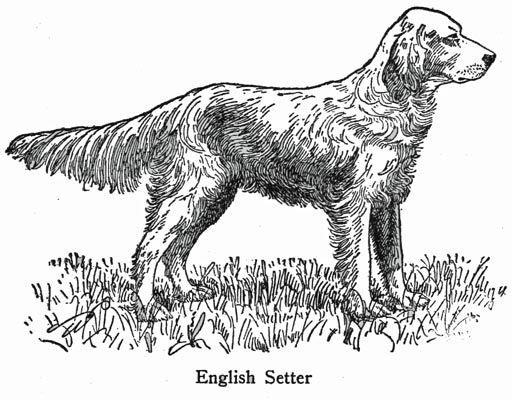
was a beautiful English setter, speckled white with
black markings. Her every motion was swift and
graceful as she ran sniffing from one clump of shrubbery
to another. Sometimes the man would give a
peculiar little whistle, and then the dog would pause
and look up, and then dart off to right or to left in
obedience to a wave of the man's arm.
Suddenly the dog stopped and stood rigid as a
statue, her tail held out straight behind, one foreleg
raised, and her neck and nose stretched toward a
patch of sheep laurel. The man stealthily approached
while the dog stood perfectly motionless with quivering
nostrils.
They were quite near the boys now. There was
a sudden movement in the sheep laurel, a whir of
wings, and four or five birds rose swiftly into the air
and shot off toward the woods.
"Bang!" went the man's gun, and both boys
jumped so that they scarcely noticed a bird fall.
"Bang!" went the other barrel almost immediately,
and another bird fell fluttering to earth. Then the
dog broke her point and brought the birds back to
her master in her sensitive mouth.
To tell the truth, the boys were a little frightened
at this gun-fire so close at hand, especially Jack, and
they watched anxiously as the man reloaded his gun.
But the birds had disappeared and the man started
off in the direction they had taken. He whistled to
his dog, but a new scent had attracted her attention,
and she trotted down toward the brook and began
sniffing the air.
"She smells our potatoes," said Ernest.
Jack forgot his fears in this new interest.
"Let's call her over," said he.
"Come here, sir!" called Ernest, making a kissing
noise with his lips. "Come here!"
The dog lightly leaped the brook and came slowly
up the bank toward the Cave, her tail waving in a
friendly manner. Ernest scraped out a bit of potato
and held it out to her. She stood for a moment,
sniffing, as if in doubt. Then she came forward and
daintily took the proffered food. In a few minutes
both boys were smoothing the silky head, looking into
the fine eyes, and talking to their visitor.
"Tryin' to steal my dog?"
They had not noticed the man's approach, he had
stepped so softly, and the gruff voice so close beside
them startled them.
"Oh, no," protested Ernest, hurriedly. "She—we——"
The man's face was very solemn, but there was a
humorous twinkle in his eyes that somehow made the
boys feel easier. The dog placed her paw on Jack's
arm as though begging for more petting.
"Won't you sit down?" asked Ernest, in an effort
to be polite.
The man's face broke into many wrinkles and he
laughed aloud.
"Don't know but what I will," said he, "if you
ain't afraid I'll hurt your parlor chairs."
It was now the boys' turn to laugh, and the ice
was broken. The man squatted down beside the fire
as though glad of a chance to rest, and the dog
stretched herself out at his feet.
"I'm glad you didn't mean to steal her," said the
man, "because then I wouldn't have no one to find
birds for me. Then what would I do?"
There seemed to be no answer to this, so Ernest
asked him if he had shot many.
"Five this morning," said the man, and tumbled
the pretty dead things out of his pockets.
"They're quail, aren't they?" asked Ernest, stroking
one of them.
"Yep," said he, "Bob-Whites. They're runnin'
pretty good this year, too."
Something in the man's friendly manner inspired
a sort of boldness in young Jack.
"Don't you hate to shoot them?" he asked.
The man looked into Jack's frank brown eyes for
a moment and then moved a little closer.
"Say," he said, "I'll tell you a secret. I s'pose
I've shot more birds and rabbits than any man in
this county, if I do say it, and I never bring down
a partridge or kill a chicken that I don't feel sorry
for it. I ain't never got over it and I guess I never
shall. But it's the only thing old Sam Bumpus is
good for, I reckon, and it has to be done. Folks has
to eat and I have to make a livin'. I don't do it for
fun, though I don't know any finer thing in this
world than trampin' off 'cross country with a gun
and a good dog on a fine mornin'. It's my business,
you see."
"Gee!" exclaimed Ernest. "I'd like that business
better than insurance, I guess. That's what my father
is."
"Who is your father?" inquired Sam Bumpus.
"You see I'm very partic'lar who I know."
"He's Mr. Whipple. We're Ernest and Jack
Whipple."
"Oh, you live down on Washburn Street?"
Ernest nodded.
"Well, that's all right," said Sam. "I guess you'll
pass."
He seemed in no great hurry to be getting on.
Taking an old black pipe from his pocket he filled it
from a greasy pouch and lighted it. He took a few
reflective puffs before he spoke again.
"What do you know about dogs?" he asked,
abruptly.
"Why—not very much, I guess," confessed
Ernest.
"We like them, though," added Jack.
"Well, that's half the game," said Sam. "There's
two kinds of people in this world, them that likes dogs
and them that don't, and you can't never make one
kind understand how the other kind feels about it. It
just ain't possible. And if you don't like dogs you
can't never know dogs, and if you don't know dogs
you're missin'—well, I can't tell you how much."
"I've known Nan here," he continued, stroking the
setter's head, while she looked up at him with adoration
in her eyes, "I've known Nan for goin' on
seven years, and I learn somethin' new about her
every day. I raised her from a puppy, broke her to
birds, and lived with her summer and winter, and
I tell you I never seen a man or a woman that knows
any more than what she does or one that I could
trust so far. That's the thing about a dog; you can
trust 'em. There's bad dogs and good dogs, and
no two is just alike, but if you once get a good one,
hang onto him, for you'll never find another friend
that'll stick to you like him."
The man seemed so much in earnest that the boys
remained silent for a time. Then Jack asked, "Can
she do tricks?"
"If you mean sit up and roll over and play dead,
no," said Sam. "I don't believe in spoilin' a good
bird dog by teachin' 'em things that don't do 'em no
good. But what she don't know about huntin' ain't
worth knowin'. It positively ain't."
For half an hour more Sam Bumpus told the boys
of various incidents that proved the sagacity of Nan
and the other dogs he had owned. He told how once,
when a burning log rolled from his fireplace in the
night and set his little house on fire, a pointer named
Roger had seen the flames through the window, had
broken his collar, plunged through the mosquito netting
across the window, and had wakened his master
by pulling off the bedclothes and barking.
"If that dog hadn't known how to think and plan,
I wouldn't be here to-day talkin' to you boys."
Suddenly he jumped to his feet.
"That reminds me," said he. "I've been sittin'
talkin' here too long. I've got to be about my business
and your folks'll wonder why you don't come
home to dinner. Come, Nan, old girl."
The setter sprang up, yawned, and then stood ready
for the next command. Both boys patted her and
then held out their hands to Sam.
"I hope we'll see you again sometime," said
Ernest. "We like to hear you tell about your dogs."
The man's tanned face seemed to soften a little as
he shook hands with the boys.
"Well," said he, "I guess you can see me if you
want to. My social engagements ain't very pressin'
just now. I ain't got one of my business cards with
me, but you can just call anywhere in these woods
and ask for Sam Bumpus. The dogs'll know me if
the men don't. So long, boys," and he strode off
down the bank with Nan dashing joyously ahead.
"Good-by, Mr. Bumpus," called Ernest and Jack.
He paused in the act of leaping the brook and
looked around, with the twinkle in his eyes.
"Say," he called back, "if I ever hear you call
me that again I'll set the dog on you. My name's
Sam, d'ye hear?" Then he slipped in among the
underbrush and was gone.
Talking animatedly about their new acquaintance
and about dogs, the two boys hastened to lock up
their treasure chest and depart.
"Say, Ernest," said Jack, as they started off
through the woods with their bags of chestnuts over
their shoulders, "the Cave is a great place for adventures,
isn't it?"
That evening, as the family were gathered in the
living-room on Washburn Street, and Mrs. Whipple
was trying to repair the damage that chestnutting had
wrought in a pair of Ernest's stockings, the boys
asked their father if he knew Sam Bumpus.
"Bumpus?" he asked. "Oh, yes, he's that queer
fellow that lives all alone in a shack in the woods off
on the Oakdale Road. An odd character, I guess,
from all I hear, but they say he's a wonderful shot
and people take their bird dogs to him to be broken.
How did you hear about him?"
The boys told their story, and then Ernest asked
wistfully, "Papa, when can we have a dog?"
"When your mother says you can," replied Mr.
Whipple, with a smile.
Sorrowfully the boys went off to bed, well knowing
what that meant. For Mrs. Whipple was one of
the people that Sam Bumpus had spoken of—the kind
that don't like dogs.
The next Saturday was gray and chilly, but the
weather did not deter Ernest and Jack Whipple from
starting off early for the woods. They carried their
chestnut bags as a matter of course, but this time the
chestnut trees offered them very little enticement. The
ones they knew best had already been robbed of their
nuts, and they soon wearied of a somewhat profitless
search. It was Jack who voiced what was in the
minds of both boys.
"I wish we could run across Sam Bumpus again,"
he said.
Sam had said they could find him in the woods,
but the woods had never seemed so extensive and it
was like hunting for a needle in a haystack. They
arrived at Beaver Pond and the Trapper's Cave without
encountering any sign of the man and his dog.
Chiefly as a matter of habit they built a small fire
in front of the Cave and sat down beside it on their
log seat to consider the problem of finding an elusive
hunter in the wide woods. They did not even open
the treasure chest.
"He said anybody could tell us where to find him,"
said Jack, "but there's no one to ask. People don't
live in the woods, do they?"
Ernest sat pondering. "Well," said he at length,
"there's that old woman that gave us the doughnuts
one day. Do you remember? She had a lot of white
hens that went right into her house, and a little dog
named Snider that was so old he could hardly
breathe."
"Oh, yes," responded Jack, brightening up.
"Where does she live?"
"I don't know exactly," said Ernest, mournfully,
"but I think it was over that way. We might find
her if we hunted."
The boys arose, put out their fire carefully, as all
good woodsmen should, and started off through the
woods again. They must have tramped for nearly
an hour, but the very uncertainty of the outcome of
their quest gave it a touch of adventure and kept them
going. At last, after following various false clues,
they came out unexpectedly and abruptly into the
clearing behind the old woman's house. The cackling
of fowls and the wheezy barking of little old Snider
greeted them. As they approached, the old lady herself
appeared in the doorway of her kitchen, clad in a
faded blue dress and leaning on her stick. As soon
as she saw that it was boys her face broke into a
smile.
"Come right in," she said, "and I'll get you some
cookies."
The boys entered and sat in the kitchen chairs to
eat their cookies. They were anxious to be on their
way in search of Sam Bumpus, but politeness demanded
that they linger a few minutes. Ernest inquired
after the health of old Snider. The widow
shook her head sadly.
"He's failin'," she replied. "I can see he's failin'.
His teeth is all gone so he can't eat much and he
has the azmy pretty bad. It's what us old folks has
to expect, I s'pose, but I don't know what I'll do when
Snider goes. He's all I've got now."
She wiped away a tear with the corner of her
apron while the boys fidgeted in their chairs. They
felt sorry for her, but they didn't know what to say
on an occasion like this. Ernest reached down and
patted the little dog's head.
"Poor old Snider," he murmured. Somehow that
seemed to comfort the old lady.
At last Ernest found it possible to ask her if she
knew Sam Bumpus.
"Lor', yes," she responded. "Queer old codger,
Sam is, but the best-hearted man in the world. Many
a good turn he's done me. He was here only this
mornin' with some bones to make into soup for
Snider."
"Where did he go?" inquired Ernest.
"He didn't say where he was goin', but I reckon
if you was to go over to the Poor Farm you could
find out. He was headed that way."
The boys had ridden by the Poor Farm on several
occasions but had never visited it, and they felt a
slight hesitation about doing so now, but the woman
assured them that the inmates were all quite harmless
and gave them directions for a short cut. Thanking
her for her kindness, and patting Snider good-by,
they set off along a rutty woods road and in a little
while came to the Poor Farm. They crossed an inclosed
field where a small drove of hogs were feeding,
and went around to the front of the big white house.
They did not have to inquire for Sam Bumpus, for
there he was, as natural as life, sitting on the steps
of the veranda with Nan stretched out beside him.
As the boys turned the corner of the house he arose
with alacrity and held out his hand to them.
"Well, well," he cried in his gruff voice, his face
wreathed with smiles, "this is a sight for sore eyes.
Come right up and set down here. I can't invite you
in because this ain't my house. I'm just a visitor
here myself. I have a lot of old cronies here, and
besides, I want to get familiar with the place because
I may have to come here to live myself sometime."
He rattled on so that the boys didn't have a chance
to answer. He led them up on the veranda to an old
man who sat in a rocking chair, bundled up in a
blanket, smoking a pipe carved wonderfully in the
form of a stag's head.
"These are my friends Ernest and Jack Whipple,"
he said to the old man, "and they like dogs."
At this the old man took his pipe from his mouth
with a thin, trembling hand, looked at them out of
pink, watery eyes, smiled, and nodded his white
head.
"This is Captain Tasker," Sam told the boys. "He
don't talk much, but he's forgotten more than you or
I ever knew. Some day I'll tell you about his dog
that followed him to war. He's a Civil War veteran,
and he got wounded at Antietam. Show 'em your
Grand Army badge, Captain. See?" he added to the
boys. "I told you I was partic'lar who I knew."
Nan got up and stretched herself and looked up at
her master inquiringly.
"Yes, old girl," said Sam, "it's time we was gettin'
along." Then, noticing that the boys looked disappointed,
he added, "Come walk a piece with us, won't
you? I'd like to talk with you."
The boys readily acquiesced, and bidding good-by
to Captain Tasker, they set out with Sam along a leafy
woods road, with Nan ranging ahead. All about
them the forest beckoned alluringly, and Sam told them
of spots where grouse and quail abounded, or where
one might reasonably expect to "jump" a rabbit.
Arriving at length at the Oakdale Road, Sam and
the boys seated themselves for a little while on a
fallen log, while the former concluded a discourse on
bird dogs and hunting.
"Setters," he was saying, "are usually supposed
to be the keenest and pointers the strongest, but in my
opinion it all depends on the partic'lar dog. Nowadays
I hear a good deal about the pointer bein' the
best dog, and I've owned some good ones myself.
There's nothing prettier than a strong, wiry pointer
doublin' and turnin' in the brush and freezin' to a
steady point. But for my own part, give me a well-bred
Llewellyn setter; they're the humanest dog they
is. They've got the bird sense, too. Oh, you can't
beat 'em."
"Is it hard to train them?" asked Ernest, who
was of a practical turn of mind.
"Not so hard, if you know how," said Sam.
"They have so much brains that they learn about as
fast as you teach 'em. But you've got to know how
to go at it. I've seen good sportsmen make a mess
of it. First off, you've got to find out if they've got
a nose. That's easy enough if you live with 'em and
watch 'em. Hide something they want and see how
quick they find it. You've got to take 'em when
they're young, of course. You can't teach an old dog
new tricks, you know. But a good bird dog has got
it bred in him, and he picks it up quick enough if
you can only be patient and if you show half as much
sense as the dog does."
Then he told, in his own peculiar fashion, how he
started with the puppies, teaching them to retrieve
objects such as sticks and balls, and later dead birds
that they must learn to carry gently without using
their teeth.
"Never let 'em think it's just a romp they're
havin'," he continued. "I like to play with puppies
as well as anyone, but when I'm breakin' 'em I let
'em understand that it's business. Never let 'em have
their own way if they want to do the wrong thing,
and never give 'em an order without seein' that it's
carried out if it takes all day. That's where the patience
comes in. Teach 'em to obey, and you can do
most anything with 'em."
"Do you whip them if they don't obey?" asked
Ernest.
"Never whipped a dog in my life," said Sam, decidedly,
"except a fox terrier I had once. They're
different. A whipped setter is a spoiled setter, and
if you can't make 'em do what you want 'em to
without whippin' 'em or bribin' 'em, you'd better get
out of the business. Of course, I sometimes give a
puppy a piece of cookie or something to show him
he's done what he ought to, but I never use the whip.
There's other kinds of punishment that work better
and don't break their spirits. Just keep 'em from
havin' what they want, and tease 'em into wantin' it
awful bad, and you can make 'em do most anything."
He then went on to explain his method of teaching
a young dog to hold his point in the field. He used
a long rope tied to a stout collar, and led the dog
to a thicket where a dead bird lay. When the dog got
the scent and started to dash in, a sharp jerk on the
rope restrained him, and in time he was thus taught
to stand rigid when the scent came strong to his
nostrils.
"That's one way to teach a dog not to chase
chickens, too," he added. "But a puppy born of
trained parents gets the pointin' habit almost by instinct,
and retrievin', too. The main thing is to make
him understand that he's got to do the trick and not
something else that happens to pop into his head.
After that, you can teach 'em to answer your whistle
or a wave of your hand and hunt just where you want
'em to."
"Aren't they afraid of a gun at first?" asked Jack,
who had never learned not to jump when a gun went
off.
"Some of 'em are," said Sam. "If a dog is gun-shy
he's got to be broken of that before he's any good
in the field. Some folks say you can never break a
dog that's really gun-shy, but I never seen one yet
that I couldn't cure."
"How do you do it?" asked Ernest.
"Well, one way is to give the dog something he
wants every time you shoot off a gun. You can shoot
over his dinner, and not let him have any till he comes
up to where you and the gun are. Keep at it, and
after awhile he begins to connect the sound of the
gun with things that he likes. Always take a gun
when you go out for a walk with him, and after awhile
he will bark and act happy every time you take it from
the rack. The whole idea of breakin' a bird dog is to
make him think that the thing you want him to do is
the thing he wants to do, and never let that idea get
away from him."
The boys continued to ply him with questions, for
this was a subject that they had never heard about
before, and Sam willingly added more details of the
process of training. At length he took a big dollar
watch from his pocket and consulted it.
"Jumpin' Jehoshaphat!" he exclaimed. "I didn't
know it was gettin' so late. I'll have to be hurryin'
along. Say," he added, a little wistfully, "come up
to my house and see me sometime, won't you? I ain't
got anything very elegant up there, but I could show
you something in the line o' dogs and guns that might
interest you."
"Oh, we'd love to, if our folks'll let us," said
Ernest. "Where do you live?"
Sam gave them careful directions.
"First and third Tuesdays used to be my days for
callers, but nobody came," said he, as he started up
the road with Nan. "So now any old day will do—if
I'm home."
"How about next Saturday?" asked Ernest.
"Saturday it is," said Sam Bumpus, and with a
wave of his hand he vanished around a bend in the
road.
Clothes do not make the man, and boys are apt to
overlook certain superficial peculiarities and defects
which seem more significant to their elders. In Sam
Bumpus they saw only a man of good humor and
wonderful wisdom, a man whose manner of life was
vastly more interesting than that of the common run
of people, whose knowledge of the lore of woods and
fields, of dogs and hunting, entitled him to a high place
in their estimation. They overlooked the externals,
the evidences of poverty and shiftlessness, his lack of
education, and saw only his native wit and shrewdness,
his kinship with the world of nature, and his
goodness of heart. They considered it a piece of rare
good fortune to have made the acquaintance of so
wise and sympathetic a person and they felt indebted
to him for permission to visit him, to hear him talk,
and to glean from him something of the knowledge
that had come to him through experience.
To Sam Bumpus, however, the obligation seemed
to be on the other side. The boys did not know it,
but Sam Bumpus was a lonely man and craved human
companionship. He lived like a hermit in his little
shack in the woods and his peculiarities had set him
somewhat apart from the world of men. He had
no living relatives, and apart from the old lady in
the woods road, the inmates of the Poor Farm, and a
few other out-of-the-way people with whom he had
been able to win his way through his natural generosity
and kindness, he had practically no friends but
his dogs. He understood dogs better than he understood
men, and, to tell the truth, he esteemed them
more highly; yet he sometimes hungered for human
comradeship. That two frank-hearted, unspoiled boys
should seek him out and seem to desire his company
gave him a feeling of unaccustomed satisfaction, and
he looked forward to their promised visit fully as
eagerly as did the boys themselves.
This proposed visit was such an unusual affair that
Ernest Whipple considered it advisable to speak to
his father about it. Mr. Whipple was reading his
paper and made but little comment, but Mrs. Whipple,
who was in the room at the time, raised objections.
"Don't you think it might be unsafe for the boys
to go away off there alone?" she asked anxiously.
"We don't know anything about this man. He may
have a bad influence on them, even if nothing more
serious happens to them. He's a very uncouth person,
I should say, and hardly a fit companion for little
boys."
"Oh, I don't think he'll hurt them," said Mr. Whipple
from behind his paper.
But the mother wasn't satisfied, and after the boys
had gone to bed she again brought the matter up.
"Well, mother," said Mr. Whipple, "he probably
isn't the sort of guide, philosopher, and friend that
we would have picked out for the boys, but parents
can't always do the picking. They are getting older
all the time, and sooner or later they must be thrown
on their own resources. Self-reliance doesn't come
from constant protection and hemming in. We can't
keep them from striking up acquaintances, and before
we raise objections we should be sure that they're well
grounded; then we shall be able to make our objections
count for more."
"But I should think there was good ground for
objection in this case," she persisted. "This man
seems to be so crude and rough, if nothing worse."
"Oh, he's all right," responded the father. "Don't
think I'm careless about these things. I've made some
inquiries, and though I find that Bumpus is unconventional
and queer, as they say, and improvident and
uneducated, he's honest and law-abiding. So far as I
can find out, the worst thing he ever does is to give
tobacco to the inmates of the Poor Farm. I know
people right here on Washburn Street that would do
the boys more harm. Just because he doesn't live like
folks on Washburn Street doesn't make him bad."
"Well," said Mrs. Whipple, doubtfully, "I suppose
you know best, but for my part I would much prefer
to keep them safe home with me, for some years to
come."
"That's because you've never been a boy," said
Mr. Whipple, with a smile in his eyes. "I have, and
it doesn't seem so very long ago, either."
Mrs. Whipple was not satisfied, but she did not
forbid the proposed visit. The next Saturday, therefore,
found them early on their way, filled with joyful
anticipations.
Sam's shack, when at last they arrived, proved to be
a forlorn affair, built of boards of different widths,
some red, some white, and some unpainted. The sagging
roof was of corrugated iron and the only chimney
was built of cement pipe guyed up with wires. But
to the eyes of the boys it was a most attractive abode.
Never before had they seen such an interesting house.
There must be an element of sport in living in a cabin
like this, they thought.
Sam heard their footsteps and met them smilingly
at the door. He ushered them at once inside, where
he had a wood fire roaring in his stove, for the day
was chilly, and he promptly set before them glasses
of milk and hot corn bread. Though they had breakfasted
only two hours before, they fell to with gusto,
for that is the way of boys.
"How do you like my corn bread?" asked Sam.
"M-m!" murmured Jack, taking a fresh bite.
"Do you bake it yourself?" inquired Ernest.
"Sure," said Sam.
"Gee!" exclaimed Ernest, looking up at him with
admiration.
After they had fully refreshed themselves, Sam took
them out through a back door, from which they could
see a number of small structures that looked as though
they had been made out of dry-goods boxes. The
sound of excited barking smote their ears, a chorus
of canine cries and yelps. Old Nan came bounding
forward to greet the boys, for she knew them now,
and behind her loped a big pointer.
"This is Hillcroft Dick," said Sam, by way of
introduction. "He's a famous dog, a champion on
the bench and at the trials. He ain't my dog, though.
I'm just boardin' him for a man that's gone to California.
I wish I owned him, though. He's a great
dog."
The boys didn't understand the reference to bench
shows and field trials, but they gathered that Dick was
some sort of nobleman among dogs and they were
visibly impressed.
"Now we'll go out to the kennels," said Sam.
There were seven dogs, all told, besides Nan and
Dick. There were two cocker spaniels, in the first
place, that Sam said he was training for a man in
Oakdale.
"I like a bigger dog, myself," said he, "but there's
a lot of good dog wrapped up in these small bundles.
They're smart as whips, and though I've got to make
'em forget their foolin' and parlor tricks, I'll soon
have 'em able to find and retrieve. Sometimes you
can even teach a spaniel to point."
The other five were all Sam's dogs, another pointer,
a little smaller than Dick, and four beautiful English
setters.
"They've got the best blood in the land," said Sam,
proudly, "and every one of 'em is letter perfect on
his job. This is Rex and this is Robbin and this is
Rockaway."
The boys patted and spoke to each in turn, hugely
enjoying this introduction to Sam's family.
"And this one over here is the best of all," he
continued. "That's Nellie, own sister to Nan, and
what she don't know wouldn't hurt a flea. But I
guess I'd better keep you away from her to-day. She
ain't feelin' very well."
After they had fondled and played with the dogs
to their hearts' content, the boys followed Sam again
into the house, where they spent the rest of the morning
smoothing Nan's silky hair and listening to wonderful
stories about the sagacity of Nellie and the
other dogs.
So pleasantly was the time employed that it was
eleven o'clock by Sam's big watch before they thought
it possible, and as they had promised to be home in
time for dinner, they were obliged, reluctantly, to
take their departure.
As they turned the bend in the road they looked
back and saw Sam standing in his low doorway with
Nan sitting picturesquely beside him.
"Come again soon," called Sam.
"We will," the boys shouted in reply.
They did call again, once on the Saturday before
Thanksgiving Day and again in December, when the
woods and fields were white with snow and they wore
their warm sweaters and arctics. On each occasion
they became better acquainted with Sam's dogs and
learned something new about training dogs and finding
game, and Sam showed them the mechanism of
his shotguns and rifles. He also explained to them
his method of curing the pelts of muskrats and the
beautiful silver-gray fur of the little moles that the
people in charge of the Poor Farm were very glad
to have him trap in their garden. And as the boys
came to know Sam's dogs better they began to see
how each differed from the others in character and
disposition and in the way they understood and did
things.
"Just like people," said Sam; "just like people."
Even Mrs. Whipple was unable to discover that the
boys' manners had been damaged greatly by their association
with Sam Bumpus, though she was surprised
at their continuous talk about dogs and the strange
jargon, as it seemed to her, which they used in that
connection. She was no less surprised to find that
her husband appeared to understand the meaning of
"bird sense" and "freezing to a point" and "retrieving"
and "blood lines" and "cross-breeding"
and to be able to discuss these mysterious matters with
the boys.
"But what is the good of their filling their heads
with all that stuff?" she asked him.
"My dear," replied Mr. Whipple, "you may not
believe it, but it is just as much good as arithmetic
and geography, and you're always worrying because
they don't take more interest in those things. There
are more ways than one to get an education."
But Mrs. Whipple only shook her head perplexedly.
It was on the day before Christmas that the great
event occurred that I have been leading up to. Ernest
and Jack Whipple had returned from an hour's coasting
on the long hill over by the brickyard and were
standing on their sleds beside the front gate bemoaning
the fact that the snow had melted so badly and speculating
on the surprises which the morrow might have
in store for them. It was vacation, and they were
considering how best to spend the long hours that
would intervene between dinner and time for lighting
up the Christmas tree, when Ernest stopped abruptly
in the middle of a sentence and stood looking up the
street.
"Jack!" he exclaimed. "Look who's coming!"
Jack turned and beheld the familiar, lanky figure
and long, easy stride of Sam Bumpus. Both boys
set up a yell and started on a run up the street.
"Merry Christmas, Sam!" they cried. "Merry
Christmas!"
"Merry Christmas, men," replied Sam, grinning.
One on each side of him, they escorted Sam down
the street.
"Have you come to see us?" inquired Ernest.
"Why, no," said Sam. "I came to see the President
of the United States, but I found he wasn't in
town, so I thought I'd drop in on you. You haven't
seen anything of him around here, have you?"
The boys laughed delightedly; they had come to
understand Sam's kind of joking.
"Well, you must come into our shack," said Ernest.
"We'll introduce you to mother, and father will be
home soon."
"Well, I don't know as I'll exactly go in," replied
Sam, doubtfully. "Maybe your mother ain't asked
to be interduced to me. Anyway, I can talk better
outside."
"Where's Nan?" asked Jack.
"I left her home, doin' up the dishes in the
kitchen," said Sam. "The city don't agree with Nan.
It don't agree with me much, either. I won't stop but
a minute."
"Aw, come on in," pleaded Ernest.
But Sam shook his head. "No," said he, "I just
want to show you something, and then I must be
goin'. Can't we go over to the barn?"
"Sure," said the boys, and led the way to the stable
in the yard that was now used only as a tool house
and garage.
"We'll show you our carpenter shop," said Ernest.
But Sam did not stop long to examine the carpenter
shop. There was something very mysterious
about his attitude which aroused the boys' curiosity to
top pitch.
"Come over here," said Sam, stepping toward an
unused stall.
He began fumbling in his capacious pockets, and
the boys crowded close about him, expecting to see
some unusual sort of game he had shot. Suddenly
before their astonished eyes there appeared two fuzzy,
dappled puppies, running and sniffing about the floor
of the stall.
"Puppies!" cried the boys in unison.
"Yep," said Sam. "English setter puppies."
"Where did you get them?" demanded Jack, catching
up one of the sprawling little dogs in his arms.
"Nellie gave them to me," said Sam.
A look of comprehension began to dawn in Ernest's
eyes. "So that's why you wouldn't let us go near
her kennel last time we were there," said he. "She
had them all the time."
Sam grinned. "They're pretty young to take away
from their mother," said he, "but she has three more.
She's a good mother, Nellie is. You ought to see
her chase the other dogs away. I had a job of it
gettin' these two weaned before Christmas."
"Why did you have to get them weaned before
Christmas?" asked Jack.
"Now you jest think that over, and see if you can
tell me," said Sam.
Ernest had already half guessed the wonderful
truth, but he didn't yet dare to say what he thought.
"Don't be afraid of 'em," said Sam. "They won't
bite—or leastways, not serious. Besides, they're your
own dogs."
"Our own dogs?" gasped Jack in astonishment,
the glad light beginning to break in upon him.
"Sure," said Sam. "What else would they be here
for? I thought Santa Claus might happen to forget
you, and so I brought 'em down."
"Oh!" cried Ernest. "Christmas presents! To
be our very own dogs! I guess none of the other boys
will have such fine presents as these, Jack."
But Jack was speechless with joy.
"Have they got names?" asked Ernest.
"Sure," said Sam. "I told you how I name all
my dogs with names beginning with the same letter.
All my own puppies, I mean. It's for good luck.
There's Rex, you know, and Robbin and Rockaway.
These two are Romulus and Remus and they're
twins. This one with the black ear is Romulus,
and this one with the little map of Africa on
his side is Remus. That's how you can tell 'em
apart."
"Which is mine and which is Ernest's?" inquired
Jack, at last finding his voice.
"Well, now, I hadn't thought of that," confessed
Sam. "Suppose you draw lots for 'em. Here, I'll
hold these two broom straws so you can't tell which
is longest. You each draw one, and the one that gets
the longest straw can have first choice of the puppies.
Is that fair?"
The boys agreed to the plan and drew the straws.
Ernest's proved to be the longer one.
"Well, he's older, anyway," said Jack. "Which
one do you choose, Ernest?"
"I'll take Romulus," said Ernest promptly, having
noted that the one with the black ear was a shade the
larger of the two.
"All right," said Jack, "and Remus is mine." And
he asserted stoutly that he would have chosen Remus
anyway.
"That's good," said Sam. "Then you're both satisfied.
Grown people would have made more fuss
about it, I'll warrant you.
"Well, I must be steppin' along," he continued.
"Take good care of the puppies, because they're valuable.
Remember that they're used to sleepin' close to
a warm mother and see that they have a good bed.
I'd put some rags in a box for 'em if I was you. Let
'em have fresh air and sunshine and a chance to
stretch their legs, but don't let 'em get wet or chilled
through and put their bed where they ain't no
draughts. Remember they ain't got their warm coats
yet.
"Give 'em a saucer of milk with the chill taken
off, six times a day, and break a little bread into it
at supper time. In a few weeks you can cut down to
three meals a day, with more solid food, but I'll be
down to see you before then, if you don't get up to
see me, and I'll tell you just how to manage. Let
me know if you have any trouble of any kind, but
I guess you won't."
The clicking of the front gate announced the return
of Mr. Whipple to his noonday meal. The boys ran
to the stable door and shouted, "Father! Oh, father,
come see what we've got for Christmas!"
They dashed toward him and dragged him by main
force to the stable. But when they got there, Sam
Bumpus had mysteriously disappeared, without giving
the boys a chance to thank him or to wish him another
Merry Christmas.
Mr. Whipple examined the puppies with interest and
watched their clumsy antics with amusement. Like
most people he could not resist the charm of a wet-nosed,
big-footed, round-bellied, fuzzy little puppy.
Presently, however, a look of doubt came over his face.
"What do you propose doing with them?" he
asked.
"Why, having them for our dogs," said Jack, surprised
that his father should ask so obvious a question.
"I mean, where do you plan to keep them?"
"Why, in our room, I guess," said Ernest.
But Mr. Whipple shook his head doubtfully. "I
don't imagine they've been taught yet how to behave
themselves in the house," said he. "And anyway, I
don't believe your mother will want them there. She
doesn't like dogs, you know."
"Aw, she wouldn't mind little bits of soft dogs like
these," protested Ernest.
"Well, you can try it and see," said Mr. Whipple,
"but I wouldn't get my hopes up too high, if I were
you."
Mrs. Whipple did object quite decidedly, and for
a time it looked as though Romulus and Remus were
unwanted guests in that household and that their
young masters would be forced to part with them.
Tears were shed, but of that we will say little. At
last Mrs. Whipple was persuaded to grant a truce in
order that the Christmas Eve festivities might not
be entirely spoiled. Besides, it was too late now to
take the puppies back to Sam Bumpus, and even Mrs.
Whipple was not hard-hearted enough to think of
merely putting them out into the cold. The upshot of
it was that, Delia having been given the evening off,
Romulus and Remus were banished to the kitchen for
the night, with a bed prepared in a box and another
box of sand placed hopefully near by. The boys insisted
on serving their supper in two separate saucers
with the idea that each would recognize his own and
observe the rights of the other.
Occasional stealthy visits to the kitchen that evening
disclosed two remarkably wakeful and active puppies
engaged in unexpected explorations, but at last they
curled up together in their new bed, two innocent little
balls of fluff, and Ernest and Jack bade them goodnight
with much ceremony.
On Christmas Day there was trouble from the start.
In fact, it was one of the liveliest Christmas Days in
the history of the Whipple household. In the first
place, when Delia came back early in the morning to
get things started for the Christmas dinner, she discovered
the two little strangers in her kitchen, and
promptly made known the fact that they were puppies
whose manners were not at all what they should be.
Mr. Whipple averted a domestic storm by taking the
puppies out into the yard, where he had his hands full
to keep them out of the snow.
By this time the boys had finished the examination
of their bulging stockings and the larger contributions
of St. Nicholas which stood beside the fireplace, and
bethought themselves of Romulus and Remus. They
dashed pell-mell out into the yard where their father
was pondering what he should do with them next.
The boys promptly solved this problem by picking up
the puppies, each taking his own, and carrying them
forthwith into the house.
Mrs. Whipple was in a good humor that Christmas
morning, and she really wanted her boys to be happy
all day, so although she added one admonition to
another, she allowed the boys to play with the puppies
in the sitting-room. They would have to part with
them soon enough, she thought, and meanwhile they
might as well have as much fun as they could.
But as the day wore on her good nature and kind
intentions were sorely tried. Romulus and Remus appeared
to think that the house was some sort of hunting
ground especially provided for little dogs, and
that it was their duty to pursue, worry, and kill every
sort of strange creature they could find. Evidently
they were imaginative puppies, for they discovered
enemies in overlooked corners of the room, on closet
floors, and everywhere. These enemies might be the
discarded paper wrappings of Christmas presents, or
they might be perfectly good balls of darning cotton.
It mattered not to Romulus and Remus so long as
their primitive impulse to catch and slay was satisfied.
They were very bloodthirsty little dogs.
But it ceased to be a joke, even to the boys, when
Mrs. Whipple, for awhile put off her guard by a
period of unusual quiet, discovered Romulus and
Remus engaged in the joint pastime of reducing to
small woolly bits a new gray felt slipper which she
herself had presented to her husband that very morning.
Hastily she cleared out the bottom of a closet,
thrust the puppies inside, and ruthlessly closed the
door, deaf alike to the piteous little squeaky whines
of Romulus and Remus and the louder protests of
Ernest and Jack.
"Now you see what they've done!" cried Mrs.
Whipple, holding up the forlorn and tattered remnants
of the slipper. "I guess this will about finish it. Wait
till your father comes home."
Mr. Whipple had gone out for a little while that
afternoon, and the boys awaited his return without
much optimism. When his key was at last heard in
the latch they looked at each other with eyes big with
apprehension.
Somebody had given Mr. Whipple a big cigar, and
a lot of people had wished him Merry Christmas, and
he was in a very jovial mood indeed. Mrs. Whipple
and the boys expected to see this mood suddenly
change when he observed the ruined slipper.
Mrs. Whipple handed it to him without a word.
He took it, examined it carefully with a puzzled expression,
and then (strange to relate) began to grin.
(I wonder if the fact that Mr. Whipple detested felt
slippers could have had anything to do with it.)
The grin broke into a hearty laugh, and Mr. Whipple
sank into a chair, still holding the slipper before
him.
"Well," said he, "they certainly made this look like
a last year's bird's nest. My eye! I should like to
have seen them at it. The little rascals! How did
they ever escape your eagle eye, mother?"
But Mrs. Whipple did not reply. Two red spots
glowed in her cheeks and her eyes were snapping. She
turned and left the room. Mr. Whipple puffed
thoughtfully at his cigar for a moment and then rose
and followed her, leaving the boys to engage in whispered
conjectures as to the outcome of the affair.
I don't know what Mr. Whipple said to his wife
in the other room, but he doubtless apologized for his
ill-timed mirth and then talked over certain things
with her. The upshot of it all was that a compromise
was reached in that household. It was decided that
Ernest and Jack might keep the puppies they had
so set their hearts upon provided they were kept entirely
away from Mrs. Whipple and were not permitted
to intrude themselves upon her affairs. The
boys must assume entire charge of them and be responsible
for their actions, must feed and care for the
dogs themselves without bothering their mother, paying
for their food out of their own earnings and
savings, and must on no condition bring them into
the house. That was the ultimatum; Mrs. Whipple
vowed that she would never allow another dog to
enter her doors.
"It's up to you, boys," said Mr. Whipple.
Strangely enough, the boys did not feel that these
restrictions imposed great hardship. In fact, it gave
them a sense of pride and not unpleasant responsibility
to be given sole charge of Romulus and Remus.
Nothing, indeed, could have suited them better. And
they were so relieved to find that they were not to be
deprived of their new possessions after all that they
were quite excitedly happy.
The only question that now seriously concerned
them was to find a warm, dry place to keep the puppies
in during the cold weather, while they were still so
delicate and helpless. It was here that their mother
came to their rescue. Having won her main point
about keeping the dogs out of the house, she was
mollified, and perhaps her conscience troubled her a
little. She was really a very tender-hearted woman,
and it occurred to her that her ultimatum might be the
cause of real suffering on the part of the puppies. So
it was she who sent for a carpenter and had him make
a sort of room out of one of the old stalls in the stable,
quite tight against draughts, and with a door in the
front for convenience.
When Mr. Whipple learned of this he laughed and
patted his wife on the shoulder. "I always knew you
were a cruel monster," he said.
He inspected the new abode of Romulus and Remus
and expressed his approval.
"It's the best thing in the world for them," he said
to the boys. "They will be really better off here than
in a heated house. They'll grow up sturdier and
stronger. They only need to be protected against
draughts and dampness, as Bumpus said. But you
mustn't forget to keep both doors closed and to warm
their milk and water a little, while their stomachs are
still tender. They'll curl up close together and never
mind the still, dry cold. They'll be all right here."
Furnishing and decorating the new home of
Romulus and Remus proved to be a most enjoyable
task. They took a good-sized box over to the planing
mill and got it filled with sawdust, and dragged it
home on Ernest's sled. They swept out the old stall
carefully and sprinkled the floor liberally with sawdust,
holding the rest in reserve, so that there might
always be a clean, fresh supply. Housekeeping was
thus made easy by simply hoeing out the old sawdust.
For a bed they set a soap box on its side, put in
a thick layer of straw, and tacked a piece of old
carpet loosely over it so that it would be soft and yet
the puppies could not scratch it out. They bought
two enameled tin dishes, one for food and one for
water, for they discovered that the puppies did not
understand the system of each having his own.
They nailed bits of wood to the floor to hold the
dishes so that they would not be pushed about and
overturned. The puppies enjoyed all this activity
immensely, making laughable efforts to help, and only
wailed and wept when their young masters left the
room.
When it was done, the boys surveyed their handiwork
with immense satisfaction, but Jack would not
be satisfied until they had tacked to the wall several
pictures of dogs clipped from papers and magazines,
for Jack insisted that the place must be made homelike.
They had read somewhere about the original Romulus
and Remus of history, and so they named the
apartment Rome. They thought Sam Bumpus would
approve of this since it began with the letter R. Then
they nailed an old horseshoe to the door for luck,
called it a day, and knocked off.
The next thing to consider was the education of
the puppies, and here the boys felt somewhat at a
loss. Romulus and Remus didn't seem to understand
a word of English, and the boys couldn't speak Latin.
All attempts to secure the prompt obedience that Sam
had advised ended in utter failure. Romulus and
Remus were very willful and headstrong puppies.
Further advice from Sam seemed desirable.
Furthermore, about the end of the second week,
both puppies appeared to be ailing. In spite of plenty
of milk they had grown thin, and Romulus appeared
to have trouble with the action of his hind legs.
Remus seemed to be chiefly afflicted with itching, and
had worn a bare spot under each foreleg.
Ernest and Jack became alarmed, and their father
could not seem to tell what the trouble was. Various
things prevented the boys from making the trip to
Sam's shack, and besides they wanted him to take a
look at the dogs. They had noticed his free delivery
mail box and so Ernest sent him this brief summons
on a postal card:
Dear Sam:-
Romulus and Remus are sick and we don't know
what to do.
Could you come down some day after school and
see them? Also we want to ask you some things
about disaplining them.
Yours truly,
Ernest and Jack Whipple.
Sam did not fail them. A couple of days later he
appeared at the Whipple gate and gave the low whistle
that he used with Nan. The boys, humoring his
desire not to go into the house, led him at once to
Rome.
"Well, now," said Sam, inspecting the puppies'
home with evidences of approval, "this is quite a
palace for the little princes. Some day I s'pose they'll
have hot and cold water, electric lights, and a doorbell."
Then he proceeded to examine the puppies while
the boys looked on anxiously.
"Hm," said he at length. "Just as I expected.
Nothing but worms."
"Worms?" echoed the boys in chorus.
"Sure," replied Sam. "Most all puppies get 'em
sooner or later, and sometimes they do a lot of harm
if you don't get rid of 'em. But we'll get rid of 'em
all right. Get a pencil and paper and write down what
I tell you to get at the drug store and the directions."
When they reappeared with the necessary articles,
Sam continued: "There's several things that'll take
care of worms, but the best and surest is santonin and
calomel. Write that down."
Ernest wrote as Sam spelled the words. It seemed
to be much more of an accomplishment to be able to
pronounce and spell such words than fulfilment or
handicraft.
"Tell the druggist," said Sam, "to make you up
half a dozen pills with half a grain of calomel and
half a grain of santonin in each one. For big dogs
we make 'em one grain each. To-morrow mornin'
give the pups a little milk and then don't feed 'em
again till after they've been dosed. About noon give
'em each a pill, and then, a couple of hours later, give
'em each a teaspoonful of castor oil. A couple of
hours after that, feed 'em again, and I'll guarantee
they'll be all right, though you may have to do it all
over again in a couple of months. Big dogs have to
fast longer and have to have a tablespoonful of castor
oil."
"How do you give them the medicine?" inquired
Ernest, looking at the squirming puppies doubtfully.
"Easy enough when you know how," said Sam.
"I'll show you. Pick him up like this and take hold
of his nose, pushin' his lips between his teeth with
your thumb and fingers. He can't bite and he has to
open his mouth. Of course, with a bigger dog it's
harder if he don't want to stand still. Then take a
pill in your other hand and put it down his throat as
far as you can reach. Then shut his mouth and hold
his head up till he has to swaller. He'll never know
what went down. It's the same way with the castor
oil, only you'll have to get Jack to hold the spoon and
put it in when you give the word. Put it way down
in, Jack, and don't get excited and spill it. Get a
spoon and I'll show you how easy it is."
Jack ran for a spoon and Sam illustrated with a
spoonful of water. Then the boys tried it until they
felt themselves sufficiently expert.
"There's a way of pourin' medicine into the side
of a dog's mouth outside his teeth," said Sam, "but
he's apt to spill some of it before he gets through.
Besides, he gets the taste of it that way, and may run
from the sight of a spoon or a bottle ever after. I
like my way better."
He looked at his watch and announced that he must
be going.
"I'll look in on you again one of these days," he
said, "but I know they'll be all right if you do like
I said."
"And you like Rome, don't you?" asked Jack.
"Rome?" repeated Sam.
"We named it that because Romulus and Remus
were Romans," explained Ernest.
"Yes, it's a mighty good place for them," said
Sam. Then he considered a moment. "Do you expect
me to get down and roll in the sawdust and try
to bite things?"
The boys laughed at the idea, though they didn't
exactly know what he meant.
"Why?" asked Ernest.
"Because I've always been told that when you're
in Rome you must do as the Romans do," said Sam,
and went away laughing silently.
The boys followed Sam's instructions to the letter,
and when he came again a week later the puppies were
as healthy and lively as crickets.
"Now," said Ernest, "we want to ask you about
training them. We forgot about that the other day."
"You don't expect to go gunnin' with 'em for a few
days, do you?" asked Sam.
"No," said Ernest, "but we want them to learn
to come when we call and do what we say."
"Well," said Sam, "all it needs is patience. Keep
talkin' to 'em and the first thing you know you'll find
they understand words. Then try to make 'em do
what the words mean. Remember they're only babies
yet and be patient with 'em. Keep at it until they
answer to their names. Don't be discouraged. Of
course, it'll be harder gettin' 'em housebroken if you
don't let 'em into the house, but I'll guarantee you'll
do it.
"It ought to be about time to cut down to four
meals a day now, and give 'em shredded wheat or
puppy biscuits. And now I'm here, I might as well
give you a little advice about feedin' in gen'ral.
You'll remember it all later. In another month you
can cut down to three meals and maybe add a little
chopped meat and gravy at night. Keep that up till
they're six or eight months old, and then you can
begin to feed 'em like grown dogs.
"In feedin' dogs," he continued, "remember they're
like humans. They ought to have meat and grain
and vegetables to get all they want to build 'em up
and keep 'em healthy. Some dogs is very finicky and
won't eat vegetables, but you can learn 'em to eat
right if you begin right. A grown dog don't need
but one meal a day, near night, but sometimes a dog
gets so hungry that he overeats or bolts his food, and
then it's a good plan to give him a little breakfast,
too. Bones they can have any time. Bones amuse
'em and help keep their teeth and digestion in good
shape. A good rule is to give a dog a little bread and
milk for breakfast, a bone without too much meat
on it about noon, and a good dinner at night, with all
sorts of things in it. Get shin of beef or some other
cheap meat at the butcher's and boil it good. Save
the bone and the soup. Cut the meat up in small
pieces, mix it with bread or rice and any vegetables
left over from the house—onions, cabbage, carrots,
or anything but potatoes. They ain't very good for
dogs. Mix the food all up together and moisten it
with the soup, but don't have it too wet. Stale bread
is better for 'em than fresh bread. Never give 'em
chicken or rabbit bones that may splinter and injure
'em inside. Don't give too much pork or fat of any
kind. Don't give 'em much candy or sweet stuff.
Some folks bake bread or cakes specially for dogs, but
if you do that, don't use much corn meal. It's too
heatin' in summer and it's apt to cause skin trouble.
If anything seems to disagree with 'em, like baked
beans, or sweet corn, or rice, cut it out; you can tell.
Last of all, always keep plenty of clean, fresh water
where they can get it. A thirsty dog is never happy."
These and other instructions the boys obtained from
Sam Bumpus from time to time, and as the days went
by they were pleased to see their dogs growing bigger
and stronger. Slowly, too, they began to learn the
meaning of things and to obey their masters' voices.
Raising dogs proved to be the most fascinating thing
that Ernest and Jack Whipple had ever undertaken.
By February they were very proud of their charges
and anxious to show them off. Consequently they
welcomed a visit one Saturday morning from Harry
Barton, a chum of theirs. Harry appeared unannounced
and accompanied by his big, bow-legged English
bulldog, Mike. He went directly to the barn, from
which issued the voices of the Whipple boys and their
dogs, and entered Rome. The unexpected appearance
of Mike startled Jack, and he picked Remus hastily
up and held him in protecting arms. But Harry only
laughed.
"What you 'fraid of?" he inquired. "Mike
wouldn't hurt a kitten. He looks ugly and that's what
scares tramps away, but he never bit anything. You
ought to see the baby walk all over him."
"Come on in, then," invited Ernest.
Mike went slowly up to Romulus and sniffed at him
noisily. At first the puppy was frightened, but finding
that he was not attacked he made one or two playful
little lunges at the bulldog and then stood off and
barked shrilly at him, Remus joining in the chorus and
struggling to be set down.
"They've got spunk, all right," said Ernest, proudly.
Mike sniffed at Remus also, then yawned in a bored
sort of way, waddled out of Rome as though his
years and dignity forbade his association with such
frivolous company, and thumped down on the floor
outside. All three boys laughed.
"Well, what do you think of 'em?" Ernest asked
presently. "Some dogs, eh?"
"Oh, they'll prob'ly be all right when they grow
up," said Harry, unwilling to concede too much.
"They'll have to grow a lot, though, before they
know as much as Mike."
"But a bulldog can't hunt like a setter," said
Ernest, flying to the defense of his breed.
"Who wants to hunt?" demanded Harry. "Hunting
isn't all a dog's for, is it? A bulldog's a better
watchdog than a setter."
Ernest, not knowing whether this was so or not,
made no reply.
"But aren't they cunning, Harry?" asked Jack.
"Oh, sure, they're cunning," said Harry, satisfied
that he had scored his point. "Can they shake hands
yet?"
"Not yet," said Jack.
"Mike can shake hands," said Harry, "and take
the mail from the postman, and do lots of things."
"But he can't hunt," insisted Ernest, returning to
the attack.
"I'd rather have a bulldog than a setter, any day,"
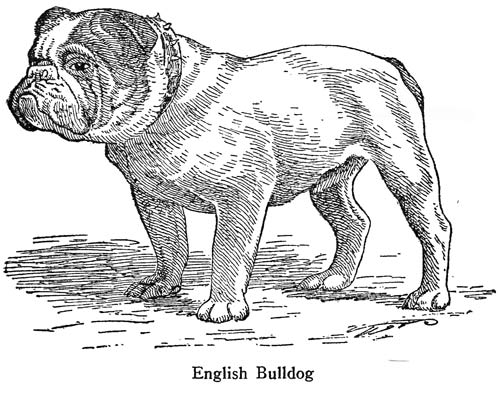
said Harry. "Why, the bulldog is one of the best
kinds of dogs. It's an older kind than the setter.
They used them in England for fighting bulls hundreds
of years ago. A bulldog is brave and faithful,
and he sticks to things. He isn't a flyaway kind of
a dog."
"But they're so homely," objected Jack, glancing
out at Mike.
"Ho," cried Harry, "who ever heard of a pretty
bulldog? We don't want 'em pretty. Mike's just like
a bulldog ought to be, thick-set, muscular, with wide
chest, elbows set far apart, and undershot jaw.
See?"
It sounded very much as though he were reading
it out of a book, and the other boys were much impressed.
Ernest found himself wondering where
Harry had picked up his dog lore.
"What do you know about setters?" demanded
Harry.
Ernest, in the face of superior wisdom, admitted
that he didn't know very much.
"Well, you ought to," said Harry. "What's the
use of having dogs if you don't know all about them?"
"Sam Bumpus has told us a good deal about training
and hunting," said Jack.
"Yes, but what do you know about the breed, where
it came from and all that? Do you want to find
out?"
"Sure," said Ernest.
"Well, I'll tell you where you can find out," said
Harry. "I know a man that knows more about dogs
than anybody else in the world, I guess."
"Who is he?" demanded Ernest.
"Did you ever hear of the Willowdale Kennels?"
asked Harry.
Ernest was forced to admit that he had not.
"Well, they're over at Thornboro," said Harry.
"They have twenty-eight dogs there. Mr. Hartshorn
owns them, but the man that takes care of them is
Tom Poultice. He's an Englishman, and he used to
have charge of kennels in England once. He knows
all about collies and greyhounds and—and every kind
of dogs there are."
"I bet he doesn't know more about setters and
pointers than Sam Bumpus does," said Ernest, loyally.
"Bet you a hundred dollars he does," said Harry.
"Bet you a thousand he doesn't."
The bidding bade fair to be unlimited, and though
the millions and billions and trillions remained to be
called upon, Harry desisted.
"Tell you what I'll do," said he. "I'll take you
over there and then you can see for yourselves."
Ernest and Jack promptly forgot their controversy
with Harry and accepted his proposal with animation.
"And can we see all those dogs?" asked Ernest.
"Sure," said Harry.
"How many did you say there were?"
"Twenty-four besides four puppies."
"Whew!" Jack exclaimed.
"When can we go?" asked Ernest.
"Why, this afternoon, if you want to. It's over
five miles to Thornboro, but we can take the 2:10
train and be there in no time. You come along by
my house after dinner and whistle," said Harry.
"Bully," said Ernest, and Harry turned and walked
jauntily out of the stable with old Mike lumbering at
his heels.
As Harry Barton had said, it was only a short run
on the train to Thornboro. The three boys disembarked
at the station and walked up a winding, muddy
road, for the sun was gathering strength and the snow
had been melting fast. The fields and hillsides lay
brown and dry, but not uninviting. It was a glorious
day to be out of doors, especially upon such a quest.
They came at length to an entrance in a privet
hedge and passed up a long driveway with maple trees
along both sides. At the end of it they could see a
large brick house with white pillars along the front.
"My, but this is a big place," said Ernest.
"Sure," said Harry. "Mr. Hartshorn is a rich
man. If he wasn't, how do you s'pose he could keep
so many dogs and hire a man just to take care of
them?"
"What does he do with so many?" inquired Jack,
to whom the care of one small puppy seemed a considerable
responsibility.
"Oh, he shows them," was Harry's somewhat
vague explanation. "He takes prizes with them at
dog shows. Some of them are champions. He
breeds them, too, and he sells the puppies he doesn't
want to keep. I guess he makes a good deal of his
money that way."
"What kind of dogs are they?" asked Ernest.
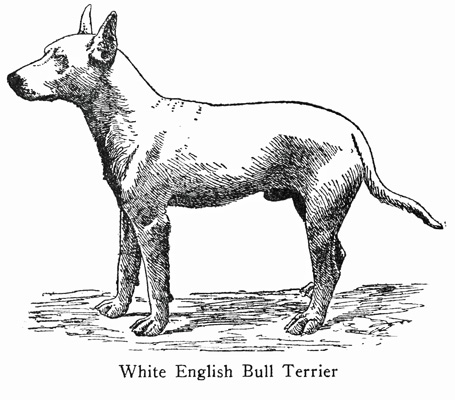
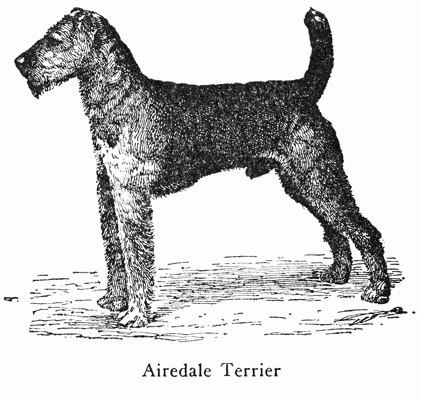
"Mostly Airedale terriers and white bull terriers,"
said Harry. "Not common bull terriers, like Frank
Symonds's, but the finest kind, all white."
As they neared the house, Harry led them into a
path through the shrubbery which brought them at
last around to the rear, where there was a big stable
and garage, a greenhouse, and some other buildings.
"That long low building is the kennels," said
Harry. "The dogs are in their runs out back, I expect,
and prob'ly Tom is out there, too."
"Why!" exclaimed Jack, "it's just like a house for
people."
The Willowdale kennel house was indeed a more
elaborate affair than the boys had imagined could ever
have been built just for dogs. It made Rome appear
very humble in comparison. It was a well-built house,
long and low, with windows all along the front and
a door in the middle. Over this door was an ornamental
gable and there was a cupola at the top. The
whole was painted white.
The boys passed around the end of the building,
from behind which issued the voices of many dogs
which they presently saw running about in yards built
of wire fencing. Some of the dogs were smooth and
pure white and some were wiry-coated and a rich
black and tan—tan on the legs and head and black
or a very dark grizzle on the neck and body. They
all appeared to be very lively, active dogs, and some
of them seemed rather pugnaciously anxious to get
at one another through the wire fences.
"There's Tom," announced Harry, and the other
boys, following his pointing finger, observed a man
in brown clothes and leather leggings apparently engaged
in mending the fence at the rear of one of the
runs. As they approached he straightened up and
came forward to meet them, with a little smile on his
broad face.
"Well," said he, "'ere we are. An' 'ow's the little
man to-day? An' 'ow's the dog Mike?"
"Pretty well, thank you," said Harry, in a rather
more subdued tone than he had been using toward
Jack and Ernest. "These are my friends, Ernest and
Jack Whipple. They want to see your dogs."
Tom Poultice regarded the newcomers quizzically.
"Sure you aren't afraid o' gettin' bit?"
"Oh, no, we aren't afraid of dogs," asserted Ernest.
"Right-o," said Tom. "Come along and I'll show
you our new Hairedale, Bingo's Queen Molly. She's
a 'ummer, Molly is."
He led the way through a wire gate into one of
the runs and called the new dog to him, whereat the
dogs in the neighboring runs set up a loud barking.
"They're all jealous," said Tom, "but they wouldn't
touch 'er. A male dog scarcely ever attacks a
female."
Molly proved to be a sweet, gentle creature, and
allowed the boys to pat and stroke her hard little head.
"She's the genooine harticle," said Tom. "See the
straight legs of 'er an' the square muzzle. She'll win
something, or I'm no judge."
"She's a little smaller than some of them, isn't
she?" asked Harry.
"Yes, but she's just about the right size for showing,"
said Tom. "Thirty-seven she weighs. I'm partial
to the bigger dogs, myself, but the judges generally
favor a smaller dog if he's got the points.
Molly's certainly got the points."
Much to the edification of the boys, Tom went on
to describe the standard points of the Airedale,
illustrating with several of the dogs, all of
whom seemed to be very fond of the kennelman.
Then he took them in to see the bull
terriers.
"'Ere's a different kind of dog entirely," he said.
"As good a fighter and watchdog as the Hairedale,
but not useful in so many ways. It's an older breed
than the Hairedale. I can remember when the bull
terrier was a heavier dog, and brindles were just as
good as whites, but now they want only this kind in
the shows, with a long skull and pure white. Eyes
small and shaped like almonds, and set wide apart.
That's the kind. The ears have to be cropped in this
country to win prizes. Beastly custom. They don't
do it in Hengland any more. I'm glad they let the
Hairedales' ears alone."
For some time Tom Poultice discoursed learnedly
on these two breeds and answered numerous questions.
"What-ho," he exclaimed suddenly. "'Ere's Mr.
'Artshorn coming. Get 'im to tell you about dogs.
'E knows a thing or two 'imself."
A well-dressed gentleman in a gray overcoat and
hat, with a gray pointed beard, and carrying a cane,
appeared around the end of the kennel house. The
boys appeared a little ill at ease.
"Don't be scared of 'im," said Tom. "'E likes
boys."
"Well, Tom," said Mr. Hartshorn, stopping now
and then to poke his stick through the fence at the
dogs that came yelping down their runs to greet him,
"how's Molly?"
"Mighty fine, sir," said Tom; "mighty fine."
"Some of your friends?" he inquired, indicating
the boys.
"Yes, sir," said Tom. "This is Harry Barton, sir,
from Boytown, and these—what did you say your
names were?"
"Ernest and Jack Whipple," said Ernest.
"Ah, yes," said Mr. Hartshorn, just as though he
had been reading about these boys in the paper.
"Glad to meet you, I'm sure. Came up to have
a look at the finest dogs in Connecticut, I suppose."
He had a pleasant, friendly face, and though the
boys were a little awed by his imposing appearance
and courtly manner, they soon lost their shyness and
found themselves asking him many questions about
dogs.
"Come up to the house," said he at length. "I
can explain things better up there, where I have some
pictures."
Tom went back to his work and the boys, bidding
him good-by, followed Mr. Hartshorn up to the big
house. He took them into a room that he said was
his den. There was a big desk in it, all littered up
with papers, and well filled bookcases around the
room.
"Are all these books about dogs?" inquired Harry.
"Well, a good many of them are," said Mr. Hartshorn.
"I have about every book on dogs that has
been printed, I expect."
On the walls above the bookcases were photographs
and colored pictures of dogs and horses in frames,
and at one side of the room was a long leather sofa.
Mr. Hartshorn seated himself at his desk and began
rummaging in a drawer full of photographs, while he
told the boys to be seated on the sofa.
"Now, then," he said when they were all settled,
"you were asking me about the different kinds of
terriers, and I guess I've got pictures of good specimens
of about every kind. How many kinds of
standard breeds of terriers do you suppose there
are?"
"About eight, I guess," said Harry, who was a
little more forward than the Whipple boys.
"Wrong," said Mr. Hartshorn. "There are nearly
a hundred recognized breeds of dogs in this country,
all different, and eighteen of these are terriers. To
make them easier to remember, I will divide them into
three classes, smooth-coated, wire-haired, and long-haired.
The smooths are the bull terrier, the Boston,
the smooth fox terrier, the Manchester, and the Doberman
pinscher. The wires are the wire-haired fox
terrier, the Airedale, the Bedlington, the Irish, the
Welsh, the Scottish, the West Highland white, the
Dandie Dinmont, the cairn, and the Sealyham. The
long-haired ones are the Skye, the Clydesdale, and
the Yorkshire."
"My!" exclaimed Ernest. "I never heard of some
of them before."
"Lots of people haven't," said Mr. Hartshorn, "but
they're all worth knowing. You can see nearly all
of them at a big show like the one held every year in
New York. I'm going to tell you something about
them all, if you'd like to listen."
"Oh, yes, please do," said Ernest.
"Well," said Mr. Hartshorn, arranging his photographs,
"first let me explain what a terrier is. Most
of them come from England and Scotland. A few
from Wales and Ireland. Terrier means earth dog,
and that's what they were called hundreds of years
ago when they were first used to hunt animals that
run into the ground or under stones. They had to be
brave and gamey and not too big, and they became
very active little dogs and mighty efficient. At first,
some were smooth-coated and some wire-coated.
Finally, however, Englishmen began to breed certain
favorite kinds, and so the different breeds were gradually
established.
"One of the oldest kinds is the Manchester or
black-and-tan terrier. He was first bred by the mill
hands in the Midland counties of England where he
was famous as a ratter. Here's a picture of one.
Handsome chap, isn't he? Nice, intelligent dog, too.
His ears are cropped but his tail isn't. The white
bull terrier is a near relative of the Manchester. I've
already told you about him.
"Now here's the Boston. I guess you know this
kind."
"Oh, yes," said Ernest. "Theron Hammond has
one named Alert."
"This is an American-made breed," said Mr.
Hartshorn, "out of British raw material. Some Boston
fanciers developed it from the brindle bull terrier
about 1890. It's one of the most popular breeds here
now. A smallish dog—sometimes too small, I think—brindle
and white. And here's the smooth fox terrier.
You've seen lots of those. Another small one, not
over twenty pounds. He was developed from the old
English working terrier about fifty years ago.
"Now here's one that I don't believe you know.
It's a Doberman pinscher. Funny name. Wonderfully
smart dog, though. They call him the dog with
the human brain. He comes from Germany, where
he was first a watchdog and was later trained as a
police dog. I believe the first ones were brought over
here in 1907. A muscular dog, weighing forty or
fifty pounds. He is marked like the Manchester but
his coat is less silky.
"Now we come to the wires. The wire-haired fox
terrier is really just like the smooth, but he looks
quite different because of his stiff, wiry coat. Then
there's the Airedale. You know about those. Best
all-round dog in the world in my opinion. This is
a Bedlington. You won't see many of those. Has
a head like a lamb, hasn't he? And notice the silky
topknot. He's a good little sporting dog if he does
look so mild. They're mostly blue-gray and tan, and
weigh about twenty-four pounds.
"Here's the liveliest one of the lot, the Irish terrier.
Sometimes they call him the dare-devil. He's
a great little scrapper. He comes from Ireland, of
course. He's a red dog, weighs twenty-four pounds,
and makes one of the best comrades a boy can have.
The Welsh terrier is related to the wire-haired fox,
though he looks more like a small Airedale, being
black and tan. He's a little smaller than the Irishman.
"Several terriers come from Scotland, and as you
can see from these pictures they're a short-legged,
strong-headed, long-bodied lot. That's because they
were bred to go into the ground and the piles of rocks
after badger and such-like game. They had to be
pretty tough to manage it, too. This is the cairn
terrier. He used to be called the Highland terrier,
and I guess he's more nearly like the original terrier
of Scotland than any of the others, He came from
the Hebrides Islands. I expect you've never seen one,
for they aren't common in this country. But they're
jolly little beggars. They're the smallest of the lot,
weighing only twelve to fifteen pounds, but mighty
hardy and gamey. They are various sandy and grizzled
colors and always have this foxy little head.
"You may have seen one of these. It's a Scottish
terrier, once called the Aberdeen, and we have a lot
of good ones over here now. Some call him the
Scottie or the die-hard. See how wise he looks, with
his bright eyes under his big eyebrows. Notice the
big head and short legs and upright tail. There are
some sandy ones, but mostly they're a dark grizzled
gray. They weigh eighteen to twenty pounds. Here's
his first cousin, the West Highland white terrier. He
comes from Argyllshire, on the west coast of Scotland,
and he's always pure white. Like most of the
other Scotchmen he has a harsh outer coat and a soft
under coat, which are practically waterproof. He has
a more pointed muzzle than the Scottie and he's
smaller."
At the next picture the boys all laughed. It was
such a queer-looking dog, with such a big head and
long body, and a face like that of an old Scotchman.
"He's a Dandie Dinmont," said Mr. Hartshorn.
"If you ever read 'Guy Mannering' by Sir Walter
Scott, you may remember that he speaks of Dandie
Dinmont's pepper and mustard terriers. The book
was published in 1814, and Dandie Dinmont terriers
have been popular in the border countries of Scotland
ever since. The Dandie is related to the Bedlington.
You see he has the same drooping ears and the topknot.
Gray and fawn are the colors.
"This is the last of the wires. It's a Sealyham.
He looks as though he might be related to the Scotch
breeds, with his short legs and strong head. He was,
in fact, bred for badger hunting, as they were, but he
comes from Wales. We have had them in this country
only since 1912. The Sealyham is a mighty lovable
little dog. He is white, often with black or brown
markings, and he's about the same size as the West
Highlander.
"Now we come to the long-coated ones, and the
first of them is the Skye, another of the Scotch breeds.
He's a close relative of the cairn, but he has a long
coat and hair over his eyes. He's about the same
size as the West Highlander and he's blue-gray or
fawn. They used to be much more common than
they are now. By the way, did you ever read the
story of Greyfriars Bobby?"
None of the boys had read it.
"Well, do so the first chance you get. That's on
of the loveliest dog stories ever written, and it's true.
Greyfriars Bobby was a Skye terrier.
"This is the Clydesdale or Paisley terrier. Not
at all a common breed. I doubt if you'll ever see
one in the United States. He looks something like the
Skye, but his coat is silkier. He's steel blue on the
body and head, with golden tan feet. The Yorkshire
comes from the other side of the border, and he's
something like the Clydesdale, only with longer legs
and shorter body. He's a fancy dog with a wonderful
coat, parted down the middle and sweeping the ground.
He's steel blue with tan markings on the head, chest,
and legs.
"There you have all the terriers," he concluded,
"and I guess you've had a long enough lesson for
one day. These facts are all very interesting, but
they become prosy and confusing if taken in too
large doses. Here, take this book home with
you, and look it over at your leisure. You'll find
in it all the things I've told you and a lot more
besides."
"Terriers are the smartest dogs there are, I guess,"
said Harry.
"Well, I don't know as I should want to say quite
that," said Mr. Hartshorn. "Smartness and other
qualities are as much a matter of individuals as of
breeds. However, the terriers certainly have won that
reputation."
"Do you know any good stories about them?"
asked Harry, who was never backward in such matters.
Mr. Hartshorn laughed.
"Unfortunately my memory for stories isn't very
good," said he, "but I have lots of stories in books,
and before you boys come up again, I'll look up some
of them. Meanwhile, see if they have a book in the
Boytown Library by Edward Jesse, called 'Anecdotes
of Dogs.' It was published in London in 1858, and
it isn't very common, but if you can find a copy, it's
a dandy. It contains most of the historic dog stories.
It includes several stories about terriers, chiefly illustrating
their intelligence, but also their devotion.
Many of them, I recall, are stories of dogs that found
their way home over unknown roads after being carried
away for long distances. This homing instinct
seems to be very strong in the terrier. The breed has
always been a very close and intimate companion of
man, and that has sharpened his wits and deepened his
sympathies.
"The only terrier story that I recall at the moment
is a little anecdote that illustrates the terrier's shrewdness
rather than his uprightness of character. A lady
music teacher was going to the home of one of her
pupils one day when some sort of wire-haired terrier
surprised and startled her by running out from a field
and seizing her skirt in his teeth. She tried to drive
him away, but he wouldn't go. Becoming somewhat
alarmed by his actions, she called to two laborers who
were working in the field, and they came to her assistance.
"'He wants you to go with him, ma'am," one of
the men said. 'I've heard of dogs actin' like that.
Maybe it's a murder or something. I guess we'd
better go along.'
"They followed the dog to the rear of a cottage,
and he at once began to dig feverishly at a heavy
plank. The workmen, half expecting to find a corpse,
lifted the plank, only to disclose a large beef bone.
This the terrier at once appropriated and made off
with it, without waiting to express his thanks for
assistance."
The boys laughed over this story, and thanked Mr.
Hartshorn warmly for the interesting things he had
told them. Then, squabbling good-naturedly over the
possession of the dog book, they hurried off to catch
the late afternoon train back to Boytown.
It was not long before they had another lesson in
dog lore, though this time it was not Mr. Hartshorn
who was their teacher. The next Saturday the three
of them made another trip to Thornboro to return
the book, in the fascinating contents of which they
had been reveling for a week. They met Tom Poultice
on the road with half a dozen of the dogs out for
exercise. They were a lively lot, and it took about
all of Tom's attention to keep them in hand.
"Mr. 'Artshorn isn't 'ome to-day," said Tom.
"You come along with me and the dogs and I'll show
you some fun. You can leave the book up at the
'ouse when we get back."
The boys accepted this as a rare privilege, and for
an hour or two accompanied Tom and his troublesome
pack about the country roads. The bull terriers were
fairly well behaved, but the Airedales seemed bent
upon getting into all kinds of mischief. On two occasions
Tom had his hands full breaking up what
promised to become a free-for-all fight. But the boys
could not help admiring the boundless vigor of these
dogs who seemed hardly able to contain all the youth
and joy and life within them. It made the boys want
to run and romp and caper in sympathy.
As they entered the drive at Willowdale on their
return, they saw a sweet-faced woman standing on
the porch with a little woolly white dog beside her.
"That's Mrs. 'Artshorn," said Tom. "You can
give the book to 'er. She'd like you to stop and speak
to 'er."
Somewhat shyly the boys followed his advice, but
Mrs. Hartshorn, like her husband, seemed to have the
faculty of making them soon feel at their ease. She
at once introduced them to Daisy, her toy white poodle.
Daisy's long hair had been trimmed and clipped in a
ridiculous manner that made the boys laugh, but she
soon proved herself to be as smart as a whip. Mrs.
Hartshorn put her through all her pretty tricks.
"I suppose, after seeing all those Airedales and bull
terriers, you won't think much of my little dogs,"
said Mrs. Hartshorn. "Tom Poultice is very scornful
about toys. But a dog is a dog, no matter how little.
I want you to come in and see my prize Pomeranian,
Tip."
They followed her into the house and up a broad
staircase. At the top she turned and said:
"I think Tip is in the nursery with the baby. Don't
be startled if he tries to eat you up. You needn't be
quiet, because it's about time for baby's nap to be
over."
She ushered them into the nursery, a pretty pink and
white room, and there lay a handsome, chocolate-colored
little dog on a mat beside a white crib. At the
sight of strangers Tip growled a little and showed his
white teeth.
"Don't you want to take a look at the baby?"
asked Mrs. Hartshorn, with a twinkle in her eyes.
Harry Barton stepped bravely forward, but was
met by an attack so savage that he hastily retired.
Tip did not bark; barking was not permitted in the
nursery. But he defended his charge with a ferocity
quite out of proportion to his diminutive size.
"Lie down, Tip," said Mrs. Hartshorn, laughing.
"It's all right." And Tip retired, grumbling, to his
rug.
"He's little, but, oh, my!" said Mrs. Hartshorn.
"I don't believe one of you would dare to touch that
baby with Tip anywhere around. Now isn't he a dog,
after all?"
The boys admitted quite readily that he was.
"He chased a tramp away once," said she. "The
tramp came to the front door when Mr. Hartshorn was
away, and spoke so roughly to my maid that I was
really quite frightened. Tip heard him and came out
like a flash. The man swore and kicked at him.
Nothing makes a dog so angry as kicking at him, and
Tip jumped and nipped the man's finger. He swore
again, but Tip renewed his attack to such good purpose
that the man backed away and finally retreated
in disorder with Tip at his heels. I've known big
dogs that couldn't do so much."
The boys looked upon Tip with new respect.
"Now come and see my Pekes," said Mrs. Hartshorn.
The boys followed her into another room where two
Pekingese spaniels got lazily out of a basket and came
forward to greet her. And for the next few minutes
the boys found infinite amusement playing with the
fluffy little pets.
It was April before the three boys had an opportunity
to accept Mrs. Hartshorn's invitation to visit her
at Willowdale. On this occasion, as on the last, Mr.
Hartshorn was away from home and there were only
the four of them at luncheon. A soft-footed maid in
a white cap and apron filled their plates with creamed
chicken on toast, followed by delicious hot waffles and
maple syrup.
When luncheon was over, she led them into her husband's
den and took down one of his books.
"I suppose you've been about filled up with dog
talk," said she, "but I want to be sure that you're
converted to a love for the toys. So many men and
boys don't care for them, but when you come to know
about them, they're just as interesting as any other
dogs. That is, most of them are. There are some
kinds that I confess I don't especially care for myself.
Come sit on the sofa and look at this book with me."
When they were comfortably seated, she began
turning over the pages of the book, pointing out pictures
of the various toy breeds.
"We'll take the short-coated ones first," said she,
"since that's the way they're arranged in the book.
Now can you imagine anything more delicate and
graceful than this little dog? It's the Italian greyhound,
you see. Some of the toy breeds have been
created by a dwarfing process by modern fanciers,
but this little chap was known in Italy in the Middle
Ages. You can see dogs something like him on
Greek and Roman statuary.
"Now here's the good old pug. You know the pug,
don't you? There aren't so very many of them about
now, though. They used to be the favorite lap-dogs,
but somehow the Poms and the Pekes have come in
to take their place. It is a very old breed and its
ancestors were probably brought from China by the
Dutch who later introduced it into England. Fawn
used to be the popular color, but black has been in
favor for several years.
"Now these are what we call miniatures, because
they are merely dwarfs of larger breeds. The toy
Manchester or black-and-tan was bred from the large
Manchester terrier and should look just like his big
brother, only he should weigh less than seven pounds.
Same way with the toy bull terrier. The miniature
bulldog was developed sixty years or more ago by the
lace workers of Nottingham, England."
The boys were much interested in the next picture,
which showed the tiniest sort of a dog sitting in a
glass tumbler.
"Why," said Jack, "he looks more like a rat than
a dog."
"It's a real dog, nevertheless," said Mrs. Hartshorn,
"though probably the smallest breed in the world.
It's a Chihuahua, pronounced Che-wa-wa, and it comes
from Mexico. They weigh from a pound and a half
to about four pounds, about as much as a kitten. Of
course, they're rather delicate, and I doubt if you
could expect one to attack a tramp. The head is
round as an apple, with pointed nose and big, outstanding
ears. The Chihuahua always has a little
soft spot in the top of the skull.
"Now we come to the long-haired toys, which are
the most popular at the present time. I believe the
Pomeranian is the most popular of them all. He is
really a small spitz and came first from Germany.
You noticed Tip's compact little body, fox-like head,
and alert expression. A wonderful little dog. His
chief glory is his fine, fluffy coat and mane.
"Then there are the English toy spaniels. They
used to be all called King Charles spaniels and were
named after Charles II of England, who was very
fond of them. Now the authorities have divided them
into four varieties according to color, though they
are all the same breed. The Blenheim is red or
orange and white, the ruby is chestnut red, the King
Charles is black and tan, and the Prince Charles is tri-color—black,
white, and tan.
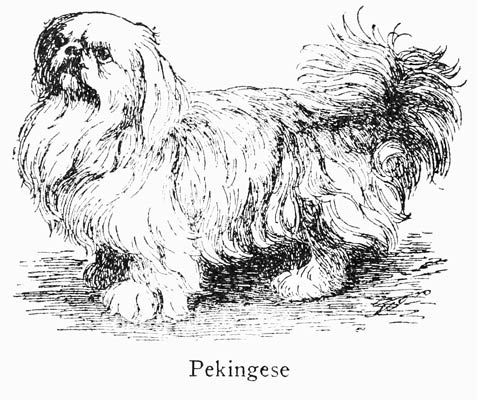
Pekingese
"The Pekingese is another of the very popular
ones. A brave, proud little chap, as he should be,
for he was the pet of Chinese emperors for hundreds
of years. The first ones were brought to England in
1860 when the Europeans took the city of Peking
and sacked the royal palaces. Before that time they
had been carefully guarded as sacred animals. You
see they look somewhat different from the English
toy spaniel. The head is flatter, for one thing.
"The Japanese spaniel is still different, though he
is probably related to the Peke. He has been the pet
of the Japs for centuries. The colors are black and
white or red and white, and the weight is seven
pounds, more or less. This snowy white one, with
his bright little face, is a Maltese dog. He also has
an ancient lineage. He was known in ancient Greece
and Rome and has been in England since the time of
Henry VIII. You saw my toy poodle. It's just
a miniature of the big poodle and has been popular
in France and England for over a century. Very
popular here now, too.
"Now we come to the last of the more prominent
breeds of toys, and the only one with a wire coat.
He comes from Belgium and he's called the Brussels
griffon. Don't you love his little monkey face, with
its beard and mustache? He's a hardy, intelligent,
affectionate little dog, too. Some folks think he's
the smartest of all the toys.
"There," she concluded, passing them the book to
look over again, "I guess you've had enough for one
day. You'll begin to think I'm as bad as my husband.
But I didn't want you to get the idea that the only
real dog is a big dog. Don't you think that some
of these toy breeds deserve some respect, now
that you know something of their honorable history?"
"Well, I should say so," said Ernest. "I had no
idea there were so many different kinds or that they
had any special history. I want to see those Pekes
again, whose grandfathers were stolen from the
Chinese emperors."
The interest in toys had been kindled, and the
boys took occasion later to refresh their memories
from books that Mr. Hartshorn lent them, but when
Ernest and Jack reached home that afternoon the toy
breeds were swept entirely out of their minds for the
time being. For Romulus appeared to be ailing and
Remus was evidently quite sick.
The two setter puppies had been growing rapidly
and had been allowed to run out in the yard as the
April days grew warmer. They had lost some of
their puppy awkwardness though none of their puppy
playfulness, and were fast developing into strong-boned,
active dogs. They had begun to appear more
devoted to their young masters, too, and to understand
better the meaning of the words they were expected
to obey. Needless to say, the boys had become
deeply attached to them.
There is nothing more pitiful to look at than a sick
dog, and there was something very sad in the way
these two rollicking, healthy puppies were so suddenly
stricken down. The boys, not finding them in
the yard, had gone at once to Rome. There lay
Remus on the bed, breathing with difficulty, and
recognizing their approach only by a raising of his
brows and a pathetic little effort to wag his tail.
Romulus came to greet them a little weakly, but he,
too, looked very forlorn and somehow very thin and
little. Both dogs seemed to be running from the eyes
and nose and to be suffering from feverish colds.
"Oh, Ernest," cried Jack, the tears coming to his
eyes at the sight of their suffering, "they're sick.
Whatever shall we do?"
"I don't know," said Ernest. "I don't know what
you do for a sick dog. We will ask father. He'll
be home soon."
Mr. Whipple came out to look at the dogs soon
after his return, but he was unable to suggest anything
very helpful. He prescribed warm milk for
dinner, and the puppies both drank it, though without
much enthusiasm. That night the boys spread burlap
blankets over the dogs and went to bed with heavy
hearts.
The next morning and the morning after Romulus
and Remus did not seem to be any better, nor, luckily,
very much worse. The boys did what they could for
them, keeping them warm and feeding them beef soup
and warm milk, but they did not seem to be making
much progress with the cure. So on Monday Ernest
sent another postal card to Sam Bumpus, begging him
to come down and look at the dogs. They had infinite
confidence in Sam.
He did not fail them, and on Tuesday afternoon
after the boys had come home from school Sam appeared.
By this time both dogs were pretty sick.
They had lost flesh and looked pitifully thin and weak
and wan. They seemed to have trouble breathing and
to be affected by other complications. They looked
up at their young masters with big, pathetic eyes, as
though pleading for help in their affliction.
The boys watched Sam anxiously as he examined
the dogs. His face was grave.
"It's distemper," said he. "I was afraid it was.
Distemper's no joke; it's the dog's worst enemy.
Sometimes it runs into pneumonia, or the dogs die in
fits, or just waste away and give up. But cheer up;
I've seen lots of 'em pull through, and we'll try to
save these two. You've done the right thing so far.
Careful nursin' does it. Keep 'em dry and out of
draughts and keep up their strength with good food,
easy to digest. Most dogs that die of distemper die because
they didn't have strength enough to last 'em
through. The disease has to have its run, and in
time it just naturally runs out. That's the way I look
at it. It don't do much good to try to cure 'em with
medicine. As I say, it's the nursin' does the trick.
Still, some folks believe in givin' quinine and you can
do that if you want to. It's a tonic and it can't do
any harm if you don't give too much. And keep their
eyes and noses washed out with boracic acid."
"Is this place all right for them?" asked Ernest.
"Sure," said Sam. "It's a good place, now that
the weather is mild. The more fresh air the better,
so long as it ain't damp or too cold or draughty. You
keep fussin' over 'em and let me know how they get
along. Give 'em plenty of clean water and feed
'em a good deal of milk porridge several times
a day. Better cut out the solid food till they're
better."
For nearly two weeks the boys watched the progress
of the disease with aching hearts. Sometimes the
symptoms seemed less acute and they felt hopeful;
then again the condition of their patients was such as
to frighten them. They spent all their spare time
with the puppies, in spite of their mother's anxiety
lest they catch the disease themselves. Their father,
however, was quite positive that human beings could
not take distemper from dogs.
A deep cloud of anxiety hung over the Whipple
home during those days, even Mrs. Whipple feeling
the effects of it. There was no running and romping
about the house; no longer the rooms echoed with
boyish shouts and laughter. Each morning Ernest
and Jack awoke with a feeling that something awful
was impending. It seemed sometimes as though the
dogs had always been sick and that they would never
get well. Sometimes the tension would become too
great for Jack and he would cry as though his heart
would break.
"Oh, Ernest," he would sob, "what should I do if
Remus died?"
And Ernest would have to struggle hard to keep
from joining in the tears of his younger brother.
The boys had come to love their dogs, and it seemed
as though the puppies looked to them alone to save
them. It is that way with dogs and people—that is,
the people who care for dogs. And when once the
wonderful tie has been formed between boy and dog
it grows ever stronger. It becomes an ennobling
thing.
Romulus developed a distressing cough, but after
about ten days of suffering he began to show signs of
improvement. He ate with greater relish and seemed
brighter and stronger. Gradually the symptoms of
the disease lessened and as the days went by Ernest
became more and more happily convinced that he was
really getting well. But with poor Remus it was different.
The distemper seemed unwilling to relax its
hold on him and his digestive system became so disordered
that he could not gain the much needed
strength from his food. Jack spent all the time he
could beside the little sufferer, easing his head and
bathing his eyes and nose, and listening with helpless
agony to the labored breathing.
Suddenly, one afternoon, Remus struggled to his
feet and staggered uncertainly for a few steps. His
half-closed eyes were glassy and did not seem to see
what he was looking at. He lurched into the wall in
a way that made Romulus take to a corner in fear.
Then he ran a few steps aimlessly and toppled over, his
muscles twitching dreadfully and his feet scratching
the floor.
Jack was terribly frightened and called to Ernest,
who came running in. Both boys thought that Remus
was surely dying, but after a while he grew
quieter and Jack lifted him tenderly back upon the
bed.
"I guess it was a fit," said Ernest. "Sam told
about that, you know."
"Oh, what shall we do?" wailed Jack in despair.
"We must do something, Ernest."
Ernest thought for a moment, and then an idea
came to him.
"I'll telephone Mr. Hartshorn," said he. "He
might know what to do, and I don't believe he'd mind.
He wouldn't want a dog to die."
"Oh, please do," begged Jack.
Mr. Hartshorn was not home, but Mrs. Hartshorn,
who answered the telephone, was very sympathetic.
"I'm so sorry he's had convulsions," said she.
"It's a bad sign. I'm sorry Mr. Hartshorn is away.
I know just how it is, though, for I've sat up all
night with dogs sick like that, more than once. I'll
send Tom Poultice right over. He's a better dog
doctor in his way than a good many vets., and he may
be able to help you."
Ernest thanked the kind lady very heartily, and
Tom Poultice came that very evening. Mr. Whipple
lighted a lantern and they all went out to Rome. Tom
examined both dogs and pronounced Romulus to be
on the mend.
"'E'll be all right," said Tom, "if 'e don't take cold
or get upset. But this other one, 'e's in a bad way, I'm
afraid."
Then he took Remus up, looked into his eyes and
throat, and felt of his stomach and of the pulse under
his forelegs.
"'E's got to be straightened out first," said he.
"'Ave you any castor oil?"
Tom administered the castor oil in a thoroughly
efficient manner and then sent Ernest into the house
to beg a little hot tea and a raw egg from Delia. The
puppy took the tea quite eagerly and lapped some of
the egg.
"Give 'im a little of this as often as 'e'll take it,"
said Tom, "and telephone me to-morrow 'ow 'e seems.
If 'e gets stronger, we'll give 'im something else. If
the castor oil don't work, we'll 'ave to give 'im calomel
or a compound cathartic pill, though I 'ate to do that
if I don't 'ave to. Calomel's terrible strong stuff for
a sick puppy. 'Ow long 'as 'e been sick?"
"About two weeks," said Jack.
"That's about the course of it," said Tom. "If
'e ain't better in a day or two now, 'e'll be gone. I
wish I'd tackled 'im before. Well, give 'im these pills,
one to-night and three to-morrow, during the day, and
keep me posted."
"What are these pills composed of?" inquired Mr.
Whipple, who was taking a lively interest in proceedings.
"I 'ave 'em made up myself, sir," said Tom. "It's
an old receipt I learned in Hengland. I ain't much
on medicine myself, but sometimes this 'elps, especially
if it's used earlier. There's thirty drops of
acetate of ammonia in each pill, fifteen drops of sweet
spirits of nitre, and two grains of salicylate of
soda. It's better to give 'em in a little camphor
water."
The boys followed Tom's directions faithfully. In
the morning they found Remus lying against the door
of Rome, quite exhausted, and there were signs that
he had had another convulsion during the night. But
during the day the castor oil got in its effect and there
was no need for the calomel. Remus seemed more
able and willing to take his tea and egg, and though
no gain in strength was to be noted that day, he had
no more convulsions.
Recovery was slow but sure for Remus from that
time on, while Romulus mended rapidly, and it was
not long before he was running about the yard again.
Remus gained strength very slowly and for a long time
was troubled by a cough and upset digestion, but as
the days went by and he suffered no serious relapse
Jack's buoyant nature responded and he was glad with
hope once more. Tom Poultice came again to offer
encouragement and advice, and when Sam Bumpus
visited Rome unannounced one afternoon and was
told what had happened, he proved himself to be most
generous in his praise of Tom's skill.
"I don't know this English feller," said he, "but
when it comes to doctorin' sick pups, I've got to hand
it to him. When you see him again give him old
Sam's best regards and tell him I'll vote for him
next election whether he's runnin' or not."
Sam was in a jovial mood and the boys were in
the humor to laugh heartily at anything he said. The
tension was broken, the days of anxiety were past,
and sunshine again filled the house on Washburn
Street.
"It's just like a toothache when it's over, ain't it?"
said Sam.
As for Jack, he hugged the emaciated little Remus
close to his breast, and, with big tears of happiness in
his eyes, kissed the tousled little head. Remus gave a
little, human-sounding whimper and licked Jack's
hand. That was the only way he knew to express
his love and gratitude, but Jack understood.
It was sympathy for Jack Whipple and interest in
the sickness and recovery of Remus that resulted in
the formation of a sort of freemasonry of dog lovers
among the boys of Boy town. It had always been
known that some of the boys had dogs, and there had
been a good deal of fun with these dogs at different
times in the past. But hitherto the dogs had been,
in a way, taken for granted, and had lived in a sort
of background in the boy life of the town. Suddenly
they came to light as important members of the community,
and each dog had its boy champion.
While Romulus and Remus were sick, the Whipple
boys often had to answer inquiries as to their progress,
but Ernest and Jack had been so wrapped up in
their own worries that they did not realize the widespread
sympathy that had sprung up. They did not
know that a dozen other boys each loved a dog much
as they loved Romulus and Remus and could understand
what it must mean to watch at the bedside of
a seriously sick puppy.
But when Romulus was well on the road to perfect
health again and Remus was slowly convalescing, the
other boy dog lovers of the town began to drop
around, sometimes with offerings to be appreciated by
dogs, just as neighbors bring in jellies and fruit when
a person is recovering from a long illness. Then
Ernest and Jack began to realize how many friends
they had in Boytown and that they all had a precious
possession in common.
Harry Barton came first, with Mike. His manner
was subdued and he did not brag. He stepped softly
as one would in entering a sick room, and he patted
Remus's little head very gently and called him "poor
little muttsie." Then came Theron Hammond,
though he left his Boston terrier at home because
Alert had never had distemper and might catch it.
He and the Whipple boys sat for a long time in the
stable doorway and speculated about the knowingness
of dogs. Monty Hubbard came, too. He left his
Irish terrier, Mr. O'Brien, at home because of said
Mr. O'Brien's well-known proclivity to fight with anything
in the shape of a dog, though Monty was sure
he wouldn't hurt two sick puppies. But Herbie Pierson
honored Rome by bringing his huge, brindled
Great Dane, Hamlet, who regarded the setters with
fatherly indulgence and then walked off in his stately
manner and crouched like a noble statue beside the
front gate.
And last of all came Rags and Jimmie Rogers, of
whom I will presently tell you more.
Boytown had always been a great place for dogs.
Not only the aristocrats of dogdom, living comfortably
in homes with loving masters and mistresses, but
all sorts of nondescript dogs, many of whom seemed
to be masterless and homeless, though not invariably
unhappy. In fact, there were many good citizens of
Boytown who did not like dogs and who felt that
the canine population of the place was altogether too
large.
There were restrictive laws that ought to have reduced
this canine population to such dogs as were
properly owned and licensed, but the government of
Boytown was criticized as being a happy-go-lucky
affair a good deal of the time, and it was only when
complaints became sufficiently numerous and serious
that the town fathers took steps to enforce the laws
and abolish what was conceded to be a public nuisance.
Then a dog catcher was hired, warnings were posted,
and the stray dogs were gathered up and mysteriously
disposed of. It was rather a cruel and heart-rending
business, if you stopped to think of it, and it would
not have been necessary if the authorities had been
more uniformly strict in observing the statutes and
ordinances, but that was their way.
It was during one of the periods of laxity that a
wire-haired terrier appeared from no one knew where.
He was not an authentic representative of any of the
established breeds; it was quite evident that he had
just happened somehow. But he was conspicuous
among his miscellaneous black and white and brown
and brindled brethren by reason of his superior alertness
and intelligence and his never-failing good humor
and high spirits. His tramp life had in no way
damaged his disposition; he seemed to have been born
full of the joy of life. He was about the size of one
of Mr. Hartshorn's smaller Airedales and in the main
he was not badly formed. But his tail, which had
never been docked, hung at a rakish angle to one side
and one ear was set higher than the other. His eyes
were extraordinarily bright and his wiry coat was
a grizzled black, always tousled and generally dirty.
The boys were not long in making this stranger's
acquaintance. Indeed, he made the first advances,
joining in their sport one day when they were in
swimming in the pond over by the brickyard, and
mingling his joyous barks with the shrieks of laughter
which his antics provoked. He would pick them up
on their way to school, or anywhere, and make himself
generally companionable, and it was not long
before they discovered him to be most precocious in
the learning of tricks.
It was not in the nature of things that such a dog
should remain forever masterless, but the periodical
cleaning up of the dog catcher had begun before anyone
had had time to think of him as anything but
everybody's dog. It was Jimmie Rogers who saw him
seized and thrust unceremoniously into the dog
catcher's covered wagon, and it was Jimmie who set
out alone to achieve his rescue. Jimmie's people lived
on Sharon Street and were not well to do, but somehow
Jimmie managed to scrape together the five dollars
which he found must be paid before he could
establish his claim to ownership.
After that, by common consent, he became Jimmie
Rogers's dog. He had already won the name of
Rags.
So Jimmie brought his beloved Rags to visit the
invalids, and Romulus and Remus looked on with big-eyed
amazement while Rags was made to sit up, shake
hands, roll over, chase his tail, play dead, and sing.
But there was one boy with a dog who did not come
to visit the sick, and Ernest and Jack Whipple were
not sorry. They did not like Dick Wheaton, and
Dick, it was easy to believe, was not one to care
whether another boy's dog died or not. He was a
good deal of a bully at school, and Jack feared and
avoided him. As for the older boys, they found him
generally unamiable and those of them who knew the
love of dogs were angry with Dick for the way he
treated poor little Gyp.
Gyp was a smooth-coated fox terrier and a very
good specimen of his breed. He was smart and
gamey, but his spirit had nearly been broken by his
tyrannical master. Dick seemed unable to resist the
temptation to bully everything smaller and weaker
than himself, and when there were no small boys or
little girls within his reach he indulged his proclivities
by teasing his dog.
Gyp, who had never had any other master, did not
think of resenting this. He merely endured it as best
he might. In fact, there was no more obedient dog in
Boytown. It was pitiful to see the way in which he
would answer his master's lightest word, as though
he lived constantly in the hope of winning favor by
his promptness.
Boys often like to tease animals, but they are
seldom actually cruel, at least not knowingly so. And
when a boy becomes possessed of a dog or a pony of
his own, his attitude often undergoes a marked change.
But no relenting took place in Dick Wheaton's nature,
and the other boys who had learned the lesson of
kindness, recognizing his right to do as he chose with
his own, could only look on with growing disapproval
and dislike.
But all the other dog-owning boys of the town
found their friendships growing closer in the warmth
of this common interest. During the convalescence of
Remus they made Rome a sort of lodge room for
the meetings of a new association with an unwritten
constitution and no by-laws. They talked much of
dogs and it was not long before a number of them
were keenly desirous of visiting Willowdale and
making the acquaintance of dog-wise Tom Poultice,
the rich Mr. Hartshorn, and all the Airedales and
white bull terriers.
So Harry Barton made the arrangements and one
Saturday in May an expedition was formed to walk to
Thornboro and visit Willowdale. There were seven
boys in the company and three dogs—Mike, Alert,
and Rags. Romulus and Remus were not yet strong
enough to make such a trip and it was voted that
these three could be counted upon to behave themselves
properly. There was a little doubt about Rags, but
he was a general favorite and was always given the
benefit of any doubt. At the last moment Herbie
Pierson and Hamlet joined the excursion.
To these active boys and their dogs the way did
not seem too long. In fact, Rags, full of joyful exuberance
at this rare treat, dashed about on all sorts
of secondary adventures, running three miles to every
one traversed. Even sturdy little Alert, in spite of
his short legs, took it all as a lark and did not think
to be weary until he reached home that afternoon and
fell sound asleep on his front door mat.
The arrival of the four canine strangers at Willowdale
created a good deal of commotion in the fenced-in
runs, and Rags nearly went crazy with the excitement.
But Tom Poultice took it all good-naturedly, and when
he had got things quieted down a little he took the
boys through the kennels and introduced them to the
prize dogs.
They were all so absorbed in this pleasant occupation
that it was noon before they knew it, and Mrs.
Hartshorn came out to invite them all up to the porch
for a luncheon. As they were following her up to the
house she asked questions about their four dogs, and
appeared to take a great interest in Alert especially.
"He's really a very fine little dog," she said. "But
who is this?" Rags had come up and thrust his cold
nose ingratiatingly into her hand.
"Oh, that's Rags," they said, and interrupted each
other with explanations. Mrs. Hartshorn laughed.
"Well, I would hardly know what to call him,"
she said, "but he is evidently a very popular person.
But what's the matter with his back?"
"Oh, it just itches," said Jimmie.
There was a spot on Rags's back that was difficult
for him to reach, and it gave him a good deal of
trouble, but he had managed to bite a good deal of
the hair out of it. Beneath, Mrs. Hartshorn discovered
the skin to be in a scabby and unhealthy condition.
"Well," said she, "this shouldn't be neglected. It
may be mange, and that's serious. Let's have Tom
look at it."
Tom came up at her bidding and examined Rags's
back.
"Do you think it's mange, Tom?" asked Mrs.
Hartshorn.
"I don't think so," said he. "It looks like heczema,
like the Hairedales had last summer. 'E better
'ave some of that medicine, I fancy."
"All right," said Mrs. Hartshorn, "I still have
some at the house, I think, that I got in case my dogs
should need it. Eczema," she explained to the boys,
"isn't exactly a skin disease. It is caused by the
dog's general condition, and should be treated internally,
though if you will rub zinc ointment on that
spot it will heal more rapidly. The cure is first a
good dose of sulphur and cream of tartar; you can
get that in tablet form at the drug store. Then give
him the pills I am going to get for you. They are a
tonic and ought to fix him up all right."
"Only be sure not to feed him any corn meal,"
warned Tom.
"That's so," said Mrs. Hartshorn, "especially now
that warm weather is coming."
Before the boys left that afternoon she gave Jimmie
half a dozen soft pills and also a prescription for
more. It read, "Sulphate of quinine, 1 grain; sulphate
of iron, 2 grains; extract of hyoscyamus, 1 grain;
with enough extract of taraxacum and glycerine to
make a pill." It might be added that Jimmie used
this medicine faithfully and the sore, itching spot at
length disappeared from Rags's back.
Meanwhile the boys had arranged themselves expectantly
on the front porch and the maid presently
appeared with plates, napkins, sandwiches, crullers,
and lemonade. Mrs. Hartshorn was a charming
hostess and the boys waxed merry over their luncheon.
Great piles of sandwiches disappeared as if by magic,
and then there was chocolate ice cream and sponge
cake. The dogs lay eying their masters enviously,
all except the incorrigible Rags. He sat up and
begged constantly, and even Mrs. Hartshorn could
not resist the temptation to toss him a morsel now
and then, which he caught with great deftness.
Just as they were finishing, Mr. Hartshorn drove
up in his car.
"What have we here?" he cried. "An orphan
asylum or a dog show?"
He got out of his car and ascended the steps,
demanding his share of the luncheon. Those of the
boys who had not already met him were introduced.
Then he asked to be made acquainted with the dogs.
"What do you think of them?" asked Herbie
Pierson, who was very proud of his imposing Great
Dane.
"I'll tell you after I've partaken of a little nourishment,"
said Mr. Hartshorn. "You can't expect a
man to talk learnedly on an empty stomach, can
you?"
He proceeded to do ample justice to his share of
the sandwiches and ice cream, while a jolly conversation
was kept up, even the shyer boys entering in at
last.
"Now," said Mr. Hartshorn, as he finished his last
spoonful, "let's have a look at that Great Dane."
He stepped down from the porch and approached
Hamlet, who submitted to his caress with dignity.
Then Mr. Hartshorn did strange things to him which
brought a look of amazement into his eyes. He pulled
back the dog's hind feet and made him stand straight,
measured his head with his hands, pulled down his
lips, and thumped his ribs.
"A pretty good dog," said Mr. Hartshorn. "A
trifle off in the shoulders, perhaps, and a bit cow-hocked,
but he has a good head. Ever show him?"
"No, sir," said Herbie.
"Well, you ought to. We'll see about that some
time."
"Won't you tell us something about Great Danes
and other dogs, Mr. Hartshorn?" asked Harry Barton.
"Things like you told us about the terriers the
other day."
"Why," said he, "I thought I must have given
you such a dose of it the other time that you would
want to run away from any more."
"Oh, no, sir," said Ernest Whipple. "We thought
it was very interesting. We've talked it over a lot
since, and we want to know about all the other kinds
of dogs, too. All the boys do."
"Well," said Mr. Hartshorn, "you never can tell
what a boy will like, I guess. If you had to learn
all that in school, I'll bet you'd hate it. But I don't
want to overdo it. I'll tell you about just a few this
time."
The boys crowded around him expectantly as he
sat down again on the porch.
"The Great Dane," he began, "though once a
hunting dog, a boarhound, is now classed among the
non-sporting breeds, and I'll tell you something about
those. They include the very biggest dogs—the
mastiff, the St. Bernard, the Newfoundland, and the
Great Dane. The smaller ones are the English bulldog,
the French bulldog, the chow chow, the poodle,
the Dalmatian, and the schipperke. The collies and
other sheepdogs are also classed with the non-sporting
breeds, but I'll save those for another time.
Let me get a book or two, so that I'll be sure to get
my information correct.
"Now then," he continued, when he had returned
with his books, "I'll outline a few facts about each
of these breeds, but in order to avoid sounding like
a walking catalogue, I am going to omit a good many
things like color, size, and weight. These things are
very important in distinguishing the breeds, but they
aren't very easy to carry in your heads, and you can
find them all set down in the dog books. I shall try
to tell you only the interesting, picturesque things
about each breed's history and character, and you can
find all the rest in the books.
"Let's begin with the St. Bernard. He's the biggest
of all. Who knows anything about the St.
Bernard?"
"There's a piece in the Fourth Reader about
them," ventured Theron Hammond. "They used to
guide travelers in the Alps and rescue them when they
were lost in the snow."
"And there was one named Barry," put in Harry
Barton, "who saved the lives of forty people, and
they set up a monument of him in Paris."
"Correct," said Mr. Hartshorn. "There's no
breed more famed in song and story than the St.
Bernard. It was developed long ago by the monks of
the Hospice of St. Bernard in Switzerland, who
trained their dogs for the purposes you have mentioned.
So many of them were lost, however, that
the breed got into a bad way a hundred years ago
and had to be brought back by crossing with the
Newfoundland and other breeds. As I said, it is one
of the largest breeds, sometimes weighing as much
as two hundred pounds—more than most men."
"Are there some good St. Bernard stories?" asked
Jack Whipple, who preferred anecdotes to descriptive
particulars.
"A lot of them," said Mr. Hartshorn, "but there
seems to be a good deal of sameness about them.
They tell of the saving of Alpine travelers and shepherds,
lost in snowstorms or caught in crevasses in
glaciers. Some of them are very thrilling. The best
story I ever read about a St. Bernard, however, had
nothing to do with mountaineering.
"This dog was the beloved friend and constant
companion of the Count of Monte Veccios, a Venetian
nobleman. Now it became very necessary to the
Count that he should obtain certain favors from General
Morosini, who was somewhat difficult of approach,
in spite of the fact that he was in much the
same position himself. In order to gain his own
ends, the General had arranged in his palace a
gorgeous banquet in honor of the Doge of Venice,
from whom he hoped to gain important concessions,
and he had caused his great banquet table to be laden
with gold and silver plate and much fine Venetian
glass.
"The Count, hearing of these preparations, screwed
up his courage and called on General Morosini. He
praised to the skies the table appointments, which
pleased the General, but as soon as he began to plead
his own cause, the General became cold and unyielding
and begged the Count to cease annoying him about
these petty matters. As the Count left the General's
palace, he turned to his faithful dog, with tears in
his eyes, and said, 'You see, my friend, how badly
I am used.'
"The St. Bernard was greatly affected by this, and
he formed in his own mind a plan of revenge, since
it was beyond his powers to secure justice. Unobserved,
he stole back into the General's palace, and
just as the Doge was arriving with his retinue, the
dog seized the corner of the tablecloth in his mouth
and dashed out of the house, upsetting the entire banquet
and smashing most of the valuable glassware.
I don't believe there is any moral to that story, but
perhaps that won't spoil it for you.
"I don't believe I have any mastiff stories," continued
Mr. Hartshorn, "but that breed must be mentioned
in passing, as it is one of the very old and
very famous breeds of England. The mastiff used to
be popular here thirty years ago, but we seldom see
any now, and sometimes I fear the breed is dying out.
It's too bad, for he was a fine, powerful dog, brave
and wise.
"Another fine dog that has gone out of fashion is
the Newfoundland. There are still some good ones
in England, but very few here. I suppose the Newfoundland
has more rescues of drowning persons to
his credit than any other breed, and it's a shame to
see him go. The breed originated on the island of
Newfoundland a hundred years ago, and you will still
see a dog's head on the Newfoundland postage stamps.
"The Newfoundland has a waterproof coat and is
a wonderful swimmer, so that a good many of the
anecdotes told about dogs of this breed have to do
with their exploits in the water. For example, there
is one of a man who fell off a narrow foot-bridge
into a swift mill stream. The miller's dog promptly
dived in and rescued him, and having accomplished
this, coolly plunged in again to save the man's hat
that was just about to be swept over the dam. There
are several amusing stories told of Newfoundlands
dragging bathers to shore, quite against their wills,
because the dogs fancied they were in danger.
"A naval lieutenant owned a canary bird and a
Newfoundland dog. While they were cruising in the
Mediterranean, the bird escaped from the cabin and,
flying out to sea, became weighted down with the
spray and dropped into the water. The dog leaped
overboard, and when he was hauled up on deck again,
he dropped the bird out of his mouth, quite uninjured.
Another naval officer who owned a Newfoundland
was drowned when his ship was sunk near
Liverpool. The faithful dog swam about over the
spot for three days and three nights, searching vainly
for his master, before he would allow himself to be
brought exhausted to land.
"Friendships between two dogs are very rare, but
instances have been recorded, and in most of these
a Newfoundland figures. At Donaghadee there was
once a mastiff and a Newfoundland who were, for
some reason, bitter enemies, and as both were powerful
dogs, it was desirable to keep them apart. One
day, however, the mastiff attacked the Newfoundland
on the pier, and a terrific fight ensued. At length both
dogs fell into the water and loosed their holds. The
Newfoundland was soon on dry land, but the mastiff
was a poor swimmer and appeared in danger of
drowning. The Newfoundland, observing the plight
of his recent antagonist, plunged in again and brought
him to shore, after which the two dogs were the
closest friends. Another Newfoundland at Cork became
so annoyed by a small, troublesome cur, that at
last he took him in his mouth and dropped him into
the water. When the small dog was nearly drowned
the Newfoundland rescued him, and was never annoyed
by him again.
"But the Newfoundland has been the means of
saving not merely drowning persons. In 1841 a
laborer named Rake in the parish of Botley, near
Southampton, in England, was buried in a gravel pit
with two ribs broken. He was helpless and would
undoubtedly have died there if his employer's Newfoundland
dog had not dug him out.
"William Youatt, who wrote two or three of the
dog books in my library, tells of an experience he
once had with a friend's Newfoundland dog named
Carlo. Youatt and the friend and Carlo parted on
the road to Kingston, the dog and his master turning
off toward Wandsworth. Soon afterward Youatt was
accosted by ruffians. He never knew what made
Carlo come back to him, but the dog appeared at the
critical moment and drove the men away. Carlo escorted
Youatt to a safe place, and then, in the author's
quaint words, 'with many a mutual and honest
greeting we parted, and he bounded away to overtake
his rightful owner.'
"The Newfoundland has always been famous as
the protector of children, and this is illustrated by an
amusing story told of a Newfoundland that was
owned by the chief engineer on H. M. S. Buffalo.
The incident took place on an evening in 1858 at the
Woolwich theater in London. In the third act of the
play, 'Jessie Vere,' there was a violent struggle over
the possession of a child. The dog, who had sneaked
into the theater behind his master, flew to the rescue
across the footlights, much to the consternation of all
concerned."
"My!" said Ernest Whipple, "there are certainly
a fine lot of stories about Newfoundlands. Are they
all true?"
"Well," smiled Mr. Hartshorn, "I can't vouch for
them all, but I believe that most of them are founded
on fact, and some of them are undoubtedly quite
true. Now let's see what the next dog is.
"The Great Dane is at the present time the most
popular of the very large dogs. As you can see by
looking at Hamlet, he is a powerful, graceful animal.
The breed was used in Germany, I don't know how
long ago, for hunting the wild boar and was introduced
into England in the '80's as the German boarhound.
You can see from this one what kind of dog
it is. The ears are commonly cropped in this country,
but in 1895 the practice was abolished in England
for all breeds. I hope some day it will be
abolished here. The fanciers think cropping makes
the dog look smarter, but it's a silly, unnatural thing
to do, when you come to think of it. I wish I didn't
have to do it with my bull terriers, but they would
never take prizes with long ears. I don't remember
any Great Dane stories.
"Now we come to the smaller ones. Mike here is
a very good English bulldog, though not so extreme a
type as some of them. This breed, like the mastiff,
is of British origin, and probably came from the
same ancestry. He was trained for bull baiting and
later for pit fighting. Tramps and other people are
afraid of bulldogs because of their frightful appearance,
but as you can see, if you know Mike, they are
often as gentle as lambs.
"The French bulldog is much smaller and he is
different in many respects. He has big bat ears, for
one thing. The chow chow is an interesting dog that
comes from China. Perhaps you will be amazed when
I tell you that this dog was originally bred and fattened
by the Chinese to be eaten like pork and mutton.
The tastes of the Oriental are certainly peculiar.
"The poodle, which was originally a German dog
but which was developed chiefly in France, used to be
better known than he is now. He is supposed to be
the cleverest of all dogs and you will usually find
poodles in troops of trick dogs."
"It seems to me," said Theron, "that I've read
some stories about poodles."
"Yes, there are a number of classic poodle stories,"
said Mr. Hartshorn, "illustrating the cleverness of
the breed. I am sorry to say that poodles have been
trained as thieves' dogs, and have been widely used
by smugglers on the French frontiers, who trained
them to carry lace and other valuable commodities
across the border.
"The most famous of these stories is that of the
poodle of the Pont Neuf, one of the bridges of Paris.
He was owned by a bootblack, who taught him to
roll in the mud of the Seine and then run about
among the pedestrians on the bridge, dirtying their
shoes. This meant more business for the bootblack.
An Englishman observed this performance and was
much impressed by the dog's smartness in carrying out
his part. He offered the bootblack a good price for
the poodle and took him back to London with him.
But the poodle didn't care for his new life; apparently
he had no wish to reform. Somehow or other
he managed to stow himself away on a Channel boat
and made his way back to Paris, where he returned
to his former master and resumed his old occupation."
When the boys had finished laughing over this droll
story, Mr. Hartshorn continued:
"The Dalmatian or coach dog comes from eastern
Europe, and was bred long ago in Dalmatia, now an
Austrian province. He was well known in England
by 1800 and was used there as a stable dog and was
trained to run with the horses and under the carriages.
Here you will see them most often as mascots
in fire engine houses. It's queer how fashions run
in those things. He is always pure white, evenly
covered with round black or brown spots.
"The last of this group is the schipperke. I don't
believe you know him, for the breed isn't very common
here. The name means 'little skipper,' and the dog
has long been a favorite with the captains of Flemish
and Dutch canal barges. The schipperke has no tail
to wag. There," he concluded, "I guess I've filled
you up with enough dog information for this trip. I
don't want to overdo it."
"You couldn't overdo it for me," said Ernest
Whipple. "Will you tell us about some of the other
breeds another day?"
"And tell us more anecdotes?" chimed in Jack.
"I promise," said Mr. Hartshorn.
Ernest, Harry, and Theron were boys of the type
that love to collect facts and figures, and they had
recently been doing some reading on the subject of
the breeds of dogs. They discussed the matter all the
way home, becoming quite excited now and then over
disputed points.
"Mr. Hartshorn said that Rags didn't belong to
any regular breed," said Jimmie Rogers as the boys
separated, "but I don't care. There ought to be a
breed like him, anyway, 'cause there isn't any better
dog anywhere. Rags is good enough for me."
"That's right," cried the other boys in chorus.
"You stick to Rags. He's all right, whatever the
books say. Good-by, Rags. So long, Jim."
By June both Romulus and Remus were in full
health again and Mr. Whipple admitted that they
began to look like real English setters. They were
puppies still, full of fun and mischief, but their coats
had lost some of their fuzzy, silky character and their
bodies had lengthened and filled out. They had
gained a greater control over their muscles and in
their gambols about the yard they had acquired considerable
speed. Sam Bumpus came down again to
look at them and pronounced them likely-looking
youngsters.
"They've got some growin' to do yet," said he,
"but they're gainin' bone and speed every day, and
the first thing you know you'll have two fine bird
dogs, or I don't know what I'm talking about."
They also displayed increasing devotion to their
masters and had begun to develop, to a certain extent,
the qualities of watchdogs.
It was about this time that Jack Whipple made an
extraordinary and alarming discovery. He noticed
one day that Remus was having some sort of trouble
with his mouth, as though he had perhaps got a piece
of bone wedged in his teeth. He worked his jaws
in a laughable manner and poked at them with his
paw. Then he shook his head, ejected a small white
object, and appeared relieved.
Thinking it must be a piece of bone, Jack picked
it up and examined it. It was a tooth! He called
Ernest, and after poking about in Rome, they discovered
another tooth in the sawdust beside the food
dish. They proceeded to examine both dogs, and in
Romulus's mouth they found another loose tooth
which came out in Ernest's fingers.
"Why," cried Jack, "they're losing all their teeth.
How will they eat? How can they do anything?"
Ernest was equally puzzled, and that evening they
told their father about it. He also seemed perplexed.
"I'm afraid I can't help you," said he. "You'd
better consult Tom Poultice or Sam Bumpus. Perhaps
there's some disease that loosens dogs' teeth.
Possibly it's the result of the distemper. I understand
there are sometimes after-effects of that, such as deafness,
and it may cause a dropping of the teeth. You'd
better see about it before it goes any further."
The boys had been planning for some little time
to take the two dogs up to Sam's shack, since they
now seemed old and strong enough to stand the
journey, and it would be good fun for all concerned.
So Ernest sent Sam word that they were coming, and
on a bright, warm Saturday morning the four of them
set out.
The sky was clear and blue, a light breeze tempered
the warmth of the brilliant sunshine, and it was a joy
just to be alive and out in the open. The boys had
their hands full, for Romulus and Remus had never
before enjoyed so much liberty, and they did not
always answer promptly the recalling whistle. The
world, this great, new world, seemed to hold so many
sights and sounds and scents to interest a dog that
their impulse was to keep going and searching and
never turn back. But it was a pleasure just to watch
the zest with which they investigated every thicket and
hillock. As they trotted along, twisting and doubling
and turning, their noses held now high, sniffing the
breeze, now close to the ground, they seemed to develop
something of that lithe grace of movement that
characterized the actions of their mother and old
Nan.
When they arrived at their destination, the dogs
were at first much excited by the presence of so many
others of their kind, but after a little while they were
glad to take a long drink of water and to rest on the
floor of the shack.
Sam, as usual, was smiling and cordial. "They're
comin' on; they're comin' on," said he, patting the
young dogs and observing their sinewy limbs, their
sensitive nostrils, and their soft, intelligent eyes.
"Been teachin' 'em to hunt on the way up?"
The boys were forced to admit that they had made
little progress with the vocational training of Romulus
and Remus.
"Well, there's plenty of time for that," said Sam.
"They've got to get the sense of the fields and the
woods first. You get 'em so they'll come when they're
called, and a little later on I'll have time to take 'em
in hand and teach 'em the fine points of the game.
How have they been, anyway? They're lookin' as
sound as nuts."
"They've been very well," answered Ernest, "except
for one thing. We don't know what's the
trouble, but their teeth are dropping out."
"Their teeth——" began Sam, and then burst into
a roar of laughter, in which the boys presently joined,
though they did not know why.
"Don't you worry about them teeth," said he, when
he could speak again. "I'll bet it wasn't so very long
ago that Jack here had the very same trouble. Didn't
you know that dogs lose their first teeth the same as
boys do? Sure thing. Some folks are a good deal
troubled about it and pull out the loose teeth for fear
the dogs will swallow them, but it ain't likely to hurt
'em if they do. Just let 'em alone and nature will
look out for 'em. New and stronger teeth will
grow in their places and then they'll be fixed for
life."
The boys, relieved to find that the matter was not
serious, laughed again.
"I guess this joke's on father, too," said Ernest.
This trip to Sam's shack was the first of a number
of excursions thither which Sam seemed to enjoy as
much as the boys and the dogs. And when vacation
time came and every day was like Saturday, Ernest
and Jack Whipple came to understand better what
it really means to have good dogs for constant companions.
It was in these days that visits to the swimming
hole over by the brickyard began, and Romulus
and Remus were taught to enjoy the water as much
as their masters did.
This swimming hole, in fact, proved to be the accepted
meeting place for most of the boys and dogs
of Boytown, for it became a regular practice for the
boys to bring their dogs and to invent various aquatic
sports in which the dogs played an important part.
Old Mike hated the water and could scarcely be induced
to go in, but most of the others entered into
the spirit of the game with zest. Little Alert proved
to be a regular cork in the water, and even huge
Hamlet splashed about in a dignified sort of way.
But the general favorite was Rags. He could dive
for stones, retrieve sticks, and even stand up in the
water, with his fore feet pawing the air in a manner
to bring laughter to the soberest. And he had a way
of devising sport of his own, not always respecting
the sanctity of the boys' clothing.
I don't know how it is with other boys, but it is
certain that the constant association with faithful four-footed
comrades was good for the boys of Boytown.
Boys are often thoughtless to an extent that verges
upon cruelty. They love to tease and often find
amusement in inventing new trials for a much-enduring
cat or dog. But once let them get the idea
of comradeship and protection firmly fixed, and not
infrequently a sort of chivalry appears to develop in
their natures.
At least it was so with these boys. They quarreled
and disputed and occasionally fought, as boys will, but
there was no more torturing of animals, and with this
came less bullying of little boys and teasing of little
girls. Each boy felt the responsibility of protecting his
own beloved dog, and with this came a sense of protection
toward all animals. Mrs. Hammond, Theron's
mother, was wise enough to observe and take advantage
of this, and she organized the boys into a sort
of Humane Society, with meetings every two weeks,
and a set of rules and objects. They were pledged to
do what they could to see that no dumb animal was
abused, and more than once they were able to dissuade
a brutal teamster from beating an overburdened
horse. In only one quarter did they totally fail. Dick
Wheat on would neither join the Humane Society nor
would he mend his ways in regard to his treatment
of Gyp. But at least he never attempted to abuse any
other animal whenever any of the boys were about,
after having received a good licking at the hands of
Jimmie Rogers for annoying Rags. That taught him
a much needed lesson.
If every boy in America could be taught to be as
kind to animals as these boys were, and to interest
himself personally in their treatment, this would be
a better world to live in.
So the summer vacation days passed, with plenty of
outdoor fun, the boys forming an ever closer comradeship
with their common interest, and Romulus and
Remus gaining in strength and wisdom every day.
For the most part they were healthy dogs and gave
their masters little concern on that score, though
sometimes their tendency to get into mischief required
attention, for Mrs. Whipple was not reconciled to
their presence about her house and it was necessary
to keep watch lest they offend beyond the chance of
pardon. The day they brought Delia to the verge of
tears by tearing a clean sheet from the clothesline and
clashing with it about a muddy yard would have produced
a disastrous crisis if Mr. Whipple had not
once more intervened.
Once or twice the two dogs had to be doctored
again for worms, and in August came the pest of
fleas. This was a source of annoyance to both boys
and dogs, and Mrs. Whipple, when she found it out,
was in constant fear lest the insects be introduced into
the house. When Ernest or Jack discovered one on
their own persons at night they left no stone unturned
to capture and decapitate it.
As to the dogs, they suffered not a little. Their
long coats made a splendid breeding place for the
parasites and they wore themselves thin with scratching.
Fleas are not a pleasant thing to talk about, but
all dogs get them, especially the long-haired kinds, and
not even frequent visits to the swimming hole will
eradicate them.
It was Sam Bumpus who told the boys what to do
about it. One day, when they went up to visit him,
he refused to let Romulus and Remus into the shack
or near his kennels.
"They're full of fleas," said he as he watched the
dogs scratching nervously, "and I don't want 'em to
be droppin' 'em around where my dogs'll get 'em. I
have trouble enough with the varmints as 'tis. You
ought to get rid of 'em. If you don't, they'll hang on
till November and the dogs'll be no good for huntin'."
"But how do you get rid of them?" asked Ernest.
"Wash 'em in cresolin or cresoleum or whatever
your druggist wants to call it. He'll know what you
want when you tell him. Mix it with warm water
and soapsuds and scrub 'em good. Then rub 'em dry.
Do it outdoors on the grass. It's better than insect
powder. It won't kill all the eggs, but it will drive
the fleas off, and if you keep at it, and do it often
enough, you'll get rid of 'em all. Besides, it gives
the dogs some relief before the new ones can hatch.
Better burn their beds once in awhile, too, to kill the
eggs in 'em."
The boys faithfully followed Sam's instructions
and were pleased to find the trouble greatly abated.
It was in August, too, that they took Romulus and
Remus for their first trip to Willowdale. They were
anxious to learn what Mr. and Mrs. Hartshorn and
Tom Poultice would think of their dogs, and they
were always glad of an excuse to visit the bull terriers
and Airedales and to listen to doggy talk.
Luckily, Mr. Hartshorn was at home on this occasion,
though they paid their respects first to Tom and
the kennels before going up to the big house. Tom
had not seen the two setters since they had recovered
from the distemper, and he was pleased to be frankly
enthusiastic.
"Well, I'll be blowed!" he exclaimed. "And are
these the same two dogs that I doctored in your barn
last spring? They were sad enough looking pictures
then. The bally rascals! They sure 'ave grown some.
Hi'd like nothing better than to take 'em out some
day myself on a bit of an 'unt. Look at the legs of
'em! Say, you've got two fine bird dogs there."
Naturally the boys were much pleased by Tom's
praise of their beloved dogs, and they lingered for
a time about the kennels while Tom pointed out to
them the fine points in a setter's action and explained
how their graceful, level gait enabled them to keep
their noses out in front where they would catch the
scent, and at the same time cover rough country at
high speed.
"Hi've 'eard it said," remarked Tom, "that an
'unting pointer can travel at the rate of eighteen miles
an hour and keep it up for two or three hours, and
I guess a good setter's about as fast."
"My!" exclaimed Jack, joyfully, as they walked
over to the house, "do you s'pose we've got the two
very best dogs in the world, Ernest?"
"I don't know," said Ernest. "Maybe."
The ardor was cooled a trifle by Mr. Hartshorn.
He examined Romulus and Remus in a minute,
judicial, critical manner, and discovered a number of
technical points in which they fell short of perfection.
"But," he added, "they're mighty good dogs, and
you must remember that no dog is absolutely perfect
from the show judge's standpoint. And if these come
from as fine a working strain as you have led me to
believe, it is remarkable that they should measure up
so well by bench-show standards. Some of the finest
show champions are second-rate dogs in the field, and
some of the best hunting and field-tried dogs couldn't
win a yellow ribbon on the bench. I should say that
your dogs gave promise of developing both working
and show qualities to a marked degree, and I shall
watch their careers with great interest. You have a
brace of fine dogs there, and no mistake."
Whereat Jack and Ernest felt better.
"You promised to tell us something about setters
and other bird dogs," Ernest reminded him.
"Well," said Mr. Hartshorn, "I'm not sure that
I know so very much about them. I used to do a
little shooting years ago, but your friend Bumpus
undoubtedly knows a lot more about the game than
I do."
"Oh, yes," said Ernest, "he does know a lot about
hunting and training dogs, but I mean about the breeds
themselves, their history and the sort of things you
told us about some of the other breeds."
"Well," said Mr. Hartshorn, "I'll do the best I
can. The development of the setter is an interesting
story, but first we'll have to go back to the spaniels.
Spaniels, you know, are still classed as shooting or
gun dogs, and are used for that to some extent, and
the setter's ancestor was a spaniel.
"The spaniel first came from Spain or France and
there are still many kinds on the continent of Europe.
But the spaniel has been known for a long time in
England, too, and the kinds we know here are those
of British development. Mrs. Hartshorn has already
told you about the English toy spaniels, so I will omit
those.
"In the early days, the breeds weren't divided up
as they are to-day, but were known as large and small
land spaniels and water spaniels. The oldest of the
land spaniels of England now in existence is the
Sussex spaniel. You won't see any in the United
States, I think.
"The clumber spaniel you can see in our shows,
but he also is more popular among the sportsmen and
fanciers of England than here. He is the heaviest of
the spaniels. The cocker spaniel is the most popular
kind in this country. His name comes from the fact
that he was used in England for many years for hunting
woodcock. He is smaller than the others. The
field spaniel is much like a large-sized cocker, weighing
about twice as much. Finally there is the curly,
brown Irish water spaniel, which is really more closely
related to the retriever and the poodle than to the
other spaniels.
"Though spaniels are sporting dogs, they have always
been enjoyed quite as much for their companionship,
and they have an enviable reputation for fidelity.
There is a story told of a spaniel of the time of the
French Revolution which reminds one of Greyfriars
Bobby. This dog belonged to a magistrate who was
condemned for conspiracy and was thrown into prison.
By means of his coaxing and pretty ways, the spaniel
at last won the heart of one of the jailers and managed
to get in to his master. He never left him after
that, even crouching between his knees when the
magistrate was guillotined. He followed the body to
its burial and tried to dig into the grave. Obliged
at last to abandon hope of ever seeing his master
again, he refused to eat, and died at length, of hunger
and exposure, on his master's grave.
"Another sad story of devotion is that of a spaniel
belonging to the gamekeeper of the Rev. Mr. Corseillis
of Wivenhoe, Essex, England. This dog's name was
Dash, and he was his master's constant companion at
night, when he was able to render valuable service in
helping to detect poachers. When the old gamekeeper
died, nothing could persuade Dash to accompany
his successor on his rounds. He divided his time
between the grave and the room in which his master
had died, and at last he, too, died of a broken
heart.
"Let me give you a more cheerful one before we
pass on to the setters. Once when Mrs. Grosvenor
of Richmond went to visit a relative who owned some
pet cats, she took her Blenheim spaniel with her. The
cats, who were selfish, spoiled creatures, were too
many for the small spaniel, and they succeeded in
driving him out of the house. But he refused to
acknowledge defeat. He proceeded to establish an
alliance with the gardener's cat, a big, husky Tom,
and when the time was ripe, the two of them attacked
and routed their common enemy, after which the
spaniel was let alone.
"Now we come to the setters. In some respects
they are our finest gun dogs. They came from one
of the old land spaniels that was taught to crouch
when finding game and they were called setting
spaniels until about 1800. Since then the breed has
been greatly improved. There are three well-known
varieties, English, Irish, and Gordon, all first-class
dogs.
"A man named Laverack in Shropshire, England,
was the one who did the most to develop the English
setter. He bred them from 1825 to 1875 and produced
the standard strain. Later a man named
Llewellyn promoted the strain and added new blood.
You will still hear the names Laverack and Llewellyn
applied to different types of English setters. This
English variety is the most popular and numerous of
the three.
"I don't want to make any unpleasant comparisons,
but to my mind the Irish setter is the handsomest
of the family, though as a sporting dog he does not
rank with the English setter. His shape is very nearly
the same as that of the English setter, but his coat is
always a wonderful red-brown, almost golden when
the sun shines on it, often very dark, but with no
black spots.
"The Gordon setter is the heaviest of the three
and comes from a strain developed a century ago by
the Duke of Richmond Gordon, a Scotchman. The
color is always rich black and tan.
"These are not the only bird dogs, however. There
are the retrievers and the pointer, besides some European
breeds, but I'm going to save them for another
time. I've got to get ready to catch a train now,
and besides, I'm afraid of giving you this sort of
information in too large a chunk."
Mr. Hartshorn bade them good-by and went upstairs.
The boys remained a few minutes longer with
Mrs. Hartshorn, who had taken a great fancy to
Romulus and Remus, and then they set off for home
in the hot sun of the afternoon.
On the way back from Thornboro that day something
happened that gave a new direction to the
thoughts and aspirations of Ernest and Jack Whipple.
They had gone somewhat out of their way to a woods
road that was shadier and cooler than the highway
and Romulus was nosing and sniffing about in the
underbrush quite a little distance to the left. Ernest
whistled, but Romulus apparently did not hear. He
seemed to be darting about in the bushes with unusual
eagerness.
"What has he found, do you s'pose?" asked Jack.
"Let's go and see," said Ernest.
The two boys and Remus turned out of the road
and approached the spot where Romulus was hunting.
Suddenly there was a whir of wings and a dark
object flashed upward and disappeared among the
trees.
For a moment Romulus and Remus both stood
rigid, with heads and tails outstretched. Then they
broke and disappeared in the woods. It was some
little time before the boys could get them back again
and started along the homeward road. The boys,
breathless with running, had not spoken to each other,
but now Ernest said:
"It was some kind of a bird, Jack. Did you notice?"
"Yes," said Jack. "Why, Ernest, they know how
to hunt already."
"I guess it's instinct," said Ernest. "And did you
see them point? They really did, for a minute, just
like Sam's Nan, or the pictures in the books."
"Oh, Ernest," cried Jack, "we must take them
hunting. Do you s'pose we could?"
"Sam could, anyway," said the older boy. "He
said he'd train them."
The rest of the way home they talked of nothing
but hunting and the wonderful achievements that were
in store for the two dogs.
Mr. Whipple approved the plan to have Romulus
and Remus trained. A good dog, in his eyes, was
a dog that was good for something, and he recognized
the value of a well-trained bird dog though he had
no desire to see the boys become too fond of hunting
themselves.
"All right," said he, "take them up to Bumpus
and let him train them, but you boys must promise
not to ask to handle a gun yourselves. You're not
old enough, for one thing, and besides, your mother
doesn't approve of shooting. It's a dangerous business
at best. Remember, now, no nonsense about
guns."
The boys, willing to postpone that question till some
future time, readily promised, and on a Saturday
morning in September, soon after the reopening of
school, they took the dogs up to Sam's shack.
"Remember," said Sam, "I ain't promisin' anything.
You never can tell what kind of a bird dog
a setter will make till you've tried him out. I've got
a lot of other things to attend to this fall, too. But
I'll do the best I can, and you mustn't be impatient
if they ain't all finished off in two weeks. Now we'll
take 'em out for their first lesson."
That first lesson proved to be a rather tedious affair
to Ernest and Jack. Nothing was said about birds or
guns, pointing or retrieving. Sam's chief aim was
to get the dogs to obey his word and whistle as well
as they obeyed those of the boys, and the latter were
forced to keep silent while he gradually gained the
mastery over the two lively young dogs. Sam displayed,
in this, much greater patience than the boys
did, but still it was pleasant to be out in the fields
this fine September day and to watch the dogs as they
came to respond more and more readily to the commands
of their trainer. At first, indeed, there was
but one command, expressed by a sharp whistle or by
the words "Come here, boy!" Sam seemed determined
to add no further commands until he had secured
unfailing and prompt obedience to this one.
But, slow as the process was, it was really remarkable
what progress was made in a few short
hours.
At noon they took the dogs back to the shack to
enjoy a rest and a dry bone apiece, while Sam cooked
and served a delicious luncheon of buckwheat cakes,
bacon, and cocoa. Then, after he had enjoyed a pipe
or two and they had listened to some of his tales of
dogs and hunting, they started out again.
This time Sam fastened a cord of good length to
the dogs' collars, something they were not used to.
"I'll need to use this later on," said he, "and
they've got to get used to the feel of it first. They've
got to learn to stand it without pullin', and to answer
the signals."
Again he exhibited extraordinary patience, for the
dogs resented this unaccustomed restraint and seemed
possessed to pull at their leads and try to break away.
It took a good two hours to break them to this simple
harness. Then Sam took it off and went all over the
first lesson again, which at first the dogs appeared
to have forgotten.
"Well, as the minister says, here endeth the first
lesson," said Sam when the shadows of late afternoon
began to lengthen, and they turned back again toward
the shack. The boys now realized that they were very
tired.
"Do you think they'll ever learn?" asked Jack,
somewhat plaintively.
"Why, sure," said Sam. "I've seen worse ones
than these. They're high spirited, as good dogs ought
to be, and a bit heady, but they'll learn. They've done
very well, so far."
Still doubting, but somewhat encouraged, the boys
prepared to take their departure. In order that the
training might go on uninterrupted it was necessary
to leave Romulus and Remus in Sam's care, and it
is a question which felt the worse about the separation,
the boys or the dogs. Ernest and Jack knew
that their pets would be in good hands and kindly
treated, but it was hard to say good-by. As for the
dogs, they set up a howling and crying, when they
found they were being deserted.
"They'll soon get over that," said Sam. "They'll
begin to take an interest in the other dogs pretty soon,
and then they'll feel more at home."
Thus reassured, the boys started off down the road
without their four-footed comrades, but the insistent
wails that followed them were very heart-rending, and
two big tears rolled down Jack's round cheeks. And
it was several days before they could get used to the
desolate, deserted look of Rome or become reconciled
to the absence of their playmates.
They could hardly wait for the next Saturday to
come, when they could go up again to Sam's shack
and visit their beloved dogs. Romulus and Remus
were overjoyed at seeing them again, and it was some
time before Sam could get them quieted down sufficiently
to take them out for another lesson. He had
been training them during the week, and the boys now
heard him addressing them with strange words. He
placed their check-cords on again, and this time the
dogs did not seem to resent it so much. Indeed, they
seemed to look upon it as the preliminary of a good
time, which, as Sam explained, was the idea he had
tried to impress on them.
"Hie-on!" cried Sam, and the dogs started off at
a bound.
"To-ho!" he called. This meant to stop abruptly,
and this command the dogs, hoping for a good run,
did not obey so readily. A quick tug at the check-cord
reminded them of the meaning of the command,
and soon they stopped more promptly at the words.
"Come in," said Sam, and the dogs approached
him.
"Charge!" said Sam. "Down!" After several
attempts the dogs reluctantly obeyed and crouched at
his feet.
"Heel!" he cried, and after several repetitions of
the order they took their places quietly behind him.
"They're always a little slower the first thing in
the mornin'," Sam explained, "before they've run off
some of their deviltry. They'll improve as they go
along."
And improve they did. In the afternoon Sam took
them out without the check-cord and kept perseveringly
at them until they would "hie-on" and "to-ho" and
"charge" and "heel" with reasonable promptness.
"By next week I hope to show you something
more," said Sam.
"When will you shoot over them and teach them
to point?" asked Ernest.
"Oh, not for some time yet," said Sam. "They've
got to learn the a b c of it first. Next I shall try to
teach them to answer my hand. First I'll call and
wave at the same time, and then just wave. Then
they've got to learn to range—to go whichever direction
I want 'em to and turn when I want 'em to.
Then I'll give 'em lessons in retrievin'."
But before another Saturday had come around, Sam
had discovered something—something which affected
the whole future career of Remus.
Ernest and Jack had duties to perform that Saturday
which engaged them the entire morning, and they
were unable to go up to Sam's until afternoon. Their
visit was consequently a short one and they had but
little time to spend with Sam in the field. They
found, however, that the training had been progressing
satisfactorily. Sam was allowing the dogs to range
in ever widening circles, and on the whole they were
obeying his commands in a promising manner. They
were beginning to retrieve objects, also, not as a hit-or-miss
game after the manner of Rags, but in answer
to the commands "Go fetch it," and "Pick it up."
Moreover, the dogs were less homesick now that they
had begun to take an interest in their occupations and
to become acquainted with the other dogs. They
seemed to understand, too, that Ernest and Jack had
not utterly deserted them but might be expected to
appear at almost any moment.
But when it came time to go home Sam detained
them for a moment.
"I've got to tell you something," said he, scratching
his chin and looking a bit unhappy, "and I don't
believe you'll like it much."
"Oh," cried Ernest, "can't you keep the dogs?"
"I can keep Romulus," said Sam, "but I've got
to ask you to take Remus back. I've given him every
chance and I find he's hopeless as a bird dog. He
learns quick enough—quicker than Romulus if anything.
But he's got no nose, none at all, and a setter
with no nose is about useless in the field. It would
be a waste of time to try to train him, and when we
got on the birds he would only get in Romulus's way
and spoil him. So I guess you'll have to take him
back and let me go ahead with the good one."
"Why, what do you mean?" inquired Jack, struggling
to hide his disappointment. "Can't he smell?"
"Oh, I s'pose he can tell spoiled fish when he gets
it, but he don't catch the scent of anything on the air.
I guess it was the distemper that did it. He had it
worse than Romulus and it often spoils their noses
when they have it hard enough. I'm sorry, but it
can't be helped and it can't be cured."
For a few minutes Jack stood silent, pressing his
lips together. Then suddenly he knelt down beside
Remus and hugged him passionately.
"I don't care whether you've got a nose or not,
Remus," he cried. "I don't want to go hunting, ever.
Noses don't matter. You're the best dog in the whole
world, anyhow."
And so they took Remus back with them that afternoon,
leaving Romulus behind, howling mournfully
for his brother.
Such reports as they received from Sam indicated
that the training of Romulus proceeded with fair
rapidity during the fall. They were not able to go
up to his shack very often for one reason or another,
and Jack, at least, was not so anxious to do so as he
had been. Remus lived in solitary luxury in Rome
and was in some danger of being spoiled by the petting
he received from his loyal master.
Romulus, so Ernest learned, could now retrieve at
command and would bring back a dead pigeon or
other bird without rumpling its feathers. He would
also range in obedience to a wave of Sam's hand and
was gradually learning to stand fast and hold his
point when he flushed a covey of birds. Finally Sam
took out his gun to shoot over him, and the rest of
his training was to be chiefly that persistent practice
which finally makes perfect.
It was decided that Romulus should remain with
Sam until snow fell, but one night there came a scratching
and a whining at the door and a series of peculiar
short little barks so persistently kept up that they
awakened both the boys. They slipped on their dressing
gowns and slippers and stole downstairs.
At the door they found Romulus with a broken bit
of rope tied to his collar.
"Why," cried Jack, "it's Romulus. See, he must
have broken away."
"He came all the way home alone in the dark,"
said Ernest. "How do you s'pose he ever found his
way?"
Romulus seemed to understand that it was not the
time to make a noise, for though he kept leaping on
the boys in an access of delight and making little
sounds in his throat that were almost human, he refrained
from the loud, joyous barking that he would
have indulged in if it had been daytime. Remus had
heard him, however, and was making a considerable
commotion in Rome. So the boys took Romulus
quietly out to his brother, who greeted him with paw
and tongue and voice, and bidding both dogs goodnight,
they went back to the house.
So it was decided that if Romulus so much desired
his own home, he should be deprived of it no longer.
Sam came down in a day or two to find out about it.
"I thought he'd probably run home," said he, "but
I wanted to make sure. I guess we'd better leave him
here now. I'm pretty near through with him for this
fall, anyway. You just bring him up once in awhile
so I can take him out and not let him forget what I've
learned him."
Meanwhile the affairs of Boytown were going on
much as usual. Autumn passed in golden glory, with
nutting expeditions in October in which sometimes as
many as a dozen boys and a dozen dogs joined forces.
As they started out through the town streets, Mr.
Fellowes, the news dealer and stationer, said it looked
as though a circus had come to town.
Such things, however, were of common and regular
occurrence. Only two episodes of that season deserve
to be specially recorded. One was a dog fight which
for a time brought the dog-owning fraternity of Boytown
into ill repute.
For some time several of the boys had been bragging,
as boys will, about the prowess in battle of their
particular dogs, and this narrowed down at length to
an unsettled controversy between Monty Hubbard and
Harry Barton. Monty maintained that the Irish terrier
was the greatest dare-devil and fighter in the
canine world, and he quoted books and individuals to
prove it. Harry, on the other hand, insisted that the
bulldog's grit and tenacity were proverbial, and loudly
asserted that if Mike once got a grip on Mr. O'Brien's
throat, it would be good-by, Mr. O'Brien.
It is only fair to the boys to state that it was the
Irish terrier that started the fracas on his own initiative.
He was a scrappy terrier, always ready to start
something, and it usually required considerable vigilance
to keep him out of trouble. But it must be confessed
that on this particular occasion his master did
not exert the usual restraint.
It happened out on the road that Ernest and Jack
so often took when they visited Sam Bumpus or Trapper's
Cave. Mr. O'Brien had been annoying the other
dogs for some little time, rushing and barking at them
and inviting a friendly encounter. He was not vicious,
but he loved a tussle. Finally Mike the bulldog,
usually so long-suffering, lost patience and turned on
Mr. O'Brien with a menacing snarl that seemed to
mean business. For a moment the Irishman stood
still in surprise, while Mike, his head held low, waited
with a stubborn look in his eyes.
That was clearly the time for interference, but I
regret to say that instead of interfering, the boys
grouped themselves about with feelings of not unpleasant
anticipation. I further regret to say that
Ernest Whipple was one of the most interested.
Suddenly Mr. O'Brien, recovering from his surprise,
returned to the attack with an impetuous rush which
nearly bowled Mike over. But Mike was heavier
than Mr. O'Brien and stood very solidly on his four
outspread feet. He merely turned about and presented
a terrifying front to his more active antagonist.
Again Mr. O'Brien rushed, seeking a hold on Mike's
big, muscular neck.
For a time Mr. O'Brien seemed to be having the
best of it. He took the offensive and seemed to be
on all sides of Mike at once. The bulldog's ear was
bleeding and Harry urged him to retaliate.
Suddenly Mike raised his huge bulk and bore down
the lighter dog beneath his weight. Then he began
methodically seeking the vice-like hold that would
have meant the last of Mr. O'Brien.
Just at that moment, however, a diversion occurred.
"Here, there, what are you doin'?" demanded a
man's hoarse voice, and Sam Bumpus came striding
into the thick of it. Without the slightest fear or
hesitation, though such an act was decidedly not
without danger, he darted in and seized the dogs by
their collars, one in each hand, and displaying wonderful
strength of arm he dragged them apart. If
Mike had succeeded in getting his hold, if Sam had
come up a minute later, he could not have done it.
As it was, he held the snarling, struggling dogs at
arm's length, shook them, and then ordered their masters
to take them in charge and keep them apart.
Ernest had never seen Sam angry before; he was
usually the embodiment of even-tempered good humor.
But he was angry now. His jaws snapped and his
eyes flashed, and he seemed to be itching to give
somebody a good spanking. At last he spoke.
"I thought you boys was fond of dogs," he said.
"I thought you made a great fuss about bein' kind
to animals. You ought to be ashamed of yourselves,
settin' two good dogs on to fight each other. Don't
you know no better? Dogs are built to fight, and
they ought to know how to when it's necessary, but
any man or boy that starts 'em fightin' for sport is
a coward."
Without another word he turned and vanished into
the woods. The boys made no comments, either, and
I am glad to say that most of them were about as
ashamed of themselves as boys can be. By common
consent the afternoon's expedition was abandoned and
the company dispersed.
But that was not all of it. The story of the dog
fight leaked out, and there was more than one home
in Boytown in which a boy was warned that if anything
of that kind happened again there would be
no more dogs in that family. And Monty Hubbard
received something even more impressive than a lecture.
Mrs. Hammond, when she heard of it, was
wise enough to say nothing until the matter had
cooled down somewhat. Then she took occasion to
set forth her views in a way that the boys never forgot,
and there was never another encouraged dog fight in
that town.
The other incident which I spoke of was the strange
disappearance of Romulus. One morning he was
gone and he did not return home all that day. Ernest
searched for him in vain and went to bed that night
with a very heavy heart. The next day Romulus
did not appear, nor the next. Acting on his father's
advice, Ernest placed an advertisement in the paper
and offered a reward, but without result. Little by
little Ernest was forced to give up hope, and a very
disconsolate boy he was. Jack and Remus did their
best to console him, but he grieved night and day.
No one could suggest what had become of Romulus.
Then, on the evening of the fifth day, a slight
scratching was heard at the door, and a low whine.
Ernest, who was studying his lessons, heard it first.
Dropping his book on the floor, he rushed out, closely
followed by Jack and Mr. Whipple. There lay
Romulus on the door mat, "all in," as Sam Bumpus
would have said. He was so weak and weary that
he could hardly rise, and the wonder was that he had
been able to drag himself home. A piece of rope
attached to his collar showed that he had broken loose
from somewhere, and bleeding feet testified to the
distance he had come. Ernest lifted him in his arms
and buried his face in the dog's shaggy coat, and
Romulus responded as well as he could with a warm,
moist tongue and a wagging tail.
After they had given him a dinner of warm broth
and had made him comfortable in Rome, Mr. Whipple
succeeded at last in dragging Ernest away.
"He'll be all right now," said Mr. Whipple. "He's
exhausted, but he'll soon recover from that. He's a
young dog, you know."
"But where could he have been?" wondered Jack.
"It's my belief that he was stolen," said Mr. Whipple.
"Someone who knew he was a valuable dog
stole him, but I doubt if we shall ever learn who it
was. But he must have been taken some distance
away. He looks as though he might have traveled
thirty miles or more."
"How do you s'pose he ever found his way back?"
asked Jack.
Mr. Whipple shook his head. "Dogs are wonderful
creatures," said he.
There are parts of Connecticut in which winter is
likely to be a rather moist and miserable season, but
Boytown was situated in the hills where it was colder
and dryer. It lay in the snow belt, as Mr. Whipple
used to say. Consequently, winter was, for these
boys, a season which offered as many opportunities
for outdoor sport as summer—coasting, skating, and
all the rest of it.
A favorite pastime with Ernest and Jack Whipple
was what they called snowshoeing. They wore no
snowshoes or skiis, to be sure, but they pretended they
did, and they enjoyed trudging off over the snow-covered
fields and through the woods with their dogs,
with their eyes ever on the alert for the tracks of
birds and wild animals. It was Sam Bumpus who
taught them how to distinguish these tracks, and whenever
they found an unfamiliar one they took the news
to him and learned what animal had made it. He
showed them where a flock of quail had spent the
night in a close circle on the lee of a stone wall or
a corn shock and he told them about the quail's interesting
life history. He showed them how some birds
hop and some, like the crow and the blackbird and
the starling, walk like a man or a chicken. He taught
them to know the tracks of the squirrel, the rabbit,
and the white-footed mouse, and even the fox and
the raccoon, and one day he showed them where an
owl's wings had brushed the snow when he swooped
down to catch a mouse whose lacy little trail ended
abruptly. Jack thought that was a sad little story
for the snow to tell.
Often they wanted no other object than merely to
be out in the open, with the constant possibility of
finding rare tracks, but sometimes they walked with
a more definite purpose—to take Romulus up to Sam's
for a little training to refresh his memory, or, when
a longer trip was possible, to pay a visit to Tom Poultice
and the Hartshorns. They were always welcome
there.
It was on one of these visits in January that Mr.
Hartshorn made good his promise to tell them something
about the breeds of gun dogs other than setters
and spaniels.
"I thought you must have forgotten about that,"
said he. "What memories you youngsters have—for
some things. Well, suppose we see how much we
know about the pointer. He is the dog, you know,
that contests with the English setter the title of most
popular and efficient gun dog. I won't attempt to
settle the matter. Each breed has its loyal advocates,
and at the field trials sometimes a pointer wins and
sometimes a setter.
"The pointer is a wonderfully symmetrical, lithe,
athletic dog, with remarkable nose, bird sense, and
action. Like the setter he has been trained to point
and retrieve. He strains back to hound origin, probably,
but was developed as a distinct breed in Europe
long ago, doubtless with the help of setter and foxhound
crosses. Some pointers are wonderfully
stanch. I knew of one who held the same point
without moving for an hour and a quarter, while an
artist painted his portrait, and I once heard of one
who caught a scent while halfway over a fence, and
hung there by his fore paws till the birds were flushed.
"Then there are several varieties of retrievers that
are also bird dogs. In this country we have the retrievers
proper, the Labrador dog, and the Chesapeake
Bay dog, though none of them are very common.
They are all probably of spaniel origin.
"The Labrador dog is supposed to have come from
Labrador, but we don't know much about his history
before 1850, when he was introduced into England
and was trained and used as a sporting dog. The
wavy-coated retriever, called also the flat-coated retriever,
became popular among British sportsmen and
fanciers about 1870. He has a wavy coat, longer than
that of the Labrador dog. The curly-coated retriever,
less common in England than the wavy, has seldom
been shown here. He is characterized by short, crisp
curls all over his body, with the exception of the
head, strongly suggesting the presence of poodle or
Irish water spaniel blood in his make-up. The Chesapeake
Bay dog originated in Maryland and possesses
many of the traits of the retrievers. He probably
sprang from Labrador ancestors, crossed with tan-colored
hounds.
"Finally we come to a very interesting dog, one
that you would love if you knew him—the wire-haired
pointing griffon. He is a new dog with us, but an old
one in France, Holland, Belgium, and Germany. He
is a splendid bird dog, useful for all kinds of game,
and a natural pointer and retriever. He is medium-sized,
symmetrical, and well built, with a wiry coat,
and has a face something like an otter hound or an
Airedale. And there you have all the prominent gun
dogs."
"What is an otter hound?" asked Ernest.
Mr. Hartshorn laughed. "You are insatiable," said
he. "Some day I'll tell you about the otter hound
and all the other members of the hound family, but
not to-day. You've had enough."
It was partly the prospect of gaining information of
this sort that made the trips to Willowdale so attractive
to the boys, partly a genuine liking for Mr.
and Mrs. Hartshorn, and partly the fun of talking
with Tom Poultice and watching the Airedales and
bull terriers. But more than all I think it was the
homelike, hospitable character and doggy atmosphere
of the big house. It was a place where everybody
loved dogs and took as much interest in them as though
they were people, and where any dog lover was welcome.
Consequently, their visits there were more
frequent than Mrs. Whipple thought was quite
proper.
"You'll wear out your welcome," she warned. But
somehow they didn't seem to.
It was during these winter days that they heard a
good deal of talk about dog shows, both from Mr.
and Mrs. Hartshorn and from Tom Poultice. Tom,
indeed, was as much interested in the show dogs as
if they had been his own and he was never tired of
talking of their achievements on the bench and of
their possible future triumphs. Mr. Hartshorn owned
a string of winners of both his breeds that were
famous throughout the country and that included several
great champions. Tom, who nearly always took
the dogs to the shows and stayed with them, knew
every little point about them as well as the points of
their rivals.
"Of course, it's a bloomin' gamble," he would say.
"So much depends on whether your dog or the other
one is in the best condition. That's why I've been
doing so much fussing over them this winter. You
can't be too careful. An upset stomach may mean
a staring coat and may spoil a dog's chances. And
then again you may run up against a new judge with
hideas of 'is own, and then all your reckoning goes
to smash. It's a great game, boys."
And so they were wont to go out to the kennels
and watch Tom grooming the dogs and listen to his
wise talk about points and judging. These were busy
days for him, for some of the biggest shows take
place in the winter and the early spring, and he had
to keep the dogs in constant condition.
It was from Tom that they learned the names of
famous dogs of various breeds, of instances when
great champions had been beaten by unknown newcomers,
and of the rising and setting stars of dogdom,
but it was from Mr. Hartshorn that they gained a
clear idea of what a dog show was like. He described
to them the crowded halls, the long rows of
dogs of many breeds chained in little stalls on benches,
the arrangement of novice and puppy and limit and
open classes for the different breeds, and all the rest
of it.
"The dogs are taken to the show ring in classes,"
said he, "and the judge for that breed sizes them up,
feels of them, examines eyes, teeth, and hair, compares
posture and spirit and all the other things that
count, figures it all up according to a scale of points,
and then hands out ribbons to the winners—a blue
ribbon for first prize, a red one for second, and a
yellow one for third. Cash prizes go with the ribbons
usually. There are also special trophies for special
winnings, such as the best American-bred dog of the
breed, or the best brace, and there is the contest between
the winners of the different classes in each
breed. Finally, in some of the big shows, there is a
special trophy for the best dog of any breed in the
show. This contest is usually held at the end of the
show, or perhaps before the packs of hounds and
beagles are judged, and it is always an exciting time.
Every exhibitor hopes to win one of the specials, but
most of the dogs are trying for their championship
titles."
"How do they win a championship?" asked Ernest.
"A dog becomes a champion," answered Mr. Hartshorn,
"when he has won fifteen points in authorized
shows. These points are granted according to the size
of the show. At the biggest shows the winner of a
first prize gets three points; at the smaller shows,
where he has less competition, he gets two points or
one point. An official record is kept of them all."
"The New York show is the biggest of all, isn't
it?" asked Ernest.
"Yes," said Mr. Hartshorn. "It is usually held
in Madison Square Garden in February—four days
including Washington's Birthday. It's too long a
time for the dogs to be benched, but there are so
many of them that it is impossible to get through the
judging in less time. Sixteen or eighteen hundred
dogs are shown there, worth I don't know how many
thousands of dollars, and the crowds of spectators
are big in proportion. You get an idea at one of
those shows how many people are interested in dogs.
The New York show is run by the Westminster Kennel
Club, and because it's the biggest of all its trophies
are greatly coveted. The dog that is adjudged the
best of all breeds at the New York show becomes the
champion of champions of the United States."
"Oh, my!" sighed Jack, "I wish I could see a dog
show like that."
"You will, some day," said Mr. Hartshorn. "And
who knows but that you may have a dog benched
there and carry away some blue ribbons and a silver
cup."
"Anyway," said Ernest, "you'll tell us all about
this next one, and what your dogs win, won't you,
Mr. Hartshorn?"
"You may depend upon that," said he.
When the other boys learned what was afoot they
all became mightily interested in the bench-show game
and in the prospects of the Willowdale entries at New
York. One or two of them had subscribed to papers
devoted to the dog fancy and these were handed about
until the boys had familiarized themselves with the
names of some of the old champions and the newer
dogs of whom great things were expected. Heated
discussions ensued, but all were agreed in wishing luck
to the Willowdale dogs.
They were a bit disappointed when they learned
that Mr. Hartshorn had decided to send down only
four of the bull terriers and five Airedales, but Tom
Poultice explained the reason for this.
"It costs five dollars for each entry of each dog,
and wot's the use of entering dogs that don't stand
a chance? Ch. Earl of Norfolk is getting old and
'e's all out of coat, and it wouldn't be fair to 'im
to show 'im that way. We've picked the ones we're
going to win with."
When Mr. and Mrs. Hartshorn and Tom Poultice
started out in the big car for New York, with two of
Mrs. Hartshorn's Poms on the back seat with her,
they were followed by the envious longings of most
of the boys of Boytown. But the boys did not have
to wait for their return to learn about the results of
the judging. They bought New York papers which
reported the show fully, and they devoured every word
of the reports. Many of the familiar names appeared
among the winners, and the Willowdale dogs captured
their full share of the honors. Even Mrs.
Hartshorn's Tip won two red ribbons, while that
splendid bull terrier, Willowdale's White Hope, was
adjudged the best American-bred dog of his breed
exhibited by his breeder, and gathered up enough extra
points to secure his championship title. But the climax
in their rejoicing was reached when they read that
the new Airedale, Bingo's Queen Molly, had gone
right through her classes to reserve winners in an
entry of over one hundred of the best Airedales in the
United States.
It was, in short, a great four days for Willowdale.
The Hartshorns returned on Sunday, having arranged
for the shipment of the dogs on Saturday, and they
graciously invited the whole gang up on the following
Saturday to admire the conquering heroes and their
shining trophies and to learn all about what happened
from the lips of Mr. and Mrs. Hartshorn and
Tom Poultice, who, by the way, wore a grin that appeared
to have become permanent.
"Didn't I tell you that Molly was the genooine
harticle?" was his frequently repeated comment.
It was unthinkable that, after all this, the boys
should speedily lose interest. On the contrary, dog
shows remained the foremost topic of conversation for
a month, until one day Herbie Pierson had an inspiration.
"Say, fellers," he exploded one morning, bursting
in upon a group of his friends in front of the schoolhouse,
"let's get up a dog show of our own."
Just then the bell rang, which was rather unfortunate
for all concerned. The teachers found the boys
strangely inattentive that day and preoccupied, and
more than one of them had to be reprimanded for
whispering or for passing notes.
As soon as they obtained their freedom they
plunged at once into a discussion of Herbie's fascinating
plan, and in an incredibly short time they had
arranged the essential details. The Easter recess was
selected as the most fitting time for the Boytown Dog
Show and a committee was appointed, consisting of
Herbie Pierson, Harry Barton, and Ernest Whipple,
to select a suitable place and make the necessary arrangements.
After considerable discussion it was decided that
the Morton barn would make an ideal show hall, provided
they could gain Mr. Morton's consent. It was
one of the largest barns in the town proper and it
was for the most part unoccupied, Mr. Morton having
disposed of his horses when he bought his car.
Mr. Morton was the president of the First National
Bank, and a person of great dignity and importance,
of whom the boys stood somewhat in awe. But they
had set their hearts on getting his barn, and so they
screwed up their courage and called on him at his
home one afternoon after banking hours.
He turned out to be not such a formidable personage
after all. In fact, he was amused by the diffidence
of the delegation that called on him, and even more
amused when Harry Barton, who had been chosen
spokesman, outlined their plan and requested the use
of his barn.
"I'll let you hold your show in my barn on two
conditions," said he, after asking several questions.
"First, you must promise to clean up thoroughly after
it's all over. Second, will you allow me to enter Li
Hung Chang in competition?"
Li Hung Chang was the blue-gray chow that followed
at Mr. Morton's heels wherever he went, spent
his days at the bank, and never had a word to say
to any other dog. To this request the committee
granted a ready and joyful request. And it gave
them another idea—to invite the adult dog owners
of Boytown, as well as the boys, to exhibit their dogs.
A meeting of the Humane Society was called to
receive the report of the committee's success and to
arrange further details. It was voted to charge an
entrance fee of fifty cents for each dog shown and
twenty-five cents admission for spectators, the proceeds
to be donated to the local chapter of the Red
Cross of which Mrs. Hammond was an active
member.
Since there were hardly two dogs in Boytown of
the same breed, it did not seem possible to arrange
for classes as in the big shows, so it was decided to
make it a free-for-all contest, with first, second, and
third prizes. Another committee was appointed to
obtain these prizes from Boytown merchants and to
secure the services of Mr. Hartshorn as judge.
Mr. Hartshorn, when approached on the matter,
quite readily gave his consent, and the boys did not
have great difficulty in obtaining the prizes when they
explained that the show would be for the benefit of
the Red Cross. In fact, Mr. Pierson, Herbie's father,
who was a jeweler, was unexpectedly generous. He
promised a silver cup for the first prize—not a large
one, but real silver—to be engraved later with the
name of the show, the date, and the name of the winning
dog. The boys were so enthusiastically grateful
for this that they expressed the hope that Herbie's
Hamlet might win the trophy himself.
For six months past Ernest Whipple had been
delivering evening papers for Mr. Fellowes, the news
dealer, and had become quite a close friend of his
employer's. This was due to the fact that Mr. Fellowes
had once had a brindle bull terrier that had
met an untimely death and whose memory ever remained
fresh in his heart. The dog's name had been
Bounce, and Mr. Fellowes found in Ernest a willing
listener to his tales of Bounce's sagacity, courage, and
fidelity. He was a genuine dog lover and enjoyed
having Ernest bring Romulus in to see him, for the
boy's dog nearly always accompanied him on his
paper route. Mr. Fellowes had become much interested
in the activities of the Humane Society and
had become acquainted with most of the dogs of Boytown,
and when Ernest told him about the plan for
a show he expressed a wish to have some part in it.
Ernest was not a member of the prize committee, but
when he reported that Mr. Fellowes wished to donate
a dog collar, it was unanimously voted to accept it as
second prize. The third prize was a twenty-pound
box of dog biscuit offered by Mr. Dewey, the grocer.
The Boytown Dog Show was scheduled for
Wednesday of Easter week, and the days preceding
it were busy ones for the members of the Boytown
Humane Society. They called on every owner of a
dog in town, both boys and grown-ups, and succeeded
in obtaining entry fees from a good proportion of
them. In the end, they had twenty-six entries, ranging
from Herbie Pierson's Great Dane down to Mrs.
Peabody's little Peke, and they saw to it that every
one of these dogs was benched on the day of the
show.
On Monday morning the citizens of Boytown were
amused to find tacked to trees, billboards, and telephone
poles in different parts of the town a score or
more home-made posters announcing the show, and
advertisements appeared in the local papers. The
posters were somewhat crudely done, perhaps, in red
and black ink, but they left no doubt as to their import,
and it is safe to say that there wasn't a single
resident of Boytown who did not soon know of the
coming exhibition. The posters read as follows:
BOYTOWN DOG SHOW!
Morton's Barn, Henry Street.
Wednesday, April 12.
9 A.M. to 5 P.M.
Come and see the finest dogs in Boytown.
26 dogs—21 breeds. First, second, and
third prizes will be awarded to the best dogs.
Mr. Merton Hartshorn, proprietor of the
famous Willowdale Kennels, will act as
judge. Judging will begin at 2.30 P.M.
Prizes will be awarded at 4 P.M.
Admission, 25 cents.
The proceeds will be given to the
Red Cross.
The question of Dick Wheaton gave the boys a
little trouble. They didn't like Dick, he was not a
member of the Humane Society, and some of the
boys thought he ought to be barred out because of his
well-known disposition to be unkind to animals. Besides,
he had been openly making fun of the whole
proceeding. Being divided in the matter, they sought
Mrs. Hammond's advice.
"I should let him enter Gyp if he will," said she.
"It can't do you any harm, and it may help to get
Dick a little more interested in dogs and in the Humane
Society. Besides, it isn't Dick that's going to
be benched, but Gyp, and you haven't anything against
Gyp."
Put in that way, it did seem unfair to bar out an
unoffending dog, who deserved nothing but sympathy,
just because his master was not popular. So Gyp
became one of the twenty-six. Mr. Hartshorn refused
to consider bringing down any of his dogs, and
the boys were rather glad of that, for it would hardly
be a fair competition if the ordinary dogs of Boytown
were obliged to compete with the winners of Willowdale.
It was too much like introducing professionals
into an amateur contest.
"Besides," said Mr. Hartshorn, "it would be highly
improper for a judge to have to judge his own dogs.
It isn't done, you know."
So that matter was satisfactorily settled. Mrs.
Hartshorn was invited to enter her toys, but she declined
on the ground that this was a Boytown show
and they were Thornboro dogs. As for Sam Bumpus,
he said that a shoemaker had best stick to his last, and
that a trainer of gun dogs had no business to be
mixing up with bench shows.
Meanwhile, the original committee had been busy
getting the show hall into shape. Enough boards were
obtained from here, there, and everywhere to make
two long benches, one along each side of the barn,
stoutly built and standing about two feet from the
floor. These were divided off by partitions into enough
stalls to accommodate all the dogs entered, and a coat
of whitewash made the whole look clean and
neat.
At the inner end of the barn the amateur carpenters
erected a ring of posts, connected by a rope. This
was where the judging was to take place. Finally, a
cashier's booth was made out of a large dry-goods
box and placed at the entrance, and Theron Hammond
was elected to stand there and receive the admission
fees, as he was the treasurer of the Humane Society.
Frank Stoddard, who had no dog to show, but who
was as much interested as any of them, was appointed
to purchase tins for drinking water and to keep them
filled during the show.
The last thing they placed cedar shavings from the
planing mill in each of the stalls, arranged hooks to
fasten the leashes to, and tacked to the wall above
each place a card bearing the name, breed, and owner
of the dog that was to occupy it. So far as possible,
they arranged the dogs in accordance with their size.
When it came to Rags's card, they were a bit puzzled,
for Mr. Hartshorn had told them that Rags didn't
belong to any recognized breed. But it didn't seem
fair to Rags to leave the space blank, so they invented
a name for his breed—wire-haired American
terrier.
On the morning of the great show Jack Whipple
awoke early and jumped out of bed.
"Ernest!" he cried, and there was gloom in his
voice.
"What is it?" asked Ernest, sleepily.
"It's raining," said Jack.
"Oh, dear!" groaned Ernest.
But they hurried through their breakfast, nevertheless,
and taking Romulus and Remus they hastened
down to Morton's barn. They found that the other
members of the society were equally unafraid of a
little rain, but they were all a bit depressed. The prospect
for a successful show did not seem very bright.
However, since all the arrangements had been made,
the boys decided that the only thing to do was to go
ahead. Other exhibitors arrived, some of them planning
to spend the day with their pets, but it was ten
o'clock before Theron Hammond took in a single
admission fee. Furthermore, Mrs. Peabody and one
or two other timid exhibitors had failed to put in an
appearance, and special messengers had to be despatched
to fetch them.
It was just as well, perhaps, that the boys had this
extra time to put on the finishing touches, for the dogs
were not used to this sort of confinement and made
a good deal of trouble before they could be quieted.
Then a special shelf had to be built for the display
of the prizes. The boys were so busy, in fact, that
they hardly noticed that the rain had ceased. About
eleven o'clock Theron gave a glad cry.
"The sun's coming out," he announced. "And
here comes a gang of people."
From that time on the spectators arrived in a steady
stream, until the barn became quite crowded and the
dogs were much excited. The members of the society
acted as ushers and entertained their visitors with more
or less learned lectures on the different breeds. And
for the most part the spectators appeared to be hugely
pleased with the whole performance, boys and dogs
included.
But the center of attraction turned out to be a dog
that everyone knew didn't stand a show for even third
prize. It was comical old Rags. He seemed to be
enjoying the show more than anybody else in the
place and to feel that the Red Cross needed his
services as an entertainer. He was ready with uplifted
paw to greet every visitor that stopped in front
of his bench and he never failed to bring a smile to
the face of the least interested. You couldn't see
Rags without loving him, his eyes were so merry, his
smile so broad and warm, his crooked ears so absurdly
fascinating. He got as much patting and petting that
day as some dogs get in a lifetime, and it seemed to
him, at least, that a dog show was a most excellent
kind of institution. Some of the dogs didn't take to
it in so kindly a manner. Mr. O'Brien, in fact, became
quite ill tempered before the day was over.
To say that Jimmie Rogers was pleased is not overstating
the truth. He was prouder of Rags than if
he had won all the silver cups in Christendom, and he
kept busy most of the day putting Rags through his
many tricks.
The boys went home to dinner in relays, and by
two o'clock the crowd was even larger. They were
curious to see what the judging would be like. Mr.
and Mrs. Hartshorn and Tom Poultice arrived in the
automobile, and after they had inspected the dogs,
many of whom knew them, Mr. Hartshorn announced
that the judging would begin.
"Ladies and gentlemen," said he. "If you will
kindly give me your attention, and if Monty Hubbard
will be good enough to sit on Mr. O'Brien's head, I
will explain the manner in which the judging will be
conducted. When I call out the names, the owners
will please bring their dogs to the ring. I will inspect
them in groups of five. I will make a note of the
best dogs in these groups, and will then ask to see
some of them a second time in order to determine for
certain which are, in my judgment, the best dogs."
Beginning with Hamlet, he called for the first five
dogs in the row, and proceeded thus until, in the last
group, six were judged. He went at it in a businesslike
manner, examining each dog carefully, and making
jottings in a notebook. When asked about his
basis for judging the dogs, he promised to explain
that when he announced the winners. Each owner
held his or her own dog in the ring, making him walk
past the judge when so requested, and it all went
smoothly until the third group came to be judged.
Then, before anyone knew what had happened, the
overwrought Mr. O'Brien had made an angry lunge
at Li Hung Chang, and there was something doing
in the show ring. The chow was not lacking in courage
and returned the attack, while the other three dogs
struggled vainly to mix in. Some of the ladies in
the audience screamed, and it required the combined
efforts of Mr. Hartshorn, Mr. Morton, Tom Poultice,
and Monty Hubbard to separate the antagonists and
straighten things out again. Mr. O'Brien was unsatisfied
and snarled ominously, but it made him look all
the more spirited during the judging. After that
there were no untoward events to mar the occasion.
By the time Mr. Hartshorn had had some of the
dogs up a second and even a third time it was nearly
four o'clock, the hour set for announcing the winners.
The place was crowded now, and not a little speculation
was heard as to the judge's probable decisions.
Among the boys, at least, this interest in the outcome
amounted to tense excitement, in which some of the
grown-ups were not ashamed to share.
At length Mr. Hartshorn came to the rope and
addressed the gathering.
"Ladies and gentlemen," said he: "you are all
waiting, I know, to learn the names of the winning
dogs, but first I think I ought to offer a few words
of explanation. Let me say that we have some very
good dogs here to-day. They might not measure up
to the standard set in the big shows, but they are very
good representatives of the various breeds. Since it
is necessary to compare dogs of different breeds instead
of dogs of the same breed in judging, it is not
altogether easy to reach a decision on comparative
merits. I can only rely upon my best judgment and
will ask you to be indulgent with me in case you do
not agree with my choice.
"In judging dogs at a show, we do not take into
consideration the personal character or intelligence of
a dog, but chiefly his physical characteristics. He
must not appear stupid, and he must show the qualities
of character attributed to his breed. A sleepy terrier,
for instance, cannot win in a show. Beyond that,
however, it is a matter of what is called type. Authorities
have carefully gone over the points that are
typical of each breed and have written them out in
what are called the standards. Winning dogs must
conform very largely to the type described in the
standard, and the more of the established points he
can show in perfect form, the higher will be his score
in selecting his position among the winners. I cannot
take your time to describe all these points in each case,
but simply state that my judging is on that basis.
"It is an arbitrary method, I grant you, and there
are good people who protest against judging dogs in
accordance with their physical features, not taking
into account the qualities of heart and brain that we
really care for in a dog. But that is the fancier's way
of getting at it. If we did not have arbitrary and
approved standards to work toward in breeding, every
breeder would work out his own personal ideas, and
we would have a strange assortment of sizes and
shapes and no predominant type in any breed. It is
the work of the fanciers that has produced the marked
differences between the breeds and that keeps them
from degenerating into a sorry lot of mixed mongrels,
until we should not be able to tell a collie from a St.
Bernard.
"I trust that this brief explanation will give you
an idea of the basis of my judgment in this show. I
have given the preference not to the wisest and most
capable and most affectionate dogs, but to those that
most nearly approach the approved standards of their
breeds. I will now ask to have the following dogs
brought to the ring: Mr. Sanderson's German shepherd
dog, Rupert of Hentzau; Mrs. Peabody's Pekingese
spaniel, Chi Yen; Herbert Pierson's Great Dane, Hamlet;
Harry Barton's English bulldog, Mike; Montague
Hubbard's Irish terrier, Mr. O'Brien (keep him on
a short leash, Monty); Jack Whipple's English setter,
Remus."
All of these dogs have been previously mentioned
except Rupert. Both he and his master were newcomers
in Boytown, and the big, strong, active dog,
with his wolfish look, his erect ears, and his brave,
bright eyes, had attracted a good deal of attention at
the show. When the six dogs had been brought again
into the ring, Mr. Hartshorn continued his discourse.
"I believe," said he, "that all of these dogs should
receive honorable mention, or, as we call it at the
shows, the V. H. C.—very highly commended. They
all possess points of excellence, but all fall short in
some particulars. Rupert of Hentzau looks like a
perfect dog, but if you were to compare him with the
best of his breed you would see that he is a little too
short in the head, too flat-sided, and too leggy. Chi
Yen measures up pretty well, but she hasn't a good
color and her coat isn't quite as profuse as it should
be. Hamlet's feet and ankles are bad. This is often
the case with big dogs that grew fast when they were
puppies. Their bones do not strengthen fast enough
to bear their increasing weight, and the result is apt
to be flat feet, turning out, and bent ankles. Hamlet
is a bit thin, too, but is otherwise a good Dane. In
the English bulldog classes, the preference is generally
given to the extreme types. A dog with wider elbows,
deeper chest, and a heavier jaw would beat Mike
easily. Mr. O'Brien has Irish terrier character
a-plenty, but he is a bit too large and coarse, as the
expression is, and his coat is too long and soft and
too light in color. Remus will make a fine dog some
day, I believe, but he has had hard luck thus far and
he hasn't grown up quite evenly. He needs strengthening
in the shoulders and he is out of coat. His tail is
a bit stringy. With proper care, I believe these defects
can be obviated. I take pleasure in conferring
the V. H. C. on these six dogs."
They were led out of the ring amid the applause of
the spectators, which somewhat softened the disappointment
of their owners in not taking prizes. When
Mr. Hartshorn called for the three dogs that were to
receive the honors of the show, the applause increased.
In answer to their names, Theron Hammond, Ernest
Whipple, and Dick Wheaton brought their dogs
proudly to the ring. Mr. Hartshorn took the handsome
silver cup from its shelf and held it up where
all might see.
"It gives me great pleasure," he announced, "to
confer the first prize upon Alert, Boston terrier, owned
by Theron Hammond."
Theron stepped forward, blushing violently and
smiling broadly, and took the trophy from the hands
of the judge. Then he stooped down impulsively and
picked Alert up, hugging him in his arms, to which
demonstration Alert replied by gently chewing his
master's ear. When the hand-clapping had died down,
Mr. Hartshorn continued:
"I will not spoil this triumph by pointing out
Alert's defects. He would very likely meet his superiors
in one of the big shows, for the Boston terrier
entries are always very large, but I don't think he
would be entirely out of the running in a novice class.
I understand he is a registered and pedigreed dog, and
he certainly shows evidences of good breeding. In
my judgment he comes closer to his breed's standard
than any other dog in this show.
"The second prize, this handsome dog collar, is
won by Romulus, English setter, owned by Ernest
Whipple. He is a litter brother of Remus, but he is
better developed and has a better coat. He is a first-class
specimen of the Llewellyn type, and though there
are a few points in which he falls below the strict
bench-show standard, he is a splendid setter.
"The third prize, which will perhaps be better appreciated
by its recipient than any of the others, is a
box of dog biscuit. I hope, however, that it will not
form his sole diet, as he is doubtless accustomed to a
more varied and palatable menu. This prize is won
by Gypsie, smooth fox terrier, owned by Richard
Wheaton. Gyp is a little off type in some respects,
but I have decided that, according to my score of
points, he is the third best dog in the show."
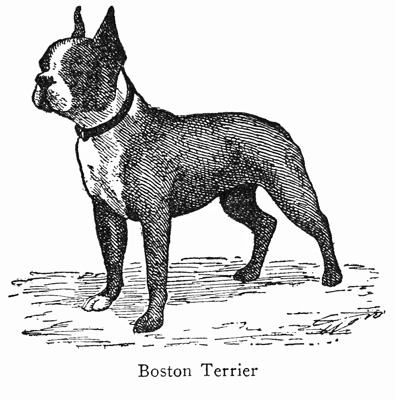
Mr. Hartshorn bowed and withdrew, while Mrs.
Hartshorn remarked to a friend that she didn't believe
he had ever made such a long speech before in
his life. The spectators crowded around the winners
to congratulate the three boys and to pat and admire
their dogs. More than one person in that barn had his
or her eyes opened that day for the first time to the
points of excellence of dog-flesh. Still, there were
some who stepped back to the bench where Rags sat,
an uncomprehending spectator, and assured him that
he was the best dog in the show after all, and that
he would have received the silver cup if they had
been the judges. Ernest and Theron had never known
a happier day of triumph, and even Dick Wheaton,
who had received his prize with a supercilious smile,
appeared to be a bit softened for the time being and
to show some pride in his ownership of the much-abused
Gyp.
There were, indeed, some heart-burnings among
the losers. Herbie Pierson, for one, had had high
hopes of Hamlet. But they had all agreed to accept
the outcome like good sports and they could not remain
long despondent in the face of the success of
their show. As for Jack Whipple, the youngest exhibitor
of all, he displayed a spirit that the others
would have been ashamed not to follow. He was
frankly pleased at the success of Romulus, and stoutly
asserted that Remus would have his big day yet. Mr.
Fellowes was as much pleased as Ernest was, and
privately confided to him that he was glad Romulus
didn't get first prize, as he would have been disappointed
to see any other dog wearing that collar.
The people were beginning to file out of the barn,
after a final tour of the benches, when Mr. Hartshorn,
standing beside the cashier's booth, once more called
for order.
"As you know," he said in his strong voice, "the
proceeds of this show are to be given to the Red
Cross, and you may be interested to learn just how
much has been netted for that good cause by to-day's
unique effort on the part of the Boytown Humane
Society. The treasurer, Theron Hammond, has been
busy with arithmetic for the past twenty minutes and
has an announcement to make."
Theron was suddenly stricken with stage fright, but
he did not attempt to make a speech. He merely
read the figures of his report.
"Entry fees for 26 dogs," he read, "$13.00. Attendance,
242. Gate receipts, $60.50. Total receipts,
$73.50. Advertising, $8.00. Other expenses, $2.67.
Total expense, $10.67. Net proceeds, $62.83."
"I wonder," remarked Mr. Hartshorn to his wife,
"if a dozen women could knit $62.83 worth of mufflers
in one day."
The exhibitors began taking their weary dogs home
and the boys started the cleaning-up process that was
part of their bargain with Mr. Morton. And so the
great day ended.
The only fly in the ointment of Ernest and Jack
Whipple was the fact that, although their father had
been an enthusiastic spectator throughout the greater
part of the afternoon, their mother had not seen fit
to attend. She was very busy, she said, and anyway,
dogs did not particularly interest her.
Next morning the two local papers contained full
accounts of the show, to the extent of a column or
more, and they treated it as one of the season's events
of Boytown, giving the names of all the dogs and their
owners and a complete report of the awards, besides
the treasurer's report. One of them even published
an editorial praising the work of the Humane Society
and suggesting that the town should be proud of its
boys and its dogs. Mr. Whipple and the boys devoured
the contents of these papers eagerly before
breakfast. After breakfast they found Mrs. Whipple
reading one of them in the sitting-room.
"What are you reading, mother?" asked Mr.
Whipple, but she was so absorbed that she did not
answer for a time.
At length she murmured, half to herself, "Hm!
I don't see yet why Remus didn't get a prize."
Whereat, it must be related, Mr. Whipple turned
and winked at the boys in a most undignified manner.
Spring came, and with it more training for
Romulus, until Sam pronounced him a fairly well-broken
bird dog. May drifted into June and June
into July. Another school year came to a close and
another long vacation period began. The great dog
show was now a thing of ancient history and things
were a bit slow in Boytown. It appeared essential
to the happiness and welfare of numerous boys and
dogs that something new should be undertaken.
It was Jimmie Rogers who suggested it, though
there were a dozen active, eager minds ready to seize
upon the idea and develop it. They were sitting on
the bank of the swimming hole near the brickyard,
resting after an hour's swim and warming themselves
in the sun. The dogs were either wandering restlessly
about in search of new adventures, or were stretched
out at their masters' feet. The boys were somewhat
languidly discussing the events of the Glorious Fourth
just past, and bemoaning the fact that another one
would be so long in coming.
"Fourth o' July's all right," remarked Jimmie,
"but I think the most fun in the whole world is camping
out."
"Ho!" scoffed Harry Barton. "When did you ever
go camping out?"
"I camped out one night with my father in an old
shack over Oakdale way," asserted Jimmie.
"That isn't camping out," said Harry. "Camping
out is living in a tent in the woods all summer, catching
your own fish and cooking your own grub and—and
everything."
"Did you ever do that?" demanded Jimmie.
Harry was forced to admit that he never did.
"Gee, I wish we could all go camping out this
summer," said Ernest Whipple. "It would be great
fun to take the dogs along."
"Well, why can't we?" inquired Jimmie.
Many of the boys held inwardly a well-founded
notion that there would be serious parental objections
to a plan of this kind, but their ready imaginations
caught fire at the idea and they were soon in the
midst of a lively discussion of plans that gradually
settled down from the wild and fantastic to the faintly
feasible. When they separated that afternoon it was
with the hopeful belief that they were going to organize
a camping expedition.
The expected parental opposition developed promptly
and decidedly, but when a dozen American boys get
their hearts set on anything short of discovering the
North Pole something is sure to happen. They did
not quickly abandon their rosy project and they set
about conquering the opposition by means of a determined
siege.
The chief point of objection, of course, which indeed
appeared insurmountable, was the natural belief
on the part of parents that it would not be safe or
wise to let their boys leave home and go camping out
without the guardianship of some older person. No
arguments could be invented to prevail against this.
But help came from an unexpected quarter.
Theron Hammond's older brother, Alfred, a
student at Yale and a steady, reliable sort of fellow,
was spending his summer at home and was finding
Boytown a bit dull after the activities of Junior year
at college. One evening, when Theron had broached
the subject for the fortieth time and his father had
once more given a firm refusal, Alfred put in his
oar.
"Aw, father," said he, "let him go and give us a
little peace in the house. It won't hurt him."
"But, Alfred," said his father, "you know very
well it would never do to let those boys go off alone.
None of the parents would permit it."
"Suppose Horace and I went with them," suggested
Alfred. Horace Ames was a classmate of Alfred's
who was also languishing in summer idleness in Boytown.
That put another face on the matter entirely. It
must not be supposed that the victory was won at
once, however. It required two weeks more of the
siege to win capitulation all along the line. But the
boys conquered at last. They liked and admired the
college students and accepted their alliance with enthusiastic
acclaim. Alfred talked it over with his
chum, and the more they discussed it the more they
felt that the conducting of this boy-and-dog camp
would be great fun. Horace had brought home with
him from New Haven the ugliest-looking and gentlest-tempered
bulldog ever seen in the streets of Boytown.
His name was Eli and Horace vowed he would
give Eli the pleasure of camping out with the other
dogs of Boytown. Eli was in training as a football
mascot, and Horace asserted that a summer experience
of this sort was just what he needed.
As their interest in the project grew, Alfred and
Horace decided to take an active part in the campaign,
and they called personally on every one of the doubting
parents. Little by little they won them over until
at last the success of the plan was assured. Mrs.
Whipple was the last to give way, but Mr. Whipple
had already been enlisted in the cause and he proved,
as ever, a loyal advocate.
"You must remember, mother," said he, "that Jack
is eleven years old now."
"Yes," said she, dubiously. In her eyes Jack was
still a rosy-cheeked baby.
"It is never too soon for boys to gain self-reliance,"
said Mr. Whipple. "This camp will do Jack a lot
of good, and Ernest, too. They'll have to hold their
own on a common footing with the other boys, which is
what they must do in later life. And Alfred and
Horace are as reliable and trustworthy a pair of
young fellows as I know. They won't let anything
happen to our boys."
So at last even Mrs. Whipple granted a reluctant
consent, and fourteen boys, besides the two older ones,
were at last enrolled as members of the expedition.
At first it had been understood that the camp was to
include only members of the Humane Society, and
would be a sort of club outing, but Mrs. Hammond
suggested that the invitation be extended to include
also any boy in town who owned a dog, on the
ground that this might serve to recruit new members
for the society. Alfred seconded this.
"The more the merrier," said he.
So the invitation was sent abroad and had already
been accepted in two cases when the troublesome question
of Dick Wheaton again arose. The boys didn't
want Dick at the camp, and Dick evinced no interest
in the project, but the bars had been let down and
there seemed to be no good excuse for not admitting
Dick. Mrs. Hammond advised them to invite him,
but before they had done so, the matter was taken
out of their hands; the difficulty was solved for
them.
One night Gyp, tired of his ill treatment, heartbroken,
hopeless of ever being able to win his master's
true affection, and doubtless seeking a happier home,
ran away and was never again seen in Boytown. So
Dick, since he no longer owned a dog, was automatically
eliminated, much to the relief of those who
did not want him. It seemed a just retribution that
he should lose the creature that loved him so, but it
is doubtful if Dick cared very much.
"I only hope," said Mrs. Hammond, when she was
told about it, "that this will teach Dick a lesson and
that poor Gyp will find a good master and pass the
rest of his days in peace and happiness. He is a dear,
loving little dog, and he deserves it."
Including Eli, there were fourteen dogs in the party,
which was more than had at first been counted on,
for not all the members of the Humane Society were
dog owners, though the outsiders all had to be. It
happened in this way: Frank Stoddard had long been
pleading with his parents to be allowed to have a dog,
and at last they surrendered and gave him one on his
birthday. Mr. Stoddard believed in doing nothing by
halves and so he purchased a really fine young collie,
sable and white, named MacTavish, and usually called
Mac for short. So Frank had a canine companion for
the camp and his cup of joy was full.
And there was still another new dog in town. Elliot
Garfield's uncle, who knew of the boy's earnest
desire to own a dog, sent him early in August an Old
English sheepdog. The uncle wrote that he was going
to travel a bit, and that if Elliot would guarantee to
give his dog a good home, he might have him for his
own. You may believe that Elliot was not slow in
agreeing to that proposition. It was a pedigreed dog,
named Darley's Launcelot of Middlesex. That was
a name no one could be expected to use in calling a
dog, and even Launcelot seemed a bit strange. So
Elliot, who possibly lacked originality, rechristened
him Rover.
Most of the residents of Boytown had never seen
an Old English sheepdog before, and Rover attracted
not a little attention on the street. Some people even
laughed at his big round head, with hair over his eyes,
and his shambling gait and lack of a tail, but they
soon got used to him and came to admire his wonderful
gray and white coat. And Rover turned out
to be one of the jolliest dog companions in Boytown.
He loved the water, and when he got his coat thoroughly
wet he seemed to shrink to half his normal size.
He was really not much bigger than Romulus, but
when his hair was dry and all fluffed out he looked
as big as a Newfoundland.
With Rover and Mac added to the party, it began
to look like a pretty big affair, as indeed it was. Alfred
and Horace entered into the spirit of the thing
with zest and arranged for the tents and general equipment.
They had both been camping in the Adirondacks,
and they knew just what was needed. So they
drew up a list of the things each boy must provide
for himself—warm blankets, a bag to be stuffed with
sweet fern for a pillow, mosquito netting, and an
aluminum plate, bowl, and cup for each boy, a dish
for his dog, knives, forks, spoons, etc., besides the
requisite clothing and toilet articles. It was all done
very systematically.
There was one thing that bothered Alfred and
Horace, and that was the cooking. They ordered a
store of supplies, the boys having all contributed to
a fund for that purpose, but that did not solve the
problem of three meals a day. The boys had been
inclined to pass over this detail somewhat lightly, but
Alfred and Horace knew from experience that feeding
a dozen hungry boys was no joke, and they didn't
intend to have their vacation spoiled by the necessity
of turning to themselves and doing all the work.
One day Mr. Morton stopped Alfred Hammond on
the street and asked him how the plans for the camp
were progressing.
"Everything is going finely," said Alfred, "except
for two things. We shall have to postpone our start
for a day or two because the tents haven't come yet.
Then there's the question of the cooking. I'm blessed
if I know how that gang of youngsters is going to be
fed."
Mr. Morton stood and thought a moment.
"Maybe I can help you out," he said at length.
"I'm just starting off on a little vacation myself, and
I've been wondering what I'd do with Moses."
(Moses was Mr. Morton's colored man-about-the-place.)
"I haven't enough to keep him busy during
my absence and it wouldn't do for him to fall into
habits of idleness. How would you like to take Moses
along with you, and guarantee to keep him out of mischief?
He was once an assistant chef or something in
a summer hotel, and I believe he's a first-rate cook.
His services would cost you nothing, because I have to
keep up his wages anyway. I'd be mighty glad to
know that he was being kept busy."
"Say, that's mighty white of you, Mr. Morton,"
said Alfred. "Moses for ours. He's just what we
need."
So that matter was settled. Mr. Morton explained
to Moses just what was required of him, and Moses
became a not unwilling member of the party.
The tents, which had been ordered from New York,
came at last. There were two of them, good-sized
ones, each capable of accommodating seven of the
younger boys and one of the older ones. Horace Ames
had a small tent of his own which would serve for
Moses. On the appointed day the boys congregated
at the Whipples' stable, each bringing his personal
equipment strapped up in his blanket. The camp site
that had been chosen was at Mallard Lake, about nine
miles from Boytown, and two wagons with drivers
had been engaged to convey the outfit.
Presently one of these wagons appeared, containing
Moses, Alfred, Horace, the tents, a stack of old lumber,
a box of cooking utensils, and a second-hand kitchen
range, besides a number of boxes containing provisions.
When the boys had heaved their personal
belongings aboard it made a big load. Then the
human part of the expedition loaded itself into the
second wagon, with much laughter and skylarking,
and the party was ready to start. The dogs were
allowed to run alongside, and a lively pack they were.
Mrs. Whipple, with a look of anxiety still on her face,
came to the gate to wave good-by.
They arrived at Mallard Lake about noon, and after
unloading and sending back the wagons, they sat down
to partake of the picnic lunch that each had brought
with him. Then came the task of pitching camp. It
was no small thing to accomplish before dark, but
there were many hands to engage in it and efficient
leadership.
The camp was located in some pine woods that ran
down close to the shore of the lake. On the other side
of a little cape was a sandy beach that looked like a
good swimming place. Across the lake there were two
or three farmhouses, where the leaders had arranged
for supplies of milk, eggs, butter, bread, and baked
beans. All the available floating craft on the lake
had been hired, and three rowboats and a canoe lay
drawn up on the bank. A little way back in the woods
was a spring of clear, pure, cold water for drinking
purposes, and a pool where the milk and butter could
be kept fresh.
The leaders told the boys, however, that they would
have to wait another day before indulging in an exploration
of the surroundings of the camp. There
was much to be done before night, and all must get
to work. The two tents were pitched on a little rise
of ground back from the water, and each boy was set
to work gathering balsam boughs for his bed. These
were strewn a foot thick on the ground inside the
tents and the blankets were spread upon them, each
boy being assigned his place. They also stuffed their
pillows with balsam, waiting till another day to gather
the fragrant sweet ferns in a near-by pasture. Each
boy also cut stakes and drove them into the ground
about his bed to hold his mosquito netting. Ropes
were strung overhead to hold clothing, and there were
two lanterns for each tent.
Moses, meantime, had pitched his own tent and
made his own bed, and now they all turned to to
help him knock together a rough shack to serve as
cook house and pantry. Then a long dining table and
benches were built and a frame erected over them on
which was spread an old awning. The range was
set up in the cook house, the provisions were stored
away, firewood was cut, and Moses started preparations
for supper. Soon a fragrant smoke was issuing
from the stovepipe, which before long was mingled
with the smell of frying bacon and other things cooking
that made every boy acutely aware of his appetite.
Still Alfred and Horace kept them at work, cleaning
up around camp, laying a stone foundation for a
campfire, and erecting a lean-to shelter for the dogs
in stormy weather, for it was voted not to allow the
dogs to come into the tents.
Moses made good his reputation as a cook, and a
prodigious amount of provender disappeared at supper
that night. The boys were in high spirits and so were
the dogs. The latter, not yet accustomed to their new
surroundings, and not realizing that they were to stay
there, were restless and excitable and gave some
trouble, but they were at last persuaded to quiet down.
It was decided to tie them to the lean-to for a few
nights until they should learn the rules and regulations.
After supper, while the boys were gathering brushwood
for a campfire, Jimmie Rogers hoisted the camp
ensign, which created a roar of laughter. I must
explain about this ensign and the name of the camp.
Some time before they had discussed the subject
of naming the camp, but could agree on nothing. Mrs.
Hammond had suggested Camp B. H. S., the letters
being the initials of the Boytown Humane Society.
This did not fully please the popular fancy, and yet
they did not like to discard Mrs. Hammond's suggestion.
They began trying to find a word or words
in some way made up of B. H. S. Alfred Hammond
suggested Camp Beeches. That sounded something
like B. H. S., he said, and they would very likely
find beech trees about the camp. They adopted this
name for want of a better one, until Jimmie, in a moment
of inspiration, changed it to Camp Breeches.
This name really had no very deep meaning, but somehow
it tickled the boys and it stuck, being still further
revised in process of use to Camp Britches. The
ensign which Jimmie tied to a sapling in front of
the camp was an old pair of boy's trousers.
It would require a whole book to tell of all the
episodes that went to make up the life of Camp
Britches during the next week, of the fishing and
swimming, the exploring expeditions and berrying
parties, of how the boys built a landing wharf for
the boats and a diving raft, and how they divided up
the routine duties of the camp. Some of these episodes
were glorious fun; some were not so pleasant;
taken all together they made up a memorable experience.
Moses proved to be a master at making griddle
cakes and other good things, and once or twice a boy
ate not wisely but too well, and required the attention
of the camp physician, Horace Ames. But for the
most part they were healthy and happy, and incidentally
they learned many things about looking out
for themselves.
One night a thunderstorm broke, a veritable cloudburst,
and the boys had to put on their bathing trunks
and go out and dig deeper trenches around the tents
to keep the water from running in and soaking everything.
On another occasion a high wind blew one
of the tents down on its sleeping inmates, causing
more fright than damage.
Perhaps the best part of it all was the evening campfire.
By that time the boys were physically sufficiently
weary to enjoy resting, and, the pangs of hunger being
well satisfied through the ministrations of Moses, they
would light their pile of brushwood and lie about it,
wrapped in blankets on the cool nights, and watch
the flames and fondle their dogs, and gossip drowsily.
Sometimes there was story telling, at which Albert
Hammond was an artist. And one afternoon Sam
Bumpus came by special invitation, walking all the
way from his shack, and that evening they had stirring
tales of moose and deer hunting in Maine.
Then, of course, there were always the dogs. Sometimes
it seemed as though there were too many of
them, and it was necessary to make each boy strictly
accountable for the actions of his own. Mr. O'Brien
was a constant source of trouble and unrest, and there
were times when it almost seemed as though they
would have to send him home. Still, everybody liked
Mr. O'Brien, after all. Wicked as he was, he was
as smart as a whip and he had a way of worming
into your affections in spite of you. Romulus and
Remus had to be watched because of a tendency to
go roaming off together on hunting expeditions of
their own. Rags was, as ever, a general favorite
and heaps of fun, and Rover, the Old English sheepdog,
proved to be almost as playful and humorous.
He was wonderfully active for a dog who appeared to
be so clumsy. He could hold his own in a scrap, too,
as Mr. O'Brien learned to his sorrow. In aquatic
sports, Rover shone.
Speaking of the dogs, there came a night when
one of them nearly upset the entire camp. It was the
handsome collie, MacTavish. He strayed away from
camp in the evening and managed to get into trouble
with a little animal that is sometimes found in the
woods whose method of defense is peculiar. It was
a black and white skunk. MacTavish returned, very
unhappy, just as the boys were getting to sleep. Seeking
help and consolation in his distress, he entered
the tent where his master lay. In less time than it
takes to tell it every inmate of that tent was out in
the open air. Moses and Horace took the collie down
to the lake, washed him as thoroughly as they could
with strong tar soap, and then tied him out in the
woods where the poor unfortunate's howls disturbed
the camp's rest all night. They could not send him
home, and it was two or three days before he was
entirely fit for human companionship again.
Camp Britches was pitched on a Wednesday, and
the first week flew by on winged feet. On the second
Saturday an event occurred which the boys had been
looking forward to with anticipation. Mr. Hartshorn
came in his car to spend Sunday at the camp. He
brought none of his dogs with him, which was a source
of regret, but he was a most welcome visitor, nevertheless.
The boys feared that the appointments of their
camp might not be quite elegant enough for a man
like Mr. Hartshorn, but he fitted in as though he had
been brought up to just that sort of thing and said
it was all bully. Frank Stoddard moved out and
crowded into the other tent, and a special bed was
laid for the visitor. Moses outdid himself in planning
his Sunday menu.
Mr. Hartshorn arrived too late to be shown about
the lake that day, but supper was a jolly meal and a
new interest was added to the campfire hour that night.
Mr. Hartshorn had shown considerable interest in
MacTavish and Rover, both of whom he pronounced
to be fine dogs, and this led to a general discussion of
sheepdogs and their kin.
"I wish you'd tell us something about bob-tails, Mr.
Hartshorn," said Elliot Garfield. "I really don't
know a thing about them, and I ought to, now I've
got one."
"Please do," echoed Ernest Whipple. "You promised
you'd tell us about the shepherd breeds sometime."
"Well," said Mr. Hartshorn, laughing, "it's pretty
near bedtime, anyway, so if I put you to sleep it won't
much matter. For my own part, though, I'd rather
listen to another of Alfred's stories."
The night was chilly, so he went to his car and
got his auto robe, wrapped himself up in it, lighted
a cigar, and settled himself comfortably beside the
campfire.
"You may have noticed," he began, "that some
breeds of dogs seem to possess more individual character
than others. Foxhounds, for example, seem to
me a good deal alike. That is because they live and
work mostly in packs. It is the constant association
of a single dog with his master that develops the
traits of personality in him. No dogs have had this
personality more highly developed than the shepherd
breeds, for they have been the shepherds' personal
companions, often their only companions, for generations.
They are, therefore, most interesting dogs
to know and to talk about.
"Of these shepherd breeds the best known is the
collie. It is, in fact, one of the most popular and
numerous of all the breeds. The modern collie, of
which Mac here is a good example, has been developed
for beauty, as a show dog and companion rather than
a working dog, but he is a direct descendant of the
old working collie of the Scottish Highlands, which
has been a distinct breed and has been used as a shepherd's
dog for centuries. The old working collie or
shepherd dog, which is still numerous in Scotland,
is a splendid utility animal of great intelligence and
initiative, brave as a lion, and trained to guard sheep.
"Though a straight development without much
crossing with other breeds, the modern collie is almost
a different variety, with a narrower head and muzzle,
better pointed ears, and a fuller and finer coat. From
the fancier's point of view he is a great improvement
on the working dog, and he certainly is handsomer,
but in my own humble opinion the fanciers are well-nigh
ruining the splendid character of one of the best
breeds of dogs ever given to man. For one thing,
they have made the head so narrow and snipey, imitating
that of the Russian wolfhound, that they have
left insufficient room in the skull for all the brains the
old collie used to possess. And with this fineness of
breeding has come some uncertainty of disposition.
The modern collie isn't usually given a chance to learn
the things his forefathers knew, so how can we expect
the same mental development? Mac, I am glad to
say, is not of the extreme type. He would doubtless
be beaten in the shows, but he is a better dog, for all
that. The older type used to be more common here,
but has gradually been driven out by the show type
which began to be taken up about 1880.
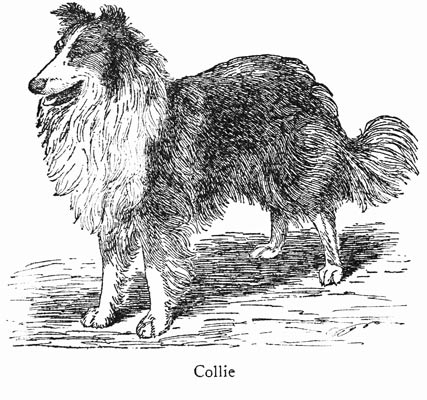
"The Scotch are great people for dog stories, and
a good many of their tales are about collies. Bob,
Son of Battle, was an old-fashioned collie. Many of
the anecdotes that are told as true stories deal with the
breed's wonderful sagacity in caring for sheep. There
was the Ettrick Shepherd's famous collie Sirrah, for
example. He could undoubtedly do amazing things
with sheep. One night something scared the lambs,
and they started off for the hills, dividing into three
groups. The shepherd called his dog and his assistant
and started out in the hope of rounding up at least
one of the groups before morning. But the night
was dark and the hills a wilderness, and the two men
were at last forced to give up the attempt until daylight.
At dawn, when they started out again, what
was their astonishment to see Sirrah coming in with
the lost lambs—not one group only, but the whole
flock. How he managed to get one group after the
other, no one could ever say, but between midnight
and dawn he rounded them all up alone, and not one
was missing.
"This herding instinct is very strong in the collie.
I once met a modern collie in Des Moines, Iowa, who,
because he had no sheep to attend to, busied himself
with the chickens, and he would never consider his
day's work finished until he had carefully herded all
the Rhode Island Reds into one corner of the poultry
yard, and all the Plymouth Rocks into another.
"Cases are on record of collies that were taught to
steal for their masters, by systematically driving off
sheep from neighboring flocks. Many stories deal with
the collie's intelligence in fetching help to a man or
animal in danger. One collie brought in a flock of
half-frozen hens, one by one, that had strayed away
from the barnyard and got caught in a blizzard. He
carried them tenderly in his mouth, depositing them
in a row before the open fire. Another collie brought
home a strayed horse by the bridle.
"Shepherd collies are wonderful with the sheep,
but the so-called house collie is often more generally
wise and adaptable. Hector, a son of Sirrah, was
such a dog, and his master, a Mr. Hogg of Ettrick,
has told many amusing stories about him. He was
always getting into mischief, and Mr. Hogg's mother
vowed he should never go visiting with her, for, as she
put it, 'he was always fighting with other dogs, singing
music, or breeding some uproar or other.' But
with all that, he was so intelligent, and seemed to
understand so many things in advance, that she used
to say, 'I think the beast is no canny.'
"His master's father was one of the church elders
of the place, and at one time accepted the post of
precentor. He knew only one tune well—'St. Paul's'—and
this he used to give out twice each Sunday.
To save the congregation from too great a dose of
'St. Paul's,' the son agreed to relieve him of his
duties. But here Hector, accustomed to his master's
company on Sundays, objected. He would follow
him to church, and when he heard his master's voice
inside, he would raise his in the churchyard, much
to the amusement of the shepherds and the country
lassies. 'Sometimes,' said Mr. Hogg, 'there would
be only the two of us joining in the hymn.' The
result was that he was forced to resign, and the
church was obliged to carry on as best it could with
the old precentor and 'St. Paul's.'
"Hector exhibited strange motives and peculiar
logic sometimes. He was jealous of the house cat
and hated her, but he never touched her or threatened
to do her any harm. He merely kept a suspicious eye
on her, pointing her as a setter points a bird. He
used to join in family prayers, and just before the
final 'Amen,' he would leap to his feet and dash
madly about, barking loudly. It was easy to understand
how he knew when the 'Amen' was approaching,
but why the excitement that followed? 'I found
out by accident,' wrote Mr. Hogg. 'As we were
kneeling there, he thought we were all pointing Pussy,
and he wanted to be among the first at the death.'
"Next we come to Rover's breed. Old English
sheepdog is its official name, but I think it might better
be called the bob-tailed sheepdog to distinguish it
from the original smooth sheepdog of England. In
many respects it is quite unlike any other breed that
comes from England. He was formerly used by
English drovers as a cattle dog, but we know little
of his history. The bob-tail is the hairiest of the
large dogs and one of the most striking of all breeds
in appearance. Some of the puppies are born tailless,
while others have their tails removed within a few
days after birth. The bob-tail is an active, swift,
intelligent dog and, as you know if you have watched
Rover, very playful and very expressive with his paws.
Having no tail to wag, he wags his whole hind
quarters to let you know he is pleased or friendly.
"The German shepherd dog has had a remarkable
boom since its introduction here in 1912. It is an
old breed in Germany and its appearance strongly
suggests wolf blood in its ancestry. Originally a
shepherd's dog, and still used as such, this breed has
shown itself remarkably adaptable to police dog work
and has been used in the war more than any other
breed. The German shepherd dog is not as gently
affectionate as some breeds, but is intelligent, active,
alert, brave, and loyal.
"I think I should also speak of the Belgian sheepdog,
partly because we are all interested in Belgium
these days, and partly because we have begun to get
a few of these dogs over here. They are said to be
even cleverer police dogs than the Germans. A few
have been successfully used over here by police departments
of New York and vicinity, and a few
fanciers have become interested in the Groenendaele
variety and have exhibited specimens in the Westminster
show."
"What do police dogs do?" inquired Herbie
Pierson.
"I have never seen them at work on the other
side," said Mr. Hartshorn, "but I understand they
are a recognized part of the police service in many
cities of France, Austria, Belgium, Holland, and Germany.
They are said to do wonderful things, such
as rounding up gangs of thieves, trailing criminals,
and saving drowning persons, including would-be suicides.
In this country their usefulness has been rather
the prevention of crime. I have visited the dog squad,
in the Flatbush section of Brooklyn. There they are
muzzled and are not expected to attack people. They
are taken out at night with the patrolmen and scout
around in back yards and anywhere that a burglar or
hold-up man might be lurking. The criminals don't
like that idea, and they have kept away from that
section pretty consistently. I believe these dogs have
also found persons freezing in the snow. Airedales
have been tried out as well as Belgian and German
shepherd dogs. For trailing criminals and finding
lost persons, the bloodhound is most commonly used
in this country, but I believe some rather remarkable
feats of trailing have been accomplished by Belgian
sheepdogs at Englewood and Ridgewood, New
Jersey."
"They are used mostly as ambulance dogs in the
war, aren't they?" asked Harry Barton.
"Yes," said Mr. Hartshorn. "You have probably
seen pictures of them bringing in a wounded man's
helmet, to guide the stretcher bearers to where he
lies. They are also used as messengers and for sentry
duty in the listening posts, where they are much quicker
than the men to detect the approach of a raiding party
or an enemy patrol. I could tell you some interesting
and thrilling stories that I've heard about these
war dogs, but I for one am getting sleepy and
I'd like to try out that balsam bed and see if I
like it."
There was a little less skylarking that night out of
respect to the honored visitor, and so everyone got
a good rest and was up betimes in the morning. After
breakfast Mr. Hartshorn asked to be shown about the
country near the camp, and everybody joined in the
expedition, including the dogs.
"I suppose these dogs are all pretty well acquainted
with one another now," said Mr. Hartshorn, "but I
must say it is wonderful how well they get along together.
It all shows the power of human companionship.
Kennel dogs like mine couldn't stand this sort
of thing for an hour. It must be that Rags and Rover
keep them all good-natured."
Sunday passed quietly and pleasantly and then came
another evening campfire. Some of the boys begged
Mr. Hartshorn to tell them about more breeds of
dogs, but he laughingly refused.
"Sometime I'll tell you about the hound and greyhound
families, but not now. You've had enough,"
said he. "Besides, I came here to loaf, not to teach
a class. Let's have one of Alfred's stories."
"I'm afraid I've told them all," said Alfred. "I've
tried to think of more, but I guess there aren't any."
"We've all told our stock of stories," said Horace.
"You're the only one with a fresh supply. I guess
it's up to you, Mr. Hartshorn."
"The trouble is," said he, "I'm no story teller,
but I'll read you something, if you'd like to hear it.
I have quite a library of dog literature, both fact and
fiction, and I've tried to collect every good thing that
has been written about dogs. I selected two stories
that are fairly short and brought them along, thinking
there might develop a need for entertainment of that
kind. Would you like to hear them?"
A shout of unanimous approval went up. Two of
the boys ran to Mr. Hartshorn's car for the books,
and another brought a lighted lantern and placed it on
a box at his elbow. Then they grouped themselves
about the fire again and listened with absorbed attention
while he read them two of the best short dog
stories in his collection—"The Bar Sinister," by
Richard Harding Davis, and "Stikeen" by John
Muir.
"My! Aren't those fine!" exclaimed Ernest
Whipple.
"Haven't you any more?" begged Elliot Garfield.
"No," said Mr. Hartshorn, "I'm sorry to say I
haven't any more with me, but I shall be glad to lend
my books to any of you boys who will promise to
return them. They are very precious. I'd like nothing
better than to introduce you to the dogs of literature.
They're a great lot."
Then he proceeded to tell them something of the
best known of these books—"Bob, Son of Battle,"
Ouida's "A Dog of Flanders," Jack London's stories,
and a number of others.
"But I think," he concluded, "that the one I like
best of all is the true story of a little Skye terrier
named Greyfriars Bobby, one of the most faithful
dogs that ever lived."
"Oh, please tell us about him," begged Frank Stoddard.
"No," said Mr. Hartshorn, "I would only spoil
the story. You must read the book for yourselves. It
will give you something to do next winter when you
can't go camping out, and I can promise you a rare
treat."
The next morning Mr. Hartshorn was obliged to
leave, and everyone was up bright and early to see
him off. He thanked them all for one of the jolliest
week-ends he had ever spent, and promised to invite
them to a campfire of reminiscence at Willowdale
sometime. Then he got into his car and started the
motor.
I presume he had never taken part in so boisterous
a departure. The rough woods road was difficult
enough to drive in at best, and the boys and dogs
crowded about the car, shouting and barking their
farewells. In spite of all Alfred and Horace could
do, some of the more venturesome jumped upon the
running boards and rode a little way, while the dogs,
catching the spirit of excitement, dashed about in
front and everywhere. Alfred and Horace rushed in
to quiet the confusion, but before they could get the
boys and dogs in hand a sharp yelp of pain sounded
and poor old Rags lay, a helpless, pathetic figure, in
the wheel rut behind the car.
No one knew, in the confusion, just how it had
happened. Mr. Hartshorn had been driving as slowly
and carefully as he could under difficulties. A moment
before Rags had been barking riotously and leaping
at the hand of his master who stood perched
precariously on the running board. Now he lay, mute
and motionless, all the joy gone out of him, his eyes
raised in dumb pleading to his master's face.
A sudden hush fell over the noisy crowd. Even
the dogs seemed to know that something dreadful had
happened. Mr. Hartshorn stopped his car and leaped
out. Jimmie Rogers was kneeling on the ground beside
his beloved dog, his face very white, and Rags
was feebly trying to lick his master's hand.
Jimmie did not weep or cry out, but when Mr.
Hartshorn came up, there was a pleading look in the
eyes he lifted to the man's face which was much like
the look in the eyes of the dog. Jimmie did not ask
any questions. He only moved over a little while Mr.
Hartshorn leaned over and tenderly felt of poor Rags's
broken body.
"I must have gone square over him with both
wheels," said he. "Poor little Rags! I wouldn't
have done it, old boy, if I'd seen you. You know that,
don't you?"
The dog's forgiving tongue gave him his answer.
Mr. Hartshorn did not scold the boys, but they all
knew they had been to blame, and no amount of
scolding could have made them feel any more remorseful.
They stood about in silent shame and
dread. The irrepressible Mr. O'Brien trotted up to
see what it was all about, sniffed at Rags, and then
walked slowly away, raising questioning eyes to his
master's face.
When Mr. Hartshorn arose he was winking very
hard and biting his lip.
"Is he much hurt, sir?" asked Horace.
"I'm afraid so," said he. "We must get him away
at once. Jump into the car, Jimmie, and come along
with me."
He made a soft bed of the auto robe on the floor
of the car, lifted Rags tenderly in his arms, and laid
him on it.
"Watch him, and keep him as comfortable as possible,"
he directed Jimmie.
That was all that was said, and the car started off
again, leaving grief and woe at Camp Britches.
Mr. Hartshorn lost no time in getting back to Boytown,
though he was careful not to subject the suffering
dog to the pain of rough riding. At Boytown
he jumped out and telegraphed to Bridgeport
to command the attendance of the best veterinary
surgeon in the state. Then they sped on to Willowdale.
They took Rags out to the little building that was
used as a dog hospital and made him as comfortable
as they could. Mrs. Hartshorn herself brought him
a dish of water which he lapped gratefully. He bore
his pain heroically, but he was suffering terribly, and
Tom Poultice thought best to administer a merciful
opiate. Then he made a thorough examination.
"There's ribs broke," he said, "and I guess 'e's
'urt hinternal."
"Then there's nothing we can do?" asked Mr.
Hartshorn.
Tom shook his head sorrowfully.
After awhile the effects of the drug wore off and
Rags opened his eyes. Tom put his hand on the
dog's heart and shook his head dubiously.
"I'm afraid 'e's going, sir," said he.
Mr. Hartshorn placed his arm about Jimmie's heaving
shoulders and drew him toward the dog, who
seemed to be begging for one last caress of his master's
hand. Mrs. Hartshorn put her handkerchief to
her eyes and hurried out.
The surgeon arrived soon after noon, but it was too
late. Rags had died in Jimmie's arms.
After the unfortunate episode that resulted in the
accident to Rags, it was as though a cloud rested over
Camp Britches. There was no heart for merrymaking.
And when at last the sad news came of Rags's death,
it seemed as though all the joy had gone out of life.
If you have never been a boy, you do not know how
quickly a mood of hilarious jollity can be followed
by one of deep depression. The plan had been to
continue in camp for four or five days more, and some
of the boys had been begging for a longer extension
of the time, but now no one seriously objected when
Alfred and Horace proposed breaking camp and going
home. Every boy in camp had loved Rags next to
his own dog, and even Moses went about in an atmosphere
of melancholy.
Sadly they hauled down Jimmie's humorous ensign
and pulled up the tent pegs. It seemed like a different
crowd of boys from that which had so joyously
arrived in the wagons but two short weeks before.
On a sunny hillside half a mile south of the brickyard
there grew, at the edge of the woods, a beautiful
little grove of dogwoods, which in May was always
a fairyland of snowy blossoms that almost seemed to
float in the air. In this peaceful spot it was decided
to bury the poor, broken body of Rags. I doubt if
there has ever been a funeral in Boytown that was
attended by more sincere mourners. Harry Barton
and Monty Hubbard spent an afternoon, immediately
after their return from camp, making a simple little
casket of white wood which they stained a cherry
color. It did not seem fitting that so gay a little dog
as Rags should be laid to rest in a black one. They
lined it with soft flannel, and Jimmie himself, trying
hard not to cry, placed the stiff little body inside, still
wearing the old, worn collar, and nailed down the top.
Theron Hammond and Ernest Whipple were appointed
to act as bearers.
The Camp Britches boys were not the only ones
who joined in that sorrowful little procession to the
dogwood grove. Jimmie's mother was there, quietly
weeping, for she had loved Rags like another child,
and with her were two or three of her neighbors.
Mr. Fellowes closed up his store and silently joined
them, and there was a little knot of girls with mournful
faces, who had also known Rags and loved him.
Mr. and Mrs. Hartshorn came over from Willowdale
and, leaving their car in the town, followed the little
casket on foot with the rest.
There was no clergyman present to read Scripture
or to pray, but I think the mourners were none the
less devout. The whole ceremony, in fact, was carried
through in almost utter silence. It had been thought
best not to bring dogs who might not behave themselves,
but Mike and Hamlet were there, for they
could be depended upon, and it seemed fitting that
Rags's canine friends as well as his human friends
should be represented.
A grave was dug in the sand and the little casket
was lowered into it. Beside it Jimmie placed the
battered tin dish that Rags had used and a much-chewed
ladder rung that had been his favorite plaything.
The girls threw in some flowers and then the
earth was shoveled in again and the little company
returned home.
I hope the loyal soul of Rags was where it could
look down and see that his old friends cared and had
come to do him honor. At least his life had been
a happy one and free from any guile. And he was not
soon forgotten. Not long afterward there appeared
at the head of the little mound beneath the dogwoods
a simple headstone, the gift of Mrs. Hartshorn, and
on it were inscribed these words:
HERE LIES RAGS
The Best-Loved Dog
in Boytown.
For some little time the cloud remained over Boytown
and there was little disposition to take any active
part in canine affairs. But youthful spirits cannot
long remain depressed, and as the autumn days approached,
one of the boys of Boytown, at least, discovered
a new interest in connection with dog ownership.
That was Ernest Whipple.
For some time Sam Bumpus had been talking,
somewhat vaguely, of the possibility of testing out
the powers of Romulus in the field trials, and Mr.
Hartshorn himself had occasionally mentioned this.
Ernest subscribed to a popular kennel paper, and early
in September he began reading about the All-American
trials to be held at Denbigh, North Dakota, and other
similar events. The names of famous dogs were mentioned,
both pointers and setters, and there was much
speculation in the paper as to the prospects of winning.
The thing fascinated Ernest, but it was all a bit unintelligible
to him. He wanted to learn more about this
sport that seemed to be followed by such a large and
enthusiastic number of people, and to find out the way
of getting Romulus into it. So one day he and Jack
took their dogs and walked to Willowdale, for the
express purpose of getting the desired information.
Tom Poultice was the first person they encountered,
and he confessed himself to be rather ignorant as to
the conduct of American field trials.
"I've seen many of them in Hengland," said he,
"and a great game it is. Get a bunch of fine bird
dogs out in the fields in the fine weather, with a big
crowd following them, and maybe a bit of wagering
going on be'ind the judges' backs, and the dogs all
eager to be after the birds, and every one of them in
the pink, and you've got a fine sport, men. The dogs
seem to know, too, and they go in for all's in it. But
just 'ow they run the trials over 'ere, I can't say.
You'd better ask Mr. 'Artshorn. 'E used to own
bird dogs once, and I'll warrant 'e's been all through
it."
They found Mr. Hartshorn in his den, but he very
gladly laid aside the work he was doing and asked
good-naturedly what the trouble was now.
"We've come to ask you to tell us about field
trials," said Ernest.
"Well, that's a rather big contract," laughed Mr.
Hartshorn. "I suppose I could talk about field trials
all night. I've seen some thrilling contests in my
time. Just what is it you would like to know?"
"We want to know what a field trial is, how it is
run, and what the dogs do," said Ernest.
"Well," said Mr. Hartshorn, "a field trial is more
than a mere race. It's a real sport in which all the
powers of a bird dog are brought into play. It's a
competition on actual game—prairie chickens or quail,
usually. The dogs are sent out to find the game and
point, with the judges and handlers and the gallery,
as the spectators are called, following. In the big
trials there are three or more separate events. One
is called the Derby stake, for dogs under two years
of age. Then there is the All-Age stake, which is
the biggest one. Finally there is the Championship
stake, for dogs specially qualified, and the winning of
that brings with it the highest honors in the bird-dog
world.
"The order of running is decided by lot, and the
dogs are put down in pairs. They start off after the
birds and work for a stated length of time, after
which the judges decide which of the two dogs won,
the decision being based on speed, form, steadiness,
bird-work, and everything else that goes to make up
the bird dog's special power. Then these winners are
tried together until the best and the second best, called
the runner-up, are chosen in each of the stakes. It
takes a good dog to win one of these stakes, for he
has to run more than once and his work must be consistent.
Purses are offered by the clubs as prizes,
amounting to several hundred dollars at the big events.
"Occasionally there are other stakes, such as novice
stakes and events in which dogs are handled only by
their owners. In the big events the great dogs are usually
handled by professionals, who take the dogs right
down the circuit and win all the prizes they can. The
trials begin in September in Manitoba and North
Dakota, on prairie chicken, and are followed by big
and small events in the Middle Western states, Pennsylvania,
and finally in the South. The biggest of all
is held in December or January at Grand Junction,
Tennessee, every year. Here the All-America Field
Trial Club holds its classic event, in which the winner
of the Championship stake is pronounced the amateur
champion of the United States for one year, winning
also a large purse and a handsome silver trophy."
"Have you ever seen one of those trials?" asked
Jack.
"Several times," said Mr.Hartshorn. "I have seen
some of the most famous pointers and setters that
ever lived run at Grand Junction and win their deathless
laurels."
"I suppose Romulus wouldn't stand a chance there,"
said Ernest, a bit wistfully.
"Perhaps not, at first," said Mr.Hartshorn,
"though you never can tell. It's a pretty expensive
matter, getting a dog ready and putting him through
one of those trials, even though the prizes are large.
But there are smaller ones, and it is possible to try
a dog out nearer home the first time, with less risk
and expense. During the spring there are many trials
held by local clubs throughout the East."
"Couldn't Romulus be entered in one of those?"
asked Ernest.
"I don't know why not," said Mr. Hartshorn.
"I'll look it up and let you know. Meanwhile, tell
Sam Bumpus what you're up to and have him keep
Romulus in shape this winter."
"I suppose Remus couldn't run," said Jack.
"I'm afraid not, my boy," said Mr. Hartshorn,
kindly. "Nose is one of the prime requisites, and
Remus hasn't the nose, as you know."
"I don't care," said the loyal Jack. "I'd rather
win at a bench show, anyway."
When Ernest told Sam Bumpus about the plan, that
worthy was much interested. He made a special trip
all the way to Willowdale to consult Mr. Hartshorn,
and between them they worked out a plan. Sam was
enthusiastic now as to the superior abilities of Romulus
as a bird dog, and he presently took him in hand for
special training to improve his form and the other
qualities that count in the trials. Off and on all winter
Sam took the dog out, patiently and persistently drilling
him. Sometimes Ernest went along and he was
amazed by the intelligence and speed which his
good dog displayed. When spring came again
Sam announced that there was nothing more that
he could do to improve the form and capacity
of Romulus.
"I'll back him against any bird dog in the state of
Connecticut," said he, proudly.
But before I tell how it fared with Romulus at the
trials, I have one episode to relate, the only happening
of that winter which needs to be recorded. For the
rest, the weeks passed without any momentous event,
with the boys in whom we are interested growing ever
a little older and wiser. And this particular thing
was not of great importance, perhaps. It did not
greatly affect the boy-and-dog life of Boytown. But
it did affect Jimmie Rogers, and Jimmie, since the
death of Rags, had been the one lonely, pathetic figure
in the group. It would be a shame not to tell of
the thing that happened to him.
One day in early December Dick Wheaton appeared
on Main Street, dragging a forlorn-looking
little dog by a string. He was a smooth-coated dog
of the terrier type, a rich chocolate brown in color,
with an active body and a good face and head, but
anybody could see he was only a mongrel. No one
knew where he had come from and Dick did not take
the trouble to tell where he had found him.
In his present state the dog showed none of the
alert, eager character of the well-born terrier. He
held his tail between his legs and he cringed abjectly.
This seemed to amuse Dick Wheaton. He made little
rushes at the dog and laughed to see the terror in
his eyes. He found entertainment in tapping the dog's
toes with his foot and watching him pull back on
the string. Wearying of this, he began maltreating
the helpless animal more cruelly.
Mr. Fellowes saw all this from the window of his
store, and his blood boiled within him. Unable to
stand it any longer, he started out of his shop to protest,
when he saw Jimmie Rogers come running along.
There could be no doubt as to Jimmie's purpose.
His lips were tight set and his eyes were blazing.
He came close up to Dick and seized his arm.
"Quit that!" cried Jimmie between his clenched
teeth.
Dick was taller and heavier than Jimmie and he
was not unaccustomed to bullying boys of Jimmie's
size. He shook off the hand and grinned insolently.
"What's the matter with you, Mr. Humane Society?"
he asked.
"I'll show you, if you don't leave that dog alone,"
said Jimmie.
For answer, Dick gave the string a jerk. It was
tied tightly around the dog's neck, and it hurt.
"Whose dog is this, I'd like to know," said Dick
in a taunting tone.
Jimmie wasted no more breath in words. He
snatched the string out of Dick's hand and faced him
defiantly. Dick, now angry in his turn, made a lunge
for the string. Mr. Fellowes couldn't see who struck
the first blow, but in a moment the two boys were
fighting desperately, Jimmie making up in fire and
determination for what he lacked in size and strength.
Mr. Fellowes felt that he was called upon to interfere.
It would hardly do to let a fight like this go
on right in front of his shop, on the sidewalk of Main
Street. Besides, other people were hurrying up and
it might end in serious trouble.
Just then Dick managed to break free long enough
to give the poor dog a vicious and entirely uncalled-for
kick, as though he were in this way scoring an
advantage over his opponent. The little terrier rolled
over and over on the sidewalk, yelping in pain and
terror. Then he found his footing and dashed blindly
into Mr. Fellowes's legs.
The shopkeeper stooped and picked up the frightened
little stray and took him into the store, where he
did his best to soothe and comfort him, and it was
wonderful how promptly the little chap responded
and licked the kind man's hand. It may have been the
first time he had ever tasted the milk of human kindness,
but instinctively he understood and looked up
confidently into this stranger's eyes with an expression
of gratitude.
Meanwhile, a little knot of men and boys had gathered
out in front of the shop. It so happened that
they were persons who would rather witness a fight
than stop it, or it may have been that there were some
of them who hoped that for once Dick Wheaton would
get his deserts. At any rate, it was a real fight, with
no quarter, and it would have been a cold-blooded
person indeed who could not admire the pluck of
Jimmie Rogers. His nose was bleeding and his
breath came in sobbing gasps, but he kept at it with
unabated fury. Three times Dick Wheaton threw him,
and three times he jumped to his feet and went for
Dick.
The fighting of boys is no more to be encouraged
than the fighting of dogs, but there seem to be times
in the affairs of boys as well as of men when nothing
but fighting will serve. The only way to cure a bully
is to thrash him, and if anyone ever had a justifiable
motive for fighting it was Jimmie Rogers.
At length Dick's blows appeared to be growing
weaker. Jimmie, unable often to reach his face, had
been pummelling him consistently on the vulnerable
spot at the lower end of the breastbone, regardless of
the punishment he himself received, and these tactics
were beginning to tell on Dick's wind. His lips were
parted, his eyes staring, and his face took on a strange
mottled look. He began to strike out weakly and to
concern himself chiefly with parrying Jimmie's troublesome
blows and protecting his stomach.
With lowered guard, Dick staggered uncertainly
backward, and Jimmie, rushing in, dealt him a smashing
blow on the mouth that sent him reeling. Tripping
over the door stone of Mr. Fellowes's store, he
fell heavily, and lay there, with his arm crooked over
his face, awaiting he knew not what final coup de
grace in an attitude of abject surrender.
Men rushed in now, but Jimmie was satisfied. He
shook off their hands and walked, somewhat unsteadily,
into the store, and Mr. Fellowes closed the door
behind him. Someone picked Dick up.
"Well, I guess you've had enough," said this unsympathetic
person.
Dick Wheaton slunk off home without replying.
Mr. Fellowes did not refer to the fight. He did
not think it proper to praise Jimmie, for he did not
believe in boys fighting, but he could not resist a feeling
of proud satisfaction.
"Want to see the dog?" he asked.
"Yes," said Jimmie in a tremulous voice. He was
almost crying with weariness and he was doing his
best to wipe the blood off his face and brush the dust
off his clothes.
"Let me help you," said Mr. Fellowes, kindly.
While he was bathing Jimmie's face, the boy felt a
pair of little paws reaching up on his leg, and a cold
little nose thrust into his hand. He stooped down and
patted the little head. The tail came out from between
the dog's legs and wagged joyfully. Impulsively
Jimmie caught him up and hugged him close. It
seemed a long time to Jimmie Rogers since he had
felt the moist caress of a loving tongue, and the thing
went straight to his lonely heart.
During all the fighting he had steadfastly held back
the tears of pain or anger, but now, weakened as he
was by his exertions and the after effects of excitement,
he burst into tears, burying his face in the
little dog's warm, soft coat.
"Oh, little dog, little dog, you're going to be mine!"
he cried.
Mr. Fellowes said not a word. While caring for
the dog during the fight, he had been thinking what
a fine thing it would be to keep him, to fill the place
so long left vacant by the death of his Bounce. But
now, as he watched Jimmie, he made the sacrifice.
This should be Jimmie's dog. The boy had fairly
won him. Mr. Fellowes understood how he felt; he,
too, had lost a dog. So he merely stroked the dog's
head and said, "What shall you call him?"
"Tatters," said Jimmie, and still carrying the dog
tenderly in his arms, he started out of the shop. At
the door he turned back, with the flash in his eye
again. "And I'd like to see anybody try to take him
away from me," he said.
"I guess nobody will," said Mr. Fellowes, smiling,
and Jimmie bore his burden proudly home.
It was wonderful what a change a few days of
kindness and good feeding wrought in Tatters. He
never became the favorite that Rags had been, but
he was a good dog, not without excellences and wisdom
of his own, and Jimmie loved him. And the
change that came over Jimmie was hardly less marked.
With another dog for his own he was himself again,
and everyone rejoiced with him. On Christmas Day
Mr. Fellowes saw to it that the dogs' Santa Claus
presented Tatters with a fine new collar.
Mr. Hartshorn found, upon investigation, that
the nearest field trials were those at Bedlow, where
the Field Trial Club of Eastern Connecticut held its
annual meet in April. It was not usually a large affair
nor prominent among the field trials of the country,
but Mr. Hartshorn thought it would be just about the
right place for Romulus to make his first appearance
as a contestant for field-trial honors. Though not a
large affair, it was by no means insignificant, for there
were some good dogs in that part of the country and
one or two kennels from which had sprung dogs that
had won a national reputation. Romulus was pretty
sure to have opponents worthy of him.
April 15th and 16th were the days set for the event.
Mr. Hartshorn communicated with the secretary of
the club and made the necessary arrangements.
Ernest Whipple filled out the entry blanks and they
were properly filed. Unfortunately, Romulus was
just a few months too old now to be entered in the
Derby, but Ernest was not displeased by the necessity
of seeking bigger game, and Romulus was entered in
the All-Age or Subscription stake. A purse of $50
was offered for the winner and $30 for the runner-up.
April 14th dawned mild and bright, and about noon
Sam Bumpus appeared with Romulus, whom he pronounced
to be at the top of his form after a bit of
light finishing off the day before. Sam was to go
along to handle the dog. He had not had much experience
at field trials, but Mr. Hartshorn had given him
full instructions, and if anybody could get winning
action out of Romulus it was Sam. Mr. and Mrs.
Whipple had agreed to let Ernest and Jack go in care
of Mr. and Mrs. Hartshorn, and both boys were full
of excitement of the prospect. Mr. Whipple came out
to ask Sam a few questions and I am inclined to think
that even Mrs. Whipple shared a little of the excitement.
Sam, as usual, refused to come into the house,
saying that he preferred to eat his sandwiches in Rome,
but he was glad to accept a cup of hot coffee and some
cake which Delia took out to him.
Soon after dinner Mr. and Mrs. Hartshorn appeared
in their big car and the boys hurried out to
join them. They sat together on the front seat, while
Sam, Ernest, Jack, and Romulus were bundled into
the back seat, with the suitcases and Sam's gun. It
was a tight squeeze, but it was a jolly party that set
forth, waving good-by to Mr. and Mrs. Whipple,
Delia, and the disconsolate Remus.
"It does seem too bad to have to leave poor Remus,
doesn't it?" said Mrs. Hartshorn.
"That's all right," said Jack. "His day's coming.
You'll see."
As for Romulus, he was wildly excited by this
unusual experience, and treated the residents of Boytown
to a continuous barking, in which Tatters and
Mr. O'Brien and one or two of the other dogs joined,
running beside the car until it was well out of town.
Then Sam managed to quiet Romulus.
They arrived at Bedlow about dinner time, and Sam
at once disappeared with Romulus, saying that he
wanted to see that he had a good dinner and a place
to sleep. The others went up to their rooms and
washed up. Sam did not reappear, and the boys began
to be a bit anxious.
"Don't worry," said Mr. Hartshorn. "He's a
queer duck, Sam is. But I fancy he would be uncomfortable
if he stayed with us, and we might as well
let him have his own way. I'll venture to say
we won't see him again till morning, but we can be
sure of one thing: Romulus will be well looked
after."
Mr. and Mrs. Hartshorn and the boys had their
supper in the dining-room of the hotel, and all about
them they heard dog talk. After supper they all went
to a movie on Mr. Hartshorn's invitation, for he said
that if they didn't get their minds off the trials for a
little while they would not sleep that night.
It was, in fact, some little time before Ernest and
Jack could get to sleep in their strange surroundings,
but at length sleep came, and the first thing they knew
Mr. Hartshorn was knocking on their door and bidding
them get up. They dressed quickly and hurried
down to breakfast, where they found even more people
than there were the night before. Outside there were
many automobiles and some horses, and here and there
a dog was to be seen, blanketed and receiving unusual
attention.
"I don't know where Sam slept last night," said
Mr. Hartshorn. "It may have been in the stable for
all I know. I didn't ask him. But he's all right, and
so is Romulus. Sam saw to it that the dog got a
good rest, and he was up bright and early this morning,
taking Romulus out for a short walk to limber
him up."
After breakfast they all piled into the car and
started for the fields a few miles outside of town
where the trials were to be held. The sky was overcast,
but Mr. Hartshorn said he didn't think it would rain.
There was little wind, and Sam pronounced it ideal
weather for the contest.
"I hope it won't rain," said he, "because a wet coat
bothers a setter and gives the pointers the advantage."
There were a number of cars on the road before
and behind them, and now and then a man galloped
past on horseback.
"Looks like a pretty good gallery," said Mr. Hartshorn.
When they arrived at the grounds, Mr. Hartshorn
told the boys they had better remain in the car with
his wife, while he and Sam consulted with the officials.
After awhile he returned and announced that Romulus
had been paired with another setter named Dolly
Grey.
"I can't find out much about her," said he. "At
least, she's not one of the famous ones, so it oughtn't
to be too hard for Romulus. The Derby will be run
off first, so Romulus won't be called on until afternoon.
Sam has taken him off into the woods to keep him
quiet."
In spite of the fact that Romulus did not figure
in the Derby, it proved to be an absorbing and exciting
event to the Whipple boys. Two by two the young
dogs were called out and sent off in whirlwind races
after the cleverly hiding birds. Sometimes no birds
were discovered, and then it became merely a contest
of speed and form in ranging until the judges changed
to fresh ground. Every now and then, however, one
of the dogs would catch the tell-tale scent, whirl about
to some clump of grass or thicket, and come to a rigid
point, his less successful opponent trailing him and
backing him up. Behind them followed the judges,
handlers, and gallery, some in automobiles, some in
traps, some on horseback, and some afoot.
It turned out to be a fine day after all, and the dogs,
eager and swift, made a pretty sight among the old
pastures and stubble fields. For the most part they
were kept away from the woods where it would be
difficult to judge of their performances.
A halt was called at noon to eat lunch and rest the
dogs. Already the constant shifting of ground had
carried them far from Bedlow and the men who were
afoot were tired. The dogs were wrapped in blankets
and were kept as quiet as possible, most of them being
in wagons. Mrs. Hartshorn got out the luncheon kit
and the boys found that they were famously hungry.
Sam appeared during the luncheon hour, to find out
how things were going, and Mrs. Hartshorn persuaded
him to eat something with the rest. Romulus,
he said, seemed to be in good shape, and on no
account must anybody give him anything to eat.
About 1:30 the judges called for the final contest
in the Derby. A small lemon-and-white female setter
named Dorothea was pitted against a somewhat overgrown
blue belton of the same species. At first it
seemed as though the advantage lay with the bigger,
stronger dog, whose name was King Arthur. He kept
well in the lead in the ranging, but the wise ones noted
little Dorothea's superb form and said nothing. Little
by little she crept up on King Arthur, and at length
she swerved sharply to one side and pointed at a clump
of alder bushes. King Arthur had missed the scent
entirely. The birds were flushed and the dogs shot
over, for that is the custom. Then the judges, after a
conference, declared the Derby closed and Dorothea
the winner. The party from Boytown saw a young
woman rush out from among the automobiles and
throw her arms around the little setter.
"That must be her mistress," said Ernest. "I bet
she's happy."
The boys were so much interested in all this that
they did not realize that the All-Age stake had already
been commenced. Two pointers went galloping across
the field and the contest was on. From that moment
the boys kept their eyes fastened to the successive
pairs of racing dogs, trying to appraise their skill and
form and to compare them with Romulus. It was a
better contest than the Derby, with more birds found,
and it was evident that Romulus had opponents worthy
of him. One interesting contestant was a beautiful
Irish setter, whose red coat glistened like gold in the
sunshine. He did well, beating his opponent, but he
did not qualify for the finals.
At last Romulus was called, and with him the setter
Dolly Grey. She was a mild-looking animal, but once
loosed she led Romulus a merry chase. Both dogs
were a bit heady at first and did a deal of running
without accomplishing anything, but at length Sam,
with his patient whistle, got Romulus straightened
out and Dolly Grey also settled down to business.
She found the first birds, but after that Romulus beat
her to two coveys in rapid succession, and Romulus, to
the great joy of his master and Jack, was declared
the winner.
"Didn't he do splendidly?" said Mrs. Hartshorn
as Sam came up with the panting dog.
"Waal," said Sam, "he might have done worse
and he might have done better. He wa'n't up to his
top form, but it was his first trial. I expect he'll do
better in the finals. It was lucky he wa'n't paired
with one of the best dogs, or he might have been out
of it now. As it is he's got a chance, and I think it's
a pretty good one. I heard one of the judges say
some nice things about him."
"Do you think they'll get to the finals this afternoon?"
asked Mr. Hartshorn.
"I don't think so," said Sam, "but I've got to stick
around. They may want to see Romulus work again."
They did try him out once more toward the end
of the day, and this time Sam seemed to be better
pleased. Romulus won his heat handily against a
bigger dog. Meanwhile, however, everyone was commenting
on the superb work of a pointer with a
chocolate brown head and markings named Don
Quixote, and even the boys could see that he was a
past master at the game. He went at it as though
he knew just how to make the winning move, and he
did it every time.
"He ought to be in the championship class," said
Mr. Hartshorn. "He's an old-timer, and if Romulus
can beat him it will be a great triumph."
Time was called as the shadows began to lengthen,
and the crowd, tired, hungry, and happy, returned
to the hotel at Bedlow. At dinner everyone was
speculating as to which two dogs would be chosen to
compete in the finals, and Ernest was sure that the
name of Romulus was heard as often as that of any
other dog except Don Quixote. In response to the
popular demand, the judges held a conference that
evening and chose the two who would compete for
final honors on the morrow. Crowds gathered in the
lobby to ascertain the outcome of this conference,
and when at last the judges came out everyone was
a-tiptoe with expectation. One of the judges walked
over to a bulletin board and pinned up a piece of
paper. It read: "The dogs chosen by the judges to
compete in the final heat of the All-Age stake to-morrow
morning are Don Quixote, pointer, owned
by the Rathmore Kennels, and Romulus, English
setter, owned by Mr. Ernest Whipple. The trials will
start promptly at 9.30."
A cheer went up all over the lobby, and Ernest and
Jack, strangely enough, found tears in their eyes.
"That means," said Mr. Hartshorn, "that unless
Romulus is in some way disqualified, he wins second
place at least, and to become runner-up in the All-Age
stake at his first trial is a big honor, even if he isn't
the winner. I tell you this because I don't want you
to be too much disappointed if Don Quixote beats
him. The pointer is a fast, rangy dog, an old-timer
that knows all the tricks of the game, while Romulus,
for all Sam's fine training, is still green. Let's not
expect too much."
That evening Mr. Hartshorn did not even suggest
a movie to take the minds of the boys off the great
event of the morrow; he knew it would do no good.
He told them stories of historic events in the field-trial
game, and then sent them to bed. They talked
excitedly together for an hour after that, but at last
sleep claimed them, for they were really tired, and
running dogs filled their dreams.
An even larger crowd followed the dogs to the
trial grounds next morning, for there were some who
were interested only in the Championship stake, though
they were glad to witness the finish of the All-Age.
The day was fine and Sam pronounced Romulus to
be in first-class trim.
This time the setter seemed to understand what
was required of him. He strained at his leash, and
when at last he was set free at the command of the
judges, he was off like a shot, neck and neck with
the pointer, and the gallery cheered.
Old field-trial fans told Mr. Hartshorn afterward
that they had never witnessed a prettier contest than
that one. The pointer was cool and collected, but full
of strength and spirit. When there was any leading
done at all, he generally did it. But there was a
certain spontaneous fire and energy in the running of
Romulus that caught the fancy of the spectators. And
Sam's careful drilling began to tell. Romulus settled
down to the steadiest kind of work; his form was
perfect and beautiful to watch; his scent was sure and
keen.
The second move brought the dogs to a very birdy
spot, and the points became frequent. In this department
of the work it was nip-and-tuck between the two
dogs. No one could say that either had a quicker
nose than the other or responded more promptly to
the scent. Sometimes one dog would be first on the
point, sometimes the other. It was largely a matter
of luck, for the birds lay on both sides of a series of
fields, and the dogs ranged from side to side, circling
and quartering in a manner to delight the heart of a
sportsman.
If Romulus had a fault it was overzeal. He covered
more ground than was absolutely necessary.
"He is doing wonderfully," said Mr. Hartshorn.
"I am only afraid he'll run himself off his feet. This
is bound to be a protracted contest, the dogs are so
nearly equal in every way, and endurance is the quality
that is going to tell in the end."
As the race continued, those who were familiar
with the signs observed that Romulus was weakening.
The more methodical pointer kept up his steady, fast
lope unflagging, but Romulus showed an increasing
inclination to drop behind.
"I'm afraid this can't last much longer," said Mr.
Hartshorn. "The pace is too hot for Romulus. If
he had had more experience he would know how to
save his strength for the last ten minutes. As it is,
it looks as though the pointer had the reserve power."
Suddenly Don Quixote seemed to tap a new supply
of strength and speed. He dashed to the right, and
then circled swiftly around to the hedgerow of wild
shrubs at the left of the field, and all so swiftly that
poor Romulus was left well behind. As they watched,
they saw the setter stumble. He recovered himself,
but stood trembling with weariness and nervous
tension. Sam's shrill whistle sounded and Romulus
gathered himself together again, but his feet seemed
to drag; he had lost speed.
Ernest Whipple was almost beside himself with excitement
and fear of defeat. A hush fell over the
gallery as they watched this last manœuver of the
dogs, and Ernest's voice sounded loud and distinct
as he shouted, "Go on, Romulus! Go on!"
The setter heard. He knew that voice and he loved
it well. Sam's whistle, which he had become accustomed
to obey, had become monotonous in his ears;
it no longer served to put energy into his flagging
limbs. But here was a new call, a call that demanded
the last atom of his devotion and will and strength.
He raised his head and looked about for an instant,
his lower jaw quivering. Then he seemed to draw
together and bound away like a steel spring released.
Straight ahead he went, cutting across the track of
the pointer and circling around clean in front of him.
Don Quixote, surprised by the suddenness of this
rush, hesitated and looked a bit dazed. The awful
strain of the contest was telling on him, too, and the
setter's burst of speed upset his equilibrium.
While the pointer still trotted along in a wavering
course, as though in doubt whether to lead or to
follow, Romulus caught a scent from the bed of a little
brook almost under the pointer's nose. He whipped
about like a flash and froze to a statuesque point that
would have made a perfect picture for an artist. The
pointer, still bewildered, did not even back him up.
The umpire's whistle sounded and the handlers
called their dogs in. Sam picked up the trembling
Romulus bodily and carried him to the Hartshorn car.
"He's all in," said Sam. "He used the last ounce
he had. What a heart!"
Jack began fondling the setter's ears, but Ernest
was eagerly watching the little group about the judges.
At last a man on horseback came riding up. He was
smiling.
"My congratulations," said he. "Your dog won,
and I never hope to see a pluckier finish."
The forenoon was already half over and so the
Championship stake was begun immediately, but the
occupants of the Hartshorn automobile had no eyes
for it. They could have told you nothing about what
happened, though they learned afterward that it was
an exciting contest in which some of the best dogs in
New England took part. They were engrossed in
their own triumph, and if ever a dog stood in danger
of being spoiled, it was Romulus. Sam wore one of
the broadest grins the human face is capable of and
Ernest found his emotions quite beyond expression.
The party left early, before the Championship stake
was finished, and they made a triumphal entry into
Boytown. The last part of the way they were accompanied
by a noisy convoy of cheering boys and barking
dogs, and the town knew what had happened long
before it read the stirring account in the papers.
In due course Ernest received a handsome silver
trophy, engraved with the now famous name of
Romulus, and Mrs. Whipple appeared to be as proud
of its appearance on the mantelpiece as any of the
others. There was also the fifty dollar purse, from
which Ernest was obliged to deduct a considerable
amount for entrance fee and other expenses. The
rest he tried to force upon Sam in payment for his
invaluable services, but Sam would not hear of it.
"Why," said Ernest, "you earned ten times as
much as that."
"I didn't earn anything I didn't get," said Sam.
"I raised that pup and I'm as proud of him as you
are. I'm satisfied."
So Ernest put the balance in the savings bank as a
fund for financing similar undertakings in the future.
"A great dog, that Romulus," said Mr. Whipple,
when it was all over. "I always did believe he'd cut a
figure somehow. It's a pity Remus isn't in his class."
He didn't mean Jack to overhear him; he had no
wish to hurt the boy's feelings. But Jack did overhear
and came promptly into the room.
"That's all right," said he. "Remus will have his
day yet. He'll show you."
During the winter the Willowdale dogs had again
won bench-show honors in New York, Boston, and
elsewhere, and Mr. Hartshorn and Tom Poultice were
now getting some of them in shape for the smaller
outdoor shows of the summer season. Several of the
boys made a pilgrimage to Thornboro one day early
in June and found Tom engaged in combing the soft,
puppy hair out of the coat of one of the young Airedales.
"Why do you do that?" asked Elliot Garfield.
"It does seem foolish, doesn't it?" said Tom.
"Well, you see a Hairedale is supposed to 'ave a
short, stiff coat, and if you put one in the ring with
a lot of this soft 'air on him, the judge won't look
twice at 'im."
"Are you going to show this one?" asked Ernest
Whipple.
"Yep," said Tom. "'E goes to Mineola next week.
It'll be his first show. I don't know what his chances
are. Mineola usually has a lot of good dogs. It's
near New York and it's one of the biggest of the
country shows. We usually try out the youngsters and
the second-string dogs on these summer shows and
keep the best ones for the big winter shows. Then
we 'ave a chance to see 'ow they size up. If a dog
wins ribbons enough in the summer shows we figure
he's qualified for the big ones next winter. Sometimes
a dog can win his championship without ever
seeing the inside of Madison Square Garden. He
has to be shown a lot of times, that's all, and win
pretty regular."
"It isn't so hard to win at the summer shows, is
it?" asked Theron Hammond.
"Oh, my, no," said Tom. "Sometimes when the
classes are small it's a cinch. Take a rare kind of
dog and he's apt to 'ave no competition."
"I wonder if any of our dogs would have a chance
at one of the summer shows," said Jack, with suppressed
eagerness in his voice.
"I don't know why not," Tom responded.
That started the boys thinking and talking, and a
week later they trooped out to see Mr. Hartshorn
about it. Half the boys in town had decided that
they wanted to show their dogs, and Mr. Hartshorn
was at first inclined to discourage them all.
"It's quite a job, taking dogs to a show and caring
for them there, and it costs something," said he.
"You have some good dogs—in fact, they're all fine
fellows—but not many of them are of the show type.
You would find the competition somewhat different
from that in Morton's barn. I don't believe your
parents would thank me for encouraging you to enter
dogs that haven't a good chance at the ribbons, and
I'm sure I would hesitate to be responsible for looking
after a gang of you."
"But couldn't a few of the dogs be tried?" asked
Jack Whipple.
Mr. Hartshorn looked into the lad's eager, bright
eyes and smiled.
"Perhaps," said he. "Let me think it over."
As a matter of fact it was Mr. Hartshorn's desire
not to seem to show favoritism that made him speak
that way. For his own part he would like nothing
better than to see Remus and one or two of the other
dogs have a try at the ribbons, and his wife urged him
to give them a chance. The outcome of it was that
most of the boys were dissuaded, with quiet friendliness,
from attempting the useless venture, while five
dogs were eventually entered in the show of the Massatucket
Kennel Club, to be held at Welden, some fifty
miles from Boytown, in July. These five were
Romulus, Remus, Alert, Hamlet, and Rover. These
Mr. Hartshorn thought would stand the best chance
of winning something. The Old English sheepdog
was entered under his original name of Darley's
Launcelot of Middlesex, and for once Elliot Garfield
was proud of the name.
Mr. Hartshorn knew he had quite a handful of boys
and dogs to look after, but Mrs. Hartshorn said she
would help, while Tom Poultice took sole charge of
the half-dozen Willowdale dogs that were also entered.
The Willowdale dogs were shipped ahead in crates,
as usual. So was little Alert. The masters of the
other four dogs, however, objected to a form of
confinement which the dogs couldn't understand, and
it was arranged that the boys should take the dogs
with them in the baggage car. Theron Hammond
courteously offered to accompany Mrs. Hartshorn in
the coach and Tom Poultice took an earlier train, so
the baggage car party consisted of Romulus, Remus,
Hamlet, Rover, Mr. Hartshorn, Ernest and Jack
Whipple, Herbie Pierson, and Elliot Garfield. It was
fortunate that only half a car-load of baggage was
traveling that day, or they might not have been able
to crowd in. As it was, they managed to find seats
on various boxes and trunks and made themselves
fairly comfortable. The dogs, with their masters for
company, were content, after the first sense of strangeness
had worn off.
"I understand," said Mr. Hartshorn, after the train
had started, "that about five hundred dogs are entered,
so it ought to be a fairly representative show.
It won't be like New York, of course, but you ought
to have a chance to see good dogs of most of the well-known
breeds. And the dogs at an outdoor show
are usually happier and less nervous than if they were
cooped up for two or three days in a crowded hall
and compelled to spend their nights there. There are
really serious objections to the big indoor shows.
More danger of spreading distemper and other diseases,
too, than at the outdoor shows."
"Do you think we will see any of the famous
champions there?" asked Herbie.
"Yes," said Mr. Hartshorn, "I believe some of the
crack Sealyhams and wire-haired fox terriers are entered,
and there's sure to be a good showing of Boston
terriers. Alert will be in fast company.
"The wires are always worth seeing," said he, after
a pause. "It was a white bull terrier that won best
of all breeds in New York last winter, but during
the last half-dozen years wire-haired fox terriers have
won two-thirds of the first honors. The breeders
seem to have nearly achieved perfection with this
variety. Matford Vic, Wireboy of Paignton, Wycollar
Boy, and several others have been almost perfect
specimens. But you never can tell. Their day
may be passing, and for the next few years it may
be Airedales or bulldogs, or almost any other breed
that will force its way to the top. That's one of the
interesting features of the dog-show game. Then
sometimes you find all predictions upset, and all the
big dogs beaten by a greyhound or an Old English
sheepdog. There's always a chance for everybody."
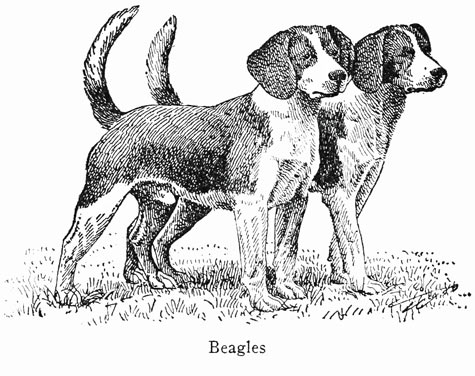
As the train pulled up at a station somewhere along
the line a man entered the baggage car with a brace
of beagles on a leash. Nice little dogs, they were,
with friendly eyes and beautiful faces.
"Is the baggage man here?" asked the man.
"I haven't seen him lately," said Mr. Hartshorn.
"Is there anything we can do for you?"
"Why, yes," said the man. "I'm sending these
dogs down to Welden. There'll be someone to call
for them there. You look as though you might be
bound for that place yourselves, and if you could
keep an eye on these dogs it would be a great favor."
"We'll do so with pleasure," said Mr. Hartshorn.
"What are their names?" asked Ernest.
"Tippecanoe and Tyler Too," he answered. "I'm
entering them as singles and as a brace, and I think
I stand a pretty good show."
The baggage man came along, and by the time the
owner of the beagles had arranged for their shipment
the train was ready to start again.
"It's lucky you were here to take them," said the
man, "or I shouldn't have been able to send them this
way. Good-by and good luck."
"Good-by," they shouted, and proceeded to get
acquainted with the beagles.
"They're like small hounds, aren't they?" said
Jack.
"Yes," said Mr. Hartshorn, "they are really
hounds."
"Oh," said Ernest, "that makes me think. You
never told us about the hound breeds, and you said
you would sometime. Couldn't you do it now?"
"Let's see," said Mr. Hartshorn, opening his grip.
"Ah, yes, here it is." He took out a small paper-covered
book containing the standards of the different
breeds. "I always mean to take this with me to the
shows. Without my books I can't always remember
the facts, but with the help of this I guess I can make
out.
"Now there still remain the hound and greyhound
families to be covered. They are both hounds, in a
way, but they have been distinct for centuries. They
are both very old types of dogs.
"We will begin with the bloodhound because he's
the biggest. There are a lot of people who have got
their ideas about the bloodhound from 'Uncle Tom's
Cabin,' and there are places where you aren't allowed
to keep a bloodhound because the breed is supposed
to be so dangerous and ferocious. But that is a great
injustice. The true English bloodhound is not the
mongrel beast that was used in slavery days, but is
a finely developed and reliable dog. Contrary to the
general belief, the modern bloodhound is not ferocious,
but gentle and affectionate, almost shy. He is
a wonderful trailer and has often been successfully
used to find both criminals and lost persons, but he
does not attack them when he finds them.
"The otter hound is an English dog not common
with us. He has a unique appearance, something like
a bloodhound in a rough coat, with a face not unlike
that of an Airedale terrier or a wire-haired pointing
griffon. He is a steady and methodical hunter, sure
on the trail, a strong swimmer, brave, patient, and
affectionate.
"The foxhound is the most popular sporting dog
of England, his history being bound up with that of
British hunting. I guess you know what a foxhound
looks like. The American Kennel Club recognizes
two separate classes of foxhounds, the English and
the American. The latter is, of course, native bred,
and is somewhat smaller and lighter in bone than the
English hound. The so-called American coon-hound
is a dog of the foxhound type and of foxhound origin,
bred carelessly as to type, but trained to hunt the raccoon
and opossum.
"The name harrier was first given somewhat indiscriminately
to all English hunting hounds before the
foxhound was highly developed. Later the harrier
was developed as a separate breed for hunting hares.
It is now rare in England and there are almost no
harriers in the United States. The beagle is like a
smaller, finer foxhound, and has the same ancestry.
He is a good, all-round sporting dog, and a good-looking
fellow, as you see, with a solid build, a rugged
appearance, and a fine face.
"The dachshund (don't call it dash-hund) is a
canine dwarf best known for his absurdly disproportionate
appearance, but he is a most attractive, serviceable
little dog. He was evolved long ago from the
hounds of Germany for the special work of hunting
the badger. His bent forelegs and queer proportions
are really deformities scientifically bred. The dachshund
has a wonderful nose and is a good worker
with foxes as well as with ground animals, though
his peculiar build best fits him for the latter. He is
a clean, companionable house dog, affectionate and
spirited. The basset is a short-legged French hound
resembling the German dachshund, to which it is
doubtless related. We are not familiar with the
breed in this country. It looks like a large dachshund
with a bloodhound head."
"Do you know any good hound stories?" asked
Jack, who was fondling the long, velvety ears of the
two beagles.
"Not many," said Mr. Hartshorn. "Most of the
foxhound stories I have heard have illustrated the
sagacity and cleverness of the fox rather than that
of the hound. There are also one or two stories that
show that the hound has a strong homing instinct
like that of some of the other breeds. The only foxhound
anecdote of an amusing nature that I recall is
told of one that was owned by a strict Roman Catholic.
Whenever Lent arrived, this dog always ran
away and paid a round of visits on Protestant acquaintances
until Easter ushered in a period of more
varied menus at home. This hound was not trained
with a pack but was kept as a single pet, which accounts
for his marked personality, more like that of
a terrier than of a hound.
"I have read a number of accounts in the newspapers
describing rescues by bloodhounds. I remember
one was about a Brooklyn girl who wandered away
from a hotel and was lost on a mountain in Vermont.
A famous bloodhound was brought over from Fairhaven
and was allowed to smell of a handkerchief
belonging to the girl. He took up her trail at the
village store and followed it along roads where horses
and automobiles had been, through two other villages,
and into the woods, and he at last found the
girl on the verge of exhaustion far up the mountainside.
"Another bloodhound in California found a lost
child at the edge of a cliff in a dense fog and drew
him back from the precipice just in time. Most of
the bloodhound stories are of that nature, though
there are some that have to do with the trailing of
criminals.
"One of the classic stories of literature is that of
the hound of Montargis. He may have been a St.
Hubert hound, or one of the other French hounds,
though I have always suspected that he may have been
a mâtin or dog of the Great Dane type. But the
breed is a matter of minor importance. The main
features of the story are somewhat as follows:
"There were once two officers of the King's bodyguard
in France named Macaire and Montdidier.
Fast friends at first, they became bitter enemies and
rivals, and one day in the Forest of Bondi, near
Paris, after a violent quarrel, Macaire drew his sword
and slew Montdidier and buried his body in the
woods.
"Now Montdidier owned a faithful hound who
came to search for him. He traced him to the grave
and there he remained until he was nearly famished.
The poets would have us believe that the dog reached
the conclusion that his master had been slain, that
he discovered the scent of the murderer, and that he
set out in quest of vengeance. At any rate, he went
to the home of a friend of his dead master's and was
given food. He attached himself to this household
but went often to the grave.
"Of course, Montdidier's comrades soon missed
him and his absence was reported to Charles V, the
King. Foul play was suspected and the King ordered
an investigation, but no evidence was forthcoming.
Meanwhile Montdidier's friend had also become suspicious
and one day he followed the hound to the
grave. Observing the dog's actions, he surmised what
must be there. He reported the matter to the King
who had the body exhumed and discovered marks of
violence.
"On several occasions after that the hound attempted
to attack Macaire but was prevented from
doing him injury. He was entirely peaceable toward
everybody else, so that these circumstances were noticed.
Guardsmen remembered that Macaire and
Montdidier had quarreled and suspicion fastened itself
upon Macaire. The King was told of all this and
he himself observed the actions of the hound when
he was brought near his master's murderer.
"In those days it was sometimes the custom for
judges to settle a dispute by ordering the contestants
to fight a duel. King Charles decided to adopt this
method in an effort to determine whether or not
Macaire was guilty, and he ordered a trial combat
to take place between the man and the dog at the
Château of Montargis on the Isle of Notre Dame,
Paris. The man was given a stout cudgel as his
only weapon, while the dog was provided with an
empty cask into which he might retreat if too hard
pressed.
"The battle was a terrible one, Macaire fighting
for his life and the dog to revenge his dead master.
The hound paid no heed to the blows that were rained
upon him, but attacked blindly. At last he got a
firm grip on the man's throat and hung on. Macaire,
weakening and terrified, begged to be rescued and
confessed his guilt. The dog was dragged away at
last and the gallows robbed him of his revenge."
"Whew!" exclaimed Herbie Pierson. "Some
story! Got any more like that, Mr. Hartshorn?"
"Half a dozen of them," replied Mr. Hartshorn
with a laugh, "but they'll have to wait till another
time, as I believe we are nearing our destination. For
the same reason I must postpone telling you about
the dogs of the greyhound family. Here we are,
boys."
Tom Poultice was waiting for them at the Welden
station and so was the man who had come for the
two beagles. Under Tom's guidance they walked out
to the fair grounds, which were only a mile away.
This was to be the scene of the show, and there were
already a number of dogs and crates about.
"I've arranged to stay out 'ere," said Tom.
"There's an 'ouse where I can sleep, and I can look
after all the dogs."
They looked around the grounds a bit. Mr. Hartshorn
found the superintendent of the show and had
a few words with him, and then they all returned to
town, leaving the dogs in Tom's care. They were
all well acquainted with him and did not feel that
they were being left among total strangers.
They registered at the hotel, which they found to
be overcrowded. An extra cot was placed in one
of the rooms, and Ernest, Jack, and Elliot were assigned
to it. They did not consider the situation to
be any hardship. They enjoyed a good dinner in
the dining-room and then gathered in Mr. Hartshorn's
room for a talk.
After discussing dog shows some more and speculating
as to the outcome of the morrow's contests.
Ernest, whose thirst for dog learning was insatiable,
reminded Mr. Hartshorn of his promise to tell them
about the breeds of the greyhound family.
"The greyhound proper," said he, "is of course
the first to be considered. It is perhaps the oldest
distinct type of dog now in existence. Likenesses of
greyhounds are to be seen in relics of Assyrian,
Egyptian, Greek, and Roman sculpture, and the type
has altered surprisingly little in seven thousand years.
It was developed for great speed from the first and
was used in the chase. Unlike the other hounds, the
dogs of the greyhound family hunt by sight and not
by scent.
"The whippet is merely a smaller greyhound, but
has been bred as a separate variety for upward of
a century. On a short course the whippet is faster
than a racehorse, covering the usual 200 yards in
about 12 seconds. Whippet racing as a sport has
never taken hold in America and we have comparatively
few of the breed here. You have already been
told about the Italian greyhound. It belongs to the
greyhound family but is classed as a toy.
"Although speed is the thing for which the greyhound
is most famous, stories have been told which
illustrate the breed's fidelity and sagacity when his
master makes a comrade of him. I will tell you one
of these tales. A French officer named St. Leger
was imprisoned in Vincennes, near Paris, during the
wars of St. Bartholomew. He had a female greyhound
that was his dearest friend and he asked to have
her brought to him in prison. This request was denied
and the dog was sent back to St. Leger's home
in the Rue des Lions St. Paul. She would not remain
there, however, and at the first opportunity she
returned to the prison and barked outside the walls.
When she came under her master's window he tossed
a piece of bread out to her, and in this way she discovered
where he was.
"She contrived to visit him every day, and incidentally
she won the admiration and affection of one
of the jailers, who smuggled her in occasionally to see
her master. St. Leger was at last released, but his
health was broken and in six months he died. The
dog grieved for him and would not be comforted
by any of the members of the household. At last she
ran away and attached herself to the jailer who had
befriended her and her master, and with him she lived
happily till the day of her death.
"Now we come to one of the grandest breeds of
all—the Irish wolfhound. It is a breed of great antiquity
and of great size and power. The Latin writer
Pliny speaks of it as canis graius Hibernicus, and in
Ireland it was known as sagh clium or wolf dog.
For in ancient Ireland there were huge wolves and
also enormous elk, and the great dogs were used to
hunt them. These hounds were even used in battle
in the old days of the Irish kings.
"Two classic stories are told of the Irish wolfhound.
One is of the hound of Aughrim. There was
an Irish knight or officer who had his wolfhound with
him at the battle of Aughrim, and together they slew
many of the enemy. But at last the master himself
was killed. He was stripped and left on the battlefield
to be devoured by wolves. But his faithful dog
never left him. He remained at his side day and
night, feeding on other dead bodies on the battlefield,
but allowing neither man nor beast to come near that
of his master until nothing was left of it but a pile
of whitening bones. Then he was forced to go farther
away in search of food, but from July till January he
never failed to return to the bones of his master every
night. One evening some soldiers crossed the battlefield,
and one of them came over to see what manner
of beast the wolfhound was. The dog, thinking his
master's bones were about to be disturbed, attacked
the soldier, who called loudly for help. Another
soldier came running up and shot the faithful dog.
"The other story is that of devoted Gelert which
you may have heard. Robert Spencer made a poem
or ballad of it."
"I've never heard it," said Jack Whipple.
"Nor I," said Elliot Garfield.
"Well," said Mr. Hartshorn, "it's a rather tragic
story. Put into plain and unadorned prose, it runs
something like this: Gelert was an Irish wolfhound
of great strength and great intelligence that had been
presented by King John in 1205 to Llewelyn the
Great, who lived near the base of Snowdon Mountain.
Gelert became devoted to his master and at night
'sentinel'd his master's bed,' as the poem has it. By
day he hunted with him.
"One day, however, Gelert did not appear at the
chase and when Llewelyn came home he was angry
with the dog for failing him. He was in that frame
of mind when he met Gelert coming out of the chamber
of his child. The dog was covered with blood.
Llewelyn rushed into the room and discovered the
bed overturned, the coverlet stained with gore, and
the child missing. He called to the boy but got no
response.
"Believing that there was but one interpretation for
all this, Llewelyn called Gelert to him and in his wrath
thrust his sword through the dog's body. Gelert gave
a great cry of anguish that sounded almost human,
and then, with his eyes fixed reproachfully on his
slayer's face, he died. Then another cry was heard—that
of the child, who had been awakened from sleep
by the shriek of the dying dog. Llewelyn rushed forward
and found the child safe and unscratched in a
closet where he had fallen asleep. The father hurried
back to the bloody bed, and beneath it he found the
dead body of a huge gray wolf which told the whole
story. In remorse Llewelyn erected a tomb and chapel
to the memory of faithful Gelert and the place is
called Beth Gelert to this day."
There was a suspicious moisture about more than
one pair of eyes as Mr. Hartshorn finished this narrative,
and he hurried on to less tragic matters.
"The Irish wolfhound is to-day a splendid animal,"
said he, "and the breed deserves to be better known in
this country. It has had an interesting history. There
was a time when it nearly died out in Ireland, and
the modern breed was started with the remnants some
fifty years ago, with the help of Great Dane and Scottish
deerhound crosses. The new breed was not thoroughly
established, however, until the latter part of
the last century. As a made breed, so called, it is
a remarkable example of what can be accomplished by
patient, scientific breeding. The Irish wolfhound is
a big, active, sagacious, wonderfully companionable
dog, muscular and graceful, and as full of fun as a
terrier.
"The Scottish deerhound is similar in most respects
to the Irish wolfhound, but is lighter, speedier, and
less powerful. They have a common ancestry, though
the two breeds were distinct as long ago as the twelfth
century. The breed was a favorite with Sir Walter
Scott.
"The Russian wolfhound, known in Russia as the
borzoi, is one of the most graceful and aristocratic
of all the breeds, combining speed, strength, symmetry,
and a beautiful coat. He has been used for
centuries in Russia for hunting wolves and has been
bred as the sporting dog of the aristocracy."
"It makes a dog show a lot more interesting to
know something about the different breeds," said
Ernest Whipple.
"Of course it does," said Mr. Hartshorn. "And
if I am not mistaken, I have told you something about
almost every breed that you will ever be likely to see
at a dog show or anywhere else."
Soon afterward they separated for the night.
The Boytown party was at the fair grounds long
before the show opened the following morning, and
you may be sure the dogs were glad to see their
masters, though they had been well cared for by Tom.
Though technically an outdoor show, there was
room for all the dogs in the commodious cattle-show
sheds in case of rain. The weather promised to be
fair and warm, however, so only the smaller dogs
and some of the larger short-coated ones were
benched inside, where they had plenty of room and
plenty of ventilation. The collies and Old English
sheepdogs were tied in a row in the shade of some
maple trees at one side of the grounds, and the rough-coated
terriers, the setters, and some of the other
breeds were also outside. The boys found the places
reserved for their dogs and saw to it that they were
properly and comfortably benched.
When the show opened and the spectators began
to arrive, the Boytown dogs were at first nervous and
excited and could not bear to have their masters leave
them. After an hour or two, however, they became
accustomed to their surroundings, and leaving them in
charge of Tom Poultice, the boys made the rounds
of the show under the guidance of Mr. Hartshorn.
It was a most interesting experience for them.
Some of the breeds were of course familiar to them,
and Mr. Hartshorn called attention to their points
and showed how some of the dogs back home fell
short of conforming to the requirements of the
standard. In some instances they recognized breeds
that Mr. Hartshorn had told them about but which
they had never seen before. There were, for example,
a Scottish deerhound, an Irish water spaniel, and some
cairn terriers. As Mr. Hartshorn had predicted, there
were noteworthy entries of Sealyhams, wire-haired
fox terriers, and Boston terriers, and particularly interesting
exhibits of bulldogs and chows. There was
one dog that puzzled them—a white dog with fluffy
coat and bright eyes. The catalogue stated that it was
a Samoyede.
"What is a Samoyede, Mr. Hartshorn?" asked
Herbie Parsons. "I don't think I ever heard of that
kind."
"That's so," said Mr. Hartshorn. "I guess I never
told you about the Arctic breeds. This is one of
them. They're not very common."
There were individual dogs, too, that demanded
special attention, friendly dogs that wanted to shake
hands and be patted and that begged the boys to stay
with them. This encouraged loitering and made the
circuit of the benches quite a protracted affair. Mr.
Hartshorn had warned them about approaching the
dogs without an introduction.
"There are always some dogs that aren't to be
trusted," said he, "and as the day wears on and they
get more and more nervous, they may snap. It's
always well to be cautious at a dog show, no matter
how well you understand dogs. Never make a quick
motion toward a dog or try to put your hand on the
top of his head at first. Reach your hand out toward
him quietly and let him sniff at the back of it. Then
you can soon tell whether he invites further advances
or not."
The boys became so absorbed in trying out this form
of introduction that it was noon before they had
finished visiting all the benches. Mrs. Hartshorn insisted
on having luncheon.
"I'm hungry if no one else is," said she.
The five boys suddenly discovered that they were
hungry, too. Mr. Hartshorn led them to a restaurant
on the grounds and ordered the meal. It might have
been better, but the boys were not critical. When
they had finished eating they went out and sat for
a little while in the shade of some trees, not far from
the collies, and watched the people.
"Now I'll tell you about those Arctic breeds," said
Mr. Hartshorn, "and get that off my mind."
It was very warm, and they were all glad of a
little chance to rest. It is tiring to walk around a
dog show and one becomes more weary than one
realizes. The boys stretched themselves out on the
grass and listened to Mr. Hartshorn's words mingled
with the barking of the dogs in all keys.
"It won't take very long to tell about these northern
breeds," he began. "Their natural habitat is in the
Arctic and sub-Arctic regions of Asia, Europe, Greenland,
and North America. They are probably related
to the Arctic wolf and they are generally used in those
countries as sledge dogs.
"The spitz dog found his way down from the cold
countries long ago, but he still retains some of his
racial characteristics. The proper name for the one
occasionally seen here is the wolfspitz. He is the
largest of the spitz family, of which the Pomeranian
is the miniature member.
"The Samoyede or laika is the sledge dog of
northern Russia and western Siberia and was used
by Nansen in his explorations. Next to the wolfspitz,
the Samoyede is the most attractive and domestic of
the Arctic breeds and has acquired some popularity
among American fanciers, especially the white ones.
"The Norwegian elkhound is used as a bird dog
as well as for hunting big game in Scandinavia. It
is not a hound at all, but a general utility dog of the
Arctic type, dating back to the days of the Vikings.
A few have been shown in this country.
"The Eskimo dog is larger than the Samoyede
and is nearer to the wolf in type. He has long been
known as a distinct breed, being a native of Greenland
and northern Canada, and was used by Peary, the
Arctic explorer. The breed has occasionally been
shown in the United States.
"There are also a number of loosely bred sledge
dogs in North America, including the Canadian husky
and the malamutes and Siwash dogs of Alaska. The
husky, is a powerful dog, weighing 125 pounds or
more, and is the common draught dog of Canada.
He is said to be the result of a cross between the
Arctic wolf and the Eskimo dog."
"He sounds rather unattractive to me," said Mrs.
Hartshorn.
"Well, he is, as a pet," said her husband, "but he
is a wonderfully useful animal in his own country.
Is everybody rested now? I imagine we'd better be
going back. I want to be on hand when they judge
the Airedales."
The party rose and trooped back to the sheds. At
intervals during the afternoon they visited their own
dogs and before night they had finished their rounds
of the show, but a good share of the time was spent
in the vicinity of the judging rings. These were
two roped-off enclosures on the open lawn, with
camp chairs arranged about them for the ladies. At
all times there was a goodly gathering about the rings
of people whose interest was in the outcome of the
judging. Considering the fact that there was no lively
action like that of a field trial or an athletic contest,
it was remarkable how much excitement could be
derived from these quiet competitions. When a
favorite dog was given the blue ribbon there was much
hand-clapping and a little cheering, and the boys heard
very little complaining or rebellion against the decisions
of the judges. Dog fanciers are, for the most
part, good sports.
The Airedales were judged among the first, and as
usual the Willowdale dogs, skilfully exhibited by Tom
Poultice, bore off their fair share of the honors. Soon
the Boston terriers were called for. This was Theron
Hammond's big moment, and when Alert was awarded
second prize in the novice class Theron was warmly
congratulated by friends and strangers alike, for there
were a lot of good dogs shown and, as Mr. Hartshorn
had said, Alert was in fast company.
Rover, as Darley's Launcelot of Middlesex, had an
easier time of it, for only eight Old English sheepdogs
were benched and none of the famous kennels
were represented here. There were only three dogs
in the novice class, and as the other two were second-rate
dogs, Rover won first place. He also won third
in the open class, but was beaten out by better dogs
in the winners contest.
Hamlet, however, didn't win anything. His forelegs
weren't straight and the judge took special note of
them. He had better dogs against him, and the better
dogs won. It was a fair contest, but Herbie was
bitterly disappointed.
"Never mind, Herbie," said Jack Whipple, consolingly.
"I bet Hamlet is a better dog to own than
any of them. That's what I said about Remus when
they said he hadn't any nose."
And Herbie, not to be outdone by the younger boy,
plucked up spirit and bore his defeat manfully.
It was a two-day show, and the judging of the bird
dogs, hounds, and some of the other breeds was put
over to the second day. Ernest and Jack, therefore,
still had their exciting time ahead of them, but the
whole party was tired with so much walking about
and watching, and they were glad to turn their dogs
over to Tom's care and return to the hotel, with
another day of it before them.
"Have you told us about all the breeds there are?"
asked Ernest that evening in Mr. Hartshorn's room.
"I believe I have," said Mr. Hartshorn, "except
some little known foreign ones."
"Oh, please tell us about those," pleaded Ernest.
Mr. Hartshorn laughed. "You're bound to know
it all, aren't you?" said he. "There are a number
of European, Asiatic, and Australasian breeds, some
of which are very interesting, but you will probably
never see any of them and I haven't a list of them
with me. When we get back to Boytown, if there
are any of you boys that would like to look up these
uncommon breeds, just to make your dog knowledge
complete, I shall be very glad to lend you a book
which contains them all. For instance, there's the
German boxer which has sometimes been shown in
this country, and the Pyrenean sheepdog whose blood
is to be found in several of our large breeds, including
the St. Bernard and the Irish wolfhound. There are
other European sheepdogs and hunting dogs, Asiatic
greyhounds, and some queer hairless freaks. When
you've looked those all up you'll know more about
dogs than most naturalists do."
"Then if the breeds are all used up, I suppose the
anecdotes have all been used up, too," said Jack.
Mr. Hartshorn looked at his watch. "Well, no,
not quite all used up," said he. "I have thought of
two or three more, and I guess we've got time for one
of them to-night. It is about a tradesman of the Rue
St. Denis in Paris, a man named Dumont. He had a
very smart dog, but I don't know what kind of dog
it was. Perhaps a terrier or a poodle. This dog was
great at finding hidden articles. One day Dumont
was walking with a friend in the Boulevard St. Antoine
and was bragging about his dog. The friend
would not believe his statements, so they laid a wager,
the master claiming that the dog could find and bring
home a six-livre piece hidden anywhere in the dust
of the road.
"So the piece of money was hidden in the dust
when the dog was not looking, and they went on a
mile farther. Then the dog, whose name was Caniche,
was told to go back and get the coin, and he promptly
started. The friend wished to wait and see how it
would come out, but Dumont said, 'No, we will proceed.
Caniche will bring the money home.' They
accordingly went to Dumont's home and waited, but
no dog appeared. The friend asserted that the dog
had failed and claimed the wager, but Dumont only
said, 'Be patient, mon ami; something unexpected has
happened to delay him, but he will come.'
"Something unexpected had indeed happened. A
traveler from Vincennes came driving along in a
chaise soon after Dumont and his friend had passed
that way, and his horse accidentally kicked the coin
out of the dust. The traveler, seeing it glisten, got
out and picked it up, and then drove on to his inn.
"When Caniche came up the money was, of course,
not there, but he picked up the traveler's scent and
followed his chaise to the inn. Arriving there and
finding his man, Caniche proceeded to make friends
with him. The traveler, flattered by this attention,
and being fond of dogs, said he would like to adopt
Caniche, and took him to his room. The dog settled
down and appeared to be quite content.
"When bedtime came and the man began to undress,
Caniche arose and barked at the door. The
man, thinking this was quite natural, opened the door
to let him out. Suddenly Caniche turned, seized the
man's breeches, which he had just taken off, and bolted
out with them. There was a purse full of gold pieces
in the breeches, and the traveler dashed after the dog
in his nightcap and sans culottes, as the French say.
Caniche made for home with the angry man after him.
"Arriving at Dumont's house, Caniche gained admittance
and deposited the breeches at his master's
feet. Just then the owner of the breeches burst in,
loudly demanding his property and accusing Dumont
of having taught his dog to steal.
"'Softly, softly,' said Dumont. 'Caniche is no
thief, and he would not have done this without a
reason. You have a coin in these breeches that is not
yours.'
"At first the stranger denied this, and then he
remembered the coin he had picked up in the Boulevard
St. Antoine. Explanations followed, the breeches and
gold were restored to the traveler and the six-livre
piece was handed to Caniche, who returned it to his
master with the air of one who had fulfilled his duty.
Dumont's friend paid his wager and Dumont opened
a bottle of wine, and they all drank to the health of
the cleverest dog in France.
"Whether that is a true story or not you must
judge for yourselves. I have told it as it was told
to me, and I prefer not to vouch for it."
Laughing over this story, and thanking Mr. Hartshorn
for telling it to them, the boys trooped off to bed.
So far as Ernest and Jack Whipple were concerned,
all the interest of the second day of the Massatucket
Dog Show centered about the judging of the English
setters. They had been studying the entry carefully,
and though there were some champions entered in the
open and limit classes, and though Mr. Hartshorn
pointed out to them the superior qualities of several
of these dogs from the fancier's point of view, it
seemed to the boys that Romulus and Remus were as
good as any dogs there.
"Don't set your hopes too high," cautioned Mr.
Hartshorn. "They will be pitted against some good
dogs, and I don't want to see you too greatly disappointed.
One has to learn to lose in the dog-show
game more often than one wins."
"Anyway," said Ernest, "I haven't seen anything
in the novice class that can beat them."
At last the hour arrived for the judging of the
setters. The puppy class was disposed of first, and
then the novices. Ernest and Jack led their own
dogs into the ring, with numbers pinned to their coat-sleeves.
The two dogs behaved beautifully, holding
up their heads and standing at attention, as their masters
had patiently taught them to do. They were both
in good condition, their eyes bright and their coats
soft and glossy. It was quite evident to the spectators
about the ring that the other dogs in the novice class
were not to be compared with them. Ernest and
Jack were quite unconscious of the fact that they were
being observed as much as the dogs and that there
were some people present who admired their bright
eyes as much as those of Romulus and Remus. But
it was the judge of this class that held their fixed
attention.
He was a brusque, dour-looking man, without a
smile for anybody, but he had a reputation for strict
impartiality and for a true judgment of dog-flesh. It
did not take him long to reach his decision. With
no word of congratulation he handed Jack a blue
ribbon and Ernest a red one, and ushered them out
of the ring.
"The Remus dog has the best head and most
shapely body," was all that he said.
But the spectators clapped and showered congratulations
upon the boys, and they were very happy.
"I knew it, I knew it!" cried Jack in an ecstasy
of triumph. "Nose doesn't count in the show ring,
and Remus is, in every other way, the best dog in
the world. I told you he'd have his day. Good old
Remus!"
And right before all those people he leaned down
and hugged his dog and kissed him on the silky ear.
But that was only the beginning. Remus also took
first in the open class, which was more than Mr.
Hartshorn had hoped for, and Romulus took third.
And when it came to the final contest of the winners,
Remus won reserve to Ch. The Marquis, a dog that
had won his spurs in the biggest shows in the country.
He was the only dog in this bunch that could beat
Remus, and there were those who affirmed that in
another year Remus would defeat him.
Ernest showed himself to be a good sport and was
glad that Remus had won. Jack communicated his
high spirits to the other boys, and by the time the
afternoon was over they were in a hilarious mood
and eager to bring their trophies back to Boytown.
They forgot their weariness, and as the spectators
began to leave the grounds, and it was proper to
release the dogs, they started off pell-mell, across the
central oval of the race track, boys and dogs together,
shouting and barking in a gladsome chorus. It was a
goodly sight for some of the grown-ups to see, and
they paused to watch the frolic.
"I'm so glad Remus won," said Mrs. Hartshorn,
smiling upon them all.
"Yes," responded her husband, "Jacky deserved
it. He has stood by his dog through thick and thin."
As the boys and dogs came romping back, Mrs.
Hartshorn observed, "Youth is a wonderful thing."
"Sometimes," said her husband, "I think it is a
greater thing than wisdom."
Perhaps a vision of her own youth came back to
her, for she leaned against her husband's arm and
softly quoted:
"When all the world is young, lad,
And all the fields are green,
And every goose a swan, lad,
And every lass a queen;
Then hey, for boot and horse, lad!
Around the world away!
Young blood must have its course, lad,
And every dog his day."
A week or so after the Massatucket Show, when
Ernest Whipple's kennel paper arrived, he and Jack
scrutinized it eagerly for the account of the show.
The man who reported it had a great deal to say, in
more or less technical terms, about a good many of
the dogs. He seemed to pride himself on his ability
to pick future winners and he was rather free with
his predictions. Romulus he mentioned favorably in
passing, referring to his enviable field-trial record.
But to Remus he devoted an entire paragraph.
"This dog," he wrote, "owned by Master Jack
Whipple, is a twin brother to the afore-mentioned
Romulus. Barring a slight weakness in the loins and
a look of wispiness about the stern, he was set down
in good shape and easily defeated the other novices.
He has the classic type of Laverack head, and this
had much to do with his being placed reserve to Ch.
The Marquis in the winners class. He is a young
dog, and with proper treatment he should figure in
the primary contests of next winter. We predict a
bright future on the bench for this Remus."
Incidentally the boys were pleased to learn that
Tippecanoe and Tyler Too had won the prize for the
best brace of beagles in the show, besides some individual
honors, and they rejoiced for their bright-faced
little acquaintances of the baggage car.
The triumph of Remus was not short-lived. The
residents of Boytown learned through the local papers
what had happened, and began to look with a new
interest upon these boys and their dogs as they passed
along the streets. Romulus came to be pointed out to
strangers as a coming field-trial champion, and Remus
as a famous bench-show winner. Such dogs were
something for the citizens of any town to be proud
of. And there were not a few persons who gained
thereby a new interest in dogs, to the lasting betterment
of their characters.
As the autumn days came on, Ernest began to feel
the call of the woods and fields, and begged to be
allowed to have a gun and go hunting with Sam
Bumpus. He was now a tall, good-looking lad of
fifteen, and he felt himself quite old enough to become
a hunter. Besides, what is the use of owning a fine
bird dog if you don't hunt with him?
Mrs. Whipple strongly objected, for she was afraid
of guns, and at last a compromise was reached. Ernest
was to be allowed to go hunting with Sam provided
he would not ask to own or use a gun until he was
sixteen, and reluctantly he consented to this arrangement.
Jack, who was still only twelve, had not yet
caught the hunting fever, and since he owned a dog
that could not hunt anyway, he was content to remain
at home, while Ernest spent his Saturdays afield with
Sam.
Sam Bumpus, during the past three years, had
grown to be a less lonely man. Through the boys he
had made friends in town, and people began to look
upon him as less queer and to recognize his sterling
virtues. And all that made him happier.
"It was a lucky day for me," he once said, "when I
brought those puppies down in my pockets."
"It was a luckier day for us," responded Ernest
with warmth.
Now, tramping together 'cross country with their
dogs, they became even closer friends, and there was
implanted in Ernest's character a certain honesty and
a love of nature that never left him. And withal, it
was great fun.
Then came another winter, and one day, during the
Christmas vacation, Mr. Hartshorn invited the whole
crowd of boys up to his house to enjoy an indoor
campfire. Mrs. Hartshorn, as usual, spread her table
with a wealth of good things to eat, and after the
dinner they all gathered in the big living-room, where
huge logs were blazing and crackling in the fireplace.
"I only wish," said Ernest Whipple, "that there
were more breeds of dogs for you to tell us about,
Mr. Hartshorn. I always enjoyed those talks so
much."
"Do you think you know all about all the breeds
now?" asked Mr. Hartshorn, with a smile.
"Well, no," confessed Ernest, "but I know something
about them all, and I have one or two good
books to refer to. I guess there's always more to be
learned about everything."
"That is true," said their host, "and fortunately
there are always good things being written about dogs
by men who know them. I never let a chance go by
to add to my own fund of dog lore."
Alfred Hammond and Horace Ames, who were
home from college for the holidays, were present at
the campfire, and Alfred was now loudly called upon
for a dog story, Mr. Hartshorn insisting that he had
told every one he knew. Finally Alfred acceded to the
demand.
"I ran across two anecdotes the other day which
may fill the bill," said he. "I think they are both
about collies, but I am not sure. The first is about
a Scotchman and his dog Brutus. The Scotchman,
having gone far out of his way in a storm, stopped at
a lonely house and asked for a shelter for the night.
The owner of the house admitted him and showed
him to a chamber, and the Scotchman, being very
weary, prepared to go to bed.
"Brutus, however, was not so readily satisfied with
his strange surroundings and proceeded to investigate.
At length he returned to his master and began tugging
at the bedclothes. The Scotchman was at last sufficiently
aroused to follow the dog out of the room
and down the stairs, and Brutus led him to the door
of a closed room and sniffed at it very cautiously.
Light which made its way through the cracks indicated
that the room was occupied. The Scotchman
could find no hole to peep through, but much to his
surprise he heard several voices, for he thought that
he and his host were alone in the house.
"He placed his ear to the door and heard enough
to make him believe that his life was in danger. He
was a brave man, and prompt action seemed necessary.
Suddenly he pushed open the door and rushed in,
surprising half a dozen men. They reached for their
weapons, but the traveler was ready first. With his
pistol he shot his host and cracked another over the
head. Brutus, meanwhile, attacked so vigorously and
to such good purpose that the man and his dog were
able to escape uninjured. He afterwards learned that
the house where he had sought hospitality was the
resort of a gang of highwaymen.
"The other story is rather tragic, but I guess I'll
tell it, as it's the only one I have left. A traveling
merchant in England was riding along on horseback,
when he dropped a bag containing all his money. He
was quite unconscious of his loss, but his dog had
seen the bag fall. The dog began to run in front of
the horse's head, barking, and dashing back along the
road, but the merchant, who must have been uncommonly
stupid, I think, did not understand the meaning
of his strange actions. The dog became more insistent,
as the man urged his horse ahead, barking
in an unusual tone and snapping at the horse's feet.
"The merchant, who apparently did not know dogs
very well, began to fear that he was going mad. 'Mad
dogs will not drink,' he reflected. 'At the next ford
I will watch, and if he does not drink I must shoot
him.'
"Of course, the dog was much too anxious and
excited to drink at the next ford, and his master shot
him. After riding on a little way the man began to
be troubled with doubts and misgivings, and he turned
his horse about. When he reached the ford again,
the dog was not there, but the man traced him back
along the road by the marks of his blood.
"The merchant found his dog at last, lying beside
the money-bag, protecting his master's property with
his last gasp. Remorsefully the merchant stooped
down and begged the dog's forgiveness. The faithful
animal licked his hand and looked up at him with
eyes that seemed to say, 'It's all right, my master.
You didn't understand.'"
No more stories being forthcoming, the talk soon
drifted to other things. The boys vied with one
another in telling of instances which illustrated the
superior courage, intelligence, and faithfulness of their
own dogs, and then fell into reminiscence. They
talked of the awakening of interest in the dogs of
Boytown and what it had meant to each of them, of
the activities of the Boytown Humane Society, of
the Boytown Dog Show in Morton's barn, of the
days at Camp Britches and the death of beloved Rags,
of the Eastern Connecticut field trials and the winning
of Romulus, of the Massatucket Dog Show and the
triumph of Remus, and of all the good times the
boys and their dogs had had together. They quoted
Sam Bumpus's quaint sayings and Tom Poultice's
good advice about the care of dogs, and they told dog
stories that they had read.
"I don't see how anybody can help loving dogs,"
said Elliot Garfield.
"There are men who hate them, though," said Mr.
Hartshorn. "American sheep growers, for example,
are bitterly opposed to dogs, and many of them would
like to see the canine race annihilated. And it must
be admitted that the dog forms the greatest obstacle
in the path of increasing the important sheep-raising
industry in the United States. Dogs do kill sheep,
and there's no denying it."
"I thought there were laws to protect the sheep,"
said Ernest Whipple.
"There are," said Mr. Hartshorn. "Some of them
are good and some of them are bad. Some of them
place it in the sheep man's power to take the law into
his own hands and act as judge, jury, and executioner
on the spot, which of course is all wrong. But unfortunately
the best of the laws do not protect the sheep.
The state may pay damages, but that does not restore
the slain sheep."
"I don't see what can be done, then," said Theron
Hammond, dolefully.
"For one thing," said Mr. Hartshorn, "more study
should be put on these laws before they are passed.
They should not be drawn up by either partisans of the
dog or of the sheep. They should aim to eliminate
ownerless dogs and to make all owners responsible
for the acts of their dogs. On the other hand, the
sheep owners should not be allowed to collect damages
unless they can show that they have taken due precautions
on their own part, such as the erection of
dog-tight fences. A man has to keep up his fences
to keep his neighbor's cows out of his corn, or he
has no redress. Why shouldn't a sheep owner be compelled
to do likewise? But the real cure for the
menace of the sheep-killing dog is more dog. The
American sheep men don't seem to have learned the
lesson that the past has tried to teach them. For centuries
the trained shepherd dog has been the protection
of the flock in all sheep-raising countries, and is so
to-day in Great Britain, Europe, and Australia. I
don't believe there are a dozen first-class trained shepherd
dogs in this country, except in the Far West. In
Scotland there are more dogs to the square mile than
there are in the United States, yet the Scotch don't try
to legislate the dog out of existence. The Scotch
shepherd never thinks of taking out his flock without
his trained collie, and the result is that few sheep are
killed either by stray dogs or wild animals. When
the American sheep growers learn their lesson from
the shepherds of other countries, overcome their
prejudice against the dog, and adopt the method that
has been successfully employed for centuries in other
countries, they will solve this problem, and not until
then. I hope to see the day come when the sheep man
is numbered among the dog's best friends here as he
is in Scotland."
A lively discussion followed, and then, still talking
dogs, the boys trudged home in the moonlight, over
the crisp snow.
A few days later the whole crowd was out skating
on Hulse's Pond. A week of clear, cold weather following
a thaw had made ideal skating, and Boytown
was making the most of it. There were a number
of young men and girls out and a few older devotees
of the sport, but the boys and their dogs had full
possession of one end of the pond. Here a game of
hockey was in progress, which was somewhat interfered
with by the activities of Tatters, who had grown
into a fine, lively, sport-loving dog. He seemed to
think the game was arranged for his special benefit,
and he chased the puck to and fro across the ice
wherever it went. Another general favorite was
Rover, who never tired of racing with the skaters and
particularly enjoyed pulling the younger children
about on their sleds. These small children had another
name for him—Santa Claus—and he indeed
looked the part. Others of the dogs were enjoying the
sport, too, though Romulus and Remus showed a
tendency to leave the ice and go scouting off on imaginary
trails in the neighborhood.
Suddenly, while the fun was at its height, a sharp
cry arose from the upper end of the pond where the
brook ran in. It was different from the other shouts
and cries that rang out over the ice; there was terror
in it. The loud, insistent barking of Tatters immediately
followed.
The hockey game was interrupted, and everyone
looked toward that end of the pond to see what could
be the matter. Tatters was running excitedly about
the edge of a hole where the ice had broken in, and
in the black water appeared the head and shoulders of
little Eddie Greene, who had ventured too near a
dangerous spot and had broken through the thin ice.
The sounds of merrymaking suddenly ceased, and
there was a general rush in that direction. The bigger
boys threw themselves flat on the ice and tried to
reach out to Eddie with their hands, but the ice
cracked alarmingly beneath the weight of so many of
them, and they dared not approach too close.
"Get back, boys, get back!" cried Theron Hammond,
who was always a leader. "Get back, or we'll
all go in."
They saw that such a catastrophe would only make
bad matters worse and obeyed the command. Only
Theron and Harry Barton remained to try to reach
the frightened little fellow, and they could not get near
him.
The water was deep, and Eddie was struggling
wildly to keep from going under the ice, which broke
off wherever he grasped it.
"Keep calm, Eddie," called Theron, but Eddie was
terrified and could not keep calm. His head went
under once, and he seemed to be weakening. Meanwhile
Ernest Whipple and one or two of the others had
kicked off their skates and had run off in search of
boards or fence rails to throw across the hole, but
there seemed to be none near by and help was a long
time coming. It began to look as though they would
be too late.
It was a tense moment. Some of the little girls
had begun to cry, and there was one young lady who
gave way to hysterics. No one seemed to know what
to do. It was awful to stand there and watch the
little fellow drown before their eyes.
Then there came a sudden rush and a plunge and
the black and white head of Remus appeared beside
that of the drowning boy. Though an aristocrat of
the bench show, this good dog had a brain that worked
quickly and a heart that knew no fear.
It was a good thing that Remus had learned to be
such a good swimmer in days gone by; he had need
of all his strength and skill now. He seized the boy's
collar in his teeth and struggled to drag him out. But
it could not be done. The ice broke repeatedly under
the dog's paws, and it was all he could do to keep
the boy's head and his own above water. He could
only struggle bravely and cast imploring looks toward
the helpless humans. The water was ice-cold, of
course, and it sapped the good dog's strength. His
efforts weakened and he tried no more to climb out,
but he never relaxed his hold. He would have gone
down to his death with the boy before he would have
done that.
Both heads went below the surface and came up
again, and the dogged, imploring look deepened in
Remus's eyes. Jack Whipple called words of encouragement,
and it was pitiful to watch the noble dog's
efforts to respond. It was wonderful the way he held
out, and in the end he won. When it seemed as though
the last atom of his strength must have been spent,
Ernest Whipple came running up with a plank which
he threw across the hole. Remus rested his paws
on this and so was able to keep from going under,
but he had no strength left to drag himself and the
boy out. Eddie was now unconscious, and could not
help himself. Then Elliot Garfield and two other boys
arrived with boards and fence rails, and with these
they built a sort of bridge across the dangerous gap.
Theron crawled cautiously out upon this, with Harry
Barton holding to his feet. He grasped Remus's
collar, and with Harry's help dragged the boy and the
dog to firm ice.
Eddie was seized in friendly arms and was rubbed
and rolled until he revived. Remus fell, faint and
trembling, to the ice, and Jack Whipple, unconscious
of his own sobs, gathered the heroic dog to his breast.
Eddie Greene was hurried home and put to bed,
and a doctor was called. For a day or so he was
watched over with tender solicitude by his mother,
but he soon insisted on getting up, and the doctor said
that the danger was past. His healthy young body
recuperated rapidly and he suffered no serious effects
from his harrowing experience. In a few days he was
running about as well as ever, and his parents, watching
him, had good reason to bless the brave dog that
had saved their boy's life.
But with Remus it was different. Almost immediately
he showed signs of having contracted a severe
cold. Weakened as he was by exposure and exhausted
by his almost superhuman struggles in the
water, he was in no condition to combat the malady,
and pneumonia set in.
For days he lay dangerously ill on his bed in Rome,
while Jack hoped and prayed in vain for a noticeable
turn for the better. Tom Poultice came down and
diagnosed the case and left some medicine, but still
Remus failed to show much improvement. Sam
Bumpus came, too, and did what he could, but he was
forced to confess that the case was beyond his powers.
Remus was very weak and seemed unable to rally.
Jack Whipple was beside himself with anxiety.
When Remus had distemper he received visits from
a good many of the boys in town, but that was nothing
to the interest that was now displayed in him. The
boys of the Humane Society hung about the Whipple
gates at all hours of the day, vainly wishing that they
might be of some help. Mr. Morton, Mr. Pierson,
and other prominent citizens telephoned their inquiries.
Mr. Fellowes came every day, and total
strangers rang the doorbell to ask how the sick dog
was getting on. All Boytown did its best to show
honor and sympathy for the hero, but, alas, that
brought no relief to the poor dog suffering on his bed
in Rome.
For some time now Mrs. Whipple had been unconsciously
displaying a different attitude toward the
dogs. She never petted them; she was not yet ready
to go quite so far. But she never said anything against
dogs any more, and she had not concealed her pleasure
and pride in the triumphs that had been won by both
Romulus and Remus. And now that Remus was sick
she made no attempt to conceal her anxiety, and answered
all the inquiries patiently. One day Mr. Whipple
observed her stealing out to Rome with a dish of
warm broth, while the boys were in school, and he
couldn't help smiling a little. The mother's heart had
been won over at last.
There came a day when Remus seemed to be getting
worse instead of better, and Tom Poultice was
sent for again. Mr. Hartshorn himself brought Tom
over in the car from Thornboro. Tom tested the sick
dog's temperature and general condition and shook his
head solemnly.
"I'm afraid it's come to a crisis," said he.
"Nothing more you can do?" asked Mr. Hartshorn.
"I'm afraid not, sir," said Tom.
"Then there's no time to be lost," said Mr. Hartshorn.
"We must send for Dr. Runkle. I ought to
have done it before."
They jumped into the car and drove down to the
telegraph office.
The next day Dr. Runkle appeared with Tom and
Mr. Hartshorn. He was the Bridgeport veterinary
surgeon that had come too late to save poor Rags.
Mr. Hartshorn considered him the best veterinarian
in the state.
With gentle, skilful hands he made a thorough examination.
"A bad case of pneumonia," said he. "The first
thing to do is to get him into a warmer place. This
barn is all right for most things, but he needs some
artificial heat now."
Mrs. Whipple was standing near, and Jack looked
at her doubtfully. She did not hesitate. Apparently
she had forgotten all about her vow never to allow
the dogs into the house.
"Bring him right into the house," said she. "Jack,
you go and get some of that burlap from the storeroom,
and we'll make a bed for him in the kitchen."
Tom picked Remus up in his strong arms, and the
little procession made its way up to the house. Bringing
up the rear came Romulus, a subdued dog these
last anxious days. His big eyes questioned the faces
of his human friends for the meaning of it all. He
could not speak, but no one showed a more genuine
sympathy.
Never before had Romulus attempted to enter the
house. Now he seemed to understand that the ban
had been lifted. He followed quietly in through the
door, and no one said him nay.
But I am happy to say that this story is not going
to end sadly. I don't believe I could tell it if it did.
Dr. Runkle stayed at Willowdale for three days, and
each day he came down to attend his patient. At last
his skill and knowledge and the constant careful
nursing won the battle, and gradually Remus fought
his way back to health. His splendid constitution and
stout heart stood him in good stead, and once the
crisis was passed, recovery was rapid and certain.
And that is really the end of the story, though by
no means the end of Romulus and Remus. They were
destined to live to a ripe old age, much honored in
Boytown, and to win many triumphs on field and
bench. I need not tell you how happy Jack Whipple
was to have his beloved dog restored to health and
strength again. The rest of the family were hardly
less so, and all Boytown rejoiced. I will only tell
what a few of the people said and did, because Remus,
you will agree, deserved all the honors and all the
love that could be heaped upon him.
The first day that Jack was allowed to take Remus
out into the sunshine for a little airing, there was
one who watched them from the kitchen window. It
was Irish Delia, who had objected so strenuously when
the puppies had first been brought into her kitchen.
When Jack, smiling happily, brought the dog in again,
and Remus, whose legs were still a bit unsteady, walked
over to his dish for a drink of water, Delia could
restrain herself no longer. She flopped down on her
knees beside him, and putting her arms about him,
sobbed unrestrainedly into his soft coat.
"Ach, Remus, dear," she cried, "ye niver knew it,
but I loved ye like me own brother."
And what did Tom Poultice say after the danger
was over? He placed a kindly hand on Jack's shoulder
and said, "I read a book once called 'The Mill on
the Floss,' and there was a chap in it named Bob
Jakin—just a hordinary chap like me. One day 'e says
to a lady, 'e says, 'Hev a dog, Miss. They're better
friends nor any Christian.' I've always thought 'e was
right, Jacky, and I think so now more than ever."
Mr. Hartshorn didn't say much. He was not the
demonstrative kind, but everyone knew what he
thought. One day he told the boys that he had just
received a letter from a cousin of his in the West
who was a sheep man.
"He hates dogs," said Mr. Hartshorn, "worse than
coyotes. He always makes fun of my sentimentality,
as he calls it, and can't say too much against an
animal that can furnish neither eggs, milk, wool, nor
meat. He calls the dog a useless creature. I sat
down and wrote him what Remus did on Hulse's Pond,
and asked him if he had ever heard of a sheep that
had saved a human life. I guess that will hold him
for awhile."
Sam Bumpus didn't say much, either. He just
stroked Remus's head and patted his flank, and then
remarked, "I've sometimes thought life was a pretty
tough proposition, but I reckon so long as there's
boys an' dogs in the world, we can manage to stagger
along an' bear up under it."
What other people said didn't matter so much as
what they did. Mr. Morton quietly started a little
affair of his own, and after he had made numerous
calls on business acquaintances of his, a little ceremony
took place in the Whipple yard, just outside of Rome.
A committee called, consisting of Mr. Morton, Mr.
Pierson, and Mr. Fellowes, and after a short speech
was made by the banker, a bronze medal was presented
to Remus.
"It isn't to be hidden away in a drawer somewhere,"
explained Mr. Morton. "He's to wear it
on his collar, and if he loses it, we'll get him another
one."
One side of the medal bore the words, "Presented
to Remus by the citizens of Boytown." On the other
side was a setter's head and the words, "For heroism
in saving human life."
April came again to Boytown, and with it the bluebirds
and robins, the pussy willows and red maple
blossoms, and the green buds of the dogwoods that
watched over the resting-place of Rags on the hill.
With it, too, came strength to the graceful limbs of
Remus. There were warm, sunny days, when it was
good for dogs and boys to be out of doors, and there
were crisp, cool evenings, when a crackling fire on
the hearth was pleasant.
Let us bid farewell to our friends as they sit before
their open fires, Sam Bumpus in his lonely shack, but
not unhappy any more, Mr. and Mrs. Hartshorn side
by side in the big house at Willowdale, and the Whipples
in their pleasant sitting-room on Washburn
Street. At one side of the table sits Mrs. Whipple,
sewing, with a look of contentment on her face,
mingled with pride as she watches the two fine young
fellows who are her sons. At the other side of the
table Mr. Whipple is reading aloud from that wonderful
story, "Greyfriars Bobby." Remus lies comfortably
stretched out on one side of the hearth and
Romulus on the other, for they are no longer banished
to Rome. The house is none too good for them.
And about each happy dog's neck are entwined a
loving master's arms.
THE END