THE DOG’S MEDICAL DICTIONARY — Abrasions : — Abscesses : — Acidy, or Gastric Catarrh : — Acne : — Albuminaria : — Alopecia : — Amaurosis : — Anæmia : — Anæsthetics : — Anal Glands, Congestion and Irritation of : — Aneurism : — Angina Pectoris : — Anthrax : — Anus, Prolapsus of : — Apoplexy : — Appendicitis : — Appetite, Want of : — Appetite, Morbid : — Arthritis, Inflammation of a Joint : — Asphyxia : — Asthma : — Back (injuries to) : — Bad Breath : — Balanitis : — Baldness : — Bed-sores : — Biliousness : — Bites : — Bladder, Irritable : — Bladder, Paralysis of : — Bleeding, From Stomach : — Blindness, Amaurosis : — Blisters : — Blisters, To Apply : — Blood Poisoning : — Boils : — Bowels, Inflammation of, Colic : — Bowels, Intussusception of : — Breast, Inflammation of : — Breathing, Difficulty in Bulldogs : — Bronchitis : — Bronchitis (Chronic Husk) : — Bruises : — Burns : — Calculi (Stones in the Kidney) : — Calculi in Bladder : — Cancer : — Caries : — Cataract : — Catarrh of the Nose : — Catheter, How to Pass : — Cerebral Congestion : — Chalky Stones : — Choking : — Chorea, St. Vitus’s Dance : — Coins, etc., Swallowing of : — Cold in the Head : — Colic : — Collapse : — Coma : — Condylomata : — Conjunctivitis (Sore and Weak Eyes) : — Constipation : — Consumption : — Convulsions in Puppies : — Corns : — Coughs : — Cuts. — Cystitis : — Cysts : — Dandruff (Scurf) : — Deafness : — Debility : — Deformities, Congenital : — Delirium : — Destroy Dogs, How to : — Diabetes Insipidus : — Diabetes Mellitus : — Diarrhœa : — Diarrhœa in Puppies : — Discharge from Ear (Canker) : — Dislocations : — Distemper : — Docking : — Doses : — Dosing : — Dropsy : — Dysentery : — Dyspepsia : — Dysuria : — Ear-ache : — Ear Canker : — Ear, Cyst in the Flap of : — Ear, Growths in : — Ear, Polypus in : — Ear-Flap, Scurfiness of : — Ecthyma : — Eczema : — Elbow, Capped : — Emaciation : — Emetics : — Emissions : — Emphysema : — Enema : — Enteritis (Inflammation of the Bowels) : — Epilepsy : — Epistaxis (Bleeding from the Nose) : — Erysipelas : — Erythema : — Exhaustion (Result of great Exertion) : — Eye, Dislocation of : — Eye, Haw of, Growth on : — Eyelids, Sore : — Fainting : — False Conception : — Favus (Form of Ringworm) : — Feeding : — Feet, Cracked : — Feet (Swelling between Toes) : — Fever : — Fistula of Anus : — Fits : — Flatulence : — Flatulence (Simple) : — Fractures : — Gall-stones : — Gangrene : — Gastric Ulcer : — Gastritis (Acute) : — Gastritis (Chronic) : — Gastritis (Specific) : — Glandular Enlargement : — Glandular Enlargement (Lymphadenoma) : — Glaucoma : — Gleet : — Goitre : — Gripping : — Gum, Growth on : — Gumboil : — Gums, Bleeding : — Hæmorrhoids: Piles : — Hare Lip : — Harvest Bugs : — Heart Disease : — Heat, The : — Hemiplegia : — Hernia : — Hiccough : — Hoarseness : — Hydrocele : — Hydrocephalus: Water in the Head : — Hydrophobia : — Hypodermic Syringe: How to Use : — Hysteria : — Ichthyosis : — Impetigo : — Impotence : — Incontinence of Urine : — Indigestion : — Inflammation : — Influenza : — Inguinal Hernia : — Insect Bites : — Invalid Foods : — Irritation of Skin : — Itch : — Jaundice : — Kennels, How to Disinfect : — Kidneys (Inflammation of, Acute) : — Kidneys (Inflammation of, Chronic) : — Lactation (Defective) : — Lactation (Excessive) : — Larynx (Inflammation of) : — Lead Poisoning : — Leucorrhœa : — Lice : — Liniment : — Lips (Cracked) : — Lips (Sore) : — Liver (Sluggish) : — Lock-jaw : — Lumbago : — Lungs (Inflammation of) : — Lupus : — Maggots : — Mange (Sarcoptic or Common) : — Mange (Follicular) : — Marasmus : — Mastitis (Inflammation of Breast) : — Meningitis (Inflammation of the Membranes of the Brain) : — Milk : — Milk (Defective Secretion) : — Milk (Excessive Secretion) : — Mouth : — Mumps : — Muscles (Wasting) : — Muzzling a Dog : — Nails (Cutting) : — Nails (Dew-Claws) : — Nails (Injuries, etc.) : — Nasal Catarrh : — Nasal Parasites : — Nasal Polypus : — Necrosis (Diseased Bone) : — Nephritis (Inflammation of the Kidneys) : — Nettlerash : — Neuralgia : — Nipples (Sore) : — Nose (Bleeding) : — Nursing : — Obesity (Too Fat) : — Œrchitis (Inflammation of the Testicle) : — Œstrum , — Ophthalmia : — Otorrhœa : — Ozœna : — Palpitation : — Paralysis : — Paraphymosis : — Parturient Eclampsia : — Pediculi (Lice) : — Penis, Growths on : — Pericarditis (Inflammation of the Heart’s Sac) : — Peritonitis : — Perostitis (Inflammation of Membrane covering Bone) : — Perspiration : — Phimosis : — Phthisis : — Piles (External) : — Poisons : — Prepuce Orifice, Too Small : — Prepuce Orifice, Too Large : — Prostate Gland, Enlargement of : — Prostatitis (Inflammation of Prostate Gland) : — Pruritus Ani (Inflammation of Skin about Anus) : — Psoriasis : — Puerperal Fever : — Pulse : — Pupping : — Purgative Medicine : — Purpura : — Pyæmia : — Pyrosis : — Rabies : — Ranula : — Redness of Skin : — Respiration (Artificial) : — Rheumatic Gout : — Rheumatism : — Rickets : — Ringworm : — Rupture : — Scalds : — Sea Sickness : — Seton, How to put in a : — Sexual Excitement : — Shaking Palsy : — Shock : — Snake Bite : — Snoring : — Snorting : — Spaying : — Sprains : — Stifle Joint, Injury to : — Stings : — Stoutness : — Stye : — Suffocation : — Sunstroke : — Superfluous Hair : — Synovitis (Inflammation of a Joint) : — Tail, Sores at the Tip of : — Teats (Crack in) : — Teeth : — Teeth, Cutting the Tusks : — Teeth, Tartar on the : — Temperature : — Testicle (Inflammation of) : — Testicles (Enlargement of) : — Tetanus : — Thermometer : — Thirst : — Throat (Sore) : — Ticks : — Tongue (Chorea in the) : — Tongue (Inflammation of) : — Tongue (Paralysis of) : — Tongue (Warts on) : — Tongue (Wounds and Ulcers of the) : — Tonsilitis : — Toothache : — Tumours : — Ulcers : — Uræmia : — Urethritis : — Urine (Incontinence) : — Urine (Sediment in) : — Urticaria : — Uterus, Inflammation of (Metritis) : — Vagina (Discharge from) : — Vagina (Injuries to) : — Vagina (Polypus of) : — Vagina (Prolapsus of) : — Vagina (Stricture of) : — Vagina (Tumour of) : — Varicocele : — Vertigo : — Voice (Loss of) : — Vomiting : — Warts : — Water on the Brain : — Weaning : — Wen : — Wind in the Stomach : — Womb (Inflammation of) : — Worms in the Heart ( Filaria Immitis ): — Worms in the Stomach and Bowels : — Worm (Maw) : — Wounds :
Symptoms: The outer skin or epidermis is
rubbed off, leaving a raw surface.
Treatment: Clean thoroughly with hot boracic
lotion, made by dissolving a teaspoonful of boracic
acid in half a pint of hot water; carefully dry, and
apply boracic ointment; bandage the part, and
prevent the dog from licking.
Symptoms: Swellings, the result of the formation
of pus—commonly called matter—accompanied
by fever.
Treatment: Apply hot linseed meal poultices,
over which should be placed a piece of oil silk to
keep in the heat. Repeat poultices often. When
swelling quite soft, it should be freely opened, all
matter carefully squeezed out, and the cavity
washed out with warm boracic lotion. The wound
should afterwards be covered over with a few
layers of boracic or carbolic gauze, and a bandage
applied. Keep wound open two or three days.
Symptoms: Great thirst, occasional sickness,
loss of condition, and the passing of a quantity of
clear-coloured urine.
Treatment: For few days give following
mixture:—
Recipe:
| Bicarbonate Soda, |
1 scruple to 2 drachms. |
| Tincture of Rhubarb, |
1 drachm to 4 drachms. |
| Tincture Nux Vomica, |
12 minims to 1 drachm. |
| Tincture of Gentian, |
½ drachm to 3 drachms. |
| Liquor Bismuth, |
2 drachms to 1 ounce. |
| Water to |
1½ ounces to 6 ounces. |
Dose: Half a teaspoonful to one tablespoonful[1]
three or four times a day one hour before food.
Diet: Underdone mutton or veal mixed with
Spratt’s charcoal biscuits, or stale bread or toast,
broken up small, and mixed with a little soup.
Avoid fatty or starchy food, and give no sugar.
Symptoms: Small red spots about the body,
head, and limbs. There is not much irritation.
More often noticed in the spring and autumn.
Treatment: Apply following lotion frequently:
Recipe:
| Milk of Sulphur, |
1 ounce. |
| Glycerium Boracis, |
1 ” |
| Liquor Bismuth, |
1 ” |
| Water to |
8 ounces. |
Give following powders twice a day with
food:—
Recipe:
| Reduced Iron, |
6 grains to 2 scruples.[1] |
| Bicarbonate Potash, |
1 scruple to 2 drachms. |
| Sulphate Magnesia, |
½ drachm to 4 ” |
| Mix. |
Divide into 12 powders—one to be given twice
a day with food.
Diet: Some meat mixed with green food
(boiled dandelion leaves), and bread or biscuits.
Symptoms: Though the dog may be very
hungry, and eats well, he loses condition; is
generally very thirsty; coat staring; passes
water frequently and often; and misbehaves in
the house, especially at night. If some of the
urine is boiled, a thick white sediment forms,
due to coagulation of the albumen.
Treatment: Limit the quantity of water supplied
to dog. Barley water or skimmed milk
is better than plain water. Give from one to
six grains[1] of ammoniated citrate of iron in
water three times a day. In some cases,
when symptoms very acute, from the tenth to
a grain[1] of powdered opium three times a day
is useful.
Diet: Underdone mutton or veal, with toast
or ship biscuits; also boiled fresh fish.
Symptoms: Loss of hair; baldness, the skin
being clear and free of irritation.
Treatment: The Lotion:
| Tr. Cantharides, |
2 drachms. |
| Oil Rosemary, |
2 ” |
| Glycerine, |
4 ” |
| Water to |
8 ounces. |
| Mix. |
Apply twice a day. Avoid the parts near eyes.
Or the application of kerosene, just dabbed on,
may be tried.
In obstinate cases a single painting over the
bare parts with liquor epipasticus is useful. This
remedy should only be applied to a small part of
the skin at one time.
Symptoms: A disease of the eyes attended
with a diminution or total loss of sight—result,
paralysis of nerves of the eye. The eyes are
clear, with pupils largely dilated, which do not
contract when exposed to strong light.
Treatment: Generally incurable. Following
lotion may be tried:—
Recipe:
| Sulphate Eserine, |
½ grain. |
| Distilled Water to |
1 ounce. |
One or two drops to be placed in the eye three
times a day.
Tincture nux vomica, from one[1] to five drops,
should be given in water three times a day
after food.
A blister or seton may be tried at the back of
the head (pole).
Symptoms: Mouth and eyes pale, caused by
deficiency in quantity and quality of the blood.
Loss of condition, often great thirst, constipation.
The dog is very languid.
Treatment: Good food—plenty of under-done
or raw meat, also milk. The arsenic and iron
pills recommended for eczema. If there is
constipation, add from two to twelve grains of
rhubarb to each dozen pills. When the stomach
is very irritable, from a half to three grains[1] of
reduced iron may be tried alone. The dose
should be given three times a day with the food.
The best way to administer
chloroform is by one of Krohne & Sesemann’s
inhalers. When this is used, it is almost
impossible to have any bad results, as the
chloroform is given so slowly. Failing one of
these appliances, it may be given on a napkin
folded so as to make a pouch in which the
nose should be put; but it is necessary to
muzzle the dog before commencing, otherwise
he will be sure to bite the operator. In giving
chloroform it is necessary to commence with very
small quantities; about twenty[1] drops to half a
drachm should be poured inside the pouch formed
in the napkin, and then placed over the dog’s
nose. This should be repeated every two or
three minutes until the dog lies quietly, and the
eye is insensible to the touch. When a dog is
under the influence of chloroform it is most
important to watch the breathing, and if it
becomes very slow, discontinue giving the
chloroform immediately. If the breathing stops,
remove the muzzle, draw the tongue out as far
as it will come, and hold to the nose, on a piece
of lint, a few drops of strong ammonia, and
resort to artificial respiration. Dogs always
struggle very much against taking chloroform,
therefore one should always be prepared with
one or more assistants to hold the dog securely
whilst it is being administered.
If the patient is an old one, instead of giving
pure chloroform, give a mixture consisting of
equal parts of chloroform, ether, and alcohol
mixed together, given in the same way as
chloroform, or pure ether may be given. In
this case it is necessary to give this anæsthetic
very freely, the dog being muzzled. A dessertspoonful,
or tablespoonful, should be poured on
a napkin, and held tightly over the dog’s nose.
This quantity should be repeated every few
minutes until the dog is insensible.
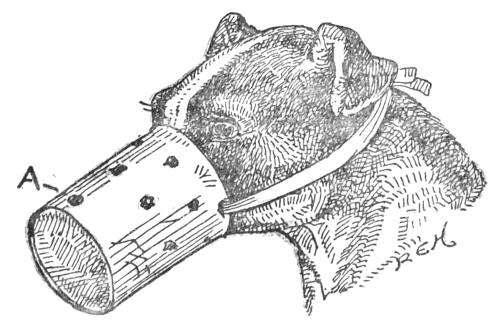
A Simple Way of giving Chloroform
Cocoa, coffee, or other cans with holes punched round and tied over muzzle.
A—Hole in the upper part of can to pour anæsthetic.
Another good way of giving chloroform, or
the compound mixture mentioned, when a proper
apparatus is not at hand, is out of a round tin
canister, perforated round the sides to allow
plenty of air to be mixed with the chloroform.
At the bottom of the canister a piece of sponge
or lint should be fixed, on which the chloroform
should be poured. More of the anæsthetic as
required may be syringed through one of the
lower holes. The tin can be fastened on the
nose by tapes, which should be passed behind
the ears and tied.
Cocaine, a Substitute for Chloroform: Cocaine
is an alkaloid extracted from the leaves of the
Erythroxylon Coca, which grows as a kind of
shrub in Bolivia and Peru.
The hydrochlorate of cocaine is the preparation
mostly used, as it is more soluble in water.
Cocaine is equal in its effects to chloroform in
many operations where the parts to be removed
are not very deep-seated; besides, its use is
much more economical, as not only is the drug
itself of less expense, but when operating it is
not necessary to have a separate attendant to
administer it, as is the case when chloroform
is given. Then it is much more easily given
(by a hypodermic syringe), and the dog does
not resist it at all; whereas, chloroform is
resisted by the patient with all its strength.
In some cases three or four assistants are
required to hold a big dog whilst it is being
administered, and I have known some dogs to
struggle so violently against taking chloroform
that one has been obliged to discontinue giving
it, for to have persevered would have endangered
the dog’s life. This alone is sufficient reason
to make cocaine a more favourable anæsthetic
than chloroform.
Then as to the danger, there is no comparison
between the two. I have only once had any
bad results from the use of cocaine; but with
chloroform, sometimes, in spite of every care
and precaution, the dog will, when under its
influence, suddenly collapse. Besides, when a
dog, in a case such as I have just described,
struggles very much against receiving the chloroform,
it takes longer to get him under the
influence of the drug than one taking it quietly;
and then, often as a consequence, the dog at
last becomes exhausted, and if the chloroform
is persevered with, it takes too strong effect—the
heart’s action becomes weak, the breathing
heavy, and collapse may occur—the result is,
one is obliged to leave off the operation to
administer restoratives to save the patient’s life.
In many operations, as the excising of tumours
(even large ones, weighing six or seven pounds),
removing thorns from the eye, sewing and
dressing painful wounds, cocaine is equal to
chloroform in its effects, for it completely deadens
for a time the parts to which it is applied, though
the animal retains complete consciousness.
It is particularly valuable when removing
mammary growths, so frequently seen in bitches.
On many occasions I have removed a growth of
this kind weighing, in some instances, seven to
eight pounds, without subjecting the dog to the
least pain; and I may here remark that the
application of cocaine does not in any way retard
the healing process.
Cocaine for most purposes is best used dissolved
in water; the quantity of the solution
required depends upon the size of the growth
that is going to be removed. For small tumours,
say the size of a large walnut, a four per cent.
solution is generally sufficient. Of this about
twelve minims should be injected under the
skin, say three drops at each corner of the
growth, then in the course of about ten minutes
the parts will be completely insensible to pain
and ready for operation. The same strength
of solution is also strong enough for eye operations,
including the removal of growths on the
haw. In such cases the solution of cocaine must
be dropped into the eye. About five or six
drops is all that is required; one drop to be
placed into the eye every minute until the
quantity required is given, then wait ten minutes
for the cocaine to take effect. In cases of
operation for inverted eyelid, the use of cocaine
is invaluable.
When removing large growths, a five per
cent. solution is necessary, giving the same
quantity—about twelve minims—injecting one
minim just under the skin all around the
tumour, and where the skin is going to be cut.
There are other local anæsthetics as eucaine,
which is said to be safer than cocaine; but in
my opinion it is not nearly so good, at any rate
with dogs, and the latter is perfectly safe when
used in proper doses.
Eucaine is also used in conjunction with
adrenalin, which has a wonderful power of
preventing and stopping bleeding; but in my
experience, when injected under the skin previous
to an operation, the wound does not heal so
readily, in consequence, I consider the bloodless
condition of the skin, which continues for
some time after, due to the application of this
drug.
Symptoms: Dragging themselves along the
ground, which is often supposed to be due to
worms, frequently licking the anus, suddenly
looking round behind and tucking the tail in
as if there was something pricking. In these
cases there is a small swelling on each side of
the anus due to an accumulation of the natural
secretion of these glands. Occasionally a painful
abscess forms.
Treatment: In simple cases all that is required
is to squeeze the glands and evacuate the contents,
and this, as a rule, gives immediate relief.
In some dogs these glands require attention
every three or four weeks. If an abscess forms,
the swelling should be fomented with hot water,
and when soft freely opened, the contents
evacuated, and the cavity syringed out with a
warm saturated solution of boracic acid. The
wound should be kept open for a few days.
In troublesome cases it is best to have the
glands removed altogether by operation, and so
save further inconvenience to the dog.
Symptom: Dilation of an artery. Difficult to
detect in a dog.
Treatment consists in ligaturing the artery.
Symptoms: Acute pain in chest, fainting, pallid
tongue, difficult breathing, limbs feel very cold.
Treatment: Hold to nose, on a piece of
blotting-paper doubled in shape of a funnel,
from one[1] to five minims of nitrite amyl. Repeat
in half an hour if necessary.
Diet: For a day or so after attack feed on
Brand’s beef or chicken essence and Benger’s
food with milk. After a day or two put patient
on a raw meat diet, which continue for some time.
Uncommon disease in the dog.
Symptoms: A carbuncular swelling, commencing
as a pimple accompanied by high temperature.
Disease runs a quick course and is generally
fatal.
Treatment: Free opening and scraping of the
affected part. Apply hot linseed meal poultices,
which should be freely dusted over with
powdered charcoal, and give stimulants, as
brandy or whisky, freely. If temperature over
105 degs. F., from one[1] to ten grains of phenacetin
may be given as well as the stimulants. Repeat
medicine once in four hours.
A complaint often seen
in young puppies, though it may occur in full-grown
dogs. It is generally the result of
straining caused by diarrhœa.
Symptoms: The lower bowel or rectum protrudes
for an inch or more from the body,
which, if not relieved, becomes inflamed and
swollen, and the patient is constantly straining.
Treatment: Return the protruding part as
quickly as possible. This is best done by
holding the dog up with the hind legs, and
then after vaselining the part, applying firm
pressure with the fingers, and the prolapsus will
slip in. This is very simple and easy, but the
difficulty is to keep it in. There are several ways
of trying to do this, but first of all give a
small enema, from one[1] to four teaspoonfuls of
thick boiled starch, with from five[1] to twenty
drops of laudanum to stop the straining. In a
recent case this may have the desired effect,
and the prolapsus not return; if it does, then
it must be put back as before, and to keep
the bowel in, a couple of strong sutures should
be placed through the anus, one from above
downward, and the other crossways, or what
is called a purse-string suture may be inserted.
Another way is by inserting and fixing in the
bowel by means of tapes the lower insertion
portion of an enema tube, the tapes should be
passed across the outside of the thighs, then
crossed under the belly and tied over the back.
But often, in spite of every care and treatment,
the dog will keep straining and force the bowel
out time after time. In such cases, the only
thing to do is to remove the prolapsus by
operation. This operation requires a considerable
amount of care, or fatal hæmorrhage may
occur, or the peritoneal cavity may be opened
and peritonitis set up.
Symptoms: Generally affects old dogs.
Suddenly falling to the ground, convulsions,
loss of consciousness. Tongue generally turns
dark in colour, eyes prominent and congested.
May be in an unconscious state for some time.
Paralysis to a more or less extent may follow.
Sometimes the head is only held on one side
from muscles of neck being paralysed: blindness
may result.
Treatment: Free purge from one[1] teaspoonful
to four tablespoonfuls castor oil, mixed with half
the quantity of syrup buckthorn. Put dog in hot
bath and apply ice to head. If convulsions are
severe, give bromide of potassium and hydrated
chloral. From two grains to one scruple of the
former, and half the quantity of the latter, with
water. Repeat every three or four hours until
convulsions cease. Do not attempt to force anything
down the dog’s throat whilst in convulsions
or unconscious, and if this continues some time,
give double dose of the medicines by enema.
Diet: Liquid food, milk with bread or
Sanatogen, and light soup with bread or toast.
This disease, strictly speaking,
does not occur in the dog as there is no
appendix to the cæcum—but they do occasionally
suffer from inflammation of this part.
Symptoms: Tenderness or pain over the
seat of the cæcum, which is about the centre
of the abdomen; vomiting and diarrhœa, or
even dysentery; sometimes bowels constipated.
Temperature often rises two or three degrees.
Loss of appetite. In some cases the cæcum
may be easily felt, and is generally hard and
swollen when inflamed.
Treatment: Rest and free administration of
laudanum, from two[1] to fifteen drops, given in
water every four or six hours.
In cases due to the impaction of some
foreign body, as a stone, coin or key, etc., in
the cæcum, which may easily be detected by
means of the Röntgen rays, an operation is
necessary.
The cæcum may be removed with a certain
amount of safety.
Treatment: When not the result of actual
disease, but to want of tone of stomach, often
seen in delicate dogs, try following mixture:—
Recipe:
| Bicarbonate Soda, |
12 grains to 1 drachm.[1] |
| Spirits of Nitre, |
1 to 4 drachms. |
| Tincture Nux Vomica, |
6 minims to ½ a drachm. |
| Water to |
1½ to 6 ounces. |
Dose: One teaspoonful to a tablespoonful[1]
three times a day one hour before food. Try
a change of food, as raw meat. For little dogs,
grilled chicken’s liver or kidneys, with stale
bread crumbs; also stewed rabbit with rice.
Symptoms: Picking up and eating all kinds
of rubbish and filth, stones, coal, and when out
in the streets, horse dung, etc.
Treatment: Always give worm medicine in
these cases. Dust over anything you know
the dog will pick up with some cayenne pepper.
In many cases one is obliged to resort to a
muzzle, and make the dog wear one when
out. Very often when this is persisted in
for some weeks, the dog gets out of the
habit.
Symptoms: The joint is swollen and very
painful; dog is very lame, and in some cases
unable to put the foot to the ground.
Treatment: During acute inflammation rest
is necessary, soothing remedies should be applied,
hot poppy-head tea fomentations, or the
following lotion:—
Recipe:
| Laudanum, |
2 drachms. |
| Goulard’s Extract of Lead, |
1 drachm. |
| Water to |
6 ounces. |
A piece of lint, large enough to cover and
go round the joint, should be saturated with
the lotion and applied. This should be covered
entirely over with a piece of oil silk, and a
bandage applied to keep dressing in place.
Change the dressing three times a day.
A dose or two of aperient medicine should
be given.
When acute inflammation has ceased, the
joint should be massaged, and later, if the joint
remains stiff, the dog should be made to swim.
Symptom: Interruption to breathing, from
drowning and other causes.
Treatment: Dash hot and cold water alternately
over the head, and inject stimulants, as
ether or brandy, under skin—from ten[1] to
twenty drops of either.
Artificial Respiration: When the condition
is due to partial drowning, hold the dog up,
with his head downwards for a minute that the
water may escape from the lungs, then place the
dog on his back, draw the tongue out, and with
the hand placed on the lower part of the chest—that
is just where the chest and abdomen join—press
downwards and forwards with some
little force, then suddenly raise the hand to
allow the chest to expand. This should be
repeated every three or four seconds. Do
not attempt to make the dog swallow whilst
in an unconscious state.
Symptoms: Heavy breathing, troublesome
cough. If the ear is applied to the chest a
crackling noise will be heard with each inspiration.
The heart is weak and the pulse
irregular.
Treatment: Aperient medicine should be
given, and be repeated once or twice a week,
also the following mixture:
Recipe:
| Liquor Morphia, |
½ to 3 drachms.[1] |
| Hoffman’s Spirit, |
½ to 3 drachms. |
| Paregoric, |
1 to 4 drachms. |
| Syrup of Squills, |
2 to 8 drachms. |
| Water to |
1½ to 6 ounces. |
Doses: One teaspoonful to a tablespoonful
three or four times a day, or from ten drops
to a teaspoonful of glyco-heroin in a little water
may be given three or four times a day.[1]
When the condition is the result of heart
disease, which is often the case, give the
following mixture:—
Recipe:
| Tincture Digitalis, |
20 drops to 1½ drachms.[1] |
| Tincture Nux Vomica, |
12 drops to 1½ drachms. |
| Compound Sulphuric Ether, |
½ to 3 drachms. |
| Syrup, |
2 drachms to 1 ounce. |
| Water to |
1½ to 6 ounces. |
| Mix. |
Doses: From one[1] teaspoonful to one
tablespoonful three times a day after food.
Aperient medicine should be frequently given.
Diet: Raw or very tender-cooked meat,
given in small quantities, three times a day.
No other food.
See Appendix.
Symptoms: General result of a diseased
condition of teeth, the accumulation of tartar
on the teeth, and as the result, ulcers form on
the gums and cheeks. Bad breath may also
arise from a disordered condition of the stomach,
or as a result of some disease of the lungs, or
the membrane lining nasal passages.
Treatment: Remove the cause. If it arises
from the condition of the teeth, remove the
tartar by scaling, and clean mouth and teeth
twice daily, using a small soft tooth-brush and
the following wash:—
Recipe:
| Salol, |
1 drachm. |
| Tr. Myrrh, |
2 drachms. |
| Spirits of Wine, |
10 drachms. |
| Formalin, |
1 drachm. |
| Mix. |
Half a teaspoonful to be added to half a
tumblerful tepid water. If the breath remains
offensive after the mouth has been made healthy,
give a pill three times a day containing from a
quarter[1] to two grains of permanganate of potash,
or twice a day give from two to ten grains of salol.[1]
When the condition is the result of some
disease affecting the lungs, suitable remedies for
this must be administered; or if the result of
an offensive discharge from the nose, a dessertspoonful
to two tablespoonfuls[1] of the following
lotion should be syringed up each nostril once
or twice a day:—
Recipe:
| Chinosol, |
6 grains. |
| Water to |
8 ounces. |
| Mix. |
Symptoms: Purulent discharges from prepuce.
Treatment: After thoroughly cleaning prepuce
out with tepid water pumped into sac with syringe,
syringe twice a day into the passage from one
to four[1] tablespoonfuls following lotion:—
Recipe:
| Chinosol, |
6 grains. |
| Water to |
8 ounces. |
| Mix. |
Sometimes this complaint is very obstinate.
In such cases the base of the penis should be exposed
and painted with a four per cent. solution
of nitrate silver. Repeat twice a week.
See Alopecia.
Symptoms: Dogs, after severe illness, when
they have become very thin, often have large,
unhealthy-looking, offensive-smelling wounds, or
ulcers form on the hips, points of the buttocks,
shoulder, and other parts.
Treatment: Well foment and thoroughly
clean parts with a warm saturated solution of
boracic acid or Pearson’s fluid diluted sixty
times with warm water two or three times
daily. Gently dry and then freely dust over
with powdered boracic acid or amyloform powder.
Take pressure off wound by encircling it with
a ring of thick felt fixed with some adhesive
material. In obstinate cases powdered iodoform
may be used to dust (sparingly) over wound
instead of boracic.
Baths: A tepid bath should register about
90 deg. F., a warm bath 100 deg. F. A
soothing bath for an irritable and red skin
can be made by adding to three gallons of tepid
water, one ounce of borax, eight tablespoonfuls
of fine oatmeal, in which the dog should be
immersed for ten or fifteen minutes, and repeated
two or three times a week. When
the dog is dirty he may be cleaned whilst in the
bath by rubbing the yolks of three or four eggs
into the skin and coat, and then rinsing off
with the oatmeal water.
A suitable bath for the treatment of eczema
and to destroy insects on the skin, may be made
by adding three tablespoonfuls of Pearson’s
disinfectant fluid to a gallon of tepid water.
Sulphur Baths: A valuable remedy for skin
diseases. Are made by dissolving one ounce of
sulphurated potash in a pail of tepid water, in
which the dog may be immersed for ten minutes.
Symptoms: Severe vomiting, great thirst,
occasionally diarrhœa, refusal of food. In bad
cases the skin, eyes, and mouth turn yellowish.
Treatment: First give dose castor oil, say
half teaspoonful to two tablespoonfuls,[1] with from
two[1] to ten drops of laudanum, or a pill containing
from a quarter to two grains of calomel, with the
eighth to one grain of powdered opium. Later,
if sickness is persistent, give from three to ten
grains of carbonate of bismuth shaken dry on the
tongue, or the following mixture may be tried:—
Recipe:
| Diluted Hydrocyanic Acid, |
20 drops. |
| Liquor Bismuth, |
1 ounce. |
| Water to |
6 ounces. |
From one[1] teaspoonful to a tablespoonful every
three or four hours.
To keep strength up give occasionally every
hour, from a quarter[1] to a teaspoonful Brand’s
beef essence, allow Vichy water and milk in
equal parts to drink—no plain water—but the
patient may have some ice to lick. When
sickness is very persistent, the stomach should
be given complete rest for about twelve hours,
and the dog’s strength kept up during this time
with peptonised meat suppositories (B and W),
one being given every three or four hours.
When these cannot be obtained, an enema of
peptonised milk with from five[1] drops to one
teaspoonful of brandy, may be given every three
hours. Hot linseed meal poultices to the stomach
are sometimes useful.
A deep punctured wound caused by
the bite of a dog, if allowed to scab over, usually
results in the formation of an abscess; so the
wound should be kept open for a few days by
being fomented often with a warm solution of
boracic acid lotion. When not fomenting, the
wound should be covered over with a piece of
lint (once doubled) soaked in a solution of boracic
lotion; this should be entirely covered with a
piece of oil silk, and a bandage applied. This
treatment may be continued until the wound has
healed. When the wound consists of a tear of
the skin, after thoroughly cleansing the parts
with some disinfectant—as a solution of Pearson’s
fluid—the wound may be sewn up, a few layers
of carbolic gauze laid over the wound, and a
bandage applied. It is best to renew the
dressing daily in these cases, as there is always
a danger of suppuration, and if such occurs, two
or three stitches should be removed at the lowest
part to allow the pus to escape. After an abscess
has formed, the parts require keeping very clean,
and should be kept covered with carbolic or other
gauze. A dog should not be allowed to lick a
wound.
Symptoms: Constantly straining to pass water
even when indoors; urine high-coloured and
often cloudy, strong smelling. Blood may be
mixed with the water, or come in drops after
the passing of water. These symptoms must
not be confounded with those the result of a
cystic calculus (stone), for in these latter cases
the dog strains continuously, and if a small
calculus happens to pass from the bladder into
the passage (urethra), it generally becomes fixed
in the canal just behind the bone in the penis,
and the dog is unable to micturate at all, or
only in drops. When a dog is seen to be
frequently straining, he requires careful watching
to see the kind of urine passed, or whether any
is being passed at all.
Treatment: If there is much pain, give every
three or four hours from two[1] to fifteen drops
of tincture of hyoscyamus in water; if there is
not much pain, a course of hyposulphite of soda
is all that is required, and should be continued
for some time.
Dose: From three grains to half a drachm[1] in
water, and a careful diet of milk, with bread or
Spratt’s biscuits, or Force, milk puddings, etc.
Milk and barley water may be given to drink.
When the irritation is due to calculus urgent
surgical assistance is required.
Symptoms: The dog at first is unable to pass
water, later it dribbles from him. May be the
result of general paralysis caused by injury to
spine, or brain, or to the abdomen; it may also
be the result of stone in the bladder.
It sometimes occurs in dogs of very clean habits
as the result of being shut up for a long time, and
the bladder becomes over distended, and can be
felt in the back part of the abdomen as a large
ball.
Treatment: Relieve the bladder. If there is no
mechanical obstruction as from a stone in the
canal, the bladder can be emptied by pressure
on the walls of the abdomen over the seat of the
bladder; if this fails, a catheter must be passed.
Speaking of catheters, for very small dogs 0.0
size is required. For terriers, No. 1 size in
diameter, and about fourteen or sixteen inches long.
For dogs size of collies, etc., No. 2 size, and about
eighteen or twenty inches long, and for larger
dogs one about four inches longer is necessary.
If there is a small stone or gravel in the passage,
there is sometimes difficulty in passing the catheter,
but with care a passage may generally be made
with a fine grooved silver probe.
When there is an absence of mechanical
obstruction and inflammation in these cases,
to improve the tone of the bladder give from
one to seven[1] minims of tincture nux vomica
three times a day, in water and after food. In
chronic cases iron (ammoniated citrate) may be
added to the medicine. Nux vomica must not be
given when there are any signs of convulsions.
Symptoms: Vomiting of blood, sometimes of
a bright red colour, at other times dark red or
venous blood; and when it has been retained
in the stomach some time, it comes up liquid
of a coffee colour.
Treatment: Give the following mixture:—
Recipe:
| Tincture Thalaspi, |
24 drops. |
| Liquor Bismuth, |
½ ounce. |
| Water to |
3 ounces. |
Doses: One teaspoonful to a tablespoonful[1]
every three or four hours.
Diet: Milk, also Benger’s food with milk,
kreochyle with Vichy water. Brand’s essence
and milk, either peptonised or plain, is the best
food. When sickness is very severe, stomach
should be rested for twenty-four hours, and the
dog fed with nutritive enema, say from one[1]
to six tablespoonfuls peptonised milk every
three hours alternately, with a beef suppository
(B and W). These may be purchased in different
sizes.
Symptoms: Eyes clear and bright, pupils large,
with a greenish look. Loss of colour to eye—as
the iris is so dilated, cannot be seen or
scarcely seen. Sometimes follows distemper; a
result of fits; great excitement or exertion, as
violent vomiting. Pupil will not contract when
exposed to light, except very strong sunlight.
Treatment: Disease seldom curable. Try
following eye drops:—
Recipe:
| Sulphate Eserine, |
½ grain. |
| Water to |
1 ounce. |
One drop to be placed in the eye three or
four times a day. Give one[1] to seven drops
tincture nux vomica three times a day in water
after food. Blisters or seton to back of neck
can be tried; also galvanism.
Collection of blood, water, or serum
under first skin; result of a burn as a rule.
Treatment: Cut blister, squeeze out contents,
apply boracic ointment on lint, and bandage.
It is somewhat difficult to
raise a good blister on a dog—much more so than
on a horse, or even a person; but a fluid called
liquor epipasticus will do so if properly applied.
The hair should at first be cut off closely from
the part where it is intended to apply the blister;
the skin should be then thoroughly washed with
warm water and soap, and afterwards well dried.
Then the blister should be rubbed on with a
piece of wool tied around a stick for about five
minutes. The person applying the blister should
be careful not to get any of it on his fingers, as
it may make them very sore. Over the blister
put a piece of either grease-proof paper or brown
paper, and apply a bandage. This blister is very
poisonous, and the dog must not be allowed to
lick it on any account. The next day, if the skin
is not well blistered, rub in for two or three
minutes a little red blister ointment. Forty-eight
hours after the first application of the blister it may
be washed off, the parts carefully dried with a soft
cloth, and then anointed with boracic ointment.
Symptoms: Rise of temperature, 104 deg. F.
and over; shivering, vomiting, congested eye,
thirst. If complaint goes on for some time, ulcers
form in mouth, and breath becomes very fœtid.
Often caused by retention of a dead puppy, or
urine, diseased kidneys, also inflammation of
womb (metritis) from bitch taking cold when on
heat. May follow severe and deep bites.
Treatment: Remove the cause. If an abscess,
open freely at once, evacuate contents, and
syringe cavity out with solution Condy’s Fluid,
one teaspoonful to half-pint water. Give large
dose salicylate quinine one[1] to ten grains; repeat
in six hours; give brandy somewhat freely. If
patient cold, apply hot-water bottle to back and
feet.
Small red swellings, which suppurate
and break. Situated, as a rule, on inside of
thighs, arms, and belly, but may appear all over
dog. Sometimes seen in cases of distemper;
also seen in young puppies, especially on inside
of thighs and belly, when suffering from worms.
Treatment: If accompanied by distemper, no
special treatment required; if very painful and
sore, anoint with Balsam Peru ointment. When
affecting young puppies, give worm medicine;
afterwards small doses of chemical food.
Symptoms: Pain in abdomen; patient restless,
and, if a puppy, whines and cries; generally
diarrhœa, and quantity mucus passed; may be
constipation; vomiting a frequent symptom.
Seldom a rise of temperature without case very
acute, though the pulse is often much quickened.
Often caused by worms and indigestion, and
may be result of chill.
Treatment: As a rule, a dose of castor oil,
say half a teaspoonful[1] to two or more tablespoonfuls,
with from two[1] to fifteen drops of
laudanum, is the best treatment at first. After
this has worked off, if pain continues, give
following mixture:—
Recipe:
| Laudanum, |
1 drachm. |
| Chloric Ether, |
2 drachms. |
| Liquor Bismuth, |
4 drachms. |
| Water to |
3 ounces. |
Dose: One[1] teaspoonful to a tablespoonful every
two, three, or four hours until pain relieved.
Apply hot salt bags continuously to belly. Later,
worms should be removed by suitable remedies.
Symptoms: This is a disease that more often
attacks young puppies than adult dogs. It may
be caused by worms; it also results from eating
stones and other hard substances, and may be
due to colic as a result of indigestion. The pain
is very acute, the dog constantly crying and
whining. During the early stages there may be
vomiting; there is also diarrhœa, and the passing
of mucus tinged with blood. If the abdomen be
manipulated with the fingers, a long hard swelling
will be felt, due to one portion of the bowel
telescoping into another.
Treatment: Give fairly large doses of
laudanum, say for a fox terrier puppy two or
three months old, five drops every four hours
with a dessertspoonful of water. Give nothing
but liquid food as milk or Benger’s food, or beef
tea. If no better in twenty-four hours, the puppy
should be relieved by operation. If the operation
is postponed too long, it is as a rule not successful,
but when done during the early stages there is
every chance of effecting a cure, and giving the
puppy immediate relief. Besides, the operation,
when done early, is much easier, for then, as a
rule, the intussusception can be reduced by pulling
on the bowel.
After such an operation no food should be
given for twenty-four hours; and then liquids
only for a few days.
Symptoms: Gland is swollen hard, red and
very painful. There is a rise of temperature
which shows pus is forming. After two or three
days the swelling becomes softer, points, and
breaks and freely discharges.
Treatment: Hot poppy-head fomentations, and
the application of hot linseed meal poultices
frequently changed. Lance abscess directly soft.
Give aperient medicine. Sometimes it is
necessary to remove puppies, when milk should
be drawn off two or three times a day.
Many
bulldogs, especially those with a very short
face, have a chronic difficulty in breathing.
Each inspiration is performed with an effort;
the sides heaving, and the dog is constantly
bringing up quantities of white frothy mucus,
especially when first let out.
In some instances, especially of toy bulldogs,
the inspirations are so difficult that if a dog gets
much excited it may fall over partly asphyxiated.
In these cases the heart is always weak.
Treatment: The principal thing to do in these
cases is to give a diet composed entirely of raw
meat, cut up in small pieces, given three times a
day, so as not to overload the stomach at any time.
Also after each meal give from one[1] to seven drops
of tincture nux vomica, according to the size of
the dog, in a little water, immediately after
food, or for a change, from three[1] to six grains of
lacto-peptin.
In some cases I have attempted to relieve these
distressing symptoms by an operation, that is by
removing the false palate, but it has not been
altogether a success, though I have sometimes
thought it has given some relief. Of course an
operation of this kind must be done under the
influence of chloroform.
Symptoms: Severe and frequent coughing,
difficult breathing, rattling of phlegm in windpipe.
In bad cases, dog unable to lie down.
Treatment: Place in fairly warm room, and
keep a kettle going to moisten air. When
breathing very difficult and the throat seems
full of phlegm, give an emetic.
Recipe:
| Hydrochlorate of Apomorphia, |
½ grain. |
| Water to |
1 ounce. |
Dose: Half[1] to two teaspoonfuls; repeat in
one hour if it has not caused vomiting. When
sickness stopped, commence following mixture:—
Recipe:
| Liq. Morphia, |
1 drachm. |
| Hoffmann’s Spirits, |
2 drachms. |
| Paregoric, |
1½ drachms. |
| Ipecacuanha Wine, |
1 drachm. |
| Syrup of Squills, |
1 ounce. |
| Water to |
3 ounces. |
Dose: One teaspoonful to a tablespoonful[1]
every four or six hours. Apply hot linseed
meal poultices to throat and front of chest.
Give aperient medicine. The emetic, if the
cough and breathing remain bad, may be
repeated in two days. When the active
symptoms have passed and the cough better,
petroleum emulsion may be given. During
early stages light diet should be given; later
meat.
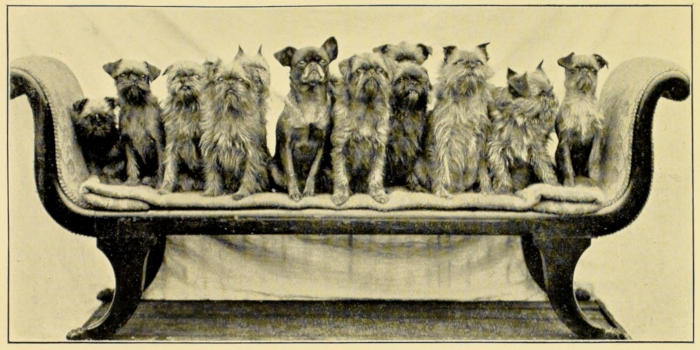
The Copthorne Brussels Griffons.
Including the well-known Champions: Copthorne Talk-of-the-Town, Copthorne
Lobster, Copthorne Wiseacre, Copthorne Treasure, and Copthorne Seiglinde,
the property of Mrs. Handley Spicer, The Glen, Kingsbury, N. W.
Symptoms: Though the dog may appear very
well, with good appetite, there is a frequent
dry, hard cough, which is generally worse at
night and early morning, but any exertion or
excitement induces a fit of coughing. After
each attack, the dog retches as if he had
something in his throat, and was going to
vomit.
Treatment: Give aperient medicine occasionally,
and the following mixture:—
Recipe:
| Tinct. Nux Vomica, |
24 drops. |
| Ipecacuanha Wine, |
1 drachm. |
| Water to |
3 ounces. |
Doses: One teaspoonful to a tablespoonful[1]
three times a day. When cough is very
troublesome give a dose of the mixture recommended
for acute bronchitis at night, or from
fifteen[1] drops to one teaspoonful of Smith’s
glyco-heroin in a little water.
Diet: The diet in these cases is very
important, and I find under-done meat the best
possible food, as it nourishes the dog well without
distending the stomach and causing pressure on
the chest.
Symptoms: Discoloration of the skin from
effusion of blood under result of injury.
Treatment: Apply following lotion often:—
Recipe:
| Goulard’s Extract Lead, |
1 drachm. |
| Liquor Opium, |
1 drachm. |
| Distilled Water to |
8 ounces. |
When in a suitable part, so that a bandage
may be applied, the lotion is more efficacious if
applied on lint, which should be covered over
with a piece oil silk, and then a bandage.
Give aperient medicine, and keep dog at rest
for a few days.
Symptoms: The skin may be scorched and the
coat frizzled, but the roots not destroyed; or the
skin may be destroyed and a large blister form,
which sooner or later suppurates. Burns, the
result of boiling water, are practically as severe
as those of fire, for in either case the hair never
grows afterwards.
Treatment: When the skin only is scorched,
apply lime water and linseed oil. One
part of the former, mixed with two parts of the
latter, should be dabbed on two or three times
a day. In severe burns the part may be smeared
over with boracic ointment, and when the blister
has broken the same ointment should be applied
on lint, which must be kept in its place with a
bandage or coat. Repeat dressing two or three
times a day.
Symptoms: Blood, and also in many cases pus,
is passed with the urine. The dog at times
seems very ill, the temperature may go up to
103 or 104. Pain on pressure over the loins,
sickness, loss of condition, and great wasting.
In severe cases there is collapse, and death
follows the result of uræmia poisoning.
Treatment: Open the bowels freely. Apply
hot fomentations or poultices to the loins, and
give following medicine:—
Recipe:
| Bicarbonate of Potash, |
1 drachm. |
| Boro-citrate of Magnesia, |
1 ounce. |
| Mix. |
Give from sufficient to cover a sixpence to a
teaspoonful,[1] two or three times a day, mixed with
food or milk.
Diet: Give plenty of milk mixed with equal
parts Vichy water. Also Benger’s food with
milk, tripe, and fresh boiled fish, with well-cooked
rice. Avoid red meat.
Symptoms: In the dog the stones are generally
small, varying in size from a millet seed to a
pea, though occasionally one does find a large
one. In bitches the stone is generally not discovered
until it has become a good size, and set
up irritation of the bladder. In the dog, when
the stones are small they, as a rule, do not seem
to do any harm or cause inconvenience until one
or more escape from the bladder, pass into the
urinary passage or urethra, and become lodged
in the canal just behind the bone in the penis
where the passage is smallest. If the stone is
quite round—which, fortunately, is not always
the case—it acts like a cork in a bottle, and
the dog is unable to pass any water. He
stands or stoops like a bitch, and keeps straining;
but nothing comes away, except, perhaps,
a single drop occasionally of blood-stained urine.
If the stone happens to be not quite round, then
he is able to pass a small quantity of highly-coloured
water by great effort. To ascertain
for certain if these symptoms are the result of
gravel or stone, a small sound or catheter should
be passed; and if there is any blockage in the
passage it is easily ascertained, for in that case
it will be impossible to pass the instrument for
more than a few inches instead of from 6 to
24 inches, according to the size of the dog;
and besides, the hard piece of gravel or small
stone will be felt. In some cases when the
stone is not quite round the instrument will
pass to the side of it, and then one can
easily feel the grating of the stone against the
instrument as it passes, more especially as it is
withdrawn.
Treatment: Medicines are of little use, though
a sedative like hyoscyamus will sometimes relieve
the spasm of the parts, and enable the patient to
pass a little water when the passage is not completely
blocked; when it is, the stone may
sometimes be pushed back to where the passage
is larger, and thus enable the dog to relieve
himself; but in all these cases arrangements
should be immediately made for an operation,
which is the only cure.
In bitches the symptoms of a calculus in the
bladder are somewhat similar to those shown by
the male: she is constantly straining to micturate,
even after the bladder is emptied of water; the
urine is high-coloured and smells strong, and
often a few drops of blood are passed at the
end of micturition, or the water may be blood-stained.
Treatment: Operation. Dogs once suffering
from calculi are always liable to a recurrence.
This may sometimes be prevented by giving
occasionally a course of the following:—
| Bicarbonate of Potash, |
2 drachms. |
| Boro-citrate of Magnesia, |
2 ounces. |
| Mix. |
Doses: From sufficient to cover a sixpence to
one teaspoonful[1] twice a day with food or given
in water, and continued for a long time. Avoid
meat as much as possible with the food.
Symptoms: A tumour which usually sooner or
later ulcerates, emitting an offensive-smelling
discharge mixed with blood. The animal loses
condition and becomes very weak. A cancer may
form anywhere, but the most frequent parts affected
are: the mouth, inside of the throat, milk glands,
the rectum, and the organs in the abdomen.
Treatment: An early operation is the only
chance of effecting a cure; once suppuration has
commenced, the case is practically hopeless.
Symptoms: Ulceration of bone—generally
result of some injury. Abscesses form, resulting
in unhealthily discharging wounds which are
difficult to heal. If the parts be probed,
roughened exposed bone may generally be
felt, which after a time separates from the
healthy structure and escapes with the discharge.
Treatment: These cases must always be given
time for the dead bone to separate from the
healthy bone. Hot linseed meal poultice, dusted
freely over with powdered charcoal, should be
applied, and repeated two or three times a day,
and as soon as the dead structure is loose, the
wound, if not large enough, should be dilated
with a knife and the dead bone removed. If
this is successfully done, the wound generally
heals quickly. In some cases when a limb is
affected, and the inflammation has been very
extensive, amputation may be necessary. Dogs
do very well with three legs.
If after the dead bone has been removed the
wound does not heal, syringe into it every other
day about half a drachm of tincture calendula,
and apply boracic ointment on lint and bandage.
Wounds in cases of caries require keeping very
clean with some disinfectant, as a saturated
solution of boracic acid, or a solution of Pearson’s
fluid; Condy’s fluid is also useful.
Symptoms: The formation of an opaque spot
in the lens or pupil of the eye. In young dogs,
when it occurs, which is not frequent, the whole
pupil seems to be involved at once, but in old
dogs it generally commences as a small speck,
and gradually increases. The cornea or front
of the eye generally remains clear. Of course
there is loss of vision of the affected eye to a
more or less extent, according to the size and
density of the cataract.
Treatment: The following drops improve the
sight when the cataract does not affect the whole
pupil:—
Recipe:
| Sol. Sulphate of Atropine, |
10 drops. |
| Sulphate Zinc, |
¼ grain. |
| Distilled Water to |
1 ounce. |
Operation, except for improving the appearance
of the eye, is useless in the dog, as wearing of
spectacles is impracticable.
Symptoms: Generally follows a chill from
exposure to cold or from careless washing;
shivering and sneezing, thin mucous discharge
from nose, which is not sticky as in distemper;
water discharge from eyes; a husky cough.
The dog is dull for a few days, and perhaps off
his food, but as a rule there is no rise of
temperature as in distemper, and the teeth do
not become discoloured as in the latter disease.
Treatment: Keep quiet in a dry, warm room
for a few days, and give the following mixture:—
Recipe:
| Tr. Aconite, |
24 drops. |
| Spirits of Nitre, |
2 drachms. |
| Concentrated Solution of Acetate of Ammonia, |
1 drachm. |
| Water to |
3 ounces. |
Doses: From half a teaspoonful to a tablespoonful[1]
three times a day. Give sloppy food
for two or three days, and then the ordinary diet
and cod-liver oil.
The passage (called
the urethra) to the bladder is very small in the
dog in consequence of there being a bone in the
penis. It is also very long. The best kind of
catheters are made of gutta-percha, and for small
dogs the size called 0 is large enough. For
dogs the size of terriers No. 1 size is required;
for collies, etc., No. 2 size; and for larger dogs
No. 3. These numbers refer to the diameter.
As to length, they must, of course, vary also
according to size of the dog—10 inches, 12
inches, 18 inches, and 2 feet respectively. Before
being passed, the catheter must be well smeared
over with vaseline, and the wire left in. The
dog should be placed on his left side, with
the right hind leg well drawn forward; the
penis should be exposed for some inches, and
held by means of a soft cloth; the catheter may
then be gently passed. After going a short
distance, that is to where the penis bends
round, it will stop going in, or, at any rate, at
this point it will be found a little more force is
required to pass the instrument. When this
part is reached, the wire should be drawn out
for one or two inches, according to the size
of the dog, then it will be found the catheter
will pass on easily again; and when the bladder
is reached, if it is full of water, it will commence
to drip or dribble away—it never runs away fast,
as the orifice in the catheter is small. Let the
catheter remain in so long as urine continues
to flow, and then gently withdraw it.
A catheter should never be passed more than
twice a day. The instrument, when not in use,
should, without the wire, be kept in a basin of
saturated solution of boracic acid. The wire
should be thoroughly cleaned and vaselined,
and be put into the catheter just before being
used.
Symptoms: Often seen in distemper. The
dog may be dull and heavy, or he may be
very excited; eyes very congested; temperature
high, 104 to 105° F.; constant working of the
temporal muscles. Dogs in this condition are
often ravenous for food, and diarrhœa may be
present. If relief is not given, convulsions
usually follow.
Treatment: Keep dog absolutely quiet in a
darkened room. If bowels constipated, give
purgative medicine, also give from three grains
to one scruple of bromide of strontia[1] in water
three or four times a day. Apply ice in a waterproof
sponge bag or sheep’s bladder to forehead
for fifteen minutes or so at a time several times
a day.
Diet: Liquid food should only be given, as
milk with Benger’s food, egg and milk—the
yolk of the egg should not be given if there is
much diarrhœa; some mutton broth or Brand’s
essence may be allowed occasionally. In severe
cases a blister or seton at the back of the neck
should be applied.
Symptoms: Affects principally the knees,
hocks, and stifle joints occasionally of old
dogs—the result of the deposit of urates.
Treatment: From a quarter to two grains of
iodide of potassium three times a day, or from
five[1] grains to two scruples of the boro-citrate of
magnesia in water thrice daily. This medicine
may be given with the food. Vichy water to
drink instead of plain water.
Symptoms: Dogs frequently choke themselves
when eating bones, especially chop or cutlet bones;
also occasionally with a large piece of meat which
may become impacted in the gullet. But this is
not so serious, as it can easily be pushed down
into the stomach if it cannot be pulled upwards.
When an offending bone or other matter becomes
lodged in the back of the throat the dog coughs
and retches violently, and may even die from
asphyxia. But as a rule the bone does not stop
there, but passes down until the gullet passes
over the heart, where it is rather smaller, and then
the bone is stopped, which causes the dog great
distress. He keeps gulping as if trying to
swallow, and occasionally retches. In a day or
two the distress passes off and the patient seems
fairly well and often ready to eat, but if any solid
food is taken directly it reaches the part where
the obstruction is it is brought up, and this
continues to happen so long as the obstruction
remains, but the dog as a rule is able to swallow
liquids as milk, egg and milk, beef teas, etc.
Dogs, especially puppies, often swallow needles
and pins, which generally become embedded in
the back of the tongue, but sometimes they reach
the gullet and pass through, causing a bad
abscess to form in the throat just behind the
angle of the jaw.
Treatment: When the bone or meat or other
matter becomes lodged in the back of the throat,
it is generally easily removed with the finger.
Failing this, forceps must be used; but the
symptoms are often very distressing, and prompt
relief is necessary. When the bone has passed
far down in the gullet and become fixed
just over the heart, relief is much more difficult.
Sometimes if the dog can be induced to take a
few pieces of meat it will force it on. If this
fails, forceps must be tried, and if the bone
cannot be removed with them, then one must
try to push it downwards into the stomach with
a probang. Too much force must not be used
or the gullet may be ruptured, which is fatal. If
it cannot be removed, the dog must be fed on
liquid food, and in time the points of the bone
may become dissolved, and then it will be easier
to push it down with a probang.
In removing needles from the back of the
tongue or fauces, which is best done with forceps,
care must be taken not to break them. The
tongue should be drawn well forward out of the
mouth by taking hold of it with a cloth so as to
bring into view the back of the tongue and fauces.
Symptoms: Irregular contraction of the muscles.
Almost any part of the body may be affected, and
even the tongue, the dog poking it out of the
mouth constantly. But the disease more often
affects the limbs, perhaps one fore leg and one
hind leg, or the muscles of the shoulder and
neck; occasionally the muscles of the abdomen,
the dog always appearing to be suffering from
hiccough. The temporal muscle is a common
seat of chorea, and in such cases the dog is
constantly snapping his teeth together. It is
almost invariably the result of distemper.
Treatment: In bad cases the disease is
incurable, though often with time—in the
course of months—the twitching becomes less,
but never entirely disappears. There is no
specific for chorea; what appears to do one
case good seems to do harm in another. Small
doses of arsenic with bromide is sometimes a
useful remedy, as the following mixture:—
Recipe:
| Bromide of Strontia, |
1 drachm. |
| Fowler’s Solution of Arsenic, |
48 minims. |
| Water to |
3 ounces. |
Dose: From half a teaspoonful to a tablespoonful[1]
three times a day after food.
In other cases Easton’s syrup answers better.
Dose: From three or four drops to half
a drachm,[1] in a little water, three times a day
after food. Later, especially if there is much
wasting, cod-liver oil should be given.
Symptoms: The dog has a big swallow, and
it is astonishing what can pass down his
throat into the stomach. I have known small
dogs as fox terriers to swallow coins the size
of a penny, and smaller dogs still to swallow
brooches, ear-rings, and finger-rings, and also
keys, without even seeing any bad results to
the dog, though the owner has been much
alarmed as to what was going to happen; but
corks are dangerous, as they block up the
intestines, and so are big round stones, but
small stones dogs swallow with impunity. Dogs,
even small ones like pups, swallow occasionally
meat skewers, but even such things as these
do not always prove fatal. I recently had
under my care a small puppy who swallowed
a hat-pin ten and a half inches long, the head
passed into the stomach all right, but the puppy
was too small to take the whole length of
pin, and the point, piercing some of the vital
parts of the throat, killed him.
As a rule, a dog does not show much discomfort
after swallowing things like coins, bones, small
stones, etc., when they once have reached the
stomach, though with young puppies the latter
often cause severe colic; but large round stones
and corks often cause serious mischief by blocking
up the bowels, inducing inflammation, which, if not
relieved by operation, soon causes death. Skewers
and long hat-pins when swallowed seldom pass
beyond the stomach, where they often remain for
some considerable time, but sooner or later the
point generally pierces the stomach, and peritonitis
follows, which quickly terminates fatally; but
sometimes the sharp point passes direct from the
stomach through the walls of the abdomen and
skin, and it may be seen sticking out and can be
removed. The dog seems none the worse after
a few days, as the wound soon heals.
It is often difficult by manipulation to detect
things that have been swallowed, for as a rule,
as before mentioned, they remain in the stomach
for a considerable time before passing into the
intestines. I have known coins to remain there
for five or six months before being passed; however,
with the Röntgen rays coins, keys, jewellery,
stones, etc., can always be detected.
Treatment: Unless the foreign body swallowed
is doing the dog visible harm, it is best left
alone. Feed on solid food as suet puddings,
rice, bread, meat and such like foods, so as to
distend the bowels as much as possible and to
cause big motions, and the foreign body, in all
probability, will pass out safely; do not give
purgative medicines, which only cause contraction
of the bowels and do harm, but if there is pain
give from two[1] to ten drops of laudanum in a little
water, three or four times a day, or oftener.
When the substance swallowed causes real
obstruction in the bowel, the laudanum may be
given a trial for two or three days, but as a rule
an operation becomes necessary, which consists in
opening the abdomen, finding where obstruction is,
and opening the bowel and removing the offending
matter. It is an operation requiring aseptic precaution
and some care, and the sewing up the
incision made into the bowel wants carefully
doing or a stricture may result.
See Catarrh.
Symptoms: Generally affects puppies from eating
rubbish, but may also affect adult dogs, especially
after receiving strong medicine as worm medicine.
Restlessness, crying and whining, or even howling
when pain very severe; abdomen tucked up and
muscles feel hard and rigid. The attack may be
accompanied by severe vomiting and diarrhœa.
Treatment: Give immediately, if there is no
diarrhœa, a dose castor oil, which should be
followed by an enema if it does not operate in
about an hour. The enema may consist of
half[1] to two teaspoonfuls of glycerine, mixed
with one[1] to eight tablespoonfuls of warm water.
Also, give following mixture:—
Recipe:
| Chloric Ether, |
1½ drachms. |
| Laudanum, |
1½ drachms. |
| Water to |
3 ounces. |
Doses: From half a teaspoonful to a tablespoonful[1]
every two, three, or four hours until
pain relieved.
Symptoms: The dog lies in a semi-unconscious
condition; the body feels cold; the membranes are
pallid, eyes glassy; the breathing slow and heavy;
pulse weak. This condition may arise from shock,
and is often seen in dogs after being run over. It
may also occur as the result of hæmorrhage.
Treatment: Allow the dog to lie perfectly
quiet on his right side. Give stimulants, as
brandy, with from one[1] to ten drops of tincture
nux vomica if given by the mouth, but only
half if injected under skin. If this cannot be
done, give an enema of milk and brandy, or
strong black coffee. If body very cold, put hot-water
bottles round it.
Symptoms: Entire loss of consciousness, heavy
breathing, pupils dilated, etc. This condition may
result from injuries to head; sometimes follows a
severe attack of epilepsy, apoplexy, and it is the
last stage previous to death of many illnesses.
Treatment: This entirely depends on the
cause. If as the result of epilepsy, the patient
is best left quite alone for many hours; if the
body becomes cold, hot-water bottle may be
placed under it and also to the back. After
some time, if there are no signs of return to
consciousness, the body and limbs may be well
hand-rubbed, and brandy injected subcutaneously.
If the result of injuries to head, should the skull
be fractured an operation may be necessary; but
if there is simply concussion of the brain, you
must give the animal time—the condition may
last three or four days, and yet the dog may
recover. Besides quietness, there is not much
to do. Should the dog be very restless, apply
an ice-bag to head; and to maintain strength
give about every four hours an enema of
peptonised milk, from one tablespoonful to
a cupful,[1] or one or two meat suppositories.
When coma is the result of the last stage
of illness, there is little to be done. The
inhalation of oxygen may be tried; brandy or
strychnine, ⅟₃₀₀th to ⅟₁₀₀th of a grain[1] may be
injected under the skin, and an enema of strong
black coffee given.
See Warts.
Symptoms: The conjunctival membrane lining
the inside of the eyelids is much congested, and
of a dark red colour, there is a constant flow
of watery discharge; in bad cases there is a
discharge of white pus which causes the lids to
adhere together. The hair falls off around the
lids, and the cornea, or front of the eye, may
become cloudy and ulcerate.
Treatment: In simple cases an application of
boracic lotion, made by dissolving half a teaspoonful
of boracic acid in half a pint of water, which
should be applied often, is generally sufficient to
effect a cure. In bad cases when the discharge
is purulent, the following should be used:
Recipe:
| Chinosol, |
3 grains. |
| Water to |
6 ounces. |
Apply several times a day, letting a little run
on the inside of the lower lids. Iodoform dusted
on the inside of the lower lid is also useful.
The edges of the eyelids should be kept
smeared with vaseline to prevent them from
sticking together.
Symptoms: The motions are big, hard, and
dry, and difficult to pass; and instead of having
an action at least once a day, the dog may only
have one every two or three days.
Treatment: A good deal can be done by diet.
Spratt’s biscuits have a tendency to keep the
bowels open and regular; for small dogs the
Pet-Dog biscuits should be given, and for large
dogs the big biscuits. They should be broken
up and soaked in some soup, and mixed with
a little meat and some green vegetable added;
this makes a very good principal meal. For a
second or evening meal the biscuit may be given
dry. For a change of diet give meat, brown
bread, and green vegetables in equal parts
moistened with soup. In obstinate cases some
laxative may be necessary. Milk of sulphur
answers very well; from sufficient to cover a
threepenny-piece to half a teaspoonful[1] may be
given daily for a fortnight, or a teaspoonful[1] to
two tablespoonfuls of Dinneford’s fluid magnesia
may be given every morning in a little milk.
In some cases salad oil answers best, from
half a teaspoonful to a tablespoonful[1] mixed
daily with the food. In chronic cases a course
of the following pills is useful:—
Recipe:
| Ext. Belladona, |
1 to 6 grains.[1] |
| Powdered Rhubarb, |
3 to 18 ” |
| Reduced Iron, |
4 to 24 ” |
| Powdered Nux Vomica, |
1 to 6 ” |
| Mix. |
Divide into 12 pills—one to be given twice a day
after food.
Symptoms: A rare disease in dogs. At first
a dry cough, later becoming looser with expectoration
of phlegm; wasting, though appetite
may at first be fairly good; the patient gradually
becoming very weak, and occasionally having
diarrhœa. There is always present one or more
degrees of fever, and the temperature is generally
higher at night. If the phlegm be examined with
a microscope the tubercle bacilli will be found if
it is a case of consumption. In bad cases there
is bleeding from the lungs, the blood coming as a
rule through both nostrils.
Treatment: Seldom curable, but the best
chances of a recovery are obtained by letting
the dog live out of doors and giving cod-liver
oil. Feed liberally, giving plenty of meat, also
fish, milk, raw eggs, and cream.
The patient should be kept away from other
dogs, and certainly should not be allowed to
sleep in a room where there are people.
Symptoms: Young puppies, generally as the
result of worms or during second dentition, often
have convulsions. The immediate cause of the
attack is generally due to excitement, more particularly
on a hot day. The puppy, which may
be apparently quite well, suddenly tumbles over
on its side, kicks violently with its legs, champs
the jaws, and froths at the mouth. In a minute it
gets up, and looks about in a dazed manner; then,
if not restrained, gallops off barking, not knowing
where it is going. Sometimes one attack may
follow another in quick succession until it dies
from exhaustion.
Treatment: The puppy should be held to
prevent it knocking itself about. (I may here
remark that there is not the least danger from a
bite of a dog when suffering from fits of any
kind.) As soon as the puppy can swallow, a
dose of the following mixture must be given:—
Recipe:
| Bromide of Potassium, |
1 drachm. |
| Hydrated Chloral, |
1 drachm. |
| Water to |
3 ounces. |
Dose: From a teaspoonful to a tablespoonful[1]
to be given every two, three, or four hours,
according to the severity of the symptoms. If
the puppy is unable to swallow, double the
quantity should be injected into the bowel, mixed
with equal quantity of tepid water. In severe
cases a hot bath is beneficial; also ice may be
applied to the head. Keep the puppy in a
dark room for some hours after the attack. To
prevent a recurrence of the convulsions, treat
puppy for worms. Feed on a milk diet for a few
days.
Horny elevations which form on the
pads of the feet.
Treatment: They may be removed by cutting,
or destroyed. The best way is by the application
of a solution of chromic acid, one in four. It
should be applied sparingly to the part with a
glass rod about twice a week.
Symptoms: May arise from many causes; but
a simple cough, the result of some irritation of
the larynx caused by cold, is of a common
occurrence during the winter and spring when
the winds are cold.
Treatment: Give following mixture:—
Recipe:
| Liquor Morphia, |
2 drachms. |
| Syrup of Squills, |
1 ounce. |
| Syrup of Lemon, |
1 ounce. |
| Water to |
3 ounces. |
Dose: From half a teaspoonful to a dessertspoonful
three or four times a day.[1] When it
is difficult to give a mixture, the following pills
may be tried:—
Recipe:
| Hydrochlorate of Morphia, |
¼ to 1 grain.[1] |
| Powdered Ipecacuanha, |
1 to 6 grains. |
| Powdered Rhubarb, |
2 to 12 grains. |
| Compound Squill Pill, |
6 to 20 grains. |
Mix and divide into twelve pills, one to be
given night and morning. A dose of aperient
medicine should occasionally be given.
Symptoms: Division of structure, generally
described as a solution of continuity; there is
generally more or less bleeding.
Treatment: Thoroughly cleanse the cut with
a warm solution of boracic acid, Condy’s fluid
well diluted, or one per cent. solution of Pearson’s
disinfectant fluid. Stop bleeding by applying
pressure with fingers, or a pad of absorbent
boracic wool, and bandage. When very severe,
apply a ligature to the vessel above the part.
After cleaning the wound and stopping the
bleeding, the edges of the cut should be brought
together with a few stitches, about a sixth of an
inch apart; a pad of some disinfectant gauze
applied, also a bandage. If no swelling or discharge,
the dressing need not be disturbed for
about six days, when the stitches can be removed.
Afterwards re-bandage for another day to protect
the part from dog’s tongue.
See Bladder, Irritable.
Symptoms: A sac containing fluid or semi-fluid
substances, or even hair and other foreign
substances. A form of cyst often seen in flap
of the ear.
Treatment: Cysts can only be removed by
cutting. In the case of the ear, it should be
freely opened at the most depending part and
a tube inserted, or at any rate the wound should
be kept open for a few days, otherwise fluid
will collect again. No other treatment required
except keeping the parts clean. The dog must
not wear a collar.
Symptoms: Dryness of the skin and hair, and
the rising of branny greyish-white scales from the
former, and mixing with the coat.
Treatment: As a rule, a thorough wash once
a week, using a tar soap like Sherley’s shampoo,
and putting a little borax in the rinsing water,
with daily brushing of the coat, will effect a cure
in mild cases; but in bad cases greasing the dog
all over with some such preparation as the
following is necessary:—
Recipe:
| Oil of tar, |
1 drachm. |
| Almond Oil, |
½ pint. |
| Mix. |
To be thoroughly worked into the skin twice a
week, and after a few days washed off, using the
soap mentioned. A course of arsenic is useful;
give from one[1] to eight drops in water twice a
day for two or three weeks, but it must be
discontinued if it causes sickness or diarrhœa.
Symptoms: In many cases, especially in white
dogs, as bull terriers, it may be congenital. In
ordinary cases it is often due to an accumulation
of hard wax, or from growths in the canal of the
ear. In old dogs it may be due to thickening of
the drum of the ear.
Treatment: When congenital it is incurable.
If result of growths in the ear, these must
be removed by operation. When caused by
accumulation of hard wax, a little warm almond
oil should be poured into the ear, and the next
day the ear should be thoroughly syringed with
five ounces of tepid water in which has been
dissolved a scruple of carbonate of soda. When
the deafness is due to a thickening of the drum
of the ear, which is often seen in old dogs, there
is nothing to be done.
Symptoms: May be due to constitutional
causes, as is often seen in highly-bred puppies,
or it may result from severe illness, particularly
after distemper. The pulse is quick and weak,
loss of appetite, and disinclination for exercise,
poor condition, and membranes pale.
Treatment: For puppies, Sherley’s chemical
tablets answer well. When result of illness,
the following tonic may be given:—
Recipe:
| Ammoniated Citrate of Iron, |
½ drachm. |
| Tincture Nux Vomica, |
40 minims. |
| Tincture Gentian, |
3 drachms. |
| Water to |
3 ounces. |
From half a teaspoonful to a tablespoonful[1]
three times a day one hour before food.
These are numerous
in the dog. Inverted eyelids: puppies are sometimes
born without eyes, squinting small eyes,
eyelashes growing in. Hare lip, cleft palate, pig
jaw, deformities of the feet and limbs: particularly
the stifle joint, the patella being out of its place,
and the leg contracted or drawn up. Deformities
of the chest: this condition is common in Japs,
but seems to do no harm. Puppies are sometimes
born without tails; though a good feature in
schipperke and bob-tail sheep dogs, one does
not like to see a pug or a dachshund without
a tail, and when he is good in all other points,
it is disappointing. A screw tail is objectionable
in all breeds except the bulldog, and some people
object to it in these dogs. Absence of one or
both testicles.
Treatment: Many cases of deformity may be
remedied by operation, but in others there is
nothing to be done. Inverted eyelids can be
cured by operation, an elliptical piece of skin and
also the muscle underneath being cut out immediately
under the lower eyelid, when that one is
affected, or immediately over the upper eyelid, if
it is that one that is turned. The cutting is best
done with curved scissors, and should extend
nearly the whole length of the lid. As the
wound made heals, it draws the lid out.
In-growing eyelashes must be plucked out
with forceps from time to time. Very often
as the puppy grows older and stronger, the
lashes assume a normal position, and cease to
be a trouble, but if they continue to turn in
after the dog is twelve months old, a similar
operation as for inverted eyelids is recommended,
but in these latter cases it is not necessary to
divide the muscle, but only the skin. Squinting
may be cured by operation, but it is not recommended,
as the defect does no harm, and with
Japanese spaniels, who often squint, it rather adds
to their quaintness.
In cases of unnatural small eyes, which often
occur in fox terrier puppies, an operation is not
of any use; but with time, it may be months,
perhaps a year, the condition often improves.
Matters are helped by giving the puppy affected
something to stare at, as, for instance, placing his
food for a time behind some railings, so that he
can see it, but cannot get at it. Anything, in
fact, that attracts attention, and causes the puppy
to stare. A stuffed cat behind the railings does
for a change, a lump of raw meat or a bone. Hare
lip can be cured by operation, but in consequence
of the position, it is difficult to keep the edges of
divided lip together after sewing them, as the
puppy will rub his nose on the ground if he has
a chance, besides constantly licking at the stitches.
The operation should not be undertaken before
the puppy is three months old, and then just before
operation a good square meal of meat should be
given; this will take some time to digest, and
will satisfy the puppy for a long while; at any rate,
nothing more should be given for twenty-four
hours, by which time the healing has made good
progress, and for some days after the operation
the puppy should be fed from the fingers, piece
by piece, certainly no dish should be given for
him to rub his nose in.
As to the operation, the edges of the split lip
should be freely scarified, and also be loosened
from the gum by cutting through the mucus
membrane, then the two edges of the lip should
be brought firmly together with pin sutures, and
a few layers of collodion painted over the external
part, and dusted over sparingly with powdered
iodoform. It is not necessary to give chloroform
for an operation of this kind, a few drops of a
4% solution of cocaine injected into each side of
the divided lip is sufficient.
There is no cure for cleft palate, and a puppy
born with this condition should be destroyed.
Pig jaw is incurable.
As to deformities affecting the feet, a dog may
be born without toes, or with only two or three
toes; in such cases, of course, nothing can be done,
but sometimes there may be an extra toe. If a
show dog, it spoils the appearance of his foot, and
interferes with his gait, and so must be removed.
Dew-claws are not a deformity, but they are a
useless appendage, and should be cut off close to
the leg about three days after birth; if left they
are a constant nuisance, either through being
frequently broken, or torn off at the quick, or
else turning and growing into the flesh, which
causes a good deal of pain.
Nothing can be done for deformity of the stifle
joint, it causes no pain, though it renders the leg
useless; but if the subject is a bitch, and well bred,
she may be kept for breeding purposes. A
screwed tail may be remedied, if not too badly
twisted, by breaking, setting it straight, and
applying an adhesive bandage.
In cases of absence of one or both testicles in
the scrotum, there is nothing to be done. A dog
with both testicles absent is useless for getting
stock, though he is able and will serve a bitch,
but in cases where only one is missing, it does not
prevent such a dog being useful for stud purposes.
Symptoms: Restlessness, constantly howling
and barking. Dogs in this state lose flesh
very rapidly. Delirium is seen in some bad
cases of distemper.
Treatment: Unsatisfactory; bromide of
strontia may be tried; from two[1] to sixteen
grains in water three or four times a day.
Ice bags should be applied to head.
Diet: Give easily digested food—as Benger’s
with milk, kreochyle with water, and well-boiled
tripe or fish, with rice or stale bread.
There is no doubt
that the quickest and most painless way of
killing a dog is by shooting, providing it is
done properly, and the man is a good shot
and can be relied on. The best place to hit
a dog is either behind the ear, or in the middle
of the forehead; but there are many people
who don’t like an old favourite destroyed in
this way. Personally, I don’t like it. I consider
a large dose of morphia, and then
chloroform, is better. At any rate, it does not
seem such a harsh way of taking an old
favourite’s life.
To destroy a dog with morphia and chloroform,
from half to two grains of acetate of morphia[1]
should be injected under the skin; then after
waiting until the dog is in a heavy sleep,
chloroform should be slowly administered. It is
necessary to do it very slowly indeed, or else the
dog will wake up. In this case don’t place
anything over the dog’s nose at first, but pour a
trifle on a handkerchief or napkin, and hold it
from six to eight inches away from the dog’s
nose, then gradually get nearer and nearer until
at last you cover the dog’s nose over with the
cloth. The chloroform must be continued until
the dog has stopped breathing for five minutes.
The administering of half[1] to a dram of prussic
acid is also a very sudden and quick way of
destroying a dog, but it is a debatable point
whether this causes acute pain. At any rate,
the dog invariably cries out loudly after it has
been administered a few moments, and so he often
does when going under the influence of chloroform.
However, death by freshly prepared and strong
prussic acid is very certain and sudden.
When administering this acid, one should be
very careful never to stand in front of a dog, for
if he coughs while it is in his mouth, and some
goes into the eye of the person giving it, the consequences
may be serious, as it is most deadly.
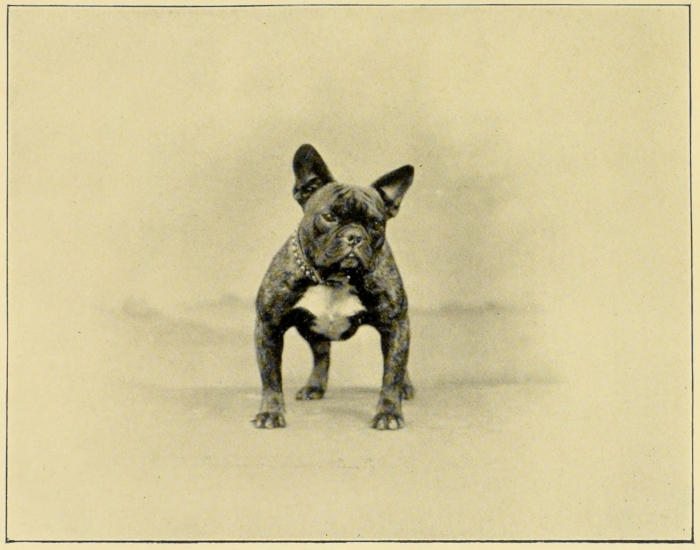
French Bulldog, Champion Sanspareil.
Winner of 2 Firsts and 8 Specials. The property of the Countess Sponneck Mayer.
| Photo. by T. Fall, 9, Baker Street] |
[face p. 60. |
Symptoms: Increased secretion of urine of
a watery nature—great thirst. For a time the
dog’s condition does not alter, but if the disease
is not checked then he loses condition, the
muscles waste, the legs become thin, the ribs
prominent, and the abdomen distended as the
result of the large quantity of water taken.
This is a disease to which old dogs are
particularly liable.
Treatment: Limit the quantity of water given
the dog to drink; for a small dog, say half a tumblerful[1]
to a couple of pints for a large dog. Feed
on dry food. For medicine, give from half a drop[1]
to two drops of Fowler’s solution of arsenic in water
three times a day before food. If this does not
benefit the case, give from an eighth[1] to a grain
of powdered opium twice a day in the form of a
pill. Treatment is often unsatisfactory.
Symptoms: Large quantities of urine containing
sugar are passed; great thirst, voracious
appetite, and gradual wasting of body. The
tongue is dry and parched, and is of a red-brick
colour; coat stares, and the dog looks
generally unhealthy.
Treatment: Food containing sugar or starch
must be avoided; meat given nearly or quite
raw is the best diet. As to medicine, though
it is practically an incurable disease, codeine
does in some cases mitigate the symptoms.
Of this medicine, give from a twelfth[1] to half
a grain three times a day. After a fortnight
or so the dose may be doubled.
Symptoms: Frequent watery motions, which
may vary in colour—white, slate, brown, black,
and sometimes green—accompanied very often
by great thirst and loss of appetite.
Treatment: In most cases a small dose of
castor oil at the commencement of the attack
does good, and in many cases effects a cure.
Should the symptoms continue after the effects
of the oil have passed off, give from five[1] to
twenty grains of carbonate of bismuth three or
four times a day before food, or the following
mixture:—
Recipe: The Mixture for Diarrhœa:
| Laudanum, |
1 drachm. |
| Tincture of Rhubarb, |
4 drachms. |
| Peppermint Water to |
4 ounces. |
From one teaspoonful to two tablespoonfuls[1]
three times a day. Or the following pills may
be tried:—
Recipe: Pills for Diarrhœa:
| Extract of Kino, |
1 drachm. |
| Powdered Ipecacuanha, |
12 grains. |
| Powdered Opium, |
6 ” |
| Ex. cip. q.s. |
A sixth, fourth, half, or the whole[1] may be
mixed and divided into twelve pills. One to
be given three or four times a day. If the
motions are very offensive, from two[1] to ten
grains of salol may also be given three or four
times a day.
Diet: At first liquid, as milk, thickened with
equal parts of arrowroot and Benger’s food;
after two or three days, raw beef cut up very
fine may be given alone or mixed with equal
parts well-boiled rice; rice water to drink. In
chronic diarrhœa a liquid diet should be given
for some time, and in addition to the milk diet
previously mentioned, home-made beef-tea (with all
fibrine removed) may be given slightly thickened
with isinglass, and the following mixture tried:—
Recipe:
| Diluted Sulphuric Acid, |
2 drachms. |
| Laudanum, |
1 drachm. |
| Water to |
8 ounces. |
Dose: From a teaspoonful to two tablespoonfuls[1]
three times a day. When there is
much straining accompanying the diarrhœa, it
is a good plan to give an enema consisting of
one teaspoonful to two tablespoonfuls[1] of thick-boiled
starch, with from three[1] to fifteen drops of
laudanum mixed. When the diarrhœa is due to
disordered liver, which is generally the case when
the motions are white or grey, from one[1] to six
grains of grey powder may be given at first
instead of castor oil.
Symptoms: Very often the result of worms,
but may be due to indigestion, the result of
improper or too much food. Motion liquid and
frequent, generally of a yellowish colour.
Treatment: If worms are suspected give
Sherley’s worm tablets for puppies, otherwise
first give a small dose of castor oil, and after it
has worked off give from two[1] to six grains of
carbonate of bismuth every four hours. If the
diarrhœa is accompanied by colicky pains give
also from two[1] to ten drops of paregoric in a
little water three or four times a day.
Diet: If the patient has been kept on a
milk food, discontinue this, and give scraped
lean raw meat, a small quantity four times a
day; but when a meat diet has been given
and the diarrhœa continues, then give milk
with Benger’s food or Plasmon. In very
obstinate cases from a quarter[1] to one grain
of grey powder once or twice a day for three
days is often useful.
Symptoms: The canal of the ear is red,
inflamed, and painful; in slight cases there
is often a brownish discharge; in chronic and
severe cases the discharge is fœtid and generally
purulent, and may be tinged with blood. In
these cases the ears are very painful, and the
dog cries when he shakes his head.
Treatment: In very mild cases cleaning the
ears daily with a weak solution of Condy’s fluid
will often effect a cure; but if the ears are inflamed
after cleaning them the canal should be
painted twice a day with the following lotion:—
Recipe: Lotion for Ears:
| Benzoated Oxide of Zinc Ointment, |
2 drachms. |
| Almond Oil, |
1 ounce. |
| Well mixed. |
Each time before dressing the ears they
should be carefully wiped out with medicated
cotton wool.
In bad cases, when the discharge is purulent,
the ears should be syringed morning and
evening with two tablespoonfuls of methylated
spirits added to half-a-pint tepid water, and
after letting the dog shake his head, wipe the
ears out as dry as possible with absorbent
cotton wool, and then fill with powdered boracic
acid by the aid of a quill and a piece of indiarubber
tube attached. If this treatment does
not cure, then wash the ears out night and
morning with peroxide of hydrogen—x vols.
Some cases of canker are very obstinate.
Toe, Dislocation of:
Symptoms: The dog is very lame—in fact,
cannot put the foot to the ground; the joint is
swollen, and painful to manipulate. If the
injured toe is compared with a sound one, it
will be found that the lower bone which assists
in forming the joint that is dislocated sticks up
much more than is natural.
Treatment: As a rule, especially in a recent
case, the reduction is not difficult. The toe
should be pulled straight with the fingers of
one hand, and with those of the other the
projecting bone should be pressed into its
place. In some cases it may be necessary to
give chloroform. A padded splint extending from
the back of the knee or hock to just below the
foot should be put on, and a bandage applied to
prevent the foot being used for a few days.
Knee, Dislocation of:
Symptoms: This generally occurs in conjunction
with fracture of the radius, but it may happen
alone. The dislocation generally occurs sideways,
and the foot either turned outwards or inwards.
The parts are very painful, and soon swell.
Treatment: The reduction should be attempted
as quickly as possible after the accident, otherwise
it will be necessary to wait until the swelling
is reduced, and this can be helped by the application
of crushed ice placed in a woollen bag and
applied right round the joint.
It is best to give the patient chloroform before
attempting the reduction of a dislocated knee;
and when the dog is well under the influence
of the anæsthetic the foot should be seized
with one hand and pulled in straight direction
from above downwards, and with the fingers
of the other hand, during the pulling, the joint
should be pressed into their place. As a rule,
in dislocation of the knee the ligaments of the
joint are often much injured, therefore when the
reduction has been completed padded splints and
bandages should be applied, as is recommended
for fracture of the radius or arm, and be kept on
for about three weeks.
Elbow, Dislocation of:
This does not often occur in adult dogs, but
is not uncommon in delicate puppies as the result
of some violence.
Symptoms: Lameness, and if the dog attempts
to put weight on the leg, the elbow turns out.
The joint as the result of the dislocation is wider
than the one on the other side, but there is not
much pain on pressure, as is the case of fracture
at the elbow when the inner condyle of the
shoulder bone (humerus) is broken off.
Treatment: In reducing this dislocation
chloroform is not necessary. The arm should
be flexed on the shoulder, and then by bearing
pressure on the head of the bone and a twist of
the head of the bone
inwards the reduction is
completed. The joint is
to be afterwards fixed in
its place with strips of
adhesive plaister applied
as depicted in the illustration
annexed. If the
bones cannot be kept
in their place with the
plaister, a splint cut out
of thin zinc and of the
shape of the elbow joint
must be applied. The
inside of the splint should
be slightly concave to fit
the leg, and of course
well padded before being
put on.
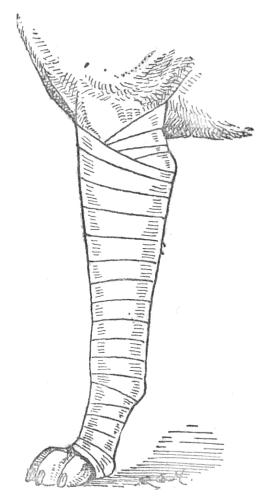
How to bandage the foreleg
for fractures and other injuries
Shoulder Joint, Dislocation of:
Symptoms: Lameness; pain at the seat of
injury, which is increased by putting leg
forward; and some slight swelling, and the leg
is perceptibly shortened. When there is any
difficulty in diagnosing the case, all doubt is
removed by making the dog stand evenly on
both fore legs and comparing the sound shoulder
with the injured one.
Treatment: In all cases I have seen of dislocation
of the shoulder joint the head of the
shoulder bone, which fits in a cup at the bottom
of the blade bone, shoots upwards—of course
only to a slight extent, as the bone is held in
its position by strong muscles and tendons as
well as by the capsule of the joint. Chloroform
having been given, an attendant must hold the
dog firmly by clasping his hands between the
fore legs in front of the chest, or by fixing
a towel in a similar position; and then the
operator, seizing the paw with one hand, must
pull the limb in a forward and downward
direction, and at the same time with the
fingers of the other hand press the head of
the shoulder bone into its position. It is well
afterwards to put a wide bandaging on round
the chest over the shoulder joint, and keep the
dog quiet for a few days.
Hock, Dislocation of:
This does not often occur except in conjunction
with fracture at this part.
Symptoms: The dislocation occurs generally
sideways, and may be either outwards or
inwards, the foot being placed almost at right
angles. The joint quickly swells, and is very
painful.
Treatment: The reduction is carried out in
a similar way as advised for reducing a dislocated
elbow; afterwards the same kind of
splints as recommended for treating fracture of
the tibia are to be applied with bandages, and
should be allowed to remain on for at least
three or four weeks, and even after this it may
be necessary to support the joint with a few
strips of plaister for a time.
Patella, Dislocation of:
Symptoms: The patella is a small bone
situated in front of
the stifle joint, and
is more liable to dislocation
than any
other part, especially
in small dogs. With
some dogs it is constantly
slipping out
of its place when
running along, and
then after a few steps
it goes back again of
its own accord. The
bone almost always
becomes displaced
towards the inside of
the leg, the dog in
some cases being unable
to put his foot
to the ground; if he
does attempt to put
any weight on the
leg, the stifle joint
bends outwards.
There is little or no
pain caused by this dislocation.
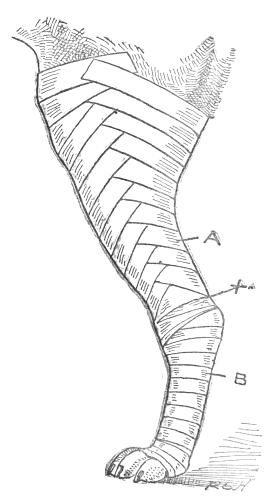
How to bandage the hind leg for
fractures and injuries to the stifle,
&c.
A—Sticking-plaister Bandage
B—Linen Roller Bandage
Treatment: The patella is easily returned to
its place, but as often as not it slips out again.
The best way of reducing this dislocation is to
straighten the leg and draw the foot towards
the elbow of the same side, and then with the
fingers of the other hand push the patella into
its place; afterwards, to keep it there, bind the
joint with several layers of Mead’s plaister as
depicted in the illustration. The plaister should
be continued for some distance above the joint.
The first symptom of distemper is
a rise of temperature—if a dog is dull and off his
food, take the temperature. It is best to take it
in the rectum, where the normal is 101 degs. to
101½ degs. F.; if taken under the arm or
inside of the thigh it is 1 deg. lower. If the
thermometer registers 2 or 3 degs. of temperature
above normal, you may be sure there is something
wrong, and the dog should be isolated
at once; and by doing this the infection may
often be prevented spreading. If the disease is
distemper, other symptoms will soon develop,
as a husky cough, loss of appetite and condition,
and occasionally vomiting. The eyes are weak
and sensitive to light, and there is often a little
gummy discharge which collects along the edges
of the lids; the breath is offensive, and the
teeth become furred. Diarrhœa may, or may
not, occur. If the illness is only some passing
ailment, the temperature will soon be normal,
and the dog assume his usual condition. But
the temperature, even in distemper, after two
or three days, may go down to normal; but
do not be deceived by this, and think the dog
is all right, but look out for some of the other
symptoms mentioned, and if the dog is in for
that disease they are sure to appear, and the
fever will return again in a couple of days
or so.
People often think a dog cannot have distemper
unless there is a discharge from the nose; this is
a mistake, but it certainly does occur in most
cases, though it does not appear as a rule until
the dog has been ill for some time. If the lungs
become affected, the breathing is short and
quick, not panting with the mouth open; the
chest is tender on pressure. At first there is
no cough, but after two or three days there is
a suppressed painful cough, with retching. The
pulse is often much accelerated, the beats varying
from 110 to 140 per minute. In some cases the
pulse is very slow, and may only be 48 to the
minute; of course, this refers to a big dog.
A pulse of this kind is worse than a fast one
with pneumonia. When it is between 60 and
70 in a small dog, it is also serious with lung
complications. The heart’s action in dogs is
very frequently intermittent even in health.
The eyes during distemper are often a source
of anxiety, and in those dogs with prominent
orbits, as spaniels, pugs, etc., there is always
an inclination for ulcers to form, which are
extremely painful.
The worst complications of all in distempers
are those affecting the nervous system; the
brain and its membranes may become inflamed,
and fits follow, or the spinal cord and its
membranes attacked, and paralysis or chorea,
or perhaps both, occur. These complications
of the nervous system may often be prevented
by not letting the dog out too soon after distemper.
The temperature should be regularly
taken, and the patient not allowed to go out
of doors or be excited in any way until the
temperature has been normal at least ten days.
Sometimes suddenly changing the diet from
liquid to solid food will induce fits.
Occasionally in distemper a crop of pustules
appears on the inside of the legs and over the
stomach—in fact, in some cases all over the
body. This is rather a good sign than otherwise,
for they seem to relieve the system of
the distemper poison.
To treat distemper successfully, good nursing
and dry, warm, comfortable quarters for the
patient are the two essential things. For outdoor
dogs, a loose box in a stable makes a
capital place, and in cold weather the temperature
should be kept as near 55 deg. F. as possible.
Dogs who are in the habit of living indoors
should be put in a well-ventilated room, and
the temperature kept up between 60 and
65 deg. F. It is a good plan to cover the
floor with sawdust, which should be changed
at least once a day, and oftener when necessary.
The dog should not be let out of the
box or warm room for anything. Very often
at first there are difficulties with very clean
dogs, but it can generally be overcome with
perseverance. Sometimes a little soiled straw
from a kennel thrown down in the room is
useful. Some dogs may be taught to use a
tray or box filled with sawdust or mould.
Directly a dog shows signs of distemper he
should be sewn up in a flannel coat to keep
the chest warm.
As to diet, if it is only a slight case, a light
meal of bread or crushed biscuit with gravy
or milk may be given three or four times a day.
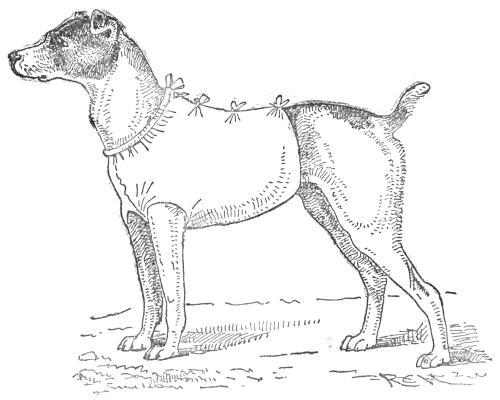
A coat covering the chest; useful in cases of distemper to keep
the chest warm, especially when lung affected
For a change, a little well-boiled fish with
rice, or sheep’s head broth and rice, or bread.
Milk may be given freely to drink.
In all cases of distemper it is important to
keep the eyes free of discharge by cleaning or
bathing them frequently with some warm boracic
lotion, made by dissolving half a teaspoonful of
boracic acid in half a pint of warm water.
When the discharge is very free and continues,
in addition to keeping them clean with this
lotion a little of the following may be run on
to the eyes, especially on the inside of the
lower lid:—
The Lotion for Eye:
| Chinosol, |
3 grains. |
| Water to |
6 ounces. |
To be applied three times a day after cleansing
with the boracic.
In severe cases where the discharge is very
profuse and offensive, a little powdered iodoform
may be dusted over the front of the eye two
or three times a day. If ulcers form they are
to be treated the same way: and if the eyes
are very painful, add to every half-pint of
boracic lotion four grains of hydrochlorate of
cocaine.
As the dog recovers from distemper, and the
discharge ceases, if there is any opacity of the
corners left, the following ointment should be
used:—
The Ointment for Eyes:
| Yellow Oxide of Mercury, |
1 grain. |
| Vaseline, |
1 drachm. |
| Mix. |
A small piece should be placed between the
lids, and then gently rub the upper eyelid
over the eye for one minute so as to work
the ointment in. Repeat twice a day. In
some cases the opacity is very obstinate, and
cannot be removed by the ointment, then the
following drops may be tried:—
| Divine Stone, |
2 grains. |
| Solution Sulphate Atropine, |
12 maximum. |
| Distilled Water to |
½ ounce. |
One or two drops to be placed in the eye
twice a day.
The dog should be held for a few minutes
after this lotion has been applied or he may
rub the eye.
After distemper, eczema often follows as the
result of weakness; tonics should be given and
the disease treated in the ordinary way.
Some dogs during distemper, especially in
bad cases, discharge a thin, purulent, offensive
matter or pus from the skin around the mouth,
head, under the neck, and inside of ears. This
condition, which is more often seen in bloodhounds
than other dogs, is a very bad sign.
The parts should be thoroughly cleansed
once a day by being washed with Pearson’s
Antiseptic diluted eighty times with warm
water, carefully dried with soft cloths, and
then freely dusted with some absorbent powder,
as anylyform, or with the following:—
| Powdered Burnt Alum, |
1 ounce. |
| Powdered Boracic Acid, |
1 ounce. |
| Powdered Starch, |
6 ounces. |
| Mixed together. |
Tonics, especially quinine, are indicated during this
condition, as the discharge is very weakening.
When the appetite is very bad, the patient
may be tempted with some giblet soup or a
little well-stewed rabbit and bread, or rice.
Very often, in bad cases, the dog absolutely
refuses all food; he must then be drenched
with strong meat tea, or with milk thickened
with Benger’s food. When there is an inclination
to diarrhœa, the beef tea and milk should
be thickened with cornflour or arrowroot.
One of the best ways of making meat tea is
with beef, mutton, and veal, say half a pound
of each cut up very fine; this should be gently
simmered with a pint of water for three or four
hours, and then strained off. Of this, from a
tablespoonful[1] to a small teacupful may be given
every three or four hours alternately with the
milk food. In addition to this, if the dog will
drink raw beef tea, which they will often do,
it may be given freely. This is best made as
follows: Half a pound of lean raw meat passed
through a sausage machine; to this add half a
pint of water, and place in an earthenware jar
in front of a fire for two or three hours, stirring
occasionally; then strain off through a cloth.
Some pressure is required to get all the juice
out of the meat. It requires to be made fresh
every day. When the patient is very weak and
exhausted, feeding is necessary every hour or
two, as only very small quantities of food can
be retained. Then strong meat extracts are
required. Plasmon may also be tried mixed
with milk, and Valentine’s meat juice with milk.
Of this latter from fifteen[1] drops to a teaspoonful,
with one[1] to four teaspoonfuls of milk. Invalid
Bovril may be given instead of Valentine’s for a
change in the same proportions, but fresh meat
juice from raw meat is as strong as anything. As
to stimulants, there is no doubt, when the dog is
very low and the pulse weak, from ten[1] drops to
a teaspoonful of brandy does good. When the
dog is eating all right himself, it may be given
in a little water after food, but when one is
drenching the food it should be mixed with it.
There is no doubt that dogs who continue
with a good appetite through distemper do
much better, and have a better chance of
recovering, no matter how severe the attack
may be, than those bad feeders who refuse food
and have to be drenched. A little food taken
voluntarily does much more good than a lot
forced upon the dog; therefore I advise
tempting the patient with a variety of diet, so
as to get him to eat something himself—of
course, given in small quantities, particularly
when the case is bad. I always commence with
soup and milk alternately, mixed with bread,
biscuits, or rice; as the dog gets tired of these,
I add a little meat, say from a sheep’s head or
stewed neck of mutton; for a change some fish,
boiled tripe, or stewed rabbit, and if the dog
goes off these I try scraped raw meat. I never
commence forcing food if I can help it, for I
find, once this is started, there is always a
difficulty in getting the dog to eat anything
himself.
As to medicine, the more experience one gets
the more one finds this is quite secondary in
treating distemper. I do not believe in specifics,
and, do what one may, the disease under the
best circumstances will run a certain course. In
simple cases, where the temperature is not very
high, an occasional mild dose of syrup of buckthorn
and castor oil is often all that is required.
This is necessary, as the dog cannot go out and
take exercise; therefore the bowels often get
constipated, and if this is neglected troublesome
diarrhœa may occur. After the temperature is
normal and remains so for a few days, and the
dog does not feed well, then some tonic is useful,
as the following:—
Recipe: The Pills:
| Salicylate of Quinine, |
12 grains. |
| Extract of Gentian, |
30 ” |
| Mix, and divide into 24 pills. |
Dose: From half to two pills[1] to be given
three times a day.
Quinine does not suit all dogs, for in some
cases, instead of improving the appetite, for
which it is given, it has the opposite effect,
when the following mixture may be tried
instead:—
Recipe: The Mixture:
| Tincture Nux Vomica, |
40 minims. |
| Diluted Nitro-hydrochloric Acid, |
1 drachm. |
| Compound Tincture Gentian, |
5 drachms. |
| Simple Syrup, |
1 ounce. |
| Water to |
6 ounces. |
Dose: From one teaspoonful to a tablespoonful
three times a day.[1]
It is not necessary to take notice of a relaxed
condition of the bowels so long as the motions
are not very frequent, but diarrhœa (frequent
watery motions) must not be allowed to go on.
As a rule, a small dose of castor oil—say from
one teaspoonful[1] to a tablespoonful—will usually
stop it by removing the cause. If it continues
after the oil has acted, give, shaken dry on the
tongue, from 3[1] to 15 grains of salicylate of
bismuth three or four times, or oftener, a day.
Thicken the food with cooked arrowroot, and
give boiled rice with soup and meat if the
latter is being given.
If bismuth does not stop the diarrhœa, try the
pills as per prescription below:—
Recipe: The Pills for Diarrhœa:
| Powdered Extract of Kino, |
1 drachm. |
| Powdered Ipecacuanha, |
8 grains. |
| Powdered Opium, |
6 ” |
| Mix, and divide into 12 pills. |
Dose: From half to two pills to be given three
or four times a day.[1]
In complications affecting the lungs, as soon
as they are noticed the chest should be sewn
up in gamgee wool covered over with flannel.
I have no faith in ordinary liniments; and
poultices, unless they are applied by a professional
hand, often do more harm than good.
In very acute cases the hair may be closely cut
off over a small patch on each side of the chest,
and strong liniment of iodine applied with a
camel’s-hair brush. This may be repeated in
four hours, and again four hours later, if the
application has not made the skin inflamed and
swollen. Of course, the size of the patch must
vary according to the size of the dog—from a
five-shilling piece to the palm of the hand.
No very special medicine is required unless
the heart is affected, which is often the case,
when the following mixture is useful:—
Recipe: The Mixture:
| Tincture Digitalis, |
1 drachm. |
| Tincture Nux Vomica, |
1 drachm. |
| Concentrated Solution of Acetate of Ammonia, |
2 drachms. |
| Water to |
6 ounces. |
From one[1] to four teaspoonfuls to be given
every four or six hours, according to the
severity of the symptoms. If the fever is very
high, from two[1] to ten grains of bicarbonate of
potash may be added to each dose. Some
brandy may also be given with advantage, from
ten[1] drops to a dessertspoonful every two or
three hours, given as previously recommended.
When the nervous system becomes affected
during distemper, or just afterwards, it is always
a serious matter; in fact, when the brain is
attacked and fits are the result, the case is practically
hopeless, and if the fits are very severe
and frequent it is better to destroy the dog at
once, rather than waste time and money in continuing
the treatment. When the disease attacks
the spinal cord, St. Vitus’s dance (chorea)
generally follows. This is also practically an
incurable disease, and in severe cases it is best
to put the dog out of its misery, for if it lives it
will always be a hopeless cripple. Slight cases
improve with time and judicious treatment, but
the twitching never entirely disappears, though
the dog may recover sufficiently to be shown, and
also to be bred from. The disease is not hereditary,
though I have sometimes thought that
puppies of parents suffering from chorea are more
disposed to the disease than others. Again, as
the result of distemper, the patient may become
paralysed to a more or less extent in different
parts of the body or limbs—generally the back
legs, though occasionally the fore ones are affected,
and sometimes all four legs become useless. I
have seen some cases when only the tail has been
affected, the dog not being able to move it in
the least. In other instances the eyes are the
seat of the mischief, and amaurosis is the result.
Unfortunately, treatment is quite useless in this
latter case; in fact, I never saw a dog recover.
The blindness may not be complete at first, but
this paralysis of the eyes is a progressive disease
which no treatment seems able to stop. I may
here mention in amaurosis that the eye remains
clear and bright, and to the casual observer there
is nothing to be seen except a widely dilated blue
pupil, which ordinary light does not cause to
contract, though exposure to the strong rays of
the sun will do so slowly. If the owner of a
patient thus affected is anxious to try some
treatment, then I suggest the following:—
Recipe: The Lotion:
| Sulphate of Eserine, |
1 grain. |
| Distilled Water to |
1 ounce. |
One drop to be placed into each eye three
times a day.
For medicine, give nux vomica as the
following:—
Recipe: The Mixture:
| Tincture Nux Vomica, |
1 drachm. |
| Water to |
6 ounces. |
Doses: From one[1] teaspoonful to a tablespoonful
three times a day after food.
Later, the following mixture may be tried:—
Recipe: The Mixture:
| Iodide of Potassium, |
36 grains. |
| Water to |
6 ounces. |
Doses: From one[1] teaspoonful to a tablespoonful
three times a day.
A seton may also be placed in the back of
the neck just behind the ears, and galvanism
may also be tried.
As to the treatment of distemper fits, if they
are noticed at the commencement, before they
have become severe, something may be done.
Large and frequent doses of bromide of strontia
should be administered, from 3 to 15 grains,[1] in
from a teaspoonful[1] to a tablespoonful of water
every three or four hours at first, or so long as there
are any fits; when they cease, give the medicine
less often—say, every six hours, or four times a
day. After a few days, three times a day will
be often enough for the medicine, and later twice
a day. If there is no diarrhœa, give aperient
medicine, and feed on a very light and sloppy
food, as bread, with soup or milk, Benger’s food,
egg and milk, etc. Keep the dog absolutely
quiet, and in the dark as much as possible.
When the bromide in large doses is continued
for some time, one often notices weakness or
partial paralysis of the limbs; this passes off
when the medicine is discontinued.
As to the treatment of chorea, I know of no
specific; in fact, medicine has little or no effect
over this disease at all. Strong doses of medicine
like nux vomica or Easton’s syrup do more harm
than good during the early stages, whereas later
small doses of these drugs are beneficial. Directly
the twitching is noticed the bromide of strontia
should be given, from two[1] to ten grains three
times a day. In the course of a week, if the
twitching does not increase, some arsenic may be
added to the bromide, as from one[1] to five drops
of Fowler’s solution to each dose. Later, in
about a month or so, when all inflammatory
symptoms have passed, the eyes clear, and the
temperature has been normal for some time,
some nerve tonic is useful, but it must be given
with caution, or the twitching will increase.
Easton’s syrup is as good as anything—for very
small dogs like Japanese spaniels five drops
three times a day in a teaspoonful of water is
enough; after a week, six drops may be given;
and a week later, seven drops for a dose. The
dose for toy spaniels weighing about eight
pounds is eight drops; full-sized fox terriers, ten
drops; collies, etc., fifteen drops; St. Bernards,
etc., twenty drops. In each case the dose may
be gradually increased. If the dog is in very
poor condition, petroleum emulsion may be given
with the Easton’s syrup instead of water. In
any case, it is a matter of months before any
improvement is noticed. In ordinary paralysis
as the result of the distemper, when there is an
absence of twitching, bromide in any form does
more harm than good. In these cases some
preparation of nux vomica is required, and the
following pills I have found useful:—
Recipe: Compound Nux Vomica Pills:
| Powdered Nux Vomica, |
2 to 8 grains.[1] |
| Ergotine, |
5 to 18 grains. |
| Reduced Iron, |
12 to 60 grains. |
| Ex. cip. q.s. Mix. |
Divide into twelve pills, one to be given
three times a day.
If there is no improvement after a short time,
a blister applied to both sides of the neck in
cases of paralysis of the forelegs is often useful,
and in chronic cases of paralysis of the back
legs a blister should be applied to the loins.
The blister may be repeated in a fortnight, if
necessary.
Galvanism is also useful in cases when of long
standing.
The bowels should be kept open with mild
aperients, and vermifuge medicine given if there
are any signs of worms. Dogs suffering from
paralysis, the result of distemper, generally
recover with time and care.
Puppies should be docked when
three or four days old, and the operation should
be done with a pair of sharp scissors. The skin
should be drawn well forward before severing
the tail, then afterwards it slips back and well
overlaps the bone. There is, as a rule, little
or no bleeding; at any rate, not sufficient to
be of any importance. Should there be, it
can easily be stopped by the application of a
little tincture of perchloride of iron, or of
Friar’s balsam. It is well after docking a
puppy to keep the mother away for half an
hour or so.
Different breeds of dogs have their tails
docked at different lengths. The fox terrier
should have three-fifths of his tail left. Irish
and Airedale terriers rather less than half.
Spaniels, about two-fifths of the tail should
be left, and griffons about a third.
In consequence of the difference in
the sizes of dogs, it is always difficult when
giving a general prescription suitable for dogs
of all breeds to make the doses quite clear
for dogs of different sizes. However, to make
it as clear as possible, I have divided dogs
into eight different sizes, as for instance,
griffons and others, 4 or 5 pounds weight. I
call No. 1 size, spaniels, pugs, etc., weighing
10 or 12 pounds. No. 2 size, fox terriers,
Irish terriers, etc., weighing from 18 to 25
pounds. No. 3 size, bull dogs, field spaniels,
etc., weighing about 40 pounds. No. 4 size,
collies, retrievers, greyhounds, etc. No. 5 size,
bloodhounds, etc., and other dogs weighing
about 80 pounds. No. 6 size, great Danes,
etc., weighing about 120 pounds. No. 7 size,
bigger dogs, like St. Bernards. No. 8
size, mastiffs, etc. Therefore, if the dose
advised is from half a teaspoonful to a tablespoonful,
it is intended for No. 1 size, half
a teaspoonful; No. 2, a teaspoonful; No.
3, a teaspoonful and a half; No. 4, two
teaspoonfuls; No. 5, two teaspoonfuls and a
half; No. 6, three teaspoonfuls; No. 7,
three teaspoonfuls and a half; and No. 8,
four teaspoonfuls or a tablespoonful. When
pills or powders are prescribed, they are to
be divided in the same way.
People who are not in the habit of
administering medicine to dogs often have a
difficulty in giving it. Liquid is best given
out of a bottle. The person about to give it
should stand on the right hand side of the
dog, place the left hand around the muzzle,
then slightly raise the head, and place the neck
of the bottle inside the cheek, and pour a
small quantity of the fluid at a time into the
pouch formed by the cheek. If the muzzle is
held tightly with the left hand, there is no
danger of the dog biting the bottle. If the
reader is afraid to use a bottle, the fluid may
be given with a spoon, but then a second
person is required to hold the dog’s head, and
with the finger pull out the side of the cheek
so as to form a pouch in which the medicine
should be poured. This is by far a better
plan than forcing the dog’s mouth open, and
pouring the fluid right on his tongue.
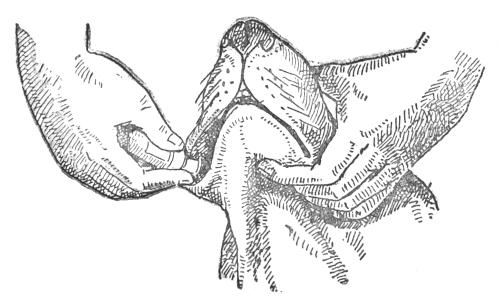
How to give fluid medicine or liquid nourishment to a dog
To give a pill, stand on the right hand side
of the dog’s head, with the left hand placed
over the muzzle, forcing the dog’s mouth open
by pressing the cheek between the teeth, then
he cannot bite you. Slightly raise the head,
and drop the pill into the back of the mouth,
and then with the forefinger of the right hand
just push it into the throat. Close the mouth
quickly, and the dog will swallow it.
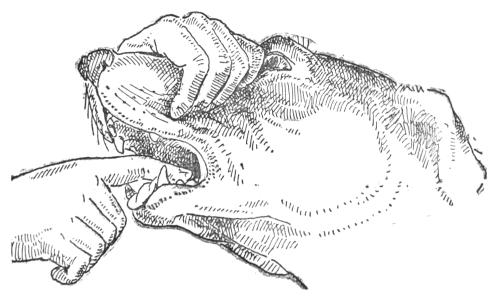
Giving a pill
Symptoms: In dropsy, the result of heart
or kidney disease, the limbs often become
swollen, as well as the abdomen becoming
enlarged and pendulous. The fluid may
be detected for certain in the abdomen by
placing a hand on one side of the stomach,
and then gently tapping the other side of the
abdomen, and if fluid is present, an undulating
motion will be felt like striking a bladder full
of water. In dropsy, no matter from what
cause, the dog becomes thin about the neck
and chest, and the muscles of the limbs waste.
As the fluid increases, the size of the abdomen
increases; the breathing becomes distressed,
and the dog walks with difficulty. In many
cases, when relief is not obtained, the dropsy
extends to the chest, which of course increases
the difficulty of breathing.
Many cases of ascites are due to diseased
liver, which may become much enlarged, but
the condition of the liver may simply be due
to defective circulation.
Treatment: Unless the patient is very old,
relief may generally be given with the following
mixture, continued for some time:—
Recipe: The Mixture:
| Acetate Potash, |
3 drachms. |
| Tr. Digitalis, |
1 drachm. |
| Tr. Nux Vomica, |
½ drachm. |
| Spirits of Nitre, |
2 drachms. |
| Water to |
6 ounces. |
Doses: From one teaspoonful to two tablespoonfuls[1]
three times a day. Also give three
times a day in water, after food, from fifteen
drops[1] to two teaspoonfuls of Hollands gin. Once
or twice a week a dose of purgative medicine
should be given, as from three to fifteen grains[1]
of jalapine. When the liver is affected, give
from two[1] to eight grains of grey powder once
or twice a week, instead of the jalapine. In
severe cases of dropsy tapping is necessary,
but as a rule, in ascites it only gives temporary
relief.
Symptoms: Frequent liquid motions, consisting
principally of mucus and blood, accompanied by
severe straining. The abdomen is very tender,
there is often vomiting and great thirst.
Treatment: Give at once a dose of castor
oil and laudanum, from half to a tablespoonful[1]
of oil mixed with from three[1] to fifteen drops
of the latter. About six hours afterwards,
commence to give carbonate bismuth from five
to twenty grains[1] every three or four hours, also
two or three times a day give an enema of thick
boiled starch (from one[1] to four teaspoonfuls),
mixed with from three[1] to twenty drops of
laudanum. The enema should be just warm,
given very slowly, and the dog should be kept
quiet for a short time afterwards, to prevent his
ejecting it.
The following mixture may be tried, if the
symptoms continue in spite of the bismuth:—
Recipe:
| Chlorodyne, |
2 drachms. |
| Prepared Chalk, |
4 drachms. |
| Tr. Catechu, |
4 drachms. |
| Sol. Gum Acacia, |
4 drachms. |
| Water to |
6 ounces. |
Doses: From one teaspoonful to a tablespoonful[1]
every three or four hours.
Diet: Feed on milk thickened with arrowroot
(boiled), also give white of egg beaten up with
water to drink, or barley water; no solid food
should be given whilst there are any signs of
blood with motions.
Symptoms: Distention and discomfort after
food, which is not eaten with usual relish.
Action of bowels variable, sometimes constipated,
at other times loose; occasionally
vomiting after food. Tongue, instead of
being of a nice pink colour, is brick-red.
Dog drinks more than usual. There is loss
of spirits and condition, and a disinclination
to exercise.
Treatment: First give a purge as from 2 to
10 grains[1] of jalapine. Repeat dose in a week;
also give following mixture:—
Recipe:
| Bicarbonate of Soda, |
2 drachms. |
| Tr. Rhubarb, |
3 ” |
| Tr. Gentian, |
4 ” |
| Tr. Nux Vomica, |
1 drachm. |
| Liquor Bismuth, |
1 ounce. |
| Water to |
6 ounces. |
Doses: One teaspoonful to one tablespoonful[1]
three time a day half an hour before food.
After food give from one to 5 grains[1] of
ingluvin after each meal.
Dogs suffering from dyspepsia should be
treated for worms.
Diet: In bad cases, for a few days give milk
with Benger’s food, also milk mixed with equal
parts Vichy water to drink; later feed entirely
on lean raw meat for a time, given three times
a day; if it is refused quite raw, try it lightly
grilled. Well-boiled tripe, or sheep’s brains boiled
in milk, may also be offered.
Symptoms: Frequent passing of water, which
is generally of a clear water colour, the dog at
times passing it unconsciously whilst standing.
In some cases the urine may be cloudy or even
tinged with blood, when there is a stone in the
bladder or kidney.
Treatment: When due to simple irritation of
the kidneys or bladder, and there is an absence of
stone, small doses of opium should be given, from
an eighth to a grain[1] three times a day. When
the symptoms are the result of calculus, the cause
must be removed by operation. In dysuria the
supply of water should be limited, or barley water
or skimmed milk given instead of plain water.
Symptoms: Shaking of the head, which is
often held on one side; pain on pressure.
There is generally an absence of discharge as
in canker of the ear.
Treatment: Steaming the ear with hot poppy-head
tea gives relief, or a few drops of laudanum
may be poured into the ear. The application of
a hot salt bag is relieving.
Symptoms: Dogs of all kinds, especially those
with long ears, are subject to this disease. The
dog shakes and scratches his ear; the parts
are inflamed; he often holds the head on one
side, and in most cases there is a thick brownish
discharge. In many cases it assumes the form
of eczema, and dogs subject to this disease
more often have attacks in the spring and
autumn than at any other time.
Treatment: The following lotion should be
applied two or three times a day with a camel’s-hair
brush to all the red parts, and also down
into the ear as far as it will go. After a day
or two the ear should be cleaned out with
some medicated wool twisted around the point
of a bodkin or anything of that kind.
Recipe:
| Oxide of Zinc Ointment, |
2 drachms. |
| Almond Oil, |
1 ounce. |
| Well mix. |
In addition to using the lotion, give the
dog some cooling medicine, as from 3 grains[1]
to one scruple of sulphate of magnesia, and
half the quantity of bicarbonate of potash,
twice a day with the food. The lotion and
medicine should be continued as long as the
dog shows any irritation of the ear.
In neglected cases of canker, ulcers form low
down in the ear, causing a mattery, offensive
discharge. In these cases different treatment
is required. The ear should be syringed
night and morning with a tablespoonful of
methylated spirits added to half a tumbler of
tepid water, and then after letting the dog
shake his head, the ear should be thoroughly
dried with some medicated wool twisted around
a bodkin, and then be filled with some finely
powdered boracic acid. This is best done by
the means of a quill attached to an indiarubber
tube, the quill being filled up by being
dipped into the powder, and then inserted into
the ear, and deposited there by means of
blowing through the tube.
Some of these cases are difficult to cure, but
with perseverance they get all right in time.
There is another form of canker due to an
insect, which I call psoroptes auricularis canis.
This is a very minute insect, which collects in
large numbers in the canal of the ear, causing
the dog to shake his head frequently, and
scratch the ear. The canal of the ear looks
as if it were full of dry grey powder, but if
looked at carefully it will be noticed to be full
of very small insects, the size of tiny cheese
mites, and they will be seen running about as
they are very active. This form of canker is
contagious.
Treatment: Syringe the ear thoroughly
with a teaspoonful of Pearson’s fluid added to
six ounces of tepid water, then carefully dry,
and anoint with the following ointment.
The syringing should be repeated about
twice a week, and the ointment applied night
and morning for a time.
Recipe: The Ointment:
| Salicylic Acid, |
10 grains. |
| Vaseline, |
1½ drachms. |
| Carefully mix. Apply with camel’s-hair brush. |
As it is very difficult to destroy the eggs of
these parasites, it is advisable, even after the
irritation has ceased, to continue the ointment
two or three times a week for some time, so as
to destroy the parasites as they hatch.
Symptoms: Dogs with long ears are more
subject to this complaint than others. It is
generally caused by a bruise of some kind. A
swelling forms on the inside of the flap of the
ear, often extending all over the surface. It is
very painful, and the dog will hold the head on
one side, and cry out when touched.
Treatment: Often, if attended to immediately
after it occurs, the swelling may be dispersed
by hot poppy-head fomentations, made by boiling
a couple of crushed poppy-heads in a quart of
water for ten minutes, and then straining. If
the swelling does not disappear in a couple of
days, it should be freely opened on the inside
at the lowest part—that is towards the point of
the flap. The wound must be kept open by
being plugged by a piece of lint, or inserting a
small tube, which should be fixed in with a
stitch. The wound must be kept open for some
days, or else the fluid will collect again.
It is advisable in these cases to make the dog
wear a cap as depicted in the illustration, and
if the inside of the ear sweats at all, dust it
freely with powdered boracic acid three or
four times a day.
Symptoms: Cartilaginous growths occasionally
form in the canal of the ear, quite blocking up
the passage. They cause great pain. The dog
holds his head on one side, and is constantly
scratching his ear, and crying.
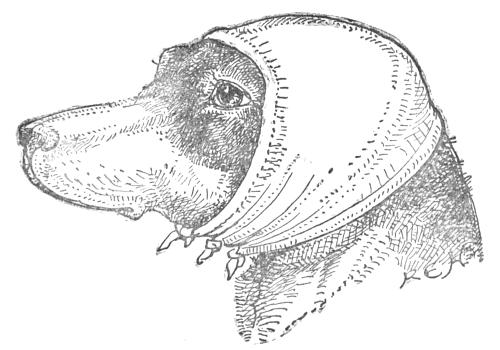
A cap to keep the ears at rest when required. It should not be
put on in cases of canker.
Treatment: The only treatment is to remove
the growths by operation, which should be done
as follows: Chloroform having been given, the
growth should be cut out as low down as possible
with the points of probe-pointed scissors. Then
the roots should be thoroughly scraped with a
curette, and afterwards thoroughly cauterised
with the thermocautery. The dog suffers a good
deal of pain for some days after the operation,
but it may be relieved by pouring a few drops
of the following lotion, which should be slightly
warmed, into the ear three or four times a
day.
Recipe: The Lotion:
| Laudanum, |
1 drachm. |
| Carbolic Acid, |
20 drops. |
| Almond Oil, |
1 ounce. |
| Carefully mix. |
Symptoms: This is a small pear-shaped growth
with the pedunculated root attached in the canal
of the ear.
Treatment: This growth is best removed
by torsion, as follows: Seize the growth with
a pair of forceps, and twist it round and
until it comes off. No further treatment is
required, except keeping the ear clean for a
few days with some boracic acid lotion.
Symptoms: Very often dogs, especially those
kept in kennels, suffer from a very scaly or scurfy
condition of the edges of the flaps of the ears,
which causes the hair to fall off, and the dog to
shake his head frequently.
Treatment: Apply a little of the following
dressing to the parts once or twice a day. This
will remove the scurfiness, and stimulate the
growth of the hair. Once a week wash
the ears thoroughly with Cook’s 3% mercurial
soap.
Recipe: The Dressing:
| Resorcin, |
1 scruple. |
| Cyllin, |
15 minims. |
| Almond Oil, |
1 ounce. |
| Mix. |
Symptoms: A skin disease, characterised by
the formation of a number of small pustules,
which the dog generally breaks by licking or
scratching, and a running sore is produced.
Treatment: The part should be cleaned with a
weak solution of Pearson’s disinfectant fluid, or
with a teaspoonful boracic acid in half a pint of
water, then gently dried with a soft cloth, and the
following lotion applied and repeated often:—
Recipe:
| Prepared Chalk, |
2 ounces. |
| Wright’s Solution Coal Tar, |
½ ounce. |
| Lime Water to |
8 ounces. |
| Well shake before using. |
Treat dog for worms, and give following pills:—
Recipe:
| Arsenious Acid, |
½ grain. |
| Reduced Iron, |
40 grains. |
| Sulphate Quinine, |
12 grains. |
| Extract Gentian, q.s. |
| Mix. |
Divide into 12, 24, 36, or 48 pills.[1] One to be
given twice a day, after food.
Dog suffering from Ecthyma should be given
some meat every day mixed with other food.
A non-contagious skin disease.
Symptoms: Skin irritable; dog frequently
scratching, also licking and biting himself.
Clusters of fine vesicles appear at different
parts; the skin afterwards becomes dry and
scaly, unless the dog by constantly licking
himself makes the parts sore and raw. Parts
principally attacked around eyes, the lips,
outside and inside of ears, along top of
back, root of tail; but any part may become
affected.
Treatment: Bathe affected parts often with
following lotion:—
Recipe:
| Wright’s Solution Coal Tar, |
1 ounce. |
| Goulard’s Extract of Lead, |
1 drachm. |
| Glycerine Boracis, |
1 ounce. |
| Distilled or Rain Water to |
8 ounces. |
| Mix. |
Or, apply following ointment twice a day:—
Recipe:
| Resorcin, |
1 scruple. |
| Cieolin, |
20 minims. |
| Almond Oil, |
1 drachm. |
| Lanoline, |
1 ounce. |
| Mix. |
Apply night and morning.
When skin very sore and raw, dust the
affected places often with following powder:—
| Best Powdered Starch, |
4 parts. |
| Boracic Acid Powder, |
1 part. |
| Mix. |
When the eczema is general—that is, more
or less all over the dog—give every four days
a bath in Pearson’s disinfectant fluid diluted
eighty times with tepid water; that is, four
tablespoonfuls to a gallon of water.
Internal Remedies.—Treat for worms, and
give the following powders:—
| Reduced Iron, |
6 grains to 36 grains.[1] |
| Sulphate Magnesia, |
½ drachm to ½ ounce. |
| Mix. |
Divide into 12 powders—one to be given
twice a day with food.
When the dog is in poor condition, or when
the skin is very dry and scurfy, try the following
pills after the powders have been given for a
time:—
Recipe:
| Arsenious Acid |
⅛ grain to ½ grain.[1] |
| Reduced Iron, |
6 grains to 36 grains. |
| Ext. Gentian, q.s. |
| Mix. |
Make 12 pills—one to be given twice a day.
Symptoms: The point of the elbow is hard,
swollen, and tender, causing the dog to go
lame, or at any rate rather stiff. It is generally
the result of an injury.
Treatment: At first try hot fomentations,
which continue three or four times daily for
some days; then apply the following lotion,
dabbed on frequently:—
Recipe:
| Goulard’s Extract of Lead, |
1 drachm. |
| Laudanum, |
1 ” |
| Spirits of Wine, |
4 drachms. |
| Water to |
8 ounces. |
Later, if the swelling continues, rub gently into
the swollen part a little colourless tincture of
iodine or iodine vasogen once a day. It is
essential in these cases to keep a good soft bed
under the dog.
Symptoms: Loss of condition and spirits,
paleness of the mouth and conjunctivæ
membrane.
Treatment: First give medicine to remove
worms; also cod-liver oil, from half a teaspoonful[1]
to a tablespoonful two or three times
a day after food, and from one to eight grains[1]
saccharated iron two or three times a day.
Diet: Feed liberally, allowing plenty of
meat, mixed with Spratt’s malt and cod-liver
oil biscuits; also give plenty of milk to drink.
The most effectual one is hydrochlorate of
apomorphia; dose, from one-twentieth to one-sixth
of a grain[1] in a teaspoonful of water.
When given injected under the skin, it acts
almost instantaneously.
Tartar emetic, from a quarter[1] to one and a
half grains, shaken dry on the back of the
tongue. If vomiting should not be induced in
about ten minutes, a few spoonfuls of warm
water should be given.
Ipecacuanha wine, from half a teaspoonful to
a tablespoonful[1]; repeated in ten minutes if
vomiting not induced, and again ten minutes
later if necessary.
In cases of emergency, common salt may be
given, from sufficient to cover a sixpence to a
teaspoonful[1] in warm water.
This nuisance is, as a rule, more
troublesome amongst puppies than adult dogs,
for generally after they are a year old the bad
habit ceases.
Treatment: A course of bromide is sometimes
useful, but if the habit continues after the dog
is two years old castration is the only thing that
is of any use. This operation, which can be
done under chloroform, does not alter a dog’s
nature as much as many people think, and when
he is only required as a pet there is nothing to
be said against it.
Symptoms: The whole body may swell
through a small puncture in the skin, which
often cannot be found when a clog’s coat is
thick. The emphysema may be confined to the
body or to the head, or even to one or more
limbs. In bad cases the dog swells out of all
recognition. He is unable to move, or does
so with great difficulty; and when the head is
affected, the eyes are closed, the ears perhaps
an inch thick, and breathing is difficult. The
swelling is soft, pits on pressure, and at the
same time a crackling noise is made.
When affecting the lungs, the breathing is
heavy and laboured, and on auscultating the
chest a distinct loud, crackling noise is heard.
The heart is generally affected, its action, as
a rule, being very weak; and there is a
chronic, husky cough.
Treatment: In cases of general emphysema,
if the swelling is not large it may be left alone,
for it will gradually disperse of its own accord;
but when it is large, the original wound, if it can
be found, should be dilated, or one or more fresh
ones made, and the air which has accumulated
under the skin pressed out. The wound should
afterwards be cleaned with a solution of some
disinfectant like Pearson’s fluid or boracic acid,
dried, then covered over with some antiseptic
gauze, and a bandage or coat applied.
Stimulants, as brandy, should be administered.
Treatment of emphysema of the lung is not
very satisfactory, especially when the patient is
very old, which is generally the case; but some
relief may often be given by careful dieting. No
food to distend the stomach should be allowed,
as pressure on the chest from a distended stomach
always increases the difficulty in breathing, therefore
a concentrated food like meat should be
given, and it is best raw. It should be given
in small quantities three times a day.
Sedative medicine, unless the cough is very
troublesome, is best avoided, but some such
mixture as the following may be tried:—
Recipe:
| Tr. Digitalis, |
1 drachm. |
| Tr. Nux Vomica, |
1 drachm. |
| Ipecacuanha Wine, |
2 drachms. |
| Water to |
6 ounces. |
From half a teaspoonful to a tablespoonful[1]
three times a day one hour after food.
Inhalation of steam gives relief.
The bowels should be kept well opened by
occasional doses of aperient medicine.
Enemas are necessary in cases of
stoppage of the bowels; they are also very
useful to relieve constipation; and for dogs
that are very ill it is much better to give a
small enema rather than a dose of purgative
medicine, which often causes sickness, which
one particularly wants to avoid when the patient
is weak.
Just to cause an action of the bowels in cases
of constipation, only a small enema is required
as, say for a little dog like a griffon, half a
teaspoonful of glycerine mixed with a couple of
tablespoonfuls of warm water. For dogs the
size of fox terriers double the quantity may be
given. For collies, etc., four times the quantity;
and for dogs like a St Bernard half as much
again of both the glycerine and water. Instead
of glycerine, soapy water may be used.
In cases of real obstruction of the bowels,
give double the quantities as advised in cases
of simple constipation, and the enema should
be repeated in these cases three or four times
a day. Very often in cases of obstruction of
the bowels, it is a very good plan to give an
occasional enema consisting of warm oil, or even
from five grains to half a drachm[1] of ox gall
dissolved in hot water.
For little dogs a glass ear-syringe may be
used which can be bought to hold half an
ounce or an ounce. For bigger dogs one of
Higson’s enema syringes are the best. The
bone point, before inserting into the bowel,
should be well vaselined, and then it can be
safely passed into the rectum its whole length,
which is about two inches. Care should be
taken when giving enema not to pump a lot
of air into the bowel.
Another way of relieving constipation, when
one wishes to avoid giving medicine by the
mouth, is to pass a suppository made of glycerine
and gelatine into the rectum. These have their
advantage over enema, as they do not wet the
dog when the bowels operate, which is important
in cases of paralysis when dogs cannot stand
whilst passing a motion. Failing a glycerine
suppository, a piece of yellow soap cut the
shape of one answers the purpose.
Symptoms: Attack often commences with
vomiting. There is generally slight rise of
temperature and a quickened pulse, pain on
pressure of abdomen; there may be constipation
or diarrhœa, but in any case mucus is generally
passed with the motion. The dog seems ill,
lies about, and is disinclined to move. There
is loss of appetite, and the thirst is generally
excessive.
Chronic enteritis is a more common complaint;
there is no temperature as a rule, and the pulse
is quiet, though it generally becomes very weak
as the disease advances. The appetite is not
entirely gone, but is very bad, and what is taken
is often vomited, mixed with a quantity of frothy
mucus. When the food eaten is solid, and it is
not vomited, then it generally passes through
the patient in an undigested state with some
mucus. The motions are copious and frequent,
sometimes there is diarrhœa, at other times the
motions are formed and hard. There is pain
on pressure of the abdomen, and the coils of
intestines may easily be felt as the coats of
the bowels are generally much thickened—the
result of the chronic inflammation. The patient
becomes very anæmic and wasted, the breath
is foul, ulcers may form in the mouth, and the
tongue is of a rusty red colour.
Treatment: In the acute form a small dose
of castor oil mixed with from two to fifteen
drops of laudanum,[1] and repeated in two or three
days if necessary. If there is diarrhœa, give
from three[1] to fifteen grains of carbonate of
bismuth three or four times a day; also from
two to ten drops of chlorodyne[1] in water three
or four times a day; when there is much pain
hot linseed meal poultices may be applied to the
abdomen. The diet should consist principally
of milk—plain or with Benger’s food—a little
meat juice may be added. Later, scraped lean
raw meat may be given.
The treatment of chronic cases is tedious, a
cure is often difficult, and under the best circumstances
it takes many weeks of careful dieting
before improvement occurs.
The following powders to be given with or
after food:—
Recipe:
| Ingluvin, |
1 drachm. |
| Carbonate Bismuth, |
2 drachms. |
| Powdered Nux Vomica, |
6 grains. |
| Mix. |
Divide into 12, 24, or 48 powders[1]—one to
be given three times a day.
The diet should consist principally of unboiled
milk, given plain or with Benger’s food, or beaten
up with the white of an egg, and the quantity of
course must vary according to the size of the
dog, say from half[1] a pint to two quarts a day.
Later, when the motions seem normal and the
condition of the tongue improves, scraped lean
raw meat may be given in small quantities.
Symptoms: An attack generally occurs quite
suddenly; dog falls uttering perhaps a loud cry,
is violently convulsed, champs his jaws, and
froths at the mouth, and is unconscious. The
attack generally lasts about half a minute,
when the dog looks around him in a sort
of dazed condition, and then often bolts off,
not knowing where he is going to. Often
one attack is followed by more, so it is
important that the dog should be put in a
place of security as quickly as possible, a good
sized hamper is as good as anything. During
the convulsions of epilepsy or just after, the
patient unknowingly will bite his owner or anyone
else, but there is no danger from such a
bite.
Treatment: During the convulsions, it is best
to leave the dog alone, unless one attack is
being quickly succeeded by another, in which
case two[1] or three drops of nitrite of amyl held
to the nose, on a piece of blotting paper, lessens
the severity of the convulsions. Chloroform
similarly applied answers the same purpose.
Directly the patient is able to swallow, give
a dose of hydrated chloral and bromide of
potassium, from three[1] to twenty grains of
each, in from two teaspoonfuls[1] to two tablespoonfuls
of water. This may be repeated in
one, two, three, or four hours, according to
the necessity, and under any circumstance the
bromide alone should be given three or four times
a day for a week or so after the attack. When
a dog has had a succession of fits, a long course
of bromide of potassium will often effect a cure.
Diet: Should be light, and consist principally
of milk.
In all these cases, free purging does good.
Symptoms: When the blood comes from one
nostril, the trouble is generally local. When
from both nostrils, it is more likely to be due
to some lung mischief.
Treatment: If the hæmorrhage is not severe,
nothing is necessary except keeping the dog
quiet for a time, as it will soon discontinue.
However, should the bleeding persist, syringe
up the nostril a saturated solution of alum, or
a teaspoonful of tincture perchloride of iron,
mixed with a tablespoonful of water. In very
severe case, the local application of adrenalin
should be tried, and from half to two grains[1]
of ergotine, given subcutaneously, dissolved in
a few drops of brandy. This may be repeated
every three or four hours. In some cases it
is necessary to plug the nostrils with strips of
lint. When bleeding is severe, stimulants should
be freely given, and also scraped lean raw meat.
Uncommon in dogs, but occasionally
seen.
Symptoms: Temperature quickly rises, and may
go up to 106 or 107 degs. F., and even higher—dog
constantly shivering—total loss of appetite,
but as a rule thirst very great. Skin becomes
thick, tense, and shiny—at first red, and then
perhaps of a purple colour; blisters may form;
affected parts much swollen.
Treatment: Give from two to fifteen grains[1]
of chlorate potash every four hours; dust parts
with powdered boracic acid, mixed with three
parts of powdered starch.
Symptoms: Red and inflamed condition of
the skin, the redness temporarily disappearing
on pressure. Condition often noticed on inside
of flaps of ears, inside of thighs and arms. It
is accompanied sometimes by a good deal of
burning and irritation which makes the dog lick
and bite himself.
Treatment: Dust over with boracic powder
often, or bathe parts with thymol lotion. Treat
for worms and give sulphate of magnesia, from
five[1] grains to one scruple, and reduced iron, from
half[1] to four grains, twice a day with food.
Diet: Meat may be given with other food in
this case.
When the Erythema is spread more or less
all over the body, a bath every day or every
other day made as follows gives relief:—
Recipe: Borax, two tablespoonfuls; fine oatmeal,
eight tablespoonfuls; tepid water, three
gallons.
It is a good plan when the dog is wet to rub
the yolks of three or four eggs into the coat,
which cleanses it, besides removing the dandruff
from the skin.
Symptoms: The dog is very languid, and
perhaps unable to stand; breathes heavily,
pulse quick and weak. If very bad, the tongue
and membrane of the eye may be of a dark
blue colour, the result of defective circulation.
Treatment: Rest and stimulants, as from ten
drops to two teaspoonfuls[1] of brandy in a little
water, which repeat every half hour. When
dog very bad and unable to swallow, the brandy
may be injected under the skin. As the dog
comes round, Valentine’s meat juice or scraped
raw meat in small quantities may be given.
Symptoms: This is not an uncommon occurrence
with dogs with prominent eyes, such as
pugs, Japanese and Pekingese spaniels, as well
as King Charles spaniels, and other such dogs.
Generally it is caused by fighting, or from some
sudden blow just at the back of the side of
the eye.
Treatment: If attended to immediately the
eye is easily returned, especially if a little castor
oil be poured over the front of the eye, and then
with gentle pressure with the fingers it slips
back into its place, and the eyesight is uninjured;
but if left for some time, even for an
hour, the eye becomes distended, and then it is
impossible to return it without dilating the orifice.
This must be done by making a small slit at the
outer corner where the eyelids meet, say about
one eighth of an inch long, and then pour a few
drops of castor oil over the eye, and with pressure
return it. Afterwards carefully sew up the
incision made, and either put a couple of stitches
through the lids, so as to keep the eyelids closed,
or else put a piece of lint double thickness,
soaked in boracic lotion, over the eye, and
apply a bandage; but it is much safer to put
a couple of stitches through the lids, which may
be removed twenty-four hours later. The eye is
sure to be inflamed and very painful for a few
days, but this may be relieved by hot poppy-head
fomentation made by boiling a couple of
crushed poppy-heads in a quart of water for ten
minutes, and then straining through fine muslin.
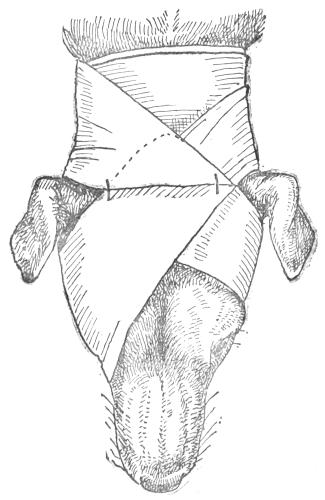
How to apply a bandage to cover one eye
After the eye has been out for an hour or
two, one cannot tell for some days whether the
sight has been destroyed or not. As a rule
it is.
Symptoms: A small red swelling appears in
the inner corner of one or both eyes. It is
particularly common in bull puppies, pugs, and
young bloodhounds.
Treatment: The only treatment consists in
excising the swelling in the following way: Paint
the little red body several times with a 6 per cent.
solution of hydrochlorate of cocaine, then after
waiting a few minutes the swelling should be
gently drawn out with forceps, or by passing a
thread through it with a needle, and then it
should be quickly snipped off with a pair of
curved scissors. The bleeding will stop of
itself in a few minutes, and no further treatment
is required.
Symptoms: The membrane of the eye is much
congested, and freely discharges white matter;
the skin around eye is swollen, inflamed, and
raw, which sometimes makes it difficult to see
the eye.
Treatment: Apply following lotion often:—
Recipe:
| Goulard’s Extract of Lead, |
½ drachm. |
| Hydrochlorate of Cocaine, |
6 grains. |
| Distilled Water to |
3 ounces. |
Apply frequently with a piece of absorbent
wool. When the skin is dry and inflammation
less, anoint the lids three or four times a day
with following ointment:—
Recipe:
| Hydrochlorate of Cocaine, |
3 grains. |
| Water, |
1 drachm. |
| Lanoline, |
2 drachms. |
| Almond Oil, |
1 drachm. |
| Mix. |
Give a dose of purgative medicine, also some
cooling medicine with food, as from three to
twenty grains[1] each of bicarbonate of potash
and sulphate of magnesia.
Dogs subject to asthma often have
a weak heart, and when the cough is severe
frequently fall down in a faint, but as a rule
it only lasts for a few moments, and the dog
soon seems all right.
Symptoms: When due to loss of blood, the
dog lies in an apparently lifeless condition, the
mouth is white and clammy, the membranes of
the eyes are bloodless, the pulse is quick and
weak, and the breathing slow and laboured.
The same condition occurs as the result of
shock after an accident, as a dog being run
over, even when there is no internal bleeding.
Treatment: In the first instances, when a dog
faints as the result of heart disease, the application
of smelling salts to nose is generally sufficient
at the time, but the condition that causes it
requires attending to, and a course of some
heart tonic should be given as the following:—
Recipe:
| Tincture Digitalis |
1 drachm. |
| Tincture Convallaria (Maj.) |
1 drachm. |
| Water to |
6 ounces. |
From one teaspoonful to a tablespoonful[1]
to be given three times a day.
It is also a good plan to give a few drops
of brandy in water after each meal, and the
best food in these cases is under-done meat.
In the second instance, as the result of
hæmorrhage, let the animal lie perfectly quiet
on his right side; if he can swallow, give small
quantities of brandy and milk frequently; if this
cannot be taken, inject under the skin from ten
drops[1] to a teaspoonful of brandy, in which has
been dissolved from half[1] to two grains of ergotine;
repeat in an hour. To make up for the loss of
blood, inject slowly into the bowel from a tablespoonful
to half a tumblerful[1] of warm peptonised
milk, which may be repeated in an hour. If
very cold, place hot-water bottles to back. As
soon as dog is able to swallow give Valentine’s
meat juice with water, alternately with milk and
brandy, later small quantities of scraped lean raw
meat.
In the third instance, viz., fainting as the
result of shock, without hæmorrhage, it is
certainly difficult at first to know whether there
is any internal bleeding or not going on, but in
the absence of this the dog soon recovers.
Brandy should be given as previously recommended,
and smelling salts held to the nose.
Bitches sometimes after
being properly served, though not in pup, become
big and hard, and behave in every respect as if
they were going to have a large litter, and at the
end of the period of the supposed gestation,
nothing but a little discharge comes away, and
the bitch gradually gets smaller. There is an
accumulation of milk, but this is a common
occurrence seven or eight weeks after heat, even
in maiden bitches.
Symptoms: This is a form of ringworm which
dogs often suffer from. It is frequently caught
from rats. It is recognised by circular patches
covered with yellow sulphur-coloured crusts. As
a rule, there is not much irritation of the skin, but
the disease is very contagious, even to people.
Treatment: The part should be painted daily
with sulphurated calcium lotion. The lotion
should not only be applied to the parts, but
half an inch round the outer circumference of
the patch. This should be continued for about a
fortnight. Then dress the place daily for another
week with a lotion of equal parts of methylated
spirits, green soft soap, and oil of cade.
See Appendix.
Symptoms: The pads of some dogs are
constantly cracking, especially in hot, dry
weather. As a consequence, the feet become
very tender, and in some cases the dog is
quite lame when exercising on hard roads.
Treatment: Rub well into the pads night
and morning some borate of glycerine. The
loose horn should be removed with scissors.
Give the dog cooling medicine, from three[1] to
twenty grains of sulphate of magnesia, also
from two[1] to ten grains of bicarbonate of potash
twice a day with the food. Exercise the dog
for a time on grass.
Symptoms: A swelling often suddenly forms
between the toes, which makes the dog go
exceedingly lame, and in fact, he is often unable
to put the foot to the ground. As the swelling
increases in size, it soon becomes soft, and as a
rule quickly breaks.
Treatment: Directly the swelling is noticed,
a hot bread poultice should be applied, and
repeated two or three times until the swelling
is quite soft, and then it should be freely opened
and the parts scraped out. The wound should be
kept open for two or three days by packing it with
a little boracic wool or carbolic gauze, otherwise
if it heals too quickly it gathers again. The dog
should have a dose of purgative medicine, and in
chronic cases when the swelling keeps reappearing
first in one foot and then in another, a course
of arsenic should be given, as from one[1] to eight
drops of liq. arsenicalis in from one[1] to four
teaspoonfuls of water. Repeat the medicine
twice a day, and give after food. Dogs subject
to this complaint should be fed principally on dog
biscuits.
This is a condition of the body
characterised by an increase of temperature,
shivering, lassitude, and loss of appetite; and,
as a rule, is a symptom of some specific
disease; but on some occasions it occurs as
a result of some unascertainable cause, and
generally in such cases the rise of temperature,
which may go up to as much as 104 degs. F., is
only temporary. This is more particularly the
case in young puppies. This condition also
occurs in dogs after exertion, especially when
not in condition, as after a long walk on a
hot day; but when due to such causes, the
temperature soon drops, and is normal in a
couple of hours, without any treatment. But
if a dog, from whatever cause, ascertainable or
not, continues feverish, say over twenty-four
hours, some medicine should be given to
relieve it, such as from two[1] to ten grains of
salicylate of soda, or from one-half[1] to five grains
of phenacetin; but this latter medicine should
never be given to a dog in a low condition, as
there is always a danger of causing collapse by
inducing heart failure. Either of these medicines
may be repeated every four hours, but if after
twenty-four hours the temperature still keeps
more than two degrees above normal, then
salicylate of quinine should be tried: doses, from
one[1] to five grains given in a cachet, or made
into a pill, and repeated once in six hours.
There are occasions when no medicine seems
to have any permanent effect upon the temperature,
and in such cases the application of
an ice-bag to the head for an hour or so may
be often applied with great advantage. A
sheep’s bladder makes a capital bag for small
dogs. The ice should be broken in small
pieces, and the temperature taken from time to
time whilst the bag is on, so that one can see
whether the temperature is going down or not,
as it is not advisable to reduce it below normal.
Symptoms: A small wound running from the
side of the anus in an inward direction, and in
many cases opening into the bowel. There is
generally some discharge from the wound, and
a good deal of irritation, which keeps the dog
constantly licking the parts.
Treatment: The quickest and surest cure is to
have the sinus freely laid open, and afterwards
foment and keep the wound clean with hot
boracic lotion—1 drachm to eight ounces of
water.
See Epilepsy,
Convulsions, etc.
Symptoms: Dogs, especially large ones, become
occasionally distended with gas in the stomach.
The abdomen becomes enormously swollen and
hard; dog breathes with difficulty; is much distressed,
being in great pain. This is a very
fatal disease, as the stomach frequently ruptures
as a result of over-distention.
Treatment: Give stimulants freely, as brandy;
and to disperse the gas, give in a cachet from
three[1] to fifteen grains of naphthol beta. This
may be repeated in an hour. In some cases
the gas may be evacuated by passing a tube
down the throat into the stomach. (See also
Wind in the Stomach.)
Poodle, Champion Orchard Admiral.
The property of Mrs. Crouch, The Orchard, Swanley Village, Kent.
| Thos. Fall, photo.] |
[face p. 120. |
Symptoms: Dogs occasionally, as a result of
indigestion, suffer from simple flatulence after
eating. He is uncomfortable and restless, and
there are eructations of wind from time to
time. The dog may also vomit, and suffer
from diarrhœa.
Treatment: A course of the following mixture
is useful:—
Recipe:
| Tincture of Rhubarb, |
4 drachms. |
| Bicarbonate of Soda, |
2 drachms. |
| Tincture Nux Vomica, |
1 drachm. |
| Liquor Bismuth, |
4 drachms. |
| Water to |
6 ounces. |
Doses: From one half to four teaspoonfuls[1]
two or three times a day after food. A little
charcoal, say sufficient to cover a sixpence[1] to
a teaspoonful, may also be mixed with the food
twice a day.
Fractures of the different bones
of the limbs, also of the body and head, are very
common in the dog, especially of the first
mentioned parts.
Symptoms: The symptoms of a fractured
part are deformity, pain and swelling at the
seat of fracture, with crepitus or grating together
of the broken ends of the bone when the parts
are moved. There are three kinds of fractures.
Simple, when one or more bones are broken in
two pieces, as in fracture of the two bones—radius
and ulna—of the fore leg or arm, and an
absence of serious injury to the skin. Compound,
when besides fracture of the bones, the skin and
other tissues are torn, exposing the bones; and
comminutive, when a bone is crushed into several
pieces. It is, of course, possible to have a
compound comminutive fracture. There is a
false form of fracture that occasionally occurs
in puppies, especially of the larger breeds, more
particularly when affected with rickets; that is,
the separation of the epiphyses from the shaft
of the bone. The epiphyses are the ends of
the long bones, and in young animals they are
joined to the main shaft by cartilage, later this
becomes ossified or converted into bone.
Fracture of the Metacarpal and Metatarsal
Bones: They are the bones running from the
knee and hock to the toes respectively; one
or more of these bones may be broken at a
time.
Treatment: With the fingers bring the broken
ends of bones together, and in the case of the
fore leg apply a thin wood splint to the front of
the leg, from just above the toes to an inch or
more above the knee, according to the size of the
dog. The splint should be made of thin wood,
the same as is put to the back of pictures, and
the part coming next to the leg should be padded
with a thick layer of wool which is best kept in
its place by winding a piece of bandage round it.
In cases of fracture of the metatarsal bones, the
splint should be taken from the foot to the point
of the back of the hock. In either case, the splint
must be kept in its place by the application of a
thin bandage, wound several times round the leg,
commencing (always) from the foot and working
it upwards and then downwards several times.
In treating fractures, it is important to get
them set and bandaged before the parts have
had time to swell, otherwise in a few days when
the swelling has disappeared, the bandage will be
found loose and perhaps come off, necessitating
resetting and bandaging. When the setting
has been properly carried out, there is no
occasion to remove the bandages in cases of
simple fracture, at any rate for a month; but if
the splints have not been properly padded, they
may rub the prominent parts of the joints or
bones, causing bad wounds. When such is
occurring, the dog is restless, and shows unmistakable
signs of discomfort by constantly
licking the parts; then the splints and bandages
must be removed, and the sores washed and
dressed by sprinkling the wound over with
powdered iodoform before applying the splints
and bandages again. The wound may require
dressing every other day, or even daily if it
is a bad and deep one; in these cases a pad
of some antiseptic gauze, as carbolic gauze,
should be applied.
Fracture of the Radius and Ulna: It is very
seldom indeed that one of these bones alone
are broken; if one goes, the other does. They
form the arm; that is, the fore leg from elbow to
the knee.
Treatment: In these cases four padded splints
should be applied—one on each side, and one at
the back, and one in front of the leg. The one
in front must be shorter than the side ones, so
as not to rub the front of the elbow joint or
the toes, and the one on the inside of the leg
should be slightly shorter than the one on the
outside. One, two, or three six-yard thin
bandages must be fairly firmly applied, commencing
right down at the foot and carried up
over the elbow joint.
It is a good plan to apply a few strips of Mead’s
plaister over the bandage; it keeps it from slipping.
Fracture of the Lower Extremity of the
Shoulder Bone, and Humerus: These fractures
in the elbow joint almost always consist of a
breaking off of the inner condyle of the
humerus, and as a consequence the limb
becomes shortened.
Treatment: These cases cannot be cured, and
it is best not to bandage them; in fact, they are
best left to Nature, for whatever is done, the dog
remains always lame, but after a time he adapts
himself to circumstances, and makes good use of
the shortened leg.
Fracture of the Humerus: This bone may be
fractured through the shaft.
Treatment: it is a somewhat difficult bone to
set, as it is situated so close to the body that
it is not easy to put a bandage round; but a
splint made of poro-plaister may be moulded
to the bone, and kept in its place with one-inch
wide strips of Mead’s plaister. They
should be cut about six inches long.
Fracture of Scapula or Blade Bone:
Treatment: These fractures should be treated
by fixing with hot pitch an oval piece of thin,
pliable leather, large enough to just more than
cover over the bone.
Fracture of Hock: Sometimes, as the result
of being run over, the bones of the hock
become broken, and as a consequence a stiff
joint results.
Treatment: A similar splint as illustrated, the
same that is recommended for fracture of the
tibia, should be applied.
Fracture of Tibia: This bone extends from
the stifle joint to the hock, and is often broken
when a dog is run over across the hind leg.
Treatment: A splint made of thin zinc, as
depicted in illustration, is the most suitable for
these cases; it must be well padded. When
the patient is a big dog, it is advisable to
have two splints, one on either side of the
leg. They should extend from the foot to
the stifle joint or just above.
The illustration shows a joint in the centre
of the splint, but this is not absolutely necessary,
though it has its advantages. One is,
the joint does not become so stiff, as it
allows just slight
movement.
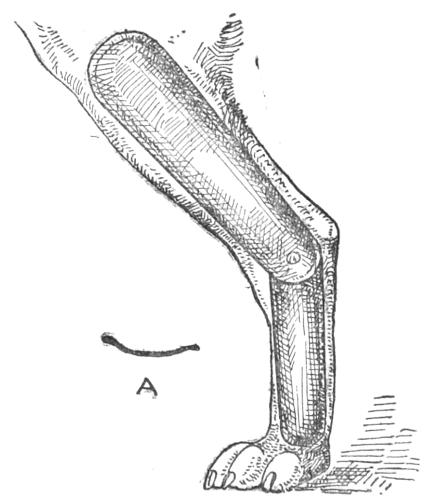
A splint with a joint for fractures
of the back leg
Over the bandage
a few strips
of Mead’s plaister
should always be
used to prevent the
bandage shifting.
Fracture of Femur
(Thigh Bone):
Treatment: Except
in cases of
fracture of the
lower extremity,
these cases are
difficult to treat,
in consequence of the shape of the leg, for one
thing; and for another, the limb is so close to
the body that a bandage cannot with advantage
be put round. Under these circumstances, it is
always best in cases of broken thigh, except
when it occurs at the lowest extremity—that
is, just above the stifle joint—to leave it to
Nature, who, as a rule, makes a very good
cure, except that the leg as a result may be
a little shorter than its fellow. The muscles
around the bone are so thick and strong that
they take the place of bandages, and keep the
bone in its place; whereas when a bandage is
applied, it does harm, and as a consequence
the bone seldom unites. At the lower extremity
it is different; the muscles here are not so thick,
and the application of a splint and bandage supports
the broken bone. The best form of splint
is one similar to the kind recommended for
fracture of the tibia, but made to extend nearly
to the top of the thigh. To fix this splint in
its place, an ordinary bandage should be applied
nearly up to the stifle joint, and then above this
the splint is to be kept in its place by means of
strips of Mead’s plaister, as a simple bandage
cannot be kept on the thigh in consequence of
its shape and position.
Fracture of the head of the femur occurs
sometimes, especially in puppies, which is often
mistaken for dislocation of the hip joint, of
which I have never seen a case. The part
that is really broken is the neck of the ball
of the head of the femur, which fits in the
cup of the pelvis that goes to form the hip
joint. In these cases great pain is caused by
pulling the leg back or abducting it, and distinct
crepitation may be felt and heard when moving
the limb. If there is any doubt about the case,
the exact condition of the parts can always be
plainly seen with the assistance of the X-rays.
After fracture of the neck of the head of the
thigh bone, the top of it—namely, the trochanter—sticks
up higher than it did before, and this
will be particularly noticed if the injured joint
is compared with the corresponding one on the
other side.
Treatment is useless in these cases, for the
broken bone will never unite again; but in
time a false joint is formed, and though the
limb will for ever afterwards be shorter than
its fellow, yet after a time it becomes a very
useful member, and the dog scarcely walks lame
at all, except perhaps after some unusual exertion,
but the muscles never develop to the same
extent on the injured side as they do on the
sound one.
In treating small dogs with fracture of the
legs, it is very important that the bandages
should be as thin and light as possible. In
these cases have bandages made of thin muslin
or butter cloth about one and a half inches wide
and four yards long, which soak in a thick solution
of gum acacia. This is put straight on the
broken leg after it has been set straight. A
good many layers may be put on, and over
this four thin unpadded splints are adapted, and
then a few layers of ordinary bandage to keep
the splints in their place, and they with the
outside bandage may be removed in a couple of
days, by which time the gum has dried and set
firmly.
Pelvis, Fracture of: Different parts of the
pelvis become fractured as the result of accident,
generally from a dog being run over.
Symptoms: The dog goes very lame, in many
cases with straddled legs, and often for a time
may not be able to walk at all. There is a
good deal of pain on manipulation and swelling
of the fractured parts.
Treatment: The dog for a month or so must
be kept very quiet, and a jacket placed on the
hinder parts assists in keeping them together.
In all cases of fracture, it is most important
that the dog be kept absolutely quiet for the
first three weeks; if the dog must go out for
certain purposes, then he should be carried to
a garden and back again. If this is not attended
to, the broken bone will not unite, and as a
consequence there is what is called a false joint
formed—that is, a soft union between the two
broken ends of the bone—and as a result the
dog is never able to bear weight on the limb,
and it is never straight.
In cases of comminutive fracture, the same
treatment is required as for simple fracture,
but more time must be given for union to take
place.
Compound Fracture is more difficult to treat
as the limb cannot be set up permanently, as
it is necessary to dress the wound daily, or at
any rate every other day for a time, and this
disturbs the leg and interferes with the mending
of the bone. Before setting the limb in these
cases, the wound must be thoroughly cleaned
with some antiseptic solution as Pearson’s fluid,
one in eighty parts of tepid water, or a solution
of chinosol, one grain to the ounce of water.
All pieces of exposed loose bone must be
removed, and pieces of bone sticking through
the wound that cannot be put back must be
sawn, or nipped off with bone forceps. Then
the limb, after being put in a natural straight
position, should be enveloped in several layers
of some antiseptic gauze, before applying the
padded splints in the usual way. It is advisable,
if possible, not to place a splint over the wound,
then by cutting a hole through the bandages
so as to expose the wound in the skin, which
can be done when it is small, it can be daily
dressed without removing the whole of the
bandages every day, though it is necessary to
do so once a week, as the dressing becomes
soiled with the discharge. The hole made in
the bandages must be kept packed with disinfectant
gauze, as iodoform or carbolic gauze,
and be changed daily.
Fracture of Bones of the Tail are best treated
by setting up the tail with strips of Mead’s
adhesive plaister. Many layers must be applied
so as to keep the parts at rest. Adhesive
plaister is advised, as it is almost impossible
to keep a bandage on the tail unless pitch or
some other such material is used, and this
makes the dressing so heavy and uncomfortable
for the patient.
Green Stick Fracture: That is when a bone
is broken, and the parts are not displaced.
Symptoms: These cases are sometimes difficult
to diagnose, however, the parts are swollen and
painful, and the dog is unable to put the foot
to the ground. With the aid of the X-rays the
fracture is easily discernible. The bone which I
find by experience most liable to this form of
fracture is the radius or fore arm.
Treatment: The same as for cases of simple
fracture, and it soon unites, and the leg becomes
strong again.
Broken Back, which occurs sometimes as the
result of a dog being run over, the part that
generally breaks is across the loins—lumbar
vertebræ—well forward close to the dorsal
vertebræ.
Symptoms: Acute pain at the part, some
swelling of the soft tissues covering the injured
vertebræ, and loss of power and feeling of the
parts behind the injury.
Treatment: Useless; it is much the best
to have the dog at once put out of his
misery.
Fracture of the Cervical Vertebræ or Bones
of the Neck may occur from a dog being run
over across the neck. Death, as a rule, quickly
occurs. There is nothing to be done.
Fracture of Ribs: This is not an uncommon
occurrence.
Symptoms: Pain at the seat of injury, and
some local swelling. The fractured rib can
easily be felt, and there is some crepitation
when manipulated. The broken ends of the
rib are inclined to turn inwards.
Treatment: Place a fairly wide linen bandage,
or, what is better still, some wide strips of Mead’s
adhesive plaister, round the chest. Union, as a
rule, of the broken rib soon takes place.
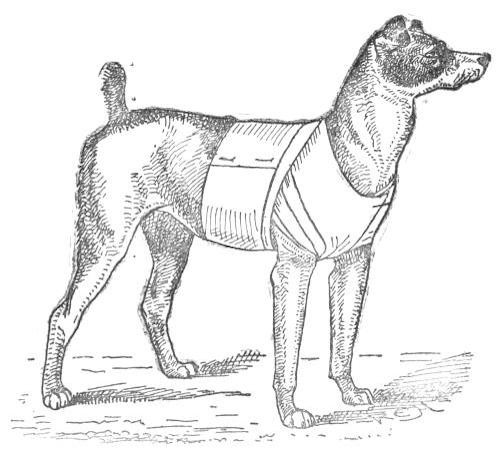
Showing how to bandage a dog’s chest for fracture of ribs
and other injuries to the chest
Fracture of the Bones of the Skull, especially
those of the forehead, occasionally occur.
Symptoms: The broken bone will be generally
found depressed; the part is very painful, and
swelling soon occurs. This injury is often
accompanied by a good deal of acute congestion
of the brain, the result of concussion, and
as a result the dog often becomes unconscious
soon after the accident. This may continue for
days, or until the pressure, the result of the
fractured bone on the brain, is relieved by
operation. The dog, of course, during the
unconscious condition is quite paralysed in all
four limbs. After the pressure is removed, the
dog soon regains consciousness, and strength to
the limbs gradually returns.
Treatment: In these cases it is important to
keep the dog absolutely quiet; to feed on liquid
food, carefully given with a spoon or bottle, in
small quantities often. When the patient is very
restless, an ice-bag may be applied to the forehead,
and small doses of bromide of potassium
given every four hours mixed with the food.
When the fractured bone is depressed, and is
pressing on the brain, the sooner this is relieved
by operation the better. Of course, for some
time afterwards the dog must be kept very
quiet.
Fracture of the Upper Jaw: This occasionally
occurs as the result of a blow, as the kick of a
horse; also from being run over.
Treatment: A bandage cannot be easily applied
here to any advantage. If the mucus membrane
has been torn, and the bone exposed, all loose
pieces must be removed, also broken and loose
teeth; and the mouth should be thoroughly
washed out three or four times a day with a
teaspoonful of borax to half a pint of water, and
the dog fed on sloppy food for a time.
These cases, as a rule, do very well.
Fracture of Lower Jaw: This is not an
uncommon occurrence, as the result of the
same causes as fracture of the upper jaw.
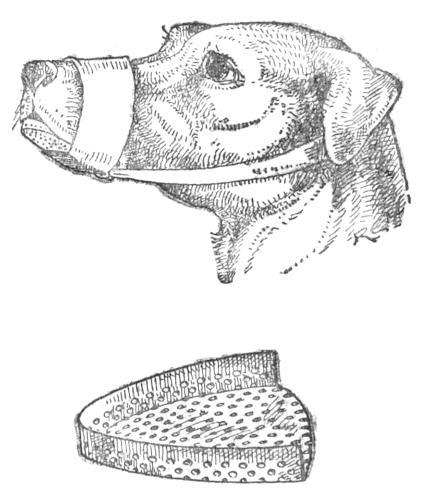
A splint for fracture of bottom jaw
Treatment: The removing of loose bone and
teeth is to be carried out the same as recommended
in cases of broken upper jaw; but here
a splint can be applied, and is necessary, as there
is not the same natural support as there is in the
upper jaw. Of course, there is some difficulty in
applying a splint and bandage in these cases to
dogs with a very short face, especially when the
patient is very small—as, for instance, a griffon—and
moreover, it is not quite so necessary, as
there is more natural support in a short jaw than
a long one, like a terrier’s or greyhound’s. The
splint should be
made of perforated
zinc, and
of the shape as
depicted in the
illustration, and
be applied as
well as the bandages,
as depicted
in the illustration.
The bandages
must be put on
sufficiently tight,
so that the dog
cannot open the
mouth. There are
cases when a dog will not tolerate a splint and
bandages; in such instances, the broken ends
of the bone must be brought firmly together
with a strong silver wire suture, and fastened
by twisting. The dog’s strength in these cases
must be kept up with milk and raw eggs, beaten
up together; also milk and Benger’s food or
sanatogen, as well as beef tea, as it is necessary
that the splint and bandages be kept on for at
least three weeks, and even after this nothing
but sloppy food must be allowed for a time.
Symptoms: Acute abdominal pain, great
tenderness of the abdomen, and if relief is
not soon given jaundice follows.
Treatment: To relieve the pain, give five[1]
drops to a teaspoonful of laudanum in a teaspoonful[1]
to two tablespoonfuls of water. If
pain continues, the medicine may be repeated
in an hour, and again an hour later if necessary.
Hot linseed meal poultices should be applied to
the abdomen. If jaundice follows, give from three[1]
to ten grains of the Homœopathic preparation of
Merc: Sol: 3 × every three hours for three or
four days. Under the best circumstances treatment
can only have but temporary benefit.
Symptoms: This may follow improper treatment
of a severe wound, also the result of a
too tightly bandaged leg in a case of fracture,
or as I have seen, from an elastic band being
placed on the leg, or in some cases on a dog’s
tail. The parts are at first very swollen, painful
and red, later skin turns blue or even black.
Skin oozing very offensive blood-coloured fluid,
later the pain disappears from the part, and it
becomes cold and clammy, and turns green; in
fact, becomes putrid.
Treatment: If from the too tight application
of a bandage, or from an indiarubber band, it
should at once be removed. Hot linseed meal
poultices, dusted over freely with charcoal, applied
every four hours, and then the parts should be
freely washed with a warm saturated solution of
boracic acid; carefully dried and wrapped
in carbolic gauze, and a bandage lightly applied.
As a rule, there is a good deal of constitutional
disturbance in these cases, and it is advisable to
give some medicine such as salicine, say from
three[1] to fifteen grains every six hours, either in
tabloid or cachet, also stimulants as brandy.
Symptoms: Dogs suffering from this disease
are occasionally seen bringing up their food,
sometimes tinged with blood, which is generally
of a bright red colour. The quantity of blood
varies. Sometimes there are streaks mixed
with vomited matter, or there may be quite a
quantity, causing great exhaustion. They also
lose condition, become anæmic and languid.
Treatment: The principal thing in these cases
is diet, which should be light and of an easily
digested nature, as milk with the white of egg,
or milk thickened with Benger’s food. When the
dog is very weak, a little Valentine’s meat juice
should be added with each lot, but nothing solid.
When the bleeding is severe give ergotine, a half[1]
to two grains every two or three hours, in a teaspoonful[1]
to a tablespoonful of water; but when it
is very slight the styptics are not necessary, but
give the dog each time a quarter of an hour before
food from two[1] to ten grains of carbonate of bismuth,
and immediately after food from one[1] to five
grains of ingluvin. It is necessary in these cases
to keep the dog absolutely quiet. Do not allow
the dog to drink a lot of water; if very thirsty, give
Vichy water and milk in equal parts to drink, as
plain water increases the vomiting.
Symptoms: Frequent and violent vomiting,
also diarrhœa. The attack is accompanied by
great thirst.
Treatment: Keep the dog quiet, and prevent
his drinking water. If he is very thirsty, give
Vichy water and milk to drink in equal parts,
or ice to lick. Give every four hours from
three[1] to ten grains of carbonate of bismuth
shaken dry on the tongue. If this does not
stop the sickness, give the mixture as recommended
for Specific Gastritis. In some cases
the sickness is so acute that if every care is
not taken the dog dies from exhaustion. In
such instances the dog’s stomach should be
given absolute rest, the dog not being allowed
to drink even water, or have ice, say for six
to twelve hours. To keep the dog’s strength
up, give a peptonised beef suppository every
three or four hours. If there is any diarrhœa,
give an enema of a dessertspoonful to two
tablespoonfuls[1] of milk, thickened with starch,
with from five[1] to twenty drops of laudanum
added, every four or six hours. When the
sickness has stopped, food must be given very
sparingly by the mouth, and should consist of
peptonised milk or milk and Vichy, and just a
small quantity of Brand’s, every hour or so.
After a couple of days, if the dog is doing
well, a little scraped lean raw mutton may be
offered.
Symptoms: In this complaint the dog occasionally
vomits, bringing up his food, is very
thirsty, and loses condition. The tongue,
instead of being a nice pink colour, is brick-red
colour and dry, and occasionally diarrhœa
occurs.
Treatment: For this a diet of raw meat for
a time will put the dog right, a small quantity
three times a day; and an hour before each meal
give from three[1] to fifteen grains of carbonate of
bismuth. In very obstinate case, small doses
of arsenic, as from half[1] a drop to two drops of
Fowler’s solution, with from two[1] teaspoonfuls to
two tablespoonfuls of water, and given before
food, does good.
Symptoms: This is a contagious disease
which has been prevalent amongst dogs of
late years. It is sometimes called German
distemper, and often terminates fatally. The
dog generally commences with vomiting, and
rise of temperature; the breath becomes very
offensive, teeth highly furred; ulcers often form
on the tongue, along the edge of gums, and
inside the cheeks. There is great wasting. As
the disease progresses, the vomiting increases,
the dog often bringing up blood or coffee-coloured,
offensive fluid; also dysentery is
present. Unlike ordinary gastritis, there are
generally two or three degrees of fever, but
the temperature soon falls below normal, and
the pulse from the commencement is rapid,
whereas in ordinary gastritis you seldom get
any rise in temperature or alteration in the
number of the pulse-beats. A very characteristic
symptom of this disease is a very congested
condition of the eyes.
Treatment: The dog must be kept exceptionally
quiet, and prevented from drinking
any water, as it only irritates the stomach. A
liquid diet is absolutely necessary, such as
Vichy water and milk in equal parts to drink,
milk and white of egg or Benger’s food, and
occasionally a little Brand’s beef essence. For
medicine, give from one[1] to five drops of
cyllin, which is best given in a gelatine
capsule, three times a day. If the vomiting
is very severe, the following mixture can be
given:—
Recipe:
| Diluted Hydrocyanic Dil., |
24 drops. |
| Liq. Bismuth, |
3 drachms. |
| Water to |
3 ounces. |
Doses: From a half[1] to two teaspoonfuls every
three or four hours.
It is very important to keep the mouth
scrupulously clean. For this a lotion of permanganate
of potash may be used, five grains
to a tumbler of tepid water. If ulcers form,
apply sparingly night and morning 5 per cent.
solution of bromic acid. There is always a
danger of relapse in these cases if a solid diet
is permitted too soon. The liquid diet should
be continued for at least a week after the dog
seems apparently well.
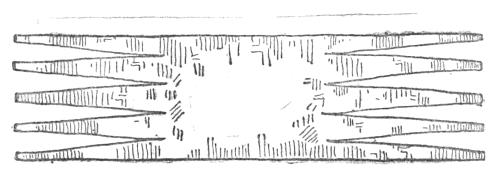
A many-tailed bandage. A useful way of applying a poultice or
dressing to the upper part of the neck
Symptoms: The glands about the throat are
subject to swelling from cold; also they may
become enlarged when some injury resulting in
inflammation has taken place in the neighbourhood
of the neck. The lymphatic gland,
situated at the lower part of the neck, just
in front and to the inside of the shoulder-joint,
is much subject to enlargement and the formation
of tumour. Another favourite situation for
similar enlargements or growths to occur is
the lower part of the abdomen (pubes), between
the hind legs, just above and on each side of
the sheath of the penis. Enlargements of the
lymphatic gland, on the inside of the elbow-joint,
occur in cases of cancer of the breast.
Treatment: When from a cold, as enlargement
of the throat glands, use following liniment:—
Recipe:
| Colourless Tincture of Iodine, |
4 drachms. |
| Spirits of Camphor, |
1 ounce. |
| Soap Liniment to |
3 ounces. |
A little to be gently rubbed into the swelling
night and morning.
When enlargement of the sympathetic glands,
the result of some inflammation going on in the
neighbourhood, no special treatment is required,
as the condition will cease as the inflammation
subsides. The tumefied glands, when situated
near the front of shoulder, also under arm or
in the pubic region, may be treated with iodine
vasogen for a time, but any treatment except
an operation is unlikely to be successful.
Symptoms: This is a serious disease, and often
affects all the lymphatic glands of the system,
they becoming much swollen and painful. Those
glands under the jaw are generally the first to
show the disease, and they often increase from
a bean (normal size) to a walnut in size. The
disease extends to the other glands, as those in
front of the shoulders; also those under the
arms. Those at each side of the penis, the back
of the hind legs, and even the gland situated in
the abdomen are affected; in fact, the dog is all
lumps and bumps, and is a wretched object.
Treatment: Is seldom attended with success;
but occasionally large doses of iodide of
potassium, from one to ten grains,[1] well diluted
with water, seems to retard the progress of
the disease for a time. Removing the diseased
glands by operation is not of any use.
Symptoms: The white of the eye is very red,
and the ball is distended and painful on pressure.
The eye loses clearness. Disease usually begins
in one eye, but the other often gets affected later.
Treatment: Foment frequently with hot poppy-head
tea, made by boiling for a few minutes in
a quart of water two crushed poppy-heads and
then strain through fine muslin. The tea should
be applied as hot as the dog can comfortably
bear it. Also apply the following drops:—
Recipe:
| Dionin, |
2 grains. |
| Pilocarpine, |
1 grain. |
| Sulphate Eserine, |
½ grain. |
| Distilled Water to |
4 drachms. |
Two drops to be placed in the eye three or
four times a day.
Glaucoma often requires surgical treatment, as
puncturing the eye just where the schlerotic coat
joins the cornea. Sometimes it is necessary
to remove the eyeball, and this often has the
advantage of preventing the other eye becoming
affected.
See Balanitis.
Symptoms: A swelling, varying in size from
a pigeon’s to a goose’s egg, situated low down
in the neck, due to enlargement of the thyroid
gland. Almost always both lobes of the gland
are affected, and there is a swelling at both
sides of the neck, though one may be slightly
larger than the other. As a rule, the condition
does not cause much inconvenience unless the
glands are very big, or the patient very young—say
six weeks of age—when the breathing is often
difficult, and death takes place.
Treatment: When the patient is not very
young, the hair over the swellings should be
cut short, and tincture of iodine applied every
day for three or four days; then, after waiting
a week, the iodine may be repeated if the
swellings remain. When the patient is very
young, say a few weeks old—and the disease
is rather common amongst pointers at this age—the
case is best treated with the homœopathic
preparation of iodide of potassium 3 x; dose,
three grains thrice daily. Afterwards, when
the swellings are reduced, give cod-liver oil or
malt.
See Colic.
Symptoms: A hard, irregular-shaped growth
of a red colour, which is somewhat constricted;
occasionally grows on the gum, or rather from
the periosteum of the jaw-bone. It is called
an epulis. It is more common in old than
young dogs, and it is difficult to cure. When
the growth assumes large proportions, it pushes
the teeth quite out of the regular line, and
causes them to become loose.
Treatment: When possible, the application of
a ligature of strong silk tied tightly round the
neck of the growth, and as close as possible to
the gum, is the best way of removing it. Sometimes
this is not practical, as the base is large.
In such cases, the growth should be cut off close
to the gum, and the roots scraped down to the
bone.
Symptoms: A painful, swollen gum, generally
the result of a bad tooth, or may arise from cold.
Treatment: Extract tooth; wash mouth out
after with a drachm of chlorate of potash dissolved
in a tumblerful of warm water. Give a
dose of purgative medicine.
Symptoms: Occasionally the gums will bleed
very freely, particularly in old dogs, and often
apparently without any reason, and in some
cases the bleeding is very difficult to stop.
Treatment: A simple and often an effectual
remedy is placing a bandage rather tightly round
the nose for an hour or more, so that the dog
is unable to open his mouth. If this fails, the
exact spot, or spots, as there are sometimes
several, must be found, and a solution of adrenalin
applied. Failing this, the tincture of perchloride
of iron may be used.
Symptoms: Dogs do not suffer from real piles,
particularly internal ones, but old dogs get a
tumefied condition of the anus occasionally, and
the parts become swollen, red, and tender.
Treatment: Relief may be given by bathing
with a solution of carbolic acid, one in sixty
of water, or a lotion made with a teaspoonful
of powdered alum dissolved in half a pint of
tepid water, but used cold. When the skin is
broken apply the following ointment:—
Recipe:
| Hydrochlorate of Cocaine, |
4 grains. |
| Goulard’s Extract of Lead |
10 minims. |
| Lanoline, |
2 drachms. |
| Water, |
2 drachms. |
| Mix. |
Aperient medicine should be given.
See Congenital Deformities.
Symptoms: A collection of very small red
insects looking almost like red sand on different
parts of the body and limbs, causing irritation and
scratching.
Treatment: Washing the parts daily for a few
days with kerosene one part, and butter milk six
parts, mixed together; or Pearson’s disinfectant
fluid diluted eighty times with water will destroy
them.
Symptoms: Heart affections are not particularly
common in the dog, except perhaps in Japanese
spaniels, and I should think at least a third of
these dogs, by the time they are five years old,
suffer from some form of heart trouble, principally
valvular or dilated heart, which gives rise to
difficulty in breathing, especially after exertion,
a dry cough, occasionally fainting and loss of
condition. Later, as the disease progresses, other
complications arise, as enlargement of the liver
and dropsy (ascites).
Treatment: Keep dog as quiet as possible; do
not allow any hard exercise or running upstairs.
Feed on a meat diet, and occasionally give a
course of following mixture:—
Recipe:
| Tincture Digitalis, |
2 drachms. |
| Tincture Nux Vomica, |
1 drachm. |
| Simple Syrup, |
1 ounce. |
| Water to |
6 ounces. |
Doses: From one teaspoonful to a tablespoonful[1]
three times a day, after food.
It is important to keep bowels open by occasionally
giving aperient medicine. If cough very
troublesome, give two or three times a day,
made into a pill, from ⅟₅₀th[1] to ⅟₂₀th of a grain of
hydrate of heroin, with from half[1] to two grains
of hydrate of terpin.
See Œstrum.
Symptoms: Paralysis of one side of body,
including limbs.
Treatment: Unless attack is due to a
known cause, as an accident or the result of
distemper, commence treatment with a dose of
worm medicine, followed by a brisk purge. If
no better in a few days, give a course of the
following pills:—
Recipe:
| Ergotine, |
6 to 24 grains.[1] |
| Powdered Nux Vomica, |
1 to 4 ” |
| Ex. cip. q.s. |
| Mix. |
Divide into 12 pills—one to be given three
times a day after food.
When the paralysis is the result of distemper,
the same pills may be given, with from one[1] to
three grains of reduced iron each time.
When the patient is a small dog, the homœopathic
preparation of Nux vomica is the best
medicine; of this, give five grains of the
trituration 3 × three times a day.
Cases of hemiplegia are sometimes very slow
in mending, and it is a long time before the
dog regains the proper use of his legs again;
in such instances, electricity should be employed,
and a blister to each side of the neck along
the course of the spine applied. They should
run from just behind the back of the ears to
just in front of the shoulder-joint, and be from
one to two inches wide, according to the size
of the dog. The blisters may be repeated in
about a fortnight if necessary.
Symptoms: It is a rupture, or protrusion of
an organ from its natural position. The most
common positions for rupture are the navel;
here it is called Umbilical Hernia, the Groin
or Inguinal Hernia, and Perineal Hernia, which
shows itself by the side, or sometimes both sides,
of the anus.
Treatment: The only treatment to effect a
radical cure is an operation, but in the case of
umbilical hernia, so long as it remains soft and
small, say not larger than a hazel nut or walnut,
according to the size of the patient, it may be
left alone, as it does not cause any inconvenience
even to a bitch required for breeding purposes.
Inguinal hernia, which is only seen in bitches,
and nearly always on the left side, does not
cause any inconvenience so long as it remains
small; but this form of hernia has a tendency
to increase in size, and when such is the
case, more especially if it is intended to breed
from the bitch, it is advisable to submit to
an operation, and, provided it is performed
under aseptic conditions, is unattended with
danger.
In cases of old bitches suffering from this form
of hernia, when from some reason an operation is
objected to, care must be taken to avoid constipation.
When this is done, seldom any harm
occurs unless the hernia is very large, and
becomes hard and painful, caused by some
obstruction of the bowel in the hernical sac.
If this happens, attention is required, and means
taken to reduce the hardness and swelling. This
is best done by placing the bitch, if a small one,
upon a person’s knees. She should be put on her
back, with the head downwards, and then the
swelling should be carefully manipulated and
massaged until it becomes soft and can be
returned into the body. In obstinate cases
laudanum, from three[1] to twenty drops in water,
may be given every three or four hours; and
after the hernia has been reduced, a dose of
aperient medicine is to be given.
The treatment of perineal hernia is always
unsatisfactory. An operation is not practical,
and the only thing to do is to prevent constipation,
and then the dog may live for years
without much discomfort. Should the hernia
become hard and distended, enemas of warm
salad oil are to be administered, the swelling
softened by careful kneading, and the contents
of the rectum evacuated by means of a greased
finger or handle of a small spoon. A course of
the following pills is useful in these latter
cases:—
Recipe:
| Extract of Belladonna, |
2 to 6 grains.[1] |
| Powdered Nux Vomica, |
1 to 4 ” |
| Powdered Rhubarb, |
3 to 12 ” |
| Reduced Iron, |
12 to 30 ” |
| Mix. |
Divide into 12 pills—one twice a day after
food.
Symptoms: A sudden, jerky expiration of
breath. Common in puppies. Result of indigestion
caused by worms. It is not a serious
complaint.
Treatment: If a puppy, treat for worms. To
relieve the spasmodic breathing, give from three[1]
to twenty grains of bicarbonate of soda in milk;
repeat in half an hour. If this fails, give from
three to twenty drops of turpentine in a little
milk.
Symptoms: The bark is husky and hollow.
May be the result of cold, also from persistent
barking, as when a dog is shut up in a strange
place.
Treatment: If from cold, give frequently one[1]
or more teaspoonfuls of glycerine and water; if
from over-barking, pacify the dog by removing
the cause.
Symptoms: A swelling of the scrotum, which
may be either hard or soft.
Treatment: Apply following lotion often:—
Recipe:
| Goulard’s Extract of Lead, |
1 drachm. |
| Tincture of Opium, |
2 drachms. |
| Distilled Water to |
6 ounces. |
| Mix. |
In some cases the application of tincture of
iodine is necessary, or even the tapping of the
swelling.
Symptoms: May be seen in young unweaned
puppies; in some cases it occurs later. The
head, especially the top of the skull, is large
and rounded, and the puppy waggles it from
side to side as if it was too heavy to hold up.
The gait is unsteady, and the puppy frequently
walks in circles generally in one direction, is
constantly whining and crying, does not thrive,
and later generally has convulsions and dies.
Treatment: There is really nothing to be
done in these cases, and the kindest thing to
do is to put the puppy out of its misery.
See Rabies.
Though practically the same disease as rabies
or canine madness, hydrophobia is a misnomer
when this disease affects the dog, as he is not
afraid of water; in fact, he will try to drink, but
is unable to swallow little or none of the fluid in
consequence of the condition of the throat.
The
proper quantity of medicine or stimulant, or
whatever is going to be given, having been
drawn up into the syringe, and the needle
adjusted, a small fold of skin should be pinched
up between the forefinger and thumb of the
left hand, and the needle for about half an inch
should be quickly thrust into the skin at one end
of the fold, and then by pressure on the piston
the contents of the syringe should be evacuated.
If the operation is done quickly, the dog knows
nothing about it.
It does not in the least matter where the
injection is made, so long as the place selected
is where the skin is loose, as over the ribs.
It is most important that the syringe and
needles be kept very clean; and each time after
being used it should be washed out with a
five per cent. solution of carbolic acid or spirit.
A wire (slightly vaselined), several of which are
supplied with the syringe, should always be kept
in the needle.
Young puppies, especially at the
time when they are changing their teeth, have
sometimes a form of hysteria brought about by
excitement, especially in hot weather.
Symptoms: The puppy rushes about here and
there, not knowing where it is going or what it
is doing, biting and snapping at everything within
reach, and screaming and howling as if it was
being unmercifully beaten. Saliva pours from
the mouth, and many a one has been destroyed
during such an attack, it being supposed to have
gone mad.
Treatment: Place the puppy in a basket, and
put in a quiet, dark place. It cannot be made to
swallow anything during the attack, but medicine
in the form of an enema may be given, as from
ten[1] to thirty drops each of laudanum and sulphuric
ether in from one[1] to four tablespoonfuls
of tepid water.
A course of bromide must be given afterwards
for some time to prevent a recurrence of the
attack. Dose from three[1] to ten grains with milk,
or in a little water, three times a day. Keep on
a light diet and give no meat.
Symptoms: Hard, dry, thick skin which
wrinkles, and the formation of large scales or
scurf.
Treatment: Dress places daily with following:
Recipe:
| Oil Cade, |
2 ounces. |
| Green Soft Soap, |
2 ” |
| Methylated Spirits, |
2 ” |
| Well mixed together. |
Give a course of arsenic, from one[1] to five drops
of Fowler’s solution, twice a day, in a little water
after food. After a week, gradually increase the
dose from two[1] to ten drops.
Once a week give a warm bath, adding one
tablespoonful of borax to every gallon of tepid
water, and use 3% mercurial soap (Cook’s).
Symptoms: Skin is red, small pimples containing
matter form, which break, discharging a
sticky, creamy coloured pus which dries and forms
a thick crust. The disease is supposed to be
contagious, but I do not consider it so.
Treatment: Wash dog with Cook’s 3%
mercurial soap, dress sores daily with compound
Naphthol Beta ointment. Treat dog for worms,
and give a course of arsenic as recommended
for Ichthyosis.
Or the inability of an animal to
propagate its species. In the dog it may be
due to many causes. Of course dogs castrated
are impotent, so they are when the testicles do
not descend into the scrotum, though able to perform
the act of coition satisfactorily. Deformities
of the penis, fracture of the bone of the penis,
stricture of the orifice of the prepuce, so that
the penis cannot protrude, this can be remedied
by a simple operation of dilating the orifice. In
some cases the seminal fluid is at fault. These
cases can seldom be remedied, though I have
found a raw meat diet beneficial in some
instances.
In cases of fracture of the penial bone, this, as
a rule, in the course of a month mends satisfactorily
without treatment, but the dog should not be used
for stud purposes for a couple of months. Many
dogs, especially young, and also those too much
used at stud, suffer from temporary impotence
due to lack of sexual desire. In the case of a
young dog, a dose of cantharides, three to twenty
minims[1] in water, two hours before trying to use
him, often has the desired effect; if not, the
medicine may be repeated in six hours. The
same medicine may be given to shy bitches.
Sterility or impotence often occurs in bitches.
Some cases are curable, but there are many which
cannot be cured, for the simple reason that one
cannot find out the cause, and all one can say is,
the bitch is barren. The curable cases are those
that are due to stricture of the vagina, a not
uncommon occurrence, then tumours, as polypi
or other growths in the vagina; a description of
the treatment of these diseases will be found in
another part of the book. In some cases a bitch
may miss breeding through the discharge in the
vagina being of a too acid nature. This can be
remedied by syringing the passage well out with
a warm solution of bicarbonate of soda, about one
hour before service. The injection should be made
by dissolving one teaspoonful of bicarbonate of
soda in half a pint of water.
Then there are congenital deformities of the
pelvis and vagina, occasionally met with in the
bitch, which prevent successful coition, and the
parts may become deformed as the result of
accident, as being run over across the lower
part of the back.
Again, an attack of metritis or inflammation
of the womb, the result of a chill during the
period of heat or from other causes, generally
causes the bitch to be barren afterwards, and
certain diseases of the ovaries also cause sterility.
A bitch who is very fat or in any way out
of condition, the result of illness, or from insufficient
and proper exercise, or too hard
exercise, will seldom breed. The proper treatment
of these cases is indicated by the cause.
Symptoms: The involuntary passing of water.
In puppies it is generally the result of nervousness,
and passes off in time. The condition is
generally present in most cases of paralysis, the
bladder, after being over-distended, simply overflows
as it were. It is also a symptom of stone
in the bladder, especially in the bitch.
Treatment: If in cases of general paralysis
the bladder is kept empty either by pressure to
both sides of the abdomen, just over the seat
of the bladder, or by the passing of a catheter,
the condition of incontinence is prevented. The
former method is the best, as the frequent
passing of the catheter sets up great irritation
in the dog, and often does harm. The bladder
should be relieved at least three times a day.
When the result of general paralysis of the hind
parts, improvement is not to be expected until
strength returns in the legs; but when the
incontinence is caused by simply over-distention,
as, for instance, through keeping a dog very clean
in its habits shut up a long time, then after
emptying the bladder a course of Nux vomica
is often necessary to assist the bladder to regain
tone. Give from one[1] to five drops of the
tincture in water three times a day after food;
also a free dose of purgative medicine, oil being
the best, and keep on a light diet, avoiding meat
and soups for a few days.
Symptoms: In the acute form the dog vomits
after everything eaten, also after drinking water,
and there is always great thirst in these cases.
The patient shows signs of discomfort after
food, and occasionally suffers from diarrhœa.
The tongue loses its natural pink colour, and
becomes dry and of a rusty red. The breath is
foul, and teeth become coated with fur. The
dog quickly loses condition.
In chronic indigestion the symptoms are
similar, but not so marked.
Treatment: Should commence with a dose
of castor oil, even though the patient may be
vomiting and suffering from diarrhœa. A few
hours afterwards commence the following
mixture:—
Recipe:
| Acid Hydrocyanic Dil., |
24 minims. |
| Liq. Bismuth, |
2 drachms. |
| Aqua ad., |
3 ounces. |
From half to two teaspoonfuls[1] every four
hours.
When the acute symptoms have passed, give
the following powders:—
Recipe:
| Ingluvin, |
½ to 2 scruples.[1] |
| Carbonate Bismuth, |
½ to 2 drachms. |
| Powdered Nux Vomica, |
1 to 3 grains. |
| Mix. |
Divide into 12 powders, and put in cachets—one
to be given three times a day after
food.
Diet: First simply give milk and Vichy water
in equal parts to drink, a small quantity at a
time; also occasionally a little Brand’s beef
essence. If sickness is very persistent, give
stomach twelve hours’ absolute rest, during
which time give every four hours a peptonised
beef suppository, then try the former diet again.
When solid food is again given, it should at
first consist of scraped lean raw meat, beef,
mutton, or veal; for a change, boiled tripe.
Thin barley water is better than plain water
to drink.
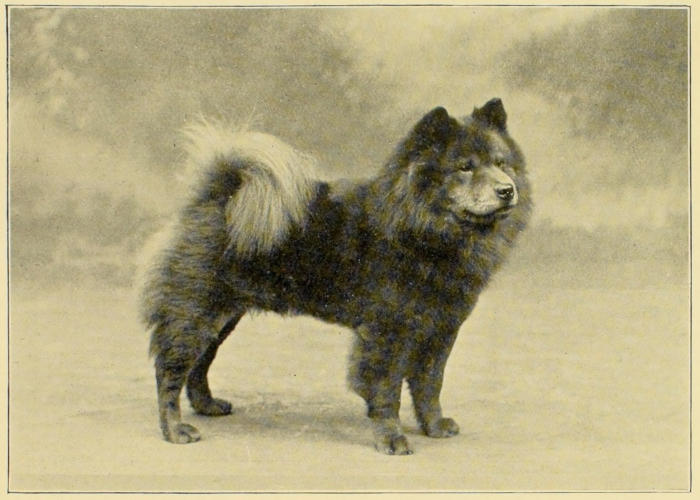
Chow Chow, Champion Red Craze.
Born June 8th, 1901. Winner of 61 Firsts and Specials and 14
Championships. The property of Mrs. Scaramanga, 8, Sussex Square,
Hyde Park, W.
| Thos. Fall, photo.] |
[face p. 156. |
Symptoms: Redness, swelling, and tenderness
of the part affected; rise of temperature; thirst;
an abscess may form.
Treatment: External Inflammation: Apply
following lotion with lint and bandage, or
dabbed on part often:—
Recipe:
| Goulard’s Extract of Lead, |
1 drachm. |
| Laudanum, |
1 ” |
| Water to |
6 ounces. |
| Mix. |
If the temperature keeps up, say, to 3 or
more degs. above normal, it is pretty certain
an abscess is forming, in which case hot linseed-meal
poultices should be applied. To keep the
heat in the poultice, cover the outside of it with
a layer of oil silk.
Internal Inflammation: Keep patient quiet;
give aperient medicine, as from two to ten
grains[1] of jalapin. If chest affected, put on
flannel coat lined with thermogen wool. When
inflammation situated in abdomen, apply heat to
part, as hot flannels, hot-water bottles, or linseed-meal
poultices. When temperature very high,
doses of aspirin, from two to ten grains,[1] maybe
given three or four times a day; and if there
is much pain, from two to fifteen[1] drops of
laudanum may be given in water the same time.
Diet: Light, as milk, with Benger’s food, stale
bread or toast.
Symptoms: Dulness, loss of appetite, rise of
temperature, pains in the loins, quick pulse.
There is generally a cough, and bronchitis or
pneumonia may develop. In some cases there
is severe diarrhœa, and there may be some
discharge from nose.
Treatment: Place patient in a dry and comfortable
room or kennel, the temperature of
which should be kept from 55 to 65 degs. F.,
according to whether the dog has been accustomed
to live in a house or kennel. If there is
constipation, give a small dose of castor oil; and
if the temperature is high, give from two[1] to ten
grains of salicine three or four times a day.
When fever has passed, give salicylate of
quinine, from a quarter[1] to a grain, made into
a pill, three times a day.
Diet: Light, whilst there is any fever; but
when this has passed, strengthening food is
required, as under-done or raw meat with rice or
bread, also tripe and fish; and if appetite bad,
offer some stewed rabbit with rice or bread.
See Hernia.
Symptoms: The parts may become much
swollen and red, accompanied by a good deal
of irritation.
Treatment: Dab parts with ammoniated
quinine; failing this, eau de Cologne or methylated
spirits. When place very tender, the lead
and laudanum lotion as recommended for external
inflammation may be used.
When nursing sick dogs the
diet is important, as it is so much better to
get the dog to eat something for himself, rather
than always pouring food down its throat.
Taking food voluntarily not only does the dog
more good, but it is less worrying to
the patient, for when one has to feed with
the spoon or bottle it is necessary to give
nourishment very frequently, whereas when it is
taken voluntarily, more, as a rule, is taken at a
time, and therefore it is not necessary to offer
food so often. A good meat tea is made with
equal parts of veal, beef, and mutton—say half
a pound of each cut up very small, then slowly
stewed for three hours in a pint of water. This
should be strained and given either cold or warm,
whichever the dog likes best.
A jelly made from rabbit is also very nourishing,
and dogs, as a rule, are very fond of it,
and they will often take it when they refuse
everything else. It should be made as follows:
The whole rabbit should be cut up in small
pieces, including the liver; the leg bones should
be cracked, the heads split open, and the
whole stewed in a pint of water for some hours;
then strained off, and if there is more than half
a pint reduce it to that quantity, and set aside
to cool. This may be given either cold or hot;
a small quantity at a time, as it is, if made as
directed, very strong.
Fish boiled in water, or boiled in milk; and
a capital fish soup is made by stewing white fish,
such as whiting, in milk for some time, and then
straining off and giving the soup to drink. Also
boiled fish stewed with rice makes a good food,
and the different kinds of fish alone boiled. A
food of this kind may be given to a dog even
when he has a fever, especially if he will take
it himself.
Sheep’s brains boiled in milk make an
excellent and tempting food.
Calves’ sweet-breads also boiled, or even
grilled, dogs are very fond of.
Chickens’ livers grilled make an appetising
dish for a dog; and when a dog is convalescent,
and the temperature is normal, he may be even
tempted to eat by offering grilled meat.
Milk of course is one of the best and most
nourishing diets, and when the dog is very weak
the white of one egg to every cup of milk is
very strengthening food. For a change, milk,
with plasmon added, should be given, but too
much of this latter food must not be given to
dogs with a high temperature.
Sanatogen is a most excellent, strengthening,
and easily-digested food. Dogs will often retain
this when they are unable to take any other food.
Benger’s food with milk is also an easily-digested
food, as it is partially predigested.
Cases often arise when a dog cannot possibly
retain anything in the stomach, then it is
necessary to give nourishment by the rectum,
and it is astonishing what a long while a dog can
be kept alive and fairly strong in this way.
The best kinds of food for giving by rectum
are peptonised milk, or peptonised beef-tea,
and peptonised beef suppositories. Burroughs
Wellcome’s are good nutritive suppositories. As
to the quantity of milk to be given per rectum,
from one[1] to eight tablespoonfuls, just warmed,
every three or four hours alternatively with one
of Burroughs Wellcome’s meat suppositories.
In giving a nutritive enema, care must be
taken to pass it very slowly into the bowel so
as not to excite action, or the enema will be
immediately rejected, and afterwards just raise
the hind-quarters a little bit so that the fluid runs
well into the body, and hold the tail down for a
few minutes so that it cannot escape.
The milk can be peptonised with Fairchild’s
peptonised powders, which can be bought at any
chemist’s shop.
Brand’s meat essences are excellent foods in
cases of stomach disorders. Benger’s peptonised
beef jelly is a very easily digested preparation,
and very useful in cases of severe vomiting.
Raw meat beef-tea, made by soaking for a
couple of hours half a pound of scraped lean
raw beef in half a pint of cold water, then stood
in front of a fire to get warm, then straining and
squeezing through a coarse tea-cloth. Or the
juice may be pressed from raw meat with one of
Dr. Klein’s meat-squeezing machines. This is
very nourishing and easily digested, and dogs are
fond of it, and often will take it voluntarily when
refusing other foods.
An excellent combined food for dogs very ill,
especially with distemper, when the patient is
very weak, or during convalescence, is made as
follows:—
To a breakfast cup of milk, thickened with
Benger’s food, add the white of an egg, a full
teaspoonful of invalid bovril, and a dessertspoonful
of brandy; of this give from one[1] to six tablespoonfuls
every two or three hours alternately,
with some beef-tea or meat extract.
Messrs. Spratts’ Patent have recently introduced
a new food for invalids. It is a granulated
meal, and they call it Invalid Food. It is
a most excellent preparation, and every dog I
have offered it to has eaten it with avidity. I
have found it a very useful diet for distemper
patients mixed with milk; and I have given it
to puppies just weaned, and they have thriven
well on it. Though this new food is called
Invalid Food, it is an excellent preparation either
mixed with milk or soup for small dogs; if meat
is required it can easily be added, as it contains
none, but I am told that it contains a special
meal, and that little or no meat is necessary.
The same preparation is put up in the form
of biscuits which are crisp without being hard,
and small dogs eat them with pleasure. No
doubt all dogs are better for having something
hard to gnaw once a day. It preserves the teeth,
hardens the gums, and assists digestion.
Animal Kreochyle is an excellent extract of
meat for use in cases of great weakness, the result
of distemper or from any other disease. It is
also an excellent remedy in stomach disorders
accompanied by sickness. Dogs, as a rule, take
Kreochyle very readily, and it is easily digested
and assimilated.
Symptoms: Constantly scratching, biting, and
licking the skin, which when examined, there is
often nothing to be seen. The condition occurs
in hot weather, especially during the shedding of
the old coat.
Treatment: Give a sulphur bath made by
dissolving one ounce sulphurated potash in a
pail of tepid water; repeat every two or three
days. If this does not give relief, bathe the
dog in a warm solution of borax, one tablespoonful
to a gallon of water. Give saline
aperient medicine, as Dinneford’s fluid magnesia,
to small dogs, and Epsom salts to large
ones. A meat diet is often beneficial in these
cases, but sometimes it increases the irritation;
then, of course, it must be avoided, and other
food with green vegetables substituted.
See Mange.
Symptoms: Generally the result of congestion
of the liver, caused by chill; may be due to
impaction of the duct with a bile stone, or
worms; or the opening of the duct into the
bowel may be stopped by thickening of the
bowel membrane. The attack generally commences
with sickness, dullness, loss of appetite;
and the membranes of the mouth and eyes turn
yellow, and so does the skin. There is generally
obstinate constipation, and what is passed from
bowel is usually grey or slate colour. The urine
is scanty and high-coloured.
Jaundice is also a symptom of organic disease
of the liver.
Treatment: When the result of congestion
caused by a chill, I have found, after many
years’ experience, that the homœopathic preparations
of Nux Vomica 3 × and Merc. Sol.
3 × act well in these cases. Of the trituration
give from two[1] to ten grains of each every three
or four hours. If the bowels do not operate on
the second day, give an enema of from two
tablespoonfuls to half a pint[1] of warm soapy
water; repeat daily if necessary. Hot linseed-meal
poultices may be applied to abdomen.
Diet: Mutton broth (in which some green
vegetables have been cooked), with toast or
stale bread; milk and Vichy water in equal
parts to drink; later boiled fish or tripe.
When the condition is the result of obliteration
of the duct, there is nothing to be done; relief
may occur spontaneously, or an operation may
be performed, but it is not recommended.
When jaundice is due to organic disease of
the liver, it cannot be cured, but the Nux
Vomica and Merc. Sol. treatment will sometimes
give temporary relief. The application
of iodine vasogen over the enlarged liver in
these latter cases is often useful in relieving
tension of the organ.
After dogs have
been suffering from any contagious disease, like
distemper or mange, in a kennel, it is necessary
to thoroughly disinfect them, and it is best done
in the following manner:—
In a strong tin dish from half to a pound of
sulphur, according to the size of the kennel,
should be placed. A few drops of methylated
spirits should be poured on top of the sulphur,
and a light applied, the methylated spirits being
added to make the sulphur ignite more easily.
The kennel should then be made as air-tight
as possible by having strips of paper pasted over
all the crevices and around the window-frames,
so that the sulphur fumes cannot escape. The
kennel should be kept sealed up for forty-eight
hours, after which the windows and doors may
be thrown open so as to thoroughly ventilate the
place, and the following day the whole of the
inside kennel should be thoroughly washed with
a strong solution of Pearson’s fluid, 1 in 40.
The walls and ceilings when dry should be afterwards
well lime-washed or sulphur-washed—that
is, finely powdered sulphur mixed with water and
size, the same way as whitewash is prepared. A
day or two later, when everything is thoroughly
dry, the kennel will be quite fit to receive dogs, or
even puppies, without any fear of infection.
Symptoms: The attack generally comes on
suddenly; may arise from severe chill, but
generally the result of stone in the kidneys.
There is great pain over the loins; the dog
walks with difficulty and arched back; the temperature
rises 3 or 4 degs. above normal; the
pulse is quick and full; the urine is high-coloured
and scanty—sometimes it is the colour
of blood, and mixed with mucus and pus; the
limbs may swell from dropsy, and the dog is
very thirsty and often frequently sick.
Treatment: Give saline purgative medicine,
as Epsom salts, from twenty grains to one
ounce[1] in warm milk; repeat the next or
following day. Also give every four hours
from five to thirty grains[1] of hyposulphite of
soda in a little water. As to food, it should
consist principally of milk mixed with equal
parts of Vichy water, and a little boiled fish.
If sickness very severe, give from half to two
drops[1] of diluted hydrocyanic acid in a teaspoonful
of water every two, three, or four hours,
and ice to lick. After the acute stages have
passed, give tonics, as the ammoniated citrate
of iron, from one to five grains,[1] three times a
day, in from one teaspoonful[1] to a tablespoonful
of water.
Symptoms: May be the sequel of an acute
attack or a less severe chill, and sometimes it
is caused by gravel. There is tenderness over
the loins; the urine may be tinged with blood,
or after passing water, which may look quite
clear and normal, the dog continues to strain, and
a few drops of blood escape and some mucus.
Treatment: A milk diet is important in these
cases; it may be given with rice, tapioca, Force,
or bread. Red meat must be avoided, but tripe
and fish may be allowed. Vichy water mixed with
equal parts of plain water should be given to
drink; and a course of hyposulphite of soda, as
recommended in acute inflammation, should be
given, but only two or three times a day. If
gravel or a stone is suspected, a course of boro-citrate
of magnesia with bicarbonate of potash is
advised. The dose of the former is five[1] to thirty
grains, and of the latter from two[1] to fifteen grains
mixed with the food twice a day, and be continued
for some time.
Symptoms: A small supply or total suppression
of the mammary secretion.
Treatment: Give a raw meat diet, and stimulate
the glands by massage; also encourage the
bitch to drink plenty of fine oatmeal gruel.
Symptoms: Excessive secretion of milk. The
glands are swollen, hard, and painful, and the
milk often dribbles away. It may occur before
the puppies are born, or just after; and it often
happens to a maiden bitch to have a large secretion
of milk, which shows itself about seven or
eight weeks after heat, and which lasts five or six
weeks. A maiden bitch in this condition is very
restless and wretched. She appears to be always
looking for puppies. She will walk about with
her tail down, crying, and occasionally scratches
and rakes at her bed, and twists round and round
as if making a nest.
Treatment: In the first instance, rub the
glands with warm salad oil to soften them, and
draw some milk off night and morning. In the
second case, simply draw some of the milk off,
and avoid if possible putting anything on the
glands, in case you should injure the puppies or
put them off their feed. In the case of bitches
having milk who have not been pregnant,
purgative medicine—castor oil is the best—should
be given once or twice a week, and
the glands rubbed with camphorated spirits, or
dabbed with a lotion made with two tablespoonfuls
of gin and half a pint of water.
When the milk collects in large quantities as
to cause discomfort, it must be drawn off; but
this should be avoided if possible, as it has a
tendency to stimulate secretion. Give the food
dry; biscuits are the best.
It is most important to thoroughly attend to
maiden bitches when in this condition, otherwise
the milk curdles and becomes hard, and this is
the commencement of mammary tumours.
Symptoms: A dry, husky cough, the dog after
coughing retches as if about to vomit. If
neglected, may go on to bronchitis. It is very
contagious.
Treatment: An emetic gives immediate relief,
give from one quarter[1] to a grain of tartar emetic
shaken dry on the tongue, also give the following
mixture:—
Recipe:
| Liquor Hydrochlorate of Morphia, |
2 drachms. |
| Syrup of Squills, |
½ ounce. |
| Syrup of Tolu, |
½ ounce. |
| Syrup of Lemons, |
½ ounce. |
| Water to |
3 ounces. |
Doses: From half a teaspoonful to a dessertspoonful[1]
two, three, or four times a day,
according to the severity of the cough.
Also give purgative medicine. Holding the
head over hot water, in which a little Friar’s
balsam has been mixed, gives relief, and so do
the fumes of burning cresoline.
The dog should be kept dry and warm; in
fact, in one temperature for a few days.
Symptoms: Blue line on gums, vomiting,
loss of appetite, great thirst, generally constipation,
but there may be diarrhœa. Colicky
pains, and in some cases convulsions, followed
by paralysis of the hind legs.
Treatment: Give Epsom salts, from ten
grains[1] to one ounce in some sweetened milk.
Also a course of iodide of potassium, from half
to four grains in from one teaspoonful[1] to a
tablespoonful of water. For the treatment of the
paralysis, see Paralysis.
Symptoms: A pale, yellowish discharge from
vulva. May occur before heat, but more often
afterwards, and frequently seen after pupping.
Treatment: Syringe with a weak tepid solution
of Condy’s fluid, about half a teaspoonful to half
a pint of water. If the discharge is persistent,
syringe with one drachm of powdered burnt alum
in half a pint tepid water night and morning.
Give tonics, as from half[1] to three grains of
sulphate of iron (made into a pill), two or three
times a day.
See Insect.
The following is a soothing
liniment for recent cases of sprains and injuries
to joints, etc.:—
Recipe: The Liniment:
| Tincture Hydrocyamus, |
4 drachms. |
| Methylated Chloroform, |
4 drachms. |
| Spirits of Camphor, |
1 ounce. |
| Soap Liniment, |
2 ounces. |
| Mix. |
Apply with friction night and morning.
A stimulating liniment for bronchitis, sore
throat, pneumonia, etc.:—
Recipe: The Liniment:
| Strong Solution of Ammonia (Liq. Ammon. Fort.), |
3 drachms. |
| Soap Liniment to |
4 ounces. |
| Mix. |
Apply with friction night and morning.
A Liniment for Chronic Sprains, Enlarged
Joints, and Glands:
| Colourless Tincture Iodine, |
2 ounces. |
| Soap Liniment, |
2 ounces. |
| Mix. |
Apply with friction once a day.
Symptoms: The lips along the edges become
dry, thick, and crack as the result of eczema.
Treatment: Paint once or twice a day with
sulphurated calcium lotion; when cracks healed,
anoint with boracic ointment. Give cooling
medicine, as bicarbonate of potash and sulphate
of magnesia, from two to ten grains of each,[1]
twice a day with food.
Symptoms: Unhealthy-looking ulcers assuming
the form of cancer or lupus occasionally form on
the lips.
Treatment: Clean frequently with a saturated
solution of boracic acid, and paint the ulcer with
a twenty-five per cent. solution of chromic acid
twice a week.
Symptoms: Indifferent appetite and loss of
condition, the coat staring; bowels constipated,
and the motions white or slate colour. Dog
vomits in the morning. Tongue white and
coated, and the breath foul. Eyes congested.
Treatment: Give from one to six grains[1] of
grey powder, which repeat in a few days; also
give a course of the following:—
Recipe:
| Bicarbonate of Soda, |
2 drachms. |
| Tincture Rhubarb, |
4 ” |
| Tincture Nux Vomica, |
1 drachm. |
| Water to |
6 ounces. |
From one teaspoonful to a tablespoonful[1] three
times a day.
Diet: Spratt’s biscuits soaked in soup, with
green vegetables added.
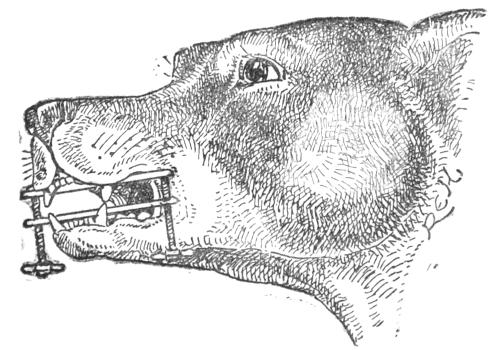
A lever for forcibly opening the jaws in cases
of ‘Lock-jaw’
Symptoms: A rare disease, but occurs occasionally,
the result of injury to the head or
severe hurt to the eye, and may result from
sunstroke. It is seldom that the whole body
as well as the jaw is affected in the dog as in
other animals and people, and, as a rule, it
assumes a chronic form. Though the dog is
unable to open his mouth, he is generally able
to suck in fluid food, as milk with eggs and
strong beef-tea. The muscles of the head
become much wasted.
Treatment: At first give sedatives, as from
two to ten grains[1] each of hydrated chloral
and bromide of potassium in water three or
four times a day. After a time, means must
be taken by aid of levers to gently force
the jaws apart. It must be done very gradually
by increasing the extent of the opening a
little more each day. The treatment requires
to be continued some time to obtain permanent
beneficial results; but directly the dog is able to
open his mouth a little, encourage the gnawing
of bones.
Symptoms: A form of rheumatism affecting
the loins. The dog shows signs of much pain
when walking or upon pressure to the parts.
Dogs affected with lumbago often lose all power
for a time in the hind legs; in fact, it is the
cause of many cases of paraplegia.
Treatment: See Rheumatism.
Symptoms: Not a common ailment of dogs,
except in cases of distemper or influenza, but
it may result from cold. The attack generally
commences with rigors or shivering; the temperature
rises to 103 or 104, in some cases
even higher; pulse is increased in frequency,
full and hard. The breathing is quick, and at
each expiration the dog may give a suppressed
grunt. The chest is tender on pressure. If
the ear is put to the chest, crepitation will be
detected; and as the disease advances, the
parts of the lungs affected become quite dull,
and there are no sounds to be heard except
the air passing in and out of the large tubes.
At the commencement of the attack, the dog
may have a husky cough, but it generally
stops after a day or so, to commence again
later. The dog is generally off his food, and
the eyes are congested.
Treatment: Place the dog in a jacket lined
with thermogen wool, or apply hot linseed-meal
poultices right round chest. If no better on
second day, apply a blister to front of chest;
the liquor epipasticus is as good as anything.
The hair must first be cut off closely over the
part, and the blister rubbed into the skin for
five minutes. If the skin is not blistered
the next day, rub a little red blister ointment
into the place. Care must be taken that the
dog is not allowed to lick the blisters, as they
are poisonous. For medicine give from one[1] to
ten grains of phenacetin every six hours to
reduce the temperature, but it must not be
continued for long; brandy may also be given
in small quantities often. If the dog becomes
very weak and the pulse feeble, give every four
or six hours from two[1] to ten drops of Tincture
Digitalis, with from one[1] to five drops of Tincture
Nux Vomica, in water. In bad cases the inhalation
of oxygen relieves the distressing breathing.
It is important to keep the bowels open; in fact,
it is generally a good plan to give a purge at
first. The diet must be light, and consist of milk,
beef-tea, meat extracts, and such like food.
See Lips (Sore).
Dogs with a long coat kept in a
dirty state sometimes become infested with
maggots, especially in those parts near the
tail.
Treatment: Wash daily for a week with
Pearsons fluid diluted eighty times with
warm water. Afterwards dry and comb out
all mats. In very bad cases it is best to cut
the hair off short.
Symptoms: This disease, which is very
contagious from one dog to another, and
readily caught by people, is due to a small
insect. The complaint once contracted soon
spreads more or less all over the body, but
the most favourite spots for it to attack is the
skin around the eyes, the outside of the ears,
the elbows, and the outside of the hind legs,
as well as the skin covering the abdomen, and
underneath parts of the chest. Small red spots
like flea-bites appear where the insect burrows
into the epidermis, and the acrid matter which
they excrete sets up intolerant irritation, causing
the dog to constantly scratch, breaking the coat,
which is now very brittle, and leaving bare patches,
besides injuring the skin and creating sores which
dry and scab. If there is any doubt about the
case, the skin should be scraped where bad with
a knife, and the scrapings examined under a
microscope, and if the disease is mange the
parasite will be found.
Treatment: The disease is easily cured, and
the specific remedy is powdered sulphur, one
part mixed with eight parts of vegetable oil,
which should be thoroughly well rubbed all
over the dog every four days for three times;
three or four days after the last dressing, the dog
may be washed.
It is important to thoroughly disinfect the
kennels by fumigation, and well washing the walls
and floors with a strong solution of Pearson’s fluid;
also all the collars, leads, combs, and brushes
used for the dog, should be disinfected by
baking or soaking in a solution of Pearson’s
fluid.
A skin disease confined
principally to puppies, though adult dogs do
occasionally contract it. It is not contagious
to people.
Symptoms: It is a slowly progressive disease,
and may commence with a single circular bare
patch, about the size of a shilling, on the face
or side of nose. The disease is, of course, not
confined to the head, as the first sign may
appear on some part of the body or one of
the legs. The patch is generally of a dirty
grey colour, and upon which will be found a
number of reddish pimples or elevations of
the skin, somewhat larger than those seen in
ordinary mange; some contain a blood-coloured
fluid, others ordinary pus, or matter tinged with
blood, which is easily evacuated by squeezing.
This fluid contains the parasite, which looks,
when examined under the microscope, like a
small silk-worm.
As time goes on, the original patch increases
in size and others form, the pimples break, one
running into another, and unhealthy-looking sores
result. When these wounds heal, the skin has a
dry, corrugated appearance, and little excrescences
of skin are formed, and the hair does
not always grow again.
The skin in follicular mange generally turns
a dark greyish-blue or black colour, and the
disease is called by some people “black mange”.
Treatment: It is a most unsatisfactory disease
to treat, for often after months of hard work
the dog is no better, but on the contrary is much
worse, the disease having progressed in spite of
everything. If the patient is not a valuable dog,
and the attack a bad one, it is much better to
destroy him at once; however, when it is decided
to give the dog a chance, treatment should commence
by having the dog, if a long-coated one,
clipped all over, so that the sores may be got at,
and then dress him all over with the following:—
Recipe:
| Black Sulphur, |
2 ounces. |
| Kerosene, |
4 ounces. |
| Olive Oil, |
4 ounces. |
| Cocoa-nut Oil, |
4 ounces. |
| Castor Oil, |
4 ounces. |
| Wright’s Solution of Coal Tar, |
1 ounce. |
| Well mix. |
With this, dress the dog all over once a week,
but before each dressing have him thoroughly
washed, using Cook’s 3% mercurial soap, and
carefully dry before applying the dressing. To
the spots apply Naphthol Beta ointment daily.
If this does not heal them, then dab on the sores
twice a day peroxide of hydrogen (20 volumes).
For a change, the sores may be dressed with
the following:—
Recipe:
| Oil of Cade, |
} |
Equal parts mixed together. |
| Methylated Spirits, |
} |
| Green Soft Soap, |
} |
In treating follicular mange a change of dressing
to the sores is necessary. During the treatment
an occasional course of arsenic often does good;
give from one[1] to five drops of liquor arsenicalis
in water after food; gradually increase the dose
to from two[1] to ten drops. Continue the medicine
for about three weeks at a time, and after a
week’s interval give it again as before.
Symptoms: Loss of condition, colour, flesh,
and strength.
Treatment: A raw meat diet with tonics, or
the following pills:—
Recipe:
| Reduced Iron, |
12 to 48 grains.[1] |
| Arsenic, |
⅟₁₂th to ¼th ” |
| Extract Gentian, |
6 to 20 ” |
| Mix. |
Divide into 12 pills. One twice a day after food.
Cod-liver oil is also advised after food, from
half a teaspoonful[1] to a tablespoonful twice a day.
Symptoms: This complaint is not uncommon
in bitches when nursing puppies. One or more
of the milk-glands may be affected. The breast
is swollen, red, and very tender. The bitch is
off her feed, and there is often a good deal of
fever. An abscess generally forms, which should
be lanced as soon as it becomes soft and points.
Treatment: Hot water fomentations are the
best, as it is difficult to apply poultices when a
bitch is nursing puppies. If the temperature is
very high, from two[1] to ten grains of salicylate
of soda may be given three or four times a day.
After the abscess has been opened, or has
broken, tonics as from a quarter of a grain[1] to
one grain of sulphate of quinine should be given
three times a day.
Symptoms: Occasionally occurs in young
puppies, particularly when suffering from worms,
but is more often the result of a protracted attack
of distemper.
In young puppies, the patient rolls its head
from side to side, is constantly whining and
crying, has convulsions, and the head is burning
hot. When the result of distemper, convulsions
are always present, the dog champs the jaws,
emitting a quantity of frothy saliva. These are
what are called distemper fits. The eyes are
congested, and there are generally two, three, or
more degrees of fever. The patient is frequently
crying or whining, denoting evident signs of
pain. As a rule, in these cases the patient becomes
greatly emaciated and very weak—in fact,
paralysed; and often, as the inflammation extends
to the spinal cord, which it frequently does,
chorea or St. Vitis’s dance sets in, which is
practically incurable.
Treatment: When occurring in young puppies,
worm medicine should always be given; and to
allay the pain and stop the convulsions, small
doses of bromide of potassium be given—from
two[1] to five grains in a little milk three or four
times a day. Ice may also be applied to the
head in a sheep’s bladder. When the convulsions
have quite stopped, small doses of cod-liver
oil do good. When meningitis follows distemper,
if the attack is a bad one, there is little hope
of recovery, and as a result the proper course
to pursue is to have the dog mercifully put out
of his misery. However, people seldom will
agree to this without, as they say, giving the
dog a chance, and when the case is not a bad
one recovery is not impossible, though the
chances are greatly against it, for usually it is
a progressive disease. If the bowels are not
operating (but there is generally diarrhœa) give
a dose of castor oil, and commence a course of
bromide of strontia at once. Give from two[1] to
ten grains, or even fifteen grains, if the dog is
a very big one, every three, four, or six hours,
according to the severity of the case. Apply an
ice-bag to the head for a quarter of an hour
or longer at a time, and put a seton in the back
of the neck, just behind the ears, which dress
with turpentine ointment. Keep the dog absolutely
quiet in a dark room, and feed entirely on a
liquid diet—as milk, with white of egg; Benger’s
food or toast; and some beef-tea. Brand’s
essence or rabbit soup may be given occasionally,
but those latter foods are more stimulating than
nourishing. The milk foods mentioned are
perfect food, and will support the dog an
indefinite time. For the treatment of chorea
and paralysis, see the articles on those
subjects.
The bromide must be continued for some time,
even though the convulsions stop, but given in
less quantities.
It is not generally known how much
stronger or more nourishing a bitch’s milk is
than cow’s milk, and when I had some samples
analysed I was surprised myself. Below I give
the analysis of a fair sample of each kind:—
|
Cow’s. |
Bitch’s. |
| Water, |
87·4 |
66·3 |
| Butter, |
4·0 |
14·8 |
| Sugar and Soluble Salts, |
5·0 |
2·9 |
| Caseine and Insoluble Salts, |
3·6 |
16·0 |
Practically a bitch’s milk is nearly three times
as strong as a cow’s, and yet people, when
giving the latter to puppies, often dilute it with
one-third of water, and thus add to its weakness.
Consequently a much larger quantity has necessarily
to be given to a puppy for it to derive
sufficient nourishment to sustain it, and as a
result the stomach is over-distended. Indigestion
follows, and the puppies do not thrive. All
breeders must have noticed how often puppies
go back directly artificial food is given them,
even before being entirely weaned, and this, no
doubt, is in a great measure due to improper food
in overloading the stomach with a quantity of
waste and superfluous fluid. Even when cow’s
milk is given pure, nearly three times the
quantity in bulk ought to be given than if bitch’s
milk is used, and it is thus seen at a glance how
a puppy’s stomach, which is naturally small, is
over-distended. A dog’s digestive organs are
arranged to receive food in a concentrated form—as,
for instance, dogs in nature eat only meat,
and until they get this food they have nothing
else but the dam’s milk, which is also a concentrated
food. When about five or six weeks old
the mother goes out in search of food, and
comes back with her stomach loaded, which,
after a time, when it is partially digested, she
ejects by vomiting, and this the puppies eat, and
thus they get naturally partially-digested food
suitable for a puppy’s delicate stomach.
To treat cow’s milk so as to make it as like
bitch’s milk as possible, to every three-quarters
pint of the former add two and a half ounces
of cream—that is, about three tablespoonfuls—two
and a quarter ounces of plasmon, and five
ounces of water. First mix the plasmon with
the water, add the milk and slowly boil in an
enamel saucepan for two minutes, then add the
cream when cold and well mix.
When feeding puppies with artificial bitches’
milk, it must be remembered that only a small
quantity is necessary—for instance, about the
third part one would give of cow’s milk.
See Lactation (Defective).
See Lactation (Excessive).
See Gumboil,
Lips,
Teeth,
Toothache.
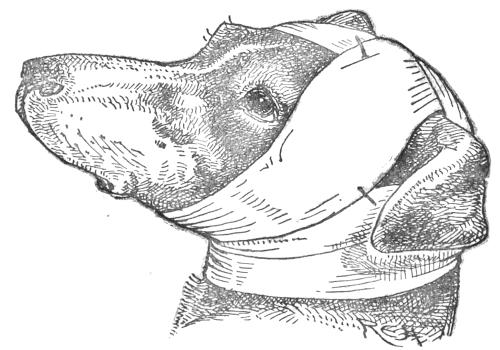
How to bandage a dog’s head
Symptoms: Swelling of side of face, and just
below the ear, which is very tender. Dogs
suffering from this complaint are generally rather
feverish. There is a loss of appetite and an
excessive flow of saliva.
Treatment: Give a dose of purgative medicine
and cover swelling over with a piece of spongiopyline,
or a pad of cotton-wool covered over
with oil-silk, and apply a bandage or put on a
cap. Later, when the swelling has commenced
to go down, give the following tonic pills:—
Recipe:
| Reduced Iron, |
6 to 30 grains.[1] |
| Sulphate of Quinine, |
4 to 12 ” |
| Common Mass. sufficient. |
| Mix. |
Divide into 12 pills. One to be given twice a
day one hour after food.
Symptoms: There may be general wasting of
all the muscles of the body, the result of some
long illness, as distemper; or there may be wasting
of the muscles of one or more limbs, the result of
want of use, as in cases of injury; or some disease
of the spinal cord, causing paralysis, and occasionally
wasting of the muscles of one or both
sides of the head and face, the result of some
injury to the head.
Treatment: When the result of illness, no
special treatment is required beyond giving
tonics, as cod-liver oil, for when the patient
gets about again the muscles will fill up as
before. When one or more limbs are affected
as the result of disuse from lameness or paralysis,
the limbs should be massaged and galvanised.
When the head is affected, the case is often
very obstinate, and sometimes the muscles never
regain their normal size, but the best treatment
is massage galvanism, and encourage the dog to
gnaw big bones.
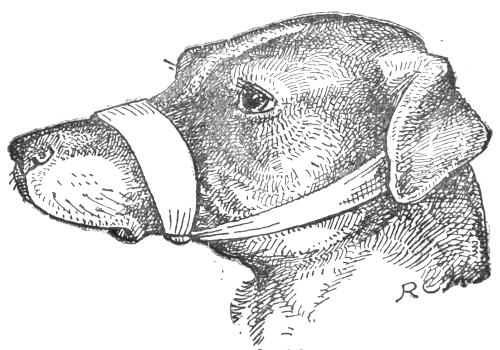
A dog muzzled with tape
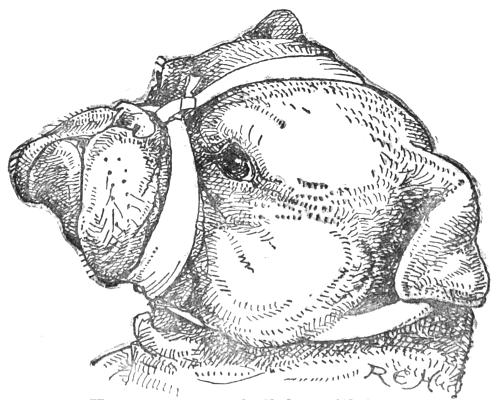
How to muzzle a bulldog with tape
The piece over the forehead is necessary in a
bulldog to draw the tape off the short nose to permit easy breathing
The best way to muzzle
a dog effectually, so that he cannot bite, is
with a piece of strong tape which should be
passed over the top of the nose, tied twice under
the chin, and then the ends should be carried
behind the ears, and again tied tightly.
Care must be taken in muzzling a bulldog, or
you may interfere with his breathing. Therefore,
after tying behind the head, one end of the tape
should be passed under the tape which crosses the
top of the nose, and this part pulled well up and
tied with the other end of the tape over the forehead,
so as to remove any pressure from the top
of the nose. (See Illustration.)
This cannot be safely done
with scissors, but proper nail-clippers should be
used. When the nails are white, it is an easy
matter, as the quick can be seen, and the nail
may be cut off within the sixteenth of an inch
of the quick; but when the nail is black, the
quick cannot be seen, then the first one must
be cautiously cut a little at a time. The dog
will soon wince when the nippers are getting
near the sensitive part. When one is done, it
is an easy matter doing the rest, as they may
be cut off in the same proportion as the first.
The dew-claws or side-nails should always
be removed from the back legs a few days after
birth, by being cut off close to the limb with
a pair of sharp scissors. I always consider it
would be a good plan if it was a custom to
remove the dew-claws from the forelegs of all
dogs also; of course, in some cases, as in fox-terriers
and others, it is done.
Symptoms: Dogs with defective action wear
their nails away (more particularly those on
the forelegs) to the quick, which causes lameness.
Some dogs’ nails are very brittle, and
they crack and split to the quick, causing
lameness. Toe-nails of dogs who do not have
sufficient exercise turn over as they grow, and
the point becomes embedded into the pad, causing
swelling, suppuration, and great pain. The
dew-claws of dogs who do not get the chance
of digging often grow to a considerable extent,
which weakens and makes them liable to break,
which often happens, and the quick becomes
exposed and bleeds, causing the dog to go
lame as if he had a broken leg. If they do
not break, they grow, entering the pad as
previously described.
Treatment: In cases of a dog wearing the
claws away through defective action, as a rule,
treatment is of little use; but if the dog is
made to exercise on grass land, the nails will
grow to an ordinary extent, and the dog walk
much better, but the relief is only maintained
whilst he is not allowed to run on hard roads.
When the defective action of the limbs causing
undue wearing of the nails is due to partial
general paralysis—as the sequel of distemper,
for instance—then it is only temporary, and
will pass off as the patient improves in health
and strength. To remedy the cracking and
splitting of the nails is often a difficult matter.
In some cases benefit is derived by the
application of tar ointment, which should be well
rubbed into the nails twice a day. The frequent
application of glycerine is also a good remedy.
In very bad cases, especially when only one nail
is affected, it may be extracted.
When a nail has grown too long and injured
the pad, the nail should be cut close to the quick
without making it bleed; and when there is any
festering, hot bread or linseed-MEAL poultices
should be applied for a day or so. Afterwards
the wound should be dressed with boracic
ointment, and the foot kept in a canvas bag
for a few days.
When a dew-claw becomes broken, it is nearly
always through the quick. In such cases it is
necessary to remove the claw by extraction with
a pair of tooth forceps, and not by cutting, or the
quick will be injured, and the nail will grow
deformed. Afterwards anoint the raw surface
with boracic ointment, cover over with a pad
of boracic wool and bandage.
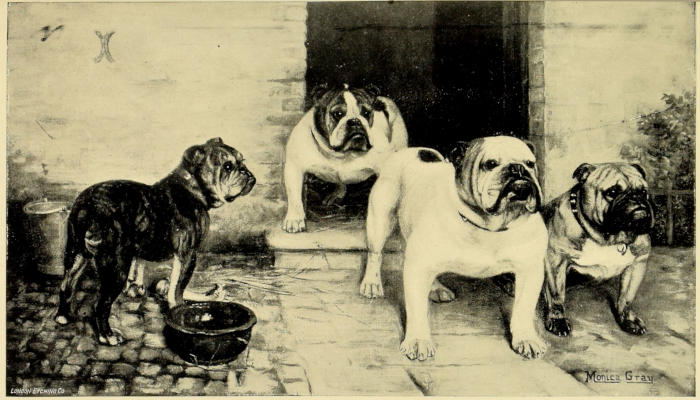
Four Celebrated Stud Dogs: Buck Stone, British Stone, Dick Stone, and Rex Stone.
The property of Walter Jeffries, 28, Grove Park, Denmark Hill, S.E.
Symptoms: Sneezing; a watery discharge from
nose, followed by a semi-purulent discharge
and coughing; but unlike distemper, the
attack is seldom accompanied by fever and
with little loss of condition, and as a rule, the
dog is better in a few days.
Treatment: Put in a dry, warm room of a
temperature about 60 degs. F.; give a dose of
aperient medicine as from two[1] to ten grains of
jalapin.
The next day, when this has worked off, commence
the following pills:—
Recipe:
| Salicylate of Quinine, |
2 to 12 grains.[1] |
| Solution Arsenic, |
3 to 12 minims. |
| Solution Sulphate Atropine, |
½ to 2 drops. |
| Extract Gentian, |
5 to 20 grains. |
| Mix. |
Divide into 12 pills—one to be taken every
four hours.
When the discharge has ceased, and the appetite
has become normal, if the cough continues
troublesome, give from half[1] a teaspoonful to a
tablespoonful of cod-liver oil two or three times
a day.
Symptoms: Very occasionally dogs suffer
from a worm in one of the nostrils called
Pentastioma Tænoides. It is a worm varying
in size from one and a half to two inches long,
and about half an inch wide in the centre,
tapering slightly at each end. It develops at the
back of the nose, and whilst growing appears
to cause no discomfort to its host; but when
it commences to move, it induces a good deal
of sneezing and a discharge of mucus from the
nasal passage from the side where it is lodged.
The dog eventually dislodges it during a violent
attack of sneezing.
I have never seen more than one in a case,
and the dog seems comfortable directly it has
got rid of its guest.
Symptoms: A growth with a narrow neck
which forms in the nasal passage causing
irritation, sneezing and snorting, a purulent
discharge which may sometimes be tinged with
blood.
Treatment: Consists in removing the
growth by ligature if it can be got at, or by
an ecraseur or a snare; but it is a surgical
case, and a veterinary surgeon should be
consulted.
Symptoms: Generally the result of some injury.
The parts are swollen, inflamed, and very painful,
and generally an abscess forms, which, if not
lanced, bursts, discharging a thick, creamy and
often offensive-smelling pus. The bone, which
is generally dead, lies exposed at the bottom of
the wound, which does not heal permanently until
the dead bone comes away.
Treatment: At first, hot linseed-meal poultices
dusted over with powdered charcoal are to be
applied, and continued for some days after
the abscess is open. Then lint saturated with
carbolic oil, one in forty, is to be placed over
the wound, and kept in place with a bandage.
As a rule, after some time the dead bone
exfoliates and comes away of itself, and the
wound then soon heals, but in many cases, an
operation is necessary to remove the dead
bone.
Symptoms: Generally commences suddenly
with an attack of shivering and a rise of
temperature, there being often three or four
degrees of fever accompanied by a rapid pulse.
There is pain in the back, vomiting, scanty and
high-coloured urine, or blood may be mixed
with the water. In some acute cases it is
quite suppressed, and the dog then suffers from
uræmic poisoning. It may arise from a severe
chill, but oftener from a stone in the kidneys.
Treatment: Give milk and Vichy water in
equal parts to drink, also water to drink, to
which has been added a teaspoonful of cream
of tartar to every pint. Administer a dose of
Epsom salts, from one scruple[1] to one ounce,
dissolved in warm water, but given cold. If
vomiting persistent, give from half[1] to two
drops of diluted hydrocyanic acid in a teaspoonful
of water, and ice to lick. After the
acute stage has passed, give from one[1] to
five grains of ammoniated citrate of iron, three
times a day in water.
Symptoms: Generally arises suddenly, and
often the result of a chill, as, for instance, a
dog plunging into cold water when hot after
exercise. When once a dog has had an
attack, he is liable to a recurrence, and then
indigestion will often induce it. The skin
becomes suddenly nodulated or swollen in
patches, the hair standing on end. The ears
may be affected and become half an inch thick;
the head is often attacked, and the dog is
temporarily blind because the eyelids are swollen.
Sometimes one or more legs are the seat of
the trouble, and become three or four times
their normal size; in other cases, large patches
appear about the body. As a rule, it passes
away almost as quickly as it comes.
Treatment: Keep dog quiet and warm whilst
the attack is on, and give from half to two drops[1]
of liquor arsenicalis (P. B.) in a little water
every two or three hours. Also give a good
dose of aperient medicine. For a few days
after a dog has had nettlerash, he should be
kept on a light milk diet, and given a course
of arsenic, as from one to eight drops[1] of liquor
arsenicalis in water, three times a day after food.
Symptoms: Dogs are affected with a form of
neuralgia that attacks the muscles and nerves
of the neck and shoulders. The pain, which is
very acute, comes on quite suddenly, and the
dog cries with it. The head is drawn into the
body, as it were. The muscles are swollen, and
very tense. There is a difficulty in walking;
and when it is attempted, it is done very slowly
and stiffly. The attack may last a couple of
hours, sometimes longer, and then slowly passes
off, and the patient may appear quite well; when
all at once it may come on again as bad as
before, and so keeps on for days, and sometimes
weeks, unless some suitable treatment
is adopted.
Treatment: The dog must be kept very quiet
in these cases, as very often any sudden movement
induces an attack. Give from two to ten
grains[1] of salicylate of soda three times a day,
made into a pill; and if the attacks of pain are
very acute, also give two or three times a day,
injected under the skin, from one-twentieth to
the eighth of a grain[1] of hydrochlorate of
morphia, with from ⅟₃₀₀th to ⅟₁₀₀th of a grain[1]
of atropine, in from five[1] to ten minims of distilled
water. At first these injections induce
vomiting, but it soon ceases, and the treatment
is a specific for the disease.
Symptoms: The nipples become swollen,
inflamed, and cracked very often after a bitch
has been nursing puppies some weeks, so much
so that at last she will not allow the puppies to
suckle.
Treatment: Wash the parts two or three
times a day with boracic lotion, and anoint
with boracic ointment after drying.
Symptoms: May be due to injury of the head
or face. It often occurs in cases of pneumonia,
and it is a symptom of a polypus in the nose
or ulceration of the membrane lining the nasal
passages.
Treatment: When slight, no particular treatment
is required; but if persistent, the cause
should be ascertained, and if possible removed.
When severe, as the result of some injury, ice
may be held to the bridge of the nose; and if
this does not stop it, then pour or inject about
fifteen drops of the solution of adrenalin diluted
four times with water into one or both nostrils.
It is not advisable to plug the nostrils, as it
distresses a dog to breathe through his mouth.
The first thing to be considered in
nursing a sick dog is proper quarters for the
patient to live in, for in all cases of serious
illnesses he should not be allowed to run loose
about a house and out of doors when he likes.
If a house dog, he should be put in a good,
well-ventilated room, with the temperature kept
at as near 60 degs. F. as possible. Of course,
in very hot weather that cannot be done, but as
much air as possible must be given by keeping
the windows wide open during the summer
months. In winter or cold weather, the temperature
of the room should be kept up to
60 degs. F. by means of artificial heat—an
ordinary fire is best; failing this, a paraffin
stove—avoid a gas stove if possible. Of
course, with dogs who are in the habit of
living out of doors it is different; but even
with them, dry, large, well-lighted and ventilated,
comfortable quarters, free from draughts,
are absolutely necessary if the patient is to have
a fair chance, and the temperature of the place
should be kept up to 55 degs. F. A loose box
in a stable that is kept clean makes a capital
place; but unless the stable is kept very
clean, it smells of ammonia, which is fatal
to a dog suffering from distemper, because
pneumonia and bad eyes are sure to develop.
Sick dogs should always be kept separate.
It is a great mistake to put three or four
together.
As to diet for patients, see article on Invalid
Food; when they will not take food voluntarily,
a small quantity, varying according to size
of dog, must be given often, about every two
hours or oftener, day and night. It is useless
to feed a dog well for sixteen hours, and
to leave him to chance for eight. It is often
during the night, when the system is at its
lowest, that a little good nourishing food, with
some stimulant, is most wanted; and it is this
attention that saves the patient in many cases.
The preparation of food is most important.
It should either be done by one’s self, or under
the personal superintendence of a responsible
person. All milk food should be made fresh
three times a day, and any that is left over should
be thrown away. All feeding utensils must be
kept scrupulously clean, and the spoon, bottle,
or feeding-cup that is used for food or medicine
should be washed and dried immediately after
being used, ready for next time. The cooking
utensils also must be kept scrupulously clean.
If these things are not attended to, diarrhœa
and sickness result, and the patient is weakened,
and perhaps has a relapse. Also keep the sick
dog scrupulously clean. Each time after feeding
clean his lips with a little weak solution of
Condy’s fluid on a pad of cotton-wool—which
should be thrown away immediately after using—and
dry with soft cloth; also cleanse the
fundament and prepuce once a day with the same
preparation, and keep the eyes free of discharge
with a little weak boracic acid lotion, and also
clean the teeth with a weak solution of permanganate
of potash. This is very important.
As well as attending to the patient, the room
or kennel requires frequent attention. Do not
make the air stuffy with strong disinfectants,
but it is a good plan to sprinkle the floor,
whether a kennel or room, with pine sawdust, and
if the flooring be wood, to cover it over with
sheets of old newspapers, which may be covered
with sawdust, and then all evacuation can be
carried away and burnt, for when a dog
is very ill he ought not to be allowed to go
out. There are some dogs who are so clean
that they will not make themselves comfortable
in a room, and it becomes absolutely necessary
to let them out rather than make them worse by
keeping them in. But a dog may be kept for
some hours, twelve or even sixteen, to see if
he will not give way. Once he has relieved
himself in the room, and finds he is not
scolded, he gains confidence, and is not so
particular in the future. To make an obstinate
dog do what is necessary in a room, especially
when the weather is bad, and when perhaps it
would be fatal to let him out, I give either a
dose of aperient medicine or an enema, which
invariably has the desired effect.
Do not always be fidgeting an invalid. Do
what is necessary, and then leave him alone.
Take the temperature regularly three times
a day, at the same time each day, and keep a
record on a chart; also, if you can, at the same
time count the pulse and the number of respirations
per minute, and record them for reference.
In all cases of severe illness, it is a good plan
to put the dog in a flannel jacket, as depicted in
the illustration.
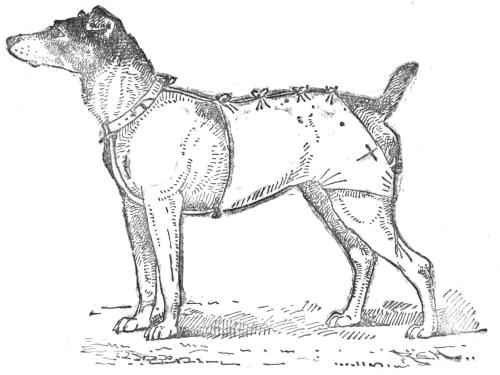
A coat covering the hind parts of a dog—useful after
operations upon the abdomen
The points to be remembered are:—
1. Dry, well-ventilated, light quarters of a
proper temperature.
2. Cleanliness of patient.
3. Cleanliness of the surroundings.
4. Cleanliness of everything used for the
patient.
5. Not to fidget the patient, but to give him
food and medicine at regular stated
times.
6. To keep the body warm, but the air he
breathes fresh and cool. Fresh air
never kills, but foul air often does.
The best kind of bed for a small dog being
nursed in a room is a basket with a cushion
in, which should be covered over with a white
cloth or towel to be changed daily. For a kennel
or loose box a bench should be supplied, raised
a few inches from the ground, and long
and wide enough for the dog to lie out full
length. Straw makes a good bedding, and
should be changed often.
In nursing surgical cases, cleanliness is even
more important than in medical cases, and
the patient should be kept under similar conditions.
It is important to take the temperature
twice a day at least, for a rise of temperature is
the first symptom of suppuration in a wound, and
shows that it is not healing in a normal manner;
or if healing, by suppuration it points to pus being
pent up somewhere, and the surgeon’s attention
is required.
Clean bandages and dressing should be put on
every time a wound is dressed, and the bandages
taken off should be washed in some disinfectant
like Pearson’s fluid, dried and ironed, ready for
use again. The old dressing which has been in
contact with the wound should be burnt.
Bitches in the nest with puppies require, for
the first week at least, as careful nursing as an
invalid, and the temperature for the first week
regularly taken. It is always a little above normal
during the first few days, about 102·4 degs. F.
(taken in the bowel); but if it rises over 103 degs.
F., the case is not taking a normal course, and an
examination should be made. Possibly there
may be a dead puppy or one of the fœtal envelopes
left behind, which, of course, must be
immediately removed, and the womb syringed
out with a solution of permanganate of potash,
one grain to the ounce of warm water; from two
ounces to a pint[1] of the solution should be used
at a time, and the injection repeated in a few
hours. A saturated solution of boracic acid or
clinesol, one grain to the ounce, may be used
instead of the potash. In bad cases, when the
temperature is over 104 degs. F., a solution of perchloride
of mercury, one in three thousand, is the
best remedy; but about a couple of minutes after
giving an injection of this drug, the womb
must be thoroughly washed out with warm
water.
Symptoms: This is a common complaint of
elderly pet dogs, especially pugs; but it is not,
as generally supposed, always the result of overfeeding
and want of exercise, for lots of dogs
will put on flesh in spite of careful dieting, and
then I generally put it down in these cases to
a contented mind.
Treatment: In treating these cases, medicines
are not advisable except occasionally giving a
free purge. If any good is to be done it must
be by dieting; and whatever food is given should
be dry. Raw, or nearly raw, meat is the best
food, for nearly all fat dogs put on this diet lose
weight considerably, and at the same time improve
in health by becoming brighter and livelier,
and more ready to take exercise; but the
meat must be given sparingly, say for a small
dog like a pomeranian, one ounce and a half
twice a day; and for a dog the size of a fox
terrier, three ounces twice a day. The worst
of this food is, it never seems to satisfy; in fact,
a dog fed on raw meat always seems hungry.
Raw meat does not answer in every case, for the
dog sometimes gets fatter instead of thinner, as
required. Then a diet of dry biscuit should be
tried. For small dogs, Spratts’ pet-dog biscuits
should be given—whole, if they will be taken
that way, otherwise they must be broken up in
small pieces, and no other food at all given; and
the more exercise the better.
Symptoms: In young dogs it occurs as the
result of injury; in old ones it arises from constitutional
causes. The testicles become swollen
and very painful, the scrotum is red and
shiny. The dog walks and sits down with
difficulty.
Treatment: Give a purge, as from two to
ten grains[1] of jalapin. Foment the parts
often with hot poppy-head tea, made by boiling
a couple of crushed poppy-heads in a quart of
water for ten minutes; then strain. Sometimes
the application of an ice-bag gives more relief
than the hot application.
or the period of menstruation of the
bitch, generally appears for the first time when
the bitch is about eight or nine months old.
With some foreign breeds, as in chows particularly,
it often occurs for the first time sooner,
even when the bitch is five or six months old.
Occasionally, with very small bitches, the first
heat may not appear until she is a year old.
Once the period has commenced, it generally
occurs regularly twice a year, but in a few
exceptional cases every three or four months.
The heat generally lasts from three to four weeks—that
is, right from the commencement until the
end.
The condition is recognised by the external
parts—vulva—swelling, and a slight mucus discharge,
which continues for about a week; then
the discharge is pinkish, and after a few days
blood-coloured. This latter condition continues
for about eight or nine days, to be followed by
a mucus discharge again, until the heat has
ceased, when the parts have assumed their
normal size.
Symptoms: Generally both eyes are affected,
the membrane (conjunctival) is intensely inflamed,
and there is a good deal of purulent
discharge. There is intolerance to light, and
as a consequence, the lids are kept partly, if
not quite, closed.
Treatment: Keep the dog for a time in a
darkish room, and bathe the eyes three or four
times a day with the following lotion:—
Recipe:
| Laudanum, |
1 drachm. |
| Sulphate of Zinc, |
10 grains. |
| Rose Water to |
6 ounces. |
Anoint the edges of the lids at night-time with
vaseline to prevent their sticking together.
A good purge is beneficial.
Care must be taken to prevent the dog
rubbing the eyes, or he may severely injure
them; and bandages should be placed round
the ankles covering the dew-claws.
See Canker of Ear.
Symptoms: There is a chronic purulent or
mattery discharge from the nostrils which often
has a very offensive odour.
Treatment: Syringe the nose thoroughly every
day with from ten to thirty drops[1] of tincture of
hydrastis, mixed with one[1] to four tablespoonfuls
of tepid water. Give cod-liver oil, also iron and
quinine tonic pills.
Symptoms: Increased action of the heart;
if bad, it beats with a thumping action, shaking
the whole body, the dog is restless and pants,
and may in some cases faint.
Treatment: Put the dog on a raw meat diet
for a time, and avoid violent exertion, but the dog
may have regular walking exercise. Give aperient
medicine and a course of the following mixture:—
Recipe:
| Tincture of Digitalis, |
90 minims. |
| Bromide Potassium, |
120 grains. |
| Water to |
6 ounces. |
From one teaspoonful[1] to a tablespoonful to be
given three times a day one hour after food.
Symptoms: Not uncommon after distemper,
and may follow fits; injury to the back and
rheumatics are frequently the cause. More often
seen in dachshunds than other dogs. The whole
body may be affected, including all four legs, but
the back part of the body, including the two
hind legs, is the favourite seat of the disease.
The dog is unable to stand, but drags the back
legs after him when he moves. The bowels
are constipated, and the dog is unable to pass
water, though later it may dribble away. The
dog may not be ill in himself, and will generally
take his food. When the seat of the mischief is
in the brain, all four limbs are useless, and the
dog lies on his side in a miserable, helpless
condition, often even being unable to raise his
head from the ground.
Treatment: The condition of the bowels and
bladder must first be attended to. Aperient
medicine should be given, and if it does not act in
a few hours, an enema of warm soapy water (from
two tablespoonfuls[1] to half a pint) administered,
and repeated in a couple of hours if it does not
operate. The urine must be drawn off with a
catheter if relief cannot be obtained by pressure
over the seat of the bladder. This, as a rule,
is sufficient, and should be repeated two or
three times a day, until the dog is able to
relieve himself. If a catheter has to be used,
twice a day should do, but care must be taken
to keep the instrument very clean. It is a
good plan to keep it lying in a saturated
solution of boracic acid when not in use.
When the paralysis is the result of an injury,
do not give any medicine at first, except a purgative,
but keep the patient quiet and allow time
for the injured parts to heal. If there seems
much pain—and there is sometimes when there
has been an injury—give two or three times a
day from three[1] to fifteen drops of liquor morphia
in a little water. Do not let the dog lie always
on one side, but change him over about every six
hours. If in about a week there are no signs of
movement, or return of strength in the legs, give
the following pills:—
Recipe:
| Powdered Nux Vomica, |
1 to 6 grains.[1] |
| Reduced Iron, |
6 to 30 grains. |
| Ergotine, |
6 to 24 grains. |
| Common Mass. sufficient. |
| Mix. |
Divide into 12 pills—one to be given twice a
day after food. Later, if the paralysis continues,
the following pills may be tried, and the former
discontinued:—
Recipe:
| Anhydrous Phosphate of Iron, |
3 to 12 grains.[1] |
| Sulphate Quinine, |
2 to 12 grains. |
| Strychnine, |
⅟₁₆th to ⅕th grain. |
| Arsenic, |
⅟₁₂th to ¼th grain. |
| Common Mass. sufficient. |
| Mix. |
Divide into 12 pills. One to be given two
or three times a day after food. The dog should
be galvanised twice a day for about half an
hour each time. A continuous current battery is
best, and a blister should be applied to the loins,
from the two last ribs to the points of the hips,
and from two to four inches wide.[1]
When all four legs are affected, the result of some
injured or diseased condition of the brain, the treatment
should be the same as previously mentioned,
except a blister should be applied to each side
of the neck, along the course of the spine, instead
of over the loins. The best blister to use is the
liquor epipasticus; the hair, of course, should first
be cut off close, or shaved, and the skin thoroughly
washed and dried, and the blister should be gently
rubbed into the skin with a piece of flannel for
about three minutes. If it does not act well, rub
a little red mercurial blister ointment into the
parts the next day for a minute. Care must be
taken that the dog does not lick the blisters, as
they are poisonous. Two days later, the parts
may be carefully washed and boracic ointment
applied. Benefit is also derived in these cases
by having the muscles of the limbs massaged.
When paralysis is the result of rheumatism—and
in these cases it is generally the back limbs and
loins affected—the attack commences with pain
and stiffness across the loins. Give first, after a
purge, for a week or so, suitable medicine for
rheumatism, and then later, if the patient does
not improve, treat as for ordinary paralysis.
Cases of paralysis are often tedious, and keep
about a long time, but in the end, unless the
spine has been seriously injured by some accident,
they generally recover.
Symptoms: Dogs, particularly some of the
small ones, sometimes get the penis protruded
out of the sheaf, and if the orifice is at all small
it contracts on the protruding part, and it cannot
be relieved without assistance. The part becomes
swollen and very painful, and if it is not noticed
soon after happening, the point of the penis
becomes much inflamed and congested.
Treatment: A little oil should be poured on
the red protruding part, and the sheath should
be taken hold of and pulled forcibly over it.
In some cases it is necessary to apply ice to
the protruding part, when it is very much swollen,
before it can be returned.
Symptoms: This occurs in nervous and excitable
bitches two or three weeks after pupping.
The bitch is unable to stand, or does so with
great difficulty. She generally lies on her side,
with legs outstretched and head drawn back,
panting violently and frothing at the mouth.
The attack, though very distressing, generally
lasts some hours, leaving the bitch much
prostrated; it is seldom attended with fatal
results.
Treatment: As soon as the bitch is able to
swallow, give from five[1] to fifteen grains each of
bromide of potassium and hydrated chloral in
water. The dose may be repeated in two or
three hours if necessary.
Once a bitch has had an attack of this complaint
she generally has another in the course
of a few days, but it may be prevented by giving
some bromide of potassium regularly for a time—as
from three[1] to ten grains three times a day
with the food or in a little water.
Diet: Fish, tripe, and milk food may be
generously given, but avoid red meat.
Symptoms: Small, bluish-grey insects generally
found with the head stuck in the skin—standing
on their heads, as it were. They may
be seen on all parts of the dog, but the favourite
places seem to be the nose, ears, and underneath
the chest. The lice lay their eggs or
nits on the hair, to which they stick by a very
adhesive material and are difficult to remove.
These insects cause intolerable irritation, and
as a consequence, the dog is always scratching,
and loses condition.
Treatment: Bathing in Pearson’s disinfectant
fluid, diluted eighty times with water—that is,
four tablespoonfuls to a gallon—is a good remedy,
but it is necessary to continue the treatment for
some time so as to destroy the young lice as they
escape from the eggs. Another effectual remedy
is bathing the dog in kerosene one part, separated
milk six parts, well mixed together. But neither
of these remedies destroy the nits. To do so it is
necessary to mix either the Pearson’s fluid or the
kerosene with oil in the proportions previously
mentioned, and thoroughly rub it all over the dog
and leave it on him for some days; in fact, it is
advisable to repeat the dressing again four days
later, and not wash him for a week.
To get rid of the lice entirely the kennels, also
collars, leads, brushes, in fact everything belonging
to the dog, should be thoroughly disinfected
by fumigation and washed in a strong solution
of Pearson’s fluid.
When a sick dog, as one suffering from distemper,
is infested with lice, washing, of course,
is out of the question at such a time. The
only thing to do, then, is to use some effectual
insecticide powder.
Symptoms: Dogs, especially those used for
stud, and particularly bulldogs, are liable to
growths on the penis. They are red in colour,
and look not unlike a raspberry. The dog
suffering in this way often has drops of blood
at the orifice of the prepuce. These growths
are contagious, and a dog suffering from them
should on no account be used for stud purposes.
The growths may not only be on the point
of the penis, but may be situated far back.
Treatment: The growths should be removed
by being scraped off, and the roots cauterised
sparingly with a saturated solution of chromic
acid, which should be applied on a thin stick.
The caustic should be repeated in a week. It
may be necessary to repeat it several times.
Symptoms: It is difficult to detect it in the
dog. There is some pain on the left side of
the chest, the pulse is quiet and small, the
temperature is two or three degrees above
normal, the breathing is short and quick,
and there is a dry cough. If the heart be
examined with a stethoscope, a friction sound
is heard with each movement of the heart.
When fluid collects in the sac, as it often does,
the usual heart sounds are almost inaudible.
Treatment: Apply hot linseed-meal poultices
to left side of chest, keep the bowels freely
opened with purgative medicine. If temperature
is very high, give the following mixture:—
Recipe:
| Salicine, |
2 drachms. |
| Tr. Digitalis, |
1½ drachms. |
| Simple Syrup, |
1 ounce. |
| Water to |
6 ounces. |
From one teaspoonful to a tablespoonful[1] three
or four times a day.
When fluid collects, give from half[1] to two
grains of iodide of potassium in water three
times a day.
Symptoms: Generally the result of some
injury, but may be the result of a chill. The
abdomen is hard and very painful to the touch.
The breathing is quick, and the dog often utters a
grunt with each breath. The pulse is very quick,
and the temperature rises to 105 degs. F. or over,
and the patient vomits frequently, especially after
taking food or even water, and quickly collapses,
death often taking place within twenty-four hours
of the commencement of the illness.
Treatment: Apply flannels wrung out in hot
poppy-head tea, made by boiling for ten minutes
a couple of crushed poppy-heads in a quart of
water. Give from five to twenty drops[1] of
laudanum every four hours in water; if the
dog cannot retain it, inject under the skin from
the twentieth to the eighth of a grain[1] of acetate
of morphia, in a few drops of water, which may
be repeated in six hours.
Give Vichy water and milk in equal parts to
drink, and a little Brand’s essence occasionally.
Symptoms: Generally result of injury. Parts are
very painful and swollen, the skin covering the
inflamed spot discoloured, very often purple.
An abscess may form. In these cases there
is a good deal of constitutional disturbance, the
temperature is high, perhaps 104 or 105 degs. F.,
the pulse quick, and the dog refuses food. Blood
poison may result.
Treatment: Keep patient absolutely quiet,
and give a good purge. Apply following lotion
constantly on lint:—
Recipe:
| Goulard’s Extract of Lead, |
1 drachm. |
| Laudanum, |
2 drachms. |
| Water to |
6 ounces. |
Or an ice-bag may be applied.
If an abscess forms, it must be freely opened,
and afterwards apply hot linseed-meal poultices,
dusted over with powdered charcoal.
Symptoms: A dog does not perspire from
the skin when in health, but he occasionally
does when suffering from some skin diseases;
and puppies in the nest, when ill and not
thriving, will become quite wet from perspiration.
It is always a bad sign, and shows the
dog or puppy is in a very bad state of
health.
Treatment: In the case of puppies, give the
mother a dose of castor oil, and dust the
youngsters all over two or three times a day
with finely-powdered boracic acid one part,
kaolin eight parts, mixed together. In the
case of adult dogs, give daily a sulphur bath,
made by dissolving one ounce of sulphurated
potash in four gallons of tepid water; after
well drying, dust the inside of the thighs,
abdomen, armpits, etc., with the powder recommended
for puppies. For medicine give a
course of arsenic, as from one[1] to eight drops
of Fowler’s solution in water after food.
Symptoms: The opening of the sheaf or
prepuce is so small that the male organ
cannot pass through.
Treatment: Nothing but a surgical operation
is of any use, which consists in enlarging the
opening, and sewing the skin to the mucus
membrane.
Symptoms: Chronic hacking cough; the temperature
is always a degree or two above
normal; loss of condition; the muscles of the
neck, body, and limbs become wasted. If the
expectorations are examined by the microscope,
the tubercle bacilli will be found.
Treatment: Generally incurable; but making
the dog live out of doors, and giving plenty of
cod-liver oil, with a generous diet of raw meat,
sometimes does good.
It is a mistake to keep a dog suffering from
consumption amongst people, as the danger of
infection is too great a risk.
Old English Sheep Dog, Champion Ragged Man.
The property of Mr. Aubrey Hopwood, 36 Sackville Street, W.
Symptoms: Dogs do not suffer from internal
piles, but old dogs occasionally have a form
of external piles; then the anus becomes red,
inflamed, and swollen; small red pimples form
about the part, inducing a good deal of irritation,
and causing the dog to drag the hind parts
along the ground.
Treatment: Dab the parts often with the
following lotion:—
Recipe:
| Goulard’s Extract of Lead, |
1 drachm. |
| Tincture of Opium, |
1 ” |
| Water to |
6 ounces. |
| Mix. |
Or the following ointment may be tried:—
| Goulard’s Extract of Lead, |
1 drachm. |
| Finely-powdered Boracic Acid, |
1 scruple. |
| Cream, |
1 ounce. |
| Mix. |
Apply night and morning.
Some cooling medicine, as the following, does
good:—
| Cream of Tartar, |
1 ounce. |
| Bicarbonate of Potash, |
1 ” |
| Milk of Sulphur, |
1 ” |
| Powdered Sulphate of Magnesia, |
1 ” |
From sufficient to cover a threepenny-piece to a
teaspoonful[1] twice a day with food.
Strychnine:
Symptoms: It all depends how the agent has
been administered how quickly it acts. If in a
liquid form, the symptoms may commence in ten
minutes, or quicker; but if it has been given in
a piece of meat, it may be an hour or so before
any signs appear. Then the animal becomes
restless; the limbs are stiff, and the dog walks with
difficulty, and with the hind legs stretched apart.
Occasionally there is a violent twitching or jerk
of all the muscles of the body, as if the dog had
a galvanic shock, and then he suddenly falls to
the ground, often in a forward direction, and in
acute tetanic spasm. The limbs are extended,
and as stiff as pieces of iron, the fore ones in
a slightly forward direction, and the hind legs
in a backward direction. The head is drawn
back, and the back arched and the tail extended
and stiff; the eyes protrude, the mouth firmly
closed, and the pulse extremely quick. Respiration
during the spasm, which lasts about half a
minute or so, entirely ceases. At the end of the
attack the dog gives a few heavy sighs, and then
commences to pant hard. The least movement
or touch, or even a noise, will cause a return
of the convulsions, which continue at frequent
intervals, unless the dog is relieved by some
suitable antidote, or until death occurs, which
generally takes place during a paroxysm. In
some cases, though the acute symptoms may have
been checked by treatment, the dog afterwards
dies from the effect of the exhaustion.
Treatment: In all cases of poisoning, more
especially when due to strychnine, prompt action
is required, and means should at once be taken
to make the dog disgorge what has been
swallowed. An emetic that will act well and
quickly must be at once administered; for this
there is nothing better than a dose of hydrochlorate
of apomorphia. This medicine acts in
two ways: it is the quickest and surest emetic;
and besides, it relieves the spasms. The dose
is the twelfth of a grain for small dogs, and about
a quarter of a grain for large ones, given in a
teaspoonful of water; but the best way of administering
it is by injecting it under the skin
with a hypodermic syringe; then from three[1] to
ten minims of the one in fifty solution is to be
given. I always advise persons who keep a
number of valuable dogs to have a solution of
apomorphia by them ready for emergency, for
whilst it is being obtained the patient may die,
and if huntsmen would always carry a small
bottle of the solution with them many a valuable
hound’s life might be saved. When this medicine
is not at hand, some other emetic must be given.
Ordinary table salt can always be quickly procured,
and from one teaspoonful[1] to a tablespoonful
should be given in warm water. If the dose does
not act freely, repeat it in a few minutes; or instead,
give from five[1] to twenty grains of powdered ipecacuanha,
or from half[1] to three grains of tartar
emetic. Either of these may be shaken dry on the
tongue. The dog must be made to vomit somehow;
but anything like salt, requiring a quantity of
water, is difficult to administer, as the dog’s mouth
is often tightly clenched, and trying to open it
induces paroxysm, during which time it is impossible
to give anything by the mouth; and
here the advantage of the subcutaneous injection
of apomorphia comes in. This may also be
repeated in a quarter of an hour, if the vomiting
has not been free. Besides the emetic, some
medicine is necessary to relieve the spasms. For
this there is nothing better than chloral and
bromide of potassium. From fifteen[1] grains to
two scruples of each may be given in from one[1]
to three tablespoonfuls of water, if the dog can
be made to swallow; and half the quantity of
each may be given again in twenty or thirty
minutes, and repeated, if necessary, in half an
hour. When the dog is unable to swallow, from
two[1] to six minims of nitrite of amyl, held to the
nose on a pocket-handkerchief, is useful. This
may be repeated in a quarter of an hour, or
chloroform may be given. Also, inject into the
rectum from one[1] half to two drachms of laudanum
in from one[1] to four tablespoonfuls of water, which
repeat in a quarter of an hour, and again in
another fifteen minutes if the paroxysms continue.
After the severe symptoms have passed, and
the dog is weak and prostrate, from a quarter[1]
to two teaspoonfuls of brandy added to some
milk may be administered, and repeated every
half hour for a time.
Arsenic:
Symptoms: The dog, shortly after taking the
poison, becomes restless. Violent sickness soon
commences, the vomited matter being mixed with
blood. There is also acute diarrhœa, accompanied
by severe straining, and a good deal of blood is
often passed with the motions. The dog is
extremely thirsty, has an anxious countenance,
showing evident signs of great pain, and breathes
heavily. There may be severe convulsions,
followed by paralysis, collapse, and death.
Treatment: The vomiting at first should be
encouraged by giving an emetic, as three[1] to ten
drops of the one in fifty solution of apomorphia
with a hypodermic syringe. If this is not at
hand, give from the twelfth[1] to a quarter of a
grain of the same medicine in a teaspoonful of
water. Failing the apomorphia, give from five[1]
to twenty grains of sulphate of zinc in a little
warm water, or even salt and water. The
vomiting may be kept up by getting the dog
to drink warm water. Besides endeavouring to
free the stomach of all the arsenic, an antidote is
required to remedy the ill effect of the poison.
For this there is nothing better than dialysed
iron given in large doses, as from half[1] a teaspoonful
to a tablespoonful every half hour until
several doses have been given. This may be
followed by a large dose of castor oil. About an
hour afterwards some carbonate of bismuth should
be given, shaken dry on the tongue, from
ten[1] grains to a drachm, which may be repeated
every hour or two. When there is great prostration,
stimulants, as brandy, are required, and
when the patient is unable to swallow or retain it
in the stomach, from one[1] half to a drachm may
be injected under the skin frequently. If the
body is cold wrap the dog up in hot blankets,
and place hot-water bottles around him. As
improvement takes place, milk thickened with
arrowroot, barley, or rice water may be given.
If the dog appears in much pain after the acute
stage has passed, small doses of laudanum may be
given, and hot linseed poultices applied to the
stomach.
In chronic cases of poisoning by arsenic—a
not uncommon occurrence, as this is a favourite
remedy for skin diseases, and too much is often
given, or the medicine is given too long—the dog
loses appetite and condition, becomes very weak
and emaciated, frequently vomiting a white, frothy
mucus as well as food.
There is often severe diarrhœa, and blood is
passed with the motions. There are signs of
tenderness on pressure over the region of the
stomach, and excessive thirst. The membrane
(conjunctiva) lining internal surface of eyelids
is red and congested.
Treatment: Discontinue the use of the arsenic
immediately, give tonics, as reduced iron, from
one[1] to three grains made into a pill with an
extract of gentian. If the sickness continues,
give from three[1] to ten grains of carbonate of
bismuth, shaken dry on the tongue, every three
or four hours.
For food, lean raw mutton, in small quantities,
every three or four hours, and milk to drink.
If the latter is not retained, try it peptonised with
Fairchild’s powders, which can be obtained at
most chemists. When the sickness is very
severe, Brand’s beef essence is recommended,
given in jelly form, in small quantities frequently.
Phosphorus:
Symptoms: There is vomiting, but not to
the same extent as is seen in cases of arsenic
poisoning. The vomited matter, when taken into
the dark, is generally luminous, and it gives off
that well-known odour of phosphorus which
resembles the smell of garlic; the same perfume
may be detected in the breath. If the dog survives
the acute stage, in the course of a few days
the symptoms of jaundice may develop; there is
also a tendency to hæmorrhage from the nose.
Poisoning by phosphorus is often followed by
convulsions, but sometimes coma; in other cases
noisy delirium.
Treatment: In treating cases of poisoning by
phosphorus, oils and other greasy substances
must be always avoided, as it easily dissolves
in anything of an oily nature, and when such
occurs greater mischief happens. An emetic of
sulphurate of zinc, from five[1] to twenty grains in
warm water, should be given as quickly as possible,
and repeated in ten minutes. If it has not
acted, salt and water or ipecacuanha wine may be
given instead of the zinc, when the latter cannot
be obtained.
After the sickness has ceased, administer a free
dose of Epsom salts, and keep the dog’s strength
up with Brand’s beef-tea jelly; also give barley
or rice water to drink.
Carbolic Acid:
Symptoms: The dog shows signs of great pain,
and is violently sick; the lips, mouth, and tongue
are white, swollen, and hard. There is great
prostration and signs of collapse, the lips and
ears being cold. The urine is of a dark brown
colour, sometimes even black, or it may be altogether
suppressed. When a fatal dose has been
taken, the pupils are contracted, the dog soon
becomes comatosed, breathing difficult, and death
follows. It is rather characteristic of carbolic
acid poisoning that the patient, a short time
before death, often seems to rally, making one
(even persons of experience) think that the worst
has passed, and that he is going to get better.
But a sudden collapse often occurs, and death
takes place unexpectedly. All cases do not run
this acute course; the membrane of the tongue
and mouth may be badly burnt, which peels off,
leaving a large raw surface, which ulcerates. The
same may occur in the throat, and even in the
stomach and bowels; and the dog gradually dies
from exhaustion, or even blood poisoning, a week
or ten days after the accident has happened.
Treatment: Give a large dose of Epsom salts
at once, to be followed a few minutes afterwards
by an emetic, the apomorphia being the best—from
one[1] to two teaspoonfuls of one grain to
two ounces of water solution. Failing this, salt
and water, or from five[1] to twenty grains of sulphate
of zinc in water; also give the white of an
egg or olive oil to relieve the burning irritation
in the stomach. If symptoms of collapse occur,
give stimulants, as brandy and ether. When the
patient is very bad, these are more beneficial if
injected under the skin; wrap the body in hot
blankets and apply hot-water bottles. The ulcers
that form in the mouth, the result of the caustic
action of the acid, are often very troublesome, and
the discharge from them is most offensive. When
such is the case, keep the parts clean by sponging
them frequently with a saturated solution of
chlorate of potash.
Mercury:
Symptoms: There are signs of pain, violent
vomiting, accompanied by profuse purging,
the evacuations being mixed with blood; the
lips, tongue, and mouth are swollen and white.
The patient soon shows signs of collapse. The
lips and ears become deadly cold; the breathing
is heavy and difficult; the secretion of urine is
suppressed; coma and convulsions follow, then
death occurs.
Treatment: Encourage the sickness by giving
warm water; also administer large quantities of
raw white of egg, flour and water and barley
water. Give brandy or ether subcutaneously, if
signs of collapse occur.
In cases where slow poisoning by mercury
occurs, caused by the injudicious use of some
of the preparations of this agent for the skin,
especially that called blue ointment, I have seen
this salve applied as freely all over a dog as one
would use lard, with the result I need not mention.
Then there is the green iodide of mercury—a
favourite remedy of the late Stonehenge. This
is a valuable preparation for old wounds, for
chronic eczema, and other skin diseases, used
sparingly, and not over a large surface. Then,
again, repeated doses of calomel act very
injuriously.
Symptoms: Diarrhœa, the evacuations being
stained with blood; loss of appetite, sickness,
great wasting; profuse flow of saliva from the
mouth; gums at first red and inflamed, subsequently
become ulcerated—the breath being
horribly foul; a rash often appears on the skin,
pustules form and break, giving forth a fœtid discharge,
and the hair falls off in patches. These
cases usually terminate fatally, the result of exhaustion,
though occasionally a patient may be
saved when the case is taken in time.
Treatment: At first, give a mild dose of castor
oil, with from three[1] to ten drops of laudanum;
the oil, etc., may be repeated in a couple of days.
Large and frequent doses of subnitrate of bismuth
should also be given. When the diarrhœa is
very profuse, and there is much blood being
passed, tannic acid is useful, given in the following
formula:—
Recipe: The Pills:
| Tannic Acid, |
½ to 4 drachms.[1] |
| Powdered Opium, |
2 to 12 grains. |
| Ex. cip., q.s. |
Mix and divide into 12 pills.
Dose: One pill to be given every four or six
hours, according to the severity of the diarrhœa.
The mouth and gums should be kept clean by
being frequently sponged with a saturated solution
of boracic acid.
Keep the strength up with strong beef-tea,
thickened with isinglass, and each time the dog
is fed, give from half[1] to a teaspoonful of port
wine. Let the patient have milk with white of
an egg added, or barley water to drink.
A warm bath and a free application of some
soap is beneficial. This is more particularly
the case when the attack is due to absorption
of the poison through the application of some
ointment containing a mercurial compound.
If the skin is very moist, apply to the parts
freely some finely powdered Fuller’s earth.
When the dog has become convalescent, some
iron or bark tonic will assist the patient to regain
strength. Raw meat should also be given in small
quantities five or six times a day.
Iodine and its Compounds, as Iodide of Soda
or Potash, etc.:
Symptoms: A person can take ten times as
much iodide of potassium as a dog, without
any bad result. The tincture of iodine is often
used to reduce tumors or swellings. It seldom
has any beneficial results, except in cases of
goitre, when it is sometimes useful; and if the
application is continued too long, or the preparation
is applied over too large a surface, sufficient
becomes absorbed to cause severe constitutional
disturbance. If a large quantity of pure iodine
or the tincture is given to a dog, the mouth and
tongue will be found discoloured (dark brown);
there is great pain in the throat and stomach;
severe purging and vomiting—the vomited matter
may be yellow or brown from the iodine, or blue,
if there is any starchy matter in the stomach;
and the breath has that peculiar unmistakably
iodine odour. Dogs very seldom, indeed, are
poisoned with iodine in this way, though it is
not at all an uncommon occurrence for dogs to
be slowly poisoned with iodide of potassium, or
in some cases by the pure iodine, through absorption
into the system by the skin. The latter
should never be given, and only the former in
small doses, say from half[1] to two grains, and
even this quantity should not be continued too
long. When it is, or large doses are given, the
dog soon loses flesh; he has an almost unquenchable
thirst, the result of gastric catarrh. Vomiting
is frequent, especially after taking a large
quantity of fluid; diarrhœa may be present; the
tongue is of a dark brick-red colour; saliva flows
freely from the mouth, and there is no desire for
food.
Treatment: In cases of acute poisoning, if the
patient does not vomit freely, an emetic should
be given, as from five[1] to twenty grains of sulphate
of zinc in water or some ipecacuanha wine;
give starch and water, also white of egg, and
water in large quantities, and allow milk ad
libitum.
If there is great prostration, inject ether or
brandy under the skin. In cases of chronic
or slow poisoning by iodide of potassium, the
medicine must, of course, be instantly stopped;
and diluted hydrochloric acid, from two[1] to six
drops in a dessertspoonful[1] to two tablespoonfuls
of water given three times a day. If this does
not stop the sickness and great thirst, the subnitrate
of bismuth may be tried, in doses from
five[1] to twenty grains, shaken dry on the tongue,
every three or four hours. The dog must not
have any water to drink, as it only increases the
sickness; but plenty of ice placed in a perforated
dish to lick, also iced barley or rice water. As
there is often great weakness in these cases,
nourishing food of an easily digested nature is
required—Brand’s beef essence, given in jelly
form; milk peptonised, or thickened with
Benger’s food. As the case improves, lean
raw meat in small quantities may be allowed.
Tartar Emetic:
Symptoms: The proper dose varies from a
quarter[1] of a grain to one and a half grains.
The symptoms, the result of a large dose, are
continued sickness, with violent retching, and
often diarrhœa; great thirst; coldness of lips,
ears, and limbs, with severe depression and
weak pulse, difficult breathing, collapse, and
death. Sometimes just before dying the patient
may be much convulsed.
In cases of poisoning by tartar emetic, there
is generally an absence of blood in the vomited
matter and bowel evacuations, which is not the
case in poisoning by arsenic, as blood is passed
freely both ways.
Treatment: Give a copious draught of warm
water, with the idea of washing the stomach
out; this, of course, is almost immediately
brought up. A few minutes afterwards give
from five[1] to thirty grains of gallic acid in
water, which repeat every time the dog is
sick, and let the animal have barley water or
white of egg beaten up in water to drink. If
there is great collapse, inject brandy or ether,
from fifteen[1] minims to one drachm, under the
skin with a hypodermic syringe; keep the patient
warm, and as quiet as possible. When large
doses of tartar emetic have been given, there
is very little hope of recovery.
Turpentine is rather a favourite antithelmintic,
though it is not so much given for this purpose
now as it used to be; but it is still a good deal
used by some keepers, and when not carefully
and sparingly administered often proves fatal,
especially in young patients.
Symptoms: Convulsions; coma; heavy stertorous
breathing, with pupils contracted. A
great assistance in the diagnosing of these
cases is the smell of the turpentine in the
breath; the bladder is very irritable; the
urine has the odour of violets, and is passed
frequently.
Treatment: Give an emetic as soon as
possible. The best in these cases, as in many
others, is the apomorphia, from two[1] to five
drops of the one in fifty solution, injected
under the skin, or double the quantity poured
down the throat. Failing this, give from five[1]
to twenty grains of sulphate of zinc, in water,
or some powdered ipecacuanha. When the
effect of the emetic has passed, a full dose of
sulphate of soda, from one[1] drachm to one ounce,
in water, should be given. The dog may be
allowed to drink milk or white of egg, with
water or rice water.
When there is much pain about the abdomen,
a morphia suppository inserted into the bowel
gives relief.
Oxide of Zinc, either in the form of lotion,
ointment, or the powder, is a household remedy,
and an exceedingly good one, too, for many forms
of non-contagious skin disease; but like almost
everything else, when applied to the dog’s skin,
he makes it his business to remove it with the
tongue as quickly as possible. A small quantity
does no harm; but when the ointment or lotion
is applied over a large surface, and the dog licks
a large quantity off, serious disturbances of the
system often follow. Acute cases of this kind
are not so fatal, as a rule, as chronic ones—that
is, as in those cases of long-standing skin trouble
when the zinc has been in daily use for some
time, and the animal has been systematically
licking it. In these cases the ill effects of the
zinc are first noticed by the dog vomiting after
food.
Symptoms: There is great thirst and loss of
condition; soon the dog refuses food altogether,
the sickness increases, and becomes very frequent.
If the mouth is examined, the inside of the lips
and tongue will be noticed extremely pale—in
fact, quite blanched—and the membrane of the
eyes is in a similar condition. The dog is very
cold and dejected. Diarrhœa often comes on,
which adds to the weakness.
Treatment: In treating these cases, the application
of the oxide zinc in any form, of course,
should be immediately discontinued. A purge
should be given; for this, from two[1] to fifteen
grains of jalapin is as good as anything. This
should be repeated in two or three days.
Medicine to strengthen the system and stop
the sickness should be given, as the following
mixture:—
Recipe: The Mixture:
| Dialysed Iron, |
2 to 8 minims.[1] |
| Solution of Arsenic (Fowler’s), |
½ to 2 minims. |
| Bicarbonate of Soda, |
3 to 10 grains. |
| Compound Tincture of Gentian, |
5 to 20 minims. |
Water, from one[1] to four teaspoonfuls. Repeat
three or four times a day.
Strong beef-tea in jelly form, either home-made
or Brand’s beef essence, should be given
in small quantities frequently. Milk with soda
water, if it does not induce vomiting, may be
allowed.
When there is great prostration, stimulants, as
brandy, are necessary, and should be given in
small quantities frequently; and scraped lean raw
meat is very beneficial in these cases, when the
patient may be induced to take it.
Santonine is a most useful remedy for expelling
round worms, especially in young puppies, but
very often too much is given. As a result,
violent convulsions are induced, which in many
cases terminate fatally. Full-grown dogs will
stand a good dose without any bad effects,
but young puppies are particularly susceptible
to its action.
Treatment: The patient should be made to
vomit as quickly as possible, but this cannot be
done whilst the convulsions continue. However,
directly the dog is able to swallow, a dose of
ipecacuanha should be administered, from two[1]
to ten grains (in a little water). This may be
repeated in a few minutes, if it has not acted.
If the convulsions are very severe, an injection
of ether and laudanum should be given—from
fifteen[1] to sixty drops of the former, and from
seven[1] to twenty drops of the latter diluted freely
with water. The injection should be repeated in
half an hour, if the symptoms continue. A warm
bath is sometimes useful.
Whilst on this subject, I may mention the
proper doses of this medicine. For small
puppies, toys, fox-terriers, etc., when five or
six weeks old, a quarter of a grain in a teaspoonful
of salad oil; collies, St. Bernards, and
other big puppies, half a grain in a couple of
teaspoonfuls of oil. The dose may be repeated
twice a week.
Lead is another poison which is occasionally
the cause of death. Many dogs are poisoned by
this agent, but it is only an exceptional case that
terminates fatally. I have known the acetate or
sugar of lead to be given in mistake for Epsom
salts, and I have also known puppies and even
full-grown dogs to pick up and swallow pieces of
white lead (carbonate of lead). I have also seen
dogs very ill through licking their feet after
walking on wet paint, and I have heard it
mentioned that some dogs will deliberately go
and lick a place that has been newly painted.
However, I can scarcely believe this; but
everyone knows a dog will try to clean his
coat of whatever may get on it. Dogs will
sometimes get a bad attack of vomiting by
remaining in a house where painting is going
on, just from the smell.
Symptoms: Vomiting, colic, pain sometimes
being acute; diarrhœa often at first, followed
by constipation. The muscles of the stomach
feel hard and rigid. There is great thirst, and
in some bad cases paralysis of the hind legs and
convulsions.
Treatment: Encourage the sickness by giving
a dose of sulphate of zinc or ipecacuanha wine.
Stimulate the action of the bowels with free
doses of Epsom salts; give milk to drink, with
white of egg added. If the pain is very severe,
an enema of laudanum and ether will soothe.
When there is great prostration, Brand’s essence
may be given—a teaspoonful or so every
hour.
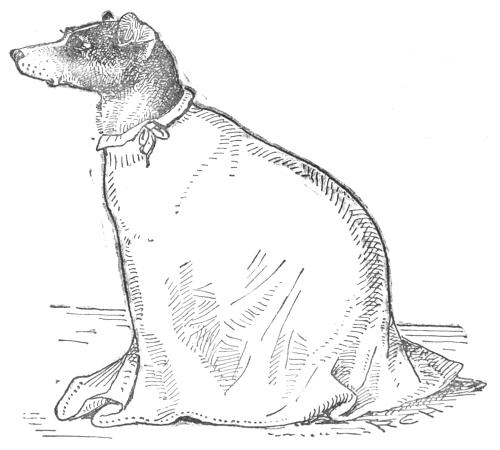
A dog in a bag which is very useful when it is necessary to keep
his tongue and teeth away from a wound or when some poisonous
dressing has been applied
Puppies are
occasionally born with the opening in the
prepuce too small, so that the penis is unable
to be protruded.
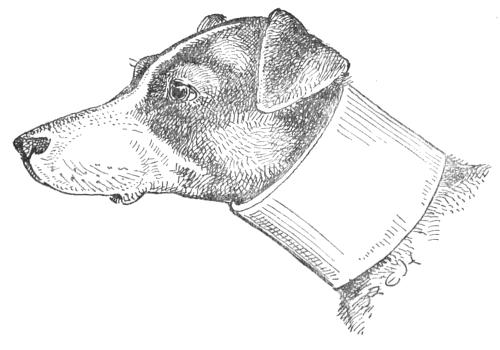
A wide leather collar to prevent a dog from
turning his head round
Treatment: The difficulty is removed by a
small operation—that is, by increasing the opening
by making a small incision, and then sewing the
skin to the mucous membrane. It is best not to
do this operation until the puppy is three or four
months old, and care must be taken during the
healing that the wound is not licked. This is
best done by making the puppy wear a wide
collar, or keeping him in a sack for a few days,
with the head only protruding as depicted in the
illustration.
Occasionally
puppies are born with the opening in the
prepuce so large that the penis is always
protruding.
Treatment: The opening may be partly closed
by scarifying the edges of the skin, and then sewing
it up. Care must be taken that the dog does
not lick the part during the healing.
Symptoms: Difficulty in passing water—straining;
also difficulty in passing a motion—constipation.
When very large, they may be
felt by manipulation of back part of abdomen
(the pubic region) just in front of the
thighs.
Treatment: If dog unable to urinate properly,
the water must be drawn off with a small-sized
catheter. The bowels must be kept in a semi-relaxed
condition by mixing with the food,
twice a day, from half to a dessertspoonful[1] of
salad oil. Also, give twice a day, from a quarter[1]
to two grains of iodide of potassium in a little
water. The extract of prostate gland may be
tried—dose, from half a grain to two grains.[1]
An operation for enlarged prostate gland in
the dog is not satisfactory, but castrating a dog
suffering from this disease often has a good
effect.
Symptoms: Increased frequency of passing
water, and straining after emptying bladder,
when a few drops of blood are often passed.
Big dogs are more subject to the disease than
small ones.
Treatment: Do not take the dog for long
walks; feed principally on milk, with biscuits,
bread, toast, rice, etc. Fish may also be given,
but avoid meat. Give aperient medicine, castor
oil is the best, also tonic medicine, as the following
pills:—
Recipe:
| Powdered Nux Vomica, |
1 to 6 grains.[1] |
| Reduced Iron, |
12 to 30 grains. |
| Extract Gentian, q.s. |
| Mix. |
Divide into 12 pills—one to be given twice a day
after food.
Symptoms: The skin around anus is red and
inflamed, and very irritable; the dog draws himself
along the ground on the back parts, and is
also frequently trying to lick himself.
This condition is often associated with a
swollen and congested state of the anal glands.
Treatment: Try the ointment recommended
for external piles, or bathe parts with following
lotion—
Recipe:
| Carbolic Acid, |
1 drachm. |
| Glycerine, |
2 drachms. |
| Water to |
8 ounces. |
| Mix. |
If the anal glands are distended, empty by
squeezing. (See article on
Anal Glands.)
In medicine, give from two[1] to fifteen grains
of milk of sulphur twice a day.
In feeding, avoid much meat.
Symptoms: A dry and scaly condition of
the skin, with small red spots here and there,
particularly when the elbows, knees, and hocks
are affected, which are the parts more often
attacked.
Treatment: When the disease is spread more
or less all over the dog, a dressing made of cocoanut
oil six parts, and glycerine one part, well
mixed together and applied all over the dog, and
repeated once in four days, is beneficial. The
dressing should be washed off after a week, using
sulphur soap, and then the dog should have two
or three times a week, for a time, a sulphur bath
made by dissolving one ounce of sulphurated
potash in a pail of tepid water.
When the disease affects only the joints, apply
the following dressing twice a day:—
Recipe:
| Methylated Spirits, |
} |
Of each one ounce. |
| Green Soft Soap, |
} |
| Oil of Cade, |
} |
| Mix. |
Give the dog worm medicine, also a course of
arsenic, from one[1] to six drops of liquor arsenicalis
P. B. in water twice a day after food. The dose
may be doubled a week later. This medicine
should be continued for about a fortnight, but
should it cause vomiting, diarrhœa, or loss of
appetite, it is at once to be discontinued.
Symptoms: It may occur three or four days after
pupping—commences with an attack of shivering—the
temperature rises probably to 105, the pulse is
quiet and weak. There is great thirst and vomiting,
and perhaps diarrhœa. The discharge from
vagina ceases, and the secretion of milk stops.
The abdomen is distended and painful.
Treatment: Give a large dose of salicylate of
quinine, from two[1] to ten grains made into a pill,
or put in a cachet. Apply hot linseed-meal
poultices to abdomen. Well wash the womb
out with a solution of perchloride of mercury, 1 in
2,000—that is, one grain to about every four ounces
of warm water. Of this solution use about two
ounces for a small bitch, and half a pint for a
large one. About two minutes after injecting the
solution of mercury, wash the womb well out with
plain warm water, using from four[1] ounces to a
pint. The syringing may be repeated in twelve
hours. When the mercury is not at hand, a
saturated solution of boracic acid may be used,
or one of permanganate of potash, one grain
to each ounce of water.
To wash the womb out properly, a clean
Higson’s enema syringe should be used, and the
long insertion tube well vaselined passed up
the passage as far as it will go.
Diet: Should be light, as milk with Vichy water
to drink, also Brand’s beef essence, or Valentine’s
meat juice, given with Vichy water.
If the vomiting is very troublesome, give the
mixture recommended for gastritis, and keep up
the bitch’s strength with nutritive enemas and
peptonised meat suppositories.
A dog’s pulse varies in the number of
beats per minute, according to his size. The
number is less in a big dog than a small one.
A St. Bernard’s pulse, for instance, beats about
70 times per minute, and a small dog’s, say, like
a toy terrier, 100 times per minute, and a dog’s
pulse is often intermittent in its beat.
In disease, the pulse, in most cases, is increased
in frequency. It might be for big dogs 100 to 120,
and for small dogs from 120 to 150 or 160 times a
minute.
In some instances, as in some cases of heart
disease, or in pneumonia, when the heart is
affected, the pulse is very slow indeed. A big
dog may go down to 50, and a small dog to 70.
A very slow pulse is more serious than a fast one.
In such cases, some such mixture as the following
should be given:—
Recipe:
| Tincture Digitalis, |
2 drachms. |
| Tincture Nux Vomica, |
1 drachm. |
| Simple Syrup, |
1 ounce. |
| Water to |
6 ounces. |
Doses: From one teaspoonful to a tablespoonful[1]
every four or six hours.
The pulse not only varies in number of beats
per minute during illness, but also in character—for
instance, after great exertion the pulse is full
and fast, and in cases of internal inflammation it
is small and wiry as well as fast.
In some diseases of the nervous system the
pulse is very slow. During a prolonged illness,
or after a severe illness, the pulse can scarcely be
felt; it is then said to be weak, and stimulants and
tonics are indicated.
The pulse is always quicker in young dogs and
old ones than it is in those in the prime of life.
The best place for taking the heart-beats or
pulse is at the femoral artery, just as it crosses
the inside of the thigh-bone.
To discover whether a bitch is in
pup, let her be placed upon a table, and her
fears or excitability banished by caresses; then
lay her upon her side, and with the fingers
gently manipulate the abdomen. If the womb
is impregnated, the person, directing his attention
first to the situation the uterus occupies,
near to the rim of the pelvis, and inferior to
the rectum, will there detect round smooth
bodies, like little eggs. These may not be
perceptible if the bladder be loaded; but if
the catheter be employed to draw off the
urine, they will surely be felt. If the rectum
be full of faeces, it serves as an admirable
guide to the position of the uterus, though he
who is acquainted with anatomy needs no such
assistance. Some globular substance being
detected, the fingers are advanced; and if
more than one pup be conceived, another
similar to it will speedily impinge upon the
touch; then another, and so on, until the
whole of the promised family have been thus
announced. The last is the most difficult to
discover; for should there be more than two
or three, it may, and will generally, occupy
the extremity of a horn, and in that situation
may escape observation. There are to the
womb of this animal a pair of horns, which
are long, and extend to the region of the
kidneys. Both cannot be traced at the same
time, and there is a chance of the two being
confounded; therefore it is not well to be
positive as to the precise number of young
the bitch will bring forth. And I never presume
to speak confidently upon the point; for
though, in the majority of cases, my opinion
may have been corroborated, nevertheless I
have often known a pup more than I supposed
the uterus contained to have been delivered.
From the end of the fourth week, the litter,
as it were, go away, or are lost; but when
the sixth week arrives, the contents of the
abdomen may be plainly detected; and if the
bitch be taken upon the lap, and her belly
supported with the hand, they at this period
will be felt to move, and the motion even of
their limbs is clearly recognised.
Milk appears in the teats about the middle
of the eighth week, and sometimes sooner, and
occasionally later.
For a bitch to be in proper condition at the
time of parturition, she requires some attention
during pregnancy. One or two hours’ walking
exercise daily is essential during the early part
of the time; but when the bitch becomes very
heavy, as is often the case the last fortnight,
then half an hour slowly walking is enough,
unless the bitch is inclined to take more.
During the first five weeks it is not necessary
to make any alteration in the diet. If the bitch
is in the habit of being fed only once a day, so
let it continue; but after the time mentioned,
food should be given twice a day, and should
be of good nourishing kind, as soaked biscuits
with a little under-cooked meat—three parts of
the former to one of the latter. When she is
delicate, and has a poor appetite, extra meat
may be allowed; and in some cases, especially
towards the last, if she is disinclined to take
her ordinary food, meat, raw or cooked, alone
may be given two or three times a day.
Spratt’s small special cod-liver oil biscuits,
which contain 10 per cent. of the oil, make first-class
food for bitches of poor condition. They may
be given dry, also broken up small, soaked in
soup, and mixed with meat in the proportion as
previously stated. The principal thing is to feed
regularly, and not to give too much at a time.
Bitches when in pup are best without a lot of
medicine; but I consider it a good plan, about
three weeks after service, and when all signs of
heat have quite disappeared, to give a vermifuge,
not with the idea of preventing the puppies
becoming infested with worms, as that is impossible,
before birth; but no bitch can be in good
health, which is so essential at this time, if the
bowels are full of worms. I do not advise a
strong drastic dose, but one of medium strength,
and it should be repeated the following week.
It is very important to examine the bitch’s skin
from time to time, so as to check any cutaneous
disorder early; for if the bitch has any skin
disease when the puppies are born, they are sure
to contract it, and nothing thwarts their growth
more than an irritable skin, for it prevents rest,
when plenty of sleep is so essential for a puppy’s
welfare; so if there are symptoms of mange, have
her at once dressed all over with some mild preparation
like sulphur ointment made with vaseline,
which should be repeated two or three times in
the course of a week, and after a few days washed
off. In case of eczema, a bath in Pearson’s fluid
diluted eighty times with water, or after the
seventh week sponging all over with a solution
of the same, will in most cases be all that is
necessary. In some cases of eczema, at these
times a little cooling medicine is useful, as an
occasional dose of syrup of buckthorn and castor
oil, or a small dose every day for a week of some
alterative powders, as the following:
| Cream of Tartar, |
} |
Equal parts. |
| Powdered Magnesia, |
} |
| Bicarbonate of Potash, |
} |
| Milk of Sulphur, |
} |
Dose: From sufficient to cover a sixpence
to a dessertspoonful.[1]
If a bitch has been in the habit of being
regularly washed, this may be continued as
usual, when the heat has passed, until about
the seventh week, when it is not advisable to
put the bitch right into warm water in case
abortion might be induced.
While on the subject of abortion, I may
mention that a bitch ought never to be sent
on a journey by train during the last two
weeks, for a shaking of this kind is more
likely to cause premature confinement than
anything else I know.
It is very important that the bitch should be
quite clean at the time of parturition, and it is a
good plan to wash the stomach and breast, also
the vulva and surrounding parts, with a strong
warm solution of Pearson’s fluid, about one in
forty. Some treatment of this kind is more
likely to prevent young puppies from having
worms soon after birth than anything else. It
is a common custom, and I think a very good
one, to give a bitch in pup a dose of castor oil
about three days before she is due. In many
cases, especially when the bitch is a bit gross,
it is advisable to give a dose of the oil a week
before her time is up, and again in three or four
days.
Bitches, as a rule, have their puppies on the
sixty-second or sixty-third day, the day of
service being included; but some will pup on
the sixtieth day, or even a day or so earlier,
and the puppies may be fairly strong; but when
born before the fifty-seventh day they seldom
live. On the other hand, many, especially those
of the larger breeds, will go two or three days
over the specified time without inconvenience;
and I have known one to go as long as seventy-three
days, and then to have a litter of strong,
healthy puppies, but this does not often occur
when there is a large litter.
One who is accustomed to dogs can tell within
a few hours when a bitch is going to pup. There
is disinclination for food, the vulva is swollen,
and there is a discharge of thick mucus from the
vagina, and, as a rule, she seeks a quiet spot to
be alone.
At this time, after making the bitch comfortable
with a nice clean straw bed—there is nothing
better than straw, which should not be supplied
too plentifully—she should be left by herself for
a time. As the labour pains come on, she
becomes restless, and pants; is frequently looking
around, and licking herself. When such
occurs, labour in earnest may be considered to
have commenced; and if all is going well, one
or more puppies should be born in the course of an
hour or so. If after two hours there are no signs
of a puppy appearing, it is well to examine the
bitch; but if a bladder (fœtal membrane) is protruding
from the vagina, there is no hurry to
interfere, as this is a sign, as a rule, that matters
are taking a normal course, and that more time
is required; and the bitch, after being offered
some milk, may be left again for another hour
or two. Bitches at their first pupping should
always be given more time than one which has
had two or three litters, and this is more especially
the case when she is three or four years old,
or even older. I have known bitches when over
nine years of age to have a litter of puppies for
the first time, and, as may be expected, it often
goes very hard with them, though with care they
may live through it. Once the membrane protrudes,
which the bitch generally ruptures by
biting, the first puppy, if everything is all right,
soon makes its appearance; and, as a rule, by
the time the cord is divided, and she has attended
to the young arrival’s toilet, another youngster is
nearly born, and in the course of an hour the bitch
may have given birth to three or four puppies;
then, perhaps, if there are any more, there is an
interval of two or three hours, which gives the
bitch time to recover her strength, and take some
refreshment in the way of thin oatmeal gruel or
plain milk, and in most cases this is quite sufficient;
but if there are signs of exhaustion, some
Brand’s essence, or the white of an egg beaten
up with milk, and a small quantity of brandy,
may be given. After this, in cases of the smaller
breeds, when the average number is four or five,
the last of the puppies soon makes its appearance;
this also refers to terriers, though they may have
five or six, or even more puppies, as they are such
strong dogs compared to toy spaniels, pugs, etc.
Very often a bitch will have all her puppies
but one with the greatest ease (for it is seldom
a bitch cries out whilst pupping after the first
litter), when the pains seem to cease altogether,
and do not return for many hours afterwards,
perhaps not until the next day. In such cases,
a dose of some medicine to excite the action of
the uterus is necessary, but this will be dealt with
later on.
Bitches of the larger breeds which have big
litters of twelve, fourteen, sixteen, and more
puppies, invariably take all day, even in normal
cases; but after twelve some assistance and great
care are required, for by this time the mother is
getting exhausted. Good gruel should be offered,
and about every three hours the white of an
egg beaten up with a teacupful of milk and a
dessertspoonful of brandy should be given.
Bitches that have had their puppies easily do
not require much food during the next twenty-four
hours, the fœtal envelopes, which are always
eaten, affording a certain amount of nourishment;
therefore, if some thin oatmeal gruel or Benger’s
food made with milk be offered, it is sufficient.
Plain milk may also be given to drink. The
same diet does for the following two days, with
the addition of some soup or sheep’s-head broth
with bread or crushed dog biscuits, a small
quantity twice a day. After the third day a
more liberal diet may be allowed; boiled fish,
as fresh haddock, with bread, also the meat from
a sheep’s head, and bread or broken biscuit soaked
soft in the soup. By degrees the quantity and
quality of the food may be increased, for after a
fortnight, when there is a large litter, a good deal
of nourishment is required, if the bitch is to be
kept strong and the puppies fat.
Very often, two or three days after parturition,
the bitch has diarrhœa. As a rule, it is not severe,
and passes off in the course of twenty-four hours.
Should it continue after this time, a dose of castor
oil and laudanum may be given. In small bitches,
as toys, a teaspoonful of the oil with three drops
of laudanum; for terriers, a dessertspoonful of the
former and five drops of the latter; collies, etc., a
tablespoonful, and ten drops of tincture of opium;
and large bitches, two tablespoonfuls and ten
drops. The dose should be repeated in six
hours. If the diarrhœa continues after the oil has
worked off, from five[1] to twenty grains of bismuth
may be given three or four times a day, shaken dry
on the tongue. During the diarrhœa, the milk
should be thickened with arrowroot, and the soup
be given with rice instead of bread or biscuit.
Some bitches, when due to pup, and though
in good health and fairly strong, have not sufficient
labour pains to bring forth their young; the water-bag
may break and there is the usual green-coloured
discharge, but the throes are so slight
as to be of little use. Of course, once the fœtal
membrane is broken, and the fluid escapes, the
puppy soon dies if not born; therefore, it is
necessary to use means to stimulate the contraction
of the womb—in other words, to induce
labour pains—and for this there is nothing better
than ergotine, which is a strong extract of ergot of
rye. Until recently the latter was used, the seed
being coarsely powdered, and from ten[1] to sixty
grains administered in warm milk or coffee, the
dose being repeated every two or three hours
until several had been given. There are other
preparations of ergot, as the ammoniated liquid
extract, and ammoniated tincture. The former is
the next best preparation to ergotine, and should
be used when ergotine cannot be obtained.
The dose varies from ten minims to one
drachm,[1] which may be given with water, or in
a little milk, and repeated every two hours until
the pains have been induced, or six doses given;
but these preparations are not so good as ergotine,
for not only does the latter act with more certainty,
but there is another advantage in its administration,
and that is, it may be injected under the
skin, and consequently the stomach is not irritated
and perhaps the bitch made sick, which
often happens when these medicines are given
by the mouth. The dose of ergotine is from
one[1] to three grains, given in from ten[1] to forty
minims of brandy. There is no advantage, as is
often recommended, in injecting it deeply into the
muscles in the region of the pelvis, as it is
quite sufficient to introduce it just under the
skin. I generally do so behind one of the
shoulders on the side of the chest, where the
skin is loose. The action of the drug, when
given in this way, may generally be observed
within a quarter of an hour, and the dose, if
necessary, may be repeated in a couple of
hours.
It is not an uncommon occurrence, as before
observed, in cases of parturition, for bitches that
have large litters, to give birth to all the puppies
quickly, and with a certain amount of ease, until
the last, and in some instances two puppies.
Then the pain seems to cease, and the bitch
appears fairly comfortable for some hours, and
it is often thought by the attendant she has
finished, and there is no further cause for
anxiety; but in about twelve hours, or perhaps
the next day, the bitch becomes restless again,
refuses her food, and is inclined to neglect her
pups, and is constantly wanting to go out, and
after passing water, sits and strains for a few
moments. When these symptoms are noticed,
the bitch should be immediately examined, and
if it is found there are more puppies, and that
the foremost one is not unnaturally situated, a
dose of ergotine should be at once given, and
some nourishment also administered, as milk
and brandy, or Brand’s beef essence, or even
a little scraped lean raw meat.
Breeders should make it a regular practice
to examine a bitch when it is thought she has
finished pupping, by gently manipulating the
abdomen, also by passing carefully a well-oiled
finger into the vagina, for it is often impossible
to tell for certain, without examination, if there is
only one left, more especially in cases when the
mother has had a large litter. Many a valuable
bitch is lost through this not being regularly done.
Because the pups, when left behind, if not
already dead, die, and quickly decompose and
set up blood-poisoning, which invariably terminates
fatally within twenty-four hours.
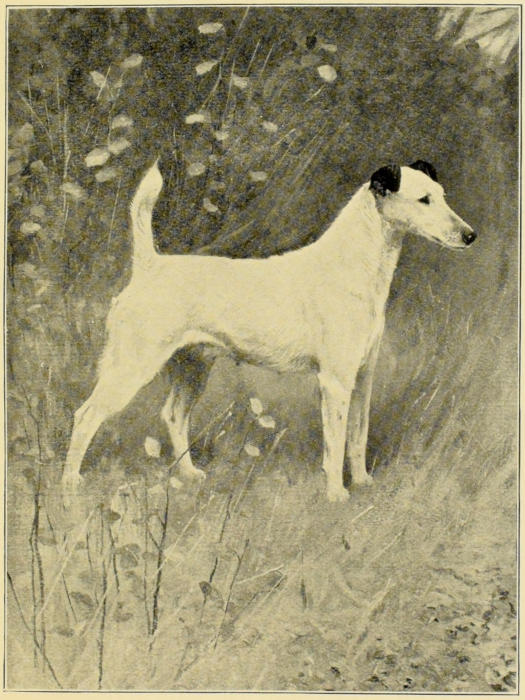
Smooth Fox Terrier, Champion Donna Fortuna, K.C.S.B. 869 b.
Sire Ch. Dominie, K.C.S.B. 24,044, Dam Ch. Dame Fortune K.C.S.B. 38,153.
Described by Mr. J. C. Tinne as “absolutely the best Fox Terrier of all time.”
The property of Mr. Francis Redmond, Whetstone House, Totteridge, N.
Considering the number of young a bitch has,
and the variety of size the puppies often are,
I think it is wonderful they get through their
trouble as well as they do, more especially when
it is taken into consideration the artificial life
dogs generally live. There are some breeds
which are always a source of anxiety to their
owners, especially the toys, as spaniels and
griffons, which have frequently a habit of
throwing back to the size of their ancestors,
which were no doubt much larger dogs than
the modern specimens. The same remarks
refer to Yorkshire terriers as well as to the
other small breeds, but the fault very often
lies with the owner in trying to breed from
very small bitches. Bull-bitches, again, often
have difficulty in bringing their puppies into
the world, and this is in a great measure due
to the modern dogs having such large heads.
In addition to the difficulty mentioned, this
breed is no doubt of a naturally weak constitution,
and their organs of reproduction are very
liable to disease. Of course there are many
of what one may call accidental cases, as when
a fox-terrier or dachshund has puppies by a dog
the size of a collie. I have known many cases
of this kind, and, as may be expected, the bitch
has trouble in giving birth to such youngsters,
though sometimes they are born without any
difficulty at all. Then there are other cases of
difficult parturition, due to stricture of the vaginal
passage, the result of injury to the pelvic bones, as
when a bitch has been run over across the hips, or
as the result of congenital deformity of these parts.
There is nothing to be done in these cases but to
have the Cæsarean operation performed, when
some of the puppies may be saved and the bitch
too, if the operation is done in good time.
There is another form of stricture of the vagina,
and it is generally found just inside the vulva. It
is due to a strong band of mucous membrane,
which refuses to dilate as the surrounding parts
do at this time, and in some cases it is so strong
that one is not able to dilate it in the ordinary way;
therefore, the only thing to do is to cut through
it with a blunt-pointed knife (bistoury), which I
generally do at the side, and always with good
result.
Difficulties arise at parturition in consequence
of the unnatural position of the fœtus; a puppy
should come with the head first, the nose extended,
and the fore legs placed one on either side of the
neck. Another easy position for birth is when
the hind legs come first, but in these cases,
unless the puppy is delivered quickly, it dies
from asphyxia.
From some unaccountable reason a fœtus frequently
assumes a wrong position, which renders
its birth extremely difficult. In such cases it is
useless giving ecbolics or medicines to stimulate
the labour pains, but means must be taken to
place the puppy, if possible, in a proper position,
and then a dose of ergotine is useful. Perhaps
the most common malposition is when both fore
legs are thrown in a backward direction, causing
the shoulder to project, thus inducing a mechanical
impediment to birth. These are not very troublesome
cases, as a rule, for the legs, by means of a
blunt-pointed round hook, may be drawn forward;
if there is nothing better at hand, a long button-hook
will answer the purpose.
This accomplished, the puppy should come
away easily; but if the bitch is weak from long
straining, it is advisable to remove the puppy
entirely, especially if it is thought there are more
to come. I may mention here when one has to use
instruments of any kind to assist the patient, the
puppy is generally in some way injured, so that
if it does not die at the time, it usually does very
soon after; but after all, this is of little consequence
compared with the life of the mother.
In some instances the puppy presents itself at
the mouth of the womb with the top of the head
foremost, the nose being pressed down against
the chest; if it is at all large, birth is very difficult
in this position. In such cases, one should try
and elevate the nose with the point of the finger;
when the bitch is not a large one this is often possible,
but when she is, it is necessary to employ a
crotchet or crook—as mentioned before, a button-hook
with a long handle does very well—and, if
possible, it should be fixed in the mouth and the
nose drawn up; this is rendered more easy, if one
can, by means of the finger of the other hand,
press the neck backwards towards the body of
the bitch. It is, however, often impossible to
raise the head, and the only thing to be done is
to seize the neck firmly with a pair of forceps,
and by traction at each time of straining, extract
the puppy. Care must be taken not to injure the
bitch, or inflammation, which may prove fatal,
will occur.
In other cases the head may be bent in a backward
direction, the front of the neck presenting.
These cases, though somewhat more difficult,
require similar treatment to the previous kind.
When all other means have failed, the neck may
be divided and the head removed by forceps; the
body will then generally come away by itself.
The fœtus assumes numerous other positions
besides those mentioned—as, for instance, lying
transversely, the puppy’s side presenting to the
mouth of the womb, and when the labour pains
are strong, no amount of manipulation will put
the body in a normal position. Rather than let
the bitch waste her strength uselessly, the puppy
should be divided or broken up by means of a
sharp-cutting hook, and removed by means of
forceps.
When a fore and a hind leg are presented into
the vagina, the former should be pushed back
into the womb, and the hind leg seized with
forceps and made fast with a piece of tape. (It
is easy to distinguish one leg from the other by
feeling for the hock-joint in the hind limb.) When
this is done, the other back leg should now be
felt for, and when its position is ascertained, it
should, if possible, by means of a small pair of
forceps (ordinary dressing forceps answer very
well for this purpose) or crotchet, be drawn into
the vagina, or made fast with tape like its fellow,
and then by gentle traction on both limbs the
puppy is delivered.
It occasionally happens, in cases of head presentation,
that the hind legs are bent forward on
the body, which renders the delivery difficult,
and unless the passage is large, and the pains
are very strong, the bitch cannot bring forth the
pup without assistance. This is best rendered by
grasping the puppy across the hips with a small
pair of thin-bladed parturition forceps, and gently
pulling the puppy during each throe.
It frequently occurs that though a puppy may
lie in a normal position, the mother is unable to
give birth to it in consequence of its being too
large. The nose may be just inside the vagina,
and there become fixed in spite of the bitch’s
straining for hours. I have seen hundreds of
such cases. It is a mistake to leave the bitch in
this condition too long, thinking matters will come
all right, as it is wasting time and the mother’s
strength; and if there are other puppies to come,
she probably will not have strength either to
expel them herself or help anyone who may try
to assist her. In this instance, the head is so
firmly fixed in the mouth of the womb that it is
impossible to take hold of it with forceps, however
small or thin the blades may be, but the
hook of the crotchet may generally be passed
into the mouth of the puppy, and by fixing it well
into the palate a good hold is obtained, and the
puppy drawn through the passage by main force.
If care be taken, it is astonishing what amount of
force may be used in promoting delivery without
at all injuring the bitch, but it is best not to pull
on the puppy except during the labour pains, if
there are any.
It is the custom of some veterinary surgeons to
give the bitch, during labour, a hot bath if the
parts are not considered sufficiently relaxed, or
if the pains are dull; at the proper time the
tissues always become sufficiently dilated, providing
the parts are in a normal state—that is,
bar a stricture in the vagina, or something of
the kind—and if there is any abnormal condition,
a warm or hot bath, in my opinion, does more
harm than good by often checking the pains.
Sometimes when the ergot fails to induce or
stimulate the throes, I have applied with advantage
to the abdomen an ice-bag; but what I find
the best of all, when one or two subcutaneous
injections of ergotine have not worked satisfactorily,
is to put the bitch in some vehicle and
give her a drive, and if nothing else will induce
the labour pains this shaking up will do so in
most cases.
The worst of all, are those cases when the
bitch is due to pup, the parts are relaxed, and
there are no labour pains to expel the fœta.
Examined per vaginum, no puppy can be felt,
and no amount of excitement of the parts by
passing a cold instrument into the passage, or
injections of ergot, causes contraction of the
womb. If the patient seems all right, it is best
to wait some hours, during which time everything
should be done to try and excite contraction of
the parts. If the means taken do not succeed,
then there is nothing to be done except the
Cæsarean operation, as it is not safe to attempt
delivery with forceps or the crotchet when the
puppies cannot be felt with the finger.
The best forceps for using, in my opinion, in
cases of parturition, are those made by Messrs.
Krohne & Sesemann, of Duke Street, Manchester
Square, London. They are made after
the pattern of Will’s ovariotomy forceps, of very
fine hard steel; the blades are extremely thin and
small, and deeply serrated, so that when a puppy
is taken hold of they do not easily slip off. My
crotchet was also made by the same firm, and, if
care is used when working with it, it is a most
valuable little instrument. When from causes
due to mechanical impediment either on the
part of the bitch or puppies, or from want of
proper labour pains, it is impossible to obtain
the birth of the puppies through the proper
channel, the abdomen should be opened. If
the operation is done in good time (that is,
before the bitch has become weak), and proper
antiseptic precautions taken, there is a chance,
though the operation is a dangerous one, of
saving the mother’s life. At any rate, some of
the puppies can be almost certainly brought
forth alive; whilst if the operation is not
undertaken in these circumstances, one knows
that not only the bitch but all the puppies are
sure to die.
Prolapsus, or inversion of the womb or uterus,
into the vagina, sometimes, but very rarely, occurs
during parturition, due to very severe straining,
or as the result of too much force being used
to remove a puppy with forceps, or by other
artificial means. Care must be taken in these
cases not to mistake protrusion of the uterus
for prolapsus of the vagina or a polypus. The
latter may be recognised as a solid, pear-shaped
body with a narrow neck, whilst a prolapsed
vagina is generally a large, solid, oval body,
which almost fills the vaginal canal, if it does
not protrude externally. It has a broad base,
and rises at the back part of the passage, just
in front of the meatus or opening to the bladder.
The uterus is soft, reducible, and rough, and
tubular in shape, besides showing dark-coloured
patches where the placenta has been attached.
After the womb has been cleansed by being
sponged with a weak, tepid solution of permanganate
of potash, it should, if possible, be
returned by gentle pressure on the fundus of the
uterus with a piece of whalebone, with the point
covered with a sponge. The returning is assisted
if the hind legs are raised—in fact, by the bitch
being held upside down. Care must be taken
not to use undue force, or the uterus may be
ruptured. After the return, it is a good plan
to inject a quantity of cold water into the
vagina to act as an astringent.
When the protruding uterus shows signs of
having been injured, or is much congested, or
decomposition has set in, amputation is advisable.
This is best done by drawing the part
gently out and applying a strong silk ligature
as high up as possible, and cutting off the free
portion.
The bitch, when she has finished pupping,
requires little attention beyond a change of bed
and a fair supply of nutritive food. She does
best when least noticed; but it is well to see
that she takes sufficient exercise. On the
following day she should be taken out two or
three times for a few minutes to relieve herself,
and every day after that she ought to be about
pretty much as before. Some bitches, however,
are such devoted mothers as to sacrifice health,
and occasionally life itself, to enjoy the pleasure
of being with their young ones. This excess of
affection must be controlled, for, if not checked,
it will seriously injure both parent and offspring.
All animals, however, are not thus distinguished.
Some bitches cannot be induced to suckle the
pups they have given birth to; and others,
though less frequently, will eat their progeny.
The disposition to desert or destroy their young
seems to prevail among the parentage of this
world. In the female of the dog the maternal
instinct is most powerful, but under certain conditions
of the animal’s body the natural impulse
seems to be perverted, and she takes the life she
would else have perished to preserve.
Some persons entertain a notion that the bitch
which has once devoured her litter will ever after
retain the disposition. This is a false idea. On
the next occasion, if properly treated—that is, if
not persecuted, chastised, alarmed, and annoyed,
but properly dieted—she may prove, and most
likely will prove, an excellent mother, the very
excitability which, when over-stimulated, induced
her unnatural impulse, making her, when tranquil,
the more alive to the instincts of her nature.
For the first week the bitch is, as a rule, very
attentive to her family, and as it gives her pain when
one is taken up, it is better not to handle the pups
more than is absolutely necessary. She should
be well fed; not crammed, but nourished; and
she will require more food than formerly, for
there are many mouths to feed through hers.
The quantity of support she needs may be
conjectured from the rapid growth of the pups.
A small bitch of my own had a litter of four.
The mother weighed seven pounds six ounces,
and between the second and fourth week the
young ones daily added one ounce and a half
each to their bulk. It would require some
amount of milk to supply such a quantity of
flesh; and we have also to remember that,
during the rapid growth, the process of consolidation
is simultaneously going forward. Good
nourishing food, sufficient in bulk, is absolutely
imperative; for if the pups be stinted, the dogs
will assuredly be weak.
A strong bitch may be able to bring up five
or six young ones, though I have known some
instances where a bitch has reared successfully as
many as ten; but the animals of the smaller or
choice breeds are seldom possessed of such capabilities.
The very diminutive will not generally
rear two pups without suffering; and four are a
very heavy drag upon the majority of the animals
kept as pets, even though they be in no way
remarkable on account of size.
If anything happens to the bitch, and she is
unable to rear her puppies, either a foster-parent
must be found (and a cat will rear a small pup
very tenderly), or the litter must in part be
brought up by hand.
This last is more troublesome than difficult
to do. The pups want to be fed early and
late, consequently they must be taken into the
bedroom; and when the feeding-time arrives,
the soundest sleeper will be reminded of his
duty. A bottle, such as is used for infants of
the human kind, must have a sort of nipple
made of wash-leather fitted to it. The leather
is to be pricked all over with a fine needle, and
within it is to be placed a small piece of sponge
to give substance and form to it. There is need
to do that, because the pup, when it sucks, wraps
the tongue round the teat, and unless the body
it thus grasps has bulk, it cannot extract the
liquid. This, therefore, being attended to, the
little creatures very soon learn their lesson, and
all that is subsequently to be done will be to
hold them to the bottle and the bottle to them.
Each pup occupies from ten to fifteen minutes at
a meal; and they may be allowed to decide the
quantity that will do them good, unless one
should obviously be morbidly gluttonous, when
the indulgence of its appetite should be
restrained.
The best food for such young puppies is to
give artificially prepared bitches’ milk, made by
adding cream, etc., to cows’ milk. (See article
on Milk.)
There is only one circumstance needed to be
pointed out when pups are brought up by hand.
The sponge and leather of the false nipple are
apt to become sour; and therefore, after they
have been used, they should be kept in water
rendered slightly alkaline with the carbonate of
soda.
If the puppies are strong, one may commence
to wean them when between five and six weeks
old; but when they are weakly or delicate, it is
best to wait another week before commencing to
take them away from their mother; and under
any circumstance it must be done gradually for
the mother’s sake. For the first three days
separate the bitch from the puppies all day
except for half an hour, middle day; then
keep her away entirely during the day, only
allowing her to be with them at night; and
then, after a few days later, only allow her to
visit her puppies for a short time night and
morning. This must continue so long as the
bitch has any desire to go to the little ones,
or so long as she has any milk.
As to feeding the puppies, see the article on
Feeding in the Appendix.
A dose of purgative
medicine, judiciously administered, is a good
remedy for many minor complaints, and often
makes what looks like being a very sick dog
into a healthy one.
Castor oil is a good household remedy, but
causes constipation afterwards; but in cases of
diarrhœa, when it is necessary to clear the bowel
of any irritating matter, there is nothing better
than castor oil. The dose varies from half a teaspoonful
to two tablespoonfuls.[1] When the dog
is showing signs of abdominal pain, from three[1]
to fifteen drops of laudanum may be added to
the dose.
The following is a mild aperient mixture, and
does not bind afterwards:—
Recipe:
| Castor Oil, |
} |
Equal parts. |
| Syrup of Buckthorn, |
} |
| Salad Oil, |
} |
| Well mixed. |
Doses: From half a teaspoonful[1] to two tablespoonfuls,
fasting, in the morning.
For little dogs suffering from constipation, salad
oil mixed daily with the food answers well. Give
from a half[1] to a teaspoonful once or twice a day.
Some dogs refuse to take their food with oil
in it. In these cases, fluid magnesia is a nice
mild laxative; and one,[1] two, or three teaspoonfuls
may be given with a little milk at breakfast-time.
A little gingerbread cake, given at night, keeps
a small dog’s bowels very regular; besides, it is
appreciated.
For a purge for small dogs, one or two of the
following pills may be given:—
Recipe:
| Extract Colocynth, |
12 grains. |
| Extract Jalap, |
6 ” |
| Septandrin, |
3 ” |
| Extract Gentian, |
6 ” |
| Podophyllum, |
3 ” |
| Gingerine, |
1½ ” |
| Mix. |
Divide into 12 pills.
Sometimes it is difficult to give a dog a pill.
In these cases, a powder may be administered,
as jalapin. Two grains is the dose for a very
small dog, and twelve grains for a big one like
a great Dane or St. Bernard. It may be just
shaken dry on the tongue or mixed with a little
thick gruel.
The following is a good cathartic pill for dogs
varying in size from a fox-terrier to the biggest
kind:—
Recipe:
| Barbadoes Aloes, |
24 grains. |
| Gamboge, |
12 ” |
| Jalap, |
24 ” |
| Colocynth, |
12 ” |
| Powdered Soap, |
12 ” |
| Calomel, |
12 ” |
| Gingerine, |
3 ” |
| Excip. sufficient. |
| Mix. |
Divide into 12 pills—one, two, three, or four[1] to
be give on an empty stomach.
In cases of skin disease, when purgative
medicine is necessary, Epsom salts is the best.
The dose varies from fifteen grains to one
ounce,[1] given in some sweetened milk.
Symptoms: Extravasation of blood into the
skin in very small pin-like spots, or may be
in large patches. They are first bright red,
then turn darker, and afterwards become brown
in colour. The same symptoms may occur on
the tongue, also the cheek, and on the white
parts of the eye, and they occur also on the
internal organs.
Treatment: When the spots are very small
and few in number, no notice need be taken of
them; but when there are large patches of
extravasated blood, give from half a grain[1] to
two grains of ergotine with double the quantity
of reduced iron, made into a pill, two or three
times a day. After a few days, commence a
course of arsenic, give from one[1] to six drops
of liquor arsenic (P.B.) three times a day in
water after food.
In these cases, avoid giving much meat.
Symptoms: This is an uncommon disease in
dogs, but when it does occur it usually runs a
rapid course, death often taking place in a few
days. It generally results from some severe
internal operation, though it may not come on
until some months after the operation has taken
place, then a large abscess forms in the liver.
The attack commences, as a rule, by severe
shivering, the temperature rises 3 or 4 or more
degs. above normal; the pulse is very quick,
often going up to 150. The dog refuses all
food, is very thirsty, frequently vomits, and
loses condition quickly. If the abscess bursts
in the abdomen, peritonitis follows, and death
soon takes place; but if it dries up (becomes
caseated), then the dog gets better for a time, but
other abscesses are almost sure to form, if not
in the liver, kidneys, or lymphatic glands, they
may in the lungs, when there is a recurrence
of all the symptoms previously described.
Treatment: There is little to be done in
these cases; a large dose of salicylate of quinine,
say from two to ten grains,[1] should be given, and
repeated once in six hours. If no improvement
takes place by the following day, it is worth while
to see what a surgical operation will do, though
the chances of a cure by this mode of treatment
are never very bright.
The dog’s strength should be maintained with
good strong beef-tea, also Plasmon with milk,
and nutritive suppositories and enemas. Brandy,
too, should be freely given.
Symptoms: The rejection from the stomach
of a quantity of watery fluid. This is generally
preceded by discomfort and restlessness, and
rumbling in the stomach.
Treatment: Put dog on a milk diet for a
few days; it may be given with Benger’s food,
Plasmon, or Spratt’s invalid food, or toast; also
three or four times a day, about a quarter of
an hour before food, give from two[1] to ten
grains of subnitrate of bismuth. Do not give
any meat.
Symptoms: As in all illnesses, this one
commences with a loss of appetite, and a rise
of temperature from 2 to 3 degs. above
normal. The dog may be constantly licking
himself at one particular spot, which is probably
the place where he was bitten and inoculated.
The dog’s disposition entirely changes, the
cheerful one becomes morose and sullen, the
quiet one is restless, and the good-tempered dog
quarrelsome, and there is an inclination to hide
in dark corners, though when called by his owner
he comes forward and is very affectionate, licking
the hand and even the person’s face if allowed.
A rabid dog is generally depicted with a
quantity of frothing saliva flowing from the
mouth, like one suffering from epilepsy. This
is a mistake, the mouth may certainly be a
little moister than usual at first, but it soon
becomes dry and of a dark red colour. The
rabid dog is much inclined to attack others, the
small, timid pet will, without provocation, bite
both small and large dogs, and it is generally
done cunningly, for he will often go quietly up to
his victim and smell him, in the usual doggy way,
and then suddenly bite him, and perhaps give a
sort of howl immediately afterwards.
A rabid dog’s voice is quite altered, and it is
very characteristic of the disease, but it is rather
difficult to describe on paper; it is half a bark and
half a howl; it commences with a bark and
finishes up with a dismal howl. A rabid dog
is much disposed to wander if he can only get
his liberty, and once he gets out he often goes
for miles on a sort of jog-trot, with head
and tail down, going out of his way to attack
other dogs, but not so much people, unless they
get directly in his way, or interfere with him. He
may wander for hours, or perhaps a day and a
night, and then return home. A rabid dog,
though he refuses good food, will gnaw and
eat all sorts of foreign substances; for instance,
if he is in a kennel, he will gnaw and eat the
woodwork; if behind railings or chained up, the
ironwork, even to the extent of breaking his
teeth. If confined in a room, he will gnaw the
door, legs of chairs, carpets, curtains, etc. I
have known one to eat his way through a two-inch
door in a couple of hours. A rabid dog is
not afraid of water; in fact, he drinks a good deal
at first, before the symptoms are fully developed,
and even during the latter stages, though he is
unable to swallow, he will thrust his muzzle into a
basin of water and try to drink.
As the disease advances, he becomes weak in
the back legs, and ultimately quite paralysed, and
if not killed, dies within four or five days; but
some have been known to live as long as seven
days.
In dumb rabies, so called, the lower jaw is
dropped in the early stages through paralysis,
and the dog is unable to close the mouth. This
is sometimes rather deceiving, as a person may
think, perhaps, there is a bone fixed on the teeth,
and opening the mouth to see, may get wounded
by the teeth.
It is not often a rabid dog will attack his owner
unless the person tries to restrain him; but he
will generally go for a stranger without hesitation
or provocation. Rabies cannot arise spontaneously,
or from any other cause whatever but
inoculation by a bite from a dog suffering from
the disease. The inoculative period varies from
a fortnight to six weeks; it has been known to
extend for three months. There is no doubt
that the saliva from a rabid dog’s mouth, going
into the eye of another dog, would in all probability
induce the disease.
Treatment: There is no cure for this disease.
Directly it is established, the dog should at once
be destroyed, and shooting is the best and safest
way of destroying such an animal.
I wish to dispel the idea which so many people
have, that if a dog bites another, or even a
person, and that dog should ever go mad, the dog
and also the person will go mad too; such a thing
is impossible, even though the disease may be
lying latent in the dog the time he inflicted the
bites. Pasteur, who was a great authority on
rabies, used to say that a bite from a dog, even
two days before there were any visible symptoms
of the disease observed, was not dangerous.
Symptoms: A large, bladder-like swelling
under the tongue, which prevents the dog eating
properly. Saliva, as a rule, flows freely from the
mouth, and in some cases the dog is unable to
close the teeth together. The cause, in some cases,
is due to some blockage of the duct of the gland
which is situated under the front part of the tongue.
Treatment: A probe passed through the duct
generally allows the accumulated fluid to escape,
but in some cases the fluid in the swelling has
become so thick that it cannot escape through
the natural passage, even though cleared with a
probe; then the sac should be freely opened, and
after squeezing out its contents, the cavity should
be syringed well out with a solution of boracic
acid—a teaspoonful of the acid to half a pint of
warm water.
Symptoms: A flushed or red condition of the
skin often occurs in white dogs. It is particularly
noticed on the inside of the flaps of the
ears, the inner side of the thighs and skin of
the belly, or it may be general. The redness
disappears on pressure, but returns when pressure
is removed.
Treatment: Dust the part over three or four
times a day with finely-powdered boracic acid.
Treat dog for worms, and give some tonic
medicine, as following pills:—
Recipe:
| Sulphate of Iron, |
6 to 24 grains.[1] |
| Sulphate of Quinine, |
3 to 18 ” |
| Confection of doses, q.s. |
| Mix. |
Divide into 12 pills—one to be given twice a
day.
A mild saline aperient should be given once a
week.
When a dog has
been nearly drowned, before resorting to
artificial respiration he should be held upside
down for a few moments, to drain the lungs of
water, and then placed on his back with head
extended, and after drawing the tongue slightly
forward between the teeth, so as to keep throat
quite clear, apply pressure to the chest (just where
it joins the abdomen) with the open hand, in a
forward and downward direction, so as to expand
the chest—this should be repeated from eighteen
to thirty times a minute, according to the size of
the dog. After pressure, the hand should be removed
quickly, that the walls of the chest may
assume their normal position. Whilst this is
going on, another person should inject brandy
under the skin, and rigorously work the legs
so as to try and promote circulation. As soon
as possible put hot-water bottles around the dog.
Symptoms: There is no doubt that dogs do
occasionally suffer from this disease, it affecting
generally the knees and hocks, but other joints
may be attacked. The dog is very lame, the joint
swells and is very tender, and there is a difficulty
in bending it. Even after the inflammation has
dispersed, the joint remains thickened and stiff
for some time, in some cases permanently.
Treatment: Give a brisk purge, and also from
two to fifteen grains[1] of salicylate of soda three
times a day in water after food. If joint very
painful, use following lotion:—
Recipe:
| Tr. Opium, |
4 drachms. |
| Water to |
6 ounces. |
Soak a strip of lint in the lotion, which wind
round the joint; cover entirely over with oil-silk
and bandage; change every six hours.
When the inflammation and pain is less, cut the
hair closely off over the joint, and paint with
strong tincture of iodine, which repeat once
in twenty-four hours. The iodine must not
be applied to flexure side of joint.
When the joint remains enlarged and stiff
for some time, a course of iodide of potassium,
say from a quarter[1] to two grains, may be given
three times a day in a little water after food.
Symptoms: This disease may affect almost any
part of dog, and also dogs of all ages, though
old ones are no doubt more liable to it. When it
attacks the muscles of the neck, it often assumes a
spasmodic form, and the pain is sometimes very
acute; the dog is unable to move his head in any
direction, the muscles, from contraction, appear
swollen, are very tender to the touch, and the
dog cries with the pain. The attack generally
lasts some hours, then it gradually subsides, and
the dog seems all right for a while, when it
may come on again. Then, rheumatism often
affects the shoulders, and when it does, it is
called “Chest Founder”. The parts are painful
and stiff, and the dog walks with difficulty,
dragging the fore feet along the ground.
Bitches, when in low condition after rearing a
litter of puppies, often suffer from this form.
Then the loins, again, are the frequent seat of
this disease, and when it affects this part it is
called lumbago. The dog walks with arched
back, and very stiffly—and as when the other
parts of the body are affected, there is a good
deal of pain. As the result of lumbago, a dog
often loses the use of the hind legs for a time,
and in fact becomes quite paralysed.
The disease is not confined only to these parts
mentioned, as the joints of the fore and hind legs
are liable, and a very characteristic symptom of
rheumatism is its changing about quickly from
one part to another, which is unlike any other
disease. For instance, one day the dog may
be going dead lame in one of the back legs,
the next day the other hind leg may be affected,
and the one that was bad the previous day quite
free of pain, or the disease may leave the hind
parts and go to one of the fore limbs. But this is
not always the case, as the disease may settle in a
joint, or some muscles, say of the loins, and remain
stationary for a long time.
Treatment: This is practically the same at
first, at any rate, whatever part may be affected.
The thing is to try and get the disease out of the
system. It is always a good plan to commence
with a good purge; after this has worked off,
give a course of salicylate of soda, from two to
fifteen grains[1] three times a day, either in
tabloid form, put up in cachets, or even
dissolved in a little water. If this medicine
does not give relief in twenty-four hours, try
aspirin or salicine, the doses are the same. When
the muscles of the neck are affected, the pain is
often very acute, as mentioned before. In such
cases it is frequently necessary to administer
some sedative medicine, and for this I find
there is nothing better than giving, subcutaneously,
from the twentieth to the eighth of
a grain[1] of acetate of morphia, with from ⅟₃₀₀th to
⅟₁₅₀th of a grain[1] of sulphate of atropine, the two
to be dissolved in from five[1] to ten minims of
water. The dose should be repeated night and
morning for a few days. At first these injections
may cause vomiting, but this soon ceases.
In cases of chest founder, or rheumatism in
bitches in a weak condition, which occurs after
rearing puppies, salicylate of quinine is often the
best medicine to give, in doses from half to three
grains[1] (made into a pill), three times a day.
Dogs suffering from rheumatism should be kept
quiet, the affected parts covered over with a thick
layer of thermogen wool, and bandaged or rubbed
with some liniment, as the following:—
Recipe:
| Methylated Chloroform, |
4 drachms. |
| Laudanum, |
4 drachms. |
| Spirits of Camphor, |
1 ounce. |
| Soap Liniment, |
1 ounce. |
| Well mix. |
Apply with friction night and morning.
Diet: Unless the patient is in poor health,
should be light, red meat being avoided; and so
should meat extracts and soups to a great extent.
When the disease has assumed a chronic
form, and settled in some joint, like the knee—a
favourite place—strong tincture of iodine
should be painted over the front and on each
side of the joint every day for three days, or a
strong blister applied, and iodide of potassium,
in from half to two-grain[1] doses, be given two
or three times a day.
Symptoms: A disease affecting puppies; if
it does not commence before six months of
age, it is not likely to occur. In some puppies
it commences before they have left the nest, but,
as a rule, it does not show itself before the puppy
is two months old. The joints, especially the
knees and hocks, become enlarged and irregular
in shape; the pasterns weak, the puppy walks
on the backs of his legs; the arms are bowed,
the stifles enlarged and standing out, whilst the
hocks turn inwards, giving a “cow-hock” appearance.
The bones of the face may be swollen,
and there may be a curvature of the spine.
The puppy, when suffering from rickets, is
always dwarfed in growth, very thin and
miserable-looking, with pot belly, and always
more or less in pain. The cause of rickets is
improper feeding, want of sufficient fresh air,
light, and liberty; also worms.
Treatment: Puppies suffering from this disease,
when much below their normal size and weight,
and badly crippled, should be destroyed. When
it is decided to treat a case, give worm medicine,
also some chemical food, from ten drops[1] to a teaspoonful
twice a day after eating, either in water
or mixed with cod-liver oil. Bathe the limbs with
sea water, or a solution of sea salt twice a day;
but if very weak, bandage with strips of adhesive
plaster, applied so that it does not interfere with
the bending of the joints. The puppy should
live out of doors, in a big gravelled yard if
possible, and where there are people about to
attract attention and to encourage movement.
Give plenty of raw meat on a bone, if possible—the
act of gnawing it off much improves the
digestion; also give Spratt’s malt and cod-liver
oil biscuits, dry, as well as soaked in good soup.
The puppy may have milk to drink instead of
water. No treatment is of any use without
fresh air, sunshine, and liberty.
Symptoms: Almost bare and nearly circular
patches of skin, which is rough and scaly, and
sometimes there are a few small red pimples on
the places and a few short stumps of broken hair.
The disease is very contagious to other animals,
and also to people. Rats and mice are very
subject to ringworm, and frequently infect dogs.
Treatment: Dress all the spots daily with
sulphurated calcium lotion, applied with a brush.
After a week, dress the spots daily with borate of
glycerine.
Symptoms: A swelling in the groin, navel,
scrotum perineum, etc.; and it may occur at any
part of the abdomen, the result of an injury,
when it is called ventral hernia. The swelling
may be round or elongated; it is generally
broader at its free extremity than at its point
of connection with the abdominal surface. It
becomes enlarged when the dog strains, or when
constipated, and it also has a tendency to increase
in size as the dog gets older.
Treatment: Navel rupture, which is generally
congenital, has a tendency to become smaller as
the puppy gets older; and often by the time he
or she is a year old it may have quite disappeared.
Trusses are useless in the treatment of hernia in
dogs, they fidget the animal so; but a radical
cure can be effected in most cases, with every
chance of success, by a surgical operation, which
is not a dangerous one. (See Hernia.)
Symptoms: Skin inflamed and red, and very
painful; blisters appear, which break, and matter
forms. Unhealthy wounds are the result, which
take a long time to heal. Hair removed, the
result of a burn or scald, never grows again.
Treatment: To remove the pain and inflammation,
dab the parts freely with a dressing
made of lime-water one part, linseed-oil two
parts, mixed together. Later apply boracic
ointment on lint and bandage. The wounds
must be kept clean by being occasionally
sponged with warm boracic lotion.
Symptoms: Depression, loss of appetite and
vomiting. Some dogs, when on a voyage or
living on a yacht, the first few days appear
very listless and dejected in spirits; and
although there may be no sickness, food is
refused, and they get very thin and miserable-looking.
Treatment: It is not a serious matter, as a
rule, for the nausea generally soon passes off,
and the dog starts to eat; but if it continues
more than a couple of days, a small dose of
bromide of potassium, say from two[1] to ten
grains, may be given in a little water three
or four times a day, and the dog encouraged
to take Vichy water and milk in equal parts;
and some tempting food, as a little chicken
and stale bread-crumbs, or stewed rabbit with
rice, may be offered. Once the dog commences
to eat, he generally quickly regains his former
condition.
Clip the hair
closely over the parts of the skin for about
the size of half-a-crown where the needle is
to enter the skin, and also where it is to pass
out; then wash with warm water and soap,
and dry. The needle should be slightly
curved and sharp-pointed, and threaded with
a piece of half-inch tape, which should be
smeared over with a little turpentine ointment
for about two inches in the centre, which is
the part that is to be left under the skin. The
dog being muzzled, a fold of skin from an
inch and a half to four inches[1] should be well
raised between the forefinger and thumb from
the muscles underneath; then the point of the
needle should be passed quickly through the
raised skin where the hair has been removed;
then draw the needle right through, and detach
the tape. A knot should be tied at each end of
the tape, about half an inch from the wounds, to
prevent the seton coming out. The ends of the
seton must be drawn backwards and forwards
twice daily to allow the discharge to escape, and
a little turpentine ointment rubbed on the tape
every day for three or four days. The wounds
must be kept very clean. A seton may be
allowed to remain in from one to four weeks.
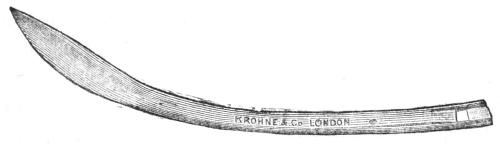
Seton
A seton placed on the back of the neck,
running from just behind the back of one ear
to the other, is a useful form of counter
irritant in cases of chronic epilepsy, also for
distemper fits.
In cases of general paralysis, when all four
legs are affected, a seton placed on either side
of the neck, running along the course of the
spine, often do good; and so they do when
placed in the loins, one on either side of the
spine, in paraplegia or paralysis of the hind
quarters.
In pneumonia a seton may be placed in front
of the chest, running from the inside of one
shoulder-joint to the other.
Troublesome cysts that are difficult to disperse,
like those found in the flaps of the ear,
may often be cured by running a seton through
it, and keeping it there for a few days.
A small seton placed in the throat, just in
front of the larynx, is useful in cases of chronic
cough.
Symptoms: Some dogs are constantly worrying
themselves, getting on people’s feet and legs, and
working their body, which is, to say the least,
most disagreeable. Very often any amount of
chastising fails to stop the disagreeable habit, but
if the dog is young, there are always hopes that
he will improve with time, for, as a rule, when he
is a year old the disagreeable habit ceases; but
there are dogs who continue to misbehave themselves
whenever an opportunity occurs the whole
of their lives, and the only cure is to have them
castrated, which is a certain cure. This operation
does not seem to affect a dog’s health or spirits.
Symptoms: Trembling of the limbs, particularly
the back ones, when standing, although when
walking the dog may go with a normal gait.
It is a condition that is more often seen in big
dogs than small ones, particularly those with
straight hocks and stifle joints. It may also
occur as the result of advanced age even in
small dogs.
Treatment: Medicine is seldom of any use,
although sometimes a course of Nux Vomica
appears to do some good, and is worth a trial,
unless there is some physical defect. The
dose is from one to eight drops,[1] given in
water after food, and repeated two or three
times a day.
Symptoms: The dog is generally in a semi-comatose
or unconscious condition, lying on
the side; the breathing is feeble and slow; the
pulse almost, if not quite, imperceptible; the
mouth and also the membranes of the eyes are
quite white; the limbs are cold, and if the temperature
be taken, it is often 5 or 6 degs. below
normal. This condition may be due to loss of
blood or the result of internal injury, as after an
accident—for instance, being run over with some
vehicle.
Treatment: Place the dog on his right side,
and keep the head low; give stimulants, as
brandy, from ten drops to a couple of teaspoonfuls[1]
in a little water. If the dog is unable to
swallow, inject from ten[1] to sixty drops under
the skin. This may be repeated in half an
hour, if necessary. Also apply hot-water bottles
to the back, and well hand-rub the limbs.
Symptoms: Swelling, redness, and great pain
at the part bitten. The breathing becomes
heavy and laborious; paralysis sets in; and
later, convulsions and death.
Treatment: A ligature applied as tightly as
possible above the part bitten, and the application
of a saturated solution of permanganate
of potash (Condy’s fluid undiluted) to the
wound. Give stimulants, as brandy or sal
volatile, freely, the latter well diluted with
water.
Symptoms: This condition is particularly
noticed in old, fat dogs, especially pugs, and
other dogs with a short nose.
Treatment: When a dog has naturally an
exceptionally short nose, there is little to be
done. Sometimes when the snoring is worse
than usual, a dose of purgative medicine gives
some relief. When the dog is very fat, take
means to make him thinner. (See article on
Stoutness.)
Symptoms: The dog stands with all four legs
outstretched and nose extended, and draws the
air sharply through his nose as if trying to
remove some obstruction in the nasal passages
or throat. It may occur at any time, but more
often when first going out of doors into the cool
air. Snorting often occurs after a cold or distemper.
It is also a symptom of a polypus in the
nose, and worms in the nasal passages; and dogs
suffering from stomach disorders often snort.
Treatment: When the result of some simple
obstruction of mucus, as from cold or distemper,
syringing the nose thoroughly with a solution of
common salt (five grains to each ounce of water)
gives relief. If the irritation proceeds from the
fauces or throat, an emetic should be given, and
purgative medicine is indicated if the stomach
be deranged. When the condition is due to a
polypus, a surgical operation is necessary. Parasites
in the nose are difficult to dislodge, but
sometimes an ounce of a solution of Pearson’s
disinfectant fluid (one in a hundred) syringed up
each nostril has the desired effect. I may add
that worms in the nostrils of dogs living in
England are of rare occurrence.
This is an operation occasionally
performed on bitches to prevent breeding.
Though it succeeds in this respect, it seldom
prevents the bitch operated upon coming into
heat to a more or less extent, and being
troublesome with male dogs. For this and
other reasons, the operation is not recommended.
Symptoms: Pain and swelling of the injured
parts, followed, as a rule, by discolouration,
lameness.
Treatment: If where a bandage can be
applied, the following lotion on lint is
recommended:—
Recipe:
| Goulard’s Extract of Lead, |
1 drachm. |
| Laudanum, |
2 drachms. |
| Water to |
6 ounces. |
| Mix. |
A piece of lint should be soaked in the lotion,
placed over or around the injured part; this should
be covered with a piece of oil-silk, taking care that
it entirely covers the lint, and then a bandage
applied. Repeat every eight hours. If the injury
has occurred where a bandage cannot easily be
applied, the following liniment is recommended:—
Recipe:
| Chloroform, |
4 drachms. |
| Tincture Hyoscyamus, |
4 drachms. |
| Spirits of Camphor, |
1 ounce. |
| Soap Liniment, |
2 ounces. |
| Mix. |
Apply with gentle friction twice a day.
In cases of sprains, keep the dog quiet for a
week or so, and then give gentle exercise,
swimming, for preference, if the weather is
suitable, and the dog takes quietly to the
water.
In these cases, a free dose of purgative
medicine, given as soon after the accident as
possible, is beneficial.
This joint appears to
be a particularly weak one in dogs, and is very
liable to injury, due from slipping, or twisting
of the leg.
Symptoms: The dog is very lame, and
often carries the leg. If he puts it down,
he stands with only the points of the toe
touching the ground, and placed just behind
the other leg. The joint becomes swollen, more
particularly on the inside, and is very painful.
Treatment: These cases are always long ones,
and a bad injury to this joint means the dog
being lame very often for two or three months.
If the case is taken in hand at once, hot poppy-head
fomentation is the best application, which
should be applied two or three times a day.
After three or four days, the following liniment
may be applied night and morning all around the
joint, but particularly on the inside, where the
principal swelling is:—
Recipe: The Liniment:
| Chloroform, |
4 drachms. |
| Tincture Hyoscyamus, |
4 drachms. |
| Spirits of Camphor, |
1 ounce. |
| Soap Liniment, |
2 ounces. |
When the inflammation has passed, the dog
often continues to go lame for some time,
due to the joint being stiff. This condition is
relieved by rubbing the swelling, which will be
found on the inside of the joint, daily with
colourless tincture of iodoform.
In all cases of injury of the stifle joint, the dog
should be, for the first two or three weeks, kept
absolutely quiet, and then gentle walking exercises
may be given, and later, it is a good plan to give
the dog swimming exercise.
Symptoms: Pain, swelling and redness of the
part. A dog sometimes gets stung on the tongue
with a wasp, and the swelling which afterwards
occurs is often serious.
Treatment: When possible, extract the sting,
and apply a solution of ammonia; ammoniated
tincture of quinine is one of the best preparations
for this purpose. When the tongue has been
stung, after extracting the sting and applying
the ammonia sparingly, ice should be applied to
reduce the swelling.
Symptoms: A general increase of the fatty
constituents of the body; the neck becomes thick
and seems shorter; the body is enlarged, especially
the abdomen, which is hard and distended. The
dog walks with difficulty, is constantly panting,
and often has an asthmatical cough. The heart’s
action is generally weak and feeble.
Treatment: More good is to be done by
dieting in these cases than medicine, and often
great benefit is derived by feeding sparingly
and entirely on lean raw meat. As to quantity,
this, of course, must depend on the size of the
dog, but if half the quantity in bulk is given to
what the dog has been in the habit of having,
this should be about the right amount. Feed
twice a day. Also give, at least once a week,
a dose of purgative medicine, and make the dog
take some exercise, which should be gradually
increased. Do not allow the dog to drink much
water.
Symptoms: A small hard red swelling on the
edge of the eyelid. This condition sometimes
occurs in dogs during or after distemper.
Treatment: It can often be cured at once
during the early stages by extracting the eyelash
around the roots of which the stye has
formed. If treated later, the parts should be
fomented with hot poppy-head tea, with the
addition of boracic acid. This should be made
by boiling for ten minutes two crushed poppy-heads
in a quart of water, then strain through
fine muslin and add a dessertspoonful of
boracic acid. Apply with piece of absorbent
wool for ten or fifteen minutes as hot as can
comfortably be borne. Repeat three or four
times a day.
Symptoms: Those of interruption to breathing.
May be the result of partial drowning, also from
a piece of food or some foreign body being fixed
in the fauces or throat. The dog gasps for
breath; the eyes are staring and prominent;
the mouth is generally fixed open, and the
tongue is of a dark blue colour.
Dogs are often suffocated in hot weather
whilst travelling, through being shut up in a
too small or badly-ventilated box. As a rule,
such cases are not found out until the dog
arrives at his destination, when the box is
opened, and he is found lying dead at the
bottom of it. Sometimes the dog is not quite
dead, though unconscious. The breathing is
very slow and shallow; the pulse imperceptible.
The body is cold, and the tongue a dark blue
colour.
Treatment: At once remove the cause if
possible. If some foreign body or food is
lodged in the throat, it must be removed—brought
up or pushed down. If no forceps
are at hand, one can often remove the substance
with the finger, bent in the form of a
hook. If it cannot be brought up, it must be
pushed down, so that the breathing may be
relieved as quickly as possible. If the dog is
unconscious, dash cold and hot water alternately
on the face; slap the body hard with
the hand. If the suffocation is due to partial
drowning, artificial respiration is necessary. (See
article on that subject.)
In cases, the result of insufficient air, take
the dog out into the open, that he may have
as much air as possible. Hold from one to
three drops[1] of nitrate of amyl upon a piece
of blotting-paper or handkerchief to the nose;
repeat in ten or fifteen minutes. Well hand-rub
and work the limbs to promote circulation; and
if not soon better, bleed rather freely from the
jugular vein if possible; if not, then from both ears.
See Appendix.
Symptoms: The only place that I have seen
this occur in a dog is on the cornea of the eye,
which causes a constant watery discharge; and
there is a tendency to keep the eye closed.
Treatment: Nothing but an operation is of
any use. This consists in carefully cutting
off the small piece of skin on which the hair
grows. There is little or no blemish the result
of the operation. Afterwards, for a few days,
bathe the eye occasionally with boracic lotion,
half a drachm to six ounces of water.
Toy Spaniel, Champion Windfall.
Winner of 6 Championships, 24 Firsts and 25 Cups, Gold Medals and Special Prizes.
The property of the Hon. Mrs. Lytton, Crabbet Kennels, Poundhill, Crawley.
Symptoms: Great lameness, the dog probably
not being able to put the leg to the ground at
all. The joint is much swollen, very painful, and
red. It is generally the result of an injury.
Treatment: Give at once a dose of purgative
medicine, and use the following lotion:—
Recipe:
| Goulard’s Extract of Lead, |
1 drachm. |
| Laudanum, |
2 drachms. |
| Distilled Water to |
6 ounces. |
Saturate a piece of lint sufficiently wide
to cover the joint, and long enough to go
round it; cover over entirely with oil-silk,
and apply a bandage. The lotion should be
repeated every four or five hours.
If, after the pain and inflammation has passed,
the joint remains swollen, rub sparingly into the
part once a day a liniment made with equal parts
of colourless tincture of iodine and soap liniment.
Should the joint become stiff and callous, it may
be necessary to apply a mercurial blister.
Symptoms: Big dogs with long tails, especially
great Danes, and those confined in kennels,
frequently suffer from a sore at the tip of the
tail, which, in many cases, is most difficult to
cure.
Treatment: Thoroughly cleanse the wound
with a solution of chinosol lotion, ten grains to
eight ounces of water, and when well dried, dust
over with powdered iodoform and cover the sore
with a few layers of gauze, and as it is impossible
to keep a bandage on, several layers of Mead’s
plaster should be placed over the end of the tail,
which prevents further bruising. In some cases
it is necessary to make the dog wear a leather
bag over the tail. This should be fastened
around the loins. The part covering the tip
should be of double thickness.
When well, it is a good plan when a dog is
always banging his tail about, to pad his kennel
with sacks stuffed with straw, to prevent his
injuring it again, for once a tail has been
hurt, it remains tender, and is more liable to
injury.
Symptoms: A bitch, when nursing puppies,
often suffers from the teats cracking; the parts
become swollen, inflamed, and very painful.
Treatment: Keep clean with boracic lotion,
and anoint night and morning with boracic
ointment. A few grains of bicarbonate of potash,
mixed with the food, cools the blood.
Dogs, like most other mammals, have
two sets of teeth. The first are temporary, and,
from their whiteness, they are often called the
milk teeth; they are twenty-eight in number.
The second set are permanent, and therefore not
deciduous; they are forty-two, and sometimes
forty-four, in number.
A set of teeth consists of three different kinds.
Those situated in front or anterior part of the
mouth are called the incisors, and those placed
immediately behind the incisors are called the
tusks or canines, and behind those are the
molars.
Each tooth is divided into three parts. The
free, or part that is seen when looking into the
mouth, is called the crown; then there is the
neck or constricted part, which is encircled by the
gum, and divides the crown from the fang or root,
which is inserted in a cavity (the Alveolus) in the
jaw-bone.
Each tooth is made up of three different
structures. The external, or enamel, which
gives the new tooth its beautiful white appearance,
and consists only of a somewhat thin layer,
and covers the crown of the tooth only. Immediately
underneath the enamel, is situated
the ivory or dentine, of which the tooth,
including the fang, principally consists. In the
centre of the fang is a foramen, or small cavity,
containing the pulp, consisting of a membrane
nerve and small blood-vessels to supply nourishment,
etc., to the tooth.
The incisors, twelve in number, both in the
temporary as well as in the permanent set, are
for distinction divided into nippers, which are
the two centre ones; the intermediates are those
situated between the nippers and corners, the
latter being placed next to the tusks.
The crown of an incisor tooth presents three
prominences—a middle, which is the strongest,
and two lateral. On the internal surface of the
tooth is noticed a slope, somewhat resembling
that found in an ox’s or sheep’s tooth. The root
is well developed, longer than the crown, and
flattened on both sides.
The tusks, four in number, in both sets are
strong, elongated organs, conical in form, and
curved in an outward and backward direction.
The upper fangs are the strongest, and there
is a small space between them and the corner
incisor teeth, in which the lower tusks are
situated when the mouth is closed. Most of
the molars terminate in sharp lobes, and, consequently,
are well adapted for tearing and crushing.
They are, as a rule, twenty-six in number, seven
on each side of the lower jaw, and six on each
side of the upper one; but sometimes there are
seven on each side of the upper jaw, the same as
the lower. It is not an uncommon occurrence
for a dog with a short face, like bulldogs,
spaniels, and pugs, to have only five upper
molars, and six lower molars. But there are
only twelve temporary molars—three on each
side of both jaws.
A puppy, when born, has no teeth visible,
though the milk ones are formed and in the
gums, and in some cases, their outline may be
seen through the mucous membrane.
The milk teeth are smaller, softer, and more
pointed than the permanent ones, and they are
not situated so closely together. The tusks, too,
are slightly pink in colour just above the neck,
which is not the case with the second ones.
Puppies of different breeds vary in the time
when they cut their teeth, those of the larger
kinds cutting them earlier than small dogs; and
though a fox-terrier puppy’s teeth appear earlier
than a toy terrier’s, yet St. Bernards have them
still earlier.
The process of dentition of the milk teeth is
usually carried on without any trouble at all to
the puppy. Such is not the case with respect to
the cutting of the permanent ones, for it is a very
common occurrence for puppies at this time to
have convulsions. In other cases, at this period,
eczema is very often troublesome, which, in some
instances, continues after dentition is completed.
With regard to the cutting of the deciduous
teeth, the first that appear, in most cases, is the
middle molar on each side of the lower jaw.
These pierce the gums in puppies of large breeds
like St. Bernards, about the eighteenth or nineteenth
day after birth. Puppies, like greyhounds,
retrievers, fox-terriers, and others of similar size,
do not cut these same teeth until about four days
later, whilst puppies of the toy class are often a
week later still.
About a day after the second lower molars
have appeared, the upper incisors show themselves;
the nippers and intermediates are the
first to make their appearance. These are
followed the next day by the upper corner
incisors, and about the same time the lower
corner incisors pass through the gums, and
the tusks are erupted; but it often happens
that all the incisors pass through the gums
together, and the tusks at the same time, or
just a day or so later.
About the fourth week, the last or third lower
molar, and also the first one, have been cut, and
are fairly well up; and about two days later, the
middle upper molar is just appearing. In a day
or two more, the last upper molar is erupted;
and a couple of days afterwards, the first upper
molar, which is the last to be cut, now makes
its appearance.
By this, it will be seen that large puppies, like
St. Bernards, have a complete set of milk teeth
by the fifth week. Puppies of the smaller breeds
are, as previously stated, a few days later.
It may be here remarked, that bitch puppies
invariably cut their teeth rather better, and somewhat
earlier, than dogs. Winter puppies are a
little later in getting their teeth than those born
in the spring.
The milk teeth are seldom placed close together,
and as the puppy grows, they become
still wider apart. This fact is useful in helping
one to ascertain the age of a puppy.
The deciduous teeth are much softer than the
permanent ones, and when a pup is three months
old, if it has had any hard food, the points of the
tusks and incisors are worn off.
When a puppy is about three and a half to four
months old, the upper incisor nippers are loose,
and sometimes have fallen out, and the permanent
ones are just coming through the gums at this part.
At the same time, the fourth upper molar, which
is the fourth from the tusk, makes its appearance.
(It will be noticed that though the lower temporary
molars are cut before the upper ones,
the reverse is the case with the permanent
teeth.) In the course of another few days, or
a week, the other upper deciduous incisors are
shed, and the permanent ones appearing in their
place, then the lower milk incisors commence to
fall out, and the new ones to make their appearance.
About the same time the tusks are showing
themselves through the gums. In some cases, the
tusks do not appear until all the other teeth are up.
This is about the general order in which the teeth
are cut, but of course there are exceptions, and
in some instances, the permanent tusks appear
just after the eruption of the upper centre
incisors.
It does not always happen that the temporary
teeth are shed before the permanent ones appear,
and the latter shoot up either beside, in front, or
behind the milk teeth. Then the latter teeth
should always be drawn, or the permanent ones
may not come straight and regular.
With regard to the permanent molars, the first
to appear, as previously stated, is the fourth one.
It makes its appearance just behind the last
temporary molar. Before it is fully up, the fifth
upper molar has passed through the gum. At
about this same time the fifth, or large permanent
lower molar, is appearing; this is quickly followed
by the sixth, and again by the seventh. About
the same time as these two latter teeth are
erupting, the temporary molars in the same
jaw are falling out, and their places are being
filled by permanent ones. About a week later,
the first lower milk molar is shed and the
permanent one cut; this is followed by the
second and third ones. The corresponding
teeth on each side of the jaw, as, for instance,
the fourth molar on the left and right sides, are
erupted simultaneously. By the time puppies,
such as St. Bernards, mastiffs, retrievers, and
others of similar size, are about four months old,
the process of dentition is complete. Fox-terriers,
and other dogs of this size, are in some cases
a fortnight later, and small toy dogs are often
from six to eight months of age, or even later,
before the mouth is fully furnished.
It is impossible to tell the age of a dog with
any certainty after dentition is finished, but up to
then one can judge the age to within a fortnight,
if it is borne in mind how the teeth are erupted.
After this time, and up to a year or eighteen
months, if, together with the condition of the
incisor teeth, whose middle prominences at this
time show signs of wear, one takes into consideration
the general appearances of a dog, a
fair judgment as to age may be formed.
Later, the wear of the teeth gives no good
idea of the age, because so much depends upon
the kind of food the animal eats, whether it is
hard or soft. When a dog is fed on bread and
gravy or meat, the teeth will show little or no
signs of wear when he is two or three years old,
while the incisor teeth of another dog of the same
age will commence to become blunted if biscuits
form the staple food. The teeth become still
more worn if a large number of bones are given
as a part of the diet. And again, dogs who are
always playing with and carrying stones often
wear the incisor teeth right down to the gums,
and the tusks become worn in the course of a few
years.
As a rule, if a dog is fed on a mixed diet, as
bread and vegetables, soaked biscuits, etc., and
not given many bones, and is not allowed to
carry stones, then the teeth (incisors and tusks)
preserve their shape and position until the fourth
year. But by this time the teeth have lost their
very white colour, and have become of a palish
yellow colour. As the dog advances in years the
teeth become still more yellow, besides becoming
coated with tartar just above the neck of the
tooth, if they have not been occasionally scaled.
The tusks, too, now become blunted, and to some
degree are altered in position, being inclined to
take a more outward direction. It is, therefore,
an easy matter to distinguish between an old and
a young dog.
The teeth of dogs that are pig-jawed, and
those that are undershot like bulldogs, do not,
of course, wear to the same extent as when the
incisors meet, forming an even mouth.
When the permanent teeth come up crooked,
it is a most difficult thing to redirect them,
especially when the tusks are at fault, and they
are generally the offenders; for these teeth
are so firmly and deeply fixed in the jaw-bone
that it is impossible, without employing great
force, to move them, and from their conical
shape it is almost impossible to fix a rubber
band or wire to them unless a small niche is
made in the enamel, and this damages the teeth
and renders them liable to decay. When the
tusks grow inwards so as to injure the palate,
I have, after a great deal of trouble, fixed a
wedge made of hard wood between the two
tusks of the lower jaw, but it always comes
out within a few hours. Again, when the
incisors, or front teeth, come up twisted or
crooked, and one tries to turn them with
forceps, the operation is seldom successful;
the tooth is almost sure to break, as dogs’
teeth are so brittle. More good is to be done
by pressing the erring teeth in the right direction
with the fingers; and when they are not
very badly misplaced, a good deal of benefit
may be derived by this simple treatment. It
should be done two or three times a day for
ten minutes at a time. Pressure of this kind
is very useful to the upper or lower incisor
teeth in slight cases of undershot—that is,
when the lower incisor teeth project in front
of the upper ones; or when the upper incisor
teeth project in front of the lower ones—called
“pig-jaw.” Either of these conditions is a great
drawback to a terrier; and some judges, who are
particular, and examine the mouth, will often put
a dog back for this defect. In bad cases I think
he is right to do so; but it is rather hard on
the dog when there is only a slight unevenness,
because I think he can hold just as well as one
with an even mouth.
There is no doubt a pig-jaw is a much
more serious malformation than one that is
underhung, as it is absolutely impossible for
a dog with a mouth like this to bite or seize
his prey firmly and hold it. This is a very
common deformity with collies and greyhounds,
and very ugly it looks—the former are not
required to bite, but at the same time the condition,
when very marked, should disqualify a
dog on the show bench, for there is no doubt
that it is hereditary. Another condition of the
teeth, and one which judges often put a terrier
back for, is canker. It is a diseased condition
of the enamel, which gives the teeth a speckled
appearance. In my opinion, canker of the teeth
is not hereditary; and it is in nine cases out
of ten the result of a dog having distemper in
early life—I mean before the eruption or cutting
of the permanent teeth. The high fever which
accompanies distemper seems to eat away the
enamel. Teeth when badly affected in this way
are soft, and wear away quicker than sound ones;
besides, they look bad. There is nothing to
be done in these cases, except brushing them
occasionally; to scrape them does harm.
Toy dogs’ teeth go wrong much quicker than
bigger ones, more especially Yorkshire terriers,
spaniels, and pugs. I have seen many a Yorkshire
terrier three years old with half the teeth
gone, and the remaining ones covered thick with
tartar. The condition, in a great measure, is due
to feeding, but some bad teeth are no doubt also
hereditary. All dogs should have something hard
to gnaw every day, either a hard dog-biscuit or
bone—not game or poultry bones, of course, or
cutlet or chop-bones, for these are more dangerous
than game bones, but a good big bone; for small
dogs a leg-of-mutton bone, and for large ones a
marrow or some other such bone. Puppies, from
the time they are weaned, should be given bones,
as this often prevents their eating stones and
other indigestible articles. Tartar should never
be allowed to remain and accumulate; it irritates
the gums, and causes them to recede, and then
the teeth soon get loose. Therefore, in all cases
where there is a disposition for tartar to collect,
it should be scraped off from time to time. As
a rule, if it is done about three times a year,
the teeth may be kept fairly clean. Once the
teeth are cleaned, they may be kept white if
people will take the trouble to brush them daily,
using some powder. The best kind I know of
is carbolated eucalyptus powder, as prepared
by Messrs. Hucklebridge, of 116 Ebury Street,
London, S.W. I mention the name and address,
as I do not know of anyone else who makes it,
and carbolic powder is not suitable for dogs. The
scaling or scraping of the teeth may be done with
the point of a penknife or an ordinary steel nail-cleaner,
but one must be careful in using these
instruments or the gums may be injured. To
lessen the risk of doing so, it is much better
to buy a proper instrument, which can be
bought for half-a-crown at a place like Krohne
& Sesemann’s, Duke Street, Manchester Square,
London, W.
Loose teeth should be removed, as they only
do harm when left, besides causing inconvenience
to the dog whilst eating. Sometimes it becomes
necessary in very old dogs to remove all the
teeth; and when the food is given soft, and cut
up small, they appear to do very well without
them, and their breath is certainly a good deal
sweeter.
Occasionally an abscess forms at the root of
the large upper molar tooth; the face swells
just under the eye. The abscess, after a few
days, generally breaks. The swelling should be
fomented with hot boracic lotion, but to effect
a cure, the tooth must be removed. It is a
difficult one to extract unless it is loose,
and no amateur should attempt to do it. An
anæsthetic ought always to be given.
It is sometimes
necessary with sheep dogs, dogs used for catching
deer, and dogs in the habit of biting and fighting,
to cut the tusks level with the incisor teeth.
This is best done with a pair of strong bone or
wire nippers. The operation apparently causes
very little inconvenience or pain, for the dog is
always ready to eat immediately afterwards.
Symptoms: Dogs always fed on soft food and
never having anything hard to eat, get their teeth
covered with brown-coloured tartar early in life,
even sometimes before two years old. If this is not
from time to time removed, it continues to increase,
until at last the whole tooth becomes thickly encrusted,
and to such an extent, in old pet dogs
particularly, that the mouth is unable to be closed.
As the result of the tartar, the gums become swollen,
inflamed, and tender; they recede from the neck
of the teeth, which become loose. A dog with
teeth in this state is always dribbling, and eats
with difficulty, and the breath is often most
offensive.
Treatment: Dogs should always be encouraged
to eat something hard daily—a piece of dog-biscuit
does very well; if this is refused, a hard bone, one
that cannot be eaten, should be given to gnaw.
This, of course, is only a preventative, and when
regularly attended to, the teeth and gums remain
good and sound for years. When once tartar has
accumulated, nothing will remove it but scraping;
which should be done regularly two or three times
a year, and if this is done, and the teeth daily
cleaned with an ordinary tooth-brush, moistened
with warm water and a little of the following
powder sprinkled on it, they will keep clean
and white, and the breath sweet so long as the
dog lives:—
Recipe: Tooth Powder:
| Powdered Boracic Acid, |
10 grains. |
| Camphorated Chalk, |
1 ounce. |
| Well mix. |
Removing the tartar from a tooth that is
somewhat loose does not tighten it, though it
preserves the tooth, and for a time often prevents
it becoming looser. It is impossible to remove
tartar from a very loose tooth, and for the dog’s
comfort, it should be extracted at once.
To know the temperature of
the body is very important in treating disease,
more especially in cases of distemper; for it is a
fact that so long as a dog does not have a high
temperature when suffering from this complaint,
the attack is not a severe one, and the dog, bar
accident or relapse, has a good chance of recovery.
When the temperature is high, say, 104 or 105,
and continues so for some days, the case is always
a serious one, and if it continues, complications,
especially those of the nervous system, are almost
sure to ensue. These remarks not only refer to
distemper, but to all other diseases in which a
high temperature is one of the symptoms; as,
for instance, inflammation of the womb, blood
poisoning, pneumonia, peritonitis, diseases of
the brain, formation of abscesses, etc.
In many cases it is not necessary to take much
notice of the temperature beyond watching it
carefully, and keeping a daily record of its rising
and falling, but when it keeps persistently high,
say, such as over 104, then special medicine
must be given to try and reduce it. There
are many medicines which have the power of
reducing the temperature, and when they are
going to have a good effect they generally work
quickly, and if they do not succeed in reducing
the temperature, say, within forty-eight hours,
they should not be persevered in, as then they
only do harm.
Antipyrin, in doses from two[1] to ten grains,
given in a cachet, is one of the best antipyretics.
Phenacetin, given in doses varying from half
a grain[1] to five grains; salicylate of soda,
aspirin and salicine, in doses from two to
fifteen grains[1] in a cachet, tablet, or dissolved
in water, and repeated three or four times a
day.
In some cases when these fail, salicylate of
quinine will have the desired effect, in doses
from one[1] to five grains, given in a cachet. If
this fails to reduce the temperature, then an
ice-bag may be tried, applied to the top of the
head for an hour at a time, and then all medicines
discontinued. A little brandy, say, from five
drops[1] to a teaspoonful, given in water or milk
every two, three, or four hours is advisable.
A very low temperature, say, when the
thermometer will not rise above 95 degs. F.,
is much more dangerous than a very high
temperature. In such cases, prompt measures
must be taken to try and warm the animal. Hot
sponges should be applied to the head; also hot-water
bottles applied to the back and to the feet.
From five[1] to twenty drops of sulphuric ether may
be given every hour or so, in from a teaspoonful[1]
to a tablespoonful of water. Strong coffee may
also be given, from a teaspoonful[1] to a tablespoonful,
repeated every half hour. If the dog
is very much collapsed, and unable to swallow,
strong coffee may be given as an enema, say,
from a dessertspoonful[1] to two ounces, and
repeated every half hour. Brandy may also
be given, injected under the skin, say, from ten
drops[1] to a teaspoonful, or very minute doses of
strychnine may be given, from the four hundredth
part of a grain[1] for a small dog to the one hundred
and fiftieth part of a grain for a large one. This
medicine may be given dissolved in from two[1] to
ten drops of tincture digitalis.
In such cases as these the dog must be given,
if he will swallow, small doses of some strong
beef essence, as from ten drops[1] to a teaspoonful
of Valentine’s beef juice, in from a teaspoonful[1]
to a tablespoonful of milk, and repeated every
half hour or so.
Symptoms: The gland is swollen and very
painful to the touch, the scrotum is generally
inflamed, red, and thickened. The dog walks
with stiffness in the hind legs, and there is
generally a rise of two or three degrees of
the temperature.
Treatment: Frequent hot poppy-head tea
fomentations, made by boiling for ten minutes
two crushed poppy-heads in a quart of boiling
water and then straining the solid matter
out through fine muslin. Aperient medicine
should be given and the dog kept on a light
diet for a few days.
Symptoms: The gland or glands are more
or less enlarged, and they have become so
as the result, in most cases, of some injury;
but occasionally the causes cannot be traced:
this is especially so with old dogs. The
condition is not of an uncommon occurrence.
It is not often that both glands are affected.
Treatment: Medicinal treatment in these
cases is useless. If the gland is much enlarged
and continues to increase in size, it should be
removed by operation; but very often after
getting to a certain size it ceases to increase,
and if it does not cause any discomfort by
hanging very low and interfering with the
dog’s walking, or looks very unsightly, it may
be left alone, especially if the patient is an
aged one, and it is an old dog’s complaint.
Symptoms: A rare disease in dogs, but
does sometimes follow a bad wound, particularly
to the eye. Often it is difficult to
account for the cause. The disease, when
it attacks dogs, generally only affects the
muscles of the jaw (see Lock-jaw), but when
the whole body is affected, it commences with
stiffness of the muscles of the limbs and neck,
followed shortly afterwards by violent spasms
of the whole body, including the muscles of
the jaw, which cannot be forced open, and the
throat is also affected, making it impossible to
swallow. The pain during the spasms is acute
and the temperature very high, often over 107.
The disease generally terminates fatally.
Treatment: Keep patient quiet in a dark
place, and relieve spasms by giving from
one-twelfth[1] to one-fourth of a grain of acetate
of morphia, with from ⅟₂₅₀th[1] to ⅟₁₀₀th of a grain
of sulphate of atropine in a few minims of
water, injected under the skin. The dose may
be repeated every six or eight hours.
To keep up the strength, try and get the
patient to swallow white of egg and milk;
also Sanatogen mixed with milk or water.
When unable to swallow the strength must
be maintained by nutritive enemas, as peptonised
milk, from one[1] to six tablespoonfuls given every
three hours alternately with one or two peptonised
beef suppositories. Brandy, if necessary,
may be given with the milk.
The little instrument for
taking the temperature, or for ascertaining
whether there is fever or not, is called a
clinical thermometer. The kind used for
animals is the same as used for people.
Those that register the heat of the body in
half a minute are certainly the best for
dogs.
The temperature is best taken in the rectum—bowel,
for here there is less danger of
breaking the instrument, but it may also be
taken in the mouth, as well as under the arm
or inside the thigh. The normal temperature
in the mouth is 99·6, under the arm 100·4 to
101, in the bowel 101·4.
When it is intended to take the temperature
in the bowel the point of the thermometer
should be greased, and inserted into the bowel
for an inch and a half, so as to be sure the
mercury is quite covered. When the temperature
is taken under the arm or inside the thigh,
care must be taken that the point of the
instrument is well buried in the skin, or a
wrong temperature may be taken. At least
a minute and a half should be allowed when
taking the temperature in these parts, even
when a half-minute registering thermometer
is used.
Symptoms: Excessive drinking of water in
large quantities when it can be obtained. A dog,
when he is suffering from catarrh of the stomach
or diabetes, which induces great thirst, will drink
anything, the craving for fluid being so great,
even soapy or muddy water, and he will even
lick up his own urine when other fluid cannot be
found. There is loss of condition, the appetite
is poor, the muscles waste, particularly about the
neck and limbs, whilst the stomach often becomes
full and pendulous.
Treatment: The quantity of water allowed in
these cases must be regulated. Dogs in health
drink very little except in hot weather, or
when taking hard exercise, but under the
abnormal circumstances in question, much more
than what is taken in health may be allowed.
Small dogs may be given half a pint a day,
divided into four or five lots, and big dogs
two quarts a day, similarly divided into small
quantities. For medicine give half a drop[1] to
two drops of liquor arsenicalis (P.B.) three times
a day, mixed with the drinking water. If after
a week the thirst continues, give from the
eighth[1] to a grain of powdered opium two or
three times a day made into a pill.
Diet: Avoid meat, but you may offer stewed
rabbit with rice, also fish, tripe, milk, pudding, etc.
Symptoms: The back of the throat (fauces)
is inflamed and slightly swollen, causing some
difficulty in swallowing; the lips are moist from
excessive secretion of saliva, and the glands about
the outside of the throat are enlarged. The dog
is often off his food, dull and listless.
Treatment: Give a teaspoonful of following
medicine frequently:—
Recipe:
| Chlorate of Potash, |
1 drachm. |
| Water to |
6 ounces. |
| Mix. |
A light diet should be given for a few days, and
the external enlarged glands rubbed gently, night
and morning, with spirits of camphor. If the
fauces remain inflamed after a few days, paint
the parts night and morning for two or three
days with a two-per-cent. solution of nitrate of
silver.
Symptoms: These parasites are generally
obtained from sheep in England. They are
small, blue-coloured little creatures with pointed
heads, with which they dig into the dog’s skin
and suck the blood, and as they do so they
gradually increase in size to a tick bean. They
naturally cause a good deal of irritation, and
make the dog bite and scratch.
Treatment: They should be carefully picked
off the dog with forceps, avoiding breaking
them if possible. The little spot caused by the
bite of the tick soon heals, and does not require
any special treatment.
Symptoms: The tongue is continually being
popped in and out of the front of the mouth for
an inch or more. This is a rare disease, and I
have only seen one case, and that was in a collie.
As in ordinary chorea, it is the result of distemper.
Treatment: See Chorea.
Symptoms: Swelling and redness of the tongue;
it often hangs out of the mouth, the result of
temporary paralysis, and the dog is unable to lap.
The condition is generally caused by injury from
the teeth, as a bite during a fit, or a sharp tooth.
Wasps’ stings will also induce the same condition.
Treatment: Wash the mouth and tongue
thoroughly several times a day with a solution
of borax, one teaspoonful to half a pint of water.
To any wounds or ulcers apply sparingly night
and morning a two-per-cent. solution of nitrate of
silver. When the tongue is very swollen and
protruding beyond the mouth, apply ice.
Symptoms: The tongue hangs out of the
mouth generally, to one side sometimes, but not
often, in front, and there is inability to retract it.
The protruding part has a dead and cracked
appearance, and loses its natural pink colour.
There is a difficulty in eating and drinking.
This condition may follow injury to the head; it
is sometimes present in cases of general paralysis,
the sequel of distemper or from other causes, and it
is often seen in old dogs, especially those with a
short face, as pugs and Japanese spaniels, due to
loss of teeth.
Treatment: Medicine has little effect in these
cases. When the result of injury or distemper, as
the dog improves in general health the tongue
regains strength. A course of Nux Vomica as
recommended for general paralysis assists.
Symptoms: Small greyish-coloured excrescences
appear all over the tongue, as well as on
the cheeks and lips. Warts on the tongue and
mouth are only seen in puppies. I do not remember
seeing them in an adult dog. Sometimes they
appear in such numbers as to inconvenience a
puppy when feeding. Thick, dirty-looking saliva
dribbles from the mouth; the breath is offensive.
They are contagious from one puppy to another.
Treatment: Wash the mouth out two or three
times a day with a teaspoonful[1] or a drachm of
common washing-soda dissolved in half a pint of
warm water. Do not cut the warts to make
them bleed, as that only increases the number.
When the solution of soda does not take them
away dress the warts (only a few each day) with
a five-per-cent. solution of chromic acid applied
sparingly on the end of a wooden match.
In obstinate cases a course of Donovan’s
solution of arsenic does good; give twice a day
after food from one to five drops[1] in a little
water, or it may be mixed with the food.
Symptoms: The wound may be a simple,
punctured one induced by one of the tusks
during a fit, or the tip of the tongue may be
bitten off, the result of an accident. Abrasions
and ulcers occur along the sides of the tongue,
due to friction against the molar teeth when
thickly encrusted with tartar. Very severe and
dangerous ulcers appear on the sides and point
of the tongue in cases of acute gastro-enteritis
or German distemper, and occasionally in this
disease the point of the tongue sloughs off.
Treatment: In ordinary wounds of the tongue,
when there is no suppuration, simply washing
the mouth often with borax and water—one
teaspoonful to half a pint—several times a day
is sufficient, but when there is suppuration and
ulceration of the parts, besides keeping clean
with the borax, the ulcers should be painted twice
a day with a five-per-cent. solution of chromic
acid. The teeth should be thoroughly cleaned
by scraping, especially on the inside. When the
point of the tongue dies—in which case it turns
to a greyish-white colour—it should be clipped
off with scissors and the wound caused by the
operation dressed two or three times a day with
the chromic acid lotion.
See Throat (Sore).
Symptoms: Dogs’ teeth, as the result of their
formation, do not often decay, but as the result
of the accumulation of tartar the gums recede,
the fangs become exposed, and suppuration takes
place around the neck of the tooth, which extends
into the socket or alveolar cavity. The adjoining
gum becomes swollen and tender.
Treatment: As a rule, in these cases it is best
to extract the tooth at once, which quickly gives
relief, but this is sometimes objected to by the
owner. In these circumstances the tooth should
be thoroughly cleaned by scraping, and strong
carbolic acid applied very sparingly around the
neck of the tooth on a piece of sharp wood or a
pointed wooden match. The mouth should be
kept clean by being sponged night and morning
with a saturated solution of boracic acid.
The offending tooth has to be extracted sooner
or later.
Symptoms: New growths, causing swelling and
enlargement of the part of the body in which
they appear. A tumour, unlike an abscess,
generally forms slowly, and is at first usually
not painful, and moreover, is not accompanied
during the early stages by a rise of temperature
as is found when an abscess is forming.
Treatment: It is seldom that a tumour of any
kind can be reduced or removed except by a
surgical operation. I have sometimes thought
that gently rubbing the tumours formed on the
milk glands, especially when small, daily for some
time with iodine vasogen has checked their
growth.
Directly a tumour has been diagnosed, unless
the patient is a very old one, it is best to have
it removed before it has developed into a large
growth; the operation, unless the tumour is
situated in the neck, is a simple one, and the
wound, with ordinary aseptic precautions, heals in
seven or eight days. Of course there are some
exceptions, as, when the tumour is a cancer or
some other malignant growth, it is not always
advisable to sew the wound up after operation,
but then of course it takes much longer to heal.
Symptoms: These are unhealthy wounds or
sores left after decay or destruction of some
superficial parts of the body.
Treatment: Keep them clean by sponging
two or three times a day with Pearson’s fluid—one
teaspoonful to half a pint of water. For a
day or two apply either hot linseed-meal poultice
dusted over with powdered charcoal, or a piece
of lint soaked in a saturated solution of boracic
acid, placed over the wound and covered with
oil-silk, then bandage. When the wound looks
cleaner, healthier, and discharges less, and there
are signs of healing by the formation of new
skin around the edges of the wound, simply cover
it over with some carbolic gauze squeezed out in
a solution of boracic acid, and apply a bandage.
When an ulcer is healing very slowly, lint
dipped in the following lotion and applied to
the ulcer stimulates healthy action and healing:—
Recipe: The Lotion:
| Tincture Calendula, |
3 drachms. |
| Sulphate of Zinc, |
1 scruple. |
| Water to |
6 ounces. |
| Mix. |
Apply as directed two or three times a
day. In some cases dusting the wound over
with a powder made with one part of iodoform
mixed with eight parts of boracic acid. Amyloform
is also another good healing powder. It
is necessary to keep the dog’s tongue away from
it, otherwise he is continually licking off the new
skin as it forms.
Symptoms: This condition generally follows
some severe illness affecting the kidneys or
bladder when the suppression of the secretion
of urine has occurred. Anything that stops the
flow of water from the bladder, as stone or
stricture, may cause it; it also occurs in bad
cases of stone in the kidney. In these cases the
dog is very ill, there is an entire loss of appetite
and often severe vomiting; a heavy, sleepy
condition soon comes on, and the temperature is
very high. The white of the eyes are greatly
congested, and any urine passed is of dark colour
and may be mixed with blood. Sometimes there
are convulsions, but the dog soon sinks into a
comatose state. As a rule these cases terminate
fatally.
Treatment: It is often difficult to give
medicine by the mouth in these cases as the
vomiting is generally so severe and frequent, but
the dog is able, as a rule, to drink milk and
Vichy water in equal parts. If possible, give a
purgative, Epsom salts being about the best.
The dose is from fifteen grains to one ounce,[1]
given in water, or with milk and Vichy water if
the dog can be persuaded to take it. Small
doses of urotropine stimulates the action of the
kidneys, from one[1] to eight grains in a cachet
may be given every four or six hours. Hot
linseed-meal poultices to loins relieve the kidney
congestion.
As to diet, milk and Vichy water are quite
sufficient to sustain the dog for two or three
days, when, if patient is better, fish may be
given, but when this cannot be digested, peptonised
milk, from one to six[1] tablespoonfuls,
may be given every two hours.
Symptoms: Pain when passing water, or when
handled; mattery discharge often tinged with
blood from passage. The penis is swollen and
red from the inflammation. This condition is
generally caused by the passage of gravel, and
it may also be the result of frequently passing a
catheter.
Treatment: Hot poppy-head fomentations do
good. For medicine give from three[1] to twenty
grains of hyposulphite of soda in water three
times a day. If there is much pain, from two[1] to
ten drops of tincture of henbane may be given
with each dose of the above.
Feed principally on a milk diet; some boiled
fresh fish may be given, but meat must be
avoided.
See Incontinence
of Urine.
Symptoms: The urine may be passed white
and cloudy, or clear, but of a high colour,
and when cold there is a thick, yellowish-white
deposit.
Treatment: When accompanied by some illness
with a high fever, no special treatment is
necessary, as the condition will pass away as
the health improves, but when the symptoms
described are present and the dog seems otherwise
apparently well, give a course of hyposulphite
of soda, from three to twenty[1] grains two
or three times a day in water or a little milk. A
dog will generally take this medicine himself
when mixed with milk.
Diet: Milk, tripe, stewed rabbit, etc., with
rice or bread, but avoid red meat.
See Nettlerash.
Symptoms: This disease generally occurs
after heat, and is a condition which old bitches
are more subject to than young ones. The
exciting cause is generally due to something
which stops the natural discharge, as a chill,
the result of washing a bitch during heat, or
from getting wet by rain. Once this disease
has occurred it often follows every period of
œstrum. The signs of inflammation of the
womb do not come on very suddenly like
other inflammations, there is for two or three
days a loss of appetite and dulness, the bitch
is thirsty, and if the temperature is taken,
there will be generally found two or three
degrees of fever. There is generally loss of
flesh, though the abdomen will be noticed
large and harder than usual, and painful to
the touch. The symptoms gradually increase
in severity, and the bitch becomes very ill and
weak and refuses food of all kinds, and if
forced with any it generally induces vomiting.
About the third week there are signs of some
discharge from the vagina, pinkish in colour
and very offensive, which quickly increases in
quantity and seems to pour away, a small bitch
often getting rid of half a pint or more in a
short time. Once the discharge commences,
the bitch appears better, the temperature falls,
she is brighter and is inclined to take some
nourishment, but there is always a danger of
the matter accumulating again. When the
discharge does not come away through the
natural passage, the womb ruptures, inducing
acute peritonitis. Then there is a sudden
collapse of the patient, the mouth and limbs
go cold, the abdomen is very painful, the pulse
becomes very rapid and almost imperceptible,
and death occurs within twelve hours.
Treatment: There is little to be done in
these cases. The bitch should be kept very
quiet, in a dry, warm place; hot linseed-meal
poultices should be applied to the abdomen
for four or five hours daily—of course, being
changed from time to time. When the
poultices are removed, a flannel bandage is
to be placed round the abdomen. Hot boracic
lotion should be freely pumped into the vagina
night and morning to relax the neck of the
womb. Medicine is generally not of much
use, though, if the discharge does not come
away, from a half to two[1] grains of permanganate
of potash made into a pill with resin ointment,
and given three times a day, is beneficial in
some cases.
It is important to keep the patient’s strength
up. Give plenty of milk; if it is not retained
try it with equal parts of Vichy water; also
give Brand’s beef essence and raw-meat juice.
Tripe and fish may also be tried, and when
there is great weakness and food is not
retained by the stomach, peptonised beef
suppositories may be made use of. Small
quantities of brandy occasionally do good.
Once the discharge has come away tonic
medicine is to be given, as the following pills:—
Recipe:
| Salicylate of Quinine, |
2 to 12 grains.[1] |
| Reduced Iron |
6 to 36 grains. |
| Extract of Gentian, q.s. |
| Mix. |
Make twelve pills—one to be given two or
three times a day.
Once the temperature is normal, scraped raw
meat and other strengthening foods must be
given.
Symptoms: Bitches occasionally suffer from a
white mattery discharge from the vagina, sometimes
before or more often after being on
“heat”. Sometimes after pupping a bitch will
continue to discharge a thick, tarry-looking blood
for weeks, which causes weakness, and often
upsets the milk.
Treatment: In the former case, if the bitch is
coming on heat, do not interfere with it beyond
keeping the external part clean by sponging
occasionally with a weak solution of Pearson’s
antiseptic fluid; but when it occurs after the heat,
even though the bitch may have been served,
means must be taken to stop the discharge,
which is very weakening.
Syringe the vagina night and morning with a
warm solution of burnt alum, say ten grains to
every ounce of water, and use from two to ten[1]
ounces of the solution each time. The syringe
should be one with a long nozzle, and after being
vaselined be passed into the passage as far as it
will go.
Tonics should be given as from half[1] to three
grains of sulphate of iron made into a pill. Repeat
twice a day after food.
When the discharge is of a bloody nature, as
occurs after pupping, syringe as just recommended,
and give from half[1] to two grains of
ergotine added to each iron pill.
Japanese Chibi of Toddington (imported).
The property of Mrs. Hugh Andrews, Toddington, Winchcombe, Glos.
| Norman May & Co, photo.] |
[face p. 318. |
Symptoms: Occurs sometimes during the birth
of a puppy, even when being naturally expelled,
and it is often caused by instruments carelessly
used to extract a puppy. Injuries to the passage
at this time are always dangerous, as blood-poisoning
often follows. The vagina may also
be injured by dragging apart a dog and bitch
when “locked” together. This is quite an unnecessary
procedure, as they will quickly separate
if the dog’s testicles be gently but firmly
pressed.
The vagina is also frequently injured by the
passage of some foreign substance into it, as a
peg or stick, as I have seen done in cases of
prolapsus of this part. In these cases there is
generally a mattery discharge, and when the
injury has occurred during the birth of a puppy
it may be very offensive, and in these cases there
are symptoms of blood-poisoning, as a high
temperature, loss of appetite, vomiting, etc.
Treatment: In the latter mentioned cases—that
is, when the injury occurs during parturition,
the passage should be first thoroughly washed out
with a tepid solution of perchloride of mercury,
one in three thousand, using from two to twenty
tablespoonfuls,[1] and about two minutes afterwards
all traces of this should be removed by again
syringing the passage with water that has recently
been boiled, used just warm. Afterwards repeat
the injections night and morning, now using a
saturated solution of boracic acid. If temperature
is high, give from one to five grains[1] of
salicylate of quinine in a cachet, and if temperature
is not reduced in six hours, repeat the dose.
In ordinary cases of injury, simply washing the
passage out night and morning with a saturated
solution of boracic acid or with a solution of
permanganate of potash—one grain to every
ounce of warm water—is sufficient.
Symptoms: A pear-shaped growth with the
narrow end attached to the membrane of the
vagina. In these cases the bitch is frequently
straining to pass water, and she is constantly
licking the parts; and there is generally some
mucus discharge. After a time, especially when
she comes in season, the growth may show itself
externally.
Treatment: It consists in drawing the growth
gently out as far as it will come, and placing a
ligature of strong silk or catgut tightly round the
neck or narrow part, then severing the polypus
by cutting through the neck between the ligature
and growth a full half-inch away from the ligature.
Afterwards syringe the passage out night and
morning with a warm solution of boracic acid.
Symptoms: A condition that only occurs
during the “heat” or œstrum of a bitch. It is
more common amongst large and bull-bitches
than other and smaller ones.
It shows itself as a pinkish, glistening body at
the entrance to the vagina (vulva). As the parts
become more relaxed during the “heat” the
protrusion increases in size and prominence, and
in a large bitch may be as big as an orange. As
the result of exposure, and being rubbed along
the ground when the bitch sits, the parts become
sore and inflamed. The protruding part is
merely a fold of thickened and relaxed membrane
of the vagina, arising just forward of the passage
to the bladder. The swelling, which has a broad
base (and in this respect is unlike a polypus,
which has a narrow constricted base), can be
usually easily returned, but it comes out again
almost immediately. Once a bitch has suffered
from prolapsus of the vagina it generally occurs
afterwards at each period of heat unless removed
by operation, though sometimes when a bitch
has been bred from, it does not occur again.
Treatment: The swelling disappears of itself as
the “heat” passes, and when the prolapsus is small
and does not cause much discomfort it is just as
well to leave it alone, especially in cases where
it is not intended to breed from the bitch, and
even when one does wish to breed, the swelling
can be returned just immediately before service
and then there is no difficulty, and under
ordinary circumstances she will prove in pup.
When the prolapsus is very large and
there is a difficulty, or it is impossible to
return it, it should be removed by operation,
which is not dangerous if ordinary aseptic care is
taken, especially if an ecraseur is used. When
the prolapsus is removed by ligature, as recommended
by some, blood-poisoning and death
sometimes occur.
After removal, all that is necessary is to syringe
the vagina out night and morning with a warm
solution of boracic acid for a few days, and keep
the bitch on a light diet.
Symptoms: This frequently occurs with bitches,
more particularly with griffons and bulls. It does
not cause any inconvenience, and it is seldom
found out until it is wished to breed from her,
and then proper service is not possible in
consequence of the passage being constricted
with a sort of fibrous ring.
Treatment: It consists in forcibly dilating the
passage either with dilating forceps, or if these
are not at hand it can easily be done with a well-greased
finger. It is best to pass the point of
the small finger first, and then afterwards the
forefinger. Care must be taken not to use too
much force to injure the parts. There is no
objection to the bitch being served immediately
after the dilatation has taken place.
Symptoms: The vagina is subject to a variety
of tumours, as cancer, sarcoma, and particularly
to a form of growth of a malignant and contagious
nature to which bull-bitches seem
especially liable. They are red, with broad
base, and have the appearance of a ripe raspberry,
but often larger. They vary in size from
a raspberry to a Tangerine orange. They are
particularly vascular, bleeding at the slightest
touch. The growths extend inwards and outwards,
often eating the vulva away. There is
always more or less of a blood-like discharge.
Treatment: There is no cure for cancer or
sarcoma when once established: the bitch
should be mercifully destroyed. With regard to
the other form of tumour described, with treatment
the disease can be checked and the bitch
may breed, but it is seldom or ever radically
cured, and it is a question whether it would not
be the soundest policy to destroy all bitches
affected with this disease in consequence of its
contagious nature, for although one bitch does
not contract it from another, a bitch going to a
dog when affected in this way is certain to infect
the dog, and it may be some time before it is
found out with him, and in the meantime he
may, if a popular stud dog, have infected many
bitches. If treatment is decided upon, the
affected parts should be thoroughly curetted or
scraped, and when the bleeding has ceased the
raw surface from where the growths have been
removed should, with the aid of a speculum, be
dressed with chromic acid mixed with equal parts
of water. The caustic must be repeated once or
twice a week, and the scraping occasionally, if
there are signs of the tumours growing again.
The treatment is often a long and tedious one.
Symptoms: A swelling, varying in extent in
the scrotum and along the spermatic cord, feeling
not unlike a bag of worms. It generally occurs
on the left side. The affected testicle of the
same side generally gets smaller and soft, and
the complaint is sometimes accompanied by a
good deal of pain.
Treatment: Attend to general health, keep
bowels well open, give regular exercise, and
avoid much meat. The local application of cold
water often does good. When no improvement
takes place, and the condition causes the dog
much discomfort, it is advisable to have the
testicle of the affected side removed by operation.
Such treatment does not interfere with
stud work.
Symptoms: Old dogs suffering from chronic
asthma, accompanied by a weak heart, often turn
giddy and fall after a severe attack of coughing.
The attack seldom lasts for more than a few
moments, and the dog jumps up again looking
rather vacant, but is soon himself.
Treatment: Give a good dose of purgative
medicine, as from two to twelve[1] grains of
jalapin, as the liver is often engorged with
blood in cases of chronic asthma or chronic
bronchitis. Afterwards, a course of the following
mixture is advised:—
Recipe:
| Tincture Nux Vomica, |
1 drachm. |
| Tincture Digitalis, |
2 drachms. |
| Water to |
6 ounces. |
Doses: From one to four[1] teaspoonfuls three
times a day after food.
For small dogs a quarter or half the above
quantity of mixture may be made.
Diet: Raw meat.
Symptoms: Dogs sent away from home or
confined anywhere, and are constantly barking
one hour after another as they will do, often lose
their voice, and after a time, when attempting to
bark, they simply make a husky noise.
Treatment: The condition soon rights itself
when the cause is removed and the dog leaves off
trying to bark. A teaspoonful of glycerine and
water, or a little vaseline, soothes the throat in
these cases.
Symptoms: Vomiting is a symptom of disease,
as indigestion, gastritis, gastric catarrh, kidney
trouble, peritonitis, enteritis, stoppage of the
bowels, biliousness, poisoning, etc.
Treatment: This must depend on the cause,
and the case treated accordingly.
Many cases of simple vomiting may be checked
by giving iced Vichy water to drink, also allowing
the dog to lick ice, and in severe cases the
following mixture will often be found useful:—
Recipe:
| Diluted Hydrocyanic Acid, |
24 drops. |
| Liq. Bismuth, |
3 drachms. |
| Water to |
3 ounces. |
From half to two[1] teaspoonfuls to be given
every three or four hours.
Small quantities of Brand’s beef or chicken
essence, or Benger’s peptonised beef-tea, may be
given in jelly form.
When the sickness is very obstinate the stomach
should be given absolute rest for six hours or
longer, and if there is great weakness nourishment
should be given by rectum, as just warm
peptonised milk from one[1] to six tablespoonfuls
every four hours alternately with peptonised beef
suppositories.
Symptoms: Excessive growth of the papillæ
of the skin, resulting in the formation of small
nodules of a roughened and scaly nature. They
grow or develop in all parts, and old dogs,
especially dachshunds, are very subject to them.
Treatment: When the wart has a narrow neck
it is best removed by tying a ligature of silk
tightly round it, but when it has a broad base this
treatment is not practical; then some mild caustic
should be applied, as acetic acid, tincture of iodine,
or a twenty-five per cent. solution of chromic acid.
It is only necessary just to touch the wart with the
caustic on the end of a wooden match once a
day. When the wart is very large, it is best
removed by being cut out and the skin wound
brought together by a few stitches, and then
treated as an ordinary wound. Warts on the
eyelids must never be cauterised, but always
removed by ligature, unless there is a broad
base, when they should be cut out with
the points of a pair of probe-pointed scissors.
Warts on very old dogs are best left alone
unless they are troublesome and are frequently
bleeding, when they should be removed in the
ordinary way.
See Hydrocephalus.
Puppies must not be weaned suddenly, but by
degrees, as the milk continues to be secreted, and
if not drawn off by the puppies or artificially, it
collects in large quantities, causing much pain and
often abscesses to form. When there is a large
litter, and the mother is not very strong, the
youngsters may be taught to lap, when three
or four weeks old, artificially prepared bitches’
milk made as follows:—
Recipe:
| Cow’s Milk, |
15 ounces. |
| Casein or Plasmon, |
2¼ ” |
| Cream, |
2¼ ” |
| Water, |
5 ” |
Mix the casein into a paste with the water, then
add the milk, thoroughly stirring. Put in an
enamel saucepan and bring gradually to a boil,
and boil for two minutes. Set aside to cool, and
when cold, add the cream, and well stir again.
For a change, Sanatogen may be given with
milk or Spratt’s invalid food.
Cows’ milk diluted with water should never be
given as is often done, and the puppy’s digestion
ruined by over-dilating the stomach, for the puppy
has to take such a quantity to get sufficient
nourishment, whereas dogs have only a small
stomach and require concentrated food.
Puppies should commence to be weaned when
about six weeks old. The bitch at first should be
kept away from her offspring during the day, say
for three or four days; afterwards she should be
allowed to visit them night and morning, say for
about an hour each time, so long as there are
any signs of milk being secreted.
To help to disperse the milk, a dose of castor
oil, from one teaspoonful to three[1] tablespoonfuls,
may be given the bitch occasionally.
If anything is rubbed on the milk glands, like
methylated spirits and water, or spirits of
camphor, etc., it must be carefully washed off
before the bitch is allowed to return to the
puppies. If the glands become hard and
knotted they must be kneaded with camphorated
oil until soft, and then the contents drawn
off with the fingers or a proper breast-pump.
For hints how to feed young puppies, see article
on Feeding in the Appendix.
Symptoms: A small roundish or oval tumour
of smooth surface situated just under the skin, and
one that moves freely about, it being unattached.
It is a simple growth and quite painless.
Treatment: The only thing to be done in these
cases is removal by operation, which is quite a
simple matter, for when the skin covering the
wen is cut through the little tumour is easily
squeezed out. The wound should be afterwards
sewed up, some carbolic gauze applied, which
should be kept in its place with a bandage or
jacket.
Symptoms: Dogs, especially big ones, occasionally
suffer from a very bad form of “wind or
gas in the stomach”, which is a very serious
illness, often terminating fatally in a few hours,
due to rupture of the stomach, the result of over-distension.
The gas is formed by a germ generally
present in all dogs’ stomachs and bowels,
and called “Bacillus Communis Colli”, and
sometimes without any apparent reason or cause
they take on an active form with the result as
above mentioned. The attack usually comes on
shortly after eating. The dog becomes restless
and breathes quickly, the abdomen is full and
tense, the dog has an anxious look, the eyes are
congested, and the pulse very quick and small.
The distension continues to increase, the abdomen
often assuming an enormous size and hard
as a drum, and the pain is acute. Unless relief
is quickly obtained the dog suddenly collapses,
the stomach having ruptured and the contents
escaped into the abdominal cavity. Acute
peritonitis sets in, and the dog dies in a few
hours as much from shock as the disease.
Treatment: It is generally unsatisfactory, as
the symptoms are so acute that there is little
time to do anything before the dog becomes
collapsed; however, now and then benefit is
derived by giving a strong dose of antiseptic
medicine, as cyllin, from two to six[1] minims,
which can be obtained in gelatine capsules; the
dose may be repeated in a couple of hours. If
cyllin cannot be obtained give from two to fifteen[1]
grains of Naphthol Beta in a cachet; this also may
be repeated in a couple of hours. Failing this
medicine, then give from five to forty[1] drops of
Pearson’s Antiseptic Fluid in a gelatine capsule or
cachet, and this too may be repeated in a couple
of hours if necessary.
Sometimes benefit is derived by washing the
stomach out with a solution of the fluid just
mentioned diluted two hundred times with tepid
water, using from one ounce to half a pint of the
solution.[1] This must be done with a stomach
pump. When everything else fails, it is advisable
to submit the dog to an operation, which consists
of opening the abdomen, and then puncturing the
stomach to allow the gas to escape, but care must
be taken not to let any of the contents of the
stomach escape into the abdominal cavity. The
wound made in the stomach must be afterwards
carefully closed by Lembert’s sutures.
See Uterus (Inflammation
of).
Symptoms: A common disease in China and
not uncommon in Japan, but I believe there has
never been a case in England when the dog has
been born here, though some few dogs that have
been imported from the countries named show
symptoms of suffering from these parasites soon
after arriving in this country by frequently
suffering from convulsions, weakness in the back
legs, and in some cases paralysis. A dog’s heart
is often irregular in action, but in these cases it
is particularly so, and after some great exertion
the dog dies suddenly, the result of the worm
interfering with the action of the heart.
In making post-mortem examinations of dogs
having died from the effect of these parasites, I
have found as many as sixty worms in the heart,
many of them measuring seven inches long.
Treatment: There is no known treatment that
is likely to be of any service.
Symptoms: Round worms are more frequently
found in young puppies than tapeworm, but
occasionally the latter are found in puppies six or
seven weeks old, whilst the round kind, called
Ascaris Marginata, are present in puppies ten days
old, when they look like pieces of cotton about
an inch to an inch and a half long, and pointed
at both ends. When present in such very young
puppies they generally cause enteritis and death.
A puppy suffering badly from worms does not
thrive and grow, he generally eats voraciously.
The stomach is distended sometimes to a very
great extent, causing difficulty in breathing, the
muscles waste, the legs and neck becoming quite
thin. The action of the bowels is irregular, but
as a rule, there is diarrhœa to a more or less
extent, and sometimes vomiting, when the worms
have passed into the stomach, and, if the worms
are not got rid of, rickets is often the result.
With tapeworms the symptoms vary considerably.
Some dogs may be infested with
worms and yet not lose flesh, but as the result
suffer from eczema, which disappears when the
worms have been expelled; but as a rule, a dog
eats well but does not put on flesh, and has a
tucked-up appearance. The bowels are often
irregular, the breath offensive, the coat dull and
staring, and the dog is listless. The most
positive symptoms of worms is when segments
looking like small pieces of dried rice are found
about the underneath parts of the tail and on the
dog’s bed.
Worms occasionally cause paralysis of the hind
legs. People often wonder how dogs get worms,
especially pet dogs, who seldom leave their
mistresses’ side, but it is easily accounted for,
first, when it is taken into consideration how
susceptible they are to these parasites; a dog, for
instance, fed on raw meat or uncooked milk, or
if he eats grass where there are sheep or rabbits,
or if he drinks out of a pool which drains from
land on which sheep are grazing, he is almost
certain to get tapeworm, for sheep and rabbits
are the intermediate host of some of the most
common kind. Lice, again, act as the intermediate
host of other sorts. I may here mention that
tapeworms do not breed in a dog, but the eggs or
larvæ must pass out of him and be swallowed by
some other living creature, who is called the
intermediate host. Here they develop into cysts
or bladder-worms, and if these in their turn are
swallowed by a dog they develop into a tapeworm,
and so the cycle is completed.
Treatment: It is most important that house
dogs should be kept free of worms, for if by
chance or accident a person swallows an egg
or larva from a tapeworm there is the danger
of a cyst or bladder-worm forming in one’s
liver, which is a most serious and often fatal
disease. As to the treatment of worms in
young puppies, unless the case is serious it
is not advisable to commence dosing before
the puppy is five weeks old, and then a dose
of the following medicine may be given three
times a week, half an hour before food:—
Recipe: Worm Mixture:
| Santonine, |
1 scruple. |
| Liquor Senna Dulc., |
1 ounce. |
| Glycerine, |
½ ounce. |
| Syrup Aniseed, |
3½ ounces. |
| Well mix. |
Doses: For small puppies like griffons, etc.,
when five or six weeks old, a quarter of a
teaspoonful; fox-terrier puppies, same age,
half a teaspoonful; retriever puppies, etc., same
age, three-quarters of a teaspoonful; St. Bernard
puppies, one teaspoonful—to be given half an
hour before the first morning meal. Repeat twice
a week. The doses may be gradually increased,
according to age and size of puppies. The bottle
must be well shaken before pouring out the dose.
If the mixture is not retained, from an eighth[1]
to half a grain of santonine, with from half[1] to
two grains of jalapin, may be given, made into
a pill, twice a week half an hour before food.
When six weeks old, fox-terriers and other
breeds of similar size and strength, and also,
of course, bigger ones, may be dosed with
powdered areca nut and santonine. Give one
grain of the former to every pound the
dog weighs, and to the dose of this
medicine add from the eighth[1] to half a
grain of santonine. This may be given in a
cachet, and about half an hour afterwards give
the puppy a drink of warm milk. Should the
bowel not operate freely in the course of an
hour, from half[1] to two teaspoonfuls of castor
oil is recommended. Repeat the vermifuge in
the course of a few days. “Ruby” is also an
excellent remedy for worms in young dogs.
It is a good plan to dose puppies regularly from
time to time, say once a month, for worms.
With regard to the treatment of tapeworms in
adult dogs, there is nothing better than the old-fashioned
remedy, freshly powdered areca nut.
The dose is one grain to every pound the dog
weighs, but more than two drachms should never
be given at a time to the biggest dog. Unfortunately
this medicine often induces vomiting,
but if it is given in cachets it is less likely to
do so. About half an hour after the medicine
has been administered some warm milk or clean
soup may be given the dog to drink, and a
couple of hours after the dose from a dessertspoonful[1]
to two tablespoonfuls of castor oil
should be given.
Another good remedy for tapeworm is the
oil of male fern, and the doses are the same
as for areca nut. This medicine may be bought
in gelatine capsules, but castor oil must be
given afterwards, as recommended after the
previously mentioned remedy.
It is advisable to dose all adult dogs for
worms, whether they exhibit any symptoms of
having these parasites or not, about three or
four times a year.
Symptoms: A dog is said to have maw
worms when pieces or segment of tapeworm
are found adhering to the back parts. These
are not distinct worms, but segments of tapeworm,
which come away naturally when a worm
is breaking up in the bowels, due to natural
causes and changes.
Treatment: The same as for tapeworms.
Symptoms: There are five kinds. An
incised wound is a clean cut with a sharp
instrument; a lacerated wound is when the
skin and other parts are torn; contused when
the skin, etc., is torn and the edges are bruised,
as when caused by a blow by some blunt
instrument or a fall. A punctured wound is
one made by some sharp-pointed instrument.
A wound of this kind is also often caused by
the bite of a dog, one of the tusks penetrating
the skin and underneath tissues. Then there is
another kind of wound called a fistulous wound,
which generally externally is small, but runs
deep into the tissues as in fistula of the anus;
but the most common seat of a fistulous wound
in the dog is in the face, just under the eye,
caused generally by some external injury which
may not break the skin, but injure the ridge of
bone called the zygomatic ridge, resulting in the
formation of an abscess which will not heal
until the large molar tooth (which is situated
underneath the fistula) is removed, and then it
heals of itself quickly even though it may have
been running for months.
Fistulous wounds may form anywhere when
an accident has happened to a part and a
bone has been injured, and as the result of
the inflammation the bone dies, and the wound
will not heal until the dead bone comes away
either naturally or by operation.
Another example of a fistulous wound is found
when a dog has swallowed something sharp,
such as a pin, needle, bone, or a corn sheck,
which may pierce that part of the gullet
situated in the neck; as the result, a large
abscess often forms, and until the foreign body
has come away the wound, the result of the
bursting or lancing of the abscess, will not heal.
These cases are often very troublesome, as the
foreign body causing the mischief may be buried
very deeply in the tissues, and when small is
difficult to find even with the assistance of the
X-rays.
Treatment: The first and principal thing to do
in the treatment of all wounds is to clean them;
but sometimes if the bleeding is very severe it
may not be possible to do it thoroughly at once,
for the dog may bleed to death, so when there
is severe hæmorrhage this must be stopped as
soon as possible. As a rule, a thick pad of
medicated wool or antiseptic gauze, or failing
either of these, a clean sponge wrung out in
some hot water and bandaged firmly over the
wound, will generally answer. This is cleaner
and better than applying a stringent, as the
tincture of iron or Friar’s Balsam, though in
some cases it may be necessary, and the pressure
afterwards applied. Four or five hours afterwards
the temporary dressing may be removed,
and after cutting off the hair from the edges
of the wound it should be thoroughly cleaned
with a solution of Pearson’s Disinfectant Fluid,
1 in 120 of warm water, or with a teaspoonful
of boracic acid in half a pint of warm water. All
dirt, clots of blood, hairs, etc., must be removed,
and if it is an incised wound the edges should
be brought together with stitches of strong silk,
catgut, or silver wire; failing any of these, pin
sutures may be used in the following way: A
pin should be run through the skin on either
side of the wound about a quarter of an inch
from the edge, and the severed edges brought
close together and kept there by winding a
piece of cotton, figure-eight fashion, round the
pin. Each pin should be placed about the
third or half an inch apart, and after applying
the cotton the point and head should be
cut off. Afterwards cover the wound over
with a few layers of dry antiseptic gauze, and
bandage. Two days afterwards the gauze may
be changed, but the wound need not be interfered
with so long as it is dry and there is no
swelling. If there is much swelling, one suture
should be removed and the fluid gently squeezed
out, afterwards apply the dry dressing as before.
When there is much discharge the dressing must
be repeated once or twice daily, the surface of the
wound being cleaned with a solution of Pearson’s
Fluid or boracic acid. On the sixth or seventh
day the sutures may be removed, but the dressing
should be continued for another day or two or
until the parts are quite sound.
Lacerated and Contused Wounds require practically
the same treatment; they must be thoroughly
cleansed with a warm solution of some disinfectant,
all shreds or loose and hanging bits of
skin removed with scissors, then dust over the
wound a powder made with powdered iodoform
one part, powdered boracic acid eight parts, mixed
together, a few layers of antiseptic gauze applied
and the parts bandaged. When there is much
discharge the dressing should be repeated twice
a day, otherwise once a day is sufficient. Do
not continue the compound iodoform powder for
more than three or four days. After a week or
so, if the wound is healing very slowly, apply
instead of the gauze some boracic ointment on
lint, which may be occasionally changed for the
following lotion:—
Recipe:
| Sulphate of Zinc, |
1 scruple. |
| Tincture Calendula, |
2 drachms. |
| Water to |
8 ounces. |
This should be applied on a piece of lint
doubled once and just big enough to cover the
wound, which should be covered over with oil-silk
and then bandaged. Repeat the dressing
twice a day. When proud-flesh, or excessive
granulations—that is, the newly-formed tissue to
fill up the wound—forms and grows above the
surface of the surrounding skin, nitrate of silver
in the form of a stitch should be applied by just
wiping it once across the surface of the parts.
These wounds often take a long time to
heal.
In treating punctured wounds the principal
thing to do is not to let the skin heal before the
parts underneath have, otherwise an abscess is
sure to form, and there is a danger of blood-poisoning.
A puncture wound may be cleaned
by being syringed out with a solution of some
disinfectant, then a small strip of disinfectant
gauze should be placed in the wound to prevent
its healing. This is to be covered over with
a few layers of gauze and a bandage applied.
Repeat the dressing twice a day, and so long
as there is any discharge the wound on the skin
must not be allowed to heal.
Fistulous Wounds are sometimes very difficult
to heal, and often require operating upon before
they will do so—especially in cases of a fistulous
wound in the anus which may extend to and open
into the bowel. However, before submitting the
patient to an operation try the following lotion:—
Recipe:
| Chloride of Zinc, |
6 grains. |
| Tincture Calendula, |
1 drachm. |
| Water to |
1 ounce. |
A little to be gently syringed into the wound
once every other day.
In cases of fistulous wounds the result of
diseased bone, time must be given for the dead
bone to come away. The application of hot
linseed-meal poultices dusted over with
powdered charcoal do good, but it is often a
matter of weeks, sometimes months, before the
dead bone separates from the healthy bone.
When the case is very obstinate the services of
a veterinary surgeon should be obtained.
Wounds the result of the bite of a dog suffering
from rabies should be immediately and freely
cauterised with fuming nitric acid or a saturated
solution of chromic acid, but unless the dog is
a very valuable one, he should be destroyed,
as it is running a great risk to keep a dog that
has been bitten by one suffering from this disease.
Besides cauterising the wound, the bitten dog
should be very securely isolated for three months
so that he cannot possibly come in contact with
either man or other animal.