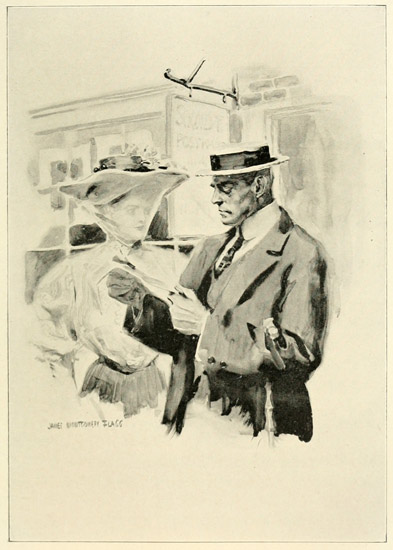
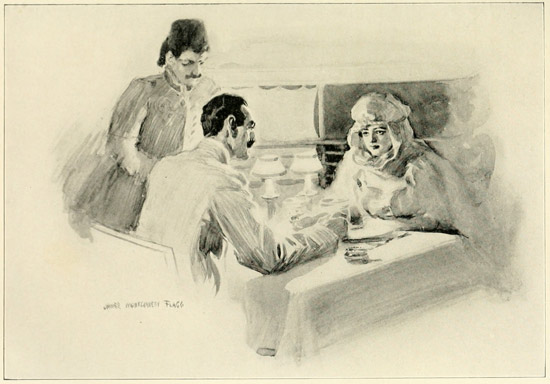
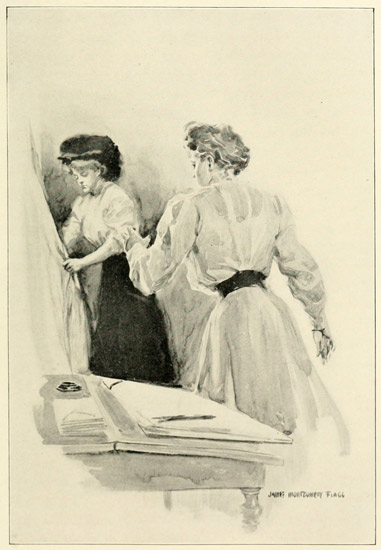
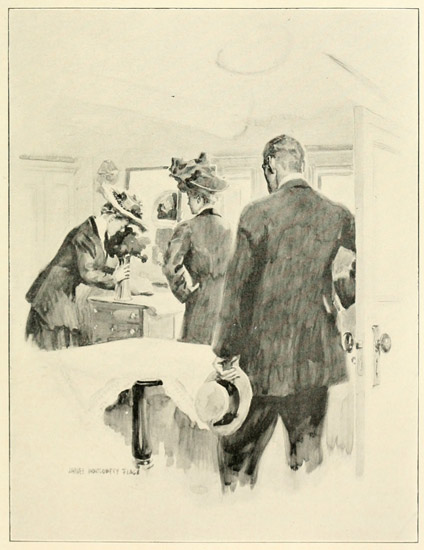
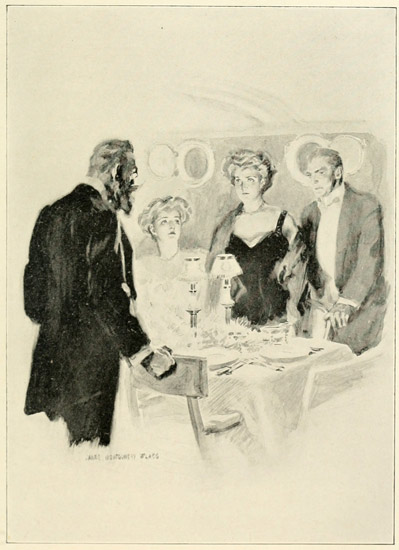
At two o'clock in the morning Captain Brown was
called by the officer of the watch, who told him that he
was overhauling a good-sized steam yacht. The latter
was heading up for the Straits from the southward,
and the officer judged her to be not more than three
or four miles on the port bow.
Captain Brown, who meant business, was sleeping
in his clothes in the chart-room, and was on the bridge
in ten seconds, peering over the search-light with his
big binocular. At two in the morning even the largest
yachts do not show such a blaze of lights as passenger
steamers generally do all night, and the one Captain
Brown was watching had only two or three, besides
the regulation ones. She might be white, too, though
she might be a light grey, but he thought on the whole
that she was painted white. She was rigged as a
two-masted fore-and-aft schooner. So was the Erinna
now, though she had once carried square topsails at
the fore. She was also of about the same size, as far
as it was possible to judge under the search-light.
Captain Brown did not feel sure that he recognised her,
but considering what his orders were he knew it was
his duty to settle the question of her identity, which
{393}
would be an easy matter in a quarter of an hour or less,
as the course of the two vessels converged.
He had been told to find the Erinna, but for what
purpose he knew not, and he naturally supposed it to
be a friendly one. As a first step, he ordered the Coston
signal of his owner's yacht club to be burned, turned
off the search-light, and waited for an answer. None
came, however. Foreign yachts do not always burn
signals to please vessels of other nations.
A couple of minutes later, however, the white beam
of a search-light shot out and enveloped Captain Brown
and his ship. The other man was evidently having a
good look at him, for the light was kept full on for
some time. But no signal was burned after it went
out. Then Captain Brown turned on his own light
again, and looked once more; and he had almost made
up his mind that the other yacht was not quite as long
as the Erinna, when she suddenly starboarded her helm,
made a wide sweep away from him, and headed down
the Sicilian coast in the direction of Catania.
Captain Brown was so much surprised that he lowered
his glasses and looked at his chief mate, whose watch
it was, and who was standing beside him. It really
looked very much as if the other vessel had recognised
him and were running away. The chief mate also
looked at him, but as they were more or less dazzled
by the search-light that had been played on them, they
could hardly see one another's faces at all. The captain
wished his owner were on deck, instead of being sound
asleep below. Owners who are not at all nautical
{394}
characters do not like to be waked up at two o'clock
in the morning by inquiries for instructions. Captain
Brown considered the situation for two or three minutes
before he made up his mind. He might be mistaken
about the length and the bows of the Erinna, and if by
any possibility it were she, he would not lose much by
making sure of her. No other steamer could now pass
out of the Straits without being seen by him.
'Hard-a-starboard,' he said to the mate.
'Hard-a-starboard,' said the mate to wheel.
The big Lancashire Lass described a vast curve at her
racing speed, while the captain kept his eye on the
steamer he was going to chase. Before she was dead
ahead the mate ordered the wheel amidships, and the
Lancashire Lass did the rest herself.
'That will do for a course,' the captain said, when he
had the vessel one point on the starboard bow.
'Keep her so,' said the mate to the wheel.
'Keep her so, sir,' answered the quartermaster.
It soon became clear to Captain Brown that he was
chasing an uncommonly fast vessel, though he was
willing to admit that he might have been a little out
in judging the distance that separated him from her.
Allowing that she might do sixteen knots, and even that
is a high speed for yachts, he ought to have overtaken her
in half an hour at the outside. But he did not, and he
was much puzzled to find that he had gained very little
on her when six bells were struck. Twice already he
had given a little more starboard helm, and the pursued
vessel was now right ahead, showing only her stern-light
and the glare of her after-masthead light.
{395}
'Didn't I hear four bells go just after you called me?'
he asked of the mate. 'Or was it five?'
'Four bells, sir. I logged it. At two-twenty we gave
chase.'
'Mr. Johnson,' said the captain solemnly, 'he's doing
at least twenty.'
'At least that.'
The quartermaster who came to relieve the wheel at
the hour, touched his cap, and reported eighty-five and
eighty-six revolutions of the port and starboard engines
respectively, which meant that the Lancashire Lass
was doing her best. Then he took the other quartermaster's
place.
'Chase,' said the man relieved. 'Keep her so.'
'Keep her so,' answered the other, taking over the
wheel.
Captain Brown spoke to his officer.
'Tell them to try and work the port engine up to
eighty-six, Mr. Johnson.'
The chief mate went to the engine telephone, delivered
the message, and reported that the engineer of the
watch in the port engine said he would do his best,
but that the port engine had not given quite such a
good diagram as the starboard one that morning.
Then something happened which surprised and
annoyed Captain Brown; and if he had not been a
religious man, and, moreover, in charge of a vessel
which was so very high-class that she ranked as third
in the world amongst steam yachts, and perhaps second,
a fact which gave him a position requiring great dignity
{396}
of bearing with his officers, he would certainly have said
things.
The chased vessel had put out her lights and disappeared
into complete darkness under the Sicilian coast.
Again he and his officer looked at one another, but
neither spoke. They were outside the wheel-house on
the bridge on the starboard side, behind a heavy plate-glass
screen. The captain made one step to the right,
the mate made one to the left, and both put up their
glasses in the teeth of the gale made by the yacht's
tremendous way. In less than a minute they stepped
back into their places, and glanced at each other again.
Now it occurred to Captain Brown that such a financier
as his owner might be looking out for such another
financier as the owner of the Erinna for some reason
which would not please the latter, whose sailing-master
had without doubts recognised the Lancashire Lass at
once, because she was very differently built from most
yachts.
'Search-light again, Mr. Johnson,' said the captain.
The great beacon ran out instantly like a comet's
tail, and he stood behind it with his glasses. Instead of
a steamer, he saw a rocky islet sticking up sharp and
clear, half a point on the starboard bow, about three
miles off. It was the largest of the Isles of the Cyclops,
as he very well knew, off Aci Reale, and it was perfectly
evident that the chased vessel had first put out her
lights and had then at once run behind the islands, close
inshore. Captain Brown reflected that the captain he
was after must know the waters well to do such a thing,
{397}
and that the deep draught of his own ship made it the
height of folly to think of imitating such a trick at night.
Yet so long as the other stayed where she was, she could
not come out without showing herself under his search-light.
'Half-speed both engines,' he said quickly.
The mate worked the engine telegraph almost as
soon as the captain began to speak.
'Starboard five degrees more,' said Captain Brown.
The order was repeated to the wheel, and the quartermaster
gave it back, and repeated it a second time when
the vessel's head had gone off to port exactly to the
required degree.
'Slow,' said Captain Brown. 'Stop her,' he said a
moment later.
Twin-screw steamers cannot be stopped as quickly
by reversing as those with a single screw can, and the
Lancashire Lass would keep way on for three miles or
more, by which time she would be abreast of the islands,
and at a safe distance from them. Besides, the spring
tide was now running fresh down the Straits, making
a current along the coast, as Captain Brown knew. The
instant the engines stopped, the third mate came round
from the chart-room, where he had been sent to work
a sight for longitude by Aldebaran for the good of his
young nautical soul.
A moment later Mr. Van Torp himself appeared on
the bridge in pyjamas.
'Got her?' he asked eagerly.
Captain Brown explained that he thought he had
{398}
cornered the Erinna behind the islet, but was not quite
sure of her. Mr. Van Torp waited and said nothing,
and the chief mate kept the search-light steadily on the
rocks. The yacht lost way rapidly, and lay quite still
with the islet exactly abeam, half a mile off, as the captain
had calculated. He then gave the order to go slow
ahead.
A minute had not passed when the vessel that had
lain concealed behind the island ran out suddenly with
all her regulation lights up, apparently making directly
across the bows of the Lancashire Lass. Now the rule
of the road at sea requires every steamer under weigh
to keep out of the way of any steamer that appears on
her starboard side forward of the beam. At such a short
distance Captain Brown had hardly any choice but to
stop his ship again and order 'half-speed astern' till
she had no way, and he did so. She was barely moving
when the order was given, and a few turns of the engines
stopped her altogether.
'Is that the Erinna, Captain?' asked Mr. Van Torp.
Captain Brown had his glasses up and did not answer
at once. After nearly a minute he laid them down on the
lid of the small box fastened to the bridge-rail.
'No, sir,' he answered in a tone of considerable disappointment.
'At four miles' distance she looked so much
like her that I didn't dare to let her slip through my
fingers, but we have not lost more than a couple of
hours.'
'What is this thing, anyway? She's coming towards
us pretty quick.'
{399}
'She's one of those new fast twin-screw revenue cutters
the Italians have lately built, sir. They look very like
yachts at night. There's a deal of smuggling on this
coast, over from Malta. She's coming alongside to ask
what we mean by giving chase to a government vessel.'
Captain Brown was right, and when the big cutter
had crossed his bows, she ran all round him while she
slowed down, and she stopped within speaking distance
on his starboard side. The usual questions were asked
and answered.
'English yacht Lancashire Lass, from Venice for
Messina, expecting to meet a friend's yacht at sea.
Thought the revenue cutter was she. Regretted mistake.
Had the captain of the cutter seen or heard of
English yacht Erinna?'
He had not. There was no harm done. It was his
duty to watch all vessels. He wished Captain Brown
a pleasant trip and good-night.
The Italian officer spoke English well, and there was
no trouble. Revenue cutters are very civil to all
respectable yachts.
'Hard-a-starboard. Port engine slow astern, starboard
engine half-speed ahead.'
That was all Captain Brown said, but no one could
guess what he was thinking as his big vessel turned
quickly to port on her heel, and he headed her up for
the Straits again. Mr. Van Torp said nothing at all,
but his lips moved as he left the bridge and went off to
his own quarters. It was now nearly four o'clock and
the eastern sky was grey.
{400}
The current was dead against the yacht through the
Straits, which were, moreover, crowded with all sorts
of large and small craft under sail, taking advantage
of the tide to get through; many of them steered very
badly under the circumstances, of course, and it was out
of the question to run between them at full speed. The
consequence was that it was eight o'clock when the
Lancashire Lass steamed slowly into Messina and
dropped anchor out in the middle of the harbour, to
wait while Captain Brown got information about the
Erinna, if there were any to be had at the harbourmaster's
office. It would have been folly to run out of
the Straits without at least looking in to see if she were
there, lying quietly moored behind the fortress of San
Salvatore and the very high mole.
She was not there, and had not been heard of, but a
Paris Herald was procured in which it was stated that
the Erinna had arrived in Naples, 'owner and party on
board.'
'Well,' said Mr. Van Torp, 'let's get to Naples, quick.
How long will it take, Captain?'
'About eight hours, sir, counting our getting under
weigh and out of this crowded water, which won't take
long, for the tide will soon turn.'
'Go ahead,' said Mr. Van Torp.
Captain Brown prepared to get under weigh again as
quickly as possible. The entrance to Messina harbour
is narrow, and it was natural that, as he was in a hurry,
a huge Italian man-of-war should enter the harbour at
that very moment, with the solemn and safe deliberation
{401}
which the movements of line-of-battle ships require
when going in and out of port. There was nothing to
be done but to wait patiently till the fairway was clear.
It was not more than a quarter of an hour, but Captain
Brown was in a hurry, and as there was a fresh morning
breeze blowing across the harbour he could not even get
his anchor up with safety before he was ready to
start.
The result of all these delays was that at about nine
o'clock he saw the Erinna right ahead, bows on and only
half a mile away, just between Scylla and Faro, where
the whirlpool is still a danger to sailing vessels and slow
steamers, and just as the tide was turning against her
and in his own favour. He did not like to leave the
bridge, even for a moment, and sent the second mate
with an urgent message requesting Mr. Van Torp to
come up as soon as he could.
Five minutes earlier the owner had sat down to breakfast
opposite Lady Maud, who was very pale and had
dark shadows under her eyes for the first time since he
had known her. As soon as the steward left them alone,
she spoke.
'It is Leven,' she said, 'and he wants me to take him
back.'
Mr. Van Torp set down his tea untasted and stared
at her. He was not often completely taken by surprise,
but for once he was almost speechless. His lips did not
even move silently.
'I was sure it was he,' Lady Maud said, 'but I did not
expect that.'
{402}
'Well,' said Mr. Van Torp, finding his voice, 'he shan't.
That's all.'
'No. I told him so. If I had been dressed I would
have asked you to put me ashore at Messina. I thought
you were going to stop there—the stewardess told me
where we were, but she knew nothing else; and now
we're off again.'
'I can't help it, Maud,' said Van Torp, almost in a
whisper, 'I don't believe it. I don't believe in impossibilities
like that beard of his. It may sound ridiculous
in the face of your recognising your own husband, but
it's a solid fact, and you can't get over it. I wish I
could catch the Erinna and show him to that Tartar
girl. She'd know in a minute. He can't be her man
and Leven too. There's only one thing to be done that
I can see.'
'What?' asked Lady Maud sadly and incredulously.
'Tell him you'll take him back on condition that he'll
shave.'
Mr. Van Torp, who was in dead earnest, had just given
his best friend this piece of sound practical advice when
the door opened, though he had not rung, and the
steward announced that the second mate had a message
for Mr. Van Torp. He was admitted, and he delivered
it.
The owner sprang to his feet.
'By thunder, we've caught 'em!' he cried, as he rushed
out of the deck saloon.
Lady Maud leaned back and stared at his empty chair,
wondering what was going to happen next.
{403}
This was what happened. The Lancashire Lass reversed
her starboard engine with full speed astern, put
her helm hard over to port, and turned back towards
the Straits in the smallest space possible for her, passing
less than a cable's length from the Scylla rock, and nearly
running down half a dozen fishing-boats that pulled like
mad to get out of her way; for they supposed that her
steering-gear had broken down, unless her captain had
gone raving mad.
While this was going on, Captain Brown himself,
with the International Signal Code in his hand, was
calling out letters of the alphabet to a quartermaster,
and before his ship had made half a circle the flags ran
up the single stick the yacht carried.
'My owner has urgent business with your owner,'
was what the flags meant in plain English.
The Erinna was going slow, for Baraka was only just
ready to come on deck, haste being, in her opinion, an
invention of Shaitan's. Logotheti, who wished her to
see the Straits, was just inside the door of the deck
saloon, waiting for her to come out of her cabin. The
officer of the watch read off the signals of the other
yacht, ran up the answering pennant, and sent for the
sailing-master, but could of course do nothing else without
orders. So the Erinna continued to go slow. All
this took some minutes, for the officer had naturally
been obliged to look up the signal in the Code before
answering that he understood it; and in that time Van
Torp's yacht had completed her turn and was nearly
alongside. The Lancashire Lass slowed down to the
{404}
Erinna's speed, and the two captains aimed their megaphones
accurately at each other from their respective
bridges for a little pleasant conversation. Captain
Brown, instructed by Mr. Van Torp at his elbow, repeated
what his signals had meant. The other sailing-master
answered that he had already informed his
owner, who was coming to the bridge directly.
At that moment Logotheti appeared. There was not
much more than a cable's length between the two yachts,
which in land-talk means two hundred yards. Van
Torp also saw a slim young lady in blue serge, with a
veil tied over her hair, leaning on the rail of the promenade
deck and looking towards him. With his glasses
he recognised the features of Baraka.
'Got 'em!' he ejaculated in a low but audible tone
of intense satisfaction.
Logotheti had also seen Van Torp, and waved his
hand in a friendly manner.
'Ask the gentleman if he'll come aboard, Captain,'
said the American. 'I can't talk through your cornopean
anyway. I suppose we can send the naphtha launch
for him if we stop, can't we?'
'Can't stop here,' answered Captain Brown. 'The
currents might jam us into each other, and we should
most likely get aground in any case. This is not even
a safe place for going slow, when the tide is running.'
'Well, you know your business, and I don't. Tell
him we don't want to interfere with any arrangements
he's made, and that if he'll kindly set the pace he likes
we'll trot along behind him till we get to a nice place,
{405}
somewhere where we can stop. I suppose he can't run
away from us now, can he?'
Captain Brown smiled the smile of a man who commands
a twenty-three-knot boat, and proceeded to
deliver the message in a more concise form. Logotheti
heard every word, and the answer was that he was in
no hurry and was quite at Mr. Van Torp's disposal.
He would be glad to know whom the latter had on board
with him.
'Lady Maud Leven, Miss Margaret Donne, Mrs.
Rushmore, and Count Kralinsky,' answered Captain
Brown, prompted by Van Torp.
The latter was watching the Greek through a pair of
deer-stalking glasses, and saw distinctly the expression
of surprise that came into his face when he heard the
last of the names.
'Tell the gentleman,' said Van Torp, 'that if he'll
bring his party with him when we stop, I'll be very
glad to have them all take lunch with me.'
Captain Brown delivered the message. At such a
short distance he did not even have to raise his voice
to be heard through the six-foot megaphone.
To Van Torp's surprise, Logotheti nodded with alacrity,
and the answer came that he would bring his party
with pleasure, but thought that his visit would be over
long before luncheon time.
'All right, good-bye,' said Van Torp, as if he were
at the telephone. 'Ring off, Captain. That's all. Just
let him give us a lead now and we'll follow him through
this creek again, since you say you can't stop here.'
{406}
As he went off the bridge to return to his breakfast
he passed close to the chief mate, who had turned again,
though it was his watch below.
'I say, Mr. Johnson,' he asked, 'have we got a barber-shop
on board this ship?'
'No, sir,' answered the mate, who knew better than
to be surprised at anything.
'It's no matter,' said Mr. Van Torp. 'I was only
asking.'
He went back to his breakfast with an improved
appetite. When he re-entered the saloon Lady Maud
was still leaning back in her chair, staring at his empty
place.
'Well,' he said, 'they're both coming on board as soon
as we get to a place where we can stop.'
'Have you really seen the girl?' Lady Maud sat up,
as if she were waking from sleep.
'Oh, yes! There she was, looking over the rail, as
neat as a pin, in a blue serge dress, with a white veil
tied over her hair, watching me. We've got 'em right
enough, and that's going to be the end of this mystery!'
'Did you see any one else on the yacht?'
'Logo. That's all. He and I talked. At least, our
captains talked for us. They do know how to yell,
those men! If the girl's the party, Logo beats the band
for brass, that's all I can say!'
'It is rather cool,' said Lady Maud thoughtfully. 'If
he's alone with her, it will be all up with his engagement.'
'Well, if that's the way he's going on, it's about time.'
His tone was all at once serious. 'Now, see here, have
{407}
I done anything you consider unfair to make this happen?
I want your opinion right away, for if you think
I have, I'll stand up for Logo to Miss Donne as hard
as I can. Just think it over, please, and tell me your
honest opinion. If I've done anything low-down, I
want to go right back and begin over again.'
He was thoroughly in earnest, and awaited her answer
with evident anxiety. Knowing the man as she did,
she would not give it hastily, though it was hard to
concentrate her thoughts just then on anything but her
own trouble; for she was quite convinced that Baraka
would not recognise Kralinsky as the man she was
looking for, and that this final proof would settle his
identity as Leven, which she already did not doubt.
She asked one or two questions.
'Before I answer you,' she said, 'tell me something,
as you tell me things, when you do. Have you any
entanglement with another woman from which you feel
that you're not perfectly free? I don't like to ask such
a question, and I wouldn't if you had not put me on
my honour for my opinion.'
'No,' answered Van Torp very gravely, 'I have not.
No living woman has any claim on me, and no dead
woman could have, if she came to life again.'
'Then I think you had a right to do what you've done,
and what you are going to do. When a man behaves
in that way he deserves no pity, and now that the crisis
is coming I may as well tell you that I've done everything
in my power to make Margaret give him up, ever
since I have been sure that he had taken the girl with
{408}
him on his yacht. So far as catching them under Margaret's
very eyes is concerned, I'm glad you have succeeded—very
glad!'
On certain points Lady Maud was inflexible as to the
conduct of men and women, but especially of men.
'Mrs. Foxwell' spent much time behind the Virtue-Curtain,
seeking for poor souls who were willing to be
helped, and her experiences had led her to believe a
modified version of the story of Adam and Eve and the
Apple-tree which was quite her own. In her opinion
Adam had been in the habit of talking to his wife about
the tree for some time, and when the serpent presented
itself to explain things he discreetly withdrew till the
interview was over. Therefore 'Mrs. Foxwell' was, on
the whole, more charitably inclined to her own sex than
the other, and when she was 'Lady Maud' she held very
strong views indeed about the obligations of men who
meant to marry, and she expressed them when the intended
bride was a friend of hers.
'Thank you,' said Mr. Van Torp, after she had finished
her speech. 'I'm glad you don't disapprove, for
if you did I'd try to begin all over again, as I told you.
Any other question? You said "one or two," and I'd
like to have them all now.'
'Only one more, though perhaps I've no business to
ask it. If Margaret marries you, shall you want her to
leave the stage?'
'Why, no!' answered Mr. Van Torp with alacrity.
'That wouldn't suit my plans at all. Besides, we're a
Company, she and I.'
{409}
'What do you mean?' Lady Maud thought he was
joking.
'Well, I wasn't going to tell you till we'd organised,
but you're as good as a deaf and dumb asylum about
business things. Yes. We're organising as "The Madame
da Cordova and Rufus Van Torp Company."
I'm going to build an opera-house in New York on some
land I've got on Fifth Avenue, and Miss Donne is going
to run it, and we mean to have Wagner festivals and
things, besides regular grand opera, in which she's
engaged to sing as often as she likes. There's never
been an opera-house on Fifth Avenue, but there's
going to be, and people will go to it. Miss Donne caught
on to the scheme right away, so you see she's not going
to leave the stage anyhow. As for her accepting me,
I can't tell you, because I don't know. Maybe she will,
maybe she won't. That isn't going to interfere with
the Company either way. Good scheme, isn't it?'
'You're a wonderful man,' said Lady Maud, with
genuine admiration. 'Do you mean to say that you
have settled all that between you already?'
'She signed the preliminary agreement in Bayreuth,
and the papers are being made out by my lawyer in
New York. You don't think it was unfair to offer to
build a theatre and call it after her, do you? That
isn't "exercising undue influence," I suppose?'
'No, and I think you're going to win. The other
man hasn't had a chance since you got into your stride.'
'When a man chucks his chances, I'm not going to
pick them up for him. Charity begins at home.'
{410}
'Even if "home" is a bachelor establishment?'
Lady Maud smiled for the first time that day.
They talked a few minutes longer, agreeing that she
should tell Margaret what was going to happen; but
that Mrs. Rushmore and Kralinsky should be kept in
ignorance of the plan, the American lady because she
might possibly yield to temptation and tell the Count,
and the latter for obvious reasons. It was not likely
that any of them would be on deck much before Logotheti
came on board.
There is good anchorage out of the tidal current at
Scaletta, some few miles below Messina, on the Sicilian
side, and towards this well-known water the Erinna
led the way, followed at a short distance by the Lancashire
Lass.
Logotheti and Baraka watched her, and the girl
recognised Van Torp on the bridge of his yacht, without
even using glasses, for she had eyes like an eagle's, and
the American millionaire stood alone at one end of the
bridge looking towards her.
Logotheti had told her that Kralinsky was on board,
and that she should see him as soon as both yachts
could anchor. He explained that it was an unforeseen
coincidence, and that Mr. Van Torp must have taken
him on board somewhere on the previous day. To the
Greek's surprise, Baraka showed no outward sign of
emotion. He had promised to take her to the man,
and had said that he was near at hand; that the meeting
should take place sooner than had been intended hardly
surprised her, because she had been so perfectly sure
{411}
that it was near. Her only preoccupation now was
about her appearance in her ready-made serge and
blouse, when she had meant to show herself to Kralinsky
in the glory of a beautiful and expensive Feringhi dress.
But Logotheti explained that even the richest Feringhi
ladies often wore little blue serge frocks on yachts, and
told her to watch the Lancashire Lass with her glasses,
as there were three very great Feringhi ladies on board,
and she might see one, and be reassured; and presently
she saw Lady Maud walking alone on the promenade
deck, in clothes very like her own, excepting that they
were black instead of dark blue. So Baraka was satisfied,
but she never took her eyes from the following
yacht, for she hoped that Kralinsky would come out and
show himself.
All at once he was there, taking off his white cap to
Lady Maud, and they stood still facing each other, and
talking.
'I see him,' Baraka said in a low voice, without
lowering her glasses. 'It is he.'
Logotheti, who had been much absorbed in thinking
about his coming interview with Margaret, raised his
glasses too, for he was curious to see the man at last.
He had known Leven for years, though never intimately,
as he knew a vast number of people in London,
and he was struck at once by the resemblance in size,
build, and complexion.
'He is fatter than he was, and paler,' Baraka said
quietly, 'but it is he. He is speaking earnestly with
the beautiful woman in black. I can see well. He
{412}
likes her, but she does not like him. I think she is
telling him so. I am glad. But she is more beautiful
than Baraka, even in those poor clothes. When he sees
me, he will deny me, because he likes the beautiful
woman in black. I will tell Spiro to be ready. It is
a pity, but I see there will be no other way. It is his
portion and mine. It is a great pity, for I have been
happy with you.'
Instead of any look of anger, Logotheti now saw an
expression of profound resignation in her lovely young
features. If he had been less anxious about his own
affairs, he would have smiled at her simplicity.
'When we are on that ship you will let me talk with
him a little apart from the rest, and Spiro shall go behind
him and wait, looking at me. If he denies me, I will
make a sign, and Spiro shall shoot him, and then kill
me. It will be very easy and quick.'
'And what will become of Spiro?' inquired Logotheti
gravely.
'I do not know,' Baraka said quietly. 'Perhaps he
will lose his head. How can I tell? But he is a good
servant, and will obey me. Afterwards it will not matter,
for he is really a Musulman, and will go at once to
paradise if he dies, because he has killed a Christian.'
'But you are a Musulman, and he is to kill you also.
What about that?'
'I am only a woman,' answered Baraka with supreme
indifference. 'Now I will call Spiro and tell him what
he is to do. He has a good revolver.'
Logotheti let her clap her hands and send the steward
{413}
for her man, and she rose when he appeared and made
him follow her a little way along the deck. The interview
did not last long. She handed him her glasses
and made him look carefully at the intended victim;
then she apparently repeated her brief instructions
again, pointing here and there to the deck at her feet,
to show him how they were to stand; after which she
turned quietly, came back to Logotheti's side, and sat
down again.
'He understands,' she said. 'It will be quite easy.'
But Logotheti, looking past her as she came forward,
had met Spiro's eyes; and he felt not even the slightest
anxiety for Kralinsky's safety, nor for Baraka's. He
was still wondering what he should say to Margaret,
but while he tried to think it over, his eyes dwelt on
the noble little profile of the slender Asiatic girl at his
side; and it occurred to him that, although she had
worn man's clothes and done things that few women
would dare to do, for the one purpose of her life, she
would much rather die than show herself on the stage in
a very low dress before thousands of people and sing
to them, and take money for doing it; and he remembered
a time, not much more than two years past, when
the mere thought had driven the idea of marrying the
Primadonna quite out of his head for a while, and that,
after all, it had been her physical attraction that had
overcome the prejudice, making him say that he was as
much in love with the Cordova as he had been with
Margaret Donne, that 'very nice English girl.' For
men are changeable creatures after they think they
{414}
have changed themselves to suit their tastes or their
ideals, and the original man in them, good or bad, fine
or coarse, generally comes back in the great moments.
At a distance, Logotheti had supposed that he could
somehow account to the Diva for the position in which
he had foolishly placed himself, because he had done
nothing and said nothing that he would have been
ashamed of before her, if she knew the whole truth; and
he fancied that even if they quarrelled she would make
up with him before long, and marry him in the end. He
had a good opinion of himself as a desirable husband;
and with reason, since he had been persecuted for years
with offers of excellent marriages from mothers of high
degree who had daughters to dispose of. And beneath
that conviction there lurked, in spite of him, the less
worthy thought, that singers and actresses were generally
less squeamish than women of the world about the
little entanglements of their intended husbands.
But now, at the very moment of meeting Margaret,
he knew that if he found her very angry with him, he
would simply listen to what she had to say, make a
humble apology, state the truth coldly, and return to
his own yacht with Baraka, under her very eyes, and in
full sight of Lady Maud and Mrs. Rushmore. Besides,
he felt tolerably sure that when Spiro failed to carry
out the young Tartar girl's murderous instructions,
she would forget all about the oath she had sworn by
the 'inviolable water of the Styx' and try to kill him
with her own hands, so that it would be necessary to
take her away abruptly, and even forcibly.
{415}
Matters did not turn out as he expected, however,
after the two yachts stopped their engines in the quiet
waters off Scaletta, under the Sicilian mountains.
Before the Erinna had quite lost her way, Logotheti
had his naphtha launch puffing alongside, and he got
into it with Baraka and Spiro, and the Lancashire Lass
had barely time to lower her ladder, while still moving
slowly, before the visitors were there.
Baraka bade Logotheti go up first, and trod daintily
on the grated steps as she followed him. The chief
mate and chief steward were waiting at the gangway.
The mate saluted; the steward led the visitors to the
main saloon, ushered them in, and shut the door. Spiro
was left outside, of course.
Lady Maud was there, sitting in an easy-chair in the
farthest corner. She nodded to Logotheti, but did not
rise, and paid no more attention to Baraka than if she
had not existed.
Mr. Van Torp shook hands coldly with Logotheti;
Baraka walked directly to Kralinsky, and then stood
stone-still before him, gazing up steadily into his eyes.
Neither Margaret nor Mrs. Rushmore was to be seen.
Van Torp and Logotheti both watched the other two,
looking from one face to the other. Kralinsky, with
his eye-glass in his eye, surveyed the lovely young
barbarian unmoved, and the silence lasted half a minute.
Then she spoke in her own language and Kralinsky answered
her, and only Logotheti understood what they
said to each other. Probably it did not occur to Kralinsky
that the Greek knew Tartar.
{416}
'You are not Ivan. You are fatter, and you have
not his eyes.'
Logotheti drew a long breath.
'No,' answered Kralinsky. 'I am Yuryi, his brother.
I never saw you, but he told me of you.'
'Where is Ivan?'
'Dead.'
The proud little head was bowed down for a moment
and Baraka did not speak till several seconds had passed.
Then she looked up again suddenly. Her dark eyes
were quite dry.
'How long?'
'More than four months.'
'You know it?'
'I was with him and buried him.'
'It is enough.'
She turned, her head high, and went to the door, and
no one hindered her from going out.
'Monsieur Logotheti!' Lady Maud called him, and
the Greek crossed the saloon and stood by her. 'He
is not the man, I see,' she said, with a vague doubt in
her voice.
'No.'
Van Torp was speaking with Kralinsky in low tones.
Lady Maud spoke to Logotheti again, after an instant,
in which she drew a painful breath and grew paler.
'Miss Donne knows that you are on board,' she said,
'but she wishes me to say that she will not see you,
and that she considers her engagement at an end, after
what you have done.'
{417}
Logotheti did not hesitate.
'Will you kindly give a message to Miss Donne from
me?' he asked.
'That quite depends on what it is,' Lady Maud
answered coldly.
She felt that she herself had got something near a
death-wound, but she would not break down.
'I beg you to tell Miss Donne that I yield to her
decision,' said Logotheti with dignity. 'We are not
suited to each other, and it is better that we should
part. But I cannot accept as the cause of our parting
the fact that I have given my protection to a young girl
whom I have extricated from great trouble and have
treated, and still treat, precisely as I should have treated
Miss Donne if she had been my guest. Will you tell
her that?'
'I will tell her that.'
'Thank you. Good-morning.'
'Good-morning,' said Lady Maud icily.
He turned and went towards the door, but stopped
to speak to Van Torp.
'This gentleman,' he said, 'is not the man my guest
was anxious to find, though he is strikingly like him.
I have to thank you for giving her an opportunity of
satisfying herself. Good-morning.'
Mr. Van Torp was extremely grateful to Logotheti
for having ruined himself in Margaret's eyes, and would
in any case have seen him to the gangway, but he was
also very anxious to know what Kralinsky and Baraka
had said to each other in Tartar. He therefore opened
{418}
the door for the Greek, followed him out and shut it
behind him. Baraka and Spiro had disappeared;
they were already in the launch, waiting.
'Now what did they say, if it isn't a rude question?'
asked the American.
Logotheti repeated the short conversation almost
word for word.
'He said that his name was Yuryi,' he concluded.
'That is George in English.'
'Oh, he's George, is he? And what's his dead
brother's name again, please?'
'Ivan. That is John. Before we part, Van Torp,
I may as well tell you that my engagement with Miss
Donne is at an end. She was good enough to inform
me of her decision through Lady Maud. One thing
more, please. I wish you to know, as between man
and man, that I have treated Baraka as I would my
own sister since I got her out of prison, and I beg
that you won't encourage any disagreeable talk about
her.'
'Well, now,' said the American slowly, 'I'm glad to
hear you say that, just in that way. I guess it'll be
all right about any remarks on board my ship, now
you've spoken.'
'Thank you,' said Logotheti, moving towards the
gangway.
They shook hands with some cordiality, and Logotheti
ran down the steps like a sailor, without laying
his hand on the man-rope, stepped on board his launch,
and was off in a moment.
{419}
'Good-bye! good-bye, Miss Barrack, and good luck
to you!' cried Van Torp, waving his cap.
Logotheti translated his words to Baraka, who looked
back with a grateful smile, as if she had not just heard
that the man she had risked her life to find in two continents
had been dead four months.
'It was his portion,' she said gravely, when she was
alone with Logotheti on the Erinna, and the chain was
coming in fast.
Van Torp went back to the main saloon and found
Lady Maud and Kralinsky there. She was apparently
about to leave the Count, for she was coming towards
the door, and her eyes were dark and angry.
'Rufus,' she said, 'this man is my husband, and insists
that I should take him back. I will not. Will
you kindly have me put ashore before you start again?
My things are ready now.'
'Excuse me,' answered Mr. Van Torp, digging his
large thumbs into his waistcoat pockets, 'there's a mistake.
He's not your husband.'
'He is, indeed!' cried Lady Maud, in a tone her
friend never forgot.
'I am Boris Leven,' said Kralinsky in an authoritative
tone, and coming forward almost defiantly.
'Then why did you tell the Tartar girl that your
name was George?' asked Mr. Van Torp, unmoved.
'I did not.'
'You've evidently forgotten. That Greek gentleman
speaks Tartar better than you. I wonder where you
learned it! He's just told me you said your name was
George.'
{420}
'My name is George Boris,' answered Kralinsky, less
confidently.
He was not a coward, but he had never been face to
face with Van Torp when he meant business, and the
terrible American cowed him.
'My husband's name is only Boris—nothing else,'
said Lady Maud.
'Well, this isn't your husband; this is George, whoever
he is, and if you don't believe it, I'm going to give
you an object-lesson.'
Thereupon Mr. Van Torp pressed the button of a bell
in the bulk-head near the door, which he opened, and
he stood looking out. A steward came at once.
'Send me Stemp,' said Van Torp in a low voice, as
he stepped outside.
'Yes, sir.'
'And, see here, send six sailors with him.'
'Six, sir?'
'Yes. Big fellows who can handle a man.'
'Very good, sir.'
Mr. Van Torp went in again and shut the door. Kralinsky
disdained flight, and was looking out of a window.
Lady Maud had sat down again. For the first time in
her life she felt weak.
In less than one minute the door opened and Stemp
appeared, impassive and respectful. Behind him was
the boatswain, a huge Northumbrian, and five young
seamen in perfectly new guernseys, with fair quiet
faces.
'Stemp.'
{421}
'Yes, sir.'
'Take that man somewhere and shave him. Leave
his moustache on.' Van Torp pointed to Kralinsky.
For once in his life Stemp gasped for breath. Kralinsky
turned a greenish white, and seemed paralysed with
rage.
'Take his beard off, sir, you mean?'
'Yes. Leave his moustache. Here, men,' added
Van Torp, 'take that fellow outside and hold him down
in a chair while Stemp shaves him. See?' The boatswain
looked doubtful. 'He's pretending to be somebody
he's not,' said Van Torp, 'on my ship, and I want
to see his face. It's mutiny if you don't obey orders!'
'Aye, aye, sir,' responded the boatswain cheerfully,
for he rather liked the job since there was a good reason
for it.
But instead of going about his business gently, the
Northumbrian giant suddenly dashed past Van Torp
in a flash, and jumped and hurled himself head foremost
at Kralinsky's legs, exactly as if he were diving. In the
Count's violent fall the revolver he had drawn was
thrown from his hand and went off in the air. The
boatswain had seen it in time. The big man struggled
a little, but the five seamen held him fast and carried
him out kicking.
'Stemp.'
The valet was preparing to follow the prisoner, and
was quite calm again.
'Yes, sir.'
'If he won't sit still to be shaved, cut his head off.'
{422}
'Yes, sir.'
Van Torp's eyes were awful to see. He had never
been so angry in his life. He turned and saw Lady
Maud pressing her handkerchief to her right temple.
The ball had grazed it, though it had certainly not been
meant for her.
'Rufus!' she cried in great distress, 'what have you
done?'
'The question is what he's done to you,' answered
Van Torp. 'I believe the blackguard has shot you!'
'It's nothing. Thank God it hit me! It was meant
for you.'
Van Torp's rage instantly turned into tender care,
and he insisted on examining the wound, which was
slight but would leave a scar. By a miracle the ball had
grazed the angle of the temple without going near the
temporal artery, and scarcely singeing the thick brown
hair.
Van Torp rang and sent for water and absorbent
cotton, and made a very neat dressing, over which
Lady Maud tied her big veil. Just as this was done,
Stemp appeared at the door.
'It's ready, sir, if you would like to come and see.
I've not scratched him once, sir.'
'All right.' Van Torp turned to Lady Maud. 'Do
you feel faint? Lean on my arm.'
But she would not, and she walked bravely, holding
herself so straight that she looked much taller than he,
though she felt as if she were going to execution.
A moment later she uttered a loud cry and clung to
{423}
Van Torp's shoulder with both hands. But as for him,
he said only two words.
'You hellhound!'
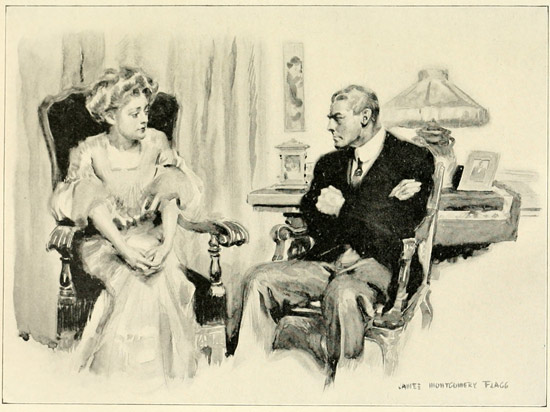
The man was not Boris Leven.
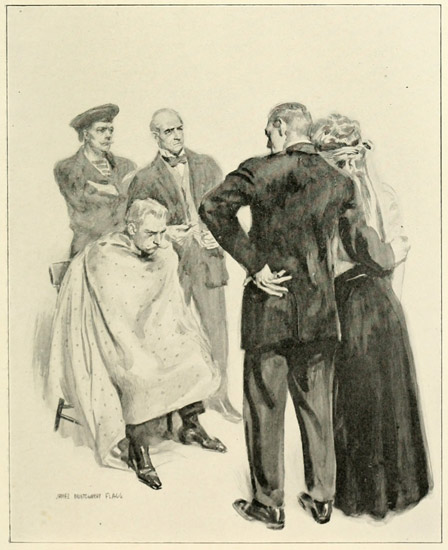
"The man was not Boris Leven."
The eyes, the upper part of the face, the hair, even
the flowing moustaches were his, but not the small
retreating chin crossed by the sharp, thin scar of a
sword-cut long healed.
'I know who you are,' said Van Torp, surveying him
gravely. 'You're Long-legged Levi's brother, that
disappeared before he did. I remember that scar.'
The sham Kralinsky was securely tied down in a
chair and the boatswain and the five seamen stood
round him, an admiring public. Captain Brown had
been informed of what had happened and was going on,
and the discipline he maintained on board was so perfect
that every man on the watch was at his post, and
the steamer was already under weigh again. The boatswain
and his contingent belonged to the watch below,
which had not been called for the start.
'Let me off easy,' said Long-legged Levi's brother.
'I've not done you any harm.'
'Beyond wounding Lady Maud, after trying to pass
yourself off as her dead husband. No. I won't let
you off. Boatswain, I want this man arrested, and we'll
take him and all his belongings before the British Consul
in Messina in less than an hour. You just attend
to that, will you? Somebody go and tell the Captain.'
'Aye, aye, sir.'
For the boatswain and the men had seen and heard,
{424}
and they knew that Mr. Van Torp was right, and they
respected him, and the foreign impostor had wounded
an English woman; and having given his orders, the
owner and Lady Maud turned and left Long-legged
Levi's brother tied to the chair, in a very dejected state,
and his uncertain eyes did not even follow them.
The rest is soon told. A long inquiry followed, which
led to the solution of the mystery and sent Count Yuryi
Leven to Siberia; for he was Boris Leven's twin brother.
The truth turned out to be that there had been three
brothers, the youngest being Ivan, and they had all
entered the same Cossack regiment, and had served
in the Caucasus, where most officers learn the Tartar
language, which is spoken by all the different tribes.
It will be simpler to designate them by the English
equivalents for their names.
Boris behaved himself tolerably well in the army,
but both his brothers, John and George, who was his
twin, were broken for cheating at cards, and emigrated
to America. So long as they all wore their beards, as
officers of Cossack regiments usually do, they were very
much alike. They were all educated men of refined
tastes, and particularly fond of music.
When his two brothers were cashiered, Boris resigned,
entered the diplomatic service, married Lady Maud Foxwell,
and was killed by a bomb in St. Petersburg.
John and George separated in America when they
were tired of punching cattle.
John was something of a naturalist and was by far
{425}
the most gifted of the three as well as the most daring.
He gravitated to China and at last to Mongolia, wandering
alone in search of plants and minerals, and it was to
him that Baraka showed the ruby mine. He got back
to civilisation with his treasure and took it to Petersburg
unmolested.
There he found George earning a poor living in an
obscure position in the public service, his conduct in
the army having been condoned or overlooked. John,
who was the incarnation of selfishness, would do nothing
for him. George, exasperated by him, and half starved,
murdered him in such a way that he was supposed to
have died by an accident, took possession of his hoard
of unsold rubies, and wrote to his twin brother to come
and share the fortune John had left them.
George and Boris had been in constant correspondence,
and had even helped each other with money from time
to time. Some weeks elapsed after Boris's return to
St. Petersburg before his death, and during that time,
he told George, who knew London well and had moreover
helped him in his attempt to get a divorce, a vast number
of details about his married life and his wife's behaviour,
her character and tastes. Then Boris was killed
in the street, and George left the country and changed
his name, with the vague idea that his own was not a
very creditable one and that if he kept it he might be
troubled by his brother Boris's numerous creditors.
He began life over again as Kralinsky.
He had not entertained the least intention of passing
himself for Boris and claiming Lady Maud as his wife,
{426}
till he met her, and her beauty made him lose his head
completely when he saw that she took him for her husband.
He would have been found out inevitably sooner
or later, but Van Torp's vigorous action shortened
Lady Maud's torments.
George was tried, and Russian justice awoke, possibly
under pressure from England. The family history of
the Levens was exhumed and dissected before the courts.
The creditors of Boris Leven appeared in legions and
claimed that in proper course he should have inherited
the rubies from his murdered brother, who would then
have been able to pay his debts. The court thought
so too, and ordered the confiscated treasure to be sold.
But since it had been Boris's, the law was obliged
to declare that the residue of the money, after paying
the debts, was the property of Countess Leven, Boris's
widow.
Lady Maud thus found herself in possession of a considerable
fortune, for she accepted the inheritance when
she was assured that it would go to the Russian Crown
if she refused it. But there was a fall in the price of
rubies, and the Russian government at once sent an
expensive expedition to find the mine, an attempt
which altogether failed, because Ivan Leven had never
told any one where it was, nor anything about it, and
the court only knew from certain jewellers who had dealt
both with Kralinsky and Baraka, that it was 'somewhere
in Central Asia,' which is an insufficient direction,
even for a ruby mine.
The wealth Lady Maud thus commands enables her
{427}
to carry much further than formerly the peculiar form
of charity which she believes to be her own invention,
if it may be properly called charity at all, and which
consists in making it worth while and agreeable to certain
unfortunate people to live decent lives in quiet
corners without starving, instead of calling to them to
come out from behind the Virtue-Curtain and be reformed
in public. It is a very expensive charity, however,
and very hard to exercise, and will never be popular;
for the popular charities are those that cost least
and are no trouble.
Madame Konstantinos Logotheti is learning French
and English, on the Bosphorus, with her husband, and
will make a sensation when he brings her to London
and Paris. On the day of his marriage, in Constantinople,
Logotheti received a letter from Lady Maud,
telling him how sorry she was that she had not believed
him, that day on the yacht at Scaletta, and saying that
she hoped to meet his wife soon. It was an honest
apology from an honest woman.
He received a letter a few days later from Margaret,
and on the same day a magnificently printed and recklessly
illustrated booklet reached him, forwarded from
Paris. The letter was from Margaret to tell him that
she also took back what she had thought about Baraka
and hoped to see him and her before long. She said she
was glad, on the whole, that he had acted like a lunatic,
because it was likely that they would both be happier.
She herself, she said, was going to be married to Mr.
Van Torp, at St. George's, Hanover Square, before
{428}
sailing for New York, where she was going to sing at
the Opera after Christmas. If he should be in town
then, she hoped he would come, and bring his wife.
The booklet was an announcement, interleaved with
fine etchings, to the effect that 'The Madame da Cordova
and Rufus Van Torp Company' would open their new
Opera House in Fifth Avenue less than two years hence,
with a grand Wagner Festival, to last two months, and
to include the performance of Parsifal with entirely
new scenery, and the greatest living artistes, whose
names were given. There was a plan of the house at
the end of the booklet for the benefit of those who
wished to make arrangements for being at the festival,
and such persons were admonished that they must
apply early if they expected to get seats.
Mr. Van Torp had told the Diva that he would like
her to choose a wedding present which she really wanted,
adding that he had a few little things for her already.
He produced some of them, but some were on paper.
Among the latter was a house in New York, overlooking
the Park and copied exactly from her own in London,
the English architect having been sent to New York
himself to build it. Two small items were two luxurious
private cars of entirely different patterns, one for
America and one for Europe, which she was always
to use when she travelled, professionally or otherwise.
He said he did not give her the Lancashire Lass because
'it wasn't quite new'—having been about ten months
in the water—but he had his own reasons, one of which
{429}
was that the yacht represented a sentiment to him, and
was what he would have called a 'souvenir.' But if
she could think of anything else she fancied, 'now was
the time.'
She said that there was only one thing she should
really like, but that she could not have it, because it
was not in the market. He asked what it was, and it
turned out to be the ruby which Logotheti had given
her, and had taken to Pinney's to be cut, and which
had been the cause of so many unexpected events, including
her marriage. Logotheti had it in his possession,
she supposed, but he had shown good taste in not
trying to press it on her as a wedding present, for she
could not have accepted it. Nevertheless, she wanted
it very much, more as a remembrance than for its
beauty.
Mr. Van Torp said he 'thought he could fix that,'
and he did. He went directly to Mr. Pinney and
asked what had become of the stone. Mr. Pinney
answered that it was now cut, and was in his safe, for
sale. The good man had felt that it would not be
tactful to offer it to Mr. Van Torp. Logotheti, who
was a fine gentleman in his way, had ordered it to be
sold, when a good opportunity offered, and directed
that the money should be given to the poor Greeks in
London, under the supervision of Lady Maud Leven,
the Turkish Ambassador, and the Greek Minister, as a
committee. Mr. Pinney, after consultation with the
best experts, valued it at fourteen thousand pounds
sterling. Mr. Van Torp wrote a cheque for the money,
{430}
put the stone into an inner pocket, and took it to the
Diva.
'Well,' he said, smiling, 'here's your ruby, anyway.
Anything else to-day?'
Margaret looked at him wonderingly, and then
opened the small morocco case.
'Oh—oh—oh!' she cried, in rising intimations of
delight. 'I never saw anything so beautiful in my life!
It's ever so much more glorious than when I last saw it!'
'It's been cut since then,' observed Mr. Van Torp.
'It ought to have a name of its own! I'm sure it's
more beautiful than many of the named crown jewels!'
She felt half hypnotised as she gazed into the glorious
depths of the great stone. 'Thank you,' she cried,
'thank you so very much. I'm gladder to have it than
all the other things.'
And thereupon she threw her magnificent arms round
Rufus Van Torp's solid neck, and kissed his cool flat
cheek several times; and it seemed quite natural to
her to do so; and she wished to forget how she had once
kissed one other man, who had kissed her.
'It wants a name, doesn't it?' assented Mr. Van Torp.
'Yes. You must find one for it.'
'Well,' he said, 'after what's happened, I suppose we'd
better call it "The Diva's Ruby."'
MR. CRAWFORD'S Latest Novels
Each, cloth, 12mo, $1.50
The Primadonna
"Mr. Crawford is a born story-teller. His imagination and inventiveness
show as fresh and unwearied in his latest book as they did in
'Mr. Isaacs.'"—Evening Telegraph, Philadelphia.
Fair Margaret A Portrait.
"An exhilarating romance, ... alluring in its naturalness and grace."—Boston
Herald.
Arethusa
Dr. Frederick Taber Cooper, in The Bookman, says of Mr. Crawford:
"In theory Mr. Crawford is a romanticist; in practice he is in turn
realist, psychologue, mystic, whatever for the moment suits his needs
or appeals to his instinct of born story-teller." He calls him, in fact,
as others have done, "the prince of story-tellers."
By the author of "Saracinesca," etc.
FRANK DANBY'S New Novel
The Heart of a ChildCloth, $1.50
"A book of such strength, such fineness, such sympathetic insight ...
stands out conspicuously above the general level of contemporary
fiction."—The Bookman.
"BARBARA'S" New Book
The Open Window
Tales of the Months told by "Barbara," author of "The Garden of a
Commuter's Wife," "People of the Whirlpool," etc.
Frontispiece. Cloth, $1.50
THE MACMILLAN COMPANY
PUBLISHERS, 64-66 FIFTH AVENUE, NEW YORK
Mr. F. MARION CRAWFORD'S NOVELS
THE SARACINESCA SERIES
In the binding of the Uniform Edition, each, $1.50
Saracinesca
"The work has two distinct merits, either of which would serve to make it
great,—that of telling a perfect story in a perfect way, and of giving a
graphic picture of Roman society in the last days of the Pope's temporal
power.... The story is exquisitely told."—Boston Traveler
Sant' Ilario. A Sequel to "Saracinesca"
"A singularly powerful and beautiful story.... It fulfils every requirement
of artistic fiction. It brings out what is most impressive in human action,
without owing any of its effectiveness to sensationalism or artifice. It is
natural, fluent in evolution, accordant with experience, graphic in description,
penetrating in analysis, and absorbing in interest."—New York
Tribune.
Don Orsino. A Sequel to "Sant' Ilario"
"Perhaps the cleverest novel of the year.... There is not a dull paragraph
in the book, and the reader may be assured that once begun, the
story of Don Orsino will fascinate him until its close."—The Critic.
Taquisara
"To Mr. Crawford's Roman novels belongs the supreme quality of uniting
subtly drawn characters to a plot of uncommon interest."—Chicago Tribune.
Corleone
"Mr. Crawford is the novelist born ... a natural story-teller, with wit,
imagination, and insight added to a varied and profound knowledge of
social life."—The Inter-Ocean, Chicago.
Casa Braccio. In two volumes, $2.00. Illustrated by A.
Castaigne.
Like Taquisara and Corleone, it is closely related in plot to the fortunes of
the Saracinesca family.
"Mr. Crawford's books have life, pathos, and insight; he tells a dramatic
story with many exquisite touches."—New York Sun.
THE MACMILLAN COMPANY
PUBLISHERS, 64-66 FIFTH AVENUE, NEW YORK
Mr. WINSTON CHURCHILL'S NOVELS
Each, cloth, gilt tops and titles, $1.50
Mr. Crewe's CareerIllustrated
"Another chapter in his broad, epical delineation of the American spirit....
It is an honest and fair story.... It is very interesting; and the
heroine is a type of woman as fresh, original, and captivating as any that
has appeared in American novels for a long time past."—The Outlook,
New York.
"Shows Mr. Churchill at his best. The flavor of his humor is of that
stimulating kind which asserts itself just the moment, as it were, after it has
passed the palate.... As for Victoria, she has that quality of vivid freshness,
tenderness, and independence which makes so many modern
American heroines delightful."—The Times, London.
The Celebrity An Episode
"No such piece of inimitable comedy in a literary way has appeared for
years.... It is the purest, keenest fun."—Chicago Inter-Ocean.
Richard CarvelIllustrated
"... In breadth of canvas, massing of dramatic effect, depth of feeling, and
rare wholesomeness of spirit, it has seldom, if ever, been surpassed by an
American romance."—Chicago Tribune.
The CrossingIllustrated
"'The Crossing' is a thoroughly interesting book, packed with exciting
adventure and sentimental incident, yet faithful to historical fact both in
detail and in spirit."—The Dial.
The CrisisIllustrated
"It is a charming love story, and never loses its interest.... The intense
political bitterness, the intense patriotism of both parties, are shown understandingly."—Evening
Telegraph, Philadelphia.
ConistonIllustrated
"'Coniston' has a lighter, gayer spirit and a deeper, tenderer touch than
Mr. Churchill has ever achieved before.... It is one of the truest and
finest transcripts of modern American life thus far achieved in our fiction."—Chicago
Record-Herald.
THE MACMILLAN COMPANY
PUBLISHERS, 64-66 FIFTH AVENUE, NEW YORK
Mr. ROBERT HERRICK'S NOVELS
Cloth, extra, gilt tops, each, $1.50
The Gospel of Freedom
"A novel that may truly be called the greatest study of social life, in a
broad and very much up-to-date sense, that has ever been contributed to
American fiction."—Chicago Inter-Ocean.
The Web of Life
"It is strong in that it faithfully depicts many phases of American life, and
uses them to strengthen a web of fiction, which is most artistically wrought
out."—Buffalo Express.
The Real World
"The title of the book has a subtle intention. It indicates, and is true to
the verities in doing so, the strange dreamlike quality of life to the man
who has not yet fought his own battles, or come into conscious possession
of his will—only such battles bite into the consciousness."—Chicago
Tribune.
The Common Lot
"It grips the reader tremendously.... It is the drama of a human soul
the reader watches ... the finest study of human motive that has appeared
for many a day."—The World To-day.
The Memoirs of an American Citizen. Illustrated
with about fifty drawings by F. B. Masters.
"Mr. Herrick's book is a book among many, and he comes nearer to
reflecting a certain kind of recognizable, contemporaneous American spirit
than anybody has yet done."—New York Times.
"Intensely absorbing as a story, it is also a crisp, vigorous document of
startling significance. More than any other writer to-day he is giving us
the American novel."—New York Globe.
Together
"Journeys end in lovers meeting," says the old saw; so all novels used
to end—in marriage. Yet Mr. Herrick's interesting new novel only
begins there; the best brief description of it is, indeed,—a novel about
married people for all who are married.
THE MACMILLAN COMPANY
PUBLISHERS, 64-66 FIFTH AVENUE, NEW YORK
Mr. F. MARION CRAWFORD'S NOVELS
Mr. Crawford has no equal as a writer of brilliant cosmopolitan fiction, in
which the characters really belong to the chosen scene and the story interest
is strong. His novels possess atmosphere in a high degree.
Mr. Isaacs(India)
Its scenes are laid in Simla, chiefly. This is the work which first placed
its author among the most brilliant novelists of his day.
Greifenstein(The Black Forest)
"... Another notable contribution to the literature of the day. It possesses
originality in its conception and is a work of unusual ability. Its
interest is sustained to the close, and it is an advance even on the previous
work of this talented author. Like all Mr. Crawford's work, this novel is
crisp, clear, and vigorous, and will be read with a great deal of interest."—New
York Evening Telegram.
Zoroaster(Persia)
"It is a drama in the force of its situations and in the poetry and dignity of
its language; but its men and women are not men and women of a play.
By the naturalness of their conversation and behavior they seem to live and
lay hold of our human sympathy more than the same characters on a stage
could possibly do."—The New York Times.
The Witch of Prague(Bohemia)
"A fantastic tale," illustrated by W. J. Hennessy.
"The artistic skill with which this extraordinary story is constructed and
carried out is admirable and delightful.... Mr. Crawford has scored a
decided triumph, for the interest of the tale is sustained throughout....
A very remarkable, powerful, and interesting story."—New York Tribune.
Paul Patoff(Constantinople)
"Mr. Crawford has a marked talent for assimilating local color, not to
make mention of a broader historical sense. Even though he may adopt,
as it is the romancer's right to do, the extreme romantic view of history, it is
always a living and moving picture that he evolves for us, varied and stirring."—New
York Evening Post.
Marietta(Venice)
"No living writer can surpass Mr. Crawford in the construction of a complicated
plot and the skilful unravelling of the tangled skein."—Chicago
Record-Herald.
"He has gone back to the field of his earlier triumphs, and has, perhaps,
scored the greatest triumph of them all."—New York Herald.
THE MACMILLAN COMPANY
PUBLISHERS, 64-66 FIFTH AVENUE, NEW YORK
Mr. F. MARION CRAWFORD'S NOVELS
NOVELS OF ROMAN SOCIAL LIFE
In decorated cloth covers, each, $1.50
A Roman Singer
"One of the earliest and best works of this famous novelist.... None
but a genuine artist could have made so true a picture of human life, crossed
by human passions and interwoven with human weakness. It is a perfect
specimen of literary art."—The Newark Advertiser.
Marzio's Crucifix
"We have repeatedly had occasion to say that Mr. Crawford possesses in
an extraordinary degree the art of constructing a story. It is as if it could
not have been written otherwise, so naturally does the story unfold itself,
and so logical and consistent is the sequence of incident after incident. As
a story, Marzio's Crucifix is perfectly constructed."—New York Commercial
Advertiser.
Heart of Rome. A Tale of the Lost Water
"Mr. Crawford has written a story of absorbing interest, a story with a
genuine thrill in it; he has drawn his characters with a sure and brilliant
touch, and he has said many things surpassingly well."—New York Times
Saturday Review.
Cecilia. A Story of Modern Rome
"That F. Marion Crawford is a master of mystery needs no new telling....
His latest novel, Cecilia, is as weird as anything he has done since the
memorable Mr. Isaacs.... A strong, interesting, dramatic story, with
the picturesque Roman setting beautifully handled as only a master's touch
could do it."—Philadelphia Evening Telegraph.
Whosoever Shall Offend
"It is a story sustained from beginning to end by an ever increasing dramatic
quality."—New York Evening Post.
Pietro Ghisleri
"The imaginative richness, the marvellous ingenuity of plot, the power and
subtlety of the portrayal of character, the charm of the romantic environment,—the
entire atmosphere, indeed,—rank this novel at once among
the great creations."—The Boston Budget.
To Leeward
"The four characters with whose fortunes this novel deals are, perhaps,
the most brilliantly executed portraits in the whole of Mr. Crawford's long
picture gallery, while for subtle insight into the springs of human passion
and for swift dramatic action none of the novels surpasses this one."—The
News and Courier.
A Lady of Rome
THE MACMILLAN COMPANY
PUBLISHERS, 64-66 FIFTH AVENUE, NEW YORK
Mr. F. MARION CRAWFORD'S NOVELS
WITH SCENES LAID IN ENGLAND AND AMERICA
In the binding of the Uniform Edition
A Tale of a Lonely Parish
"It is a pleasure to have anything so perfect of its kind as this brief and
vivid story.... It is doubly a success, being full of human sympathy, as
well as thoroughly artistic in its nice balancing of the unusual with the
commonplace, the clever juxtaposition of innocence and guilt, comedy
and tragedy, simplicity and intrigue."—Critic.
Dr. Claudius. A True Story
The scene changes from Heidelberg to New York, and much of the story
develops during the ocean voyage.
"There is a satisfying quality in Mr. Crawford's strong, vital, forceful
stories."—Boston Herald.
An American Politician. The scenes are laid in Boston
"It need scarcely be said that the story is skilfully and picturesquely written,
portraying sharply individual characters in well-defined surroundings."—New
York Commercial Advertiser.
The Three Fates
"Mr. Crawford has manifestly brought his best qualities as a student of
human nature and his finest resources as a master of an original and
picturesque style to bear upon this story. Taken for all in all, it is one of
the most pleasing of all his productions in fiction, and it affords a view of
certain phases of American, or perhaps we should say of New York, life
that have not hitherto been treated with anything like the same adequacy
and felicity."—Boston Beacon.
Marion Darche
"Full enough of incident to have furnished material for three or four
stories.... A most interesting and engrossing book. Every page unfolds
new possibilities, and the incidents multiply rapidly."—Detroit Free Press.
"We are disposed to rank Marion Darche as the best of Mr. Crawford's
American stories."—The Literary World.
Katharine Lauderdale
The Ralstons. A Sequel to "Katharine Lauderdale"
"Mr. Crawford at his best is a great novelist, and in Katharine Lauderdale
we have him at his best."—Boston Daily Advertiser.
"A most admirable novel, excellent in style, flashing with humor, and full
of the ripest and wisest reflections upon men and women."—The Westminster
Gazette.
"It is the first time, we think, in American fiction that any such breadth of
view has shown itself in the study of our social framework."—Life.
THE MACMILLAN COMPANY
PUBLISHERS, 64-66 FIFTH AVENUE, NEW YORK