Stone mortars were among the most common and most useful
implements that the ancient inhabitants of the land possessed,
being used for the preparation of meal and for other purposes.
Correspondingly numerous therefore are these objects, found
mostly in fragments, and scattered through nearly all the strata
from the second to the tenth. There are three perfect specimens
and eleven fragments in our collection, nearly all made of lava.
The largest of the mortars, 1-9102, fig. 3, was recovered quite
accidentally near g in plan III at the extreme western end of
the mound. Judging from the place of its discovery, about 3-1/2
inches below the surface, the mortar must have been lost in about
the middle period while the foot of the mound was increasing
from n to p. Its outside surface is rough like the natural boulder,
it is 1 foot long by 9 inches wide and 7-1/2 inches high. Within it
is oval and measures 6 to 7 inches in diameter and 5 inches in
depth. The smaller mortar, 1-8705, fig. 4, was found in stratum
VI. On the outside it is rounded off and ornamented with engraved
vertical lines, which are intersected near the edge by a
horizontal one. The edge is partly worn away by use. Such
simple lines as an ornamentation of the outside are occasionally
observed on California mortars.
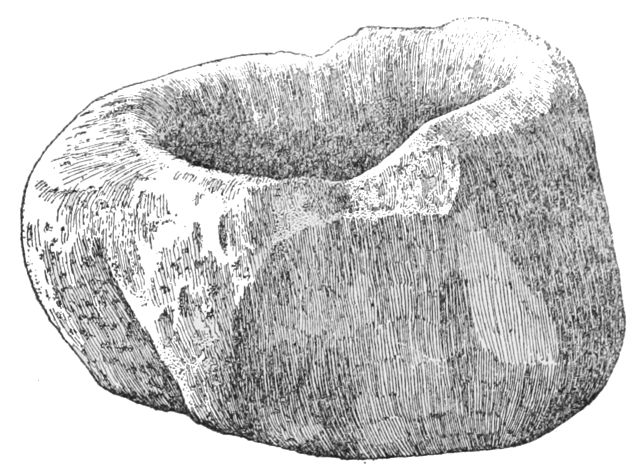
Fig. 3. × 1/4. A large mortar.
1-8664, fig. 5, a small mortar from stratum III, is of different
shape, oval both in its outline and in cross section, the bottom
being slightly flattened; it has a rather small round cavity, 1-1/2
inches in diameter and one-sixth inch deep. It may have served
for the pounding up of substances which were used only in small
quantities, such as color pigments. The width of this mortar is
2-1/2 inches, its height and thickness 1-7/8 inches. Powers presents
a view of a similar specimen from California, a proof that this
type occurred in this region. A fragment, 1-8810 of the collection
from stratum VIII, may be the bottom of a similar utensil.
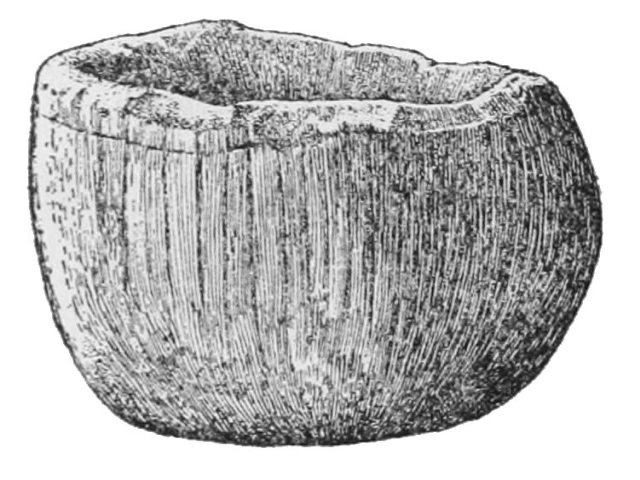
Fig. 4. About one-half natural size.
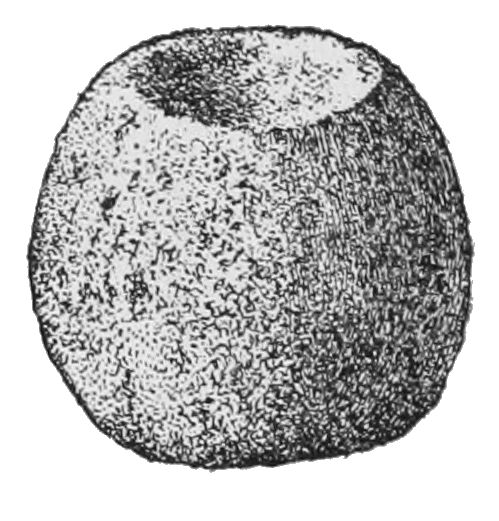
Fig. 5. × 3/4. Small mortars.
Some additional types of mortars are represented among the
fragments; they will be given below in the order in which they
were recovered. 1-8594, fig. 6, from stratum II, is one of several
fragments of this stratum and belongs to a relatively advanced
type, resembling a vessel. These stone vessels had a fairly even
thickness of the sides of about an inch, and were fashioned quite
regularly without and within. This rim is flattened and slopes inward.
The diameter of the complete mortars may have been a
foot. This type of mortar is quite common in California. The
collection from Santa Rosa Island in the University Museum
made by Dr. Jones contains several similar specimens. 1-8707
fig. 7, stratum IV, is an odd fragment. Its well fashioned bottom
part is surrounded by a rim which in turn is bordered by two
chambers which exactly correspond; the surface between them
is broken. This fragment may also have been part of a mortar,
although it is not possible now to restore it to any shape represented
among the familiar types. Fig. 8, 1-9077, shows a fragment
of a mortar recovered in the Xth stratum, and it is the only
one found lower than stratum VIII. It lay hardly an inch from
the base of the mound. It has a peculiarly jagged shape; the
convex exterior is the rough boulder stone, as are the uneven
sides, but the inner concave surface is ground down smooth. The
peculiar jagged shape may be explained by the fact that it is a
piece of a mortar, the rim of which by long usage had been worn
away in places, and as a result points were formed. The collection
of Dr. Jones from Santa Rosa contains a mortar with a
jagged rim, caused probably also by wearing away, but in that
case the points of the rim show some decoration, unlike the present
fragment. 1-8848, fig. 9, stratum VIIa, may throw some
light on the possible cause of these indentations resulting from
long usage. In the latter specimen the surface of the bulging
portion is rough, as in 1-9077.
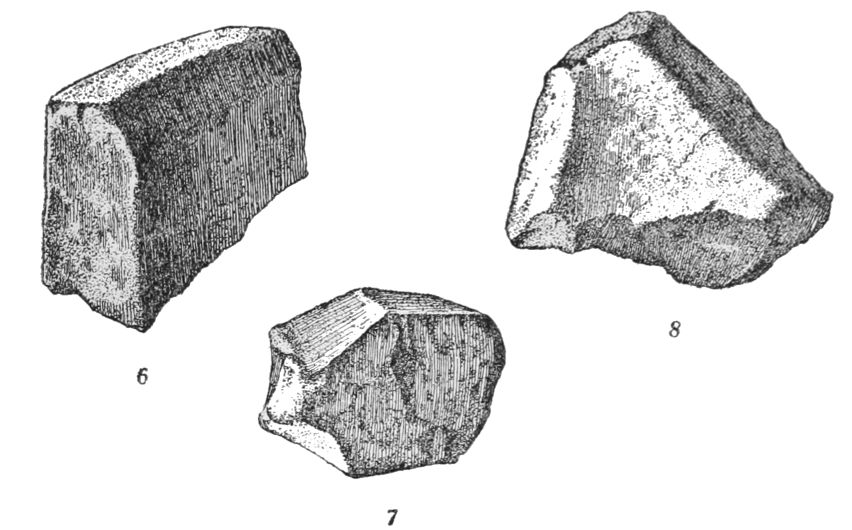
Figs. 6, 7, and 8. × 1/2. Fragments of mortars.
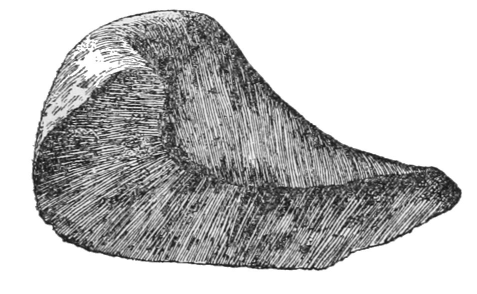
Fig. 9. × 2/3.
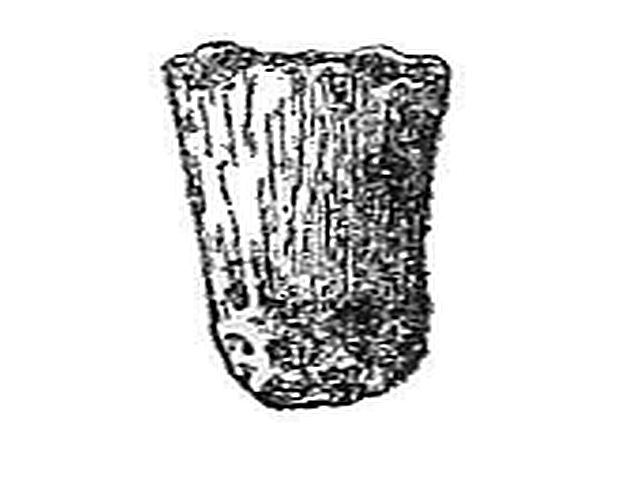
Fig. 10. × 1/2. Fragments of mortars.
The small fragment, 1-8621, fig. 10, stratum II, has to be included
also in the class of mortar-like utensils. It is made of a
soft material resembling steatite, it curves as if it were a handle
and is broken off at one end, while the other rounded end shows
marks of blows. This object may be compared to the handle of
the cup-shaped vessel of steatite from Dos Pueblos in Southern
California and shown by Professor Putnam, l. c., pl. VI, fig. 5
(cf. l. c., p. 110). Similar utensils from Santa Catalina Island
and other places are mentioned there; hence it may be assumed
that this type of utensils was used by the occupants of the mound
during its last period.
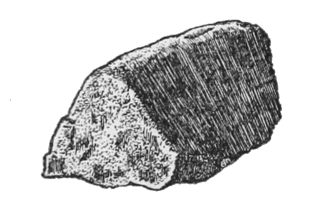
Fig. 11. × 1/2. Fragment of a mortar.
Fig. 11, 1-8533, from stratum I, shows a stone fragment, hollowed
out like a mortar. The upper rim of the specimen must
have had a sharp angle, as the outer surface is almost vertical
while the concavity is rather shallow, forming a cup with a considerable
diameter.
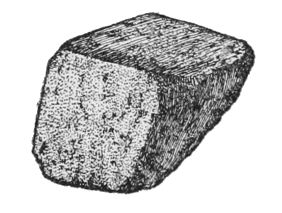
Fig. 12. × 1/2. Fragment of a stone used for grinding.
It is only from three small fragments that the presence of this
type within the mound may be inferred. All three were recovered
in stratum V; one of them, 1-8751, is shown in figure 12.
Judging from the fragments, these grinding stones were square
in shape, about 1-1/2 to 2 inches in thickness and were worn smooth,
both on the horizontal surface and on the sides and ends. The
occurrence of flat grindstones is not unprecedented in California;
some have been found in Sonoma county[68] and elsewhere. They
were perhaps used in the manufacture of shell ornaments and
beads.
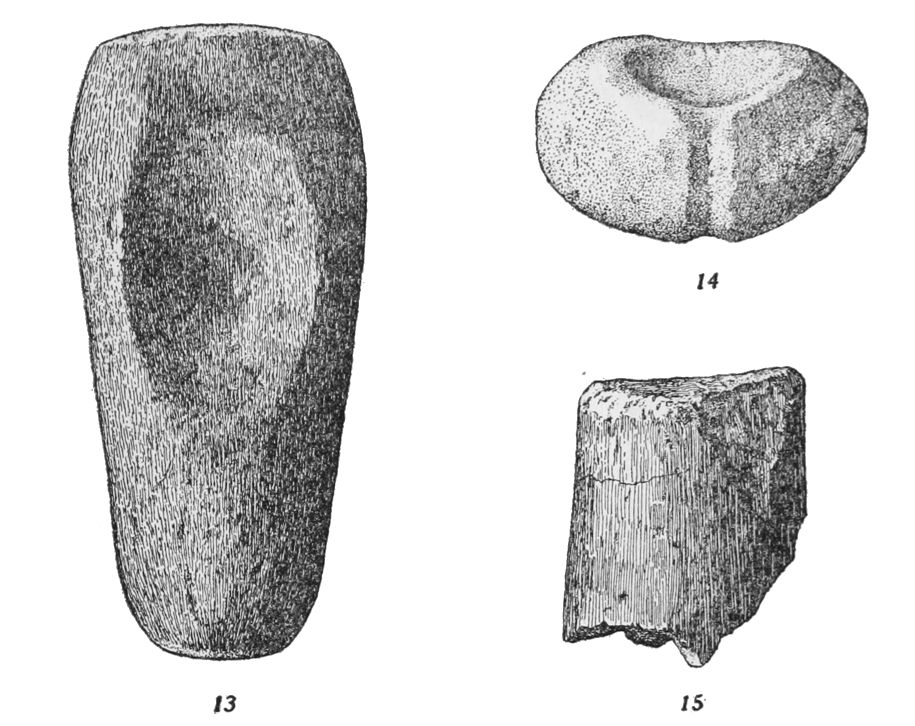
Fig. 13. × 1/2. Pestle with depression on one side. Fig. 14. × 1/2. A grooved sinker. Fig. 15. × 1/2. Upper end of a pestle.
Many fragments having the usual form were found, but only
one was perfect, and that of unusual shape. 1-8670, fig. 13, was
recovered in cut A, 6 inches below the surface. It is 6-3/8 inches
long, 3 inches wide, and 2-1/8 inches thick, tapering toward the
pestle-like rounded end, the other end being flat. Marks on it
show that it was also used as a hammer. Sunk into one of the
sides, at about the center of gravity, is a long conical groove about
one-third of an inch deep; the opposite side shows the beginning
of another such groove. They may have been worn into the stone
by using the broad side of the implement in driving stakes, etc.
The beginning of a second groove, otherwise superfluous, on the
opposite side seems to bear this out, as do the marks on the surface
of the broad end. These latter indications are a proof that
the utensil was not used as a pestle only. This is not the only
instance of a pestle with side grooves. Ch. Rau pictures a very
similar one from Tesuque in New Mexico.[69] Mr. Stevenson’s
opinion that the side grooves served for holding the pigment
which had just been ground by the pestle seems to be merely a
conjecture on his part. A stone was found in the West Berkeley
shellmound which seems arbitrarily to combine several purposes,—a
groove encircling it shows its use as a sinker, a semispherical
cavity which at its widest part breaks into the groove points to
its use as a mortar.
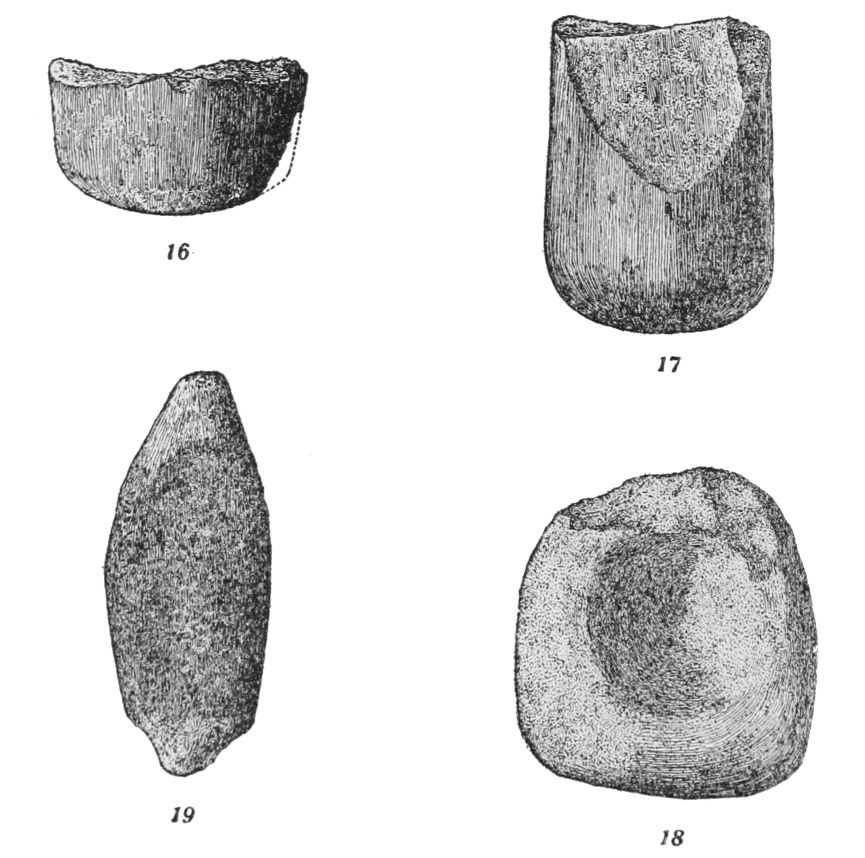
Fig. 16 and 17. × 1/2. The lower ends of pestles. Fig. 18. × 1/2. Stone used for hammer with depression for fingers. Fig. 19. × 1/2. A new type of implement of unknown use.
The 17 fragments of pestles of usual shape were fairly uniformly
distributed throughout all the strata, as was the case with
the mortars. However, 7 of these came from stratum II alone.
There were no peculiarities to be noted in the fragments as to
their forms. They were about 2-1/2 inches thick and were rounded
off at the lower end. The upper end sometimes tapered after a
conical swelling immediately next the grinding surface. They
were cut straight off at the upper end, unless indeed the abruptly
cut surface is the result of a previous breaking. Sharply pointed
or button-like ornamentations at the upper ends which are usual
in those found in California[70] were not noticed. Figures 15 to 17
show three fragments,—1-8882, 1-8597, and 1-8666 from strata
VIII, II, and from the cut A. Of these, the first illustrates the
upper end of a pestle, the other two, lower ends.
The little object 1-8620 from stratum II, plate 12, fig. 11,
seems to be best included under pestle stones. It is made of fine
grained stone, which would point to its use for more delicate
purposes. It is a truncated cone, with oval section, 1-1/8 inches
wide and 1-3/16 inches thick. The lower base is slightly arched
and, as can plainly be seen, is scratched slightly by use; a small
middle cavity in the narrow upper surface shows traces of asphaltum.
It may have been used as a pestle.
Strangely enough, only two such implements were found in
this mound, while in the West Berkeley mound several that conclusively
belonged to this class were unearthed.
One of these, a boulder stone the size of one’s fist, oval in
shape and flattened, was found in the lowest stratum, X. The
marks of blows making the side edges uneven show its use as a
hammer. The other, 1-8720, fig. 18, from stratum IV, is one of
the familiar type having a groove for the insertion of the fingers.
It is a stone 3-1/4 inches long, 3 inches wide, and of an uneven
thickness not exceeding 1-5/8 inches, flattened off at its thickest
(lower) end. There is a depression in each of the broad sides.
The surface of the indentations is dotted with small holes. Similar
stones have been found in many places in the United States,—in
New Jersey, Pennsylvania,[71] on the Aleutians,[72] and elsewhere.
Abbott has pointed out the fact that the edges of some of these
stones could not very well have been used for hammering since
they do not show the signs of such usage. The stone in question
was evidently used in two ways,—as a hammer at the lower flat
surface, which is from five-eighths to 1-1/8 inches wide and in this
case provided with indentations serving for the insertion of the
finger; and as a hammer at the flat sides for the driving of stakes,
etc., in which case it was grasped by the rims. The pits in the
depressions were probably the result of this latter use of the implement.
The writer has noticed that just such flat stones were
used in Bolivia for the driving of stakes, and there, too, the broad
side which gave the blow was pitted. The material used is hard
sandstone.
Two objects of this form, coming from stratum II, represents
a new type of implement. They are almost identical in shape.
One of them, 1-8604, is shown in fig. 19. They consist of long,
flat, quadrangular boulder stones, 3-5/8 and 3-7/8 inches long, with
an even width and thickness of 1-5/8 inches. Both ends are simply
sharpened to a point, and the broad sides, top and bottom, are
shaved off as far as the middle of the stone. In form, the stones
are similar to a wooden top of today.
Stones of this description form a large class, exhibiting, however,
great diversities of shape. They all seem to have served the
same purpose since most of them show indisputable signs of such
usage.
About 18 stones of this kind were found in the mound. As
regards their varying form and utility, they may be classed as
follows:
I. Spherical and oval stones with a peripheral groove: Fig.
20, 1-8669, shows a spherical stone of this kind, found at a depth
of 5 feet in cut A. 1-8534, fig. 21, a fragment of an oval stone
with a groove about its largest circumference is from stratum I.
II. Flat boulder stones with notches in the corresponding
sides for fastening them: Two of these were found in the upper
strata; one, from stratum IV, is shown in figure 22.
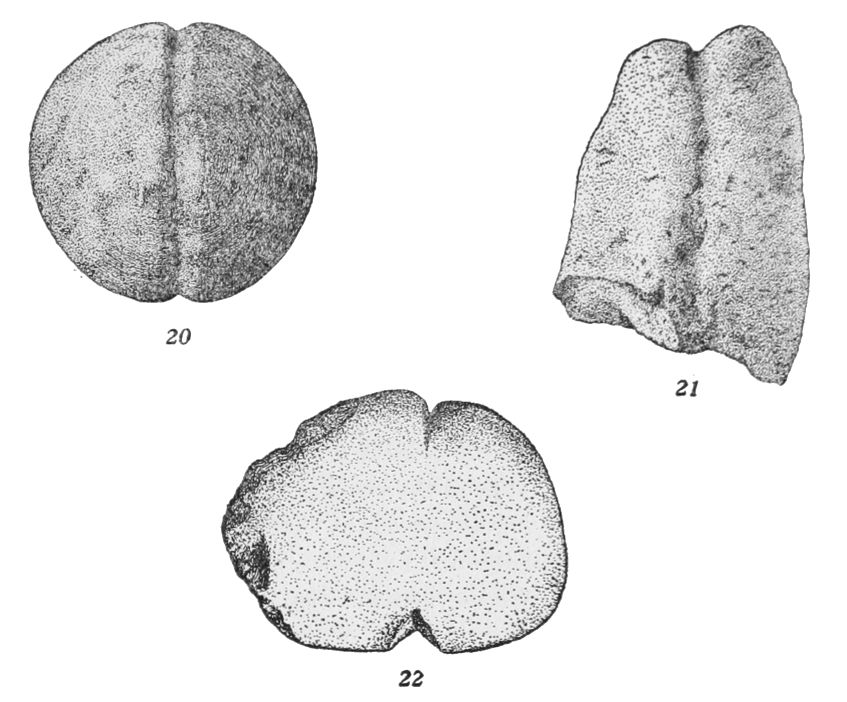
Fig. 20. × 1/2. Figs. 21 and 22. × 3/4. Sinker-like stones.
III. Stones with holes pierced through them by which they
were suspended: These form the type that may with the most
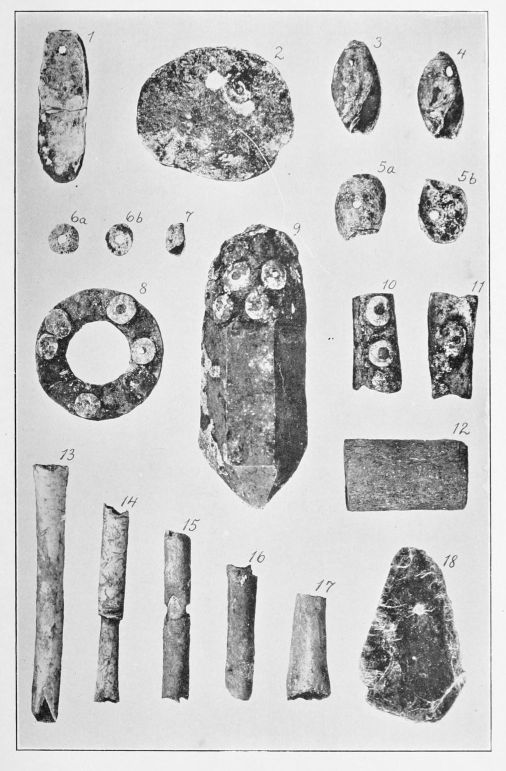
certainty be classed as sinkers. 1-8535, plate 12, fig. 7, from
stratum I, is the only specimen of this class found.
IV. Pear-shaped and kindred stones; also conical pendant
stones: The fourth class is the largest, in that the greatest number
of shapes may be included in it. The following are to be
counted in with this class:
a. Pear-shaped stones and others, though slighter, still very
like them. This type is represented by:
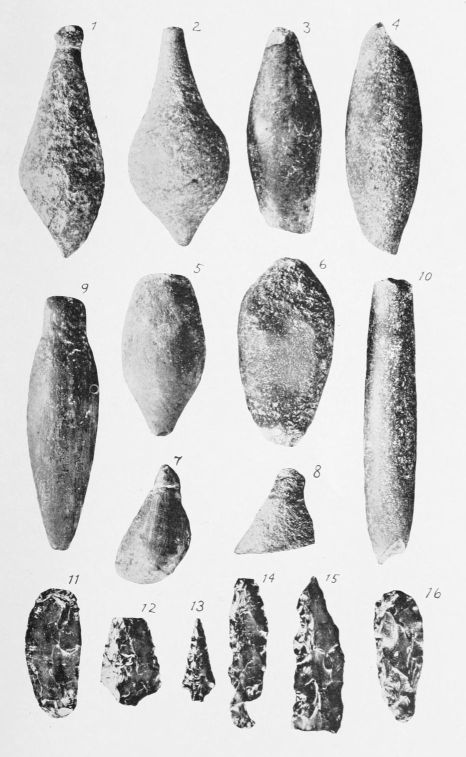
1. A perfect pear-shaped stone, 1-8611, plate 10, fig. 2, from
stratum II.
2. More or less fragmentary bits, 1-8612, 3, the first without
a doubt, the second probably from stratum II. See 1-8613, plate 10,
fig. 1.
3. Five fragments of stones of a slenderer, less perfect though
similar form, 1-8614, 5 and 6 (plate 10, figs. 5, 3, 8), 1-8617 and
1-8718 (plate 10, fig. 4), the latter one from stratum IV, the
others from II.
b. Inverted pear-shaped stones, some flat. This shape is related,
though distantly, to the above. Two fragments, 1-8618
and 1-8619, from stratum II, see 1-8618, plate 10, fig. 6.
c. A conical stone with slanting lower surface (1-8719, plate 10,
fig. 7) from stratum IV. It is very similar in shape to the
upper part of the pear-shaped stones.
d. A pointed stone, 1-8925, from stratum VIII, plate 10, fig.
9, which is only very distantly related to the pear-shape forms.
These stones belong to that class of objects which have been
interpreted at different times as being:
1. Weights for determining the vertical.
2. Weights for weaving apparatus.
3. Weights used in spinning.
4. Weights used for fishing nets or lines.
5. Ornaments.
6. Medicine stones or charms.[73]
A number of articles under class IV (Form IVa) are made
of hematite.[74] Of the objects under consideration, 1-8925 (plate 10,
fig. 9) is made of the same. The use of hematite generally presupposes
that an implement is going to be employed as a weight.
Since the forms that belong to this class merge into one another
in an uninterrupted series, one is justified in assuming that they
were all weights.
It is further clear that the shape of the pear-like stones, which
have caused so much speculation, must have been fitted for some
particular purpose. This is to be inferred from the fact that
stones of like shape have been found in widely separated parts
of the United States outside of California, in Maine,[75] Massachusetts,[76]
Ohio,[77] Illinois,[78] and elsewhere.
Furthermore, H. H. Bancroft[79] has made the important assertion
that such implements are usually found in a mutilated
condition. This is borne out by the fact that out of the nine
pear-shaped and inverted pear-shaped stones represented by
groups 4a and 4b, there is only one which is perfect. It is to
be inferred from this that, however elaborately they are ornamented,
these implements were put to essentially practical uses.
Hence the theory that they were worn as ornaments or charms is
untenable.[80]
The supposition that they were used on the end of a plumb
line is also invalid, since civilization was not far enough advanced
among the Indians for that sort of thing. Weaving and spinning
apparatus requiring the use of the stones as weights are so
rarely found that we cannot explain the presence of such a large
number of stones in that way. And especially not in California
since the Indians there have never spun nor woven.
Hence the only explanation left is that they were used in
fishing. The great quantities of such implements found on the
coast has often been noted.[81] That nine were found in a shellmound
such as the one at Emeryville substantiates this theory.
They have also been noticed in a number of other shellmounds
about the bay (even though these have been little excavated), as
at Ellis Landing and in Visitacion Valley,[82] and their shape is
identically the same (plate 10, fig. 2). There is one from a shellmound
on Seaver’s Ranch with exactly the same shape, plate 10,
fig. 1. Drawings were made by J. Deans of two other objects
which were also taken from the same shellmound in Visitacion
Valley and which had like forms.[83] If we accept the hypothesis
that these stones in general are sinkers, there are of course difficulties
in the case of individual stones, that must be explained
away.
The following peculiarities which appear must be mentioned:
1. Occasional peculiarities in material: Some are not very
heavy, some rather soft; and in others the ornamentation either
in color, grain, or crystalline markings is so prominent that an
ornamental use is suggested. 1-8615, plate 10, fig. 3, seems to be
a stone of this description,—the material of which it is made is
reddish and fine grained, and ornamented to some extent.
2. The occasional absolute lack of any contrivance by which
the implement might have been suspended: 1-8925, plate 10,
fig. 9, is, for instance, of this kind. It is for the greater part of
its length absolutely round and gradually tapers to a point. The
outer end is in the form of a handle which is flattened to about
one-half inch wide and one-quarter inch thick and is rough from
the marks of blows; the main part of the instrument is smooth.
The handle-like part must, from its form and roughness, have
served to fasten it by. It looks, however, more as though it were
intended to fit into a shaft, rather than to be suspended. It is
important to note that one of the long sides is entirely covered
with asphaltum. This fact excludes the possibility that it was
fastened into a shaft. It must further be called to mind that, as
in the case of the California Indian dancing costume, various
rod-like bits of stone are sometimes fastened on by means of
hangers, the provision for their suspension being made on the
stones themselves. The use of asphaltum in securing them often
did away with otherwise necessary changes in their form. At
any rate it allowed great imperfection in form.
Fragment 1-8616, plate 10, fig. 8, is an example of the above;
it is pear-shaped and the upper conical point is encircled by a
broad band of asphaltum which served for its attachment.
The sinker-like stones of classes I-III present fewer difficulties
in their explanation than do the pear-shaped and kindred ones.
The use of flat boulder stones with side grooves as net-sinkers is
agreed to by all.[84] The fact that here as in the East, and as in
the shellmound of West Berkeley, many of these have been found
in groups, points almost conclusively to their use as net weights.
Professor Putnam has already called attention to the use of
spherical stones (fig. 20), with a peripherally encircling groove
as sinkers.[85] Similar stones are also found in shellmounds in
Massachusetts and in the Aleutian Islands.
Dr. Yates[86] was informed by an Indian that such was the use
of a stone found in Napa (California).[87] The use of the oval
stones (as fig. 21) is in general to be explained in the same way.
A stone of that kind is, for example, known to have been found
in Oregon.[88] Another one has been found in California (supposedly
at Spanish Flat). It has been pictured by H. H. Bancroft.[89]
The stone, 1-8535, plate 12, fig. 7, from stratum I, is a sinker,
judging from its general shape; it is long and oval, pierced at
the upper end. Stones of like form have been found in numbers
in the shellmound at West Berkeley. They are probably sinkers
like many other stones found there.[90] The upper eyelet has been
broken off in the stone under consideration. The stone is slightly
flattened; one of the end surfaces is more curved than the other
and one of the broad sides more elaborately adorned. On one
side a lattice-like ornamentation joins on to a deep groove. On
the other side may be seen several somewhat ruder lines like
hatchings. The material is that commonly used. Abbott describes
an ornamented stone pendent as a gorget and another one
from Illinois with plastic ornaments, as a sinker.[91] Compare this
with a picture of a pendent stone from San Clemente Island.[92]
The fact that these stones are ornamented seems to make their
use as sinkers doubtful but not impossible, since fishhooks are
sometimes much ornamented.[93]
Plate 12, fig. 8, 1-8630, is somewhat sinker-like, but in many
respects it diverges from the general class. It is made of very
light, soft stone, and is an elongated oval in shape, with five
grooves parallel to one another cut in about the edge. It is elaborately
ornamented with oblique hatch-like lines on the edges
between the grooves. Hence it is improbable that it was a sinker—it
cannot, however, as yet be assigned to another use.
These differ from the pestles in that their diameter is smaller
and that they bulge out only slightly toward the middle. Two
objects of this kind came from stratum II, of which 1-8609 is
shown in plate 10, fig. 10. Both are broken at their ends. They
are respectively 4-13/15 inches and 2-5/8 inches long and fifteen-sixteenths
inch and 1 inch thick. The surface of the break in the
shorter one was subsequently smoothed off; perhaps by using it
as a pestle. Long cylindrical stones of this kind partly flattened
on one side and having encircling grooves at the tapering ends
have been pictured by Yates[94] and Moorehead[95]; these were found
at Santa Barbara, Southern California. To these may also be
compared a stone pendant from Tuolumne county[96] pictured by
Moorehead, since the lack of complete ends in the stones gives
considerable room for speculation as to what the whole form
might have been. On the other hand, the tentative designation
of them by Moorehead and Yates as charms is in no way justified.
The better interpretation of their use would be that of sinkers
especially in the case of those provided at both ends with grooves
for attachment,[97] since stones coming from Peru[98] which are undeniably
sinkers are very like these in many respects.
An awl, 1-8608, plate 12, fig. 10, of stone, comes from stratum
II. Plate 12, fig. 9, 1-8711, from stratum IV, is pierced and similar
to the above though needle-shaped.[99] From scratches appearing
on 1-8608 we infer that it was used on rather hard
materials.
It is remarkable that tobacco pipes were found only in stratum
II; of these we have five perfect specimens and one fragment.
This bears out the statement made above, that stone utensils
well-made and smoothed off were found only in the upper
strata of the mound and particularly in stratum II. Since it is
not probable that the inhabitants of the lower strata were ignorant
of the practice of smoking, the absence of pipes must be explained
in some other way. On the one hand it is possible that
many of the older pipes were made of wood. Powers has described
a number of wooden pipes in use among the Indians of
today. On the other hand, it is possible that the practice of smoking
was not so common in remoter periods and therefore it would
be likely that fewer pipes would be found. There is a third possibility,
that the large number of pipes found in stratum II is
dependent on the method of disposing of the dead, so characteristic
of this stratum and which caused articles to be preserved
which would otherwise have disappeared. The pipes described
below represent two primitive types, with some insignificant
variations.
Plate 12, figs. 2a and (cross section) 2b, 1-8622, represents
one type. It is made of a soft serpentine-like material, gray on
the broken surface and reddish brown on the outside. It is one
and seven-eighths inches long and incomplete. There is a broad
bowl-like part and a narrow neck or stem, a prolongation of it.
The bowl is conical, one and one-eighth inches long and of inconsiderable
width, being three-fourths of an inch in diameter. The
“boring” of the stem portion is cylindrical and eccentric.
Plate 12, figs. 3a and 3b, 1-8623, is the only representative of
the second type. It is made of green serpentine, and is two and
one-sixteenth inches long, tapering into a tubular shape. The
hole in the stem is as above, only at the mouth end it is conical
and shorter. A groove is cut into the tapering end.
Plate 12, figs. 1a and (in section) 1b, 1-8624, is made of soft
gray stone and is very similar to the preceding one, except that
it lacks the groove at the mouth end and that it is shorter and
thicker.
Plate 12, figs. 4a and (in section) 4b, 1-8626, is a small cylindrical
object only nine-sixteenths of an inch long and seventeen-thirty-seconds
of an inch wide. The seven-sixteenth inch conical
hole takes up nearly the whole width of the stem so that the
rim surrounding it is sharp. The short conical boring at the stem
end is only five-sixteenths of an inch wide. The proof that this
too was used as a tobacco pipe lies in the fact of the disparity
of the two conical borings and in that the entire width of the
bowl end of the pipe is used to the best advantage. It seems to
have been more of a miniature or toy than an article in common
use. However, the quantity of tobacco needed to fill any of the
pipes could not have been great since the cone-shaped cavity in
the bowl is so small. One is here reminded of Schumacher’s
entertaining description of the way in which a Klamath tipped
back his head in order to raise his pipe vertically that he might
lose none of the tobacco. The stem ends of the pipes are equally
imperfect. They must certainly all have been fastened to a pipe-like
mouth-piece similar to the stone pipes which Professor Putnam
has pictured and described and which when unearthed still
had the mouth-pieces attached by means of asphaltum.[100] Some
Indian pipes of today are fastened to the mouth-pieces by means
of ligatures,[101] as was evidently the case with pipe shown in plate 12,
fig. 3, and with another one of the collection (1-8625) the stem
of which had been broken. A rude notch was cut into the outside
of the stem to facilitate the rebinding and to give it a better hold.
At any rate, the means of attaching the mouth-piece (comp. particularly
figs. 1 and 4) was as inadequate as was the receptacle
for the tobacco at the front end. Short reed-like tobacco pipes
are particularly characteristic of the middle portion of California.
A stone tobacco pipe coming from a shellmound in Visitacion
Valley south of San Francisco, pictured by H. H. Bancroft,[102]
is very similar to plate 12, fig. 3. The fourth one in the plate,
pictured by Powers, is also analogous. Short pipes are of course
also found in southern California,[103] but the longer reed-like variety
is more usual. A tobacco pipe pictured by Marquis de
Nadaillac and coming from the cliff dwellers[104] is somewhat similar
to plate 12, fig. 2, but here the stem was so slight that there
was no need of a special mouth-piece. The short pipes as well as
the long ones of southern California[105] are also found in the
eastern part of the United States. Several clay pipes from New
Jersey[106] may be compared to them; also two objects merely
classified as “pipes,” but most probably tobacco pipes, from
West Virginia[107] and Tennessee.[108]
In the mound were found different kinds of stones,—some
isolated specimens showing good workmanship but as yet unclassified,
and others, of the common kinds which were, of course,
in use at the same time with the more perfect implements.
Those of the first kind were all found in stratum II. One of
these is 1-8671, plate 12, figs. 12a and (front view) 12b. It is
made of soft serpentine. Its shape is that of a flat cylinder of
not entirely uniform height, with flat or almost imperceptibly
curved ends; there is a perforation which extends inward in the
form of a cone from both ends.[109] In the gentle curving-out of
its peripheral surface it is particularly like ear-pegs. It is
worthy of note that Moorehead shows two objects from the neighborhood
of Stockton analogous to it in many respects and designated
by him as lip-pegs,[110] and that barbed, bone spear-heads
like those used on the northwest coast were found in the vicinity
of Stockton, according to Mr. Meredith, in close proximity to a
lip-peg[111] of the kind used on the northwest coast. The possibility,
therefore, of an ethnological connection between the ancient
inhabitants of the vicinity of the central California water
basins and those of the north cannot well be denied.
The small object, 1-8628, plate 12, fig. 13, seems similar in
size and form to the object shown in plate 12, fig. 12. This similarity
is only a superficial one, aside from the difference in the
material of which it is made,—burnt clay, rare in California and
not carved but modeled; it is further different in the fact that
its cross section is oval and that its slightly arched end is covered
with marks of blows, and that the perforation is absent.
Plate 12, fig. 6, 1-8631, is of quartz-colored material, flat and
tongue-shaped. It is broken off at the broad end, the lower surface
is flat, the upper slightly arched, and the edge blunt. Judging
from its form and the brittle nature of the material of which
it is made, it must have been an ornament.
Plate 12, fig. 5, 1-8850, of chalcedony, looks like a neckless
head of a bird resting on a bust-like body; the bill is linear; the
eye is represented by a deep hollow. That this object is not an
artifact is the conclusion suggested by the presence of a crust
over the entire object from beak to eye, formed by its weathering.
In relation to other products of human workmanship, such an
object has worth only in so far as its shape was of undoubted
significance to the inhabitants, and carefully preserved for that
reason.
Besides this, various flat, smooth stones of chert and agate
were found, one of which, 1-8849, from stratum VII, is shown in
fig. 23. It is made of fine grained sandstone, has but one smooth
side and was used as a whet-stone. A thin oblong sheet of mica-slate
was unearthed, but it must have been used only as an ornament.
Fig. 24 (1-8721 from stratum V) illustrates one of two analogous
objects from the upper strata of the mound. It is a common
stone with about seven groove-like lines of varying breadth
and depth on the sides. Two of them form an angle which
though purely accidental might seem to be ornamental. The
grooves come probably from its use as a whet-stone for bone awls,
etc. To this purpose the hard, sandy substance easily lent itself.
Long bars could not have been fixed to this stone, since for that
purpose the grooves are neither broad nor straight enough.
Several drawings by Rau[112] and by Moorehead[113] may here be
compared.
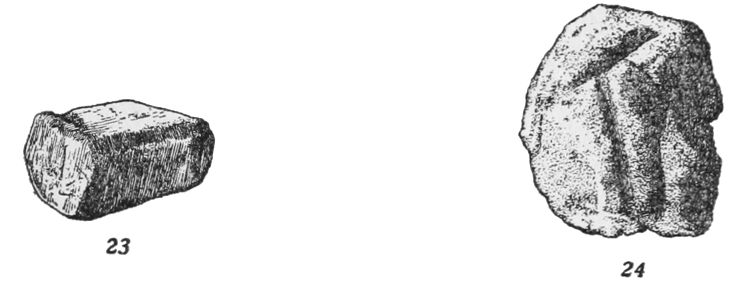
Fig. 23. × 1/5. Fig. 24. × 1/2. Stones, probably used for whetting.
A great number of these were found in the mound. As regards
their shape they fall into two classes, either finished implements
or chips from the workshop. As regards the material of
which they are made, they also fall into two large separate classes:
those of the usual, light stone natural to the place such as flint,
chert (in green or brown variety), horn-stone, jasper, etc., and
those of obsidian (volcanic glass), which was not to be had in
the immediate locality, although it was the preferred material.
The classification according to material is the more important.
There were found about twenty-five obsidian objects (among
them a very few rough pieces or waste bits from the workshop,
the latter all small) and about 140 hewn stones of other kinds of
material. Most of these were waste from the workshop, all of
the size of implements, but relatively few (about one-fourth)
complete tools.
The obsidian implements came from the Ist to the IXth strata,
but most of them were found in the upper layers. Nearly three-fourths
of them were taken from the three upper strata. In
stratum II alone there were ten implements and one piece of
obsidian in the rough. It can certainly be inferred that the great
quantity of obsidian tools from II was connected with the custom
of burning the dead and of casting their belongings into the
flames. In addition, the great number found here shows a
broader and more universal use of obsidian in the making of
implements.
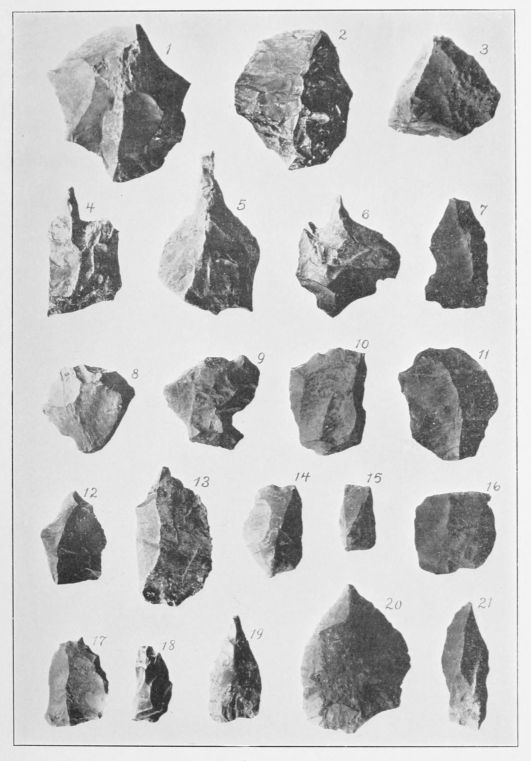
They are all of very simple form, such as arrow-and spear-heads,[114]
spear-like points and a flat knife-like blade, made from
the rough stone by polishing off bits[115] (see plate 10, figs. 11 to
16). Arrow-heads of obsidian were found only in stratum II,
comp. 1-8676, plate 10, fig. 13, the blade-like knife, 1-8633, fig.
11, and the spear-like knife end, 1-8634, fig. 16, which were
found there. 1-8926 from stratum VIII, fig. 15, may have been
either a spear-head or a knife. Fragment 1-8536 from stratum I,
fig. 12, by virtue of its two unevenly arched surfaces, and 1-8883,
fig. 14 of the plate, from stratum VIII (found nineteen feet
down in the tunnel between parts 8 and 9 of the shaft frame) on
account of its long peg-like lower end, may be parts of knife-like
implements. They were fastened on rod-like shafts similar to
the fine-handled knives of southern California shown by Professor
Putnam and which are in an excellent state of preservation.
From a technical standpoint, it is worthy of note that implements
of such perfect workmanship as figs. 12[116] and 13 were not
found among the obsidian implements of the lower strata of the
mound. A proportional decrease in obsidian implements of good
workmanship can be noted as one approaches the lowest strata.
In northern California obsidian is found near Mt. Shasta, on
the north side of Mt. St. Helena and in pieces to the size of an
ostrich egg in Napa Valley.[117] It is a product of volcanic eruptions,
phenomena which were of frequent occurrence during the
tertiary period. The material of which the implements found
about the bay in all the shellmounds were made must have come
from one of the above-named sources through trading. The small
number of such implements found in the shellmounds is probably
the result of the comparative rarity of the obsidian in this
locality and the resulting care with which it was hoarded.
It is to be inferred that at no period was obsidian exclusively
the material used for chipped stone implements, since workshop
waste composed of materials found in the neighborhood has been
discovered up to stratum II. Since, however, waste and no finished
implements of local materials have been found above stratum
V, the instances of the use of such must have been relatively
isolated in the upper strata. Toward the lower strata, from about
the VIIth but practically from the VIIIth on, there is a great
increase in workshop waste. Stratum V is the uppermost one out
of which one or two single objects (among them 1-8756, plate 6,
fig. 21) may be considered finished implements. Of the thirty-nine
implement-like objects obtained in excavating, only one is
of unusual workmanship, an arrow-head of chert, 1-8815, plate 6,
fig. 19, which comes from stratum VII, at the lowest part of
cut C. The extraordinary accumulation of objects of chipped
stone which can be termed implements begins with stratum VIII
and continues down to the lowest stratum X. A considerable
number of these is shown in plate 6. It is, however, remarkable
that of these not one shows in its workmanship complete mastery
in the handling of the material. The implement which, though
still crude, shows the next best workmanship is the leaf-like point
of crystalline rock, 1-8929, plate 6, fig. 20, from stratum VIII,
found at the innermost end of the gallery.[118] All of the remaining
implement-like objects of chipped stone bear the marks of
crudity as do all of those that come from strata IX and X. It is
very noticeable that because of this crudity in most of them, the
line between implement and waste is very vague. It was therefore
difficult to decide in the case of many objects whether they
were to be regarded as tools at all. On the other hand, it is probable
that a number of pieces included under rubbish may have
really served as tools.[119]
Resulting from the discovery of obsidian, plate 10, fig. 15,
chipped stones of good workmanship were found as far down as
the upper part of stratum VIII. It is extremely doubtful
whether they appeared at all in the strata below this. The objects
made of material from the vicinity of the mound were certainly
made during its settlement. A characteristic mark of the
uniform crudity of all of these tools made of local materials and
found in the lower strata is that they all are worked from but
one side and that the elaboration of that side is accomplished by
but a very few strokes. The only exception to this is the point,
from stratum VII, pl. 6, fig. 19, which as to technique belongs in
another place. Pl. 6, fig. 18, 1-9012, shows a ridge-like elevation
on its lower side, thus forming an unimportant and superficial
exception. The point, 1-8929, pl. 6, fig. 20, is also entirely even
on its under side. In this they have a peculiarity characteristic
of the well known “turtle-backs.”[120] This latter kind which in
the eastern states of the United States has been found typical
of the implements of the palaeolithic age is to be recognized in
two objects in our collection, 1-9095, of green chert, pl. 6, fig. 2,
from stratum X, and 1-9007 of a crystalline substance, pl. 6,
fig. 1, from stratum IX. The first of these is without a doubt an
implement, and the second is probably one. The palaeolithic
turtle-backs of the East are unmistakably to be differentiated
from the two objects under question in the material of which
they are composed, which is argillite. In any case, however, the
presence of these two objects proves that primordial species of
stone implements existed into the neolithic period (for the mound
rests on alluvial soil) and they may give ground for the establishing
of the period from which such implements date, which is
even farther back than that. The conical piece of jasper brought
to a point by chipping, 1-8851, pl. 6, fig. 3, from stratum VIIa,
illustrates how implements were made by chipping from larger
pieces of stone, and may even be itself a tool. It cannot be stated
indisputably that the greater number of the common forms of
chipped stones shown on pl. 6 were obsolete among the latter
inhabitants of the mound. But it must be noted that the greater
number and the most characteristic of them do not appear in the
upper strata. We may surmise that as far as they did occur
among the founders of the upper strata they had a better form.
In addition to the pointed (pl. 6, figs. 19 to 20) and knife-like
implements (fig. 21) the following important types are represented.
1. Long scrapers sharpened on one side, 1-9012, fig. 18, from
stratum IX, and 1-9093, fig. 17, from stratum X.
2. Chisel-like tools terminating in front in a straight sharp
edge, 1-8857, fig. 14, from stratum VIIa, and 1-9080, fig. 15,
from stratum X.
3. Scrapers, more or less rounded off or oval, 1-9023, fig. 8,
from stratum IX, 1-9053, fig. 9, from stratum IX, 1-9085, fig.
10, from stratum X.[121]
In a like manner the following irregularly shaped objects
might have been used as scrapers.
1-9043, fig. 7, from stratum IX.
1-8966, fig. 11, from stratum VIII or IX.
1-9012, fig. 12, from stratum IX.
1-9040, fig. 13, from stratum IX.[122]
4. Oval stones with high “turtle-back” backs with the encircling
edges sharpened, probably too large for use as the usual
scrapers:
1-9007, fig. 1, and 1-9095, fig. 2.
5. Drills or awl-like, pointed stones, with a more or less thick
base.
1-8961, fig. 6, from stratum VIII or IX.
1-9005, fig. 5, from stratum IX.
1-9031, fig. 4, from stratum IX.
Instruments like the last have been found in many parts of
the United States.[123] Several of these bear a great resemblance
to those here shown, one such is pictured by Rau[124] from Santa
Cruz Island, and one of like origin by Putnam,[125] one from Santa
Rosa Island.[126] Traces of asphaltum found on the broad base of
many similar ones would point to the fact of their once having
been fastened to a shaft.[127]
B. Utensils of Bone, Horn, and the Teeth of Animals. — Implements of Bone. — 1. Awl-like Tools. — a. Common Awls with a Good Point. — b. Blunt Awl-like Implements. — c. Flat Awl-like Implements. — 2. Needle-like Implements. — a. Straight Needles without Perforation. — b. Curved Needles. — c. Needles with “Eyes.” — d. Long Crooked Needles. — 3. Rough Awl-like Implements of the Lower Strata. — 4. Implements of the Shape of Paper-cutters. — 5. Pointed Implements. — 6. Saw-like Notched Bones. — 7. Various Implements and Objects of Bone. — Implements of Antler. — 1. Chisel-like Implements. — a. Actual Chisels. — b. Chisel-like Implements of Varying Forms. — 2. Implements of Antlers with Dull, Rounded Ends. — 3. Pointed Implements. — 4. Straight, Truncated Implements. — Implements of Tooth.
Artifacts of animal derivation appear in great numbers and
in a great variety of form among the objects recovered in excavating.
This diversity in form is of course partly the result of
the different kinds of bone used in their manufacture, partly of
their varied manipulation, and partly of the uses to which they
were put. There are all grades of elaboration from the most
common splinter of bone to the tool whose shape is almost entirely
different from that of the bone employed. All the objects found,
however, may be reduced to the principal types of bone instruments
which have been found in the United States under the most
varying circumstances. In addition to awls, needles and paper-cutter-like
knives of bone, there are instruments of horn used
principally for chiseling and instruments of a secondary nature.
They were the usual tools used in making clothes,[128] in weaving
baskets,[129] etc., not to mention several subordinate uses to which
they were put.
This is a large class containing more than 100 objects having
various secondary forms and it is the most conspicuous class of
bone instruments. They may be classified as follows:
These comprise more than 100 perfect and fragmentary specimens.
They were scattered through almost all the strata in the
following way:
Stratum I—8 objects.
Stratum II—61 objects.
Stratum III—8 objects.
Stratum IV—11 objects.
Stratum V—3 objects.
Stratum VI— — objects.
Stratum VII-VIII—5 objects.
Stratum IX—5 objects.
Stratum X—4 objects.
The remarkable preponderance in stratum II is probably
again the result of the practice of cremation of bodies.
When one remembers that awls were the principal tools used
in making baskets and that baskets took the place of pottery in
the household of the California Indians, one will not wonder at
their great number.
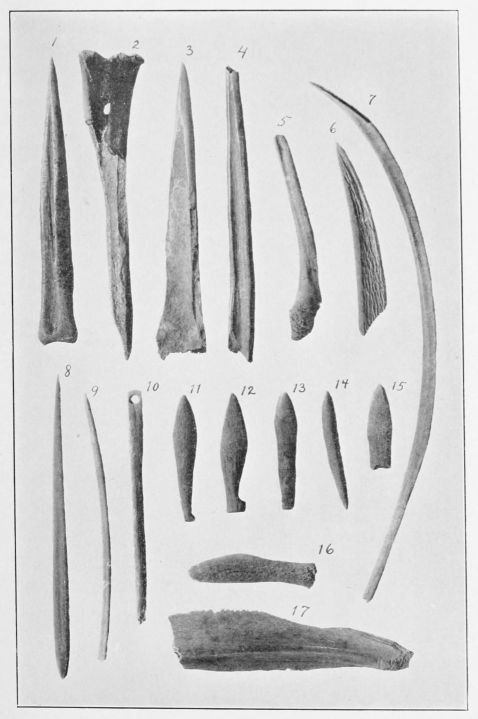
Their shapes vary. Four of them are shown in plate 9, figs.
1 to 4. Fig. 1, from stratum I, gives the type by far the most
common in the 3 or 4 upper strata; the other three, fig. 2, 1-8686,
from stratum IV, fig. 3, 1-8897, from VIII, fig. 4, 1-8972, from
IX, give examples of the many secondary forms and illustrate
the diversity of form occurring in the lower strata. Although
fig. 4, as regards its shape, reminds us of the type of the tool of
the upper strata (cf. fig. 1), not a single implement was found
in the lower strata that was the exact counterpart of those in the
upper. Manifestly it was the inhabitants of the upper strata who
developed and established the latter form. Its distinctive feature
is this, that only one side of the bone (mostly tibia of deer) is
used, that a foot-like portion of the joint is left, and that the awl
is sharpened and well finished off on all sides, even to the inner
channel. Usually there is a slight bulging out in the middle of
the tool which increases its strength.
The characteristic feature of pl. 9, fig. 2, is that only the shaft
of the bone is open, the joint being left intact. In pl. 9, figs. 3
and 4, the foot-like supports are missing; whether originally they
were there or not is a question. They seem to have been missing
from the very beginning, at least the one shown in pl. 9, fig. 3.
The whole shape of the instrument is crude. In several awl-like
implements of the lower strata, as in text-fig. 25, 1-8797, from
stratum VII, the canal in the bone is not even opened, but kept
intact through the whole instrument.[130]
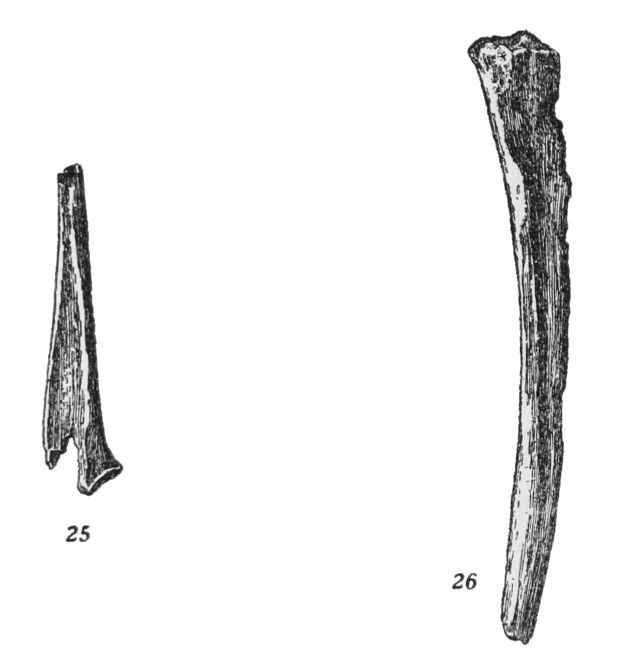
Fig. 25. × 1/2. A bone, probably used for an awl. Fig. 26. × 1/2. Bone implement of unknown use.
The absence of points indicates a somewhat different use to
which such instruments were put. In addition to this feature
there is very frequently a peculiar curve which, while it is the
natural shape of the bone, must have been chosen purposely,—for
instance, 1-8692, pl. 9, fig. 5, from IV, and 1-8829, text-fig. 26,
from stratum VIIa. The bone of front leg of a stag is the original
form of the partly awl-shaped partly paper-cutter-like implement,
1-8579, text-fig. 27, from stratum II. A similar one from
the southern part of the United States has been observed.[131]
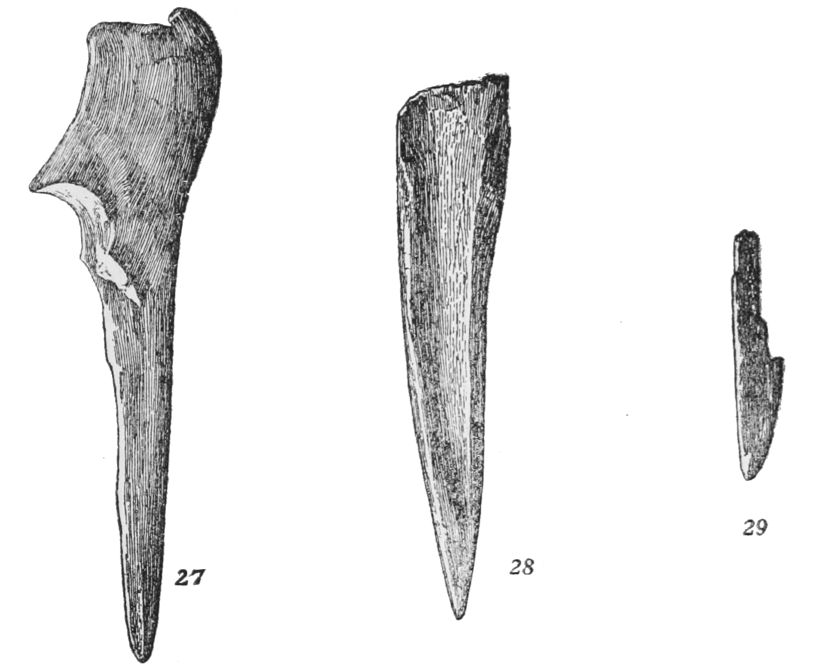
Figs. 27 and 28. × 1/2. Bones probably used as awls. Fig. 29. × 1/2. Bone of “paper-cutter” type.
These represent a large and important class of implements
which occur in numbers in several of the lower strata (V and
IX), although really only in fragments; cf. 1-8985, pl. 9, fig. 6,
from stratum V. They are curved sideways, and well-pointed in
spite of their otherwise flat character. The interior reticulate
structure of the natural bone is retained on one side of the
implement.
Fig. 28, 1-8541, from stratum II, has a peculiar shape; it is
broad, in the form of a channel and pointed. One of the edges of
the channel seems to be worn smooth through usage. The back
end is broken off.
They differ from the awl-like implements in that they are
intended not only to pierce an article but also to pass through it.
In this class there are also secondary shapes.
1-8895, pl. 9, fig. 8, found twenty-seven feet beneath the surface
in stratum VIII, may be taken as the prevailing type. The
needle is a thin, pointed instrument, oval in cross section, blunt
at the back end, well finished throughout. To this class also belongs
a number of fragments found in different strata up to the
VIIIth.
1-8901, pl. 9, fig. 9, from stratum VIII, represents this type.
The needle is very slender and thin and of good workmanship.
Unfortunately it is broken off at the smooth posterior end.[132]
We have also only one specimen of this type, 1-8735, pl. 9,
fig. 10, from stratum V. It is straight, round in cross section and
tapering at the perforated end.[133] The bluntness of the point
must be the result of use.
1-8831, pl. 9, fig. 7, a well preserved and seemingly perfect
specimen, was found in stratum VIIa, in the tunnel, from eleven
to fourteen feet below the surface. It consists of a long, thin rib
pointed at the stronger end, thereby exposing the canal within.[134]
Among those found there is also a needle of fish bone and likewise
one made from the spine of a stingray.
We have chosen to discuss a number of implements from the
lower strata under this separate head. Although some of these
were probably used as awls, yet along with others with which
they form a small group they cannot easily be considered with
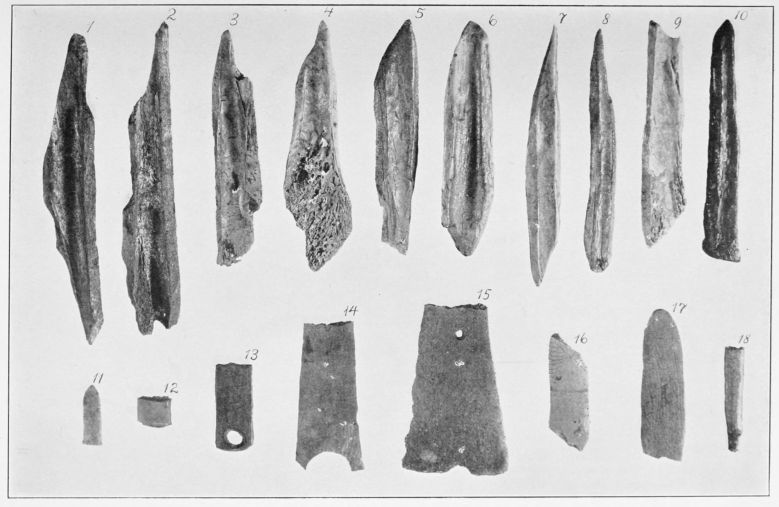
the other implements of this class. Plate 7, which represents
typical bone implements of the lower layers, shows the greater
number of these peculiar shapes in figs. 1 to 10. Altogether about
fourteen of these awl-like implements were found in stratum
VIII, five in stratum IX and four in stratum X. When one considers
that from layers IX and X, only small sections were explored,
the relative number of these implements must excite some
interest. The awl-like and needle-like objects of pl. 9, although
but little worked, are yet characterized by a definite fundamental
form, different from that shown in the objects represented in
pl. 7, figs. 1 to 10.[135] They represent simply bone splinters of
the most varied forms such as would be made by accident. To
be sure, there were isolated bone splinters in other places in the
excavation, probably used as implements, as would naturally
occur in a shellmound. In all of these latter cases, however, the
character of the objects was, owing to the form of the bones and
to the accidental or typical intention of their use, completely
different. The objects shown in figs. 1 to 10 of this plate are
made of fragments of somewhat thick long bones. All of them
have been much used and the upper ends are strongly rounded
and worn. Their use was evidently intentional both with reference
to their more general and their typical uses. They do not
belong to a peculiar type of implements because it is evident
from their form that they were used for many purposes.
Some, as figs. 6, 7, and 8, 1-8919, 1-8918 (VIII), 1-8979
(IX), have an awl-like pointed form and may accordingly have
been used as such an implement. Others, as figs. 1, 3, 4, and 10,
1-8983 (VIII), 1-9069 (X), 1-9068 (X), 1-9072 (X), although
in general awl-like, are blunter and can hardly have been put to
the same use as these forms just mentioned. Objects like 1-8980,
pl. 7, fig. 5; 1-8996, pl. 7, fig. 9, and possibly also 1-8871, pl. 7,
fig. 2, have such broad and blunt ends that for them characterization
as “awl-like” would be entirely unsuitable and their use
must be explained in some other way. The tie that holds them
together is, therefore, in no way that of similar use but rather of
analogous origin. They comprise a large number of implements
having different uses. What is common to them is the similarity
of the way in which they were obtained. Their use was determined
by the chance form which they thereby received. There
is before us then a class of the most primitive ethnological implements
of which we have knowledge, in which, as in the oldest
known implement of the human period, the natural form of the
object determines the use, rather than the use the individual
form.
It is natural that in so large a number of bone implements this
shape also should be represented. Five belonging to two different
types have already been discussed under the grave finds.
Altogether the amount of material of this character obtained
from the upper strata of the mound is remarkably small. Only
a small number of fragments were found, of which only a fragment
of the point, 1-8803, from stratum VIII is represented in
fig. 29.
In the deeper strata the case was entirely different. There
are from these layers no perfect implements, only fragments, but
their number is in proportion to what one would expect, or even
greater. Some of these show a variety of form and a degree of
ornamentation which was hardly to be expected among the finds
of the mound in general and least of all among the specimens
obtained from the lower strata. Little as the well formed
implements, which the fragments figured in pl. 7, figs. 11-17,
represent, appear to resemble the rough awl-like implements on
the same plate and which have been derived from the same strata,
there is yet no doubt possible that the two classes of implements
must have been used by the same people.
We have therefore the task, instead of denying the contrast,
of suggesting some solution for it.
These paper-cutter-like implements have a moderate width
and a thickness of only one-thirty-second to one-sixteenth of an
inch. They are well worked in all cases. The objects shown in
fig. 12, 1-8989 (IX), fig. 14, 1-8987 (IX), fig. 15, 1-8920 (VIII),
fig. 13, 1-8988 (IX), of plate 7 show artistic forms differing from
the simpler types of implements. Perforation, which in the bone
implements of the mound is very infrequent, is in these implements
alone found four times on the lower end. The notch on
the lower end of pl. 7, fig. 14, probably the remnant of a circular
section, is very artistic and one notices also curved lines on the
surface about it. These show the geometric accuracy with which
this work was carried out. 1-8986, pl. 7, fig. 16, from stratum
IX, is the only piece of bone among all those recovered from the
mound which has been engraved with geometric figures.
Out of the strongly varying yet constantly artistic characters
of these fragments we are justified in drawing the conclusion
that a much greater variety of implements of this form was used
by these people. The variations seem to have been influenced
largely by personal taste.
1-8875, fig. 11, represents a small fine point of a well formed
small paper-cutter-like implement.
1-8989, fig. 12, stratum IX, is a quadrate piece of bone cut
out of a “paper-cutter” and was possibly used in play.
1-8988, fig. 13, stratum IX, is the lower end of a “paper-cutter”
with parallel sides and obliquely truncated at the lower
end with a remarkably perfect perforation.
1-8987, fig. 14, stratum IX, is the lower part of a thin “paper-cutter”
with a semi-circular notch. The base shows broken
surfaces next the notch.
1-8920, fig. 15, stratum VIII, the lower, triangular part of a
“paper-cutter,” which has been very broad and thin, has a small
perforation.
1-8986, fig. 16, stratum IX, the middle fragment of a well-worked
“paper-cutter” ornamented with geometric figures.
1-8984, fig. 17, stratum IX, is the oblong upper part of a very
thin, well-worked “paper-cutter” with a perforation. The upper
part is broken off.
At this place there should probably be mentioned also the
small bar of bone, 1-8975, fig. 18, stratum IX, as it also comes
from this stratum. This is likewise an uncommon form of implement.
It is small and well worked, although not of the paper-cutter
type. It is oval in cross section and has a small paper-cutter-like
lower end which shows that it was fastened to some
other object. Its upper end is broken.
In the middle strata of the mound there were found about
eight pointed bones, of which the types are figured in pl. 9, figs.
11-16.
1-8869, pl. 9, fig. 11, stratum VII, is 2-1/8 inches long, oval in
cross section and having an inferiorly constricted neck. There
is a small hook on the lower end of the broad side. A small fracture
on the opposite side appears to indicate that there were
originally two such hooks.
1-8868, fig. 12, stratum VIII, is two inches long. This specimen
is in general similar to the one just mentioned. There is
only one hook at the lower end. The side opposite is without a
hook and is unbroken. Similar is 1-8738, from stratum V. An
analogous object is figured by Moorehead, page 273, fig. 412, No.
3, from Stockton Channel.
1-8916, fig. 13, stratum VIII, 2 inches long, is similar to the
last with the differences that the small broad, flat hook points toward
the broad side, and that the pointed end has been smoothed
by use. On this end there are also small traces of asphaltum
which indicate that a cord had sometime been wound about it
to fasten it to some other object.
1-8917, fig. 14, stratum VIIa or VIII, 1-7/15 inches long with
a rounded cross section, is slightly curved and gradually narrows
towards the lower point. The convex side shows a slight flattening.
1-8870, fig. 15, stratum VIIa or VIII, is 1-1/2 inches long, but
the lower end is incomplete. The cross section is oval to flat; it
shows on the broad side a sloping groove.
1-8694, fig. 16, stratum IV, an implement 2-3/15 inches long,
is typically knife-like in its form in so far as it has a broad blade-like
part. It is sharp on one side, blunt on the other and rounded
at the upper end. It is bent well backward. At the lower end it
runs out into a small neck-like portion which is extended in the
same line with the back of the implement and is broadened at the
base.
The objects already described and shown in figs. 11, 13, 14, 15,
and 16 of plate 9 represent the principal types. Among these
the knife-like object, fig. 16, is, judging from its shape, evidently
to be separated from the others.[136] Numerous other knives of
obsidian occur in addition to this one of bone.
Of the remaining, fig. 14 represents a typical arrow point
made of bone such as are used in various parts of the world, e.g.,
in South America. The convex, slightly flattened side was laid
against the slightly truncated upper end of the shaft of the arrow
and was fastened to it by numerous coils of cord. The figure of
a similar arrow point from the Swiss Pile Dwellings is given in
Ranke’s work, Vol. II, pp. 5-19, fig. 11. This shows very well the
manner of attachment.
The similarity of the remaining bone points, figs. 11, 13, 14,
15, is so significant that a similar use is to be ascribed to them.
That they were used as fishhooks, which might be conjectured,
there appears to be less evidence. It is worth considering that
Mr. Meredith found on the breast of a single skeleton 51 objects
of the form shown in pl. 9, fig. 14. In another case 28 such objects
were found.[137] In the first case, with the skeleton in addition
to these were found two long spear points with barbs such
as are used on the northwest coast of America. A large number
of objects from one grave and the association with other analogous
objects supports very strongly the idea that the pointed
bones were used for the points of arrows. The neck of these
points was the portion about which the cord was wound and about
this was laid a small quantity of asphaltum to hold the cord in
place, while the hooks had the object of preventing the cord from
sliding off from the neck. The form of the hooks varies but
slightly. This suggests the prominent hooks at the base of the
arrow points of stone. In a certain way these arrow points may
possibly be considered as a middle form between long bone points
provided with barbs, such as were used by the Eskimo, and the
Indian arrow points of stone. In this connection it is worth noting
that Mr. Meredith finds them in association with such bone points
(also with a lip-plug such as are used on the northwest coast of
America). The form of the Indian stone arrow-heads might have
been imitated in the North in other materials.
That the analogy with the more northerly races is not limited
to the burial layers of the mound from which the pointed implements,
pl. 9, figs. 11, 15, were found is indicated by the object,
pl. 7, fig. 12, which was found in the cremation layer, No. 2.
The excavations furnish twelve objects of this type of implement,
of which perhaps half were from stratum II. The remainder
were found from the lower strata up to the eighth. Quite a
number of the objects from stratum II were calcined, an evidence
that they were deemed of value in life since they were burned
with the dead.
The best preserved type of this implement, of which in most
cases only small fragments were found, is shown in 1-8898, pl. 9,
fig. 17, stratum VIII.
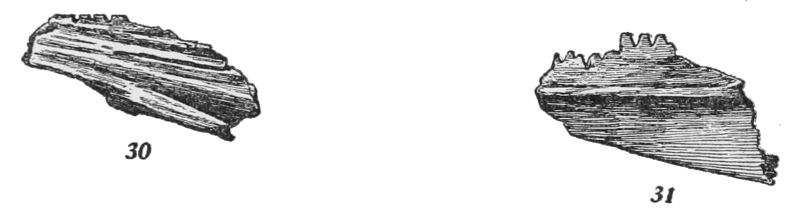
Figs. 30 and 31. × 1/2. Notched bones perhaps used in net-making or weaving.
Nearly all of these objects have a stereotyped form, being
made from the shoulder blade of some large mammal, probably
the deer. One, however, seems to have been made from a bird
bone (1-8900, fig. 30, stratum VIII). On the specimen shown in
pl. 9, fig. 17, about half of the length is taken up by the rounded
handle, using the ridge-like end of the bone for this purpose.
The other end of the object is incomplete, but according to the
form in other specimens it was probably cut off squarely at the
end. At any rate only a small piece of the implement is missing
since the teeth cut into the thin convex margin of the bone are
complete to the number of 15. The ridge-like edge runs next to
the row of teeth, giving the implement greater firmness. The
teeth vary considerably in different objects in size, in form, and
in regularity (compare 1-8573, fig. 31, from stratum II). They
also vary in degree of wear, which so far as observed is sometimes
seen on the edge and sometimes in the spaces between the
teeth. On one specimen the opposite edges of the bone are similarly
toothed, although one side of the bone was quite thick. A
smoothing or polishing of the object is never to be noticed, excepting
on the under side.
Similar objects have frequently been found in California.
Single fragments are figured by Moorehead.[138] As similar as
these objects are to saws, it is probable that they were not used as
such. The name “sachos” given to these implements by the
Napa Indians, who possibly did not know their former use, is not
to be taken as the slightest support for the idea that they were
actual saws. In the first place it is hardly necessary to mention
that the concept “saw” is missing among the Indians. The
form of these objects and the general state of wear as already
described shows that they were not and could not have been used
as saws. It is remarkable enough that saw-like implements
made of bone have a distribution much more extended than the
Californian region. Since these occurrences are mostly local and
entirely independent of each other, these implements must in
their production have served certain practical aims. Why, however,
saws made of bone should have such a wide distribution it is
difficult to understand.
An analogous implement has been found in a shellmound in
Massachusetts and figured by J. Wyman. He also in his description
has shown that judging from the width of this implement
it could not have been used as a saw.[139][140]
Another saw-like toothed bone implement was found in the
cave dwellings in Franconia (Bavaria), which were inhabited in
the early neolithic period. This has been described by Ranke as
probably used in weaving.[141]
An implement having almost identical form as this just described
above was figured by J. Murdock. This object was obtained
from the Pt. Barrow Eskimo and was made of the shoulder
blade of a reindeer. He received it as a model of a saw said to
have been used before the introduction of iron.
After having made inquiries for the primitive form of the
implement, this specimen doubtless was made for him.[142] His
paper also contains a figure of another saw-like implement, of
about twice the size of the first, made of antler. There was with
this a kind of shuttle and a form of weaver’s sword with the statement
that these three implements had been used in weaving
feather girdles. In watching the process of making these belts
he had, however, not seen any of these three implements.[143] In
the opinion of the writer there is no reason to doubt materially
the accuracy of the statements concerning the use of these implements
by the Eskimo. It therefore contains the key to the understanding
of all the remaining forms of this type of saw-like implements
found in the northern region. And this explanation
may be extended to the wrongly determined Californian bone
saws. In our opinion the bone implement first figured by J. Murdock
shows simply that the Eskimo remembered having had such
an implement and that they gave to him the impression that it
had been used in the way in which the investigator was inclined
to think it ought to have been used. It appears that Ranke was
on the right track when he supposed the Frankish bone implement
to have been used in some processes of weaving. In like manner
all of the Californian bone saws agree thoroughly with this supposed
use.[144] In California many valuable feather girdles have
been made, in the weaving of which these bone implements may
have been used.[145] The exact mode of their use is not yet determined,
but it is to be hoped, however, that even this may some
time or other be discovered.
It naturally occurs that in a shellmound in which so many
implements of bone have been preserved there would be a
number of bone objects the use of which can only be imperfectly
determined. These implements are in part possibly only attempts
to work bone, in part they are actually implements which
had a use somewhat different from that of the other forms and a
use for which the character of the material especially fitted them.
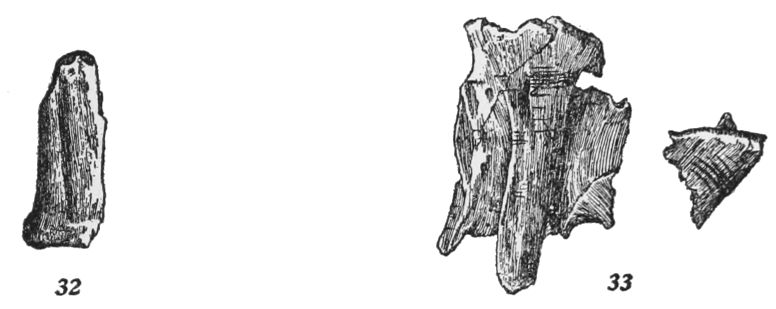
Figs. 32 and 33. × 1/2. Bone artifacts of unknown use.
Many fragments of bone show only a few cuts or marks as
indications that they were worked. In one case, 1-8527, fig. 32,
stratum IX, the marks which vary somewhat from those in the
other strata may represent an implement of the paper-cutter
type. The point is in this case calcined, as is also true of many
other implements. This is evidently done intentionally, possibly
in order to work the bone more easily. Other common bone fragments
look as if they had occasionally been used as implements
when they happened to have the right form, and that they were
not intentionally worked into this shape. Still other bone fragments
show knife-like incisions on the other edges, as, for example,
that shown in fig. 33, 1-8877, stratum VIIa. They are
probably not to be considered as marks of dog’s teeth, as which
these could also be determined, for they are generally very numerous
in one place or else they show exceeding regularity as if
made intentionally.
The shellmound dwellers did not fail to notice the peculiar
character of the tubular bones, which when cut into sections are
easily made into small receptacles, similar to the cane plant, which
is used in a similar manner by the inhabitants of tropical regions
(for instance by the ancient Peruvians). Many such small objects
with differing proportions were found, two of which are
shown in fig. 34. 1-8922, stratum VIII; and fig. 35, 1-9076, stratum
X.
For many kinds of implements antler is particularly valuable
on account of its hardness. For this reason a number of implements
of this character have been found in the shellmound; they
are, however, not so numerous as those of bone. They are usually
made of deer or elk antler.
Of these there are two principal types.
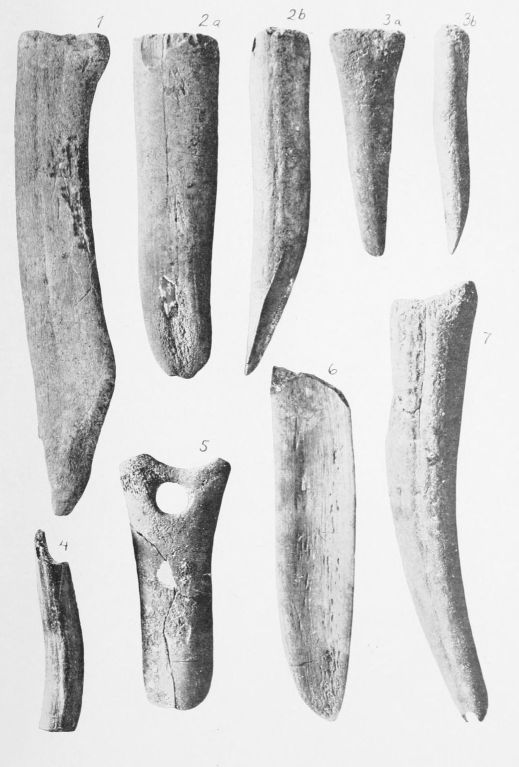
About half of the objects of antler are to be considered as
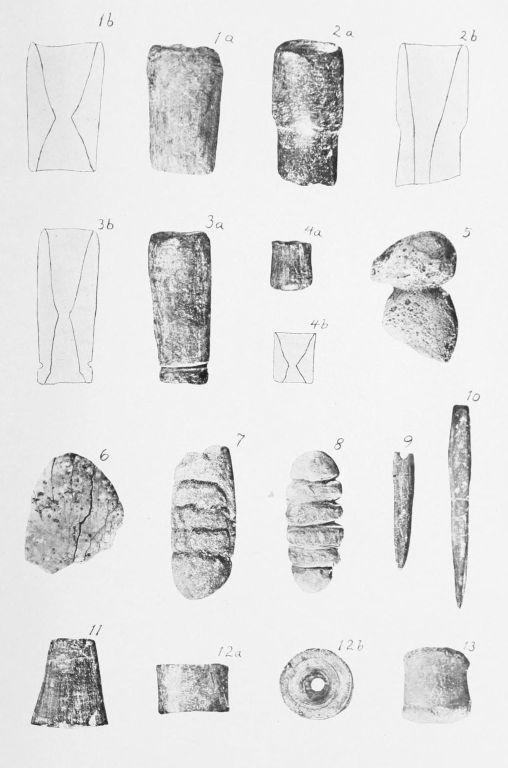
complete implements. These are shown in pl. 8, figs. 2a and 2b,
1-8892, stratum VIII; figs. 3a and 3b, 1-8821, from stratum
VIIa, represent the two subspecies of the same, viz., broad and
narrow chisels. The main difference between the two is simply
one of size and proportion.
The broad chisels are represented by about ten objects, which
belong to the middle and lower strata of the mound only, down
to the Xth stratum. Whether this is accidental or caused by
other reasons remains undecided. These objects are from four
and one-half to five and one-half inches long, to one and three-fourths
inches broad, and even as thick as one and one-quarter
inches. Oval in cross section, they slightly diminish toward the
lower end. Frequently they pass one to two inches above the
lower end into the flat, knife-like, one-sided slope, ending in a
semi-circular edge about one inch broad. The sloping surface as
well as the polished sides of the implement frequently have impressions
due to actual use upon hard objects. In a similar manner,
the straight surface is broken by the use of a hammer which
was struck upon it.
The narrow chisels are represented only by one complete specimen
(pl. 8, fig. 3) and two fragments of the knife-edge. The
latter were found between strata VIIa and IX. The complete
chisel is only three and nine-sixteenths inches long; while it is
one and three-sixteenths inches broad at the upper end, and but
seven-sixteenths of an inch thick, it nevertheless diminishes toward
the lower end to a breadth of three-eighths of an inch at the
knife-edge. The slope of the one side toward the latter is by far
shorter than that of the broad chisel, and yet the same indications
of its use with a hammer can be found. The curvature of the
cross section of this implement corresponds to the natural form
of the antler from which it was made.
Such chisels[146] partly took the place of an axe in woodwork
among the Indians, just as, for example, this was still the case
among the Hupa during the eighties of the last century,[147] in the
construction of houses. The Klamaths in Oregon still make use
of such chisels. The better known implements of recent times
possess only the natural surface of the original antler.
It is of interest to know that implements of exactly the same
kind were found in the shellmounds of the Atlantic coast, e.g.,
in Maine.[148]
Implement 1-8730, pl. 8, fig. 1, found in stratum V, has a
length of nine and three-fourths inches and a breadth of one and
seven-eighths and one and five-sixteenth inches. It will be seen
that though of greater length and breadth it is flatter than the
preceding. On account of its origin from a complete antler it is
curved along its length, and slightly curved in on its concave
side. At the lower end of the latter it is given a straight slant
for three and a quarter inches in the diameter of the breadth.
Its upper end shows the same signs of use with a hammer, while
the slanting surface is greatly worn on the sides. This makes it
probable that the use of this tool was in many respects different
from the preceding. It was possibly used as a lever.
For this also a parallel exists in the form of an apparently
identical implement from the shellmounds in Maine.[149] As regards
form, certain implements of the bones of cattle found in the
caves of French Switzerland are similar to this object. Rauch
calls them “leather-cutters” (Lederschneidemesser).[150]
Three such objects have been found. One of them is seven
and one-eighth inches long, diminishing, horn-like, toward the
blunt point. It came from the middle stratum of the mound. It
is represented in pl. 8, fig. 7. Another is a young branch of an
antler, and the third is a mere fragment. The use of these objects,
which were doubtless implements, cannot be conjectured.
Only one fragmentary blade exists, about one inch long.
Two specimens of this kind came from stratum V of the
mound. They are wanting in other parts of the mound. One of
them is reproduced in pl. 8, fig. 4. It diminishes, horn-like, toward
the lower end. Here it is truncated abruptly, having a
breadth of five-eighths inches. Unfortunately the upper end is
incomplete. The other implement, 1-8722, is absolutely identical
with the one just described.
The collection contains also a fragmentary bone tool, 1-9066,
which was found in stratum X. It may have corresponded to
the peculiar implement, reproduced by J. Wyman,[151] pl. 14, fig. 3
(with the spiral cuts at the upper end), which was found in the
shellmounds of Massachusetts.
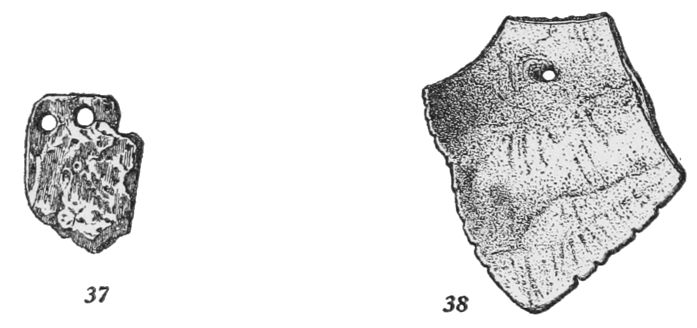
Only one object made of tooth was found, viz., 1-8736, fig. 36,
in stratum V. It is a bear’s tooth perforated at the root, serving
the purpose of ornament or amulet, and corresponds exactly to
the typical illustration of the one from New Jersey;[152] here Abbott
emphasizes the fact that such ornaments were the most
common among the earlier and present-day Indians.
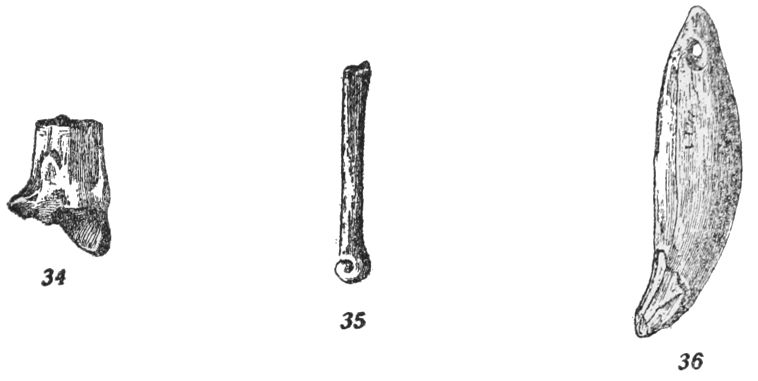
Figs. 34 and 35. × 1/2. Fragments of bones. Fig. 36. × 1/2. A bear-tooth ornament.