Lady Walton was a woman who
never did anything with her hands. She
was content to sit for hours at a time thinking--“doing
nothing,” her acquaintances
called it. Certain hours in the day she read,
but she never opened a modern book of any
kind.
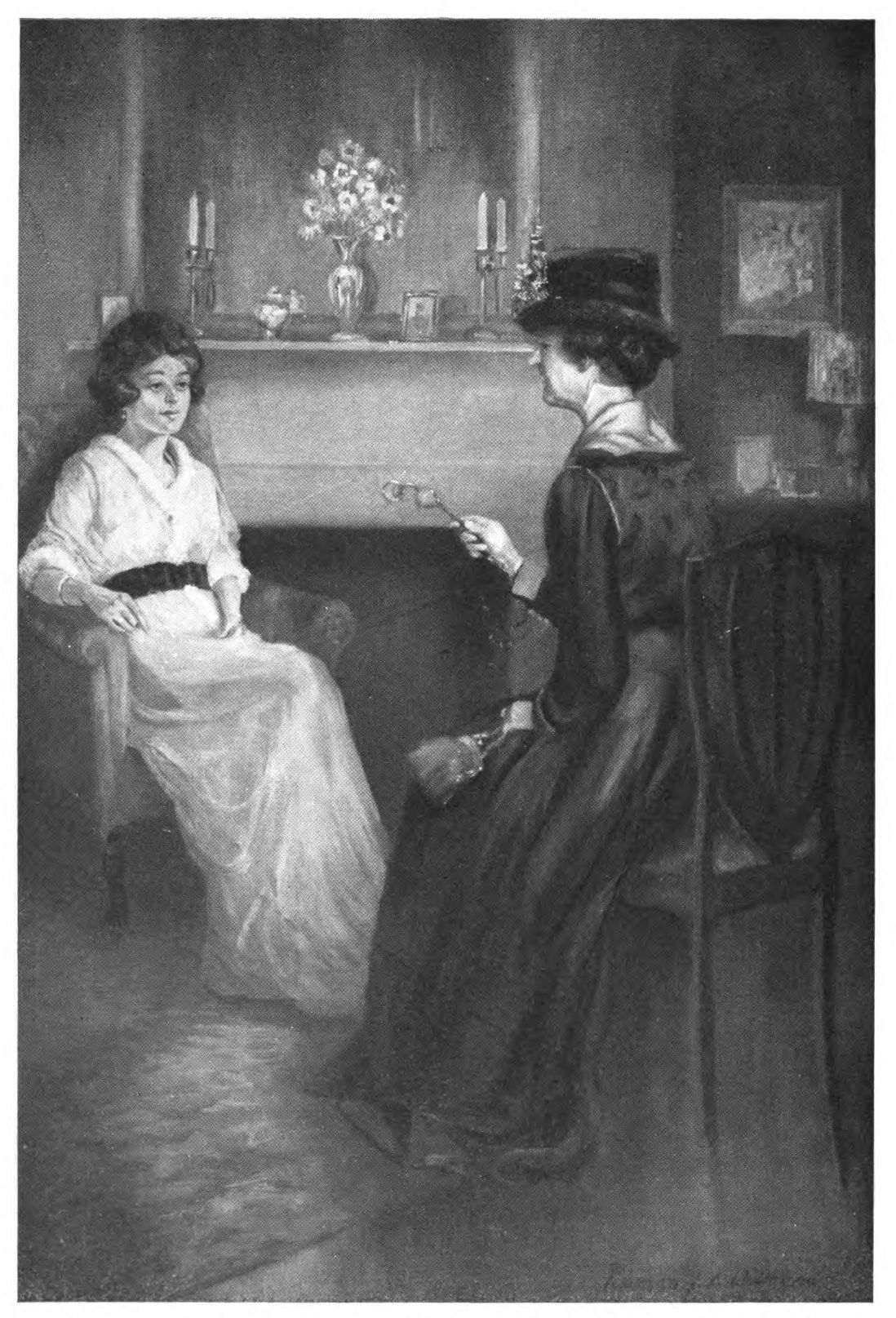
“I have a feeling,” she said to her niece,
“that they would revive a very painful experience
I once received of a kitchen-maid in
hysterics. People used to accept life and
make their appeal to the intellect; now they
spend their time screaming at natural laws and
living for the emotions. It is a mysterious
modern compulsion which used to be called
selfishness. When I hear you begin to talk of
your temperament, my dear Edith, I shall
cease to ask you to run my errands.”
Edith stroked her aunt’s hand and smiled
at her; but she was preoccupied; she was expecting
Horace.
“Sometimes, Edith, you disappoint me. I
have an impression that all the wisdom of all
the ages, including my own, would have less
effect upon your intelligence than the sound
(I suppose they have no creak) of an ordinary
pair of Bond Street boots.”
“Well, he is rather late,” said Edith.
“He is talking with his sister,” suggested
Lady Walton. “I must congratulate you, my
dear, in having chosen a husband who has complete
ignorance of women. It is a very
valuable attribute nowadays, when women have
no restraint and men no manners. Horace
is doubtless explaining to Miss Lestrange
what an excellent arrangement his marriage
will be for everybody concerned; and Miss Lestrange
is turning his attention to awkward details.
I hope you are prepared for complications,
Edith; the maternal instinct of maiden
aunts is a very fierce thing to combat. Do you
realize that she may refuse to let the boy go?”
The girl moved restlessly.
“Oh, she can’t!” she murmured. “After all,
Horace is very strong; he’s not a weak man,
auntie.”
“There is nothing so vulnerable as some
kinds of strength,” said Lady Walton, with
a sigh, “or so invulnerable as some kinds of
weakness. What is tyranny but weakness
playing on generosity, and how long do you
suppose it can last? It can last as long as the
generosity.”
Edith shivered a little.
“But he’ll think of me,” she said. “He
knows how I want his child.”
“He’ll think of you,” said her aunt very
slowly; “yes, he’ll think of you, Edith; but
thought doesn’t compel--there is only one
compulsion.”
It was surgery for the sake of healing, but
the knife struck deep.
Lady Walton sat quite still; she did not
attempt to touch or soothe the girl; she did
not even look at her. After a while she said
reflectively:
“If you had been ten years, or even five
years younger, Edith, I should have forbidden
this marriage; but you have learnt self-control;
you know what you are marrying for--and
you won’t fail to receive it, because you
are not fool enough to spend your time crying
for the moon. Crying for the moon is an injurious
element in married life. It is not the
kind of thing one gets.”
Edith lifted her eyes to her aunt’s.
“I have asked myself sometimes why I am
doing it,” she said, and her voice sounded hard
and strained. “I am not a fool of twenty, as
you say--but Horace could have given me the
moon, only he has given it already. And--and
what is so much more, auntie, I could have
given him back the moon’s equivalent. I
could have filled his life with happiness, and
he can’t take it!”
“Well,” said Lady Walton, “do you regret
what you are going to do?”
Edith hesitated a moment. Then she said:
“Yes, and I’m going to do it.”
“I think I hear the taxi which is the preliminary
of the Bond Street boots,” said her
aunt, “and if you will excuse me, my dear,
I will go to bed. It is a quarter to ten; you
will send him away at half-past, cry for half-an-hour,
and then go to bed.”
“Oh, I sha’n’t cry!” said Edith, rising and
resting her head on the mantelpiece. “I don’t
cry.”
“Ah!” replied Lady Walton, “that’s a great
pity, my dear, because in that case you won’t
sleep. However, we each have our own
method.”
It seemed a long time to Edith before the
owner of the Bond Street boots came upstairs.
She was a woman with a strong sense of
humor, and so she spent the time laughing because
it seemed so extremely amusing to receive
a man who is going to marry you with a
little more than the kindness of a friend and
a little less than the freedom of a lover. What
made it seem so especially funny to Edith was
that she loved him; and it did not occur to her
any the less sad because it was funny, or any
the less funny because it was sad.
Horace entered, looking glum; he was feeling--as
he phrased it--“a bit of a fool.” An
ecstatic or an anxious welcome would have annoyed
him. Edith met his eyes smiling, but
she did not rise from her chair nor did she burst
into nervous questions; she merely said:
“My aunt told me to tell you, Horace, that
she was suffering from an acute attack of discretion,
so that she would be unable to see you
this evening; it is usually followed by a relapse
into curiosity, which she expects to take place
to-morrow; and you may stay until half-past
ten.”
Horace sat down beside her and smiled.
It was really very peaceful and jolly; the place
seemed full of flowers; it was almost like their
being together at Como. Edith was dressed
in pale soft green; he liked it extremely. He
took her hand and held it.
“Well, I’m rather glad we’re alone,” he
said. “I’m afraid I’m awfully late, but I
couldn’t help it. Etta kept me such a confounded
time--bush-beating--and then I had
to send off the tutor, who’s a beast--and has
frightened the little chap silly about you;
and altogether it’s been rather a rough passage.”
“Poor Horace,” said Edith softly, “what a
shame! But you mustn’t be worried; we’ll
straighten it all out between us somehow.”
“But you won’t like it--you won’t like it,
Edith!” he exclaimed, looking at her with helpless,
appealing eyes.
It was a look which women who love know
how to answer--when they are loved in return.
Edith drew a sudden quick breath, then she
said:
“My dear boy, I didn’t expect we’d get
everything all at once; it wouldn’t be any fun
if we did. Why, it’s a regular campaign, and
this is the first skirmish.”
“No, it’s defeat, Edith,” he said, more
quietly. “I’m afraid it’s defeat.”
“Then tell me,” she answered. “I can bear
defeat, Horace.”
He looked into her honest, gallant eyes and
blessed her; he blessed her for her courage;
and he might have kissed her if he had thought
about it. He told her about the boy’s delicacy
and the doctor’s orders. She asked him one
question:
“If you hadn’t met me, could you have
lived with him in the country?”
“Oh, no!” said Horace. “I couldn’t get up
to town and back from Mallows for my work--we
should have had to be parted.”
They were both silent for a little, then she
drew his hand up against her cheek.
“We’ll go down all your holidays to Mallows,”
she said. “Every single one, Horace!”
“But don’t you--don’t you mind?” he stammered,
puzzled.
Edith turned her eyes on his, still smiling.
“We’ve got to mind,” she murmured; “but
may I just see him first?”
“Yes, of course, to-morrow,” said Horace
quickly. “I think the whole thing’s rather
devilish, you know, Edith. I can’t quite follow
it. They never told me before about the
little chap, and they seem to have turned him
against the very idea of you and all that, you
know; and he’s such a loving little fellow
really, and he said he wanted to go away and
leave me--”
Horace’s voice broke and Edith winced.
She looked away from him, and he recovered
himself in a moment.
“And Etta has got hold of some wild tale
about you,” he went on. “I don’t like to speak
to you about it, dear--it’s all a stupid bottomless
impertinence--but, of course, I had to tell
her I’d ask you.”
“You may ask me anything you like,
Horace.”
“Thank you, darling! Do you know I
always thought you were awfully sensible, but
I never knew how sensible you were before
to-night.”
Edith gave a long, low laugh.
“Sensible? I’m so glad you think I’m sensible,
Horace!” she murmured.
“Yes, I do,” he said with admiring emphasis.
“I think you’re the most sensible woman I
ever met.”
Edith stopped laughing.
“And the story, Horace?”
“Well, were you ever on the Lake of Como
staying with rather an odd person--ten years
ago?” he began. He had released her hands
now and sat looking red and foolish and staring
in front of him. Edith leaned back in her
chair and regarded him with a twinkle in her
eye.
“Yes,” she said, “I was. I stayed at Bellagio
ten years ago with my aunt and her
maid--”
“And that’s all?” he asked, glaring at the
carpet.
“No--that’s not all,” said Edith in a low
voice. “It’s a long story, and I thought perhaps
I wouldn’t tell you; my aunt wanted me
to, but it was a very sad story, and it happened
so long ago I hoped people had forgotten;
although I might have known that people’s
memory for the unfortunate lasts as long as
their oblivion of the happier star. You have
observed to-night that I am a sensible woman,
Horace; what is your definition of a sensible
woman?”
He hesitated.
“Well, hang it all, I don’t know how to define
things, but I suppose I meant a woman
who wasn’t foolish--never made a fuss, or
scenes, or mistakes, or did--well, stupid things,
you know.”
“Then,” said Edith, smiling demurely, “as
a girl I think I must have answered to your
description of a foolish woman, Horace. I
don’t know that I made scenes, but I certainly
did what people call foolish things, and I behaved,
as my aunt would no doubt tell you,
as an idiot; at the time you mention she called
me a suicidal idiot!
“To begin with, I must tell you I am very
susceptible to beauty. I probably shouldn’t
have tolerated you nearly as well if it hadn’t
been for your extremely handsome nose--you
needn’t blush--it is handsome, and I know it
is through no effort of your own that you have
acquired this undoubted beauty. When I
reached Bellagio I saw there the most beautiful
human being I have ever seen in my life
(you need not jog your foot, Horace); she
was a woman, and she was exquisitely beautiful.
If you ask my aunt, she will tell you that
a girl as beautiful as that ought to be immured
for life behind walls. However, she wasn’t
immured, she was walking along on the shores
of the lake with a loathsome man I hated, and
she had a mouth that made your heart ache
to look at, with the mere maddening beauty of
it! She was very tall, and everything about her
was slender that ought to be slender--and every
curve that ought to be full was full--and her
head was poised like a flower, and her skin was
soft as the tenderest little petal of a new bud,
and colored like light through a cloud, and her
eyes were dark and stormy like a black lake
in the mountains--and unutterably sad. I
could go on describing her all night, but you’ve
got to go at half-past ten. The absurd part
of the whole story is that she was in love with
the silly little scrap one might call a man, I
suppose, if we had to label him as a specimen,
and he--was tired (if you please) of her!
Plainly, Helen of Troy, the Venus of Milo--or
whatever you choose to consider within a
thousand miles of her--no longer suited his
convenience!
“At this moment he caught diphtheria, and I
sincerely hope he suffered abominably; but,
needless to say, he hadn’t the decency to die.
No one in the hotel was any the wiser. It
was too early in the season, and the man had
money, so ‘Helen of Troy’ nursed him in their
particular part of the hotel behind a carbolic
sheet, and we were told he had bronchitis.
“My aunt is one of the most plucky and altogether
delightful women I know, but she has
a pronounced terror of infectious disease, and
if she had guessed what lurked in that distant
wing I might never be telling you this
story. One morning as I was crossing the
hotel lounge I saw the unpromising specimen
of manhood in front of the bureau. He had
quite recovered and was giving notice for his
departure that day. He added that Madame
could not accompany him; she had better be
removed to the hospital, as he was unable to
continue to offer her his protection. I heard
him say this in the quick French, which he no
doubt calculated could hardly reach the intelligence
of an English miss. Then I went
over to the bureau and told the manager that I
would be responsible for Madame, and that I
would nurse her and undertake her expenses.
He seemed very unwilling to accept my offer,
and finally under promise of secrecy he told me
the nature of the trouble. There was no one in
the hotel but ourselves. I told my aunt what
I intended to do, and that as bronchitis was
occasionally infectious I should not come out
of my patient’s room for some weeks. (Did
I ever tell you that I had worked previously
in a London hospital for a year? I meant to
be a nurse, but my throat wasn’t strong
enough, so I never finished my training.)
Well, my aunt appealed to my common sense,
to my affection for her, and finally to her
authority; and then I kissed her and reminded
her that she had always told me to consider
my life my personal property, and how long
Helen of Troy’s eyelashes were, and what an
ineffable brute the man must have been. She
said I was a suicidal idiot, and that I could
send her a daily message. But of course I
never did, because you might be able to carry
that kind of bronchitis in notes.
“Well, the end of the story was that my aunt
met the doctor, and whether she had had her
suspicions or not before, I don’t know, but the
doctor couldn’t stand against her; she got the
truth out of him, left the hotel in a panic, and
wired to me to leave instantly, get quarantined
somewhere, and then join her.
“I had been by this time a fortnight with
Helen of Troy; she was recovering, but she
had found out that I wasn’t the man, and her
heart was broken. I don’t expect you know
anything about women with broken hearts,
Horace, but I think you would agree with me,
you can’t leave them. So I didn’t leave
Helen of Troy. We stayed on together long
after she had actually recovered. I slept in a
room leading out of hers, and I was glad I
was a strong woman, because on three occasions
she tried to commit suicide, and you need
a good deal of muscle to stop a person who
wants to commit suicide as much as she did.
After her illness was over we used to wander
up and down the garden by the lake-side. The
season had begun there, and all kinds of people
kept turning up. One day some strange
men spoke to us in the garden. One of them
was a friend of the ‘unpromising specimen,’
and before we had time to make ourselves perfectly
plain to them the hotel gossip scuttled
off like a rabbit from almost under our feet to
the manager, and he told us the next morning
very politely that unfortunately our rooms
were wanted.
“We left, of course, and Helen of Troy
went back to America (did I tell you she was
half-Jewish and half-American?). She had a
friend on the stage who had offered her a
part. She never told me her real name. I
always called her ‘Helen,’ and though she
promised to write to me I have never heard
from her since. I expect she thought I might
try to trace her.
“That is the whole and entire story of
Helen of Troy, and I’m afraid, my dear
Horace, that you can no longer consider me
the most sensible woman in the world.”
Horace took her hand in his and kissed it.
“I wish I had married you ten years ago,”
he said gently. Then he remembered Annette.
He let her hand drop suddenly, and
walked quickly to the window.
“It’s half-past ten,” said Edith, and then
she moved past him and ran hastily upstairs,
because she did not wish him to say good-night
to her while he was remembering Annette.
Miss Lestrange’s comment on the story was
characteristic.
“Dear me, Horace!” she said. “What an
extraordinary tale! How strange those kind
of people are! I suppose it never occurred to
either the aunt or the niece to hire a trained
nurse for the creature?”
And Horace hung his head, because there
are some explanations which the children of
light are ashamed to put to the children of this
world, who are so much wiser.