“But yet I say,
If imputation and strong circumstances,
Which lead directly to the door of truth,
Will give you satisfaction, you may have it.”—Shakspeare.
From that evening, to the day destined for the ball, nothing
material happened. On the morning of that day, as
Amanda was sitting in the drawing-room with the ladies, Lord
Mortimer entered. Lady Euphrasia could talk of nothing else
but the approaching entertainment, which, she said, was expected
to be the most brilliant thing that had been given that
winter.
“I hope your ladyship,” said Amanda, who had not yet
declared her intention of staying at home, “will be able to-morrow
to give me a good description of it.” “Why, I suppose,”
cried Lady Euphrasia, “you do not intend going without
being able to see and hear yourself?” “Certainly,” replied
Amanda, “I should not, but I do not intend going.” “Not
going to the ball to-night?” exclaimed Lady Euphrasia.
“Bless me child,” said Lady Greystock, “what whim has
entered your head to prevent your going?” “Dear Lady
Greystock,” said Lady Euphrasia, in a tone of unusual good-humor,
internally delighted at Amanda’s resolution, “don’t
tease Miss Fitzalan with questions.” “And you really do not
go?” exclaimed Lord Mortimer, in an accent expressive of
surprise and disappointment. “I really do not, my lord.”
“I declare,” said the marchioness, even more delighted than
her daughter at Amanda’s resolution, as it favored a scheme
she had long been projecting, “I wish Euphrasia was as indifferent
about amusement as Miss Fitzalan: here she has
been complaining of indisposition the whole morning, yet I
cannot prevail on her to give up the ball.”
Lady Euphrasia, who never felt in better health and spirits,
would have contradicted the marchioness, had not an expressive
glance assured her there was an important motive for this
assertion.
“May we not hope, Miss Fitzalan,” said Lord Mortimer,
“that a resolution so suddenly adopted as yours may be as
suddenly changed?” “No, indeed, my lord, nor is it so suddenly
formed as you seem to suppose.”
Lord Mortimer shuddered as he endeavored to account for
it in his own mind; his agony became almost insupportable;
he arose and walked to the window where she sat.
“Amanda,” said he, in a low voice, “I fear you forget your
engagement to me.”
Amanda, supposing this alluded to her engagement for the
ball, replied, “she had not forgotten it.” “For your inability
or disinclination to fulfil it, then,” said he, “will you not
account?” “Most willingly, my lord.” “When?” asked
Lord Mortimer, impatiently, for, unable longer to support his
torturing suspense, he determined, contrary to his first intention,
to come to an immediate explanation relative to Belgrave.
“To-morrow, my lord,” replied Amanda, “since you desire it,
I will account for not keeping my engagement, and I trust,” a
modest blush mantling her cheeks as she spoke, “that your
lordship will not disapprove of my reasons for declining it.”
The peculiar earnestness of his words, Lord Mortimer
imagined, had conveyed their real meaning to Amanda.
“Till to-morrow, then,” sighed he, heavily, “I must bear
disquietude.”
His regret, Amanda supposed, proceeded from disappointment
at not having her company at the ball: she was flattered
by it, and pleased at the idea of telling him her real motive for
not going, certain it would meet his approbation, and open
another source of benevolence to poor Rushbrook.
In the evening, at Lady Euphrasia’s particular request, she
attended at her toilet, and assisted in ornamenting her ladyship.
At ten she saw the party depart, without the smallest
regret for not accompanying them: happy in self-approbation,
a delightful calm was diffused over her mind: a treacherous
calm, indeed, which, lulling her senses into security, made the
approaching storm burst with redoubled violence on her head;
it was such a calm as Shakspeare beautifully describes:—
“We often see against some storm
A silence in the heavens; the rack stand still,
The bold winds speechless, and the orb below
As hush as death.”
She continued in Lady Euphrasia’s dressing-room, and took
up the beautiful and affecting story of Paul and Mary, to amuse
herself. Her whole attention was soon engrossed by it; and,
with the unfortunate Paul, she was shedding a deluge of tears
over the fate of his lovely Mary, when a sudden noise made
her hastily turn her head, and with equal horror and surprise,
she beheld Colonel Belgrave coming forward. She started up,
and was springing to the door, when, rushing between her and
it, he caught her in his arms, and forcing her back to the sofa,
rudely stopped her mouth.
“Neither cries or struggles, Amanda,” said he, “will be
availing; without the assistance of a friend, you may be convinced,
I could not have entered this house, and the same
friend will, you may depend on it, take care that our tete-��-tete
is not interrupted.”
Amanda shuddered at the idea of treachery; and being
convinced, from what he said, she could not expect assistance,
endeavored to recover her fainting spirits, and exert all her
resolution.
“Your scheme, Colonel Belgrave,” said she, “is equally
vile and futile. Though treachery may have brought you
hither, you must be convinced that, under the Marquis of Roslin’s
roof, who, by relationship, as well as hospitality, is bound
to protect me, you dare not, with impunity, offer me any insult.
The marquis will be at home immediately; if, therefore, you
wish to preserve the semblance of honor, retire without further
delay.” “Not to retire so easily,” exclaimed Belgrave, “did I
take such pains, or watch so anxiously for this interview. Fear
not any insult; but, till I have revealed the purpose of my
soul, I will not be forced from you. My love, or rather adoration,
has known no abatement by your long concealment; and
now that chance has so happily thrown you in my way, I will
not neglect using any opportunity it may offer.” “Gracious
heaven!” said Amanda, while her eyes flashed with indignation,
“how can you have the effrontery to avow your insolent
intentions—intentions which long since you must have known
would ever prove abortive?” “And why, my Amanda,” said
he, again attempting to strain her to his breast, while she
shrunk from his grasp, “why should they prove abortive? why
should you be obstinate in refusing wealth, happiness, the sincere,
the ardent affection of a man, who, in promoting your
felicity, would constitute his own? My life, my fortune, would
be at your command; my eternal gratitude would be yours for
any trifling sacrifice the world might think you made me.
Hesitate no longer about raising yourself to affluence, which,
to a benevolent spirit like yours, must be so peculiarly pleasing.
Hesitate not to secure independence to your father, promotion
to your brother; and, be assured, if the connection I
formed in an ill-fated hour, deceived by a specious appearance
of perfection, should ever be dissolved, my hand, like my heart,
shall be yours.” “Monster!” exclaimed Amanda, beholding
him with horror, “your hand, was it at your disposal, like your
other offers, I should spurn with contempt. Cease to torment
me,” she continued, “lest, in my own defence, I call upon
those who have power, as well as inclination, to chastise your
insolence. Let this consideration, joined to the certainty that
your pursuit must ever prove unavailing, influence your future
actions; for, be assured, you are in every respect an object of
abhorrence to my soul.”
As she spoke, exerting all her strength, she burst from him,
and attempted to gain the door. He flung himself between
her and it, his face inflamed with passion, and darting the
most malignant glances at her.
Terrified by his looks, Amanda tried to avoid him; and
when he caught her again in his arms, she screamed aloud. No
one appeared; her terror increased.
“Oh, Belgrave!” cried she, trembling, “if you have one
principle of honor, one feeling of humanity remaining, retire.
I will pardon and conceal what is past, if you comply with my
request.” “I distress you, Amanda,” said he, assuming a
softened accent, “and it wounds me to the soul to do so,
though you, cruel and inexorable, care not what pain you
occasion me. Hear me calmly, and be assured I shall attempt
no action which can offend you.”
He led her again to the sofa, and thus continued:—
“Misled by false views, you shun and detest the only man
who has had sufficient sincerity to declare openly his intentions;
inexperience and credulity have already made you a
dupe to artifice. You imagined Sir Charles Bingley was a fervent
admirer of yours, when, be assured, in following you he
only obeyed the dictates of an egregious vanity, which flattered
him with the hope of gaining your regard, and being distinguished
by it. Nothing was farther from his thoughts, as he
himself confessed to me, than seriously paying his addresses to
you; and had you appeared willing, at last, to accept them, be
assured he would soon have contrived some scheme to disengage
himself from you. The attentions of Lord Mortimer are
prompted by a motive much more dangerous than that which
instigated Sir Charles. He really admires you, and would have
you believe his views are honorable; but beware of his duplicity.
He seeks to take advantage of the too great confidence
you repose in him. His purpose once accomplished, he would
sacrifice you to Lady Euphrasia; and I know enough of her
malevolent disposition to be convinced she would enjoy her
triumph over so lovely a victim. Ah, my dear Amanda, even
beauty and elegance like yours would not, on the generality of
mankind, have power to make them forego the advantages annexed
to wealth—on Lord Mortimer, particularly, they would
fail of that effect. His ambition and avarice are equal to his
father’s ; and though his heart and soul, I am confident, revolt
from the mind and person of Lady Euphrasia, he will unite
himself to her, for the sake of possessing her fortune, and thus
increasing his own power of procuring the gratifications he delights
in. As my situation is known, I cannot be accused of
deception, and whatever I promise, will be strictly fulfilled.
Deliberate therefore no longer, my Amanda, on the course you
shall pursue.” “No,” cried she, “I shall, indeed, no longer
deliberate about it.”
As she spoke she started from her seat. Belgrave again
seized her hand. At this moment a knocking was heard at
the hall door, which echoed through the house. Amanda trembled,
and Belgrave paused in a speech he had begun. She
supposed the marquis had returned. It was improbable he
would come to that room; and even if he did, from his distrustful
and malignant temper, she knew not whether she
should have reason to rejoice at or regret his presence. But
how great was her confusion when, instead of his voice, she
heard those of the marchioness and her party! In a moment
the dreadful consequences which might ensue from her present
situation rushed upon her mind. By the forced attentions of
the marchioness and Lady Euphrasia, she was not long deceived,
and had reason to believe, from the inveterate dislike
they bore her, that they would rejoice at an opportunity like
the present for traducing her fame; and with horror she saw
that appearances, even in the eyes of candor, would be against
her. She had positively, and unexpectedly, refused going to
the ball. She had expressed delight at the idea of staying at
home. Alas! would not all these circumstances be dwelt
upon? What ideas might they not excite in Lord Mortimer,
who already showed a tendency to jealousy? Half wild at the
idea, she clasped her hands together and exclaimed, in a voice
trembling with anguish, “Merciful heaven, I am ruined forever!”
“No, no,” cried Belgrave, flinging himself at her feet, “pardon
me, Amanda, and I never more will molest you. I see
your principles are invincible. I admire, I revere your purity,
and never more will I attempt to injure it. I was on the point
of declaring so when that cursed knock came to the door.
Compose yourself, and consider what can be done in the present
emergency. You will be ruined if I am seen with you.
The malicious devils you live with would never believe our
united asseverations of your innocence. Conceal me, therefore,
if possible, till the family are settled; the person who let
me in will then secure my retreat, and I swear solemnly never
more to trouble you.”
Amanda hesitated between the confidence her innocence
inspired, and the dread of the unpleasant construction malice
might put on her situation. She heard the party ascending the
stairs. Fear conquered her reluctance to concealment, and
she motioned to Belgrave to retire to a closet adjoining the
dressing-room. He obeyed the motion, and closed the door
softly after him.
Amanda, snatching up her book, endeavored to compose
herself; but the effort was ineffectual—she trembled universally—nor
was her agitation diminished when, from the outside
of the door, Lady Euphrasia called to her to open it. She
tottered to it, and almost fainted on finding it locked—with
difficulty she opened it, and the whole party, followed by the
marquis, entered.
“Upon my word, Miss Fitzalan,” said the marchioness,
“you were determined no one should disturb your meditations.
I fear we have surprised you; but poor Euphrasia was taken
ill at the ball, and we were obliged to return with her.” “Miss
Fitzalan has not been much better, I believe,” said Lady Euphrasia,
regarding her attentively. “Good Lord, child!”
cried Lady Greystock, “what is the matter with you? why, you
look as pale as if you had seen a ghost.” “Miss Fitzalan is
fond of solitude,” exclaimed the marquis, preventing her replying
to Lady Greystock. “When I returned home about an
hour ago, I sent to request her company in the parlor, which
honor, I assure you, I was refused.”
The message, indeed, had been sent, but never delivered
to Amanda.
“I assure you, my lord,” said she, “I heard of no such request.”
“And pray, child, how have you been employed all
this time?” asked Lady Greystock. “In reading, madam,”
faltered out Amanda, while her death-like paleness was succeeded
by a deep blush. “You are certainly ill,” said Lord
Mortimer, who sat beside her, in a voice expressive of regret
at the conviction. “You have been indulging melancholy
ideas, I fear,” continued he softly, and taking her hand, “for
surely—surely to-night you are uncommonly affected.”
Amanda attempted to speak. The contending emotions of
her mind prevented her utterance, and the tears trickled silently
down her cheeks. Lord Mortimer saw she wished to avoid
notice, yet scarcely could he forbear requesting some assistance
for her.
Lady Euphrasia now complained of a violent headache.
The marchioness wanted to ring for remedies. This Lady
Euphrasia opposed; at last, as if suddenly recollecting it, she
said, “in the closet there was a bottle of eau-de-luce, which
she was certain would be of service to her.”
At the mention of the closet, the blood ran cold through
the veins of Amanda; but when she saw Lady Euphrasia rise
to enter it, had death, in its most frightful form, stared her in
the face, she could not have betrayed more horror. She looked
towards it with a countenance as expressive of wild affright as
Macbeth’s, when viewing the chair on which the spectre of the
murdered Banquo sat. Lord Mortimer observing the disorder
of her looks, began to tremble. He grasped her hand with a
convulsive motion, and exclaimed:
“Amanda, what means this agitation?”
A loud scream from Lady Euphrasia broke upon their ears,
and she rushed from the closet, followed by Belgrave.
"Gracious Heaven!” exclaimed Lord Mortimer, dropping
Amanda’s hand, and rising precipitately.
Amanda looked around—she beheld every eye fastened on
her with amazement and contempt. The shock was too much
for her to support. A confused idea started into her mind that
a deep-laid plot had been concerted to ruin her; she faintly
exclaimed, “I am betrayed,” and sunk back upon the sofa.
Lord Mortimer started at her exclamation. “Oh Heavens!”
cried he, as he looked towards her; unable to support the
scene that would ensue in consequence of this discovery, he
struck his forehead in agony, and rushed out of the room. In
the hall he was stopped by Mrs. Jane, the maid appointed by
the marchioness to attend Amanda.
“Alack-a-day, my lord,” said she, in a whimpering voice,
"something dreadful, I am afraid, has happened above stairs.
Oh dear! what people suffer sometimes by their good nature.
I am sure, if I thought any harm would come of granting Miss
Fitzalan’s request, she might have begged and prayed long
enough, before I would have obliged her.” “Did she desire you
to bring Colonel Belgrave to this house?” asked Lord Mortimer.
“Oh, to be sure she did, my lord, or how should I ever
have thought of such a thing? She has been begging and
praying long enough for me to contrive some way of bringing
him here; and she told me a piteous story, which would have
softened a stone, of his being a sweetheart of hers before he
was married.” “Merciful powers!” cried Lord Mortimer,
clasping his hands together, “how have I been deceived.”
He was hurrying away, when Mrs. Jane caught his coat.
“I shall lose my place,” said she, sobbing, “that I shall, most
certainly; for my lord and lady never will forgive my bringing
any one in such a way into the house. I am sure, I
thought no great harm in it, and did it quite from good nature;
for, indeed, how could one resist the poor, dear young lady;
she cried, and said she only wanted to bid farewell to her dear
Belgrave.”
Lord Mortimer could hear no more. He shook her from
him, and hurried from the house.
Amanda’s faculties suffered but a momentary suspension;
as she opened her eyes, her composure and fortitude returned.
“I am convinced,” said she, rising and advancing to the
marquis, “it will shock your lordship to hear, that it is the
treachery of some person under your roof has involved me in
my present embarrassing situation. For my own justification,
’tis necessary to acknowledge that I have long been the object
of a pursuit from Colonel Belgrave, as degrading to his character
as insulting to mine. When he broke so unexpectedly
upon me to-night, he declared, even with effrontery declared,
he had a friend in this house who gave him access to it. As
your guest, my lord, I may expect your lordship’s protection;
also that an immediate inquiry be made for the abettor in this
scheme against me, and a full discovery of it extorted—that
should the affair be mentioned, it may be explained, and my
fame cleared of every imputation.” “That, madam,” said the
marquis, with a malicious sneer, “would not be quite so easy a
matter as you may perhaps suppose. Neither the world nor I
am so credulous as you imagine. Your story, madam, by no
means hangs well together. There is no person in my house
would have dared to commit the act you accuse them of, as they
must know the consequence of it would be immediate dismission
from my service. Had not Colonel Belgrave been voluntarily
admitted, he never would have been concealed;—no, madam,
you would have rejoiced at the opportunity our presence gave
you of punishing his temerity. Innocence is bold; ’tis guilt
alone is timorous.”
The truth of part of his speech struck forcibly on Amanda;
but how could she explain her conduct?—how declare it was
her dread of the marchioness and Lady Euphrasia’s malice
which had made her consent to conceal him.
“Oh, I see,” said she, in the agony of her soul—"I see I
am the dupe of complicated artifice.” “I never in my life,”
cried the marchioness, “met with such assurance—to desire
the marquis to be her champion.” “As she was intrusted to
my care, however,” exclaimed Lady Greystock, “I think it
necessary to inquire into the affair. Pray, sir,” turning to the
colonel, “by what means did you come here?”
The colonel, with undiminished assurance, had hitherto
stood near the fatal closet leaning on a chair.
“That, madam,” replied he, “I must be excused revealing.
Let me, however, assure your ladyship ’tis not on my own account
I affect concealment.” Here he glanced at Amanda.
“Those parts of my conduct, however, which I choose to conceal,
I shall always be ready to defend.” “Sir,” cried the
marquis haughtily, “no explanation or defence of your conduct
is here required; I have neither right nor inclination to interfere
in Miss Fitzalan’s concerns.”
The colonel bowed to the circle, and was retiring, when
Amanda flew to him and caught his arm. “Surely, surely,”
said she, almost gasping for breath, “you cannot be so
inhuman as to retire without explaining this whole affair. Oh,
Belgrave, leave me not a prey to slander. By all your hopes
of mercy and forgiveness hereafter, I conjure you to clear my
fame.”
“My dear creature,” said he, in a low voice, yet low enough
to be heard by the whole party, “anything I could say would
be unavailing. You find they are determined not to see things
in the light we wish them viewed. Compose yourself, I beseech
you, and be assured, while I exist, you never shall want comfort
or affluence.”
He gently disengaged himself as he spoke, and quitted the
room, leaving her riveted to the floor in amazement at his insolence
and perfidy.
“I am sure,” said Lady Greystock, “I shall regret all my
life the hour in which I took her under my protection; though,
indeed, from what I heard soon after my arrival in London, I
should have dispatched her back to her father, but I felt a
foolish pity for her. I was in hopes, indeed, the society I had
introduced her to would have produced a reformation, and that
I might be the means of saving a young creature from entire
destruction.” “From what I have already suffered by her
family, nothing should have tempted me to take her under my
roof,” exclaimed the marchioness. “Was she my relation,”
cried the marquis, “I should long since have come to a determination
about her; as yours, madam,” turning to the marchioness,
“I shall not attempt forming one; I deem it, however,
absolutely necessary to remove Lady Euphrasia Sutherland from
the house till the young lady chooses to quit it. I shall therefore
order the carriage to be ready at an early hour for the
villa.”
“I shall certainly accompany your lordship,” cried the
marchioness, “for I cannot endure her sight; and though she
deserves it, it shall not be said that we turned her from the
house.” “The only measure she should pursue,” exclaimed
Lady Greystock, “is to set off as soon as possible for Ireland;
when she returns to obscurity the affair may die away.” “It
may, however,” said Amanda, “be yet revived to cover with
confusion its contrivers. To Heaven I leave the vindication of
my innocence. Its justice is sure, though sometimes slow, and
the hour of retribution often arrives when least expected.
Much as I have suffered—much as I may still suffer, I think
my own situation preferable to theirs who have set their snares
around me. The injurer must ever feel greater pangs than the
injured—the pangs of guilt and remorse. I shall return to my
obscurity, happy in the consciousness that it is not a shelter
from shame, but a refuge from cruelty I seek. But can I be
surprised at meeting cruelty from those who have long since
waived the ties of kindred?—from those,” and she glanced at
Lady Greystock, “who have set aside the claims of justice and
humanity?”
The marchioness trembled with rage at this speech, and
as Amanda retired from the room, exclaimed, “intolerable assurance.”
Amanda repaired immediately to her chamber. She tottered
as she walked, and the housekeeper and Mrs. Jane, who, with
some other servants, had assembled out of curiosity near the
door, followed her thither.
The emotions she had so painfully suppressed now burst
forth with violence. She fell into an agony of tears and sobs
which impeded her breathing. The housekeeper and Jane
loosened her clothes and supported her to the bed. In a short
time she was sufficiently recovered to be able to speak, and
requested they would engage a carriage for her against the
next day, at an early hour, that she might commence her
journey to Ireland. This they promised, and at her desire
retired.
Success, but not happiness, had crowned the marchioness’s
scheme. She triumphed in the disgrace she had drawn upon
Amanda, but feared that disgrace was only temporary. She
had entangled her in a snare, but she dreaded not having
secured her in it. She distrusted those who had assisted her
designs—for the guilty will ever suspect each other. They
might betray her, or Colonel Belgrave might repent; but such
evils, if they did ever arrive, were probably far distant. In the
interim, all she desired to accomplish might be effected. Long
had she been meditating on some plan which should ruin
Amanda forever—not only in the opinion of Lord Mortimer,
but in the estimation of the world. With the profligacy of
Colonel Belgrave she was well acquainted, and inclined from it
to believe that he would readily join in any scheme which could
give him a chance of possessing Amanda. On discovering her
residence, he had ordered his valet, who was a trusty agent in
all his villanies, to endeavor to gain access to the house, that
he might discover whether there was a chance of introducing
him there. The valet obeyed his orders, and soon attached
himself to Mrs. Jane, whom the marchioness had placed about
Amanda, from knowing she was capable of any deceitful part.
She was introduced to Belgrave, and a handsome present secured
her in his interest.
She communicated to the marchioness the particulars of
their interview. From that period they had been seeking to
bring about such a scene as was at last acted; for the conduct
of Amanda had hitherto defeated their intentions. Her staying
from the ball at last gave the wished-for opportunity.
Lady Euphrasia was apprised of the whole plot, and the
hint of her indisposition was given in the morning, that no suspicion
might be entertained in the evening, when mentioned as
a plea for returning home earlier than was intended.
Colonel Belgrave was introduced into the closet by Mrs.
Jane, through a door that opened from the lobby; and whilst
Amanda sat pensively reading, he stole out, and secured the
other door, as already mentioned.
When Lady Euphrasia declared she was too ill to continue
at the ball, Lord Mortimer offered to attend her home. Had
he not done so, the marchioness intended to have asked him.
The marquis was persuaded that Amanda was an artful and
dangerous rival to his daughter, and he hated her from that
consideration. The laws of hospitality obliged him to treat her
with politeness, but he gladly seized the first opportunity that
offered for expressing his dislike.
Lady Greystock saw through the plot, but she professed her
belief of Amanda’s guilt, which was all the marchioness required.
The marquis left the ladies together, while he went to give
orders about his early journey. Soon after his departure a
loud knocking was heard, which announced a visitor; and
from the lateness of the hour, they conjectured, and were right
in doing so, that it must be Lord Mortimer.
After traversing several streets, in an agony no language could
describe, he returned to Portman Square. His fancy presented
Amanda to his view, overwhelmed with shame, and sinking
beneath the keen reproaches levelled at her. In the idea of her
sufferings, all resentment for the supposed perfidy was forgotten.
Human nature was liable to err, and the noblest efforts that
nature could make, was to pardon such errors. To speak comfort
to this fallen angel, he felt would relieve the weight which
pressed upon his own breast. Pale and disordered he entered
the room, and found the ladies apparently much affected.
“My dear lord,” said the marchioness, “I am glad you are
come back. As a friend of the family, you may perhaps honor
us with your advice on the present occasion.” “Indeed,” exclaimed
Lady Greystock, “I suppose his lordship is at as great
a loss to know what can be done as we are. Was the colonel
in a situation to make any reparation—but a married man, only
think, how horrible!” “Execrable monster!” cried Lord
Mortimer, starting from his seat, and traversing the room, “it
were a deed of kindness to mankind to extirpate him from the
earth: but say,” continued he, and his voice faltered as he
spoke, “where is the unfortunate——,” he could not pronounce
the name of Amanda. “In her own room,” replied the marchioness.
“I assure you, she behaved with not a little insolence,
on Lady Greystock advising her to return home. For
my part, I shall let her act as she pleases.”
She then proceeded to mention the marquis’s resolution of
leaving the house till she had quitted it, and that he insisted on
their accompanying him.
“To return to her father is certainly the only eligible plan
she can pursue,” said Lord Mortimer; “but allow me,” continued
he, “to request that your ladyship will not impute to
insolence any expression which dropped from her. Pity her
wounded feelings, and soften her sorrows.” “I declare,” cried
Lady Euphrasia, “I thought I should have fainted from the
pity I felt for her.” “You pitied her, then,” said Lord Mortimer,
sitting down by her ladyship, “you pitied and soothed
her afflictions?” “Yes, indeed,” replied she.
If ever Lady Euphrasia appeared pleasing in the eyes of
Lord Mortimer, it was at this moment, when he was credulous
enough to believe she had shed the tear of pity over his lost
Amanda. He took her hand. “Ah! my dear Lady Euphrasia,”
said he, in an accent of melting softness, “perhaps even
now she needs consolation. A gentle female friend would be
a comfort to her wounded heart.”
Lady Euphrasia immediately took the hint, and said she
would go to her.
He led her to the door. “You are going,” cried he, “to
perform the office of an angel—to console the afflicted. Ah!
well does it become the young and gentle of your sex to pity
such misfortunes.”
Her ladyship retired, but not indeed to the chamber of the
forlorn Amanda. In her own she vented the rage of her soul
in something little short of execrations against Lord Mortimer,
for the affection she saw he still retained for Amanda.
On her ladyship’s retiring, Lady Greystock mentioned every
particular she had heard from Mrs. Jennings, and bitterly
lamented her having ever taken Amanda under her protection.
The subject was too painful to be long endured by Lord Mortimer.
He had heard of the early hour fixed for their journey,
and saying he would no longer keep the ladies from repose,
precipitately retired. He gave his man directions to watch
their motions, and inform him when they left town.
Exhausted by the violence of her emotions, a temporary
forgetfulness stole over the senses of Amanda, on her being left
to solitude. In this state she continued till roused by a bustle
in the house. She started, listened, and heard the sound of a
carriage. Supposing it to be the one she had ordered for her
departure, she sprang from the bed, and, going to the window,
saw, instead of one for her, the marquis’s, into which he was
handing the ladies. As soon as it drove from the door, she
rang the bell, and the housekeeper immediately appeared, as
Mrs. Jane had attended the marchioness to the villa. Amanda
inquired “whether a carriage, as she directed, had been engaged
for her.”
The housekeeper replied, “the hour in which she spoke was
too late for such a purpose, but she had now sent about one.”
Amanda endeavored to exert herself, and was packing up
her clothes, when a maid entered the chamber, and said, “Lord
Mortimer was below, and wished to speak to her.”
Tumultuous joy pervaded the mind of Amanda. She had
believed it probable she should not see him again before her
departure for Ireland, from whence she had determined writing
to him the particulars of the affair. His visit seemed to announce
he thought not unfavorably of her. She supposed he
came to assure her that his opinion of her integrity was unshaken—"and
I shall yet triumph,” cried she, in the transport
of the idea, “over malice and treachery.”
She sprung past the maid; her feet scarce touched the
ground, and in a moment she found herself in the arms of Lord
Mortimer, which involuntarily opened to receive her, for, trembling
weak, and disordered, she would else, on seeing him, have
sunk to the floor. He supported her to a sofa. In a little
time she raised her head from his shoulder, and exclaimed,
“Oh! you are come! I know you are come, to comfort me.”
“Would to Heaven,” he answered, “I were capable of either
giving or receiving comfort. The period, however, I trust, may
yet arrive when we shall both at least be more composed. To
mitigate your sorrows would lessen my own; for never, oh,
never! can my heart forget the love and esteem it once bore
Amanda.” “Once bore her!” repeated Amanda. “Once
bore her, Lord Mortimer! do you say? Then you wish to
imply they no longer exist?”
The tone of anguish in which she spoke, pierced the heart
of Lord Mortimer. Unable to speak, he arose, and walked to
the window, to hide his emotion. His words, his silence, all
conveyed a fatal truth to Amanda. She saw a dreadful and
eternal separation effected between her and Lord Mortimer.
She beheld herself deprived of reputation, loaded with calumny,
and no longer an object of love, but of detestation and contempt.
Her anguish was almost too great to bear, yet the pride of injured
innocence made her wish to conceal it; and, as Lord
Mortimer stood at the window, she determined to try and leave
the room without his knowledge, but ere she gained the door
her head grew giddy, her strength failed, she staggered, faintly
screamed on finding herself falling, and sunk upon the floor.
Lord Mortimer wildly called for assistance. He raised and
carried her back to the sofa; he strained her to his bosom,
kissed her pale lips, and wept over her.
“I have wounded your gentle soul, my Amanda,” cried he,
“but I have tortured my own by doing so. Ah! still dearest
of women, did the world compassionate your errors as I compassionate
them, neither contempt nor calumny would ever be
your portion. How pale she looks!” said he, raising his head
to gaze upon her face; “how like a lovely flower untimely
faded! Yet were it happiness for her never to revive; a soul
like hers, originally noble, must be wretched under the pressure
of scorn. Execrable Belgrave! the fairest work of Heaven is
destroyed by you. Oh! my Amanda, my distress is surely
severe—though anguish rives my heart for your loss, I must
conceal it—the sad luxury of grief will be denied me, for the
world would smile if I could say I now lamented you.”
Such were the effusions of sorrow which broke from Lord
Mortimer over the insensible Amanda. The housekeeper, who
had been listening all this time, now appeared, as if in obedience
to his call, and offered her assistance in recovering Amanda.
Heavy sighs at length gave hopes of her restoration. Lord
Mortimer, unable to support her pathetic lamentations, determined
to depart ere she was perfectly sensible.
“Miss Fitzalan,” said he to the housekeeper, “will wish, I
am convinced, to quit this house immediately. I shall take
upon myself to procure her a carriage, also a proper attendant,
for her journey, which, I flatter myself, she will be able to commence
in a few hours. Be kind, be gentle to her, my good
woman, and depend on my eternal gratitude. When she is
recovered, deliver her this letter.”
The housekeeper promised to observe his injunctions, and
he departed.
To Ireland, with Amanda, he intended sending an old
female servant, who had formerly been an attendant of his
mother’s, and his own man. He was shocked at the conduct of
the marchioness and Lady Greystock, and thought them guilty
of the highest inhumanity in thus deserting Amanda. The
letter he had put into the housekeeper’s hands excited her
curiosity so strongly that she was tempted to gratify it.
Amanda was not in a situation to perceive what she did, the
letter could easily be sealed again, and, in short, without longer
hesitation, she opened it. How great was her amazement, on
finding it contained a bank-note for five hundred pounds. The
words were as follows:—
Consider me, Amanda, in the light of a brother; as such accept my services;
to serve you, in any manner, will be a source of consolation, which,
I flatter myself, you will be happy to allow me. ’Tis necessary you should
return immediately to your father; hesitate not, then, about using the
enclosed. Your complying with my request will prove that you yet retain
a friendship for
Mortimer.
“What a sum,” cried the housekeeper, as she examined the
note; “what a nice little independency would this, in addition
to what I have already saved, be for an honest woman! What
a pity it is such a creature as it is designed for should possess
it!” The housekeeper, like her lady, was fertile in invention:
to be sure there was some danger in her present scheme, but
for such a prize it was worth her while to run some risk. Could
she but get Amanda off ere the carriage from Lord Mortimer
arrived, she believed all would succeed as she could wish.
Amanda, ignorant as she was of Lord Mortimer’s intentions,
would not, consequently, be influenced by them, to oppose anything
she could do. Full of this idea, she ran out, and calling
a footman, high in her favor, desired him immediately to procure
a travelling chaise for Miss Fitzalan. She then returned to
Amanda, who was just beginning to move.
“Come, come,” cried she, going to her, and roughly shaking
her shoulder, “have done with those tragedy airs, and prepare
yourself against the carriage you ordered, comes: it will be at
the door in a few minutes.”
Amanda looked round the room. “Is Lord Mortimer gone,
then?” said she. “Lord, to be sure he is,” cried the housekeeper;
“he left you on the floor, and, as he went out, he said
you should never have another opportunity of deceiving him.”
A sudden frenzy seemed to seize Amanda; she wrung her
hands, called upon Lord Mortimer in the impassioned language
of despair, and flung herself on the ground, exclaiming, “This
last stroke is more than I can bear.”
The housekeeper grew alarmed, lest her agitation should
retard her departure; she raised her forcibly from the ground,
and said, “she must compose herself to begin her journey,
which was unavoidable, as the marchioness had given absolute
orders to have her sent from the house early in the morning.”
“Accursed house!” said Amanda, whose reason was restored
by the strenuous remonstrances of the housekeeper: “Oh, that
I had never entered it!” She then told her companion, “if
she would assist her, as she was almost too weak to do anything
for herself, she would be ready against the carriage came.”
The housekeeper and maid accordingly attended her to her
chamber; the former brought her drops, and the latter assisted
in putting on her habit, and packing up her clothes. Amanda
having secured her trunks, desired they might be sent, by the
first opportunity, to Castle Carberry; she had left a great many
clothes there, so took nothing at present with her but a small
quantity of linen. She had but a few guineas in her purse; her
watch, however, was valuable; and if she had money enough to
carry her to Dublin, she knew there she might procure a sufficient
sum on it to carry her home.
At last the carriage came; with a trembling frame, and
half-broken heart, Amanda entered it. She saw Nicholas, the
footman, who had procured it, ready mounted to attend her.
She told him it was unnecessary to do so; but he declared he
could not think of letting so young a lady travel unprotected.
She was pleased at his attention: she had shuddered at the
idea of her forlorn situation, and now dropped a tear of sweet
sensibility at finding she was not utterly deserted by every
human being. The carriage took the road to Parkgate, as
Amanda chose to embark from thence, the journey being so
much nearer to it than to Holyhead, It was now about eight
o’clock; after travelling four hours, the chaise stopped at a
small house on the roadside, which appeared to be a common
ale-house. Amanda was unwilling to enter it; but the horses
were here to be changed; and she was shown into a dirty parlor,
where, almost sinking with weakness, she ordered tea to be
immediately brought in. She was much astonished, as she sat
at the tea-table, to see Nicholas enter the room with a familiar
air, and seat himself by her. She stared at him at first, supposing
him intoxicated; but perceiving no signs of this in his
countenance, began to fear that the insults she had received at
the marquis’s made him think himself authorized to treat her
with this insolence. She arose abruptly, and, summoning all
her resolution to her aid, desired him to retire, adding, “If his
attendance was requisite she would ring for him.”
Nicholas also quitted his seat, and following her, caught her
in his arms, exclaiming, “Bless us, how hoity toity you are
grown.”
Amanda shrieked, and stamped on the floor in an agony of
terror and indignation.
“Why, now really,” said he, “after what happened at home,
I think you need not be so coy with me.” “Oh, save me,
Heaven, from this wretch!” was all the affrighted Amanda
could articulate.
The door opened. A waiter appeared, and told Nicholas
he was wanted without. Nicholas released Amanda, and ran
directly from the room. Amanda sunk upon a chair, and her
head turned giddy at the idea of the dangers with which she
was surrounded. She saw herself in the power of a wretch—perhaps
wretches, for the house seemed a proper place for
scenes of villany—without the means of delivering herself.
She walked to the window. A confused idea of getting through
it, and running from the house, darted into her mind, but she
turned from it in agony at seeing a number of countrymen
drinking before it. She now could only raise her feeble hands
to heaven to supplicate its protection.
She passed some minutes in this manner, when the lock
turned and made her shudder, but it was the landlady alone who
entered. She came, she said, with Nicholas’s respectful duty,
and she was sorry he was obliged to go back to town without
seeing her safe to her journey’s end.
“Is he really gone?” asked Amanda, with all the eagerness
of joy. “Yes,” the woman said; “a person had followed him
from London on purpose to bring him back.” “Is the carriage
ready?” cried Amanda. She was informed it was. “Let me
fly, then.” The landlady impeded her progress to tell her the
bill was not yet settled. Amanda pulled out her purse, and
besought her not to detain her. This the woman had no desire
to do. Things were therefore settled without delay between
them, and Amanda was driven with as much expedition as she
could desire from the terrifying mansion. The chaise had proceeded
about two miles, when, in the middle of a solitary road,
or rather lane, by the side of a wood, it suddenly stopped.
Amanda, alarmed at every incident, hastily looked out, and
inquired what was the matter; but how impossible to describe
her terror when she beheld Colonel Belgrave, and Nicholas
standing by him! She shrunk back, and entreated the postilion
to drive on; but he heeded not her entreaty. Nicholas opened
the door, and Belgrave sprang into the carriage. Amanda
attempted to burst open the door at the opposite side; but he
caught her to his bosom, and the horses set off at full speed.
Colonel Belgrave’s valet had been secreted by Mrs. Jane the
preceding night in the house, that he might be able to give his
master intelligence of all that passed within it, in consequence
of his being discovered in the closet. On hearing the family
were gone to the Marquis’s villa, Belgrave believed he could
easily prevail on the domestics to deliver up Amanda to him.
Elated with this hope, he reached the house, attended by his
valet, just after she had quitted it. The housekeeper hesitated
to inform him of the road she had taken till she had procured
what she knew would be the consequence of her hesitation—a
large bribe. Horses were then immediately procured, and
Belgrave and his servant set off in pursuit of Amanda. The
sight of a travelling chaise at the little inn already mentioned,
prompted their inquiries; and on finding the chaise waited
for Amanda, the colonel retired to a private room, sent for
Nicholas, and secured him in his interest. It was settled they
should repair to the wood, by which the postilion was bribed
to pass, and from thence proceed to a country-house of the
colonel’s. Their scheme accomplished, Nicholas, happy in the
service he had done, or rather the reward he had obtained for
that service, again turned his face towards London.
The carriage and attendants Lord Mortimer procured for
Amanda arrived even earlier than the housekeeper had expected,
and she blessed her lucky stars for the precipitancy
with which she had hurried off Amanda. They were followed
by his lordship himself, whose wretched heart could not support
the idea of letting Amanda depart without once more beholding
her. Great was his dismay, his astonishment, when
the housekeeper informed him she was gone.
“Gone!” he repeated, changing color.
The housekeeper said that, without her knowledge, Miss
Fitzalan had a chaise hired, and the moment it came to the
door stepped into it, notwithstanding she was told his lordship
meant to provide everything proper for her journey himself.
“But she said, my lord,” cried the housekeeper, “she wanted
none of your care, and that she could never get fast enough
from a house, or from people, where and by whom she had
been so ill treated.”
Lord Mortimer asked if she had any attendant, and whether
she took the letter.
The housekeeper answered both these questions in the
affirmative. “Truly, my lord,” she continued, “I believe
your lordship said something in that letter which pleased her,
for she smiled on opening it, and said, ‘Well, well, this is
something like comfort.’” “And was she really so mean?”
he was on the point of asking, but he timely checked a question
which was springing from a heart that sickened at finding
the object of its tenderest affections unworthy in every respect
of possessing them. Every idea of this kind soon gave way to
anxiety on her account. His heart misgave him at her undertaking
so long a journey under the protection of a common
servant; and, unable to endure his apprehensions, he determined
instantly to pursue and see her safe himself to the
destined port.
The woman, who had hitherto sat in the chaise, was ordered
to return home. He entered it with eagerness, and promised
liberally to reward the postilions if they used expedition. They
had changed horses but once when Lord Mortimer saw Nicholas
approaching, whom, at the first glance, he knew. He
stopped the carriage, and called out, “Where have you left Miss
Fitzalan?” “Faith, my lord,” cried Nicholas, instantly stopping
and taking off his hat, “in very good company. I left
her with Colonel Belgrave, who was waiting, by appointment,
on the road for her.” “Oh! horrible infatuation!” said Lord
Mortimer, “that nothing can snatch her from the arms of infamy.”
The postilion desired to know whether he should return to
London.
Lord Mortimer hesitated, and at last desired him to go on
according to his first directions. He resolved to proceed to Parkgate
and discover whether Amanda had returned to Ireland.
They had not proceeded far when they overtook a travelling
chaise. As Lord Mortimer passed, he looked into it, and beheld
Amanda reclined on the bosom of Belgrave. He trembled
universally, closed his eyes, and sighed out the name of the
perfidious Amanda. When they had got some way before the
other chaise, he desired the postilion to strike off into another
road, which, by a circuit of a few miles, would bring them back
to London. Amanda, it was evident, had put herself under the
protection of Belgrave, and to know whether she went to Ireland
was now of little consequence to him, as he supposed her
unreclaimable. But how impossible to describe his distress
and confusion when almost the first object he beheld, on alighting
in St. James’s Square, was his aunt, Lady Martha Dormer,
who, in compliance with his urgent request, had hastened to
London. Had a spectre crossed his sight he could not have
been more shocked.
“Well, my dear Frederick,” said her ladyship, “you see I
lost no time in obeying your wishes. I have flown hither, I
may indeed say, on the wings of love. But where is this little
divinity of thine? I long to have a peep at her goddess-ship.”
Lord Mortimer, inexpressibly shocked, turned to the window.
“I shall see, to be sure,” cried her ladyship, “quite a little
paragon. Positively, Frederick, I will be introduced this
very evening.” “My dear aunt, my dear Lady Martha,” said
Lord Mortimer, impatiently, “for Heaven’s sake spare me!”
“But tell me,” she continued, “when I shall commence this
attack upon your father’s heart?” “Never! never!” sighed
Mortimer, half distracted. “What! you suppose he will prove
inflexible? But I do not despair of convincing you to the contrary.
Tell me, Frederick, when the little charmer is to be
seen?” “Oh, God!” cried Mortimer, striking his forehead,
“she is lost,” said he, “she is lost forever!”
Lady Martha was alarmed. She now, for the first time,
noticed the wild and pallid looks of her nephew. “Gracious
Heaven!” she exclaimed, “what is the matter?”
The dreadful explanation Lord Mortimer now found himself
under a necessity of giving. The shame of acknowledging
he was so deceived, the agony he suffered from that deception,
joined to the excessive agitation and fatigue he had suffered
the preceding night, and the present day, so powerfully assailed
him at this moment, that his senses suddenly gave way,
and he actually fainted on the floor.
What a sight for the tender Lady Martha! She saw something
dreadful had happened, and what this was Lord Mortimer,
as soon as recovered, informed her.
He then retired to his chamber. He could neither converse
nor bear to be conversed with. His fondest hopes were
blasted, nor could he forego the sad indulgence of mourning
over them in solitude. He felt almost convinced that the hold
Amanda had on his affections could not be withdrawn; he had
considered her as scarcely less than his wife, and had she been
really such, her present conduct could not have given him more
anguish. Had she been snatched from him by the hand of
death; had she been wedded to a worthy character, he could
have summoned fortitude to his aid; but to find her the prey
of a villain, was a stroke too horrible to bear, at least for a
long period, with patience.
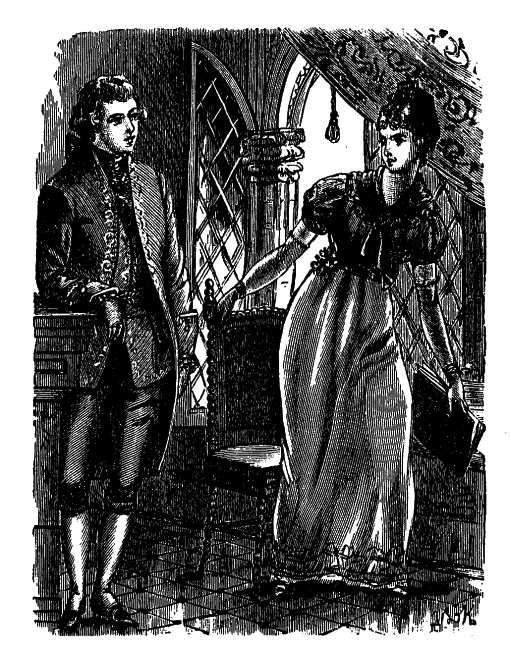 “But, gracious Heavens! Who can describe the emotions of her soul, when the
original of the picture so fondly sketched, so hastily obliterated, met her eye.” Page 532.