“They are having a hard fight for it,” Ted observed to
Lieutenant Lowthian. They stood on the walls that
surrounded the courtyard of the fort, watching the progress
of their comrades through the crowded streets. Lowthian
nodded, but, absorbed by the struggle, made no reply.
“Yes, and they’ve left us here to be killed like rabbits,”
muttered Tynan.
“Shut up! Don’t whine!” Lowthian scornfully exhorted
him.
Ted’s anxiety had so far been largely centred in the safety
of Ethel Woodburn, the charge placed under his protection;
and having rightly guessed that the Commissioner’s house,
surrounded by the clamouring mob, through whose masses
Munro was breaking his way, contained the Europeans of
Aurungpore, a load was lifted from his mind. The rebels
had quitted the immediate vicinity of the fort, and the comparative
tranquillity close at hand had made him forget his
own danger. Tynan’s remark and Lowthian’s curtness
startled him.
“They won’t be long in escorting the women here,” he
cheerfully opined. “And a hundred of us ought to hold
this place easily.”
“Yes, but twenty cannot,” Tynan sneered. “If it’s as
much as Munro can do to force his way through now, how’s
he going to manage it with a crowd of women to protect?”
Tynan had gauged the situation more correctly than Ted.
Reckoning overmuch on the prestige of British arms, Munro
had calculated that the removal of the civilians to the fort
would be an easy matter. Most of the disloyal sepoys had
disappeared, having scattered in order to loot the shops and
the European bungalows. They were now returning by twos
and threes, some laden with plunder, others savage and sullen
through disappointment, having found the bungalows deserted
and the coveted jewels and money saved from their clutches.
“Here comes that scoundrel Pir Baksh,” said Lowthian as the
Moslem subadar appeared on the scene. He began to shout some
commands unintelligible to the watchers on the walls, and soon
succeeded in forming the scattered groups into a dense throng.
“I always detested that fellow,” Lowthian continued, “and
I believe he’s at the bottom of this dastardly business.”
“He’s got Miss Woodburn’s horse too!” Ted cried in an
excited voice, as he recognized the bay. “Look! he’s pointing
towards the fort It’s our turn now!”
Pir Baksh was haranguing the sepoys, gesticulating wildly,
first towards the strong white building in which the Europeans
had taken shelter, and then in the direction of the frowning
fortress whose guns commanded Aurungpore, and the air was
filled with shouts of “Din, Din, Allah Akbar!”[1]
“They’re coming at us,” Tynan whispered. There was no
need to whisper, for the fact was only too evident. The impressive
nature of the peril had made him unconsciously lower
his voice.
“Are the guns loaded?” he added, nodding towards the
half-dozen cannon, whose grim black muzzles stared through
the embrasures.
“No, and it would take us an hour to load them,” Lowthian
replied.
As a measure of precaution, all munitions for the cannon
had been stored within the arsenal.
The Rajputs on the bastions that flanked the main gate
began to fire wildly as the rebels approached within range.
“Steady, men, steady!” the commandant ordered. “Each
cover his man before he fires! That’s the way! Well aimed,
Ambar Singh!”
The loyal sepoys had pulled themselves together, and there
was no further waste of ammunition. Rebel after rebel rolled
over in the dust or limped into cover, and the rush was checked.
The assailants slowly backed away from the walls, each man
trying to dodge behind his neighbour to keep a shield before
him as he took aim. Ted looked for Pir Baksh, but that
astute pandy, having no intention of exposing himself so
prominently on horseback, had dismounted, and was lost
amid the mob.
At last the ensign marked his quarry. For a second’s
space the ringleader had come into view to urge his reluctant
hordes to the assault. Hastily covering him, Ted pulled the
trigger. A rebel fell, but it was not Pir Baksh. Like the
coward he was, he had skipped into safety behind a group of
sepoys, and now the front ranks of the mutineers had pressed
back upon the rearmost until all were beyond effective range.
Brown Bess could not be trusted to carry far.
“If there is one of the curs I should like to kill it’s that
traitor Pir Baksh!” Tynan declared with an oath. “I hope
I’ll live to see him hanged! It was he who shot the colonel;
I saw him.”
“Are you sure of that?” Lowthian and Ted both asked.
“As sure as that I am here.——What are they up to now?”
Baffled for a moment, the subadar had abandoned the idea
of a direct assault, and was seen to be exhorting the men to
some new method of attack, for the pandies presently dispersed
right and left. A hot fire was still kept up through
the windows of Fletcher’s house. Lowthian quietly gave an
order.
“Tynan, take eight men to the southern bastion, and don’t
show yourselves until you can strike home. Dal Singh, you
keep watch from the north-west tower, and give the alarm if
they gather in that direction.”
A number of the sepoys were reassembling at the top of the
main street where it debouched into the open space facing the
main gate. Ted and Lowthian exchanged a meaning look as
they perceived that some had brought short ladders and were
busily lashing them together.
“If they’ve any grit they’ll soon be over the walls,” the
senior whispered. “Ha! they mean to attack Tynan’s post
first.”
Under the impression that the garrison was too weak to be
distributed, some hundred rebels with a ladder made a dash
for the southern wall of the courtyard, keeping out of range
from the main gate as they ran. They were within twenty
paces when Tynan opened fire. Still they kept on, and
planted the ladder against the wall. A second volley rang
out, and the pandies hesitated, for the fire had been concentrated
on the ladder-bearers, and those who were nearest to
them edged farther away, pressing against the walls. They
reasoned that it was death to touch the ladder, and many of
their comrades were already dead. But by now another rush
had been made for the main gate, and though a dozen fell in
the assault, the sepoys were more in earnest and they thirsted
for revenge. Two of the Rajputs were knocked over, and Pir
Baksh yelled gleefully as he planted a bullet in Lowthian’s
shoulder.
Still the fort was not yet won. Encouraged by the resolute
bearing of their officers, the loyal men continued to fire coolly
and rapidly; and the mutineers lacked the inspiration of a
leader ready to sacrifice himself for their cause. They again
retired out of range, and the cheer raised by the Rajputs at
the main gate was echoed back by Tynan’s men.
That cheer was ill-timed. Hardly had it died away before
an answering yell from the north, savage as a war-whoop,
chilled the blood in their veins, for it came from inside the
courtyard! A scaling-party had made the circuit, and were
already beneath the north-western bastion when Dal Singh
reached his post. He looked forth, and before he could give
the alarm a bullet struck him in the forehead, the single
distant report passing unnoticed amid the noise of battle.
“Inside the fort, lads!” Lowthian shouted. “All together!”
The garrison hastily descended, and, joining forces, charged
across the courtyard to escape being cut off. But the rebels
were the nearer, and should even one or two of them enter
first and bar the door, the garrison was lost. In ten minutes
there would be a couple of hundred sepoys inside the courtyard.
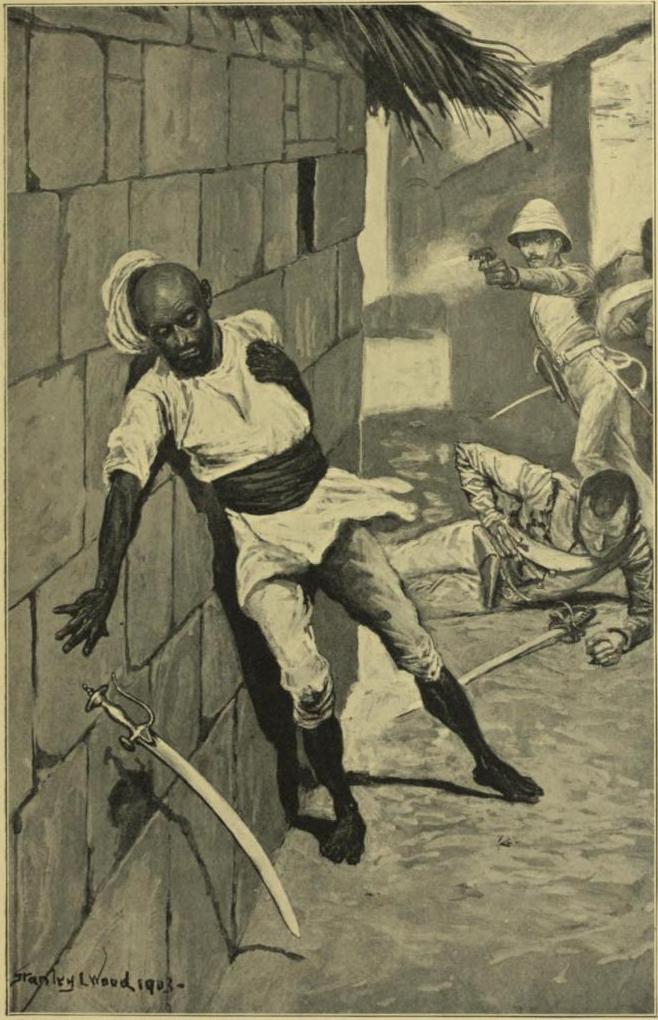
One rebel was almost in. Ted stopped, flung his musket to
his shoulder, and the man toppled over. Four more pandies
were close upon his heels. As the leader fell, the hindmost of
these, dreading the same fate, looked back over his shoulder.
A trifling incident, yet that glance cost him dear, and was
worth untold gold to the white-faces in Aurungpore. For as
the fellow turned he unconsciously checked his pace, and a
lean Rajput, straining every nerve, closed with the faint-hearted
traitor before the entrance could be gained. A bayonet-thrust,
a scream, and the wretch staggered forward and fell
upon his face.
But the other three were inside, and so was Karan Singh
the Rajput, alone with his back to the door, cut off from his
comrades. A barrier of some thirty exultant rebels had
thrust themselves in front, and ladders were even now being
set up against the walls by the main gate. If the thirty
pandies could keep the loyalists at bay for another five minutes
they would all be butchered like goats at the Dashera Festival.
Then came the clang of steel, as bayonet crossed bayonet; the
three officers emptied and reloaded their pistols, and a yard or
two was gained.
Suddenly Ted dodged to the right, and darted at full speed
round the pack of sepoys, as a three-quarter back, smartly fed
by the half who has picked up the ball from beneath the feet
of the scrummagers, circles round his opponents before they
know what has happened. He had caught a glimpse of the
plucky Karan Singh maintaining the unequal combat, and the
Rajput was sore wounded though one of the pandies had fallen
to his bayonet.
While still a few strides from the doorway, Ted Russell
witnessed the death of the Hindu hero. As one sepoy kept
Karan Singh at bay the other managed to reload and let fly,
the muzzle barely a foot from the Rajput’s breast. The brave
man dropped like a log, and his body fell across the threshold.
Though they hastily thrust the corpse aside, Ted was upon
them before the heavy door could be closed.
The enemy had not dared to pursue the ensign, fearing to
turn their backs lest the British should be let in. His pistol
was empty and his musket had been cast aside. One of the
sepoys lunged. Ted skipped aside, and, turning on his heel,
struck wildly at the other’s bayonet that was darting towards
his chest. The weapon was turned aside, but though his tunic
alone was ripped and he himself was untouched, his cherished
sword had broken off at the hilt, and he was disarmed.
For the fraction of a second he stood helpless. So lightning-like
is thought, that he had time to long for a kick at the
slovenly workman who had turned out a weapon as untrustworthy
as himself.
“Quick! Close the door, Bakir Khan, while I slay the
whelp!”
Ted swerved, grasped the speaker’s musket-barrel with his
left, and with his right hammered the face of the bewildered
sepoy, who howled, but held on to the weapon. The iron-clamped
door slammed and the heavy bolts groaned as Bakir
Khan shot them home and turned to assist his comrade. Ted
tugged at the musket with all his strength, and suddenly saw
at his feet the firearm of the dead pandy. He swooped down,
seized the weapon, and jumped backwards just in time, as the
bayonet-point flashed harmlessly in front.
A loud pounding of musket-stocks upon the door announced
that Lowthian’s handful had broken through, or else had all
been slain. For an instant the sound stayed the fight inside.
Was he alone left after all? Or did it mean that, could he
open the door before numbers overwhelmed them, they might
all be saved? Hope lent him strength. There was no bayonet
to his new weapon, so he gripped it by the muzzle, and, swinging
it above his head, he knocked the Brown Bess out of Bakir
Khan’s hand as that false sepoy made a second lunge. Again
he brought the butt-end down, this time with a thud upon the
head of Bakir Khan. The second pandy recoiled, still half-dazed
by the blows from Ted’s sword-hilt. There was no way
of escape for him, however, and he sprang like a tiger-cat at
the ensign. A third time the musket was swung aloft, and
the sepoy reeled and toppled over, stunned.
Ted sprang to the door, and had drawn one of the bolts
when a wild fear took hold of him. Who were on the other
side? In all probability they were rebels thirsting for English
blood, and why should he let them in? Through the thick
door he seemed to see them, pitiless as famished wolves. Why
not hide in the vast arsenal and slip out at night?
In less than a second such thoughts had flashed through his
mind before he recollected that duty bade him take the risk.
The last bolt was shot back; he sprang aside, ready for a
charge as the door swung back, and gave a gasp of relief as
Tynan and his Rajputs dashed inside.
At their heels came the rebels, and a few got through before
Ted and Ambar Singh could close and bar the door. The
fight inside the passage was soon over, and the Rajputs sank
upon the floor and gasped for breath.
Barely five minutes had sped since Karan Singh’s body had
fallen across the threshold, yet it seemed many hours. Ted
could hardly realize that the main body of assailants under
Pir Baksh had only just succeeded in storming the walls (for
they had hesitated, fearing a trap) as he cracked the skull of
Bakir Khan. Had that fourth sepoy not looked back the
arsenal would have been lost.
“Lowthian’s done for, I’m afraid!” panted Tynan.
Following his gaze, Ted saw that the Rajputs had brought
their commandant in. He knelt down by the side of his
friend and found Tynan’s surmise only too true, for Lieutenant
Lowthian had already breathed his last.
“Shot just as we reached the doorway,” Tynan explained;
“and half a dozen men killed or badly wounded. What must
we do, Russell? They can’t get in except through that door,
can they?”
“It won’t take long to batter the door down if they shape,”
Ted replied. “Luckily we’ve heaps of ammunition here, and
any number of muskets. Look, this room off the passage
commands the door, so set two or three men to bring up
firearms and we’ll load a few dozen.”
Before Ted had finished speaking, the spirited Rajputs were
emptying their muskets through the narrow slits that loop-holed
the thick walls, and the rebels who had been clustering
round the door, vainly attempting to batter it down, left the
spot in a hurry—at least all did who were able. Ted then
posted a couple of men to watch the north-western face of the
building and give the alarm if necessary. Blood had been
flowing freely down the ensign’s face, and he now found time
to staunch it. He was not sure when he had received the
wound, but at some time or other during the struggle in the
passage a bayonet-point had torn the skin from mouth to ear.
The lull in the storm lasted for nearly an hour. Many of
the pandies contemptuously flouted the commands of their
officers, and, giving up the attack on the fort, began to seek
fresh plunder in the town, or joined in the half-hearted
attempts to render the English house untenable. The remainder
of the force, gathered together by Pir Baksh, kept up
a long-range fire through the loopholes, in the hope that some
bullets might find their billets.
“Why don’t Munro come to the rescue?” Harry Tynan
bitterly demanded. “With eighty men he could break
through this gang of cowards, if only he had the pluck to
try.”
“He can’t,” Ted retorted; “they’re penned in there like
sheep. And how could he break through with nearly a dozen
women and kids to protect? Would you have him leave them
to their fate?”
“Half his men could do it.”
“Not they—nor twice his whole force. It’s a soldier’s risk
that we bargained for when we took our commissions. We
may win through yet; and if not, we must just stick to it as
long as we can. Well, what’s the matter now, havildar?”
Ambar Singh had left his post.
“The dogs are about to make a rush, Ensign Sahib. They
Have brought logs and beams and mean to batter down the
door. Listen! They are volley-firing to keep us from the
loopholes.”
The fusillade had suddenly redoubled—steady volleys this
time—and a hail of lead pattered against the walls, and a few
bullets smacked against the sides of the slits and cannoned
shapeless into the room.
“Quick, upstairs, you three!” Ted cried. “Take as many
muskets as you can carry and fire rapidly!”
Three sepoys nodded significantly and ran up the stairs.
In another moment a succession of reports from above announced
that they understood their business. As our hero
had intended, the rebels jumped at the conclusion that their
fire having become too hot, the garrison had shifted, so they
changed their aim.
Instantly the abandoned loopholes were occupied, just as
two parties, each of six or eight men bearing improvised
battering-rams, charged the door at full speed. Crack went
eight muskets together, and half a dozen fell. Fresh firearms
were handed to the marksmen, and the logs were dropped
as the few survivors scuttled away. For a third time the
reports rang out, and only one of the log-carriers rejoined
his comrades.
“Down, men!” Ted gave warning, as the rebels savagely
changed their aim once more and swept the lower embrasures
with their fire. One poor fellow was not quite quick enough.
Before he could duck a bullet had entered his forehead.
Setting aside the two Rajputs who were dangerously wounded,
there were now twelve sepoys and two English lads to defend
the place, and of these fourteen five were wounded.
“Curse the bloodthirsty ruffians!” Tynan hissed.
His blood was up. Springing to a loophole he fired twice,
bringing down a man each time.
“Be careful,” Ted cautioned him. “That won’t pay.”
“The sooner it’s over the better,” Tynan replied, but took
the advice all the same.
The hostile fire gradually slackened, and the garrison were
shortly enabled to watch the proceedings of their adversaries.
They could see Pir Baksh vainly exhorting the mutineers to
make a second attempt. But the sepoys shook their heads.
The danger was too great, or why did not Pir Baksh himself
lead them, they asked. Their English officers were wont to
share the danger with the sepoys, but he, Pir Baksh, was
careful to keep out of range whenever he sent them forward.
No, they preferred to wait for night, when the risk would be
small.
Judging that they would be safe for another hour at least,
the two Englishmen ordered food to be prepared. They
anticipated that the crisis would come with the sunset, and
strength must be kept up.
“What are you grinning at?” asked Tynan, as they sat
cross-legged over the meal.
“I was thinking what a rummy go it is,” Ted replied,
“that we two of all the officers should be here together.
We haven’t been friends, Tynan, but if ever we get out of
this hole I hope we will be. And if we don’t get out, I trust
we can die without any bad feeling between us. Shake hands
on it, old chap.”
Tynan leant forward to meet the proffered hand.
“All right, Russell! I’m agreeable. It ain’t my fault that
we’ve not been friends.”
This was not a very gracious speech, and Ted’s ardour was
damped. He shook hands, however, saying:
“We must back one another up to-day.”
“Right! But look here, you mustn’t forget that I’m senior
officer here. You’ve been giving orders pretty freely.”
“Because you didn’t seem ready with any suggestions.”
“It’s my turn now, remember,” Tynan asserted in an
aggrieved tone; and Ted felt sorry he had spoken, as the
other seemed incapable of sinking his personal feelings even
at such a time. Unless his senior officer showed more sign of
rising to the occasion, he determined to continue to issue
orders.
Though the magazine at Aurungpore was not a large one,
its capture would prove an enormous boon to the rebel cause,
for therein was stored a quantity of ammunition and material
of war. Armed therewith, all the rabble of the town would
soon be equipped as soldiers, and our ensign understood what
would then become of his friends and comrades, and above
all of his brother’s sweetheart. A shiver ran down his spine
as he remembered Jim’s parting whisper, and there rose before
him the picture of the girl who had saved his life and whom
he secretly adored. He vowed to do his duty manfully, and
never to despair while there remained the least hope of preventing
the ravening wolves outside from gaining access to the
stores.
“What the deuce are you up to now?” Tynan broke in.
The senior ensign had been regarding the junior’s meditations
with considerable curiosity, wondering how he could
become so absorbed at so critical a time. His query had
been called forth by a sudden change of expression that had
overspread his comrade’s features. Ted’s eyes had opened
wide, and he had given an almost imperceptible gasp, sure
signs that some startling idea had come upon him unawares.
“What is it, Russell?” Tynan repeated.
“Oh, nothing, nothing!” Ted hastily assured him. “I was
just thinking what an awful business this is.”
“Has that only just occurred to you?” his comrade
sullenly inquired, convinced that Ted was keeping something
back.
And so he was. Not that he wished to mislead his brother
officer but rather because the idea that had so unceremoniously
thrust itself in front of him, suggested an action
so appalling as almost to stupefy him. He must think,
think, think. Could he bring himself to do it? Ought he
to do it?
Hardly the place or time this for quiet meditation, for
the weighing of pros and cons. One of the watchers signalled
that the pandies had again lost patience, and to confirm his
words the heavy fusillade recommenced, and the ensign ceased
to ponder and began to act. The rebels had now got the
range with deadly accuracy, and unless he courted death, none
of the garrison dared return the fire.
Our hero did make one such attempt, and reduced the
number of one of the battering-crews. But before he could
get in a second shot the muzzle of his musket was struck and
dented, and a bullet whistled through his hair, grazing the
skin. He crouched down and put his hand to his head, fearing
he was done for. A soft thud and rattle beside him announced
the fall of a sepoy who had followed the rash example with
fatal courage. Forgetting his own wound the ensign knelt
beside the Rajput and raised his head. The poor fellow
still breathed but was going fast, and a shudder ran through
the boy as the man died in his arms, true to the end.
“Are you hurt?” Tynan asked.
“I’m not quite sure. I don’t think so.”
“Let me see. Oh, it’s only a scratch.”
The sepoys in the room above, less hampered by the rebel
fire, were answering back to some purpose until they too were
silenced, one of their number being mortally wounded. A
crash against the stout door seemed to shake the house, and
before the vibration ceased another bang was heard. Englishmen
and Rajputs were firing hastily whenever an opportunity
occurred, but the pandies now held the upper hand. A
splintering noise followed the next crash.
“What can we do, Russell? What can we do?” Tynan
cried. “They’ll be in in a moment!”
Backed by the strength of half a dozen men the logs crashed
once more against the barrier, and the hearts of the garrison
were heavy as lead.
“We’re not done for yet,” Ted stoutly replied. “We must
wait for them in the passage. We may yet hold the passage,
Ambar Singh; and should we die, men will speak of your
deeds from generation to generation.”
“We can hold them back for a time, sahib. Come, my
children, and thou, Bisesar Rai, and thou, Dwarika Rai, load
and pass us the muskets as we lie in the doorway.”
Of the twenty-two Rajputs ten were still able to fight,
and three others remained alive though sorely wounded.
They were now all together, and Ted, Ambar Singh the havildar,
and as many others as could crowd in, were lying full
length before the wide-arched entrance to the room. From
the slowly-yielding door the passage ran straight for a few
paces before curving to the right, and an enemy coming round
the bend would be at a great disadvantage, for the best marksmen
of the garrison waited with ready muskets, their elbows
on the threshold, their bodies within the room. Behind them
two comrades stood, a loaded musket in each hand, to exchange
for the emptied weapons, and beside them knelt Bisesar Rai
and Dwarika Rai busily loading the firearms. The pandies
could not take aim without coming into full view, but the
defenders could fire with a minimum of exposure, and could
draw back their heads into safety whenever they saw a musket-barrel
pointing at random towards them.
A louder crash, a shrill yell, and a mob of maddened sepoys
swept inside and round the bend. Six muskets cracked at
once, and the yells changed to howls of dismay. A second
volley—not in unison this time, but no less effective—and the
sepoys turned and fled. The victory was not to be so easy as
they had imagined. Had the garrison been armed as were
they, with one Brown Bess apiece and a limited supply of
ammunition, it would all have been over long ago they told
themselves, but when volley followed volley with such rapidity,
it was like facing a regiment. The sepoys were not cowards
as a rule, but they knew they were playing a traitor’s part.
In a good cause, well led, they would have risked the danger,
even as the handful of loyal Rajputs were devoting their lives
to their duty.
A nerve-ruining silence, broken only by the moans of the
wounded who lay on the floor, followed the shrill outcries.
The rebels were baffled but not defeated. Slowly, painfully
the minutes dragged, then two black heads showed round the
bend, and two spurts of flame flashed out. Before the reports
had reached them, Ted and Ambar Singh had pressed their
fingers, and two sepoys fell forward on their faces. The
defenders were untouched, the rebels having fired at random,
and for a while none dared follow their example.
In despair several of the raging mob pushed their musket-barrels
round the bend and let fly, in the hope that an occasional
bullet out of many might reduce the number of their dogged
antagonists. But Ted drew his men back from the doorway
until the sepoys were tired of this amusement.
Each rebel urged his neighbour to face the fire of those
death-dealing muskets; each man knew that the end was at
hand, and preferred to hold himself back that he might share
in the plunder. Now that they were no longer a glorious regiment
but a mere mob of rebels, none was ready to give his life
for the cause. The garrison also knew that the end was drawing
near, and were in no way deceived by the momentary calm.
“Hullo!” Ted cried, and stared open-mouthed. “What’s
that for?”
A white cloth tied round the barrel of a musket had been
poked round the corner.
“A truce, sahibs!” a voice called in Urdu. “We wish to treat
with you and save your lives. May I step forward in safety?”
“One man may,” Tynan replied, “but he will be a dead
man should there be any sign of treachery.”
“Sahib, there will be none; I give my word of honour.”
So saying, Pir Baksh stepped round the bend, armed only
with a smile that he doubtless intended to be ingratiating.
“Ye are gallant warriors,” he began, when Ted, interrupting
the flow of words, ordered the rascal to speak in English,
not Urdu. The subadar showed the whites of his eyes as he
smiled, and grimly shook his head. For the benefit of the
Rajputs he resumed in the vernacular:
“Ye cannot hope to hold out much longer, so let there be
no further bloodshed. Surrender the fort and we will spare
your lives.”
“What do you think, Russell?” Tynan hurriedly whispered.
“Do you believe they mean it?”
“Not they!” was Ted’s scornful reply.
“Perhaps they do, though. I’ll ask him what they intend
to do with us.”
“Why, you can’t mean to give up the magazine under any
conditions?” our astonished ensign demanded, his eyes contracting
as he stared at his senior officer.
“They’ll have it all the same if they kill us, though,” Tynan
muttered, lowering his eyes, unable to meet his comrade’s
gaze. “So what’s the odds. May as well save our lives while
there’s a chance.”
He thereupon made answer to the jemadar.
“If we surrender, what will you do with us?”
“We will keep you captive, but promise you your lives,”
came the prompt reply.
“Will you allow us to join our friends over yonder? If
not, we shall still fight, and we are not so helpless as you
think.” Tynan was not quite a coward, and he used the
threat with some show of spirit.
“I cannot promise that without consulting my friends.”
So saying, the subadar retired for further instructions.
Ted had had time for reflection.
“Tynan,” he announced, “I sha’n’t agree to surrender.
We’ve no right to do it! Look what a lift it would give them
if they could get all these arms and ammunition.”
Our ensign had quite made up his mind what to do. If his
death would make more secure the position of his comrades in
the town he was prepared to die. There was satisfaction in
the reflection that Ethel Woodburn would know that he had
been staunch to the last. Poor Tynan had no friends among
the officers of his corps, and consequently there was nothing to
uplift his soul above the fear of death, and he had clutched
eagerly at the straw of hope held out by Pir Baksh.
“Well, they’ll get it all the same after they’ve done for us,”
he bitterly replied. “May as well live to fight another day.
I was a fool ever to come to this accursed land. What right
had Munro to leave us here?”
Before Ted could reply the white flag was thrust round the
corner and the subadar returned.
“We agree to what you ask,” said he. “We will permit
you to rejoin your friends in safety.”
“I tell you I shall not agree to surrender,” the junior
ensign angrily declared.
“You fool! What’s the good of holding out any longer?
Well, I shall surrender, and I’m chief here.”
“You’re not! You’re under Munro’s orders, and those were
to hold the fort until he sends help. If you attempt to
surrender you’re a traitor.”
Ted turned to Ambar Singh and the sepoys.
“Do not listen to the dogs,” said he. “Let us fight to the
end, as your forefathers did against the Moguls. They are not
to be trusted; they will assuredly slay us if we yield.”
The sepoys stoutly assented. They had little faith in the
Mohammedans, who were seeking their lives,—the men who
had murdered Markham Sahib.
“You are right, sahib,” said the havildar, “and we will fight
by your side. That low-caste hound,” pointing to Pir Baksh,
“is afraid of us, and wishes to disarm us with soft words, but
we know him.”
Tynan saw his authority taken from him, the sepoys understanding
and looking to Ted as their leader.
“How dare you?” he hotly demanded.
“Oh, go away! You’ve nothing to do with this business.”
Ted sneered, not too generously, for Tynan had disgusted him.
With the same breath he ordered Pir Baksh to clear away,
and the firing recommenced.
The time had come for him to act upon the resolve he had
made, a resolve to sacrifice himself and his already-doomed
handful, rather than allow the capture of the stores to endanger
the safety of his countrymen. The idea of blowing up the
magazine had come upon him suddenly as he remembered the
news that had arrived yesterday from Delhi,—how Lieutenant
Willoughby and his nine heroes had blown up the immense
arsenal there and destroyed hundreds of rebels.
The entrance to the magazine was through the room in
which they lay. The rebels were quiet, plotting some new
move, no doubt, so, leaving the trusty Ambar Singh in charge,
Ted proceeded to the spot and began to lay a train of powder
to connect the barrels with their post. Before the others had
guessed his intention he had brought the train within the
room, and the white-faced senior ensign, who had lost by now
the last remnant of his pluck, jabbered incoherently and
attempted to interfere, until Ted roughly threatened to blow
his brains out. Dazed and trembling the wretched boy shifted
as far as he could from the black trail. The Rajputs looked
on with frightened eyes, half-paralysed by the shock of this
new terror; and Dwarika Rai fell on his knees and begged the
ensign to have mercy, for such a fate meant more than death
to these Hindus.
For a moment the boy’s heart failed him; the thought was
too awful. To be blown into a hundred pieces, how terrible
it seemed! And what right had he to condemn these faithful
men to such a death?
Then out spake the havildar.
“If we have to die, let us die like men. Fire the train,
sahib!”
“Nay, not yet. Our duty is to stand by our post until the
last. No man must leave the room, though.”
He lighted a candle and placed it within easy reach, that
the flame might be ready on the shortest notice.
“Ha!” whispered Ambar Singh, and there was a reckless
note in his voice. “The jackals are cunning. See!”
Round the bend was pushed forward a large sack full of
sand, then another; and soon a third filled up the space. As
the last was clumsily poked into its place between the others
it tottered and overbalanced, and a couple of pandies leant
forward to lift it up. Two muskets spat forth flame and the
rebels rolled over in a heap, upsetting another sack. Quick
as thought, as the sepoys were engaged in pulling their
wounded comrades back, Ted ran with light steps down the
passage, keeping close to the farther wall, and seizing a sack
with either hand, dragged them away before the amazed
mutineers had time to fire.
To make doubly sure of his safety Ambar Singh and his
men let fly, and the bullets, sweeping across the bend, covered
the lad’s return. Amid the cheers of the loyalists the bags
were propped in the doorway to serve as a rampart for them,
and they began to mock the traitors.
But this triumph could merely put off the evil moment. In
another half-hour fresh sand-bags had been brought in, and
before long the pandies were in a position to command the
doorway. As the news spread that the end was near the mob
of sepoys increased, and Ted smiled to himself. He addressed
the Rajputs:
“You have done your duty in a manner worthy of your
ancestors, and I am going to do mine. Run for your lives!”
“No, Russell, you sha’n’t!” cried Tynan, whose nerve had
completely broken down. “I surrender,—Pir Baksh, I
surrender!” He tried to snatch the light from his comrade’s
hand. Ted covered him with his pistol, and, pointing across
the passage, said simply:
“Run for your life!”
Hot all over, his fingers tingling and his head ringing—partly
dread of the horror and partly a glorious exultation—the
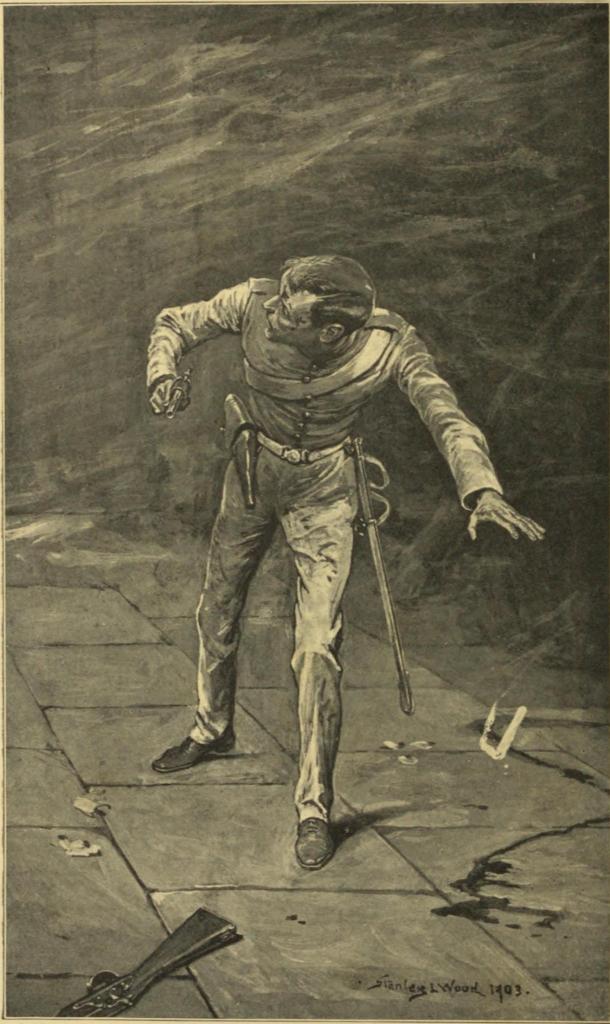
boy dropped the lighted candle on the thin trail of powder,
and darted from the room as a horde of sepoys rushed in.