Jane, in Baldy’s absence, dined on Sunday with
the Follettes, in the middle of the day. In the afternoon
she and Evans went for a walk, and came
home to tea in the library.
Stretched in a long leather chair, Evans read to
Jane and his mother “The Eve of St. Agnes.”
“How bitter cold it was!
The owl, for all his feathers, was a-cold:
The hare limp’d trembling through the frozen grass,
And silent were the flock in woolly fold.”
Jane, curled up on the couch in her favorite attitude,
listened to that incomparable description of
stark winter weather, and was glad of the warmth
and coziness. She was glad, too, of this pleasant
company—Mrs. Follette was a great dear, with her
duchess air, and her devotion to Evans. And
Evans, reading in that thrilling and unchanged
voice, was at his best.
As for Mrs. Follette, she was always glad to have
Jane visit them. The child was so cheerful, and
Evans needed cheer. Then, too, Jane was a delightful
compromise between the girl of yesterday
and the ultra-modern maiden who shocked Mrs.
Follette not only by her lack of reverence but by
her lack of reticence.
Jane might have bobbed hair, but she did not
have a bobbed-hair mind. The meaning of this
conclusion was quite clear to Mrs. Follette, however
obscure it might be to others. Girls who cut
off their hair, as a rule, went farther—Jane stopped
at her hair.
Then, too, Jane had what might be called old-fashioned
domestic qualities. She kept her little
house as spick and span as she kept herself. In
winter everything was burnished and bright; in
summer crisp curtains waved in the warm breeze;
there were cool shadows within the clean, quiet
rooms.
At the moment, Mrs. Follette was weighing seriously
the fact of Jane as a wife for Evans. She
was pretty as well as cheerful. Had good manners.
Of course, in the old days, Evans would, inevitably,
have looked higher. There had been plenty of rich
girls eager to attract him. He had had unlimited
invitations. Women had, in fact, quite run after
him. Florence Preston had rather made a fool of
herself. And Florence’s father had millions.
But now——? Mrs. Follette knew how little
Evans had at the moment to offer. She hated to
admit it, but the truth was evident. Watching the
two young people, she decided that should Evans
care for Jane, she would erect no barriers. As for
Jane, marriage with Evans would be, in a way, a
rise in the world. She would live at Castle Manor
instead of at Sherwood Park.
The poem had reached a point where Mrs. Follette
felt that she ought to protest. She was not
quite sure that she approved of the situation it outlined.
The verse of the moment, for example—Porphyro’s
plea to the maid, old Angela:
“To lead him in close secrecy,
Even to Madelaine’s chamber and there hide
Him in a closet of such privacy,
That he might see her beauty unspy’d
And win, perhaps, that night, a peerless bride.”
Stripped of all its fine words, it was an impossible
situation.
Apparently, however, the young people were
without self-consciousness....
“Out went the taper, as she hurried in:
Its little smoke in pallid moonshine died——”
Evans looked up. “Could there be anything
lovelier than that last line?”
Jane’s eyes had dreams in them. “Don’t stop,”
she said.
He read on.... “She closed the door ...”
his voice took now a deeper note.
“Rose-bloom fell on her hands, together prest,
And on her silver cross soft amethyst,
And on her hair a glory like a saint:
She seemed a splendid angel, newly drest,
Save wings for heaven; Porphyro grew faint:
She knelt so pure a thing, so free from mortal taint.”
“Evans,” said his mother, as he paused again,
“that poem doesn’t seem to me exactly proper.”
He gave her a surprised glance. “Don’t spoil it
for us, Mumsie.”
“Oh, well,” Mrs. Follette shrugged her nice
shoulders, “we won’t argue. But when I was a
girl we didn’t read things like that.”
“But this was written before you were a girl.”
“What difference does that make?”
“But the richness and color. You see it, Jane,
don’t you?”
“Yes. Finish it, Evans.”
And when he came to the end, she said, “If only
life were like that.”
“Like what?”
“High romance. Porphyro says negligently,
‘For o’er the southern moors I have a home for
thee.’ But lovers of to-day have to think of rent
and food and clothes. And hotel bills for the
honeymoon.”
“Oh, you women”—he sat up flaming—“are
you conspiring to spoil my poem? Jane, it is the
dreams of men and women which shape their lives.”
As his eyes met hers something stirred within
her like the flutter of a bird’s wings lifted to the
sun....
It was after five when Baldy telephoned triumphantly:
“Jane, Edith Towne has agreed to
go home to-night. And I’m to take her. I called
up Mr. Towne and told him and he wants you to
be there when we come. He’ll send Briggs for you
and we are all to have dinner together.”
“But, Baldy, I don’t know Edith Towne. Why
doesn’t he ask some of her own friends?”
“She doesn’t want ’em. Hates them all, and
anyhow he has asked you. Why worry?”
“I’ll have to go home and dress.”
“Well, you’re to let him know at once where
Briggs can get you. I told him you were at the
Follettes’.”
Jane went back and repeated the conversation to
Evans and his mother. Mrs. Follette was much
interested. The Townes were most important people.
“How nice for you, Jane.”
But Evans disagreed with her. “What makes
you say that, Mother? It isn’t nice. It will simply
be upsetting.”
“I don’t see why you say that, Evans,” Jane
argued. “I am not easily upset.”
“But with all that money. You can’t keep up
with them.”
“Don’t put ideas into Jane’s head,” his mother
remonstrated; “a lady is always a lady.”
But Jane sided now with Evans. “I see what
he means, Mrs. Follette. I haven’t the clothes. I
haven’t a thing to wear to-night.”
“Oh, I wasn’t thinking of your looks.” Evans
got up and stood on the hearth-rug. “But people
like that! Jane, I wish you wouldn’t go.”
She looked up at him with her chin tilted. “I
don’t see how I can refuse.”
“Of course she can’t. Evans, don’t be so unreasonable,”
Mrs. Follette interposed; “it will be
a wonderful thing for Jane to know Edith.”
“Will it be such a wonderful thing for her to
know Frederick Towne?” He flung it at them.
Jane demanded, “Don’t you want me to have any
good times?”
He stared at her for a moment, and when he
spoke it was in a different tone. “Yes, of course.
I beg your pardon, Janey.”
Mrs. Follette, having effaced herself for the moment
from the conversation, decided that things
between her son and little Jane Barnes might reach
a climax at any moment. “I believe he’s half in
love with her,” she told herself in some bewilderment.
As for Frederick Towne, she didn’t consider him
for a moment. Jane was a pretty child. But Frederick
Towne could have his pick of women. There
would be nothing serious in this friendship with
Jane.
Jane called up Towne. “It was good of you to
ask me,” she said. “I am at the Follettes’, but I’ll
go home and dress and Briggs can come for me
there.”
“Come as you are.”
“You wouldn’t say that if you could see me. I
took a walk with Evans this afternoon and I show
the effects of it.”
“Evans? Oh, Casabianca?”
“What makes you call him that?”
“I thought of it when I saw him waiting for
you at the top of the terrace. ‘The boy stood on
the burning deck——’” he laughed.
“I don’t think that’s funny at all,” said Jane,
frankly.
“Don’t you? Well, I beg your pardon. I’ll beg
it again when I get you here. Briggs will reach
Sherwood at about seven. I would drive out myself,
but I’ve an awful cold, and the doctor tells
me I must stay in. And Cousin Annabel is sick in
bed with a cold, so you must take pity on me and
keep me company....”
Jane hung up the receiver. It would, she decided,
be an exciting adventure. But she was not
sure that she liked Frederick Towne....
Evans walked home with her. The air was
warmer than it had been for days, and faint mists
had risen. The mist thickened finally to a fog
which rolled over them as if blown from the high
seas. Yet the sea was miles away, and the fog was
born in the rivers and streams, and in the melting
snows.
They found it somewhat difficult to keep to the
road. They were almost smothered in the thick
gray masses. Their voices had a muffled sound.
Evans’ hand was on Jane’s arm so that they might
keep together.
“Jane,” he said, “I made a fool of myself about
Towne. But honestly—I was afraid——”
“Of what?”
“That he might fall in love with you——”
“He’s not thinking of me, Evans, and besides
he’s too old——”
“Do you really feel that way about it, Jane?”
“Of course—silly.”
He could not see her face—but the words in her
laughing lovely voice gave him a sense of reassurance.
“Janey,” he said, “if I could only have you like
this always. Shut away from the world.”
“But I don’t want to be shut away. I should
feel—caged——”
“Not if you cared.”
There was in his tone the huskiness of intense
feeling. She was moved by it. “Oh, I know what
you mean. But love won’t come to me like that—shut
in. I shall want freedom, and sunshine. I’ll
be a gull over the sea—a ship in full sail—a gypsy
on the road—but I’ll never be a ghost in a fog.”
His hand dropped from her arm. “Perhaps
you’ll be a princess in a castle. Towne can make
you that.”
“Why do you keep harping on Mr. Towne? I
don’t like it.”
“Because—oh, I think everybody wants
you——”
And now it was she who caught at his arm in
the mist, and leaned on it. “I’m not the least in
love with Frederick Towne. And I shall never
marry a man I don’t love, Evans.”
When they came to the little house they found
old Sophy nodding in the kitchen. She always
stayed with Jane when Baldy was away. So
Evans said “Good-night” and started back.
He found the path between the pines, walked a
few steps and stumbled. He sat down on the log
that had tripped him. He had no wish to go on.
His depression was intense. Night was before him
and darkness. Loneliness. And Jane would be
with Frederick Towne.
He had for Jane a feeling of hopeless adoration.
She would never be his. For how could he try to
keep her? “I’ll be a gull over the sea—a ship in
full sail—a gypsy on the road—never a ghost in a
fog.”
And he was just a ghost in a fog! Oh, what was
the use of ever “climbing up the climbing wave”?
One must have something of hope to live on. A
dream or two—ahead.
How long he sat there he did not know. And
all at once he was aware of a pale blur against the
prevailing gloom. And then he heard Jane’s voice
calling, “Evans? Evans?”
He answered and she came up to him. “Your
mother telephoned—that you had not come home—and
she was worried.”
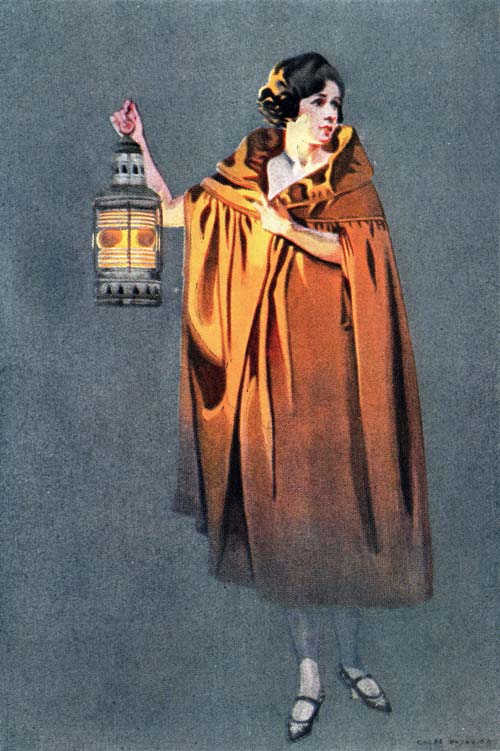
She was holding the lantern up to the length of
her arm. In her orange cloak she shone through
the veil of mist, luminous.
“My dear,” she said, gently, “why are you sitting
here?”
“Because there isn’t any use in going on.”
She lowered the lantern so that it shone on his
face. What she saw there frightened her. “Are
you feeling this way because of me?” she asked in
a shaking voice.
“Because of everything.”
“Evans, I won’t go to the Townes if you want
me to stay.”
He looked up at her as she bent above him with
the lantern. She seemed to shine within and without,
like some celestial visitor.
“Would you stay, Jane, if I wanted it?”
“Yes.”
He stood up. “I don’t want it. Not really.
I’m not quite such a selfish pig,” his smile was
ghastly.
She was silent for a moment, then she said, “I’m
going home with you, Evans. Wait until I tell
Sophy to send Briggs after me.”
He tried to protest, but she was firm. “I’ll be
back in a minute.”
She returned presently, the lantern in one hand
and her slipper bag in the other. “I put on heavier
shoes. I should ruin my slippers.”
As they trod the path together, the light of the
lantern shone in round spots of gold, now in front
of them, now behind them. The fog pressed close,
but the path was clear.
“Evans,” said Jane, “I want you to promise me
something.”
“Anything, except—not to love you.”
“It has nothing to do with love of me, but it has
something to do with love of God.”
He knew how hard it was for her to say that.
Jane did not speak easily of such things.
She went on with some hesitation. Her
voice, muffled by the fog, had a muted note of
music.
“Evans, you mustn’t let what I do make you or
break you. Whether I love you or not, you must
go on. You—you couldn’t hold me if you weren’t
strong enough, even if I was your wife. And there
is strength in you, if you’ll only believe it. Oh,
you must believe it, Evans. And you mustn’t make
me feel responsible. I can’t stand it. To feel all
the time that I am hurting—you.”
She was sobbing. A little incoherent.
“And you are captain of your soul, Evans. You.
Not anyone else. I can’t be. I can be a help, and
oh, I will help all I can. You know that. But—I
love you like a big brother—not in any other
way. If anything should happen to you, it would
be dreadful for me, just as it would be dreadful if
anything happened to Baldy.”
“Janey, my dear, don’t,” for she was clinging to
his arm, crying as if her heart would break.
“But I do care for you so much, Evans. I was
frantic when your mother telephoned. I wasn’t
quite dressed and I made Sophy get the lantern,
and then I ran down the path, and looked for you.”
He stopped and laid his hand on her shoulder.
Her weakness, her broken words had roused in him
a sudden protective tenderness.
“My little girl,” he said, “don’t. God helping
me, I’m going to get back. And you are going to
light my way. Jane, do you know when I saw
you coming towards me with that dim lantern it
seemed symbolic. Hope held out to me—seen
through a fog, faintly. But a light, nevertheless.”
“Oh, Evans, if I could love you, I would, you
know that.”
“I know. You’d tie up the broken wings of
every bird. You’d give crutches to the lame, and
food to the hungry. And that’s the way you feel
about me.”
He had let her go now, and they stood apart,
shrouded in ghostly white.
“God helping me,” he said again, “I’ll get back.
That’s a promise, Janey, and here’s my hand upon
it.”
She gave him her hand. “God helping us both,”
she said.
He lifted her hand and kissed it. Then, in silence,
they walked on, until they reached the
house....
The Towne car was waiting, and Mrs. Follette
in a flurry welcomed them. “I don’t see why you
didn’t ride over with him.”
“He hadn’t come, and we preferred to
walk.”
“What was the matter with you, Evans?”
“Nothing much, Mother. I’m sorry you were
fussed.” He gave her no further explanation.
Jane put on her slippers and went off in the
great car. And then Evans said, “I’m going over
to Hallam’s.”
“Aren’t you well, my dear?”
“I want to talk to him.” He saw her anxious
look, and bent and kissed her. “Don’t worry,
Mumsie, I’m all right.”
Dr. Hallam’s old estate adjoined the Follette
farm. The doctor was a nerve specialist, and went
every morning to Washington, coming back at
night to the quiet of his charming home. He was
unmarried and was looked after by men-servants.
He had been much interested in Evans’ case, and
had in fact had charge of it.
The doctor was by the library fire, smoking a
cigar and reading a brown book. He welcomed
Evans heartily. “I was wondering when you
would turn up again.” He showed the title of his
book, “Boswell. There was a man. As great as
the man he wrote about, and we are just beginning
to find it out.”
“Rare edition?” Evans sat down.
“Yes. Got it at Lowdermilk’s yesterday.”
“We’ve oodles of old books on our shelves.
Ought to sell them, I suppose.”
“I wouldn’t sell one of mine.” Hallam was emphatic.
“I’d rather murder a baby.”
Evans flamed suddenly. “I’d sell mine, if I
could get the things I want.”
“I don’t want anything as much as I want my
books.”
“I do. I want life as I used to live it.”
The doctor sat up and looked at him. “You
mean before the war?”
“Yes.”
“Good.”
“I’m tired of being half a man. If there’s any
way out of it, I want you to tell me.”
The doctor’s eyes were bright with interest. He
knew the first symptoms of recovery in such cases.
The neurasthenic quality of Evans’ trouble had
robbed him of initiative. His waking-up was a
promising sign.
“The thing to do, of course, is to get to work.
Why don’t you open an office?”
“A fat chance I’d have of getting clients.”
“I think they’d come.”
The doctor smoked for a time in silence, then
he said, “Decide on something hard to do, and do
it. Do it if you feel you are going to die in the
attempt.”
There was something inspiring to Evans in the
idea. Hard things. That was it. He poured out
the story of the past few days. The awful scene
with Rusty. To-night in the fog under the pines.
“Wanted more than anything to drop myself in
the river.”
He was walking the floor, back and forth, limping
to one edge of the rug, then limping to the
other. “Then Jane came. Little Jane Barnes.
You know her, and she told me—where to get off—said
I was—captain of my soul——” He
stopped in front of the doctor, and smiled whimsically.
“Are any of us captains of our souls, doctor?”
“I’ll be darned if I know.” The doctor was intensely
serious. “Will power has a lot to do with
things. The trouble is when your will won’t
work——”
“Mine seems to be working on one cylinder.”
Again Evans was pacing the rug. “But that idea
of an office appeals to me. It will take a bit of
money, though. And it is rather a problem to
know where to get it.”
“Sell some of the old books. I’ll buy them.”
Light leaped into Evans’ eyes. “It would be
one way, wouldn’t it? Mother would rather hate it.
But what’s a library against a life?” He seemed to
fling the question to a listening universe.
The doctor laughed. “She’ll be sensible if you
put it up to her. And you must frivol a bit. Play
around with the girls.”
“I don’t want any girls except Jane.”
“Little Jane Barnes. Well, she’ll do.”
“I’ll say she will.”
The doctor, watching him as he walked back
and forth, said, “The thing to do is to map out a
normal day. Make it pretty close to the program
you followed before the war. You haven’t happened
to keep a diary, have you?”
“Yes. It’s a clumsy record. Mother started
me when I was a kid.”
“That’s what we want. Read it every night, and
do some of the things the next day that you did
then. You will find you can stick closer than you
think. And it will give you a working plan.”
Evans sat down and discussed the idea. It was
late when he rose to leave.
“It will be slow,” was Hallam’s final admonition,
“but I believe you can do it. And when
things go wrong, just honk and I’ll lend you some
gas,” his big laugh boomed out, as they stood in
the door together. “Nasty night.”
“I have a lantern.” Evans picked it up from the
porch.
When Evans reached home his mother called
from up-stairs, “I thought you were never coming.”
“Hallam and I had a lot to talk about.”
He came running up, and entering her room
found her propped up on her pillows.
Mrs. Follette in bed lost nothing of her dignity.
Her gray hair at night was braided and wound into
a coronet above her serene forehead. She wore
something knitted in white and black about her
shoulders. There was a prayer-book on her bedside
table—and pineapple posts to her bed. She
had inherited her religion and her furniture from
her ancestors, and she kept them both in order.
“Mother,” said Evans, and stood looking down
at her, “Hallam wants me to sell some of the old
books and use the money to open an office.”
“What kind of office?”
“Law. In town.”
“But are you well enough, Evans?”
“He says that I am. He says that I must think
that I am well, Mother.”
“But——”
“Dearest, don’t spoil it with doubts. It’s my
life, Mother.”
There was a look on his face which she had not
seen since his return. Uplifted, eager. A light in
his eyes, like the light which had shone in the eyes
of a boy.
She found it difficult to speak. “My dear, the
books are yours. Do as you think best.”
He leaned over and kissed her, lifting her a bit.
There was energy as well as affection in the quick
caress. She drew herself away laughing, breathless.
“How strong you are.”
“Am I? Well, I think I am. And I am going
to conquer the world, Mumsie.”
His exaltation lasted during the reading of the
diary. It was a fat little book, and the pages were
written close in his fine firm script. He found
things between the leaves—a four-leaved clover
Jane had sent him when he made the football team.
A rose, colorless and dry. Florence Preston had
given it to him.
He dropped the rose in the waste-basket. How
could he ever have thought of Florence? Love
wasn’t a thing of blue eyes and pale gold hair. It
was a thing of fire and flame and fighting.
Fighting! That was it. With your back to the
wall—and winning!
For some day he meant to win Jane. Did she
think she could be in the world and not be his?
And if she loved strength she should have it. He
bent his head in his hands—his hands clasped
tensely. There was a prayer in his heart. His
whole being ached with the agony of his effort.
“Oh, God, let me fight and win. Bring me back
to the full measure of a man.”
Again he opened the book. Bits of printed verse
dropped out of it. Jane had sent him this, “One
who never turned his back, but marched breast-forward.”
Well, he had turned his back. That day in the
snow. The thought gripped him. Made him white
and sick. He stood up, praying again in an agony
of mind, “Bring me back.”
He opened the book and read of Jane, and of
himself as he had once been. He skipped the record
of his college days, except where he found such
reference as this: “Little Jane is growing up. She
met me at the station and held out her hand to me.
I used always to kiss her, but this time I didn’t
dare. She was different somehow, but some day
I’ll kiss her.”
And this: “Jane is rather a darling. But I am
beginning to believe that I like ’em fair.” That
was when he had a terrible crush on Florence Preston,
whose coloring was blue and gold. But it
hadn’t lasted, and he had come back to Jane with
a sense of refreshment.
He found at last the pages given over to those
first days after he had been admitted to the Washington
bar, and had hung out his shingle.
“Sat at my desk all the morning. Great bluff.
One client received with great effect of busy-ness.
Had lunch with a lot of fellows—pancakes and
sausages—ate an armful. Tea with three débutantes
at the Shoreham—peaches. Dance at the
Oakleys’ in Georgetown. Corking time. One
deadly moment when the butler took my overcoat.
Poor people ought not to dance where there are
butlers.”
Remembering that incident, he leaned back in
his chair and laughed. The Oakleys had all the
money in the world, and a background of aristocracy.
Evans’ overcoat was rusty and shiny at the
elbows. The butler, a recent importation from
London, had been imposing in knee-breeches and
many buttons. His manner had been perfect, but
Evans had been aware of the servant’s scorn of
rustiness and shininess. Then his own good sense
had come to the rescue, and he had gone in and had
danced with as light heels as the rest of them.
He found more than one reference to his poverty.
“I shall have to stop eating, or I can’t wear my
evening clothes. And I can’t afford new ones.
Jane says she hates to have me lose weight—that
I look big and beautiful now like Michelangelo’s
David at the Corcoran. I don’t know whether she
is in earnest. One never knows. Her eyes never
tell.”
And again: “If I had money enough, I’d ask
Jane to marry me. But I can’t pay for Huyler’s
and matinée tickets. And anyhow, I’m sure she
wouldn’t have me. Not right off the bat. We’re
made for each other all right. And some day, if
she doesn’t know it, I’ll make her.”
There were spring days with Jane. “Gee, but
it’s good to be alive. Jane and I walked down to
the glen this morning. Picked wild flowers, dogtooth
violets, hepatica, anemones; and we sang—with
nobody to hear us. I let out my voice—in
the Toreador’s song, and Jane sat there and looked
and listened, and said when I had finished, ‘It’s
like the opera, Evans.’ I believe she meant it, and
she didn’t want me to stop.... I felt pretty
fine to have her there, liking it.... Oh, she’s
a darling. I wanted to tell her, but I didn’t.”
Autumn came: “Jane and I went to-day to
gather fox grapes. Mother is making jelly and so
is Jane. The vines were a great tangle. Shut in
among them we seemed a thousand miles away
from the world. Jane made herself a wreath of
grape leaves, and looked like a nymph of the woods.
I told her so and she gazed at me with those great
gray eyes of hers and said, ‘Evans, when the gods
were young they must have lived like this—with
grapes for their food, and the birds to sing for
them, and the little wild things of the wood for
company. It would be heavenly, wouldn’t it?’
She’s a queer kid. Life with her wouldn’t be humdrum.
She’s so intensely herself.”
“We talked a bit about the war. I told her I
should go if France needed me. I am not going
to wait until this country gets into it. We owe a
debt to France....”
He stopped there, and closed the book. He did
not care to read farther. Oh, his debt to France
had been paid. And after that day with Jane
among the tangled vines things had moved faster—and
faster.
He didn’t want to think of it....