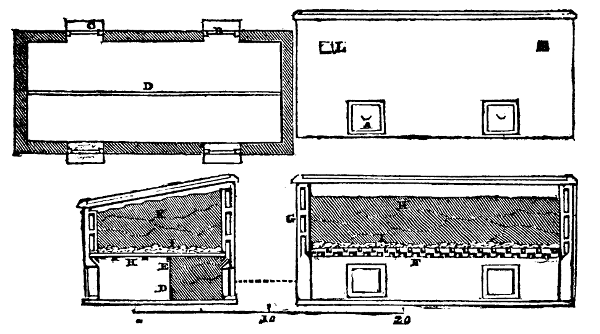
The Pine Apple plant, as already observed,
seems to have been first introduced by Mr. Bentick,
afterwards re-introduced from Holland in
1719, and then first cultivated for its fruit in Sir
Matthew Decker’s garden at Richmond. Here,
according to Professor Bradley, the gardener, “Mr.
Henry Telende, imitated so successfully M. Le
Cour’s newly discovered method of cultivating this
delicious fruit, that he is likely to ripen forty of
them in the present (1724) autumn.” (Husb. and
Gard. for June 1724, p. 161.) He elsewhere tells
us that “the late instance of bringing the Ananas
or Pine Apple to perfection in England, by the ingenuity
of Mr. Telende at Sir Matthew Decker’s,
has so far gained upon the curious, that already
many of our nobility have undertaken the same improvement;
and ’tis not to be doubted but a year
or two more will make this undertaking much more
general.” He mentions “their being brought to extraordinary
perfection at the garden of the right
honourable Spencer Compton, Speaker of the
House of Commons, at Chiswick; and at that
curious gentleman’s, Mr. John Warner, Rotherhithe.”
He informs us that an excellent stove on a
new plan, with a bark pit, was built by William
Parker, Esq. near Croydon, in Surry, to make
“experiments in ripening fruits that has not been
tried;” and that Mr. Fairchild, in 1722, built one
at Hoxton for Pine Apples and other tender plants,
in which the fire flues were raised above the surface
of the floor, by which means all danger from damps
was avoided. Mr. Cowel, as before observed,
(p. 4.) states that in 1730 Pine Apple stoves were
to be found in almost every curious garden. Mr.
Telende’s mode of cultivating the Pine Apple is
detailed by Professor Bradley in 1724, and the
most generally approved mode of culture from that
time to the middle of the eighteenth century may
be considered as given by Miller in his Dictionary.
The improvements which have since been made by
practical gardeners, may be ranged under the heads
of Justice, Speechly, Abercrombie, M’Phail, Nicol,
Griffin, Baldwin, Andrews, Oldacre, Gunter,
Grange, and Aiton. To each of these names we
shall devote a section; and under each, consider in
succession, the form of house, soil, general treatment,
insects, and fruit produced.
Form of House. For the education and ripening
of this fruit, Mr. Telende employed a frame made of
deal, closely jointed: the length eleven feet, divided
equally into four lights; the width seven feet and
a half; three feet high at the back, and about ten
inches in front. The pit was somewhat more than
five feet deep in the ground; the sides were lined
with brick, and the bottom covered with pebbles.
The stove or fruiting-house used was that with
iron plates over the flues; which, for greater warmth,
was covered thick with thatch, and the glasses were
well guarded with shutters; and that the fire might
be constant, he burnt only such turf as is commonly
used in Holland, agreeable to M. Le Cour’s
method.
General Management. About the middle of
February, he “puts in as much hot dung or horse-litter
as will raise the bed about a foot high, and
then lays on the tanner’s bark as equally as possible,
till the case of brick-work is filled, beating down the
tan gently with a prong, or pressing it down easily
with a board. A bed of this kind will take up three
hundred bushels of tan, and if it be well made, will
heat in about fifteen days, provided the frame and
glasses are set over it. When the bed breathes a
right heat, which we are to judge of by a thermometer,
the plants are brought from the stove to it,
either to have their pots quite plunged into the
bark; or, if upon opening the holes for them, the
bark be found too hot, then to be set in only half
way, laying a few pebbles under the bottom of each
pot, that the water may pass freely through them.
Care must be taken not to remove the pots in frost
or snow; and to examine the bed from time to time,
whether the bark grows mouldy, musty, or dry,
which it will often do in the summer: in such case,
it must be watered to recover its heat. A bed thus prepared
and managed will maintain a constant degree
of heat, sufficient to give these plants the utmost
vigour they require, from the end of February to the
end of October; and then the plants must be again
removed into the stove or conservatory. In excessive
heats the glasses are tilted up at the back of
the frame; and when the evenings are cool, the
bed must be carefully covered with substantial mattresses
of straw. A bed of this kind sinks about a
foot, which is convenient; for otherwise the plants
would be too tall for the frame, before the time of
housing them.
“The thermometer used by Mr. Telende had a
tube twenty-four inches long, and one-eighth of an
inch in diameter. When the spirit rose only to
fifteen inches, he accounted the air cold for his plants;
at sixteen and a half temperate; at eighteen warm,
which was his standard for Pine Apple heat; at
twenty inches, hot air; and at twenty-one inches,
sultry.”
Insects. Nothing is said on this subject.
Fruit produced. Mr. Cowel says (Curious and
Profitable Gardener, p. 27.) that all gentlemen who
had eaten Pines abroad allowed those raised by Mr.
Telende to be as good and as large as they found
in the West Indies. Bradley says, forty Pines were
likely to ripen in the autumn of 1724.
Form of House. It was formerly the practice,
Miller observes, to build dry stoves, in which the
plants were kept in winter, placed on scaffolds,
after the manner in which orange-trees are placed
in a green-house; and in summer, in hot-beds of
tanners’ bark, under frames. But it is now the
practice, he adds, to erect low stoves, called the
succession-house, with pits therein for the hot-bed.
It is also necessary to have a bark-pit under a deep
frame, for bringing forward the suckers and crowns
to supply the succession-house.
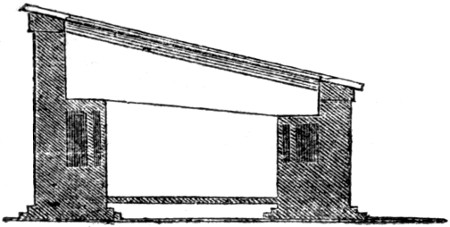
Mr. Miller’s fruiting-house has upright glasses in
front, high enough to admit a person to walk upright
on the walk in front of the house. Over the
upright glasses there must be a range of sloping
glasses, “which must run to join the roof, which
should come so far from the back wall as to cover
the flues and the walk behind the tan-pit; for if the
sloping glasses are of length sufficient to reach
nearly over the bed, the plants will require no more
light: therefore these glasses should not be longer
than is absolutely necessary, that they may be the
more manageable.”
The difference between this stove and that of
Speechly is, that in the latter the sloping sashes
reach to the back wall, by which means, instead of
a useless opaque roof over the path, an excellent
place is formed for training a vine; and this being
at all times the hottest part of the house, such vines
as are there trained will produce very early and
high-flavoured fruit.
The succession-house of Miller has no upright
glass, and only a walk at the back of the house:
the bark-pit may be partly sunk in the ground, if
the situation be dry; or if wet, kept above it.
The flue makes three returns against the back wall,
beginning from the level of the walk. Many persons,
he says, have made tan-beds, with two flues
running through the back wall, and covered with
glasses, like common hot-beds; but, besides the inconvenience
of taking off the glasses when the
plants want water, the damps rise in winter when
the glasses are closely shut, and there is danger of
the tan taking fire.
The improvement on this plan consists in detaching
the flue from the back wall, and separating
it from the tan by a vacuity of two or three inches;
or, what is still better, placing the flue in front
similarly detached, and surrounded by air on all
sides.
4
Soil. “As to the earth in which Pines should be
planted, if you have a rich good kitchen-garden mould,
not too heavy, so as to detain the moisture too long,
nor over light and sandy, it will be very proper for
them without any mixture: but where this is wanting,
you should procure some fresh earth from a
good pasture, which should be mixed with about
a third part of rotten neats’ dung, or the dung of an
old melon or cucumber bed, which is well consumed.
These should be mixed six or eight months
at least before they are used, but if it be a year, it
will be the better; and should be often turned, that
their parts may be the better united, as also the
clods well broken. This earth should not be
screened very fine, but only cleared of the great
stones. You should always avoid mixing any sand
with the earth, unless it be extremely stiff, and then
it will be necessary to have it mixed at least six
months or a year before it is used: and it must be
frequently turned, that the sand may be incorporated
in the earth, so as to divide its parts; but you
should not put more than a sixth part of sand, for
too much is very injurious to these plants.
General Management. “There are some persons
who frequently shift these plants from pot to pot;
but this is by no means to be practised by those who
propose to have large well-flavoured fruit: for unless
the pots be filled with the roots by the time
the plants begin to show their fruit, they commonly
produce small fruit, which have generally large
crowns on them; therefore the plants will not require
to be potted oftener than twice in a season.
The first time should be about the end of April, when
the suckers and crowns of the former year’s fruit
(which remained all the winter in those pots in
which they were first planted) should be shifted
into larger pots. The second time for shifting them
is in the beginning of August, when you should
shift those plants which are of a proper size for
fruiting the following spring. At each of these
times of shifting the plants, the bark-bed should be
stirred up, and some new bark added, to raise the
bed up to the height it was at first made; and when
the pots are plunged again into the bark-bed, the
plants should be watered gently all over their
leaves, to wash off the filth, and to settle the earth
to the roots of the plants. If the bark-bed be well
stirred, and a quantity of good fresh bark added
to the bed, at this latter shifting, it will be of great
service to the plants; and they may remain in the
same tan until the beginning of November, or
sometimes later, according to the mildness of the
season.
“In the summer season, when the weather is warm,
the plants must be frequently watered; but you
should not give them large quantities at a time:
you must also be very careful that the moisture is
not detained in the pots by the holes being stopped,
for that will soon destroy the plants. In very warm
weather they should be watered twice or three times
a week; but in a cool season, once a week will be
often enough; and during the summer season, you
should once a week water them gently all over
their leaves, which will wash the filth from off them,
and thereby greatly promote the growth of the
plants. During the winter season, these plants will
not require to be watered oftener than once a week,
according as you find the earth in the pots to dry:
nor should you give them too much at each time;
for it is much better to give them a little water
often than to over-water them, especially at this
season.”
Insects. After describing the white scale or
mealy pine-bug (coccus hesperidum, L.) he says,
“wherever these insects appear on the plants, the
safest method will be to take the plants out of the
pots, and clear the earth from the roots; then prepare
a large tub, which should be filled with water,
in which there has been a strong infusion of tobacco-stalks;
into this tub you should put the plants,
placing some sticks across the tub, to keep the
plants immersed in water. In this water they
should remain twenty-four hours; then take them
out, and with a sponge wash off all the insects from
the leaves and roots, which may be easily effected
when the insects are killed by the infusion; then cut
off all the small fibres of the roots, and dip the plants
into a tub of fair water, washing them therein.
Then you should pot them in fresh earth, and having
stirred up the bark-bed, and added some new
tan to give a fresh heat to the bed, the pots should
be plunged again, observing to water them all over
the leaves (as was before directed), and this should
be repeated once a week during the summer season;
for I observe these insects always multiply much
faster where the plants are kept dry, than in such
places where the plants are sometimes sprinkled
over with water, and kept in a growing state.
And the same is also observed in America; for it is
in long droughts that the insects make such destruction
in the sugar-canes. And in those islands,
where they have had several very dry seasons, they
have increased to such a degree as to destroy the
greatest part of the canes in the islands, rendering
them not only unfit for sugar, but poison the juice
of the plant, so as to disqualify it for making rum;
whereby many planters have been ruined.
“As these insects are frequently brought over
from America on the ananas plants, those persons
who procure their plants from thence should look
carefully over them when they receive them, to see
they have none of these insects on them; for if they
have, they will soon be propagated over all the
plants in the stove where these are placed: therefore,
whenever they are observed, the plants should
be soaked (as was before directed) before they are
planted into pots.”
Fruit produced. Miller finds suckers and crowns,
if equal in size and strength, fruit equally soon;
and has seen as good fruit produced from plants
received from the West Indies, as from any he has
seen, and some three times larger than any he saw
in M. Le Cour’s garden.
This gentleman was one of the greatest amateurs
of gardening of his time, and a most successful
cultivator of every thing he attempted. He had a
fine garden at Crichton, near Edinburgh, and corresponded
with various foreign horticulturists of
Holland and Italy, as well as with Miller, Bradley,
and other eminent English gardeners of his time.
5
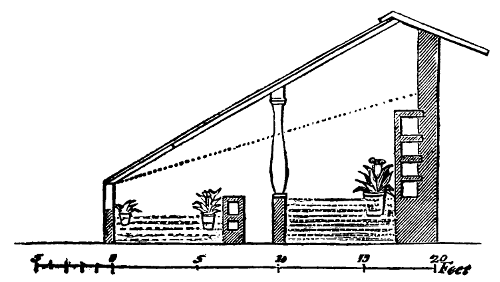
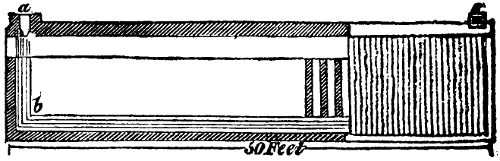
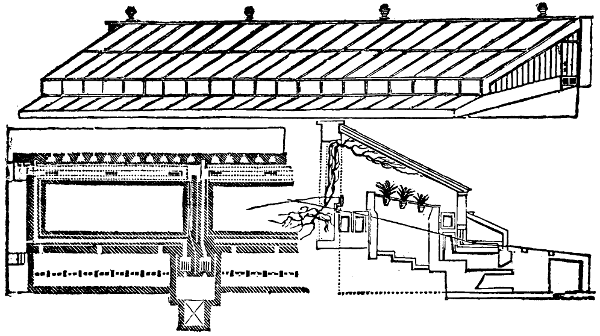
Form of House. Justice, writing in 1754, says,
“There have of late years been erected in England
and Scotland, many sorts of stoves for the culture
of the Pine Apple; but I am sure, after many experiments,
that the plan here annexed is the best.
In this stove, (fig. 5.) with one fire, I can do the
business of two stoves, which must have two fires,
and cultivate the old as well as the young plants.”
The front and ends of this house are of glass, as well
as the roof; the flue enters from behind at one end,
passes along the middle of the house, returns
on itself, and then makes four returns in the
back wall. The path-way enters from behind, at
the end opposite to that at which the flue enters;
proceeds to the middle of the house, along the
middle, till it meets the flue at the opposite; and
then it turns round till it meets the flue against the
back wall, close by the furnace. By this arrangement
of the walk, no interruption is given to the
flue; which is of great consequence, where it has so
many returns to perform. A furnace invented by
Mr. James Scot, of Turnham Green, a commercial
Pine-grower of those days, is recommended. It is
cast in one piece, and requires a wrought-iron door
and a cast-iron plate to build over the chamber.
Justice agrees with Miller in recommending the
furnace to be built within the house, (but supplied
from without) in order that no heat may be lost.
The plan given requires no succession-house;
but he describes a frame used by many persons for
growing young Pines, “made in the same manner as
common hot-bed frames, but higher and broader;
that is, three feet higher at the back, sloping to one
and a half in front, and six feet wide.” These cover
a tan-pit causewayed at bottom, and surrounded
by a stone wall. It is very proper, he says, to have
these frames at work as well as the stoves. He
also mentions flued pits, such as are described by
Miller (Sect. 2.) Both stoves and pits he covers
with boards, tarpauling, or mats, at night; and
the fuel he uses is coal or peat, avoiding wood as
of too rapid consumption.
Soil. Two-thirds of good loamy kitchen-garden
mould, one-third of old rotten cows’ dung, or hot-bed
dung, and to every eight barrowfuls of this a
barrowful of sea-sand. He adds, “If your ground
is naturally sandy, after having mixed it with the
dung above mentioned, add thereto a third of
good fat marl; which succeeded so well with me,
that in this compost I had much larger fruit than in
any other compound which I used to give them,
which induced me to put, at all times, a good deal
of marl in the compost I used for these plants.”
This mixture should lie for six months in those
parts of the garden which are airy and least exposed
to the sun; after the first three months, turn
it over every fortnight. Scots Gardeners’ Directory,
2d edit. p. 124.
General management. The same as is given by
Miller. He tried some plants turned out of the
pots with their balls, and planted in the bark for the
last nine months before the fruit ripened, and found
the fruit larger and earlier, but not better flavoured
than that of the plants in pots. In shifting, he
never cuts off any of the leaves; “for it is certain,”
he adds, “that the leaves of all plants and trees bear
the same office to them, as the pulmonary vessels
do to human bodies.” He waters over the leaves
when the plants have shewn fruit; because the fruit
stalks, occupying what in young plants was a hollow
tube, no injury can happen. P. 129.
Insects. At the first appearance of the bug, he
picks off the scale with a pin; and if that does not
clean the leaves, he washes with a sponge; and, in
extreme cases, uses Miller’s mode.
Fruit produced. The object of all his directions
is, “to have fruit large, good, and early, in a right
season; viz. from the middle of June to the middle
of September, but no later; for the rays of the
sun, at that time, have not strength enough to give
them that poignancy of smell and taste that they
ought to have.” P. 134. “Cut fruit when their
smell is strongest and most poignant; if too ripe,
they soon turn insipidly sweet, and have no more
taste than an orange. Cut them about ten o’clock
in the forenoon, with about four inches of stalk to
them. When the fruit is to be sent to a distance,
cut a day or more before they are ripe, with a
larger portion of stalk to them, and wrap them
very close in paper, to preserve them from the air;
otherwise their flavour will escape.” P. 132.
This author, who was gardener to Lady Boyd,
and afterwards foreman in the Lewisham nursery,
says, he writes after many years’ practice and observation;
and that his treatise will be found “of
more real advantage to a young unexperienced
gardener, than his giving a premium of five or
ten guineas to a mercenary old one (who perhaps
might have had some practice, with a trifling degree
of success,) to learn—what? why, to spoil his
plants, with the loss of both money and reputation.”
“Notwithstanding the directions of Miller, Hill,
(probably alluding to a letter on the Pine Apple
in “Gardener’s New Calendar,” written by Sir
John Hill, under his assumed name of Barnes,)
Meader, &c. who have endeavoured to explore the
method how the Pine Apple is to be grown; yet,
upon trial, the success has always fallen much
short of their expectation. For these reasons, Mr.
Giles “presents the public with explicit directions
for managing and bringing to perfection the Pine
Apple; in which all the obstacles and difficulties
which gardeners have met with in raising that fruit
are remedied, and the true method pointed out in
a clear and satisfactory manner.” Preface, p. vii.
Form of House. The plants are brought forward
in pits, and afterwards fruited in a stove forty feet
long and twelve feet wide, with a pit six feet wide,
surrounded by a path, and a flue which makes three
returns in a flue close under the back wall. The
front of the pit is about three, and the back about
five feet from the glass. It will fruit, he says, a
hundred plants annually, they being brought forward
in the low pits or frames, and removed to the
fruiting-house in September or October.
The obvious objection to the plan of his house is
the having no flue in front.
Soil. A rich hazely loam from a well-pastured
common. This soil alone, he says, not only answers
well for Pines, but for most vegetables.
General Management. He recommends keeping
a moist atmosphere in the house, and giving abundance
of air when the plants are in fruit. His
other directions relate to mere routine practices,
and offer nothing else worth quoting.
Insects. A moist atmosphere, he says, will keep
down these. “It is only poor plants,” he says,
“which are not in a good state of health, that
are infested with insects. They are encouraged
by the warmth and dryness of the air of the stove,
and the bad state of the plants; but where cleanliness
and moisture are attended to, there will never
be any worth notice.” P. 36.
Fruit produced. He fruits the Queen Pine in
two years, at the usual season; but does not state
to what size the fruit attains.
This author, who was gardener to J. Sutton,
Esq. at New Park, professes “to lay down a
mode by which the Pine Apple may be produced
in higher perfection, with more ease and less expense
than has been hitherto known in this climate.”
He offers his treatise with confidence, as
not being founded on hypothesis, but on some
years’ experience; and it may be depended on, as
“it admits of the attestation of many persons
whose taste and judgment are unquestionable.”
“The present way,” he says, “of raising Pine
Apples, is made so chargeable by the erection of
hot-houses, and the consumption of fuel, that many,
even of tolerable fortunes, have been deterred by
the consideration of it, from raising this desirable
fruit. It is farther attended with trouble, and much
uncertainty; and the fruit itself rarely answers the
expense either in size, number, or quality. But by
the practice now recommended, these several inconveniences
are sufficiently obviated. There are
very few, even of commercial gardeners, who are
not able to accumulate the necessary quantity
of horse-dung, which is the principal article for
this valuable end. And by such application of it,
they shall not fail to find their hopes abundantly
answered, and their labour well repaid.” P. 3.
Form of House. He both rears and fruits them
in a pit. This he forms either of boards, or of
brick-work three feet deep, and of any convenient
length and width; and on the walls or boards,
which inclose the tan, he places a frame two and a half
feet deep in front, and four feet high behind. The
ends and front are of glass, and the latter is formed
into small sashes, which slide in a groove. The
back is formed of inch boards, and against these he
places a powerful lining of dung.
The pit he fills with tan, or dung, as may be
most convenient; dung, he says, does as well as tan,
and only requires a little more trouble, which is
amply repaid to the gardener by the value of the
dung to the garden, when no longer in active fermentation.
An anonymous annotator (to the copy of
Taylor’s book, in the library of the Horticultural
Society) says, “I find by experience, that the
dung of four horses is sufficient to work two
frames twenty-six feet each in length, and six in
breadth; one for the fruiting-house, the other for
succession plants; and that it may be reasonably
expected to cut forty fruit yearly after the first
year, and the dung as valuable for the field or garden,
as if this use had not been made of it.” P. 3.
Soil. “Take one load of mould from under the
turf of a good pasture, and, if it be very light, add
to it the fourth part of a load of good mellow loam:
but if it be of itself of a loamy nature, mix into
it two or three bushels of sea-sand. Then take the
fourth part of a load of dung from a cow-yard, if
it can be thence procured; but if not, take the
same quantity of good rotten dung from your old
cucumber or melon beds. Mix these well together,
and turn the whole three or four times, that
it may thoroughly imbibe the air. All the large
clods should be well broken, but not sifted or
screened, as is the practice with many; so shall
you have a compost, which is excellently adapted
to the growth and nourishment of the plants.”
P. 15.
General Management. He takes great care to
keep his plants in a dormant state during winter;
but about the end of March and April, he applies
linings, and brings them into a growing state,
shifting all those not intended for fruiting that season.
He covers the frames at night throughout
the year with straw, and a sail-cloth over, excepting
in the warmest part of summer; at that season,
during fine showers, he removes the sashes entirely,
and lets the plants receive a gentle watering.
He frequently waters over the leaves in the afternoons
with a pot having a fine rose, and shuts up
early; which he finds produces a moist heat, rapid
growth, and keeps down insects. In winter he uses
a tin pipe, to keep the water from touching the
leaves of the plants; and as he has a very low temperature
at that season, he gives them very little.
Insects. These he is not much troubled with; but
he says, “Such plants as are attacked by them,
should be immediately taken out of the frame, and
plunged into a moderate hot-bed made of dung;
this hot-bed should be covered with one or two
cucumber-frames, adapted to the height of the
plants. Let these frames be covered with lights;
so as to confine the steam of the dung. As soon as
the plants receive the heat of this bed, water them
all over the tops of the leaves with cold water.
This will effectually destroy the insects; after which
the plants are to be restored to the covered frame
again. A trial or two of this will convince any
person of the infallible efficacy of it.” P. 38.
It thus appears that he destroys them by the
operation of the ammoniacal gas, much in the same
manner as does Mr. Baldwin.
Fruit produced. He says nothing of the weight
of the fruit, but he calculates on fruiting the
plants in two years, and ripening the fruit only in
summer and autumn, or between July and October
inclusive; and he prefers the Queen Pine to all
others.
The culture of the Pine, Mr. Speechly observes,
has already been treated of by many persons, who
have varied much in the methods they have recommended.
Far from meaning to depreciate their labours,
he adds, “my advice and pretensions rest
solely upon the success which I have met with in
my experiments.” He went to serve the Duke of
Portland in 1767, and published his book after
eleven years’ experience. He continued at Welbeck
till about the year 1800.
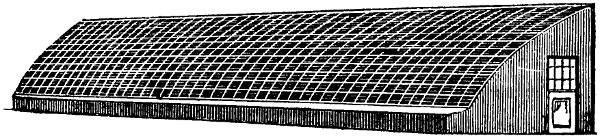
Form of House. The great object of Mr.
Speechly seems to have been to combine the culture
of the Pine and Vine; and for this purpose he
adopted one form both for his succession and fruiting-house;
training Vines up the rafters, and on
the upper part of the back wall.
6
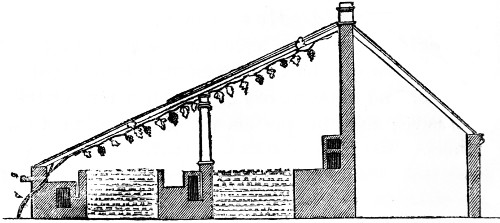
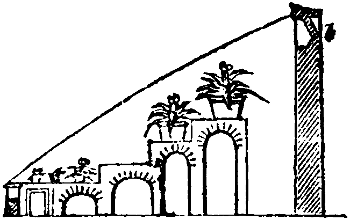
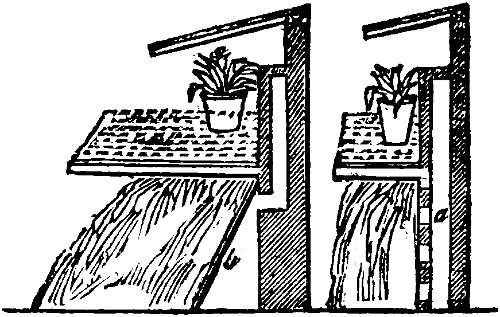
In many places small stoves of a particular construction
(in the which the Pines stand very near the
glass) are erected solely for the purpose of Fruiting-houses.
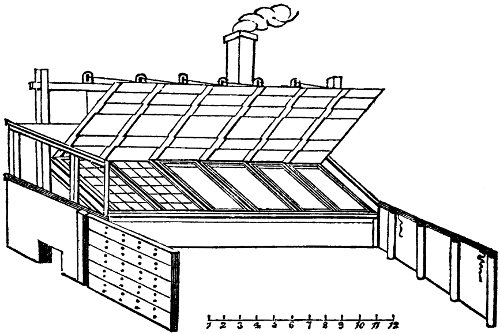
These, from their being always kept
up to a high degree of heat, are by gardeners
usually termed Roasters. (fig. 7.) When there
is such conveniency, it is customary, when
any Pine-plants show fruit in the large stoves, to
remove such plants (especially the most promising)
directly into the fruiting-house; where, from the
high degree of heat kept, they generally swell their
fruit astonishingly.
It is observable that Pines always succeed best
in stoves that have been newly erected; on which
account, some of the more curious in the cultivation
of this fruit have judged it expedient to pull down
and rebuild their Pine-stoves every ten or twelve
years. Although I cannot subscribe to such expensive
mode of procedure, I shall here beg to state
the many advantages that accrue from keeping
Pine-stoves in good and proper repair.
First, by keeping the flues clean from soot, and
air-proof, they will heat the house better, and much
less fuel will serve.
Secondly, by a due attention to keeping the inside
of the roof, &c. duly painted, and by constantly
white-washing the walls and flues in every
part of the house, the plants will be greatly benefited,
both from having a better reflection and from
cleanliness.
A further advantage in stoves newly built may
also here be remarked. Where tan only is used,
the beds are always filled at the first with new tan
entire; but afterwards, constantly with new and
old tan intermixt.
Lastly, it is probable that stoves, newly erected,
derive their greatest benefit from the good condition
of the glass-work; for, however well it may
be kept in repair afterwards, it is certain that there
never is so much light in an old stove as was at
the first. Dirt will find its way into the cavities
between the squares, &c. which, obstructing the sun’s
rays, darkens and gives a gloominess to the stove.
7
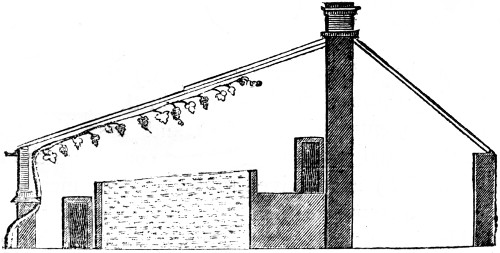
He describes a Pine-stove to be heated by steam,
in which the vapour is admitted to a brick vault,
over which is the bed of tan or earth; this is surrounded
by a path and smoke-flues, exactly as in
the common form of hot-house.
He also gives a plan of a furnace for burning
lime as well as heating hot-houses, as erected at
Billing, in Northamptonshire, and at Lady E.
Ponsonby’s, at Bishop’s Court, in Ireland; and,
subsequently, at various other places in that country.
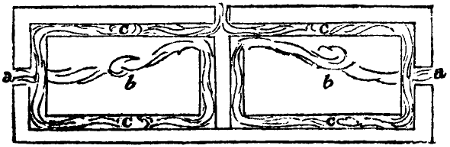
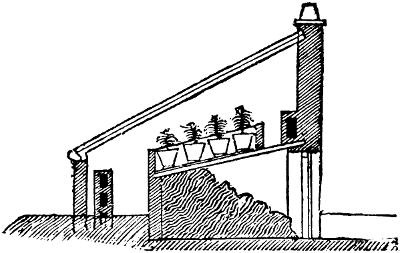
8
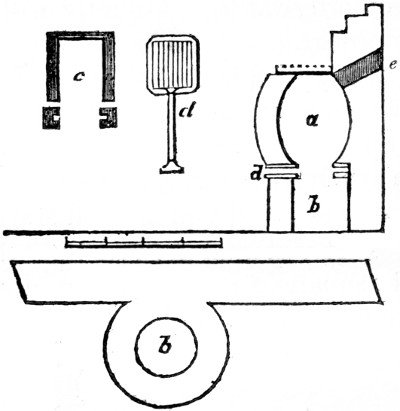
In these kiln-furnaces, (fig. 8.) the heat, after
passing through the limestone in the kiln or crucible
(a), enters the flue (e), and passes through it
in the usual manner. The grate on which the fuel
burns (d) is contrived to draw out by means of a
grooved frame (c), as soon as the lime in the crucible
is burned, which then falls into the ash-pit
(b), and is removed.
Soil. Alter numerous experiments made with
mixtures, of cow, deer, sheep, pigeon, hen, and
rotten stable dung, with soot, and other manures,
in various proportions, with fresh pasture-soil of
different qualities, he says, I can venture to recommend
the following:
In the month of April or May, let the sward or
turf of a pasture, where the soil is a strong rich
loam, and of a reddish colour, be pared off, not
more than two inches thick: let it then be carried
to the pens in sheep-pastures, where sheep are frequently
put for the purpose of dressing, which
places should be cleared of stones, &c. and made
smooth; then let the turf be laid, with the grass-side
downwards, and only one course thick; here
it may continue two, three, or more months, during
which time it should be turned with a spade once
or twice, according as the pen is more or less frequented
by the above animals; who, with their
urine and dung, will enrich the turf to a great degree,
and their feet will reduce it, and prevent any
weeds from growing.
After the turf has lain a sufficient time, it
should be brought to a convenient place, and laid
in a heap for at least six months, (if a twelvemonth
it will be the better,) being frequently turned
during that time; and after being made pretty fine
with a spade, but not screened, it will be fit for
use.
In places where the above mode cannot be
adopted, the mixture may be made by putting a
quantity of sheep’s dung (or deer’s dung, if it can
be got) and turf together. But here it must be
observed, that the dung should be collected from
the pastures when newly fallen; also, that a larger
proportion should be added, making an allowance
for the want of urine.
1. Three wheelbarrows of the above reduced
sward or soil; one barrow of vegetable mould
from decayed oak-leaves, or leaves of other deciduous
trees, and half a barrow of coarse sand,
make a compost-mould for Crowns, Suckers, and
Young Plants.
2. Three wheelbarrows of swarth, reduced as
above, two barrows of vegetable mould, one barrow
of coarse sand, and one-fourth of a barrow of soot,
make a compost-mould for fruiting plants.
The above composts should be made some months
before they are wanted, and very frequently turned
during that time, that the different mixtures may
get well and uniformly incorporated.
It is observable, that in hot-houses, where Pine-plants
are put in a light soil, the young plants frequently
go into fruit the first season, and are then
what gardeners term runners; on the contrary,
where plants are put in a strong rich soil, they will
continue to grow, and not fruit even at a proper
season: therefore, from the nature of the soil from
whence the sward was taken, the quantity of sand
used must be proportioned; when the loam is not
strong, sand will be unnecessary in the compost
for young plants.
I conceive that the urine of sheep contains a
greater quantity of mucilage, or oleaginous matter,
than the dung of those animals: and this opinion
is founded upon observations made in sheep-pastures;
where, during the summer months, the effects
of both are easily distinguished. I also presume
that the reduced sward in the pens receives a very
considerable degree of fertility from the feet of the
sheep.
Where oak-leaves are not used in hot-houses instead
of bark, the vegetable-mould may be made
by laying a quantity of them together, in a heap
sufficiently large to ferment, as soon as they fall
from the trees: they should be covered for some
time at first, to prevent the upper leaves from being
blown away. The heap should afterwards be frequently
turned, and kept clean from weeds: the
leaves will be two years before they are sufficiently
reduced to be fit for use.
I shall just observe, that it will be proper to keep
the different heaps of compost at all times clean
from weeds, to turn them frequently, and to round
them up in long rainy seasons. If covered, the
better: but they should be spread abroad in continued
frosts, and in fine weather.
General Management. The pots he recommends
are:
| |
Inches diameter
at the top. |
Inches deep. |
| 1. Pots for full-sized crowns and suckers |
6 |
|
5 |
1⁄2 |
| 2. Pots for plants
to fruit the following season when shifted in March |
8 |
1⁄2 |
7 |
|
| 3. Pots for fruiting plants |
11 |
1⁄2 |
10 |
|
I wish it to be understood that the above dimensions
are only used for full-sized plants, at their different
periods: plants below the standard must
have less-sized pots in proportion.
Sometimes, he observes, hot-beds are made
for the suckers. When that is the case, they
should be prepared at least fourteen days before
the suckers are taken off, in order that the violence
of the heat may be over: after the bed has
been made ten days, it should be levelled, and
covered eight or ten inches with tan; and after
this has lain four or five days, in case the heat of
the bed should not be violent, the pots may be
plunged into it.
In respect of temperature and water, he advises
only a moderate heat, and not much water, during
the winter months; but an increase of both, accompanied
with more air, as the season advances.
There is nothing, he says, so prejudicial to
the Pine-apple plant, (insects and an over-heat of
the tan excepted,) as forcing them to grow by
making large fires, and keeping the hot-house warm
at an improper season; which is injudiciously done
in many hot-houses. It is inconsistent with reason,
and against nature, to force a tropical plant in
this climate in a cold dark season, such as generally
happens here in the months of November and
December; and plants so treated will in time show
the injury done them: if large plants for fruiting,
they generally show very small fruit-buds with weak
stems; and, if small plants, they seldom make
much progress in the beginning of the next summer.
As the length of the days, and power of the sun
increases, the plants will begin to grow, and from
that time it will be absolutely necessary to keep
them in a regular growing state; for if young
plants receive a check afterwards, it generally
causes many of them to go into fruit. From the
time they begin to grow they will demand a little
water: once in a week or ten days, as the weather
may prove more or less favourable, will be sufficient
till the middle of March, which is the most
eligible season to shift them in their pots. If that
work is done sooner, it will prevent the plants from
striking freely; and if deferred longer, it will check
them in their summer’s growth.
In this shifting I always shake off the whole of
the ball of earth, and cut off all the roots that are
of a black colour, carefully preserving such only as
are white and strong. I then put such plants as
are intended to fruit the next season into second-sized
pots with fresh mould entire.
The bed at this time should be renewed with a
little fresh tan, in order to promote its heating, and
the pots plunged therein immediately. The hot-house
should be kept pretty warm till the heat of
the tan begins to arise, as it will be the means of
causing the plants to strike both sooner and
stronger. As soon as the heat of the bed begins
to arise, it will be proper to give the plants a
sprinkling of water over their leaves; and as soon
as they are perceived to grow, they will require a
little water once a week for a short time, and afterwards
twice a week till the next time of shifting
them in their pots.
During the summer months give the plants
plenty of air whenever the weather is warm, and
water properly, as has been described: let the pots
be kept in a regular constant heat, and clean from
weeds; but above all, avoid an over-heat of the
tan. Some persons plunge a thermometer in the
tan, with the ball of its tube as deep as the bottom
of the Pine-pots; and by repeated observations, a
point is fixed for the spirits in the part of the tube
above the surface of the tan, to show when the
pots should be raised. Whether the above, or the
putting watch-sticks in the tan (which is the most
common method) is practised, too much attention
cannot be had whenever there is the appearance
of too violent a heat in the tan.
If the above directions are strictly attended to,
the plants will be grown to a large size by the beginning
of August; when they should be shifted
into the largest-sized fruiting-pots, with their roots
and balls entire.
But it will be proper here to observe, that in some
hot-houses it is found difficult to get plants of the
Antigua and Sugar-loaf kinds to fruit at a proper
age; and, in that case, I advise the shaving off the
roots on the outside, and reducing the balls of
them at this shifting. A greater proportion of sand
should also be added to the compost, which will
be the means of bringing them into a fruiting state
at a proper season.
The disproportion of the second-sized and fruiting-pots
is so great, as to admit of a good quantity
of fresh mould at this shifting, which is absolutely
necessary to support the plants till their fruit becomes
ripe: it also affords an opportunity of performing
the operation of shifting the plants without
injuring their roots. As there will be a large
space between the ball and the side of the pot, the
mould may be put round the ball with great ease;
whereas, when plants are shifted into pots only a
small size larger than those from whence they were
taken, they are generally much injured by the operation
of shifting: besides, even with the greatest
care, there will frequently be spaces left hollow
between the ball and the side of the pot.
A little fresh tan should be added, and the bed
forked up, but not to the bottom of the pit, as the
tan is liable to heat violently at this season of the
year; of which when there is the least appearance,
the pots should be raised immediately. The delay
of doing it one day may be attended with very bad
consequences.
The plants will continue to grow very fast this
and the following month, and should therefore be
watered pretty plentifully, at least twice a week;
and, in the summer waterings, it should be observed,
that it will be of great service to the plants
to be watered once a fortnight all over their leaves.
If the month of October be wet and cold, the
plants should not be watered above twice in that
month; but if fine and clear, once a week: and
here ends the watering of the fruiting plants for
the season. I never give them any water in the
months of November and December; and during
that time I keep the hot-house in a cold state, but
a bottom heat is always required; therefore the
tan should have been renewed, and the old part of
it screened about the end of October or beginning
of November: from which time the bed will generally
retain a moderate warmth till the beginning
of January, when the tan should again be renewed.
From that time the hot-house should be kept a few
degrees warmer; and, as soon as the tan begins to
ferment, the plants may have a little water given
them.
In this month (January) some of the plants will
appear set for fruiting, which may be distinguished
by the short leaves in their centres; and from
that time they should be moderately watered (till
the middle of March) and the hot-house should
be kept pretty warm; a little air should, however,
be admitted, whenever the weather will permit.
About the middle of March it will be proper
to renew the tan-bed, and, at the same time, the
plants should be divested of a few of their bottom
leaves; the mould on the top of the pots should
be taken off as deep as can be done without injuring
the roots, and the pots filled up with fresh
compost-earth, which will add to the vigour of the
plants, as well as give a neatness to the whole when
finished.
It is very injurious to the plants, and greatly
retards the swelling of the fruit, to remove them
after this season; therefore, in case the heat of the
bed should decline, a fresh heat may be got without
moving the plants, by taking out the tan betwixt
the pots as deep as possible, and filling that
space up with fresh tan.—This method is practised
by some even at an earlier season.
The plants at this season will demand a kind,
lively bottom heat; and whenever the weather will
permit, a great quantity of air should be admitted
into the hot-house, the want of a due proportion of
which would cause the stems of the fruit to draw
themselves weak, and grow tall; after which the
fruit never swells kindly.
As the fruit and suckers begin to advance in
size, the plants will require plenty of water to
support them, which may be given them at least
twice, and sometimes three times a week; but too
much should not be given them at one time; it is
better to give them less at a time, and oftener.
Sticks should be provided to support the fruit
before it is grown too large; and, in tying them,
care should be taken to leave bandage-room sufficient,
making allowance for the swelling of the
fruit.
When the suckers are grown to about one foot
in length, they should be taken off in the same
manner that has been described; and from that
time the fruit will swell very fast. As soon as the
fruit appears full swelled, the watering such plants
as produce them should cease: but it is too general
a practice (in order to have the fruit as large as
can be got) to continue the watering too long;
which causes the fruit to be filled with an insipid,
watery, and ill-flavoured juice.
It is easy to know when the Pine becomes ripe
by its yellow colour; yet they do not all change in
the same manner, but most generally begin at the
lower part of the fruit. Such fruit should not be
cut till the upper part also begins to change, which
sometimes will be many days after, especially in
the Sugar-loaf kinds. Sometimes the fruit will first
begin to change in the middle, which is a certain
indication of its being ripe: such fruit should be
cut immediately.
Having thus laid down the culture of the Pine-apple
plant, whether raised from seed, by crowns,
or suckers, to its final perfection in the fruit, I
shall now subjoin some hints and observations; most
of which, I hope, will be of use.
In treating of the culture of the Pine-apple
plant, some persons have recommended the shifting
of the plants, from first to last, with their balls
entire; also the shifting of them oftener than I
have here recommended. These methods I disapprove,
for the following reasons:
First, it is observable that the Pine-plant begins
to make its roots at the very bottom of the stem;
and, as the plant increases in size, fresh roots are
produced from the stem, still higher and higher,
and the bottom roots die in proportion: so that, if
a plant in the greatest vigour be turned out of its
pot as soon as the fruit is cut, there will be found
at the bottom a part of the stem, several inches in
length, naked, destitute of roots, and smooth. Now,
according to the above method, the whole of the
roots which the plant produces being permitted to
remain on the stem to the last, the old roots decay
and turn mouldy, to the great detriment of those
afterwards produced.
Secondly, the first ball, which remains with the
plant full two years, by length of time will become
hard, cloddy, and exhausted of its nourishment,
and must therefore prevent the roots afterwards
produced from growing with that freedom and
vigour which they would do in fresher and better
mould.
Thirdly, the old ball continually remaining after
the frequent shiftings, it will be too large, when
put into the fruiting-pot, to admit of a sufficient
quantity of fresh mould to support the plant till its
fruit becomes ripe, which is generally a whole year
from the last time of shifting.
It is an object of emulation amongst gardeners
to try to excel their neighbours in the size of their
Pines. In order to produce very large fruit, I recommend
the following method, which I have often
practised with great success.
In the month of April or May, it is easy to distinguish,
in a stove of Pines, which plants promise
to produce the best fruit: this is not always the
case with the largest. A few of the most promising
being marked, a small iron rod, made with a sharp
angular point, may be thrust down the centre of
the sucker; which, being turned two or three times
round, will drill out the centre, and prevent its
growing. This must be performed on all the suckers
as fast as they appear. Thus the plant being
plentifully supplied with water, and having nothing
to support but the fruit, will sometimes grow
amazingly large. But this method should not be
practised on too many plants, as it is attended with
the entire loss of all the suckers.
It being a practice with some to fruit the Pine
by setting the pot in water; while others produce
the fruit by setting the plant only in water, (in a
similar manner to what is often practised with Hyacinths
and other bulbous roots,) the passing over
these methods in silence may, by some, be deemed
an omission: but as neither of these methods can
be reduced to practice with any kind of success,
except on fruiting plants, and just in the hot summer
months, when the situation of the plant ought
to be very near to the glass, they do not seem calculated
for general practice.
However, as some persons are inclined to suppose
that Pines raised by these methods are generally
of superior quality, I shall just beg to say,
that the first method, of setting the pot in water,
is greatly to be preferred, and that the best time
for adopting it is immediately after the plants have
shown fruit in the spring.
Mr. Speechly is minute in his directions as to air,
water, the use of leaves instead of bark, the application
of fire, heat, &c.; but as all these instructions
are more to be considered as applicable to the
general management of the hot-house, than the
particular treatment of the Pine-apple, we do not
think it advisable to trouble the reader with their
perusal.
9
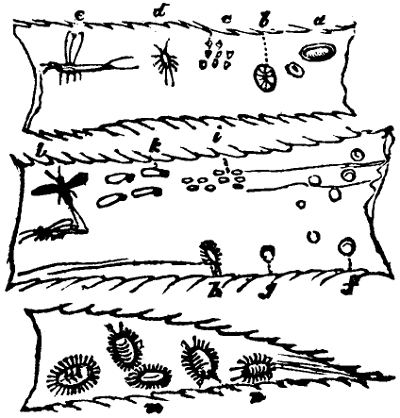
Insects. Those which more immediately infest
the Pine, were first described in Speechly’s book.
They are all species or varieties of the Linnean
order Hemiptera, and genus Coccus. The first is
the brown turtle bug, Coccus hesperidum (Fig. 9.)
The female has at first
the appearance of a flat
scale (a); afterwards,
when depositing its eggs,
it becomes fixed and turgid
(b); these eggs (c)
are hatched under the
mother, who soon afterwards
dies; the young
insects, seen under a
magnifier, appear like turtles
in miniature (d). Only the males, (e), which
are few in proportion to the females, have wings;
these devour nothing, and having performed the
office of impregnation, die.
The white scaly bug, C. hesp. var. α (f to l) bears
a considerable resemblance to the above; but the
scale (f) is somewhat smaller; the colour is white,
and the males or flies (l) not so large as those of the
brown.
The white mealy crimson-tinged bug, C. hesp. var. ϐ
(n and m) differs from the former in being larger
and crimson-coloured. Speechly considers it as
viviparous. This and the former species are much
the most pernicious.
Mr. Speechly’s mode of destroying these and
other insects, being much too elaborate for modern
practice, it would be a waste of time to repeat his
processes. Simple modes are always the most effectual,
and nothing can be more so than M’Phail’s
mode of applying the steam of water; or Baldwin’s,
that of horse-dung.
Fruit produced. Mr. Speechly does not seem
to have had a fixed object as to the production of
fruit, unless it was to have it good. Some cultivators,
as Justice, aim at having all the fruit ripe
at that season when they will attain the greatest size
and most flavour, viz. in August and September;
others aim at having some weekly throughout the
year. It would appear that the former was Speechly’s
object, and that he did not contemplate the other
as now generally practised. “Large fruiting
plants,” he says, “will sometimes show their fruit
in the months of August and September, but these
are generally thought of no value, and, consequently,
thrown away. To prevent this, I frequently take
such plants out of the hot-house as soon as their
fruit begin to appear. I then set them in a shed or
out-house for five or six weeks; at the expiration
of which time I pot them as in the month of March,
after shaking off their balls. After this I plunge
them into the tan.”
What was the common weight of the Queen
Pines produced at Welbeck, he does not inform us;
but a fruit of the New Providence, produced in
the gardens at Welbeck in 1794, weighed 51⁄4 lb., or
84 oz. He generally fruited the Queen Pine in the
third season, being under two years of time; and
the Providence and Antigua in the fourth season.
Mr. M’Phail, when in practice, was reckoned one
of the first growers of the Pine Apple in England;
he grew the plants, and also fruited them chiefly in
pits; the pots plunged in bark, and the bark inclosed
by a perforated wall of his invention, and heated
by linings of dung. He also grew them in larger
buildings.
Form of House. No great consequence is attached
to the construction of the house by this
gardener. Where Pines are to be grown in a hot-house
along with vines in Speechly’s manner, he
says, “I think a good method is to make it into
one or more divisions of about forty feet long, sixteen
feet wide;” the back wall thirteen feet, and
the front wall nine feet, the upper four feet being
composed of sliding sashes. The slope in the roof
will, by these dimensions, be four feet, or about
three inches to a foot. The pit is to be surrounded
by a path, which behind will be four feet higher
than in front, and, consequently, the end paths must
have steps. The fire-place being placed in the
back wall, and supplied from the shed behind, the
flue should be carried round about the inside,
stretching from the fire-place across the end and
along between the path and the front wall, leaving
a cavity of four or five inches wide between the
flue and the wall, to admit the heat to rise freely,
and to prevent the roots and stems of the vines
planted in the border against the front wall from
being too much heated. At that end of the division
farthest from the fire, after going across the
house under the back path, the flue must rise
above the path, and go along close against the
back wall communicating with the chimney, which
stands at the end corner of the wall just above
the fire-place. The flue from the fire-place along
the front wall to the opposite end of the house,
is to be made nearly three feet deep, seven inches
wide, and when it riseth above the back side
path against the back wall to the chimney, it
should be about three feet six inches deep of
brick, on edge two inches thick, besides the plastering,
and covered with inch thick tiles closely
joined with fine mortar to prevent the smoke from
getting into the house among the plants. The
mouths of the fire-places should be about sixteen
inches wide, twelve inches deep, and the doors and
their posts may be made of cast iron. The grates
should be thirty inches long, and their bars of uncast
iron made to take out at will. Some have
the fire-places wholly of cast iron, one or more
inches thick, in form of a square funnel about three
feet in length. This appears to be a good method,
because they keep in repair several years, whereas
the sides of the fire-places built of brick generally
require repairing yearly.
The tan-pit need not be deeper than three feet,
or three feet six inches; and the path which surrounds
it should not be narrower than twenty
inches; but two feet, or for the back pit two feet
and a half, will be better. The vines are introduced
under the sill of the front glasses, and trained up
the rafters; and Mr. M’Phail’s practice is not to
withdraw them in the winter season as is done by
other gardeners. The surface of the tan-bed should
not be nearer the glass than five or six feet. Two
houses, each forty feet in length, joined together,
can be kept warm with two fires, better than one
house of forty feet; but in cold, exposed situations,
he would recommend diminishing the length.
With respect to pits, M’Phail observes, “Succession
Pine plants grow exceedingly well in pits
covered with glazed frames, linings of warm dung
being applied to them in cold frosty weather. The
north wall of a pit for this purpose had best be only
about four feet above the ground; and if about two
feet high of it the whole length of the wall beginning
just at the surface of the ground four feet below
the height of the wall, be built in the form of
the outside walls of my cucumber bed, the lining
will warm the air in the pit more easily than if the
wall were built solid. The linings of dung should
not be lower in their foundation than the surface of
the tan in the pits in which the plants grow (for it
is not the tan that requires to be warmed, but the
air among the plants); and as during the winter
the heat of the air in the pit among the plants,
exclusive of sun heat, is not required to be greater
than from sixty to sixty-five degrees, strong linings
are not wanted: one against the north side, kept
up in cold weather nearly as high as the wall, will
be sufficient, unless the weather get very cold indeed,
in which case a lining on the south side may
be applied. In cold frosty weather a covering of
hay or of straw, or of fern, can be laid on the
glass above mats in the night-time.
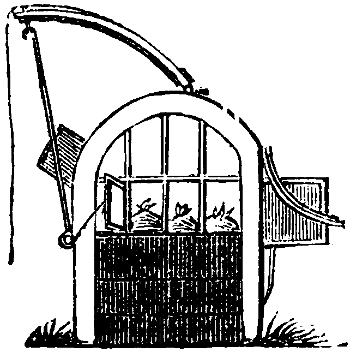
10
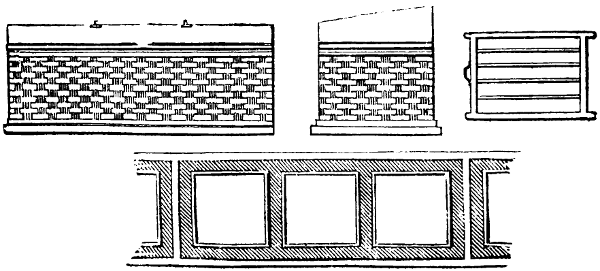
“The brick bed of my inventing, (fig. 10.) for forcing
early cucumbers, answers well for growing small
succession plants. A pit built on the same construction,
but of larger dimensions, without cross flues,
is a suitable one for growing Pine Apple plants of
any size; for by linings of dung the air in it can
be kept to a degree of heat sufficient to grow and
ripen the Pine Apple in summer, as well as it can
be done with fire heat, only it will require a little
more labour and plenty of dung.
Soil. “The Pine Apple plant will grow very well
in any sort of rich earth taken from a quarter of the
kitchen garden, or in fresh sandy loam taken from
a common, long pastured with sheep, &c. If the
earth be not of a rich sandy quality of darkish
colour, it should be mixed well with some perfectly
rotten dung and sand, and if a little vegetable mould
is put among it, it will do it good, and also a little
soot. Though Pine plants will grow in earth of
the strongest texture, yet I have found by experience
that they grow most freely in good sandy
loam not of a binding quality.
General management. “The method which I used
to cultivate the Pine Apple is the following: The
fruit being partly over, and a cucumber brick bed
prepared for unstruck crowns and suckers, towards
the end of August or September, I planted them
in rich earth in pots suitable to the size of the
plants; I then had the pots plunged to their rims
in the tan bed in which there was a good growing
heat; the lights were then shut down close, and as
great a heat kept among the plants as the heat of
the tan and sunshine could raise, and when the sun
shone long and very bright, the plants were shaded
a few hours in the middle of the day. The plants
were thus managed till they had struck root and
begun to grow, when a gentle watering was given
to them, and a little air admitted daily. About
the end of October or beginning of November, if
the state of the bed required it, a little fresh tan
was added, and if the plants by growth had become
crowded, some of them were removed into another
place, and the remainder plunged into the tan bed,
in which they continued till February or March,
when of course the bed required an addition of
fresh tan, which was given it, and the plants plunged
again into it at such distances one from the other
as to give them room to grow; here they remained
till May or June, at which time they were shifted
into larger pots with the balls of earth about their
roots entire, and at this shifting, if the tan bed
wanted it, fresh tan was added to and mixed with
the old, which in general enabled it to retain a
sufficient heat till the month of August or September,
when the plants, with their roots unhurt,
were shifted into pots large enough to admit earth
easily round their balls between their roots and the
sides of the pots. In these pots I let the plants
remain in general till the fruit was over. At this
time of shifting, the rotten part of the tan was
taken away, and a sufficient quantity of new tan
added, which generally, with an addition to the
upper part of it, retained its heat till the latter end
of February or beginning of March; at this time
the plants were divested of a few of their lower
leaves, to let young roots spring freely out of their
stems, the surface of the earth in the pots cleared
down to the roots, and fresh earth laid on, pressing
it close to the stems of the plants. After this
dressing, the plants needed not to be moved again
till they ripened their fruit, unless they required
more bottom heat. This is the general process
which I used, though I found it necessary to vary
according to occurring circumstances, regarding the
heat of the tan bed, the condition of the plants, and
the state of the weather.
“Some large kinds of Pine Apple plants require
three seasons to grow before they can bring large
sized fruit, such as the black Antigua, the Jamaica,
the Ripley, &c.; therefore in the month of April
or May, after they have been planted upwards of a
year, it is best to take them out of the pots, and to
cut off all their roots close to the stem, or leave
only a few which are fresh and strong, and then
plant them again in good earth in clean pots, and
plunge the pots in a tan bed with a lively heat in
it. After this process, a stronger heat than usual
must be kept in the house, till the plants have made
fresh roots and their leaves be perceived to grow,
when a little water may be given to them, which,
together with a good bottom and top heat, will
make them grow finely.
“Crowns and suckers taken from the parent plants
later than October, should not be planted before
the month of February or March; for in the
winter time, probably, they would not strike root,
but rot: they may be hung or laid in a dry part of
the hot-house. By some writers on the culture of
the Pine it has been observed, ‘that any off-sets
from the Pine will succeed as well when planted
in the hour they are taken off, as if laid by to dry
till the wound be healed, provided the parent stock
received no water for the ten days preceding.’ If
off-sets or suckers be grown to such a size, so that
they be easily separated from the parent plant, they
may be planted immediately; for, in that case, it
may be seen that they had begun to push forth
roots, and required to be taken off and planted; but
withholding water from the mother plant ten, or
even twenty days, will not bring its offspring to a
state of maturity fit for planting the day when taken
off. So that it is best to let unmatured young
suckers and crowns lie implanted, till their natural
juices be so exhausted that there may be no danger
of their rotting after being planted.
“The brick beds of my inventing, in which I struck
and reared Pine Apple plants many years, were close
and warm, the crannies between the lappings of the
glass being filled up with putty; consequently, in
these close frames, especially in the short days and
long nights in winter, when the sun has little influence,
the moisture arising out of the tan lodges
on the glass, and drops from it, upon the plants;
but, contrary to the opinion of some authors, who
have advised to draw the water out of the hearts of
plants when it falls into them in winter, I find, by
experience, that it does them no harm, if the heat
in the place where the plants be, is not too little.
Indeed, if plants be kept in a climate which suits
their nature, it is only reasonable to suppose that
they are possessed of properties capable of disposing
of water which happens to fall on them by accident
or otherwise.
“No vegetable substance that I know of retains
heat so long, and of a less violent nature, than oak
bark after being used by tanners; and, as the
vapours arising out of it are of a wholesome nature
to plants, it is well calculated for helping to make
the Pine Apple plant grow vigorously. Where
the Pine Apple is wished to be cultivated, and tanner’s
bark cannot be procured, horse-dung well
prepared, by shaking and breaking it small, will do.
If plenty of the leaves of trees can be had, they
are preferable to dung. When leaves cannot be
collected plentifully, dung and leaves may be mixed
together, and used successfully; and if it be ascertained
that a good lively heat cannot be kept in
the bed for want of good materials, let the heat of
the flues warmed by fire, or linings of dung, be
close or near to the pit, which will cause the heat
in the bed to be more brisk and durable.
“If it be intended to make a bed of leaves, they
should be collected as soon as they have all fallen
from the trees, and in a wet state, and thrown together
in a large heap; and after fermenting a few
weeks, they may be put into the pit for the pines.
They should be well shaken, and trodden down
gently when they get into a fermentation, which
will keep them from sinking quickly afterwards,
and prevent them from heating violently. When
the heat in the bed declines much, it may be increased
by turning and shaking the leaves over
with a dung-fork.
“It sometimes happens that tanner’s bark heats
too violently; but when that takes place, it is
either because there is too great a body of it put
together, or because the heat of the flues is too
close to the bed. If a tan bed get into a violent
heat, it will not keep its heat so long as if it heated
moderately; for it must lose its heat as hastily in
proportion as it is deprived of its moisture by violent
fermentation.
“It frequently happens that Pine Apple plants
designed to bear fruit do not show their fruit early
enough in the spring or fore-part of summer, to
ripen their fruit before winter, when there is not
sunshine enough to give the fruit any flavour.
This may happen because the plants have not come
to a proper growth, or their roots may have been
injured by too violent a bottom heat, or by being
over-watered, or they may have been shifted
too late, or been put into pots too large for
their roots to have filled them before the end of the
growing season. To make Pine plants shew their
fruit at an early time in the spring, some authors
have recommended the cutting off some of the
roots at the autumn shifting; but long experience
has convinced me, that cutting off the roots, or destroying
them by any means, instead of making them
show fruit, is an effectual mean to prevent them
from showing fruit, till they have again made long
roots. The fruit of the Pine Apple is formed, probably,
not less than seven or eight weeks before it
appears among the leaves; and if a plant be divested
partially or totally of its roots, its growth is
stopped till it has made roots of considerable length,
when it will grow quickly. And, if before the
roots were destroyed, the fruit had been formed in
the hidden secret centre of the plant, the fruit will
grow and show itself when the leaves of the plant,
excepting those on the stem of the fruit, will make
no appearance of growing. This, perhaps, may be
the reason which induces some persons to think that
cutting off the roots of the plant causeth it to fruit
sooner than it would do were the roots suffered to
remain.
“If Pine Apple plants, intended for fruiting the
following year, be shifted late in the autumn into
pots, which their roots do not fill well before the
month of January, they probably will not show fruit
till late in the spring or summer months. For this
reason it is advisable, when they cannot be shifted
early enough in the month of August or beginning
of September, so as to fill the pots with roots before
the winter come on, to let them remain unshifted
till the fruit appear, and the stem of it be grown to
its full height, and then shift the plants into larger
pots, in the manner before directed, disturbing the
roots of the plants as little as can be helped. After
the plants are shifted, they must not get much
water till the fresh growth of the roots has somewhat
exhausted the moisture of the fresh earth put
round them. Of two evils, it is better to give the
plants too little water than too much. But let it
be remembered, that while the fruit is in blossom,
and for some days afterwards, the plants should not
be watered all over their leaves, neither should the
plants be watered all over their leaves nor fruit,
after the fruit is fully swelled, nor should the earth
in which their roots are, be, after that time, kept very
moist, for they do not require it, because the plant
has nearly performed its office, which it never has
to do a second time—it dies and leaves its offspring
to succeed it.
“Although the Pine Apple plant is of such a nature
that it will live upwards of six months without
earth or water, yet to bring its fruit to perfection,
a plentiful supply of both these is required. From
the time that the plants are set in earth till they
perfect their fruit, it should be endeavoured to keep
them constantly in a clean healthy growing state;
and when they be thus managed, they will not fail
to show fruit when they be grown to a natural size.
For these reasons, I would advise that no methods
contrary to nature, but methods to assist, be used
to make them fruit at certain periods. If Pine
Apple plants be planted in rich earth, and get a
sufficiency of heat and water, they grow luxuriantly
to a great size, and do not show fruit so soon as
they do when they are planted in a poor, hungry,
or stiff soil.
“If the roots of Pine Apple plants be not put in
too great a heat, it is a difficult matter to raise the
heat in a hot-house to such a degree as is able to
destroy the plants. In the brick bed of my inventing,
a powerful heat can be raised by means of
the linings of dung and the sun-beams, and in it
the insects on Pine and on other plants may be
shortly destroyed by heat and water.
“Some persons may think that the Pine Apple
cannot bear to be watered all over its leaves in
winter, because it is of a succulent nature, and able
to live long in a hot-house without being planted
in earth or set in water. But, for instance, the
common house-leek is of a very succulent juicy nature,
and will bear the greatest heat of a hot dry
summer on the warm tiles of a house: but it is well
known that this plant thrives best when it gets occasional
showers of rain. The case is exactly similar
respecting the Pine Apple, and several other
plants, of a similar nature. In regard, however, to
the best method of cultivating the Pine Apple,
there have been and will be persons who differ in
opinion. I here give my opinion, which is founded
on practice, that there is not the least danger in
watering the plants plentifully all over their leaves
in winter, or in any time of the year, provided there
be a sufficient heat kept up in the tan bed and in
the air of the house. But remember, I do not recommend
watering the Pine Apple plants all over their
leaves in winter as a general rule, only when it is
necessary to free the plants from insects and filth;
then the heat in the house among the plants must
be kept strong, not lower than 70 in the morning,
and raised to 85 or 90 in the course of the day.
“It is indeed evident that some of the most able
writers on the culture of the Pine Apple have
wanted that experience which may by practice be
obtained. They have asserted, that it is impossible
to keep the Pine Apple plant throughout a severe
winter without the assistance of fire. But ingenious
practical gardeners have ascertained, that Pine
Apple plants require nothing more than a gentle
heat in the tan bed, in which the pots of plants
must be plunged, and a medium heat of air of about
60 degrees, to keep them through the most severe
winters in England. To maintain this temperature
of heat without the assistance of fire, is no difficult
matter; it can be done by the assistance of horse-dung;
for a dry heat is not at all necessary to preserve
the plants, and to keep them in good health,
in the brick beds, in which I kept Succession Pines
all the year round without the aid of fire heat. The
sun for about two months in winter had very little
effect to warm or dry the leaves of the plants, so
that during the dull months in winter, the plants
were continually in a moist state, and water standing
in the hearts of some of them, and the heat of
the air among them was from 55 to about 65; and
I do not recollect of having any of the plants die
for want of heat.
Insects. By many experiments which I made, it
is evident, I think, that in the process of managing
and cultivating the Pine Apple, all injurious insects
may be destroyed, and prevented from breeding on
them, by a judicious application of the elements
necessary, though in a less degree in regard to heat,
for the production of any vegetables or fruits whatever.
That this is true, may be proved by a reference
to the state of fruits and vegetables growing,
either spontaneously or assisted by cultivation, in
every part of the kingdom, without the aid of artificial
heat or impregnated air. For instance, the
strawberry, the raspberry, and some other fruits,
which grow naturally in some parts of this country,
and peas, beans, cabbage, and cauliflowers in gardens,
and the different sorts of corn and grass in
the fields. These, in unkind seasons, we see affected
by blights and by insects of various kinds, which
prevent them from coming to good maturity, and
make them less productive than we wish them to
be. But in propitious seasons, the earth being refreshed
occasionally by showers of rain, they are
preserved from the inroads of insects and from
blights, and are enabled to produce abundant crops,
for the use of man and beast.”
Mr. M’Phail has thus the merit of being one
of the first practical gardeners who freed themselves
from the trammels of receipts and secrets for
destroying insects. He says, “after having studiously
observed the nature and causes of the vigorous
growth and healthfulness of plants, and of fruit-trees
of different kinds, I have been induced to believe
that a fruit-tree or plant of any sort requires
nothing but proper cultivation in good earth, and
in a kindly climate adapted to its nature, to prevent
it from being injured by insects, or by blights
of any kind, and to enable it to produce, of its
kind, abundant crops. However, I wish it not to
be understood that I disapprove of using means of
any kind to destroy insects which are injurious to
plants; but I conceive that all methods used for
that purpose, ought to be such as are conducive to
accelerate the growth of vegetables, by having at
least a tendency to purify the air, and to make the
circumambient atmosphere about them congenial
to their nature, unless when the destruction of the
insects by the hand is effected.”
“Every insect has its proper plant, or tribe of
plants, which it naturally requires for its nourishment,
and on which it generally lays its eggs, and
that on the most concealed parts of the plant; and
the plant, and insect which attacks it, are always
natives of the same climate, and therefore endure
the same degrees of heat and cold; consequently,
when plants are attacked by their natural tribe of
insects, it is an exceedingly nice and curious operation
to exterminate them without injuring the
plants, or stopping them in their natural growth.
But observing that insects increase rapidly in hot
dry weather, and that they appear impatient of
moisture, was the means of inducing me try which
would bear the greatest heat and live.”
“To ascertain what degree of heat a Pine Apple
plant can endure without destroying it, I filled four
vessels with hot water. The water in the first vessel
was 130 degrees hot; that in the second 140; that
in the third 145; that in the fourth 150. Into
each of these vessels I put a few Pine plants, divested
of their roots, of their fibrous roots, and suffered
them to remain in the water about an hour.
The plants which had been immersed in the water
heated to 140 and 145 degrees, were a little hurt
in the extremities of their leaves, but after being
dried in the hot-house, they were planted, and grew
as vigorous as if they had not been put into hot
water; the plants put into water 130 degrees warm
were not in the least injured; but those put into
water heated to 150 degrees were entirely destroyed.
“By this experiment I ascertained that a vegetable
can endure, without hurting it, 130 degrees of
heat, according to the degrees on Fahrenheit’s
thermometer. I am inclined to think that no animal
is able to endure such a heat and live. Undoubtedly,
insects increase rapidly in hot weather
in the open air, especially on the peach tree, and
on other trees, against warm walls, both in the
spring and summer months; and they increase
most rapidly in dry weather; but the heat in the
open air against walls seldom rises to 100 degrees.
And in the hottest countries in the world, where
vegetables and animals exist, the heat in the shade
seldom rises to blood heat, which is about 97.
Having considered these things, and ascertained
that a plant can endure a heat of 130 degrees, I
determined to try another experiment, that is, to
ascertain whether heat and water would destroy
insects, and keep plants alive. I therefore thought
of, and determined to try, the following method:
“In the month of June I selected about twenty
large Pine plants, some of which had green fruit
on them, and their leaves, fruit, and roots, were
almost covered with insects. These plants I plunged
in a tan bed, with a very gentle heat in it. The
tan bed was in a brick frame designed for rearing
succession plants: it was nearly five feet wide,
twenty feet long, and the glass frames were close
and in good repair. These plants I watered frequently
and plentifully, sometimes twice a day,
with water not less than 70 or 80 degrees, and
sometimes 100, warm: in short, I kept the plants
constantly in a moist air, by plentiful waterings
without measure; and, excepting the time of giving
water, I kept the lights constantly close shut
down, even in the hottest sunshine, without shading
the plants. In this frame I had no thermometer,
but the heat was, I think, sometimes about two or
three o’clock in the afternoon, upwards of 120 degrees.
This great heat and much moisture caused
the plants to grow most vigorously; and having
subjected them to the said mode of management
for a few weeks, the insects, in the course of that
time, were totally destroyed, many of them lying
dead on the leaves and fruit. In the spring-time,
before this operation, the plants had been strewed
with sulphur, which, at least, is a harmless dressing
to plants of any kind, and probably may be of use
in preventing insects from breeding numerously, or
the means of depriving them of part of their natural
food. This circumstance, however, I just here
mention, because, from experiments which I have
tried since then, it is probable that the effluvia arising
from flour of sulphur, being scattered on the
leaves, or about in the hot-house, in conjunction
with heated air and moisture, may more suddenly
destroy insects than heat and moisture alone; but
it ought to be remembered, that if sulphur be by
any means set on fire in a confined place, among
plants of any kind, it will either totally destroy or
greatly injure them.
“Being satisfied with my success in the above-mentioned
experiment, of having totally destroyed
the insects on these plants without hurting them,
I hesitated not to begin to water the whole of the
plants under my care, whenever they wanted it, all
over their leaves and fruit, with water about 85
degrees warm. This process I continued to practise
for several months, during which time I do not
recollect that the thermometer was ever below 70,
and in sunshine it was raised sometimes to upwards
of 110 degrees. I continued this practice
longer perhaps than was absolutely necessary, but I
was determined to destroy the whole of the insects
in the house, whether on the plants, or in the tan,
or in any part of the house; and this I certainly did
accomplish effectually. Thus, by this easy, and not
unnatural, mode of management, the plants became
perfectly free of insects; they were perfectly cleansed
of all filth; they grew vigorously; and the fruit
swelled fine to a good size. After this I had several
times Pine Apple plants from abroad, and out
of hot-houses at home, full of insects, which, by the
means that I have, without reserve, described, I
effectually destroyed, and made the plants grow
very fast indeed.”
“If Pine Apple plants be kept in a strong vigorous
growing state by giving them plenty of heat,
and water applied occasionally all over their leaves,
whether they be in frames heated with dung, or in
hot-houses heated by a fire, a few insects will do
them little hurt. But if the methods which I have
given for cultivating the Pine Apple plant be
adopted, I am persuaded all sorts of injurious insects
natural to these sorts of plants will disappear
on them.
“When we see human creatures lean in body for
want of a sufficiency of wholesome food, or, for want
of cleanliness, lice and fleas breed upon them; and
poverty in cattle for want of food has the same
effect on them. Similar causes in vegetables has a
similar effect, so that when Pine Apple plants are
in a state of poverty, for want of a sufficiency of
good earth, or of heat, or of water, insects natural
to them, if there be any of them in the hot-house,
will breed rapidly on them and hurt them. Those
insects which naturally breed and live on the Pine
Apple plant, appear to delight in a dry dirty situation.
Where Pine Apples grow naturally and
produce large fruit, they are not free of insects; and
though plants be free of insects, they will not grow
well, nor produce fine fruit, unless they get enough
of good earth, sufficient heat, and be watered plentifully.”
Fruit produced. The green, and some other sorts
of Pine, Mr. M’Phail “ripened in a shorter period
of time than two years after planting,” (Gard. Rem.
87.) but some large kinds he found required three
seasons, as the black Antigua, Jamaica, and Ripley.
His object was to have his fruit come in for use between
May and October, for he very justly remarks,
that “the fruit of the Pine Apple, if it happen
to appear ripe in winter, will have its flavour
insipid.” He therefore recommends, that such
plants as show fruit in September or October, had
better be cast away, unless there be plenty of room
for them in the hot-house; in that case they may
be retained by way of experiment, and to obtain
young plants from them. (Gard. Rem. 98.)
Mr. Nicol was from 1790 to 1800, the best
grower of the Pine Apple in Scotland; he had
afterwards much experience as a constructor of
hot-houses; and extensive observation of the practice
of the best gardeners of the north.
Form of House. “Pineries,” he says, “are, and
may be, very differently constructed; and we find
plants thriving, and plants not thriving, in all kinds
of stoves, pits, &c. The culture of Pine Apples is
attended with a heavier expense than that of any
other fruit under glass; especially if they be grown
in lofty stoves, the erection of which is very expensive,
and the keeping up proportionally more so,
than that of humbler stoves, or flued pits.
“But, independently of all considerations of expense
(which may not be valued by some, provided
they can obtain good fruit), Pine Apples may certainly
be produced in as great perfection, if not
greater, and with infinitely less trouble and risk,
in flued pits, if properly constructed, than in any
other way. I would therefore have the Pinery detached
from the other forcing-houses, and to consist
of three pits in a range; one for crowns and
suckers, one for succession, and one for fruiting
plants. The fruiting-pit to be placed in the centre,
and the other two, right and left; forming a range
of a hundred feet in length; which would give
Pine Apples enough for a large family.
“The fruiting-pit to be forty feet long, and ten
feet wide, over walls; and each of the others to be
thirty feet long, and nine feet wide, also over walls.
The breast-wall of the whole to be on a line, and to
be eighteen inches above ground. The back-wall
of the centre one to be five feet, and of the others,
to be four and a half feet higher than the front.
The front and end flues to be separated from the
bark-bed by a three-inch cavity, and the back flues
to be raised above its level.
“The furnaces may either be placed in front, or
at the back, according to conveniency; but the
strength of the heat should be first exhausted in
front, and should return in the back-flues. The
fruiting-pit would require two small furnaces, in
order to diffuse the heat regularly, and keep up a
proper temperature in winter; one to be placed at
each end; and either to play, first in front, and
return in the back; but the flues to be above, and
not alongside of one another; as in that latter way
they would take up too much room. The under
one to be considered merely as an auxiliary flue, as
it would only be wanted occasionally.
“None of these flues need be more than five or
six inches wide, and nine or ten deep. Nor need the
furnaces be so large by a third, or a fourth part, as
those for large forcing-houses; because there should
be proper oil-cloth covers for the whole, as guards
against severe weather, which would be a great
saving of fuel.
“The depth of the pits should be regulated so as
that the average depth of the bark-beds may be a
yard below the level of the front flues; as to that
level the bark will generally settle, although made
as high as their surfaces, when new stirred up. If
leaves, or a mixture of leaves with dung, are to be
used instead of bark, the pits will require to be a
foot, or half a yard deeper.
“It may be thought too much to insinuate, that
those who have large Pineries should turn them to
other purposes, and erect such as are described
above. There cannot be a doubt, however, respecting
the satisfaction that would follow, if to have
good fruit at an easy rate were the object. I have
given designs for no other kinds of new Pineries
these six years past, but such as these; with some
variations respecting extent, however, in order to
suit different purses.”
Soil. Vegetable mould, strong brown loam,
pigeons’ dung, and shell-marl, are Mr. Nicol’s ingredients.
“The vegetable mould used is that from
decayed tree-leaves, and those of the oak are
to be preferred; but when a sufficient quantity
of them cannot be had, a mixture with those of
the ash, elm, birch, sycamore, &c. or indeed any
that are not resinous, will answer very well. In
autumn, immediately as the leaves fall, let them be
gathered, and be thrown together into an heap;
and let just as much light earth be thrown over
them as will prevent them from being blown abroad
by the wind. In this state let them lie till May,
and then turn them over and mix them well. They
will be rendered into mould fit for use by the next
spring; but from bits of sticks, &c. being among
them, they will require to be sifted before using.
Strong brown loam is the next article. This should
consist of the sward of a pasture, if possible; which
should, previous to using, be well reduced, by exposing
it a whole year to the action of the weather.
Pigeon-dung, also, that has lain at least two whole
years in an heap, has been frequently turned, and
well exposed to the weather, is to be used. Likewise
shell-marl. And, lastly, sea or river gravel,
which should be sifted, and kept in a dry place;
such part of it as is about the size of marrowfat peas
is to be used. This is the proportion: for crowns
and suckers, entire vegetable mould, with a little
gravel at bottom, to strike in; afterwards, three-fourths
vegetable mould, and one-fourth loam,
mixed with about a twentieth part gravel, and two
inches entire gravel at bottom, till about a year old.
For year-olds, and till shifted into fruiting-pots,
one-half vegetable mould, one-half loam; to which
add a twentieth part gravel, and as much shell-marl,
with three inches clean gravel at bottom.
For fruiting-plants, one-half loam, a fourth part
vegetable mould, and a fourth part pigeon-dung;
to which add marl and gravel as above, and lay
three or four inches of clean gravel at bottom. The
above compositions are what I formerly used for
Pine-plants with much success; and are what may
be reckoned good medium soils for the production
of Pine Apples.”
General Management. Mr. Nicol plants his
suckers in summer and autumn as the fruit is gathered,
sticking them into the front part of the bark-bed,
“where they will strike root as freely as any
where. If a large proportion of the crop come off
early, the crowns and suckers may be potted at
once, and plunged into the nursing-pit; or they
may be twisted from off the stocks, and may be
laid by, in a dry shed or loft for a few days, till the
other operations in the Pinery be performed, and
the nursing-pit be ready to receive them and the
crowns, (collected as the fruit have been gathered;)
which, if rooted, may be potted, and may be placed
for the above time, either in a frame, or in a forcing-house
of any kind, as they will sustain no injury,
though out of the bark-bed for so short a
time. Such crowns as have not struck root, may
be laid aside with the suckers.
“With respect to the time for taking off the
suckers, it is when the bottom part becomes brown;
and they are then easily displaced by the thumb,
after having broken down the leaf immediately
under them. But, indeed, by the time the fruit is
ripe, all suckers of the stem are fit for taking off,
though they will sustain no injury by being left on,
even for a month, but rather improve, if the stock
be healthy, and if it be well watered. Suckers
that rise from the root always have fibres, and may
be taken off at any time; but, as they are tardy
of fruiting, they should not be taken into the
stock, unless in a case of necessity.
“Some think it necessary to dry, or win, all
crowns and suckers before potting them, and for
that purpose lay them on the shelves, &c. of the
stove for a week or ten days. By this treatment,
they certainly may be hurt, but cannot be improved,
provided they have been fully matured
before being taken from off the fruit or stocks, and
that these have previously had no water for about
ten days. They will succeed as well, if planted
the hour they are taken off, as if treated in any
other way whatever; and I only advise their being
laid aside as above, as being a matter of conveniency.”
In preparing the suckers and unstruck crowns
for potting, he twists off a few of the bottom leaves,
and pares the end of the stump smooth with the
knife. “Then fill pots of about three or four inches
diameter, and five or six inches deep, (the less for
the least, and the large for the largest plants),
with very fine, light earth, or with entire vegetable
mould of tree leaves, quite to the brim; previously
placing an inch of clean gravel in the bottom of
each, and observing to lay in the mould loosely.
Thrust the large suckers down to within two inches
of the gravel, and the small ones and crowns, two
inches into the mould; firming them with the
thumbs, and dressing off the mould, half an inch
below the margin of the pots. Then plunge them
into the bark-bed, quite down to, or rather below
the brim, especially of the smaller pots. If the
pots be placed at the clear distance of three or
four inches from each other, according to the sizes
of the plants, they will have sufficient room to grow
till next shifting.”
The temperature of the nursing-pit in January
with fire heat, he keeps as near as possible to 65°
mornings and evenings; and in sunshine, on good
days, it may be allowed to rise to about 70°. In
March from 70° to 80°; and after newly potting
and plunging, unstruck crowns and suckers to
80° or 85°.
To save fuel, he covers up the Pine pits when
fires are used, every evening after sunset, either
with double mats, or with a thick canvas cover,
mounted on rollers. This cover he removes by
sun-rise in the morning, unless the weather be very
severe; in which case he leaves it on during the
day. By the judicious use of this cover, he finds
“a considerable deal of fuel may be saved.”
As to water, he says, “nurse plants require very
little, perhaps once in eight or ten days, or even
at greater intervals, if the weather be moist and
hazy. It is safer, in winter, to give too little, rather
than too much water to Pine-plants; nor
should they be watered over head at this season.
They should be watered in the forenoon of a sunny
day, at this time of the year, in order that any
water spilt on the bark, or in the hearts of the
plants, may be exhaled by the heat of the sun, and
by an extra quantity of air purposely admitted.
This precaution, however, is only necessary for the
sake of such crowns and suckers as have been
struck late last season, and are not very well
rooted; such being more apt to damp off than
others that are better established.” In summer he
supplies water regularly and plentifully once in
three days; giving the proper quantity at root,
and then a dewing over the leaves. He waters frequently
with the drainings of the dunghill.
Air he admits to the nursing-pits every good
day. Even in hard frost, when the sun shines, two
or three of the lights should be slipped down, to
let the rarified air escape at top. After potting
unrooted offsets, he gives no air till the heat begin
to rise in the bark-bed; but as the plants indicate
their having made roots, he gives air during sunshine,
so as to keep down the thermometer to 85°
or 80°.
Suckers planted in summer he shifts or re-pots
in the following March. He says, “Let them be
shaked out entirely; the balls be quite reduced;
the roots be trimmed of all straggling and decayed
fibres; and let them be replaced in the same,
or in similar pots. The proper size of pots, however,
in which to put crowns and suckers struck
last season, is about four inches inside diameter at
top, and six inches deep. A little clean gravel
should be laid at the bottom of each pot, in order
to drain off extra moisture; and this should be
observed in the potting of Pine-plants of all sorts.
I have generally observed, that if the bark heat be
not violent, the plants will push very strong fibres
into this stratum of gravel, in which they seem to
delight. I therefore generally make it two inches
thick in small pots, and three or four in larger ones,
less or more, according to their size. From the
time I first adopted this mode of potting, I hardly
ever had an instance of an unhealthy plant; and
this very particular, together with that of keeping
the plants always in a mild bottom-heat, is of
greater importance in the culture of Pines, than
all the other rules that have been given respecting
them, out of the ordinary way. The roots of Pines
seem to delight in gravel; and I have been careful
to introduce it into the mould for plants of all ages.
I generally used small sea-gravel, in which was a
considerable proportion of shells, or chips of shells,
with other particles of a porous nature; and I have
uniformly observed the finest fibres cling to these,
and often insinuate themselves through the pores,
or embrace the rougher particles. Therefore, if
sea gravel can be obtained, prefer it; and next,
river gravel; but avoid earthy pit gravel, and rather
use sharp sand, or a mixture of pounded-stone,
chips, and brick-bats. The plants being
re-potted, plunge them in the bark-bed again, quite
down to the rims of the pots, keeping them perfectly
level. Eight or nine inches from centre to
centre will be distance sufficient. When they are
all placed, give a little aired water, to settle the
earth about their roots. This need not be repeated
till the heat in the bed rise to the pots, after which,
as the plants will now begin to grow freely, they
must be watered at the root once in four or five
days; and they may have a dewing over head,
from the fine rose of a watering-pot, occasionally,
if the weather be fine.”
In May, Nicol again shifts, but the plants are
not to be shaked out at this time, but are to be
shifted, balls entire, into pots of about six inches
diameter, and eight inches deep. “If the roots be
anywise matted at bottom, or at the sides, they
must be carefully singled out; and in potting, be
sure that there be no cavity left between the ball
and the sides of the new pot. In order the more
effectually to prevent which, use a small, blunt-pointed,
somewhat wedge-shaped, stick, to trindle
in the mould with; observing that it be in a dry
state, and be sifted fine; and also to shake the pot
well, (potting on a bench or table), the better to
settle the earth about the ball. Pots of this size
should be filled to within half an inch of their
brims, (the balls being covered about an inch with
fresh earth), as the whole will settle about as much,
and so leave a full inch for holding water, which is
enough. In preparing the plants for potting, observe
to twist off a few of the bottom leaves, as
they always put out fine roots from the lower part
of the stem. Also, before letting the plant out of
hand, trim off the points of any leaves that may
have been bruised or anywise injured in the shifting.
Replunge the pots to the brim, as before,
observing to keep them quite level, at the distance
of fifteen inches from centre to centre of the plants
on a medium; then give a little water, which need
not be repeated till the heat rise to the pots.”
In November, he shifts such others whose roots
have filled their pots, and have become anywise
matted. “Examine any you suspect to be so, and
let them be shifted into pots of the next size immediately
above those they are in; keeping the
balls entire, and only singling out the netted fibres
at bottom. The rest should be trimmed of any
dead leaves at bottom of their stems, and should
have a little of the old mould taken from off the
surface of the pots; which replace with fresh earth;
filling the pots fuller than usual, as but little water
will be required till next shifting time in the spring.
The whole should then be replaced in the bark-bed
as before, and should be plunged quite to the rims
of the pots; giving a little water to settle the earth
about their roots, which need not be repeated till
the heat rise in the bed.”
Plants intended to fruit in the succeeding year,
are shifted finally in the August of the year preceding.
The plants are again looked over in the
February following, and top dressed; but such as
are unhealthy, feeble, and do not stand firm in
their pots, he shakes out of their balls entirely, and
re-pots in the same, or in smaller pots. “Any
plants,” he says, “that have already started into
fruit, should also be shaken out, and be fresh
potted, as above; which, by the check they receive,
will keep them back to a better season of
ripening, and by the force of fresh earth, make
them swell their fruit larger than they otherwise
would have done. I have thus new-potted plants,
even in flower, with very much success, and have
swelled the fruit to a size far beyond my expectations;
of which fact any one may easily satisfy
himself, by fresh-potting a few plants, and comparing
their progress with others treated in the ordinary
way. Let the plants be re-plunged to the
brim as before, keeping the pots quite level. If the
plants be full-sized, and strong, they will require
to be set at about twenty inches apart from centre
to centre, on a medium. But they should be sorted;
the smallest placed in front, and the largest
at back, as in arranging plants on a stage, that they
may have an equal share of sun and light. As soon
as re-placed in the bark-bed, let them have a little
water, to settle the earth about their roots.” In
May he again top-dresses, “reducing an inch or
two of the earth from off the surface, and adding
some fresh mould, which will invigorate the plants,
cause them to push surface radicles, and so keep
them the more firm and steady. This needs not be
done, however, to plants whose fruit are nearly
ripe; but chiefly to healthy plants new shown in
flower, past the flower, or with the fruit about half
grown. And with respect to any that are unhealthy,
and whose fruit are less than half grown,
do not hesitate to shift them, shaking them out,
trimming their roots, and retaining only healthy
fibres. This is a very great improvement in the
culture of Pines, which I formerly practised, have
since advised, and have seen followed with much
success.”
The temperature of the fruiting-pit is kept at
the same degree as that of the succession department
in mid-winter. This is from 60° to 65°; but
as spring approaches, he rises gradually to 75°, but
not allowing the thermometer to pass 80°. From
72° to 75° is his temperature for March and April.
In May, June, July, and August, he requires 75°
mornings and evenings, and 80° or 85° at noon.
In September, after fire-heat becomes necessary,
he keeps as nearly to 65° as possible, and in sunshine,
by the free admission of air, to about 70° or
72°. In October, November, and December, he
lowers the temperature to 60° mornings and evenings,
and 65° in sunshine.
Air is admitted at all seasons in fine sunshine
weather, and freely, as the fruit approaches to maturity,
in order to enhance its flavour.
He gives water seldom in January, and not
oftener than once in six or eight days in February.
In March, “water may given oftener than heretofore
advised, and also in larger quantities; generally
a moderate watering at root once in three or
four days, and a dewing over head occasionally, to
refresh the leaves, and keep them clean from dust.
From the time the plants are out of flower, and
the fruit begins to swell, water must be applied in
a very liberal manner once in two or three days,
always giving the necessary quantity at root, and
then a dewing over head. Watering to this extent,
however, if the fruit be not in too forward a state,
will seldom be necessary before the end of the
month, or till April.” In April, “water must be
given in a plentiful manner, once in two or three
days, in order the better to swell off the fruit.
The roots have now much to do in sustaining it,
and also the suckers, which will be fast advancing
in growth. For this reason, water frequently with
dunghill-drainings, or with water of dung, soaked
on purpose; and after each watering at root, give
a dewing over the leaves, as directed above.” In
May, June, and July, “from the time the fruit begin
to colour, however, begin also to lessen the
quantity of water; and towards its being fit for
cutting, withhold water entirely, else the flavour
will be very much deteriorated. I shall here observe,
with respect to the different kinds of Pines,
that the Queen and the Sugar-loaf sorts require
considerably more water than the King or Havannah,
and the Antigua. The difference in the manner
of watering should be more particularly attended
to as the fruit approach to maturity; as the latter-named
kinds are naturally more juicy and watery
than the former.” In August, the plants that have
done fruiting being removed, the succession stock
which replace them are to be watered freely at
root, and occasionally dewed over top. In October
and November, the waterings are gradually
lessened; and in December, once in eight, ten, or
twelve days, will be sufficient.
Insects. “If Pine plants,” Nicol observes, “by
proper culture, be kept healthy and vigorous, insects
will not annoy, but leave them. This fact I
have repeatedly proved, both with respect to the
Pine, and to other plants that are liable to be affected
with the coccus, (the only insect that materially
injures the Pine), which seems to delight in
disease and decay, as flies do in carrion.
“I have received into my stock, plants covered
with the pine-bug, (coccus hesperidum), without
the smallest hesitation; made no effort whatever
to get rid of them; and by next shifting time, in
two or three months, have seen no more of them.
This I have not done once, but often; and I have
known my brother do the same thing. In short, I
never but once in my life have tried any remedy
for the bug; and as I was completely successful, I
shall here give the recipe, which may safely be applied
to Pine plants in any state; but certainly best
to crowns and suckers at striking them, or to
others in the March shifting, when they are shaked
out of their pots at any rate.
“Take soft soap, one pound; flowers of sulphur,
one pound; tobacco, half a pound; nux vomica,
an ounce; which boil all together in four English
gallons of soft water to three, and set it aside to
cool. In this liquor immerse the whole plant,
after the roots and leaves are trimmed for potting;
and this is the whole matter. Plants in any other
state, and which are placed in the bark-bed, may
safely be watered over head with this liquor; and
as the bug harbours most in the angles of the leaves,
it stands the better chance of being effectual, on
account that it will also there remain longest, and
there its sediment will settle. In using it in this
latter way, however, if repeated waterings be necessary,
the liquor should be reduced in strength
by the addition of a third or a fourth part water.
“The brown scaly insect, also a coccus, is often
found on the Pine, and other stove plants; but I
never could perceive that it does any other injury
than dirty them, and so is of less importance than
the other species, which eats or corrodes the leaves,
in so far as it leaves them full of brown specks or
blotches. The above liquor, however, is a remedy
for either, and indeed for most insects, on account
of its strength, and glutinous nature.
“Ants are also to be found in the Pinery; but I
never could observe that they do the plants any
harm, though they are generally to be found in the
pots, and among the bark. They are most frequently
to be met with there, if the coccus be present;
and seem to feed on its larvæ, or perhaps on
its fæces.”
Fruit produced. He does not state any determinate
object as to this subject; if the object be
to have large fruit, he says, all suckers of the root
and stem must be twisted off; and to retard the
progress of fruit that is shown too early, he recommends
re-potting the plants in February. He
says, “If Pine Apples be not cut soon after they
begin to colour, that is, just when the fruit is of a
greenish yellow, or straw colour, they fall greatly
off in flavour and richness; and that sharp luscious
taste so much admired, becomes insipid.”
Mr. Griffin has been a most successful cultivator
of the Pine Apple; perhaps more so for the
limited means which he possessed at Kelham, than
either M’Phail or Baldwin.
Form of House. This is so nearly that of
Speechly, that we do not consider it necessary to
give the details.
Soil. Mr. Griffin laughs at those who prescribe
“many different strange ingredients for composts;”
adding, that, “after numerous experiments made
with mixtures of deers’, sheeps’, pigeons’, hens’,
and rotten stable-dung, with soot, and other manures,
in various proportions and combinations with
fresh soil of different qualities from pastures and
waste lands, I can venture with confidence to recommend
the following: Procure from a pasture,
or waste land, a quantity of brown, rich, loamy
earth, if of a reddish colour the better, but of a fattish
mouldy temperature; that by squeezing a
handful of it together, and opening your hand, it
will readily fall apart again: be cautious not to go
deeper than you find it of that pliable texture;
likewise procure, if possible, a quantity of deers’-dung:
if none can be conveniently got, sheeps’-dung
will do, and a quantity of swines’-dung. Let the
above three sorts be brought to some convenient
place, and laid up in three different heaps ridge-ways,
for at least six months; and then mix them
in the following manner, covering the dung with a
little soil before it is mixed: four wheelbarrows of
the above earth; one barrow of sheep’s-dung, and
two barrows of swine’s-dung. This composition,”
he adds, “if carefully and properly prepared, will
answer every purpose for the growth of Pine-plants
of every age and kind. It is necessary that it should
remain a year before applied to use, that it may
receive the advantage of the summer’s sun and
winter’s frost; and it need not be screened or sifted
before using, but only well broken with the hands
and spade, as when finely sifted it becomes too compact
for the roots of the plants.”
General management. In rearing the young
plants, he generally plants the crowns in the bark till
they have struck root; but the suckers he pots at
once, unless they are small and green at bottom,
when he treats them like the crowns. The pots he
uses for both crowns and suckers are five inches
diameter, and four inches deep, unless the suckers
are very strong, when he puts them in pots seven
inches and a quarter wide, by six and a half inches
deep. The plants are shifted in the March following
into pots nine inches in diameter, by eight inches
deep, “turning each singly out of its present pot,
with a ball of earth entire around its roots, unless
any appear unhealthy or any ways defective, when
it is eligible to shake the earth from the roots, and
trim off all the parts that appear not alive. He
plunges them in the bark (refreshed as at each
shifting) eighteen inches from plant to plant in the
row, and twenty inches distance row from row.”
Mr. Griffin shifts for the last time in the October
of the year preceding them in which the fruit is expected;
the pots he uses are twelve inches in
diameter, and ten inches deep. He plunges them
in the bark-bed, about twenty inches plant from
plant, and two feet distance from row to row. He
says, “place the first row eighteen inches from the
kirb, angling them in the rows as you go on.”
It is of some consequence to remark, that Griffin’s
practice in not divesting the plants at any one
shifting of their balls of earth, differs from that of
Speechly, Nicol, and most other practitioners, excepting
Baldwin. It appears highly probable, that
by not disturbing the balls of healthy plants, they
will produce their fruit both earlier and of a larger
size; for the cutting off the roots must produce a
check in the growth of the plant, and their renewal
must occupy its chief energies for some time, and
thus lessen the vigour of the leaves; since the
leaves and roots of all plants assist each other alternately
as occasion requires.
Those who advocate the practice of shaking off
the balls of earth, and cutting off the roots of
Pines in the second year’s spring shifting, say, that
though, at first sight, it has an unnatural appearance,
yet, on more minute enquiry, it will be
found congenial to nature. In the first place, they
say that they only cut away the lower decaying
roots, and preserve all the others, unless they are
bruised by the shaking off the ball; or injured by
disease, or otherwise. In the next place, they
state, that on attentively examining the Pine-plant,
it will be found, that, in its mode of
rooting, it may be classed with the strawberry,
vine, and crowfoot, which throw out fresh roots
every year, in part among, but chiefly above, the
old ones. This done, the old ones become torpid
and decay, and to cut them clear away, if it could
be done in all plants of this habit, would, it is said,
be assisting nature, and contribute to the growth
of the new roots. At the same time, it is to be observed,
that encouraging, in any extraordinary degree,
the production of roots, though it will ultimately
increase the vigour of the herb and fruit,
will retard their progress to maturity.
Speechly has the following judicious observations
in allusion to those who recommend always shifting
with the balls entire.
“First, It is observable, that the Pine-plant begins
to make its roots at the very bottom of the
stem, and as the plant increases in size, fresh roots
are produced from the stem, still higher and higher;
and the bottom roots die in proportion: so
that, if a plant in the greatest vigour be turned
out of its pot as soon as the fruit is cut, there will
be found at the bottom a part of the stem, several
inches in length, naked, destitute of roots, and
smooth: now, according to the above method, the
whole of the roots which the plant produces being
permitted to remain on the stem to the last, the
old roots decay and turn mouldy, to the great detriment
of those afterwards produced.
“Secondly, The first ball which remains with
the plant full two years, by length of time will become
hard, cloddy, and exhausted of its nourishment,
and must, therefore, prevent the roots afterwards
produced from growing with that freedom
and vigour, which they would do in fresher and
better mould.
“Thirdly, The old ball continually remaining
after the frequent shiftings, it will be too large
when put into the fruiting-pot, to admit of a sufficient
quantity of fresh mould to support the plant
till its fruit becomes ripe, which is generally a
whole year from the last time of shifting.”
In giving air and water, Mr. Griffin differs nothing
from Nicol; he waters moderately in winter,
and more liberally in the growing season, from
March till October; want of water to keep the
plants moist, he considers one of the reasons of
their showing fruit prematurely. He never waters
over the leaves in any stage, nor gives much at the
roots in damp weather.
With respect to temperature, this author differs
from most others who have written on the Pine,
but not from many very successful practitioners.
He recommends 60° as the heat proper for the
Pine in every stage, not exceeding five or six degrees
over or under. The bottom heat, which he
considers proper, is from 90° to 100°. Treatise on
the Pine Apple, p. 60. and 66.
Insects. After many trials and experiments, he
found the following the most effectual wash for
destroying insects on Pines:—
“To one gallon of soft rain-water, add eight
ounces of soft green soap, one ounce of tobacco,
and three table spoonfuls of turpentine; stir and
mix them well together in a watering-pot, and let
them stand for a day or two. When you are going
to use this mixture, stir and mix it well again, then
strain it through a thin cloth. If the fruit only is
infested, dash the mixture over the crown and
fruit, with a squirt, until all is fairly wet; and what
runs down the stem of the fruit will kill all the insects
that are amongst the bottom of the leaves.
When young plants are infested, take them out of
their pots, and shaking all the earth from the roots,
(tying the leaves of the largest plants together,)
and plunge them into the above mixture, keeping
every part covered for the space of five minutes;
then take them out, and set them on a clean place,
with their tops declining downwards, for the mixture
to drain out of their centre. When the plants
are dry, put them into smaller pots than before,
and plunge them into the bark-bed.”
Fruit produced. Mr. Griffin’s object seems to have
been to produce large fruit in the proper season.
In the year 1802, when gardener to J. C. Girardot,
Esq. at Kelham, near Nottingham, he cut twenty
Queen Pines, which weighed together eighty-seven
pounds seven ounces. In 1803, one weighing five
pounds three ounces. In July, 1804, one of the
New Providence kind, weighing seven pounds two
ounces. In August, 1804, one of the same kind,
weighing nine pounds three ounces. And in 1805,
he cut twenty-two Queen Pines, which weighed
together one hundred and eighteen pounds three
ounces.
Mr. Baldwin is reputed the first Pine cultivator
in England; he has given some account of his
practice in a tract of a few pages, which, being sold
much above the usual price of printed books, never
obtained so much circulation as manuscript copies
of it, which were handed about among the principal
Pine-growers near London.
11
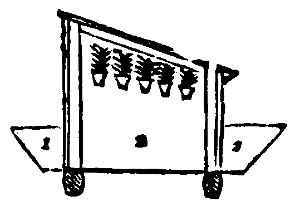
Form of House. The succession,
or nursing pits, according
to Mr. Baldwin’s plan (fig. 11.), in
which the young plants are to remain
both winter and summer, should be constructed
of timber, seven feet wide, and seven
feet three inches high at the back, the front being
in the same proportion. The method of preparing
the bed is as follows:—“Sink your pit (2.)
three feet three inches deep, as long as you require,
and sufficiently broad to admit of linings on
each side (1, 1.); make a good drain at the bottom
of the pit to keep it dry; then set posts, about the
dimensions of six inches square, in the pit, at convenient
distances, (say about the width of the top
lights,) and case it round with one inch and a
half deal wrought boards, above the surface, and
below with any inferior boards or planks. The
dimensions of my succession-bed or frame, are
thirty-nine feet long, and seven feet wide; containing
two hundred and seventy-three square feet,
which will hold three hundred and fifty suckers,
from the end of September till the seventh of
April.”
Soil. “From old pasture or meadow ground
strip off the turf, and dig to the depth of six or
eight inches, according to the goodness of the soil;
draw the whole together to some convenient place,
and mix it with one-half of good rotten dung; frequently
turn it over for twelve months, and it will
be fit for use. This is the only compost dung for
young and old plants.”
General management. The general practice
of Mr. Baldwin is to take the suckers from the
fruiting plants about the end of September, and
lay them in a warm place for about three days;
he then pulls off a few of their bottom leaves,
which makes them ready for planting. “In making
your bed,” he says, “lay three-fourths of new tan
at the bottom of the pit, and lay old tan upon that,
to reach within three inches of the top; on the
surface of this sift old tan to the thickness of three
inches, beating it down well with the spade, then
plant the suckers in the tan about four or five
inches apart, according to the size of the plants,
placing the tallest in the backside of the frame,
and the shortest in the front. In this situation let
them remain till the month of April following;
then take up the plants out of the tan-bed, and divest
them of all their root; and remember that at
any future transplanting the roots must not be
taken off. Plant them in pots of five, six, and
seven inches diameter, according to the size of the
plants, but before planting let the pots be filled
with the prepared compost already mentioned.
About the middle of June following, when the pots
are beginning to be filled with roots, take out the
plants with their balls whole, and plant them in
pots about nine inches in diameter, being filled
with the same rich compost, replanting them into
the bed, and let them remain there till the end of
September. Be careful at each transplanting,
while the plants are out of the beds, to have the
beds put into a proper state by the addition of
fresh tan, &c.
“When the plants are out of the stoves in the
month of September, prepare the pits in the same
manner as directed for the succession-beds, with
three-fourths of new tan at the bottom, &c.; then
shift the plants into pots about fourteen inches diameter
at the top, and plant them at suitable distances
for fruiting; plunge the pots at first halfway
into the tan, till the heat diminishes to a safe
temperature, then fill up the interstices between
the pots with tan, and as the plants are now stationed,
let them so remain till they are fruited off
for the table. The plants, young and old, had
best be near the glass, and small stoves are to be
preferred, because they require less fire. The glass
should be closely puttied, to keep out the cold
air, and to retain the warm.
“The fruiting-house during the winter should be
kept at about seventy of Fahrenheit’s scale. It
may be left in the evening about seventy-five, and
it will be found in the morning about sixty-five, so
that no attendance during the night will be necessary.
“There should be no water given to the young
suckers from September till April, while they remain
in the tan without pots. After they are potted
they require to be watered two or three times a
week during the summer, according as the temperature
may be. When they are removed into the
fruiting-house in September, they should be watered
cautiously till towards February, and as the
spring advances they will require a large supply.
Never water the plants in the common broad-cast
method, over their heads and leaves.
“Give air in the stoves and frames, both in summer
and winter, when the weather will permit, from
the back and ends, but not from the roof.
“Expeditious cultivation. The New Providence,
Black Antigua, Jamaica, and Enville, and the other
large sorts of Ananas, will require the cultivation
of three years to bring them to perfection, but the
Old Queen and the Ripley’s New Queen may be
brought to perfection in fifteen months. To effect
this, it must be observed, that some of the plants
will fruit in February, or the beginning of March,
and consequently that the suckers may be taken
off in June, or the beginning of July; make then
a good bed of tan with linings of litter round the
outside to keep in the tan; make the bed to fit a
large melon frame; put the suckers into pots of
about nine inches diameter, filled with the compost;
plunge them into the bed prepared in regular
order, and throw a mat over them in hot weather
for shade till they have taken root; let them remain
till the end of September, and then shift them
into pots of about twelve inches diameter, and
plunge them in the fruiting-house.” He has had
fine crops of Pines raised from these suckers, many
of them four pounds each, from plants only fifteen
months old. “This method, in point both of time
and expence, has greatly the advantage of the
common plan of raising Pines in three years by
fires, when the fruit at last is frequently small and
ill-flavoured.”
“It is a peculiar recommendation of this plan,
that the plants reared in frames without fire, the first
year seldom or never run to fruit; whereas, on the
contrary, when stoves are used first for a nursery
for young plants, and next for succession plants,
and lastly, for plants for the fruiting-house, it
is seldom that one-third of the plants come to
the forcing-house, because so many of them
have run to fruit; and even those that stand
are necessarily dried and stunted, being subjected
to the attacks of various insects; not to mention
the enormous care and expence attendant
upon a three years’ cultivation. The above appears
to me to be the most easy and economical
plan to raise Pines; one-third of the coals are sufficient,
and less than one-half of the labour and
buildings required for that purpose.” Culture of the
Ananas, p. 28.
Insects. After, as usual, many fruitless attempts,
he at last discovered the following method: “Take
horse-dung from the stable, the fresher the better,
sufficient to make a hot-bed three feet high, to
receive a melon frame three feet deep at the back;
put on the frame and lights immediately, and
cover the whole with mats to bring up the heat.
When the bed is at the strongest heat, take some
faggots, open them, and spread the sticks over
the surface of the bed on the dung, so as to keep
the plants from being scorched; set the plants or
suckers bottom uppermost on the sticks; shut
down your lights quite close, and cover them over
well with double mats, to keep in the steam. Let
the plants remain in this state one hour, then take
out the plants and wash them in cold water previously
brought to the side of your bed, set them in
a dry place with their tops downwards to drain,
and afterwards plant them. This treatment is sure
to kill every insect. You will observe likewise, that
if your suckers are kept in the frames all the winter,
stuck in the tan without soil or fire, the effluvia
from the linings are sure to kill all the bugs.” Culture
of the Ananas, p. 33.
Fruit Produced. The general crop is produced
in the usual season, viz. from June to September,
or October; but some are produced every month in
the year. The large sorts, as the New Providence,
&c. require three years to bring them to perfection,
but the Old Queen, and Ripley’s New Queen, may
be brought to perfection in three months; though
from the circumstances requisite to render this practicable,
viz. plants fruiting in February, or the beginning
of March, it must be considered more a
matter of accident or curiosity than of any real advantage.
It is evident, at all events, that it can
never become general; for certainly no gardener
would desire all his plants to come into fruit in
February or March. Mr. Baldwin grows his fruit
to a very considerable size even when produced in
so short a period. “At a meeting of the Horticultural
Society of London, held in October, 1817,
T. Baldwin, gardener to the Marquis of Hertford,
at Ragley, presented a Queen Pine of great beauty
and superior flavor. It measured sixteen inches in
circumference, seven inches in length, and weighed
four pounds. The plant on which it was produced
was little more than fifteen months old.” Hort. Tr.
vol. iii. p. 118.
Remarks. The following judicious remarks on
Mr. Baldwin’s plan are by Mr. M’Phail. “Mr.
Baldwin’s method,” he says, “appears to differ nothing
in principle from the methods I practised;
but we differ a little in practice, that is, in the
manner of the application of the elements necessary
to make the plants grow fast and vigorous, and
to produce fine fruit; and likewise in the mode of
disrooting and planting, which difference I conceive
to be of little consequence. He grows his plants
in good earth, enriched with plenty of well-rotted
manure. He keeps the plants in a strong heat, and
gives their roots plenty of water. He sets his fruiting
plants in a bed of tan in the month of September,
and there it appears they are stationed till the
fruit be ripened the following summer. Now, I
think, a bed made up in September, is not able to
retain a sufficient heat for the growth of the Pine
Apple plant for so long a period of time.
“Once, by way of experiment, in a small hot-house,
I made up a bed in the pit of it in the month
of October, and laid upon the surface of the bed
one foot thick of good earth, and turned out of
their pots fine Pine Apple plants, intended to fruit
the succeeding year, and I set the plants into the
earth on the surface of the bed with the balls of
earth about their roots undisturbed. In this situation
they grew exceedingly well, and shewed fruit
very strong, but the heat in the bed under them
became too faint in the month of April: and with
all the atmospherical heat that I could give them,
the fruit did not ripen well for want of heat to the
roots of the plants; and I was not able to contrive
any method to recruit it, which required to be done
in the month of March or April.
“According to the foregoing account, this celebrated
and experienced gardener plants the suckers
of the Pine Apple in the latter end of September,
and he divests them of all their roots in the month
of April. In this method of process I must differ
from him, because the young plants have only six
months (being the slowest growing months of the
year) to make roots, and then these roots are entirely
cut off, which considerably retards the plants
in their growth. And, according to his method,
and mine also, the queen and some other sorts of
the Pine, ripen their fruit in a shorter period of
time than two years after planting. He says, he
never waters his Pine plants in the broad-cast way
over their heads and leaves. In this I also differ
with him, for I think, giving the plants water all
over their leaves occasionally, especially in hot
weather, is of service to them, and which indeed is
only imitating nature.
“I say not that Pine Apple plants will not do well
without giving them water all over their leaves, for
if hot-houses be kept in a good state of temperature
for the growth of the Pine Apple, the great evaporation
of the tan-bed, and of the moist earth about
the roots of the plants, may supply the leaves sufficiently
with water, especially in houses managed in
the way this real practical gardener says he manages
his Pine plants; that is, his hot-houses are
very close, and he admits no air at the roof, so that
the moist air which ascends up is thrown back
among the plants. I would here remark, that
when Pine Apple plants are watered all over their
leaves when in fruit, the water should not be suffered
to stand long in the heart of the crowns on
the fruit, which it will seldom do if the heat in the
house be good, but with a little care the plants may
be watered all over their leaves, without letting it
fall on the fruit, or the crowns of them.
“He recommends that beds for the culture of
the Pine Apple be built of wood: excepting it be
oak, which is dear, other sorts of timber will not
last long in such a situation; and therefore, for
this and other reasons, (given in Section VII. page
67), I think beds built of brick, in a similar way to
the one I invented, are preferable, and in the end
cheaper than those of wood.
“With regard to the method which this gardener
useth to destroy insects on Pine Apple plants, it is
a troublesome operation, and can be practised only
on young plants, and indeed, according to his own
account, insects on the Pine Apple may be destroyed
in the course of their culture, which coincides
exactly with the methods I used and recommend
to be carried into practice by those who have the
management of Pine Apple plants, and are troubled
with insects. I have no doubt but his method of
laying young plants in a hot-bed of rank dung, will
effectually destroy the insects, though I think, however,
they had best remain in the bed longer than
one hour; but perhaps remaining even an hour,
or a longer time, in such a dreadful situation, where
I conceive no animal could long exist, might hurt
the plants, if not destroy them. But let it be remembered,
that if Pine plants be perfectly free of
insects, if they are put into a hot-house where the
scale or the bug insects are in the tan, or in any
part of the house, the insects will find their way to
creep to the Pines and breed upon them; for
these insects are natural to the plant.”
The culture of the Pine Apple was given by
John Abercrombie, in his “Every man his own
Gardener,” when that work was originally published
in 1780; but we prefer taking it from the work
above cited, as giving the modern practice. It is
proper to observe, however, that the directions in
the “Practical Gardener” are much less to be depended
on than those given by M’Phail and Baldwin;
for as the first of these authors observes, in
his preface to the Gardener’s Remembrancer, the
Practical Gardener has been evidently dressed up,
and in some parts rather affectedly, by some man
who knew little of the practice of gardening. As
to what Mr. Mean may have done in revising the
book, it is more certain that he has not done enough,
than that he has done any thing, for there are many
passages, besides those pointed out by M’Phail, that
appear quite ridiculous as coming from a practical
gardener. Notwithstanding these faults, however,
which would have escaped unnoticed in a less
valuable book, “The Practical Gardener” is the
best book of its kind extant.
Form of House. “The fruiting-house,” he says,
“need not be higher than five feet in front, and
eight feet six inches at the back wall; or, whatever
be the breadth of the house, the difference between
the height in front and in rear, need not exceed
one-third of the breadth.” By this means the
chamber of air to be heated will be materially reduced.
To give a full command over the temperature
of this air, let the lappings of the panes
of glass be closed with putty.
The roof of the succession-house may be four or
six inches lower than that of the fruiting-house;
and the roof of the nursing-pit may be a foot lower
than that of the fruiting-house.
Soil. The soil recommended is nearly the same
as that used by Nicol. It consists of:—“1. Vegetable
mould; 2. The top-spit earth from an
upland pasture, loamy, friable, and well reduced;
3. Hard-fed dung, rotted and mellowed by at least
a year’s preparation; 4. Small, pearly river-gravel;
5. White sea-sand; 6. Shell-marl.
“If no vegetable mould has been provided, light
rich earth, from a fallowed part of the kitchen garden,
may be substituted: there is no difference of
any account between one and the other, further
than this: The vegetable mould is sure to be virgin
earth, from which no aliment has been extracted; the
mould from the kitchen garden, however you may
trench, and rest, and enrich it, cannot but contain
many particles which have given out their fertilizing
qualities to previous crops. Dung perfectly decomposed
comes to the same thing as vegetable mould;
therefore that one of them which is most attainable,
or best prepared, may fitly serve instead of the
other.
“Of the first three take equal quantities; making
three-fourths of the intended compost. Constitute
the remaining fourth thus: Let river-gravel, sea-sand,
and shell-marl, furnish each a twelfth part. The
small gravel is to afford something for the roots to
lay hold of; the sea-sand, to promote lightness and
dryness; the shell-marl, the better to support the
growth of fibres and integuments and parts not
pulpy. Mix with the whole a fortieth part soot, to
offend and repel worms. Incorporate the ingredients
fully; and turn the heap two or three times
before using it.”
General management. “As soon as either crowns
or suckers are detached from the parent plant,
directions are given to twist off some of the leaves
about the base; the vacancy, thus made, at the
bottom of the stem, is to favour the emission of
roots. Pare the stump smooth; then lay the intended
plants on a shelf in a shaded part of the
stove, or of the green-house, or of any dry apartment.
Let crowns and fruit off-sets lie till the part
that adhered to the fruit is perfectly healed; and
root-suckers, in the same manner, till the part which
was united to the old stock is become dry and
firm. They will be fit to plant in five or six days.
As to the prolonged period for which they may remain
out of culture: Pine-plants have been kept
six months without mould, in a moderately warm
dry state, and the only injury has been loss of time.
Crowns or suckers coming off before Michaelmas
should be planted without any unnecessary delay,
to get established before, the winter. When late-fruiting
plants do not afford off-sets till after Michaelmas,
it is best to keep them in a dormant state
during the months least favourable to artificial culture:
therefore, as you obtain these late off-sets,
hang them up in the house, not too near the flues,
to rest till March.”
Insects. Mr. Nicol’s method, and also that by
M’Phail, are both quoted with approbation. The
following wash is directed to be applied exclusively
to the building, and by no means to the plants.
“At the annual cleansing of the house, if insects
are supposed to breed in the building, introduce
the wash with a brush into the cracks and joints of
the wood-work, and the crevices of the wall.
Recipe for the Wash. “Of sulphur vivum take
2 oz. soft soap, 4 oz. Make these into a lather,
mixed with a gallon of water that has been poured
in a boiling state upon a pound of mercury. The
mercury will last, to medicate fresh quantities of
water, almost perpetually.”
Fruit produced. To ripen eminently large fruit,
he directs the removal or destruction of suckers; to
retard the progress of fruit that have appeared too
early, he shifts in Nicol’s manner; and when fruit
is ripening too fast, or too many advancing to a
ripe state together, he retards a part of the plants
by setting them into a dry airy place, affording both
shade and shelter. “Give no water as long as you
wish to suspend their progress. For the same purpose,
others may be set out green; but whilst the
excitement of these is lowered, they must be kept in
a growing state.” Practical Gardener, 643.
Mr. Andrews has been considered the best
grower of Pines in the neighbourhood of London
for many years; his principal object is to grow
fruit for the market; but the demand for the
plants by private gardeners, and others, has generally
been so great, that he can seldom keep the plants
till the last stage of their growth.
Form of House. Both pits and larger houses are
used; but there is nothing particular in the form
of either. Mr. Andrews seldom erects new work,
but generally purchases old hot-houses and sashes
at the sales of decayed gentlemen, or bankrupt
tradesmen. In this respect he follows the practice
of Mr. Lee of Hammersmith, and both have generally
a stock of old sashes and rafters on hand ready
to put up when wanted. But though the form of
Mr. Andrews’ houses may be said to be in a great
degree matter of accident, yet the arrangement of
the flues within is his own. These generally enter
at the front corner of one end, pass to the opposite
end, return along the back wall, where they
sometimes serve as a path, and at other times are
placed at one side of the path, occasionally a return
is made, and the chimney-top is formed in the
back wall, at the opposite end to that in which the
fire enters; when this is not the case, the smoke
passes off by the back wall at the same end. The
width of the pit depends on the room left by the flue;
to increase it no path is formed at the ends or in front,
and that along the back wall does not exceed two
feet in width. The depth of the pits is from two
feet and a half to three feet deep, and their distance
from the glass from four to six feet. Vines are
trained up the rafters and over the back path.
The sashes in front open in various ways, and air
is given by them, and by the sliding sashes of the
roof. On the whole, Mr. Andrews’ best houses
greatly resemble those of Mr. Gunter, to be described
in the following section.
In the pits there is nothing uncommon in the
construction; they are, in general, sunk deep in the
ground, which being dry at bottom, is a great saving
of heat. In some the tan is enclosed by brick
walls, in others by a frame of wood; some are
without flues, but the greater number have a flue
in front, or a steam tube, or both.
In the year 1817, Mr. Andrews tried the effect
of steam, and was so much satisfied with it, that in
the following year, he put up an extensive apparatus
in the centre of his forcing department,
from which branch-pipes proceed in all directions,
and heat the air in the whole of his hot-houses,
pits, and frames.
Soil. As near as possible that of Baldwin’s, or
M’Phail’s;—a rich loam, rendered sufficiently free
by coarse sand, to admit the ready passage of the
water.
General management. The crowns and suckers,
when they are detached at irregular seasons, as
in winter, or very early in spring, are planted in
any spare corner of the bark bed, till a number is
collected, when they are planted in pots, according
to their sizes, and plunged in common hot-beds,
or pits. Mr. Andrews has no particular months
for shifting, no fixed sizes of pots, and no predetermined
manipulation as to shaking the plants out
of their balls, or otherwise. He is present at every
operation himself, and acts as the case requires.
He encourages forward plants, by giving them
larger pots than the rest; sometimes he looks over
the nursing-pits, and selects the most vigorous
plants, shifts them, and puts them into a stronger
heat, leaving the others for some weeks longer:
the balls of earth he does not disturb, if they do
not appear hard, the roots injured, or the plant
enfeebled. Sometimes he takes off the bottom of
the ball, and the bottom roots, paring off any part
of the stump of the plant which may appear decaying;
at other times, he contents himself with
removing the surface-mould, and top-dressing. In
general, he places the plants somewhat deeper in
the pots at each shifting.
The plants which he removes to the fruiting-houses
are shifted, for the last time, about nine
months before the fruit is expected; their pots are
generally twelve or fourteen inches in diameter;
but not of the usual proportion in depth, to lessen
the risk of overheating from the tan. The depth
is generally the same as the width. The pots are
plunged up to their rims, unless the heat be very
violent, and are liberally supplied with heat, air,
and water. Mr. Andrews does not fear 90° or 100°
degrees of heat in the bark bed, even when the
air of the house by fire-heat is not above 60° or
65°. In summer, he allows the thermometer to
rise to 90° or a 100° before he gives air, and he
often leaves some at the top-lights all night.
Insects. On this subject nothing new can be
gathered from the practice of Mr. Andrews, for
he has never had any worth destroying by a regular
process. His practice affords an ample proof
that regimen and cleanliness will never allow insects
to increase to an injurious degree.
Fruit produced. We have already noticed the
circumstance of Mr. Andrews’ plants being often
sold before they arrive at the stage for fruiting.
His stock, however, has been lately greatly increased
by the erection of additional houses, and
the easy mode of heating them from the steam
apparatus; he now, therefore, sends a number to
market, and chiefly in the winter season, and early
in spring, when the price is highest. Their fruit
weigh from one to four pounds, and are almost
exclusively of the Queen Pine.
The family of Mr. Gunter have long possessed
the very extensive gardens of Earlscourt, and
grown in them kitchen vegetables, excellent hardy
fruits, and melons, for the London market; but it
is only within the last seven years that they have
commenced the culture of the Pine Apple for the
same purpose. This Mr. R. Gunter has done on
the most liberal and extensive scale, and with great
and merited success.
Form of House. Like Mr. Andrews, Mr. Gunter
uses both pits and large houses; in the pits he
both nurses the plants, and fruits them, and in the
large houses he fruits the Pine Apple, and produces
very early grapes at the same time.
12
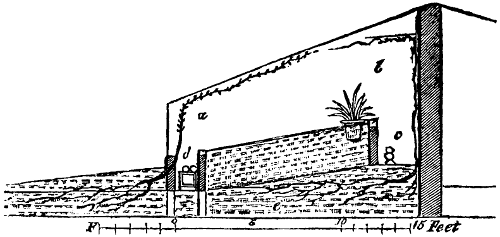
The large houses (fig. 12.) are, in what may be
called the usual form; they differ from M’Phail’s,
and the houses built by Speechly, and originally
by Nicol, in not having a path in front; and from
those of Mr. Aiton, erected in the royal gardens
at Kensington, in the pit being farther from the
glass. They are about fourteen feet wide inside
measure; the pit is ten feet three inches wide,
three feet deep, three and a half feet from the
glass in front (a), and about six feet and a half
behind (b). The back path (c) is a border regularly
dug and manured, to encourage the roots of
the vines, which pass under the bark bed to the
front border. Each house is forty feet long, and
has a flue proceeding from the back wall to the
front, and along the front to the opposite end, returning
to the back wall in the usual manner. As
the houses are all heated by steam, however, these
flues are erected merely by way of security, in
case of any accident happening to the boiler or
the pipes (d, e), and are therefore seldom used.
Besides the vines trained over the back path, there
are others which are led up the rafters; both root
into excellent soil, and their shoots are withdrawn
in autumn to give them three months’ rest in the
open air. Those at the back wall are withdrawn
through an opening in the angle of the upper sash;
those in front through an angle of the front sash.
The pits are sunk in the ground to the sill of
the sashes in front, and within eighteen inches, or
two feet of the sill behind. In all of them, the
tan is inclosed by brick walls; they are generally
about seven feet wide within walls, but some are
as wide as fourteen feet, with the front wall six
inches above ground, and the back wall two feet
ten inches. The sashes in these broad pits are in
two lengths, as in hot-house roofs; none of them
have any flues, being all heated together, with the
hot-houses, and various other descriptions of pits,
by an extensive steam apparatus. This apparatus
was erected by Mr. Mainwaring, of Blackfriars,
and is one of the most complete of its kind, excepting
in the circumstance of the steam-pipes
having what are technically called spigott and
faucet joints, which, it is alleged, are more apt,
by their contraction and expansion, to allow the
escape of the steam than the flanched joints. The
advantage of the former mode of jointing is, that
the steam-tube contracts and expands in parts;
and, of course, that this contraction and expansion
must be very trifling on every part; whereas,
when iron tubes are joined by flanches, they become,
in effect, one tube; and the contraction,
or expansion, takes place throughout their whole
length.
Soil. Good garden earth, enriched with well-rotted
hot-bed dung; the soil of the open garden
at Earlscourt, is a rich black loam, and seems to
suit the Pine Apple as well as virgin earth brought
from a distance.
General management. Much the same as that of
Mr. Andrews. Mr. Gunter tried to substitute the
heat of steam for that of tan, as a bottom heat, but
did not succeed. He formed a chamber, or vacuity
of about six inches in depth, and covered it
with perforated oak-plank; on this he placed the
earth, in which, in some cases, he turned the plants
out of the pots; and, in others, plunged the pots
in the earth, or in rotten tan. The steam was
admitted to fill the chamber; the quantity of heat
imparted to the earth was very great, but, contrary
to his expectation, no vapour ascended into the
mould, which became excessively dry and husky;
nor was he able, by frequent waterings, to keep it
in a state fit for vegetation; the roots of the plants
in it, in spite of every precaution, become shrivelled
and dry.
Insects. None of any consequence have yet appeared
at Earlscourt, nor is it likely they will ever
become numerous there, while steam is used. Were
they to become ever so abundant, keeping the air
of the house filled with steam for two or three
days together, would effectually destroy them.
Fruit produced. The object of every commercial
gardener is to have some fruit ripening in
every month of the year, but especially in winter,
when the price is high. In summer great numbers
are imported, or sent in from the hired-out gardens
of country gentlemen, which greatly reduces
the market value below the real value, or actual
cost of production.
The Pine Apple is extensively cultivated by Mr.
Grange, of Kingsland, and Mr. Wilmot, of Isleworth,
in nearly the same manner as by Mr.
Andrews and Mr. Gunter. Those of Mr. Wilmot’s
are, at present, in the most luxuriant and prosperous
state; Mr. Grange’s are also in a very respectable
condition. In both, the plants are grown
and fruited in pits, and larger houses, which resemble
those of Earlscourt (fig. 12.) as nearly as
possible; in both, also, the heat is communicated by
steam.
Mr. Oldacre is an excellent kitchen-gardener,
and an ingenious and curious man. He was several
years head-gardener at one of the Emperor
of Russia’s residences near Petersburg, and has
the merit of having introduced from that country,
the German mode of rearing mushrooms. Having
returned to this country about the year 1813, for
his health, he some years afterwards became gardener
to Sir Joseph Banks, in whose gardens he
has cultivated the Pine Apple with moderately
good success, and we have introduced this Section
on purpose to notice some peculiarities of treatment
which he adopts, and some strange opinions
which he holds, or lately held.
Form of House. The plants are brought forward
in dung, or tan-frames, or hot-beds, and
also in flued-pits; but generally fruited in houses
combining the culture of the Vine and the Pine.
Mr. Oldacre has two of these houses, one is built of
timber, in the usual way, (fig. 13.) and the other is
of the same form, but roofed with copper sashes. A
full command over the air of these houses is obtained
by the returns made by the flue in the back path
(a); the curb of the pit is about three feet from
the glass in front (b); and about five feet from it
behind (c); vines are trained up the rafters, but
none are grown in the back path (e), which is
paved.
13
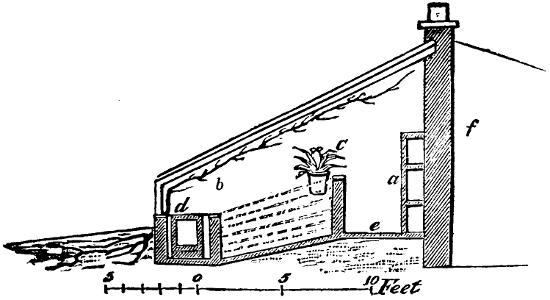
In addition to the flues, steam is also employed
as a medium of communicating heat. But the apparatus
was erected chiefly as matter of patriotism,
when steam first came in vogue, and is on a very
imperfect plan, and of little real use. The boilers
are placed over the furnaces, and the same fire
which heats the water of the boiler, passes along
the flue; the steam tube of the boiler is laid on
the top of the flue, and extends no farther than it
extends. It is evident, therefore, that scarcely any
advantage can result from the use of the boiler,
unless it be that the heat is thus sent more effectually
to the opposite end of the house to that at
which the fire enters, or that the vapour is very
readily admitted from the steam-pipe to fill the air
of the house. None of these advantages, however,
will compensate the expense of the apparatus; the
first is hardly wanted where houses are placed in
a connected range, as the two outside ends of the
houses are kept warm by the flues entering there;
and in the other houses a warm end is placed
against a cold one.
Soil. At first, Mr. Oldacre used good sound
loam and dung, with a little sand, when he found
it necessary; but he has for the last four years
grown his fruiting plants chiefly in powdered
bones, in which he thinks they thrive better, and
produce more highly-flavoured fruit. We have not,
however, been able to discover any thing in the
appearance of either fruit or plants, to lead us to
suppose that powdered bones are more congenial
to the Pine plant than good loam and dung; his
plants are certainly not equal to Mr. Baldwin’s, nor
superior to those grown by Mr. Andrews, or Mr.
Aiton. We, therefore, consider their thriving
in this compost a proof more of the hardy nature
of the Pine, than of any thing else; we have no
doubt it would grow in powdered granite, or
coal, or almost any powder, not even excepting
gunpowder, if a due proportion of well-rotted
manure were added, and water, heat, light, and
air, duly supplied.
General management. In this, Mr. Oldacre has
nothing particular; he is careful not to let the
temperature of either frames or pits, containing
Pine plants fall under 60° in winter, but is not
afraid of a heat of 90° or 100° in summer. After
shifting, and occasionally during very hot weather,
he shades the plants in the frames and succession-pits,
well knowing that the want of abundant and
extended roots must lessen that supply of moisture
essential to the vigour of plants, during high sunshine,
when evaporation is so powerful. His fruiting-plants
he keeps in large pots, rather broad
than deep, and so liberally supplies them with
water, that evaporation and transpiration go on
even in the hottest sun-shine, without injuring the
plants. He waters often with liquid manure, generally
the drainings of dunghills; frequently
steams the house by watering the paths and flues
when the steam apparatus is not at work; sometimes
he waters the plants over the top; and at
all times he keeps up a good bottom heat.
It may be further noticed, that in the hottest
weather, from June to September, he permits the
temperature of the atmosphere of the house to rise
to upwards of 100 degrees during the day, but
leaves sufficient number of sashes open during the
night, to lower the heat of the air within very
nearly to that of the air without. This is perfectly
natural treatment, consistent with what takes place
in those countries where the Pine Apple is grown
in the open air, and consonant with the practice of
Mr. Knight.
Insects. These he keeps off by regimen, watering
with clear water, and filling the house with
steam. In short, Mr. Oldacre’s opinions and practices,
as far as circumstances have required practice,
are in perfect unison with Mr. M’Phail’s: and
it is not, perhaps, too much to assert, that experience
will bring every gardener to the same result.
Fruit produced. Mr. Oldacre considers that the
fruit he produces in the copper-roofed house is
never so high-flavoured as that grown in the other
with a timber roof, though the treatment be in all
other respects the same. This certainly appears a
very singular circumstance, and not to be accounted
for in the present state of human knowledge.
The bars of iron, or copper sashes, might possibly
(but not probably) make some difference in the
electrical state of the air of the house, but this is
the utmost degree of variation we can conceive a
metallic roof capable of making. If it admits more
light, or abstracts more heat, these are effects easily
counteracted, if desired, and must have been so,
if they existed in any degree, as Mr. Oldacre
asserts the culture in both houses was exactly
alike.
On the whole, we must suspend our opinion on
this subject; or rather conclude that it is more
probable, Mr. Oldacre is mistaken in thinking the
culture he gives to the plants in both houses the
same, than that the single circumstance of a metallic
roof on one of them, should make such difference
in its produce. This report, which had been
made current at the Horticultural Society, excited
the attention of Sir Thomas Baring, who, having
an extensive range of metallic hot-houses, at East
Stratton Park, his seat in Hampshire, soon afterwards
sent a very fine Pine Apple to the Society, to
be tasted at one of their meetings. At this meeting
we were present, but though we tasted of this Pine
Apple, yet not having sufficient opportunity of
comparing it with any other, we could not discern
any difference. When a great many fruits are
tasted in rapid succession, and of each such small
portions as hardly to afford its real taste, the impression
on the palate is evanescent; or at any rate,
it is not, perhaps, too much to say, that under such
circumstances, it is difficult to form a solid judgment.
It is only within the last four years, that the
Pine culture, in the royal gardens, has been above
mediocrity; before 1817, and as far back as we
have had an opportunity of observing, they were
in a very poor state, those at Kew more particularly.
At present, the Pines in both the gardens
mentioned, are equal to any within ten miles of
London; and, with the exception of the New
Providence, Black Antigua, and some other sorts,
are not surpassed, even by those of Mr. Baldwin.
The culture pursued in the royal gardens, is as
simple as it is successful; and as economical as if
the fruit were grown for the market by a commercial
gardener. The whole does the highest credit
to Mr. Aiton, and those whom he employs.
14
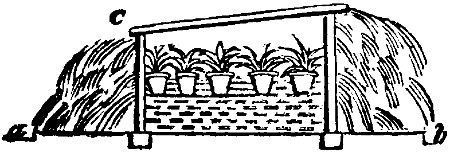
Form of House. The plants are struck, and
brought forward in pits, or frames, (fig. 14.) constructed
exactly in Mr. Baldwin’s manner, with
this difference, that the sub-soil at Kensington
being moist, they are raised on a small platform
(a...b) above the surface, instead of being sunk
under it, as Baldwin’s are. They have, also, the
addition of a gutter in front (c), which, though at
first sight it may appear trifling, yet, in practice,
is of very material consequence, by keeping the
lining dry, and not chilling and interrupting the
heat in the very part where it should penetrate to
the interior of the pit.
15
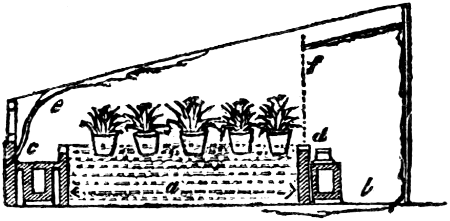
Occasionally some plants are fruited in these
pits, especially at Kew, but, in general, they are
removed to a low house (fig. 15.) of a most economical
and judicious construction, and calculated
both for the growth of Pines and Vines. This house
is fifteen feet wide within walls; the pit (a), is nine
feet wide; the back path (b), forms a border for
the roots of the Vines; the pit is surrounded by a
flue (c, d); the curb, or plate is two feet three
inches from the glass in front (e), and four feet
eight inches from it behind (f); the Vines are
planted in the back border (b), and trained under
the roof directly over it and over the back flue;
and others are planted in the front border (g);
and trained up the rafters.
The length of the houses in the royal gardens at
Kensington, varies from thirty-three to fifty feet
(fig. 16.): each house has two furnaces, one for
constant use, and another for giving an extra supply
of heat in very severe weather. The first (a),
proceeds directly to the front corner (b), thence
along the front to the opposite end (c), then along
the back of the pit (d, e), passing under the back
path, or border, and terminating in a chimney (f)
beside the furnace.
16
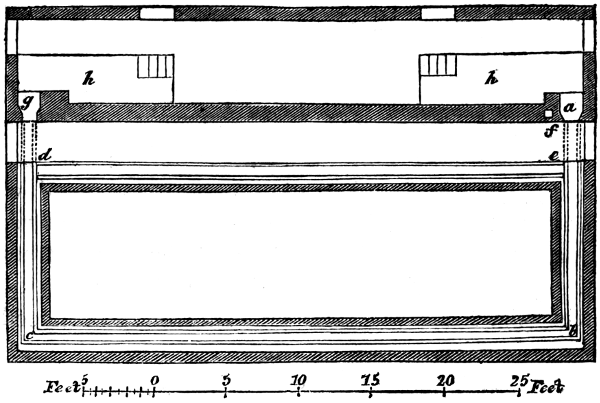
The other furnace is placed at the opposite end
of the house (g); has a short flue under the back
path, which conducts it to the back course of the
principal flue (at d), which it joins, and the smoke
of the two fires moves in the same tunnel, (from d
to e) and passes out by the same chimney. When
this second furnace is not in use, its connection
with the flue of the first is cut off by a damper at
the point of junction (d). A very small fire made
in this furnace in severe weather, not only adds to
the heat of the house by its own power, but by
increasing the draught, or rate of burning, of the
fire in the other furnace.
17
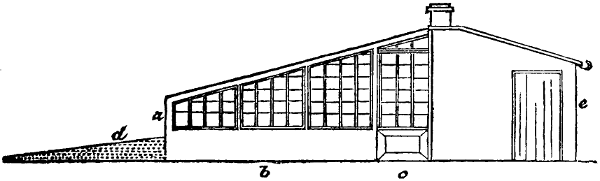
In addition to the fire heat, a steam apparatus
has been lately erected, and the tubes conducted
round the houses on the tops of the flues (fig. 15.
d, e); this is found to give a great command of
heat, and also to admit of filling the house with vapour
at pleasure. The height of the house from
the ground to the top of the back wall, is only nine
feet (fig. 17.); the rafters of the roof are placed
about four feet apart, centre from centre; or about
twenty-four sashes are given to every hundred
feet; the front sashes (a), are only eighteen
inches high, and slide past each other; the middle
end sash (b), also slides; the sill of the door (c),
and the back path, or border, are on a level with
the outer surface of the ground, to admit the easy
wheeling in of tan, &c.; the front border (d), is
raised considerably above it, on account of the
wet bottom; the back sheds are low and neat, and
the furnaces sunk three feet below the surface
(fig. 16, h h) to give them a better draught; and
this also serves to drain the back border.
The houses are placed in pairs, the furnaces for
general use at the extreme ends of the range, and
the auxiliary ones in the middle, where the steam-boiler
is also placed, but worked by a fire apart.
On the whole, no plan of Pine-stove that has
yet appeared, is more simple, neat, economical,
and complete than this; the only fault we have
to them, is, that owing to the great thickness of
wood employed on the bars of the sashes, they are
rather dark and gloomy within; but this might
easily be remedied by the substitution of light iron
rafters, with wooden framed sashes sliding in them,
but the bars of the sashes formed of iron. It is
true, gloomy as these houses are, the Pines thrive
in them as well as can be wished, but probably by
having more light, they might thrive, so as to surpass
all expectation.
Soil. Good yellow loam, with a third of rotten
dung, and some road grit to serve as sand. This
is well mixed together, and passed through a wide
screen, and the pots are well drained with three
or four pieces of potsherd.
General management. This differs in little or
nothing from that of Mr. Andrews; and only from
that of Mr. Baldwin in the crowns and suckers
being struck in pots, instead of the bark, as is
Mr. Baldwin’s practice. Supposing the crowns and
suckers potted in September, they are not disturbed
till the following March; such as are very
forward, are shifted at once into large pots, and
will show fruit in the course of that autumn, or
within the year, and ripen their fruit in November
or December, very desirable periods for the royal
table, equally expeditious, as in Mr. Baldwin’s
mode, and more so than in Cuba or Jamaica. The
plants which are in a less forward state are disrooted
entirely, put into pots according to their
sizes, nursed all the summer in the pits, and moved
to the larger houses in autumn, where they show
fruit at various periods, during the winter, and in
the following season; thus ripening their fruit at
different periods, from eighteen months to two and
a half years, from the time they were taken from the
parent plants. The pots in which these plants
are fruited, seldom exceed twelve inches in diameter.
Insects. Various modes of getting rid of these
was attempted both at Kew and Kensington; that
which was finally successful was steeping for two
or three hours in strong tobacco-water, as recommended
by Miller; then washing in pure water
two or three times—drying, planting, shading,
and applying a brisk bottom heat, a moist atmosphere,
and giving a little air. This recovered the
plants, and future regimen continued them in the
vigorous state of health in which they now are.
Fruit produced. The object, and it is most successfully
attained, is to have handsome Pines on
the royal table every day in the year; they cannot,
of course, be very high-flavoured in the winter
and spring months; but appearance, in some cases,
is every thing—they look well, the golden hue
of the Apple, mimic grandeur of the crown, and
the presence of such a rare fruit at an uncommon
season, accords well with the pomp and splendour
of a royal table. As to flavor, indeed, by the time
the desert appears on great occasions, the palate is
generally seasoned with wine, and a few drops of
alcohol are already transferred to the ventricles
of the brain; when that is the case, every fruit has
just what flavor it ought to have; for the fine
phrensy of a warmed imagination knows no degree
of merit but the superlative.