True meaning of the word harem—Eastern houses divided
into two parts—Male members of the family only
allowed to enter the female quarter—Seclusion of
women stricter among the well-to-do—Seclusion not
wholly due to religion of Islam-Life in the harem—Occupations
of its inmates—Misrepresentation of the
system in England—Royal harems—Custom doomed
to disappear—Circassian women—Reasons for their
popularity as wives—How a woman gets engaged—Some
marriage customs—Marriage a more civil proceeding
than religious—The bridegroom—His too
friendly friends—Shopping in the harems—Female
pedlars—Some of them Europeans—A considerable
trade.
There are many people in England whose
ideas on the subject of the harem are but a
confused misconception, based on what they
may have heard about Eastern polygamy. In
this chapter, that I may correct these mistaken
conceptions, I will give some more exact
information on the subject of the harem and
its inmates, as well as on the position of women
in Turkey in general.
Although the word harem is known and used
by the people of Western Europe, the true
meaning of the term is understood by but few
persons in this country. As a matter of fact,
many subjects concerning the East are much
misunderstood in the West, just as there are
certain manners and customs of Western
Europe that cause prejudice in the Eastern
mind. When an Englishman uses the word
harem, he means thereby the numerous wives
whom a man in our part of the East is supposed
to shut up in his house. He, moreover,
believes that every man in the Mohammedan
East may marry as many women as he pleases.
This idea is not only mistaken, but grotesque.
There are thousands of men who would consider
themselves fortunate if they could marry
even a single woman; while, on the other hand,
there are thousands who would be happy to
get rid of the single wife they have. Any man
who can manage to keep two, not to say more,
wives in peace, and can cope with the requirements
of each, must be an exceptionally brave
person. Wives are not all religiously obedient
in the East, just as all men are not tyrants.
Religion, law, and custom impose upon men
many duties to be discharged towards their
wives. An honest man must discharge these
duties, and indeed it is very difficult to find
many men who are able to fulfil their obligations
as husbands towards more than one
wife. It has been proved that in many parts
of the Ottoman empire the number of women
does not exceed that of men, a fact which
alone is enough to show the absurdity of the
notion prevailing in England about the plurality
of wives in that country. As a matter of fact,
there is no law against the practice of polygamy,
but the feeling of decent people condemns
it A man who is once married to a
gentleman's daughter would find it no light
matter to add another wife to his home circle.
There are nowadays many men of Western
education who marry in order to find a life-companion,
and they quite understand that
were they so injudicious as to take another
wife, they would very likely render their lives
the reverse of peaceful.
After pointing out the absurdity of the notion
that a man's harem is his collection of wives, I
will now explain what it really is.
In Mohammedan countries, where the seclusion
of women is a deeply rooted and religiously
observed custom, every house is divided into
two separate parts. In Turkey the section of
a house where the ladies reside is called the
harem, and the men's portion is named the
selamlik—that is to say, the reception-place.
Though the female inmates of a house are also
collectively called the harem, this does not
mean that they are all the wives of the master
of the house. A man's wife, his mother, his
sister, his daughter, and such other women as
may lawfully appear unveiled in his presence,
all belong to his harem.
The male members of a family who are permitted
to enter the harem are the master of
the house, his sons, his father, his father-in-law,
and his wife's brother. In large cities such
as Constantinople, Smyrna, and Adrianople, the
advanced class of people may even permit their
more distant relatives to enter. Those who
adopt European customs may even admit their
intimate friends. But in the old-fashioned
families, such as form the great bulk of the
population, no male relation of the master is
allowed to enter the harem portion of his house
after he has reached his thirteenth or fourteenth
year if marriage between such male relation
and the master's daughter, or other young
marriageable inmates of his house, be possible.
The restrictions are greater in the house of
the well-to-do. In these houses, all communication,
and sending and receiving parcels and
dishes between the inmates of the harem and
male members of the household, are effected
through a kind of turning cupboard. This
contrivance is fixed in a hole in the wall which
separates the harem apartments from the men's
quarter. As another measure to ensure the
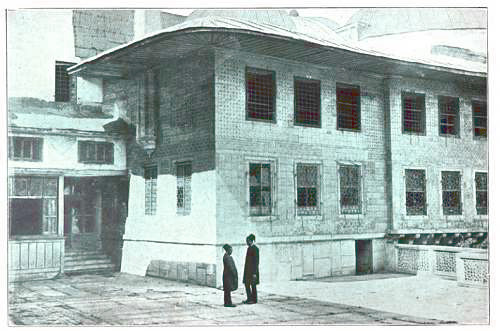
seclusion of women, to the windows of all
harems is fastened a lattice; so while the
inmates can see everything outside from behind
this barrier, no man in the neighbouring streets,
gardens, and houses can see them. As boys
above the age of thirteen or fourteen are not
allowed to see any women except those very
near relatives I have enumerated, so girls, after
the same age, must not appear unveiled in the
presence of men, excepting their very near
relatives; and if they have been attending
mixed schools, they will then be taken away; if
they go to girls' schools, they must go there, as
anywhere else, carefully veiled It must not be
supposed that the veils used are similar to the
light veils used by the ladies in this country. A
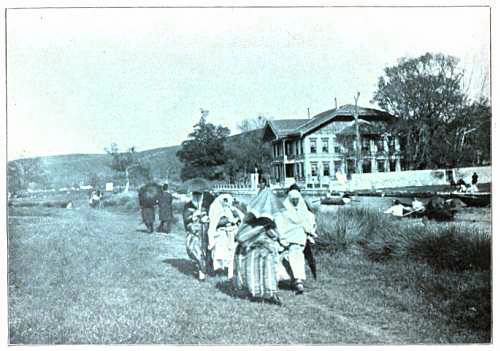
woman must go out wrapped from head to foot
in a long cloak, somewhat resembling a sheet.
The seclusion of women cannot be wholly
attributed to the precepts of the religion of
Islam. In the time of Prophet Mohammed, and
for generations after, women used to accompany
the armies to the battlefield, singing stirring
melodies to encourage the fighting men, and
tending those who were wounded. Even nowadays
among the tribal people, such as nomadic
Arabs, and among the Circassians, there is no
such absurdly strict seclusion of women as is
fostered by the harem system; yet those primitive
people are much more earnestly devoted
to that religion than the advanced Ottomans.
According to some of my countrymen who are
better judges than I am of these matters, the
custom of veiling women's faces so thickly was
adopted by the Ottomans from the Byzantine
Greeks, and I think it was man's despotic
jealousy in olden days which brought about
the existing practice of covering up and veiling
women out of doors, and also their strict
seclusion in the houses.
The life in most Turkish harems is very
simple, and, if we leave out the case of the few
polygamists who still remain, very peaceful and
happy. The absolute authority of the husband
does not interfere with the recognised privileges
of the wife; while the obedience of the wife,
which is regarded by more advanced women in
Western Europe with such contempt, in most
cases strengthens the affection and respect of
the husband for her. Wives are not slaves of
their husbands, as some people in this country
fancy them to be.2 The inmates of harems live
mostly indoors, but they are not entirely shut up.
They go out in groups of two, three, and more
to pay visits to other harems, and they receive
visitors from the harems of friends and relations.
Of course their gatherings are almost always
unmixed, but, like the women of other countries,
some of them sing and play to entertain others.
Dancing has been introduced recently, but it is
confined only to very advanced private families.
Among the people of the old school the dancing
of young ladies in the presence of others is
considered shocking. At weddings and other
similar festivities only hired professional women
amuse the guests by dancing, and these professional
dancers are not regarded as respectable.
In my time, reading aloud was a favourite
pastime in many harems. The number of
educated women was much less than it is
now. The most learned among them used
to read sacred legends, or religious tracts,
or recite hymns to the other ladies, who
would listen attentively for hours. I believe
this social pastime is still in favour in the
provinces.
Turkish women, according to their social
position, have various duties to discharge. No
qualities are so much sought after in an average
marriageable woman as the domestic ones. In
the provinces the peasant women, besides
managing their humble domestic affairs, have
to work in the fields, more especially when their
brothers and husbands are away discharging their
compulsory military service. The daughters of
well-to-do people, besides attending to the
business of their households, are indefatigable
with their needles, and are always busy with
needlework or embroidery; while the daughters
of high dignitaries must, among other duties,
learn what their instructors or governesses
teach them.
It will be understood from the details I have
given that the popular notion prevailing in
this country of the harem and the life in the
harem is much mistaken. Women in Turkish
harems do not really pass their time lying
on sofas or couches, eating sweetmeats and
smoking water-pipes all day long. Of course
they are as fond of sweetstuffs as most ladies
of this country. But to lie down on a
couch in presence of others is considered by
Turkish women vulgarity of the most disgraceful
kind.
The representation of harem life given in
books and on the stage, or shown in exhibitions,
is either the work of Turkey's detractors,
or simply the work of imaginative persons who
know nothing about it, and whose object is to
attract the curiosity of English people by exhibiting
grotesque sights, and thus to make
money.
I should, however, agree with any English
critic in condemning the custom of seclusion.
The hopes which were entertained of checking
romantic evils by the custom have hardly been
realised; and on the other hand, the system has
done a good deal of harm, because the seclusion
of women means that a portion of the national
intellect is kept uncultivated. Although many
young ladies receive private tuition in the
harems, and many of them are highly educated,
yet this limited kind of education cannot meet
the national requirements of Turkey. In my
opinion, the strict seclusion of women is greatly
responsible for the backward condition of most
Eastern races; because if mothers are restricted
in cultivating their natural intellect, they can
give little if any help in the education of their
children. The sons of such mothers cannot
keep pace with the people of Europe in the
path of progress. There are very many men
in Turkey who know all these things, and who
long for at least a partial emancipation. However,
the emancipation must take place gradually,
for if the liberty of men is given to the women
of the harems without regard to existing social
requirements, they themselves will not wholly
appreciate it, while many of them might abuse
its privileges; moreover, many men might take
unchivalrous advantage of so new and sudden
a social change.
I may be asked why, if the opinion of my
country is ripe enough for at least a partial
emancipation of women, it is necessary to withhold
it now? The reason can easily be found
when one reflects upon the political situation
of Turkey. That unhappy country has been
suffering for over twenty-six years from a
tyranny almost unparalleled in the history of
mankind. The Sultan understands perfectly
well the influence women might have in
educating and enlightening the rising generation.
He therefore puts the more restrictions
upon the movements of his women
subjects.
I cannot say much about the harem quarters
of princely palaces. It is well known, however,
that the happy family life enjoyed in the harems
of private gentlemen cannot be found in the
overcrowded harem of a palace. But I can
emphasise the fact that the numerous inmates
are not all the wives of the lord of the palace.
The vastness of domestic arrangements in such
an establishment must necessitate the employment
of many women as attendants. A sultan
or prince, if he resorts to the old rules of
polygamy, may marry two, three, and perhaps
four wives, but no more, as four is the highest
number allowed.
The wives of many well-to-do Ottomans and
all the inmates of the royal palaces of Turkey
are of Circassian origin. It may be asked why
Circassian women find so much favour, and
how it is these daughters of the Caucasus
adorn the family circle of Turkey? I will give
a brief account of them, which may explain
these points.
The Circassians, the fine, alert, and powerfully
built mountaineers who inhabit the most
picturesque regions of the Caucasus, have a
world-wide reputation for personal good looks,
and especially for feminine beauty. Those,
however, who have had any considerable
experience of this famous race might hesitate
to say that its women have really a larger
share of beauty as a whole than other branches
of the human race. What the Circassian
women do possess in distinction from those of
other races of Eastern Europe and Western
Asia is a greater animation of face, to which
may be added a figure uniformly handsome
and a bolder demeanour. They are for the
most part slender; a fat woman is quite uncommon
among Circassians of unmixed blood.
Their complexions are usually fair; and it is
more on account of her fair skin that the
Circassian woman is so much admired by the
comparatively dark people of Western Asia
and Egypt than for her other physical qualities.
She is also very readily taught, and adapts
herself quickly to her new surroundings; so
that, rustic and clumsy in her manners to begin
with, she picks up refined and elegant ways in
a remarkably short time. I knew of a wealthy
and kind lady who once obtained a young
Circassian girl from her relations. Though of
sympathetic appearance, this girl, whom I saw
at the time, looked an untamed creature in her
miserable ragged native dress. When I saw
her on another occasion after a few years'
interval, I found that the rough diamond had
been charmingly polished, and now shone with
refined beauty.
The Circassians are mostly Mohammedans.
A small number of them have been made to
accept the Russian religion, but these converts
have always a strong tendency towards the
faith of the Arabian Prophet; and it is only
the fear of the wrath of their conquerors that
prevents them from denouncing the doctrine
of Holy Synod. This tendency is attributable
either to the hatred burned into their hearts
towards the Muscovite on account of the destruction
of their national independence and
the loss of their primitive happiness, which has
resulted from the sanguinary and fiercely resisted
Russian conquest, or to the reason that
the precepts of Islam may perhaps suit their
native simplicity better.
There is Circassian blood in the veins of
almost all the members of the existing dynasties
of the Mohammedan Orient. For many generations
past the mothers of the Ottoman
Sultans have been Circassians; just as in the
bygone centuries, when the power and influence
of Turkey were so great in Eastern Europe,
the Sultanas were women mostly belonging to
one or other of the Christian States which
were tributary to the Ottoman empire. Many
of the Mameluke rulers of Egypt were, as
well as their wives, Circassians. The female
members of the Khedivial harem have always
been and are still of Circassian origin, and
there are said to be Circassian ladies in the
household of the Persian sovereign.
The Nizam of Hyderabad was at one time
anxious to marry a Circassian woman. I
heard this from a man whose name is widely
known throughout India, and who, I believe,
has been introduced to English readers in a
well known novel under the fictitious name of
'Mr Isaacs.' This gentleman is a native of
Diarbekir, in Asiatic Turkey. After living
over thirty years in British India, he paid a
visit to Constantinople some nine years ago.
There, one day, he asked my advice as to how
he might procure Circassian slave-girls, saying
that he wished to buy one or two to be admitted
to the household of His Highness the Nizam.
This anglicised gentleman imagined, as many
Englishmen do, that there is still a public
market for slave traffic in Constantinople, and
that anyone can go and purchase as many slave-women
as he pleases.
It is true that some destitute parents among
the refugees from the Caucasus are willing to
part with their young girls for a reasonable sum
of money, but only on obtaining a sufficient
guarantee beforehand that these young girls
will be adopted by the buyers (well-to-do
families without daughters often adopt orphans
and other poor girls), or else that the girls sold
in this fashion will be married either by the
buyers themselves or by some relation of
theirs.
From the moment of the final conquest of
their country by Russia up to the present time,
thousands of these natives of the Caucasus
have immigrated into the Sultan's dominions.
A short time ago there appeared a piece of
news in the papers, stating that an arrangement
had been made between Russian and
Ottoman authorities for the settlement in
Turkey of about sixty thousand more Circassians
who desired to leave the Caucasus
en masse. Russia does not object to their
emigration nowadays, as she wishes to colonise
their land with peasants of the Russian race.
On the other hand, the Turkish Government
grants them facilities for settling in the thinly
inhabited portions of Asia Minor. The Circassians
are a healthy and hardy people, and
they improve the physical constitution of races
with whom they intermingle.
****
An English reader will naturally want to
know how, in a state of affairs in which boys
and girls never meet after about their thirteenth
year, the matter of marriage is managed; I will
therefore explain the system of matrimony.
As is the case in most parts of the world, in
Turkish towns betrothal precedes marriage,
but 'courtship' is hardly possible in that
country. Young girls and men are not allowed
to meet one another, and consequently anything
in the way of flirting is out of the question. In
some exceptional cases they may, perhaps, be
able to get a glimpse of each other from a
distance, possibly from the windows of neighbouring
houses, and quietly exchange greetings
or make signs of mutual admiration, but this
is all they can ever do in the direction of
flirtation. Of course, girls may see, though
they do not speak with, the men whose wives
they may be destined to become some day, but
men are strictly prohibited from meeting the
marriageable members of the secluded sex. It
is scarcely possible for a man to admire and love
a woman except on the testimony of others as
to her good looks and good qualities. In the
same way, the engagements must be made
through the medium of the man's lady-relations,
or through that of the professional marriage-brokers.
The latter are mostly old women, who
will endeavour to bring about marriages, not out
of good-will to the young couple or for the
sake of amusing themselves, but as a matter of
business. They visit houses where there are
girls suitable for a would-be bridegroom; they
make their proposal on his behalf to the family
of that young lady of whom they most approve,
a proposal which is made in a most roundabout
manner, and with great tact. The answer
must not come from the prospective bride;
that would be considered highly improper. The
decision rests with her parents or guardians.
She is, no doubt, consulted, but her voice in
the matter is of secondary importance. Probably,
too, she does not know her own mind so
well as do her sisters in more advanced lands.
The matrimonial agent often repeats her visits
three or four times that the matter may be well
talked over, as the girl's people need to reflect,
and also to make a searching inquiry about the
man. If the answer be in the negative, it must
be made very tactfully and politely. In some
parts of Turkey they have a curious way of
letting the proposers know that their offer has
been declined. Over their ordinary shoes
people almost always wear goloshes, and on
entering a house they take them off and leave
them in the entrance-hall. The servants of
the house make a point of arranging the
goloshes heel outwards, in such a way that
when the visitor goes out he can put his feet
straight into them, without having the trouble
of turning them round. Now, when the agent
of suitor for a lady's hand, on leaving the
house, finds that her goloshes are turned with
the toes towards her, she knows that the proposal
has been declined.
Thus a man gets betrothed to a woman without
being permitted to see his beloved fiancée
until the wedding formalities are over and the
marriage ceremonies are completed. Astounding
tales have been related of what has sometimes
happened when a husband has thus seen
his wife for the first time. In one town, a man
who, from the reports he had heard, was deeply
in love with his betrothed, actually left the
house and ran away when he drew up the long
and beautifully embroidered veil that covered
the lady, now his wife, and discovered that she
was the ugliest creature his imagination could
picture. It is easy to conceive the feelings in
such a case of a man who has, on the flattering
descriptions of the professional marriage-brokers,
been led to believe up to the last
moment in the angelic appearance of his wife.
How terrible must be his disappointment when,
on the day of his marriage, he unveils his
dreamt-of 'beauty' and beholds a face rough
and painted in the vain endeavour to conceal the
ravages of smallpox, or distinguished by an
ultra-Israelitish nose and topped with a pretentious
wig. The unhappy case of such a
disappointed husband must not, however, be
overstated. Fortunately for him he does not
often see other female faces, and his notions on
the subject of what real beauty is are necessarily
restricted by his want of experience. He is
naturally of a contented disposition, believes in
kismet in this as in other things, and so these
physical defects do not greatly disturb his peace
of mind, and it is only very rarely that he runs
away from his wife.
Such matters as courtship and engagements
are quite different among the agricultural and
tribal people, where the girls and boys work
together in the fields, in the gardens and pastures,
and thus pass their early years in each other's
society; their marriage in later years is
generally the outcome of natural affection, first
awakened by that companionship. But even in
the towns it is sometimes possible for a man to
make the acquaintance of a woman before
marrying her. This is done by the betrothed
pair arranging a secret interview, which, it is
said, is usually brought about with the kind
assistance of old and trusted servants.
Curiously enough, the professional marriage-broker
is sometimes reported to be the person
who arranges this private interview; but one
thing is absolutely certain, namely, that unless
she is handsomely tipped, it is to her own
advantage to stick strictly to the good old
custom.
The wedding of a young couple itself, like
their betrothal, takes place in an indirect manner.
They are married in a house privately, in
the presence of persons closely related to them.
They do not go to any place of worship. As I
pointed out before, the houses in Turkey are
divided into two parts, one reserved for the
male, the other for the female members of the
household, and there is a long passage between
the two. On the wedding-day the ladies fill up
the passage, having in front of them the bride,
while all the gentlemen present go to the room
in the men's department which opens on to the
passage, the prominent figure among them
being the bridegroom. The door between the
passage and the room is closed, and the most
profound silence must prevail both in the
passage and the adjacent room. Among the
gentlemen, the father of the bride, or, failing
him, any elderly man under whose guardianship
or protection she may be, gets up, knocks at
the door, and most solemnly and impressively
asks this question, "My daughter! we are about
to marry you to Mr. So-and-so, in accordance
with the will of Almighty God and the ordinances
of the Prophet. Will you marry him?"
She gives no answer. The old man repeats
the question; still she does not utter a single
syllable. He asks again in a wearied manner,
and this time the question is followed by a
sound of sobbing inside the passage. Whether
the reason of this weeping be the pressure put
upon the shy and inexperienced girl in that
impressive moment, or whether it be the pinches
she receives from that termagant, the professional
marriage-broker, and from her mischievous
girl-friends who urge her to speak out, I cannot
tell.
Meanwhile the bridegroom grows impatient;
everyone in the audience can notice the signs
of anger and anxiety on his face. The old man
repeats his question a fourth time, and at last
the word of consent is uttered in a very low
voice from behind the door. At the same
moment the bridegroom shows his feelings of
relief by some motions expressive of pleasure,
or by looking more than usually gratified. The
old gentleman turns to him and formally asks
him whether he will marry Miss So-and-so.
He makes no modest hesitation, as, in his
opinion, modesty is quite uncalled for here, is,
in fact, an unpleasant outcome of the organised
hypocrisy of society. So he answers the old
gentleman's question at once, with the unblushing
boldness peculiar to his sex. After this all
the audience bear witness to the legitimacy of
the event. A brief prayer is then recited, after
which all offer their congratulations to the
bridegroom. They draw up and sign the
wedding-contract immediately, that it may be
certified by the semi-religious magistrate called
the Kadi. But the young couple are not permitted
to see each other till all the marriage
ceremonies are completed, and that is not till
several days have passed.
Another curious custom connected with
marriage is that of a bridegroom's friends
beating him on the back with their fists. This
is commonly the case in Turkey. At the very
moment when the bridegroom is going to see
the face of his wife the first time, after all
formalities of the wedding are over, intimate
friends and relations collect just outside the
door of the female portion of the house. After
wishing him a happy life, they belabour him
from behind as he hurries into the ladies
quarter, a proceeding which no doubt considerably
accelerates his movements. The punishment
is supposed to be inflicted in a gentle
manner, but it may perhaps be that some of
the young bachelors relieve their feeling of
jealousy by making the customary blows somewhat
harder than absolutely necessary.
****
Before closing this chapter on the theme of
the secluded sex, I ought to say something of
the way in which it does its shopping, and give
some description of the women-pedlars who
visit the harems to display their wares. There
are probably few people in this country, even
among those who are interested in the world's
trade, who know much about these female
traders of the East. Nevertheless, in those
vast tracts of the Orient where the female sex
passes its life in strict seclusion, a considerable
retail business of a primitive kind is transacted
by wandering women-pedlars, who carry their
goods round and display them in the houses of
well-to-do families. Originally this trade was
carried on entirely by native women, but of
late a certain number of European women have
embarked in it, either on their own account or
as agents of small European houses. At a
time when the question of spreading British
commercial interests abroad is attracting so
much attention, it may not be amiss to inquire
into this method of trading, which, more than
any other in the world, is the prerogative of
women, for they alone can engage in it
Of course, the business lies almost entirely
among the families of Mohammedans, of whom
it is estimated that Great Britain has nearly a
hundred million among her subjects; it is also
probable that the future will see this number
largely increased. Moreover, in the territories
of other powers, where the populations are
largely Mohammedan, this country has vital
trade interests. A lesson is to be learned from
missionaries in pushing British commerce in
the East. A very large proportion of the
success in Oriental countries gained by
missionaries is due to the ladies who assist
them, for naturally they alone can get at the
women of the East What applies to the
spread of religion applies also to the spread
of trade, and the work done by the Zenana
Missions should be a sufficient indication of what
a trading association on the same lines could
effect. Equally it should show the British
commercial houses which have considerable
connections with the East that lady agents to
display and sell their goods would be of great
assistance to them. There are many Mussulman
women who cannot go to markets and
shops, and their custom would be practically
assured to the firms which sent goods to their
houses by lady agents, more especially such
goods as are required for household use.
In Turkey, Roman Catholic nuns have
already adopted this method of business, and
they have numerous customers among Mohammedan
women for the woollen stuffs, cloth,
stockings, shawls, and such things, which they
make in their own convents. The need felt by
Mohammedan families for such means of doing
their shopping is very great, and is rapidly
becoming greater owing to the spread of
European influence and refinement, which
naturally necessitates an increase of household
requirements and personal luxuries. This
adoption of Western comfort and modes of
life does not seem to affect the seclusion of
Oriental women to the extent that was at one
time expected. And in any case in the East
women depend on others to a great extent for
procuring all the things they require for themselves
and their households.
It is true, of course, that husbands, brothers,
and sons can be sent to buy these things, just
as in England, but also, just as in England,
husbands, brothers, and sons cannot always be
relied upon either to get the right article, or
even to remember to get anything at all. In
any case the method has many disadvantages.
With the exception of villagers and the
poorest classes, only women of advanced ideas
ever go to market or to the shops in the large
towns, and even they do not and cannot know
the delights of shopping. They are veiled, to
begin with; and being unaccustomed to talk to
strangers, they are not at their ease or quite
satisfied with the propriety of their proceedings.
No; the woman of the East much prefers to
do her shopping in her own house from a
woman-pedlar, and there it is rumoured that
she feels as much pleasure in it as her sister
of the West
'The Unchanging East' is a phrase used
often, and shows the user's ignorance, for the
East is changing steadily. Western methods
and ideas are gradually being accepted, and
with them the everyday needs and requirements
which accompany them. Home manufacture
is unable to supply these needs, and
there is a constant and growing demand for
European products. We ourselves have often
had to send from France and England to
our friends in Turkey, Cyprus and Syria, such
things as pocket-knives, scissors, housewives,
and work-baskets, articles required for education,
such as drawing-boxes, and last, but
not least, children's toys. But this was not
enough; our friends have generally written to
us to get some more of these things for their
friends.
No doubt such articles can be obtained in
Oriental countries if you know where to look
for them, but our friends do not know, and
they are not to be found in the stock of the
woman-pedlar. Here is an opening for the
lady-trader.