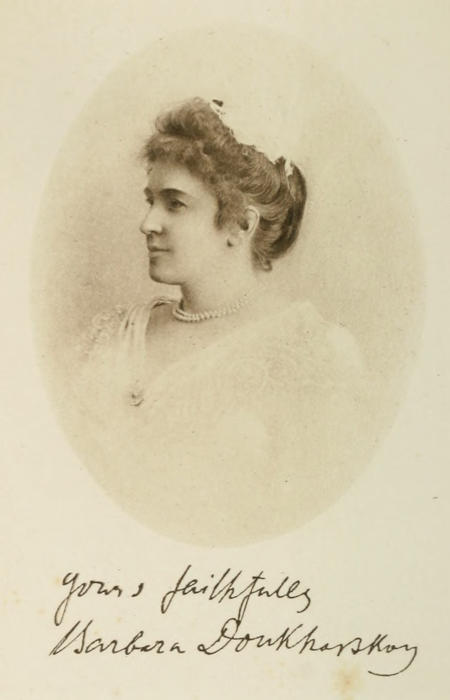
REMINISCENCES OF
BARBARA DOUKHOVSKOY
(néePrincesse Galitzine)
“Lived through but not forgotten”
WITH TWO PORTRAITS
LONDON
JOHN LONG, LIMITED 12, 13 & 14 NORRIS STREET, HAYMARKET
MCMXVII
Preface
This book was not intended to be published, and it
is to accident that we owe its appearance.
The author, from her childhood, followed affectionate
advices and good examples, and noted every day
her impressions of everything she saw and heard
about her. She puts in these pages all the freshness
and sincerity of her woman’s heart.
Circumstances placed the author in the centre of
remarkable events. Remaining faithful to the principle
of not interfering with her husband’s business, she
becomes, however, unwillingly, the spectatrix of
particularly interesting facts: the outside of war, of
different centres of Russian society, of exotic life in
foreign colonies and on our remote frontiers, including
the regions of the river Amour in Eastern Siberia.
Our author does not pretend to give a thorough
and complete study of political events and society
customs. But here we have vivid pictures of different
impressions which, linked together, give us a living
picture of places, events, and persons; real life in
fact is delineated in this book, which has thus become
a considerable work.
The author’s innate talent, her education, her faculty
of observation, and her deep study of the best Russian
and foreign writers, are the cause of the vivid impression
produced by her light and clear style. Some
portions of these studies entitled “Fragments of the
Diary of a Russian woman in Erzeroum,” were printed
in one of the most famous Russian periodicals. The
welcome they received showed the author to what use
she could turn her book for her works of charity, and
it is her desire to assist the poor which gave to
Barbara Doukhovskoy the idea of publishing her
“Memories,” though the great realism of them did
not permit of their publication as a whole.
Profiting by the right of having been a friend and
a playmate of the author’s husband, I insisted on the
necessity of publishing this work.
Not only by the truth and the spontaneity of her
impressions, but by the profoundness of her observations
and the artistic conception of the whole, the
author of this book now embellishes our literature by
a work of an exceptional and original character.
C. Sloutchevsky
Constantin Sloutchevsky, Russian poet, one of the most famous
of the end of the nineteenth century.
The Diary of a Russian Lady — BOOK I — CHAPTER I EARLY RECOLLECTIONS
My father, Prince Theodore Galitzine, married my mother
being a widower with five children, three of whom died before
my birth. My earliest vivid recollections begin when I was
two years old. I distinctly remember feeling a terrible pain
in parting with my wet-nurse, to whom I was passionately
attached. I got hold of her skirt and wouldn’t let her go,
weeping wildly. It was my first bitter affliction. I could
not put up with the new nurse, whom I hated from the
depths of my little heart, and I would not call her otherwise
than Wild Cat, with baby petulance, having already at that
early age pronounced likes and dislikes. We were in perpetual
state of warfare. When I was about three years old
that nurse was succeeded by a pretty Belgian girl named
Melle. Henriette. The tutor of my two step-brothers, Mr.
Liziar, made love to her and finished by marrying her some
time after. He seemed somewhat half-witted; by night he
went to chime the bells at the belfry of our village church
in Dolgik, a fine estate belonging to my father, in the
government of Kharkoff, and also amused himself by breaking,
in the conservatory, the panes of glass with big stones.
One day he frightened his sweetheart nearly to death by
throwing a snake under her feet. After all these pranks
it is no way astonishing that Mr. Liziar finished his
days in a lunatic asylum. The tutor who succeeded him,
asked my parents to bring his wife with him. He hastened
to pocket the hundred roubles taken beforehand on account
of his salary, and departed suddenly to Kharkoff to fetch
her. Meanwhile my father received a letter from this tutor’s
legitimate wife dated from St. Petersburg, in which she
entreated papa to send her the half of her husband’s monthly
salary, telling him he spent all his money on his mistress,
whilst his wife and children had not a morsel of bread to
put into their mouths. Of course, this too Don Juanesque
tutor was instantly dismissed.
My parents at that time kept an open house. On great
occasions my smart nurse would appear in the dining-room
carrying me in her arms, attired like a little fairy, all ribbons
and lace, to be admired by our guests. She put me down
on the table, and I promenaded quite at my ease between
the flowers and fruits.
I was born under fortunate auspices, there could not be
a happier little girl; good things were thrown down upon
me: presents, petting, admiration. At an early age I chose
as my motto: “Fais ce que voudras.” Whatever I wished
for, I very certainly had, and I didn’t see how anybody could
want to refuse me in anything.
I was often sent down to the drawing-room to be admired
by the afternoon callers, and mamma ordered me to let myself
be kissed by unkissable grown-ups, who paid me those
compliments shown to children, who are precious to their
parents, and which made me intolerably conceited. I stood
in great danger of being completely spoilt, and mamma, who
was afraid that I received a good deal more flattery than
she thought good for me, ordered me to answer what I was
told: “Comme Vava[1] est jolie!”—“Vava n’est pas jolie, elle
est seulement gentille.” But, nevertheless, I knew that I was
pretty, my glass told me so.
At the age of four I could read and write fairly well, and
chatted freely in French. I was immensely proud when my
nurse ended putting me to bed in the daytime, and when I
was old enough to sit at table, able to handle my knife and
fork properly. My greatest delight was to ride on my
brothers’ backs and to be swung by them in a sheet, that they
held by the four corners and lifted me as high as they could,
whilst I crowed gleefully, my bare legs waving happily in the
air. Mamma hastened with my nurse to my rescue, and
carried me off, paying but little attention to the wild shrieks
with which I requested to be tossed higher and higher.
There was a speedy end to all this fun; destiny itself interfered
to stop these aerial gymnastics: I had a bad fall one
day, tumbling out of the sheet, and my infatuation for this
sport disappeared completely.
It was a source of infinite delight to me to creep on the
knees of Mr Vremeff, an intimate friend of my parents, a
charming old gentleman with snowy white hair, and hear him
relate entrancing fairy tales for which I had an insatiable
appetite. As soon as he had finished one story, I asked for
another and another.
At that time my father was marshal of nobility of the
district of Kharkoff. One day he was suddenly called to St.
Petersburg, and, during his absence, we received the news
that he was appointed chamberlain to His Majesty the
Emperor. I wept bitterly when I was told that papa must
wear the chamberlain’s key, persuaded that he would be
obliged to adorn even his robe de chambre with that ugly
ornament, which must completely transform my dear old dad.
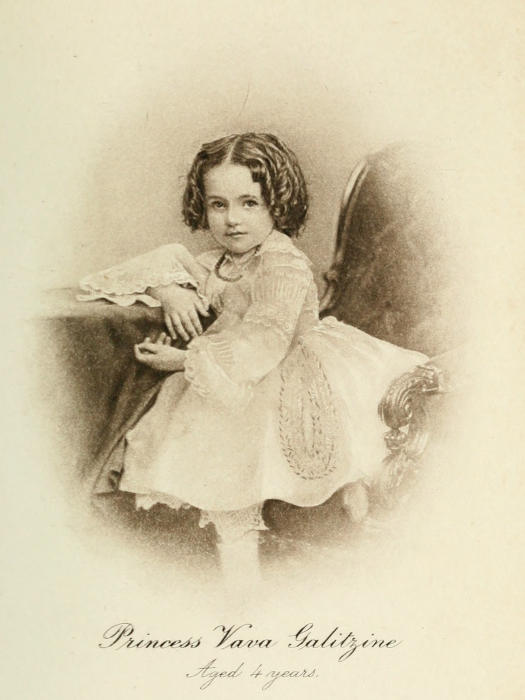
Princess Vava Galitzine
Aged 4 years.
My parents, going to St. Petersburg, generally paid flying
visits to my aunt Galitzine, who lived in Moscow. I made my
first journey with them at the mature age of four. If the
faults of children develop as they grow older, I was to become
a pickpocket, for I had the bad habit of hiding in my
pockets all sorts of broken toys belonging to the Karamzins,—two
little pupils of my aunt! When I went to bed my
nurse emptied my pockets, crying out at the enormity of my
dreadful conduct.
My birthday was a great day for festivities. I received
lots of lovely presents and sweets. On the eve of my birthday
I went to bed with expectations of a pleasant awaking,
and the first thing when I woke up in the morning was to
put my hand under my pillow and pull out the presents,
laid there by my parents during my sleep.
On my seventh birthday my grandmother presented me
with a beautiful watch with diamond settings. From the
very first moment I harboured a guilty determination to get
the diamonds out, just as I broke my dolls’ heads in order to
see what there was in them, a resolve, alas! very soon put
into practice. Mamma entering my nursery one day saw me
perched on the top of my high stool, occupied in drawing out
the diamonds with a long pin. Moral: “It is superfluous to
give such rich presents to small persons of my age.”
The object of my first love was a simple servant-girl who
lived in the next house. Every day I watched for her, and
rushing to the window I flattened my tiny nose against the
glass, and devoured her with eager eyes.
We used to live in Kharkoff in winter and passed the
summer months in Doljik, our beautiful estate which claims
to be counted amongst the stately homes of Russia, situated
forty miles distance from town. Our removal to Doljik was
a regular treat for us children, our joy and the servants’
nuisance, for when they began to pack up, we were only in
their way, under pretence of help, poking about among the
straw, scattered in the yard, throwing it over one another
whilst playing hide-and-seek.
Doljik is a delightful place. The castle, a stately white
mansion of commanding appearance, is very grand with its
suite of lofty rooms; portraits of ancestors, the former Galitzines,
very good-looking all of them, adorn the walls. The park is
beautiful, with long alleys of elm and oak and vast lawns with
skilfully sorted flower-borders, I had a doll’s house in the
park, furnished with every convenience, with a garden of my
own in which I spent happy hours gardening eagerly, weeding
and watering, I also bestowed a great part of my affection on
pet animals: dogs, cats, squirrels and tame rabbits. My
brothers and I were fond of all kinds of fun; early in the
morning we used to start for the meadows with baskets to
gather mushrooms for our breakfast, and went for rambles in
the woods. We also did a lot of fishing and bathing. My
parents presented me with a prefect dream of a pony. How
proud I felt when I was lifted on my “Scotchy’s” back for
my first ride!
Dolls took no leading part in my childhood, and I had
often wished I had been a boy. I climbed trees and tore my
frocks and engaged in all sorts of wild pranks.
There was much excitement on my father’s birthday. The
house was full of guests, and an orchestra came down from
town. At dinner when papa’s health was drunk, two large
cannons, placed at the principal entrance, were fired, which
made me crawl on my hands and knees, shamefully, under
the table. We had in the evening grand illuminations in the
park, with fireworks which did not enrapture me, for at every
burst of rockets I had to put my hands over my ears.
On the day of our village festival there was a fair on the
square opposite the church. I threw sugar-candy and handfuls
of pennies to the peasant children.
I had now passed my eighth year and the time for lessons
had come. I was given over to the care of a French governess,
Melle. Rose, who was very badly named, for she was a
horrid lemon-coloured old creature, wearing a hideous curled
wig, and always looking as though she had just swallowed a
spoonful of vinegar. I hated plain people about me and could
not bare the sight of Melle. Rose, disliking her from the first.
What a life I led her! Plaguing her was a charmingly pretty
sport for me. My governess was always scolding and faultfinding;
she forced me to make her every morning and evening
a low curtsey, which made me long to kick her. Melle. Rose
held up as an example to me a little friend of mine, the
Princess Mimi Troubetzkoy, who was a well-behaved child,
doing credit to her governess’s bringing up, and never giving
her any trouble. But I despised sheep-like docility and
was weary of hearing of all the beautiful things Mimi did
and said.
Being deprived of the bump of respect, I did exactly what
my governess told me not to do, refusing to be put into harness.
When the fighting-blood stirred in me and made me too
horribly naughty, I was sent for punishment to bed, but I would
rather be cut to pieces before I would deign to apologise to
Melle. Rose. That disagreeable person was succeeded by Melle.
Allamand, a French lady educated in England, the most
delightful of old maids, whom I loved fondly, for she was
never cross, and since she came to me, I began to understand
that it was possible for a governess to be nice, and that the
term is not necessarily synonymous to frighten and bore.
We got on very well for Melle. Allamand bore with my
caprices, which were many, I must confess. But though she was
always in a good temper we had little quarrels sometimes, which
we soon made up. I studied my piano with Melle. Allamand
and learned English, which soon became a second mother-tongue
to me. When we went out walking, my governess’s
soft heart was full of pity for the poor starving homeless dogs
which she picked up in the streets and brought home to be
fed; the ugliest and shabbiest had her tenderest care. Melle.
Allamand was called back to England and my parents had
to get another governess. An English young lady was engaged,
named Miss Emily Puddan. My brothers made her
rage awfully in calling her Miss Pudding. She had no
authority over me whatever, being in fact rather silly, but she
was a very pleasant companion—so well up in all games. We
were enthusiastic croquet-players and had sometimes desperate
quarrels, being very near scratching each other’s eyes out.
“I tell you I hit your ball!”—“You didn’t!”—“I did!”
etc., our arguments becoming very hot and uncivil; soon we
dropped our mallets and ran and complained to mamma, both
governess and pupil.
When I was past my twelfth year I grew very fond of
reading the books of the “Bibliothèque Rose.” I pitied mamma
because she read deadly uninteresting English Tauchnitz
novels, when there existed such enrapturing books as Les
petites filles modéles, les malheurs de Sophie, etc. But this
childish literature did not hinder me from flirtation. I used to
long for adventures; and here I was having one, notwithstanding
that I had only just grown out of pinafores. My parents
took me sometimes to the Italian opera and I conceived a
romantic admiration for the tenor of the troop, who was, as I
thought adorable beyond words. I raved about him. When
out walking with my governess, I dragged her in the direction
I knew the tenor would take, in the hope of meeting him. I
began to knit a prosaic cache-nez for the object of my dreams,
which mamma confiscated, happily, in time.
From my earliest years I had a great love for acting; we
gave, from time to time, little theatrical entertainments; we
dressed up and played fragments of Shakespeare’s dramas,
and I was the leading-lady in these rehearsals. When I took
up the high tragic part of “Desdemona,” Nicolas, the brother
of my little friend Sophy Annenkoff, was the personator of
“Othello,” he sacrificed his appearance so far as to blacken
his face. During the murder scene, when the situation grew
particularly tragic, Nicolas displayed such a realism of the
Shakespearian meaning, that I began to fear being choked in
reality.
I was a half-grown girl now, arrived at the age of fourteen,
envied awfully my friends, the countess Sievers and Mary
Podgoritchany who were grown-ups and wore long frocks.
Some day, I said, it will be my turn to be introduced to
society. I looked forward to the day when I should reach
the age of seventeen and appear at my first ball with a long
train, and be able to flirt to my heart’s content.
I felt now that I had enough of governesses. My last one,
Melle. Annaguy, bored me awfully, being extremely particular
about my manners; it was preach, preach all day long. Melle.
Anna gave me continually a string of instructions consisting
chiefly of “don’ts,” which I listened to impatiently. I
couldn’t go here, I couldn’t go there, I couldn’t eat this, I
couldn’t eat that! My governess was indeed too exasperating,
and I had a furious inclination to consign her to very warm
quarters. Melle. Anna was besides intensely devout; being
very anxious about the welfare of my soul, she crammed me
with pious lectures, but books of this sort were not in my line,
and I read everything I could lay hand on. Papa’s library
was full of interesting books, and I spent whole nights greedily
devouring in bed works written by Paul de Kock, a jolly
author, but rather improper. In the morning I hid these
books under my mattress. My childhood days had passed by.
Poor “Bibliothèque Rose,” thy time was well and duly over!
CHAPTER II MY FIRST TRIP ABROAD
When I was fifteen, mamma decided to take me abroad to
be “finished.” Stuttgart was chosen for our winter residence;
we were to get there towards the end of October, after having
visited Paris and made a water-cure at Spa.
I was intensely interested in all my surroundings; it was
all new to me. We spent a fortnight in Paris, visiting the
curiosities of that splendid city from morning till night.
I delighted to walk on the boulevards. Though a minx of
fifteen I had already an insatiable thirst for admiration, and
loved to attract attention, I did not look a “bread and butter
Miss” and men stared at me in the streets. One day a
passer-by, giving me a glance of approval, said to his companion:
“Look at this little girl, she promises much!” I
need not say that I was much flattered and laughed outright,
but mamma didn’t.
From Paris we went to Spa, a bright watering place, lying
in a high valley of the Belgian Ardennes, three hours by rail
from Brussels.
We took an apartment in the house of a coach-maker; his
daughter waited on us. Insignificant in her work-a-day
clothes, she looked quite a lady on Sundays, dressed in her
smartest frock; but her work was badly done that day.
Our programme was as follows: we rose at six, swallowed
hastily a glass of mineral water and went to take a walk on
the broad avenue named Allée de sept heures. In the
afternoon we listened to the band playing in the principal
square bearing the name of Pierre le Grand. (Spa’s iron
waters had saved the life of our Tzar, Peter the Great, nearly
two hundred years before).
Profiting by the occasion of being in the neighbourhood of
Brussels, we went to visit the famous lace factory. I
remarked that the poor workwomen all had sore, inflamed
eyes.
On our return to Spa, we took a wrong train and arriving
at the humble little station of Pepinster, which stood in the
open country, we were very much disconcerted on being told
to get out, for our train took an opposite direction to Spa,
and there was no other train that day. And thus we had
the cheery prospect of spending the night in this solitary
station with no dwelling in sight. It was too bad! We
quitted the train rather out of sorts, and looked round about
in helpless bewilderment. The station consisted of a bare
hall only, giving one the impression of being all windows,
with a telegraphic office at one end. As there was no lock
on the outer door, the porter advised us to barricade it with a
large table. But we were not left alone, however, someone
put his long nose through the small ticket-window, which
troubled us somewhat; nevertheless we laid ourselves down
on the hard benches to sleep, which was easier said than done,
for we had just begun to doze, when the table, which being
weak on its legs performed very badly the function of
safety-lock, gave way with a bang and six tipsy porters,
arrayed in blue cotton blouses, precipitated themselves in the
hall, disposed to pass the night in our company. What was
to be done to turn them out of doors? The situation was
becoming critical, but mamma did not lose her presence of
mind, and spreading a shawl over me, she whispered into
my ear not to give the slightest sign that I was awake, and
approaching bravely these rascals, she ordered them out,
telling them that the station-master had promised that no
one should disturb us. After many debates five men went out,
but the sixth declared that he had the settled resolution to
sleep there. My poor mamma half dead with fright, sat down
on the bench by my side, and holding up a warning finger,
she entreated the man, in an anxious whisper, not to wake
her poor invalid child. Feigning sleep, I had much ado to
stifle the laughter which bubbled in my throat. Then our
night-mate drew nearer to mamma and said: “I see,
madam, that you are not a bit sleepy, nor am I either, so let
us chat together.” To cut him short mamma began to tell
him all sorts of fibs; she announced that she was the wife of
the Russian Ambassador in Brussels, and invited him to
come and pay her a visit at Spa, giving him a false address.
Flattered and stunned by all this magnificence, her
interlocutor removed to the opposite end of the hall, and
very soon we heard him snoring in Wagnerian volume;
and in the morning how astonished he was to see the
wonderful transformation of the poor invalid child into a tall,
rosy-cheeked maiden, looking the very picture of health. As
I was getting into the train I heard the porters saying,
pointing me out: “Tiens, la petite moribonde d’hier, est-elle
tout plein gentille!”
From Spa the doctor sent us to Boulogne-sur-mer. From
the top of the belfry of the cathedral of “Notre Dame de
Boulogne,” one discerns the shores of England in fine weather.
I burned with impatience to cross the channel, and one
bright morning my desire was accomplished; we embarked
on a ship going to Dover. It was the first experience I ever
had of the sea, and nevertheless I proved a very good sailor,
though the passage of the “Pas-de-Calais” was not at all
pleasant; there was a heavy swell and the sea-breeze was
so sharp, that I had to hold my hat all the time. There was
a curate on board with his son, an Eton boy, who fell in
love with me on the spot, but I did not take much notice of
him, for he looked such a baby that one would be positively
ashamed to bother with him.
When we reached Dover we caught the special train
waiting to take us to London. When it drew up at Charing-Cross
station, a porter took possession of us and our luggage,
and conveyed us across to the Charing-Cross Hotel. I was
somewhat abashed when we were invited to enter a small
cage, which shut upon us with a vicious snap and then tossed
us up, and before I had time to do more than gasp, we were
on the sixth storey. It was my first acquaintance with the
lift, a means of conveyance which substitutes so advantageously
the legs of fatigued travellers. A new surprise awaited us:
when we rang for the maid, ordering her to bring us some
sandwiches, she whispered something into a pipe-tube in the
wall, and in a moment a shutter was set open and the sandwiches,
appeared like magic, served automatically on a
tray.
I was delighted with London. In this great city life is full
and stirring; but the English Sunday is rather a trying affair,
for there are no theatres, no entertainments whatever. We
wanted to explore the British Museum that day, and it was
with great difficulty that we caught a drowsy porter who turned
on his heel and went away after having declared, very rudely,
that we were troubling him in vain, the Museum being closed,
considering that the day of Sabbath was for rest and peace,
and that all good Christians kept it holy. We turned
sorrowfully away and went to our Russian church. When
the service was over our priest, a charming old gentleman,
invited us for a cup of tea. My patriotic sentiment was
agreeably flattered when I saw the works of Tourgeneff, our
great writer, translated into English, in his drawing-room.
From London we went straight to Stuttgart, where we
settled down to a peaceful winter. We looked about for
furnished apartments and took one in König-Strasse, the
principal street.
Mamma devoted herself to give me the best finish in her
power. Our Grand-Duchess, Olga Nikolaevna, queen of
Würtenberg, was at that time educating her niece, the
Grand-Duchess Vera, and I had the benefit of her masters.
I worked terribly hard, remaining at my studies till dinner-time.
Trying to stimulate my zeal, mamma resolved to give
me two marks for my weekly reports if they were all fives,
permitting me to spend my pocket-money on theatre tickets.
A singing mistress was sought for me, who rejoiced in the
poetical name of “Fräulein Rosa.” When I was presented to
her I gave way to a fit of most indecent laughter, for this
Rose looked such a guy—a veritable old caricature. Outraged
she left the room and never after returned. I was very
glad to be rid of that fright, and clapped my hands in
naughty glee.
I took a great liking to a young compatriot of mine, Mary
Vietinghoff, who lived abroad with her mother, by reason of
her delicate health. She was one year younger that I, but
for good senses she was ten years my senior. I used also to
see a great deal of the Rydes. Mrs. Ryde was the widow of
a Scotch curate and the mother of twelve children. I liked
the Ryde family tutti quanti, especially Ettie, a girl of my own
age, a most jolly lassie. Her brother, Willie, a youngster of
fourteen, took a fancy to me. This shrewd young Scot glided
one day on tiptoe behind me and stroked my cheek, exclaiming:
“How smooth it is.” He wanted to repeat this
manipulation with his lips, but received a smart slap across
the face in recompense; a very rude demonstration, indeed,
but I was an awfully quick-tempered young lady and hated
to be touched. The Rydes were astonished at what they
termed my “colossal good English,” which I had got from
my childhood. To complete my education, Willie offered to
teach me some of his best slang.
Though I was still in short frocks, I was already a dreadful
flirt and had all sorts of love affairs, but all the stock of my
affection was exclusively bestowed upon Robert Jeffrey, a pupil
of the English school in Cannstadt, a small town in the
neighbourhood of Stuttgart. He was a Scotch lad of
eighteen summers, blue-eyed, brown-haired and white-toothed.
I was drawn to him from the beginning, for
Bobbie was a real darling, and I considered him the sweetest
boy in the world. I had other admirers, but Jeffrey was by
far the handsomest and the dearest; I was quite silly about
him and had eyes and ears only for him alone. He was my
“Prince Charming;” my imagination adorned him with the
attributes of all possible and impossible heroes. It was my
first serious affair, the first love of my girlhood. The
passion was reciprocal and Jeffrey said I was the first girl
who had yet disturbed his peace. Mamma went to Paris for
a few days, leaving me under the care of the Baroness
Vietinghoff. She hoped that Mary, who considered herself
a sort of guardian of mine, would prevent me doing anything
rash while she was away. Part of her duty was to keep off
boys, (other boys, not Jeffrey.) Mary promised mamma to
play a mother’s part to me; she wouldn’t let me commit any
eccentricity. But I did an enormous one. Jeffrey was a
somewhat green and inexperienced youth, too timid for my
taste, and wanted a little go and rousing up. Wishing to
sharpen his wits I sent him a wild letter, telling him that he
was all the world to me. I did not expect that he would
answer personally, that same day, my foolish billet-doux, and
when Mary announced that my youthful sweetheart was
waiting for me in the drawing-room, I sat down on my trunk,
declaring that nothing in the world would force me to move
from my place. I don’t believe I am weak in the way of
shyness, but I didn’t find strength at the moment to think of
facing Jeffrey. Mary went to fetch him and left the room,
feeling herself an uncomfortable third. I continued to stick
to my box, my chin upon my folded hands. At first we did
not utter a single word, as silent as two stones. Some
minutes later we were quite ourselves again, and Jeffrey from
that day proved extremely teachable, and soon lost his
shyness; I had trained him thoroughly.
This foolish “boy and girl love” lasted during all our stay in
Stuttgart. We arranged clandestine meetings at the Rydes.
Ettie was a staunch friend, full of sympathy, and we poured
into her willing ears the story of our love, having found a
comfortable ally in her. We used to have great fun together.
One evening we were in the wildest spirits, playing
charades, and Jeffrey was just going to accomplish one of
his forfeits: he had to kneel down beside the prettiest
girl of all the company and kiss the one he loved best. He
had chosen me for both manifestations. In the midst of
the fun mamma appeared. Tableau! She didn’t approve
of kissing, mamma—and soon put a stop to the delightful
game.
Mamma kept me very strictly, and did a good deal of
weeding in the selection of my friends. She did not consider,
alas! the Rydes the best of companions for a girl of my
temperament, who was always on the look out for wickedness,
fearing that they stuffed my head with all sorts of silly
nonsense. On holidays she caught me flat-nosed, with my
face glued to the window, looking out for the Rydes.
I went with Mary Vietinghoff to Dr. Roth’s gymnastic
class, and enjoyed meeting there girls of different social
classes. Forgetting that our stations in life were widely
apart, it amused me to shake hands with daughters of shopkeepers
as well as ladies by birth, without distinction. Dr.
Roth made us march up and down the hall with our hands
clasped behind our backs. At each step we made he
repeated like a pendulum, “Kopf, Rücken, Kopf, Rücken!” and
I mimicked him in the ante-room where we put on our hats,
throwing my audience into convulsions of giggling. My
foolish tricks drove Dr. Roth to despair. When his back
was turned I dashed on to the window, raised up a corner of
the blind which was generally let down during our exercises,
and stared at the passers-by.
As we lived within two minutes’ walk of Dr. Roth’s
dwelling, I begged mamma to allow me to go unaccompanied
to his class. Mamma objected at first, for she said
she could not have me running alone in the streets, but I
soon overcame her prejudice and profited by my liberty for
paying flying visits to the Rydes on my way home from
Dr. Roth’s. Being such a romp I wanted a lot of looking
after and gave much trouble to poor mamma, who never
knew what I would do next. My apparent frivolity deeply
wounded her, but remonstrance always led to scenes. One
night, coming home from a dancing-party, where my conduct
had been more disgraceful than usual, after a miserable
scene that we had had together, mamma fell into hysterics.
It drove me nearly mad to see her in such a state, and I
dashed into the street and raced headlong, hatless, my
hair loose, flying wildly about my shoulders and waving
in the wind. Whilst I fled in terror across the street I
heard two well-known voices calling: “Vava! Vava!”
screamed mamma, “Fräulein Princess!” roared our cook,
running after me in pursuit. This only increased my speed,
and I ran as fast as my legs would carry me. A group of
students, wearing coloured caps and followed by huge dogs,
who were coming out of a restaurant before which I was
galloping at that moment, were soon at my heels. I never
stopped running till I found myself breathless at the door
of the Vietinghoffs, having taken that way by instinct, and
I flung myself panting into their apartment, where I felt
safe at last.
On Sundays we went to the Russian chapel. It amused
me enormously to watch the secretary of the queen, a gentleman
looking excessively pleased with himself, who made the
sign of the cross only when the priest pronounced the names
of the queen or the Grand Duchess Vera.
My health began to alarm Mamma; I was growing thin
and pale. Our doctor believed I was overstraining myself
with lessons, and instead of prescribing me a lot of horrid
drugs, he had the capital idea of sending us to sun ourselves
for a week or two on the Riviera. We followed willingly his
agreeable prescription and set off speedily to Nice.
Mere child as I was, I already indulged in a decided taste
for adventures, and experienced one on the road. During the
night, we were pushed into a railway carriage full of passengers;
one of them, a very good-looking young man, made
room for us and went to find for himself another place. The
next morning, whilst we were breakfasting at the Station of
Marseilles, a waiter brought me a beautiful bouquet, followed
by our amiable fellow-passenger of the previous night, who
proved to be a Mexican fresh from South America. He
opened the conversation by telling us that his name was
Gallardo Alvarez, and hinted that he was an unmarried
millionaire, making his first pleasure tour in Europe. Studying
him stealthily I decided that he would do.
We stopped at the same hotel with Señor Alvarez, who
soon began to show me that he was deeply interested in me.
In fact I won him entirely. He was a man of volcanic
passions and inflammable as gun-cotton, his eyes said even
more than his words. Unfortunately the liking was not
mutual, he did not make my heart beat. Though I was a
girl to change her passions in a hurry, I was so taken up
with Jeffrey, that I had no thought for any one else, just then;
my Mexican conquest was rather amusing and kept me from
yawning, that’s all, but nevertheless I gave him a fair amount
of encouragement. I suppose I am a flirt, but I cannot help
being nice to men. My Transatlantic adorer followed me
about like my shadow; go where I would, he was ever at my
heels and at last it became quite wearisome. I was awfully
bored and did the utmost to show it to him by being uncivil
and not nice, and he only received hard words from me. Oh!
I can easily snub anyone if I wish! I told him one day, he
needn’t stick to me so, but no, in spite of my rebuffs, he
wouldn’t stir from my side; he only exclaimed piteously:
“Princess Vava, why are you so awfully hard on me?” He
was a persevering wooer that Don Alvarez, telling me that he
had already fallen a victim to my blue eyes in the sleeping-car,
and that he thought of me all day and dreamt of me all
night since, then and a lot more idiotic bosh. He often
bothered me with compliments that I affected not to hear.
He likened me to Venus and told me that I was his goddess
and the wonder of the world, a being created to be fallen in
love with, and that I would remain as a gem set in his mind
for evermore. But I only made fun of his high-flown
sentiments. One night at the Opera, whilst Faust was
“cooing” his romance to Margaret, Señor Alvarez asked
me suddenly: “Tell me, who is the prettiest person in this
house!” I raised my opera glasses and looked about me at
the audience, but he told me it was useless work, for there
was no looking-glass near me.
I went out shopping with my Mexican friend one afternoon.
In a shop-window, with a variety of nick-nacks offered
for sale, I saw a small box of powder in the form of an ivory
apple, a perfect darling, which took particularly my fancy.
I had a craving to possess it, but as I had only a few coppers
left in my purse, I could not purchase it, and looked at the
tempting apple with longing eyes; but crushed by the scorn
of the stylish person behind the counter, I left the shop dismissing
it from my mind. On the same night, going to bed,
I noticed a parcel lying upon my toilet table, which contained
the apple that I had resisted, bought by my Mexican Paris
for his Russian Helena.
We left Stuttgart in winter, and there we were in full
blooming-time of violets and roses. We made several
excursions and went as far as the wicked little principality
of Monaco. Mamma gained large sums of money at the
roulette tables of Monte-Carlo. I was also longing to try
my luck, but roulette was prohibited, alas for youngsters like me.
We were invited to a ball given on an American man-of-war,
the “Franklin,” which anchored in the harbour of
Villefranche. The ball was too delightful; I highly enjoyed
myself and nearly danced my shoes off. There never was
anything to equal the amiability of the officers of the frigate;
their commander, Captain Folger, was awfully charming to
us and hoisted the Russian flag in our honour.
We had such a delightful fortnight in Nice. The days
went like lightning and the hour of our departure approached.
I detested the idea of going back to dull Stuttgart to pursue
my studies, but I had a compensation in the person of my
darling Bobbie.
Señor Alvarez pined with grief at being obliged to part
with me. He accompanied us as far as Marseilles and
delivered to me, whilst travelling with us, a Spanish poem,
of his composition, dedicated to me, speaking of delirious
passion, broken heart and other fiddlesticks. One of our
fellow-passengers, a handsome Canadian girl begged him to
dedicate at least three lines to her. Alvarez at once pulled
a note-book out of his pocket and scribbled down three words
only: Adieu pour toujours. Not very amiable on his part!
Bidding me good-bye, Alvarez took hold of my hands,
squeezing them as if they had been shut in a door, and
looking at me with an expression of entreaty, he requested
my permission to pay us a visit in Russia. By the manner
I answered him, I would not in his place have undertaken
such a long journey.
Here I was again in Stuttgart, carried back to lessons. In
January, on the occasion of my sixteenth birthday, mamma
gave me a coming-out dance. I considered myself fully grown
now, having put up my golden mane and let down my frock
for the first time that night. I was awfully unhappy to leave
Stuttgart in April, for I left my heart behind. It was such
a sore trial to part with Jeffrey. He was unwell on the day
of our departure and could not see us off. I was in despair
at not being able to bid him farewell and sobbed desperately
at the thought that I should never see his darling face again.
At that moment he was more indispensable to me than air
and light. Being ashamed that mamma should see me cry,
I swallowed my tears and tried to look cheerful, but when
the train began to move, I crept into a corner of the railway-carriage
and sobbed my heart out in childish grief, little fool
that I was.
Before returning to Russia we made a trip to Italy and
travelled as far as Naples in the company of the Italian
Consul of Manchester, Signor Raphaello Giordano, middle-aged
and perfectly gentleman-like. He promised to be our
cicerone in Naples, where we arrived at night, rather disconcerted
by the hubbub of the clamorous Neapolitans. When
we found ourselves on the crowded platform, noisy fachini
(porters) besieged us and snatched away our bags. Signor
Giordano had to desert us on the quay, whilst we went
to get our luggage through the Customs promising to be
back soon. In his absence a young man began to hang
about in front of us, staring at me all the time with frankest
impertinence. He came close to me and managed to whisper
in my ear: “What hotel are you going to? Do stop at the
hotel where I am staying.” Impudent fellow! I was greatly
astonished at his audacity. Fortunately Signor Giordano
strolled in at the right moment and rescued me. Both men
were standing nervously facing each other and Giordano
exclaimed in arrogant tones, his eyes blazing with wrath:
“What right have you to speak to that young lady?” “And
you, how do you dare to speak to me?” was the impertinent
answer. A squabble sprang up between them; it was so
hateful to have a scandal! Giordano went to seek a policeman
and we remained alone, dreading to move in fear of losing
sight of our protector, and our boxes were so long in coming.
At last we decided to be bold and wait no longer. We
hailed a carriage and rode off to Victoria Hotel, recommended
by Giordano, and were very glad when he made his appearance
an hour after.
Early next morning I opened the shutters and was fascinated
by the splendid panorama of the bay of Naples and
Vesuvius with its cone rising against the azure sky. How
glorious it all was!
We spent three weeks in Naples making excursions and
visiting all the curiosities in the neighbourhood. Pompeii
produced a very painful impression on me by its atmosphere
of death and disaster. We were present at the digging up of
vases, bracelets and other curious relics of by-gone days.
Wishing to give a surprise to my father, mamma had my
portrait made by a horrible little hunch-backed painter of
modest pretensions. After my very first sitting we did not
appreciate this Quasimodo’s manner of painting. Mamma
took great pains in pointing out to him his mistakes, but
instead of repairing them, the little fright contemplated that
abominable painting with his ugly head first on this side and
then on that, as if lost in admiration, repeating all the time:
“Bellissimo, grazioso!” The portrait was, as we expected,
a great failure, but we had to take, nevertheless, that spoilt
canvas, unworthy of preservation, paying for it the sum of
200 francs.
One day, having to change some Russian coins, we entered
an American bank, where I made, as it appears, a great impression
upon one of the clerks, a very good-looking chap,
with light hair and brilliant black eyes. He found a pretext
to come and see us at the hotel next morning. After that,
we saw him nearly every day; he spent all his spare time
with me. This youth, named Alphonso Shildecker, was of
cosmopolitan origin, born in America of a German father
and an Italian mother. Though only a banker’s clerk,
Shildecker was nevertheless very well educated and spoke
several languages fluently. He had an agreeable tenor
voice and taught me some popular Neapolitan songs. This
poor youth was getting seriously in love with me, which
was perfectly ridiculous. I liked him pretty well in the beginning,
and rather encouraged his hopes and accepted his
advances in a friendly spirit, but if he thought I was serious,
he was making a great mistake. It had all gone much
deeper with him than with me. To me he was only a new
toy; I was delighted with any one who could amuse me and
was simply playing with him out of girlish perversity.
An American boy, Floyd Reynolds, a student of the
University of Bonn, who lived in our hotel, was burning with
impatience to be presented to me. One day he sent me up
an enormous bouquet with his card pinned on it. Shildecker
took it into his head to be detestably jealous of Floyd.
Giordano was not dangerous to him being no longer young
and not particularly good-looking, but he was wild at my
flirting with Floyd, in who’s company he did not show to
advantage. He soon became very tedious, never leaving us
alone and coming in our way when we wanted to be free and
quiet; he seemed to take a perverse pleasure in interrupting
our conversation. I considered two a better number than
three, and as for Shildecker I would have liked to have kicked
him round the room. He followed me everywhere, but I
turned my back and devoted myself to Floyd, and left him
out in the cold. He caught me in all the available corners,
when we visited churches and museums, and made love to
me, telling me that he adored me to madness, and that he
was going to cut his throat, or hang himself, or I know not
what, unless I gave him hope. That sounded very tragical
indeed! It may be all stuff and nonsense, but, nevertheless,
I undoubtedly played with fire and was in a constant fear
that he might do something wild and desperate; I am sure
it’s enough to make any girl nervous! But I was not going
to let him spoil our trip, and tried to keep away from him,
thereby driving him into a more feverish condition than ever.
He grew perfectly ill with jealousy. How black he looked
that love-sick boy! He suffered and I enjoyed myself; that
is the way of the world! The day we left Naples, Shildecker
wanted to go with us to the train, but I determined he should
not have the chance, and indicated to him a wrong train. I
was awfully vexed when I saw him at the station, looking
down the platform with anxiety. Despite all my precautions
he had tracked me. When he asked permission to
write to me, I looked at him as though suddenly remembering
his presence, and answered with an air of royal condescension:
“You may do as you like!”
We spent three days in Rome, roaming through the splendid
museums and churches, and had the chance of seeing the
Pope officiate in St. Peter’s Cathedral, which was a very
imposing spectacle.
On the eve of our departure I received a letter from Shildecker,
who wrote to me that he had taken leave of absence
for a fortnight and was coming to rejoin us in Rome; but it
did not detain us, to be sure, and the next morning we started
for Florence without leaving our address at the hotel. I had
had such an awful dose of Shildecker at Naples that it was quite
enough! But “La Donna è mobile,” I found myself at intervals
thinking about him, and strangely enough, I missed
him now not a little that he was altogether lost and
done with, and felt tenderly towards him. Such is the consistency
of human nature! Being a girl of prompt action,
I wrote to him, not foreboding the consequences, to come
speedily to Florence. Two days later a waiter came to tell me
that a young gentleman was at the door and wished particularly
to speak to me. It was Shildecker in person, who
rushed forward, took my hands in his and kissed them
passionately, looking happy and proud beyond words, but I
did not let him make too much display of his flow of tenderness
and, wrenching my hands from his grasp, I told him
to follow me. We entered the drawing-room together, and
I blushed up to the roots of my hair when I saw mamma’s
bewilderment at the unexpected appearance of Shildecker,
who, without preamble, solicited my hand. Mamma with
ideal composure told him that we were far too young, both
of us, to talk of marriage, and that my father would certainly
never give his consent. Shildecker’s face lengthened visibly,
but this check did not, however, abate his hope of taking
possession of me one day.
I had again enough of Shildecker, but it was no such easy
matter this time to get rid of him; having gone so far, he
was not to be turned back, he meant to follow us to Venice.
(He would have followed me to the end of the world if I had
let him!)
For some time past I had noticed that my wooer was
altered, not the same fellow at all, looking like a phantom
of his former self, a wreck of the handsome Shildecker of
former days. I knew it was all my doing, but asked him
impishly what was the matter with him and if he could ever
manage to stop looking as if he were in a dentist’s chair. He
told me that my coolness gave him innumerable sleepless
nights, and that I ruined his life.
We arrived at Venice in the night. That aquatic town
seemed very beautiful to me with its magnificent palaces reflected
in the water, and poetic gondolas, but I found Venice
less interesting when seen in disenchanting day; the beautiful
palaces appeared ancient and decayed, and the poetic gondolas,
resembling coffins, gave rise to lugubrious thoughts. How
insufferably dull it would be to dwell here! To live a day,
buried in that monotonous silence, is quite enough, I thought.
We parted with Shildecker in Venice. He accompanied
us to the boat sailing for Trieste, and was sadly broken down,
poor boy. When he bade me a dramatic farewell, his face
was pale and his eyes had a world of grief in them, and he
told me in a voice which trembled, that even if years were to
pass, and continents and oceans divided us, I had only to say
come, and he’d come. His last words were that he would
ever be true to me, and always keep me in his heart, and
though always is rather a tremendous word, still, to judge
by his dejected aspect, he looked likely to fulfil it. When
our boat swerved slowly from the shore, my poor worshipper
stood forlorn, contemplating our ship with tortured eyes, and
then I vanished out of his life for ever.
On my return home my father and brothers found that I
looked quite grown-up with my long dress and new style of
coiffure.
Though far away, I could not forget Jeffrey, and was very
happy to receive a long passionate missive from him, enclosed
in Mary Vietinghoff’s letter. I devoured the pages with
eager joy. Jeffrey wrote that he was broken-hearted since
his darling Vava went away, and that he smothered her sweet
face with thousands of passionate kisses. My poor, dear,
bonny lad! I too was hungering for the sight of him, but
half Europe, alas, divided us!
For some time I kept up a correspondence with Ettie
Ryde, and inspired her with the following poem, in well
turned rhymes:—
From this large, bustling city
My friend has gone. Oh, what a pity!
With her I laughed and sang and danced,
Since she left me my love is much enhanced
She was merry, she was very, very wild,
My friend was a naughty, disobedient child.
She fell in love with handsome men and boys,
And broke their hearts, as children break their toys.
She first loved a Greek, of colour dark and sallow,
“I always thought him like a candle made of tallow.”
But she much admired that dark-eyed Greek;
She used to sit by him and softly stroke his cheek.
(White lies.)
At length of this Greek youth she grew quite tired,
And her heart with love to a young Scotchman was fired.
He was young, just turned nineteen,
Hair brown, eyes blue, by nature somewhat green.
Oh, I can’t tell of that long, long tale of love!
He thought her constant, sweet, gentle as a dove.
She believed him mild, kind-hearted, very true.
Can you tell the names of this young couple, can you?
Well, she was no other than Vava, the young princess,
She ought to have had more sense, you must confess.
He was Jeffrey, the youth from Glasgow town.
If they read these verses how they both would frown!
Oh, I should like to see dear Vava again!
She gave me pleasure, never a moment’s pain.
Now, my sweet girl, this poetry I must end,
Don’t, oh don’t forget your fond Scotch friend!
Henrietta Ryde.
I was delighted with her poetry, which incited me to write
the verses that I venture to give here, written in the slang
style that I had picked from my Stuttgart English friends.
The lines ran thus:—
Dear Ettie, spare some minutes few,
To read this poetry, will you?
It’s awful, stupid balderdash,
And nothing better than mere trash,
But be indulgent, damsel sweet,
And mind, you puggie, be discreet,
Don’t show this rubbish to your beaus,
Nor to your friends, nor to your foes,
For I’m afraid to be laughed at,
And to be called a stupid brat.
Do you remember, darling child,
How I was fast, and oh, so wild?
But I’m not changed as yet the least,
Now, am I not a horrid beast?
Oh what a booby, dear, I was,
To care for so many fellows.
But the real object of my flame,
I truly should not know—to name.
(Ungrateful being.)
I liked Jeffrey pretty well,
Because he was such a swell,
I liked Skinner very much too,
Somebody else did, don’t you know who?
Oh, Ettie, you were an awful flirt,
The idea of my being so pert!
But it’s the truth, dear, isn’t it, dove,
You must confess it as a love.
Poor old girl, how you must feel forlorn,
Now that sweet Teddie Thomson’s gone!
He was a darling little man,
But as dark as a frying pan.
(My revenge for the comparison of my Greek
adorer to a candle made of tallow.)
Just remember, at Mary’s party,
You nearly fainted, my hearty,
Then Teddie with a haggard face,
Bustled near you with a great deal of grace.
He ran for water, for Eau-de-Cologne,
And went right smartly through his besogne
Now, old girlie, I must bid you good-bye,
Really, duckie, ’tis not without a sigh!
Vava Galitzine.
CHAPTER III MY FIRST APPEARANCE IN SOCIETY
I was to be taken out in St. Petersburg for my first season,
and presented at Court. How my heart palpitated at the idea
of my first dance! I made my appearance in public in
Kharkoff, at a ball given by the Count Sievers, the governor
of the town. I am not afflicted with shyness, nevertheless I
was seized with a sudden access of bashfulness on entering
the ball-room, and feeling horribly uncomfortable with the
big bouquet that my brother had given to me, I flung it on
the floor in the ante-room. It was not long, however, before
I was quite at my ease again, enjoying the ball enormously,
and dancing to my heart’s content all through the evening.
I came to St. Petersburg full of happy hopes and expectations,
and an eager desire to spread my wings in the wide
world. It would be a delightful existence—every hour filled
with enjoyment.
I plunged at once into all the gaieties of St. Petersburg
society. Everything was so new and delightful to me! My
first social appearance was at a great Court ball. I was
brought out by my aunt, the Princess Kourakine, a lady of
honour to the Empress. I had such a ravishing ball dress
with a very long train. One of mamma’s friends had lent
me a carved ivory fan of great value, which I dropped in the
snow stepping out of the carriage. The fan lost some of its
lustre, but what a dazzling lustre presented itself to my eyes
when I entered the palace and mounted the splendid staircase
lined with powdered footmen in gorgeous liveries.
Everything was magnificent and I enjoyed the ball madly.
I was not acquainted with a single soul in the place, nevertheless
I became instantly surrounded by a circle of partners.
I never amused myself so much before. The first dance
over, my cavalier, a brilliant officer of the guards, piloted me
through the ranks of dancers to the refreshment-room to get
an ice. As we passed by the Emperor, who was engaged in
a conversation with my Aunt Kourakine, His Majesty gazed
at me fixedly and asked who I was. My aunt came over
and led me to the Emperor and formally introduced me.
His Majesty began by questioning me about myself, my
home and my parents. I forgot to be frightened and answered
without the slightest flutter of embarrassment, and we soon
fell into a comfortable talk. The Emperor asked me if it
was my first grown-up dance. “Oh, no, Sir, it’s my second
one,” I announced proudly. The Emperor smiled and
expressed his desire to see me henceforth at the Court balls.
Perceiving my partner, who was trying to conceal himself
behind a column, the Emperor asked me if it was my
cavalier. “Oh, yes, Sir, and I am keeping him waiting such
a long, long time,” I blurted out in one breath. It was
indeed a dreadful breach of court etiquette, but I was so
inexperienced in the ways of society that a transgression
against Court laws appeared of little importance to me. The
Emperor seemed much amused by my outspoken manner and
said: “Well, go on dancing, I will not deprive you any
longer of that pleasure.”
I returned home enchanted, and went to bed in a delirium,
but I had had too exciting a night to find it easy to fall asleep.
Some days later, at a musical party, given by my uncle,
the Prince Prosorowski-Galitzine, the master of the house
said to me significantly, “Well, Vava, I congratulate you!”
But he did not conclude his phrase, for mamma, who tried to
preserve me from the intoxication of overpraise, made haste
to change the subject of conversation. I was tortured with
curiosity and got the whole story out of my cousins, the
Prosorowskis, who told me that the Emperor at the fox-hunt
had asked their father all about me and said a lot of
flattering things, congratulating him on having such a niece.
The gaiety and the bustle of St. Petersburg life bewildered
me. I went out a great deal, fluttering from amusement to
amusement: balls, dinners, theatres, concerts, etc., etc.
Unfortunately I couldn’t be in two places at the same time.
Papa took me to another Court ball, where I distinguished
myself, making such a stupid blunder. Overheated by
dancing, I was dying of thirst, and rushing up to a smart-looking
individual, clad in bright red, I told him to bring
me some iced lemonade, taking him for a Court official. He
returned in about five minutes, closely followed by another
personage arrayed likewise in red, who carried a tray, and
making me a most refined bow, he named himself “Senator
K⸺.” In an instant I had guessed the whole odious
situation. I had made an awful mistake, having confounded
a red-livered lackey with a senator. How could I have been
so clumsy? It was a horribly awkward moment, and I
thought I should die of shame. It was really very difficult
to find something to say. Covered with confusion I blushed
all over my face and muttered hastily some excuses, wanting
the floor to open and swallow me up.
There was to be a grand fancy-dress ball at Court, in which
I was invited to participate. It was to be one of the best
things of the season, one of the eight marvels of the world.
The Grand Duke Waldemar, representing the sun, was to
open the cortège sitting in a triumphal car drawn by pages
and surrounded by twelve sunbeams. I was designed to
represent one of them. We were to follow the car in a
semi-circle, the tall ones (I being one of the number) in the
middle. I had the most bewitching costume that heart of
girl could desire. It consisted of a Greek tunic in rose satin,
draped on the shoulders with golden gauze; a small sun-dial
on the top of my coiffure, powdered with golden powder, was
to indicate the hour (mine pointed out six o’clock.) My
costume was quite ready, and I gazed at myself in the
looking-glass with rapture, arrayed in it. I was a good deal
excited about this ball, and could think of nothing else, when
suddenly came the tidings of the death of a prince belonging
to the Prussian Imperial family, and the ball was put off. I
was awfully disappointed and nearly cried my eyes out. I
had looked forward to it so!
A love affair sprang up between me and the Prince of
Montenegro, brother of the reigning prince of that country.
We met for the first time at a ball at the French Embassy.
The prince was astonishingly handsome, quite a show
creature, looking very picturesque in his native costume,
consisting of a white woollen skirt and a jacket with golden
embroidery. There was an air of Veni, vidi, vici, about him.
The prince was made much of in society; never was a man
so run after. I was surrounded by a flood of partners when
the prince came up, claiming a dance, but I had to refuse
him, being already engaged. He was by no means discouraged,
and established himself on the other side of my
chair, and thus I found myself sitting between two devoted
cavaliers. The prince danced divinely, and I waltzed with
him pretty nearly all the evening. As the ball went on
mamma, who found that my partners were becoming
alarmingly enterprising, wanted to carry me off home at
once, but a chorus of protestations arose from them, and I,
too, began to implore mamma not to be obliged to leave the
ball just when the fun was at its height. The prince added
his entreaties to mine and gained the victory, taking me to
supper. I never had a more entertaining neighbour. The
prince had lived a great many years in Paris and spoke
French perfectly. He was so clever, full of spirits and
daring; in short he was a number of charming things, and I
lost my heart a bit. The temptation to play with fire had
seized me and I desired to prove my power to charm him.
The prince lost no time in letting me see the impression I
had made on him, and though he had the reputation of preferring
the society of married women to that of young girls,
I saw that he was inclined to enter into a flirtation with me.
The champagne had warmed him up and he became very
audacious. He slipped his hand under the table-cloth and
our fingers touched and communicated fire. Meanwhile, a
not very attractive damsel, deeply impressed by the prince’s
good looks, was gazing at him with eyes of passionate
adoration across the table. I noticed it to the prince, but
he replied that as for himself, he had no eyes for anyone but
me. And he had indeed very expressive eyes, the prince,
and knew how to use them! I tried to keep a cool head
during the siege of my admirer, but though I had been an
iceberg, it was impossible for me not to thaw in his presence.
My pulses quickened and I felt an odd little thrill of emotion,
while my tell-tale eyes betrayed the truth and looked pleased.
After the cotillon mamma took me reluctantly away. Whilst
we were putting on our cloaks in the ante-room the prince
appeared and came out in the cold to help us into our
carriage, and pressing my hand to his lips, he begged
permission to call on us the next day.
I was playing the piano frantically, absorbed in my performance
of one of Chopin’s nocturnes, when the prince was
announced, but mamma being out, I gave orders to tell him
that there was nobody at home. The prince was a good deal
nettled, and when I met him at a ball a few days afterwards,
he greeted me somewhat chillingly, but I soon smoothed
him down and we were good friends again.
The prince’s marked attention to me soon became the
topic of much gossip. He was hit, I knew he was, and I,
too, was not very far from being in love with him. At the
end of the season the prince’s white skirt began to be
slightly grizzly, and as I had remarkably sharp eyes and a
tongue to match, I looked him over critically and declared
that I would not dance with him until he had changed his
skirt for a new one. Brazen girl that I was to say such
shameless things!
We left St. Petersburg in February and came to Moscow
for a few days to my grandmother Galitzine. I caught a bad
cold on the way, and a doctor was hastily summoned: a fat
little old man with a face like a wrinkled apple. He was so
funny that I had an attack of laughter at the sight of him
which he took for delirium. I had been allowed on that day
to have my friend Mary Grekoff with me for an hour or two.
She sat on the edge of my bed and we were both soon engaged
in eating pounds of chocolate, which did not improve
the state of my health, to be sure. Small wonder then that I
got worse with every minute; my temperature rose alarmingly
and I began to be delirious. My illness declared itself
plainly, typhoid fever was the verdict pronounced by the
doctor. The case was going to be an anxious one, and the
chances were two to one against my recovery. The doctor
said it would be well that mamma, who was almost distracted
with anxiety and grief, should be prepared for the
worst. I passed many sleepless nights tossing in my bed in
a restless manner; at daybreak, when the windows were beginning
to whiten, I listened with envy to the joyous
“coquerico” of neighbouring cocks, who woke up gay and
brisk after a good sleep, whilst I, poor thing, had not closed
my eyes for many nights.
I sat up in bed, propped with pillows, and sobbed bitterly,
moved to pity for myself. I was so unused to illness.
Mamma, who slept in my room, came and sat by me and we
had our cry together.
Feeling my end drawing nigh, I sent for a priest and received
the Holy Sacrament. Soon after came the crisis. I
suffered tortures that day, one could hear my shrieks two
streets off. Gasping for breath I tried to bounce out of bed
and had to be kept there by main force. Happily complications
did not arise, my constitution triumphed, and by the
mercy of heaven, life conquered death, and I was pronounced
out of danger.
My convalescence was slow; I was laid up for six long
weeks, coming round from my illness day by day, and
nursed with much tenderness. As soon as all danger was
over, the doctor permitted me to be transferred to Dolgik,
though I was still weaker than a new-born babe—a mere
shadow of my former self.
The wholesome country air put me quite on my legs again,
my health was entirely restored, and I recovered my good
looks and my spirits, but I had such a shock when I found
all my hair had to come off; I was obliged to have it shaved
after my illness. It did not hinder me, however from having
three or four admirers here, waiting on my very words. One
of my chief victims was Aksenoff, a chum of my brother’s,
who was completing his studies at the University of Kharkoff
that year. Aksenoff was not a bit the hero of my girlish
dreams and had no chance whatever of attracting me; he was
a clumsy, athletic-looking lad, with feet like fiddle-cases.
Rough on the outside, but the best fellow in the world, he
improved on close acquaintance. One could easily see that
he was falling seriously in love with me in spite of my shaven
head, covered, it is true, with a coquettish cap which suited
me wonderfully. I seemed to him a pearl beyond price, and
he spent all his time in gazing up at me as a unattainable
star. He was my devoted slave in everything, following me
about with a sort of dog-like fidelity. I could twist that
giant round my little finger; he was as wax in my hands and
would go through fire and water for my sake, but I was a
very cruel girl, I delighted to torment my admirers and I
only made a laughing-stock of Aksenoff, and began to order
him about mercilessly. Enjoying to impress my sweet will
upon the poor boy, I teased and tormented him atrociously.
Had I not had plenty of victims already? Why should I
want that poor boy to be tortured? But my desire for
conquest was insatiable, I couldn’t leave a man alone.
We had a continual succession of guests in our house. In
the middle of May there was a large party staying at Dolgik-castle,
and Aksenoff was kept by me as usual in the background;
he accompanied us in our excursions, carrying cloaks
and umbrellas. I used him barbarously and abused my
power over him. I was pitiless, making the most use
possible of my willing slave, and invented many nasty tricks
to annoy him. When we arranged dances in the evenings I
sent him to gather roses in the garden, promising him, with
my most winning smile, a waltz in recompense, whilst another
partner carried me off in his arms from under his nose, leaving
him standing there in great dismay. My simple-hearted
lover had no suspicion that I was only fooling him, he went
and picked the roses, and when he returned with an armful
of flowers, I started him out again on the same errand, and
the much-enduring Aksenoff went off crestfallen, with a face
a yard long. One must allow, poor boy, that just then he
happened to be supremely unattractive. When he came
back this time, I flung off his roses and said with my most
princess-like air, dropping into an armchair, that I was too
tired to dance with him now. Seeing the look of suffering in
his face, I thought that I had teased him enough for that
evening, and coaxed him with some sweet words. Poor
Aksenoff only heaved a sigh like a March-gale and looked at
me with kind, forgiving eyes. He told me one day that the
lines of his hand predicted him a short life, and his prediction
was realised; soon after we heard of his death in Kharkoff,
of smallpox.
CHAPTER IV MY SECOND TRIP ABROAD
In order to recover entirely from the effects of my illness,
the physicians sent me to Biarritz. I was taken abroad by
mamma. Towards the latter end of July, travelling from Berlin
there was a nice German lady with her niece in our compartment,
and I was delighted with my new acquaintance, a girl
of about my own age, ever ready for frolic and fun. As soon
as the whistle of our train announced an approaching station,
we hung our heads out of the window and exchanged glances
with groups of German students, in red caps who promenaded
on the platform, shouting to them: “Rothkapchen!” But as
soon as they approached, our heads were hurriedly withdrawn.
We established ourselves in Biarritz at the delightful Hôtel
d’Angleterre, full of English tourists. The outlook from our
windows was splendid; in the distance came the incessant
wash of the ocean, and at night, the murmur of the waves was
a sweet lullaby soothing me to sleep.
On the first day of our arrival, at table-d’hôte, my eyes
travelled round the table and noticed an attractive-looking
English trio sitting opposite to us: Mr Delbruck, his son
Alfred and his nephew Walter Heape, a fine, fresh-looking
boy, with whom I made a nice little bit of flirtation during
our stay in Biarritz. He was very much drawn towards me;
I also entertained tender feelings towards him. (And what of
the prince of Montenegro?) But, never mind the prince, he
was far enough away, just then, anyhow!
In Biarritz you are next door to Spain and I longed to
snatch a glimpse of that poetic country of fans, mantillas and
serenades. The Delbrucks agreed to go with us to San-Sebastiano,
a Spanish town near the frontier. We could
easily go there and be back by dinner-time. We started at
an early hour, half asleep all of us, but were soon cheered up
as we came out into the freshness and crispness of the early
morning.
As we passed the frontier, I was very much disappointed
to see that the Spanish officials, walking on the platform,
looked just the same as the French ones,—not a bit like
opera Toreadors or Tradiavolos!
After a speedy breakfast at the London Hotel we loitered
about the town of San-Sebastiano in a labyrinth of narrow
streets, and mounted to the top of the citadel. The climb
proved to be a long, hot and fatiguing one. Half way up
we saw the monument of a German merchant who, after
having become bankrupt, had thrown himself into the ocean
from that spot. When we reached the citadel we went groping
along silent passage-ways; the semi-darkness within began
to provoke a disagreeable impression on me, especially when
I perceived a ghastly face peep in at us through the bars of a
dungeon window. The prisoner was beckoning to us, trying
to explain by an expressive pantomime, that he was going to
have his head cut off. I regarded him with eyes of terror
and alarm and remarking my fright, the prisoner amused
himself to increase it by shouting to me: “Señorita, escucha
Vd!” (Listen to me Miss!) which I certainly declined to
do, and hid myself behind the backs of my cavaliers.
We returned to the hotel thoroughly done up. After
dinner, as we took our seats in the train carrying us back to
Biarritz, an elderly Spaniard came in, cigar in mouth. He
sat down and sent a dense cloud of horrid smoke right into
our faces, making mamma feel faint. Noticing that, Mr.
Delbruck requested our unpleasant fellow-traveller to stop
smoking, but he only sneered, puffing away at his cigar.
The next day the Delbrucks proposed another expedition
to the convent of the “Bernardines,” where the nuns took
vows of perpetual silence. When we came within the enclosure
of that monastery, situated near Bayonne, there was
an ominous deep stillness around us. In passing through
the garden we saw a group of nuns sitting in pairs under the
trees, with their backs turned to each other reading their
bréviaires. These poor cloistered women were draped in long
white robes with a black cross embroidered on the back; an
enormous hood covered their faces entirely.
Mamma, having enough of hotel life, began to look for a
private villa, and I triumphed inwardly each time she did not
come to a right understanding with the proprietors, for it did
not suit me a bit to be separated from Walter Heape. But
mamma made her choice at last, and before long we were installed
in a pretty cottage called “Maison Monheau.”
Happily the day of our removal coincided with the day of the
departure of my English friends. Mr. Delbruck gave us a
pressing invitation to come and have a grape-cure on his
property, situated in the neighbourhood of Bordeaux. This
suggestion was seized upon by the boys with enthusiasm; they
promised me a warm reception and said they would do anything
they could to make my visit a pleasant one, and painted
me entrancing pictures of the good times they would give
me; they could offer me fishing, a pony for me to ride, and
other enticing things. For my part I thought it would be
splendid fun, and the invitation was so tempting that I was
ready to embrace Mr. Delbruck, but mamma declined it to
my intense disappointment.
Towards the end of September we started on our homeward
journey.
CHAPTER V MY SECOND SEASON IN ST. PETERSBURG
I had again my heart’s desire. I was invited by my aunt,
Swetchine, mamma’s sister, to spend the winter with her in
St. Petersburg; I was in the seventh heaven of delight,
nothing could please me better.
How pleasant it was to be in St. Petersburg again; I felt
so self-dependent in it! It was my first taste of liberty; I
was my own mistress at last, and I should have plenty of
opportunity to spread my wings and see the world, of which
I knew nothing, but expected everything. I had a chamber
of my own and felt that I had never lived till now, it was
simply a foretaste of Paradise.
I got on admirably with my cousin, Kate Swetchine, the
most good-natured girl in the world; her sister, Sophy was
much too serious for me. I had all my days free to do what
I desired. Music became an actual passion to me; I practised
the piano a good deal; Liszt being one of my favourite composers,
I played his rhapsodies stormingly. I began also to
study singing, and in spare moments wrote stupid verses,
which all my admirers thought beautiful. That winter I raved
about officers belonging to the horse-guard regiment, and
dedicated to them an atrocious poem that I sang on the
motive of L’Amour, the fashionable chansonette of the season.
A young engineer occupied an apartment in the house
where we lived; our rooms communicated. My neighbour
possessed a loud baritone voice and sang very improper
songs for a young lady to hear. Though unacquainted, we
chorused sometimes to each other, and when I sang my horse-guard
chansonette, from my neighbour’s room came the most
sonorous second.
A gentleman of quite different style, who was acutely sensitive
to noise, lived side by side with our drawing-room; a
stern, frozen-up human being, grey and wrinkled. When we
were not behaving too quietly, he sent the maid to request us
to moderate our gambols, but we were not in the habit of
being silenced.
My singing mistress procured us tickets for the distribution
of prizes in the St. Petersburg conservatory, where I attracted
the attention of one of the professors, Mme. Everardi, who
gave me an appreciative glance and said, pointing me
out, “Look at this young lady, she is destined for the
stage.”
I was enjoying the many pleasures St. Petersburg could
offer, and was bombarded with invitations of every kind;
people were asking me to dinners, dances and all sorts of
delicious things. We came home at most eccentric hours,
turning night into day. I liked the admiration I excited.
As soon as I entered a ball-room, I became surrounded by a
circle of partners, quarrelling with each other for the privilege
of a dance with me. My ball-programme was soon scrawled
all over; I mixed up my dancers and began to wonder how
I could possibly manage six youths at once. They drew lots
for the right of dancing with me, and as neither seemed inclined
to give way, they would end by half tearing me to
pieces between them. I danced nearly every dance with two
partners, and how I danced, with all my soul in it, for I never
did things by halves. Hot but indefatigable, I flew round
the room, dancing as though I would never tire. My partners
wanted to flirt with me in the intervals but I never gave them
the time, keeping them whirling me round till they had not
much breath left for talking. Towards the end of the evening
my hair became untidy and my train torn to pieces, every
scrap of trimming on it destroyed.
My admirers were of all ages, from mere boys to wrinkled
greybeards. I received their attentions as a matter of course,
and though I flirted with many men, I never really lost my
heart to any of them.
A young officer appeared at last on my horizon, with whom
I almost convinced myself that I was in love. He carried my
photograph in a locket on his watch-chain, and brought me
flowers and bonbons, and spoilt my appetite, making me eat
lots of sweets before dinner. One day I scratched my finger
with a pin; it was nothing but a simple scratch, but a drop of
blood appeared and my chivalrous admirer tore his handkerchief
instantly to pieces and bound up my wound. He
preserved that rag, stained with my precious blood, as a sweet
remembrance. Very touching indeed!
A general with lumbago, full of years and honours, who
was looking about him for a wife, began to lay siege on me.
I saw a great deal more of him than I wished to, and as I
didn’t like to have that tiresome old man bothering after me,
I often pretended to have a bad headache and went to my
room. His company was too odious for words, he was dull
as ditch water. This general got me alone one day, and proposed
to me, saying that his hand, his heart and his purse
were freely at my command. The idea of that old scarecrow
indulging in matrimonial schemes! A husband of that
sort would never do for me, and I gave him a brilliant rebuke.
Distressed by my unreachableness, he disappeared from our
horizon. I was so happy to be rid of him!
I took a walk between two and three every afternoon up
the “Nevski Prospect,” a place of rendezvous with a number
of my admirers. I came back one day from my walk with a
terrible headache and throwing myself on my bed, I burst
into a loud fit of hysterical laughter and weeping which
terrified my cousins who stood beside me wringing their
hands, and wanted to send the maid after the doctor, but
my aunt, who came home at that moment, did something
more practical: she stamped her foot and ordered me to
stop instantly all that nonsense, otherwise she would
countermand the dancing-party that was to take place that
evening. My hysterical fit passed as if by magic; I
recovered my self-control, and bounding to my feet in the
liveliest manner, I began to prepare the dessert for our
soirée.
The young men about me were very incendiary, a tiny
spark thrown among them set them on fire. Stenger, one of
my most ardent partners, a youth of about nineteen years of
age, took a desperate fancy to me; when we danced
together he held me in his arms so tightly I could hardly
breathe, and as we swung round he murmured soft things
into my willing ears. That boy managed to make his way
into our house and found means to see me almost daily.
One beautiful frosty night we went out sledging to the
Islands in the outskirts of St. Petersburg; we drove in troikas,
wide sleighs drawn by three horses. It was very cold; I
was quite frozen and rubbed my fingers, and Stenger, who
sat opposite to me, slipped his hand into my muff, and under
pretence of warming my hands, pressed them, almost crushing
them in his grasp, but my aunt soon put a stop to this
massage, saying that my muff would do the business much
better. Stenger’s adoration was too bothering, and as I did
not happen to be consumed with passion myself, I grew
weary of it and lavished my attention upon Ofrossimoff, a
very good-looking boy, a scholar of the Lyceum. Naturally,
Stenger was full of bitter envy towards his successor, and
strongly disapproved of him. I tried to pacify his jealousy,
but it was not to be subdued and I made his eyes look angry
very often. Stenger grew altogether impossible, and his fits
of jealousy became disagreeably frequent of late. I scarcely
had a moment alone with Ofrossimoff, Stenger resolutely
determined not to let us sit together, and was always in our
way and came and spoilt our talk. Wherever we went he
turned up unexpectedly and looked upon us with suspicious
eyes. I have never felt so watched, and mentally sent him
to the antipodes, for I was always the same, with no idea of
constancy; I simply tossed aside my admirers as an old glove,
as soon as anybody more attractive turned up. For me that
tiresome Stenger was already a broken toy; I did not wish
to spend my time looking at him when I could spend it
looking at Ofrossimoff.
Wanting to be rid of him at last, I made him understand,
very clearly, that he was a bore, telling him, naughtily, there
was no room for him here, and making him feel that three
is an awkward number and that he was one too many; then
Stenger fell upon me with reproaches, saying that I take all
and give nothing, winning all hearts just because I myself
had none, and that I was a monster in a woman’s shape to
torture him so, a sort of vampire who sucked every drop
of happiness out of him. He concluded by telling me that
he had given away his heart to one who was utterly unworthy
of it. I did not suspect that I was treading on such dangerous
ground, but my aunt felt that we were going to have trouble
with this too ardent youth; she was sure there was going
to be a row. Had I pushed my game too far after all?
I had never taken Stenger very seriously and began to feel
uncomfortable.
One day when I was shamelessly flirting with Ofrossimoff,
absorbed in each other we had forgotten the presence of
Stenger, who came to us in a storming rage, his face a
thunder cloud, and told Ofrossimoff he wouldn’t play second
fiddle, nor submit any longer to a cat-and-mouse game, and
also would not permit any other man to usurp his place,
especially to such a baby not yet out of the school-room.
(Ofrossimoff at that time was a moustachless youth and
Stenger had already a slight shadow on his upper lip, of which
he was immensely proud.) My aunt was right: there was a
frantic personal affair between these two boys, and Ofrossimoff
flaming angrily at Stenger’s insult, challenged him to a duel.
That was a nice piece of work indeed! The two rivals were
going to fight and all through me; they had already invited
seconds. Happily the duel did not come off, Stenger was
forced to apologise, but nevertheless I was now feeling myself
to be a heroine, as for Ofrossimoff, he seemed to me to be
as bold as a young lion, and went up twenty-five per cent in
my estimation. I had a good scolding, nevertheless, from
my aunt, who said I was a fearful little flirt, playing merry
games with the affections of men. She accused me also of
having given Stenger every encouragement, and said that I
must do everything now to cure him of his infatuation and
stop all this nonsense. Following her advice, I tried to be
as frigid as a whole iceberg to poor Stenger, and told him he
was a fool to break his heart for me, and that he must try
and find another object for his affections. I hope now I had
been unfriendly enough and had brought him to his senses;
but it came to nothing, and his parents decided that the
best thing was to get him out of my way and send him away
from St. Petersburg; so they accompanied their “Benjamine”
to the train, and after having installed him in the railway
carriage, they returned home peacefully, far from the thought
that in spite of his appearance of filial obedience, Stenger
had conceived, beforehand, the audacious project of running
away, and great was the amazement of the old couple,
when their son reappeared that same day, declaring that
decidedly he would not be separated from me.
Time went on with the most extraordinary rapidity; winter
was over and my happy time at St. Petersburg came to an end
all but too soon. I adored the place and a great many people
in it, and having seen a little of the world and tasted of its
pleasures and temptations, I was awfully sorry to leave this
delightful life behind me, and to lose my independence. I
wrote home entreating permission to prolong my stay; I
would have given ten years of my life for a month more of
St. Petersburg, but the answer had just come, and mamma
said, “No.” I was delivered soon after to the care of my aunt
Leon Galitzine, who volunteered to see me safe to Moscow;
mamma would come and fetch me from there in a few days.
Before my departure I had a long conversation with
Ofrossimoff; that silly boy actually proposed to me. In an
amazingly sudden way he blurted out, with a voice which
was eloquent of many things, how madly he loved me, and
asked me if I’d marry him. I tried to turn all he said into a
joke, and told him to put that ridiculous idea out of his head,
for I couldn’t quite take him seriously, like a regular grown-up
man. He was so disastrously young in fact, just turned
nineteen. “Ah, that will remedy itself soon enough!”
exclaimed my suitor, adding that he would wait for ten years
if he were sure of getting me at last; and when I told him
that love did not grow with waiting, he said that, as far as
he was concerned, he promised me the devotion of a lifetime
and a lot of other nonsense. Upon this we decided that we
should wait for three or four years, and concluded a
compact of eternal friendship. We parted with a lingering
hand-shake and tender glances. There was a tear in the
corner of my eye, for I did care for him in a way. But
“out of sight, out of mind!” His face haunted me for some
days, and in a week’s time I had forgotten the poor boy’s
existence.
Mr. Swinine, a friend of my aunt Galitzine’s, greeted us
cordially in Moscow, and offered us the hospitality of his
splendid home, where everything spoke of wealth. The
house was a veritable museum; all the rooms, of great height
and good proportion, were furnished with every luxury, and
filled with pictures of old masters and bronzes and
antiquities of immense value. There was a painting of the
utmost impropriety but it was covered with a veil during
our stay.
Mr. Swinine was a very charming and courteous old gentleman,
a real Grand Seigneur of the past generation, and a
wonderful man for his age, light of step and young of spirit;
there was nothing decrepit or infirm about him. The old
beau, in spite of his eighty years, was a delightful host, and
treated me with an old-world gallantry. His heart was not
altogether withered, and in extraordinary circumstances he
could even be moved. He felt a new sense of renewed youth
in my presence, which heated his old blood; he told me that
I seemed to have a talisman about me, and that he had never
met a woman who could quicken his pulse like me. His face
had the expression of a satyr and his little eyes twinkled
merrily when he related to me a number of his feats and love-affairs
of “auld lang syne.” He preserved, among other
remote remembrances of by-gone days, a beautiful Indian
shawl with which I was not a little surprised to see my bed
covered; in his opinion I only was worthy of such an honour.
At the end of the week mamma rejoined us and carried me
off.
CHAPTER VI DOLGIK
During the summer manœuvres a squadron was quartered
in our village. The chief, a provincial “lady killer,” with a
face upon which high-thinking had never been expressed,
was the possessor of a very inflammable heart; he fell a
victim to my blue eyes, and it wouldn’t have been me if I
hadn’t tried to get up a flirtation with him, though he was
ridiculous to the highest degree, and saluted me so funnily,
bringing his heels together with a snap. He used every means
in his power to conquer me and made the most wonderful
eyes at me; (when mamma was not looking of course). He
began to be immensely sentimental and sang to me to a guitar
accompaniment, old love songs, something very pleading and
lamentable, with a burden of “I love thee so!” turning up
his eyes a good deal as if he was in pain. He was not gifted
with much perception of time and tune, my Troubadour, and
I could hardly keep serious when he looked so doleful, with
his hand pressed to his breast and his eyes devouring me
with a passionate gaze.
I used to ride on horseback a great deal, accompanied by
my sentimental officer. One day, whilst my white mare was
galloping wildly across the open moors, my saddle unbuckled
and I felt it turning with me; I slipt out of it and found myself
sitting on the grass, unhurt, and was on my legs all right
in a moment, having luckily disengaged my foot from the
stirrup.
A few days afterwards I escaped from another danger. We
were to take a drive in the woods that evening; Mr. K., a friend
of my brothers, asked me to take him with me in my dog-cart.
As I didn’t care particularly for his company, I contrived
to put off our drive for some time and suggested a game
of croquet. In the middle of our game Mr. K. uttered a
piercing scream and fell down in a violent fit of epilepsy. I
was dreadfully frightened and scrambled, without ceremony,
over the fence of the croquet-ground. None of us had before
suspected Mr. K. to be epileptic, and if I hadn’t delayed our
drive, this attack would have happened in my dog-cart and
the consequences might have been terribly disastrous. It
makes me shudder when I think of it!
I went out driving one day with a dashing young officer,
Count Podgoritchany, his sister Mary and my dolorous
Troubadour. I was in a mood just then to do something
foolish, and it struck me that it would be charming fun to
take a ride astride on the horse which drove us, and thus,
becoming deaf to Mary’s frantic remonstrance and casting
dignity to the winds, I perched myself on our steed, who
broke into a gallop, whilst my cavaliers ran by my side holding
me steadily. That was certainly very unladylike and shocking
of me!
We were near neighbours with the Podgoritchany’s, their
estate is within a few miles from Dolgik. The young count
was always devoted to me; he believed that we were destined
for one another, and it was the hope of his life to make me
his wife, but my heart was still entirely at my own disposal
and I never gave him more than a passing thought, being
hard to catch as a sunbeam. It wasn’t very fair, however, to
keep him dangling after me like that if I didn’t mean that it
should come to anything. One day, as I was practising one
my favourite Chopin’s Etudes, the count came in and leant
on the piano, his eyes dwelling upon me with a passionate expression;
suddenly he seized my right hand and kissed it,
whilst I played accords with my left one. I knew quite well
what he was going to say. He implored me to marry him,
but I had not yet made up my mind to part with my liberty
and said “No” point blank, telling him he would have to get on
as best he could without me. His face fell and he looked very
miserable, my rejected lover, his matrimonial hopes being
rudely shattered.
A wealthy country squire, the possessor of a fine adjoining
estate, who had the reputation of being a very good catch,
came to pay us a visit. I made no attempt whatever to show
off my best points and made up my mind, on the contrary, to
make a guy of myself, putting on my most unbecoming gown
and dressing my hair unfashionably, so that he might see me
at my worst. Our guest was all sentiment and poetry, his
language was “music spoken,” and I responded by the most
crude prose. He asked me at luncheon: “Mademoiselle
aime les fleurs.” “Oh, non, monsieur, je préfère le jambon!”
I answered, helping myself to a second portion of ham.
Mamma looked very annoyed indeed at this unromantic turn
of conversation.
I surely had not the vocation of a domestic paragon; when
I poured out tea it was done the reverse of neatly, and the
spotless teacloth was spotless no longer, for I poured more
water on to it than into the cups, and mamma regretfully decided
that I hadn’t got the right turn for housekeeping. My
culinary efforts were also not to meet approval, and the cakes
that I amused myself in baking, one day, were recognised, I
am aggrieved to say, as not being fit to eat.
CHAPTER VII IN ST. PETERSBURG AGAIN
My thoughts flew back constantly to St. Petersburg. Being
a girl who had already tasted city life, it did not please me in
the least to bury myself in the country, and I longed to mix
with the gay world again. One day, an invitation came from
my aunt Leon Galitzine, asking me to spend two or three
months with them. That was indeed a piece of good fortune!
What could be more exciting, more delicious! Visions of balls
floated before my eyes and I simply danced with joy, meaning
to amuse myself tremendously.
Mamma brought me to St. Petersburg and left me in charge
of my aunt, who did all she could to make my stay pleasant.
The vanities of the world took complete hold of me; I had a
very gay season, being out nearly every night and dancing to
my heart’s content with my band of last year’s admirers.
Stenger continued to care for me as he did at first, and was
more than ever my slave. Everywhere I went he would find
out and go too, for he had a true heart, poor boy. I had such
a thirst for pleasure that my evenings at home appeared
awfully long; I found it dreadfully dreary and yawned in
the most distressing fashion, sitting half-dozing in an armchair
beside the fire, and constantly asking what time it was, having
a most natural desire to go to bed.
I met many nice fellows of the corps des pages in the house
of a great friend of mine, the countess Aline Hendrikoff, all
chums of her brother’s. The boys were charming fellows and
I flirted shamelessly with them. My more sedate admirers
began to tease me about the way I caught mere babes into
my net, they said that a chap of twenty was too old already
to attract my attention. We really did have great fun at the
Hendrikoffs and gave way to wild mirth, such a noise, such
laughter! We played hide-and-seek and climbed on the top
of cupboards, and when we girls were found, before tumbling
down into the arms of the pages, we commanded them to turn
their heads the other way and to shut their eyes tight, very
tight. One evening we got up some tableaux-vivants in
which I exhibited myself as Cleopatra the Egyptian queen,
stretched at full length on a tiger skin and holding in my
hand the fatal asp, artfully composed of green paper. I had
to be just stung by it, but instead of simulating the agonies of
death, I burst out laughing, to the scandal of the spectators.
In the next tableau we represented a flock of woolly lambs,
spread on all fours on the carpet, and wrapped up in our
pelisses turned inside out.
By the end of April mamma came to take me home. I
reluctantly left St. Petersburg and took a long farewell of
my freedom.
CHAPTER VIII THE CRIMEA
A totally unexpected stroke of luck was in store for me.
My aunt, Zoe Zaroudny, who was going to spend a month
in the Crimea with her two little daughters, offered to take
me with her, promising mamma that I should be well looked
after.
We travelled from Sebastopol to Jalta in a mail-coach.
It was such a beautiful drive, but seemed all too short. I
am not given to sentimental rhapsodies over the beauties
of nature, nevertheless, I was very much impressed by the
divinely lovely scenery. I had no end of a good time at
Jalta and danced a great deal at the military club, making
conquests by the dozen. Time flew rapidly and the date
fixed for our departure drew near; it was a great misfortune
for me that our stay was so short.
On the eve of our departure, I amused myself more than
ever at the military club. At supper my cavaliers entreated
me to arrange somehow or other not to leave Jalta next day.
Mrs. S., a jolly middle-aged lady whose acquaintance I had
just made that evening, offered to take charge of me and proposed
to go instantly and persuade my aunt to let me stay
with her a few weeks longer. I said “yes” on the impulse
of the moment to Mrs. S., not stopping to think that I ought
first to ask permission of my parents by telegraph. We set
forth at once to our hotel under the escort of my partners.
Daylight was beginning to break, and the ship which was
to carry me away in a few hours had been brought up
alongside of the pier, and our trunks were already buckled
and sent off to the steamer.
Mrs. S. came up to my aunt’s bed, my cavaliers waiting
at a respectful distance behind the door, and expressed her
desire. My heart was beating wildly, I wondered what my
aunt would say, would she let me stay, and I uttered a
prayer inwardly for the happy issue of our request; poor
aunt Zoe, who was sleeping soundly, awoke with a start and
gazed perplexedly at Mrs. S., who pledged herself to mind
me as her own bairn during my stay in Jalta, and promised
to bring me back to Kharkoff in the autumn. Mrs. S. came
out victorious and remained slumbering in an armchair till
daylight, lest my aunt should alter her mind when wide
awake, as for me I was too excited to go to bed at all. As
soon as Mrs. S. went away, my aunt who seemed to have
little faith in my power to look after myself, decided that she
could not trust me out of her sight and leave me under the
guardianship of an unknown chaperon, and went to ask another
aunt of mine, a Princess Galitzine, who possessed a beautiful
villa in Jalta, to look after me; but the Princess refused
downright, unwilling to be responsible for my extravagances;
she strongly disapproved of me, I believe, and said that I
was just the sort of girl to make trouble. I did not want
anyone to worry about me, I could take care of myself
and get along all right, I should think, and wanted to be
treated like a rational human being; I was eighteen after
all, and a person of eighteen isn’t a child and doesn’t
need a nurse. My aunt and cousins did all in their power
to persuade me to return home with them, but I and reason
had never marched together, and I remained firm in my
intention to stay in Jalta.
I accompanied my aunt to the ship. After the first whistle
she called to mind the old proverb saying: “Better late
than never,” and unheeding the protests of the captain, she
jumped into a boat wishing to carry me off, willing
or unwilling; but the piercing shrill of the second whistle
forced her to turn back speedily. My fate trembled in the
balance as long as I was within my aunt’s reach, and I felt
myself in utter security only when I lost sight of the ship
completely.
It was done. I got my liberty and Mrs. S. was left sole
guardian over me. I was so happy to go about alone, free as
the mountain air. I might flirt with what men I pleased, and
meant to make the most of my independence and to enjoy
my free life thoroughly.
Mrs. S. was the most convenient of chaperons, very complying
indeed. I danced and rode and picnicked to my
heart’s content. It was all rather dangerous for a girl of my
age and temperament, and with all that, I was absolutely without
knowledge or experience of the world, exposed to all the
temptations of a modern sea-bathing place. One began to
gossip on my account and to say nasty things of me, but it
did not affect me in the least. I was doing no harm and
was happy—why couldn’t people leave me alone?
I had a great number of admirers, an old admiral over
seventy years old among them. My charms had captivated
his elderly fancy, and his old heart caught fire. This
“Methuselah” was an old silly about me and spent his
time in making love to me as any “Romeo” of twenty. My
company had for him the fascination of the forbidden fruit,
but I was not at all ready to play “May” to his “January,”
and was afraid even to shake hands with that ancient
Marionette, for fear he’d fall to pieces.
The Princess Troubetzkoy invited me one day to come
and dine with her in her beautiful villa, situated a few miles
from Jalta. My old admiral offered to take me in his
brougham, but being a trifle afraid of him I would not consent
at first, remembering his atrocious behaviour, when he
arranged to see me home and drove me one night from the
military club. I suddenly felt an arm steal about my waist
in the dark, and that old wretch lent close over me and
wanted to embrace me. “May I give you a kiss, just only
one?” said that disgusting old man, looking at me as if he
would like to eat me, and licking his lips in the anticipation
of that pleasure. “Certainly not!” I shrieked emphatically,
wrenching myself free and ordering him to keep his hands
off. But he reiterated his demand saying that it could not
matter, for he was so old and his kiss wouldn’t leave any
trace on me, as for him, it would transport him into
“Paradise.” Horrible old man! And, notwithstanding all
that I accepted the admiral’s offer, hoping that he would
conduct himself better in daylight; nevertheless I stepped
into his carriage with a vague feeling of uneasiness. It was
the most horrid ride I had ever had. At first we conversed
by fits and starts, for my cavalier was as deaf as a door-post,
and I had to scream very loud into his ear; it had its good
points, for I could make my reflections aloud and call him a
lot of bad names. Unfortunately that day the admiral was
in an alarmingly amiable frame of mind and more inflammable
than ever. I found his manner anything but reassuring, and
began to be vaguely uneasy at the sight of the nasty face he
turned towards me, looking at me with eyes that made me
wish myself well out of his carriage. He sat inconveniently
close beside me, and I got as far from him as the carriage
allowed.
As soon as we were out of town, his quick small eyes
roved in all directions, and having satisfied himself that there
was no one to see us, he became enterprising, and grew every
minute more and more amorous. His sentiments were rather
thinly veiled, and I knew what he was driving at. All at
once, before I had time to do so much as think of resistance,
he pushed back my sleeve and ran up my arm with his horrid
old lips as far as he could reach, whispering in a hissing voice
that I was a tempting morsel, and that he adored me. I was
absolutely disgusted, but what could I do then but turn upon
him with flashing eyes, trying to make him ashamed before
his coachman, but the fact was that he too was as deaf as his
master. It was a most unfair advantage, and I told him so,
adding that he was a brute and that I hated him, and that if
he didn’t leave me alone at once, I should jump out of his
carriage. I was a fiery girl, and had at that moment a
ferocious desire to box his ears, but happily by that time the
brougham was stopping before the Villa Troubetzkoy. I
gave a great sigh of relief. Thank heaven we had arrived!
It had the effect of chilling my “Methuselah’s” emotions,
and making him recover himself quickly. In parting with my
old cavalier I treated him with the contempt he deserved,
dropping his outstretched hand like a hot coal, and declaring
to him, with my chin in the air, that I was not going to have
anything more to do with him, and that henceforth I would
not permit him even to kiss the tips of my fingers. After
that I ran away, feeling like a nymph flying from a satyr. I
certainly didn’t want to trust myself alone with that admiral
again; he never forgave me for it, and I looked the other
way when I used to meet him.
We continued to lead a very gay life. Dances, picnics,
rides, were in full swing. In the midst of most delightful
people and amusement I was quite happy, and far from
imagining that my horizon was not clear, and that my happy
time at Jalta was coming to an end all but too soon. One
fine morning we were all assembled on the pier to watch the
mail boat coming in, chatting away gaily, when suddenly I
heard a sharp voice calling me by my name. I turned round,
and was amazed to behold amongst the passengers my
mother’s sour-faced maid, Mary—a terrible creature who had
lived with us ever since I was a baby. She announced that
my parents would not have me staying in Jalta by myself
any longer, and had sent her to fetch me, insisting on my
immediate return. I was never so overwhelmed in my
life, and quite furious at being packed back home in disgrace.
My wings were clipped, my freedom lost! When I got into
my room I locked myself in and spent an hour weeping
passionately.
Of course, I had to obey my duenna, and the following
day started homewards with her.
Well, it was a pretty home-coming! I had expected a
scolding under the paternal roof, and got a sound one.
CHAPTER IX WINTER IN ST. PETERSBURG
To my great delight mamma decided to pass the winter in
St. Petersburg. I was enchanted to meet my pages again.
We contrived to encounter everywhere. One evening I went
to the circus accompanied by my aunt, the Princess
Koudasheff, as chaperon. Entering the circus I looked round
for my young cavaliers who waited for me at the appointed
place of meeting. On our right was an empty box; I signalled
to them, and they stepped into it, appropriating it in
spite of the energetic protestations of the circus grooms. I
enjoyed my pages neighbourhood immensely; we were all of
us in buoyant spirits and became wildly gay. I declared
suddenly that I should like something to drink, and my
worthy aunt, who was propriety incarnate, looked horribly
shocked when the pages began to uncork a bottle of lemonade,
apprehending that the spectators would take my innocent
beverage for champagne.
Princess Mimi Troubetzkoy, a jolly playmate of my childhood,
came to pass Christmas in St. Petersburg. We were
both glad to be together again, having known one another
from infancy, we had many interests and tastes in common.
Mimi was such a dear, delightful girl, and we had an uncommonly
good time together. In our daily walks we used
to meet a handsome, blustering officer, who managed to give
us a good stare each time we passed him in the street. We
decided one day, Mimi and I, to fling a pelot-balloon in
order to know which of us attracted his attention, and crossed
to the other side of the street. Mimi went on the left and I
on the right side, and oh, triumph!—our follower came after
me. I was very flattered, and rejoiced at my victory over
Mimi. Her companion, a charming old lady who had once
been governess to her, seeing that the affair was taking a
serious turn, hurried us off home. That officer had been extremely
useful to me one frosty day; he picked me up when
I stretched myself at full length on the slippery pavement,
and profiting by the opportunity, he murmured sotto voce
compliments into my willing ear.
A young official, Mr. Ladigenski, occupied an apartment
adjoining our drawing-room. One evening, recalling with
Mimi the old school-room days, we played hide and seek,
and profiting by the absence of our neighbour, I hid myself
in his bedchamber; Mimi having found me, we began to
examine with much curiosity the frivolous pictures that
adorned the walls of his bachelor apartment, which was indeed
very improper in us. What would Ladigenski have
thought of us if he had caught us in his room? He paid us
a visit a few days afterwards, and I decided at the first sight
that our neighbour was not nice at all; I could even by no
stretch of imagination find him passable. He looked moth-eaten,
and was quite too old for my taste—thirty at least.
He came nearly every day to see us, entering our drawing-room,
a bouquet in one hand and a box of bonbons in
the other. It was evident that he took more than an ordinary
interest in me, but I took none in him, however. Nevertheless,
in a very short time he became a nearly acknowledged suitor,
forgetting that in questions of marriage there are two people
to be considered. Ladigenski was looked upon as an exceedingly
promising young man, and was spoken of by
indefatigable matchmakers as a suitable marriage for me;
they said I would be an idiot if I refused him. Horrid,
meddling old cats! As a simple acquaintance he was well
enough, but could I accept the love of such a one? I didn’t
want to marry him, I didn’t want to marry anyone! The
time for that sort of thing had not come, and the right man
hadn’t yet arrived. I should surely have to marry one day,
but the later the better, for I hadn’t got the solid domestic
virtues which one wants in a wife, besides I was in no hurry
to give up my freedom.
Most people think that marriage is the sole aim of a girl’s
life, but I chose to differ from them, for I despised a girl who
sold herself for gold, and as for me, I was not to be appropriated
against my will, certainly. I began to hate Ladigenski
with some intensity, and had made up my mind I shouldn’t
marry him even if we two happened to be shipwrecked on a
desert island.
I was always alarmed when my love affairs seemed
to be approaching matrimonial engagements, and hated all
the men who were in the mood for marriage. I knew just
when to draw the line when they wanted to propose to me,
and managed to keep my suitors sufficiently at a distance to
prevent any of them from making an offer. It was now the
case with poor Ladigenski; his chances were very small indeed,
the warmer his manner became, the more I froze. If
he had eyes in his head he ought to have seen how I detested
him, but he was not a man to take a hint, and the deprecating
glances I threw in his direction met with no visible
acknowledgment, and he could hardly be made to understand
that his company was an intrusion. I grew deadly
sick of my unwelcome suitor, who was becoming the nightmare
of my life. The sight of his face acted on me as an
ice-cold shower bath, but he continued to force his hateful
attentions upon me, and was not easy to break with.
The moment for decisive action had arrived; I felt that I
must put an end to all this business once for all and take
measures to suppress him. As my rebuffs had not the
slightest effect upon him I planned an experiment to cure
him of his passion swiftly. I knew that he could hear every
word pronounced in our drawing-room, and I addressed
myself to an imaginary interlocutor, making disastrous
revelation of my sentiments towards our neighbour. “I find
Ladigenski perfectly horrid,” I said in a very loud voice, with
a very strong accent on horrid, and put on the crowning
touch in saying that his whole aspect was disgusting, a
positive eye-torture. It was candid at any rate. This little
manœuvre proved perfectly successful, and my purpose was
attained. For several days after that we saw nothing of
Ladigenski, and I rejoiced in his absence. But soon things
took another turn. Money had become scarce of late, and
my parents found their pecuniary difficulties increasing. I
had to make up my mind to a quieter life, so I decided to
marry the first decently marriageable man who should come
my way, and after mature reflections I came to the conclusion
that Ladigenski was to be called back again, and that I must
make it right with him. I had been too hot-headed for a
dowerless girl like me, and was determined to mend matters
roughly.
The important thing just then was that I should
recover ground with Ladigenski, which I had evidently lost.
I would have given worlds to have undone what I had done.
Ladigenski had not actually said anything that I could take
as an offer of marriage, but he had gone very near it, and
being on the point of proposing to me, if he was to speak
now it would be something definite, and so I decided to give
him hope and encouragement. I sat down and wrote a letter
in which I expressed regret in being deprived of his society
and told him that he was to forget the stupid proceedings of
my monologue, invented to tease him, and made him understand
that I was ready now to accept his offer. I enclosed
my note in a book that Ladigenski had lent me and sent it
with our maid Olga. I waited in a fever of impatience for
his answer, desperately afraid lest my letter had not safely
reached its destination. Suppose mamma should catch Olga
in the corridor and discover my letter! At last Olga came
back with the answer. With fingers trembling I broke open
the envelope and read the following phrase: “It does not
suit me to be trifled with any longer, so please forget all
about me.” Oh, the shame, the humiliation experienced by
me! And just at that moment, to my horror, I heard
mamma asking Ladigenski, through the wall of our room, to
come and dine with us at the restaurant.
How on earth could I face him? My only hope was
that he would refuse, but he answered that he would
be delighted to come. What was I to do? I could not
plead a sudden indisposition, mamma wouldn’t believe it,
for I was so distressingly healthy in appearance. Small
wonder then that my heart sank within me when Ladigenski
came walking into the restaurant, clean-shaven, a white
gardenia in his buttonhole. I was in the most awfully
awkward position, and felt upon thorns all through dinner.
Ladigenski settled himself beside me, perfectly at his ease;
his voice was as usual cool and quiet, but I could not pluck
up courage to look at him, and steadily refused to meet
his eyes, assuming a wooden expression, and remained
tongue-tied, giving my whole attention to the contents of my
plate, with a longing to crawl under the table.
After dinner Ladigenski invited himself to come and take
tea with us, but I received him very ungraciously, being in a
very beastly humour, and did not attempt to conceal my
vexation in having to endure his presence. I made myself
as disagreeable as possible, and answered him in monosyllables,
glancing nervously from time to time at the clock
on the mantlepiece, but he showed no inclination to rise, and
would not leave my side. I sent him mentally to Lucifer,
that little abomination! Mamma, rather surprised at my
want of courtesy, was engaged all through the evening in the
serious business of keeping our guest in a good temper.
Losing my patience at last I went to bed demonstratively,
leaving Ladigenski alone with mamma. I was sure that I
had shown him clearly enough that I did not want to have
anything more to do with him. It was the last time I saw
his face. He went away the next day, bag and baggage,
without even saying good-bye. So much the better; I did
not miss my departed admirer, he might have gone to
Jericho for all I cared.
We came back to Dolgik at Easter but for a short while,
for my Aunt Staritzki, mamma’s sister, who lived in Tiflis,
the capital of the Caucasus, invited us to come and spend
some time with her.
CHAPTER X THE CAUCASUS
We went to Tiflis towards the middle of May. On the way
I made the acquaintance of two cadets of the corps des pages,
grandsons of the Shah of Persia. The youngest prince,
Rouknadine-Mirza, a charming chap with exquisite oriental
eyes, took particularly my fancy. He had already fallen a
little under my spell, and I looked upon him as a kind of
blessed invention for my entertainment on this trip. As for
his eldest brother, he seemed to be of rather a quiet disposition,
and I did not care a rap for him.
It was almost dark when we reached Tiflis. The
Staritzkis received us in the friendliest way. We were also
kindly greeted by my aunt, Nathalie Roerberg, the wife of
the Chief of the Military Engineers of the Caucasus. She
wanted me to come and see her just as often as I could. I
can’t say how good and kind she was, we got on admirably.
It became my favourite pastime to watch through the iron-barred
gate of the Roerbergs’ garden, opening on the
summer-theatre, the endless string of people promenading
between the acts. My guilty curiosity was noticed by an
elegant swell, whom I saw staring and making eyes at me.
I met him a few days afterwards at a dancing party in the
casino. He was quick to seize the chance of talking to me
and exclaimed, “How happy I am to meet you! I have
desired it so tremendously!” Impudent fellow! As I was
not a bit disposed to be gracious to him I stopped his
effusions, turning my back pointedly. When I met that
brazen-faced individual after that in the streets, he raised his
hat in vain to me; I pretended not to perceive him.
I found a jolly companion in the person of my cousin
Nathaly Staritzki. One evening we went to see La Traviata
sung in Armenian, which rather disagreed with Italian music.
Nathaly was, like me, easily moved to laughter. As the
opera proceeded we became more and more hilarious, and
our behaviour was such that caused many disapproving
glances to be cast in our direction. At the most pathetic
moment, when the prima-donna breathed her last breath, we
ran out of our box, putting our handkerchiefs to our mouths
and overturning the chairs on our passage.
I used to see a great deal of the Persian princes;
Rouknadine-Mirza was rapidly losing his heart to me. One
day we went out riding together, and whilst our horses were
galloping at full speed, the idea came to me to make my
page gather a wild flower growing in the grass. He managed
to do it, but during that acrobatic exercise his casque rolled
off, and instead of treating him commiseratingly I only
snubbed him for his pains.
Horsemanship was my ruling passion. I easily found
partners to accompany me in my rides, and careered through
the streets of Tiflis, followed by my cavaliers, enjoying to
overtake them like a cyclone. I cantered home in high
spirits, with a heated face and my hair coming down, most of
it outside my cap, not in it. I frequently brought my
cavaliers home to tea, and if they didn’t happen to be
particularly interesting, I proceeded straight to bed, and the
Staritzkis had to sit with my guests and entertain them as
best they could, whilst I slept the sleep of the just.
One day, in turning over an album, I came upon a photograph
the sight of which made me exclaim: “Oh, who is
that good-looking officer?” “That is Serge Michailovitch
Doukhovskoy, a young general attached to the person of the
Grand-Duke Michael, commander-in-chief of the army of the
Caucasus,” said my aunt Roerberg. She told me that he
was the youngest general in the Russian army, being only
six-and-thirty years old, that he had a splendid career before
him, and was in short everything desirable; she added that
now I had a capital opportunity of making a brilliant match,
and that I must spread my net to catch that big fish and set
immediately to work to captivate him. That was enough to
set me against the general; there was something very distasteful
in the idea of such a marriage, and I was not at all
willing to sacrifice my youth to the advantage of rank and
money.
When first General Doukhovskoy was introduced to me I
was slightly disappointed; he was so reserved in manner and
did not condescend to take much notice of me, a method of
treatment to which I was not accustomed, being brought up
with the idea that I was to be petted and bowed down to by
men; I had been adored all my young life and this indifference
stung my vanity. I was far from the idea of falling in
love with General Doukhovskoy, nevertheless I was annoyed
by the coolness with which he regarded me; admiration was
my daily bread, he failed to offer it to me and that instantly
aroused in me an intention of making him display some
interest in me. Serge Michailovitch was quite unlike all the
men I had ever met before, he was immovable as a stone, and
didn’t look like the sort of man whose head could be easily
turned, and would surely never become a girl’s plaything.
Nevertheless there was something which drew me towards
him, and day by day he got hold of me and I meant to win
his heart if it only could be done. All my passing fancies
only kindled the spark that was to burn for another man’s
benefit. But why, oh why, was this iceberg of a human
being incapable of understanding? He was so queer; I did
not know how to manage him; it was impossible to draw him
into the mildest flirtation, we were on the polite conversation
footing, nothing else.
In mid-June I was left all of a sudden on my aunt Roerberg’s
hands. Mamma started off for Russia for a few weeks, and
the Staritzkis went to Beloy-Kloutch, their summer residence,
and as I did not like to leave Serge Michailovitch behind,
I preferred to remain in Tiflis. Day by day the general’s
visits grew more frequent. One evening he got up a picnic
in his garden to which he invited us. Whilst we had tea laid
under the trees, I remarked that a change was coming over
our host; he seemed in a boyish mood, and altogether forgetful
of his usual careful correctness, and put aside all his reserve;
he lay at my feet and tickled my cheek with a blade of grass.
This was the hour of my triumph! I caught his eyes and
they said quite plainly “I like you.” Could he be catching
fire at last? I saw now that I was not wholly indifferent to
him; he was looking at me with new eyes, the eyes of an
awakened sleeper. Was it the awakening germ of some
deeper feeling, perhaps? In parting he squeezed my hand
and held it in his for a few seconds longer than the conventions
allowed. Every day drew me closer to Serge Michailovitch;
the more I saw him, the more my affection deepened, and I
soon found that he was for me the dearest of created beings.
The heat in Tiflis was very trying, there was scarcely air
enough to breathe, and my aunt decided to go to Borjom,
the summer residence of the Grand-Duke Michael, a delightful
watering-place buried in verdure and surrounded by
mountains covered with thick forests. Serge Michailovitch
came round occasionally to see how we got on. I looked
forward eagerly to his visits; his society became very dear to
me for he succeeded in winning my love; my heart had
spoken at last and I was sensible of the tremendous power
he exercised over me. I was beginning to know that I too,
had a little power over him. Serge Michailovitch appeared
so pleased when he saw me; his hand trembled when it
touched mine. His affection seemed to rise with extraordinary
rapidity from zero to boiling point, and it was
whispered that General Doukhovskoy had serious views
towards me; my aunt with her all-seeing eyes had perceived
for some time already the turn events had taken.
In July the general had to go to Russia for a short time;
On the eve of his departure he came to Borjom. That
evening altered the course of my life. He managed to get
me away from the others on the terrace; we were so happy
to be left alone and drew closer to each other, watching the
glow-worms’ fairy lamps amidst the shrubs below. For some
time there was no conversation between us, but there was
no need for words, we looked into each other’s eyes and
found that one can kiss even with looks. Suddenly Serge
Michailovitch bent over me, his face drawn with emotion,
and asked me if I cared for him a little bit? The moment
was decisive; my head dropped on my arms on the table and
tears were my only answer. I felt assured of one thing now,
that he loved me; yet, what had he said to me? Nothing
and yet everything!
On the next day, when Serge Michailovitch came to bid
us good-bye, he seemed quite altered; he was changed
altogether, exceedingly cool and formal in his manner to me,
his greeting was gravely courteous, that was all. What was
this sudden change in him, in voice and eyes? His entirely
incomprehensible attitude made me horribly unhappy; had
he changed his mind at the last moment? All through his
visit he maintained his air of frigid reserve; he was so cold
that he froze me. An icy feeling crept over me and I
suddenly had the sensation of being a great way off from him.
I could not help feeling hurt and wounded and struggled
hard to keep the tears from my eyes; not for worlds would
I have appeared disappointed. Serge Michailovitch went
away saying good-bye frigidly, and we parted upon very cold
terms. When he had gone, I missed him more than I could
have imagined possible; his face haunted my dreams and my
waking, and I thought of him the first thing in the morning,
the last thing at night. I see now that I didn’t know what
love meant until I met Serge Michailovitch. How I longed
for his first letter, but the days slipped away without a word
or sign from him. I was so horribly disappointed and tortured
with doubt. Had he forgotten then all about me? I began
to feel extremely uncomfortable, seeing him slipping away
from me and wished I had not let him go.
I could bear it no longer and wrote a volume to him,
telling him I wanted him to cheer me up, and that I was
looking forward impatiently to seeing him soon. Day by
day I waited for his answer; at last the post brought me a
letter from him. I tore the envelope open, with trembling
hands and scarlet cheeks, but there was nothing in it to
gladden my longing eyes or to fill my empty heart. His
letter was short and scrappy, with no words of endearment; it
might have been written to a sister. He told me so little
about himself, and hardly anything at all about myself, and
addressed me in such a formal way, ending his letter with
sincere regards to me. (I hated sincere regards)!
I continued to be quite in the dark as to his plans for the
future and didn’t like at all to be fed upon chance scraps,
I wanted a whole bone. I don’t know when in all my life I
had been more vexed and had shed such hot passionate tears;
but pride arose, forbidding my heart to ache for the loss of
his love. What was the use of crying my eyes out? I was
determined to forget Serge Michailovitch, putting him as
much as possible out of my thoughts and passing a sponge
over our love affair. To keep my spirits up, I rushed into
all sorts of adventures, exposing myself to ill-natured comments.
People began to say nasty things of me, and my
aunt Roerberg implored me to put a stop to my disgraceful
flirtations, warning me that the talk would reach the ears of
Serge Michailovitch. She tried to excuse his conduct in my
eyes and said that, as his experiences were much wider than
mine, he was more cool-headed, and knew what he was about,
therefore he could not act inconsiderately in such a serious
matter as marriage. Yes, but as for me, being prompt and
vivacious I hated delays, and could not possibly just take
time and think things over like him, I can’t. I can’t stop and
wait!
I continued to wear a steel armour over my heart, and I
now spent much of my time out of doors, riding. Serge
Michailovitch had permitted me, during his absence, to mount
his lovely arab, a young and spirited horse who proved
sufficiently troublesome the first time I mounted him. I had
to spring hastily into my saddle, the horse gave a bound
when the groom left his head, and set off galloping like the
wind. My hand was nearly dislocated with the strain of
holding him; I succeeded in managing my fiery steed and
brought him to a stand-still before a villa inhabited by Mrs.
Blicks, a charming lady whom I knew only by sight. She
happened to be on her balcony just then, and invited me to
dismount, in order to recover myself from my fright. My
wrist was aching a good deal and had begun to swell. After
Mrs. Blicks had bound it up, I remounted my arab who
behaved perfectly well on our way home. After my first
break-neck ride I succeeded to be mistress of my horse; he
went like a lamb now, and I felt as much at home on his
back as in a rocking-chair.
I liked Mrs. Blicks and her two daughters very much, and
often dropped in for a chat. I met in their house two school-boys,
a prince and a simple mortal. I kept the prince in the
background and displayed a marked preference for the simple
mortal, welcoming him as a relief to threatened monotony.
There was nothing particularly entrancing in him, but he
was still better than no lover at all, and I began to flirt with
him until he was half mad. We wandered away from the
others on every available occasion, and sauntered together
into the park; he drew my arm within his and pressed it
tenderly to his heart, whilst our eyes met, speaking volumes.
In that moment we seemed very much in love with one
another, and wanted to put off as long as possible getting
back home. I took a fancy, one day, on visiting Mrs. Blicks,
to stimulate a fainting-fit. I lay at full length on a low sofa,
wrapped up in a loose white dressing-gown belonging to
Mrs. Blicks, whilst my affrighted school-boys made a great
fuss over me; they bathed my temples with eau-de-cologne
and put a bottle of sal-volatile under my nose. I took
delight in prolonging that mystification as long as I could,
surveying them out of the corners of my half-closed eyes.
Though it was only September, the weather suddenly
turned cold and wet; the sky was low and grey, a gusty
wind was driving the fallen leaves across the park. We
decided to return to Tiflis; mamma was back already from
Russia, and soon after I heard that Serge Michailovitch had
come also.
We met at a dinner-party a few days after his arrival. At
the sight of him my heart began to beat very quickly. Do
what I would to banish him from my thoughts, I never
ceased to love him; but he looked so frigid when he came up
to me that I was cut to the quick. Surely he might look a
little more pleased at seeing me! Was he doing it to
provoke me? I felt that something had broken between us
and that we should never be the same to each other after that
night. My anger rose against him and I tried to look stolidly
indifferent, and if possible, to be more frigid than he was. I
ignored Serge Michailovitch the whole evening and behaved
shockingly, talking a lot of stupid nonsense; I did not know
myself what I was saying and mamma looked disapprovingly
at me across the table. I own that my behaviour was
shameful and that I deserved to have lost the best husband
that ever a woman desired. When I got home the evil spirit
went out of me and I felt awfully remorseful. I would not
lose Serge Michailovitch for anyone or anything in this
world. I was not going to run away from my happiness, and
at any price I had to see him again and make it up with
him; whatever happened, I must not let him go. I resolved
therefore upon the desperate step of writing to him, and it
had to be done at once or my courage would fail me. I
sat down and scribbled a few lines telling him that I
wanted to apologise for my extremely silly conduct. His
answer contained an appointment for the following afternoon
at four o’clock; he asked me to come out for a ride with him.
I passed a restless night glowing with impatience at the next
day’s rendezvous. I wanted to see him so much, yet I
dreaded the ordeal. How could I meet him? How could I
look into his face again?
I got up nervous and excited. The whole morning I had
been in a fever; my hands were as cold as ice and my cheeks
burned like fire. How slowly the hours did pass! When
Serge Michailovitch was announced I went hot all over, and
my emotion was so uncontrollable that I fled into my room,
in which I felt more safe. My cousin Nathaly dragged me
out by force and the next minute we came face to face, Serge
Michailovitch and I. The first step was made, we mounted
our horses and set off at a trot; soon after we walked them
slowly, riding side by side. For some time we did not
exchange a word, then suddenly Serge Michailovitch put his
arm round me and drew me towards him till our lips met;
he told me then that he loved me and asked me if I cared
enough for him to become his wife. I only answered with
my eyes, which spoke the plainest “yes,” and thus, under
the open sky, we pledged our troth, for a minute forgetting
everything but our two selves. I gave him with happiness
the gift of myself. Nothing could shake my faith in him
now. For me that day marked the red-letter day of my
calendar. I rode back to Tiflis an engaged girl, and announced
our betrothal to mamma; I longed to inform the
world at large of it. Our betrothal was made known the
next day, and hearty were the congratulations addressed to
us. I wrote to my father to ask for his consent and blessing,
which he gave with pleasure.
Our wedding was to take place at Dolgik in the beginning
of April. Serge Michailovitch, Sergy as I called him now,
spent a good deal of his time with me; we used to pass all
our evenings together in the library, where we contrived a sort
of recess, furnished with a sofa, in which we could talk in
peace. Nothing will ever make me forget the hours we
passed together, hours which were all but too brief for us; we
forgot that clocks existed. Dear days! so long ago, yet so
vivid to me! We sat on the sofa with our heads very close
together, pretending to read out of a book that lay on my lap
face downwards. One evening as I sat thus, side by side
with Sergy, my hand imprisoned in his, developing our plans
for our future happiness, the footsteps of my uncle Staritzki
recalled us to reality. Seeing that I held my book upside
down, uncle went to fetch a venerable calf-bound volume
containing the code of laws, and gave it to me saying
laughingly that, perhaps we should be more interested with
that sort of literature.
I was the happiest girl on earth; it was so good to feel
that Sergy cared for me! He became my world, my all. I
was no longer the same girl I had been, my time of playing
with the sentiments of men was over; surely there were
two Vava Galitzines: one that had been blessed with the
happy faculty of dismissing one love from her mind the
moment that she began to occupy herself with another, and
one who, in spite of her frivolous outside, loved only one
man in the world—her Sergy!
Now and then I had little fits of ill-temper, days when I
was out of sorts with myself and everyone else. My griefs
did not last long, but while they lasted they were very strong.
Sometimes, after short quarrels between us, I would lock
myself up in my room and flinging myself across my bed,
burst into stormy tears, my hair all dishevelled and hanging
loose like a repentant “Magdalena.” These sudden outbursts
of passion cleared off quickly, and I soon made it up with
Sergy.
Nearly a month had passed since our engagement, and our
visit was near drawing to a close; it was time to start on our
homeward journey. I left Tiflis with heart-breaking regret;
I hated to leave Sergy behind, he had grown into my heart
and I could not bear the idea of being separated from him.
I didn’t know how I was going to get along till April without
a sight of him; deprived of his company my life would be
lonely beyond words. Five months were such an awfully
long time to wait! We promised to write to each other
every day, but that was a poor consolation.
We travelled to Russia via Poti. Early the following
morning our boat was to leave that town and we had to pass
the night at a hotel. I was tired and depressed; directly
after dinner I got into bed and cried myself to sleep. When
I woke up in the morning the wind moaned outside and the
rain poured down in torrents. I went to the window and
looked at the unquiet sea; great waves were tumbling over
the pier; it was a very unpleasant day indeed for a sail, therefore,
we decided to travel back to Tiflis, and afterwards take
the carriage road that leads to Vladicaucasus.
We reached Tiflis in the evening and gave Sergy a pleasant
surprise. Oh! there was no mistake about his being glad to
see me!
Much to my egotistical delight, the roads were encumbered
by falls of great masses of snow, and we were to have a whole
week of each other’s company until they were cleared away.
In my secret heart I was cherishing a wild hope that new
avalanches would fall and that we should be the longer
together, but, alas, the roads were getting all right and the
dreaded day of our second separation rapidly approached.
I grumbled a good deal at having to leave Tiflis again; I had
never been so sorry to quit any place before.
The high road from Tiflis to Vladicaucasus is called the
“Military Georgian Road.” The scenery is magnificent but
dreadfully wild, and I was awfully frightened to see that we
were within a yard of the brinks of horrible precipices. As
we got higher up in the mountains the air became so rarified
that it was difficult to breathe. Our sledge, drawn by two
horses, one in front of the other, dragged on slowly, rising.
The blocks of snow that bordered our way formed a prison
wall between the road and the world outside. Everything
was a sort of wild, white sleepy stillness; no sound arose but
the clink of the harness. A large wooden cross rose on the
highest point of the road; a flock of black crows flew across
the leaden sky, and wheeled about it, croaking piercingly.
Everything looked so grey and cold; we found ourselves as
in a bewitched icy kingdom in a fairy tale. There was
something very awe-inspiring about it all.
It was night when we arrived at Vladicaucasus, where we
took the train to Kharkoff.
CHAPTER XI MARRIAGE
I longed for the winter to be over; the days passed slowly,
very slowly. I was in very low spirits and wanted Sergy
most awfully, my one desire was to see him; I thought of
him morning, noon, and night. He had grown so dear to me
that I could not do without him. We corresponded regularly
and I only lived from letter to letter. Every morning my
father entered my room, sat down on the edge of my bed
and dropped a letter into my lap. Sergy wrote such delightful
epistles which I devoured greedily.
In order to cheer me up my parents proposed to take me
to Kharkoff, where the governor of the town was to give a
couple of grand balls, but I refused outright; what pleasure
could I derive from them without Sergy! I no longer knew
myself, I was a new creature; Sergy certainly had worked
wonders; my craze for pleasure, for excitement, my vanity
and coquetry, well, all this was over and done with.
For a whole week I had no news from Sergy and was
beginning to get very anxious. One rainy afternoon, as I
was sitting in the drawing-room, hemming towels for our
future household, I heard the sound of wheels on the gravel.
Oh! there is the door bell! It is some intrusive country-neighbour
that had burst upon us for sure. This irony of
fate exasperated me beyond measure; suppose that instead
of that boring visitor it was my welcome bridegroom who
had come! But no, that was not possible, I was stupid to
think about it, it was just as well to desire the moon. As I
could not possibly see any strangers now, I gathered up my
needlework and fled into my room. Soon after I was called
by mamma, and directed my steps adagio towards the
drawing-room. But lo! what was that? the clinking of
spurs? I opened the door, my heart beating wildly, and
stood dazed and unable to believe my own eyes. There, on
the threshold, was Sergy, my beloved Sergy! It was no
dream and the next instant his arms were thrown eagerly
round me. Sergy had contrived to obtain a few days leave,
on the most urgent private affairs, and run over to Dolgik,
crossing the Black Sea, so stormy at this time of year, in
order to spend a week with me. It was so very sweet of him
to come all that long way, that horrid November month, to
see me! So that was the reason of his long silence.
I was beside myself with joy, it was simply glorious to have
Sergy here, but his flying visit only sharpened my desire to
have him always near me. The days that followed his departure
were long and dismal; I was literally pining for him
and counted the weeks and days like a schoolgirl.
So time went on. As the day of our marriage approached,
my spirits rose. Sergy announced by wire his definite arrival
for the first day of Easter. I was in a terrible state of nervous
excitement on that happy day, and felt so impatient to see
him that I could hardly sit still! Hark! There’s a carriage
rumbling round the porch. Oh rapture, oh joy! It is he,
my bridegroom, whom I have wanted so greedily! I have
him now for good and all; except death there is no power
on earth which can divide us!
April 11th, 1876, our wedding day, was a red-letter
day for me. Our house was full of guests and relations
assembled to see me married. The marriage ceremony was
to take place at ten o’clock in the evening in our village
church. Before starting for church my father and mother
gave me their blessing and cried a good deal. My bridegroom
came forward to meet me on the threshold of the
church and led me to the altar. We stood before the old
priest who was to unite us, a little pale but quite self-possessed.
He pronounced the words of the Sacrament that
had been said over to so many millions of human beings:
“Until death us do part!” and we became man and wife.
The priest had concluded his marriage benediction, and after
the usual congratulations, Sergy offered me his arm and we
passed out of church, going together into a new life. We
proceeded to our chateau, where my parents gave us and
our numerous guests a sumptuous supper, enlivened by a
military band that they sent for from Kharkoff. Whilst my
health was drunk Sergy pressed a kiss on my lips, then
followed a clinking of glasses and wild cheers of felicitations
and blessings without end. Amidst this hurly-burly I saw a
spider that crept up my nuptial gown. That was a cheerful
omen for our wedding. A French proverb says: Araignée
du soir grand espoir. God grant it to be so!
When the meal was over I went speedily to put on my
travelling dress, for it was nearly daylight and we had to
drive a long way to Mertchik, a fine estate belonging to
Sergy’s elder brother, situated at about fifty miles from
Dolgik, where we were to spend our honeymoon.
Before leaving the home that had sheltered my happy
girlhood for ever, I went to bid my last farewell to the room
of my girlish days. I knelt down at the side of my forlorn
bed, and with my head on my folded arms I prayed.
Then I parted from my parents, shedding copious tears.
Good-bye Dolgik, good-bye my dear old life!
I stepped with my husband into the handsome victoria,
given to me by my brother for a wedding present, and we
rode away, driven by four spirited horses. On crossing a
bridge one of our steeds slipped and went down; the carriage
passed over him, throwing the coachman and the footman off
their box-seat. The frightened animals, feeling themselves
at liberty, tore away down the road at a frightful pace. We
were sitting terror-struck, seeing ourselves shut up in the
carriage. Sergy made an attempt to squeeze himself through
the pane of glass on the box, in order to catch hold of the
reins and stop the horses. I divined his crazy purpose and
clutched at him with all my force. Luckily at that moment
the reins entangled themselves between the wheels, bringing
the maddened animals to a stand-still within two steps of the
river.
We had all miraculously escaped from death, and weren’t
hurt at all, only scared. When we sprang down, I shook
with nervousness, and began to sob convulsively. It is
easy to conceive the fright of Sergy’s brothers who were
following us behind. They made us mount into their
brougham and soon after we arrived safely at Mertchik. My
favourite dog, a beautiful St. Bernard, who had been sent to
Mertchik the day before, stood wagging his tail to welcome
us on the doorstep.
My parents with some friends came to visit us the next
day. I put on for that occasion a dressing-gown with a
long train and felt very proud to be called Madame and
said “my husband” on every available opportunity.
I had won the great draw in the matrimonial lottery, for
Sergy was the best of husbands. I had found true happiness
and felt that I had just begun to live. We were all in all to
each other; how I had existed so long without Sergy, passes
my comprehension. I couldn’t believe that any man could
have such a power over me; my whole heart belonged to
him. There seemed no disparity in our ages, for Sergy was
so full of the joy of life. He fondled me and fulfilled all my
wishes, giving me everything I could wish for before even I
asked; he literally read my thoughts. Sergy was, in short, a
darling, and I have only the old story to tell:
I love you and you love me,
And oh! how happy we shall be!
But our honeymoon was short, alas; the clouds came on
all but too soon. We had been married about twenty days,
and my cup of happiness was full, when matters took a turn
for the bad. There came a telegram calling my husband
back to Tiflis on account of the preparations for war with
Turkey. This unexpected turn of events fairly stunned me.
What awaited us, I wondered?
I was heart-broken at parting with my parents, who
accompanied us to the railway station with a great number
of friends. Parting is so horrid; I always hated good-byes.
I gave kisses and shake-hands to right and left, and cried a
good deal, crushing unmercifully my pocket handkerchief, a
dainty thing not made for woe. It was time to enter our
compartment; I stood at the window to say a last farewell.
The engine whistled and the long train groaned and moved
away, carrying me away speedily to my new home.
At one of the big stations a young officer came up to me,
a tall, good-looking fellow, in whom I recognised one of the
victims of my St. Petersburg doings, a former page who had
been enamoured with me once upon a time. He was greatly
altered, having attained the age of adolescence; a slight
trace of a moustache was visible. His face was aglow with
the pleasure at seeing me. He took my hands in his and
said in a low aside to me that he continued to adore
me, and a lot more things that were enough to move a stone.
But all this seemed exceedingly foolish to me, and I was a
little uncertain whether I ought to be flattered or affronted,
but he looked so doleful that I had not the heart to snub
him and treated him with a soft graciousness which raised
him to the seventh heaven and induced him to devour my
hands with kisses. One more good-bye and then farewell;
we had gone away! My ex-page stood staring ruefully after
the departing train, which stole me away, whilst I lent on the
window squeezing tightly Sergy’s hand and nodding him
adieu. How ridiculous seemed to me all the passing fancies
of by-gone days. I see now that I never loved anyone
until I met Sergy; he was absolutely and indisputably sole
master of my heart. All the others served only as a pastime.
CHAPTER XII TIFLIS
The carriage road that leads from Vladicaucasus to Tiflis is
equally dangerous in winter as in summer, for instead of snow
avalanches there are falls of stones. I shuddered when I
passed under these treacherous rocks, dreading every time
we passed them to be smashed to pieces. I was startlingly
impressed by the scenery; it was a wild, primeval landscape,
great old mountains all around. Sharp turns were to be made
and we had often to stop the carriage to let omnibuses and
camels pass, a process for which there was scarcely enough
room.
We reached Tiflis in the evening and established ourselves
very comfortable in Sergy’s spacious apartments. It
was the prettiest home that could be imagined; my pink
boudoir was lovely, a real bonbon box. I had all the world
before me and everything to make me happy. Wearing
rose-coloured glasses through which one looks at the outside
world, I felt in particular good-humour with life in general and
with my husband above all. But all joys have an end.
These two delicious months passed over only too swiftly;
storm-clouds rose quite unexpectedly upon our horizon and a
shadow of trouble hung over us. A few years before, an
insurrection broke out in Herzegovine; later on the
Bulgarians made an attempt to throw off the Turkish yoke,
but the Osmanlies made short and terrible work of the
unfortunate Bulgarians, and Serbia and Montenegro
maddened by the spectacle of horror, declared war. We
were expecting with dread lest Russia should meddle in that
sad affair, when all of a sudden rumours of war spread abroad.
Whatever I thought will now become of me, should I have to
part with Sergy, who had crept into my life as a necessity?
It did not seem possible; sooner might I lie down and die!
About this time general Loris-Melikoff was appointed
commander of the army of the Caucasus, and my husband
chief of his staff. Towards the middle of June Sergy was
ordered to “Manglis” to inspect our artillery, a part of which
quartered there. He offered to take me with him and I
accepted gladly, for the heat in Tiflis was excessive and
everybody was out of town at this season.
It was very late at night before we were able to reach the
village of “Beloy-Kloutch,” for though we had a beautiful moon
to help us on our way, we advanced very slowly, thanks to the
bad state of the roads.
I was very much frightened to hear that “Manglis” was
dangerous on account of the brigands, and scarcely closed
my eyes the whole night, as the windows of the room that we
occupied at the small hotel were nearly level with the garden
walls, and it seemed to me all the time that someone was
climbing up through the window.
The next morning at six o’clock we started on horseback
to “Manglis.” The road was steep and very fatiguing, but my
brave little Cossack horse went an excellent pace; he seldom
stumbled and was thoroughly intelligent in dangerous places.
We plodded on steadily till midday, when we reached a big
wood, and feeling horribly hungry, we dismounted, sat on
the grass in the shade of a big tree, and had luncheon.
It was about six o’clock when we arrived at “Manglis.”
We stopped at the house of Colonel Gourtchine, a friend of
my husband’s. I was so dead-tired that I went to bed
immediately and slept soundly.
On the following day the regiment of Erivan, who held his
quarters in “Manglis,” was on the march to Alexandropol, a
small town situated on the frontier of Russia and Asiatic
Turkey. The troops stood in lines for a review in the Public
Square, where a Te-Deum was sung. The spectacle was
most imposing and my whole heart rose up in pity for our
poor soldiers, who prayed so fervently, at the thought that in
case of war a great number of them would never see their
native land again.
We travelled back to Tiflis on that same day. A week
later, in order to escape the intolerable heat, we set off to
Borjom.
A few days after our arrival, I had to be presented to the
Grand Duchess Olga Fedorovna. Whilst waiting to be
received by Her Imperial Highness I was shown into a big
library; I sat down and began to turn over some illustrated
magazines when the Grand Duke came in and shook hands
with me with his usual graciousness. His Highness drew
my arm through his, telling me that he wanted to present me
himself to his spouse. Whilst we proceeded to the Grand
Duchess’s private apartments, the Grand Duke asked me, all
of a sudden, if I hadn’t had enough of my husband yet. I
wonder what put such a poor idea of my constancy into his
head! At all events it was a little too soon to ask that
question.
The Grand Duchess got up to receive me in a most
cordial manner, at once setting me at my ease. I didn’t feel
shy at all in her presence, and returned home enchanted with
my visit.
Towards the end of September we came back to Tiflis; a
week later general Loris-Melikoff was called away for a few
days to Alexandropol to inspect our troops and Sergy had to
accompany him. I accepted philosophically that short
separation, for just then I had the joy to see mamma arrive.
Soon after my husband returned, and mamma went back to
Russia.
It was sweet to have Sergy home again, but he soon
announced to me that it was necessary for him to return to
Alexandropol for the whole winter, perhaps, on account of
the hostile attitude of the Turks. That was a source of
great affliction to me. Less than ever I was able to spare
him, and told him that nothing could induce me to remain
alone in Tiflis and that I was determined to follow him to the
Turkish frontier. For his sake I would gladly travel to the
end of the world! After many discussions Sergy yielded.
CHAPTER XIII ALEXANDROPOL
We drove the hundred miles to Alexandropol in a post-chaise,
bringing over with us my old maid Helena, who was both a
faithful friend and servant.
We installed ourselves at Alexandropol in the house of a
rich Armenian merchant. It was a dreary home, my new one,
with its cross-barred windows, and suggested to my mind
being in prison. I suffered a great deal from the cold, for our
apartments were very badly heated, and we were obliged to
put up an iron stove in the drawing-room.
Alexandropol is surrounded by high mountains; one of
the summits named “Alagöse” is always covered with snow.
The town with its low houses and flat roofs, uniformly built
of grey stone, reminds one of Pompeii. The costume of the
native women is as gloomy as everything else in this
town. Enveloped in a yashmak, a piece of white muslin
leaving only the eyes exposed, they looked exactly like ghosts.
We lived in a very unpretending style. General Loris-Melikoff,
who tried his best to cheer our Russian colony,
pursued me with invitations, which I generally managed to
evade.
One of our favourite diversions was to visit the citadel, a
miniature fortified town, situated at about a mile’s distance
from Alexandropol. General Kobsieff, the commander of
the citadel, was awfully nice to me; he lent me books and
sent me flowers.
One of our most frequent guests, General S⸺ was so old
that I was afraid all the time he’d go to pieces. He showed
a distinct preference for my society and looked at me as if I
were something good to eat. This old general gave me to
understand that I had captured his venerable heart and that
he was deeply enamoured with me, which sounded somewhat
ridiculous from that aged warrior, and though he was far too
ancient for my taste, I let him make love to me, for what
harm could come of it? My old admirer was dying to show
me the renewal of his vigour, lost in the night of time; an
occasion soon presented itself. One rainy day I went out for
a walk accompanied by two cavaliers, my out-of-date adorer
and a sprightly young officer. Whilst I held my nose up in the
air looking at the state of the sky, a gust of wind tore away
my umbrella and the old warrior, trying to get it before the
young one, ran as fast as his old legs could carry him towards
the rolling parasol, and brought it back triumphantly to me,
like a perfect knight. Gallant old creature!
A score of “djigites” belonging to General Loris-Melikoff’s
escort, consisting of different Asiatic tribes, gave circus performances
on the square, where a military band played every
afternoon on the roof-platform of the house opposite our
abode. Below, a band of Armenian street urchins went
through all sorts of military evolutions, under the command
of a little chief, decorated with Russian paper-stars and
crosses.
I had a great desire to cross the Arpatchai, a small frontier
river between Alexandropol and Asia Minor, in order to be
able to say that I had actually stepped upon Asiatic ground.
The Arpatchai was frozen at this time of year. As soon as I
found myself with Mrs. Zezemann, one of our military ladies,
on the other side of the river, a group of Cossacks who guarded
our frontier cried out to us to go back, apprehending, surely,
that we had the intention of running away to Kars, where the
Turkish army was concentrated. The Turkish sentinels, in
their turn, regarded us with suspicion. Finding ourselves
thus between two fires we had to retreat speedily, to my great
disappointment, for we had nearly reached a small cottage
inhabited by a Turkish major, with a dozen of soldiers. But
“well begun is half done,” I made a fresh attempt at my exciting
expedition, accompanied this time by Sergy and his
interpreter. My heart beat quickly as we went under the
roof of our future enemies, encircled by a group of red-fezzed
soldiers who stared very hard at us. When the usual
greetings had been exchanged, our courteous host, who
seemed quite willing to be friendly, offered us black coffee,
served in tiny cups. Fearing that the beverage was poisoned,
I entreated Sergy not to taste it, but, notwithstanding, he
drank a whole cupful and I hastened to follow his example,
for if the coffee had been poisoned, we should undergo the
same fate, both of us. In bidding good-bye to our host I expressed
my intense desire to possess a white Persian cat with
silky long wool, and the Turkish major promised to send me
a beautiful specimen of that feline race. It was very charming
of him, but though we had been treated first rate, I must say
I was glad when we were safely home again.
Meanwhile the political horizon grew very dark, and the
shadow of evil hung over us. A great number of the heroes
of the last Russo-Turkish war are buried in Alexandropol in
the “Dale of Honour,” and when I thought that a new war
was very near to bursting out, I had a ferocious desire to fling
myself into the Arpatchai. I tried to keep up my spirits as
best I could, deluding myself with vain hopes that in a short
time we should return safe and sound to Tiflis; but the
menace of coming war became more evident every day, it was
no use deceiving myself. “Is war inevitable then?” I
asked Sergy a hundred times a day, and he could give me
but little comfort. How could I live then with this sword of
Damocles hanging over me?
CHAPTER XIV THE TURCO-RUSSIAN WAR
There were new complications and things began to look
more and more serious. Every day when I awoke a fear
came over me that the news would be brought: “we are to
march.”
From time to time disguised Turkish officers, spies for
certain, began to appear in Alexandropol. There were some
skirmishes in the town, unfriendly demonstrations between
the Christians and the Mussulmans. A great activity was
noticeable in Alexandropol, and I listened to the sounds of
drums and the rumble of the big guns through the streets
with increasing uneasiness.
On Easter night we went to the citadel church for divine
service; a score of Cossacks lighted our way with torches.
The next day we had a great number of congratulators who
came in to embrace us, according to our Orthodox practice,
in commemoration of Christ’s Resurrection. It was curious
to see amongst them “devil-worshippers,” belonging to Loris-Melikoff’s
escort.
Events were advancing faster than I anticipated; the
storm-cloud which had been gathering had burst at last, and
the time of trial had come. A telegram informed Loris-Melikoff
that the Ambassador of Russia had received the
order to quit Constantinople; a second despatch followed
saying: “if Turkey did not consent to sign the conditions that
Russia exacted, war would be declared in the lapse of two
days.” And Turkey did not consent.
On the 11th of April, the first anniversary of our wedded
life, we invited some friends to dine with us. Just when our
health was going to be drunk, my husband was hastily
summoned by Loris-Melikoff whom he found reading a
cyphered telegram which announced the declaration of war
against Turkey.
Having agreed not to divulge these alarming tidings, Sergy
tried to look cheery when he returned home, but I saw at a
glance that he was very pale and nervous, and guessed at once
that he had brought bad news; when I heard him give orders
to have his horse ready at any time of the night, I understood
all. He had to go! Oh, to think of it! Oh, to think of it!
For some minutes I could not collect my faculties, everything
swam before my eyes, it was altogether such a terrible blow!
The first shock of horrible surprise over, I resolved to show
myself as self-possessed as I could. Time enough for tears
and grief when Sergy would be gone!
The order was given to our cavalry to attack the twenty
Turkish posts who guarded the frontier at nightfall; only
three of them defended themselves, all the others were taken
unawares; being plunged into deep sleep, they were taken
captives. It was the first act of open hostility.
Oh, the terrible night! Of sleep there was no question
whatever! Before the stepping out of our troops, in the cold
grey light of a rainy dawn, a Te-Deum was performed in the
square in front of the cathedral. The soldiers, after having
concluded their fervent prayers, took a pinch of earth, kissed
the dear ground and laid it in their knapsacks. Many eyes
filled with tears at this touching spectacle.
Until this moment no one in town had suspected that war
had been declared. All Alexandropol was in a great state
of excitement; the Armenians, especially, were awfully
frightened and depressed.
At seven in the morning our troops left Alexandropol. The
heart-breaking hour had come, the sad word “farewell” was
to be said. I cried out, “Good-bye my all, good-bye!” and
pressed my wet cheek to Sergy’s tear-stained one, like my
own. After a short prayer, we held each other in a close
embrace; I couldn’t believe that he was really going. At
last I mastered myself with an effort, and disengaged my
clinging arms with a last kiss. It was the worst moment I
had ever had in my life. There was an instant of unconsciousness,
and when I recovered myself he was gone! I
hadn’t the strength to accompany Sergy to the front door,
and flinging myself upon my bed, face downwards, I sobbed
as I had never sobbed before. Oh! now I was alone, alone,
alone! Suddenly I sprang up and stretched out my hands
to the blank distance, cried aloud: “Come back, Sergy,
come back, my sweetheart, I cannot let you go!” But he
was already gone past recall. I shall certainly never forget
that day. It seemed as if my life had ended. Oh, my God,
if I could only die!
I sent Housnadine, our Tartar servant, to the Russian
frontier with the orders to return only after my husband had
crossed to the other side of the Arpatchai. After two hours
of agony, Housnadine brought me a few hasty words,
scribbled by Sergy, while the pontoons were laying a bridge
across the river for our artillery to pass over. Sergy entreated
me to be brave, and promised to send me news as often as
he could. Whilst he was writing that note, a notice came
from head-quarters that the enemy had appeared. It was
only a false alarm; a detachment of Turkish irregulars
belonging to a tribe named “Karapapaki,” who had promised
to serve the Russian cause if war would be declared, came
now to join our army, with a banner and in full battle array.
A long, miserable night followed. Oh, what I was
suffering! What agonies, what tortures! Worn out with
tears, I fell asleep, but was suddenly awakened by a loud
voice pronouncing my husband’s name. A moment later I
was out of bed and rushed to the window, seized with a
sudden dread that some misfortune had happened to Sergy.
It was an express messenger covered with dust, who had
brought a letter from my husband. He wrote from the first
halting place of our army, a Turkish village situated about
ten miles distance from Alexandropol. I read that epistle
till the pages were blotted with tears. Short as it was, there
was enough love in it to make the letter doubly dear. I
kissed the paper over and over again; then I kissed the
“My own darling” with which the letter began, kissed
the “Your loving husband” with which it ended.
Early next morning I rose from my bed to look out upon
a world suddenly become empty. It was like an awful nightmare
from which I couldn’t wake up.
The succeeding days were the most trying I had ever
known; I was so miserable, so wretched, and needed comfort
so badly, and here I was left alone to wither away! It was
altogether too cruel! I was so young, and my trouble was
so great! For twenty years I had lived and had never been
acquainted with adverse circumstances, and the troubles which
had been averted were now beginning to come thickly upon
me, and I could not possibly endure it patiently, my heart
overflowed with self-pity. I will not deny that I displayed
a pitiful lack of moral courage, but I was neither a philosopher
nor a stoic, alas! It is a fact that I had always lived
on the sunny side of life, and was born to be petted and
made much of. Fairies had brought their offerings at my
birth, and I took the rose-leaf pathway as my due; and now
my eyes began to open to the realities of life!
Oh, how I did pine for Sergy! I wanted him now as I
had never wanted him before; I wanted the sound of his
voice, the touch of his hand. Oh that he may soon come
back to me! He was in my mind and in my heart day
and night; in every dream I saw him: I stretched my arms
out to him, but I awoke with sobs and in torment, for he was
not there!
One can easily imagine what an anxious time I passed
through, living in a constant state of alarm. Sergy’s telegrams
brought me the assurance that he was still alive and
unwounded, but what might be in an hour—to-morrow?
The minute just past might have made me a widow!
I lived a mechanical existence; at ten o’clock I got out of
bed, at twelve I went back to it again. One day was the
same to me as another; I would not take interest in anything,
and was only thirsting for news from the seat of war.
Our military ladies, who were not depressed like me, though
their husbands were also at the war, visited me frequently,
being prompted by kindly wishes to raise me from my apathy.
They succeeded somewhat to break the monotony of my life,
bringing in the freshness of the outer world.
Mrs. Zezemann, dropping in one day to cheer me up,
succeeded in forcing me to come out of my shell. She
took me to the citadel to see a detachment of Turkish
prisoners; I perceived among them the major who had
promised me a cat. He gave me a broad grin of recognition,
and when I recalled his promise to his mind, he assured me
that he would fulfil it without fail as soon as he was set at
liberty by the Russians.
The list of killed had already brought the names of several
officers I had known personally. Naturally I became very
anxious concerning my husband’s safety. The thought that
he might meet the same fate drove me to madness. What
the newspapers had to tell about the war was not of a nature
to set my mind at ease. I began to dread the arrival of the
post, lest it should bring me the news of Sergy’s death; I
fancied ten millions of accidents. My old Helena, who
served me with loving fidelity, tried her best to comfort me,
and said it was no good imagining horrors, but I would not
be comforted, and continued to be in an agony of terror.
I preferred to remain in complete seclusion, and shut my
door to all callers, but one evening Helena acted against my
orders, and let Mrs. R., one of our military ladies in, a person
with whom I had never succeeded in making friends. She
came and sat by my bed in spite of my desire for solitude.
As I presented an unresponsive cheek to her lips, she
inquired suavely if I had read the papers that day, and
though she saw that this talk was most distasteful to me, she
gave herself great trouble to make it quite clear to me that
the day before, in a great clash, Sergy had been exposed to
sharp artillery fire. Being on the brink of an outburst of
hysterical sobbing, I exclaimed: “Don’t, it hurts me!”
But that vixen of a woman, who, if she could say bitter
things never lost an opportunity of doing so, continued her
horrible descriptions. The aims of my tormentor were
attained; I flew into a passion, and turning upon her warlike
eyes blazing through a flood of tears, I told her that it
was cruel and shameless to come and frighten me like that
Mrs. R. sailed away very much offended, and thus ended that
pleasant visit. In fact, what right had that disagreeable lady
to disturb me like that? I had never known anything but
love, and expected it from everything and everybody, but my
eyes commenced to open now to the reality and bitterness of
life, and I began to experience things which astonished and
disgusted me. I had found out at last that the world was
hard.
Meanwhile good tidings came from the seat of war; a
conference, which assembled in Paris, occasioned a suspension
of hostilities. It must surely be the presage of peace, and I
clung with all my might to my hope that war would soon be
over, and that all my anxieties, my worries, would be at an
end. Cheered and strengthened, I so far recovered my spirits
as to be able to receive Colonel K., but that gentleman
proved to be very unsympathetic and disappointing, for
instead of confirming my happy expectations, he prophecied
dreadful things, and when I said I hoped better days were in
store for me, he replied that it was easy to hope, that hope’s
cheap, but nevertheless any possibility of peace was held to
be out of the question, and that war would go on for a long
time yet But I refused to face that picture. “It won’t, it
won’t,” I screamed out, but it was only to make myself
believe it wasn’t true. At that moment my anger had risen
so high that I struggled against an impulse to fling him
out of the room. At last, no longer able to contain myself, I
lost all self-control. “I hate you!” I cried out vehemently,
and darted past him into Helena’s room and locked myself
in. It was certainly very rude of me to give way to such an
undignified outburst of passion, but I was so furious with
my visitor that I could not be polite to him at that moment,
to save my life.
One of my St. Petersburg ex-pages, B⸺, a newly promoted
officer, was passing through Alexandropol to the seat
of war, and paid me an unexpected visit, but I was in a mood
which makes one long to mope in solitude, and could not
endure callers, so he was turned from my door greatly disappointed.
That officer, as well as all the rest of the unfair
sex, (I beg your pardon, gentlemen!) was naught to me; my
husband being the one man in the world for me, my heart
being true as steel to him, I wanted him alone and no one
else.
By this time there were little reconnoitrings of cavalry.
Musket shots were exchanged, with great damage on both
sides. The news of more fighting, more bloodshed, had just
reached me; a great battle was being fought near Alexandropol;
we could plainly see the fire and hear the roar of the
cannons from the citadel. The Turks were threatening
Alexandropol now, and we were in immediate danger of
seeing our homes invaded by the hostile army. Fantastical
reports circulated that Moussa-Pasha, the commander-in-chief
of the Turkish army, had informed Loris-Melikoff that he
would dine on the following day at Alexandropol. The
mouchir’s visit hung over our town as a nightmare, and a
panic arose which drove our military ladies to distraction.
They all persuaded me in vain to flee with them, and Helena,
who easily lost her head, implored me in her turn to start
immediately for Tiflis; but I was not afraid of anything, I felt
I did not care what became of me, and declared that I should
certainly not stir from Alexandropol. On that same evening
our soldiers turned the Turks back, and our ladies grew calm
again.
The idea came to me to become Sister of Mercy in order to
have the possibility of following our troops. Here again I
was destined to meet with disappointment. General Tolstoi,
a member of the society of the Red Cross, had refused to
take me seriously, saying that I was far too young and inexperienced
for such hard work. How perfectly horrid of him!
Oh, what agonies I endured during the hours of fighting!
I fancied the raging battle going on in which Sergy might at
any moment be killed. One whole night I sat at the window-seat
waiting nervously for news; the stillness was broken only
by the measured tramp of the sentinel who paced to and fro
under my window, and also by the mewing of marauding cats
on the terrace roofs. At dawn I received a reassuring telegram
from Sergy.
At the end of April my husband came home to spend a
whole day with me. Oh, the joy of being together after those
two horrid weeks of separation and suspense! Those few
hours of calm, of quiet, put life into me again, and roused
me from my lethargy. Everything changed when Sergy was
here with me; I felt no fear whatever, but I
knew that very soon Sergy would have to go back to that
dreadful war, and I should be left all alone, lonelier than
ever. That short visit only increased the bitter pain of
renewed parting. “How shall I ever let you go away
again,” I murmured, embracing Sergy tearfully. But I had
to do it, and my sorrows came back, and the house seemed
blank again.
Meanwhile the Russian army continued to advance boldly.
The telegraphic despatches gave the description of a fiery
battle between our Cossacks and the Turkish pickets. In
May the siege of Ardagan took place; Sergy entered the
town at the head of a big detachment of soldiers, and notwithstanding
the energetic resistance of the Turks, the
citadel of Ardagan was obliged to capitulate. The battle
was hot, and the Turks who had fought desperately for
eighteen hours, sustained great losses. The streets were
literally filled with dead and wounded; the corpses were
crowded in heaps, one upon the other, and it took three
whole days to clear them away. It was frosty weather
fortunately, otherwise one couldn’t have breathed for the
dreadful smell.
On the 13th of May (evil day) a great battle was fought
near Zevine. On the same day the Turks blockaded our
fortress of Baiazette. A small number of soldiers shut up in
that citadel showed great steadiness under fire, and rained
shells upon the enemy, defending themselves desperately.
Their situation was very critical indeed. They were short of
water, and had to leave their shelter to draw water from
a source running under the rocks, whilst the Turks opened a
terrible fire upon them. It was certainly a very perilous
undertaking. The Russians held the town ten days until a
reinforcement arrived which put the Turks to flight and
delivered the Russian garrison.
The Grand Duke Michael had proceeded to the seat of
war whilst the Grand Duchess, his spouse, established herself
for an indefinite period in the citadel of Alexandropol.
Miss Ozeroff, one of her maids-in-waiting, came to see me,
and hinted to me that the Grand Duchess expected a visit
from me. My first impulse was to decline this honour and
say, “No,” but Miss Ozeroff, catching me like a fish in her
net, invited me one afternoon for a cup of tea. As it was
one of my good days, for I had just received a telegram from
Sergy, I accepted her invitation, and picking myself up, I
put on my plainest walking-dress and a broad-brimmed
garden hat and set off for the citadel. I gave my card to a
tall lackey in glittering livery, and ordered him to conduct
me upstairs to Miss Ozeroff’s private apartments. My
cunning hostess, in spite of my protestations, insisted on
carrying me off to the Grand Duchess. I was quite unprepared
for that and very much upset. The Grand
Duchess, however, most kindly rose to embrace me and
placed me on the sofa by her side. She began directly to
talk of the war operations and related to me that during the
siege of Ardagan, for which Sergy had received the Cross of
St. George, he had been in great danger, his horse having
been shot from under him. When I heard this I turned
very pale and burst into a storm of tears. The Grand
Duchess tried vainly to sooth me, telling me that perhaps it
might not be true that Sergy had been in such mortal
danger, but I continued to sob hysterically, for I was not
altogether a Spartan, I must confess.
I continued to display an obstinate preference for seclusion,
and refused myself to callers. I might as well be shut away
in prison. I had, moreover, imposed on myself the vow
never to set foot out of my room until Sergy’s definite
return. This life was telling upon my nerves and I fell into
a condition of dreadful mental apathy. I had no wish for
anything and fretted myself into a kind of low fever. I had
lost my sleep and hated the sight of food, and became
thinner and more wretched every day, until at last I was a
shadow of myself. I nearly drove my poor Helena mad
with my pale face and tear-sodden eyes. At length she
became so uneasy about me that she wrote the most alarming
reports of my health to my mother, who started immediately
for Alexandropol with my cousin, Kate Swetchine, to help
me bear my grief and soothe my sorrows. They were
certainly a dear comfort, both of them, but I wanted Sergy,
and continued to send him daily laconic despatches with one
word only, “Come.”
My condition was so alarming that my husband decided to
beg for a leave of absence as soon as he could, in order to
take me abroad for a short time. Meanwhile a suspension of
arms had been agreed upon, and our troops remained in
inaction before the fortress of Kars. Profiting by that short
calm, Sergy had obtained a leave of absence on the plea of
urgent private affairs. It was a very great surprise to me,
almost too good to be true. Happy days were yet in store
for me!
It was decided that we should spend a week in Paris; the
project was a delightful one. With what impatience I
awaited Sergy’s arrival! Though for a short while, I said
still I’ll have him all to myself now!
On the day of my husband’s proposed arrival I sat at the
open window in joyous excitement and expectation, listening
intensely, with every nerve tingling, to the sounds in the
street outside. What a day it had been—a hundred hours in
it! The clock-hands seemed to crawl on purpose. Seeing
my agitation, Helena mounted on our roof, but as Sister Anne
on her watch-tower, she didn’t perceive my knight. Suddenly
I heard a rolling of wheels under my window and a carriage
drove up to the door. Mamma flew out to greet Sergy, but
instead of him, rushed into the arms of a total stranger. She
had got hold of the wrong man and found herself confronted
by an officer who brought a letter from Sergy, explaining his
unexpected delay. And I had been just withering up with
impatience to see him!
Two days later a telegram announced my husband’s definite
arrival. On the eve of that happy day I went to bed very
early and awakened the next morning with the pleasant
sense of anticipation of the coming journey.
Hurrah! My husband had arrived at last! I should have
gone mad if he hadn’t come that time. With what joy I ran
forward and hugged him! He was given back to me, thank
God! I put my arms round his neck and cried over him for
happiness.
So it was decided at last, and we were to start for Paris in
a few days. I was now all impatience to be off. The first
thing we did after Sergy’s arrival was to order a Te Deum
of thanksgiving. What a joy I felt when I went out of doors
for the first time after my voluntary days of jail. I was very
tired after my long imprisonment, and found myself coming
to life again. The next day we were on our way to Tiflis.
My nerves being tiresomely on edge just then, I was in a
horrible fright all the way, and before approaching a steep
hill that we had to ascend, I jumped out of the carriage and
sat down in the middle of the road, and folding my arms I
declared that I would not proceed further. My cousin Kate
followed my example and established herself on the chaussée
beside me, saying that she wouldn’t move either. As we
could not take up our quarters on the highway for ever, I
gathered up my somewhat scattered courage and remounted
the carriage.
From Tiflis we went straight on to Paris, and mamma
returned to Russia with my cousin.
Our stay abroad was not altogether a very agreeable one,
for Sergy was all the time very nervous and careworn, dreading
to arrive too late for the siege of Kars. As to me, this
trip brought the roses back to my cheeks, but as the time for
my husband’s return to the war drew near, my face grew
sadder. I dreaded going back, having the painful knowledge
that we must return to all the horrors of war again.
We came back to Alexandropol before my husband’s
holidays expired. To his great disappointment, and to my
immense delight, General Komaroff had already taken
possession of Kars, which was thought to be impregnable.
After my installation in the house of an Armenian, an old
dismissed officer, I had the horrible pain of seeing my
husband depart to the campaign. We had again to endure
separation which might end in death.
The room which I was to occupy was low-ceilinged and
bare-looking, with a bit of looking-glass nailed to the wall;
a table, three chairs and a sofa, which had evidently attained
the dignity of old age, composed all the furniture. I had to
sleep on that hard sofa, from which nearly all the horse-hair
and springs had gone.
Things had returned to their usual state; I was again in
terror and suspicion through an eternity of days. My hosts
showed me the greatest hospitality. The master of the house
had served about twenty years before in the escort of our
Emperor in St. Petersburg, where he had been renowned for
his martial air and ferocious black moustache, which was now
painted blue-black and was still startling. My host was a
good old chap; under his strong outside, he had a heart as
soft as a pincushion. He was always very desirous to please
me and did all my commissions with the greatest pleasure.
I was thirsting for information from the seat of war and sent
him on exploring expeditions every morning. His wife was
a fat, double-chinned matron who looked good-natured
enough but possessed the very slowest of brains; I had no
patience with a person of such indolent temperament, for I had
more life in my little finger than she had in her whole
voluminous body. She conceived a prompt affection for me,
but it was dull work sitting all day with that gossiping,
childish woman, who was not an exhilarating companion, to
be sure; her attempts to cheer me up were not brilliant and
failed to bring the faintest smile to my lips. All day long
my hostess did nothing, and ate everything; anyone would
be fat leading such a life. Her sole occupation was to string
pearls for her head attire; lazy, unoccupied, she shuffled
about in her slippers, or sat twiddling her thumbs. Her
favourite pastime was bathing; she went to the bath-establishment
with female friends, supplied with provisions;
these daughters of the East remained there nearly all day
long, babbling and chatting like magpies. It took a long
time for me to get used to my hostess, but I ended by liking
her quite well. I was so miserable and felt so utterly alone,
that any friendly, seeming companionship was welcome, and
it was a balm to feel the good woman’s sympathy.
I was living like an anchorite and had no one to talk to
but my hosts, a very poor resource indeed. When the
weather was fine I sat on an old bench near our gate and
watched the native women who came to draw water from a
fountain just opposite; they carried it on their shoulders in
large clay jugs just as in the times of Rebecca. In November
the weather was bitterly cold. Sometimes, in moments of
supreme depression, I would go out and stand at the gate
hoping to catch a bad cold. My poor Helena, terror-stricken,
raised her hands up in horror and drew me indoors by force.
Often, after our meagre dinner, when it grew dark, I sat on
the hearth-rug, drawing my shawl close about me, and shivering
looked with dreary eyes into the dying fire, big tears
rolling down my cheeks.
A message suddenly arrived from Sergy, an astounding
piece of good news; he was coming to spend Christmas with
me. I was delirious with joy at the thought of seeing him,
and eagerly awaited his arrival; it filled my days with hope
and excitement. I was sick and weary and hungry for the
sight of his face and the sound of his voice. I counted the
days and planned how we should spend Christmas together.
On Christmas Eve I went to bed immediately after dinner,
in order to shorten the hours, and dreamt all night of bliss
and joyous meeting. Early in the morning Helena came to
announce that an officer had arrived from the seat of war and
wished to see me. He brought awful news; Sergy wrote to
me that he had just been ordered with a detachment of
soldiers to Kniss-Kala, a place very far away at the very
bottom of the Kurdistan, where a strong epidemic of typhus-fever
was raging. It was a terrible disappointment and grief.
What a sad Christmas it would be for me now! The shock
was almost more than I could bear; I speedily sent a telegram
to Sergy beseeching him not to accept that mission. Very
unsoldierlike it was of me and not sufficiently heroic; my
husband certainly paid no heed to my entreaty and started
off for Kniss-Kala.
Ten months were already passed since war had been
declared, and I was still at Alexandropol, when one happy
morning my host brought me news that peace had been
signed. I was beside myself with joy, and feeling the
necessity to share my happiness with some one, I ran off to
Mrs. Odnossoumoff, one of the few military ladies whom I
could tolerate; but she clouded my perfect happiness in
telling me that it was an armistice only, which had been
signed, and that war would soon break out again. I went
home awfully sad at heart, and back to my room, flinging
myself on my bed, I wept passionately; worn out I sobbed
myself to sleep. With what bliss I would have slept for ever!
The armistice was announced at Kniss-Kala on the same
day that the Turks were to attack the detachment commanded
by my husband. What a terrible misfortune there
might have been for me, had the announcement not come in
time, and what a narrow escape Sergy had. I shudder when
I think of it.
CHAPTER XV KARS
A new post was offered to my husband. He had recently
been nominated President of the Commission of Demarcation,
and was obliged to start for Erzeroum, the capital of Anatolia.
I felt a burning desire to see Sergy before his departure, and
acting upon the impulse of the moment, for I am a person of
prompt action, I rushed off to Kars at once, without stopping
to think of the state of the roads or anything else; determined
to brave all dangers, I felt adventurous enough to
undertake this voyage through Asia.
It was five o’clock in the morning when I started on my
journey in a hired carriage, accompanied by my faithful
Helena. All the way was strewed with corpses of horses
and camels. We encountered on our road bands of wandering
Asiatic tribes very fierce-looking and armed from head to
foot.
We reached Kars without any adventure whatever towards
night. A crowd of red-fezzed Turks surrounded our carriage
as soon as we arrived at the market-place, and stared at us in
a rather hostile manner. We tried in vain to make ourselves
understood and looked helplessly about us, when I suddenly
perceived in the crowd Mr. Danilevski, a Russian officer
whom I had known at Alexandropol. I greeted him with a
radiant smile, for if he was not the rose, he had been near
the rose. My heart was inclined to fail me when I asked for
Sergy, and my discouragement was profound when Mr.
Danilevski told me that my husband had already started for
Erzeroum. Fate treated me with exasperating asperity, and
his departure left me inconsolable; I wondered what on
earth I should do with myself in Kars; fortunately Sergy had
kept his lodging, and Mr. Danilevski proposed to escort us
thither.
Our carriage stopped before a shabby little house, and we
made our way up a dark and tortuous stairs to a room which
had a dreary deserted appearance. A rickety table and two
lame chairs formed almost all the furniture. The proprietor,
an old Turk wearing an enormous white turban on his head,
came in and welcomed me graciously, putting his hand to his
heart and to his forehead. He offered me a little refreshment,
which one of his wives brought in to me on a tray laden with
all sorts of sweets; but what I wished for most at that
moment was that my host would go away, for I was very
weary and exhausted after the journey. When the old Turk
had paid me all his oriental civilities and I had got rid of him,
I lay down upon a mattress which had been spread on the
floor, for there was no bed in the room, but nevertheless I
was asleep almost before my head touched the pillow.
I woke up the next morning feeling very miserable, very
desolate. Here I was alone in a land I knew not, among
people whose language I could not speak.
How dark those days were! I wanted my husband so badly!
oh, so very badly, and he was so desperately far away! In
every letter Sergy announced his speedy return, and I was
looking forward to the happy time that would unite us again.
But he failed to arrive, and I felt myself the most forsaken
and miserable of women. I was here within four walls,
leading such a weary, grey life. I had nothing to fill up my
time with and didn’t know what to do with myself all day,
and was in such a state of melancholy that I wished myself
dead a thousand times. And in these moments of wretchedness,
except Helena, I had not a human being to speak to;
I was all alone in my misery! The few Russian ladies staying
at Kars saw everything through black spectacles, which
irritated me, and I preferred to shut myself up in my room in
order to escape from the great trial of their sympathy and
condolences; I felt myself far better alone. The ticking of
the clock and the wind in the chimney were the only sounds
that broke the silence around me. I hadn’t talked for so
long that I felt myself growing dumb. My life was made of
nothing but privations; I reduced my own personal requirements
to the strictest minimum: a plate of soup and gruel,
that was our usual fare. Luckily a sort of torpor came over
me which made me indifferent to my surroundings.
A long, heavy winter was drawing near. I felt the cold
terribly; my broken window was stuffed up with paper instead
of panes, of glass and the stove smoked atrociously, it
was impossible to heat it on windy days.
Thus went day after day. At length a telegram came
from Sergy. I was sure it was announcing his arrival and
burst it open with a smile of triumph, but this smile very soon
disappeared, for the telegram was an awful surprise, and
shocked me dreadfully, saying that my husband was appointed
governor-general of Erzeroum. For three weeks I had
already lived this loathsome life and I had still many more
weary weeks to pass before Sergy could return to me! What
would I not give only to be able to go to him! Once the
idea entered my mind, I communicated my wish to join him
to Sergy, who treated the subject as an insane one, apprehending
the state of the roads, quite impracticable in that
season.
The epidemic of typhus that seemed softened down, broke
out again, sweeping away whole villages. The death-list of
my husband’s companions of arms swelled. I was present
at the funeral service officiated over by General Goubski, a
good friend of ours, and was very painfully impressed by it;
all who stood by were dry-eyed, his servant only seemed
somewhat afflicted. I returned home in a most depressed
state of mind. As I entered my room I perceived on the
flat roof of the house opposite my lodgings an unusual animation;
there was a table in the middle surrounded by officers
and soldiers; I was told that it was a public sale of all the
articles that had belonged to an inhabitant of that house, a
Cossack colonel who had just been carried away by the
typhus. On the other side of the roof the clothes of the
deceased officer were burnt on a wood-pile. At the sight of
that my nerves utterly gave way, and I was seized more than
ever with a strong desire to rejoin my husband. I was so
awfully anxious knowing him to be in Erzeroum, where the
disease was at its height, that I could endure the separation,
the uncertainty, the suspense no longer. My pillow that
night was all moistened with tears. I lay in the dark, save
for the ghastly light of the smouldering fire on the opposite
roof, with my pessimistic thoughts to keep me company; I
turned my face to the wall and sobbed hot, miserable sobs
until I fell into an uneasy slumber.
The next morning my mind was made up and I despatched
a telegram to my husband, telling him that, come
what might, I would start for Erzeroum. It was all to no
purpose again; Sergy showed himself the most inexorable
of husbands and wrote to me that I must listen to reason
and wait patiently until his return after the ratification of the
armistice. But I was not in a humour to listen to reason.
“Wait patiently,” I cried out with unusual heat in myself,
“Patience be hanged! I’ll go crazy if I don’t go to Sergy;
I cannot possibly sit still and wait!”
An officer who had just arrived from Erzeroum came on
purpose to try to dissuade me from undertaking such a long
and dangerous journey. He told me that even for him it
had been awfully fatiguing; the roads were so horrible that
the committee of the Red-Cross could not find it possible to
send even one Sister of Mercy to Erzeroum. These descriptions
of the state of the roads were certainly not encouraging,
but nothing could shake my determination, I felt heroic and
was prepared to brave all dangers and risk anything for
Sergy’s sake, and no human powers should prevent me from
starting at the first opportunity.
Oh, joy! Oh, rapture! A telegram had just been brought
to me in which my husband announced that the preliminary
discussions were settled, and that peace was definitely signed.
It seemed almost too good to be true. I was happier than
words can tell. This piece of good news spread through the
town like wild fire. The cannons began to thunder, and the
church-bells pealed merrily all day.
Soon after, a messenger from Erzeroum brought me an
urgent letter from Sergy, telling me that he must remain in
Erzeroum until the evacuation of our troops. He advised
me to return to Tiflis until then, but instead of that I was
determined to start for Erzeroum and rejoin my husband. I
implored Mr. Danilevski to send me there with the first
military conveyance, but better fortune awaited me: Mr.
Danilevski was sent himself as a courier to Erzeroum, and
having taken compassion on me, he proposed to take me
with him in his post-cart, warning me that I must be ready
to start at any moment. As there was but small chance that
I would find a better occasion, I accepted gladly and began
hastily to prepare for our journey. There was only one
drawback, I couldn’t take Helena with me, there was no
room for her in the post-cart. But I could not let such a
chance slip, and was willing even to sacrifice Helena. The
poor old woman entreated me with tears not to undertake this
mad journey, but it was no time to show weakness, my courage
seemed to have developed itself rapidly, for adversity is a
great teacher; distance was nothing to me. I trusted my star and
laughed at the most gigantic obstacles, and Helena had to submit
to the painful necessity of letting me go. I did not allow
myself to sleep that night lest I should not be awake when
the hour came for starting. The next morning I received a
note from General Kousminski; that gentleman, whom I
had never known before, the chief of the military communications,
extended a helping hand to me and proposed
to take me with Helena in his comfortable travelling-coach.
This was awfully generous of him and I hastened to accept
his offer thanking him profusely. I was so happy I would
have kissed everybody, but there was only Helena, so I
kissed her. Dreading that long voyage for Helena I told
her that I could very well do without her and proposed she
should return to Tiflis, but the dear old woman protested
hotly and said she was quite decided to follow me anywhere.
It was all settled, we were to start next day at dawn. I
went to bed radiously happy at the thought that on the morrow
I should be far away from Kars, and closing my eyes, I
departed to sweet dreamland, seeing myself already in my
husband’s loving arms.
CHAPTER XVI ON MY WAY TO ERZEROUM
At seven o’clock in the morning General Kousminski was at
my door, and I started bravely for Erzeroum, full of happy
hopes and expectations. A crowd of Turks gathered round
our carriage, wishing us Godspeed.
For the first mile or two all went well, but soon there was
an accident; the road was heavy and one of our horses slipped
and fell down. It was not a good beginning, but we still had
the worst before us, and a long way to go. We only made a
hundred miles that day, the roads being shockingly bad, all
covered with big stones over which we rumbled down, our
carriage bouncing like a roasted chestnut. I tried to console
myself with the thought that the way which led to “Paradise”
was also covered with stones and strewed with pebbles.
We stopped for the night in a small Turkish hamlet and continued
our journey at dawn; the worst bit of it now began.
The road which led to the next station was a terribly bad one;
we had to abandon our comfortable coach and take a sledge.
The road grew steeper with every mile; it was a succession
of hills, one after the other. Up and down we went all the
time, but I felt a wonderful access of courage at the thought
that each mile drew me nearer to Sergy. I could already
feel myself flying into his arms. In descending a terribly
steep hill our sledge was upset and bang—there we were in a
deep ditch! Happily we had come to no harm, and after
having assured ourselves that we had no broken limbs, we
remounted into our sledge and travelled on till sunset
Dreading to be overtaken by darkness in the mountains, we
made a halt in a village under the hospitable roof of Mr.
Iliashenko, a Russian officer who took up his quarters there
with some dozen soldiers. I was pretty well fagged out and
hurried off to my room. It was so nice to sleep again like
respectable people, between sheets, on our second night’s
resting-place.
A most dreadful surprise awaited me in the morning. I
was roused by Helena coming to tell me that General
Kousminski was summoned back to Kars at once. The
prospects of so long a journey without my protector was the
most distressing thing that could befall me. The worst of
all was that we were in danger of dying of starvation, for we
were not supplied with provisions. The next stage was
known to be a very risky one, and I had to make all the
way on horseback. Helena had set out before in a peasant’s
cart with an old military doctor who was also proceeding to
Erzeroum, and to whose care General Kousminski had
entrusted me. It was not nice at all to be left behind! Our
horses were led up, but I couldn’t manage to climb into the
saddle which one of the soldiers had lent me; the clumsily
tied arch would not hold and I slipped down continually. I
was growing quite desperate, when it occurred to Mr.
Iliashenko to propose for me his transport-van, an enormous
vehicle with a team of six horses. I climbed into it
tremblingly, and off we went.
After crossing a bridge thrown over the “Arax,” we began
to mount the slopes of the opposite bank, creeping along the
high shelf roughly bedecked with fallen stones. Here we
met a long caravan of camels; our horses took fright at
them and drew back till we were almost on the very brink of
a precipice, perhaps three hundred feet deep. Though Mr.
Iliashenko made an attempt to hold me in I jumped out of
the van and scrambled up the steep hill dabbling in the greasy
mud flushed and breathless. Suddenly a happy idea struck Mr.
Iliashenko, he proposed to me to mount his horse, saddled with
a wide Cossack saddle. I settled myself down comfortably
in it and went valiantly onwards. My anxious Helena
awaited me at the next station. I was already beginning to
feel General Kousminski’s absence, and now learned what it
was to be desperately hungry. I was as a ravenous wolf,
seeking what I might devour, but we had only a meagre
luncheon of bread and cheese. Here I had to bid good-bye
to Mr. Iliashenko, who proposed for me to keep his horse as
far as Erzeroum, thinking he might be useful to me in
dangerous places, too bad for carriages; he gave me, besides,
a Cossack.
After many difficulties, we succeeded in reaching the next
station. We were obliged to advance very slowly; it took
nearly seven hours to get there, although the distance was
only sixteen miles, for there was no road as the Europeans
generally understand it. Our horses plunged in the snow up
to their necks. We met on the road groups of soldiers
returning to Kars, who seemed greatly astonished to meet
a woman in these dull parts. It was almost dark when we
reached a tiny village, where we stopped for the night in a
dirty dairy-hut, and slept in the company of my brave little
horse who shared all my mishaps. I had to lie down on a
mat stretched upon the floor, and being tired out, I slept the
sleep of the just, when at dawn an enormous tongue, trying
to find my face, woke me. I soon realised that the tongue
was my horse’s, who had freed himself from his bridle and
came to bid me good-morning. When I got up I saw the
snow falling heavily. We weren’t able to start before the
following day until the snow-storm had passed away. A
young officer on his way to Kars took shelter under the
same roof with us, which helped me to while away the
weary hours of waiting-time.
We started at cock-crow, and soon discovered that we
were in no path at all. There was no road, not even a track;
our driver was compelled to clear a way for himself à la grace
de Dieu, as best he could over heaps of snow. We came
near falling into a hut through a big hole in the roof, which,
instead of a chimney, gave passage to smoke. In comparison
with the enormous heaps of snow on our untrodden road
this hut presented but a mere mound. We were now in the
most dangerous parts and followed a track winding round
precipitous ravines. On the narrowest part of the cliff, just
over a deep precipice scarcely three inches between the
wheels and the brink, we met a field-battery and there was
hardly room for our sledge to pass.
We intended to reach the village of Yus-Veran that day,
which we succeeded in doing, though not without considerable
difficulties, pinched with cold and very miserable. For
the night we stopped at a wayside farm-house, a dingy, uninviting
place. I was immediately surrounded by a group
of native women, whose noses were adorned with metal rings.
After they had lavished on me their selamaleks, Helena made
me up an impromptu bed upon the bare boards covered with
straw. To my disgust the room was invaded by sheep, pigs
and goats, nevertheless I slept soundly.
After freeing my hair and clothing of the straw and chaff,
we set off at sunrise. When we passed the village of Kepri-Kay,
a pestilence-stricken Russian camp, I had to put my
handkerchief up to my nose for the horrible smell which hung
in the air.
From Kepri-Kay I made all the way on horseback, the
roads being too rough for carriages. I felt tired, so very
tired, and oh, so cold! The wind began to blow harder
every minute, and made me nearly lose my equilibrium. On
the top of a steep mountain we encountered General Avinoff,
who was returning to Kars. Seeing me so lightly clad he
made me put on his big fur boots, which had to be held up
by bits of rope tied on by my Cossack attendants.
In the middle of the passage of Deve-Boynou we perceived,
all of a sudden, a cloud of dust and saw a group of ferocious-looking
horsemen, armed from head to foot, who came
galloping up, shouting and gesticulating vehemently. I was
horribly frightened, taking these individuals for highwaymen.
The seeming brigands proved to be peaceful Turks sent by
my husband with shawls and furs to bid me welcome. And
I had expected my arrival would be such a surprise to Sergy!
It was the young officer with whom I had passed the night
under the same roof during the snow-storm who had betrayed
my secret and announced my arrival to Sergy by wire.
It was nearly night when we perceived the tops of numerous
minarets. My long journey had come to an end; Erzeroum
was reached at last.
As soon as we stopped before the house inhabited by my
husband, I jumped out and bounded upstairs three steps at a
time, and rushed into Sergy’s study, my heart beating wildly.
The next instant I was in my husband’s strong arms, listening
with rapture to his voice. “My wife, my love,” he
repeated constantly and smothered my face with kisses. It
was no dream, I was resting on Sergy’s breast and felt
plainly that one can become mad with joy. What ages we
had been apart, and now my darling husband was wholly
given back to me. I nestled against him and the world
seemed to me a pleasant place again and I forgot that I had
ever been wet and cold and lonely. I have him now for
good and all and always. The day of suffering was over!
CHAPTER XVII ERZEROUM
It is all cheery, home-like and delightful out here after my
lonely life in Alexandropol and Kars. I began to take an
interest in all my surroundings once more. When I waked
up next morning my first thought was, “Can it be true, or is
it only a dream that I have my husband to myself?” and I
almost cried for joy when I was quite sure it was true.
March 16th.—Life in Erzeroum is an Elysium after my
lonely life in Alexandropol and Kars. I am in such a
radiant mood that I think everything I see is perfect. I
have nothing left to wish for and am able to allow myself the
luxury of a piano, a lovely saddle-horse, and all sorts of nice
things. Our house is one of the biggest in Erzeroum; it
looks palatial after my lodgings in Alexandropol and Kars.
From the top of our terrace-roof one can see the whole town
from a bird’s eye view, with its sixty-six minarets rising to
the sky, its imposing citadels and floating flags over different
Consulates. In the far distance there is the encircling chain
of the Palantek mountains, with glittering snow-peaks. The
houses are low, with balustrades round them like those in
Biblical pictures. There are about 15,000 inhabitants in
Erzeroum; the majority are Turks, then come Greeks and
Armenians. After sunset the town looks gloomy, only
soldiers can be seen in the streets. As for the population, it
is represented only by a multitude of errant dogs, the usual
street-sweepers of Turkish towns. I hear every evening the
voices of the muezzins (Turkish priests) calling to prayer:
“Alla huac bar, Alla huac bar!” (God is great.)
I had a nightmare last night, and with a loud scream I
woke up. I dreamt that Sergy was ordered to the war and
clung to him, fearing to be parted again. Sergy held me
close to him and kissed away my tears, assuring me that
nothing and nobody could part us now, and that I shall be
with him always, night and day. He succeeded at length in
calming my fears. I felt safe again under his wing and fell
peacefully asleep.
March 17th.—My arrival caused the greatest excitement
among the Christian inhabitants of Erzeroum. They are all
singing my praises for having come out here by those
shocking roads, and they say that I certainly deserve a
medal as a reward for my bravery.
Was it curiosity to see a European woman, or was it a
desire to show devotedness to the Russians? Perhaps
both reasons together made visitors overflow our drawing-room.
All the big wigs of the town came to pay their
respects to me. To-day, for instance, I received the family
of George Effendi, one of the richest Greek merchants of
Erzeroum. His wife wore a splendid silk dress interwoven
with gold and silver, and a small velvet cap adorned with
gold spangles and tassels. Her daughter-in-law, a woman
of fourteen, of childish stature and appearance, was obliged
to keep the most absolute silence in her presence, whilst her
own daughter chatted in very bad French all the while.
After them came the family of Antoine-Effendi Schabanian,
the most noted Armenian inhabitant of the town, who had
come to present his respects to me the day before.
The native Christian women, being under the dominion of
Turkish rule, find themselves here in such a state of degradation,
that their husbands consider it unsuitable to appear
with them anywhere. Antoine Effendi speaks very good
English for a foreigner; he has been a correspondent of the
Times during the Russo-Turkish war. Other guests came in
quick succession, amongst them the French Consul, M. Gilbert,
with his wife, a charming young woman, so bright and winsome.
Mme. Gilbert seems very friendly; she has put her
books and music at my disposal. We propose to see each
other often, and to take long walks together. During the
Gilbert’s visit an old Pasha came in. That ancient fanatic,
more than eighty years of age, didn’t venture to look into my
face, but kept his eyes fixed chastely on the carpet, murmuring
sotto voce something I didn’t understand. Mme. Gilbert, who
speaks Turkish, explained that the aged mussulman was
making oriental compliments to me. Just before dinner an
Australian doctor came in, holding a stick and a Scotch cap
in his hand. That young physician is summoned away to
Constantinople and has come to ask Sergy for a passport.
He is the son of a rich cattle-breeder residing in Melbourne.
I saw on his arm a white band with a red crescent and the
letters S.H.S. on it, indicating that he belonged to the
“Stafford House Society.” There is a great number of
European doctors attending the Turks in Erzeroum; nearly
all the nations have sent their contingents of medical men.
These Christians in the Turkish service produce rather a
painful impression on me.
A telegraphic office is just opened. No telegram can be
sent without my husband’s permission as censor. Heaps of
telegraphic despatches are brought to him every day. The
first telegram was sent by Sergy to Ismail-Pasha, the former
governor of Erzeroum, in which he congratulated the Turkish
warrior on the inauguration of the telegraph.
March 18th.—To-day my husband gave a grand dinner in
honour of a dozen officers belonging to the Turkish army
who happen to be staying here at present. A military band
announced the arrival of our Turkish guests by a loud march.
The dinner was a very gay and long one, consisting of twelve
courses. Our guests, not being fanatics, did ample honour
to the champagne. I sat opposite Sergy, between Houssein-Pasha
and Daniel-Bek, a smart young officer of the Turkish
staff, aide-de-camp to the celebrated Moukhtar-Pasha. This
young Turk wore his fez jauntily on one side, and looked
quite European, having been educated in Paris. He has
been military attaché at the Turkish Embassy at St.
Petersburg for three years and speaks perfect French and
Russian. Daniel-Bek surveyed me with appraising eyes and
set himself to be charming to me all through the meal. I
found him most amusing, and was soon chatting away to
him as if I had known him for years. Houssein-Pasha teased
me all through dinner by insinuating that his subordinate
was paying court to me too openly.
March 19th.—It is Sunday to-day. We have attended
mass at the Greek Cathedral. Though it is situated far
away from the centre of the town, we proceeded thither on
foot, escorted by Hamid-Bey, an officer attached to the
person of my husband, a dragoman, a Turkish zaptieh, and
about a dozen Cossacks. The attitude of the Armenian
inhabitants that we met on our way was most cordial and
sympathetic towards us, but the Mussulmans showed open
hostility by the glances full of hatred that they cast upon us.
By these glances it was easy to distinguish the Turks from
the Armenians, notwithstanding the similitude of their
garments.
The Greek Cathedral was erected in honour of St. George
the Conqueror. There is a throne in the middle for the
Archbishop who said mass, arrayed in his sacerdotal vestments;
he wore on his head an immense mitre adorned with
the Byzantine Eagle. The prayers were sung in Greek with
a very nasal sound. Our Russian officers have made a
present to this church of the image of St. George with the
following dedication: “In commemoration of the sojourn of
the Russian army in Erzeroum in the year 1878.”
We didn’t remain till the end of the service, for on that
same morning a requiem was sung in the Armenian Cathedral
for the repose of the soul of General Shelkovnikoff, my
husband’s predecessor. I aroused much curiosity and
attention at church, where an enormous congregation had
gathered. The Cathedral appeared very imposing with all
the wax lights and chandeliers ablaze, and the Metropolitan
looked magnificent, clad in a robe that was stiff with gold
embroideries. About a hundred chanters, in black and
red surplices, sang melodious hymns; from time to time
choristers shook big silver disks with much noise. The loud
voice of the Metropolitan was suddenly drowned by a
deafening uproar above in the choirs. A loud squabble
arose among the Armenian women, who protested loudly at
seeing me down in the nave of the church where they were
not allowed to penetrate. As soon as the service was over
the Metropolitan delivered a long sermon of which we
couldn’t make out a word. It proved to be an ovation in
favour of the Russians, as well as a demonstration against
the Turks. I fear that he will have to pay dearly for his
eloquence as soon as we leave Erzeroum. After service the
Metropolitan invited us to have a cup of tea. During our
visit Sergy asked him the reason of the women’s screams in
the choirs, and he explained to us that it was quite natural
that the liberty given to European women had created an
animosity between these recluses, who protested against it in
that noisy way.
We have spent the afternoon in paying calls in a victoria
belonging to General Heimann, the only carriage in all
Erzeroum. After our visit to Mme. Gilbert, we went to
George Effendi, where we were received with effusive
cordiality. As soon as we were seated on a low divan, Turkish
coffee without sugar, and different sorts of preserves were
served to us. Oriental politeness required us to take a very
small quantity of jam and to drink a whole glass of water
after it. When we got up to say good-bye, George Effendi
threw upon my shoulder a shawl of great price that I had
just admired, and his daughter undid her beautiful necklace
of heavy coins and clasped it round my neck. Of course I
refused both presents outright, but I was told afterwards
that it was an Oriental custom to offer as a present the
object just praised. I will certainly abstain from admiring
anything in the future, because the natives say directly: “It
is yours, take it!” and that is very embarrassing.
When we got home we found an old Turk at our door who
held a paper in his hand. He was robbed the previous night
and came to complain to my husband. I had hardly time to
take off my hat when three French sisters of mercy were
announced. After that came the Persian Consul, accompanied
by his interpreter. The Consul is a honey-tongued
personage, who made graceful speeches to me;
flattering phrases came so readily to his lips, and I did not
particularly like him.
March 20th.—My riding habit of dark-blue cloth and a
jacket made after the style of a Turkish uniform, have just
been brought to me. When I appeared for the first time in
that costume, Hamid-Bey saluted me in military fashion
because the sleeves of my habit were made with gold embroideries
like those of a pasha.
I spend much of my time in the saddle, accompanied by
my husband and a large suite. Such freedom given to the
young “giaour,” is incomprehensible to the inhabitants of
Erzeroum, who find it very improper. I have stirred up a
stormy discussion in many Christian families; newly married
women begin to protest against the ancient order of things,
and the old ones, on the contrary, faithful to the ancient
traditions, show themselves indignant against European,
liberal customs.
The Persian Consul has sent me this morning a large
basket of fresh oranges and lemons, which came from
Trebizond, and Erzeroum is still buried in snow. I had
another present to-day, a splendid roasted turkey-cock sent
to me by the wife of the President of the Turkish Municipal
Council, who warned me of her visit, so as to be quite certain
of meeting no man in our house.
This evening about twenty doctors of Russian, English
and Turkish nationalities came to debate upon the indifferent
sanitary conditions of the town. During this winter about
1500 Russian soldiers have been buried here; their graves
were of such small depth that when the melting of the snows
had begun, many tombs were exposed to view and it was
necessary to fill them up once more. Doctor Remmert, the
chief physician of the army of the Caucasus, sent up to
Erzeroum in order to inspect the military hospitals, was
agreeably surprised to see the town so clean and so well
arranged. The innumerable canals have been cleaned out
and the slaughter-houses banished from the town. The heaps
of snow, of more than three metres in height, that encumbered
the streets, are completely cleared away. The inhabitants,
seeing the Russian workmen occupied with the improvements
of the general state of health of their own town say: “How
funny these Russians are to spend so much money for an
affair that a month later nature would do for nothing!”
In returning from our ride this morning we saw a group of
mollahs assembled before our house. They had come to
complain against the Russian police that had arrived to take
an inventory of all their goods, and had begun to make an
account of their wives and cattle, it proved to be the
Sanitary Commission who were obtaining necessary information.
My husband took immediate measures to calm the
population.
The Armenian-Catholic Archbishop, Melchisedec, called
before dinner. Though he is suavity itself, there is something
about him which gives me a feeling of distrust. He pretends
to be very happy that the Russians still occupy Erzeroum,
and dreads our departure, fearing cruel treatment from the
Turks towards the Christian population.
March 21st.—My husband introduced an American clergyman
to me this morning, who is working as a missionary in
Erzeroum. He has come to ask Sergy to give him a large
supply of bread and money, but Sergy said that he could
give him but a small sum. The Russian government has, in
fact, assigned a monthly subsidy for the poor population of
Erzeroum, not only for the Protestants, but for all the
indigent, independent of their religion or nationality.
Later on came Ibrahim Bey, one of the dignitaries of the
town of Khnyss, who had to proceed further on to Ernzindjane,
the head-quarters of Ismail Pasha. This Turk kissed the
lappets of my husband’s coat slavishly, and drew backwards
towards the door, putting his hand to his forehead and heart.
As an example of Turkish barbarism I shall note an exploit
that he related to Sergy and of which he boasted, a truly
disgusting story. At Khnyss some Kurdes dug up the
corpse of a Russian soldier and stripped him of his clothes
and boots. As a punishment for their sacrilegious misdeed,
Ibrahim Pasha obliged the Kurdes to eat these boots, chopped
up into small bits.
March 25th.—On account of ill-health, General Loris-Melikoff,
by his own request, was released from the command
of the main army, which was given over to General Heimann.
The contents of the political telegrams received to-day are
rather alarming; England decidedly plots a war afresh, and
a rumour of the approaching breaking of peace has spread in
the town. We must be prepared that the Turks will assail
us at any moment.
This morning a soldier of the light infantry, belonging to
the Malakani sect, desiring to embrace the Orthodox religion,
came to beg me to stand Godmother to him. This soldier
made a vow to be baptised if he escaped war safely; he has
been in all the fights without having received the slightest
wound, and thinks it proper now to fulfil his promise, I of
course consented willingly.
March 26th.—The baptism of the Malakan soldier took
place to-day in the Armenian cathedral, which was so crowded
that the “cavasses” had to clear a way for us to pass. The
Metropolitan officiated in Greek and addressed himself
continually to me in that language. As I couldn’t understand
a word, I didn’t know how to answer and what to do, and was
very comic, I am sure, in repeating aloud the Greek phrases
that he dictated to me. Mr. Popoff, an officer of the light-infantry,
acted as Godfather. Our Godson had to be completely
undressed, which took place behind a screen, and
then brought in to us covered only with a white sheet.
I didn’t know where to cast my eyes whilst he was being
dipped in the font, which was no other than the big soup-boiler
of the brigade to which our Godson belonged. I did
not dare to glance at Sergy and pressed my lips together,
trying not to shake with laughter, and drew a breath of profound
relief, when I realised that the ceremony of baptism
was over.
From church we went to visit the bride of Egueshi, our
Armenian interpreter. The walls of her sitting-room were
all hung up with her drawings, amongst which we saw the
portrait of our Emperor painted by our hostess in the space
of two days, during the time when the Christian inhabitants
of Erzeroum expected their town to be invaded by the
Russians. Dreading to see our soldiers enter their homes by
force, in order to plunder them, they put out big wooden
crosses before their houses in the hope of mollifying the
hearts of our soldiers, trusting to escape thus from the
general fate. Our hostess told us candidly that she concealed
that picture when the Turkish officials visited her house, but
during our visit the portrait of His Majesty occupied the
place of honour.
To-day my husband has ordered Shefket Bey, one of the
oldest members of the Ottoman officers left in Erzeroum, to
fire a cannon from the citadel at twelve o’clock precisely,
employing for that purpose a Turkish gun and Turkish
powder. Ten of our soldiers have been appointed for that
special service by Sergy. Shefket Bey was obliged to
submit, swallowing his wrath. He took it with outward
meekness, whilst his eyes gave a flash, and answered humbly,
“Pek-ei.” (I’ll obey you.)
Amongst the Turkish telegrams that my husband received
this morning there was one to Ismail Pasha with a complaint
against Sergy for having forbidden the Ottoman flag to be
hoisted over the tower of the principal citadel of Erzeroum.
In answer to this telegram Ismail Pasha gave orders that
every command given by the Russian authorities should be
strictly executed.
Among the representatives of the different churches here it
is only the Mussulman “moufti” who has not presented
himself to my husband. Yesterday evening a group of
Turkish inhabitants came to ask permission to hoist their
flag on Fridays, but Sergy told them that they interfered
with things that didn’t concern them, and that it was their
“moufti” who had to solicit this permission. The “moufti”
arrived to-day accompanied by a great number of white-bearded
and white-turbaned “imams” (Mahometan priests)
dressed in long furred robes. This time my husband has
given them the permission to hoist their standard on Fridays,
and has been warmly thanked for it.
We had two interesting guests at dinner to-day, a young
Persian prince, nephew of the Shah, who serves as dragoon
officer in the Russian army, and is attached to the policemaster
of Erzeroum for the present, and Daniel Effendi, a
Turkish bureaucrat, who was sent to Constantinople last
year as member of the new Turkish Parliament. After
dinner, as we sipped our coffee on the roof-terrace, Egueshi,
with a rather scattered expression, came up to Sergy and led
him away, whispering something into his ear. Later on I
was informed that there had just been an earthquake, and as
the second shock is generally stronger than the first one,
Egueshi came to advise my husband to make us all come out
into the street. Some years before there had been such a
terrible earthquake in Erzeroum that the inhabitants were
forced to camp out in the open air for a whole month. After
to-day’s earthquake one of the walls in the citadel has partly
fallen down, and a great number of houses have cracked.
It’s very strange that I haven’t felt anything at all, not the
slightest shock. In order to prevent accidents in Erzeroum,
where earthquakes are frequent, big beams are put into the
masonries of nearly all the buildings. Two great shocks and
some slight ones have succeeded each other during the night,
and this time I felt them. It’s my first experience of an
earthquake, and my last one, I hope.
March 28th.—The weather being comparatively fine, we
have taken a long walk this afternoon in the direction of the
Tap-Dagh, a beautiful valley situated at the foot of a high
mountain from whence one discovers the source of the
Euphrates, the famous Biblical river. Behind the Tap-Dagh,
according to Armenian traditions, Adam’s Paradise was
situated, with the two rivers mentioned in the descriptions of
Elysium. This is where fate has brought me. The scenery
is said to be exquisite, the vegetation luxurious.
The future is already brightened. The terms of the treaty
of peace have finally been signed at San-Sebastiano on the
1st of February. This glorious piece of news has reached us
only to-day in this out-of-the-world place.
April 1st.—Mr. Kamsarakan, our Prefect of the Police, is a
very jolly fellow, fond of playing jokes on his friends. To-day,
for instance, he has invited to dinner all his acquaintances
belonging to the Russian colony whom he met in the
street, promising them a splendid Russian cabbage-pie. His
guests rejoiced beforehand at the thought of partaking of
that famous national dish, but as they began to arrive, there
was no sign whatever of any preparations for dinner, and
Kamsarakan’s servant announced that his master was out
and would probably not dine at home to-day. The guests’
countenances expressed the blankest dismay; being far
from their fatherland no one had remembered that the first
of April was the day of traditional mystifications. As for
Kamsarakan, he went at the same time to Mr. Eritzeff’s, one
of his invited guests, and asked the servant to give him
something to eat. He devoured all the supper, and when
poor Eritzeff returned home dismissed from Kamsarakan’s
house, he found himself deprived both of his dinner and
his supper.
April 2nd.—The Catholics celebrate to-day their Palm-Sunday.
We went to their cathedral where Capuchin
monks, in brown garments, wearing a cord instead of a
girdle, officiated. After mass we visited the school directed
by the French Sisters of Mercy. The Turks had shown
themselves very uncivil to these Sisters when they arrived at
Erzeroum, but they got accustomed to them afterwards, and
begin now to esteem the good sisters for their attendance on
the sick and wounded.
April 4th.—Our Tartar servant Housnadine has arrived from
Kars. He has made that journey in sixteen days, being
upset several times. Housnadine has brought me different
indispensable articles. Until now my wardrobe was in a
shocking condition; a small portmanteau contained all my
belongings.
We walked down to the ramparts this afternoon with the
Gilberts, and rambled over the old fort, surrounded by high
massive walls through the embrasures of which cannons are to
be seen. During all these eight years of their sojourn in
Erzeroum the Gilberts are entering this citadel for the first time,
it had been terra prohibita to all strangers up till now. Pushing
forward we climbed up a high tower by a narrow winding
staircase; my long habit was dreadfully in the way and I
stumbled over it continually. The citadel is now occupied by
the Russian regiment of Bakou and three or four scores of
Turkish soldiers entrusted to watch over the warehouse, who
presented arms to my husband. There is a great bond of
sympathy between these Osmanlies and our soldiers; though
not one of them can speak a word of Turkish, they explained
themselves quite easily in a highly fantastic language of their
own. Maksoud Effendi, the chief of this small Turkish detachment
bewitched us by his amiability and led us to admire the
edifice of Chifket-Minaret, a beautiful Arabian building of the
ninth century, with two formidable pillars of the Byzantine
style at the entrance. According to what the Armenians say
a saint of their nationality reposes in that minaret, but the
Mussulmans pretend that it is the burial place of one of their
most celebrated “imams.” For the moment this mausoleum,
as well as the innermost recesses of that edifice, are encumbered
with guns, bombs, shells and other objects of but little
religious character.
April 6th.—The officers of the rifle battalion invited us to
come and take tea in their camp. At our approach a
military band struck up a march. The musicians were
surrounded by a red-fezzed mob, and the natives, generally
lank and thin, looked contemptible little pieces of humanity
beside our tall portly soldiers. We were invited to dismount
and entered a great tent where we sat down at a long table.
Our hosts who were awfully nice to us, proposed a little refreshment
and drank our health.
April 7th.—Our landlord, an Italian chemist named Ricci,
has transformed himself into a famous physician here, his
daughters go to the French school and wear “tchartchaffs,”
when they start out of doors. Eleonora, the eldest Signorina
Ricci, came in this afternoon to announce to me the visit of
the wife of the President of the Town Council; I ran to the
window and saw an araba (a Turkish chariot,) covered
inside with red cloth approaching our house. The araba was
drawn by a pair of beautiful white bullocks, a red-fezzed boy
of about twelve was following behind mounted on a tiny
pony, and two male servants were running on each side of
the vehicle. When the carriage stopped at our door, three
women, wrapped up in black veils, stepped out of the chariot
and entered our drawing-room. The President’s wife, an
outrageously painted young woman, was followed by her
little son and two female slaves, a white one and a negress;
Turkish ladies of fashion never go out without their attendants.
The negress in her scarlet vestment with large printed black
flowers reminded me of “Asucena” the Troubadour’s mother.
She has been brought over from Stamboul where her mother
still resides in the Sultan’s harem. This black Venus was
bought by the President’s wife for the sum of a thousand
francs. Through Eleonora as interpreter, I was able to carry
on a conversation with my Turkish guests, in which harem
life was the only topic. The Mussulman women are incapable
of seeing anything beyond it, their souls are asleep, they
are dull and unimaginative, without any keen interests, and
deplorably ignorant; most of them never turn the leaves of a
book or trace a word upon paper. The President’s wife told
me that she was surnamed “Blue Hanum” on account of her
blue eyes. She paid me a lot of compliments and appeared
very astonished that my husband allowed me to associate with
men and that he permitted me to appear before them unveiled.
She plagued me with childish questions about my
sentiments towards my husband, and in her turn she related
to me the sensations that she experienced at the time when
her husband had two wives; both consorts cried bitterly each
night when their Pasha gave his preference to the rival spouse.
She told me with a smile of satisfaction that her rival died a
few years ago, leaving her an undivided sovereignty over her
husband. Harem slavery begins at the age of twelve, till
then Turkish girls are as free as European children, but on
her twelfth birthday the girl becomes a woman, she adopts
the “tchartchaff” and is condemned to see the world darkly
through a veil. Henceforth she is a prisoner in the harem.
The negress slave proposed a nigger-boy to me, when
suddenly the idea struck her that I should wish to appropriate
her little son, and she hastened to warn me that he was
a mulatto and not a thoroughbred nigger; she told me that I
could order one from Diarbekir, and that he wouldn’t cost
more than five hundred francs, and added that I could also
procure for myself from that same place a splendid young
negress who could speak several languages, but she warned
me charitably that these learned negresses were often unprincipled,
and dangerous to keep, on account of their
propensity to seduce the master of the house! I replied
laughingly that in that case I should certainly prefer to buy a
nigger boy. When coffee was brought in, the negress and the
slave sat down on their heels upon the floor to sip it, they
daren’t do it otherwise in the presence of their mistress.
After a while the negress asked permission to go and smoke
in the corridor; it was only a pretext to have a peep at
Sergy and his aide-de-camp, who were just then in the next
room. In leaving our house the President’s wife, who had
severely remonstrated with the negress for her improper
curiosity revealed to her by her little son, could not resist the
temptation of stealing a glance at the imprisoned gentlemen
through the chink of the door. She invited me to come and
see her soon, promising to show me the best dancing girls
(bayadères) in Erzeroum.
Now, to turn to the other side of the medal, I must say
that during our stay at Erzeroum our roses weren’t entirely
without thorns. The typhus-fever continued to rage, and
mowed down whole ranks of our soldiers. Every day there
were new victims. The Russian cemetery is quite full now,
and we are obliged to bury our soldiers in a common grave.
Nearly every morning I see sinister waggons carrying away
the unfortunate victims of this dreadful epidemic to their
last dwelling-place. I shudder when I think of it!
We are warned that a fanatic society under the name of
“Avengers” (Christian haters) is newly organised, and that
we run great risks during our rides through the bazaars and
Turkish quarters.
April 8th.—To-day we revisited the camp of the light-infantry,
desiring to see my godson, the newly converted
Melakani soldier, who by the way, is several years older than his
godmother. I was horrified to hear that he had just been sent
to the hospital. Presently, amongst our soldiers, the comparatively
healthy ones are only those who have recovered
already from the typhus-fever; it is pitiful to see their pale
and meagre faces. Mr. Popoff told me that the sight of a
Russian woman would help them to forget, for a moment at
least, that they find themselves in a strange and hostile land,
so far away from their native country.
April 12th.—To-day is Maundy-Thursday. The Catholic
Archbishop has invited us to assist at the ceremony of the
washing of the feet of twelve little boys belonging to the best
Armenian families of Erzeroum. These children dressed in
long white garments and wearing crowns of flowers on their
heads, had taken their seats on a long bench, covered with
red cloth. After having each one bared the right foot, one
of the priests poured some water into a golden dish and the
Archbishop, in rich sacerdotal vestments, knelt before each of
them on one knee, took the bared foot, washed it and dried it
with a towel. After this he offered each child a lighted wax-taper
and a box of bonbons tied with a green ribbon.
In the evening a service was held in the dwelling of General
Heimann, who was in Kars at the present moment, dangerously
ill. The reading aloud of the twelve Evangelists by
our Russian priest, in this foreign land, to a mass of Russian
officers each holding a wax-light, produced a great impression
upon me. After the second Evangelist an officer came into
the room, a telegram in his hand, and gave it over to my
husband who perused the despatch with an air of consternation,
and whilst it passed from hand to hand, I noticed the troubled
expression of the faces about me. This telegram announced
the decease of General Heimann, carried off in five days by
the typhus. Is then the prediction of one of our friends going
to be realised? He said that we should all die here, and that
none of us should see his native land again; the turn of each
one is the only thing unknown to us. After the reading of
the twelve Evangelists, a requiem was sung for the peace of
the soul of General Heimann.
April 13th.—The Russian colony at Erzeroum decided to
celebrate the Easter-night ceremony with great pomp; a
rather difficult thing to do in this Mussulman country. An
attempt was made to illuminate the streets leading to the
Greek cathedral, but the inhabitants hadn’t the slightest idea
how to do it, and it was our house only which was lighted
with lanterns taken from “mosques.” When my husband had
put on his uniform and red ribbon, we proceeded to church on
horseback, in complete obscurity, with a dozen Cossacks and
zaptiehs to protect us. It is very sad to feel oneself in a
Mussulman country on this great Christian feast. Nothing
recalls to mind the customary animation of that holy night;
the streets are so dark and silent! On approaching the
cathedral we saw a detachment of Russian soldiers standing
under arms. The church was illuminated a giorno and filled
with officers, soldiers and Christian inhabitants, the latter
take off their fezzes now in church, which they didn’t dare to
do before the entry of the Russians into Erzeroum. In a
corner of the cathedral lay heaps of painted eggs and Easter-cakes
brought by our soldiers to be blessed. Cannons were
fired; the first shot was at midnight precisely. After mass,
my husband invited all the Russian colony to supper. Our
guests left us only at five o’clock in the morning.
April 14th.—On waking this morning I heard men’s voices
singing in chorus “Christ is risen!” It was a group of
Cossacks who had come to congratulate us with Easter-Sunday.
Later on, from ten o’clock, visitors of different
nationalities continued to arrive until dinner-time.
It is reported that the Turks circulate exaggerated rumours
about the pitiful state of our troops and say that the moment
for revenge against the Christians has come. What troublesome
times we are living through, good God!
The Mussulmans had the custom of firing guns through
the whole night during the eclipses of the moon, but my
husband has forbidden this now, in order not to frighten the
Christians.
April 17th.—It is the birthday of our Emperor to-day. After
a Te Deum in the Greek cathedral, there was a great review
of our troops on the square; four military bands executed
our national hymn, whilst our soldiers acclaimed their
sovereign enthusiastically. The square was crowded with
lookers-on. Egueshi caught the drift of a dialogue between
an Armenian and a Turk; the Turk announced, pointing to
the citadel from whence discharges were heard: “The
Russians are unable,” said he, “to frighten us with their
cannon-shots, one sees directly that these cannons are not
Turkish ones for they make too little noise.”
“You are much mistaken,” broke in the Armenian. “They
are precisely Turkish cannons, and it is Maksoud Effendi
who has procured the gunpowder.”
“Ah! now I see the reason why we are able to hear these
cannon-shots, for if they were Russian guns, they would not
be heard at all from the citadel,” concluded the Osmanlie, not
a bit disconcerted.
In the afternoon the members of the Town Council came
in to congratulate my husband on the occasion of to-day’s
solemnity; their President, Mehamet-Ali-Bey was accompanied
by a group of white-turbaned “mollahs.” Sergy made a long
speech to them, translated by Egueshi. He thanked them
for their activity, for the order that they maintained in the
town, and promised them to express to Ismail-Pasha his
gratitude for having chosen such worthy members for the
municipal council; he ended his speech by telling them that
the Russians occupied Erzeroum by the will of God, and that
it was the duty of all the inhabitants to submit to their
destiny and to strictly obey our authorities. My husband
made a rich present to Ali-Effendi in the name of the Russian
government; he gave him a beautiful gold snuff-box, adorned
with diamonds which cost 4000 francs.
I didn’t go out to-day, having to superintend the preparations
for the official dinner that Sergy gave to the Russian
and Turkish authorities. The table was richly decorated with
flowers and fruits brought from Tartoum, where they are
admirably preserved; last year’s pears are still quite fresh.
At about six o’clock the musicians mounted on to the roof of
the opposite house by a ladder against the wall one after the
other; street-lads climbed up after them in such numbers
that one was obliged to turn them out for fear of the roof
falling in. Another band was placed in the street just under
our balcony. From my window I saw the Persian Consul
approaching on his beautiful white Arab; in a few moments
our drawing-room was full of guests. My husband placed
himself at the centre of the table, having on one side the
Metropolitan and on the other the Armenian Archbishop; I
was sitting opposite. The dinner was very animated, much
champagne was drunk. Maksoud-Effendi consumed this
stimulating beverage more than anyone; he embraced his
neighbour, Prince Tchavtchavadze, and exclaimed in a transport
of tenderness: “If war had continued, I would have
killed you, perhaps, but now I kiss you with all my heart!”
My husband gave the first toast and drank to the health of
our Emperor; everybody stood up crying out “Hurra!”
After that Sergy exclaimed: “I drink to the duration of
peace between Russia and the friendly powers, France,
Turkey and Persia, as well as to the health of their representatives
here present!”
The Metropolitan pronounced a long discourse in Armenian
that Egueshi translated to us; he said that the Emperor of
Russia had always been regarded with deep love and respect
by the whole Christian population of Asia, and that he,
consequently, proposed a toast to the health of our Monarch
in the name of all the Armenians. Ali-Effendi, taking
offence, proposed to drink the health of our Emperor in the
name of all the Asiatic nationalities, without distinction of
religion, as he could not admit any difference between them.
The Metropolitan, wishing to expiate his awkwardness, held
up his glass to Ali-Effendi, but the offended Osmanlie feigned
not to notice it, and removed his glass. Never will the
Koran and the Gospel, evidently, live in peace in Asia! Mons.
Gilbert, in his turn, after having spoken of the sympathy
that existed between France and Russia, exclaimed, “Long
live Russia!” and my husband replied immediately, “Long
live France!” The Catholic Archbishop said something very
eloquent but rather incomprehensible. The last toast was
drunk by Sergy to the prosperity of Erzeroum, whatever
fate should befall it. After dinner we went out on the
balcony and listened to the different potpourris on Russian
national airs executed by our military bands. At our
appearance hundreds of voices exclaimed, “Long live the
Emperor of Russia!” It was night when the musicians
returned to their camp, playing marches all the time. They
were followed by a throng of street boys who carried their
cymbals and their rolls of music.
April 18th.—On waking this morning I saw the street
covered with snow, which continued to fall in big flakes, and
it is spring in Russia now! Country, people, climate, everything
is so gloomy out here!
In the afternoon I went on horseback to return my visit to
the wife of the President of the Town Council. Mme.
Gilbert followed with Helena in a cart procured by our
ambulance people. Eleonora had entreated her father to
allow her to accompany us, but he refused outright, saying
that if the question was of visiting an Armenian or Greek
family, he would have willingly given his consent, but he
would certainly never allow his daughter to enter a Turkish
harem.
The President’s wife met us at the entrance door and led
us into her private apartments, furnished in Turkish style
with low sofas all round the walls, on which sat, cross-legged,
five Bayadères dressed in green and pink robes; their faces
were painted white and red, and their nails dyed with henna
juice. After a slight collation, which consisted of coffee and
different sorts of preserves served in silver vases, the
Bayadères began to dance, clinking castanettes. Four music-girls
sat on the floor and played the daira, a sort of cithern.
Brandy and champagne was offered to the Bayadères to put
them into still more depraved spirits, and they began to
dance unlike anything I had ever seen. The master of the
house who sat in the next room with a score of male friends
left his door ajar, and the sight of these men inflamed the
dancing-girls still more, and they took such liberties that I
didn’t dare to raise my eyes from the carpet. When the
Bayadères approached Helena, making indecent gestures, my
poor old nurse pushed them back, her eyes flashing indignantly.
Her speechless horror amused me enormously,
and it was a mercy that from the place where I sat I hadn’t
Mme. Gilbert to exchange glances with, or I couldn’t have
remained serious. Our hostess seemed astonished at Helena’s
repulse and asked why she did it, and if it was contrary to
her religion? Anyone who reads this will suppose that I am
describing a house of ill fame, but, on the contrary, it is one
of the most respectable houses in Erzeroum, and all these
enormities are of the exigencies of harem life. The little
son of our hostess, aged twelve, an awfully vicious brat, was
incapable of concealing the ardour with which he was gazing
upon the contortions of the Bayadères; he hardly heard
when he was spoken to.
Dinner was served à la franca, but there were knives and
forks for us only, our hosts did very well without them,
helping themselves with their fingers. The meal consisted
of a score of meat and sweet dishes intermingled. I did not
know what I was eating, but was compelled to taste everything,
to refuse would be a great offence to our hostess, and
I resigned myself to swallow all sorts of nasty things. Our
hostess, according to the custom of the country, tasted
every dish before it was served to her guests, in order to
prove that it wasn’t poisoned. During the meal the son of
our hostess behaved abominably. He tyrannised over the
poor little mulatto, the son of the negress slave, and was
awfully rude to his mother, daring to call her in our presence
kiopek, which means dog in Turkish. After dinner a
large copper basin was brought in to wash our hands, after
which the dances were renewed. The face of one of the
Bayadères was completely veiled. I was told that this
woman had formerly been a prostitute. She is married now,
but all the same she is obliged to cover her face in remembrance
of her bad life. When the time came to bid
good-bye to our hostess, I wanted to give a bakshish (a tip)
to the dancing-girls, but she objected to this and told me
that I had far better invite them to come and dance in our
house. I promised to do it one of these days. I could not
possibly imagine that our hostess’s son, the perverse little
despot, could show himself such a gallant cavalier towards
me. In parting he wanted absolutely to kiss me, and
declared that at first he had detested the Russians, but now
he had seen me, he liked me so much that his most ardent
wish was that the Russians would remain for ever in Erzeroum.
April 23rd.—To-day is the feast of the sapper battalion.
Their chief, Prince Toumanoff, begged me to assist at the
Te Deum performed on their camp, telling me that my
presence would be a great treat to his officers and soldiers.
I couldn’t refuse his friendly invitation, and proceeded on
horseback to the camp. When prayers were over, the officers
invited me to partake of their repast served in a big tent.
After Prince Toumanoff had drunk my health, I took my
courage in both hands and gave a toast to the hospitality of
our amiable hosts. An awful uproar arose, the officers
called for three cheers for me and the soldiers cried “Hurra,”
throwing their caps in the air. A small bazaar was just
opposite the tent, with nuts, plums, apples and different
sweetmeats; Sergy bought the whole contents and dealt
them out to the soldiers.
At seven o’clock the sappers gave a banquet in the apartments
of the deceased General Heimann. I begged for
Mme. Gilbert to be invited to that dinner, so as not to be
the only woman at that festival. Again numerous toasts
were given. Doctor Reitlinger, a thorough Dorpat student,
stood on a chair and gave a long discourse in praise of
Erzeroum. When he had ended, Prince Toumanoff exclaimed
that he had forgotten to mention in his panegyrics
the most important point of all, namely, that Paradise
happened to be only a few miles off from here. Everybody
laughed, for the neighbourhood of Paradise was not perceptible
in Erzeroum as we dabbled in mud and snow close
by this Paradise, whilst it was already spring-time in
Russia.
When we got home I went directly to bed, and was just
falling asleep when the sounds of a march playing under our
windows awakened me. It proved to be a group of sapper
officers who had come to serenade me for having taken part
at their festival.
April 30th.—I have been unwell all these days and was
obliged to remain in bed. Yesterday I felt well enough to
leave my room, and Mme. Gilbert hastened to call on me.
She threw her arms round my neck and nearly strangled me
with kisses, having been awfully anxious about me, for when
one falls ill in this blessed country, one is sent beforehand
ad patres.
April 31st.—I called to-day on Signora Lavini, a curious
specimen of a Turkified European woman. She is the wife
of an Italian druggist, who has lived here for many years.
Their daughter was born and educated in Erzeroum, of
which one is easily aware by her moral development. Nevertheless
her parents seem very proud of their offspring; they
called her up to exhibit her musical accomplishments before
us. The young virtuose betook herself to the piano, and
first played some scales on the elderly instrument shockingly
out of tune, toiling up and down the piano, and giving her
wrist and arm a tremendous jerk every time it was her
thumbs turn to go under. She ended her musical performance
by the traditional Cloches du Monastère.
Profiting by the improvement of the roads, a great number
of Turkish officers hasten to Erzeroum to see their families.
As soon as the pasture grounds were covered with grass,
bands of brigands, belonging to the Kurdish tribe, began to
appear. The Ottoman administration has tolerated the
exploits of these highwaymen till now, especially the deeds
of a well known bandit named Mirza-Bek, who carried in his
expeditions his favourite wife, a young Circassian dressed in
masculine clothes; but we cannot maintain the same indifference
to be sure! Last night there was a robbery connected with
murder in a village near Erzeroum; the villains were immediately
found and arrested. I saw them this morning brought up
to my husband, under a great escort. Oh, how awful-looking
they were! All in rags, with dark vicious faces and rapacious
glances resembling those of the hyena who dreads daylight
and human beings. We have been warned that a band of
Kurds are going to assault the cloister of “Kermirvank”; my
husband has sent a dozen Cossacks there and the would-be
brave highwaymen hastened to run away. It seems that the
Kurds venture upon robbery-expeditions only when they are
sure of their grounds.
May 1st.—Our policemaster Kamsarakan organises all
sorts of amusements for me; to-day, for instance, in honour
of the 1st of May, he arranged a picnic out on the side of the
Tap-Dagh. The Cossacks made a great fire and we roasted
potatoes and boiled water for our tea, after which we sat down
on carpets and did full justice to the contents of our luncheon
baskets. Crowds of people from the surrounding villages
had gathered around, and a mob of Armenian peasants
organised a village-dance. We followed their example, trying
our feet in a waltz on the uneven ground, the train of my long
habit being very much in my way. A functionary of the
intendance, an enormous giant, looked so comic waltzing
with a tiny officer, who was scarcely up to his shoulder; it
seemed all the time as if he wanted to swallow up his
undersized partner, or to jump over his head. A group of
Armenian urchins, armed with sticks instead of guns, appeared
under the command of a little chief, wearing a Russian
cap on his head and paper epaulettes; they looked like small
lead-warriors taken out of a toy box. These boys executed
all sorts of military evolutions, mimicking the training of our
soldiers.
On our way home we visited a Turkish Coffee house. We
entered a paved courtyard with a fountain basin in the middle,
surrounded by big yellow flowers. The customers were
sitting around the basin on low cushions; some of them were
sipping their coffee and others smoked their narghile, passing
it by turns from neighbour to neighbour. Thus occupied,
the Turkish smokers pondered meditatively, whilst the Greeks
and the Armenians argued about their commercial affairs.
This coffee-house consists of several lofty rooms. In one of
them the proprietor was sitting proudly behind his bar; a
quantity of narghiles of all dimensions, richly adorned with
gold and silver ornaments, lay in rows on the shelves fixed
all around the wall. In the next room a barber worked,
shaving a greater number of skulls than beards.
May 5th.—A Russian employer has been insulted this morning
by an individual serving in the Persian Consulate, who
called him a lot of bad names. The man came to complain
to my husband just when the Persian Consul was announced.
The culpable Persian was speedily sent for and brought in
under the escort of a Russian gendarme and a Turkish kavass.
The interview was not pleasant. Sergy told the Persian that
it was only out of regard to his Consul that a severe punishment
was not imposed upon him by the Russian authorities;
he was handed over entirely to the discretion of his Consul.
May 8th.—Yesterday we went to a ball given at the Casino,
the building of the ancient “seraglio,” where all the festivities
were organised before, being now transformed into a hospital
for the Turkish wounded soldiers. This ball was to be a
grand affair, the arrangements were splendid; the ball-room
was fitted up as a big Turkish tent, decorated with plants
and flowers. I had to sign a large packet of invitations for
that ball, printed on gilt-edged paper, which indicated a long
sojourn in the shop by its yellowish colour. This ball sowed
discord in many Armenian families; the fair sex wanted to
assist at it but the unfair protested energetically. Bulerian,
one of the richest Armenians of Erzeroum, had proclaimed
publicly that his compatriots who dared to conduct their
families to that ball would have to pay dearly for it when
Erzeroum was given back to the Turks. Bulerian was responsible
for his reckless speech; after having been smartly
lectured for it, he has undergone the most infamous Asiatic
punishment, which was, being forbidden to mount his horse
for a whole month.
The ball was a great success, and the whole entertainment
went off admirably. Many Christian inhabitants brought
their families to this ball; elderly Armenians and Greek
matrons, gorgeously dressed, sat against the wall, and watched
our dancing. Supper was served for two hundred persons,
and continued till very late. We returned home at dawn,
escorted by a military band. We had two Turks at dinner
to-day, Ismael-Bey and Maksoud-Effendi. I could hardly
keep from laughing in looking at the desperate efforts that
they made in serving themselves with their knives and forks;
how gladly they would have thrown away these instruments
of torture to be able to tear their meat with their fingers!
May 30th.—This afternoon we made an excursion to the
banks of the Euphrates. After having made about five miles
on horseback, we arrived at a sort of paved dike, which
seemed to have been built by giants; the stones are so
enormous that it is quite incomprehensible how human beings
could handle them. For many centuries whole generations
have gone over this ancient dike without its being necessary
to mend it. The Euphrates is very broad in this part, and
in full rise just now. Frogs were croaking around us, and
whole flocks of wild geese dived about ten steps from us;
their tranquillity, as it seems, is rarely troubled by musket-shots.
On the middle of the river a boatman was rowing
his yawl, cut out of the trunk of an enormous tree, with a
long perch.
On our way home we stopped at “Kian,” a small village
where we created a great sensation, and were stared at as if
we were beings from another world. The women crowded
around; one of them determined to examine me closely
grasped my arm exclaiming, “I have touched her, she is
alive!” (Did she suppose that I was a wax-doll?)
May 11th.—This morning a Turkish woman, holding a small
boy dressed in the uniform of a pasha by the hand, has come
with a petition to my husband. She began to relate
different exploits of her ancestors, and concluded her long
narrative by requesting Sergy to procure her means to return
to Constantinople, her native town. Sergy tried to explain
to her that the services rendered by her forefathers had
nothing to do with the Russian government, but she continued
to beg, and having received the sum that she requested, she
whispered something to her little son, who came up to our
interpreter and announced to him that he too, wanted a
bakshish.
We went to visit the Christian schools in the afternoon. In
the Catholic school one directly sees the active intervention of
the clergy. The Archbishop Melchisedec takes a great part in
the education of the children; the director and the tutors are
all priests. The best scholars are sent to Rome and Venice
to finish their studies. The pupils repeated compliments of
welcome to us in French, and expressed their gratitude to
our Emperor for the protection that His Majesty accorded to
the Christian inhabitants of Erzeroum. The Greek school is
also considered as a part of the church, but the priests do not
assist in the teaching. The director of this school showed us
his establishment in detail. It contains two hundred scholars
of both sexes. Till the age of twelve boys and girls study
together; they are taught both Greek and Turkish. This
school being of the Orthodox creed, received a monthly
subsidy of fifteen francs before the beginning of the war,
now my husband has offered the sum of four thousand francs
yearly as a support to the school. In the evening the Greek
deputy came to thank Sergy for this rich offering; they told
him that the remembrance of his generosity would remain
for ever in their hearts as also in the hearts of their children.
May 14th.—My husband has received an important
despatch from Constantinople, a circular of orders from the
“Grand Vizir” to the high Turkish functionaries. Sergy thus
acts the part of an Ottoman Pasha, which amuses me greatly.
After dinner we rode over to Abdurakman-Kazi, an
antique mosque containing the mausoleum of a renowned
Turkish saint and also a score of rooms for pilgrims. This
monastery, on the mountain side looks splendid.
May 15th.—Yesterday on our way home from the cloister
of Abdurakman-Kazi, we saw on our way some bomb shells.
This morning, a little shepherd turned over one of these shells,
which exploded and tore the poor lad to pieces.
May 17th.—Striving to invent all sorts of distractions in
order to raise the drooping spirits of our Russian colony,
horribly depressed by the epidemic of typhus-fever, we have
organised races on a track of three miles. To-day a large
crowd of inhabitants surrounded the racing-place. There
were seven concurrent events—five Cossack and two native.
When they started I followed them attentively, fearing to see
our Cossacks outridden by the Turks. To my great joy a
young Cossack gained the first prize, the sum of four hundred
francs. He mounted a tiny insignificant-looking horse that
he had bought at Khiva for forty francs. The Cossack was
accompanied up to town in triumph by a big crowd, and two
military bands.
May 21st.—The benediction of the common tomb of the
soldiers of the regiment of Bakou, killed during the assault of
the fort Azizie, took place this morning. A year has glided
away, the fate of Erzeroum has changed, and this same
regiment of Bakou holds garrison now in this fort.
Egueshi related to us the cruelties committed by the
Mussulmans during that siege. He pointed out a Turkish
woman who had cut the throats of many wounded Russian
soldiers, thus avenging herself for the death of her husband
on the battle field. The enormous tomb has been done up
with stones, and a big wooden cross is fixed in the middle.
During the Requiem, at which I assisted on horseback, all
the soldiers knelt down and prayed fervently for their
comrades, the brave warriors who are sleeping their eternal
sleep in this Mussulman ground.
After dinner we arranged an expedition to the monastery
of Loussavoritch-Vank, situated about six miles outside the
town. This monastery, built on the top of a high mountain and
surrounded by a stone-wall, resembles a castle of the middle-ages.
Three sides of this cloister are perpendicular and the
fourth one, by which one mounts, is planted with a row of
fine trees, an agreeable contrast to the rocky scenery all
around. Two monks composed the whole establishment;
one of them, at our approach, began to toll a bell, whilst his
companion came out to meet us, holding a big silver cross in
his hand. He led us into the church, where he performed a
Te Deum and made us descend afterwards into a dark
dungeon where, according to a legend, Saint-Gregory, the
propagator of Christianity, had taken refuge during the
persecution of the Christians. We also visited an antique
underground church, making our way to it by narrow dark
passages. I drew a long breath when I found myself in the
open air once more. On our way home we were overtaken
by a terrible thunderstorm, which didn’t last long, but was
followed by a dreadful shower of rain. We put on
mackintoshes with caps, which made us look like highwaymen,
but we all got a thorough drenching, nevertheless.
May 27th.—The snow in the mountains transforms itself
when thawing into big clouds, and it pours with rain nearly
every day. The top of the “Palantek” is a capital weather-prophet;
when there are no clouds on the summit, even if
the sky is heavy all around, it will not rain that day, and vice
versa. From our sitting-room one can watch the mountains,
and this barometer is of great use to us during our rides.
There was an awful storm last night; the wind shook our
house to its very foundation, it seemed as though it must be
caught up and hurled headlong. I’ve never seen such dazzling
flashes of lightning before, nor heard such formidable
thunderbolts reverberating loudly with an echo in the
mountains. I was in a terrible fright all the time lest the
flag-staff, put on the top of our roof, would be struck by
lightning. The rain came in through the ceilings; I can
well imagine what was taking place in the other houses in
Erzeroum which had no clay roofs like ours.
May 28th.—A very disagreeable incident occurred last
night, a musket-ball whizzed close past the sentry on duty
near the guard-house. Investigations were made and the
inhabitants handed over a Turkish solider this morning, who
said that in jumping over a wall he had awkwardly let fall
his gun, which fired itself. The culprit is arrested.
During our evening ride along the line of the fortifications,
a bullet flew past me and made my horse start. The
misunderstanding explained itself. The Cossacks of our
escort were ready to retaliate, when it proved to be simply
a Russian officer who, shooting at a target, did not perceive
that his bullets passed over the ramparts. All the same it is
evident that I stood in imminent danger of being shot through
the body, and feel myself trained up in war now, having
experienced the baptism of fire, which is a very peculiar
feeling, indeed!
May 29th.—Troubles have arisen again. There has been
a fresh underhand musket-shot which took place in town this
morning. This time the ball lodged itself in the wall of a
house inhabited by one of our functionaries. A group of
“imams” from different parts of Erzeroum were gathered, and
the order was given to them to find out the culprit, under
the threat of making the whole Mussulman quarter
responsible for his misdeed, and to deliver him immediately
into the hands of the Russian authorities, as also all the fire-arms
that the Turkish government had dealt out to the
inhabitants during the blockade of Erzeroum. The “imams”
listened woefully to the proclamation of that severe decree,
and presented, a few hours later as culprit, the single
Christian inhabitant of their quarter; it is quite evident that
they accuse him wrongfully.
There came a telegram to-day which announced that a
ratification of peace was going to be opened in Berlin on the
12th of June. That’s a new gleam of hope that we shall soon
leave Erzeroum.
I have often heard military bands playing in the streets
of Erzeroum, but they generally executed funeral marches,
whilst platoons of soldiers accompanied their chiefs, victims
of the terrible epidemic, to their last dwelling-place, and one
can easily conceive my joy when I perceived from my
window the first detachment destined to reinforce our army,
entering Erzeroum this morning, preceded by a military
band. The Mussulmans must be very much annoyed to see
our troops increasing, as up till now the number of our soldiers
diminished every day.
May 30th.—The Persian Consul presented Sergy with the
portrait of the Shah and a piece of poetry which states that
this portrait is given to the Russian governor of Erzeroum in
token of gratitude for his kindness to the Persian inhabitants.
Though the sky was perfectly clear this evening, Egueshi
warned us, pointing to the “Palantek,” that there would be
a shower before long, but we, all the same, started on our
habitual ride, but had not gone half a mile when there came
the rumble of thunder from afar; a flash of lightning shot
across the sky and the rain came down in torrents. We
galloped at full speed towards the village of Shakk, not far
off, and took refuge under the roof of an old Armenian priest.
On the walls of his parlour hung a whole gallery of pictures
cut from French illustrated papers, representing chiefly
heroes of the Russo-Turkish war, a present left for our host
by a Russian officer who had put up at his house for a time.
I wonder if the originals of these portraits will ever know
that their visages adorn the walls of a humble cottage
situated in one of the remotest parts of Asia Minor. On
our way home we admired the beautiful growth of the wheat;
the plain of Erzeroum being abundantly irrigated, the
harvests are usually splendid, everything looks so green and
fresh.
May 31st.—Storm clouds gathered again on the heights of
the “Palantek” this evening. We had scarcely reached the
camp when large drops began to fall and the storm came
down in rolling thunder and lashing rain. Sergy hurried me
into a great coat but nevertheless I got wet through. In an
instant the whole camp, situated on a declivity, was furrowed
by the impetuous torrents, and the water rushed in streams
over the ground. When we reached the riflemen’s camp, we
dismounted and ran into Mr. Popoff’s tent for shelter until
the storm should clear away. In returning we had to go
over gutters, which was difficult on account of their being
full of foaming water. We saw a drove of cattle returning from
the pasture grounds which found itself in great trouble before
a usually dry ditch transformed for the moment into a torrent.
The shepherds, mounted on donkeys, tried by gestures and
voice to force the cattle to enter the water, in order to reach
the other bank, but it was no easy matter; the cows ended
by obeying, but the donkeys resisted energetically and
nothing could be done with them.
The proprietor of the house inhabited by Eritzeff, a
Persian who was noted for his vanity, stinginess, and cowardice,
was determined to obtain a Russian decoration. He
was a fearful bore to his tenant, repeating to him at every
favourable moment his desire to be useful to the Russian
government. Eritzeff lost his patience at last and determined
to play him a trick; he announced confidently to him that he
was sent on a serious mission to Bagdad and offered him to
be his interpreter; Eritzeff also warned him that he was to
fit himself suitably for that long journey. The Persian was
delighted and replied that the expenses of equipment would
not be a drawback, and in fact he delivered himself, in spite
of his stinginess, to mad prodigalities; he bought a horse, a
new saddle, a white mackintosh and a pair of yellow jack-boots.
His family could not understand whither he was
starting, but submitted to Providence, and when the day of
departure arrived, they all kissed and cried over him.
A dinner for the sham-parting was given to Eritzeff in the
Mussulman monastery of Abdurakman-Kazi, after which our
would-be travellers were to start. During the meal a
Cossack was to appear and hand over to Eritzeff a counter-order
of departure. Unluckily someone had the awkwardness
of revealing that plot before the repast began, nevertheless
the guests were immensely amused. In fact, the poor
Persian was such a picture to look at, equipped in his great
mantle, his seven-leagued boots, furnished with gigantic spurs
that reached well up to his calves, and armed up to the tip-top,
sword and pistols in his sash; he was literally the
personification of “Don Quixote.” The poor creature
looked as if he wasn’t quite sure at first whether he was
standing on his head or on his heels, but he soon controlled
himself and bore his disappointment with serene resignation.
Trying to put a good face on the matter, he regaled everyone
with the big oranges that he had crammed into his pockets to
quench his thirst during his long journey, and calling to mind
a Persian song named, “I went in three days to Bagdad,”
he said good-humouredly. As to me I have made the trip
much quicker!
This Persian was the hero of a new pleasant adventure.
Last night, returning home, he perceived at the corner of his
house someone smoking behind the fountain; only the tip of
a lighted cigarette could be seen. “Hello! who goes there?”
he challenged the mysterious smoker loudly, but got no
answer. “What are you doing there behind that fountain?”
Complete silence again. “Brigands for sure!” vociferated
the valiant Persian, and dashing into his house he returned
reinforced by his servant, provided with a pistol which he
pointed at the would-be malefactor, who continued to smoke
peacefully. The fact is that there was no brigand whatever;
it proved to be simply the tip of a lighted cigarette laid down
on the border of the fountain by some nocturnal passer-by.
June 1st.—General Lazareff has come to Erzeroum to replace
General Heimann. The Armenian inhabitants awaited
him with impatience, very proud that he was the second
commander of the main army of their own nationality. From
early morning the whole town was put into a fluster; the native
women established themselves upon their roofs at daybreak,
wishing to see the new Russian mouchir enter Erzeroum.
As I also wished to be present, I accepted readily the
Gilberts’ invitation to come on their balcony which looked
out into the square where the Guards of Honour, and a great
number of officers in grand uniform, had assembled. Towards
ten o’clock we heard the clamour of hurras and soon perceived
a crowd of inhabitants coming up, followed by two
hundred Cossacks with big banners; behind them rode
General Lazareff, accompanied by a numerous suite.
June 5th.—Kirkor-Effendi Schabanian gave an evening-party
to-day. We remained in his fantastic garden, illuminated
with many coloured lanterns, till late, admiring the
gorgeous costumes of his Asiatic guests who promenaded
round a marble fountain full of goldfish. It was all like a
scene from the Arabian nights.
June 9th.—This morning we have visited the mill of Kireh-Bulak,
the prettiest spot in the neighbourhood, situated in a
narrow pass about eight miles from town. We brought our
luncheon with us, hard boiled eggs, biscuits and salt in an
envelope, and ate it with great appetite in this nice, cool
resting-place. Large trees grow all around and a rapid
torrent falls from high cliffs in a roaring cascade white with
foam; the noise of the mill at work sounded close by.
June 10th.—To-day a gala banquet was given at the
Casino by Ali-Effendi. The most cordial union seemed to
reign between the Russians and Mussulmans, but was it all
very sincere? At the end of the repast, when the champagne
had loosened the tongues and quickened the spirits, Maksoud-Effendi
came up to the Persian Consul, glass in hand, and
proposed to drink to his health, but the Persian, a water-drinker,
like every good Mussulman, refused the toast, at which
Maksoud-Effendi took offence, and flying into a passion,
dashed the contents of his glass into the face of the astounded
Persian and vociferated with furious eyes and face aflame:
“Ah, you wouldn’t drink to my health by mere politeness,
well, do it now by mere force!” The Consul started up
wiping his face and his clothes, muttering a prayer to be
purified from the stains of wine.
June 12th.—To-day passing before the Casino, M. Gilbert
witnessed a completely unusual event. He saw a mounted
Cossack officer climbing up the steep wooden staircase leading
into the Casino; after having made a tour through all the
apartments that officer returned the same way, without having
run against anyone or anything. This equestrian prank
made a strong impression upon a group of Turks who were
standing in the street, they said that only a Cossack officer
was capable of such a wild deed, because in their opinion all
the Cossacks were possessed by the schaitan (the devil).
A fancy took me to drive with Mme. Gilbert to the
monastery of Abdurakman-Kazi in an araba, a cart drawn
by a pair of oxen, for thousands of years the unchanged
mode of conveyance in Turkey, a mode of locomotion more
comfortable than dignified, to be sure. The araba was
furnished with carpets and cushions, and the oxen adorned
with flowers and ribbons. I undertook to perform the part
of driver, and succeeded to put my phlegmatic bullocks into
a sharp trot.
June 20th.—Last night we visited the village of Laouk,
inhabited by Christians and Mussulmans. My husband asked
a white-bearded “imam” if the Armenians and the Turks
lived on good terms with each other, and that old Osmanlie
for answer, in order to prove his affection, tenderly embraced
an Armenian priest who stood by. I wonder if these
individuals will kiss each other when the Turks have re-entered
Erzeroum!
June 22nd.—About a hundred fierce-looking men, who
had formerly belonged to the brigand band of the famous
Mechrali, assembled before our house after dinner with their
chief, Temir-Aga, who is seventy years old but still as
brisk and nimble as a young man. He had previously been
chief of a band of highwaymen who had spread terror through
all Anatolia about twenty years before. The Turkish
Government could find no other means to subdue him than
to appoint him chief of one of the districts in the province of
Erzeroum. Temir-Aga profited by every available occasion
to assure my husband of his entire devotedness. Sergy sent
for these men to ascertain that they had received their
soldiers’ pay regularly. They were not pleasant men to
meet in a dark lane, and are to be watched closely all the
time, in order to prevent them from troubling the peace of
the citizens.
July 4th.—There has been a conflict between a band of
Kurds and Turks about twenty miles from Erzeroum;
about a dozen Kurds were wounded and the rest of them
made prisoners. Temir-Aga, who captured these highwaymen,
brought them over to my husband this morning. I
saw them advancing slowly towards our house, between a
body-guard of Turkish soldiers, with their hands fastened
behind their backs, having awfully ferocious expressions.
July 6th.—This morning we heard the welcome tidings
that a private agreement had been decided upon between
Russia, England and Prussia. God grant war won’t begin
anew!
To-day, in spite of the peaceful issue of the Congress in
Berlin, a violent fighting broke out in Erzeroum between
the Christian and Mussulman street-boys. The Armenians
fought energetically and knocked down their adversaries,
shouting, “Long live the Emperor of Russia!”
Time is going on and we are still in Erzeroum, and though
the certitude that war won’t begin anew tranquillises me,
still the ignorance in which we find ourselves about the time
of our departure is very hard to bear.
The Catholic Archbishop invited us to assist at the
distribution of prizes at his school. After we were seated at
the head of a long table, the Sisters of Mercy presented to
us the pupils deserving prizes, and I had to adorn them with
crowns of flowers. After that the pupils played on the piano
to us and recited French and Armenian poetry; then the
Archbishop led us into his library which contains rare and
curious books, amidst which we saw a manuscript of the
Lord’s prayer written in fifty different languages.
July 10th.—The influence which the Russians exercise on
the outward life of the Christian population is so great that
the Armenian inhabitants have decided to organise a theatre
in Erzeroum, an ignored luxury at the time of the sovereignty
of the Turks. A stage with a score of boxes has been built
in a spacious cart-house; the curtain represents an allegory
of Armenia amidst a heap of ruins. In these amateur performances
all the women’s parts are played by men.
August 1st.—According to a Turkish legend, the eclipse of
the moon proceeds from a “Flying Dragon” attempting to
swallow up that planet. In order to prevent the monster
from realising his sinister project, the native women climb
on to their roofs and make a dreadful noise with different
brass instruments to frighten the “Dragon” away, whilst
the men discharge a number of musket-shots. Yesterday,
for instance, there was an eclipse, but this time the inhabitants
were strictly forbidden to shoot.
To-day an organ-grinder arrived from “San Stefano” and
played the whole evening under our windows; he was
surrounded by a throng of street-boys, who examined his
instrument, completely unknown to them, with much curiosity.
August 9th.—This afternoon we took a trip along the
right shore of the Euphrates. We came to an ancient grotto
close to a basin of mineral water, about half a mile from the
best quarries of the country. The stones drawn out of them
are of various colours and serve for the construction of
houses. The echo in these crypts, which served in former
times as shelter to hermits, is remarkably sonorous. At
present the natives who go on a pilgrimage to the Mussulman
monastery of Hatcha-Vank, usually make a halt here. We
sat down on a carpet spread under an immense tree and
rested in dreamy quiet within its shade, near a big trench for
irrigation filled with foaming water. The Cossacks of our
escort made a fire and roasted potatoes in that sheltered
nook, and the inhabitants of the neighbouring village brought
jugs of excellent milk, new-laid eggs and salmon-trout that
they had just caught close by. We returned home only at
nightfall.
August 15th.—A Turkish kavass came this morning to
complain that an Armenian zaptieh had insulted him and
torn off his galoons. The Armenians, dazed by their
momentary success after the arrival of General Lazareff, are
very rude towards the Turkish inhabitants. As to the sly
Greeks, they assume an entirely different behaviour, making
themselves agreeable both to the Christians and Mussulmans.
A telegram has just arrived announcing that the Russians
are to leave Erzeroum directly after the surrender of Batoum.
Parleys with Turkish authorities are going to be immediately
entered upon. Oh, what joy, joy, joy! It is almost too
good to be true!
August 24th.—From to-day the Mussulmans are beginning
to feast their “Ramadan,” when they are obliged to fast till
night-time. At nine o’clock precisely, as soon as a cannon-shot
has announced the termination of fasting, which lasts
again from dawn till the new sunset, the Turks revel
frantically, eating, drinking and smoking to their heart’s
content. Hamid-Bek, who is possessed with a ravenous
appetite, spends his afternoons in contemplating the citadel,
and as soon as he perceives a little smoke arise, foretelling the
cannon-shot, he rushes into his house to devour his supper, in
the company of his wives who are as famishing as himself.
The Gilberts have left Erzeroum for good this morning. I
got up very early to bid them good-bye, and saw two
enormous vans standing before their house-porch. One of
these vans was to serve as a carriage, for there are no post-chaises
to be had in Erzeroum, and the other vehicle was
assigned for the luggage. When everything was ready for
starting, the Gilberts clambered into their waggon which began
to move, jolting heavily on the rough pavement, and soon
disappeared out of sight round the corner of the street. I
was awfully sad to lose the Gilberts, but the thought that
we should soon follow their example, consoled me.
August 28th.—A telegraphic message has just arrived
announcing the surrender of Batoum. The official orders of
the giving up of that town to the Turks will come to-morrow.
Now we shall be able to get away soon; I am wildly, madly
happy!
I have been awakened this morning by the sounds of a
loud conversation under our windows. An Armenian
merchant came to complain that a score of Turks had forced
themselves into his house last night, and after having bound
him up with strong cords, they wanted to carry away his
wife, a mere child of fifteen. This incident gave rise to a
great commotion among the Armenians; our approaching
departure terrifies them. We have not left Erzeroum yet
and the Turks have already begun to fulfil their threats. The
whole town is in excitement, all the shops are closed. I hear
the toll of the alarm-bell chiming for the assembling of the
Christian inhabitants. Just before lunch my husband was
told that several thousands of Armenians who had gathered
before the dwelling of their Metropolitan, were now advancing
towards our house and we already heard the ominous sound
of treading feet and clamorous voices in the distance. In a
second I was on the balcony and the first thing I saw was the
figure of the Metropolitan making his way through a
tumultuous throng of people, closely followed by all the
members of the Town Council, in about two minutes there
was a crowd of several hundred people about our house. I
heard the roaring voices of an excited mob from below;
wherever I looked I saw a sea of anxious faces and gesticulating
arms and hands. The confusion became greater with
every moment. Notwithstanding my entreaties, Sergy came
out on the balcony with the Metropolitan and policemaster,
who explained to me that this noisy crowd had come to entreat
my husband to permit them to emigrate to Russia. The
Armenians, who completely lost their heads and thought that
their end was drawing nigh, wanted to follow us to Russia
and declared they would not stir from the spot until they got
a favourable answer from my husband. I was terrified beyond
words when I saw an individual drawing a pistol out of his
pocket and pointing it at us exclaiming: “In mercy kill me,
I prefer to perish from your hands rather than be left to the
mercy of the Turks!” The policemaster, escorted by his
agents, went down into the street in order to exhort the mob
to disperse, but the infuriated Armenians continued to roar
under our balcony; then Sergy addressed the crowd, persuading
them to be quiet and promising that he would not
leave Erzeroum before the Turkish army arrived, and that
order would be maintained in the town till then. These
words were greeted with a wild yell of exultation from the
crowding masses, and the noise of the multitude gradually
decreased. Oh! it was a scene and an experience I shall
certainly never forget! My husband ordered the number of
patrols in the streets to be increased, and after dinner we rode
through the Turkish bazaars in order to tranquillise the
affrighted Christian inhabitants.
August 29th.—Order in town is reinstated. The merchants
are beginning to open their shops, but before luncheon a new
mob has gathered outside our house. This time the inhabitants
of the neighbouring villages have assembled to beg for
permission to emigrate to Russia, preferring rather to risk the
uncertain future than to suffer the yoke of the Turks; but
Sergy had to tell them that there was no convenient ground
in our country to give them.
A rumour has spread that “Mechrali,” the famous brigand
whose daring was boundless, hearing of the Turkish occupation
of Erzeroum, hastened to come here, and is now promenading
in the streets without fear.
September 1st.—During our ride this evening I was very
happy to see our camp diminishing; the regiment of
Elizabethpol has left Erzeroum to-day, and the rest of our
troops will depart in a few days. The Greek and Armenians
that we met in the streets appeared to me greatly discouraged
and very much depressed, but I remarked that they changed
their countenances instantly and looked quite cheerful the
moment they perceived a Turkish officer.
September 5th.—Hadji-Houssein-Pasha, my husband’s
successor, has arrived this morning with his policemaster and
a squadron of “souvaris” (dragoons;) he has got orders to
assist at the surrender of the town. Ismail-Pasha has sent
an express command to the “mollahs” and other Mussulman
representatives to maintain strict order in town. Houssein-Pasha
paid us an official visit in the afternoon. He is an old
man with a long white beard and rather an inexpressive face.
Out of my window I saw him approach our house mounted
on a beautiful Arab steed whose saddle sparkled with gildings
and glittered blindingly in the sun.
September 6th.—A great many Christian and Mussulman
inhabitants, who held different posts in the Russian administration
of Erzeroum, have been gratified with presents and
decorated with medals, therefore various deputations have
come to take leave of us, assuring my husband of their deep
gratitude and sympathy.
September 7th.—Great animation in town to-day on account
of the arrival of Moussa-Pasha, the chief of the Turkish army
in Asia-Minor. The Russian commander of the citadel with
a squadron of dragoons and a military band has gone out to
meet him as far as the Postern of Kars. At about ten o’clock
in the morning a Guard of Honour was placed before the
house of the Mouchir. We mounted on the roof of the
Turkish military school, from whence we could see the road
leading to Trebizond. We waited a long time; at last
sounds of music were heard from afar, a cloud of dust arose,
and we discerned long files of cavalry. Our dragoons rode
ahead, bringing in the Turkish commander mounted on a
splendid horse and surrounded by a numerous suite. The
Turkish troops brought up the rear. As soon as Moussa-Pasha
perceived my husband he waved his hand to him exclaiming
in perfect Russian: “Your Excellency, how happy
I am to see you!” Moussa-Pasha is an aborigine of the
Caucasus; he has been educated in St. Petersburg in the
Corps des Pages, and has served a long time in the Russian
army. It is only since he rose to the rank of general, that he
turned traitor and went back to the Turkish government.
Moussa-Pasha dismounted and came up on to our roof to
give my husband a warm greeting, holding out both hands.
Then, in sight of the whole crowd of bewildered Turks, he
kissed my hand gallantly. After having seated himself
between us, the Mouchir ordered his troops to continue their
march through the town, meanwhile being awfully nice to me;
he expressed his satisfaction that I hadn’t left Erzeroum
before his arrival and told me that the rumours of my stay in
Erzeroum had reached Constantinople, and that my bravery
was held up as an example to the Turkish officers and
soldiers. He also related to me that prude, Ismail-Pasha,
was highly displeased that I rode through the streets
of Erzeroum in the company of men and with my face uncovered,
pretending that it thoroughly offended the notion of
propriety in the Turkish and Armenian families. When the
infantry had passed, Moussa-Pasha took leave of us and rode
off whilst his troops continued to defile. Each battalion was
preceded by sappers, each carrying a hatchet. The Turkish
soldiers had a fine deportment and marched in good order,
but their officers looked oldish and round-shouldered. The
batteries began to defile now, followed by a regiment of
“souvaris” (dragoons) in brilliant uniforms, laid all over with
red and yellow galoons. Closed arabas, occupied by the
families of the Turkish army, filed off now amidst luggage-vans.
The occupants of these harem conveyances were
invisible; one of the women having the curiosity to peep out
was brutally pushed back by a soldier. A band of dervishes,
bearing the standard of the Prophet, came galloping up,
brandishing glittering swords; behind them advanced files of
Osmanlies striking up a clamorous flourish of trumpets, beating
the war-drums and blowing the war-horns. The Mussulman
schools brought up the rear carrying banners with inscriptions
out of the “Koran.” The scholars chanted verses and sung
in chorus “Lah illah, illah lah!” in high-pitched voices.
They were surrounded by a crowd of street-boys shouting
them words of welcome. These urchins who had been very
much annoyed in hearing their Armenian little comrades
vociferate at every available occasion the Russian “hurra”
had their revenge now.
It was decided that our sentinels should immediately be replaced
by Turkish soldiers. I looked at that ceremony from
the balcony of General Lazareff’s dwelling, commanding a
view of the guard-house and the public square where crowds
were gathering. A Turkish patrol soon appeared, about a
dozen soldiers with an under-officer swinging a long branch
that he had just broken from a tree; but the chief of our
patrol declared that he would certainly not give up the
guard-house to such singular substitutes. The new commander
of the citadel with a detachment of soldiers arrived
shortly afterwards, and this time our soldiers presented arms
to their former enemies and resigned the place to the Turks.
From henceforth Erzeroum has become again a Turkish
town!
Our last dinner in Erzeroum was interrupted by the arrival
of Houssein-Pasha, who came in full uniform to bid us good-bye,
accompanied by his policemaster. After their departure
we speedily finished our meal and started on horseback for
the camp. Now, at last, all was over with Erzeroum! We
had tea in our tent, which was pitched on the slope of a hill,
and at seven o’clock we remounted our horses and returned
to Erzeroum, as guests this time; Ali-Effendi invited us to a
grand dinner that he gave in our honour. When we approached
his house, it was illuminated, and a Turkish band began
to play. Ali-Effendi came out to meet us, and offering me
his arm, he led me to the dining-room where all the Russian
and Turkish authorities were already assembled. I sat on the
right of Houssein-Pasha, who lavished compliments on me
the whole time. Our host was also most charmingly courteous
and proposed to drink my health with enthusiasm. The
dinner consisted of fifteen courses and lasted it seemed a
whole eternity. We returned to our camp late in the night,
accompanied by an escort of Turkish dragoons who carried
lighted torches.
September 8th.—A tent is a poor place to spend the night
in, nevertheless I slept soundly in my narrow camp-bed. At
daybreak I was roused by the sound of trumpets and the
beating of drums; the soldiers began to stir, in great excitement,
and less than a quarter of an hour later the whole camp
was broken up. Our soldiers having burned all their useless
rags by the fire, hundreds of the indigent inhabitants of
Erzeroum hurried down like birds of prey upon the place recently
occupied by our camp and searched for the remains in
the dense smoke. Meanwhile our troops drew up in a line
while their commanders took a survey of their ranks and congratulated
the men on the occasion of their return to their
homes. After that public prayers were sung; during the Te
Deum the sounds of the trumpet resounded to signal our departure.
We mounted on horseback and left Erzeroum with our
troops, with music playing and banners waving in the air.
To-day is the birthday of the Grand-Duchess Olga Fedorovna,
therefore twenty-one cannon-shots have been fired. We were
already approaching the Postern of Kars when, in the middle
of a cloud of dust, a cavalcade came into view. It was
Moukhtar-Pasha who had come with a numerous suite to see
us off. Suddenly we heard the sounds of a march, and saw a
Turkish military band preceding a battalion of Turkish
soldiers, marching also in the direction of the Postern of Kars
in order to escort the departing Russian troops; they drew
up in a line on each side of the road. I was greatly impressed
to see the enemy troops, who a short time ago fought
ferociously with us, now presenting arms to the Russian
commanders. There was a great crowd of Turks round about,
but the Armenian inhabitants restrained from appearing.
The Postern is left behind, the Russian and Turkish
commanders have made their adieus, and we are marching off
to Kars. Our cavalcade was very gay; we were trotting fast
and soon overtook our troops. In the afternoon we arrived
at the spot where we were to lunch in a tent pitched on the
banks of a river. After sunset, we came to Hassan-kala where
we passed the night under the roof of the chief of the district.
An impromptu bed was made up for me far too short, alas,
for my long legs.
September 9th.—We continued our journey at daybreak.
The chief of the district of Kharoussan came to meet my
husband on horseback, accompanied by an escort of Kurdes.
The chief of their tribe, wishing to be agreeable to Sergy, told
him how glad he was when the new frontier was made, that
his land became joined to the Russian territory, when the land
of his brothers was joined to that of Turkey.
September 10th.—After having made a long halt at Zevine,
we overtook a large detachment of emigrants going to Kars
on their way to America. On the passage of the Saganlough
we rejoined the rifle battalion. The officers invited us to dismount
and sit down to lunch on the grass with them. When
we came to Karagalis, a tiny hamlet composed of a few
cottages, the hut in which we were to pass the night appeared
so dirty and miserable to us that we preferred to sleep in the
open air, stretched on mats on the grass outside.
September 11th.—Rising early we remounted our horses.
Amongst the crowd of villagers who surrounded us we saw
a great many Armenians wearing fezzes on their heads. When
one of our fellow-travellers asked an old Armenian the reason
why he wore this Turkish head-gear instead of a cap, he
replied candidly that he wasn’t quite sure yet to what territory
he was to belong, and said that if he belonged to the Turks he
would have to pay dearly for the change of his head-covering.
We reached Kars in safety some little time before sunset,
after having been in the saddle three days, riding at the rate
of 50 miles a day, and intended to put up at the London Hotel
for rest, but General Franchini, the governor of Kars,
took us off to his house. I was tired out and unable to do
anything but rest and wanted a good sleep after our long
journey. I hurried up to my room and stretched my tired limbs
in the comfort of my bed.
Kars has changed considerably since my departure to
Erzeroum; sign-boards written in Russian are to be seen
everywhere, and our language chiefly is heard in the streets.
September 18th.—From Kars to Alexandropol we travelled
in a post-chaise. General Franchini and his colleagues expressed
a desire to accompany us to the first station on horseback.
On approaching it, we were very much surprised to
hear the sounds of a military band and to see a large tent
in which a farewell banquet was served. A greater surprise
still awaited us; Sergy found an address under his table-napkin
a printed order proceeding from General Lazareff, in
which he referred to my husband’s first-rate administration
of the country which had just been restored to the Turks.
During the repast we all remembered the painful moments
that we had passed during these two years of war. Thank
God it’s happily over now; all this nightmare of war done
with and gone!
The first thing we did on our arrival at Alexandropol was
to hire a carriage and go and pray on the tombs of our
departed friends, victims of that terrible war. Quick! let us
get out of this land of mourning, grief and sorrow! Let us
come out of the darkness and gloom into the light again!
September 20th.—After a journey of two days we are
comfortably reinstalled in Tiflis. How delighted I am to live
again in our cosy nest, with all the luxury of civilisation round
us. I do hope that the wandering existence that we have
lived since our marriage has come to an end. My gaiety has
come back to me and the world is beautiful again, and I am
just going to live and forget the privations and dangers of
the past months. All the horrors of war have vanished
like a bad dream.
November 30th.—Our stay in Tiflis, alas, did not last long.
The Grand Duke Michael, setting out to St. Petersburg, has
charged Sergy to work out projects in case of a new war with
Turkey, (Oh! horror!) and has ordered him to bring them
personally to St. Petersburg. We are leaving Tiflis in the
beginning of December.
CHAPTER XVIII ST. PETERSBURG
We have put up at the Grand Hôtel where we feel very comfortable.
This winter I mean to lead a quiet, homely life,
being wonderfully changed after my marriage. Out of a
frivolous society girl, I have developed, thanks to Sergy, into
a very domestic sort of person. I have seen enough of the
world to understand how flippant it is, how empty—a vanity of
vanities! Marriage has given me a new view of the world
altogether, I have taken off my rose-coloured spectacles to
look at life as it is, and have learned many things which I did
not know.
Russia continues to outlive troublesome times; after the war
it is the anarchist conspirators who organise inquisitions,
condemn to death, and hold themselves the office of executioners.
A rumour has spread in town that on Easter Eve
there will be a repetition of St. Bartholomew’s night, and that
all the wealthy inhabitants of the city will be massacred.
The life of our Emperor is in constant danger. An attempt
to murder him was made whilst he was taking his usual
afternoon walk. Luckily the malefactor’s bullet missed the
Tzar. Petersburg is all in a flutter through that attempt.
Te Deums are sung in all the churches and the town is
decorated all over with flags. The day of the attempt, during
the performance of the opera “Life for the Tzar,” a large
audience packed the house from floor to ceiling. When the
Emperor appeared in his box, the hymn “God save the Tzar,”
resounded through the hall; the whole audience rose to their
feet, and deafening cheers were heard. Our monarch bowed
graciously in response.
Though the Neva thawed very late this year, larks were
singing, and the sky was blue, and the whole air was full of
the spring promise. It gave me a wild desire to go abroad
and fly over hill and dale. Sergy wanted to take a two
months’ leave of absence, but the doctor that he had
summoned to certify the absolute necessity of a cure, after
having given his diagnosis, said that Sergy was blessed with
excellent health. As it was absolutely necessary to find an
ailment of some kind, I had recourse to artfulness. Before
the doctor took leave, I put my head through the door and
made faces behind his back, grimacing so wildly that Sergy
had to struggle with suppressed laughter; the muscles of his
face moved and his lips twitched. “Oh, I don’t like that at
all!” cried out the mystified Æsculapius. “I see now what
is the matter with you! your overstrained nervous system
calls for energetic treatment, and a month’s holidays, at least,
is the sort of physic you want. Your ailment is overwork,
pure and simple!” When the doctor left I burst into wild
laughter, and thought him the nicest physician in the world.
My scheme was thus successful, and Sergy, being ordered
abroad by the doctor to take a long rest, had obtained a six
weeks’ leave of absence.
I was tremendously pleased to visit foreign countries, and
looked forward to it with great anticipation. Quantities of
pleasant things were planned. But, alas! it had only been a
sweet dream! I soon awoke to grim reality. Quite unexpectedly
Sergy was appointed chief of the staff of the circuit
of Moscow. I was greatly disappointed that we had to give
up our cherished trip abroad. It was all so sudden, so
totally unexpected, and I cried that night when I went to
bed. But it means a very brilliant future for my husband,
and it would be madness to refuse it. We have to start
without delay.
CHAPTER XIX MOSCOW
We arrived at Moscow in the beginning of May, and settled
down for the summer months in a wing of the Petrovski
Palace, situated in a beautiful park two miles out, to wait for
our apartments to be got ready in town. This palace is a
majestic building flanked with four red-brick turrets, looking
like a mediæval castle.
The summer passed quickly. It was autumn now, and
yellow leaves were falling thickly on the paths outside. The
last week of September we took up our winter quarters in
town. It was great pleasure to settle in our new home. We
have bought a pair of carriage-horses, beautiful steppers, and
a pair of lovely ponies to drive myself, sweet little pets they
are.
We are leading a very happy life. Sergy keeps from me
all knowledge of the world’s misery and wrongs. I have
really drawn the great prize in life’s lottery, and am one of
fortune’s favourites. There never was a tenderer husband in
the world. His one idea is to keep every cloud out of my
life. He smooths my path and clears away all the thorns
and briars. He is my protector, my guardian and my guide.
If there were more men like Sergy there would be fewer
miserable women. Sergy surrounded me with comforts and
gave me everything my heart could desire, guessing my
wishes before I knew them myself. There was nothing under
the sun which he wouldn’t do for me; I had only to reach
my hand out for anything I wanted. I was really born with
the traditional silver spoon in my mouth, and I think myself
the most fortunate of human beings to have such a husband.
For social distraction I have now but little taste, and delight
in staying at home with Sergy. My time is well filled up and
my hours are regulated as clock-work. My daily life begins
early in the morning. I usually rise at seven o’clock and am
never for a moment idle, working, reading, playing the piano
and trying to keep the house in order. I am rather new to
housekeeping, it is true, but am determined to begin it in a
thorough fashion. It is not a small affair to make myself
respected by our servants. The management of that unmanageable
creature, the cook, is especially difficult; I have
had many struggles with him, and often see a sneer on his
lips, but nevertheless I have never allowed him to fleece us
too much. Sometimes I had a terrible turn for cleaning,
and visitors often caught me perched upon a chair with my
sleeves rolled well above my elbows, and my dress shielded
by an apron, with a sponge in my hand, busy washing the
plants in our drawing-room.
We had to mix a little in society, and Sergy took me out
occasionally to pay formal calls, a task I particularly disliked.
There seemed to be no end of card-leaving and card-receiving.
It is such a bore going out visiting or holding a drawing-room—and
this was my only crumpled rose-leaf. I had got
thoroughly tired of the vapid folly and hypocrisy of social
life, which is a daily lie, and mentally consigned all dinner-parties
and deadly “At-Homes” to perdition. Nothing is
more horrible than these “At-Home” days; it is such a
nuisance to have to be nice to people whom in the bottom of
your heart you despise, and who devote their ample leisure to
passing criticisms of no tender character on their friends
behind their backs. All these Grandes Dames of the so-called
Best World are more like mechanical dolls moving on
wires, than living, feeling women. Their lives are framed
uniformly on a fixed set of rules, and their gossip is
perfectly intolerable to me. They talk either platitudes
about chiffons, or make remarks about the weather; they
murmur mechanically hospitable phrases, and then tear their
guests to pieces and mock the weak points of the very people
whose hands they had just pressed.
I have the courage to order my life independently of the
conventions which govern the existence of most women of
my position, and I want to keep myself apart from the
Great World. I am no longer fond of the pleasures and the
admiration of society, finding no interest whatever in balls,
which are insipid without a little bit of flirtation, for I can’t
enjoy the actual exercise of dancing quite irrespective of whom
I dance with; and now that I am married, I certainly will
not admit any more courting. People wonder how I manage
to kill my time, hiding myself from the world in a monastic
seclusion. I am being talked about. “Mrs. This” and
“Mrs. That” disapprove of my manner of life which gives
rise to comment, but I am hopeless, and they have quite
given up trying to reform me. They boycott me now when
they meet me and cut me dead, giving me only the tips of
their fingers. I pay them back in the same coin, even more,
by giving them the ends of my nails. I do not care at all
about what people say or think. Why should others busy
themselves with my affairs? I am perfectly well able to act
for myself and intend to do so now, and to always brave
public opinion. It is difficult to imagine my ranging myself
among the slaves, and certainly I am not going to permit
my life to be interfered with. If my husband is satisfied
with me, it’s all right then; only we two—the rest of the
world does not count.
Sergy is occupied all day with his business, but in the
evenings I have him to myself. He is the only man for me,
the rest of the people are mere furniture. We understand
each other perfectly; Sergy never plays the domestic tyrant
over me, and is ready to do anything to please me, yielding
in many respects for the sake of peace, but he knows how
to manage me, nevertheless, and is a rock of resolution when
serious things are concerned, and keeps his ultimatum for
the great occasions. He has completely changed me from
what I had been, and made me what I was to be. However,
as I have a very inflammable temper, I often make shipwrecks
in a tea-cup tempest, during which Sergy always acts
like a tonic on my temperament.
Prince Dolgorouki, the Governor General of Moscow, gave
great receptions on Sundays after mass held in his private
chapel, where the fashionable world met to stare at each
other and criticise each other. After service, the Prince
invited everybody to take tea and chocolate in his apartments
adjoining the chapel. During the reception I noticed that
the over-ripe damsels, fearing to be classed as old maids,
kept apart from the married matrons. It was very comical
to see them planted stiffly on the edge of a sofa in their
virginal nook, trying to look young and waiting for future
husbands who did not come.
A new and desperate plot was hatched to assassinate the
whole Imperial Family. The winter palace has nearly been
blown up by dynamite which was to explode at a quarter
past seven, during dinner, but luckily the Court was awaiting
that day the arrival of a foreign prince, whose train was
half-an-hour late, and this delay saved the Tzar and his
family.
Sergy began to be anxious for my health; finding that I
was looking rather pale, he wisely decided that I must have
more exercise and made me go out for a walk every day.
Hating to do things by halves, and wanting to prove to Sergy
that I was a first-rate walker, the idea came to me one day,
whilst taking my afternoon walk, to pay a visit to my aunt
Galitzine, who lived about three miles away. I returned home
dead tired and awoke next morning with a bad cold. I had
to lie in bed with bronchitis for at least a week to be restored
to health. For company’s sake I always took Tiger, my
big Danish dog, with me in my walks, whereat he rejoiced
exceedingly, wagging his tail with violence. I had no need
to elbow the passers-by with such a companion, every one
cleared the way for us. There was much fuss with Tiger,
he had to be led by a chain at which he tore with all his
might, nearly choking himself with his collar in his desperate
struggle to get free; I had to do my best to keep his spirits
within decent bounds. Sometimes he would stretch himself
full length on the pavement, and it was hard work to make
him get up without threatening him with his whip, at which
he would stumble close against my skirt, doing the penitent,
with the peculiar aspect of conscious wrong.
One day Tiger was more than ever demonstrative and
nearly upset me with his rough gambols, jumping to my
face in fierce joy and putting a cool nose against my cheek.
Just at that moment we met an old woman carrying a full
pitcher of milk, much to my quadruped’s pleasure, and Tiger,
his big mouth wide open and his pink tongue hungerly out,
bounded towards her with loud barks of delight. The poor
woman, frightened to death by Tiger’s formidable aspect,
gave a violent start and dropped her jug, spilling her milk
all over the pavement; Tiger licked it up with grunts of
satisfaction. After having quenched his thirst, my agreeably
animated dog bounced around the terrified granny, frolicking
round her with an uncouth dance and yapping at her in
ecstasy; he put his huge paws over her breast and insisted
upon licking her face, wagging his tail conciliatingly. When
visitors entered our saloon and we were not there, Tiger
usually stretched himself full length across the threshold
so that our visitors could not leave the room without striding
over him; Tiger did not deign to budge and allow them to
pass, but set up a most ominous growl like distant thunder,
and when he was approached, he just opened his eyes and
continued to growl until we came in and liberated the
affrightened prisoners.
In the spring the unveiling of the newly built monument
of Poushkine, our great poet, took place; it was an event
of considerable importance. A requiem in honour of the
dead poet was sung on the square before the monument,
covered all over with a white wrapper. It was a curious sight;
a great crowd was assembled there. Amongst many deputations
a group of young maidens arrayed in Russian national
costumes, holding garlands of roses, especially attracted my
attention. After the service ended, the military band struck
up and the statue was unveiled amongst enthusiastic cheers.
The mayor of the town invited me that same day to a grand
banquet given in honour of the son of Poushkine, who had
just been promoted to the grade of general, telling me that
as an authoress I had to take part at the festival, but I refused,
giving a plausible reason. Next day I went to a
meeting of a literary committee treating on the works of
Poushkine, held in the hall of the Assembly. On the big
estrade well-known writers, and professors of the different
universities gave speeches. When Tourgeneff, our famous
old writer appeared, great cheers rose from the audience.
In May we moved to Petrovski Palace, and on the last
days of June Sergy went to review the troops at Yaroslaw.
During his absence, I was invited by my aunt, Princess Leon
Galitzine, to spend a week with her at Doubrovo, her
splendid estate situated in the government of Kalouga. I
welcomed the opportunity that was offered to me and
accepted my aunt’s invitation with pleasure. Another aunt
of mine, Princess Safira Galitzine, was also going to Doubrovo
and proposed to chaperon me. On our way there, great
was my surprise to meet at one of the railway stations,
Stenger, one of my old admirers of whom I had not heard
for years. We both gave a violent start, and I uttered an
exclamation of surprise: “Where on earth did you fall
from?” I asked.
My appearance nearly deprived Stenger of speech, then
he took my hand and devoured it with kisses, much to the
indignation of my aunt who was of the opinion that a married
woman shares the dignity of her husband and, like Cæsar’s
wife, should be above suspicion of even the slightest flirtation.
Whilst we paced up and down the platform, a pretty flood
of eloquence rose to Stenger’s lips, and I was aware that the
constancy of his heart was as great as ever, and that he was
still my devoted servant. He said with a quiver in his voice,
looking me full in the face and nervously tormenting his
very slight moustache, that after my marriage he had
been moved to the desperate resolution to marry also;
but it did not help him to forget me, and that all these
years he did his best to tear the thought of me out of his
heart and could not. But I didn’t love him, all the difference
was there. I only shrugged indifferent shoulders and responded
to his passionate eloquence with six degrees of frost.
“Fiddle-de-dee! old times are better left alone,” I replied,
looking upon his dismayed countenance with a cheerfulness
which rather hurt his feelings.
“Why do you treat me like this?” asked poor Stenger,
looking very miserable and crestfallen. Really I am afraid
I’ve been rather rude, to hurt anybody was quite contrary
to my nature; I called myself a monster of ingratitude and
tried to be more friendly towards him. I ought to be
grateful indeed for he was a faithful being! Wishing, nevertheless,
to get away from my impetuous lover, I hastened
into my car. In bidding good-bye, Stenger captured my
hands and squeezed them so horribly that he left the print
of my rings on my fingers. He stood in a drooping attitude
under my window, staring at me with eyes objectionably
mournful and looking the very picture of despair. The train
moved on and Stenger’s pale face was lost to sight; life had
separated us for the second time! He was completely
brushed away from my memory, and the whole episode fell
away from my mind like breath from a mirror.
The journey to Doubrovo proved to be a tedious business.
We had to leave the railway behind; a coach drive of some
fifty miles awaited us. We drove along a flat and somewhat
desolate country road. The sun grew hot and so did I.
Clouds of dust pursued us, and swarms of big flies attacked
us; we chased them away with branches cut from the trees.
A drive of four hours under such conditions is a prostrating
experience!
I spent a splendid time in Doubrovo with my cousin, Nelly
Galitzine, and was sorry to leave her.
When I got back home, Sergy suggested a trip on the
Volga, which I accepted with enthusiasm. We went by train
to Nijni-Novgorod, where we had to take the steamer. We
arrived at Nijni at about seven o’clock in the morning. I
hid myself in my coupé from the military authorities who
had come to greet my husband on the platform, but was
dragged from my retreat by an officer, who insisted upon my
following him into the state apartments of the station opened
for us. I was half inclined to crawl under the seat, but there
was no escape possible, and, conquering my impulse to flee,
with tangled hair and unwashed face, horribly ashamed of
myself, I had to walk with such dignity as my disordered
condition would permit between two rows of brilliant sons of
Mars. General Korevo, the chief of the division stationed at
Nijni and its outskirts, offered me his arm and led me to his
carriage to drive to the pier.
We took passage on a small steamer belonging to the
company of “Caucasus and Mercury,” and steamed down
the Volga from Nijni to Kazan. In the beginning of our
voyage, where the Oka flows into the Volga, the river is in
many places half a mile broad. We glided between sandy
and sterile banks. Towards evening we arrived at Simbrisk,
where we were to pass the night. A rickety old cab drove
us to the hotel creeping up the ill-paved hill of an old and
dirty street. A shabby waiter showed us into a small room
with one bed and a greasy sofa. There was a tournament of
self-denial between Sergy and me about the bed, and as
neither would give in we decided that we should toss a coin:
heads, the bed—tails, the sofa. It came tails, and the sofa
fell to my lot! It was not at all a bed of roses, and when I
lay down I soon discovered that the repulsive sofa was the
property of certain highly disreputable and painfully disagreeable
insects. I tossed on my couch of torture until
morning.
At eight o’clock we took the “Colorado,” an immense three-storied
vessel, replete with every luxury and convenience.
The first-class cabins opened on a spacious dining-room.
There were many passengers on board, a doleful trio amongst
them, a young sad-faced woman in the last degree of consumption
travelling with her husband and baby. The poor
invalid looked wretchedly ill and extremely nervous, her
eyes were constantly filling with tears. Her husband was
full of little cares and attentions about her. Another passenger,
a lady of unpleasing appearance, more than fifty, but
dressed like a young girl, with an artificial complexion and
dyed hair, strummed all day long on the piano, which was much
out of tune. She fell upon the defenceless instrument, dashing
out marches and abominable polkas, making two false
notes in every five. At last it was decided that an appeal
ad misericordiam would be made to the noisy virtuose, and it
was the captain who saved the whole company from the
much dreaded musical entertainment and undertook to keep
that peace-disturber away from the tempting instrument.
He made her understand that her performance was not
approved of by his passengers and that she had better give
the piano a little rest.
After sight seeing in the town of Kazan, we were back at
Nijni the next day. In the morning Sergy went out to the
camp, after which we had dinner on board with champagne
and speeches, and were back at Moscow on the following
day.
In September my husband was appointed military
representative at the celebration of the twelve hundredth
anniversary of the famous battle on the “Koulikovo Field.”
We had to be separated for more than a week. I profited
by the occasion to visit my parents at Dolgik, my dear old
home. It had been arranged between us that as soon as the
festivals at Koulikovo were over, Sergy would come and join
me at Dolgik. We travelled together as far as Toula, where
we separated to go each our different ways. I found myself
for the first time in my life travelling alone, but managed,
however, to get to Dolgik without any adventure. I
established myself in the train with pleasant books and
papers to amuse me on the way, and never emerged from my
compartment till the last station, which stands a few miles
only from Dolgik, where I was met on the platform by my
brother, who had come to fetch me in his carriage.
I spent such a happy week in my old country home!
What a lot of sweet reminiscences! I was in my dear little
room again, in which I recalled the old days. I saw myself
as a child, a half grown-up girl and a happy bride. The old
village people hadn’t forgotten me and seemed glad to see
me; as to my parents, one can easily imagine how happy
they were to have me with them again.
Fedia, the youngest of my nephews, is such a darling, with
a smile which says, “Please love me!” One morning as he
was just emerging from a battle-royal with his nurse whilst
she was coaxing him into his clothes, she began to threaten
him that if he continued to be naughty he would be devoured
by all the animals mentioned in his favourite story-book, by
the lions, tigers and wolves. Fedia, totally unabashed, his
mischievous little face peeping from under the coverlet, burst
out suddenly: “And the hippopotamus, you forget him!”
Sergy came to meet me as it had been arranged and
brought me back to Moscow.
The director of the “Foundling Hospital” invited us to
visit this interesting establishment, one of the largest in the
world, founded by the Empress Catherine II. That huge
asylum takes charge yearly of fourteen thousand babes. Many
rows of cradles fill up the vast halls. About fifty little ones
are brought here every day. The wet-nurses, chosen with
the greatest care, carry them away to their villages afterwards,
and continue to take care of them until they are
grown up. These women receive three roubles per month
for each child, who, on attaining the age of twenty, remains
as workman in the family that has given him shelter. We
saw a respectable matron who had been serving in the
“Foundling Hospital” for forty years, and whose sole duty is
to give the newly-arrived babes their first bath. The poor
little things will never see their mothers again, for as soon
as they are washed they are carried away to be mixed
with thousands of other babies.
A terrible crime has just been committed at St. Petersburg.
On the first of March our beloved Emperor, Alexander II.,
was murdered by the anarchists. This noblest of men has
been killed by a bomb in the streets whilst returning from a
visit to the Duchess of Oldenbourg. That day we went to a
concert given by Marcella Sembrich, the celebrated opera
singer. In the middle of the performance an officer came
up to say that the Governor-General of Moscow, Prince
Dolgorouki, wished to see my husband at once. Something
serious must have happened, otherwise the Prince would not
have disturbed Sergy who promised to be back soon. But
I returned home immediately and would not go to bed before
Sergy’s return. I became very anxious at his prolonged
absence and couldn’t imagine what was keeping him so long.
Eleven o’clock arrived and he had not yet returned. I
could not help being very much alarmed, and as the minutes
passed, I listened more and more anxiously for the sound of
hoofs on the pavement, but still there was no sign of my
husband. It was long past midnight when he came home in
a great state of excitement, bringing the awful news of the
murder of our Tzar. A bomb had been flung at his carriage,
the back of which was torn away. His Majesty, luckily, was
not hurt, but two Cossacks of his escort, and a boy who was
passing in the street at that moment, were severely injured.
The Tzar insisted upon seeing the wounded and approached
the victims, when a second bomb was flung at him which
tore off one of his legs and shattered the other. General
Grösser, the Prefect of the Police, who always accompanied
the Emperor wherever he went, had him lifted up into his
sledge and transported His Majesty in that desperate state
to the Winter Palace, where he passed away some minutes
after.
The tragic death of Alexander II. filled the world with
horror. The inhabitants of Moscow were thrilled by the
news of that terrible event; the streets are black with people
in mourning, the bells in all the churches are tolling all day
long.
The murderers of our Tzar were caught and brought to
trial; they were all sentenced to death. The sole executioner
existing in Russia had been sent for from Moscow
to execute them. Sophia Perovski, the daughter of a high
Russian functionary, who had participated in the conspiracy
plot, fled to Switzerland and for some time eluded her
pursuer, a political spy who had been sent to trace her.
The detective craftfully succeeded in making her fall in love
with him and follow him to the frontier, where she was
arrested and brought for trial to St. Petersburg. Not a
very handsome proceeding on his part I must say! When
Sophia Perovski appeared before the tribunal, she was told
that she would be hanged if she did not denounce all her
accomplices; but she absolutely refused to divulge their
names, and exclaimed with splendid indifference, “I do not
dread your gibbet, I only dread the misfortunes which befall
my beloved brethren!” However, when the choice was
given to her to be hanged or delivered over to the mercy of
her beloved brethren, she threw herself at the Attorney’s
feet, imploring him to condemn her to the crudest punishment,
but only not to give her up to the mob.
We are living through very troublesome times. Our new
Emperor, Alexander III., receives anonymous letters with
threats that he too, will be murdered and his son, the heir
to the throne, stolen and taken away!
A secret notice was given to the police that the anarchists
were preparing to blow up the Winter Palace, which is
looking now like a fortress encircled with a rope; even
generals are not permitted to enter its enclosure.
It is an awful time altogether! Alarming rumours continue
to circulate. There is said to be a great deal of
agitation in the country, especially in the south, where
there is a special hatred against the Jews; their houses are
ransacked and plundered. The peasants begin to rebel and
refuse to take oath to their new Tzar, stating that his father’s
murderers had been bribed by the Russian nobility, which
was now avenging itself for the emancipation of the peasants,
effected by Alexander II. Troops were obliged to be sent
there to settle order amongst the rebels.
Kobzeff, one of the most important anarchists, a very
stylish young man who hadn’t at all the dynamite-look on
his face, gained admittance under a false name into the
most fashionable drawing-rooms of St. Petersburg. He went
afterwards to Moscow and even forced his way into Prince
Dolgorouki’s palace on pretext that he was an engineer who
had found out a new system of gas-light for the town.
The police had been informed that a quantity of dynamite
has just been transported to one of Moscow’s railway
stations. But, when they wanted to confiscate it, the
cunning anarchists disguised as policemen, took possession
in full daylight of the murderous baggage under the very
nose of the real police agents who arrived at the station a
few minutes later and found all the dynamite gone.
The irritation against the anarchists is growing from day
to day; there are often scuffles in the streets. A masculine-looking
girl, with short hair and glasses, was taken for a
socialist by the wild mob, which stamped upon her reducing
her nearly to the condition of a pancake. She had to be
sent to the hospital with a bloody nose and black eyes.
About the same time a French manicurist bought a paper
from a news boy, in which the Emperor’s funeral was
described. Finding that the vendor had charged too high
a price for his paper, the Frenchman asked him, in very
bad Russian, why “he took so dear for such stuff,” meaning
the sheet of paper, but unfortunately he was understood in
quite a different manner, and knocked down and beaten so
severely that he died the next day.
In the middle of June the Tzar came to Moscow to review
the troops on the “Khodinka Field.” A warning had come
from abroad telling the police to take great care of bomb-throwers
during that review, and especially to mistrust the
men wearing top-hats, which could hold engines of destruction
in them. Though great precautions had been taken, I felt
awfully nervous whilst the review was going on. Count
Brevern opened the parade on horseback, surrounded by
my husband and a brilliant staff of splendidly uniformed
officers who took up their position behind the Emperor.
My fear of the anarchists did not hinder me from admiring
the beautiful appearance of our soldiers. The artillery and
infantry in compact rows, and the cavalry galloping very
fast, produced an imposing spectacle. The regiments were
splendid, they all came up and passed: cavalry, infantry,
artillery, ambulance, doctors and all, with much music.
After the review the Emperor invited the chief-commanders
to a lunch at Petrovski Palace. Some of the officers of the
Emperor’s suite came to pay us a visit in the afternoon,
General Skobeleff, a brilliant celebrity, amongst them.
Though he was supposed to be a woman-hater, he gallantly
kissed my hand, at which an enthusiastic lady-visitor, who
happened to be present, began to examine my hand to see
if a star had not incrusted itself on it after the kiss of such a
man, every inch a hero.
A week afterwards the Grand Duke Michael arrived to be
present at the grand manœuvres. I was on the Kodinka
Field driving my pair of ponies when the order was given
to the cavalry to attack the Petrovski Palace. Fearing to
be trampled down by the charge of the cavalry, I jumped
out of the pony-chase, leaving the ponies to the care of the
groom, and started running home by the shortest cut, jumping
over pits and ditches. The next day I drove to the spot
where the mock-battle was to take place. The sound of the
trumpets resounded from everywhere and the cannons kept
up such a continual firing that the ground actually shook
under us. The cavalry was prancing round. I soon perceived
the Grand Duke and would have turned tail and fled,
but I was not permitted to make my escape. I alighted and
tried to hide myself behind my ponies, but for the first time
I was dissatisfied with the diminutive stature of these little
fellows; there was no concealment even for a rabbit. My
position was awfully critical; I have never felt such a longing
to sink into the earth and disappear from human sight. The
Grand Duke, who had discovered me, laughed a great deal—I
didn’t!
We often spent our evenings at the Hermitage, a large
music-hall, the entrance of which was strictly forbidden to
collegians and cadets. One of them got in nevertheless,
dressed in woman’s clothes, a fair, effeminate youth. With
his smooth girlish face he easily passed for what he pretended
to be and played his part to perfection. He was soon surrounded
by a crowd of admirers. But the poor boy got
severely punished for his trick, and had to endure three days
of arrest.
By the end of September we returned to town. Our new
home was ready to welcome us: our house is said to be
haunted, and the first thing we did was to order a Te Deum
to be sung in our apartments. Now I hope we won’t come
across visitants from the other world!
We have been very busy settling into our new quarters.
When all was arranged, we began to lead a gay life, and
went to the best concerts and theatricals of the season.
Sarah Bernhardt, an actress of world-wide renown, the
greatest tragedian of the age, having conquered New York,
achieved her next success in Moscow, which she took by
storm. I was deeply interested to see her in La Dame aux
Camelias, where she is at her best. Sarah, who is already
well up in years, is a delicate-looking woman with a waist of
painful slenderness. Her acting is simply wonderful. She
was a glorious incarnation of Violetta, in the death scene,
though I am not readily moved to the tears, I wiped from my
eyes “Una furtiva lagrime” as Donizetti’s song has it. The
audience, which packed the house from floor to ceiling, was
enthusiastic and applauded her much.
Sarah’s name was on everybody’s lips. The best milliners
and dressmakers of Moscow went to her performances to
copy her costumes, and the confectioners promised her
portrait for every pound of bonbons. On our “At-home
days,” when I found myself searching for a suitable topic of
conversation, the name of the great artist came to my aid,
and I had every reason to be grateful to her without her
being aware of it, for having helped me to entertain my
guests. In comparison with Sarah the rest of her troop
was very insignificant. The actor performing the leading
part of lover, a gentleman by birth, had fallen under the spell
of the enchantress and lost his heart to her. For her sake
he became an actor and always accompanied her on her tours,
following her wherever she went like the traditional lamb.
The love-sick Jeune Premier looked extremely foolish when
making love to Sarah on the stage, casting sheep’s eyes
at her. My goodness, what ridiculous creatures men are!
Anthony Rubinstein, the king of the piano, was giving
his last public concert in Moscow. The whole town came in
to be present at the leave-taking. When the great pianist
appeared on the estrade, he was met by a roar of applause;
the wild enthusiasm of the house was indescribable. Rubinstein
was a real treat, and bewildered me by his marvellous
execution. This incomparable artist gave an interpretation
of Chopin which sent a thrill through me. His touché and his
technique were wonderful and perfect, he made the instrument
positively sob and sing. I was in an ecstasy of delight and
listened entranced, having never heard anything so beautiful
before. Rubinstein looks something like Beethoven, clean-shaven,
with a powerful face; his long locks, shaggy and
picturesque, waved in sympathy with his excitement. When
he had ceased, there was a moment of entire silence, that
finest homage due to beautiful playing.
During Rubinstein’s stay in Moscow he was bothered by a
crowd of artists “in embryo,” who all wanted to sing for
“opera” without having the remotest idea how to sing, coming
to ask him if he would try their voices and tell them if they
had talent enough to follow the artistic career. A friend of
ours happened to come on a visit to Rubinstein just at the
moment when a fat, neckless lady of about fifty summers was
making her rehearsal. She sang like an old cat; her one
idea was to be heard and she howled all her top notes so
hard as to make all the dogs bark in the street. Dumfounded
and horrified, our friend stopped his ears and took to his
heels, running away as fast as his legs could carry him.
One day we went to see a bird Exhibition at the Manège
and were present at a horrible cock-fight—a most disgusting
sight! White and red cocks were taken out of their narrow
cages and settled on a small estrade covered with sand and
surrounded by a railing. The combat began, the winged
champions struck against one another, with bristled feathers
which flew about on all sides, croaking piercingly all the
time. By refinement of cruelty they had steel spurs fastened
on their legs. The enraged birds picked off each others’ skins
by morsels, and long streams of blood spread on the sand.
The white cock soon became purple-coloured; his red
antagonist after having plucked out both his eyes, won the
battle. I was boiling all over with indignation, but the
cruel audience exhausted itself in frantic applause, admiring
this miserable sport. The ganders’ fight was not a less
sickening spectacle. The males with wings outspread, prepared
to battle, but only in the presence of their better-halves,
who ran after their “pachas” gabbling loudly.
I regretted still more to have accepted an invitation to be
present at a wolf hunting on the race ground. The poor
animals were brought on the arena in big wooden boxes.
Exposed to the light of day and scared by the crowds of
noisy spectators, the unfortunate wolves had scarcely the
time to make two or three limping steps, both their hind legs
being tied fast together, when a pack of starving hounds
rushed upon them and tore them to pieces. It was a shame,
a crying shame! Oh, how barbarous mankind is, I thought.
The Terrorists are continuing their work. It’s getting
positively dreadful, everyone’s nerves are set on edge. Many
rumours are circulating in St. Petersburg. The story goes
now that the late Tzar Alexander II., proceeds slowly every
night from the Winter Palace to the Kazan Cathedral, where
he appears to the people. One of the chief rioters profited
by this report, and one evening, during vespers, the
Emperor’s ghost made its usual appearance, pronouncing in a
loud voice the following words: “Warn my son that I am
waiting for him.” But hardly had the admirably disguised
sham-Emperor finished his public address, when the police
laid hands upon him.
Moscow is now the rallying place of the anarchists. A
band of malefactors had just been caught setting themselves
upon undermining one of the theatres which was being built
in the enclosure of the future French Exhibition on the
“Khodinka Field,” a few paces from the Imperial pavilion
which will be inaugurated in the month of May. By a lucky
chance a factory where imitation oranges stuffed with
dynamite were being made, was also discovered. The
terrorists disguised as errand boys were to throw this
murderous fruit into the midst of assemblages in order to
produce a panic. I am greatly alarmed by all this!
Towards the beginning of May, in consequence of a sudden
burst of hot weather, we left the town and betook ourselves
to Petrovski Palace, the French Exhibition was just opposite
the Palace. It was a grand affair; lots of people were flocking
in to see the splendid show. Punctually at ten o’clock in the
morning we heard the whistle announcing the opening of the
Exhibition. Every time I visited it I felt myself as if transported
by magic from Moscow to Paris. All the sections are
very interesting and instructive. My cousin, Prince Leon
Galitzine, one of the richest wine makers in the Crimea, had
a splendid stand where he regaled everybody gratis with his
wines. I dreaded to pass close by, because my cousin always
forced me to taste the different sorts of wines, which made
my cheeks, already burning like fire because of the great
heat, pass gradually from red to crimson, and it was most
unbecoming.
I had some accidental meetings with old friends at the
Exhibition. One day, in the whirl of the crowd, I found
myself suddenly face to face with Mr. O., my old love, for
whom I had had a strong liking in my girlhood days. It
was an age since I had heard anything of him and he was
the last person I ever expected to see there. I had quite
rubbed him out of my mind and there he was now. I could
scarcely believe my eyes. My heart gave a little jump and
I don’t mind confessing, I was rather pleased to see him,
although I thought I had long since given him up for ever.
The sight of Mr. O. gave me an odd mixture of sensation,
I was startled, I was disturbed, I was pleased. Time had
made but few changes in his appearance, he had grown a
trifle stouter, that was all, and I recognised him immediately.
For the first moment agitation deprived us both of speech.
On overcoming his constraint, Mr. O. began to talk of
different things, he chaffed and laughed and told funny
stories as of yore. Presently we discovered a comfortable
seat and sat down near where the band was playing. Suddenly
Mr. O. became serious and began assuring me of his
love, of his fidelity. Oh, the things he said to me! I wanted
to put a stop to his passionate outburst, and felt very angry
with my paralysed tongue. All the same I could not
remain entirely unmoved, and to my extreme disgust I felt
myself turning very red, and for the sake of doing something,
I began drawing circles with my umbrella on the sand,
looking anywhere but into his face. When recovering my
composure I felt it my duty to lead the conversation into
other channels and though my colour was beyond my control,
my voice was steady, and with eyes which still declined to
meet his, I told him he should leave off talking such nonsense,
doing my best to make light of the matter. But he gazed at
my downcast countenance and said, “I love you Vava!”
to my very face, as if he had the right to call me by my
Christian name. When we got up and passed through the
section of toys, he asked abruptly if I had any children, and
without waiting for my reply, he disappeared and returned
soon after, holding a small india-rubber monkey by a long
string. He thrust this little horror into my hand whispering,
“That’s for your baby.” As it appeared Mr. O., who had
married soon after me, had neither any babies of his own,
and thus this nasty little monkey was of no good to either
of us.
In September the Grand Duke Nicholas came to witness
the grand manœuvres and stopped at Petrovski Palace. We
lived in one of the wings of the palace, and wanting to see
the Grand Duke’s arrival, I had to mount a narrow cork-screw
staircase, with shattered steps leading up one of the
turrets. The walls were mouldy and hung with cobwebs
which tumbled down upon my head. The view of Moscow
and its surroundings, on reaching the top of the turret, was a
thorough compensation for my disagreeable climb.
The next day I was invited to a dancing-party given in
honour of the Grand Duke at the military summer club on
the Khodinka Field. The Grand Duke was very affable
towards me and contrived to put me at my ease at once.
His Highness asked me to take tea with him. He seemed in
capital spirits and talked in the most friendly way. He told
me that he remembered me when I was quite a little thing
and wore socks and pinafore, and said that passing through
the town of Kharkoff he came to visit my parents and
made me jump upon his knee. We sat round the tea-table
for a long time. In bidding good-bye the Grand Duke
proposed to me to come on the manœuvre-ground the
following morning.
Getting up at break of day I hurried to our rendezvous
and saw the Grand Duke in the distance standing upon a
hillock amongst a group of generals and officers surveying
the sham-fight with a field glass at his eye. On perceiving
me the Grand Duke nodded and waved his hand, and when I
approached His Highness, he inquired after the state of my
health, fearing I had taken a cold in remaining out in the
club-garden so long the night before.
A few days later a sham-alarm was raised in the camp. I
was out before five o’clock in the morning and directed my
steps towards the camp half asleep and yawning widely.
There was still moonlight outside, and the breeze that ran
before daybreak was making me shiver a little. Suddenly
cannon-shots were heard and in less than two minutes the
whole camp was astir. The soldiers rushed out of their
tents and arranged themselves in battle-columns, whilst
trumpet signals rent the air.
No sooner had the Grand Duke Nicholas departed than
his brother the Grand Duke Michael arrived to inspect the
artillery. During his stay the artillery officers gave a lunch
at the military club. I was invited to it, but was about to
refuse, being very unwilling to go there alone, as Sergy was
not quite well. But there was no escaping from it, and I had
to accept the invitation. Countess Brevern, the wife of the
commander-in-chief, who was also going with her two
daughters to that lunch, offered to take me under her wing.
When I was being presented to the Grand Duke he did not
recognise me at first, and taking me for one of the young
countesses he asked their mother which number I was.
“Your Highness does not recognise me!” I exclaimed indignantly.
When the countess named me, the Grand Duke
pressed my hand warmly and said that I looked so absurdly
young, that there was nothing surprising at all that he did
not recognise in me such a respectable person as the wife of
the chief of the staff.
Lunch passed off gaily, and I was glad after all that I
went to it. The Grand Duke was charming to me and not
at all ceremonious; I soon felt quite at my ease with him,
and entirely free from shyness. Altogether I enjoyed
myself thoroughly, although I had been dragged there by
force and considered myself a victim, feeling like a lamb
about to be led to slaughter, and compared that lunch to a
disagreeable pill which had to be swallowed.
In November Sergy had to go to St. Petersburg and took
me with him. Whilst there, I had the chance to be present
at a banquet given in the Hall of the Assembly on the day of
the jubilee of the Academy of the General Staff. With difficulty
I got a place in the gallery, from where I could see
very well. As I was ascending the stairs, someone called
me by my name, I looked round and saw the Grand Duke
Michael hastening up to me. Putting out a welcoming
hand His Highness exclaimed,
“You can’t say now that I did not recognise you and it
will atone for my former mistake, I hope!” to which I
answered that the Grand Duke would only be completely
forgiven when I receive his photograph from him. The
very next day he sent me his portrait with his autograph.
Spring came with galloping speed. The date of the Coronation
was fixed for the 15th May. I went to see the Court
Regalias exposed to view in the Kremlin Palace. The crown
and the sceptre, studded with precious stones as big as
nuts, amazed me by their incredible richness. On the walls
hung Gobelin tapestries and pictures taken from the Bible.
Just opposite the Metropolitan’s seat I saw a painting
illustrating the story of Potipher’s wife dragging Joseph by
his legendary mantle. These heroes of the Ancient Testament
being very lightly clad, the police censor had found it
necessary to dress them in a more decent manner for the
Coronation, leaving at the same time, just next to that picture,
a large canvas representing a group of the “Happy Just”
enjoying Paradise in a completely nude state. I also went
to see a fine assortment of State carriages and the beautiful
horses which were to drag them, pure white Hanoverians all
of them.
In Moscow wonderful preparations have been made in the
way of decorations. Our capital is in a state of extraordinary
excitement. Triumphal arches and large tribunes
are built on the principal squares. A great number of
houses have their fronts decorated with carpets and flowers.
Our old capital is crowded to its utmost. People come
from all parts of the world to see the ceremony of crowning.
Every place in the trains was booked weeks in advance.
The troops of the Guard Regiments continue to arrive from
St. Petersburg. Along the streets move cavalry and guns.
At our entrance door a placard says, “Staff of all the troops
quartered in Moscow during the Coronation festivals.”
My husband’s eldest brother has arrived to be present at
the Coronation. He had to take part in the equestrian procession
of the Russian nobility. I went to see the rehearsal
of it, and nearly choked with laughter at the sight of the
timorous expression painted on the faces of some of these
brave knights, who sat on their horses all of a huddle, and
were wrapped up in observation of their own movements.
The nobility certainly did not shine in the saddle. My brother-in-law’s
neighbour, a stout and rosy country gentleman,
clutched at his horse’s mane and asked him anxiously if his
horse would not bite his heels, and confessed that he did not
at all feel safe, being quite out of practice now, not having
been for some twenty years on horseback.
The Emperor arrived at Moscow on the 8th May and drove
straight to Petrovski Palace. There is much to be dreaded
during the Coronation festivities, for the anarchists are not
slumbering, and agents of the secret police had to be placed
on the whole way. The triumphal entry of the Tzar into the
town of Moscow took place two days afterwards. A great
crowd had assembled in the streets through which the procession
was to proceed to see the Emperor’s entry. I and
my sister-in-law had the privilege of being given good places
on one of the tribunes built on the square just opposite the
Kremlin. It was at the risk of our limbs and lives that we
got there, being nearly crushed to death. We found ourselves
in a dense crowd and marched boldly through the
throng, our dresses leaving a good deal of themselves behind.
We ventured within the rope drawn to keep back the crowd,
and nearly reached our places when a new encumbrance
arose, a row of soldiers refused to let us pass, but their chief
took pity on us and cut our way through his men. At last
we got inside the Kremlin with a deep sigh of relief.
We had to wait for the procession from early morning till
two o’clock in the afternoon. The day was grey, the
sky looked threatening, it was undoubtedly going to pour
soon, and we risked being drenched as our tribune was uncovered
and our umbrellas had been taken away from us at
the entrance. But I was not made of sugar or salt, and
preferred to have my dress ruined and to be drenched to the
bone rather than be deprived of the beautiful sight which
awaited us. To crown all, I was awfully hungry, not having
had time to breakfast before starting, and it had been strictly
forbidden to bring anything in one’s pockets for fear of concealed
explosions blowing everyone up. A lady sitting next
to me had a squabble with a policeman through an inoffensive
orange which she had taken out of her pocket. She was not
allowed to eat it even in his presence.
Outside the rope there was an indescribable squeeze. The
crowd swayed with a wavelike motion and made a rush besieging
the barrier. The human waves were kept back by
several lines of soldiers and a double row of policemen.
Such a crowd was almost beyond imagination.
At two o’clock precisely the guns began to fire and the
bells to ring a full peal, announcing that the Tzar had left
Petrovski Palace and was on his way to the Kremlin. Soon
the procession appeared in sight and the crowd began to
acclaim their Sovereign by loud cheers; all the heads were
bare. As I am a creature of strong emotions I, too, screamed
to make myself hoarse. The procession advanced in the
following order: First came a golden coach drawn by a
team of splendid white horses in which sat the Empress and
the Grand Duchesses. The Emperor rode behind with the
Tzarevitch at his side, on a lovely pony. The Grand Dukes
and the officers of the guard regiments brought up the rear.
The spectacle was most imposing.
For three days the Heralds in heraldic costumes rode about
the town announcing by sound of trumpet that the ceremony
of the Coronation would take place on the 15th May.
The great day arrived. Long before six o’clock in the
morning the streets were black with excited crowds. I rose
when it was only beginning to be daylight and at seven
o’clock we were already driving to the Kremlin; it was
printed on our tickets that after eight o’clock nobody would
be allowed to enter its enclosure, and that was the reason we
had to start so early. The large square was covered all over
with red cloth. Ministers of the State and officers in full
uniform began to assemble. The tribune on the opposite
side was occupied by foreign Royalties and representatives of
the different Oriental countries in gala costumes studded all
over with precious stones. The Khan of Khiva was glittering
like the sun. The Grand Duke Waldemar, accompanied by
a numerous suite, came out of the palace and proceeded to
the Cathedral of Assumption where the Tzars are crowned,
followed by all the members of the Imperial Family, the ladies
of the Court wearing the national dress of the richest style,
the Court officials resplendent in their gorgeous uniforms,
the Ambassadors of foreign countries with their spouses, the
personages of the first two classes and all the authorities of
the town with my husband amongst them. The bewildering
variety of the many different uniforms, both military and
diplomatic, was striking. Our troops standing in long rows,
with the standard of every regiment, were an imposing sight.
The Metropolitan, with a mitre on his head, in magnificent
vestments thick with gold embroideries, followed by his
Archbishops, came out of the Cathedral to meet Their
Majesties who were slowly descending the steps of the wide
marble staircase of the palace, coming out of the private
apartments to proceed to the Cathedral. The Tzar gave his
arm to the Tzarin, whose train was carried by four pages,
behind came a long file of ladies-in-waiting and maids-of-honour.
A company of the regiment of the Chevalier Guards
walked ahead, behind them came forty-eight pages, and a
second platoon of Chevalier Guards brought up the rear.
The day was grey and wet, it soon began to rain, but it was
indeed remarkable that at the moment Their Majesties appeared,
the heavy clouds broke away and out burst sunshine,
whilst a flock of white doves circled around them. At the
foot of the staircase sixteen generals aide-de-camps to the
Emperor supported a magnificent baldachin under which
Their Majesties passed on to the Cathedral to be crowned,
whilst guns were repeatedly firing. At the end of the
ceremony there was a clamour of joy bells and the military
bands began to play our National Anthem. It was a thrilling
moment and my excitement was intense.
That evening Moscow was beautifully illuminated; the
belfries of the numerous cathedrals and the towers of the
Kremlin glittered with different-coloured lights. From all
parts gushed out fountains illuminated by Bengal-lights. I
felt myself transported into dreamland.
The following days were a whirl of festivities. There were
many entertainments given to which I was bidden, but it was
difficult to get me to go anywhere. At the risk of being
treated as a Vandal, I had arranged my existence nicely
without going outside to look for amusement. I hate balls
now, finding that dancing without a bit of flirtation is only a
ridiculous jumping about, and loving my husband as I do,
I am not the woman to be flirted with. I was told that the
Grand Duke Michael repeatedly alluded to my absence
at the Court balls. He hinted to Sergy that he was a Blue-Beard
and kept me under lock and key inside a tower, like a
tyrant knight of the middle-ages. Mrs. Grundy is ever on
the war-path and people won’t let me alone for having cut
myself from the world. I wonder why they take so much
interest in me when I do not take the faintest interest in
them. I do not care a fig for any one, having the courage
of my own acts and opinions, and care only to please my
husband.
It is difficult to understand me at times. I am not quite
like other people, being a thing of nerves and moods. One
evening, when my sister-in-law had driven away to a Court
ball, I felt myself somewhat like Cinderella, and as I couldn’t
stand being left altogether out in the cold, I seized the opportunity
for a few frantic tears in private. I daresay it was silly
of me, but I couldn’t help it. Only fancy, my sister-in-law
is going to enjoy herself whilst I must pine away at home!
But the odd thing was that even if I had been persuaded
ever so much to go to that ball, I should not have gone.
A great festivity was given on the Khodinka Field for the
people. On both sides of the Imperial pavilion large tribunes
were built for the higher dignitaries of our town and the
guests, and just opposite an immense stage was set up for the
mob. I sat surrounded by all the great ones of the earth.
As soon as Their Majesties appeared, surrounded by a
glittering court, the performances in the different shows
broke off and hurrahs were heard from all sides, whilst hats
and bonnets flew up in the air. After the patriotic enthusiasm
got appeased, an allegorical cavalcade in fancy dress
defiled before us, after which baskets full of fruit and sweets
were dealt out to the populace. We had to dine in a restaurant
in the park, all our servants having a holiday that day.
The town-council organised a banquet for three thousand
soldiers belonging to the Preobrajenski guard regiment within
a few miles of Moscow, in a village bearing the name of
that regiment. Our Emperor was present at the festival;
he walked round the refreshment tables set up near the
Imperial pavilion, and lifting up his glass, His Majesty
drank to the health of his soldiers who threw up their caps in
the air and shouted with all their might.
Many crowned heads had come to Moscow to see the
Coronation, Prince Amédée d’Aoste amongst them. He is
said to have the Evil-Eye, and as I am somewhat superstitious,
I provided myself with a “Getattore,” a tiny coral hand with
two extended fingers. This Prince has really brought many
misfortunes during his life with him; one day the part of the
tribune on which he stood smashed and fell, another time a
part of the ship on which he was sailing was blown up.
By that time much of the excitement had calmed down
and Moscow relapsed into its former quiet. At the end of
May our troops began to leave Moscow. The regiment of
the Chevalier Guards, with their band marching in front of
them, defiled before our windows on their way to the railway
station. At this sight, without knowing why, I burst into
tears like a silly that I was. I suppose it was due to the
state of my nerves, irritated by the unusual mode of life I
was leading during the Coronation.
A great number of rewards have been distributed on
account of the Coronation. My husband having already got
all the rewards due to the rank of major-general, received as a
present from the Tzar a rich gold snuff-box set all over with
big diamonds—a custom dating from the times of the
Empress Catherine II.
September came, bringing in premature cold weather, the
rain fell continually. These showers had their good side in
laying the phenomenal dust in the streets of our venerable
old city.
CHAPTER XX OUR JOURNEY ABROAD
An event occurred which overwhelmed me with joy. My
husband was quite unexpectedly sent to Italy to be present
at the Grandes Manœuvres at Milan. What a splendid
surprise it was! We packed up and started on our journey
in the first days of June. As the manœuvres begin only in
July, we shall have plenty of time to wander about sight-seeing.
First we are going to the sea-side, and have decided
upon proceeding straight on to Boulogne-sur-mer. That
will be a treat indeed!
The country between St. Petersburg and the Prussian
frontier is very uninteresting, nothing but flat corn-fields,
woods and wide expanses of pasture-land stretching on both
sides of the railway.
When we arrived at the frontier some Prussian officials
rushed into our compartment, and having taken possession
of our passports, they declared, to our profound stupefaction,
that we had to go out and began to fling our hand-bags out
of the window. We had scarcely time to jump out when the
train began to move, carrying away our heavy baggage which
had been more lucky than we were, and we were left to our
own devices. It appeared that our passports had not been
signed by the German Consul in Moscow, and although it
was stated in my husband’s passport that he was going to
Italy on a special mission, these horrid Germans tumbled us
out of the train, finding sufficient ground for detaining us
until permission be received by wire from their Consul in
Moscow to let us proceed further. We stood for some time
on the platform a picture of forlorn discomfort, looking at
each other helplessly, and trying to collect our scattered wits.
How perfectly dreadful it was! Our position can be better
imagined than described. We had positively no notion where
to go and what to do with ourselves. The day was closing
rapidly, it would soon be night. What were we to do?
Sleep in the open air perhaps, for except the station, there
was not a house within sight, and to return to our frontier
was impossible, there being no other train that night.
Clutching our bags we mournfully entered a vast “Warte-Saal”
where a party of bearded Teutons were loading
themselves with beer out of huge pint-mugs, and were all
talking at once amid clouds of tobacco smoke. The
atmosphere making me feel faint and dizzy, we hastened back
to the platform in search of the station-master to beg him to
give us somewhere to lay our heads. He came up to us, a
fiercely moustached man, awfully stiff and puffed up, and
asked us what we wanted. We begged him, expressing
ourselves somewhat lamely in German, to give us shelter
for the night. He led us to his quarters and ushered us
into a little slip of a room, low-roofed and white-washed,
furnished with two huge feather-beds with eider-down quilts,
where we felt ourselves as prisoners put under arrest. A bad
night is soon passed after all! The first thing I did was to
remove, with all haste, the obnoxious coverlet and lie down,
but I could not sleep for the stifling air in the room; I
tossed and turned in bed till morning.
We started back to Alexandrovo with the first train without
taking any breakfast, not wishing to have anything to do
with these detestable Prussians. On arriving at the station,
whilst taking coffee, we received the longed-for telegram, and
as we had to wait till evening for the North Express, we
decided to drive to Tzekhotzinsk, a small Polish watering
place, which is only a few miles distant from Alexandrovo.
The journey was extremely trying on account of the excessive
heat, and the flies which were pertinacious. We proceeded
along a sandy road under a broiling sun. At last we arrived.
The Casino, a red-brick house hidden among the trees, suggested
repose and comfort. After having appeased our
hunger and quenched our thirst in the restaurant, we took a
room and locked ourselves up to have a good rest. After a
refreshing nap, Sergy went to explore the place. He returned
after his stroll rather dissatisfied with Tzekhotzinsk,
and we decided to return to Alexandrovo at once. We were
surely taken here for a pair of unlawful conjugators of the
verb “to love,” for we merely came to perch like a bird for a
couple of hours, then to fly away.
When the North Express drew up at Alexandrovo we
went to have a try for a carriage to ourselves and had to give
a good tip to the conductor who ushered us into an empty
compartment, assuring us that we should have it to ourselves
as far as Berlin; but at the first stopping another guard
came to announce that we had been placed here by mistake,
this car being bound for another direction. He proposed
for us a compartment in the neighbouring carriage; but if
he imagined that he was going to be as liberally recompensed
as his cheat of a companion, he was very much mistaken, for
he did not receive even one kreutzer. We got thoroughly
punished for it, however, for when the train was going to
start and we had just composed ourselves for deep slumber,
a lady and gentleman were ushered into our compartment,
an elderly Englishman on the wrong side of fifty, particularly
nasty-looking, and his spouse, a young person of about nineteen,
very nice to look at. Her husband called her “Baby,”
and bestowed caresses upon her all the way; but she didn’t
seem to care a cent about him and responded very
phlegmatically to his advances. Well, to have married such
an individual she must have had great courage, with not so
much as a pair of tongs would I have touched him, and
couldn’t have married him if he was the only man in the
whole world.
CHAPTER XXI BOULOGNE-SUR-MER
Here we are at Boulogne, comfortably settled at the Hôtel
du Pavilion Impérial. From the window I can see the broad
Atlantic and the sea-shore which is so extensive that in
1855 Napoleon III. made the review of an army of 40,000
men on it. The tides are very strong at Boulogne, the sea
is very high in the afternoon, the water rising rapidly with
a great splashing of waves, and towards evening it is quite
low again. Bathing is allowed only after the arrival of the
life-boats at their station. In bad weather, when the signals
of stormy weather are hung out, bathing is forbidden. We
spent most of our time out of doors, taking long walks by
the sea-shore or wandering up and down the winding, sleepy,
streets of old “Haute-Ville,” and climbing up the ramparts
with their pleasant outlook on fields and ocean.
One day we visited the fish-market. The fisherwomen
with their short skirts and large white flapping caps, holding
their arms akimbo, reminded me of the traditional “Madame
Angot.” We crossed over in a canoe to a small beach
where the fishermen anchor their boats at spring-tide. We
returned to Boulogne with a grey-haired boatman wearing a
silver ear-ring in one ear. He was a desperate Royalist, as
it appears, and fumed all the time during our crossing against
the French Republic, thanks to which, to his belief, morals
had visibly decayed at Boulogne. He said that we had no
idea of the extent of corruption in this unhappy country,
and how disloyal the population was to their household
traditions which they had cherished for centuries. Wanting
to prove to us that he had remained a good Christian, he
began to search in the pockets of his jersey for a small silver
cross, forgetting to row in the meanwhile; and just at that
moment whilst I was going hot and cold all over, a steamer
came towards us full speed and we narrowly escaped being
upset.
On clear days the coasts of England are discernable; it
gave us the desire to cross the Channel. We never remained
long in one place, possessed with an insatiable appetite for
novelty, and always wanted to be somewhere where we were
not; and now also we thought of remaining here three
weeks, but at the end of three days we decided to turn our
backs on Boulogne. I suggested that we should leave for
London without delay, with the mail-boat which started for
Folkestone in the morning. All the boats leave Boulogne
when the tide is at its highest and not at set hours. We
packed up our things at once and asked for our hotel bill,
which proved to be a very long-tailed comet, quite three feet in
length. It took us some time to settle it, as we were short of
change, having only Russian money which was not accepted
at the hotel, and as it was Sunday all the exchange offices
were shut. Our situation was very embarrassing. At length
the hotel manager took pity on us and accepted our Russian
coins.
We were just in time for the Channel-boat, but our first
impression when we stepped on board was not very favourable,
thanks to a battery of basins placed under the sofas of
the saloon; I began to feel sick on the spot and hurried up
on deck where the air felt cool and delicious after the close
atmosphere of the saloon. Leaning on the rail, I looked
out at the fast disappearing French coast. There was no
wind and the ocean was as smooth as a lake. We had a first-rate
passage and it only took us three-quarters of an hour
to get to Folkestone. We soon perceived the white cliffs of
England.
At Folkestone we took the express to London; the train
rushed across the pleasant English landscape. All around
lay pasture of green velvet with flocks of sheep grazing on
the meadows. Soon tall chimneys rose against the sky.
Here was London! its suburbs look like one immense building
with an endless line of similar houses with boxes of red
geraniums on the window-sills, surmounted by numerous
chimney-pots smoking in the misty air.
CHAPTER XXII LONDON
When the train drew up at Charing Cross platform, we
hastened to collect our belongings for there was nobody to
help us down with our luggage, and we had to find our way
alone to Charing Cross Hotel loaded with our hand-bags.
We were accosted on our way by a little hunch-backed man
who pushed up to us on the crowded platform, a real ant’s
nest, and offered in very good Russian his services as guide,
proposing to show us the principal sights of London. He
must know foreigners by heart to have guessed our nationality
at first sight. We turned deaf ears to his importunities,
fearing that miserable Æsop to be a pickpocket, but he
continued to trot steadily behind us and repeated: “Can I
be of any assistance.”
“Thank you,” we replied, “None is needed,” and we
entered the hotel. The porter handed over the number of
our room to us which proved to be No. 575, then we found
ourselves in the lift en route for the fifth floor. As soon as
we had repaired somehow, the ravages of sea and train, we
went out to saunter through London. When we emerged
from the gates of the hotel we again met Mr. Punch, our
humpbacked pursuer, and this time we yielded to his
assertions that without his aid we should be lost in the
immense Metropolis, which he had at his finger ends, and
arranged a meeting for the next day at the “Café Gatti” for
ten o’clock in the morning. It appears that our guide is
a Pole by birth, who had to leave Russia for political reasons
after the rising in Poland, and has been settled in London
for the last thirty years. This exile must be very trying
in his old age. An intense compassion sprang up in my
heart for the lonely old Pole, dismissed abroad to end his
days, a friendless stranger in a foreign land.
Next morning our guide awaited us at our rendezvous at
the appointed hour. We explored London thoroughly,
crossing it from beginning to end with the underground
railway and other conveyances. It was mid-summer, the
season for London; in the streets it is all haste and crowding,
thousands and thousands of people all hurrying to some
place or other. Especially the crossing of the London
Bridge, ploughed in all directions by omnibuses, cabs and
private carriages, all tearing this way and that, made my
head swim. We both drove and walked a good deal. The
streets are very dangerous to cross; our old guide went
before us, bent in two, one hand behind his back holding a
stick. He was not very reassuring and said that in London,
according to statistics, about a dozen persons were run over
in the streets by carriages every day. In the City, the
business part of the town, the heavy market waggons
drawn by great powerful cart-horses especially attracted my
attention.
We did a great deal of sight-seeing that day. We began
with the Kensington Museum where we saw, amongst the
many treasures which the museum contains, the first engine
constructed by Stephenson, named by him “The Rocket.”
On leaving the museum we were privileged to see one of the
most interesting sights of London, the Houses of Parliament,
on the roof of which a lamp, the symbol of watchfulness and
vigilance, is burning continually. On our way from there to
Madame Tussaud’s wax-figure show, we passed the noseless
statue of Queen Anne. This damage was done by a hooligan
who, profiting by the fog, climbed up the statue with the
intention of mutilating it, but he had only time to cut off the
nose when the fog cleared away suddenly and the miscreant
was laid hold of.
In the main hall of Madame Tussaud’s Museum an
orchestra was playing. Amongst the many wax-figures we
saw groups of Royalties in the robes and jewels of other
times. We were in the company of all the remarkable old
Kings and Queens of England and France. We stopped
before William the Conqueror, asking Matilda of Flanders
to sit down, and Richard Cœur de Lion in domestic argument
with sweet Berengaria, whom Madame Tussaud describes in
the catalogue as a “Fair flower of Navarre.” Feeling thirsty
we entered a bar-room, where we took a sherbet. The
waitresses who served there were negligently dressed, with
their fringes kept in curling-pins. Their reign only begins at
night, when they put on their best attire and try to make
themselves irresistible to their customers.
Still indefatigable, we went to visit Westminster Abbey,
and saw the hall in the Temple where Shakespeare played
before Queen Elizabeth. After that we had a stand up
sixpenny lunch in a small and rather shabby establishment,
which consisted of one room only, where a white-aproned
cook fried mutton-chops served to us on a marble table on
which table-cloth and serviettes were conspicuous by their
absence.
After lunch we went again strolling about and left ourselves
just time for a turn in Hyde Park before dinner. I
begged for a four-wheeler instead of taking a hansom to
drive there, dreading that sort of conveyance.
We were desperately hungry by this time and certainly we
earned our dinner that day, which we took at “Monico’s,” a
famous restaurant not only for the quality of the menu, but
also for that of the guests. We ended our evening in a
music-hall, and came back to the hotel after midnight to
enjoy a well earned rest.
The following morning we ran down by train to the
Crystal Palace where a great festival was given by the
Temperance Society. This palace is used now for popular
meetings, concerts, theatres, flower-shows, bazaars, etc. We
entered a hall of enormous proportions where we found a
monster musical gathering of some five thousand singers. A
room was shown to us especially assigned for strayed
children who had lost themselves in the crowd. In our
presence a policeman brought there a small boy who was
shouting desperately, “I want mother!” There was great
animation in the extensive grounds all round. A dinner
gratis was offered to the visitors, who belonged for the
most part to the middle classes. They ate their meal under
the trees, and the grass was all strewn with egg-shells and
scraps of paper. As drink only beer was allowed. Two
military schools, with their bands at the head, defiled before
us.
The pleasure-train which brought us back to London was
taken by assault. We ran from end to end of the long train
in search of seats nowhere to be found, until at last we were
literally hurled into a crowded compartment in which I
squeezed myself between two fat ladies, taking up as little
room as I could. Though we were returning from a
temperance festival, there was a tipsy woman drunk with
beer in the next car, who was leaning out of the window
shouting bacchanal songs in a voice thick with drink.
We left London on the following morning. Our old Pole
exhorted us to prolong our stay for another day, but we had
no more time, and he saw us off at Victoria station. The
mail train that was taking us back to France conveyed us
swiftly to Newhaven from where we crossed by the ordinary
steamer to Dieppe.
The train stopped close to the landing-place. The sea
looked horrible from the pier, the wind was blowing strongly
and black clouds hung over the sea. The prospect of crossing
the channel in such weather was not enticing, and we
were inclined to turn back to London, but it would be a
shame to be so chicken-hearted, and braving sea-sickness we
decided to go on.
We had hardly left the harbour when the steamer began
to bounce and to pick its way from one wave to another,
giving us the impression of a swing. I proved to be a
miserable sailor and went below at once and put myself into
the hands of the stewardess, who quickly placed a basin
under my very nose. I lay prostrate on a sofa in the ladies’
saloon; my head was very bad and everything went round.
What miserable creatures all my cabin companions were!
woefully sick all of them. Sergy, much less liable to sea-sickness,
remained on deck all the time. He came to see
how I was and said I had better come up on deck, but I was
too deadly ill even to answer him.
It took us six hours to get to Dieppe. We looked ghostly
when we landed on the pier, where a large crowd had
assembled to see the passengers fresh from a rough channel
passage. I was so happy to be on dry land. I would rather
die than endure another half hour of sickness. We saw on
the pier Mme. Kethoudoff, one of our Moscow friends, a
French lady married to an Armenian. That couple was
compelled to strictly fulfil the French proverb, La parole est
d’argent et le silence est d’or, (speech is silver and silence is
gold) as Mr. Kethoudoff does not speak a word of French,
and his spouse completely ignores the Armenian language.
Mme. Kethoudoff had settled at Dieppe for good. She
received us with open arms when we stepped on shore, and
carried us away to her own house, situated on the “Quai des
Écluses.”
I had not yet recovered from our rough passage and felt
all the time as if the ground tottered under me. I tried not
to think about the treacherous sea but couldn’t, for the
ocean was there, just in front of our windows, in all its
vastness.
Mme. Kethoudoff had at dinner that day the Vicaire du
Pollet, a rosy and plump curate. This gossip-loving priest
was a great favourite among his lady parishioners, to whom
he was very fond of confiding little bits of scandal.
We took our after-dinner coffee on the balcony and
saw the swing bridge giving passage to a Spanish vessel
which was leaving the harbour. At nine o’clock in the
evening a retreat was sounded from the neighbouring
barracks. At the first beat of the drum the soldiers
hastened up to their quarters from all parts of the town.
In spite of Mme. Kethoudoff’s hospitality, we moved that
same night to the Hôtel des Étrangers, where we shall feel
ourselves more at home and independent.
I lay in bed late next morning. After breakfast we went
for a walk on the beach; the weather was rainy and the sea
uniformly grey, nothing but furious waves around us. The
monotony of this sea-shore unnerved me. We shall probably
not make a long stay here. Neither is the bathing very
agreeable at Dieppe; it only takes place at the hours of low
water, and the bottom of the sea is so rough and stony that
the bathers are obliged to put on sandals with very thick
soles.
The rain having stopped in the afternoon, we drove to
“Puits,” a small place consisting of lovely villas. Our driver,
who was very talkative, gave us the pedigree of all of them.
The prettiest villa belongs to Alexandre Dumas Fils, who is
residing here at the present moment.
The next day was the eve of the National Festival of the
French Republic. There was a “Retraite aux Flambeaux”
(a torch retreat) in the evening. The soldiers began to beat
the tattoo and marched through the crowded streets holding
lighted torches in their hands. They were preceded by a
military band and a body of fire-men. The whole town had
a holiday air about it. The carriages being stopped that day,
the middle of the streets was occupied by groups of women
wearing their best clothes, who promenaded to and fro,
coquetting with their young men arrayed in blue blouses.
Very early next morning the maid came to knock at our
door begging us not to shut our windows as the cannon was
going to be fired. It appears that the proprietor of the hotel
was afraid our windows would fly to pieces, although the
cannon had been placed at a great distance and there could
be no danger whatever that such a thing should happen.
Guns must surely be very rarely fired at Dieppe to procure
such a panic.
The greater part of the inhabitants of Dieppe are anti-republicans,
and the Mayor of the Town had to go himself to
the “Vicaire du Pollet” to beg him to hoist the Republican
flag over his house.
At nine o’clock there was a review of all the troops
quartered at Dieppe, consisting mainly of a battery of
infantry, on the large square before the hotel. I threw on
my morning-wrapper, and in slippers, my hair hanging loose,
I made my way to the next room which was free at that
moment, and the windows of which looked out into the
square. I was busy critically observing the military evolutions
when suddenly there was a sound of footsteps, the door
opened behind me and an elegant couple was ushered into
the room by the manager, who was going to let it to them.
The pair surveyed me quizzically whilst I fled hastily,
ashamed to be caught thus.
After lunch we went to see the games and all sorts of
public amusements on the square: rocking-horses, targets,
foot-runs and what not! A slight railing divided the
fashionable world from the world that works, only the local
aristocracy, ultra-provincial I must say, was admitted within
the enclosure. The prizes for the most part consisted of
different foods. The crowd gathered around the chief
attraction, a climbing post with a gigantic leg of mutton at
the top of it. The native lads could not succeed in reaching
it; taking toss after toss they slipped from the pole to the
ecstatic joy of the onlookers. At last a young fellow had
nearly attained the tempting prize, but he could not keep up
on the pole and fell to the ground weakened by the strain of
his position, without his leg of mutton. We stopped before
a stall with brass medals bearing the inscription Vive la
France! When I asked if there were any medals with Vive
la République the woman who sold them answered in a voice
full of indignation that she did not keep such horrors.
For some days the bad weather kept us indoors, it came
on to rain as if it never meant to stop. Warmly wrapped
up in a shawl I passed many dull hours lolling rather disconsolately
in an easy chair, listening to the monotonous song of
the wind in the chimney—a lively way to pass the time!
We were growing very weary of Dieppe; I am absolutely
sick of the place, and the best thing we can do is to pack up
and go. As there was nothing to keep us here we decided,
one wet, gloomy afternoon, to fling Dieppe to the winds and
start for Paris, thence to travel right out to Switzerland.
CHAPTER XXIII PARIS
When our train stopped at the Gare St. Lazarre, we got a
fiacre and drove to the Hôtel de la Paix, a large, ponderous
edifice, one of the most stylish hotels in Paris. I waited in
the cab whilst my husband went with inquiries for an apartment,
hoping all the time that Sergy would not find one to
his taste, for I hate these stiff and grand hotels. It turned
out as I wanted, there was no room to our disposal, and so
we betook ourselves to the Hôtel de Calais, an unpretending
house situated in one of the most elegant quarters.
We spent a whole fortnight in Paris, which is a lively and
beautiful city, the jolliest place in the universe. I was quite
in raptures with the French Metropolis and the numberless
attractions it offers. I woke the next morning in high
spirits, pleased with the idea of being in Paris. The street-vendors
and news-boys awoke me early, shouting each their
wares. Here goes a woman wearing a hat with the inscription
“I shave dogs,” who is leading a beautifully shaven
poodle by the chain. The poor animal seems quite worn
out, and lies down on the pavement at every two steps. I
was overcome with pity for that unfortunate living advertisement
and felt still more sorry for a young woman turning
a barrel-organ with one hand, and rocking her baby, laid
down in a sort of cradle, with the other one.
Though we are of a roving disposition and seldom remain
long in one place, being always between two trains, in Paris
we never thought of being dull, rushing about to theatres, concerts,
etc. The weather was faultless; after the London fogs
and damps the sky appeared to be especially blue. In the afternoons
I was out on shopping expeditions. The “Grands
Magasins du Louvre,” so well described by Zola in his novel Au
Bonheur des Dames, especially attracted me. Before their huge
stalls one might idle away many pleasant hours. There are such
wonderful “Occasions” to be got, such lovely costumes,
which fitted me like a glove but cost a tremendous lot; I
devoured them with greedy eyes. Sergy is awfully generous
in money matters, there is nothing in the way of dress,
jewels, luxury that I couldn’t have if I wanted them; the
instant I admired a dress, or a hat, he would say, “You
shall have it.” Sergy is such a delightful husband! he is
so good that I look on his shoulders every day for wings.
One afternoon between two fittings in one of the numerous
dressing-rooms in the “Louvre,” not much larger than a
cupboard, I felt dreadfully fagged and entered the “Salon
de Lecture” to rest a little. Turning over some French
papers I came upon a paragraph entitled “Asia,” and was
awfully indignant to see that it contained recent news from
St. Petersburg. Shall we ever be considered as Europeans,
I wonder?
Walking one day on the Boulevards our eyes fell upon an
inscription in large gilded letters “Korestchenko Magasin
Russe.” In one of its windows we saw a manifesto of the
recent Coronation of our Tzar, and were told that a Russian
traveller had left that paper to be sold for 40fr. The address
of a Russian restaurant was given to us in that shop, to which
we immediately proceeded, wanting to enjoy the different
dishes of our national cookery, the foretaste of which was
delicious to me. But a great deception awaited us. We
didn’t perceive any Russian element round about; the
proprietor and the waiters were all French. Noticing our
disappointment we were told that the cook was a Russian,
and that was some comfort. We sat down at a table with a
cloth that was not too clean, took up the menu-card and
studied it through. It appeared very copious and made my
mouth water. But alas! all the dishes that were served to
us, beginning by the famous stchi, our national cabbage-soup,
with scanty bits of over mature mutton, were horrid, and so
was all the rest. We only lunched on a herring and a glass
of milk. Hungry and cross we directed our steps to a
neighbouring French restaurant, where this time the tasty
menu did not deceive us.
We then went to the “Jardin des Plantes,” visiting in the
first place the part of the gardens where the useful plants of
the whole world are exposed; amongst them we saw our
native sunflowers, at the sight of which a sudden pang of
home-sickness came over me. I was beginning to pine
already for my dear old country, for my motto is and always
will be: “There’s no place like home.” Life is so much
more open and free in our Alma Mater! It is true that
every piece of ground is cultivated abroad, but one feels
restraint in everything here, everywhere one meets with
peremptory orders to keep off the grass, and with placards
saying, “Do not walk here, do not touch that.” This restraint
is especially felt by myself who am so fond of freedom
and space. We just ran through the mineralogical museum,
close to which grows a gum-tree planted in 1636, and then
entered the Monkey Pavilion where the Fathers and Mothers
of mankind (according to Darwin) performed all sorts of
tricks and gambols, obtaining a great amount of laughter.
Amongst other curiosities of the “Jardin des Plantes” we
saw a white sheep with two black heads and a calf with five
legs. In a separate Pavilion is shown the skeleton of an
enormous whale caught in the waters of the Seine in 1847.
I had a ride on the elephant and felt rather frightened to
be perched so high up on the back of the great beast. I had
also a ride in a car drawn by an ostrich; before starting I
asked the conductor laughingly if his bird would not fly
away up in the air with me. It was tremendous great fun!
We returned to our hotel for dinner and then went out
for a drive in the “Bois,” full of carriages, horsemen and
pedestrians. In one of the remotest parts of the park a
merry band of collegians were playing football whilst their
tutors, black-robed curés, rested under the trees. On our
way we passed the “École de Médecine,” on the front of
which there is an inscription saying, “Liberté, Fraternité,
Égalité,” and just below some passer-by had written with
a bit of coal, “Vive Henri V.,” (the Duke of Chambord),
meaning quite the reverse of these three words, and propagating
Monarchy.
The next day being Sunday, we went to hear mass at
the Russian church. The singing was beautiful, but our
priest, with his hair cut short, did not at all harmonise with
the rest of the Orthodox surroundings. After lunch, we
had a nice trip by boat to St. Cloud. We had lunch there
at a small inn over the entrance door of which we read with
eager eyes, “Lait Frais,” (Fresh Milk). A simpering red-armed
and rosy-cheeked servant girl in a pink print dress,
appeared wiping her hands with her blue apron; she spread
a brown cloth upon a table standing in a green harbour
under a big walnut tree, and served us a frugal repast,
consisting of milk and eggs. A few steps from us stood a
pair of scales with a placard saying, “Come and see how
much you weigh before and after dinner,” serving, surely,
as a catchword to this inn, as over the door there was a
painted hand pointing to the scales. After our cosy meal,
we walked gaily through the grounds of St. Cloud, enjoying
our walk as two big school children out for a holiday.
On our return to Paris we were not yet too tired to go to
the “Musée Grévin,” where we made a long halt before a
group of wax figures representing the Coronation of our
Emperor. All the personages were unrecognisable, the
cadets of the “Corps de Pages” were arrayed in costumes
dating from the time of Louis XV. Another group also
represented a Russian scene, the capture of a band of
anarchists at work in a secret printing office, in which it
was the police agents who looked like villains, and the
anarchists like innocent victims. It interested me greatly
to listen to the opinions of the passers-by upon this group,
they made such funny comments! Not wanting to disclose
my nationality, the idea came to me to give myself out for
an Englishwoman, and I asked Sergy, who didn’t speak
English fluently, to answer only in the negative or the
affirmative to all I should say, and catching his eye I passed
the signal, making him understand when he was to say
“yes” or “no.” He acted his part fairly well, and two
French ladies were taken in. They endeavoured to make
me understand the meaning of the criminal printing office,
and one of them said to me in the very worst English, “This
scene takes place in Russia, here is the Russian God,”
(pointing out to an Ikon of St. Nicholas hung in one corner
of the printing office). Then, this well-informed person,
wanting to flatter my national pride, added, that this
Museum could not be compared to Madame Tussaud’s
wax-work-figures in London.
Our stay in Paris was drawing to a close. It was with
much regret that we had to bring our delightful visit to an
end. As we had plenty of time to spare before the beginning
of the Italian manœuvres, it was settled we were to go first
to Switzerland. The number of our trunks having considerably
increased during our stay in Paris, we decided to cut
down our luggage to the minimum, and left our big boxes to
go straight on to Moscow through a transport-office. The
chief of this office, a fat little jew, put himself quite at my
disposal and proposed to forward to me in the future, all the
Nouveautés appearing in the Paris shops for all the seasons,
through his office.
CHAPTER XXIV ON OUR WAY TO LUCERNE
We started on our tour through Switzerland and went full
speed in an express train to Lucerne. The scenery around
us was lovely. Passing through the province “La Champagne,”
so rich in vineyards, we perceived small white
cottages with the vines in front. On the mountain slopes
bunches of newly-mown herbs were scattered; men and
women were helping to heap the grass into heavily laden
carts. I was in ecstasies over the marvellous landscape that
met our eyes immediately after leaving Liège. The delightful
panorama reminded me of the Caucasus, only it was
more pacific and thickly populated. Our train ran through
countless tunnels and went twining in and out through
patches of pasturage, so green, smooth and rich; big fat
cows grazed lazily thereon. The road zigzags all the time,
the sun appearing alternatively on our right or our left. The
steep hills are covered with dense forests through which
cascades are pouring down. We were winding higher and
higher with every mile. The cars are very comfortable, with
a long corridor along the side, where one can walk up and
down. Feeling cramped with sitting, I went out there to
stretch my legs, and saw a young man undeniably good-looking,
whose appearance spoke the last word of fashion and
who resembled a tailor’s model from a Paris shop-window.
He twisted his moustache and stared so hard at me that I
hurried back to my place, but this hunter of petticoats
followed me and sat down on the vacant seat opposite to me.
I settled myself far back into my corner and tried to hide
myself behind my book, but every time I raised my eyes I
met his stare. A draught of air blew in from the corridor
“Shall I shut the door?” suddenly ejaculated the passenger
by way of opening conversation. I said “no,” the “no” of a
woman who was not to be drawn into a talk. Disregarding
my cold tone, he insisted on lending me his rug, tucking it
round my knees and under my feet, but I disencumbered
myself hastily from his coverlet, which was very efficacious in
lowering his enterprising spirits, and put that brazen-faced
swell quickly into his place. It was a good blow to his self-conceit,
he evidently took offence and left me alone.
CHAPTER XXV LUCERNE
Here are the Alps towering in all their glory, their immense
contours sharp and clear. A few minutes more and our train
stops at Lucerne. We were warned that the principal hotels
at Lucerne were always full during the season, and that we
had better order rooms beforehand by telegram, so we wired
for an apartment at the “Hôtel Schweizerhof,” but it led to
nothing, and when the omnibus pulled up at this hotel we
learned, to our disgust, it was quite full. A superior-looking
gentleman at the desk announced that he had no single room
disengaged at present. We were told to come next morning
and there might then be an apartment free in the meanwhile.
Thanks to our telegram a room had been provided for us in
a private house just opposite. We followed a waiter who
showed us the way there, and mounted to our room in anything
but a sweet temper. It proved to be small but bright
and perfectly neat and had nice beds disappearing completely
under huge eider-downs, with linen smelling of lavender. The
furniture was simple, the walls hung all over with framed
portrait groups of antiquated photography; amateur pictures
of our landlady’s parents stared down at us over the mantlepiece;
on one side of them hung a flaming heart made of red
paper and on the other a small crooked mirror in which we
could see only half of our faces reflected in it; I have seen
nature insulted but never to such an extent. On the mantlepiece
enclosed in a glass case stood a clock which didn’t mark
the hour. Our landlady, a stout, comely-looking woman,
proposed coffee and was altogether nice to us.
The next day we went for the promised room at the
“Schweizerhof,” but the manager, with his hands in both his
pockets, announced curtly that there was no room free until
evening. There remained nothing else to do but to walk
away in quest of another apartment. After a pretty hot
chase we succeeded in finding a comfortable room at the
“Hôtel National,” on the second floor, with a good view on
the lake, looking big as a sea, and the majestic Mount
Pilatus, from where Pontius Pilatus is said to have thrown
himself into the lake after the crucifixion. The legend goes
that he fled from Jerusalem and wandered about the earth
with a troubled conscience, and put an end to his misery on
the heights of Mount Pilatus by drowning himself. From
our windows we could also see the port where the steamers,
black with people, were coming and going all the time,
carrying away crowds of passengers in different directions of
the beautiful lake.
We are going to be here a week and make trips round
about. I am prepared to be delighted with everybody and
everything.
Next morning we took our luncheon on our little railed
balcony in cool comfort. The weather was clear and we had
a very good view of the distant ranges of mountains and the
snow-hooded Alpine peaks.
There are charming drives round about. After breakfast
we took a carriage and drove out of town along a well kept
road. We were out in the lovely undulating countryland
amid vineyards and orchards. I feasted my eyes on the
beautiful country-scene, and inhaled with delight the sweet
smell of the perfumed meadows and fields, where the grain
was tall and golden. We saw a tourist camping in the fields
under an improvised tent made by means of his cloak suspended
on his stick, making water-colour sketches of the
lovely landscape. Our driver wanting to give a rest to his
horse, stopped before the “Jardin des Glaciers,” where an old
guardian was explaining the museum belonging to this
garden, to a little group of anxious sight-seers, in monotonous
tones. An immense plan worked in relief of all the Swiss
cantons especially attracted our attention. Close by the
“Jardin des Glaciers,” the “Lion de Lucerne,” is carved out
of the rock of the cliff. His size is colossal; the great beast’s
protecting paw rests upon the “Lilies of France.” This
gigantic thing serves as a monument to the memory of the
Monarchists killed in France during the horrors of the Terror.
(A singular mausoleum for a Republican country!)
On our way back to the hotel, we crossed a long covered
wooden bridge which contains about three hundred pictures
by old Swiss masters. We got back to the hotel just in time
for lunch. I generally avoid being on show at tables-d’hôtes
and was very displeased with Sergy for insisting on my going
down. My eyes wandered rapidly about the table and it did
not improve my appetite, for everybody was so unattractive!
Just opposite me sat a fat bejewelled matron, who had made
her appearance on this planet some seventy years ago at
least, and who at a prehistorical period could have been rather
nice; but she did look such a guy now, dressed ridiculously
for her age and outrageously painted, with black circles about
her eyes which made them look like goggles, and a permanent
blush palpably not due to nature. Her old face and
youthful clothes presented an alarming contrast, but she
considered herself still irresistible and affected little moues
and attitudes that sat incongruously upon her elderly looks.
She rolled her eyes like a love-smitten cat, showing off her
rings and bracelets, and coquetted with her neighbours showing
her false teeth in a hideous grimace. This old crony was a
laughing-stock to everybody; she saw these mocking glances,
but being completely satisfied with herself, she evidently
attributed them to envy. She stared about her with a long-handled
lorgnette and turned it rudely on me, eyeing me
disagreeably. I returned her stare with a look of defiance.
Already put into a nervous state by the cross-fire of masculine
and feminine glances, I could not eat my lunch, and as soon
as the horrid table-d’hôte was at an end, I hurried up into my
room and indulged in a good cry. By dinner-time I was still
in the same mood and would not go down, declaring that I
had no appetite. I was much too disfigured by weeping to
dine even at a separate table.
Next morning when Sergy went to take his bath in the
Réus river, his bather, an old retired Swiss soldier, asked
him if it was true that our Russian soldiers served under
arms the whole year. In Switzerland, as it appears, the
soldiers are only assembled during eight weeks; every
two years they assemble again for the grand manœuvres,
and this is all the service the Swiss warriors go through. It
is true that they have not at all a martial air, arrayed in long
coats that touch the ground and tangle about their legs.
After lunch we went for a sail on the “Lac des Quatre
Cantons,” and had a delightful trip to Fluelen; with a gentle
breeze we steamed off on the smooth waters. All the
passengers, English for the most part, wearing leather
gaiters and green Tyrolese felt hats with a feather in them,
were laden with Alpenstocks with a bunch of Edelweiss on
the top, and with cameras and knapsacks strapped upon their
backs. We had dinner on board, whilst a troop of Tyrolese
singers danced on the deck. On the blue and limpid lake
fishermen were spreading their nets and preparing their
tackle for the day’s labour. Here is a steamer coming
towards us; the waiters on it are waving their napkins,
instead of handkerchiefs, saluting their comrades on our boat.
We are passing now the tiny chalet of “Wilhelm Tell,”
situated on the shore of the lake. A little further on we saw
a large monument erected on the rock to the memory of
Schiller. We glided for some time side by side with a
railway train which made off in the direction of St.
Gothard, appearing and disappearing in numerous tunnels.
Roaring water-falls and picturesque cascades leap from the
heights of high and steep hills. We are now approaching
the village of Fluelen, the nearest spot to the snow mountains,
whose white peaks were dazzling on the blue sky.
On approaching the small town of Viznau, from where one
mounts by a funicular line on the summit of the Rigi-Kulm,
a vast hill mounting to the sky, we saw an engine inclined
almost perpendicularly, pushing one car up the steep
mountain. From the peak, tumultuous torrents formed by
the melting of the snow fell down. The road up the Rigi is
an extraordinary piece of engineering, and how the funicular
manages to climb it, is a matter of surprise. The weather
was so clear that we could actually see the people walking
about on the top of the mountain, and it gave us the desire
to follow their example the next day.
We were back at Lucerne towards evening, and after
taking tea, we sat for a short time in wicker-chairs under the
chestnuts on the quay and went to end our evening to the
theatre to see a new play. I felt thoroughly fatigued and
dozed off during the performance. The play appeared
awfully dull and I thought the acting was atrocious, so did
everyone, for the curtain dropped and nobody applauded.
The next morning we started from Lucerne to make the
ascent of the Rigi-Kulm. We went down the lake on a
steamboat and got ashore at Viznau. I was eyeing the
ascent above me with great awe. It was not an easy affair.
We had to climb a road leading skyward, like an
interminable staircase, by the funicular railway. It was
incredible that the locomotive, standing on his hind legs so
to speak, should creep up the mountain; I thought no one
but a goat could surmount it. The funicular contains two
cars, roofed but open from the sides, the seats are tilted
back, which enables the passengers to sit level while going
up the steep incline. Whether going up or down, the engine
is always at the lower end of the train. The passengers sit
backwards going up, and face forward going down. Our
engine began to climb laboriously the steep mountain which
is 6,000 feet high, grappling slowly step by step to the
toothed rails, having on each side gigantic precipices
clothed with pines. Loud cataracts roared below unseen.
The road lay between high granite walls. Through a gap
in the rocks unfathomable depths disclosed themselves below
us, chilling my blood and making me dizzy. I gripped
Sergy’s arm pinching him very hard, but Sergy, whose nerves
were stronger than mine and who didn’t see any danger at
all, said laughingly to me that it was quite unnecessary to
give him the blues, but I only grabbed his arm the tighter.
The view grew fairer and fairer as we mounted. From here
one could see the four lakes in the shape of a cross, on which
the water appeared a smooth sapphire floor sparkling with
sails no bigger than pin-heads, and the far stretching large
and fertile valley. Now we began to climb up a narrow
bridge thrown over a precipice at the bottom of which a
rapid torrent rolled. I will not pretend I was not frightened,
I was very. Footpaths are traced for pedestrians here and
there. We saw a tourist resting against a huge stone in the
crevice of a rock. We crawled higher and higher till we
met the clouds that rested on the mountain sides. We are
in the clouds now. The sun is shining above us and
underneath the whole space is covered with thick clouds
forming a milky ocean, and screening our way completely.
When the clouds dispersed, we discovered wonders in the
immense Alpine landscape, and made out in the distance a
group of cows with huge bells on their necks, lying
phlegmatically amongst the clouds. All at once there was
a full stop, it happened to be a drowsy black cow,
immovable and contemplative, lying placidly on the rails,
which we had nearly run over. The air grew quite chilly;
though warmly wrapped up I was shivering with cold and
Sergy drew his cloak close round me. Our fellow travellers
had their collars turned up to their ears, I could only see
the tops of their glowing noses; my neighbour, a thin, poorly
looking individual wearing a chauffeur’s cap, had tied his
handkerchief over it. The wind was very strong and I was
nearly thrown off my seat and clung terror-struck to the
sides of the car, wishing that I had never consented to this
aerial drive. We had left below us every vestige of
vegetation. A flight of rooks are screaming overhead. At
every stoppage our ears begin to tingle. At last we have
reached the final bit of ascent to the summit of the “Rigi,”
and have to quit our car. We can hardly see two steps
before us. Suddenly out of the fog came the sound of a bell:
it was a sign given from the “Rigi Hotel” in order to aid us
to find our way to it in the thick mist which enclosed us.
We walked slowly one behind the other, following the
direction the sound came from, and shivering with cold.
On reaching the Hotel, perched on the top of the
mountain, we entered a large dining-room filled with a
cosmopolitan crowd of tourists, sitting at a long table-d’hôte,
who have assembled here to survey the sunset from the
mountain top. It was delightful to get into the hall with the
thick fragrant warmth of a fire of monster logs burning in a
huge chimney-piece, reaching half way to the ceiling, which
could easily contain a whole tree. We sat down at table and
were soon thoroughly warmed by the steaming soup. There
was a loud animated talk, in a curious mixture of languages;
you might hear every tongue of Europe: there were
Americans, Germans, Englishmen and a large number of
countrymen of ours. Directly after dinner, the whole company
climbed up the last bit of rough land which led to the top of the
summit of the “Rigi-Kulm.” I found it tiresome work ploughing
our way slowly towards it, but the view from there was more
than a compensation; we seemed to look into fairy-land, and
though I was by no means a sentimental person, I uttered a
cry of delight in looking forth on the wide expanse of hill,
forest and plain that lay beneath us. Suddenly a cloud rolled
by beneath our feet, completely obliterating the landscape.
Sometimes the mists would part and disclose glorious views,
then again they would form an impenetrable curtain. The
keen mountain air was very fresh on the windy summit, and
everyone was shivering and jumping about to keep warm.
After having admired this spectacle, we returned back to the
station in order to make the ascent of another peak of the
“Rigi,” the “Schneideck.” We plunged again into an
ocean of clouds, nearly at hand’s reach.
When the clouds cleared away, we mistook forests for
patches of green grass, and mighty trees for thorn shrubs.
It was as if we gazed down from a balloon. An odd sensation,
I had never experienced it before! When we reached
the Kaltbad station, a group of yellow-haired children brought
us bunches of Edelweiss, a small white flower which grows on
the top of high mountains. Kaltbad is famous by its splendid
and spacious hotel, full of bustle and movement. The vestibule
was filled with English and American tourists, walking
about and talking. They all seemed to know one another.
The hotel has a splendid situation about two thousand feet
above the sea-level, and offers every possible comfort to its
guests. Notwithstanding its great altitude, it has every
modern improvement, even gas-works. We were far above
the clouds, whilst we took our coffee on the verandah. A
storm broke out beneath us suddenly, peals of thunder
resounded and the rain began to fall in torrents, whilst above
us the sky was perfectly blue and the sun shone brightly.
On our way back to Lucerne, at the sight of the descent
we had to make, terror seized me. It looked the most break-neck
thing in the world, and it made me quite giddy to look
down into the valley which is about nine hundred feet below.
The hill was so steep that you felt as if you were going to
pitch head first down it when you began to descend.
We got back to our hotel just in time for our well-earned
dinner. The next day, having put our heavy luggage in
deposit at the warehouse, we proceeded on our journey, and
went to rove about Switzerland. In the first place we are
going to Interlaken. We have reached Alpnacht by steamboat,
and had great difficulties in getting seats in the brakes
that run to Interlaken, the passengers had to take them by
assault. We waited for our turn with a surprisingly long
delay; the huge conveyances, with six powerful horses put
to them, were filling fast, and there were still no places
assigned to us. At last we were provided with a supplement
in the shape of a landau. There was room for four in our
carriage, two seats were already occupied by a very cross
German lady and her daughter, who looked at us as if they
wished to order our instant execution. They were most peevish
companions and grumbled all the way that der Papa had
been placed into another supplementary conveyance. We
made sustained efforts at conversation, but only received
rebuffs. Really, I quite expected them to bite us.
We proceeded at a brisk pace, changing horses only once.
At twelve o’clock we stopped half-way in a little hamlet
where luncheon had been prepared for us in an inn named
Au Lion d’Or, whilst our horses were being changed. The
table-d’hôte was served by pretty apple-cheeked waitresses
dressed in the quaint costume of the Swiss peasant. They
wore red skirts and black velvet bodices edged with little
buttons of sparkling steel, with a flowered silk kerchief
crossed over their breasts, and a golden cross on their necks.
It was time for us to move on. When we returned to our
carriage we found it had another occupant, the cross lady’s
husband, der Papa, a little man with a big red moustache,
who declared in a very rough tone that the seat belonged to
him. It appears that it really was his place, and that his
wife had exchanged seats of her own free will with two other
German travellers. One of them immediately on starting,
leisurely took off his coat, putting himself at his ease,
and sat all the rest of the journey in his shirt-sleeves.
The carriage went slowly winding up a long ascent.
The road crept on between mountain slopes; close at hand
the great form of the Jungfrau rose white to the sky. The
ascent was difficult enough and when a specially steep bit
was coming, the coachmen descended from their boxes to
ease the horses up the rough track, walking by them and
pulling vigorously at their long clay pipes.
CHAPTER XXVI INTERLAKEN
Close to Interlaken we took the train for about ten minutes.
Interlaken is situated in a narrow pass encircled by a range
of sparkling white mountains, behind which rises the
majestic Jungfrau. This coquettish little town seems to be
specially built for tourists, there are almost nothing but hotels
in the place. The room which we occupied at the Hôtel des
Alpes was furnished Swiss style, with a cuckoo-clock and cupboards
in the walls; there were antimacassars everywhere,
and two blue vases on the mantlepiece with everlasting
flowers; on a small table lay a bible and a hymn-book.
Next morning when I looked out of our windows I saw a
wonderful sight, the snow-capped Jungfrau emerged from a
mantle of clouds, a glittering dazzling mass with a background
of shimmering snow-clad mountains. It is most
fortunate that the summit unveiled to-day, as it is only seen
on rare occasions.
Our excursion to the Glaciers was arranged for eight o’clock,
and the conveyance that we had ordered the day before
stood at the door of our hotel, a mountain chariot with horses
jingling with bells. We set off in the gayest of spirits. Our
driver cracked his whip, and away rolled the carriage. Soon
we were hurrying along the valley road, and passed meadows
strewn with wild flowers. We took three hours to mount to
the Hotel Eiger. On our way we met peasant girls with
loaded baskets on their heads. On the slopes villagers in
large straw hats were cutting down the grass, and women in
bright-coloured skirts were working in the potato-fields.
Here comes a procession of carts laden with blocks of ice
procured from the Glaciers, dragged by patient sad-eyed
oxen. In the distance the echo of an alpine horn and the
cries of some peasants resounded. We overtook a peasant
woman jolted like a basket on the back of her mule. After a
mile or two the road began to mount, and our tender-hearted
driver climbed down from the seat and walked at the horses’
heads, driving off the troublesome flies which stuck to his
steeds. We crossed a tidy little village consisting of but one
straggling street. The roofs of the houses are covered with
lathings, with big stones laid over them, in order that the
wind should not scatter them about. Behind the rusty gates
flaxen-haired children stared at us. On the front of a tavern
we saw the picture of a bear with the pleasant inscription,
“Lait Frais,” written underneath. Close by, on the front of
an hostelry, we read, “Les voyageurs qui descendent chez nous
seront contents”—(The tourists who put up at our house will be
contented.) A year ago there was fearful damage done in
the valley we were driving through, a huge block of rock fell
down from the cliffs and hurled itself into the valley, destroying
a house which was taken clear away. We had to pass
that square stone that looked like a monument in the middle
of the road. We wanted to stop before a wicket with a finger-post
pointing to it with the inscription “La Chute Noire, 25
centimes par personne” but our driver said it was not worth
while as we could see this same Chine at free cost a few
paces off.
The road was interrupted here and there by gates which
were opened by the village children, who received coppers
for it. Before a wooden bridge in the form of a Swiss Chalet,
we were met by a party of barefooted, yellow-haired brats,
provided with long branches to chase off the flies, and square
stones to put under the wheels on steep ascents. They
followed us during a whole hour, waving their branches and
singing Tyrolese songs. We plodded on steadily for three
hours. Having reached the Hôtel Eiger we ordered
saddle-horses, and went to the glaciers by a narrow way,
with the rock-wall at one elbow and perpendicular precipices
at the other. The rough path was so narrow that we had
to ride one below the other, treading a road where a man
would have scarcely room enough to pass.
The cleverness of our horses bewildered me, one false
step would have thrown us headlong into the gap. We
could ride no further and had to dismount at the foot of the
glacier where we took a special glacier guide to take us up,
and sent our horses to wait for us on the highway. Here
the snow mountains rose close on us. Green pasturages
had disappeared and all appearance of summer gradually
faded into a perfect winter; the snow began to fall in masses,
all presented a Lapland scene, nothing but snow and ice.
The guide after having provided us with alpenstocks and
blue spectacles, made us pass through a damp cavern the
soil of which was mouldy with dew and drippings from the
roof.
Two shrivelled old women, wrapped up in shawls, with
lilac cheeks and noses, were singing Tyrolese songs, with
tremulous voices, in that grotto, accompanying themselves
on the cithern, blowing their purple fingers in the intervals.
When we came out of the cavern we saw a group of working-men
occupied in sawing enormous blocks of ice which they
dropped down the mountain on rails. Now we began to
climb to the Glacier which was no childish play. The guide
after pinning up my skirt led the way. We advanced very
slowly, climbing higher and higher, pricking the sharp ends
of our alpenstocks into the ice, running the risk of tumbling
down into the deep ravines and leaving no trace behind.
We had masses of snow to climb over and large abysses to
leap over; soon greater difficulties awaited us. We had
to climb a staircase simply propped up by a snow block;
there was no path at all now, only crevices and precipices—it
was chaos in short. The guide who had a
sure foot, chopped steps with his ice-axe in the ice, and
we were hoisted by him from a foothold to a foothold.
He exclaimed at the courage I showed and said I was a
capital hill-climber and called me “Sehr Brav.” In the
distance we heard the crash of a downfall of snow. Half-way
up we sat down and took a brief rest, our backs against
a rock and our heels dangling over a bottomless abyss.
The guide insisted upon my swallowing a drop of brandy
from a tumbler slung by a strap over his shoulder.
It was worth while to overcome all these difficulties to
attain the “Mer de Glace” a fairy-like icy-kingdom. I was
amazed by the vast and lonely beauty of these interminable
uplands of ice; we were well repaid for our climb by this scenery
of wildest beauty. On our way back we left the road and
descended by the rough track to the lower route leading to
the Hotel Eiger by a short cut, where we expected to find
our saddle-horses, but when we had gained the road they
were nowhere to be seen and we had to walk the entire remaining
distance to the Hotel Eiger with the sun right over
our heads. We got to the hotel red-faced, breathless and
foot-sore. Our tempers suffered as well as our legs and we
were so displeased with the manager for having given us
such careless guides, that we wouldn’t take any refreshment
at the hotel and hastened back to Interlaken. On arriving
there we had dinner brought into our room and then went
straight to bed. It was an unspeakable comfort to stretch
my weary limbs between the cool sheets.
CHAPTER XXVII MONTREUX
On the next afternoon we started for Montreux intending
to remain there about three days. We put up at the Hôtel
du Cygne. Our windows opened on Lake Leman bordered
by high snow-clad mountains, which lay like a mirror before
us. Far away, the jagged summit of La Dent du Midi revealed
itself in a dazzling and lovely garb; on the opposite
side of the wide lake appeared the shores of France.
The next morning we rode to Chillon where we visited the
mediæval castle, historically old and famous. The Château
de Chillon stands on a small island which is reached by a
bridge. An old guardian produced a large bunch of keys
and took us all over the castle, down a labyrinth of mysterious
echoing passages with many hidden nooks. It is a
place full of thrilling historical associations; to hear the
guide talk of the massacres that took place here, made my
blood run cold. Down steep, winding steps we followed our
guide into the secret chambers where the victims were kept.
He brought us into a dungeon where Bonnivard, the famous
“Prisoner of Chillon,” endured his weary captivity, chained
up to a post three hundred years ago. It has tall columns
carved apparently from the rock, inscribed all over with a
thousand names beginning with Byron and Victor Hugo.
The torture-chamber was also shown to us, where the
prisoners, after hideous martyrdom on the bed of tortures,
were sentenced to death. We saw the huge stone upon
which the victims condemned to death spent their last night.
After long tortures to some of them it was announced that
they were free, and believing that they were going into liberty,
they joyfully descended the three steps which led into a deep
pit and fell down upon sharp-pointed daggers. A shiver ran
through me when I passed the open square where the gibbet
stood, and saw the windows from which the corpses of the
executed were thrown right down into the lake. Now we
were entering the apartments of the duchesses which opened
on the lake, whereat those of their husbands looked into the
courtyard. As it appears in olden times also the first place
was given to the ladies. Then pushing open a heavy oak
door we entered a great vaulted hall paved with stone
quarries and adorned with figures of knights in armour, with
a monumental granite fire-place at one end. We went out
of the gloomy castle as fast as we could, and were glad to
be back at peaceful and modern Montreux.
The next day we went out on donkeys for an excursion up
in the mountains. We were up very early, drank our tea in a
gulp, and were ready to start by seven o’clock. Our long-eared
steeds were already at the gates of the hotel, waiting
for us; we mounted them and rode towards the mountain
called Les Avants. My donkey’s name was La Grise and
Sergy’s bore the valiant name of Garibaldi. Though the
guide boasted of his donkeys being bien gentils, nevertheless,
they had to be harpooned with a pointed stick all the way
to make them advance. We were warned that Garibaldi,
being a stallion, must not be allowed to walk behind La
Grise, who pressed herself amorously to her companion, and
stopped at every moment to clip the grass, stooping so low
that many a time I nearly came to tumbling over her head.
Still my donkey could be stirred up to a gallop, urged by
our guide’s stick; but Garibaldi was not true to his name,
being very lazy, and every few steps he would stop short,
and the guide had to walk at his side so as to keep him on
his legs. Sergy, fearing to remain behind, was tugging at
the recalcitrant quadruped, but this stubborn little ass was
in one of his sulky moods and absolutely would not gallop.
As we strolled along, gigantic flies pricked the poor animals,
and La Grise strove to kick them off with her hind leg.
One can easily imagine how comfortable I felt in my seat.
We took three hours to mount to the summit of the
mountain; the road was heavy and the heat overwhelming.
We made a halt half-way and sat on the grass under the
shelter of a great oak and ate the excellent lunch we had
brought with us. A brook ran clear and shallow at our feet.
The view from here spread on the whole valley of the Rhone,
girt out with snow-capped mountains, Lake Leman, Vevey
and Clarence. From where we sat we saw the lake on our left
through a frame of foliage, and green mountains on our right
where sheep were quietly browsing. During our siesta our
donkeys were placidly cropping tufts of grass, whilst Garibaldi,
being at war with the flies, slapped my umbrella with his
tail all the time. We descended to Montreux by a cross-road,
following a steep path in the hollow of the rocks.
Next day we started to Chamonix. On reaching Martigny
we had to quit the train which was going to Simplon. The
journey from here has to be accomplished in a wretched
carriage, over precipitous roads and rough ground. A peasant,
wearing a blue blouse, offered his patache to us, a battered,
shabby-looking vehicle with a prodigious rattling framework,
drawn by two sorry-horses. We jolted in our shaky, springless
car, bounding over big uneven stones; the sky was
laden with black clouds running before the wind, and soon
rain began to fall. Whilst we were crossing a village
where a group of women were washing their linen in a pond,
one of the women, an acquaintance of our charioteer, offered
him her blue cotton umbrella, big enough to protect a whole
family from the downpour. The road narrowed and became
rougher and rougher, the foot passengers even had to
scramble on the rocks to give us passage. We began to
climb a path lined with precipices winding and twisting
through the mountain-passes, and here we met an old grey-haired
curate mounted on a donkey, who called out to us
saying that there was not much room for us to pass each
other, and, in fact, the road was the worst to be met with
in a civilized country. When we arrived at the summit of
the ascent, we saw a big wooden crucifix standing against
the sky and near it stood a pole with a placard stuck to it
saying, that one-horse conveyance only could pass in this
place; and so one of our horses had to be taken out and
attached behind to the carriage.
Towards evening we arrived at Brientz, an Alpine village
buried among the hills, at a few minutes’ distance from the
very summit of a huge mountain clad with perpetual snow.
As it was getting dark and we had still a long way before
getting to Chamonix, our charioteer pulled up his horses at
the door of a cosy hostelry where we put up for the night.
The inn proved to be old-fashioned and clean. We were
shown by the inn-keeper into a clean, white-washed room,
where supper was offered to us, consisting of cold chicken
and eggs. A robust maiden with blooming country cheeks
and rather staring eyes, came in and laid the cloth. Directly
after supper, I returned to my room and was already in bed
when Sergy brought me a glass of fresh foaming milk. The
rain had ceased by this time and we breathed the good scent
on the pasture grounds coming through the open window.
A stream, tumbling its way busily over the rocks, made a
never ceasing music of its own, and a jingle of bells came
down from the village church ringing for vespers. The nights
are chilly at the height of five thousand feet, and this time
we were glad to have eider-downs to keep us warm. There
was a great storm in the night; it is well our charioteer advised
us to stop here. We were out of bed at break of day
to resume our journey. The weather promised to be fine, the
sun shone brightly. We saw on the verge of a forest a
withered old granny bending under the weight of a bundle
of twigs and fallen branches that she was bringing home for
fuel. As we drove along, whilst our horses were climbing
slowly up a steep hill, we encountered a band of children
with knapsacks on their backs, climbing up the hill on their
way to school. The girls had quill-pens sticking from under
their hoods. Sergy spoke to the children and made them
a little examination in geography. Their answers were
satisfactory, they pointed out on their maps the place where
Russia stands and received some coins in recompense. Soon
before our eyes, amongst the glittering peaks of the Alps,
rose the majestic “Mont Blanc.” Not long after, Chamonix
was reached.
We put up at the Hôtel de la Croix-Blanche, facing the
chain of the Alps, with “Mont Blanc” showing its snowy cone.
On the public square, just opposite the hotel, stands an immense
telescope. We took a look through it and saw the
top of “Mont Blanc,” brilliant with sunshine. With the
naked eye we could dimly make out a house standing by the
side of the great glacier and with the telescope we could see
a caravan of eleven persons making the great ascent, surrounded
by the eternal snows. I had a great wish to follow
their example and go up the “Mont Blanc” to enjoy one of
the most famous views in the Alps. The weather is most
favourable for the ascent just now, and we decided to start
on our “Mont Blanc” expedition on the following day. We
got up early and equipped ourselves for the expedition,
putting on proper mountaineering large nailed boots with
heavy soles. Before starting we went through a hurried
breakfast in the dining-room, in the company of a French
traveller and an individual wearing a blue blouse, very
dirty-looking and with a flavour of the stable about him. He
appeared to be the charioteer who had brought that traveller
from Martigny, and who had his driver at the same table
with him. It was horrible to see how that creature half
swallowed his knife when he ate. He was very familiar with
his passenger and conversed with him as with an equal. Oh,
republic! It was time to start on our thrilling mountain
expedition. Our mules were led up. As our guide swung
me awkwardly into the saddle, my mule “Nini” made a
sudden start and I went sprawling full length on the ground.
It was an excellent beginning! We followed a narrow track
leading to the mountain “Montauvert.” The road now
threatened to dwindle into a goat-path. There were only a
few inches to spare on each side of the road-shelf. We were
surrounded by hideous desolation; a more wild spot it would
have been difficult to discover. Everywhere towered the
great cliffs, destitute of tree and herbage. The cold increased
the higher we got. By and by we seemed to have passed
beyond the inhabited zone. The beautiful snows of the Alps
towered in all their glory in front of us. An eagle was flying
low overhead. Presently we came to the path in the hills
which must be ascended on foot. We retained here a special
guide with an alpenstock in his hand, an ice-axe in his belt
and a coil of rope over one shoulder, and proceeded to the
“Mer de Glace.” We passed before a group of huge dogs
lying beside a cannon which was fired as usual when the
passage of the “Mont Blanc” is about to be undertaken. The
sound of the gun resounded a long time like a echo in the
mountains. The climb was excessively fatiguing. We were
roped to our guide and moved in single file; the guide,
nimble as a goat, went in front, I next and Sergy behind.
We drove our alpenstocks in the snow, in order to support
ourselves; the guide cut steps with his ice-axe with one
hand and held me with the other, and as fast as he
took his foot out of one of these holes, our feet occupied it.
After a quarter-of-an-hour’s climb in the snow desert, we
arrived at the “Mer de Glace” and were filled with speechless
admiration at the splendid panorama which spread before our
eyes. We found ourselves in snow fairy-land. Oh, how
high in the air I felt! The large continent of gleaming
snow was a spectacle of silent majesty and infinite grandeur.
Around us lay vast plains of untouched snow, a wonderful
white world! The desert of ice that stretched far and wide
about was like a sea whose deep waves had frozen solid. I
have never before seen anything so impressive. Though very
weary I climbed conscientiously, dragged up by the guide.
The waves of ice were slippery and difficult to climb. We
took our way across yawning and terrific crevices, up to our
waist in snow, running the risk of being precipitated into the
abyss. This mode of ascent must surely cool the ardour of
the most enthusiastic Alpine climbers. All of a sudden we
heard, not far off, the cracking of the ice, and suddenly an
avalanche fell a few steps from us with a noise of rolling
thunder. We had a near escape, thank God! Rapid torrents
produced by the melting of the snows tossed all around us
in cascades. I suffered from the so-called mountain sickness,
and becoming exhausted with thirst, I stopped kneeling to
drink greedily at a crevice from an icy stream; the water
was deliciously cold and refreshing, but it was enough to
make me catch my death of cold. Overcoming almost unsurmountable
difficulties we arrived at the “Mauvais Pas,”
the most dangerous part of the ascent, a break-neck path
around the face of a precipice of fifty feet. We here had to
plant our feet on a piece of rock as large as a cricket ball,
on the very edge of a deep precipice and to creep insect-like.
This infernal passage well deserves its name, it is really a
veritable Dante’s Hell. The road is a mere shelf projecting
along bottomless precipices. How to proceed became a
puzzle. There was hardly room to stand upon our feet and
nothing to hang on by but a thin iron rod to keep one’s
equilibrium. I felt a nervous shudder come over me and the
guide did not soothe my fears by the cool observation that a
false step would send us headlong. I recommend that
passage to persons searching for strong emotions. We
reached the end of the dangerous passage safely; one last
effort and the “Mauvais Pas” was got over. It took more
than five hours to overcome all these difficulties. One minute
more and I shouldn’t have been able to make another step.
At last we reached the “Chapeau,” a sort of inn with a bar,
serving as a shelter to Alpine climbers in case of bad weather.
We found there a company of old fogies, wearing hideous
hats with green veils and blue goggles. They appeared
to be awful screws; finding that the milk offered to them
was too expensive for their purses, they went themselves to
draw water from a spring near-by. Now we began our
descent and reached the high road by a short cut, where
our guides were waiting for us with our mules. We descended
by the valley and had another two hours’ ride before arriving
at Chamonix. I was so done up that I could hardly sit in
my saddle, and envied our guides, who walked briskly alongside.
They invited us to repeat the great ascent on “Mont
Blanc” next year, and said that the mountain-sickness which
I had felt was just the same as sea-sickness, one gets
accustomed to it by repeated practice. Just now there are
about 300 guides at Chamonix. They obtain their rank as
Alpine guides when they reach the age of twenty-three, and
only after having escorted a caravan of tourists, right to the
top of “Mont Blanc;” before that they have to undergo a
medical inspection, just like recruits.
We had left Chamonix at ten o’clock this morning and it
was close upon eight when we were back to the hotel, simply
expiring with fatigue and tanned red with the sun. When
I looked into the glass I scarcely knew myself. I had no
want, no desire except to stretch myself full length in a
horizontal line. I stumbled into my bed and was asleep
almost before my weary head touched the pillow.
After a night’s rest, we rose refreshed and invigorated; all
the hardships of the ascent of the day before were forgotten,
and I felt ready to recommence our Alpine exploits and go
again mountaineering, but time pressing, we had to go on to
Geneva. Our sojourn in the mountains is at an end.
After luncheon we packed ourselves into the huge two-storied
diligence named La berline du Mont Blanc, which was
to convey us to Geneva. Intrepidly I began the ascent of
the steep ladder, of twelve steps, placed against the side of
the omnibus. This giant coach, driven by three pairs of
horses, contains twenty-five places. The postillon sounded
his horn, the driver flourished his long whip, and we started
off full speed surrounded by a cloud of dust. We sat higher
than the passengers on the top of London ’buses, and I had
the feeling as if we were looking out of a window from a house
three stories high. We drove for some time along the
picturesque sides of the river “Arve,” which twisted like a
silver ribbon through the smooth green pastures. The road
led up and down a continual succession of hills. The coach
soon turned into a woodland. My neighbour, an old lady
who indulged in a sweet dose, her drooping head giving
abrupt nods back and forward, gave little gasps and woke
abruptly when we passed high trees, having to take care of
the treacherous topmost branches which scratched our faces.
The jolting of the omnibus made me also feel drowsy, but I
was soon wakened up by the shouts of little peasant boys
and girls who ran behind the diligence barefoot and bareheaded,
and importuned us to buy the bouquets of wild
flowers which they offered for sale, and fruit laid in baskets
fixed to long poles. They continued to run and insisted
until they lost breath. At the last station fiery, fretful
horses were put to our carriage; before starting they pawed
the ground impatiently, tossed their heads and were disposed,
in general, to give a great deal of trouble. When we started
off at a rattling rate, I heard our coach-driver say to his
neighbour that his horses weren’t to be trusted; of course it
did not help me to feel safe, especially when we had to drive
alongside the railway line, where a passing engine scared our
steeds, who bolted and plunged wildly, nearly upsetting our
coach. We made a smart entry into Geneva, at full gallop,
with a loud jingle of harness-bells.
CHAPTER XXVIII GENEVA
We put up at the “Hôtel des Bergues.” From the great
bay windows of our sitting-room we could see far out over
Lake Leman and the distant chain of mountains cut sharply
against the deep blue sky. After having taken off the dust
of the road, we went for a drive through the town, though I
was awfully tired and felt the jolting of the omnibus still.
Our driver having guessed our nationality, drove us straight
to the Russian church. A party of English tourists were
doing it with red Baedeckers in their hands. A guide, who
was giving explanations to them, found it necessary to
explain to us, pointing out the image of Alexander Nevski,
one of our most venerated saints, that he had been “Un
grand personnage de la Russie” (a notable Russian personage).
In passing the Public Gardens, we saw a coloured placard
glued to the wall, announcing that a tribe of “Samoyedes,”
brought out from Russia, from the government of Archangel,
were exhibited in the gardens-enclosure. As it was a little
corner of our Fatherland we went in and were greatly disgusted
to see these Samoyedes devouring huge chops of raw
meat, dipped in warm blood. Ugh!... the horror!... The
Esquimos, after having ended their nasty meal,
rode all around the gardens in small cars, driven by reindeers.
There are only four of these animals left now, the rest have
been devoured by the savages!
It is time for us to leave the land of William Tell, and to
push on to the Italian lakes and to Milan. I am glad to
leave this country, for the rarified mountain air does not suit
me at all.
From Lucerne to Goeshenen the road is very wild and
hilly. Our train plunged in and out through numerous
tunnels and rushed round curves in deep cuttings. After
having crossed a bridge thrown over a bottomless abyss, we
arrived at Goeshenen, where we stopped to pass the night in
a homely little inn, pompously called Hotel, with green
shutters to the windows and a bit of flower garden in front.
The inn looked very cosy and inviting. After having lunched
upon a cup of tea, we took a carriage with a pair of horses,
with brass harness and bells, to make the ascent of the
famous St. Gothard road. The driver cracked his whip and
off we went. The road mounted up and up, all over rocks
and precipices and the wheels were perilously near the edge
all the time. We wound through a narrow gorge, the river
Reuss roared in the depths. Long lines of mountains were
sharply defined against the profound blue sky, their summits
veiled in clouds. Snow lay in dark hollows which the sun
could never reach, and water-falls poured down the hills.
The higher the carriage rose, the more thrilling was the
savage landscape. We approached now the famous Pont du
Diable (Devil’s Bridge) and saw on the polished surface of a
rock an enormous coloured reproduction of Beelzebub, with a
long tail and a red tongue hanging out of his huge mouth,
holding in one hand a trident and a flaming torch in the other.
Nothing remains now of the ancient “Devil’s Bridge,” which
our field-marshal Prince Souvoroff had crossed with his army,
going to fight against Napoleon Bonaparte. We passed over
a modern bridge leading to the other side of the gorge. The
spray from the Reuss; which here drops a full hundred feet
into the abyss, lashed our faces as whips. The foam of the
river was splashing over it. We dashed now through a
vaulted gallery where we found ourselves out of the reach of
falling stones. It was very damp inside, the ceiling and walls
are always dripping; stalactites dangled heavy diamond
fringes low over the roof. We drove against the wind and
great clouds of dust swept across the road. We ran now into
a zone of ice-cold air, there is no vegetation at all in these
high altitudes, only the sides of the mountains are covered
with thickets and bushes, where flocks of sheep and goats
were grazing, under the guardianship of wild-looking shepherd
boys. The great silence is only interrupted by a far-off
ringing of bells from an Alpine village belfry, far below us.
As we got higher up, the road was deep in snow, which
continued to fall heavily. We ascended further and further
and finally emerged upon a plain with a mountain lake
formed by the melting of the snows, and came to the top of
the ascent, having reached the height of over 23,000 feet.
Suddenly after a steep ascent, we saw before us a tall lonely
mass of grey stones, built upon a rock. It was the “Hospice”
a sort of hotel, which used to be a monastery. Two big dogs
of the St. Bernard breed welcomed us with joyous barkings.
We ordered a dish of macaroni and a flask of chianti, and
started back to Goeshenen. The atmosphere was chilly and
the harsh, bleak wind made me shiver. Our driver taking pity
on me, put his rug around my shoulders, but, alas, it appeared
that it had many holes.
Our train left early in the morning, and we had to be up
before six. We hastened to the railway station and took
seats in the last car, in order to see the entrance of the great
St. Gothard tunnel. The guide cried out “Partenza!” the
train moved, and we went with a rush into the black unknown
for more than twenty minutes. A wavering light glowed
here and there at long intervals. When the train flashed out
of the tunnel, we entered the Canton of Tessino. Our train
slid down zigzags through narrow passes, from valley to
valley. After Chiosso—the Italian frontier—the railway line
ran through comparatively flat country. At about nine
in the evening we arrived at Milan.
CHAPTER XXIX MILAN
We have a vast and splendid apartment at the Hôtel de la
Ville with a lovely ceiling, mostly angels and smiling cherubs
floating about in the clouds, and a floor paved with marble.
We passed a restless night; it was so hot, and the mosquitoes
were such a nuisance! The roar of the street came to us, and
till sunrise belated passers-by sang jolly songs at the top of
their voices. The next day we took another room which
looked into a quieter street. Even during the night the heat
is intolerable, and I have to fan myself vehemently instead
of falling asleep. We remained indoors the whole afternoon.
From within came the sound of a piano. In this artistic city
the air seems full of music, which is here as common as speech.
There is nothing but singing from morning till night. We went
down to dinner at table d’hôte. A queer company was
dining at the next table: two extra-smart Brazilians and a
young person of small virtue, with a thick paint on her face
and a very loud voice. She seemed on easy terms with her
cavaliers, who were on close attendance on her. They all
looked as pleased as possible with each other and exchanged
loving glances quite openly. The Brazilians made known to
their lady-love, who was a Frenchwoman, in broken French,
that they had been hunting all over the town for her, and as
her address was unknown to them, they had to apply even to
the police!
Immediately after dinner we went out for a drive. Milan
is a very fine city. Our guide pointed out all the places of
interest. The cathedral attracted our especial attention;
it is a perfect lace-work of carving, all in white marble, marked,
alas, by merciless age. We saw the Castelli, an immense
open circus, which can hold thirty thousand spectators.
Reviews of troops and public entertainments take place in it.
In about half-an-hour the Castelli can be filled with water;
it serves in winter as a skating rink, and in summer nautical
fetes are organised there. We walked through the Galleria
Vittorio Emmanuele, the largest arcade in the world, which
has the form of a Latin cross, and contains a great number
of shops, restaurants and cafés, with little tables all over it, and
people sitting at them eating, drinking. The arcade is roofed
over with glass, and illuminated by two thousand gas-jets,
which can be lighted in one moment by the aid of small
automatic engines. At nightfall the streets of Milan are filled
with flirting couples, sitting in dark corners, the women’s heads
on their gallants’ shoulders; what they say to each other was
not hard to guess. The masculine population is not to be
pitied here, for the women, for the greater part, are very
pretty creatures, wearing on their heads black lace mantillas
like Spanish ladies. They don’t look as if they felt the
awful heat at all, the lucky creatures, whilst I am painfully
hot and red. At every crossing we saw policemen dressed in
long black coats and top-hats, holding great sticks and looking
like funeral attendants. On our way back to the hotel we
heard a funeral chant, and next moment appeared a procession
of monks, their faces covered and only their eyes
seen, and their hands hidden in their full sleeves, walking
two and two.
The following day at dinner we saw again the French
cocotte and her bronzed cavaliers, who this time appeared
insensible to her charms, their temperature having fallen
to below zero. Her fickle lovers had only monosyllables at
her disposal. They took no notice of her and ate their dinner.
The principal theatres of Milan are closed in summer,
except the “Dal Verme,” where we went to see a new play.
The theatre is awfully dirty, the curtain all in holes and the
chair-backs wear the trace of the spectators’ feet. The
performers were all second-rate and the play rather boring.
This night again we were roasted alive. It is impossible to
remain longer in this furnace, and we decided to go on to the
Italian Lakes to look out for a comfortable boarding-house
where I could put up during the manœuvres. The morning,
as if on purpose, was comparatively fresh, the sky overclouded
and the rain coming on; still we did not put off our journey
and took the first train to Como. This town, with its Gothic
cathedral, is very pretty. It is situated on Lake Como and
surrounded by verdant mountains. Immediately on arriving,
we took a carriage to Cernobbio, a little place where you take
the boat to Bellaggio. The trip only occupies twenty minutes.
Our driver pulled up at the entrance door of “Villa D’Este,”
a beautiful old palace transformed into a large palatial hotel,
standing in a garden of orange and lemon trees. The house
had once been the residence of Napoleon Bonaparte. The
dining-room is decorated with rich tapestries incrusted with
the letter “N” in gold, surmounted by the Imperial crown.
In the library we saw a large veiled figure, the statue of “Love
and Psychè,” covered with gauze in order not to shock the
prude spinster ladies of blameless morals dwelling in the
hotel. After a hasty luncheon, we came out upon the beach,
and I sat down to wait for the boat. I was that day in one of
my nasty moods, in the humour to pick a quarrel with anyone,
and Sergy’s imperturbable good-temper was a source of
greater irritation to me. Poking an inoffensive pebble viciously
with my umbrella, I said some detestable things to Sergy
and was altogether horrid. Fearing lest I should say too much,
I made myself the solemn vow not to pronounce one single
word until I went to bed that night. And there we sat, side
by side, with faces apart, in gloomy silence, when suddenly
the idea struck Sergy to establish me at Cernobbio, whilst he
would attend the manœuvres. He sat thinking for a while,
then rose and strolled down by himself, investigating the
neighbourhood to try and find some hotel where he wanted
me to spend about three weeks. He soon came back to tell
me that he had found out a nice boarding-house kept by a
German lady, Frau Weidemann, just opposite the landing
place. Being tongue-tied I could only nod approval, meaning
“Yes, it suits me exactly.” In the meanwhile our boat approached
and took us to Bellaggio, where we had dinner at
the Hôtel Grande Bretagne. It was a depressing meal, during
which I maintained an absolute silence. After a stroll in
the splendid park, which surrounded the hotel, the boat took
us to Lecco, where we arrived too late to catch the evening
train for Milan, and had to put up for the night at the modest
little hotel bearing the name of “Zwei Thore.” The hostess
ushered us into a room with a pointed ceiling and an
enormously high bedstead. How pleasant it was to get rid
of my vow of silence, which was becoming unbearable; for a
whole day I had kept my lips sealed, although my anger had
sensibly evaporated. When the hostess left us we became
reconciled upon the spot, and all was right again.
Next morning we were back at Milan, and went to visit
the “Campo Santo.” This vast cemetery is a veritable
museum. We wandered about, looking at the tombstones,
reading names and epitaphs. I noticed a great many
beautiful monuments, including those of some fearless people
who gave themselves monuments and erected shrines during
their lifetime. We admired the mausoleum of Mario, the
celebrated tenor, which is surmounted by his bust, with his
favourite “cavatina” incrusted on a metal plate. The
poor folk are buried in a remote corner of the cemetery;
their tombs are all level, with black crosses and the number
of the tomb painted on white labels. After the lapse of ten
years all the bones are gathered together in heaps, in large
boxes, and placed in the charnel-house. When we approached
the Crematory Temple, we saw smoke coming out
from the chimneys, and were told that the corpse of an
Austrian engineer was being consumed at that moment.
This dismal procedure generally takes about an hour-and-a-half,
and costs fifty francs. When we entered the Crematory
I felt somewhat frightened, and the odour was so sickening
that I thought I must faint, and felt sorely in want of
smelling-salts, but the guardian’s pretty daughter seemed to
feel quite at her ease in that ghastly kitchen, and ate her
luncheon with great appetite. I hadn’t the courage to peep
into the Crematory furnace, but Sergy perceived the corner
of the huge frying-pan upon which broiled the corpse of the
Austrian engineer. His wife and children, who were present
at this awful ceremony, didn’t appear much impressed by it,
and chattered on gaily all the time. It had been too much
for my nerves, and when we were back at the hotel I went
straight to bed and had a good cry.
CHAPTER XXX VILLA D’ESTE
On the following day we started for Cernobbio to spend a
week at the Villa d’Este. Our apartment was large and
airy; the marble floor and white-washed walls looked agreeably
cool, with windows and balcony looking out on the
lake, and the hotel terrace with flights of white marble steps
descending to the water’s edge. A boat belonging to the
hotel was anchored near it.
I went early to bed that night, and just as I was going to
fall asleep, I heard a chorus of men’s voices singing to a
guitar accompaniment. I jumped out of bed and saw a
boat moored to the terrace, in which a dozen men, gifted with
fresh, strong voices, were giving us a serenade. The moon
came up at that moment, silvering the lake and lighting up
the scene. I leant out of the window to throw some coins in
the direction of the singers, who were making the round of
the group of visitors who had gathered on the terrace. I was
very much disenchanted when I was told that these minstrels
were, all of them, citizens of Como, who, having their day’s
work done, floated on the lake and sang ballads.
Time passed slowly, one day like another. The heat
obliged us to stay indoors all the afternoon, and I was glad
to rest in our cool room. After dinner, we took long walks
in the park surrounding the hotel, with mediæval castles,
turrets, fountains and water-falls. On the top of a hillock
stands a pavilion named Il Bello Sguardo, from which you
have a full view of the lake. One morning we went for a
row on the lake. I was at the wheel, and Sergy,
taking off his coat, rowed on for an hour or more. Our light
skiff flew like a bird on the beautiful lake, which is fifty miles
long. The shores are lovely, surrounded by hills covered
with fig-trees, olive-trees, pine-trees, like big open umbrellas,
and rich vineyards. The edges of the lake are strewn with
pretty villas of the nobility of Milan, with splendid gardens
stretching down to the water. The wonderful southern
vegetation amazed us; orange and lemon trees, laden with
fruit, grow in groves in the open air. As there is no road,
there is no approach but by water to the villas; nearly all of
them have a small separate embankment. One of the
prettiest villas belongs to Taglioni, the renowned ballet
dancer, who in long past days delighted our grandfathers.
A little further on we saw the villa belonging to Mme. Pasta,
the celebrated French actress. On its frescoed fronts different
musical instruments are painted. Bellini once upon a
time had been on a visit to Mme. Pasta, and the piano on
which the great composer had improvised his music, is kept
there as a relic.
We went another day by steamer to Menaggio. The hills
that encircled these shores are covered by poor vegetation,
only dull olive trees here and there. We were startled by
the formidable report of the dynamite blowing up the rocks
which are to serve for the building of houses; the hills all
around caught up the sound and echoed it from one to
the other.
From Menaggio to Porlezza we continued our trip in a
carriage, and took the boat again to Lugano. The Swiss
frontier begins on the middle of the lake, and thus, for a short
time, we found ourselves on Helvetic waters. Towards night
we returned to Como by the railway.
Baron Rosen, the Russian military attaché at Rome, came
to spend two or three days at the Villa d’Este. We saw a
great deal of him; he devoted his whole attention to me,
and offered me his escort for moonlight promenades, but I
preferred to regain prosaically my bed rather than stroll with
him about the moonlit park. He called me obstinate and
matter-of-fact, and said that I had warm water instead of
blood, and that, like the “Sleeping Beauty in the Woods,” I
was asleep to the whole of life’s pleasures, leading the existence
of a nun; but his agreeable task to wake me up did not
succeed.
The heat continued to be overpowering, then one morning,
after many days of waiting, the rain fell, but in the afternoon,
the sun was ablaze, and again there was no breath of air in
the overheated atmosphere.
During dinner that same day, I saw by the expression of
Sergy’s face that he was preparing a surprise for me. And, in
fact, he made me awfully happy by announcing that instead
of establishing me at Frau Weidemann’s boarding-house, he
would take me with him to Piacenza, a small town in the
neighbourhood of which the manœuvres would take place.
And thus it was settled that we should start on the following
day for the Baromees Islands on Lake Maggiore, and go
straight from there to Piacenza.
We left the train at Verona and took the boat, coasting
along Lake Maggiore. We passed Isola Madre and moored
at Isola Bella, the residence of the Counts Barromée,
who dwell here only in autumn, but the beautiful feudal castle
and gardens are open to the public. A smart footman
showed us all over the place, after which we took a row-boat
and crossed over to Isola Peschia, a fishing village with only
nets all along the shore hanging out to dry, and a fishy smell
over it all. On the water edge small boats were moored and
a group of fishermen were sitting on the shore, mending their
nets and counting their day’s catch. Suddenly I heard someone
calling “Romeo!” I turned round and beheld a fisher-lad,
bare-legged, with clothes in tatters, and a dirty fish-basket
over his arm, looking most unromantic, and bearing
very little resemblance to the Shakesperian hero.
On our return to Isola Bella, we took the train to Milan,
where we arrived at sunset. Before we went to bed, it was
settled that we should go next morning to Piacenza. When
I awoke, Sergy made me understand that it would be far more
convenient for him to go first by himself to Piacenza, in order
to look out for a lodging for me. I was foolish enough to
feel horribly hurt, and to take it into my head that my
husband wanted to get rid of me. “Oh! very well, be it so!”
I said to myself, and made the vow to await the end of the
manœuvres at Cernobbio at Frau Weidemann’s boarding-house;
and, acting on blind impulse, with quick tears rising to
my eyes, I told Sergy I did not want him to be bothered with
me and intended to start with the first train to Como.
Having said my say I began instantly to throw my things
into my trunk in petulant haste, drying my tears with quick,
impatient dashes. Sergy tried to talk some common sense
into me, but to reason with me at that moment was impossible;
what I once made up my mind to do, I would do, no matter
how hard it was. Sergy insisted upon accompanying me to
Cernobbio. We had to be at the station by eight o’clock, but
with all these parleys we missed the train, and Sergy, knowing
my tempers to be of short duration, was very glad of it,
thinking that it was just as well that I should be allowed a
little time to recover my good-humour. But I made out that
there was another train about nine. When we had secured a
compartment to ourselves, I drew myself far into my corner
and pulled down my veil to hide my tears, feeling as if I was
going off to prison. We rolled on towards Como in gloomy
spirits; the journey was a very silent one. How stupid of
me to have made that vow, but it was too late to alter matters
now, and pride, holding me back, I had to stand firm.
Nevertheless I blamed myself bitterly. All the pleasure
of our trip was at an end.
CHAPTER XXXI CERNOBBIO
Frau Weidemann, a comely, grey-haired woman, in a
frilled cap and white apron, came out to receive us and wish
us welcome. She had taken us for a honeymoon couple, and
thought that we started forth on our wedding trip. Her
boarding-house is a quiet family sort of establishment, but
the whole effect of my apartment was rather cheerless, and
the boarding-house surroundings were distasteful to me.
The furniture was old and shabby, with faded curtains and
threadbare carpet in the middle of the room. Frau
Weidemann’s prices are very moderate, I pay eight francs per
day for board with a room. I have arranged to have breakfast
and lunch in my own room, but must go down to dinner
at table-d’hôte, which I do not like at all.
My windows look out on the lake and bit of garden
belonging to our boarding-house. Just before dinner I looked
out of the window and discovered our hostess sitting in the
garden, holding a bit of crotchet in her fingers. I found that
she had altered in a most surprising way, and was utterly
metamorphosed and unrecognisable, transformed into a portly
lady, wearing a black silk dress, with hair beautifully dressed.
When we entered the dining-room we saw Frau Weidemann
presiding at the dinner table, looking very prim and dignified.
All her boarders were present: A Russian lady—Mme. N⸺
and her daughter, Melle. Nadine, future opera-singer, studying
singing with Professor Lamperti, the first singing master of
the day. Then came Fräulein Weltmann, a maiden lady of
ripe years, an ex-prima donna still dreaming of her successes,
which she alone remembers, and who must have been once
upon a time very good-looking, but it was a thing of the past,
alas. All through dinner we had to listen to the endless
stories of the brilliant days of her conquests in her vanished
youth. I remarked that in speaking of herself she generally
dropped dates. Last came an American lady, Mrs. G⸺,
with her two children, a boy and girl aged eight and ten,
called Hermann and Danys. Mrs. G⸺ is what one might
call miscellaneous, she has an American father, a Spanish
mother and a German husband. Little Danys is a Roman
Catholic, and her brother is a Lutheran. Mrs. G⸺ crossed
the ocean, coming all the way from New Orleans to Cernobbio,
to prepare herself for professional work with Professor
Lamperti, who inhabits Milan in winter and comes to
Cernobbio in summer. The old mæstro has the custom to
nick-name his pupils, thus Mrs. G⸺ is called “Norma”
because of her two children, though they are not twins.
Danys is a very clever little girl, and unusually sharp for her
years. This small damsel, who sat next to Sergy at table,
made shrewd observations and questions, not unfrequently
astonishing her elders. Finding it her duty to entertain her
neighbour, like a grown up person, she at once entered into
conversation: “My name’s Danys, what’s yours? Have
you got any children and how many? You are old enough
to have a lot, though your wife looks so young!” cried out
the ingenuous child in a breath, and when she was told by
Frau Weidemann that little girls must not pass remarks, the
bold little maid, turning scarlet, exclaimed: “One always
asks how many children have you got when one meets for the
first time!”
Sergy returned to Milan with the evening boat, and left
me a grass widow in charge of Frau Weidemann. I suddenly
felt utterly alone and so miserable, so desolate, with no one to
care about my comings and goings! Our ladies took pity
on me and said that they would try to make me feel at home
with them. As soon as Sergy left the house, I shut myself
in my room, and then my nerves failed me altogether. I sat
down on my lonely bed and cried. Then I lay down and fell
asleep and woke unhappy. Marie, the Swiss maid-of-all-work,
in very creaking boots, brought in a telegram from Sergy with
my breakfast. The day began well!
When I went down to luncheon I was taken by storm by
Danys, who had felt one of these sudden fancies to me, which
children sometimes do form for their elders. She rushed up
to me, and flinging her arms tempestuously around my neck
kissed me so rapturously that I was afraid of being
smothered.
“Melle. Vava, you’re a darling! I’m so glad you came
down. I love you so much I should like to eat you up!”
cried out Danys. I am called here by everyone Madame
Vava, but Danys insisted in calling me Melle. Vava, saying
that it didn’t suit me to be called Madame because I didn’t
look at all like a married lady. Both children wanted to sit
next me at table, “Oh! sit by me!” pleaded Danys, rubbing
her cheek against my hand, “No, by me, please!” said
Hermann, and I good-naturedly placed myself between them
both.
For the first few days I got on pretty well with Frau
Weidemann’s boarders, who were all showing themselves very
amiable and kind to me. One night they asked me to go to
the theatre, where a travelling troop was giving a performance.
And such a theatre! We found ourselves in a long room
with a small stage at one end, lighted by three petroleum
lamps suspended from the ceiling, which smoked horribly and
were very dim; in fact they gave more smell than light. The
grey holland curtain came up by the aid of two cords drawn
through an iron ring. The band was supplied by local talent,
all the musicians being labourers and workmen from Cernobbio,
our gardener in the number, who received 20 centimes
per evening. As to the performers they were all more or less
bad. It was the benefit night of the leading actress, who was
to be a mother in three months, and you could see it at a
glance. Our seats in the first row cost only one franc. The
audience consisted chiefly of Lamperti’s pupils. Lamperti
has produced many divas, Marcella Sembrich in the
number. The mæstro was present at the play. He carries
very lightly his eighty years, and has just taken, for second
wife, one of his favourite pupils, a very pretty young
creature.
I am having a very dull time, and my spirits are down to
zero. I do want Sergy so badly, so very badly! Oh! if I
had only not come to that horrid Cernobbio! I am spending
my days stretched in an easy-chair, yawning over a book.
Melle. Nadine’s room is next to mine, and I can hear her
singing or chatting with her intimate friend, Baroness B⸺
a tall, rather ungainly girl, with red hands and very bad
manners. Her mother is a very troublesome, bad-tempered
old lady, embellished by a horrid black wig. She is vulgarity
itself, and resembles a cook trying to play the lady. That
detestable woman generally makes her appearance with a
horrid pug-dog tucked under one arm, which snarls at you,
and flies out of her arms trying to bite your toes.
Melle. Nadine and her friend carried on a flirtation with a
young Italian tenor, and ran after him in a most barefaced
fashion, contriving both to catch him. Melle. Nadine, who
was determined to keep him for herself, took him in hand
and totally eclipsed the young Baroness, which led to a
succession of stormy scenes. I perceived that the atmosphere
was highly charged with electricity, and that there will be a
row presently. One day they had a fearful dispute about
the hero of their romance, after which the young Baroness
did not appear for a week. Her mother, wishing to reconcile
the rivals, brought over her daughter to make up her quarrel
with Melle. Nadine, but the interview was not pleasant. Melle.
Nadine refused to see her friend’s outstretched hand, at
which the old Baroness flew into a rage and fell on Melle.
Nadine with fiery reproaches. “What!” screamed the old
lady at the top of her voice and rolling infuriated eyes,
“My daughter wants to make up with you and this is the
way you treat her. You base, ungrateful girl! I will
never allow her after that to set foot in your house!”
Having said her say, the old Baroness sank into an armchair,
holding strong smelling-salts to her nose, and throwing
back her head, she waited for a fit of hysterics which would
not come, and two minutes after she made her exit, banging
the door after her. If I were in the place of Melle. Nadine I
should have nothing more to do with the Baroness and her
daughter, but half-an-hour afterwards I saw both young
ladies seated close together on a bank in the garden, hand in
hand, mingling their tears together, after having made each
other the vow of eternal friendship.
Melle. Nadine had another admirer in the person of Doctor
Bianchi, a forty-year old cherub, who worshipped the very
ground that she trod on, and cooed his romance into her
ears like a real troubadour. But he is far from being the
ideal Lohengrin, with his bald head and prominent abdomen.
He wouldn’t have been my hero even with more hair on his
head, being rather a fool and very ignorant, especially of
geography. To him Russia represented only snow, bears,
and tallow candles. “May I ask you if you are English?”
he inquired when being presented to me.—“Russian?” he
exclaimed in blank astonishment. “Oh! I can’t believe it,
you look quite European.” Stupid fellow! I detested him
after that, for I am exceedingly tenacious in questions of
patriotic pride. Doctor Bianchi had made several times the
offer of his hand and heart to Melle. Nadine, but she
refused him flatly over and over again. She treats him very
harshly and hates the very sight of him. When Doctor
Bianchi enters one door she goes out by the other. But the
long-suffering physician makes an ass of himself and continues
to persecute his lady-love with his tenacious wooing and poor
Melle. Nadine doesn’t know how to get rid of him. As for me
I would have known how to knock the calf-love out of him
soon enough. What awful idiots men make themselves
when they are in love.
Our landlord, Signor Bonsignore, is a magnificent old beau,
awfully stuck up and prim, belonging to the ancient school,
and suited rather to the eighteenth century than to our modern
era. He affected an antiquated style of dress, his chin
resting within the points of a high collar, which reached to
his ears. One day he came to keep me company whilst I
had my lunch in my room, and remained quite a long time
paying me old-fashioned compliments. He said that he
regretted that he had not met my second-self in his young
days, and that it was the reason why he is still single.
Signor Bonsignore is an awful old screw, one could see it by
the motto carved over the door of our dining-room saying:
“One never repents of having eaten too little.” Frau
Weidemann follows the motto to the letter in respect of her
boarders, practising rigorous economy, rarely varying her
scanty menus and making mental photographs of the joints
before they are removed. My frugal breakfast, day after day,
has been coffee, one egg and insufficient bread and butter.
My lunch is brought in to me on a tray; the limited menu is
unvariably composed of cold meat, green beans and a dessert
of two biscuits and half an apple. Marie, the household
treasure, whilst clearing away my scanty repasts, always asks
as if in derision: “Madame a bien mangé?” which made me
groan inwardly.
Mrs. G⸺ and Melle. Nadine came in hopelessly late to
table, and sometimes didn’t appear until after eight, keeping
dinner waiting. One day when I descended to the dining-room,
a smart young man, in the barber’s block style, wearing
very yellow gloves and yellow boots, walked in. He had a
white gardenia in his buttonhole and an eyeglass, which made
him squint. Frau Weidemann introduced him to me as Signor
Gorgolli, the son of her close friend. He shook hands with me
raising his elbow to his ear, and bowed his head as politely as
the exigencies of his high collar would allow. Mrs G⸺,
who lighted up when men were present, but languished if there
were only ladies in the room, had taken extraordinary pains
with her toilette for Signor Gorgolli, and came down to
dinner having put on her most becoming gown. She was
displaying her best graces to him, and laid herself out to be
irresistible, and encouraged the young snob, which I regretted,
because you could see at once that he wasn’t the
kind who needs encouragement, being thoroughly pleased
with himself and seeming to think that every woman must
fall in love with him. Edging his chair closer to where Mrs.
G⸺ was sitting, he picked out a rose from a bowl of
flowers that stood on the dinner-table, and pinned it into her
low bodice. That coxcomb talked of himself all through the
course of the meal, and didn’t want to hear what you say,
only to tell you about himself. The letter “I” was the backbone
of his conversation. He said “I this” and “I that”
every time he opened his mouth; a more conceited ass I
never set eyes upon. His manner struck me as peculiarly
odious. He was trying all the time to impress the company
with the idea that he belongs to a circle in society in which
he certainly never set foot, and confessed barefacedly that
his finances, being at low ebb, he was on the look-out for a
rich heiress to pay off his debts, but that in the meanwhile he
was disposed to get all the fun he could out of life, feeling far
too young to settle into a sober family man.
Signor Gorgolli came back the next day and the day after.
He tried to get up a flirtation with me and was always hanging
about me, twisting up the ends of his moustache and
prepared for conquest. He paid me compliments upon my
looks and said that he came to Cernobbio only on my
account, at which I assumed an expression of extreme
innocence, and pretended not to understand what he was
driving at. He was certainly a very compromising young
man, and I tried to avoid every occasion of meeting him, but
he was such a fool, and would imagine anything except
that he is not wanted. Presuming young idiot!
One afternoon I sat with a book on the veranda whilst
our ladies were out shopping, and Signor Gorgolli, who was
quick to take advantage of it, came to keep me company. I
grasped the fact that he intended to stay with me, and began
to wish the ladies would come back. In the street a hand-organ
was reeling out a waltz, and I was reckless enough
to give Signor Gorgolli a dance. He put his arm round
me and held me very tight. I had done wrong in allowing
my hand to stay in his a second or two longer than
necessary. Dating from that afternoon he became bolder
than ever, and ventured even to press my hand under the
table-cloth during dinner. I never heard of such impudence!
The matter was going a bit too far, and I began to crush him
with my scorn, and soon put him back to his proper place in
throwing his photograph, which he had just given me, into
the waste-paper basket, whilst he pulled his moustache and
looked silly. He left the room feeling terribly snubbed.
A week went by and I saw nothing of him. I was awfully
glad to be free from his detestable society. He might go to
Jericho for what I cared.
The evenings were getting longer, and dragged like an
eternity. To shorten them somehow we played society
games and puzzles, which bored me to death and made
me yawn.
One night after I had gone to bed, a terrible storm arose;
ceaseless lightning harrowed the sky, and the rain came
pouring down. Suddenly one of my windows was blown
open. I jumped out of bed and went to shut it, and was
nearly carried away by a gust of wind. After having
wedged the frames with matches I crept back to bed, when
bang! bang!! went the windows, and I had to get up
again, and the match work had to be done all over once
more. When I awoke next morning I opened the window
and breathed the fresh pure air with delight. The mist was
hanging like a grey curtain across the lake and the swallows
were flying low over the water. From afar I heard the
church bells ringing the Ave Maria. As a contrast to this
peaceful scene, I saw under my window our cook chasing
the hens, innocently awaiting their hasty doom in the patch
of garden which was the resort of Frau Weidemann’s fowls.
The pacha of these poor victims, a little crested cock, didn’t
seem to remark the diminution of his harem, and continued
to fling out his shrill Koukarikou joyously.
The little Americans are quite their own masters. They
are running about all day without no one to look after them,
and spend most of their time in quarrelling, flying at each
other’s faces, pulling each other by the hair, and pinching,
and scratching. I hear Danys’s shrill little voice coming
from the garden, shouting orders to her brother, “Hermann,
go in the shade!” but he would not obey and paid no heed
to her repeated calls to be quiet.
Hermann’s sole idea of pleasure was making others miserable.
He was full of mischief, and took delight in provoking
his sister, and teased her constantly. One day he glued
the hair of Danys’s favourite doll, and she broke, in revenge,
the legs of all the animals in his Noah’s ark.
Another day Danys entered into a loud detail of grievances
of which her brother was the cause. She had to keep strict
watch on him; but he did everything that he was told not
to do, and gave her a world of trouble. When he got ideas
into his head, there was never peace till he had what he
wanted. He was mamma’s own pet, and could get almost
anything he liked out of her, and led her by the nose.
Whatever Hermann did, whatever Hermann said, was always
right, and Danys was always in the wrong, and had undeserved
punishment even when she was behaving in the most exemplary
manner. She was Hermann’s scapegoat and
accustomed to hear herself roughly spoken to by her
mother, and always roared at. “I wish I were as small
as a needle and Hermann as big as an elephant, perhaps
I wouldn’t have always to bear the blame then!” said poor
Danys, her eyes filling with tears.
“It is perfectly true,” shouted Hermann, giving Danys a
vicious little pinch, “I can thump her as much as I like, and
she doesn’t dare to touch me even with her little finger!”
But Danys, who was in a rebellious mood just then, turned
upon him in a rage, and a resounding slap came before we
could interfere, thereupon Hermann belaboured her with his
little fists, straining to get his teeth into her hands.
Hermann was a very wicked little boy, and took delight in
torturing animals and insects. What pleased him more than
anything was to help the cook to wring the chickens’ and
hens’ necks and then to boast of it afterwards, showing us his
blood-stained hands. Horrid little creature! There never
was such a child for mischief; he enjoyed playing all sorts
of tricks on Frau Weidemann. That imp of a boy stole
behind her chair when she was knitting in the garden, and
took a malicious pleasure in tangling her skeins of wool.
At dinner Hermann loved annoying Danys; the little pig
dropped hair into her soup and gave her furtive little kicks
under the table. Frau Weidemann did all she could to
train him a little.
One day, just as we were sitting down to table, Hermann
brought me a radish, fresh from its bed of mould, and the
hand that held it out was evidently the spade that had dug
it therefrom, and in sore need of soap. Frau Weidemann told
him that he must always be washed and brushed before he
went down to the dining-room, and ordered him to go and
wash his hands immediately, but Hermann, who had no
acquaintance with the word must, set his mouth in a hard
curve and didn’t move; he looked so obstinate that I was
strongly tempted to shake him. A more wilful boy I never
saw: he’d try the temper of a saint. But this time Frau
Weidemann had her own way, and ordered him out of the
room. Hermann reluctantly obeyed, with rage in his little
heart, and dashed from the room, banging the door with a
shock that made the room rattle. Hermann ran straight
to his mother, who didn’t come down to dinner that day,
to complain of Frau Weidemann, and instead of giving him
a good scolding, Mrs. G. rewarded him with chocolates and
kisses.
That night when I went to bed, passing through the dark
corridor, I suddenly felt a tight grip on my wrist, it was
Hermann, who giving an emphatic tug at my skirts, said in
a husky whisper, “That’s you who must have clean hands,
because you are a young lady, and as to me, I may have them
dirty as much as I like. I cannot be always washing myself
and always thinking of my nails, like grown ups!”
Both children had got bad manners at table; they fidgeted
on their chairs, kicked their legs right and left, and were eating
noisily, rattling vigorously their knives and forks. They
spilt their soup all over their napkin and spattered jam all
over themselves. They also made a point of overeating
themselves, transferring the largest and best pieces to their
plates; they had several helps of pudding and wanted to
have all the cake.
One morning Frau Weidemann caught Hermann throwing
stones at passers-by over the hedge of our garden. “What
are you doing, horrid little boy?” cried out our hostess.
“I am chasing these people away, I don’t want them to
stare at me!” declared Hermann vehemently.
“You are a bad, undutiful child!” exclaimed Frau
Weidemann, “go away, go away at once!”
But Hermann, who meant to go on being obstinate, jerking
his shoulders, retorted rudely, “Mamma told me that I
am not bound to obey Frau Weidemann, and I’ll do as I
please, do you understand, as I please, as I please!” shouted
that delightful boy stamping viciously his little foot.
Frau Weidemann losing patience, said she would have him
punished for daring to be so rude, and wouldn’t take him with
his sister for their habitual walk next morning.
Danys, with tears coursing down her cheeks, implored
Hermann to ask forgiveness, but tears and prayers were of
no avail; he stuck firmly to his chair, his nose in his picture
book, dangling his feet backwards and forwards, and would
not apologise.
“I don’t propose to ask Frau Weidemann’s pardon anyhow,
that’s flat. When I am in a rage, I remain in a rage one
week, two months, a whole year!” declared Hermann,
doggedly, and remained sternly unapproachable.
When I came down to dinner that day I saw poor Danys,
her eyes all swollen, her nose red, huddled up in a chair—a
picture of misery. “We don’t go for our walk to-morrow!”
she said sobbing loudly.
The next day I was writing in my room upstairs, with the
windows wide open, when suddenly I heard in the garden
below my name called in a ringing voice, “Hullo! Madame
Vava, look out of the window.” It was Hermann, success
written in his sunny little countenance, accompanied by
Danys and Frau Weidemann, who having fallen into a melting
mood, was taking out the children for their usual walk,
and Hermann, radiant with triumph, wanted to prove to me
that he had it all his own way. It was Hermann who had
forced Danys to ask his forgiveness, and she had coaxed
Frau Weidemann, with kisses and pleading words, to go
out for a walk with them. She is a weak person, Frau
Weidemann; I should have kept my word in her place.
Danys also was not quite easy to manage, and was liable
sometimes to storms of temper. One afternoon all the
company, except myself, went out for a sail on the lake.
Frau Weidemann, who had forgotten to prepare a sauce for
the trout we were to have at dinner, returned home before
the others with Danys, in a small row-boat. Danys was in a
fury to come back so early, and made an awful scene with
Frau Weidemann, rocking herself to and fro in a paroxysm
of grief; she fretted, foamed and turned nasty, shouting out
all her bad words, for when she loses her temper she does
not measure her language. She called down curses on Frau
Weidemann and sent her to Mephistopheles, and wished her
at the bottom of the lake, and eaten up by the mermaids.
As soon as they reached home the door of my room was
dashed open and Danys flew in looking like a fury. “That’s
Frau Weidemann who insisted on coming back so early for
that horrid old sauce. I hate it and shall never eat it as
long as I live! I wish there were no sauces at all in the
world, that I do!” cried out Danys. That same day at
dinner Danys was tiresome with awkward questions: “why
this,” and “why that,” and Frau Weidemann found it
necessary to stop her. “Eat your soup,” she said, “and
remember that polite little girls never interrupt people’s
speeches.” “But I say,” exclaimed Danys, turning to her
with blazing eyes and face aflame, “polite little girls can
want to know what they do not know, can’t they?” At
which her mother administered a good scolding to her and
told her that if she said one word more, she would give her a
damned slap. “It isn’t me that mamma curses, it is the
slap!” said the bold little girl unabashed.
I hadn’t got any news from Sergy for several days, and
wrote to him six pages full of reproaches. I was expecting
the postman’s knock every moment, but nothing came. One
morning I was sitting at my solitary breakfast, when at last a
long letter from Sergy was brought to me. I devoured its
contents. He wrote in high spirits and gave me all the
details of his life at Piacenza, and glowing accounts of the
manœuvres and all he was seeing. Two big rooms were
reserved to him at the Hotel San Marco. After lunch, on
the day of his arrival, he put on his uniform and went to
present himself to the Commandant of Piacenza, in whose
drawing-room a group of foreign officers, in the most varied
uniforms, were gathered. Such a lot of strangers was quite
an event for the little town of Piacenza, which was dressed
all over with flags; a band played in the Square. When
Sergy returned to the hotel he found on his table an envelope
containing different instructions concerning the manœuvres,
with maps and programmes for every day. The military
representatives received a compliment in verse with the
following inscription: Dedica agli eccellentissimi signori,
rappresentarano le nazioni, in occasione della lora venuta a
Piacenza. The representatives were entertained with much
festivity; rich banquets were given in their honour. Twenty
officers of different armies sat down to table every day: four
Austrians, one Bavarian, three Germans, two Belgians, two
Swedes, two Englishmen and three Russians. Sergy’s
neighbour was a Swedish general, an old trooper belonging
to the school of “Gustav Vasa,” who probably would never
have stirred the world with any striking discovery, being
rather narrow-minded. He said to Sergy that whilst
travelling in Italy he was very much astonished that all the
railway stations were named “Uscita” (which means exit),
and was quite bewildered that in this country even children
were able to surmount the difficulties of the language, and
chatted Italian quite as a matter of course to each other!
The manœuvres of one division against the other began on
the 18th August. My husband with his brother-officers got
up at daybreak and started by a special train to “Castello
Giovanni,” where a hillock, surrounded by vineyards, was
chosen as point of observation. The Marchese Cambroso
gave them a lunch in his splendid mansion that day, with
champagne in abundance; a military band played during the
repast. On the following morning the valiant sons of Mars
went to Voghera, where they put up in private houses, as
there was no hotel in that small place. Their proprietors
hoisted up the flags of the different nationalities who
sheltered under their roofs. Over the house where Sergy
stopped, with two members of the Russian mission, a flag
with a double eagle floated, and in their sitting-room stood a
samovar (a Russian tea-kettle) deprived of its tap. It was
Count Bellisione who regaled the missions that day in his
superb feudal castle.
My husband seemed to be quite happy while I am pining
away at Cernobbio, and I positively could not admit that he
was enjoying himself apparently while I was gloomily brooding
here alone and miserable. How I long to go away from
that hateful Cernobbio! I am quite out of place with my
surroundings and feel like a fish out of water, thoroughly out
of my element and out of tune with the whole atmosphere,
which is a very different one from that to which I was
accustomed. The relations between Frau Weidemann’s lady
boarders were not so warm as they had promised to be at
first. I wanted to be very good friends here with everybody,
but our way of life is so different and our natures are
diametrically opposite; we seemed to be as far apart as the
poles. The only topic of conversation of our lady-boarders
was vocal matters, solfeggias and exercises. I tried to keep
out of their way and remained in my room as long as I could.
Frau Weidemann was far more sympathetic than her
boarders; I liked her kind, motherly ways. She tried to
cheer me up and took the greatest pains to amuse me, but I
refused all propositions of amusement and didn’t care to join
their out-of-door parties. For two weeks I had been controlling
myself, but it gets worse every day. Our lady-boarders
turn up their noses at me and cut me dead. We
scarcely notice each other and only meet at table. What
dismal meals we had! It is Mrs. G— who has especially
taken a dislike to me. If wishes could have killed, I should
have been dead long ago. She detested me, I could read it
in her eyes. We were at daggers drawn. I, too, was in
entire readiness to show fight, for I like people who like me
and hate those who don’t like me; it is unchristian, but I
can’t help it! I am not a quiet, woolly lamb, and if Mrs. G—
wanted to bite, I knew how to show my teeth too, and could
take revenge on her, for to be silent and let others have all
their say is not my nature.
Without the least intention of playing the eavesdropper I
chanced to overhear a word or two spoken plainly on my
account by Mrs. G—, which hadn’t been intended to reach
my ears. I had not the temperament to turn “the other
cheek” at any insult; I could take revenge, too. I tried to
hold my tongue when I sat next to Mrs. G— at table, and
had to close my lips tight—tight, or else a bad word would
jump out, but the day would surely come when we should
have a regular fight. We were both in a mood when the
merest spark would cause explosion, and the spark came!
At dinner one day Mrs. G—, in the presence of her children,
boasted shamelessly that she could do very well without her
husband, who, luckily for her, was retained by business in
America, whilst she was enjoying herself across the ocean.
Her vicious morality was so different from my own that I
found it necessary to give her to understand that she was a
heartless and undutiful woman, and losing all control over
myself at such cynicism, I gave her a bit of my mind, and
was obliged to tell her some truths which did not please her,
after which Mrs. G—, who has a cutting tongue, made
spiteful allusions concerning Signor Gorgolli, and asked if I
ever practised what I preached, and added that I had better
be careful of myself. But I was not a bit baffled by the
sharp prick of her poisonous arrow, and not a bit afraid of
her back-handed little stabs. I knew how to answer her and
hold my ground, and got the better of her after all, having
taught her not to interfere with me.
Our hen-coop is in commotion by the advent of a cock
of very nasty plumage, it is true. The new-comer is an
American chanter, who has come from Chicago to study
singing with Professor Lamperti. At dinner I gazed with
some curiosity at the Yankee, and found him helplessly shy
and utterly unattractive, with sandy-coloured hair and
features all wildly wrong; his kindest friend could not have
called him anything but ugly. His clothes had the air of
having been bought ready-made at a cheap shop and wanted
brushing badly; he wore a turned-over collar which showed
his neck far down, and a white tie, tied a good deal on one
side. Our new lodger was painfully conscious of his physical
shortcomings, and if ever a man wanted taming he did.
At dinner he made all sorts of blunders, kept his eyes on
his plate all the time and hardly spoke at all. The advent
of a man of that kind was not dangerous and far better for
the peace of mind of our lady-boarders, for the new arrival
was assuredly not of the type who seek adventure; having
nothing of the hero about him he would not play the Don
Juan like Signor Gorgolli.
The Regattas had attracted a great number of spectators
on the shore of Cernobbio. Eighteen row-boats, adorned
with wreaths of flowers, bearing each its number and
denomination, were lining the coast like race-horses ready to
start. At a signal given by a cannon shot the boats spun
along rapidly in the direction of Como. I didn’t take any
interest at all in these Regattas, my thoughts being miles
away, for the manœuvres being over, I was leaving Cernobbio
on the following day. To think that to-morrow at this time
I shall be with Sergy again! I was getting so excited I
didn’t know how to wait till next morning, and went to bed
as early as possible in order to reduce the evening to its
very shortest proportions. It was my last night in that
nasty place, and to-morrow I would shake the dust off
my feet!
When I awoke in the morning I felt a great happiness. I
dressed quickly and went to the window to look out for the
carriage that was to take me to the railway station. To my
great pleasure all our ladies, except Frau Weidemann, were
asleep. I shall probably never set eyes on them again. If
I ever see them, it will be only in my nightmares. I wanted
to get away from here without the delay of a minute, and
was leaving the house at a quarter to seven. I set out of
Cernobbio deliciously light of heart, and hope I shall never
return to this inhospitable place again. I had a first-class
compartment to myself and felt like a schoolgirl off on her
holiday. At every turn of the wheels my heart gave a glad
throb at the thought that soon I would meet my husband,
who was to arrive at Milan a few hours after me. I have
left all my sorrows at Cernobbio: all the little bothers
that were my lot were left behind. All that was done with
now, and I’ll make up for lost time, that I will!
On arriving at Milan I went straight to the Hôtel de la
Ville. The manager came up to me and made me welcome,
and told me that my husband was expected in the afternoon.
I was shown into the same apartments we had before, which
made me feel quite at home. I grew awfully impatient
waiting; I could not keep still and began to walk restlessly
up and down the room, counting the minutes when Sergy
would arrive, and every little while looking at the clock.
At last I heard hurried steps in the corridor, and in an
instant Sergy held me in his arms.
After luncheon, I drove with my husband in a smart
landau with a pair of fine bays, put at our disposal by the
Government, to the Hôtel Continental where all the members
of the foreign missions had put up. Sergy wore his full
uniform, on which shone many decorations, and created a
great sensation; people stopped and turned their heads
when we passed through the street. In the long gallery
of the hotel we saw groups of foreign representatives walking
about. Sergy proceeded to introduce all the officers to me.
Captain Sawyer, the aide-de-camp of General Freemantle,
the English representative, was the best looking of them all.
A Spanish colonel, Señor Achcaragua, came up by himself
and begged for an introduction. His ardent eyes fixed on
mine rather frightened me. One of his brother officers told
Sergy that the colonel’s brains were slightly touched, thanks
to his somewhat stormy youth, during which he had spent
himself too much physically, being not insensible to the
Southern temperament of the Spanish ladies. During this
edifying colloquy, General Fabre, the French representative,
came up to Sergy and told him that he had just been
appointed by King Humbert “Cavaliere” of the Order of
the Corona d’Italia.
“It is the arrival of my wife at Milan, which has brought
me that luck!” Sergy put in gallantly. We have invited
the members of the Russian mission to dine with us at the
National that night. Just as we were sitting down at table,
an Italian officer brought the Order and ribbon granted to
Sergy by the King, and I received in the same time a printed
invitation from the Syndic of the town to assist at the grand
review of troops which was to take place on the following
day.
After dinner we removed to the Hôtel de la Ville, where
an apartment was appointed to my husband. His name was
on the door “Maggiore General de Doukhovskoy,” in big
white letters. I had scarcely time to take off my hat, when
General Freemantle asked for permission to present himself
to me. He was accompanied by Captain Sawyer, a very
fair specimen of the English officer; he was considerably over
six feet and looked very smart and upright in his red
uniform. That charming son of Albion paid me much
attention and was extremely entertaining, he was astonished
at my English, a language with which, from my childhood,
I had been familiar. We didn’t have five minutes’ talk
before Captain Sawyer defined my character. He called me
whirlwind, and nicknamed me “Quicksilver.” I must confess
I liked Captain Sawyer, he was quite my type of man.
When the members of the English mission left us, three
officers of the German army came in, bowing with great
clinking and much ceremony. They were martial-looking
individuals, with fiercely twisted moustaches. The Teuton
trio solemnly kissed my hand, sat down for two minutes, and
stiffly bowed themselves off.
Italian orderlies, speaking the language of the members
of the foreign missions, have been put to their service. The
soldier allotted to my husband, Giovanni Varallo by name,
a very handsome chap, spoke Russian very well, being born
in Moscow where his parents have a little shop. Varallo is
a funny sort of type. From the very beginning he made all
sorts of blunders; he disengaged himself of his knapsack in
the drawing-room, and put his cap on the middle of the
table!
At eight o’clock the following morning we were awakened
by Varallo, who rapped sharply at our door and said that
it was time to get up. I dressed quickly, and on entering
our sitting-room I saw that Varallo had arranged it according
to his idea of a lady’s requirements. To complete all he
was holding my hat at the moment and insisted on
brushing it with the blacking brush!
Mme. Favre, the wife of the French General, asked me to
drive with her to the parade ground, our husbands having
started together some minutes before us. We went first to
the railway station to see the arrival of the King and Queen
from Monzo, the Royal summer residence. On stepping
out of the train King Humbert, mounted on horseback, and
Queen Margareta took her place in a victoria, bowing
graciously on right and left. The Italians do not cheer
their sovereigns as we do in Russia, they applaud and shout
“bravo,” which seemed rather strange to me.
At the review we had seats in the Queen’s stand. Queen
Margareta sat a few paces from us, looking splendid in a
beautiful gown embroidered with golden flowers. The King
soon appeared, followed by his suit, my husband in the
number. The throng was so great that the policemen had
to use main force to procure free passage to the King. A
crowd of lookers-on stood behind the double range of soldiers
shouting bravo and clapping their hands to the King. In an
open space of ground both infantry and cavalry were assembled.
After all the regiments had defiled before the King, we went
to the Continental where the representatives of the different
nations were invited to a banquet given to them by the
government. They came out afterwards into the courtyard
to have their group taken. The photographer grouped the
party according to his idea. Sergy and General Freemantle
in the centre, while the others clustered round them. Many
failures issued, as all these warriors, feeling themselves
returned to boyhood, wouldn’t sit still and laughed when they
had to keep serious. The patience of the photographer was
something wonderful. I looked at that comic scene out of
the gallery facing the courtyard. Captain Sawyer came up
to me and said that he had fixed me all the time whilst they
were being photographed in order to have a pleasant expression
and to look nice.
On that same day the missions were invited to dinner at
Monzo. I remained alone at the hotel and sat in the deep
window-seat to witness their departure. Varallo found it
his duty to entertain me during my husband’s absence and
brought up an album with coloured views of Milan, which he
began to explain to me.
Sergy returned enchanted with the warm reception of the
Royal family. At dinner he sat next to the beautiful Countess
Barromée. All the ladies wore a daisy pinned on their
bodices, in honour of Queen Margaret. When the guests
were leaving Monzo, the King, speaking in Russian, bade
Sergy adieu, saying Do svidania, which means “good-bye,”
and asked Sergy to transmit his best regards to our Emperor.
CHAPTER XXXII VENICE
On the following day we took the Venice express at nine
o’clock in the morning. Two Belgian members of the
foreign missions travelled to Venice with us. Colonel
Theuniss and Major Havard proved very entertaining companions,
only their knowledge of Russia was sadly deficient.
They believed that wolves prowled in the streets of St. Petersburg
in broad daylight.
At eight o’clock in the evening we reached Venice and
rolled slowly along a narrow pier. At the railway-station a
group of gondoliers rushed up to us, offering their gondolas,
just like cabmen. We stepped down into a gondola lighted
up by lanterns on bow and poop. The gondolier pushed off
from the steps and we silently glided along the Great Canal,
surrounded by side canals crossed by small private bridges.
Venice is built on piles, and stands upon many islands linked
by bridges. At each crossing of the aquatic streets our
strong-lunged gondolier shouted Gia-e! to escape collision.
He brought us to the Hotel Danielli where we passed a
sleepless night, not having followed the wise advice of the
chambermaid, who told us not to raise the mosquito-nets.
We were thoroughly punished for it, having been devoured
by mosquitoes.
Lunch over, we went out for a walk along narrow little
pathways leading to the Piazza San Marco. After a stroll in
the arcades of the Square, we took a gondola for a sail on the
Canale Grande. We glided smoothly on the silent waves of
the Adriatic, passing before grim old buildings. The palaces
in which Byron, Schiller and Lucrezia Borgia have dwelt
are now transformed into hotels. Venice, the town of legends
and dreams, has very unpleasant odours, and nearly all the
windows are hung with a flutter of drying sheets and towels,
flapping in the air like old tattered flags.
On the following day we took the boat to Lido, a fashionable
sea-bathing-place, and returned to Venice just in time
for the table d’hôte. There was a great festival at night on
the Canale Grande; all the gondolas of Venice were on the
water, lighted with coloured lanterns. On the broadest part
of the Canal they were tied one to the other thus forming a
large floating bridge, on the middle of which a group of
street-singers were giving a serenade. Our gondolier, at
our request, shouted out in a stentorian voice: Funiculi,
funicula, and the singers performed with great emphasis
that popular song, after which they crossed over from one
gondola to the other, holding out their hats which were
soon amply filled. We gave all the change we had in our
pockets.
We only remained two days at Venice, having had quite
enough of that aquatic town which does not suit my vivacious
temperament.
CHAPTER XXXIII FLORENCE
Leaving Venice at ten o’clock in the morning, we arrived
towards night at Florence, and took an apartment at the
Hotel de Russie, with a ceiling ornamented with flying nymphs
in a blue sky all over, and an enormous bedstead on the top
of which was placed a gigantic wreath of laurel. In my
opinion, to sleep under it is an honour which few people
deserve on earth.
The next day we went to the Pitti Galleries, to see the
Exhibition of old Masters. This museum was formerly
maintained by the monks, and the pictures were taken in
preference from Scripture subjects, but at present the nude
mythological element predominates. In the sculpture section
we met a group of curates who were all in a state of sanctimonious
adoration before the marble Venus. I could hardly
keep from laughing at the sight of these tonsured admirers
of art, whose expression of the face, for the moment, could
easily serve for a picture representing the temptation of
St. Antony. At the entrance of the Medici Chapel, an old
curate impeded the passage of the turnstile, searching for his
hat, which was hanging by the elastic on his back. Surely
the venerable pater had also contemplated rather too much
of the marble goddess.
After the Pitti Galleries, we were shown the Palace,
maintained by the town, in which King Humbert is received
in great ceremony, as a guest, when he comes to Florence.
A carriage road leads to each floor separately replacing the
elevator. The King was expected in a few days, and a
legion of servants were cleaning the hangings and polishing
the furniture whilst we went through the Palace.
On our way back we were driven in the “cascine,”
landaus, victorias, and open cabs of every variety, all filled
with animated people, streamed along the wide road. We
met in the park the famous American millionaire perched
high upon the seat of his phaeton, who drives every afternoon
in the “Cascine” a team of twelve horses, one pair in front
of the other.
My old friends the Levdics have taken their abode in Italy
having been expatriated by the doctors on account of their
health. They spend the winter months in Florence and the
summer at Viareggio, a little sea-side resort beyond Florence.
We went to see them at Viareggio, and as we knew nothing
of their address, we had to go to the post-office for information.
Their home is a very pretty one, and the outlook from
their terrace on the Mediterranean and the neighbouring
mountains is wonderful.
Next day we visited the “Certosa,” a convent situated on a
high mountain in the outskirts of Florence. The cloister
opens hospitable doors to strangers. We were gallantly
received by the monks, who live here a luxurious life. Each
monk occupies an apartment of several rooms, with a patch
of garden. A tall, stout monk, in flowing white robes, served
as guide to us. He conducted us, clacking his sandals on
the stone flags, along white bare corridors paved with marble,
which echoed to our footsteps. We were taken into a
large refectory resembling much more an elegant Parisian
restaurant. Then we went to the dormitory where the monks
sleep. When our guide ushered us into his bedroom, I
stealthily touched his bed and found it far too soft for a
recluse. Before leaving the cloister we bought a few bottles
of the “certosa liqueur” fabricated by the monks, for which we
had to pay a considerable tax before entering Florence.
Feeling awfully hungry, we stopped half-way at an “Osteria”
when passing through the little town of Galuppi. It was very
cool and pleasant here after the dusty road, but our dinner
had been uneatable: we had a dish of macaroni swimming in
oil, and a fish fried also in oil. Ugh—the horror! Night was
approaching and icy cold rain began to fall. We returned
to Florence famished and chilled to the very bone. And our
room at the hotel was so cold! You feel the cold much
more abroad than in Russia, where the houses are much
better heated. How I long for our warm Russian stoves!
Profiting by our stay in Florence, Sergy wanted me to be
immortalised by brushes and chisels, on canvas and on
marble. He ordered my portrait to be taken by Parrini, a
well-known painter, and my bust by Romanelli, the famous
sculptor, who took us to his “studio,” full of nymphs and
cupids and limbs; a moving platform for the model occupied
the middle of the room. I had to sit from nine o’clock in the
morning until six in the evening, which was rather fatiguing.
Whilst Parrini painted my portrait, his wife, Signora
Adelgunda, a buxom, pleasant-faced lady, stood behind and
generally approved, nodded her head and murmured, caressing
her husband’s cheek, “Bene, bene, caro, Beppé.” Signora
Adelgunda was also a painter, and had exhibited several
times. She has watched for eight years the right to obtain
the first place to copy Rafaele’s Madonna at the Pitti
Galleries. Her picture had found its way into the Museum
and was sold for the sum of two thousand francs. Parrini,
during the sittings, told me little humorous things he could
think of, trying to keep me amused. I laughed very much
when he related to me that he had just received from
America the photographs of a gentleman and his wife who
wanted to have their portraits painted conformably to these
photos, only the gentleman wished to be reproduced with
less hair on his head and ten years more on his shoulders,
whilst his spouse, on the contrary, wanted him to drop ten
years of her age. Parrini related to me that when Mme.
Lebrun, the celebrated lady-painter, in her old age, visited
the Pitti Galleries and saw an oil painting of her, reproducing
her young and beautiful, the poor woman had a fit of
hysterics and nearly fainted away. Yes, certainly, it must
not be pleasant to grow old, especially when one has been
gifted by good looks. I felt very flattered when Parrini told
me in his artistic language, that like Mme. Lebrun my face
had warm and cold touches. Shall I ever fall into a swoon,
if I ever reach old age, when looking at my portrait painted
by Parrini, I wonder? The Parrinis have got a little son
named Mario, a premature painter, who puts paint on the
doors, walls and statues which adorn his father’s “studio.”
He is a very lively and noisy little boy, who gives trouble
and puts things out of place. His last exploit was to daub
with red paint the statue of the daughter of Niobe, and to
adorn her beautiful face with long black moustaches.
Romanelli is over seventy years old but carries them lightly
on his shoulders. He wears a red scarf round his throat,
carpet slippers, and a black velvet “calotte” pushed off on
the back of his bald head. At my first sitting I felt rather
shy when the sculptor placed me in a seat standing on the
turning pedestal, but at the second sitting it went off all
right, I mounted bravely on my elevated throne. The bust
of a young woman, made in clay, stood on my right hand
and Romanelli modelled it here and there, according to my
features, diminishing or adding small bits of clay. Sitting
for my bust made me sleepy, and I waited impatiently when
Romanelli, who was careful not to overtire me, would tell me
to have a rest. Then I rose and went out into the garden,
stiff with long sitting. I yawned and stretched my arms
wearily and five minutes after I resumed my place on the
“dais.” When the turn came for my neck to be modelled,
Romanelli told me to unbutton the upper part of my bodice,
which made me burn with shame. The old sculptor laughed
and said that he had lost the number of all the necks, a great
deal more low-bodied than mine, which had served for
models to him during his long artistic life. My bust
advanced rapidly and the likeness was perfect, but Sergy,
who had only too flattering an opinion of me in every way,
and was very hard to please according to what concerned my
precious person, found that the head was not well put on, and
the back not sufficiently straight, and when Romanelli agreeably
to his demands, began to take off layers of clay from my
bust’s back, Sergy turned away shuddering: it seemed to him
as if I was being carved alive. Romanelli declared finally
that the head had to be separated from the bust in order to
place it more backwards; my husband would not consent to
be present at this bloodless operation and carried me away
promptly, when we returned an hour later, we found the head
in its proper place again. My bust in clay was now completed
and Romanelli promised to send to Moscow for
Christmas my bust made in marble. The lump of clay representing
the bust of a young woman, which Romanelli manipulated
according to my features, is transformed now, for
another sitting, into a bust of a wrinkled old man. My
portrait will be ready for Christmas also.
CHAPTER XXXIV ROME
We spent a week in visiting the city of the Cæsars, running
through churches, art-galleries and other regulation sights,
according to Baedecker, from morning till night. We
followed our guide with uncomplaining stoicism from one
Museum to another. I was not feeling altogether at my ease
when visiting the catacombs, and wished myself anywhere
else all the time. We had to come down slowly through
dark stone passages with our folding lantern in which a
reluctant wax-taper went out at regular intervals. We saw
caverns containing skeletons which fell to dust when you
touched them, and petrified corpses in coffins under a glass
cover. Truly it was a ghastly sight! There are often
crumbling stones too in the Catacombs, and you can easily
find your death under them.
In the church of “Santa Croce” we saw the staircase
(Scala Pia) brought forward from Jerusalem, reputed to have
belonged to Pilate’s Palace, where they were trodden by
Christ at the time of his trial. Pilgrims are permitted to
ascend the steps on their knees only. Two smart ladies were
toiling slowly up the long ladder, stopping at every step to
arrange the folds of their skirts. Some peasant women, who
had begun their ascent much later, soon overtook them. I
am sure that they have more chance of getting to the
Kingdom of Heaven.
The Pantheon, where the remains of King Vittorio
Emmanuele repose, is the only ancient edifice in Rome,
which is conserved perfectly intact. It has no ceiling, and
the Roman sun and the Roman moon shine through the
open roof. The sepulchre in which the body of Vittorio
Emmanuele is laid is covered all over with garlands of
flowers and is guarded by three veterans of the Italian army,
who watch over a big book in which all those who wish
to honour the memory of the “King Galantuomo” sign their
names.
We had to cross the Tiber to arrive at the Vatican, where
we found ourselves on Papal territory, which has a particular
clerical aspect. The population is very poor here, a great
part of their existence is spent in the open. There was a
crowd of women, ragged and unkempt creatures, sitting in
front of their houses in a bath of sunshine, bearing the pure
classical Roman type. They were surrounded by a swarm of
children with unwiped noses, who stared at us with their
fingers in their mouths. I can’t make out how these matrons
had the time to bring such a lot of children into the world.
We met a number of prelates in the streets, and ladies in
black dresses and long black veils, prescribed by etiquette for
ladies going to an audience with the Pope, and wearing
mourning in the memory of the abolished clerical potency.
The Pope, deploring his decay, has shut himself up in the
Vatican, vowing never to leave it until the King abdicates
the throne. The doors of the Vatican are closed to all
persons belonging to the Court of Italy, Baron Rosen, the
Russian attaché, in the number.
There was much to see in the Vatican Palace. We went
from room to room admiring the immortal masterpieces.
In the “Sixtine Chapel” we saw the famous picture of the
“Last Judgment” painted by Michael Angelo. We could
hardly get away from the place. Then we stepped into a
long gallery all lined with pictures on Scripture subjects,
arranged like a museum and leading to the private apartments
of the Pope. Groups of Papal guards, the last remains
of the Papal power, in their picturesque uniforms, with striped
yellow and black legs, were walking to and fro with a rifle
on their shoulder. After leaving the Palace we strayed
down the wide stairs into the beautifully kept gardens which
surrounded it, and saw wild deer and pheasants walking about
freely. The Pope feeds them himself every morning during
the voluntary prisoner’s drive in the alleys of the Park.
On leaving the Vatican Gardens the head-gardener presented
me with a splendid bouquet.
On the great Square before the bronze gates of the Vatican,
in front of St. Peter’s Cathedral, we saw the black statue of
St. Peter, sitting in his stone chair under a golden baldaquin,
holding in his hand the “Keys of Paradise.” Through the
continual contact of worshippers lips, one of the Saint’s toes
was almost completely worn out. After having admired the
rich monuments of all the interred Popes, and the shrine
containing St. Peter’s relics, we drove along the ancient
“Latin Road” to Monte Palanchino, one of the most
interesting reminiscences of past ages. A whole army of
workmen, under the superintendence of a group of engineers
and archeologists, continue to excavate making splendid
discoveries. A whole street intact has recently been dug
out. The pavements and houses with their mosaic floors are
marvellously preserved. We stood on the roof of one of the
newly excavated houses watching the workmen who were
destroying—on the mountain side over us—a splendid villa
which had belonged to Napoleon the Third, in order to
continue to dig out the street under its foundation.
On the eve of our departure from Rome we went to see the
Coliseum, a ruin of former glory where gladiators have fought,
the largest amphitheatre in the world, which could hold about
ten thousand spectators. Before turning to the hotel we took
a drive in Monte Pincio, the Hyde Park of Rome. The
large alleys are filled with riders, drivers and pedestrians. On
both sides of the drive stand white marble statues of gods
and goddesses. In the very beginning is erected the statue
of Vittorio Emmanuele, in the memory of the taking of
Rome by his armies. In front of the round tower of the
summer-house, sheltered by magnificent magnolia and orange
trees, there is a high terrace. We mounted on it, and Rome
lay below us like a city from a balloon. It was very still and
peaceful, the noise of the street did not penetrate to this
place. Suddenly the evening bells began to ring all over
Rome. On our way back, when passing before the “Trevi
Fountains,” we called to mind the popular saying that if you
want to return to Rome once more, you must drink some
water out of this fountain, and we swallowed two glasses of
the miraculous water which we purchased at a little shop
near by.
After having seen all the sights of the Eternal City we
started for Naples. We had quite enough of all these
churches and museums, and were tired out by too much
admiration. The tenants of our railway carriage were but
three, but they had managed things so nicely that not a
square inch of spare room was visible, engrossed by a fabulous
number of bags, baskets, etc., etc. “Partenza!” shouted the
railway officials, bang-bang went the doors, and our train
left the station and began to wind round the low hills of the
“Campagna.”
CHAPTER XXXV NAPLES
When we arrived at Naples a whole legion of porters
assailed us. We took an apartment at the Grand Hôtel,
situated on the New Quay. We had a disagreeable surprise
when we awoke next morning; a grey mist veiled Mount
Vesuvius, the sky and sea were of leaden hue, and rain
began to fall, which is very rare in this place. We braved
the elements, and went in the afternoon to try and find out
what has become of Schildecker, one of my most devoted
lovers in the blessed days of my girlhood. We had exhausted
every means in our power to discover his whereabouts and
have been all over Naples to find him, but nobody could tell
us anything about him. We called at the Transatlantic
Bank where Schildecker had been employed, but there also
nothing had been heard of him for nearly ten years. We
got, however, the address of one of Schildecker’s friends, who
perhaps could say where he was. But Sergy felt tired, and
said that we could make far better use of our time than
spending it in search of Schildecker. I despaired of finding
him again, but did not insist, fearing to displease my husband.
After dinner, we drove to the Circus in a cab drawn by a
queer-tempered horse, who at first would not move, and stood
planted with rigid forelegs, tucked-in tail and ears laid back.
Our driver made a great fuss with the reins and the whip, but
his horse would not advance an inch. Suddenly the stubborn
animal changed his mind, swerved aside, and commenced to
rear, plunging rather wildly, and seemed to be in a fair way
to kick himself free of everything. Perceiving the danger,
I jumped out of the carriage, to Sergy’s great horror, and went
straight to the horse’s head and snatched at the bridle, after
which the nasty vicious brute became more manageable and
consented to carry us to our destination.
Next morning, while still in bed, I could see the sunrise
over Vesuvius, lighting the smoke which rose from the
crater. After a hasty breakfast, we went for a drive in the
outskirts of Naples passing through the “Pausilippe Grotto,”
which is about a mile long; it is supported by columns and
lighted at long intervals by lanterns. The road leading to
Virgil’s tomb passes over the Grotto. We visited also the
“Sulfre Grotto” with sulphur smoke coming out of the
Vesuvius and evaporating through crevices in the Grotto.
The “Dog’s Grotto” is full of sulphuric acid. A dog, serving
for experiments, loses consciousness when kept inside one
second, and breathes his last in the lapse of one minute.
One of the ugly little mongrels, upon whom experiments are
made, ran before us wagging his tail, but when the guide
wanted to take him in his arms, the poor little brute began
to whine pitifully. We would not have him tortured on our
account, and the guide finding it necessary to show us another
experiment, filled an earthen pot with gas, into which he
dipped a burning torch which was immediately extinguished.
We were back at Naples just in time for dinner. Before
going to sleep we had an agreeable surprise. A troup of
wandering singers gave us a serenade beneath our windows,
and sung Russian folk-songs. I was so pleased I could have
kissed them all. Next morning Sergy went out by himself
to make inquiries about Schildecker, and started off to the
address of his friend given in the Bank, and was told that
Schildecker had died of consumption ten years ago. Poor
fellow! His death affected me, and I dropped a tear for him.
We devoted the whole of the next day to Pompeii, the long-buried
city at the foot of the great destroyer. Nothing but
desolation and silence around! Walking amid the wrecks,
the mystery of the past took possession of us and the busy
lives which animated formerly the deserted town, rose before
us. The cinder-choked streets have preserved their ancient
denominations. The buildings remind me of those of
Erzeroum, with a fountain in the middle of the inner court.
The frescoed walls have kept their original colour, and the
sign-boards over the houses and the indecent bas-reliefs
(reminiscences of not over pure-minded antiquity) are perfectly
intact. Here is the grand Basilique the symbol of an ancient
disappeared civilisation and the pagan temples of Venus,
Mercury and Jupiter. A little further, in the quarter of the
Gladiators, is the Forum with the immense tribune in which
the people assembled for all sorts of meetings. In a separate
museum curious remains of past ages are gathered: artistically
worked jewels, mosaics and petrified corpses in almost as fine
condition as 1800 years ago in 79 A.D. There is a young
woman lying prostrate on the marble floor; the position
of the hands indicate that she had instinctively tried to protect
her face from the hot ashes when the death-storm broke
and Vesuvius blotted out Pompeii. We saw objects just dug
up: coins, vases and pottery. We passed before bars which
looked as if they had just been freshly painted, where wine
had been sold. Here are loaves of bread lying on the counter
of a baker’s shop, transformed into stone and looking as if
they had just come out of the oven. Before the shop, a
petrified dog, curled up, seems to be sleeping.
Our old cicerone, who had lived all his life at the foot of
the great mountain, had worked as guide to Pompeii for fifty-five
years. He told us that there were presently forty guides
at Pompeii. When we asked if it wasn’t dangerous for him
to live so near to the volcano, the old guide replied, with
pride, that they were all of them sons of Vesuvius, and had
no need, therefore, to dread it.
We had to pass through the vestibule of the modern Hôtel
Diomède to enter the domains of the past, and on our way
back we had dinner there. I was glad to be out of the circle
of the dead centuries and back into the world of living men.
I had just read a French novel written by Georges de Peyrebrune
in which the author described the wonderful beauty of
Signorina Sofia Prospezi the daughter of the proprietor of Hôtel
Diomède, and wanted to see if the reputation of her beauty
was not exaggerated. It appeared to be quite true. Signorina
Prospezi was beyond question endowed with great beauty:
she was tall, slender, with a pure oval face, finely chiselled
features and luminous velvety, brown eyes, shaded by curling
black lashes. I asked her to give me her photograph, and
she begged for mine in return. Her father was wonderfully
amiable and attentive towards us. Instead of regaling us
with diluted wine, which was usually served to his customers,
he ordered the oldest and best wine in his cellars to be brought
to us. Our host evidently meant to be complimentary, and
said that he thought me very much like his wife—who appeared
to be a compatriot of ours—when she was young and beautiful.
On the following day we drove to Castellamare; a succession
of villages lined the way. The tramway took up half
the breath of the road, encumbered with huge waggons drawn
by great powerful horses; I felt rather frightened. On
approaching Sorrento we ran against a car drawn by a horse,
a cow and a donkey as well! There was a local feast of
Saint-somebody, I didn’t know who, at Sorrento, and flags
were suspended from house to house across the narrow
streets. We passed before the house which had been inhabited
by Torquato Tasso transformed now into an hotel. Just in
front of it stands the statue of the great poet. The distant
sound of low chanting attracted our attention; it grew louder,
and presently, far up the street, we saw a religious procession
come in sight. At the head came a pilgrim holding a high
crucifix. Behind followed a group of curates in white surplices,
bearing a large grotto in which stood the statue of a saint
dressed as a Franciscan monk, surrounded by a number of
statuettes representing worshippers kneeling to him. A number
of little girls, arrayed in white, with crowns of roses on their
heads, carried an altar decorated with vases full of paper-flowers,
in the middle of which stood the statue of the Virgin,
clad in a rich brocade dress and a long blue mantle embroidered
with silver stars; the Madonna’s long hair fell in
ringlets on her shoulders. A large crowd of pilgrims came
behind. We begged a constable to clear a passage for us
through the throng and gained the high road by a back
street. From afar we saw the lava running down Vesuvius.
Our vetturino, turning round, said, “That’s my home,” pointing
with his whip to a little village sheltered beneath the
treacherous mountain.
On arriving at Castellamare we were just in time to catch
the train with which we were to return to Naples. We got
into the first railway carriage occupied by an ill-assorted
Italian pair, a fat middle-aged lady and a good-looking young
man resembling an opera tenor, and at least a quarter of a
century younger than his companion, who made beside him,
the sharpest contrast, looking very thick and clumsy. She
gazed at her interesting cavalier with an admiration and
tenderness in her old eyes, which was quite ridiculous.
The evening being fresh, I closed the window, to the great
displeasure of my voluminous neighbour, who began to
grumble and said to her companion that she was on the point
of being suffocated. “She must certainly feel hot, the fatty!”
I exclaimed in Russian very imprudently, for after I had just
made this flattering statement, the young Italian said to Sergy,
in a most natural tone, that his wife, as it appears, is a compatriot
of ours. I felt pretty bad at that moment, I confess,
having got into a terrible scrape. I could have bitten off my
tongue! Unfortunately I always speak first and think afterwards!
But apparently the fat lady didn’t hear my complimentary
adverb, as she amiably entered into conversation,
and in a few minutes we felt as if we had known her for ages.
She became very confidential, and by the time the train
reached Naples we were in possession of the entire history of
her life. She told us, with a coquettish glance at her husband,
which would have been very effective thirty years ago, that she
had been married five years, and was feeling perfectly happy,
only rather home-sick for Moscow, her native town. How
in the world did she manage to catch that handsome fellow—who,
for his part, certainly didn’t seem to adore his caricature
spouse.
Our great desire was to make the ascent by the Funicular
Railway of Mount Vesuvius, whilst it was in eruption. Our
wish was fulfilled on the following day. It took us three
hours to drive in a carriage to the aerial railway-station.
We passed a great number of macaroni factories, and saw
rows of macaroni hanging on strings to dry. The road was
most picturesque, having the blue Mediterranean strewn
with white sails on one side and Vesuvius on the other. At
length we reached the foot of the mountain, its head wrapped
in a gloomy wreath of smoke and cloud. The volcano was
in full activity at that moment, and a large torrent of lava
was running down the right slope of the Vesuvius. We saw
the Funicular Railway crawling up the steepest part of the
cone. We began to climb a very steep ascent leading to the
aerial station, paved with different-coloured tiles of petrified
lava. On each side of our way rose mountains of black
lava. A group of street-singers followed our carriage singing
Neapolitan folk-songs. When we arrived at the railway-station,
standing near the observatory and the carbiniers’
lodge, the carriage-road ended. After having secured our
tickets at the booking-office, we had lunch in the restaurant,
and saw from the open window a funicular car crawling down
the mountain. The Funicular Railway has only two cars,
attached to an endless cable, named “Vesuvius” and “Etna,”
one at the top and one at the bottom of the mountain; the
one that comes down pulls the other one up.
After lunch, when we made our way to the Funicular, we
were accosted by a crowd of tattered boys, who proposed to
clean our boots, and begged plaintively for some coins
“Per mangiare macaroni.” We descended into a sort of dark
cave and entered an open railway-carriage in sloping position,
holding only ten passengers sitting in pairs opposite each
other, the back seats on a level with their heads. Two
carbiniers escorted our car. I shuddered when we began
the ascent, for it was not at all comforting to be aware that
lava only served as foundation to the Funicular Railway and
might be falling to pieces at any moment. The mount
which only takes a few minutes, seemed a whole century
to me. Vesuvius was throwing great balls of fire all the
time, and the smoke coming out of the volcano spread around
us. We had arrived at the highest point that the waggon
could reach and had to leave the Funicular and climb to
the summit of Vesuvius on foot. We walked on very rough
ground, steaming with sulphurous springs. A score of ragged
fellows proposed to serve as guides to us, and said that we
must absolutely take two men, each of us, to push and pull
us up, but I announced proudly that I could perfectly do
with one guide only. I hadn’t made the ascent of Mont
Blanc for nothing, I suppose! We walked on a moving soil,
consisting of ashes and pumice-stone, sulphur smoke passed
off in vapour from crevices beneath us; the soil burnt our feet
and our shoes filled with lava. The smell of sulphur nearly
choked me. I could not breathe without coughing or gasping.
Our mount became more and more difficult: there was no
longer any path, it was merely like going up a very steep
cinder heap; with each step we sank in it to knee-depth.
It was very fatiguing and I had to seek the aid of three
guides; one guide took me by the right arm, another took
me by the left one, and the third pushed vigorously behind.
By the time we arrived at the top my dress was in rags.
At last, after an hour’s toil, we succeeded in reaching the
summit of the cone and were approaching the lip of the
crater. At the same time we heard a long low rumbling,
like the sound of the sea when the tide is breaking on a
distant beach. Right below us yawned an enormous pit,
whose sides were gnarled and twisted by the action of
terrible heat; we saw the burning liquid issue from the
crater. I managed to get so near that the ashes fell on my
dress. It was a wonderful sight and needs the pen of
Dante to describe the awful impression received when I
stood on the brink of the crater and gazed into the depths
of an inferno. The head-guide requested me not to approach
too near its fiery mouth, but I felt it draw me like a magnet.
We could hear the roar of the fire beneath us. We stood
there fascinated when a loud report shook the ground and a
shower of hot cinders fell around us. We felt like being
under a war-fire. I never was in such a fright in all my
life and thought our last moment had come. “We are lost,”
I said to myself trembling all over.
Following the command of our guides we fell flat on our
faces, at once. All this happened in the space of a second.
A smell of burning wool spread around us. It was my dress
which had caught fire. Next moment we got up hurriedly
and fled in terror to the other end of the cone, as the
direction these rivulets of liquid fire take, depends entirely on
the wind. By some miracle nobody was hurt. We have
had evidently a very narrow escape of our lives. We were now
on our way back to the Funicular Railway. Oh! that
descent! We slid down as on skates and reached the
Funicular Station in shoes almost entirely without soles.
The next day we went to visit the “Certosa,” an ancient
grey abbey perched on a high rock, a veritable eagle’s nest.
Only six monks are left now in the monastery, to make the
famous “Certosa liqueur.” They gather the herbs in the
mountains and keep the recipe of their liqueur as a great
secret. The convent is now converted into a Museum.
Among other curiosities we were shown a shallop in which
Charles the Tenth had landed in Spain. Looking out from the
terrace the whole city of Naples lay revealed; only the
distant splashing of the sea below was heard.
A terrible calamity has befallen the Island of Ischia. The
little town of Casamicciola, destroyed by a recent tremendous
earthquake, is nothing but a heap of deplorable
ruins. Through the awful cataclysm the inhabitants are
deprived of home and bread. In pursuit of strong
sensations we wanted to visit these ruins and embarked on a
small steamer which plied from the Bay of Naples to
Ischia. It takes only two hours to cross. There was not
a breath of air and the sea looked like a polished mirror.
Whilst we gazed at the frolics of the dolphins from deck, we
passed a man-of-war that had cast anchor in the Bay, and
did not remark that it was a Russian cruiser. A young chap
who sold photographs on board, offered to show us the ruins
of Casamicciola. He could murder enough French to be our
interpreter and we accepted his offer. He told us that he had
lost both his parents and all his belongings in the recent
earthquake; the only object he had found amongst the ruins
was his watch. The poor boy had remained several hours
unconscious under the ruins and was just out of hospital.
On approaching Ischia, we stopped before what had formerly
been Casamicciola, a desolate black desert now. The earthquake
had in a few moments changed the prosperous little
town into a ruin. Hundreds and hundreds of homes had
entirely gone. Many people were buried beneath the fallen
houses. About two hundred corpses remained under the ruins
and a terrible smell came forth. In fear of infection the
inhabitants are forbidden to dig out the corpses. Another
slight earthquake took place the other day: a rock tumbled
down, destroying the remaining houses, and large crevices
have been formed in the mountains all around. The whole
population is in terrible distress. The only inhabitants who
escaped death are those who were working out in the fields
at the moment of the catastrophe, and had fled panic-stricken
to the mountains for refuge. We were told that a Russian
couple, living at the Hôtel des Étrangers, had been saved
through their children who were having a fight in the park
belonging to the hotel. Their parents had just come down to
set them apart, when the earth shook, and the whole hotel
came down, falling to pieces. Looking at this bright place
and its luxurious vegetation, it seems to be a perfect
paradise on earth, but this beautiful soil opens treacherously
under your feet, transforming everything into a “vale of
tears.” Oh! the irony of the things of this world! And
still men will build up new dwellings again and will not think
of the danger of a repetition of the past catastrophe! An
old cab, with a skeleton of a horse between the shafts, drove
us through the demolished streets heaped up with stones,
trunks of trees and plaster, but soon there was no road at all,
and we had to walk amidst a mass of broken stones and
woodwork. We saw women seeking forgotten objects on the
threshold of their crumbled houses, a wreck of broken stones
and fallen walls. A young girl sat with her head buried in
her hands, rocking her body to and fro, and kept wailing
“Why, oh, why was I saved!” It was a sorrowful spectacle
and my heart bled for her. Workmen had been sent in
haste to build barracks for the victims of the catastrophe, and
huts have been erected in the vicinity of the ill-fated town.
We visited that sordid encampment where the poor wretches
slept on the hard ground, pêle-mêle, like Bohemians. A
troup of carbiniers have just arrived to keep order. We were
surrounded by hundreds of poor starving creatures. Sad-faced
women, with tragic eyes, stood in groups with children
of all ages holding to their skirts. They spread out their
hands in a gesture of despair and burst into lamentations,
begging for bread. Sergy gave away nearly all the contents
of his purse. The poor wretches murmured their thanks,
pressing kisses on my hands, against my inclination. In
token of gratitude, an old, toothless granny, wrinkled like
a crumpled apple, her hooked nose nearly in contact with
her chin, patted me on the back; being very much afraid
that she meant to kiss my reluctant cheek, I went prudently
behind my husband. My one desire was to get back to
Naples, and I breathed freely when our boat left the shores
of Ischia. A group of Neapolitan women, with red handkerchiefs
on their heads, had come out from third class on
our deck to dance the Tarantella, to the accompaniment of a
band of strolling musicians. One of the women had been hurt
by the earthquake, and this was her first day out of the hospital.
On approaching Naples, I was delighted to see on the
quay a group of Russian sailors belonging to the man-of-war
which had cast anchor in the bay. I hastened to land, in
order to boast of my countrymen before our fellow passengers.
But, O horror! it appeared that the sailors were
all desperately drunk, and looked awful. With bleeding faces,
their clothes all in tatters, they made a disgusting spectacle of
themselves. We were told that they had just had a fight
with some Italian sailors who had cheated them in a tavern
where they had been drinking together. Our compromising
compatriots were shouting in Russian, “Give back our money
or we’ll throw you into the water!” It was not a very edifying
scene and made me blush for my country. On our way
to the hotel we met another group of Russian sailors walking
in a friendly way—arm-in-arm—with their Italian comrades,
also tolerably drunk and zig-zagging somewhat, their two
feet being hopelessly at variance. There will be a fight
between them ere long, I am sure. Passing by a coral
shop, we entered to purchase a necklace, and made out that
the owner of the shop was a fellow-countryman of ours,
living in Naples for the last thirty years. He had been
sexton at the Russian church, and having married the
daughter of an Italian merchant, he had settled down for
good in this country. His eldest son can just speak a few
words in Russian, but the younger ones cannot speak a
word of our mother-tongue.
The next day we started back to Russia. I left La bella
Napoli with regret.
CHAPTER XXXVI PEISSENBERG
Once back in Moscow, we resumed our usual mode of life.
My husband is working very hard, and I see him only
during our meals. Our doctor finds repose and change of
air necessary for us both, and sends us to make a cure
in the sanatorium of the famous Wunderfrau Ottilie
Hohenmeister, at Peissenberg, in the Bavarian mountains.
Our journey occupied three days. I grew rather excited
as we neared our destination, and when the train steamed
into the station of Peissenberg, I felt downcast and nervous
at the thought that we should have to undergo a serious
cure here. We drove in a carriage sent by Frau Hohenmeister
to her sanatorium—beautifully situated on the slope
of a hill—and followed her head-manager into a parlour
where a fire was burning brightly. After having put our
names down in the register-book, we climbed to the top-floor
by a creaking staircase of seventy steep steps which
led to our apartment, consisting of two rooms high up in
the attic. Our turret bedroom was close under the roof,
and our eyes were above the tree-tops. It had a window in
its sloping ceiling through which stars might be studied at
night. And we are first-class boarders at the sanatorium!
How are the second-class tenants lodged, I wonder? In
return we have a beautiful view from our sitting-room
window, looking on to the vast forest and on snowy hill-tops
in the background.
After having ordered a fire to be lit in our room, we went
to present ourselves to the Wunderfrau, who lives in a private
house close to the sanatorium. A number of people, coming
from all parts of the world, sat about waiting in the drawing-room.
Frau Hohenmeister has wide-world fame and works
wonders. The doctoress welcomed us affably and gave me
a friendly pat, calling me all the time, “Mein Kind, mein
Schatz.” She is a short and fat woman, with a round face
and round black eyes—in short, she is round everywhere.
My German being very elementary, I called to my help all
the German words I knew to answer the Wunderfrau’s
questions. That night, before going to bed, we devoured
a whole box of caviare which we had brought from Moscow,
as we were to be put on diet the following day.
Our cure began at six o’clock in the morning. First came
a little wizen old woman, badly named “Greti” (diminutive
of Margaret), who brought us a nasty drug which we
swallowed with a grimace. At half-past six we had to
undergo a massage performed by Fräulein Zenzi, Frau
Hohenmeister’s pretty niece; at seven came the knock
of the bathman (Herr Bademeister) announcing that our
baths were ready. The water in the bath was dark, and
smelt just like Grete’s mixture. We had to lie down in
bed for twenty minutes after our bath, and at eight o’clock
Fräulein Zenzi reappeared bringing a bottle bearing the
inscription “Medicine,” and we had to swallow a tablespoonful
of that horrid physic every two hours. It was
only at ten o’clock that I got a cup of beef-tea, whilst Sergy
(lucky man) was allowed a cup of coffee. At eleven o’clock
repetition of the same broth with an egg, and a small roll in
addition. At seven we went down to dinner after the table-d’hôte,
and returned to our attic feeling very hungry, for the
soup had been uneatable and the following dishes quite
tasteless, as our doctoress strictly forbids seasoning of any
kind. At nine o’clock we were obliged to go to bed, and at
ten the gas was turned out all over the house.
Sergy was not a very docile patient, and felt rebellious
to the authority of a person of the feeble sex, but I did all
that the Wunderfrau ordered me to do without protest.
The village of Peissenberg—set upon a hill—is very
picturesque. It is inhabited mostly by mine-workers. In
the daytime the male population lives underground. When
we went out for our every-day walk, the women on their
doorsteps dropped us a curtsey with a muttered “Grüss Gott.”
Sergy goes out on excursions sometimes. One afternoon he
went to Steinberg, where he took the boat plying on the
Lake Wurm. He met on board a very pretty and stylish
woman, the Countess Dürkheim née Princess Bobrinsky, a
compatriot of ours, who had married an aide-de-camp of the
King of Bavaria. The Countess expressed her desire to
make my acquaintance and wrote a note to me asking us
to dine on the following day at Rothenbuch, the Dürkheims’
beautiful estate at two hours’ drive from Peissenberg. I
scribbled off a line to say that I regretted I was unable to
accept her amiable invitation, not being very well, but if she
would come to see me, I should be very pleased. And the
Countess came the next day. At the end of the week, we
drove down to Rothenbuch to return her call. On approaching
their estate, there came a sound of music from the forest
surrounding the fine old mansion. The Countess and her
husband came to meet us on the verge of the forest, and led
us over a velvet lawn to a nook under a group of old trees
where there was tea and cakes and all sorts of things laid
on a long table, at which sat numerous guests, including the
priest of the parish and the schoolmaster. The whole company
went afterwards to shoot at targets near the brewery,
where we saw a huge barrel filled with beer. The pencil
drawings on the walls of the brew-house, of life-sized faces,
depict every drunken emotion that the human face is capable
of expressing, and represent red-nosed drunkards belonging
to all classes of society, with a constable and a monk in the
number. The young Count in shooting get-up, with his gun
on the shoulder, looked very sportsmanlike. He is the best
shot in the country, and now he carried off the first prize—a
good fat goose. Then our hosts led us to inspect their
magnificent property. The “Schloss” is a formidable square
building with rounded towers at the four corners, full of
mediæval reminiscences. The grounds around are beautifully
kept.
As we were driven back to Peissenberg, we were overtaken
by a terrible storm; the thunder rolled, preceded by dazzling
lightning, and rain began to fall heavily. We came home
drenched to the skin; my dress had the heavy soapy look
that bathing-suits have, and my hat looked a sad object with
its plume hanging lamentably, and rivulets of water falling
from its brim.
Every year on her birthday the Wunderfrau gives a village
entertainment followed by a rural ball. She invited us to a
grand dinner during which a military band, imported from
Munich, played marches and lively airs. After the repast
we went to see the country-dance on the common. The
merry-go-round was in all activity. The Wunderfrau,
surrounded by her guests, was sitting on the grass, dowdily
dressed and loaded with false jewellery; her black silk dress
was fastened at the throat by a brooch the size of a saucer,
which contained the effigy of her late husband. There was a
long file of tables laid out with dishes and bottles. Village
youths and maidens had come from all around, dressed in
their Sunday best. The lads, their vests hanging on one
shoulder and their large-brimmed hats cocked on one ear,
sat before large bocks, filling themselves steadily with beer
and flirting with their sweethearts, talking and laughing uproariously.
When it began to get dark there were dances in
the big barn. Our cook and laundress opened the ball,
swinging round the three-step waltz to the music of Ach mein
lieber Augustin played by rural musicians. After them the
whole company began whirling and twirling with shrill shrieks
of merriment. We were very much amused by the gambols
of these rustics. The lads in their thick boots and country
clothes, carrying their partners clasped to their bosom like
packets, were careering round, stamping the floor loudly with
their nailed heels. We were much surprised to see among
the dancers our doctoress, red and panting, turning round
like a weather-cock, embraced by a ruddy-faced youth. All
of a sudden the boys, brisked up by some glasses of wine,
separated from the girls and began to turn somersaults,
tapping themselves noisily on the thighs, at which Countess
Platen, a Swedish lady who lived in our Sanatorium and
gave tone to everything, gathered up her skirts majestically
and swept out queen-like, bearing her head high and stepping
as though she was mistress of the whole fair earth, followed
by her satellites.
The days passed with despairing monotony. With
admirable patience we were persevering in our cure, and
took our medicine, our bath, our massage with great resignation.
We shall finish our treatment in about a fortnight and
have decided to go and take sea-baths at the Isle of Wight.
The day of our departure arrived at last. When taking
leave of us the doctoress presented me with an enormous
bouquet. Our train was crammed, and we were closely
packed in our compartment, when the door was flung open
and a breathless, panting lady of colossal dimensions, pushing
parcels before her, clambered in, walking on everybody’s
toes. That fat creature had undergone a cure in our
Sanatorium, and was also provided with a bouquet, only of
much smaller dimensions than mine, because she had been
a second-class boarder.
We made a short halt at Munich, just in time to make a
round of the museums and to climb a dark staircase, lighted
by a few oil-lamps, up to the gigantic statue of Bavaria, in
the head of which two big iron sofas find place, and whose
eyes serve as windows. We had a splendid bird’s-eye view of
the whole town out of them.
CHAPTER XXXVII ON THE RHINE
We arrived at Manheim at three o’clock in the morning and
drove to the “Deutscher Hof.” The entrance door was
locked, and our driver had to ring vigorously several times
before a dishevelled, drowsy waiter let us in. On the following
day we travelled up the Rhine on our way to Holland on
the “Elizabeth,” a small merchant steamer, the only one
starting that day for Coblentz. As there was no private
cabin on the boat, we had to remain on deck all day. The
“Elizabeth” was a shabby little vessel, very unclean, the uncovered
deck was piled with boxes and barrels. Towards
evening we approached Eltville, a small place where our
boat moored for the night. We slept at a small hotel and
had to be up at dawn, as the “Elizabeth” continued her
way early in the morning. We got up long before light, and
at four o’clock were already on board. The banks of the
Rhine became more and more picturesque. The Rheinland
seemed to be saturated with the life of the past. We saw
ruined old castles perched high on the cliffs; one feels that
they must have been the stage where many dramas of
human life have been enacted. Here is the legend “Lorelei
Felsen,” so romantic and so mysterious. At every stoppage
our boat took a cargo, which made us miss the Coblentz
boat and we had to proceed further on by rail. Our road
ran side by side with the river. The train was rapidly
gaining headway, and at the second station we had overtaken
the “Elizabeth” which had left Coblentz half-an-hour before
us. We made a short halt at Bonn in order to pay a visit to
Bonnegasse, the street in which Beethoven was born. The
house No. 515 is commemorated by a tablet with his name
and date of birth. At the last German station I saw, to my
great fright, that we were descending straight to the Rhine,
with no vestige of a bridge over it. When we arrived at the
very edge of the river our train divided in two parts. Three
cars, ours in the number, were placed on a large ferry and
worked across the water by a wheel and a rope, to be
hooked after to a Dutch train. It was a curious experience
floating on a wide river without oars or any visible means of
transport.
As soon as we entered Holland, the landscape changed at
once. We rolled across flat expanses: all was level land.
Vast fields of red and white tulips spread before us. Black
and white cows, with huge bells on their necks, dozed in the
high grass. The verdant prairies are variegated with bad-smelling
canals filled with water, on a level with the ground.
Quaint little houses with green and white shutters, that have
sat themselves close to the water edge, border the road. In
the distance windmills were turning slowly in the evening
breeze, pointing their wings in all directions and filling the air
with a ceaseless whir.
CHAPTER XXXVIII ROTTERDAM
We arrived towards night at Rotterdam, one of the most
considerable sea-ports in Holland. How helpless we felt in
this strange country! We had the greatest difficulty to make
ourselves understood by the porters; our knowledge of
Dutch being nil, we addressed them in German and English,
and they answered in Dutch, which did not help us. We
hailed a cab and tried to explain to the driver that we
wanted to be driven to New Bath Hotel, and doubted
somewhat whether we were understood, but our driver replied
reassuringly, making our luggage a resting-place for his
boots, and clambered into his seat. We arrived, in fact, at
the designated hotel, situated on the quay of the river Maas.
Next morning Sergy went to secure tickets for the first
boat leaving for London; there was one starting on the
following day. When Sergy returned we drove to the
Zoological Gardens, the best in Europe. Rotterdam does
not inspire me; the houses are built on piles and look as if
they were all on one side, and the canals, like those of
Venice, are dirty and stinking. After the Zoological
Gardens we visited an exhibition of Dutch painters, and saw
posthumous pictures said to be painted by Rembrandt.
Before returning to the hotel we drove through the park by a
broad avenue bordered with elegant villas belonging, for the
most part, to rich merchants. Dying of thirst, we drew up
at a café and ordered tea. A waiter brought a teapot with
boiling water and two cups and nothing else, and told us
that the visitors had to supply their own tea and sugar in
this singular restaurant!
When we were back at the hotel I sat a long time by the
window looking at what was going on in the street, where
the tram-cars, the carriages and heavy carts intermingled unceasingly.
Muzzled dogs drew large waggonettes led by
buxom peasant-women in stiffly starched gowns, who were
faithful to their ancient costume and wore red bodices, brown
skirts and a strange form of head-gear with heavy gold
ornaments over flowing white caps. I was very much
interested with the life and traffic in the port, on to a corner
of which our windows looked. Large cargo-boats, exporting
fruit and vegetables to England, were moored in the port,
and numerous barges toiled steadily by, on their way to
market, loaded to the water edge. A big American steamer
was leaving for New York on the next day, carrying two
thousand emigrants.
We spent our evening in a music-hall. The performance
was very bad indeed. First came a French “chanteuse” in
a short skirt and still shorter bodice, who rattled away indecent
songs, then came the so-called tenor, who cooed a
sentimental romance both out of tune and time, then a
“basso profundo,” who bellowed Mephistopheles’ Serenade,
made his appearance. The whole performance was accompanied
by dead silence. The Dutch, in general, are a reserved
people. All the faces are grave. I never saw a Dutchman
smile. We were obliged to return on foot to the hotel and
would have given anything for a carriage, but none was to be
had and all the trams were overcrowded. So we walked,
trying to find our way, which was not an easy thing to do,
stopping at every corner to read the name of the street under
a lamp-post.
On the following morning we embarked for London on a
Dutch steamer named Fjenoord. The lower deck was closely
packed with calves and sheep for sale. As soon as we were
out in the open sea, we began to feel a slight rocking. It was
too windy to remain on deck, and in our cabin the air was so
close and stifling! We asked the stewardess to wake us
before entering the Thames. I was up before six, dressed
quickly and mounted on deck. It had been raining in the
night and the wet wool of the sheep smelt very badly, whilst
passing the English lighthouse, the syren on our ship whistled
loudly, calling out the pilot, who came alongside on a small
skiff; a rope-ladder was dropped, and the pilot clambered on
board. At half-past six we landed at Blackwall. After
having passed through the customs on a floating raft, we then
took the train to London. We regretted that we couldn’t
enter London by the docks, but it was Sunday, and the boats
going that way had a holiday.
CHAPTER XXXIX LONDON
We put up at Charing-Cross Hotel. After a good wash and
brush-up, we went to find out the Rydes, my old Stuttgart
friends who had settled in London for some years. I did not
hear from Ettie Ryde, with whom I used to have great fun,
since our school-days. What a chance to meet again! It
was some little time before we found out the Rydes. We
were received by Ettie’s sisters, who had just returned from
church. I was very much disappointed when I was told that
Ettie was out of town at the present moment, but the Rydes
are going to spend most of the summer at Blackgang, in the
Isle of Wight, and I hope to see a great deal of Ettie.
It was Sunday that day, which reduced us to inactivity,
and we had nothing else to do than to return to our hotel.
There was a great demonstration in the streets, and we met
on our way a procession of the “Westminster Democratic
Society,” composed of a deputy of cabmen and wine-merchants
and other corporations, who were shouting and waving flags.
They marched with their bands at the head, without disturbing
the order in the streets. Three ragamuffins opened the
march, mounted on decrepit old hacks, holding large banners.
The police gazed upon this demonstration with the phlegm
of an elephant whom a fly would like to sting.
The next day we visited the Health Exhibition in
Kensington Palace. The trains left every five minutes and
stopped with great jerks; we were thrown out of our places
so violently that I found myself sitting on the knees of my
neighbour opposite. There were many interesting things to
see at the Exhibition, but the Russian section was rather
poorly represented—furs and stuffed animals predominated.
We had a good laugh when we stopped before a manikin representing
a Russian soldier, a frightful guy, more like a bear
than a human being, with a beard right up to the eyes. The
“quarter of old London,” attracted us the most. Whilst
walking the narrow dark streets lined with houses and shops,
and crowded with people dressed in the costumes belonging
to the fifteenth century, we had a vivid sensation of the past
ages.
We returned to Charing-Cross Hotel longing to have a
good rest, but on entering our apartment we found our beds
upset, the sheets and blankets lying on the floor in a heap.
It was the sour-faced chambermaid who thought that we
were leaving that same day, and was making ready the beds
for new visitors. When we told her that we were going to
remain another night in London, she picked up the sheets,
flung them on the beds and carried away the clean linen. I
could have smacked her!
We left London at ten the next morning, having taken our
tickets straight to Ryde, the principal port of the Isle of
Wight. On arriving at Portsmouth we embarked on a small
steamer which corresponded with the train leaving for
Shanklin, a sea-bathing place where we intended to spend
about three weeks. The crossing, though short, was rather
rough. It took ten minutes by train from Ryde to Shanklin
station, where we got into an omnibus and drove to Hollier’s
Hotel.
Shanklin is a clean and pleasant village built on a cliff with
trees planted along its streets, detached houses standing back
amid gardens and a grey church reminiscent of rural England,
with a spire rising from among the trees. We have taken an
apartment of two rooms for two guineas a week. Hollier’s
Hotel is a white house overgrown with honeysuckle and
sheltered by two enormous linden trees. Boxes of red
geraniums hang out of the windows. There was a most
charming air of home-like comfort about the whole house.
Our sitting-room was prettily furnished, full of nick-nacks,
with chintz covers, muslin curtains and vases of fresh flowers
on the mantlepiece, and landscapes on the walls. Three bay-windows
look on the front at the entrance and at the back
into a railed-in garden with a broad, well-kept lawn like a
green velvet carpet, shaded by cedars a century old. Before
the entrance door stands the hotel omnibus, which is in
ceaseless demand the whole day, bringing passengers from
and taking them to the station. The driver, perched on his
high seat, is dozing in the shade, with his nose on his paper.
On the following day of our arrival we were awakened by the
sound of the rain beating against the window-panes. It did
not hinder Sergy to go and take his first bath. It was low
tide and the bathers were taken out into the sea in a small
cabin drawn by a horse.
We have arranged to have our meals served in our apartment.
At five o’clock a waiter brought in a neatly arrayed
tray with nice tea, delicious cream and fresh-baked rolls.
In the afternoon the sun came out, and we went for a stroll
to the Chine, a picturesque narrow pass which descends to the
sea-edge. The Chine is, for its own sake, well worth a visit
to Shanklin; the admittance is only twopence each. We
sat down to rest on a crooked arm of a fallen tree, and
listened to the music of a small water-fall down below.
After dinner Sergy went to Mew’s post-office to hire a
dog-cart for a drive to Sandown, a neighbouring watering-place.
We have run the risk of breaking our necks during
the promenade. I drove a restless horse who pranced and
kicked all the time, taking fright at a passing train he jerked
to one side, bolted and sprang into a furious gallop nearly
dragging my hands off. I frantically tugged at the reins
and managed to pull up the frightened animal some way
down the road, driving him into a heap of stones. The
season had not yet begun at Sandown, and the houses with
their locked doors and closed shutters looked as if in sleep.
Everywhere placards were to be seen bearing the inscription,
“Apartments to Let,” and announcements that pieces of
ground were to be let. There was land to be sold for 999
years.
Having learned that the Rydes were living already at
Blackgang, not far away from Shanklin, I hurried to let
them know of our arrival, looking forward to seeing a great
deal of Ettie. Although years had separated us, I was not
one to forget old friends and had been simple enough to
believe that Ettie, also, was burning with impatience to meet
me. But one always believes what one desires, it is the
weak point of human nature! Several days went by and
it was queer that Ettie did not send any word of her coming.
This meeting so hotly desired by me came at last, but in a
fashion altogether different from that which I had pictured.
One morning a knock came at the door, and the parlour-maid
ushered in Ettie in person. I must say she was sadly
altered, and I scarcely recognised her; time passing over
her had modified her as it does everything in this world,
nothing was left of the pretty Scotch lassie of by-gone days.
She was altered morally too; she looked so stiff, so unlike
her old self. Ettie reminded me, nevertheless, of my youthful
days, and memories which had slumbered for years awoke
now in me. Stirring the cinders of our reminiscences we
spoke of the dear old days gone by when we were both
sixteen. We kept Ettie for dinner; when she went back
in the evening her farewell seemed stiff and formal to me,
she gave me a cold kiss on my cheek, and we were parting
for no one knows how many years, for good and all, perhaps,
for the Rydes were leaving Blackgang in a few days. I am
a terrible creature for taking things to heart, and felt at the
moment as if I had been drenched with cold water. She is
a cold-hearted creature, Ettie, and I do not want to be
friends with her any more. I should like to be cold-hearted
too, and not to care for any one. When Ettie had gone, I
remained for some time wrapped in thoughts the reverse of
agreeable, and was not able to put Ettie out of my mind.
Sergy, who has a wonderful soothing influence over me, set
to work to comfort me, but he did not succeed, and this
time I was not to be comforted.
There are delightful walks and drives in all directions of
the Isle of Wight. We undertook to make excursions
through the neighbouring country in a huge pleasant-tour
coach named “Old Times.” This coach can hold twenty
people inside and is driven by four powerful horses gaily
decorated with ribbons. We began our tour by Bembridge,
and scrambled into the back seat of the immense car by a
ladder of ten steps. The postilion frantically blew his horn,
the coachman cracked his whip over the head of his horses,
and the coach rattled full speed along beautifully kept
roads. The drive proved long and interesting. We made
three halts without changing horses. Our fellow-passengers
were not very elegant-looking. I took Sergy’s neighbour,
a tall, bearded man, who was chewing a stinking cigar, for
a German colonist, and he proved to be a German Royal
Prince. Towards noon we drew up before the veranda of
Bembridge Hotel standing on the beach, and had lunch on
the spacious terrace, enjoying the sea-breeze. At the same
time a pleasure-boat had brought a crowd of tourists to the
hotel. We were back to Shanklin for dinner, having taken
another road through the woods and corn-fields. Before us
there was a lovely stretch of country with the gold of ripening
grain and the scarlet glint of poppies smelling like honey;
full blown blossoms of clover white and pink, scented the
air. The Isle of Wight, so green and fresh, is well named
“The Garden of England,” really it is quite the nicest bit
of England. Trees and grass are of a wonderful vivid green
peculiar to this island. The climate is so mild that figs,
laurel, and myrtle trees grow in the open air. Intense heat is
quite unknown here.
The next day we had gone coaching again. This time I
had the front seat of the coach. My neighbour was an
elegant young man who had the manner and the bearing
of a Prince of the blood Royal. Having taken the day
before a Royal Prince for a colonist, Sergy this time promoted
my neighbour to the post of State Minister at least, and I
felt sure he was no less a person than a Royalty travelling
incognito. At a stoppage one of the horses had cast a shoe,
and one can easily imagine how we felt when my aristocratic
neighbour began to shoe the horse—he was a blacksmith!
Our driver put into good spirits by frequent sips taken at
the stoppages, seemed to have completely forgotten his
business. He drove recklessly, taking the corners in a way
that made me gasp; I had to hold fast to the seat not to be
thrown out of the omnibus at every turn. I couldn’t bear
it any longer and begged our driver to go slower, but it
only made him rush down the inclines at the speed of an
express train, turning in the same time his back to the horses
and chatting with the passengers. He boasted of how well
he could manage his long whip, and waving it right and left,
he caught the rake of a villager who was passing on the
road. Luckily the idea didn’t come to our driver to lift the
man like a spilikin in the air. Half-way on we stopped at
Ventnor, a resort for consumptive patients, to give a rest
to the horses. We saw numerous invalids drawn through
the streets in their bath-chairs. We continued our way by
an avenue of trees bending over and forming a roof, and
towards four o’clock we rattled into the quiet village of
Carisbrooke, and tore like a hurricane through the narrow
streets, scattering the crowd of dogs and hens before us.
The village with its white cottages and grass growing
liberally out of the broken pavement, looked very cosy.
We saw a group of women all down on their knees cheerfully
doing their washing in the stream, laughing and chatting
together, and village children who were playing at soldiers
near a puddle where the ducks were quacking. The foaming
horses came to a stop before the Red Lion Inn, and everyone
descended. We had dinner at the inn, consisting of
soup tasting like dish-water, and slices of mutton not thicker
than a sheet of paper, and they charged us five shillings for
the meagre repast! A two hours’ halt gave us time to visit
the picturesque ruins of old Carisbrooke Castle, after which
we flung ourselves with satisfaction upon the grass under a
stack of hay, and had for company an ancient white cart-horse
who chewed his bunch of hay under an old ash tree.
We felt quite bucolic, it was so cool and nice here, and the
new-mown hay smelt so sweetly. Meanwhile our coachman
had put out his horses and gone to lie down. When we returned
to the inn we found him stretched full length on the
grass under the shade of a big tree, his face covered with his
hat, sleeping the sleep of the just. The postilion put him
on his legs with some difficulty, for the brave man had
fortified himself still more with plentiful libations at the
bar of the inn. The horses were put to with the aid of the
postilion, and we drove back to Shanklin at the rate of
twenty miles an hour. The photographer who had taken
a photograph of our group in the morning, just before we
had started for our tour, was waiting on the high-road and
handed to each passenger a copy of it.
The next day we went to Cowes, the summer residence of
Queen Victoria. We were speeding along level roads
bordered by green woods—all soft grass and splendid trees—and
rolled through fields golden with buttercups. The road
now wound through bright green pastures where big fat cows
dozed, lying in the shade of apple-trees. We passed neat
little white cottages embowered in green, and a big farm-house
belonging to the Prince of Wales. We drew now
through an avenue sheltered by stately elm-trees and descended
a steep hill leading to the river Medina, which we
crossed on a ferry, and arrived at Cowes. Our coach drew
up before a big hotel where we were to have dinner. The
view from the terrace was one of exquisite beauty, the
surroundings of Cowes being amongst the most splendid in
England. We went and sat down on a bench beside the
pier, waiting for the bell to call us to table-d’hôte. Two big
yachts belonging to the Queen, the “Neptune” and “Man-of-War,”
were moored in front of us. Side by side with us
on the bench sat an old man, with a face framed in a grey
fringe of beard, wearing a cotton bonnet drawn over his ears,
who held a short pipe in his toothless mouth. We fell into
conversation with him and were very much surprised when
he told us that in all his long life he had only been once to
London.
Another day we went by rail to Ryde, the most frequented
beach of the Isle of Wight. The esplanade with its elm-groves,
different-coloured flower-beds, and well raked lawns,
is magnificent.
The day after we went and spent the whole afternoon in
the neighbouring town of Newport, to visit the Exhibition
of Agriculture. There was only one passenger in our compartment,
a stiff, solemn-looking lady, who plunged her nose
in her book all the way without uttering one word. On
arriving at Newport our silent companion dropped on my
lap a small bunch of flowers and a leaflet describing the way
to get to Heaven. It flashed upon me that, perhaps, that
lady was some kind of missionary who wanted to snatch me
from the grip of the Evil One, and rescue my soul from
destruction.
The Exhibition, decorated with flags and banners, occupied
a large space. In the first place we were taken to see the
section of work-horses, cows, sheep and pigs in their stalls.
All these animals, enormous in size, were well worth looking
at, especially the pigs, long and low, with no legs to speak of,
interested me much. The prize-animals had placards hanging
round their necks, bearing the inscription: First Prize, Highly
Commended, and simply Commended. On a big square we
watched the show of the carriage, saddle and cart-horses,
their manes plaited and interwoven with wild flowers and
ears of corn, and their tails jauntily braided with red cords.
Then came the jumping competition in which the first riders
were to prove what they and their horses could do in clearing
hedges, hurdles, water-jumps and other obstacles. Special
experts were observing the print of the horses-hoofs on the
sand, in order to see which one had made the longest leap.
One of the horses bolted before a water-ditch and all the
brave experts took to their heels, carrying off their chairs
with them. There was suddenly a stir on the ring and stifled
shrieks. It was a swarm of bees, which, leaving their hive,
had settled on the head of a poor lady. Luckily a doctor
who was present, rushed to her aid and began to scrape off
with his pen-knife the bees from their victim’s face, which
had become all at once one blistered mass. We had dinner
in a big refreshment tent, during which a red-coated military
band played the best pieces from their repertoire. Towards
evening it began to rain, and we hurried back to Shanklin.
One afternoon we saw a carriage stop at our entrance
door, it held King Oscar of Sweden and his suite, who had
come to take lunch at our hotel. After their meal the whole
company withdrew to the lawn in front of our window. The
Swedes threw themselves down on the grass, and the eldest
member of the party, who was lying on his back in idle
contentment, began to sing at the top of his voice a Swedish
song with the burden of O Matilde, coming over and over
again. Another Swede, forgetting his dignity, pirouetted and
executed somersaults like a veritable clown, his legs making
frequent excursions towards the sky, to the great indignation
of one of the hotel tenants, a prudish maiden-lady of some
fifty years, who was knitting in the garden. She rose suddenly,
gathered up her work in dignified displeasure, and
walked back to the hotel with an air of offended maidenhood,
like a startled virgin whose virtue was being put to the test.
King Oscar was travelling in strictly incognito under the
name of Count Haga. When my husband asked our waiter,
who had just brought in our tea, if the gentleman who sang
O Matilde, was the King, he responded stoutly that it was
not at all the King, but his first minister. Some time afterwards,
during our stay in Paris, we saw the portrait of the
Swedish King exposed in the window of a picture shop, and
the fact appeared undeniable—that the singer was precisely
King Oscar.
In Shanklin, like everywhere else in England, Sunday is a
dull day; the village is asleep, the shopkeepers put up their
shutters and retire to the bosom of their families. Over the
door of a thatched-roofed cottage just opposite Hollier’s
Hotel, the sign-board Library in big white letters, is taken
off and the mistress of the shop does not sweep the steps on
her threshold, as she does every week-day. The baths, even,
are open only until eight o’clock in the morning. There are
very few people in the streets, only at eleven o’clock a.m.,
and at eight p.m. you can see the inhabitants with their
prayer-books, going off to Chapel.
We had quite enough of the Isle of Wight. Shanklin is
such a dull and sleepy place! It has only one advantage,
you can’t spend money there. The worst of the place is that
there is nothing to do in the evenings; at nine o’clock all the
houses close their shutters, and one can only go to bed. My
pleasure-loving temperament revolted against this life, and
I was very pleased when the day of our departure arrived.
We went by train to Cowes, where we took the boat to
Southampton. Before leaving British soil, we entered a
druggist’s shop and bought some homeopathic medicine
against sea-sickness, for each crossing makes me horribly ill.
We arrived at Havre the next morning at sunrise. The
fog was so thick that we could not see two paces ahead of us,
and had to signal our approach by shrill sounds of the fog-horn.
We took the express train at Havre and arrived the
same evening at Paris, where we made a three days’ halt,
and then started back to Russia.
CHAPTER XL MOSCOW
We are home at last! No more horrid hotels, no more
travelling! We remained a few days in town and removed
to the camp on the Khodinka Field, where a large barrack,
consisting of a score of rooms, was assigned to us. I fully
enjoyed our camp life. The trumpet exercises and the
singing in chorus of the soldiers resounded from early morning
until night.
One day we made an expedition to New Jerusalem, a large
monastery standing in the neighbourhood of Moscow. It is
a vast stone building surrounded by a high wall, one mile in
circumference. There are forty-two altars in the church,
which can hold up about ten thousand people. Every
Sunday the Bishop, surrounded by a group of priests dressed
in white sacerdotal vestments, performs the Easter mass
before the Holy Sepulchre, the exact copy of the Sepulchre
in Jerusalem. There is an hospice near the church where
pilgrims find shelter and board for three days at the expense
of the monastery.
Another day we drove to the Cloister of Simeon, where
men and women possessed by the devil assemble for the
expulsion of the Evil Spirit. When we entered the church
we saw about a dozen women stretched flat on the floor
before the Altar, in a fit of epilepsy. All at once they
jumped up and began to shout: “There he is, there he is, he
is entering into me, go away, go away, Demon!” But as
soon as the priest called up the women by their names, they
grew calm at once and began to drink a spoonful of oil taken
from an image-lamp.
The rainy season coming on earlier than usual, we returned
to town in the beginning of September. Moscow was very
gay this winter; many celebrated artists visited our city.
The appearance of Maria Van-Zandt, a lovely American
Opera singer, was the great attraction of the season. I went
to see her in “Lakme,” Delibe’s latest opera, and she gave me
exquisite pleasure, being delightful to look upon and to be
listened to. She was bewitchingly pretty, just like a dainty
bit of Dresden china; her voice was clear as silver and she
trilled like a bird.
Prince Dolgorouki, the governor-general of Moscow, arranged
theatricals in his palace, in the presence of the
Emperor and Empress, who visited in January our old
capital. After a French one act comedy, came a tableau
representing a banquet of Russian boyards in the ninth
century; the Prince invited me to take part in the
tableau. My costume, pink and gold, was very pretty;
Sylvain the coiffeur of the Imperial Theatres, came to
arrange my hair and make me up. At nine o’clock I set
off to the Prince’s Palace. The performers in the tableau
had to wait till midnight in a close dressing-room before
appearing. The temperature in our little dungeon became
unbearable; my head-gear was awfully heavy and I was
beside myself from heat and fatigue. Our tableau was a
great success, and the curtain fell amidst a thunder of
applause. When the performance was over, we came into
the reception rooms, where we were presented to the Empress.
We had supper afterwards, served on small separate tables.
In the first fine days of May we removed to the camp,
where we remained until September, when my husband was
to go to Brest, to take part in the grand manœuvres. It
was settled that I was to join him in a few days, in order
to proceed further on together to Biarritz, to take sea-baths.
During Sergy’s absence a telegram was received addressed
to “General Lieutenant Doukhovskoi,” and I hastened to be
the first to congratulate my husband, by wire, on his new
promotion.
CHAPTER XLI BIARRITZ
I left Moscow on the 10th of September and arrived at
Brest on the following day. It was the first time in my life
that I travelled alone, and it frightened me somewhat. I
never left my compartment until Brest, and allayed my
hunger by cramming myself with bonbons. My husband
was waiting for me at the station and we continued our
journey together.
We took a day’s rest at Verona. It was the anniversary
of the occupation of Rome by the Italian troops, and the
town was dressed all over with flags. On our way to the
hotel we passed the house which had belonged to the Capulet
family, and saw the balcony on which Juliet appeared to
Romeo and listened to his serenades. After dinner we
visited the splendid “Giusti Gardens,” where we were shown a
marble statue worth a fortune, resounding like bronze when
you touched it, and for which an American collector of works
of art had offered the sum of forty thousand francs.
Next afternoon we beheld Genoa, at the foot of the
Apennines and the Mediterranean spreading far and wide,
where we stopped a whole day. An old guide, aged seventy-five,
took us through the town. That old man had been
a brave soldier in his day, one of the 1,200 warriors who had
fought and landed with Garibaldi in Sicily. He took us to
his private dwelling to show us his Garibaldian costume, a
piece of Garibaldi’s famous red shirt, and the tip of a cigar
which had been smoked by Garibaldi, which he kept as relics.
On our way back to the hotel we passed before the monuments
of Christopher Columbus, Garibaldi and Verdi. On
the front of Garibaldi’s house the Free Masons have carved
a garland of flowers surrounded by hieroglyphics. After
dinner we drove to the Villa Pallavicini. At the entrance
into the park stand white marble statues of Leda, Pomona,
Hebe, and Flora. We walked through alleys of lemon,
laurel, cypress and myrtle trees in full bloom. We passed
a lake in which salmon-trout swam, and mounted on the
top of a castle of the Middle-Ages. We entered then a
stalactite grotto, with an artificial lake in the middle, where
a mysterious Carcarollo invited us to take a row in his boat,
carrying the arms of the Dukes of Pallavicini. Further on
we saw a pavilion bearing the tempting inscription tête-à-tête
amoureux, and wanted to enter it, but our guide said that we
had better keep outside, for as soon as you open the door a
tub of water pours over your head, cooling instantly your
amorous ardour.
On the following morning we started for Nice by the
Corniche Railway. The road runs all the time by the sea-shore;
here and there it is barricaded with stones, in order to
prevent the railway line from being washed away by the
waves which broke against our carriage wheels.
We put up at Nice at the Hôtel des Étrangers. On
entering the apartment that we were to occupy, we saw a
placard stuck to the wall begging the visitors to turn the key
in the lock when going to bed. This warning made me
spend a restless night. I could not sleep, fearing that someone
would come and strangle me; it seemed to me all the
time as if a hand fumbled at the door. The mosquitoes
were also awfully troublesome; I began to chase these little
vampires and execute them on the spot, I who could never
hurt a fly! Next morning directly after breakfast, we went
to the Villa Bermont in which the Grand Duke Nicholas, our
heir to the throne, had expired. A chapel has been built on
the place where his bedroom stood. This villa is surrounded
by a plantation of 10,000 orange trees. On our way back we
visited the Russian Church; the altar is constructed of oak
brought from Russia, and a big silver cross is made of
different objects taken away by our Cossacks from the
French in 1812.
We continued our journey on the following day and arrived
at sunset at Toulon, where we had to wait patiently for the
train, which left for Biarritz at four o’clock in the morning, in
a bare room at the station, where we had the privilege of
dozing on hard horse-hair chairs given us. Our travelling companions
lay curled up in uncomfortable armchairs, nevertheless
their noses very soon emitted trumpet-sounds. I drowsed
also, all in a lump on my chair and was chilled to the bone.
When we arrived at Lourdes on the following afternoon,
we saw the platform crowded with pilgrims, crippled and
impotent, who come here from all parts of the world in the
hope of a miraculous cure.
The road from Lourdes to Bayonne has a desolate look,
without any vegetation whatever, only groups of trees here
and there. We saw labourers in the fields tilling the ground
with oxen harnessed to ploughs, just as we do in Russia.
During the twenty minutes’ run from Bayonne to Biarritz
two very prim, stately old ladies entered our compartment.
They looked extremely haughty and unapproachable, and
gave no outward signs of wishing to enter into conversation.
But their manner changed instantly, when they found out
that we were Russians; they became amiability itself, and
expressed their great sympathy for our country.
We put up at Biarritz at the Hôtel d’Angleterre, and had
to be satisfied with a small room at the very top. Our
windows looked seawards and showed the wide expanse of
the Atlantic and the agglomeration of rocks of the most
fantastic forms named The Chaos. From below we heard
the thunder of mighty waves dashing on the cliffs with a
sound like the booming of many guns.
In the night the noise of the ocean hindered our sleep,
and we decided to move to the Villa Gaston, a comfortable
boarding-house, where we paid five francs a day for an
apartment of two rooms.
Above our heads two pupils of the Conservatory of
Moscow played and sang all day long, practising their
scales and vocal exercises not less than fifty times in
succession. It was enough to make you hate music.
Biarritz is built on a rock. Over trenches excavated by
the ocean picturesque bridges are thrown. The top part
of the town consists of splendid hotels and lovely villas
which stretch towards Bayonne and the road to Spain. It
is from Biarritz that Christopher Columbus sailed to discover
America. This queen of southern strands is very gay and
fashionable. There are three beaches: La Grande Plage
has a splendid casino; Port-Vieux, incased between rocks
and is well sheltered against the assault of the big billows,
where children and invalids bathe in preference. Above
Port-Vieux a tunnel is cut through the rock for pedestrians,
and on the summit of the rock rises the statue of the Virgin,
held in great veneration by the seamen; near it stands a big
cross and a pole with an alarm-bell to signal shipwrecks.
A bridge is thrown over the dyke under which the ocean
roars furiously producing sounds like continual cannon-shots.
It is on the third beach, La côte des Basques, that the waves
are the strongest. On Sundays the villagers from round
about assemble here, dressed in their half Spanish costumes,
to dance sprightly mouchachas and the fandangos, with the
accompaniment of castanets and tambourines. Having
danced to their hearts’ content, they undress completely,
and enter the water in a long file, holding each other by the
hand, men and women pêle-mêle; after the waves have
drenched them thoroughly, they come out and bake themselves
on the sand for a while.
We took our bath every morning on the “Grande Plage,”
where the waves reached only to the knees, but they were
so monstrously long that they splashed us from head to foot,
and pushed us far away from the shore. One morning whilst
my husband was taking his bath and I was merely present in
the character of looker-on, someone called him in Russian by
his name. Sergy turned round and saw Colonel Scalon, an
aide-de-camp of the Grand Duke Michael. “What an unexpected
surprise! How do you do, Colonel?” he exclaimed.
“Thank you, I⸺” but at that same moment a gigantic
billow had flung them apart without giving time to the
Colonel to end his phrase.
Bathing hours are very gay on the beach. A crowd of
people from all parts of the world are to be met there.
Amongst the lady-bathers an American actress, wearing a
white tight-fitting bathing costume, is the main attraction for
the moment. I ordered myself a similar costume, which led to
a very unpleasant incident. One morning after my bath, I was
returning to my cabin with my soaked bathing-costume, clinging
to my body. The bathing establishment was especially
crowded that day, and the woman on service, who happened
to be on my way, handed me the key of my cabin and led
me through the throng, whilst two young ladies, seeing this
favouritism, swelled with resentment at having to wait their
turn longer than I. “Well,” said one of them to her companion
in Russian, throwing a murderous glance at me, “It
is known that such creatures as this eccentric girl are always
served the first; courtesans certainly know how to take care
of themselves!” I had great trouble in controlling myself
not to give her a good shaking. It appeared that these unpleasant
compatriots of mine, who had so badly guessed my
social position, were the noisy musical tenants of the Villa
Gaston, who exasperated me daily with their scales and
exercises. I shall have my revenge the first time I meet
them. This occurred on the following day. The young ladies
recognised me when I was going out to take my bath, and
desirous to repair their silly mistake, they saluted me
obsequiously, colouring to their hair, but I pretended not to
see them and didn’t recognise their bow.
One afternoon we went by train to Bayonne. There is
nothing of much note in that town. The streets are narrow
and encumbered with heavy carts and chariots. There was a
crowd gathered before a small travelling-circus, where a
self-named Hercules, in very dirty tights, lifted up weights
of a hundred kilos, to the loud applause of his enthusiastic
audience.
Another day we arranged to visit the “Couvent des
Bernardines.” This cold grey building is situated some
miles off from Biarritz and seems to be shut away from all
sounds of the world. From afar the dull sound of a bell was
heard, denoting every half-hour the change of the nun on
duty. Over the entrance door we saw a plate with the inscription
to speak in a low voice when entering the cloister.
We saw the nuns walking about two and two, shadowy
white-robed women with black hoods that hid their downcast
faces. There are many young girls belonging to the best
French and Spanish families amongst them. Poor recluses
who have taken their vows for eternal silence which would
separate them from earthly love for ever. A defiance to
natural laws I call it! The “Bernardines” are permitted
to converse with their parents for half-an-hour once a year
only. I wonder how they could preserve the gift of speech
being deprived of it such a long time! A sad-faced lay
sister ushered us into a large parlour with long windows and
a polished floor. On the walls hung framed texts and
coloured prints of the Virgin and Saints. We were shown
all over the monastery and saw over the doors of the cells
placards bearing the inscription, “God alone!” It was a
very hard life in that Order, and silence was everywhere in
this house of silence. In church even the nuns are hidden
behind a curtain.
A pine wood separates the cloister from the convent of
the “Servantes de Marie,” where the nuns lead quite a
different sort of life, working with their tongues just as well
as with their hands. They are very industrious, do carpentry
and photography and cultivate their flower gardens.
The rainy season was coming on. It was time to leave
Biarritz and proceed to the country of “Carmen.” From
Biarritz the distance to the Spanish frontier is short. At
Irun, the first Spanish station, we saw policemen wearing
short black mantles and triangular hats, walking up and
down the platform. After San Sebastiano, a picturesque
town surrounded by fortifications, our train rolled along a
curving road winding at the foot of the Pyrenees, vividly
outlined on the deep blue sky. Just as we were preparing to
arrange ourselves comfortably for our night’s rest, travellers
charged with parcels entered our compartment. A miserable
child, who was cutting his first tooth, made us pass a bad
night. Luckily I was not a bit sleepy, and leaning on the
window I enjoyed the beautiful night, the moon and stars
shining out gloriously.
CHAPTER XLII MADRID
We took seats in the omnibus belonging to the Hôtel de
Paris, drawn by three richly harnessed grey mules with half-shaven
tails like poodles. After lunch we went out for a
stroll round the town, which does not differ greatly from
other European cities. There is a continual thoroughfare in
the streets of Madrid. We made our way with difficulty
through a crowd of lookers-on surrounding a mountebank who
was selling an elixir against toothache of his own concoction.
He was standing on a chariot, dressed up in a swallow-tail
and silk hat, and uttered in a loud voice the panegyric of his
remedy. When passing the Royal Palace we saw a squadron
of Blue Hussars, a company of infantry and two cannon
drawn by mules, who came to relieve the guard. This ceremony
takes place every day, and always gathers a great
crowd, kept back by a line of soldiers. Before returning to
the hotel we went through the Museum where we admired
the marvels of art painted by Murillo, Velasquez, Michael
Angelo and other celebrities. Murillo’s “Madonna Anunziata”
and Tintoretto’s “Paradise,” an immense picture in
which appears, between the chorus of angels, the lovely face
of the painter’s wife, attracted particularly our attention. A
party of negroes, very up-to-date, were walking about the
Museum and seemed very interested with all they saw.
After dinner we went to see the “Arenas” where barbarous
bull-fights, the favourite spectacle of the Spaniards, take
place. The bull-ring is a large round building which can
hold up to 16,000 spectators. We entered a chapel where
Toreadors, Matadors as they are called here, say prayers
before starting for the bull-fight. In the next room we saw
six beds prepared for the wounded Matadors. We were
also shown the stalls where stood thirty horses doomed for
the next courses. The poor animals didn’t get any food or
drink, “It wasn’t worth while,” said one of the grooms, as
they would all be embowelled on the following day! The
bulls travel by train to Madrid in a box put on wheels hardly
big enough to hold them. On arriving at Madrid mules are
harnessed to these boxes, and the bulls are brought behind
the bull-ring where they are being kept in some dark place,
and just before the beginning of the “Corrida” they are
pushed into the arena, with long sharp iron rods, through a
door which is opened from the top galleries by a cord on a
pulley.
We drove back to the hotel through two beautiful parks,
“Del Retiro” and “Reservado.” After dinner we went to
the Apollo to see a modern play “La Grande Via,” about
which the town was raving. The theatre was packed to the
very ceiling. I perceived in one of the boxes a very ugly
Matador who did not at all resemble Carmen’s Toreador.
After the second act I began to yawn, for the play was rather
a bore, and the actors’ appearance very unattractive. Sergy
proposed to go and spend the rest of the evening in a Music
Hall where painted women were sitting in a circle, singing
and shrieking in oriental fashion, accompanied on guitars by
suspicious-looking individuals. The audience consisted of
rather ferocious-looking Spaniards with hair which seemed to
have never been touched by the comb and eyes blazing under
their wide black sombreros, who had the air of demanding
“Your money or your life!”
The next morning we were again present at the ceremony
of the change of watch, and saw General Pavia, the commandant
of the town, enter the Palace, directing his steps to Queen
Maria Christina’s private apartments, with his report in his
hand. To-day it was the Red Hussars, mounted on white
horses, and a detachment of infantry, who relieved the guard.
When the big Palace clock struck half-past eleven, a piercing
horn gave the signal for the beginning of the ceremony which
lasted about an hour, whilst a military band played selections
from “Faust” on the Square before the Palace. Fair women
are in favour on the other side of the Pyrenees, as it appears;
I was the only blonde person in the place and most of the
officers were paying attention to me, especially one of them,
a very good-looking chap who was throwing fiery glances at
me all the time, but I pretended not to notice him and he got
nothing for his pains. After luncheon, we left Madrid for
Saragossa, where we arrived in the middle of the night.
CHAPTER XLIII SARAGOSSA
There happened to be a local feast of the “Madonna del
Pilar,” the patroness of the town, just now, and every hotel
was crammed to the roof. The trains were bringing constantly
new guests and the hotel proprietors profited by it in
fleecing their tenants abominably. We had great difficulty
in finding a shelter and were dragged in a crammed omnibus
from one hotel to the other. We succeeded at last in installing
ourselves at the “Hotel Universo.” The entrance door
was locked when we drove to it and our coachman had to
give a vigorous pull at the bell; at length it brought a sleepy
porter who told us that there was only the drawing-room,
which had just been furnished with four beds, available for
the moment. We hastened to occupy it, whilst the three
Spanish travellers, burdened with their hand-bags, who had
alighted from the omnibus together with us, went to seek a
shelter elsewhere, muttering angrily “Que diablo!” We
found ourselves in a spacious bare room which in the way of
conveniences left much to be desired. Long cherished
visions of cheering meals and soft couches vanished, and I
felt so woefully tired that I was ready to weep.
The “Corridas” generally take place during Saint’s days
feasts, all the profit out of them is assigned to charity. The
Spanish benevolence is of a very blood-thirsty nature as it
appears, a queer pretence of religious feeling with barbarous
cruelty. The excitement of the forthcoming bull-fight had
invaded the town. The Matadors have just arrived from
Madrid, accompanied by their “Quadrillas,” and have put up
at our hotel. They are travelling all the year round from one
town to another. After Saragossa they are going to take
part in the bull-fights of Sevilla. One of the waiters of the
hotel procured tickets for us for the “Corrida,” which was to
take place on the following day, on the “shady side,” which
costs twice as much as those on the “sunny side.” After
lunch we sallied forth to the arenas, and had to walk all the
way as there was no vehicle to be had. On the day of a
“Corrida” the streets are alive with streaming crowds of
people, in their gayest dress and mood, on their way to the
“Plaza de Toros.” The houses are adorned with flowers and
banners; pretty women hung over the gaily-dressed balconies.
When we approached the arenas a compact throng stood
round the entrance door, and my heart gave a quick throb.
Twelve thousand people could be accommodated in the great
bull-ring, which resembles an enormous circus. Above was
the clear blue sky. In the centre is a sanded place for the
bull-fight, encircled by a wooden barrier, six feet high, over
which the “Toreros” jump to escape the bull in wild pursuit.
The bull-fight was to commence at two o’clock and we had
more than an hour to wait yet. The tribunes were lined
already with rows of gaily clad spectators. Some of them
had brought baskets filled with empty bottles which they
intended to throw at the head of the Matadors who
happened to be clumsy in killing the bull. Soldiers were
stationed everywhere; not unfrequently their services are
called into requisition, for nothing excites a Spaniard more
than his national bloody game, and disturbances often occur.
We sat amid a haze of cigar smoke which made me quite
giddy. Amongst a group of ragamuffins a quarrel arose
which nearly ended in a fight. An army of grooms dressed
in scarlet blouses and wearing yellow caps (the national
colours) began to water the arena. The entrance of the
President of the Bull-Fight was the signal for the band to
strike up, and it continued to play at intervals during the
horrible performance.
The door opposite the President opened wide and the
procession began. First of all the “Alguazil” (herald)
entered the ring, mounted on a beautiful bay horse adorned
with a red velvet saddle. He himself was clad as if he had
just stepped out of a “Velasquez” painting. He wore a
black velvet suit and a large black hat ornamented with
scarlet plumes. After having pranced round the ring he
stopped beneath the President’s box, and, taking off his
plumed hat, begged to know if the performance might begin.
Assent being given, the huge golden key of the door, behind
which the six bulls who were to be killed that day were shut
up, was thrown down and gracefully caught by the “Alguazil”
in his hat, after which he pranced to fetch his “Quadrilla.”
The gates on the opposite side of the arena were flung open,
and a team of six superb grey mules, who were intended to
drag out the dead bulls and horses, rushed in, decorated with
yellow and scarlet ribbons, with pyramids of plumes and
bells upon their heads, harnessed into shafts at the end of
which a long iron hook was dragging. After having pranced
noisily round the arena, the mules disappeared by the same
door. Then the “Quadrilla” appeared on the ring and a
roar of applause went up. First came Legartijo and
Frascuello, the two most celebrated Matadors of Spain,
who were to act that day, clad in spangled, coloured jackets,
tight-fitting knee breeches, white stockings and leather
slippers, wearing like “Figaro” a black wig with a short
pig-tail and a three-cornered hat. Behind came the “Picadores”
mounted on their poor decrepit horses. They were
dressed in leather suits, their legs covered with armour to
save them from the horns of the bull, and wore broad black
sombreros. The Picadores blindfold their miserable steeds,
tying a cloth round their right eye, and take them into the
ring to be gored by an infuriated bull. The horses are
slashed and spurred forward to a certain death on the
pointed horns of the maddened formidable animal. At
each “Corrida” there are about a dozen horses killed.
Sometimes, when all the horses are exterminated, the insatiable
audience claims new victims, shouting “Mas
caballos!” (Bring on other horses!) The Picadores
were followed by the “Capadores,” the men who wave their
scarlet cloaks in front of the bull to excite him, or to distract
his attention as he rushes wildly after some one. They were
dressed in beautiful costumes of varied colours with gold
embroideries. Last came the Banderillos, holding a dart a
couple of feet long and gaily decorated with ribbons in each
hand. After waiting for the bull to charge, they rush right up to
him and plant the dart into his shoulder, deftly jumping aside.
The butcher, with his merciful knife, completed the “Quadrilla.”
The signal for the beginning of the Bull-Fight was given.
A man dressed in black, as if he had already donned mourning
for the death of the bulls, went to the door exactly
opposite to us and unlocked it carefully, concealing himself
behind the door, and out rushed bull No. I., a magnificent
black animal, with a rosette fixed on his shoulder representing
the “hacienda” (torril) from which he came. The
huge wild beast galloped into the middle of the ring and
then stood still, as though bewildered by the noise and
sudden transition from darkness to brilliant sunlight. A
“Capador,” running swiftly and waving a red shawl, darted
before the bull and retreated rapidly backward, leaping
over the barrier. The animal dashed at the shawl with
a resounding bellow, and lunged with his sharp horns at
the cloth. A Banderillo approached him now, holding in
his hand his long darts, the ends of which were shod with
little barbs that once firmly planted in the flesh, hold on
tightly. He awaited the bull, like the spider watches for
the fly, in order to plant his banderillas into him. If the
bull is not sensitive enough, to complete the cruelty, the
banderillas are charged with crackers (fuegos) which burst
in his flesh. A slight stream of blood appeared trickling down
the bull’s shoulder; he made a mad rush and stood now
facing the Banderillero, strictly on the defensive, legs apart,
head down, back humped, and tail lashing the air—a
picture of power. The ferocious-looking animal with blood-shot
eyes, his red nostrils quivering, pawed great lumps of
sand and dug furiously with his mighty horns at the banks of
the arena, giving thus the time for the Banderillero to jump
over the barrier. We were told that at one of the preceding
“Corridas” an infuriated bull, following the example of the
fleeing Banderillero, jumped after him and found himself
in the stalls amidst the audience. That did not sound very
promising! Soon the whole body of the bull became one
bloody mass. The people shouted in the stalls. Both men
and women became unconscious monsters excited by the
horrible spectacle. It was too hideously cruel! I burned
with indignation and applied bad epithets to the Spaniards,
calling them as many bad names as I could in Russian.
The Picadores now pushed their horses on the bull,
trying to prick him with their lances. The poor animal,
with a loud snort, lowered his head, and with tail arched
wickedly, he charged furiously upon one of the Picadores
and plunged his horns into the horse’s side, rolling him over.
I covered my eyes with my hands to keep off the dreadful
sight. Looking up accidentally, I nearly had a nervous
attack, and started back with a cry of horror. A horse was
there before me, his four hoofs up in the air, disembowelled,
with two streams of blood pouring down its gored sides,
rolling in convulsions in mortal agony. I shall never forget
the sight of this quivering, dying creature! The executioner,
dressed in a red blouse, ran up to the horse and, with a
butcher’s knife, he deftly cut the poor animal’s throat, giving
him the touch of mercy. After fifty minutes of this horrid
sport the bugle sounded for the final act, the putting to death
of the bull. It was Legartijo’s turn to kill the first bull.
Wrapped up in his “capa” he strode out into the ring with
a firm step and approached the President’s box, whom he
saluted with a theatrical flourish of his hat, after which he
extended his “mulata” (sword) and made his announcement
to present the bull to the President. Then he threw his hat
to the audience, to be kept until his return, and advanced
slowly, with an almost devilish expression of cruelty on his
face, his sword hidden in the folds of his “capa,” to his
victim, and began his “passadas” (passes), whilst the bull,
who was by now one bleeding lump, stood motionless and
trembled all over, his eyes out of their sockets and tongue
hanging out. For the space of half-a-minute both man and
beast stood as if turned to stone, then with a quick movement
Legartijo stuck his sword up to the hilt into the neck
of the bull, nothing but the handle remaining visible. The
tortured animal tottered to his knees, bowed his head in the
dust, rolled over and died. It was a master-stroke, and the
air resounded with deafening applause; flowers and cigars
(the highest token of Spanish approval) were thrown into the
arena at the Torero’s feet. More bugles, and at the same
moment a door was flung open and in galloped the team of
mules; the bleeding corpses of the martyred animals were
hooked to their yoke by the hind legs, and off they went
full speed round the arena, dragging the corpses on the sand.
It was unworthy of mankind; my nerves could not stand
it any longer, and I had but one desire—to flee from the
spot. We struggled with all our might but couldn’t pass,
being encompassed on all sides by a dense crowd, and we
had to return to our seats.
Hardly was the ring cleared before the second bull rushed
in and the programme was repeated. The new bull looked
quite peaceful, and, instead of rushing into battle, he walked
from right to left, looking for a loophole to escape, but nevertheless
he was made to go through all the traditional tortures.
It was Frascuello’s turn to march on the bull. The Matador
didn’t show any pluck. With the first passes of the
“mulata” he had missed his bull and only injured the
animal without killing him, at which shouts of encouragement
to the bull were raised on all sides, “Viva el toro!”
they cried. The arena resounded with whistles and invectives
to the Matador, and the populace fiercely threw
orange-peels and empty bottles at him. Frascuello paled
with suppressed rage, and had to strike several times before
putting his victim to death. The Matador ventures to
face the bull when the last spirit had been beaten out of him,
and I find there is much less danger for them than for the
Russian peasant going to hunt bears, armed only with a
spear, whereas the Matadors charge on an unfortunate
animal driven into a circle whence he could not escape.
After the second bull we pushed resolutely through the
crowd, we had to fight our way as best we could by a series
of manœuvres, and managed this time to decamp. I had my
first, and I am sure of it, my last experience of a bull-fight,
the one thing that makes Spain hateful to me. Outside the
bull-ring we saw the carcasses of the martyred bulls, whose
meat was sold at low prices to the lower classes.
We returned to the hotel in a cab. When we asked our
driver if his horse was also doomed for the bull-fight, he
answered that for some years yet his animal would escape
the bull’s horns.
My blood being still hot from the remembrance of what I
had seen, I locked myself up in my room heart-sick, whilst
Sergy went to make a tour in Saragossa. He crossed a
bridge and found himself on the other side of the river Ebro.
It happened to be a market day and there was a horse-fair on
a large square, where more than ten thousand horses and
mules were brought for sale.
I heard a carriage stop before our hotel, and thinking that
it was my husband who was returning home, I went out on
the balcony and saw Legartijo, the hero of the day, stepping
out of a smart phaeton. A rich marquis had begged, as an
honour, to drive him up to his hotel in his four-in-hand.
Behind the phaeton came the Picadores on their poor nags,
who had been spared to-day, to be disembowelled to-morrow
perhaps. There was great animation in the street, carriages
drove by containing gaily dressed ladies, wrapped in soft
lace mantillas, returning from the bull-fight. Newspaper
boys were shouting the triumph of Legartijo, and announced
the issue of the bull-fight. It appears that after our departure
two Banderillos had been severely wounded.
Sergy took me after dinner to see the dances of the
“Gitanas” in a more than dubious-looking tavern, where the
male audience consisted of individuals belonging to the
“Fra Diavolo type,” whom one would not care to meet at
night turning the corner of a street. Four Andalusian
gitanas and two guitarists, with red kerchiefs wrapped round
their heads, and the navaja (knife) stuck in their belt, composed
the troop. The gitanas, arrayed in scarlet frocks and
different coloured shawls, with the traditional red flower
stuck just over the ear, and huge gold ear-rings, bounced
about to the sound of the guitars and the clinking of castanets,
occasionally indulging in a sudden shrill shout, whilst the
audience clapped their hands in tune. After that the gitanas
went round for collections and came and sat at the guest’s
tables to be regaled with molluscs and snails, which they
swallowed uncooked. A fat and rather unattractive
terpsichore seated herself at the table next to ours, and cast
alluring glances on the male audience, but lost her time in
vain, for nobody paid attention to her. My neighbour, who
with his savage-looking beard resembled a highwayman,
offered me a cigarette and wanted me to taste some of those
horrid molluscs, and was extremely astonished at my refusal.
CHAPTER XLIV BARCELONA
The following morning we took the train back to France,
and shared our compartment with a pretty young woman
from Seville and her two children, a fat-cheeked baby, who
filled our car with its waitings, and a little girl holding a big
doll in her arms, whom her mother stuffed with cakes to make
her keep quiet. Both delightful children responded to her
coaxings with piercing shrieks. Such a journey was not
one to put you into good spirits!
We arrived towards evening at Barcelona and put up for
the night at the “Hôtel des quatre Nations,” situated on the
“Rambla,” the finest and gayest street of Barcelona. This
town can easily rival Madrid. The streets are broad and
beautifully lighted with electricity and the shops are splendid.
Feeling too tired to appear at table-d’hôte, I went
immediately to bed, whilst Sergy made gastronomic
purchases at the nearest grocery-shop. He came home
laden with parcels, having converted himself into a temporary
hanging-stand; from every part of him suspended a loose
parcel containing butter, cheese, sausages, etc., and under
his arm he brought bravely a bottle of Malaga wine, which
he added to his stock in order not to be taken by the shopman
for a famished wretch.
Early in the morning we continued our journey to Nice.
The country is not picturesque, and the roads are very rough
and badly kept. Towards sunset we approached the French
frontier Portou-Cerbère and soon perceived a corner of the
Mediterranean, lighted by a silver moon. It was very cold
in our compartment, and the foot-warmers had to be changed
several times during the night. We did not stop at
Marseilles and went straight on to Nice, having decided to
spend a few days on the Riviera. There were two Frenchmen
in our compartment going to gamble at Monte Carlo,
who studied systems on a little roulette board. One of them
descended at a station to buy a newspaper, whilst his friend
slept on peacefully, nodding his head, in a corner of the
carriage, and didn’t come back when the train had started.
I was watching wickedly the awakening of our fellow-passenger,
to see the expression of his face when he would
find out that his friend was not there. Suddenly waking out
of his nap he opened his eyes very wide and fixed them upon
us suspiciously. Did he think perhaps that we had pitched
his companion out of the window? At the next stoppage
both friends were reunited. The belated passenger, as it
appears, had just time to jump in the next carriage when the
train was moving.
CHAPTER XLV SAN REMO
We only remained ten days at Nice, for we were at the end
of October, the season of gusty winds and showers. The
weather was abominable, and we had to remain indoors all
day. So we started for San Remo, where my husband’s
brother had settled with his family for the whole winter.
The “Villa Maria,” which they were to inhabit, was not
ready yet to receive them, and they had to put up in the
meanwhile at the “Quisisana,” a boarding-house kept by an
old German lady. The society offered by the few tenants of
the “Quisisana” was not of a specially enlivening description.
There was an English spinster lady on whom wooers had
turned their backs long ago, dried up in celibacy, who never
was kissed, I am sure, for with such a thin body you might
get a bruise in coming in contact with her. She was a
blue-stocking in the bargain, and read Homer in Greek; a
crushingly superior person who made other people feel
ignorant. I was becoming intolerably tired of her superior
culture and stopped her every time she began any long
sentences. There was another British lady, who was
a very different sort of person, her tongue being the only
sharp thing in her whole stout person. What she lacked in
height was amply made up in width: whichever way you put
her down she’d roll. After dinner she regaled us with songs
which she cooed raising her eyes to the ceiling, at which I
had to make the greatest effort to keep serious. She was
awfully sentimental, and when she turned her eyes upon me
with so melting an expression that I thought she was going
to kiss me, I precipitately fled. The third boarder was a
consumptive German student, frightfully pale and thin, who,
notwithstanding his malady, manifested an immoderate love
for the flute, and practised it assiduously to the great annoyance
of his neighbours.
San Remo is not very gay. The only distraction you get is
to walk around a music-kiosque in the public garden, in the
company of nursery maids wheeling perambulators in front
of them. At nine o’clock of the evening the music stops, the
shops are closed, and everybody goes to bed.
One morning we took a carriage and went over to Monte
Carlo, situated at some hours’ distance from San Remo. We
followed all the time the beautiful Corniche road, cut out in
the rock. Our driver, who made the journey for the first
time, did not know that he had to take a pass, and was not
allowed to go further. It is lucky that we found a carriage
on the Italian side of the frontier, at Ventimiglia, which
brought us to Mentone, where we took the train to Monaco.
Here a new disappointment awaited us! We were too late
for the train and had to wait hours for the next one. To
shorten the time, we went for a stroll through Mentone, and
entered the first hotel to have lunch, but it was not mealtime
at the hotel, and we returned fagged out and ravenous
to the railway station.
All Monte Carlo seemed composed of gardens, with the
big, white building of the Casino in the midst, the whole
ringed in by high grey mountains. We went straight to the
Casino and looked in at the gambling-rooms. The tables
were surrounded by anxious players with a preponderance of
courtesans of high and low degree, with painted faces and
rings down to their nails, who followed the game with breathless
interest. An old woman, dressed in dyed silks and a
home-made hat, was losing heavily, and staked her last francs
with despair written on her face. Many players come to
Monaco with their pockets full, and have nothing to pay
their return journey. Suicides often take place here. I
tried my luck, and lost something like ten francs.
The Principality of Monaco is quite a small one. It would
take half an hour to walk over the island, from one end to
the other. The reigning Prince has a diminutive army of
sixty regular soldiers, two officers and three constables, and
that’s all! Sergy asked one of the constables who was on
duty at the railway station, how their army could manage
without any cavalry, and he answered that they wouldn’t
have known what to do with it, for it would take more time
to saddle a horse than to walk around their whole territory!
Another day we went for an excursion to the monastery of
Notre Dame de la Garde, where the church is decorated
with little cardboard boats that the sailors’ wives offer, with
their prayers, to the Madonna, when their husbands are at sea.
We removed at last to the Villa Maria, where we felt the
cold very much. The rooms were badly heated, and the
draughts in the corridor were strong enough to work a windmill,
and they gave me a horrid cold. In the night the noise
of the passing trains and the roar of the sea hindered our
sleep. We hastened our departure and started for Paris,
where we intended to spend a few days before returning to
Russia. Towards night three young Corsicans entered our
compartment, and we were doomed to pass a sleepless night,
for we couldn’t stretch our legs, and felt very uncomfortable.
Our fellow-travellers were the very image of Napoleon
Bonaparte, and resembled each other like three peas.
CHAPTER XLVI PARIS
Mary Vietinghoff, my old Stuttgart friend, who had
married a Frenchman, Count Soligoux de Fougères, was in
Paris for the moment. She used to be a dear girl, and so
fond of me! We had not met for nearly ten years, but the
friendship which had subsisted between us in the days of our
girlhood had suffered no diminuation through absence. How
good it was to see her again. Mary smothered me with
kisses and made me feel how her heart throbbed with joy at
out meeting. She invited us to dine on the following day.
There was a French minister among the guests, who began a
political discussion with Sergy, which lasted during the whole
repast. I must confess that political affairs rather bore me,
and was very glad when Mary took me up to her room,
leaving the gentlemen to sip their coffee. We sat and chatted
happily together. We had not forgotten the old days, and
had a thousand confidences to exchange. Mary told me that
she had quitted the fold of our Church, and had turned
Roman Catholic. She was afraid that my religious views
would be hurt, and that her renouncement of our faith would
stand as a barrier to our former friendship, but I assured her
of my everlasting love. Mary’s husband does not like our
country, as it appears, and when his little daughter, called
Baby, is capricious, he threatens her saying that if she continued
to be naughty he would send her to Russia. How nasty
of him!
Last winter a French Colonel, Baron Rothvillers, passing
through Moscow, paid us a visit, and invited us to come and
see him in Paris and make the acquaintance of his wife,
which we now did with pleasure. Baroness Rothvillers is a
fine horsewoman and her stables are renowned in Paris. She
invited me to drive with her in the Bois de Boulogne. I sat on
the high driving-seat and trotted her handsome pair of
browns round the Park. The horses were pulling and became
somewhat restive, but I kept them well in hand,
surveyed by the groom, immovable as a wooden image, with
rigidly folded arms, seated on the back seat.
Though sorry to leave Paris, I was glad when the North
Express carried us back to Russia.
CHAPTER XLVII MOSCOW
On returning to Moscow we found among our numerous
correspondence a number of the Parisian paper L’Evenement,
sent to us by the Rothvillers, with my biography and
expressions of regret that the sojourn of the blonde young
lady who had made a brief appearance in the “Bois,”
handling so surely a pair of restive horses, was of so short
duration. It appears that when I entered a café to drink
a cup of chocolate, during my drive in the Park with the
Baroness Rothvillers, a reporter of the Evenement had asked
our groom the address of the hotel where I had put up, and
learnt from our hotel-keeper, who had known me a good
many years, all sorts of things concerning my life. It is thus
that my biography appeared in the French paper.
A Japanese Imperial Prince, who was returning from
a long tour in Europe to his country through Russia, with
his spouse and a numerous suite, stopped for a few days in
Moscow. I went to see these Japs at the Manège, where a
great festival was given in their honour. The Prince
and Princess wore European costumes which did not suit
them at all; they would have been much better-looking in
their own national costume. The Princess, into the bargain,
had golden teeth (the sign of Imperial blood), which did not
really embellish her.
In November my father came to pass the winter with my
aunt Galitzine in Moscow. He had been ailing for some
years, and I was painfully struck to see the change that had
come over him. His illness took a dangerous turn, and soon
after his arrival he departed this life. Father’s death gave me
a great shock. It was weeks before I got over it. I wouldn’t
see anyone, or take interest in anything. My health broke
down completely and the doctors ordered me away from
Moscow for some time. We decided to make a tour in
Sweden and Denmark. So, at the end of June we started off
to Stockholm, taking from St. Petersburg the Finnish boat
“Döbbeln.” The captain, a consummate patriot, had with
extreme suddenness forgotten every word of Russian, and we
had to talk German to him, though we knew, of course, that
he spoke and understood Russian perfectly well. That detestable
man made disparaging remarks about Russia to our
fellow-passengers, foreigners for the most part, and prided
himself that his steamer was named “Döbbeln” after a
famous Finnish hero, who had distinguished himself in the
war of Sweden against Russia. When we approached
Kronstadt, I heard him say that this fortress had only two
strong forts, and that the rest of them were good-for-nothing,
and could be easily blown to pieces by one bomb. My patriotic
pride was awfully wounded, and I did all in my power to resist
the temptation to give the captain a bit of my mind.
On the right side of the bay of Kronstadt our cruisers stood
in a long line, and huge German men-of-war were anchored
on the left one. Numerous steam-launches were plying all
the time from one fleet to another. On one of our vessels a
band was playing on the deck; it was our marine officers who
were feasting their German comrades.
The weather was very fine and the sea had scarcely a ripple.
Towards six o’clock dinner was spread on deck in Swedish
fashion on a long table covered with appetising dishes, and
you were asked to help yourself. That is a good way, because
you have the opportunity of selecting what you prefer and of
taking as much as you like.
At five o’clock in the morning we landed at Helsingfors
and had only one hour to survey this pretty town. When
we returned to our boat a fresh breeze arose and our ship began
to pitch and rock. This disagreeable tossing of the waves
made me feel sick and giddy. I hastened to my cabin and
lay down. Early in the morning I was up and hastened on
deck. The shores of Sweden had appeared at last, and soon
we entered the port of Stockholm, the Venice of the North.
The town, built upon islands, is very picturesque. As a rule,
the Swedes are exceedingly courteous to strangers, nevertheless
at the Custom House the officials burrowed into our trunks
and opened all our bags, making a mess of everything. One
of the men picked out a little folding looking-glass and turned
it about in his clumsy fingers trying to find out what it was,
till Sergy, at the end of his patience, opened the looking-glass
and thrust it under the man’s ugly face, after which he
left us in peace.
We put up at the Grand Hôtel, just opposite the Royal
Palace. After having taken a little rest we went for a stroll
in the town and crossed in a small steamer to Djurgarden,
a beautiful park on the other side of the bay, where we had
dinner at a small restaurant. A waiter, napkin upon arm,
came up to us, but as we couldn’t speak a word of Swedish,
we found it difficult to make him understand what we wanted,
and had to converse by gestures to illustrate our meaning.
But our attempts to describe a chicken being useless, the idea
came to me to cry out cou-ca-ri-cou, and I came out of the
difficulty. We ended our evening at “Tivoli,” a fashionable
music-hall, where we met several fellow-passengers of our
boat. The performance took place in the open. The actresses
who sang and danced were more or less bad, very short-petticoated
and very generously décolleté.
The next day we visited Drottningholm Palace, situated
out of town, the summer residence of the King, who was for
the moment in Norway, where he is obliged to live a part of
the year. After dinner we started for Malmö, where we
arrived early in the morning on the following day, and then
took the train to Copenhagen.
CHAPTER XLVIII COPENHAGEN
Thanks to the Exhibition in Copenhagen, all the hotels and
boarding-houses were full, and it was with great difficulty that
we succeeded in finding a shelter in a private house. By a
winding staircase we were ushered into a dark, low room,
looking into a grim back-yard, and scantily furnished with
two beds, a few cane, inhospitable-looking chairs and a sofa
losing its horse-hair through wide gaping wounds. Feeling
very tired and sleepy, I lay down to rest a bit, but sprang up
hastily, for the bed was abominable, the mattress as hard as
stone and the pillows so thin that they could easily be folded
in two. To crown all, behind the wall our landlady’s children
were shrieking with all their might. It was impossible to go
to sleep, and we decided to go and take the train to Tivoli
and explore the Exhibition, with its chief attraction, an
enormous elevator representing a huge bottle of beer with a
magnificent bird’s-eye view of Copenhagen. We had dinner
in a restaurant on board a ship of the middle-ages, and were
brought in a barge with a three-storied poop to this curious
establishment. The waiters were dressed in the costume of
sailors belonging to that long past epoch, wearing broad-brimmed
Rembrandt hats.
On the next morning an old friend of ours, Mr.
Stcherbatcheff, the first Secretary of the Russian Embassy,
came to see us. He was begged to wait for me in a small
tobacco-shop belonging to our hostess, in the next house,
while I finished dressing. Mr. Stcherbatcheff was horrified
when he saw our lodging, and said that he had an apartment
ready for us in the house where he dwelt, and we resolved to
remove immediately to our new apartment, looking out into
the most fashionable and animated quarter of the town, and
furnished in showy fashion. It seemed palatial in comparison
with our miserable room.
During our stay in Copenhagen the anniversary of the
ninth century of the institution of Christianity in Russia was
celebrated. Sergy went to the Russian church to be present
at the official Te Deum, and was invited afterwards by our
priest to take a cup of tea. On that same afternoon we
visited the Museum where we saw prodigious sculptures, the
work of Thorwaldsen, the famous Danish sculptor. After
dinner we went by train, in an open car, to Klampenberg,
about an hour’s drive. A peasant woman, returning from
market sat opposite to us with a basket on her knees, which
contents appeared to be stinking fish. Our road ran along the
sea-coast and was sheltered by roses and creepers. A strong
odour of seaweed came over to us. When we arrived at
Klampenberg we took a carriage to drive within the precincts
of the beautiful park, and chose a coachman who could speak
German. His comrades jeered at him and called his horse
Eine alte Katze, out of spite, of course.
We hadn’t time to have dinner that day, and we went to
bed famished. I roamed about the room looking for something
to eat, opening drawers and exploring them, but there was
nothing, not even the skin of a sausage.
On the following morning we went out shopping and saw
my picture painted in the Greenaway style on a cardboard
plate exposed in a bookseller’s shop window. When we
entered the shop one of the clerks, who had noticed the
resemblance at once, asked me if I had sat for that picture.
It really bore a striking likeness to me and we bought it as a
souvenir.
On the 16th of July we saw the arrival of Kaiser Wilhelm
II. It was his first visit to Denmark after the taking of Schleswig
by the Prussians. Our Ambassador, Count Toll, offered a
window to us at the Russian Embassy, but we preferred to
stand near the Royal Pavilion, erected on the landing-place
for the reception of the Kaiser, so as to have the best view of
the proceedings. Towards ten o’clock in the morning Mr.
Stcherbatcheff, arrayed in full diplomatic uniform, covered all
over with golden embroideries, came to fetch us in his
carriage. Driving through the streets took a long time, the
crowd was so great. When we approached the Royal Palace,
we heard cannon reports. A stir among the throng heralded
the coming of the King of Denmark, followed by his brothers
and the Heir to the throne of Greece. Soon after appeared
in a coach driven by a team of white horses the old Queen,
aged seventy-two, but still very alert, accompanied by the
Duchess of Orleans. Then a murmur arose among the crowd,
and we saw a steam-launch, with the German flag flying at
the prow, moored to the Danish shore, and Kaiser Wilhelm,
his blond moustache curled upwards, stepped out upon the
elegantly decorated pier, followed by a numerous suite. The
King came up to him and embraced him. After a long exchange
of amiabilities the Kaiser approached the Queen and
kissed her hand, whilst the soldiers, standing in lines, presented
arms to him. Only a few hurrahs were heard here
and there. We were told that strong measures had been
taken by the police to avoid demonstrations in the streets
against the Kaiser. A squadron of hussars was given to him
as an escort, and all the way to the Palace infantry regiments
formed long lines. The Danish soldiers did not look very
imposing, being mostly of small stature. The circulation of
carriages and trams was stopped during the passing of the
troops, and we had to walk home, running the risk of being
crushed by the crowd.
Having passed a fortnight at Copenhagen we returned to
St. Petersburg by the same way, taking at Stockholm the
“Constantin,” another Finnish boat. There were many passengers
on board. During dinner I sat next to a young
Mexican, Señor Lopez, who was very sarcastic, and found
plenty to criticise. (The task is so easy!) He actually tore
all our fellow-passengers to pieces. That snob thought himself
very sharp-witted and was rather put out that I did not
think him so. Opposite me sat an old Frenchman, M.
Prévost-Rousseau and his pretty daughter Melle. Camille, who
had been touring in Norway and were now on their way back
to Paris, passing through St. Petersburg. Melle. Camille was
an accomplished linguist, speaking English, German and
Italian equally well. I discovered that we had a great deal
in common, and an instinctive comradeship sprang up between
us. I am not much given to making new friends, but I
had a liking to Melle. Camille the moment I saw her, for I
generally like or dislike a person at once.
We had a bad crossing; the sea was rough and the ship
rolled very unpleasantly. Towards morning the wind having
changed, calm came on, and I hurried on deck to rejoin Melle.
Camille, my new-found friend. We established ourselves
comfortably in a secluded spot on the prow of the vessel;
scrambling over a pile of boxes we found a seat on a barrel of
oil, and had a nice chat. Señor Lopez, who was in the
mood of making the most open court to me, and followed
me everywhere like a shadow, discovered our hiding place,
but we packed him off very soon, and he had to withdraw,
ruffled, and out of sorts.
We anchored at Helsingfors in the evening and went on
shore to stretch our legs. I wanted to boast of the first
Russian town before our fellow-passengers, who were visiting
our country for the first time, but failed, alas, for the boulevards
were full of half-drunken Russian sailors, loafing about,
elbowing us and using bad language. Fearing a skirmish,
we hurried back on board. At St. Petersburg we parted, with
regret with our French friends, who invited us to pay them a
visit, some day in Paris.
CHAPTER XLIX MOSCOW
This winter we had to give tiresome “At Homes” every
Sunday from four to six. I was so pleased when those
tedious two hours were over.
Every morning I went out for a ride with Sergy and had a
gallop round the Park on my beautiful horse named “Sailor,”
black as jet, with a coat shining like satin, which Sergy had
just presented to me. In bad weather I went to a riding-school.
I met there one day a stout lady perched on a
pacific-looking horse, who was rolling like a barrel on her
saddle. She wanted to try “Sailor,” and I seated myself
good-naturedly on her old hack. We had scarcely made two
or three tours, when the “fatty” tumbled off my horse and
lay sprawling on the sand, whilst “Sailor,” feeling himself free
from his heavy burden, went gambolling round the track,
rearing and prancing after me with sheer joy of life, and
trying to catch my habit with his long teeth. Loosing my
head, I cried out shrilly, “Help! help!” and a gentleman
who had come to the manège as a looker-on, sprang forward
and was just in time to catch me in his arms as I fell from
the saddle. He profited by the opportunity in coming to our
“At Homes” the very next Sunday, and the Sunday after,
and many other Sundays besides.
We frequented regularly the concerts of the “Philharmonic
Society,” where the audience, for the most part, was far more
interested in themselves than in the music to which they were
supposed to listen. I often met at these concerts an elegant
young man, whose gaze followed me persistently; turning
my head I always found his eyes upon me. One night he
came up with a friend of ours and asked to be presented to
me. When the concert was over, he followed us to the cloak-room,
and helped me on with my pelisse, drawing it over my
shoulders with lingering tenderness of touch, and squeezed
my hand in a manner that spoke volumes. According to
my permission, he came to call next afternoon, which happened
to be a Sunday, and took advantage of every possible
occasion to visit us. Wherever I was going he would find
out and go too. I do not deny that I flirted a little with
him, for I love to be loved, but it was really a shame of me
to put ideas into his head. He flamed up one day, and
looking admiringly into my eyes, burst into the most fiery
declaration, telling me he had loved me since the first time
he had met me, that the fever of love consumed him night
and day, and all sort of other sentimental rubbish. But my
temperature, as far as he was concerned, was unvariably
under zero, his great love left me unmoved, and his eloquence
was all in vain. He was extremely jealous into the bargain;
he was even angry with my parrot when the bird had too
much of my attention. I soon became thoroughly tired of
him; he exasperated me with his suppressed sighs and
melancholy and I wished I hadn’t made him so fond of me.
I did all in my power to discourage him and heartlessly asked
him to put himself out of my way, but he would not obey me,
and regardless of the weather, it might rain, snow, or storm,
he was always to be seen standing before my windows on the
opposite side of the street, looking up through opera glasses
trying to see what I was doing inside, and looking profoundly
miserable, just like a stock figure weeping on a tombstone.
To arrive nearer my heart my suitor loaded me with flowers
and bonbons, and bored me with passionate letters in prose
and in verse, but I tossed his epistles half-read into the waste-paper
basket. Everything wears out with time; his broken
heart began to mend; he was seen no more and disappeared
completely from my horizon.
CHAPTER L PARIS
Towards the end of June we went to Paris to see the
World’s Fair. We put up as usual at the Hôtel de Calais, a
pleasant, quiet house. After having washed off the dust of
our journey we started to visit the Exhibition. The passage
of carriages was forbidden on the Pont d’Terra, and only
foot-passengers provided with entrance tickets could cross
that bridge. On entering the enclosure of the “Grand Fair,”
we took the Decauville, a toy-train, which carried us round
the whole place. Every now and then our eyes were arrested
by vivid printed notices on the walls, advertisements about
cocoa and soap, and placards put everywhere, warning the
passengers not to thrust out their hands or heads out of the
window, written in all the European languages except in
German. The Parisians, as it seems, have nothing to say
against the Teutonic visitors of the Exhibition being deprived
of heads or hands! In all directions small two-wheeled
waggonettes called “puss-puss,” circulated, pushed by yellow-faced
Tonqinoise aborigines.
There was much to see at the Exhibition; it just made
my head swim. We unweariedly enjoyed all the sights of the
Champ de Mars, the gayest part of the Exhibition, crowded
with visitors from all the parts of the earth and moved with
the throng, being pushed to-and-fro. The Eiffel Tower was
the chief attraction of the Exhibition. It is by far the
highest structure in the world, being 984 feet high, and took
two years to build. There were five big restaurants on the
first platform, where the charges were perfectly monstrous.
We had lunch at the Restaurant de Russe, and paid ten
francs for a roasted chicken. We waited more than half-an-hour
our turn to enter the lift, which raised us to the third
platform. Whilst we were mounting gently to the very sky,
we saw through the barred windows the landscape gradually
diminishing; the whole horizon was disclosed and the people
down below, walking about the Exhibition, appeared not
bigger than flies. On each platform commemorative medals
made of brass, bronze and silver were sold. The Tower
had its own printing office where a newspaper, named “Le
Figaro de la Tour,” was printed every day.
Night festivals were given three times a week at the
Trocadero, when the Eiffel Tower was illuminated with
thousands of electric lights of all the brightest colours of the
rainbow, as well as the beautiful “Fontaines Lumineuses,”
lighted up in a wonderful way.
We went almost every day to the Exhibition and sacrificed
a whole afternoon to the French colonies: Tunis, Algiers,
Dahomey and other transmarine countries, all clustered
together near the Trocadero. In front of them were the
cafés belonging to them. Here you could listen to the
different national airs, see the different national types and
costumes, and eat the different national foods.
The section named “Habillement des deux Sexes” is
marvellous, with Paquin’s and Worth’s most divine combinations.
I did not know how our purses were going to hold
out. There was a dress I had been dying for, and Sergy, dear
man, made me a present of it immediately.
The “Palais des Machines,” a monstrous gallery full of
machines, with glass walls and roof, was very fatiguing to
go through. Sergy took great interest in all sorts of engines,
and our guide bothered me with his technical explanations
of which I understood nothing. On the top galleries a
moving electric bridge, full of people, advanced towards
us from the opposite side of the gallery, moving very slowly
in order to permit the visitors to see all the machines at
work. We were dying of thirst, and entered the English
Dairy to drink a glass of milk, after which we visited the
Cow-House, exhibiting superb animals, who stood in comfortable
stalls with new clean straw under their feet. Whilst
I petted a beautiful fat cow named “Every Inch a Queen,”
a milkmaid appeared with a stool and a pail and began to
extract what the cow chose to give her.
Directly opposite the “Palais des Machines” is the “Vieux
Paris.” To visit it is to step back into the past. In the
street La Huchette, the houses, the shops, the citizens,
everything, transports you to the seventeenth century; the
anachronism was ourselves in our modern clothes, which did
not harmonise with the picture. Soldiers with their bands at
the head, wearing white wigs, marched in the streets. On
a raised platform the Mandolinists of the Duc de Guise
played pretty gavottes and minuets. A few steps further
the so-called “Sans-Chagrins” (street singers), standing on a
table, sang popular airs. Through an open window we saw
a dainty “Marquise” singing old-time love-ditties, to the
accompaniment of a smart “Marquis” wearing a white wig
and buckled shoes, who played a harpsichord. The illusion
was complete, we had gone back a hundred years to
Louis XVI. time. In the Rue Sainte Antoine we saw the
exact copy of the church Sainte Marie, with a museum inside,
where you could see the atrocities of the French Revolution,
represented with horrid realism, and calculated to give even
a strong man the creeps. Soldiers wearing pig-tailed wigs
bellowed: “Come and see the execution of the Royal
Family!” In dark alcoves different scenes of the French
Revolution were represented. We saw the wax figure of
Robespierre presiding at the Jacobin Club; of Charlotte
Corday in the act of murdering Marat, etc., etc.
A fortune-teller, standing at the door of her dwelling, invited
the passers-by to come in to hear their fortunes told.
On the threshold of a house just opposite, a quarrelsome
female, arms akimbo, was shouting and shaking her fist at
her bourgeois; the discussion waxed hot, and a constable,
dressed in the costume of the period, came running to separate
them; the scene was only a sham. We entered a theatre
on the Place du Guesclin, where we saw the escape of a
prisoner from the dungeon of La Bastille. There was a great
push at the entrance, and we got to our places with difficulty.
The curtain rose showing the prisoner preparing to clamber
out of the window, and falling down whilst he was dropping
a cord exclaiming: “How dark the night is!” And, indeed,
night came on when the spectators emerged into the square
where stood the reproduction of the Bastille with its towers
and raised bridges, to see the man, who appeared to be a
skilful acrobat, making his escape from the prison. His
flight was noticed by a group of soldiers, dressed in red
uniforms, and wearing white wigs, who fired at him and
began to climb over the walls in hurried pursuit, and seized
the escaping prisoner, who was hissed by the crowd on the
square. After that the taking of the Bastille, was reproduced.
We could imagine all this taking place. A throng of 500
men, wearing Jacobin caps with tri-coloured cockades and
armed with muskets and swords, began to climb up the
Bastille by the aid of ropes and ladders, making a terrible
noise. Suddenly a detachment of soldiers, dressed in the
costume of the period, appeared, and a white-wigged colonel
began to read instructions to the men, under a smoking
lamp-post, urging them to serve their King faithfully and
defeat the Sans-Culottes. Then began the charge of cannons
and muskets, which soon made the huge building flame on
all sides.
After the taking of La Bastille, we went to seek for something
to eat and drink at the hostelry of the Lion d’Or, and
ended our evening at the Palais des Enfants, a rather badly
named theatre at the Exhibition, where we saw the La
Belle Fatima, the renowned Eastern beauty, encircled by
unattractive houris who set her off still more. La Belle
Fatima looked amongst them, like some vivid brilliant flower
surrounded by faded leaves.
We assisted one day at the representation of the Fakirs,
a Hindustan religious sect given over to the mortification of
the flesh. It was an impressive spectacle. The Fakirs,
arrayed in white flowing garments of doubtful cleanness, were
sitting in a semi-circle on the floor, holding banners and
singing religious chants. Their “mollah,” wearing an
enormous turban, sat in the centre. Suddenly the tom-toms
rolled like thunder and the experiments began. The Fakirs
did amazing things. One of them, clad in a sort of white
sack with five openings through which passed his head, legs
and arms, began to light the sacred fire to the accompaniment
of a flute and tambourine, bending over the burning coals
into which he threw some essence in order to get dizzy. The
barbaric music, struck up faster and a long convulsive shudder
shook the Fakir’s limbs. Then he took a heated spade and
applied it to his arms and face and put his fingers into the
brazier, making disorderly jumps, after which he fell on the
floor with foam in the corners of his mouth. But it was only
a prelude to more horrors. The Fakir who came next terrified
me still more by his shouts and wild gestures. He pricked
his tongue, lips, cheeks and ears with a long iron spear, and
stepped barefooted on the sharp sides of a sword, after which,
in a state of wild excitement, he stabbed himself with a
poniard, and the blood ran down in abundance. The third
Fakir twisted a large serpent round his body and ate a part of it,
and then swallowed a scorpion, which the manager had previously
shown to the audience. Now came the turn of the last
Fakir, who grilled his skin with red hot irons, and made his
eyes bulge out of its sockets with the end of a dagger and
slowly rolled the eye back into its ordinary position again.
Professor Charcot, the celebrated psychologist, who had controlled
the experiment, was convinced that it was not a fraud.
Sergy essayed a trip in the “Ballon Captif,” which lifted
ten persons at a time a hundred metres higher than the
Eiffel Tower. From below I breathlessly watched the ascent.
Sergy was presented with a medal bearing the inscription:
“Souvenir de mon ascension.”
Another day we went to see “Buffalo Bill’s Wild West,”
where a troup of “Red Skins” attacked a caravan of travellers,
after which they scalped them and showed dramatically all
the horrors described by Mayne Reid. Suddenly the Cowboys,
with pistols bulging from their belts, came galloping on
and drove away the Red Indians.
On July 14th, the day of the Fête Nationale, the usual
review of the troops took place at Longchamps. I was ill in
bed that day and could not accompany my husband to
the review. Military bands played in the streets which
were full of noise, and from everywhere shouts of “Vive
Boulanger!” were heard. Tables were set in the streets and
squares, laid out with dishes for the populace. I saw from my
window an Alsacian procession pass by. All the members,
dressed in black, were directing their steps towards the
Statue of “Strasbourg,” in order to adorn it with mourning
wreaths. We witnessed on the Place de la Concorde the
arrival of the Shah of Persia. Soldiers formed a long line
on his way. The Shah drove in a victoria with President
Carnot sitting by his side, and was escorted by a squadron of
cuirassiers. The General Saussier followed galloping alongside
the victoria, and twelve carriages with the suite of the
Shah and newspaper correspondents followed. That night
there was a great rush to the Exhibition to see the Shah,
who was to make his appearance on the balcony of the
“Dome Central.” We were carried ahead with the rush,
with more than one escape of being crushed to atoms. We
raced for chairs, and Sergy got one for me to stand on. A
row of red velvet fautueils were placed for the Shah and his
suite on the balcony, upon which the Shah appeared arrayed
in a beautiful costume all worked with gold and bedecked
with diamonds, accompanied by President Carnot with his
spouse and a numerous suite. From the exhibition the Shah
was driven to the Eiffel Tower. He had gone up only as
far as the first floor, and there was no persuading him to
ascend higher up. We have been braver than the Shah, as
it appears!
M. Prévost-Rousseau and Melle. Camille, having heard of
our arrival at Paris, came to see us at the hotel and invited
us to come and spend a whole day at Champigny, where
they have some property. The very next morning they
came up again in their brougham to take us to their Château.
It was a two hours’ drive, and a very pleasant one, going
through Joinville and the Bois de Vincennes. Mme. Prévost
came forward to greet us, holding out both hands, and led us
to the salon, where we found a group of guests assembled.
Our host proposed to all the company to make a tour in the
park, which descended in an easy slope to the banks of the
Marne. M. Prévost took us for a pull on the river, and
showed us afterwards his well kept grounds. The weather
had changed for the worse by this time, and M. Prévost
thought we ought to be starting home. I lifted up my nose
to the clouds from which big drops of rain began to fall.
Suddenly a storm burst out, and a shower came down upon
us in torrents, accompanied by lightning and peals of thunder,
which necessitated a hasty retreat, and we started running
back to the Château. Mme. Camille carried me up to her
own room to remove my hat and arrange my hair, dishevelled
by the wind. After dinner there was to be a little entertainment
in the salon, music and recitation, and towards midnight
M. Prévost drove us to the railway station in his dog-cart.
Baroness Rothvillers had left Paris when we arrived, nevertheless
we went to see her husband, who gave us a warm and
kindly welcome. He invited us to dinner on the following
day and took us afterwards to the “Cirque d’Eté.”
We met at the Exhibition Mme. Diane Bibikoff, a French
lady, married to a Russian dignitary, living in Moscow, a very
pretty young woman, full of spirits, and Parisienne to her finger
tips. One day whilst visiting the Exhibition together, I suggested
entering a barrack on the Champs de Mars bearing
the inscription, “On the waves of the sea.” It appeared to
be a carousal with boats rolling over cardboard waves. Mme.
Diane stepped into one of these boats, but as I did not like
to be sea-sick at shore, I could in no way be persuaded to
follow her example, and left poor Mme. Diane to her fate.
After the first going round she began to beg for mercy and
entreated them to stop the machine, but she had to make
the regulation circuits, and stepped out of the boat more
dead than alive. The situation was too much for my gravity,
and I was seized with a fit of uncontrollable laughter. Mme.
Diane will not want to repeat the experience.
CHAPTER LI TROUVILLE
We had to leave Paris for the sea-shore and proceeded to
Dieppe, where we took a room in a private house, intending
to remain there a fortnight at least, but after our first bath we
decided to leave on the morrow to another bathing resort, for
the water wasn’t pleasant and the landscape discouragingly
rain-blotted. It was to Trouville we gave the preference,
and went quietly out of the house with our dressing-bags in
rather guilty haste at daybreak, before our landlord was up,
to catch the first train to Trouville, feeling like fugitives
from justice. We walked on quickly towards the railway
station, as there were no cabs about at that early hour.
Sergy had to come back again to fetch our boxes and pay
our account; he told our bewildered landlord that we were
suddenly summoned to Paris on business, but it did not
prevent, I am sure, the old man from taking us for a pair of
unlawful lovers, who had come stealthily to spend a
clandestine night at his house.
I found Trouville a most amusing place: no chance of
being dull here! It was the height of the season, and the
place was full of people who had come to see the races at
Dauville, a pretty Norman coast town on the other side of
the river La Touque, possessing a splendid hippodrome,
where during one week important races take place. Crowds
of people came by special trains from Paris, and omnibuses
kept constantly arriving with passengers. Our hotel was
crammed to the garrets, and it was difficult to get a seat at
any of the tables during our meals. Our landlady, a
moustached virago, was almost out of her wits to satisfy all
the demands.
Pretty Parisiennes came to Trouville to show off their
beautiful toilettes, which they changed three times a day.
In the afternoon they sat on the beach under big brown
holland umbrellas, chatting and flirting with their cavaliers,
whilst their bare-legged babies, armed with tin pails, made
sand cakes and paddled in the sea.
We went to Dauville on a raft to see the races, although I
do not particularly like that sport, and take the view of the
late Shah of Persia, who explained why he would not go to
the Derby, during his stay in London, by saying that he had
always known that one horse could run faster than another,
but that it was a matter of perfect indifference to him which
that one horse might be. The hippodrome was filled with a
gay and fashionable crowd, who followed the races eagerly.
The prize of 10,000 francs was won by the famous “Volcano,”
whose lucky proprietor was loudly applauded. Rain began to
fall and we got wet through because the people behind
us wouldn’t let us open our umbrellas: my pretty dress was
quite spoilt. Whilst we lingered at Dauville the tide had run
away, so we had to take an oddly-shaped carriage, with a
white awning on it, and drive back to Trouville, being
obliged to cross a pontoon bridge, as with low water the
little river La Touque becomes almost dry, and the tide
retreats so far that fishing-boats were lying upon the banks
of sand.
We went one night to the “Eden Concert.” Between the
acts Sergy left his seat for a few moments to bring me bonbons,
and all at once a handsome woman, in showy dark
style, who had been staring at me through her lorgnette in
such a nasty way that I became quite uncomfortable, came
up and sat by me and gave me her address, entreating me to
call upon her the next day. At that very moment my
husband returned to his place, very much astonished to see it
occupied by that strange person, who gave up her seat very
unwillingly, and continued to throw approving glances at
me. Funny sort of type that woman!
Another night we went to the theatre to see “Serge
Panine,” the comedy in vogue. I liked the play, but the
spectators did not seem to understand it, and giggled in the
most pathetic places. We were very much amused when a
dog, who was promenading between the chairs, mounted on
the stage and stretched himself comfortably before the
prompter’s box.
At the end of August we left Trouville and started on our
homeward journey.
CHAPTER LII MOSCOW
Many renowned artistes visited our old capital this winter,
among them Tamagno, the celebrated tenor, whose fame was
just then ringing all the world over. After a concert-tour in
America he came to Moscow to collect a new harvest of
laurels. But I didn’t admire particularly his thundering
voice, a veritable Jericho trumpet! Ferni-Germano, the
ideal “Carmen,” for whom Bizet had composed his opera,
made a clamorous appearance after Tamagno. She came to
see us with a letter of recommendation given to her by one of
our friends living in St. Petersburg, but didn’t find us at
home. I wanted to see her close and went to the hotel where
she had put up to pay her a visit. The “diva” didn’t gain
on close acquaintance; she couldn’t stand the ordeal of
pitiless sunshine, and sat with her back to the light in
discreet semi-obscurity. I saw, nevertheless, that she hadn’t
had time to rub off the powder which lay an inch thick on
her nose. Eleonora Duse, the great Italian tragédienne, had
come to Moscow to give a few performances. I saw her in
“La Dame aux Camelias,” and was immensely pleased
with her acting. In all my life I had never seen anything so
perfectly beautiful. She seemed to have absolutely converted
herself into “Violetta,” whom she represented, and
put all her soul in her part; most of the women in the
audience were in tears. I was also in rapture with Marcella
Sembrich, who sang at the Imperial Opera; her beautiful
well-trained voice was something marvellous. I had also
the opportunity of seeing the famous ballet-dancer, Virginia
Zucchi, in “Esmeralda,” and Nikita, a rising young star,
recently out of her teens, with whom Europe and America
had been enraptured, and who looked like a delicate piece of
Dresden china, and was entirely bewitching with her long
locks hanging loosely over her shoulders. I enjoyed her
singing very much, her voice went straight to the heart of
her listeners, and her high notes were as clear as a bird’s.
Nikita had a brilliant future before her. She was born in
America, and sang in public for the first time at the age of
six.
There was a gala performance at the Opera-House in
honour of Nasr-ed-Ding, Shah of Persia, who appeared in
his box wearing his tall Astrakhan cap and literally ablaze
with diamonds. He seemed to have a special appetite for
the ladies of the ballet and stared at them fixedly through
his opera-glasses, all the time regretting, doubtless, that he
could not carry them away to his harem. I was perfectly
dazzled by the aspect of the audience in the brilliantly
lighted theatre, which presented a most magnificent sight;
the gentlemen in brilliant uniforms and the ladies in
beautiful toilets and superb jewels, showed to their greatest
advantage.
The Countess Keller, one of the lady patronesses of
Moscow, was getting up a charity affair in the hall of the
Assembly, an amateur play and “Tableaux.” She called
upon me to beg me to take part in these Tableaux, and
would hear of no refusal. I asked for a day’s consideration,
for Sergy rather disapproved of the whole thing, but the
Countess sent me a note that same evening, imploring me to
say “Yes” directly, and Sergy, who was always willing to
accede to any wish I expressed, and had not the heart to refuse
me anything, gave in.
Our Tableau named “Serenade” in the programme,
represented a scene of Venetian life in the sixteenth century.
A large gondola was to be moored to the side of a lagoon,
with a lady dressed as the wife of a Doge of Venice in it,
surrounded by the ladies of her suite, two gondoliers, and a
street dancing girl, standing in the middle of the gondola.
I was to appear as the dancing girl, in a lovely costume, the
exact copy of a well known picture. According to the
looking-glass it suited me very well, with my hair hanging
down, adorned with a gold net intermingled with pearls.
I had been given the choice between a harp, a lyre and a
mandoline. The latter I selected for my instrument. We had
two rehearsals and everything went smoothly, except that I
made several bitter enemies. The next Tableau was
to represent the exit of a troup of masqueraders with their
masks off, from a fancy-dress ball. One of my would-be
friends took part in that Tableau, she had a tongue
as sharp as a sword, and if she could say a bitter thing
to wound someone, she never lost the opportunity of doing
it. She told me a good many things concerning our
Tableau, most of which were more or less disagreeable.
Notwithstanding her “darling Vava” here, and “darling
Vava” there, she tried to sting me and to spoil my pleasure
as thoroughly as possible, in hinting that our gondola was
in great danger of being sunk, having such a lot of occupants.
As my temper was not of the sweetest that day, I
warmed up and paid her back in her own coin by suggesting,
that the staircase on which she was to stand during the
Tableau representing the exit from a masked ball, was in
far greater danger of giving way, because our Tableau
had only ten performers in it whereas a crowd of forty
figures appeared in hers. This was a stab which didn’t
please the young lady; she drew in her claws and bit her lips
in vexation that she had been using her weapons in a wrong
direction, and that her aim to sting me was not attained. I
was mistress of the situation and amply avenged.
Our Tableau was a great success. The curtain fell
amid loud applause and went up several times to the sound
of an orchestra playing Moschkowsky’s “Mandolinata.”
It was with a sigh of relief that I found myself home. I
removed the grease paint off my face and got out of my
costume as quickly as I could.
Though we led a quiet life, I had plenty of occupation.
I took singing lessons of Mme. Kogan, a delightful teacher,
and had some lessons on the cithern, which didn’t hold me
for long. My participation in the Tableau in which I
appeared with a mandoline, suggested to me the idea to
study that instrument. Signorina Ciarloni, a soloist on the
harp at the Imperial Opera, who played also the mandoline,
was invited to give me lessons. Mr. P⸺, one of the most
assiduous frequenters of our “At Homes,” a snobbish young
man bursting with conceit and thinking a lot of his appearance,
proposed to accompany me on the guitar, but our duets
came to nothing, for it appeared that my partner could only
play Bohemian songs, throwing himself into a sentimental
attitude and studying his own reflection, with complacent
eyes, in the mirror on the wall beside me, which reflected
his proceedings.
Mme. Schwarzenberg, a great friend of ours, who was a
splendid pianist and an artist to the finger-tips, asked me to
sing at a musical party at her house. I sang there in public
for the first time and it amused me very much to be treated
as a professional singer. I should be wanting in modesty if
I repeated all the compliments I received that night.
Somehow or other I felt that I had a call for the stage and
had missed my vocation and mistaken my profession of an
opera-singer: the vision of treading the stage-boards stood
before me night and day.
At Christmas we got up a concert for the benefit of
Professor Albrecht, an old violincellist, whose pecuniary
circumstances were not very flourishing just then. My
husband’s aide-de-camps took the arrangement upon themselves.
A raised platform had been put at the end of our
hall, and chairs were placed in rows. We invited artists and
dilettanti to take part in our concert. I had a duet and solo
to go through and showed much courage at the rehearsal of
the concert. It was poor Sergy who seemed much more
excited and nervous, looking forward to that concert
with excitement. At last the day of the great event
arrived. I hardly knew how to get through it and spent
that day like a professional prima-donna, reclining in a long
chair and waiting for my triumphs. People began to arrive
towards eight o’clock. There were a great many pupils of
the Music Academy and the Philharmonic School among the
audience. Every seat in the hall was rapidly filled up.
We artists gathered behind a screen hidden from view by
big plants. The agitation I felt over my début, before a
select audience of musical critics, may easily be imagined.
I had never sung in a concert before and was going to enjoy
an entirely novel and exciting experience. Just before the
beginning of the performance, whilst I sucked vigorously a
pastille to clear my throat, a waiter brought us a bottle of
champagne to keep up our courage, to the great alarm of
Sergy, who thought that I had been taken by a sudden
access of timidity and needed the help of that stimulating
drink to hearten me. Before making my appearance on the
platform I had an attack of stage-fright, but I soon recovered
my self-possession, and after the first note I lost my fear
entirely. Taking care not to look at the audience I directed
my glances above their heads, trying to persuade myself
that all the audience was merely furniture. My first aria
was Gounod’s “Ave Maria,” to the accompaniment of Professor
Albrecht on the cello. A storm of applause arose, and
I was recalled several times. “Bis, bis,” ran round the room
and I had to sing again and again. I don’t wish to boast,
but my triumph was complete. Mr. Schostakowsky, the
director of the Philharmonic Society, who was critical to the
extreme, approved, nodding his head, and when the first part
of the concert was over, he came up to me and complimented
me upon my singing. There was a quarter-of-an-hour
interval for gossip and refreshment, during which Count
Kergaradec, the French Consul, thanked me for the pleasure
my singing had given him, telling me that I was equally
pleasing to the ear and to the eye. I was very flattered, very
excited, very happy, and realised that the stage was my
proper sphere. There! I am on the point of failing in
modesty, and stop! When the performance was at an end,
and the audience filed out, we invited some friends to
supper. I was too excited to go to bed until dawn. Every
one agreed that our concert was a wonderful success. Our
desire to raise as much money as we could was fulfilled, the
collection mounted to over eighty pounds, which we handed
over triumphantly to Professor Albrecht. We did not
expect so large a profit.
Our Governor-General, Prince Dolgorouki, underwent the
same fate as Count Brevern de-la-Gardie, my husband’s chief;
he was made to understand that it was time for him to give
up his post. The uncle of our Emperor, the Grand-Duke
Sergius, who was married to Elizaveta Fedorovna, Grand-Duchess
of Hessen-Darmstadt, the granddaughter of Queen
Victoria and sister of our Empress, was named Governor-General
of Moscow in his place. I had to go and meet the
Royal pair at the railway station, my name being put in the
list with all the ladies, who were to present the image of the
Virgin to the Grand Duchess. All the so-called “high-life”
of Moscow had assembled at the station. When the train
was signalled we went on to the platform covered with red
cloth. The Grand-Duke, giving his arm to his spouse,
advanced towards the Mayor of the town, who presented them
with a silver plate and on it the traditional “Bread and
Salt,” an ancient Russian custom. On the next day I was
presented to the Grand-Duchess, and found myself amidst a
lot of ladies standing in a semi-circle in one of the large halls
of the palace. The Grand-Duchess was going round, speaking
a word of welcome to everyone of us. I was curious to
watch the expression of the ladies waiting for the honour of
being addressed by Her Imperial Highness; some of them
dropped profound courtesies till they almost disappeared.
In May the French Exhibition on the Khodinka Field was
inaugurated under the presidence of M. Ditz-Monin, a
Senator of the French Republic. There were many interesting
things to be seen at the Exhibition. The sections of
jewellery and costumes were admirable; beautiful costumes
were exhibited by Redfern and Paquin, but the prices were
exorbitant: a splendid ball-dress cost neither more nor less
than 10,000 francs.
Admiral Gervais visited Kronstadt with the French
squadron of ships, and came with all his officers to visit our
old city. A banquet was given in their honour at the
Exhibition, in the Imperial Pavilion, where everything was
done grandly. Caviare was served in a big barrel, and ice-cream
was made in the shape of the Eiffel tower with tiny French
and Russian flags stuck into the top, which the naval officers
pinned in their button-holes as souvenirs. One of the young
marine officers exchanged visiting-cards with his neighbour
at table, the Vice-Governor of Moscow, who, on returning
home, showed it to his wife, and to her great amazement she
read on the wrong side of the card the addresses and prices
of the most popular courtesans of Moscow, pencilled on it,
with the officer’s personal valuation of them. I can well
imagine how the young mariner felt when he found out his
mistake!
The French officers were present at a night retreat on the
Khodinka Field, after which a great supper was given in
their honour at the Military Club, illuminated a giorno. I
stood amongst the crowd of lookers-on when the mariners
were proceeding to the dining-room. There arose on their
passage a mighty shout: “Long live France!” and the
French officers shouted: “Long live Russia!” Innumerable
toasts were drunk to the prosperity of France and Russia
during the repast. My husband pronounced a long discourse
in French, after which Admiral Gervais addressed himself to
General Malahof, the oldest Russian military commander
present, and said that as he hadn’t the opportunity to shake
hands with all the Russian officers sitting at table, he asked
permission to kiss the old General for them all. The champagne
had loosened the tongues of the guests, and one of
them, having suggested the wish that France and Russia
should fight together against Prussia some day, a voice cried:
“We’ll enter Berlin together!” after which the subject of
conversation was diplomatically changed. Next day the
French mariners returned to St. Petersburg on their way to
Portsmouth, where Queen Victoria was to meet them.
CHAPTER LIII A TRIP TO EGYPT
The microbe of globetrotting having entered us, my husband
took a month’s leave and at the end of September we started
on a trip to the East. I was so pleased I could kiss the
whole world! We travelled by train to Sebastopol, where
an omnibus, drawn by six horses, stood ready for us. There
were so many passengers that I hadn’t much room for my
legs and felt pins and needles in them, and a horrible disjointed
feeling, as though my limbs didn’t belong to me.
The road leading to Yalta was beautiful but very wild,
composed of zigzags and terrifying angles; high cliffs towered
on each side of the road. Half way on we drew up at a post
house where we had dinner, and arrived at Yalta towards
night. We found there my cousin Zoe Zaroudny, who was
to travel with us to Constantinople.
The next day we took the “Oleg,” a Russian boat going
straight to the shores of the Bosphorus. Except ourselves
there were only three passengers on board: Mme. Lebedeff, an
orientalised European, wearing a scarlet fez, who was returning
to Constantinople, and two inhabitants of Alexandria,
father and son, whom we took for Greeks, very taciturn-looking
both of them. Our crossing was not agreeable, the
sea being very rough. I was roused in the night by a terrible
squall, which subsided only towards morning.
CHAPTER LIV CONSTANTINOPLE
Towards midday, when we entered the “Golden Horn,” we
were plentifully rewarded for our bad passage by the enchanting
view of the bay, the harbour of Constantinople being one
of the most beautiful in the world. We passed the Citadel
and the “Dolman-Baghtcha Palace,” where Mourad, the
deposed Sultan, is kept prisoner; all around the castle stood
sentinels. We glided now along the verdant shores of
“Boyouk-Dere,” the summer residence of the Ambassadors,
and dropped anchor at Constantinople.
The town scrambles up and spreads itself over three sharp-sided
hills. It is divided into three quarters: Scutari, on the
Asiatic shore, inhabited mostly by Mahometans; Stamboul;
and Pera-Galata, on the European side of the “Golden Horn,”
joined by a long bridge to the Asiatic shore, where all the
Embassies, banks and hotels are concentrated.
As soon as we were moored to the shore, a fleet of caïques
surrounded us, and a crowd of sallow-faced guides invaded
the deck, offering their services. We stepped into a canoe
which took us to the Custom-House. After having got our
baggage speedily chalked, we called a carriage and drove to
the Hôtel de Londres, by narrow and badly paved streets,
where appalling beggars and cripples of every description
exposed to the eye their sores and insisted upon thrusting
their distorted limbs into our faces. It was sickening to look
at them!
The streets in Constantinople are awfully dirty, all the
refuse is carried out and spilt into the middle of them, and
the homeless dogs, who serve here as sweeps, lick them up
greedily. Each street has its own band of dogs, who bark
and howl throughout the whole night. The carriages and
horsemen don’t abstain running over them, and the greater
part of these poor mongrels are lacking, here a paw, and there
a tail. We saw fat Greeks chatting in groups, coffee drinking
and smoking before their open shops. The Imams, in white
turbans and flowing robes, sat dreaming on the threshold of
their dwellings. They are also free to engage in trade, and
it is not uncommon to discover that an Imam owns a melon-shop,
or proves to be a milkman. Long white veils conceal
the form of the Turkish women from head to foot, whenever
she leaves her house. I remarked that the old women, to
whom age and ugliness permitted their faces to be revealed
without offending the Mussulman’s ideas of propriety, were
particularly well wrapped in their chadras, leaving only their
eyes exposed, but the young and good-looking ones are not
averse to show a little more.
The Hôtel de Londres being quite full, we were led into
a large saloon, which was hastily converted into a bedroom.
It was all windows on one side, and seemed horribly uncomfortable.
Looking about me with dissatisfied eyes, my
face began to lengthen. I suppose it was very silly, but I felt
so tired and out of sorts that I could have cried.
On the day following our arrival we explored the outskirts
of Constantinople. The Sultan had the amiability to
send his aide-de-camp to go about with us to all the places
of interest we should like to visit, and put at our disposal, as
often as we pleased to use it, one of his row-boats with ten
men. This Turkish officer, a very stylish young man, was
the son of Jakir Pacha, ex-Ambassador of Turkey at St.
Petersburg, where he has been educated in the Corps-des-Pages.
He speaks Russian and French to perfection. He
told me that he had a tedious time at Constantinople and was
pining for St. Petersburg. In the first place he took us to
Dolma-Bachtche Palace, and the Museum of Eski-Sarai,
where we saw a throne inlaid with precious stones, dating
from the 16th century. We went afterwards to the Cathedral
of St. Sofia, transformed now into a Mosque. All the
Christian paintings on the walls are scraped out, except a big
image of Christ, which the Mussulmans could not manage to
rub off. Then we were rowed over to Scutari, on the opposite
shore, in a rich yawl with scarlet velvet cushions belonging to
the Sultan. Its crew, ten bronzed-skinned men of athletic
build, showing bare, muscular brown hands and legs, rowed
vigorously bending to the oars. We moored before Belerbey
Palace, and entered an immense hall with a marble floor,
mirrored walls, and a fountain in the middle, looking out
upon the Bosphorus. Before leaving the palace, we visited
the sumptuous apartments of the chief of the eunuchs.
The next day we went for a sail in a steam-launch belonging
to the Russian Embassy, the swiftest vessel on the
Bosphorus. After having moored at Boyouk-Dere we took
a long walk in the gardens of the Russian and French
Embassies; the dead autumn leaves covered the paths with
a yellow carpet, and were crushed under our feet. On our
way back to Constantinople the moon showed above the hills,
lighting the Bosphorus.
I repeatedly expressed the desire to be shown the interior
of a Mussulman home, jealously kept hidden from the eyes
of the curious, in order to see the domestic side of Turkish
life. Mme. Lebedeff got the permission for my cousin Zoe
and me to visit the harem of one of the Sultan’s aide-de-camps,
who, like all the modern Turks belonging to the
upper classes, had only one wife. After having crossed the
Stamboul Bridge, we took a small steamboat which brought
us to Scutari. The master of the harem met us on the quay,
and, touching his forehead to us, led us to his home, built
round a courtyard. We were shown into a large hall,
furnished chiefly with sofas draped in different coloured
silks along the walls, with lots of cushions and oriental
rugs; cigarettes were lavishly strewn on low tables before
them. We were cordially welcomed by the Sultaness of the
harem, a pretty plump woman saturated with perfume, her
cheeks painted red and white, her lips of an unnatural crimson.
She wore a fantastic apple-green dress with a broad
silver belt which drew attention to the amplitude of her
waist, and a small red velvet cap richly embroidered. Our
hostess spoke very good French, and seemed very gay,
though in the higher ranks of life harem ladies live a dull
existence. It is a curious thing that, though they are never
seen in public, they take an engrossing interest in their
personal appearance, and dress and jewels absorb most of
their time and attention. Rouge and other cosmetics are
common in harems, and the examination of garments and
ornaments is the first and almost the sole form of entertainment
when visiting or receiving female friends. Our
hostess was surrounded by pretty slave-girls, Circassians for
the most part. We were asked to be seated, and soon an
enormous old woman, bursting with fat—our hostess’s
mother-in-law—came in. She wore a dress of crying
colours, and a bonnet trimmed with crotcheted flowers.
This hippopotamus was treated with great deference. At
her appearance everybody rose. She was followed by her
daughter with her two little girls, in European dress, and her
son, a fine boy of twelve, with fair curly hair, a pretty piece
of diminutive manhood dressed like a grown-up, in the last
Parisian fashion, his tie fastened with a large emerald pin;
a very independent-looking little fellow, who was addressed
reverentially as “Bey.” Soon after, a slave appeared, a large
bundle of keys hanging at her girdle, carrying a large tray
covered with a green velvet napkin embroidered in gold,
heaped with cakes and preserves flavoured with attar of roses,
nauseously sweet, presented with a glass of water to wash
them down. A negress followed, handing round coffee,
served a la Turca, in tiny little cups like little egg-shells
supported in filigree silver, and behind came a mulatto girl
holding a silver censer. I felt as if I were at the opera, and
the curtain had just gone up on a brilliant act of “Aida.”
Presently we were invited into the dining-room, where a
dinner of about twelve courses was served, all cooked in
olive oil. The dishes were handed to our hostess first, and
when she had served herself, the slaves served the guests.
We ate our soup with spoons whose bowl was of tortoise-shell,
and the handle of ivory tipped with coral. During the
repast a band of musician-girls were seated cross-legged on
the floor, playing noisily on their weird, strange-looking
instruments, and making what they seemed to think was
music. One of the slaves began to sing in a falsetto-voice,
when suddenly there came a tap at the door and a few words
in Turkish, that caused the slave-girls to jump hurriedly to
their feet, drawing their veils over their faces. The door
was flung open and the master of the house came in, followed
by his father-in-law—an ex-Vizier. As a rule no male, except
the woman’s husband, father-in-law and brother-in-law, ever
pass the threshold of the privacy of a harem. At the end of
the dinner a slave-girl poured rose-water over our fingers from
a copper jug, wiping them with a napkin of damask, after which
our hostess threw on a blue cloak and led us into the garden,
laid down in terraces, with lemon and orange trees bending
under the weight of their fruit. In a large pond gold fish
swam, and close by was a large cage filled with canaries.
We sat on a hillock, admiring the beautiful birds’ eye view
of Constantinople and the Bosphorus, whilst the “Bey,” the
little man-child, picked flowers for Zoe and me. Night was
drawing on; it was time to bid farewell to our amiable hosts
and return to the hotel.
My curiosity concerning harem life was not entirely satisfied.
I wanted to visit a harem containing several wives.
The interpreter of our hotel, a Circassian named Michael,
who spoke twelve languages, proposed to show us a harem
whose Pasha kept a dozen wives. Sergy did not approve
of the expedition, but I had my own way and started off
with Zoe and her lady-companion in an open carriage. We
drove through narrow, winding streets. While we were
slowly mounting a steep slope, we saw two women, wrapped
in blue veils, descending almost perpendicular flights of
street-steps cut in the rock, making signs to our driver to
stop. After a hurried colloquy with Michael, who sat on
the box, he had the carriage stopped to take them up, and
explained to us that these women were going to serve as
interpreters for us in the harem, where he could not be
admitted. One of them was a Servian and could jabber a
little Russian, and her companion spoke English.
We clambered down a steep bank to which a boat was
moored to cross over to the other shore, and dismissed our
carriage, having decided to return by steamer. We picked
our way through a dingy side-street paved with pointed
stones, between which weeds grew, and came up to a house
of dubious appearance, with narrow iron-barred windows like
those of a prison. At the sound of our bell the door was
opened by an eunuch, who took us into a large room with an
enormous bedstead, hung with green and gold brocade, standing
in the middle. An odour of attar of roses filled the apartment.
My curiosity was awfully excited; I expected to see
beautiful “houris,” but was greatly disappointed. First of all
appeared the Pasha’s favourite wife, looking rather pretty,
with a flower in her jet-black hair, her fingers stained with
henna, and saturated with perfume so strong as to make you
sneeze. Behind came the second wife, an insignificant little
thing, followed by the third would-be “houri,” a wrinkled
old guy. For a quarter-of-an hour we stared speechlessly
at each other, then losing patience, I asked our interpreter
when the other nine wives would make their appearance, and
she replied they were all out walking but would soon be back,
but I was sure it was all a fib and that they were nothing but
a myth. After a while the wife No. 1 began to talk to our
interpreters in a low voice, after which they came up and
told us that we had to be presented to the master of the
house. Here was something that didn’t enter our programme,
but we had to undergo the ordeal which seems to be the
custom here. We were taken into a big room and ushered
into the presence of the Pasha, a white-bearded patriarch,
wearing an enormous white turban, who was sitting on a low
divan upon a pile of cushions, with his legs tucked under him.
A little nigger boy, one of his numerous offsprings, was playing
at his feet with a wooden horse. The Pasha signalled for us
to be seated, and fixed Zoe and me with a long stare over his
spectacles, seeming to approve of us. He called one of our
interpreters and asked if Zoe and I were sisters, and ordered
her to tell us that he wanted to keep us both in his harem.
Finding the proceeding of too oriental a fashion, we hurried
away under the pretext that my husband was waiting for
us outside. The old Satyr appeared very much displeased
that we slipped out of his grasp, and when taking leave of us
he gripped my hand and squeezed my fingers to make me
cry out. Who could have thought of that old man being
so inflammable! We ran down the stairs and rushed out,
happy to have got off so cheaply from this mouse-trap.
Being too late for the steamer, we took a ferry-boat. It was
nearly night when we were back at the hotel, and marched in
to dinner, which was half over.
The day of the “Selamlic,” the birthday of Mahomed,
when the Sultan leaves his palace in great pomp and goes to
the neighbouring “Hamidieh Mosque” to public prayers, fell
that year on a Friday, the Mahomedan Sabbath. Thanks to
Mme. Lebedeff, we had the opportunity to see the ceremonial
of the “Selamlic,” and the Sultan’s State visit to the mosque.
She had got cards of admission for us to the terrace of one of
the wings of the palace, where places were reserved for the
members of the diplomatic corps with their wives and
daughters. Mme. Lebedeff came to fetch Zoe and me in her
phaeton, in a grand toilet, with a Turkish Order glittering on
her breast, which made her look very pompous and very
patronising. Great animation reigned in the town; people
crowded in the streets so that our carriage could scarcely
move. The windows and house-tops were full of spectators,
and the native women seemed to be all out of doors, walking
about in groups, wrapped up in long white veils which
covered them from head to foot. In a narrow street we had
got into the stream of carriages, and nearly ran into a cab.
In a moment I was out of the phaeton, just when a platoon
of soldiers was advancing on me. Seeing my critical
position, a young Turk, who occupied the cab we got into,
asked me to get into his carriage, but Mme. Lebedeff drew
me back hastily. At length, after many struggles, we arrived
at our destination and mounted on the terrace, where
Constantinople’s high society had gathered in a brilliant
throng around us. On the square under our feet were guards
of honour and massed troops: twelve battalions, fifteen
squadrons and eight military bands, were ranged. We found
ourselves just over the bayonets of a regiment of Tunis
Zouaves, very good-looking, dark-skinned men. The
Muezzin in the minaret began to call to prayers, and
there soon appeared a smart coach containing the recluses
of the Sultan’s harem, preceded by the Grand-master of the
eunuchs, and two negro and two white footmen. The
numerous sons of the Sultan, armed with spears, came behind
cantering on magnificent steeds. An infinite number of
Pashas, Beys and Effendies brought up the rear, with a great
number of German officers, who had come to Constantinople
to teach the military art to the Turkish army; and then, to
the desperate and wild sounds of the Turkish bands, the
Sultan appeared, reclining in a victoria with a coachman in
Albanian costume. The Padishah was acclaimed with
enthusiasm by the populace, and the troops saluted him
putting their hand on the breast and forehead. As soon as
the Sultan had entered the Mosque, religious chants were
heard. On Friday the service lasts twenty minutes usually,
but this time it was prolonged more than an hour through
the reading aloud of the Prophet’s biography. The Sultan
returned to the palace mounted on a fine long-tailed Arab;
the horse’s trappings and saddle were covered with precious
stones. The Sultan stood at his window whilst the troops
defiled before him. After the review paper-bags full of
sweets were distributed to the soldiers. I had, as it appeared,
conquered the heart of one of the Zouave soldiers, standing
just under me, who stared at me with persistence when his
officer was away. I looked down upon him and nodded to
him to throw me a bonbon and he replied, by gesture, that
he was afraid of his officer, who was now watching our little
manœuvre. Just then bonbons and cool drinks were being
handed on trays to the guests on the terrace, and this time it
was my warrior who asked me to throw him a bonbon. An
over ripened lady, meagre as a gutter-cat, who stood by me,
understood the signal as being addressed to her, and
thrusting a coquettish glance at the Zouave, she threw him
a chocolate, which he kicked away contemptuously with his
boot. As I couldn’t help smiling, the affronted lady looked
daggers at me, but I didn’t mind it a bit and recompensed
my bronze-faced admirer by throwing to him a sugar-candy.
He stooped down and picked it up, then he raised his hand
high, so that I could see that he had the candy in it, and
looking up with a smile, he kissed the bonbon and threw it
into the pocket of his vest. When the Zouave regiment was
leaving the place, and marched away, my soldier took a last
look at me and went off, every now and then pausing to
look back, and almost broke his neck with efforts to catch a
last glimpse of me.
Constantinople did not offer a great deal in the way of
distraction; in the evenings, especially, we were at a loss for
amusements. We had quite enough of Turkey and took the
“Tzar,” a Russian boat bound for Egypt. On our way to
the embarkment we entered a Greek church, where a big
chandelier bearing the form of a ship, hung from the ceiling,
to assure us a safe passage, and get the blessing of St.
Nicholas, the patron of the navigators.
Our steamer was a veritable floating hotel, reuniting all the
advantages of modern comfort. In the hold were packed
1,800 sheep, a drove of cattle, a large cage full of fowls and
three pairs of splendid Russian steppers, who were to be sold
at Cairo; each pair of horses cost 4000 roubles (about four
hundred pounds.)
In the night we crossed the Marble Sea, and early the next
morning we perceived the Dardanelles, and heard the beat of
the drum on the opposite shore. Towards evening we entered
the Archipelago, strewn with rocky islands, and passed before
Lesbos, with shores scorched by the sun, without a tree or a
blade of grass.
CHAPTER LV ATHENS
We waited for daybreak to enter the narrow port of Piræus.
The Russian military agent, Baron Traubenberg, came to
meet us in a launch belonging to a Russian man-of-war, in
which we went over to the landing-stage, and then up to
Athens by train. The journey was a short one, we got there
in twenty minutes. The country is unattractive, deprived of
vegetation and looking fearfully burnt up; the prevalent
colour is sandy-yellow.
We had but little time for sight-seeing at Athens, the
“Tzar” remaining at anchor only till night. The dusty
streets, the want of water and the poverty of the population
left a disagreeable impression upon me, and the heat was
intense. We were nearly roasted alive by the scorching sun.
When passing before the Royal Palace, we were amazed by
the simplicity of the railing surrounding it. In the absence
of the Royal family the people are allowed to go into the
palace, and a lackey offered to escort us over it. The state
apartments are worth showing, but the upper suits of rooms
are of Spartan simplicity. After having visited the Temple
of Theseus, we drove up a long steep hill fringed with spiky
cactus plants, leading to the Acropolis, the citadel of ancient
Athens, which dominates the whole town.
When we returned to our ship we found new passengers:
Lady Denmore, the wife of a high British dignitary, whom she
was going to rejoin in India, and a pleasant American pair—Mr.
and Mrs. Holland—elderly, childless people, talking with
a strong American accent. They were going to Cairo. In the
night the sea grew rough, and we were tossed about during
two days. On the third day we entered the African waters
and perceived a yellow band of sand; birds, forerunners of
land, were flying over our ship, and soon the outlines of the
port and the mosques of Alexandria came in view.
CHAPTER LVI IN PHARAOH LAND
Here we are on the threshold of the Great Desert! As soon
as the “Tzar” dropped anchor, stopping alongside a Russian
cruiser, the “Nakhimoff,” our vessel was invaded by a crowd
of natives who precipitated themselves on our luggage. They
were all speaking at once, shouting and gesticulating; the
scene reminded me of the attack of savages in “Aida.” We
looked about us for the right sort of person to accompany us
in the capacity of guide to Cairo, and finally hired for the
service a dusky Arab named Mahmoud, on whose jersey was
embroidered in big white letters: “I speak Russian.”
Everybody went on shore, but we decided to pass the night
on board and start in the morning to Cairo. We passed a
very bad night, the Egyptian sun having turned our cabin
into an oven and we could not open the porthole through the
close proximity of the cruiser “Nakhimoff,” alongside which
we were anchored. At six o’clock we took a carriage to drive
us to the railway station through the broad streets of
Alexandria. The inhabitants we met on our way were for
the most part negroes of different shades, and blue-robed,
dark-skinned Fellahs. The native women, black-shrouded
and veiled, wear a piece of black lustring wrapped round
their bodies, making of them formless lumps, and giving them
a ghastly aspect; a black veil is suspended on a metal cylinder,
which is placed between the eyes with texts out of the Koran
inscribed inside.
Before taking the train to Cairo, we had to pass through
the preliminaries of the Customs. Thanks to our guide,
Mahmoud, we have obtained, by special favour, the permission
for our boxes not to be opened. It took three hours to get
from Alexandria to Cairo; every few minutes the train halted
at a bustling station. At the stoppings the Arabs dusted
our cars with long brooms made of ostrich feathers. The
journey would have been perfect but for the heat and the
dust; eyes, nose, mouth, were choked with it, and by the
time we reached Cairo, our hair was quite grey. All through
our desert journey I had felt as if I had wandered into a
dream of the Old Testament. Egyptian villages, with huts
of dry mud of the same colour as the soil, with a maze of dust,
of children, of animals and flies, emerged here and there from
between the date-palms laden with fruit hanging in big
bunches. On the road we saw great brown buffaloes going
wearily round and round, turning the irrigating mills. Strings
of burdened camels marched slowly along the road. Here is
a Bedouin leaning forward upon the neck of his quick stepping
horse, outriding a fat Fellah trotting on a small donkey with
a woman sitting astride behind him, holding him round the
waist. We now passed across the fertile delta of the Nile,
through cotton plantations with their white flocks, and fields
of ripening grain standing waist-high. In Egypt the land is
so fertile that the harvest is got in three times a year. We
are speeding along canals on which sailing-boats are gliding;
bands of natives and buffaloes are bathing in them. Here is
the Nile, which is very high at this season, all the land between
the Biblical river and the sands being hidden beneath
the waters. We are approaching the Metropolis of Africa.
The windows of every compartment of our train are framed
with eager, longing faces, straining for the first glimpse of the
Pyramids. There they are, looking quite close in the clear
atmosphere. The first view of these colossal piles rather disappointed
me: they did not appear on the horizon as big as I
thought they would be. We crossed the Nile by a long
bridge and arrived at Cairo, halting in a vast domed station.
Then we took a carriage and went to the New Hotel,
situated in the Esbekieh district, the European quarter of
Cairo.
The season had not yet opened, and the hotel was comparatively
empty, there being more servants than guests for
the moment, but they were expecting a great number of
visitors and great preparations were made: carpets were laid
down, curtains were put up, and the sights and sounds of
these preparations pursued us everywhere.
Everything around seemed so strange to me. There were
no chamber-maids in the hotel, and barefooted Nubians,
wearing a flowing white cotton gown from neck straight to
heel, served us.
On the day of our arrival we sat up late on the terrace of
our hotel, looking out on the Esbekieh Gardens, where the
Arab band is playing every night. I was astonished to
hear Russian popular airs among their repertoire. Smart
British officers, quartered in Cairo, in tight-fitting uniforms,
strolled leisurely about the streets. Dignified Arabs,
mysterious long-robed figures, appeared to float rather than
walk, their white bournouses blowing behind them, native
nurses wheeled perambulators, the negresses wrapped up in
white veils and the Arab nurses in blue covers. A band of
tourists, riding spirited little donkeys, passed along. Egyptian
donkeys are fine little animals, holding their heads high like
thoroughbreds; they are white for the greater part and shaved
in designs. The best donkeys are brought out from Mecca,
and valued higher than horses.
Oh, how hot it is in Cairo! It never rains here; sometimes
clouds are to be seen on the horizon, but over the town the
sky is permanently of azure blue. In the daytime we are
bothered by a swarm of flies, and are devoured at night by
greedy mosquitoes—a veritable Egyptian plague!
Our apartment is next to the Hollands, our new American
friends, who travelled with us on board the “Tzar,” from
Piræus to Alexandria. Mrs. Holland is a charming lady,
but rather despotic; she could twist her husband round her
little finger. He was very mild and fond of peace.
Mr. Koyander, the Russian consul, placed himself at our
disposal and gave us a great deal of interesting information.
It is now the “Ramadan,” one of the biggest Mussulman
feasts, and the Arab quarter of the town is especially animated.
We drove with Mr. Koyander through narrow and dirty
streets and arrived at a great open place. I was extremely
interested by the panorama of the East which passed before
our eyes. We met the most varied types: magnificent
Arabs; Syrians in red mantles; Copts—Christians of the Greek
faith—wearing black turbans; blue-clad figures of Fellahs in a
garb that recalled the ill-omened coat of Joseph; and other
specimens of the brown children of the Nile. The Egyptian
women have painted chins and a ring stuck through their
noses. The eyes of their babies were stuck round with flies,
the poor mites being too apathetic to drive them away.
This oriental throng, in turbans, stared at us unbenevolently,
except a young negress, carrying a naked baby astride on
her shoulder, who offered me a piece of sugar-cane, smiling
and showing beautiful, glittering white teeth. We passed
with some difficulty through the crowd and manœuvred
between the tables, laid out with refreshments, set in the
middle of the streets, and entered an Arab café to see the
dances of the “bayadères,” or Egyptian dancing-girls. At
the entry hung a dark curtain, covering the open doorway,
which was lifted for us to pass, and we found ourselves in a
small hall where three “bayadères” sat upon a raised platform;
they were covered with gauze, with reddened lips and palms,
wearing massive golden ear-rings, their hair twisted into innumerable
thin ringlets at the end of which hung golden
coins, with silver bracelets jingling on their bare ankles and
their arms. We waited for their dances in vain, these
daughters of the East absolutely refused to exhibit themselves
before “Giaours” (Christians), and passed their time in
throwing alluring glances at a group of good-looking young
“hadjis” (men who had made the pilgrimage to Mecca or
Medina), sitting in the first row.
The next day we visited the mosque of “Amrou.” Before
entering it, we were told to tie on straw slippers upon our
shoes. In the shadow of the mosque it was nice and cool.
A palm had grown in the second court near a cistern where
pilgrims performed their ablutions. The mosque is a large
square building containing a whole forest of miraculous
columns—“Proof Columns,” as they are called—standing
very near each other, and giving passage to the “Just” and
keeping back the “Perverted.” The proof can’t be precisely
right, for according to it, it is only slim individuals who are
ascertained to be the “Just,” while those inclined to be fat,
always appear to be “Perverse.” A “muezzin” was chanting
the Koran, in the middle of the mosque, to a throng of
pilgrims prostrating themselves in prayer before the tomb of
Caliph Amrou, who was buried on the spot where he had
been killed during a great slaughter, which took place in
the altar during the fight of the Arabs and the Mamelukes.
We mounted on the citadel that same afternoon. Before
reaching the old fortress built on the spur of the Mokattam
hills, we passed threatening British cannon, which kept watch
over the town of Cairo, and passed through the iron-clamped
gates to the wide courtyard where stands the mosque of
Mohammed-Ali, now converted into barracks. When we
returned to the hotel our way was barred by a funeral procession,
escorted by a group of dervishes bearing ragged
banners and chanting the Koran to the accompaniment of
drums, and hired women-mourners, who beat their breasts
and scratched their faces wailing lamentably all the time.
Behind them the favourite donkey of the deceased was led.
Some steps further we were brought to a stand-still by a
wedding procession. A rich palankeen, bearing the newly
married couple appeared, placed on two shafts, to which two
splendid dromedaries were harnessed, one behind and one
in the front, covered with bright scarlet nets and decorated
with tufts of white ostrich feathers and little silver bells.
Camels heavily laden with the wedding gifts brought up the
rear.
The mighty Pyramids seem to stand quite near to Cairo,
and still it takes an hour and a half to drive to them by a
long avenue of great trees with meeting branches, stately
leafy veterans, whose thick tops, forming a cool vault, prevented
the sun from scorching us when we drove on the
Ismail Road that leads from Cairo to the Pyramids. We
crossed an iron bridge over the Nile, which, though at its
fullest now, is not very deep; a drove of buffaloes were crossing
it easily. We passed through the mud-built village of Sakhara,
a small encampment with a cluster of nomad tents, and
saw a circle of Arab-Bedouins, cloaked and white hooded
forms, belonging to a nomad tribe, crouching over a fire and
cooking their dinner in the plain, under the scanty shade of
palm-trees. Their Sheikh, a very tall and dignified Arab,
offered us a camel and a donkey to go and see the Sphinx.
Sergy mounted the camel and I had to condescend to the
donkey. We were followed by a band of Bedouins who
offered us their services as guides to the Pyramids. Our
escort increased as we went on; half-naked children ran
after us begging baksheesh. Directly after leaving the village
we were in the Sahara, with no tree or habitation, only the
naked desert with rippling sandbanks. The landscape
fatigued the eye by its sand uniformly yellow and its sky
uniformly blue. The Pyramids, the greatest of all human
monuments, bewildered us by their size when we drove up to
them, especially the Pyramid of Cheops, which took a hundred
thousand masons twenty-five years to build. The Pyramids
are of extreme antiquity, a thousand years before the
Christian era. At the time when Abraham undertook his
journey to Egypt, the Pyramids had already existed for
several centuries back. As soon as a Pharaoh began to reign,
in the first place he had his mausoleum built in the form of
a Pyramid. Inside, rooms with alabaster walls are shown,
and long high galleries containing the huge granite sarcophaguses.
We made the tour of the great Pyramid of Cheops.
Its blocks consist of a series of steep stone steps. To go up
these steps is like walking up a wall. The hard African sun
was shining fiercely and it was too hot to undertake the ascent
of the Pyramid; we were contented to contemplate its
wonders from the base. A young Bedouin proposed to
show us a wonderful feat—his ascent and descent of the
Pyramid in nineteen minutes, but we refused to witness that
acrobatic performance and rode over the hot yellow sand of
the desert to the Sphinx. All around us the great plain extended
to the horizon. I was oppressed by the immense
solitude. In the desert, in the midst of the sand-ocean, the
monstrous Sphinx, the colossus of the past ages, keeps watch
on the sands from nearly four thousand years before the
birth of Christ, sleeping his eternal and enigmatic sleep.
How many centuries have past, and this giant continues
contemplating, with a mysterious and condescending smile,
the nothingness and instability of the world. Hundreds of
years after I am dead the Sphinx would be probably as it is
now—silent, grave, crouching there under the scorching sun,
its eyes of stone gazing beyond the world of men, and
seeming for ever to be smiling ironically on the folly of
human vanities and aspirations. I looked at the wonderful
beast that lay gazing westward, with mocking, calm and
fathomless eyes of everlasting mystery, and was conscious of a
sudden sense of smallness. If it hadn’t been so hot I should
have meditated on the fragility of human greatness. A
legend says that Mary, Joseph, and the Holy Child halted
here on their long journey, when they fled to the land of
Egypt to escape the fury of King Herod, and that the Virgin
laid the tired Christ between the paws of the Sphinx to sleep.
We had brought a small kodak with us, and Mahmoud
immortalised me installed on the back of my peaceable
courser, and my husband perched on his high quadruped,
both of us surrounded by a multitude of dusky sons of the
Sahara. When we got to our carriage we amply recompensed
the services of our Bedouin followers, who continued to run
after our carriage demanding more tips and shouting
“Baksheesh, Sahib, baksheesh!” Mahmoud put out of himself
by their effrontery, rose in his seat looking remarkably
ferocious, and began to throw stones at them, at which the
whole crowd took to their heels. We had to return full speed
to Cairo, before the drawbridge was raised for the ships to
pass; we tore through the bridge which is a mile long, scattering
the foot-passengers who happened to be in our way to
right and left.
The next day we went on donkeys to see the “whirling
dervishes,” an extraordinary and rather terrific sight. We
entered a mosque consisting of a square hall, with sheep-skins
laid down in the middle, on which a score of dervishes, in
long white skirts, were ranged in a wide half-circle. Their
Sheikh, an old man with a long white beard, stood between
them holding the Prophet’s banner. The dervishes, their
long hair falling to their shoulders, swayed their bodies from
side to side, uttering ominous sounds like that of angry lions.
I glanced around with an involuntary shiver, and went and
sat at the back of the hall, near a group of officers of the
Egyptian army, feeling a sense of security in their proximity.
Suddenly the Sheikh gave vent to an odd sort of growl
which I didn’t like at all, it made me think of wolves. The
dervishes tried to imitate him and so horribly that I turned
cold and measured the distance to the door, wanting frantically
to get away. At each howl the dervishes’ heads went
backward and forward and then from right to left, to the
sound of cymbals and blow-pipes, their long hair covering
their faces, falling gradually into frantic convulsions, their
eyes out of their sockets. One of them entered into such a
frenzy that he continued for more than five minutes wagging
his head, not being able to stop it by inert force. The long
human chain holding each other by the hand, began bending
to the ground to the increasing shouts of “Allah, Allah!”
At last they fell on the floor inanimate, with foam on their
lips. Having gone through all this programme, the dervishes,
quietening down, came up to their Sheikh and kissed him.
When we went out of the mosque we had to pass before a
sacred goat, a very wicked one, who tried to butt all the
passers-by with his horns. We remounted our donkeys and
our little cavalcade started off on the long white road. My
frisky, little ass trotted swiftly, moving gaily his long ears,
and Sergy had great difficulty to keep up to me, being
obliged to struggle with his stubborn donkey which was
vicious and kicked frantically all the time. We came up to
a little desolate village inhabited by Copts, native Christians
belonging to the Orthodox faith, and visited in the first place
the Coptic church, built on the place where the Virgin Mary,
Joseph and the Holy Child are said to have stayed when
they fled to Egypt. We stood on the very spot where the
Holy Family had rested. The water stood inches deep upon
the floor from the overflowing of the Nile. When we went
out of the church we saw on the perch a crowd of Coptic
beggars who whined in English, “A penny for the love of
Christ!”
On our way back we met a carriage preceded by musicians,
and thought that it was a wedding, but instead of a newly-married
couple we saw a little boy sitting between two natives,
and were told that it was the circumcision of the little Egyptian
which was being celebrated, by driving him in triumph
around the streets of the quarter of the town where his
parents lived.
We visited on the same day the enormous Mosque of
“Amrou,” which will contain about ten thousand people.
Upon the floor were stretched hundreds of small bright-red
carpets upon which the followers of the Prophet bent,
muttering their prayers and went on with the monotonous
chanting of “La-illah, illah-llah!” There is an Arabic
academy, the “Medressah School” for the education of
“softas,” (theological students) attached to the mosque. This
academy is a grand edifice supported by 180 columns and
lighted by a thousand lamps, has accommodation for 11,000
students and 325 professors. When we entered one of the
immense halls of the academy, we saw a white-bearded professor,
wearing a green turban that means he is a “hadji,” and
has been to Mecca, sitting on the floor and reading a lecture to
a solid mass of white-robed youths, who sat cross-legged before
their teacher, bowing and swaying towards him. We
were told that before a student becomes an “imam” he
must study for fifteen years in order to be admitted formally
to the clergy.
Next day Mr. Koyander, who was well acquainted with
Egyptian antiquities and could decipher indecipherable
inscriptions, took us to see the Ghiseh Museum, where in
large glass cases lay Egyptian mummies, which had been
human beings of flesh and blood three thousand years ago.
The bowels of the mummies are put in a box and laid at the
feet of their sarcophagus. We saw the mummy of Sette I.,
the Pharaoh whose daughter had found out baby-Moses on the
banks of the Nile, and that of Rameses II., the father of
one hundred and seventy children! Both mummies are admirably
preserved, as well as that of Amanit, the great priestess.
She lies upon her back, her mouth open, showing all her
teeth; her long black hair is still attached to the scalp, and
the skin to the bones.
We made some excursions out of town. We went one day
in the direction of Mataryeh, about five miles from Cairo,
to see the Virgin’s sycamore-tree, under which the Holy
Family took rest. The way leading there gives you the impression
of old Bible-times. The vegetation is magnificent,
cactuses, bamboos and date-palms everywhere. The grass
on the lawns is more than five feet high. We went along
shady avenues and crossed lotus, maize, and sugar-cane
fields. The Virgin’s sycamore is enclosed by a wall which
measures about a mile in length. The railing surrounding
the tree is locked up. We had it opened and saw a great
number of names, to which we added ours, engraved on the
mighty trunk of the sycamore, all ragged by lapse of time
and intertwined with branches. An ancient legend says that
the Holy Family on their flight to Egypt remained two years
absent, and lived at the little village of Mataryeh. About
fifteen minutes’ walk from the spot was the celebrated town
of Iliopel, which is mentioned in the Bible. Very few fragments
remain of the town, except a high obelisk, which is
supposed to be the oldest in Egypt; it is of granite, and the
height is over sixty-five feet. It is there that Moses had
been a priest.
We continued our way to the ostrich farm built on the
moving sands of the Great Desert. It is kept by a French
company, but the men who are occupied with the rearing of
the huge birds are all Bedouins. At the entrance there is an
inscription in French “Parc aux auturches” (Ostrich Park.)
It contains about a thousand winged creatures, perched high
on their long legs. The males are covered with black curling
feathers, only the tail is cream-coloured, and the females
are all grey-feathered. The heads of the giant birds reach
far above the grating surrounding the farm. The gathering
of the feathers, which takes place once a year in May, requires
great precautions. The ostriches gathered into an enclosure
are pushed one by one into a kind of box placed on
four posts. Closed between the four boards, the bird is unable
to fling out his terrible kicks, which could easily smash
the operator’s legs and arms. Eight men must hold the ostrich
during the operation. The section of artificial brooding is
very interesting; it is often practised, as the ostriches,
sitting during forty-three days on their eggs, frequently perish.
Each ostrich gives yearly about a thousand francs of profit.
Before leaving the farm we bought a dozen beautiful
feathers and a pair of enormous ostrich eggs. On our way
back to Cairo we saw in the distance in the desert a vast
English camp.
On the Isle of Rhoda, the broadest arm of the Nile, there
is a Nilometer dating from the time of the Pharaohs. We
went to see it, and crossed on the other side of the island
in a caïque, in the company of barefooted Arabs. We
moored to the spot where the daughter of the Pharaoh found
Moses. The Nile being now in overflow, the Nilometer
was submerged in the water to the very top. The native
women, with bronze arms, were drawing water from the Nile
in stone pitchers, and carried it away, balancing their
picturesque burdens, gracefully poised on head and shoulder,
recalling the Biblical times.
Every Friday in the “Gisheh,” the Hyde Park of Cairo,
about sundown, the aristocracy of the city take their drive.
We went for a stroll in the park through a wide avenue
bordered by thickly planted trees. In the large park-alleys
broughams passed containing harem ladies with faces closely
veiled with muslin, accompanied by their favourite slaves.
A native of high degree came driving in an open carriage,
with sandalled, gorgeously-clad syces (carriage runners),
with white wing-like sleeves embroidered with gold, running
before his carriage and clearing the way for their master.
After our drive we had tea at a little inn on the bank of the
Nile, where we found a nice sheltered place close to the river.
Just in front was moored a dahabiah, a large sailing vessel
cruising up the Nile as far as the Cataracts. We were
immediately surrounded by a crowd of natives; one of them
was offering “good bananas,” in English, and another one
wanted absolutely to clean our shoes.
Our arrival at Cairo had been advertised in the papers. The
local authorities were warned and English reporters came to
ask Mr. Koyander the reason of our visit to the Metropolis of
Africa. They may be perfectly tranquillised, for we certainly
have nothing to do with politics, Sergy and I!
It had been our intention to travel in Palestine after our
tour in Egypt, but cholera was raging at Mecca, which,
much to our disappointment, prevented us from going there.
I was sorry to say good-bye to Mrs. Holland. We parted
with mutual regret and promises of letters. Kissing me
fondly she said: “I love you awfully, darling; I have never
met a more lovely little thing than you!” A few more
kisses and we separated to follow our diverse destinies. Mrs.
Holland stood on the doorway to see us off and waved her
hand in friendly farewell, whilst the omnibus slowly carried
us away.
We have learnt through Mr. Koyander that Mr. Abaza, a
very old friend of my family, who had known me at home as
a little girl when I was still in short frocks, and whom I had
lost sight of for a great many years, had settled in Alexandria.
We let him know the day and hour of our arrival, and when
we reached Alexandria, as we stepped out of the train, a
gentleman came forward with both hands extended, saying,
“A hearty welcome to you, Princess Vava!” My amazement
can well be understood, when Mr. Abaza proved to be
the silent fellow-passenger who had crossed with us from
Sebastopol to Constantinople, whom we had taken for a
taciturn Greek. How extraordinary that we should meet
like that! Queer what a little place the world is! It is so
nice to have an old friend turn up in a far country!
We put up at Alexandria at the Hotel Abbat, where our
guide Mahmoud served as dragoman. On the following
afternoon we went on a visit to Mouchtar Pasha, the ex-commander
of the Turkish army during the Russo-Turkish
war, who had removed to Egypt, an old general overcharged
with years and decorations. Our ancient foe came up with
his hand out, welcoming us heartily. We had no need of an
interpreter, the Pasha speaking very good French. Our host
proposed a little refreshment; and the next moment a
turbaned servant came in with tea and stole out of the room
silently, walking backwards.
Next day we went to see Mr. Abaza in Ramle, a little
place situated at an hour-and-a-half’s journey from Alexandria,
where he owned a house of his own. We passed the
hippodrome, a broad racing-ground, and a large plain utilised
for purposes of recreation by cricketers and lawn-tennis
players, arranged by the English colony of Alexandria. We
now rolled through an arid and deserted country, swarming
with all sorts of vermin, serpents, scorpions, bats, etc. As
we approached Ramle the scene changed as if by magic, and
we found ourselves in an ocean of verdure. Mr. Abaza came
to meet us at the station, and led us to his pretty villa buried
among the trees. He regaled us with a Lucullus lunch,
with champagne in profusion. The meal was served by
Arab servants clad in white, very well groomed and trained.
Directly after lunch Sergy had to return to Alexandria to be
received in private audience by the Khedive, and I remained
at Ramle until night, Mr. Abaza having proposed to see me
back safely to Alexandria.
I found my husband enchanted with his visit to the
Khedive, who had been charming to him. We sat together
with Mr. Abaza on the terrace of our hotel till late, and had
a comfortable chat over old times.
CHAPTER LVII OUR WAY BACK TO RUSSIA
Next morning, supplied with tickets from Cook’s agency, we
sailed for Italy on the “Amphitrite,” a splendid steamer
belonging to the Austrian Lloyd Company, a veritable floating
town filled with every possible requirement. The third
bell announcing our departure rung and the boat moved out
to sea. Soon Egyptian land disappeared from view. The
Adriatic, which is particularly treacherous, promised a stormy
passage. There were big black clouds on the horizon and
the wind was very strong; we were in for rough weather!
The whole night our ship tossed about like a cockle-shell,
and foaming waves broke against the portholes of our cabin.
I couldn’t go to sleep till daybreak. When the liner swung
into the familiar waters of the Mediterranean, it was calm as
a lake. After the intense heat of Egypt it seemed very cold,
but one is never satisfied with the temperature one has!
After six days at sea we arrived at Brindisi, where the
formalities of landing are very strict. A pilot-boat came to
meet us with a sanitary officer, who had a long conference
with our ship’s doctor. The pilot, at length, having ascertained
himself that everything on board was right, hoisted the
sanitary flag and piloted us to the Custom House, after
which we took the train to Bari. Two American ladies,
mother and daughter, occupied our compartment, and soon
conversation began between us. The younger one told us
that they came from the new world to the old one to have
her trousseau made at Worth’s. What a shame to leave her
bridegroom for six months for her frivolities. This flighty
bride said that in return she bought her sweetheart a collection
of neckties in every capital of Europe.
We arrived in the afternoon at Bari, which seems very dull
and poor, and took an antediluvian coach drawn by a drowsy
nag, sent by the Hôtel Continental to the station. This
hotel, the best one in Bari, proved anything but comfortable.
A dirty, sleepy waiter showed us into a bare, cold room, and
soon after an old witch, who had only one tooth in her
mouth and wore enormous copper ear-rings, came to make
our beds. After a spare lunch composed of a burnt chicken
and a dish of macaroni, we went to visit the famous church
where the relics of St. Nicholas repose. The temple swarmed
with pilgrims. Two nuns were on their knees before the
mausoleum of the Saint, waiting their turn to creep into the
narrow nook where the holy remains are laid. We saw them
crawling flat on the floor, and the attendant on duty began
to drag them out by their legs to give up the place to other
pilgrims. Before we left the church the pater put under our
noses a big book in which generous travellers, leaving
various sums of money as a gift to the church, put their
names down. He tried to draw our attention on the
signature of a Russian merchant who had bestowed the sum
of a hundred roubles, but we did not take the hint, and he
had to be satisfied with less than that sum.
When we went back to the hotel, dinner was served in our
apartment. We went to bed directly after our meal. The
room was like ice. We had to cover ourselves with all the
shawls and rugs that we had brought with us, and still we
couldn’t get warm; in spite of the cold, voracious mosquitoes
ill-treated us the whole night. We got up very early, swallowed
hastily a cup of nasty coffee and left for Naples. At
the stations our train stopped as long as the guards wanted
it. “Partenza!” they cried out, but the train did not move.
A lady, who travelled in our compartment, said that there
were smugglers on the line, and told us some horrors which
fairly made my hair stand on end. While she was going on
with stories of smugglers, our train, which was going full
speed, stopped suddenly the moment we entered a tunnel;
we were for long minutes in complete darkness and heard
voices calling noisily and the sound of smashed glass. Good
Heavens! what could be the matter? My imagination being
awfully excited, I nearly died of fright. It appeared that our
guards had forgotten to provide us with candles for the tunnel,
and were doing so now, in the dark, breaking to pieces the
lantern. I heaved a sigh of relief when we came out of the
tunnel into the light again.
On the platform of Naples we were attacked by a swarm
of facchini, who took our luggage by force and installed us in
a cab, which brought us to the Grand Hôtel on the Chiaia.
The traffic in the noisy streets of Naples was bewildering;
we had to proceed cautiously between carriages, heavy cars
and laden donkeys. The horses in Naples are not bridled,
and therefore very difficult to manage when they happen to
be of an independent character. The horse who drew us was
of amorous temperament and watched for an opportunity to
flirt and bite his rivals all the way, and many a time I was on
the point of jumping out of the carriage.
We took an apartment which looked out on to the Piazza
Vittorio, where the Municipal band played in the afternoon.
The weather was cold and raw, it rained steadily and we were
forced to remain indoors.
Naples is not a cheerful place in wet weather and we were
ready to turn our back to it and return to Russia, but the
weather having cleared up on the third day of our sojourn,
we decided to prolong our stay for a fortnight. We wrapped
ourselves up warmly and took the tram to make a tour round
the town. When passing the Emigrant’s Office we saw a
long line of pale-faced emigrants, with babies and bundles
clasped in their arms, who were going to America, sitting on
the ground and waiting their turn to subscribe themselves for
expatriation. After our drive, the guide took us through the
Royal Palace, where we admired the beautiful Concert Hall,
constructed by the Bourbons, with the marble statues of the
nine muses standing along the walls.
Profiting by our stay in Naples, I wanted to take a few
lessons on the mandoline, and Sergy bought me a costly
pearl-inlaid instrument at Vinacio’s, the best mandoline-maker.
A lady-teacher, recommended by our hotel-keeper,
was engaged to instruct me in the difficulties of the “tremolo”
on the strings, but she proved to be a very mediocre teacher
and taught me the “tremolo” with her gloves on. I did not
repeat my lesson and Professor D’Ambrosio, a well-known
musician and composer, was invited in her place. I spent
hours studying my mandoline, playing scales and exercises.
During the summer and autumn months, the San-Carlo,
one of the biggest theatres in the world, is closed, and we
went to see “Faust” at a small theatre, where the performance
began very early, at six o’clock in the evening.
The chairs in the first row cost only two francs. The conductor
of the orchestra seemed little more than a boy and
could not be over twenty, and the performance didn’t please
me: Faust was too fat and Mephistopheles not diabolical
enough; Siebel had a fine mezzo-soprano, but boy’s clothes
did not suit the outlines of her stout figure, and Margaret
had nothing of the woman but the skirt, and struggled
against the almost impossible task of the mature woman
impersonating a girl of seventeen, and was listening with all
the coyness of forty years and six children at home, to the
love-making of Faust. At eight o’clock a new performance
of “Don Giovanni” was about to begin, but our eyes closed
with sleep and we did not purchase any more tickets.
On the 12th November we took the train to Rome. I
became suddenly aware that one of our fellow passengers, a
dandy-looking young Italian, was staring at me over his
newspaper. He wore an eyeglass which made him squint a
little and through which he couldn’t see, I am sure, but his
sight, evidently, was so excellent that he could well afford to
sacrifice the vision of one eye, now and then, for the sake of
effect. He faced me with a gaze that made me long to box
his ears. Feeling awfully disturbed I looked anywhere but
in his direction, and throwing myself back in my corner, I
opened a magazine and pretended to be deeply engrossed in
its pages. I slowly turned leaf after leaf; I turned so many
that he became impatient and tried, in altering his position
by moving up opposite to me, to take a better view of me and
catch my eye, but my eye refused to be attracted. Then the
persevering man tried to enter into conversation with me in
asking permission to smoke. I bent my head in careless
assent and pretended to become violently interested in the
landscape. “What a splendid scene!” he exclaimed suddenly,
but I continued to gaze out of the window and made
no reply, laughing inwardly at this little manœuvre and regretting
that I had no eyes behind my back to look on the
other side and see his discomfiture. When we reached Rome
we seized our bags and descended on the platform. We had
to cross the railway line, running to catch the Florence train.
Whilst my pursuer was calling a facchini to look after his
luggage, he lost sight of us in the hurry of changing trains,
rather to my regret, I must confess, for like Faust’s “Margaret”
“Je voulais bien savoir quel etait ce jeune homme et comment il
se nomme,” I was so sorry that I didn’t know who he was and
where he came from. We entered an empty car, and Sergy
promised the guard a good tip if he would leave us to be sole
occupants of the compartment. All at once we saw my
“Faust” running about the platform and peeping anxiously
into all the cars. He started when he saw me at the window,
and prepared to step in, when the guard slammed the carriage
door in his face, and I never saw him any more!
When we arrived at Wirballen, the sight of our frontier,
the Russian voices, the Russian train, the Russian porters
were a joy to me. How nice it is to be home again! We
found Moscow in full winter: all the streets were white.
CHAPTER LVIII PROMOTION OF MY HUSBAND TO THE POST OF GOVERNOR-GENERAL OF THE AMOUR PROVINCES IN EASTERN SIBERIA
There was much talk about my husband’s appointment to
the post of Governor-General of the district of the Amour,
including the provinces along the valley of the Amour river
and the entire Eastern section of Siberia, instead of Baron
Korff, whose health was beginning to fail. About this time
my husband was frequently called to St. Petersburg on business.
One morning an urgent telegram arrived; the Minister
of War summoned my husband without delay to St. Petersburg.
Sergy promised to send me a wire containing two
words: “Great News,” if the question concerned his nomination.
I was in a state of great excitement until the telegram
arrived. The next evening brought a wire from Sergy, it
ran: “Great news!” I had expected it, and yet, it was a
shock. But I resigned myself to my lot. I loved Sergy far
too well to injure his prospects and I would follow him to the
world’s end resignedly.
When Sergy returned to Moscow he told me that Baron
Korff was not leaving his post at present, but that a
temporary function, that of adjunct to the Governor-General
of the far east of Siberia, had been proposed to my husband.
It is too serious a resolution to be taken in a hurry, and
Sergy went once more to St. Petersburg and took me with
him. In the first place we called on Baroness Korff. A
hundred questions were burning on my lips, but our visit was
rather disappointing. The Baroness described Khabarovsk
to us under awfully gloomy aspects, and left us under no
illusion about our new abode, which seems as far as the
moon to me, describing it as a place where no luxuries of
civilisation can be procured, and said that we must be prepared
to encounter terrible hardships and great privations.
Really, it was not too enthusiastic a description, and did not
sound promising at all. I had heard very much the same
thing before, but not so emphatically stated. Our fine resolutions
flew to the winds, and Sergy decided to refuse his
appointment as adjunct to Baron Korff. I could sing victory!
A cloud came soon over our bright sky. An event took
place which completely modified our lives. One morning
there come to us a startling and most appalling piece of
news, informing us that Baron Korff had departed this life.
My husband was summoned by telegram to return instantly
to St. Petersburg, where he was told that he was named
General-Governor of the Amour province.
My thoughts were in a state of chaos. I was glad to know
at least what to expect. That painful uncertainty tortured
me; for days I had been almost without sleep, feeling the
sword of Damocles suspended over me.
Sergy wanted me at first to remain in St. Petersburg with
my mother, promising to come and fetch me in the middle of
the winter; but the thought that I should be separated from
him for so long a time, and that seas should roll between us,
was a veritable torture to me. Where he goes, I am bound
to go too. I can’t let him go alone to that impossible land,
I can’t and I won’t! My only wish is for Sergy’s happiness.
I am ready to sacrifice anything for him and to brave a lot
of discomforts. I am determined to follow my husband. At
least we won’t have half the globe between us.
It is very hard, however, to part with our home and to
remove to another quarter of the globe. But what is to be,
will be. I must submit to the inevitable and look to the
future with a firm face.
My husband received the order to start for Siberia within a
month. We were making ready to depart and began preparations
for our long journey to Khabarovsk, which is a
serious undertaking. I had a great deal to think about.
Our apartments were turned upside down; the whole house
was topsy-turvy. Packing cases encumbered the floor and
professional packers came to pack our trunks. The sight of
the empty, denuded rooms depressed me. Our home was
broken up! Our heavy luggage had been consigned to
the “Nijni-Novgorod,” a merchant vessel belonging to the
Volunteer Fleet.
Colonel Serebriakoff, an officer attached to my husband’s
personal service, and his wife accompanied us on our journey
to Khabarovsk, so did Mr. Shaniawski and Mr. Koulomsine,
Sergy’s private secretaries. Dr. Pokrovski, a surgeon in the
Russian army, a dispenser of drugs, was necessary also on
our hazardous voyage, and Mme. Beurgier, a former governess
of Princess Mimi Troubetzkoy, one of my childhood’s greatest
friends, made up the party in the capacity of companion. I
had sore need of a friend, and it is a great comfort to have
dear Mme. Beurgier with me.
The nearer the time approached for our setting out, the
more nervous I grew. The hour of our departure was in
the papers, and arriving at the railway station we saw a
crowd of friends to see us off, with plenty of hand-shakes,
kisses and embraces. I was presented with five enormous
bouquets, which were distributed in no time by people asking
for flowers as souvenirs.
The signal was given for departure and hands and handkerchiefs
waved frantically as the train glided out. I felt a lump
in my throat on leaving dear old Moscow for good.
On arriving at St. Petersburg, my husband was welcomed
on the platform by all the persons composing his staff, except
Mr. Shaniawski, who, as an experienced traveller, had been
sent out to Paris to arrange for our passage and secure berths
for us on the Transatlantic s.s. “La Bourgogne,” on which we
had to cross the ocean to New York.
My husband received numerous visits of congratulation,
and telegrams with testimonies of good-will reached him from
many parts.
We shall now have the Japs and the Chinese for close
neighbours. The Ambassadors of both these yellow-faced
nations try to get into our good graces. The Ambassador of
China came to pay us a call of ceremony, accompanied by
his first secretary, Mr. Li, who understands and speaks
Russian quite well. This son of the Celestial Empire was
our frequent guest and chose to fancy himself in love with
me. He accompanied me nearly every night to a concert or
a music-hall, under the chaperonship of Mme. Beurgier. He
made himself very useful in fetching lemonade and cups of
tea, and overloading me with flowers and bonbons.
The moment had arrived when we could delay our departure
no longer. Before leaving, I was bidden to Gatchina,
the summer residence of the Empress Dowager, which is an
hour by train from St. Petersburg. On arriving at Gatchina
I found a carriage from the Imperial stables waiting for me,
which took me to the Palace. I was ushered through a long
suite of rooms into the one where the Empress sat. Her
Majesty came up to me and was most gracious and charming.
She said kindly words of welcome and wished me a happy
voyage.
CHAPTER LIX ACROSS THE ATLANTIC
In the beginning of June we started to Khabarovsk taking
the shortest way—via America—in order to visit the grand
Exhibition that was being held that year at Chicago.
We were met at Paris by Mr. Shaniawski, who had prepared
rooms for us at the Hôtel de Calais.
Paris was out of season and looked rather bare. We made
a turn in the Bois de Boulogne, which proved a desert. We
only met a middle-class wedding-party taking their traditional
drive through the park, and nurses in white butterfly-like caps
with flowing ribbons, wheeling perambulators and flirting
with red-trousered soldiers.
On the following day we took the train to Havre, where
we take passage on the “Bourgogne,” a Transatlantic liner
which is one of the largest, fastest steamers plying between
Europe and America. The ship is equipped with baths,
electric light and all modern necessaries. We had one of
the best cabins situated in the prow, containing two berths,
one above the other. I was to have the upper berth and
climbed into its narrow proportions by a ladder. In an
adjoining cabin I hear the Serebriakoffs stirring, and can
chat with them whilst lying in my berth above my husband,
through tiny holes cut in the wall for ventilation. The great
difficulty that night was to get anything to eat. There was
no such thing as a piece of bread to be had in the boat before
starting, and we went supperless to bed, having been obliged
to wait a long time for the sanitary doctor, as no one is
allowed to land in New York without a bill of health.
12th June.—At six o’clock in the morning the steamer
gave a long whistle, announcing that the moment for starting
had come. I dressed rapidly, and hurried on deck. The
ship was all alive and full of the bustle of departure. Good-byes
were said in haste, people clung, wept and kissed. The
gangway is lifted up, and we begin slowly to move away. I
watched the harbour of Havre grow smaller and smaller,
until it faded away in the horizon. Swinging in a deck-chair
I began to examine our travelling companions in whose
company we are going to live for ten days. More than half
the first-class passengers on our ship were Americans coming
home; a great many seemed to know each other. I studied
the passenger list, and saw that there were two Russians
among them: an artillery Colonel, who is sent on business to
America, and an old man, aged eighty-one, going to America
to take part in a Volapuk Congress. We were taking a
great number of emigrants for America. They thronged
the foredeck, and crouched on the deck with their heads
supported on bundles. Women stood in groups with children
in their arms, or clinging to their hands and skirts. Things
didn’t go well with the emigrants in their old country. They
crossed the ocean in search of luck and fortune on the other
side of the water, but what was the life to which they were
going forth on the steamer, taking them to an unknown fate
in an unknown land?
In the afternoon we passed Trouville and towards evening
we perceived the Isle of Wight with its two lighthouses
pointing on the horizon. The coast soon melted away in the
distance. It was our last good-bye to dear old Europe—and
en route for the New World!
13th June.—I awoke in tears, having dreamt that I was
saying good-bye to the nearest and dearest that I had left in
Russia. I am miserable and home-sick, which is even more
than being sea-sick. I lay flat on my back staring at the
ceiling in blank despair. If I had wings I should have flown
back to St. Petersburg!
The routine of steamer-life was eating, sleeping, resting in
deck-chairs and promenading on the deck. We are fed on
board like cattle destined for the slaughter-house. In the
morning from nine to ten, breakfast, consisting of broth, tea,
coffee or chocolate, and porridge—the first course at every
breakfast; at one o’clock lunch, at six dinner, and at nine tea.
A waiter runs through the corridors, ringing a huge bell
before each repast. We had a separate table reserved for us.
The waiters on board, rigid and dignified, have the manners
of a secretary of an embassy; the waiter who serves at our
table looks less Olympian.
The barometer stood high all the time, nevertheless the
ocean tosses us pitilessly. Our steamer was rising and
falling upon the long Atlantic waves, and now came my first
real experience of ocean travelling. I was obliged to leave
the table during dinner.
14th June.—Dr. Pokrovski made me go on deck this
morning for a little fresh air, and installed me comfortably in
my deck chair, tucking me up in my rug. When I came to
look at my chair I saw that it had, painted across the top
my name in full. The temperature has lowered considerably;
white foam covers the surface of the ocean. There is nothing
in sight but a sail or two in the far distance. Suddenly we
heard the shriek of a siren and soon perceived a ship coming
towards us; it was a transatlantic vessel homeward bound.
Lucky beggar!
15th June.—We had unfavourable winds and stood
anchored the whole night, beaten by a boisterous sea. My
head rolled on the pillow, and I had to hold fast to the edge
of my berth not to be thrown out. Of course sleep was out
of the question.
The deck to-day offers a lamentable spectacle. Sea-sickness,
which had spared the greater part of the passengers, took
its revenge now; nearly everybody was ill.
16th June.—The morning is grey and foggy. The siren
had been croaking at regular intervals all day. It is Sunday
to-day. On the upper-deck the emigrants sang prayers,
after which the first-class passengers tossed coins to their offspring.
Down poured a shower of small silver and copper,
and little boys and girls scrambled to pick it up.
In the afternoon the rolling of the ship increased, the wind
blowing steadily across the Atlantic, raised majestic swells.
Our steamer pitched and rolled like a walnut. The passengers
stumbled and slipped from their chairs and sprawled
on all fours without any dignity. I passed the greater part
of the day in our cabin, and climbed on deck just before
dinner to call Sergy. We executed a pas-de-deux in our
common effort to meet; my feet suddenly went back, while
my body was travelling forward. I got my feet together at
last, and clung to the rail not to be swept overboard.
17th June.—We are surrounded again by a thick fog.
The syren was blowing all the time. We are in the season
of icebergs floating from the Arctic Ocean. About six o’clock
in the morning the cabin-steward rapped sharply at the door
of our cabin, warning us that there were icebergs in view. I
hastened on deck, but the fog was so dense that I couldn’t
see two steps before me. Besides icebergs there are sandbanks
to be avoided in these parts, and the steersman’s eye,
accustomed to pierce sea-fogs, searched in the darkness; he
signalled an iceberg, but I strained my eyes uselessly, when
suddenly a gust of wind broke the mist, and we saw a huge
mass floating quite close to us.
Towards evening a passing ship signalled to us that there
was a great number of icebergs on the way. We were
passing now a place called “Devil’s Hole,” where all the
winds meet. The sea was very high and the Bourgogne shook
and cracked as if it was going to fall to pieces.
18th June.—Again the whole night the syren never ceased
blowing. At dawn I was wakened by a formidable noise. I
heard footsteps of men running down the deck and the
captain’s voice roaring out orders to the crew. It appeared
that we were in imminent danger, having nearly run into an
iceberg three times the size of our ship. If our captain had
not been on the bridge at that moment, we should all have
perished.
The provisions on board are nearly out, the milk is watered
to an atrocious degree, and at breakfast I swallowed, with a
grimace, a cup of weak broth instead of tea or coffee. We
are fed now on mutton—mutton at luncheon, mutton at dinner.
However good the mutton is, one feels towards the end of
the week that a change should be welcome.
Every day we put our watches fifty minutes back, the time
therefore seems to wile away still longer.
19th June.—Seven pilots have left New York yesterday
in fishing-smacks to meet the Bourgogne. The pilot who
would climb on board first was to receive the sum of 200
dollars. The passengers held wagers, and sweepstakes at
five dollars each, had been started among the first-class
passengers. One of them gained the sum of 120 dollars on
the pilot No. 5, whom we had picked up first. Other pilots
appeared after him, but they were told by signals that their
services were not required.
20th June.—The sea is very calm to-day, not a breath of
air ripples the surface of the ocean. Every morning the
passengers look over the map on which our route is marked
by small flags. This morning I was awfully happy to see
that there was but a short distance left to New York.
After lunch a slight breeze arose, swelling out the sails
and making us advance at the rate of twelve knots an hour.
To-night the musical talents of the passengers manifested
themselves for the first time on board. The commissaire
played the flute and the second officer sang love ditties. I
remained till late on deck, admiring the sea lighted by a
magnificent moonshine. Suddenly I heard a shrill scream,
and one of the lady-passengers ran up to me in her night-gown,
shouting for help. It appeared that an enormous
rat had been promenading over her during her sleep.
21st June.—To-day the dinner was excellent; we had awfully
good things to eat and champagne gratis. The chef
had surpassed himself in tarts and all sorts of dainties in
honour of our last night on board.
CHAPTER LX NEW YORK
Towards midnight the American coast showed itself to
view. In the distance appeared a great multitude of twinkling
lights. Our ship fired rockets and burnt Bengal fires.
Alike in steerage and first-class saloon, pulses beat fast with
joyous anticipation. On the after-deck stood the emigrants
full of hope and expectation; they sang hymns and patriotic
songs. I couldn’t help thinking of the day when they will
wake up to the unpleasant realities of Yankee life. The poor
wretches will not find the streets paved with gold.
Bedland Island showed itself afar off with its towering
figure of Liberty, the most wonderful statue I ever saw, a
majestic giantess holding a torch up to light the world. We
saw the statue getting bigger and bigger, and soon New
York appeared as bright as day with electricity: one mass
of wonderful lights.
A new pilot came on board to take us into port. We
advanced cautiously amongst floating lighthouses and
dropped anchor in Hudson Bay near the quarantine office,
in order to land in the morning.
22nd June.—Sergy woke me at six o’clock and took me
up on deck to admire the grand sight of Hudson Bay, with
picturesque villas strewn along the banks, and menacing
fortresses rising on green hillocks. In the middle of the
immense bay, battleships, merchant vessels and yachts are
anchored. A big ship, carrying only fishermen, passes by
going out into the open sea.
At seven o’clock sanitary and custom officers came on
board and stood on guard before the cabins. In this Land
of Liberty there were formalities without number to be gone
through. Under the fire of cross-examination we had to
give our age, name and business, and to explain how long
we are going to stay and what was our object in coming;
and this is the Land of the Free!
Towards nine o’clock our steamer touched New York
quay. We were a long time in getting in and came at last
to the broad embankment. Not until eleven were we given
permission to land on American ground. A crowd was
massed on the dock to welcome the Bourgogne and her
passengers. There was a wild waving of hands and handkerchiefs
on board. The moment had come to bid the ship
good-bye. Our fellow-passengers hurried to and fro, carrying
off their parcels. When all was in order, passengers’
papers looked through and all the formalities over, the
bustle of disembarkment began. Friends are meeting each
other, kisses, hearty greetings are exchanged.
A row of all the letters of the alphabet are printed very
large and black on the wooden wall of the dock. When
stepping from the ship we were taken to the stall bearing
our own letter “D.” The “D’s” men were busy with our
luggage, also dumped down under the letter “D.”
There was much shouting and general tumult. We were
jolted hither and thither by hordes of passengers with their
bundles, baskets, children and pet animals. I felt a little
lost amid all this bustle. Our Russian consul, Mr. Olarowski,
was on the quay to meet us. Thanks to him, a gallant
official of the custom quickly marked crosses on our luggage
without opening it.
Everything was new to us in America. We saw a nurse
holding in her arms a baby in long clothes, about a year old,
adorned with rings and bracelets, who was placidly sucking
his thumb and kicking his feet with delight.
Mr. Shaniawski has been before in America, and his knowledge
of American customs was very useful to us. He took
upon himself the task of finding us a lodging. We went to
an hotel called the Clarendon, a sort of boarding-house,
situated in the 18th street, where big and small apartments
are the same price, three dollars and a half for each, including
breakfast, lunch and dinner; there is a bathroom to each
room. The head waiter led us up the handsomely carpeted
stairs to our apartment. The room was pleasant and cool,
with pictures on the walls and a thick carpet.
We were just in time for an early lunch when we arrived
at the hotel. Fruit was served to us before the meal, which
ended with iced-tea. The American custom is having a
vast number of small dishes, each counting separately.
All the men in America are clean-shaven and have the
appearance of actors, and it seemed strange to me that one
of the waiters who served at table-d’hôte, wore a big
moustache. A law had just been promulgated forbidding
the waiters in the restaurants to wear moustaches, but they
all declared that they would obey only if their wages were
increased. Having announced that ultimatum they left
their patrons, and had thus their own way. The servants
in this country are very highly paid, the waiters in our hotel
received eighty dollars a month. They believe in the social
equality of all human beings but do not seem to mind admitting
that there is a class above their’s. They just condescend
to wait upon us, and think they can demonstrate
their equality by being as rude as possible. Dr. Pokrovski
asked a waiter to close the window during dinner, and that
uncivil man answered coolly: “Why don’t you do it yourself?”
The day of our arrival happened to be on a Sunday,
and the servants here are very scrupulous about keeping the
Sabbath. Mrs. Serebriakoff called the chambermaid to take
away a broken glass, and the girl, resenting the advent of
visitors on a Sunday, replied impertinently that she did not
work on Sundays. It was also impossible to have our boots
cleaned at the hotel, and we had to go into the street for
that operation.
Our consul came to call upon us with his wife, a smart
young Californian with yellow locks, who looked like a pretty
wax figure in a show-window. She doesn’t speak a word
of Russian, though her little daughter, aged six, has had a
Russian nurse since her very birth. The Olarowskis took us
to a music hall on the top of a ten-storied house, lighted
with different coloured lamps, from which you have a bird’s-eye
view of the great city. The lift carried us to the roof
of the big house, transformed into a garden. We entered a
vast hall with a glass roof. It was most interesting and quite
without the feeling that you might fall off.
Nearly all the houses in New York are twelve-storeyed,
with terrace roofs which serve sometimes as play-grounds
for school children. In the working quarters the municipality
has organised Roof-Gardens, where the poor
people can breathe a purer air than in their hovels. In
Madison Square, one of the richest quarters of New York,
a sculptor has arranged a study on his roof, and in the next
house a sportsman has organised, at the height of ninety
yards above the pavement, a big dog-kennel where he breeds
bull-dogs. In Eighth’s Avenue a Protestant church with
a belfry is perched on the roof of an immense building.
The houses here are all divided into flats. In Broadway,
the main street of New York, they are all built in different
styles and architecture, and in the next street, on the
contrary, the houses are all alike.
Next day we went to call on the Hollands, our Cairo
friends, who live at Windsor Hotel. We started down
Fifth Avenue, a street lined with solemn stately buildings
with pillared porticoes, all of the self-same pattern. The
height of the houses amazed me, some of them being from
twenty to twenty-five stories high. The streets are mostly
numbered and run in rows. The life in the streets is
tremendous. There was an appalling thunder of trains
rushing every minute above our heads.
Finally we got to the Windsor Hotel which, like all
the big hotels, has its own telegraph and telephone offices,
its milliner, hairdresser, etc. We were told at the office
that the Hollands had gone the day before to Lake Mohawk.
We sent a wire to tell them that we were here, and started
back to our hotel by the “Elevated,” an electric suspended
railway built upon iron struts above the houses, which cuts
through New York in all directions. It made abrupt turnings,
and rushed at a reckless pace over the roofs of the
houses, or raced through tunnels beneath them. It is great
fun looking through other people’s windows, and getting a
peep into comedies and tragedies sometimes. The train
suddenly stops short with a jerk that sends the passengers
into a conglomerate struggling mass, and throws them into
each other’s arms. The train brought us to the hotel with a
flourish that precipitated me on the knees of my vis-a-vis,
an odious man with a red nose.
The Hollands had wired that they were coming over by
the night train, and early next morning they sent me a
bandbox full of beautiful red roses—so enormous, they
looked like peonies—with a note to ask us when we would
receive them. The Hollands came to call on us in the
afternoon. To meet their kind faces again was charming;
the greetings between us were warm. I thought dear
Mrs. Holland would never leave off kissing me.
The Hollands offered to drive us in their landau through
Central Park. The beautiful weather had brought out
all New York, driving, riding, walking. We returned by
a lovely place called the Riverside Drive, a long road
running along the banks of the Hudson, with charming
houses looking straight out on the river, and bordered by
trees on each side that spread their branches over us and
made the roadway shady. Between the trees the river
glistened like a silver ribbon.
On the 4th July, the day of the Anniversary of the
Independence of America, we were wakened in the morning
by crackers and rockets. In the afternoon the Hollands
took us to Coney Island, a fashionable watering-place situated
a few miles out of town. We took the tram to reach
the port, and drove through streets bedecked with flags.
We took places on board the Taurus, a pleasure steamer
black with people going out for a boating picnic. The boat
had a holiday air about it. The passengers were all workmen
with their families, gay, noisy people all of them. On
the stern a troupe of Neapolitans danced the tarantella.
Leaning on the railing we admired the immense bay of
New York, swarming with ships of different nationalities,
amidst which we saw our Bourgogne on the point of leaving
for Europe. From afar we heard the cannons saluting our
Russian cruiser, the Admiral Nakhimoff, which was entering
the port just then. The wind rose suddenly, and it took
more than two hours before we could land at Manhattan
Beach. At last we succeeded in dropping anchor. The
boat was overcrowded, and all the people on the deck made
a rush towards the stern, making the ship incline on one
side, and I had to cling fast to Sergy’s arm not to be swept
overboard.
On landing we took the Elevated, which brought us in a
few minutes to Brighton Beach, a sea-side resort, the meeting-place
for members of fashionable high life. We walked
along the sea-shore and met ladies and gentlemen in bathing
suits, and bare-legged children with toy spades, playing
merrily with sand and bright sea-washed shells. We found
ourselves soon in the midst of a large fair with all sorts of
show-tents of various shapes, displaying brilliant banners,
and queer little booths where you could get your fortune
told. The feast was in full swing. We looked at the many
merry-go-rounds, flying wooden horses, donkey races, etc.
We mounted, for fun, the flying horses, and had a good
gallop. We walked for nearly half-an-hour, exposed to the
rays of the pitiless sun, in search of a restaurant; we had
eaten nothing since our breakfast and were horribly hungry.
Mr. Holland, who was completely ruled by his imperious
spouse, at times had rebellious fits; he wanted to dine in one
place, his wife in another, which made them both cross.
He wrangled for about a quarter-of-an-hour; I was a good
deal flushed and so weary that I could scarcely drag myself
along. I wasn’t able to bear the heat and the fatigue any
longer and begged Mr. Holland, who led the party, to take
pity on us and pause to draw breath, but he paid no attention
whatever to my entreaties and pushed on stubbornly, both
hands in his pockets, panting like an engine and mopping
his forehead from time to time. There was nothing to do
but walk on with a sigh of submission. Mrs. Holland got
her way in the end, and announced, in a tone which didn’t
suffer contradiction, that she would enter the first hotel on
our way. We stopped before the porch of the Oriental
Hotel, and were told by the porter that there was a
table d’hôte at the hotel, at which the lodgers only could
partake. We were ready to retreat, famished and awfully
disappointed, but Mrs. Holland, flying into a violent temper,
forced herself in, declaring authoritatively, “Here we are,
and here we remain!” and made her entrance into the hotel
with the step and mien of a woman perfectly determined to
have her dinner. Whilst she went to speak to the manager,
we came into a large entrance hall, where a long row of
negro boys were ranged along the walls, armed with cleaning
brushes. They rushed at us and began to dust our clothes.
Mrs. Holland must have had a very persuasive way with the
head-waiter, for she returned triumphant. We had a very
good dinner to which we did ample honour, and were in no
way bashful about our appetites. Fortified by our meal, we
soon recovered our good spirits, and went by train to Brooklyn.
We crossed East River to New York on a ferry full of
passengers, horses and carriages. The ferry was sumptuous,
the walls of the state cabin entirely of looking-glass.
When we returned to our hotel we found the captain and
two ship officers of our cruiser the Admiral Nakhimoff
who had come to invite us, as well as all our companions,
including the Hollands, to come and take a cup of tea on
board that night. Being awfully tired, I was not fit for
visitors just then, and as our guests settled themselves into a
comfortable position in their chairs, making no attempt to go
away, I went to my room under the pretext of a bad headache.
Oh! that “Nakhimoff!” I shall never forget the trouble
that cruiser gave us. All the way to the port I felt more
dead than alive. The streets were transformed into a
veritable battle-field, crackers were exploded under our
horses’ feet, rockets were let off and guns fired in the air for
joy. The horses, taking fright, began to fidget and prance.
I heaved a sigh of relief when we reached the port. The
“Nakhimoff” had sent a boat rowed by fourteen sailors to
fetch us. We had already pushed off, when Mrs. Holland
suggested that it was dangerous to go on the water to-day,
because the captains of the numerous excursion boats must
surely be drunk and would sink us in no time. She frightened
me out of my wits. I was desperately afraid that our boat
would be upset, especially when Mrs. Holland, with a very
red face, and an expression of desperate determination,
declared that she would jump overboard if we were not
rowed back to the shore immediately. “Tell them to go
back! I shall go back!” shouted the rebellious lady at the
top of her voice. Our husbands tried to persuade us
that there was no danger whatever, but they couldn’t bring
us to reason. They landed us on the beach under the charge
of Mr. Shaniawski and were rowed back to the “Nakhimoff.”
A crowd of spectators, chiefly women, gathered round us
and laughed openly at us, bestowing various uncomplimentary
remarks on our cowardice. Awfully confused on being the
laughing stock of the place, we decided to cross to the
“Nakhimoff” at any price, and were so pleased to see the
row-boat coming back to fetch us, in case we had changed
our minds, with two ship-officers this time. When we
stepped into the boat I became aware that the officer at the
rudder, who was intrusted to bring us safely on board, wore
two pairs of spectacles. He must surely be short-sighted!
But come what may! We pushed off and got to the
“Nakhimoff” in ten minutes’ time, somewhat confused, but
awfully pleased to rejoin our husbands. The cruiser had
hoisted the Russian flag which made me feel all I don’t know
how, to look at it hanging there so far from home.
We were taking our tea in the mess-cabin when we heard
the sounds of a band striking up our anthem, and shouts of
“Hip, hip, hurrah!” We hastened upon the deck, and
glancing eagerly in the direction from where the welcome
music came we saw an American man-of-war passing before
the “Nakhimoff” and saluting us thus gallantly, which
roused me to a high pitch of patriotic exaltation. Night
coming on, we had to hasten back on shore. The crew of
the “Nakhimoff” cheered us as we left her deck and the
officers assisted us down the ship’s ladder. We reached the
coast all right. All is well that ends well!
The next day the papers said that there were about 200
persons killed in the streets of New York and more than
2,000 wounded during the national festivities, and that the
rockets had set on fire a great number of houses. We have
had a narrow escape, I must say!
New York is full of Russian anarchists. Quite recently a
Russian general, Seliverstoff, has been assassinated by one
of them. They managed to lay hands on his murderer,
whose beard and moustaches are kept by Mr. Olarowski.
Oh, the horror!
On the very morning when we read our names in the list
of the arrivals at the “Clarendon,” Sergy gave audience to a
suspicious-looking compatriot of ours, who had come
expressly to ask my husband’s opinion upon the treaty
between Russia and America, concerning the terms on which
both countries had to deliver up their respective criminals.
The newspapers were full of us. Our hotel was besieged
by reporters waiting in the ante-room for hours to have a
word from us. The Harper’s Magazine asks for our photographs,
and a type-writing machine office proposes to issue
250 correspondences concerning my husband. We received
a lot of letters from autograph-hunters. Mrs. Vanderbilt,
one of the richest women in America, wrote to Sergy requesting
his autograph in order that she might add it to her
collection of celebrities.
Glancing this morning over an illustrated paper, in the
middle of the column I saw our faces, but couldn’t believe
they were really there, in an American paper. I began to
think I wasn’t awake yet. I am sure it is the Hollands who
have given our photos to the papers, for we are carried about
as a show by them. Under our pictures the magazine has
printed our biography, with a number of ridiculous stories
concerning us. There was a whole sheet with dark hints as
to our private lives, every syllable false. My husband,
according to the press, was an oppressor of the people, little
better than “Nero,” and Colonel Serebriakoff, who was not
able to hurt a fly, is also said to be noted for his cruelty.
How do such revolting things get into papers? It is too
ridiculous, but I didn’t laugh, I was too angry. The
imaginative reporters described me as a Princess with
Imperial blood in her veins, endowed with no end of beauty
and money, and Mr. Shaniawski as a world-known traveller
and explorer. Stupid fellows!
The Hollands are living all the year round at the
“Windsor,” where they keep a splendid apartment, like a
great number of Americans, who live in hotels to avoid the
bother of servants and housekeeping. The Hollands had us
to dinner at the “Windsor,” and Mrs. Holland wanted me to
look my best in order to make the conquest of the paper-reporters,
who take their meals at the “Windsor.” She insisted
that I should wear my prettiest dress, but I didn’t take any pains
to impress the journalists, and put on my walking costume. I
wish the Hollands wouldn’t put me forward always!
Dinner was at half-past seven. Mr. Holland took me
down to the dining-room, a large hall brilliantly illuminated
and filled with gentlemen in full dress and bare-shouldered
ladies. We made our way to the prettily spread table
reserved for us, decorated with bunches of roses. Both Mrs.
Holland and Mrs. Olarowski had put on their finest dresses.
Of all those present I was the only one to appear in a wrong
toilet. My modest frock seemed rather out of place amidst the
gorgeous plumes of the other ladies, and Mrs. Holland’s eyes
swept over me disapprovingly. Nevertheless, I was a great deal
stared at and much annoyed, for I felt I was being made a show
of, and exhibited as one would exhibit a giant or a dwarf.
We meant to spend a fortnight in New York, but had to
leave the city much sooner. When I came down to breakfast
one morning, I perceived immediately that something
unpleasant had happened. All my companions seemed very
preoccupied and gloomy, and ate their breakfasts in silence.
After our meal I began turning over the leaves of a daily
paper which happened to be on the table close to my hand,
and saw an article which made my blood run cold. It ran
thus: “Siberia’s Governor-General on a visit here—in imminent
danger!” And then I was told that the manager of our
hotel had thought fit to warn my husband of the danger to
which we were exposed. He had received an anonymous
letter that morning, signed A Victim of Siberia, in which he
was threatened that his hotel would be blown up for having
sheltered us. Further on the letter ran thus: There is now
stopping at your hotel a man who is the sworn enemy of
thousands of persecuted men and women in far distant Siberia.
He has very recently been appointed to the governor-generalship
of that accursed spot, but he is a marked man by men of my
belief in this country, the Mecca of all, the land of the free. I
write this to warn you of a plot to destroy Doukhovskoy, who
will now go to rule over the victims of the Tzar in Siberia.
But I feel it my duty to warn you to be on your guard against
certain members of an organisation of which I am a member.
This letter was sent to the superintendent of the police and
he has no doubt made preparations to prevent any attempt at
assassination, or at any rate to arrest the assassin, which may
not be much comfort to us if there really be a plot. Sergy,
however, was not to be frightened easily, but of course I was
horribly frightened. What woman would not have been?
Another morning paper announced: General Doukhovskoy
will be assassinated with his wife and suite. In any case he
wouldn’t be allowed to reach Siberia, where he is appointed
general-governor to martyrise the people. And though the
New York Herald had printed in big black letters a headline
six inches tall: General Doukhovskoy is safe, we felt ourselves
condemned to death.
The first thing to be done was to get away from New York
and take the afternoon train to Chicago. I packed in haste
and spent a frantic half-hour in thrusting my things in my
trunk. The Hollands had invited us to share their box with
them at the opera that night, and had announced it in the
papers. We telephoned to them that we were obliged to
leave New York quite unexpectedly, having been called to
Khabarovsk by wire. We also telegraphed to an American
lady, who had invited us to visit at her house in Philadelphia,
that we were leaving for Boston, in order that they couldn’t
get on our track.
My husband acceded to my entreaties that for the rest of
our journey through America we would not be “The
Governor-General and his wife,” but a plain party of tourists.
After my fright I will enjoy it all, particularly because I
could see everything I wanted to see, and that I could not
have done if we were pointed out here and there as “The
Governor-General and his wife.” And thus Sergy changed
his name and sent away his luggage; we will travel across
the Continent incognito.
We got hastily into a tram to be driven to the railway
station, but we were not destined to go off unobserved. A
very unprepossessing-looking individual, with long hair and
spectacles, sprang on the steps of the tram and asked Mr.
Shaniavski, in very bad English, if General Doukhovskoy
was leaving New York for good, Mr. Shaniavski stopping
him from entering the car, answered that he knew nothing
about General Doukhovskoy. At that very moment the
tramway started and we were delivered from the obtrusive
spy. At the railway-station Mrs. Serebriakoff and I didn’t
permit our husbands to leave our sides, and struggled hard
to seem unconcerned, mistrusting all the passengers.
CHAPTER LXI NIAGARA FALLS
The way is long from New York to San Francisco. We have
to pass the Continent from East to West, making about
5000 miles. It took thirty-five days to make that journey
before the railway was built. We will touch Niagara on our
way to Chicago, and will continue the journey the same day
by a later train. To leave America without seeing the Falls
of Niagara was impossible.
The train rattled out of New York and crossed the
Harlem. We skirted that pretty little river and ran over the
prairies. We travel in a splendid “Wagner Express,” a rival
to “Pullman’s Express.” All the cars are first-class; it is
only the so-named “Colonist trains” which are second-class.
Our saloon-car had no compartments in it, there was just one
wide corridor with velvet armchairs dotted about. In front
of our engine a kind of giant spade is fastened to clear the
line from droves of cattle and other encumbrances. A huge
bell keeps ringing all the time for the same purpose.
Towards night we removed to the sleeping-car, fitted up
with a long double file of two-storeyed bunks, the rows
separated by a green calico partition. The railway conductors
are shiny black negroes, surnamed “Johnny,” all of
them. Our Johnny, a most jolly-looking nigger, in white
livery, was very talkative, his tongue went like an express
train. He plied us with questions and cross-examined us
about where we came from, where we were going to. Wasn’t he
also a spy? At all events we did not reveal our destination.
We pretended we were going no further than Niagara. In
the night Mme. Beurgier went to drink a glass of water, and
when she crawled in, in the dark, she couldn’t find out her
sleeping-berth, and got into Johnny’s couch. When her hands
touched the darkie’s slippery face, she thought she had
touched a frog, and throwing herself back, she bumped her
face against the boards, at which her forehead instantly
developed a bump of many colours.
The jingle of the breakfast bell and Johnny’s piercing voice
shouting “First call for breakfast,” awakened me in the
morning. I had to crouch up and dress on my berth, and
succeeded in putting on my frock in a series of contortions.
The Americans are very unceremonious people; peeping
through the curtain of my division, I saw unattractive-looking
bare legs underneath. All the passengers assembled in the
saloon to drink coffee, which was brought in by Johnny and
tasted very nasty.
We pass the towns of Rochester and Albion, and are
speeding along the wooded banks of Niagara River. The
opposite bank is Canada, a territory belonging to England.
Johnny began cleaning manipulations over our clothes,
proceeding with bold strikes of his brush, as if he were
grooming a horse. Then he took off Sergy’s hat unceremoniously,
gave a vigorously brushing to it, and clapped it
upon his head again. After that he made a dash at my hat,
but without success, I having jumped back in time.
Here we are at “Niagara Village,” an agglomeration of
splendid hotels. The next train left at 9-15, and we had
plenty of time to spare. We made our way to “Hôtel
National,” as we had no porters to carry our things, we had
to do it ourselves. We passed before a negro boy perched
on a high seat, motionless like a black statue, sticking out
both feet adorned with boots shining like twin stars. We
were told that the black statue was a boot-boy serving as
advertisement to a patent shoe cream.
At the entrance hall of the “National” we found negroes
with brushes who made dusting attacks at our clothes.
We are just in time for luncheon. The big hall was filled
with tourists who had come to see the Falls, the great
wonder of the world. We were served by a staff of waiters,
negroes of blackest ebony, the head waiter wore a flower in
his buttonhole, and looked awfully smart. During luncheon
a pianist played to the accompaniment of an orchestra.
After lunch we stretched ourselves comfortably in rocking-chairs
on the veranda, looking out into a shady park, and
after a good rest, we took a carriage and drove to Goat
Island to see the Falls.
Niagara, in the Indian language, means “Thundering
Waters,” and in fact, from afar the thunder of the Niagara
filled the air. We wandered away in the direction of the
huge roar. As we advanced the sound became sharper and
we had to shout to make ourselves heard above the noise of
the cataract. At length we came face to face with the Falls.
The sight of the foaming rapids fringed by splendid trees,
was awfully grand. Rainbows are reflected in the water.
The tumult of the Falls which attained the height of seventy
yards, broke in clouds of spray against the rocks. It was
well worth travelling all the way to see. Here and there we
saw inscriptions: “Don’t venture in dangerous places!”
Leaning over the Falls, I felt very small and strangely
attracted by its foaming wonderful sheet of water, just the
same as I did whilst standing on Mount Vesuvius, on the
very brink of the crater. In a part of the park called “The
Cape of the Winds,” where the Falls have the form of a
horse-shoe, we met a party of audacious tourists, enveloped
in yellow mackintoshes, who were slowly groping their way
along a narrow bridge thrown across the cataract; underneath,
the Niagara rolled gigantic and majestic in a vast flood. After
having rested for a little while on the grass, discoursing about
the beauty of the wonderful water-fall, we returned to the hotel
just in time for dinner. After the repast, all my companions
went out for a sail on the Niagara River; as for me, I had
quite enough of thrilling sensations for that day and pleaded
a headache as an excuse for remaining within. They went
underneath the Falls in oilskin coats and caps, supplied by
the hotel, after which they descended in a lift, and then
walked along passages scooped out of the rock, until they
were underneath the Falls, which poured over in front of
them like a curtain, and then reached a steamboat called
“The Maid of the Mist.”
When my indefatigable companions returned, we walked
across the park to Canada “abroad,” as they call it here, and
crossed the river by a suspended bridge joining Canada to
the United States. We had to pay 25 cents each to cross
the Suspension Bridge, which seemed to hang over the
water. This bridge had recently collapsed and was now
built again.
Whilst our companions explored Canada, I entered with
Mrs. Serebriakoff, a white farm-house with green shutters,
entirely covered with creeping plants, which announced in
large white letters “New Milk,” where we regaled ourselves
with strawberries and cream.
We were back to the hotel towards sunset and walked to
the station laden with our bags and umbrellas, where we
arrived just as the train was about to start.
This time our sleeping berths were still more uncomfortable,
arranged behind the partition for two persons on one bunk.
This is all very well for married couples but is it not particularly
cosy for strangers of different sexes to lie down all night
side by side. This lot befell Mme. Beurgier; her berth-mate
turned out to be Mr. Koulomsine, who after long parleys
succeeded in finding a sleeping berth in the next car.
I slept badly that night and got up very early. We had
luncheon in the restaurant-car about a quarter of a mile away
from us in the train. Pretty girls waited on us while
in continual chorus came from them: “Steaks, chops, ham
and eggs, pie or pudding!” After the repast the waitresses
distributed small bouquets to the lady passengers, and
dining-car advertisements to the gentlemen.
CHAPTER LXII CHICAGO
Towards five o’clock Michigan Lake came into view and
spread before us as broad as the sea, with tides coming in
and going out, and steamships gliding on the blue water.
At the last station before Chicago a boy came into the car
piled up to his head with advertisements, which he scattered
over us; he was followed by a man with a metal placard on
his chest, who thrust into our hands a card setting forth the
virtues of Savoie Hotel, and promised to occupy himself
with our luggage. Most of the passengers left the train at
Hyde Park, the first stoppage at Chicago, but we pushed
on to Central Station. Over the city hung a sky laden
with smoke; everywhere black chimneys rose in the air.
Savoie Hotel is situated on the European place, the
liveliest quarter of Chicago. We took an apartment in the
second storey, for 2 dollars ahead, with board and lodging.
Desirous to keep the strictest incognito, we registered our
names in the hotel-book, “Mr. and Mrs. Sergius,” for fear of
spies. Dr. Pokrovski took the name of “Castorio,” which
suited his profession admirably.
Our four days’ stay at Chicago seemed very short to me.
Every morning we went to visit Chicago’s World Fair. The
exhibition commemorated the fourth century of the discovery
of America by Christopher Columbus. The day was
Sunday. A holiday crowd pushed and elbowed about the
various attractions, middle-class people for the most part,
and negro beauties and dandies. We walked through the
sections of the Exhibition, where nearly all the exhibited
objects are provided with the curt warning: “Hands off!”
The Americans in general, do not shine for their politeness!
Whilst standing before a show-window, a policeman approached
us and asked what nation we belonged to. We said
we were a company of French tourists who had come to see
the World’s Fair.
Midway Pleasance is the most animated part of the Exhibition.
We entered a theatre where a Japanese play was
going on. The actors’ faces were covered with terrifying
masks, and they were all making atrocious grimaces. After
the play a troup of native musicians, sitting on the floor,
played “Yankee Doodle” and “God save the Queen” on
their national instruments. The spectators in the first row
took off their coats and remained in their shirt sleeves without
ceremony. Close to the Japanese theatre the Esquimaux
performed marvels in the way of throwing lances through
rings. They invited the passers-by to enter their enclosure
and compete with them in a curious sport, consisting in
breaking big sticks into small bits by the means of a long whip.
The Esquimaux came from Greenland; they are American
subjects but do not speak English, they can say only: “Give
money!”
On the quay where stands the monument of Christopher
Columbus, the largest elevator in the whole world brought us
in the space of one minute, on the roof of the “Liberal Arts,”
where we visited a beautiful picture gallery containing the
works of the most renowned painters of different countries.
The Russian pictures occupy the first place, but our manufactory
section is very poorly represented. In one of the
pavilions of the United States we saw vegetables and fruit
piled about in profusion. The fruit of California is three
times larger than in any other country; tempting-looking
apples and pears, coming from Los Angeles, were enormous
in proportion, but quite tasteless.
Foreign artists are greatly appreciated in America, and
very highly paid. When walking through the musical
section we were agreeably surprised to hear a first-class
artiste play one of Chopin’s nocturnes in a masterly manner,
with a faultless technique and a perfect phrasing.
“Beauties” brought over from all parts of the world
black, white and yellow, are exposed in a large hall, in
stalls behind a railing, just like wild beasts. One of the
prettiest girls, dressed in our Russian national costume,
appeared to be a Polish Jewess, who had taken the first prize
in a recent “Beauty Competition.”
A picture of “Nana,” the heroine of Zola’s last novel,
painted by Soukharowski (a Russian painter), is exhibited
in Chicago, and much is made of that canvas.
We went to see a Museum of wax-figures, and saw among
other curiosities, a big giant and a negress dwarf with no
arms, who played the drum with her toes, and wrote her
autograph holding a pen between her toes. Next to her a
pretty white-skinned dwarf resembling a pretty wax-doll,
attired in a beautiful evening dress, was exhibited, who looked
with disdain, mixed with jealousy, at her dusky companion who
attracted more attention than her dainty little person.
In the adjoining room a gipsy fortune-teller told people’s
future through examination of the palms of their hands.
I wanted my hand read and asked Mr. Shaniavski to
accompany me to her booth. From the very beginning the
old gipsy woman made formidable mistakes, taking Mr.
Shaniavski for my husband. Nevertheless she predicted a
lot of charming things to me, and I left her booth with a
smiling face. After dinner we went to a Venetian Feast
organised on the central basin of Michigan Lake, which was
transformed into a Venetian canal. Gondolas floated on the
lake, lit up by Chinese lanterns.
Chicago is a dirty, noisy commercial town, and looks a
tremendously busy place. The smoke of the factories
blacken the sky; the soot stains the sparrows, making them
look quite black. We walked through the broad, straight
streets of the Great Grey City, stopping before the shop
windows. We saw a shop bearing the inscription “Food and
dog’s medicine.” In a hair-dressing shop a woman
was sitting on a high seat with her back to the window with
wonderfully splendid hair falling down to the ground. We
entered the shop to see if the woman’s face corresponded
to her beautiful golden hair, but, alas, she appeared to be very
unattractive. Her hair served as advertisement for a patent
elixir to make the hair grow. How people have sometimes
to earn their bread and butter.
The heat is intense. Everybody grumbled at the weather
being so hot. The head-porter of our hotel, who is a grand
personage, too languid to talk, in order not to be obliged to
answer a hundred times a day to the same complaint of the
visitors about the heat, “Awfully hot, isn’t it?” stuck a
placard over the entrance door saying, “Yes, it is very warm
to-day!”
Mme. Beurgier couldn’t sleep for the heat, and went one
night for a stroll on the outskirts of Michigan Common. She
saw heaps of rags here and there on the grass; she touched
one of them with her foot, and oh, what a jump she gave
when from the rags strange and somewhat terrifying sounds
proceeded, that indicated a drunken sleep. It appeared that
the whole place swarmed with houseless vagrants, evidently
prepared to camp out-of-doors till morning.
During our four days’ stay at Chicago there had been three
awful accidents at the Exhibition. First: A collision
between two steamboats on the lake. We were crossing
the bridge at that moment and saw a man extracted from
the water with broken legs. Second: A terrible fire had
broken out in the very centre of the Exhibition. An immense
building was burnt to the ground. Dr. Pokrovski saw
people jumping down from the eighteenth storey and killed
on the spot. Third: A captive-balloon had burst, causing
the death of all the passengers.
2nd July.—We left Chicago this morning. Our train rolls
rapidly towards San Francisco. We have six days of
railway. The temperature being very hot, everyone put
himself at his ease; my travelling-companions also took off
their coats—American fashion. We drink iced-water the
whole day to refresh ourselves. Our “Johnny” lay full
stretched on the sofa in the private saloon; Mme. Beurgier
tried to make him take a more correct attitude, but to make
remarks to the darkie was as fruitless as to sponge his
nigger face white. He paid no attention whatever to her
reproofs and continued his dolce far niente, munching an
apple with beautiful white teeth.
Our train rolls on full speed. We are tossed about as on
the sea. “Johnny” came to make our beds early in the
evening. We had to lie down directly, for when the beds
were made, there was no place to sit down.
3rd July.—The railway line is uninteresting and monotonous
and the heat something dreadful. At five o’clock
dinner was served in the restaurant-car, consisting of broth
and roast beef surrounded by slices of oranges.
4th July.—We crossed the Mississippi in the night, and are
rolling through fields of Indian wheat and beetroot. The
heat has still increased and our car is like an overheated
stove; the dust entering through the windows transformed
us into chimney-sweeps.
We cross now the States of Nebraska and Wyoming.
The villages and towns are all illuminated with electricity.
We read now and then the word “Saloon” gambling house
written on the front of the houses. I have remarked that
at the railway-stations nearly all the doors bear the inscription
“Entrance forbidden.” It is curious how many things are
forbidden in this “Free Country!” It is also very odd that
the carriage-roads are not closed before the passage of trains;
there is only an inscription on wooden poles “Look out for
the cars!”
5th July.—I woke up in the night shivering with cold.
The train was rolling through the states of Utah, across the
Great American Desert. The country is bare and dull, and
very poorly peopled; not a tree or a blade of grass is to be
seen. The great want in the place is water. A chain of
snow peaks appeared on the horizon. We are crossing the
Cordilleras mountains and find ourselves at eight thousand
feet above the level of the sea. Soon after lunch the
Valley of Salt Lake spread before us. Our train runs amid
green pastures. We pass little hamlets and orchards, which
seem very green and beautiful to me after the long weary
stretches of the desert we had just left. Thatched ranches
(farms) and bungalows peeped from beneath the trees. We
are in the legendary “Far West.” Here is a long haired
Red Indian, from Cooper’s Books, galloping on the road on a
small lean pony, followed by a cow-boy wearing a broad-brimmed
hat. It only wants “Buffalo-Bill” in person to
complete the picture. Whilst stopping at a station we saw a
young Indian “squaw” (woman), sitting cross-legged on the
platform, wrapped up in a red blanket, carrying on her back
her papoos (baby), lashed up in its hammock. American
travellers ought to be accustomed to Red-Indians, nevertheless
they surveyed with great interest the young savage female,
who showed her nursling to them for the sum of 15 cents.
She refused outright to show her “papoos” to a passenger
who offered only five cents to her. The local colour begins
to disappear in the “Far West,” the Red-Indians throw off
their plumes and deer-skins for a flannel shirt and a felt hat.
They were plentiful enough about here some years ago, but
the railroad, with its settlements has swept them back. The
railway-line was being built during five years, the Red-Indians
destroying it continually. In the olden days, a touch of
adventure was lent to the journey by the fear of an attack
from hostile Indians. We are told that even now there is
danger on the line from Indian bandits. Our train passes
with illuminated “Pullmans” in the centre of the plains,
and my imagination getting the better of me, I seem to see
our train on that lone prairie, surrounded by Red Indians.
When I went to sleep, visions of fighting savages woke me
up with a suppressed scream, as I fancied I was being
scalped, and I find that it is only the shriek of the locomotive,
and the war-whoop of the Indians are only the outcries of
our pacific “Johnny” announcing that we were approaching
Salt Lake City. The capital of the Mormons’ State is
surrounded by an amphitheatre of hills, over which the
Mormons’ Hierarchy still dominates. In 1890, Welford
Woodruff, the President of the Mormon Church, received, it
is said, a revelation from God, commanding that all Mormons
should give up their plural wives, and they are satisfied now
with one consort.
We are in a long, narrow pass: above us hang abrupt
rocks and below flows a serpentine river. Our train makes
right angle turns, and it seems as if we were turning all the
time on the same spot. Towards night we entered the States
of Sierra Nevada; we are now at only a day’s journey from
Mexico. The towns, rivers and mountains have Mexican
names. A Mexican pedlar selling curios and silver filigree
jewellery, entered our car. Sergy bought me a finely
worked brooch in the form of a mandoline. We enter a
narrow wooden tunnel built to protect the line from stone
avalanches, which took a whole hour to go through.
6th July.—At dawn we speeded through the ranches of
California, and soon approached the town of Sacramento.
Our train dashes now on its way to the Pacific. We felt
already the sea breeze, and soon appeared the Gulf of San
Francisco and the waters of the Pacific Ocean. Our train
was pushed by workmen along an artificial dike to the
station of Bonifacio, after which we rolled towards Oakland,
where our train after having been divided in three parts, was
put on a ferry. When we touched the other shore the train
was made up again, and took us straight to San Francisco.
CHAPTER LXIII SAN FRANCISCO
We were surrounded at the railway station by a crowd of
Negroes, Japs and Chinamen. We drove to the Lyndhurst,
a small hotel in Geary Street, where Mr. Shaniavski had
secured apartments for us. Nothing was said to the hotel
management concerning us, beyond the fact that we were
foreign tourists who did not care to go to a large hotel.
Our rooms were engaged for a week and paid for in advance.
San Francisco, the Queen of the Pacific, and the glory
of the Eastern coast, is a rich and populous city about one
hundred years old. After lunch we went out to explore the
place. There are but few cabs in the streets, everyone takes
the tram or the cable road; the way in which it climbs the
steepest hills is wonderful. We took the cable road to
Golden Gate Park, which is very beautiful indeed. Buffaloes
graze on the green lawns and strange birds flash among the
boughs. I thought that a beetle had settled upon my hat
and when I blew it off, it appeared to be a butterfly of
fantastical appearance, the size of a bird. In the part of
the park called the Children’s Garden, all kinds of games and
amusements are organised. We saw saddle-horses not
bigger than foundland dogs, and baby-coaches drawn by
white sheep. We had tea in the Children’s Restaurant,
where gentlemen are admitted only when accompanied by
their families.
On leaving the park we rode out to the Presidio, a military
ground with big cannon pointing menacingly on to the
Pacific Ocean. We stood with the rest of the crowd
to see the President of the United States, who
had come down from San Raphaelo, a fashionable sea-bathing
place, to review four batteries of artillery, two light-batteries
of field pieces and a troop of cavalry. After which
the gentlemen of our party went for a stroll through the
Chinese part of the town to Cliff House where seals are
reared; these animals come in hundreds to bask in the sun
at a few steps only from the cliffs. We ladies preferred to
go out shopping. We lingered before the windows of entrancing
shops, and listened to an orchestra playing in a
music-shop to attract purchasers.
The climate here is perfect, one doesn’t suffer at all from
the heat, in summer and winter the temperature is nearly
always the same. I was very much astonished, however,
to see ladies enveloped in furs in July.
We managed to keep up our incognito at the Lyndhurst,
and attracted no special attention until after the publication
in the Examiner of a statement, that “General Doukhovskoy
was supposed to have reached San Francisco travelling
incognito.” After that it was noticed that “The middle-aged
gentleman who appeared to be the leader of the party,
but whose name was registered in the books of the hotel as
‘Mr. Sergius,’ didn’t go out as frequently as at first.” Another
San Francisco paper reproduced our portraits, after
which Sergy told me to wear my hat when I went down to
the dining-room, in order not to be easily recognised by my
portrait, copied in different newspapers in which I was
reproduced without my hat.
Our first care in the morning was to peruse the earliest
editions of the papers to see if we were found out. The
reporters were on our track again. A journalist who had
been tracking down Mr. Shaniavski all along, step by step,
discovered him out at the Lyndhurst, and wanted to have
all sorts of information about General Doukhovskoy, and
again Mr. Shaniavski told him that he knew nothing about
the General.
Sarah, the chambermaid, tried to penetrate our incognito
and to learn who and what I was. More than once, while
doing up my room, she expressed the desire to see a real
Russian General. Looking at my hands she said: “I daresay
you have never known what work means, look at your
hands, they are much too white!”
It was Mme. Beurgier who had lifted up the veil of our
incognito by buying a sewing-machine for me. She had
ordered it to be sent to Vladivostock, and the order for the
machine gave the information about our party. Happily we
were leaving San Francisco on the following day. I was
greatly amused by the idea that it was a sewing-machine
that had revealed our secret.
CHAPTER LXIV ACROSS THE PACIFIC
On the eve of our departure from San Francisco we went
to inspect our cabins on the mail-ship, Peru, on which we
are to cross the Pacific. We are undertaking a long and
dangerous voyage. It is not a small affair to settle on
board for eighteen days! On our way to the quay we encountered
a queer moving house, set on rollers, and being
pulled along by a team of horses. The Peru, lying on
the quay, was getting ready for the sea. The whole of the
crew are Chinamen, who are noted to be admirable sailormen.
They were taking leave just then of their sweethearts,
and offering paper flowers to them as a souvenir.
11th July.—We had to start early in the morning. We
hurried over our breakfast and walked rapidly towards the
pier and saw the Peru getting up steam, impatient to
snatch us away. A great crowd was on the quay. Mr.
Artsimovitch, the Russian Consul-General at this part, had
come to see us off, accompanied by Mr. Haram-Pratt, Vice-Consul,
a gallant young man with a large bouquet of the
most beautiful pink flowers, called “American Beauties,” for
me in his hand. I had my flowers put immediately in water,
wearing a few of them. The chief of the police was pacing
the after-deck followed by two burly private detectives who
were appointed to watch over our safety; they lounged
around on each side of our party, close enough to see and
hear all that was going on, and kept a close eye upon us.
This guard was kept until the Peru started on her voyage.
Tiresome reporters, sent by the papers to get something
from us, dogged our steps pencil in hand. My husband had
a long chat with a representative of the New York Herald.
Sergy begged of him not to look upon him as a Governor-General,
for he was meanwhile a simple Russian tourist, who
had been on a visit to the World’s Fair, and is now proceeding
on his journey.
“Vous cherchez un gouverneur-general, il n’y est pas. Vous
voulez voir Mr. Doukhovskoy, le voici!” said my husband
to the reporter. Just at that moment I appeared on the
deck and Sergy motioned me to approach. “And here,”
said he, “is the cause of my travelling incognito. It was for
her sake that our visit to San Francisco was kept secret.”
We were interrupted by a deafening blast from the ship’s
horn, the first warning for all not passengers to go ashore.
There was a tremendous lot of leave-taking, crying, kisses and
hand-shaking. Presently the bell clanged violently, and a
sailor called out, “All visitors to the shore!”
At last the farewells were over. Groups collected on the
wharf and tried to say still more last words and good wishes to
their friends crowding against the rail. The Peru whistled
a prolonged note, the gangway was hauled up, the moorings
were cast off, and the steamer glided quietly away from her
stopping-place, carrying us to Asiatic shores and an unknown
future. Sergy waved his hand cordially to Mr. Artsimovitch
and the Vice-Consul. I stood beside him all smiles. A tugboat
towed us with some difficulty among the numerous boats
surrounding us, and we sailed through the narrow entrance
of San Francisco, known as the Golden Gate. We are
hopelessly off from terra firma for eighteen days.
The Peru is a small vessel little fitted to do battle with
such waves as we encountered. The ship is plying ordinarily
between America and Panama, and it is quite accidentally
that she is bound now to Japan. On her last voyage the
Peru touched Honolulu.
On board the Peru we occupy the cabins 37, 39, 40,
known as the cabin state rooms, on the starboard side on the
upper deck.
The real names of our party appear upon the ship’s list.
There was no need of secrecy after we had left America
behind us.
Deplorable were the first impressions of our voyage across
the ill-named Pacific Ocean. The Pacific had been anything
but pacific and peaceful. As soon as we were out of the
Gulf of San Francisco the vessel began to roll. At half past
eight the gong called us to dinner; after the second dish I
returned to my cabin and lay down. I shut my eyes but
sleep would not come to me. At dawn, with the aid of Mrs.
Berger, the stewardess, I removed to another cabin situated
on the lower deck, where the rolling was less felt. I remained
in bed the whole day, feeling horribly ill. And we have still
seventeen days to live on board!
Mrs. Berger is a really kind-hearted stewardess, and nurses
me devotedly. She enters my cabin on tiptoe, bringing a
soothing cup of tea with a drop of brandy, when I feel too ill
to go down to lunch. But no persuasion of the motherly
stewardess could get me out of my cabin, until she called in
the ship’s doctor, who forced me to go on deck for a little
fresh air.
The head-butler, a solemn and majestic-looking mulatto,
told me that there were only twenty-five first-class passengers
on board. The third-class is full of Japs and Chinamen, who
spend their time in playing dominoes. The Celestials are a
pest to the ship, their special odour pursues us everywhere.
All the boys (in the Far East all the men-servants are called
boys, regardless of their age), are Chinamen, who speak a
mixture of English, French and German, rather difficult to
understand; they call all the passengers, ladies and gentlemen
likewise, Sir. The boys are excellent servants, wonderfully
deft and handy. They absolutely watch the passengers,
and study their tastes carefully when serving at table; once
let them know your wishes, and everything will be arranged
to suit them. What a difference with the rough American
servants! For dinner the boys put on long white sleeves
over their blue clothing and stick the ends of their long
tresses into their pockets, in order that they should not
dangle between their legs. When cleaning the cabins, they
roll them round their head. Mme. Beurgier orders the
stewards and the boys as if the boat belonged to her. She is
a person not lightly to be disobeyed and would have been
an excellent Prime Minister. She made friends with all her
fellow-travellers and rushed over the entire ship conversing
with everyone.
At five o’clock in the morning the sailors begin to clean
the boat. The inspection takes place three times daily. At
half-past eleven the captain, the ship’s doctor and the head-steward
walk round the cabins examining minutely if everything
is in order; their commanding eyes swept to-and-fro
for the smallest speck of dust discovered in the remotest
corner, the delinquent boy is placed for punishment at the
wheel on deck for four hours. The boys stand in terrible
fear of that rigorous triumvirate. They moved about the
cabin flicking off an imperceptible touch of dust here, and
straightening a piece of furniture there. Involuntarily I
glanced round the carpet for threads, but it was all fearfully
tidy, not a speck of dust, not a cobweb anywhere. The
duties of inspection over, the boys faces beamed with contentment.
With nightfall comes the third inspection; the
triumvirate enters the cabins without ceremony, even when
the passengers are in bed.
We do nothing but sleep, eat and drink. At ten o’clock
came tiffin (luncheon), consisting of soup, chops, fruit and
pancakes; at four—dinner; at eight—supper. The days on
board are awfully long and tedious. I generally stayed in
my cabin between tiffin and dinner, wiling away the weary
hours by scribbling my memoirs, and practising on my
mandoline. My performances threw our boy Hassan, into
ecstasies; he sat on the floor before my door repeating “Veri
nice, veri nice!” After dinner the music loving passengers
assembled in the music-room. Mr. Shaniavski, a very good
pianist, is especially appreciated.
There is a whole army of cockroaches in our cabins. Before
going to bed, I chase these nasty insects, and wrapping
them up in a bit of paper, I throw them into the corridor.
We are now at the extreme end of the world, and have
the feeling of standing upside down; and, in fact, if the
globe was being pierced through, we should have found ourselves
in that uncomfortable posture conformably to the
inhabitants of St. Petersburg. When it is midnight in that
city it is midday here.
Severe rules and regulations hang on the wall in my cabin.
First rule: The striking of matches forbidden. Second
rule: The rush to the life-boats before receiving permission,
forbidden. Third rule: Not to take fright when the false
alarm of fire was rung. This false alarm takes place once a
week for the practice of the crew. Dear me, what a noise
they were making! The alarm began by the piercing sound
of a whistle, and loud shouts of Fire, Fire! After which the
sailors rush on deck to open the fire-pumps, and pour out the
water into the ocean, laughing loudly all the time.
Travelling on the same boat with us was a company of
Teutonic travellers, with Baron Korff, a German General.
One of the youngest members sang German lullabies and
love-songs to me, tapping ruefully over the region of his
heart and rolling his eyes as if in mute appeal to heaven.
His favourite song was Mit einer Rose in der hand bist Du
geboren. (With a rose in the hand you are born.) The
captain of a Mexican sailing vessel, a cadaverous-looking
man like Don Quixote, with very black teeth and little hair,
fell to my lot as companion at table. An American
missionary of grave aspect sat on the other side of me. He
was bound to Japan with his wife, a thin and sickly-looking
lady, and a whole band of children. The youngest, a baby
in arms, was born in America during the missionary’s
holiday. The children ran wild in the corridor, fighting and
quarrelling the whole day, and are as noisy and troublesome
as they can be. The boys no sooner heard me go out of my
cabin than they were upon me like an avalanche. I could
not read or work in the saloon, my attention being constantly
disturbed by the children. They were as wild as
young colts. One little boy believed himself to be a steam-engine
and raced round the saloon driving a tandem of
chairs, and his little brother, getting the maximum of sound
out of a trumpet, executed a sort of war-dance round me,
yelling like a wild Indian. The eldest of the family, a boy
of six, was especially ungovernable. The heartless little
wretch amused himself in tormenting Mrs. Beurgier’s kitten,
and I flew to its rescue as soon as I heard the piteous
mewing of the poor little animal, which gave me a furious
desire to box the little wretch’s ears.
On Sunday morning, when I entered the saloon, I saw a
notice stuck up on the mirror, announcing that the missionary
was going to hold a service in the lower saloon at ten o’clock.
At the appointed hour a boy sounded a gong, at which all
the passengers assembled in the saloon and joined in the
singing of hymns. The servants, baptised Chinamen, stood
in a row as near the door as they could get.
July 17th.—Oh, what a night that was! I wonder my
hair didn’t turn white. We all thought we were going to the
bottom. The ship was rolling and pitching violently, every
board cracked and quivered, and enormous waves dashed
over the deck; vases in the saloon went down with a fearful
crash, and all my things were scattered about my cabin.
The captain kept watch on the bridge the whole night. I
heard him shouting orders to the crew to take down the sails.
The sentimental German passenger did not coo his
romances to me now. He suffered from liver complications
and sea-sickness, and lay stretched on a bench on the deck,
looking dreadfully green in the face.
July 18th.—The wind abated somewhat towards dawn,
nevertheless the rolling continued and I lay in my berth the
whole day. My head, finding no support, rolled from right
to left on my pillow.
In the afternoon I ventured upon deck. Heavy black
clouds hung over us; a fresh air blew into my face. We are
to-day at the extreme point of our voyage, quite near to the
Aleutian Islands and Kamtchatka. A lark settled on our
mast, and Baron Korff came to congratulate me with this
first winged messenger from the distant country which was
to be our new home. From San Francisco a pair of big
albatrosses followed our ship, resting during night on the masts.
A whole week has past, and we have been on the sea seeing
nothing but the sky and the water. The least incident takes
the proportions of a whole event in the dreary, tedious life
on board. To-day for the first time we perceived in the
distance a boat with swelling sails. It was surely a pirate
boat going out seal-hunting.
July 19th.—We are half-way over the ocean to-day, and
had champagne at dinner for this occasion.
We were near the end of our provisions and starvation
stared us in the face. We found at dinner, oysters, ever
oysters, which I abhor: oyster soup, oyster vol-au-vent, and
so on. I will try and bear all these privations stoically.
July 20th.—The fury of the ocean has increased. Our
boat tossed, dipped and shook as a mere plaything. It was
a difficult matter to stand upright. Everyone was more or
less ill and cross. Dr. Pokrovski was the only one of our
company to venture on deck in such weather. A rough
movement of the ship threw him rolling out of his chair, and
made him turn somersaults. Mme. Beurgier saw our poor
Esculapius creep back to his cabin, looking a veritable wreck
of humanity, yellow as a marigold, and his necktie all
crooked.
July 21st.—To-day we pass the 18th meridian, and have
lost a whole day. This is Monday, 21st July, and to-morrow
we shall be at Wednesday, 23rd July. We have to put our
watches back a whole hour every day.
July 23rd.—I passed again a sleepless night. The ship
was rolling a good deal, and the howling of the wind in the
rigging was something dreadful. I couldn’t remain alone
any longer, and stole into Sergy’s cabin for company. He
persuaded me to go and lie down again, but it was useless to
think of sleeping, and I gave up the attempt.
July 24th.—A grey dawn is rising; white vapours surround
us. Our boat, pushed by a favourable wind, makes twelve
knots an hour, in spite of the fog. If our captain does not
arrive in time at Yokohama, he will have to pay the sum of
500 dollars as penalty.
July 25th.—The colour of the ocean has changed from
dark grey to a very bright blue. After dull grey days the
sky has suddenly brightened up, and a glittering sun has
succeeded the dense haze which enveloped the sea this
morning. After ten days of wind, tossing and tempest, all at
once an absolute calm. Flying fishes are gamboling all
around our ship and two fountains are spouted by whales
close by.
July 26th.—To-day is our last Sunday on board. The
missionary read prayers in the saloon. He gave out a hymn
and all the passengers sang it together. He prayed for the
President of the United States, for Queen Victoria and our
Emperor, and preached a capital sermon. He said that the
passengers, coming from different parts of the world, had
gathered here to join together in fervent prayer. In a few
days, probably, we shall all have to part for evermore, but
in the sight of God we shall always be united.
July 27th.—The weather is quite warm, one feels that we
are nearing Japan. Half-naked Japs and Chinamen lay
stretched on mats in the hold, fanning themselves lazily,
whilst their spouses are occupied in dressing their hair.
They grease it with an ointment which makes it stick
together, and mould it into a solid mass. This marvellous
structure is left without being taken down for a week at a
time. These voluntary martyrs sleep with their necks resting
on a sort of wooden footstool placed under a thin bolster,
which supports the neck, not the head, so that not one hair
should be put out of place. They are evidently acquainted
with the French proverb which says, Pour être belle il faut
souffrir.
I was told that an old Chinaman, who had died on board
on the third day of our voyage, had been embalmed on the
boat. I remember now that the smell of aromas had spread
all over the ship that day. Ancestor worship is a striking
feature of China. All Chinamen insist on being buried in
their native land, and when death overtakes one of them in a
foreign country, his remains are always transported to China
to be interred there, after the Buddhist rites.
CHAPTER LXV YOKOHAMA
Towards eight o’clock in the morning we saw a dark outline
on the horizon, and made such a fuss over the first lump of
sand, as if we were discovering the North Pole. The Island
of Goto, precipitous and craggy, was the first sight of Japan;
as it fades into greyness behind, there rises far away the high,
jagged coast-line of Japan, with mountains in the far distance.
Above the eternal snow-line appeared the cone of the sacred
mountain Fuji-Yama, with its crown of snow. The peak
was visible for a few moments only, retiring again behind the
clouds. The Fuji-Yama is an ancient extinct volcano which
sprang up in the year 862 before Christ. At the present
moment there are four active volcanoes in Japan, which are
the cause of frequent earthquakes in this country.
We are surrounded by fishing-smacks, with bronzed
fishermen, who wore nothing above the waist-line and not
much below it, their whole costume consisting only of a
narrow belt. We passed two formidable-looking British
cruisers before entering the port of Yokohama, which is
rather a difficult undertaking among all this multitude of
vessels encumbering the harbour of Yokohama. Sampans,
in which stood policemen in snow-white uniform and Japanese
quarantine officers scurried towards us. They came to see if
we had any ailing passengers on board.
The Peru comes to anchor at Yokohama Beach.
What joy to touch land after 18 days at sea!
We are met on the quay by the Russian consul, Prince
Lobanoff-Rostovski, accompanied by Mr. Vassilieff, attached
to the Russian mission at Yokohama, and Mr. Omaio, secretary
of the Japanese Embassy at St. Petersburg, who was
at home on leave. The Governor of the town has sent five
servants to take care of our luggage, and three carriages
were put at our disposal. We took our places in a victoria
drawn by a pair of ponies, and drove to the Grand Hôtel,
through the European quarter of the city with big brick
houses and gay cafés and shops. I was very much astonished
to see little two-wheeled vehicles called rikshas, drawn by
men who trotted between the shafts. They wear a short
blue wide-sleeved jacket, close-fitting blue drawers reaching
to the ankles, straw sandals and a white mushroom-shaped
hat, bearing their name and number; a blue rag hangs on
their shoulder to wipe their perspiration.
We occupied an apartment of two rooms with a balcony
at the Grand Hôtel for four Mexican dollars ahead = two
American dollars. It is peculiar that the Mexican dollar,
though much larger, and containing therefore more silver
than the American dollar, is worth only the half. Why is
it so? A mystery of the Exchange Office, I suppose.
The damp heat of Yokohama is very trying. It is well
that there are no glasses in the windows; in the frames and
above half of the door are blinds, which let in the soft
tropical air and produce an agreeable draught.
We are besieged by tiresomely polite Japanese and
Chinese furnishers, tailors, shoe-makers and other purveyors
with names almost impossible to pronounce for European
tongues. They all bowed a great deal, and thrust their
advertisements in our hands. I could not resist the temptation
of purchasing a gorgeously embroidered pink satin
thing with long, wide sleeves, which can serve as a wonderful
tea-dress. I did not recognise myself when I passed
before the mirror arrayed in that costume.
We went down to dinner at table-d’hôte and entered a
large hall, full of smartly-dressed ladies in low gowns and
gentlemen in evening dress. We were served by Japanese
boys dressed in kimonos, who spoke very good English. The
head-butler is a Chinaman who had his pig-tail cut off. He
told us that he could never put his foot in China again,
because he would be beheaded for having changed his
national head-gear. Human life seems to be regarded
rather lightly in the Celestial Empire!
After dinner we went out on the verandah for a breath of
fresh air. The verandah, covered with straw mats and furnished
with bamboo chairs, was full of loungers, Englishmen
mostly, reclining upon their seats with their feet rather higher
than their heads, their legs stretched wide apart and resting
upon the arms of their rocking-chairs, in order to feel cooler.
28th July.—I woke up in the middle of the night with a
suppressed scream and jumped up in my bed. I had been
dreaming I was at sea, and the engines of the Peru had come
to a sudden stand-still. “Why are the engines not working?”
I asked Sergy in an alarmed tone. After he had comforted
me and I had pinched myself to be sure I was not dreaming,
I fell fast asleep again.
It was an agreeable surprise to wake up and find land all
around me. To-day is the birthday of His Majesty the
Emperor of Japan. At daybreak I heard the beat of the
drum from an English cruiser lying on the Quay, a warship
bound to Siam where a mutiny has recently broken out.
Two American cruisers deafened us with artillery discharges.
Their admiral, who has put up at our hotel, has sent a
military band to play during tiffin. In the afternoon Sergy
went to visit a military Japanese school where the officers are
taught to inculcate, by suggestion, bravery to their soldiers,
and how to vanquish, at the same time, their enemies. I sat
by the window awaiting my husband’s return, and looked
through the chinks of a blind, whence I could see without
being seen. Life over here is all new and strange to me.
Everything seems elfish—men, trees, houses. Flat-faced
aborigines patter along noisily upon wooden clogs, dressed
in the garments of old Japan. They seem all alike; when
you’ve seen one, you’ve seen all. The women are clad in
gaily flowered kimonos, girded by a wide sash tied into a
gigantic bow, their hair beautifully dressed with mock-flowers
and combs and pins, their feet placed on small planes with
two little pieces of white wood, in front and behind, just like
small stilts. The married women are recognised by their
shaved eyebrows and blackened teeth with oxide of iron.
They indulge in this fearful custom in the view of alienating
all masculine admiration, and remaining faithful to their
husbands. But do their husbands remain faithful to their
wives, their virtue being so unattractive? That is the
question! The Japanese girls grow fast under the Southern
sun, and many of them, at the age when little girls in
Europe play at dolls, are married materfamilias. I see
philosophical-looking babies, with a button of hair at the top
of their head, strapped on their mother’s back by a scarf,
their bald heads falling backwards as though they would
drop off. I am unable to recall any single occasion on which
I saw a Japanese baby smile. Little children straddle astride
on the hip of bigger children, who run after the passers-by
with unencumbered hand outstretched. Artisans and tradesmen
in blue cotton tunics, with the description of their
trades printed in white on their backs, were setting their
wares on the pavement, where they thought themselves
most sure of attention. Vendors of green cocoa-nuts,
slices of melon and sweetmeats, and victual merchants
expose for sale in the streets along the walls, on planks,
grasshoppers fried in oil and other nasty things. Just in
front of our windows is the stand of the rikshas. I see a
porter, his face hidden under an immense straw hat, advance
towards the riksha-men, stooping under the burden of two cases,
at the bottom of which very hot cinders keep the dishes hot.
The portions, put into small saucers, are microscopic. The
riksha-men, sitting on their heels on the ground, thrust their
food into their mouth by the aid of two little sticks.
After lunch we got into rikshas and went for a ride through
the streets of Yokohama. The first sensation of having a
human being for a horse is not agreeable, but one soon gets
accustomed to it. There was a place for one person only in
each riksha. Our riksha-men moved briskly in files towards
the native quarters of the town, through narrow and dark
streets. On each hand was a row of toy-houses mostly unpainted,
with the first storeys all open to the street, each
standing in a little square of a toy-like garden. We hurried
on between two long lines of painted paper lanterns, a festoon
of blazing rubies in the intense darkness that surrounds them,
suspended before low-thatched shops, constructed chiefly of
bamboo, the front wall all doorway with hanging draperies,
blue and white, covered with Japanese lettering, before which
stood platforms heaped high with tropical fruit. The air was
full of that sweet and subtle odour which one has long learned
to associate with things imported from Japan. My runner
trotted as fast as a horse; I was rather frightened at first and
tried in fantastical language to moderate his ardour. Our
riksha-men stopped before a fountain surrounded by dwarf-trees,
and after having quenched their thirst, my man-horse
began to run with such a frenzy that I began to cry out for
help, fearing to be upset. After a quarter of an hour of
such mad driving, we arrived at the door of a native theatre
lit up with pink and yellow lamps. Our drivers set the
shafts of their vehicles on the ground and mopped their faces
with a blue towel; their clothing was drenched with
perspiration. We entered a long narrow corridor, and came
into a hall lighted by a few oil lamps. The audience consisted
of whole families: grand-parents, parents and children
of all ages, sitting on the floor on mats. All had their
dinners with them, laid on little trays. Each place is separated
by a bamboo stick that must be stepped over. A boy
rang the bell which was to announce the signal for the
beginning of the performance. The musicians began to play
upon strange instruments, which made uncanny noises of a
sort to make one’s flesh creep. We seated ourselves on the
floor of our so-called box. The whole representation
consisted of a troupe of acrobats who went energetically
through their performance and rolled about the stage
upon big india-rubber balls.
In a theatre on the opposite side of the street, a parody
was played on the ancient Japanese sovereigns. The theatre
had no walls; it was simply supported by columns, and all
around was a large crowd struggling to see what took place
without paying for the sight. The walls were covered with
pictures representing different war scenes between Japs and
Chinamen, in which the Chinese were running away and the
Japs triumphed all along the line. In Japan the plays have
usually fourteen, fifteen acts, and last sometimes two days.
The men assume all the female parts.
We ended our nocturnal rambles in rather a fickle manner.
We were trotted briskly up to a tea-house, where we were
received with many bows by pretty musumés (waiting-girls).
After having removed our shoes at the entrance hall, we were
conducted up a steep and creaking staircase to the room
where the “geishas” dance, and where mats and carpets were
the only furniture. We seated ourselves with our feet tucked
under us on cushions that the musumés had set in a half
circle on the mats, and waited patiently for the appearance
of the geishas—dancing girls—who were occupied elsewhere
just then. Presently a musumé slipped in, bearing a
tray with all sorts of eatables, and set it before us. There
were lobsters and raw-fish, and evil-looking vegetables, and
nasty sweetmeats, and green tea in microscopic cups, and
unspeakable horror, very strong and salt. The little
musumés waited upon us silently and swiftly. The tea that
one of them handed me made me feel sick, and after one
disgusting mouthful, when I felt myself unobserved, I poured
the contents of my cup outside the window on the neighbouring
roof. I had cramps, being obliged to sit so long
cross-legged, like the rest of the company, expecting the
geishas. It was getting late, and having no more patience to
wait for them we returned to our hotel.
The next morning Sergy went with the first train to Tokio,
the metropolis of Japan, which is three-quarters of an hour’s
drive by railway from Yokohama, to call upon Mr. Khitrovo,
the Russian Ambassador to Japan.
Three days later we left for Tokio, where my husband went
to pay his respects to the Emperor of Japan. We called
for rikshas and drove off full gallop to the railway
station. In the waiting-room we saw a placard stuck up on
one side of the wall, bearing the inscription in English “First-Class,”
and on the opposite wall was written “Second-Class,”
without any partition at all. All the passengers were Japs,
sitting shoeless on their heels on the sofas in monkey-poses.
We took seats in a large car of American pattern, with
wooden benches around and a door at each end, and tore
through the country with few pauses. The road from Yokohama
to Tokio is very picturesque, the shrubs are very green
and dense, and the mimosa in full bloom. It is not for
nothing that Japan is called “The Garden of Asia.” But
everything is Lilliputian. We see on our right tiny groves
and dwarfed trees. We roll now through maize and rice
plantations. Cottages with rush-cane roofs peep out from
between the rich vegetation.
CHAPTER LXVI TOKIO
On arriving at Tokio we drove in a splendid landau sent to
meet us by the Japanese minister of Foreign Affairs, to the
Oriental Hotel, where we took an apartment of several rooms.
We had barely time to take a little rest, when we received
the visit of our Ambassador and the Japanese Naval Minister.
After dinner we sat on the verandah. The city lay in
utter darkness before us; the streets were only lighted here
and there with paper lanterns carried by the passers-by.
Our Ambassador invited us to his beautiful house close
to Tokio, to show us geishas, whose dancing was held to have
no equal in Japan. We drove in rikshas through a lovely
avenue of cherry trees. When we arrived at the Ambassador’s
residence we were shown into a large hall hung with many
rows of weapons of every description, rifles, revolvers, yataghans,
etc., etc. Against the walls stood suits of armour.
After having admired the beautiful collection, we entered
another hall where four geishas awaited us. They were
bare-legged, bare-armed, and with very much painted faces,
dressed in bright-coloured kimonos. These little bits of
womanhood looked as if they wanted to play at dolls; the
eldest of the geishas was barely fifteen. Three musician-girls,
arrayed in dark-blue kimonos, were seated cross-legged
on the matting. They began to sing melodies resembling
the mewing of enamoured cats on the roofs, to the accompaniment
of the samissen, a kind of guitar of three strings.
The dancing-girls had no more space than an ordinary
square rug to dance upon. They were sitting in a circle;
one of them rose, and saluting us to the ground, crossed her
arms across her chest and began to act a mimic of a blind
girl. Her performance could scarcely be called a dance,
groping about the matting with her eyes closed. I found
her companion’s dances rather disappointing also. Their
arms twisted and they glided without their body making any
movement; a few shuffling steps to-and-fro, a wave of
shapely olive bangled arms, all to the nasal twangling of a
hideous accompaniment. I began to yawn behind my hand
and looked longingly at the clock, and did all I could to
keep awake. I should have dropped off to sleep certainly
if tea and cakes hadn’t come to my rescue. The geishas
gathered in a group round us and sat at our feet. They
looked at Mrs. Serebriakoff and me as at some object of
extraordinary interest. Opening wide their little eyes they
examined and tried on bracelets and rings, uttering funny
little cries. It was nearly daylight when we returned to
Tokio.
The next day my husband, in full military uniform, drove
to the Imperial Palace, accompanied by his suite, to be
presented to the Emperor of Japan. He returned delighted
with his visit to the Taushi-Sama, the Son of Heaven. The
word Mikado, by which the Emperor is known in Europe,
is never used in Japan. Mikado is an ancient designation
which has passed out of date in remote antiquity. The
Emperor wore a uniform of European cut, with a Russian
order on it, and the Empress was resplendent in a dress that
she had ordered from Paris, with the Russian order of St.
Catherine worn across her shoulder. The Imperial couple
presented my husband with their portraits and their autographs.
On the following day my husband was invited to lunch
with the Emperor’s uncle, Prince Arissougava. In the afternoon
we went to visit the Buddhist Temple of Shiba, to see the
tombs of the “shioguns,” the ancient Emperors of Japan. Two
bonzes (Buddhist priests), enveloped in black gauze, followed
by a big dog, served as guides to us. The Temple is surrounded
by a magnificent shady park of camphor and other
aromatic trees. We inhaled with delight the perfume of
myrtle and orange blossoms. We found our way into a
courtyard open to the sky, where a fountain played over a
marble basin. Beyond is a long, low building, the sides are
simple wooden screens. It is the Temple. Men and women
kneel and pray before the entrance of the Temple. On each
side stand two monster figures, demoniac, with eyes of fury,
the guardians of holy things. The custom of offerings is very
peculiar in Japan; pilgrims cast their offerings in a box
destined for the purpose, placed before the threshold, consisting
of sheets of gilt paper or small coloured incensed
tapers. The very poorest throw only a handful of rice into
the box. I saw piles of straw sandals thrown at the feet of a
huge marble Buddha, seated cross-legged on a bronze pedestal,
and was told that it was the modest offering of riksha-men,
begging Buddha to grant them strong legs. At the door of
the Temple we slipped off our shoes and put on a pair of
sandals, for in Japan one may not enter the House of God
with shoes on. A white-robed priest with a shaven head
appeared and motioned us, with a bow, to enter. The screens
slide open and an immense hall is before us, full of unfamiliar
sweet smell of Japanese incense, produced by strings of
incensed paper which pilgrims burn before their idols. We
pass through a great red gateway of the sacred enclosure
and enter the mortuary shrines of Setsugu, one of the
Shioguns, full of bronze lanterns, which are offerings to the
dead from their royal relatives.
About an hour from Tokio stands an Orthodox Cathedral
built on a hill. The archbishop, who was by birth Prince
Kassatkin Rostovski before he turned monk, has for thirty
years already propagated Christianity in this country. He has
converted a great number of Japs and has built many schools.
In one of these schools Japanese girls are taught the art of
painting Russian ikons (holy images). We went to vespers
to the cathedral, and all got into rikshas, each with two men,
one to pull and the other to push. The road rises steeply
to the church porch and our riksha-men had a very fatiguing
ascent, perspiration was pouring down their faces. From
afar we heard church bells ringing. When we entered the
large cathedral, we saw a great number of natives; the men
stood grouped on the right side and the women on the left.
The priest, a converted Jap, in orthodox clerical attire,
officiated in Japanese language. The scholars of the Orthodox
school sang in chorus; I could make out only one word,
“Amen.” When the service was over the archbishop asked
us to come and have a cup of tea in his drawing-room.
Next day was Sunday, we went again to the cathedral to
hear mass. It was the archbishop who officiated this time and
also in Japanese. During the Holy Sacrament he said a few
words in Russian to us. The baptised natives were sitting
on the floor on their heels. I saw women suckling their
babies, and was very much astonished when a little Jap came
running to his mother, and springing suddenly on her lap,
began to suck her with great appetite. We invited the
archbishop to dine with us at the hotel. He was not a bit a
bigot, he ate meat and listened with pleasure to the sounds
of a waltz played by an orchestra during dinner-time.
Mr. Vassilieff put himself at our disposal during our stay
at Tokio. He had been present at the attempt on the life of
our Emperor during his voyage to Japan when he was heir to
the throne. He was driving in a riksha with the Prince of
Greece and a numerous suite in the outskirts of Kioto. Mr.
Vassilieff, who was of the party, saw a native policeman rush
sword in hand towards the Grand-Duke, at which his riksha-man
gave him a kick behind, and the next moment the
ruffian was sprawling on the ground. The Prince of Greece
fell on him with his stick and struck him full and square on
the head. The man died in prison a year after, and the
riksha-man who had defended the Grand-Duke has received
a medal and a life annuity of a thousand roubles from the
Russian Government.
On the day that my husband and his companions had
gone to Nikko, we ladies went out shopping. We stared
into the shop windows, being in search of curios, and bought
right and left with reckless extravagance. The merchants
greeted us with a number of quick, jerky little bows. We
returned laden with parcels, and the result of our struggle in
the curio shops were strewn all over our saloon. Sergy, on
returning from Nikko, had to pay great quantities of bills.
The merchants, having received their money, bowed so low
that it seemed as though they were crawling on all fours.
We were beginning to be tired of Tokio, and on the 5th
August we started to Kobe. The weather was grey and dull,
the crows croaked over us foretelling rain. The road to Kobe
reminded me of the Caucasus by its grand and wild landscape.
We entered continually into tunnels. From afar we
heard the splashing of the ocean, and in a short time our
train ran along the shore. Suddenly we were caught in a
terrible storm; the ocean beat violently against the beach.
We were told that the typhoon, that terror of seamen, had
just passed over. When a ship is caught in the centre of the
furious whirlwind, she is lost for ever. Our train fought
courageously with the hurricane. The wind rattled the
windows and seemed to threaten to overturn our car. It
won’t be agreeable on sea to-morrow!
There was nothing to be got to eat at the stations during
the whole run. At one of the stoppages we bought from an
ambulant vendor an earthen cup and a teapot with hot
water, the whole for one cent. At every stoppage we
thought it was Kobe and that we had to get out.
CHAPTER LXVII KOBE
The train ran into a station illuminated by electricity; it
was Kobe at last! The Russian Consul’s interpreter came
to meet us at the railway station, but we didn’t hear the
words through the noise of the gale. The only thing we
made out was that we couldn’t start for Nagasaki to-morrow
on account of the weather. We’ll have to wait here until
the sea gets calmer. A French ship which had left Kobe in
the morning had to return, being unable to continue her
voyage.
We drove in rikshas to the Oriental Hotel through dark
and empty streets.
Captain Andreieff, the commander of the “Mandchour,” a
gunboat put at our disposal as far as Vladivostock, came to
call upon us; we kept him for luncheon. It was awfully hot
during the meal and a boy pulled a “punkah,” a gigantic
linen fan running the whole length of the dining-room,
hanging from the ceiling and moved by a cord.
In the afternoon we again visited the curio shops, where
we saw a lot of pretty things, whilst half-naked boys,
enveloped only in yellow gauze, were fanning us with wide
palm fans, and flourished a feather-duster to keep the
mosquitoes off. The master of one of the shops, stout and
phlegmatic, sat perched on a high seat, his hands hidden in
the long sleeves of his kimono. He rose when we entered,
bowing and muttering something we didn’t understand. He
ordered a pretty Japanese woman to bring us cooling drinks.
When Mme. Beurgier asked him, through the interpreter, if
the pretty creature was his wife, the fatty replied curtly:
“She is my mistress.”
After having finished our hunt for curios we returned to
the hotel just in time for dinner, and went to bed early,
having to start at break of day. About the middle of the
night the alarm-bell rang. I quickly got out of bed and ran
out on to the gallery where I found myself face to face with
a scared English lady in a scanty night attire, who told me
that a fire had broken out in the neighbouring house. It was
soon extinguished and we returned tranquillised to our beds.
CHAPTER LXVIII ACROSS THE INLAND SEA
August 6th.—After coffee, we drove to the pier where a
steam-launch, with an officer and ten sailors sent by the
“Mandchour,” carried us off to the ship. We were received
by the commander and all the officers in full dress assembled
upon the quarter-deck. One hundred and sixty sailors were
ranged along the deck, on which stood fourteen cannons.
After the commander had presented all his officers to my
husband, we were shown to our cabins. A tent made of
flags belonging to different nations was set up aft in which
we were to have dinner, but the weather changing suddenly,
a black cloud appeared on the horizon, and soon a violent
storm burst out. The sailors put on their water-proofs and
began to execute all kind of manœuvres with the masts and
riggings. We left Kobe only at two o’clock of the morning.
Just at the starting there had been a rather bad moment.
Suddenly there was a shrill whistle followed by a tremendous
crash. Mercy on me! What can it be? There was a
moment of panic, and everybody rushed on deck. It
appeared to be the steersman who did not make out the
desperate shouts of the commander of the ship giving him
the signal to back, and so he continued to advance, knocking
against a Japanese cruiser, on which they had already began
to beat the alarm. It was a nice beginning for the voyage!
Happily our boat had not been seriously injured, and after
the slight damage was repaired, we entered the Inland Sea.
August 7th.—I occupy with Mrs. Serebriakoff the commander’s
cabin. Early in the morning the officer on service
had to come in to consult the chronometer. After breakfast
we took a look over the ship. The commander ordered the
sailors to show us how they hung their hammocks, for the
night. During that operation a big dog, belonging to the
crew, who had an aversion to the officers of the ship, cunningly
contrived to bite their legs. On the lower deck we
saw a group of runaway convicts who were being transported
back to Siberia to the Island of Saghalien. They belonged
to the Asiatic tribe of “Kurds” (fire worshippers). They
were chained together two and two, and guarded by two
sentinels. The “Kurds” seemed to be taking their imprisonment
with amazing apathy. The presence on the boat
of these evil-looking men, with dark, ferocious faces, will not
give me a calm night.
August 8th.—After tea I mounted on deck and stretched
myself in a rocking-chair. At midday the officer on duty
came to report to my husband the distance we had run since
yesterday. We dined on deck under the tent with the
commander and two officers who had been invited to the
commander’s table. It was a custom on board for a certain
number of officers each night to be invited to dinner. Towards
nine o’clock a bell called to evening prayers, after
which we went to bed.
August 9th.—At ten o’clock in the morning on the centre-deck,
before the image of St. Nicholas, the patron of the
mariners, the sailors gathered for prayers, and sang hymns
in chorus. After lunch a sailor photographed our group
surrounded by all the ship’s officers, after which the officers
invited me to take part in a game consisting in throwing
rope-rings on to ciphers drawn in chalk on the deck’s floor,
I proved very clumsy, making my first ring fly overboard.
CHAPTER LXIX NAGASAKI
August 10th.—Towards five o’clock in the morning our
vessel glided into the verdure-framed harbour of Nagasaki, a
dream of loveliness. High on the three sides rose steep
green hills, clothed with forests of palm-trees. On our left
the port stretched out, covered with a multitude of junks.
Here is the home of Madame Chrysanthemum!
The town of Nagasaki glitters in the sunshine in the
distance, buried in verdure. We exchange the habitual
salutes with the Japanese men-of-war. One of them had
hoisted the Russian flag. I sought refuge on the commander’s
bridge, where the cannonade was less deafening.
A Japanese officer in full uniform, came in a canoe to
welcome and bring us on shore. On the quay the Russian
consul, Mr. Kostileff, was expecting us. We climbed up to
the Hôtel Belle-Vue by narrow stone steps cut in the
rock. The landlady, a respectable Frenchwoman of about
forty, came hastening to receive the guests the steamer had
brought her.
The hotel is surrounded by galleries on which all the
bedrooms open. Our windows look out on the gulf, studded
with a multitude of ships. Two British steamers are leaving
for America to-night. I do not envy them!
A boy, speaking a few words of Russian, brought in tea
with excellent cream and cakes. At Nagasaki the close
neighbourhood of Russia is felt, a great number of natives
speak our language.
I took refuge in my room from tailors, dressmakers and
merchants of every kind, who besieged us the whole day
smiling and curtseying at every step and eyeing each other
mistrustfully. Here is a thick man entering our apartment
with cat-like step, who with much drawing of breath, and
bowing as low as his obesity permitted him, introduces himself
laconically “Tortoise-shell man,” which means that he
dealt in wares made of tortoise-shell. When he bowed
himself off, another Jap, selling post-cards and pictures,
comes in announcing himself “Photograph-man,” and so on.
We asked our Consul to dine with us. We were disturbed
during the meal by the announcement that two sailors from
the “Mandchour” were missed at the evening roll-call. Mr.
Kostileff had to get up and make inquiries in the town.
We continue to have no news of the Nijni-Novgorod,
the ship on which my husband’s aide-de-camp had embarked
with all our household. We asked the consul to cable to
Singapore and got the same reply: “No news.” We begin
to get very anxious.
August 11th.—The rain falls in torrents, and the state of
the sky does not promise improvement of the weather for
the moment. The tempest-flag is hoisted in the port.
Impossible to go out to sea to-morrow!
August 12th.—The sea is much calmer and we sail from
Nagasaki to-night. Before embarking we went for a drive
in rikshas and met nearly all the officers from the “Mandchour.”
By night as we approached our ship in a canoe, our
rower shouted out the password “An officer,” to the
question, “Who rows?” of the sailor on duty.
The deck was lighted with different coloured lanterns in
our honour. I escaped to my cabin whilst my husband was
being greeted by the ship’s officers.
CHAPTER LXX ACROSS THE JAPANESE SEA
August 13th.—We were anchored in the bay the whole
night waiting for the break of day, and left Nagasaki at six
in the morning. The day is very fine. I lay comfortably
stretched in my chair on the deck, covered all over with an
awning to ameliorate the ardour of the sun. The crew was
exercising on the upper deck. I hear the command of
“Fire!” (powder charges). A second “False alarm” was
rung, “Man overboard!” someone cried, and in the space
of three minutes a life-boat was equipped and lowered,
manned by two sailors who brought up triumphantly to the
officer on duty the huge club, which represented the shipwrecked
man.
August 14th.—The barometer has fallen. The wind is
blowing very hard, and the sea is swelling rapidly. I
remained shut up in my cabin all day stretched inertia in my
narrow berth; I see the ceiling rise and descend. A very
disagreeable feeling indeed!
August 15th.—The sea is something frightful. The wind
moans and our ship pitches and groans as if she was going
to fall in pieces.
CHAPTER LXXI SIBERIA VLADIVOSTOCK
August 17th.—To-day is our last day on board. We pass
before the bays of Ulysses, Diomedes, Patrocles, and Ajax.
Sergy came to wake me at dawn; the coasts of Siberia were
in sight, and the lighthouse on the Island of Askold came to
view. After we had seen nothing but waves for so many
days, it was exciting to see land again. We advanced
slowly in order not to arrive before the appointed hour, nine
o’clock to Vladivostock. My husband’s standard is hoisted
on the Mandchour. The commander comes to take leave
of me and offers me as a souvenir of our voyage, a beautiful
bouquet tied with a broad blue ribbon bearing in big gilded
letters: Kobe, Nagasaki, Vladivostock,—the three ports we
had touched on the Mandchour.
My husband went to put on his uniform. When I
mounted on the commander’s bridge I saw him looking at
the coast with his field-glasses. The commander and all his
officers were also wearing full uniform.
The town of Vladivostock, built in a semi-circle, is bordered
by a chain of mountains. We are entering the port. Salvoes
of artillery are fired from the men-of-war; military bands
played on these cruisers until we were out of hearing distance.
The Japanese men-of-war saluted us, while a band played
our anthem. We stopped the engines to drift by them slowly.
We pass now between the Russian and Japanese fleets,
ranged at the entrance of the port. The citadel furnished
with 190 guns, saluted us with 21 cannon-shots; the
Mandchour responded with deafening discharges. On all
the cruisers the men stood in rows along the yards. We
cross the “Bosphorus,” and drop anchor in the “Golden
Horn,” recalling Constantinople’s “Golden Horn.” Admiral
Engelm, the chief of the port arrived on board in a steam-launch,
accompanied by a numerous suite. We saw another
canoe approaching, carrying Admiral Tirtoff the chief of the
Russian fleet cruising at Vladivostock, with a Japanese
Admiral. As soon as the welcomes were over, we got into a
steam-launch with the General-Governor’s flag hoisted on it,
which took us to the shore.
My husband was received on the pier, carpeted with a red
cloth, by all the military and civil authorities of the town.
We were bowing to right and left as we proceeded between
a living hedge of officers and smart ladies. The soldiers of
the garrison saluted Sergy with loud hurrahs. The Mayor of
the town came up and presented my husband, according to the
Russian custom, with “Bread and Salt” on a beautiful
silver dish, and pronounced a long welcoming discourse.
Chinese and Corean deputations also presented “Bread and
Salt.” I received a whole lot of bouquets tied with ribbons
bearing welcoming inscriptions.
After my husband had thanked the authorities for their
warm welcome, a “troika” (a carriage with three horses) was
brought up. The horses were rather troublesome and I was
quite foolishly terrified to drive in the carriage; having a nervous
dread of horses, after the accident on the day of our marriage,
when our horses took fright and bolted, and nearly did away
with us. I entreated Sergy to proceed on foot to General
Unterberger’s house (the governor of the town). We were
escorted through the streets in triumph. Vladivostock had
put itself into festival array; flags hung from the house-tops,
in the town and from the masts in the harbour. The troops
formed a wall from the pier to the governor’s house. We
advanced to the sound of marches between two rows of
soldiers, amidst peals of loud hurrahs. I was somewhat
dazzled by all these manifestations. We marched now
between rows of scholars belonging to different schools of
Khabarovsk. The pupils of the young ladies’ gymnasium
curtseyed to me as we passed. One of the smallest girls
came up to me and presented me with an enormous bouquet,
tied with a pink ribbon, whilst the head-mistress delivered
a little speech to me. I stood there at a loss what to say
and blushed perfectly scarlet, which was very silly of me.
I could not maintain my dignity at all, and felt for the
moment tongue-tied.
On our way we entered the cathedral full of people. The
Bishop in a few hearty words bade us welcome to Vladivostock.
Many curious glances were turned on us and it was a veritable
torture to me to be stared at like that.
At last we arrived at the Governor’s house. Mrs. Unterberger
welcomed me with a bouquet in her hand, and took
me to my apartment. Six rooms had been allotted to the
rest of our company at the house of Mr. Langeletti, a rich
merchant from Hamburg.
I hadn’t time to rest and was called down to the dining-room
to be present at a Te Deum of thanksgiving for the
happy termination of our voyage across the treacherous
Japanese sea. There were many people in the room and
no end of presentations and exchanging of greetings, after
which my husband went to pay his official call on the
admirals, who received him with cannon-shots when he
stepped on board. At night the town was beautifully illuminated
in our honour.
I awoke in the middle of the night with a heavy heart;
feeling myself expatriated and shut up in a golden cage: I
cried bitterly. What would I have not given to be back at
St. Petersburg again!
The next day a grand dinner was given by General Unterberger.
About sixty guests sat at a long table richly decorated
with flowers and silver; a band of the Siberian navy
played during the repast. The dinner was very gay; numerous
toasts were drunk. General Unterberger raising his glass
drank to my health and the whole company rose to touch
my glass. The Japanese Admiral addressed in flowery
native language a long speech to me, translated rather badly
by his interpreter. I was crimson with the effort to control
my laughter and bit my lips to blood. I did not venture to
look at Mrs. Serebriakoff who was also assailed with a
fit of giggling, and kept my eyes on my plate.
I got an invitation to a ball given on the cruiser Admiral
Nakhimoff, but found a plausible pretext not to accept it,
preferring to slumber in my bed, lulled to sleep and wafted
into the land of dreams by the soft music of a military band
played on the cruiser, which floated faintly from afar through
the night air; there came to me through the window the
faint strains of a waltz which personified to me just then the
sense of my favourite waltz “Loin du Bal.”
The next day I visited the young ladies’ gymnasium of
which I am Honorary President. I was welcomed at the
entrance by Mrs. Unterberger and the Vice-Governor of
Vladivostock. The directress of the gymnasium presented to
me all the members of her administration. After which the
pupils presented me with a beautiful embroidered serviette
of their own work.
August 22nd.—To-day Sergy started for Nikolskoe, a large
military settlement above 150 miles away from Vladivostock
to review the troops and be present, at the same time, at the
inauguration of the railway-line which is to join Vladivostock
and Khabarovsk. Nikolskoe is inhabited by Russian colonists,
who live well, each family possessing above 100 acres of land.
The troops quartering in the surroundings of Nikolskoe consist
of three batteries of artillery, a brigade of riflemen, five
batteries containing a thousand men each, and a brigade of
cavalry. I was also expected at Nikolskoe and the officers of
the garrison begged Sergy to transmit to me a beautiful
bouquet.
All day long streams of visitors came; I felt a stranger
among them, and so lonely without Sergy! One soon grows
old here. One of the visitors, a colonel with a very wrinkled
face, was only forty years of age but would have passed for
seventy easily. I do hope we won’t make a long stay here,
not only because of home-sickness but also from coquetry.
We had to pay some calls, driving in a beautiful “troika,”
belonging to General Unterberger. We made a great sensation
in the streets. Our cortège was triumphal; the Prefect
of the Police drove before us and a numerous escort of
Cossacks galloped behind our carriage. We were cheered by
the crowd on our way; hats and caps flew in the air. My
neck was nearly dislocated, having to bow right and left all
the time.
The town of Vladivostock is scattered about on hillocks;
up one street we went and down another. Half the shops of
the town are Chinese; they are in constant competition with
the Russian shops, taking away all their customers. A
Russian tailor came to ask my husband to remove into another
place his Chinese neighbour, who was a dangerous rival to him
on account of his low prices. Certainly Sergy did not accede
to his request.
The climate of Vladivostock is extremely damp; the perpetual
fogs act perniciously upon the nerves; the percentage
of suicide is high and cases of madness are very frequent here.
I am very happy that my desire to help the afflicted poor is
beginning to be fulfilled. At my request the mayor of the
town has collected five thousand roubles in the space of a
few days to build an asylum for lunatics. One bed has already
been established bearing my name.
The service of the post leaves very much to be desired.
We have received a letter from Russia dated six months ago;
the missive had arrived first at Khabarovsk, but as at that
time there was no communication between these two towns,
on account of the bad state of the roads, this letter had returned
to Russia to be sent back again to Vladivostock via Japan.
The admirals and the commander of the Nakhimoff came
to ask me to fix a day for the ball that they wanted to give
at the marine club in my honour. In order to make it more
attractive to me the marine officers have decided to open it
by a concert. I was received like a queen at the ball.
Admiral Engelm gave me his arm, leading me across the
brilliantly illuminated ball-room. I was loaded with two
enormous bouquets, rather heavy to carry. When I entered
the crowded hall all eyes were turned on me, and I struggled
with an overwhelming inclination towards instant flight. As
soon as we got to our places in the first row, the concert began.
It lasted about two hours, after which I mounted on an estrade,
and glued to my chair, decided to remain as looker-on at the
ball, when I saw Admiral Engelm coming up to me as a spokesman
from the marine officers, to ask if I might accord them
a dance, but I declined the invitation, with thanks, and passed
my time in looking at the dancers, eating bonbons. It was
near daylight when we returned home.
Bad news has been received regarding the ship Nijni-Novgorod.
A telegram came from Mascat from the captain
of the ship saying that they had encountered a terrible storm
which had driven them out of their course. They had been
forced to take refuge in an Arabian port, and thus the ship
can’t be due at Vladivostock before October, when the roads
are blocked for weeks, and all communication stopped between
Vladivostock and Khabarovsk.
Mrs. Unterberger is awfully nice to me, and full of kind
attentions. She proposes drives and boat-parties, but it was
only Mme. Beurgier who profited by them. She went one
day to lay a wreath of flowers on the tomb of a young officer
of the French navy, who had been murdered recently in the
outskirts of Vladivostock by a convict, who profited by his
uniform to run away.
Sergy went in a steam-launch along the Gulf to visit the
villages inhabited by Russian colonists. I had made myself
quite ill by this time with the thought that we could not expect
our household and things before Christmas. I felt awfully
discouraged thinking of all the privations we should have
to endure. The path of a General Governor’s wife is not always
strewn with roses. How many thorns there are for a
few flowers! I can never reconcile myself with the life in this
wretched land. I suffered miseries of home-sickness, and had
the desire of a caged bird to fly. I dream only of going back
to St. Petersburg, but it is foolish of me, I may as well ask
for the moon. I, who from my very infancy had only to
stretch my hand to gather all the joys of life, was I going to
doubt my lucky star now?
A doctor who had the reputation of making a good diagnosis
had to be summoned to me. After having tapped me
here and there, he said I was a bundle of nerves and prescribed
a gayer mode of life for me, nothing more.
The day after Sergy’s departure there was a tremendous
storm at sea, destroying innumerable fishing-boats. I passed
an anxious night listening to the roar of the wind outside,
threatening to overturn the house. The windows rattled in
their frames, and doors were burst open. Mme. Beurgier came
in the morning with terrible stories of damage done by the
storm. Boats were torn from their moorings and blown on to
the land, and a great number of Chinese junks were tossed on
the shore. A score of soldiers, who were crossing the bay on
a raft to bring hay from the opposite shore, were obliged to drop
anchor not far from the coast, in order to await for the tempest
to abate. They were caught by the storm and their raft was
torn away and shattered to pieces against the rocks. At dawn,
eight soldiers only succeeded in landing, after having swum on
the wrecks for many miles; all the rest had perished. And
my husband was out at sea at that moment! I was beside
myself with anxiety.
I didn’t expect Sergy before three days, and taking up a
piece of needlework, sat in a restless mood talking with Mrs.
Unterberger, when suddenly I heard the report of a gun,
followed by a second report. It was my husband who was
returning to Vladivostock sooner than we expected.
On the 30th August, our Emperor’s namesday, my husband
reviewed the troops on the Square, surrounded by a crowd of
officers of all ranks. The soldiers passed before our windows
with an even step. After the review Sergy gave a lunch to
all the military and civil authorities of the town. In the
evening we went to a garden-party given in the Admiralty
Grounds, with all sorts of games, and so on.
CHAPTER LXXII OUR JOURNEY TO KHABAROVSK
September 2nd.—We leave Vladivostock with its mists and
fogs to-day. I, for my part, shall be heartily glad when we can
be comfortably by ourselves at Khabarovsk.
A great number of officers accompanied us as far as the
boat on the Soungatcha river. We had a brilliant leave-taking.
I received so many bouquets that I almost disappeared
amongst the flowers. The railway-station was decked out with
flags. A great crowd had assembled on the platform which was
covered with red cloth; a special train, with a dinner-car
attached to it, was awaiting us. Two sentinels were placed
before our saloon-carriage. Whistles are given to signal our
departure. The train steamed out of the station amid the ringing
cheers of the crowd. Standing at the window we answer the
salutes and hand-wavings. Our train crept along at the pace
of a snail, making only twenty miles an hour. Our way leads
along the sea-shore for some time, and then we enter a wide
plain, disturbing the tiger with the locomotive.
At the first stoppage we are received in pomp. A triumphal
arch has been raised, bearing our initials. A deputation of
inhabitants came up to my husband and presented him with
“Bread and Salt,” and the workmen of the railway-line handed
me a bouquet almost too big to carry.
We move very cautiously and slowly, because yesterday
the train which had been run on trial, went off the rails in
this place. We see a number of mansas, Chinese workmen,
repairing the line.
At five o’clock we arrived at the point at which the railway
ended and stopped at Nikolskoe, a large military station.
We were four hours late. Dr. Pokrovski and Mr. Koulomsine
take from here the boat on the lake Khanka. They will
await our arrival at a place called the “Third Post.” We
chose to go by way of the carriage road, which will prolong
our journey for at least a day or two.
My husband was received on the platform by General
Kopanski, the commander of the troops, who drove us to his
abode, situated about eight miles distant from the railway
station. A group of peasants were awaiting my husband on
the square before the church to offer up their petitions, very
queer ones some of them. An old woman went on her
knees holding her request on the top of her head, in which
she asked Sergy to indicate to her the shortest way to
Jerusalem! Our drive through the village caused a great
sensation. The inhabitants stood on their thresholds and
stared at us. I saw some peer at us from the windows,
through opera-glasses. Before General Kopanski’s house a
guard of honour presented arms to my husband, and a
platoon of Cossacks defiled before him.
We are here for three days. Our host, though an old
bachelor, knew how to make us as comfortable as possible.
September 3rd.—General Kopanski gave a grand dinner
to-day in our honour. During the repast a military band
played selections from “Faust.” The music led me to a far-away
place; I had closed my eyes and saw St. Petersburg
in vision. I kept back my tears with difficulty.
September 4th.—I did not leave my room until dinner-time,
reading a heap of newspapers which had been forwarded
from Khabarovsk; but the news was two months
old. One is obliged to live behind date in this far-away
country.
After dinner we went to the camp to assist at the evening
retreat. The big camp, situated about five miles from
Nikolskoe, was decorated with flags and lanterns of different
colours. The soldiers received us with shouts and cheers.
When prayers were ended, the drums beat the salute and a
salvo of twenty-six cannons was fired, after which the spouse
of the chief of the brigade offered us tea in a big tent.
September 5th.—To-day we are undertaking the most
difficult part of our journey, and shall have to endure the
misery of atrocious roads. At six o’clock in the morning
our tarantass, a rattling post-chaise, was at the door. An
escort of two hundred Cossacks on horseback is trotting close
behind our carriage and on both sides of it, until our first
stoppage where we have to change horses. A third hundred
of Cossacks was sent on before, to be divided into parties of
six men to escort us all the way.
Our cortège consists of seven carriages. Whilst we traverse
the camp the soldiers forming a line on each side of us
cheer us loudly; military bands play marches as we drive
along. We plodded on steadily the whole morning and
were shaken a good deal on the badly-made roads. The two
first stations were kept by the post department, but at the
third stopping-place a team of three horses, belonging to
different Russian colonists, harnessed together with utter disregard
to size, breed, and disposition, were awaiting us. The
harness was rusty and mended with strings. The driver was
with great difficulty inspired to action, and totally incapable of
transmitting such inspiration to his animals, by coaxing
words or whip. At last the poor hacks moved on, one pulling
to the right, the other to the left. The road was
completely deserted; we didn’t meet a living creature on
our way. I was told that these spots were frequented by
tigers, and when I asked a Cossack of our escort if we had no
risk of meeting one, the man answered coolly that it might
happen very easily. Not much comfort from that Cossack.
The roads were very bad, very hilly and rough. We
climbed with difficulty the steep ascents, and descended with
still greater difficulty. Our driver, a peasant boy of about
sixteen, drove atrociously, cutting corners and racing down
steep hills. At a descent, which he took at a tremendous
pace, a part of the harness gave way and the horses became
uncontrollable. I was on the act of jumping out of the
carriage when the Cossack, who sat on the box, succeeded in
holding in the horses.
At each stage the colonists welcomed us with “Bread and
Salt.” My husband received a great number of petitions
from the emigrants, for the greater part complaints from
the new settlers against the colonists, who demanded one
hundred roubles for the right of settling down with them, and
oppressed them in every way.
Towards evening we reached a large village, and passed
under a triumphal arch bearing the inscription “Welcome!”
We had an hour’s stop at the village-inn, where we pulled up
for dinner. We did honour to the frugal repast, consisting
of cabbage-soup and roasted chicken, served by pretty
village girls arrayed in their Sunday best.
After a drive of less than an hour, we came to a village
where we stopped to rest for the night at the house of the
Commissary of Rural Police.
September 6th.—We went in the morning to hear mass in
the village chapel. The peasant girls were in their national
dress, their long tresses interlaced with gay-coloured ribbons.
After church, we continued our journey. We have yet many
miles before us. At the next station we found a relay of
four powerful horses belonging to the Prison Department.
The Inspector of the Prisons, Mr. Komorski, was at the
station to meet us. Our escort was increased by two Cossack
officers. The horses fretted at standing, and I found
them a bit over fresh; they started at a brisk pace. Our
driver is a convict transported for life to Siberia, who had
just terminated his ten years of penal servitude, and will be
made a colonist in a short time. On the way we stopped at
the house of a young engineer who is taking part in the construction
of the railway-line beyond the Lake Baikal, after the
Caspian Sea and the Sea of Aral, the largest lake in Asia.
As soon as the horses were sufficiently rested, we proceeded
on a road which had been growing from bad to worse. It is
constructed on marshy ground and is full of ruts and holes in
which we jolted and tossed about. The shocking roads aren’t
like roads at all, more like ploughed fields, inches deep in mud,
and so rough that our vehicle seemed to be propelled by a
succession of earthquakes wallowing in mud half-way deep.
Our horses had hard work, sinking almost to their shoulders
at every step. Our Heir to the throne on his tour to the
Orient, when passing this way, had to be drawn by oxen.
At last we reached the convict settlement where Mr.
Kopanski resides, superintending the work on the railway-line
of the convicts sentenced to hard labour. At the present
moment he has under his command three thousand
convicts, and one thousand soldiers to guard them.
Mr. Komorski’s house stands on a small eminence surrounded
by barracks inhabited by convicts, dressed in long
grey coats; the greater part are in chains. A long line of
prisoners had half of their heads shaved, they were runaway
convicts, who were brought back again to these parts. They
cheered my husband gaily. A monk stood on the threshold
of the chapel, where a Te Deum was sung by the convicts.
Mr. Komorski showed us a great deal of hospitality. He
has contrived to give our apartment quite an air of cosiness.
On my dressing-table I saw a bottle of scent bearing the
name of “Bouquet d’Amour” quite a fitting denomination,
for we are now in the provinces of the “Amour.”
All the servants in the house are convicts, who fulfil their
duty perfectly well, nevertheless these surroundings made me
feel so nervous and miserable, that I did not want to be
present at dinner and went to bed immediately after our
arrival, under the pretext of a bad headache. Oh! how
horrid it was to hear the sounds of a gay waltz played by an
orchestra of convicts during the repast! I buried my head in
my pillow and had a good cry. I hated our host ferociously
at that moment.
September 7th.—Early in the morning Sergy visited the
prisons, and at eight o’clock we proceeded on our journey.
The road had recently been laid out specially to transport
provisions from the boat to Mr. Komorski’s abode. After a
drive of two hours we arrived at a spot where a copious
lunch awaited us in a pavilion set up near the railway-line.
We suddenly came upon a gang of chained convicts breaking
stones on the road, who worked under the eager eyes of
guards with ever-ready revolvers. Whistles were heard
giving the signal to these wretched men to take off their caps
at our approach. I was told that work was assigned to them
for twelve hours of labour. Their food is good, the daily
rations consisting of a plate of soup with 250 grams of meat
and a kilogram of bread. In a group of convicts we saw the
son of a General we had known at St. Petersburg. That unfortunate
young man had belonged to one of the brilliant
Guard regiments, and had been sent to the galleys and put to
hard labour for life, for having shot one of his comrades,
(Cherchez la femme!) His pale, haggard face was so painful
to behold.
The last miles leading to the boat were as bad as bad
could be. We were tumbled about like nuts in a bag. We
reached towards four p.m. the Third Post on the banks of
the “Soungatcha,” with aching bones and stiffened limbs.
There were our fellow-travellers on the quay awaiting us, and
whom should I see among them but Mr. Li, the attaché of
the Chinese Embassy at St. Petersburg, my summer cavalier
of Music Halls. I must say I was surprised! And I
thought I should never see him again. The world’s small!
Mr. Li passed through Vladivostock on his way to China, on
a holiday. When we met our companions on Lake Khanka,
he decided to come all this long way to see us. He will return
to Lake Khanka to-morrow morning. The director of
the Navigation Company on the Amour-river was also on the
quay to meet us. He presented my husband “Bread and
Salt” on a beautiful silver dish, and I received an enormous
bouquet.
We are going to travel now by water as far as Khabarovsk.
A handsome steam-yacht named “Ingoda” was lying alongside
the quay, ordered for our use—a vessel gaily tricked out
with flags, with my husband’s standard floating on the overdeck.
The yacht was apparently quite new, all white and
gold, with steam-heating and electricity. We were to travel
luxuriously on that dainty thing. I have a charming cabin
with real windows and bed, not a hard shelf, but quite a wide,
springy bed, and blue silk tapestries on the walls; the covering
of the furniture and the curtains are of the same stuff. I
have a toilet-table adorned with white muslin curtains tied
with blue ribbon. The cookery on board is excellent; the
head-cook is a Chinaman. The captain provided soft-moving
Chinese waiters and a Russian maid for me.
We shall weigh anchor only to-morrow morning, because it
is dangerous to sail on the “Soungatcha” by night, the river
being very narrow and winding. After supper the sailors
lighted up the boat with Bengal fires, and barrels of burning
tar were placed along the banks of the river. I sat up half
the night on deck, stretched in a basket-chair chatting with
Mr. Li about St. Petersburg, and awakening so many far-off
memories.
Sept. 8th.—We started at 8 o’clock in the morning. Our
boat glided down the swift river advancing very slowly. Our
way wound in cork-screw curves, and the raftsman had to do
some clever piloting to make the turns. On the left side of
the “Soungatcha” was China. Here and there appeared to
sight Chinese thatched huts. Natives, with long tresses,
floated in junks on the river. On our side there is no vestige
of habitation; all around the silence was profound; we
seemed to have the world to ourselves. Now we steam on
along lovely green banks fringed with tall trees bending their
branches low over the water and reflected in it as in a mirror.
Wild ducks swept over us, and long-legged herons came
quite near to the edge of the water.
By the time the moon rose we had come to the first halt, a
Cossack settlement situated in the hollow of a valley, where
we cast anchor for the night. Smoke rose over the thatched
roofs of the village; church-bells were ringing for vespers.
Two “atamans” (Cossack delegates) are standing on the
quay, holding their huge staffs of command. A deputation
of Cossacks presented “Bread and Salt” on a glass dish to
my husband, and I received as a gift a wild kid. We saw
two men advancing, carrying between them, across their
shoulders, a long pole upon which hung an enormous sturgeon.
There was scarcely room enough on board for the gigantic
fish.
We took a stroll through the village, where we visited the
home of a rich Cossack inhabitant. My husband signed
himself as godfather to his little son, who lay shrieking in his
cot. The wee Cossack was still unbaptised, as there was no
priest in the neighbourhood.
Sept. 9th.—The captain waited for the sun to rise to weigh
anchor. Towards ten o’clock we enter the river “Oussouri,”
which is considerably broader than the “Soungatcha.” An
eagle is ascending high up in the skies. The air is so
transparent that mountains which are scores of miles away
are distinctly visible. The freshness of the vegetation is
surprising. The furze attains the height of three yards. We
slide along rich verdant valleys strewn with sweet-smelling
flowers. The fresh breeze brings us a penetrating perfume
of new-mown hay.
The next stopping-place was Krasnoyarsk, a big Cossack
settlement. The inhabitants presented us wine in bottles
entwined with branches of grapes. I remained on deck till
midnight, admiring the large river on which the full moon
reflected its opal glimmer.
Sept. 10th.—The wind that had risen in the night brought
rain. We intended pushing on to Khabarovsk for the night,
but the fog being very dense, we dropped anchor before
Kasakevitchi, a large village scattered on a hillock.
Sept. 11th.—We are passing the most shallow part of the
“Oussouri.” The water is so shallow that we advance
with great difficulty. We dropped anchor five miles off
Khabarovsk. Two barges with sails were sent to meet
us with an officer and thirty rowers, in case we could not
advance further on our boat, and it came out that it was the
barges that had to be helped, for during the night a squall
arose, followed by a shower, which nearly submerged the
barges. The officer and soldiers had to be taken on board.
Sept. 12th.—We are at our journey’s end. Our next
station will be Khabarovsk. We advance very slowly in
order not to arrive at Khabarovsk before the appointed
hour—nine o’clock in the morning.
CHAPTER LXXIII KHABAROVSK
We approach Khabarovsk, which, like ancient Rome, is
built on seven slopes divided by deep ravines. Each slope
has its own principal street, cut by transversal lanes which
descend to the ravines. Khabarovsk stands at the joining of
two grand rivers, the “Amour” and the “Oussouri.” In about
ten minutes a large building came to view. It was the so-called
“Castle,” our future residence, an imposing red-brick
house with the General-Governor’s flag waving from the roof.
We were received at Khabarovsk with much display of
military pomp, and cheered by the entire population, which
was on the pier to see us land. The quay was spread out
with red cloth and decorated with flags. All Khabarovsk
appeared to turn out: men, women, and children. There was
a salute of one hundred and one cannon-shots from the
batteries to welcome us. My husband was received on the
quay by the authorities and the Municipality of the town.
After a speech of welcome, they presented him with “Bread
and Salt” on a silver salver. The Mayor of the town, an
exiled Pole, addressed a few flattering words to me, saying
that great things were expected from me. I was very much
embarrassed, and stood there with burning cheeks.
I entreated Sergy, just the same as at Vladivostock, to walk
on to the “Castle.” We made quite an imposing procession.
The town was dressed all over with flags and the balconies
ornamented with draperies. The streets were lined with
people all the way down to the “Castle.” The windows of
the houses were full of faces gazing at us. A double row of
soldiers were placed on each side of the road. All along the
way we were loudly greeted by the people, and showers of
flowers fell at my feet when we passed through the streets.
On our way we entered the cathedral. The church was
crowded. The bishop, in full sacerdotal costume, waited to
receive us and to officiate a solemn mass. Baron Korff, my
husband’s predecessor, is buried inside the cathedral. Sergy
laid upon his tomb a large silver wreath which he had
brought up from Moscow. The schools of Khabarovsk
stood in a line from the cathedral right up to our house.
The school girls strewed roses in my path. Then we went
into the “Castle.” The first arrival in my new home was
not encouraging, thanks to the awkwardness of one of my
husband’s secretaries, who gave me a very unpleasant piece
of information, breaking to me the news that the boat
Nijni-Novgorod with all our household, had been wrecked
on the coast of Aden. I could scarcely keep from bursting
into tears. I departed to the privacy of my room and fell
into a chair without taking off my hat. I sat and wondered
how I would take to this life. Here I was in a foreign land,
a fearful distance from home! I felt utterly desolate in this
great strange house and looked a picture of forlorn misery.
I could control myself no longer, and burying my face in
my hands, I wept and sobbed unrestrainedly. But I must
put a good face upon things before Sergy. I must and I will!
In the evening there was a display of fireworks which we
admired from our verandah. In front of the entrance blazed
an immense shield with “Welcome” in transparencies, and
the initials “B. S.” (Barbara, Sergius) on it. A military band
was playing in the pavilion of the assembly just opposite us.
The idea came to me to go for a stroll incognito as far as the
monument of Count Mouravieff-Amourski, the conqueror of
the Provinces of the Amour. The statue stands in front
of the river on a huge pedestal dominating the whole
plain of the “Amour.” My incognito was soon discovered,
and people made way to us as we walked past the
row of curious eyes, on the boulevard all flaming with
garlands of fire. I hate nothing so much as exhibiting
myself. It was very creepy to be stared at like that!
On the next day Sergy sent a telegram to Vladivostock to
the agent of the Volunteer Fleet with inquiries about the fate
of the Nijni-Novgorod and received on the same night a
reassuring answer that the boat was safe and sound, and had
just left Colombo.
Our house is so large that we can easily be lost in it. One
of the immense halls is decorated with life-size portraits of
our Emperor and the Heir to the throne, under which, on
a silver plate, was engraved that His Imperial Highness had
stopped in the house during his recent visit to the Orient.
From my windows I could look at the “Amour,” flowing along
deep and broad. I enjoyed seeing the ships crowded with
tourists go past.
The first days at Khabarovsk were hard to me. I thought
nothing could make me like the country; nothing except duty
would make one come here! My new home put me in mind
of a gilt cage. For everybody I was the wife of the Governor-General,
and treated, therefore with a deference which I
abhor. A new life began for me. I had duties to perform:
official dinners, official receptions—a duty which was not
particularly enjoyable to me. I had to follow my husband
everywhere with outward pleasure and inward rebellion—a
martyr to politeness.
In my quality of President of the Committee of Benevolent
Ladies, I had to send invitations to all the members asking
them to attend a meeting in our house. It was for the first
time in my life that I had assisted at a committee, and being
new to my work, I began to get awfully shy, and stupidly
got very red. The flush on my cheek was scarlet when I was
called upon to make a little speech. I felt so shy that I
seemed entirely to have lost the use of my tongue, and forgot
all the words I had learnt by heart. It is terrible that feeling
when people are expecting you to do something and you are
sure to disappoint them. The committee lasted three hours
at least. Colonel Alexandroff, the secretary of the Benevolent
Society, began by reading aloud the account of the
previous month. It is concerts, theatricals, and lotteries
which form the essential income of the Society. The lady-patronesses
were long in dividing the poor of the town by
districts between themselves; differences of opinion arising,
and the sitting lasted three hours at least. At the second
one I was over my first fit of shyness, and even gave a short
discourse when opening the meeting. I was chosen President
of the “musical and dramatic circles” that day.
My husband works very hard from morning till night;
he rarely had a moment he could call his own, and hadn’t
a second for me, except at meal-times, and then there was
always somebody present.
With what impatience we are awaiting the Nijni-Novgorod
with all our household. In the meantime we are
served by convicts who, at the end of their penal servitude in
the Isle of Sakhalin, had been transferred to Khabarovsk,
their place of exile. The head-gardener, who was sent to the
galleys for having drowned his sweetheart, lives here as man
and wife with our laundress, who has poisoned her husband
(a pretty couple indeed!) The principal barber of the town,
when shaving my husband one day, tried to raise his pity,
calling himself a poor orphan bereaved of father and mother,
and it turned out that it was the poor orphan who had sent
both parents ad patres. The locksmith who had been called
to mend my trunk, appeared to have been with Sergy
at the military school. The man was deported to Siberia for
having strangled his wife.
My husband happening to visit a prison, saw a man who
had stolen a sturgeon. The law-suit had been going on for
three years, and it is only now that he was sentenced to three
months’ imprisonment. During this long lapse of time his
wife had died, leaving him as legacy four little children who
were wearing away in the close atmosphere of the gloomy
prison cell, which they shared with their father, having no
other shelter. In one of the sittings of the “Benevolent
Society” we found means to give the poor brats a more
comfortable home.
My husband has promulgated a new regulation. The
soldiers who were sent here to serve terms of three years,
have the right—after having ended their terms, to remain at
Khabarovsk for another three years engaged in diverse works—to
be sent, after the lapse of this time, to Russia, on account
of the Government. By these means the convicts and
Chinese servants can easily be supplanted.
The richest shop at Khabarovsk, situated in a street called
“Straight,” which isn’t straight at all, belongs to a rich
Chinese merchant named Tifountai, where you can buy
everything necessary and desirable, beginning with clothes
down to furniture, and all sort of provisions which are of a
fabulous price here, milk products especially: a pint of cream
costs two roubles (four shillings.) We had to buy three cows
and grow vegetables ourselves in hot-houses, and have thus
vegetables all the year round.
Settlers who went out to seek fortune in the Far East,
were beginning to arrive at Khabarovsk. Thirty families of
emigrants, coming from the south of Russia, are quartered in
barracks a few miles from the town. My husband wants to
stock with inhabitants the outskirts of Khabarovsk, flattering
himself with the hope that they will supply the town with
provisions. In spring portions of ground will be distributed
to them. In Russia the peasants receive one acre of land and
in this country they will get forty acres of good land.
There is a good dress-maker in Khabarovsk, the widow of
an officer, who after the death of her husband was left absolutely
destitute, and to support herself took in sewing, making
dresses for Khabarovsk belles.
I lead a regular life: music and books fill up my time.
In the evening I played duets with Mr. Shaniavski,
who is an accomplished musician. A young officer of the
garrison, playing the violin, comes frequently to make up a
trio. Our performance lasted sometimes till after midnight,
and Sergy assured me that my partners, thoroughly tired out,
were visibly growing thinner and thinner, and became real
spectres at the end of the performance. Mr. Shaniavski
offered to teach me Italian and Spanish; he is a fine linguist,
speaking fluently several languages. I need music and work
to drive away my blue devils, and have decided to keep
friends with Mr. Shaniavski without paying attention to evil
tongues. People are so interested in what I do, that a
hundred-eyed Argus would not be enough to look after
me. Wicked things will be said of me, I am sure, but the
calumnies of the world do not trouble me a bit. What are
they really worth?
News from Russia arrives only three times a week. As
soon as the mail-post is perceived from the belfry, one flag is
hoisted to signal the mail from Vladivostock (via America),
two flags the post coming from Blagovestchensk (via Siberia)
and three flags the courier from Nikolskoe (the small local
mail). It took long for letters to come; by the time you get
an answer to the questions you made, you may forget what
you were asking about. In October I got mother’s letter
written in July. Only far echoes come of what is going on
in the world outside. I hadn’t got the patience to read the
belated accounts that arrive by post weeks after the events.
Here is an example of how long it takes for news from the
civilised world to reach Khabarovsk. Captain Olsoufieff,
Baron Korff’s aide-de-camp, had been sent by the Baron on
business to a remote part of Siberia, and has learnt only
now, on returning to Khabarovsk, that Baron Korff is dead,
and that my husband was his successor! In October the
rivers began to freeze, and the mails were delayed for some
weeks. We got our correspondence by land across the snow-covered
mountains by means of pack-horses, and in what a
state can well be imagined. Our letters were all torn and
wet, and it was difficult to decipher the contents.
Sergy received one day a curious letter from Hackenberg,
a small town in Prussia, from an individual named Wilhelm
Doukhow, who informed Sergy that his grandfather had
entered the Russian military service in 1812, during the
retreat of Napoleon, and had disappeared without vestige.
Having learnt by the papers that the family name of the
newly appointed General-Governor of the Amour provinces
was Doukhovskoy, he begged my husband to inform him if
he was not a descendant of his ancestor.
The agents of the Volunteer Fleet gave us constant
news of the Nijni-Novgorod. The last news were rather
alarming. The boat had left Hong-Kong on the 28th
September and hadn’t arrived at Nagasaki at the end of
October. Days rolled on and nothing further was heard of
the missing ship. At last we had a satisfactory telegram
from Vladivostock, announcing that our household and
trunks had arrived in safety. The unloading of the boat
was done at once, and our servants took the train to
Nikolskoe. A boat named the Khanka was waiting for
them on the “Oussouri” river. Our servants must hurry as
fast as possible in order to arrive at Khabarovsk before the
“Amour” was frozen. In the beginning of November our
trunks had not yet reached Krasnoyarsk, and the “Amour”
was beginning to get covered with ice; in a short time all
communication with this Cossack settlement, which is three
hundred miles away from Khabarovsk, will be interrupted.
Sergy wired to the captain of the Khanka offering the sum
of one hundred roubles to his crew, if they managed to
arrive at “Novo-Michailovsk” before the river was altogether
frozen, but the captain did not manage it however, and we
got news that the Khanka with its thirty-five passengers,
was caught by the ice within a few miles of a small village
called Kroutoberejnaia, where the boat will be obliged to
winter. Some of the passengers, a travelling dramatic
company going to act at Khabarovsk among them, managed
to make their way to that village. The passengers could
find only one cottage to shelter them all. My parrot, who
travelled with our household, helped to keep everybody in
good temper, repeating his favourite cry “stuff and
nonsense!” And thus, thanks to “Polly” good-humour was
re-established, but not for very long, for no supplies could
be got in the surroundings of Kroutoberejnaia, and the
provisions on the boat coming to an end, the passengers had
the prospect of starvation, as well as the danger of being
attacked by “hounhouses” (Chinese bandits.) My husband
sent a dozen Cossacks to protect them. It was with great
difficulty that these men got to the village where the
passengers of the Khanka were sequestered, the roads
being almost impracticable. However my husband succeeded
in sending a hundred carts to bring over our luggage. The
first transport had arrived at last, but instead of our pelisses,
for which we waited with such impatience, the trunks
contained only our summer things, and in what a lamentable
state! The band-boxes containing my hats were completely
turned into pancakes. On the 29th November the last
transport arrived with 120 big cases. All day long the unpacking
was going on, the work of convicts, while joiners
and upholsterers were busy mending our furniture. Many
valuable things were completely ruined.
Every year in October, during the full moon, the
Chinese aborigines of Khabarovsk feasted that planet. They
thrust into the “Amour,” from the top of a mountain,
lanterns of all the colours of the rainbow. Bands of
Chinamen walked about the streets perched on high stilts,
shouting and gamboling, to the great joy of the populace.
Every Sunday I go to church, where I try to hide myself
behind one of the pillars, having the uncomfortable sensation
of being stared at. The deacon of the cathedral is a
legendary personage. He was born in America from a
Russian colonist and a negress. In his early youth he
embarked as ship-boy on board an American vessel which
was wrecked on the shores of Vladivostock. One day, as
the boy sat on the beach-seat overlooking the sea, forming
plans for his future, dressed in rags and famished, he attracted
the attention of a rich Austrian merchant, who took him to
his house and employed him as aid to his cook. But the
castaway, hearing the silent call of the sea, ran away to
America, where he became a sailor and ultimately an officer.
His second escape from shipwreck was still more romantic.
The current sent him with two comrades on a block of ice
on which they passed eight days. Being famished, they
began by eating their boots, and then decided that one of
them should be sacrificed to be devoured by his companion,
they drew lots and that terrible fate fell upon the poor
castaway who offered up a prayer for preservation, and vowed
that if this miracle was vouchsafed, he would become a priest.
He had given himself up for lost and was about to blow out
his brains, when they perceived, quite close, a black mass. It
was an enormous seal which they killed on the spot, and
which served as a sumptuous feeding-ground until they were
rescued by a passing ship. The future deacon, in gratitude,
carried out his promise.
One Sunday morning, before Mass, a group of strange wild
people, belonging to the “Golde” tribe, dressed in seal-skins
presented my husband with a stag’s head. These
“Goldes” are a curious tribe—pagans to the bottom of their
hearts. They are baptised twice sometimes, because it is the
custom to give them a shirt and a small sum of money when
they pass through the ritual of Christianity. The priests,
therefore, have to make minute inquiries to be quite sure that
the new candidate had not been baptised before. The
“Goldes” have prominent cheek-bones, a broad nose, and very
coarse and straight hair. Their faces long remain hairless, a
scanty beard grows only in their old age. They are dirty
people like all nomads, and smell awfully bad; the atmosphere
in our apartments was filled with the perfume of their
persons. These malodorous men examined everything with
great curiosity; the parquet-floors, especially, attracted their
attention. We offered tea to the “Goldes,” who carried away
the remains of the bread and sugar; it is lucky they didn’t
take away the tea-things. I saw from my window two pairs
of dogs, harnessed to sledges, being driven at full gallop
across the ice to the other side of the Amour. It will be
a difficult task for my husband to tame these savages, who
camp in winter in the woods, and live on what they hunt,
killing the animal with their arrows. As the “Goldes” have
no ready-money in their commerce they pay with sable-furs
instead of coins.
On the following day the “Goldes” were celebrating their
“Feast of the Bear.” They bring up all the year round a
young bear and devour it on that day. After lunch a
“Golde” brought his two wives to be presented to me. They
offered me a model of their national costume, richly
embroidered.
Mme. Beurgier has invented a new pastime. Having become
a strong adept of spiritualism, she occupies herself
with table-turning, and is always discovering some new
occult genius, who promises to show her some wonderful
manifestations from spirit land. At night she frightens out
of her wits poor Mrs. Serebriakoff, whose apartment was
next to hers, by conversing with the spirits of the defuncts,
who guide her in every smallest action of her life. She had
been very sulky and cross for some time past, and said that
the spirits advised her to leave Khabarovsk as fast as possible.
I did not try to detain her, most certainly. Her luggage
was already sent to the railway station, when she came up
to bid me good-bye, and when I asked her if she would
write to me from time to time, she replied “No,” curtly.
And that was her last word to me. Nevertheless I rushed
after her, racing downstairs and kissed her warmly, which
softened the poor old lady. She began to weep and went to
announce to Sergy that it was beyond her power to leave
me. She left us for good, however, a week afterwards.
We have now been three months at Khabarovsk. I can’t
get accustomed to this life. If I could but follow the
example of Mme. Beurgier and fly away from here! All
my brightness has gone and my nerves are put out of
order. I don’t know what is the matter with me at all; for
no reason on earth I suddenly burst into tears and cry for
hours. Sergy tried to rouse me from the apathy into which
I was falling deeper and deeper every day. I shook myself
at last, and am getting back my spirits and my colour. I
certainly was not going to let myself grow into a moping
misanthrope.
The winter is splendid at Khabarovsk; the sky always
clear of clouds and no wind whatever, and for that reason
one does not feel the cold so much, though the thermometer
shows over twenty degrees of frost every day. The snow
falls only once, in the beginning of winter, and keeps white
until spring. But the weather has no effect whatever upon
me, and very often when the sky is of azure blue, black
thoughts overwhelm me; and vice versa. The air in the apartments
is excessively dry. I am often awakened at night by the
creaking of the furniture. We have to suspend wet blankets
in our bedroom as it is impossible to sleep otherwise.
We have learned by a newspaper-telegram from St. Petersburg
that an earthquake, preceded by a formidable underground
noise, had shaken Khabarovsk. It is very strange
that nobody had felt it here. It comes out that it is from a
writing in a local paper, describing an earthquake at the
distance of 800 miles from Khabarovsk, but the correspondent
of St. Petersburg had omitted the 800 miles, and
it is thus that the false report spread out.
Every Sunday we give a grand dinner with a military
band playing during the meal. Our head-gardener is a
veritable artist in the arrangement of the dinner-table. There
were always pretty bunches of flowers before each plate. At
the sound of a drum the gentlemen offered their arms to
their respective ladies and marched to the dining-room.
One Sunday my cavalier was a Chinese General, who had
just arrived from Pekin. He watched the way his neighbours
were eating but made, nevertheless, fearful blunders, and did
everything wrong with his knife and fork. The French
proverb that “Nul n’est prophete dans son pays,” has no
hold over that important personage of the Celestial Empire,
who is reckoned as an oracle in Pekin. He has learnt
thoroughly the mystic sciences from Indian fakirs. When
drinking my health he congratulated me, through his interpreter,
at the forthcoming birth of a son. He said he could
read it in my eyes. Foolish man! The mandarin gave me
his visiting-card printed on a piece of red paper on which
was stated, in Chinese hieroglyphics, that he was the bravest
man in the army, and his wife, the most important lady in
the land. He was not very modest, the maggot.
Another day we had to dinner Mr. De Windt, an English
writer, who came for a few days to Khabarovsk, after having
visited the Island of Saghalien. In remembrance of our
short acquaintance, he sent me his last work from London,
a very interesting novel.
A great Charity Bazaar was planned for Christmas. The
biggest prizes were to be a horse, a cow, a baby-bear, twelve
suckling pigs and a couple of rabbits. We made a great
deal of money at the bazaar. I was doing splendidly, and in
about an hour or two there were no more tickets in my wheel.
On the third day of the Christmas week, the Goldes
organised dogs’ races on the ice. Five pairs of dogs dragged
the sledges. The fancy took me to experience that mode
of polar locomotion. I established myself sideways on the
shaft with my legs projecting over the sledge, and was afraid
all the time of the dogs who ran behind me biting at my
heels; they really looked as if they contemplated making
their lunch off my legs.
I have been starved of music for long, and was enchanted
when Kostia Doumtcheff, a boy violinist, gave a
concert at Khabarovsk. He is only thirteen years old and
has already toured the world as a “Wunderkind.” His
execution is quite extraordinary for so young a performer.
With the Chinese every month begins with the new moon.
This year the 14th January was their New Year’s day. The
Chinese quarter of the town was brilliantly illuminated, and
a procession of monsters made of paste-board, marched
through the streets. An enormous dragon made of paper,
a nightmare beast, was carried by Chinamen hidden from
view, giving the complete illusion that it was creeping along.
The monster is so long that a score of men is required to
carry it. Behind the dragon came Chinamen oddly arrayed,
carrying garlands of coloured paper-flowers and chains of
fantastical form hanging on long poles, bearing huge banners
with different religious devices. All this was accompanied
by a loud flourish of trumpets, and the gongs made all the
time an infernal noise.
Towards the middle of April, when the weather became
milder, a military band played three times a week in the
square. I listened to it lying back on a rocking-chair on the
veranda, feeling quite safe from observation.
We have a veritable menagerie in our garden. General
Kopanski sent me a pair of beautiful white swans from
Nikolskoe; Tifountai presented me with a deer; and a
Golde brought me two sables, very wicked little animals,
who watched for every opportunity to snap at the legs of
the passers-by through the bars of the cage.
At the end of the month of May, Mrs. Kohan, my singing
mistress, arrived from Moscow with her two little daughters.
Her husband has recently been appointed military doctor
at Khabarovsk.
In June Sergy went to inspect the troops beyond the
Baikal mountains. He will be away about two or three
weeks. I dreaded to let him go so far away, and decided
to rejoin him on his way back at Sretensk, a town situated
at 2,500 miles from Khabarovsk.
10th July.—Except Mrs. Serebriakoff, who accompanied me
on my voyage to Sretensk, there were only two passengers
on our steamer; one of the directors of the Navigation
Companies on the Amour, and a German pastor from Vladivostock.
We started at noon. A brilliant welcome was
given me at our first stopping place, a rich Cossack settlement;
but I didn’t leave my cabin, for I hate to share my
husband’s honours when I am travelling with him, and hate
it still more when I am alone. Directly the darkness came,
we dropped anchor before another settlement, awaiting the
rising of the sun.
July 11th.—We started at dawn. The banks are very
picturesque. We are passing the green mountains of Hingan,
which are clearly outlined on the blue sky. Beyond these
mountains one comes upon rich gold mines.
July 12th.—Towards night we dropped anchor on the
coast of a Chinese village on the left bank of the river.
13th July.—Early in the morning we passed Argon, a dirty
Chinese town with big pools of water here and there; one
would need stilts to walk across the unpaved streets full of
children, pigs and evil smells. Towards noon, we arrived at
Blagovestchensk, a large and populous town.
Declining the honours the authorities of Blagovestchensk
wished to bestow on me, I telegraphed to General
Arsenieff, the governor of the town, that I could receive no
one on board, having decided to play the invalid, and was
disagreeably surprised to see that a great crowd awaited me
on the quay. Mrs. Arsenieff forced my cabin door open and
transmitted to me three big bouquets tied with broad
ribbons, sent by her husband, the chief of the Cossack regiment
quartered at Blagovestchensk, and the Prefect of the
Police.
July 15th.—The weather is lovely. We glide rapidly on
the calm water. The banks are deprived of life. I have the
impression of travelling in the land of the “Sleeping Beauty,”
not a sound around us.
July 16th.—We stopped at midday before a Cossack settlement.
The steps leading to the quay were covered with red
cloth and strewn with flowers; a triumphal arch was erected,
bearing at the top my monogram. Under the arch stood
two “atamans.” A group of young girls, dressed in their
best, came to offer me flowers.
July 17th.—This morning we met a steam-launch carrying
on board the Archbishop of Blagovestchensk, going to inspect
his diocese. Towards night, we saw a raft, twice as large
as our boat, transporting emigrants. A wooden fire was
burning in the middle of the raft, around which horses and
peasant-carts were piled. We came to grief at night, running
on the bank in the dark, and had to drop anchor on the
Chinese shore before a small town, having broken the screw.
Navigation is difficult in these parts because of the strong
current.
July 18th.—At dawn my maid came to wake me. She told
me that a Chinese General, the Governor of the town before
which we were anchored, was standing on the quay, sword in
hand, waiting to be presented to me. But our interview
didn’t take place. We sent a rocket by way of compliment
to the warrior of the Celestial Empire, and glided past him.
After dinner, we came alongside a large Cossack village where
we were to halt. A number of girls with their school-mistress
and a platoon of Cossacks were standing on the quay. The
chief of the platoon sent up a loud cheer for me, and his men
threw up their caps in the air and shouted themselves hoarse.
July 19th.—We are passing the whole day before the
stations named “The Seven Capital Sins.” Towards night
we stopped before the “Fourth Sin.” These stations have
been fitly named: their aspect takes away every desire to sin.
I never saw such God-forsaken places!
July 20th.—We glide through districts completely submerged
by the recent overflowing of the rivers. Whole
villages disappeared under the waters. There was great
distress and great poverty everywhere; my heart ached for
the poor inhabitants. Steadily the waters ascended and the
raging torrent tore off the trees, breaking them away. It was
a scene of desolation like the deluge. The houses, the cattle,
the fields, all were destroyed. Now a window, now a door
tore past; chimneys, slates, tiles, whirled about like so much
paper.
July 21st.—We passed this morning before a Cossack
settlement without stopping. On the quay a platoon of
Cossacks was ranged. The men started running after our
boat along the bank, shouting hurrahs to me as to a queen.
Indifferent to all their honours, I only counted the hours
which separated me from my husband.
Towards midday we approached Sretensk. Sergy was
waiting for me on the quay, surrounded by a large suite and
a group of ladies, who came up to greet me. I immediately
went over to Sergy’s boat on which I received many visitors.
During dinner we suddenly heard loud shouts of alarm. It
was a big raft full of emigrants which had broken loose from
the shore and was drifted straight on to us. It had been
rather a bad moment. In less time than it takes to write,
I had jumped out on the quay, and just in time, for a collision
took place; the raft struck against our boat and was carried
away further by the torrent. A steam-launch was sent after
it, which brought it back safe and sound to the port. In the
evening there were fireworks on the quay.
July 22nd.—A Te Deum has been performed this morning
on the square before the church, after which my husband
reviewed the troops. Before leaving Blagovestchensk, Sergy
gave a grand lunch to all the military chiefs on board.
We started back to Khabarovsk in the afternoon. A large
company of ladies and officers accompanied us in a steam-launch
to the first stoppage. We landed and walked through
the village and visited a Cossack one hundred years old.
July 23rd.—We are going swiftly down the “Amour.”
Towards evening we landed at Mokho, a large Chinese town,
where we were invited to dinner by a Chinese General, the
chief of the district. We saw him advancing towards our
boat with measured steps, accompanied by his suite. He
greeted us with great dignity, and when the usual ceremonies
were terminated, after much bowing and scraping, according
to Chinese fashion, the Mandarin conducted us to his abode,
a small cottage with a dilapidated-looking roof. Before the
cottage my husband was received by a Chinese guard of
honour, who after having presented arms, threw themselves
face downwards on the ground. At the sound of an enormous
drum they stood up, shouting piercingly, and raising up their
halberds in the air, whilst all around rifles were being fired.
Chinese soldiers were standing in groups, carrying signs
of their rank on their back and chest, written on disks of
white stuff. We entered a square room and took our place at
long table set with Asiatic dishes, amongst which a sucking-pig
occupied the first place. I sat on the right of our host,
who was very attentive to my wants; he piled my plate high
by means of small ivory sticks. The table was spread with
all sorts of curious looking foods. This wonderful dinner did
not come in courses, but the whole of it was placed on the
table at once—a Gargantuan meal: soft-shell crabs, sausages
of mouse-meat, little fried animals looking like spiders and
other horrid things stood in a long procession. Every dish
was unfamiliar; I didn’t know at all what I was eating.
Having at last discovered a dish to my taste, I helped myself
with a fresh portion of it, and oh, horror! it appeared to be
dog’s meat. The Chinese General clinked his empty goblet
with my glass full to the brim, which signified that I had to
drink the whole contents of it. Our host never cuts his nails
as it seems, for they were of phenomenal length, veritable
claws. I was told afterwards that the length of the nails of
a Chinaman are a sign of aristocracy: it means he never works.
Through the half-opened door we saw a crowd of Chinese
soldiers straining their necks to peep over each other’s heads
and satisfy their curiosity. At parting, our host bade us a
courteous farewell, and presented me with several pieces of
silk.
24th July.—We travelled to-day from sunrise to sunset
without stopping.
25th July.—We arrived at Blagovestchensk in the afternoon,
and will leave to-morrow at dawn. The Governor and
his family came to dine on board.
26th July.—It was about three o’clock in the afternoon
when we arrived at Khabarovsk. A great crowd was on the
quay to greet us. I was glad to find old friends and bowed
and smiled from right to left, shaking hands with people as
we passed. I received a whole harvest of flowers.
The railway between Khabarovsk and Vladivostock is
opened. Vladivostock can be reached now in four days.
In September Sergy had to go up to Vladivostock, where
he had some business to attend to. He sent me news
regularly. On the 11th September, the anniversary of our
sojourn at Khabarovsk, Sergy thanked me by wire for having
shared his exile during a whole year.
The inauguration of the gymnasium for young ladies took
place on the 30th August. The head-mistress and the
architect who constructed the gymnasium, met us at the door
at our arrival, followed by one of the youngest pupils, a
pretty little girl, who recited an ode composed in favour of
my husband, with a little complimentary address to me, after
which the bishop performed a Te Deum before the image of
St. Barbara, my Patroness, which was painted from my
portrait.
There is a museum at Khabarovsk in which, amongst other
local curiosities, I saw horrid busts of different murderers
who had died at Khabarovsk during their penal servitude.
The most repulsive bust is that of a convict who had killed
and devoured his comrade. I could not have believed it
possible to put such a thoroughly ferocious creature into wax.
A steamer has just come in, towing a large barge with
about one hundred women sentenced to penal servitude, who
are to be taken to the Island of Saghalien, where women are
in a minority, in order to cohabit with the male convicts.
We were dreadfully struck and grieved to hear of my
brother’s death, and soon after came a telegram from St.
Petersburg announcing that our Emperor had departed this
life. His Majesty fell dangerously ill during his stay in the
Crimea, and died in October. The oath of loyalty to
Nicholas II., who succeeded to the throne, was given in the
cathedral by all the military and civil functionaries serving in
Khabarovsk. The town is in mourning; there is not a yard
of crape left in the shops. In November the betrothal of
Nicolas II. with Princess Alice of Hessen, the granddaughter
of Queen Victoria, took place.
The “hounhouses” (Chinese bandits) cause a great panic
amongst the officials serving on the railway line. Quite
recently the brigands attacked a railway station, and
murdered the station-master and his family. It was found
out that the bandits were Chinese soldiers, by a standard that
they had dropped at the station.
On Christmas Eve the village children came up from the
nearest villages to sing their carols under our windows. On
Christmas night a giant Christmas-tree was set up in our hall
for the school children. It was sparkling from top to foot
with decorations of fringed and coloured paper and glittering
glass-balls; the dark green boughs were hung with gilded
apples, pears, walnuts, etc. On the table round the
Christmas-tree lay the gifts to the children, who walked into
the hall by twos and twos. I handed out the presents to the
girls, and Sergy to the boys. Every girl received a present
adapted to her wants and her wishes. On Christmas Eve
the head-mistress of the gymnasium had disguised her porter
into Santa Claus, the children’s friend, who looked a real
Father Christmas with a large white beard. The girls had to
write a letter to the good saint, and to explain in it what they
wanted Santa Claus to send them for their Christmas present.
The pupils of the small classes asked for dolls, except one
little girl, a premature coquette, who had chosen a looking-glass
for her Christmas gift.
On Easter night a group of emigrants, who were returning
home after midnight service, whilst crossing the cemetery,
heard a voice screaming pitifully for help. The cry was
repeated at short intervals. They stared at one another
perplexedly. “What’s that?” they called out loudly. “It’s
I!” said someone close at hand. It was a vagabond who
had fallen into a newly-dug grave, together with a goat
which he had just stolen. The emigrants knotted their
sashes and slipped down the improvised cord, ordering the
man to recite the Lord’s prayer to be convinced that it was
not the evil spirit who was playing tricks with them. The
vagabond had the unhappy thought to tie his goat first to the
rope, and when the emigrants perceived a long beard and a
pair of horns, they took to their heels and ran away, leaving
the vagabond to his sad fate, persuaded that they had seen
the devil. It was only at daybreak that the vagabond was
hoisted up, in a very pitiful state.
At last we are going to have some good music. A
travelling opera-troup, making a tour in Siberia, has just
arrived at Khabarovsk to give a series of performances. The
lady who substituted the orchestra and accompanied the
artists on the piano, came to invite us to assist at their first
performance, given in the Social Club. She told us how she
despaired because she was unable to find black tights for
Siebel, which had been torn on the way. No such thing was
to be procured in Khabarovsk. We went to hear “Faust.”
Sitting in a corner of our box I listened to Gounod’s divine
music, and the thought of my pleasant life at Moscow came
upon me with a sharp pang. I was on the point of bursting
into tears. The performers were all second-rate artists.
Faust had no great voice, Margaret looked rather clumsy,
Mephistopheles was always in danger of degenerating into a
buffoon, and Siebel, in darned tights, had a fine mezzo-soprano,
but was too fat. (There is nearly always something
too much or too little with everybody.)
The baritone of the opera-troup was at the same time
a piano-tuner, and came to tune our “Erard.” It was
only once a year that a professional tuner came from
Blagovestchensk to repair pianos for 25 roubles per instrument.
We have an amateur tuner at Khabarovsk, a colonel,
who repairs the pianos for three roubles only, for the benefit
of the Benevolent Society, but it is true that in his tuning
there is more benevolence than skill.
I was not in very good health for the present time and had
fits of depression and apathy at the thought of all the dear
ones left in Russia. Sergy, who was terribly worried about
me, decided that I needed daily exercise, and made me walk
up and down our large hall, counting all the time I went round,
to make one mile. But I didn’t become rosier for all that,
because it is not exercise I wanted, but cheering up.
Rumours of strained relations between China and Japan
spread about. A colonel of the general staff, sent by my
husband to Tokio, gave us alarming news. Complications
burst out between the two countries and soon war broke out.
At the first combat of the outposts the Japs put to defeat the
sons of the Celestial Empire. It was a headlong flight; twenty
thousand Chinese soldiers went over to the enemy, abandoning
their rifles. The Japs have sunk several Chinese cruisers,
and have invaded Manchuria, where everything is put to
fire and sword. There was an armistice of three weeks between
China and Japan, during which Likhoundjan, the viceroy of
China, was sent to Japan as Ambassador for negotiations of
peace. He was wounded by a pistol-shot by a Jap. Fearing
to be poisoned by the enemies of his country, he refused to
be treated by Japanese doctors, and a German physician had
to be sent to him from Berlin. For some time uncertain
news arrived from the seat of war. At last we were
informed that peace had been signed, when a second despatch
was received, telling us that the Emperor of Japan had
refused to ratify peace. Russia, together with France and
Germany, insisted that the Japanese troops quit Manchuria,
but the Japs insist on remaining and become more and more
arrogant.
They say that Russia is going to occupy Manchuria, but
they say such a lot of things! Sergy has received a cipher
telegram from St. Petersburg, from the chief-commissary,
asking him what is the quantity of provender necessary for
the Siberian army, in case of war. Sergy is very much
disturbed; the feeling of his responsibility weighs upon
him. If our troops are sent out to Manchuria we shall
remain quite helpless and unprotected here!
Japan having taken a menacing attitude towards Russia,
my husband has received the order to prepare his troops to
be ready for battle. The mobilisation must be completed in
the month of April. At the thought that war was about to
be proclaimed, my courage failed me. When I called to
mind all the hardships I had to endure during the Russo-Turkish
war, I could do away with myself.
A subsidy has been given to the officers in order they
might supply themselves with saddle-horses. We have
organised a committee of Sisters of Mercy. The three
Governors subordinated to my husband are now at
Khabarovsk. Every night they deliberate in our house on
different preparations for war, together with a great number
of generals and officers.
As soon as the misunderstanding with Japan began, a
great number of functionaries sent out their families to
Russia, by land; one couldn’t travel by sea for the moment,
because Japanese men-of-war swarmed in the neighbourhood
of Vladivostock. Sergy wanted to follow their example, and
send me away, but I would not part with him now, and announced
positively that I should not move from here.
The Chinese inhabitants of Khabarovsk, fearing the
invasion of the Japs, sell their houses, their furniture, their
shops. The Bishop performed a Te Deum on the square
before the cathedral to the troops quartered at Khabarovsk.
When the service was over, my husband said a few words to
the soldiers concerning the war that was going to break out.
Our brave warriors shouted in chorus “We are ready to fight
to the last drop of our blood!”
Our fleet started for Tchifou, to cut all communications
with the Japanese army, in case the Japs would not consent
to our proposals for giving up Manchuria to China. We
are waiting for the decisive answer to Japan concerning the
ratification of peace. God grant that it may be satisfactory!
Hurrah! On the 20th of April the Minister of War sent
a telegram to my husband announcing that Japan had
consented to our terms. I could jump for joy!
Though peace was signed, the Embassies and Consulates
continue to be guarded by the troops in Japan.
At last we are completely tranquillised. My husband has
received orders to clear away all the mines from the Japanese
Sea.
A false report has been spread at St. Petersburg, that
Sergy had ordered all the Japs to leave the Provinces of the
Amour. He hastened to inform the Minister of War that,
on the contrary, six hundred Japanese workmen had just
arrived to construct the Manchur railway-line.
Hot weather has set in. Swarms of mosquitos and midges
fill the air.
When sitting after dinner on our terrace, we hear the
drums beating for the evening retreat. At nine o’clock
punctual, three rockets are fired; a military band begins to
play and march, and the musicians walk all round the Public
Gardens; on returning to the music-kiosque they sing the
Lord’s Prayer and our anthem. One night a retreat on the
water was organised. The musicians were placed in a large
barge towed by a steamer. The Amour, lighted by the full
moon, and the barge decorated with different-coloured
lanterns, gliding smoothly on the water, producing a fairy-like
scene.
Two Frenchmen, who were passing through Khabarovsk
on their way from Japan, were invited to dinner by Sergy:
Mr. Lallo, a correspondent of the “Illustration,” and the
Vicomte de Labry, the military agent of Tokio, who was
resplendent in his uniform of the “Chasseurs d’Afrique.”
An Italian yacht, the “Christopher Columbus,” bearing
the Prince of the Abruzzes, the nephew of King Humbert,
has arrived at Vladivostock, but the Prince didn’t proceed
further on to Khabarovsk.
A body of a thousand soldiers, was sent back to Russia,
via India and Odessa, on a ship belonging to the Volunteer
Fleet. It is for the first time that they have been sent by
water; they had to travel before through the whole continent
of Oriental Siberia. At the moment when the boat was to
start, one of the soldiers was arrested. His crime had just
been discovered: he had poisoned his wife, wanting to return
solo to his native land. He was already shouting hurrah in
chorus with his comrades, when he was seized and conducted
to prison.
There came an urgent telegram calling my husband to St.
Petersburg on business. It was too good to be true! I felt
like an escaped prisoner, and counted the hours when we
should start to Russia.
On my last reception-day, Colonel Alexandroff, the
secretary of the Benevolent Society, addressed a panegyric
to me, and presented an album with the photographic group
of all the members of the Benevolent Society with their
signatures.
CHAPTER LXXIV OUR VOYAGE AROUND THE WORLD
August 24th.—The day for leaving Khabarovsk came at
last. We started this afternoon for the Land of Desire, to
St. Petersburg, darling place. Colonel Serebriakoff, his wife
and Mr. Shaniavski, accompanied us on our long voyage.
There was a great crowd on the quay to see us off and
wish us a pleasant journey. We embarked on the ship
Neptune to Iman, from where we take the train to
Vladivostock. We hasten to say our good-byes. The flying-bridge
is taken off, the last whistle is blown, and we are off
to Europe.
It was growing dark when we weighed anchor at Kasakevitchi,
a Cossack settlement, where a Te Deum was sung in
the village chapel for our safe journey. Log-fires burnt
along the shore, and the Cossacks cheered us enthusiastically.
August 26th.—It was about seven in the morning when we
arrived at Iman and made our way to the special train which
was waiting for us. It was composed of three saloon-cars.
We advance slowly, with great precautions, going twenty
miles an hour only, because the ballast is not firmly set yet.
Just about a year ago we drove in these parts in an antediluvian
carriage, by impossible roads covered with untrodden
forests, and now we proceed by train, with all the comfort of
modern communication. It took formerly a whole week to
reach Vladivostock, and now the journey is made in three
days! Scores of “manzas,” Chinese workmen, are completing
the railway-line. Their heads are enveloped in a rag, to
protect them from the bites of the mosquitoes, which abound
here. We do not stop at the stations because of the cholera
raging in these parts.
August 27th.—We arrived at Nikolskoe two hours late, and
put up again at the house of General Kopanski. We’ll stay
a few days here, for Sergy wants to assist at the manœuvres.
August 28th.—I accompanied my husband to the camp this
morning. The soldiers cheered loudly as we passed. After
the manœuvres my husband invited to dinner all the commanders
of the troops.
August 30th.—The weather is heavy and stormy; it has
been raining for the last twenty-four hours. I remained all
day indoors.
August 31st.—We left Nikolskoe this morning. A platoon
of Cossacks escorted us to the railway station, where a great
crowd had gathered to see us off. Sergy stood at the window
of his car answering the loud cheers of the population.
We passed in the afternoon a sandy slope called “Gliding
Hill,” which approaches progressively the railway line, and
soon perceived the sea in the distance. Towards midday we
arrived at Vladivostock where the reception was enthusiastic.
The house of the Military Club is put at our disposal.
Our windows look on the “Golden Horn.” Russian and
foreign cruisers are anchored in the vast bay. Every day a
new steamer arrives. Here is a trading vessel carrying the
Dutch flag, advancing towards the pier. I see numerous
fishing-smacks plying towards the open sea.
Official visits have been exchanged between my husband
and the admirals. Sergy went over to the cruisers in a steam-launch
carrying his standard. He called first on Admiral
Tirtoff, the chief of the Russian fleet, on his man-of-war
Pamiat Azova, on which our Emperor made his voyage
around the world when he was heir to the throne. According
to naval etiquette, every time my husband left a vessel
cannons were fired.
September 1st.—This morning we were awakened by a
loud cannonade; it was the cruisers who were saluting each
other as they usually do every morning. To-day we are
giving a dinner to a hundred guests. All the admirals and
commanders of the troops are invited with their families.
September 5th.—This afternoon twenty-five naval officers
came to be presented to me; they were sent by their commanders,
who wanted to entertain me on their cruisers.
September 6th.—There came an invitation to dinner to-day
from Admiral Tirtoff, which I wanted to decline because
Sergy was unwell, but I had to go all the same. I started
off at seven o’clock in a steam-launch, accompanied by
Colonel and Mrs. Serebriakoff, Mr. Shaniavski, and one of
Sergy’s aide-de-camps. Before boarding the cruiser we had
to undergo an examination. On seeing our approach the
officer on duty shouted out: “Who are you?” and the
lieutenant who commanded our launch gave him the password:
“Officer.” The cruiser was illuminated in our honour
by lamps of different colours. The officers helped me along
the foot-bridge, and Admiral Tirtoff advanced to meet us.
He offered me his arm and took me to the brilliantly
illuminated dining-room flooded with electric light and full
of guests. The Admiral put me at his right hand. I was
made much of; the officers were charming to me. Everyone
seemed in the best of spirits and everything was unceremonious
and cosy. I enjoyed myself tremendously. Here
I was in the midst of life once more; formalities were quickly
forgotten, and my modesty was not a bit shocked by the
complimentary speeches of our amiable hosts. I also was in
one of my most reckless and vivacious moods, and threw all
my reserves to the winds. It was delightful to be treated
without any manner of deference by our hosts, and I had rather
be admired than esteemed. I am not made of wood altogether!
Directly after dinner the pet of the crew was presented
to me: a baby-bear. The animal was very clever, he
performed many tricks, and amused us with his antics; he
drank champagne at a gulp, straight from the bottle, and got
drunk. I was suddenly aware that it was getting late, but it
was in vain that Mrs. Serebriakoff tried to hurry me home;
our hosts would not let me go, and I, on my part, had no
wish to leave the ship, just when the fun was at its height.
It was not often I got a chance of amusing myself like that!
It was past midnight when we said good-bye to the gallant
mariners. The second officer escorted us back to the shore.
An enormous electric search-light showed us our way.
During our short crossing the officer found time to tell me
that I did not look at all like a hermit, and was not made for
dull existence; he pitied me that my social position hindered
me from profiting of the joys of life, and advised me to shake
myself up a bit. Wicked Mephistopheles!
September 7th.—Sergy went to the camp to inspect the
troops, together with the representatives of the civil, military
and naval forces. Before they left the camp, reciprocal
hurrahs cheered our Emperor, the army and the navy.
September 10th.—Our stay at Vladivostock was a long round
of gaiety and pleasure. I lived in a whirl of excitement.
To-day we were invited to dine on the flagship “Nicholas II.”
As we approached the cruiser we heard the sounds of a band
striking up a march. The officer gave us a warm reception
and the Admiral offered me a big bouquet tied with a lovely
piece of Japanese silk, embroidered with fantastical arabesques.
I saw in the dining-room amongst other guests a
young opera singer, Señorita Estrella Bellinfanti, a pupil of
Tosti, who had arrived from Japan for a few days. The
young diva is going on to America on a tournée, escorted
by a lady-companion. After a long illness that she has gone
through, the poor señorita begins to lose her sight. She told
me that in the space of another year she would be quite
blind, which will oblige her to abandon the artistic career,
which she adores. Seeing her so gay and bright, nobody
could dream of the tragedy awaiting the poor girl. After
dinner we had an improvised concert. One of the officers
sat down at the piano to accompany Señorita Estrella, who
sang in a sweet mezzo-soprano voice lovely Spanish songs,
after which the officers sang in chorus Russian songs, in very
good time and rhythm, to the accompaniment of guitars.
I was asked to play on the mandolin; the officers were so
insistent that it was not easy to refuse, and finally I yielded
to their entreaties, but I couldn’t be induced to sing. The
officers, thinking that it was my husband’s presence which
kept me back, proposed to detain him on deck during my
performance, but it was all in vain, I would not sing. We
returned on shore very late and went to bed with the evening
star.
September 11th.—We have visited the young ladies’
gymnasium this afternoon. The pupils presented me with
a richly embroidered table-cloth of their own work.
September 12th.—Sergy has gone to Possiette, to the
extreme point of Oriental Siberia on the frontier of Corea,
to review the troops. The Admirals accompanied him on
their cruisers.
September 14th.—My husband has returned to-day from
his voyage. How long the time has seemed to me in his
absence!
A steamer has just arrived, bringing a battalion of sappers.
The boat had nearly perished on its way, having been caught
by a tempest near Singapore. When the boat moored to the
quay a band struck up a march to the sappers, with a flourish
of trumpets, whilst the soldiers stood in ranks on the deck
and shouted hurrah.
September 15th.—To-day the naval officers arranged a
concert for me at the Naval Club. The entertainment was
quite a success. Señorita Estrella took part in it; sitting
on the floor, she sang Spanish songs charmingly, to her
own accompaniment on the guitar. She was much applauded
and sang song after song. The audience crowded around the
platform and threw flowers to her. The marine officers sang
in chorus Russian folk songs, and shared Señorita Estrella’s
success, sending the audience wild. One of the officers
played a solo on the balalaika. He is a virtuoso of that
Russian national instrument; it was marvellous how he
could draw such rich sounds from that primitive three-corded
thing.
CHAPTER LXXV ON OUR WAY TO JAPAN
September 17th.—I am quite worn out with all this dissipation,
and very pleased to leave Vladivostock and see regions
unknown to me.
This morning we took our passage on the Khabarovsk,
a steamer of the volunteer fleet specially built for the
voyages of the Governor-General of the Amour provinces.
We go straight to Shanghai. Notwithstanding the early
hour a great crowd assembled on the quay, and a row of
officers and ladies stood on deck to wish us a happy passage.
I gave many shake-hands and smiled to right and left.
The Bishop performed a Te Deum on board, after which it
was time to weigh anchor. Three loud whistles pierced the
air, and our steamer left her moorings amidst artillery salutes
and loud cheers. After the last exchange of salutes with a
Japanese man-of-war, on which the sailors, ranged in rows,
rendered military honours to my husband, who was standing
on the captain’s bridge, we left the bay on our way to the
Japanese Sea. The troops lined the shore for several miles.
We began to put on steam, and Vladivostock soon disappeared
from view.
The Khabarovsk was built in England. It is lighted
all over with electricity. We are the only passengers
on board, except two American travellers to whom Sergy
gave permission to take passage with us. They had to go
in all haste to Japan, and the regular boat was only to sail
next week.
September 18th.—The day is gloomy, with a low, leaden
sky. The rain is falling in torrents since morning. The
sea begins to foam and our boat tosses, tosses! I lie in
my cabin inert, suffering greatly from sea-sickness, and
powerless to lift a finger. It was such a fearful night! We
were nearly caught in a cyclone. The tempest raged awfully;
the body of the vessel cracked in an alarming manner, and all
the objects in my cabin danced a mad jig. In the middle
of the night I heard shouts of voices bellowing out commands
overhead. What could be the matter? I sprang out of my
berth and opening the door called Sergy who occupied the
cabin just opposite mine. But it was not easy to make oneself
heard; I made myself hoarse in vain, Sergy could not hear
me. I wanted to rush to the staircase and began to dress
quickly, but I was so agitated I could not get my arms into
my sleeves. In that critical moment the captain, clad in a
dripping yellow oilskin coat, knocked at my door; he came to
comfort me, assuring me that there was nothing to be afraid
of. Foreseeing a strong gale he had given the order to go
out into open sea fearing to split on a rock. He said that
in a few hours we might run out of bad weather. Somewhat
tranquillised I lay down, to start off my sleep again, being
nearly thrown out of my berth. The awful wind bent our
boat on to her side, the screw was quite out of the water.
We were obliged to drop anchor and to be pitilessly tossed
by furious billows until morning. I thought that daylight
would never come.
September 19th.—Little by little morning appeared through
the portholes. The wind continued to blow a hurricane.
Towards seven o’clock we moved forward. The coasts of
Japan were outlined in the distance. It is the deserted
island of Dalegetta, surrounded by mountains 4,800 feet
high.
Towards midday the wind abated, we were off the cyclone
circle. The weather has become beautiful. Large white
birds hover over us. After dinner I sat on deck in the moonlight,
breathing with delight the fresh night air.
September 20th.—The ocean is quite calm. We are going
along the coasts of Corea. Our first stoppage was Fusan, a
rocky Corean spot, which will play, one day, a big part in
the history of the far Orient. That port being in close
proximity with Japan, is of great strategic importance for
the Japs, who have occupied it during the war with China.
We have been perceived from the shore, rousing the suspicion
of the Japs, who looked with no kindly eyes upon our
intrusion. We saw a vessel coming towards us with two
Japan officials, who asked who we were and whence we
came. Our captain told them that we had to stop at this
port to repair damage caused by the storm to the rudder.
After the captain had given them the desired information,
we were allowed to move on.
September 21st.—The crossing from Fusan to Nagasaki
is not a very long one. At seven o’clock in the evening we
moored to the quay of that lovely Japanese town.
CHAPTER LXXVI NAGASAKI
If Ireland is called “Erin,” (Green Island), this name
would suit Japan still better. After the bare coasts of
Siberia and Corea, the eye rests with delight on the beautiful
verdure of the Japanese Islands.
The Bay of Nagasaki is very animated for the moment.
After the end of the war all the fleet of the Pacific Ocean
has assembled here: English, French, Russian and American
cruisers, and monster ironclads, filled the harbour with their
menace.
We went on to land in a steam-launch put at our disposal
by Mr. Guinzburg, a German merchant who has grown awfully
rich by being the official supplier of the Russian fleet.
Our Consul, Mr. Kostileff, was on the pier to meet us,
and walked with us to the Grand Hotel, where we decided
to take a few hours of rest. Out flew our hostess all smiles
and a hearty welcome, highly pleased to see us return to her
hotel.
A printed placard, hanging up outside the bureau, announced
that a big English steamer, the Empress of China
belonging to the Canadian Line, starts to-morrow for
Vancouver via Shanghai. The idea came to us to continue
our voyage on that boat for a change, but we were
told that there was no place on board.
After tiffin, we took five rikshas and went to call upon
the Consul’s wife, but didn’t find her at home. After having
made a round of the curio shops, we drove through broad
streets full of drinking dens, with Russian and English sign-boards.
On the threshold stood girls with very much
painted faces, clad in European dress, who—as a bait—surveyed
the sailors of different nations, who swung along arm
in arm and came here to take a bite at their fishing-line,
after their long and virtuous crossing. These girls are for
the most part Russian Jewesses, to be found in nearly all
the ports of the far East. After dinner we returned on
board the Khabarovsk.
September 23rd.—I was wakened very early by the sound
of military bands playing the Russian and English anthems,
and the Marseillaise, on different cruisers. In the afternoon
we left for Shanghai.
CHAPTER LXXVII FROM NAGASAKI TO SHANGHAI
September 24th.—We cross the treacherous Japanese Sea,
on which the monsoons, disagreeable north-east winds, are
raging in this season. We went on deck for a breath of
fresh air and had a chat with the captain. He told us of
the danger we were running during our stay at Nagasaki,
because of the hatred of the Japs towards Russians. Every
time we left the hotel we were followed by two detectives
to protect us. The captain, as it appears, always carried a
loaded pistol in his pocket when he accompanied us in the
streets.
We saw a black spot advancing rapidly towards us; we
are going to have a storm. Soon wind began to blow
furiously, and the ship staggered and pitched. The captain
promised better weather for to-morrow; yes, but it is to-day
that we have to go through!
September 25th.—Yellow spots appear on the water, it
means that we are going to enter the great Yang-tse-kiang,
the sacred Blue River; a false nomenclature, as the river is
not blue but yellow; just the same as the Blue Danube,
which nobody has ever seen of azure colour. We anchored
at the mouth of the Woosung, nine miles off Shanghai
and have to wait till morning, the water being very low.
September 27th.—I was up and dressed at dawn and
mounted half asleep on deck. The rising tide was beginning
to put all the anchored vessels afloat. The entrance into
the harbour of Shanghai being rather dangerous, we put out
signs calling the pilot, and soon perceived his fragile skiff,
which the waves seemed to swallow up at every moment.
Our sailors had to pull the pilot up by means of a rope,
after which we went up the Woosung river, of dirty dark
brown colour. The banks are low and scattered all over
with habitations. The pilot brought us into the port, filled
with cruisers of all nationalities.
CHAPTER LXXVIII SHANGHAI
After having said a hearty farewell to our captain and his
officers, we mounted a canoe steered with one oar, and went
ashore. Mr. Redding, our Consul, was on the quay to meet
us. He proposed for us to put up at his house, but the
invitation was declined with thanks. We preferred to stop
at the Hôtel des Colonies, situated in the French Concession,
to which we drove in Mr. Redding’s carriage. The French
Concession is a real French corner with its own law court,
municipality, police, etc.
The city rather disappointed me with its modern appearance,
and wide crowded streets bearing French names, lined
with houses of European architecture and brilliant shops.
Shanghai is the city of great international commerce in the
extreme Orient. The French, English and Americans
possess concessions which they rent from the Chinese
Government. Each concession has its own Consul.
All the first storey of our hotel is put to our disposal,
each apartment has its own bathroom. I had to lock myself
in to avoid the native merchants, who enter without knocking
at the door, all smiles and making funny little bows.
In the afternoon we started in a litter, carried on the
shoulders of four porters, to inspect the curiosities of the
native town. It was a new mode of locomotion to us. The
streets for the most part are two or three yards broad, and
full of local colour. I looked out at everything with wondering
eyes, it’s all so strange! The houses of the rich are built
of stone, and those of the poor, with lumps of earth mixed
with chopped straw. Nearly every house has a small courtyard
surrounded by a high wall, a low door is cut in this wall
giving access to the street. We see a fat Chinese merchant
dressed in a blue silk robe, sitting in front of one of these
doors, fanning himself in a melancholy manner. At the next
door a barber is shaving his client in the open air. We are
carried now through a street full of shops; their fronts disappear
completely behind gilded planks hung up vertically,
bearing hieroglyphic signs. The shopkeeper sits on the
floor of his shop, surrounded by his various goods. He never
rises to customers, for everything is within reach of his hand.
Women never meddle with trade, which is solely in the
hands of the men. “Ladies first,” we say in the west; in
the east it is “ladies last”; their sphere is the back-room.
The whole duty of a woman is to worship and wait upon her
husband, who is lord and master in its most exacting sense.
The streets are full of life and movement. Chinese women,
enveloped in long blue shirts, plod on their deformed feet.
Fat, grotesque-looking Chinese maggots sprawl in splendid
victorias. Curious one-wheeled vehicles are pushed by a
vigorous coolie, bearing one passenger only, sitting at one
end of a plank put on the top of the enormous wheel, making
balance to his goods and chattels placed on the other end of
the plank. As “time is not money” in the Orient, the fare
of a run which lasts sometimes half-a-day, with many halts,
is only one farthing! We met a “towkee,” or mandarin,
arrayed in a marvellous costume embroidered with silk and
gold, who was conveyed in a rich palanquin, surrounded by
many attendants who beat the drum all the way. Further
on our carriers stopped to make way for a funeral procession,
preceded by Chinamen sounding the horn and
beating the drum. The deceased is carried in a large box
ornamented with a metal dragon. Behind came the hired
women mourners, with their plaintive wail. The whole
procession is arrayed in white, the mourning colour in China.
On our way back we passed along the Bund, in the English
section, a pleasant little park to which no Chinaman, be he
a coolie or a mandarin, was admitted, and traversed the
broad, grassy Maidan, the European rendezvous, where
Englishmen and Americans, in spotless flannels, played
cricket or football. On the pier we saw a flag signalling
a tempest coming on. How annoying! We shall have to
wait here until the typhoon passes away. In different places
placards announced the arrival of Antoine Kontski, the
celebrated pianist, Beethoven’s last disciple.
September 28th.—My husband was invited by the French
authorities to visit Zi-ka-wai, a small colony established by
the Jesuits, two miles from Shanghai. The reverend fathers
on leaving France take an oath never to return to their native
land. On arriving in this far-away country, they put on the
Chinese costume, and, cross in hand—their only weapon—they
go about fearlessly, preaching Christianity in the very centre
of fanaticism and hatred of the white race. Sergy saw a
group of monks sitting under the palms, watching their long-tressed
pupils who played tennis.
September 29th.—To-day our Consul gave a dinner-party
at which Kontski was present. The old mæstro is 82 years
old, but does not appear more than 60. He has much
humour in him, and kept the attention of the whole table
with his amusing anecdotes.
September 30th.—We took passage to-day on the Melbourne
one of the finest steamers of the Méssageries
Maritimes. We slipped down the Woosung on board the
Chenan a small steamboat which transported the passengers
from Shanghai to the big ocean vessels, which could
not enter the mouth of the Woosung.
When we stepped on board the Melbourne the captain
met us in full naval uniform with big epaulettes and a three-cornered
hat. The commander of a Russian cruiser moored
in the harbour, and the chief admiral of the French fleet
came also to pay their respects to my husband.
We started in the afternoon on our way to the equatorial
regions. Whilst we passed before the Khabarovsk, the
sailors waved their caps and cheered us loudly.
There are about fifty first-class passengers on the
Melbourne. Kontski and his wife have also taken passage
on that boat. The celebrated Polish pianist proved a most
cheery and entertaining companion. Though the aged
mæstro has passed his eightieth birthday, his spring-like
vigour and abounding vitality are surprising; he defies the
march of time. Kontski speaks five languages with equal
facility. His wit is sparkling. During five o’clock tea he
told us a number of rather risky anecdotes which kept his
neighbours in fits of laughter. When I handed the old
mæstro his cup of tea, asking him if he had sugar enough,
he said, “Everything proceeding from the hands of Your
Excellence can’t be otherwise than excellent!” Gallant
old man!
Between the hours of five and seven the passengers take
their siesta on deck, sitting down in canvas chairs and fading
slowly into a deep slumber, conscious of the rhythmic throbbing
of the engine and of the beat of warm air on their cheek.
At eight o’clock the gong sounded for dinner. The captain
would have me placed next him; at my left hand sat the
Director of the French Post, a Corsican bearing the high-sounding
name of Casanova. That compatriot of Bonaparte
leads, as it seems to me, the depraved life that his famous
namesake did before him. He said gallant things to me,
and related scandalous stories about his amorous exploits.
After dinner we expected that Kontski would play the
piano, but he said he would do it, for my sole benefit, at
Hong-Kong.
October 1st.—I had little sleep last night, for the ship was
rolling a good deal. I climbed on deck at sunrise. Sergy
tucked me up in my chair and I soon fell into a deep
slumber. When I woke the rolling had ceased and the sea
was quite calm. I was so comfortable I didn’t want to get
out of my rug, and took my breakfast on deck.
October 2nd.—This morning, whilst we took our coffee,
a weird procession of gentlemen, in extremely impromptu
costume, with towels over their arms, passed by on their
way to the bath-cabin. After luncheon the captain led us
over the inner mysteries of the ship. We went down the
deck ladder into the engine-room, where he, who would taste
purgatory, had but to find employment there. The stokers
are all niggers, who support better that stifling atmosphere
than their white brethren.
After dinner we sat on deck, seeking in vain for a breath
of fresh air. It was fire that we inhaled. We are now in
the straits of Formosa and have reached the tropics.
After tea we had music in the salon. I sat down at the
piano and played four hands with Mr. Shaniavski. Our
fellow passengers, crowding round, applauded, and begged
us to play on. Kontski turned over the leaves and approved
of our performance. In recompense he improvised, on the
spot, a song which he dedicated to me, and entitled “Mes
Adieux.”
CHAPTER LXXIX HONG-KONG
October 3rd.—At dawn the island of Hong-Kong appeared
to view. We slipped into the horse-shoe harbour of Victoria
Town, the most beautiful and picturesque place I have ever
seen. The shores of the splendid bay are crowned with long
rows of tropical villas. Victoria Town is a handsome, well-built
city. One can see we are in a British colony; English
flags float everywhere. We got into a small boat to go
ashore, and walked to the Hotel Hong-Kong, having to pass
over a long bridge. The Hotel Hong-Kong is a large seven-storied
building, surrounded on all sides by a gallery with
about a dozen shops. I shut myself up in my room with all
the blinds closed; the semi-darkness gave me a sense of
coolness, but when I opened the window such a stifling breath
of air flew into the room that I had to shut it hurriedly.
After the hour of siesta had passed, we went up the steep
funicular railway to Victoria Peak, a perpendicular mountain
1,850 feet high. The funicular creeps straight up the side of
the hill; while one car creeps up the mountain, the other
crawls down. In about three minutes time we found ourselves
on the Esplanade, where we had palanquins to take us
to the cool summit where a big hotel is built. Many
travellers come here to look down from the height of the
Peak upon the great harbour of Hong-Kong. A flag floated
at the top of the Peak, announcing the mail-boat from Japan.
The big steamer seemed from there but a black spot. Picnic
parties often come to the Peak, and the hotel is always
full, thanks to the temperature, which is several degrees
lower than in town. We had dinner at the hotel where the
food is considered very good for the English palates, but far
too spiced for ours. It was long before I recovered from my
first mouthful of chicken plentifully seasoned with coarse
red-pepper.
We took a bright green palanquin with three men at the
foot of the hill, and went at a swinging pace through the outskirts
of Victoria-Town. I had all the blinds pulled up
whilst we were carried through the “Happy-alley” to the
cathedral. There was a long file of pretty, dark-haired
señoritas marching soberly to church, holding their prayer-books
devoutly in their hands, attended by black-gowned,
sharp-eyed duennas. The congregation consists of diverse
nationalities, and the priest is obliged to preach in four
languages—in English, Portuguese, Malay and Malabar.
Macaites (aborigines of Macas) abound in Hong-Kong: they
are a mixture of Portuguese and Chinese. Though wearing
the European costume, these half-castes remain inwardly
Chinese. It is a race of degenerates, whereas cross-breeding
between English and French Creoles with the Chinese, form a
splendid race.
The dinner at table-d’hôte was announced for seven
o’clock. We entered the large dining-room full of grand
gentlemen and smart ladies in evening dress. Dinner was
served at small separate tables; it consisted of oyster soup,
followed by a dish of frogs, strongly spiced cari, served with
hot rice, and tropical fruit for dessert, unknown in Europe:
the jack-fruit, of the size and appearance of a water-melon,
and a sort of great orange four times its natural size, named
grape-fruit; you have it on your plate cut in two halves
with ice on each, and you scoop the inside out of a lot of tiny
pockets with a tea-spoon. I was glad of the coolness of the
big hall; a punkah-boy on the verandah pulled drowsily at
the cords that moved the great fan. The usual language
spoken here between Europeans and natives is called
“pigeon-English”—a mixture of English, French, and
German. It was difficult to make ourselves understood by
the boys. We had to explain ourselves mostly by signs.
Directly after dinner we went out in palanquins. The fare
is only one dollar for the whole day. We were carried
swiftly up broad streets bordered by palm trees and bamboos
covered with mould because of the damp, tepid air. Queen’s
Road, the principal street, is a large avenue bordered with
beautiful English shops, and reminds one of London, only
instead of commonplace constables, it is Punjabs—Hindoos—in
big red turbans who keep order in the streets. On our
way to the Botanic Gardens we saw English soldiers
exercising in a large square. We admired—in the beautiful
Gardens, amongst the innumerable wonders of tropical
vegetation—a large basin with lotuses in full bloom. We
returned to the hotel through the native quarter of the town,
lined with straw huts between hedges of banana and cocoa-nut
trees.
After dinner we stayed out on the veranda till nearly
midnight, with Kontski and his wife, who are also
stopping at Hotel Hong-Kong. An intoxicating perfume of
flowers came from the garden below; only the tinkle of a
fountain and the ceaseless chanting of myriads of insects
tempered the stillness of the beautiful tropical night. The
old mæstro is a most interesting and brilliant talker, with an
unending store of anecdote and reminiscence; you could
listen to him for hours. He recalled the days of his youth,
and told us that at the age of four he played the piano.
When he was twelve years old it was decided that he was to
enter the musical profession. His father brought him to
Vienna to be introduced so Beethoven, who was already half-deaf
at that time. He listened to his performance with ear-trumpets
to his ears, and accepted Kontski as a pupil. One
day, during the lesson, a card bearing the name of Beethoven’s
brother, with whom he was not on the best of terms, was
brought to him. Beethoven, Rittergut-Besitzer (possessor of
a feudal estate) was printed on it. The great composer
greeted it with a growl. He took his note-book from his
pocket, tore out a leaf and hastily scribbled on it: Beethoven,
Gehirn-Besitzer (possessor of brains), and, handing it to his
servant, he said: “There, give him that and tell him that I
am occupied and cannot receive him.” After having studied
four years with Beethoven, Kontski returned to Warsaw,
where his father taught French in a college in which he
ended his education, together with Chopin. The friendship
between them lasted unclouded until Chopin’s death broke it.
We talked a lot of music with Kontski, who had known
many celebrated artists, and had been on the best of terms
with Rachel. During his stay in Paris in 1836, Kontski had
been invited to a dinner-party given by Rothschild, at which
many celebrities were present, famous people in the world of
music: Chopin, Rossini, Liszt, Thalberg, and a host of
others. After dinner the great musicians were asked to
play. Thalberg complied readily, but Chopin refused point
blank, saying that he had grown too heavy after the copious
repast. Liszt followed his example and would not play.
Then Rothschild, addressing himself to Rossini, who owed
the nick-name of “Papa Rossini,” thanks to his fat and
round figure, asked him to persuade Liszt to play something
to them. But there was little sympathy between these two
geniuses, and Rossini exclaimed perfidiously: “Liszt, mon
ami, play us one of your admirable compositions which you
give out ordinarily as an improvisation.” Liszt, furious to
be turned into ridicule, sat down ragingly at the piano,
bending his face over the keys, and began to play one of his
most brilliant rhapsodies, with high technique and rare poetic
insight. His performance enchanted everyone in the room
except Rossini, who had not succeeded in ridiculing Liszt.
October 4th.—This morning we accompanied Kontski to a
music-shop, where he went to choose a piano for his forthcoming
concert. There was only a cracked old “Pleyel” for
the choice. The old mæstro kept his promise and played
most enchantingly some selections of “Faust” of his own
transposition. I cannot understand how he could manage
to get such lovely notes out of such a decrepit old instrument;
by his magic touch he persuaded it to give forth
delicious music. I could have listened all day long.
On our way back to the hotel, we entered a farm bearing
a placard with the alluring inscription: “New Milk.” The
hostess, a fat negress with an orange kerchief tied round her
head, ran up to us, smiling and shewing two rows of very
white teeth in a very black face. She offered tea with
excellent cream and bread and butter.
We dined in haste at the hotel and walked to the quay,
where we took the steam-launch belonging to the hotel to be
transported to the Melbourne. I felt at home when I
stepped over her familiar side. Some of the old faces were
among the crew, and the head steward was the same.
At four o’clock in the afternoon we were on our way to
Saigon. The steward told me that amongst the passengers
on board we had Theo, the well-known French actress,
accompanied by her maid, a pretty mulatto-girl, dressed in a
yellow and red striped cotton frock, with a silk kerchief on her
head. The dark charms of this dusky maiden conquered the
hearts of a great number of the crew. European fashions
reach these remote parts. Sergy’s neighbour at table, a
Japanese young lady, very tall for her Liliputian race, had
discarded the kimono and wears the white woman’s tailor-made
dress. Many of the men in Japan get their clothes
from London, as their wives do from Paris. What a pity!
Soon there will be no special customs or dress left. We shall
all be exactly alike.
October 5th.—The atmosphere in my cabin being unbearable,
I settled down on deck, seeking refuge under an
awning, with books and work, and stretched myself comfortably
in my own bamboo-chair that I had bought at Hong-Kong.
By my side a Portuguese girl read aloud Psalms to a
group of nuns wearing white caps floating in the air, whilst
her friend, a Chinese girl, did needlework. The Good
Sisters had recruited both girls into their Order. They sat
telling their rosaries, their lips reverently framing words of
prayer; I could hear the click of their beads. The opposite
side of the deck was occupied by a Chinese school, a class of
about thirty little boys, their long tresses entwined with pink
ribbon. The teacher stood at one end of the rank and sang
a single line of his lessons, and all the children sang it after
him. Then came the second line, and they repeated it.
October 6th.—The coasts of Annam are outlined on the
horizon. Dark grey clouds, precursors of rain, sweep rapidly,
driven by the wind which had risen suddenly, and one of
these tempests of the equinox came to fall upon us. The
squall lasted only a few minutes, but we couldn’t go on the
deck, which was drenched by the deluge.
October 7th.—I couldn’t sleep the whole night for the
heat. The temperature continues to rise; as soon as the sun
gets up it is already scorching. The tropics are making
themselves strongly felt. We are only 600 miles from the
equator.
Towards midnight the steward knocked at my door,
begging me to close the portholes in order to give room to
the rope-ladder for the pilot. We are at the mouth of the
river Saigon. The tide was already too low for us to enter
the harbour, and we anchored outside.
October 8th.—We are moving on at last, making great
windings on the river which is very narrow in these parts.
All the passengers were on deck. The banks are flat, planted
with high palms. Insolent black-faced monkeys gambol on
the tree-tops and chat vivaciously as they scamper from
branch to branch, making grimaces at us. Birds of all the
colour of the rainbow are perched on the branches. One of
the passengers assured me that he had perceived a crocodile,
but strain my eyes as I might, I could not see the monster.
CHAPTER LXXX SAIGON
The smell of earth reached us already, as well as the perfume
of amber and tropical flowers. We are in Cochin-China, in
fairy-like decorations. I thought myself in dreamland and
had to pinch myself to be sure I was awake.
The town of Saigon, buried in banyan and palm trees, is a
city of splendid wonders. The French colours floated everywhere.
Small omnibuses harnessed with a Malay pony were
waiting under the banyan trees on the quay. An aide-de-camp
of the Governor-General of Cochin-China invited us, in
the name of his chief, to put up at his house, but we preferred
to drive independently to the Grand Hôtel, and mounted an
omnibus drawn by a Liliputian pony, with a native coachman
on the box, dressed in white linen with a red turban.
We drove through streets that tried to be French, and
boulevards surrounded by mimosas and laurel trees. All
Saigon sleeps between the hours of two and five. The
houses of commerce are closed and every business stops.
Most of the window-shades were down, and there was no
sign of life in the streets; we only saw a man sleeping in an
angle of a wall, flies above his head. It seemed a very long
drive to the Grand Hôtel. The coachman, to whom we had
explained ourselves in a language of signs, didn’t understand
where we wanted to go, and instead of driving us to the
Grand Hôtel he brought us to the Botanic Gardens, through
long alleys of red sand. Once we were at the door of the
gardens, we decided to visit them, though it wasn’t at all an
afternoon pastime in such awful heat. In this tropical land,
one of the hottest on the globe, there are often cases of sunstroke
amongst the Europeans. As to the natives, they are
accustomed to receive the caresses of the hot rays of the
sun, which is at its zenith in these parts.
On our way back to the hotel we saw the statue of
Gambetta on the square. The fancy of the sculptor has
attired the great man in a fur-lined coat, which looks rather
queer in this country, where everyone would prefer to be
completely deprived of clothes.
A spacious gallery with hermetically closed shutters
stretches the whole length of our hotel. Directly after tiffin
we went up to our apartment and indulged in a pleasant
siesta. I was awfully thirsty, taking up a decanter to
pour out a glass of water, what was my horror to find a
drowned scorpion at the bottom of it. It was enough to
disgust you of the Tropics for ever! I rang the bell and my
summons were quickly answered by a barefooted Annamite
boy, with nothing but a bit of stuff wrapped round his loins.
I pointed out to him, with an indignant gesture, the contents
of the decanter, trying by an expressive gesture to let him
see all my disgust, but the boy didn’t appear shocked, he
only grinned, showing his shining teeth from ear to ear.
When going to bed I looked in and underneath the bed for
relatives of the drowned scorpion and have discovered an
enormous tarantula on my mosquito-net. The whole night
swarms of noisy lizards crawled round the walls and on the
ceiling, making a very disagreeable concert. I was expecting
them to come down upon my head all the time. The lizards
are generally quite inoffensive, except a dangerous species
called “to-que,” according to the sound they produce. Before
putting on our boots in the morning we looked inside, lest a
scorpion may be lying in ambush.
My husband was invited to dinner by the General-Governor,
Mr. Prévost, together with the Resident of
Kambodge. The Palace is closed nearly all the year round,
because Mr. Prévost inhabits Hanoi-in-Tonkin. He is passing
now through Saigon on his way to Europe, on a holiday. I
dined comfortably with Mrs. Serebriakoff at a private table
by an open window. After the repast, we settled ourselves
at a little table on the boulevard, reminding one of the Paris
boulevards, with well-dressed white men sitting at small
tables, smoking, drinking syrups and eating ices; only
instead of white-aproned Parisian waiters, it is Chinese boys,
resembling women with their long white robes and tresses
hanging down their backs, who serve the customers. We
sat contemplating the movements of the crowd on the
boulevard, full of Europeanised negro swells, Hindoos with
a cast-mark on their forehead, and officers of the French
army. Two French regiments and two Annamite battalions
are quartered at Saigon. The Annamite soldiers are barefooted
and wear straw hats of conical form. There is no
cavalry in Cochin-China, because horses, except Annamite
ponies, cannot stand the climate.
Mr. Prévost had invited my husband and his suite to share
his box at the opera, which was “Faust.” We saw their
carriage stop before the theatre just in front of the boulevard.
We could hear the sound of our Anthem and the Marseillaise,
played by a military band in the garden belonging to the
theatre, and the clapping of hands and bravoes. Between
the acts the little tables on the boulevard were taken by
storm by the audience, and rapidly abandoned at the moment
when an Annamite boy began to run up and down the
boulevard ringing the bell, which was to be the signal for the
beginning of the following act.
A guard of honour was placed this morning at the entrance-door
of our hotel, in honour of my husband. The French
soldiers were replaced in the afternoon by Annamite warriors,
who grasped their guns and saluted Sergy as he passed them
and presented arms. After tiffin Mr. Rousseau called upon
us with his son. They are going to sail with us as far as
Singapore. Before dinner Sergy went to visit the barracks
with General Corona, the chief of the troops. The soldiers,
locked up for punishment, were set free to commemorate my
husband’s inspection of the barracks.
At nightfall we went on board the Melbourne, and saw
on the upper deck a great number of French officers who
had come to wish Mr. Rousseau a happy voyage.
October 12th.—The heat is something dreadful, and I had
to converse with Mr. Rousseau. After tiffin I shut myself up,
having decided to keep to my cabin for the remainder of the
voyage, until we reached Singapore.
Towards evening we approached the great Hindoo-Chinese
city. We are now in the neighbourhood of the equator, at
the distance of half a degree only. We have the pilot on
board, because this port is dangerous, many vessels having
perished here. We entered the bay with some difficulty,
and passed before the wreck of a ship. We dropped anchor
amongst a number of steamers of different nationalities.
The harbour is beautiful and traversed in all directions by
canoes mounted by natives, whose want of dress amused me:
it was a mere fig-leaf of coloured rag.
CHAPTER LXXXI SINGAPORE
Our captain had sent a boat ashore to warn the authorities
of our arrival. We were afraid we should be in quarantine
owing to the plague raging at the time in India. We had to
undergo a sanitary inspection and waited a long time for the
doctor. At last, a boat flying a yellow flag, bearing the
inscription: “Health Officer,” came off to us. It contained the
port-doctor. It is dreadful if we have to perform a
quarantine! It’s all right. The native passengers only passed
the ordeal of medical examination. They showed their
tongues and their eyelids to the doctor, and after he had
examined the state of their health, we were permitted to land.
We were instantly surrounded by a whole fleet of junks full
of howling natives, who attacked our boat offering their
different wares insistingly in funny English: “You bye
laidee, veree nice, you bye!” Naked bronze-coloured boys,
screaming out “A la mer!” dived into the water after the
coins dropped overboard by passengers, and came to the
surface smiling, holding the coins between their teeth. They
won’t trouble themselves to search for coppers, and discover
them in the deep with their lynx eyes.
We were in a dense crowd of Hindoos, Negroes and
half-castes, when we stepped on shore. Enterprising natives
attacked us, each of them seeming determined to carry some
portion of us away with them. They were not ruffians
demanding our money or our lives, as they seemed doing,
but were simply peaceable porters and guides, hoping to
earn an honest penny. An elegant victoria drawn by a pair
of fine horses, with a native coachman—wearing a red fez—on
the box, was placed at our disposal by a rich rajah, but I
preferred to drive to the Hôtel d’Europe in a carriage
belonging to our Consul,—Mr. Kleimenoff,—drawn by a
pacific pony. The Consul’s “Kawass,” a negro of the
blackest black, wearing on his shoulder a belt with
the Russian arms—the double eagle—embroidered on it, was
sitting on the box. We are again on British territory. The
names of the streets and all the sign-boards are written in
English. Every nationality seemed to be represented in
the streets: all shades of black, brown and yellow—Chinese,
Malays, Hindoos and Europeans from all countries. The
Hindoos are slender and handsome men, with firm polished
bodies like bronze statuettes. The negroes are also splendid
specimens of manhood, robust and square-built; they wear
round their necks, arms and legs silver bands ornamented
with coral beads. Both sexes walk about in the streets in
the primitive simplicity of nature, naked and unashamed.
The women with silver rings in their nostrils and clinking
bangles round their arms and ankles, wear nothing above
the waist and not much below. They grow old very early,
and at the age of twenty look forty at least. Little black
children, resembling each other as two drops of ink, are
playing in the tropical sunlight in the dust. Good-looking
English soldiers promenade, stick in hand, and English
officials drive importantly in victorias.
The Hôtel d’Europe is composed of several separate
pavilions, with high ceilinged bare rooms, with white-washed
walls and mat-covered floors. The hotel is draughty and
perfectly adapted to the tropics. The doors do not touch
the floor and the ceilings and the walls between each room
are also open at the top, leaving an interval for the air to
circulate freely; every sound, therefore, is heard in the next
apartment.
October 13th.—After tiffin, we went to the Botanic Gardens,
the most wonderful in the world, a vision of loveliness. I
had not eyes enough to admire it properly. On our way
back we passed the race-courses and saw a line of smart
carriages standing on the road. The race days in
Singapore resemble Sunday in London, nothing can be got
in the city, all the shops and banks are closed.
October 14th.—Our Consul gave us to-day a first rate
dinner. His house is very stylish: all his servants are
christened Chinamen, who have come from Pekin, where
they form a large colony. Their ancestors were Cossacks
taken prisoners by the Chinese in the seventeenth century.
October 15th.—To-day, we start for Java, in the Dutch East
Indies, on the Godavéri a steamboat of the Méssageries
Maritimes. The ship makes the trip in thirty-six hours.
What a chance to see the most beautiful country in the
world! The voyage will not be a pleasant one however,
because we are sure to be roasted alive, our cabin
being on the sunny side. The captain, fat and jovial,
is a weather-beaten experienced old seaman, who has had
long practice in these far away waters; it is twenty-five years
already that he has plied between Singapore and Java,
fighting with the waves. The gallant old mariner has hoisted
the Russian flag in our honour. The passengers for the
greater part are Dutchmen, and half-castes (a cross-breed
between Dutch colonists and Japanese.)
October 16th.—To-day we are upon the equator and enter
the south hemisphere. We cross the great meridian—the
180th degree of longitude, and are close to the centre of the
globe. We drop out a day of our lives; yesterday it was
October 15th (Sunday), to-day it is October 17th (Tuesday).
We did not celebrate the passage of the line, and had no
foolish ceremonies, no fantastics, no ducking at sea, which
consisted in sprinkling with salt-water the neophyte who
crossed the equator for the first time. All that sort of thing
has gone out. One of the passengers exclaimed for fun that
he saw the equator and a naive lady-passenger took up her
opera-glasses and began to stare round about, which made
everybody laugh. We remained long on deck, enjoying the
beautiful tropical night. The sky was sown with stars.
Good-by the “Old Bear,” and welcome the “Southern Cross.”
It is not particularly large nor strikingly bright, but it does,
after a fashion, suggest a cross not carefully shaped,
consisting of four large stars and a little one. We saw also
the black patch of the sky which the sailors call the
“soot-bag.” We had music on deck, where the piano was
carried out. I played duets together with Mr. Shaniavski,
and the commissaire scraped on the mandoline. I have
remarked that it is always the commissaires who constitute
the musical element on French steamers.
CHAPTER LXXXII JAVA—BATAVIA
October 16th.—We see an island on our right. It is Java,
the Garden of the East, one of the most splendid spots in the
world, to which nature has been prodigal with beauties and
wonders. In the distance we perceive the port of Batavia,
the capital of Netherland India, with Dutch flags flying.
It was a strange land to come to. I seemed to be in a dream
all the time, and felt as if transported into another planet.
It was like being in a theatre where all the scenery was real
and the curtain never came down.
Our Consul—Mr. Bakounine—was on the quay. It was nice
meeting someone from the part of the world I was born in.
The warm and damp climate of Java had not suited our
Consul; he looked very thin and white. Mr. Bakounine was
extremely kind and gave all his time to us.
On the quay exemplary order reigned. The natives
are treated by the Dutch as pariahs, and ruled with a hand
of iron. They are not allowed to speak Dutch, and as we
were not acquainted with the native language, we had the
universal language, that of the signs, left to us. The Dutch
also evince great contempt for the Chinese, and treat them
as if they were dirt. Coolies are not permitted to ride in
tramways with white-faced Europeans; only high-caste
Parsees may ride with sahibs in second-class compartments.
Batavia is the reunion of three separate towns: Weltewredeu,
the new town, buried in luxuriant vegetation, with low-built
white houses, surrounded by verandas, groves of palm
and cocoa-nut, gives one the impression of a series of villas
built in a large park; the Pettah, (old town) is an agglomeration
of bamboo-huts forming narrow streets, inhabited by the
natives, and separated from the European quarter by a
cricket-ground; the so-called Chinese Town is inhabited
only by Chinamen.
We took the train, which brought us in twenty minutes to
Batavia. Whilst we crossed a beautiful cocoa and palm-wood,
Mr. Bakounine said that he would have exchanged
willingly one single birch-tree of far-away Russia for all the
palms in the world. How I understand him! I also would
have gladly exchanged all this luxurious tropical vegetation
and blue sky for the grey skies of dear old Petersburg.
When we arrived at Batavia, we were driven in a cab, with
a native coachman on the box, to the Hôtel de Java. I
had got hold of some Japanese words and kept repeating to
him: “Plan, plan,” which means “go slowly.” The inhabitants
were probably taking their “siesta,” during the
sweltering heat of midday: troops, natives, animals, were
all asleep. Batavia seemed deserted, all the houses had
dropped their blinds. We only saw lizards in the streets,
warming themselves in the sun.
The Hôtel de Java is a square, one storied building
with an open courtyard in the middle and a veranda supported
by pillars on the whole length of the front. The rooms are
barely furnished, the floors covered with mats; there are
wire nettings in the doors and windows to keep away the
midges, who weren’t even honourable enough to wait until
sunset before attacking you. There are no bells in the hotel
and I grew hoarse calling the Malay “boy” for some information
I wanted. With many gesticulations he began to gabble
in an unknown tongue to me, and I was obliged to write down
my requests on a bit of paper which the “boy” carried to
the office. One may well imagine how promptly my demands
were satisfied.
The veranda was full of creole ladies seeking relief from
the sunshine outside and whiling away the dreary midday
hours reclining in hammocks and cane-lounges, clad in loose
transparent night-jackets, stockingless, with their hair in
curling-pins, their discarded shoes lying on the floor. The
climate makes them indolent. They enjoyed their “siesta”
smoking cigarettes and drinking iced lemonade.
We had tiffin in the dining-room. The Dutch cooking
does not please me. Tiffin always begins with the
traditional “reistafel,” a dish of chipped meat and rice, without
any seasoning to it. The meat is lean and unsavoury,
and the dairy products are very bad. The cattle in Java are
very small, looking more like goats than cows. The natives
are not exacting in this country, cocoa-nuts serve them both
as food and drink; they eat the pulp and drink the milk.
Towards evening, the town became animated; the streets
were full of bustle. Europeans go out in the streets bareheaded,
and seem to have forgotten their hats.
We drove in a tram through the three towns. Batavia is
a city of many canals; it reminded me of Rotterdam. We
saw lots of natives bathing in the Grand Canal. When
passing the Portuguese Gate, we were shown a big cannon
which is the object of a queer sort of pilgrimage for barren
Malay women, who bring offering to the cannon in order not
to remain childless in their wedded life.
October 17th.—I passed a wretched night, tossing and
turning in my bed, half smothered with mosquito-curtains,
which effectually keep off any little breath of air there is. In
that awful heat sleep was out of the question. As soon as I
lay down I felt myself devoured by quantities of famished
creatures who greedily awaited their prey, and with which I
fought a desperate battle, persevering in the chase with a
fine sporting spirit until morning.
Batavia does not enchant me. The heat is tremendous.
We have determined to-day to go and seek freshness on the
wooded slopes of Buitenzorg, the summer resort of the Dutch
Resident, situated a few hours out of Batavia. The railway-line
from Batavia to Buitenzorg is one of the most picturesque
in the world. Marvellous landscapes spread out before our
admiring eyes. What vegetation! There are thick mighty
palms, bananas and dense tropical jungle. The road is very
steep and we ascended slowly along wide precipices, stopping
only twice at neat little railway-stations. The higher we
mounted the fresher the air became. We rolled now between
sugar-cane, vanilla and cotton plantations, with trees covered
with white flakes, and passed picturesque villas with tall
cocoa-nut palms casting cool shadows on the low flat roofs.
The tropical sun made the train like a furnace. After three
hours’ drive we saw a settlement of low dwellings, at the foot
of blue hills, half hidden in an eucalyptus forest and gigantic
mimosas. It was Buitenzorg!
When we left the train, an aide-de-camp of the Resident
came up to my husband and offered his carriage to drive us
to the Hôtel du Chemin de Fer. The hotel is kept by a
Frenchman. We entered a courtyard surrounded by several
low buildings. Our apartment disappointed me by the
doubtful cleanliness of its beds denuded of coverlets and sheets.
Lizards were running about the ceiling and the walls. A
barefooted “boy” arrayed in a white loose jacket, armed
with a feather-brush and a duster, came to tidy our bedroom.
He first swept the petroleum lamp (there are no candles to
be had in this corner of the globe) and then began to dust
our beds with the same brush. It won’t be an easy task
to civilise him!
Our windows looked out into the garden. Green coffee-trees
covered with white flowers and ripe fruit, peeped into
our room, and a sweet musky aromatic odour pervaded the
air.
The year, in all tropical countries, is divided into two
seasons, summer and winter. Summer begins towards
October to end in May, which is winter-time here. The
wet season has set in, the season of ceaseless, abundant rain
and suffocating heat. In these abominable regions, when
summer ends and the intense heat of January has passed,
tepid rain begins to fall every day from four to six o’clock
with astonishing persistency. The air is clear and yet full of
moisture; everything grows musty. If a pair of boots have
not been cleaned for two days, they get covered with green
mould. Leaves and branches grow now and then on the
telegraph posts, transforming them into trees, which obliges
the railway companies, sometimes, to use iron instead of
wooden posts. Watches and all metal objects when exposed
to the air become covered with rust.
October 18th.—Foreigners come rarely to Java and, except
our company, there are only two Dutch families in our
hotel, who arrived a few days ago from Borneo.
Snakes, centipedes and all sorts of filthy vermin abound
here. One must look out for poisonous serpents hidden
in the grass; they often creep into the houses. Quite recently
an enormous boa, measuring over three yards, penetrated
into the Resident’s courtyard, and after having regaled himself
with a fowl, that he snapped up on his way, the formidable
reptile crept into the Palace and coiled himself into a comfortable
position under the Resident’s writing-table. One of
the Dutch ladies stopping at the hotel went down into the
drawing-room this afternoon to play the piano and perceived
a huge cobra-capella, a serpent of the most dangerous species,
taking his nap under the instrument.
I heard a dog barking under my window. It appeared to
be a little subterranean animal called “Earth dog,” who
barks loudly each time anyone passes before his hole.
Before dinner Sergy went to pay a visit to the Resident,
who had sent his carriage for him, drawn by a team of four
horses, with a Javanese coachman on the box and two barefooted
footmen in splendid livery, wearing helmets.
The Resident is absolute sovereign in these parts; his surroundings
transport one at the end of the nineteenth century
to the epoch of feudalism. During the reception barefooted
servants presented trays charged with wine and champagne,
in humble attitudes, bending the knee before their master,
and retreated backwards bowing very low.
The Resident invited Sergy for a drive in his carriage.
They crossed large fields allotted to the culture of tobacco,
cacao, pepper, indigo and coffee. A long street of small huts,
with roofs that may be opened, all of the same shape and
size, spreads in the coffee plantations, serving for the drying
of the grains. As soon as the sun appears, the roofs are opened
and the coffee grains are spread on the floor to be dried.
From thence Sergy was driven to the Piradenia Gardens,
containing a rich collection of queer tropical plants, trees of
the rarest species, and beautiful flower-beds. To see the
gardens took hours. Sergy was dazzled by the beauty of all
he saw. On his way back to the hotel, a storm broke out;
it was one of those formidable equatorial rains of such violence,
that it seemed as if the sky was emptying itself upon the earth.
As soon as dinner was over, we went for a walk round
Buitenzorg. After the shower there was a delicious perfume
of plants and damp earth. We strolled through broad streets
lined with huts built of bamboo and thatched with cocoa-nut
leaves, hidden in the dense foliage.
October 19th.—To-day the Resident gave a grand dinner
to my husband, a Lucullus-like feast. Sergy was entertained
in great state by his host, who did things royally. The
marble steps of the wide staircase were decorated with barefooted
lackeys in showy livery and powdered wigs, standing
all the way up at equal distances. The brilliantly lighted
reception-rooms of the Palace were full of elegantly dressed
gentlemen and ladies in low dresses, showing all their
jewellery and shoulders. The table was beautifully laid;
before each stool stood a native servant. Champagne flowed
abundantly, but Sergy was too hot to enjoy the meal, for
there are no punkahs in Java, because the Dutch find that
these huge fans tend to induce bald heads.
I find it a bit dull here. There is positively nothing to do
in the evening but to sit on the veranda and admire the
beautiful tropical night, which falls suddenly without twilight.
Everything is queer in these equatorial regions. The moon
is right over our heads, the sickle pointing upwards, and the
shade caused by the planet spreads right under our feet.
October 22nd.—We took the train back to Batavia this
morning, and put up this time at the Hôtel Niderlander, a
cool white building with deep pillared verandas, carpeted
with cocoa-nut mattings and strewn with tables and easy
cane chairs. We sat on the veranda after dinner, listening
to the band playing in Waterloo-Square, just opposite.
Strolling merchants bothered us, offering their wares; we
sent them off by saying “piggie,” meaning in Javanese “get
off with you,” at which they beat a hasty retreat.
October 24th.—We are leaving Java to-day without regret.
The hideous climate is depressing, the hot, steamy atmosphere
awfully enervating. The head-manager came to knock
at our door at four o’clock in the morning to inform us that
it was time to go to the railway station. Mr. Bakounine and
the agent of the Méssageries Maritimes rode down with us
to the port, a veritable inferno, full of mosquitoes and
pestered by malarial fever, in which deadly miasmas seem to
evaporate from the unwholesome soil.
The Godavéri set sail at ten o’clock in the morning.
Adieu, Java!
We are about twenty passengers on board. There is a
young half-caste among them, the proprietor of a rich tea-estate,
sent back for his health to Europe.
CHAPTER LXXXIII SINGAPORE
October 25th.—At dawn we approached Singapore. We
put up at the Hôtel d’Europe. After tiffin, we visited the
cisterns which supply the inhabitants with potable water.
There are no wells in Singapore, the natives must be satisfied
with the water produced by the rains, which is gathered and
kept in large ponds. On our way we met natives driving in
chariots drawn by small bisons, who have not the lazy drag
of their western brethren, but trot briskly as horses. The
aborigines, clad with a band of stuff round their thighs, held
burning torches in their hands, and beat the tom-tom with all
their might to chase away the spirits of darkness, because
evil spirits, according to their belief, shun daylight.
October 26th.—We spent the whole afternoon on the
veranda bargaining with natives who carried trays of precious
stones. One has to be very careful with these vendors, who
frequently sell worthless stones for precious ones. Sergy
bought me a beautiful moonstone necklace.
Before dinner, Sergy called upon the Governor-General
of Singapore, who had governed the Fiji Islands for a long
time.
October 27th.—At 8 o’clock in the evening we took our
passage on the Océanien, a steamer bound to Marseilles.
If the temperature permitted, I would jump for joy at the
thought that it was our boat to Europe.
It was night when we left the port. Amongst the
passengers we have on board the wife of the Japanese
Ambassador in London, who was going to join her husband.
She was accompanied by her sister and a lady companion,
with whom she practised English and took lessons in
geography on deck. Both Japanese ladies are dressed in the
latest Parisian fashion, and it is only their small turned-up
eyes and high-boned cheeks, which betray their nationality.
October 28th.—The children of a native couple bound
to the Isles de la Réunion, romp in the corridor making a
terrible row. They are awfully ill-bred and boil over with
perversity, and pass their time in fighting and playing tricks
and putting their tongues out to their “ayah” (nurse), an old
negress wearing a yellow kerchief on her head, the ends of
which passed through her large straw hat. She endeavoured
to teach the naughty brats better manners, but it was all in
vain; they continued to behave shockingly. I was sorely
tempted to give them a sound shaking when they shrieked
when taken to bed at night.
October 29th, 30th, 31st.—All these days there was no land
in view, nothing but the endless blue of the sky and the
endless waters of the Indian Ocean.
November 1st.—The sea is quite smooth and still our ship
rocks very unpleasantly. We are approaching the verdant
island of Ceylon, the most marvellous meridional point of
India. The air is so pure that we perceive the Peak of
Adam, at thirty miles off from Ceylon, the legendary site of
Adam’s burial ground.
CHAPTER LXXXIV COLOMBO
Towards night we arrived at Colombo and moored two
miles off the low coast, bordered with cocoa-nut trees crowned
with green palms. A long greystone breakwater with a
round-topped tower at the end ran out into the sea, and over
it in the distance Colombo with its red-tiled houses lay half
hidden in deep green vegetation. Canoes brought on board
Singhalese merchants with stuffs and other products of the
land. We see everywhere British flags flying. We are on
English ground under the tropic sun of Ceylon. From afar
we perceive Adam’s Peak, the region where Paradise was.
On the summit of the Peak there is the impress of a gigantic
foot, the first footstep of Adam out of Paradise, according to
the Christian legends, of Siva for the Brahmins, of Buddha
for the Buddhists.
The Océanien is going to stop here twenty-four hours
to discharge coal. I saw Singhalese porters, with sacks on
their heads, mounting on deck and plunging down into the
hold to come out again bent in two under their loads. We
walked to the Great Oriental Hotel, which stands on the
quay, quite near to the port, a large building surrounded on
all sides by the broad veranda. There are colonnades underneath
the hotel with shops.
The heat and damp of Ceylon are just as terrible as in
Java. I passed a wretched night. I went to bed but not to
sleep—oh, dear, no! for I just began to doze when swarms
of mosquitoes recalled me to reality very soon.
November 2nd.—I was glad to return to the Océanien
early in the morning. I stood on deck until we unmoored,
watching a band of bronzed natives, in a state of almost
Adamic nudity, beautifully shaped men unconscious of
immodesty, their wardrobe reduced to a rag replacing the
traditional fig-leaf swinging to and fro in a canoe and singing
“Tarra-Boumbia” at the top of their voices, with a great
supply of gesticulations and grimaces, slapping themselves
energetically on the hips at the same time.
The Océanien has weighed anchor. The Isle of Ceylon
decreases more and more in the distance. The ocean is as
smooth as a lake, and as blue as the sky over us.
November 3rd.—Between Ceylon and Aden the voyage is
long and tedious. The Océanien makes the trip in seven
days. I had a very bad headache and went on deck for a
breath of fresh air. The ship’s doctor, a physician without
patients just now, as all the passengers are in perfect health,
appropriated the empty chair next my own and stared at me
fixedly as if he wanted to know me by heart, and then made
notes in his copy-book. He was writing a novel, in which I
was to take the principal part, as it appeared, because I had
a very strong resemblance to his first love. This doctor has
kept his heart of seventeen through thrice seventeen summers.
Wherever I went, there he was, and a little manœuvring was
always necessary to prevent him from sitting near me and
paying me compliments, whilst his bulging eyes stared at me
as if he had the intention to devour me. He was ridiculous
with his gallantry, having scarcely any hair on his head. He
was stout, jolly-looking and effusive, and seemed to have
stepped out of a comic opera.
Nearly everyone on board has a flirtation going on. At
nightfall in nice flirting corners, on the part of the deck far
away and out of the sphere of electricity, couples sat hand in
hand deeply immersed in their eager whispers, out of the
lights of the ship’s lanterns.
November 4th.—When I mounted on deck this morning,
my fat Esculapius came up to me, and crushed my fingers in
his grasp; I gave a little squeak, for he had forgotten my
rings. He had a drooping appearance, and looked profoundly
miserable and martyrlike because yesterday I avoided him
and looked the other way when he drew near. Nevertheless
he took a chair in a way that told me distinctly of his intention
not to desert me, and as I felt at the moment that I
would have given anything to be deserted, I pretended to be
absorbed in a thrilling novel. A long drawn sigh which
escaped him failed to produce the intended effect. He said
now in low, mournful accents, that I made fun of him, and
doubted whether I had any heart at all.
November 5th.—We pass near the African coast, and the
peninsula of Socotra. These parts were formerly the terror
of the navigators; many ships have gone to pieces in this
treacherous place, where strong hurricanes prevail. The
Portuguese sailormen have named that cape Guardafui,
which means “Be on your guard.” But the great boats of
our days laugh at the danger, though a terrible rolling and
tossing is always felt in these parts.
Sea-sickness is a very good remedy for cooling down love.
My fat doctor has become indifferent and mute. He lay
stretched in his deck-chair, looking dreadfully green in the
face.
CHAPTER LXXXV ADEN
November 7th.—At the first break of day we reached the
sun-baked city of Aden, a British possession on the southern
coast of Arabia, lying on the Red Sea trade route between
Europe and the East. The multiplicity of rocks, and the
absence of trees, are the two most striking features of the
landscape. Not a blade of grass is to be seen anywhere, and
all around there is desolation. Aden looked rather a dreary
spot: just a little cluster of white buildings lying at the feet
of slate-coloured rocks. The burning sand, the sun, and the
flies render the town quite unbearable. Opposite the port of
Aden is Sirah, where the Arabs pretend that Cain, after
the murder of Abel, came to take refuge. The town has but
little local colouring. It was founded specially as a maritime
station; it gives shelter to traders and about a dozen hotel-managers.
The town looked baking hot. The want of
water is cruelly felt. Stone reservoirs have been constructed
to catch rain-water, as there is no other natural supply whatever.
The only difficulty is that it practically never rains, so
the reservoirs stand empty. It is nearly three years since it
rained in these parts. The water is distilled now from the
sea, and an immense manufactory to fabricate artificial ice has
been built, changing completely the condition of local life.
The inhabitants have now plenty of water, and can refresh
themselves with iced drinks ad libitum. They are even
undertaking to arrange a square with verdure and trees out
of a sand plot. Every morning hundreds of camels bring the
necessary provisions for the daily use of the inhabitants, from
the oases of the interior.
The water not being deep enough for landing, we had to
moor some miles from the coast, at “Steamer point.” The
passengers are obliged to take a small Arab boat to get on
shore. Sergy and his companions went to visit Aden, but
the town was so little interesting that I preferred to remain on
board with Mrs. Serebriakoff. We watched from the deck a
band of negro boys with only a belt round their waist, with
the words “Diving Boy,” written in English. The harbour
is infected with sharks, the monsters of the deep, and
tragedies have happened more than once. Quite recently a
shark made swift work of the life of a “diving boy,” who was
crushed up by the jaws of the monster in the presence of
many passengers. Nevertheless his comrades were not afraid
of sharks, they dived very deep under our boat and came out
on the other side, holding between their teeth the coins that
the passengers threw into the water, and scrambled again on
board their boats. The local negroes belong to the “Somali”
tribe; they are very ugly, with perfectly flat noses, immense
teeth and woolly, crisp hair dyed a rich brick-red. It was too
hot to remain long on deck, and I went to lie down in my
cabin until the return of my husband. The order was given
to close the port holes because of the loading of coal. I was
scarcely to be recognised, being quickly transformed into a
negress, my garments covered with oily soot.
Directly after dinner we weighed anchor and left Aden.
November 8th.—We are on the waters of the Red Sea,
which is rightly considered one of the hottest parts of the
globe. We suffer terribly from the heat; the ventilators give
but a faint illusion of fresh air.
Towards evening the breeze seemed to rise, the surface of
the sea began to ripple, and soon a veritable squall arose.
During our dinner a big wave dashed into the dining-room
through the portholes. After dinner, when we mounted on
deck to look at the boisterous sea, a spray of water splashed
right into my face. I gazed deeply impressed at the elements
in fury. How small is man in the presence of such a struggle!
It was difficult to keep one’s equilibrium on the rocking
deck, and I tumbled out of my chair rolling with it to the
other end of the deck. One of the passengers laid hold of
me by my dress and hauled me out of danger, just in time,
for without his aid I should have slipped overboard.
November 9th.—We go full speed between the two parts
of the world. On our left—the grand African Desert, and
on our right—the Desert of Asia. We have over us the
scorching sun, and below—the almost boiling water, and are
suffering the tortures of hell. The captain promises that in
the course of three days we shall feel the first touches of the
north breeze.
It is etiquette on all the boats of the Méssageries
Maritimes that before eight o’clock one may wander on the
decks in the négligê of early morning in the tropics, but on
the stroke of eight bells, one must disappear very promptly
to array oneself for breakfast. This morning amongst the
passengers scattered here and there on the deck, in various
stages of undress, I saw my fat admirer curiously arrayed,
muffled into a sort of poplin of very light material, which
gave him a most comical appearance and set off rather too
well every curve of his anatomy.
November 10th.—The temperature is supportable. In the
afternoon a breeze arose which revived us somewhat. After
dinner, there was music, and I was asked to sing, but objected,
saying that my music was packed up. The captain
told me that as soon as we get to Suez, he would write to
Port Saïd for my favourite parts of “Margaret” and
“Rosina.”
November 11th.—We are coasting along Egypt and glide
quite near the Sinai Mountains, on the top of which Moses
wrote the Ten Commandments. Already the liner had left
the rocky perils of the treacherous Red Sea, studded with
hidden shelves, which are not marked on the charts.
CHAPTER LXXXVI SUEZ
The heroic statue of Ferdinand de Lesseps, who has given
to the world the Suez Canal, standing for ever at the gateway
he opened to the East, was plainly visible before we caught
the first glimpse of land. We dropped anchor at a small
distance from Suez, having to wait for the canal to be free.
Our binoculars showed us a row of white houses with trees
and a railway-line. That was the town of Suez. I stood on
deck watching the animation on the canal. Hundreds of
small boats hovered near, filled with eager vendors of curios
and ostrich feathers. A great homeward-bound troop-ship
filled with French soldiers, who were returning from the expedition
to Madagascar, had just arrived. The climate didn’t
agree with the soldiers, they were all in a wretched condition,
knocked up with malarial fever. Here is a sanitary “sampan,”
carrying a flag with the inscription, Santé, coming alongside
our rope-ladder. The pilot allowed us at last to enter the
Suez Canal, which is considerably narrower than the Thames.
It’s queer to know that but for the narrow passage in which
the vessel moves, you are on dry land. Our way is marked
out with floating red barrels. The moving sands of the
Sahara border the banks of the canal; the sky above the
yellow sand looked extremely blue. From time to time tall
palms with bushy tops appear. All around is an immense
stillness. There is a caravan of camels marching slowly with
rhythmical gait, on the sands of the desert, conveyed by Arabs
in billowy white bournouses. On the opposite shore a flock
of large white birds with long red legs stand contemplative
each on a single leg. A crowd of half-naked little Arabs are
running along the edge of the bank. They follow us laughing
and begging as gaily as if begging were a game, catching the
pennies thrown by the passengers.
We have very little breeze and sunshine in profusion until
the stifling afternoon had passed. It is evening now; the sun
has set and the freshness of the desert night is delightful.
Our ship is steaming at half speed through the placid canal.
An immense electric light shows us our way. A big vessel
comes to meet us. Our sailors having taken the ship for a
Russian cruiser, began to shout, “Vive la Russie!” but it
appeared to be a Spanish mail-boat.
CHAPTER LXXXVII PORT SAÏD
November 12th.—We reached the end of the Suez Canal
about eight o’clock in the morning, and caught the first
glimpse of land, a narrow stretch of reddish desert land beyond
Port Saïd, a town standing on the threshold of Europe, at the
Mediterranean entrance of the Suez Canal. This is almost
home! As soon as we had disembarked we were assailed by a
throng of natives who offered to serve as guides to us. We
gave ourselves up to the care of a gigantic negro, Mustapha
by name, clad in a red jersey with the words, Mustapha
molodetz, which means in Russian “clever fellow,” worked
in yellow worsted on it.
We had just time enough to run over the town in a tram-car
drawn by a pair of sad-looking mules. There are only
two or three streets properly paved, everywhere else you sink
up to the ankle in the sand. The streets lined with little
shops are a mass of moving colour in which swarm a
variety of Arabs, Egyptians, Negros, East-Indians and a few
Europeans, generally in white. We passed small taverns from
which floated stray snatches of music either awfully barbaric
or quite modern. Our guide brought us to the “Eldorado,”
a large establishment with a roulette, a sort of bar. We were
ushered into a courtyard pompously named “garden,” with
two or three ricketty trees growing in it, and then entered a
large hall with an estrade on which played a small orchestra
composed of a dozen European girls with painted faces.
Thanks to the overheated temperature, the black paint of
their eyes was running down their cheeks. We tried our
luck at the “roulette,” and took part in games where you are
sure to be cheated. I lost two francs and Mr. Shaniawski,
who was in a run of good luck, gained a louis d’or, which
afterwards appeared to be a false coin.
The sharp sound of the syren from the Océanien warned
us that it was time to return to the boat. Towards two o’clock
in the afternoon our ship finished loading coal, and we left
Port Saïd on our way to Marseilles.
CHAPTER LXXXVIII ON THE MEDITERRANEAN
November 11th.—The crossing from Suez to Marseilles
does not take more than three or four days. The weather
grew perceptibly colder. We entered the Mediterranean in
the afternoon and found it very disagreeable in this season.
Great billows are rising on the water and the steamer begins
to rock.
November 12th.—The night has been abominable, the
sirocco was blowing very hard all day.
November 13th.—The snow-covered summit of Mount
Etna appears on the horizon. We have been assailed by a
terrible tempest when passing the coasts of Calabria. All the
passengers are prostrated with sea-sickness.
November 14th.—A grey sky, grey rocks, and a grey sea!
The wind has gone down and everybody is on deck. On a
placid sea we sped westward, sighting the mountain ranges
of Corsica and Sardinia.
CHAPTER LXXXIX MARSEILLES
November 15th.—In the middle of the night the stopping
of the screw woke me. The white cliffs of France had come
to sight at last. I heaved a sign of relief when the Océanien
dropped anchor at Marseilles, and only thought of a comfortable
bed and a good fire. It was a day of “mistral,” and
whilst we drove to the Hôtel de Noailles, I had to protect
myself with my umbrella against the terrible gusts of wind
which played havoc with my hat and hair.
November 16th.—I have enjoyed my first night on terra-firma,
snug and warm in my soft, immovable bed, and forgot
all the miseries we have passed through during our long voyage.
The sky is slate-coloured, a cold wind blows in the street;
nevertheless I decided to go to Monte-Carlo with the
Serebriakoffs and Mr. Shaniawski. Sergy had to remain at
Marseilles in order to confer with some French officials about
the traffic carried on between Marseilles and Oriental Siberia.
I sent traffic to the deuce.
CHAPTER XC MONTE-CARLO
We put up for the night at the Hôtel de Paris, where the prices
are exorbitant. We had dinner at a small hotel which boasted
of a table d’hôte at 2 francs 25 centimes per head. Sixty
boarders sat down at table, inveterate roulette-players all of
them. The game was the sole conversation during the meal.
After dinner we went to the Casino to see the fireworks and
listen to the splendid orchestra playing in the concert-hall. I
tried my luck at the gambling-tables and lost about ten francs,
but Sergy gained heaps of money. The run of bad luck had
completely emptied the purse of an old lady sitting on my
right—she looked so wretched, the poor old thing!
CHAPTER XCI NICE
November 17th.—We started with the first train for Nice,
where we stopped at the Hôtel Julien, hidden among lemon
trees. Directly after lunch I went out for a walk. Whilst I
stood gazing into a jewellery-shop, an old gentleman came up,
and touching my arm, began to whisper compliments into my
ear. I cast an indignant glance at the old satyr and hastened
back to the hotel, walking very fast, and it was by an effort
that my pursuer kept me in sight, for my legs were long and
his were not.
Before dinner we sat on the boulevard at a small table. We
ordered coffee, and listened to exciting Hungarian czardas
that Tziganes were playing at a neighbouring restaurant on
our left. On our right a troup of Neapolitan singers sang
national songs in chorus.
The whole night I shivered with cold in my bed under two
quilts scented with lavender. Notwithstanding the chilly
atmosphere, persecuting mosquitoes strove to cover us with
their stings.
November 18th.—We came back to Marseilles to-day. I
was half out of the window of our car, watching for Sergy
who was waiting for us on the platform, his face beaming with
pleasure. We had some dinner at the station and took the
train for Paris.
CHAPTER XCII PARIS
November 19th.—We arrived at Paris in the afternoon
and stopped as usual at the Hôtel de Calais. It was
very cold in our apartment and we had a fire all day.
After dinner we went to the opera to see “Tannhauser.” I
felt tired and asked Sergy what was the time every minute.
After the second act, he took me out on to the boulevard to
eat ices.
November 21st.—We had to get up very early in the
morning to catch the express. It was six o’clock when we
drove to the Gare du Nord. There were few people about.
We only saw the milk-carts on their morning rounds, and the
street-sweepers at work.
Our long journey is nearing its end. In another two days
we shall be back in Russia.
CHAPTER XCIII ST. PETERSBURG CORONATION OF NICOLAS II
We went round all the world and returned more satisfied
than ever with our capital. I feel like an escaped prisoner.
A few days after our arrival, my husband presented to the
Emperor a deputation composed of representatives of different
tribes inhabiting Oriental Siberia, who offered to His
Majesty, according to custom, a silver dish with “Bread and
Salt” and beautiful sable-skins. The corridors in the Grand
Hôtel, where we had taken an apartment, were crowded with
people wanting to get a glimpse of the deputies. One of
them, Tifountai, one of the richest Chinese merchants of
Khabarovsk, who had prominent oriental ideas about women
when passing through Paris, led a dissipated life in the Great
Babylon, that went on for a week, and did not arrive in
time for the presentation. The representatives of different
countries began to arrive at St. Petersburg on their way to
Moscow, where the Coronation of Nicolas II. was to take
place. One of the first arrivals was the Ambassador of the
Chinese Emperor, the famous Li Hung Chang who had been
treacherously wounded in Japan. Notwithstanding his eighty-two
years, he looks very alert and vigilant. My husband
had an interview with the old diplomatist, after which he
presented his suite to him. According to Chinese etiquette
the mandarin addressed to everyone two stereotype questions
translated by his dragoman into French: “What is your
name,” and “How old are you?” Henritzi, the youngest of
Sergy’s aide-de-camps, who was of German origin and spoke
his national tongue better than French, when answering to
the last questions, said that he was twenty-four years old,
German-fashion: “Quatre-vingt,” vier und zwanzig, which
means eighty-four in French. The dragoman casting an
astonished glance at the young octogenarian, translated his
answer to the letter. The old mandarin never winced, and
rising from his seat, bowed low to the “Ninon de l’Encles” of
the unfair sex. (I beg your pardon, gentlemen!) In China
old age is greatly venerated. If you wish to make a Chinaman
perfectly happy, all you need to say is “How old you
look!” When the reception was over, Li Hung Chang remitted
to my husband the Chinese order of the “Double Dragon,”
bearing the imprinted inscription “Before this the lion will
grow pale and the tiger mute.”
Little by little, St. Petersburg was getting empty. The
railway-line to Moscow, notwithstanding its twenty-four
trains a day, could hardly supply all the passengers proceeding
to the old capital; they had to book their places a
month beforehand.
A great many crowned heads had gathered in Moscow.
Amongst the European guests there were several exotic
personages who had come from Siam, Japan and other
distant countries.
In the beginning of May Sergy went to Moscow to be present
at the Coronation, which was to take place on the 15th
May. That day at ten o’clock in the morning all the church-bells
in St. Petersburg began ringing, and at noon volleys of
artillery announced the beginning of the ceremony in the
Kremlin, and at the end of the ceremony the Coronation was
made known by a salute and one-hundred-and-one cannon
shots.
I learned from the papers that during the festivals there
occurred a terrible accident at Moscow, which claimed some
thousand victims, and darkened the Coronation of Nicolas II.
On the 19th May, a colossal festival was organised for the
populace on the Khodinka-Field. Long tables with all sorts
of refreshment were laid on the brink of an enormous ditch.
Towards two o’clock in the afternoon about 6000 persons
hurried to the spot where free dinners were distributed.
Tumultuous crowds continued to arrive unceasingly. The
first arrivals couldn’t resist the great pressure of the oncomers,
and fell headlong into the ditch. The catastrophe
took place in twenty times less than it takes to describe
it.
The moment of our departure for Khabarovsk approached.
It was decided at first that Sergy would go alone. He promised
to come back to St. Petersburg in six months’ time. I
dreaded the moment of his departure, and the moment was
not far off. No! I could not bear to part with Sergy. I
always yielded to impulse under any circumstances. I told
him that nothing should induce me to stay away, and that I
would follow him a second time to the end of the world.
But Sergy absolutely refused to hear of it. His opposition
made me only the more distinctly determined to have my
own way. I simply didn’t know what “No” meant, and
Sergy consented after a good deal of coaxing to take me
with him.
The Serebriakoffs could not accompany us. The
Colonel was promoted to the grade of general, and had
received a new appointment at Moscow. I was awfully
sorry to part with Mrs. Serebriakoff with whom I had gone
through many hardships during our first tour around the
world.
We have engaged a young lady to hold the position of
companion, Maria Michaelovna Titoff by name. She is a
very gay and lively girl, who will help to make my life at
Khabarovsk a little more cheery. Mr. Shaniavski, Mr.
Scherbina and Henritzi accompany us on our journey.
CHAPTER XCIV OUR WAY BACK TO KHABAROVSK VIA ODESSA
We left St. Petersburg on the 17th June, and are on our way
for a second tour around the world. This time we sail from
Odessa on the Orel a boat belonging to the Volunteer
Fleet, which will take us straight to Vladivostock.
June 19th.—Towards noon we arrived at Odessa where I
was happy to find my mother, who had come from Moscow
to see us off. We put up together at the Hôtel de Londres.
June 20th.—This morning Sergy reviewed the recruits
who are to sail with us on the Orel.
June 21st.—At three o’clock in the afternoon we went on
board the Orel our new dwelling for many days. I took
the best place I could find at the side of the ship to see the
last of Russia and mother, with whom I parted shedding abundant
tears. After the last embraces we separated, our boat
gave the third whistle, and slowly we moved away from the
dense crowd that covered the wharf. I sent my good-byes to
mother, waving wildly my handkerchief to her. I saw the
shore separating us, and knew that we couldn’t meet for a
very long time.
We are in the open sea, the wind is favourable, the sails
are up, and our boat advances rapidly.
The Orel had on board 1300 recruits and 280 first-class
passengers, Russian officers for the most part, going out to
serve in Siberia, accompanied by their families. We occupy
one of the largest state-cabins, with mirrors, carpets, electric
light, and electric ventilators, which make, it is true, more
noise than ventilation.
We sit down to meals four times a day. At nine o’clock
breakfast, at one—tiffin, at four—tea, at seven—dinner.
The food is good, but a trifle heavy for the tropics. To-day
after dinner, the officer upon duty came up to Sergy to show
him the log-book in which all the incidents of the day are
noted. At nine o’clock precisely the sailors sang the evening
prayers, after which all the passengers went to bed.
June 22nd.—We are on the Black Sea, between sky and
water, with no land in view. The weather is beautiful, but
the ship rolls dreadfully all the same. I try to brave sea-sickness,
and do needlework, whilst Maria Michaelovna
reads aloud to me.
June 23rd.—At ten o’clock in the morning we enter the
Bosporus and anchor in the Golden Horn. Sergy with all
his companions and almost all the passengers had landed in
order to stroll about Constantinople. I was tired of sight-seeing
and lessons of history, and was the only one of our
party who remained on board. At eight o’clock in the
evening the Orel weighed anchor. To-day is Saturday,
and our ship’s priest performed vespers on the lower deck.
June 24th.—To-day we passed the Dardanelles and entered
the Archipelago, and found ourselves near the point where
ancient Troy stood.
June 25th.—It is getting hotter and hotter. My hair is
out of curl, but never mind; this awful heat takes away all
attempt at coquetry. A tent has been spread on deck, under
which we take our repasts, protected from the rays of the
scorching sun. We have given to this tent the poetical
name of “Villa Borghese.” During our dinner the recruits
danced a wild jig on the deck, to the accompaniment of five
violins, a tambourine and a blow-pipe. One of the men
began to whistle artistically, imitating the nightingale, whilst
another recruit gambolled and turned somersaults, representing
a trained monkey. It is pleasant to see the good
relations between the recruits and the chief of their battalion,
surnamed by his men “Captain Tempest,” on account of his
fiery temper. He raged and stormed a great deal, but was
adored by the recruits, notwithstanding his rough tongue.
CHAPTER XCV PORT SAÏD
June 26th.—At dawn the African coast, scorched by the
sun, came into view. We enter the port and stop opposite
the Russian Consulate. Our boat will enter the Suez Canal
only at night, and we shall have time to make a short trip to
Cairo. When we arrived at the railway station we saw the
tail end of the Cairo express passing before our noses. As
the next train left only at six o’clock, we had to put off Egypt,
and were glad to find shelter in a cool little bar surrounded
by a tiny garden, where we sat in the shade and sipped iced
drinks, after which we returned on board. Our boat was
loading coal, and all the portholes had to be closed in
order not to get black. I ventured on deck and was instantly
transformed into a negress.
At ten o’clock in the evening we entered the Suez Canal.
On our right, spread as far as the eye could see, Lake
Monzaleh. The railway runs along the shore, separated
from the canal by a narrow embankment. We only make
five knots an hour, nevertheless we get before a French
warship, from which they shouted to us, “Vive la Russie!”
Our captain gave order to hoist the French flag, whilst our
recruits shouted loud hurrahs. Here comes another steamer
with the flag of Britain above it; her funnels are covered with
salt. The ship has surely been a good deal tossed about in the
Indian Ocean. It does not promise us a smooth passage.
June 27th.—We are on Lake Timsah. The railway runs
along the shore as far as Ismailia, to continue its way to
Cairo. Flocks of odd white birds swim on the surface of the
lake and chase the fish. On the coast, a little Arab, completely
nude, raced us for a short distance, begging baksheesh.
The recruits, having nothing better, throw him crusts of
black bread. On the opposite bank we see pilgrims going
to Mecca, and a caravan of camels off to Suez across the
desert, resting under the shade of a gigantic fig-tree.
Egyptian policemen, on camel-back, keep watch on the
banks of the canal here and there. This morning, whilst we
took our breakfast, Sergy was informed that a vessel, bearing
the Italian flag, was approaching us. The ship is returning
from Masowah, bringing back to Europe hollow-cheeked
and worn-out looking soldiers, mere shadows of human
beings, covered with parchment skin.
CHAPTER XCVI SUEZ
At eleven o’clock we entered the port of Suez. On the
African coast rises the chain of the Dakhi Mountains;
opposite, on the Arabian coast, we see the high peak of
Mount Sinai, and an oasis of palm trees surnamed the
“Fountain of Moses.” The ship was going to stay here for
two or three hours only; it was not worth while going on
shore.
Towards five o’clock we have got over the 64 kilometres
of the maritime canal, and are in the stifling heat of the
Red Sea.
During night the wind arose. I was wakened by the
horrid rolling of the ship. Piercing whistles were blown and
the sailors climbed hurriedly up the masts in pitch darkness,
trying to catch the end of the sails which the storm was
tearing into pieces.
June 28th.—We are in the tropics. The air is like fire
and the temperature of the water is very high. The
stewardess advised me to lie down on the floor under the
open porthole over which she spread a sheet. I had a nice
little nap, thanks to this improvised punkah.
June 29th.—There is not the slightest breeze; we live in a
furnace. The sky, always blue, gives me the nostalgia of
the cloud. This afternoon we crossed the Strait of
Bab-el-Mandeb.
June 30th.—I could not sleep the whole night. I tried to
lie down on the floor under the improvised punkah, but it
didn’t help a bit. I was quite worn out and had a good cry.
Maria Michaelovna and my maid Feoktista came to keep me
company. The moon was beginning to pale when Sergy
took me on the deck, where mattresses had been laid down
for us on the floor. Whilst we passed along the lower deck
we had to step over the recruits who lay on the deck one
beside the other.
July 1st.—This morning we came into the narrow channels
of the fortified Perim Islands, a bare rock with a few houses
on it, without any traces of vegetation. And to think that it
was political conditions which forced unfortunate British
officers to pass a part of their lives in such an infernal hole!
CHAPTER XCVII ADEN
July 2nd.—Early in the morning we came in view of Aden.
Our boat sets off at six o’clock in the evening, and we had
plenty of time to visit the town. We landed at Steamer
Point and found ourselves in a territory over which the
British flag flies. We took a carriage with a negro coachman,
and drove to see the cisterns, following a beautifully
kept road. At a steep turning we met a long caravan of
camels. To jump out of the carriage was the affair of a
minute for me. I continued the ascent trudging under a
broiling sun, spoiling my complexion, foot-sore and ill-tempered.
A most unpleasant walk it was; the trees were
too thin to give any shade, the ground was parched and
cracked and scorching hot, one could easily bake an egg in it.
When we were back at Aden, we had lunch at the Hotel
d’ Europe. After our meal I went out to rest on the
verandah, whilst Sergy visited the English Hospital, to
which one of our recruits, who had fallen ill during the
voyage, had been removed.
Towards five o’clock we were back on board, and left
Aden at six. Before starting, one of our ship-officers standing
on the deck got sunstroke.
The monsoon rages at this season in these parts. When
we came into the open sea the long swell began to lift and
toss the steamer like a cork. The passengers became
immediately sea-sick and sought their berths. One of the
cows on board broke her leg during the horrid rocking and
had to be killed. I rolled my deck-chair into the corridor
under a ventilator broken through the ceiling, which allowed
me to overhear all the conversation which took place on the
upper deck; the rolling was less here. Maria Michaelovna
brought me some tea and a lot of nice things with it. Over
my head, through the pipe of the ventilator, I heard the
recruits conversing. Two men began to pick a quarrel, and
nearly came to blows. Both of them were put under arrest.
Whilst they were being led away, one of the quarrellers
complained to the officer on duty that his antagonist, in an
access of fury, had pricked him with a pin, and the other one
defended himself, advancing that he had been pricked the
first with a crust of bread!
The rolling of the ship drove my chair in all directions
about the corridor. I was obliged to return to my cabin.
In the night the wind increased, and the anchor ran out
with a rattle and a roar of cable. It was stifling in my cabin;
I imprudently opened the porthole and an avalanche of
water rushed in, threatening to drown me.
July 3rd.—The sea is the colour of ink, and I am ill,
ill! ... Towards noon great black clouds came upon us
rapidly and very soon the whole sky was covered, it was
almost as dark as night; a heavy storm was coming on. The
recruits are put down in the hold. The long menacing
waves were advancing upon our ship like big mountains.
Sounds of broken crockery are heard; two beautiful Chinese
vases, standing on the side-board in the saloon, were thrown
out on the floor and went to pieces.
Though we have six cows on board they cannot be milked
for the rolling of the ship, and I had to drink my coffee without
cream; it tasted like medicine to me.
July 4th.—A terrible night had followed. The ship rolled
over fifty degrees from the perpendicular on each side. The
situation was becoming more and more perilous. The shouts
of the watch-officer mingled with the whistle of the quartermaster,
and the shrieks of the siren were something awful.
Hearing a commotion above, shouting and rushing footsteps,
I thought we were going to sink. I dressed in a hurry and
rushed to the staircase, where I met Sergy, who persuaded
me to return to my cabin and lie down, but I felt it was quite
useless to try to sleep.
July 5th.—I passed again the whole of the night in the
corridor; Maria Michaelovna followed my example and
came up with her pillow and coverlet, and slipped into the
narrow space between me and my maid. Towards noon the
direction of the wind changed, we are out of the cyclone
centre.
July 6th, 7th.—The temperature all these days is something
awful. We are dying of thirst and all our provision of
ice on board has melted.
A bird which followed our boat all the way from Aden,
rested this night on the main mast and was captured by the
sailors who want to tame it.
CHAPTER XCVIII COLOMBO
July 8th.—We enter the harbour of Colombo and moor
pretty far away from the coast, to the great disappointment
of the recruits. Scores of sampans with Singhalese rowers
came to bring us ashore. We stopped again at the Grand
Hôtel. I had tea in a nice shady corner of the verandah,
which runs round the two sides of the hotel. The first half
of it is lined with tables and easy-chairs and the other is
nothing but a succession of shops, where Hindoo merchants
are installed. We could see from here all that was going on
in the street, and observe all passers to and fro. The
feminine-looking Singhalese walk bareheaded, their long hair
saturated in cocoa-oil, gathered in a knot chignon-fashion,
and fastened by a huge tortoise-shell circle-comb. The
Singhalese women wear only a short skirt and a short waist
bodice between which several inches of brown skin are visible.
After luncheon we set off in six rikshas to explore the city
of Colombo. Our men-horses trotted off at full speed,
regardless of my protestations. The principal streets are
planted with great overhanging trees and bordered with
beautiful several-storied houses. Opposite the shipping
office, in the heart of the European section, lay Gordon
Gardens, a park full of flowers and grateful shade, the
rendezvous of the elite of the city, white and brown.
We went down the smooth red road that lies almost level
with the sea, with emerald, velvety grass and cool shady
bungalows. In the distance towered the Queen’s House,
Governor Black’s residence, set well back from the broad
highway in a grove of palms, a spacious, imposing edifice,
where large entertainments are given. The governor, for the
moment, was away on tour to some distant district of the
island. We met on our way covered waggons drawn by two
little hump-necked, strangely tattooed bullocks, and elegant
dog-carts driven by English women. Dark came on suddenly
and our riksha-men stopped to light their paper-lanterns, and
hurried us back to the hotel. The second dinner-bell sounded
as we entered the dining-room, as big as a cathedral and
ventilated by twelve punkahs.
July 9th.—Our boat does not leave for another ten days;
we will profit by it and go on a trip to Kandy, the ancient city
of the sovereigns of Ceylon, situated in the hills some 2,000
feet above the level of the sea, which can boast of a climate
in many respects superior to that of Colombo.
A Singhalese boy brought in my coffee very early in the
morning, and tried to explain to me that the train for Kandy
left at 8 o’clock. It took some time for both of us to make
ourselves understood, for I addressed the boy in English and
he replied in Malay language; however, with a good deal of
pantomime, we got along somehow.
It is a three hours’ ride from Colombo to Kandy. Ceylon
wears rightly the title of the “Switzerland of the Tropics;”
only fairy islands can surpass the scenery. I could but gaze
and gaze, and felt what poor things words had suddenly
become. A riot of luxuriant tropical vegetation spread out
on every hand, and aromas of strong smelling flowers scented
the air. A series of moving pictures glided past us. We
are rolling through fields of lotuses, sugar-cane plantations
and vast plots of ground planted with coffee-trees, with
shining leaves like porcelain, cut small to facilitate the
gathering of the fruit. Cocoa and date-palms and bread-fruit
are at your service, all you have to do is to pick the
fruit—and luncheon is ready. The train is speeding along
thick bamboo-clumps, through which peered the red-tiled
roofs of bungalows and negro villages with palm-thatched
huts shaded by immense banana-trees. We are in the
harvest season. In the fields men and women were at work,
occupied in gathering in the coffee. Natives sitting in ox-waggons
drive slowly along the road. Here is an enormous
elephant covered over with a rich carpet, carrying four natives
on his back. The huge animal’s offspring, a baby-elephant
as big as a bull, is running clumsily alongside. The railway
stations are hidden amid cocoa-palms. On the platforms
water-carriers and fruit-sellers briskly plied their trades. At
one of the stoppages a Hindoo in white skirts came up to
offer us bananas and cocoa-nuts full of milk, and red juicy
fruit which I found very tasty; but I was awfully disgusted
when I learned that it was the fruit of the castor-oil plant.
Our train was moving away when a negro boy thrust into my
lap, through the window, a small serpent of tender green
colour, which I took at first for a blade of grass. Though
these reptiles are quite inoffensive, I didn’t like the present.
The ascent began. We climbed on steadily into the cooler
regions. The steamy atmosphere was left behind, we were
welcomed now by draughts of delicious air. We are crossing
a thick-set wood, and are in the mysterious primitive jungle
which the foot of man has seldom penetrated, and where
elephants and tigers wander about. The train continues to
wind its way upwards to the mountains, plunging through
numerous tunnels. Coming out of them we see the road
which we had just crossed just beneath us now. The place
is rightly named “Sensational Rock”—it is a succession of
precipices and torrents. We are rolling along ledges cut in
the rock, twisting and turning above sheer abysses.
When we arrived at Kandy, we ran on the platform in pursuit
of our luggage, which a swarm of vociferous natives had
confiscated and carried off. Having overtaken them, we
climbed into an omnibus which brought us to Queen’s Hotel,
situated on the shore of a miniature lake.
After lunch we went to see the Pyradenia Gardens, about
six miles from Kandy, situated on the right bank of the river
Manhavilla-Ganga. These gardens are renowned for their
splendid flowers. There are trees as high as ship-masts and
strange plants with large blossoms monstrous of shape and
gorgeous in colour. Most things are highly coloured as in
Java: birds, butterflies and luxuriant vegetation. I am not
sent easily into fits of ecstasy, nevertheless I admired everything
until my vocabulary of exclamations was exhausted and
my head whirled.
We were back for dinner at the table d’hôte. We had
just finished our meal under the cooling caresses of the
punkah and were going up to our room to take a siesta, when
a boy announced to us that Hindoo snake-charmers were
going to give a performance on the veranda. We were
amazed by their startling experiments. They played the
flute to their reptiles, who crawled out of a basket and rolled
round their bodies, and they juggled with them as with balls.
After that the jugglers performed the astonishing feat of
producing spontaneous vegetation. They made a tree grow
from seed to foliage before our eyes; they dug a fruit-stone
into a little heap of sand, making cabalistic signs with their
wand, and the stone grew visible and soon became a shrub
covered with branches and leaves!
July 10th.—Directly after breakfast Sergy went into the
mountains to see the sacred elephants. He was shown a
pair of huge savage animals recently caught in these parts.
When my husband returned, we went to visit the famous
Hindoo temple where the Tooth of Buddha is preserved,
braving the scorching tropical sun, whose rays fell just over
our heads, so that I didn’t see my shadow, but only the
circle of my umbrella. Tradition says, there was found in
Burma one of the teeth of Gautama (Buddha). An embassy
from the King of Burma bore the relic to Ceylon, and
over it was erected the celebrated Temple of the Tooth.
Kandy is a holy city; Buddhists not merely of Ceylon, but
of India and the equatorial islands, make pilgrimages to the
ancient shrine, which is an object of veneration for the four
hundred million of Buddhists inhabiting Asia. The Kings of
Siam and Burma contribute to the keeping up of the temple,
in sending rich gifts to the priests every year.
The streets were alive with crowds on their way to the
temple, a structure of grey stone with a red roof, set in a
lotus grove on the shores of a lake. A large avenue leads to
the courtyard of the temple, the ground all strewn with white
sweet-smelling jasmine flowers, which deadened the sound
of our steps. Within the gates, under the vaulted archways,
crowds of people gathered around a dozen of Singhalese,
devoted to the sale of candles, the white sacred flowers to
be laid in the lap of the statue of Buddha. Flaming torches
burnt at the entrance of the temple. The whole spectacle
was fantastical, just like a decoration of Lakmĕ. Under the
portico of the temple, a band of native musicians beat loudly
the tom-tom and buck-skinned calabashes. On the top of
the broad steps leading into the interior of the temple, we
removed our shoes and were taken over the temple by
apathetic saffron-robed bonzes (Buddhist priests) with shaven
heads, and arms and feet bare. They led us by way of
many tile-paved corridors lit by lamps suspended from
roofs of arabesque cedar-wood, and strongly incensed candles.
The temple is of marvellous richness; the altar and the
doors are of carved ivory, large frescoes cover the walls
representing hell with flames, devils and so on. In every
nook and corner we saw the effigies of Buddha. There was
an important service in the temple just now. A group of
bonzes, after having washed their heads and their feet,
advanced towards the sacred relic, suspended in a tabernacle
over a symbolic lotus flower with golden petals studded with
precious stones. The chief priest fell on his knees, muttering
a prayer, and then drew from the tabernacle a gold casket,
from it he took a second then a third, a fourth, and a fifth.
With the opening of every box the priests repeated their
genuflexions. There appeared at last the innermost,
and soon the receptacle, set with diamonds and rubies. Then
the priests carefully opened and discovered to view an
enormous tooth yellow with age, which assuredly never grew
in any human mouth. During the whole time the tom-toms
and other barbarian instruments made a horrible noise. Two
simple rules govern the production of native music—First:
make as much noise as possible all the time; and, second,
to heighten the effect, make more. There was a heavy
perfume of flowers and incense—very enervating—inside the
temple, which made us hurry away. Buddhist priestesses,
with shaved heads like the priests, dressed in long yellow
robes, accompanied us to the door, throwing at us sacred
flowers, jasmine and lotuses. Crowds of Brahmin beggars,
demanding money, were gathered in the porch.
After dinner we took the train back, and were shown into
a compartment occupied by a honeymooning Anglo-Indian
couple of planters, whose wedding day was only twenty
days old. They didn’t seem pleased to be disturbed,
especially the young bride, who vented her ill-humour upon
her husband, and was decidedly inclined to be disagreeable
to him. The evil temper of his consort forced the young
planter to take refuge in the corridor.
On arriving at Colombo we went straight on board the
Orel and weighed anchor in the night.
July 11th.—As soon as we entered the gulf of Bengal, the
rocking of the ship became so unpleasant, that I shut myself
up in my cabin for the whole day.
July 12th.—The sea continues to be very rough. Towards
night, when we approached the lighthouse at the entrance of
the Bay of Malacca, the rolling of the boat ceased suddenly.
July 15th.—We approach Sumatra. The bay is strewn
with treacherous coral-shelves. This morning, whilst I was
dressing, the alarm bell sounded. I heard voices shouting
“Help, help, man overboard!” It was a manœuvre of false
alarm, which nearly came to end by a veritable catastrophe.
Whilst dropping a life-boat one of the sailors fell himself into
the sea, but help, fortunately, came in time.
CHAPTER XCIX SINGAPORE
July 16th.—We arrived at Singapore this morning and put
up at the Hôtel d’Europe. Before dinner we went for a
drive out of town, passing through a Malay village
perched on piles in cocoa plantations. The hillocks are
strewn with villas, like the outskirts of London. On our
way back we crossed the Square, the centre of European
commerce, with large bazaars and markets.
Singapore, according to its population, is a veritable Tower
of Babel. We are amidst natives of every variety of shade,
from sepia to chocolate: Majestic Arabs, arrayed in long
flowing robes, Hindoos in white tunics and bright red turbans,
Malays, Chinamen, Persians, etc. The Malay women are
very black, with the fewest clothes that it was possible to
wear and nose-rings and beads hanging everywhere. They
carry on their backs black babies with woolly hair and white
eyes like nice Newfoundland puppies. Ambulant cooks
walk amongst the crowd; they carry two round chests,
containing a small stove, on which they fry nasty-smelling
roasts; in another box, on wooden trays, are placed bowls
containing minced meats of all kinds; a whole lot of little
horrors, which the natives snap up with the aid of long chopsticks,
sitting on their heels on the ground and turning their
backs to the passers-by. Black policemen, dressed European
fashion, with a white stick in their hand, keep order in
the streets.
CHAPTER C FROM SINGAPORE TO NAGASAKI
July 18th.—To-day we returned to our ship. A Portuguese
cruiser, which had just arrived at Singapore, has
sent out one of her officers to salute my husband on board.
I sat on deck and looked about me. A troop of jugglers,
who begged leave to give a performance, swallowed swords,
transformed sand into rice, and showed us how a tree may
spring up from seed they had just sown. They produced a
paper from their pockets, filled with earth, which they strew
out into a pot, and when it was full, they set a seed in it
and covered it over with a handkerchief. We saw a movement
beneath that handkerchief, it fluttered, and was lifted
higher and higher. Finally the magicians whisked it off, and
there was a shrub, leaf and stem—all complete. This was
really marvellous! A little Hindoo girl, aged five, performed
the Danse du ventre, after which she settled herself on the
knees of our Portuguese guest, and pulled very unceremoniously
at his moustache, demanding “baksheesh.” Around us
glided, backwards and forwards, small boats filled with half-naked
natives, who dived into the water for coins, and came
on the surface smiling, with cheeks puffed up like a well-filled
purse.
July 19th, 20th.—Great was the desire of all the passengers
to visit the celebrated cigar-manufactory of Manilla, but our
captain opposed our landing on the Philippine Islands, because
cholera had broken out in the town, and thus Manilla
was black-balled.
July 21st.—We are in the sphere of a cyclone, and battle
with the swell of the ocean. We mount, descend, and roll
from right to left. Enormous billows throw clouds of foam
as high as a mountain on the deck, and two liquid walls meet
to swallow us up. A terrible gust of wind tore the great sail,
shredding it to pieces, and its tatters floated like old banners
on the top of the mast. I passed the night on the floor in
the corridor, and woke up after three hours of poor sleep,
feeling something tickling my nose. It was the tail of a
rat the size of a kitten, which was promenading over my face.
July 22nd.—Daybreak came at last to put an end to my
torments. The tempest began to abate. To-day is the
namesday of our Empress Dowager, and the boat has
assumed a holiday aspect. At dinner Sergy regaled us with
champagne, and offered up libations to the recruits and the
crew. He raised his glass to the health of Her Majesty;
the sailors shouted loud hurrahs and got up a dance on
the deck.
July 23rd.—Early in the morning we perceived in the
distance the coasts of Formosa. We have to go to-day
through dangerous parts filled with coral banks, and sadly
famed for numerous shipwrecks.
July 24th, 25th.—The weather is very fine, the sea—a
polished mirror. A favourable wind sends us forward, all
the sails are up, and the Orel is running at the rate of fifteen
miles an hour.
CHAPTER CI NAGASAKI
July 26th.—This morning at ten o’clock we arrived at
Nagasaki, and anchored alongside the Voronege, a Russian
boat, bringing back to Russia a thousand soldiers. These men,
who had just finished their military service in Siberia, and our
recruits, who had not begun it, exchanged frenzied hurrahs.
We stepped on shore and walked to the Hôtel Belle-Vue.
After lunch we took rikshas and wandered about the town.
Our riksha-men stopped of their own accord before a tea-house,
muttering laconically, “Something to see!” But
there was only a big picture on the wall to be seen, representing
a sea-battle between the Japs and the Chinese,
where all the Chinese boats went down to the bottom.
July 27th.—This morning my husband went with a party
of recruits to be present at a funeral service in the Christian
cemetery of Nagasaki, where a great number of our sailors
are buried.
July 28th.—We left Nagasaki in the afternoon, and were
soon out of sight of the Japanese Islands.
July 29th.—I was wakened in the middle of the night by
the piercing shrieking of the siren. We had entered a dense
fog and were advancing slowly, the horns blowing all the time.
July 30th.—Since dawn our sailors were preparing to land
at Possiet. A steam-launch came up to us with the chief of
the brigade quartered there. At noon we dropped anchor in
the middle of the bay.
Possiet is marked as a town on the map, but it looks more
like a large village. We saw from afar a triumphal arch
erected on the quay. The crowd on the pier cheered us
loudly. Nine big barges approached our steamer and
the disembarking of our soldiers began. Sergy went on
shore to visit the camp, situated twenty-eight miles from
Possiet. As to me, I installed myself with my book on deck,
awaiting his return. A fresh breeze succeeded to the stifling
atmosphere. How nice it was!
Sergy returned on board towards night, accompanied by a
whole flotilla of boats carrying a number of officers with their
families and a military band. The quay was decorated with
different coloured lanterns. We had an impromptu dance
on board, and weighed anchor after midnight.
CHAPTER CII VLADIVOSTOCK
July 31st.—Towards midday the harbour of Vladivostock
came to view. We have reached the end of our long voyage.
I am so happy to get away from the Orel where we have
been cooped up for forty-one days.
Before landing, a Te Deum of thanksgiving, for having
reached Vladivostock in safety, was sung on the deck. On
the red-carpeted pier a roar of cheering went up as we
passed. The faces all seemed familiar. I hastened to distribute
greetings and nods among a number of the crowd.
The daughter of the agent of the Volunteer Fleet presented
me with an enormous bouquet, tied with a broad pink
ribbon, bearing the inscription, “Welcome!”
We walked to the military club, where apartments were prepared
for us. To-morrow we leave for Khabarovsk. At night the
town and the ships in the harbour were beautifully illuminated.
August 1st.—We left Vladivostock by an express train on
a moonless night. Two rows of Chinese coolies, each holding
a Japanese lantern over his head, lined our way from
the military club to the railway station. Many officers and
engineers accompanied us as far as Iman, where we shall
take the boat to Khabarovsk.
August 2nd.—The rain is falling all the time, transforming
the roads into liquid mud. We met with an accident this
morning. The last car of our train ran off the track, and we
had to stop in the middle of a field, and it was two hours
before we could continue our journey. Everybody had to
descend. Chinese coolies, who were working on the railway
line, brought a long narrow plank on which we crossed to
the other side of the road, balancing like dancers on the
cord. Two engineers supported me, picking their way among
the rain-pools. At last all was repaired, and our train set
forward piano-pianissimo; it could beat the world’s record for
its slowness, it simply crawled, and we arrived at Iman only
at nightfall, and took the boat to Khabarovsk.
August 3rd.—At six o’clock in the evening we moored at
Khabarovsk. Our arrival was announced as usual by
cannon-shots. I saw a crowd of friendly faces on the quay,
and shook hands all around. Khabarovsk looked very bright.
Troops lined all the way to our house.
CHAPTER CIII KHABAROVSK
Our life went on much as usual. I have just come back,
and the longing for St. Petersburg overcame me already.
The weather is horrid. The rain beats against the window-panes.
Pressing my face against the glass, I looked at the
Amour, black and tempestuous, and my nerves began to give
way. Oh, I do want to go back to Russia so badly!
There has been a great inundation at Nikolaievsk, caused
by the diluvian rains which had filled the Amour to overflowing.
The streets were transformed into torrents, and
many houses are completely ruined by the flood. The corn
in the fields, the wood for fuel—all has been carried away by
the water.
Tigers have appeared in the neighbourhood of Khabarovsk.
They come at night, travelling long distances from inland to
drink; their roar is heard some miles around. Quite recently
a man-eating tiger had devoured a soldier who was washing
his linen on the banks of the Amour. Only his head and a
few bones were found. A hunt has been organised, and
several tigers were shot near Khabarovsk.
Tifountai, the rich Chinese merchant, introduced his new
wife to me. He had brought her recently from Shanghai.
She advanced slowly towards me on her deformed little feet,
supported by her husband, gorgeously dressed in brocade
silks and covered with jewels. She had a quantity of paint
put on her face, which bore an expression of idleness and
ennui.
The brother of the late Queen of Corea, who had been
murdered by her subjects, passed through Khabarovsk on
his way to St. Petersburg, where he went to ask the Emperor
to take under his protection and ensure the safety of the King
of Corea, who was hiding at the Russian mission at Seoul,
the capital of Corea. We gave a grand dinner to this important
personage.
I began to learn the English concertina. Sergy has ordered
one from London for me. I took a great liking to this
melodious instrument, on which all the musical literature
written for the violin can be produced. I now play the
mandolin only in my spare moments.
In April Sergy went on a tour through Siberia; he visited
Kamtchatka and the island of Saghalien, to which the
Russian government transports convicts. He will be away a
month at least, and I shall miss him terribly. A month is
such a long time to wait. In his absence I remained in
complete seclusion, refusing myself to callers.
On the 6th May, the Emperor’s namesday, Sergy landed
at Petropavlovsk, the capital of Kamtchatka, with only 400
inhabitants in it. There was still snow on the ground in this
polar region, and the breaking of ice had not yet commenced.
Visitors are quite unknown in this desolate place, and Sergy’s
arrival created the greatest excitement, nothing like it had
been known for years. There, in far off Kamtchatka, the
inhabitants don’t hear much of what happens in the world.
All the town was upside down. That same day the
population of Petropavlovsk celebrated the second centenary
of the occupation of the territory of Kamtchatka by the
Russians. After stepping on shore, Sergy and his suite were
driven to the cathedral to hear mass, in sleighs drawn by a
team of dogs, who barked and made a terrible noise during
the service. Before the arrival of my husband the inhabitants
of that dreary, God-forsaken place were as if cut off from
everything, and had no communication whatever with the
outer world for several months. Whilst the authorities of
the town were presented to my husband, they asked in the
first place what day it was—they had confounded the dates—and
then inquired if the Empress had not given birth to an
heir to the throne. When Sergy told the magistrates that it
was high time to join Petropavlovsk by telegraphic cable with
the other parts of the world, they replied that they had done
perfectly well without any telegraph, and would continue to do
without it. Some time before, an officer had been sent by
my husband to teach the inhabitants of Petropavlovsk target-shooting.
In the first place they asked their teacher if he
could hit the eye of a sable at three hundred paces with his
gun, and the officer replied that he couldn’t. “Then we
have nothing to learn from you,” exclaimed his unsubmissive
pupils, “for we never miss our aim even with our old-fashioned
guns!”
From Kamtchatka Sergy went to the Commander Islands,
where a number of seals were caught in his presence. It is
the only spot in the world where seals gather in masses in
summer; in winter they emigrate to the South Pole.
On his way back Sergy was overtaken by a terrible storm
in the Sea of Okhotsk. His steamer arrived at Vladivostock
covered with ice.
In August my husband made a second long voyage beyond
the Baikal Lake. Since his departure I have not known an
hour of peace. I followed him in my thoughts through the
washed-away roads by a recent flood. The streams had become
rivers, bridges had been carried far away by the rush of
the waters; the horses harnessed to Sergy’s carriage had to
ford the river with water up to their knees. For a fortnight
I had no news of my husband; the telegraph didn’t work
and the postal communications were interrupted. One
afternoon that I was especially out of sorts, I had a telegram
from Antoine Kontski, asking if he might come with his wife
and spend a few days with us on their return journey to
Europe. Though I didn’t feel able in the present to enjoy
anybody’s society, I proposed to them, nevertheless, to stop
at our house. I never left my bedroom during their stay
pleading indisposition. Mrs. Kontski came up to keep
me company; as to her husband I only saw him on the
day of his departure, when he came to bid me good-bye.
Before leaving he played for me his famous Réveil du Lion.
I had all the doors opened, and I could hear the piano plainly.
It was refreshing to hear good music after having been
deprived of it so long. Kontski gave three concerts during
his stay at Khabarovsk, with immense success. When his
evenings were unoccupied the old mæstro was deeply
engrossed in a game of chess with his wife, or played patience.
The chief of the Japanese army, Viscount Kawakami,
who belonged to the small number of Japs well disposed to
Russia, came to Khabarovsk during Sergy’s absence and
dropped a card for me.
Oh, joy! At last my husband announced his arrival
by wire. He was to arrive on board the Ataman, on the
23rd August, towards six o’clock in the evening. I sat on
the window-sill watching for the longed-for ship, and looked
at the clock every three minutes, but it did not make it go
any faster, nor would sitting at the window make Sergy
arrive the sooner. The dinner hour came, and still there was
no sign of my husband. I began to be seriously anxious;
perhaps something might have happened to him! Eleven,
twelve o’clock struck, but Sergy did not come. I wandered
about the room unable to rest, and went from one window to
the other, imitating a wild beast in his cage. At last, after
seven mortal hours of watch, I saw a bright spot advancing
on the “Amour.” It was the Ataman bringing back my
husband! A slight damage to the boat was the cause of her
long delay. And thus, Sergy has gone all over the vast
territory of the Amour, from the Commander Islands to the
Lake Baikal, having travelled about eight thousand miles.
A great event occurred, the completion of the new railway-line
between Khabarovsk and Vladivostock. My husband
went by an express-train, about eight miles beyond
Khabarovsk, to the station “Doukhovskaia,” named thus in
our honour. Another train arrived at the same time, bringing
among other authorities Count Permodan, the French military
agent at Pekin. Several hundred workmen were hurrying to
join both lines. The last bolt was driven in by my husband
and both trains advanced simultaneously, joining each other
in the dead of night, to the dim lights of some lanterns taken
from the engines. Thus, the first train which united the Pacific
Ocean to the Amour, arrived at Khabarovsk on the 1st
September, 1897. Over the portal of the railway-station an
inscription bears: “9,877 verstes from St. Petersburg.” How
far away we are from the world!
CHAPTER CIV BACK TO RUSSIA
It’s such great news that Sergy was bringing to me! He
has received a leave of eight months. We are going to spend
the winter at St. Petersburg and make a trip abroad in the
summer. I felt nearly crazy with joy! I am so happy to
cast off the trammels of a Governor General’s wife and live
for some time as a simple mortal. I should have liked to
say good-bye to Khabarovsk for ever!
December 19th.—We took this morning a special train to
Vladivostock and are on our way for a third voyage round the
world. About three hundred persons were assembled at the
station to wish us a happy and safe journey. The train slowly
moved away, followed by loud cheers. Leaning out of the
window I sent my smiles to everyone.
There is a terrible frost outside, but our carriage is well
heated and we do not feel the cold at all. There is a silver
plate on the door of my saloon, engraved with large letters
with the announcement that the Oussouri railway was founded
by His Imperial Highness the Heir to the Throne on the
19th May, 1891, and underneath was the following inscription:
“His Excellence General Doukhovskoy, Governor-General
of the Amour Provinces, has opened, on the 27th August,
1897, the railway-line between Khabarovsk and Vladivostock.”
At the station a deputation of Cossacks offered “Bread and
Salt” to my husband on a napkin on which was embroidered:
“God save thee on the seas.”
CHAPTER CV VLADIVOSTOCK
December 20th.—We arrived at Vladivostock in the
morning, and were met on the platform by all the military
and civil authorities of the town. We embark to-morrow on
the Khabarovsk which the Volunteer Fleet puts at our
disposal as far as Shanghai.
December 21st.—At seven o’clock in the morning the
command of the captain resounded, and the engines began
to throb, but the boat, held by the ice, did not move, and
hope had been abandoned of starting to-day. It will be a
polar cruise that we shall have to undertake, as it appears.
December 22nd.—We were obliged to have recourse to an
ice-breaker, which came to our rescue. We are moving at
last. The boat had to saw her way through the ice, which
came breaking against her sides. We are in the open sea
which is greeting us with a terrible gust of wind. We are
going to have a fine dance on the water.
December 23rd.—The squall has confined nearly all the
passengers to their cabins. Although accustomed to many
sails across the ocean, I was beginning to feel a slight
dizziness and had to lie down. The ship’s doctor, trying
to recover me from an attack of sea-sickness which had prostrated
me, made me swallow a tablet of antipyrine.
December 24th.—The rolling continues, the wind roars,
great waves splash overdeck. I am dreadfully ill and keep
my bed. Okaia, the Japanese stewardess, crouches upon the
floor at the foot of my bed, watching me with the eyes of a
faithful dog.
December 25th.—To-day is Christmas day. Two French
tradesmen, Kahn by name, to whom Sergy gave permission
to sail with us as far as Shanghai, have sent me a large box
filled with fruit. The barometer begins to rise and shows
one degree above zero.
December 26th.—The weather is very mild, and there are
already twelve degrees of warmth. After having suffered
from the cold, we are going to experience now the torture of
tropical heat. The one is worth the other.
CHAPTER CVI NAGASAKI
It is very calm to-day. We are going full speed, making
about 16 knots an hour. At eight o’clock in the morning
we perceived a vague shadow without outlines—it is land!
We soon enter the port of Nagasaki and pass before an
American cruiser in gala attire on the occasion of Christmas.
Pine branches, holly and mistletoe hung in festoons about
the masts. We stopped alongside a Russian man-of-war,
which welcomed us by the sound of a march. A steam-launch
belonging to the Russian marine squadron, stationed for the
moment at Nagasaki under the command of Admiral
Doubassoff, was sent to bring us on shore.
We put up again at the Hôtel Belle-Vue, and again the
hostess stood on the steps with a smiling welcome. On the
entrance door a board bore the inscription in English: “A
happy Christmas and New Year!”
Scarcely had I time to take off my hat when a boy brought
me a harvest of beautiful roses forming quite a large tray. It
is the Kahns who have sent me this odoriferous Christmas
offering.
In the afternoon, whilst we were sunning ourselves on the
terrace, Admiral Doubassoff called upon us with his wife,
whom he is sending back to Russia to-morrow. The order
of the day prescribed that all Russian subjects should leave
the country in forty-eight hours. Clouds are gathering on
the political horizon. There are rumours of war between
Russia and Japan, and things are working up for an excursion
to Manchuria.
December 27th.—It is awfully cold in our apartment. I
had to get up in the night and make up the fire which had
gone out.
We returned on board after dinner, and shall weigh anchor
early to-morrow morning. The Kahns have to hurry to
Shanghai and are taking a Japanese steamer to-night. Before
leaving they have sent a beautiful bouquet in a “cloisonné”
vase to me, with a card bearing their name, and underneath
stood “Pour remplacer avantageusement.”
An English liner, which had entered the harbour at night,
warned us that a north-east wind was blowing hard out at
sea. We have to wait again until to-morrow.
December 29th.—After ten this morning we weighed
anchor. Whilst passing before our cruisers, the officers stood
in rows on the deck, and the sailors ranged along the sail-yards
shouted loud hurras, Admiral Doubassoff was standing
on the bridge, making the military salute.
The weather is grey and the sea is swelling. We were
scarcely out of harbour when our boat began to be roughly
tossed about.
December 30th.—The hurricane is pitiless, the anchor
rolls out with a rattle and roar of cable; our steamer leans
first on one side then on the other, and piercing whistles are
heard on the upper deck all the time. The captain shouts
order to tack. We change direction and turn back, and thus
all the nightmare night was lost in vain. The portholes
were closed and I was almost faint with the want of air.
Staggering under the rolling of the sea, I crept into the
saloon and stretched myself on the sofa. We enter the
mouth of the Voosung, but the pilot refuses to lead us
further because of the fog. We have to cast anchor until
to-morrow.
January 1st.—The siren was shrieking the whole night. I
was in a terrible fright all the time lest a boat should run
against us in the dark.
CHAPTER CVII SHANGHAI
We weighed anchor early in the morning, and soon entered
the harbour of Shanghai. A little steamer, belonging to the
Russian-Chinese Bank, came to take us on land, and moored
opposite the French Consulate. We found the Russian
Consul waiting for us in his carriage, in which we drove to
the Hôtel des Colonies, where we arrived just in time for
tiffin. During the meal a large bouquet of heliotrope,
surrounded by white lillies, was sent to me by the director
of the Russian-Chinese Bank. In the afternoon the Governor
of the town, accompanied by other Chinese authorities, came
to congratulate my husband on the occasion of New Year’s
Day.
January 2nd.—We took our passage on the Salasie, one
of the swiftest boats of the Méssageries Maritimes, bound
for Hong-Kong. We leave Shanghai in splendid weather;
the sea is beautiful, the sky of an azure blue.
We have about two hundred passengers on board. Every
one chooses his company according to one’s taste. I have
remarked that people on board ship impart their affairs to
utter strangers after a fashion that would seem impossible on
land. Soon we all became known to one another.
At six o’clock the gong called us to dinner. I was placed
just opposite the captain, an experienced mariner who had
sailed for the last twenty-eight years in these parts. After
dinner there was music in the saloon. The commissaire, who
had a magnificent baritone voice, with looks of anticipated
success, cleared his voice and began to sing love ditties.
His assistant was induced to exhibit his skill on the mandoline,
after which the Attorney-General of Tonkin, a creole, born
at the Assumption Islands, sang opera airs, all the soprano,
tenor and baritone parts, in his basso profundo voice.
January 3rd.—The Salasie is like a splendid hotel on
treacherous waters. After lunch we went over the steamer
and admired it greatly. The crew is composed of 180
sailors—Chinamen all of them. At six o’clock in the
morning they begin to clean the boat, polishing brass things
so beautifully that they can easily be used as mirrors.
CHAPTER CVIII HONG-KONG
January 6th.—In the afternoon we entered the calm
harbour of Hong-Kong, and moored at New Harbour,
where the boats come in to take coal. When we stepped on
shore, chocolate-coloured natives, speaking all at once,
fought for our luggage and snatched our bags out of our
hands. We hailed a carriage which brought us to Windsor
Hotel, where we took a suite of several rooms.
After dinner we were carried in palanquins about Victoria
Town. Our porters panted like short-breathed horses whilst
ascending the steep streets, which wasn’t pleasant at all.
January 7th.—It is Christmas in Russia to-day. Hard
luck to spend Christmas in these far away parts, when one
wants to have one’s dear people about one! It makes me
feel horribly home-sick. It is a dull day, chill and cloudy;
long gusts of wind come down the street. We have a fire
burning in the grate; fine tropics indeed! The Chinese
inhabitants walk about muffled up in big coats lined with
sheep-skins. In the extreme Orient it is the yellow race who
predominates. I have had quite enough of the Chinese, who
resemble each other as two ears of corn.
January 9th.—We will make a flying visit to Canton
to-day, going up the Si-Kiang, or Pearl River, in a large
English steamer bearing the Chinese name of Fat-Chan.
The Si-Kiang is so broad that one can’t see across from bank
to bank. The crossing takes only eight hours, and is comfortably
made in large floating palaces, plying between
Hong-Kong and the towns of the inner country. Except
ourselves there are only two first-class passengers. I caught
sight in the saloon of stacks of rifles, swords and revolvers,
with printed instructions to the passengers to use them if
necessary, the river-steamers having been known to be
attacked by pirates, who rove in junks about the river and
assail passing ships. Last year a band of pirates boarded
the Fat-Chan as passengers. As soon as Hong-Kong
was out of view, the brigands, after having bound with
cords the captain and his crew, cut the throats of all the
passengers and threw their bodies overboard. Soldiers now
accompany every steamer, and the third-class passengers are
locked up for the night in the hold behind an iron rail, at
the entrance to which stand sentinels. We have three
hundred Chinamen as third-class passengers, and it did not
make me feel safe at all. The captain took us down into
the hold after tiffin to show us the human ant’s nest. We
saw the Chinese passengers heaped up pell-mell, men,
women and children. The men were smoking opium or
playing dice, and looked quite peaceful.
CHAPTER CIX CANTON
From afar appeared the numerous pagodas of Canton, with
their domes adorned with little gold bells. Our boat nosed
her way into the crowded river, traversed by a perpetual
scurry of launches, and we were at once surrounded by a
flotilla of numerous sampans ornamented with golden
devices. We were deafened by the screams and the dreadful
noise. Canton is a veritable town of amphibians. There is
not room enough on land for the two million inhabitants, who
spend all their lives on the water in floating huts. There are
families who have never stepped on shore. Their floating
houses have platforms on each end, on which their babes pass
a part of their lives until the age of three, tied with a long cord
to a post. Canoes propelled by strong Chinese women, clad in
broad trousers, come alongside our ship; some of them carry
a baby tied on their backs. The women pile up the luggage
and transport passengers on shore, together with long cases of
opium, which compose the principal cargo of the Fat-Chan.
On landing we crossed the French Bridge leading to the
Isle of Shamin, and entered the cantonment and the European
sections. The Isle of Shamin is a community which
consists of a gathering of buildings and gardens forming
a kind of European village. Concessions of ground-plots
are granted by the Chinese government to England, France,
America and Germany. On these diverse pieces of ground
the Consulates of the different countries are established; over
each Consulate the national flag is hoisted. The Chinese
bear no good-will towards Europeans, whom they have surnamed
“Devils of the Western countries.” One of these days
they threw stones at a party of travellers who were crossing
the bridge. Chinese sentinels are placed on both ends of the
bridge to keep order, but these warriors of the Celestial
Empire inspire but little confidence and I felt safe only
when we stepped into Shamin. It is only the Chinese inhabitants
of Shamin who are allowed to cross the French
and English bridges leading to the small island; for the
natives living in Canton it is terra prohibita.
We put up at the Victoria Hotel. Our room is large
and desolate-looking; it has but little furniture: two uncomfortable
little iron bedsteads, shrouded with mosquito-nets,
a table and three chairs. The floor is stone; on the
white-washed walls hangs the portrait of Queen Victoria sitting
side by side with our Empress-Dowager, holding on her knee
her first-born, Nicolas II. From our window I perceive
a corner of the quay of Canton, from where resounded an
appalling noise of tom-toms and cymbals.
The French Consul came to pay his respects to my husband
in the afternoon, accompanied by Mr. Emelianoff, a young
compatriot of ours who teaches Russian in one of the schools
in Canton. We kept them for dinner. The cooking is
abominable. Among other unappetising dishes we had an
underdone beefsteak surrounded with slices of oranges. But
the milk products are good; a Dutch settler has brought out
of Australia a score of beautiful cows, and has established an
excellent dairy-farm at Shamin.
The town of Canton is surrounded by a thick wall. Every
street in the city has a gate which is locked at eight every
night, the heavy iron doors are bolted and no one is allowed
to enter or go out of Canton. All the junks and sampans
stand in a line along the bank and are strictly forbidden to
come alongside Shamin at night. At nine o’clock in the
evening the guards on the bridges beat the retreat, making
a terrible noise with drums, maddening tom-toms and pipes
several yards long. Thousands of crackers are let off. To
crown all the retreat ends by loud gun-shots.
We went to bed in the dark, our sole light consisted of a
piece of candle stuck on a tea-saucer. We passed a troublesome,
sleepless night, trembling with cold. The dampness
mounted from the river by an aperture broken through the
ceiling for ventilation. The deafening sound of gongs
seemed to rend the air at equal intervals, making noise
enough to wake the “Sleeping Beauty.” Every quarter of an
hour the sound of tom-toms resounded, and immediately after,
the sentinels sent up their watch-cry accompanied by the beating
of drums and the ringing of bells. The Chinese make all
this noise through superstition to chase away the evil spirit!
January 10th.—In spite of our fireless, chilly room, we did
not escape the bites of vicious mosquitos and were half
devoured by swarms of wretched insects.
At six o’clock in the morning a boy naked down to the
waist, his long plait rolled round his head, brought us our
coffee. It is Sunday to-day. Being too late for Mass, both
in the Cathedral and the Protestant church, we went for a
walk round Shamin, which took us altogether half an hour.
Before the “English Settlement,” joining the “French Concession,”
there spreads a large tennis-ground.
After tiffin six palanquins were at the door to carry us
through the town of Canton. Our guide advised us to dress
quietly so as not to attract too much attention. Our
palanquin-carriers, thin, emaciated creatures, started at a
small trot. As soon as we had crossed the French Bridge
and entered Canton, I began to feel seriously uneasy. We
were carried through the labyrinth of narrow, muddy evil-smelling
streets crowded with humanity; pigs and rooks are
their only cleaners. Our carriers advanced with difficulty
through the crowd, elbowing the people. There is no foot-way,
and at the corners our porters shouted “ho-ho, hi-ha!”
to make the people avoid the path, scattering them to right
and left. The streets are full of shops, banners, Chinese
lanterns, bizarre sign-boards hang down to the ground. On
the portico of the houses we saw hideous faced idols, guardians
of the thresholds, to whom the Chinese burn red candles with
painted flowers and little incense “Joss-sticks” (Joss is a god)
to propitiate the demons. A Chinese “Punch and Judy”
were acting on a little stage in a street. We saw legions of
lepers at each corner, and were accosted by sordid beings
exposing terrible sores. I had a creepy sensation as we
passed groups of evil-looking natives eyeing us with evident
malevolent curiosity, which threatened to become hostile.
Angry murmurs rose behind us. We heard strong epithets
used on our behalf; they shouted after us “Fan-Quai,”
which meant “Dogs of the West,” and made menacing
gestures. It was old women and children who were the
most aggressive; a little boy pulled a tongue a yard long
to me. I felt suddenly a hand grasping my arm, and a
brutal-looking young Chinaman gave me such a stare that
I felt quite uncomfortable. I endeavoured to look unconcerned,
but did not know what to do all the same, whether
to smile or to maintain a stern countenance. I heaved a
sigh of relief when our carriers stopped before the “Pagoda
of the five hundred geniuses,” which contains life-sized statues
made of gilded wood, one more grotesque than the other,
placed on granite pedestals, an idol with six eyes and ears
down to the neck, poured down from four pairs of hands his
blessings; another with three faces held a sort of mandoline
in his hands. A statue with European features and clothes,
wearing a Rembrandt hat, personified “Marco Polo” the
renowned Venetian explorer of the sixteenth century, the first
European who penetrated into China. I wonder how that
personage had come to attain the rank of a god. We were
carried afterwards to the Roman Catholic cathedral, where
Christian natives, in Chinese dress, knelt near the altar listening
to the litanies sung in Chinese language by a priest
wearing the Chinese costume. We went slowly round the
cathedral and admired the beautiful stained glass-windows,
in which figures of saints stood, and paintings representing
diverse subjects from the Bible adapted to Chinese life. The
figure of Christ blessing a Chinese woman with children
clinging to her skirts, especially attracted our attention.
I was delighted when we were brought back to Shamin.
CHAPTER CX MACAO
January 11th.—This morning we took our passage to
Macao on an English steamer named The White Cloud.
I turned my back to Canton with great pleasure. I think
China is a frightful country and wish I had never set foot
in it.
After eight hours of crossing, the Portuguese peninsula came
to view. We saw about a hundred cannons on the high
forts, protecting Macao from the side of the sea. Two
hundred years have gone by since the shores of Macao, the
oldest European Colony in the Orient, were first visited by
Europeans; in 1720 the Portuguese landed and took possession
of it in the name of their Sovereign. The front of
the town bears the inscription in Portuguese: Cita de nome de
Dios, não ha outra mas leal. (City in the name of God, there
does not exist a more loyal one.)
On the quay men besieged us with their cards and prospectuses,
each of them trying to lead us into the hotel that
they were charged to represent. We took a Chinese interpreter
called Fun, who spoke a few words of English, and
promised to show us all the sights of Macao. He took us to
the Hotel Hing-Kee, standing on the marine esplanade
called “Praia-Grande,” where a military band plays every
evening. The hotel is built Portuguese fashion, with a gallery
running around the four sides of the “patio” leading into the
various rooms. The gallery is divided in several parts by
wooden partitions communicating by doors which we opened,
appropriating thus the whole gallery. Outside the air is
mild, but it is very cold indoors; we were obliged to have a
fire. In front of our hotel a boat, belonging to the Portuguese
Customs, is moored; the opposite shore belongs to China.
January 13th.—We went about all day in palanquins,
seeing the sights of Macao. Nearly all the streets bear
clerical names: “Rua Padre Antonio,” “Callada de bon
Jesus,” “Traversa de San Agosto.” Macao is a very pretty
town. The houses are generally not more than one storey
high, most of them painted blue, pink, or yellow, with
green shutters, and terraces instead of roofs, all having overhanging
balconies reaching out to one another in friendly
wise across the narrow streets, which swarm with Chinamen,
who, contrary to their fellow-countrymen in Canton, look very
peaceful. One of the particular features of the streets of
Macao is the abundance of Portuguese priests, wearing long
black beards, and women enveloped from head to foot in
black mantillas. The natives of Macao are not attractive-looking.
They are a race of half-castes—Portuguese father
and Chinese mother, resembling orang-outangs, with their
prominent jaws.
Fun suggested that we should visit a silk manufactory,
where about six-hundred Chinese women were employed.
Their Superintendent, a fat Portuguese dame, with a cigarette
between her lips, forbad our gentlemen to pass before the
rows of workwomen. After showing us through a dozen
rooms, Fun brought us into a large hall where numbers of
Chinese coolies, in Adam-like dress except the rag-vine-leaf,
were occupied in boiling silk cocoons.
We were carried from the manufactory to the frontier of
Macao and China. Our porters clambered up the stony
ladder-staircases bearing the name of streets, which are all
two yards broad, veritable corridors paved with sharp stones,
with grass growing between them. We passed through the
Chinese quarters of the town, where all the fronts of the
houses have recesses containing grotesque-looking idols with
twisted legs, the gods of prosperity, before which incenses
are burnt.
Here we are on the frontier called “Porta Portuguese”.
Chinese soldiers guard the boundary. After having set foot
on Chinese ground, we were carried back to Macao by a
winding staircase-like path, and passed before the grotto of
Luis Camoens, the celebrated Portuguese poet of the sixteenth
century, exiled in the year 1556 for his daring liberal ideas.
The great poet, who had been shipwrecked in these inhospitable
seas, gained the shore of this newly-founded Portuguese
colony, and took refuge in a grotto situated in a chaotic
assemblage of rocks, in the hollow of a dale, where a
monument has been erected to his memory. The site is
desolate and wild, looking upon the Chinese Empire and the
ocean, where there is no land before the icy polar regions.
Camoens lamented here his life of exile, and glorified his
country in verse. By the side of the monument, on a large
stone, a book is sculptured in the rock, bearing the names of
all the works of the great poet.
Before returning to the hotel, we went to a Chinese
photographer to have our group taken in palanquins. Our
carriers were quite amusingly afraid of the apparatus, it being
against the teaching of their religion to have their pictures
taken, especially together with white-faced men. They paused,
undecided what to do, to fly or to remain, and the next
moment they suddenly disappeared; look where we would,
we could in no manner discover them, and had our group
taken sitting in palanquins placed on the ground.
Macao is a sort of Monte-Carlo of the East, where the
principal industry is play. All the numerous gambling saloons
are kept by Chinamen. After dinner Fun took us to one of
these play-houses, where a risky game named “fonton” goes
on. We sat over the gambling tables on the top of a gallery
where the game is carried on also. Our gambling neighbours
put their stakes into a basket which was dropped down into
the hall by the means of a long cord. We saw a venerable
white-bearded Chinese croupier take a handful of counters
which he placed on the middle of the table and began to
count them with a long rod. I also tried my fortune and
lost a dollar. Things are done here very unceremoniously;
our croupier feeling hot, undressed and remained almost
without clothes!
I wanted very much to see opium-smokers, and Fun led us
by a queer old back-street to a bamboo barrack where a
score of half-naked Chinamen lay on the floor in different
stages of intoxication produced by the effect of opium, with
ghastly smiles, their faces expressing the ecstatic delight of
extraordinary bliss; the “haschish” carrying them away into
paradisaical dreams. Beside each smoker a small cocoa-oil
lamp was burning, to light their long pipes saturated with
opium. After two or three puffs, the smokers fell into
ecstacies, and swoon away showing the white of the eyes and
looking altogether horrible. The smoke in the room blinded
me and my head swam from the nasty smell of the opium.
January 14th.—To-day we visited the seminary of San
Paula, built by the Jesuits. When we entered the cathedral,
a young Irish monk, in the brown habit of the Franciscan
order, girded with a thick cord, came towards us, breviary in
hand, clinking his sandals on the flag-stones. He took my
husband and his companions to show them over the seminary;
he said that ladies are not admitted within the walls of the
seminary, and I had to remain in the cathedral with Maria
Michaelovna. We went over the church and read all the
inscriptions, after which we became a little bored and were
pleased when our gentlemen came back, accompanied this
time by the prior of the seminary, a grey-bearded Portuguese
padre, round-faced and benevolent, who happened to be
less Puritan than his young colleague, and invited me to
come and drink a glass of Malaga in the refectory, but I
refused point-blank this time.
We were back at the hotel just in time for the table d’hôte.
After dinner we went to the pier, where we admired the
phosphorescence of the sea, produced by the myriads of
animalcules with which the ocean is infested at certain
periods. The evening was fine and the air very mild.
When we passed before the Governor’s abode, a sort of
pavilion surrounded by a small garden named “Villa Flora,”
we seated ourselves on a broad stone parapet and listened to
the band playing in the “patio” of the villa. How jolly it
was to throw etiquette to the winds, and feel like simple
mortals!
January 15th.—This afternoon my husband called upon
the Governor, who returned his visit an hour later; as to me,
I exchanged visiting-cards with his wife.
January 16th.—This morning we left for Hong-Kong on
the boat Scha. Our steamer tugged a barge loaded with
cases of opium, for the sum of forty thousand Mexican dollars.
The cargo will be transhipped afterwards on to another
boat bound for the Sandwich Islands and San Francisco.
Our steamer is escorted by a detachment of Portuguese
soldiers. After three hours’ sail we arrived at Hong-Kong.
CHAPTER CXI HONG-KONG
January 17th.—The weather is very bad, the rain is falling
in torrents. This morning a boy brought me, instead of tea,
a tepid undrinkable potion as black as ink. When I told
him to add some water to my tea, he found nothing better
but to mix it with water that he had taken from the top of
our bath, and then, wanting to convince himself that my tea
was not too hot, he put his dirty finger into my cup.
It is Sunday to-day. After breakfast we were carried in
palanquins to St. John’s Cathedral, where English ladies
sang prayers in chorus.
Maria Michaelovna made us laugh at tiffin; each time
when the boy handed her the menu to point out the extras,
she repeated mechanically in Russian “Vot eto,” which
means, “Give me that,” and the boy, confounding the sound
of vot eto with potato, served her with each course a perpetual
supply of potatoes, even with ice cream.
At four o’clock in the afternoon we attended the evening
service at the cathedral. This time the chorus consisted of
Chinamen. A young Mexican padre mounted a pulpit and
began preaching a long sermon in Portuguese language. As
we did not understand what he said, we returned to the
hotel, where we found visiting-cards left for us by General
Wilson Black, the Commander of the English troops at
Hong-Kong, who had called upon us with his wife and
daughter.
The Salasie has arrived this morning, and to-morrow
we sail on that ship for Saigon.
January 18th.—We went on board directly after lunch.
All the passengers were still on land, except a buxom
Russian nurse, who was rocking in her arms a squalling
baby. There are nine families of Russian marine officers on
board. My husband was invited to dinner, with his suite, at
General Wilson Black’s, but I refused the invitation and
locked myself up in my cabin until Sergy’s return. In the
saloon next to my cabin I heard the officers, who had
returned on board by this time, flirting with Melle. Jeanne
Mougin, a pretty French girl, full of animation and merriment,
with a face all laughter and dimples, with whom I
made acquaintance on deck in the evening. Sergy described
to me in detail the dinner party at the Wilson Black’s.
Everything was done in grand style; the table, set out with
silver-plate and crystal, was beautifully decorated with
flowers. After dinner Miss Lilie, the General’s daughter,
sang English songs, accompanying herself on the guitar.
January 19th.—We weighed anchor at noon. The sea is
very rough, and I remained in bed all day, preparing myself
for a bad crossing.
January 20th.—It begins to get hot. The double doors of
the dining-room are taken off, and the piano is brought out
on the deck. The passengers have put on their white
clothes for dinner. We are approaching the equator zone,
and pass the Strait of Tonkin by moonlight.
January 21st.—The heat is intense. Towards midday we
enter the Saigon River.
CHAPTER CXII SAIGON
At four o’clock we are at Saigon. We put up at the Hôtel
Continental, the top flat of which is occupied by the “Cercle
Colonial.” We dined at table d’hôte. The dining-room
was thronged with officers of the Colonial Infantry, dressed
all in white, who quartered in the garrison. They were very
gay and talked all at once. After dinner we went to the
opera. The performance was La Fille du Régiment, and the
singers very good. The theatre looked very elegant, the
men all in white, the ladies in low gowns. Between the acts
we went to eat ices on the boulevard. Hindoos, draped in
white, with the blue tattoo mark on their forehead, promenaded
before us. Towards midnight we were back on
board.
January 22nd.—We left the harbour of Saigon at seven in
the morning, when the tide was in. We passed before huge
English and German cargo-ships anchored in a line along the
banks of the river. It is terribly hot, we are all at roasting
point.
January 23rd.—Full calm. Intolerable heat.
CHAPTER CXIII SINGAPORE
January 24th.—It was night when the Salasie came in
sight of Singapore. We are going to stop here about a
fortnight, waiting for the Laos, a French boat, bound to
Colombo and Marseilles. We put up again at the Hôtel d’Europe.
January 25th.—An English officer and his family occupy
the apartment next door to ours. The children are shamefully
spoilt by their mother, who never reproves them. They
can’t keep quiet one minute and get into everybody’s way,
getting hideous sounds out of two combs, and beating the
drum into our ears. When they were attacked by a fit of
bad humour, nobody could approach them in safety. They
lay down on the floor and kicked and howled. Their
manners at table d’hôte were of the worst, for they made as
much noise as they could with their spoons and knives. I
found this morning the youngest of the family, the best-loved
child, an extremely troublesome little Saxon, beating
his ayah (nurse) with the leg of his rocking-horse, which had
come off. That insupportable brat has been instantly
dispatched to bed by his father. The room opposite to us
is occupied by a Dutch opera-singer, who is going on a tour
to Siam. I heard her practising her exercises the whole
morning.
January 26th.—Our Consul, Mr. Kleimenoff, is awfully
nice to me. To-day he sent to me a bottle of milk, a rarity
in these parts.
January 28th.—It is dreadfully hot. The tropical rain,
which falls from time to time, does not refresh the air. Sergy
intended to make an excursion to Bankok, but the signals
of tempest are hoisted in the port, and I am wickedly pleased,
for Sergy will remain at home.
January 29th.—The young Sultan of Johore paid an unexpected
call to us in the afternoon, a fabulous creature, all
covered with diamonds. This Hindoo prince is enormously
rich, the greatest part of Malacca belonging to him.
Opposite our windows spreads a spacious lawn and
pleasure grounds, where Englishmen, who carry their habits
with them in all parts of the world, give themselves up to
every kind of outdoor sport: golf, cricket, tennis, etc. The
players look very nice in their white flannels and blue caps.
In Singapore it is the Chinese who possess the largest
fortunes; the whole commerce of the place is in their hands.
Every evening the Chinese merchants, after having ended
their business in the city, drive round the Esplanade in smart
carriages, drawn by big Australian horses, with a white
groom on the back seat.
February 5th.—It is my birthday to-day. Our Consul
gave me for my birthday gift a large basket with enormous
cocoa-nuts filled with milk. This native beverage is very
cool and refreshing.
The Hindoo colony of Singapore invited us to be present
at a great annual festivity in honour of Siva, the god of
good and evil. The whole town rushed to the famous
heathen temple from which the procession was to proceed.
We saw an enormous chariot of carved silver advancing,
drawn by two sacred white bulls covered with rich clothes,
shining with gold embroideries and spangles, their legs and
horns decorated with bracelets. We were told that the
chariot cost eighty thousand dollars. It held the statue
of the Hindoo Trinity—Brahma, Vishnu and Siva—crowned
with flowers. A great throng of natives, their faces and
hands daubed with ashes, in the simplest of costumes—a
mere white linen band, five fingers wide, passing round the
hips, escorted the chariot, holding lighted torches. We left
our shoes in charge of a turbaned man, and proceeded to the
temple to which many thousands of people came from all
parts to pay their vows. Thousands of pilgrims crowded
through the gates, all straining towards the enclosure of the
temple. About sixty men, dressed in white, beat tom-toms
and howled in a piercing voice. We were deafened by the
hideous music. We entered a magnificent hall, full of enormous
columns, lit by Arabian lamps with glass panes framed
in carved copper. On the floor stood a big copper incense-burner,
loading the atmosphere with perfume. The interior
of the temple is a veritable bazaar. A fantastic crowd surrounded
us; they beat the drums, they sang, they danced.
A group of bonzes (priests), naked to the waist, girded with
a thick cord, came up to pour strong perfume on our hands,
and offered us armfuls of fragrant jasmine, which spread a
violent odour all over the temple. I was somewhat scared
by all this noise, and giddy with the scent of crushed flowers
heaped on the floor.
February 6th.—To-day my husband went with his suite
to visit the Rajah of Johore in his dominions on the coast
of Malacca. It took them two hours to reach his States.
They crossed the strait that divides Singapore from Johore
in a steamboat, and made the rest of the journey in rikshas.
The Rajah wasn’t at home; my husband, nevertheless, was
shown over the Palace, which had nothing remarkable about
it. Numbers of articles, without any artistic value, were
heaped up in the apartments. Sergy lunched at the Johore
Club, from which he sent me a letter with a Johore post
stamp for my collection.
February 7th.—I was awakened this morning by a voice,
proceeding from the corridor, wildly vociferating, “My
money! I want my money!” It was an American traveller
who had been robbed at the hotel of the sum of eleven
thousand dollars. He had gone down for breakfast, and
when he returned some minutes later, he found the drawer
forced and his money gone. The police was summoned,
and his apartment turned upside down. The portfolio was
found out under the mattress, and one of the boys, serving
at the hotel, confessed to the robbery, and was marched off
to gaol. I saw a constable dragging the culprit by his
long tail, whilst the whole household regaled him with blows
and kicks.
CHAPTER CXIV FROM SINGAPORE TO SUEZ
February 9th.—To-day we take our passage on the Laos.
A Prussian officer, with an unpronounceable name, who was
stopping with us at the hotel, came on board to see us off.
He had just returned from a tour in Sumatra, where
cannibalism still exists, and narrated to us, with Teutonical
phlegm, his experiences among man-eaters. In that barbarian
country the tribes engaged in war eat their prisoners.
Those who slaughter them are also risking their life, for if
one single drop of blood falls upon the executioner, he is
devoured in his turn. This officer brought back from
Sumatra the head and the hands of a man who had been
eaten in his presence. Ugh—the horror!
The Laos is a veritable floating palace. There are
about one hundred first-class passengers on board. I found
some old acquaintances from the Salasie, Melle. Jeanne
Mougin amongst them, merry and pleasant as ever. She
threw herself stormingly upon my neck; I was very pleased, in
my turn, to have such a gay companion during our crossing.
The steamer included among its passengers a nuncio of the
Pope, a Pole, Zalessky by name, a high personage of the
Church, who will soon be appointed to the rank of Cardinal.
He inhabits Kandy and is now making the round of his
diocese. Monseigneur, as he is called on board, wears a
broad violet waistband over his black cassock. He is
awfully nice, without a particle of bigotry. He told me,
as we paced up and down the long deck, that he had
been very fond of society in the days of his youth, and
that it had been extremely hard for him to take final vows
and to part with his moustache.
February 12th.—After dinner everyone who had pretensions
to music played or sang in the salon. The wife
of a French officer, who was returning to Toulon after
having ended his military service in Cochin-China, favoured
the company with arias and cavatinas. The lady is very
smart and elegant, but her warbling does not suit her
plumage, her musical gifts not being of an extraordinary
order. At first she was somewhat nervous and, in her
agitation, dropped all her notes. Another would-be prima
donna, an old hen that imagined that she could crow, and
whose singing would make the dogs howl, with many simpers
began to squeak love songs as high as she could reach, with
a voice particularly discordant with tune. She accompanied
herself on the piano, and thumped the poor instrument
enough to destroy the keys. Her performance put my teeth
on edge, and I cast her no tender glances; but my neighbour,
a meagre exalted German lady, went into raptures, showing
the whites of her eyes and repeating, “Famos, colossal!” A
pretentious and bad pianist took her place, and massacred,
with the greatest assurance, one of Chopin’s most beautiful
compositions. After the pianist a young girl sat down at
the piano, whose musical gift didn’t go further than “La
prière d’une vierge.” After two hours of such anti-musical
performance, the salon emptied little by little, and her solo
was executed, so to speak, to empty seats.
February 13th.—We arrived at Colombo this morning, and
immediately took passage on the Armand Behic an ocean
liner sailing to Suez from Australia. We have abandoned
the Laos to avoid the quarantine at Bombay, where the
ship was to stop. Nearly all her passengers passed over on
the Armand Behic. There were many Australians and
Japs on board and some French officers who are returning
from Tonkin, very pale and suffering, whilst the Australians
are all blooming with health. There were different sets, of
course, among a throng of four hundred passengers. There
was the “gay set,” who got up plays and dances on board,
the “cultured set,” the “musical set,” etc., etc.
A concert with tombola is being got up on board for the
benefit of the families of the sailors who have perished at sea.
A subscription has been started amongst the first-class
passengers. I consented to take part in the concert and to
play a solo on the concertina. Active preparations are made.
The piano of the salon has been screwed down to the floor, the
piano of the second-class was carried out on the deck, which
is transformed into a veritable concert-hall.
February 14th.—In the afternoon we all went to draw the
lottery. A jolly French colonel took upon himself to be
auctioneer at the tombola. He presided with extraordinary
gravity, hammer in hand, and kept the whole company alive
by puffing his wares unblushingly. The programmes of our
concert, painted by one of the Australian lady-passengers,
were sold by auction, 12 francs each; the bids rose finally to
40 francs. Our concert yielded about 1,500 francs. The evening
wound up with a ball. Between the dances tea and all sorts
of refreshments were being carried round by sailors. I had
no notion of the hour and found it was three o’clock when I
got to bed.
February 15th.—The Chinese element has disappeared on
board, but in return, the number of Hindoos, Malays and
Arabs have increased. They are all on the fore and aft of the
ship, piled up on heaps of luggage.
Our boat has brought a parcel bearing my address at St.
Petersburg, postmarked Sydney. The message over the seas
was a book written by O’Ryan, an Australian doctor who
had served in the Turkish army during the Russian-Turkish
war, whom I had met many years ago at Erzeroum. The
book is entitled, “Under the Red Crescent.” It is mentioned
in it that the author had fallen in love with me at first sight,
and could not forget me till now. It was a strange coincidence
that the book travelled in the same mail-bag, going to
the same country, and it was very queer this unexpected
discovery of an Australian adorer of long vanished times.
February 16th.—Our list of acquaintances has increased on
board. There is among the passengers a Creole family bound
to Marseilles, Crémazy by name. Mr. Crémazy has occupied
for a long time the post of President of the Court of Justice
at Saigon. His pretty daughters, Melles. Paule and Blanche,
were born in the Colonies and represent the real Creole type.
They are very pleasant girls, and in a few days we had become
fast friends.
Another French girl, Melle. Louise Martel, is an invalid;
she lay back in her deck-chair all day amidst a pile of pillows,
carefully wrapped in a thick shawl, though exposed to the
rays of a tropical sun. She is dying of consumption and looks
very ill and sad, her face drawn and sharpened by suffering.
The poor young creature is cold and indifferent to every one.
She took a fancy to me nevertheless, and to-day, when I came
up to bid her good-morning, her face lit up with a poor, sickly,
little smile.
As a contrast to the young invalid, we have a jolly opera-singer
on board, who flirts and appropriates all the passengers
of the unfair sex. She especially set her cap at Mr.
Schaniavski, and bored him with requests to accompany her
vicious little songs.
There is a particularly nice young man on board, an Australian,
according to the information of the head steward. He
didn’t stare at me during the meals, he was too well-bred, but
when I looked the other way, he looked at me. He sketched
caricatures wickedly well, and I asked him to make a drawing
of me, but it wasn’t a caricature at all, too flattering I should
say. To-day the young man made a rush for a seat near me
at table. I had noticed that he had put on a becoming tie
adorned with a pin with a beautiful opal set in it, which I had
imprudently admired, and which had cost a considerable sum
of money. After dinner he came up to me and laid in my
lap a little vellum box, in it was the famous opal pin, which he
tried to make me accept as a souvenir, but of course I refused
his offering, telling him that in Russia the opal is considered
an unlucky stone. He was awfully vexed and sulked the
whole evening, following me with eyes of gloomy disappointment.
The Australian endeavoured to throw himself in my
way everywhere; he passed beside the windows of my cabin
when he couldn’t catch me elsewhere. I was not quite indifferent
to the adventure, for he was very attractive that young
Australian. But it appears that I was playing with fire. He
placed himself close to me on deck this evening and taking my
hand, which he retained in his grasp, his eyes speaking a
number of things to me, he began to talk of love, murmuring
a torrent of passionate words. He told me of the sleepless
nights he spent in thinking of me, and said I had cast a kind
of spell upon him, and that since the hour he had seen me,
he had thought only of how he might see me again. His attentions
became so pressing that I found it time to put a stop
to them. “I think, if you don’t mind,” I said to him heartlessly
whilst he was talking of his flame to me, “that I’d rather
speak of the weather.” He didn’t look pleased, the poor boy,
I must say.
February 20th.—We are crossing to-day the Strait of Bab-el-Mandeb,
(the Gate of Tears.) The mariners try to pass this
dangerous place by daylight.
There has been a deal of cricket-playing this afternoon on
board. It seems a queer game for a ship, but the promenade-deck
has nettings to keep the balls from flying overboard.
For dinner the Australians dressed as if for a ball, the
ladies in low dresses, the gentlemen in smokings. The cuisine
is very good on board; all the provisions are brought from
Australia. The Australian passengers monopolised the salon
after dinner, sitting there as if the whole place belonged to
them. Someone played the piano and they all sang Australian
songs in chorus.
February 21st.—The air is cool and fresh, and the Japanese
passengers begin to freeze. In Australia it is summer in
November, December, January and February, and thus our
Australian passengers, going out to Europe for twelve months
will enjoy summer the whole year round.
February 22nd.—The monotony of our crossing had begun
to weary every one. The passengers saw far too much of each
other, and the good-understanding between them was cooling
down. They began to pick quarrels with each other and lived
in strife for the remainder of the voyage.
CHAPTER CXV SUEZ
We were obliged to take leave of our pleasant steamer
friends at Suez. I was very sorry to part with the Crémazy,
who hoped we might meet again and promised to write to me
from time to time. When it came to saying good-bye to my
Australian admirer, he hurt my hand squeezing it and pressing
my fingers made me cry, whilst he expressed his despair
at parting from me.
We lowered a boat that carried us on shore. When
we entered it, my Australian waved his farewell tome and
shouted from the deck, “I am so sorry to lose you!”
We had the intention on arriving at Suez to make an excursion
along the banks of the Nile, and then to catch the
Laos at Port Saïd. When we set foot on African soil, the
train for Cairo had already started, and we were obliged to
wait patiently until the next day. We set out piano pianissimo
through the intense heat to seek rooms at the Hôtel Continental.
Suez is in the full Carnival; masked groups walk
about the streets. A man dressed like a cook, holding an
immense sauce-pan, in which he was stirring with a big spoon
a sort of gruel, sprinkled with this nasty mixture all the passers-by,
shouting, “Vive la France!” Knowing that he was at
our heels, we hastened to the hotel.
CHAPTER CXVI CAIRO
February 24th.—We started for Cairo with the first train,
and followed for a long time the Suez Canal. We are rolling
now by the side of the Nile. The passengers, their faces
at the windows, are looking out for the Pyramids. We came
in sight of one Pyramid, and ten minutes afterwards, we enter
Cairo station.
The winter season at Cairo was in full swing; the city was
full of tourists and it was difficult to find a shelter. We made
a tour of the hotels, but not a single room was to be had:
“full up,” came the curt reply. We went to Shepherd’s Hotel,
and the next hotel, and the next to that, and received the
same answer everywhere. At last we found shelter at the
Hôtel Bristol, but for two days only, as all the apartments
were already let to a number of American tourists who were
to arrive with the next boat from Alexandria.
February 25th.—The chances were that we should remain
at Cairo for some days to come. We had just been informed
that we must wait a whole week to catch the Laos at
Port Saïd. Directly after breakfast we set to work to find
lodgings, which was not an easy thing to do. At last we got
apartments, consisting of a bedroom and a sitting-room, in
the second floor of a private house, where we were made as
comfortable as circumstances would allow. We’ll pay five
shillings a day for our board and lodging. Our travelling
companions have found rooms in the same house.
February 26th.—I am laid up with a bad cold and look
hideous with my nose twice its size and my eyes half theirs.
I wonder if my Australian admirer would keep faithful to me
if he saw me just now? Sergy wanted absolutely to send for
the doctor, but I said that it was quite unnecessary and had
my own way.
Sergy, with all our travelling companions, went to the
Pyramids this afternoon, and I felt very lonely all by myself
at home. I listened to the chant of the “muezzin” calling
for prayers from many a minaret, and at the same time from
the Esbekieh Gardens came the music of the native
military band playing Arabian airs.
February 28th.—When the morning came I was burning
with fever and could not raise my head from the pillow, but
the Laos had arrived at Port Saïd, and we must leave
Cairo to-day absolutely. It will not suit my cold to be
sure! Before leaving I swallowed a large dose of quinine.
The railway-line leading to Port Saïd is very narrow and
looks more like a tramway-line. The road ran close along
the Suez Canal. A steamer crawled by close at hand as our
train wheezed on from Ismailia to the coast; we soon left the
ship behind us. Our way lay now through sugar-cane and
cotton-fields. I felt very unwell all the time and lay stretched
on my narrow bench, feeling very miserable. Notwithstanding
the large dose of quinine my temperature was up,
and I was shivering with fever. I hope I shall not fall seriously
ill!
CHAPTER CXVII PORT SAÏD
We were at Port Saïd at six o’clock in the evening. As soon
as we arrived at the hotel I got to bed at once.
February 29th.—I kept my bed the whole day. It is
Carnival-time and the streets are full of laughing crowds
dressed in fantastic costumes, who showered confetti on each
other. I could see from my bed all that was going on in
Lesseps Square. Sergy went out for a walk and returned
accompanied by an Italian youth with a performing monkey
arrayed in a red jacket and fez, perched upon his shoulder.
The ugly little animal, whilst turning somersaults, was
watching slyly the opportunity to jump upon my bed.
March 1st.—We had to go on board the Laos in the
middle of the night. I did not at all like to be turned out of
my warm bed, and felt so miserably weak that I could hardly
stand on my feet.
We rocked on the waves in a small rowing-boat for more
than an hour, awaiting permission to step on board the
Laos at the appointed hour. A little fleet of barges
loaded with coal, surrounded us; their close neighbourhood
made us look like chimney-sweeps. When we mounted the
Laos we were as black as negroes.
March 2nd.—The gradual lowering of the temperature is
very sensible. Since yesterday the punkahs in the salon
had ceased to work and the light dresses and straw hats on
board have been replaced by warm coats and woollens of all
kinds. The wind is getting fresher and the sea begins to
ripple. It is the “mistral” coming on; we are rolling
terribly on the Mediterranean. It is not at all jolly,
especially with the perspective of quarantine at Marseilles.
During the stay of the Laos at Bombay many new
passengers boarded the ship, amongst them a rich Indian
nabob with a face like a wicked monkey, who is going to
London to be presented to the Queen. He is dressed in
European garb, which doesn’t suit him at all and makes him
look more like an ape than a human being. But the Hindoo
was thoroughly unconscious of his own deficiencies. He sat
next to Mr. Shaniavski at dinner and found fault with all
the passengers during the repast; especially with those belonging
to the yellow race, and said that the Chinese and the
Japs were all monkey-faced creatures. And he himself—whom
does he look like, I should like to know?
March 5th.—Thank God we are close to Marseilles. At
seven o’clock in the morning the washing of the deck was
already over and the boat had put on her best toilet. At ten
the French coasts were in sight. Shall we be able to come
into the harbour or shall we be confined to quarantine? That
is the question which preoccupies us all.
Hurrah! the sanitary state of our boat is declared satisfactory
and we are permitted to land.
We decided to rest one day at Marseilles at the Hôtel de
Noailles. I could think of nothing else but bed and the bliss
of laying my ailing body down to rest between clean sheets
that smelt of lavender.
March 7th.—We are on our way to Paris. I am so happy
to see the miles added to miles, and the distance separating
me from darling St. Petersburg decreasing visibly. The whole
country is covered with a deep mantle of snow. I wanted
snow so badly in the tropics, and must be satisfied now!
CHAPTER CXVIII ST. PETERSBURG
We are back from our exile; home in Russia! At last our
wanderings have come to an end. We have crossed the
globe almost in all directions by land and sea, but I know of
no place as dear as St. Petersburg.
We are staying at the Grand Hôtel, and have had such a
good time since we came here, and no end of a better one in
prospect. I feel myself free of all constraint and etiquette;
all my words and acts are not taken up and discussed as at
Khabarovsk. We were full of lovely plans for spending the
summer abroad, but man proposes and circumstances master
him. We have just been at St. Petersburg for a week, when
an event occurred which upset all our plans. My husband
was offered, quite unexpectedly, the brilliant post of Governor-General
of Turkestan, a territory in Central Asia, between
Siberia and Afghanistan. He accepted the post. I was
awfully taken by the rapidity of the events—it gave me quite
a shock! All my little castles in the air have been shattered
at one blow, and my day-dreams have come to nothing. It
was such a sorrow for me to leave St. Petersburg, and a great
sacrifice to give up going abroad. I am so tired of being a
bird of passage, hunting about from place to place, until I
could scream for rest, leading a life of constant travel in
overheated trains and on rolling seas. And we are obliged
now to undertake another long journey! A new existence is
in store for us at the other extremity of our spacious native
country. A new home, a new life! What will it be like?
But the die is cast; there is nothing to do but submit. I
must be reasonable and look the matter fairly in the face and
endeavour to take a philosophic view of what can’t be helped.
It is said in a Persian sacred book, the “Zend-Avesta,”
written two hundred years before Christ, that Turkestan is
one of the most ancient cradles of humanity. Tashkend, our
new home, is a city a thousand years old. It was captured
in 1865 by General Tsherniaeff. That country is as big as
France and England put together, and has a population of
eight millions.
The Emir of Bokhara, Saïd-Abdul-ul-Akhad-Khan,
announced to my husband by wire his forthcoming arrival at
St. Petersburg. He came to call on us, accompanied by his
ministers, speechless with awe and veneration in his presence.
The Sovereign of Bokhara was very magnificently clad in a
superb khalat of brocade, a long robe cut straight, girded
with a silver sash, wearing on his head a turban
studded with precious stones, his breast adorned with
decorations. When the official compliments were exchanged,
it was my turn to entertain the Emir with the aid of an
interpreter. Somewhat at a loss to open the conversation,
I was trying to think of something to say that was suitable
for the situation, and nearly began to make unnecessary
announcements about the weather. In taking leave the Emir
bestowed on my husband the Bokharian Order studded with
big diamonds, and that same day there came a package for
me from the Emir, a golden case containing a beautiful
necklace of massive gold of the finest Oriental work, inlaid
with precious stones.
It is impossible to postpone our journey to Tashkend any
longer, my husband being called to his new post of duty
because of the disturbances taking place in Andidjan, the
capital of Fergan, a district of Turkestan. During the night
from the 17th to 18th May, a revolt burst out. A band of
Mussulmans, about 1,000 men, under the command of their
ishan Mahomet-Ali-Halif, attacked the camp of our garrison
from the side of the village Don Kishlak, adjoining the camp.
The natives crept stealthily to the first barrack in which our
soldiers were sleeping peacefully, and began to cut their
throats. Starting up out of their sleep, the men of the
neighbouring barracks drove their assailants back with the
points of their bayonets. All the camp was soon astir and
the Mussulmans retreated, carrying away their wounded.
The “imam,” a pilgrim from Mecca, was one of the first to
be killed, whilst he was reading the Koran to the rioters, who,
in attacking our garrison, had planned the extermination of
the whole Russian population, and putting everything to fire
and sword, after having taken possession of our camp. The
agitation in the country is settled down and active measures
are taken against the rebels. The “ishan” is sentenced to
death, together with the principal mutineers, whilst 500
natives will be exported to penal servitude to the Isle of
Saghalien. I do pity these poor fanatics! Legends are told
about this ishan; the story goes that some time before
the last rebellion, a message from the Sultan had delivered
to him a venerable relic, the hair and beard of the prophet,
with the permission to commence a sacred war against the
infidels. The population of Fergan, recently submitted to
Russia, had attempted several times to raise a general
rebellion against the Russians, nourishing towards them an
implacable hatred. My husband will have to take strong
measures to avoid a new outburst.
CHAPTER CXIX OUR JOURNEY TO TASHKEND
May 26.—We started for Tashkend to-day. I will return
to St. Petersburg in September to confer about the publishing
of my “Memories,” which I issue for the benefit of the
gymnasium of young ladies at Tashkend.
It is a long and tedious journey from St. Petersburg to
Tashkend; we have to cover 4,600 miles to reach our new
far-away abode.
A crowd of people had come to see us off and stood before
the car which was put at our disposal as far as Petrovsk, one
of the largest ports of the Caucasus. The next car was
reserved for my husband’s suite.
The hour for departure approached. The train is moving
and carrying us away on our long journey. I left St. Petersburg
in a flood of tears.
May 30th.—We arrived at Petrovsk at eight o’clock in the
morning, and took passage on the Alexis a boat bound to
Krasnovodsk, the chief port of the Transcaspian provinces.
We weighed anchor at 10 o’clock. Our voyage began under
favourable auspices; the weather is very mild, not the slightest
breeze ruffles the smooth surface of the water, but unfortunately,
in even the most splendid weather, the rolling is
felt in the Caspian Sea.
May 31st.—Nine o’clock in the morning. In the distance
the coasts of the Caucasus rise with snow-clad mountains.
We soon reach Baku, the town of petroleum. A noisy crowd
of Persians, Tartars and Armenians throng on the quay; the
hubbub of voices was almost deafening. My husband
profited by the stoppage of our ship to visit the town. He
was shown the famous Black Town, where the naphtha is
exported. According to the most recent theory, the substance
of naphtha is the produce of the petrification of
animals and marine plants. It is not easy to make a fountain
of naphtha spout out, sometimes it is only after two years of
boring, the layer of ground penetrated being sometimes
twenty metres thick.
June 1st.—The weather has taken a turn for the worse.
The sky is overclouded, the wind is rising and the ship rolls
horribly. We have shut ourselves in our cabins.
June 2nd.—The sun was not yet up when the coasts of
Asia appeared on the horizon in long white lines. Towards
seven o’clock in the morning we entered Krasnovodsk.
Flags flutter on the quay, and a triumphal arch is erected
with our initials and “Welcome” written in large letters.
All the administrative officials of the town have come to
present themselves to my husband, who is greeted with the
greatest enthusiasm. We come on land and walk between
two lines of lookers-on. Prince Toumanoff, the chief of the
Transcaspian provinces, came up to me with a large bouquet,
whilst a military band was playing a march.
A special train was waiting on the quay. All the cars are
painted white. I have my private car provided with every
possible comfort and luxury. At one end is the sitting-room
containing sofas, armchairs, a large writing-table, shelves,
etc. The furniture is covered with red silk brocade to match
the window curtains. At the other end a suite consisting of
a bedroom with a bed with splendid springs, a bath and
dining-room.
Whilst Sergy was visiting the town, my car was taken to
the railway station, a large white building of oriental design
and ornamentation. Elegantly dressed ladies and officers
in full uniform were waiting my husband on the platform. I
leant far back, to conceal myself from view, in nervous horror
of being stared at. To amuse me a musical band executed
the best pieces of their repertoire, in turns with another band
composed of wandering minstrels. An old white-bearded
man began to sing in a broken voice a bizarre melody to the
accompaniment of a zourna, a national instrument. My
heart went out to the poor old troubadour with infinite pity.
As soon as my husband arrived, the train steamed away
amidst loud cheers.
From Krasnovodsk to Tashkend, we have to make 1,800
kilometres by rail. Prince Toumanoff and a group of
engineers accompany us as far as Samarkand. We have
invited the whole company to lunch with us.
It was awfully stifling in my car and I was too hot to talk,
I was too exhausted to eat, but devoured with thirst. As
soon as lunch was over, I hastened to get into my dressing-gown
and stretched myself on the sofa.
Our road lay for a long time along the Caspian. The
moist, warm air that blew through the carriage windows
brought a salt taste from the sea. The stretch of country
through which we are now passing is flat and uninteresting.
Along the roadway the dust rose in clouds which poured in
through the curtains; to crown all we are devoured by flies.
I am furious with the nasty insects, with the heat, with the
dust, with everything!
At all the stations the military and civil dignitaries meet
my husband; enthusiastic receptions are made: speeches,
music, etc., etc. Crowds of natives welcome us with Eastern
greetings of hands to lips and forehead.
June 3rd.—I didn’t close my eyes during the whole night;
I turned and turned in my bed, but sleep would not come.
The barometer continues to rise, it shows already 32
degrees over zero. Such a tedious journey, and we had a
long, long way to go still! I lay motionless on my sofa—hot
as a grill, and began to heave sighs hard enough to split
a rock, but it did not trouble my travelling companions at all,
quite on the contrary: if I had ceased to moan, they would
have come to see what was the matter with me, because they
had grown accustomed to my groans and complaints.
We enter now the arid steppes of Central Asia. We are
in the open desert, desolate and immense. As far as the eye
could see on each side, the plain spreads before us, nothing
but unlimited sand all round, and great monstrous yellow
waves come closing in from all sides, threatening to engulf us.
Such a wild, solitary landscape! Anything more dreary is
impossible to imagine; there was neither water, tree, nor
vegetation of any kind, nothing but glaring sun. It seemed
as if we had been transported into a forlorn land. We
were the only living things in a dead world; no sign of man
or beast, not even a wandering bird was to be seen. The
monotonous click of the engine was the only sound that broke
the silence. The stations appear at great intervals in the
midst of the desert. Life mustn’t be sweet here!
As we drew near Kizil-Arvat the landscape changed in
character; verdure begins to appear. We are crossing an
oasis. In the distance we see a caravan of camels advancing
slowly. At sundown we approach Geok-Tepe, and our
train stops before the tombs of our soldiers killed during the
assault of the town, whilst a requiem was chanted for the
repose of their souls. Much blood has been spilt here! We
passed before the ruins of the fortress made famous by the
heroic defence of the natives during a whole month. The
walls of the fortress stretch for several kilometres.
Towards evening we arrived at Askhabad. In spite of
the want of water, the vegetation is luxuriant in these
parts. My uncle, General Roerberg, was the founder of the
town. After the conquest of Akhal-Teke by General
Skobeleff in 1881, the Grand Duke Michael, commander in
chief of the army of the Caucasus, proposed to my uncle who
was at that time General of Division, to occupy the post of
chief of the Transcaspian provinces. He was ordered to
Askhabad which was but a small village inhabited by wandering
tribes. My uncle established peace and tranquillised the
country which he began to rule as the Khan (Asiatic
despot). In the first place he had to organise the distribution
of ground-plots among the natives, the army and the Russian
inhabitants, and plan out the town. A few years ago my
uncle visited Askhabad and found it in a flourishing state. It
has at present 47,000 inhabitants exclusive of the nomad
population, (a tribe bearing the name of Tekintzi,) and has two
gymnasiums for boys and girls, three municipal schools, and
other public establishments.
June 4th.—The night was so fresh that I had to take out
my warm blanket. Early in the morning we arrived at Merv.
Repetition of yesterday’s greetings with the offering of
“Bread and Salt” on a silver dish besides. A few minutes
from Merv is Mourgab, a beautiful estate belonging to the
Emperor, extending to the very frontier of Persia. At the
station of Amou-Daria a wagon was put at the rear of the
train, an observation car; all the back was in glass to view
the country. We had to cross the Amou-Daria, one of the
greatest rivers of the world, on a temporary slender wooden
bridge, which swung and quivered under us. An iron bridge
about three kilometres long, is in construction, a masterpiece
of engineering skill, which will cost a large sum to
build. I was awfully uneasy whilst we traversed the bridge,
and turned to my husband with a frightened face, but Sergy
who had strong nerves, was looking provokingly calm, and
laughed at my fears, and nothing was so aggravating as
calmness for me at that moment. At the other side of the
river we came into a land of beauty and fertility, and rolled
through maize and tobacco plantations. I looked around
with admiring eyes. Here again was life! The bushes were
full of warbling birds.
The sun had set when we arrived at Kermineh in the
domains of the Emir of Bokhara. The railway station is
situated at ten kilometres from the capital of Bokhara
bearing the same name. I was told that the customs in that
barbarian country reminded one of prehistoric times. The
prison at Kermineh consists of three deep pits in which swarm
pell-mell women, men, and children. On approaching the
station we saw fires lighted in tar-barrels, showing two
battalions of Bokhara soldiers ranged along the railway-line.
In the semi-darkness we could have easily taken these men
dressed in Russian-cut uniforms, for Russian soldiers,
especially whilst they shouted in chorus loud hurras when my
husband appeared at the door of his car.
The Emir, who was in Moscow at the time, was represented
by three high dignitaries. A large tent had been erected just
opposite the station, in which was prepared an abundant
dastarkhan (native dainties of all kinds.) The long table
covered with a white table-cloth reminded one of European
customs, but the throng of natives in long khalats and turbans,
the bizarre sounds of the native music and all this Oriental
mise-en-scène, testified that we were very far from Europe, in
the centre of Mohametanism, on a visit to an Asiatic sovereign.
I was peeping through the blinds of the window and watched
the crowd on the platform. I saw the glare of the torches,
carried by the natives, on the faces and the moving forms.
The whole Russian colony was assembled on the platform.
A deputation of Bokharans came up to present “Bread and
Salt” to my husband. Before leaving Kermineh Sergy sent a
telegram to the Emir to thank him for the friendly reception
which had been made to him by his representatives.
June 5th.—The train crosses fresh green valleys; the soil
is rich and easy to irrigate. The burning sun gives two
harvests a year. It is chiefly cotton-shrubs which are
cultivated here. Turcomen, wearing enormous fur caps,
are working in the fields. We see a group of wandering
Kirghees sitting on the ground before their tents. The men
of this tribe breed cattle and horses, and fabricate a fermented
drink made of mare’s milk, called koumiss.
We approach Samarkand station; the city of Samarkand
is some miles distant. It represents a bushy forest in the
middle of which low-roofed houses, towers and minarets are
scattered. It was annexed to Russia in 1868, after the taking
of Bokhara. Samarkand has been one of the most famous
cities of the Mussulman world, and had only the town of
Pekin as rival in Asia; its princes were equal to the
Emperors of China. The glory of Samarkand is departed;
alone and desolate stand the ruins, the remnants of ancient
splendour. Samarkand has seen fine old doings. My
thoughts wandered back to the time when it had echoed to
the tramp of the Greek legions, as they thundered forth on
their way to India, under the command of Alexander the
Great, King of Macedonia, who had rested here during his
triumphal march. It is here that the sun of the power of
Timur or Tamerlane, the greatest King of the country, who
reigned in the fourteenth century, rose and set. Ruins and
sandy plains replace now Tamerlane’s beautiful palaces and
magnificent gardens. On what does human greatness hang!
These ruins of ancient splendour surpass the ruins of Rome
and Greece by their magnificence, and can be compared only
with the ruins of Egypt. Unfortunately, these vestiges of
vanished civilisation are destroyed, little by little, by frequent
earthquakes, and still more by the inhabitants who continue
to pull them unmercifully to pieces for their new buildings.
In one of the streets of Samarkand a house was pointed out
to my husband whose whole front had been taken from the
ruins of one of the most beautiful minarets of the town.
On the platform of the railway station, adorned with flags
and wreaths of flowers, the Governor of Samarkand presented
to Sergy a deputation of Sartes, one of the richest tribes of
Turkestan. Behind the station all the soldiers of the garrison
of Samarkand, ranged in lines, cheered my husband by loud
hurrahs, which produced a great effect upon the natives.
I was not in a condition to respond to civilities just now,
looking very hot, dusty and unbrushed, and presented altogether
a very disreputable appearance. I would not be seen
in such a state, and as it was too late to pay tribute to vanity,
I feigned a bad headache in order not to take part at the
dinner which had been prepared for us in the state rooms of
the stations, transformed into beautifully arrayed saloons.
The railway-line from Samarkand to Tashkend is not yet
inaugurated officially, and the whole way is guarded by patrols
to prevent the damage frequently caused to the line by hostile
natives.
June 6th.—We have crossed this night the so-named
Starving Plain. This waste land is well worthy of its
denomination. There was nothing but plain, endless plain,
always the same dull colour. The soil is arid, and the want
of water seemed more pronounced as we went on. The
Grand Duke Nicolas Constantinovitch, uncle to our Emperor,
who inhabited Turkestan for more than seventeen years,
spent the greatest part of his life in this desert, occupying
himself with irrigation works in the plain, a part of which
he has furrowed with canals. The Grand Duke has spent
more than a million roubles already for the digging of these
canals, which are to transform the barren soil of the Starving
Plain into fertile fields some day. It is a splendid plan, but
how is one to get the quantity of water necessary for this
purpose?
CHAPTER CXX TASHKEND
At ten o’clock in the morning the train stopped at Tashkend
station, where we met a royal reception. A great crowd was
on the platform and all around the station. The courtyard
was full of carriages and natives curious to see us. I think
all the inhabitants were gathered there to stare. We mounted
into our carriage, drawn by a pair of splendid long-tailed
horses which my husband had bought from the widow of the
late Governor-General. A hundred Cossacks, and a great
number of natives on horseback, escorted us from the station
to our house, called a palace. The horses flew along the
streets full of people; enthusiastic cheers resounded as we
passed. We nodded to right and left. Great preparations
were made to greet us; the streets were all dressed with flags,
the windows and balconies hung with carpets and wreaths of
flowers. The photographers made the best of their opportunities
and prepared their kodaks for action. We drove
fast and soon reached the cathedral, where a Te Deum was
sung in our honour. The Bishop in a few hearty words
bade us welcome to Tashkend, and pointed out to Sergy
that it was the third Asiatic country already which had been
confided to him—Erzeroum, Khabarovsk and Tashkend.
From the cathedral we walked to the palace; a very
large crowd, which was waiting outside the church,
followed us.
The excitement of the day had utterly exhausted me. I
had gone to rest, and slept the sleep of the weary and the
just, when the Grand Duke called upon my husband and
asked him to give me a beautiful bouquet of roses, freshly
cut by the Grand Duke from the garden of his palace,
bound with a sand-coloured ribbon, the emblem of the
Starving Plain, which was also welcoming me.
On the next day after our arrival, Sergy, surrounded by a
brilliant escort of generals and officers, gave audience, as
representative of His Imperial Majesty Nicolas II., to
the members of Municipal Council, wearing voluminous
turbans, who presented to him different deputations. First
came a deputation of native notables who delivered to my
husband the sum of four thousand roubles, all in gold, offered
by the natives for the benefit of the bereaved families of the
soldiers killed during the mutiny in Andidjan. They asked
Sergy to transmit many expressions of loyalty to the Tzar,
as well as their profound indignation on account of the
murder of our soldiers. Sergy promised to carry out their
wishes, but when the deputies began to comb their beards
with their fingers, expressing their satisfaction by sounds
reminding one of the howls of wild beasts, my husband, who
knew that they were not to be trusted for all their promises
and soft speeches, told them, by the aid of an interpreter,
that he would take great care that they should keep their
word to the very letter. He said besides that the Tzar had
more than one hundred and fifty million subjects, and such
numbers of soldiers that, in case of a new rebellion, a whole
battalion could easily be quartered in every village of
Turkestan. The deputies’ faces showed disappointment,
and fell several degrees. Whence came the representatives
of a deputation from the Hindoo colony established at
Tashkend, fire-worshippers and traders most of them, bizarre-looking
individuals dressed in a sort of long frock-coat, with
black velvet caps on their heads? After the presentation was
over, Sergy visited the Mussulman quarters of the town
and gave his portrait to some of the most notable natives.
One of the “imams,” who could express himself in Russian
pretty well, said to my husband that up to the present the
inhabitants of Tashkend celebrated yearly two great feasts—the
Ramadan and the Bairam—but henceforth, after Sergy’s
appearance amongst them, they would celebrate a third one—his
visit to them. For flattering words the Oriental people
have not their equal.
Our house is furnished with every luxury one can imagine.
There is a fine suite of state rooms with beautiful tapestry
and pictures. A sitting-room is coloured mosaic, the ball-room
of immense size, with full-length portraits of our
Imperial Family hung on the walls, is capable of accommodating
about three hundred persons. In the library long tables
are covered with illustrated magazines and papers. The
centre of the house is topped with a dome of glass; under it
is a large winter garden full of beautiful palms and flourishing
plants. In the middle of it a fountain bubbled up in a basin
of white marble. The house is surrounded by extensive
grounds with long shady alleys; it is cool under them even
in the most intense heat. Kiosques, grottos and rustic
bridges are scattered here and there. A water-fall, three
metres high, rushes into a reservoir just opposite my bedroom
windows. The gardens are overloaded with fruit,
peaches, grapes, apricots, melons, ripening on every side. In
Turkestan, fruit of all kind abounds; peaches and apricots are
here a common food for pigs. White and black swans swim
in the broad arik (canal) winding like a river in the park. A
troop of deer walk about freely on the meadows; they come
up and examine us fearlessly. About a dozen foxes live at
the end of the park, in a large den formerly occupied by a
family of bears. In a big cage walk peacocks who wake me
every morning by their piercing shrieks.
Our park is a veritable labyrinth; it is surrounded by a
wall twenty feet high. Sergy lost himself when he went out
riding in the park for the first time.
Our numerous household is cosmopolitan; it consists of
Sartes, Tartars, Poles, Cossacks and Germans. At twelve
o’clock punctually, when the cannon is fired from the citadel,
the head-butler, a very solemn personage, comes to announce
that luncheon is on the table. He wears a Bokharian decoration
and looks very important with his star. A smart waiter
arrayed in a magnific “khalat” attends behind my husband’s
chair. The aide-de-camps and functionaries on duty are
invited to lunch and dinner every day.
The balcony of my bedroom looks out into the park. I
used to lounge there for hours in a rocking-chair after dinner.
The steps of the sentinel, walking to-and-fro with his gun on
his shoulder, were sharply audible. I did not move, I was so
cosy here, listening to the monotonous splash of the fountain
and the gentle rustling of the wind amongst the branches of
the trees. The light breeze brought me the perfume of
flowers; from the garden came the scent of heliotropes from
a bed beneath the balcony. My thoughts flew away—far, very
far, to darling St Petersburg.
For two days the rain never ceased pouring; there are
mud-pools of water everywhere. When the sun had
sufficiently dried the streets, we went for a drive through the
town, escorted by a platoon of Cossacks. We drove through
wide, tree-shaded streets. The flat-topped houses, generally
not more than a storey high, are covered with verdure. It
is dangerous to build high edifices in the country because of
the frequent earthquakes. We were in the hottest part of
the day and saw but few people in the streets. From noon
to four o’clock the inhabitants of Tashkend take their siesta.
When the heat decreases, the native quarters begin to fill
with life and local colour. We drove along arcaded streets
like narrow corridors towards the bazaar, passing by numerous
“tschai-khans” (tea-houses), and were saluted on our passage
by profound salaams; the natives pass their hands over their
faces and beards, a gesture which signifies that their sentiments
towards us are as clear as a well-washed face. Steady-handed
barbers are shaving customers on the threshold of
their shops. Vociferating sellers sit on low tables behind
piles of fruit and vegetables. Imperturbable and passive
Sartes, sitting cross-legged on rugs, smoke their kalyans and
appear to be plunged in profound meditation. Here is a
group of “douvanas” (Mecca pilgrims) wearing sharp-pointed
caps; they are listening to a “maddah” (street story-teller).
The Sarte women leave their houses hidden beneath their
“farandja,” a dark mantle which covers them from head to
foot, and makes them look like guys. They follow more
strictly than any other daughters of the Orient the principles
of the Mussulman religion, and cover their faces with black
horse-hair nets. I have seen veiled Turkish women at
Constantinople, but in such a transparent manner, that they
differed but little from our European ladies wearing slight
veils over their hats. At Cairo the veils are thicker, but for
that, the Egyptian women leave their eyes uncovered. The
Mussulman women in India go out in the streets unveiled,
just the same as our Kirghis women. The natives are very
fond of music; in every tent of the nomad tribes, in every
“khaoul” (house) one can see a two-stringed instrument
called “doutarra,” a sort of guitar. The Sarte makes even of
his “arba,” a massive cart, an instrument of barbaric music,
putting a stick into the wheels, so that the stick catching the
spokes, reproduces the sound of the drum, which resounds
through the streets of Tashkend, to the accompaniment of the
monotonous singing of the proprietor of the “arba,” a wailing,
winding chant which, as it had no end, may well have
had no beginning. The Sarte sings always in a high-pitched
voice, for to sing in a basso voice is considered unbecoming.
The “arba” is put upon two enormous wooden wheels and
driven by one horse, on whose back sits astride the carter, his
legs stretched on the shafts. The Sartes never grease their
“arbas,” and the noise produced by these screeching wheels
compose a terrible discord, accompanied by the piercing cry
of the camels, and the howling of vagrant dogs.
The Sartes are perfectly indifferent to the change of
temperature; neither heat nor cold affects them in any way.
They have no stoves in their houses; a hole in the floor is
the family cooking place, and an opening is broken through
the roof for the emission of smoke.
The streets are watered several times a day, which lays
the dust, but contributes also to increase pernicious fevers.
The climate is very unwholesome in Turkestan; immediately
after sunset it becomes so damp that it is dangerous to
remain out of doors. In June the heat is intolerable.
I held a reception once a week; between two and five
about a hundred persons would pass through our saloons.
The day I held my first reception, the large drawing-room
was crowded with guests. I had to take up the subject of
politics and be amiable to everyone. I was so tired with
having had to talk all the time that my tongue, having
refused to obey me, I said good-bye instead of good-afternoon
to a belated visitor. The Grand-Duke was amongst our
guests and gained my sympathy at once. He is not a bit
haughty and altogether charming, and I felt perfectly at ease
with him. He is such a nice-looking man, towering nearly a
head over everyone. When taking leave the Duke asked me
to come and drink a cup of chocolate the next day. He was
awfully amiable to me, and took me all over his palace—a
veritable museum. Amongst other curiosities he showed me
a watch made by Briguet, which goes without being wound
up. It is put into the pocket, and after you have taken a few
steps, the watch is already set going for twenty-four hours.
There exists only two examples of such watches; Briguet
valued them at ten thousand francs each. Alexander II.
possessed the first one. Being free from all household
management, I feel myself on a visit here. The first days
of my arrival, I did not know how to while away the time,
wishing for even the mildest adventure, something that would
put a little spice into the insipidity of our lives. I would like
a row now and then just to enliven things a little. For distraction
I tried to pick a quarrel with Sergy, making tragedies
of pure nonsense, but it takes two to make a quarrel, and
Sergy is a man of peace and is a desperately calm person,
and finds it necessary for the sake of domestic quiet to put up
with all my tempers; nothing could put him out of patience.
Every day I grew more and more home-sick. I often was
in tears, not taking interest in anything. The awful climate
was injurious to my health. I have no appetite, no sleep. The
pink has gone out of my cheeks. Someone had cast an evil
eye upon me to be sure. I’ve got so thin and pale that I am
afraid to look at myself in the glass. Sergy, who reads my face,
which is a mirror of all passive emotions, like a familiar book,
grew alarmed and called in a doctor, but no doctor’s prescriptions
were any good for my complaint. Mephistopheles
whispered into my ear that instead of making me swallow
horrid mixtures, the best remedy for me would be to fly back
to Petersburg, but I have decided not to let myself be tempted
by the enemy of mankind. At the end of a month I began
to feel myself at home.
I work hard at my book and give much time to my
English concertina. This melodious instrument leads to
the transmission of the most difficult violin literature. I am
passionately fond of music; having inherited that passion
from my father who had the true artistic temperament and
was a gifted musician and a splendid pianist.
The life that I had to lead was entirely out of my line. I
hate state receptions, state manners; grandeurs weigh heavily
upon me, and etiquette to the laws of which I must submit.
I have got a court like a little queen, everyone is charming
to me, but I, ungrateful being, should have liked warm friendship
far better than respectful homage. I had hundreds of
acquaintances, and not a single intimate friend, and I was
badly in need of one. I hated my reception days when
callers flocked in on us, and I had to talk to people, only for
the sake of talking, pretending to be pleased when all the
time I want to say “Oh, do go away!” One of the disadvantages
of being the wife of a Governor-General was the
necessity of suffering bores gladly. As soon as the clock
struck six, and the last guest had departed, I hastened to
step down from my pedestal and put on with delight my
dressing-gown and stretch myself in an easy chair. How
I long to get away from all these ties of public life, to stay at
St. Petersburg and live the life of a simple mortal, independent,
and apart from the so-called world, and be free of all pomp.
But there is no use my thinking about it. It’s silly to want
the moon.
I am selected for President of the Benevolent Society
of the city of Tashkend. The meetings of the committee are
held in our house. I presided at a long table covered with
green cloth. At the first assembly I felt timid and embarrassed
for many eyes were on me, and for the moment I
almost forgot how to get on with the formal little speech I
had learned so carefully. I was grateful when Sergy, who
sat opposite to me, came to my relief and did all the talking
for me. All at once my courage returned to me, and I took
an animated part in the project to found an asylum for old
men and women. It was decided to organise for that purpose
a great charity feast with theatricals, bazaar, tombola, and
what not! I issued about 700 invitations, with an indirect
allusion to the subject of offerings which I claimed for the
forthcoming lottery.
The opening of the new asylum was celebrated with great
pomp. The Directress of the establishment hurried forward
to meet us and led us straight to the chapel where a Te Deum
was sung, after which we were shown through the asylum,
containing 600 old people of both sexes. It gave also shelter
to an officer’s daughter who was not quite right in her mind.
Her bridegroom had been mixed up in some political affair
and sent to the galleys and she had gone mad from the
shock. The poor insane woman is barely thirty years old,
but looks fifty at least, arrayed in a costume which our grandmothers
wore in their youth. She leads a very secluded life,
and never speaks to anyone. We saw her walking in the
garden her eyes fixed on the ground, pretending not to see
us.
On that same day we visited an asylum for the lunatics.
The whole staff of doctors came up to meet us. We walked
first to the women’s section. The patients were wandering in
the park in groups. One of them came up to my husband
to entreat him to release her, asserting that she was in perfect
health, but would certainly go raving mad if she was forced
to spend one more night in such company. That woman
had come a few days ago to ask Sergy to permit her to embrace
the Mussulman religion. She told him also that in hatred of
one of the high dignitaries of the city, she had written to him,
that she cursed him and all his family. It appeared she
bought a revolver with the intention of shooting him. She
was seized in time, luckily, and brought into this lunatic
asylum to test her sanity. Another insane creature, grinning
idiotically, approached me and stared at me from head to
foot. She became very fierce all at once, and began to
abuse me, calling me all sorts of bad names, and accused me
of having stolen her best frock. When we approached the
section of the raving lunatics, roars and shouts reached our
ears. Though trembling with fear I would not be led away
and kept tight hold of Sergy’s arm, clinging fast to him.
Behind an iron-barred window we saw a horrible moustached
creature, standing with her arms folded across her chest, glaring
ferociously at us with an expression so malignant, that
Satan would have been jealous of her. She believes herself
to be a man and becomes terribly agitated when she sees a
woman. She beckoned to me suddenly making dreadful
gestures and demoniac grimaces. Sergy hurried me away.
We made but a short visit to the men’s section. We saw a
man mad with love for the Empress. The poor maniac
writes long letters every day to his lady-love, but receiving
no answer, he guesses that everybody plays him false and
that his letters are not sent. He was lying on his bed
when we approached him and turned suddenly his face to the
wall and his back to us. I heaved a sigh of relief when we
left these sad quarters.
In July great festivals were arranged to celebrate the
twenty-third anniversary of the taking of Tashkend. There
was a parade of troops on the square before the palace, after
which my husband proceeded to the tomb of our soldiers
killed during the siege of the town and laid a wreath on their
grave.
We gave a grand dinner that same day for about one
hundred guests. An amusing incident occurred during this
meal. Among the guests there were some important natives
who had come from the end of the country. One of these
men, who had never tasted European cooking, took a pot of
mustard for a separate dish, and swallowed a whole spoonful
of it. He naturally gasped, choked, whilst tears ran in rivulets
down his cheeks. His neighbour at table, who had not
noticed the proceeding with the mustard, asked him the cause
of his grief. The native, heaving a deep sigh, answered that
he had just called to mind his deceased father, and that
to-day was the anniversary of his death; he had been drowned
in the Amou-Daria, whilst sailing on the river in a small boat.
Meanwhile his left hand neighbour, a compatriot of his, had
followed his example, having also regaled himself with
mustard, and with the same consequences, of course. The
son of the drowned man was wickedly rejoiced at his blunder,
and asked in his most velvety tone, “Why does my brother
cry?” “Because I regret that thou did’st not disappear
beyond the mysterious regions of the Amou-Daria together
with thy father!” was the cunning reply. Everybody laughed
when the interpreter translated this dialogue between the two
natives.
Our life had many dark moments. There had been a
great excitement these last few days; bad news had arrived,
a new rebellion was apprehended. We stood on a volcano
that might explode at any moment; the only thing to ask
ourselves was when will it begin to pour out its flames.
Anonymous letters, splashed with blood, announced to my
husband that on the night of the 30th July, a holy war would
break out. What troublesome times we are living through!
One side of our park is joined to the native quarters of the
town, and a little shiver ran down my back each time the
clear voice of the muezzin chanted from the minaret of the
neighbouring mosque, calling the faithful to prayer:
“Allah il Allah.” (There is no God but God.)
Though things had looked serious for some time, they
seemed to have quieted down again. Thanks to energetic
means, the agitation in the country was soon calmed down.
When Autumn arrived, I started for St. Petersburg. It
was arranged that my husband was to rejoin me in a few
weeks’ time, and that we should return together to Tashkend
in the Spring. I hated to part from Sergy; I shall want
him horribly, but I must see to the publishing of the first
part of my book and end the last part; absolute quiet is
essential for rapid work. Our separation would not be a
very prolonged one, and Sergy was to write every day.
August 9th.—My husband had to go on business to
Bokhara and Andidjan, the place of the recently appeased
mutiny. I will profit by it by making a part of the journey
with him.
We started to-day at ten o’clock in the morning. The
station was quite full. All the military and civil authorities
of the town, and all the members of the committee of the
Benevolence Society, came to wish me a happy journey and
safe return. I had to shake hands with such a lot of people
that my glove burst in several places, and I received such a
lot of bouquets that they were hard to hold; the supply of
beautiful flowers in my car made it look like a flower-shop.
August 11th.—This morning I had to part with Sergy and
we went each our several ways. My car was coupled to the
express, and when the time for parting with my husband
came, I cried so awfully that I had to borrow Sergy’s pocket-handkerchief.
It was a very painful moment and I found it
hard to tear myself away; it seemed as if we could never
finish saying good-bye. The guide gave the signal and the
train moved off. Soon Sergy’s face was out of sight and I
was left to my thoughts and to my loneliness. The knowledge
that the train was bearing me further and further from
Sergy, and that every moment was increasing the distance
between us, made me wild. I threw myself back in the corner
of the carriage and had a good cry.
I am well taken care of. Sergy had given me into the
charge of one of his aide-de-camps who was going to Krasnovodsk,
and asked him to take me to the steamer.
August 12th.—The same scenery is repeated with fatiguing
uniformity; the desolate sun-baked desert spread out, and
the yellow steppes joined with the horizon. The journey
seems to last ages.
August 13th.—The heat is not so intense to-day. The
sky is grey and big drops of rain begin to fall. At 8 o’clock
in the morning we arrived at Krasnovodsk, where I was
received by the agent of the steamboat company, an old
admiral retired from the service. The Tropic, a boat
built in England, was reserved for my crossing. I have the
best cabin; a placard placed over the door bears the following
inscription in English: “To accommodate four seamen,” but
one could easily place a dozen of men in it. It proves to what
an extent the English consider the comfort of their sailors.
I went to my lonely bed in rather a depressed frame of
mind. Sleep would not come. I was seized with an
ungovernable longing to see Sergy, to hear his voice, and my
mind was filled with only one thought I must go back!
It was too late to turn back now. The captain came at the
door to wish me good-night, but it was rather a mockery,
under the circumstances, for I never closed my eyes, thanks
to my blue devils and the horrid rolling of the boat.
August 14th.—We had very rough weather in the night
and were dancing all the time on formidable waves; our
boat was creaking in every joint. I heard the sailors
running on the upper-deck and the watch-officer shouting
orders in a voice of thunder. What did all this uproar
mean? In a terrible fright I jumped out of bed and dressing
speedily hurried on deck. It was our boat changing its
course and going out into the open sea instead of following
the shore to avoid the breakers. The captain came to tell
me that I had nothing to be afraid of and could go to sleep
in security. He promised for to-morrow a sea as calm as a
lake.
The captain is awfully nice to me, and performs an endless
series of little attentions, looking to my comfort. He has, as
it appears, the intention to fatten me up like the cattle
destined for the slaughter-house, but sea-sickness takes away
all my appetite.
August 15th.—The distant coasts of the Caucasus appear
like a grey outline. Towards ten o’clock in the morning the
Tropic landed us at Petrovsk five hours behind time.
The captain insisted upon my passage being free, which cost
me a great deal more in tips for the crew. He accompanied
me with his officers to the railway-station.
CHAPTER CXXI ST. PETERSBURG
August 18th.—It was pouring with rain this morning when
we arrived at St. Petersburg. My mother was at the station
to meet me, and took me to the new house my husband had
bought in one of the most fashionable quarters of the city.
I had a letter four pages long from Sergy, full of interesting
detail about his interview with the Emir at Kermineh,
and of his journey to Andidjan, where the recent mutiny had
taken place. A crowd of prostrated figures, their faces
against the ground, were awaiting his arrival. After a Te
Deum sung on the square before the cathedral, my husband
distributed to the wounded soldiers a whole lot of crosses of
the order of St. George, whilst cannons were fired. From
Andidjan Sergy travelled on to Asch, a town situated near
the frontier of the Pamir, in a mountainous region named
The Roof of the World. An old Kirghise woman, called
The Queen of the Alai, aged 87, came up to my husband
supported by her two sons, white-bearded old men. This
Asiatic Princess reminded one of the antique “Mother of the
Gracchi.” A few days after his return to Tashkend Sergy
received the visit of the heir to the throne of Khiva.
I saw no visitors and went nowhere, working hard at my
book till late in the night, keeping awake with black coffee.
At the end of the week I found solitude intolerable and
began to feel awfully dull. Every day was the same, the
hours seemed years. It was so hard to be alone here! I had
seldom experienced much of my own society and was sick
of my own company. Sergy being absent, the world seemed
one great blank. I never had him out of my thoughts for
one minute. Sometimes I had the impulse to take the first
train and fly back to Tashkend.
October had passed and Sergy did not come. I bombarded
him with desperate letters full of exclamation points, always
putting the stereotyped question when he would arrive.
I read in the papers that the plague had broken out near
Samarkand, carrying away every day a great many victims,
and that the Prince of Oldenbourg was going there with a
medical expedition. I was getting awfully anxious about
Sergy and felt tempted to throw up everything and rush back
to him. I had the most awful dreams and imagined all sorts
of calamities and spoiled my eyes with tears, having only one
thought, to rejoin my husband. I could endure my suspense
no longer and telegraphed to Sergy, imploring him to let me
come to Tashkend. I waited with feverish impatience for
his permission to start instantly, but my husband, who never
refused me in trifles, did not give in when it concerned serious
matters. He would not hear of this; he firmly opposed my
arrival, and wired to me to be reasonable and have patience;
but patience, alas, was contrary to my temperament. My
hundred and one wishes were always fulfilled until now, and
when it has come to the hundred and second wish—stop?
Oh on! Sergy’s opposition made me only the more obstinately
determined to have my own way. I despatched him a long
letter, an ultimatum in fact. I wrote that if he did not arrive
at St Petersburg in the course of a fortnight, I should start to
Tashkend without awaiting his permission. I worried Sergy
till I finally got him to consent to my going over to rejoin
him. My maid brought me a telegram from my husband
with my tea one morning. I opened it, and read one word.
“Come!” I wanted to leave at once in spite of mother and
some friends who tried to make me understand the danger I
was running in going to meet the plague; but I am a fatalist
and fear nothing. All their persuasions fell on stony ground.
If they think that they will stop me, they are very much
mistaken; no consideration of wisdom will ever induce me
not to do what I want to do. I would not hear reason and
was in a hurry to go back to Tashkend. With me to think
has always been to act. The sooner I start the better.
October 17th.—I am off to Tashkend to-day, with Maria
Michaelovna and my maid Mina. All the cars of our train
are occupied by the members of the medical expedition sent
to Tashkend to fight against the plague. It consists of forty
doctors and ten sisters of mercy. The rain is coming down
in torrents, but when I felt happy I was not in the least aware
that the sun was not shining, and I am so happy now to
rejoin Sergy! Our train is an express and rushes past nearly
all the stations. We hadn’t time for dinner and snatched a
sandwich at a railway buffet, that had probably been waiting
more than a week for travellers to arrive.
October 21st.—We are at Petrovsk at ten o’clock in the
morning. I saw the Tzarevitch, a great ship ready for
sea, with steam up, making ready to cast off and be gone;
the gang way was just about to be withdrawn when we got on
board.
I am again on the hateful element. The sea is covered
with foam, the wind blows impetuously, rising in enormous
billows. We have to struggle both with the hurricane and
the swift current which does not permit us to approach the
coasts of Derbent where we had to put in. I suffer a great
deal from sea-sickness, although I have made three voyages
round the world. All the passengers look green and
miserable.
October 22nd.—At eleven o’clock we arrived at Baku,
where a very disagreeable surprise awaited us. We have to
leave the boat and go over to the Prince Bariatinsky, a
poor little thing, little more than a yacht. The Tzarevitch
is retained for the Prince of Oldenbourg.
We made ourselves as comfortable as we could in our
stuffy little cabin. Towards evening we entered a dense fog,
and could not see four paces ahead. The captain does not
leave the poop, and every five minutes the fog-horn throws
piercing shrieks into the black night.
October 23rd.—At daybreak the fog cleared away. The
sea is quite smooth. We are going full speed, making fifteen
knots an hour.
At ten o’clock we entered the port of Krasnovodsk. My
car was attached to the express of the Prince of Oldenbourg,
who arrived in the afternoon on the Tzarevitch. Before
starting the Prince sent his aide-de-camp to ask if I could
receive him. I replied that I felt very tired for the moment
but hoped that I should be able to see His Highness during
our long railway journey.
October 25th.—I found a telegram from Sergy waiting for
me at Kermineh, telling me by what train he would meet me
at the station of Kata-Kourgan. I am happy, happy,
happy!
We had a long time to wait at Kermineh because the
Emir had come to see the Prince of Oldenbourg, and our
train was not due to start for two mortal hours. I must just
have patience and wait, but as patience is an unknown word
in my vocabulary, I grumbled awfully at the delay. This
time I travelled incognito and was left in peace; my blinds
were scrupulously drawn down. Trying to shorten the hours
that separated me from my husband, I went to bed directly
after dinner. Oh, I wish it was to-morrow!
October 26th.—It was only in the middle of the night that
we arrived at Kata-Kourgan, where Sergy’s waggon was
joined to our train. I can’t find words to express my joy!
It was about eleven o’clock when we stopped at the station
of Samarkand. Everywhere was the smell of pungent disinfectant.
We are going to remain two days here. Sergy
put up at the house of General Fedoroff, Governor of
Samarkand. The town is ten miles from the station, but I
prefer to remain in my car, standing alone in a side-track of
the line. The road leading to the station was illuminated at
night with different coloured lanterns hanging from the trees.
October 27th.—The chief of the station, who took care of
my sleep, and was afraid that I should be aroused by the
shrieks of the manœuvring engines, gave order to the engine-drivers
to moderate their transports when blowing their
whistles.
The Medical Expedition has arrived this morning. Four
lady-physicians, accompanied by twelve sisters of mercy,
called upon me in the afternoon. They told me that a part of
the expedition had been sent to Anzob, a pestilence-stricken
village, and got there with great difficulty. There was no
carriage-road and they had to make their way by precipitous
paths in the mountains.
My husband proposed to the Medical Expedition to organise
an ocular ambulatory inspection during their stay at Samarkand
which was especially necessary in this country, where
eye-diseases predominate, thanks to the rare and superficial
connection of the natives with water. Their famous religious
ablutions consist in the submersion of their hands in a vase
filled with water of doubtful cleanliness, in which they wash
away their sins; and after that they dash the water over their
faces, and it happens sometimes that a whole crowd of natives
have already performed their ablutions in that basin of water!
One can easily imagine the hygiene of this ceremony.
October 28th.—This morning a group of Asiatic princes
were presented to my husband in his railway-car; amongst
them there was the pretender to the throne of Afghanistan
Isaac-Khan—leading his little son by the hand. Before that
Prince several pretenders to the throne of Afghanistan had
chosen Samarkand for their residence, amongst them the
famous Abdurakham, who, after having been raised to the
throne, had shown his gratitude to the friendliness of the
Russians, by playing false. Under pain of death, the entrance
of Russian subjects into his territory was forbidden.
Isaac-Khan is poor as a rat; he is living on a petty allowance
of the Russian government, and though he has very little
hope of succeeding to the throne of Afghanistan, he brings
up his son as if the throne would belong to him one day or
other. When the boy is asked who he is, he answers with an
air of great importance: “I am Grand Sirdar” (General-in-Chief),
but for the moment his army consists only of half a
dozen ragged servants. I took an instinctive dislike to his
father, and saw “Borgia” written all over him. In fact I
believe the prince a man capable of anything, and though
honied words come readily to his lips, his eyes flash an evil
look, and hardly ever meet those of the person with whom he
talks. There was something in his appearance which distinctly
alarmed me. He would have made a perfect villain
in a melodrama, with a beard growing almost reaching his
eyes. It was not a face that one would care to meet when
alone in the dark. Amongst the exotic princes I saw the
suzerain of a small principality, who after having become a
Russian subject, received as recompense the grade of major.
He wears a “khalat” with Russian epaulettes, girded with a
green sash, a sign that he is a descendant of the Prophet.
When the presentations ended, my husband distributed
medals and “khalats” to the native notables who came up to
him preparing their most engaging smiles. After having
received their gift, they retired backwards murmuring profuse
thanks and touching their forehead, mouth and heart, contriving
to stimulate on their faces sentiments of profound
gratitude, though nourishing a profound hatred towards the
Russians. From these treacherous people one can expect
anything; it is an eternal armed-peace with them.
October 30th.—At ten o’clock precisely we arrived at
Tashkend-station. My unexpected arrival was welcomed
with joy and cordiality. I distributed my nods and smiles on
each hand; the back of my neck was sore with bowing.
Energetic measures are being taken to check the progress
of the epidemic. The plague is daily decreasing, and the
Emperor charged the Prince of Oldenbourg to thank my
husband for the energetic measures he had taken to battle
with it.
The first leaves begin to fall and the park looks very
dismal. The weather is horrible, the sky leaden-grey. I
hear the monotonous wail of the wind and the rain beating
against the window-panes.
This time my stay at Tashkend was but a very short one.
At the end of a fortnight I was on my way back to St.
Petersburg.
November 12th.—When I arrived at Samarkand, a telegram
from the Emir was brought to me. The Asiatic
Sovereign asked to be warned in advance, so that I could be
received with fitting ceremony at Kermineh where he wanted
to meet me, but I refused and begged him by wire not to
trouble himself, because we passed Kermineh by night.
November 14th.—The Amou-Daria is very low at this
season. The big river in several places forms wide sandbanks,
and this time I was not a bit afraid to cross the bridge.
November 16th.—We arrived this morning at Krasnovodsk,
where I took my passage on the Korniloff. The weather
is bright and clear; the sea is shining in the sun, promising
us a favourable crossing.
November 17th.—The wind has changed during the night,
bringing bad weather. After dinner the captain came to ask
how I was and told me that the lights of Petrovsk had been
sighted, and that another half-hour will find us on shore.
We had four hours to wait before the train started.
November 21st.—I arrived safe and sound at St. Petersburg,
having had quite enough of railway and sea.
Our capital was very animated this season: soirées, dinners,
concerts, the whirl went on, but I shut myself within four
walls and scarcely saw anyone, I can’t enjoy anything when
Sergy is not there. I am reckoned as being eccentric in
leading the life of a nun in her cell—a very spacious one, it
is true—but I have a sublime indifference to public opinion,
having my own way of looking at things, and am not, as a
rule, meddling with other people’s business; why do they
meddle with mine? I am free of my own actions, and can
do as I like, I suppose! Goethe says: “The happiest of
mortals is he who finds his happiness in his own home.” I
can, therefore, be placed among the happy ones.
It is music which is my passion. In my spare moments I
had some lessons on the guitar, but I soon put an end to
them, the cords of the instrument hurting my fingers. Then
I bought a cithern, the cords of which hurt me still more, and
resolved to give myself up, as before, to the concertina.
At last I decided to come out of my shell and went sometimes
to theatres and concerts. Volodia Rougitzki, a gifted
boy-pianist of thirteen, enchanted me by his performance of
the works of Chopin, Liszt and Rubinstein. I wonder if this
“Wunderkind” will ever become a “Wundermann!”
Antonine Kontski came to St. Petersburg to give a concert.
He had a tremendous success; the audience was enthusiastic
and the applause was deafening. I enjoyed his concert a
great deal and applauded so much that I split my gloves.
For the last encore the audience demanded “Le Réveil du
Lion,” one of Kontski’s masterpieces. Then the old
mæstro returned and bowed to the wildly excited people
and said: “My Lion is weary, he is going to bed, but next
week I’ll bring out my wild animal, if you still desire to hear
his roaring.”
My husband is promoted to the rank of General-in-Chief.
He was Brigadier-General when I married him, and it is now
the third and last rank that I enjoy with him.
In the middle of December Sergy sent me a telegram to
say that he had taken a six months’ leave. We decided to
spend Christmas in Mertchik, the beautiful estate belonging
to my husband’s elder brother, situated in the government
of Kharkoff. I started for Mertchik to meet Sergy in the
highest of spirits. A week later, we were both back to St.
Petersburg.
When Spring came on, I began to learn to ride the bicycle.
After some inevitable tumbles, I soon surmounted the difficulties
of this sport.
May 17th.—The day of our departure for Tashkend has
come. This time we decided to steam down the Volga from
Nijni-Novgorod to Astrakhan. When we arrived at Nijni-Novgorod
we went straight to the boat. Numerous porters
with heavy loads on their backs invaded the deck; they are
able to bear extraordinary burdens. We saw a man carrying
a piano, coming up a narrow plank on to our steamer,
just as easily as a world-famed athlete would have performed
it.
Our boat has weighed anchor. The weather is beautiful.
After dinner we lay stretched on our rocking-chairs on deck,
inhaling with delight the fresh evening breeze; sea-gulls
followed us. An obliging sailor, a good-looking sun-tanned
young fellow, brought me big lumps of black bread to feed
them. We ply between two low and flat banks, only reeds
round about and fishing men’s huts here and there. I must
say, though it is not very patriotic of me, that the Volga is
not to be compared to the romantic Rhine, which, in its turn,
is not to be compared to the lovely shores of the Amour, one
of the most beautiful rivers in the world. During our
numerous voyages we had seen the Mississippi, the Yan-tze-Kiang,
the river of Saint Lawrence and many other big
rivers, and I find that the Amour surpasses them all by the
beauty of its banks.
May 18th.—This morning we arrived at Kazan. Large
barges come up to unload our cargo of coal. We remained
here till six o’clock and Sergy went to see the Governor of
the city, having to discuss different questions concerning the
Mussulmans, who compose the ninth part of the population
of Russia. The principal centre of their domicile is the
Caucasus, Crimea, Turkestan and the Government of Kazan.
At first sight it seems that the Mussulmans of Turkestan and
those of Kazan differ widely in conditions and characteristics.
They have different histories, and last but not least, quite
different modes of life, but in reality it is not so, the dream of
the splendour and glory of their Prophet unites them all.
That refers not only to the Mussulmans inhabiting Russia,
but just as much to the millions of believers peopling India,
Turkey and other Mussulman countries. The task of administering
equal justice to Moslems and Christians is a difficult one.
The Mussulmans are all clever diplomatists from their youth.
Talleyrand said that the tongue was given to the man to
hide his thoughts, and the Mussulmans, who have understood
it long before him, profit largely by this principle. I was
present at an interesting interview which took place between
my husband and some Buriate syndics during our travel
through the Transbaikalia provinces; they were Buddhists all
of them. The interview took place soon after the nomad
Buriates were placed on a level with the Russian population,
perhaps not quite to the satisfaction of the Buriates. When
Sergy asked them if they were satisfied with the change of
their social position, the syndics replied frankly that they
were but tolerably pleased. With these people one could
come to an understanding somehow, but it is quite different
with the Mussulmans. This is a discourse that my husband
held with a group of Moslem syndics who were presented to
him in one of his voyages in the provinces of Turkestan, all
standing with sweeping salaams from floor to forehead,
their turbaned heads bent low. Sergy’s words were translated
into their native tongue by an interpreter: “Do you remember
the everlasting wars you had in the time when you
were under the dominion of your khans, when nobody knew
that, leading a peaceful and easy-going life to-day, your
blood would not be shed to-morrow? Do you not feel
happier now, when the labourer can gather in his harvest
quietly, and the merchant sell his wares in safety?” And
all the syndics, smoothing their long white beards, replied in
chorus: “Hosch, Taksir!” (It is true, master) “Do you remember
that not long ago spears were driven into you and
that you were condemned to death without any judgment?
Are you punished now without any plausible cause?”
“Hosch, Taksir!” asserted the syndics bowing very low.
“Did your administrators ever build schools, hospitals,
nicely-paved roadways? Did they give you an impartial
court of justice, and incorruptible functionaries?” At these
last words a swift change swept over their faces, with a
malicious smile they exchanged a look, and their countenances
again remained expressionless, as if carved in wood,
and the same stereotype answer was heard: “Hosch,
Taksir!” And only accidentally, you could learn from the
junior natives, that their elders remembered with veneration
the time when they were not sure of the following day and
when they were pierced through with spears. They weren’t
in want of any innovation either, provided that their
“Crescent” should be glorified everywhere. In such conditions,
when the population does not come to meet the
enterprises of the administration, all the measures concerning
the Mussulmans, scattered about Russia, must be taken by
the administrators. It is precisely on this subject that my
husband had conferred with the Governor of Kazan, whilst I
pined alone in my stuffy cabin.
As soon as Sergy returned on board, we continued our
way. The smell of naphtha pursues us. The surface of the
water is covered with large spots of naphtha all the colours
of the rainbow. It is pretty to look at, but this substance is
injurious to the fish; the best species of which have disappeared
from the Volga.
The night is splendid, the sky is all studded with stars,
and I have no wish to go to bed.
May 20th.—The weather has changed, and the Volga is
stirred into little rippling waves by the passing of the wind.
We are at Samarkand in the afternoon. A large company
of young ladies, pupils of the Institute of Orenbourg and
scholars of the corps of cadets, came on board our steamer;
they are bound for Turkestan to spend their summer holidays.
An elderly grandmother of one of the cadets had charge of the
young people. The officers and functionaries serving in
Tashkend have the right to send their children to be educated
in Orenbourg on the government’s account.
From Samara to Saratov the Volga is more like a lake
than a river. We pass under an immense iron bridge, the
building of which cost seven million roubles. I remained all
the time on deck, admiring the beautiful banks along which
rise forest-clothed hills.
Towards four o’clock in the afternoon we arrived at
Saratov. A company of Cossacks took passage on our
boat. The men came from Orenbourg and are going to serve
their time in Turkestan for three years. After dinner the
Cossacks sang in chorus and danced wild jigs on the deck,
whilst, on the other hand, a man with a green turban, which
indicated that he was a Mecca pilgrim, went through the
necessary forms of prayer on the rug at his feet, with his face
to the East, first standing, then kneeling, then prostrating
himself.
May 21st.—The banks of the Volga are low and sandy in
these parts; the sky has become grey, the water has taken a
dull colour, and the rain is beginning to fall heavily.
In the afternoon we arrived at Astrakhan and were
immediately surrounded by a noisy crowd of Kalmucks,
Tartars and Persians. We had a jolly dinner on deck.
My husband’s aide-de-camps and attachés were so amusing
and merry. They ordered champagne and drank my health.
Mr. Baumgarten, one of the attachés, the soul of the
company, when raising his glass to me, made a most
charming speech; he said that my presence embellished
their journey and that they regretted awfully that our
arrival at Tashkend would put an end to the pleasure of
having a good deal of my company, for we only met at
meals.
Dinner over, we had music in the saloon. After my solo
on the concertina, Mr. Baumgarten, who had been inspired
by my performance, and was by nature somewhat of a poet,
improvised a piece of poetry of the most tender nature, with
the following dedication: “To Mrs. Barbara Doukhovskoy,
in remembrance of a never-to-be-forgotten night on the
Volga.” It is spoken there of love, moon and the rest. The
poetry ended with the words, “Oh, enchanting night on the
Volga, can I ever forget thee?” How sweetly poetical!
Who could have believed fat Mr. Baumgarten to be so gifted!
May 22nd.—The Volga is so broad that the shores disappear;
only a narrow yellow line of bank is to be seen. At
dawn we changed our steamer for a larger one—the
Equator. We had to part from the Volga here; our boat
stole out towards the open sea.
The neighbourhood of Astrakhan plays a great part in the
life of the Transcaspian provinces; all sorts of wares and
products are imported there in great quantity. This time
our steamer is loaded with barrels of beer.
The wind raises great waves, which sweep our deck. We
shall have a good tossing about on the treacherous Caspian
Sea, no doubt.
May 23rd.—I have slept very badly the whole night,
because of the intense heat and the horrid rolling of the
ship; every hour I heard the change of watch ringing. At
last I saw the morning twilight entering by the porthole.
A brown-coloured lamb, brought by our sailors from Persia,
squeezed himself through the half-open door of my cabin;
he was on friendly terms with my little pug-nosed Chinese
dog, Mokho, and both animals began to chase each other,
making an awful noise.
May 24th.—Horrible night! A heavy gale blowing all
the time. The sailors couldn’t hear the words of command;
we rolled unmercifully.
We arrived in the morning at Krasnovodsk and walked to
the train which was waiting for us near the pier. During the
short walk I had to fight against the wind, which did its
utmost to carry off my hat, and blew my umbrella into a
sail.
Before starting we were shown the railway-carriage which
had just been presented to the Emir by our Emperor; it
impressed me by its splendour. This carriage, painted blue
and ornamented with golden stars, will be very useful to
the Emir when the Orenbourg railway-line is terminated, for
he goes for a cure to the Caucasus every year.
May 25th.—What a heat! The roof of my car is covered
with a thick layer of earth to protect it from the rays of the
burning sun, but it is of no use, we are roasted alive all the
same.
This morning we nearly ran over a camel. The encounter
with these quadrupeds is very disagreeable, for it is only by
repeated loud whistles that our engine-driver can make
them leave the rails; they kept running before the train
all the time.
May 26th.—It is Sunday to-day. When we approached
the station of Merv, church-bells began to toll. It was a
church-car which was waiting to be hooked on to our train,
and thus we had Mass whilst crossing the vast desert.
May 27th.—At seven o’clock in the morning we are at
Kermineh, where the Emir had come to welcome us.
Opposite the platform was erected a large tent in which a
copious lunch was prepared; but I did not leave my car,
feigning a bad headache. A band of native musicians came
to divert me with their weird music, which made me grind
my teeth. A beautiful bouquet was brought to me from the
Emir, together with a rich casket containing a pair of ear-rings
with diamonds as large as hazel nuts.
The Emir invited my husband and his suite to dine at his
summer residence, eight miles from the station. In their
absence the soldiers of the Bokharian watch-guard were
lying stretched out full length in the shade, under the trees,
indulging in a dolce far niente.
My husband returned late in the night and we continued
on our way. To Sergy the palace of the Emir proved a
disappointment. It is an ugly building of no particular kind
of architecture; the apartments are decorated with pictures,
statues and ornaments of every sort, stuck up anyhow and
everywhere. The Emir regaled my husband with a Lucullus
repast, with champagne in profusion, but the Emir drank
only lemonade, fermented drinks being forbidden by the
Koran.
May 28th.—At last we are nearing Tashkend. Towards
noon our train stopped at the railway-station, full of people.
After having gone through the proceedings of hasty greetings
with all present, we went to our carriage. On our passage
native musicians blew with all their might into pipes of
enormous length, raising them to the skies. They performed
such beastly sounds that I feared our horses would take
fright and bolt.
A few days after our arrival, three foreign tourists paid an
unexpected visit to Tashkend: Sven-Hedin, the renowned
Swedish Pamir and Thibet explorer, who had written a book
about these countries; MacSwinee, an English colonel going
out to India to command a Bengal regiment; and Mr.
Herbert Powell, an English traveller going to try the
shortest way leading from London to India, the future
railway-line. For the present the English make this
journey, via Brindisi and the Suez Canal, in three weeks’
time, but as soon as the Russian and British railroad join,
the trip will take but eight days. Only five hundred miles
are wanting for the line to be completed, but political combinations
are hindering the work. Mr. Powell had passed
one month in Moscow to study the Russian language, so
difficult for strangers. Nevertheless, many English officers
serving in India speak our language, and it is a great pity
that the same cannot be said of the Russian officers who
serve in Turkestan. Notwithstanding their long sojourn in
that country, they do not speak the native language. It is
quite recently that a school was organised where the Hindustani
language is taught. We had also a visit from a French
Academician, Mr. St. Yves, a member of the French Academy,
who was going to Thibet to explore the lake Koukou-Nor,
and of an English engineer, Mr. Wilson, who had come
to Tashkend to study the system of local irrigation. The
greater part of the soil of Turkestan, as that of India, would
have presented long ere this a veritable earthly paradise if it
were not for the want of water. The Government and the
inhabitants are doing everything in their power to overcome
this difficulty. They profit by the proximity of every river,
and if there is no river, they dig artesian wells.
The English, in general, are very much interested in everything
concerning Turkestan. I read an article about my
husband which came out in the Daily Chronicle. I quote
the following from the London newspaper:—“Every English
officer, who understands the problem of Oriental politics,
must know of what great importance is the centralisation
of Russian powers in Asia. For the moment sixty thousand
men are united under the command of General Doukhovskoy,
one of the most able officers of the Russian army.” We gave
a great dinner to the foreign travellers. After the end of the
repast, we went into the park, illuminated with coloured
lanterns to let them see the dances of the “batchas” (native
boys arrayed in woman’s dress). The women in the Orient
are not allowed to participate at public performances, and
their parts are always taken by men. The courts of the
suzerains of Central Asia and India boast of their troops of
“batchas,” effeminate boys with long plaited hair, arrayed in
sumptuous silk robes. In Tashkend the “batchas” are quite
different. It was grown-up youths who were brought up to
us, wearing white calico shirts and heavy boots which had
not seen any polish for a long time. A band of native
musicians, sitting on their heels on a carpet spread upon the
grass, began to beat the cords of a kind of cithern, and the
would-be “batchas” started turning around, whilst the
musicians accelerated their time. The performance could
scarcely be called a dance; it was rather a swift walk within a
circle. Suddenly wild shrieks were heard, and the “batchas”
began turning round like a spinning-top, whilst the musicians
accelerated their time, and the “batchas” made rather clumsy
jumps.
Our menagerie is enlarged. A native inhabitant of Tashkend
presented me with a wild horse caught in the mountains,
striped like a zebra, with long donkey ears. The animal
was placed in the same enclosure with the reindeers, and a
she-donkey was given to him as a spouse, which helped to
tame the wild horse. Donkeys are very cheap in Turkestan.
One can get a splendid specimen for the sum of twelve roubles,
and a working ass for five roubles.
A few miles from Tashkend there is a Leper Settlement.
When my husband visited it, he saw only ten lepers. He
made inquiries, and was told that all the rest were begging in
the streets of Tashkend. Sergy ordered them to be packed
off immediately to their own dwelling. A collection, for the
benefit of these poor wretches, is now in the press. I take
part in it, and publish our crossing of the Pacific Ocean from
San Francisco to Yokohama.
CHAPTER CXXII A SHORT PEEP AT ST. PETERSBURG AND BACK TO TASHKEND
August 10th.—To-day I started for St. Petersburg, where
I am going to spend two months. There were many people
to see me off. The Grand Duke was at the station. He
handed me a big bouquet and a beautiful rose-coloured satin
box of bonbons. I received so many bouquets that my
husband’s aide-de-camps had not arms enough to hold them.
One of the lady members of our collective book for the
benefit of the lepers, presented me with an enormous
bouquet, bound with a white ribbon with a swallow perched
on a telegraphic wire painted on it, and underneath “Revenez”
was imprinted in golden letters, with the signature of all the
writers concerned in the book. Before the train started the
Grand Duke told me he was very pleased that I entered my
car holding his bouquet, without any rivals to it.
August 12th.—I saw a mirage to-day: a lake with some
trees around appeared on the horizon. In the desert in fine
weather, mirages are often to be seen, but they always appear
in the form of water.
August 13th.—I arrived this morning at Krasnovodsk
where I had to wait for the steamboat until to-morrow. My
car was rolled on to the pier and two sentinels were placed
at its door. There is stillness all around, I only heard the
wash of the waves on the shore, some steps distant. It made
me feel drowsy, and I soon fell asleep, lulled by the whispering
ripple of the sea.
August 14th.—I woke at dawn. The morning dew spread
around in a white mist. Somewhere in the distance a cock
crowed and another answered the challenge. At seven
o’clock I took passage on the steamer Tzarevitch. The
weather is splendid, the sea like a mirror. A slight breeze
enters my cabin, flapping the muslin curtains. After dinner
I went upon deck. On the sky bright stars were shining,
and the fresh breeze swept my face.
August 15th.—The weather has changed for the worse;
heavy black clouds hang over the billowy sea. The wind is
getting stronger; we are awfully tossed about. I have really
no chance on the sea; as soon as I step on board, Neptune
never fails to be very disagreeable.
We arrived at Petrovsk far behind time. My car was
attached to our train as far as St. Petersburg.
I only spent three weeks on the banks of the Neva. I
was miserable without Sergy, and my solitude becoming
unbearable, I returned with my mother to Tashkend.
We have borne the voyage capitally and had a good
crossing this time. The weather was fine, the sun shone
brightly on a very calm sea; we had no rolling at all. We
accomplished also our journey by rail without any accident.
My sudden and unexpected appearance at Tashkend
created quite a commotion in the town. My mother was
very much impressed by all our surroundings. To amuse
her we arranged, every night, card-parties. There appeared
to be a great number of whist-players in Tashkend; partners
were never wanting. Mother’s partners presented her with
a green cloth with all their autographs embroidered on it.
They tried to entice me into their play, but I was no card-player,
and at my first essay, my face openly expressed:
“I am bored to death.” I thrust furtive glances at the clock
all the time, watching for the hands to show the hour of my
deliverance. I did not repeat my experiment.
Tashkend is thrown into wild agitation by the arrival of
General Toutolmine, the aide of the Grand Duke Nikolai
Nikolaevitch. This General had been in the same military
school with my husband; he was accompanied by several
smart officers in the guards, Prince Jaime de Bourbon, the
son of Don Carlos, among them. The Prince is a legitimist
claimant of the Spanish throne, serving in the Russian army
in the regiment of the Hussars. He is a dashing, showy,
cavalry officer, of the type that finds favour with women;
like Cæsar he came, saw, and conquered. The Prince
is accustomed to win all hearts and does not believe it
possible for any creature of the fair sex to do so much as
look at him without falling in love with him. I found him
very entertaining, but did not lose my heart. He sat beside
me at dinner and was very bright and witty. He told me
that a gipsy had foretold him three things: a great gain, a
wound and a crown. The first of the predictions came true,
he has won at a lottery the sum of 2000 roubles; will the
other two prophecies come true? “Qui vivra verra!”
After dinner I mounted my bicycle, accompanied by Prince
Jaime and his comrades. We made a long run, I rode fast,
going at a pace almost equal to that of an express train; my
cavaliers were completely exhausted, trying to keep up with
me.
The Emir has sent a delegation to my husband with
numerous rich presents. The delegates wore beautiful khalats
and white turbans made of very thin stuff, twisted round
their shaved heads. These turbans cost scores of pounds;
it was India which supplied them, but now they are fabricated
in Moscow much cheaper. After the deputies had been
presented to Sergy, they were ushered into my sitting-room.
The most talkative of the party was Astanakul-Divan-Begui,
the first minister of the Emir; his companions sat down on
the edge of their chairs, smoothing their knees with their
hands, scarcely lifting their eyes from the carpet, and would
only say “yes” and “no.” After a copious “dastarkhan,”
(lunch) served in the winter-garden, the deputies presented us
with numerous gifts sent by their Sovereign, which lay piled
about the long terrace. Six Bokharian attendants stood like
ancient slaves before this amassed wealth: superb carpets,
muskets, pistols, daggers set with precious stones, gilt caskets
with splendid jewellery, a dream from the “Thousand and
One Arabian Nights.”
We gave a grand dinner for two hundred persons in honour
of the delegates. An invisible band placed in the park played
during the repast. Champagne flowed in abundance and
numerous toasts were drunk, accompanied by a flourish of
trumpets. I sat between two laconic deputies, who answered
with low sounding monosyllables to all the questions I put to
them with seraphic patience. I felt glad when dinner was
over.
That same night I took part in a concert got up by the
Benevolence Society in our house. The hall was brilliantly
lighted; every seat was taken. The Bokharian deputies
were present at the concert and I wore in their honour the
heavy golden necklace presented to me by the Emir. It is
fortunate that I had to play instead of singing, because for the
great weight of the necklace I could not have drawn one
single note out of my throat. I was seized with an access
of shyness, before mounting the platform, and had to swallow
soothing drops to quiet my nerves; nevertheless I thought I
should die of fright when I appeared before the audience and
was conscious of an inclination to run away, but giving a
swift glance to the public confronting me, I soon recovered
my self-possession entirely, and performed my solo on the
concertina with great success, gathering frenzied bravos, and
I had to play no fewer than five encores. All the same I
had too good sense not to understand that my success was
due especially to the position I held, much more than to my
talent; it was only green paper laurels that I got, and I
should have liked to win real ones and play in other surroundings,
with veritable artists and amongst a less partial
audience. The concert brought a large profit, more than one
hundred pounds. All the ladies who took part in it received
a bouquet bound with white ribbons bearing the Red Cross.
On the next day the delegates were present at a children’s
feast arranged on the square opposite our house. The entertainment
was given especially to attract the little natives; we
wanted to tame these little savages and show them that the
Russians were not so terrible as they are made to believe.
The whole population, except a small part of civilised natives
bring up their children inculcating in them the fear of the
Russians. The entertainment began about three o’clock and
went on till quite late in the evening. There were about two
thousand children. It amused me to watch their enjoyment
and see the expression of mistrust, stamped on their
small faces, change suddenly into one of keen delight when
sweets and toys were being distributed to them. It is to be
hoped that the little Sartes returned to their homes carrying
sentiments of friendship to the Russians in their small hearts.
The opening of the Agricultural Exhibition took place
whilst the deputies were at Tashkend. All the productions
of Turkestan were gathered there: fruit, flowers, seeds, preserved
vegetables, bonbons, domestic animals, etc. A great
number of venomous insects, which abound in the Famished
Steppe, were also exhibited; scorpions, phalanxes, and
spiders of every kind. A mollusk, which is to be found in
all the bathing establishments of Tashkend, is particularly
disgusting; that little monster is scarcely perceptible in the
water, being half transparent, like jelly. Ugh, the horror!
Summer passed quickly. Autumn came on. The dead
leaves fell silently and covered the alleys of our park with a
yellow carpet. In November, snow fell in abundance and the
trees bent under the heavy flakes. The trains are obliged to
stop for several days, the line being encumbered with snow.
On Christmas night a group of maskers, wrapped up in
red dominoes, with little round bells hanging all around,
appeared unexpectedly, followed by a band of music. After
having performed a kind of ballet, they took off their dominoes
and we saw before us a fantastical crowd of people in fancy
dress. There were clowns daubed with chalk among them,
and pirates, monks, pierrots, Columbines, etc. One of the
aide-de-camps proved a tremendous success; he represented
a gigantic doll dressed all in red, and walking on stilts right
up to the ceiling. In one of the corners of the big hall suddenly
a small booth appeared, in which an old wizard began
selling curious advertisements. He offered, for instance, ten
thousand roubles for a faithful woman. (And for the fidelity
of a man it is ten millions that he ought to offer, shouldn’t
he?) The people who approached this booth were caught by
the hook of this old man, who sprinkled them all over with
scent out of an invisible sprinkler. Everybody seemed to
enjoy themselves thoroughly. The floor was strewn with
confetti. I did not at all like to have bits of paper poured
down my back. The ball-room presented a very gay appearance
with its merry couples swinging to-and-fro to the music of
one of Tashkend’s best bands. I had not danced for years,
not since I was married, and enjoyed it greatly, I must confess.
We did not stop dancing till late. When the last people
went away it was broad daylight.
The winter this year was a particularly severe one. The
thermometer has gone down very low. Our apartments
though supposed to be thoroughly heated, are very chilly.
The wind whistles down the chimney its monotonous song, and
I am so dull, so dull! Oh, how I long to leave Tashkend for
good and all!
My wish was realised sooner than I expected. In the
middle of January my husband was called away to St.
Petersburg on business. It seemed too good to be true!
St. Petersburg was to me the summit of earthly bliss. I longed
for the life, the beauty, the movement of the Great City.
January 6th.—We started to-day for St. Petersburg. Our
train advances very slowly because of the snow which covers
the line. We have recourse to means used in America: a
sort of brush is fastened to our engine to clear the way and
sweep away the snow.
January 9th.—The weather is horrible. A snow-storm
arose. The wind whistles and howls in the plain; flakes of
snow adhere to the glass and it is impossible to see anything
outside.
January 10th.—The cold keeps increasing. It is difficult
to believe that it was a hot inferno I had to endure in these
places not very long ago.
January 11th.—The cold keeps increasing; though well
wrapped up with furs, I sat shivering in the train. The pale
rays of the sun appear from time to time, piercing the sky
clouds, and the road covered with a heavy carpet of snow
shines like diamonds.
Early in the morning we arrived at Kizil-Arvat, having to
stop here for twenty-four hours: the train could not move
for the heaps of snow on the line and soldiers were sent out
to clear the way for us. The principal offices of the railroad
are stationed here. There is a working-men’s club with a bar,
but without alcoholic drinks, a library and a large hall where
concerts and theatricals are held. It would have been desirable
to increase the number of such clubs, for it is not only
by tedious, boring preaching that the workmen are kept away
from drunkenness, and if you made them happy and comfortable
they would not want to go off in the evening to public
ale-houses.
January 12th.—We continued our journey at daybreak.
When I awoke I found the snow had completely disappeared.
Towards noon we arrived at Krasnovodsk and took our
passage on the Tropic.
We are once more convinced that the geographers are often
mistaken. The Caspian Sea, which never freezes according
to them, appears to be frozen for forty miles out. It is not
an agreeable prospect to have to cut through the ice, but we
have a compensation—we shall not be tossed about.
January 13th.—At dawn we weighed anchor. It gives one
the shivers to hear the ice grating against the thin body of our
ship. As the Caspian never freezes the ships are not equipped
for polar-crossing, and the Tropic does not resemble in the
least the ice breaker, which was of such use to us during our
crossing from Vladivostock to Nagasaki in the winter.
January 14th.—During the whole night we found ourselves
in the position of Nansen. It is only towards morning that
the sea was free from the ice. The barometer mounts visibly;
the proximity of the Caucasus is perceptible.
Towards night we arrived at Baku, where we have a special
train placed at our disposal. The railway between Baku and
Petrovsk is not open officially, and we had to advance at a
snail’s pace. I thought we should never get to Petrovsk if we
crawled like that.
January 15th.—We have passed the night in the open field
because the trains do not run yet in the dark. Early in the
morning we began to advance at the rate of four miles an hour;
in risky places the guards walked on in front to examine the
line.
January 16th.—We arrived at Petrovsk in the afternoon.
We are in Europe here, and although we have got a three days’
railway journey before us, St. Petersburg seems quite near.
CHAPTER CXXIII PARIS WORLD’S FAIR
My husband’s health had failed a good deal of late, and the
doctors have ordered him an absolute change and rest. Sergy
was overworked and a good holiday will set him right. He
wants to take a long leave and go abroad for some time.
Kissingen was recommended by the doctors, but we meant to
have a jolly good time and went first to Paris to visit the
World’s Fair. Mr. Shaniavski was nominated as representative
of the Turkestan section and was sent before us to Paris. He
met us at the Gare du Nord, accompanied by four Bokharians
and a Turkoman, sent to the Exhibition to look after the rich
objects exposed by the Emir, and to serve also as a vivid decoration
in the Asiatic section, where the place of honour was
assigned to Turkestan. These decorative personages, when
passing through St. Petersburg, attracted much curiosity by
their magnificent costumes, it is not astonishing therefore that
they produced a great sensation in Paris. When our train
came to stop at the platform, we saw a crowd of eager spectators
waiting to see the arrival of the exotic personages whom
the Orientals had come to meet, expecting to see no less a
person than a Rajah. People stood on chairs to get a peep
at us, and great was their disappointment, when simple mortals
clad in European dress, stepped out of the train.
We took a carriage and went to Passy, a western suburb of
Paris, where a villa, overgrown with lilacs, bearing the name of
Villa des Lilas, was secured for us by Mr. Shaniavski, in the
quietest part of Paris, in the neighbourhood of the Exhibition.
Mr. Shaniavski had put up with his Bokharians in a house
in the Passage des Eaux, described by Zola in his novel
Une page d’Amour. The small Asiatic colony consists of a
Bokharian colonel, a captain, a merchant who speaks a few
words of French and serves as interpreter, and four servants.
The Bokharians, arrayed in rich “khalats,” walk about the
streets quite indifferent to the stare of wondering Parisians.
When they go out shopping, they are taken for princes, and
are made to pay princely prices. One day, when visiting the
Grands Magasins du Louvre, they were received at the
entrance door by the directeur, surrounded by his
assistants, who proposed to the princes to show them
through the house, expecting to fleece the Bokharians, who
asked the prices of everything they saw without any
views as to purchasing them. After having visited in detail
the section of jewellery, tapestry and other fancy goods, they
made the insignificant purchase of half a dozen crockery
plates, after which the splendid directeur, and his satellites,
disappeared as by magic, forsaking the stingy Bokharians.
Though the Exhibition has been opened a whole month,
the section of Central Asia is not quite ready yet; it is only
the section of Turkestan which came to an end, thanks to the
energy of our delegate. Next to it are the sections of the
Caucasus and Siberia. A crowd of Russian workmen,
wearing red shirts, put the finishing stroke to them.
The best place at the Exhibition is assigned to Central
Asia, called “Russie des Indes,” quite near the Trocadero.
This section, which is a duplicate in miniature of the
Kremlin, in Moscow, is surrounded by a high crenelated
wall with a row of turrets ornamented with the Russian
Double Eagle. When you enter it, the Russian architecture
gives place to an Arabian style. An immense panorama represents
a large square in Samarkand, with a lively crowd of
natives; only when seen quite close, one perceives that it is
but a picture, not a reality. Our section is striking by its
vivid and bright colouring. A fountain plays in the middle
of an immense hall, decorated with beautiful Asiatic carpets
and armour, and filled with all kinds of products of our
possessions in Central Asia. The best appreciators of a remarkable
collection of plants and seeds, appeared to be a
legion of mice; these gnawing little animals arranged for
themselves, in broad daylight, Lucullus-like repasts, without
being disturbed in the least by the crowd of visitors. The
grains disappeared visibly, and poison was put in every
attractive place, but the cunning mice, preferring the tasty
grains, carried their victory on to the battle-field.
Next to our Asiatic section stands the pavilion of Polar
Russia. The morose Siberian nature is such a contrast with
our bright Turkestan. The panels on the walls represent a
seal-chase; all sorts of stuffed polar animals fill the big halls,
as well as an ethnographic collection of manikins, which
represents in a very life-like manner, different types of the
inhabitants of Siberia. The model of a sledge, harnessed
with a team of dogs, reminded me vividly of our drive on the
frozen Amour during carnival-week at Khabarovsk. On
long tables, in the middle of the hall, lay all sorts of furs:
beautiful sables, blue fox, beaver, etc. It is curious that
according to official information, only 7-8 beavers are killed
yearly in Kamtchatka. How can we explain then that
hundreds of real beaver skins are sold in Russia. (It is the
fur-traders only who can unriddle the thing).
The Caucasus section is just opposite. In a large separate
building a panorama represents the new Siberian railway-line.
The Sleeping-car Company has exposed the model of
a Transcaspian train, composed of an engine and three cars
belonging to the International Company, in which one
experiences the illusion of a journey through Siberia. The
guard whistles, the train seems to move, but in reality it is
only the panorama on the walls which is put into motion by
a special mechanism. The travellers perceive through the
windows the whole way leading from Moscow right to the
terminus station—Pekin. When you pass through all the
cars, to the other end of the hall, you are in the Chinese
section, where the front gate represents a part of the walls of
the city of Pekin.
The next day after our arrival at Paris, the section of
Central Asia was inaugurated. To get there we had to
elbow our way through a throng. A Te Deum was sung by
the singers of the Russian Church, whilst all the Kremlin
bells were ringing a full peal at which my Russian heart
bounded with joy. That day we spent six hours at the
Exhibition, and did not sit down for one minute. I was
awfully hungry, having eaten only one croissant since morning,
and Sergy carried me off to the Trocadero to have
dinner in one of the best restaurants. The hall was full of
guests. Two very disreputable-looking creatures sat at the
table next our own; they were painted with cheap cosmetics,
and the heat took off their paint, which came out in the
wrong places, and very soon the powder on their faces was
becoming paste, and the red on their cheeks and the black
of their eyebrows began to run down in streaks, metamorphosing
them into tattooed papouses, which didn’t hinder them in
the least from casting coquettish glances around. They tried
to make eyes at my cavaliers, but it was all in vain; their
charms left them quite unmoved. We were too tired to walk
home and got into a cab whose driver, with folded arms and
bowed head, was nodding on his seat, his nose buried in an
open newspaper. Both coachman and horse were dozing
the whole way, and it is only a miracle that we got to our
villa without running into other carriages.
Next day President Loubet visited our section, where he
was presented with a map of France worked “in relievo,” in
a frame of jasper; the seas were made of marble, the rivers
of silver and the towns of precious stones, got from the
Ural mountains. The huge emerald representing the city
of Marseilles cost eight thousand roubles. President Loubet
is a very different sort of person from what I had expected
the ruler of France to be; he is an insignificant-looking
little old man, saluting cordially from right to left. A
Russian lady, who heard us speaking our mother-tongue,
mingled into our conversation. Before leaving our section
she favoured me with a condescending nod and a limp hand-shake,
but when she heard our interpreter addressing me by
my rank, she rushed back and squeezed my fingers effusively.
Nasty woman!
We visited that day the Algerian village in the Trocadero
Gardens. Superb natives, arrayed in rich costumes, sat on
the threshold of their open booths, shrieking out the virtues
of their wares. Close to the village stands the Dahomey
pavilion, with its straw-thatched roof. Black natives stood
on watch, perched on the top of a high tower. In the
Singhalese village I patted the small brown babies, calling to
mind my sojourn in Colombo. We entered a barrack close
by, from which resounded the frantic strains of weird native
music. Inside, women clad in Oriental costumes, gleaming
with golden coins on their waists and wrists, performed the
Danse du Ventre to the accompaniment of clapping hands.
One of the beautiful “odalisques” stepped down from the
estrade and passed round with a plate into which people
dropped money. One glance was enough to show that this
would-be Daughter of the Desert was a typical “Parisienne”
from the “quartier des Batignolles.”
The pavilions of the different States are picturesquely
scattered along the banks of the Seine. All these magnificent
buildings, made of plaster, will be in three months’ time
reduced to the level of the “Champ de Mars.” One can’t
believe that these enormous palaces are only temporary
visitors, like the people, and will be destroyed in a few
months, after the closing of the Exhibition. It is only the
“Palais des Beaux Arts,” built of brick and mortar, which
will not be thrown down. A most beautiful and interesting
collection of old masters is exhibited in this building. We
became so fascinated with some of these wonders, that we
could hardly get away from the place. It amused me to see
how insufficiently cloaked statues upset the decorum of a
pair of prim old maids in large turned-down hats surrounded
by green gauze veils, unlovely and unloved creatures, belonging
to that sort of Puritans who do not admit kisses because
no one ever kissed them. This part of the Exhibition is
situated near the principal entry on the side of the Place
de la Concorde, with the famous “Parisienne” made of
stone and perched very high on the top of a triumphal arch.
It is queer to see the reproduction of a fashionable lady
dressed up-to-date, posted in such a dangerous and uncomfortable
place; we are accustomed to see symbolic figures
in that risky position, defying in posture to the laws of
equilibrium.
There was a great crowd walking about the Exhibition, a
constant going to-and-fro of people who had come from all
quarters of the globe. The human whirlpool made me quite
giddy. Several bands play in different parts of the grounds
near the “Pont Alexandre III.,” which illustrates in stone
and bronze the famous Russian Czar. We listened to the
music of an American orchestra led by Sousa, the king of
marches, in like manner as Strauss and Waldteufel had been
the kings of the waltz in times of yore.
Our walks through the Exhibition lightened visibly our
pockets. The prices of all the objects exposed for sale are
exorbitant, money melted like snow and we came home
utterly penniless.
There are different means of locomotion through the great
extent of the Exhibition, beginning by the Tonqinoise “puss-puss,”
to the last technical invention—the “trottoir roulant,”
moving sidewalks, three rows of which run along without
stopping. The first row moves very slowly, and it is easy
to jump on it; the second row moves faster, and the third
one races with the swiftness of an express train. Great agility
is needed to pass from one trottoir to the other, and it happens
sometimes that the backs of clumsy pedestrians rest on one
trottoir, whilst his legs are being dragged on the neighbouring
one.
In the Rue de Paris, near the Eiffel Tower, different attractions
are to be found: bearded women, mermaids, and
other marvels of past, present, and future life. In a miorama
we crossed from Marseilles to Constantinople without leaving
Paris. Another panorama gives the illusion of a sea-voyage
round the world. In the Palais des Optiques we went down
under the sea, and were introduced to horrid monsters. We
came upon a gigantic telescope showing the moon at the
distance of sixty kilometres. A huge wheel 177 metres high,
with thirty-two waggons, wheels round intrepid passengers.
The Palais de la Femme contains amazing toilettes of past
and ultra modern times. I fell in love with a costume of the
last note of modernity, which Sergy wanted to purchase, but
I was reasonable enough to refuse the present, for the price
was unheard of. The Panorama du Mont Blanc shows a
group of excursionists climbing up the Alps, which reminded
me of our ascent on the Mont Blanc.
To come into the Vieux Paris representing the Paris of
past centuries, we had to cross a drawbridge and enter
through a tower-gate guarded by sentinels of the middle ages,
holding long lances, into the Rue des Remparts, a corner of a
street in the fourteenth century, with dwellings filled with
mediæval attributes. On the front of the houses, instead of
numbers, the pictures of different birds are reproduced. In
the narrow, tortuous streets we found ourselves surrounded by
people dressed according to the fashion of ancient times;
knights in armour and ladies of the middle-ages walked to-and-fro.
My imagination travelled, transporting me to the
days of long ago, and I felt as if the clock had been put back
several centuries. When we passed the Tour du Châtelet,
the fourteenth century had vanished by magic into the time of
the Tudors, making a jump through the space of over two
hundred years. Chants resounded from the church of St.
Julien, which belonged formerly to the “Minstrels Brotherhood.”
On the Square we saw the gibbet watched over by
mousquetaires armed with muskets and wearing three-cornered
hats. In the Rue des Vieilles Écoles, the house inhabited
by Molière is exactly reproduced. Ladies in paniers and
powdered perukes promenaded, escorted by their cavaliers
dressed as marquesses. Different processions circulated.
Here is a band of clerks directing their steps towards the
Court of Justice, with inkstands adjusted to their girdles,
carrying in their hands burning torches. In the Criminal
Hall, instead of law suits, Mysteries are represented.
Not far from the Vieux Paris is the Andalousie du temps
des Maures. The entry represents the exact copy of the
Alcazar in Seville; on the Plaza de Toros, instead of horrid
bull-fights, pretty Andalusian gitanas (Spanish gypsies) with a
rose placed above the left ear in their jet-black hair, dance
seguedillas and habaneras. It was fire which ran in their
veins. I was very much astonished to see our Turkoman
promenading amongst the audience. We were told that the
impressario had invited him to come every night gratis to his
establishment, as a living decoration. I cannot conceive what
can be in common between an inhabitant from Central Asia
and Spanish life.
Opposite Andalousia an Alpine village has spread itself
ungeographically, with its cattle, shepherds, watchmaker-shops
and wooden toy-makers. Amidst natural glaciers and
water-falls, an animated crowd dressed in the costumes of all
the Swiss cantons, walk about. We saw the house where
Bonaparte passed the night on his march with his army of
30,000 men across the St. Gothard pass, with all the furniture
just as it was then. There was the armchair by the hearth
in which the great man sat, gazing into the glowing coals.
What pictures did he see in the flames? Did his thoughts
wander back to Josephine, or to new laurels and glory?
The Exhibition opened at ten. We went there as soon as
the gates were thrown open and left it only when we found
ourselves almost too tired to stand. We met there many
friends from Russia, Mr. Radde amongst them, director of
the Museum in Tiflis, an eminent biologist versed in all the
antiquities and questions of the past. He is awfully abstruse-minded,
and always looking as if he just descended from the
clouds. One day, when Mr. Radde called upon us at the
Villa des Lilas, he made the acquaintance of our landlord,
who had nothing of the Adonis about him, with his round
moon face, and a tiny baby nose disappearing between his
fat cheeks. In a fit of absent-mindedness he began to pity
the cherub-faced gentleman for having such a terrible inflammation,
and on both sides of the face all the more. Our
landlord thanked him for his compassion, but said that happily,
he never suffered from toothache, and was not afflicted therefore,
with inflammation of any kind. I had to make a
desperate effort to be serious when witnessing this comic
scene.
We knew our Paris well, and had a jolly good time at
night, enjoying theatres and café-chantants. I did feel gay
going to naughty places in the quartier Montmartre without
caring whether it was proper or not. At the Chat Noir the
programme was very varied, exhibiting celebrities dressed
in a costume remarkable for its lack of stuff, and famed for
the height to which they could raise one leg and knock their
own noses with it while standing upon the other. We visited
the Cabaret du Ciel and the Cabaret de l’Enfer, two rather
disreputable establishments with quaint representations of
bliss in heaven and tortures in hell. In the first cabaret the
customers are received by a bevy of white-winged, long-haired
masculine beings, and in the second one, an establishment
where the lights blaze red, the attendants, attired as
devils, greet the visitors making demoniac grimaces. The
Cabaret Alexandre Bruyant is very amusing; the proprietor
of this establishment well merits his surname of Bruyant—(noisy.)
He meets his guests shouting in a voice of thunder,
and making mocking jeers. When an old lady with orange-coloured
hair and a very powdered face came in, he exclaimed,
“Oh, la belle brune, n’a-t-elle pas un teint eclatant?” (Oh, the
dark beauty, hasn’t she got a dazzling complexion?) A
general laugh arose. Then he came up to me and patting
my shoulder roared, “Pauvre petite créature, comme elle a l’air
maladif!” (“Poor little thing, how ailing and sickly she
looks!”) The newcomers, feeling rather scared at being
addressed in such a rough manner, and displeased at being
made to appear ridiculous, wanted to get away, but when
they saw that this queer reception was one of the peculiarities
of the house, they settled themselves comfortably at separate
little tables, and laughed in their turn good-humouredly at
the reception of new arrivals.
The distribution of prizes at the Exhibition took place a
few days before we left Paris. My husband received for our
Turkestan section the Great Cross of the Légion d’Honneur.
The Russian Commissaire, when packing up different
objects, found it difficult to bring back to Tashkend a huge
“arba” (a two-wheeled cart) and it was decided to leave it here
and present it to some collector of curiosities. But no one
wanted such a gift, and the commissaires had recourse to
another means of getting rid of this encumbering “arba,” they
asked a carter, promising him a good tip, to harness his horse
to the cart and take it along as far as the highway leading to
Versailles, and then leave it there to its own fate.
CHAPTER CXXIV KISSINGEN
Every day in Paris was too short for me, and I left the
Great Babylon with immense regret. Sergy went to
Kissingen to begin his cure, and I returned to St. Petersburg
to publish my book.
About a week after my arrival I was on my way to
Kissingen. Sergy wrote to me entreating me to come, as he
couldn’t do without me, and had been very miserable since
we parted. He said that he would give up his cure and
start for St. Petersburg if I would not rejoin him. I telegraphed
back that I was starting off immediately.
Spoilt by the comforts of my travels in Turkestan, I felt
very uncomfortable in a train full of passengers. We were
crowded together like herrings in a barrel. I squeezed myself
into my place in the corner of the carriage, pressing close
my elbows. My fellow-passengers were going straight to
Berlin and I couldn’t stretch my legs the whole night to get
the cramp out of them. We looked at one another with no
great love in our eyes. I was placed by the side of a well
preserved lady of about fifty years of age, trying to pass off
for thirty, who had still the remains of what she had been in
her young days and did not like to part with them. I caught
her practising her fascinations in the mirror. She was
accompanied by her daughter, a grown-up girl of about
eighteen, clad in a short frock, with her hair down her back in
a plait. When I heard them say “I reckon,” I knew they
were Americans. My neighbour opened her basket and
offered a part of her supper to me. She was most
communicative respecting her own concerns, and chatted
away like a magpie. She told me that they were going to
do Paris, and spoke all the time of her conquests, stating to
me that she had got all the men at her feet. I scarcely
listened to her prattle, but she chatted on, accustomed to do
without answers. Opposite me, sat a full contrast to that
chatter-box, a placid materfamilias endowed with three
babies aged respectively five, four and two, who kept singing
praises to the many charms and wondrous perfection of
her offsprings. The children were petted and fondled by their
mother, who crammed them all the way with bonbons and
cake in profusion. Her little girl hugging in her arms an
immense doll, began quarreling with her brother, an ugly
and anything but well-behaved brat, with nose and mouth
blackened with chocolate; they kicked and screamed until
they were both black in the face. I only just stopped short
of throwing my book at their heads. The baby, the pet of
the family, was cutting a tooth and kept roaring the whole
night.
We arrived early in the morning at the frontier of Prussia.
At the Customs my trunks were unmercifully turned topsy-turvy,
the horrid officials stirring them up as I used to do
with my nursery pudding when all the plums had sunk to the
bottom.
When we approached Kissingen, I thrust my head out of
the railway-carriage, with my body half out of the window,
to catch the first sight of my husband’s face. As we drew
up at the station I perceived him on the platform, beaming
with delight. I jumped out of the train joyfully, and the
next moment I was in Sergy’s arms.
Kissingen is surrounded by mountains and buried in
verdure. It is the favourite meeting-place for aristocratic
Europe. There is a great rush of ailing humanity towards
these healing waters.
I found Sergy comfortably established in a villa belonging
to Doctor Sautier, by whom he was treated. The next day
I accompanied my husband when he made his visit to the
doctor. The drawing-room was crowded with patients who
had arrived from all parts of the world. They perused
magazines, and plunged their heads into large books of
photographs, awaiting their turn to appear before the
esculapius.
Early in the morning, as soon as I heard the postilion
sounding his horn, I hastened to jump out of bed, and accompanied
Sergy to the Kurhaus, where he took his waters.
A beautiful string-orchestra entertained the Kurhaus guests
from six to eight. The sick, undergoing a cure, walk in the
broad alley, carrying their glasses with them. They stroll
from one spring to another, sipping the water on the way.
We saw invalids in wheeled chairs, basking in the sun with
a shawl over their legs, discussing and comparing their
various diseases.
The outskirts of Kissingen are beautiful. We made long
walks every afternoon; exercise gave me a ravenous appetite,
and I was far from being satisfied with our meagre dinner
when we returned home, being put on low diet like my
husband, for company’s sake. We were kept with a discipline
that was worse than that of a convent, and were all
put to bed at nine o’clock, in accordance with the doctor’s
order. I didn’t like at all to be under hospital rules, and
began to revolt against this tedious discipline. At the end
of three days I longed for change of air and surroundings,
and wanted much to run away. I am sick to death of
seeing the same faces every day and of hearing the same sort
of talk of people drinking disgusting waters and occupied
only with the engrossing pastime of taking care of one’s
health. We have also become imaginary sufferers, and
very often came upon Maria Michaelovna looking at her
tongue in the glass.
The weather is bad again, it is raining all the time. The
sick are promenading sulky and morose under their
umbrellas, emptying their glasses in a melancholy way.
Sergy has accomplished his cure at Kissingen; the treatment
had proved successful and his health was now gradually
returning. I felt reassured for the moment. But Sergy,
instead of seeking a spot for an after-treatment, hastened
back to Tashkend, where he at once resumed his work, which
had become more complicated than ever, thanks to the
Boxer’s rising in China. The foreign diplomatists living in
Pekin, are besieged by a hostile crowd of natives. The
Boxers have attacked the newly-built Manchuria railway.
When my husband was Governor-General of the Amour
Provinces, and there was no sign whatever of a misunderstanding
between China and European countries, he formed
the project of building a railway-line along the Amour banks,
being against the construction of the Manchuria railway
on a foreign land, but he was not listened to, and we see now
the deplorable consequences.
CHAPTER CXXV BACK TO TASHKEND FOR THE LAST TIME
Meanwhile I had a very tedious time at St. Petersburg,
where I was to remain until autumn. It is odd that Sergy
had not written to me for quite ten days. I was tortured
by the fear that something had happened to him. I got at
last a letter in which he told me that his health had changed
again for the worse, and that he pined for me to such an
extent as to lose his appetite and sleep, and that his lips
had forgotten to smile. I must come back and cheer him a
bit. Such a longing for Sergy came over me that I decided
to leave for Tashkend on the following day.
I was in a fever to reach the end of my journey, and it
seemed to me that the train was creeping at a snail’s pace.
At one of the stations I received a telegram from Mr.
Shaniavski, informing me that my husband was unwell and
that the doctors had ordered him to remain in bed. I was
awfully upset by that telegram, and my spirits sank lower
and lower. I was haunted in the night by a nightmare of
frightful reality; I stood before the cathedral in Tashkend,
surrounded by a crowd of soldiers; suddenly an officer came
out of the church and announced in a loud voice, “General
Doukhovskoy has just passed away.” Oh! the horror of
it! I woke in tears with a start, full of agony.
The more the time drew near for my arrival at Tashkend,
the more nervous I became. My impatience increased from
minute to minute. One can well imagine my amazement
when, stopping at the station nearest to Tashkend, I saw my
husband on the platform. He had left his bed to come and
meet me. Sergy met me open-armed, whilst my heart beat
so violently that I feared he would hear it. He had altered
a good deal, and I was awfully shocked by the drawn look
of his features. There was a large lump in my throat and I
could not speak for the risk of tears, but I made a strong
effort, and, trying to conceal my anxiety, I forced a poor
smile, and did my utmost to look composed and cheerful.
As soon as we arrived at Tashkend, Sergy went to bed
again, but was all right on the following morning. The sight
of my face was the best medicine he could have.
The clouds thickened on the political horizon, and questions
concerning China began to occupy the public mind. The
European powers, feeling alarmed, marched conjointly on
Pekin; there were thirty thousand troops assembled there.
They say that Russia is going to take an active part, and we
have to apprehend a catastrophe any moment on the frontier
of Turkestan. Our Russian consul, who did not feel safe
at Kuldja—a Chinese town near our frontier—asked my
husband to send a platoon of Cossacks to protect him.
My husband’s governorship was not a bed of roses. It is a
difficult career, requiring much patience, perseverance and
delicate handling. Sergy did not know fatigue, working
from early morning till late at night, and even when he went
to bed, he tried to remember the things he had done and the
things he had to do, instead of falling off to sleep. He was
a man who had never seemed to flinch from duty, either for
himself or others, and he required the same from his subordinates,
but didn’t find the necessary support in them he
ought to have had in such troublesome times. He looks
awfully careworn and worn-out. The doctors spoke again
of rest and change, and Sergy applied for leave. He thought
of resigning altogether, to my greatest joy.
CHAPTER CXXVI DEFINITE DEPARTURE FOR ST. PETERSBURG
I counted the last hours of my stay at Tashkend. At last
the happy day of our departure arrived. Swarms of people
came to see us start and wish a happy journey and a safe
and speedy return to them. The leave-taking was very
warm. How happy I should have been to say good-bye
to Tashkend for ever! “Au revoir,” said my lips, and
“adieu” whispered to me the presentiment that we shall
never meet again.
The train began to move amidst loud cheers. I stood at
the window of my car, with my arms full of flowers, exchanging
smiles and nods.
We are back at St. Petersburg. I am so happy to push
etiquette aside and live the life of a simple mortal. But the
sword of Damocles was hanging over my head all the time.
My husband’s illness had taken a sudden turn for the worse;
he became thinner and paler every day, and the doctors
ordered him a complete rest. This put an end to Sergy’s
hesitations, and he begged the Emperor to permit him to
resign his post in Turkestan.
On New Year’s Day my husband was named member of
the State Council. Oh, how blessed it was to have done with
Tashkend and all! Our wandering life was over now, the
thing I had longed for year after year. I lulled myself with
such sweet dreams for the future. But my joy was a short
one. I soon saw sinister black clouds darkening my bright
sky. Sergy was sinking fast, and was confined to his bed.
I hated to see him in pain, and would have given all my
blood to save him, but the Almighty predetermined it
otherwise. On March 1, my beloved husband passed away.
The awful circumstances of my dream, during my railway-journey
to Tashkend, were realised, and the world suddenly
took a cold and dismal aspect; everything around and
within me grew dark and chill. Ever since I was born, good
fortune had marked me her own; there were many fairies at
my cradle. Life had been too smooth for me, and so it took
vengeance now for all my felicity of by-gone years!
The Emperor was present at a Requiem-Mass sung in our
house. His Majesty said kind words of condolence to me,
but I scarcely heard them. Happiness, peace, all that was
scattered to the ground like a house built on sand, nothing
remained of it!
There are griefs that are too deep to speak of, and too
secret for pen and ink. I end my remembrances by these
sad words:—