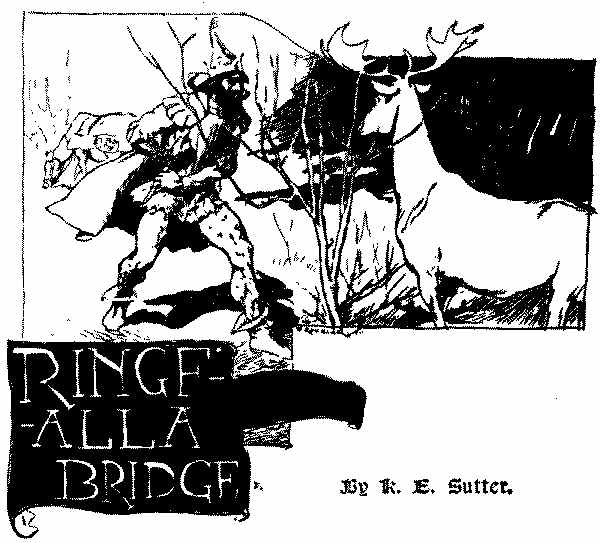
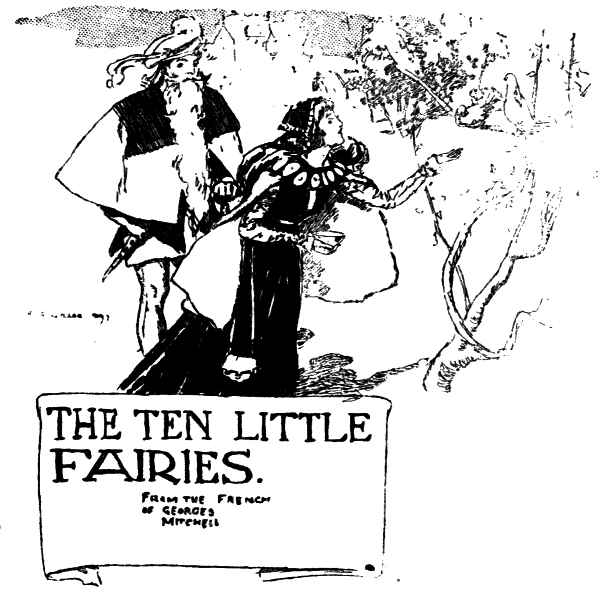
IN the time of Haroun Al-Raschid, ruler of Bagdad,
there lived in Balsora a man Benezar by name.
His means enabled him to live quietly and comfortably,
without carrying on a business or trade; and
when a son was born to him he made no change in his
manner of living, "For," said he, "what will feed two will
feed three." Said, for so they called the boy, soon made
a name for himself among his playmates as a lusty
fighter, and was surpassed by none in riding or swimming.
When he was eighteen, his father sent him on a
pilgrimage to Mecca, and before he started gave him
much good advice, and provided him with money for
his journey. Lastly he said:
"There is something more I must tell you, my boy.
I am not the man to believe that fairies and enchanters,
whatever they may be, have any influence over the fate
of mankind; that sort of nonsense is only good for
whiling away the time; but your mother believed in
them as firmly as in the Koran. She even told me,
after making me swear never to reveal the secret except
to her child, that she herself was under the protection
of a fairy. I always laughed at her, but still I must
confess that some very strange events happened at your
birth. It rained and thundered all day, and the heavens
were black with clouds.
"When they told me that I had a little son, I hastened
to see and bless my first-born, but I found my wife's door
shut, and all her attendants standing outside. I knocked,
but with no result. While I was waiting there, the sky
cleared just over Balsora, although the lightning still
flashed and writhed round the blue expanse. As I was
gazing in astonishment at this spectacle, your mother's
door flew open and I went in alone. On entering the
room, I perceived a delicious odour of roses, carnations,
and hyacinths. Your mother Zemira showed me a
tiny silver whistle, that was hanging round your neck
by a gold chain as fine as silk. 'This is the fairy's gift
to our boy,' she said. 'Well,' I laughed, 'I think she
might have given him something better than that—a
purse of gold, for instance, or a horse.'
"But Zemira begged me not to anger the good fairy,
for fear she might turn her blessing to a curse; so, to
please her, the matter was never mentioned again till
she was dying. Then she gave me the whistle, telling
me never to part with you till you were twenty, when
the whistle was to be yours. But I see no objection
to your going away now. You have common sense,
and can defend yourself as well as any man of four-and-twenty.
Go in peace, my son. Think ever of your
father in good fortune or in ill, and may Heaven defend
you from that last."
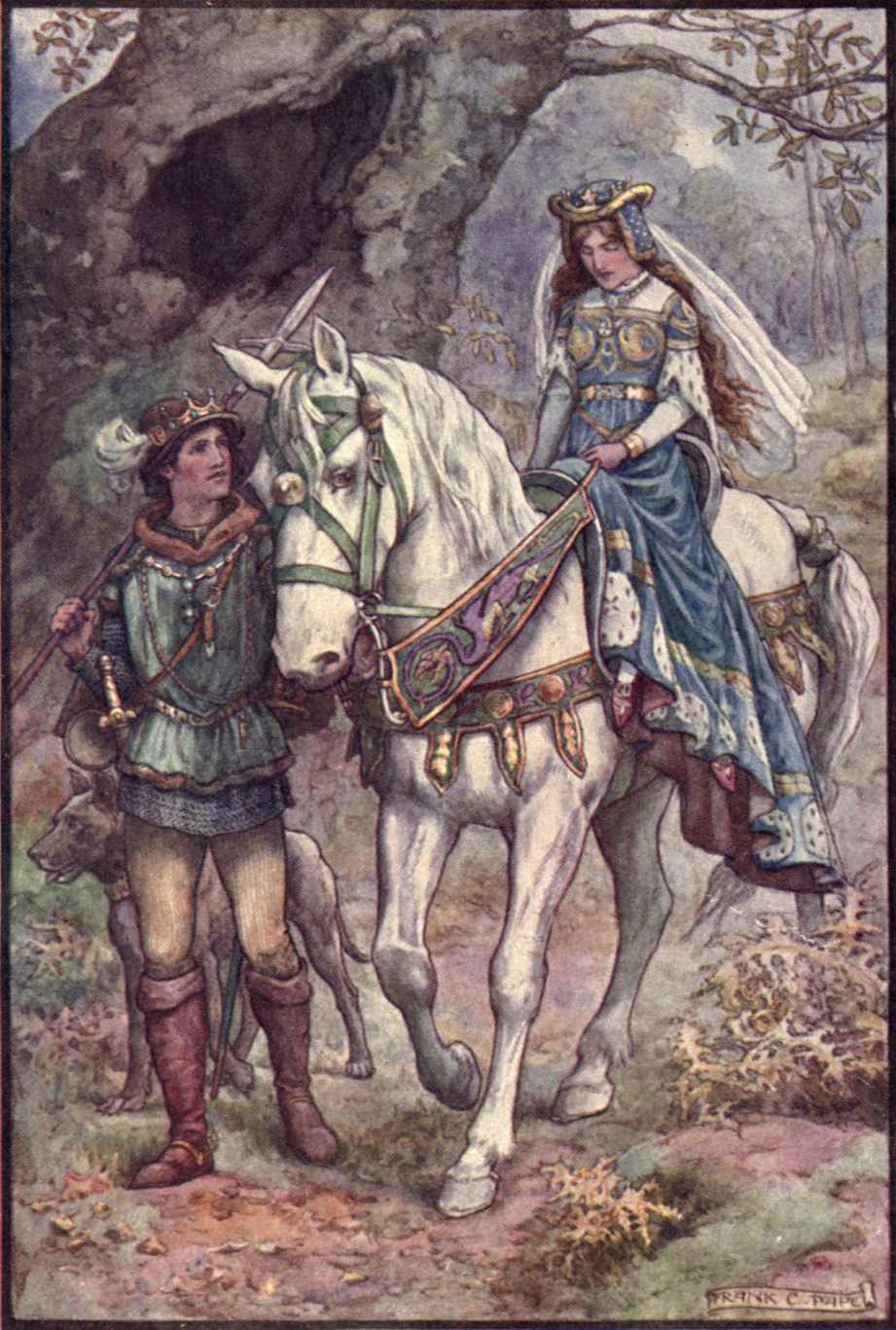
Said took an affectionate farewell of his father, and
placing the chain round his neck, sprang lightly into
his saddle, and went off to join the caravan for
Mecca. At last they were all assembled, and Said
rode gaily out of Balsora. Just at first the novelty of
his position and surroundings occupied his thoughts, but
as they drew near to the desert he began to consider
his father's words. He drew out the whistle and put it
to his lips, but wonder of wonders, no matter how hard
he blew, not a sound came out! This was disappointing,
and Said impatiently thrust the whistle back into his
girdle; still the marvellous had a strange attraction for
him, and he spent the whole day in building his airy
castles.
Said was a fine-looking fellow, with a distinguished
face, and a bearing which, young as he was, marked him
out as one born to command. Every one was attracted
to him, and especially was this the case with an elderly
man, who rode near him. They entered into conversation,
and it was not long before the mysterious power
of fairies was mentioned.
"Do you believe in fairies?" asked Said, at last.
"Well," replied the other, stroking his beard thoughtfully,
"I should not like to say that there are no such
beings, although I have never seen one." And then he
began to relate such wonderful stories, that Said felt
that his mother's words must have been true, and when
he went to sleep was transported to a veritable
fairyland.
The next day the travellers were dismayed to see a
band of robbers swooping down on them. All was
confusion in an instant, and they had scarcely had time
to place the women and children in the centre, when the
Arabs were upon them. Bravely as the men acquitted
themselves, all was in vain, for the robbers were more
than four hundred strong. At this dreadful moment
Said bethought him of his whistle; but, alas! it remained
dumb as before, and poor Said, dropping it hastily, fired
on a man, who seemed from his dress to be of some
importance.
"What have you done?" cried the old man, who
was fighting at his side. "There is no hope for us
now."
And so, indeed, it seemed—for the robbers, maddened
by the death of the man, pressed so closely on the youth
that they broke down even his sturdy resistance. The
others were soon overcome or slain, and Said found
himself on horseback, bound and guarded by armed men.
These treated him with roughness, and the only drop of
comfort in his cup was that his old friend was riding
near. You may be sure his thoughts were not very
pleasant—slavery or death was all he had to look
forward to.
After riding for some time, they saw in the far distance
trees and tents, and in a short time they were met by
bands of women and children, who had no sooner heard
the news than they began to throw sticks and clods of
earth at Said, shrieking, "That is the man who killed
the great Almansor, bravest of men; he must die, and
we will throw his body to the jackals."
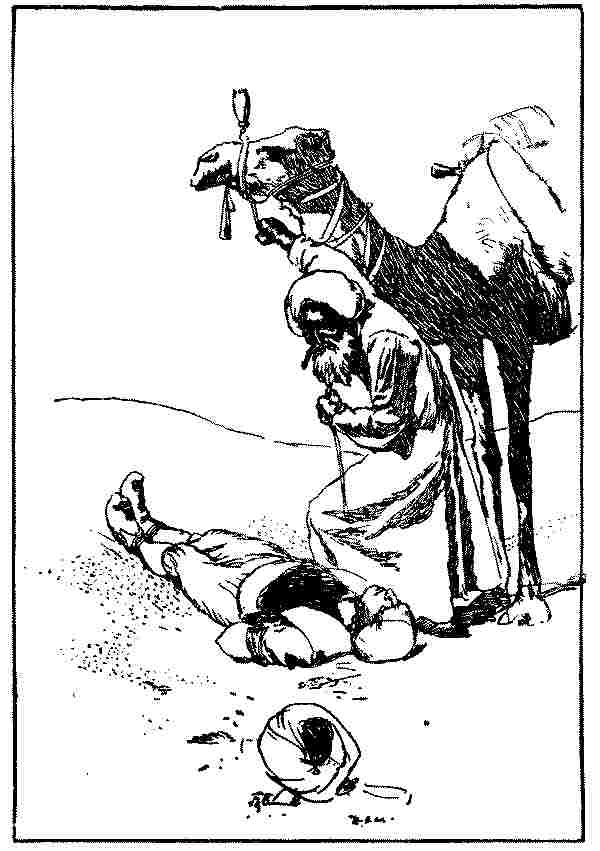
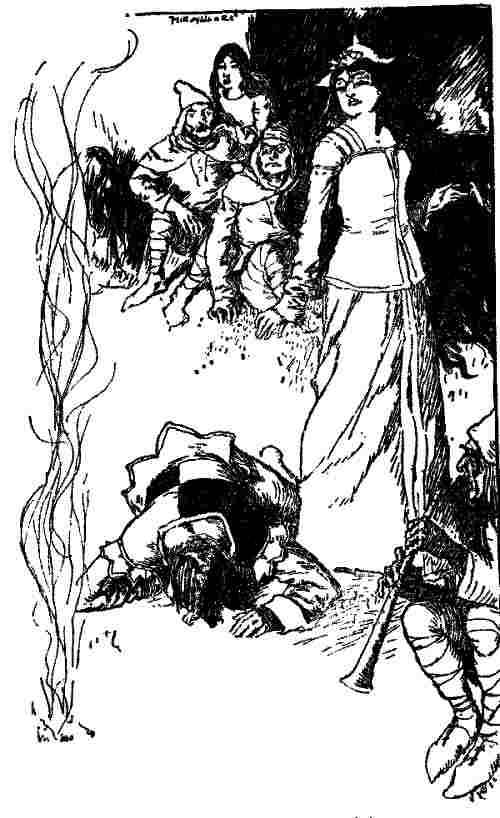
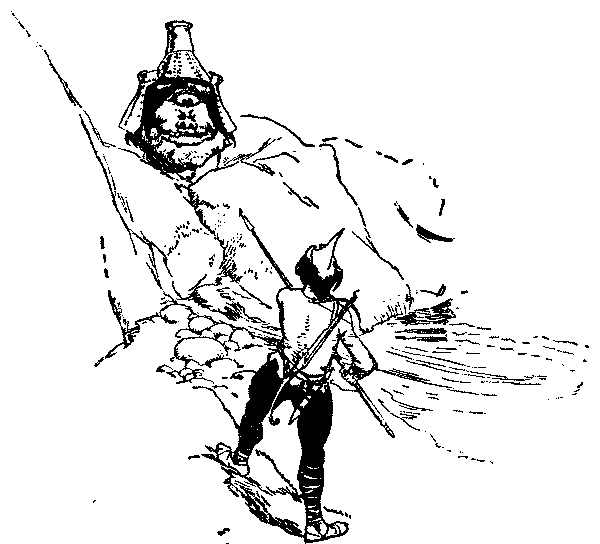
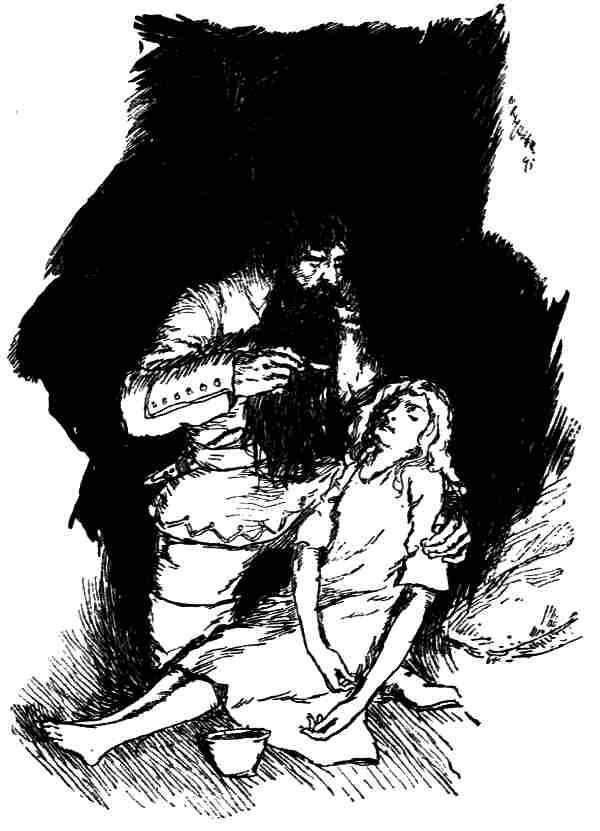
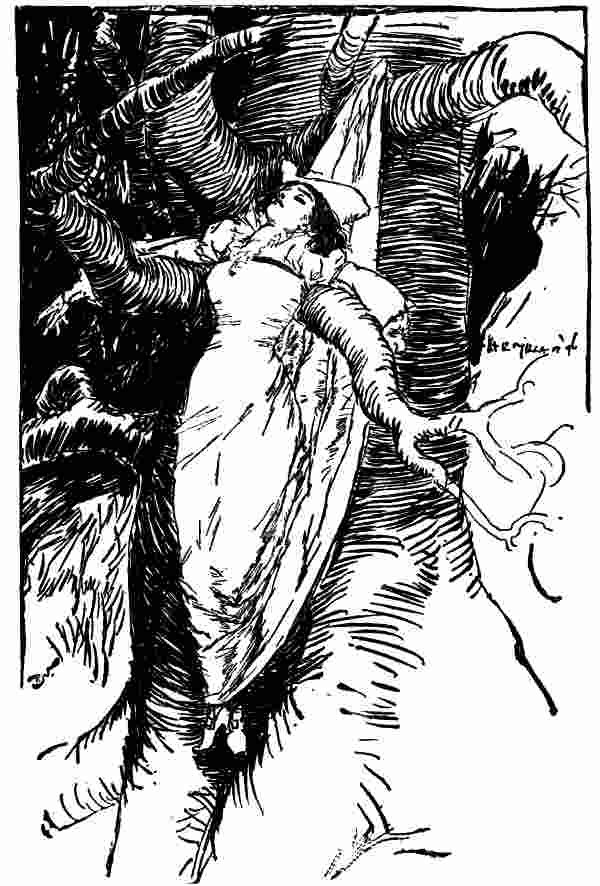
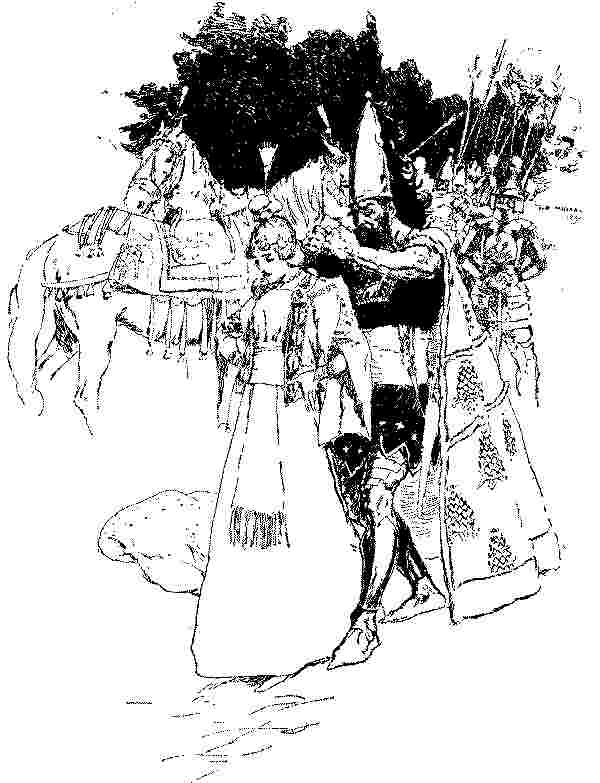
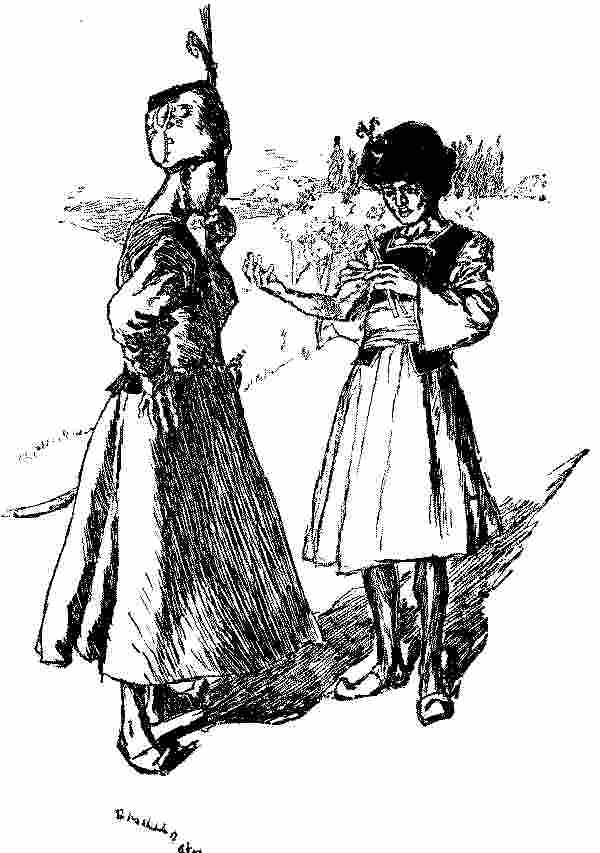
"AFTER SEVERAL HOURS HE AWOKE" (p. 225).
They became so threatening that the bandits interfered
and, bearing off their prisoner, led him bound into one
of the tents. Here was seated an old man, evidently
the leader of the band. His head was bent.
"The weeping of the women has told me all—Almansor
is dead," said he.
"Almansor is dead," answered the robbers, "O Mighty
One of the Desert, but here is his murderer. Only
speak the word. Shall his doom be to be shot, or to be
hanged from the nearest tree?"
But the aged Selim questioned Said, and found that
his son had been slain in fair fight. "He has done,
then, no more than we ourselves should have done.
Loose his bonds. The innocent shall not die," cried
Selim, in his sternest tones, seeing his men's reluctance
and discontent. As for Said, the very fulness of his
heart closed his lips, and he could not find words in
which to thank his deliverer. From this time he lived
in Selim's tent, almost taking the place of that son
whose death he had caused.
But sedition was rife among the robbers. Their
beloved Prince had been murdered, and his murderer was
shielded by the father! Many were the execrations hurled
at Said, as he walked in the camp; indeed, several
attempts were made on his life. At length Selim perceived
that soon even his influence would not be sufficient
to guard the young man, and so he sent him away
with an escort, saying that his ransom had been paid.
But before they started he bound the robbers by a
dreadful oath that they would not kill Said.
It was indeed a terrible ride! Said saw that his guides
were performing their task with great reluctance, and soon
they began to whisper together. He nerved himself to
listen, and what he heard did not tend to reassure
him.
"This is the very spot," said one. "I shall never
forget it."
"And to think that his murderer still lives!"
"Ah! if his father had not made us take that
oath!"
"Stay," cried the most forbidding-looking of all,
"we have not sworn to bring this fellow to the end
of his journey. We will leave him his life, but the
scorching sun and the sharp teeth of the jackal shall
perform our vengeance. Let us bind him and leave
him here."
Said, hearing this brutal suggestion, made a
desperate effort for his life. Spurring his horse, he rode off at
full speed; but the bandits soon recovered from their
amazement, and, giving chase, had him at their mercy.
Tears, prayers, even bribes were of no avail, and the
wretched Said was left to face death in its most painful
form. Higher and higher mounted the sun, and Said
tried to roll over to obtain some small relief. In doing
this the whistle attracted his notice, and he contrived to
get it between his lips; but for the third time it refused
its office, and Said, overcome by the heat and the
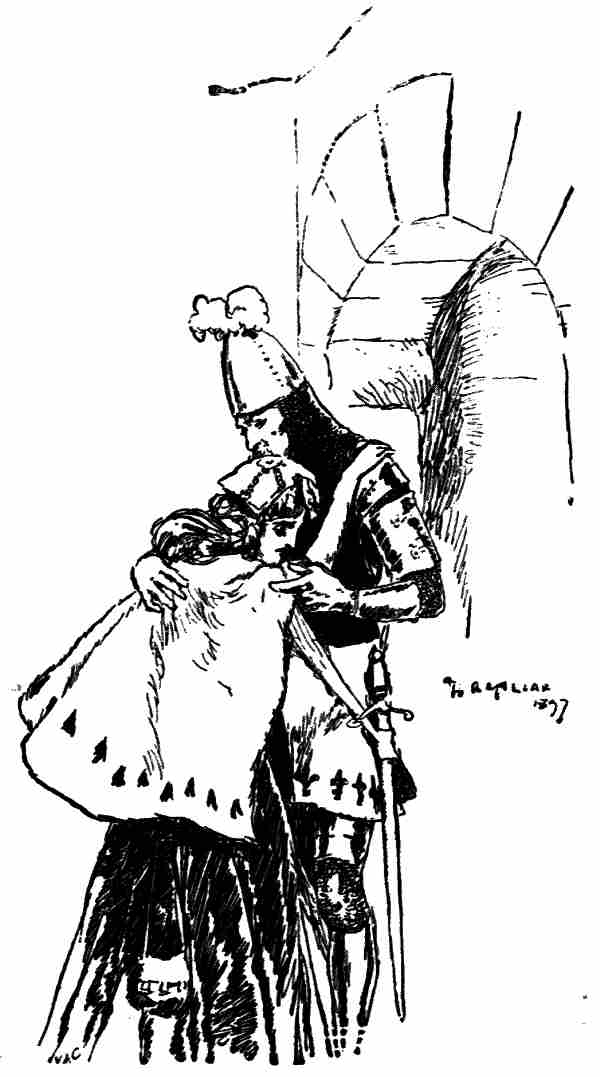
horror of his situation, fainted. After several hours
he awoke to see, not the dreaded beast of prey but a
human being.
This was a little man with small eyes and a long
beard, who informed Said, when the latter had somewhat
recovered, that he was Kalum Bek, a merchant,
and that he was on a business expedition when he
found him lying half dead in the sand. Said thanked
the little man, and gratefully accepted a seat on his
camel. As they were journeying the merchant related
many stories in praise of the justice and acuteness of
the Father of the Faithful.
"My cousin Messour," he said, "is his Lord
Chamberlain, and he has often told me how the Caliph
is wont to sally forth at night, attended by himself alone,
to see how his people are cared for. And so, when we
go about the streets at night, we have to be polite to
every idiot we meet, for it is as likely to be the
Caliph as some dog of an Arab from the desert."
Hearing such accounts as these, Said thought himself
a lucky fellow to have the chance of seeing Bagdad and
the renowned Al-Raschid. When they arrived in the
city, Kalum invited Said to accompany him home. The
next day the youth had just dressed himself in his
most magnificent clothes, thinking of the sensation he
would cause, when the merchant entered, and, looking
at him scornfully, said: "That is all very fine, my
young sir, but it seems to me you are a great dreamer.
Have you the money to keep up that style?"
"It is true, sir," said Said, blushing, "that I have no
money; but perhaps you will be kind enough to lend me
sufficient to travel home with, for my father is sure to
repay you."
"Your father, boy," laughed the merchant. "I really
think the sun must have affected your brain. You
don't suppose, do you, that I believe the fable you made
up for my benefit? I know all the rich men in Balsora,
but no Benezar. Besides, do you think the disappearance
of a whole caravan would pass unnoticed? And then,
you bare-faced liar, that story about Selim! Why, that
man is noted for his cruelty; and do you mean to tell
me that he allowed the murderer of his son to go free—and
that, too, without ransom? Oh, you shameless
liar!"
"Indeed, I have spoken the truth," cried Said. "I have
no proof of my words, and can only swear to you that
I have spoken no falsehood. If you will not help me
then I must appeal to the Caliph."
"Really!" scoffed the little man; "you will beg, then,
from no less exalted a person than our gracious ruler!
Just consider that the Caliph can only be approached
through my cousin Messour, and that with a word I
could——But I pity your youth. You are not too old
yet for reformation. You shall serve in my shop for a
year, and then, if you wish to leave me, I will pay you
your wages, and let you go whither you will. I give
you till mid-day to think over it. If you refuse, I will
seize your clothes and possessions to pay myself for your
passage, and throw you on the streets."
Said was indeed in difficulties; bad luck seemed to
press upon him at every turn. There was no escaping
from the room, for the windows were barred and the
door locked. After cudgelling his brains for some time,
he saw that he must submit to the indignity imposed upon
him by the villainous little man, and so the next day
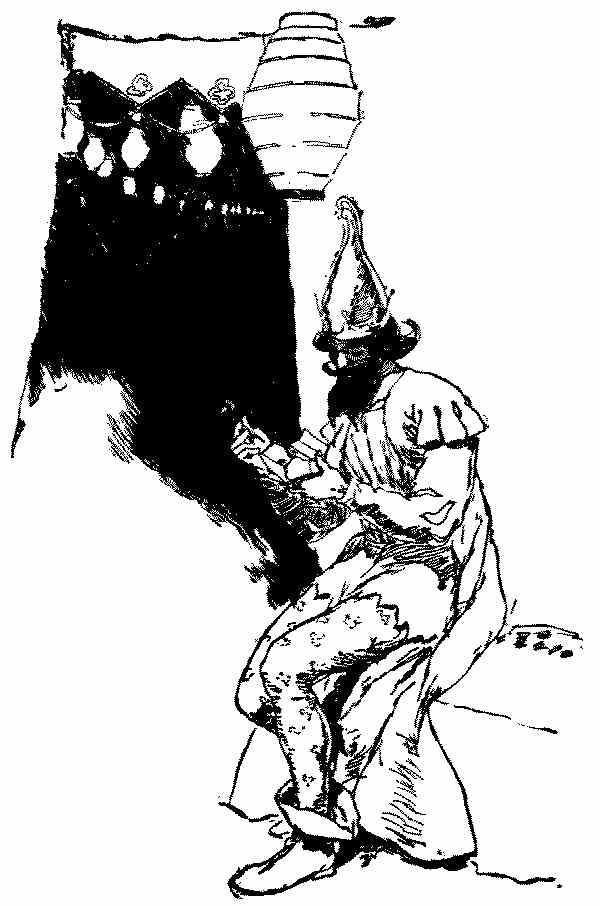
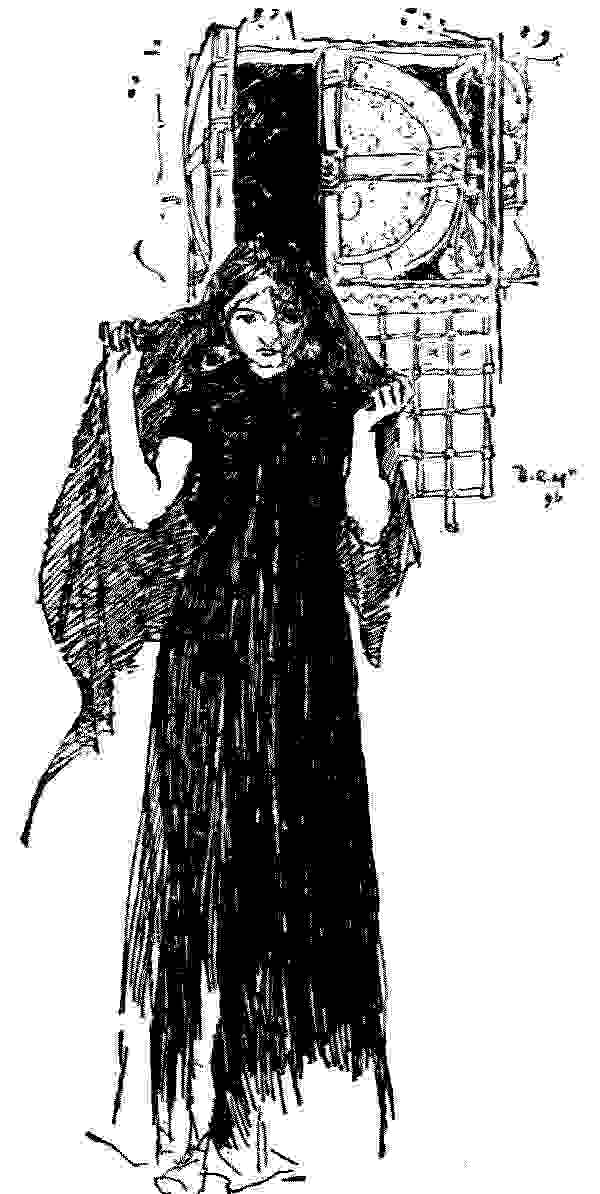
he followed him to the shop in the bazaar. His duty
was to stand (his gallant attire a thing of the past) in
the doorway, a veil or a shawl in either hand, and cry
his wares to the passers-by.
Said soon saw why Kalum had been so anxious to
retain him as a servant. No one wished to do business
with the hateful old man, but when the salesman was
a handsome youth it was a different matter altogether.
One especially busy day all the porters were employed,
when an elderly lady entered and made some purchases.
After she had bought all she wanted she
demanded some one to carry her parcels home for her.
In vain did the merchant promise to send them in half
an hour—she would have them then or never; and her
eye falling on Said, she wanted to know why he should
not accompany her. After much remonstrance Kalum
had to give in, and Said found himself following in the
wake of the lady, who stopped at last before a magnificent
house. She knocked and they were admitted,
and after mounting a wide marble staircase, Said found
himself in a lofty hall, far grander than he had ever seen
before. Here he was relieved of his burden, and was
just going out at the door, when—
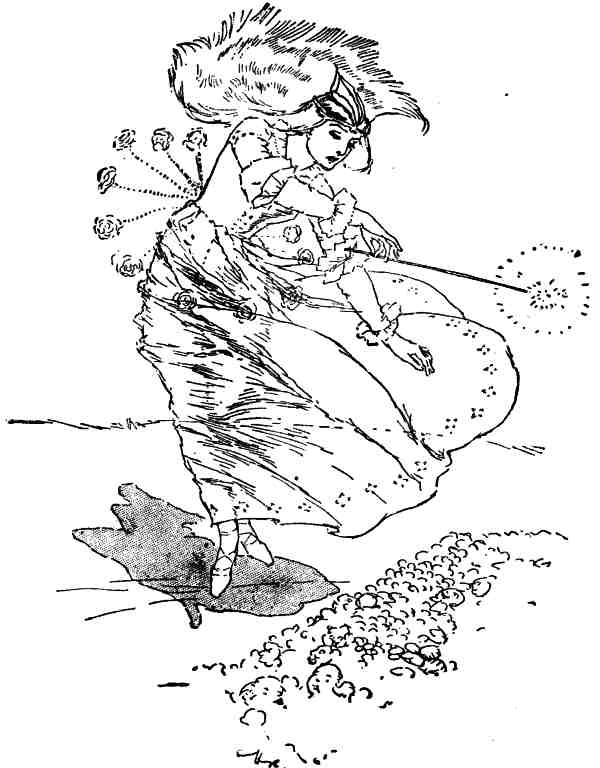
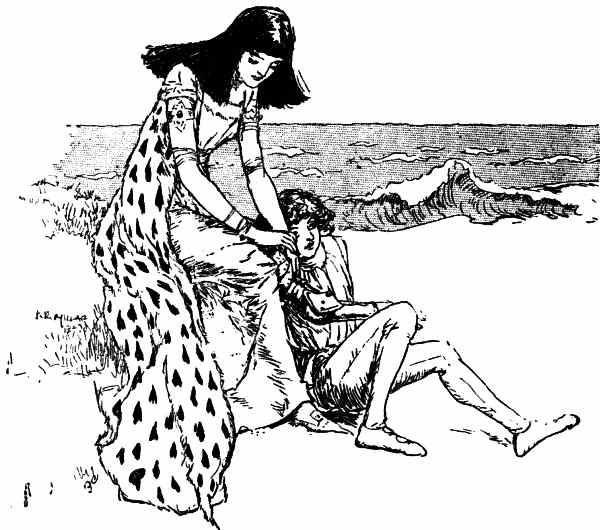
"Said," cried a sweet voice behind him. He turned
round quickly, and saw to his amazement a daintily
beautiful lady surrounded by attendants, instead of the
old lady he had followed.
"Said, my dear boy," she said, "it is a great
misfortune that you left Balsora before you were twenty;
but here in Bagdad there is some chance for you. Have
you still your little whistle?"
"Indeed I have," he cried gladly; "perhaps you are
the kindly fairy who befriended my mother?"
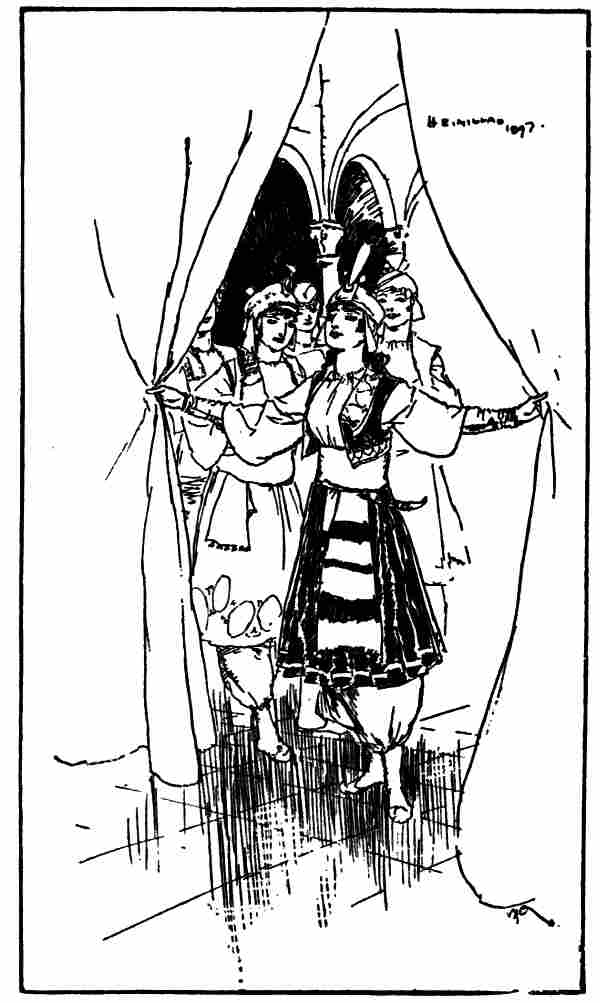
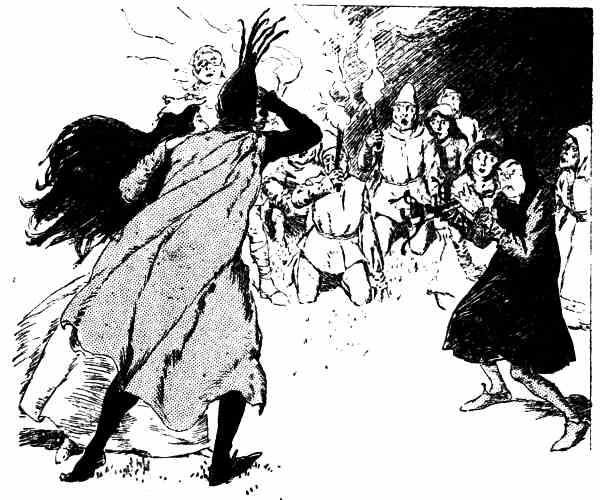
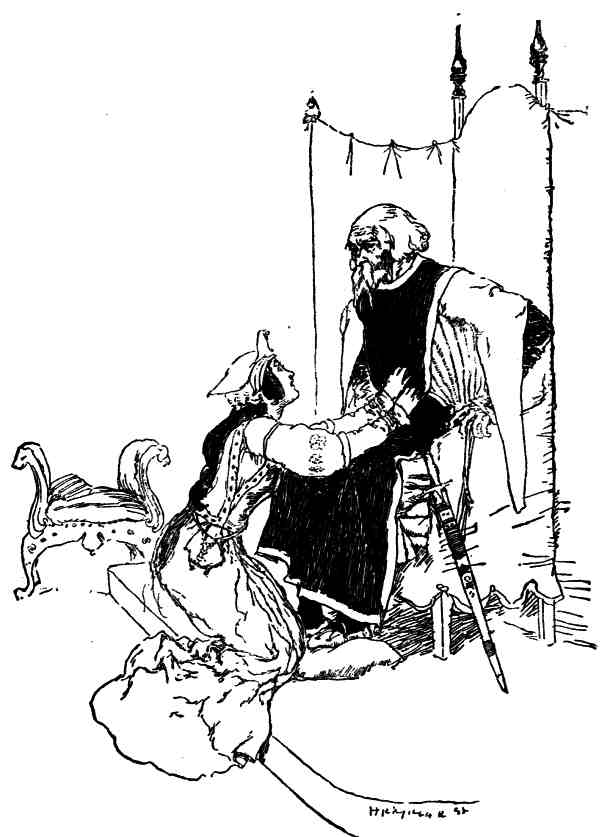
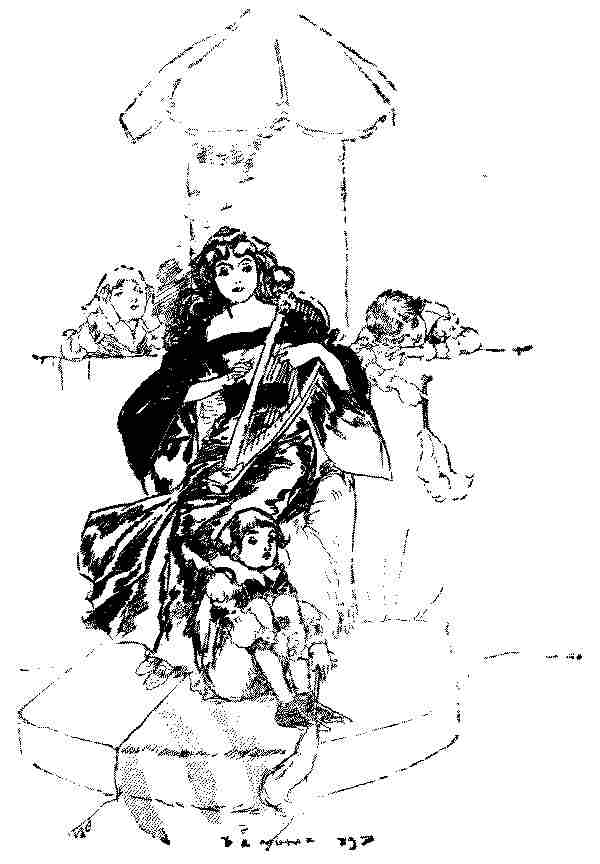
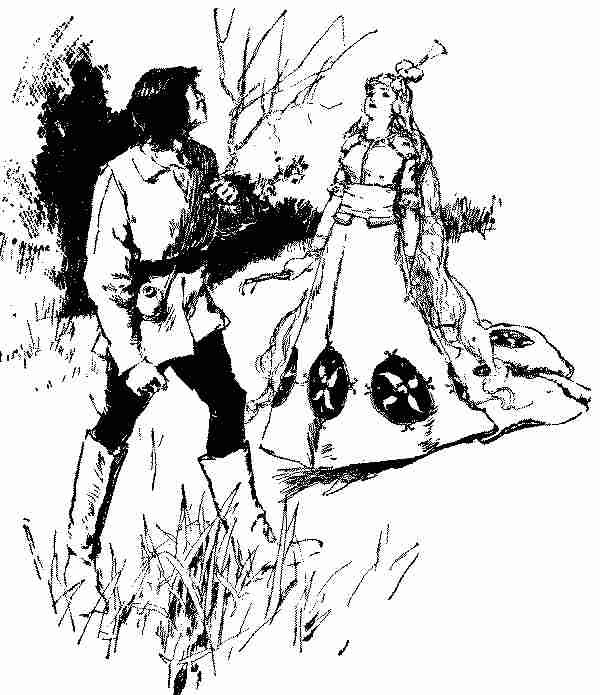
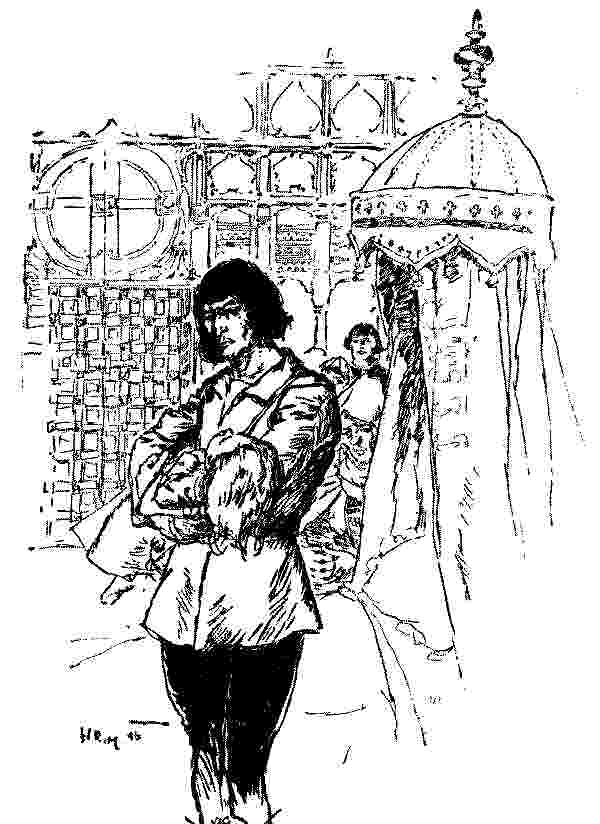
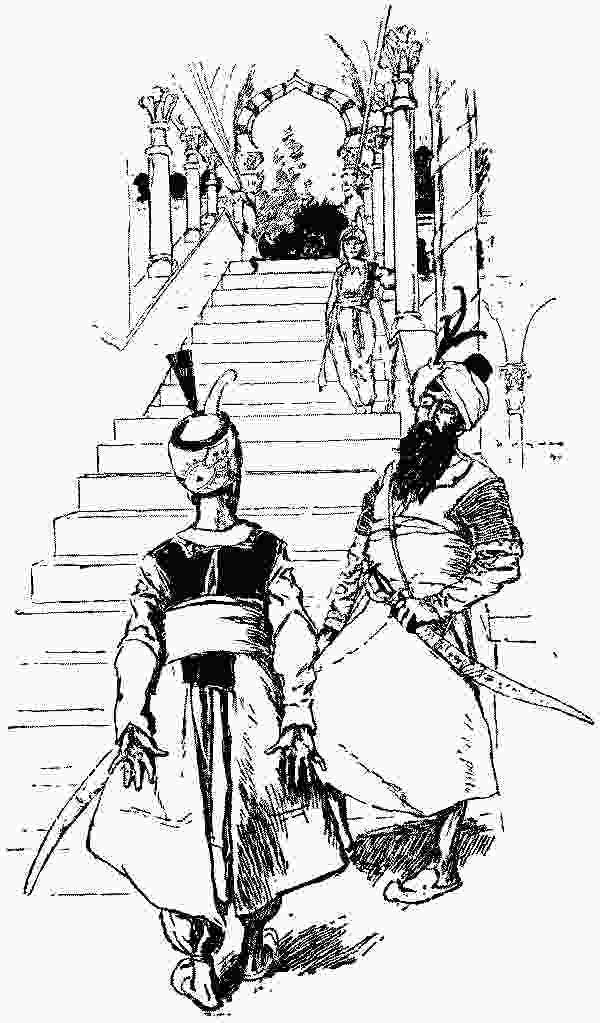
"A DAINTILY BEAUTIFUL LADY" (p. 228).
"Yes, and as long as you are good I will help you.
But, alas! I cannot even deliver you from that wretch,
Kalum Bek, for he is protected by your most powerful
enemy."
"But can we do nothing? Can I not go to the
Caliph? He is a just man and will help me."
"Haroun is indeed just, but he is greatly influenced
by Messour, who, a model of uprightness himself, has
been already primed by Kalum with his version of your
story. But there are other ways of getting at the
Caliph, and it is written in the stars that you will
obtain his favour."
"I am to be pitied if I have to stay much longer
with that rascal of a shopkeeper. But there is one
favour I beg of you, most gracious of fairies. Jousts are
held every week, but only for the freeborn. Couldn't
you manage to give me equipments, and make my face
so that no one would know me?"
"That is a wish worthy of a brave man, and I will
grant it. Come here each week, and you will find everything
you want. And now, farewell. Be cautious and
virtuous. In six months your whistle will sound, and
Zulima will answer its appeal."
Said took leave of his protectress, and, taking note
of the position of the house, made his way back to the
shop. He arrived there in the very nick of time, for
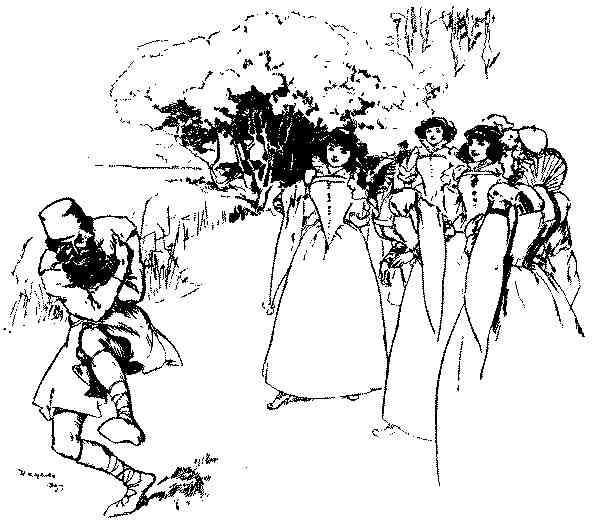
Kalum was surrounded by a crowd of jeering neighbours,
and was literally dancing with rage. This was what had
happened. Two men had asked the merchant if he could
direct them to the shop of the handsome salesman.
"Well! well!" said the old man, smiling, "Heaven
has guided you to the right place this time. What do
you want, a shawl or a veil?"
This to the men seemed nothing short of insolence,
and they fell upon him tooth and nail, the neighbours
refusing to help the old skinflint. But Said, seeing his
master in such distress, strode to the rescue, and one of
the assailants soon found himself on the ground. Under
the influence of his flashing eyes the crowd soon melted
away, for violence on the wrong side was not to their
taste.
"Oh, you prince of shopmen, that is what I call interfering
to some purpose! Didn't he lie on the ground
as if he had never used his legs? I should have lost
my beard for ever if you had not come up. How shall
I reward you?"
Said had only acted upon the impulse of the moment;
indeed, he now felt rather sorry that he had deprived
the scoundrel of a well-deserved thrashing. He seized
the opportunity, however, and asked for an evening a
week in which to take a walk. This was granted him,
and the next Wednesday he set out for the fairy's house.
Here he found everything as Zulima had promised.
First the servants gave him a wash, which changed him
from a stripling to a black-bearded man, whose face
was bronzed by exposure to the sun. Then he was
led into a second room, where he saw a dress that would
not have been put to shame by the State robes of the
Caliph. He hastily donned this, and, magnificently
equipped, descended the stairs. As he reached the door,
a servant handed him a silk handkerchief with which to
wipe his face when he wished to rid himself of his disguise.
In the court were standing three horses; two
were ridden by squires, but the most magnificent was
for his own use. When Said arrived on the plain set
apart for the jousts, all eyes turned on him, and curiosity
was rife as to who the unknown knight could be; that
he was distinguished and of high family none doubted.
When Said entered the lists he gave his name as
Almansor of Cairo, and said that he had come to Bagdad
because of the fame of the youths of that city. The
sides were chosen, and the opposing parties charged.
Said's horse was as swift as an eagle, and his prowess
with the sword was so great that even the bravest
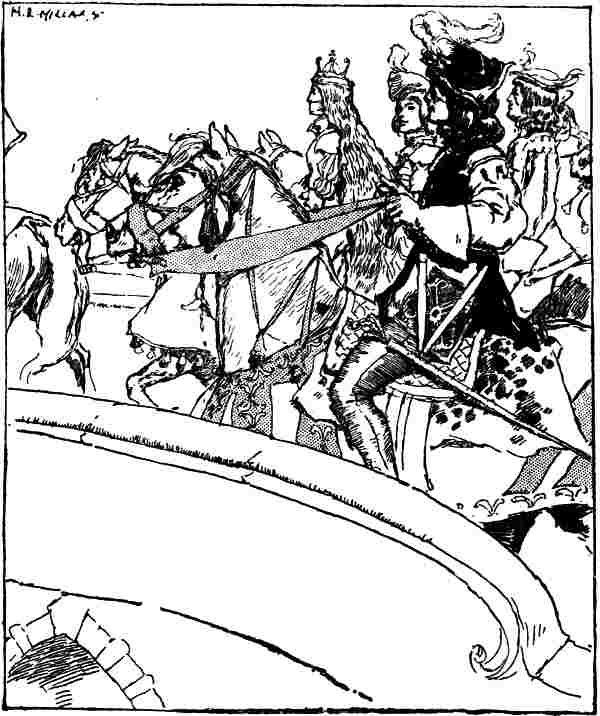
shunned meeting him, and the Caliph's brother, who
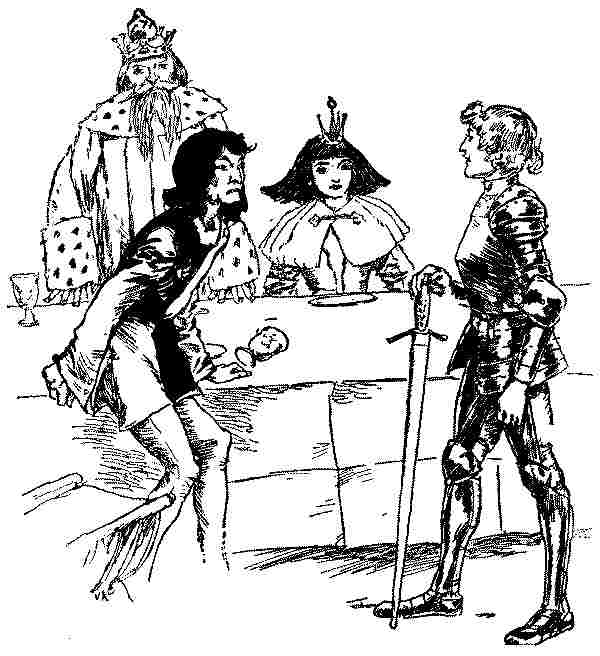
had been on his side, challenged him to single combat.
The two fought, but were so equal that the contest had
to be postponed till the next meeting. On the following
day all Bagdad was ringing with the praises of the
gallant young knight; and little did the people guess
that he was then serving in a shop in the bazaar.
At the next tournament Said carried all before him,
and received from the Caliph a golden medallion hanging
from a gold chain. This aroused the envy of the other
youths. Was a stranger to come to Bagdad and rob
them of their honour? Said noticed the signs of discontent,
and observed that all viewed him askance,
except the brother and son of the Caliph. By a strange
chance the one most bitter against him was the man he
had knocked down before Kalum Bek's shop. Led by
this man, the others made a sudden attack on Said, who
must have fallen if the Royal combatants had not rushed
to his aid.
For more than four months he continued to fight in
the lists, but one night as he was going home he noticed
four men who were walking slowly before him. To his
astonishment, he found they were speaking in the dialect
used by Selim's band. He suspected that they were
after no good, and so he crept nearer to hear what they
were saying.
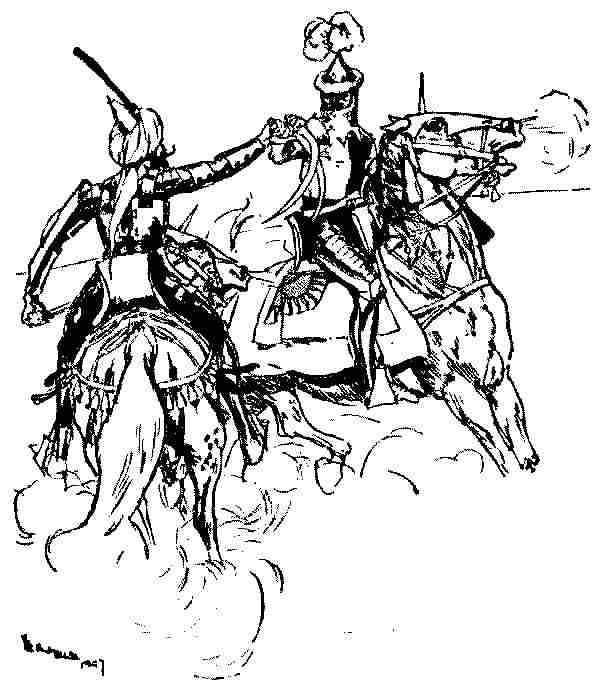
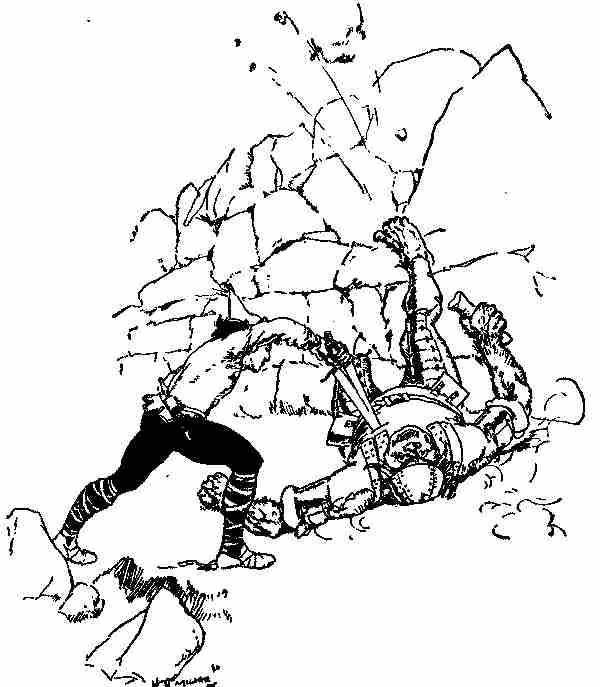
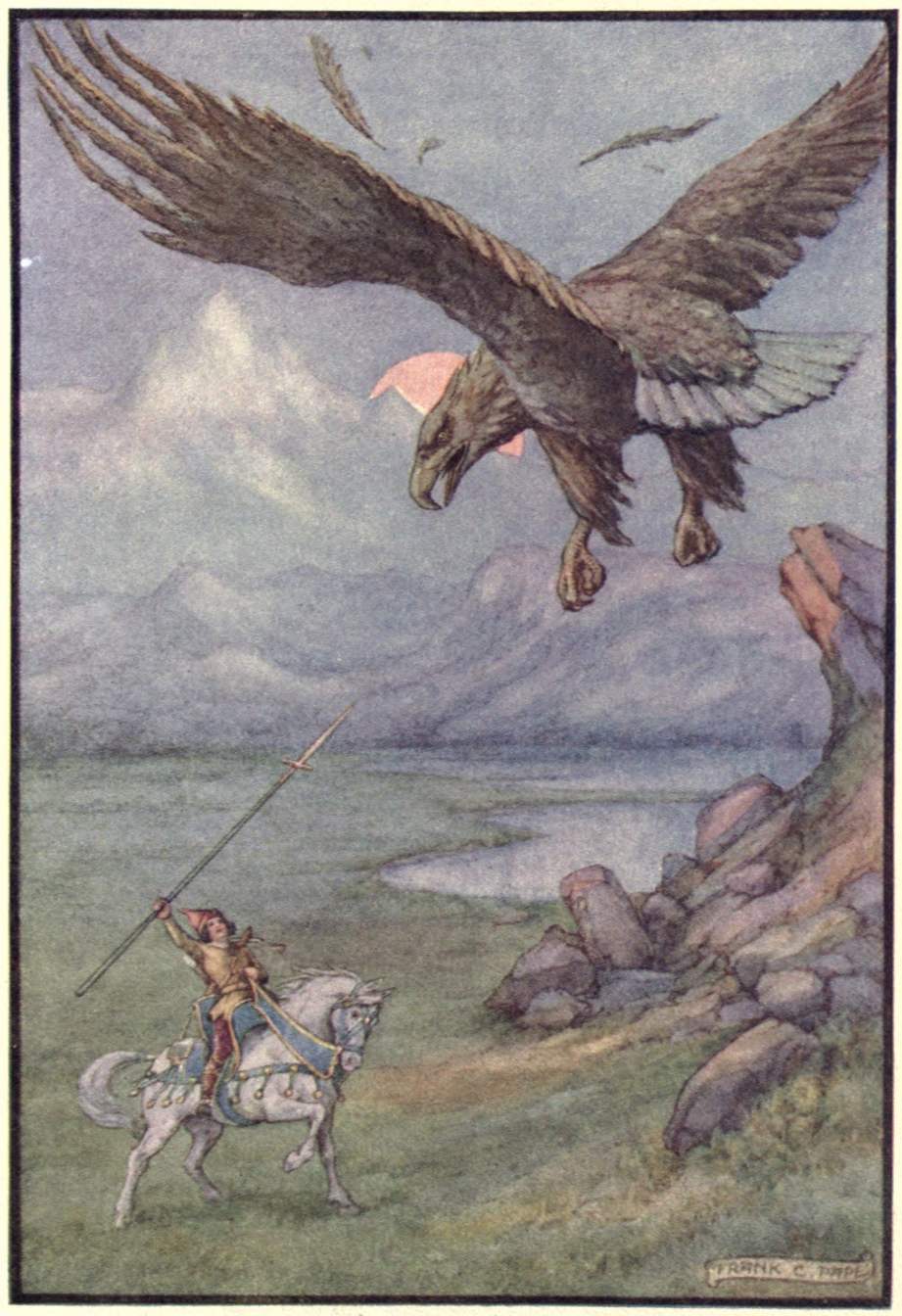
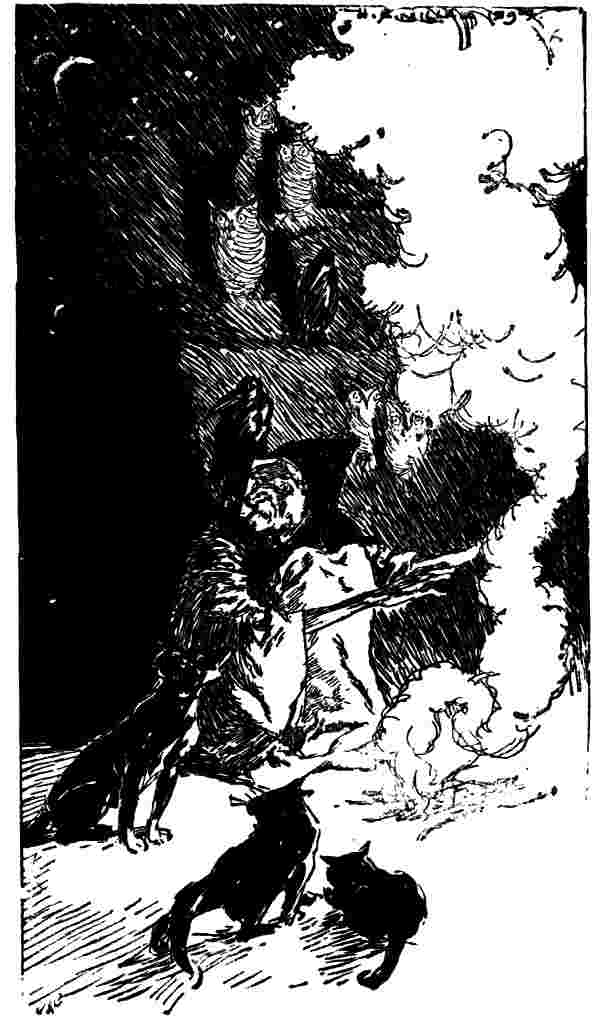
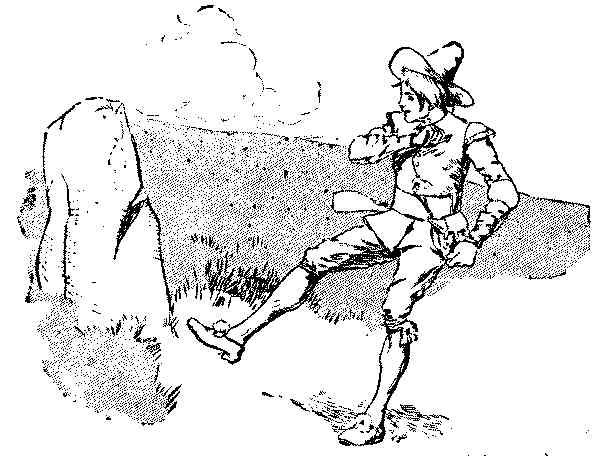
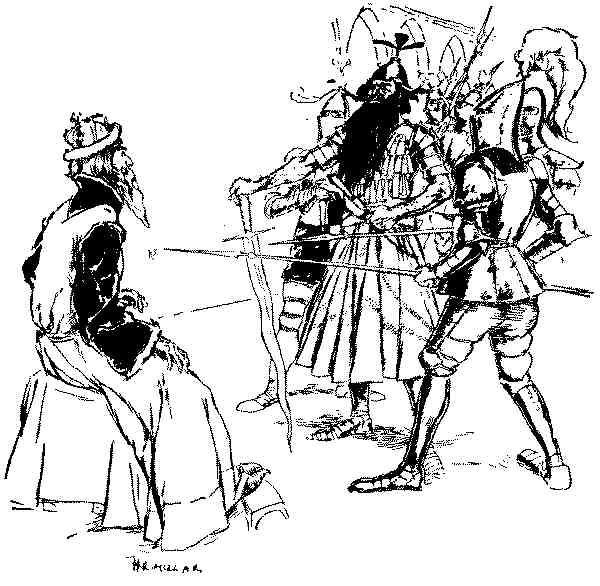
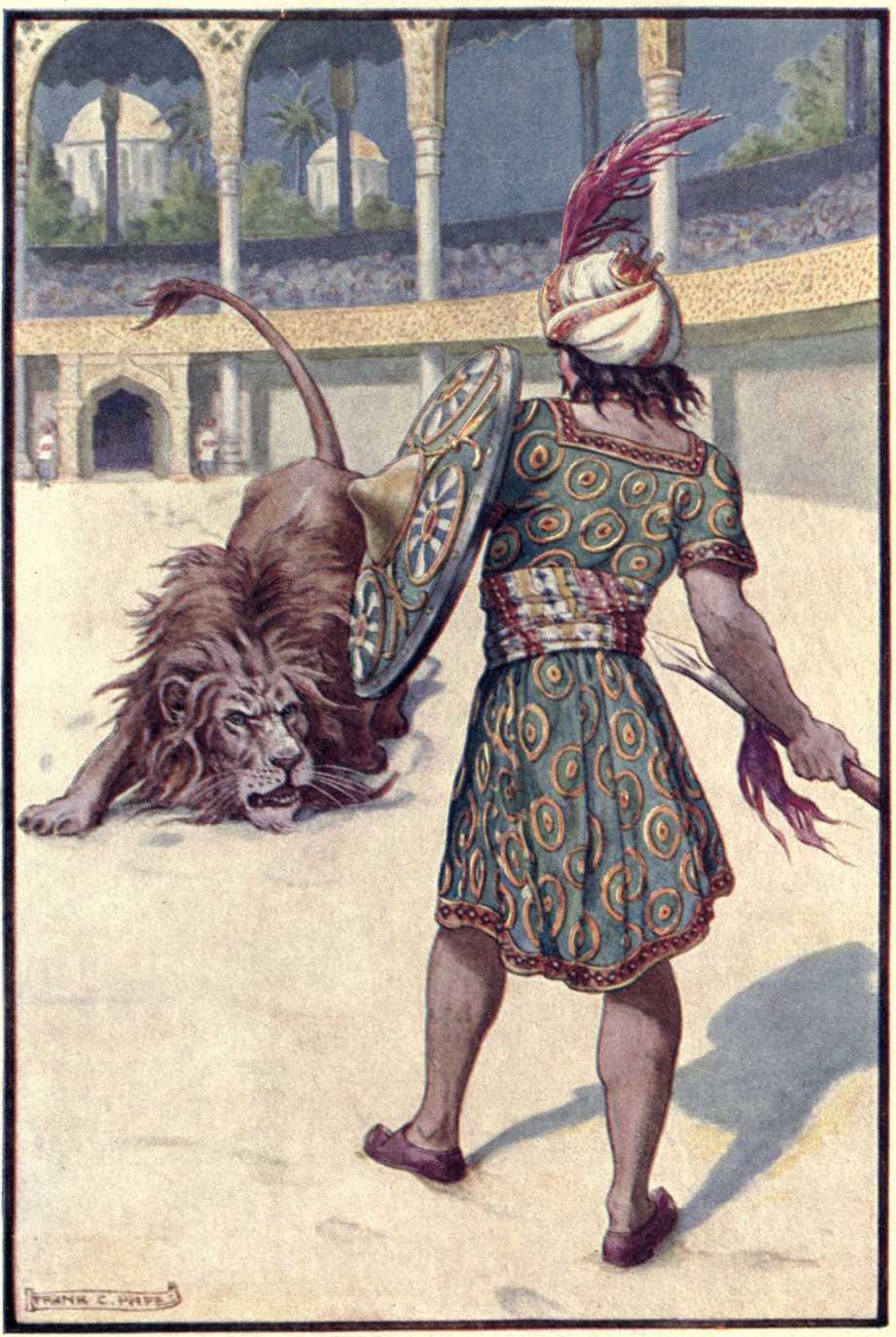
"THE TWO FOUGHT" (p. 232).
"He will be in the street to the right of the bazaar
to-night, attended by the Grand Vizier," said one.
"That is good," answered the other; "there is no
fear of the Grand Vizier, but I am not so sure of the
Caliph—there might be some of his guard near."
"No, there won't," broke in a third; "he is always
alone at night."
"I think it would be best to throw a lasso over his
head," said the first.
"Very well, an hour after midnight;" and with these
words they separated.
"Well, I have discovered a pretty plot," thought Said,
and his first idea was to go at once to the Caliph; but
he remembered how Kalum had maligned him to
Messour, and stopped. No, the only way was for him
to defend the Caliph in person. Accordingly, when night
came on, he betook himself to the appointed street, and
waited to see what was going to happen. Soon the
men came and concealed themselves in different parts
of the street. All was quiet for half an hour, and at
the end of that time one of the robbers gave a sign,
for the Caliph was in sight. With one accord the band
rushed upon him, but Said rose from his hiding-place,
and laid about him with such hearty goodwill that they
were soon glad to take to their heels with all speed.
"My rescue," said the Caliph, "is no less wonderful
than the attack made upon me. How did you know
who I was? How did you get to know of the plot?"
Said then told how he had followed the men, and,
hearing their plans, determined to frustrate their villainous
intention.
"Receive my thanks," said the Caliph, "and accept
this ring. Present it to-morrow at the palace, and we
will see what can be done for you."
The Vizier, too, gave him a ring, together with a heavy
purse.
Mad with joy, Said hurried home, but here Kalum
was awaiting him, anxious lest he should have lost his
handsome servant. The little man raved at Said, but
the latter had seen that his purse was full of money,
and told him flatly that he would stay there no longer.
He strode out at the door, leaving Kalum staring after
him in open-mouthed astonishment. The next morning
the merchant set the police on his track, and they
brought him word that his quondam servant, dressed
in a most magnificent fashion, was just setting out with
a caravan.
"He has stolen money from me, the thief!" Kalum
shrieked, and ordered the constable to arrest Said. As
Kalum was known to be related to Messour, his commands
were promptly attended to, and poor Said found himself
condemned, unheard, as having stolen the purse
from his master. He was sentenced to life-long banishment
on a desert island, and all his protestations of
innocence were of no avail. The poor fellow was in
despair, and even the stony-hearted merchant put in a
plea for him. He was thrown into a filthy dungeon,
together with nineteen others. He comforted himself
with the thought that his life would be more endurable
on board ship, but here he was mistaken. The atmosphere
was foul, and the men fought like wild beasts
for the best places. Food and water were handed out
to them once a day, and at the same time the men
who had died were hauled out.
A fortnight was passed in this misery, but one day
they felt the ship was tossing more than usual, and their
discomfort was increased. At last the survivors burst
the hatches open, but to their despair they saw that
the ship had been deserted by all the crew. The storm
raged even more wildly, the ship rocked and settled
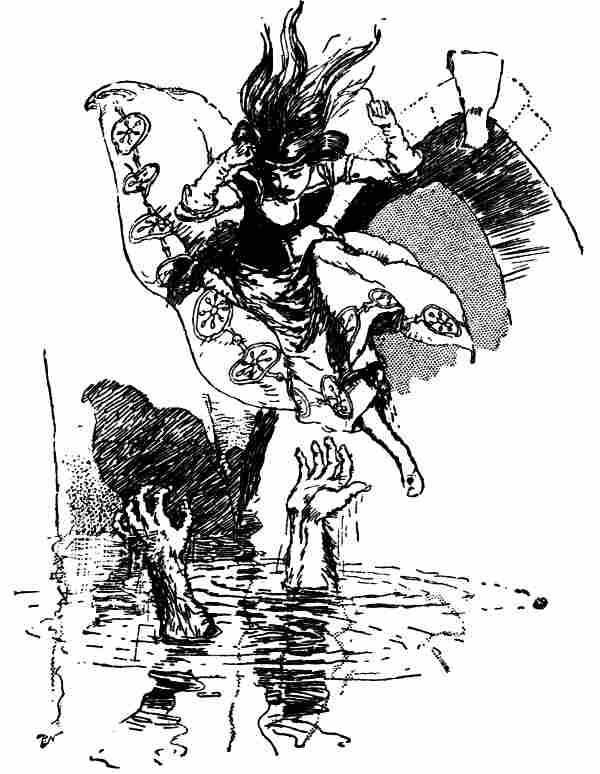
deeper into the water. At last it went to pieces, and
Said managed to cling to the mast. After he had floated
for about half an hour, he suddenly remembered his
whistle. It still hung round his neck, and holding on
well with one hand to the mast, he put it to his mouth,
and this time it did not fail him. At the sound of the
clear, sweet note, the storm ceased as if by magic, and
the sea became like glass, and, what was more wonderful
still, the mast by which Said was supported was changed
into a huge dolphin, to his no small terror. But he soon
found there was no need for him to be afraid, for the
fish bore him as swiftly as an arrow through the water.
After some time Said, remembering tales of enchanters,
drew out his whistle, and blowing a shrill blast, wished
for a meal. At once a table rose from the depths of
the sea, and Said enjoyed the much-needed refreshment.
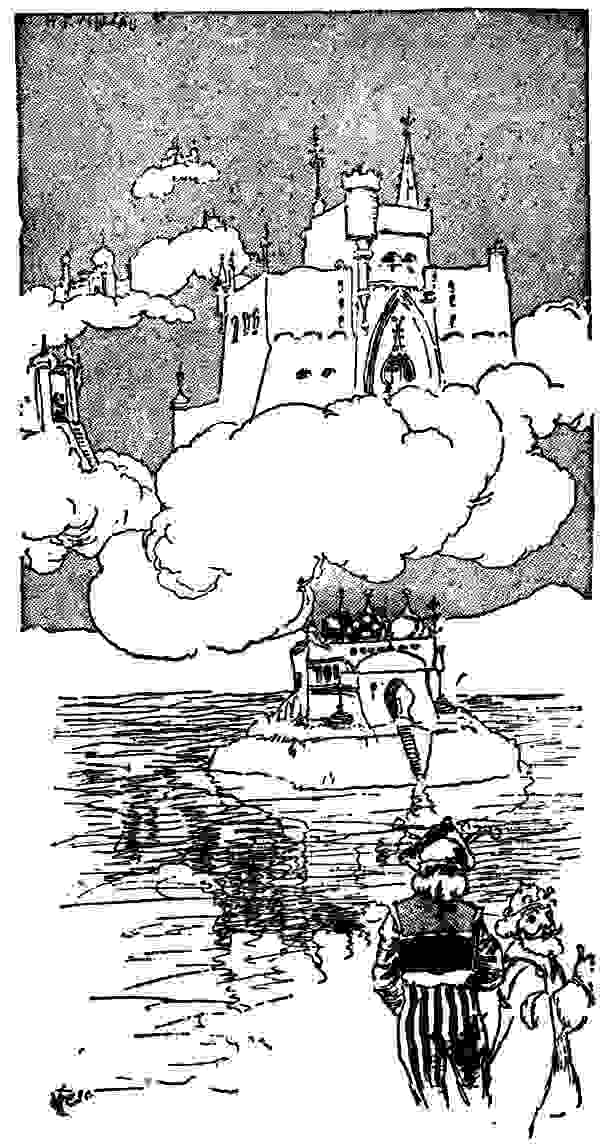
The sun was just sinking, when he saw a large town
in the distance which reminded him of Bagdad. The
thought of Bagdad was not so very pleasant, but still
he trusted that the fairy, who had guarded him so far,
would not let him fall into the hands of Kalum Bek.
As he drew nearer he noticed a large house on the bank
of the river, the roof of which was crowded with men,
who were all gazing in astonishment at himself. No
sooner had Said set foot on the land, than the fish
vanished, and at the same time the servants appeared
to lead him before their master. On the roof were
standing three men, who questioned him in a friendly
way. Said at once began to relate his story, from the
time when he left Balsora, and his listeners declared
that they believed him; still, they asked if he could
produce the golden chain and the rings of which he had
spoken.
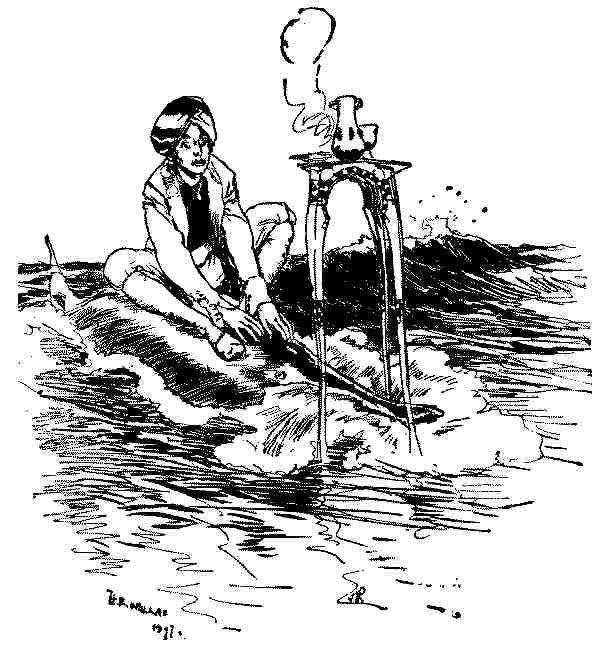
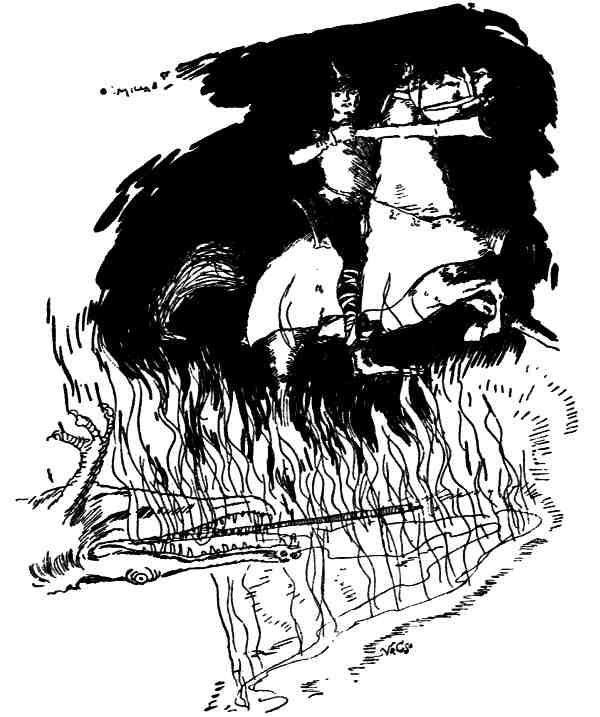
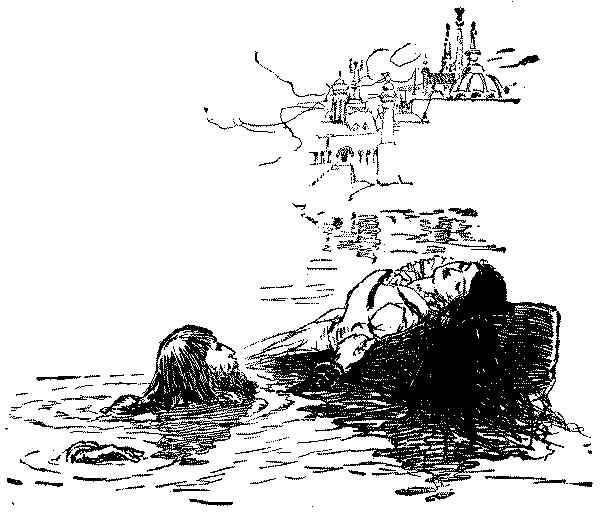
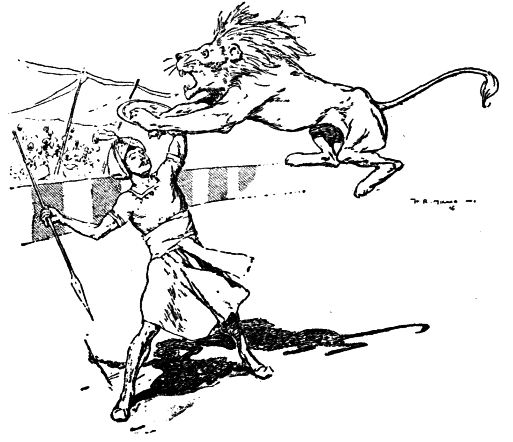
"A TABLE ROSE FROM THE DEPTHS OF THE SEA" (p. 236).
"Here they are," said Said. "I determined not to
part with them while I had life to defend them."
"By the beard of the Prophet, this is my ring, Grand
Vizier—our deliverer stands before us!"
Said was overcome by finding in whose presence
he was, and flung himself at the Caliph's feet. But
Haroun raised him, and overwhelmed him with praise
and thanks. Nothing would do but that Said must
return with them to the palace, where they would
conceive some plan to bring the merchant Kalum to
book. On the next day Kalum himself begged for
admittance to the presence of Haroun. A dispute had
arisen between himself and a man of Balsora, and he
asked for judgment.
"I will hear him," said the Caliph. "Said," turning
to the youth as the servant left the room, "this is no
other than your father. Do you hide behind that curtain,
and you, Grand Vizier, fetch the magistrate who condemned
Said."
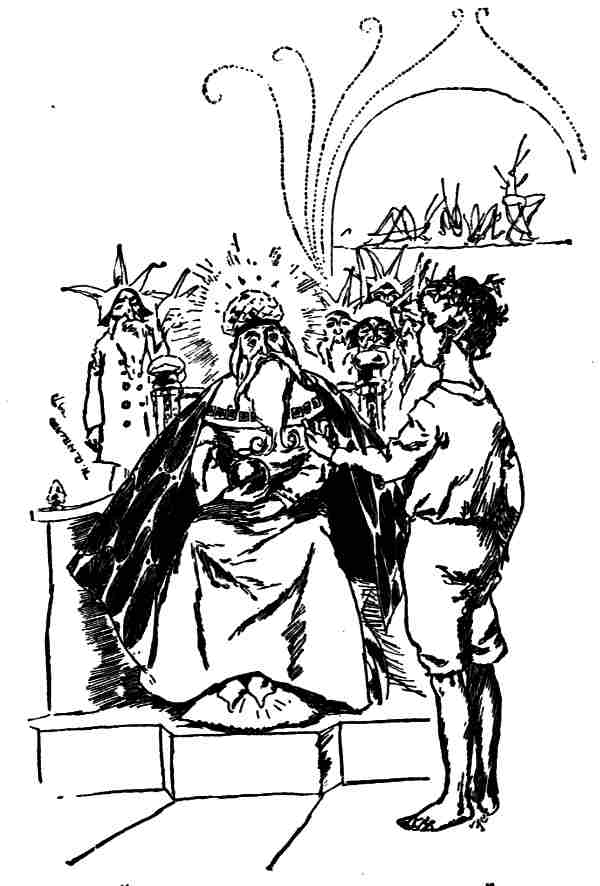
In a short time Kalum entered, accompanied by
Benezar, and, after the Caliph had mounted his throne,
began his complaint.
"I was standing at my door a few days ago, when
this man Benezar came down the street, offering a purse
of gold for news of Said. I at once claimed the money,
and told him how his son, for so I found him to be,
had suffered the penalty for stealing a purse from
me. Then the madman demanded his money back,
and wanted to make me responsible for his rascal of
a son."
"Bring the magistrate who condemned the youth,"
commanded Haroun. He was produced as if by magic.
After much questioning, the justice confessed that
no witness had been brought forward except the
purse.
"Why," shouted the Grand Vizier, "that is my purse,
you scoundrel; and I gave it to the gallant youth who
saved me."
"Then," thundered the Caliph, "you swore falsely,
Kalum Bek. What was done to Said?"
"I sent him to a desert island," stammered the magistrate.
"Oh, Said, my son, my son!" wept the unhappy
father.
"Stand forth, Said," said the Caliph.
Confronted by this apparition, Kalum and the justice
flung themselves on their knees, crying, "Mercy! mercy!"
"Did you have mercy on the misfortunes of this
unhappy boy? You, my best of judges, shall retire to
a desert island, so that you may have an opportunity of
studying justice. But, Kalum Bek, what am I to say
to you? You shall pay Said for all the time he has
served you, and," as Kalum was beginning to congratulate
himself on coming so well out of the business, "for the
perjury you shall receive a hundred strokes on the soles
of your feet. Take the men away and carry out their
sentence."
The wretched beings were led away, and the Caliph
took Said and his father into another apartment. Here
their conversation was interrupted by the yells of Kalum,
who was undergoing punishment in the court outside.
The Caliph invited Benezar to bring his goods
and settle in Bagdad. He gladly consented, and
Said spent his life in the palace built for him by the
grateful Caliph—indeed, the proverb ran in Bagdad,
"May I be as good and fortunate as Said, the son of
Benezar."