Beneath the verandah of a handsome, comfortable-looking
residence near Georgetown, the principal
town of British Guiana, a young man sat one morning
early in the year 1890, attentively studying a volume
that lay open on a small table before him. It was easy
to see that he was reading something that was, for him
at least, of more than ordinary interest, something that
seemed to carry his thoughts far away from the scene
around him; for when, presently, he raised his eyes
from the book, they looked out straight before him with
a gaze that evidently saw nothing of that on which they
rested.
He was a handsome young fellow of, perhaps, twenty-two
years of age, rather tall, and well-made, with light
wavy hair, and blue-grey eyes that had in them an
introspective, somewhat dreamy expression, but that
nevertheless could light up on occasion with an animated
glance.
The house stood on a terrace that commanded a view
of the sea, and, in the distance, white sails could be seen
making their way across the blue water in the light
breeze and the dazzling sunlight. Nearer at hand were
waving palms, glowing flowers, humming insects and
gaudily-coloured butterflies—all the beauties of a tropical
garden. On one side of him was the open window of a
sitting-room that, shaded, as it was, by the verandah,
looked dark and cool compared with the glare of the
scorching sun outside.
From this room came the sounds of a grand piano and
of the sweet voice of a girl singing a simple and pathetic
ballad.
At the moment the song ceased a brisk step was heard
coming up the path through the garden, and a good-looking
young fellow of tall figure and manly air made
his way to where the other still sat with his eyes fixed
on vacancy, as one who neither sees nor hears aught of
what is going on about him.
“Ha, Leonard!” the new-comer exclaimed, with a light
laugh, “caught you dreaming again, eh? In another of
your reveries?”
The other roused himself with a start, and looked to
see who was his visitor.
“Good-morning, Jack,” he then answered with a slight
flush. “Well, yes—I suppose I must have been dreaming
a little, for I did not hear you coming.”
“Bet I guess what you were dreaming about,” said
the one addressed as Jack. “Roraima, as usual, eh?”
Leonard looked a little conscious.
“Why, yes,” he admitted, smiling. “But,” he continued
seriously, “I have just been reading something
that set me thinking. It is about Roraima, and it is
old; that is to say, it is in an old number of a paper
bound up in this book that a friend has lent me. I
should like to read it to you. Shall I?”
“All right; if I may smoke the while. I suppose I
may?” And the speaker, anticipating consent, pulled
out a pipe, filled and lighted it, and then, having seated
himself on a chair, crossed one leg over the other, and
added, “Now, then, I am ready. Fire away, old man.”
And Leonard Elwood read the following extract from
the book he had been studying:—
“Will no one explore Roraima, and bring us back the
tidings which it has been waiting these thousands of years to
give us? One of the greatest marvels and mysteries of the
earth lies on the outskirt of one of our colonies, and we leave
the mystery unsolved, the marvel uncared for. The description
given of it (with a map and an illustrated sketch) in Mr.
Barrington Brown’s ‘Canoe and Camp Life in British Guiana’
(one of the most fascinating books of travel the present writer
has read for a long time) is a thing to dream of by the hour.
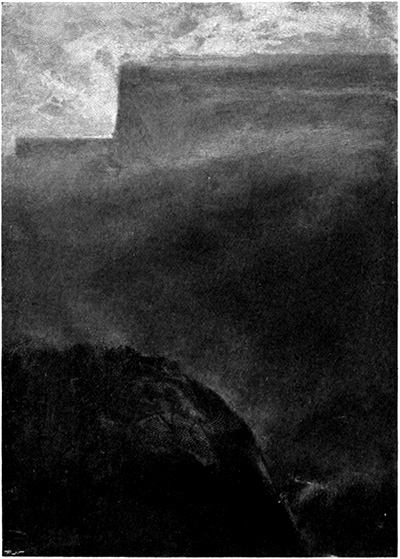
A great table of pink and white and red sandstone, ‘interbedded
with red shale,’ rises from a height of five thousand
one hundred feet above the level of the sea, two thousand
feet sheer into the sapphire tropical sky. A forest crowns it;
the highest waterfall in the world—only one, it would seem,
out of several—tumbles from its summit, two thousand feet at
one leap, three thousand more on a slope of forty-five degrees
to the bottom of the valley, broad enough to be seen thirty
miles away. Only two parties of civilised explorers have
reached the base of the table—Sir Robert Schomburgk many
years ago, and Mr. Brown and a companion in 1869[4]—each
at different spots. Even the length of the mass has not been
determined—Mr. Brown says from eight to twelve miles.
And he cannot help speculating whether the remains of a
former creation may not be found at the top. At any rate,
there is the forest on its summit; of what trees is it composed?
They cannot well be the same as those at its base. At a
distance of fifteen hundred feet above sea-level the mango-tree
of the West Indies, which produces fruit in abundance
below, ceases to bear. The change in vegetation must be far
more decided where the difference is between five thousand
and seven thousand feet. Thus for millenniums this island of
sandstone in the South American continent must have had its
own distinct flora. What may be its fauna? Very few birds
probably ascend to a height of two thousand feet in the air,
the vulture tribe excepted. Nearly the whole of its animated
inhabitants are likely to be as distinct as its plants.
“Is it peopled with human beings? Who can tell? Why
not? The climate must be temperate, delicious. There is
abundance of water, very probably issuing from some lake on
the summit. Have we here a group of unknown brothers cut
off from all the rest of their kind?
“The summit, Mr. Brown says, is inaccessible except by
means of balloons. Well, that is a question to be settled
on the spot, between an engineer and a first-rate ‘Alpine.’
(What is the satisfaction of standing on the ice-ridge of the
Matterhorn, or crossing the lava-wastes of the Vatna-Jökull,
compared to what would be the sensation of reaching that
aerial forest and gazing plumb down over the sea of tropical
verdure beneath, within an horizon the limits of which are
absolutely beyond guessing?)
“But put it that a balloon is required, surely it would be
worth while for one of our learned societies to organise a
balloon expedition for the purpose. No one can tell what
problems in natural science might not be elucidated by the
exploration. We have here an area of limited extent within
which the secular variation of species, if any, must have gone
on undisturbed, with only a limited number of conceivable
exceptions, since at least the very beginning of the present
age in the world’s life. Can there be a fairer field for the
testing of those theories which are occupying men’s minds
so much in our days? And if there be human beings on
Roraima, what new data must not their language, their condition,
contribute for the study of philologers, anthropologists,
sociologists?
“One more wonder remains to be told. The traveller
speaks of two other mountains in the same district which are
of the same description as Roraima—tables of sand-stone
rising up straight into the blue—one larger than (though not
as high as) Roraima itself. It is only because of their
existence, and because, for aught that appears, they may be
equally inaccessible with Roraima, that one does not venture
to call Roraima the greatest marvel and mystery of the
earth!”
“What is that taken from?” asked Jack Templemore
when the reader had put down the book.
“It is from the Spectator.[5] I say, Jack, what a chance
for an explorer! Fancy people spending their money and
risking their lives in exploring an icy, cold, miserable,
desolate region, like the Arctic Circle, when there is a
wondrous land here in the blue skies—yet no wilderness
of ice and snow—waiting to be won; and no one seems
to trouble about it! I do wish you would do as I have so
often suggested—set out with me upon an expedition
and let us see whether we cannot solve the secret of this
mysterious mountain. You have the leisure now, and I
have the money. Dr. Lorien and his son are now on
their way back from near there; if they can undertake
the journey, so could we. Besides, it is not as though we
were novices at this kind of travel; we have been on short
trips to the interior times enough.”
Jack Templemore looked dubious. He was, it is true,
used to roughing it in the wild parts of South America.
He had been trained as an engineer, and, for some years—he
was now twenty-eight—had been engaged in surveying
or pioneering for new railways in various places
on the Continent. His father having lately died and left
him and his mother very poorly off, he was now somewhat
anxiously looking about for something that would give
him permanent occupation, or the chance of making a
little money. He and Leonard Elwood were great friends;
though they were, in many respects, of very different
characters. Elwood was, essentially, of a romantic, poetic
temperament; while Templemore affected always a direct,
practical, matter-of-fact way of looking at things, as
became an engineer. He was dark, tall and sturdily
built, with keen, steady grey eyes, and a straight-forward,
good-humoured manner. Both were used to hunting,
shooting, and out-door sports, and, as Elwood had just
said, they had had many short hunting trips into the
interior together. But these had been in previous years,
since which, both had been away from Georgetown.
Templemore, as above stated, had been engaged in railway
enterprises, Elwood had gone to Europe, where, after
some time spent in England, during which his father and
mother had both died, he had travelled for a while ‘to see
the world,’ and finally had come out again to Georgetown
to look after some property his father had left him. On
arrival he had gone at first to an hotel, but some old
friends of his parents, who lived on an estate known as
‘Meldona,’ had insisted upon his staying with them for
a while. Here he found that his old friend Jack Templemore
was a frequent visitor, and it was an open secret
that Maud Kingsford, elder of the two daughters of
Leonard’s host, was the real attraction that brought him
there so constantly.
Now Jack Templemore, as has been said, was more
practical-minded than Leonard. He had not shrunk
from the hardships and privations of wild forest life when
engaged upon railway-engineering work, when there had
been something definite in view—money to be made,
instruction to be gained, or promotion to be hoped for.
But he did not view with enthusiasm the idea of leaving
comfortable surroundings for the discomforts of rough
travel, merely for travel’s sake, or upon what he deemed
a sort of wild-goose chase. He had carefully read up all
the information that was obtainable concerning the mountain
Roraima, and had seen no reason to doubt the
conclusions that had been come to by those who ought to
know—that it was inaccessible. Of what use then to
spend time, trouble, money—perhaps health and strength—upon
attempting the impossible?
So Jack Templemore argued, and, be it said, there was
the other reason. Why should he go away and separate
himself for an indefinite period from his only surviving
parent and the girl he loved best in the world, with no
better object than a vague idea of scrambling up a
mountain that had been pronounced by practical men
unclimbable?
Thus, when Leonard appealed to him on this particular
morning, merely because he had come across something
that had fired his enthusiasm afresh, Jack did not respond
to the proposal with the cordiality that the other evidently
wished for.
“I don’t mind going a short trip with you, old man,”
Jack said presently, “for a little hunting, if you feel
restless and are a-hungering after a spell of wandering—a
few days, or a week or two, if you like—but a long
expedition with nothing to go upon, as it were, seems to
me only next door to midsummer madness.”
Leonard turned away with an air of disappointment,
and just then Maud Kingsford, who had been playing
and singing inside the room, stepped out.
Leonard discreetly went into the house and left the
two alone, and Maud greeted Jack with a rosy tell-tale
flush that made her pretty face look still more charming.
In appearance she was neither fair nor dark, her hair and
eyebrows being brown and her eyes hazel. She was an
unaffected, good-hearted girl, more thoughtful and serious,
perhaps, than girls of her age usually are—she was
twenty, while Stella, the younger sister, was between
eighteen and nineteen—and had shown her capacity for
managing a home by her success in that line in their own
home since her mother’s death a few years before. The
practical-minded Jack, who had duly noted this, saw
in it additional cause for admiration; but, indeed, it
was only a natural outcome of her innate good sense.
She now asked what her lover and Leonard had been
talking of.
“The usual thing,” was Jack’s reply. “He’s mad to
go upon an exploring expedition; thinks we could succeed
where others have failed. It’s so unlikely, you know.
Now, if he would only look at the thing practically——”
Maud burst into a merry laugh.
“You do amuse me—you two,” she exclaimed; at
which Jack looked a little disconcerted. “You always
insisting so upon being strictly non-speculative, and
Leonard, with his romantic phantasies, and his dreams
and visions, and vague aspirations after castles in the
air. You are always hammering away at him, trying to
instil practical ideas into him with the same praiseworthy
perseverance, though you know that in all these years
you have never made the least little bit of impression
upon him. Your ideas and his are like oil and water,
you know. They will never mix, shake them together as
you will.”
“But—don’t you think I am right? Isn’t it common
sense?”
“Quite right, of course; and you are persevering; I’ll
say that for you.”
“For the matter of that, so’s Leonard,” said Jack with
a good-natured laugh. “He’s as persevering with this
fad of his as any man I ever met in my life. I do believe
he’s got a fixed idea that he has only to start upon this
enterprise, and he will come back a made man with untold
and undreamt-of wealth and——”
“And a princess for a bride—the fair maid of his
dreams,” Maud put in, still laughing. “We have not heard
so much of her, by the bye, lately. He has been rather
shy of those things since his return from Europe, and does
not like to be spoken to about them. We began to think
he had grown out of his youthful fancies.”
The fact was, that, from his childhood, Leonard had
been accustomed to strange dreams and fancies. These
five—Leonard, Templemore, and Mr. Kingsford’s son and
two daughters—had been children together, and in those
days Leonard had talked freely to his childish companions
of all his imaginative ideas; and as they grew older, he had
not varied much in this respect. Moreover, Leonard had
had an Indian nurse, named Carenna, who had encouraged
him in his fantastic dreamings, and who had, by her Indian
folk-lore tales, early excited his imagination. Her son
Matava, too, had been Leonard’s constant companion
almost so long as he could remember, first in all sorts of
boyish games and amusements, and later in his hunting
expeditions; and both Matava and Carenna had been
always more devoted to Leonard than even to his father
and mother.
But when Mr. and Mrs. Elwood left the estate they had
been cultivating, to go to England, the two Indians had
gone away into the interior to live at an Indian settlement
with their own tribe. About twice a year, however—or
even oftener, if there were occasion—Matava still came
down to the coast upon some little trading expedition with
other Indians; and at such times he never failed to come
to see the Kingsfords and inquire after Leonard.
The Dr. Lorien, of whom mention had been made by
Leonard, was a retired medical practitioner who had turned
botanist and orchid-collector. He had been a ship’s doctor,
and in that capacity had voyaged pretty well all over the
world. Since he had given that up he had travelled
further still by land—in the tropical regions in the heart
of Africa, in Siam, the Malay Peninsular and, latterly, in
South America—in search of orchids and other rare floral
and botanical specimens. The vicinity of Roraima being
one of the most remarkable in the world for such things—though
so difficult of access as to be but seldom visited by
white men—it is not surprising that he had lately planned
a journey thither.
From this journey the doctor and his son were now
daily expected back. One of the Indians of their party had,
indeed, already arrived, having been despatched in advance,
a few days before, to announce their safe return.
Thus it came about that Templemore and Maud, while
still talking, were not greatly surprised at the sudden
appearance of Matava, who stated that he had come down
with the doctor’s party, who would follow very quickly
on his heels.
Maud, who knew the Indian and his mother well, received
him kindly; and, to his great delight, was able to
inform him that his ‘young master’—as he always
called Leonard Elwood—had returned to Georgetown, and
was at present with them.
Matava had, indeed, expected this, for he had heard
of Leonard’s intention at his last visit to the coast some
six months before. He was greatly pleased to find he
was not to be disappointed in his expectation. Moreover,
the Indian declared, he had news for him—“news of the
greatest importance”—and begged to be allowed to see
him at once. So Maud sent him into the house—where
he knew his way about perfectly—to find Leonard; and
then, turning to Templemore, she said, laughing,
“I wonder what his ‘important’ intelligence can be?
Some deeper secret than usual that his old nurse has to
tell him, I suppose.”
“I hope it’s nothing likely to rouse a further desire
to set off on this mad-cap expedition he has so long had
in his mind,” Templemore returned; “for,” looking at her
with a sigh, “if he should make up his mind to start, I
am, in effect, pledged to go too, whether I wish or not.”
“Why should you expect it? and how are you obliged
to go?” Maud inquired with evident uneasiness.
“I know that Leonard saw Dr. Lorien in London
before he came out last, and had a long talk with him.
When he learned of the expedition upon which the doctor
was then setting out, he was much annoyed at being
unable to join him. He said, however, that he should be
in Georgetown himself in a few months, and hoped to see
the doctor on his return; and he particularly asked him
to try to collect for him all the information and particulars
he could concerning the best route by which to make the
journey to Roraima. Dr. Lorien told me all this before
he left us, adding that he felt certain Leonard’s object in
coming again to Georgetown was quite as much to arrange
for an expedition as his ostensible one of looking after
his property. And I know, too, from what I have seen
since Leonard has been back, that his thoughts are full
of the idea. You say he does not now talk much of it to
you or to others?”
“No; and as I told you just now, we had begun rather
to think he had given up his former romantic yearnings
for adventure; and, when you have referred to them before
him, I have thought that you were only teasing him
a little about old times.”
“Oh dear no; by no means. Whatever he may say,
or leave unsaid to you and his general acquaintances, he
is, in his heart, just as much set upon it as ever.”
“It is odd, that,” Maud observed thoughtfully, “because
he used to be so fond of telling us about his dreams and
visions and all the castles in the air and half-mystical
imaginings he used to build upon them. But,” she went
on slowly, “I have noticed that, since his long absence
from us, Leonard Elwood is very different from what he
was as I remember him. He seems, at times, so reserved
and distant, I almost feel inclined to call him ‘Mr.
Elwood’ instead of ‘Leonard.’ And he is, in a manner,
unsociable, too. He is so preoccupied always, so silent,
and so wrapped up in himself, that you generally have to
wait, if you speak to him, while he collects his thoughts—brings
them back from the distant skies or wherever they
have gone a-wandering—before he replies to you. Not
that he is intentionally cool or distant, I think; and I am
sure he is just as good-hearted as ever. Yet there is a
change of some sort. Stella says the same. And, do
you know, he sometimes gives me a sort of feeling as
though he were not English at all, but of some other race,
and that he feels half out-of-place amongst us, a fish out
of water, as it were? I wonder whether he is in love!”
And Maud gave a ringing little laugh.
Templemore shook his head.
“If he were, it would be with some young lady on the
other side of the Atlantic,” he returned. “And he would
not be desirous of prolonging his stay on this side. No;
I know what is the matter with him. He talks freely
enough to me. And, now that he is expecting Dr. Lorien
back, he is gradually working himself up into a state of
excitement and expectation. He has quite made up his
mind for some news or information—Heaven only knows
why—and that is what makes him by turns restless and
preoccupied. If, therefore, what Matava has to tell has
anything to do with what I know to be so much in his
thoughts, it may be the means of deciding him to go; and
then I should have to go too.”
“But why? I don’t see what it has to do with you,
Jack.”
“It has this to do with me, dear Maud,” said Templemore,
taking her hand; “Leonard, some time ago, made
me a very handsome—to me a very tempting—offer if I
would make up my mind to start with him on this vague
expedition. He offered me £300 clear, he paying all
expenses, and giving me, besides, half of whatever came
out of it. Unfortunately for myself, I am not now in a
position to say ‘no’ to such an offer. I have been, now,
nearly a year waiting for something to ‘turn up.’ My
mother has barely enough to live on, and depends upon
me for ordinary comforts, to say nothing of little luxuries;
and what I had saved up from former engagements is
steadily getting less and less, and will shortly disappear.
I do wish with all my heart I could get anything else,
almost, rather than this wild-goose affair of Leonard’s.
Yet nothing has offered itself; so what am I to do? For
your sake, for the hope of being able one day to provide a
home for you——”
“Nay, Jack,” Maud interposed, with a deep flush, “do
not say for my sake. I would not have you set out on
an enterprise of danger and difficulty for my sake. But
I see clearly enough you must do it, if it be again offered,
for your mother’s sake. Yes, for hers, you must.” The
girl hesitated, and it was easy to see she found it hard to
say the words, but she went on bravely, “So, I repeat, if it
be again offered, you must accept it, Jack. And be sure I
will look after your mother, and comfort her while you
are away.”
“That is spoken like my own dear girl,” Templemore
answered with emotion. “Yes, I cannot well refuse;
and I know I may look to you to console my mother.
You will comfort each other.”
Just then they heard Leonard’s voice calling out in
excited tones for Templemore. A moment or two later
he came rushing out of the house.
“Jack, Jack!” he cried. “Such a strange thing!
Here is our opportunity! Matava has brought some
extraordinary news!”
Leonard was so incoherent in his excitement, that it
was some time before his hearers grasped his meaning.
His news amounted, in effect, to this. A white man
had been staying for some time near the Indian village at
which Carenna and her son Matava lived; and he had
had many talks with both about a project for ascending
the mountain of Roraima. It being an arduous undertaking,
he sought the co-operation of one or two other
white men; and Leonard’s old nurse had urged him to
communicate with her young master, who would shortly
be in Georgetown, assuring him that he would be the very
one—from the interest and enthusiasm he would feel—to
join him and help him to achieve success if success were
possible. Matava, who knew of Dr. Lorien’s presence in
the district, had suggested to the stranger to go to see
him, and a meeting had thus been brought about. The
doctor would tell him the result; but the main thing was
that the stranger had sent an invitation to Leonard to join
him and to bring, if he pleased, one other white man, but
no more. The doctor was now at the Settlement, near
the mouth of the Essequibo, transferring to the steamer,
from the Indian canoes in which they had been brought
down the river, his botanical treasures and other trophies
of his journey. If Leonard wished to go back with the
canoes and the Indians who were with them, he would
have to let them know at once, and they would wait.
Otherwise they would be on their way back in a day or
two; which would involve the organising of a fresh
expedition—a matter of great trouble—should Leonard
make up his mind to proceed later.
The enthusiastic Leonard needed no time to make up
his mind.
“I shall go,” said he. “If you will come too, Jack, I
shall be only too glad. But, if not, I may be able to find
some one else; or I shall go alone. So I shall send word
at once to keep the boats and the Indians.”
“But,” objected Maud Kingsford, “consider! You
know nothing of this stranger; he may be a blackleg,
an escaped murderer or desperado, or all sorts of things.”
“No, no! Carenna knows. She has sent word that
I can trust this man, and she knows. She is too fond
of me to let me get mixed up with any doubtful character.
Dr. Lorien, too, and Harry have seen him, and talked
with him, and think well of him; so Matava says. I shall
know more when I see them in a day or two. Meantime,
I shall keep the canoes and Indians, and risk it.”
Then he rushed off to have a further talk with Matava,
and, as he said, see about getting the Indian “some
grub.”
Jack and Maud, left alone, looked at each other in
dismay. It had been one thing to talk vaguely of what
they would do in case Leonard should take what at the
time seemed a very unlikely step. It was quite another
to be thus suddenly brought face to face with it.
Maud turned very pale and seemed about to faint. She
felt keenly how hard it would be to see her lover depart
upon an adventure of this uncertain character, the end
or duration of which no one could even guess at. But
she recovered her self-possession with an effort and,
looking steadily at Templemore, said,
“What you said you would do for our sakes is to be
very quickly put to the test, it seems. You—will—go,
Jack?”
“Yes,” he answered firmly; “since it is your wish.”
“You must,” she answered. “It is hard to lose you;
it will be hard for us both. But go—and go with a good
heart. Be sure I will be a daughter to your mother
while you are away.”
He took her hand in his and pressed it to his lips.
“For your sake, dear Maud, I shall go,” he said.
“For your sake and for my mother’s; in the hope that
some success may result; but not—Heaven knows—for
the mere sordid hope of gain.”