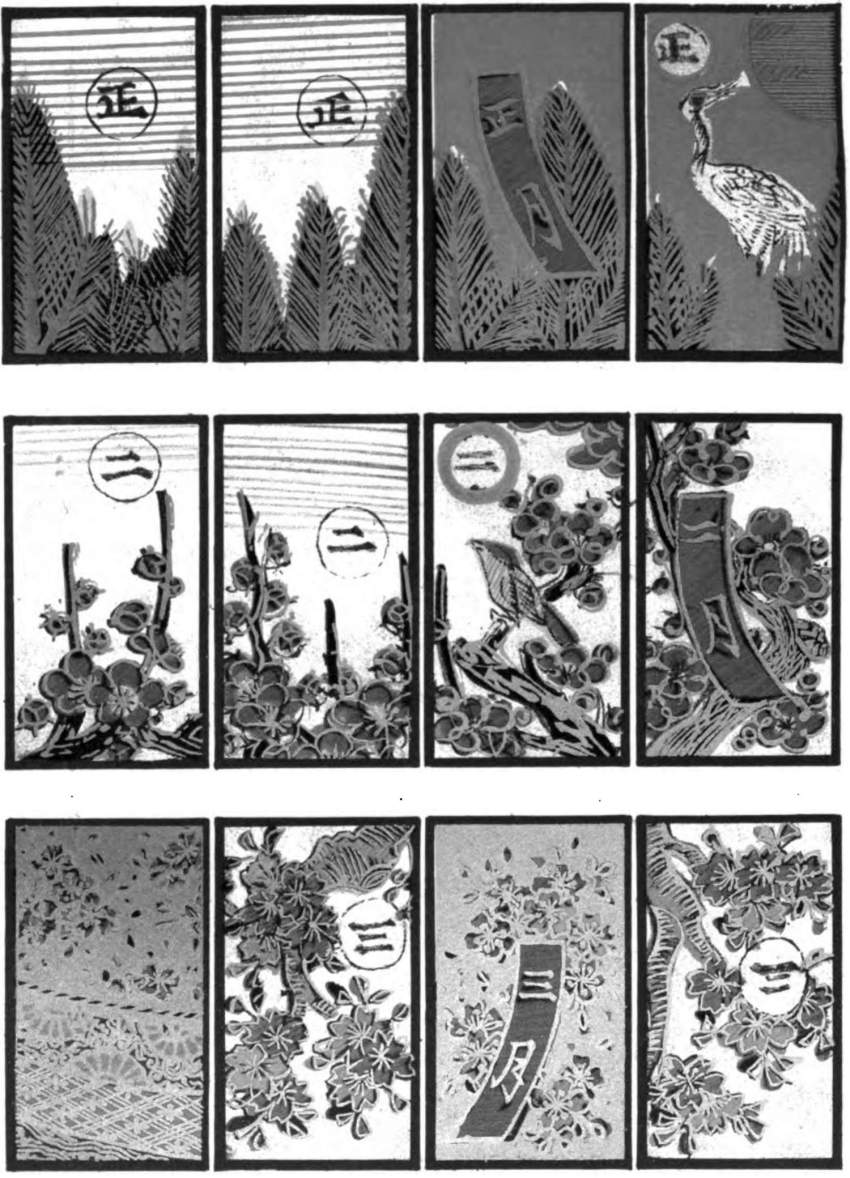
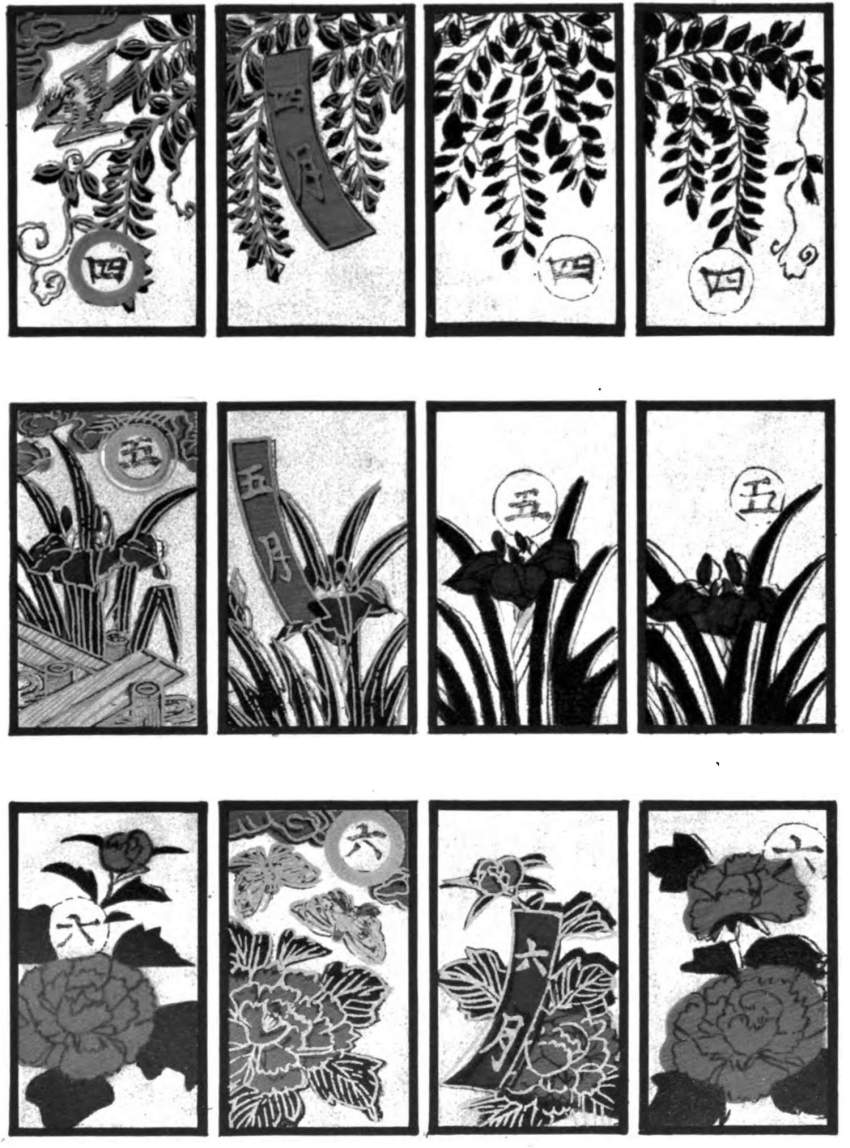
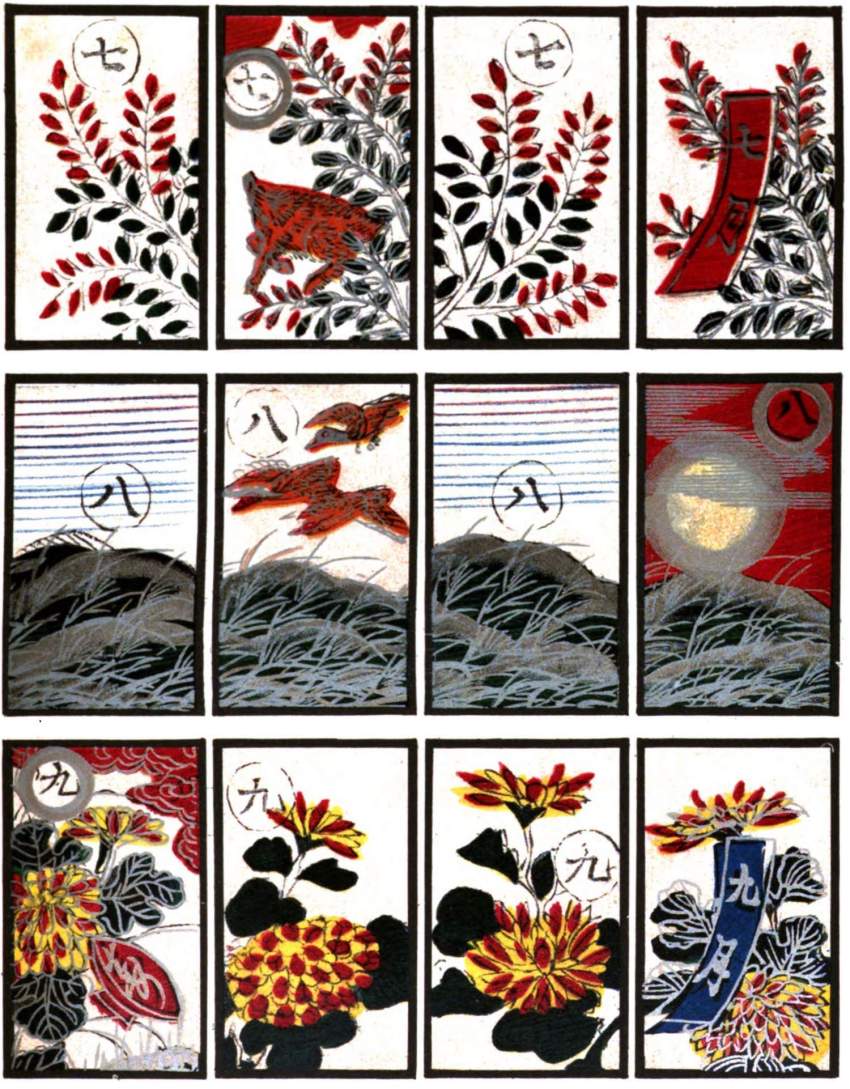
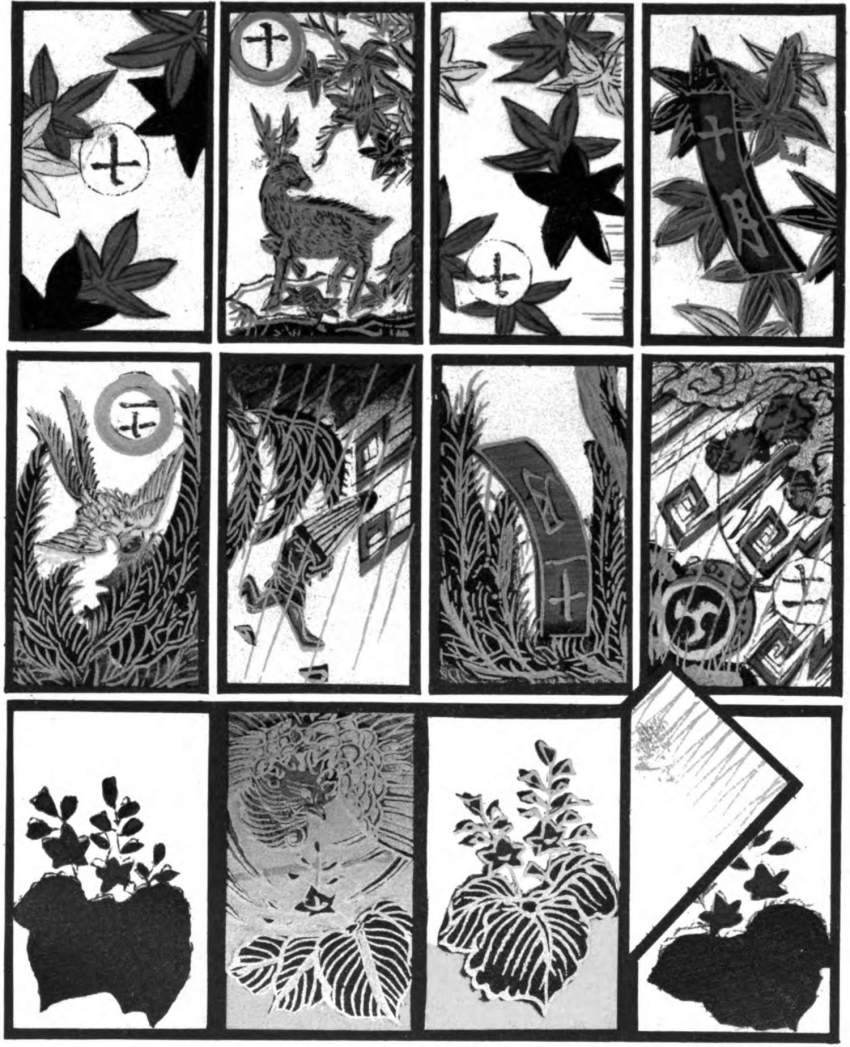
Obvious typographical errors have been silently corrected. All other spelling and
punctuation remains unchanged.
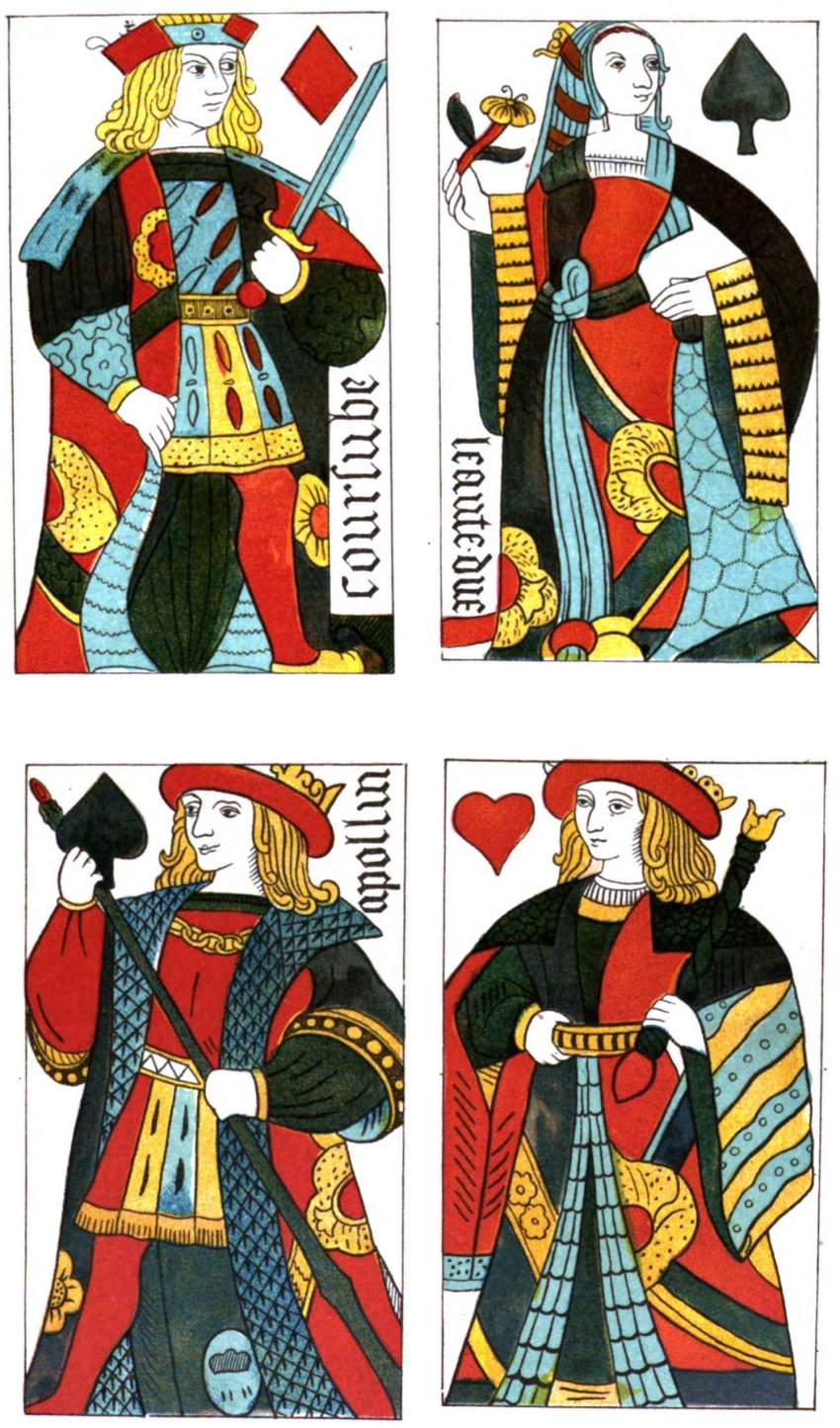
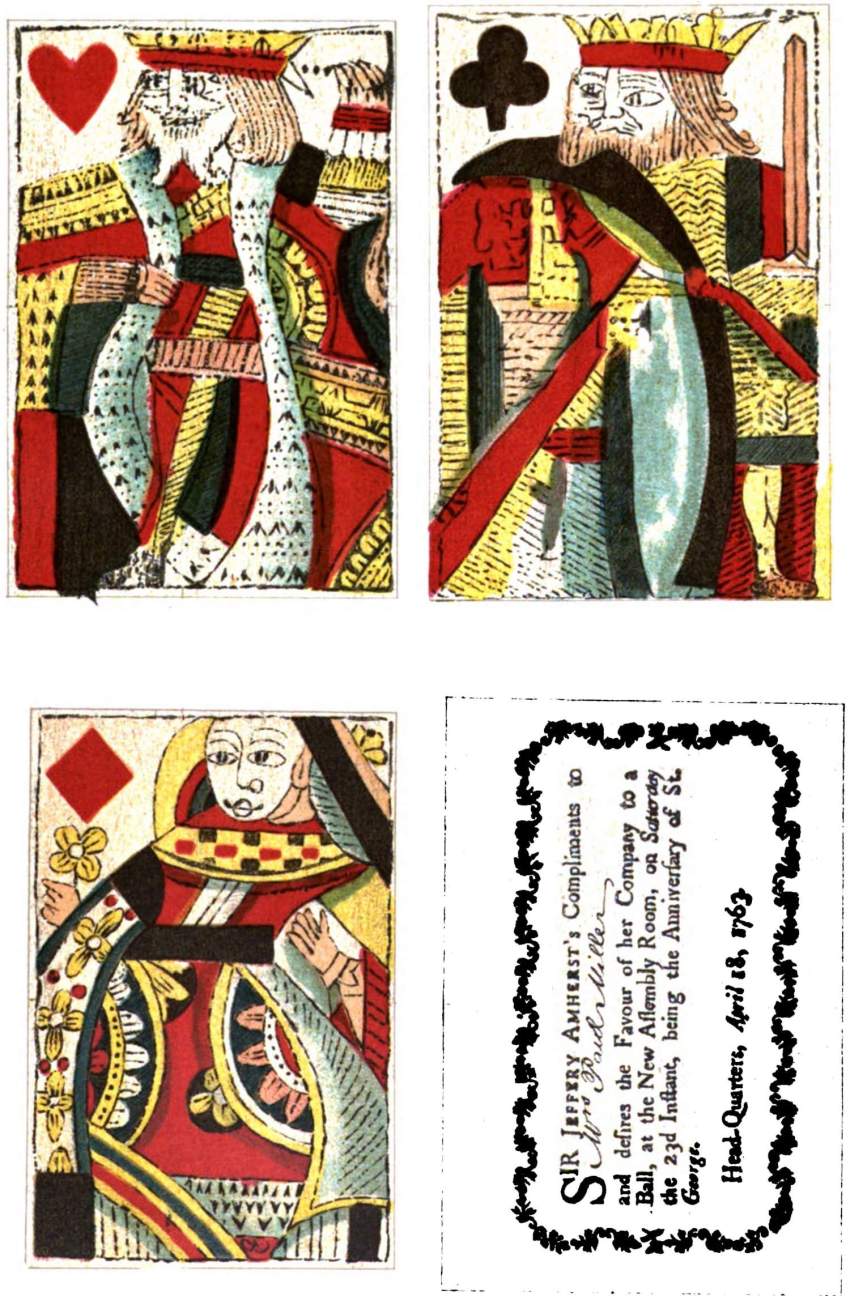
Plate 1.
A History of Playing-Cards
BY
MRS. JOHN KING VAN RENSSELAER
AUTHOR OF CROCHET LACE, ETC.
ILLUSTRATED
NEW YORK
DODD, MEAD, AND COMPANY
PUBLISHERS
Copyright, 1890 By Dodd, Mead, and Company
All rights reserved
University Press John Wilson and Son, Cambridge
PREFACE.
The “Devil’s Books” was the name bestowed
upon Playing-cards by the Puritans and
other pious souls who were probably in hopes
that this name would alarm timid persons and
so prevent their use. Whether or not his Satanic
Majesty originated Playing-cards, we have
no means of discovering; but it is more probable
that he only inspired their invention, and placed
them in the hands of mankind, who have eagerly
adopted this simple means of amusing themselves,
and have used it according to the good or evil
which predominated in their own breasts. Many
learned men have written books or treatises on
Playing-cards, and I am indebted for a large part
of the information contained in this history to
“Les Cartes à Jouer,” by M. Paul la Croix;
“Facts and Speculations about Playing-cards,” by
Mr. Chatto; “The History of Playing-cards,” by
the Rev. Edward Taylor; and “The History of
Playing-cards,” by Mr. Singer.
These books are now out of print, and somewhat
difficult to obtain; and I hope, by bringing
into a small compass the principal features set
forth in them, I shall be able to place before a
number of readers interesting facts that would be
otherwise unobtainable.
Hearty thanks are due to the custodians of the
National Museum in Washington, who have aided
me in every way in their power, and also to the
many kind friends who have sought far and wide
for unique and uncommon packs of cards, and
helped materially by gathering facts relating to
them for me.
That many nations have cards peculiar to their
own country and almost unknown beyond its boundaries
may be a matter of surprise to some; that
such ordinary and familiar objects as Playing-cards
should have a history, will astonish others. My
hope is that the subject will interest my readers
as it has done me. Any facts concerning Playing-cards
or any communications relating to rare or
curious packs will be gladly received by the author,
who would like to add to her collection.
Cards found by Mr. Chatto in a Black-Letter Volume
formerly in the Cathedral Library, at Peterborough,
England. Now in the Print Room of the British Museum
THE origin of Playing-cards and their inventor
is still a subject of speculation, and will probably
remain forever undiscovered. Almost every
country in Europe has through her scholars laid
claim to having been the first to use cards; and
many documentary and other proofs have been
brought forward to substantiate their assertions,
which are based upon ancient laws, common traditions,
or contemporary illustrations.
That cards were brought from the East to Europe
about the time of the Crusades, and probably
by the home-returning warriors, who imported
many of the newly acquired customs and habits
of the Orient into their own countries, seems to
be a well established fact; and it does not contradict
the statement made by some writers, who declare
that the gypsies—who about that time began
to wander over Europe—brought with them and
introduced cards, which they used, as they do at
the present day, for divining the future. Cards
may well have become known by both means, and
they spread rapidly over all of what was then considered
the only civilized part of the world; and
the proofs that have been brought forward show
that they were known nearly simultaneously in
Italy, Spain, France, Germany, and England, and
point to a common origin not to be found in any
one of these countries.
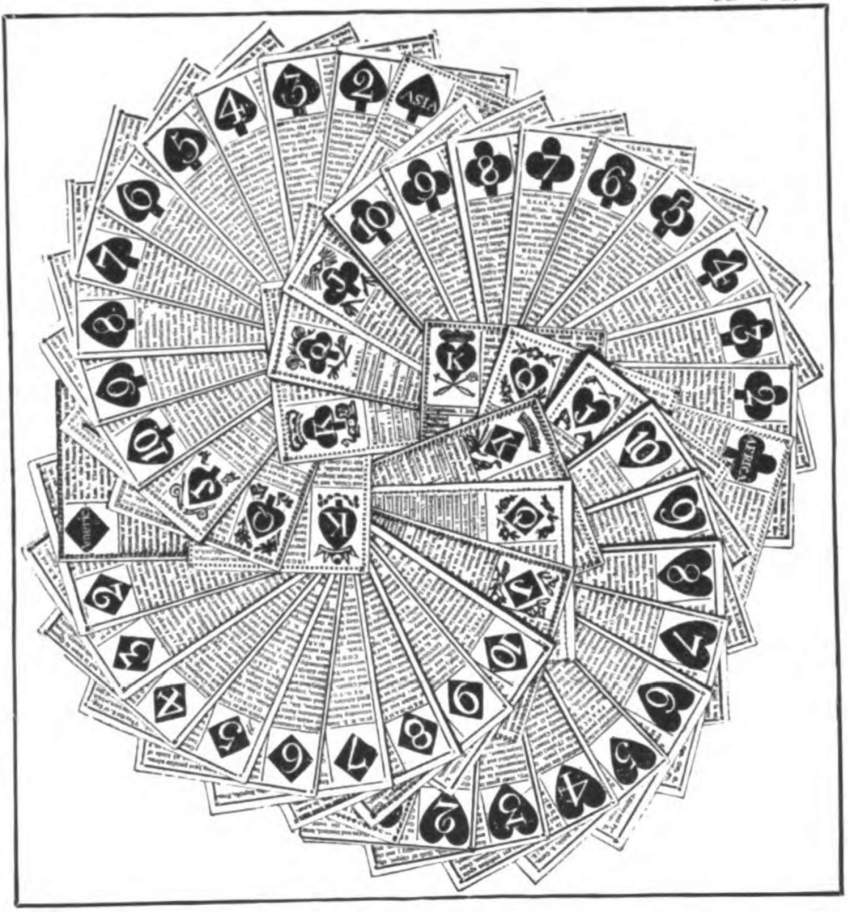
Plate 2.
The first cards known in Europe, and which
were named Tarots, Tarocchi, etc., seem to differ
in almost every respect from those of the fifteenth
century, although these probably inspired their invention.
The latter resemble much more those
of the present day than they do the original Tarots.
The first packs consisted of seventy-eight
cards,—that is, of four suits of numeral cards;
and besides these there were twenty-two emblematical
pictured cards, which were called Atous,
or Atouts,—a word which M. Duchesne, a French
writer, declares signifies “above all.” This word
used in French has the same meaning as our word
Trump. The marks which distinguish the Tarot
suits are usually Swords, Cups, Sticks, and Money;
and each one consists of fourteen cards, ten of
which are “pips” and three or four “coat” cards,—namely,
King, Queen, Knight, and Knave. The
Queen was not always admitted. These suits seem
to be the origin of the modern packs; and the
emblems used on them have been adopted in many
countries where the Atout part was discarded while
the rest of the pack with its original symbols was
retained.
Mr. Singer gives a graphic description of these
cards and the games to be played with them, and
says that “among different nations the suits [as
will be hereafter shown] are distinguished by marks
peculiar to themselves, while only the general
features of the numbered cards headed by figures
or court cards have been retained.”
The second division of the Tarot pack, called
Atouts, are numbered up to twenty-one, each of
these having its proper value; and besides all these
there is one, not numbered and not belonging to
the division of the suit cards, which is called a Fou,
and in playing the game is designated Mat, or il
Matto. This “Joker,” as we should term it, has no
value of its own, but augments that of any of the
Atouts to which it may be joined, and is sometimes
played instead of a Queen, being then called “her
Excuse.”
These Atouts are each represented by a print
which is supposed to resemble some character, and
the name is generally placed on the card. Among
them are an Emperor, a Cupid, a Chariot, a Hermit,
a Gallows, Death, The Day of Judgment, a
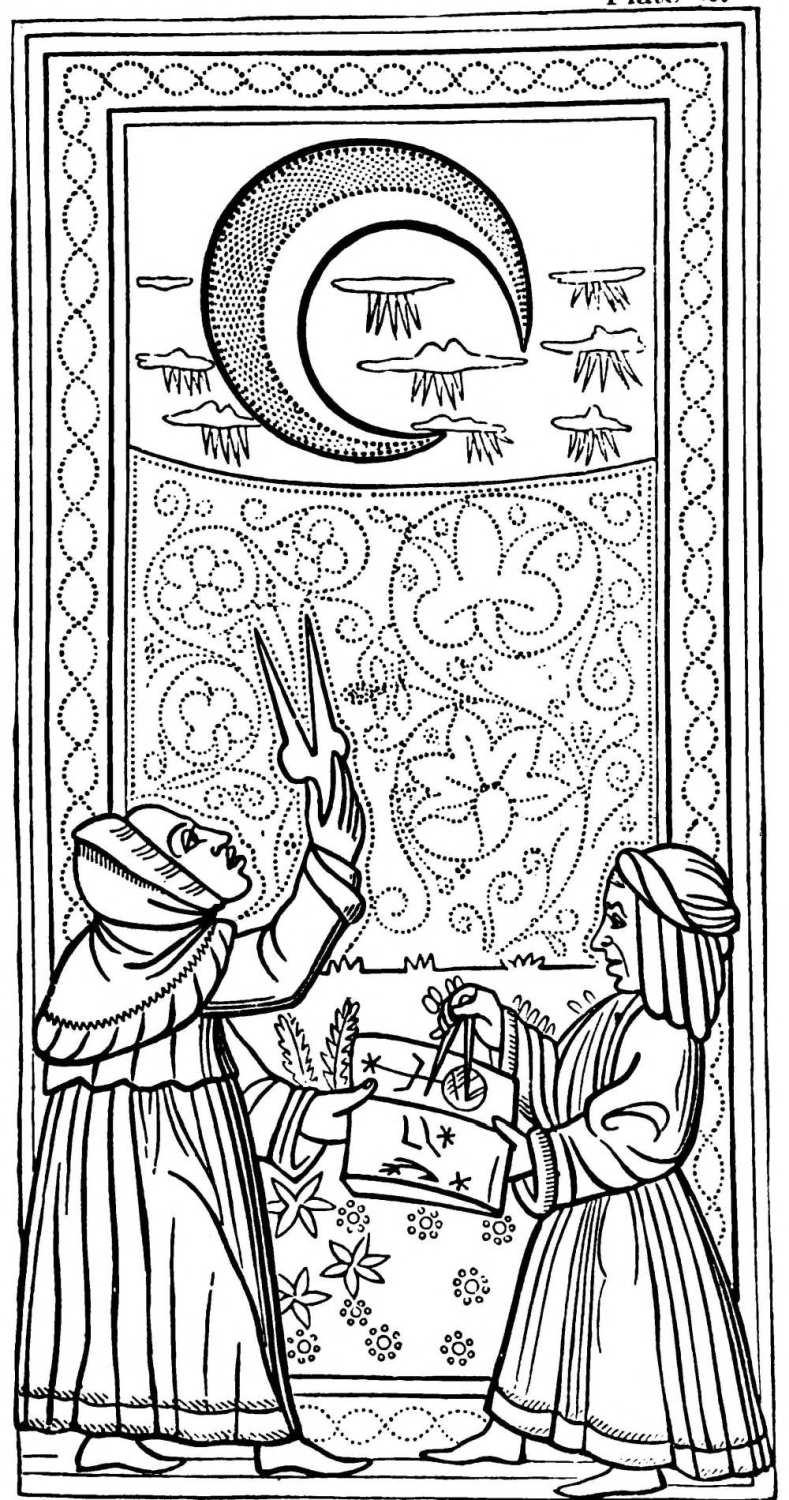
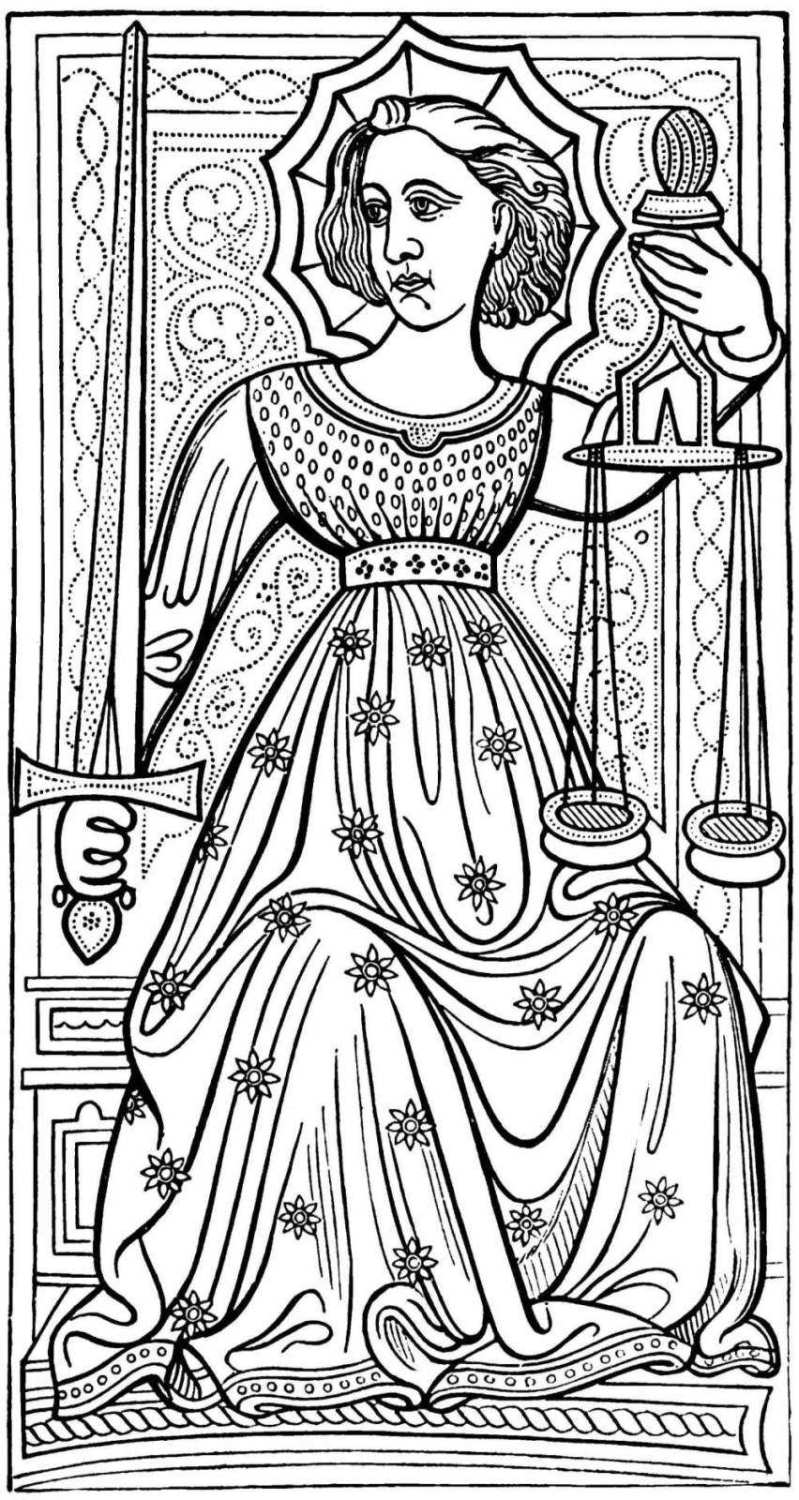
Pope, Fortune, Temperance, Justice, the Moon, the
Sun, etc. The order in which they are placed is
not always the same, and is seemingly unimportant.
The game may be played by two or four persons.
“The one who holds the ‘Fool’ regains his stake;
‘La Force’ (or Strength) takes twice as much from
the pool, while ‘La Mort’ (or Death) most appropriately
sweeps the board.”
It is said that the distribution of the suit cards
has a peculiar signification. Each one is distinguished
by an emblem which represents the four
classes into which communities were once divided.
First comes the Churchman, represented by the
Chalice (or Copas); next in rank, the Warrior,
whose emblem is the Sword; third, the Merchant,
symbolized by a Coin; and fourth, the Workman
with his Staff. It will be shown hereafter that
almost all writers on the subject allow the possibility
of the divisions of the suits being shown
in the cards.
The earliest known specimens of these Tarot
cards are now to be found in the Cabinet des
Estampes in Paris, and are supposed to have
formed part of the pack which was painted for
King Charles the Seventh of France in 1393, to
cheer and amuse him during an illness which
had been caused by a coup-de-soleil in 1392, and
which made him a melancholy but not a dangerous
lunatic. M. Paul la Croix describes these
Tarots as having been most delicately painted
and resembling in treatment the illuminations of
manuscripts. They are on a golden background
on which dots forming an ornamental pattern
were impressed. A border of silver surrounded
and as it were framed each picture, through which
a dotted line twisted spirally like a ribbon. M.
la Croix points out that this dotted line, in his
language technically termed a tare (which also
means a “fault” or “defect”), was a sort of fluting
produced by small holes pricked into the substance
of which the cards were made, and fancies
that to these Tares the Tarots owe their name.
Other writers, however, dispute this derivation of
the word, and discover new ones for themselves
which are generally quite as fanciful and far-fetched.
These well preserved Tarots are eighteen centimetres
by nine, and are painted in water colours
on a thin card. The composition of the figures
is ingenious and artistic. The drawing is correct
and full of character, and the colours are still
brilliant. A narrow border of black and white
checks surrounds each one. This border is a
piece of checkered paper pasted on the back of
the card and neatly folded over its edge as if to
protect it, showing on the face of the card and
forming a frame for the pictures. This fashion of
having a checkered or diapered back was closely
followed in many of the countries where cards
have been used; and these backs are still seen,
although this old pattern (which, as will hereafter
be seen, had probably a very interesting origin)
has been generally discarded, and each card-maker
adopts a different device with which to decorate
the backs of his cards according to his own fancy.
In France the backs are generally plain, and coloured
red, pink, or blue. In Spain the pattern is
dotted on the surface in lines and circles, while
in other countries interlaced and meaningless designs
are employed.
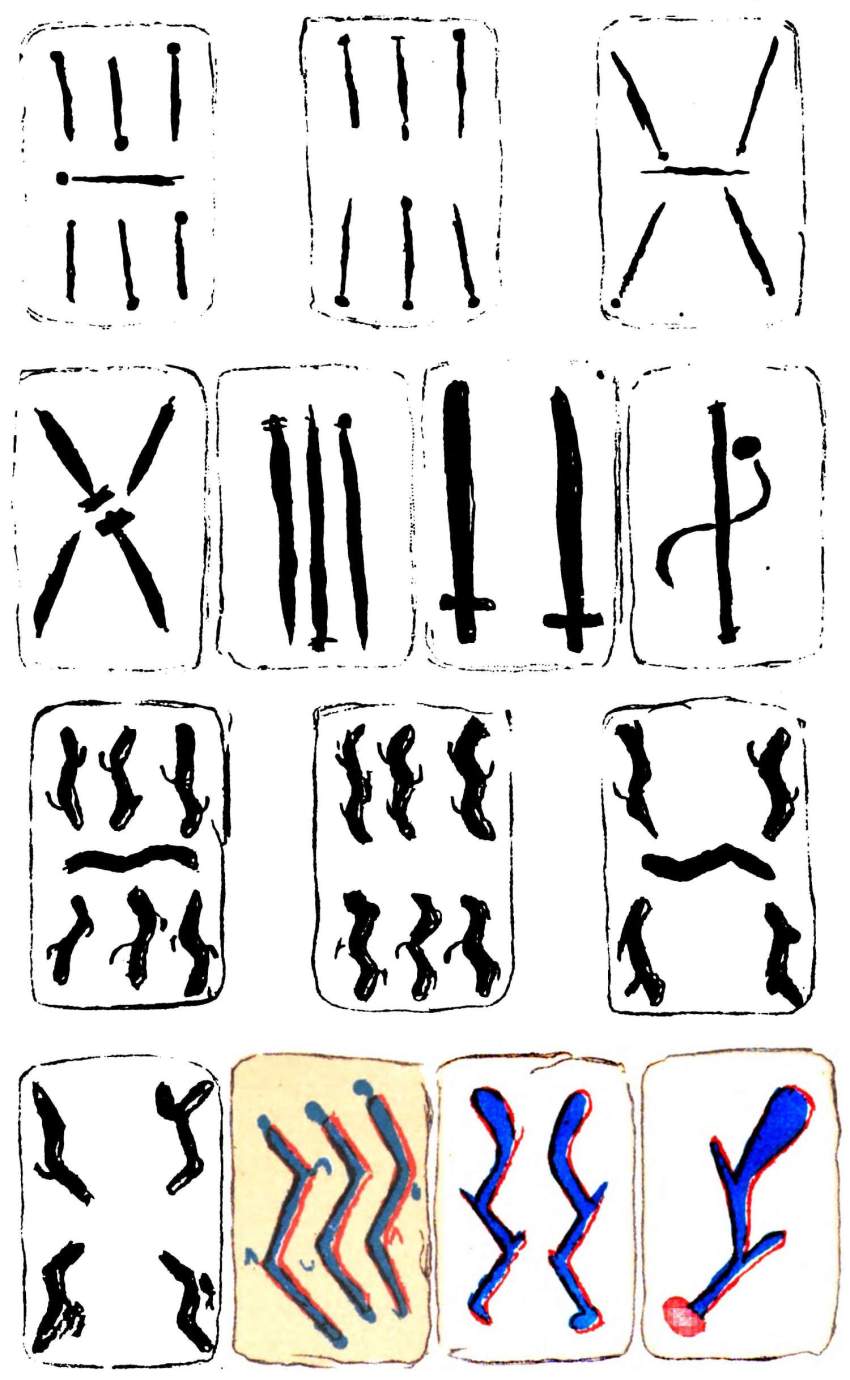
Plate 3.
Packs of cards closely resembling the original
Tarots are still to be found in some parts of
Switzerland, Germany, and Alsace, where they are
used by the peasantry in the districts which are
not much frequented by travellers; but they are
unknown to the rest of the world except as curiosities.
They are, however, the sole representatives
of the cards which the Crusaders or the gypsies
brought into Europe, and which the latter use
whenever possible to divine the future or recall
the past. Some writers point to the eastern
origin of these Tarots, because in them “Death”
is numbered thirteen, and the idea of fatality or
bad luck attached to that number is essentially
Oriental; and they declare that the fact that the emblematical
Atouts are numbered from low to high,
just as certain Asiatic alphabets are written from
left to right, may cover a similar interpretation.
CHESS.
ALMOST all writers on Cards have admitted
the strong resemblance they bear to Chess;
and M. Paul la Croix declares that in comparatively
modern times the game of chess and games
of cards showed strikingly similar features, which
demonstrated their common origin,—the art of
painting being resorted to to depict the one, and
that of sculpture to represent the other.
A pretty history of the origin of Chess has
been related. It states that the game was invented
for the amusement of an Oriental potentate,
and was played with living figures, who were
required to move at the word of command from
one square to another of a huge tiled court-yard
which was surrounded by the balconies of the
palace and its harem, from which all the movements
of the pieces on the pavement below could
be watched by the sovereign and his court.
Living games of Chess have been played for
amusement or “sweet charity’s sake” even in
modern times; but such cumbersome pieces must
have been difficult to manage, and it was only
natural that the ingenious mind which contrived
living chessmen should soon have superseded
them with figures carved in a convenient material
such as wood or ivory, and then placed the
mimic armies on a miniature battle-field which
could be easily commanded by two or more
players.
The Eastern origin of Chess is undisputed, but
when and by whom it was introduced into Europe
is unknown. According to Herodius, the
Lydians suffered from a long and severe famine
in the reign of Atys, and in order to forget their
misery, invented many games, particularly dice.
Previous writers attribute the invention of games
of chance to the Greeks during the siege of
Troy, and Cicero mentions games in the camp;
but it does not follow that these games were
either chess, cards, or dice. They may have been
knuckle-bones or jack-stones, as that game was
known in very early days, and pictures representing
persons playing with them have been found
among Egyptian antiquities.
It has been asserted positively by the oldest
traditions that the cards of Indian origin are
only chessmen transferred to paper on which the
principal pieces of the game are reproduced, the
game being improved by admitting more than
two players.
In the game of Chess there are generally only
two armies of pawns, each one being commanded
by a King, a Vizir (which in the lapse of years
has become a Queen), a Knight, an Elephant
(which became a fool and after that a Bishop),
and a Dromedary (afterward a Castle); and the
game shows a striking similarity to the Indian
games of cards, which have eight companies distinguished
by their colours and emblems, and of
which each one has their King, their Vizir, and
their Elephant. The two games differ, of course;
but sufficient resemblances between them remain
to show their common origin, which recalls the
terrible game of war, in which each adversary
must assault, manœuvre, make combinations, and
exert eternal vigilance.
We learn from a most reliable source (Abel de
Rémusat, Journal asiatique, September, 1822) that
playing-cards came to Europe from India and
China, and that, like the game of Chess, they were
known to the Arabians and the Saracens from
the beginning of the twelfth century. At first
these games found little popular favour, most
probably because they were introduced at a period
when civil and ecclesiastical authorities most positively
forbade all games of chance.
From India Chess spread gradually to other
countries. The Persians seem to have known it
about the middle of the sixth century; and Singer,
in his “History of Playing-cards,” states that it
reached China at nearly the same period, and in
the reign of the Emperor Wa-si.
There are such striking resemblances between
the figures used in Chess and those on cards as
to leave very little doubt where the inspiration
for the latter originated.
Beautiful circular cards made of ivory have
been found, on which the figures are painted as
if the artist were unable to carve the forms that
he desired to represent, and therefore was obliged
to paint them on a flat surface. These cards
are small disks, which might easily be placed on
the squares of a board and moved from one to
the other like chessmen. The advantage of commanding
a concealed army instead of one spread
out on an open field probably soon became apparent,
and the result was that some slight changes
in the shape of the pictured figure and the material
used were soon made, which with various
modifications have come down to us as the modern
playing-card.
If a study is made of some of the different
packs of Chinese cards, it will be seen that horses,
deer, and other animals are represented on them,
together with symbols which seem to mark the
suits. In other packs, instead of the figure of
the animal, Chinese characters are placed above
the symbol marking the suit, which characters
seem to have been put there instead of the picture,
and which it is affirmed state, “This is the
horse,” or “This one is the deer,” as the case may
be,—as if on one of our court cards the legend
“This is the Queen” should be written on its
face, instead of placing there the quaintly garbed
female form which usually represents that august
person.
We find the principal figures from the chess-board
reproduced in the Tarots, and also in some
of the Spanish and German packs. There is the
King, the Knight, or mounted horseman, and the
Knave. The pawns or common soldiers are represented
by numbers; but there is this difference
between Cards and the game of Chess as it is generally
played,—in the former there are four armies,
or as we should call them “suits,” and each one
is headed by the King instead of the two sides
generally seen in Chess. Now, Mr. Chatto remarks
that there is an Indian game of Chess
which is called Chaturanga, or “The Four Kings,”
in which two allied armies play against the same
opponents. He also gives a few rules for this
game. “Having marked eight squares on all
sides,” says the Sage, “place the red army to the
east, the green to the south, the yellow to the
west, and the black to the north.” It is worthy
of notice that these colours form the ground of
four of the suits of one of the divisions of an
eight-suit pack of Hindostanee cards; and this
supports the theory that the painted ivory disks
might have originally been used on the chess-board
and then held in the hand. This strange
Indian game of Chess would also point to the
first division of the mimic warriors into four
armies, each one distinguished by its uniform of
different colours, which when placed in the cards
became known as “suits.” This word was probably
derived from the French en suite, which signifies
“to follow.”
There is another game known in which two
chess-boards are joined. “It is played by two persons
on each side, each of whom is concerned to
defend his own game at the same time that he
co-operates with his ally to distress by every means
in his power the two armies opposed to them.”
“Four-handed Chess” is described in Hoyle’s Book
of Games, which illustrates a board with one hundred
and sixty squares. The game is played
with four sets of chessmen, coloured, respectively,
white, black, red, and green, like those of the
Indian game.
The Queen, both in Chess and Cards, has a
European if not an entirely French origin. She
takes the place of the Eastern Vizir, or General;
and it may be particularly remarked that in the
game of Chess she is more of an Amazon or
Joan of Arc than the consort of a reigning
monarch. Her height also is excessive for a woman,
in proportion to the other pieces, and her
active duties of harassing the enemy and protecting
her slow-moving husband while leading his
army to battle show that although she is called
a Queen she is usurping the position of a general,
who could more appropriately fill this important,
active, and warlike place than she can.
In the Card Kingdom the Queen is a much
more lifelike and womanly person, as in it she
aids and abets her sovereign lord and master, and
is generally meekly subordinate to him.
While drawing attention to the resemblances
between the games of Chess and of Cards, we
must not forget to notice a slight but perhaps
important fact; and that is that all the ancient
packs had checkered backs, as if the little army
were loath to leave the old battle-field, but transferred
it to their backs, and exposed that to the
gaze of the opponent instead of standing in battle-array
upon it. The oldest existing packs or
Tarots retain these checkered backs; and some
authors have decided that Tarot means “checkered,”
and that the name is derived from this
circumstance.
The author of “Playing and Other Cards in the
British Museum,” Mr. W. H. Wiltshire, derides
the idea that cards derive their origin from the
chessmen, and points out the fact that “in all
such games there are certain approximations, although
hardly enough to establish an identity of
origin. Chess,” he says, “is a game of calculation
and combinations; cards are purely chance.”
This seems hardly a fair objection, as there are
many games of cards that call for calculations
and combinations, some of them requiring much
thought and study, although on the other hand
there are many that may be played mechanically
and without bestowing much thought upon them.
Mr. Wiltshire also declares “that in Chess the
pieces are exposed and the positions equalized,
while the cards are hidden, and the cleverest
person may be beaten by a novice without having
made one trick.” Some particular game of
cards may have been in the author’s mind when
he made this statement; but there are a great
many card games about which it would not be
true.
ENGRAVING.
THE order obtained in 1441 by the master
card-makers of Venice from their Senate
which prohibited the introduction into that city
of “large quantities of cards printed and painted
outside of Venice,” should be particularly noticed,
as printed cards are especially mentioned as well
as painted ones; and this points to the fact that
there was in use some process besides the original
one of painting or stencilling when the cards
of that period were being manufactured.
The fragments of the French packs which show
by many marks but particularly by their costumes
that they were executed about the time of Charles
the Seventh, were possibly some of the first efforts
of the wood-engraver. They were probably produced
between the years 1420 and 1440,—that is,
before the greater part of the xylographies now
known.
The first pictures produced by printing with
blocks of wood were probably used as playing-cards;
and this is an invention which is very
much older than that of printing with movable
types.
By the middle of the fifteenth century cards
had spread all over Europe, and necessity called
for an economical process by which they might
be rapidly as well as cheaply produced.
In 1392 three packs of Tarots were painted for
the King of France by Jacquemin Gringonneur,
for which he received fifty-six sols parisis,—that
is to say, about one hundred and seventy francs,
or thirty-four dollars.
A single pack of Tarots, which were charmingly
painted about 1415 by Marziano, Secretary to
the Duc de Milan, cost fifteen thousand écus d’or
(about five hundred dollars); and in 1454 a pack
of cards intended for a dauphin of France cost
only fourteen or fifteen francs, or three dollars.
In the thirty years which had elapsed it is evident
that a cheap process of manufacturing cards
had been discovered.
Cards had also become merchandise, and were
sold at the same time as counters, or épingles; and
from the latter is derived the French expression
“tirer son épingle de jeu.”
It has generally been conceded that the Chinese
understood the art of wood-engraving long before
it was practised in Europe. Marco Polo, who
visited China about the middle of the thirteenth
century, describes, in his interesting book of travels,
a mode of printing or stamping with coloured ink;
and it is probable that printing from a block was
also known to the Chinese at that time.
Authorities do not agree about which are the first
specimens of wood-engraving, but it is more than
probable that a rude picture of Saint Christopher
carrying the infant Jesus, which is dated 1425, is
one of the earliest specimens of the art. This
curious and interesting print was discovered
pasted in the cover of a manuscript in the library
of the Chartreuse at Buxheim in Suabia. Mr.
Singer gives a description of the infancy of the
xylographic art, and says that the demand for playing-cards
increased so rapidly after their introduction
into the European countries that it became
imperative to manufacture them at a moderate
price; and thus wood-engraving became of consequence,
and its productions soon became a most
important article of commerce.
It is probable that at first the wood-engravers
produced only small pictures of saints, influenced
no doubt by their priestly surroundings, as nearly
all of the early wood-cuts which have been found
are of pious subjects; and they were probably executed
by the inhabitants of the religious houses,
who were at the time the educated men of the day.
These early engravings are printed on paper of the
shape, size, and style of the earliest known playing-cards.
The saints’ pictures always bore a small
streamer or ribbon, on which the name of the holy
person represented was written. On the early
specimens of playing-cards names are always
placed beside the heads of the court cards; and
this may have been necessary in order to distinguish
the saint from the king, as it is possible that
the engraver may have used the same figures to
represent not only the holy personages, but also
the members of the royal card family, and they
could be distinguished only by the names written
beside them.
An old chronicler of the city of Ulm, of about
the year 1397, states that playing-cards have been
sent in bundles to Italy, Sicily, and other southern
countries in exchange for groceries and other merchandise;
and it may have been this exportation
of cards from Germany, which probably increased
most rapidly, that called for the edict forbidding
the importation of cards into Venice in 1441.
It also points to their having been manufactured
in quantities even before 1423, the date of the
earliest known wood-cut.
Cards were not only produced by hand-painting,
stencilling, or wood-engraving, but really
artistic and beautifully executed cards were engraved
on copper, in 1466, by an artist known as
Le Maître (the Master), but by no other name.
Only a few specimens of these unique cards
are now to be found in some museums, and the
series is not complete. According to calculation,
they should consist of seventy cards, containing
five suits instead of four, with fourteen cards in
each suit and four figures or court cards to each
one. The face cards are the King, Queen, Knight,
and Knave; and the marks show a bizarre collection
of savages, wild beasts, birds of prey, and
flowers. They are grouped and numbered and
arranged in such a way as to be easily distinguished
and sorted into the correct suits.
In 1463 the card-makers of England endeavoured
to protect themselves from the foreign importation
of cards, and they must have been a somewhat
influential guild even at that early date to require
and receive this protection from the Government;
but no cards have been discovered that were undoubtedly
of English manufacture of that period.
MATERIALS.
THE process of manufacturing Playing-cards
now deserves attention. It seems that the
first packs of Tarots which have been preserved
were made of two pieces of cardboard, and were
afterward pasted together. The backs had a
checkered pattern designed on them, and were
placed so as to overlap the face; and the diapered
edge was carefully pasted down and formed a protection
and a frame to the pictured side.
It may be as well to quote here the graphic
account given by Mr. Chatto in his “Facts and
Speculations on Playing-cards.” He says:—
“The following account of the manner of making
cards at the manufactory of Messrs. de la Rue
& Co. of London is extracted from Bradshaw’s
Journal, April 16, 1842:—
“‘The first object that engages our attention is
the preparation of the paper intended to be formed
into cards. It is found that ordinary paper when
submitted to pressure acquires a certain degree of
polish, but not sufficient for playing-cards of the
finest quality. In order, therefore, that it may
admit of the high finish which is afterwards imparted,
the paper is prepared by a white enamel
colour consisting of animal size and other compounds.
This substance, which renders the paper
impermeable to the atmosphere, is laid on with a
large brush and left to dry.
“‘The paper being ready for use, we proceed
to explain the printing of the fronts of the cards,
which are technically distinguished as pips and
têtes.
“‘To commence with the simpler, the pip (that
is, the Hearts, Diamonds, Spades, and Clubs), sets
of blocks are produced, each containing forty engravings
of one card; and as the ordinary method
of letterpress printing is employed, forty impressions
of one card are obtained at the same moment.
As the pips bear but one colour, black or red, they
are worked together at the hand-press or steam-printing
machine.
“‘For the têtes, however (or court cards), which
with the outline contain five colours,—dark blue,
light blue, black, red, and yellow,—a somewhat
different contrivance is employed. The colours are
printed separately, and are made to fit into each
other with great nicety, in the same manner as in
printing silks or paper-hangings. For this purpose
a series of blocks are provided which if united
would form the figure intended to be produced.
By printing successively from these blocks, the
different colours fall into their proper places until
the whole process is completed. After the printing
is done the sheets are carried into a drying-room
heated to 80° Fahrenheit, and are allowed to remain
there three or four days, in order to fix the
colours.’”
In France the card generally consists of two
pieces of paper, but in England a more substantial
article is required. It is generally four sheets
thick,—that is, the foreside and the back, and
two inside layers of an inferior description. The
pasting of these sheets together requires care and
clever manipulation. After the sheets are pasted
together, they are thoroughly dried, enamelled,
and then cut into cards which are sorted by being
laid out on a table about two hundred at a time,
until all the cards that constitute a pack are spread
out; so that by this operation two hundred packs
are completed almost simultaneously. The best
cards are called Moguls; the others, Harrys and
Highlanders.
Paper was almost a necessity in card-making;
and England could not have provided it when
cards were first made there, as the art of paper-making
was unknown before the reign of Henry
the Seventh, who lived from 1485 to 1509. Even
as late as the days of Queen Anne, paper was
imported from Germany for the purpose.
Many other materials have been used in manufacturing
cards besides paper. As has been mentioned,
beautiful packs have been painted on ivory
or mother of pearl. Parchment and leather have
been often used; thin tablets of wood and large
leaves have been pressed into service, as well as
stout paper which was neither card nor pasteboard.
The Chinese and Hindoos sometimes used a
cotton paper so stout and smooth as to make it
most suitable for the purpose; and the curious
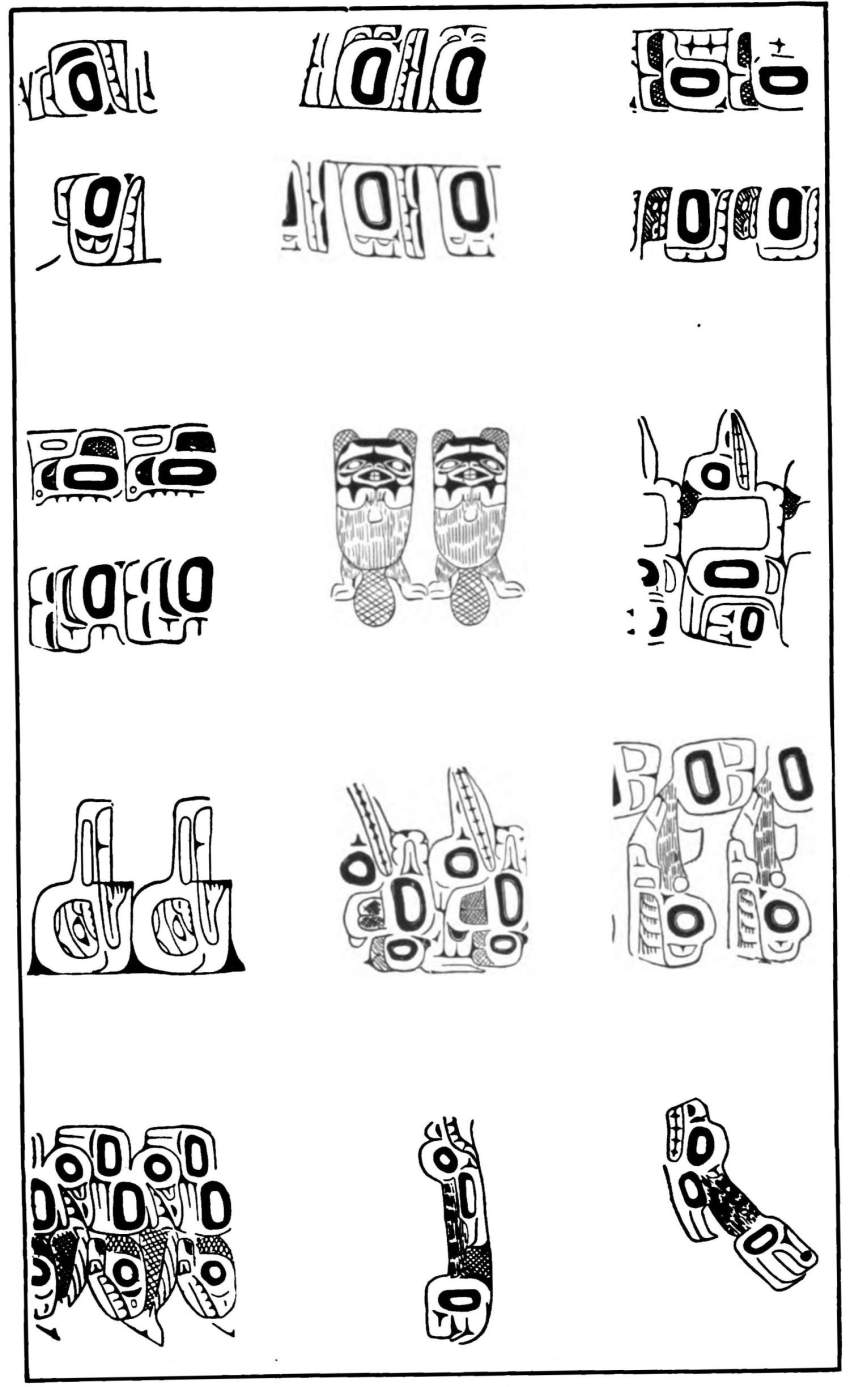
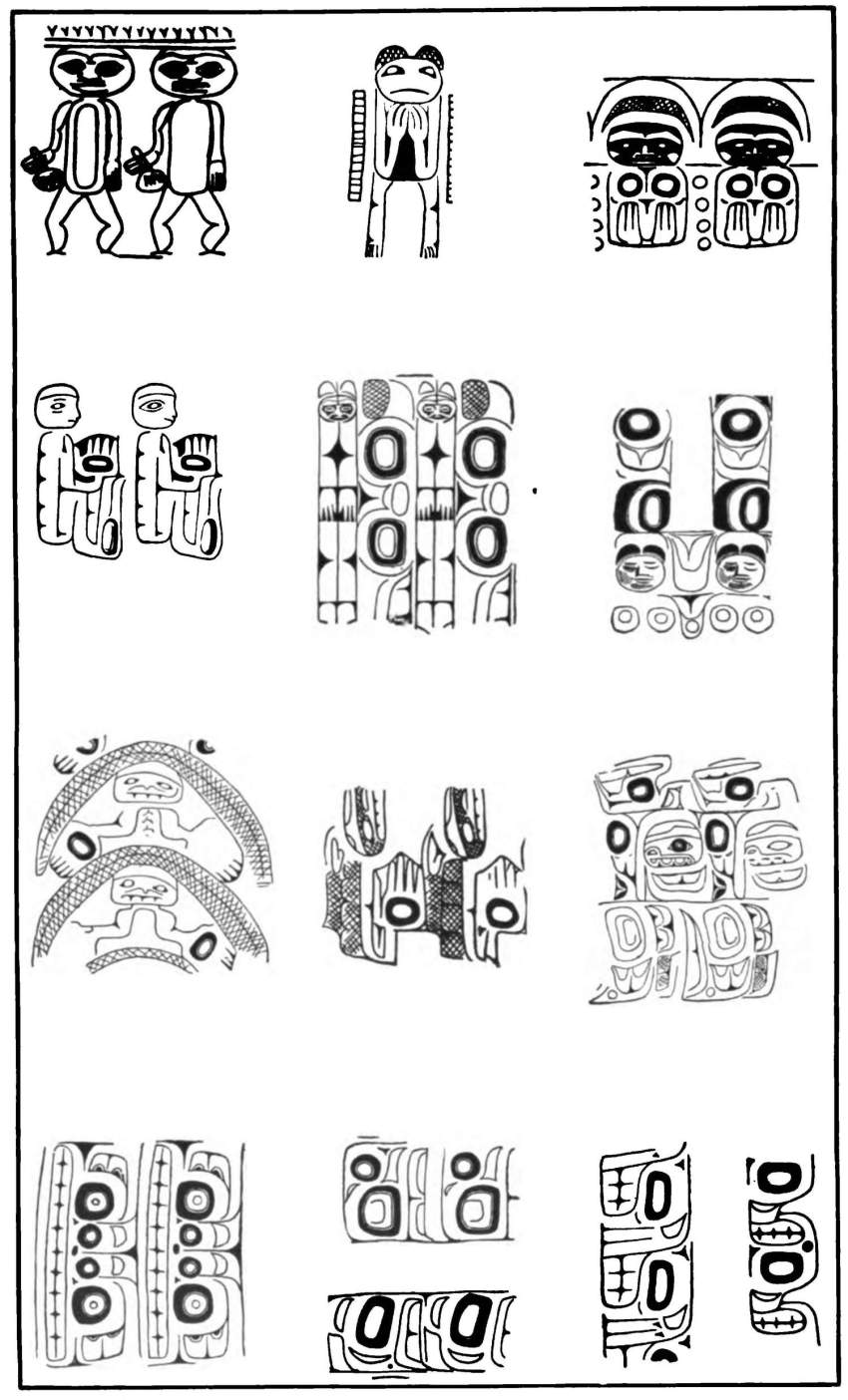
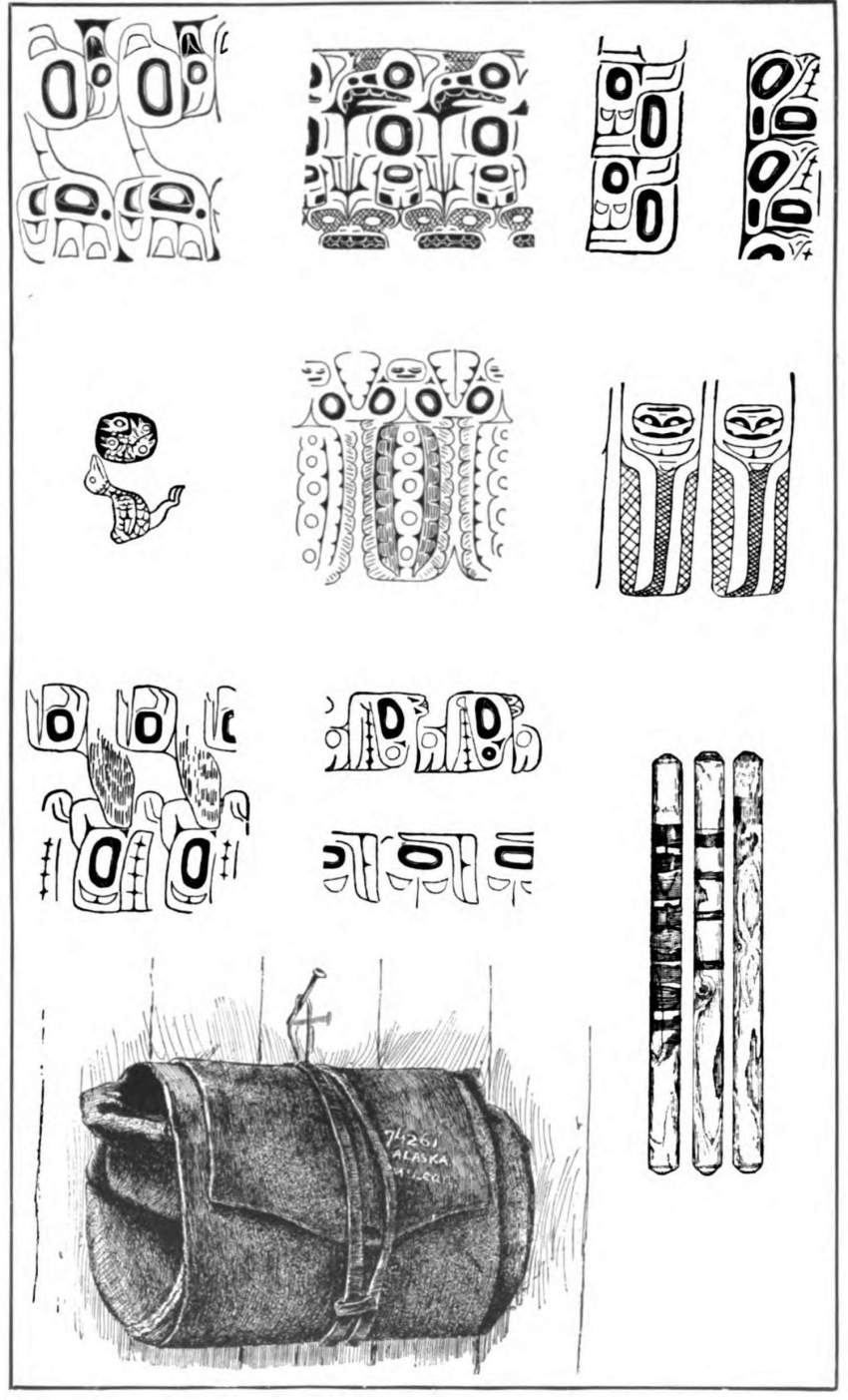
wooden sticks carved with distinguishing figures
used by the Haida Indians show perhaps the
most peculiar materials used in the manufacture
of games.
Mr. Chatto mentions a pack of Hindostanee
cards in the Museum of the Royal Asiatic Society
which are made of canvas, and are said to be a
thousand years old. He says: “On first handling
them they seem to be made of thin veneers of
wood. These cards are circular; and the figures
or marks appear to be executed by hand, not
printed nor stencilled.”
The Malays use cards made of cocoanut or palm-tree
leaves, which are first well dried, and the
symbols or distinctive characters are then traced
on the leaf with an iron style.
A story in the “History of the Conquest of
Florida,” by Garcilasso de la Vega, relates that
“the soldiers who were engaged in that expedition,
having burnt all their cards after the battle of
Manoila (about 1542), made themselves new ones
of parchment, which they painted admirably as if
they had followed the business all their lives; but
as they either could not or would not make so
many as were wanted, players had the cards in
turn for a limited time.”
Such fragile and thin materials have sometimes
been used in the production of cards that dealing
was difficult and shuffling impossible. One
very beautiful pack has been produced, and is preserved
in the South Kensington Museum in
London, which was embroidered on silk.
Such materials as gold, silver, and tortoise-shell,
and even small tiles have been used in the manufacture
of cards; but when made from these materials
they have been difficult to handle, and have
been regarded only as curiosities; and at the present
day thick pasteboard, either highly enamelled
or quite without glaze of any kind, is in general
use all over the world.
NAME.
THE first positive mention of Playing-cards is
in a manuscript by Nicholas de Covellezzo,
which is preserved among the Archives of Viterbo.
“In 1379,” says the Chronicler, “playing-cards were
introduced in Viterbo. These came from the
country of the Saracens, and were called Naïb.”
The Italians have for centuries called their cards
Naibi, and in Spain they are still named Naypes.
M. la Croix remarks that in Arabic the word
Naïb signifies “captain,” and declares that this
name proves the military origin of Cards, and
points to their connection with Chess.
Mr. Taylor, in his work on Playing-cards,
quotes from the above-mentioned manuscript by
Nicholas de Covellezzo, which records the introduction
of cards into Italy, and says: “The use
of the term Naïb in Italy for cards is one of the
strongest proofs of their introduction into Europe
by the gypsies. To this day they are called in
Spain Naypes, which is clearly a corruption of
the Arabic Nabi, ‘a prophet;’ and we have therefore
the significant fact that cards have been and
are still called in Spain by a title which fortune-tellers
(gypsies, in fact) might easily be supposed
to claim.”
Mr. Singer quotes from various authorities to
show the derivation of the word Naipes, and says
that “it may mean ‘flat’ or ‘even,’” which would
describe a card; and also that the Hebrew word
Naibes denotes “sorcery, fortune-telling, prediction,”
etc.
Mr. Chatto derives the same word from one
found in Hindostanee, Na-eeb or Naib, which signifies
a viceroy, lieutenant, or deputy, and says:
“As the game of Chess was known in Hindostan
by the name of ‘The Four Kings,’ if cards
were suggested by Chess and invented in the
same country, the supposition that they might
have been called Chatier-Nawaub, ‘The Four
Viceroys,’ as the cognate game of Chess was called
‘The Four Kings,’ and that this name subsequently
became changed into Chartati-Naib, is at least
as probable as the derivation of Naipes from
N. P., the initials of Nicolas Pepin, their supposed
inventor;” which derivation is gravely given by
another author.
It is only in Italy that the old name of Naipes
or Naibi is retained. In Portugal the word has
become corrupted into Naipe; in Spain, Naypes
or Naipes. In France cards are called Cartes à
jouer; and a pack is named a Jeu. In Germany
they are termed Briefe and Karten and Spielkarten.
In Holland the name is Kaarten or Speelkaarten;
in Denmark, Kort or Spelkort; and in Russia,
Kartu. The term Alea, which was frequently
employed in ancient ordinances and laws, seems
to cover all games of chance, and is not used
to signify playing-cards alone. The derivation of
the English word card from the French carte is
too plain to require further comment.
THE CLASSIFICATION OF PACKS OF CARDS INTO SUITS.
EVER since the fifteenth century evidences
of the existence and popularity of cards
have been found in Italy, Spain, Germany, and
France.
The names, colours, emblems, number, and form
change with the countries or caprices of the card-makers;
but what are termed Cartes Tarots or
Cartes Françaises are always the original cards
which came from the East, and which are in a
greater or less degree faithful imitations of the
still more ancient game of Chess.
It is related that on the 5th of March, 1423,
Saint Bernardin, of Sienna, addressed a crowd
which had assembled before a church in that
place, and inveighed with such energy and eloquence
against all games of chance that his hearers
rushed to search for their dice, their chess,
and their cards, and lighting a large bonfire, immolated
them on the spot.
One man stood by who watched mournfully
the movements of the frantic crowd, and then
bursting into tears cried out to the preacher:
“Father,” quoth he, “I make cards. I have no
other work by which I can make a livelihood; by
stopping my profession, you condemn me to
starve.”
“If painting is the only thing you can do for
a living,” replied the preacher, “take this picture
[showing him the sacred monogram surrounded
by brilliant rays] and copy it.”
The workman followed this advice, and became
wealthy by reproducing it.
This tale shows how well established the use of
cards was in the fifteenth century; and specimens
of the cards of that period are still in existence,
and at once strike the observing student with
the fact that the four great divisions or suits
exist (although with different symbols) in almost
all the known packs.
It is probable that in France the Tarots were
used for many years exactly as they were when
first introduced into that country, until the rearrangement
of the pack by the French courtiers
for the convenience of their demented sovereign.
When this ingenious condensation of the original
pack took place, the symbols of the Orient were
discarded, and the adapter chose two colours to
represent the different suits, and placed les Cœurs
(Hearts), les Carreaux (Diamonds), les Piques
(Spades), les Trifles (Clubs), as the symbols that
marked them instead of those on the Tarots, which
were Denari (Money), Spade (Swords), Coppe
(Cups), and Bastoni (Maces). These devices were
not distinguished by particular colours; and it is
only when the French cards have been copied
and adapted that we find the distinctive colours
red and black marking the divisions of the suits.
Playing-cards without doubt reached Germany
through Italy, but during their journey toward
the north they lost their Eastern character and
their Saracenic name almost at once. They never
seem to have been called Naïb, or by any name
resembling that word. The first mention of cards
in Germany calls them Briefe; that is to say, letters.
The first card-makers were named Brief-maler.
The Germans composed symbols to mark the
suits for themselves, and rejected the Eastern ones,
and were probably unconscious that such devices
as Hearts, Diamonds, etc., existed on the cards of
the neighbouring country; for intercourse in those
days was not rapid, and each kingdom was as independent
of its fellow as if oceans divided them.
M. la Croix says that the Germans “with their
love of symbolism discovered a vegetable as well
as a military signification in the original game of
cards.” While making important changes, they
retained a little of their warlike character in their
symbols and figures, and placed among them some
designs inspired by the vegetable world. The devices
with them signified the triumphs and the
honours of war, and they discarded the weapons of
the East, the Swords and the Staves, and disdained
the sordid money and the priestly chalice, and
adopted sprays of oak and of ivy as if intended for
victors’ wreaths, and chose tiny bells, or grelots, as
distinctive marks, as these were among the most
important signs of German nobility, and borne by
them among the other heraldic marks, and considered
most honourable emblems. These symbols
gave a more peaceful aspect to the ancient warlike
game.
The names of the German suits are Schellen
(Bells), Hertzen (Hearts), Grün (Green), and Eicheln
(Acorns). It is not now known at what period
these symbols which have become a distinguishing
character of the German cards were adopted, but
during part of the fifteenth century other objects
were also represented on their cards; and the different
marks quarrelled with the others and strove
to be generally adopted, but without success, as
those named above have been the only ones in use
for many generations, although they are now being
gradually superseded by the French designs, which
among English-speaking nations are known as
Hearts, Diamonds, Clubs, and Spades.
Some ancient German packs which have been
preserved are not only very remarkable for the
beautiful workmanship lavished on their production
and as handsome specimens of the engraver’s
art, but are also curious because they contain five
suits instead of the ordinary four. These were divided
into Hares, Parrots, Pinks, Roses, and Columbines,
with the usual King, Queen, Knight, and
Knave in each suit. These cards were executed
in the fifteenth century in the city of Cologne.
Other packs of engraved cards made about the
latter end of the fifteenth century in Germany had
their suits marked by animals, flowers, and birds,
and were not coloured, the symbols marking the
suits without other aid. The mark of the Grün,
or Leaf, in the German card resembles in shape the
Hearts and Spades of the French. The shape of
all these pips is closely analogous; and the Heart
provided with a short handle and called a Spade
or given a long stem and named a Leaf must originally
have had a common origin, all knowledge of
which is lost in the mists of the Middle Ages.
The Pique may have received its name of Spade
in its English home, not, as some authors fancy,
because the word was a corruption of the Spanish
Espadas, but because it resembled in shape the
spade or shovel which was in use in England when
cards first made their appearance there. M. la
Croix fancies the shape of the Heart resembles a
shield, and points to this as supporting his claim
that the designs on the cards had a military origin.
Among the miners in some parts of England
Diamonds are frequently called Picks, owing to their
resemblance to the head of that tool. M. la Croix
also declares that les Cœurs were the symbols placed
on the cards by the French adapter, in order to do
honour to his friend Jacques Cœur, a merchant of
the day whose trade with the East might have
been the means of introducing the cards into
France, and fancies that les Trifles denoted “the
heraldic plant of Agnes Sorel,”—the King’s mistress,
who had adopted the humble clover-leaf as
her badge as a sort of pun upon her own name;
the French word sorel signifying the plant the
leaves of which bear some resemblance to the Trifle
on the cards.
The Grelots on the German cards may have
been copied from the “Hawk-bell,”—a favourite
mark of nobility, and one which it was considered
an honour to be able to display among the symbols
on the coat of arms. Bells were also an insignia of
rank in India; and some writers have pointed
out that the Germans might have copied the devices
on their cards from Hindoo packs, as well as
from the better known Tarots or Saracen cards.
Bells have always been favourite decorations; and
their use dates back to the hangings of the Temple,
where the fringes which adorned the curtains and
the garments of the high-priest were ornamented
with bells.
In a beautiful pack of Hindoo cards mentioned
by Mr. Singer seven suits were found, consisting of
Suns represented by golden disks, Moons or silver
circles, Crowns, Cushions, Harps, Letters, and
Swords. These cards closely resemble the Tarots,
and may have originated in a common source. In
some of the Hindoo packs the suits are distinguished
by a colour as well as by the form of the
symbol.
Although parts of packs which from the devices
they bear may have been imported from Germany
or Spain, and which seem to have been well used,
are preserved in the British Museum, having been
found in England, only cards of French origin have
been universally used there, and they have held
undisputed sway from the middle of the fifteenth
century, when the distinctive colours of red and
black, and the emblems of Hearts, Diamonds,
Spades, and Clubs were generally adopted, and
have remained nearly unchanged from that time
to the present. There was no attempt to shade the
pips or the figures and faces of the court cards at
any time in England, and the outlines were simply
coloured and laid on in solid blocks. The French
have changed their figures, and shaded their faces,
and made their pips slightly more symmetrical in
shape; but they are very nearly the same as when
originally designed by the clever-fingered French
courtier.
CARDS OF DIFFERENT COUNTRIES. — CHINA. — EGYPT. — INDIA. — CASHMERE. — PERSIA. — ITALY. — GERMANY. — SPAIN. — FRANCE. — ENGLAND. — AMERICA. — JAPAN.
Plate 4.
AS has been already mentioned, the invention
of Playing-cards has been claimed at many
places; each writer setting forth the pretensions of
his own country to this honour to the best of
his ability, and each one with seemingly good authority
for his statements.
It is certain that the Chinese point in triumph
to the longest pedigree for their game, and they
quote extensively from their own authors as proof
of this fact; and until some European well versed
in their language can dispute this claim, it may be
as well to allow it.
Mr. Chatto says that cards appear to have been
known from an early period in China. There is a
Chinese dictionary, entitled “Ching-tsze-tung,” compiled
by Eul-Kowng, and first published A. D. 1678;
which says that the cards now known in China as
Teen-tsze-pae, or “dotted cards,” were invented in
the reign of Leun-ho, 1120, and that they began
to be common in the reign of Kaow-tsung, who
ascended the throne in 1131. According to tradition,
they were devised for the amusement of
Leun-ho’s wives.
The general name for cards in China is Che-pae,
or “paper-tickets.” At first they were called Ya-pae,
or “bone-tickets,” from the material of which
they were made. Several varieties of cards seem
to be in use in China. One pack that is described
by Mr. Chatto is said to be composed of thirty-two
cards covered with small circular dots of red and
black, with court cards of one man and one woman.
The cards most commonly used are called Tseen-wan-che-pae
(a thousand times ten thousand cards).
There are thirty in a pack, divided into three suits
of nine cards each, and three single cards, which
are superior to all others. The name of one of
the suits is Kew-ko-wan; that is, “The nine ten
thousands” (or “myriads of Kwan,” which are
strings of beads, shells, or money). The name of
the other suit is Kew-ko-ping (nine units of cakes);
and that of the third, Kew-ko-so (nine units of
chains). The names of the three single cards
are Tseen-wan (a thousand times ten thousand),
Heeng-hwa (the red flower), and Pi-hwa (the white
flower). One of their games of cards bears the
same name as the Chinese game of Chess, Kew-ma-paon;
and it contains pictures of chariots, horses,
and guns.
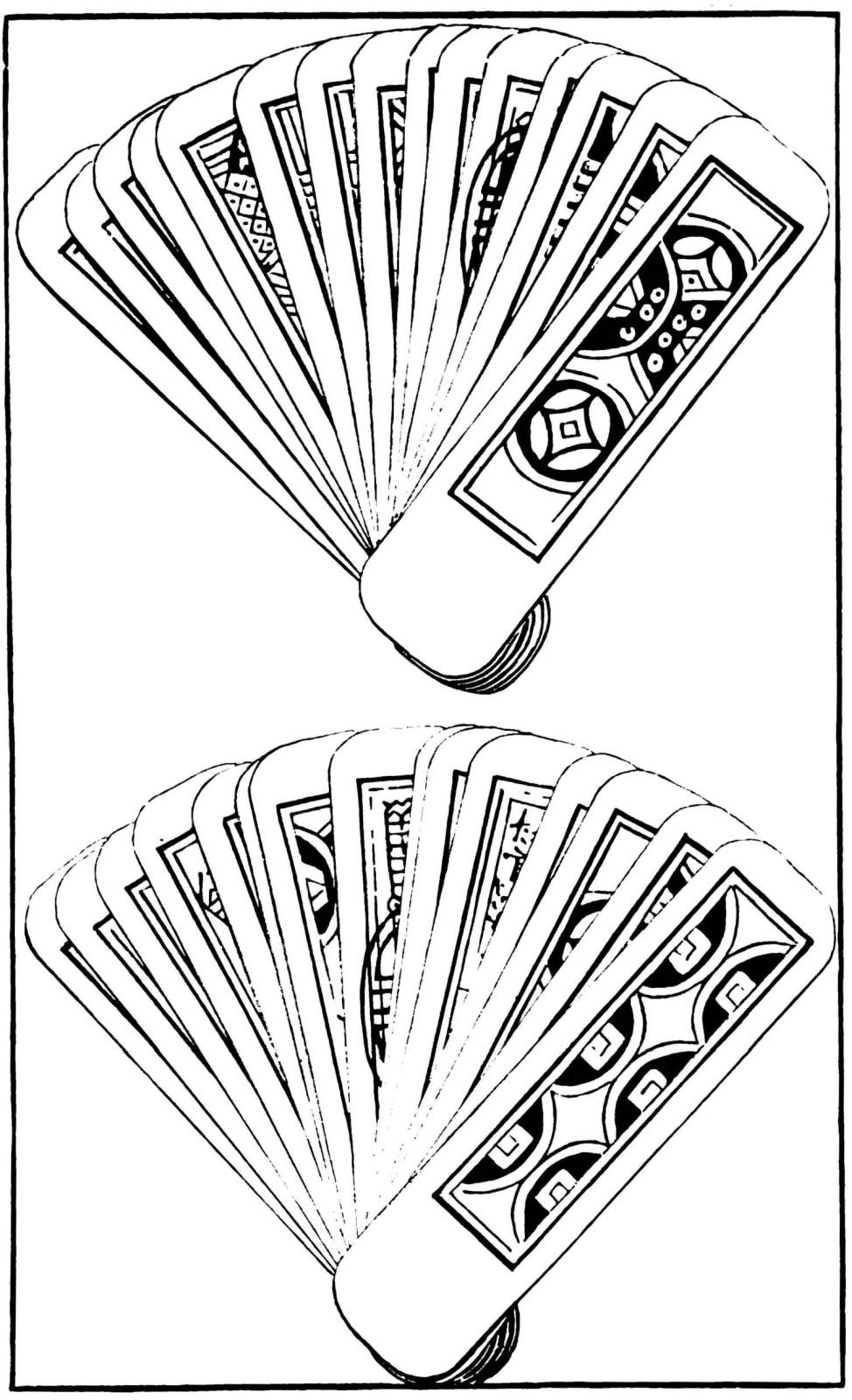
The Chinese name for a card considered singly
or as one of the parts of a pack is Shen, or “Fan,”—a
most evident reference to the manner of holding
cards spread open like a fan, which is common
to all nations.
The shape and size of the Chinese card are
peculiar. They are printed in black on a thin
cardboard. The backs are sometimes bright crimson
and sometimes black or yellow, and they are
the shape and size of a finger. Some of them are
little more than half an inch broad by three inches
long, and others are an inch wide by three and a
half long. The pips and court cards are always
printed in black on a white background, and on
the face of some of them are stamped Chinese
characters printed in red. In some packs the cards
have animals, such as horses and deer, represented
upon them; while in others characters which may
mean the names only of the animals are written
above the pips. The cards are rounded at the top
and bottom, and at the upper end a small portion
is left blank, as if to hold them conveniently and allow
of their being spread or “fanned” out, showing
the whole of the pictured surface, the blank space
being held under the thumb and fingers. Strangely
enough, this blank space being at the top instead
of at the bottom of the card, it would seem that
they should be held by the top and spread out in
exactly the reverse way customary among Europeans.
The tiny cards are so narrow and so small
that they might well be held concealed by the palm
of the hand, which could effectually cover them
and prevent the shape of the pips being seen
through the thin cardboard or the number of the
cards being counted by the opponent.
The Chinese have another name for their cards,
and this is Wat-pi; but it seems to be the name
given to different games, as they also call queer-looking
tablets on which round dots are placed in
regular order and which resemble our dominos, by
the same name.
Mr. Singer gives an account of some Chinese
cards an inch and a half long and a little more
than two inches broad. Each suit consists of
nine cards with black backs. They are printed
with Chinese characters, and not with emblems like
those in other packs.
Some authors state that cards are played by the
lower orders only, and that people of distinction
play at Chess; and that among the Chinese it is
considered undignified to play cards, and many of
them pretend they have no idea of their use or the
meaning or value of the characters on them.
It is also asserted that a game analogous to the
old one of Tarots has been found in China, which
contains seventy-seven tablets.
There is a tradition that a Venetian carried cards
from China to his native city, which was the first
place in Europe where they were known. This
traveller was probably Niccolo Polo, who with his
brother Matteo returned from China about 1269;
or it may have been the celebrated Marco Polo,
son of the above Niccolo, who accompanied his
father and uncle on their second voyage to that
great empire.
An attempt has been made to prove that a kind
of card was in use among the Egyptians in the
seventh century before our present era; but this
has been hotly disputed if not disproved. That
there were games which were known to the early
Egyptians has been shown by the inscriptions on
their monuments, and the representations of figures
playing jack-stones or knuckle-bones and dice.
Some kind of game resembling Chess may also
have been played, but upon this subject authorities
do not agree.
If India was not the birthplace of Cards, as it
probably was of Chess, it is certain that they were
known in that country at a very early date; and
beautiful specimens of ancient as well as modern
packs are prized in many European collections.
A pack of Hindoo cards is fully described
in Mr. Singer’s book, and many of them are
handsomely reproduced. They are painted on
ivory, the backs are gilded, and they number the
same as the Tarot cards. This pack contains
seven suits, which are Suns, Moons, Crowns,
Cushions, Harps, Letters, and Swords. Of each
of these suits there are ten numeral and two
court cards, which appear to represent a Sovereign
and a General. Besides these there are twelve
cards apparently of no suit, on which are groups
of figures, some male and some female.
Mr. Chatto describes several packs of Hindostanee
cards, among others some owned by the
Royal Asiatic Society and preserved in their
Museum. One of these packs consists of ten and
others of eight suits. “In each suit, when complete,
the number of cards is twelve; that is, two
coat cards, or honours, and ten others whose numerical
value is expressed by the number of marks
upon them. The cards of all the packs are circular;
the diameter of the largest is two and three
quarter inches, and of the smallest about two and
an eighth inches.” The material of which they are
formed is supposed to be canvas, and indeed it
is expressly stated in a memorandum that accompanies
them that such is the case, but they appear
to be made of thin veneers of wood. One of
these packs formerly belonged to Capt. D. Cromline
Smith, to whom they were presented about
1815 by a high-caste Brahmin, who considered
them a great curiosity, and supposed that they
were a thousand years old. These cards resemble
a pack now owned by Mr. de Forest that he
bought in Cashmere within a few years, and that
have been reproduced for this work. The Brahmin’s
pack, says Mr. Chatto, “consists of eight suits, each
suit containing two honours and ten common cards,—in
all ninety-six cards. In all the suits the King
is mounted on an elephant, and in six the Vizir,
or second honour, is on horseback; but in the blue
suit, the emblem or mark of which is a red spot
with a yellow centre, he rides a tiger; and in
the white suit, the mark of which appears like a
grotesque or fiendish head, he is mounted on a
bull. The backs of all the cards are green. The
following are the colours of the ground on which
the figures are painted in the several suits, together
with the different marks by which the suits and the
respective value of the common cards were also
distinguished:—
COLOURS.
MARKS.
1. Fawn.
Something like a pineapple in a shallow cup.
2. Black.
A red spot with a white centre.
3. Brown.
A “tulwar,” or sword.
4. White.
A grotesque kind of head.
5. Green.
Something like a parasol without a handle, and
with two broken ribs sticking through the top.
6. Blue.
A red spot with a yellow centre.
7. Red.
A parallelogram with dots on it as if to represent
writing.
8. Yellow.
An oval.”
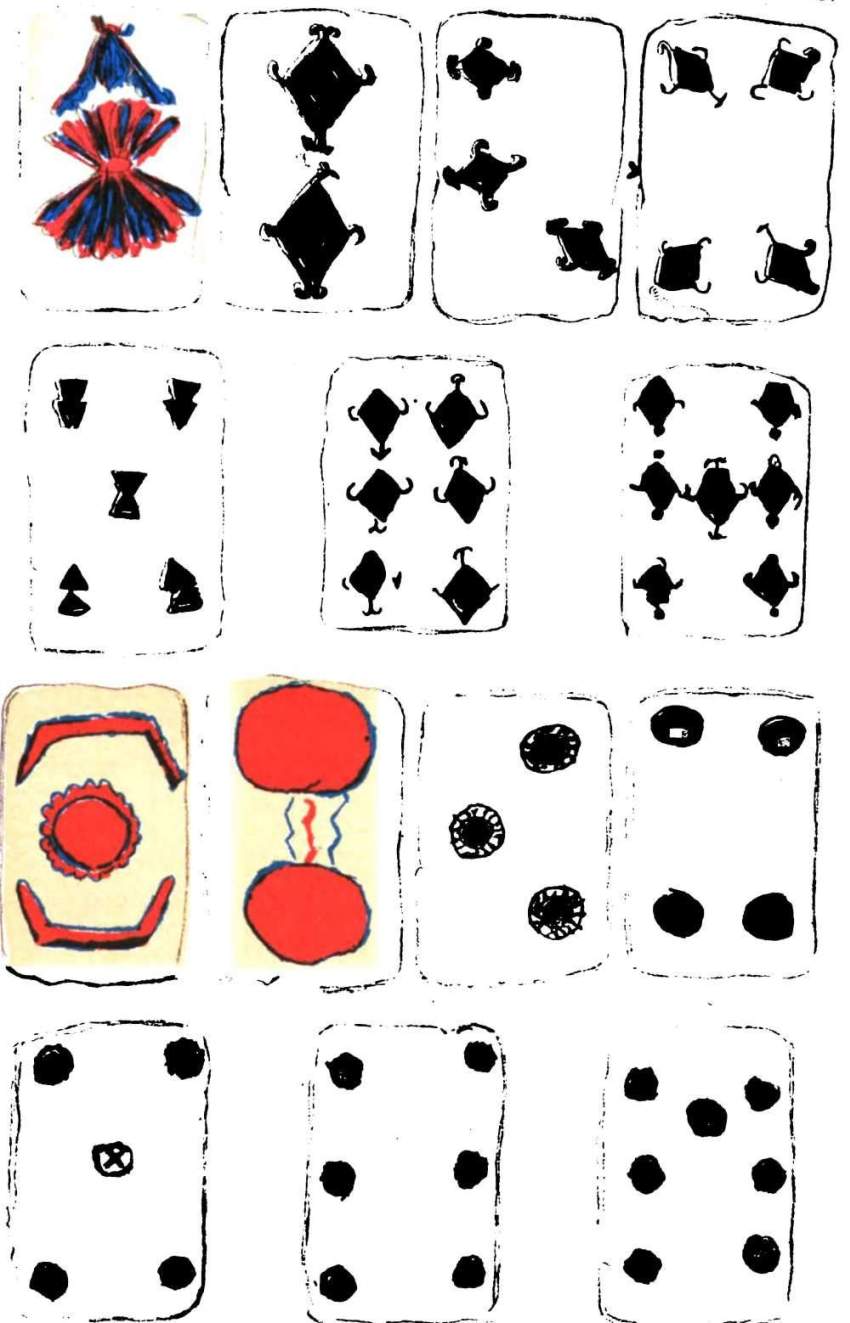
Plate 5.
Mr. Chatto mentions other packs with red backs,
one of them containing ten suits, and all seemingly
distinguished more by the coloured background
than the emblem of the suit, which is sometimes
entirely omitted, particularly in the court cards.
The games to be played are complicated and difficult
to understand, although one of them is said
to resemble l’Ombre, the favourite game in Spain.
The tradition regarding the origin of Hindostanee
cards, as given by Mr. Chatto, is “that they were
invented by a favourite Sultana or Queen to wean
her husband from a bad habit he had acquired of
pulling or eradicating his beard.” The game of
cards is not mentioned in the Arabian Nights, remarks
Mr. Chatto, “and from this silence it may
be concluded that at the time when those tales were
compiled card-playing was not a popular pastime
in Arabia. The compilation of these tales, it is
believed, is not earlier than about the end of the
fifteenth century, although some of them are of a
much higher antiquity.”
The cards from Cashmere, which belong to Mr.
de Forest and are reproduced for this work, differ
but slightly from those described by Mr. Chatto.
The Cashmere cards are circular in shape, as well
as the Hindostanee, and are of about the same size,
being two inches in diameter. The emblems on
the Cashmere cards differ considerably from those
described by Mr. Chatto, and only the court or
figure cards bear a general resemblance to those
that formerly belonged to Capt. D. Cromline Smith.
The Cashmere cards seem to be made of thin
slices of wood, overlaid with a composition of some
sort, and so thickly covered with paint and varnish
that the original material is entirely concealed.
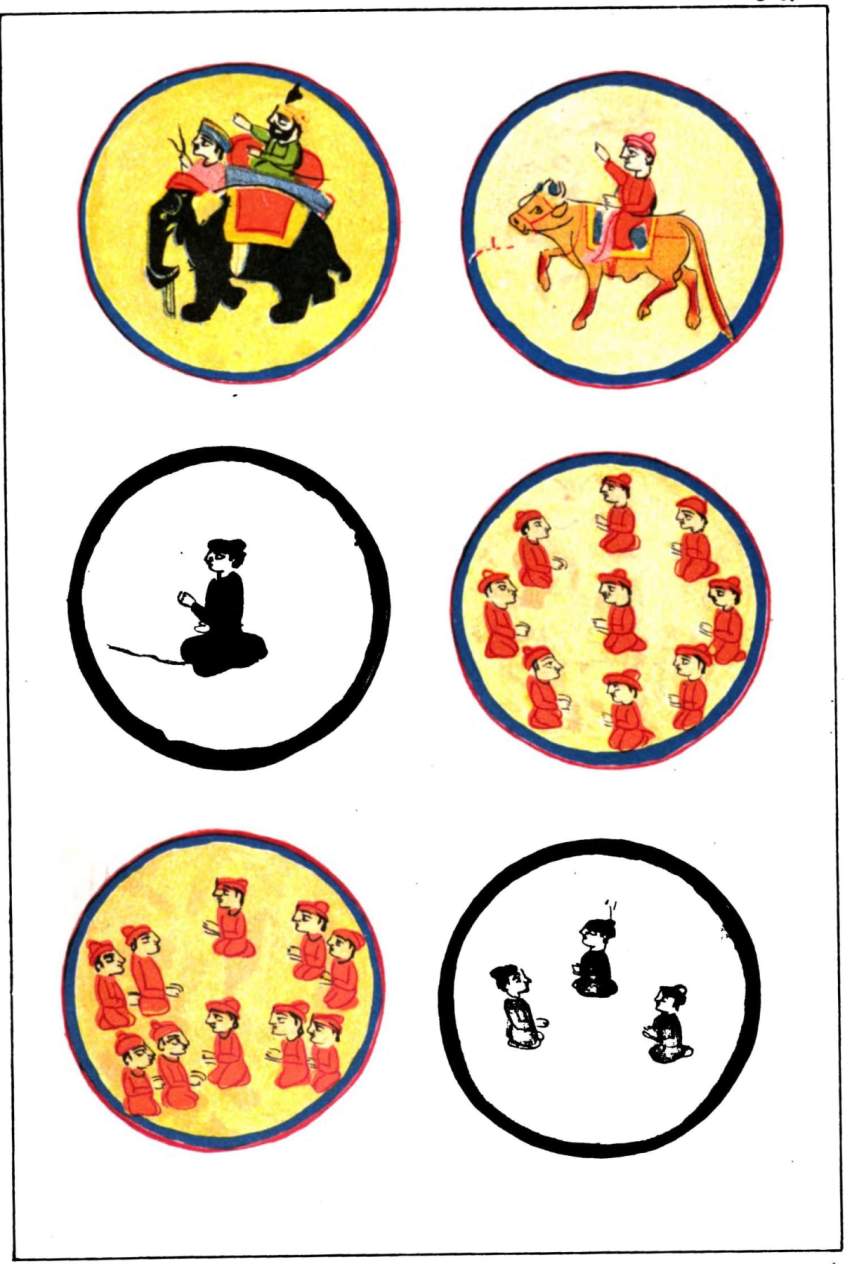
This pack contains thirty-six cards of three suits;
namely, ten pip and two court cards in each suit. A
large purple flower on a red ground, placed within
circles of yellow, ornaments the backs, which are
probably intended to be precisely the same; but
to an experienced gamester there would be no
difficulty in distinguishing one card from another,
even with the face of it concealed, as the design,
though uniform, differs slightly on each card.
The three suits are not only marked by the emblems
of pips, but, like the Hindostanee cards,
the backgrounds are vividly painted in some uniform
colour upon which the design is displayed,
and this colour marks the suits distinctly even
when the emblem is omitted, which in some cases
is done either by design or accident. The white
suit is headed by a King mounted on an elephant,
and a Vizir on a bull. There are no emblems on
these two cards by which to distinguish the suit.
The ten pip cards show tiny figures of men clothed
in loosely fitting red garments and wearing red turbans
on their heads. These figures are represented
kneeling, with their hands clasped in the attitude
of prayer. They are dotted over the surface of the
cards and grouped as the corresponding pips are in
the other suits, and generally face each other, except
in number eight, in which all the figures look
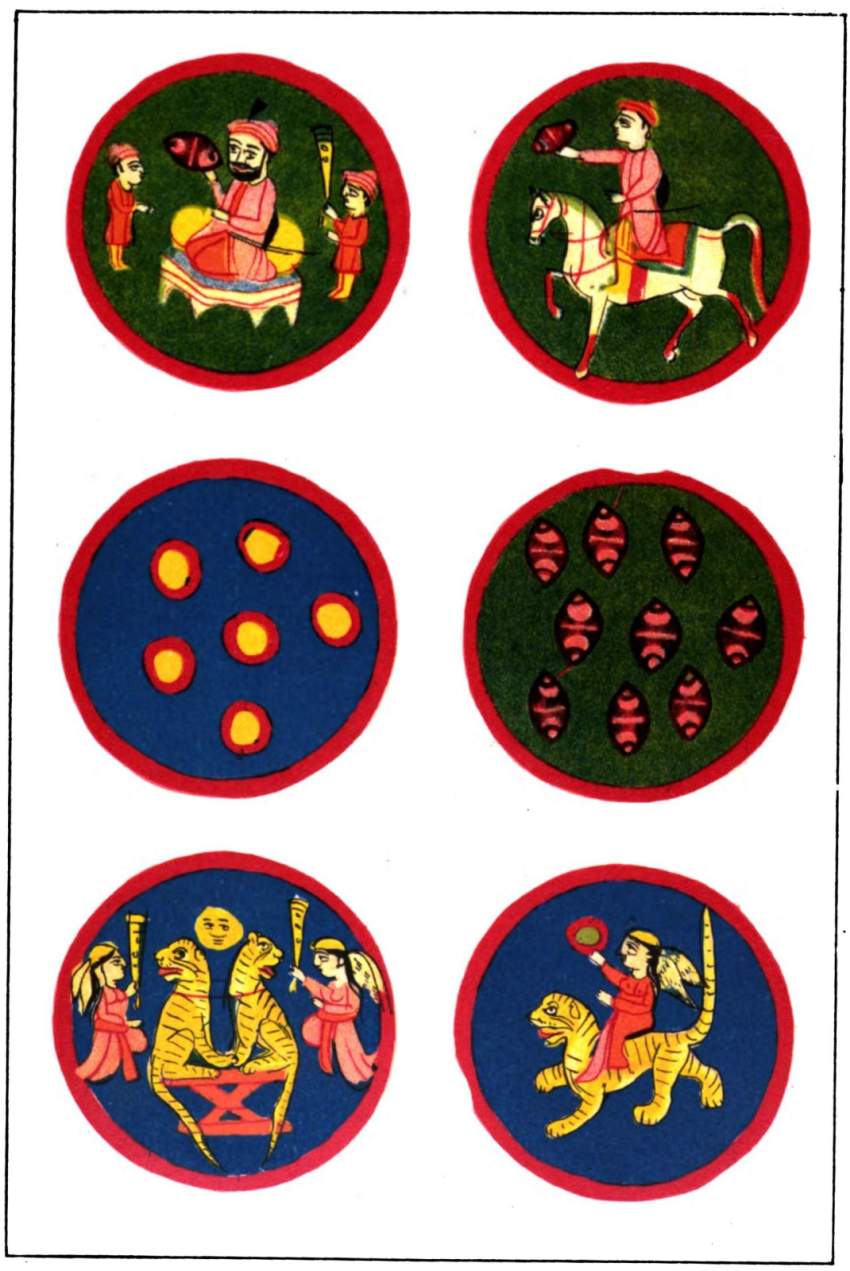
the same way and to the left side. Another suit
is distinguished by a dark-blue ground, on which
small yellow disks, surrounded by circles of red,
are painted. This suit may correspond with a
“moon” suit mentioned by Mr. Chatto among the
Hindostanee cards, and it is also noticeable as it
closely resembles the “money” used as an emblem
on Italian and Spanish cards. The court cards of
this suit show a man mounted on a tiger and bearing
the distinctive emblem uplifted in his right
hand. The position of this man is closely copied
on the Spanish cards, although in them he is represented
on horseback. The second honour shows
two tigers seated on a cross-legged bench gazing
over their shoulders at two attendants, who wave
what appear to be staves or fans. Between these
tigers is a large “moon-face,” which seems to mark
the suit. If this be the case, it would point to the
origin of the money emblem. The pips on the rest
of the suit are carelessly executed circles, and the
features, which would show it to be intended for
the moon, are omitted. The outline of this mark
may have been followed on the cards that were
first introduced into Europe, and may readily
have become changed during the lapse of years.
The “moon” mark on the Hindostanee cards has
gradually extended both East and West, one that
closely resembles it being found on the Chinese
cards, and partly followed on the wooden cubes
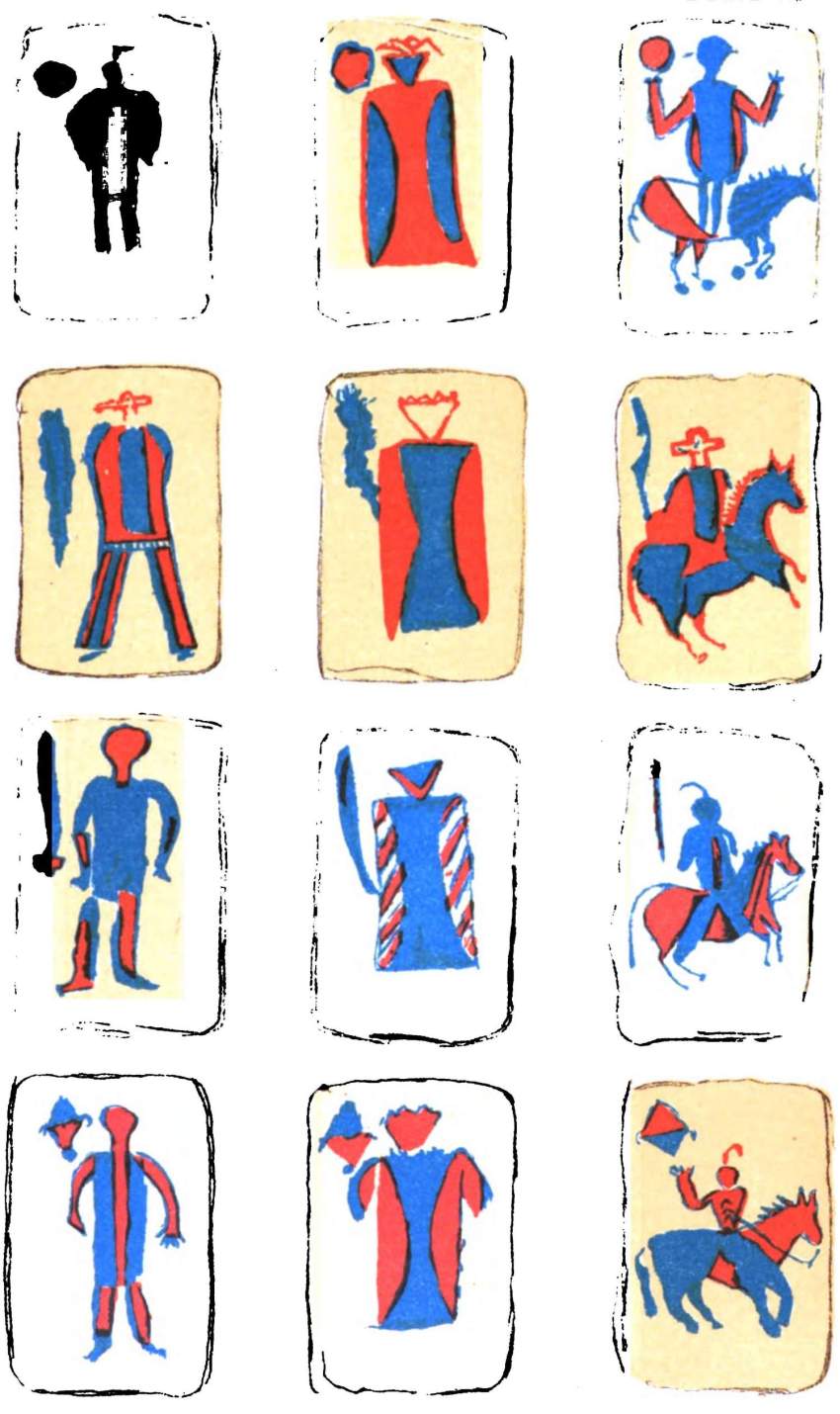
of the Alaska Indians.
Plate 6.
The green suit bears emblems which recall the
carreaux of the French cards, and are even more
like one of the marks used by the Apache tribe
of North American Indians by which to distinguish
one of their suits. The diamond-shaped pip
on the Cashmere cards is painted red and ornamented
with stripes and dots of pink. The court
cards show a Vizir on a white horse, bearing
the pip in his right hand, and a Sultan attended
by two slaves, who also carries the emblem
of the suit.
These cards show little marks of use, and their
surface is slightly sticky, so that they could not
be conveniently either shuffled or dealt. It is
probable that the pack is not complete, and that
there should be more than the three suits that
now compose it.
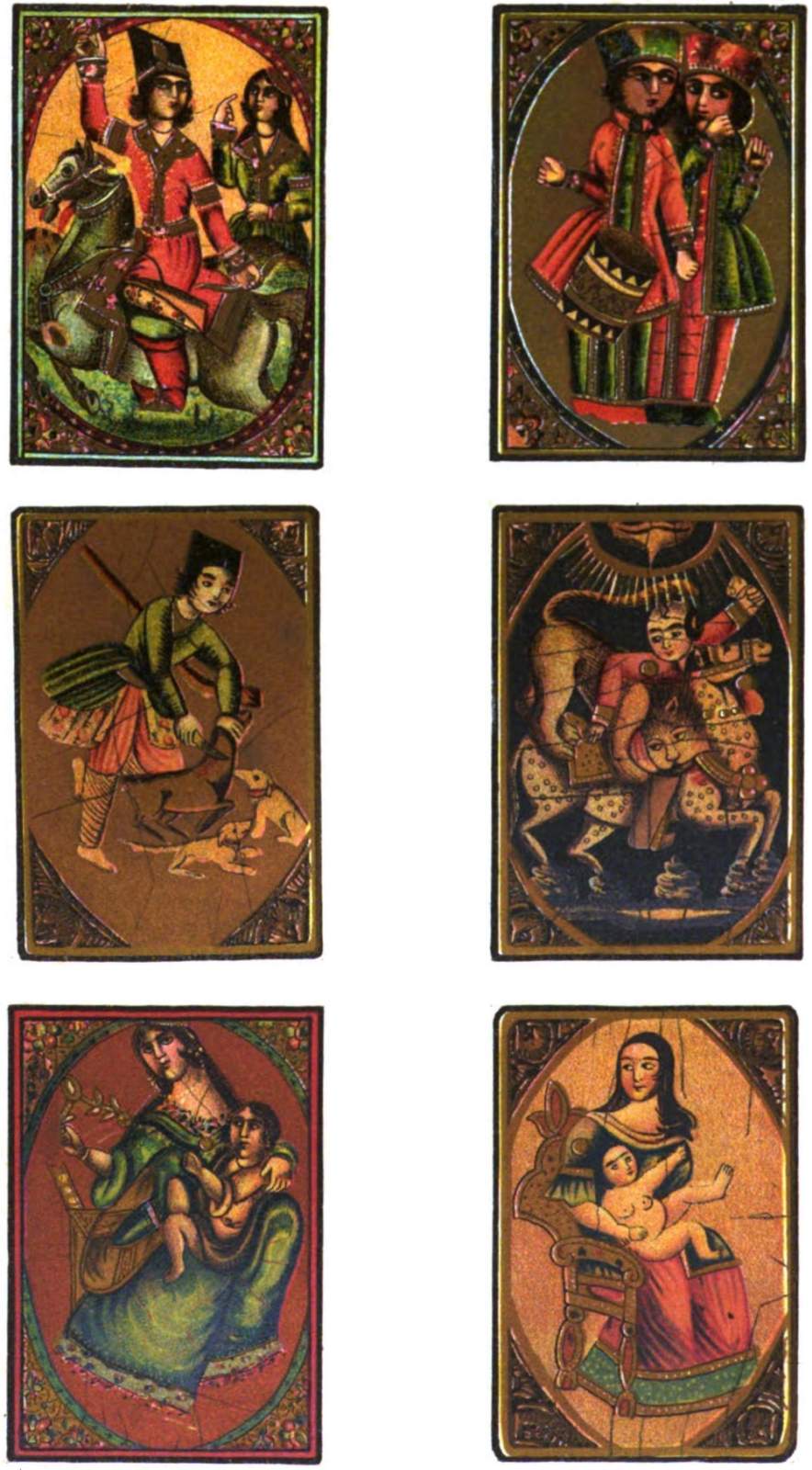
SIX tablets brought from Persia by a recent
traveller form an interesting addition to the cards
used by different nations. These tiny cards appear
to be the three honours of two different
packs. They are made of layers of pasteboard,
some of them as thick as two ordinary playing-cards.
The others are nearly double that thickness;
and although they are all of the same size
(namely, an inch and an eighth wide by two
inches long), there are many marks on them to
show that they never all belonged to the same
pack. Although made of pasteboard, they are
covered so thickly with paint and varnish that
they might easily be supposed to have been cut
out of wood. The backs of these cards are all
alike, and are painted black. They are remarkable
for the female figure that they bear as a
court card, as in this respect they are not only unlike
all other Eastern cards, but in it differ from
those of every Western nation, with the exception
of the French and those other countries where
the French cards have been adopted. This female
figure is by some called a Courtesan, but it
could as well be named a Queen. She is seated
on a chair of state, that is ornamented with a
design which closely resembles one of the emblems
used on a Hindostanee pack of cards, and
which is called a crown by Mr. Chatto. This
may, however, be a purely accidental resemblance.
A young child is placed in the lap of this Queen,
but she bears no particularly distinctive emblems
either on her dress or on any part of the card
which might serve to mark the suit. The background
of one of these Queens is yellow, and
that of the other one is red, and there are two
Queens in this pack of six cards. There are two
cards which appear to belong to the “Yellow
Queen.” One of them shows a Hunter on a
golden background drawing his knife across
the throat of some animal; and the other card
bears a Cavalier mounted on a white horse, on
the back of which is perched a tiger. This
card has a black background. A sun placed at
the top may be intended for the distinguishing
emblem. These three cards undoubtedly belong
to the same pack, and are considerably thicker
than the others, which are much more highly ornamented
and better finished than those already
described. The Queen is handsomely dressed;
her hair is covered, and she wears large ear-rings,
from which depend a necklace. The child is
dressed in a loosely fitting garment, and its head
is covered with a jewelled cap. The background
of this card is a beautiful red, and the corners
are ornamented with fine arabesques of flowers
and fruit. The King which belongs to this set
is accompanied by a female figure, and they are
placed on a yellow background, but they bear no
emblem by which they might be distinguished.
The third card has a very richly ornamented
golden background, and shows two figures, one of
them carrying what appears to be a drum. All
these cards have beautifully ornamented corners,
and are painted like a miniature.
THE first European document known that mentions
cards is the manuscript already referred to,
written by Nicolas de Covellezzo, about the end
of the thirteenth century, is preserved among
the archives of Viterbo, and contains the earliest
written account yet discovered of cards, not only
among the Italians but also in Europe, if we except
the much disputed passage in the Wardrobe
Rolls of Edward the First, King of England, which
will hereafter be mentioned. This document refers
to cards by the name of Carte, as well as by
that of Naïbi.
Plate 7.
Mr. Singer says that “the first game played in
Italy was without question Trappola. This had
been introduced from Arabia, and is mentioned
by many early Italian authors, one of whom writing
in 1393 calls cards Naïbi, and speaks contemptuously
of them as a childish game. Another
writer, Tenanza, declares that in 1441 the Venetian
Maître-cartiers, who formed a large guild, remonstrated
with the Senate of that city on the injury
done to their trade by the importation of large
quantities of playing-cards with printed as well as
painted figures within their gates, which had been
manufactured elsewhere; and this remonstrance
shows that the card-makers of the day were already
numerous, and seems to point to the fact
that the use of cards was well established, and
that considerable numbers were called for and
manufactured.”
Lorenzo de’ Medici mentions the games of La
Bassetta and Il Frusso in some of his “Canzoni,”
printed before 1492; and there are Italian writers
who point to him as the inventor of some games
of cards.
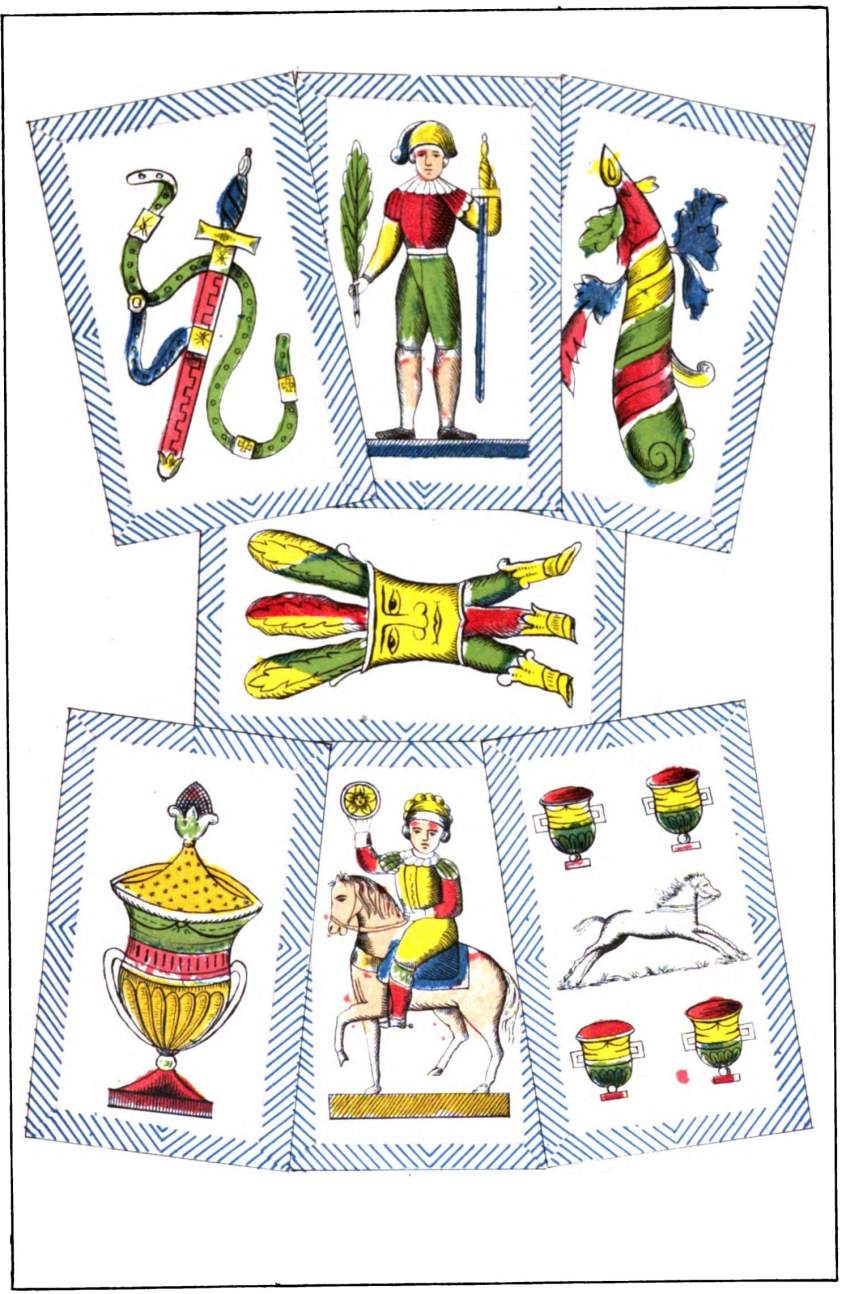
In Italy the suits were called Coppe (Cups), Spadi
(Swords), Denari (Money), Bastoni (Maces). These
continued to be the commonly used marks on the
Italian cards from the sixteenth century to a much
later period; and the same suits and pips have
been used in Spain from the time of their first history
to the present day. An Italian writer claims
that a native of Bologna invented Tarots or Tarocchino
before the year 1419, and says that “there is
preserved in the Fibbia family, which was one of
the most illustrious and ancient of that city, a portrait
of Francis Fibbia, Prince of Pisa, who sought
refuge at Bologna about the commencement of the
fifteenth century, in which he is represented holding
in his right hand a parcel of cards, while others
appear lying at his feet. Among the latter are
seen the Queen of Batons and the Queen of Denari;
the one bearing the arms of the Bentivoglio
family, and the other the arms of the Fibbia. An
inscription at the bottom of the picture states that
Francis Fibbia, who died in 1419, had obtained as
the inventor of Tarocchino, from the Reformers
of the city, the privilege of placing his own arms
on the Queen of Batons, and that of his wife, who
was one of the Bentivoglio family, on the Queen of
Denari.” Writers disagree as to whether Fibbia
invented the emblems of the cards or joined two
packs of cards which already had their appropriate
emblems into one, or whether he invented a new
game to be played with the already well known
Tarocchino cards.
Notice should be taken of the fact that printed
as well as painted cards are mentioned in the petition
of the card-makers of Venice, as it was from
this date that each village in Italy manufactured
its own cards. After the invention of wood-engraving,
Germany and Holland exported cards in
large quantities, and this may have called for the
protective decree. There was also a difference,
which was mentioned in the documents of the
period, between the primitive Naïbi and cards
proper. As these documents do not define the
difference between the packs, we can form no idea
of what it was.
In a German book printed at Augsburg in
1472, called “Gülden Spiel,” or “The Golden
Game,” written by a Dominican friar of the name
of Ingold, it is stated that cards had been known
in Germany since 1300. As this is by no means
contemporaneous testimony, it is probable that
the German vanity which claims the honor of
inventing the art of printing wishes, with no
more reason on its side, to appropriate to itself
the invention of playing-cards, which in plain
words is laying claim to the invention of wood-engraving,
as many of the early German packs
are engraved and not stencilled or painted. This
rather suspicious assertion may therefore well be
ignored, and we may only credit the one made by
the Italian author of Viterbo, which is apparently
more authentic. Unfortunately, the latter gives
no details about the kind of cards which he mentions.
He only states that cards made their appearance
in 1379 in Europe, and came from Arabia
under their original name.
In the “Livre d’Or” of Ulm, which is a manuscript
preserved in that city, there is an ordinance,
dated 1397, forbidding all card-playing.
These are the only authentic witnesses that can
be brought forward by which the approximate time
of the introduction of playing-cards into Europe
may be fixed.
Plate 8.
A German author by the name of Heniken
claims for his country the birthplace of cards, and
brings forward many ingenious but hardly satisfactory
deductions in support of his pretensions. He
says that Briefe, which is the name that cards bear
in his country, means “letters,” and that the common
people do not say, “Give me a pack of
cards,” but “Give me a Spiel-briefe” (a pack of
letters), and they do not say, “I want a card,” but
“I want a Brief” (letter). “We should at least
have preserved the name carte,” he says, “if they
had come to us from France; for the common
people always preserve the names of all games
that come to them from other countries.”
Unfortunately for this argument, it has been
discovered that cards were called Karten in Germany
before they were called Briefe. It may be
claimed that cards were carried into Germany by
the Crusaders, who had learned their use during
the wars with the Saracens. They might also
have made an ingenious use of the cards during
their long absences in the East, and diverted
them from their original purposes, writing letters
to mothers, wives, or sweethearts on them, or
chosen them to send to the young folk at home
to serve for their amusement, as the pictures of
the Kings, Knights, etc., rude though they probably
were, would have undoubtedly proved both
novel and entertaining; and from this fact the
name of Briefe may have been given to the Naïbi
of the Orient. The Eastern origin of the cards
is plainly pointed to, as there are no Queens in
ancient packs of German cards.
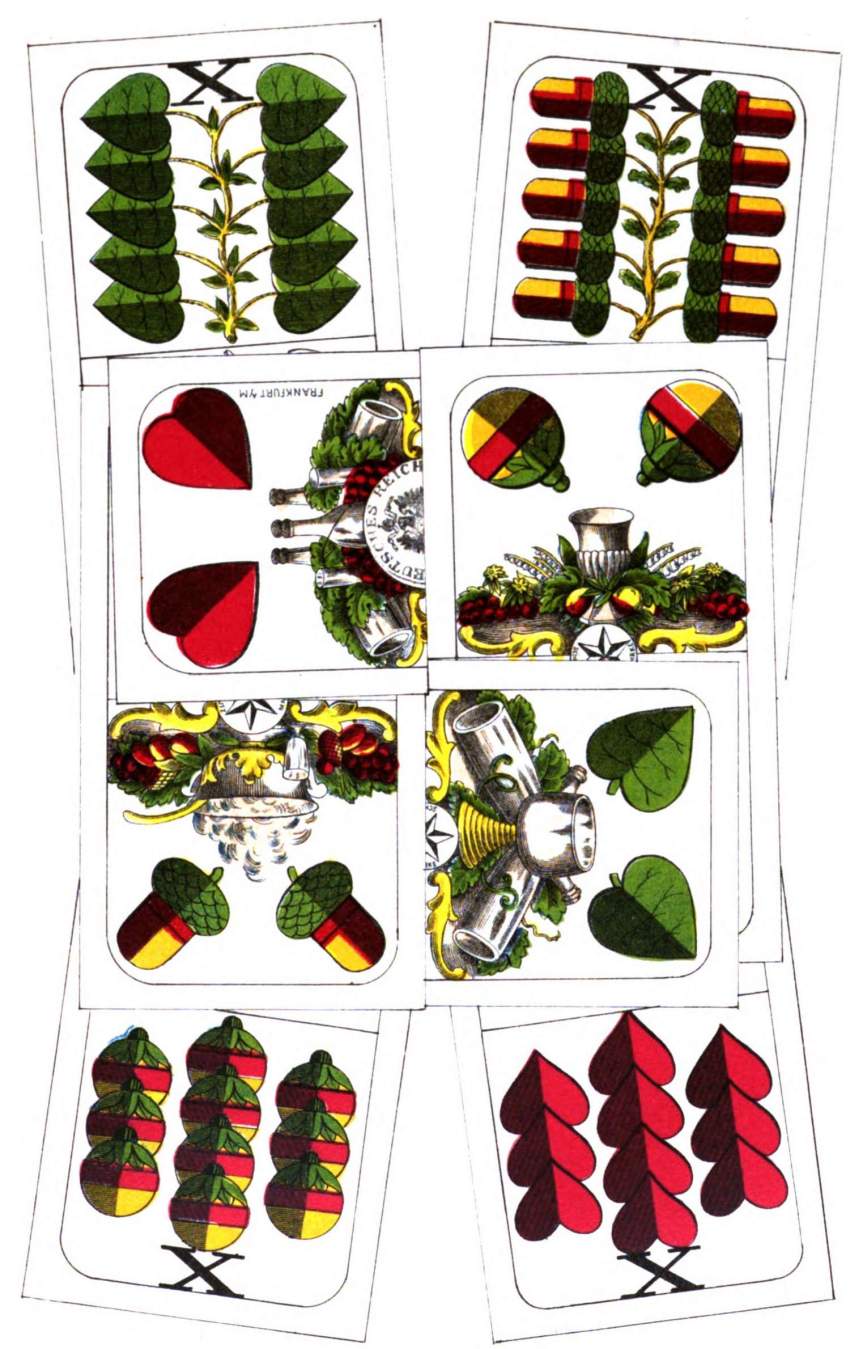
In many parts of Germany the court and pip
cards which are usually used resemble most closely
those which are represented in the packs of the
early part of the fifteenth century. The cards
which are at the present time (1890) manufactured
at Frankfort in Germany are copies of the French
packs of the fifteenth century, with the modifications
which have crept in during the lapse of over
three hundred years; and they display the modern
Hearts, Diamonds, Clubs, and Spades, and these
cards are generally used in the German Empire.
But the same factory turns out cards which are
suited to the more conservative portions of the
country, where the ancient Schellen (Bells), Hertzen
(Hearts), Grün (Green), and Eicheln (Acorns)
are still preferred.
In the modern German cards each Ace bears
the attributes of the wine-cellar or the biergarten.
In the ancient cards the Ace was always draped
with a flag. The modern Hearts are surrounded
with champagne bottles. Acorns carry a loving-cup;
Bells, a steaming punch-bowl; and Leaves,
beer-glasses and goblets. There are no Queens in
this pack, their place being taken by Knights on
horseback dressed in beautiful uniforms; and beside
their heads is the word Ober, signifying the
position they hold over the Knaves, which are
represented as working-men. There are only five
pip cards in this pack, numbered from five to ten;
and the emblems are arranged in a symmetrical
and fanciful way, quite unlike the cards which
were adapted by the French from the original
Tarots and adopted by all English-speaking nations.
The backs of these cards bear a plaid or checkered
pattern, recalling to mind those of the original
Tarots.
To a German is due the adaptation of cards to
the instruction of children; and this idea, which was
promulgated soon after the first introduction of
these packs into Germany, has been developed
steadily through successive years, until now it is
possible to study history, geography, and other sciences
by these means, and babies still in the nursery
learn to spell and to read after a fashion by
playing the various games which are strewn before
their unappreciative eyes. The name of this ingenious
inventor was Thomas Murer, a Franciscan
friar, who in 1507 arranged a game in which
various branches of education were taught. Each
card was covered with so many symbols that M.
la Croix declares that “their description alone resembles
the most gloomy rebus;” but the German
universities, undaunted by difficulties, enjoyed the
study of logic and other sciences under the guise
of amusement, and Murer’s game was imitated and
continues to be so to the present time.
THE Spaniards base their claim of having been
the first to use, if they were not the inventors of,
playing-cards to the fact that Naïbi, the name
by which cards were known among the Italians
about the year 1393, is very nearly similar to the
name by which they are known in Spain to-day.
As it was about that time that Italy was invaded by
the Spaniards, they declare that they, as the conquerors,
imposed cards upon that country and
taught their use, under the name they bore in
their own homes.
The Spanish word Naïpes, as we have already
mentioned, seems to be derived from one which
means “flat” or “even;” but an ancient Spanish
dictionary states that it comes from the initial letters
of the name of the Spanish inventor of cards,
N. P., Nicolas Pepin. This etymology seems fanciful
and as unsatisfactory as the claim to the invention
of the cards; but the Spaniards can point
to a statute made by John the First, King of
Castile, in 1387, which prohibits “games of dice,
of Naypes, and of Chess;” and this proves beyond
dispute that at that date they were at least well
known in that place.
A Flemish traveller named Eckeloo, who lived
about 1540, describes the Spaniards of his time as
“most passionately fond of gambling,” and says
that he “travelled many leagues in Spain without
being able to procure the necessaries of life, not
even bread or wine, but that in every miserable
village cards were to be bought.” Travellers of
the present day describe the tradespeople, fishermen,
and beggars of every wretched town playing
even at the street-corners, and using blocks of stone
or the steps of the churches on which to throw
their cards.
It was the Spaniards without doubt who carried
cards into Mexico, when they conquered that country
in 1519; and history mentions that Montezuma
took great pleasure in watching the Spanish soldiers
at their games.
Mr. Singer says that the Spanish pack consists,
like the German, of only forty-eight cards, as they
contain no tens. Their four suits are named
Espadas (Spades), Copas (Cups), Oros (Money),
and Bastos (Maces). Oros means literally “golden
money;” and this suit is also called Dineros,—that
is, “money in general.” Like the Italian and German
packs, they have no Queen, her place being
taken by the usual Knight, or Mounted horseman.
The court cards are called Il Rey (King), Caballo
(Knight), and Sota (Knave). There are some
packs in which a Queen is permitted, the suits
then having four court cards instead of three.
AMONG the archives preserved in the Chambre
des Comptes in Paris there was at one time an
account, dated 1392, which said, “Paid to Jacquemin
Gringonneur, Painter, for three packs of cards
of gold and different colours, ornamented with different
devices for the King [Charles the Sixth],
for his amusement, 50 sols parisis.”
Plate 9.
The game, which was invented merely as an
amusement for the deranged King, spread with
such rapidity among the people that the Prevôt
de Paris, in an ordinance dated Jan. 22, 1397,
was obliged to “forbid working people from playing
tennis, ball, cards, or ninepins, excepting only
on holidays.” Especial notice should be taken of
the fact that in a celebrated and oft-quoted ordinance
made only twenty-eight years previously by
Charles the Fifth, in which all games of hazard
were enumerated, no allusion whatever was made
to cards, while in the fifteenth century they are
always carefully mentioned when games of chance
are enumerated. By this we can place approximately
the date of their invention or introduction
into France.
Although packs of Tarots have survived since
the fifteenth century, and one in particular will be
described, there are no existing specimens of the
original Tarots (Tarocchi, Tarocchini); but there is
a pack which was engraved by a burin (or graving-tool),
that probably was executed about the year
1460, which is known to be an exact copy of the
first Tarots.
Rafael Maffie, who lived at the end of the fifteenth
century, left in his “Commentaries” a description
of Tarots, which were then, said he, “a new
invention;” but he probably was speaking relatively
of the origin of cards. From his description
and the documents of others it is clear that
the pack of Tarots was composed of four or five
suits, each one of the ten cards being numbered
in sequence, and displaying as their symbols the
Denari, the Bastoni, the Coppe, and the Spade;
and these suits were headed by the court cards
of King, Knight, and Knave, to which was sometimes
added a Queen. Besides these cards, which
were en suite, there were others which bore fanciful
figures, and which were named Atouts. The
Tarots have been so fully described in another
place that it is not necessary to repeat the description
here.
A very slight knowledge of the history of playing-cards
reveals the fact that Tarots were known
in France long before the invention of the game
of Piquet, which is undoubtedly of French origin;
and besides this, the cards which are said to have
belonged to Charles the Sixth are Tarots, and
must be classed as such. They are preserved in the
Cabinet des Estampes de la Bibliothèque Nationale
de Paris, and they may be looked upon with respect
as being the oldest in any collection, public
or private. Although nearly five hundred years
of age, they are well preserved.
Besides the Tarot pack, which is supposed to
have been one of the three packs that were
painted by Gringonneur, there are preserved in
the same museum parts of another old pack which
show distinctly that they are of a later date.
These cards are essentially French, and are not to
be classed among the Tarots. There are a King,
Queen, and Knave in each suit. Their Saracenic
origin may still be traced, as they bear the crescent
of the Mussulman instead of the carreau (diamond)
of the Frenchman; and the Club is shaped after
the Arabic or Moorish fashion, which had four
equal branches, like a four-leaved clover, instead
of the three leaves that were afterward adopted
as the distinctive symbol of the suit.
Another noticeable peculiarity is that the King
of Hearts is represented as a monkey covered
with hair or skins, and he leans on a knobby staff.
The Queen of his suit is dressed in skins like her
consort, and in one hand she carries a torch. It
would seem natural that the Knave of Hearts
should be dressed to correspond with the royal
personages belonging to his suit; but instead it
is the Knave of Clubs who is represented as
covered with hair or dressed in skins, and he
carries a knotty stick over one shoulder. A
part of another card has been found among those
that the book-binder’s knife has separated from
the proper body (for these cards, like so many of
their kind, once formed part of the binding of
a book); and this one shows the legs only of a
fourth hairy person. The upper part has unfortunately
never been found.
With the exception of these savages, all the
other figures of the pack are dressed after the
fashion of the court of Charles the Seventh of
France. The costume of the Queen of Diamonds
resembles that of Marie d’Anjou, his consort. The
figures of the Kings, with the exception of the
hairy one, are dressed precisely like the pictures
of Charles the Seventh or the lords of his court.
They wear a velvet hat surmounted by a crown
formed of fleurs-de-lis, with a coat opened in front
and bordered with ermine. The doublet is tight-fitting,
and the boots extremely high. The dresses
of the Knaves are copies of those worn by the
pages and the sergent-d’armes of the period.
One of them wears a plumed cap and a long coat
with flowing sleeves. The other Knave is in
court dress, and is the complete opposite of his
fellow, as he wears a closely fitting doublet. The
latter carries a banner on which is displayed the
name of the manufacturer, F. Clerc. It seems
therefore safe to conclude that these cards are of
French origin. And now occurs an interesting
question, which is, how it is possible to explain the
presence of the savage King, Queen, and Knave
among the other court cards, which are all dressed
in the height of the fashion of the period of
Charles the Seventh; but if the history of the
preceding reign is referred to, the probable solution
of this enigma will be found.
On the 29th of February, 1392, a grand fête
was held in the palace of Queen Blanche, given
in honour of the marriage of the Chevalier Vermandois
to one of her Majesty’s maids of honour. The
King, Charles the Sixth, who had been for some
time in a melancholy state of mind which sometimes
amounted to madness, was for the time being
enjoying a lucid interval, and was induced to
enter into a frolic which was proposed by one of
his favourite courtiers by the name of Hugonin
de Janzay. It was arranged that in this masquerade
the King and five of his lords should take
part. “It was,” says Juvenal des Ursins, “a momerie
of savage men, heavily chained and dressed
in justes au corps made of linen which had
been greased and covered with hairs, and which
was made to fit close to the body.” Froissart, who
was an eyewitness of this fête, says that “the six
actors in the dance rushed into the ball-room howling
and shaking their clattering chains.” As no
one was able to recognize the hairy monsters, so
well were they disguised, the Duc d’Orleans, the
King’s brother, seized a lighted torch from the
hands of an attendant, and pressed it so closely
against one of these strange people that the light
set fire to the linen coat, which blazed up immediately.
By great good fortune the King had become
separated from his companions, all of whom
with only one exception were roasted alive. This
lucky chevalier rushed from the room, and flung
himself head first into a vat full of water and thus
saved his life. Charles indeed escaped; but the
horrors of the situation, combined with the terror,
fatigue, and grief to which it gave rise, so impressed
his already enfeebled mind that he became hopelessly
insane.
The Ballet des Ardents left such a vivid impression
on the public mind that sixty years later a
German engraver made it the subject of a print,
so that it is not hazarding an inadmissible guess
to fancy that a card-maker of the day should seize
upon it for a subject, particularly as the cards of
the period were sometimes decorated like the horrible
Dance of Death, as if they were intended to
awaken in the mind of the roystering player some
thoughts which might lead him to dwell on more
serious subjects, and by means of the cards to
reach persons who might otherwise never be drawn
to think of them.
There is another and very important fact
which must not be overlooked when we are endeavoring
to trace a resemblance between the
savages depicted on the cards and the personages
of the day. The Queen of Hearts is represented
as a wild woman holding a torch; and
it may be remembered that Isabella of Bavaria,
the wife of Charles the Sixth, had agreed to this
fatal masquerade, and had encouraged it by her
presence, and that this frolic came very near relieving
her of her insane consort. Her accomplice in
this scheme was the Duc d’Orleans, her brother-in-law,
who may have intentionally set fire to
the inflammable clothes of these savages, among
whom was the King. The gossip of the day
certainly accused these two persons with having
designed the masquerade with the hope of ridding
themselves of the King, whose life interfered
greatly with their infamous projects.
Having described what is perhaps the oldest
pack of cards which have been preserved, attention
must be drawn to another—or rather a
fragment of a pack—which is very little, if any,
younger than the set already studied. These
cards can be traced back to the same period as
the first, and are identified by the costumes of
the court. They bear great similarities to the
modern cards, and are supposed to have been
the Adams and Eves of the card world. These
are absolutely the first specimens of the French
suit cards; the marks of the pips, Clubs, Hearts,
Spades, and Diamonds are here displayed for
the first time; and if not the pack rearranged by
the French courtier, they must have been manufactured
at the same time. In these the Kings,
Queens, and Knaves bear attributes as well as
symbols. The first-named carry spears, and the
Queens flowers, and everything in the pictures
reflects the fashions of the period; and in them
can be discovered no violation of the laws of
heraldry or the customs of chivalry.
Tradition points to this pack as that first used
in Piquet. It dethroned the Italian Tarots and
the cards of Charles the Sixth, and was the ancestor
of the present cards. It is believed that
they were the invention of Étienne Vignoles,
or La Hire, one of the bravest and most active
warriors of the day. M. la Croix declares
that this tradition should receive respectful attention,
because even a cursory examination of
the game of Piquet shows that it could only
have been the work of an accomplished knight,
or have at least originated in a mind intimately
acquainted with chivalrous manners and
customs. But this charming French author points
to another courtier, a contemporary and friend
of Vignoles, who might have made the ingenious
discovery or invention which resulted in the overthrow
of the ancient Tarots; and this was
Étienne Chevalier, secretary and treasurer to the
King, and famous for his talent for designing,
who was one of the cleverest draughtsmen of his
day, and who was perfectly capable of rearranging
the pack, introducing a Queen in place of
the Vizir or Knight, and adopting symbolic colours
and distinguishing devices to mark the suits.
The original cards may perhaps have been imported
into France and introduced at court by
one Jacques Cœur, whose commercial relations
with the East were so extensive that he was even
accused of supplying the Saracens with arms. In
India the cards represented the game of the Vizir
and of War, but under the hands of the royal
secretary it became the game of the Knight and
of Chivalry. He placed on the cards the unicorn
which is often found in old packs; nor did he
forget to do honour to Jacques Cœur in substituting
les cœurs for les coupes. He changed the
deniers (money) to diamonds (or arrow-heads),
and spears to spades. He may have adapted
his designs from those on the German cards, as
they bear hearts like the French packs; and a
few strokes of the pencil would convert the acorn
of the former into the club of the latter. The
affinity between the cards of the two countries is
quite apparent, but to whom we owe the invention
is undecided.
It was in December, 1581, or in the reign of
Henry the Third, that the first laws which fix
the standing of the fesseurs de cartes are found.
These statutes, which were confirmed by letters-patent
in 1584 and 1613, remained in force until
the Revolution. When the privileges of the Corporation
were confirmed in 1613, a rule was made
that the master card-makers should henceforth
and forever put their names, surnames, seals, and
devices on the Valet de Trifle (Knave of Clubs)
in each pack of cards,—a rule which only followed
and confirmed an ancient custom, and one
which is adopted to the present day.
The modern French cards differ slightly from
those used in England and America, as they are
smaller, and the edges are rounded and generally
gilded. The cards, instead of being perfectly
flat, are slightly curved; and this is in order to
facilitate shuffling, which is not done in France
in the way usually adopted among English-speaking
nations, where the pack is divided and laid
on a flat surface, and the edges of the cards are
lifted and allowed to pass quickly one over the
other, in this way distributing or shuffling them
very rapidly. The French cards are divided, but
held up, and the sides of the two parts pressed
together, which shuffles them effectually, but
which it is impossible to do if the cards are not
curved.
SOME of the most interesting collections of old
playing-cards can be seen in the Bodleian Library
at Oxford, the South Kensington Museum, and the
British Museum in London. The latter collection
has a historian of its own; and the variety, number,
and beauty of the packs in this place are
minutely recorded, and form an interesting study
by themselves. By their aid it is possible to note
the various changes and modifications which have
crept in among the costumes of the court, and the
pips of the suit cards. The early packs seem to
have been imported from Spain, as they bear the
old symbols of coin, maces, swords, and cups. Other
packs have been found which were stencilled with
the grelots (bells) commonly found on the early
German cards; but finally the French card came
into common use, and these were adopted and
have been universally accepted in England, and
by her introduced into her colonies, so that these
marks of Hearts, Diamonds, Clubs, and Spades are
found all over the globe.
Plate 10.
The English and American card of the present
day differs slightly from those in use in France.
The latter have discarded obsolete costumes and
fanciful devices when designing the figures of the
court cards, and the dresses are modernized, the
faces are shaded, and the whole figure looks more
like a pretty picture than the cherished card dear
to the heart of the Englishman, whose Kings are
dressed somewhat after the fashion of Henry the
Eighth, the Queens like his mother, Elizabeth
of York, and the Knaves in the costume adopted
by the lower classes in the days of Chaucer.
It is perhaps to the overthrow of the court-card
family during the French Revolution that this radical
change in their costumes is due. When the
monarchs of the suits were beheaded and their
places taken by the sages, philosophers, etc., of
the day, it was natural that the obsolete costumes
should disappear with them, and that when the
royalties of card-land returned to their thrones,
the card-maker should adopt the costumes then in
fashion in which to clothe the royal family. There
having been no such disaster in England, the Kings
of the cards have peacefully ruled for several hundred
years, clad in the garments of their ancestors,
which have only become quainter and more peculiar
with the lapse of years, so that now they are
often merely lines and dots, and are hardly to be
recognized as ermine-trimmed garments which were
originally covered with correct heraldic devices.
Plate 11.
The first introduction of cards into England
(for it has never been claimed that they were invented
there) is a matter of dispute; but it is probable
that they were known in that country soon
after the Second Crusade, at the latter end of the
thirteenth century. A passage has been found in
the Wardrobe Rolls of Edward the First (1278)
which is pointed to by some writers who wish to
prove that cards were adopted in England before
they were known in other countries; and they
claim that this is the earliest mention of a game
of cards in any authenticated register. In this
account is recorded the following passage: “Waltero
Sturton ad opus regis ad ludendum ad Quatuor
Reges viii. s. vd.” But it by no means follows that
“Four Kings” meant cards; it might have been
any game, and may have been intended for Chess
played with four armies, each one headed by a
king,—a game which is by no means obsolete,
and which has already been described. Edward
the First had served in Syria for five years before
his accession to the throne of England, and some
writers assert that he brought cards home with
him; but Chaucer, who died in 1400, never mentions
cards, although in enumerating the amusements
of the day he says,—
“They dancen and they play at chess and tables.”
The year 1465 is the earliest date at which any
positive mention is made of cards in England,
and this was in a law which forbade their use
except at certain specified times and seasons.
It is probable that cards first made their way
into the country from Spain, as the oldest packs
which have been found in England bear the symbols
of cups, money, maces, swords; and the word
spade (the Spanish name for one of their suits)
seems to have become attached to the French
pique after the cards of the latter nation became
domiciled in the British Isles.
Mr. Singer, quoting from another author, says
that “there is little doubt but that the cards used
during the reign of Philip and Mary and probably
the more early part of Elizabeth’s were Spanish,
though they were afterwards changed for the
French, being of a more simple figure and more
easily imported.” The wars between England and
France, during which the army of the former
nation were in their sister country, may have led
to the adoption of the French card; but it is
strange that the costumes on the English cards
should date from an earlier period than the reign
of Mary or Elizabeth.
“Queen Elizabeth as well as her sister Mary,”
says Mr. Chatto, “was a card-player,” and lost her
temper over the game, in which she did not resemble
Queen Anne of Austria, of whom one of
her ladies-in-waiting, Madame de Motteville, says:
“She played like a queen, without passion of greed
or gain.” During Elizabeth’s reign, in 1582, the
Master of the Revels was commanded “to show
on St. Stephen’s day at night before her Majesty
at Wyndesore a Comodie or Morral devised on a
game of the cardes,” to be performed by the children
of her Majesty’s Chapel. In the comedy
“Alexander and Campaspe,” which was shown by
the same children at Windsor before the Queen,
was the following pretty little song, quoted by
Mr. Chatto:—
“Cupid and my Campaspe played
At cards for kisses. Cupid paid.
He stakes his quiver, bow, and arrows,
His mother’s doves, and team of sparrows;
Loses them too; then down he throws
The coral of his lip, the rose
Growing on ’s cheek (but none knows how);
With these the chrystal on his brow
And then the dimple of his chin;—
All these did my Campaspe win.
At last he set her both his eyes.
She won, and Cupid blind doth rise.
Oh, Love, has she done this to thee?
What shall, alas! become of me?”
“It is probable that Primero was one of the
earliest games of cards played in England,” says
Mr. Singer; “and it continued to be the most fashionable
one throughout the reigns of Henry the
Eighth, Edward the Sixth, Mary, Elizabeth, and
James.” Shakspeare makes Falstaff say,—
“I never prospered since I forswore myself at Primero;”
showing that it was a well known game at that
period. “An alteration or improvement of this
game became,” says the same author, “known as
El Hombre (The man), or Ombre, which is the
national game of Spain.” It was played generally
by three persons, at small three-cornered tables;
and these little card-tables are frequently found
among collections of old furniture.
That Ombre, or its successor, Quadrille, was a
fashionable game at no very ancient period, is
proved by the inimitable description given in Cranford
of the card-parties held in that mildewed little
place. It says: “The drawing-rooms contained
small tables, on which were displayed a kaleidoscope,
conversation cards, puzzle cards (tied together
to an interminable length with faded pink satin
ribbon). The card-table was an animated scene
to watch,—four old ladies’ heads, with niddle-noddling
caps all nearly meeting over the middle of
the table in their eagerness to whisper quick
enough and loud enough, ‘Basto, madam, you
have Spadille, I believe.’”
Plate 12.
A game much in favour among the common folks
at the latter end of the sixteenth century was, says
Singer, “an old one called Trump, which was probably
the Triumfo of the Spaniards and Italians.”
In that amusing performance “Gammer Gurton’s
Needle,” first acted in 1561, Dame Chat says to
Diccon,—
“We sat at trump man by the fire;”
and afterward to her maid she says,—
“There are five trumps besides the Queen.”
Trump bore some resemblance to Whist or Ruff
(another name for that game); and it is noticeable
that these two words should still be used in playing
Whist, and that both of them signify the same
thing. We are told by Mr. Singer that Whist and
Honours (alias Slam) were games commonly known
in all parts of England, and that “every child of
eight years old has competent knowledge in that
recreation.”
In a book published in 1787, called “The Complete
Gamester,” by Richard Seymour, Esq., we
find the following sentence: “Whist, vulgarly
called Whisk, is said to be a very ancient game
among us, and the foundation of all English
games upon the cards.” It was probably invented
about the period of Charles the Second. Its original
name was Whist, or the Silent game. It is
believed that “it was not played upon principles
until about 1736; before that time it was chiefly
confined to servants’ halls. The rules laid down
by the gentlemen who frequented the Crown
Coffee House in Bedford Row were: ‘To play
from a straight suit; to study your partner’s hand
as much as your own; never to force your partner
unnecessarily, and to attend to the score.’” At
one time it was usual to deal four cards together.
Horace Walpole, writing in 1767 from Paris, says:
“The French have adopted the two dullest things
the English have,—Whist and Richardson’s
novels.”
The Whist-players of the last century would be astonished
to see the developments a hundred years
have made in this game. At the present time the
books which have been written on it alone would
fill a small book-case,—the one by “Cavendish,” who
is the acknowledged authority on the game, having
reached its seventeenth edition; and it has become
so complicated that its rules require profound study,
and so fashionable that teachers of its mysteries have
sprung up in all directions. Several ladies have
adopted the profession of Whist-teachers, and have
found it a most profitable one. One person has
reduced the system of teaching it to a science, and
has also invented an arrangement by which “a
singleton” can play a four-handed game of Whist.
This is done by placing an ingenious combination
of letters and figures on the backs of the ordinary
playing-cards, which can be sorted according to
these instead of being dealt in the usual way.
The cards having been sorted are placed face
downward on the table, and then turned up in
regular order exactly as if played by four persons.
As they have been arranged so as to illustrate certain
styles of play or exemplify well known rules, the
games they play are not only most amusing, but
also instructive. The credit of this novel invention
is due to Mr. Frederic Foster, a well known
teacher of the noble game of Whist; and his pack
is known as the “Self-playing Cards.”
The national games of the different countries
are said to be: Italy, Minchiate; Germany, Landsknechtspiel,
or Lansquenet; France, Piquet; Spain,
El Hombre; America, Poker.
THE history of Playing-cards would be incomplete
without some reference to their introduction
into America, and a slight sketch of the
games most in favour in that country. History
tells us that Columbus carried cards with him in
his ship on the voyage of discovery in 1492, and
that his sailors employed every spare moment
playing with them, until their superstitious fancies
persuaded them that this impious practice
was the cause of the long voyage and contrary
winds which alarmed them so greatly. During
the frenzy caused by this panic, they flung overboard
their Jonahs (the cards). Their safe arrival
at what they believed to be the Promised Land
caused them to forget their fears, and they soon
regretted the rashness with which they had sacrificed
their beloved amusement; so with considerable
ingenuity they made for themselves new
packs from the leaves of the copas-tree. Tradition
states that the sacrificed cards had been
made of leather. The introduction of cards into
America, their first makers, and the materials
used, are therefore matters of history, and call
for no research or speculation.
Plate 13.
A few years after the discovery of America,
another history relates that on the conquest of
Mexico, and during the captivity of her unfortunate
king, Montezuma, he was deeply interested
in watching the games of cards played by the
conquerors in his presence.
The Spanish marks of suits are now to be
found on the cards used in Mexico; but the
inhabitants of that country are gradually adopting
the French marks used in their sister republic,
the United States, and the old cards will soon be
as obsolete as their forefathers, the Tarots.
In those parts of the United States that were
first settled by religious fanatics it would be useless
to search for any record of cards, as they
were looked upon with horror by both the Puritans
and the Quakers, and together with all
games, such as Chess, Draughts, etc., were considered
inventions of the Evil One, and their use
was sternly forbidden; and it is more than probable
that the famous “Mayflower,” which seems
to have contained enough furniture (judging from
the alleged specimens preserved) to have filled
an ordinary-sized town, did not contain one card-table
or pack of playing-cards. It was natural,
however, that some amusement should be craved
by the younger members of society, and that
games which were considered more harmless than
the “Devil’s books” (as cards were named by
the Puritans) should have been sought for and
discovered. Among these were the various kinds
of instructive cards which had been invented so
many years previously by the Franciscan friar,
and which had met with so much favour in parts
of Europe. These cards taught various branches
of science to the player, and were very numerous;
and packs of them by degrees forced their
way into different places where the wicked French
cards, with their royal dames and kings and
their scampish knaves,—whose names alone were
synonymous with wrongdoing, gambling, and
thieving,—and the innocent-looking but bad
little pips, were strictly forbidden.
Plate 14.
One quaint pack of Educational Cards, which
seems to have been made in America and probably
in New York, has been carefully preserved
for nearly one hundred years, and is most valuable
as giving specimens of the cards used at that
time. This pack is now owned by Dr. Richard
Derby, a descendant of the Lloyd who was
granted the manor of Lloyd’s Neck, which was
one of the original manors (or grants of land)
held under the English in the colony of New
York; and these cards are preserved in the
family mansion on Lloyd’s Neck, Long Island.
Tied in a pack by a crumpled green ribbon,—which
tradition declares was a garter,—on the
back of the Knave of Diamonds is written in
faded ink this inscription,—
To Angelina Lloyd, from her affectionate Uncle,
Henry Lloyd.
February 13th, 1795.
The cards (which are wonderfully fresh) are
printed on coarse, thick pasteboard, guiltless of
enamelled surface or diapered back. The descriptive
matter is printed with fine type on each
card, which has either a distinguishing pip containing
a number on each left-hand upper corner,
or in a lozenge is a letter, K, Q, or J, which
takes the place of the figure usually placed on
the court cards of each suit.
The suits represent the four quarters of the
globe. Clubs contain a history of Africa (the
name being printed across the surface of the
cornered Ace),—its area, inhabitants, products,
commerce, customs, etc.; all this valuable but obsolete
information being crowded on the surface
of the ten pip cards of the suit. The “J” (Jack)
shows the principal islands which surround the
continent; the “Q” (Queen) tells the quarter
of the globe to which Africa belongs, with various
statistics; and the “K” (King), the kingdoms
or governments into which it is divided.
The same formula is adopted on the other
cards,—the Spades being devoted to Asia, the
Hearts to Europe, and the Diamonds to America.
Among the statements on the cards we find,
on the Four of Diamonds: “The Dutch first
planted colonies in New York, but these usurpers
were obliged to own the right of the English
to the land.” On the “J” (Jack), among
other islands mentioned, it states that “Long
Island is 140 miles by 10. The middle is sandy....
The place called Lloyd’s Neck, from its
situation and fertility, is or might be made a
paradise” (and this sentence probably led to
the purchase and preservation of these precious
cards). The chief towns of America and their
population were given as follows: Mexico,
150,000; Lima, 60,000; Quito, 60,000; Cusco,
42,000; Panama and Philadelphia, 42,000; New
York, 23,000; Boston, 19,000; Newport, 6,000.
Plate 15.
What manner of game was played with these
instructive cards is not now known. They were
probably valued only as a book would have been
which contained interesting information in a condensed
form; and it is more than probable, from
the excellent state of preservation in which they
were found, that they were looked upon with awe
by Miss Angelina, preserved with care, but never
played with.
A letter from a sprightly young lady quoted in
the “Republican Court,” written during a visit to
the Van Hornes of New York, which was probably
about 1783, says: “All is a dead calm until
the cards are introduced, when you see pleasure
dancing in the eyes of all the matrons, and they
seem to gain new life.” But what were the favourite
games of the dames of that city? She does not
mention.
What has been called the national game of the
United States, and the one at present in fashion
among many classes of society, although perhaps
not among the most refined and cultivated, is
Poker. This game has its advocates, and a historiette
of its own which is too widely known to
require further comment here.
Among the terms used in playing it, and peculiar
to it, are blind, which is supposed to have been
derived from “bind;” straddle, which means to
cover both the blind and the ante. The latter
word may have been derived from the French
entrer, to enter; as to ante is to enter the game
by paying the stakes required.
Euchre, Commerce, Piquet, Bezique, and Whist
are general favourites; and they have superseded
the old-fashioned games of Brag (the father of
Poker), Pope Joan, and others dear to the hearts of
our grandmothers.
Plate 16.
Among other ingenious means of evading the
religious scruples that forbade playing-cards, some
publisher hit upon the scheme of introducing to
the public what he called “Yankee Notions.”
These were cards covered with distinctive symbols
and marks of suits, and were accompanied by a
small book of rules which has been embodied in an
American edition of Hoyle for playing with them,
and which contained the following preface:—
“Believing that a settled prejudice exists with
a large class of the community against the old-fashioned
cards, the publisher has issued an entirely
new style, to the introduction of which into
every family circle there cannot possibly be the
least objection. These cards and the games
adapted to them are calculated to discipline and
exercise the mind.”
There are fifty cards in the pack, composed of
five different suits; namely, Faces, Flags, Eagles,
Stars, and Shields, “the honour cards being called
the upper ten.”
The directions for dealing, cutting, etc. are given,
and are exactly the same as those in common use
among all card-players, be they bent on gambling
or only on innocent amusement.
The publisher goes on to state that “many
things will serve for counters, as kernels of corn,
or coffee, or old cards cut up. For those who prefer
something better the publisher of these cards has
provided an ample supply at a small expense.”
The difference between this pack and the ordinary
cards generally played with seems to be only
in the symbols which have been placed on them.
The Flags, Eagles, etc., take the place of the Hearts,
Diamonds, Spades, and Clubs. To an unprejudiced
mind the substitution of one symbol for another
would not be sufficient to excuse the use of the
“Yankee Notions” in places where ordinary playing-cards
were regarded with disfavour. Sums of
money might be as well staked and lost on Flags
and Eagles as on Hearts and Diamonds, if the
players were inclined to gamble on a game; and
the term “to throw” or “to pass,” which in the
rules is employed instead of “to deal,” might
soothe the scruples of some minds, although the
action in both cases were the same. That these
games might be gambling, is proved by the suggestion
about the counters.
Plate 17.
The publisher of the “Yankee Notions” gives
in his book of rules many games which could be
played with his cards, one of which bears the ominous
name of “Bunkum.” Another game called
“John Smith” is played under some droll rules.
Among others is one which states that “the holder
of Mrs. Smith, who is always anxious to recall her
truant husband John to her side,” must recite
certain verses when she calls for him, “thinking
him perhaps in doubtful company; and the position
of John is one of dread, thinking he will be
caught and possibly Caudled. The holder of Mrs.
Smith will anxiously watch for the first opportunity
to get the lead and call for her man John;
for when she calls, John must go. She may
say,—
‘Come forth, great John,
Thou paragon!
My voice I’m sure you know.’
He may reply,—
‘I know that voice,
I’ve got no choice;
’Tis hard, but I must go.’”
The game resembles in many respects the kindred
one of “Dr. Busby,” in which the four suits
contain only face and no pip cards. The suits
being divided into four families, and the object of
the game being to collect all the families in one
hand by asking for each card by name from the
right-hand neighbour, any mistake in naming over
or “calling” for the cards causes the “call” to pass
to the neighbour on the left, who then endeavours
to ask for all the cards from the person who had
been previously playing. This innocent game requires
no counters, cannot possibly be used for
gambling, and is an excellent exercise for the
memory.
That cards were fashionable in some localities of
the United States during the past century is proved
not only by the invitations issued on the backs of
playing-cards (of which specimens exist), and which
have been already described, but also by the existence
of numerous beautiful Japanese or Chinese
lacquer counter-boxes which may be found any day
carefully treasured in many families.
These boxes, which were originally imported
especially for the person who ordered them, are
usually of black and gold lacquer, oval in shape
and covered with graceful arabesques of leaves and
tendrils, which surround the initial letter of the
owner’s name, which was not only painted on the
cover of the large box, but was also on each one
of the tiny “fish boxes” contained inside of it.
These strangely shaped little receptacles fitted
compactly into the large boxes, and could be removed
and replaced at pleasure. The centre of
the box contained a number of small trays, especially
designed for the favourite and at one time
fashionable game of “Pope Joan.” Each tray bore
on its bottom a quaint figure painted in lacquer,
which represented the Chinese idea of an ordinary
court card; and this tray, according to the rules
of the game, was to contain the counters when the
players went through the customary formula and
paid one to the Knave, two to the Queen, three
to the King, four to the Ace, and five to “Pope
Joan,” which was represented by the nine of Diamonds.
These convenient little trays were almost
a necessity when playing this game; but substitutes
were often ingeniously contrived by taking from
an extra pack the necessary cards and bending
their sides up until they would hold the counters
without spilling them all over the table.
The counters, or “fish” (as our grandmothers
called them), which were imported in these foreign
boxes were made of small bits of mother of pearl
which were of different sizes. Some of them were
round, some oval, and some long, slender, and
shaped somewhat like their namesakes the fish.
They were usually engraved with quaint devices,
a circular space being left in the centre of the
counter intended to contain the initial letter of
the owner’s name, which was designed so as to
match that placed on the boxes.
One set of counters in particular were imported
by a naval officer for his family, and were small
circular disks of pearl on which strange figures
were painted in bright colours. These figures have
become obliterated in the course of years. They
came from their foreign home in a small round
ivory box which contained only a limited number.
They were always used for counters, but they
may have been intended by the manufacturer for
a game by themselves; and they somewhat resemble
those described by Mr. Chatto, which he
classed among the cards. Unfortunately nothing
remains of the original pictures, and only a few
dabs of colour now stain the tiny pearl disks,
the outlines of the devices having been entirely
obliterated.
Another most beautiful set of Chinese counters
is contained in an ivory box. They are curiously
carved with minute figures in low relief, and
when first taken from their box were in regular
order, and it seemed as if their pictured sides
could relate a history. Unfortunately, the one
hundred and sixty odd pieces soon became hopelessly
mixed; and the tale they could have told
was never related, and is now lost forever.
Plate 18.
Besides the cards introduced into North America
by Columbus and his sailors or by the emigrants
to various parts of the country, strange
gambling instruments or sticks which may be
called cards have been found among the Indians
of southeastern Alaska and Queen Charlotte’s
Islands. These original and peculiar implements
are made by the natives for their own use, and are
of two kinds,—one set being beautifully carved
with strange devices of birds, animals, men, etc.;
the other set simply marked by lines of red or
black paint rudely smeared on their rounded surface,
but which are quite distinct enough to distinguish
at a glance one from the other. The
same game seems to be played with either the
carved or painted set, although one seems to be
only numbered, and the other to have no numbers
and to rely on the carvings to represent the value
of the stick.
From what source these Indians derived their
“cards” will probably never be known. Taking
into account the difference between cardboard
and cubes of wood, there is more than a fancied
resemblance between these rude toys and the
cards of Asia, and this may point to the original
source. It is certain that they were not derived
from the Spaniards or other emigrants who settled
on the eastern coast of America and moved toward
the west, as the emblems have nothing in common
with European cards, whereas the cards used by
the Apache Indians of Arizona show their derivation
from the Spanish cards at once. These Indians
make for themselves cards from deerskin,
on which they paint in two colours—namely, red
and blue—the Oros, Denari, Espadas, and Copas
of the Spanish emblems. These deerskin cards
are practically imperishable, as even the very rough
usage which they undoubtedly have cannot destroy
them; and they are greatly prized by their owners,
who can seldom be induced to part with them.
There are several packs of these cards in the
National Museum at Washington, and one in the
Museum at Boston.
Plate 19.
A complete set of Haida gambling-sticks is
also to be found in the National Museum; and
casts of the carvings have been carefully taken
on plaster, which displays the shape of the figures
more plainly than the curved surfaces of the
sticks can do. Thirty-two of these cubes compose
“a pack,” and these are contained in a
leather pouch. The game is usually played by
a number of persons, who squat on the ground
in a circle around the dealer, who places the
sticks in front of him under a pile of shavings
or shredded cedar bark, and draws them out with
great ceremony and hands them to the players,
who receive them with grunts, cries, and other
uncouth noises. Each stick has its value; and
they are passed with great rapidity from one to
the other, the players staking considerable amounts
on the game.
These cubes are made of spruce, about six
inches long and half an inch thick; on them patterns
of birds, animals, fish, men, and other devices
are cut. The designs necessarily adapt
themselves to the curved surfaces, and on some
are repeated, so that when the stick is held upright
the same pattern is seen back to back.
This arrangement is almost always followed, although
there are exceptions to the rule. What
the designs mean and what their value is no one
seems to know, but it is quite evident that they are
Totemic devices; and these gambling-sticks are
probably the most peculiar contrivances that have
ever been invented to take the place of the pictured
cards or the graven chessmen, and though
not to be considered as a link between the two,
certainly contain characteristics peculiar to both.
They may be classed into suits, which can be
divided as follows: Figures, Devices, Animals,
Fish, Birds, and Reptiles or Insects.
The suit of Figures has eight sticks. The first
one is a man crowned, and holding in his right
hand a fan, which seems to be a strange attribute
when the climate of Queen Charlotte’s Islands is
considered. The carving on the second cube resembles
that of a man seated, and leaning his
chin on his hands, his elbows resting on his
knees. Two semicircles over the head may represent
a hat; fifteen notches placed on each side
of this figure may show its value. Number three
displays a seated figure, with what seems to be
the soles of its feet turned outward; four circles
cut beside the figure may denote its worth.
The fourth cube represents a seated figure in
profile, with one hand spread out to show the
thumb and four fingers. This stick has no marks
to denote its value, unless four notches deeply cut
in its back may take their place. The fifth stick
is an interesting one, as it seems intended to
show both the face and back of the figure. Over
the head are two semicircles resembling those on
number two. The hands hang on each side, each
one having but three fingers and a thumb. The
carvings on number six contain devices which
resemble the lotus-flower. In a circle is a human
face, the head surmounted by the semicircular cap.
Number seven shows two grinning faces without
bodies, but with arms and large hands displayed
with the palms out. Two large chevrons divide
these devices, which are cut across the stick, and
not, as the others are, up and down its length.
The eighth carving represents a hand with four
well-shaped fingers and a thumb. Certain notches
and cuts which surround the hand are undecipherable.
Plate 20.
The eight succeeding cubes contain strange devices,
which seem to represent fingers, eyes, teeth,
etc., but which are confused and meaningless to
the uninitiated. Number seventeen, on the contrary,
shows a spirited and lifelike carving of a
beaver; and the next one a strange-looking monster,
with a large mouth and huge teeth. The
nineteenth cube has on it the head of some unrecognizable
beast with a very long snout; and
the twentieth, a ferocious-looking, large-mouthed
animal. In cubes twenty-one, twenty-two, twenty-three,
and twenty-four the carvings resemble fish;
twenty-two, in particular, shows a clever representation
of a huge fish, and also a duck. Twenty-five,
twenty-six, twenty-seven, and twenty-eight
call to mind birds; the twenty-sixth cube, in particular,
showing most plainly the head, wings, and
claws of what may be intended for an eagle. The
stick which is numbered twenty-eight has on it
a carving of a bird perched beside a nest which
contains four fledglings.
The last four sticks are as well carved and
deeply cut as any of the others in the pack,
number twenty-nine bearing a spirited cut of a
beetle; but the others cannot be as easily deciphered.
The carvings of the beaver, the eagle,
and the beetle represent these creatures in an
erect or upright attitude, instead of the one natural
to the animal. Whether this has some peculiar
significance or not remains to be proved.
Plate 21.
The “gambling-sticks” used by the Alaska
Indians closely resemble those already described;
and they also have two kinds of “sticks,” some
of them carved and some painted. There are
fifty-four cubes in the painted pack, some of
them perfectly plain or unpainted; two more
plain sticks have notched ends, which probably
increases their value. Fourteen of the sticks have
stripes painted on them, but these are so faint
and blurred as to be almost unnoticeable. None
of this set are notched. Three sticks are striped
with black bars, one, two, and three in number;
five sticks have red bands. Another set of six
sticks have red and black stripes, numbering from
one to eight. All these sticks are notched at
one end, and, besides the bars, have on them
smears of red or black paint. The game played
with the painted sticks appears to be the same
as that played with the carved ones; and the
former are also kept in a leather pouch, which is
bound or tied with a leather thong.
IT is to Japan that we must turn when we wish
to find the most dainty and original of Playing-cards.
This interesting nation have devised for
themselves the symbols that they use, which are
so unique that they bear no features in common
with those of any other country, if we except one
device which may be an accidental one, and which
will hereafter be mentioned; otherwise the Japanese
playing-cards differ completely from those of other
places, except that they are painted on pasteboard
and highly glazed or varnished.
Those writers who trace in European and other
cards a resemblance to the classes of society into
which the world is divided, and promulgate the
opinion that the four suits commonly seen represent
them,—namely, the Cup or Priest, the
Sword or Soldier, Money the Merchant, and Maces
the Artisan,—would find it impossible to divide
the Japanese cards in this way, as they belong distinctly
to a new set of ideas, and seem to have been
originated in the Islands, where alone they are
used, and do not show, as those of other nations do,
some mark or device which betrays to the student
an inherited symbol which may be traced to the
original Oriental card.
Japanese cards are of the same shape as those
used by the French and other European nations,
but are very much smaller than ordinary cards,
being a little more than two inches long by one
broad. They are made of pasteboard, on the back
of which black paper has been carefully pasted
over the edges of the cards so as to leave a
narrow rim to form a frame on the face of the
card. The symbols are stencilled, and the whole
card varnished or enamelled, so that they are
extremely slippery.
Plate 22.
Forty-nine in number, they are divided into
twelve suits of four each, with one card which is
a trifle smaller than the others, and which has a
plain white face and is used as a “Joker.” On
the other cards are painted flowers or emblems
appropriate to the twelve months of the year;
each card is distinct and different from its fellows,
even when bearing the same emblem, and they
can be easily distinguished and classified not only
by the design they bear, but also by a character
or letter which marks nearly every card, and which
seems to denote the vegetable that represents the
month.
January is marked by pine-trees, two of the cards
showing them against a lurid sky. On the third
the pine stands out on a grayish background; and
the fourth has a setting sun flecked with light
clouds, the pines barely indicated in front of it,
and the larger part of the card being covered
with the figure of a white-bodied, red-eyed stork.
February displays as her emblem a plum-blossom;
the four cards devoted to the month bearing
the flower in various positions. March has a
red cherry-blossom, and April the hanging tendrils
of the wisteria vine; and on one of the cards belonging
to this month there is a wee yellow-bird
which is flying across its surface under a red cloud.
For May there are four beautiful blue irises, with
long spiky leaves; one card showing in its corner
part of a dock and the water, from which the flower
is lifting its lovely head. June is represented by
blood-red peonies, one of the cards having two yellow
butterflies hovering over the flowers. On
July’s cards star-shaped leaves, some yellow, some
red, and some black, are scattered over their surfaces.
These leaves resemble those of the maple-trees.
On one of the cards belonging to this
July suit a deer stands under the branches of
this tree; and it is this deer that is the one
device which may be found on cards belonging
to other nations. Some packs of Chinese cards
have deer on one of their cards, and in ancient
Spanish packs animals resembling deer can be
seen, although they are usually represented with
one straight horn something like a unicorn, which
fabulous animal has been retained in Spanish cards
to this day.
Plate 23.
August has four pictures of grass-covered mountains.
In three of them there is a cloudy blue sky,
and the fourth shows the sun looking hot and
sultry, beaming down on the treeless elevation.
Three birds fly across the sky on one of these
cards. September bears the Mikado’s flower,—a
party-coloured yellow and red chrysanthemum;
October a “Hägi” with red or green leaves, and
on one card is a yellow boar trotting along under
the spreading branches of the tree.
November shows on one card willow-trees
sharply defined against a leaden sky. The willows
on the fellow cards look wind-tossed, and a
long-tailed bird skims across the sky. A third
card is covered with inky clouds and torrents of
rain, with strange zigzags shooting over its surface
looking like forked lightning. The fourth
card of this suit bears the quaint figure of a man
rushing under the willow-trees through the storm
and dropping his sandals in his haste, his head
covered by a huge yellow umbrella and surrounded
by streaks of lightning, with the rain streaming
down on his unprotected body.
December carries the Imperial Japanese plant,
Kĭrĭ; and over one of the flowers hovers a beautiful
red-crested pheasant with silver wings.
The chrysanthemum is the Mikado’s plant, and
the Kĭrĭ the national flower of Japan. The favourite
game at present seems to be like Casino,
in which any card of a set can take up any other
card, but each one has a particular value in the
final count. An infinite variety of games may be
played with these cards, as there is a shade of
difference in each one, and to the accustomed eye
they are as easy to sort as the European ones.
There is a great difference in the style and finish
of Japanese cards. Some of them are carefully
executed and highly varnished; but other packs
are roughly stencilled and show but little glaze.
The “Joker” is not necessarily part of the pack,
and does not accompany each one.
Plate 24.
THE KING.
“Behold four Kings in majesty rever’d
With hoary whiskers and a forky beard.
The hoary Majesty of Spades appears,
Puts forth one manly leg to sight revealed,
The rest in many-coloured robe concealed.”
EVEN Pope in his description of the game
of Ombre has thought it not beneath
his notice to describe the appearance of the
monarchs of the cards; indeed theirs is no uninteresting
history, and although but slightly alluded
to by the chroniclers of their day, they have
many a time played quite as important a part and
had as much influence in their way as the monarch
who was seated on a more stable throne than a
paper one, and who sometimes himself yielded to
the fascinations of his rival of cards.
That the dress worn by the Kings in the English
court cards is a rude copy of that of the
notorious Henry the Eighth of England is not
only a matter of tradition, but is also supported
by a reference to the existing portraits of that
monarch.
Notwithstanding the fact that the crowns of the
card Kings are “fleurdelisés,” which seems to point
at first to a French origin, the dress in other
respects bears a close resemblance to that of bluff
King Harry.
In French and German packs the Kings generally
bear sceptres, globes, and other insignia of
their exalted rank; but those of the English cards
are warriors to the core, and throwing aside the
emblems, which only show their rank, they arm
themselves and stand ready for the fray. Their
Majesties of Spades, Clubs, and Hearts hold up
their trusty double-edged swords like the brave
men that they are; the King of Hearts being in
a most warlike attitude, with his uplifted sword
held ready for a blow. The King of Spades
alone carries a battle-axe; but why he in particular
adopted this weapon in preference to any
other, history does not declare.
Among the French packs the royal family are
always distinguished by names which are plainly
written on some part of the card; and these names
vary according to the date of the pack, and seemingly
through the caprice of the card-maker.
French authors have traced the origin of these
names to various celebrated personages, and find
that they were assumed to do honour to the reigning
monarchs of the period, their queens or mistresses,
or some favourite hero of the hour, either
real or fictitious; and the only limit to the variety
of these names was the imagination of the
designer.
A glance over any old collection of French
cards will verify this assertion; but the fashion
does not seem to have been followed in other
countries, even in England, where the symbols of
the French were adopted in preference to those
used in Spain, Germany, and other places. Their
Majesties of Cards were not dubbed with names,
and if originally intended to represent some particular
person (as some of them, notably the Kings
and Queens, undoubtedly were), the names were
not placed on the cards, and we have only tradition
on which to rest the presumption that they were
intended for any celebrated character either in
history or fiction.
To return to the French cards, those for example
which are supposed to have been made for Charles
the Seventh bear no inscriptions but that of the
maker’s name; but in a nearly contemporaneous
pack the King of Diamonds is named Corsube, the
King of Clubs Sans Souci, and he of Spades Apollin.
This collection of names, says one writer,
shows a triple influence,—the Eastern origin of
the cards, in the first place, as they bear strange
cognomens which are not French; in the second,
the impression that the old romances of chivalry
had made on the mind of the designer; and third,
the reflection in them of contemporaneous events.
Many persons point to this pack as being the
very one that was designed by Étienne Vignoles,
or, as he was usually called, La Hire, or Chevalier,
and declare that they are the oldest examples that
bear the symbols of Hearts, Diamonds, Clubs, and
Spades. Going back to the names borne by the
card Kings, we fancy that we see that the one assumed
by his Majesty of Spades (Apollin) was derived
from that borne by an idol adored by the Saracens,
which is mentioned in an epic poem of the
period; and Corsube was a knight of Cordue (Corsuba),
who was glorified by the romancers of that
day. The names of the Queens and Knaves of this
pack are those of celebrated historical characters.
Another old pack which belongs without doubt
to the reign of Louis the Twelfth contains a King
of Hearts named Charles, a King of Diamonds
Cæsar, one of Clubs Artus, and of Spades David;
and in a later one belonging to the commencement
of the reign of Francis the First the King
of Clubs has become Alexander.
About the time of the battle of Pavia and the
captivity of the French King (Francis) in Spain
and his marriage with the dowager Eleanor, the
influence of Spanish and also of Italian fashions
shows itself in many ways in the cards, and the
names of the Kings are changed to Julius Cæsar,
Charles, Hector, and David.
Under the reign of Henry the Second the
names bestowed upon the cardboard sovereigns
begin to resemble those borne by them in the
French pack of the present day. The King of
Diamonds is Cæsar; of Spades, David; and of
Clubs, Alexander.
During the period when Henry the Third
governed France the cards became the reflectors
of the extravagant fashions of that effeminate
reign. The Kings in card-land wore pointed
beards, like the reigning monarch; their collars,
like his, were stiffly starched; they had hats
bearing long plumes, and their breeches were
puffed out at the hips in a most extraordinary
way; while, as if to make the figure look as
slender and as womanly as possible, the doublet
was pinched in at the waist; and they had peculiar
boots, which were then the mode.
Henry the Fourth mounted the throne of
France, and the card Kings immediately altered
their costumes and their names, and reflected the
aspect of his court, and the names of the heroes
of the day were given to the gentlemen of the
card circle.
The paper sovereigns generally mirrored the
characteristics of the day; and when the successors
of Henry the Fourth mounted the throne
the change is at once shown in the cards, either
by the names, the dresses, the weapons, or by all
these. At one time Italian fashions and customs,
imported by Marie de’ Medici, influenced them,
and the names became Carel, Capet, Melun, etc.;
and they change with amusing rapidity after
her death.
A most interesting and almost boundless field
of research opens before the student who wishes
to trace in these seemingly meaningless variations
the prominent events and fashions of the
period, which are stamped on the cards, and can
be easily traced. This has induced many persons
to make elaborate studies from them; and
one in particular, Père Daniel, declares that he
can detect the fact that David, one of the original
names of the King of Spades, is intended to
represent Charles the Seventh of France; and he
draws an elaborate parallel between the character
of the real king and the characteristics of the
mimic one as represented on the cardboard.
Other authors demur at this, but it is at least
worthy of note.
During the time of the French Revolution it
was not only the royal family who were deposed
and beheaded; but the same fate also
followed their Majesties of Spades, Clubs, Diamonds,
and Hearts.
“The King was slyly fingered from the deck;”
the sovereigns were banished, and their places
supplied by pictured representations of sages and
philosophers. The Reign of Reason did not last
long; and the royal family were recalled in 1813,
and established more firmly than ever on their
ancient thrones, from whence even the republican
cartiers of the present day in France have not
desired to depose them, to replace their serene
highnesses with presidents, senators, and other
rulers of the revised republic.
Some attempts have been made in the United
States of America to supplant the kings in their
government of the card world, by placing the
pictures of prominent generals in their place;
and after the triumphant termination of the war
with Mexico in 1848 a pack was issued on which
Generals Scott, Bragg, Wool, and Twiggs took
the place of the sovereigns of the packs as rulers
of the card suits. But these peculiar cards, handsome
as they were in their details, did not meet
with popular favour, and are only found in some
collections, while the “Great Republic” meekly
bows its head, and submits to the dominion of
the Kings of Diamonds, of Hearts, of Clubs, and
of Spades, who rule triumphantly over it as well
as the greater part of the civilized world, dressed,
as they have been for hundreds of years, like
their brother Henry the Eighth of England; and
every deviation from this quaint garb is frowned
down at once by their loyal subjects, who detest
all changes in card-land, and cling to the obsolete
costumes and quaint figures with unswerving
loyalty.
It is worth while to note the interesting fact
that the first sovereigns of the French cards are
still in existence, and are now preserved in Paris
in the Cabinet des Estampes. These are the
cards which have already been mentioned as
having been the identical ones invented for the
amusement of Charles the Seventh by one of
his courtiers. That they are the same is not
doubted by any authorities.
The names of the Kings of this pack—Corsube,
Apollon, etc.—have already been dwelt
upon, and their probable origin traced. They
are minutely described by Mr. Taylor in his
“History of Cards,” who says: “The figures
are engraved on wood, printed with a pale ink
of a brownish tint, and afterwards coloured with
stencil in the usual manner. The crowns of the
kings are formed of fleurs-de-lis, and the costumes
are those of the period of Charles the
Seventh.”
These cards were discovered in Lyons by a
M. Henin, who found them pasted in the cover
of a book of the fifteenth century, of which they
formed part of the binding. Their fortunate discoverer
well understood the value of this prize,
and they were carefully removed, and are now
treasured as the first specimens of cards which
were divided into suits with the symbols which
they now bear. The book-binder’s knife has
shaved off the title of the King of Hearts, or
rather his name; otherwise the principal court
cards are almost uninjured, and are preserved
with the respect they deserve to have as the
oldest surviving monarchs of the world,—their
age being nearly five hundred years, the date of
their invention being about 1425.
THE QUEEN.
AS we turn to study “the Little Madames of
the Would-be family,” as the Queens of the
cards have been called, mention must first be made
of their creation.
It seems impolite to note and dwell upon a
lady’s age, however great it may be; but the
birth of the first Queen of cards marks an epoch
and is worth recording, notwithstanding the fact
that it took place as far back in the history of the
world as 1425. At this date, as has been mentioned,
the cards were first separated from the original
Tarots and divided into suits, which were distinguished
by the symbols that they now bear in
France; and the old devices which resembled money,
swords, and other strange designs were discarded.
The figures on the cards were also changed, and
the Vizir was discarded and disappeared with the
old marks which distinguished the suits.
Their Majesties the first Queens of cards are,
with their royal consorts, preserved in the French
Museum. The history of their invention has
already been related. The Adams of the pack
were, by the politeness of the French courtier, provided
with Eves, and they have become the ancestors
of countless millions of successors.
Previous to the arrangement of the Tarot cards
into the more convenient pack which is now generally
used, the female figure was placed in that
part of the pack which was divided into suits,
although among the twenty-two emblematical
cards named Atouts were found an Empress,
and Pope Joan, and other female figures representing
justice, temperance, etc. In some packs of
Tarots the Queens joined the male figures; but
their presence is not common, and these packs
were comparatively modern. In the place now
occupied by the Queen there was a Cavalier,
Knight, General, Vizir, or whatever might have
been the name of the male figure which was
second in rank in card-land, and he had the
Queen’s place and value. This was the descendant
of the same warrior who in the ancient games
of Chess was placed beside the King; and the position
which that piece occupied was much more in
accordance with the energy, the strategy, and the
manœuvring to be looked for in a marshal in
command of an army, than from the wife of a
reigning sovereign.
Mr. Chatto states that at an early period the
Italians occasionally substituted a Queen for the
Cavello, and declares that the French have claimed
an honour which does not belong to them when
they assert that they were the first nation that had
the gallantry to place a lady in the pack.
This example, set by the French or perhaps by
the Italians, of placing a queen among the court
cards has not been followed by other nations, nor
indeed to any very great extent by the Italians
themselves, who, although they sometimes included
her, only do so, as a general rule, when they adopt
the French cards and their symbols entirely, and
discard those derived from the East, which have
been clung to since their first introduction.
England was one of the few nations gallant
enough to retain the lady in the national pack
when it had emigrated from France and taken
root in its adopted country; and England also
selected a particular Queen of her own, and placed
her figure among the court cards.
In one of the pictures of Elizabeth of York,
wife of Henry the Seventh of England, we find
the original of the quaint dress now worn by our
cardboard queens. There were various reasons
for the selection of this lady and her elevation to
the paper throne, where she has remained, with her
costume and even the colour of her hair almost
unchanged, to the present day, and which a cursory
examination of her history will reveal. During
the lifetime of her father Edward the Fourth of
England, Elizabeth was betrothed to the dauphin
Charles, eldest son of Louis the Eleventh of
France. At that time there was constant intercourse
with the sister country, and cards may
then have been first imported into England.
The English princess after her contract with the
heir of France was always addressed as Madame
la Dauphine, and her picture may have been
placed on the cards to show that she took rank
as a French princess. This match was, however,
suddenly terminated by the French monarch, and
his rage and disappointment it is said caused
her father’s death. Her marriage with his successor,
which joined the two houses of York and
Lancaster, who had been rival claimants for the
throne of England, terminated forever the Wars of
the Roses; and it may have been during the period
of great rejoicing which followed this auspicious
event that the royal dame who had been elevated
to the position of Queen Consort was also selected
to reign over card-land, where her figure, dress,
and attributes are cherished to this day.
If we turn to the picture of Elizabeth of York,
we shall see at a glance where the card-maker
derived his inspiration for the costume of the card
Queens. Over the heads of the royal dames are
odd-looking head-dresses, which in the lapse of
years have become rigidly conventionalized; but in
them can easily be traced the resemblance to the
straight lappets made of a scarf or veil richly embroidered
with jewels, forming a cap and hanging
on either side of the face, which forms part of the
dress in the picture of Elizabeth. In it her hair,
which was of a pale golden hue, is banded plainly
on her forehead, and she wears a square-cut
dress, which opens at her throat and has long
flowing ermine-edged sleeves. One of the most
important parts of the picture must be carefully
noted. The Queen holds the rose of York in
her hand, and this emblem has been always copied
and retained.
Elizabeth of York was a most beautiful woman,
and it might have been due to this fact that her
picture was so eagerly copied. She died very
young, having only attained her thirty-eighth year,
in 1503, leaving an heir to the throne, who was
afterward Henry the Eighth.
Among the names bestowed upon the Queens of
the French court cards are those of Hélène, Judic,
Rachael. These are found in the pack which is
believed to be of the time of Louis the Twelfth.
When the war with Spain took place, which was
followed by the capture and imprisonment of
Francis the First and his marriage with the Queen
Eleanor, the ladies of the pack change their names
to Lucresse, Pentaxlie, Beciabia. Again, under
the reign of Henry the Second they become Argine,
Pallas, etc. The effeminate reign of Henry
the Third affected the dresses as well as the names
on the cards. The Queens wore their hair turned
back and crepé, “la robe juste à corps et a vertu
garde,” and bear such names as Dido, Elizabeth,
and Clotilde.
Singer relates that Pallas, as the Queen of
Spades was at one time named, was intended to
represent Joan of Arc, the Maid of Orleans, as
Pallas was goddess of war and of chastity, and the
Maid was her worthy representative; and that
Charles the Seventh, out of gratitude for the services
received at her hands, caused her to be placed
under the cover of the heathen goddess’s name
in card-land.
Père Daniel, in his dissertation on the “Game
of Piquet,” says that the Queen of Clubs is called
Argine, from which the anagram Regina may be
made, and that it is intended to represent Marie
d’Anjou, wife of Charles the Seventh. Rachael was
chosen to represent Agnes Sorel, whose token—the
clover-leaf (sorrel)—was placed among the symbols
of the suits. The same author fancies that Judith
may be intended to represent Isabel of Bavaria,
mother of Charles the Seventh and wife of Charles
the Sixth.
THE KNAVE.
THE Knave has always been given an original
and sometimes a prominent place in the
pack of cards. Although this position does not
seem to have been derived directly from Il Matto,
or the Fool of the Tarots, he seems to have inherited
some of the peculiarities of the latter;
and in many games he is given the same position,
and either takes precedence of all the other
court cards or else adds to their value according
to the rules of the particular game which is
being played.
The word “knave” in the English language
was originally used to signify a “boy.” Chaucer
employs it in this sense where he says of the
King of Northumberland,—
“On hire he gat a knave child;”
and this name was given by the English to the
card which was called by the French le Valet,
as they regarded the male figure which accompanied
the court cards on their invasion of their
country as the son of the King and Queen of the
suit to which he belonged, and did not recognize
his position as the court-jester or servant of the
royal family. But the words “man-child” or
“knave” used in the sense of “boy” soon became
obsolete, and the latter is never seen in the present
day except to denote a cheat, dishonest person, or
the second male figure of the court cards.
To the same card is frequently given the name
Jack. It is supposed that this name was derived
from the party-coloured or buffoon’s dress worn by
the Knave; the cant name for a jester being “Jack,”
which was also the term used to designate a serving-man
of low degree. The expression “Jack-a-napes”
was probably derived from “Jack-a-Naïpes,” or
Jack of the cards, Naïpes being the Spanish name
for the pack; and as cards were at one time imported
into England quite as much from Spain as
from France, it was usual to call them by the Spanish
as well as the French name. Mr. Chatto declares
that “Jack-a-napes” means “Jack the Knave,” and
says that “this card has more affinity in character
with the Spanish Sota or the Italian Faute than
with the French Valet;” and he also says: “We
believe that it has never been explained why the
coarse and vulgar appellation of Knave was originally
given to the card next in degree to the Queen.
Perhaps the following account may be found a
plausible one. It was usual with kings in ancient
times to choose some ludicrous person with whose
ridiculous and comical tricks they might be diverted
in their hours of ease. This person was generally
selected from the lower ranks; but choice always
fell on one endowed with low cunning and humour
calculated to excite mirth and laughter; and the
tricks of knavery in which he was allowed free indulgence
in the presence of the King gave him
the appellation of King’s Fool, or Knave.”
In the German pack the Knave has been called
Landsknechte (Free Lancer), and from this has been
derived the name of a well-known game which the
French call “Lansquenet.” In early French packs
the same card was sometimes termed Trichem,
which was also the name of a formidable band of
robbers who at one time committed such horrible
ravages in France that the Popes were obliged to
preach a crusade against them.
The grotesque dress of the Knaves of the English
packs has remained almost unchanged for
several hundred years. It has evidently been
copied from the ordinary costumes of the fifteenth
or sixteenth centuries, but no exact date can be
assigned to it. It seems to consist of a short
jacket with full flowing sleeves, the body being
crossed by a sash, or what may have originally
been intended for a strap to hold a quiver. This
coat, or jacket, resembles the gaberdine described
by Chaucer as being the dress of the Squires
in the “Canterbury Tales.” The cap, with its
squarely cut or battlemented edges, turned back
over an under-cap of black, which fitted closely
to the head, was in common use about the end
of the fifteenth century. The Knaves of to-day
are cut in halves, and show two heads, which are
legless; and these replace the old standing figures
and the odd-looking, misshapen, party-coloured legs,
which followed an ancient fashion, and showed
one clothed in one colour, its fellow being
dressed in a different one, with gayly striped
garters and peculiarly shaped shoes.
Mr. Taylor tells a droll story, which shows
how conservative people have for many years
been on the subject of cards, and how they resent
the smallest change in the costume, etc., of
the court cards, when every other dress changes
almost as soon as it is generally adopted. He
says: “One of the large card-makers in London
many years ago introduced a scarcely perceptible
modification in the colour of the Knave’s garter.
Cards were supplied, as usual, to the customers;
but very soon the steward of one of the considerable
clubs came rushing down in a great hurry
to the shop. ‘The committee can’t think what
you have been doing to the cards! All the members
are complaining that they keep losing. What
have you done?’ At first the card-maker said,
‘Done? Why, nothing!’ not thinking the trifling
change of any importance; but on further
inquiry it was found that the indescribable something
the clubbists had detected confused them,
and he was obliged to take back all his cards
and supply those of the former sort. Such is
the influence of a trifle. Since that time, however,
many alterations have been introduced, and
not a few improvements.”
The weapons which are placed in the hands of
the Knaves have become strangely distorted with
the lapse of time and through the carelessness of
the card-maker. Our Knave of Hearts bears a
clumsy-looking battle-axe, which looks too dull and
too heavy to be of much service in case of necessity;
and in the other hand he holds a laurel leaf.
The Knave of Diamonds has what Falstaff calls a
“Welsh hook,” which has been defined as meaning
“a pike with a hook placed at some distance
below its point.” The peculiar attribute of the
present Knave of Spades is a twisted ribbon, and
its origin has not been traced. It may originally
have been a Marotte, or Fool’s Staff, around which
gayly coloured ribbons were twisted, the whole surmounted
with a fool’s cap. This Knave formerly
bore a strange-looking instrument; but its use having
become obsolete, even its form has been discarded,
and the figure bears no weapon of defence,
like his confrères. The strange-looking staff carried
by the Knave of Clubs is supposed to have
been originally intended for an arrow.
Why it is that the Knaves of Hearts and Spades
should be in profile, while the others show their full
face, will probably always remain a mystery; but it
may be observed that the Knave of Hearts is in
the same position in some very old packs, now preserved
in the British Museum, to which has been
attributed the date of 1440; and the same thing
occurs in a picture which is prefixed to a book
called “The Four Knaves,” which was published
in 1613.
As has been before mentioned, the court cards
of the French packs have always had names
placed somewhere on the face of the card; and
these names, after changing with some rapidity
with the fashions of the day, have now become
permanent, and for some years have been retained
without the slightest variation. “Hector,” as one
of the Knights is dubbed, is supposed to recall
Hector de Galard, Captain of the Guard, to Louis
the Eleventh of France. Some authors think that
Hector, the son of Priam, is intended by this name,
as on some old cards the inscription is “Hector
de Troye.” Another Knave bears the name of
“Roland,” which was that of a nephew of Charlemagne.
“Hogier,” or Ogier, was a renowned King
of Denmark. Lancelot may have at first been
intended as a compliment for a Paladin of the
court of Charlemagne, who was a celebrated character
of his day; or perhaps Lancelot du Lac, as
it was sometimes written, may have been intended
for one of the Knights of King Arthur’s Round
Table. La Hire, another name placed beside the
Knaves, was that of the celebrated Étienne de
Vignolles, who contributed so much by his valour
to re-establish the tottering throne of Charles the
Seventh of France. Mr. Singer says that he was
surnamed La Hire. Some authors attribute the
arrangement of the French pack, with the symbols
of the Hearts, Diamonds, Clubs, and Spades, and
the black and red colours, to the same La Hire.
ACES AND OTHER CARDS.
IT would seem that the name ace, as, asso, or at
any rate some combination of letters which
convey about the same sound, is given to the
first card in the pack in nearly all countries where
they are used. Mr. Chatto says, according to
Père Daniel, the Ace is the Latin as, meaning
“a piece of money, coin, riches;” while Bullet derives
it from the Celtic, and says that it means
“origin, source, beginning, or first.” A French
writer of the sixteenth century, supposed to be
Charles Stephens, in a work entitled “Paradoxes,”
printed at Paris, 1553, says that the “Ace or
Az ought to be called Nars, a word which in
German signifies a ‘fool.’” The German word
which he alludes to, continues Mr. Chatto, “is
just as likely to have been the origin of Deuce
as of Ace. It has also been supposed that the
term ‘ace’ was derived from a Greek word signifying
‘one.’ But as this also signified an ‘ass,’ it
has been conjectured that the Ace of Cards and
of Dice were so called not as a designation of
unity, but as signifying an ass or a fool. Those
who entertain the latter opinion are said by Hyde
to be asses themselves.”
Aces have had soubriquets or nicknames like
many other cards; but these have gained favour
only in certain localities. In one part of England
they are called Tib; but the origin and meaning
of this name is unknown. The Ace of Diamonds
is commonly called the Earl of Cork in Ireland,
“because it is the worst Ace and the poorest card
in the pack, and he is the poorest nobleman in
the country.” In Spain the Ace of Oros is called
La Borgne, or the “one-eyed.”
“There is luck under a black Deuce,” is a common
saying among card-players. “But not if you
touch it with your elbow,” is the reply; and when
it is turned up as a trump, superstitious people
place their elbow upon it, and quite a struggle
goes on between the dealer and the opponent as to
which one shall do so first. It is more than probable
that the words Deuce and Tray may have been
derived from the Spanish Dos and Tres, which signify
“two” and “three” in that language. In some
German games the Daus is the master card, and
takes all the others. Mr. Chatto says: “The
Deuce of cards, it may be observed, has no connection
with the term deuce, as used in the familiar
expression ‘To play the deuce,’ in which it is
synonymous with devil, and is of northern origin.
In some parts of the country the Deuce, although
lower in value, is considered to be a more fortunate
card than the Tray; and ‘There’s luck in the
Deuce, but none in the Tray,’ is a frequent expression
among old card-players who like to enliven
the game with an occasional remark as they
lay down the cards.”
In Northumberland, England, the four of Hearts
at Whist is sometimes called Hob Collingwood,
and is considered by old ladies an unlucky card.
The four of Clubs is called by sailors the Devil’s
Bedposts, and the four of Spades is named by
others Ned Stokes. The Tray of Oros, in Spain,
is called Le Seigneur. The Tray of Cups is
La Dame; the Deuce is La Vache. The nines of
Cups and of Money are the Great and Little
Nines, and the Ace of Clubs is Le Serpent.
In Ireland the six of Hearts is known as Grace’s
Card, and is said to have acquired that name
from the following circumstance: “A gentleman
of the name of Grace being solicited with promises
of royal favour to espouse the cause of William
the Third, gave the following answer written
on the back of the six of Hearts, to an emissary
of Marshal Schomberg, who had been commissioned
to make the offer to him: ‘Tell your master
I despise his offer, and that honour and conscience
are dearer to a gentleman than all the wealth and
titles a prince can bestow.’”
“The nine of Diamonds,” continues Mr. Chatto,
“is frequently called the Curse of Scotland, and
some suppose on account of the tradition that the
Duke of Cumberland wrote his sanguinary order
on it after the battle of Culloden. It was, however,
known by this name many years before
this battle, as it is stated that about 1715 Lord
Justice Clerk Ormistone, who had been zealous
in suppressing the rebellion became universally
hated in Scotland, where they called him ‘the
curse of Scotland;’ and when ladies played the
nine of Diamonds (commonly called the Curse of
Scotland), they called it Justice Clark.” Other
explanations are offered to account for this name,
some of them being found in heraldic devices, as
nine diamonds or lozenges are displayed in the
arms of various distinguished men notorious for
their hatred and persecution of that country. The
riddle on the subject says: “Question. Pray why
is the nine of Diamonds called the Curse of Scotland?
Answer. Because the crown of Scotland
had but nine diamonds in it, and they were never
able to get a tenth.” The nine of Diamonds is
the card designated to represent Pope Joan in
the game known by her name. The fours have
been called Tidely, and the fives and sixes Towser
and Tumbler.
The court cards have not escaped these soubriquets.
In France the Knaves or Valets were
sometimes called les Fous, and in Germany the
horsemen or chevaliers who took the place of
the Queens were designated Ober. In certain
games the Knave of Clubs is called Pam; and
in Euchre Knaves are called Right and Left
Bower, as they happen to fall with trumps. The
Queen of Clubs has been called Queen Bess.
It is mentioned in “Court Life below Stairs,”
by Molloy, as a curious feature of the time, and
showing how far presumptuous gamblers forgot
their manners and their loyalty, that during one
of the attacks of lunacy suffered by the King,
George the Third, great abuse of the King and
Queen, and of Pitt was indulged in without reserve
at Brook’s Club; and a cant phrase used
at the whist-table was, “I play the lunatic,” meaning
the King.
USE AND ABUSE.
STRANGE tales have been related of the various
uses to which cards have been put, and
Mr. Singer tells one of a Friar “who, thinking to
pull out his Breviary, displays a pack of cards
which some mischievous wit had substituted for
it. Not at all disconcerted by the circumstance,
he explains to the people that he makes use of
them as a Breviary, and in a most ingenious manner
applies the different cards to this purpose.”
There is another history of a parson who loved
gaming better than his eyes, quoted by Mr. Chatto.
This preacher thrust his cards up his sleeves when
the clerk called him to the pulpit. “‘Tis true that
in the height of his reproving his parish for their
neglect of holy duties, upon the throwing out of
his zealous arm, the cards dropped out of his
sleeve and flew about the church. What then?
He bid one boy take up a card, and asked him
what it was. The boy answers, ‘The King of
Clubs.’ Then he bid another boy take up another
card. What was that? ‘The Knave of
Spades.’ ‘Well,’ quoth he, ‘now tell me who
made ye?’ The boy could not well tell. Quoth
he to the next, ‘Who redeemed ye?’ That was
a harder question. ‘Look ye,’ quoth the parson,
‘you think this was an accident, and laugh at it;
but I did it on purpose to show you that had you
taught your children their catechism as well as to
know their cards, they would have been better
provided to answer material questions when they
come to church.’”
The story does not go on to state that this
precious preacher met the fate of Ananias, as he
well deserved to do.
Not many years ago in England, the following
story printed on a sheet or pamphlet, was circulated
among the poorer classes and was received
with great favour. It was called: “Cards Spiritualized;
or the Soldier’s Almanac, Bible, and Prayer-Book.”
Richard Middleton, a soldier attending divine
service with the rest of a regiment at a church
in Glasgow, instead of pulling out a Bible like
the rest of his fellow soldiers to find the parson’s
text, spread a pack of cards before him. This
singular behaviour did not long pass unnoticed
both by the clergyman and the sergeant of the
company to which he belonged. The latter, in
particular, requested him to put up the cards, and
on his refusing, conducted him after church before
the mayor, to whom he preferred a formal complaint
of Richard’s indecent behaviour during divine
service.
“Well, soldier,” said the mayor, “what excuse
have you for this strange, scandalous behaviour?
If you can make any apology or assign any reason
for it; it is well; if you cannot, assure yourself that
I will cause you without delay to be severely
punished for it.”
“Since your Honour is so good,” replied Richard,
“I will inform you. I have been eight days
on march, with a bare allowance of sixpence a day,
which your Honour will surely allow is hardly
sufficient to maintain a man in meat, drink, washing,
and other necessaries that consequently he
may want, without a Bible, Prayer-Book, or any
other good book.” On saying this, Richard drew
out his pack of cards, and presenting one of the
Aces to the mayor continued his address to the
magistrate as follows:—
“When I see an Ace, may it please your
Honour, it reminds me that there is only one
God; and when I look upon a two or a three,
the former puts me in mind of the Father and
Son, and the latter of the Father, Son, and Holy
Ghost. A four calls for remembrance the four
evangelists, Matthew, Mark, Luke, and John. A
five, the five wise Virgins who were ordered to
trim their lamps. There were ten indeed; but
five, your Worship may remember, were wise and
five were foolish. A six, that in six days God
created heaven and earth. A seven, that on the
seventh day he rested from all he had made.
An eight, of the eight righteous persons preserved
from the deluge; namely, Noah and his
wife, with his three sons and their wives. A nine,
of the nine lepers cleansed by our Saviour. There
were ten, but only one returned to offer his tribute
of thanks. And a ten, of the ten commandments
that God gave Moses on Mount Sinai, on the
two tables of stone.” He took the Knave and
put it aside. “When I see the Queen it reminds
me of the Queen of Sheba, who came forth from
the farthermost parts of the world to hear the
wisdom of Solomon, for she was as wise a woman
as he was a man, for she brought fifty boys and
fifty girls, all clothed in girls’ apparel, to stand before
King Solomon, for him to test which were
boys and which were girls; but he could not
until he called for water to wash themselves. The
girls washed up to their elbows, and the boys only
up to the wrists of their hands; so King Solomon
told by that. And when I see the King it
puts me in mind of the great King of heaven
and earth, which is God Almighty; and likewise
his Majesty King George the Fourth, to pray for
him.”
“Well,” said the mayor, “you have given a good
description of all the cards save one, which is
lacking.”
“Which is that?” said the soldier.
“The Knave,” said the mayor.
“If your Honour will not be angry with me,”
returned Richard, “I can give you the same satisfaction
on that as on any in the pack.”
“No,” said the mayor.
“Well,” returned the soldier, “the greatest
Knave I know is the serjeant who brought me
before you.”
“I don’t know,” said the mayor, “whether he
be the greatest Knave or no, but I am sure he
is the greatest fool.”
The soldier then continued: “When I count
the number of dots in a pack of cards, there are
three-hundred and sixty-five,—as many days as
there are in the year. When I count how many
cards there are in a pack, I find there are fifty-two,—so
many weeks are there in a year. When
I reckon how many tricks are won by a pack, I
find there are thirteen,—so many months are
there in a year. So that this pack of cards is
both Bible, Almanack, and Prayer-Book to me.”
The mayor called his servants, ordered them to
entertain the soldier well, gave him a piece of
money, and said he was the cleverest fellow he
ever heard in his life.
There are several variations of this story, one
being written in the French language and in
rhyme; but as their theme is nearly identical
with the one quoted, it is unnecessary to repeat
them.
It is supposed that the visiting-card now in common
use derived its origin from a custom, quoted
by Mr. Taylor, of writing messages on the backs
of playing-cards,—a practice which is mentioned
in the “Spiritual Quixote,” a novel of George the
Third’s time. This practice is also mentioned in
“Henry Esmond,” where an invitation is sent on a
ten of Diamonds; and it was not confined to the
novelist’s world, as it was evidently the custom in
America before the Revolution, for some of these
invitations still exist and are treasured among family
relics. There is one belonging to an American
family which bears an invitation from Sir Jeffrey
Amherst, printed on the back of the King of
Clubs, to one of the fair damsels of his day; and
this was dated 1769. Another card which apparently
belonged to the same pack bore on its back
an invitation to dinner from the same General to
Mr. Ten Eyck for this same anniversary of Saint
George’s Day. It seems a strange coincidence
that both these cards should have been sent to
the author,—one of them coming from Boston;
the other from Cazenovia, New York, where it was
found in an old iron chest belonging to the Ten
Eyck family. Another invitation card which is
treasured in New York, carried an invitation from
Miss Kitty and Miss Anna Livingston to Miss
Laurence. These ladies are the ancestors of many
well known townspeople, and the date of the invitation
must have been about the same as that
one issued by Sir Jeffrey Amherst, showing that
it was a common practice during the middle of
the last century to use playing-cards on which
to write invitations.
Playing-cards have also been used to carry
on their surface important messages; as before
mentioned, the message written by the Duke of
Cumberland was on a playing-card (the nine of
Diamonds).
The fascination that games have for some people
led to their being carried into queer places
and strange company. The preacher’s catastrophe
and the soldier’s apology have already been
related; but cards have been played on the battle-field
as well as by the home fireside, they have
been used when travelling and even at the play,
as one writer mentions that during a visit in Florence
he was invited to join a game in an opera-box,
where he was told that “good music added
greatly to the pleasure of a whist-party, that it increased
the joy of good fortune and soothed the
affliction of the bad.”
One writer has described a visit to a temple
in Thibet, in which he found among other
decorations “a couple of old playing-cards,”—the
Knave of Hearts and the Ace of Acorns. Whether
these were worshipped by the natives or considered
as decorations, he could not discover.
The descendants of Lady Katherine Alexander,
daughter of Major-Gen. Lord Sterling and wife
of Col. William Duer, relate the following anecdote
of her. The dame was fond of the rubber
at Whist; and it is probable that in the beginning
of the century cards were not as common nor as
cheap as they are now, and that ladies carried
their own packs with them to card-parties. At
any rate, one morning while attending services at
St. Paul’s Church, New York, her Ladyship pulled
her handkerchief out of her capacious pocket, and
with it drew out a pack of cards, which, to the
amusement of her neighbours and her own consternation,
flew about the pew. Her mischievous
sons never lost an opportunity of reminding her of
the circumstance and teasing her about it.
PIPS, SUITS, AND COLOURS.
THE emblems on the cards have been, since
1656, called pips, or peeps, and sometimes
points; the former is the term generally used
by card-makers and players, by which they designate
the symbols at the present day.
The manufacturers call the court cards têtes; but
this name has not been adopted among players.
They are also frequently named coat cards,—a term
which is supposed to be derived from the coats
worn by the figures, in contradistinction to the
other designs, which were sometimes flowers and
animals as well as the symbols familiar to our
eyes.
Many old and curious packs have survived the
hard usage they were called upon to endure not
only in the course of play, but also by their having
been impressed into the book-binders’ service,
which has in many cases been the fortunate means
of their being preserved to be prized and studied
at the present day; and there are valuable collections
in European museums which contain rare
specimens of cards, not only delicately painted
like the most beautiful miniatures on parchment
and other materials, but also exquisitely engraved;
and among them are some of the first specimens
of that art.
The pack painted by Gringonneur, which has
already been fully described, is in Paris; but this
is a Tarot pack, which seems to have been the one
in use at the French Court just before playing-cards
in their modern dress were adopted. The
cards prepared for the use of the French King,
which were the first to be divided into suits and
marked with the symbols of Hearts, Diamonds,
Spades, and Clubs, are also preserved in the
same place.
In the print-room of the British Museum is a
portion of a pack which has the German marks of
suits. These cards are stencilled and not printed
or painted, and are supposed to date from 1440.
They were discovered, as so many others have
been, in the cover of an old book. There is another
pack dated 1790, manufactured by Rowley
& Co. “In it the Spade” (to quote from Mr.
Taylor) “is a kind of dagger, of a clumsy, inconvenient
form. The Ace of Clubs is a clover-leaf
in an oval. Diamonds clearly point to the
original conventionalized form, being a veritable
diamond, lozenge-shaped, with the facets of the
cutting shown in relief. This idea of a quadrangular
shape is involved in all the names of
the Diamond suit, whether it be panes of glass
or paving-tiles. Clubs,” he declares, “has always
been an anomaly.”
The colours used in cards vary with the pips or
the caprices of the card-makers. In the curious
old pack mentioned by Mr. Singer, which dates
from 1500 and perhaps earlier, there are only two
colours used, and these were red and green; but
they were not intended to mark the suits, they
were used only on the costumes of the court-card
figures. Some early Italian cards mentioned by
Zani in his book entitled “Le Carte Parlante,”
were executed with a pale ink of a grayish tint,
while others were printed with very black ink.
The Germans now call two of their suits Roth
and Grün, or Red and Green, the emblems of which
are a heart and a leaf.
There is still in existence a curious pack of
cards which were presented to Capt. D. Cromline
Smith by a Brahmin of India in 1815, which is
mentioned by Mr. Chatto. They were supposed to
be a thousand years old. The Brahmin considered
them to be a great curiosity, as they had been
in his family from time immemorial. He did not
know whether or not they were perfect, but believed
that originally there were two more colours
or suits. He said they were not the same as the
modern cards, that none knew how to play with
them, and that no books give any account of
them. The pack consists of eight suits, each
containing two honours and ten common cards.
The backs are green, and they are painted in
many different colours. Mr. Chatto remarks, that
if they are even one hundred years old they
must have been preserved with great care, and he
is inclined to doubt their extreme antiquity.
The oldest set of French Piquet cards, known
as the “Corsube pack,” which were invented about
1425, or nearly five hundred years ago, are engraved
on wood and coloured. The outlines are
printed in pale ink, and the colours appear to have
been applied by means of a stencil. A beautiful
pack engraved on copper in the latter quarter of
the fifteenth century was not intended to be coloured,
as the symbols which marked the suits distinguished
them without resorting to different hues.
Among other useful inventions, cards have been
made for blind people, on the surface of which
the pips were raised so as to be easily distinguished
by aid of the fingers.
Within the past twenty-five years various alterations
have been made in the cards. The court
or face cards have been cut in halves, and so
arranged that whatever end turns up in the hand
the heads are always uppermost. The old figures
showing the whole body are now only made for
Faro (or Pharaoh) players. The custom of placing
the numbers of the cards in their left-hand upper
corner has lately crept in, having been demanded
by Poker players, who glance rapidly at their
hands and close them before betting on them.
These cards are known to the card-makers as “Indexed,”
but are commonly called “Squeezers.”
Although M. la Croix has declared that Étienne
la Vignolles, sometimes called La Hire, who is
supposed to have arranged the pack with the pips
of Hearts, Clubs, Diamonds, and Spades, was inspired
chiefly in his choice of these symbols by
his heraldic knowledge and his military tastes, and
that his Spades and Hearts were shields, and his
Diamonds arrow-heads, it is worth noting that
the Germans had chosen nearly identical devices
to mark their suits, and that the Acorn is a Club,
and Leaves and Hearts so closely resemble Spades
and the French Cœur, that the similarity in form
can hardly be due to a caprice of the card-maker
or the fancies of a military man.
Cards have by many people been regarded for
centuries with a superstitious awe, and accorded
supernatural powers of divination; and it seems
more probable that the devices were suggested by
various symbols which were probably constantly
before the eyes of men of the Middle Ages, particularly
in churches or houses devoted to religious
purposes.
Mr. Baring-Gould, in his “Curious Myths of the
Middle Ages,” mentions the discovery in 1850 of
a Gallo-Roman palace near Pau in France. In one
of the rooms the pavement consisted of squares
which were ornamented with crosses of different
shapes. Those of Saint Andrew “terminated in
either a heart-shaped leaf or a trefoil.” Here then
may be seen the various devices adopted by the
card-maker. On the “Carreaux,” or diamond-shaped
tiles, were displayed Clubs, Hearts, and
Spades, beneath the feet of the worshipper in
his church or the courtier in the palace; and
to transfer the emblems to the card in place of
the symbols used by the Oriental was an easy
matter. The “Club,” as we name it, is a favourite
emblem of the Trinity, which has been used for
centuries as its symbol; and we need not search
for an Agnes Sorel or a Saint Patrick as the first
to use the clover-leaf, and fancy that the French
courtier meant to compliment the King’s mistress
by placing her device among the cards. It might
just as well have been directly the reverse, and
that she, seeing how pretty the leaf and how appropriate
the pun on her name, might have adopted
it from the card pips. It is quite possible that
beside the Tarot cards there were others in use
about the fifteenth century, and that their emblems
became favourites in France and Germany,
while Italy and Spain clung to those seen in the
Saracen pack.
ODDS AND ENDS.
AMONG the other extravagant fashions of the
French Court from the time of Charles the
Sixth to that of Louis the Sixteenth, that of decorating
the card-room, its furniture, accessories, and
even the cards themselves, was by no means the
least. It was perhaps fitting that the place in
which enormous sums of money changed hands
should be decorated as a shrine to the God of
Play, and it is certain that they were luxuriously
furnished and magnificently adorned. Under
Louis the Fourteenth the cloths were of green
velvet embroidered in gold and enriched with
bullion fringes. The counters were of various
metals,—mother of pearl, or other valuable substances.
We read of a pack embroidered on white
satin enriched with silver, and another one engraved
on mother of pearl. Some of the more
luxurious among the aristocracy ordered their
cards from the most famous miniature painters
of the day, in order to differ as widely as possible
from the roughly produced and cheap cards used
by the common people; and of course for these
cards enormous prices were given. The decorations
of the card-rooms were in harmony with the
accessories of the tables, and tapestries were designed
and woven to accord with the scenes which
they surrounded; even within a few years one of
the modern palaces in Europe has been adorned
with mural decorations which represented the
court cards of obsolete packs; and the four Knaves
in picturesque costumes, life size and beautifully
designed and executed, surround the card-room.
The tables were at first covered with green
cloths which hung down and were held in place
by their bullion fringes; but these covers were
soon discarded, and the cloth was carefully pasted
on the top of the table. Much ingenuity was expended
in making the card-tables as handsome as
were all the other details of the room. They were
inlaid with beautiful woods, painted by celebrated
artists, and richly ornamented in many other ways.
They are nearly always square or partly rounded
in shape, but are sometimes octagonal or three-cornered.
Mazarin seized on cards, which he was passionately
fond of, as a means of instructing the
young King Louis, and adopted the educational
series, inducing the eight-year-old monarch to
study history, geography, and other sciences by
their means. This early introduction to cards led
to their becoming the ruling passion of the life of
that “Grand Monarch;” and under his reign the
rage for cards reached a great height, and enormous
sums were lost and gained. Mazarin was himself
a notorious gambler; and his niece, although left
an enormous fortune by her Cardinal uncle, died
insolvent, the greater part of her money having
been lost at cards. When Louis Quatorze reached
the age of manhood, every evening from six until
ten o’clock was passed in play. Even when engaged
in necessary business, the game proceeded,
the King deputing some of his courtiers to hold
his cards during his absence. The knights of the
green cloth being in such favour, a card-ball was
proposed and given at Marley, Feb. 19, 1700, at
which one dance was performed by the courtiers,
who were dressed like the court cards of the pack.
As Marley was the palace above all others in which
gambling was carried to the highest extent, it was,
says the historian, “the appropriate theatre for
such an event.”
The rage for playing cards was at one time as
great in England as in France. James the First
forbade cards in Scotland; but it was his favourite
amusement. Charles the First did not disdain
to create a monopoly of playing-cards by buying
all those produced by the Card-makers’ Company of
London, and selling them out at a much higher
price. Cards sold in 1545 for twopence a pack,
and they must have been wretched specimens.
The marriage of Charles to a French princess in
1629 may have introduced Piquet into England;
it is mentioned in a book printed in 1649, at the
same time with Cribbage.
The Roundheads professed to despise all frivolous
amusements, and considered them sinful, although
the early Christians evidently did not look
on Dice and such games in the same light,
as recent excavations in the Catacombs show
that the graves there contained various implements
of sport. “Dice-counters and gambling-boards,”
says a recent writer, “have been
discovered in Christian tombs”; and the boards,
with their gay and inspiriting inscriptions (“Victus
leva te; ludere nescis; da lusori locum,” “Domine,
frater hilaris semper ludere tabula”), do not
differ at all from those with which the heathen
had made merry. In the Domitilla Catacomb
has been found the tomb of a master in the art
of making Dice.
After the restoration of Charles the Second the
court cards resumed their sway, and from that
time to the accession of Queen Victoria, reigned
supreme, from court circles down to the gypsies
in their encampment in the fields. The rage for
play reached such a pitch during the latter years
of the reign of George the Third, that the Regent,
his brothers, and his friends were all deeply
involved in debt.
A story is related of the famous Dowager Electress
of Saxony, who was devoted to the card-table
and was not above taking advantage of her
position and using it when opportunity offered.
She one evening “committed some irregularity”
(as cheating is termed when indulged in by a person
of exalted rank), and excited suspicions of her
honesty by her play. A courtier took notice of
this, at which she expressed her surprise; thereupon
he remarked, “Pardon, madame, my suspicions
could not fall on you. Sovereigns cheat
only for crowns.”
Napoleon tried to while away the tedious hours of
his captivity by playing cards. His favourite games
were Vingt-et-un, Piquet, and Whist. The counters
used for the last game were always of gold,
and these have been carefully treasured by the descendants
of his jailers. A nine of Hearts upon
which he had written some English sentences
is also preserved. It is related that he never
entered on any enterprise or military operation
without consulting a peculiar pack of cards, which
were not provided with the customary marks of
suits, and in fact were not divided into suits at
all. These cards, which have been carefully preserved,
were sent to the author for inspection.
They were smaller than those generally used,
and were printed in black on yellow pasteboard.
Each card was surrounded with the signs of the
Zodiac, and was divided by a black line drawn
through its centre, and always contained two
little pictures, one above and one below this
line. Rings, Hearts, Roses, Cupids, Ladies,
Kings, and Queens were displayed on these
cards; but it was evident that they were not
intended to be used for any game, and were only
for purposes of divination. The cards were torn,
and showed marks of age; and if not the pack
originally used by the celebrated general, they
may have resembled those he was said to have
consulted and believed in.