It has become quite a fashion with modern
oriental scholarship to trace the chain of
influences. Such a procedure has certainly great
historical value, provided it does not make us
ignore the fundamental fact, that the human
mind possesses an independent individuality,
and, acting on its own initiative, can gradually
evolve out of itself, truths which may have
been anticipated by other minds ages ago.
No idea can seize a people's soul unless, in
some sense, it is the people's own. External
influences may wake it up from its deep
unconscious slumber; but they cannot, so to
speak, create it out of nothing.
Much has been written about the origin of
Persian Ṣūfīism; and, in almost all cases,
explorers of this most interesting field of
research have exercised their ingenuity in discovering
the various channels through which
the basic ideas of Ṣūfīism might have travelled
from one place to another. They seem completely
to have ignored the principle, that the
full significance of a phenomenon in the intellectual
evolution of a people, can only be
comprehended in the light of those pre-existing
intellectual, political, and social conditions which
alone make its existence inevitable. Von Kremer
and Dozy derive Persian Ṣūfīism from the Indian
Vedanta; Merx and Mr. Nicholson derive it
from Neo-Platonism; while Professor Browne
once regarded it as Aryan reaction against
an unemotional semitic religion. It appears to
me, however, that these theories have been
worked out under the influence of a notion of
causation which is essentially false. That a
fixed quantity A is the cause of, or produces
another fixed quantity B, is a proposition which,
though convenient for scientific purposes, is apt
to damage all inquiry, in so far as it leads
us completely to ignore the innumerable conditions
lying at the back of a phenomenon. It
would, for instance, be an historical error to
say that the dissolution of the Roman Empire
was due to the barbarian invasions. The
statement completely ignores other forces of a
different character that tended to split up the
political unity of the Empire. To describe the
advent of barbarian invasions as the cause of
the dissolution of the Roman Empire which
could have assimilated, as it actually did to
a certain extent, the so-called cause, is a
procedure that no logic would justify. Let us,
therefore, in the light of a truer theory of
causation, enumerate the principal political,
social, and intellectual conditions of Islamic
life about the end of the 8th and the first half
of the 9th century when, properly speaking,
the Ṣūfī ideal of life came into existence, to
be soon followed by a philosophical justification
of that ideal.—
(1). When we study the history of the time,
we find it to be a time of more or less political
unrest. The latter half of the 8th century presents,
besides the political revolution which resulted
in the overthrow of the Umayyads (749 A.D.),
persecutions of Zendīks, and revolts of Persian
heretics (Sindbāh 755–6; Ustādhīs 766–8;
the veiled prophet of Khurāsān 777–80) who,
working on the credulity of the people, cloaked,
like Lamennais in our own times, political
projects under the guise of religious ideas.
Later on in the beginning of the 9th century
we find the sons of Hārūn (Ma’mūn and Amīn)
engaged in a terrible conflict for political
supremacy; and still later, we see the Golden
Age of Islamic literature seriously disturbed
by the persistent revolt of the Mazdakite Bābak
(816:838). The early years of Ma’mun's reign
present another social phenomenon of great
political significance—the Shu‘ūbiyya controversy
(815), which progresses with the rise
and establishment of independent Persian
families, the Tāhirīd (820), the Ṣaffārīd
(868), and the Sāmānīd Dynasty (874). It is,
therefore, the combined force of these and
other conditions of a similar nature that contributed
to drive away spirits of devotional
character from the scene of continual unrest
to the blissful peace of an ever-deepening
contemplative life. The semitic character of
the life and thought of these early Muhammadan
ascetics is gradually followed by a large hearted
pantheism of a more or less Aryan stamp, the
development of which, in fact, runs parallel
to the slowly progressing political independence
of Persia.
(2). The Sceptical tendencies of Islamic
Rationalism which found an early expression
in the poems of Bashshār ibn Burd—the blind
Persian Sceptic who deified fire, and scoffed
at all non-Persian modes of thought. The germs
of Scepticism latent in Rationalism ultimately
necessitated an appeal to a super-intellectual
source of knowledge which asserted itself in
the Risāla of Al-Qushairī (986). In our own
times the negative results of Kant's Critique
of Pure Reason drove Jacobi and Schleiermacher
to base faith on the feeling of the reality of
the ideal; and to the 19th century sceptic
Wordsworth uncovered that mysterious state
of mind "in which we grow all spirit and see
into the life of things".
(3). The unemotional piety of the various
schools of Islam—the Ḥanafite (Abu Ḥanīfa
d. 767), the Shāfiite (Al-Shāfi‘ī d. 820), the
Mālikite (Al-Mālik d. 795), and the anthropomorphic
Ḥambalite (Ibn Ḥambal d. 855)—the
bitterest enemy of independent thought—which
ruled the masses after the death of Al-Ma’mūn.
(4). The religious discussions among the
representatives of various creeds encouraged
by Al-Ma’mūn, and especially the bitter theological
controversy between the Ash‘arites, and
the advocates of Rationalism which tended not
only to confine religion within the narrow limits
of schools, but also stirred up the spirit to
rise above all petty sectarian wrangling.
(5). The gradual softening of religious fervency
due to the rationalistic tendency of the
early ‘Abbāsid period, and the rapid growth
of wealth which tended to produce moral laxity
and indifference to religious life in the upper
circles of Islam.
(6). The presence of Christianity as a working
ideal of life. It was, however, principally the
actual life of the Christian hermit rather than
his religious ideas, that exercised the greatest
fascination over the minds of early Islamic
Saints whose complete unworldliness, though
extremely charming in itself, is, I believe, quite
contrary to the spirit of Islam.
Such was principally the environment of
Ṣūfīism, and it is to the combined action of the
above conditions that we should look for the
origin and development of Ṣūfīistic ideas. Given
these conditions and the Persian mind with an
almost innate tendency towards monism, the
whole phenomenon of the birth and growth of
Ṣūfīism is explained. If we now study the principal
pre-existing conditions of Neo-Platonism, we
find that similar conditions produced similar
results. The barbarian raids which were soon
to reduce Emperors of the Palace to Emperors
of the Camp, assumed a more serious aspect
about the middle of the third century. Plotinus
himself speaks of the political unrest of his
time in one of his letters to Flaccus.[102:1] When
he looked round himself in Alexandria, his
birth place, he noticed signs of growing
toleration and indifferentism towards religious
life. Later on in Rome which had become, so
to say, a pantheon of different nations, he
found a similar want of seriousness in life, a
similar laxity of character in the upper classes
of society. In more learned circles philosophy
was studied as a branch of literature rather
than for its own sake; and Sextus Empiricus,
provoked by Antiochus's tendency to fuse
scepticism and Stoicism was teaching the old
unmixed scepticism of Pyrrho—that intellectual
despair which drove Plotinus to find truth
in a revelation above thought itself. Above
all, the hard unsentimental character of Stoic
morality, and the loving piety of the followers
of Christ who, undaunted by long and fierce
persecutions, were preaching the message of
peace and love to the whole Roman world,
necessitated a restatement of Pagan thought
in a way that might revivify the older ideals
of life, and suit the new spiritual requirements
of the people. But the ethical force of Christianity
was too great for Neo-Platonism which,
on account of its more metaphysical[103:1] character,
had no message for the people at large, and was
consequently inaccessible to the rude barbarian
who, being influenced by the actual life of the
persecuted Christian adopted Christianity, and
settled down to construct new empires
out of the ruins of the old. In Persia the
influence of culture-contacts and cross-fertilisation
of ideas created in certain minds a vague
desire to realise a similar restatement of Islam,
which gradually assimilated Christian ideals as
well as Christian Gnostic speculation, and found
a firm foundation in the Qur’ān. The flower of
Greek Thought faded away before the breath
of Christianity; but the burning simoon of
Ibn Taimiyya's invective could not touch the
freshness of the Persian rose. The one was
completely swept away by the flood of barbarian
invasions; the other, unaffected by the Tartar
revolution, still holds its own.
This extraordinary vitality of the Ṣūfī restatement
of Islam, however, is explained when
we reflect on the all-embracing structure of
Ṣūfīism. The semitic formula of salvation can
be briefly stated in the words, "Transform your
will",—which signifies that the Semite looks
upon will as the essence of the human soul.
The Indian Vedantist, on the other hand,
teaches that all pain is due to our mistaken
attitude towards the Universe. He, therefore,
commands us to transform our understanding—implying
thereby that the essential nature of
man consists in thought, not activity or will. But
the Ṣūfī holds that the mere transformation of
will or understanding will not bring peace;
we should bring about the transformation of
both by a complete transformation of feeling,
of which will and understanding are only
specialised forms. His message to the individual
is—"Love all, and forget your own individuality
in doing good to others." Says Rūmī:—"To
win other people's hearts is the greatest
pilgrimage; and one heart is worth more than
a thousand Ka‘bahs. Ka‘bah is a mere cottage
of Abraham; but the heart is the very home
of God." But this formula demands a why
and a how—a metaphysical justification of the
ideal in order to satisfy the understanding;
and rules of action in order to guide the will.
Ṣūfīism furnishes both. Semitic religion is a
code of strict rules of conduct; the Indian
Vedanta, on the other hand, is a cold system
of thought. Ṣūfīism avoids their incomplete
Psychology, and attempts to synthesise both
the Semitic and the Aryan formulas in the
higher category of Love. On the one hand
it assimilates the Buddhistic idea of Nirwāna
(Fanā-Annihilation), and seeks to build a
metaphysical system in the light of this idea;
on the other hand it does not disconnect itself
from Islam, and finds the justification of its
view of the Universe in the Qur’ān. Like the
geographical position of its home, it stands
midway between the Semitic and the Aryan,
assimilating ideas from both sides, and giving
them the stamp of its own individuality which,
on the whole, is more Aryan than Semitic in
character. It would, therefore, be evident that
the secret of the vitality of Ṣūfīism is the
complete view of human nature upon which
it is based. It has survived orthodox persecutions
and political revolutions, because it appeals
to human nature in its entirety; and, while
it concentrates its interest chiefly in a life of
self-denial, it allows free play to the speculative
tendency as well.
I will now briefly indicate how Ṣūfī writers
justify their views from the Quranic standpoint.
There is no historical evidence to show that
the Prophet of Arabia actually communicated
certain esoteric doctrines to ‘Alī or Abū Bakr.
The Ṣūfī, however, contends that the Prophet
had an esoteric teaching—"wisdom"—as
distinguished from the teaching contained in
the Book, and he brings forward the following
verse to substantiate his case:—"As we have
sent a prophet to you from among yourselves
who reads our verses to you, purifies you,
teaches you the Book and the Wisdom, and
teaches you what you did not know before."[107:1]
He holds that "the wisdom" spoken of in the
verse, is something not incorporated in the
teaching of the Book which, as the Prophet
repeatedly declared, had been taught by several
prophets before him. If, he says, the wisdom
is included in the Book, the word "Wisdom"
in the verse would be redundant. It can, I
think, be easily shown that in the Qur’ān as
well as in the authenticated traditions, there
are germs of Ṣūfī doctrine which, owing to the
thoroughly practical genius of the Arabs, could
not develop and fructify in Arabia, but which
grew up into a distinct doctrine when they
found favourable circumstances in alien soils.
The Qur’ān thus defines the Muslims:—"Those
who believe in the Unseen, establish daily
prayer, and spend out of what We have given
them."[108:1] But the question arises as to the
what and the where of the Unseen. The
Qur’ān replies that the Unseen is in your own
soul—"And in the earth there are signs to
those who believe, and in yourself,—what!
do you not then see!"[108:2] And again—"We
are nigher to him (man) than his own jugular
vein."[108:3] Similarly the Holy Book teaches that
the essential nature of the Unseen is pure
light—"God is the light of heavens and
earth."[108:4] As regards the question whether this
Primal Light is personal, the Qur’ān, in spite
of many expressions signifying personality,
declares in a few words—"There is nothing
like him."[108:5]
These are some of the chief verses out of
which the various Ṣūfī commentators develop
pantheistic views of the Universe. They enumerate
the following four stages of spiritual
training through which the soul—the order
or reason of the Primal Light—("Say that
the soul is the order or reason of God.")[109:1]
has to pass, if it desires to rise above the
common herd, and realise its union or identity
with the ultimate source of all things:—
(1). Belief in the Unseen.
(2). Search after the Unseen. The spirit of
inquiry leaves its slumber by observing the
marvellous phenomena of nature. "Look at
the camel how it is created; the skies how
they are exalted; the mountains how they are
unshakeably fixed."[109:2]
(3). The knowledge of the Unseen. This
comes, as we have indicated above, by looking
into the depths of our own soul.
(4). The Realisation—This results, according
to the higher Ṣūfīism from the constant practice
of Justice and Charity—"Verily God bids you
do justice and good, and give to kindred (their
due), and He forbids you to sin, and do wrong,
and oppress".[110:1]
It must, however, be remembered that some
later Ṣūfī fraternities (e.g. Naqshbandī) devised,
or rather borrowed[110:2] from the Indian Vedantist,
other means of bringing about this Realisation.
They taught, imitating the Hindu doctrine of
Kundalīnī, that there are six great centres of
light of various colours in the body of man. It
is the object of the Ṣūfī to make them move,
or to use the technical word, "current" by
certain methods of meditation, and eventually
to realise, amidst the apparent diversity of
colours, the fundamental colourless light which
makes everything visible, and is itself invisible.
The continual movement of these centres of
light through the body, and the final realisation
of their identity, which results from putting the
atoms of the body into definite courses of motion
by slow repetition of the various names of God
and other mysterious expressions, illuminates
the whole body of the Ṣūfī; and the perception
of the same illumination in the external world
completely extinguishes the sense of "otherness."
The fact that these methods were known to
the Persian Ṣūfīs misled Von Kremer who
ascribed the whole phenomenon of Ṣūfīism to
the influence of Vedantic ideas. Such methods
of contemplation are quite unislamic in character,
and the higher Ṣūfīs do not attach any importance
to them.
Let us now return to the various schools or
rather the various aspects of Ṣūfī Metaphysics.
A careful investigation of Ṣūfī literature shows
that Ṣūfīism has looked at the Ultimate Reality
from three standpoints which, in fact, do not
exclude but complement each other. Some
Ṣūfīs conceive the essential nature of reality
as self-conscious will, others beauty; others again
hold that Reality is essentially Thought, Light
or Knowledge. There are, therefore, three
aspects of Ṣūfī thought:—
A. Reality as Self-conscious Will.
The first in historical order is that represented
by Shaqīq Balkhī, Ibrāhim Adham, Rābi‘a, and
others. This school conceives the ultimate
reality as "Will", and the Universe a finite
activity of that will. It is essentially monotheistic
and consequently more semitic in character.
It is not the desire of Knowledge which
dominates the ideal of the Ṣūfīs of this school,
but the characteristic features of their life are
piety, unworldliness, and an intense longing
for God due to the consciousness of sin.
Their object is not to philosophise, but principally
to work out a certain ideal of life. From
our standpoint, therefore, they are not of much
importance.
B. Reality as Beauty.
In the beginning of the 9th century Ma‘rūf
Karkhī defined Ṣūfīism as "Apprehension of
Divine realities"[113:1]—a definition which marks
the movement from Faith to Knowledge. But
the method of apprehending the ultimate reality
was formally stated by Al-Qushairī about the
end of the 10th century. The teachers of this
school adopted the Neo-Platonic idea of creation
by intermediary agencies; and though this
idea lingered in the minds of Ṣūfī writers for
a long time, yet their Pantheism led them to
abandon the Emanation theory altogether. Like
Avicenna they looked upon the ultimate Reality
as "Eternal Beauty" whose very nature consists
in seeing its own "face" reflected in the
Universe-mirror. The Universe, therefore,
became to them a reflected image of the
"Eternal Beauty", and not an emanation as
the Neo-Platonists had taught. The cause of
creation, says Mīr Sayyid Sharīf, is the manifestation
of Beauty, and the first creation is
Love. The realisation of this Beauty, is brought
about by universal love, which the innate
Zoroastrian instinct of the Persian Ṣūfī loved
to define as "the Sacred Fire which burns up
everything other than God." Says Rūmī:—
"O thou pleasant madness, Love!
Thou Physician of all our ills!
Thou healer of pride,
Thou Plato and Galen of our souls!"[114:1]
As a direct consequence of such a view of
the Universe, we have the idea of impersonal
absorption which first appears in Bāyazīd of
Bistām, and which constitutes the characteristic
feature of the later development of this school.
The growth of this idea may have been
influenced by Hindu pilgrims travelling through
Persia to the Buddhistic temple still existing
at Bāku.[114:2] The school became wildly pantheistic
in Ḥusain Manṣūr who, in the true spirit of
the Indian Vedantist, cried out, "I am God"—Aham
Brahma asmi.
The ultimate Reality or Eternal Beauty,
according to the Ṣūfīs of this school, is infinite
in the sense that "it is absolutely free from
the limitations of beginning, end, right, left,
above, and below."[115:1] The distinction of essence
and attribute does not exist in the Infinite—"Substance
and quality are really identical."[115:2]
We have indicated above that nature is the
mirror of the Absolute Existence. But according
to Nasafī, there are two kinds of mirrors[115:3]—
(a). That which shows merely a reflected
image—this is external nature.
(b). That which shows the real Essence—this
is man who is a limitation of the Absolute,
and erroneously thinks himself to be an
independent entity.
"O Derwish!" says Nasafī "dost thou think
that thy existence is independent of God? This
is a great error."[116:1] Nasafī explains his meaning
by a beautiful parable.[116:2] The fishes in a certain
tank realised that they lived, moved, and had
their being in water, but felt that they were quite
ignorant of the real nature of what constituted
the very source of their life. They resorted
to a wiser fish in a great river, and the
Philosopher-fish addressed them thus:—
"O you who endeavour to untie the knot
(of being)! You are born in union, yet die in
the thought of an unreal separation. Thirsty on
the sea-shore! Dying penniless while master
of the treasure!"
All feeling of separation, therefore, is
ignorance; and all "otherness" is a mere
appearance, a dream, a shadow—a differentiation
born of relation essential to the
self-recognition of the Absolute. The great
prophet of this school is "The excellent Rūmī"
as Hegel calls him. He took up the old Neo-Platonic
idea of the Universal soul working
through the various spheres of being, and
expressed it in a way so modern in spirit that
Clodd introduces the passage in his "Story of
Creation". I venture to quote this famous
passage in order to show how successfully the
poet anticipates the modern concept of evolution,
which he regarded as the realistic side of his
Idealism.
First man appeared in the clan of inorganic things,
Next he passed therefrom into that of plants.
For years he lived as one of the plants,
Remembering nought of his inorganic state so different;
And when he passed from the vegetive to the animal state,
He had no remembrance of his state as a plant,
Except the inclination he felt to the world of plants,
Especially at the time of spring and sweet flowers;
Like the inclination of infants towards their mothers,
Which know not the cause of their inclination to the breast.
Again the great creator as you know,
Drew man out of the animal into the human state.
Thus man passed from one order of nature to another,
Till he became wise and knowing and strong as he is now.
Of his first soul he has now no remembrance,
And he will be again changed from his present soul.
(Mathnawī Book IV).
It would now be instructive if we compare this
aspect of Ṣūfī thought with the fundamental
ideas of Neo-Platonism. The God of Neo-Platonism
is immanent as well as transcendant.
"As being the cause of all things, it is everywhere.
As being other than all things, it is
nowhere. If it were only "everywhere", and
not also "nowhere", it would be all things."[118:1]
The Ṣūfī, however, tersely says that God
is all things. The Neo-Platonist allows a certain
permanence or fixity to matter;[118:2] but the Ṣūfīs
of the school in question, regard all empirical
experience as a kind of dreaming. Life in
limitation, they say, is sleep; death brings the
awakening. It is, however, the doctrine of
Impersonal immortality—"genuinely eastern
in spirit"—which distinguishes this school from
Neo-Platonism. "Its (Arabian Philosophy)
distinctive doctrine", says Whittaker, "of an
Impersonal immortality of the general human
intellect is, however, as contrasted with Aristotelianism
and Neo-Platonism, essentially original."
The above brief exposition shows that
there are three basic ideas of this mode of
thought:—
(a). That the ultimate Reality is knowable
through a supersensual state of consciousness.
(b). That the ultimate Reality is impersonal.
(c). That the ultimate Reality is one.
Corresponding to these ideas we have:
(I). The Agnostic reaction as manifested in
the Poet ‘Umar Khayyām (12th century) who
cried out in his intellectual despair:—
The joyous souls who quaff potations deep,
And saints who in the mosque sad vigils keep,
Are lost at sea alike, and find no shore,
One only wakes, all others are asleep.
(II). The monotheistic reaction of Ibn
Taimiyya and his followers in the 13th century.
(III). The Pluralistic reaction of Wāḥid
Maḥmūd[119:1] in the 13th century.
Speaking from a purely philosophical standpoint,
the last movement is most interesting.
The history of Thought illustrates the operation
of certain general laws of progress which are
true of the intellectual annals of different
peoples. The German systems of monistic
thought invoked the pluralism of Herbart;
while the pantheism of Spinoza called forth
the monadism of Leibniz. The operation of
the same law led Wāḥid Maḥmūd to deny the
truth of contemporary monism, and declare
that Reality is not one but many. Long before
Leibniz he taught that the Universe is a combination
of what he called "Afrād"—essential
units, or simple atoms which have existed from
all eternity, and are endowed with life. The law
of the Universe is an ascending perfection of
elemental matter, continually passing from
lower to higher forms determined by the kind
of food which the fundamental units assimilate.
Each period of his cosmogony comprises 8,000
years, and after eight such periods the world
is decomposed, and the units re-combine to
construct a new universe. Wāḥid Maḥmūd
succeeded in founding a sect which was cruelly
persecuted, and finally stamped out of existence
by Shāh ‘Abbās. It is said that the poet Ḥāfiz
of Shīrāz believed in the tenets of this sect.
C. Reality as Light or Thought.
The third great school of Ṣūfīism conceives
Reality as essentially Light or Thought, the
very nature of which demands something to
be thought or illuminated. While the preceding
school abandoned Neo-Platonism, this school
transformed it into new systems. There are,
however, two aspects of the metaphysics of
this school. The one is genuinely Persian in
spirit, the other is chiefly influenced by Christian
modes of thought. Both agree in holding that
the fact of empirical diversity necessitates a
principle of difference in the nature of the
ultimate Reality. I now proceed to consider
them in their historical order.
I. Reality as Light—Al-Ishrāqī.
Return to Persian Dualism.
The application of Greek dialectic to Islamic
Theology aroused that spirit of critical examination
which began with Al-Ash‘arī, and found
its completest expression in the scepticism of
Al-Ghazālī. Even among the Rationalists there
were some more critical minds—such as
Nazzām—whose attitude towards Greek
Philosophy was not one of servile submission,
but of independent criticism. The defenders
of dogma—Al-Ghazālī, Al-Rāzī, Abul Barakāt,
and Al-Āmidī, carried on a persistent attack
on the whole fabric of Greek Philosophy; while
Abu Sa‘īd Ṣairāfī, Qaḍī ‘Abdal Jabbār, Abul
Ma‘ālī, Abul Qāsim, and finally the acute Ibn
Taimiyya, actuated by similar theological
motives, continued to expose the inherent
weakness of Greek Logic. In their criticism
of Greek Philosophy, these thinkers were
supplemented by some of the more learned
Ṣūfīs, such as Shahābal Dīn Suhrawardī, who
endeavoured to substantiate the helplessness
of pure reason by his refutation of Greek
thought in a work entitled, "The unveiling of
Greek absurdities". The Ash‘arite reaction
against Rationalism resulted not only in the
development of a system of metaphysics most
modern in some of its aspects, but also in
completely breaking asunder the worn out
fetters of intellectual thraldom. Erdmann[122:1] seems
to think that the speculative spirit among
the Muslims exhausted itself with Al-Fārābī
and Avicenna, and that after them Philosophy
became bankrupt in passing over into
scepticism and mysticism. Evidently he ignores
the Muslim criticism of Greek Philosophy
which led to the Ash‘arite Idealism on the one
hand, and a genuine Persian reconstruction on
the other. That a system of thoroughly Persian
character might be possible, the destruction
of foreign thought, or rather the weakening
of its hold on the mind, was indispensable.
The Ash‘arite and other defenders of Islamic
Dogma completed the destruction; Al-Ishrāqī—the
child of emancipation—came forward to
build a new edifice of thought; though, in his
process of reconstruction, he did not entirely
repudiate the older material. His is the genuine
Persian brain which, undaunted by the threats
of narrow minded authority, asserts its right
of free independent speculation. In his philosophy
the old Iranian tradition, which had found
only a partial expression in the writings of
the Physician Al-Rāzī, Al-Ghazālī, and the
Ismā‘īlia sect, endeavours to come to a final
understanding with the philosophy of his
predecessors and the theology of Islam.
Shaikh Shahābal Dīn Suhrawardī, known as
Shaikhal Ishrāq Maqtūl was born about the
middle of the 12th century. He studied philosophy
with Majd Jīlī—the teacher of the
commentator Al-Rāzī—and, while still a
youth, stood unrivalled as a thinker in the
whole Islamic world. His great admirer
Al-Malik-al-Zāhir—the son of Sultan Ṣalāḥ-al
Dīn—invited him to Aleppo, where the
youthful philosopher expounded his independent
opinions in a way that aroused the bitter
jealousy of contemporary theologians. These
hired slaves of bloodthirsty Dogmatism which,
conscious of its inherent weakness, has always
managed to keep brute force behind its back,
wrote to Sultan Ṣalāḥ-al Dīn, that the Shaikh's
teaching was a danger to Islam, and that it
was necessary, in the interest of the Faith, to
nip the evil in the bud. The Sultan consented;
and there, at the early age of 36, the young
Persian thinker calmly met the blow which
made him a martyr of truth, and immortalised
his name for ever. Murderers have passed
away, but the philosophy, the price of which
was paid in blood, still lives, and attracts
many an earnest seeker after truth.
The principal features of the founder of the
Ishrāqī Philosophy are his intellectual independence,
the skill with which he weaves his
materials into a systematic whole, and above
all his faithfulness to the philosophic traditions
of his country. In many fundamental points he
differs from Plato, and freely criticises Aristotle
whose philosophy he looks upon as a mere
preparation for his own system of thought.
Nothing escapes his criticism. Even the logic
of Aristotle, he subjects to a searching examination,
and shows the hollowness of some of
its doctrines. Definition, for instance, is genus
plus differentia, according to Aristotle. But
Al-Ishrāqī holds that the distinctive attribute
of the thing defined, which cannot be predicated
of any other thing, will bring us no knowledge
of the thing. We define "horse" as a neighing
animal. Now we understand animality, because
we know many animals in which this attribute
exists; but it is impossible to understand the
attribute "neighing", since it is found nowhere
except in the thing defined. The ordinary definition
of horse, therefore, would be meaningless to
a man who has never seen a horse. Aristotelian
definition, as a scientific principle is quite
useless. This criticism leads the Shaikh, to a
standpoint very similar to that of Bosanquet
who defines definition, as "Summation of
qualities". The Shaikh holds that a true definition
would enumerate all the essential attributes
which, taken collectively, exist nowhere except
the thing defined, though they may individually
exist in other things.
But let us turn to his system of metaphysics,
and estimate the worth of his contribution to
the thought of his country. In order fully to
comprehend the purely intellectual side of
Transcendental philosophy, the student, says
the Shaikh, must be thoroughly acquainted with
Aristotelian philosophy, Logic, Mathematics,
and Ṣūfīism. His mind should be completely
free from the taint of prejudice and sin, so
that he may gradually develop that inner
sense, which verifies and corrects what intellect
understands only as theory. Unaided reason is
untrustworthy; it must always be supplemented
by "Dhauq"—the mysterious perception of
the essence of things—which brings knowledge
and peace to the restless soul, and
disarms Scepticism for ever. We are, however,
concerned with the purely speculative side of
this spiritual experience—the results of the
inner perception as formulated and systematised
by discursive thought. Let us, therefore, examine
the various aspects of the Ishrāqī Philosophy—Ontology,
Cosmology, and Psychology.
Ontology.
The ultimate principle of all existence is
"Nūr-i-Qāhir"—the Primal Absolute Light
whose essential nature consists in perpetual
illumination. "Nothing is more visible than
light, and visibility does not stand in need of
any definition."[127:1] The essence of Light, therefore,
is manifestation. For if manifestation is
an attribute superadded to light, it would
follow that in itself light possesses no visibility,
and becomes visible only through something
else visible in itself; and from this again
follows the absurd consequence, that something
other than light is more visible than light.
The Primal Light, therefore, has no reason
of its existence beyond itself. All that is other
than this original principle is dependent, contingent,
possible. The "not-light" (darkness)
is not something distinct proceeding from an
independent source. It is an error of the
representatives of the Magian religion to
suppose that Light and Darkness are two
distinct realities created by two distinct creative
agencies. The ancient Philosophers of Persia
were not dualists like the Zoroastrian priests
who, on the ground of the principle that the
one cannot cause to emanate from itself more
than one, assigned two independent sources
to Light and Darkness. The relation between
them is not that of contrariety, but of existence
and non-existence. The affirmation of Light
necessarily posits its own negation—Darkness
which it must illuminate in order to be itself.
This Primordial Light is the source of all
motion. But its motion is not change of place;
it is due to the love of illumination which
constitutes its very essence, and stirs it up,
as it were, to quicken all things into life, by
pouring out its own rays into their being. The
number of illuminations which proceed from
it is infinite. Illuminations of intenser brightness
become, in their turn, the sources of other
illuminations; and the scale of brightness
gradually descends to illuminations too faint to
beget other illuminations. All these illuminations
are mediums, or in the language of Theology,
angels through whom the infinite varieties of
being receive life and sustenance from the
Primal Light. The followers of Aristotle erroneously
restricted the number of original Intellects
to ten. They likewise erred in enumerating
the categories of thought. The possibilities of
the Primal Light are infinite; and the Universe,
with all its variety, is only a partial expression
of the infinitude behind it. The categories of
Aristotle, therefore, are only relatively true.
It is impossible for human thought to
comprehend within its tiny grasp, all the infinite
variety of ideas according to which the Primal
Light does or may illuminate that which is
not light. We can, however, discriminate
between the following two illuminations of the
original Light:—
(1). The Abstract Light (e.g. Intellect
Universal as well as individual). It has no
form, and never becomes the attribute of
anything other than itself (Substance). From it
proceed all the various forms of partly-conscious,
conscious, or self-conscious light, differing from
one another in the amount of lustre, which is
determined by their comparative nearness or
distance from the ultimate source of their being.
The individual intellect or soul is only a fainter
copy, or a more distant reflection of the Primal
Light. The Abstract Light knows itself through
itself, and does not stand in need of a non-ego to
reveal its own existence to itself. Consciousness
or self-knowledge, therefore, is the very essense
of Abstract light, as distinguished from the
negation of light.
(2). The Accidental light (Attribute)—the
light that has a form, and is capable of
becoming an attribute of something other than
itself (e.g. the light of the stars, or the visibility
of other bodies). The Accidental light, or more
properly sensible light, is a distant reflection
of the Abstract light, which, because of its
distance, has lost the intensity, or substance-character
of its parent. The process of continuous
reflection is really a softening process;
successive illuminations gradually lose their
intensity until, in the chain of reflections, we
reach certain less intense illuminations which
entirely lose their independent character, and
cannot exist except in association with something
else. These illuminations form the Accidental
light—the attribute which has no independent
existence. The relation, therefore, between the
Accidental and the Abstract light is that of
cause and effect. The effect, however, is not
something quite distinct from its cause; it is
a transformation, or a weaker form of the
supposed cause itself. Anything other than the
Abstract light (e.g. the nature of the illuminated
body itself) cannot be the cause of the Accidental
light; since the latter, being merely contingent
and consequently capable of being negatived,
can be taken away from bodies, without affecting
their character. If the essence or nature of the
illuminated body, had been the cause of the
Accidental light, such a process of disillumination
could not have been possible. We cannot
conceive an inactive cause.[131:1]
It is now obvious that the Shaikh al-Ishrāq
agrees with the Ash‘arite thinkers in holding
that there is no such thing as the Prima
Materia of Aristotle; though he recognises
the existence of a necessary negation of
Light—darkness, the object of illumination.
He further agrees with them in teaching the
relativity of all categories except Substance
and Quality. But he corrects their theory of
knowledge, in so far as he recognises an active
element in human knowledge. Our relation
with the objects of our knowledge is not merely
a passive relation; the individual soul, being
itself an illumination, illuminates the object in
the act of knowledge. The Universe to him
is one great process of active illumination;
but, from a purely intellectual standpoint, this
illumination is only a partial expression of the
infinitude of the Primal Light, which may
illuminate according to other laws not known
to us. The categories of thought are infinite;
our intellect works with a few only. The
Shaikh, therefore, from the standpoint of discursive
thought, is not far from modern Humanism.
Cosmology.
All that is "not-light" is, what the Ishrāqī
thinkers call, "Absolute quantity", or "Absolute
matter". It is only another aspect of the
affirmation of light, and not an independent
principle, as the followers of Aristotle erroneously
hold. The experimental fact of the
transformation of the primary elements into
one another, points to this fundamental Absolute
matter which, with its various degrees of grossness,
constitutes the various spheres of material
being. The absolute ground of all things, then,
is divided into two kinds:—
(1). That which is beyond space—the
obscure substance or atoms (essences of the
Ash‘arite).
(2). That which is necessarily in space—forms
of darkness, e.g. weight, smell,
taste, etc.
The combination of these two particularises
the Absolute matter. A material body is forms
of darkness plus obscure substance, made
visible or illuminated by the Abstract light.
But what is the cause of the various forms
of darkness? These, like the forms of light,
owe their existence to the Abstract light, the
different illuminations of which cause diversity
in the spheres of being. The forms which make
bodies differ from one another, do not exist in
the nature of the Absolute matter. The Absolute
quantity and the Absolute matter being identical,
if these forms do exist in the essence of the
Absolute matter, all bodies would be identical
in regard to the forms of darkness. This,
however, is contradicted by daily experience.
The cause of the forms of darkness, therefore,
is not the Absolute matter. And as the difference
of forms cannot be assigned to any other cause,
it follows that they are due to the various
illuminations of the Abstract light. Forms of
light and darkness both owe their existence
to the Abstract Light. The third element of a
material body—the obscure atom or essence—is
nothing but a necessary aspect of the
affirmation of light. The body as a whole,
therefore, is completely dependent on the
Primal Light. The whole Universe is really
a continuous series of circles of existence, all
depending on the original Light. Those nearer
to the source receive more illumination than
those more distant. All varieties of existence
in each circle, and the circles themselves, are
illuminated through an infinite number of
medium-illuminations, which preserve some
forms of existence by the help of "conscious
light" (as in the case of man, animal and
plant), and some without it (as in the case of
minerals and primary elements). The immense
panorama of diversity which we call the
Universe, is, therefore, a vast shadow of the
infinite variety in intensity of direct or indirect
illuminations and rays of the Primary Light.
Things are, so to speak, fed by their respective
illuminations to which they constantly move,
with a lover's passion, in order to drink more
and more of the original fountain of Light.
The world is an eternal drama of love. The
different planes of being are as follow:—
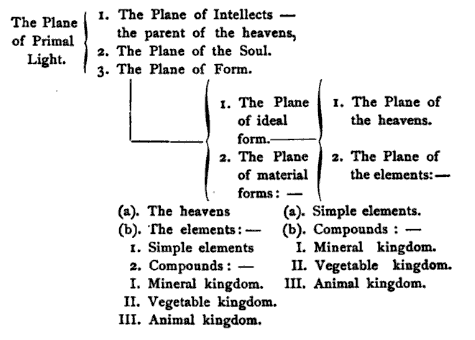
"Image of table titled The Plane of Primal Light."
| The Plane of Primal Light. |
1. The Plane of Intellects—the parent of the heavens, |
| 2. The Plane of the Soul. |
| 3. The Plane of Form. |
1. The Plane of ideal form. |
1. The Plane of the heavens. |
| 2. The Plane of the elements:— |
(a). Simple elements. |
| (b). Compounds:— |
I. Mineral kingdom. |
| II. Vegetable kingdom. |
| III. Animal kingdom. |
| 2. The Plane of material forms:— |
(a). The heavens |
| (b). The elements:— |
1. Simple elements |
| 2. Compounds:— |
I. Mineral kingdom. |
| II. Vegetable kingdom. |
| III. Animal kingdom. |
Having briefly indicated the general nature
of Being, we now proceed to a more detailed
examination of the world-process. All that is
not-light is divided into:—
(1). Eternal e.g., Intellects, Souls of
heavenly bodies, heavens, simple elements,
time, motion.
(2). Contingent e.g., Compounds of various
elements. The motion of the heavens is eternal,
and makes up the various cycles of the Universe.
It is due to the intense longing of the heaven-soul
to receive illumination from the source of all
light. The matter of which the heavens are
constructed, is completely free from the operation
of chemical processes, incidental to the grosser
forms of the not-light. Every heaven has its
own matter peculiar to it alone. Likewise the
heavens differ from one another in the direction
of their motion; and the difference is explained
by the fact that the beloved, or the sustaining
illumination, is different in each case. Motion
is only an aspect of time. It is the summing
up of the elements of time, which, as externalised,
is motion. The distinction of past,
present, and future is made only for the sake
of convenience, and does not exist in the
nature of time.[137:1] We cannot conceive the
beginning of time; for the supposed beginning
would be a point of time itself. Time and
motion, therefore, are both eternal.
There are three primordial elements—water,
earth, and wind. Fire, according to the Ishrāqīs,
is only burning wind. The combinations of
these elements, under various heavenly influences,
assume various forms—fluidity,
gaseousness, solidity. This transformation of
the original elements, constitutes the process
of "making and unmaking" which pervades
the entire sphere of the not-light, raising the
different forms of existence higher and higher,
and bringing them nearer and nearer to the
illuminating forces. All the phenomena of
nature—rain, clouds, thunder, meteor—are
the various workings of this immanent principle
of motion, and are explained by the direct or
indirect operation of the Primal Light on things,
which differ from one another in their capacity
of receiving more or less illumination. The
Universe, in one word, is a petrified desire;
a crystallised longing after light.
But is it eternal? The Universe is a manifestation
of the illuminative Power which
constitutes the essential nature of the Primal
Light. In so far, therefore, as it is a manifestation,
it is only a dependent being, and consequently
not eternal. But in another sense it is eternal.
All the different spheres of being exist by the
illuminations and rays of the Eternal light.
There are some illuminations which are directly
eternal; while there are other fainter ones, the
appearance of which depends on the combination
of other illuminations and rays. The existence
of these is not eternal in the same sense
as the existence of the pre-existing parent
illuminations. The existence of colour, for
instance, is contingent in comparison to that
of the ray, which manifests colour when a dark
body is brought before an illuminating body.
The Universe, therefore, though contingent as
manifestation, is eternal by the eternal character
of its source. Those who hold the non-eternity
of the Universe argue on the assumption of
the possibility of a complete induction. Their
argument proceeds in the following manner:—
(1). Everyone of the Abyssinians is black.
⁂ All Abyssinians are black.
(2). Every motion began at a definite moment.
⁂ All motion must begin so.
But this mode of argumentation is vicious.
It is quite impossible to state the major. One
cannot collect all the Abyssinians past, present,
and future, at one particular moment of time.
Such a Universal, therefore, is impossible.
Hence from the examination of individual
Abyssinians, or particular instances of motion
which fall within the pale of our experience,
it is rash to infer, that all Abyssinians are
black, or all motion had a beginning in time.
Psychology.
Motion and light are not concomitant in
the case of bodies of a lower order. A piece of
stone, for instance, though illuminated and
hence visible, is not endowed with self-initiated
movement. As we rise, however, in the scale
of being, we find higher bodies, or organisms
in which motion and light are associated
together. The abstract illumination finds its
best dwelling place in man. But the question
arises whether the individual abstract illumination
which we call the human soul, did or did
not exist before its physical accompaniment.
The founder of Ishrāqī Philosophy follows
Avicenna in connection with this question, and
uses the same arguments to show, that the
individual abstract illuminations cannot be held
to have pre-existed, as so many units of light.
The material categories of one and many
cannot be applied to the abstract illumination
which, in its essential nature, is neither one
nor many; though it appears as many owing
to the various degrees of illuminational receptivity
in its material accompaniments. The
relation between the abstract illumination, or
soul and body, is not that of cause and effect;
the bond of union between them is love. The
body which longs for illumination, receives it
through the soul; since its nature does not
permit a direct communication between the
source of light and itself. But the soul cannot
transmit the directly received light to the
dark solid body which, considering its attributes,
stands on the opposite pole of being. In order
to be related to each other, they require a
medium between them, something standing
midway between light and darkness. This
medium is the animal soul—a hot, fine,
transparent vapour which has its principal seat
in the left cavity of the heart, but also circulates
in all parts of the body. It is because of the
partial identity of the animal soul with light
that, in dark nights, land-animals run towards
the burning fire; while sea-animals leave their
aquatic abodes in order to enjoy the beautiful
sight of the moon. The ideal of man, therefore,
is to rise higher and higher in the scale of
being, and to receive more and more illumination
which gradually brings complete freedom from
the world of forms. But how is this ideal to
be realised? By knowledge and action. It is
the transformation of both understanding and
will, the union of action and contemplation,
that actualizes the highest ideal of man. Change
your attitude towards the Universe, and adopt
the line of conduct necessitated by the change.
Let us briefly consider these means of
realisation:—
A. Knowledge. When the Abstract illumination
associates itself with a higher organism, it
works out its development by the operation
of certain faculties—the powers of light, and
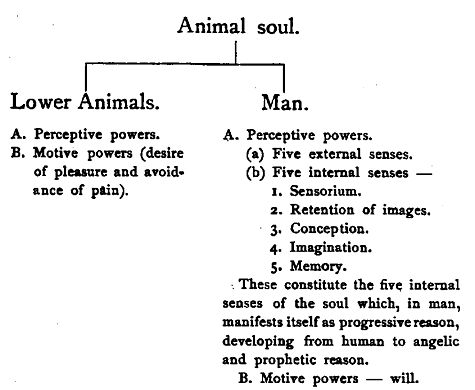
the powers of darkness. The former are the
five external senses, and the five internal
senses—sensorium, conception, imagination,
understanding, and memory; the latter are the
powers of growth, digestion, etc. But such a
division of faculties is only convenient. "One
faculty can be the source of all operations."[142:1]
There is only one power in the middle of the
brain, though it receives different names from
different standpoints. The mind is a unity
which, for the sake of convenience, is regarded
as multiplicity. The power residing in the
middle of the brain must be distinguished from
the abstract illumination which constitutes the
real essence of man. The Philosopher of
illumination appears to draw a distinction
between the active mind and the essentially
inactive soul; yet he teaches that in some
mysterious way, all the various faculties are
connected with the soul.
The most original point in his psychology
of intellection, however, is his theory of vision.
[142:2]
The ray of light which is supposed to come
out of the eye must be either substance or
quality. If quality, it cannot be transmitted
from one substance (eye) to another substance
(visible body). If, on the other hand, it is a
substance, it moves either consciously, or
impelled by its inherent nature. Conscious
movement would make it an animal perceiving
other things. The perceiver in this case would
be the ray, not man. If the movement of the
ray is an attribute of its nature, there is no
reason why its movement should be peculiar
to one direction, and not to all. The ray of
light, therefore, cannot be regarded as coming
out of the eye. The followers of Aristotle hold
that in the process of vision images of objects
are printed on the eye. This view is also
erroneous; since images of big things cannot
be printed on a small space. The truth is
that when a thing comes before the eye, an
illumination takes place, and the mind sees
the object through that illumination. When
there is no veil between the object and the
normal sight, and the mind is ready to perceive,
the act of vision must take place; since this
is the law of things. "All vision is illumination;
and we see things in God". Berkley explained
the relativity of our sight-perceptions with a
view to show that the ultimate ground of all
ideas is God. The Ishrāqī Philosopher has the
same object in view, though his theory of
vision is not so much an explanation of the
sight-process as a new way of looking at the
fact of vision.
Besides sense and reason, however, there
is another source of knowledge called
"Dhauq"—the inner perception which reveals
non-temporal and non-spatial planes of being.
The study of philosophy, or the habit of
reflecting on pure concepts, combined with the
practice of virtue, leads to the upbringing of
this mysterious sense, which corroborates and
corrects the conclusions of intellect.
B. Action. Man as an active being has the
following motive powers:
(a). Reason or the Angelic soul—the source
of intelligence, discrimination, and love of
knowledge.
(b). The beast-soul which is the source of
anger, courage, dominance, and ambition.
(c). The animal soul which is the source of
lust, hunger, and sexual passion.
The first leads to wisdom; the second and
third, if controlled by reason, lead respectively
to bravery and chastity. The harmonious use
of all results in the virtue of justice. The
possibility of spiritual progress by virtue, shows
that this world is the best possible world.
Things as existent are neither good nor bad.
It is misuse or limited standpoint that makes
them so. Still the fact of evil cannot be denied.
Evil does exist; but it is far less in amount
than good. It is peculiar only to a part of
the world of darkness; while there are other
parts of the Universe which are quite free
from the taint of evil. The sceptic who attributes
the existence of evil to the creative agency
of God, presupposes resemblance between
human and divine action, and does not see
that nothing existent is free in his sense of
the word. Divine activity cannot be regarded
as the creator of evil in the same sense as
we regard some forms of human activity as
the cause of evil.[145:1]
It is, then, by the union of knowledge and
virtue that the soul frees itself from the world
of darkness. As we know more and more of
the nature of things, we are brought closer
and closer to the world of light; and the love
of that world becomes more and more intense.
The stages of spiritual development are infinite,
since the degrees of love are infinite. The
principal stages, however, are as follows:—
(1). The stage of "I". In this stage the
feeling of personality is most predominant,
and the spring of human action is generally
selfishness.
(2). The stage of "Thou art not". Complete
absorption in one's own deep self to the entire
forgetfulness of everything external.
(3). The stage of "I am not". This stage
is the necessary result of the second.
(4). The stage of "Thou art". The absolute
negation of "I", and the affirmation of "Thou",
which means complete resignation to the
will of God.
(5). The stage of "I am not; and thou art
not". The complete negation of both the terms
of thought—the state of cosmic consciousness.
Each stage is marked by more or less
intense illuminations, which are accompanied
by some indescribable sounds. Death does not
put an end to the spiritual progress of the
soul. The individual souls, after death, are not
unified into one soul, but continue different
from each other in proportion to the illumination
they received during their companionship with
physical organisms. The Philosopher of illumination
anticipates Leibniz's doctrine of the
Identity of Indiscernibles, and holds that no
two souls can be completely similar to each
other.[147:1] When the material machinery which
it adopts for the purpose of acquiring gradual
illumination, is exhausted, the soul probably
takes up another body determined by the
experiences of the previous life; and rises
higher and higher in the different spheres
of being, adopting forms peculiar to those
spheres, until it reaches its destination—the
state of absolute negation. Some souls probably
come back to this world in order to make up
their deficiencies.[147:2] The doctrine of trans-migration
cannot be proved or disproved from
a purely logical standpoint; though it is a
probable hypothesis to account for the future
destiny of the soul. All souls are thus constantly
journeying towards their common source, which
calls back the whole Universe when this journey
is over, and starts another cycle of being to
reproduce, in almost all respects, the history
of the preceding cycles.
Such is the philosophy of the great Persian
martyr. He is, properly speaking, the first
Persian systematiser who recognises the
elements of truth in all the aspects of Persian
speculation, and skilfully synthesises them in
his own system. He is a pantheist in so far
as he defines God as the sum total of all
sensible and ideal existence.[148:1] To him, unlike
some of his Ṣūfī predecessors, the world is
something real, and the human soul a distinct
individuality. With the orthodox theologian,
he maintains that the ultimate cause of every
phenomenon, is the absolute light whose
illumination forms the very essence of the
Universe. In his psychology he follows Avicenna,
but his treatment of this branch of
study is more systematic and more empirical.
As an ethical philosopher, he is a follower
of Aristotle whose doctrine of the mean he
explains and illustrates with great thoroughness.
Above all he modifies and transforms the
traditional Neo-Platonism, into a thoroughly
Persian system of thought which, not only
approaches Plato, but also spiritualises the old
Persian Dualism. No Persian thinker is more
alive to the necessity of explaining all the
aspects of objective existence in reference to
his fundamental principles. He constantly
appeals to experience, and endeavours to
explain even the physical phenomena in the
light of his theory of illumination. In his system
objectivity, which was completely swallowed
up by the exceedingly subjective character of
extreme pantheism, claims its due again, and,
having been subjected to a detailed examination,
finds a comprehensive explanation. No wonder
then that this acute thinker succeeded in
founding a system of thought, which has always
exercised the greatest fascination over minds—uniting
speculation and emotion in perfect
harmony. The narrow-mindedness of his contemporaries
gave him the title of "Maqtūl"
(the killed one), signifying that he was not to
be regarded as "Shahīd" (Martyr); but succeeding
generations of Ṣūfīs and philosophers
have always given him the profoundest
veneration.
I may here notice a less spiritual form of
the Ishrāqī mode of thought. Nasafī[150:1] describes
a phase of Ṣūfī thought which reverted to the
old materialistic dualism of Mānī. The advocates
of this view hold, that light and darkness are
essential to each other. They are, in reality,
two rivers which mix with each other like oil
and milk,[150:2] out of which arises the diversity
of things. The ideal of human action is freedom
from the taint of darkness; and the freedom of
light from darkness means the self-consciousness
of light as light.
II. Reality as Thought—Al-Jīlī.
Al-Jīlī was born in 767 A.H., as he himself
says in one of his verses, and died in 811
A.H. He was not a prolific writer like Shaikh
Muḥy al-Dīn ibn ‘Arabī whose mode of thought
seems to have greatly influenced his teaching.
He combined in himself poetical imagination
and philosophical genius, but his poetry is no
more than a vehicle for his mystical and
metaphysical doctrines. Among other books he
wrote a commentary on Shaikh Muḥy al-Dīn ibn
‘Arabī's al-Futūḥāt al-Makkiya, a commentary
on Bismillāh, and the famous work Insān
al-Kāmil (printed in Cairo).
Essence pure and simple, he says, is the
thing to which names and attributes are given,
whether it is existent actually or ideally. The
existent is of two species:—
(1). The Existent in Absoluteness or Pure
existence—Pure Being—God.
(2). The existence joined with non-existence—Creation—Nature.
The Essence of God or Pure Thought cannot
be understood; no words can express it, for it
is beyond all relation and knowledge is relation.
The intellect flying through the fathomless
empty space pierces through the veil of names
and attributes, traverses the vasty sphere of
time, enters the domain of the non-existent
and finds the Essence of Pure Thought to be
an existence which is non-existence—a sum
of contradictions.[152:1] It has two (accidents);
eternal life in all past time and eternal life in
all future time. It has two (qualities), God and
creation. It has two (definitions), uncreatableness
and creatableness. It has two names,
God and man. It has two faces, the manifested
(this world) and the unmanifested (the next
world). It has two effects, necessity and
possibility. It has two points of view; from
the first it is non-existent for itself but existent
for what is not itself; from the second it is
existent for itself and non-existent for what
is not itself.
Name, he says, fixes the named in the
understanding, pictures it in the mind, presents
it in the imagination and keeps it in the
memory. It is the outside or the husk, as it
were, of the named; while the named is the
inside or the pith. Some names do not exist
in reality but exist in name only as "‘Anqā"
(a fabulous bird). It is a name the object of
which does not exist in reality. Just as "‘Anqā"
is absolutely non-existent, so God is absolutely
present, although He cannot be touched and
seen. The "‘Anqā" exists only in idea while
the object of the name "Allāh" exists in
reality and can be known like "‘Anqā" only
through its names and attributes. The name
is a mirror which reveals all the secrets of
the Absolute Being; it is a light through the
agency of which God sees Himself. Al-Jīlī here
approaches the Isma‘īlia view that we should
seek the Named through the Name.
In order to understand this passage we
should bear in mind the three stages of the
development of Pure Being, enumerated by
him. He holds that the Absolute existence or
Pure Being when it leaves its absoluteness
undergoes three stages:—(1) Oneness. (2)
He-ness. (3) I-ness. In the first stage there is
an absence of all attributes and relations, yet it
is called one, and therefore oneness marks one
step away from the absoluteness. In the second
stage Pure Being is yet free from all manifestation,
while the third stage, I-ness, is nothing
but an external manifestation of the He-ness;
or, as Hegel would say, it is the self-diremption
of God. This third stage is the sphere of the
name Allāh; here the darkness of Pure Being
is illuminated, nature comes to the front, the
Absolute Being has become conscious. He says
further that the name Allāh is the stuff of
all the perfections of the different phases of
Divinity, and in the second stage of the progress
of Pure Being, all that is the result of Divine
self-diremption was potentially contained within
the titanic grasp of this name which, in the
third stage of the development, objectified
itself, became a mirror in which God reflected
Himself, and thus by its crystallisation dispelled
all the gloom of the Absolute Being.
In correspondence with these three stages
of the absolute development, the perfect
man has three stages of spiritual training.
But in his case the process of development
must be the reverse; because his is the
process of ascent, while the Absolute Being
had undergone essentially a process of descent.
In the first stage of his spiritual progress he
meditates on the name, studies nature on which
it is sealed; in the second stage he steps
into the sphere of the Attribute, and in the
third stage enters the sphere of the Essence.
It is here that he becomes the Perfect Man;
his eye becomes the eye of God, his word
the word of God and his life the life of
God—participates in the general life of Nature
and "sees into the life of things".
To turn now to the nature of the
attribute. His views on this most interesting
question are very important, because
it is here that his doctrine fundamentally differs
from Hindu Idealism. He defines attribute
as an agency which gives us a knowledge of
the state of things.[155:1] Elsewhere he says that
this distinction of attribute from the underlying
reality is tenable only in the sphere of the
manifested, because here every attribute is
regarded as the other of the reality in which
it is supposed to inhere. This otherness is due
to the existence of combination and disintegration
in the sphere of the manifested. But
the distinction is untenable in the domain of
the unmanifested, because there is no
combination or disintegration there. It should
be observed how widely he differs from the
advocates of the Doctrine of "Māyā". He
believes that the material world has real
existence; it is the outward husk of the real
being, no doubt, but this outward husk is not
the less real. The cause of the phenomenal
world, according to him, is not a real entity
hidden behind the sum of attributes, but it is
a conception furnished by the mind so that
there may be no difficulty in understanding
the material world. Berkeley and Fichte
will so far agree with our author, but his
view leads him to the most characteristically
Hegelian doctrine—identity of thought
and being. In the 37th chapter of the
2nd volume of Insān al-Kāmil, he clearly says
that idea is the stuff of which this universe
is made; thought, idea, notion is the material
of the structure of nature. While laying stress
on this doctrine he says, "Dost thou not look
to thine own belief? Where is the reality in
which the so-called Divine attributes inhere?
It is but the idea."[157:1] Hence nature is nothing
but a crystallised idea. He gives his
hearty assent to the results of Kant's Critique
of Pure Reason; but, unlike him, he
makes this very idea the essence of the Universe.
Kant's Ding an sich to him is a pure
nonentity; there is nothing behind the collection
of attributes. The attributes are the real
things, the material world is but the objectification
of the Absolute Being; it is the other
self of the Absolute—another which owes its
existence to the principle of difference in the
nature of the Absolute itself. Nature is the
idea of God, a something necessary for His
knowledge of Himself. While Hegel calls his
doctrine the identity of thought and being,
Al-Jīlī calls it the identity of attribute and
reality. It should be noted that the author's
phrase, "world of attributes", which he uses
for the material world is slightly misleading.
What he really holds is that the distinction
of attribute and reality is merely phenomenal,
and does not at all exist in the nature of
things. It is useful, because it facilitates our
understanding of the world around us, but it
is not at all real. It will be understood that
Al-Jīlī recognises the truth of Empirical
Idealism only tentatively, and does not admit
the absoluteness of the distinction. These
remarks should not lead us to understand that
Al-Jīlī does not believe in the objective
reality of the thing in itself. He does believe
in it, but then he advocates its unity, and says
that the material world is the thing in itself;
it is the "other", the external expression of
the thing in itself. The Ding an sich and its
external expression or the production of its
self-diremption, are really identical, though
we discriminate between them in order to
facilitate our understanding of the universe. If
they are not identical, he says, how could one
manifest the other? In one word, he means by
Ding an sich, the Pure, the Absolute Being,
and seeks it through its manifestation or external
expression. He says that as long as we do not
realise the identity of attribute and reality, the
material world or the world of attributes seems
to be a veil; but when the doctrine is brought
home to us the veil is removed; we see the
Essence itself everywhere, and find that all the
attributes are but ourselves. Nature then appears
in her true light; all otherness is removed and
we are one with her. The aching prick of curiosity
ceases, and the inquisitive attitude of our
minds is replaced by a state of philosophic
calm. To the person who has realised this
identity, discoveries of science bring no new
information, and religion with her role of
supernatural authority has nothing to say.
This is the spiritual emancipation.
Let us now see how he classifies the different
divine names and attributes which have
received expression in nature or crystallised
Divinity. His classification is as follows:—
(1). The names and attributes of God as
He is in Himself (Allāh, The One, The Odd,
The Light, The Truth, The Pure, The Living.)
(2). The names and attributes of God as
the source of all glory (The Great and High,
The All-powerful).
(3). The names and attributes of God as
all Perfection (The Creator, The Benefactor,
The First, The Last).
(4). The names and attributes of God as
all Beauty (The Uncreatable, The Painter,
The Merciful, The Origin of all). Each of
these names and attributes has its own particular
effect by which it illuminates the soul of the
perfect man and Nature. How these illuminations
take place, and how they reach the soul is
not explained by Al-Jīlī. His silence about
these matters throws into more relief the
mystical portion of his views and implies the
necessity of spiritual Directorship.
Before considering Al-Jīlī's views of particular
Divine Names and Attributes, we should
note that his conception of God, implied
in the above classification, is very similar to
that of Schleiermacher. While the German
theologian reduces all the divine attributes
to one single attribute of Power, our author
sees the danger of advancing a God free from
all attributes, yet recognises with Schleiermacher
that in Himself God is an unchangeable
unity, and that His attributes "are nothing
more than views of Him from different human
standpoints, the various appearances which the
one changeless cause presents to our finite
intelligence according as we look at it from
different sides of the spiritual landscape."[161:1] In
His absolute existence He is beyond the
limitation of names and attributes, but when
He externalises Himself, when He leaves His
absoluteness, when nature is born, names and
attributes appear sealed on her very fabric.
We now proceed to consider what he
teaches about particular Divine Names and
Attributes. The first Essential Name is Allāh
(Divinity) which means the sum of all the
realities of existence with their respective order
in that sum. This name is applied to God as
the only necessary existence. Divinity being
the highest manifestation of Pure Being, the
difference between them is that the latter is
visible to the eye, but its where is invisible;
while the traces of the former are visible, itself
is invisible. By the very fact of her being
crystallised divinity, Nature is not the real
divinity; hence Divinity is invisible, and its
traces in the form of Nature are visible to the
eye. Divinity, as the author illustrates, is water;
nature is crystallised water or ice; but ice is
not water. The Essence is visible to the eye,
(another proof of our author's Natural Realism
or Absolute Idealism) although all its attributes
are not known to us. Even its attributes are
not known as they are in themselves, their
shadows or effects only are known. For instance,
charity itself is unknown, only its effect or the fact
of giving to the poor, is known and seen.
This is due to the attributes being incorporated
in the very nature of the Essence. If the
expression of the attributes in its real nature
had been possible, its separation from the
Essence would have been possible also. But
there are some other Essential Names of
God—The Absolute Oneness and Simple
Oneness. The Absolute Oneness marks the
first step of Pure Thought from the darkness
of Cecity (the internal or the original Māyā
of the Vedānta) to the light of manifestation.
Although this movement is not attended with
any external manifestations, yet it sums up
all of them under its hollow universality. Look
at a wall, says the author, you see the whole
wall; but you cannot see the individual pieces
of the material that contribute to its formation.
The wall is a unity—but a unity which
comprehends diversity, so Pure Being is a
unity but a unity which is the soul of diversity.
The third movement of the Absolute Being
is Simple Oneness—a step attended with
external manifestation. The Absolute Oneness
is free from all particular names and attributes.
The Oneness Simple takes on names and
attributes, but there is no distinction between
these attributes, one is the essence of the other.
Divinity is similar to Simple Oneness, but its
names and attributes are distinguished from one
another and even contradictory, as generous
is contradictory to revengeful.[163:1] The third step,
or as Hegel would say, Voyage of the Being,
has another appellation (Mercy). The First
Mercy, the author says, is the evolution of
the Universe from Himself and the manifestation
of His own Self in every atom of the result
of His own self-diremption. Al-Jīlī makes this
point clearer by an instance. He says that
nature is frozen water and God is water. The
real name of nature is God (Allāh); ice or
condensed water is merely a borrowed appellation.
Elsewhere he calls water the origin of
knowledge, intellect, understanding, thought
and idea. This instance leads him to guard
against the error of looking upon God as
immanent in nature, or running through the
sphere of material existence. He says that
immanence implies disparity of being; God is
not immanent because He is Himself the
existence. Eternal existence is the other self
of God, it is the light through which He sees
Himself. As the originator of an idea is existent
in that idea, so God is present in nature.
The difference between God and man, as one
may say, is that His ideas materialise themselves,
ours do not. It will be remembered here that
Hegel would use the same line of argument
in freeing himself from the accusation of
Pantheism.
The attribute of Mercy is closely connected
with the attribute of Providence. He defines
it as the sum of all that existence stands in
need of. Plants are supplied with water through
the force of this name. The natural philosopher
would express the same thing differently; he
would speak of the same phenomena as resulting
from the activity of a certain force of nature;
Al-Jīlī would call it a manifestation of Providence;
but, unlike the natural philosopher, he would
not advocate the unknowability of that force.
He would say that there is nothing behind it,
it is the Absolute Being itself.
We have now finished all the essential
names and attributes of God, and proceed to
examine the nature of what existed before all
things. The Arabian Prophet, says Al-Jīlī, was
once questioned about the place of God before
creation. He said that God, before the creation,
existed in "‘Amā" (Blindness). It is the nature
of this Blindness or primal darkness which we
now proceed to examine. The investigation is
particularly interesting, because the word translated
into modern phraseology would be "The
Unconsciousness". This single word impresses
upon us the foresightedness with which he
anticipates metaphysical doctrines of modern
Germany. He says that the Unconsciousness is
the reality of all realities; it is the Pure Being
without any descending movement; it is free
from the attributes of God and creation; it does
not stand in need of any name or quality,
because it is beyond the sphere of relation.
It is distinguished from the Absolute Oneness
because the latter name is applied to the Pure
Being in its process of coming down towards
manifestation. It should, however, be remembered
that when we speak of the priority of
God and posteriority of creation, our words
must not be understood as implying time; for
there can be no duration of time or separateness
between God and His creation. Time,
continuity in space and time, are themselves
creations, and how can piece of creation
intervene between God and His creation. Hence
our words before, after, where, whence, etc.,
in this sphere of thought, should not be
construed to imply time or space. The real
thing is beyond the grasp of human conceptions;
no category of material existence can be
applicable to it; because, as Kant would say,
the laws of phenomena cannot be spoken of
as obtaining in the sphere of noumena.
We have already noticed that man in his
progress towards perfection has three stages:
the first is the meditation of the name which
the author calls the illumination of names. He
remarks that "When God illuminates a certain
man by the light of His names, the man is
destroyed under the dazzling splendour of that
name; and "when thou calleth God, the call
is responded to by the man". The effect of
this illumination would be, in Schopenhauer's
language, the destruction of the individual will,
yet it must not be confounded with physical
death; because the individual goes on living
and moving like the spinning wheel, as Kapila
would say, after he has become one with
Prakriti. It is here that the individual cries
out in pantheistic mood:—She was I and I
was she and there was none to separate us."[167:1]
The second stage of the spiritual training
is what he calls the illumination of the Attribute.
This illumination makes the perfect man receive
the attributes of God in their real nature in
proportion to the power of receptivity possessed
by him—a fact which classifies men according
to the magnitude of this light resulting from
the illumination. Some men receive illumination
from the divine attribute of Life, and thus
participate in the soul of the Universe. The
effect of this light is soaring in the air, walking
on water, changing the magnitude of things
(as Christ so often did). In this wise the
perfect man receives illumination from all the
Divine attributes, crosses the sphere of the
name and the attribute, and steps into the
domain of the Essence—Absolute Existence.
As we have already seen, the Absolute
Being, when it leaves its absoluteness, has
three voyages to undergo, each voyage being
a process of particularisation of the bare
universality of the Absolute Essence. Each of
these three movements appears under a new
Essential Name which has its own peculiar
illuminating effect upon the human soul. Here
is the end of our author's spiritual ethics;
man has become perfect, he has amalgamated
himself with the Absolute Being, or has learnt
what Hegel calls The Absolute Philosophy. "He
becomes the paragon of perfection, the object
of worship, the preserver of the Universe".[169:1]
He is the point where Man-ness and God-ness
become one, and result in the birth of the
god-man.
How the perfect man reaches this height
of spiritual development, the author does not
tell us; but he says that at every stage he
has a peculiar experience in which there is
not even a trace of doubt or agitation. The
instrument of this experience is what he calls
the Qalb (heart), a word very difficult of
definition. He gives a very mystical diagram
of the Qalb, and explains it by saying that
it is the eye which sees the names, the attributes
and the Absolute Being successively. It owes
its existence to a mysterious combination of
soul and mind; and becomes by its very nature
the organ for the recognition of the ultimate
realities of existence. All that the "heart", or
the source of what the Vedānta calls the
Higher Knowledge, reveals is not seen by the
individual as something separate from and
heterogeneous to himself; what is shown to
him through this agency is his own reality,
his own deep being. This characteristic of the
agency differentiates it from the intellect, the
object of which is always different and separate
from the individual exercising that faculty. But
the spiritual experience, according to the Ṣūfīs
of this school, is not permanent; moments of
spiritual vision, says Matthew Arnold,[170:1] cannot
be at our command. The god-man is he who
has known the mystery of his own being, who
has realised himself as god-man; but when
that particular spiritual realisation is over man
is man and God is God. Had the experience
been permanent, a great moral force would
have been lost and society overturned.
Let us now sum up Al-Jīlī's Doctrine of
the Trinity. We have seen the three movements
of the Absolute Being, or the first three
categories of Pure Being; we have also seen
that the third movement is attended with
external manifestation, which is the self-diremption
of the Essence into God and man. This
separation makes a gap which is filled by
the perfect man, who shares in both the
Divine and the human attributes. He holds
that the perfect man is the preserver of the
Universe; hence in his view, the appearance
of the perfect man is a necessary condition
for the continuation of nature. It is easy,
therefore, to understand that in the god-man,
the Absolute Being which has left its absoluteness,
returns into itself; and, but for the
god-man, it could not have done so; for then
there would have been no nature, and consequently
no light through which God could
have seen Himself. The light through the
agency of which God sees Himself is due to
the principle of difference in the nature of
the Absolute Being itself. He recognises this
principle in the following verses:—
If you say that God is one, you are right; but if you say that He is two, this is also true.
If you say no, but He is three, you are right, for this is the real nature of man.
[171:1]
The perfect man, then, is the joining link.
On the one hand he receives illumination from
all the Essential names, on the other hand all
Divine attributes reappear in him. These
attributes are:—
1. Independent life or existence.
2. Knowledge which is a form of life, as
he proves from a verse from the Qur’an.
3. Will—the principle of particularisation,
or the manifestation of Being. He defines it
as the illumination of the knowledge of God
according to the requirements of the Essence;
hence it is a particular form of knowledge.
It has nine manifestations, all of which are
different names for love; the last is the love
in which the lover and the beloved, the knower
and the known merge into each other, and
become identical. This form of love, he says,
is the Absolute Essence; as Christianity teaches,
God is love. He guards, here, against the
error of looking upon the individual act of
will as uncaused. Only the act of the universal
will is uncaused; hence he implies the Hegelian
Doctrine of Freedom, and holds that the acts
of man are both free and determined.
4. Power, which expresses itself in self-diremption
i.e. creation. He controverts Shaikh
Muḥy al-Dīn ibn ‘Arabī's position that the
Universe existed before the creation in the
knowledge of God. He says, this would imply
that God did not create it out of nothing, and
holds that the Universe, before its existence
as an idea, existed in the self of God.
5. The word or the reflected being. Every
possibility is the word of God; hence nature
is the materialisation of the word of God. It
has different names—The tangible word, The
sum of the realities of man, The arrangement
of the Divinity, The spread of Oneness, The
expression of the Unknown, The phases of
Beauty, The trace of names and attributes,
and the object of God's knowledge.
6. The Power of hearing the inaudible.
7. The Power of seeing the invisible.
8. Beauty—that which seems least beautiful
in nature (the reflected beauty) is in its real
existence, beauty. Evil is only relative, it has
no real existence; sin is merely a relative
deformity.
9. Glory or beauty in its intensity.
10. Perfection, which is the unknowable
essence of God and therefore Unlimited and
Infinite.