While the ladies and house mistresses of New England were busy with
their crewelwork, the children with their little samplers, and farm
housemothers sewed patchwork in the intervals of spinning and weaving,
an entirely different development of needlework art had taken place,
beginning in Pennsylvania. Embroidery in America did not grow
exclusively from seed brought over in the Mayflower. It sprang from many
sources, but its finest qualities came from the influence of what was
called "Bethlehem Embroidery."
The advent of this style of needlework was interesting. It originated in
a religious community founded in 1722 at Herrnhut, Germany, by Count
Zinzendorf. It was a strictly religious, semimonastic group of single
men and single women, whose hearts were filled with zeal for mission
work. At that period, I suppose America seemed a possible and promising
field for such efforts, and accordingly forty-five of the brothers and
as many of the sisters turned their faces toward this new world. One
can fancy that when the thought first entered their minds, of coming to
a land peopled by savage Indians, with but a bare sprinkling of "the
Lord's people," they trembled even in their dreams at the thought of the
cruel incidents they might encounter in that wilderness toward which
they were impelled by apostolic zeal, and the unquiet sea upon which
they were about to embark foreshadowed an unknown future. But there was
small danger for them upon the sea; surely they could not sink in
troubled waters, these etherial souls! The heavenly quality of them
would upbear the vessel and cargo. They would come safe to land, no
matter how tempestuous the elements!
I suppose, at all periods of the world, prophet and martyr stuff might
be sifted out from the man-stuff of the times if the race had need of
them. In normal states of growth, we call them "cranks" and look for no
results from their existence. But the elusive spirit of love never dies.
It appears and reappears in the history of all races and times, and
leaves its mark upon them in various shapes of beneficence.
These missionary brothers and sisters had chosen as the theater of their
labor that part of our broad land which was pleasantly christened
Pennsylvania, and selecting a portion of the southern area, they founded
their colony and called it "Ephrata."
It existed for forty years, constantly increasing its membership, and
living a life reaching out toward a perfection of goodness which seemed
quite possible to their apostolic souls.
Time, however, brought changes of circumstance and of mind, and after
many philanthropic phases, in 1749 the mingled elements and aspirations
of the enlarged congregation were merged into two boarding schools, one
for boys, which was the germ of Lehigh University, and another for girls
at Bethlehem, which, under the careful fostering of the sisters, became
the birthplace of the famous Moravian needlework. So were melted into
the modern form of scholastic instruction the various efforts of
religious activity, the eternal reaching out for conditions in human
life in which it is easy and natural to be good and happy. It had not
been accomplished in this semimonastic life, but the efforts toward it
had their influence, and, you may judge by the quality of its
founders, had never died.
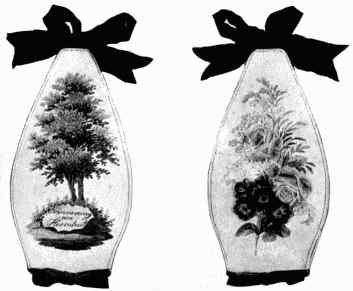
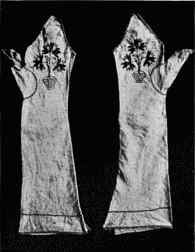
larger image
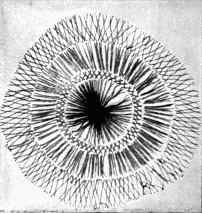
NEEDLEBOOK of Moravian embroidery, made about 1850. Now
in the possession of Mrs. J. U. Myers, Bethlehem, Pa.
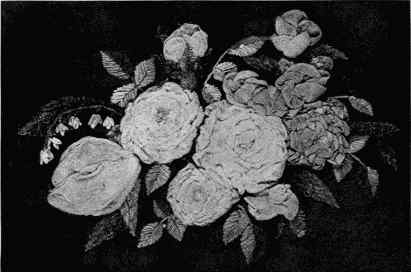
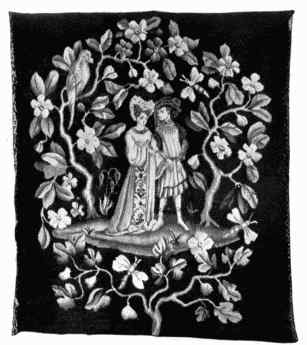
larger image
Courtesy of Claire Reynolds Tubbs, Gladstone, N. J.
MORAVIAN EMBROIDERY worked by Emily E. Reynolds,
Plymouth, Pa., in 1834, at the age of twelve, while at the Moravian
Seminary in Bethlehem, and now owned by her granddaughter.
The two schools very early in their history seem to have established a
reputation for learning and culture which made them a desirable
influence in the formative lives of the children of the most thoughtful,
as well as the most prominent and prosperous, American families. Indeed,
the school for girls became so popular as to lead to an extension and
founding of several branches in other of the southern states. The art
and practice of fine needlework became a popular and necessary feature
of them, distinguishing them from all other schools. "Tambour and fine
needlework" were among the extras of the school, and charged for, as we
learn from school records, at the rate of "seventeen shillings and
sixpence, Pennsylvania currency."
It was not alone tambour and fine needlework, as we shall see later,
that was taught by the Moravian Sisters, but the ribbon work, crêpe
work, and flower embroidery, and picture production upon satin. These
pictures, however important as performances, were not the most common
form of needlework taught by the Sisters. Flower embroidery was the
usual form of practice, and it was of a quality which made each one a
wonder of execution and skill. The materials were satin of a superb
quality for the background, or Eastern silk of softness and strength,
and the silks used in the stitchery were generally "slack twisted" silk
threads of very pure quality, and in certain cases, where they would not
be likely to fray, lustrous flosses of Eastern make. The stitch used in
these flower pieces was an over-and-over stitch, or what was called
satin-stitch, which was without the lap of Kensington stitch. There was
in every piece of embroidery done under the instruction of the
accomplished and devoted Sisters certain virtues, certain effects of
conscientious and patient work, mingled with the love of good and
beautiful art, which were plainly visible. It had in all its flower
pieces, and they were many, the quality of beautiful charm. The ministry
of nature may have had something to do with this, since the lives of the
executants were open to its influences.
One can make a mental picture of those early days beside the peaceful
"Lehi," where the Sisters taught and nurtured the young girls of very
young America, and trained them in such beautiful and womanly
accomplishments. The scattered bits of needlework which remain to us are
so fine, so clear, so thoroughly exhaustive of all excellence in
technique, that they are to the art of embroidery what the ivory
miniature is to painting. We cannot but hail the memory of the Sisters
of Bethlehem with respect and admiration.
I became familiar with the work of this community when I was arranging
an historic exhibition of American Embroidery for the Bartholdi Fair in
1883. Few people may remember that, among the means for the installation
of the Bartholdi Statue of Liberty which welcomes the world at the
entrance to the harbor of New York, was an effort called the Bartholdi
Fair, held in the then almost new and very popular Academy of Design at
the northwestern corner of Fourth Avenue and Twenty-third Street.
Knowing the value of Bethlehem work, I made an effort to secure a
representative collection, with the result of gathering a most
interesting group of specimens, mainly by the interest and help of Mr.
Henry Baldwin of Lehigh University, to whom I was referred for
assistance in my purpose. I have before me now the correspondence which
ensued, a most painstaking, kind and patient one on his part, giving me
much interesting history of the Bethlehem mission, as well as its life
and progress. Among the legends is one—that during our Revolutionary
war, Pulaski recruited some of his Legion at Bethlehem, and ordered a
banner, which was carried by his troops until he fell in the attack upon
Savannah. This banner is now in the rooms of the Maryland Historical
Society, and I find the question of its having been an order from Count
Pulaski, or a gift to the Legion, is one of very lively interest in the
community.
This exhibit of 1883 was as complete an historical collection of
American needlework as was possible, and I have a list of ten articles
loaned from collections in Bethlehem, which reads as follows:
- Embroidered pocketbook of black silk with flowers in bright colors.
Former property of Bishop Bigler.
- Embroidered needlebook of white satin with bright flowers, date 1800.
- Embroidered needlebook of white satin with bright flowers and vines,
dated 1786.
- Sampler, dated 1740.
- Yellow velvet bag embroidered with ribbon work.
- Black velvet bag embroidered in crêpe work with flowers.
- White satin workbag embroidered in fine tracery of vines.
- A box with embroidered pincushion on top.
- A blue silk pocketbook with very fine ribbon work.
- A paper box done with needle in filigree.
It will be seen by this list how varied were the forms of needlework
taught at Bethlehem. The crêpe work mentioned in No. 6 is, probably
owing to the perishable character of its material, very rare, but was
extremely beautiful in effect. Bits of colored crêpe were gathered into
flower petals and sewed upon satin, roses laid leaf upon leaf and built
up to a charming perfection, while the stems and foliage were partially
or wholly embroidered in silk.
The ribbon embroidery of No. 5, has been revived by the New York Society
of Decorative Art and practiced with great success. The flower
embroideries, in the specimens exhibited, were of two sorts—the small
groups being done with fine twisted silks in a simple "over and over"
stitch, called at that time "satin stitch," alike on both sides, except
that on the right side the flowers and leaves were raised from the
surface by an under thread of cotton floss called "stuffing." This did
not prevent, as it might easily have done, an unvarying regularity and
smoothness, which was like satin itself, thread laid beside thread as if
it were woven instead of sewed.
In the larger flowers, the sewing silk had been split into flosses, or
perhaps the prepared flosses were used in the "tent stitch," which is
now known as "Kensington." The colors of all these specimens were as
fresh as natural flowers, speaking eloquently in praise of early
processes of dyeing.
Courtesy Metropolitan Museum of Art
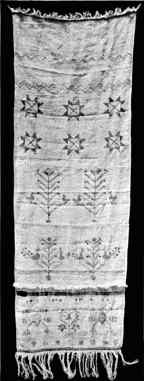
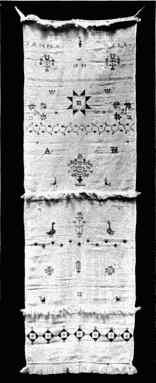
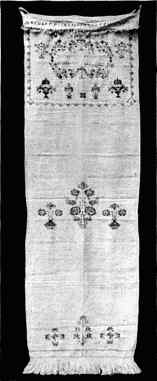
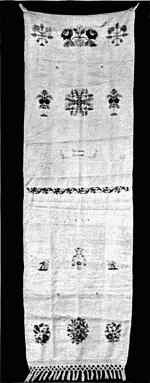
LINEN TOWELS embroidered in cross-stitch. Pennsylvania
Dutch early nineteenth century.
These things seem to fairly exhale gentility, that quality-compact of
everything superior in the life of early American womanhood. I have
especially in mind one cushion where flowers, apparently as fresh in
color as when the cushion was young, are laid upon a ground of silk of
the pinky-ash color, once known as "ashes of roses." The real charm
of the thing, that which lends it a tender romance, is the legend worked
upon the back of the cushion in brown silk stitches which are easily
mistaken for the round-hand copperplate writing of the period—"Wrought
where the peaceful Lehi flows." One seems to breathe the very air of the
secluded valley, peopled by brethren and sisters set apart from the
strenuous duties of the builders of a new nation, and distinguished for
learned and devoted effort toward the perfection of moral, and
spiritual, rather than the conquests of material, life.
The Sisters had many orders from the outside world, as well as from
visitors, and the profit upon these helped to maintain the school. Many
of these orders were in the shape of pocketbooks, pincushions, bags,
etc., having a bunch, or wreath, or cluster of flowers on one side,
wonderfully wrought in silken flosses or sewing silks, and on the other,
some pretty sentiment or legend done in dark brown floss in the most
perfect of "round-hand"; so perfect, in fact, that it would require the
closest scrutiny to decide that it was not handwritten script.
These plentiful orders for things were induced by the several
attractions of the situation, the remoteness from warlike and political
disturbances, and the relationship of so many young girl lives, as well
as the interest which attached to the school and community, making a
constant demand in the shape of small articles of use or luxury,
decorated by the skillful fingers of the Sisters.
Parallel with this fine practice of flower embroidery, was a period of
far more important needlework, which we may call Picture Embroidery.
This also owed its introduction to the Moravian School of Bethlehem,
although it was probably of early English origin, going back to that
period when English embroidery was the wonder of the world; and the
opus plumarium, or feather-pen stitch, or tent stitch, or Kensington
stitch, as it has been known in succeeding ages, first attracted
attention as a medium of art.
Passing from England to Germany it became purely ecclesiastical, and
even now one occasionally finds in Germany, and less often in England,
bits of ecclesiastical embroidery of unimaginable fineness,
commemorating Christ's miracles and other incidents of Bible history. I
know of one small specimen of ancient English art, covering a space of
five by seven inches, where the whole Garden of Eden with its weighty
tragedy is represented by inch-long figures of Adam and Eve, and a
man-headed snake, discussing amicably the advantages of eating or not
eating the forbidden fruit.
Such elaboration in miniature embroidery made good the claim of English
needlework to its first place in the world, since nothing more wonderful
had or has been produced in the whole long history of needlework art. It
was undoubtedly from this school, filtered through generations of
secular practice, that the Moravian picture embroidery came to be a
general American inheritance.
To adapt this wonderful method to the uses of social life was an
admirable achievement, and whether by the sisters of the Moravian
school, or the growth of pre-American influence and time, we do not
certainly know, the fact remains, however, that it was here so cunningly
adapted to the circumstances and spirit of colonial and early American
days as to seem to belong entirely to them, and it would seem quite
clear that Bethlehem was the source of the most skillful needlework art
in America. It was there that the fine ladies of the late eighteenth and
early nineteenth centuries, who sat at the embroidery frame in the
intervals when they were not "sitting at the harp," acquired their
skill.
It was the romantic period of embroidery that makes a very telling
contrast to the earlier crewel and later muslin embroidery of the New
England states. The pieces were seldom larger than eighteen or twenty
inches square, the size probably governed by the width of the superb
satin which was so often used as a background. Not invariably, however,
for I have seen one or two pieces worked upon gray linen where the
surface was entirely covered by stitchery, landscape, trees, and sky
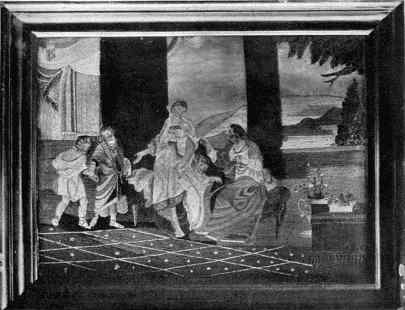
showing an unbroken surface of satiny texture. Pictures from Bible
subjects are frequent, and these have the air of having been copied from
prints; in fact, I have seen some where the print appears underneath the
stitches, showing that it was used as a design. These Scripture pieces
seem to have employed a lower degree of talent than those having
original design, and were probably the somewhat perfunctory work of
young girls whose interests were elsewhere. One picture which I have
seen was treasured as a record of a very romantic elopement—the lover
in the case, riding gayly away with his beloved sitting on a pillion
behind him, and no witnesses to the deed but a small sister, standing at
the gate of the homestead with outstretched hands and staring eyes.
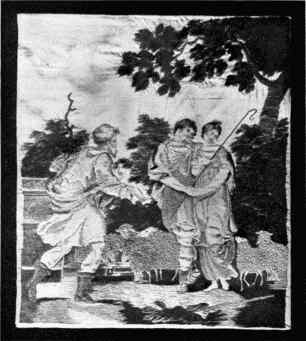
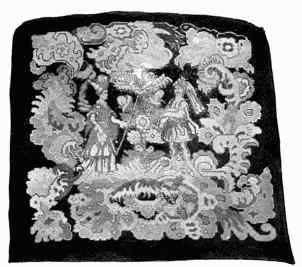
larger image
Courtesy of Elizabeth Lehman Myers
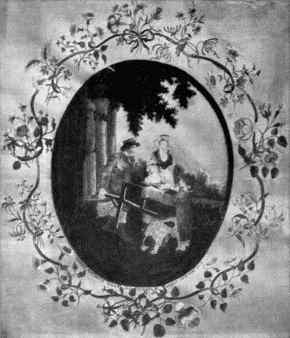
"THE MEETING OF ISAAC AND REBECCA"—Moravian
embroidered picture, an heirloom in the Reichel family of Bethlehem, Pa.
Worked by Sarah Kummer about 1790.
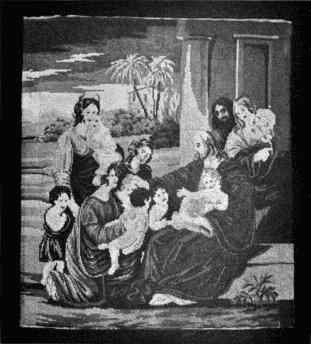
larger image
Courtesy of Elizabeth Lehman Myers
"SUFFER LITTLE CHILDREN TO COME UNTO ME"—Cross-stitch picture
made about 1825, now in the possession of the Beckel family, Bethlehem,
Pa.
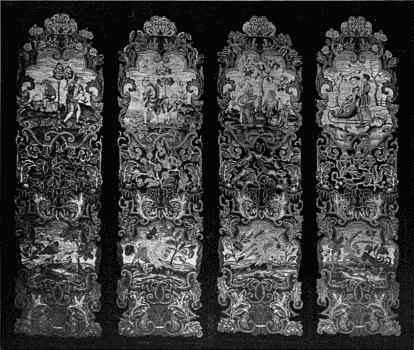
The most important picture which I have seen in portrait needlework came
to light at the Baltimore Exhibition, and was a piazza group of five
figures, a burly sea-captain seated in a rocking chair in a nautical
dress and his own grayish hair embroidered above his ruddy face, his
wife in a white satin gown seated beside him, and his three daughters of
appropriately different ages grouped around, while the ship Constance
was tied closely to the edge of the blue water which bordered the
foreground of the picture. The composition of this picture was evidently
the work of some experienced artist, for its incongruous elements kept
their places and did not greatly clash. Taken as a whole it was an
astonishing performance, quite too ambitious in its grasp for the novel
art of needlework, and yet a thing to delight the hearts of the
descendants, or even casual possessors.
The Moravian teaching and practice spread the principles of needlework
art so widely that it developed in many different directions. The
wonderful silk embroidery applied to flowers was, like the arts of
drawing and painting, capable of being used in copying all forms of
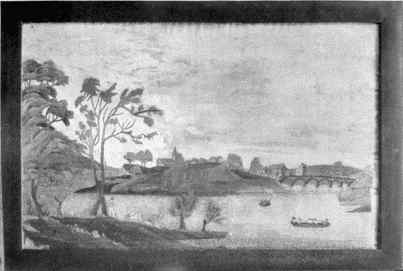
beauty. It was sometimes, not always, successfully applied to landscape
representation, and grew at last into a scheme of needlework
portraiture, in this form perpetuating family history. It was sometimes
used in conjunction with painting, the faces of a family group being
done in water color upon cardboard by professional painters who were
members of the art guild, who wandered from one social circle to
another, supplying the wants of embroideresses ambitious of distinction
in their accomplishments. The small painted faces were cut from the
cardboard upon which they had been painted and worked around, often with
the actual hair of the original of the portrait. I have seen one picture
of a Southern beauty, where the golden hair had been wound into tiny
curls, and sewn into place, and the lace of the neckwear was so
cleverly simulated as to look almost detachable. Of course such pictures
were the result of individual experiment on the part of some very able
and ambitious needlewoman.
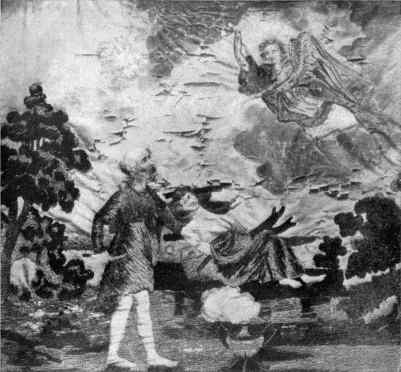
larger image
Courtesy of Mrs. R. B. Mitchell, Madison, N. J.
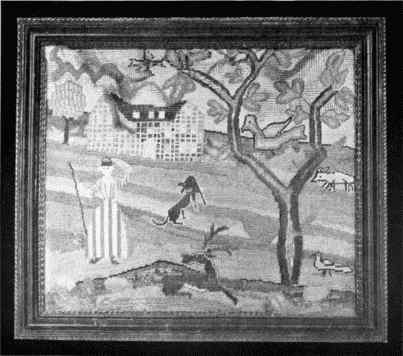
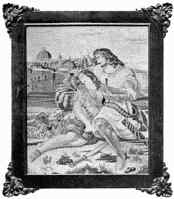
ABRAHAM AND ISAAC. Kensington embroidery by Mary Winifred
Hoskins of Edenton, N. C., while attending an English finishing school
in Baltimore in 1814.
One can imagine that the effect of them in social life was to add
greatly to the vogue of the art of needlework. The most numerous of
these relics were called "mourning pieces"—bits of memorial
embroidery—the subject of the picture being generally a monument
surmounted by an urn, overhung with the sweeping branches of a willow,
while standing beside the monument is a weeping female figure, the face
discreetly hidden in a pocket handkerchief. The inscriptions, "Sacred to
the memory," etc., were written or printed upon the satin in India ink,
and often the letters of the name were worked with the hair of the
subject of the memorial.
In these pieces it is rather noticeable that the mourning figure is
always draped in white, which leads to the conclusion that it is a
purely emblematic figure of an emotion, rather than a real mourner. The
shading of the monument was generally done in India ink, so that the
actual embroidery was confined to the trunk and long branches of
weeping willow, and the dress of the figure, and the ground upon which
willow and monument and figure stand. The faces being always hidden by
the handkerchief, and a tinted satin serving for the sky, the execution
of these memorial pictures was comparatively simple. They certainly bear
an undue proportion to those happy family portraits where mother and
children, or husband and wife, sit in love and simplicity before the
pillared magnificence of the family mansion.
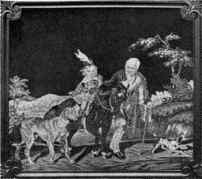
Left—FIRE SCREEN embroidered in cross-stitch worsted.
From the McMullan family of Salem.
Right—FIRE SCREEN, design, "The Scottish Chieftain," embroidered in
cross-stitch by Mrs. Mary H. Cleveland Allen.
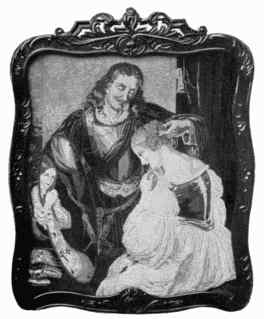
larger image
FIRE SCREEN worked about 1850 by Miss C. A. Granger, of
Canandaigua, N. Y.
Perhaps the greater simplicity and ease of execution of the mourning
pieces had something to do with their greater number. They may have been
the first spelling of the difficult art of pictorial embroidery. The
best of these picture embroideries were certainly wonderful creations as
far as the use of the needle was concerned, and I fancy were done in the
large leisure of some colonial home where early distinction in the art
of needlework must have gone hand in hand with the skill of the
traveling portrait painter. These dainty productions, with their
delicately painted faces and hands, are far more often found than those
with embroidered flesh. In some of these, faces painted with real
miniature skill upon bits of parchment have been inserted or
superimposed upon the satin, the edges, as I have said, carefully
covered by embroidery, done with single hair threaded into the needle
instead of silk. In one case which I remember, the yellow hair of a
child was knotted into a bunch of solid looking curls covering the head
of a small figure, while the face of the mother was surmounted by bands
of a reddish brown. This little touch of realism gave a curious note of
pathos to the picture of a life separated from the present by time and
outgrown habits, but linked to it by this one tangible proof of actual
existence.
The drawing or plan of these pictures was evidently done directly upon
the satin ground, as one often finds the outlines showing at the edge of
the stitches; but in the few specimens I have found where they were
worked upon linen it had been covered with a tracing on strong thin
paper, and the entire design worked through and over both paper and
canvas. Those which were done upon linen seemed to belong to an earlier
period than those worked on satin, which was perhaps an American
adaptation of the earlier method. Certainly the soft thick India satin,
which was the ground of so many of them, made a delightful surface for
embroidery, and blended with its colors into a silvery mass where work
and background were equally effective. Two of these have survived the
century or more of careful seclusion which followed the proud éclat of
their production. One of the fortunate heirs to many of these exhibited
treasures told me of a package or book containing heads in water color,
evidently to be used as copies for the faces which might be found
necessary for efforts in embroidery. The painting of these was perhaps a
part of the education or accomplishment considered necessary to girls of
prominent and successful families of the day.
Under favorable circumstances, such as a convenient relation between
artist and needlework, this art would have developed into needlework
tapestry. The groups would have outgrown their frames, and left their
picture spaces on the walls, and, stretching into life-size figures,
have become hangings of silken broidery, such as we find in Spain and
Italy, from the hands of nuns or noble ladies.
larger image
Courtesy of Essex Institute, Salem, Mass.
EMBROIDERED PICTURE in silks, with a painted sky.
larger image
Courtesy of Essex Institute, Salem, Mass.
CORNELIA AND THE GRACCHI. Embroidered picture in silks,
with velvet inlaid, worked by Mrs. Lydia Very of Salem at the age of
sixteen while at Mrs. Peabody's school.
The influence of the Bethlehem teaching lasted long enough to build up a
very fine and critical standard of embroidery in America. It would be
difficult to overestimate the importance of the influence of this school
of embroidery upon the needlework practice of a growing country. Its
qualities of sincerity, earnestness, and respect for the art of
needlework gave importance to the work of hands other than that of
necessary labor, and these qualities influenced all the various forms of
work which followed it. The first divergence from the original work was
in its application, rather than its method, for instead of having a
strictly decorative purpose its application became almost exclusively
personal. Flower embroidery of surpassing excellence was its general
feature. The materials for the development of this form of art were
usually satin, or the flexible undressed India silk which lent itself so
perfectly to ornamentation. Breadths of cream-white satin, of a
thickness and softness almost unknown in the present day, were stretched
in Chippendale embroidery frames, and loops and garlands of flowers of
every shape and hue were embroidered upon them. They were often done for
skirts and sleeves of gowns of ceremony, giving a distinction even
beyond the flowered brocades so much coveted by colonial belles.
This beautiful flower embroidery was, like its predecessor, the rare
picture embroidery, too exacting in its character to be universal. It
needed money without stint for its materials, and luxurious surroundings
for its practice. Some of the beautiful old gowns wrought in that day
are still to be seen in colonial exhibitions, and are even occasionally
worn by great-great-granddaughters at important mimic colonial
functions.
Floss embroidery upon silk and satin was not entirely confined to
apparel, for we find an occasional piece as the front panel of one of
the large, carved fire screens, which at that date were universally used
in drawing-rooms as a shelter from the glare and heat of the great open
fires which were the only method of heating. As the back of the screen
was turned to the fire and the embroidered face to the room, its
decoration was shown to admirable advantage, and one can hardly account
for the rarity of the specimens of these antique screens, except upon
the supposition that the roses, carnations, and forget-me-nots were
still more effective when wrought upon the scant skirt of a colonial
gown, instead of being shrouded in their careful coverings in the
deserted drawing-room, and my lady of the embroidery might more
effectively exhibit them in the lights of a ballroom. In recording the
changes in the style and purposes of embroidery, from the days of
homespun and home-dyed crewel to the almost living flowers wrought with
lustrous flosses upon breadths of satin which were the best of the
world's manufacture, one unconsciously traverses the ground of domestic
and political history, from the days of the Pilgrims to the pomp of
colonial courts.
The character and purposes of the art varied with every political and
national change. In the middle of the eighteenth century, a demand had
gone out from the new and growing America, and wandering over the seas
had asked for something fine and airy with which to occupy delicate
hands, unoccupied with household toil. The carefully acquired skill of
the earlier periods of our history became in succeeding generations
almost an inheritance of facility, and easily merged into the elaborate
stitchery called French embroidery. I can find no trace of its having
been taught, but plenty of proofs of its existence are to be seen on
the needlework pictures under glass still hanging in many an
old-fashioned parlor, or relegated to the curiosity corner of modern
drawing-rooms. It is possible that the close intimacy existing between
France and England at that period may have influenced this art. Many
French families of high degree were seeking safety or profit in this
country, and the convent-bred ladies of such families would naturally
have shared their acquirements with those whose favor and interest were
important to them as strangers. There was another form of this French
embroidery, the materials used being cambrics, linens, and muslins of
all kinds, the most precious of which were the linen-cambrics and India
mulls. The use of the former still survives in the finest of French
embroidered pocket handkerchiefs, but the latter is seldom seen except
in the veils and vests of Oriental women, or in the studio draperies of
all countries.
larger image
Courtesy Metropolitan Museum of Art, New York
CAPE of white lawn embroidered. Nineteenth century
American.
larger image
Courtesy Metropolitan Museum of Art, New York
COLLARS of white muslin embroidered. Nineteenth century
American.
The threads used were flosses of linen or cotton, preferably the
latter, which were almost entirely imported. With these restricted
materials, wonders of ornamentation were performed. The stitch, quite
different from that of crewelwork or picture embroidery of the preceding
period, was the simple over and over stitch we find in French embroidery
of the present day. The leaves of the design or pattern were frequently
brought into relief by a stuffing of under threads.
Everything was embroidered; gowns, from the belt to lower hem, finished
with scalloped and sprigged ruffles in the same delicate workmanship,
were everyday summer wear. Slips and sacques, which were not quite as
much of an undertaking as an entire gown, were bordered and ruffled with
the same embroidery. The amount and beauty of specimens which still
exist after the lapse of nearly a century is quite wonderful. Small
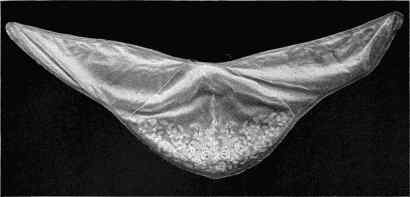
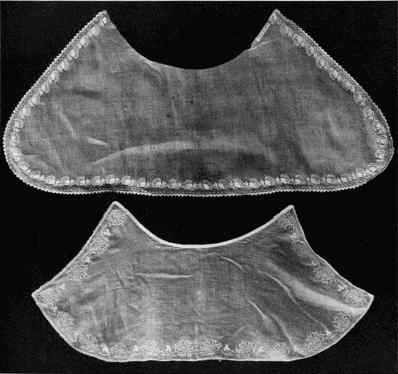
articles, like collars, capes and pelerines, were almost entirely
covered with the most exquisite tracery of leaf and flower, a perfect
frostwork of delicate stitchery, with patches of lacework introduced in
spaces of the design.
The designs were seldom, almost never, original, being nearly always
copied directly from what was called "boughten work," to distinguish it
from that which was produced at home.
Many beautiful and skillful stitches were used in this form of work.
Lace stitches, made with bodkins or "piercers," or darning needles of
sufficient size to make perforations, were skillfully rimmed and joined
together in patterns by finer stitches, and open borders, and
hemstitching, and dainty inventions of all kinds, for the embellishment
of the fabrics upon which they were wrought.
With these materials and these methods most of the women of the
different sections of the country busied themselves from a period
beginning probably about 1710 and extending to 1840, and it is safe to
say, notwithstanding the apparent simplicity of life between those
dates, that at no period in the history of woman was as much time and
consummate skill bestowed upon wearing apparel. Many a young girl of the
day embroidered her own wedding dress, and during the months or years of
its preparation suffered and enjoyed the same ambition which goes on in
the present, to the acquirement of some wonder of French composition, or
costly ornament of point lace and pearls.
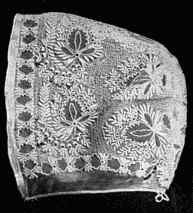
larger image
Courtesy Mrs. Isaac Pierson, Canandaigua, N. Y.
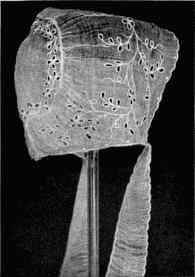
Left—BABY'S CAP White mull, with eyelet embroidery.
Nineteenth century American.
Right—BABY'S CAP Embroidered mull. 1825.
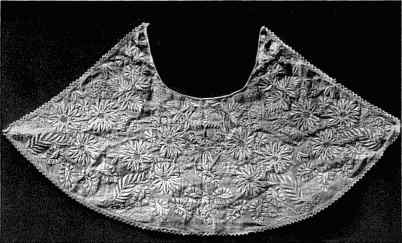
larger image
Courtesy Metropolitan Museum of Art
COLLAR of white embroidered muslin. Nineteenth century
American.
Everything was embroidered. The tender, downy head of the newly born
baby was covered with a cap of delicatest material incrusted to hardness
with needlework. The baby's caps of the period are a perfect chapter of
human emotions; mother-love, emulation, pride, and declaration of family
or personal position are skillfully expressed in a multiplicity of
decorative stitches. A six-foot length of baptismal robe carried for
half its length the same elaborate stitchery. Long delicate ruffles were
edged with double rows of scallops. Double and triple collars and
"pelerines" of muslin were to be found in the hands of all women of high
or low degree. Articles of wearing apparel were done upon a soft fine
muslin called mull, breadths of which were embroidered for skirts,
lengths of it were scalloped and embroidered for flounces, and
hand-lengths of it were done for the short waists and sleeves of the
pretty Colonial gowns worn by our delicate ancestresses. One of these
gowns, stretched to its widest, would hardly cover a front breadth of
the habit of one of our well-nurtured athletic girls of the present, and
the athletic girl can show no such handiwork as this.
Beautiful embroidery it was that was lavished upon muslin gowns, baby's
caps and long, long robes, and upon aprons, pelerines and capes. Over
stitch instead of tent stitch was the order of the day. "Tent stitch and
the use of the globes" was no longer advertised as a part of school
routine. Instead of this, there were the most delicate overstitches and
multitudinous lace-stitches which we nowhere else find, unless in the
finest of Asian embroidery.
A large part of the eighteenth and the first quarter of the nineteenth
century was a period of remarkable skill in all kinds of stitchery. It
was not confined to embroidery, but was also applied to all varieties of
domestic needlework. Hemstitched ruffles were a part of masculine as
well as feminine wear, and finely stitched and ruffled shirts for the
head of the household were quite as necessary to the family dignity as
embroidered gowns and caps for its feminine members.
It would be difficult to enumerate all the uses to which the national
perfection of needle dexterity was put. It was, indeed, a national
dexterity, for although its application was widely different in the
eastern and southern states, the two schools of needlework, as we may
term them, met and mingled to a common practice of both methods in the
middle states.
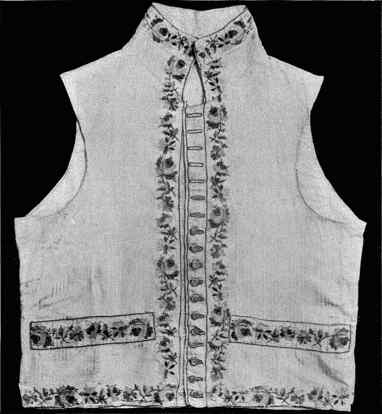
larger image
Courtesy of Bergen County Historical Society, Hackensack, N. J.
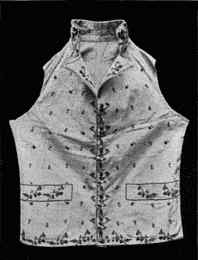
EMBROIDERED SILK WEDDING WAISTCOAT, 1829. From the
Westervelt collection.
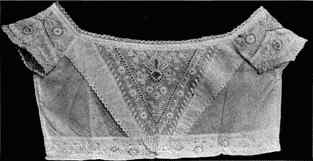
larger image
Courtesy of Bergen County Historical Society, Hackensack, N. J.
EMBROIDERED WAIST OF A BABY DRESS. 1850. From the
collection of Mrs. George Coe.
Perhaps one may account for the prevalence of this kind of work, as it
existed at a period of very limited education or literary pursuits among
women. Domestic life was woman's kingdom, and needlework was one of its
chief conditions. But whatever cause or causes stimulated the vogue of
this variety of embroidery, we find it was universal among rich and
poor, in city and country, for nearly three-quarters of a century. The
narrow roll of muslin, for scalloped flounces and ruffling, and the
skeins of French cotton went everywhere with girls and women, except to
church and to ceremonious functions where men were included. Needlework
was far more than an interest, it was an occupation.
The varieties of tambour work and open stitchery of various ornamental
kinds were possible for all capacities. It was a general form of fine
needlework, happily available to women of the farmhouse, as well as of
the mansion, and its exceeding precision and beauty gave a character to
the purely utilitarian stitchery of the day which has made a high
standard for succeeding generations. The hemstitched ruffles of shirts,
the stitched plaits of simpler ones, the buttonholed triangles at the
intersection of seams—all these practically unknown to modern
construction—were probably the result of the skillful and careful
needlework ornamentation of simple fabrics.
As an occupation, French embroidery practically displaced the making of
cabinet pictures of graceful ladies in scant satin gowns which had
occupied the embroidery frame, or decorated drawing-room walls. Flowers
ceased to blossom upon pincushions, and the engrossing and prevalent
occupation of needlework was entirely devoted to personal wear.
larger image
Courtesy of Mrs. A. S. Hewitt
EMBROIDERY ON NET. Border for the front of a cap made
about 1820.
larger image
Courtesy of Metropolitan Museum of Art, New York
VEIL (unfinished) hand run on machine-made net. American
nineteenth century.
At this period, however, ships were coming into Boston and other eastern
ports almost daily or weekly, instead of at intervals of weary months.
Ships were going to and returning from China and the Indies and the
islands of the sea, laden on their return voyages not only with spices
and liquors and sweets of the southern world, but with satins and
velvets and silks and prints, and delicately printed muslins and
cambrics; and the fair linen and cotton flosses disappeared from the
hands of needlewomen. Manufacturers had brought their looms to weave
designs into the fabrics they produced and to simulate the work of the
needle in a way which made one feel that the very spindles thought and
wrought with conscious love of beauty.
The larger demands of luxurious living increased also the necessary work
of the needle, and while the looms of France and Switzerland were busy
weaving broidered stuffs, the needles of sewing women were kept at work
fashioning the necessary garments of the millions of playing and working
human beings. It was the era which gave birth to the "Song of the
Shirt," a day of personal and exacting practice.
The disappearance of the practice of French embroidery was as sudden as
the dropping of a theater curtain, but a coexistent art called Spanish
lacework lingered long after muslin embroidery had ceased to be. It was
chiefly used in the elaboration of shawls, and large lace veils, which
were a very graceful addition to Colonial and early American costume.
There is no difficulty in tracing this kind of decorative needlework. It
came from Mexico into New Orleans, and from there, by various secrets of
locomotion, spread along the southern states.
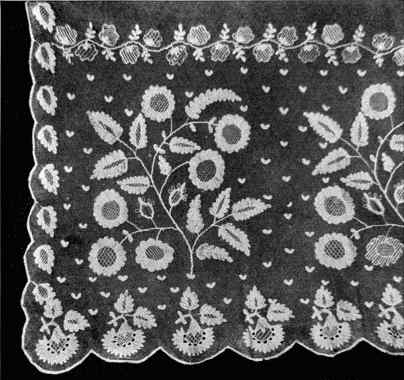
The veils were yard squares of delicate white or black lace, heavily
bordered and lightly spotted with flowers, while the shawls were
sometimes nearly double that size, and of much heavier lace, as they had
need to be, to carry the wealth of decorative darning lavished upon
them.
The design was always a foliated one, generally proceeding from a common
center, representing a basket or a knot of ribbon, which confined the
branching forms to the point of departure. The edges were heavily
scalloped, with an extension of the ornamentation which included a rose
or leaf for the filling of every scallop. The centers of flowers, and
even of leaves, were often filled with beautiful variations of lace
stitches worked into the meshes of the ground, and were very curious and
interesting.
larger image
Courtesy of Bergen County Historical Society, Hackensack, N. J.
LACE WEDDING VEIL, 36 × 40 inches, used in 1806. From the
collection of Mrs. Charles H. Lozier.
larger image
Courtesy of Bergen County Historical Society, Hackensack, N. J.
HOMESPUN LINEN NEEDLEWORK called "Benewacka" by the
Dutch. The threads were drawn and then whipped into a net on which the
design was darned with linen. Made about 1800 and used in the end of
linen pillow cases.
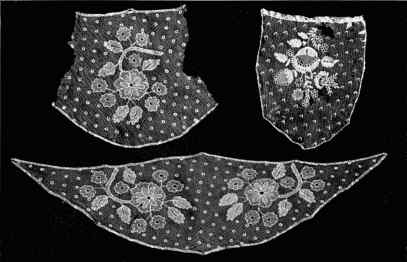
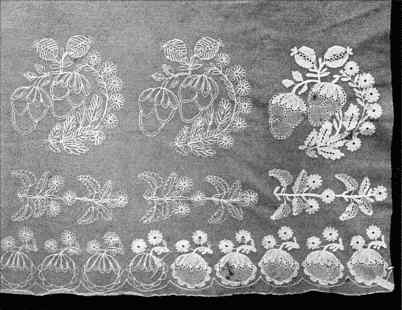
Darning with flosses upon both white and black bobbinet, or silk net,
was a very common form of the art, and veils of white with seed or
all-over designs darned in white silk floss, may be called the "personal
needlework" of the period, and some of the shawls were superb stretches
of design and stitching. This art, although so beautiful in effect,
demanded very little of the skill necessary to the preceding methods of
embroidery. The lace was simply stretched or basted over paper or white
cloth, upon which the design was heavily traced in ink; the spaces which
were to be solidly filled were sometimes covered with a shading of red
chalk, and when this was done, it was a matter of simple running over
and under the meshes of the net, in directions indicated by the shape of
the leaf or flower. The work could be heavier or lighter, according to
the design and size or weight of the flosses used. I have seen a wedding
veil worked upon a beautiful white silk net, carrying a sprinkling of
orange flowers, darned with white silk flosses, and a heavy wreath
around the border. Certainly no veil of priceless point lace could be so
etherially beautiful as was this relic of the past, and certainly no
commercial product, however costly, could carry in its transparent folds
the sentiment of such a bridal veil, wrought in love by the bride who
was to wear it.
I have seen one beautiful shawl, where the entire design was done in
shining silver-white flosses, upon a ground of black net, with the
effect of a disappearance of the background, the wreaths and groups of
flowers seeming to float around the figure of the wearer.
In one or two instances, also, I have seen shawls in varicolored flosses
producing a silvery mass of ornamentation which was most effective, but
they were experiments which evidently did not commend themselves to
North American taste.
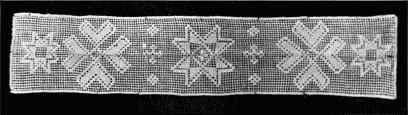
The same method of darning was used upon what was then called, "bobbinet
footing," narrow lengths of bobbinet lace which were extensively used as
ruffles for caps and trimming and garniture of capes and various
articles of personal wear.
Cap bodies were also worked in this method; in fact, the decorative
treatment of caps must have been a trying question. The dignity of the
married woman depended somewhat upon the size of the cap she wore, and
it was as necessary to convention that the crow-black locks of the
matron of twenty-five should be hidden, as that the scant locks of sixty
should be decently shrouded.
Insertings of darned footing, alternating with bands of muslin, were
largely used in the construction of gowns, and, in short, this style of
needlework, while not as universal or absorbing as French embroidery,
continued longer in vogue and perhaps amused or solaced some who had
little skill or time for the more exacting methods of embroidery.