FLY-FISHING
"Of all sports, commend me to angling; it is the wisest, virtuousest,
best."—Thomas Hood.
When I go fishing, it is for the purpose of catching fish; when I go
angling—fly-fishing—it is the soul I seek to replenish, not the
creel.
"One of the charms of angling," says Pritt, "is that it presents an
endless field for argument, speculation, and experiment."
True, but Anglers have no argument in the first feature of their
pastime—the object of it. Fishermen and men who do not go fishing or
angling argue that the object sought by the Angler is the fish, but
Anglers all agree that the game is but one of the trillion of pleasant
things that attract them to the pursuit of it.
They argue and speculate and experiment in the matter of rods and
tackle, and they argue as to the virtues of the various species, the
qualities of the waters, the conditions of the weather, but they have
ever been and ever will be calmly agreed as to the object of it
all—the love of studying rather than destroying the game, the love of
the pursuit itself.
They angle because of its healthfulness, and the consequent
exhilaration of mind and body that attends the gentle practice, not
merely for the fishes it may procure them, or for the sake of killing
something, as the unenlightened person charges, for the death of an
animal, to the Angler, is the saddest incident of his day.
All things animate, man included, were made to kill and to be killed.
The only crimes in killing are in killing our own kind, and in killing
any kind inhumanly.
And, of all creatures, the Angler is the least offender in these
crimes. The very game he seeks, though beautiful and gentle to the
eye, and, at times, noble in deed and purpose, is the most brutal
killer of all the races—the lovely trout in its attacks upon gaudy
flies, the valiant bass and pike in devouring their smaller brethren,
and the multitudinous sea-fishes, not alone in their feeding upon one
another, but in their wanton murder of the millions upon millions of
victims of their pure love of slaughter.
But, of fly-fishing for brook trout:
"Fly-fishing," says Dr. Henshall, "is the poetry of angling"; and "the
genuine Angler," says Frederick Pond, "is invariably a poet."
Fly-fishing, the highest order of angling, is indulged in in several
forms—in fresh water for salmon, trout, black bass, grayling, perch,
pike-perch, pickerel (Long Island brook pickerel), sunfish, roach,
dace, shad, herring (branch), etc.; in brackish water for shad, trout,
white perch, etc.; and in salt water for bluefish (young), herring
(common), mackerel, and—doubt not, kind sir, for I am prepared to
prove it—squeteague (weakfish), plaice (fluke, summer flounder), and
other species of both bottom and surface habitats—another "endless
field for argument, speculation, and experiment."
As there are many forms of fly-fishing, so are there many ways of
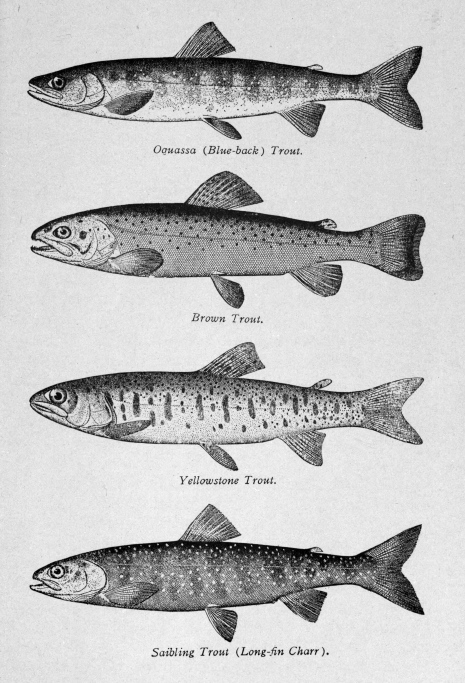
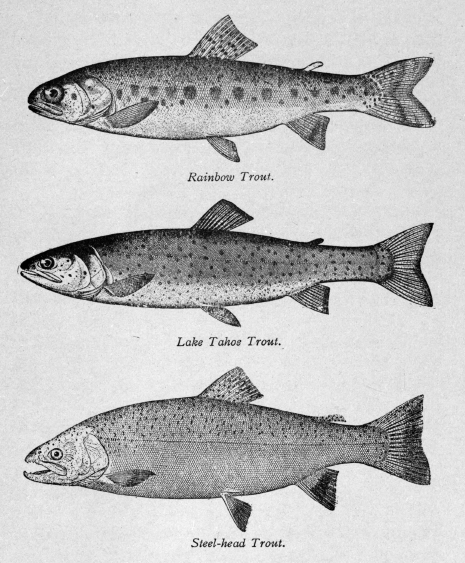
fly-fishing for trout, and many kinds of trout, the various forms of
brook trout, lake trout, and sea trout.
Volumes would be required to discourse intelligently upon all these
forms of trout and fly-fishing for them; so I purpose in this
particular instance to confine myself to one species and one form of
trout and one order of fly-fishing.
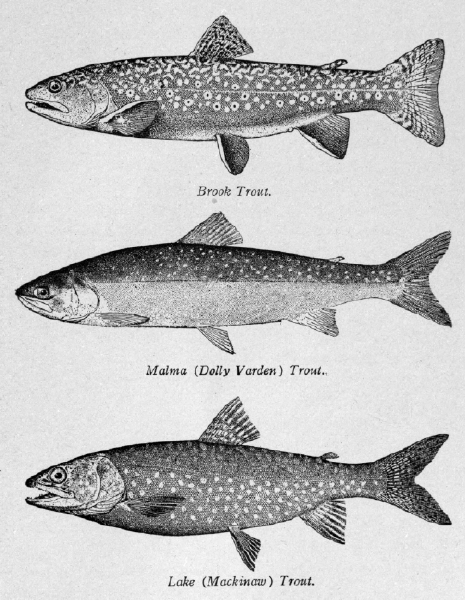
The trout referred to is the true brook trout, scientifically alluded
to as Salvelinus fontinalis and commonly called, besides brook trout
(its most popular name), speckled trout, mountain trout, speckled
beauty, spotted trout, etc.
The fly-fishing treated of is that popular form that is most indulged
in by the Eastern trout fly-fisherman—small-stream fishing in the
mountains and wooded level lands that "carries us," as Davy wrote as
far away as 1828, "into the most wild and beautiful scenery of nature
to the clear and lovely streams that gush from the high ranges of
elevated hills."
Above all other styles of fly-fishing, it calls for the most delicate
tackle and the very daintiest hand.
"How delightful," says the author of Salmonia, "in the early spring,
after the dull and tedious time of winter, when the frosts disappear
and the sunshine warms the earth and waters, to wander forth by some
clear stream, to see the leaf bursting from the purple bud, to scent
the odors of the bank perfumed by the violet, and enameled, as it
were, with the primrose and the daisy; to wander upon the fresh turf
below the shade of trees, whose bright blossoms are filled with the
music of the bee; and on the surface of the waters to view the gaudy
flies sparkling like animated gems in the sunbeams, whilst the bright
and beautiful trout is watching them from below; to hear the
twittering of the water-birds, who, alarmed at your approach, rapidly
hide themselves beneath the flowers and leaves of the water-lily; and,
as the season advances, to find all these objects changed for others
of the same kind, but better and brighter, till the swallow and the
trout contend as it were for the May fly, and till in pursuing your
amusement in the calm and balmy evening you are serenaded by the songs
of the cheerful thrush, performing the offices of paternal love in
thickets ornamented with the rose and woodbine."
The other forms of fly-fishing for trout, the pursuit of larger
specimens of the same species in larger waters, the lakes and ponds
and rivers—all equally inviting by their gentle requirements and the
"beautiful scenery of nature"—deserve special treatment, because, as
in fly-fishing for salmon (salmo salar), the very top notch of all
forms of angling, the play, the player, the scenes, and the
accessories are sufficiently different to confound the reader I am
mainly endeavoring to amuse with these particular lines.
Small stream fly-fishing for brook trout belongs in a class just
between fly-fishing for the brook trout of broader waters, the lakes
and ponds, and fly-fishing for salmon in the lordly rivers of Maine
and Canada.
The brook trout is angled for in the spring and summer, principally
with the artificial fly, and by the chivalric Angler only with the
artificial fly, though many greedy fishermen of trifling experience
and wholly deprived of the true spirit of angling—in that they fish
for the fish alone and judge their day and play solely by the size of
their catch—contrive to convince us that the live lure is equally
honorable, notwithstanding that the cruel, clumsy, uncleanly, unfair,
wasteful practice of live-bait trout fishing is condemned by every
truly gentle disciple and practical authority.
Most advocates of live-bait trout fishing, who would have us believe
that their method is entitled to recognition in the same category with
fly-fishing, proudly proclaim that this should be because they "can
catch more fish with the worm or minnow than the Angler can catch with
his fly."
If this reasoning is to settle the debate, if killing and quantity
compose the Angler's axiom, why not resort to still more productive
means—dynamite, or net the stream instead of gently fishing it?
No, the trout fly-fisherman abhors trout bait-fishing for the same
reason the wing shot prefers his appropriate arm to a cannon; the
yachtsman, his gentle craft to a man-o'-war; the horseman, his trained
mount to a locomotive; the archer, his arrow instead of a harpoon; and
so I might go on in similes that would burlesque every form of
recreative amusement in the world.
The brook trout breeds in the autumn, favors eddies, riffles, pools,
and deep spots under the banks of the stream, and near rocks and
fallen trees, and feeds on flies, small fish, worms, and other small
life forms.
Its shape, weight, size, and color are influenced by its food, its
age, its activity, its habitat, and its habits. Its color corresponds
to the color of the water bottom and will change as the water bottom
changes. If removed to a new water, where the bottom color is
different from the bottom color of its first abode—lighter or darker,
as the case may be,—it will gradually grow to a corresponding shade,
blending with its new habitat just as its colors suited the stones
and grasses and earthy materials of its native domain.
In weight, the brook trout ranges up to ten pounds in large waters.
There is a record of one weighing eleven pounds. This specimen was
taken in Northwestern Maine. The species averages threequarters of a
pound to one pound and a half in the streams, and one pound to three
pounds in the lakes and ponds. It occurs between latitude 32-1/2° and
55°, in the lakes and streams of the Atlantic watershed, near the
sources of a few rivers flowing into the Mississippi and the Gulf of
Mexico, and some of the southern affluents of Hudson Bay, its range
being limited by the western foothills of the Alleghanies, extending
about three hundred miles from the coast, except about the Great
Lakes, in the northern tributaries of which it abounds. It also
inhabits the headwaters of the Chattahoochee, in the southern spurs of
the Georgia Alleghanies, and tributaries of the Catawba in North
Carolina and clear waters of the great islands of the Gulf of St.
Lawrence—Anticosti, Cape Breton, Prince Edward, and Newfoundland; and
abounds in New York, Michigan, Connecticut, Pennsylvania, Maine. Long
Island, Canada, Wisconsin, New Hampshire, and Massachusetts.
My favorite rod for stream trout fishing is a cork-handled,
all-lancewood rod of three or four ounces in weight and eight feet in
length, or a rod of similar length weighing four or five ounces and
made of split bamboo—the best split bamboo of the best workmanship.
The cheap, so-called split bamboo of the dry-goods store bargain (?)
counter, retailed for a price that would not pay for the mere wrapping
of the correct article, is a flimsy, decorative thing, and would
collapse, or, worse still, bend one way and stay that way, if used on
the stream. The fly-rod material must be springy and resiliently so,
and the rod must be constructed so as to permit of this condition.
The reel I favor is a small, narrow, light, all-rubber or narrow
aluminum common-click reel, holding twenty-five yards of the
thinnest-calibered silk, waterproof-enameled line.
My leader is a brown-stained one of silk gut, twelve feet in length.
The leader should be fresh and firm, flexible and fine, not a
dried-up, brittle, unyielding, snappy snarl of the salesman's
discarded sample box that breaks at the mere touch, or releases the
flies at the first cast or parts at the first strike—if by some
miraculous mischance you get this far with it. The leaders, a
half-dozen of them, should be carried, when not in actual use, in a
flat, aluminum, pocket-fitting box between two dampened flannel mats
(though not preserved this way in close season), so as to have them
thoroughly limp from being water soaked, that you may more readily and
more safely adjust them, for break they surely will if handled in a
dry state.
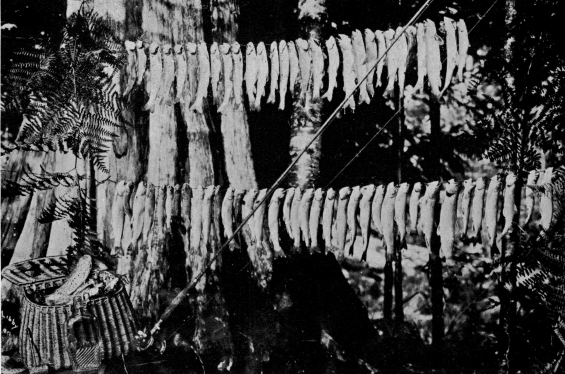
The willow creel, in which the spoil of the day is deposited, should
be, I think, about the size of a small hand-satchel. To this is
fastened a leather strap, with a broad, shoulder-protecting band of
stout canvas. This I sling over the right shoulder, allowing the creel
to hang above the back part of the left hip where it will least
interfere with me during the fight with fontinalis.
The landing net I use is a little one of egg shape, made of cane with
no metal whatsoever, and it has a linen mesh about ten inches in width
and eighteen inches in length. The handle is a trifle over one foot
in length. To this I tie one end of a stout but light-weight flexible
and small-calibered cord, or a stretch of small rubber tube, and the
other end of this I tie to a button on my coat under my chin, throwing
the net over my left shoulder to lie on my back until called into
service.
The clothing should be of dark-gray wool of light weight. I wear a
lightly woven gray sweater under my coat when the weather is cool.
I have plenty of pockets in my trouting coat, and I make it a practice
to tie a string to nearly everything I carry in them—shears,
hook-file, knife, match-box, tobacco-pouch, pipe, purse,
field-glasses, fly-book, etc.—so that I will not mislay them
ordinarily, or drop them in the rushing current during some exciting
moment.
The headgear I like is a gray, soft felt hat of medium brim to protect
my eyes in the sun and to sit upon in the shade.
The footwear may consist of waterproof ankle shoes attached to rubber
or canvas trousers, or of a pair of light, close-fitting hip rubber
boots. Some Anglers wear rubber waterproof combined trousers and
stockings and any sort of well-soled shoes. In warm weather, I affect
nothing beyond a pair of old shoes with holes cut in both sides to let
the water run freely in and out, the holes not big enough to admit
sand and pebbles.
The artificial flies are of many hundreds of patterns. I have a
thousand or two, but half a hundred, of sizes four to six for the
lakes and ponds, and six to fourteen for the small streams, are enough
to select from during a season; two dozen are sufficient for a single
trip, half a dozen will do to carry to the stream for a day,—if you
don't lose many by whipping them off or getting them caught in a
tree,—and two are all I use for the cast, though a cast of three
flies is the favorite of many fishermen. I amuse myself by presuming
to have a special list for each month, week, day, and hour, but the
extravagantly erratic notions of the trout forbid my recommending it
to brother rodmen. Trout that show a preference for certain flies one
day may the next day favor entirely different patterns. Sometimes they
will take an imitation of the natural fly upon the water and at other
times, being gorged with the natural insect, will only strike at some
oddly colored concoction of no resemblance to any living thing in
nature; this in play, or in anger, and at other times out of pure
curiosity. An Angler doesn't need a great number of flies—if he knows
just what fly the game is taking. You can't very well determine this
half a hundred miles from the fishing; so you take a variety with you
and experiment. The flies should be of the best make and freshest
quality, tied by a practical hand—some honest maker who is himself an
Angler—not the cheap, dried-up, wall-decorative, bastard butterflies
of the ladies' dry-goods shop, that hybrid mess of gaudy waste
ribbon-silk and barnyard feather, the swindling output of the
catch-penny shopman whose sweat help do not know—upon my word—the
name or the purpose of the thing they make.
Any six of the following list will kill well enough for a single day's
pleasant fishing in any water at any time during the legal season:
Dark Coachman, Gray and Green Palmer, Ginger Palmer, Alder, Scarlet
Ibis, Abbey, Imbrie, Professor, Conroy, Reuben Wood, March Brown,
Orvis, White Miller, Coachman. Royal Coachman, Codun, Brown and Red
Palmer, Brown Hen, Queen of the Water, King of the Water. Squires,
Black Gnat, Grizzly King, Quaker.
I use, as a rule, dark colors in clear water, and on bright days and
early in the season; lighter shades in dull water and on dark days, in
the evening, and as the season grows warmer; but many Anglers
philosophize just the reverse—use light colors for early season
fishing and somber hues for midsummer play—hence the endless
arguments and experiments described as one of the charms of the craft.
I prefer, as I have said, two flies on the leader, and my favorite of
favorites for all times and all places is a cast made up of gnat-size
pattern of dark-gray wing and pale-blue body, and another of a
peculiar drab-cream shade.
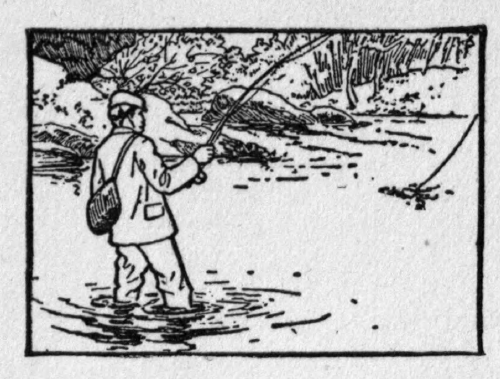
In throwing or casting the fly I never "whip" or "flail" the rod, and
I never cast with a long line when a short one will answer the
purpose. Distance alone may count in a fly-casting contest, but in the
wild stream a careful short cast is more effective than a clumsy long
one.
I angle with my shadow behind me, and in casting the flies endeavor to
allow only the flies to touch the water. The line frightens the game,
and if a trout should take a fly on a loose, wavy line, he will not
hook himself and he will blow the fly from his mouth before the Angler
is able to hook him.
In learning to cast the fly, the young Angler should start with the
leader alone, as I believe all fly-fishing is begun by old and young,
and as he lifts the flies from the water after the forward cast to
make the backward motion he should simultaneously draw from the reel a
half-yard of line and allow time for the flies to complete the whole
circuit back of him. In fly-fishing the cast is not made from the
reel as in bait-casting; the line is drawn from the reel a half-yard
at a time with the left hand. The line must fully straighten itself
behind the Angler ere it can be sent out straight before him. The
flies and at most only a little part of the leader should fall lightly
upon the surface—as we imagine two insects, entangled in a delicate
cobweb, might fall from a tree branch—and be drawn smartly but gently
in little jerks a second or two in imitation of two tiny live-winged
bugs fluttering in the water; and then, as the Angler steps slowly,
firmly, but silently and softly in the current downstream, he should
repeat the lifting of the flies, the drawing off of more line from the
reel, and the circling backward cast that takes up the slack and gives
the line its forward force. Thus he should continue, deftly placing
the lure in every likely spot ahead of him in the center of the brook
and along its moss-lined, flower-decked, rock-bound or grass-fringed
banks.
The Angler is careful not to let the trout see him, see his shadow, or
see the rod, and not to let this wisest, most watchful species of all
the finny tribes hear him or feel the vibration of his body.
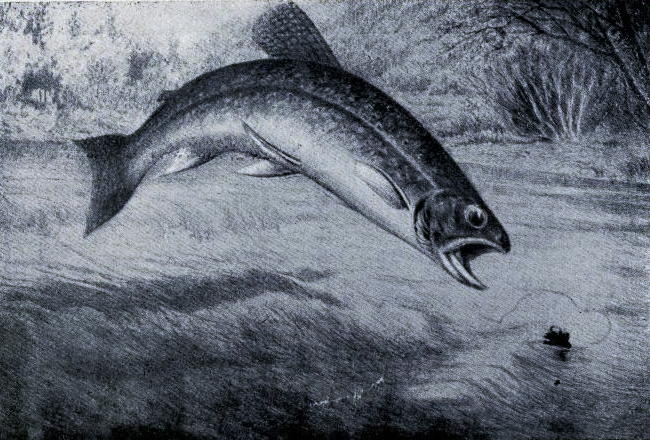
In hooking the trout the Angler strikes the second the fish
strikes—not by a violent arm movement, but by a mere instantaneous
nervous backward twist of the wrist, as one would instinctively draw
up his hand from the pierce of a needle point. Many trout are hooked
the instant the leader is lifted for a new cast, and many hook
themselves without the slightest effort on the part of the Angler.
When the fish is hooked he should not be flaunted in the air, as the
boy fisher yanks his pond perch. The prize should be handled as if he
were but slightly secured, his head should be kept under water, the
line kept gently taut, and the fish softly led out of noisy water and
away from stones, long grass, submerged tree branches or logs.
If the catch is heavy enough to draw the line from the reel it is
allowed to do so, but the line should be kept taut and reeled in the
second he hesitates. There need be no hurry.
After a little while the game's rushes will cease; then it should be
reeled in, care being taken not to arouse it again by the contact of a
weed or stone.
The tip of the rod is now raised over the head and back of the Angler
until the butt points downward; then, if the fish has been reeled in
near enough, it is secured in the landing net, tail first, and
carefully slid into the creel through the little square opening for
this purpose in the lid.
If you, reader mine, should some day get as far as this glorious part
of the play, and the fish should be a small one, be satisfied; the
true Angler is ever of a contented heart; if the fish should be too
small, set it free—the true Angler is always humane and generous; if
it should prove fit to feed upon, do not subject it to unnecessary
suffering—skillfully kill it outright at once; the true Angler is
manly and merciful.
And, and—good luck to you, brother.