Through the works of Schiaparelli, Flammarion,
and Lowell the vivid interest of the
general public has been directed toward our
neighbour planet Mars. Several investigators,
Flammarion and Lowell among them,
assert with full confidence that Mars has
intelligent inhabitants, who have built and
maintain the curious “canals,” which, it is
stated, could not have been created except
by intelligent beings far superior to man.
Air, water, and sunshine exist there, says
Flammarion in his well-known great work, La
Planète Mars (1902, page 515). “It appears
incongruous to us to condemn a world like
Mars, where all the conditions for life exist,
to such a fate” (to be a dry desert). No
doubt sentiment and the desired result play
a part in all such deductions, as indeed
the words chosen by Flammarion would
indicate.
As contrasted to the Earth, Mars is, on the
other hand, considerably further removed
from the Sun, whose radiation therefore on
Mars possesses only 43 per cent. of its intensity
on Earth. Judging by this fact, the mean
temperature of Mars should fall far below
that of the Earth and considerably below the
freezing point of water and under such conditions
it is hard to imagine a vegetation near
the poles of Mars as Lowell does in his volume,
Mars as the Abode of Life (1909), or even in
the neighbourhood of the canals anywhere
on the surface of the planet as assumed by
Flammarion.
With such ideas in vogue we can well understand
that the astronomers would point
their lately extremely sharpened instruments
toward our ruby-coloured neighbour in the
sky when, in 1909, it passed very close to the
earth under conditions particularly favourable
to accurate observations, more so in fact
than they had been during the seventeen
preceding years.
Numerous astro-physicists, among them
the world’s foremost representatives of their
discipline, have repeatedly turned their
spectroscopes toward Mars in order to ascertain
whether water vapour was present there
or not. In the spectrum of the Sun we find
several so-called “rain-bands” due to the
fact that the light before it reaches the apparatus
has passed through the moisture of
the air. The more humid the air the more
strongly developed these rain-bands are.
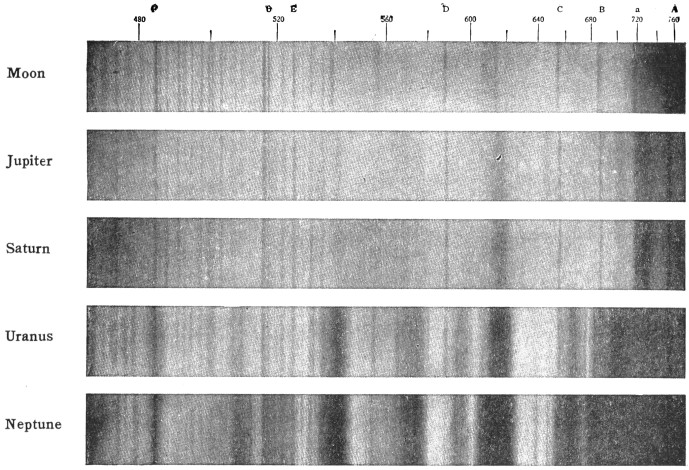
If we direct the instrument first on the Moon,
which lacks an atmosphere and therefore also
moisture, and then on Mars, which for the
sake of simplicity we assume standing close
to the Moon-disk, a difference should appear
in the spectra of these two bodies, provided
moisture is present in the atmosphere of Mars.
The rain-bands ought to be more pronounced
in sunlight that has passed the atmosphere of
Mars (passed it twice as the light is reflected
by the surface of the planet) than in light
reflected from the naked Moon. The bands
appear of course in both spectra as the light
on its final stage to the spectroscope passes
the atmosphere of the Earth, which never is
free from moisture. In this manner Huggins
and Janssen, scientists of world-wide fame,
believed that they had demonstrated the
presence of water vapour on Mars. Campbell,
on the other hand, the prominent
director of the Lick Observatory, made similar
investigations of the planet in 1894, and so
did a French astronomer, Marchand, in 1896
and 1898, both under unusually favourable
circumstances as the former installed his
instrument 1283 m. (5200 ft.) and the latter
2860 m. (9370 ft.) above sea level, but neither
found any indication of moisture in the atmosphere
of Mars.
It is evident that the observations would be
far more accurate if we could eliminate the
moisture from the atmosphere of the Earth,
in which case no rain-bands would appear in
the spectrum of the Moon. It would then be
unnecessary to compare the two spectra; we
would only have to determine whether rain-bands
were present in the spectrum of Mars
or not. We can never entirely avoid the
water vapour of the air, but its influence may
be greatly reduced by making our observations
from high mountains or in desert climates
where the air is comparatively dry,
that is free from water vapour. Investigations
undertaken where the air is dry deserve
therefore more confidence than those handicapped
by greater humidity. The observations
by Campbell and Marchand fall in the
former category, and it would, therefore, appear
that the presence of water vapour on
Mars to any extent worth mentioning is
highly doubtful.
In later trials, Campbell and Keeler have
employed an improved method, using photographs
of the spectra on sensitive plates, but
neither has succeeded in discovering any
water vapour in the atmosphere of Mars.
Obviously photography offers a great advantage
over direct ocular observation. The
two pictures may be placed side by side and
very accurate measurements may be made at
leisure. We may also choose the moments
for exposure when the two stellar bodies
stand equally high over the horizon so that
the sunlight reflected from them traverses
equal distances in the humid atmosphere of
the earth.
It now devolved upon Lowell to test his
theories by means of the magnificent resources
at his disposal in Flagstaff observatory
in the desert of Arizona 2200 m. (7200 ft.)
above sea level. In the months of January
and February the dew-point there is about
-7° C. (+19.4° F.) i. e., each cubic meter
(1.3 cu. yds.) of air contains 2.8 grammes
(43.25 grains) of water vapour while saturated
air at zero temperature (32° F.) holds
nearly twice this amount or 4.8 grammes
(74 grains) per cubic meter (1.3 cu. yds.).
Slipher, working in this observatory, pushed
the sensitiveness of his plates to the utmost
then obtainable, and photographed the spectrum
of Mars in January and February, 1908.
He found that the most important rain-band
always was more prominent in the spectrum
of Mars than in the spectrum of the Moon
photographed later during the same night.
Peculiarly enough, it was only the rain-band
designated “A,” and located in the red spectral
field, that was of a marked difference in
the two spectra. Other bands gave no indication
of the presence of water vapour on
Mars. This result did not directly contradict
the conclusions reached by Campbell and
Keeler, also by means of photography; they
had investigated other bands than “A.”
The “A”-line might therefore possibly be
more sensitive to water vapour than the
others.
Slipher’s discovery was considered so valuable
that it must be employed to the limit.
The well-known physicist Very was therefore
called in consultation; he made careful measurements
of the intensity of the “A”-lines
on the various plates and calculated that the
atmosphere of Mars contained 1.75 times as
much water vapour as that of the Earth at
the point of observation. If we desire to
determine the proportion of water vapour in
the air at the surface of Mars from this
statement we may figure in the following
manner. The amount of water vapour in a
vertical column of air one square meter
(1.2 sq. yds.) in section is, according to Hann,
2500 times the amount in a cubic meter
(1.3 cu. yds.) at the surface of the earth. At
the time of the observation, the latter amount
was 2.29 grammes (35.4 grains); on each
square meter (1.2 sq. yds.) of the ground
rested therefore 5725 grammes (12 lbs. 11 oz.)
of water vapour. That the quantity of water
is not larger, although the depth of the atmosphere
far exceeds 2500 m. (1.5 miles),
is due to the fact that the temperature rapidly
decreases with distance from the ground.
On Mars, the temperature ought not to fall
so quickly with change in height because the
intensity of gravity there is 2.68 times smaller
than on the Earth. The temperature drops
there 2.68 times slower with ascent in the atmosphere,
and a column of air on Mars one
square meter (1.2 sq. yds.) in section should
therefore contain 6680 times as much water
vapour as a cubic meter (1.3 cu. yds.) at its
surface. As Mars did not stand in zenith,
the distance traversed by the light-ray in the
atmosphere was greater—in fact 1.43 times
greater than if such had been the case. A
column of air in the direction of the light-ray,
one square meter (1.2 sq. yds.) in section
contained therefore 8175 grammes (18 lbs.
3 oz.) water vapour. In the atmosphere of
Mars which the light passed in a vertical
direction there was, if we are to believe Very,
1.75 times as much, or 14,300 grammes (31 lbs.
8 oz.) and in a cubic meter (1.3 cu. yds.) at
the surface of the planet, consequently 6680
times less, or 2.14 grammes (33.1 grains).
The corresponding dew-point is then, according
to this determination, -10.3° C. (+13.5°
F.). It is agreed upon that a desert climate
prevails on Mars. It might at the time of
the observation conform to the extremely dry
climate at Salt Lake City in the height of
summer when the humidity there is only 31
per cent. of saturation. Under such conditions
saturated air at noon in the equatorial
belt on Mars should contain 7 grammes
(108 grains) per cubic meter (1.3 cu. yds.)
corresponding to a temperature of 5.3° C.
(41.5° F.).
It must be admitted that this was not very
encouraging to Lowell. If the temperature
in the middle of the day, when the sunlight
falls perpendicularly on the surface of the
planet, rises only to about 5° C. (41° F.), the
mean temperature for twenty-four hours,
even in the midst of the summer, must in
this entirely clear, light air be far below
freezing and vegetation on Mars is therefore
not very well conceivable. In spite of
this, Lowell saw in Slipher’s measurements a
confirmation of his theory that Mars is the
abode of an intelligent race that utilizes, in
their wrestle with existence, a verdant vegetation
pushed even into the polar regions.
Campbell, however, went one step further
than Slipher. In August and September,
1909, Mars occupied a position in the sky
particularly favourable to observations.
Campbell decided to benefit thereby. With
the support of a rich patron of science, a Mr.
Crocker, who on several occasions has made
magnificent contributions toward astronomical
research, Campbell equipped an expedition
to Mount Whitney in California,
4425 m. (14,502 ft.) high and the loftiest peak
in the United States. He was accompanied
by an able scientific staff, the most prominent
of which were Dr. Abbot, head of the observatory
belonging to the Smithsonian Institution,
and a well-known German astronomer,
Albrecht. The members of the expedition
were affected by mountain sickness and
suffered many severe hardships when the
wind was high, reaching about 25 m. per sec.
(56 miles per hour), and at the same time cold,
falling below zero (freezing) during the night.
The barometric pressure was only 447 mm.
(17.6 inches). During the nights, when the
observations were made, the water content of
the air fell to between 0.5 and 0.9 grammes
(7.7 grains to 13.9 grains) per cubic meter
(1.3 cu. yd.) or 2.5 to 4 times less than Slipher
had to contend with. The spectra of the
Moon and of Mars were photographed in
close succession, two exposures being made in
each case. The band “A” was plainly visible
on several plates. No indication of greater
prominence of this band in the spectrum of
Mars could be found. Other rain-bands were
also investigated with the same result.
Neither were the characteristic bands of
oxygen stronger in the spectrum of Mars,
than in that of the Moon. Slipher believed
that he had discerned a difference, although
of a hair’s breadth, which would indicate
the presence of oxygen in the atmosphere of
Mars. The conclusion itself is not improbable,
but the amount of oxygen there is in
any case considerably smaller than in the
Earth’s atmosphere.
Several statements by Campbell, as well
as Slipher’s observations, indicate that a
difference ought to have appeared between
the spectrum of Mars and that of the Moon
if the water content in Mars’ atmosphere
had been the same as in the Earth’s at the
time of the observation. This content, as
stated before, was about 3 times smaller on
Mount Whitney than at Flagstaff. At the
latter place, the measurements gave 1.75 as
the ratio of water vapour on Mars to that on
the Earth. The amount of water vapour
with the Sun in zenith on Mars should therefore,
according to Campbell’s observations,
only reach 0.4 gramme (6.1 grains) per cubic
meter (1.3 cu. yds.) corresponding to a dew-point
of -28° C. (-18.4° F.) or to an actual
temperature of -17° C. (+1.4° F.) allowing
also for a desert climate with only 31 per cent.
saturation. This temperature is probably
higher than the mean for a summer day as
the observations were made at noon on Mars.
It must now be evident that we should consider
Mars as unfit to harbour living beings.
There is possibly a slight amount of oxygen
in the thin air but the extremely low temperature
and the scant supply of water vapour
form insurmountable obstacles to the subsistence
of even the simplest forms of life in
the equatorial regions on Mars. The temperature
difference between day and night
must be enormous on account of the desert
climate. Even if life could develop during
the day, which has nearly the same duration
as with us—Lowell fixed it at 24 hours, 37
minutes, 22.6 seconds—and during which the
temperature possibly might rise above the
freezing point, it would nevertheless be destroyed
without mercy by the bitter frost at
night.
Campbell has offered an explanation of the
indications of water vapour on Mars, apparent
on Slipher’s photographs. An analysis
of the latter’s observations shows that the
Moon was photographed about four hours
later in the night than was Mars. On all
occasions except one, clouds appeared in the
sky. This indicates the presence of moisture
in the air, so that the humidity should change
with the temperature which latter rapidly
falls in the course of the night. Campbell,
himself, found during the clear nights, when
he made his observations, that the humidity
in the hours of the night up to midnight falls
to a fraction—a half or a third—of its original
value an hour or so after sunset. This rapid
temperature drop is probably confined to the
strata immediately above the observation
point but the moisture is strongly concentrated
downward so that this change in
humidity undoubtedly should have been
taken into account. Or better, observations
should be avoided in the beginning of the
night and the Moon and Mars photographed
as soon after each other as possible, precautions
taken by Campbell but not by Slipher.
That the latter found less traces of water on
the lunar photos than on the martian ones is,
therefore, probably due to the fact that the
former were taken about midnight but the
latter not long after sunset, when the atmosphere
contained much more water vapour.
Thus, we learn how a small slip, more obvious
to the meteorologist than to the astronomer,
may spoil a labour otherwise done with extraordinary
care.
To Campbell’s critique Very answered by
the suggestion that the meteorological conditions
during the Mount Whitney observations
should have been exceptionally unfavourable.
The entire south-west of the
United States and the north of Mexico were
visited at that time by cloudy weather and
heavy downpours. Very contends that this
humidity should partly have extended to
the high strata above Mount Whitney and
therefore rendered the calculation of the
moisture content of the air entirely unreliable.
Simultaneously (August, 1910) new measurements
were published of Slipher’s photo-plates
from February, 1908, which Very had
examined. The result was now that the rain-band
“A” was 2.5 times more pronounced
in the spectrum of Mars than in that of the
Moon. Furthermore, the oxygen absorption-band
“B” was 1.5 times stronger for
Mars than for the Moon. Great quantities
of water vapour and oxygen should, therefore,
undoubtedly exist in the atmosphere of Mars.
In the meantime Campbell had not been
idle. The difficulty with the older measurements
consisted in the fact that the absorption
line of water vapour in the atmosphere
of Mars occupies the identical place of the
line due to vapour in the Earth’s atmosphere.
There exists, however, a method, as already
pointed out by Campbell in 1896, of separating
the two, which method is available when
Mars either approaches or departs from the
Earth with sufficient velocity. The latter
could be determined both from the known motions
of the two planets and from the displacement
of certain spectral lines of the Sun. These
two determinations were in almost perfect
agreement; for instance January 26–27, 1910,
astronomical calculations gave a relative
velocity of 19.1 km. (11.86 miles) per second
and spectroscopical measurements 19.2 km.
(11.93 miles) per second, while on February
3–4 the relative velocity was 18.1 km.
(11.24 miles) a difference of 1 km. (.62 miles)
per second. This trial shows the accuracy
of the method. Among the absorption lines
of water vapour and of oxygen there was,
however, none due to the atmosphere of Mars.
Campbell assumes that such lines would certainly
have been visible if they had been
only one-fifth as strong as the so-called tellurian
lines. The advantage of this method is
evidently that the “martian” and the “tellurian”
lines lie close beside each other on
the same plate so that differences in sensitiveness,
exposure, and atmospheric conditions
are entirely eliminated.
From these and the following data we may
calculate water content and temperature of
the atmosphere on Mars anew: water vapour
at the point of observation was 1.9 grammes
(29.3 grains) per cubic meter (1.3 cu. yds.),
zenith-distance of Mars 55° and incident as
well as reflected sun-rays formed an angle of
70° with the surface of Mars; hence, the
amount of moisture at the surface was only
0.12 gramme (1.85 grains) per cubic meter (1.3
cu. yds.), corresponding to -38° C. (-36.4°
F.) for saturated air and to -27° C. (-16.6°
F.) for air of 31 per cent. saturation. Oxygen
content per cubic meter (1.3 cu. yds.) at the
surface of Mars would be only a sixteenth
part of corresponding numerical value on the
Earth. This determination is more accurate
than any of the previous ones and reduces
the temperature another 10° C. (18° F.) below
the lowest value derived earlier in this
chapter. We should remember, however,
that, during the trial of September, 1909, the
sun stood practically in zenith on Mars,
while in January and February, 1910, we are
concerned with a point where sunrise had
occurred about four and a half hours previously.
The latter observation should give
a value close to, but slightly above, the mean
diurnal temperature on Mars.
No determination comparable in precision
with this one by Campbell appears to have
been made. We must therefore recognize
it as conclusive.
We may easily calculate the surface temperature
of a planet from the intensity of the
solar radiation received, or insolation, provided
the surrounding vapour shell contains
no heat retarding gas. The most important
gases of this kind are water vapour, which,
as we just have seen, is very sparse in the
atmosphere of Mars, and carbon dioxide, of
which there probably also, for reasons stated
below, is only a scant supply in the martian
gas shell. Such calculations were first performed
by Christiansen of Copenhagen, who
assumed 2.5 calories as the solar constant on
Earth, i. e., the amount of energy received
through insolation per minute by each square
centimeter (.15 sq. in.) of the Earth’s surface
when at right angle to the radiation and on
mean distance from the Sun. On Mars, the
radiating energy received under similar conditions
is only about 1.1 calories. The surface
of the planet is heated until it radiates
as much energy into space as it receives from
the Sun. In this way we obtain an average
temperature of -37° C. (-34.6° F.) for the
entire surface of Mars. The regions, exposed
to the Sun in zenith at noon, might, if heat
were not conveyed therefrom, possibly reach
a daily mean temperature of +8° C. (46.4° F.)
and perhaps slightly more at noon. Probably
not even the freezing point is reached,
as the heat is rapidly carried away by the
freely circulating air. The above-mentioned
mean temperature of -37° C. (-34.6° F.)
seems on the whole to agree well with the observations
by Campbell on Mount Whitney.
Recent accurate determinations of the
intensity of the solar radiation by Abbot,
K. Ångström and others, indicate that it has
been estimated about 20 per cent. too high.
If we take the solar constant to an even 2.0
calories, which is a trifle high, we reach the
conclusion that the mean temperature on
Mars would fall about 50 degrees below
freezing. Equatorial regions might then
reach an average of -8° C. (+17.6° F.) and
at noon the temperature might possibly rise
slightly above zero (32° F.). A higher temperature
yet might be attained at the pole
where the Sun during the summer remains for
months above the horizon or a high mark of
+8° C. (46.4° F.) provided no heat were
carried away by air currents. Such losses
naturally must occur, and the temperature
probably hovers around freezing. At the
martian poles we might possibly imagine the
existence of some low forms of vegetation
(snow-algæ, etc.) during the height of the
short summer.
When we hitherto on the authority of
Lowell, Very, and others, have assumed an
average temperature of +10° C. (50° F.)
on Mars, we have done so on the supposition
that the atmosphere of the planet contained
great quantities of heat-conserving gases.
This assumption appears to be no more
tenable than the belief in the high temperature
on Mars. After all, the temperature
is probably about 10° C. (18° F.) higher than
our last calculation would indicate—or about
-40° C. (-40° F.)—because the air on Mars
is very clear and admits, therefore, all sun-rays,
retaining also a fraction by virtue of
what little water vapour, carbon dioxide,
and other heat-conserving gases there may be
present in the atmosphere. The mean summer
temperature at the martian equator
(-27° C. or -16.6° F. acc. to Campbell’s
data) would then lie about 13° C. (23.4° F.)
above the mean for the planet. This agrees
closely with conditions on the Earth where the
highest mean in July at the equator is 27° C.
(80.6° F.) and the mean for the earth 16° C.
(60.8° F.).
We are consequently obliged to revise in
their entirety our ideas about Mars. The
belief that organic life (green vegetation)
causes the colour of the so-called seas on Mars,
as assumed by Lowell, or that the red tints
belong to the gorgeous dress in which autumn
arrays the plants before their leaves are shed
under the attacks of frost, as intimated by
Flammarion, must nowadays take its place
in the shadowy realm of dreams.
Those who do not believe that the so-called
canals are real waterways, devoted to freight
carrying and irrigation, or illusions, which
conception the photographs contradict (for
example Fig. 18), generally consider that they
signify cracks or fissures. As in the crust
of the Earth, they generally run in nearly
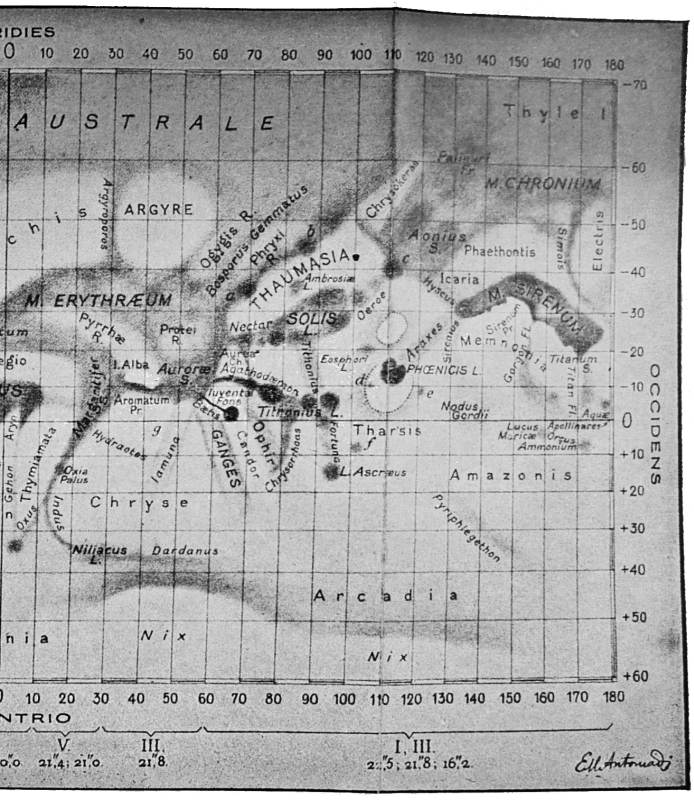
straight lines or in regularly bent curves (Fig. 17 and 17a).
Flammarion mentions that
the renowned physicist Fizeau looked upon
the “canals” as cracks in the ice-coverings
of the oceans on Mars. Penard, in 1888, expressed
the more likely opinion that they
correspond to the fissures in the crust of the
Earth. Flammarion contends that such fissures
do not have the rectilinear configuration
of the “canals.” This is completely in error,
as shown on the map here reproduced (Fig. 16).
It is also stated that they are so inexplicably
long, for instance the canal Phison
is 2250 English miles (Lowell) or 3620 km.
in length. The longest known earthquake
crack along the entire length of which a dislocation
has taken place at one time is 600
km. (373 miles) in extension; the violent earthquake
in California, 1906, originated from this
crack. There is no doubt, moreover, that a
great fissure in the Earth follows the coast of
Chile from Arica to the Strait of Magellan in
a nearly north and south direction for a distance
of about 32 parallels or 3560 km.
(2210 miles). This fissure is almost as long
as Phison on Mars. Such cracks exist along
the entire coast of the Pacific Ocean. As yet,
we do not know their position in much detail,
because long stretches run below the sea or
through territories not yet occupied by civilized
people. As an example of a small fissure,
a picture taken by Sederholm from Segelskär,
east of Hangö in the Baltic, may serve (see
Fig. 15). As the studies of earthquakes are
prosecuted with increasing interest in later
years, fissures of all dimensions will undoubtedly
soon be discovered. The solid crust on
Mars is, furthermore, somewhat thicker than
that of the Earth as the cooling of that planet
has progressed further. The sections broken
off at the bursting of the Martian crust ought
therefore to be much larger both in breadth
and in length. No doubt, the facts that the
intensity of gravity on Mars is only three-eights
of its intensity on the Earth and that
the curvature of the Martian surface is twice
as sharp as the Earth’s contribute to this
result. Imagine two vaults, one built with
higher and broader wedge-shaped stones
than the other and with half the radius and
furthermore loaded only one-third as heavily
as the other, and it will become evident that
we can permit a much larger span in the
former than in the latter case without fear of
collapse. In other words, it requires a much
more extensive caving or shrinkage of the
molten mass beneath the crust of Mars to
cause a rupture than under the terrestrial
crust.
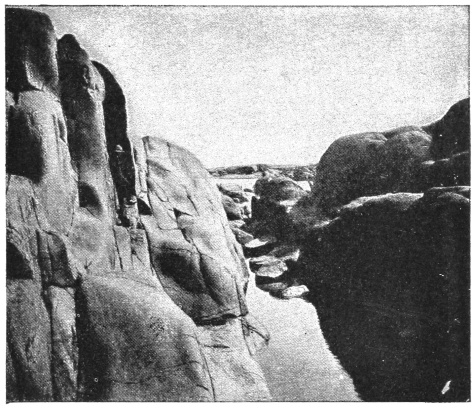
Fig. 15. Narrow bay on the left side of Segelskar, east of Hango
in Finland. The bay owes its existence to the fact that
the ice has laid bare a territory coursed through by fissures.
Photo by I. I. Sederholm.
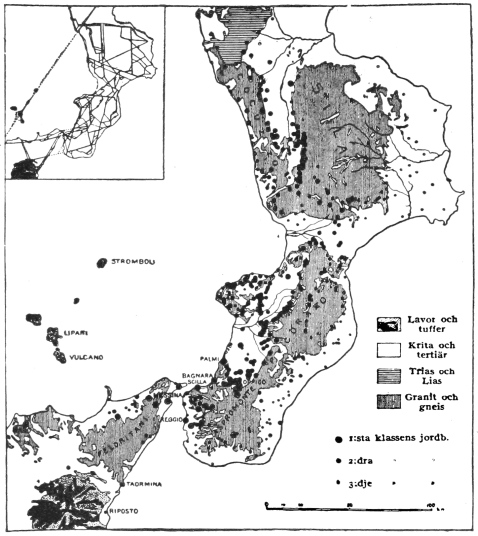
Fig. 16. Earthquake centres in Calabria and in Sicily. On the
larger map the damaged localities are indicated, on the
smaller the most prominent tremor lines. Drawn by I. I.
Sederholm.
As a consequence, the fissures on Mars
ought to be longer than the corresponding
formations on the Earth. A thorough study
of the large fissure in Calabria shows that it
consists of a veritable network of smaller
straight cracks (as is apparent on Figure 16,
which is taken from a work by the well-known
Finnish geologist Sederholm). On this map
the radial cracks (see Worlds in the Making,
Fig. 16), charted by Suess, are also shown,
and their direction under the sea designated
by dotted lines. The sketch in the
upper left corner of Fig. 16 is in striking
similarity to a picture drawn by Schiaparelli
in Mercator’s projection of the planet Mars
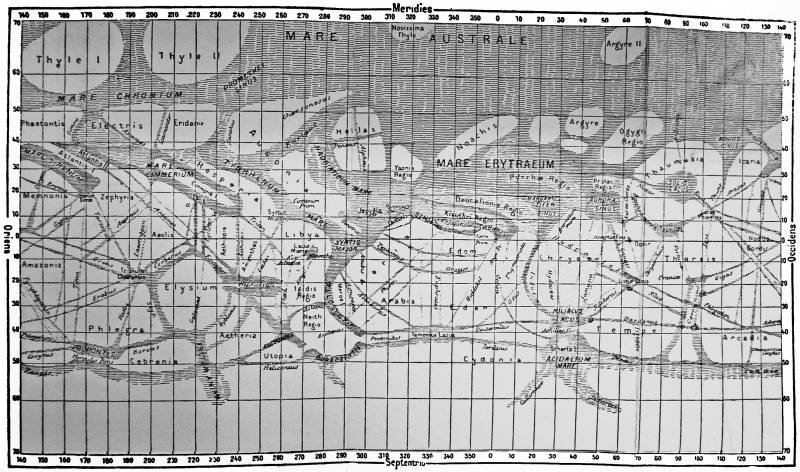
(see map at the end of book). We notice on
both, the numerous equidistant lines corresponding
to parallel cracks and duplex
canals. Not every fissure has its parallel
and not every canal its mate—generally only
one of the latter is visible and sometimes both
disappear.
As the radial cracks in the drawing by Suess
if extended meet in the Lipari Islands, so also
several canals on Mars run together in a so-called
lake (Lowell called them “groves” or
“oases”) which evidently is a centre of collapse
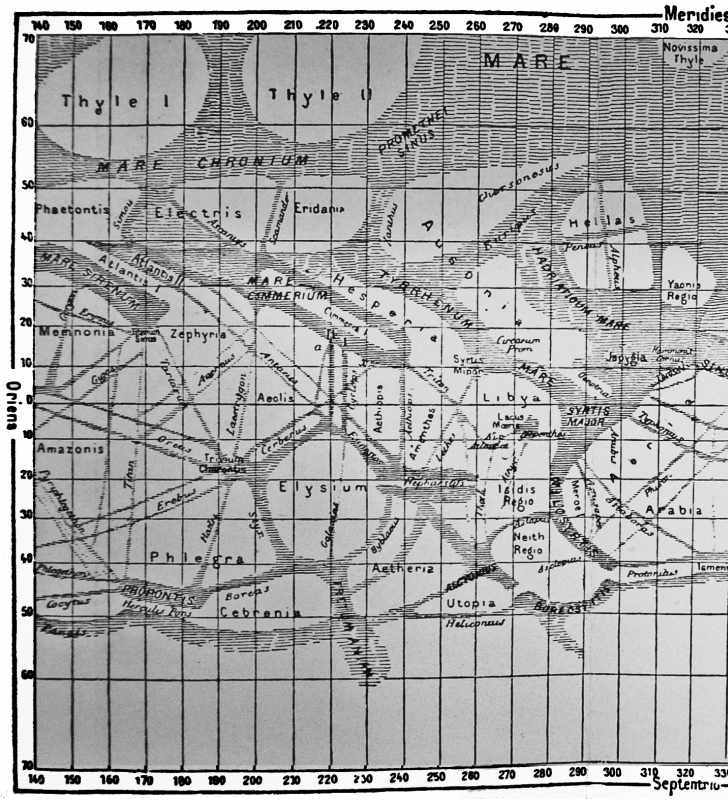
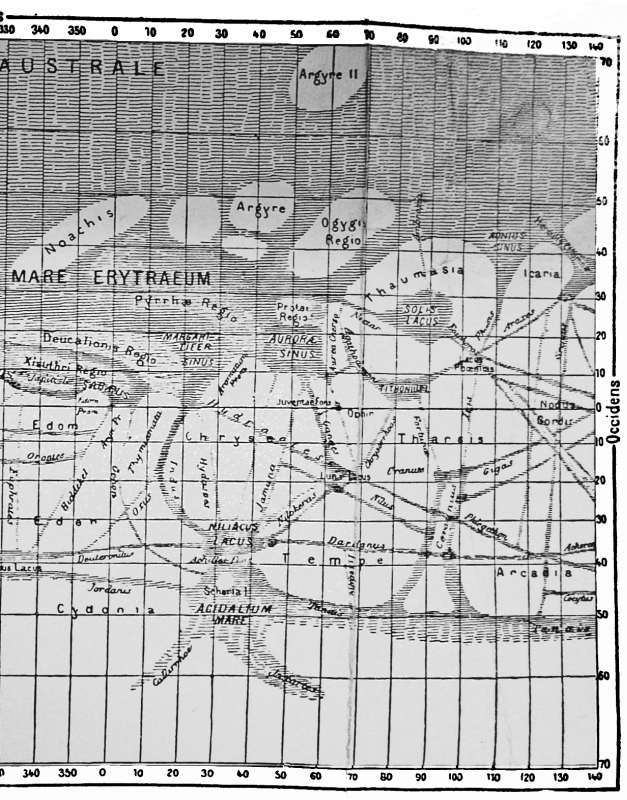
(many appear on Fig. 17). It is plain
that all crossings of the “canals” are not
necessarily such centres of collapse. (See
maps Figs. 17 and 17a at end of book).
We shall consequently assume that the
canals on Mars correspond to the geological
dislocation fissures on the Earth. Along
these fissures emerge the gases liberated in the
cooling process on both planets; which are
similar gases to those which escape through
the volcanoes. These vapours are primarily
water, next carbon dioxide and, in considerably
smaller quantities, sulphuretted
gases and hydrochloric acid. They discharge
through cracks in regions which, geologically
speaking, not so long ago were the scene of
volcanic activity. In the dislocation-grooves,
lakes, and water courses are often formed, as
we may observe in several places in Sweden,
for instance near Stockholm.
Assume now a gradual cooling of our earth.
Most territories are covered by stratified,
comparatively light rocks. To the dislocation
fissures water gathers from the surrounding
strata and occasionally from the interior,
partly washes away the loose material and
transforms the fissures into furrows, generally
with flat bottoms. Dissolved salts are carried
to the sea. As cooling proceeds, the
ocean commences to freeze. Each summer
the surface melts to a certain extent, as is the
case now in our polar regions. Finally, the
entire ocean freezes to the bottom, the ice
is now to be considered as a kind of rock,
flexures and dislocations cease and the ice
assumes a smooth surface. In the strong sunlight
during the summer this surface thaws,
as do the water-courses on the mainland, and
these continue to carry their salts to the open
surface water. At the approach of winter
the latter solidifies again but not as the water
in our inland lakes from the top but from the
bottom, as ordinary sea-water possesses its
greatest density below the freezing point
while the opposite is true of fresh water. The
consequence is that the ice foundation grows
upward and as the surface water becomes
increasingly shallow it is turned into a concentrated
salt solution. With a further drop
in temperature the ice formation is accompanied
by crystallization of the salts.
Something similar takes place on the Martian
mainland in its flat river basins, which
correspond to the salt lakes in our deserts.
On account of the bitter cold and the consumption
of the water in the process of disintegration
(the carbon dioxide has been
largely used up in the same manner), precipitation
has almost ceased on Mars and
most of the water in circulation emerges
from the interior of the planet along the
fissures. As it contains hydrochloric acid and
carbon dioxide it extracts from the soil salts,
such as the chlorides of sodium (common
salt), of calcium and of magnesium, all present
in common sea-water to which it was brought
by the rivers. The compounds of calcium
and magnesium are not precipitated as carbonated
salts through the medium of crustacea
as is the case on earth. The strong
solar radiation during the summer partly
evaporates the water into the thin air, leaving
the salts behind. On account of the low
temperature, this vaporization on Mars is
probably slower than on the Earth. Along
the cracks in the crust, a kind of dry salt-lakes
are formed similar to the generally
shallow and occasionally dry lakes common
in the deserts of Central Asia as described by
Hedin. We know that Mars possesses a pronounced
desert climate. There finally remains
in the lowest sections of the water courses
a concentrated salt solution, which parts
with its water more and more reluctantly,
so that the salts which most strongly hold
the water crystallize at the deepest points.
If the winter’s cold is sufficiently severe
(below -55° C. or -67° F.) ice is extracted
even from the most concentrated solutions,
which mainly contain chloride of calcium.
In spite of such extreme temperatures,
evaporation into the rare atmosphere is not
negligible and the ice crystals partly vanish,
to reappear in the coldest regions of the
planet, that is, around the pole which at
the time is turned away from the sun. On the
ocean, now frozen solid throughout, a polar-cap
of snow and hoar-frost is formed which
finally reaches as far as the 38th parallel on
the southern hemisphere (see Figs. 18 and 19),
where winter occurs when Mars is most removed
from the sun, and to the 58th parallel
(see Fig. 19) on the northern hemisphere
where winter reigns while Mars is nearest
to the Sun and consequently not quite so
cold. Similar conditions obtain on the Earth
although not to such a marked degree.
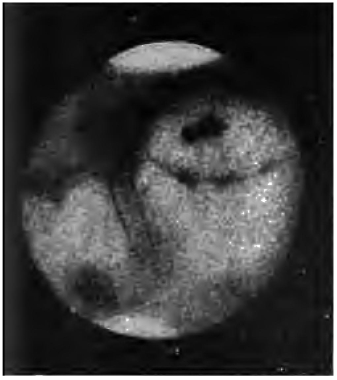
Fig. 18. Photograph of Mars,
enlarged and retouched; taken by
Lampland
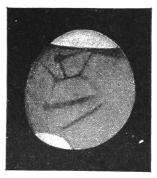
Fig. 19. Appearance of
Mars April 8,
1907, as observed
by Quénisset.
Below one
pole a dark
line is plainly
visible.
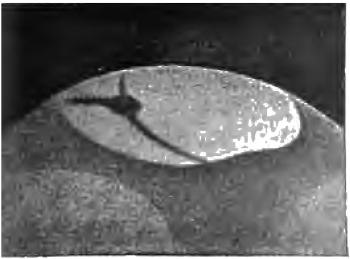
Fig. 20. The south pole spot on
Mars observed by Jarry-Desloges
July 10, 1909.
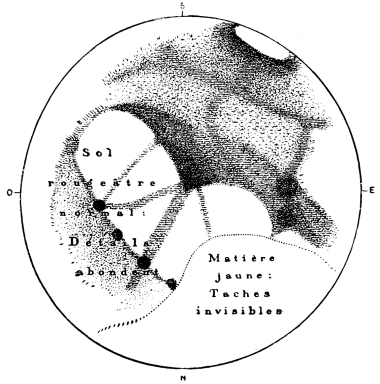
Fig. 21. The appearance of Mars during an observation
by Antoniadi in 1909. The
whole disk is somewhat hazy; below, the
details are hidden by clouds of sand.
In the vicinity of the snow-white polar
cap, whether there be continent or sea, bodies
of water occur with solidly frozen surface
covered by crystals of very hygroscopic salts,
such as the chlorides of calcium, magnesium,
and sodium. When the summer warmth returns
and the polar cap is heated, the hoar-frost
evaporates, and the now comparatively
humid air spreads over the surrounding territory.
We observe also frequent mist-formations
in these places. The ground
near the edge of the polar snow assumes then
often a dark hue on account of the moisture
(Fig. 19). Occasionally canals and lakes
appear in the polar cap (see Fig. 20). This is
evidently due to hot emanations along the
cracks. The moist air sweeps over the salts,
which then absorb water and dissolve into
concentrated solutions. New quantities of
water vapour are supplied from the pole as
they distill over toward the other pole, where
winter now exists, and push on toward the
equator which they finally pass. In their
course they dissolve the salts in the depressions
along the fissures and particularly at the
deep crossings where the centres of collapse
or the so-called “oases” are located. Lowell
has observed that the “canals” in this
manner gradually “liquify” from 78° N.
Lat. to the equator in fifty-two days.
The canal theory presents great difficulties
to the explanation of this curious phenomenon.
In order to make the water flow
it must be assumed that the surface of Mars
is entirely smooth or at least very nearly so
and that the inhabitants convey the water
melted at the poles through pumping stations.
The canals vary in width; according to Lowell,
their mean is 16 km. (10 miles), according to
Flammarion between 300 and 60 km. (185
and 37 miles) which latter estimate probably
is too high. The same canal differs widely
in breadth in successive years and sometime
disappears altogether. When the supply of
water vapour is scant, only the most hygroscopic
salts are dissolved, i. e., those deposited
in the deepest furrow of the canal, but when
the moisture sweeping over the canal is more
abundant the broader portions absorb water,
darken and thus become visible. The same
holds true in regard to the inland lakes
(“oases”). As the water vapour diffuses in
the air, the canal becomes liquid along its
entire length independent of the altitude of
its various parts.
All agree upon the desert climate of the
mainland on Mars. Like most deserts on the
Earth, it is, therefore, probably a table-land,
where one plateau mounts above the other,
each one nearly level. By the action of the
wind, the upper layers have been transformed
into fine sand. On the dead planet no further
sediments are deposited by the sea. The
only accretions to the planet are meteorites
and cosmic dust which slowly rains down.
It contains among other substances iron,
partly metallic and partly in the form of
protoxides (which have a light green colour).5
The oxygen in the atmosphere of Mars transforms
these compounds to ferro-oxide which
has different colours according to its coarseness,
but generally is ochre. The surface of
Mars is also described as possessing this
colour. Dross has, therefore, assumed that
the Martian soil is mingled with ferro-oxide.
The finest dust, however, is yellow while
larger crystals tend toward violet. We often
observe on Mars that the details are covered
by a yellow veil. This is of course finely
powdered ferro-oxide probably mixed with
less coloured sand which the desert wind whirls
up over large portions of Mars. Vast sections
of the planet bore such wrappings in the
autumn of 1909, as observed and described by
Antoniadi in Paris (see Fig. 21). Similar
observations have previously been made by
W. H. Pickering and others.
As a rule, only the central and the polar
regions of the surface of Mars can be seen.
Territories near the equator more than 40 to
50 degrees removed from the point in line
with the Sun and the centre of the planet are
generally hidden behind a thin, white veil of
mist. As soon as the Sun leaves the zenith
and reaches half-way to the horizon the moisture
of the air is precipitated near the ground.
This shows that the planet does not possess
any quantities of heat-conserving vapours in
its gas shell. The mist does not extend to
the poles, whose white caps always appear
distinctly, because the Sun cannot greatly
affect the evaporation in regions where the
Sun’s altitude is neither very high nor very
variable. The same holds true for other
snow-covered tracts, even if they are not
located in the immediate vicinity of the pole.
When the supply of water vapour is scant,
only the most salient canals come into view.
As a rule they do not then appear double, as
one of the mates is always less prominent.
Lowell showed, he believed, that it always is
the same canal out of a pair which first comes
to sight and that its position always remains
unchanged in contrast to Schiaparelli who
has reached the opposite conclusion. This,
of course, is quite natural.
On account of the small amount of water
vapour in the atmosphere of Mars true clouds
are rare. Figure 22 shows such a cloud at
the edge of the planet. The aforementioned
mists are often called clouds, for instance by
Pickering.
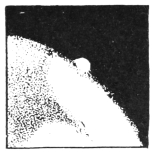
Fig. 22. Cloud at the
upper right edge
of Mars observed
by Molesworth,
March 7,
1901
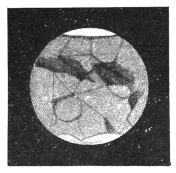
Fig. 23. Mars as observed
by Lowell,
July 11, 1907.
Even the dark
portions appear
coursed through
by “canals.”
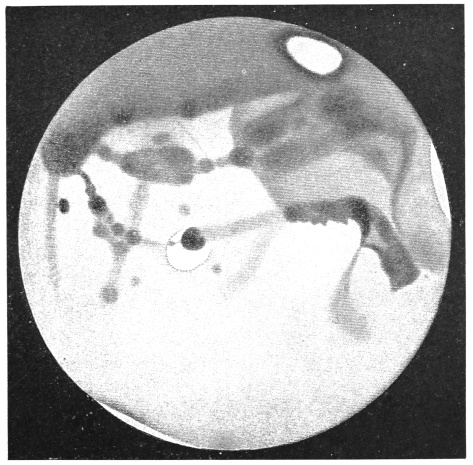
Fig. 24. Mars, as observed by E. M. Antoniadi, October 6, 1909.
That elevations really may be found on
Mars is evident from the fact that snow or
hoar-frost often remains in patches near the
pole and occasionally quite far therefrom, for
instance on the large island Hellas (40° S.
Lat.), while it disappears from the surroundings
and sometimes from the pole itself (the
south pole). Such a highland covered by
ice exists near the south pole, and is shown
near the upper edge of Fig. 24. In places
where snow always remains, a feeble glacier
formation may occur. Most investigators
assume that mountains and plateaus exist
on Mars, although of modest altitude (Campbell
believes that he has observed peaks 3000
m. (9800 ft.) high). Lowell who diligently
has looked for mountains at the edge of the
illuminated part of Mars, has reached the
conclusion that they, if present, cannot rise
more than 600 to 900 m. (2000 to 3000 ft.)
above the surrounding plains. It were indeed
improbable that all inequalities of the
Martian surface should have been removed
in the process of disintegration, which although
at work for enormous extensions of
time, has long been extremely feeble and is
unassisted by torrents of rain which might
rapidly wash the products into the valleys.
At present, it is mainly the sand carried
by the desert wind that slowly reduces the
roughnesses and in this process extensive
highlands are hardly touched. But, without
the assumption, in itself very unlikely, of a
nearly level surface on Mars it becomes
difficult to comprehend how the canals, if
filled with pure water, can proceed in straight
lines without reference to existing differences
in altitude. Like the rivers on the Earth
they ought to bend according to the topography,
even if constructed by engineers.
When the canals freeze at the approach of
winter, they invariably have been observed
to disappear in company with the lakes or
oases at their crossings. They are then all
covered by the reddish-yellow dust carried
by wind from the surroundings. When a
canal is about to reappear it frequently first
comes to sight as a dark streak evidently the
result of moistened ferro-oxide. Occasionally
a mist formation precedes the appearance of
the canal. It is plain that the cold, misty
air settles in the valleys, there as here, and
gives up its moisture to the salts on their
bottom and the canal is thus brought out
as a dark line. Sometimes the vicinity also
assumes a darker shade indicating the absorption
of some moisture. On the sides of
the canals the less hygroscopic salts are
deposited. Possibly the green colour of the
canals is partly a contrast-effect due to the
red surrounding, possibly also the result of
finely divided matter in the liquid. It is also
conceivable that the cause is the reducing
influence on the ferro-oxide of the sulphuric
gases emerging from the fissures; an exceedingly
small quantity accomplishes in this case
large results. F. le Coultre describes the
colour as being sometimes a dead black.
Something similar applies to the seas.
When these freeze, especially in shallow
places, yellowish-red dust from the continent
settles on their surface and lends it hues
between the original dark green and the light
yellowish-red. When the ice subsequently
melts this dust sinks in the water which latter
resumes its dark green colour.
Chloride solutions, if concentrated, freeze
at the following temperatures; that of calcium
at -55° C. (-67° F.) that of magnesium
at -44° C. (-48.2° F.) and that of sodium
at -22° C. (-7.6° F.). If now, as we previously
have seen, the mean temperature of
Mars as a whole is about -40° C. (-40° F.),
of the equatorial belt about -10° C. (+14° F.),
and of the pole in the height of summer about
0° C. (32° F.), it is evident that a liquefaction
of the ocean surface and of the canals, particularly
where salts are deposited, very readily
may take place. We should in this connection
remember that the ice on Mars is stationary
while on Earth it is in motion. The
consequence is that sand and dust in the course
of thousands of years have accumulated on
the bottom of the shallow basins in the polar
ice. These seas appear therefore dark in
spite of their exceedingly small depth and the
white salt and ice-crystals remaining undissolved
are unable to display their light
colour. Even in the “ocean,” Lowell was
persuaded that he had observed canals (see
Fig. 23), and it may be possible that cracks
are in evidence there, particularly in the most
shallow sections, as is the case in the Tyrrhenian
sea north of Sicily. It is significant that
Flammarion has reached the conclusion,
which at first appears highly hazardous,
that the freezing point of water is lower on
Mars than on Earth. This is entirely correct,
if we let water stand for salt solutions.
It is customary to point to the strictly
uniform breadth and the rectilinear appearance
of the canals as clear evidence of their
being artificial, i. e., the work of engineers.
The Italian astronomer Cerulli strongly
objected to this conception. “In the exceedingly
rare cases when both sides of the
canal plainly may be seen,” states Schiaparelli,
“I have observed curves and notches in
the borders.” This occurred with the canals
Euphrates and Triton in 1879, and with the
Ganges in 1888. And it would seem obvious
that watercourses produced in old furrows
would not, as a rule, be of uniform breadth.
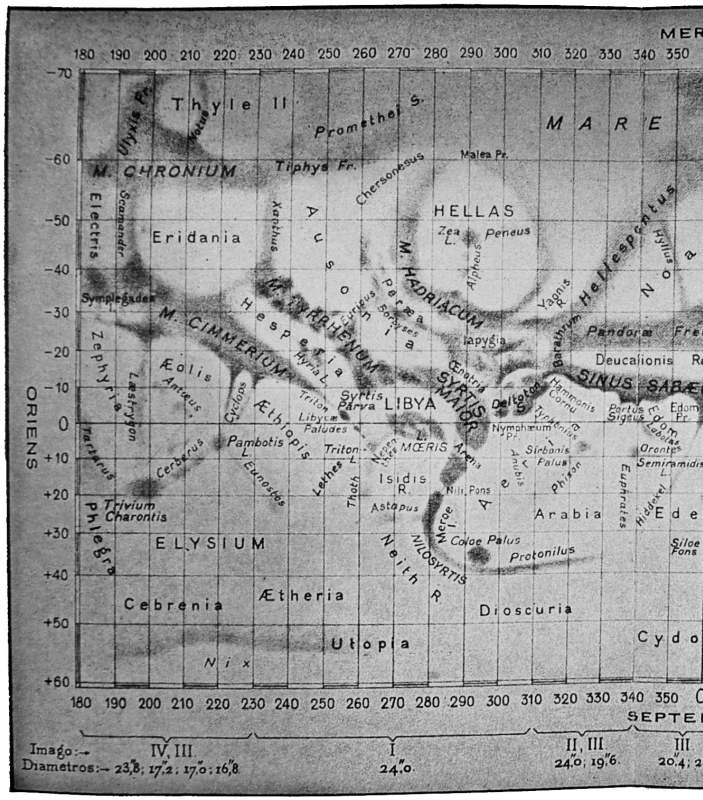
Antoniadi, by his observations in the autumn
of 1909 (see Fig. 17a and 24), has confirmed
this opinion, as has le Coultre, who found
twice as many irregular canals as rectilinear
ones. Antoniadi remarks that some canals
appear to be collections of lakes strung out in
a certain direction while others are narrow
lines which bend and twist. “The complicated
network of straight lines is probably
illusory.” The spots on Mars, he continues,
are very irregular, and “present by no means
any geometrical form” (on which the belief
largely is founded that they are the product
of intelligent beings). “The appearance of
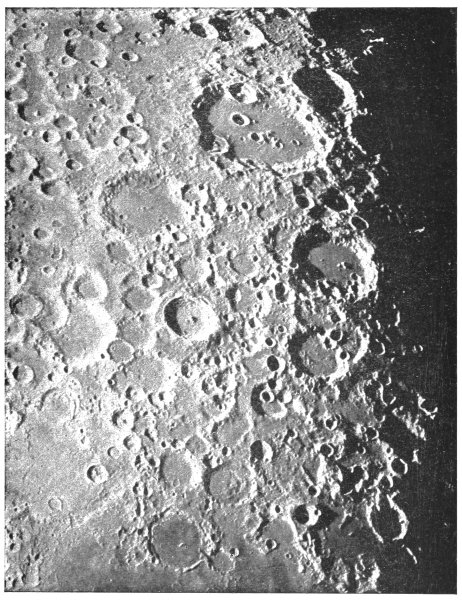
the planet reminds one of that of the Moon
(except that the latter is dead, i. e., unchangeable)
or of a terrestrial landscape viewed from
a balloon.”—“In a word, the ‘geometry’ of
Mars is revealed as a pure illusion.” Exceedingly
instructive is a comparison between
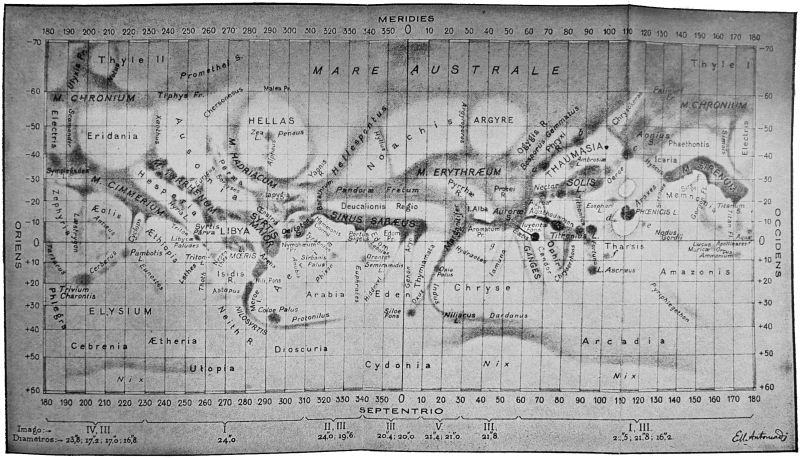
the two maps of Mars drawn by Schiaparelli
(1886) and by Antoniadi (1909) reproduced
here and found at the end of the volume.
While Schiaparelli as a rule represents the
canals as narrow, straight, or slightly curved
bands of uniform width, these formations on
the Antoniadi chart frequently dissolve into
a series of dark spots joined by less obscure
sections (see for example the canals Nectar
and Oeroe at the Sunlake). The same is
true about several of the so-called “seas,”
particularly the Tyrrhenian (Mare Tyrrhenum),
and the Sunlake (Lacus Solis); also
about the “Ocean-bays” such as the well-known
Syrtis major which with the Sunlake
form the most conspicuous objects on the
surface of Mars. These maps are, moreover,
of great interest because several canals and
other features present on one are absent on
the other and vice versa. In this way, we
obtain a vivid conception of the remarkable
changeableness of the Martian surface as
contrasted with the exterior of the Earth.
The latter, if viewed from Mars, would not
have presented any noticeable change in
historical time except for the seasonal variation
of the snow fields. This peculiarity of
Mars is only explained by the fact that the
geographical features of that planet as a rule
are surface formations of a slight depth and
therefore subject to rapid transformations.
Frequently, large white spots suddenly
appear, especially near the lakes, such as the
spot at Lake Phœnix near the centre of Fig. 24
which represents Mars on October 6, 1909,
according to Antoniadi. These white spots
disappear as suddenly as they show forth.
The white colour is probably due to a very thin
snow or hoar-frost, which is easily condensed
in the vicinity of the lakes but which as
readily vanishes at the approach of a warm
draft or of sunshine.
Occasionally, dark spots on Mars are described
as dissolving under strong enlargement
into dark and light squares giving the
appearance of a chessboard. This reminds
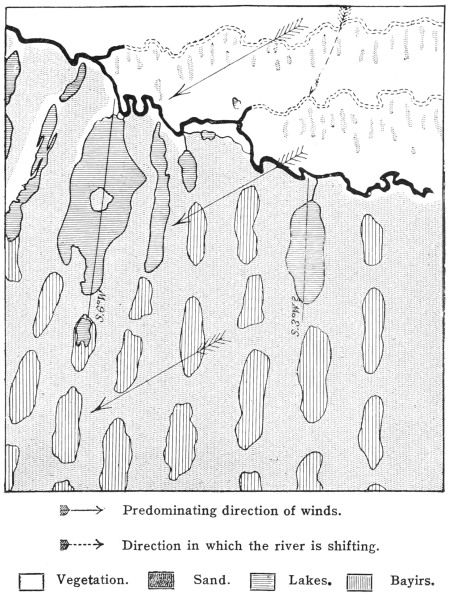
one of the bayirs in Turkestan (see Fig. 9).
The collections of lakes along the cracks
on Mars which appear to us as “canals” are
repeatedly filled up by sand and dried out.
They are revived through new depressions
along the dislocation fissures, corresponding
to our earthquakes, when vapours of water
and other gases pour forth and condense to
lakes in the deepest pockets of the fissures.
Canals are therefore created rather rapidly,
sometimes over night, and vanish occasionally
as suddenly. The most remarkable case of
“new” canals was made known through a
communication by Lowell. Two new canals,
at the time the most conspicuous on the surface
of Mars, were observed east of “Syrtis
magna” on September 30, 1909, from Flagstaff
observatory, when they also were photographed,
which precludes an illusion. (On
the other hand there was no sign of the great
canal Amenthes, shown on the map Fig. 17,
a short distance to the left, i. e., east of Syrtis
in the very section where the new canals were
observed.) Also two new oases through
which the new slightly curved canals passed
were observed for the first time, as were
also a few minor canals in the neighbourhood.
In 1913, the double canal Æthiops (see
map at Long. 240°; the canal is there single)
was rediscovered from the Lowell observatory
after an absence of fifteen years.
These data make it evident that one or
possibly several rather strong earthquakes
took place east of Syrtis major just prior to
September 30, 1909 with the two oases as
centres of collapse. The fissures now made
visible have probably existed before but filled
with sand and have now reappeared as a
result of the condensation of water vapour
when it emerged into the cold Martian
air.
This fact, that the most prominent canals
in such manner now suddenly appear and
now as rapidly vanish, ought to convince us
beyond doubt that they are not magnificent
products of engineering skill, for the construction
of which we should require centuries on
the Earth.
The theory that intelligent men exist on
Mars is very popular. With its help everything
may be explained, particularly if we
attribute an intelligence vastly superior to
our own to these beings, so that we not always
are able to fathom the wisdom with which
their canals are constructed. The crossings
of the latter are said to be cities (Lowell)
fifty times greater than London. The
trouble with these “explanations” is that
they explain anything, and therefore in fact
nothing. If we would endeavour to understand
the phenomena on Mars, we must in
the first place avoid the formerly so popular
principle of “purposiveness” which led even
the most prominent scientists into so many
amusing errors. Neither may we base our
conceptions, as does Flammarion, on the
assumption of natural forces unknown to us,
no matter how much such a course may
appeal to mystics. Only forces with which
we are familiar can be resorted to, if we
really are to understand nature. It seems
to me that such method of research might
with good results be applied also to the
planet Mars.