From the spire of the Abbey church, throughout the night, the monks
could see on the high lands close by, to the south, long lines of red
camp-fires, and dancing torches here and there, as captains made their
watchful rounds. The cries of the sentries came to their ears through
the stilled air, as from the near side of Swilgate Brook itself, which
washed the Abbey's walls. Little of sleep did the cells or dormitories
know that frightened night, for servants were busy till the first
cock-crow burying jewels and plate in the Abbot's garden, and half the
brothers kept vigil in prayer before the High Altar, or in the chapels
of St. Eustacius and St. James, while others slumbered fitfully on
their pallets, or climbed the tower to watch the Lancastrians' lights.
Thus, at last, anxious morning broke, and the cawing of the rooks in
the branches close to Hugh's window roused the boy from his sleep. At a
bound he was on his feet, forgetting even to rub his eyes, and glad
that, having slept in his clothes, he might fare forth without loss of
time. His dreams had been all of archery—how that the best bows were
of Spanish yew, and he had tried to cut down the English yews in the
churchyard to make new weapons, and had been haled before the King's
justices because of the law to preserve the yews for the King's
armies—and the thread of this dream ran through his mind even as he
knelt and muttered his prayer.
It was full daylight when Hugh found himself outside the Abbey walls
and on the footpath leading over the brook up to the Vineyards. Behind
him the matin chimes were sounding from the belfry. Before him rose the
dismantled walls of Holme Castle, once the abiding place of the great
Earls of Gloster, but now long since grown over with ivy, and a harbor
for owls and bats. When he had come to the top of the knoll, at the
front of these ruins, the sight spread out before his eyes was one to
well quicken breath and set veins tingling.
A vast host of armed men seemed to cover the earth as far as he could
see. The boy had not known before that the whole world contained so
many soldiers. One company was in the rough meadow close at hand. In
the bright light he could discern them clearly—strong men of war, with
battered steel breastplates, half blue, half red with rust, and iron
caps upon their heads. Some of these were leading a score of horses
back and down to the brook whence he had come. Others toiled at
levelling some half-dozen camp-tents of white cloth, with crimson
stripes, while still others crowded about the place where sparks
crackled and black smoke curled about huge caldrons wherein food was
cooking. At the peak of the largest tent, high upon the staff, floated
gently in the early breeze an emblazoned standard, bearing the
blood-red three roundels of the Courtenays.
For a moment Hugh's thoughts stopped at the memory of the strange
Knight and his letter; somewhere among this band of brawny fighting men
would be the four caitiffs who were here to slay that unknown Devon
gentleman, Sir Hereward. He glanced at his little finger, whereon the
signet ring of the three fishes glittered unwontedly,—and marvelled to
find his base-born skin touched by such a trinket, for he had resisted
Peter's desire to take it over to the Abbey treasury,—and then the
glance lifted itself to still more marvellous things.
Away in the distance, on the topmost point to the left hand of the
highroad, Hugh had already noted a brave pavilion, guarded by banks of
earth raised since last he saw that familiar horizon, and overhung by
what he saw now to be the royal standard of England's Kings. A blare of
trumpets, rolling in sharp echoes from mound to mound across the field,
proceeded now from this point, and as he looked Hugh saw upon the
highway, setting forth in his direction, a little cavalcade of knights
and ladies whose dress and trappings sparkled in the morning sun, even
thus afar, like the lights on the High Altar beneath the painted
windows.
Onward this group of riders came—and the boy, creeping under the cover
of the hedge, stole forward with no other thought than to see them
close at hand. And so it was that he crouched in listening silence, not
more than twenty paces removed, when this thing happened.
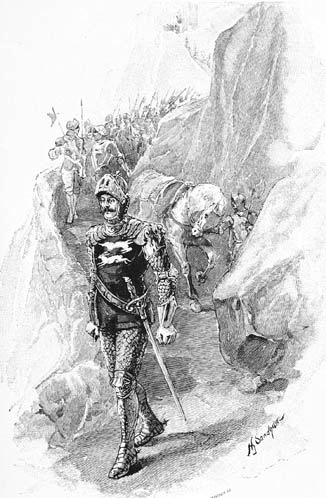
The tall, grave-faced, golden-haired noble whom Hugh knew to be John,
Earl of Devon, clad all in burnished steel, and bearing a great
lion-crested tilting helmet upon his arm, strode forth from the company
near the ruins to the highway, and stood thus, with bare head erect in
the sunlight, until the riders, cantering lightly over the dew-laid
road, drew rein before him. Then he advanced, and bending with one knee
to earth, kissed the hand of a lady who, with a single knight, rode at
the head of the little train.
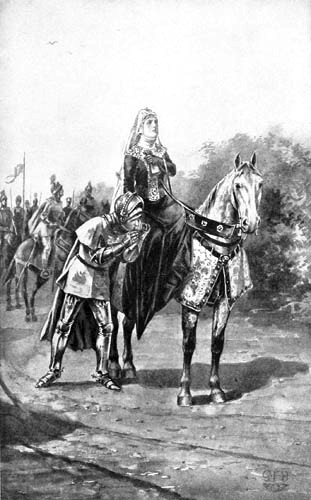
"He advanced and kissed the Lady's Hand."
This lady, then,—she with the bold, beautiful face, pale now as an
ivory missal-cover, and drawn with stern lines, she with the burning
brown-black eyes, and proudly upright carriage,—was the Frenchwoman,
the Queen, the great Margaret of Anjou!
Hugh held his breath and stared out of fixed eyes at this terrible
foreign woman, whose hates had fastened war upon his country, had
killed even his own father, had drenched the land with blood—and
listened with all his ears.
"We have given you, out of our grace, the lands and titles which your
recreant brother Henry forfeited, and lost along with his head, when he
played fast and loose with the usurper," this Queen said, in loud, cold
tones, when the Courtenay stood upright again. "This day will test our
wisdom in the thing."
"Madame," the Earl made answer, holding her eye with his, "our house
has given three lives for you. If mine goes to-day I shall die
sorrowing chiefly for this—that there are no more of us to die for our
King."
The knight who rode beside the Queen—Hugh through the bushes saw only
that he was tall and lean, with a delicately handsome young face and
reddish-brown hair under his beaver, and wore a silver swan on his
breast—spoke now:—
"My Lord of Devon, my mother rides now with the Lady Anne and her
tiring women to a place of safety on t'other side of Avon, there to
wait upon the good tidings we shall presently bring her. The place is
at Bushley, the Lady Anne being acquainted with it from childhood. From
this, I return to lead our centre, with the Prior and the Lord Wenlock.
My Lord Duke holds the front, beyond where our standard hangs. To you,
my lord, the rear is given, to swing across this field, with your back
against the ridge. The men from Somerset march to join you, even now.
God stead you, honest Courtenay, and bring us victory!"
The Prince at this threw himself off his horse and into his mother's
arms, his face buried upon her knees, his hands holding hers. The
Queen, with marble face, swept her agonized glance high into the
morning sky, and wept not, neither spoke, but bit her lips, and with
her eyes invoked the saints.
Then, like some dissolving mist before Hugh's gaze, everything was
altered. The Queen with her escort was ambling one way, toward the gray
Abbey walls and the passage at the mill; her gallant young son was
galloping with his group of knights back whence he came; the Courtenay
company, close at hand, was gathering itself into ranks, with knights
clambering heavily into saddles, and men-at-arms striking their pikes
together. The whole broad field was, as by some magic hand, set in
motion; everywhere troops were marching, standards fluttering forward,
trumpets calling shrill-voiced to one another.
The boy, lifting his head now above the hedge, looked upon this vast
shifting picture with but a dazed comprehension. The beauty of it all
was so great that its grim meaning missed his mind. As far as eye could
reach, armed bodies of men, with banners and harness glittering in the
sunlight, met the vision. And now, of a sudden, all movement ceased.
The birds in the ivy on the ruin behind him sang into the morning air,
and no trumpet answered them. The landscape stood still.
Suddenly the boy clapped hands to ears, and stared affrightedly about
him. A demon-like roaring sound had burst, as out of the very earth,
which rocked and quivered under the shock. A thousand thunder-claps in
one, out from the clear sky! Quailing with fright, as lesser belching
noises succeeded, shaking the ground and confounding all senses and
wits, Hugh backed out of the ditch, and felt, rather than made, his way
rearward to the shadow of the ruins. Creeping up upon a ragged heap of
tumbled stones, he ventured to look forth again.
A broadened veil of smoke—curious, thin, bluish smoke—all unlike that
from burning thatches or stubble refuse—hung now upon the horizon
where the royal standard had been. Was it still there? Hugh could not
tell. Flashes of fire leaped swiftly for an instant here and there from
this veil of smoky haze, and after each dart of flame there burst this
deafening, thunderous roar which had so appalled him. Then it broke
upon his brain that these were cannon, of which all men had long since
heard, but few had ever seen on English soil. More than this it was not
easy to grasp of what was going forward. Along the line of smoke, where
sky ought to meet earth, could be seen confused masses of horse and
footmen struggling together, but whither moving or how faring in their
conflict could not be told. The men under Courtenay's banner had
marched westward toward the windmill, and were not in sight.
All at once Hugh's gaze was diverted from this distant prospect to a
strange apparition nearer at hand—a brownish-gray sort of globe, like
a full moon, which, low to earth, stood between him and the smoke, and
seemed to wax in bigness visibly as he looked. There was not time for
thought before this ball, singing to itself as it came, swelled to
giant size in the lad's vision—then smashed into the vine-clad wall
beside him with a huge scattering of stones and mortar. The wall
quivered for a moment, then fell outward, prone to the sward.
Without hesitation, Hugh slid down from his perch, and half-choked with
dust and lime ran toward Swilgate Brook as fast as ever his legs would
carry him. He made no pause, nor cast any glance backward, until he
stumbled, panting and aflame with fright, into the cool shadow of the
Abbey's big west gate. Not till its ponderous doors had clanged shut
behind him, did he venture to draw breath.
Only the slowest and stoutest of the lay servitors in the kitchen
lingered yet over their morning meal when the boy, his hunger led
forward by keenest smelling sense, found his way thither. Within this
low-vaulted chamber it was as if the confusion of tongues had fallen
again. There were some hardier spirits who had, from sundry distant
points of vantage, seen a tithe of what Hugh had witnessed. These told
their tales to gaping, awe-stricken groups with much bold embroidery
and emblazoning of fancy, peopling the field with mailed giants, and
imputing to magic the mystery of the cannons, whose dire bellowings
gave even these stony kitchen walls a throbbing pulse. Worse still was
what the village vagabonds—permitted for the once to enter freely and
mix with their betters before the fires—related with rolling eyes and
quaking voices, to wile further victuals from the frightened cooks.
Into such riot ran this babel of loose tongues that not even the
Precentor's entrance stilled it. This gentle, soft-eyed old monk had,
indeed, no thought to govern aught or any, and gazed about over the
motley throng as one abashed, until his glance fell upon Hugh. To him
he beckoned, and, when the two were without upon the stairs, made
hurried explanation:—
"His Lordship will himself sing the early Mass, with pontifical
procession, and full chapter ceremonial. Get thee with all speed into
thy surplice, comb out thy locks—shalt bear the cross!"
A brief while later, paced slowly from the cloisters the long
devotional line, Hugh, all aglow with pride in his new office,
advancing at its head, with the jewelled cross upheld aloft. After him
were singing boys in surplices and singing men with added copes; then
two score monks in ebon black with lighted tapers, the secular canons,
the priests of the Abbey, the priors, the deacons attired for the
altar, and last the venerable Abbot, John Strensham, bent with age and
infirmities, and wearing over his vestments an almuce with hood of
ermine, because his blood was cold. Into the choir the procession filed
with measured step and solemn chant—and then, as by some sudden stroke
of universal palsy, foot halted and song died on lips.
Such a scene as never monk or abbot had dreamt of in Tewkesbury lay
before them.
The doors of the rood screen hung wide, so that vision swept from the
choir down through the nave and its outer parts, where the simple and
base-born heard the Mass, straight to the great north porch. Here, too,
the doors were open, for daylight streamed therefrom transversely
across the nave. And in this light the amazed monks saw a mired,
blood-stained, bedraggled swarm of armed men struggling fiercely for
entrance before their fellows, and among these some who smote and
felled the others with their swords or battle-axes—amid clamor of
shrieks and violent curses, rising above the ground-note of a deep wild
shouting as from a multitude without, and the furious clash of steel on
steel. The wrath of hell raged here and tore itself before them on the
consecrated floor of heaven.
While yet this spell of bewilderment lay upon the astounded spectators
in the choir, Hugh felt himself clutched by the shoulder and pushed
forward down the steps and into the aisle by a strong though trembling
hand. It was the old Abbot, who in the moment of horror at this
sacrilege forgot his years. Raising himself to his full height, and
snatching the great beryl monstrance from the altar, he hurried now
down the nave at such a pace that the cross-bearer, whom he dragged at
his side, and the wondering monks and choristers who followed, were
fain almost to run if they would not let him reach the porch alone.
The western end of the nave held now a closely-packed mass of
fugitives, with scarce a weapon among them—gilded and blazoned knight
huddled against unkempt billman, lord and varlet jammed together—all
crowding backward in despair from the open porch where, bestriding
corpses on the blood-wet flags, a dozen mailed ruffians with naked
swords and axes bent ferocious, hungry scowls upon them.
Helpless and dazed, as in an evil dream, the boy felt himself thrust
forward into the very front of these war-wolves; and as he stood there,
holding the cross as steadily as might be, within a cloth-yard shaft's
length of their ravening jaws and flame-lit eyes, his foolish knees
knocked together, and he had liked to swoon.
But then—lo! these fierce men put down their blades, and, bowing
first, with ill-will slunk backwards to the sides of the porch; and the
foremost, still doggedly, even fell upon their knees. Then, the way
being clear, Hugh saw that where the churchyard graves had been was
now, underfoot, a slaughter pen, and above a wilderness of wild faces
and dripping pike-heads. And in the forefront of this awful array, with
one mailed foot on the threshold of the porch itself, stood the noblest
figure of a man the boy's eyes had ever compassed—a youngish man of
uncommon stature and great girth of shoulders, girt with polished steel
armor picked in gold, and having on its breast a silver sun with
flaring jewelled rays. He too grasped a huge naked sword, and sank its
point before the cross Hugh held—the while two esquires made loose the
rivets of his towering helmet and lifted it from him. Then he, not too
humbly, bowed his head—a shapely head, with reddish-golden curls—and
lifting it, looked into the church with the flushed face and glance of
a very god of war.
The Abbot, tottering as he came, pushed Hugh aside and reared himself
proudly in the porch, holding the monstrance with shaken hand above his
head, and crying out:—
"Where thou standest, my liege, thou art not King, but only Edward
Plantagenet, a sinner even as the meanest of us, and with the blood of
God's children on thy hands. Therefore abase thyself. It is the Host!"
The King dropped to his knees for the counting of ten, then rose and
made a step within the porch, still searching sharply with restless
eyes into the shadows of the nave.
"My Lord Abbot," he said, in a soft, full voice of stately measure
which belied his glance, "I and my brothers and our trusty friends have
desire to forthwith enter this holy edifice, and with thee offer
reverent thanks for this our resplendent victory." As the Abbot held
his silence, the King added, "I had not looked to find a Strensham
lifting himself between the saints and my piety."
The Abbot found his voice: "I am stricken in years, my liege. My life
has been thine as long as has thy crown; take it now if needs be. But
while it lasts me, into this consecrated house thou may'st not enter to
ravish or mete punishment. Pledge me thy royal faith that no man within
these walls shall feel thy wrath—that all shall be suffered to go
forth in peace!"
"Since what time, my Lord Abbot," asked the King, dryly, "hath the
privilege of sanctuary descended upon the black monks of Tewkesbury?"
"Where God's flesh and blood are, there is sanctuary!" shrilled
the Abbot. "By the pains of Calvary, thou shalt not enter
unpledged—save over my old bones!"
While the King's answer hung yet in doubt, an old monk slipped past the
Abbot, and, thrusting his shaven gray poll in obeisance close before
Edward, mumbled a request which none behind him might hear. It was
Peter, the Brother Sacristan—and the King, so far from buffeting the
audacious shaveling with his gauntlet, thought for a moment, then
smiled, and waved Peter aside.
"On my kingly honor, I promise," he said firmly, with a glance ranging
from Peter to the Abbot, and the half-smile playing on his handsome,
ruddy face. "Before God, I promise! And for this sacrilegious bloodshed
here, will I do penance!"
The Abbot's withered old lips formed a mute thanksgiving. "My liege,"
he faltered, "some forewarning of your triumph of a surety brought me
from my bed to the altar this day. Praise God thy enemies are put under
thy feet! Pray God for humility and a gentle spirit, these to stay thee
from trampling them! Wilt follow, and hear the Mass?"
Thus strangely, the broken procession was reformed, and Hugh, aweary
now under the weight of the cross, sick with the smell of blood and the
sight of hewn corpses at his feet, stumbled back again up the aisle,
past the rood screen, into the choir, the singers chanting the solemn
Te Deum Laudamus behind him, and King, princes, nobles and
knights and monks and soldiers following the Abbot to the High Altar.
Here, out of pity at his white face, another took his office on him,
and Hugh, escaping from the incense-laden air of the choir, staggered
into the ambulatory, faint and distressed. He had too little wit left
to note that the side aisles and transepts held scores of skulking
fugitive soldiers, and that others of a like kidney were hiding in the
shrine chapels about him.
Not even when one of these came forth from the enclosure dedicated to
St. Edmund the Martyr, and laid hand upon his shoulder, was he
startled, but only looked up with wan indifference on his chalk-like
face.
"Where had ye that ring?" a deep voice asked, with tightened grip upon
his shoulder to point the query.
Hugh saw now that it was a stalwart young man who questioned him—and
one of quality, despite the miry disorder of his dress and armor, and
his dust-stained face. What could be discerned of this face was
pleasing enough, too—but the lad's head was whirling and his tongue
numbed at its roots. For his life he could not speak.
"That ring!" the stranger went on excitedly. "I saw it on your hand
whilst you held the cross—the which, now I think on't, saved our
lives. Fear nothing, lad! Tell me, how came you by it? Perchance I am
beholden to you for the letter last night—if so—will ye not speak, I
say!"
Hugh, with a despairing effort, gathered his wits, and asked faintly:
"Are you the Sir Hereward, then, to whom 'twas writ?"
"Aye, none other—what there is left of me. And writ ye the letter? And
at whose behest?"
The boy opened his mouth to answer, looked blankly up into his
questioner's face—then, as the swelling chant ceased suddenly in the
choir beyond, rolled supinely on the stones at Sir Hereward's feet, in
a deadly swoon.
Through what remained of this awful Saturday, and through the startled
hush of the Sunday following it, the boy kept his bed in a faint,
drowsing languor, broken by fits of shuddering under the terror of evil
dreams. Oft and again, the writing monks came in compassion to his
bedside, but his shaken wits made of these visitors only black figures
in the background of an endless scared vision of stark corpses, bearing
blood-stained heraldic shields along the pages of his book.
The second night came, and, lagging desperately through the long
watches, stole off by a trick at last while the lad slept—so that he
woke crowned as he lay with sunlight. The neglected book was in his
thoughts first of all—and then came consciousness that he was
better—and then, as he opened his eyes and blinked against the full
light, he saw that Peter was in the room, bearing a steaming dish of
broth.
"Art fit for great news?" the Sacristan asked, roughly enough, but
looking down upon the boy with a kindly light shining from under his
gray, shaggy brows. "The Prince Richard—my Lord Duke of Gloster—hath
sent hither for our best scrivener to attend him at the Tolzey, and
Brother Thomas, conferring with the Abbot, hath nominated thee. Not
that thou art our best, nor near it, but thy masters are in cowls and
gowns, and since Saturday's sacrilege no monk may stir forth to serve
the Princes or the King. Art fit for it?"
Hugh sat up in bed, and put hand to brow, and smiled wistfully. "Aye,
save for a foolish little wandering here," he made answer, "naught ails
me now!" And for proof he seized the dish and buried his jowl in it.
Peter strode up and down before the narrow casement, grumbling as his
gown flapped about his heels.
"Sacrilege! Sacrilege!" he sneered. "Well may the King laugh us to
scorn as witless loons! For what is 'sacrilege' but a weapon forged by
Holy Church to use against the laity, to our great profit and their
uplifting? Yet here are we, turning its point upon our own throats!
Because a little paltry blood was spattered in the porch—lo! for a
full month now the Church must lie in penitential darkness, no matins,
no masses, no vespers—until it be purified and newly consecrated. Was
ever such madness? Here with mine own eyes have I seen the son of a
king, he that was born Prince of Wales, shovelled into a grave in the
choir without so much as a rush-light. The flags are all up for
burials—the Earl of Devon, the Lord Wenlock, the Lord John Beaufort,
and scores of knights and brave gentlemen brought to us by God's own
hand—and yet we may not harvest so much as a penny for it all! Oh!
senseless chapter, to decree such folly!"
Hugh had in swift silence dressed himself the while the old monk
babbled, and stood now in all readiness. "I will to the scriptorium,
good Peter," he said eagerly, "to bring ink and pens and paper, and
then take orders from Brother Thomas for my going."
"Thomas thou may'st not see, nor any other," said the Sacristan; "each
is in his cell, upon his knees, because of this same sacrilege, and
there must stick for days!"
"But thou art here!"
"Oh, aye!" the old monk growled. "Belike I took the habit overlate in
life to learn the trick of good, thick, solid praying. They set me now
and again at small, light supplications, but when great things are
besought, my help seems never needful. Moreover, I have the burials to
order. A sweet task, truly! To be laying the bones of princes and lords
in consecrated ground as thick together as rogues in the stocks at
fair-time, and not the purchase of so much as a gum-wreath to show for
it!"
The two walked through the long deserted corridor overhanging the
cloisters, and entered the tenantless writing room. Naught had been
touched since that fateful Friday night, when Hugh had written the
letter for the strange knight. He recalled this now, as he took his
inkhorn from the dusty table.
"Oh—tell me, Peter," he said, "saw you aught of the Devon
gentleman—him to whom that letter was writ—he was in the Abbey
when——"
"Aye, more than once. He was holding you in his arms when Thomas and I
found you. A goodly youngster—a thought too hasty, it may be, but
sound at heart. He hath promised a year's masses for the dead Earl of
Devon, when things come right again. They were in some sort kinsmen.
And I have sown in his mind pious thoughts of, moreover, rearing an
altar-tomb in the Lady Chapel, with effigy and sculptured sides. Oh,
aye—he had food from me yestere'en here in this very room, and so
hotly pressed payment on me that——"
Even as the Sacristan spoke the veil of silence hanging like a pall
over the Abbey was rent by a shrill, piercing shriek from the
cloister-green below! Clambering to the table, and peering forth, Hugh
saw the figures of men running along the vaulted walks, and of others,
mailed, and with weapons, chasing them. From the church beyond
proceeded a great tumult, with angry shouts, and the clashing of steel.
The King's word was broken. The fugitives were being dragged from
sanctuary!
Above the noises of search and despairing flight which now filled the
air, there rose suddenly the sound of heavy footsteps near at hand.
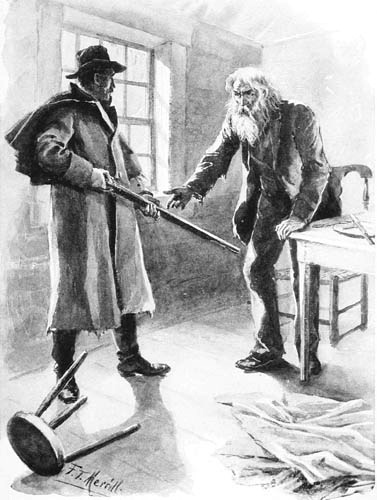
Then the further door was flung open, and Sir Hereward Thayer,
breathless, bareheaded, and without his corselet, made hasty entrance.
His eyes brightened as they fell upon Peter.
"The wolves are on us," he said, "and we have not so much as a stick to
fend them off. It is no shame to hide. Where shall I find security,
good brother?"
"Alack! there will be none here!" cried Peter. "If they are in the
church itself, think you they will spare mere cells and offices?"
"Whither leads this room?" asked Sir Hereward, opening the middle door,
and looking in upon Peter's array of candles, banners, wreaths, and
palls. "Here, under these, I can make myself secret till the search be
done!"
Without further words, he lifted from the darkest corner a pile of
disordered linen stuffs, loose shrouds, and grave-cloths, and coverings
for coffins. The Sacristan, as he looked from the doorway, noted with
shrewd swiftness the gay colors of the morris-dresses underneath, and,
stepping forward, laid his hand upon them. Then Hugh, hurriedly, and
with faltering lips, told Peter what they were, and the story of their
guilty presence—and lo! the old monk laughed aloud.
Then suddenly—as the clamor of the chase deepened outside—Peter
hissed commands into Sir Hereward's ear.
"Get you into this motley in all haste! Lose no moment! Thus only can
you win outside and pass the gates, and go unquestioned through the
town!"