HEN we have crossed the 18th parallel (or nearly so) of north latitude
in Africa and the 30th in Asia—the southern boundary of the Rainless
District—countries of extreme fertility and exuberant product succeed
to the dreary solitudes we have hitherto traversed.
HEN we have crossed the 18th parallel (or nearly so) of north latitude
in Africa and the 30th in Asia—the southern boundary of the Rainless
District—countries of extreme fertility and exuberant product succeed
to the dreary solitudes we have hitherto traversed.
At intervals, indeed, the traveller encounters some vast blighted and
accursed area, where, for a part of each year, a deadly aridity
prevails; but ever there comes a happy moment, even in these desolate
wastes, when genial Nature resumes her rights, abundant rains nourish
vegetable and animal life, and the glowing scene constrains us to
exclaim with thankful heart, “The earth is the Lord’s, and the fulness
thereof.”
The Asiatic plains in the south, are, however, preserved from such
abrupt alternations; numerous water-courses, leaping downward from the
snowy fountains of the Himalayan chain, refresh and fertilize these
countries, which are almost everywhere subject to the dominion of man.
Analagous causes, in the grand rich islands of the warm Indian seas,
produce similar effects; there, also, the very deserts are humid
regions, and tall grasses, bushes, shrubs, reeds, and climbing plants
grow in a rank and luxuriant chaos which we designate by the name of
jungles, in whose dense obscurity the tiger makes his lair, and the
serpent conceals his deadly venom!
In the immense triangle defined by that portion of the African continent
which extends from the Mountains of the Moon to the Cape of Good Hope,
nature has maintained almost intact her savage independence; but she
displays there her most varied forms, from the snow-crested ice-bound
mountain to the lowest and most monotonous plain, from the impenetrable
forest to the nakedest and barrenest steppe.
To enable the reader to comprehend these widely different aspects, and
to describe the peculiar characteristics of each region of this immense
continent, it will be necessary for us to recapitulate its most
important geographical features.
A vast plateau, of comparatively slight elevation, occupies all Southern
Africa, extending eastward as far as the fifth or sixth degree north of
the equator. To the north-west, it is bounded by the mountains of
Senegambia; to the north-east, by those of Abyssinia. On the east and
west, the mountains descend to the very shore in secondary chains; to
the south the table-land is brought down to the sea in a series of
terraces which separate the mountain-ranges.
At its southern extremity, the African continent is from 550 to 600
miles broad. It is occupied by the British colony of the Cape, which is
bounded on the north by the Orange River. The most striking features of
the physical geography of this part of Africa, and which determine in
the main its climate and natural productions, are three chains of
mountains disposed parallel to one another and to the southern coast.
These are separated by terraces or upland plains, each range forming the
boundary of the lower and the abutment of the higher terrace. The
communication is maintained by transverse valleys, which are often of a
highly romantic character. The loftiest and most inland chain is
christened in different parts of its course the Roggeveld Bergen, the
Nieuveld Bergen, and the Sneeu Bergen, or “Snowy Mountains.” Of these
the loftiest summit is the Compass Berg, 10,000 feet in altitude. The
second chain, the Black Mountains, though not so lofty are more massive,
and, in truth, composed of two or three chains in close juxtaposition.
The third, or last chain, in proceeding from south to north, varies from
eighteen to fifty-four miles, enlarging towards the west.
The plain or terrace between the Black and the Snowy Mountains is much
loftier than the two other steps by which we descend to the southern
extremity of the continent. The lowest terrace, bordering on the sea, is
well-watered and fertile. The second, or central terrace, consists of
fertile districts, equally well watered, but intersected by vast dry
deserts, called (from a Hottentot word) Karroos. The third terrace,
commonly designated the Great Karroo, at the base of the Roggeveld and
Nieuveld chain, is 300 miles in length, 80 miles in breadth, and 2000
feet above the sea-level. Its soil, says a writer in the Quarterly
Review, presents throughout its whole extent, for the greater portion
of the year, not a trace of vegetation. These gloomy solitudes assume a
character of picturesque grandeur through their very wildness of
desolation. The scene might convey to a fanciful mind the dreary image
of a ruined world, where the witches and demons of Goethe’s
Walpurgis-Night might fitly celebrate their revels.
“And through the cliffs with ruin strewn,
The wild winds whizz, and howl, and moan.”[79]
During the long dry summer months, the smallest birds would not find
wherewithal to sustain their existence in these sombre deserts, whose
solemn silence not even the murmur of an insect interrupts.

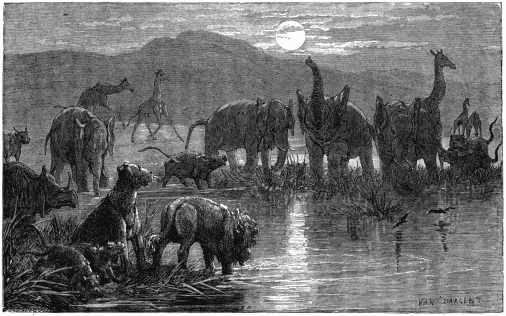
NIGHT-SCENE IN THE AFRICAN INTERIOR.
Yet these regions, deprived of springs and running waters, are not
always sterile deserts, are not always desolate plains. In the dry
season, the soil, a yellow ferruginous clay, acquires the hardness of
brick, just as if it had been exposed to the fire of a furnace; but the
roots and bulbs, protected by a ligneous covering, resist the devouring
heat. The first rains revive them; they put forth their stems and
branches; a myriad flowers reveal their sparkling colours; and the
country which, a day or two before, had shown to the eye a bare and
dreary surface, shines out in a panoply of splendour, as if a magician’s
spell had suddenly transformed it into a terrestrial paradise! But as
the days lengthen, and the sun’s power increases, the bloom and the
beauty vanish, and the curse of fire once more descends upon the gloomy
scene.
In several districts north of the Cape Colony whole years pass by
without the sight or sound of running water rejoicing the wistful
wanderer. Dr. Livingstone, while residing among the Bakouans, in the
Bechuana country, saw the natives excavating the bed of the Kolobeng to
extract a few drops of water. A centigrade thermometer, sunk two and a
half inches in the earth, at noon, marked 56°. Insects placed on the
surface of the ground died in a few seconds. The grass was so dry that
it crumbled into powder when plucked.
The coast of Natal is rich in trees and herbage. The Zambesi, and other
rivers which descend from the central plateau, refresh the plains of
Mozambique and Zanzibar. But from the 4th parallel of north latitude to
Cape Guardafui extends an almost continuous desert. The southern
extremity of the Lupata chain also presents a vast naked country, where
the presence of gold has encouraged the Portuguese to found some
establishments.
The neighbouring zone of Kaffraria consists of great far-spreading,
gently-undulating plains, characterized by extreme aridity. The western
districts are much less broken than the central, and exhibit no
undulations except in the vicinity of the ocean. There an immense level
territory exists under the name of the Kalihari Desert, whose southern
boundary is marked by the Gariep or Orange River, which drains rather
than waters it. To the north this awful wilderness stretches as far as
the Lake Ngami, thus covering the area comprised between the 29th and
30th parallels of south latitude. The pastoral country of Namaqua and
Damaras bounds it on the west. Eastward it extends to the 24th meridian
of west longitude.
Moisture is not wholly wanting in this vast region. The Kalihari has
been called a desert, says Livingstone,[80] because it contains no
running water, and very little in wells. Far from being destitute of
vegetation, it is covered with grass and creeping plants, and there are
large patches of bushes, and even trees. It is remarkably flat; and
prodigious herds of antelopes roam over its trackless plains. The soil
is composed in general of a fine soft sand, lightly coloured—that is,
of a nearly pure silica. In the ancient beds of dried-up rivers lie
immense patches of alluvial soil, which, hardened by the sun, form great
reservoirs, retaining the rain-water for several months of the year. The
quantity of grass flourishing in this region is remarkable. It grows
generally in thick tufts, occasionally intermingled with spaces where
the earth is naked or closely overgrown with creeping plants. These,
deeply rooted in the soil, suffer but little from the effects of the
excessive heat. Most of them have tubercular roots, and are so organized
as to furnish both food and liquid during the long droughts—an epoch
when one vainly seeks elsewhere anything which can appease one’s hunger
or one’s thirst.
The rich vegetation of the Kalihari is due to its geological
constitution. It consists of a great valley, or rather of a vast basin,
whose bottom is formed of a diluvial earth, and which is encircled by a
belt of rocks, cloven at several places. It follows that where the rain
is abundant, the slope of the hills directs it towards the centre of the
basin, and this rain filters and deposits itself beneath the surface of
the soil. And it appears to be a proof of this statement, that on
digging in the sand cisterns are formed, or “sucking-places,” which are
filled with water supplied by subterraneous conduits.
This so-called Desert is not without its utility. Not only does it
nourish innumerable multitudes of animals of every kind, but it has
become the asylum of fugitive tribes. Here at first the Bakalabaris
found a refuge; and then, in their turn, other peoples of the Bechuana,
whose territories had been invaded by the Kaffirs.
The Kalihari has its mirage and its sirocco. During the excessive
drought which precedes the rainy season, a burning wind traverses this
desert from north to south, and during its three or four days’ duration
it withers and dries up everything in its path. It is so loaded with
electricity that a bundle of ostrich feathers, which remained exposed to
it for a few seconds, was itself charged as if it had been in contact
with a powerful electrical machine, and produced a lively disturbance,
accompanied by cracking noises, when taken in the hand. As often as this
wind prevails, the electricity of the atmosphere is so abundant that
every movement of the natives causes sparks to be given off their
karosses, or cloaks made of the skin of beasts.
The contrast is striking between the well-watered east coast of South
Africa and the arid western coast. After the scarped mountains of the
Cape, which ascend northward to the ocean, come the less lofty
chains—the hills of sand which separate the interior sandy desert from
the equally sandy district of the littoral. With the exception of the
Walvish Bay, the coast for eight hundred miles—from the great Orange
River to Cape Negro—has not a stream of water.
At Cape Negro commences a series of terraces, separated from one another
by long bands of sunken ground. This ensemble describes a curve
towards the interior, and leaves on the coast a level plain of about 110
miles in breadth.
In Benguela the plains are healthy and cultivated. More to the north,
one encounters nothing but monotonous savannahs and forests with
gigantic trees. The soil, at a great number of points, is saturated with
water, and, so to speak, enveloped in a shroud of pestilential vapour,
which the breeze never scatters.
The low plains of Biafra and Benin, and especially the Delta of the
Niger, are unwholesome, rank, and foul-smelling marshes. In their
mangrove swamps lurks fever, and a legion of deadly diseases.
“Macies et nova febrium
Terris incubuit cohors.”—(Horace.)
Until the early years of the present century very little was known of
the interior of Southern Africa. At this epoch some native merchants
traversed the country from one sea to another—from St. Paul de Loanda
to the coast of Mozambique and Zanzibar. This exploit was repeated and
outstripped by Dr. Livingstone, who, from 1850 to 1856, accomplished a
marvellous journey of six thousand miles, through regions never before
trodden by the white man’s foot.
Setting out from Kolobeng, the most advanced of the English missionary
stations, he arrived, after having crossed some three hundred miles of a
region without water, at the beautiful river Zouga, which issues from
the western extremity of Lake Ngami.
“A region of drought, where no river glides,
Nor rippling brook with osiered sides,
Nor sedgy pool, nor bubbling fount,
Nor tree, nor cloud, nor misty mount
Appears, to refresh the aching eye;
But barren earth, and the burning sky,
And the blank horizon round and round.”[81]
Lake Ngami is from 45 to 60 miles long, and from 56 to 110 in
circumference. Its direction is N.N.E. to S.S.W. Its southern portion
curves westward, and it receives from the north-west the Teoughé. The
water, very fresh when the lake is full, grows brackish during the dry
season. At the latter period it is very shallow, and at eighteen or
twenty miles from the shore canoes can be manœuvred with the help of
a pole. The banks are everywhere low. At the west a considerable space,
utterly bare of trees, proves that the lake was formerly larger. During
the months which precede the arrival of the northern waters, cattle, to
quench their thirst, make their way with difficulty through the belt of
reeds dried up by the sun. The natives, says Livingstone, who reside on
the shores of the lake, tell us that trees and antelopes are carried
down by the waters during the annual inundation.
The same traveller informs us that the vast regions lying to the north
of the lake at such great distances—regions copiously watered, and
deluged every year by the heavy tropical rains—pour towards the south
the excess of the waters which saturate their soil; and a certain
quantity of these waters, encountering the lake on their way, flow into
it. It is in March and April that the inundation begins. The waters, on
descending, find the rivers dried up, and the lake itself exceedingly
shallow. The rivers in this part of Africa flow in channels capable of
containing a far greater volume of water than they generally hold. When
looking at them, you might believe yourself in some desolated Oriental
garden where all the irrigating canals still exist, but where the dams
permit only a mere thread of water to take its course.
“The water,” adds Livingstone,[82] “is less absorbed by the earth than
lost between banks too wide apart, where the air and the sun evaporate
them. I am persuaded that there is not in the whole of this country a
river which loses itself amid the sands.”
The country situated to the north is exceedingly level for some hundreds
of miles, and abundantly provided with lakes and rivers, which the
slightest undulations of the soil divert into innumerable windings. The
plain is alternately covered with sombre thickets, lofty forests, and
dense herbage. On the banks of some rivers this herbage assumes gigantic
proportions, and by its tenacity opposes an effectual barrier to
animals. In many places the wide green pastures are enlivened by large
herds of cattle, which the natives breed. The land of the Barotses
possess immense prairies of this description, the home of numerous herds
of elephants. But this richness of the soil is counterbalanced by the
insalubrity of the climate. These vast, periodically flooded surfaces
become, when the waters recede, the nurseries of deadly fevers, and
other formidable maladies, whose destructive influence extends to a
great distance.
The magnificent river Zambesi, known in its upper course by the local
appellation of Leambye—both words having the same signification in the
native tongue, “the River”—fertilizes and brightens these productive
regions. Flowing at first from north to south, it makes a sharp bend
westward, to march with stately step from south to north, and from west
to east, until, with a south-eastern inclination, it moves onward to the
Indian Ocean.
It was at a point nearly midway between the two oceans—the Indian and
the Atlantic—that the intrepid Livingstone first descried the Zambesi,
regarding its fertile banks and noble stream with much the same emotions
of delight and surprise as thrilled to the heart of Balboa, when
“With eagle eyes
He stared at the Pacific—and all his men
Looked at each other with a wild surmise—
Silent,upon a peak in Darien.”[83]
He arrived there near the close of the dry season, and yet a grand
volume of water still sparkled in the river’s bed, which varied from 950
to 1900 feet in breadth. At the epoch of the great floods, the Zambesi
rises perpendicularly more than eighteen feet, and at certain points
extends more than forty miles from its bank. From the borders of the
Chobé to those of the Zambesi spreads a low, level country, whose
uniform expanse is only broken by the gigantic hillocks of the termites.
At intervals the traveller lights upon spots where the waters have
formerly settled, then on great morasses and deep rivers, winding their
slow way through an almost impervious jungle. There is a certain fatal
beauty about the whole region, like that of a Circe or a Lucrezia
Borgia; but its atmosphere breathes disease and death.
A general depression and flatness of surface seems to be the physical
characteristic of this part of Central Africa. Thus, on the route
adopted by Livingstone, in a N.N.E. direction, from the chain of
Bamunguatos to the Zambesi, all is level. Mount N’goua, an isolated mass
in 18° 27´ 20´´ south latitude, and 24° 13´ 63´´ east longitude, is a
wholly exceptional accident. The Kandehy Valley, which deploys on the
northern slope of this narrow colossus, is one of the most picturesque
scenes that greeted the eyes of Livingstone during his adventurous
pilgrimage. Fruit trees, loaded with emerald foliage, adorn its sides;
a crystal brook ripples in the centre. Under the shade of an enormous
baobab the graceful antelopes browse undisturbed, until alarmed by the
footfall of the approaching traveller. Gnus and zebras contemplate the
strange intruder with an air of surprise. A few continue to crop the
grass indifferent; others pause in the banquet, uncertain whether to
stay or take to flight. The huge hulk of a white rhinoceros drags
labouring up the shady valley. Buffaloes, and condors, and giraffes
stray far into its pleasant depths as peaceful and almost as trustful as
those of their race which, in days remote, wandered among the beauties
of Eden, in
“That delicious grove,
That garden, planted with the trees of God.”
Further to the north, even to the river Sanshureh, the country increases
in richness and beauty, the water-courses multiply, and the herbage
aspires to such a height that vehicles and animals are lost amongst it.
An exceeding gentleness, an almost Arcadian calm, characterizes the
landscape on the banks of the Leeba, a great affluent of the Leambye.
This river drags its slow and ever-winding waters through a delightful
meadow-land, which is probably flooded every year, for there is no wood
except where the ground rises four or five feet above the general level
of the plain. The soil of these tree-crowned plateaux, or knolls, is
sandy, while that of the prairies consists of an alluvial earth, gray
and black, and mixed with numerous river-shells.
Ascending the Leeba, we enter on a plain more than eighteen miles in
breadth, where the water rises to the traveller’s ankles. This water,
says Livingstone, does not proceed from the overflow of the river; but
the level of the ground is so horizontal that the rain-water cannot pass
away, and abides there for months. Still more humid are the adjacent
plains of Lobala. This vast submerged area forms a watershed between the
rivers of the north and those of the south. Up to this point all the
rivers wend their way southward; but from this point they adopt a
northerly course, to empty their tribute into the Kasaï or Loké.
The interior table-land, especially towards the mid-course of the
Zambesi, is intersected by lofty mountain-chains. It is in this region,
and at the southernmost point of the river’s great Delta, which is 270
miles in length, that the famous Falls occur, named by the natives
“Mosioatounya,” or “Smoke-resounding,” re-christened by Livingstone, the
Victoria. Their vast columns of vapour are visible at a distance of five
or six miles, and might suggest to an American traveller the rolling
clouds that ascend from a burning prairie. The banks and islands of the
river are here enriched with sylvan vegetation of every variety of form
and colour: the mighty baobab, each of whose enormous arms would form
the trunk of a large tree; the graceful palm, with its crest of
plume-like foliage; the silvery mohonams, whose leaves sparkle in the
sunshine like Achilles’ shield; and the nutsouri, abounding in clusters
of pleasant scarlet fruit.
The Falls are bounded on three sides by densely-wooded ridges 300 or 400
feet in height, and may be likened to a flood of water a thousand yards
broad, suddenly hurled over a basaltic precipice 100 feet in depth, and
then as suddenly compressed into a narrow gully not more than fifteen or
twenty yards across.
“If one imagines,” says Dr. Livingstone,[84] “the Thames filled with low
tree-covered hills immediately below the Tunnel, extending as far as
Gravesend, the bed of black basaltic rock instead of London mud, and a
fissure made therein from one end of the Tunnel to the other, down
through the keystones of the arch, and prolonged from the left end of
the Tunnel through thirty miles of hills; then fancy the Thames leaping
bodily into the gulf, and forced there to change its direction and flow
from the right to the left bank, and then rush boiling and roaring
through the hills, he may have some idea of what takes place at this the
most wonderful sight I have witnessed in Africa.”
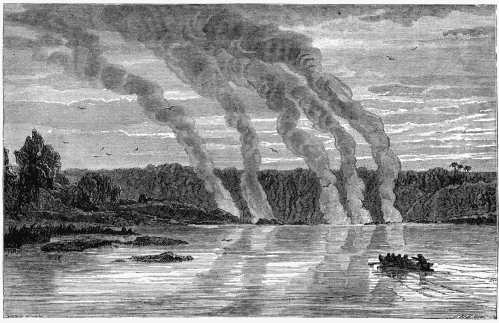
VICTORIA FALLS, RIVER ZAMBESI.
In descending into the narrow abyss already spoken of, the cataract
breaks into five separate streams, which send up, to an elevation of 200
or 300 feet, as many columns of luminous vapour—pillars of shivering
spray, and foam, and diamond sparkle, which in the sunlight are
gloriously wreathed with the rare hues of Iris.
“How profound
The gulf! and how the giant element
From rock to rock leaps with delirious bound,
Crushing the cliffs, which, downward worn and rent
With his fierce footsteps, yield in chasms a vent
To the broad column which rolls on.”—(Byron.)
In descending the Zambesi, we encounter the great river Kafue, which
flows from the north. Beyond the point of confluence the country becomes
opener, freer, and healthier, and we arrive at the Portuguese town of
Tété.
About 200 miles to the north-west of Tété lies the great lake of fresh
water, Niyanyizi-Nyassa, or “Lake of Stars,” which stretches far away to
the north-west across Unyamuezi, or “The Land of the Moon.” It is rather
shallow, sprinkled with numerous fairy islands, and seems to be the
remains of an ancient lake of much greater extent. To the south-west a
belt of fertile country separates it from another lake called Shirwa,
whence issues a beautiful river, tributary to the Zambesi, impeded in
its course by numerous rapids, but traversing a level and unwholesome
country.
At the same time (1856-58) that Livingstone accomplished these great
discoveries, Equatorial Africa was penetrated from the coast of Zambesi
by Captains Burton and Speke. These undaunted and indefatigable
travellers, after having ascended the river Pangany for a hundred and
thirty miles, through a rich and cultivated but pestiferous plain,
arrived in February 1858 at Lake Tanganyika, of which the natives had
spoken to Livingstone, describing the country lying to the westward of
that mass of water as bare of wood, and solely covered with marshy
plains.
Lake Tanganyika lies 200 miles S.W. of the Victoria N’yanza, between
lat. 3° and 7° 45´ S., at an elevation of 1844 feet above the sea. The
30th meridian of east longitude strikes it in the centre. Its length is
320 miles; but its breadth seldom exceeds 15 or 20, and never 60 miles,
so that it has been compared to a beach inclining its head towards the
north. To the north-east its shores are bold and elevated; the water is
fresh and deep. The country around it is rich in pasture, where a
thriving population breed numerous flocks and herds.
About two hundred miles to the north-east of this lake, and 3740 feet
above the sea-level, lies the vast basin of the Victoria N’yanza,
discovered by Captain Speke in 1859, and more fully explored by Speke
and Grant in 1862. Its northern shore runs nearly parallel to the
Equator, at a distance of about twenty miles from it; its southern is in
lat. 2° 46´ S., and long. 33° E. It would seem at some remote period to
have occupied a much larger area than it does at present, though even
now it is supposed to measure 220 miles in length and fully as much in
breadth. Speke describes it as very shallow. Fleets of canoes cover its
surface; but the natives on the one shore never venture across to the
other, and no intercommunication has ever existed between them. The
surrounding landscapes are of a pastoral character, genial and fertile,
with quiet breadths of rich meadow land, dotted by hundreds of white
hornless cattle, and scarcely distinguishable from our midland English
scenery, were they not interspersed with groves of the banana, the
coffee-tree, and the date-palm. At its north-eastern extremity, and
probably connected with it, lies a long narrow basin which the natives
call Lake Baringo. On the west it receives the tributary waters of the
Kitangulé, and from the north throws off the various streams which unite
in one channel to form the famous Nile.
North-west from the N’yanza lies the little Lúta N’zigé, or Albert Lake,
discovered by Sir Samuel Baker in 1864; a long, narrow, and shallow
basin, surrounded by mountains 7000 feet high, about 230 miles in
length, and 2488 feet above the sea-level, which apparently serves as
the great reservoir of the Nile.[85]
The discoveries of Livingstone, Burton, Speke, Grant, and Baker, seem to
confirm the theory put forward by Sir Roderick Murchison, that the
central portion of South Africa is a large and elevated basin, abounding
in immense plains, in fertile lands, besprinkled with numerous lakes fed
by a thousand currents descending from the lofty mountains that
surrounded it. The rains, says Morin, cause these lakes to overflow, and
their waters, prevailing over every obstacle, break through the barrier
of the high lands, and descend into the lower levels in a series of
cataracts, to make their way eventually towards the ocean. Livingstone
has proved the truth of this felicitous induction as far as the Zambesi
is concerned. The Nile also issues from the lofty table-lands through
deep and rocky ravines. The great reservoir of the mysterious Egyptian
river, the N’yanza Spekii, may be accepted as the final confirmation
of Sir Roderick’s theory, and the conspicuous feature of the African
people. The southern extremity of this lake stretches as far as the
watershed between North and South Africa. Starting from the same
viewpoint, Speke concludes that another great lake will be found under
the Equator, to the west of the Tanganyika and the N’yanza Victoria.
This will be the reservoir of the Congo. To establish this fact will be
to solve the last problem of the hydrographic system of Africa.[86]
The western region of the African equatorial zone has been but
superficially explored, and in this direction numerous hypotheses remain
to be verified. Lake Tchad, situated in Central Nigritia, between Bornou
on the west and the south-west, and the Kanem to the north and east, was
discovered in 1823 by Major Denham, and explored by Dr. Barth in 1852.
The latter traveller grows eloquent in his description of the delicious
perspective which he had supposed it would offer to the gaze. He met
with numerous slaves on their way to cut grass for the horses. But
instead of a lake, an immense treeless plain stretched as far as the eye
could reach. The herbage became fresher and greener, thicker and taller;
a marshy bottom, describing a curve which projected here and receded
there, embarrassed his progress more and more; and after a useless and
prolonged struggle to escape from the quagmire, seeking in vain on the
horizon some mirror-like surface, he retraced his steps, dabbling in the
slimy water, and consoling himself with the reflection that at least he
had seen some traces of the “liquid element.” But the scene was
strangely different when, in the winter of 1854-55, more than one-half
of the Ngornou was destroyed by the inundation; and to the south of that
town lay a deep sea, swallowing up the whole plain even to the village
of Koukiya! The lower stratum of the soil, composed of limestone,
appeared to have given way in the preceding year, and had lowered the
shore of the lake several yards; hence the inundation. But apart from
this evidently exceptional geological catastrophe, the character of the
Tchad is clearly that of an immense lagoon whose borders change every
month, and of which it is consequently impossible to lay down any
strictly accurate map.[87]
Lake Tchad lies between lat. 12° 30´ and 14° 30´ N., long. 13° and 15°
30´ S. Its length varies from two hundred to three hundred miles,
according to the amount of rainfall and similar circumstances; at its
broadest it measures one hundred and seventy miles; and it has an
elevation of eight hundred feet above the sea-level. The actual margin
of its waters is lined by a deep fence of papyrus and tall reeds, from
ten to fourteen feet high. Its islands are densely peopled. Fish and
water-fowl abound, and not less do crocodiles and hippopotami. The lake
has no outlet, but receives several rivers, of which the Waube and the
Shari are the most notable.
The country watered by the Niger is also broken up by vast plains which,
fertile and glowing in the rainy season, are scorched and withered by
the summer heats. The famous port of Kabara, not far from Timbuktù, is
several miles from the river, and only accessible for five months in the
year at the epoch of the great rains.
Beyond this belt of vegetation, this girdle of fertility, Nature wears a
sombre aspect—the stony look of a corpse; for the immense Desert of the
Sahara begins. The transition from the one region to the other, from
the land of plenty to the land of want and famine, from the land of
bright lakes, and copious streams, and green pastures, to the land of
rocky heights and barren sandy wastes, is as startling as the change
which sometimes occurs in human life—the change of a moment, from
bustling and exuberant happiness to profound sorrow. It is such
contrasts, however, that enable us fully to appreciate the beauty and
wealth of Nature.
“The scorching winds from arid deserts borne,”
teach us to prize the balmy breath of the “sweet south” that wanders
“o’er a bank of violets.” Fresh from the dreary Sahara plain, burnt and
scathed by a Tropic sun, we can feel all the loveliness of the woodland
and the leafy vale, of each
“Melodious plot
Of beechen green, and shadows numberless.”
Thus, in the material world as in the moral and intellectual, the law of
compensation prevails, and the wayfarer in the Desert of Life may cheer
himself with the recollection that in due time the silence will be
succeeded by music, the desolation by beauty, and the wilderness by
“Verdurous glooms, and winding mossy ways.”
THEY who study the philosophy of history, of which men talk so much, and
know so little; they who seek in the general laws of nature and the
physical economy of the globe an explanation of its ethnological
phenomena, may find, it seems to me, a curious subject for investigation
in the singular destiny of the New World. They will have to ascertain by
what concurrence of circumstances the two Americas, separated from us
by an immensity of waters, and revealed to the world of the East but
some four centuries ago, shall have traversed in so brief a period the
successive phases of conquest, colonization, and emancipation; why
European emigration was directed thitherward at the very beginning; and
thitherward continues still to flow from every quarter; finally, by what
tacit and unanimous agreement this New World has become the adopted
country of all the proscribed and disinherited of the Old; while almost
the entire area of the African continent, which is so much more readily
accessible, is scarcely less favoured in its climatic conditions, and
upon which the white race has rested, from the remotest antiquity, its
political institutions, its arts, and its industry, has remained
uninfluenced by the advancing tide of civilization.
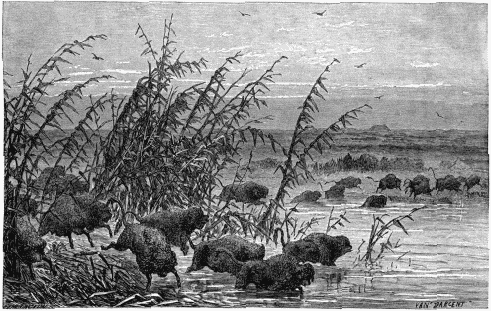
PRAIRIES OF NORTH AMERICA—STAMPEDO OF WILD BISONS.
I limit myself to indicating this problem, which, however, it is not
within my present province to examine, but which naturally suggests
itself when we think of the swift development undergone by the European
societies planted on the American continent—when we remember how
rapidly they are narrowing the area of the desert and the wilderness. At
the epoch of the discovery of the New World it was one vast desolation,
with the exception of Mexico and Peru; and these were but the seats of a
civilization which seemed to have passed without transition from infancy
to old age, from vigour to decrepitude, and which crumbled into dust
under the pitiless blows of the Spanish conquerors. Neither Cortez nor
Pizarro would have overthrown a great empire with a handful of
foot-soldiers and men-at-arms, a squadron or two of horse, and a few
unwieldy guns, had not the Colossus already nodded to its fall, had not
the Column been hollow at the base. But soon the European nations shared
among themselves this immense country and the neighbouring islands. The
Slave race, whose destiny it seemed to be to reign among the polar ice
and snow, long contented itself with the inclement and inhospitable
region of the extreme north-west, which it has but recently surrendered
to the United States Government. The Anglo-Saxon race, in the northern
continent, has seized the lion’s share. It now holds between the two
oceans, from the fifty-fifth to the thirtieth parallels of north
latitude, a fertile and life-breathing territory, well fitted to be the
cradle of great empires; the flourishing Confederation of Canada, the
colony of British Columbia, and the mighty republic of the United
States. Virgin forests have fallen before the restless axe of the hardy
pioneer; hundreds of populous cities have risen as if by enchantment in
districts haunted within the memory of men by the bear and the wild
buffalo; a network of railways spreads from the Atlantic almost to the
base of the Rocky Mountains; crops of waving corn bloom over wide
prairies that a few years ago yielded only the tall grass and waving
reed; the aboriginal tribes of the Red Indians have melted away before
the impetuous tide of an ever-advancing civilization; and the
exhaustless energies of our race have already raised in less than a
century two mighty empires on the Mississippi and the St. Lawrence,
destined to a marvellous, a changeful, and doubtlessly a glorious
history. And both these empires have sprung from the loins of England,
are governed in the main by the same laws, hold the same religion, are
animated by the same aspiring and unwearied genius, and
“Speak the tongue
That Shakspeare spoke; the faith and morals hold
Which Milton held;”
in everything, as we believe,
“Are sprung
Of Earth’s first blood, have titles manifold.”[88]
Southward from the thirtieth parallel stretches the domain of the Latin
races, already mingled with and being absorbed by the Anglo-Saxon, in
Canada, California, and the Southern States of the Union. Vast as this
region is, for it comprehends all Central America and all the Southern
Continent, it is infinitely less prosperous, less powerful, less
peopled, than what we may call Saxon America. Mexico is a byword and a
reproach for savage anarchy and murderous license. Neither Chili, nor
Peru, nor even Brazil approaches Canada in solid power and the
auspicious promise of future greatness. The Latin race seems dwarfed
and cowed by the neighbourhood of the energetic Anglo-Saxon, is swiftly
retiring before it in North America, and in the course of centuries will
probably be subjugated by it, even in the southern division of the great
Continent.
A considerable portion of South America, however, is uncultivated,
unpeopled, and but imperfectly explored. There the Desert re-appears
with—
“The pale, cold aspect of a wearied friend,”[89]
under its most sharply defined forms and most impressive conditions. The
supremacy of the whites over the indigenous tribes is almost nominal;
and if the latter are gradually dying out, the catastrophe, in this
instance, is due rather to their own lack of vigour, energy, and
capacity, than to the pressure of civilization.
However rapid may be the growth of population in North America, however
great the rapidity—shall we say the avidity?—of the American
squatters in their conquest and appropriation of the soil, the Desert
still occupies, principally in “the far West” and the North—that is to
say, in the angle comprised between the line of the great lakes and the
Rocky Mountains—an area almost equal to the whole of Continental
Europe. There we find, as Mr. Johnstone points out, the largest plains
in the world. One such, for example, is that immense basin which extends
from the mouths of the Mackenzie, in the icy Arctic Sea, even to the
remote Delta of the Mississippi, and from the huge chain of the Rocky
Mountains, with their piny recesses and snowy peaks, to the less rugged
and more pastoral range of the Alleghanies; a total area of
4,400,000,000 square yards (3,245,000 square miles). A table-land of
gentle elevation, nowhere above 1500 feet, and rarely more than 700 feet
high, separates this territory into two secondary basins.
The north-east, which pours its waters into the Arctic Ocean, Hudson’s
Bay, and through the Canadian lakes and River St. Lawrence, into the
Atlantic; and,
The south basin, of the Missouri-Mississippi, whose mighty waters flow
into the Gulf of Mexico.
It is in the latter that the traveller encounters the great grassy
plains of the Prairies or Savannahs which are so remarkable a
feature of North America, and which chiefly lie along the western bank
of the Mississippi. “There are no prairies,” says Sir J. Richardson, “to
the north of Peace River, and the level lands which border the Rocky
Mountains do not extend beyond the Great Salt Lake.”
Under so wide a range of latitude the plain necessarily embraces a great
variety of soil, climate, and productions; but being almost in a state
of nature, it is characterized in its central and southern parts by
interminable grassy savannahs and enormous forests, and in the far north
by deserts not less dreary than those of Siberia.[90]
Southward, a bare sandy waste, 400 or 500 miles wide, skirts the base of
the Rocky Mountains to the forty-first parallel of north latitude. The
dry plains of Texas and the upper region of the Arkansas have all the
features of Asiatic table-lands; further to the north, the lifeless,
treeless steppes on the high grounds of the far West are burnt up in
summer, and frozen in winter by biting blasts from the Rocky Mountains.
Towards the Mississippi the soil improves, but its delta is a labyrinth
of streams, and lakes, and dense brushwood, and the rank marshes at its
mouth cover an area of 35,000 square miles. “There are also,” says Mrs.
Somerville, “large tracts or forest and saline ground, especially the
Grand Saline between the rivers Arkansas and Neseikelongo, which is
often covered two or three inches deep with salt, like a fall of snow.
All the cultivation on the right bank of the river is along the Gulf of
Mexico and in the adjacent provinces, and is entirely tropical,
consisting of sugar-cane, cotton, and indigo. The prairies, so
characteristic of North America, then begin.”
And what are these prairies?
Leagues upon leagues of rolling meadow-land, sometimes as level as an
English pasture, always as boundless, apparently, as the sea; richly
covered with long rank grass of tender green, and lighted up by flowers
of the liliaceous kind which scent the air with fragrance. Here and
there, in the north, occur clumps of oak and black walnut; in the south,
groups of tulip, and cotton, and magnolia trees. Occasionally the
monotonous scene is relieved by a lazy brook, whose banks bloom with a
brilliant mass of azaleas, kalmias, rhododendrons, and andromedas; the
low howl of the cayeute, or prairie dog, breaks the silence; and life is
given to the landscape by the frequent appearance of herds of bison,
deer, and wild horses. At times, in the remote districts, the prairie
wolves will be seen in some leafy covert awaiting the approach of a
victim; or flights of birds darken the air, and tempt the traveller with
the promise of an abundant provision.
On the right bank of the Missouri, and on the borders of the White
River, in the territory of Nebraska, lies a dreary desert valley, some
30 feet deep, which the French expressively designate les
Mauvaises-Terres. It may be doubted whether the whole world offers a
stranger or a more impressive landscape. Here geology recognizes the
vestiges of an astonishing diluvian labour, and it is impossible to
venture a step without striking one’s foot against the fossil relics of
vanished animals.
It is a kind of world apart, says an American writer; a large valley
which seems to have been excavated, in the first place, by an immense
vertical out-throw, and then modelled by the prolonged and incessant
action of denudating agents. With a mean breadth of 28, and a total
length of 90 miles, it develops itself in a westerly direction, at the
foot of the sombre mountain-chain known as the Black Hills. On issuing
from the immense, uniform, and monotonous prairie, the traveller finds
himself suddenly transported, after a descent of 100 to 200 feet, into a
depression of the soil where rise a myriad of abrupt rocks, irregular or
prismatic, or like columns dressed with enormous pyramids, and from 110
to 220 feet in height.
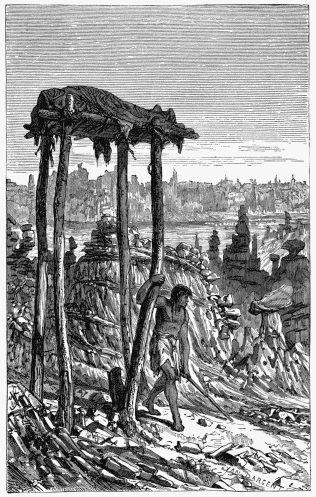
VIEW OF THE “MAUVAISES-TERRES,” NEBRASKA, U.S.
These natural towers are so multiplied over the surface of this
extraordinary region, that the roads wind through them in narrow
passages, and the labyrinth may be likened to the irregular streets and
narrow alleys of some mediæval European city. Seen from afar, the
interminable succession of rocks resembles the massive monuments of
antiquity; nor are turrets wanting, nor flying buttresses, nor graceful
arches, nor vaulted portals, groups of columns, façades, and taper
spires. If at one place the eye lights upon the ruins of a feudal
fortress, at another it surveys the graceful ensemble of a Saracenic
mosque. Or you might almost say, in the distance, that it is a fantastic
“city of the dead” which looms before you; or the gigantic palace of a
race of unseen beings, fashioned by the power of spell and enchantment.
And if the illusion vanishes when, descending from the heights, you
penetrate into the mazes of this Dædalian marvel, the reality is not
less calculated to inspire you with astonishment, and the imagination
remains confused before this wild, this grand, yet ominous freak of
Nature—ominous, for the place seems like a colossal Golgotha, and the
rocks may be the monuments consecrated by invisible hands to the things
and creatures, the life and majesty, of a forgotten Past!
A spectacle unexpected by the European traveller comes at intervals to
heighten and confirm the illusion. Here and there are reared
constructions of manifest human work, but of a truly primitive
character. They consist of four poles, supporting a rude platform of
wicker. Mount any adjacent hillock, and you will see corpses and human
skeletons outstretched upon the platform. These constructions are, in
truth, the burial-places of the Sioux Indians, who wander still in the
neighbouring districts.
The whole coast of the Mexican Gulf, from the Pearl River eastward,
through Alabama and a great part of Florida, is occupied by the
so-called “pine barrens,” which extend far into the interior. These
“vast monotonous tracts of sand, covered with forests of gigantic pine
trees,” are not less a characteristic feature of North America than the
“rolling prairies.” They are not limited to this part of the United
States, but occur to a great extent in Virginia, North Carolina, and
elsewhere. Tennessee and Kentucky, though the plough has passed over
extensive areas, still possess large forests, and the Ohio flows for
hundreds of miles among patriarchal trees, with a rich undergrowth of
azaleas, rhododendrons, and other beautiful shrubs, bound together in
chains of flowers by creeping plants. When America was discovered, one
mass of unbroken forest spread over the mainland, from the Gulf of St.
Lawrence and the Canadian Lakes to the Gulf of Mexico, and from the
Atlantic Ocean it crossed the Alleghany Mountains, and spread in gloom
and grandeur over the valley of the Mississippi—an ocean of vegetation
swelling and sinking for upwards of one million of square miles.
“Then all the broad and boundless mainland lay,
Cooled by the interminable wood, that frowned
O’er mound and vale, where never summer ray
Glanced, till the strong tornado broke his way
Through the gray giants of the sylvan wild;
Yet many a sheltered glade, with blossoms gay,
Beneath the showery sky and sunshine mild,
Within the shaggy arms of that dark forest smiled.”[91]
Prairies which, in their general aspect, resemble those of the Missouri
and the Mississippi, are found to the east and west of the American
Desert, in Arrisona, in Texas, in California, and various provinces of
Mexico. Vegetation, however, nevertheless differs according to the
conditions of each region, and the alternatives of deluging rains and
extreme dryness become more and more conspicuous as we approach the
Equator. Nevertheless—and this, perhaps, is the feature most
distinctive of the Prairies, or Savannahs, from the Pampas and
Llanos—the dryness is never sufficiently severe in the former to
destroy vegetation, as is the case in the latter. But the herbs and
grasses often grow so dry in summer that the most trivial accident—such
as a lighted match flung carelessly away, or the ashes dropped from a
hunter’s pipe—will kindle the most awful conflagrations, and the flames
will spread devouringly over leagues of open ground, consuming trees and
shrubs, and burning to death the cattle or wild animals which haply fall
within their range. With the crackling, hissing, seething noises of the
fire mingle the groans of the perishing beasts, while huge clouds of
smoke roll before the wind, like the billows of a wind-swept ocean,
and live tongues of flame ever and anon light up the terrible scene with
lurid splendour. These “Prairie-fires” are sometimes kindled in revenge
by the Indians, and occasionally the settlers resort to this dangerous
but summary method of clearing the encumbered ground. However caused,
the spectacle is one of infinite grandeur, which might have furnished
Dante with a fresh image of horror for his “Inferno.”
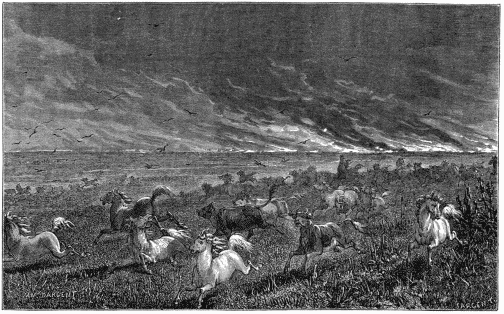
A PRAIRIE ON FIRE IN CENTRAL AMERICA.
From the fortieth to the thirty-fifth parallels of north latitude the
Desert appears in North America under a form more like the “seas of
sand” of Africa and Arabia; the vast areas of the Llanos and the
Pampas. These two words are nearly synonymous. They are used to
designate wide level plains, inundated and fertile in the rainy season,
but in the hot season stripped by the sun’s rays of every apparent trace
of vegetation. Between the Californian Alps and the Rio-Colorado withers
a grand, sandy, and utterly barren plain, which touches the northern
borders of La Sonora. Somewhat further to the east extends the
Llano-Estacado, which eventually merges into the American Desert. But
the most considerable Pampas and Llanos belong to South America. Of
these, the most arid and the most desolate—which most vividly recall
the rainless deserts of the Old World—are the Pampa of Atacama, between
the Andes and the Pacific, with Taracapa on the north, and Copiapo on
the south; that of Sechura, which forms a great portion of the littoral
of the Peruvian department of Truxillo; and that of Pernambuco, which
forms the major part of the plateau north-east of Brazil.
These Deserts, no less than those of Africa and Arabia, merit the name
of the “Land of Fear.”
Their surface is as smooth as that of the calm sea, and bounded only by
the circular line of the horizon; the eye frequently ranges over a space
of twenty-five square miles without meeting a clump of trees on which to
rest; nor is the monotony relieved by the slightest undulation of the
soil. Everywhere is nothingness, silence, desolation, death. More than
one wayfarer has never escaped from their mazy solitudes. Fatigue,
hunger, thirst, decimate the caravans which undertake to traverse them,
and the track is marked by whitened skeletons, whose flesh has been
devoured by vultures, and which unknown hands have piled up and arranged
with a ghastly symmetry of order.
However, since the discovery of America, certain portions of the Llanos
have become habitable. Towns have risen at intervals on the banks of the
rivers which water them. These centres of population are connected with
each other by huts of reeds, covered with ox-hides, and separated by
about a day’s march. Here reside the Llaneros, to whose charge are
intrusted the innumerable herds of cattle, horses, and mules, which
subsist on the pasturage of the Steppes.
The inhabitants of the Llanos possess characteristics as marked as those
of their plains. The hatos wherein they assemble are situated at long
distances apart; but the true home of the llanero, a bold and skilful
horseman, is his saddle. Firmly seated on his rapid steed, he gallops at
will across the trackless plain, and combining the two extremes of
solitude and activity, confines his half-savage existence to the custody
or the ownership of his herds of horses and cattle. Thus, born in the
Llanos like his father, a descendant of the first Spanish settlers, he
has no idea of any other country than his southern pastures, of any
other career than his dreamy pastoral life. Clothed in a picturesque
costume, half Spanish, half Indian; his machete (or cutlass) thrust
through a belt of leather, his poncho (a chequered mantle) over his
shoulder, and the redoubtable lasso suspended in a coil to his
saddle-bow; armed with the clumsy lance, which serves to drive his herd
before him, and, at need, to vindicate its owner’s courage in some
partisan affray; the llanero, never thinking of the past, never dreaming
of the future, on the alert in every danger, and accustomed to the
severest privations, enjoys with intoxication the rude happiness of his
wild freedom.
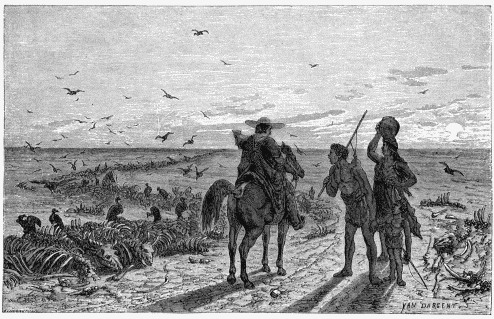
PAMPAS OF SOUTH AMERICA.
The Llanos of Venezuela occupy a superficial area, estimated, according
to Humboldt, at 153,000 square miles, between the deltas of the Orinoco
and the river Coqueta. They are as flat as the surface of the sea, and
covered with long rank grass. You might travel over the dreary level for
1100 miles from the delta of the Orinoco to the foot of the Andes of
Pasto, and frequently not encounter an eminence a foot high in 270
square miles. Their length is twice that of their breadth; and as the
wind blows constantly from the east, the climate is the more ardent the
further west. “These Steppes, for the most part,” says Mrs.
Somerville,[92] “are destitute of trees or bushes, yet in some places
they are dotted with the mauritia and other palms.” Flat as they are,
two kinds of inequalities will sometimes occur: one consists of banks or
shoals of grit or compact limestone, five or six feet high, perfectly
level for several leagues, and imperceptible except on their edges; the
other inequality can only be detected by the barometer or levelling
instruments; it is called a Mesa, and is a gentle knoll swelling very
gradually to an elevation of a few fathoms. Yet slight as is this
altitude, a Mesa forms the watershed from south-west to north-east,
between the affluents of the Orinoco and the streams flowing to the
northern coast of Terra Firma. In the wet season, from April to the end
of October, the tropical rains pour down in torrents, and hundreds of
square miles of the Llanos are inundated by the overflow of the rivers.
In the hollows the water is sometimes twelve feet deep, and such numbers
of horses and other animals perish, that the ground smells strongly of
musk, an odour peculiar to many quadrupeds. “From the flatness of the
country, too, the waters of some affluents of the Orinoco are driven
backwards by the floods of that river, especially when aided by the
wind, and form temporary lakes. When the waters subside, these Steppes,
manured by the sediment, are mantled with verdure, and produce ananas,
while occasional groups of fan palm-trees and mimosas skirt the rivers.
When the dry weather returns, the grass is burnt to powder; the air is
filled with dust raised by currents occasioned by difference of
temperature, even when there is no wind. If by any accident a spark of
fire falls on the scorched plains, a conflagration spreads from river to
river, destroying every animal, and leaves the clayey soil sterile for
years, till vicissitudes of weather crumble the brick-like surface into
earth.”
When this takes place, the rending of the indurated soil is sudden and
violent, as if from the shock of an earthquake. If at such a time two
opposing currents of air, whose conflict produces a rotatory motion,
come in contact with the surface of the earth, the Llanos assume a
strange and singular aspect. Like cone-shaped clouds, whose extremities
seem to touch the ground, the sand rises through the rarefied air in the
electrically-charged centre of the whirling current; like the
sand-spouts of the Saharan Desert, or the waterspouts which formerly
were the awe and dread of the mariner. Then does the lowering sky cast a
“dim uncertain light,” like a November fog in London, on the desolate
plain. The horizon draws suddenly nearer; the Steppe seems to contract,
and a nameless terror seizes the heart of the wanderer. The hot dusty
air increases in suffocating heat; and the east wind, blowing over the
long-heated soil, yields no refreshment, but rather oppresses with its
burning glow. The pools, hitherto protected from evaporation by the
yellow fading branches of the fan palm, begin to disappear. As in the
north the animals grow torpid with the mortal cold, so under the
influence of the parching drought the boa and the crocodile fall asleep,
buried deeply in the dry mud. Everywhere the drought prevails, and yet
everywhere the refracted rays of light delude the traveller with the
image of gleaming lakes and rushing rivers. The distant palm bush hovers
above the ground like a spectre, apparently raised by the influence of
the contact of unequally heated, and, therefore, unequally dense strata
of air. Half hidden by the rolling clouds of dust, restless with the
pangs of thirst and hunger, the horses and cattle roam around, the
cattle dismally lowing, and the horses stretching out their long necks
and snuffing the wind, in the hope some moister current may betray the
neighbourhood of a not wholly failing pool. More sagacious and astute,
the wary mule seeks a different mode of alleviating his thirst. Under
its prickly envelope the melon-cactus conceals a watery pith. The mule
first strikes the prickles aside with his fore-feet, and then cautiously
approaches his lips to the plant and drinks the cool juice. But the
experiment is not always without danger, and many animals are lamed by
the spines of the cactus.
When the overpowering heat of the day is followed by the cooler
temperature of the night, which is always of the same length in these
latitudes, even then the cattle can obtain no repose. Enormous bats suck
their blood like the fabled vampires during their sleep, or attach
themselves to their backs, causing festering wounds in which mosquitoes,
horse-flies, and a host of stinging insects, niche themselves. Thus the
animals lead a weary life during the hot season. But at length, after
the long drought and the parching glow, comes the welcome rain! Then
takes place a transformation such as the fancy of the poet never
surpassed or equalled. The deep blue of the hitherto unclouded sky grows
lighter; the dark space in the constellation of the Southern Cross is
hardly distinguishable at night; the soft phosphorescent lustre of the
so-called Magellanic clouds “fades, fades, and falls away;” even the
stars in Aquila and Ophiucus in the zenith beam with a tremulous and
less planetary radiance. And lo, yonder in the south, a single cloud,
like the peak of some remote mountain, soars perpendicularly from the
horizon. Gradually the gathering vapours fold over the sky. Hark! The
thunder is pealing in the distance, and louder and nearer come its awful
reverberation. It heralds the life-restoring rain! Scarcely has the
genial moisture refreshened earth, before a blessed fragrance breathes
from the previously barren Steppe, and its nakedness is clothed upon
with the bloom and beauty of a thousand grasses. The herbaceous mimosas,
with renewed sensibility to the influence of light, open their drooping
leaves to greet the rising sun; and the rosy-fingered morn is saluted
with a glad chorus of birds, and by the opening blossoms of the
water-plants. Now the horse bounds over the plain in keen ecstasy of
spirit, and the cattle grazes plentifully on the fresh green herbage.
Yet the new life is not without its peril. Anguis latet in herbâ.
Among the tall thick grass lurks the spotted jaguar, the tiger of the
New World, and measures carefully the distance that separates him from
his unsuspecting victim.
Sometimes (so say the natives) the moistened clay on the margin of the
swamps will blister and swell slowly into a kind of mound until, with a
violent noise, like the outbreak of a small mud volcano, the accumulated
earth is cast high into the air. The spectator who comprehends the
purport of this strange scene immediately retreats, for he knows that
the birth of the portentous travail will be a gigantic water-snake or
huge crocodile roused from its torpidity.
The rivers which bound the plain to the south—the Arauca, the Apure,
and the Pajara—gradually swell, and now Nature compels the same
animals, which in the first half of the year panted with thirst on the
dry and dusty soil, to adopt an amphibious life. A portion of the Steppe
now assumes the aspect of a vast inland sea.[93] The brood mares retire
with their foals to the more elevated banks, which rise like islands
above the watery expanse. Every day the dry space grows smaller. It is a
miniature reproduction of the Noachian Deluge. The animals, crowded
together, swim about for hours in quest of other pasture, and feed
sparingly on the tops of the flowering grasses that spring above the
seething surface of the turbid waters. Many foals are drowned, and many
are surprised by the crocodiles, killed by a blow from their powerful
tails, and devoured. It is no uncommon thing to see the marks of these
monsters’ cruel teeth on the legs of horses and cattle which have
narrowly escaped from their blood-thirsty jaws. Such a sight reminds the
thoughtful observer of that capability of adaptation to the most varied
circumstances with which the all-powerful Creator has endowed certain
animals and plants.[94]
The Pampas of Pernambuco and Buenos Ayres have three times the
superficial area of the Llanos of Venezuela. So great is their extent,
that while forests of palms border them on the north, they are covered
with snow in the south, during a great part of the year, like the
northern Steppes of Tartary. According to the climatic divisions
generally adopted, these regions belong to the Temperate Zone; but in
truth they comprehend a great variety of climates. Their character is
not less grand or original than that of the Llanos which precede them.
“The Pampas,” says an American writer, “surpass in majesty all the
marvels of the new continent, and yet they astonish the traveller by the
air of abandonment and sadness which is impressed upon them, especially
in the low country watered by the Plata. Traces of life are there
infrequent; still rarer are the objects which attract attention. Here,
at the bottom of a crevasse, a cactus conceals its head bristling with
spines; there, a solitary tree rises majestically toward heaven.
Sometimes, upon the plain, the eye discovers the monstrous skeleton of
an animal which flourished in those remote times when the Alps still
slept in the depths of ocean, and dreamed not of blending their
snow-burdened peaks with the clouds. The Pampas serve as the
burial-place for races of gigantic men, now extinct, who seem to issue
from their silent graves in testimony to the former being of vanished
generations, and to bear witness to the Creator of all things. Above
your head, and far away in the azure of heaven, you perceive a black
point; it is a condor describing slowly its sinister circles. In the
distance passes and disappears the ungainly figure of an ostrich. The
inexpressible charm of these solitudes is their absolute freedom. And
while traversing them the wayfarer comprehends the love with which they
inspire the Indian, whose hope it is to meet beyond this world with yet
vaster horizons for the indulgence of his wandering tastes.”
At the southern extremity of South America spreads a sterile plain, sown
with pebbles and blocks of porphyry: it is Patagonia. As we retrace our
steps towards the north, the soil rises before us in terrace after
terrace, till it reaches the base of the Cordilleras. In the northern
districts the pebbly soil gives place to verdant meadows, where the
Patagonians breed numerous herds of horses and cattle. Water is wanting
in this country. The rains are rare, and the dry seasons very prolonged.
The summer heat is overwhelming; in winter violent winds sweep the
Savannahs, which are covered with nocturnal frosts. Under such climatic
influences the soil produces only a dry coarse grass. In the interior a
few beeches and cacti are met with, and then broad swamps, fringed with
reeds and rushes. In the spring a mantle of clover spreads over the
earth, but only to be withered up by the first heats of summer.
Along the banks of the Rio Negro the Pampas of Buenos Ayres stretch from
the coast of the Atlantic to the foot of the Andes. On a considerable
portion of this vast area marshes of salt water encroach—a phenomenon
all the more curious because the salt lies only on the surface, and all
the wells artificially excavated yield fresh water. During the rains the
low grounds are flooded; but as soon as the sun has dried up the plain,
it is clothed in rich pasturage, while the elevated table-lands are dry
and withered. There, too, the dryness is often attended with disastrous
results. From 1827 to 1830, as Mr. Darwin records, not a drop of water
fell; all traces of vegetation disappeared; the rivers ran dry, and the
herds perished in incalculable numbers; in the single province of Buenos
Ayres, the loss was estimated at more than a million head of cattle.
To the north of the Rio Salado, at the portals of the Andes, the country
assumes a look of implacable desolation; no winds ever agitate the lower
strata of the atmosphere. The water-courses which descend from the
mountains lose themselves in the sand; salt marshes, whence the very
birds hold aloof, alone alternate with a soil everywhere intersected by
crevices. The district of the Pampas which stretches northward to the
spurs of the Andes consists of a sandy soil, free from salt, but wholly
unproductive. These solitudes, however, are ploughed by running streams,
none of which communicate with the sea. They descend from the Andes,
traverse the Pampas from east to west, and empty themselves into the
saline lakes. Somewhat further to the north, and nearer the Equator,
lies an almost unknown region of salt—a region of indescribable gloom,
where neither tree, nor bush, nor blade of emerald grass, delights the
eye. Eighteen months frequently elapse in this land of desolation,
worthy of being one of the circles in Dante’s “Inferno,” without the
cheering sound of a shower of rain, and when at length it arrives, it
splits the rocks of salt and melts them into wide pools of brackish
mud. As soon as the sun has absorbed the excessive humidity of the soil,
myriads of salt crystals glitter on the surface, and convert the Desert
into one immense mirror.
To the north-west of La Plata extends a desert of very different
character—the Despoblado, or uninhabited land, a plateau of the
Andes, rising some 4200 feet above the level of the sea. This desert is
cloven into two portions by a deep valley, bordered with sharp rocks,
which affords the only practicable route from Bolivia to Buenos Ayres.
Winter, in this sombre world within a world, is a time of horror, when
the spirit of Desolation goes to and fro in wrath unchained. Yet even
here humanity drags about the fetters of existence. The traveller
occasionally alights upon the wretched huts where the unfortunate
descendants of the ancient Peruvians linger through life. Their wealth
consists in a few llamas. Their occupation, in hunting the alpaca, the
guanaco, and the chinchilla; in filtering the river sands for scanty
grains of gold; in collecting salt, and disposing of it to the
inhabitants of the nearest towns.
“The aspect of the Puna, or Despoblado,” says Von Tschudi,[95] “is
singularly monotonous and dreary. The expansive levels are scantily
covered with grasses of a yellowish-brown hue, and are never enlivened
by fresh-looking verdure. Here and there, at distant intervals, may be
seen a few stunted Quenera trees,[96] or large patches of ground covered
with the Ratanbia shrub.[97] Both are used by the Indians as fuel, and
for roofing their huts. The cold climate and sterile soil are formidable
impediments to agriculture. Only one plant is cultivated in these
regions with any degree of success. It is the maca, a tuberous root
grown like the potato, and, like it, used as an article of food. In many
of the Puna districts it constitutes the principal sustenance of the
inhabitants. It has an agreeable and somewhat sweetish flavour, and when
boiled in milk it tastes like the chestnut.”
The most imposing spectacle presented by the Deserts of South America is
that of their frequent hurricanes. As the Simoom to the Sahara, so is
the Pampero to the Pampas. Its approach is foretold by signs which the
native’s experienced eye readily recognizes. All at once the air seems
stricken motionless, and over the solitude broods a solemn silence. A
cloud white and light as snow—a cloud “no bigger than a man’s
hand”—rises in the south-west. It advances, and as it advances enlarges
its proportions. Other clouds appear, and all gather into one imposing
mass. The dust rises and whirls round in thick columns suspended between
heaven and earth. Lower and lower descend the congregated vapours, until
they envelop the earth in a funeral shroud, whose folds the hurricane
incessantly agitates, and which the forked lightnings seem to rend in
fragments. Suffocating gusts of a fiery wind traverse space. And now the
sudden tempest stoops down from the summit of the Andes, and sweeps the
Savannah with resistless fury. Enormous masses of sand, upgathered by
the rafale, obscure the clearness of day; at noon the earth is covered
with a darkness that may be felt. The thunder mingles its roar with the
strident voices of the storm. All that lives, all that breathes, is at
the mercy of the unchained elements, which are as pitiless in their
wrath as a roused people. Thousands of animals perish in the Savannahs;
and prostrate, with his face to the earth, man tremblingly awaits the
expiring breath of the grand convulsion!
The horses and cattle of Europe are replaced in the Pampas of South
America by the herds of guanacos and llamas which covered them at the
epoch of the Spanish conquest. Their owners, descendants of the
Spaniards intermingled with the native races, possess many of the
characteristics of the Arab.
Like the llanero of Venezuela, the guacho of the Pampas realizes the
idea of the ancient centaur; and from the throne of his saddle, to which
hangs the inseparable lasso, he surveys the plains where he is lord
and king with the fiery glance of a free and independent spirit. He owes
scant allegiance to any established authority, and under the blue sky of
heaven enjoys the blessings of uncontrolled freedom. And what to him
the fever and turmoil of civilization, when, mounted on his noble steed,
he can roam at will, with none to say him nay, over leagues and leagues
of grassy prairies!
GEOGRAPHERS have given the name of the “fifth division of the globe” to
that immense archipelago, or rather, that mass of archipelagoes which
remote geological convulsions have elevated in the Pacific Ocean,
between the three continents, Asia, Africa, and America, and whose
existence was first revealed to the Western World by the maritime
explorations of the Portuguese and the Dutch, in the sixteenth and
seventeenth centuries. From the epoch when these enterprises commenced,
the spherical figure of the earth was established beyond dispute; and
after the discovery of America, it became only reasonable to suppose
that, in virtue of a law without which our planet could not have
maintained its equilibrium in space, there must exist a continent
intended to balance those of the Northern Hemisphere. But for many years
all the researches of intrepid navigators only led them to the shores of
small islands and islets, not a few of which were barren, uninhabited,
and swept by the winds of ocean; while others, girdled with palms,
enriched with vegetation, and blessed by bland and genial airs, seemed
to realize the poetical idea of the Fortunate Islands,
“Summer isles of Eden lying in dark purple spheres of sea.”
At length, however, by directing their investigations towards the less
submerged region of the Indian Ocean, and by sailing beyond the great
eastern islands which seem to have been formerly connected with the
Indian Peninsula, the Portuguese mariners were the first to descry a
long line of coast which they did not doubt was that of an Austral
Continent, whose satellites, so to speak, were the previously discovered
islands. This supposed continent is still represented in the old maps
published at the close of the seventeenth and the beginning of the
eighteenth centuries, by a mass of ill-defined contours, with this
indication: Terra Australis incognita. The succeeding voyages of
Carpenter, Nuyts, Tasman, and the illustrious Cook, proved that this
Austral or Southern Land was in effect a continent, or, at least, an
island of extraordinary dimensions, whose coasts alone—and these but a
small extent inland—were inhabited by miserable tribes, with black
skin, and hideous features, placed at the extreme limit which separates
man from the brute. The Dutch navigators, who had first determined the
principal outlines of this continent, named it New Holland, but after it
passed into the hands of England, it received, as it still preserves,
the appellation of Australia.
Take away from this Australian Continent its fertile districts in the
south-east, where have sprung up and developed with amazing rapidity the
flourishing colonies of New South Wales, Victoria, and Queensland, and
what remains? A country entirely wild, and, one might almost venture to
say, an immense Desert. The gloomy aspect and the barrenness of its
northern shores, with few exceptions, had repulsed the early Portuguese
and Dutch navigators, who little suspected what splendid treasures were
hidden among its auriferous sands and rocks. They saw but insufficient
rivers and scanty vegetation, and went no further.
None of the rivers of New Holland are navigable to any great distance
from their mouths. The want of water is severely felt in the interior,
where a treeless desert of sand, swamps, and jungle is intersected by
streams called “creeks,” which are dry for the greater portion of the
year; yet a belief long prevailed that a large sea or fresh-water lake
occupied the centre—a belief founded partly on the nature of the soil,
and partly on the circumstance that all the rivers that flow into the
sea on the northern coast, between the Gulf of Van Diemen and
Carpentaria, converge towards their sources, as if they served for
drains to some large body of water.
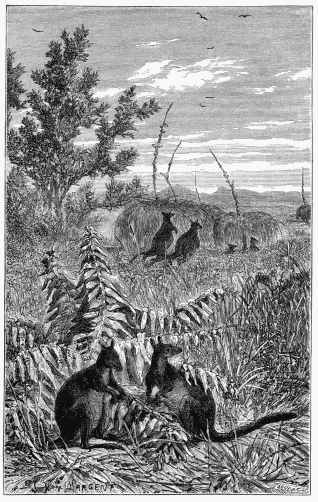
AUSTRALIAN LANDSCAPE.
The eastern side of the country is traversed by a great range of thinly
timbered down, clothed with grasses and herbage, and rising to an
elevation of 3500 feet. These are known as the Blue Mountains, and
stretch from north to south over nearly thirty degrees of latitude, from
Cape York to Cape Wilson. All their western slopes descend gradually
towards the interior, until they are lost in the vast desert plain of
the interior.
The streams which flow in this direction either pour their waters into
the great rivers, such as the Darling and the Murray, which has an
internal navigation of 1800 miles, or lose themselves in the marshes and
lakes, which the great summer heats periodically dry up.
Another chain of mountains stretches from south to north along the
western coast of Australia, from Point d’Entrecasteaux to Murchison
River. A third chain, in the northern region, runs from east to west,
between Camden Harbour and the Gulf of Carpentaria. The interior of the
country is, as I have already indicated, in all probability an immense
plain, thinly sown with trees of the two families of Acaciæ and
Eucalypti, and tenanted by the wombat and the kangaroo.
Over this vast portion of Australia, which still remains a blank upon
the map, numerous expeditions of discovery have been attempted since the
earliest days of European colonization. Hardy pioneers—those men who
are the real, but obscure, and speedily forgotten founders of
empires—have sacrificed their lives in the endeavour to lay down a
track across the great island-continent from north to south. Anglo-Saxon
enterprise no sooner found itself securely planted on the sea-coast,
than it felt that behind it lay a continent to acquire, and the
indomitable instinct of the race bade it continue its mission of
colonization. During the last quarter of a century, the colonial
governments have liberally encouraged these explorations, and the annals
of Australian discovery have been illuminated by the names of Eyre
(1840), Sturt (1845), Leichardt (1846-48), Kennedy (1848), and M’Douall
Stuart (1858-62), second to none among our English discoverers in
patience, resolution, and heroic daring.
The problem remained: to cross the central wilderness of Australia, and
prove the possibility of a passage from the southern shores to the
northern, from Melbourne to the Gulf of Carpentaria. This problem was
finally solved, at no light cost, by the intrepid Burke and energetic
Wills.
On the 20th of April 1860, there set out from Melbourne, under the
auspices of the Government of Victoria, a small troop of gallant
explorers, under the immediate direction of Robert O’Hara Burke, a man
well-fitted for his post: born in the county of Galway in 1821, after
having served as captain in a Hungarian regiment, he had discharged for
several years the duties of inspector of a body of the colonial police.
The second in command was a brave young Englishman, William John Wills,
twenty-six years of age, an assistant in the Observatory at Melbourne.
The expedition consisted of eighteen persons, and was provided with
horses, camels which had been expressly imported from Arabia, waggons,
all kinds of scientific instruments, and the necessary amount of stores
and provisions for a protracted journey.
Cooper’s Creek, which marked about a third of the whole distance, was
fixed upon as place of rendezvous and as the final starting-point.
Thither, to save time, Burke and Wills, with six men, six camels, five
horses, and some months’ provisions, proceeded in advance of the main
body; and arriving there on the 13th of December, Burke established a
depôt, left it in charge of Brahé, a petty officer, and three
assistants, and with Wills, a couple of men (King and Gray), the camels,
and one horse, plunged on the 16th into the trackless Australian
wilds.[98]
Keeping nearly due north, and near or upon the meridian of 140° E., they
traversed, day after day, well-watered plains, with numerous clumps of
wood, and tolerable indications of a good grazing country. On the 12th
of February 1861, the four travellers had conquered every obstacle, and
struck the marshes on the Albert River, which flows into the Gulf of
Carpentaria. Their goal was reached, and the problem of a connecting
route between north and south successfully solved.
The vast Australian solitudes hitherto traversed had presented every
variety of aspect, from the stony plateaux and the watery sands where
the rivers can keep no regular channel, and where wide spaces of dry
bare ground separate great shallows of brackish water, to finely
irrigated plains, clothed with herbs or bushes, and promising abundant
resources for future colonists. Meteorological phenomena present in
these regions the greatest uncertainties: either the dry season is so
protracted as to ruin all vegetation, or the rains so thoroughly deluge
the soil as by a contrary cause to ensure the same result. These
climatic contradictions explain the variations observable in the
narratives of the different travellers who have visited the interior.
One point, however, is beyond all doubt; the hopeless sterility of Nuyts
Land,—that immense sandy tract which, over an extent as yet unknown, is
regarded as impassable, and stretches along the southern coast between
Spencer Gulf and King George Harbour. As before said, the primary cause
of the barrenness of Central Australia is the lack of water—running
water and rain water. Yet the most sterile portions lie far nearer the
coast than was formerly credited; and monotonous as may be the
descriptions of explorers, so far as the landscapes of Central Australia
are concerned, we may from to-day consider that, with the exception of
certain points, no obstacles exist sufficiently powerful to arrest the
expansion of European colonization, in a country especially where
cattle-breeding is the principal industry, and the one which takes
precedence of all others.
The chief difficulty encountered by each exploring party has been the
penury of natural products of the soil adapted for human food. The
traveller is compelled to carry with him a sufficiency of provisions to
last him from his departure until his return. It was this insufficiency
of rations which wrought the fatal dénouement of the glorious enterprise
of Burke and Wills.
After reaching the Gulf of Carpentaria, there remained nothing more for
Burke and his three companions but to retrace their steps to their depôt
at Cooper’s Creek. But their energies were exhausted, and from the
beginning of April their provisions failed them. At the close of ten or
twelve days’ march, they were constrained to kill a horse. In the
following week, Gray succumbed to the excessive fatigue. The three
survivors dragged themselves on to the depôt, where they arrived on the
morning of the 21st of April. But the men whom they had left in charge
had taken their departure that very morning, after waiting long beyond
the time originally fixed for their return.
“You may imagine our consternation,” says Wills in his Journal, under
the date of April 21st; “four months of harassing marches and privations
of every kind had completely exhausted our strength. It was an extremely
difficult task for either of us to accomplish a distance of only a few
yards. The effort necessary to ascend the smallest elevation of the
ground, even without a burden, induces an indescribable sensation of
pain and helplessness, and the general lassitude makes one unfit for
anything.”
There was no resource now but to rejoin Brahé and his men, if possible.
Before quitting the depôt, the latter had left a small supply of
provisions, which proved eminently serviceable. On the 23rd Burke,
Wills, and King resumed their march, at the rate of four or five miles
a-day, in the direction of Mount Despair, which was about sixty miles
distant, and where were placed the most advanced posts, northward, of
South Australia. A terrible fatality, however, seemed to pursue them;
one of their camels, Landa, perished in a bog; the other, Rajah, they
were soon forced to kill for food; then they themselves were compelled
by sheer exhaustion to return to the depôt, which, meanwhile, had been
revisited by Brahé without his discovering a trace of their brief
sojourn. Thus abandoned to perish in the Desert, they existed upon the
bounty of such natives as they met with, and who occasionally supplied
them with a few fish and a little nardoo, an aquatic plant whose
pounded seeds the aborigines make into bread. Such a regimen was
insufficient to restore their exhausted strength.
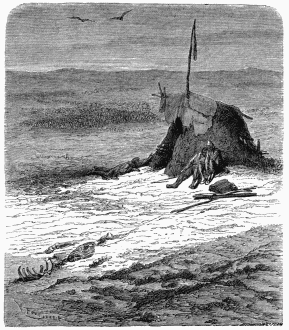
Burke, Wills, and King in the Deserts of Central
Australia.
Early in June their afflictions were aggravated by a deplorable
catastrophe. The flames of their bivouac fire, driven by a strong wind,
reduced to ashes their hut and all that they possessed. There was
nothing for them now but to live with the friendly natives who had
succoured them. Unfortunately, they had disappeared. It was in vain they
attempted to seek them out; Burke and Wills never saw them again.
On Saturday the 29th of June, the latter, utterly exhausted, insisted
that his companions should leave him in the wilderness, while they
continued their search after the natives. Unwillingly they consented,
and taking a solemn farewell of their unfortunate comrade, they dragged
themselves away with aching hearts. Four or five days afterwards, King
returned with some birds he had contrived to kill, but found Wills
asleep in the arms of death. King was now alone, for the intrepid Burke
had also fallen a victim to the cruel spirit of the wilderness, resting
on the barren ground, with his face upturned to the southern stars. The
sole survivor was fortunate enough to fall in with the natives, who
welcomed him cordially, and carried him with them from camp to camp.
After two months and a half of this strange existence, he was discovered
by a relief party sent out from Melbourne, under the command of Mr.
Howitt (September 15, 1861), who also gathered the remains of the two
gallant but ill-fated leaders, and reverently consigned them to a decent
grave.
They had not died in vain. From the shores of Port Philip to those of
the Gulf of Carpentaria they had discovered and marked out a practicable
route; and when the great Australian colonies shall have pushed forward
into the interior, and have occupied the borders of the northern gulf,
they will remember with gratitude the brave explorers who sacrificed
their lives to effect the passage from one sea to the other.
THE facts actually ascertained in reference to the Flora of the plains
of Central Africa, although as yet of a limited character, form as a
whole too comprehensive a subject to be fully discussed in these pages.
I must, therefore, confine myself to a rapid survey of the principal
botanical features of the countries whose general features and physical
aspect I have sketched in the preceding chapters.
Senegambia and Upper Guinea, on the west coast of Africa, form a low
table-land, situated upwards of 3000 feet above the sea-level, and
furrowed by deep gorges, in whose rocky beds the rivers roll and foam,
fed by the waters of numerous streams. Grassy savannahs and wide
cultivated areas are here inhabited by a numerous population. Several
travellers have explored these regions; but all have specially applied
themselves to make known the colossal plants which flourish therein, and
those, first and foremost, which have a particular interest, either from
their Anak-like stature or the manifold uses of their products. I shall
have occasion to speak of the arborescent species which, in this part of
the Old Continent, blend in immense and impenetrable forests. But owing
to this very circumstance we possess few details respecting the plants
which clothe the vast plains of Senegambia and Upper Guinea. We only
know that there, as everywhere, the great family of the Gramineæ is
largely represented. In general these species far exceed in height the
plants which make the wealth and glory of our English meads; and they
chiefly belong to the tribe of Paniceæ. A legion of Cassias inhabit the
low fresh hills of the Senegambian lands; and some are held in high
estimation for their fruit, as the Cassia, or Senna, which is considered
one of the most active purgatives. The species generally recognized as
best adapted for medicinal purposes are those with oboval and those with
obtuse leaves—Cassia obovata and Cassia obtusifolia. The former is
a perennial herbaceous plant, from one to two feet high, with smooth
egg-shaped leaves and racemes of yellow flowers; the latter differs only
in the form of its leaves, which are short and broad, or obtuse.
Many of the cereals are cultivated in Senegambia on a very large scale;
but they differ wholly from those which engage the attention of the
European agriculturist. Barley will not grow even on the most elevated
plateaux, on account of the constant and excessive heat. It is true that
it will germinate; but it develops so rapidly that it passes through all
the phases of its vegetation in the space of a few weeks, and yields but
impoverished ears empty of grains; it is useless to the people of
Senegambia except as forage. But, on the other hand, there are numerous
Gramineæ adapted to hot regions, which the natives cultivate for their
uses. Among others I may name the Tocussa and the Coracan (Eleasine
Tocussa and E. Corocana), with their curved digitate spikes and
productive seeds; the Pennicellaria spicata, or Guinea Corn, a very
tall grass, somewhat resembling maize, whose long cylindrical culms or
blades bear each a multitude of white round grains, which, ground into
meal, form very savoury cakes, as you may read in Mungo Park’s Travels;
and the Durra, Doura, Indian Millet, or Sorgho Grass
(Sorghum), a coarse, strong, broad-leaved grass, four to eight feet
high, with a round grain a little larger than mustard seed; it is the
principal corn-plant of Africa, and exceedingly nutritious, the natives
employing it in the preparation of a favourite dish named Kouskoussou.
The cereals most widely cultivated in Senegal include the Colonial
Millet (Oplismenus colonus); the Abyssinian Meadow Grass (Poa
Abyssinica), called “Teff” in Abyssinia, whose seeds are used for
making bread, and whose blades yield an abundant herbage; Rice (Oryza
sativa), and different varieties of maize. Leguminous plants appear
wanting in Senegal. Their absence is probably due to the same causes as
those which we have indicated as affecting the growth of barley.
Cabbages and the different salads grow, in fact, with a rapidity which
prevents them from maturing; they flower in two or three weeks after
being sown. The inhabitants consequently resort to those alimentary
species which belong to hot countries, and which can only be obtained in
Europe at an enormous expense and by artificial means. Among the plants
with edible roots are various kinds of Yams (such as the Dioscorea
alata); Batatas (Convolvulus Batatas); and the Manioc or Manihot
(Jatropha Manihot),[99] better known as Cassava, which, although in
itself a deadly poison, is easily deprived by heat of its noxious
properties, and when roasted or boiled becomes a nutritious and highly
savoury food. It yields the valuable farinaceous material of Tapioca.
Its leaves are cooling and healing; from its seeds an excellent oil is
procured; and the juice which drops from its root serves for
empoisoning arrows. Good and evil are both strangely mixed in this
important plant.
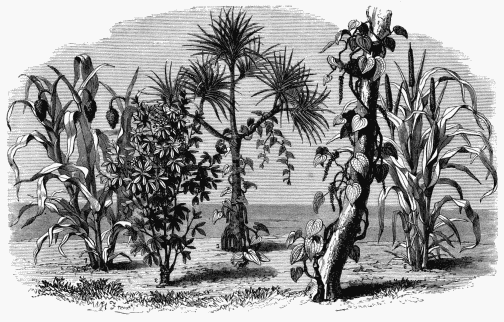 VEGETABLE LIFE IN THE AFRICAN PLAINS.
| 1. Guinea Corn (Pennicillaria spicata). | 3. Manihot (Jatropha Manihot). | 5. Screw Pine (Pandanus candelabrum). |
| 2. Sorgho Grass (Sorghum cernuum). | 4. Yam (Dioscorea alata). | 6. Black Pepper (Piper nigrum). |
The Corchorus olitorius,[100] an annual cultivated in Egypt as a
potherb, is largely grown in Senegal for the tenacious fibres of its
root and the oily juices of its seeds. The Black Pepper (Piper nigrum)
of India and the Sunda Isles we find perfectly acclimatized in this part
of Africa, and it flourishes even in a wild state. Finally, the
Coffee-tree (Coffea Arabica), the Cocoa (Theobroma Cacao), Indigo
(Indigofera tinctoria), and the Cocos oleracea, are among the
cultivated plants of Senegambia.
In northern Guinea and the Gaboon, recently made famous by Du Chaillu’s
discovery of the gorilla, Savannahs and cultivated districts are
intermingled, though their flora is still imperfectly known. A great
number of grasses adorn the fresh and humid prairies, and sedges and
reeds abound, while, on the river-banks, in shady nooks, flourish some
of the Screw-pine tribe,[101] notably the Pandanus Candelabrum, a
highly curious plant, which attracts one’s attention by its mode of
vegetation, its graceful ribbon-like foliage, and its small fragrant
flowers. Thatching and cordage are obtained from the fibrous leaves; the
fruit resembles a richly-coloured pine-apple, but is insipid to the
taste.
The Savannahs of the neighbouring provinces, and especially those of the
Gold Coast, are in general sparsely inhabited, nor are those on the
banks of the Niger an exception; man shrinks from a region which the
deadly malaria seems to claim as its own. The flora is very poor,
consisting chiefly of aquatic grasses, with blades of moderate height,
and leaves of comparatively little succulence. The herbaceous plants,
suitable for food or industrial uses, which are most frequently met with
in Guinea and the Gaboon, resemble those already described as belonging
also to Senegambia. But there are many different Arums, such as the
Caladium segmium and Colocasia mucronatum, properly known as Taro,
Tara, or Tayo, and employed in making granulate sugar from the stem of
the former, and in boiling or roasting for food the rhizomæ of the
latter; Tobacco; the ox-heart Annona, a plant sometimes cultivated in
Europe, where it never fructifies, though its aromatic fruits are its
most valuable product, and are highly esteemed by the Africans,—these
“Custard Apples” resembling thick cream, and being eaten, like cream,
with a spoon; the Banana,[102] with its gigantic foliage—precious “Musa
Sapientum “—valuable not only to “wise men,” but foolish men, as a
substitute for wheat or the breadfruit tree, and gratifying the savage
with a succulent and nutritious food. Forty or fifty banana plants will
flourish in a square space of one thousand feet, and an acre of ground
will yield sufficient provision for fifty men. That area of land which,
sown with wheat, would feed only one man, will nourish five-and-twenty
if planted with bananas.
I must not forget the Pistachios,[103] which flourish spontaneously in
the vast plains of Central Africa, and the highly valuable Sugar Cane
(Saccharum officinarum), which, like the Cotton Plant, has rendered
inestimable services to man, and yet has been the origin of unutterable
crime and misery, promoting by its cultivation the accursed slave-trade.
The Vine (Vitis vinifera) is cultivated in a few districts. Among the
herbaceous or sub-frutescent plants peculiar to this region, and which
enjoy a certain reputation on account of the utility of their products,
I may name the following:—
The Calebash Nutmeg (Monodora myristica), one of the Annonaceæ,
remarkable for its withered fruits, which, when rasped like its seeds,
furnish a condiment deservedly esteemed by the natives; Guinea Pepper
(Uvaria Æthiopica), whose properties are well known and appreciated in
this part of Western Africa; and finally, one of the Cucurbitaceæ, the
Telfairia pedata, whose seeds enclose a very oleaginous substance.
To the east, in Nigritia or the Soudan, the country is nearly level,
although situated at an elevation of 1200 to 1300 feet above the sea.
The vegetation here is very scanty; yet the copious tropical rains
favour the growth of plants suitable for the provender of cattle;
pastures are abundant, and formed by the principal Grasses (Panicum
Setaria, and the like), the Sedges, Rushes, &c. These meads are clothed
with verdure for three or four months of the year, and much frequented
by the shepherds who dwell in the vicinity of Lake Tchad.
Still further eastward, if we continue our wanderings, we plunge into
the warm regions of Darfour and Kordofan. Here the country is cast in
bold outlines; numerous lofty mountain-chains are intersected by narrow
valleys and smooth expanses of meadow-land. All that portion of Kordofan
which lies west of the White Nile is a Prairie some thirty-five miles
long by twenty-eight broad, stretching towards the rising sun, and
relieved by small patches of shrubs of the family Leguminosæ,
especially the Mimosa, with its graceful shrinking foliage, which
shudders at the lightest touch, and its spherical rose-hued or
snow-white blossoms.
These meadow-lands suffer from excessive aridity; it is only with an
arduous struggle that a few grasses resist the dryness which almost
constantly prevails; and frequently, as is the case in other parts of
Western Africa, the inhabitants can only procure water for their needs
by sinking wells of extraordinary depth. Less arid, the southern part of
Kordofan is better clothed with vegetation; the country is more broken,
and increases in picturesqueness of aspect as we approach the
neighbourhood of Mount Tegeler. Sennaar, which is traversed by the Blue
Nile, is far from offering an equally luxuriant vegetation: along the
river extends a vast belt of meadow, generally barren, or only blessed
with a few herbaceous plants, a few Leguminosæ, with deeply-buried
roots; and its aspect, therefore, is one of great gloom. The landscape
wants
“The glory in the grass, and the splendour in the flower”
which appeal so potently to the sensibilities of the poet. Nor does the
scenery improve as we ascend the Sennaar to the Lake of Zana, situated
to the south-east, for though the rich black soil of the Kulla valley
nourishes a profuse vegetation, it is the vegetation peculiar to the
marsh and the swamp; the wind rushes through thick sedges, and
whispering reeds, and waving grasses. On the northern borders of the
lake the pasturages are fresh and green, and a man might easily lurk
unseen among their gigantic Gramineæ, the Panicas and the Setarias.
Still keeping our faces eastward, like the Ghebirs of ancient Iran, we
perceive that Abyssinia is divided into two parts by the River Tacazze,
an affluent of the Nile; the western being called Amhora, and the
eastern Tigré. Owing to its peculiar geographical configuration and the
elevation of its mountains, Abyssinia rejoices in a wholly special
Flora. In the Semen, west of the Tacazze, there is a mountain lifting
its crest above the limit of perpetual snow, or to an altitude of 14,000
feet. Up to a height of 6500 feet its slopes are thickly carpeted with
fresh and fragrant sward, and the air throbs with the music of a hundred
streams which flow from the perennial fountains of ice and snow.
In the Tigré the country is not fertile, nor is it well populated. Its
geological features are interesting, for we meet everywhere with
isolated masses of limestone, arranged generally in horizontal strata of
various extent, and bearing indisputable traces of a vast volcanic
labour. On the coast of the Red Sea, the oriental slopes only present at
their base a few scattered thickets chiefly composed of thorny shrubs
and the Leguminosæ. We meet also with various kinds of Aloes and
Euphorbiaceæ (Spurge-Worts), as the Euphorbia neriifolia, Euphorbia
grandidens, and Euphorbia Abyssinica. It is said that King Juba II.,
of Mauritania, discovered the plant growing on Mount Atlas, wrote a
short treatise on its virtues, and named it after his physician
Euphorbos (about the end of the first century B.C.) The root, generally
speaking, is aperient, and the milky juice useful in cases of rheumatism
and cramp.
The plains of Tigré present a beautiful appearance with the variety of
flowers that bloom among the grass; including a kind of scarlet aloe,
which is to be met with almost everywhere in Tigré, and appears, like
our gorse, to flower at all seasons, forming a graceful object in the
foreground. The many varieties of mimosas, too, with their
different-coloured blossoms—pink, yellow, and white—appear to be
spread over the whole face of the country, whether rock or plain, hill
or valley. “When in blossom,” says an English traveller,[104] “many of
them emit a fragrance so powerful as to render the whole neighbourhood
more odorous than a perfumer’s shop. The jessamine is seen in profusion
in many parts, but principally on the hills; and there is also a
beautiful parasitical creeper (an æschynanthus), which grows, like the
mistletoe, from the bark of other trees. It has a bright dark-green
fleshy leaf, with brilliant scarlet flowers.”
The same traveller describes a tree called the dima,[105] which,
though not very solid as food, adds much to the flavour of the
cuisine. It has a large greenish shell, some nine inches long; inside
of it lie a number of seeds, and attached to them by fibres a quantity
of yellowish-white cakey powder, having a sweetish acid taste, and when
mixed with water forming an agreeable beverage, somewhat resembling
lemonade. The Abyssinians mix with it red pepper and salt, and eat it as
a relish with their bread. When the tree reaches a certain size, its
trunk almost always becomes hollow; and then it frequently contains a
store of wild honey, which may easily be obtained by means of a small
axe and fire.
More to the south, in the Shoa, we meet with an almost analogous
vegetation: the Socotrine Aloes (Aloe socotrina), which supplies our
Pharmacopœia with an active cathartic, is particularly abundant. The
Celastrus edulis,[106] a small branching shrub whose leaves possess
very similar properties to those of the Tea-plant, and are employed for
the same purpose by the Abyssinians, is widely cultivated. The Arabs
distil from them a stimulating drink called Kat. Nor should I forget the
Cousso, or Casso, named after its discoverer Brayera
anthelmintica,[107] an infusion of whose bark or leaves forms one of
the most powerful vermifuges in the world; and the Musa ensete, a
magnificent banana, with gigantic leaves and nerves of a vivid red,
which now flourishes in our European plantations.
Among the cultivated plants may be included most of those which I have
noticed under the head of Senegambia; while, owing to the considerable
elevation of the mountains, we find many others which belong to cool and
temperate climates—such, for example, as rye and barley. The Sugar
Cane, the Pomegranate, and numerous Aurantiaceæ, as, for example, the
Citron and the Orange, have been likewise introduced into this part of
Southern Africa.
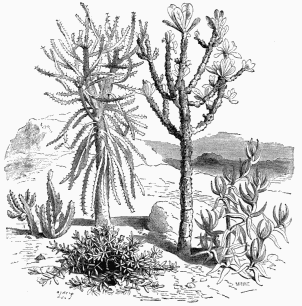 Vegetable Life in South Africa.
| 1. Mesembryanthemum inflexum. | 2. Hottentot’s Fig (Mes. edule). | 3. Euphorbia neriifolia. |
| 4. Euphorbia grandidens. 5. Stapelia hirsuta. |
From the coast of Aden, where almost complete sterility prevails prior
to the rainy season—from the coast of Aden to Cape Guardafui, situated
at the easternmost point of Africa, the traveller encounters a constant
succession of mountains or elevated table-lands, haunted by the
shepherds of the Somali tribes,—a people notorious for their
brigandage. Respecting the coast of Ajan we know but little, except
that its arid and sandy soil supports a scanty vegetation of stunted
plants. The Zanguebar coast is not more familiar to the botanist, and is
mainly covered with marshes.
But the littoral of Western Africa is gifted with a flora as luxuriant
as it is varied. According to Dr. Welwitsch, who has explored this
region, previously almost a terra incognita to Europeans, “the special
feature in the neighbourhood of Benguela is the abundance of parasitical
Lorunthaceæ, or mistletoe, on the thickets of the thorny Mimosa, to
which are attached those Roccellæ (or Archils), the Roccella tinctoria
and R. fuciformis, that yield so brilliant a lilac dye. In the gardens
of Benguela the vegetables of Europe are most successfully cultivated,
as well as a great number of fruit trees belonging both to tropical and
temperate climes: citron and orange, the olive, the cashew-nut, the
anana, the fig, the vine, the pomegranate, the elais-palm, the banana,
the anona, and the corrossol. The vine bears grapes twice every year,
and the crop on each occasion is abundant and of fine flavour. The
gardens in the vicinity of Mossamèdes, between the fifteenth and
sixteenth parallels of south latitude, exhibit a curious medley of
vegetables on every side, where you may see flourishing side by side the
banana and the potato, manioc and wheat, sugar-cane and flax, barley,
and every kind of Spanish potato.”
A few miles from Cape Negro the coast rises for from 300 to 350 feet
above the sea-level, forming a continuous plateau, where the flora,
though meagre when compared with that a little further to the north,
offers nevertheless to the traveller some objects of the highest
interest. It was here that Dr. Welwitsch met with the strange plant
which, in commemoration of its intrepid discoverer, Sir William Hooker
named Welwitschia,[108] but which the natives call Tumboa. “In its
youth its two original cotyledonary leaves appear to grow considerably,
and extend horizontally in opposite directions, raised but little above
the surface of the sand, whilst the intervening stock thickens and
hardens, assuming an obconical shape, flat at the top, and rapidly
tapering below into the descending root. As years go on, the original
pair of leaves, having attained their full size, and a hard, tough,
fibrous consistence, do not die away, but gradually split up into
shreds; the woody mass which bears them rises very little higher, but
increases horizontally both above and below the insertion of the leaves,
so as to clasp their base in a deep marginal slit or cavity; and from
the upper side, at the base of the leaf, several short flowering stalks
are annually developed. These are erect, dichotomously branched jointed
stems, rising from six inches to a foot in height, and bearing a pair of
small opposite scales at each fork or joint, each branch being
terminated by an oblong cone, under the scales of which are the flowers
and seeds. The result is, that the country is studded with these
misshapen table-like or anvil-like masses of wood, whose flat tops,
pitted with the scars of old flowering stems, never rise above a foot
from the ground, but vary, according to age, in a horizontal diameter of
from a few inches to five or six feet—those of about eighteen inches
diameter being supposed to be already above a hundred years old.”[109]
These fantastic monstrous shapes were found by Dr. Welwitsch, with their
deeply-embedded roots, on the dry plateau of the Benguela coast, in 15°
40´ south latitude. Herr Montein met with it in a perfectly similar
situation on quartzose soil, in the neighbourhood of the Nicolas River,
14° 20´ south latitude; and Mr. Baines and Mr. Anderson, in Dawaraland,
between 22° and 23° south latitude, in the neighbourhood of Whalefish
Bay, and in a district where never a drop of rain falls. We may
therefore place the habitat of this remarkable plant between the 14th
and 23rd parallels of south latitude. The crown, when divested of its
leaves, bears a close resemblance to a fungus.
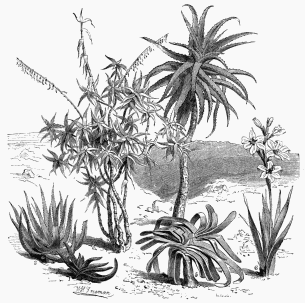 Vegetable Life of Cape Colony.
| 1. Aloe verrucosa.
| 2. Aloe soccotrina.
| 3. Aloe ciliaris.
| 4. Aloe arborescens. |
| 5. Aloe plicatilis. 6. Gladiolus blandus. |
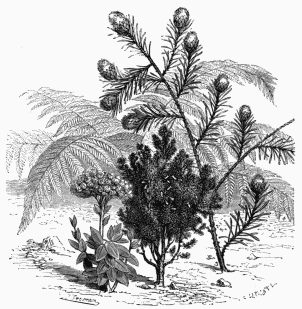
Vegetable Life of Cape Colony.
1. Helichrysum fruticosum. 2. Erica Cavendishiana. 3. Protea longifolia. 4. Todea Africana.
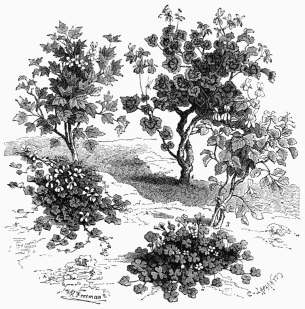
Vegetable Life of Cape Colony.
1. Pelargonium hederæfolium (Ivy-leaved Geranium). 2. Oxalis rosacea (Wood-Sorrel).
3. Pelargonium glaucum. 4. Pelargonium zonale (Zone-leaved Geranium).
5. Pelargonium tricuspidatum.
If we now approach the Cape of Good Hope—the Cabo del Tormentoso, or
“Cape of Storms,” of the early navigators—we shall observe a
characteristic vegetation peculiar to a solid or stony soil, sometimes
hilly, but generally dry. It is in the desolate and barren steppes
situated within the confines of Caffraria that those splendid
herbaceous bulbous plants display their beauties, which are now familiar
to our English gardens under the names of Gladiolus, Oxalis, Ixia, and
Tulbaya. To those magnificent ornaments of the floral world we must add
some less known plants, remarkable in other respects; such as the
Mollugo cerviana, which, with a few Ficoideæ, form the almost
exclusive nourishment of the herbivorous animals belonging to these
countries. The Gramineæ are rare in the plains of Cape Colony, but, on
the other hand, they contain a number of oleaginous plants included in
divers families. Here, for instance, are those singular Compositæ,
whose stems so closely resemble waxen tapers; several Ficoideæ, of which
some species—as, notably, the Mesembryanthemum edule, or Hottentot’s
Fig, distributed over the interior of Southern Africa, and the
Mesembryanthemum tuberosum—are eagerly sought by the Hottentots,
Caffres, and natives generally, who eat the fruits of the former and the
roots of the latter; the Stapelia hirsuta, or Carrion Plant, and
several others of the same genus, whose carrion-smelling flowers are
singularly handsome, though their odour is most offensive; a great
number of aloes, particularly the Aloe verrucosa, A. ciliaris, A.
plicatilis, and A. arborescens, each distinguished by a strange
wayward boldness of form and figure; and, finally, those larger
Euphorbias of which I have already spoken, and which yield a white milky
juice that hardens on exposure to the air. It is mainly on the slopes or
stony hills of the Cape that we meet with numerous and remarkable
species of the Immortelles, with their white, yellow, or lilac, and
satin-smooth flowers. The woody Immortelle (Helichrysum fruticosum)
is one of those peculiar to the Cape districts. It is in analogous but
more sandy localities that those graceful little shrubs, with varied
corollas, flourish, which are so popular in England under the name of
Ericas, and which frequently exhibit the highest beauty of form and
colour. In the engraving is figured the exquisite Erica Cavendishiana,
a deservedly great favourite in our English conservatories. There, too,
the traveller delightedly examines the almost interminable succession of
Pelargoniums, or Geraniums, rich in clusters of delicate bloom, and in
exquisitely green foliage. What a blank would their absence leave in our
blossomy parterres! Here and there he notes dense coppices of the
Arduinia spinosa, the Lycium Afrum, the Euclæa ondulata, whose berries
are eaten by the Hottentots; several species of Rhus,[110] among others
the Rhus lucidum; and, finally, a great number of the strange
fantastic Proteaceæ, with their hard dry evergreen leaves and curiously
beautiful flowers. At the foot of the mountains, in the countries
bordering on Caffraria, different Cycadaceæ are found, especially the
Zamia and Encephalartus, an elegant plant with a short spherical
trunk, surmounted by a crown of long rigid palmated leaves. The natives
prepare with their pith a species of cake which they eat instead of
bread. Ferns are not numerous at the Cape; the most remarkable,
undoubtedly, is the Todea Africana. The hills and meadows of this part
of South Africa do not always exhibit so marked an aridity; rivers and
streams refresh the soil, and there, where the current is not too swift
nor the depth too great, grows the beautiful Calla of Ethiopia, a
species of Aroidea, whose snow-white fragrant flowers resemble a large
horn in shape; the Aponogeton distachyum, another aquatic plant, with
white flowers and floating leaves, is not less common in similar
positions; then on the banks, in fresh and shady nooks of greenery,
thrives the Strelitzia reginæ, a gorgeous-flowered genus of Musaceæ,
named after Charlotte of Mecklenburg-Strelitz, queen of George III. The
foliage of this magnificent plant consists of long-stalked leaves
sheathing at the base, arising from a contracted stem, the flower stalk
encircled below by the sheath of the leaf-stalk; while from its upper
portion springs a large bract or spathe placed obliquely, within which
lie the flowers, resplendent in orange and purple.
In the Desert of Kalahari exists an abundant and varied vegetation.
According to Dr. Livingstone, it is an immense plain which nourishes a
prodigious quantity of herbaceous plants, generally of very small
elevation, and besprinkled at intervals with thickets of bushy shrubs.
The herbs which are enabled to withstand the prolonged droughts of these
arid localities are species with tuberous roots, creeping or
spindle-like, and deeply buried in the ground. The Citrullus vulgaris
and C. amarus are found in enormous quantities. Dr. Livingstone speaks
of another individual of the gourd tribe, probably a kind of Cucumis,
whose fruits colour red when ripe, and which has sometimes a sweet and
sometimes a bitter flavour. In these vast regions, where a desolating
aridity prevails, the rivers and streams dry up for a great portion of
the year, and the soil of their bed, generally black and loamy, is
rapidly covered with a profuse vegetation, composed in great part of
grasses and rush-plants.
The banks of the rivers Mokolo and Zouga, and the shores of Lake Ngami,
are covered with herbs and small thorny stunted bushes, including the
Acacia detinens. In the south of Africa the soil is so dry that only
plants of a fleshy consistency can endure the heat; elsewhere, in more
temperate climes, these latter plants are also very abundant, but the
surrounding herbage destroys them. Among those which grow there in great
numbers I may name the Ficoideæ, and particularly the Mesembryanthemum
inflexum, which is very widely spread, and whose stems and leaves are
eaten by herbivorous animals. This plant, says Dr. Livingstone, is so
useful that it is cultivated by the Dutch Boers on an extensive scale.
On his northward route towards Linianty, this illustrious traveller fell
in with meadows of such rank fertility that its herbage frequently rose
above his vehicles. The natives, designated Makalatos, show some
agricultural taste and skill, and cultivate durra, maize, two kinds of
beans, arachides, pumpkins, and the like. Everywhere, along the banks of
the Gambye and the Liba, he met with exceptionally fertile land, where
the grasses attained an unusual development. On the Liba bloomed wide
verdurous plains, consisting of plants with dazzling corollas and
gramineæ of tall stature. Owing to the burning heats which blight these
districts, herbaceous plants are developed with extraordinary rapidity.
In the rainy season the Liba meadows are covered, like our own, with an
immense variety of mushrooms, some nutritious, others poisonous. The
former are much relished by the natives. One of the most common, and
one of the finest flavour, is found, says Dr. Livingstone, on all the
ant-hills; it is completely white, very good even when eaten raw, and
about eight inches in diameter. There is another of a brilliant red or
superb blue, but it is poisonous.
The banks of the Quilo, like those of the Quango, are endowed with a
most luxurious vegetation; the same is the case with the banks of the
Zambesi. Everywhere spreads a gigantic and abundant herbage. In the
environs of the small town of Cassanga, the natives cultivate manioc,
potatoes, haricots, tomatoes, &c. There are found also bananas and guava
plants, and probably all the legumes and fruit trees recognized by Dr.
Welwitsch at Benguela, which lies nearly under the same latitude. From
the table-land of Cassanga you may survey nearly the whole of the valley
watered by the Quango. It is a gently undulating plain, covered with
herbs, and sown with great woods. The coffee-tree was formerly
cultivated in the province of Tété, but has been abandoned; cassias,
however, flourish, and indigo. Among the cultivated plants of Tété
Livingstone, moreover, mentions some species which are not yet
botanically distinguished—such as the Loatsa (Pennisetum typhoideum),
and several of the bean tribe, one of which grows underground like the
arachides.
OF all the provinces, as yet uninhabited or only scantily peopled, which
compose the northern regions of the New World, none offer so vast an
extent of prairies as that which is situated in the vicinity of the
Neosho and the Vert-de-Gris, between the Missouri frontier and the River
Arkansas. Woods of small extent—or, more generally, limited patches of
copse and thicket—are met with at intervals in these plains. The
Smilax rotundifolia, a species of sarsaparilla, with round leaves and
sarmentous stems; the Rhus toxicodendrum, a shrub with a very
poisonous juice; and the Asimina triloba, a plant bearing nutritious
fruit, are, with a few other subfrutescent species, the denizens of
these lonely localities. Annual or perennial plants abound in the
prairies, and attain there a considerable development, especially in the
more humid districts. The plains bordering on the Swan’s Marsh, situated
upon the upper course of the River Osage, nourish a great number of
species, as elegant as they are varied. As in our own meadows, the
Gramineæ, the Cyperaceæ (or Sedges), the Leguminosæ, and the
Compositæ—the latter especially—are very extensively diffused. But, in
contrast to the majority of our species, their representatives are in
general of remarkable dimensions, with flowers of extraordinary
splendour, and most of them have been naturalized in our British
gardens.
The American prairies, again, like the meadow-lands of Europe, are
alternated with dry, gravelly spaces, marshes, swampy angles, and wooded
tracts. It is curious to trace a certain likeness between the genera
which inhabit these localities in both continents. Thus, M. Trécul, who
explored, in 1848 and 1849, nearly the whole of the State of Missouri to
the foot of the Rocky Mountains, Louisiana, Texas, and a part of
Northern Mexico, discovered in the vicinity of the Swan’s Marsh,
Water-Plantains (Alisma), Sagittarias, and Nymphæas, in the inundated
districts; Characeæ—their tubular branches incrusted with carbonate of
lime—bladder-plants, and the beautiful floating Naiadaceæ, in deeper
pools and stagnant waters; and the Lythraceæ (or Loose-Strife tribe) on
the banks of the brooklets. But the commonest aquatic plant in these
morasses, and that which conceals, so to speak, all the other plants
proper to such localities, is the Nelumbium calophyllum, with its
rose-coloured blossoms; its seeds and rhizomes are eaten by the natives.
The vast plains of Missouri are sufficiently fertile. Among the plants
most abundant in somewhat damp places we must notice several
Compositæ; the Liatris, with their violet flowers and long spiky
bunches, the Calliopsis tinctoria of the dyers, the Gaura of
Lindheimer, and the Tripsacum dactyloides. Asters, Erigerons,
Gaillardies, Helianthi (sun-flowers), Solidagos, the Rudbeckia hirta,
and the Coreopsis, are found almost as far south as Texas. By the side
of these Compositæ flourish several Desmodiums and Cassias, some
graceful Baptisias—with blue flowers and light green foliage, the
Melanthum Virginicum, the Euphorbia marginata, the Asclepias
Cornuti—now naturalised in the neighbourhood of Paris—the Hibiscus
palustris and H. moscheutos, gigantic Malvaceæ, whose
splendidly-beautiful flowers are often three or four inches in diameter.
As plants widely spread in the stonier Prairies, we may note the Gauras,
different varieties of Œnothera, and especially the Silphium
laciniatum (vulgarly called the Magnetic Plant, or Compass of the
Prairies). Its leaves are said to turn their faces uniformly east and
west, so that their edges are consequently directed due north and south.
The plant is also known as Pilot-weed, Polar-plant, Rosin-weed, and
Turpentine-weed; the latter name derived from the copious resin exuded
by its stems, which grow to a height of three to six feet, as well as by
the leaves, which are deeply pinnatified.
In the small woods which skirt the Prairies is found in abundance,
twining round the bushes, the Apios tuberosa, a leguminous plant
formerly recommended to European cultivation on account of the rounded
tubercles which grow upon its subterranean stems. The Arabians collect
them in the spring, and carefully dry them to eat for food. The Apios
belongs to the family of Umbelliferæ, and is consequently allied to
celery, parsnip, and carrot.
In Missouri, and as far as the confines of Mississippi, we also fall in
with very productive sandy plains alternating with wooded uplands. This
country recalls, on the whole, the aspect of that which we have just
described, and the plants which thrive therein are almost the same.
On the hills and woody slopes in the neighbourhood of the Iron Mountain,
we likewise meet with sufficiently verdurous prairies. M. Trécul
collected there numerous Gramineæ, some species of Carex, Plantains,
Euphorbias, Polygalas, and Vervains; many genera, in fact, which in
France, and similar soils elsewhere, have numerous representatives. It
is in the grassy tracts of the wooded districts that the larger species
of Phlox flourish, while the smaller varieties of the same genus
vegetate upon the hills. The low humid meadows enchant us with their
gorgeous scarlet Actæas,[111] their yellow Balsams their Echinacea
purpureas, and their superb Lilies; those which are dry and rather
stony are covered with the broad golden flowers of the gay Œnothera
macrocarpa.[112]
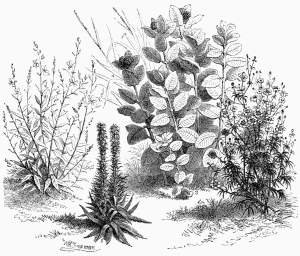 Vegetable Life in the American Prairies.
| 1. Liatris squarrosa. | 3. Asclepias Cornuti. |
| 2. Calliopsis tinctoria. | 4. Tripsacum dactyloides. |
| 5. Gaura Lindheimeri. |
Among the shrubs which people the marshy tracts of this same region, I
must point out the Sassafras, a kind of laurel with deciduous leaves,
yellow flowers, which precede the foliage, and small dark-blue fruit.
It is found from Canada to Florida; a mere bush in the north, but a tree
fifty feet high in the south. The wood is soft, light, of a coarse
fibre, with a pungent aromatic taste, and a strong agreeable odour. The
wood is brought to market in the shape of chips, but for medicinal
purposes the thick spongy bark of the root is prepared, and it is found
extremely valuable as a powerful stimulant, sodorific, and diuretic. The
mucilaginous leaves are employed in thickening soup. An infusion of the
bark or wood makes a pleasant beverage, formerly known as Saloop; and
the wood also yields an oil which is used medicinally.
But it is in the state of Texas, and especially near San Antonio de
Bejar, that those immense desert spaces commence which occupy all the
northern region of Mexico. The southern districts of Texas offer in
their prevailing landscapes a mixture of beautiful prairies and shady
woods. Among the plants peculiar to humid and turfy localities, I may
particularize the Sarracenias, a group of remarkable exogens, whose
leaves are hollowed out into tubes or pitchers, open at the upper end,
and streaked with bands of different colours; the Eriocaulons, a kind of
rush, carrying their small flowers in spherical capitals on the summits
of their tall branching stems; and the Nelumbios (Nelumbium
calophyllum), aquatic plants of unusual beauty, American congeners of
the celebrated Lotus, the “insane root which takes the reason prisoner.”
The nuts are wholesome and edible, and the root-stocks are also
occasionally eaten. These plants are likewise found, in analogous
habitats, in Mississippi and Louisiana, accompanied by the light-green
Magnolia, the Dog-berry tree of Florida, several Wax-berries, and the
Sassafras laurel, now acclimatized in Europe, and whose bark is employed
as I have said, medicinally, while its wood and roots are made use of by
turners and toy-manufacturers.
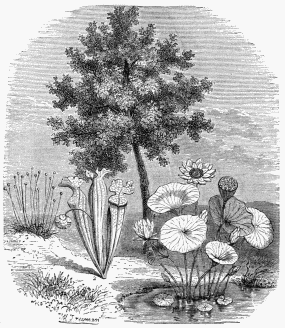 Vegetable Life in Texas.
| 1. Nelumbium calophyllum. | 3. Eriocaulon flavidulum. |
| 2. Sarracenia purpurea. | 4. Laurus sassafras. |
Prairies abound in Texas, wide rolling sweeps of grassy sward, with an
apparently interminable horizon, unbroken by rock, or wood, or
river—leagues upon leagues of rank thick grass where countless herds
are depastured, and where the hunter still finds game worthy of his
deadly rifle. Among those which skirt the Bay of Matagorda, and extend
in the vicinity of Victoria, Gonzalès, and Seguin, M. Trécul discovered
an ample variety of Compositæ; of Gramineæ, more especially those
belonging to the generæ Poa, Spartina, Dactyloctenium; Cyperaceæ,
Euphorbias, Cucumbers, and Gourds. From the Texan Prairies our European
gardeners have of late years received a Graminea of the genus Panicum,
the Black Mosquito Grass, which by its long creeping rhizomes may be
employed with undoubted success to arrest the inland movement of the
Dunes and shifting sandy shores. The yellow water-lily (Nuphar lutea)
spreads its fine leaves on the surface of the Texan streams, in
beautiful companionship with the Nuphar advena and the Nymphæa
odorata. In the same localities vegetates a weak variety of our
European Sagittaria, and the Pistia spatulata spreads itself upon
the water, like our English Duckweed, both being members of the family
Pistaceæ.
As far as New Braunfels, the Prairies are occasionally relieved by
clumps of fine old trees; but below that point the traveller only
encounters, and that at rare intervals, a few scarce coppices and scanty
thickets. Growing more common at San Antonio de Bejar, they abound in
the region of Castroville, and spread over nearly the entire country to
the very borders of Mexico.
These bushes or coppices mainly consist of the Prosapis glandulosa,
the Guaiacum angustifolium, the Xanthoxylum inerme and a few
Acacias.
The Guaiacum[113] is noticeable for its hard and heavy wood, generally
known as Lignum Vitæ, sometimes as Guaiacum wood, and occasionally
as Brazil wood. It also yields a peculiar resinous product, which is
medicinally employed, in powder, pill, and tincture, for the relief of
chronic rheumatism and chronic skin diseases. It is of a greenish-brown
colour, and though it has scarcely any taste, leaves a hot arid
sensation in the mouth.
The Xantoxyton type, of the order Xanthoxylaceæ, derives its name from
the yellowness of its timber. Its fruits have a pungent aromatic taste,
like pepper. The popular name of “toothache tree” is applied to some of
the American species, from the relief their bark and fruits are supposed
to give in cases of that distressing affliction.
In the neighbourhood of Castroville, Trécul found, profusely scattered
among the thickets, a species of Ephedra, closely resembling the
Ephedra altissima, whose feeble reed-like branches were literally
covered with small red fruits, producing a novel and attractive effect.
As a plant curious from its mode of vegetation, and which is spread in
Texas as well as in Louisiana, I may mention the Tillandria usneoides,
so named after Professor Tillands, of Abo. This is a genus of
Bromeliaceæ, growing on the boughs of trees, and notably on those of
the evergreen oak. It hangs down like a tuft of long gray hair, in
somewhat the same fashion as certain lichens (usnea) in European
pine-forests, communicating to the trees a strange and positively weird
aspect. The plant is collected, and the outer cellular portion being
removed by soaking in water, the fibrous residuum is then employed to
stuff cushions, mattresses, and pillows; whence it is sometimes called
“Vegetable horse-hair.”
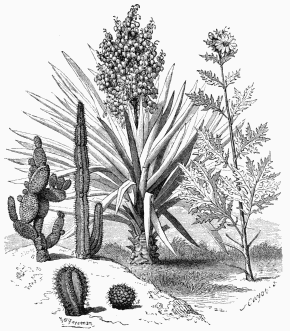 Vegetable Life in the Texan Prairies.
| 1. Yucca Tréculeana. | 4. Echinocactus robustus. |
| 2. Silphium terebinthinaceum. | 5. Cereus Peruvianus. |
| 3. Mamillaria rodantha. | 6. Opuntia microdasys. |
In the thickets that dot the central Prairies commonly flourish the
Lantana Camara, and the curious Ungnandia speciosa, a species of
chestnut tree on a very reduced scale.
It was in Texas, and in the rocky, arid, and hilly plains, that the
French botanist Trécul discovered several notable varieties of Yuccas,
to one of which, a new, and certainly the most beautiful species, his
name has very justly been affixed: the Yucca Tréculeana. It raises its
tall panicle of gorgeous flowers from the centre of a crown of glossy,
rigid, spear-like leaves, like a victorious trophy. In Eastern Texas we
note the first appearance, in the drier and stonier portions of the
Prairies, of a representation of the family Cactaceæ, the Opuntia
frutescens, frequently growing side by side with the Silphium
terebinthinaceum. The Opuntia is more generally known as the “Indian
Fig” or “Prickly Pear,” from the large purple juicy fruits which it
yields. The Silphium belongs to the family of Compositæ. But Western
Texas is the true birth-place of these oleaginous plants, some of which,
such as the Echinocactus robusta, the Mamillaria rodantha, and the
Opuntia microdasys (“small-thorny Opuntia”), are cultivated in our
apartments, where they require but very little attention. M. Trécul has
discovered in this region a new and rare variety of Echinocactus (E.
Tréculeanus), some kinds of Cereus, and, especially, the Cereus
Peruvianus, a beautiful plant with large showy flowers.
Such are the principal plants which, in North America, characterize the
vegetation of the Prairies and the Savannahs. This rapid and condensed
description will show the reader that the species most extensively
spread belong to the genera in which are grouped the more common
inhabitants of our own Old World meadows and grassy plains.
If we now transport ourselves, on the poet’s winged Pegasus, that takes
no account of distance or of natural obstacles, to the Equatorial zone
of the New World—into Guatemala, for example—we shall find the
undulating and verdurous prairies giving place to high table-lands
furrowed by deep and romantic ravines. Their botanical interest,
however, is trivial, and their vegetation of a meagre and stunted kind.
But between Guatemala, Nicaragua, and Honduras, lies an extensive
valley, locally named Llanora, sown with numerous beautiful varieties
of plants. Among them the Gramineæ family predominates, and, without
attaining the proportions and the quality of the herbs which we shall
meet with in the interior, form breadths of meadow very charming in
their rare fresh greenness.
From the summit of the Cordilleras, in the neighbourhood of Bogota, at
an altitude of about 3200 feet, the eye surveys almost the entire extent
of those vast level plains which stretch from the base of the
mountain-chain to remote Brazil, Guiana, and Venezuela.
The Steppes comprised between Bogota and the river Meta are formed, in
general, of Gramineæ with crawling stems, and with nearly always very
tall culms, especially in the cooler localities. Herbage is so abundant
that the traveller who penetrates into these immense pastures
experiences almost insurmountable difficulties. He himself and his horse
are nearly hidden by the tall grasses, which frequently attain a stature
of five to seven feet. And such is their vigour, that after having been
burnt to the ground by one of the terrible conflagrations so frequent in
these countries, they spring up again with wondrous swiftness; if the
plants had not flowered prior to the passage of the destructive flames,
they do so afterwards, and even when their leaves have been wholly
destroyed. The lofty table-lands of Bogota and Tukerres, in New Grenada,
present a succession of rich pasturages, perfumed by some species of
Labiatæ, and notably by the Micromeria Browniana, which thrives among
the Gramineæ, their fodder is highly esteemed.
The barren and sandy plains of Peru, fertilized by the numerous
water-courses which furrow them, are covered with thick bloom and
verdure in the rainy season. With the Gramineæ and Juncaceæ—the grasses
and rushes common in these Steppes—mingle different members of the
Liliaceæ family, and especially several kinds of Lily. The higher region
of the eastern face of the Peruvian Cordillera, situated between 10,000
and 13,000 feet of elevation, forms an immense undulating plateau
watered by the upper course of the Maranon. Everywhere, over a
considerable area, the plains are clothed with a meagre vegetation, or
alternate with wide morasses, lakes, and brooks. Among the plants which
people them is a species of the Gramineæ, Stipa itchu; and there are
also several Alpine varieties, Compositæ, Leguminosæ, and one of the
Cyperaceæ family, the Cyperus articulatus.
The Llanos of Caraccas, and of the Rio Apure and the Meta, over which
roam immense herds of cattle, are, in the strictest sense of the term,
says Humboldt,[114] “grassy plains.” Their prevalent vegetation,
belonging to the two families of Cyperaceæ and Gramineæ, consists of
various species of Paspalum, P. leptostachyum and P. linticulare;
of Kyllingia, of Panicum, Anthephora, Aristida, Vilfa, and
Anthistiria. Only here and there are found, interspersed among the
Gramineæ, a few herbaceous dicotyledonous plants, consisting of two very
low-growing species of Mimosa (Sensitive Plant)—Mimosa intermedia and
Mimosa dormiens—which are great favourites with the wild horses and
cattle. The natives give to this group of plants, which close their
delicate feathery leaves on being touched, the expressive name of
Dormideras—“sleepy plants.” Nota tree is visible for miles; but where
solitary individuals occur, they are, in moist places, the Mauritia
Palm; in arid districts, a Protacea—namely, the Rhopula complicata;
also the highly useful Palma da Corija, or de Sombrero; and our Corypha
inermis, an umbrella palm, whose leaves are used to thatch the roofs of
huts.
The Mauritia palm, Palm Moriche, Mauritia flexuosa, Quiteve, or Ita
palm—for by any or all of these names it is known—belongs to the
family of Lepidocaryeæ. The trunk grows as high as 26 feet, but it
probably requires from 120 to 150 years to reach this height. It extends
high up on the declivity of the Duida Mountains, and forms in moist
places beautiful groups of a shining emerald verdure, like that of our
European alder groves. The trees preserve the humidity of the ground by
their shade, and hence the Indians say that the Mauritia draws the water
round its roots by a mysterious attraction. From its tops the Indians
frequently suspend their hammocks to escape the attacks of the
mosquitoes.
Sir Walter Raleigh was the first who brought to England this fruit of
the Mauritia palm, which he very justly likened, on account of its
scales, to a fir cone.
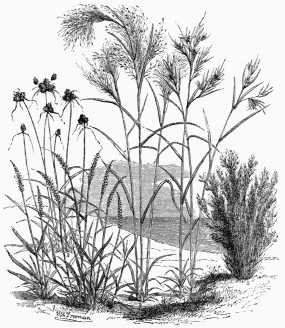 Vegetable Life in the Plains of the Meta.
| 1. Anthephora elegans. | 3. Anthistiria ciliata. |
| 2. Panicum Cajennense. | 4. Aristida capillacea. |
| 5. Cyperus articulatus. |
The plains of the Rio Negro and the Amazons are the home and habitat of
the most remarkable of all aquatic plants, the Victoria regia,[115]
truly deserving its royal rank on account of its curious conformation
and splendid beauty. It is said to have been first observed by Häuke,
about 1801, and afterwards to have been noticed by Bonpland, D’Orbigny,
and others; but the first person who accurately described it was
Pöppig, in 1832, who saw it in the river Amazons. Sir Richard
Schomburgk, who discovered it in the rivers of Guiana, was, I believe,
the first to introduce it in England, where a splendid specimen may be
seen at Kew, another at Chatsworth, and a third in the Botanic Garden of
Glasgow. Its thick fleshy root-stocks send up a number of long
cylindrical leaf-stalks, traversed by air canals, and armed with stout
conical prickles. The blade of the leaf is circular, and floats on the
surface of the water; when fully developed, it measures from six to
twelve feet in diameter, and its margin being uniformly turned upwards
to the depth of two or three inches, it assumes the appearance of a
large shallow tray. The lower surface is traversed by a number of very
prominent veins, radiating from the centre to the margin, and connected
with one another by smaller transverse nerves; so that the whole
under-side, which is of a purplish colour, is divided into a network of
irregular quadrangular compartments or open cells, admirably fitting the
leaf for floating on the water. The flowers rise upon prickly stalks.
They are more than a foot in diameter, with the white outer petals
inclined downwards; while the central rose-coloured ones, with the
stamens, remain erect: the whole presenting the fanciful appearance of a
central rose-coloured crown resting on a circular range of snowy and
most gracefully curved petals. The fruit is a sort of globular capsule,
about the size of a child’s head, and formidably beset with prickles.
The interior is fleshy, and divided into numerous cells, full of round
farinaceous seeds, which are eaten roasted by the Spaniards. Hence, in
some parts of South America, it is called Maïs del Agua, or Water
Maize.
The pools and lagoons of this region nourish numerous other aquatic
plants, among which it will suffice to particularize the Scyndapsus
fragrans and the Raphia tædigera.
Turning now to the vast area of the Brazilian empire, we find it divided
into matos (or woods) and campos (or open plains). When the
inhabitants would convert into cultivable land a district occupied by
forest, they set fire to it during the dry season, and soon a vegetation
of frutescent but dwarf species succeeds the primitive vegetation. By
renewing this purifying process a second and a third time, the soil
finally becomes covered with a species of fern closely resembling our
large Pteris, Pteris caudata; and if the spot be once more abandoned,
it is speedily taken possession of by a viscous, grayish, and fœtid
species of Gramineæ, well known locally by the name of Capim gordura,
to botanists by that of Tristegis glutinosa. So boundless a voracity
has this plant, that it wholly expels from certain regions another and
less tenacious variety of the Gramineæ, the Saccharum, or Sapa. The
Capim gordura constitutes in itself almost the entire flora of the
artificial campos. It is but an indifferent fodder, and cattle derive
from it little vigour.
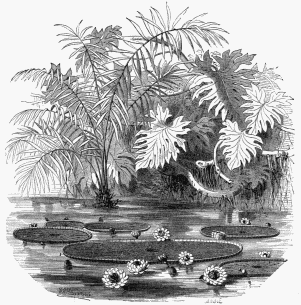
Aquatic Plants of Guiana.
1. Victoria regia. 2. Raphia tædigera. 3. Scyndapsus fragrans.
In general, the natural campos bear a certain resemblance to our
meadows; grass, however, is less abundant; they consist, especially in
the colder localities, of Gramineæ which do not, perhaps, exceed our
British species in dimensions, but differ greatly in the size of their
leaves, and often also in their spreading inflorescence. By their side,
as is the case with us, grow other plants of a more graceful floral
character. Among these are Myrtaceæ, Melastomaceæ, with their capsular
fruits, and a species of Compositæ, called Veronia.
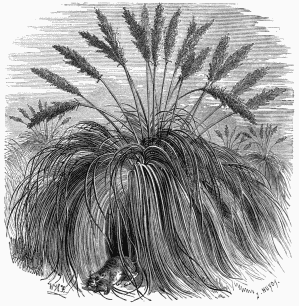
Vegetable Life in the Pampas.
Pampas Grass (Gynerium argenteum).
The wayfarer who traverses the sterile campos is astonished to discover,
on the tortuous and stunted trees that grow there at rare intervals,
some flowers of a singular loveliness. Yet who can refuse his admiration
from the gorgeous Vochyaceæ; the Malpighiaceæ, richly and handsomely
flowered; the Leguminosæ, with their long hanging clusters of sparkling
blossoms; the trumpet-shaped flowers of the Bignonias, and the superb
Oochnus? Nor will he forget a rare Salvertia, fragrant as the lily
of the valley, and with its blossoms disposed in thyrses which outvie in
beauty those of the chestnut.
In the genial smiling country which extends from Monte Video to the
mouth of the Rio Negro, the vegetation is almost wholly confined to
Gramineæ. It is in this region that the feathery Pampas Grass (Gynerium
argenteum) flourishes luxuriantly, covering leagues upon leagues with
its silvery panicles and drooping leaves, which, when stirred by a
gentle wind, ripple like the slow-moving, spray-gleaming waters of a
sunny sea. It has become of late years a favourite ornament of our
British gardens, and may justly be taken as a type of tender
loveliness.[116] Beyond the Rio Negro the country puts on a wilder
aspect, and it is with difficulty the most adventurous botanist can
penetrate into its recesses.
Nearly all the southern districts of Patagonia form, as we have already
seen, an immense and almost level plain, whose soil is generally dry,
arid, and impeded with large pebbles; the northern districts, on the
other hand, offer a less monotonous landscape, are broken up with rocks
and ravines, interspersed among tolerably fertile pastures, whose flora
has not yet been fully investigated.
THE Deserts of the Australian interior have been laboriously traversed,
not, as we have seen, without much suffering, and even sacrifice, by a
handful of intrepid travellers, who have proposed to themselves simply
the solution of certain geographical problems. It will therefore be
understood that we owe to them only a few incidental notices of their
botanical features. For an accurate examination of these the pioneers of
commerce have neither the means, the opportunities, nor the requisite
scientific knowledge. As far as its flora is concerned, the Australian
interior is wholly “virgin soil,” a new botanical world, perhaps,
awaiting the advent of a Columbus. Only the littoral districts have been
satisfactorily explored; and here, in the south, we meet with the names
of Labillardière, Robert Brown, Gaudichaud, D’Urville, Sieber, Lesson,
Cunningham, and other eminent botanists. To these celebrated names we
must also add those of Dr. Mueller, Director of the Botanical Gardens at
Melbourne, Sir William Hooker, and Mr. Bentham. Their united labours
have provided the public with a vast amount of curious and authentic
information, and have established the fact that the botany of New
Holland, like its zoology, has a physiognomy peculiarly its own, and
that many, nay, most of its vegetable species, are not less
characteristic than its strange and astonishing animal types. One is
almost tempted to adopt in sober earnest what Sydney Smith said in
humorous exaggeration, that, “in this remote part of the earth, Nature
(having made horses, oxen, ducks, geese, oaks, elms, and all regular and
useful productions for the rest of the world) seems determined to have a
bit of play, and to amuse herself as she pleases.”[117] Undoubtedly she
has indulged in the most wayward and eccentric forms. If there exist any
relations between the vegetation of Australia and that of any other part
of the globe, it is certainly with the districts of Southern Africa
which lie near the Cape of Good Hope that Australia exhibits the
greatest affinity. It would seem as if these two continents in some
remote age had not been separated, as they now are, by “leagues of salt
water,” but that their vegetable species had been able to propagate
themselves freely from the one to the other.
According to Richard, the approximative number of species distinguished
by botanists amounts to about five thousand; but so many discoveries
have been made of later years, that we may raise the estimate to seven
thousand. While the Australian plants are distributed among numerous
families, each of the latter comprises but a very limited number of
individuals. The predominant plants belong, in the main, to these
families or orders:—Leguminosæ, Compositæ, Myrtaceæ, Gramineæ,
Cyperaceæ, Filices, Proteaceæ, Epacridæ, Orchidaceæ, in a proportion
which varies, moreover, according to the various districts explored.
The fertility of the soil, and the climatic conditions of the southern
shores of the Australian continent, are highly favourable to the
introduction of new species. Our English settlers have availed
themselves to the utmost of this circumstance, and have cultivated on a
large scale all the most useful fruit trees and vegetables of Europe,
and others imported from tropical climes; so that mingled in the same
prolific gardens may be seen the fig-tree and the banana, the guava, the
orange-tree, the olive, and the apple—cabbages, potatoes, turnips,
peas. Even the vine has been successfully naturalized, and its
manufactured products are not inferior in excellence to the famous
Rhenish wines.
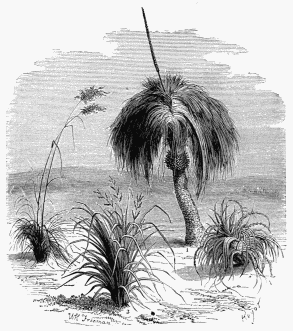 Vegetable Life in Victoria.
| 1. Rosea gracilis (Arundo conspicua). | 3. Hectia Pitcairniæfolia. |
| 2. Astelia Banksii. | 4. Xanthorrhœa arborea. |
In indicating the most curious indigenous plants of New Holland, we
shall more particularly confine ourselves to those of Victoria, one of
the best known districts, and perhaps also one of the most extensive,
most diversified, and most picturesque. The plains are, in general,
sufficiently grassy and fertile, especially in those parts which border
on the brooks and rivers. The plants most extensively distributed belong
to the Gramineæ and Cyperaceæ; we find, among the former, the
Pennisetum fasciculare, a great number of Poaceæ, and the Arundo
conspicua; in foliage and general appearance the latter presents some
striking analogies with the Pampas Grass; among the Poaceæ predominates
the Cyperus vaginatus, a common object on the banks of the river
Murray in those parts which are subject to frequent inundations. A
strong tenacious netting is made from the fibres of its leaves. To these
herbs we have to add some flowering plants, such as the star-like
Lobelias; numerous species of mint (as Mentha Australis, M.
satureioides, M. grandiflora, and M. gracilis), from which an
essential oil is extracted for use in the manufacture of perfumes; the
Sida pulchella and Lavatera plebeia, of which stout fibre or solid
thread is made, the fibres of Australian flax (Linum marginale) being
adapted to the same purpose. The Restias, a curious rush-like order of
endogens, also inhabit these moist places: as do the Kingias, very
common grasses; the Astelia Banksii, a species of Liliaceæ, with
grass-formed leaves and a strong tenacious stem; and the Xerotes
longifolia. The Nardoo (Narsilia macropus, or, as it is sometimes
called, N. salvatrix), whose spores and spore-cases are pounded by the
native Australians and made into bread or porridge, is a kind of
cryptogamous plant, with leaves formed of four folioles, like those of a
truffle. It abounds in the low grounds and inundated districts,
especially on the banks of the Murray. Finally, the Stag-horn
(Acrostichon grande), a gigantic mushroom, clings to the branches of
the great trees.
Small bushy clumps are scattered over the plains, and flourish with
peculiar vigour along the water-courses. They consist of various shrubs.
The traveller will not fail to notice a whole series of
Leguminosæ—Chlorozoma, Pultenæa, Viminaria, Mirbelia,
Podolobium (all are shrubs of exceeding elegance, and now form the
rare ornaments of our English gardens); of Epacridæ—Epacris
stiphelia, E. leucophogon, and others, which have also been imported
into our home-parterres; a great number of Euribias, a genus of
subfrutescent Compositæ, of which a few are rendered interesting by
their heathlike foliage; the Pimelea axiflora, whose supple and
tenacious bark is fashioned into bands and straps; the Myrsine
variabilis, with its woody stems and drupaceous fruit; the Aralia
crassifolia, a singular shrub, with long, narrow, and very rigid
leaves; the Callistemon salignum (vulgarly called “stonewood”),
employed for xylographic purposes; the Casuarina equisetifolia,[118]
or “Swamp Oak”—also called “Cassowary Tree”—a lofty tree, with very
durable wood, long, slender, drooping, emerald-green branches, and
conical fruit, inclosing small winged nuts; various species of
Melaleuca, yielding the green aromatic oil called cajaputi or cajeput
oil, valuable as a stimulant or antispasmodic; finally, some Cordylines,
or ’Tis, plants of the natural order Liliaceæ, and nearly allied to the
Dragon’s Blood Tree, attaining a height of ten to fifteen feet, with a
berry-like fruit, and lanceolate leaves of a reddish hue, which afford a
nutriment for cattle, thatch for houses, and whose fibres are frequently
made into cloth. The root, when baked, is much used as an article of
food, and the fermented juice yields an intoxicating beverage.
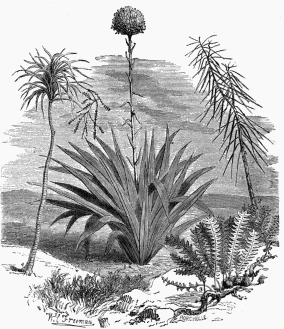 Vegetable Life on the Australian Plains.
1. Doryanthes excelsa.
2. Aralia crassifolia. |
3. Dryandra repens.
4. Cordyline congesta. |
The dry, rocky, arid, and sandy districts, which may be compared to the
Landes of Brittany, are clothed with a peculiar vegetation. The
strangest plant, which is also the most widely distributed, is
undoubtedly the Xanthorrhœa arborea,[119] forming a conspicuous
feature in the dreary landscape, and when stripped of its leaves
resembling a black man holding a spear. The leaves afford good fodder
for cattle, while the natives eat the soft white centre of the top of
the stem. They yield two kinds of fragrant resin—one of a yellow
colour, balsamic and inodorous, called Botany Bay; and the other red,
called Black Boy Gum. The tree—which the settlers have christened
“Black Boy” and “Grass Gum”—has a thick trunk, encrusted in a thick
coating of the persistent basis of old leaves, glued together by the
yellow or red resin with which the plant abounds, and usually burned and
blackened outside by bush-fires. The leaves are long, wiry, and
grass-like, and are borne in a dense tuft at the top of the stem,
hanging gracefully all around it. Their long flower-stalks aspire from
its centre, sometimes growing as high as fifteen or twenty feet, and
carrying aloft a thick cylindrical flower spike.
Among the lowlier plants are found a few Hectias, such as the Hectia
Pitcairniæfolia, one of the Bromelias, very curious from its mode of
vegetation; and the Stipa crinita, a very common grass. The leaves of
the latter have been manufactured into paper of tolerable consistency.
The sandy and colder tracts are the habitat of the annual or perennial
Compositæ, distinguished by their smooth and shining flowers. On the
other hand, the dry rocky surfaces are besprinkled with inconsiderable
woods, or rather thickets, formed in part of the Santalum acuminatum,
whose nutritious fruit are called “peaches” by the colonists; the
Santalum persicarium, or sandal wood; several Nitrarias,[120] with
edible fruits; a great number of Acacias, notably the Acacia
verticillata, A. sophora, and A. doratoxylon, whose very hard wood
is employed in the fabrication of javelins; a considerable series of
Proteaceæ, particularly the Banksia Australis, B. serrata, and B.
integrifolia, so characteristic in aspect and foliage; and a few
Eucalypti,[121] or “Gum Trees,” of small stature—among others, the
“Traveller’s Tree,” or Eucalyptus oleosa.[122] Its roots extend
horizontally, and retain a quantity of water sufficient to quench the
wayfarer’s thirst in the hour of need. All the Eucalypti are curious
trees, with entire and leathery leaves, affording an unusual amount of
aromatic oil. Many of the species abound in resinous secretions; some
attain a great size, with trunks of from 8 to 16 feet in diameter, and
150 or 160 in length. The Eucalyptus resinifera—“Red Gum” or “Iron
Bark Tree”—reaches to an elevation of 150 to 200 feet. When wounded, a
red juice flows from it very freely, hardening into irregular,
inodorous, and transparent masses in the air, and furnishing as much as
sixty gallons from a single tree.
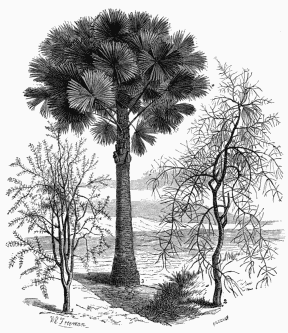 Vegetable Life on the Australian Plains.
| 1. Acacia verticillata. | 2. Casuarina equisetifolia, or “Black Boy Tree.” |
| 3. Corypha Australis, or “Australian Palm.” |
Finally, I may refer to the Dryandra, whose foliage is very graceful,
and its conformation very varied. Sometimes it is found as a bush, three
to seven feet high; and sometimes, as in the Dryandra repens, creeping
along the ground.
On the more temperate heights the traveller encounters some plants of a
fantastic character: as, for instance, the Doryanthes excelsa, with
its upright gigantic leaves, more than 6 feet long, and from 2-1/2 to
3-1/2 inches broad; from their centre rises a strong stalk, 15 or 18
feet high, terminated by a compact and voluminous cluster of great
deep-red flowers. There, too, are found the magnificent arborescent
ferns, Alsophila Australis and Dicksonia Antarctica. The trunk of
the former aspires to a stature of 25 to 90 feet; that of the second, to
12 to 28 feet; and in both the stems are terminated by a cluster of
immense flowers, which give to these plants a quite distinctive
character.
Nor must we quit the Australian Flora and its marvels without alluding
to the Corypha Australis, which begins to make its appearance at the
mouth of the Snowy River. It is a gigantic palm, growing solitarily, or
in thin groups, in low, cool, and even moist places. Its trunk probably
attains to 140 feet in height; and the top of its stem is crowned by a
gorgeous crest of fan-shaped leaves, which are employed in the
manufacture of straw hats.
TO the prodigal Flora of the Tropics, which we shall soon see displaying
in the virgin forests its exuberant fecundity, corresponds a Fauna no
less rich, and marked by a singular variety.
This Fauna offers, especially in the Old World, an impressive character
of power, strength, superior force—I had almost said, majesty. In
truth, if we do calmly compare the mammals and the birds of tropical
America with those which roam the wild plains of Africa, Hindostan, the
Indo-Chinese peninsula, and the great islands of the Indian Ocean, we
cannot but recognize the evident superiority of the latter. The
anthropoid Ape, the enormous Pachyderms, Elephant, Rhinoceros,
Hippopotamus, Giraffe, and, among animals of the same order, the
Antelopes, many of which attain the dimensions of the Horse, belong
exclusively to the Eastern Hemisphere. The genus Camel, represented in
Asia by the Bactrian Camel, in Africa by the Dromedary, is but weakly
typified in South America by the Lama, the Vicuña, and the Alpaca, not
inelegant in form, but of a markedly inferior stature. And what equality
is there between the lordly Tiger of the rank Indian jungles, and the
sleek, stealthy Jaguar of the American wilderness? Or who will venture
to compare the so-called “Lion of America,” the Puma or Cougouar, with
the regal quadruped which makes the hot Libyan wastes re-echo with his
terrible roar?
Among the Birds, the Phenicoptera, with its disproportionate legs and
neck, distributed over all the ancient continent below 40° of latitude,
and the Ostrich, properly so called, are much superior in dimensions to
their analogues on the other side of the Atlantic, the American Flamingo
and the Nandou. So do the Eagles and Vultures of Europe, Asia, and
Africa prevail in numbers and force over those of the New World. And the
ancient continent can likewise claim as its own the gigantic Epiornis,
the wonderful “Roc Bird” of the well-known Oriental legend, whose
petrified eggs and some of whose fossil bones have been discovered in
Madagascar. It is true, however, that the greatest of living Raptores,
the Condor, inhabits exclusively the Cordillera of the Andes:—
“Stands solitary, stands immovable
Upon some highest cliff, and rolls his eye,
Clear, constant, unobservant, unabashed,
In the cold light, above the dews of morn.”—(W. S. Landor.)
But the balance is re-established by the Erpetological and Entomological
Fauna of the New World, which can oppose its huge Boas, its Caïmans and
Pythons, to the Crocodiles and Gavials of Africa and Asia; its Crotali
and Trigonocephali to the Najas of India, the Echidnas of the Cape, and
the Cerastes of Egypt and the Sahara; while the Bull Frog of the United
States and the Pipa of Guiana are only found on the banks of the vast
lonesome swamps of the new continent. As far as the Desert World is
concerned, in both hemispheres the legions are innumerable, and their
energies commensurate to the greatness of the continual work of
destruction and purification which they seem destined to accomplish in
all tropical countries.
It is unnecessary to carry any further the parallel between the two
hemispheres. We shall more clearly detect their analogies and
differences by pursuing the study, already opened up in the Steppes and
Seas of Sand, of the principal species proper to the various forms of
the Desert, the different regions and divisions of the Savage World.
Yet I must confess that the difficulties of the study increase with the
extent of the field we are called upon to explore. The Steppes and
Wildernesses of Sand constitute, both in Africa and Asia, regions which
are clearly defined, and the poverty both of their fauna and their flora
fixes a definite limit to the researches of the naturalist. Such is not
the case in the immense countries which now lie before us. Instead of
sighing, like Alexander, for more worlds to conquer, the student of
science is ever deploring the impossibility of exhausting even a single
division of the grand work before him. “Art is long; life is short.” The
most industrious among us can never rise to the full height of his
glorious task; must always remain like a child on the shore of the ocean
of truth, and be content with the few shells his nerveless hand
contrives to gather. In the wide regions we are about to traverse we
feel at every step the colossal character of the enterprise. Every
instant their aspect changes; Nature never repeats herself; their
products vary with the latitude, the climate, and the soil. To pass in
review all the trees and plants and flowers which flourish there, all
the animals and peoples which dwell among them, would be nothing less
than to embrace in a vast encyclopædia the description and history of
two organic kingdoms. But such is not the design of the present volume.
I have not undertaken to give an exact picture of nature, which would
task to the uttermost the powers of men of such diverse genius as
Humboldt, Owen, Lyell, Darwin, Tyndall, Hooker, and Ruskin, but to
sketch the bold outlines and more prominent features of the physiognomy
of the Desert World, and not to reproduce its more minute details.
My embarrassment, then, arises less from the multitude and infinite
variety of the objects we have to examine, than from the difficulty of
harmonizing the study with the divisions of this work. How, in fact, can
I establish a positive distinction between the animals of the Prairies
or the Savannahs and those of the Forests, between those of the latter
and the animals proper to the Mountains? For such a purpose it is
needful that each of these forms of the Desert World should possess its
peculiar fauna; which is true only within very narrow limits. In
reality, most animals inhabit or frequent, according to circumstances,
sometimes one district, sometimes another, without its being possible to
assign with any amount of precision their habitual, or simply their
occasional, abode.
I shall avail myself, therefore, of the liberty allowed to every writer
who does not design a purely didactical work, by not unnecessarily
troubling myself whether the animals whose organization or
characteristics attract our notice, particularly affect a low or
elevated locality, the shady wood or open plain, the pestilential swamp
or the river-watered valley, and by permitting myself, except in the
case of some evident and constant partiality, to place them where the
most eminent observers assure us they are really, if not exclusively,
met with.
On this account, the plains, more or less densely wooded and broken up,
which occupy the greater portion of the African Continent, will readily
furnish us with the opportunity of studying the majority of animals
indigenous to that continent, and, in general, to the entire Tropical
zone of the Old World. In fact, nearly all the genera of Mammals, Birds,
and Reptiles, are there represented by their most characteristic types.
Clothed with a luxuriant vegetation; watered by periodical rains and
numerous streams; intersected by thick masses of forests, groves, and
thickets; relieved from monotonous uniformity by mountain and ravine, by
marshes and lakes of vast extent,—these fields ever exhibit that aspect
of busy life under which we love to represent to ourselves the earth
when she first emerged from the boiling seas of Chaos, when the forces
which had seethed within her bowels for so many thousands of centuries
had been tranquillized by the Divine will, and she was despatched on her
mysterious course to be the theatre of man’s glorious destiny.
During the daytime silence and solitude prevail over the open plains. It
is the hour when most animals seek, under the foliage of the trees,
among the tall rank grasses, in the bosom of the waters or under the
surface of the earth, a shelter against the swift burning arrows of the
sun, and repose immovable in their different lairs. But when the great
orb of day sinks towards the horizon, all Nature seems to awake. More
imperious needs succeed to those of rest and slumber; hunger and thirst
stimulate the most sluggish into exertion. Then the reptile begins to
stir in the mud where he lay embedded; the herbivora return to their
fresh pastures, and move towards the rivers and ponds in whose waters
they may slake their thirst; the carnaria take the same road; they know
that in the open plain they will find victims for their murderous jaws.
The Desert is astir with strange sounds and mysterious voices; the air
re-echoes the thousand discordant cries which ring from the mountains
and the rocks; black shadows pass, re-pass, and flit to and fro, in
every direction; terror, rage, agony, voracity, all these instincts
obtain expression in the dreadful concert; it is the orgie of the
appetites, the grand “Witches’ Sabbath” of Nature, whose furious
animation slackens towards the middle of the night, until, at sunrise,
the lively accents and joyous melodies of the birds, and the peaceful
pastimes of the other animals of the day, succeed to the lamentations
and sinister invocations of the prowlers of the darkness.
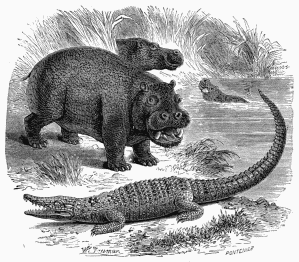
Hippopotamus and Crocodile of the River Nile.
In the foremost rank of the great animals to which the fauna of Asia and
Africa owes its superiority, I have named the huge Pachyderms,[123]
those mighty colossi which may be regarded as the analogues, in the
terrestrial creation, of the Cetacean giants of the marine creation. The
Pachyderms formed in Cuvier’s system a sufficiently natural order, which
modern systematists have dismembered, and, as I believe, a little
arbitrarily. This order comprised, besides the elephants, the
hippopotami, the rhinoceroses, and the tapirs, all the Porcidæ family,
and even the Solidungulates, such as the horse and ass. In the present
work I shall adopt Cuvier’s division. The elephant is the denizen of the
forests where, in a succeeding chapter, we shall encounter both him and
the rhinoceros. But the hippopotamus belongs incontestably to the fauna
of the plain. His name (from the Greek) signifies “River Horse.” And,
indeed, he lives in the rivers, the pools, the deep marshes; his manners
are essentially amphibious. He dives and swims with a surprising ease
and agility, considering the enormous bulk of his body, and the
shortness of his heavy, unwieldy legs. He is able to remain a long time
under water. His colour is a brownish-black, and his proportions, ten to
twelve feet in length, and eight to ten in height. His head is
immensely large; the mouth cavernous in its prodigious width; the teeth
immensely strong, the incisors and canines of the lower jaw being long,
and curved forwards; these canines or tusks sometimes measure more than
two feet in length, and weigh upwards of six pounds each. Those in the
upper jaw are much smaller, and the front teeth are of a moderate size.
The broad thick lips are beset with scattered tufts of short bristles;
the small quick eyes are placed very near the top of the head; the small
ears are slightly pointed, and lined with short thick hair. His food
mainly consists of the coarse herbage that flourishes on the banks of
lakes and rivers; but Milne Edwards speaks of three or four of them
standing knee-deep in the water, forming an irregular line, and pouncing
upon the fish brought within their reach by the rapid currents. At night
time they abandon their watery haunts to prowl among the sugar-cane
plantations, the fields of millet and rice, which they devour with
eagerness. Their march is so impetuous, that they break down every
barrier; nothing can resist them.
The hippopotamus is spread over all eastern and southern Africa; is
found in Nubia, Ethiopia, Abyssinia; at the Cape, the Senegal and the
Congo. Both the settlers and the natives of these countries hunt them
with ardour for the sake of the ivory they yield, nor is their flesh
despised by a keen appetite and vigorous stomach. Sometimes they
excavate, in the animal’s ordinary route, a tolerably deep pit, beset
with sharp pointed poles, and concealed by a covering of leafy branches:
sometimes, in the shade of the evening, they lie in ambuscade among the
bushes, and aim at his huge bulk the deadly bullet, as he comes up from
the water, labouring and bellowing. It is necessary to aim well at his
head; for the rest of his body is almost as invulnerable as that of
Achilles.
Here is a lively picture from Sir Samuel Baker’s valuable volumes, in
which the hippopotamus is a foremost figure.
“We were towing through high reeds,” he says,[124] “the men invisible,
and the rope mowing over the high tops of the grass, when the noise
disturbed a hippopotamus from his slumber, and he was immediately
perceived close to the boat. He was about half-grown, and in an instant
about twenty men jumped into the water in search of him, thinking him a
mere baby; but as he suddenly appeared, and was about three times as
large as they had expected, they were not very eager to close. However
the reis pluckily led the way, and seized him by the hind leg, when the
crowd of men rushed in, and we had a grand tussle. Ropes were thrown
from the vessel, and nooses were quickly slipped over his head; but he
had the best of the struggle, and was dragging the people into the open
river; I was therefore obliged to end the sport by putting a ball
through his head. He was scored all over by the tusks of some other
hippopotamus that had been bullying him.”
After conquering your enemy, kill him and eat him: such is the maxim of
savage life. It was carried out by Sir Samuel Baker and his men, much to
the satisfaction of the conquerors. “A new dish!” exclaims our
traveller; “there is no longer mock-turtle soup; real turtle is mock
hippopotamus. I tried boiling the fat, flesh, and skin together, the
result being that the skin assumes the appearance of the green fat of
the turtle, but is far superior. A piece of the head thus boiled, and
then soused in vinegar, with chopped onions, cayenne pepper, and salt,
throws brawn completely in the shade.”
The same traveller relates that the natives on the shores of the Albert
N’yanza, previous to embarking on a voyage, cast a handful of beads into
the lake, to propitiate the hippopotamus, that their canoe may not be
upset.
The genus Tapir is wanting in Africa; but we find a species, Tapirus
Indicus, in India and the Indian Archipelago, where it was first
noticed by Diard and Duvaucel. These naturalists saw an individual of
this species at Barrackpore, near Calcutta, whither he had been imported
from the island of Sumatra. “I was much surprised,” says Diard, “that so
large an animal had not hitherto been discovered; but I was much more
so, on seeing in the Asiatic Society’s Museum the head of a similar
animal, a native of Malacca, which had been sent to the Society, on the
29th of April 1806, by M. Faghuarie, governor of that province.” This
tapir is as common at Malacca as the rhinoceros and elephant. In size he
closely approaches the common ass. He is black all over, except the
ears, which are fringed with white, and on the back, which is of a pale
gray. His habits are identical with those of the American tapirs, to be
described hereafter.
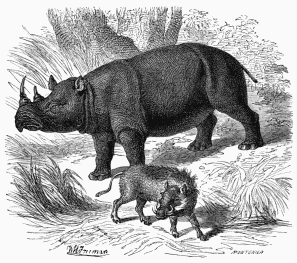
Rhinoceros.
African Phacocœrus (Chœripotamus Africanus).
In the African plains, from Nubia and Senegal to the Cape, we meet with
a Pachyderm intermediate between the hippopotamus and the wild boar:
this is the Phacocœrus, which was known to the ancients, and
designated by credulous Ælian the Sus tetrakeros, or “Boar with Four
Horns.” He has no horns, however, but only, beneath each ear, a horny
protuberance, which greatly disfigures his head, and procures him the
popular appellation of the “Warty Hog”—the “Bush Vark,” or “Bush Hog”
of South Africa (Chœripotamus Africanus). He has four projecting
tusks, and long sharp tufted ears. His stature, his feet, his tail, the
mane of stiff bristles which garnishes his neck, identify him with the
wild boar; but his body, almost naked on the flanks and hinder part,
likens him to an hippopotamus. He is gregarious, of fierce and brutal
habits, and lives chiefly in the bushes or tall herbage.
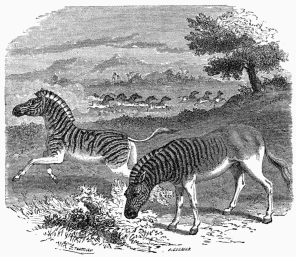
The Daw and the Quagga.
The Solidungulæ (or Solid-hoofed), which roam among the wide pasturages
of the Tropical regions of the Ancient World, contrast, by the elegance
of their forms and the beauty of their clothing, with the unwieldy
Pachyderms, of rugged and swarthy hide, placed by Cuvier under the same
classification. The Wild Horse does not exist in these latitudes, though
we may find there the most beautiful species of the genus: the Hémione,
the Onagra, the Zebra, the Daw, and the Quagga. The Hemionus
(“half-ass”), which we are endeavouring to acclimatize in Europe, and
numerous specimens of which may be seen in the Zoological Gardens of
London and Paris, is of a clear brown colour all over the body, except
the belly and legs, which are white. His mane is short, and his tail
garnished only with a tuft of hairs at the extremity. The species is
Asiatic, and appears to have originated in India, whence it spread
westward into Asia Minor, and northward into the Steppes which stretch
to the base of the Himalayas. The modern names are Koulem, Kiang,
and Dziggethai (or “Mountain Ass”). He roams in great troops across
the dreary Asiatic deserts, and is fond of bitter and saline herbage,
and brackish water. Now, as of old, he has “the range of the mountains
for his pasture,” and the “salt places” for his dwelling. His swiftness
and wariness render his chase an exciting pastime, and in Persia he is
considered the noblest of game.
The Hemippus (“half horse”), a species closely allied to the Hemionus,
is a native of the fertile districts of Syria and Arabia. Another
species, the Tarpan, roams the Steppes of Tartary, and is with great
difficulty tamed to the use of man. He is of a reddish colour, but the
mane and tail are black, and along the back runs a black stripe. The
Onagra, Onager, or Wild Ass of Tartary, is represented in Abyssinia
by a smaller variety, of very graceful form, whose hide exhibits
already, upon the legs, some of those well-defined stripes which so
magnificently adorn the “outer vestment” of the Quagga, the Daw, and,
especially, the Zebra.
All these Solidungulæ are identical in habits and character: social
among themselves, they are fierce and mistrustful towards other animals.
When in peril, they seek safety at first by rapid flight; but if driven
to bay, they assume a courageous bearing, assail their enemies
intrepidly, and frequently compel them to retreat. It is even asserted
that the Quagga (Asinus Quagga) will mingle with herds of domestic
animals, and defend them against the attacks of beasts of prey.
According to Dr. Gray, this animal derives his name from his voice,
which resembles the barking of a dog, or a sound like Couagg, or
Quag. Pennant calls him the Quacha. He resembles the horse in his
haughty bearing and rapid movements. His head, neck, mane, and shoulders
are blackish-brown, banded with white; the stomach, hind parts, and
legs are whitish; the dorsal line is black; the ears have two irregular
black bands and a white tip. In the Daw, the blackish-brown tint
extends over all the upper parts of the body, as well as the stripes,
which are alternately black and light brown. The Quagga and the Daw
belong to Southern Africa, and especially to Caffraria. The habitat of
the Zebra appears to be more extended in range. He is found even as far
north as Abyssinia. He was known to the Romans under the name of the
Hippotigres, and figured in the sanguinary sports of the Amphitheatre.
Assuredly he is the handsomest species of the genus Equus (Horse). He
is as tall as the Hemionus; his legs are shapely, his mien and bearing
full of spirit; he has a well-proportioned head, and a coat of
incomparable richness of design, with the skin lustrous, and large black
stripes symmetrically arranged over the whole body, on a ground of pure
white.
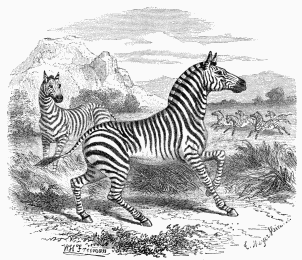
Zebras (Equus Zebra).
Africa, as I have said above, is the native country of the large
Ruminants. Not less remarkable than the Camel in the fantastic
originality of his form, which matches the exquisite richness of his
skin, the gigantic Giraffe (Camelopardalis Giraffa) is distributed
over nearly the whole continent south of the Sahara. Sometimes he even
ventures into the Desert; but most frequently his long neck and tall
legs are seen in the fertile plains of Negroland, the Soudan, the
Senegal, and Nubia. “His head,” says a popular zoologist, “resembles
that of the camel in the absence of a naked muzzle, and in the shape and
organization of the nostrils, which are oblique and narrow apertures,
defended by the hair which grows from their margins, and surrounded by
cutaneous muscular fibres, by which the animal can close them at will.
This is a beautiful provision for the defence of the air passages, and
the irritable membrane lining the olfactory cavities, against the fine
particles of sand which the storms of the Desert raise in almost
suffocating clouds. The large, dark, and lustrous eyes of the giraffe,
which beam with a peculiarly mild but fearless expression, are so placed
as to take in a wider range of the horizon than is subject to the vision
of any other quadruped. While browsing on his favourite acacia, the
giraffe, by means of his laterally-projecting orbits, can direct his
sight so as to anticipate a threatened attack in the rear from the
stealthy lion, or any other foe of the Desert. To an open attack he
sometimes makes a successful defence by striking out his powerful and
well-armed feet; and the king of beasts is said to be frequently
repelled and disabled by the wounds which the giraffe has thus inflicted
with his hoofs.” The lion, however, seldom attacks him unless he can
surprise him in a state of repose, when he will leap upon his victim’s
back and tear him to pieces.
Le Vaillant has justly observed that if precedency among animals were
determined by their height, the giraffe would hold the first rank. The
most careless observer must be impressed by the enormous length of his
fore-legs, and his long tapering neck, which enables him to browse upon
the fresh foliage and green young shoots of the loftiest trees; nor can
he fail to admire his small and elevated head, his brilliant beaming
eyes, and his mildness of aspect. Unusual as are the animal’s
proportions, they are not inharmonious, and his appearance is eminently
picturesque. When full grown, he measures seventeen feet from the top of
the head to the fore-feet. This, however, is a maximum. It should be
added that his fore-legs are not so much longer than the hind, but the
shoulders are extraordinarily high. The animal’s colour is a light fawn,
marked with numerous darker spots. His horns consist of two porous bony
substances, about three inches long, which form, as it were, a part of
the skull.
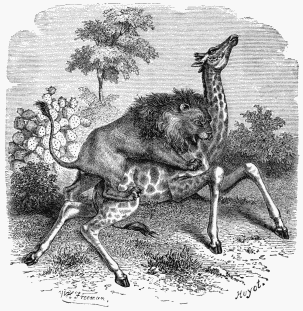
A Lion rending a Giraffe.
Several species of antelopes and wild oxen traverse in numerous herds
the wide prairies of Africa and Asia. Among the African species, I may
name the Bubalus, which lives principally in the north-west, and whose
keen stout horns, disposed like the prongs of a pitchfork, render him
exceedingly formidable; the Gnu, or Connochetæ (Catoblepus Gnu),
which inhabits the wild karoos and hilly districts of South Africa, in
migratory herds, and is distinguished by the weird ugliness of his head,
with its curved horns, and its beautiful flowing mane, white at the
base, and black at the tips; the Oreas Lanna, improperly called the
“Cape Eland” (Antilope Oreas), a graceful animal, as large as the
horse, and five feet high at the shoulder, with straight pointed horns,
whose great strength is augmented by a spiral wreath; and the Oryx
(Oryx gazella), Egyptian Antelope, or Pasom, somewhat superior in size
to a deer, with horns three feet long, black hoofs and horns, a white
head, and neck and upper part of the body of a pale bluish-gray.
Tropical Asia presents but a very small number of Antelopes, properly so
called, of which the Nylghau, or White-footed Antelope (Partux
picta) is the largest. Its face is long and narrow; its black, round,
and pointed horns, though only about seven inches long, are slightly
curved forwards; the broad ears are fringed with white hairs; along the
top of the deep narrow neck runs a slight mane of black hair, which is
continued to some distance down the back; a long hanging tuft of a
similar colour adorns the breast. This animal is said to have abounded
in the forests between Delhi and Lahore in the days of Aurungzebe, and
formed one of the objects of the chase with that “king of kings” during
his expedition to Cashmere. The Hindoo name, “Nyl-ghau,” signifies “blue
ox,” which is true of the male, but the female is a pale brown. He is a
courageous animal, very difficult to tame; travellers affirm that when
attacked he throws himself on his knees, and in this position moves
forward, until, suddenly leaping to his feet, he rushes impetuously upon
his enemy, and smites him vigorously with his sharp horns.
I must not omit to particularize, among the great Ruminants of the
Tropical regions of the Old World, the Buffaloes, or Wild Oxen, which
feed in immense troops in the fertile and well-watered prairies. The two
African species or varieties which are best known are, the Buffalo of
Caffraria, and the Short-horned Buffalo. The former is not confined to
the Caffre country, as his name would lead one to suppose; but ranges
as far as Abyssinia. His horns, very wide, and close together at the
base, form, above the eyes, a kind of helmet very useful to the animal
in pushing aside the bushes that impede his progress. His hair is rough
and black over the whole body. The short-horned buffalo has a smooth
brown skin, muzzle nearly black, ears large, horns arched and of
moderate dimensions.
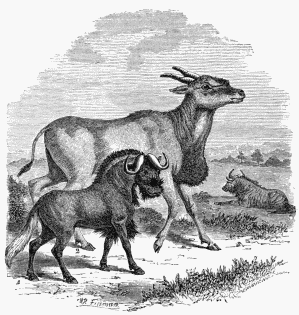
1. Antelope Gnu. 2. Oreas Lanna (or Eland). 3. Striped or
Banded Gnu.
These buffaloes, despite of their ferocious aspect and savage habits,
are wholly inoffensive, and in all cases of danger are tempted at first
to take to flight; but should they be pressed too closely, or wounded,
their irascible and vindictive disposition speedily displays itself.
When the negroes hunt the buffalo, says Paul Gervais, they are very
careful to attack isolated individuals only, because, in the herds of
these animals some will always be found disposed to avenge the death of
their companions, and pursue the hunters to the uttermost. In their
excesses of fury they strike the ground with their horns; dash their
bodies against the trees in which their enemies have taken refuge;
sometimes they will spend their rage upon one another, or upon the
bodies of those of their kind which have been brought low.
Asia is the home of the Common Buffalo (Bos bubalus), and from thence
he has migrated into several islands of the Indian Archipelago, Eastern
Europe, and even into Italy. In France and Great Britain he has long
been domesticated. But there also exist in several Indian provinces some
savage species of the Arnee Buffalo (Bos Arni of Dr. Shaw), easily
recognized by his horns of prodigious size and length, which frequently
measure six feet in length, and eighteen inches in circumference at the
base.
Travellers have asserted that nearly all the herbivora, and in
particular the more feeble and timorous, evince a marked preference for
open and level places; to such an extent, that the herds of antelopes,
gazelles, and zebras may be seen abandoning their pastures when the
herbage is unusually luxuriant. It is in the thickets, the matted and
almost impenetrable jungles, and among the tall rank grasses, that the
beast of prey glides stealthily and unseen upon his intended victim.
Where the surface of the ground is smooth and bare, the herbivora can
descry an approaching enemy, and take to flight or make ready for
defence. It is not, however, the carnaria that they have most cause to
dread, but man; not less cruel he than the stealthy lion or the prowling
tiger, and far more formidable since European commerce has furnished the
savage with firearms. He quickly learns to make use of these; but prior
to their introduction into wilderness, prairie, and forest, he had
devised against his prey various more or less successful means of
destruction.
In Central Africa, for instance, the Bakouain Negroes, to capture en
masse buffaloes, zebras, giraffes, antelopes, and even rhinoceroses,
which gather in crowds around the grateful waters, construct a colossal
and all-devouring snare, which they call a Hopo.
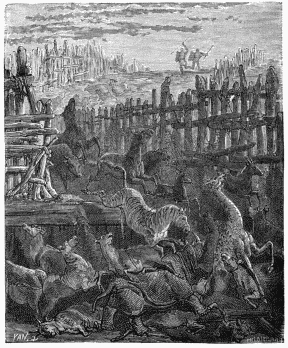
An African Hopo, or Snare for Herbivorous Animals.
“This snare,” says Dr. Livingstone,[125] “consists of two very stout and
very high fences, approaching each other so as to assume the shape of a
V; at the apex of the angle, instead of completely joining them, they
are prolonged in a straight line, forming an alley about fifty paces in
length, abutting on a ditch which may measure from four to five yards
square, and be from six to eight feet deep. Trunks of trees are arranged
cross-wise on the borders of this trench, chiefly on the side from which
the animals will arrive, and upon the opposite one, by which they will
endeavour to escape. These trees form an advanced border above the
ditch, rendering flight impossible, and the whole is carefully covered
over with reeds, which hide the snare, and make it resemble a trap
placed among the herbage. As the two fences are often a mile in length,
while the base of the triangle which they define is nearly of the same
dimensions, a company who form around the hopo a circle of three to four
miles in circumference, by gradually drawing it closer, are certain to
collect a great quantity of game. The hunters direct by their cries the
animals which they surround, and cause them to reach the summit of the
hopo. Men concealed at this point then fling their javelins into the
midst of the affrighted herd, which, dashing headlong through the
solitary opening it can find, involves itself in the narrow alley
leading to the ditch. The animals fall in pell-mell, until the snare is
filled with a living mass, which enables the others to escape by passing
over the bodies of the victims. The spectacle is horrifying; the
hunters, intoxicated by the pursuit, and no longer controlling
themselves, strike these graceful animals with a delirious joy, while
the poor creatures, crushed to the bottom of the abyss beneath the
weight of the dead and dying, raise from time to time the pile of
carcasses, by struggling, in the midst of their agony, against the
burden which suffocates them.”
Of the corral in which the Cingalese entraps the elephant, and of the
ingenious snares laid by the Malay or the Indian for the murderous
tiger, I shall speak hereafter. Between man and the carnivora it was
natural that a deadly war should be incessantly waged; but humanity
would seem to dictate towards the inoffensive herbivora a less
sanguinary hostility.
NEXT to man, the most dangerous enemies of the peaceful herbivora are
the great Carnivora of the Felidæ genus, in whose first rank
zoologists and poets were formerly wont to place the lion.
The so-called “king of animals,” however, has of late years lost much of
his prestige. Observant travellers have watched him with a jealous and
suspicious eye; intrepid hunters have dared to measure themselves
against him, and to beard him in his retreats. Our popular heroes suffer
greatly by this close examination. Achilles to his Myrmidons, I suspect,
was less godlike than he appeared to the warriors of Troy, who saw him
only in the rush and tumult of the battle. Certain it is that the
researches of modern science have stripped the lion of most of the
splendid attributes with which romance had invested him. Here is a
glowing picture:—
“The lion,
Who long has reign’d the terror of the woods,
And dared the boldest huntsman to the combat,
When caught at length within some hidden snare,
With foaming jaws he bites the toils that hold him,
And roars, and rolls his fiery eyes in vain,
While the surrounding swains wound him at pleasure.”—(Nathaniel Rowe.)
But the fact is, that with all his prodigious strength, his terrible
teeth and claws, his imposing physiognomy and attitudes, he is an animal
more prudent than courageous, and very unlike the highly-coloured
portrait which Buffon painted. There have not been wanting
well-accredited authorities to accuse him of cowardice; as our own
countryman Livingstone, and the Frenchman Delegorgue. According to the
latter, he is but a nocturnal robber, whom a ray of light disconcerts,
or the barking of dogs, and the shouts of men, women, and children, or
a blow from a well-applied whip, will frequently put to flight. Even if
provoked, or wounded by man, he will often refuse to fight to the last
extremity; or if he accept the challenge, and succeed in harassing his
antagonist, he contents himself by breaking a limb or two, by marking
his chest with his teeth and nails, after which he leaves him and goes
his way. “I have known,” says Delegorgue, “an intrepid hunter who, twice
in seven years, had been treated in this fashion by a wounded lion; the
first encounter cost him two broken limbs; the second, six fractures,
without counting the deep scars left by his claws on several parts of
the body. Another, named Vermaës, in his daring, was held for more than
a minute by a lion, and got quit with four deep marks of his canine
teeth; glorious scars, which he showed to me with an air of lively
satisfaction.” Livingstone records a similar adventure which befell
himself with a lion at which he had aimed a couple of shots. The wounded
animal turned upon his aggressor, harried him, severely injured an arm,
and then directed his wrath against one of the doctor’s companions, whom
he seized by the shoulder. He intended, in all probability, to
administer a similar correction to this individual, when suddenly the
two bullets he had received produced their effect, and he fell dead.
These facts prove, at least, that if the lion is not brave he is not
malicious, and that the reputation for generosity which he has borne
from remote times was not undeserved. It is only in his old age that the
lion willingly enters upon a regimen of human flesh, from sheer want of
power to obtain any other easily. When a lion is too old, says
Livingstone, to provide himself with game by hunting, he frequently
enters into the very villages and kills the goats; if, then, a woman or
a child go out at night, he makes them equally his prey; and as
thenceforth he has no other means of subsistence, he continues to feed
himself in this manner. Hence has arisen the saying, that if a lion once
tastes human flesh he prefers it to all other kinds. The beasts which
attack man are invariably aged lions. When one of them conquers the fear
inspired by man so far as to approach a village and seize the goats,
the inhabitants invariably say, “His teeth are worn out, and he will
soon kill somebody;” and feeling the necessity of defending themselves,
they hunt him immediately.
It is generally believed, on the authority of Buffon, that the lion
lives in retirement with his mate, that he hunts in solitary dignity,
and will suffer no other carnaria, not even one of his own race, to hunt
in his own domain. This is an error. Lions, on the contrary, often
assemble in a “hunting-party,” four or five in number, when they fly at
“high game,” such as a buffalo or a giraffe. M. Vardon saw three lions
throw themselves at once on a buffalo which he had just wounded with a
musket-shot. “During the day-time, in winter,” says Delegorgue, “you may
frequently see troops of lions, which assemble together for the purpose
of marking off and driving the game towards the ravines, or wooded glens
difficult of access, where some of their companions are posted; these
are strict battues, conducted without any noise, the odours of the
lions being sufficient to enforce the retreat of the herbivora which
they pursue.” The lion himself may, in his turn, be chased and tracked
with dogs, like a wild boar, a wolf, or a stag; but most frequently the
hunters pursue and shoot him on foot, and this is but a pleasure-jaunt
for a man of sang-froid, if a good shot, and well acquainted with the
animal’s habits.
We know that the roar of the lion—that is, of the hungry lion—is
considered the most terrible of cries, which inspires all the animals,
and even man, with unconquerable dread. It appears, however, that
man—to say nothing of his dogs—speedily grows accustomed to it, and
that the lion, in his turn, cannot be frightened by the barking of the
latter. A very curious fact, remarked by Livingstone, is the singular
resemblance of the lion’s roar to the cry of the ostrich. “I have
carefully inquired,” says the great African traveller, “the opinion of
Europeans who have heard both. I have asked them if they could discover
the least difference between the roar of the one and the cry of the
other. They have all informed me that they could not perceive any, at
whatever distance the animal might be placed. The voice of the lion,
generally, is deeper than the ostrich’s; but up to the present time I
have only been able to distinguish it with certainty because it is heard
during the day, and the ostrich’s during the night.”
Lions were formerly common enough in all Southern Asia, Persia, Asia
Minor, and even Greece. They long ago disappeared from these countries,
and are rarely met with now-a-days in Hindostan. The Indian lion is
smaller than his African congener; his mane is shorter and less
abundant, and several naturalists signalize him as a distinct species,
intermediary between the true African lion and the American puma. There
are three varieties of Asiatic lions: the Bengal, the Persian or
Arabian, and the maneless lion of Goojerat—the latter confined to a
very narrow district. The African “king of beasts” is spread over the
entire continent from the Mediterranean to the Cape of Good Hope; but
the species includes three kinds: the Barbary lion, with a deep
yellowish-brown fur and a full flowing mane; the Senegal, whose fur is
of a brighter yellow, and whose mane thinner; and the Cape, of which
there are two varieties, one brown, the other yellowish; the former
being the fiercer and more powerful animal.
A lion of the largest size measures about eight feet from the nose to
the tail, and the tail itself about four feet. The male has usually a
thick shaggy mane; the head is large, with rounded ears, and the face
covered with short close hair; great strength and muscular force
distinguish his conformation; and the tail terminates in a tuft of hair,
which is not fully developed until he is six or seven years old.
In Africa the lion has for his fellows the Leopard and the Panther. Many
writers at one time confounded these two Felidæ, and even classified
them with the Indian tiger. For the vulgar, every great cat with a
spotted skin is a tiger. But scientific naturalists neither apply this
name to the American jaguar nor to other spotted Felidæ of the Old or
New World; and it is with difficulty they now agree to recognize in the
Leopard and the Panther two ill-defined varieties of the same species.
Assuredly they exhibit very marked differences. The Leopard is nearly as
large as the lion; his limbs are robust, his head is strong. From nose
to tail he measures four feet, his tail is two feet and a half long, and
his body so flexible that he accomplishes the most surprising leaps,
and swims, and climbs trees, or crawls along the ground, serpent-like,
with admirable ease. Compared with the jaguar and panther of
naturalists, he is uniformly of a paler and more yellowish colour, and
rather smaller, while the spots on his skin are rose-formed, or consist
of several dots partially united into a circular figure in some
instances, and in others into a quadrangular, triangular, or other less
determinate forms. The lower part of the neck and inner parts of the
limbs are white; the spots are continued upon the tail, which is long,
and black at the extremity.
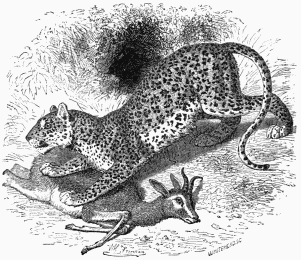
The African Leopard.
The Panther is larger than the leopard, measuring about six feet and a
half from nose to tail, which is itself about three feet long. On his
sleek hide the spots are disposed in circles of four or five, with,
usually, a central spot in each circle, in which, as well as in his
deeper colour, he differs from the leopard. Both are handsome, stealthy,
and ferocious animals; supple, agile, and muscular. The leopard (Felis
leopardus) is a native of Africa, principally ranging along its
western coast and on the confines of the Sahara. The panther (Felis
pardus) is also an African denizen, though likewise found in Arabia,
Persia, and Hindostan. During the day he lurks in the thickets and among
the tall grasses, but when the shades of night descend he issues from
his lair, and haunts the brooks and pools whither the herbivora resort
to quench their thirst. There, upon some rock, he lies in ambuscade,
commanding the track pursued by innocent victims, and darting with
unerring precision upon the first which presents itself.
Neither leopard nor panther often ventures to assail man. When attacked
by him, they seek at first to make their escape, and only turn at bay
when escape is impossible. In Java, and some other of the great Indian
islands, there exists a black panther, which has gained, it is difficult
to say how, the reputation of extraordinary ferocity and daring.
Sometimes, in the world of man, great reputations are built upon equally
slight foundations. He owes his fame to the imagination of the natives,
and differs from his congeners in no single respect but the blackish
colour of his skin. A skilful naturalist, who was for some years a
resident in Java, relates that, while botanizing in the fields and
jungles early in the day, he frequently roused the black panthers in
their lairs. At first he was somewhat startled by the apparition of an
animal of such terrible renown, but seeing him turn tail very quickly on
his approach, he soon grew re-assured, and troubled himself no more at
these rencontres than if he had met a dog or a cat.
We now come to the most formidable of all the Carnaria: the Tiger,
properly so called, or Royal Tiger, whose portrait Buffon has been
pleased to paint with his boldest brush and most glowing colours,
without any other motive apparently than a love of antithesis, or the
artist’s desire to give force and effect to a striking picture. He had
endowed the king of animals with all the regal qualities his imagination
could suggest, and by way of contrast he ascribed to the tiger the
lowest and cruellest instincts. He painted him as the Moloch of the
brute creation; the Domitian, Caligula, or Nero of the jungles. He was
blood-thirsty, treacherous, cowardly, and hideous. His limbs were too
short, his head was too large, he was ill-proportioned; in a word, on
the unfortunate beast he poured out all the vials of his satiric wrath.
With this pièce de fantaisie it would be curious to contrast the
graver and more authentic description of the impartial Daubenton. He
asserted that the tiger was very little known to Europeans, and that in
France there existed but a single specimen, and that a very badly
prepared one, in the “Cabinet du Roi.” But we are now better informed,
and the tiger, perhaps, up to a certain point, is rehabilitated. Let us
take him first in his physical aspect. All travellers agree in
describing him as the handsomest of animals. He has not the grave
countenance, the majestic attitudes of the lion; but he has all the
grace, all the suppleness, all the lively and undulatory movements of
the domestic cat. He does not stand so high upon his legs as the lion,
and he lacks that full flowing mane which invests the physiognomy of the
latter with a human and truly noble air; but all the parts of his head
and body, despite of Buffon, are admirably proportioned. Not quite so
tall as the lion, and less robust in appearance, he is endowed with a
surprising vigour. He can carry off, while in full career, and making
the most rapid leaps, the heaviest prey—a kid, for instance, an
antelope of full size, even a bull, it is said, and, necessarily, a man.
Finally, his skin, symmetrically striped, like a zebra’s, with wavy
bands of brown and black, on a reddish ground, with the contour of the
face, the chin and belly of the purest white, defies all comparison. The
stripes of his head, legs, and tail are disposed with irreproachable
symmetry in curves of the most graceful character. So much for his
physical character; let us pass to his moral.
His appetites, and consequently his manners and instincts, differ but
little from those of the other Felidæ, and, in particular, of the lion.
While he has a keen love of living flesh and warm blood, he does not
scorn to return, under the pressure of hunger, to a dead prey already
partially devoured. Like all the carnaria, a sagacious instinct prompts
him to kill in provision for coming as well as for present hunger. This
is the reason that Buffon has stigmatized him as “unnecessarily cruel.”
“The bound with which he throws himself upon his prey,” says an English
naturalist, “is as wonderful in its extent as it is terrible in its
effects.” Pennant justly observes that the distance which it clears in
this deadly leap is scarcely credible. Man is a mere puppet in his
gripe; and the Indian buffalo is not only borne down by the ferocious
beast, but carried off by his enormous strength. If he fails in his
spring, it has been said that he will take to flight. This may be true
in certain instances; but, in general, far from slinking away, he
pursues the affrighted prey with a speedy activity which is seldom
exerted in vain. Hence we are led to the observation of Pliny
celebrating his swiftness, for which the Roman zoologist has been
censured, and apparently most unjustly; nor is he the only author among
the ancients who notices his speed. Appian speaks of the swift tiger as
the offspring of the zephyr. Pliny, says Pennant, has been frequently
taken to task by the moderns for calling the tiger “animal tremendæ
velocitatis;” they allow it great agility in its bounds, but deny it
swiftness in pursuit. Two travellers of authority, both eye-witnesses,
confirm what Pliny says: the one, indeed, only mentions in general his
vast fleetness; the other saw a trial between one and a swift horse,
whose rider escaped merely by getting in time amidst a circle of armed
men. The chase of this animal was a favourite diversion with the great
Cam-Hi, the Chinese monarch, in whose company our countryman, Mr. Bell,
that faithful traveller, and the Perè Gerbillon, saw these proofs of the
tiger’s speed.
The Latin “tigris” is from a Persian word signifying “swift as an
arrow,” which we find incorporated in the name of the river Tigris.
The tiger’s habits are essentially nocturnal, and almost aquatic. His
favourite haunts are the banks of rivers and lakes, not only because he
may there pounce upon the herbivora which come to drink, but because he
can there satisfy himself with a banquet of fish. To this he is as
partial as any European epicure, and in angling his skill and dexterity
are not unworthy of an Izaak Walton. He is the “complete angler” of the
carnivorous world! He swims admirably, and in pursuit of his prey never
hesitates at the most tremendous “header,” so that the Arnee Buffaloes,
which traverse immense distances by yielding themselves to the swift
river-currents, have more cause to dread his attacks than those of the
crocodiles.
Buffon has calumniated the tiger by accusing him of cowardice, while, as
we have seen, he has not less grossly flattered the lion by representing
him as the perfect type of intrepidity. During the day the tiger, after
having supped freely, sleeps in his den; he avoids man, and when aroused
by the hunters, his first movement is one of flight. But by night or
day, if he be an hungered, no obstacle arrests, no peril daunts him; and
he pounces upon man as he would upon any other prey. He penetrates into
isolated habitations; breaks into the villages, and sometimes even into
the towns; seizes the domestic animals in their very stables; men even
within the shelter of their own houses; and sometimes devours his spoil
upon the spot; sometimes, if he fears pursuit, drags it off to his
secret lair.
At Goa, in a butcher’s stall, was slain a tiger which had fallen asleep
there after gorging himself with food; and in the vicinity of that once
famous, but now degraded city, a cross marks the spot where a Portuguese
officer, marching at the head of his men, was seized before their eyes
by a tiger, and carried off before they could make the slightest effort
to save him.
Tigers are found in India, in the Indo-Chinese Peninsula, at Borneo, at
Java, and at Sumatra. Civilization has hunted them out of the Celestial
Empire, but they are met with in Tartary, even in extremely cold
latitudes. The tigers of the North a beneficent Nature has furnished
with much longer hair than their congeners of the Tropical zone, and
they seem to form a distinct variety of the species. Wherever the tiger
exists, war à l’outrance is declared between man and him! It is a
vendetta which has been handed down from the remotest antiquity, and is
as bitter now as in any past generation. Every year hundreds of persons
fall victims to his appetite and his prowess; every year hundreds of
his race are shot down by the relentless sportsman, or ensnared and
killed by the peasants, whose cattle and whose lives he threatens.
By the Malays and the half-savage Indians who dwell among the
Indo-Chinese jungles, he is hunted in the same way that the African
negroes hunt the lion and the leopard. When the presence of one of these
scourges becomes known in a district, they place some dainty bait on the
bank of the river where he drinks and plants himself every night, and
they form an ambush among the thickets, taking care to mark the
direction of the wind. It is not long before the tiger directs his steps
towards the enticing booty, and the hunters’ arrows or musket-balls
stretch him dead, in most cases, before he can seize it.
A vast amount of pompous preparation attaches to the tiger-hunt of
India. It is a sumptuous expedition, commanded by some distinguished
chief—an European officer, a native prince, or a stranger of rank—in
which each person has his allotted station and particular duties.
Usually the hunters are mounted on elephants, so that the tiger cannot
reach them on the back of the colossus, without being arrested by the
trunk of the latter or his formidable tusks. Each sportsman provides
himself with three or four rifles, besides revolvers and cutlasses.
Formerly the Hindu rajahs made use in this chase of arrows and lances,
but now they greatly prefer the European weapons. The expedition is
never an impromptu affair. It is always organized against an enemy
whose presence has been discovered in the district, and whose den is
pretty well known. The march commences at sunrise, that the beast may be
surprised while enjoying his siesta, after the fatigues and the plunder
of the night. Suddenly awaking, says Mr. Stocqueler,[126] he bounds out
of the jungle, and is saluted by a discharge which often proves
sufficient; but sometimes the animal is safe and sound, or only wounded;
then he furiously springs upon the first elephant within his reach. If
the hunter has not time to plant a ball in his chest or head, the
position of the mahout, or driver, is very critical; for, placed on
the elephant’s neck, he has no other defence than the sharp iron-pointed
stick which he uses to guide his colossal steed. Fortunately the hunters
are arrayed in a compact mass, and a few well-directed shots terminate
the struggle.
The most favourable districts for tiger-hunting, continues Mr.
Stocqueler, are those of Goruckpore, on the frontiers of Nepaul. Sir
Roger Martin relates that in this quarter once reigned a tiger of such
ferocity, and so greedy of human blood, that he was the terror of all
the “country-side.” Once he broke open, in full day-light, the
cabin-door of a Taroo; but the native dealt him such a lusty blow on the
head with his hatchet that he took to flight, and ever afterwards
preserved the mark of the wound, which caused him to be easily
recognized, and dreaded all the more. Sir Roger resolved to free the
country from this plague; he took the field like a gallant soldier, but
slew eight-and-forty tigers before he fell in with the Balafré of ill
renown, who defended himself gallantly, and proved no easy victim.
Abbye-Singh, rajah of Omorah, one of the oldest hunters of the country,
slew, it is said, to his own hand more than five hundred tigers; a fact
which illustrates their numerousness in the Terac, Nepaul, and
Goruckpore. Despite the activity and address of the hunters, they would
never succeed in purging the country; but civilization and clearances of
the ground are driving the wild beasts inch by inch towards the north,
where the hardy amateurs of “sport” must now go in quest of them.
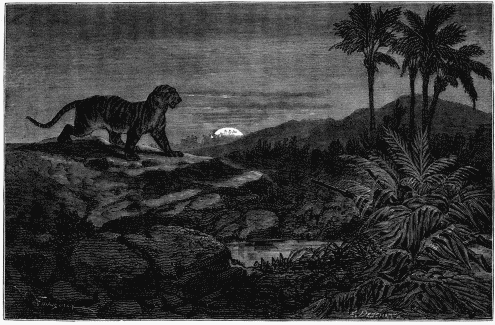
TIGER-HUNTING IN THE INDO-CHINESE PENINSULA.
Among the Felidæ of the Old World peculiar to Tropical Asia, I must cite
the Reinaoudahan, distinguished by his woolly and tufted tail, from
whence he has received the name of the “Fox-tailed Tiger,” and the
Guépard, or “Maned Leopard,” “Hunting Leopard,” and “Cheetah.” I am
inclined to believe that these two varieties really signify one animal;
the Gueparda jubata of naturalists. “Intermediate in size and shape
between the leopard and the hound,” says Burnett, “he is slenderer in
his body, more elevated on his legs, and less flattened on the fore part
of his head than the former, while he is deficient in the peculiarly
graceful form, both of head and body, which characterizes the latter.
His tail is entirely that of a rat; and his limbs, although more
elongated than in any other species of that group, seem to be better
fitted for strong muscular exertion than for active and long-continued
speed.” His anatomical structure and general habits are those of the
Felidæ, but the fur is crisper. The general ground-colour is a bright
yellowish-brown above, lighter on the sides, and nearly white beneath.
On the back, sides, and limbs he is marked with numerous black spots,
which on the tail are so closely set together that they appear like
rings. The cheetah is easily tamed, and trained to the chase; for which
purpose, like our staghounds, he is bred and employed in Persia and
India.
The other families of digitigrade Carnivora, Dogs, Hyænas, Viverras
(Viverra, Civet), Mustelidæ (Mustela, Weasel), are largely
represented in the prairies and jungles of the tropical regions of the
Old World. Wild dogs, with straight ears, a pendant tail, scanty
bristling hair, thin flanks, wander in numerous troops over the plains
of Southern Africa, living, like the wolf or the hyæna, by hunting the
small quadrupeds and devouring the remains of carcasses abandoned by the
greater Carnivora. The jackals, and even the hyænas, range far beyond
the limits of the Desert. At the Cape exists a larger and more ferocious
species of hyæna than that of the Sahara, from which it differs
externally, its skin being marked with spots instead of stripes.
Moreover, the disproportion in the height of the fore and hind legs is
more marked in this animal than in his North African congener.
At the Cape, also, and in a great part of South Africa, we find another
species, the Hyæna villosa, or “Sea-Shore Wolf;” distinguished from
the preceding by having stripes on the legs, while the rest of the body
is of a dark grayish-brown. Allied to the Hyænas is the Proteles, or
“Aard-Wolf “ (Proteles Lalandii), an animal nearly as large as a
jackal, inhabiting the southern parts of the African Continent. He has
the teeth and pointed head of the civits; the striped fur and stiff
bristly hair of the hyænas. The general colour is a yellowish-gray,
radiated with transverse stripes of dusky black; the tail is short and
bushy. The fore-feet are provided with five toes; the hinder ones with
four; all the claws being strong and large. He burrows like a fox, and
prowls abroad at night in search of food, which consists chiefly of
carrion and small vermin. But it is said that he particularly affects
the enormous fatty tail of the African sheep, devouring with avidity the
semi-fluid mass, which requires no mastication.
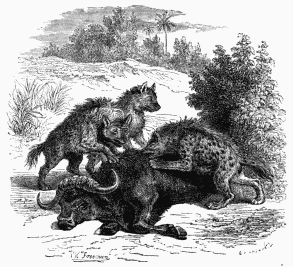
Spotted Hyænas (Hyæna crocuta).
One of the most curious and most graceful of the South African carnaria
is the Fennec, or Zorda (Megatolis), a genus of Canidæ, resembling
the European fox in form and stature, but his hair of a light brown
colour; his muzzle is of extreme fineness, and his eye lively and
intelligent; his enormous ears gift him with an extraordinary delicacy
of hearing. Every animal has its particular taste, and that of the
Fennec is for ostrich eggs, which, as he cannot open them with his teeth
on account of their size, he breaks by dashing them against hard angular
stones. He is not only met with at the Cape, but in Dongola, Nubia, and
the Sahara south of Tunis and Constantina.
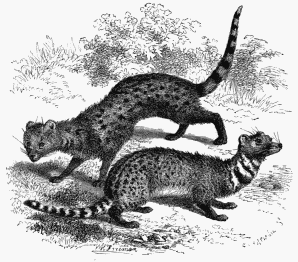
Zibeth, and Indian Genet.
I cannot conclude this chapter without alluding to a few of the
Carnivora with elongated snout and non-retractile claws, which inhabit
the plains of Southern Asia and the great adjacent islands. The first
place I give to the Cuon Bansu, or Pariah Dog of India, which seems
allied to both the Wild Dog, the Wolf, and the Jackal. His eyes are
prominent, his skin is of a reddish-yellow, brightest about the head,
spotted with black upon the tail. He is a gregarious animal, hunting in
large troops, and waging war against hares, gazelles, antelopes. He will
even venture to attack the buffaloes. Some varieties of this species
range high up on the mountains.
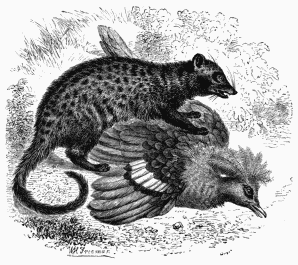
Striped Parodoxure of Java devouring a Crested Goura.
From the order of Carnivora I might also select, in the wild plains in
the Old World, more than one curious species for our investigation, if
my space permitted me to pass in review the two families of the
Viverridæ and the Mustelidæ. To the former belong the famous
Ichneumon, that assiduous reptile-destroyer which the ancient
Egyptians included in their religious cultus; the Genets (Viverra
genetta) with their sleek, soft fur, natives of the western parts of
Asia, India, and Java; the Civets (Viverra civetta), which furnish
the commerce of Europe and the East with a once popular scent, to which
important medical virtues were attributed; the Zibeth (Viverra
zibetha), a maneless civet, peculiar to Asia as the latter is to
Africa, and met with in Sumatra, Borneo, Amboyna, the Celebes, and
Hindostan; and, finally, the Paradoxures (animals with a fantastic or
paradoxical tail), so named by Cuvier because the individual studied by
that great naturalist kept his tail constantly coiled up and inclined on
the same side. All these Carnivora are of small stature; their short
paws are furnished with demi-retractile claws; their body is excessively
elongated, and of a worm-like shape; their tail is long and flexible,
the muzzle tapering, the fur soft, and of a tawny or reddish colour,
with spots or bands of black or brown.
The Mustelidæ are allied to the Viverridæ in their general conformation.
Their skin is equally soft, and capable of furnishing a beautiful fur;
but its colour is generally uniform. The head is more rounded, the
muzzle more obtuse, the tail shorter, than in members of the preceding
family. Finally, a great number are plantigrades. These animals are more
commonly distributed over the cold regions of the Northern hemisphere
than in countries bordering on the Tropics. The genus Ratel (Ratellus
mellivorus), however, is represented both in India and South Africa.
The Cape species is celebrated for the havoc it makes among the nests of
the wild bees, of whose honey it is singularly fond, and to whose
discovery it is assisted by the voice and movements of a bird called the
Honey-Guide. It has a rough tongue, short legs, with very long claws, a
blunt, black nose, no external ears, a remarkably tough and loose skin,
with thick hair. Its colours are ashen gray on the upper parts, and
black on the inferior, and its length from the nose to the tip of the
tail is forty inches, the tail measuring twelve. The Indian species,
differing but little from the African, inhabits Bengal.
THE savannahs and marshes of the ancient continent are frequented by
birds of great stature: Cursores, Raptores, and Palmipeds. The colossus
of the feathered world, the Ostrich, which has been aptly surnamed
the Camel-Bird (Struthio camelus), inhabits the arid plains of the
African interior, and frequently penetrates into the Sahara. The male is
of a glossy black, with white on the wings and tail; the female wears an
uniformly dusky livery. It is the loose flexible plumes of the male
which are so prized for a lady’s toilette, and which figure in the crest
of the prince of Wales. The female’s feathers are of inferior value, and
improperly designated in commerce, “vulture-feathers.”
The Ostrich lives with his fellows in flocks of some number. He feeds
voraciously on grass, grain, young twigs, and will swallow pieces of
wood, leather, metal, or any hard substance. In his apparent want of
taste he is probably guided by instinct, for these objects are probably
useful in promoting the work of digestion. Some travellers have
represented him as a stupid animal; but this is an error, for he
displays both vigilance and shrewdness in avoiding the attacks of his
enemies. The chase of this bird is exceedingly laborious, for though he
does not fly he skims the ground, and his wings impel him forward with a
velocity which distances the swiftest horse. But neither his speed nor
his strength avails against the stratagems of man. The Arab horsemen
surround the flock in a circle, which they gradually contract as they
advance, until the poor birds are confined in a very narrow area, and
dashing madly against one another, fall exhausted with fatigue. They are
then slain by a few blows from a stick.
The female lays from ten to twelve eggs in a hole in the sand; she
broods over them during the night, occasionally leaving them in the
hottest part of the day. In procuring the eggs, which weigh about three
pounds each, and are reputed a great delicacy, the natives are very
careful not to touch any with their hands, as the parent birds would be
sure to discover it on their return, and not only discontinue laying any
more in the same place, but trample to pieces all those which have not
been removed. A long stick is accordingly made use of to push them from
the nest.
Another gigantic bird, whose wings are but partially developed, and
whose legs are long and robust, the galeated or helmeted Cassowary
(Casuarius), is a native of Java and the adjacent islands of the
Indian Archipelago. His head is surmounted by a sort of osseous crest or
horny helmet. In size he is much inferior to the ostrich, not exceeding
five feet when erect; but he is robustly built, and of exceeding
strength. His plumage is very poorly supplied with feathers, so as to
resemble at a little distance, it is said, a coat of coarse or hanging
hair. He is a swift runner, like the ostrich; is equally voracious, and
not more dainty in his food.
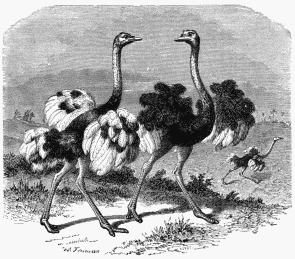
Ostriches (Struthio camelus).
At that season of the year when the coming winter in our Northern
hemisphere already “casts its shadows before,” legions of migratory
birds swarm towards the tropical regions of Africa and Asia. Storks and
cranes, and aquatic birds, descend upon those vast and genial southern
prairies, where they obtain in abundance the precious food denied them
in less favoured climes.
A beautiful crane, of ashen plumage, with a shapely ebon-black neck,
and her head adorned with two white tufts of plumes, the “Lady of
Numidia,” selects for her dwelling-place the eastern and western shores
of the African Continent.
The Stork (Ciconia) is a cosmopolitan bird which alternately favours
with his presence the North of Europe and the Torrid Zone, everywhere
discharging with fidelity his useful sanitary mission by destroying
myriads of noxious vermin. To kill them was considered by the ancients a
foul crime, which could only be fitly punished by death, and the
Egyptians included the Stork with the Ibis in their allegorical and
mysterious worship. In his migrations he avoids the two extremes of heat
and cold, never going farther north than Russia, nor, in winter, further
south than the land of the Nile. The White Stork (Ciconia alba) is
upwards of three feet six inches long. One species, popularly known as
the Marabout, never quits Africa and the Indies. The name is also
applied to the light silken feathers which embellish the wings of the
species—one of the ugliest, let me add, created by Nature, with his
bald head and neck, his huge beak, and absurdly meditative postures.
The chief of the birds of the shore and river-bank, the Flamingo
(Phœnicopterus), may merit admiration on account of his dazzling
scarlet plumage and handsome bearing. Owing to the great length of his
legs and neck he stands nearly five feet high, and measures six feet
from the point of the beak to the tip of the claws. The small round head
is furnished with a bill nearly seven inches long, which is higher than
it is wide, light and hollow, having a membrane at the base, and
suddenly curving downwards from the middle. The legs and thighs are
singularly delicate and slender. The Flamingoes are timid and suspicious
birds; they keep together when feeding, drawn up in artificial array
like the lines of a battalion of British infantry, with some of their
number planted as sentinels to give notice of the approach of danger.
Their voice has a peculiarly deep trumpet-like sound. At the note of
alarm they all take to flight, swooping through the air in the form of a
triangle.
They are skilful fishers. They wade deep into the water, where their
long necks enable them to seize their prey with ease. Their food
consists of spawn, insects, and molluscous animals. Owing to their
peculiar structure they are both waders and swimmers.
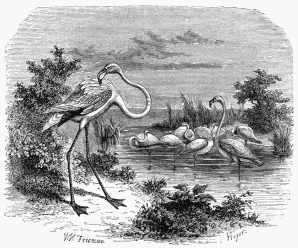
ROSE FLAMINGOES (Phœnicopterus antiquorum).
Several of the African Grallatores wage a murderous war against reptiles
in the marshes and the meads; a war which claims the gratitude of man,
who could never defend himself against their prolific increase and
pertinacious attacks. I have already referred to the Stork; it is
needful I should also mention the Ibis, once an object of worship on the
banks of the Nile; the Jacana, his long claws armed with sharpened nails
that transfix his prey; the formidable-billed Baléniceps, which devours
the young crocodiles; and the famous Serpent-Bird of the Cape, belonging
to the Grallatores by his legs, to the Raptores by the talons and
crooked beak with which he is provided, as well as by the structure of
his internal organs. These birds are the allies and protectors of man,
as Michelet has shown with characteristic eloquence in his rhapsodical
prose poem, “L’Oiseau;” yet even these, in their combined efforts,
are insufficient against the prolific races of aquatic and terrestrial
reptiles, some formidable by their size and strength, some by their
subtlety and venom. The narratives of the adventurous men who have not
feared to incur
“The moving accidents of flood and field,”
in traversing the wild regions of the Ancient World, are full of
striking accounts of encounters with these monsters, and of the miseries
they inflict upon the countries cursed with their presence.
“In Afric’s sunny clime,” flood, and river, and lake are haunted by the
loathsome and dangerous Crocodile (Lacerta crocodilus), one of the
most powerful species of the Saurian race. Though he preys chiefly on
fish, his capacious jaws will devour any animal that comes within their
reach; and when one reflects that he often attains the length of twenty
to thirty feet, that the upper part of his body is clothed with an
almost impenetrable scaly armour, that his long, oar-like tail is of
immense strength, one can readily comprehend the vast amount of
destruction such a monster can effect. Happily his movements on land are
impeded by the unwieldiness of his body, which prevents him from turning
except with great difficulty, and enables his intended victims to effect
their escape. In the water, however, he glides along with great
rapidity.
The female deposits her eggs, which are not much larger than those of a
goose, in the sand or mud near the banks of the rivers or streams which
she frequents. By a beneficent provision of Nature, the young are
largely devoured by birds, ichneumons, and other animals, preventing
their otherwise rapid increase. The colour of a full-grown crocodile is
a blackish-brown above and yellowish-white beneath, the upper parts of
the legs and sides being relieved by shades of deep yellow, and in some
places tinged with green. The mouth is of vast width, and both jaws
bristle with a terrible array of sharp-pointed teeth.
The African species all belong to the same genus, of which the Crocodile
of the Nile is the type.
At the Gaboon, the negroes hunt their enemies either with muskets or a
kind of harpoon. Their vulnerable points are the attachment of the
anterior limbs, and, of course, the eyes. It is here that their
assailants endeavour to mark them. They are killed every day without
their number appearing to be sensibly diminished, and, what is singular
enough, without their seeming to grow mistrustful. During the heat of
the noon, they retire among the reeds and rushes for repose, but never
remain long in any one place. At evening and at morning they sally forth
in quest of prey. They swim without making any noise, scarcely
disturbing the water, which they cleave like dogs; they will also remain
motionless on its surface, glancing around them with cruel, dull,
sinister eyes. The negro does not feel towards them so great an horror
as Europeans experience, who are powerfully affected by their exceeding
hideousness. They eat their flesh, with which their huge bony skeleton
is scantily furnished, and, according to Du Chaillu, can never obtain
enough of the much-prized delicacy.[127]
The Indian Crocodile, the Gavial or Garial (Crocodilus
Gangeticus), is of the same size as his African congener, but easily
distinguished by the peculiar conformation of his mouth; the jaws being
remarkably straight, long, and narrow. The sides of the head are
straight and perpendicular, the upper surface quadrilateral; and the
mandible, instead of sloping gradually from the forehead, sinks suddenly
to follow a straight and almost horizontal direction. The teeth are
nearly double in number those of the Nilotic monster, but he is far less
dangerous, and feeds only on fish. There are two species: the Gavial of
the Ganges, found in all the great rivers of Southern Asia; and the
Gavial of Schlegel, belonging exclusively to the island of Borneo.
Serpents of every size, venomous and non-venomous, multiply in the
jungles, marshes, and woods of all tropical countries. Africa and Asia
are abundantly provided with them. In Senegal they are all, or mostly
all, inoffensive, and the objects of devout worship on the part of the
negroes of Dahomey; but naturalists have not yet determined their
respective genera. It is certain, however, that they do not all belong
to the same species. In size, says the French traveller, Dr. Répin, they
vary from three to ten feet. Their head is large, flattened, and
triangular; the neck not quite so large as the remainder of the body; in
these respects resembling the entire host of Ophidia. They vary in
colour from a bright yellow to a yellowish-green, according perhaps to
their age. Most of them are marked upon the back, for their whole
length, with two brown lines, while a few are irregularly spotted. The
long and prehensile tail, and the facility with which some of them
climb, would refer them probably to the genus Leptophis of Duméril and
Bibron. At Whydah, these divinities are lodged in a temple shaded by
lofty and beautiful trees. This curious edifice is described as a kind
of rotunda, from thirty to forty feet in diameter, and from twenty-two
to twenty-five feet high. Its walls, constructed of sunburnt clay, are
pierced, like those of the Dahomean houses, by two opposite gates,
affording free ingress and egress to the deities of the place. The roof,
formed of branches curiously interlaced and covered with a layer of
dried grass, is constantly tapestried with a myriad serpents. Some climb
or descend by writhing round the trunks of trees arranged for this
purpose along the walls; others, suspended by the tail, balance
themselves indifferently in the air; others, again, lie coiled up in
spiral folds on the ground or among the grasses of the temple roof. They
never want for nourishment; the devout supply them with constant
renewals of food, and in such abundance, that the priests, who,
moreover, exercise the double profession of sorcerers and doctors, are
in no greater peril of starvation than their gods!
The spotted serpents of which Dr. Répin speaks may possibly be no other
than Pythons, those gigantic Ophidians of the tropical regions of the
Old World which are found in Africa, in India, in the Indian
Archipelago, and even in Australia. It should be noted, however, that
their size generally exceeds that of the largest serpents which Dr.
Répin saw at Whydah. Their length is from fifteen to twenty-five
feet—specimens have been met with measuring thirty—and their maximum
diameter ranges from ten to twelve inches. Their back is variegated
with large spots, whose form, colour, and disposition differ according
to their species. The tail is short, and not prehensile. Their favourite
haunt is the low marshy ground, rank with moist herbage, where they prey
upon birds and small animals, swallowing them whole—swallowing them
even alive—after having seized them in the invincible folds of their
long sinuous bodies, and always commencing with their hinder parts. So
greedy a repast must necessarily be followed by a slow and difficult
digestion, and cannot be renewed at any very brief interval. They eat in
effect but once a month, or once in two months. During the lethargic and
semi-somnolent condition which invariably follows their debauch, they
fall easy victims to the attacks of their enemies. The principal African
species of this genus are, the Python of Seba, of Central Africa, and
the Royal Python of Senegambia.
The species peculiar to Asiatic climes is the Python Molure, a native of
the Indian Peninsula, and of the islands of Java and Sumatra. The Python
of the Sunda Islands, called by the natives Ular-Sawa, attains the
length of fully thirty feet. It has a large flat head, of a bluish-gray
colour, a thick yellowish muzzle, and cylindrical neck. Its body is
marked with deep-blue spots, with a yellow or tawny border; its yellow
tail with blue rings. Its ordinary habitat is the rivers; it feeds on
rats and birds, but also pursues, when ashore, the largest animals.
We are indebted to Dr. Livingstone for much curious information
respecting the serpents of South Africa, and especially in reference to
the Striking Echidna, a singularly formidable viper, which the negroes
designate Picakolou. He tells us that he killed one day a reptile of
this species, which was of a deep brown colour, verging on black, and
measured seven feet and a half in length.[128] These reptiles possess so
abundant and deadly a venom, that when one of them is attacked by a band
of dogs, the first dog bitten dies immediately; the second, five minutes
afterwards; the third, at the end of an hour; and the fourth, after a
more or less lengthened agony. A great number of beasts is annually
destroyed by the Picakolous; the fangs of an individual killed at
Kolobeng distilled poison for several hours after its head had been
severed from its body. It is probably this plentiful secretion which the
natives call “the serpent’s spittle,” and which leads them to suppose
that the Picakolou is endowed with a power of injecting it into its
enemies’ eyes when the wind is favourable.
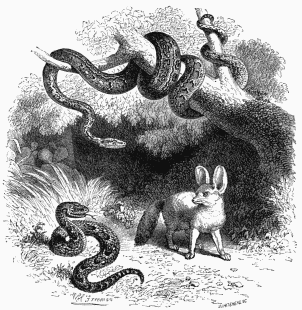
Python Molure.
Echidna, or Picakolou.
Fennec (Megalotis).
Other venomous species exist in this part of Africa, of which several
are vipers, and among others the Puff-Adder (Vipera inflata). The
natives have named it Noga-Poutsane, or the Goats’ Serpent, because it
makes at night a bleating exactly resembling that animal. There were
certainly no goats, says Livingstone, in the place where I happened to
hear it. The natives suppose that by this bleating it hopes to deceive
the traveller, and draw him within its reach. Some species emit, when
they are frightened, a peculiar odour, strong enough to indicate their
presence when they have found their way into the huts. There are also
several varieties of Cobras (the Naja-Haje of Dr. Smith). When they
are attacked, they raise their head a foot from the ground, extend their
neck in a threatening manner, dart their tongue to and fro with extreme
rapidity, while rage glares in their fixed and glassy eyes.
Different serpents of the genus Dendrophis, as, for example, the Green
Climber (Bucephalus viridis), scale the trees in search of birds and
their eggs, to which they are curiously partial. The Bucephalus is armed
with fangs; nevertheless it is not venomous, and these fangs, which turn
inwards, are only of use in preventing the retrogression of their prey,
only one part of which is enclosed between its jaws.
The Cobra or Naja (Vipera naja), the “Hooded Snake” and “Spectacle
Snake” of the English, the “Cobra de Capella” of the Portuguese, must be
classed among those serpents which are the most dangerous through their
violence, and the subtle character of their venom. It is easily
recognized by its faculty of dilating the back and sides of the neck,
under the influence of fear or rage, to which it owes its popular
appellation; the elevated skin of the back of the neck presenting much
the appearance of a hood (capella). It is usually three or four feet
in length; of a pale reddish-brown colour above, and bluish or
yellowish-white below; with a characteristic mark on the back of the
neck closely resembling the figure of an old-fashioned pair of
spectacles. It is a sluggish creature, and easily killed, but its poison
is of the most fatal quality, causing death within two hours. It
frequents the purlieus of human residences in India, and occasionally
penetrates into the very houses, attracted apparently by the domestic
poultry, and by the humidity of the wells and drainage. In Ceylon, the
natives, if journeying abroad by night, carry a small stick with a loose
iron ring, whose strange metallic sound, as they strike it on the earth,
frightens the cobra from their path. The poison is harmless if taken
internally. It is secreted in a large gland in the serpent’s head, and
flows, when the animal compresses its mouth on any object, through a
cavity of the tooth into the wound.[129]
The Indian species plays a conspicuous part in the displays of the Hindu
jugglers, who exercise a strange power over them by the tones of their
voice and the sounds of various musical instruments, compelling them to
rise partially from the ground and go through a succession of fantastic
movements. Something of this power is also due to the fascination of the
juggler’s eye. Serpent-charming is of remote antiquity in Egypt and in
most Oriental nations, where the profession would seem to be hereditary.
Several allusions to it occur in Holy Writ.[130]
WE have seen that the order of Pachydermata, which furnished the Ancient
World with the most gigantic species of the terrestrial creation, is
represented in the New World by comparatively insignificant types: the
Tapir and the Peccary. The first, although far inferior in stature to
the elephant, the rhinoceros and the hippopotamus, is, nevertheless, one
of the largest American Herbivora; the bison, llama, and stag alone
exceeding it in size.
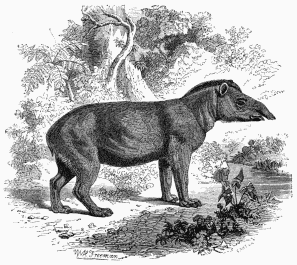
American Tapir (Tapirus Americanus).
Two species are distinguished, which both inhabit South America,—the
American Tapir and the Tapir Pinchaca. The former is about as large
as a mule or an ass. His skin is black, covered with rough brown hair.
He has a long bowed neck, legs and feet resembling those of the hog, and
a nose prolonged into a kind of trumpet. He feeds on leaves and many
kinds of fruit, and sometimes does much injury in the mandioca fields
of the Indians. His flesh is very good eating, and considered
exceedingly wholesome. It is even reputed to be a remedy for the ague. A
very shy and timid animal, he wanders about principally at night. “When
the Indian discovers a feeding-place,” says Mr. Wallace,[131] “he builds
a stage between two trees, about eight feet above the ground, and there
stations himself soon after dusk, armed with a gun, or with his bow and
arrow. Though such a heavy animal, the tapir steps as lightly as a cat,
and can only be heard approaching by the gentle rustling of the bushes;
the slightest sound or smell will alarm him, and the Indian lies still
as death for hours, till the animal approaches sufficiently near to be
shot, or until, scenting his enemy, he makes off in another direction.”
When compelled to stand at bay, however, he defends himself with
extraordinary vigour. D’Azara assures us that if the jaguar flings
himself upon the tapir, the latter will drag him onward and onward
through the densest bushes, until, torn cruelly by the thorns and
brambles, he is constrained to let his would-be victim escape.
The Tapir Pinchaca appears to be confined to the region of the
Cordilleran table-lands. The name “Pinchaca,” bestowed on the species by
M. Roulin, is that of a fabulous animal mentioned in the traditions of
New Grenada. It is distinguished from the former species by the absence
of those lateral folds on the snout and occipital ridge to be remarked
in the American Tapir, by its long thick hair—which, however, does not
form a mane on the neck—and by a white mark at the extremity of the
lower jaw.
The Peccaries are the wild boars of Tropical America. They are smaller
than those of the Old World; have fewer teeth, and their tail is
rudimentary. They live in numerous herds, and not only defend themselves
energetically against aggressors, but when the latter have grown
fatigued, assume the offensive, and pursue them with incredible fury.
Hunting them, therefore, is for man, no less than for the jaguar, a
dangerous adventure. When one of them has been seized by the latter, or
slain by the former, the herd combine in pursuit of the murderer, and if
he does not succeed in escaping them by a rapid retreat, or by opposing
some insurmountable obstacle to their headlong career, he is infallibly
torn to pieces.
The genus Horse, or, to adopt the new nomenclature, the family of
Equidæ, are altogether wanting in the American Fauna; that is, in the
native indigenous Fauna of the New World. Previous to the era of Spanish
Conquest, America did not possess a single species analagous to the
horse, the onagra, the hemionus, the zebra, or the quagga; and the
reader of the animated pages of Prescott or Arthur Helps will remember
with what terror the Peruvians as well as the Mexicans regarded the
mounted cavaliers of Pizarro and Cortez. The horse, however, when
introduced by Europeans, multiplied rapidly in the Savannahs, where he
soon became wild, and breeding with the ass, produced the mule, which,
in the Spanish-American States, as in the mother-country, is now the
most useful auxiliary of man. The European ox is likewise acclimatized
over the entire extent of the new continent; and immense herds of the
latter species, together with troops of horses and mules, people the
Llanos and Pampas of South America, where the first conquerors had only
met with herds of stags (Cervus Mexicanus), llamas, and cobiais.
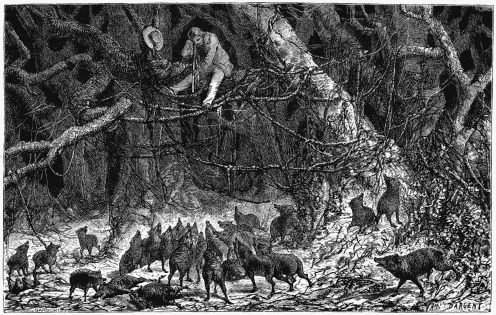
HUNTER PURSUED BY PECCARIES.
The Llama, or Guanaco (Auchenia llama), and his congeners, the
Vicuna and the Alpaca (Auchenia), are now only found among the
recesses of the Andes, their native country, to which they have
retreated before the restless advance of man. In describing them I shall
freely avail myself of Dr. Von Tschudi’s interesting notices.[132]
The Llama measures from the sole of the hoof to the top of the head,
four feet six to eight inches; from the sole of the hoof to the
shoulders, from two feet eleven inches to three feet. The female is
usually smaller and less strong than the male, but her wool is finer and
better. A great variety of colour prevails; the more general is brown,
with shades of yellow or black; frequently speckled, but very rarely
quite white or black. The speckled brown llama is, in some districts,
called the moromoro.
The burden carried by this useful animal, the camel of the New World,
should not exceed from one hundred to one hundred and twenty-five
pounds. If the load be too heavy, he lies down, and no force or
persuasion will induce him to resume his journey until the excess be
removed. In the silver mines his utility is very great, as he frequently
carries the metal from the mines in places where the declivities are so
steep that neither asses nor mules can keep their footing. His
abstemiousness is remarkable, and he will not feed during the night.
“A flock of llamas journeying over the table-lands,” says Dr. Von
Tschudi, “is a beautiful sight. They proceed at a slow and measured
pace, gazing eagerly around on every side. When any strange object
scares them, the flock separates, and disperses in various directions,
and the arrieros have no little difficulty in re-assembling them. The
Indians are very fond of these animals. They adorn them by tying bows of
ribbons to their ears, and hanging bells round their necks; and before
loading, they always fondle and caress them affectionately. If, during a
journey, one of the llamas is fatigued and lies down, the arriero kneels
beside the animal, and addresses to it the most coaxing and endearing
expressions. But notwithstanding all the care and attention bestowed on
them, many llamas perish on every journey to the coast, as they are not
able to bear the warm climate.”
When resting they make a peculiar humming noise, which, if it proceed
from a numerous flock and is heard at some distance, resembles a concert
of Æolian harps.
The flesh of the llama is spongy, and not agreeable in flavour: Its wool
is used in manufacturing coarse cloths.
The Alpaca (Auchenia), or Paco, is smaller than the llama. It measures
only three feet three inches from the lower part of the hoof to the top
of the head, and to the shoulders two feet and a half. In form it
resembles the sheep, but has a longer neck and a more graceful head. Its
fleece is very long, in some parts four or five inches, and exquisitely
soft. Its colour is usually either white or black, but in some few
instances is speckled. Of its wool the Indians weave their blankets. It
is also exported to Europe, and especially to England, in large
quantities, though since the alpaca was naturalized in Australia,
through the patriotic exertions of Mr. Ledger, England has begun to
obtain a supply from her great and thriving colony.[133]
The alpacas are kept in large flocks, which graze, throughout the year,
on the green and level heights, and are driven to the huts only at
shearing-time. Their shyness is very great, and at the approach of a
stranger they take to rapid flight. Their obstinacy is remarkable. If
one of these animals should be separated from the flock he will throw
himself on the ground, and neither force nor persuasion will induce him
to rise; he will frequently suffer the severest punishment rather than
go the way his driver wishes. Few animals seem to stand in such urgent
need of the companionship of their species, and it is only when brought
to the Indian huts very young that they can be separated from their
flocks.
The largest animal of this tribe is the Huanacu or Guanaco. He measures
five feet from the bottom of the hoof to the top of the head, and three
feet three inches to the shoulders. So nearly does he resemble the llama
in form that, until very recently, zoologists supposed the latter to be
an improved species of the huanacu, and that the huanacu was neither
more nor less than a wild llama. But there are specific differences
between them. The huanacu is of a uniform reddish-brown colour on the
neck, back, and thighs. The under part of the body, the middle line of
the breast, and the inner side of the limbs are of a dingy white. The
wool is shorter and coarser than that of the llama, and of nearly
uniform length on all parts of the body. The huanacus assemble in small
herds of five or seven, and if taken very young may be tamed, but can
with difficulty be trained as beasts of burden.
The Vicuña is a more beautiful animal than either of the preceding. His
size is a medium between that of the llama and alpaca. He measures four
feet one inch to the top of the head, and two feet six inches to the top
of the shoulders. He is distinguished by his longer and shapelier neck,
by the superior fineness of his short curly wool. The crown of the head,
the upper part of the neck, the back, and thighs are of a peculiar
reddish-yellow hue, which the natives call color de vicuña. The lower
part of the neck and the inner parts of the limbs are of a bright
ochreous colour, and the breast and lower part of the body white.
During the wet season the vicuña browses on the scanty vegetation of the
Cordilleran ridges. He never ventures up to the bare rocky summits, for
his hoofs, being accustomed only to the yielding sward, are very soft
and tender. He lives in herds, consisting of from six to fifteen
females, and one male, who is the protector and leader of the herd, and
who, while the females graze, stands a few paces apart, carefully
watching over their safety. At the approach of danger he gives a signal,
consisting of a kind of whistling sound and a quick movement of the
foot. Immediately the herd draws close together, each animal stretching
out his head in the direction of the impending alarm. Then they take to
flight; first moving leisurely and cautiously, but quickening their pace
to the utmost degree of speed; whilst the male vicuña, who covers the
retreat, occasionally halts to observe the motions of the enemy. The
females reward his devotion by the warmest affection and fidelity, and
will suffer themselves to be killed or captured rather than desert him.
The mode in which the Indians hunt the vicuña is sufficiently curious.
In the Chacu, as it is termed, the whole company, seventy or eighty in
number, proceed to the Attos—the most secluded districts of the
Peruvian mountains—which are the animal’s favourite haunts, with an
abundant supply of rope and cord, and numerous stakes. Selecting a
spacious open area, they drive the stakes into the ground in a circle,
at intervals of from twelve to fifteen feet apart, and connect them
together by ropes fastened at the height of two or two and a half feet
from the ground. The circular space within this enclosure measures about
half a league in circumference; an opening of about two hundred paces in
width is left for entrance. On the ropes which are carried round the
stakes, the Indian women hang pieces of coloured rag that flutter gaily
in the wind.
The chacu being thus made ready, the Indians, who are mounted on
horseback, range over the country within a circuit of several miles,
driving before them all the herds of vicuñas they encounter, and forcing
them into the chacu. When a sufficient number is collected, they close
the entrance. The timid animals do not attempt to leap over the ropes,
being affrighted by the fluttering rags, and when thus secured, the
Indians easily kill them with their bolas.
These bolas consist of three balls, composed either of lead or stone;
two of them heavier than the third. They are fastened to long elastic
strings, made of twisted sinews of the vicuña, and the opposite ends of
the strings are all tied together. The Indian holds the lightest of the
three balls in his hand, and swings the two others in a wide circle
above his head; then, taking his aim at the distance of about fifteen
or twenty paces, he lets go the hand-ball, whereupon all three whirl in
a circle, and cling round the object aimed at. The aim is usually
directed at the animal’s hind legs, and the cords twisting round them,
he is unable to move. Great skill and long practice are required to
throw the bolas dexterously; a novice in the art incurs the risk of
dangerously hurting either himself or his horse, by not giving the balls
the proper swing, or by letting go the hand-ball too soon.
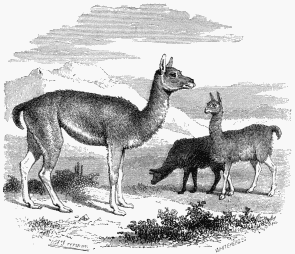
1. Guanaco.
2. Llama.
3. Vicuña.
The vicuñas, after being secured by the bolas, are killed; their skins
belong to the Church, and their flesh, which is tenderer and better
flavoured than that of the llama, is distributed in equal portions among
the hunters.
Under the dynasty of the Incas, the Peruvians rendered almost divine
worship to the llama and his congeners, adorning the temples with large
figures of these animals fashioned in gold and silver.[134]
If the natives of the South American continent possess neither the Ox
nor the Sheep, they have at least a precious resource in the Bison, and
the Musk Ox, or Ovibos. Of the latter I shall speak when my survey
brings me to the colder regions of North America.
The Bison is wholly confined to the great prairies of this continent,
which he traverses from north to south, and reciprocally, in his
periodical migrations. According to some naturalists, he is a variety of
the Aurochs, the fierce wild bull that formerly tenanted the forests of
Gaul, Germany, and Sarmatia, and is still found in the densely-wooded
districts of Moldavia, Wallachia, Lithuania, and Caucasia. Herds of
Aurochs (Bos Bison), under the special protection of the Russian
Emperor, and believed to number fully eight hundred animals, still roam
in the depths of the great Lithuanian forest of Bialowieza. The American
genus commonly called Buffalo, but not to be confounded with the
buffaloes of the Old World, occurs as far north as the Great Martin
Lake, in latitude 63°, and congregates in countless thousands on the
wide undulating prairies between the Mississippi and the Rocky
Mountains. Their flesh is supposed to supply with provision some 300,000
Indians, who pursue them on horseback, and kill them with bow and arrow,
spear or rifle. The chase is exciting, and has proved a great attraction
to the more adventurous spirits of the New World. It is exciting because
it is perilous, for the hunted animal will often turn upon his
adversary, and in speed he can outstrip the swiftest horse. He finds a
formidable enemy in the white wolf. Hunting in packs of one or two
hundred, the latter fling themselves upon two or three solitary bisons,
and, surrounding them, worry the huge brutes to death. Never have they
courage enough, however, to attack a herd, though the latter, when they
catch sight of wolves, manifest the greatest alarm, form into battle
array, and are only prevented by excess of terror from taking to flight.
This panic-stricken feeling the Indian often turns to his advantage. He
clothes himself in the skin of a white wolf, and with bow and arrows in
his hands, boldly faces a herd, crawling towards them on his hands and
knees; the affrighted buffaloes press closely together to receive the
supposed wolf, who, on arriving at a convenient proximity, suddenly
springs to his feet, and utters an unearthly yell. They fall into a
frenzy of terror which enables him to select several victims.
The Indians also capture great numbers by setting fire to the grass of
the prairies; the flames compel them to retire to the centre, where they
are easily slain. Or they endeavour to throw them into a panic of alarm,
in which case they seem possessed with a sudden madness, and, if driven
towards a precipice, will dash themselves headlong over it, falling
crushed and bleeding into the chasm beneath.
The American bison is similar to the European, but his tail and limbs
are shorter; the horns are shorter and more blunt; the tail has fewer
vertebræ; and the mane is fuller and shaggier. His flesh is excellent
eating, having a flavour like that of venison. The tallow forms an
important article of trade, one bull sometimes yielding 150 pounds. The
skins are much used by the Indians for blankets, and when tanned they
employ them as coverings for their beds and wigwams. Spread upon frames
of wicker-work, they make admirable canoes. The long hair or fleece, of
which a male bison yields six to eight pounds, is spun and woven into
cloth.
The favourite nourishment of the bison, says Humboldt, is the Tripsacum
dactyloides, called “Buffalo-Grass” in North Carolina, and a species of
trefoil, resembling Trifolium repens, which Burton has named
Trifolium bisonicum. It is remarkable, he continues, that the Buffalo,
or Bison of the North, has exercised an influence upon geographical
discovery in the mountainous regions where no road is laid down.
Assembled in herds of several thousands, and seeking a milder climate,
they migrate at the approach of winter into the countries situated south
of Arkansas. Their massive form and size render it difficult for them to
cross the mountains; and, consequently, wherever the traveller finds a
track beaten out by numerous hoofs—a “buffalo-path,” in fact—he may
confidently adopt it as the most convenient route for himself and his
steed. In this manner have been discovered the best passes in the
Cumberland Mountains, the Rocky Mountains, from the sources of the
Yellow-Stone to the River La Plata; and, finally, from the southern
branch of the River Columbia to the Rio Colorado of California.
The animals which we most frequently meet with in the Steppes of South
America are the small spotted Stag (Cervus Mexicanus); the mailed
Armadillos; some species of Tatous, which glide like rats into the
burrows of the hares; troops of indolent Cobiais; of Civets agreeably
striped, but infecting the air with their emanations; and the great
maneless Lion, the Jaguar or American Tiger, whose strength is
sufficient to slay the young bulls and carry them off to the summits of
the hills.
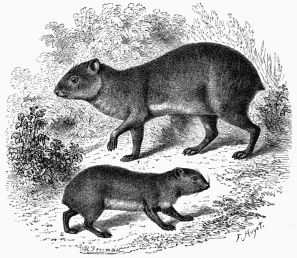
1. Agouti. 2. Capybara.
The Cervus Mexicanus wanders in numerous troops in the grassy Llanos
of the Caraccas. He is only spotted while young; and varieties
completely white have been discovered. On the slopes of the Andes he is
never found at a greater elevation than 1600 to 1900 feet. At 3000 feet
he is replaced by a much larger variety, slightly differing from the
European stag.
The Rodents of the genera Capybara, Agouti, and Paca, are widely
diffused over the plains of Tropical America. Of the three, the Capybara
(Hydrochærus capybara) is the largest. He attains the size of a sheep,
has a voluminous head, small round ears, eyes large and black, a thick
divided nose flanked by formidable whiskers, a short neck, a thick body
covered with short, coarse, russet hair, and short legs; altogether,
not a “thing of beauty.” Like the peccary, he is tailless, and in a
manner web-footed, being thus adapted for a semi-aquatic life.
These great Rodents, says the illustrious author of “The Origin of
Species,” in one of his earlier works,[135] are generally called
“Carpinchos;” they occasionally frequent the islands in the mouth of
the Plata, where the water is quite salt, but are more abundant on the
borders of fresh-water lakes and rivers. In the day-time they either lie
among the aquatic plants, or openly feed on the turf plain. When viewed
at a distance, from their manner of walking and colour, they resemble
pigs; but when seated on their haunches, and attentively watching any
object with one eye, they re-assume the appearance of their congeners,
the Caries. Both the front and side view of their head wears quite a
ludicrous aspect, from the great depth of their jaw.
The Capybara leads no joyous life apparently, for in the water he is
perseveringly pursued by the crocodile, and in the plain by the jaguar.
He runs so awkwardly as to be easily caught by hand, and the South
Americans profess to relish his flesh.
The Paca (Cœlogenys) differs from the Capybara in the complex
structure of his molar teeth. He inhabits the woody regions of South
America, where he is generally found in the vicinity of water,
concealing himself in burrows so near the surface, that the pedestrian’s
foot often intrudes within them. His form is thick and clumsy, spotted
with white on the sides, and intermediate in size and appearance between
a hog and a hare.[136] He is about a foot in height and two feet in
length, with hind limbs much longer than the fore, but considerably
bent. The claws are thick, strong, and conical; the eyes large,
prominent, and of a brownish hue; the ears nearly naked, and whiskers
rigid. The paca is heavy and corpulent, but swims and dives with
remarkable agility. As he feeds only on fruits and tender plants, his
flesh is exceedingly savoury, and a staple dish in many parts of
America. His burrow is provided with three apertures, and his capture is
managed by closing up two of these, and digging up the third.
The Agouti (Dasyprocta Agouti) is another South American Rodent, about
one-third the size of the Paca; he swims, but does not dive. He has
sometimes been named “the rabbit of the South American continent,” but
differs from it in many essential points, and really belongs to the
Cavidæ, or guinea-pig tribe. He possesses the voracious appetite of
the hog, and devours indiscriminately everything that comes in his way.
He conveys his food to his mouth with his fore-paws, like a squirrel,
and as he has long hind legs, runs, or rather leaps, with considerable
swiftness. He is hunted very perseveringly on account of the devastation
he causes among the sugar-canes. There is a larger species called the
Mara, or Pampas Hare (Dasyprocta Patachonica), which will wander for
miles away from its home.
Among the most interesting Rodents of the New World must be classed the
Vizcacha and the Chinchilla, whose furs are so highly valued. The
Vizcacha, or Bizcacha (Calomys bizcacha), somewhat resembles a rabbit,
but his teeth are larger, and he has a long tail. He lives, it is said,
on roots, and never wanders far from his burrow. His flesh, when cooked,
is very white and savoury. The Chinchilla (C. lanigera) inhabits the
cold mountain-valleys, where his close, fine gray fur is an invaluable
protection. He is a pretty animal, much like the rabbit, but with a
squirrel’s tail; of a mild and sociable disposition; and living with his
kind on the most amicable terms.
Nor must the Beaver be forgotten, the most industrial animal of the
Rodentia, which has wholly disappeared from Europe, and is yearly
growing scarcer in America.
The Beaver (Castor fiber) is specially recognizable by his broad
horizontally-flattened tail, which is of a nearly oval form, but
slightly convex on its upper surface, and covered with scales. His hind
feet are webbed, and together with the tail, which acts as a rudder,
propel him through the water with ease and swiftness. His length,
exclusive of his tail, which measures one foot, is about three feet;
colour, a deep chestnut; hair, very fine, glossy, and smooth. The
incisor teeth are large, and so hard, that the North American Indians
used them in fabricating their horn-tipped spears and cutting bone,
until iron tools were introduced from Europe.
The sagacity with which he constructs his habitation has long been a
theme of eulogy, and has furnished moralists with many an apt image and
pregnant illustration. Water is the necessity of his life. It is
indispensably necessary that the stream near which the animal lives
should never run dry; and to prevent so dire a misfortune, he is gifted
with an instinct which teaches him to keep the water at or about the
same mark, by building a dam across the channel.
In order to comprehend the art with which this dam is constructed, we
must watch the beaver at his patient toil.[137]
When the animal has fixed upon a tree which he believes suitable for his
purpose, he sits upright, and with his chisel-like teeth cuts a bold
groove completely round the trunk. He then widens the groove in exact
proportion to its depth, so that when the tree is nearly cut through, it
somewhat resembles the “contracted portion of an hour-glass.” When this
stage has been reached, he looks anxiously at the tree, and views it on
every side, as if to measure the direction in which it should fall.
Having settled this question, he goes to the opposite side, and with two
or three powerful bites cuts away the wood, so that the overbalanced
tree comes to the ground.
The beaver next proceeds to cut it up into lengths of about a yard or
so, employing a similar method of severing the wood. The next part of
the task is to make these rounded and pointed logs into a dam. For this
purpose the logs are laid horizontally, and covered with stones and
earth until they can resist the force of the water. Vast numbers are
thus laid; and as fast as the water rises, fresh materials are added,
being obtained mostly from the trunks and branches of trees which have
been stripped of their bark by the beavers.
In those places where the stream runs slowly the dam is carried straight
across the river; but where the current is strong, a convex shape is
given to it, so as to resist the force of the rushing water. The dam is
frequently of great size, measuring two or three hundred yards in
length, and ten or twelve feet in thickness. In many localities the
streams have been diverted by these erections into entirely different
channels.
It is in this manner that the beavers keep the water to the required
level; we must next see how they make use of it. They build their houses
close to the water, and communicating with it by means of subterranean
passages, one entrance of which passes into the house, or “lodge,” as it
is technically named, and the other into the water, so far below the
surface that it cannot be closed by ice. It is, therefore, always
possible for the beaver to gain access to the provision stores, and to
return to its house, without being perceived from the land.
“The lodges,” says Mr. Wood, “are nearly circular in form, and much
resemble the well-known snow-houses of the Esquimaux, being domed, and
about half as high as they are wide—the average height being three
feet, and the diameter six or seven feet. These are the interior
dominions, the exterior measurement being much greater, on account of
the great thickness of the walls, which are continually strengthened
with mud and branches, so that during the severe frosts they are nearly
as hard as solid stone. Each lodge will accommodate several inhabitants,
whose beds are arranged round the walls.”
There is no animal, however, whose sagacity can foil human ingenuity.
The trappers, who hunt the beaver for the sake of his fur, and the
peculiar odoriferous secretion called castor, are more than a match
for all his artifices. Not even in winter-time is he safe from their
pursuit. Striking the ice smartly, they judge from the sound whether
they are near an aperture; and as soon as they are satisfied, cut away
the ice and stop up the opening, so that the beavers, if alarmed, may
not escape into the water. They then proceed to the shore, and by
repeated soundings trace the course of the beavers’ subterranean
passage, which is sometimes eight or ten yards long, and by closely
watching the different apertures invariably catch the inhabitants. While
thus engaged, they must be careful not to spill any blood, as in case of
such a mishap the rest of the beavers take alarm, retreat to the water,
and cannot be captured. The trappers entertain a superstitious notion,
which leads them to remove a kneecap from each beaver and throw it into
the fire.
The beavers generally quit their huts in the summer-time, though one or
two of the houses may be tenanted by a mother and her young family.
Those old beavers which are free from domestic ties take to the water,
and swim up and down the stream in bachelor-like liberty until the month
of August, when they return to a settled life. There are, also, certain
individuals called by the trappers “les paresseux,” or “the idlers,”
which do not live in houses, and construct no dam, but dwell in
subterranean tunnels like those of our common water-rat. They are always
males; gay young bachelors, with no incentives, we will suppose, to an
industrious career. Neither in the beaver nor in the human world,
however, does idleness prosper, for the capture of “les paresseux” is a
comparatively easy task.
South America is the home of those singular Edentate Mammals, with scaly
shields, which the natives call Tatous, but which are better known to
Europeans by the name of Armadillos (Priodonta gigas). Cuvier has
divided the whole genus into five groups, distinguished from one another
by the number and form of their teeth and claws:—“Cachecames,” “Apars,”
“Encouberts,” “Cabassous,” and “Priodontes.” Their general
characteristics, however, are the same, and to describe one is virtually
to describe all.
The body of the Armadillo has been invested by nature with a complete
suit of armour: thus the head is protected by an oval or triangular
plate, the shoulders by a large buckler, and the haunches by a similar
buckler; while between these solid portions intervenes a series of
transverse bands, or zones of shell, which accommodate this coat of mail
to the various postures of the body; the tail also is covered by a
series of calcareous rings, so that the animal exhibits a peculiar and
somewhat ungainly appearance. Like the hedgehog, he can roll himself up
into a ball, and present a solid impervious substance to the attacks of
any adversary. The interior surface of the body, not covered by the
shell, is clothed with coarse scattered hairs, some of which also emerge
between the joints of the coat of mail.
This strange quadruped, like a mediæval knight,—
“In armour sheathed from top to toe,”—
has a rather pointed snout, long ears, short and thick limbs, and stout
claws. Nature has thus fitted him by a peculiarly admirable organization
for those habits of burrowing, which he performs with such astonishing
rapidity that it is almost impossible to capture him by digging. His
hunters therefore smoke him out of his subterraneous lair; as soon as he
reaches the surface he rolls himself up, and is easily taken prisoner.
He is then roasted in his shell, and devoured with avidity, his flesh
being as great a dainty to a South American Indian as turtle to a London
alderman.
By the side of the armadillos we may place another individual of the
Edentata, not less strange in form: this is the Tamanoir, or Great
Ant-Eater (Myrmecophaga jubata), which feeds exclusively on ants,
digging open their hills with his powerful crooked claws, and drawing
his long flexible tongue, covered with viscous saliva, lightly over the
myriad insects that immediately sally forth to defend their homes.
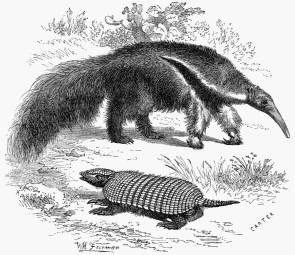
1. Armadillo Loricata. 2. Ant-Eater.
“The habits of the Myrmecophaga jubata are now pretty well known. It is
not uncommon in the drier forests of the Amazons valley. The Brazilians
call the species the Tamanduá bandeira, or the Banner Ant-Eater; the
term banner,” says Mr. Bates,[138] “being applied in allusion to the
curious coloration of the animal, each side of the body having a broad
oblique stripe, half gray and half black, which gives it some
resemblance to a heraldic banner. It has an excessively long, slender
muzzle, and a warm-like extensile tongue. Its jaws are destitute of
teeth. The claws are much elongated, and its gait is very awkward. It
lives on the ground, but all the other species of this singular genus
are arboreal. I met with four species altogether. One was the
Myrmecophaga tetradactyla, or Little Ant-Eater; the two others, more
curious and less known, were very small kinds, called Tamanduá-i
(Myrmecophaga tamandua). Both are similar in size—ten inches in
length, exclusive of the tail—and in the number of the claws, having
two of unequal length to the anterior feet, and four to the hind feet.
One species is clothed with grayish-yellow silky hair; this is of rare
occurrence. The other has a fur of a dingy brown colour, without silky
lustre. One was brought to me alive, having been caught by an Indian
clinging motionless inside a hollow tree. I kept it in the house about
twenty-four hours. It had a moderately long snout, curved downwards, and
extremely small eyes. It remained nearly all the time without motion,
except when irritated, in which case it reared itself on its hind-legs
from the back of a chair to which it clung, and clawed out with its
fore-paws like a cat. Its manner of clinging with its claws, and the
sluggishness of its motions, gave it a great resemblance to a sloth. It
uttered no sound, and remained all night on the spot where I had placed
it in the morning. The next day I put it on a tree in the open air, and
at night it escaped. These small Tamanduás are nocturnal in their
habits, and feed on those species of termites which construct earthy
nests, that look like ugly excrescences on the trunks and branches of
trees. The different kinds of ant-eaters are thus adapted to various
modes of life, terrestrial and arboreal.”
In Tropical America the most remarkable representatives of the Carnivora
are two great species of Felidæ: the Puma, or Cougouar (Felis
concolor), also called the Lion of America; and the Jaguar, or Ounce
(Felis onca), sometimes distinguished as the American Tiger.
The Puma measures about five feet from nose to tail; the tail alone
measuring two feet and a half. His colour is a brownish-red, with small
patches of deeper tint, only shown up by certain lights; the breast,
belly, and inner flanks are of a reddish ash; the lower jaw and throat
entirely white; the tail of a dusky ferruginous tinge, tipped with
black. As he grows older, however, his general colour becomes a silvery
fawn. He has no mane. His manners—that is, his habits and
disposition—are rather those of the panther than the lion. He climbs
trees with cat-like expertness, whether in chase of birds, or to secure
a vantage-point from which he may pounce upon some unsuspecting victim.
He never attacks the larger quadrupeds, confining himself to such “small
deer” as young calves, colts, and sheep. Men, children, dogs—these he
suffers to pass by unmolested. His depredations are nocturnal. When
domesticated, he may well be likened to the common cat, and he shows his
pleasure at being caressed by the same kind of gentle purring. But he is
a ferocious animal, and will kill fifty sheep or more in order to drink
their blood.
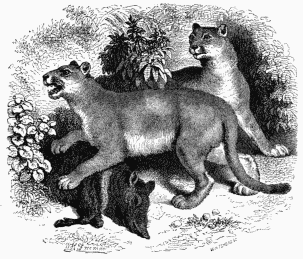
Cougouars, or Pumas.
A much more formidable animal is the Jaguar. In size and strength he is
but little inferior to the tiger. He has a large and rounded head; his
pliant body is marked on the back with long uninterrupted stripes, on
the legs and thighs with full black spots; his ground colour is a pale
brownish-yellow; his legs are short, thick, and robust. He extends his
ravages over all Central and South America, and over a considerable
range of the northern continent. Like the tiger, he loves the shade of
hot swampy jungles, the neighbourhood of the river and the lake. He
generally preys on animals of domestic origin, which have grown wild in
the prairies and the pampas, but he will also attack the bisons, and the
other herbivora. Fish, too, he does not disdain to eat; and in default
of other food, will even seize upon the caïmans. It is rare that he
attacks man; but if attacked by him, he defends himself courageously,
and his muscular strength renders him exceedingly formidable. Not even
an Ajax could maintain a combat with him as Fitz-James fought with
Roderick Dhu, when—
“Foot, and point, and eye opposed,
In dubious strife they darkly closed;”
if man would win, he must arm himself with bow and arrow, keen spear, or
unerring rifle. The hunter, thus provided, pursues him with restless
animosity to obtain his fur, which is much esteemed in commerce, where
it is improperly designated by the names of “Great Panther,” and
“American Tiger.”
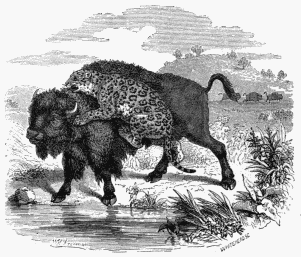
Bison attacked by a Jaguar.
According to Humboldt, the Pampas are colonized with dogs grown wild,
which gather in great numbers in subterranean caverns, and oftentimes,
when stimulated by hunger, fling themselves upon man, in whose defence
they originally displayed their courage.
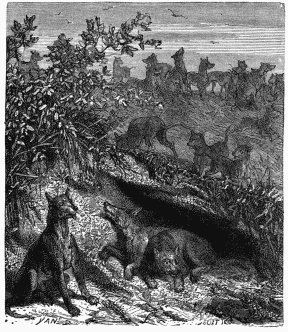
Prairie Wolves (Arctomys Ludoricianus).
In North America there exists a very curious species of Rodents,
belonging to the sub-genus Spermophilus, or Spermatophilus—that is,
“grain-eaters.” They are better known by the hunter’s name, “Prairie
Dogs.” Mr. Murray remarks that it is difficult to say why they
obtained such an absurd appellation, for they do not bear the slightest
resemblance to the canine species, either in formation or habits.[139]
“In size,” he says, “they vary extremely, but in general they are not
larger than a squirrel, and not unlike one in appearance, except that
they want his bushy tail; the head is also somewhat rounder. They burrow
under the light soil, and throw it up round the entrance to their
dwelling like the English rabbit; on this little mound they generally
sit, chirping and chattering to one another, like two neighbour gossips
in a village. Their number is incredible, and their cities (for they
deserve no less a name) full of activity and bustle. I do not know what
their occupations are; but I have seen them constantly running from one
hole to another, although they do not ever pay any distant visits. They
seem on the approach of danger always to retire to their own homes; but
their great delight apparently consists in braving it, with the usual
insolence of cowardice when secure from punishment; for, as you
approach, they wag their little tails, elevate their heads, and chatter
at you like a monkey, louder and louder the nearer you come; but no
sooner is the hand raised to any missile, whether gun, arrow, stick, or
stone, than they pop into the hole with a rapidity only equalled by that
sudden disappearance of Punch, with which, when a child, I have been so
much delighted in the streets and squares of London.”
Captain Murray observes that as there is generally neither rain nor dew
on the plains which they inhabit, during the summer, while, on the other
hand, these little creatures never wander far from their “towns,” it
seems reasonable to conclude they need no other liquid than they can
extract from the grass they eat. It is certain that they pass the winter
in a complete state of lethargy and torpor, for they accumulate no
supply of provisions against that season; while the herbage which
thrives about their habitat dries up in autumn, and soon afterwards the
frosts render it impossible for them to procure their ordinary food.
When the prairie dog feels the approach of his time of
somnolence—generally about the end of October—he closes all the
passages of his dormitory to protect him from the cold, and wholly
resigns himself to the pleasures of repose. He remains thus immured and
inert until awakened by the first warm airs of spring, when he throws
wide his gates and reappears on the surface of the refreshened earth, in
all his whilome liveliness and gaiety.
WE have seen in a preceding chapter that the great terrestrial and
aquatic birds (“Waders”) of the wild plains of the Ancient World have
few analogues in America, and that the small number of genera which are
represented therein are represented by much smaller species. I have
cited the Ostrich and the Phenicopterus. The American Ostrich, or Nandou
(Rhea), is not above half the size of his African congener, from which
he differs in having the feet three-toed, and each toe armed with a
claw. Moreover, his head and neck are more fully clothed with plumage;
the wings are plumed, and more perfectly developed; and he is tailless.
The neck has sixteen vertebræ. Though endowed with more perfect wings
than the Ostrich of Africa, he is nevertheless incapable of flight,
representing another grade in Nature’s slow ascent from the wingless
bird to the bird possessed of full powers of flight. He inhabits the
wide grassy plains of South America below the Equator, and as far south
as latitude 42°. He is never seen across the Cordilleras, but roams in
great numbers the banks of La Plata and its tributaries. He is generally
seen in small troops.
There are at least three species: the Rhea Americana, about five feet
high; the Rhea macrorhyncha, distinguished by its large bill; and the
Rhea Darwinii, the smallest, which inhabits Patagonia.
The Flamingoes proper to the New World are: the Red Flamingo, all whose
plumage glows with a more or less vivid red; and the Fiery Flamingo,
probably only a variety of the preceding. Both are natives of the dreary
Patagonian desert, of Chili, and some other southern districts.
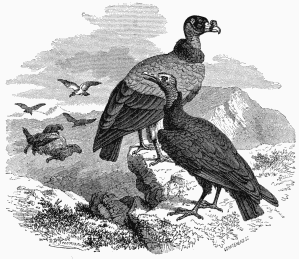
1. Cathartes-Urubu. 2. King of the Vultures.
The order of Waders, and that of Palmipeds, include, in the low marshy
levels of this continent, some characteristic species: notably, the
Jacanas and the Kamichis; the Agami or Trumpet-Bird, remarkable for its
pastoral instinct, its domestic aptitudes, and the ringing sound of its
voice; the Savacou, which, in the structure of its enormous beak and its
general habits, is allied to the African Balæniceps. Here, as in Africa,
a species of rapacious Grallator flourishes, the Cariama, delivering
“a war to the knife” against the reptile legions. Raptores more
accurately defined—such, for example, as the Falco cachinnans, or
Laughing Vulture—share in the destructive campaign against frogs,
toads, lizards, and small serpents. And in the New, as in the Old World,
Nature does not neglect the work of purification, intrusting it in the
savannahs and the pampas to various kinds of Vulturidæ, which devour the
putrid carcasses that would otherwise pollute the atmosphere. The
Cathartes-Urubu and the Aura are the most common species; the
Mexicans call them Zopilotes. They are found in all Central and
Southern America, and frequently range to very high latitudes. They are
of small size, very social, easy familiarized with man, and may be seen
in great numbers, not alone in the deserts and plains, but in the great
towns, where they efficiently play the part of great sanitary reformers.
They are gifted with extraordinary delicacy of scent; they detect the
existence of carrion at great distances, and flock from the four
quarters of heaven to banquet upon it. The Sarcoramphus Papa, or “King
of the Vultures,” a species closely allied to the great Condor of the
Andes, is likewise encountered very frequently in the plains of Tropical
America, but only where the herbage has been set on fire; which is a
common enough occurrence, either through lightning, or by accident or
design on the part of the Indians. Then he arrives on rapid pinion to
prey upon the lizards, and frogs, and serpents which are destroyed by
the scathing and consuming flames. His attire is more elegant than his
mission in creation would seem to render necessary. The plumage on the
upper part of the body is of a reddish hue, the neck and head of a
delicate bluish-violet, the beak red, the crest orange, the eyebrows
white, and the wings black. He is about the size of the domestic
Turkey. The tawny Caracara, a bird of the genus Polyborus, as large
as the common Kite, and with a tail nine inches long; and the Harpy
Eagle (Thrasaëtus), distinguished by its formidable beak and legs, its
erect crest and flashing eyes—both widely distributed in all the hot
regions of the New World—belong to the Falconidæ family (in the
latest classification), as well as the great white-headed Fishing Eagle,
or Pygargue (Haliaëtus Leucocephalus), which inhabits the northern
continent. The latter has been eloquently described by the Paisley
ornithologist, the celebrated Wilson:[140]—“Elevated on the high dead
branch of some gigantic tree that commands a wide view of the
neighbouring shore and ocean, he seems calmly to contemplate the motions
of the various feathered tribes that pursue their busy avocations below;
all the winged multitudes that subsist by the bounty of this vast liquid
magazine of Nature. High over all these hovers one whose action
instantly arrests his attention. By his wide curvature of wing and
sudden suspension in the air, he knows him to be the Fish Hawk, settling
over some devoted victim of the deep. His eye kindles at the sight, and,
balancing himself with half-opened wings on the branch, he watches the
result. Down, rapid as an arrow from heaven, descends the distant object
of his attention, the roar of his wings reaching the ear as he
disappears in the deep, making the surges foam around! At this moment,
the eager looks of the eagle are all ardour, and, levelling his neck for
flight, he sees the fish hawk emerge struggling with his prey, and
mounting in the air with screams of exultation. These are the signals
for our hero, who, launching into the air, instantly gives chase, and
soon gains on the hawk; each exerts his utmost to mount above the other,
displaying in these rencounters the most elegant and sublime aërial
evolutions. The unencumbered eagle rapidly advances, and is just on the
point of reaching his opponent, when, with a sudden scream, probably of
despair and honest execration, the latter drops the fish; the eagle,
poising himself for a moment, as if to take a more certain aim, descends
like a whirlwind, snatches it in his grasp ere it reaches the water, and
bears his ill-gotten booty silently away to the woods.”
A similar picture, let me add, has been painted by the poet Spenser,
though he refers, of course, to the British Eagle:—
“Like to an eagle, in his kingly pride,
Soaring through his wide empire of the air
To weather his broad sails, by chance has spied
A goshawk, which hath seizèd for her share
Upon some fowl that should her feast prepare.
With dreadful force he flies at her again,
That with his voice which none endure or dare
Her from the quarry he away doth drive,
And from her griping pounce the greedy prey doth rive.”
The Reptilia are represented in America by a very great number of
species, many being remarkable for their great size or the terrible
venom with which they are provided. The crocodiles of the American
continent form a distinct genus, sometimes designated Alligator, and
sometimes Caiman. The Alligators, or Caimans (Alligator lucius), are
Saurians of huge bulk; with a long flat head, thick neck and body, a
cavernous mouth suggestive of infinite voracity, dull cruel eyes, and a
long taper tail, which, strongly compressed on the sides, is surmounted
with a double series of strong plates, that unite about the middle, and
form a single row to the extremity. It is this tail that gives them most
of their progressive power in the water, and though it obstructs their
movements on land, it is useful even then as a powerful weapon of
defence. Transverse rows of square bony plates, rising in the centre
into keel-shaped ridges, protect the body, and render the hideous animal
exceedingly formidable as an antagonist. It frequently attains the
length of eighteen, and is seldom less than fifteen feet. Its teeth are
numerous, sharp, and strong; its claws long and tenacious. It feeds
generally on fish, turtle, fowl, or whatever other prey may fall within
its reach; and woe to the unfortunate animal that comes to the
river-bank in quest of water within the range of this ferocious saurian.
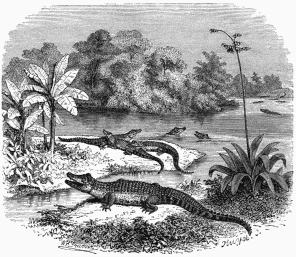
Alligators, or Caimans.
The caiman never attacks man if his intended victim is on his guard, but
he is cunning enough to know when this may be done with impunity. Mr.
Bates records an affecting instance. The river Amazons at Caiçara had
sunk one season to a very low point, so that the port and bathing-place
of the village now lay at the foot of a long sloping bank, and a large
caiman made his appearance in the shallow and muddy water. “We were all
obliged,” says our traveller,[141] “to be very careful in taking our
bath; most of the people simply using a calabash, pouring the water over
themselves while standing on the brink. A large trading canoe, belonging
to a Barra merchant, arrived at this time, and the Indian crew, as
usual, spent the first day or two after their coming into port in
drunkenness and debauchery ashore. One of the men, during the greatest
heat of the day, when almost every one was enjoying his afternoon’s nap,
took it into his head whilst in a tipsy state to go down and bathe. He
was seen only by the Suiz de Paz (Justice of Peace), a feeble old man
who was lying in his hammock, in the open verandah at the rear of his
house on the top of the bank, and who shouted to the besotted Indian to
beware of the alligator. Before he could repeat his warning the man
stumbled, and a pair of gaping jaws, appearing suddenly above the
surface, seized him round the waist and drew him under the water. A cry
of agony was the last sign made by the wretched victim. The village was
aroused; the young men, with praiseworthy readiness, seized their
harpoons and hurried down to the bank; but of course it was too late, a
winding track of blood on the surface of the water was all that could be
seen. They embarked, however, in light boats, determined on vengeance;
the monster was traced, and when, after a short lapse of time, he came
up to breathe, one leg sticking out from his jaws, was dispatched with
bitter curses.”
In the temperate regions of North America, where crocodiles still exist,
these animals pass the entire winter in lethargic torpor. In the Pampas
of tropical America, on the contrary, it is during the hot season that
they remain inert in the mud of the dried-up marshes. “According to the
statements of the natives,” says Humboldt, “you may sometimes see, on
the return of the rainy season, the humid clay slowly uplifted and
loosened in great clods. A violent detonation soon makes itself heard,
and the earth is flung up into the air to a great height, as in
eruptions of small mud volcanoes. If you understand the cause of this
phenomenon you will quickly take to flight, for from this retreat
immediately emerges a monstrous water-serpent or a plated crocodile,
which the first shower has awakened from his lethargy.” The great
water-serpent here spoken of is, in all probability, the gigantic
Boa-Constrictor, one of the most dangerous denizens of the marshy plains
of equatorial America. Travellers of unimpeachable authority assert that
this frightful reptile often attains the length of thirty-six to
forty-five feet. Day and night he lurks among the tall rank herbage; in
the morning and the evening he places himself in ambush on the border of
some lake or water-course to surprise the quadrupeds which flock thither
to quench their thirst. By means of his prehensile tail he suspends
himself to a tree on the shore, and patiently awaits the coming prey.
When an animal passes within his reach, he swiftly seizes it, enfolds it
in his spiral coils, crushes it against the tree which serves for his
point d’appui, compresses its bleeding mass into a convenient form,
covers it with a glutinous saliva, and swallows it. In this fashion the
boa will devour a stag or even an ox entire, nor does he fear to attack
the puma and the jaguar. Whether he is dangerous to man may reasonably
be doubted; his immense size, at all events, renders it easy to avoid
him. He preys upon fish in default of other provision, and to catch his
victims often remains for a considerable time with his head and a
portion of his body plunged under water.
The true scourges of tropical America and the Antilles are the
Rattlesnake and the lance-headed Viper.
The Rattlesnake (Crotalus horridus) is one of the deadliest of
venomous serpents, is frequently six feet in length, and as thick as a
man’s leg. But Providence has furnished it with an antidote against its
own poison, or, at least, with an instrument which makes it its own
betrayer, and warns man involuntarily against its formidable presence.
This is the rattle to which it owes its vulgar appellation. The rattle
is situated at the end of the tail, and consists of several hard, dry,
bony processes. Imagine a string of hollow, dry, semi-transparent bones,
nearly of the same size and figure, and resembling to some extent the
shape of the human os sacrum: imagine these so placed that the tip of
every uppermost bone runs within two of the bones below it; imagine
these constantly clattering against each other, as the reptile moves,
with a hoarse, dull, echoing sound, and you will be able to form some
idea of the permanent warning of its approach which the Crotalus carries
about with it. The rattle is placed with the broad part perpendicular to
the body, and not horizontal; and the first joint is attached to the
last vertebra of the tail by means of a thick muscle beneath it, no less
than by the membranes which unite it to the skin. The bony rings
increase in number with the reptile’s age, and it gains an additional
one, it is said, at each casting of the skin.
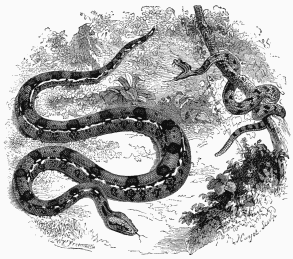
Crotalus, and Boa-Constrictor.
The Crotalus horridus is of a yellowish-brown colour, varied with
patches of a deeper hue, and from the head to some distance down the
neck run two or three longitudinal stripes of the same. Its habits are
sluggish; it moves slowly, and only bites when angered, or for the
purpose of killing its prey. It is provided with two kinds of
teeth—viz., the smaller, which, planted in each jaw, serve to catch and
retain the food; and secondly, the fangs or poisonous teeth, which kill
the prey, and are placed outside the upper jaw. It feeds principally
upon the smaller mammals and upon birds, which it seems certain it
possesses a peculiar power of fascinating—the effect, it may be, of
intense fear. “When the piercing eye of the rattlesnake is fixed on
them,” says Mr. Murray, “terror and amazement render them incapable of
escaping; and, while involuntarily keeping their eyes fixed on those of
the reptile, birds have been seen to drop into its mouth, as if
paralyzed, squirrels descend from their trees, and leverets run into the
jaws of the expecting devourer.” Hogs and peccaries, however, are
unaffected by this panic, and feed greedily upon the reptile which
causes it, whose venomous fangs cannot penetrate their formidable hide.
Its poison, once imbibed, is very fatal, acting upon man and the larger
mammals, such as the horse or ass, in a few hours.
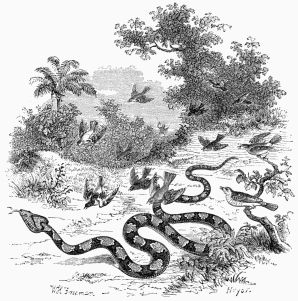
Trigonocephalus pursued by Birds.
The lance-headed Viper or Trigonocephalus (Bothrops lanceolatus), is
most common in the West Indian Islands, where it is justly dreaded. It
has been computed that, at Martinique, fifty persons out of a population
of 125,000 souls die annually from the bite of these odious reptiles.
Their fecundity is frightful. Every female bears sixty young, which on
their very advent into the world are completely formed and able to
wound. This viper, moreover, carries no warning rattle; nothing
indicates its presence; and in the countries which it inhabits, the
wayfarer, if prudent, will beat the herbs and bushes as he advances with
a switch. Then the Trigonocephalus, if there be one in the way, will
take flight and reveal itself, for it is too large to glide away unseen.
Therefore, the negroes of Martinique, who, of necessity, are assiduous
reptile hunters, state as an incontrovertible axiom, confirmed by
immemorial experience, that “a serpent seen is a serpent dead.” In
truth, the serpent is only formidable to man when not perceived, and
when one treads upon it accidentally. In the open field its defeat and
death are inevitable, however little coolness or skill its assailant may
possess. And to warn us of the presence of the Trigonocephalus, Nature
has supplied us with numerous watchful sentinels in the small birds,
whose not unreasonable hate against this serpent is a remarkable proof
of their intelligence. If ever your destiny conduct you to the Antilles,
says a naturalist, cold-blooded sportsman as you may be, do not slay the
little bird which the grateful negroes, though he sings but little, have
wished to name the nightingale; for if you do so, they will regard you
with suspicion and dislike. He is their protector, and he watches also
over you. No sooner does he see, from his aërial station, the scales of
the reptile gliding into the herbage or glittering among the large
leaves, than he can no longer control himself. He flies to and fro, he
leaps from branch to branch, summoning with a lamentable cry all the
feathered tribe from the neighbouring trees. From far and near the cry
widens and is repeated; from all directions flock nightingales, and
thrushes, grosbeaks, and humming-birds, and hovering above the assassin,
furiously denounce it, and indicate its lurking-place to man. Irritated
by such a concert of maledictions, the serpent elevates its crest, but,
lo! they are far beyond its reach! And the cries, the murmurs, the
insults are redoubled! It seeks to conceal itself, but these cries
persistently accompany it. Wherever it drags its slimy shining bulk,
they follow, they harass, and they denounce it. Either night comes on,
or it succeeds in completely hiding itself from their watchful gaze,
before they reluctantly leave it to its own devices. Great the
consternation if their enemy escape them! But what joy, what triumphal
sounds, if man appears upon the scene and slays it!
I have previously alluded to the enormous toads found in South America,
and to the gigantic frog which belongs to the northern continent. Among
the former I may particularize as one of the largest known species, the
Agua; and, as remarkable for its mode of gestation, the Pipa. The
Surinam Toad, or Pipa Surinamensis (the Bufo Pipa of Linné), is
distinguished by its large triangular head, and horizontally flattened
body, with a granulated back. It is now ascertained that the female
deposits her spawn at the brink of some shallow or stagnant pool; the
male then collects the heap and cautiously places it on the back of the
female, where, after impregnation, they are pressed into cellules
produced by the tumefaction of the skin. In rather less than three
months the eggs are hatched, and the young emerge in a complete state.
The Bull-Frog (Rana pipilus), of North America, is from six to eight
inches long and from three to four inches broad. When his limbs are
fully extended he measures about eighteen inches in length. Its back is
of a sombre green colour, varied with black; the under-parts being of a
whitish hue, tinged with green, and thickly spotted. The fore-feet have
only four toes, and are unwebbed; the hind-feet are large, long, and
widely webbed. Its voice may be compared to the distant lowing of a
bull, and a chorus of them at night is sufficient to arouse the soundest
sleeper. They prey upon ducklings, goslings, and small birds, drowning
before devouring them. Spite of its size and ungainliness, it is very
nimble, and can accomplish a leap of upwards of six feet in height.
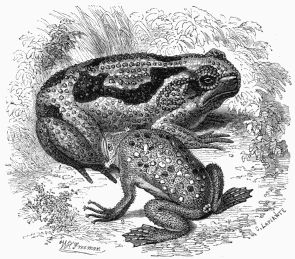
1. Bufo Agua. 2. Pipa Surinamensis.
Incomplete as is this rapid survey of the Fauna of the New World
Deserts, I cannot terminate it without referring to the strange and
formidable fish which haunt the pools, lakes, and marshes of South
America—those Gymnoti, or Electrical Eels, sometimes five, six, and
even eight feet long, which emit electrical discharges of sufficient
violence to strike down a man, a horse, or an ox. It is by this singular
property the gymnotus supports its existence; its shocks stupify the
smaller fishes and other animals that come within its range, so that
they fall an easy prey to its voracity. The electrical organs consist of
four bundles of parallel membranaceous laminæ arranged along the inner
side of the tail, and constituting a remarkably powerful battery.
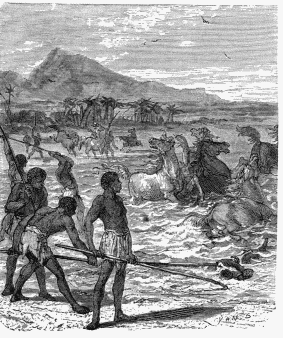
FISHING FOR GYMNOTI.
In hunting the gymnoti the Indians adopt a cruel expedient. They drive a
herd of horses and mules into the ponds which these eels inhabit, and
harpoon them when they have spent their electrical force on the unhappy
quadrupeds. The fish swim on the surface of the water like serpents, and
skilfully glide beneath the animal’s body, discharging the whole length
of their electrical battery, and attacking simultaneously the digestive
viscera, and, above all, the gastric plexus of nerves. Fain would the
horses escape their enemies’ attacks, but the Indians drive them back
into the water with stout canes of bamboo and long whips. After awhile
the eels grow exhausted; the animals show less alarm; and the Indians
begin to ply their harpoons with equal agility and success. There are
several species of this remarkable fish, and most, if not all, are
valued as wholesome food. The Gymnotus Electricus, however, is the only
one which possesses any electrical powers.
THE first naturalists who explored the littoral of the Australian
continent and its adjacent islands were struck with astonishment at the
sight of the strange and almost monstrous animals they discovered there.
Far more certainly than Columbus had they fallen in with a New World; a
new world of zoology and botany; a world apart, peopled by beings wholly
different from those they had elsewhere studied, and some of which
exhibited a complexity and originality of organization and structure
wholly antagonistic to the received theories of fundamental
characteristics belonging to the various classes of the animal kingdom.
The Australian Fauna, in this respect, can only be compared to that of
Madagascar, which equally bears an impress peculiarly its own, and
presents but a few features of kinship with the Indian Fauna. It is the
latter also that the Australian Fauna most closely approaches, or, to
speak more correctly, from which it least widely diverges.
The great Herbivora—Pachyderms, Ruminants, and Solidungulates—are
absolutely wanting in Australia, as well as the Carnivora properly so
called—Apes and Lemuridæ. The class of Mammals is only represented by
a small number of Cheiroptera and Rodents; by some Amphibia, Phocæ, and
Otidæ (Seals and Bustards), which inhabit the bays carved out of its
long line of coast; by the Marsupials and a very limited order of
Monotremata. The two latter groups are pre-eminently characteristic of
the Australian Fauna; the second belongs exclusively to it. Little,
indeed, is wanting to make it identical with the sub-class of the
Marsupials, represented only in South America by the genera Opossum
didelphis, Hemiurus, and Chironectes, and elsewhere limited to New
Holland, Tasmania, New Guinea, New Zealand, and some other less
important islands of Oceania.
The Marsupials (from the Greek μἁρσυπος, a purse) owe their
distinctive name to a very curious peculiarity in the organization of
the females. The latter bring their young into the world while still
very feeble, and of themselves fix them to their breasts, where they
remain attached until they have acquired that degree of development
which all other mammals possess at their birth. Generally the breasts
are covered with a loose skin, forming a sort of pouch or purse, in
which the young are concealed, which protects them against climatic
changes, and enables the mother conveniently to carry them everywhere
about with her. Two particular bones, called the marsupial bones,
attached to the pubis, and placed amidst the abdominal muscles, support
this pouch. They assist, says Professor Owen, in producing a compression
of the mammary gland, necessary for the alimentation of a peculiarly
feeble offspring, and they defend the abdominal viscera from the
pressure of the young as they increase in size, during their mammary or
marsupial existence, and still more when they return to the pouch for
temporary shelter.
The marsupials present, moreover, in the different families composing
the order, a great diversity of organization. Most of them are
herbivorous or frugivorous; but there are some which prefer animal
nourishment, and which, in their habits as well as in the structure of
their jaws and their digestive apparatus, closely approach the
carnivora.
The order of which I am speaking includes some animals of great size.
Such is the Great Kangaroo (Macropus giganteus), which generally
measures about seven and a half feet in length from the nose to the tip
of the tail, the tail being rather more than three feet in length, and
fully twelve inches in circumference at the base. In its erect sitting
posture, when it rests on its hind-legs and the root of its tail as on a
tripod, its height amounts to about fifty inches; but when it rises on
its toes to look around, its stature exceeds that of a man. The great
length of its hind-legs is a notable peculiarity; their feet are
provided with only four toes, the central being very long, of great
strength, and terminated in a large and powerful hoof-like nail or claw.
The fore-legs, on the contrary, are very short, and the feet divided
into five toes, each furnished with a short and somewhat hooked claw.
The animal’s head is small, with rather pointed ears, and large but
placid eyes; it has a thin and gracefully proportioned neck; so that a
startling discrepancy is observable between the fore and the posterior
parts of the animal, though the general effect is neither ungraceful nor
unpleasing. It should be noticed that the kangaroo never folds his tail
between his legs, which, I may add, are extraordinarily strong. The
thighs are thick, the tarsi long and robust. He only walks on all fours
when hotly pressed, and then his appearance is decidedly ungainly. In
escaping from an enemy he rears himself upright, skims the plain with
bounding leaps, and in a few minutes leaves behind him the swiftest
horse or dog. But if all avenues of retreat be closed to him, he plants
himself firmly against a tree or a rock and fights with obstinate
courage, ripping up his assailants with his potent hind-feet, like a
stag with his horns or a wild boar with his tusks.
The diet of the kangaroo is essentially “vegetarian;” he lives upon
leaves, herbs, and roots, and employs his fore-paws, like the Rodents,
to carry his food to his mouth. The animal’s habits are mild and
inoffensive. They roamed very peacefully about the Australian prairies
before the new continent was opened up to European enterprise; having no
other enemies to fear than the natives, who were scattered in small
tribes over a few points of an immense territory. Their chase is now
one of the favourite amusements of the colonists, who destroy them in
great numbers. They are easily domesticated, and may be regarded as
already acclimatized in Europe, where, it is hoped, they may prove of
great utility. The flesh of the tame Kangaroo is very good, but that of
the wild animal is still better. Their skin, covered with a thick hair
of an uniformly gray colour, may be adapted to various purposes.
The genus comprehends several species of very different dimensions: as,
the Great Kangaroo, already mentioned; the Woolly or Red Kangaroo (M.
laniger), which rather exceeds it in size; and the Potoroo, which is
larger than a rat.
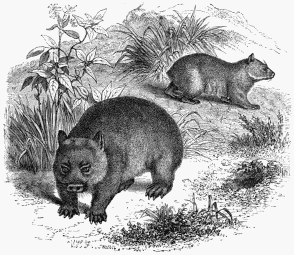
Large-Browed Wombat (Phascolomys latifrons).
I must cite, besides the Kangaroos, as the most remarkable types of the
Australian Marsupials, the Phascolomys, the Phascolarctos, the
Phalangas, and the Thylacynas.
The Phascolomys, like the kangaroo, has been introduced into Europe,
where he seems to be perfectly acclimatized, and specimens may be seen
both in the London Zoological Gardens and the Jardin Zoologique of
Paris. He is better known by his native name of the Wombat (Phascolomys
Wombat), and was first discovered by Bass, the gallant explorer and
surgeon, whose name is indissolubly connected with the bright deeds of
Australian discovery. The large-browed wombat might, at first sight, be
mistaken for a small bear. His loins are thick, his limbs short, his
hair coarse—thickly set on the loins, back, and head, thinly scattered
about the belly—and of a light, shining sandy-brown. It is difficult to
say why he is surnamed latifrons, for his forehead is no larger than
that of other animals of his family; and, at all events, he exhibits, by
way of compensation, an extraordinary extent of surface in the hinder
parts, which, as they are utterly deficient in tail, present a very
grotesque appearance. He burrows like the badger, and on the Australian
continent never quits his retreat until night sets in. He lives on herbs
and roots. The natives roast his flesh, and esteem it a viand of no
ordinary excellence.
The Phascolarctos, or Koala (Phascolarctos cinereus), is closely
allied to the wombat. He is strongly but clumsily made, with robust
limbs and powerful claws, which he employs in clinging to the branches
of the trees where he chiefly makes his home. However, he frequently
visits terra firma, and burrows with great ease; concealing himself in
a torpid state in his subterranean retreat during the cold season. His
fore-feet have each five toes, of which two are opposed to the other
three—a circumstance noted in no other mammal. He has no tail, like the
wombat. His coat is a bluish-gray fur, very thick and extremely soft,
darkest on the back, and very pale under the throat and belly. An
elongated nose looks as if it were tipped with black leather. The eyes
are round and dark; the ears almost hidden in the plenitude of fur. By
day he is a drowsy and, sooth to say, a stupid animal; but at night he
wakes up into a more active state. He feeds upon the fresh young tops of
trees, selecting their blossoms and young shoots; and though in
appearance resembling the Phalanga, in habits seems closely allied to
the Sloth.
The Phalangas form the typical genus of the tribe of Phalangistins,
which comprehends, in addition, the genera Trichosura, Pseudochira,
and Dromicia. Several species are met with in Malaysia, but they
chiefly belong to the Australian Fauna. They live chiefly in trees,
feeding on various kinds of small animals, insects, eggs, and fruits,
which they grasp between their fore-paws, and so bring to their mouth.
Their appearance may be imagined by putting together a rather short head
with short ears and short woolly fur; a squirrel-like body and long
prehensile tail, sometimes completely covered with hair: the body
measures about twenty-six inches, and the tail about fifteen inches. The
two principal species are the Sooty Phalanga (Phalangista fuliginosa),
found in Van Diemen’s Land, and named in reference to its smoky black
fur; and the Vulpine Phalanga, or Vulpine Opossum (P. vulpina), widely
distributed over Australia, and having a fox-like character about his
head. The Flying Phalangas are also allied to this genus.
The Thylacyni are distinguished from the Opossums by the hind-feet
having no thumb, by a hairy and non-prehensile tail, and by having two
incisors less to each jaw. Only one species is known to exist in
Australia,[142] where it is called the “Tasmanian Wolf,” and sometimes
“Tiger” and “Hyæna.” It resembles a wolf in many respects, but its
hinder parts are sensibly higher than its fore; its elongated muzzle is
almost cylindrical in shape, and very thick; and his tail, broad at the
base, tapers away to a fine point. The colour is gray, striped with
black across the hinder limbs.
Of the Thylacynus cynocephalus M. Paul Gervais furnishes the following
description:[143]—
“There exists in Tasmania an animal of carnivorous habits almost as
large as a wolf, and whose external forms at the first glance do not
differ sufficiently from those of the latter to prevent one from
including him in the family Canidæ; but this member of the Carnivora,
though he has also the wolf’s appetite, and commits havoc in the same
manner among the flocks of the colonists, belongs, like most of the
Australian Mammals, to the sub-class of Marsupials. There is also much
analogy, in many of its osteological characteristics, with the extinct
genera of the Hyenodons and Ptérodons; but the latter are in reality
Monodelphia, and should be ranged among the Carnivora properly so
called. The English settlers in Van Diemen’s Land give the thylacynus
the name of Zebra Wolf, because it has, in effect, the greater portion
of the dorsal region and the base of the tail marked with transversal
brown lines, like zebra stripes. This carnivorous animal is also their
Dog-headed Opossum.
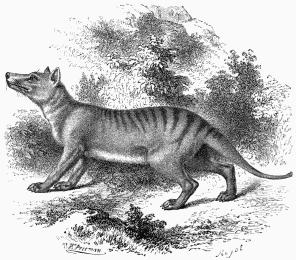
Thylacynus cynocephalus.
“Allied to other Marsupials by the totality of its anatomical
characteristics, it is nevertheless easy to distinguish generically; in
the first place, it is of great size, and its exterior recalls that of
the Wolf, though it has a longer head and a tail garnished with very
short hair; the latter is, at the same time, a little depressed.
Moreover, it numbers forty-six teeth, with wide intervals between each.
It is digitigrade: it has five toes on the fore, and four toes on its
hinder feet; its marsupial bones are simply rudimental.”
If there be one group of animals more than another whose unforeseen
discovery has succeeded in astonishing and embarrassing zoologists, it
is assuredly that which has been designated by the name of
Monotremata. It is the lowest order of vertebrated animals, the very
bottom of the scale, approximating in many characteristic points to the
family of Birds. The pelvis, it is true, is furnished with marsupial
bones, but these animals possess no pouch. The skull is smooth, the
brain-case proportionately very small, the snout much prolonged, while
the jaws have neither teeth nor soft movable lips. The shoulder-bones do
not resemble those of a mammal, but in some respects the scapular joint
of the bird; in other respects, that of the reptiles. The feet have five
toes, each armed with a long nail; and, in addition, the hind-feet are
provided with a perforated spur-like weapon, which is connected with a
gland. The genus derives its distinctive name from the circumstance that
the orifices of the urinary canals, the intestinal and the generative
canals, open, as in birds, into a common vent. The mammary glands, of
which only one exists on each side, are not furnished with nipples, but
open by simple slits on each side of the abdomen.
This order includes two families: the Ornithorhynchidæ and the
Echidnidæ, both belonging to Australia and Tasmania. The former are
aquatic in their habits, the latter terrestrial.
The Echidna (Echidna Hystrix), or Porcupine Ant-Eater, resembles the
Porcupine in his general appearance and coat of spines, the Ant-Eater in
his snout, mouth, and long lubricated tongue. His legs are very short
and thick, and each is furnished with five broad rounded toes; the four
toes are armed with a long blunt claw, but on the hind-feet one toe is
without a claw, two are short and blunt, and one is of great length,
rather curved, and sharp pointed. He measures about twelve inches, and
all over the upper-parts of the body and tail is thickly beset with
formidable spines, very sharp and strong; over the head, legs, and
under-parts with bristly hair of a deep brown colour. His short tail is
covered with perpendicular spines. Digging up the ground with his keen
claws he disburies a host of insects, which he rolls over his long red
cylindrical tongue. He is very timid, and when any one approaches him,
coils himself up in a ball, like a hedgehog.
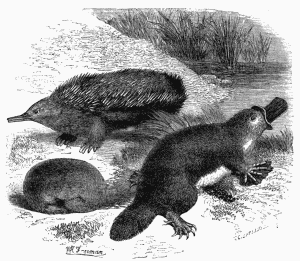
1. Ornithorhynchus. 2. Echidna.
The Ornithorhynchus (“Bird-beaked”), or Duck-Billed Platypus, is
another extraordinary animal, which seems to serve as the connecting
link between the aquatic birds and the mammalia. His length is about
twenty inches; his body, long and flattened like an otter’s, is covered
with a thick soft fur, moderately dark brown above and whitish beneath;
his tail is flat and obtuse; his feet are furnished with a membrane that
unites the toes; and he has an elongated, enlarged, and flattened muzzle
like a duck’s beak. It is evident, therefore, that he can live only on
soft food, and that his habits must be aquatic; and hence we find him
burrowing in the banks of the streams, and groping for his food, like a
duck, among the mud and water. The settlers term him characteristically
“the River-Mole.”
A word of allusion must now be permitted to the Petrogale, a genus of
the Kangaroo family, described by Dr. Gray. The Brush-tailed Rock
Wallaby (P. penicillata) has a rough long fur, of a dusky brown hue,
tinged with red and gray; a white streak passes down the middle of the
throat; his tail is very black, like a raven’s plumage, long, and
furnished with thick hairs forming a brush. The male is about three feet
and a half long. Another species is called the Short-Eared Rock Kangaroo
(P. brachiotis). Both are excessively wild and shy in their habits,
frequenting in the day-time the most inaccessible rocks and the loftiest
mountain-peaks, and descending, at the approach of twilight, to feed in
the retired and grassy valleys. They flock together in such numbers as
to form well-beaten paths along the mountain-sides, and leap from crag
to crag with all the agility of the chamois.
The Ornithological Fauna of Australia and the islands of Oceania is
incomparably richer than the Mammalogical Fauna, and includes several
species of the most dazzling plumage; but nearly all these species
inhabit the forests which cover a part of the littoral and probably of
the interior. However we must signalize, as peculiar to the Prairies, a
great number of the Brevipennes (i.e., Short-wings), the Emu or Emeu
(Dromaius Novæ Hollandiæ); two Palmipeds, the Black Swan and the
Cereopsis; and, finally, a bird, the only one of its order, almost as
much of a paradox among bipeds as is the ornithorhynchus among
quadrupeds, the Apteryx.
The Emu is allied to the cassowary; he is nearly equal to the ostrich in
bulk, but has a thicker body, shorter legs, and a shorter neck. He
measures more than seven feet in length; his plumage exhibits a mixture
of brown and gray; his beak is black, his head covered with feathers; he
has real wings, though they are of so small a size as to be useless for
flight; they are covered with feathers like the rest of the body, from
which, when the bird is not in motion, they can hardly be discerned.
Internally, the emu differs, it is said, from all other species,
particularly in having no gizzard, and in the extremely small size of
his liver.
Emus are killed, according to Captain (now Sir George) Grey, in
precisely the same manner as kangaroos, but as they are more prized by
the natives, a greater degree of excitement prevails when an emu is
slain; shout succeeds shout, and the distant natives take up the cry
until it is sometimes re-echoed for miles. The feast which follows the
death, however, is a very exclusive one, for the flesh is much too
delicious to be made a common article of food. Heavy penalties are
accordingly pronounced against young men, and unauthorized persons, who
venture to touch it; and these, invariably, are rigidly enforced.[144]
Every schoolboy knows the famous quotation in his Latin grammar which
tells of a
“Rara avis, simillimaque nigro cygno.”
A Black Swan is no longer a “rara avis.” The species (Cygnus
atratus) belongs to New Holland and Tasmania, and is of the same size
as the common swan. His plumage is wholly black, with the exception of
the primary pens, which are white; his beak is red, and so is the
featherless skin surrounding it at the base. He has been successfully
acclimatized in Europe, and ornaments the lakes and streams of many
English parks.
The Cereopsis, or Cerefaced Goose, of New Holland, is a Palmiped genus,
about the size of a common goose, which, in general appearance, he
resembles, except that his legs are longer, averaging from two and a
half to three feet. The plumage is of a dingy gray. A large patch of
dull white occupies the top of the head; the quill-feathers, both of the
wings and tail, are of a dusty black. His voice has a hoarse deep clang,
like that of a storm-bell. He usually weighs from seven to ten pounds,
and makes an excellent dish for an Australian Christmas table.
Specimens may be seen both in the Zoological Gardens of London and
Paris.
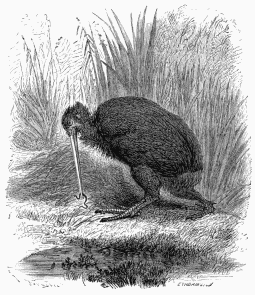
Apteryx Australis.
The Apteryx Australis, or Wingless Emu—the Kiwi of the New
Zealanders—somewhat resembles a penguin in form, and stands about two
feet in height. The only living specimen in Europe lives, I believe, in
the London Zoological Gardens. As it does not appear to rank, in
scientific classification, with any other family or genus, naturalists
have erected it into a distinct order—the Nullipennes, or Wingless.
The wings of the apteryx are literally rudiments; a mere stump,
terminated by a hook. None of his bones are hollow; he has no abdominal
air-cells; his feathers have no accessory plume; his feet have a short
and elevated hind-toe; his eyes are small; he feeds on insects; and his
habits are nocturnal. He is a bird of great physical power, and runs
with ostrich-like swiftness; taking refuge, when pursued, in burrows,
hollow trees, and the clefts of the rocks. His cry resembles a loud
whistle, and the natives entrap the bird by imitating it. When the
female has been taken, the male is easily caught, owing to his
reluctance to leave her. He will, however, defend himself vigorously
with his spurs.
The Erpetological Fauna of Australia, and, in general, of Oceania, is
very poor, and comprehends no great species. I may notice a genus of
lizards, the Chlamydosaurus, discovered by Allan Cunningham, the
naturalist attached to Captain King’s expedition, about 1820. It
measures about seventeen inches in length, of which twelve inches are
apportioned to the tail; is of a yellowish-brown colour; has a large
head, with prominent eyes; and a membraneous ruff or tippet round its
neck, covering its shoulders, and when expanded spreading about five
inches in the form of an open umbrella. If attacked or terrified, it
elevates the frill or ruff and makes for a tree; where, if overtaken, it
throws itself upon a stem, raising its head and chest as high as it can
upon the fore-legs, then doubling its tail underneath the body, and
displaying a very formidable set of teeth from the concavity of its
large frill, it boldly faces any opponent, biting fiercely whatever is
presented to it, and even venturing so far in its rage as to fairly make
a fierce charge at its enemy.
Venomous serpents are numerous: particularly the Hydrophis, or
Water-Snake, very common in the neighbouring seas, where it feeds on
fishes. The back part of the body and tail being much compressed, and
vertically raised, endows it with the capacity of swimming.


 HE area of our present work would be very limited if we understood the
word Desert in its more rigorous signification; for we should then
have only to consider those desolate wildernesses which an inclement sky
and a sterile soil seem to exclude for ever from man’s dominion.
HE area of our present work would be very limited if we understood the
word Desert in its more rigorous signification; for we should then
have only to consider those desolate wildernesses which an inclement sky
and a sterile soil seem to exclude for ever from man’s dominion.