The results of the Amherst Patagonian Expedition were divided into
two parts, the general features, together with the narrative, were
reported in a separate volume entitled, “Hunting Extinct Animals in
the Patagonian Pampas,” published in 1913. For this volume has been
reserved the description of the material found and such conclusions as
are directly derived from that material. The material on which this
work is based has been prepared out and placed on exhibition at Amherst
College.
The material here described forms a unified body of data, which adds
materially to our knowledge of the complete animals of the Tertiary
period in Patagonia. There are beside this some small collections which
offer some isolated new facts, but the working up of these has been
reserved for the future for small articles, as the work may come to
maturity.
The field has only been touched and a vast amount of further work can
be profitably done on the horizons immediately preceding and following
the one described in this volume, after which an interesting study can
be made on the evolution of a fauna which developed in a considerable
degree of isolation.
F. B. Loomis.
March 18, 1914.
CHAPTER I Introduction
THE DESEADO FORMATION OF PATAGONIA
The material described and the conclusions drawn in the following
pages are the results of the Amherst Expedition to Patagonia in 1911;
an expedition organized and sent out by the Class of ’96 as a part of
their fifteenth reunion. The party consisted of Frederic B. Loomis
’96, Phillip L. Turner ’11, Waldo Shumway ’12, and William Stein of
St. Joe, Wyoming, and left Amherst July 1, 1911, returning the first
of February the ensuing year, having spent its time collecting in the
early Tertiary beds of Patagonia, as exposed in the Territories of
Chubut and Santa Cruz, the aim being to secure from the earlier periods
a fuller knowledge of the vertebrate animals, such as the Princeton
Expeditions obtained for the Patagonian and Santa Cruz formations. The
narrative of the expedition has been told in “Hunting Extinct Animals
in the Patagonian Pampas.”
Material was found in various beds, from the Cretaceous up to the Lower
Miocene; but the major part of the fossils, and most of the facts new
to science came from the work in the Deseado Formation. The collections
from the horizon were so complete and interesting that this report
of the expedition has assumed the form of a monograph of the Deseado
Formation, otherwise known as the Pyrotherium beds.
The first work in this formation was done by Carlos Ameghino who
at various times between 1889 and 1894 collected for his brother,
Florentino Ameghino, the latter studying and describing the collections
of Carlos, whose trips covered the country from Chubut down to the
Straits of Magellan, and the various formations from the Lower
Cretaceous to the Pampean or Pleistocene. Carlos Ameghino and his
brother, Florentino, for years explored in Patagonia, going summer
after summer at their own expense, and in the meantime maintaining a
small book and stationery store in La Plata, the profits of which gave
the two brothers a living and furnished the funds for the continual
expeditions. In the back of the store was the workshop from which
came the continuous stream of knowledge in regard to these strange
faunas. One of the best pieces of work done by the brothers was the
collecting and describing of the fauna of the Pyrotherium beds the bulk
of which is contained in two papers entitled, Première Contribution à
la Connaissance de la Fauna mammalogique des Couches à Pyrotherium,
and Mammifères Crétacés de L’Argentine, Deuxième Contribution, etc.,
both published in the Boletin del Instituto Geográfico Argentino,
tomes 15 and 18 respectively. These two papers give names to most of
the forms which we found, but the genera and species are based on very
fragmentary and incomplete material. It has been a pleasure to find the
accuracy with which these descriptions were made; and our part has been
chiefly to supplement and increase the knowledge of the various forms,
and to determine from the more complete material the relationships of
these strange forms. In some cases we have been able to assemble all
the parts of the animals, and in the others to add more or less to the
completion of the knowledge of the forms. There is one peculiarity
of Ameghino’s descriptions, namely the absence of data as to the
localities where the forms were found.
About 1900 Tournier, in the interests of the Paris Museum, made a
series of expeditions (5) to Patagonia, on some of which he found a
Pyrotherium, or as he has termed it Deseado, locality just south of the
Deseado River, from which he gathered a considerable collection which
has been described by Albert Gaudry in various papers mostly in the
Annales de Paléontologie.
These two collections and their collaborations represent all the work
thus far done on the Deseado beds and fauna. Our collection is the
first one of any considerable size to be brought to North America, and
it seems to be by far the most complete, the various animals being
represented by more complete skeletons than in any of the previous
collections.
The beds were first designated as the Pyrotherium beds, and are
always so referred to by F. Ameghino. Tournier and Gaudry, feeling
the prejudice which is fairly general among Palaeontologists against
names based on any contained animal (which may or may not be present at
other localities, which may extend through more than one period, and
whose name may be changed as a result of further knowledge) used the
term Deseado formation, as his collections came from the neighborhood
of this river. This is a geographical name and avoids the chance
for confusion; so I have adopted it throughout this paper, it being
understood as an equivalent of the term Pyrotherium beds.
Ameghino never gave the exact, or anywhere near the exact, localities
from which his Deseado specimens came. It was not until 1906, when
his Formations Sedimentaires[1]
appeared, that any localities were designated, and there on a sketch
map he indicates as Deseado exposures, about a dozen points, scattered
between the upper part of the Chubut River to some 25 miles south of
the Deseado River. These are included in an oval area some 500 miles
long by 150 miles wide. Ameghino also suggests on this occasion that
the Deseado formation originally extended over at least the whole of
this area. As will be seen in the next chapter, I believe that the
deposits of this age and character have always been local and isolated.
We sought for several of these localities and failed to locate them,
especially those near Mazaredo, and the northern one on the Gulf of
St. George. The point where we did find our material I believe was one
of Ameghino’s localities, though the settlers of that region had never
heard of anyone hunting for fossils there; but the settlement had been
practically all within the previous six years, which was much later
than the time when Carlos Ameghino worked in the region.
Beside the foregoing, an exposure of this age is reported by A. A.
Romero, just above the fork of the two branches of the Rio Negro, which
is some 500 miles north of the first group of localities mentioned.
Ameghino also refers to another locality in the Province of Misiones
which would be 1,500 miles north of the typical localities.
The collections made by Tournier for Gaudry came chiefly from an
exposure south of the Deseado River, some 15 miles above the mouth of
the river.[2]
Our collection came from the Chico Branch of the Chubut River, about
three miles east of the river, and almost due west of Puerto Visser.
As mentioned above on account of the close coincidence of the various
species and because Ameghino indicates a locality in the neighborhood,
I think that our locality is the same as one of his, I should judge
it the one from which he obtained a considerable part of his types.
This is of importance; for, if in Ameghino’s type locality, the
determination of the species, as the same as those of Ameghino’s, is
much more certain.
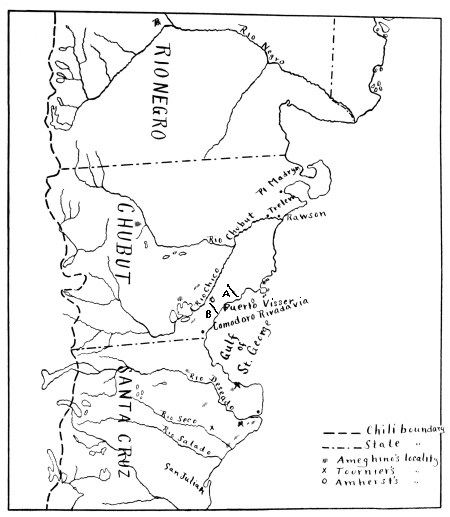
In the accompanying map I have indicated the localities given by
Ameghino, those of Tournier, and our own.
Fig. 1. Map of Patagonia showing localities of Deseado beds.
CHAPTER II Age of the Deseado Formation
The locality worked by the Amherst party is situated about three miles
east of the Chico River, just across the line of the homestead of D.
J. Venter as plotted on the Plano de la Gobernation del Chubut, 1910,
by A. Lefrançois. This would be 45° 10ʹ S., and 67° 32ʹ W. (or as on
the map 9° 15ʹ W. of the meridian of Buenos Aires). The exposure is on
all sides of an elongated hill about a sixth of a mile long, averaging
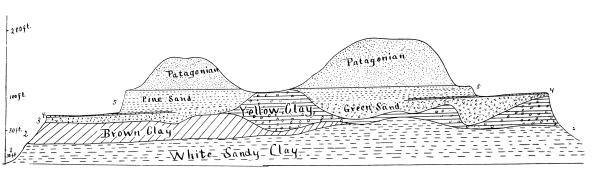
200 feet wide, and constricted in the middle to a narrow neck. Figure 2
shows a section of the hill, made along the north side, and indicates
the varied character of the stratified deposits.
The material varies from brown sandy clay shales, to yellow sandy
clay with concretions, and is capped with a varying layer of greenish
sand, which, in some places, is coarse and irregular, in others fine
and uniform, and in still other places is mixed with considerable
quantities of volcanic ash. In it are many mud balls and also bits of
bone which have been worn round, others but slightly worn, and finally
bones and skeletons which apparently have been buried where they fell.
This green sand is mostly covered with a layer of two feet of hard
sandstone of the same composition as the rest of the bed, but cemented
into a dense layer. Above the green sand is a layer of fine grey sand,
prettily crossbedded, and of varying thickness, but without fossils.
Remains of vertebrate animals occurred in the brown clay, the yellow
clay and the green sand, and in all the cases fossils were of unusual
abundance so that in this limited locality we collected over 300 specimens.
Fig. 2. Section of Deseado exposure showing character
of the various materials.
Above the Deseado (layers 2 to 5) lies the Patagonian in its typical
development, filled with Ostrea ingens, Turritellas, Brachiopoda,
sharks’ teeth, etc. It is separated from the Deseado by a marked
unconformity, one of the finest examples of unconformity I have ever
seen. Evidently the upper surface of the Deseado was fairly new
at the time of the transgression, or it is much disturbed by the
transgression, the upper layers in places being broken up into sort of
blocks and the crevices filled with Patagonian sands with the contained
shells; just as I saw the beds on the seashore being disturbed by the
waves of today. Then too in the basal foot of the Patagonian I found
material which without question came from the underlying Deseado beds,
various fragments of mammal bones bored by seashells, and with the
Patagonian barnacles on them, but these were never more than a few
inches up in the Patagonian. The contact was not horizontal, but in the
middle of the hill dipped down so that it came there onto the yellow
beds of clays, and it was at this point only where we found bones had
been washed out by the Patagonian sea.
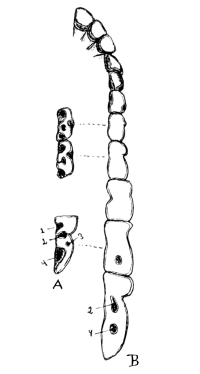
In the section the Deseado consists of layers 2 to 5, the white sandy
clay below belonging to the St. George series and being Cretaceous.
The contact below was also an unconformity, clearly marked for the
white sandy clays were all horizontally bedded, while the Deseado is
crossbedded in every direction, and has a distinct color. These white
sandy clays of the St. George series are similar to the same beds
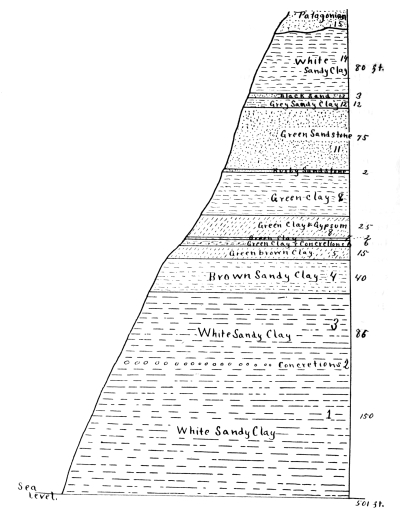
as shown in sections A and B (figures 3 and 4),
and extend in all directions for miles. Going down toward the Chico
River one passes into the green shales that make up the upper part of
the Salamanca and had similar invertebrate fossils. About ten miles
to the north was another bed of fossil trees similar to the one to be
described on the Puerto Visser side of the pampa.
The character of the material making up the Deseado deposit, its
variations in size and material, the presence of worn pebbles and bits
of bone, show these layers to be a water deposit. The absence of any
marine fossil in a bed otherwise rich in fossils indicated that it was
a fresh water formation. The crossbedding, the irregularity of the
deposits and the mud balls, prove that it was the work of a river. As
there are no aquatic forms in the fauna I further conclude that it was
the deposit of a temporary or intermittent stream, such as occur in
arid and semiarid countries. The layer could hardly be interpreted as
a part of a flood plain; for it is very limited in extent, there being
bluffs on three sides of our exposure, but in them no trace of the
Deseado was found, nor was I able to pick up the formation again across
the Chico River. Then the bedding is very irregular, much more so than
is typical of flood plain deposits. The conclusion I reach then is that
this Deseado pocket represents the bottom of an ancient stream, which
flowed over a land surface made up of the white sandy clays of the St.
George age.
The age then of the Deseado beds must be older than the Patagonian, and
younger than the white sandy clays of the St. George.
As to the age of the Patagonian two very divergent positions have been
taken, which may be best indicated by the following table.
Without going into the history of the various positions which
different authors have taken, and which will be found given in detail
in Wilckens’ paper, or in less detail in Ortmann’s, we will consider
the positions of the most recent students of the question. Ameghino
postulates a marine and a continental series of deposits being laid
down more or less simultaneously. In the marine series below the
Deseado, which is grouped as Guarantic, he places the Luisa, the Roca
and the Salamanca, followed by a hiatus, then the Sehuen, which in turn
is followed by another hiatus and the end of the Cretaceous is reached.
The Patagonian is his Eocene. Parallel to the marine series is the
terrestrial, where the Casamayor (= Notostylops) is contemporaneous
with the Salamanca, the Deseado with the Sehuen, and the Colpodon,
the Notohippus and Astrapothericulus with the Patagonian, thus making
the Deseado of Cretaceous age. After a very detailed study of a large
series of Patagonian fossils, Ortmann concludes that the Patagonian
is of Lower Miocene age. This is the most detailed study which has
been made. Wilckens coincides with this view, though feeling that
the Patagonian may have extended down a trifle into the last of the
Oligocene. This latter author finds a long gap between the Upper
Cretaceous and the Patagonian, a period when Patagonia was above water.
It was during this interval that the Casamayor, the Deseado and
possibly other beds were deposited on the continent. I have gone over
Ortmann’s argument, and studied a large collection of Patagonian
fossils, both vertebrate and invertebrate, of my own; and while there
are some places where we would like further data, I can come to no
other conclusion but that these Patagonian beds are Lower Miocene, the
exact relationship with beds in North America and Europe, being as yet
not definitely settled, nor will this be possible until a study of the
migrations of the elements of the Patagonian fauna has been made.
As to the beds underlying the Patagonian, I am sure that a considerable
study of the marine series is still requisite to determine the
relationships of the beds in different parts of Argentine, and their
relative positions as compared with beds in other countries. Ameghino
appended to his paper on the Formations Sedimentaires a section
of the strata exposed on the coast of Patagonia from Rio Negro to
Cape Virgenes, on which from above Punta Atlas south to below Pico
Salamanca, the Casamayor (= Notostylops) beds fill the interval from
the Salamanca formation up to the Patagonian. On the strength of this
map I followed these beds the whole distance looking for vertebrate
fossils of Casamayor age. Nowhere did we find a Casamayor fossil.
Instead at several points we did find marine fossils. I can not but
feel that these beds are plotted as Casamayor, because of their
resemblance in color and general texture to the beds carrying the
Notostylops fauna at Casamayor.
Of several sections of these beds I pick out two as typical, and also
because they are near the locality which we worked for the Deseado
fauna. On the map they are indicated as A and B. The former passes
through a bed of green sands which is, I think, the locality indicated
as his northern locality for the Pyrotherium fauna.
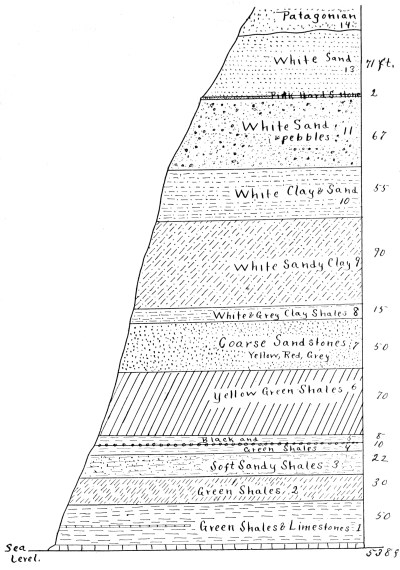
Fig. 3. Section at A on map page 5,
showing strata from sea level up to the Patagonian.
Fig. 4. Section B on map, page 5,
showing strata from sea level up to the Patagonian.
From Punta Atlas to Pico Salamanca, Ameghino plots at or just below sea
level a bed known as the Salamanca, being typically developed opposite
Pico Salamanca. In this in the neighborhood of Pico Salamanca we found
the fauna typical of this horizon.
Ostrea rostigera v. Ih.
Ostrea riongrensis v. Ih.
Ostrea ameghinoi v. Ih.
Chlamys salamanca v. Ih.
Rostellaria striatissima v. Ih.
Rostellaria sp.
Cytherea calcedonica H.
Discinia sp.
Diplodon sp.
This Salamanca formation is considered by Wilckens as the equivalent of
the Roca as exposed on the Rio Negro, and to the Luisa as exposed on
the Rio Coyle. All agree that the Salamanca is Upper Cretaceous and a
period when Patagonia was covered by the ocean.
In section B we found the above fauna in layer 1 which is just
above sea level here. In layer 2 we found casts of delicate marine
shells (30 to 40 in number), representing four or five species and
as yet undescribed. They seem to represent a deeper water facies of
the Salamanca. In fact all the shales represented by layers 1 to 5
evidently belong to the Salamanca. Layer 5 was distinguished by having
in it at a point some 200 yards north of the section line a quantity of
turtle shell fragments.
Layer 7, consisting of coarser sandstones, was at the point of the
section, simply filled with a vast quantity of fossil wood, most of
it agatized, though some was carbonized, and representing some eight
species, mostly pines and palms, the latter much scarcer. The tree
trunks, hundreds in number, lay scattered in all directions; but all
were lying horizontal, and there was no indication of stumps in place;
so I consider that the wood was driftwood. It is common in the series
of beds of this general horizon along the Gulf of St. George. In the
other layers up to the Patagonian we found no fossils. The contact with
the Patagonian was unconformable, in some places being 50 feet higher
than in others near by.
In section A the typical Salamanca is below sea level, and the lower
parts of the section are made up of the white sandy clay shales,
so typical all along the Gulf of St. George. In the midst of these
clays at the level indicated as 2 occurred a layer of concretions.
On breaking these we found two specimens of Nautilus valencienni H.,
clear evidence that they were of marine origin. Layer 5 was filled
with hundreds of the very characteristic oyster, described as Ostrea
(Gryphaea) pyrotheriorum. Though in earlier papers suggesting that O.
pyrotheriorum represented a horizon of marine sediments corresponding
in age to the Deseado (= Pyrotherium) formation, in his Formations
Sedimentaires, Ameghino places this fossil in the Salamanca fauna,
though it here occurs at least 275 feet above the typical Salamanca
fauna. I believe the layer should be distinguished. It is later than
the typical Salamanca, though belonging to the same transgression of
the sea over Patagonia. In layer 7 we found still another marine fauna
consisting of
Ostrea guarantica H.
Venericardia sp.
Corbula sp.
Aporrhais.
Patomides.
Oxyrhinca.
Milobates.
Fragments of the limbs of a crab in abundance.
This seems to be the same fauna as that described by Ameghino as the
Sehuen developed on the Rio Sehuen.
In layer 8 we found large quantities of gypsum, occurring mostly in
balls of radiate structure. Layer 11 was a coarse green sand, and in it
we found some fragments of some sort of a bone. I think this layer is
what Ameghino designated as a Deseado exposure; and it has the same
general appearance and color which is found in the green sands of the
Deseado pocket on the Rio Chico. However it is conformable interbedded
with the underlying and overlying marine beds and I consider it a part
of the marine series. Above it come more white sandy clays that are
characteristic of the most of the section.
Wilckens takes all of this series, from the base of the Salamanca,
up to the unconformity below the Patagonian, and makes of it his St.
George Period, a transgression epoch, lasting to the end of the Upper
Cretaceous. I believe it is all marine, and is all a part of the
Upper Cretaceous transgression of the sea over Patagonia. However the
Salamanca is a clear cut deposit and I feel it should be retained as
a distinct horizon. The overlying light colored (white, grey, brown,
yellow, or green) sandy clay shales represent a deeper water and
later facies, which is characteristically developed on the Gulf of
St. George, and may well be distinguished as the St. George epoch or
series, but I should use the term only in this more limited way. It is
the same series which Ameghino has plotted as the Notostylops beds on
his section of the coast of Patagonia. This last it certainly is not.
The unconformity between these white (or light) sandy clays and the
Patagonian represents a regression period, during which Patagonia was
not only above water, but extended an unknown distance further to the
East.
It was during this interval of time between the Upper Cretaceous and
the Lower Miocene (Patagonian) that the limited and local land deposits
known as Casamayor (= Notostylops), the Astraponotus, and the Deseado
(= Pyrotherium) and probably other beds were laid down. In each case
the age must be determined for the individual bed by its contents
mostly; for as far as I know none of them overlap anywhere.
In regard to the discussion as to whether Dinosaurs were
contemporaneous in South America with the fauna of the Deseado, I can
only say, we found no trace of a dinosaur or any other Cretaceous
animal in the Deseado beds which we worked. As the Cretaceous beds
lie as high as the Deseado and are also practically horizontally
striated, dinosaur remains might be found on the same level. I think
the assigning of any such material to these beds was due to failing
to recognize the unconformity under the Deseado beds. As to the
Notostylops fauna and dinosaurs being contemporaneous, I only worked
the Notostylops beds at Mazaredo, but there I found nothing to indicate
the contemporaneousness of these two groups. As I have shown above,
Ameghino’s idea of the extent of the Notostylops or Casamayor beds was
mostly at fault, and very much of that which he has designated as of
Notostylops age is Upper Cretaceous. It is in these Upper Cretaceous
beds that dinosaurs do occur and this seems to me to be the basis of
the confusion.
This Upper Cretaceous series is a field where considerable work may
profitably be done, in straightening out the relationships of the
various layers to each other, their extent, and their relationship to
the Salamanca and other Upper Cretaceous formations in other parts of
Argentine.
As to the age of the Deseado deposit which we worked. It is under the
Patagonian, and therefore must be as old as the Oligocene. On the
other hand it must be as young as the Eocene, lying as it does above
the Upper Cretaceous. Of the three general faunas described it is
clearly more advanced than either the Casamayor, or the Astraponotus;
so should be put as the youngest of these three. The Colpodon,
the Astrapothericulus and the Notohippus, faunas are said to be
interstratified with the Patagonian and therefore of the same age. The
amount of advancement from the Casamayor to the Deseado is considerable
and the relationships of the Deseado are fairly close with the various
genera of the Santa Cruz; so that I should put the Deseado as far up as
possible toward the Santa Cruz. The Santa Cruz is above the Patagonian,
and I think that the Deseado should be put just before the Patagonian;
that is in the Oligocene, but just what part of the Oligocene can only
be determined when the other faunas have been further studied.
CHAPTER III The Deseado Fauna
The exposure of the Deseado, which the Amherst party worked, yielded
293 specimens, each presumably representing an individual. (There were
besides these a few that were indeterminate and are not therefore
included.) The consideration of the fauna as a whole suggests certain
ideas as to the country in which the animals lived, and also certain
comparisons with the fauna of the preceding and later faunas.
The first striking feature is the presence of so many excessively
large animals, as Asmodeus, Parastrapotherium, and
Pyrotherium, in each case forms larger than a rhinoceros.
Further than that they are in each case the largest members of their
family, even larger than the representatives in the later Santa Cruz.
This would indicate a period in which living conditions were at a high
grade, suggesting both abundance of food and a moderate climate.
The following table will give a good idea as to the range of species,
and their relative abundance in the fauna, also a suggestion as to
the class of food they used; and from that an idea as to what sort of
country they occupied:
Per Cent
Num- ber
Species
Food
Country
3
Hegetotherium shumwayi
7
Prosotherium garzoni
17
Prosotherium triangulidens
1
Eutrachytherus grandis
4
Eutrachytherus spegazzinius
Grass, bark and browse
Plains
1
Isoproedrium solitarium
2
Phanophilus dorsatus
4
Argyrohyrax proavus
1
Plagiarthrus clivus
14%
40
Typotheria
1
Protheosodon coniferus
Grass
Plains
15
Notodiaphorus crassus
6%
16
Litopterna
19
Rhynchippus equinus
Grass
Plains
7%
19
Rhynchippidae
44
Leontinia gaudryi
Browse
Brush plains
15%
44
Leontinidae
2
Proadinotherium leptognathus
Grass or Browse
Plains
2
Coresodon scalpridens
1%
4
Nesodontidae
7
Asmodeus osborni
Browse
?
2%
7
Homoladontidae
6
Parastrapotherium holmbergi
Browse
?
2%
6
Astrapotheridae
11
Pyrotherium sorondoi
Browse
?
4%
11
Pyrotheria
55
Cephalomys arcidens
22
Cephalomys plexus
19
Cephalomys prorsus
Hard vegetation
Open country
3
Asteromys prospicuus
1
Scotamys antiquus
1
Eosteiromys medianus
1
Litodontomys chubutensis
35%
102
Rodents
9
Proeutatus lageniformis
1
Prozaedius planus
Insects and leaves
Open country
2
Prozaedius depressus
3
Proeuphractus setiger
2
Peltephilus undulatus
1
Palaeopeltis inornatus
5
Indeterminate
8%
23
Edentata
1
Plichenia lucina
1
Epanorthus chubutensis
5
Callomenus praecursor
Insects and flesh
?
2
Pharsophorus tenax
1
Pharsophorus mitis
3%
10
Marsupilaia
3%
11
Birds
Open country
100%
293
In our collection, all from one point, there are thirty-nine different
species. Beside these Ameghino has described a considerable number of
species, some of which in time will probably turn up at our locality;
but others and I think the majority will be found to be representative
of other localities which he worked. It is to be expected that a
difference of locality will make a little difference in the fauna.
Further I expect that no two localities represent exactly the same
period of time, though they may do so approximately; but some of these
local deposits must have been begun earlier, and others probably lasted
to a later period. Thirty-nine species of mammals and land birds is
a fairly varied fauna for one spot; and the time element involved in
laying down the 50 feet which separated the bottom from the top of the
Deseado deposit is not probably very long; for the material of which
the deposit is composed is of a character which would have been laid
down fairly rapidly.
Of this fauna only 8 per cent belongs to the edentates; and if any
element were disproportionately represented it would be this one, for
the armadilloes have in addition to the skeleton the hundreds of tiny
plates of the carapace, and several of the forms are represented by one
or two plates only. When compared with the condition in the Santa Cruz
this 8 per cent is strikingly small, for in that later bed, fully 50
per cent of the finds represent edentates. Are the Edentata just
originating? Or, was the country less favorable to their habitation?
The edentates which we did find are only slightly less advanced
in their development than those of the Santa Cruz. Also, though
infrequent, all of the families of the Santa Cruz are represented. It
would seem therefore that the origin of the edentates was much earlier
than the Deseado; and this relative paucity of edentates is also
characteristic of the Casamayor and Astraponotus beds; but they are
there, and in considerable variety, though small numbers. It would seem
then that the country for some reason was less adapted to edentates,
and that in some other part of South America they were flourishing and
evolving.
In the Deseado the rodents appear for the first time in South America.
They are all Hystricomorpha and in a relatively primitive
stage of development, but they are typically developed already. Did
they migrate in from some other locality, or were they evolved on the
spot? Ameghino believed that they were developed from some such form
as Promysops or Propolymastodon of the Casamayor, and
that these forms were ancestral to rodents all over the world. If my
interpretation of the age of these beds is anywhere near correct, this
last at least is impossible, for in North America and Europe typical
rodents are present in the Eocene. Then as to even the hystricomorphs
being developed in Patagonia, I am very skeptical, for the material
offered in evidence of this is very insufficient, especially in the
region of the incisors; and may be interpreted in other more probable
ways. I am confident that either just before the beginning of the
Deseado, or at the beginning, the rodents of these beds migrated,
either from some other continent, or at least from some other section
of South America into this Patagonian region.
Some idea of the type of country and the climate of the Deseado period
in Patagonia may be obtained by analyzing the fauna as to the character
of its teeth as indicative of the food; and by studying the feet as
indicative of the ground on which they were used.
The Typotheria with their chisel-like front teeth, lack of
canines, and their permanently growing grinders evidently ate a
hard type of vegetation. Deep and permanently growing molars are
characteristic of the eaters of grass, a form of vegetation which is
especially hard on the grinding teeth, on account of the silica in
the stems and leaves. This however would scarcely necessitate the
development of permanently growing incisors. They are typical of
gnawing animals, eaters of bark, twigs, and possibly also leaves, the
wood and bark being also a hard type of vegetation to grind. In the
case of these forms I believe they were feeders on grass and bark.
Their feet are developed either for running or hopping and would
suggest hard ground for their habitat.
The Litopterna are typically plains animals, paralleling in
their development the horses. The cropping teeth and the grinding
molars become progressively longer. The limbs are progressively
elongated, the animals walking more and more on the tips of the toes.
With this, the metapodials especially and the other limb bones to a
less degree, are progressively lengthened. At the same time the side
toes are progressively reduced. The teeth indicate grass eating; the
limbs life on the plains.
The Rhynchippidae, while not as advanced as the
Litopterna, show cropping front teeth, and the molars developing
in depth. The locomotion is semidigitigrade, the feet small, and the
number of toes reduced to three. They too must be interpreted as
grazing or grazing and browsing animals, living on hard ground.
The Leontinidae are heavier forms, but with much the same
features as Rynchippidae, though less specialized. On account of the
broad upper molars and the less specialization of the dentition, I
should feel that these forms were browsers and lived among bushes, but
the feet were three-toed and semidigitigrade and they seem to have
walked on hard ground.
The Nesodontidae belong to the same type of adaptation as
the foregoing family, but have the grinding teeth more complicated,
indicative of a more advanced adaptation to hard vegetation. The feet
were also adapted to hard ground.
The Homalodontotheria, the Astrapotheria, and the
Pyrotheria were all very large animals, known mostly by their
dentition, which is adapted to browse. Whether they lived on soft or
hard ground is not known, as the feet are not known in any case but the
Homalodontotheridae, where they are five-toed and adapted to
soft ground. Such large animals were probably inhabitants of some river
bank.
The rodents do not contribute much in the determination as to the type
of the country, for they could have lived in the open or in the wooded
country, but their relative abundance is rather typical of open country.
The birds are all running birds, and indicative of the country having
been an open one.
Of our fauna 11 per cent were flesh or insect eating, and for the
purpose of determining the type of country may best be omitted.
The rodents could have been either forest or open country forms.
Of the remaining 54 per cent, the typotheres, the litopternas, the
Rhynchippidae, the Leontinidae, the nesodonts and the
birds (46 per cent) were distinctly adapted to live on hard ground; the
other 8 per cent being evidently suited to living near a river. All 54
per cent ate either grass or browse. The litopternas are grass eaters;
the typotheres were specialized to eat grass or bark; nesodonts,
Leontinidae, and Rhynchippidae are grass and browse
eaters. Even the Pyrotherium has a pair of gnawing tushes. The
picture arising from these considerations is a bush covered prairie, a
country not unlike the upland bush pampas of Patagonia today.
There is not an aquatic form (fish or turtle) in the whole list, so
it is evident that the stream which deposited these Deseado beds was
not abundantly inhabited. To me it looks like so many of the streams
in an arid country, dry through a considerable part of the year, and
so uninhabited. In the whole list I see nothing to indicate forests
or swamps. The arid bush covered plain alone seems to suit the
requirements.
As I see this fauna it is composed of several distinct elements,
representing different invasions and an element which arose in situ.
The reasons for the affinities expressed in the different groups will
be found in the introductory paragraphs of the systematic discussion of
each group.
The Notungulata, including the Typotheria, the
Toxodontia, the Litopterna, the Homalodontotheria,
and the Astrapotheria are a group with apparently a common
ancestry. In Patagonia they have specialized into the various
subdivisions as we find them in the Deseado. This group was in
Patagonia as early or earlier than the Casamayor. Their relationships
appear to me to be with the Hyracoidea which are generally
credited with originating in Africa.
The Pyrotheria are related to the early elephants which also
arose in Africa, but it seems to me that this form came to Patagonia
at least at a later period, making its first appearance in the
upper part of the Astraponotus period. Ultimately the elephants and
Hyracoidea had a common origin in Africa.
The Rodentia are all hystricomorphs and appear in South America
for the first time in the Deseado. They also occur in the Oligocene of
Europe and the Fayum of north Africa. They never reached North America
so must have come to South America by some southern route.
The Edentata are an element of the Casamayor fauna and as there is no
evidence of their originating anywhere else it would seem that they
were indigenous to South America, where they later flourished and
developed the greatest variety and profusion of numbers.
The group of marsupials is an element the origin of which presents
a most difficult problem. Some belong to the opossum series which
could well have been developed from some remnant of the Mesozoic
marsupial fauna that had a world wide distribution; but the
presence of diprotodonts, which are characteristic of Australia,
and of the Borhyaenidae which are closely related to the
Thylacinidae of Australia, suggests a migration from that
continent as late as Tertiary times; but to my mind this involves
a connection which is most too difficult to postulate. There is no
evidence that they came to South America in company with other faunas,
for they have not been found associated with any other fauna outside of
Southern Patagonia. The explanation of the affinities of the Patagonian
marsupials with the Australian marsupials is a problem which is not yet
in position to be settled.
The birds probably came from Africa with the invasion of the ancestors
of the Notungulates.
The idea of an invasion from Africa in Upper Cretaceous times, and
possibly another at a later time is correlated with the other evidence
of a land bridge between these two continents, as deduced by students
of other groups.
not to mention several others studying mullocks, insects, plants, etc.,
have all postulated a land connection from Brazil to northern Africa
during Cretaceous time to explain the distribution of their various
groups. The divergence is in the time when this land bridge sank,
some believing it to have lasted into Tertiary times, most feeling
that it sank in Upper Cretaceous times. Another body of evidence
is presented to show that a land bridge connected the West Indies
with the Mediterranean regions.[10]
There was presumably but one such transatlantic connection. Its
position further to the south would seem to me to explain the
distributional facts found in the West Indies, but the striking
resemblances between the faunas of Africa and South America require a
connection from the South Upper American Continent and Africa.
It was along this land bridge which the ancestors of the
Notungulata traveled, and when in South America, due to their
isolation, developed all the peculiarities of the group. This must have
been not later than the latter part of the Cretaceous.
Either this bridge remained until into the early Tertiary; so the
Pyrotheria and Hystricomorpha made their migration later,
or these two groups did not reach the isolated Patagonian section
until later than the first invasion. I am inclined to believe in the
migration being at a later period. This bridge does not explain the
presence of the edentates, for which there is every reason to believe
that they developed in situ. The Marsupial invasion must have been from
some other direction, or their presence in Africa has not yet been
discovered.
The systematic arrangement of the South American ungulates is of such
a nature that scarcely two students of these forms have agreed. I feel
that the Pyrotheridae are proboscideans as did Ameghino, but there
my agreement ends. The other varied groups I believe have a common
ancestry, their great divergencies being due to adaptations to the
greatly varied characters of the country they occupied. In spite of the
great variation they have certain features in common so that I agree
with those who have developed the term Notungulata to include them all.
From what source they originally came is not clear, but it seems to
me that these notungulates have more in common with what we know of
the African fauna of the Fayum than with any other fauna; so that my
feeling would be that these two faunas had a common ancestry at least,
and possibly the South American ungulates are derived from the African.
The lophiodont upper dentition, the bicrescentric lower molars with a
“pillar” in the posterior crescent, the development of the tympanic
bulla with the extension of the inflated cavity up into the squamosal
bone, the development of the post-tympanic portion of the squamosum,
and the general arrangement of the basicranial foramena indicate in my
mind that these notungulates have all risen from the same stock, and
that that stock had much in common with the hyracoids.
I should therefore arrange the various groups as
follows.[11]
Order I. Upper molars composed of an external
longitudinal crest and two transverse crests, the posterior the less
developed; lower molars composed of two joining crescents with a
“pillar” in the posterior crescent; structure of the feet and limbs
varying.
Suborder 1. Litopterna: teeth brachydont
to hypsodont; lower molars with the anterior and posterior crescents
subequal; squamoso-periotic region not inflated; limbs elongated; pes
unguligrade; digits 3-3 or 1-1.
Suborder 2. Typotheria: teeth hypsodont
lower molars with the anterior crescent shorter than the posterior;
squamoso-periotic region inflated; limbs elongated in varying degrees;
pes plantigrade to semi-plantigrade; digits 5-4 or 4-4.
Suborder 3. Toxodontia: teeth brachydont
to hypsodont; lower molars with the anterior crescent shorter than
the posterior; squamoso-periotic region inflated; limbs short; pes
semidigitigrade to digitigrade; digits 3-3.
Suborder 4. Homalodontotheria: teeth
brachydont; lower molars similar to those of Toxodontia; limbs
moderately elongate; pes semidigitigrade; digits with large curved
claws, 5-5.
Suborder 5. Astrapotheria: teeth
brachydont to moderately hypsodont; canines enlarged into tushes;
molars similar to those of Toxodontia; limbs greatly elongated; feet
unknown.
Suborder 1. Pyrotheria: incisors developed
into tushes; molars bilophodont; limbs short, especially the lower
element; feet digitigrade.
LITOPTERNA
This order of South American ungulates is less abundantly represented
in the Deseado formation than in the Santa Cruz, but most of the genera
of this latter formation have representatives in the Deseado so that
they seem to have diverged still earlier.
By Scott the order is divided into two families, the
Proterotheriidae and the Macrauchenidae, the less known
Adiantidae being placed under the latter family until better known. I
feel that I should prefer to retain the Adiantidae for the present,
until they can be shown to be subordinate to another family, so that
in this paper the three families are retained. The striking features
of the two larger families may be best brought out by a comparison of
their chief features as follows.
Proterotheriidae
Macrauchenidae
Formula
1 0 4 3
3 1 4 3
2 0 4 3
3 1 4 3
Upper inc. 2 and lower inc.
Incisors, canine, and premolar
3 enlarged and tush-like,
1 simple, compressed, subequal
growing from persistent pulps.
in size, and rooted.
Nasals normal.
Nasals shortened indicating
a proboscis.
Neck short.
Neck long.
Feet with median digit enlarged,
Feet with all three digits
lateral digits reduced.
subequal in size.
In the Deseado, this family is scantily represented as compared with
the rich fauna, both as to species and numbers of individuals in the
Santa Cruz, but of the four chief genera of the Santa Cruz, three have
been found, though the remains are very fragmentary. They are the
genera Eoprototherium, belonging to the Prototherium
series, Deuterotherium belonging to the Thaotheriumseries,
and Notodiaphorus representing the Diadiaphorus series.
The following table will give what is known in comparing
the two series.
Period
Upper Molars
Nasals
Pes
Proterotherium
Santa Cruz
metaconule present protoconule and
protocone separate
normal
tridactyl
Eoproterotherium
Deseado
metaconule present protoconule and
protocone separate
Licaphrium
Santa Cruz
metaconule present
normal
tridactyl
Diadiaphorus
Santa Cruz
metaconule present protoconule and
protocone fused
short
tridactyl
Notodiaphorus
Deseado
tridactyl
Thaotherium
Santa Cruz
metaconule lacking protoconule and
protocone separate
normal
monodactyl
Deuterotherium
Deseado
metaconule lacking otoconule and
protocone separate
Eoproterotherium Amegh., 1904, Anal. Mus. Nac. B. A.,
ser. 3, t. 3, p. 441.
The genus is founded on single teeth of the upper molar series,
which, except for size, are very like those of Proterotherium.
Limbs, etc., are unknown, so that this genus is simply a carrying
back of the Proterotherium line into the Deseado. We found
no teeth of this form, but one species has been described, E.
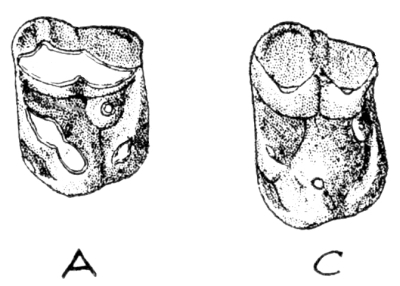
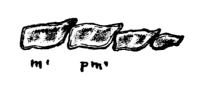
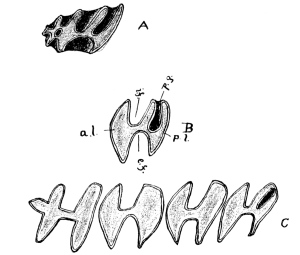
inaequifacies, of which I reproduce Ameghino’s figure
compared with Proterotherium, which shows this species to have
the metaconule better developed.
Fig. 5. A, Eoproterotherium inaequifacies, third
upper molar—natural size; C, Protherotherium karaikense, third
upper molar—natural size, after Ameghino.
The basis of this genus is particularly a hind limb found
associated which is much less developed than the Santa Cruz genus
Diadiaphorus to which it is most nearly related. These two
genera are unique in having the ectal facet on the astragulus developed
in two planes so that it appears as a deep notch. In the case of the
new genus the toes are almost equal in size, giving us a stage in the
development of this three-toed form which is much more primitive than
the well-known Santa Cruz genus.
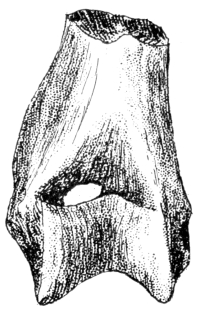
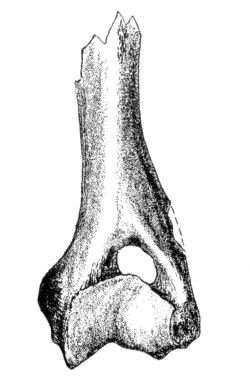
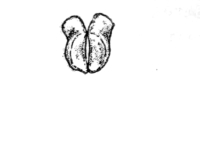
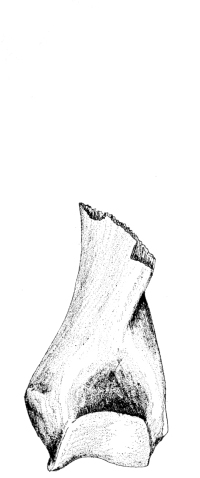
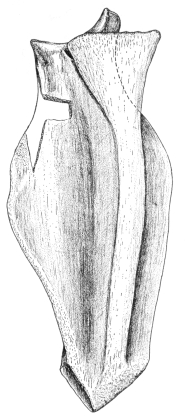
Fig. 6. Distal end of right humerus—½ natural size.
The specimen selected as type is number 3287 of the Amherst Collection,
consisting of a complete pes, tarsus, lower end of the tibia, and the
femur, from the Deseado on the Chico del Chubut River, west of Puerto
Visser. Beside this, there are seven other specimens, mostly parts
of hind limbs, but others having also the lower end of the humerus,
the radius and ulna, metacarpals, and some phalanges. The species is
distinguished by its large size, being larger than the species of the
Santa Cruz, and, at the same time, the three toes of both the pes and
the manus are subequal in size.
The distal end of the humerus associated indirectly with this species
is moderately heavy, with fair-sized epicondyles, and no entepicondylar
foramen. The supratrochlear fossa is moderately deep, the anconeal
very deep, the two being connected by a small foramen, as is typical
for this family. The trochlearis, slightly oblique to the long axis
of the shaft, has a simple pulley-like articular end without ridges
of division, the internal border being narrower and higher than the
external.
Measurements, Specimen 3201
Humerus,
greatest diameter of the distal end
58 mm.
width of trochlea on the anterior side
37 mm.
width of trochlea on the posterior side
28 mm.
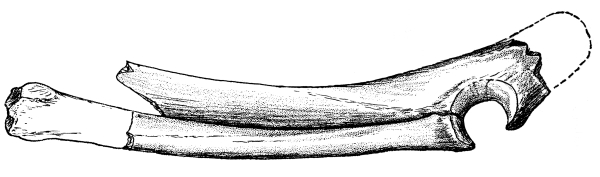
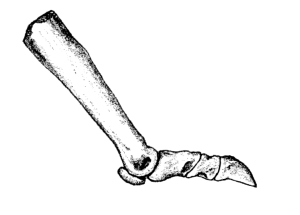
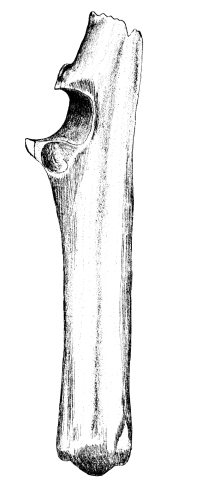
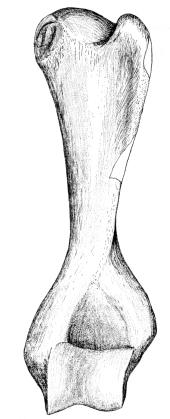
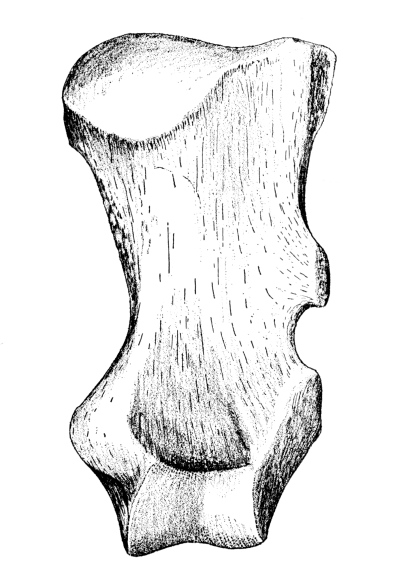
Fig. 7. Right radius and ulna, distal end of ulna
from specimen No. 3275—½ natural size.
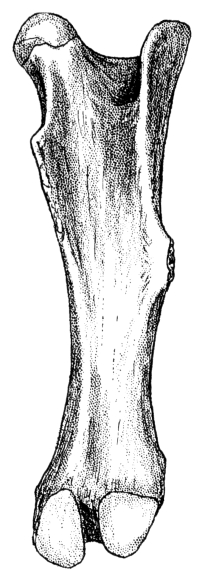
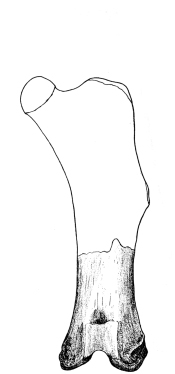
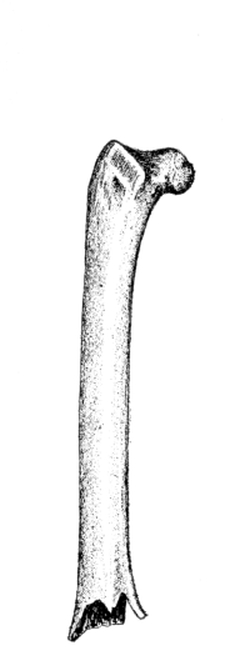
Fig. 8. Left femur posterior side—½ natural size.
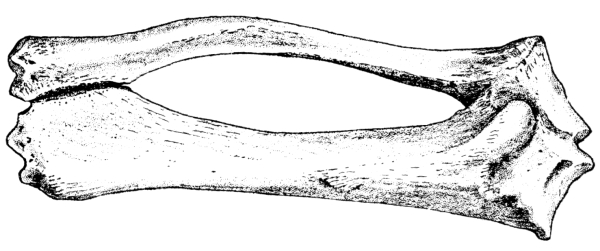
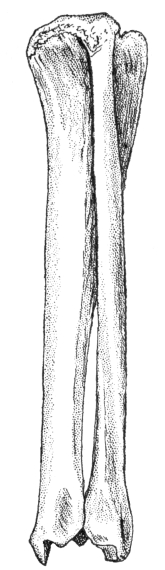
The radius and ulna were from another specimen which, however, was
associated with a typical astragulus. The two bones are long, slender,
strongly curved, and in contact with each other throughout their
entire length, so that there could have been no rotary movement of
the forearm. The radius is a slender bone with the proximal articular
facet relatively small, the facet being slightly concave, of ovoid
outline and with the transverse diameter the greater. There is but a
tiny band-like facet for the ulna situated on the posterior side near
the inner margin. Distally, the radius widens into a heavy end with a
rugose area on the outer side for contact with the ulna, and with two
distal facets, a larger for the scaphoid, and a smaller for the lunar,
the two being separated by a low ridge.
The ulna is heavier above, with a strong backwardly directed olecranon
process. The sigmoid notch makes almost a semicircle, the articular
surface being broad and extending well onto either side of the bone.
The facets for the radius are tiny. The distal end of this bone is
wanting.
Measurements, Specimen 3275
Radius,
length
251 mm.
greatest width at proximal end
28 mm.
greatest width at distal end
36 mm.
least diameter of shaft
16 mm.
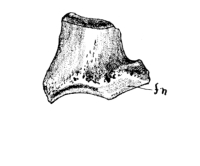
Fig. 9. Distal end of left tibia—½ natural size.
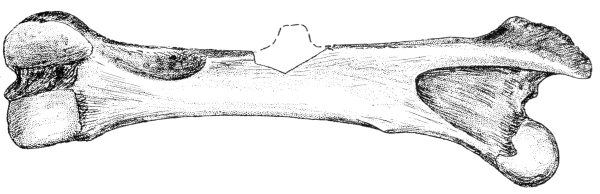
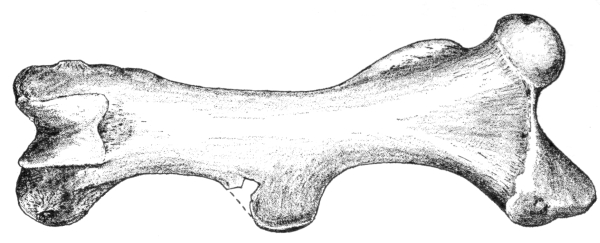
The femur belongs to the type specimen which is about 5% larger than
the other specimens. This bone is long and rather slender, with the
greater trochanter rising well above the head, which is rounded, on a
short neck, and has the ligamentary pit on the posterior margin. The
thick, rugose, greater trochanter bends in over the head at its upper
end. The lesser trochanter is relatively small, and prolonged into a
ridge. Unfortunately the third trochanter is broken off in my specimen.
The digital fossa is extremely large and deep. Proximally the shaft is
flattened, but becomes rounded distally. Just above the condyles there
is a deep rugose pit for the plantaris muscle, and on the anterior
side the suprapatellar fossa is well marked. The condyles are placed
a trifle obliquely; the internal one being shorter and with a rounded
articular face, the external condyle being longer, and with a flattened
articular face which slopes obliquely inward.
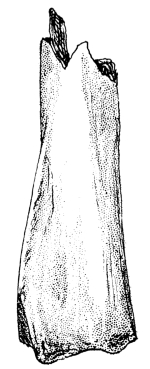
Of the tibia, only the distal end is preserved. This indicates a rather
slender bone, with a shallow, fairly wide concavity for the external
astragular trochlea, and a narrower and deeper concavity for the
internal astragular trochlea. On the internal side of the tibia there
is a rugose surface for the fibula.
An isolated lower end of a fibula indicates a slender bone, enlarged
distally where it comes in contact with the tibia. The fibula carries
on its inner face a moderately large facet for the external side of
the astragulus, and on the distal end a wider one for contact with the
calcaneum.
The tarsus is compactly built, wider than that of Diadiaphorus, because
the external digits are not as much reduced. This especially shows in
the greater development of the cuboid and the mesocuneiform, but in
other features it is similar to that of its descendant.
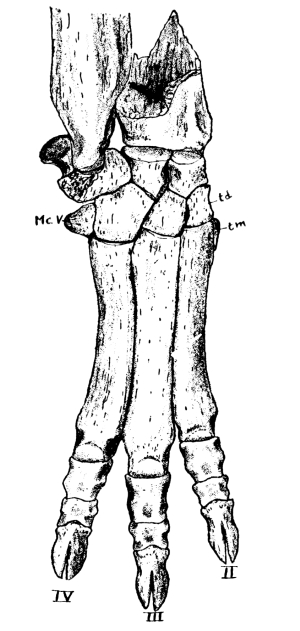
Fig. 10. Left pes, dorsal side, ungual phalanx
from specimen No. 3275—½ natural size.
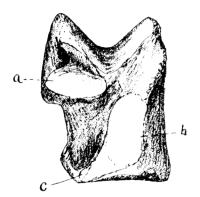
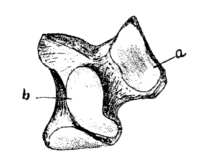
The astragulus is a very characteristic bone. The trochlea is
asymetrical, the external condyle rising higher than the internal,
and the median groove being wide and shallow. On the nearly vertical
outer face of the astragulus, there is a semicircular band-like facet
for the fibula. The trochlea extends well around the top of the bone,
allowing a wide movement of the foot. The neck of the astragulus
is long and wide, carrying a broad flattened head, with its convex
facet for the navicular, covering the entire end. On the plantar
side are the most marked features. The ectal facet is in two planes,
the anterior portion being bent down to nearly right angles with the
posterior, which seems to be characteristic of this Diadiaphorus
series. The sustentacular facet also is characteristic, being gently
rounded and extending clear to the navicular facet on the head, in
Diadiaphorus becoming actually confluent with the navicular
facet. Just at the edge of this sustentacular facet is a tiny surface
where the astragulus rubs on the cuboid, the only case, as far as I am
aware, where this occurs in any Litopterna.
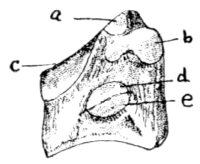
Fig. 11. Left astragulus plantar side: a, ectal facet—½ natural size; b, sustentacular facet; c, facet for cuboid.
The calcaneum is long and slender, the tuber being but slightly
enlarged, its sustentacular facet being a broad oval surface, while the
ectal facet is in two planes to correspond to that on the astragulus.
The facet for the cuboid is at the distal end, but is unusually
oblique, its inner margin sloping up almost to the sustentacular facet.
It is this slope which brings the cuboid in contact with the astragulus.
The navicular is broad and low, with a prominent hook behind. On its
upper face there is only the broad facet for the astragulus head; on
the lower face are three facets, externally, a large, more or less
triangular area, for the ectocuneiform; medianly a smaller similar
facet for the mesocuneiform; and on the internal side, sloping up onto
the internal face, a small facet for the reduced endocuneiform. On the
external face of this bone there is a tiny beveled facet for the cuboid.
The endocuneiform is a large scale-like ossicle articulating on the
lateral internal face of the navicular, and overlapping markedly the
inner surface of Metatarsus II.
The mesocuneiform is considerably reduced in size, carrying a broad
flat facet on the upper surface for the navicular, and a shallow
saddle-like one below for Mt. II, which is entirely carried by this bone.
The ectocuneiform is considerably larger than the mesocuneiform,
resting above on the navicular, and carrying below the whole of Mt.
III. On its inner side are two facets which rub against the upper end
of Mt. II.
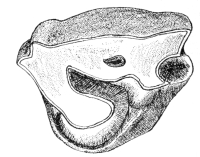
The cuboid is a nodular bone, its upper surface occupied by the facet
for the calcaneum, the lower face occupied by the facet for Mt. IV,
while on the external side there is a tiny beveled facet for the
vestige of Mt. V, and with a small boss on the inner surface which
carries two tiny facets, the upper one for the ectocuneiform and the
lower for the navicular. On this same inner side, near the top there
is a second small boss, which carries a tiny facet to rub on the
astragulus, and below that a second tiny facet for the navicular.
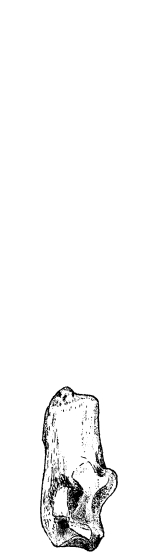
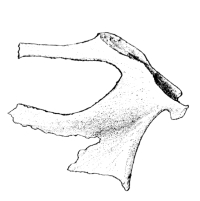
Fig. 12. Cuboid internal side to show: a, facet for astragulus; b, upper facet for navicular; c, facet for calcaveum; d, lower facet for navicular; e, facet for mesocunieforms —½ natural size.
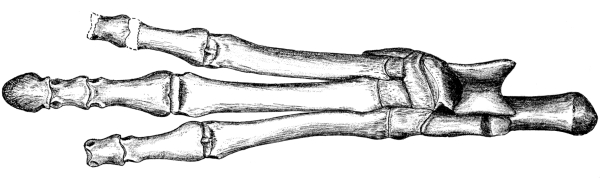
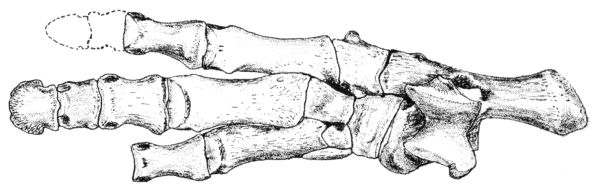
The pes consists of three digits, with a vestige of Mt. V. Of the
developed digits, the median one is the largest, but the two lateral
digits are only a little smaller and were functional, so that this
form was truly three-toed, comparable in the digital reduction to
Mesohippus.
Mt. II is flattened above but soon broadens into a rounded shaft of
considerable length, on the end of which is the articular trochlea,
with the carina extending onto both the upper and lower surface,
being, however, higher on the lower surface. Proximally this bone is
overlapped by the endocuneiform, is carried by the small mesocuneiform,
and also articulates on the inner side of the ectocuneiform. Mt. III
is also compressed at the upper end, broadens below, and carries an
articular trochlea similar to that of Mt. II, except that the carina
does not extend so far onto the upper surface. Like Mt. II, Mt. IV is
carried high on the tarsus, and therefore, though nearly as long as Mt.
III, it does not have the same effective length. Proximally it
articulates entirely on the cuboid; distally it has a trochlea similar
to that of Mt. II, the carina extending onto the dorsal surface. While
Mt. V is lacking, it is clearly indicated that a vestige of it should
have been present, as there is a tiny articular surface for it on the
cuboid, and a rugose surface on the outside of Mt. IV.
The phalanges are long and have the articular ends swollen somewhat as
in camels. The phalanges of the first row are nearly equal in size,
each with the proximal trochlea deeply notched for the carina of the
metatarsus; and with the distal trochlea simple, though slightly
concave from side to side, and reflexed well onto the dorsal surface.
The phalanges of the second row are shorter and simpler, and somewhat
depressed distally. The ungual phalanges are flattened from top to
bottom, of moderate size, somewhat longer than wide, and without any
indications of a cleft.
Measurements,
Specimen
No. 3287
No. 3275
Femur,
length
289 mm.
diameter across gr. trochanter
80 mm.
diameter of middle of shaft
32 mm.
diameter of distal end
70 mm.
Tibia,
diameter of shaft
28 mm.,
24 mm.
diameter at distal end
38 mm.,
36 mm.
Calcaneum,
length
103 mm.,
96 mm.
width
36 mm.,
35 mm.
Astragulus,
length
48 mm.,
44 mm.
width
38 mm.,
35 mm.
Metatarsus II, length
114 mm.,
105 mm.
Metatarsus III, length
122 mm.,
114 mm.
Metatarsus IV, length
110 mm.,
101 mm.
Phalanx 1 of digit III, length
49 mm.
Phalanx 2 of digit III, length
27 mm.
Phalanx 3 of digit III, length
29 mm.
Deuterotherium Amegh., 1895, Bol. Inst. Geog. Argen.,
t. 15, p. 633.
Deuterotherium Amegh., 1897, Bol. Inst. Geog. Argen.,
t. 18, p. 452.
This genus was first founded on a clacaneum and a bit of the mandibular
symphysis, to which were added, later, both the upper and lower
premolar and molar teeth. As far as it is known, it is distinguished
by the upper molars lacking the metaconule entirely, and being approximately
like those of Thaotherium. The dental formula is given by Ameghino as
1 0 4 3
———,
2 0 4 3
the same as Thaotherium. But one species has been described.
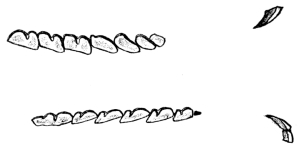
We did not find this species, but the teeth assigned to it are very
characteristic, and so I reproduce Ameghino’s figure of them. The
species is distinguished by its size primarily. The following are the
chief measurements given.
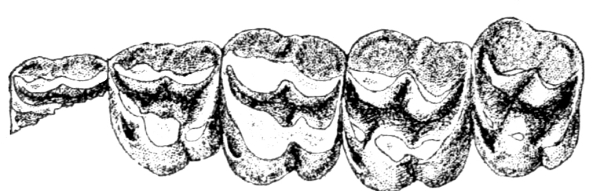
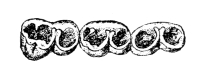
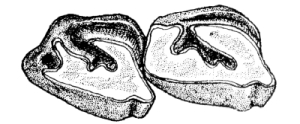
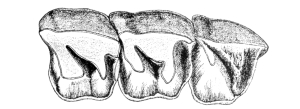
Fig. 13. Upper pm. 3-m. 3 of the left side—natural
size, after Ameghino.
Upper dentition, pm. 3 to m. 3, length 50 mm.
Lower dentition, inc. 1 to m. 3, length 80 mm.
This family is distinguished, first, by the complete dental series in
which none of the anterior teeth are developed into tushes; by the
nasals being shortened, apparently in connection with the development
of a proboscis; by its long neck; and by its feet being permanently
tridactyl, all the three toes being equally developed. In the Deseado
it is infrequent, but to it Ameghino has assigned two genera;
Protheosodon, which he describes as similar to Theosodon,
but which I find much nearer to the Casamayor representatives of this
family, such as Lambdaconus, though it doubtless belongs to the
series which is represented in the Santa Cruz by Theosodon. He
has also made a second genus, Conioptotherium, which represents
a large Macrauchenid, equal in size to Theosodon. This genus is
based on the calcaleum and astragulus and seems to be rare.
Protheosodon, Amegh., 1897, Bol. Inst. Geog. Argen., t. 18, p. 453.
Protheosodon, Amegh., 1904, Anal. Mus. Nac. B.A., ser. 3, t. 3, p. 421.
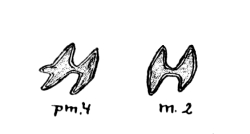
This genus was founded on an upper second molar and the fourth
premolar. I figure m. 2, and it will be seen that they represent a
form little specialized, resembling in the low crowns, plump cusps,
and presence of both protoconule and metaconule, the Casamayor types,
such as Lambdaconus or Didolodus, rather than the
advanced type like the Santa Cruz genus, Theosodon. We found a
specimen with the lower jaws complete and with the hind limb complete,
which, I am confident, is the same form, though I can not duplicate
any tooth, for we found no upper teeth; but in size they agree with
Protheosodon, also in the primitive character; and, were one
from the lower teeth to postulate the upper, they would be just such as
Ameghino has described under the name Protheosodon. Therefore
I have assigned my material to this genus and species. It adds to the
genus characters the fact that this form had a shorter back, relatively
as well as actually, than Theosodon; that the hind limb, at
least, was much heavier and also shorter than that of Theosodon,
especially in the metatarsal region where relatively the elements
are only about half as long. The pes is of the same character as in
Theosodon, but again relatively much shorter. I believe in
Protheosodon we have to do with a form intermediate between
Lambdaconus and Theosodon, and nearer to the former.
P. coniferus Amegh., 1897, Bol.
Inst. Geog. Argen., t. 18, p. 453.
Ameghino has described two upper teeth. Specimen No. 3001 of the
Amherst Collection from the Chico del Chubut River, west of Puerto
Visser, adds to this the knowledge of twelve vertebrae (seven dorsal
and five lumbar), the lower dentition complete, the left hind limb
complete, and the right hind limb complete except for the femur.
In general, the animal is about ⅗ the size of Theosodon
garrettorum, but in parts varies from this as follows. The lower
jaw is ⅗, the vertebrae are ⅖ in length, the hind leg is ⅗ in length
but ¾ in diameter of bones, while the metatarsus is only ⅓ in length.
This makes an almost plantigrade form of heavy, clumsy proportions.
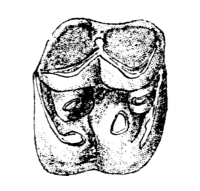
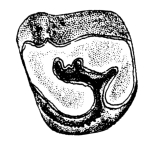
Fig. 14. Upper molar. 2 of
the right side—natural size, after Ameghino.
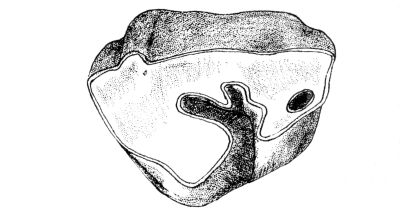
Of the upper dentition we know only what Ameghino has given us. The
molar is distinguished by the presence of both the protoconule and
metaconule, by the development of the posterior cingulum and by the
presence of three external styles.
Measurements
Upper premolar 4, length 12 mm., width 15 mm.
Upper molar 2, length 14 mm., width 17 mm.
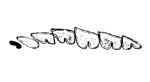
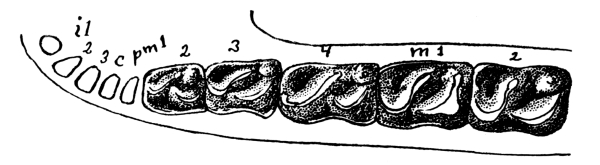
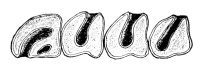
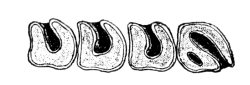
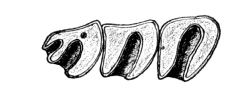
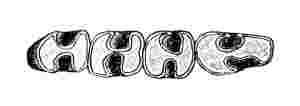
Fig. 15. Right lower dentition—natural size.
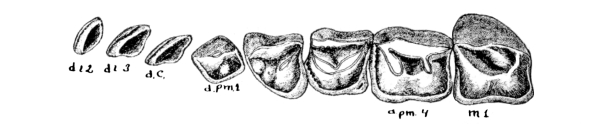
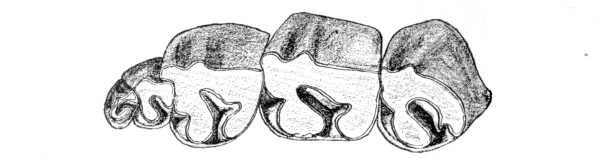
In the lower dentition, none of the teeth are reduced, and all are in
a continuous series, except that there is a small diastema either side
of pm. 1. The incisors are simple, compressed teeth, with but a trace
of a cingulum. The canine is incisiform and a trifle larger than the
incisors. Premolar 1 is also incisiform, and is isolated by a small
diastema on either side. The second premolar is longer and wider than
the first, and begins to show molariform characters, the anterior
portion being composed of a high compressed cusp, the posterior portion
by a low crescent on which but one cusp is fully developed. The third
premolar is composed of two complete crescents, and has the “pillar”
already developed opposite the posterior end of the back crescent. In
fact, the tooth is molariform, except as to the tiny extra cusp found
on the molars. Premolar 4 is more completely molariform consisting of
the same parts as the preceding tooth.
The molars may be distinguished by the presence of a tiny median
cusp on the rear of the tooth, behind the crescent, which, when the
tooth is worn, makes a median spur to the rear. In both the premolars
and molars, the teeth are characterized by their plumpness, and the
isolation and lowness of the cusps.
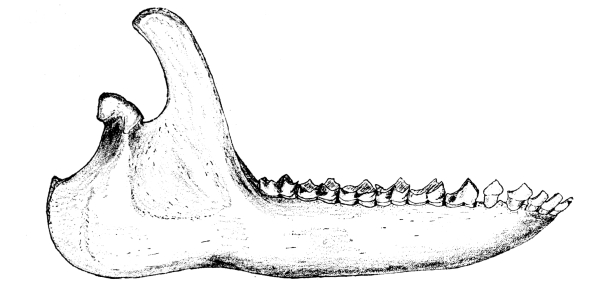
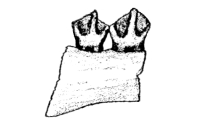
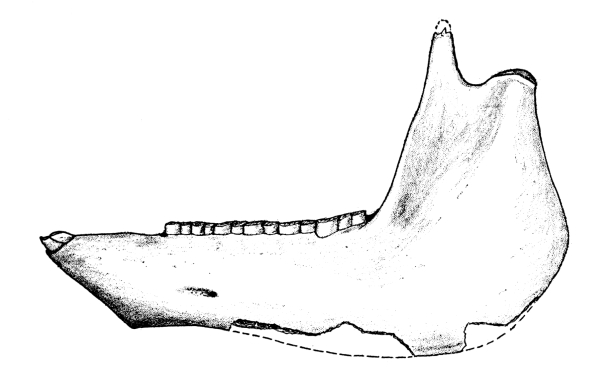
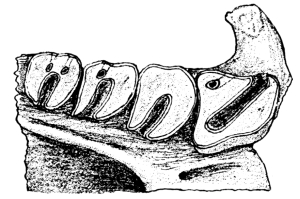
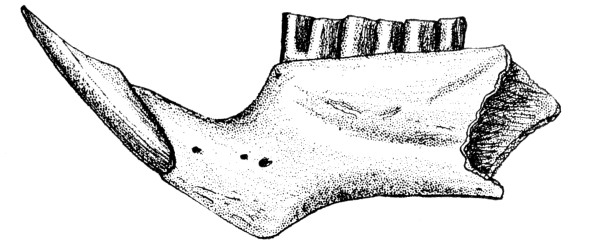
Fig. 16. Right mandible—½ natural size.
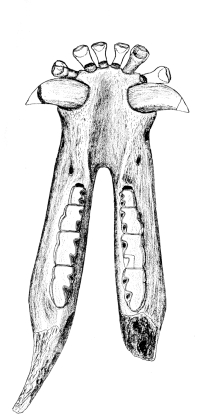
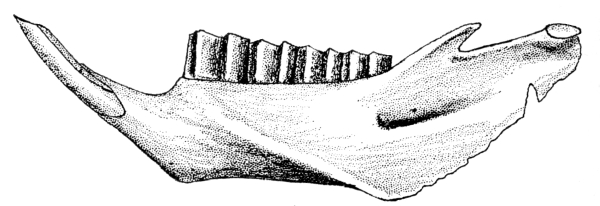
The two halves of the lower jaw are completely fused at the symphysis.
The horizontal ramus is thick, but low dorso-ventrally, giving the
appearance of a slender jaw. The posterior angle is prolonged backward
and bent inward. The fossa for the masseter muscle, while large, is
but faintly outlined. The ascending ramus hardly rises above the level
of the teeth, except as the slender coronoid projects to a good height
above the articular condyle and curves backward over it.
Measurements
Lower dentition,
total length
114 mm.
incisors, length
20 mm.
canine, length
8 mm.
premolar 2 to 4
35 mm.
molar 1 to 3
42 mm.
Mandible,
total length
188 mm.
height under molar 1
24 mm.
height to top of coronoid
95 mm.
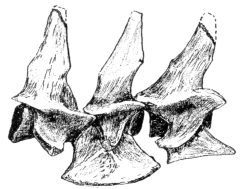
The dorsal vertebrae have short, wide, and somewhat depressed centra
(in this individual the epiphyses are free, though this is the only
indication of youth). The lower rib facets are small, that on the
posterior margin of the centrum being a mere streak, while the one
on the anterior margin is narrow. The upper rib facet is a rounded
convex surface on the end of a short stout transverse process. The
prezygapophyses are convex surfaces, wide transversely, but narrow
in the antero-posterior direction, while the postzygapophyses are
correspondingly narrow concave facets under the rear of the spines. The
spines are thin and high, and the neural canal is nearly circular in
section.
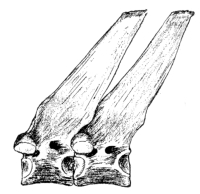
The lumbar vertebrae have laterally compressed, deep centra, with very
long transverse processes, shorting spines, and zygapophyses of the
subcylindrical interlocking type. In all their features the vertebrae
resemble those of Theosodon, being nearly as highly specialized
and in the same manner.
Measurements of Typical Vertebrae
Dorsal vertebra
No. 7,
length
23 mm.
width of centrum
22 mm.
Dorsal vertebra
No. 9,
length
28 mm.
Lumbar vertebra
No. 2,
length
29 mm.
Lumbar vertebra
No. 2,
width of centrum
24 mm.
Lumbar vertebra
No. 2,
width across transverse processes
160 mm.
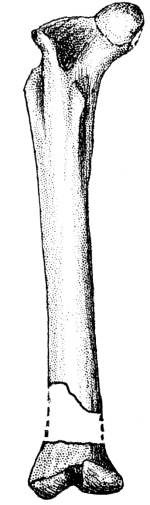
The femur is short and very stocky. The rounded head is carried on a
short neck, and does not rise nearly as high as the greater trochanter,
the sulcus for the round ligament being a broad, deep notch on the
posterior margin. The greater trochanter is rugose, heavy, and high,
but not incurved at the top. The lesser trochanter is a small, thin
ridge well below the head. The third trochanter is a large, thin
process, projecting almost directly backward, though curved inward at
the end, and is situated well below the middle of the bone. The shaft
of the femur is flattened above, but thick, and changes in the lower
part to subcylindrical. The condyles are small, subequal in size, and
widely separated, while the rotular trochlea is relatively wide and shallow.
Fig. 17. Left femur anterior side—½ natural size.
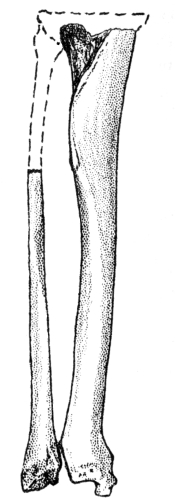
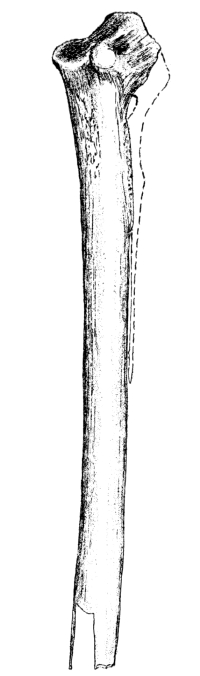
Fig. 18. Tibia and fibula (right)—½ natural size.
The tibia is about three-fourths the length of the femur, very stocky
and heavily built. On the proximal end, the convex external condyle is
much narrower antero-posteriorly than the larger and slightly concave
internal condyle. The low spine is bifid. A cnemidial crest extends
to the middle of the bone. On the distal end, the broad and shallow
external articular facet is separated from the narrow and deeper
internal facet by a low intercondylar ridge. The fibula is fused to the
tibia at the upper end, but is free below, being approximated to the
tibia along a rugose surface nearly an inch long. This bone is rather
slender and strongly bowed outward. Distally, there is a large facet
for the outside of the astragulus, the back part of which rests on
the calcaneum. This is peculiarly developed so that the articulation
represents what is two separate facets, the one for the outside of the
astragulus the other for the calcaneum. Here, however, they are blended.
Fig. 19. Right foot, the phalanges in outline
from the left foot—½ natural size.
Fig. 20. Astragulus plantar side— a, external facet; b, sustentacular facet—
½ natural size.
While in general the tarsus is similar to that of Theosodon,
there are some marked contrasts. The astragulus has an asymetrical
trochlea with a shallow groove, the external condyle being higher and
narrower than the internal. The head is depressed in the dorso-plantar
plane, is carried on a moderately long neck, and has a broad convex
facet for the navicular on which alone it articulates. On the plantar
side, the ectal facet is broadly oval and slightly concave, differing
from that of Theosodon in having no sulcus dividing it into
lobes. The broad sustentacular facet is slightly convex, and widely
separated from the ectal. On the external side the astragulus carries
an expanded articular facet for the inner side of the fibula, which,
instead of being vertical, is expanded below, making an oblique face
which is continuous with the fibular facet on the calcaneum. In this
feature Protheosodon is, as far as the feet are known, unique.
The calcaneum is a long bone with a club-shaped expansion of the upper
end. The fibular facet is small, being continuous, as above described,
with that on the outer side of the astragulus. On the face toward
the astragulus, the ectal facet is broadly convex (not divided as in
Theosodon), while the sustentacular facet is slightly concave.
The distal end is occupied by the large concave facet for the cuboid.
The navicular is of moderate height, with a prominent hook behind. On
the upper surface is only the broad, deep facet for the astragulus;
while the lower surface is divided into facets for the three
cuneiforms, and the external distal margin is beveled to make a narrow
facet for the cuboid. This navicular differs from that of Theosodon
in that the facet for the ectocuneiform is not cut step-like into its
external face.
The endocuneiform is a small scale-like bone with a narrow facet on the
navicular, and overlapping the inner side of Mt. II. The mesocuneiform
is small, with a flat facet above for the navicular, and a convex
one below for Mt. II, which is carried wholly on this bone. The
ectocuneiform is far the largest of these three bones, and carries a
broad facet above for the navicular, a similar one below for Mt. III, a
small facet on the internal side for the mesocuneiform and a second one
below that for the side of Mt. II, while externally there are facets
for the cuboid and for the side of Mt. IV.
The cuboid is large, the external side being longer than the internal.
The upper surface is entirely occupied by the facet for the calcaneum,
while the lower face is mostly devoted to the facet for Mt. IV, with a
narrow streak on the external margin for the vestige of Mt. V. The
internal face carries a boss beveled above by the facet for the
navicular, and below by the facet for the ectocuneiform.
All the metatarsals are short and heavy as compared with those of
Theosodon. Mt. II is compressed above, but enlarges below into
a subcylindrical bone, ending in an extensive articular trochlea for
the phalanx, the trochlea carrying a carina which extends into the
upper surface of the articular area. Proximally, it is so closely
approximated to the adjacent metatarsus that these could have had very
little independent movement. On the upper internal surface, there is
a roughened area, where the endocuneiform overlaps this bone. Mt. III
is slightly heavier than the others. On the distal end, its articular
trochlea extends well onto the dorsal surface, as does also the carina.
Mt. IV is a trifle shorter than the others and stouter. Mt. V is absent
but its former presence is indicated by the beveled facet on the
cuboid, and by the small roughened surface on Mt. IV.
The phalanges of the third digit are a trifle heavier than those of the
other two digits, but of approximately the same lengths. The ungual
phalanges were broad compressed hoofs, without traces of clefts.
Measurements of the Hind Limb
Femur,
length from the head
177 mm.
greatest proximal width
70 mm.
greatest distal width
56 mm.
Tibia,
total length
149 mm.
greatest proximal width
52 mm.
greatest distal width
56 mm.
Fibula diameter of shaft
9 mm.
Astragulus,
length
23 mm.
width
24 mm.
Calcaneum, length
62 mm.
Metatarsus II, length
45 mm.
Metatarsus III, length
48 mm.
Metatarsus IV, length
42 mm.
Phalanx 1 of digit III, length
24 mm.
Phalanx 2 of digit III, length
16 mm.
Phalanx 3 of digit III, length
17 mm.
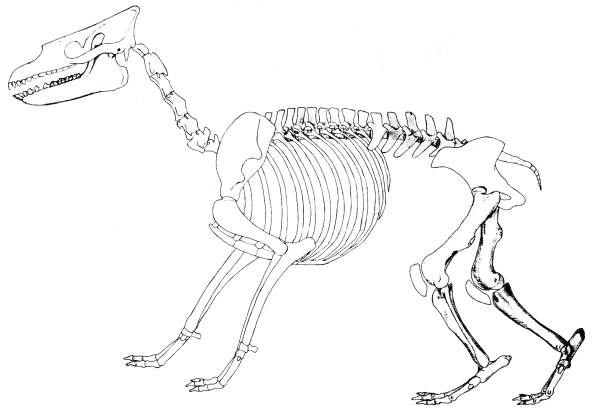
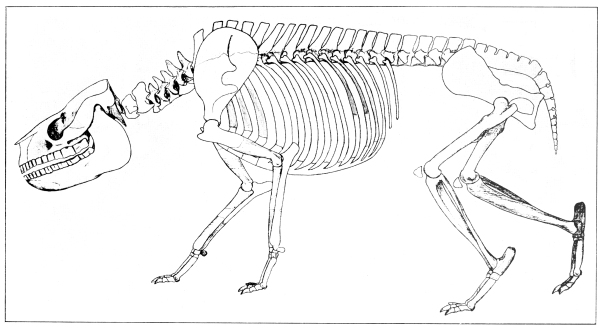
Fig. 21. (Half tone.) Restoration of Protheosodon coniferus
to show the relatively short limbs, and heavy build as
compared with Theosodon—⅕ natural size.
Restoration
In order to get a comparison of what is known of this form with
Theosodon I have outlined a restoration of the animal as a
whole, realizing that some essential parts are lacking, but the
general proportions can hardly vary greatly from those given. It
appears, first, that this form has an unusually short back. Though
the limbs and lower jaw are ⅗ the length of those of Theosodon
garrettorum, the vertebrae are ½ as long. I have assumed that the
number of vertebrae would prove to be the same as in Theosodon.
While the limb bones are ⅗ as long as in the Theosodon, they
are relatively half again as heavy and with the processes much more
developed. The greatest difference is found in the tarsus which is only
⅓ as long as that of Theosodon, though relatively as heavy,
and the foot was carried in a nearly plantigrade position the heel
raised but a little from the ground, though the anticular ends of the
metatarsals and the phalanges indicate that there was a considerable
freedom of movement of the various elements. The form seems to be
fairly close to the ancestral types such as Lambdaconus of the
Casamayor, the limbs of which, however, are entirely unknown, but I
should expect that when found these earlier forms would prove to be
approximately plantigrade.
Coniopternium Amegh., 1895 Bol.
Inst. Geog. Argen., t. 15, p. 632.
Coniopternium Amegh., 1897, Bol. Inst. Geog. Argen., t. 18, p. 453.
The genus is based on a calcaneum and astragulus of the macrauchenid
type, but of unusually large size. The real generic characters are
not evident in the description, but the presence of these bones,
and of three cervical vertebrae, which we also found, indicating a
macrauchenid of about the same size, are evidence that a form larger
than the Santa Cruz representatives will turn up in the Deseado beds,
for which this name may be reserved. The material is described under
the specific name C. andinum.
This family is based primarily on the genus Adianthus of the Santa
Cruz to contain some macrauchenid-like forms which, however, are of
much smaller size, and differentiated by the narrow character of the
teeth and their early tendency to hypsodonty. It seems to be a valid
series of dwarf types, which are all scarce and known only by the
most fragmentary remains. Two genera are described from the Deseado,
Tricoelodus, peculiar in having the posterior lobe of the lower
molars somewhat subdivided so that the tooth appears three-lobed; and
Proadianthus, known only by premolars which however show an
unusual development of the styles on the inner side of the teeth.
Tricoelodus Amegh., 1897, Bol.
Inst. Geog. Argen., t. 18, p. 454.
The genus is based primarily on the three-lobed character of the
molars, which is a secondary effect of an infolding on the inner side
of the posterior lobe. They are rooted, but strongly hypsodont. The
margins of the crescents are well developed and the “pillar” is a
prominent feature in the posterior crescent.
T. tricuspidatus Amegh., loc. cit. above.
Fig. 22. Lower right pm. 3-m. 1—natural
size, after Ameghino.
The species is the only one known of the genus, and its features are
those of the genus. The following measurements indicate the size, lower
pm. 3 to m. 1, 25 mm.; height of the mandible under molar 1 is 12 mm.
Proadianthus Amegh., 1897, Bol.
Inst. Geog. Argen., t. 18, p. 455.
This genus is known only by the last two premolars of the lower jaw,
which are compressed and moderately high. The two crescents are
markedly separated by a cleft from the external side of the tooth,
opposite to which is a high denticle, made by the fusion of the two
ends of the crescents where they come together.
Fig. 23. Lower right pm. 3 and 4— natural
size, after Ameghino.
P. excavatus Amegh., loc. cit. above.
The species is based on the two lower premolars described above. I
reproduce the figure given by Ameghino. The measurements are: length of
pm. 3 and 4, 10 mm.; height of mandible under pm. 4, 8 mm.
In the Deseado beds this group of running and hopping animals is well
represented, making about 14% of the Amherst collection, and varying in
size from a little larger than a rat to larger than a sheep.
The group all have the front teeth modified into cropping or gnawing
types, which grow permanently from persistent pulps; and the back
teeth also growing through the whole or a large part of life, and
also rootless, the crowns being variously infolded to make grinding
surfaces. The skull is flattened above, and abruptly truncated behind;
the cranium being large and swollen, the facial portion broad above
and excavated on the sides. The orbits are centrally located, of
considerable size, and unbounded behind. The tympanic bulla is swollen
and may be hollow or filled with cancellous tissue. This cavity of
the tympanic is continued above and expands in the upper part of the
squamosum, making a swollen capsule on either side of the back of the
cranium. The openings of the auditory meatus are well back and in a
tubular growth of the periotic which is directed back, and upward in
an entirely characteristic manner. The strong paroccipital processes
project far below the base of the carnium. The concave palate is wide
and carried well back behind the teeth ending in two strong pterygoid
processes. The mandible is deep, especially the back portion; has a
slender coronoid process, and a small rounded articular condyle which
would seem to indicate a forward and backward motion of the jaws. On
account of the agreement with these general features, I have placed
among the Typotheria the forms which Ameghino classified as
Hyracoidea.
While agreeing in the above general features, there is great variation
among the various forms. The first upper and lower incisor may be
greatly enlarged or of normal size. There is a tendency for the
third upper and lower incisor, the canines, and the first premolars
to be reduced and disappear, and all intermediate grades are found.
In the molars there is a regular tendency toward simplification; so
that in the upper molars of the earlier forms there is a deep inner
fold and a more moderate outer fold, either or both of which may
disappear completely, though in one series the fold seems to have been
accentuated instead of lost. The feet may be adapted to running or
hopping.
In the Deseado and Santa Cruz material, four series of modifications
may be distinguished which I have designated as families; (1) the
Archaeohyracidae, primitive forms in which the incisors are
little enlarged, with inner and outer folds on the molars, those on
the inner side of the upper molars being very deep, bulla small, feet
unknown; (2) Interatheriidae, first upper and lower incisors
rooted and of moderate size, inflexions on both the inner and outer
sides of the molars, bulla large, feet adapted to running; (3)
Hegetotheriidae, incisor 1 of upper and lower dentition greatly
enlarged and rootless, molars simplified, bulla large, feet adapted to
running or to hopping; (4) Eutrachytheridae, large forms with
the first upper and lower incisor enlarged and rootless, the upper
molars with the inner fold developed and bifurcated, bulla large, feet
unknown.
For comparison of the various genera, they are charted on page 55,
the dental character being used, as but few have the skeleton known, which
is especially so of the earlier genera.
CHART OF TYPOTHERIA
Age
Formula
Canines
U. Molars
Last i. molar
Toes
Hegetotherium
Santa
3 1 4 3
vestigal
no inner
3-lobed
cleft
Cruz
3 1 4 3
fold
Prohegetotherium
Deseado
no inner
fold
Pachyrukhos
Santa
1 0 3 3
lacking
no inner
3-lobed
not
Cruz
2 0 3 3
fold
cleft
Propachyrucos
Deseado
slightly
3-lobed
3 1 4 3
reduced
Prosotherium
Deseado
1 0 4 3
lacking
simple
3-lobed
slightly
pm.
2 0 4 3
inner fold
cleft
simple
Archaeophylus
Deseado
? 1 4 3
rather
deep inner
large
slight fold,
outer one
Interatherium
Santa
3 1 4 3
vestigal
slight inner
2-lobed
slightly
Cruz
3 1 4 3
and outer
cleft
folds
Protypotherium
Santa
3 1 4 3
large
deep inner
2-lobed
slightly
closed
Cruz
3 1 4 3
and outer
cleft
series
folds
Argyrohyrax
Deseado
3 1 4 3
large
bifurcated
inner fold
Eutrachytherus
Deseado
3 1 4 3
lacking
bifurcated
2-lobed
2 1 4 3
inner fold
Isoproedrium
Deseado
? ? 4 3
Archaeohyrax
Deseado
3 1 4 3
large
deep inner
3-lobed
3 1 4 3
fold, slight
outer fold
Plagiarthrus
Deseado
2-lobed
? ? 4 3
From the foregoing chart and the comparative figures of the upper and
lower dentitions, the variety and at the same time the homogeneity of
the Typotheria is evident. The gnawing front teeth resemble
those of rodents, especially in the genera where the enamel is lacking
on all but the front face, but this is entirely a parallelism and there
is no evident phylogenetic relationship. As to affinities with the
Hyracoidea, Sinclair[12]
has carefully balanced them and finds so little in common between the
two groups that he makes them a separate suborder. I find certain
features in common, like the lophiodont dentition with the tendency
toward hypsodont incisors, the inflation of the tympanic and the
extension of this up into the periotic region, and the general
arrangement of the basicranial foramena. On the other hand, there
are also numerous features in common with the Toxodonts, and several
peculiar to the group, so that I would feel that all the Notungulates
are descended from the Hyracoidea, and this group has developed
its peculiarities in South America, retaining however a little more of
the hyracoid aspect.
Fig. 24. Comparative series of upper dentitions
of Deseado and Santa Cruz Typotheria;
a,
Archaeohyrax patagonicus;
b,
Hegetotherium mirabile;
c,
Prosotherium garzoni;
d,
Pachrukhos moyani;
e,
Archaeophylus patrius;
f,
Interatherium extensum;
g,
Protypotherium australe;
h,
Argyrohyrax proavus;
i,
Eutrachytherus spegazzinianus—
all natural size.
Fig. 25. Comparative series of lower dentitions
of Deseado and Santa Cruz Typotheria;
a,
Archaeohyrax patagonicus;
b,
egetotherium mirabile;
c,
Prosotherium garzoni;
d,
Pachyrukhos moyani;
e,
Interatherium sp.;
f,
Protypotherium australe;
g,
Plagiarthrus clivus;
h,
Eutrachytherus spegazzinianus;
i,
Isoproedrium solitatium—
all natural size.
The Archaeohyracidae are the most primitive of the Deseado
forms, but as all the families are already separated before this time
the Deseado genera can not be considered as the ancestral ones, though
they seem to have retained more of the primitive features.
The Interatheriidae represent an offshoot line of development
in which the incisors are not much enlarged and the infoldings
of the teeth remain. The genus Archaeophylus seems to be
directly ancestral to the Santa Cruz genera Interatherium
and Protypotherium. In the family Hegetotheriidae
there is a strong tendency for the incisors to develop into very
large gnawing teeth, while the lateral incisors, the canine and
the first premolar, tend to drop out, and the molars become more
simplified. Propachyrucos seems to represent a hold over of
the most primitive type of these. The Prohegetotherium and
Hegetotherium have retained the less specialized feet and less
advanced type of teeth, while Prosotherium has tended to the
development of the hopping mode of locomotion, which is attained in
Pachyrukhos later. There thus seem to be two series inside of
this family. When the material is better known, it may be best to
separate the two series. The Eutrachytheridae have retained
the complexity of molars united with a permanently growing incisor.
They seem also to have developed into a series of comparatively large
forms, which, as they have advanced, have developed a bifurcated
fold on the inner side of the upper molars, which in its complete
development makes the upper molars three-lobed, as is seen in the
typical Typotherium, representing the end of the series up in
the Pampean formation. These relationships may be expressed graphically
as in fig. 26.
Fig. 26. Phylogeny of the Deseado and
Santa Cruz Genera of Typotheria.
Most striking of all the typothere peculiarities, is the development
of the first upper and lower incisor into permanently growing teeth,
having the enamel reduced to the anterior side only, making thus a
self-sharpening tooth similar to that of rodents. Such teeth are
characteristic of gnawing forms and would indicate that the form lived,
in at least a considerable part, on bark and twigs. In the eating of
such food and breaking up the wood cells for the contained protoplasm
and starch, an immense amount of chewing is involved, followed by a
rapid wear of the molars. This is met, as is characteristic in rodents
and grass eaters, by the development of first high-crowned, then
permanently growing molars. In acquiring the permanently growing tooth,
some of the irregularities of the crown are lost, others which are
deep-seated enough to affect the tooth even to the root are maintained,
so that especially the external and internal infoldings become a
persistent part of the tooth, having been impressed into the dental
papilla. A further supplement to the resistant character of the teeth
is seen in the development, in the most advanced types, of a cement
layer on the outside of the molars, a feature apparently also a part of
permanently growing roots.
The feet are generally those of a running type, but a single phylum has
acquired the hopping habit.
The above features seem to indicate a more special adaptation than
grass feeding. From the aspect of the whole Deseado fauna, we would
seem to be dealing with the inhabitants of an arid area, where bushes
have, in part at least, replaced the grass. The typotheres seem to
me to represent a part of the fauna which lived by gnawing the bark
and eating the twigs and leaves of bushes. This does not preclude the
eating of grass also, but I do not see how they would have developed
all their peculiarities by eating grass alone. The rodents are of such
insignificant size that they could hardly have monopolized this food
supply, and the typotheres seem to have adjusted themselves to, and
occupied the place of rabbits on our western plains; but went even
farther in developing in great numbers and varieties.
This family is differentiated by the presence of enamel on all sides of
the first incisor, by the unreduced condition of the lateral incisors,
and by the small bulla of the mastoid. These are primitive features.
Ameghino considered this family to belong to the hyracoids; but, as
explained earlier, I believe them to be true Typotheria, though
less specialized than the other families.
Archaeohyrax Amegh., 1897, Bol. Inst. Geog. Argen., t. 18, p. 431.
This interesting genus is known by a complete skull found by Ameghino
and of which we found no duplicates. I insert a reproduction of the
side view of the skull, and the dentition is shown in fig. 24 a,
and fig. 25 a. The dental formula is
3 1 4 3
———.
3 1 4 3
Incisor 1 is a little larger than the other incisors. Each
upper molar has a vertical groove near the anterior external margin. In each
upper premolar (after the first) and molar, there is a central pit surrounded
by enamel, which is opposite the internal inflexion, and in a young
individual, is presumably connected with the fold. In the same way, the
last three lower premolars and the lower molars each have an internal
pit, adjacent to the external inflexion. With advanced age all the
teeth show closed roots, another primitive feature. In spite of the
closed roots, the full dentition, and the enamel on the incisor; and
on account of the deep inflexions and the isolated pits, I consider
this genus a specialized side line, retaining many primitive features,
and expect to find the ancestor of the typotheres in some one of the
related Casamayor genera.
Fig. 27. Archaeohyrax patagonicus, after Ameghino—natural size.
Ameghino described three species, A. patagonicus, which we have
figured, and which has a length of 84 mm. from inc. 1 to m. 3 in both
the upper and lower dentitions; A. propheticus, of the same
size, but with the dental series closed; and A. concentricus of
larger size, the three lower molars having a length of 38 mm.
Plagiarthrus Amegh., 1897, Bol. Inst. Geog.
Argen., t. 18, p. 436.
This genus is known only by the lower premolars and molars, which are
permanently growing teeth, composed of two subcylindrical cylinders
almost entirely separated by the external and internal folds which
almost meet in the median line. On the outside, each tooth is coated
with a layer of cement. When better known it may prove that this genus,
so specialized in the character of the teeth, does not belong in this
family.
Fig 28. Left lower premolars 3 and 4
and molars 1-3— natural size.
P. clivus Amegh., 1897, Bol. Inst. Geog.
Argen., t. 18, p. 436.
This species is represented by a single specimen from the Chico del
Chubut, west of Puerto Visser, which preserves pm. 3 and 4 and the
molars. The characters of this, the type species, are those of the
genus. The total length of the five teeth is 36 mm., and fig. 28
shows in natural size the various individual teeth.
This family includes a large variety of forms from the formations from
the Deseado up to the Mt. Hermosa, but all agree in having the first
upper and the first two lower incisors enlarged into strong gnawing
teeth; in the reduction or absence of in. 3, the canine, and premolar
1 of the upper and lower dentitions; in having the external face of
the upper molars not inflexed; in lower molar 3 being three-lobed;
and in the bulla being inflated and hollow. There are in the family
two series of forms, at least, the one leading to the running
Hegetotherium, the other to the hopping Pachyrukhos, and
the very little known form Phanophilus which may fit into one of
the other series when better known.
In the Deseado the following genera are assigned to the family.
Prohegetotherium, like Hegetotherium, except that the
last premolar and the molars have a vertical furrow near the external
anterior margin.
Prosotherium,
1 0 4 3
———,
2 0 4 3
upper inc. 2 and 3 and lower inc. 3 vestigal,
upper pms. not molariform, molars with a deep internal fold.
Propachyrucos,
———,
3 1 4 3
lower jaw only, similar to Pachyrukhos
but have inc. 3, the canine, and pm. 1 present and only a little
reduced.
Phanophilus, upper molars only, but peculiar in having a strong
external medial column.
Prohegetotherium Amegh., 1897, Bol. Inst. Geog.
Argen., t. 18, p. 424.
This little known genus is characterized by the upper molars having an
external furrow near the anterior margin of the tooth. Otherwise it is
similar to Hegetotherium. Ameghino described a species where
the external surface of the bones was sculptured “like reptiles.” I
do not see how, with the arrangement of the muscles usual to mammals,
the sculpture could be similar to that of reptiles, and feel that this
is due to conditions of weathering. We did not find this species, but
did find a form which resembled it in general, but differed in being
smaller and with the external furrow less developed.
P. sculptum Amegh., 1897, Bol. Inst. Geog.
Argen., t. 18, p. 424.
This species is characterized by the deep external furrow on the upper
molars. The measure given is 34 mm. for the length of the three upper molars.
Founded on a portion of the right maxilla, carrying pm. 2 to 4 and
m. 1, found on the Chico del Chubut, west of Puerto Visser, by Waldo Shumway.
Fig. 29. H. Shumwayi— natural size.
The teeth are simple, with but a shallow external furrow near the
anterior margin of the premolars and molar. A film of cement covers
each tooth and extends to the top of the crown. The form is smaller
than P. sculptum.
Measurements
Upper premolar 3,
length 6 mm.,
width 3¼ mm.
Upper premolar 4,
length 7 mm.,
width 3½ mm.
Upper molar 1,
length 7 mm.,
width 3½ mm.
Prosotherium Amegh., 1897, Bol. Inst. Geog.
Argen., t. 18, p. 426.
In founding this genus, Ameghino says that lower pm. 1 is lacking, but
our specimens show it present as a vestige, and also show no trace of
lower inc. 3 against which Ameghino puts a question mark, making the
formula
1 0 4 3
———
2 0 4 3
as given above. The upper molars are similar to
those of Pachyrukhos except that they have an inner fold which
has been lost in Pachyrukhos. The premolars are unlike the
molars. Lower molar 3 is three-lobed. The description of the skeleton
is given under the specific description of P. garzoni, and this
shows a remarkable resemblance to the skeleton of Pachyrukhos,
throughout, so that I have no doubt but that Prosotherium is the
ancestor of Pachyrukhos, the changes in the teeth proceeding in
the line of simplification which seems to be general in this order, and
is in general characteristic of forms in which the teeth become rootless.
Ameghino described four species, P. garzoni, P.
triangulidens, P. robustum, and P. quartum, the last
two of which differ so little from P. triangulidens, that I can
not consider them as independent species.
P. garzoni, Amegh., 1897, Bol. Inst. Geog.
Argen., t. 18, p. 426.
This, the most abundant species of typotheres, occurs in our collection
from the Chico del Chubut, west of Puerto Visser, fifteen times; and
in one case the major part of a skeleton was found, consisting of the
skull and jaws, vertebrae of each type, ribs, most of the fore limb,
the pelvis and a hind limb.
The animal as a whole is smaller than P. triangulidens by
about 12%, and is of lighter build. The skull is relatively light and
narrow, especially in the rear, where the swollen hollow capsules of
the squamosum bones come within ten millimeters of meeting medianly,
whereas, in other species, they are twice as far apart. These hollow
capsules are in this species the most marked, and in this genus even
more developed than in Pachyrukhos. The lachrymal bone is
larger externally than usual, the lachrymal duct opening about four
millimeters in front of the margin of the orbit, and continuing to
the margin by an open groove. In P. triangulidens, the duct is
inside the orbit. The heavy maxilla makes a strong process for the
zygomatic arch, extending fully half way back along this arch. The
short, but fairly stout jugale has but a short contact with the maxilla.
Fig. 30. Left upper dentition; left lower
dentition— natural size.
Fig. 31. Left upper dentition No. 3083,
showing deciduous premolars.
In the dentition, the premolar and molar teeth are covered with a thin
film of cement, which is thicker on the outside of the upper teeth and
on the inner side of the lower teeth. On the opposite sides of these
teeth this film is so thin that it is often in part worn off.
Specimen 3083 preserves three of the deciduous premolars. Pm. 2 is
simple and could readily be taken for the corresponding permanent
premolar, except that it is, as are all the deciduous premolars,
rooted. Deciduous premolars 3 and 4, on the other hand, have a marked
inflexion on the inner side, giving them the appearance of permanent
molars. The series measures 31 mm. of which the deciduous premolars
occupy just half.
The mandible is deep, especially the posterior portion; has a very
slender coronoid process; and a slightly rounded articular condyle,
which is a little longer than wide, so that it would seem to allow a
forward and backward motion of the lower jaw.
Fig. 32. Left mandible—natural size.
The vertebrae are considerably crushed, but have in each case the
characteristics of the corresponding vertebra of Pachyrukhos.
Of the humerus, the head and distal ends are preserved, indicating a
rather long and slender bone, very like that of Pachyrukhos.
About three-fourths of the ulna is present, and it is also long and
slender, with a wide articular facet for the radius, which is entirely
separate from that for the humerus. Two metacarpals show the same
elongation of the limb, and the two phalanges preserved indicate a
small front foot.
Fig. 33. Left side of pelvis—natural size.
Fig. 34. Left femur— natural size.
Fig. 35. Patella— natural size.
Fig. 36. Tibia and fibula— natural size.
The pelvis is elongated, slender and lightly built, indicating the same
characteristics in the whole hind limb. The femur has a small rounded
head on a well marked neck. It is excessively long, longer than that of
Pachyrukhos, and also straighter. It is further distinguished by
the third trochanter being swung onto the back side of the bone. The
tibia and fibula are separate throughout their entire length, in which
this genus is in strong contrast to Pachyrukhos, where these two
bones are fused, both distally and proximally.
Fig. 37. Calcaneum, astragulus and
cuboid, from upper side— natural size.
Fig. 38. Astragulus from below— natural size.
The astragulus is also quite characteristic, the trochlear surface
being entirely on the dorsal surface, and the condylar ridges being
relatively low and flat. This trochlear surface is far from being
symmetrical, the inner ridge being much flatter and lower than the
outer. The head of the astragulus is rounded, on a long neck, and
directed obliquely inward. The fibular facet for the fibula is
crescent-shaped and vertical except that the small proximal end of the
crescent flares out. The outline of the sustentacular facet is that of
an acute ovoid, and is situated mostly on the neck of this bone. The
ectal facet is roughly rectangular in outline, strongly concave, and is
separated from the sustentacular facet by a deep groove.
The calcaneum is of moderate size, has a narrow fibular facet, a broad
ectal facet, and a moderately large sustentacular one. The facet for
the cuboid is slightly concave, and occupies the whole of the distal
end of the calcaneum.
Fig. 39. Right foot—natural size.
The metatarsals are moderately long and rather heavy, not quite as long
and slender as those of Pachyrukhos. The phalanges are also
shorter and slightly heavier than those of Pachyrukhos. We found
four proximal and four of the second series, all associated, which
probably indicates the full number of the toes. The ungual phalanges
are proximally narrow and high, then expand toward the tip, developing
into marginal expansions. There is but a trace of a cleft in the end of
these ungual phalanges.
Measurements
Skull, greatest length
99 mm.
Upper dentition, length inc. 1 to m. 3
55 mm.
Upper dentition, length pm. 1 to m. 3
31 mm.
Upper dentition, incisor 1, width
6½ mm.
Upper dentition, molar 1, length
6 mm.
Upper dentition, molar, width
4½ mm.
Mandible, greatest length
82 mm.
Lower dentition, length inc. 1 to m. 3
53 mm.
Lower dentition, length pm. 1 to m. 3
32 mm.
Lower dentition, molar 1, length
6½ mm.
Lower dentition, molar, width
3 mm.
Third metacarpus, greatest length
28 mm.
Pelvis, length front to back
83 mm.
Femur, greatest length (computed)
93 mm.
Femur, diameter of middle of shaft
9 mm.
Tibia, greatest length
90 mm.
Astragulus, length
14 mm.
Astragulus, width
11 mm.
Calcaneum, length
25½ mm.
Metatarsus III, length
32 mm.
First phalanx of digit III, length
12 mm.
Ungual phalanx of digit III, length
9 mm.
To make the similarity of Prosotherium with Pachyrukhos clearer,
I have restored Prosotherium, figure 40, from
which it will be seen that this genus is also a hopping form with a
plantigrade hind foot and a semidigitigrade front foot. In general it
compares very closely with Pachyrukhos, but the limbs are shorter and
the grade of specialization is not quite as high. It is, however, very
evidently the ancestor of Pachyrukhos.
P. triangulidens Amegh., 1897, Bol. Inst.
Geog. Argen., t. 18, p. 427.
P. robustum, Amegh., 1897, Bol. Inst. Geog. Argen., t. 18, p. 427.
P. quartum Amegh., 1901, Bol. Acad. Nac. Cienc. Cordoba, t. 16, p. 371.
This species is similar to P. garzoni except for size, the forms
running about 12% larger, and being heavier built. In this same line
the upper and lower molars are relatively wider and heavier. The top of
the skull also is wider. I have drawn carefully the skull and dentition
so that the detail can be seen from the figures. Beside triangulidens,
Ameghino described P. robustum, which, as far as I can see,
differs only in being about 5% larger, which is well within individual
variation, so I have considered it as a synonym. The same is the case
with P. quartum, which Ameghino distinguishes as being about the
size of P. robustum, and having lower pm. 1 present. The latter
character we found also characteristic of P. garzoni, so only
size remains and I do not consider less than 10% enough by itself to
make a species.
Measurements
Skull, length
110 mm.
Upper dentition, length inc. 1 to m. 3
57 mm.
Upper dentition, length pm. 1 to m. 3
35 mm.
Upper dentition, incisor 1, width
8 mm.
Upper dentition, molar 1, width
4½ mm.
Six specimens from Chico del Chubut
Propachyrucos Amegh., 1897, Bol. Inst. Geog.
Argen., t. 18, p. 425.
The genus is based on lower jaws, in which the characters of the
premolars, the molars and the first two incisors, resemble those of
Pachyrukhos; but in this genus the third incisor, the canine,
and the first premolar are retained and but little reduced. Ameghino
has described two species, P. smithwoodwardi, and P. aequilatus.
Fig. 41. Top view of the skull, palatal view—natural size.
P. smithwoodwardi, Amegh., 1897, Bol. Inst. Geog. Argen., t. 18, p. 425.
We did not find this species, but I reproduce Ameghino’s figure of it,
natural size. The length of the dentition from inc. 1 to m. 3 is 41
mm., height of mandible under m. 1 is 12 mm.
Fig. 42. P. smithwoodwardi after Ameghino, right
mandible—natural size.
P. aequilatus, Amegh., 1901, Bol. Acad. Nac. Cienc.
Cordoba, t. 16, p. 371.
This species is based on the anterior lobe of each lower molar, being
longer than the posterior. In size, molars 1 to 3 measure 24 mm.[13]
Phanophilus, Amegh., 1903, Anal. Soc. Cienc.,
Argen., t. 56, p. 202.
This genus is based on isolated upper molars, characterized as similar
to Protypotherium, but having a pronounced median vertical
column, instead of a groove on the external face of the upper molars,
a character unique among typotheres. The position of the genus with
this scant information is uncertain. One species is described, P.
dorsatus.
P. dorsatus, Amegh., loc. cit. p. 202.
In our collection, two isolated upper molars of this unusual form
occur, corresponding in size and pattern to the one described by
Ameghino. The external column, as seen by fig. 42, is narrow
and high. A single tooth measures 5½ mm. from front to back, and 3¾ mm. in width.
Fig. 43. External view of molar 1— natural size.
Fig. 44. Milk dentition, genus and species?— natural size.
Specimen 3142 gen. and sp.?
This specimen is the mandible with the milk dentition. The molars
present suggest Prosotherium triangulidens, but inc. 3 and the
canine are present, and the first two incisors are not enlarged, so it
would seem to represent a genus which I have not been able to identify.
Molar 1 is bilobed and similar to that of Prosotherium. The
deciduous premolars are all present, all rooted, and all remarkable
for their great antero-posterior elongation. Roots of the incisors and
canine are present, that of the canine being the largest, and those of
the incisors being about equal in size. This would suggest such a form
as Protypotherium, were this genus represented in the Deseado
beds.
The family is characterized by the incisors not being enlarged, by
upper and lower premolars and molars being inflexed on both the inner
and out sides, and by the inflated mastoid bulla being filled with
cancellous tissue. The only genus referable to this family, from the
Deseado beds, is Archaeophylus.
Archaeophylus Amegh., 1897, Bol. Inst. Geog.
Argen., t. 18, p. 423.
The genus is based on a skull which preserved most of the upper
dentition except the incisors, and which shows the characteristics of
the family in their inception.
Fig. 45. Archaeophylus patrius after Ameghino,
right upper dentition— natural size.
A. patrius Amegh., loc. cit.
We found no specimen of this interesting type, but I give a diagram of
Ameghino’s type, which shows the characteristics of the species and
genus. The length of the premolar-molar series is 27 mm.
The family consists of larger forms than the other families, and is
characterized by the upper molars having the inflexion bifurcated, so
that the teeth are at least incipiently three-lobed. I would place
in the family the genera, Eutrachytherus, Argyrohyrax, and
Isopoedrium.
Trachytherus Amegh., 1889, Act. Acad. Nac.
Cienc. Cordoba, t. VI, p. 918.
Trachytherus Amegh., 1895, Bol. Inst. Geog. Argen., t. 15, p. 623.
Eutrachytherus Amegh., 1897, Bol. Inst. Geog. Argen., t. 18, p. 429.
This genus was first called Trachytherus, and when this was
found to be preoccupied, changed to Eutrachytherus. Ameghino
gives the dental formula as
3 0 4 3
———,
2 1 4 3
but in my specimen which is a comparatively
young individual, I find a small alveolus for the upper canine, which
modifies the formula to
3 1 4 3
———,
2 1 4 3
In the first upper dentition found, incisors 2 and 3 were represented
by alveoli only, but our specimen shows these teeth, and we find
that they have enamel only on the outer face, making this genus more
specialized in this respect than any of the other typotheres. The
upper molars have the deep inner inflexion bifurcated, which makes
the tooth three-lobed, a character which grows more marked the older
the individual is. The premaxillae are high and bring the snout well
forward. The nasals are lacking, but the bounding bones show them to
have been unusually broad and flat. The maxilla extends up to the
nasals, and bounds the lower border of the orbit, and projects backward
in a heavy overhanging zygomatic process. The lachrymal bone is large
externally, with a large but low lachrymal tubercle just below which
is found the lachrymal duct, opening just in front of the margin of
the orbit. The frontals are short and wide, extending outward over the
orbit in a strong postorbital process which bounds half of the rear of
the orbit. The parietals, meeting medianly, rise in a strong sagittal
crest. Unfortunately the back part of the cranium is lacking. From
another specimen, which contained the brain cast, it is clear that the
bulla was much inflated and hollow, and that there was an inflation in
the upper part of the squamosum, as in Prosotherium, etc.
Fig. 46. E. spegazzinianus—½ natural size.
One specimen with the facial portion badly weathered, but retaining
enough to identify the species as E. spegazzinianus, preserved
the brain case, so that it could be prepared out.
The most striking feature of this brain is its relatively large size,
E. spegazzinianus being an animal about the size of a sheep, and
the brain is as large as that of the sheep, which is in strong contrast
to what would be expected of an Oligocene form. Compared with the
herbivorous Oligocene oreodont, Eucrotaphus, an animal of
approximately the same size, this brain is half again as large in
every way. A second striking feature is the short compact character
of the brain, the forebrain extending only a short distance in front
of the exit of the optic nerves, and extending backward so as to
cover most all of the cerebellum. Thirdly, the cerebral surface is
considerably convoluted, comparable to the convolution of a pig’s
brain. These features would indicate a specialization of the nervous
system, approximating that of the skeleton, and would indicate that
this group had advanced in intelligence and activity beyond the grade
of nervous development which is apparent in the contemporaries of the
Typotheria.
The relatively small olfactory lobes are entirely beneath the frontal
lobes and are seen only on the side view, but as there is a large
hippocampal lobe behind them, it would only seem proper to attribute
to these animals a well-developed sense of smell. The frontal lobes
are unexpectedly large, and are not clearly bounded off from the
parietal lobes. The occipital lobes are also well developed and make
a large portion of the backward extension of the cerebrum. The large
size of this area, together with the fact that the optic nerves are
large, indicates a good visual development. The temporal lobes are also
large and extend well down on either side. And, finally, below all the
others, come the swollen hippocampal lobes which complete this large
cerebrum.
The cerebellum is small having neither considerable width or height,
and being overlapped by the cerebrum. The optic nerves are represented
by large projections leaving the twixt-brain well forward under the
forebrain. The medulla is not clearly marked except to show that it,
too, was of fair size.
Fig. 47. Cast of the brain; A, from above;
B, from the side—natural size. Cer, cerebellum;
F, frontal lobe; H, hippocampal lobe; Oct,
occipital lobe; Op, optic nerve; T, temporal lobe;
x, cast of cavity in squamosal bone; Na, case of interior
of nasal cavity.
Just behind the hippocampal lobes, and connecting with the cerebellum
appear two striking projections. These represent the two large cavities
in the upper part of the squamosum which are so characteristic of
typotheres. The two large cavities clearly opened into the brain case by
a broad connection which is especially wide at the lower ends. I find
no traces of a connection with the bulla as described by Sinclair for
Pachyrukhos. Further down are two small knobs apparently also
representing cavities in the squamosum, and also connected with the
brain case. In considering the brain these should be overlooked; but
they doubtless represent some nervous function to which I have as yet
no clue.
Ameghino considered that Eutrachytherus was the connecting
link between Archaeohyrax and Typotherium. I feel that
this genus is too highly specialized to be a connecting form, though
it doubtless belongs to the series which ends in Typotherium;
and such a form as Argyrohyrax is more likely to be the really
ancestral form.
Two species are described, E. spegazzinianus, and E.
conturbatus, which is about 15% smaller. Our collection offers a
third species, E. grandis, which is nearly 50% larger than the
first named species.
Trachytherus spegazzinianus Amegh., 1889,
Act. Acad. Nac. Cienc. Cordoba, t. VI, p. 919.
Trachytherus spegazzinianus Lydekker, 1894, Anal. Mus. La Plata, pt. 3,
p. 2.
Trachytherus spegazzinianus Amegh., 1895, Bol. Inst. Geog. Argen., t.
15, p. 622.
Eutrachytherus spegazzinianus Amegh., 1897, Bol. Inst. Geog. Argen., t.
18, p. 428.
This species was founded on the anterior part of a skull with the full
upper dentition. My specimen differs from Ameghino’s in having a tiny
alveolus for the upper canine, the difference being due to my specimen
being younger.
The upper dentition is very characteristic. Incisor 1 is a powerful,
deep-set, curved gnawing tooth, with a heavy layer of enamel on the
anterior face, and none on the other sides; and is moderately beveled
in the rear as a result of wear. The second and third incisors are much
smaller, each having enamel on the outer face only, and with a marked
tendency to become vestigal. The suture of the premaxilla comes to the
base of inc. 3. There follows a short diastema, then a tiny alveolus
for the canine, closely followed by the first premolar which is also
small. The second premolar shows no inflexion. Beginning with the
third premolar there is a strong inner inflexion, which in the fourth
premolar and molars is bifurcated. The molars are considerably larger
than the premolars, the second being the largest of the series. With
each successive molar, the inflexion is wider, so that in m. 3 the
tooth is divided into three lobes of nearly equal size. All premolars
and molars are rootless, curved, and set so deep in the jaw that they
almost meet in the median line. A typical molar measures 50 mm. in
length, of which only 7-8 mm. project above the border of the jaw. All
the back teeth are covered with a thick coating of cement.
Fig. 48. E. spegazzinianus, right upper dentition— natural size.
The arrangement of the teeth of the lower jaw is shown in fig. 25 h.,
after Ameghino. The first and second incisors are greatly enlarged.
Incisor 3 is lacking, and the canine vestigal. Pm. 1 is small and
single-lobed, the succeeding premolars and molars being large and
divided into two lobes by a deep external, and a shallow internal
infolding.
Measurements
Skull, width between the orbits
60 mm.
Skull, width between the orbits
60 mm.
Skull, width across the postorbital processes
88 mm.
Skull, height from m. 2 to top of frontal
77 mm.
Skull, width of palate opposite inc. 2
42 mm.
Skull, width of palate opposite m. 2
62 mm.
Dentition,
length inc. 1 to m. 3
140 mm.
Dentition, incisor 1 ant.-post.
length 11 mm.
width 16 mm.
Dentition, pm. 3
length 11 mm.
width 13 mm.
Dentition, m. 2
length 22 mm.
width 16 mm.
Trachytherus conturbatus Amegh., 1895, Bol.
Inst. Geog. Argen., t. 15, p. 623.
Eutrachytherus conturbatus Amegh., 1897, Bol. Inst. Geog. Argen., t.
18, p. 429.
This species is founded on upper teeth, which are said to be relatively
smaller anteriorly, and actually smaller throughout, by about 15% than
are those of the preceding species. Molar 1 measures 17 mm. long by 9
mm. wide.
This species is based on upper molars 1 and 2 of the left side, from
the Deseado beds, of the Chico del Chubut, west of Puerto Visser.
The teeth are typically those of the genus and differ only from
other species in their large size, being some 50% larger than the
corresponding teeth of E. spegazzinianus. Each is covered with a
layer of fully half a millimeter of cement.
Fig. 49. E. grandis, molars of the left side— natural size.
Measurements
Upper molar 1,
length 29 mm.,
width 21 mm.
Upper molar 2,
length 30½ mm.,
width 18 mm.
Argyrohyrax Amegh., 1897, Bol. Inst. Geog.
Argen., t. 18, p. 435.
The genus is distinguished by the full dentition in closed series,
and by the upper molars having a deep internal inflexion which is
bifurcated, making the teeth at least incipiently three-lobed. Incisor
1 is relatively somewhat wider than in the preceding genus. It seems to
me that it is from such a genus that Typotherium arose, by the
reduction of the lateral incisors, the canine, and the first two
premolars, and by the increase of the bifurcated internal fold. Three
species have been described, A. proavus, the type species, A.
acuticostatus, of a little smaller size, and A. proavunculus
of still smaller size.
A. proavus Amegh., 1897, Bol. Inst. Geog.
Argen., t. 18, p. 436.
This species occurs three times in the Amherst collection. The best
specimen has pm. 1, 3, 4, and m. 1 and 2 of the upper jaw. The species
is characterized by a narrow furrow near the anterior external margin
of the premolars and molars; and by pm. 3 and 4 and the molars having
a deep internal bifurcated inflexion, which tends to make these teeth
three-lobed.
Fig. 50. Right upper dentition, the outline teeth
after Ameghino—natural size.
The genus is known only by the upper dentition, and while I did not
find any associated lower teeth, I believe that some one of the genera
known only by the lower dentition, like Plagiarthrus, is that
lower dentition.
Measurements
Upper dentition,
length inc. 1 to m. 3 (@ Ameghino)
71 mm.
premolar 1,
length 7 mm.,
width 4 mm.
premolar 3,
length 7 mm.,
width 6 mm.
premolar 4,
length 8 mm.,
width 6 mm.
molar 1,
length 8 mm.,
width 6½ mm.
A. proavunculus Amegh., 1897, Bol. Inst.
Geog. Argen., t. 18, p. 436.
The species is simply said to be much smaller than the preceding,
which, by the measurements, would figure out about 27%. The
measurements given are pm. 1 to m. 3, 33 mm.
A. acuticostatus Amegh. 1901, Bol.
Acad. Nac. Cienc. Cordoba, t. 16, p. 361.
This species is described as differing from A. proavus in being
somewhat smaller, but I find it about the same size. The specific
character is in the teeth being more compressed, and in the anterior
vertical margin of the upper molars being developed in the form of a
very salient crest.
Proedrium Amegh., 1895, Bol. Inst. Geog.
Argen., t. 15, p. 623.
Proedrium Amegh., 1897, Bol. Inst. Geog. Argen., t. 18, p. 431.
Isoproedrium, Amegh., 1903, Anal. Soc. Cient. Argen., t. 56, p. 18.
This genus is based on a toothless mandibular symphysis of large size,
on which the second incisor is indicated as larger than the first. We
found one lower jaw, which, though imperfect, confirms the above as a
genus and adds the following for generic characters; premolars with
a shallow inflexion on the inner and outer sides, the molars with a
shallow inner, and a narrow deep outer inflexion, heavy layer of cement
on the premolars and molars, enamel reduced on the anterior internal,
and the posterior internal corners of at least the premolars.
loc. cit. above.
Fig. 51. Right mandible, dotted line indicated
alveolus— natural size.
I have assigned the specimen shown in fig. 51 to this
species. Alveoli of the first and second incisors show inc. 2 considerably
larger than inc. 1. About the third incisor and the canine my specimen shows
nothing, being broken down in that region. Pm. 1 is represented by a
moderately large alveolus, 10 mm. long. Pm. 2 is 13 mm. long by 10
mm. wide, and slightly constricted medianly as far as the enamel is
concerned, the furrow in either side being filled with cement. Pm. 3
is 18 mm. long by 12 wide and similar. There is only an alveolus for
pm. 4, which is 23 mm. long. M. 1 is incomplete, but was about 23 mm.
long by 10½ mm. wide and is distinguished by the deep outer inflexion.
Each tooth present is covered with a heavy layer of enamel nearly a
millimeter thick; and each of the teeth is unique in that the enamel is
wanting on the anterior internal and the posterior internal corners of
the teeth.
The toxodonts of the Deseado are much more varied than those of
the Santa Cruz, and less so than those of the Casamayor; the teeth
less hypsodont than in the Santa Cruz, and more hypsodont than in
the Casamayor; are smaller than those of the Santa Cruz, and larger
than those from the Casamayor. It is a group of heavy, short-limbed,
nonadaptive animals, which, as time and competition progressed,
gradually diminished in numbers and variety.
The ancestral type must be sought in some such a form as
Henricosbornia, where the upper molars are brachydont, have
the four primary cusps distinct, and the connecting crests of small
size, and a cingulum moderately developed on the front and rear
sides. Progress is in the line of enlarging the crests, so that, in
the later forms, the two external cusps are united to make a wall;
and the anterior external and the anterior internal cusps are united
into the large anterior lobe; while the posterior external and the
posterior internal cusps unite to make the posterior lobe. These
may remain relatively simple as in Rhynchippidae[14];
or with this simple arrangement of the cusps, the cingulum may be developed
into a platform around the anterior, inner, and posterior sides of
the molars, as in the Isotemnidae; or, with relatively simple
molars, the incisors may be specialized into caniniform-like teeth as
in the Leontinidae; or secondary processes (or cristae) may
develop from the wall, making the complicated teeth characteristic of
Nesodontidae.
For convenience in discussing the modifications of the toxodont tooth,
I have, throughout, used the nomenclature illustrated in fig. 52,
taking one of the most complicated to show the ultimate development.
In the upper tooth there is, first, the external wall, from which
springs the anterior lobe, always the larger lobe, and composed
of the protocone and paracone of Osborn. In the rear is a smaller
narrower posterior lobe, composed of the hypocone, the metacone, and
the metaconule of Osborn. Between these is a large basin, which may
be subdivided by two cristae into secondary bays, referred to as bays
1, 2 and 3, while the cristae are in the same way referred to as
cristae 1 and 2. In some genera, the cristae are entirely wanting, in
others incipient. When fully developed, they are most marked in young
individuals and, as the tooth is worn, appear progressively shorter.
Behind the posterior lobe, there is a variable bay, number 4 which is
bounded behind by crista 3, which is apparently a development of the
posterior cingulum. This last crista and bay may or may not be present.
Fig. 52. A, upper molars of Coresodon; B, lower molars, somewhat worn— natural size.
The lower molars of toxodonts are all on the same plan, each tooth
being composed of two crescents, the anterior and posterior. The
ends of these crescents are referred to as the anterior, median and
posterior horns. The bay in the anterior crescent is simple and usually
disappears with the wear of the tooth without making a pit. In the
centre of the posterior crescent is the pillar or posterior tubercle
which Scott has found to be characteristic of these South American
Ungulates. It is, to my mind, the same as the mesostylid of the Fayum
hyracoids. Between the pillar and the median horn, I find a narrow
vertical ridge, which I have termed the septum; and which tends to
unite with the pillar inclosing a small bay, usually seen in worn teeth
as a pit. The bay between the septum and the median horn is designated
bay 2, and this quite generally appears in a worn tooth as a pit
(2). The bay between the septum and pillar is designated bay 3, and
is usually seen as a tiny pit, which however does not extend as deep
into the crown as the other pits and is usually lost when the tooth
is about half worn off. The bay between the pillar and the posterior
horn is numbered 4, and is usually open, though in a worn tooth it also
may appear as a pit. The effect of wear is shown by comparing B and C
in fig. 52, the latter being the same tooth sectioned a
little below the middle. I find in studying a lower molar of Coresodon that
bay 3 becomes a pit after some 6 mm. are worn off, while bays 2 and 4 remain
open until some 10 mm. are worn off when they also become pits. Pit 3
will disappear when 12 mm. are worn off, but pits 2 and 4 run to the
base of the crown.
The various genera of the Toxodontia in the Deseado I would
divide into four families as follows:
Rhynchippidae: molars brachydont, secondary cristae lacking or
little developed, none of the incisors caniniform, limbs slender, feet
digitigrade, digits 3-3.
Leontinidae: molars brachydont, secondary cristae lacking
or little developed, upper inc. 2 and lower inc. 3 developed into
caniniform teeth, limbs heavy, feet digitigrade, digits 3-3 (according
to Gaudry).
Isotemnidae: molars brachydont, secondary cristae more or
less developed, crowns contracted at the top, congulum more or less
developed into a platform, skeleton unknown.
Nesodontidae: molars hypsodont, secondary cristae highly
developed, upper inc. 2 and lower inc. 3 caniniform, limbs heavy, feet
digitigrade, digits 3-3.
This family name is used for the three genera Rhynchippus,
Morphippus, and Eurygeniops, which made up a part of
Ameghino’s family, Notohippidae. These forms I find much
simpler than Coresodon, Interhippus, Stilhippus,
and Nesohippus, which, by their molars, should be associated
with Nesodontidae, unless it should prove that they did
not have the incisors enlarged to caniniform teeth, in which case
another disposition will have to be made of them. Ameghino places the
Rhynchippidae among his Hippoidea, leading to horses,
but we found a nearly complete skeleton of Rhynchippus equinus
which in all particulars is typically toxodont. In the Deseado we found
fourteen specimens belonging to this family, and strangely enough they
were all Rhynchippus, and all of the species R. equinus.
This family is distinguished by the brachydont, or nearly brachydont,
molar teeth, being relatively simple, and the secondary cristae not
being developed. The large basin in the upper premolars and molars is,
therefore, not subdivided, but is deep, and rather narrow, usually
appearing as an oblique pit in the centre of the crown. There is no
enlargement of the incisors to make caniniform teeth. Both the upper
incisors and the canine have in the crown a longitudinal groove, which
on wear becomes a pit, and being shallow may disappear entirely. The
lower teeth are those typical of all toxodonts. The feet are tridactyl,
and compact.
The following three genera may be distinguished:
Rhynchippus
Morphippus
Eurygeniops
Formula
3 1 4 3
3 1 4 3
3 1 4 3
3 1 4 3
3 1 4 3
3 1 4 3
moderately
short muzzle,
short heavy
Skull
long
with slight
muzzle,
muzzle
constriction
with marked
behind canines
constriction
behind canines
Upper incisors
groove or pit
groove or pit
groove or pit
Lower incisors
cingulum on
no cingulum
no cingulum
the inner face
Upper premolars
cingulum on
int. cingulum
int. cingulum on
ant. corner
on ant. corner
ant. int. corner
Upper molars
basin deep
basin shallow
basin deep, with
incipient
secondary bays
Lower molars
4 bays
bays 1 and 2
bays 1 and 2
only
only
Rhynchippus Amegh., 1897, Bol. Inst. Geog.
Argen., t. 18, p. 462.
The teeth of both jaws are rooted, but tend to be hypsodont. The
elongated incisors of the upper series are characterized by the
presence of a longitudinal furrow in the top of each tooth, which,
with wear, becomes a pit, and, as it is shallow, disappears in old
individuals. This is the only suggestion of a horse character in the
genus, but the pit in a horse’s incisor is a late development, and here
it is also probably a specialization due to eating grass. Incisor 1 is
the largest and they decrease in size toward either side. The canine is
small, and is also marked by having a furrow in the crown, but in this
case it is transverse to the long axis of the jaw.
The premolars are peculiar in having on the anterior internal corner
a highly developed cingulum, which so builds out the tooth that it is
usually wide and is rectangular in outline. As this cingulum rises, it
incloses a bay on the ant. int. corner of the tooth, which, with wear,
becomes first a bay, then a pit, and lastly may disappear entirely
in old age. On each premolar the anterior and posterior lobes are
developed, inclosing between them an elongated basin, which with wear
becomes a long narrow pit. On the molars, the cingulum on the ant. int.
corner is wanting entirely. The external anterior corner of the tooth,
however, is prolonged, so that the crown has a rhomboidal outline. The
crown is made up in the typical manner of the wall, the anterior, and
the posterior lobes, which inclose between them an elongated basin,
which, as in the premolars, becomes, on wear, a pit extending obliquely
across the tooth.
The lower incisors have no furrows in the crowns, but in this genus
there is a small cingulum on the inner side just above the base of
the enamel. The lower canine is incisiform, and also has the basal
cingulum. Each of the premolars has, on the external side, a median
vertical groove, beginning at the base of the enamel, and widening
toward the top. This is progressive if less marked from pm. 1 to pm.
4. The premolars and molars consist essentially of two crescents, the
shorter anterior, and the posterior which is about twice as long as the
anterior. The details are as described on page 96, and seen in
figure 55.
The skull is of moderate height, nearly flat on top with wide zygomatic
arches. The sagittal crest is moderately high, and slightly convex in
the antero-posterior direction. The occipital region is overhanging
and topped by short lambdoidal crests, which, extending to either
side, unite with the zygomatic arches. The nasals are large, roughly
rectangular, and slightly constricted just in front of the middle. The
frontals are short, and project over the orbits in strong processes.
The maxilla is large, bounding the front of the orbit, and extending
backward in a strong zygomatic process which makes nearly half of the
arch. The jugal, while stout, is short, and reaches from the long
zygomatic process of the maxilla to the short one of the squamosum.
The lachrymal bone is tiny, with a low tubercle, just below which is
situated the lachrymal duct, just on the margin of the orbit. Just
behind the zygomatic arch, the squamosum is inflated and contains
a large hollow chamber, as is typical among toxodonts. The mastoid
bullae, while relatively small, are swollen into a globular form, and
have a large hollow chamber. The palate extends back to just behind the
last molar, a feature distinguishing this genus from Morphippus.
Of the vertebral column, twenty-six vertebra are preserved (a few being
represented by neural arches only). The atlas and axis are unknown.
Five cervicals are present, each with a short, slightly opisthocoelus
centrum, and with low weak spines. The foramena for the vertebra artery
are usually large. Cervical 3 has a rather slender transverse process,
projecting down—and backward. On cervicals 4, 5 and 6, these lateral
processes are enlarged into broad lamellae, which reach their maximum
of size on the sixth. Cervical 7 has no lamella, simply a slender
transverse process. These transverse processes are strikingly like
those of Nesodon. The thoracic vertebrae (of which I have complete
or in parts 15) have moderately high spines, which resemble those of
Adinotherium, not only in the general build, but also in the presence
of a foramen for the exit of spinal nerves through each neural arch.
These foramena can not be referred to as adaptations, but are special
features indicating close relationship with the Nesodontidae.
Six lumbar vertebra are present, each having broad depressed centra,
and short wide spines. The rest of the column is unknown.
The distal portion of the humerus is preserved, showing the trochlea to
be relatively narrow, with a prominent internal phlange for the ulna.
The epicondyles are both small. The supratrochlear fossa is moderately
deep, the anconeal fossa very deep, a large perforation connecting the
two. Of the ulna, only the distal end is preserved, and it is marked
by a prominent styloid process, ending in the facet for the pyramidal,
this facet continuing uninterruptedly into that for the pisiform.
The two ends of the radius are preserved but its length can only be
conjectured. The proximal end has a large facet for the humerus; the
distal end two facets, for the scaphoid and luna respectively, the
two being almost continuous, except as the outline of the shallow
depressions is constricted near the middle.
The carpus is preserved in toto and is decidedly weak for an
animal of this size, though no more so than is the case of Nesodon and
Adinotherium, with which forms the arrangement of the bones agrees
in almost every detail. The scaphoid has a broad facet on the upper
side for the radius, on the ulna side a narrow band-like facet for the
luna, and distally facets for the trapezoid and the magnum, none for
the trapezium. The luna is a larger bone with a broad radial facet
on the upper side, a narrow facet for the scaphoid on the radial
side, a larger one for the pyramidal on the ulnal side, and two broad
facets for the magnum and unciform on the lower side. The pyramidal
is a low, flattened bone, with a cup-like facet for the ulna on the
upper surface, an elongated flat facet for the pisiform on the palmar
surface, and below a broad facet occupying the entire lower side for
the unciform. The pisiform is shaped like a tiny calcaneum, and, beside
the facet for the pyramidal, has a broad contact on the styliform
process of the ulna. The trapezium is a flattened nodular bone, resting
against the side of the upper end of Mc. II, for which it has a
flattened contact surface, but it does not properly articulate with any
of the carpals. The trapezoid is a small bone, cuboidal in shape, with
the proximal facet for the scaphoid rounded, and with a narrow facet
for the support of Mc. II on the distal end. The magnum is a larger
bone, articulating proximally with the scaphoid and luna, on the ulnal
side with the unciform and distally supporting Mc. III. The unciform is
the largest of the carpal bones, articulates proximally on the luna and
pyramidal, on the radial side with the magnum, and distally carries Mc.
IV, while on the ulnal side there is a facet for the modular vestige of
Mc. V.
The metacarpals are longer than those of Adinotherium, and are much
more closely pressed together, making a narrower, firmer foot. Three
metacarpals are present (beside the modular vestige of Mc. V.). Mc. II
and Mc. IV are slightly shorter than Mc. III, but not materially
weaker, so that all three would reach the ground when the animal was
standing. Though closely packed, the metacarpals are not grown together
at any point. Distally each has a narrow trochlea, which carries a
median crest on the palmar side only. Under the distal end of each
metacarpal, there is a pair of small sesamoid bones.
All the phalanges are very short and weak, with the articular surfaces
cut under obliquely, suggesting that the toes are bent upward. Distally
each toe ends in a slender cleft ungual phalanx, suggesting a claw-like
hoof. Rhynchippus clearly walked in a semidigitigrade manner,
the weight coming principally on the metapodials, the foot as a whole
resembling that of a dog.
The pelvis is unidentified. Though the bones are of about the same
weight, the hind limb is longer than that of Adinotherium. The femur
has a rounded head on a short but distinct neck, with the pit for the
round ligament on the posterior margin of the head. The narrow digital
fossa is deep. The greater trochanter is rugose and strong, but does
not rise quite to the height of the head. The lesser trochanter makes
a strong shelf-like process well below the head, while the third
trochanter is a prominent process about the middle of the shaft, on the
posterior side. The shaft is broad and flattened above, but narrows and
becomes circular in section below. The condyles are relatively small,
the inner being the smaller and more convex, while the outer is broader
and less convex.
The tibia and fibula are a little longer than the femur, fused
proximally, free distally, as in toxodonts. The proximal end of the
tibia is too weathered to permit detailed description. However the
upper end is wide and flattened from front to back. Distally the bone
narrows until the lower part of the shaft is circular in section, the
distal end enlarging again in the neighborhood of the articulation. The
fibula has a broad facet for the inner side of the astragulus, and on
the distal end a flattened slightly concave facet for the calcaneum.
The calcaneum is longer than in Nesodontidae. It is, however,
heavy and stout, the tuber broadening slightly toward the free end, on
the plantar side of which there is a tendinous sulcus as in Nesodon.
The fibular facet is wide, rectangular, and convex. Of the astragular
facets, the sustentacular extends well back onto the tuber, and the
ectal is the usual ovoid surface. Distally there is a broad slightly
concave facet for the cuboid, and external to this a narrow surface
for contact on the navicular. Except in length, this bone is very like
that of Adinotherium. The astragulus and rest of the tarsal bones are
wanting. Parts of the metatarsals and a phalanx indicate that the hind
foot is of the same tridactyl type as the front, differing only in that
the median digit seems to be relatively a little heavier.
Ameghino described three species of Rhynchippus, R. equinus, R.
pumulis, and R. medianus.
R. equinus Amegh., 1897, Bol. Inst. Geog.
Argen., t. 18, p. 463.
This species is the dominant one in the Deseado from the Chico del
Chubut, west of Puerto Pisser, no less than fourteen individuals
being represented in our collection, three by skulls, and one by the
major part of a skeleton which was found associated with the skull of
Leontinia, but was determined as belonging to this species, by
the duplication of the radius with a specimen having the radius and
lower jaws associated. The description of the generic characters is
largely based on this skeleton. The three species are differentiated
largely by their size, R. equinus being the largest, but as compared
with R. pumulis it is not only larger but much heavier built.
Fig. 53. Dorsal view of skull— ½ natural size.
The skull has been described under the generic discussion. In young
individuals, the furrow in the incisors and canine is marked as a
groove, later as a pit, and still later is lacking altogether, as is
the case in the specimen figured, for all three of my more complete
specimens are old individuals, as is also Ameghino’s type. All the
incisors show the cingulum near the base of the enamel. On account
of the development of the cingulum on the inner anterior corner of
the premolars, these teeth are broadened out and overhang the palate
in a marked degree, and are also much wider than long. Molar 1 is
intermediate in character between the premolars and the succeeding
molars, being only slightly rhomboidal in outline, while in the last
two molars the anterior external corner is markedly prolonged.
Fig. 54. Left upper dentition, old individual—
½ natural size.
Fig. 55. Right lower dentition of R. equinus; A, of a young individual; B, of an old individual—
½ natural size.
In different individuals, the lower jaw varies greatly in height, but
this seems to me to be individual and sex variation. The three incisors
and the canine are subequal in size, closely crowded, and each with a
small cingulum near the base of the enamel.
Measurements of Skull,
Specimen 3191
Skull, length from front of nasal to back of lambdoidal crest
211 mm.
Skull, width across zygomatic arches
172 mm.
Skull, width across postorbital processes
78 mm.
Skull, height above molar 2
84 mm.
Dentition, from upper inc. 1 to molar 3
140 mm.
Dentition, from lower inc. 1 to molar 3
136 mm.
Mandible, height under molar 2
35 mm.
Mandible, height under the articulation
118 mm.
The atlas and axis are wanting, and the characteristics of the other
cervicals have been given under the generic description.
Measurements Specimen 3291
Cervical 3,
length of centrum
18 mm.
Cervical 5,
length of centrum
18 mm.
Cervical 6,
length of centrum
21 mm.
Cervical 6,
height from base of centrum to top of spine
74 mm.
Cervical 7,
length of centrum
21 mm.
Cervical 7,
height from base of centrum to top of spine
55 mm.
Fig. 56. Cervicals. 5, 6 and 7— ½ natural size.
Fig. 57. Dorsal 6 and 7— ½ natural size.
The first three or four of the thoracic vertebrae are represented
only by their neural arches and spines. There were at least fifteen
in the series, for I have that number represented, but more probably
the number was sixteen as in the case in Adinotherium. Typical
vertebrae measure:
Specimen 3291
Thoracic 3,
length of centrum
21 mm.
Thoracic 3,
height from base of centrum to spine
56 mm.
Thoracic 6,
length of centrum
22 mm.
Thoracic 6,
height from base of centrum to spine
79 mm.
Thoracic 14,
length of centrum
26 mm.
Thoracic 14,
height from base of centrum to spine
65 mm.
In my series, there are six lumbars, which is one more than is credited
to Adinotherium, though in that genus the number has not been
definitely fixed. Typical lumbars measure as follows:
Lumbar 2,
length of centrum
29 mm.
Lumbar 2,
height from base of centrum to spine
65 mm.
Lumbar 4,
length of centrum
31 mm.
Lumbar 4,
height from base of centrum to spine
57 mm.
There is nothing to represent the sacrum or caudals.
Only the lower half of the humerus is preserved and that with specimen
3191, and it measures:
Humerus,
diameter of shaft
22 mm.
Humerus,
greatest width of distal end
46 mm.
Humerus,
width of trochlea
36 mm.
Fig. 58. Humerus— ½ natural size.
Fig. 59. Right front foot— ½ natural size.
The distal ends of the radius and ulna are preserved in specimen 3291,
as they were found in association with the carpus.
Radius,
diameter of the distal end
29 mm.
Ulna,
diameter just above styloid process
21 mm.
Ulna,
diameter of styloid process
11 mm.
The carpus is carefully drawn, from which the various measurements may
be obtained. There is a tendency for the two rows of carpals to
alternate, but this is not advanced to any considerable degree. The
trapezium is entirely isolated from the other carpals, and lies as a
flattened scale, on the side of the upper end of Mc. II.
The metacarpals are closely crowded together, making a compact foot
with very little freedom of motion in its upper part. The three carpals
are of nearly equal length, though the third is slightly heavier and
longer than the others, but there is no tendency toward a further
reduction of the toes.
Fig. 60. Digit 4 of Rhynchippus from the
side— ½ natural size.
Fig. 61. Pair of sesamoids under Mc. IV— ½ natural size.
Metacarpus II,
length
67 mm.
Metacarpus III,
length
74 mm.
Metacarpus IV,
length
69 mm.
Under each metacarpal are two small sesamoid bones which lie either
side of the low crest of the metacarpus. The toes are all short, with
flattened articular ends, which are cut under in a very oblique manner.
The second phalanx is much shorter than the others, while the distal,
or ungual phalanx, is the longest and highest of the three. Each ungual
phalanx is cleft by a deep narrow notch, much more suggestive of a claw
than a hoof. The phalanges of all the toes are subequal in size, so
that the measurements of the middle digit are given.
First phalanx of digit III,
length
12 mm.
Second phalanx of digit III,
length
8 mm.
Third phalanx of digit III,
length
16 mm.
As preserved, the femur is crushed, and the distal end of the rotular
trochlea is weathered off, but all the other characters are well
preserved. The femur is slender, with a small rounded head. The greater
trochanter is heavy but does not project above the head, the lesser is
small but well marked; and the third is usually far down the shaft. Of
the two condyles the inner is the smaller and more convex.
Fig. 62. Right femur posterior side— ½ natural size.
Fig. 63. Right tibia and fibula posterior
side— ½ natural size.
Fig. 64. Calcaneum— ½ natural size.
Specimen 3291
Femur,
greatest length
202 mm.
Femur,
diameter of head
26 mm.
Femur,
width across head and greater trochanter
62 mm.
Femur,
width of internal condyle
16 mm.
Femur,
width of external condyle
24 mm.
The tibia is much flattened at the upper end and tapers to nearly
circular in section in the distal portion of the shaft. It is fused
proximally to the fibula, but free distally.
Tibia,
length
222 mm.
Tibia,
greatest width proximally
51 mm.
Tibia,
least diameter of the shaft
24 mm.
Tibia,
diameter of distal articular end
23 mm.
The fibula is a very slender bone, with the distal end swollen and
heavy. As it rises from the carpus it is so twisted that it unites with
the upper end of the tibia almost on the posterior surface.
Fibula,
diameter of the articular end
17 mm.
Fibula,
least diameter of the shaft
10 mm.
The calcaneum is of moderate length, and very stout, resembling that of
Adinotherium, except that it is longer.
Calcaneum,
length
64 mm.
Calcaneum,
width
28 mm.
Of the hind foot there is preserved only the distal portions of two
metatarsals, which are about the same size and character as those of
the front foot, and a phalanx of the first row, also similar to the
same one of the front foot.
Figure 65 gives a restoration of the animal based on
the bones described in the foregoing pages. The animal in all features turns
out a typical toxodont, adapted, by the cropping teeth, and the broad-faced
premolars and molars, for a grazing animal, but its advancement in
adapting itself to feeding on grass has not proceeded very far, as is
indicated by the shortness of the molars. The legs are longer than
in the other families of the toxodonts which would signify that it
had developed some speed, but the feet have progressed toward the
modification of the hoofs into claws, indicating a foot more like that
of a dog, in which the weight is not carried on the ungual phalanges,
but rather on the ball of the foot, or bases of the metapodials.
I should not feel that this group was the ancestral one to later groups
of toxodonts, but it seems rather to represent a line which terminates
in the Deseado or very little later, not having run up into the
Santa Cruz. The line of ancestry for the toxodonts is rather through
Leontinidae.
R. pumulis Amegh., 1897, Bol. Inst. Geog.
Argen., t. 18, p. 464.
Fig. 66. R. pumulis—½ natural size; A, top of skull; B, upper dentition, after Ameghino.
We found no specimens of this species, but Ameghino has described a
complete skull, a figure of which is reproduced here. It indicates a
smaller lighter built animal, differing from R. equinus not only
in small size, but also in having a relatively longer and narrower
head. The individual is a rather old one, so that the pits in inc.
1 and 2 have disappeared, as is also the case with the cingulum on
the ant. int. corners of the premolars. Ameghino gives the following
measurements in his description.
Skull, length over all
155 mm.
Upper dentition, from inc. 1 to m. 3
80 mm.
R. medianus Amegh., 1901, Bol. Acad. Nac. Cienc.
Cordoba, t. 16, p. 375.
This third species is intermediate in size between the two foregoing.
No figure is given, but the following measurements give the size:
Upper molar 2, length, 17 mm., width
11 mm.
Length of lower molars 1 to 3
40 mm.
Height of mandible under m. 2
24 mm.
These figures would indicate a form about 15% larger than R.
pumulis, and 35% smaller than R. equinus.
Morphippus, Amegh., 1897, Bol. Inst. Geog. Argen., t. 18, p. 459.
This genus is very similar to Rhynchippus, with the same
dental formula, the same grooves in the upper incisors, and the same
pattern of the premolars and molars. It differs, however, in the
lower incisors having no cingulum at their base, in the upper molars
having a shallower basin, and in bays 3 and 4 being absent from the
lower molars. These features simply indicate a slightly less advanced
specialization, less hypsodont teeth. I do not think that the bays are
any of them lacking in unworn teeth, but in a less hypsodont tooth,
with the pits extending a less distance into the crown, all indication
of the bays disappears early.
M. imbricatus is described as the type species, and four others
have been described, all equal in size to M. imbricatus, and
distinguished by the teeth being slightly more compressed, by the
external cleft of the lower molars being deeper, or by variations in
the pits. All these features I consider to be either age characters
or individual variations, so that all five species of this genus are
lumped under M. imbricatus.
M. imbricatus Amegh., 1897, Bol. Inst. Geog. Argen., t. 18, p. 459.
M. hypsolodus Amegh., 1897, Bol. Inst. Geog. Argen., t. 18, p. 461.
M. complicatus Amegh., 1897, Bol. Inst. Geog. Argen., t. 18, p. 461.
M. fraternus Amegh., 1901, Bol. Acad. Nac. Cienc. Cordoba, t. 16, p. 374.
M. quadrilobus Amegh., 1901, Bol. Acad. Nac. Cienc. Cordoba, t. 16, p. 374.
The general characters of this species are given under the generic
description and I will here give only Ameghino’s measurements which go
with the figure:
Skull, length over
210 mm.
Skull, length of the palate
120 mm.
Upper dentition, length the inc. 1 to m. 3
120 mm.
Diameter of the palate opposite inc. 3
37 mm.
Diameter of the palate opposite m. 3
75 mm.
Height of mandible under m. 1
33 mm.
Fig. 67. M. imbricatus— ½ natural size; A, upper dentition; B, lower dentition after Ameghino.
Fig. 68. E. latirostris, palatal view,
after a photograph of the type— ½ natural size;
the cross hatched area represents matrix not yet removed.
Eurygenium Amegh., 1895, Bol. Inst. Geog. Argen., t. 15, p. 655.
Eurygeniops Amegh., 1897, Bol. Inst. Geog. Argen., t. 18, p. 464.
The name first given this genus was found to be preoccupied, and
therefore changed. It is a clear cut genus, differing from the others
in the family in the expansion of the front of the muzzle, and by the
heavy broad character of the skull.
E. latirostris Amegh., loc. cited above.
This is the type species and is based on a muzzle which has never been
figured, but which I figure, the drawing being made from a photograph
taken by Professor Scott and kindly furnished me. The characters of the
species are those of the genus, with the following measurements for
specific determination, quoted from Ameghino:
Palate, length
130 mm.
Palate, width between incisors 3
41 mm.
Palate, width between premolars 2
33 mm.
Palate, width between molars 3
56 mm.
Upper dentition, length from pm. R. to m. 3
82 mm.
Upper premolar 4, length
11 mm.
Upper premolar 4, width
19 mm.
E. normalis Amegh., 1897, Bol. Inst. Geog.
Argen., t. 18, p. 466.
This second species is described as being much smaller than the
preceding, the length from pm. 4 to molar 3 being 65 mm.
This family was established to include a group of large, heavily
built ungulates, not unlike rhinoceroses in form, which have rooted
teeth, the molars being similar to those of Rhinchippidae,
i. e., composed of a wall and an anterior and posterior lobes,
but with the cristae either lacking or little developed; and with the
second upper, and the third lower incisors developed into tush-like
caniniform teeth. Two genera are especially abundant, Leontinia
of the Deseado beds, and Colpodon of the Colpodon beds, the
former with the formula
3 1 4 3
———,
3 1 4 3
the latter with
3 0 4 3
———.
3 0 4 3
In many ways, the family suggests
Nesodontidae, and undoubtedly belongs to that series, if not
directly ancestral. The lower molars are distinctly of the same
type as in all the other toxodonts, but show a tendency to become
hyposodont.
The following genera have been assigned by Ameghino to the family. Some
of them are based on very scant material and I have ventured to suggest
in each case what disposition I have felt to be the proper one.
Leontinia, the type genus, is described in detail on
pages 109-115.
Scaphops is based on a mandibular symphysis, which is wider
than usual for Leontinia, and on a second upper incisor which
is compressed. The species in the genus Leontinia show a
marked degree of variability, and I can see in this only individual
variability, so that I place Scaphops under Leontinia and
S. grypus, as a synonym of L. gaudryi.
Steniogenium is based on a mandibular symphysis with roots only
of the teeth. The incisors are proclivous and inc. 3 small. I consider
this also as Leontinia, and the species S. sclerops as a
synonym of L. oxyrhynca, which I think is the female of L. gaudryi.
Ancylocoelus is a valid genus, differentiated by its dental
formula
3 0 4 3
———,
3 0 3 3
the loss of the upper canine and the lower canine
and first premolar distinguishing it from either Leontinia or
Colpodon.
Rodiotherium is based on a mandibular symphysis which would
indicate an animal with the same formula as the foregoing genus,
differing only in that lower incisor 3 is large. This, to my mind,
does not make a generic character, and at most the species, R.
armatum, can only be considered an independent species belonging to
the genus Ancylocoelus.
Loxocoelus is a very questionable genus, based simply on an
upper molar, which “is similar to that of Homalodontotherium,
but more squared.” I feel that in regard to this genus it should stand
as unknown until more material is found.
In our collection, over twenty skulls and jaws belonging to this
family turned up, but all clearly belong to two types, the typical
Leontinia gaudryi, and some others in which the caniniform teeth
are not so well developed, which are either L. oxyrhynca or, as
I believe, the females of L. gaudryi. It is this uniformity of
the material which leads me to doubt the validity of the considerable
number of genera which Ameghino has established, for I found on
sectioning the teeth that between the little worn crown and the much
worn one there was a marked difference in the appearance of the
infoldings and in the development of the pits.
Leontinia Amegh., 1895, Bol. Inst. Geog. Argen., t. 15, p. 647.
Leontinia Amegh., 1897, Bol. Inst. Geog. Argen., t. 18, p. 469.
Scaphops Amegh., 1897, Bol. Inst. Geog. Argen., t. 18, p. 475.
Steniogenium Amegh., 1895, Inst. Geog. Argen., t. 15, p. 654.
Steniogenium Amegh., 1897, Inst. Geog. Argen., t. 18, p. 475.
Colpodon Gaudry, in part, 1906, Anal. Palaeontologie, t. 1, p. 30.
The formula is
3 1 4 3
———;
3 1 4 3
type species L. gaudryi. Of all the animals in
the Deseado, this is the most abundant. Using this species as a basis, the
following are the characteristic features. The first upper incisor is a small
cropping tooth, with a well-developed cingulum high up on the inner
face, which, when the tooth is worn down to the proper level, unites
with the main part of the crown and incloses for a short time a small
pit. On the external face there is also a feeble cingulum near the base
of the enamel. The second incisor is greatly enlarged into a caniniform
tush. In the species L. oxyrhynca, this tooth is much smaller
but as this reduction of the tushes is the only difference, I consider
these forms as the female. The third incisor is again small, and has a
well-developed cingulum on both the front and inner faces. The canine
is similar to inc. 3.
The first premolar is much reduced in size, with a weak cingulum on
the outer face, and probably another on the inner side (the tooth is
too much worn in my specimen to be sure). Beginning with premolar
2, the upper teeth are molariform. The premolars are rectangular in
outline, each being much wider than long, and each having a cingulum
on the outer side. On the inner side, along the anterior half of each
premolar, there is a high cingulum, which, though interrupted at
the anterior corner, continues around onto the anterior face of the
tooth. On a worn tooth this anterior cingulum unites with the grinding
surface, and leaves a small pit in the anterior internal corner, which
is very suggestive of Rhynchippidae. In the middle of the
grinding surface, there is an oblique pit, the remains of the basin in
young teeth. The molars continue to increase in size toward the rear.
They have a vestige of a cingulum on the external side, no cingulum
on the inner side, but on the anterior side for about one third the
distance there is a cingulum similar to that on the premolars. In the
middle of the grinding surface is an elongated oblique pit, similar to
that in the premolars, but a little more advanced, there being a trace
of the development of cristae.
In the lower dentition, the first two incisors are small cropping
teeth, with the anterior face flattened and having a trace of a
cingulum; while on the inner face the cingulum is well developed.
Incisor 3 is developed into a tush corresponding to inc. 2 in the upper
dentition. As in the upper teeth, there are two types, that of L.
oxyrhynca with the tush only about twice the size of an incisor,
and that of L. gaudryi with it much larger.
All the premolars are molariform and of the typical toxodont character,
consisting of two crescents with a pillar and septum in the posterior
crescent. The septum, however, does not appear until on pm. 3 and on
all succeeding teeth, and is usually indicated by a tiny pit. From the
front to the back, the premolars are progressively larger, each having
a cingulum on both the internal and external faces. The molars continue
to increase in size progressively, and have the same characters as
the premolars, except that the crescents are more elongated, and the
cingula are gradually becoming smaller toward the rear.
The skull is low and heavy, with a low sagittal crest, and with the
lambdoidal crests continuous with the upper margin of the zygomatic
arches. The nasal bones are short and wide, and are markedly raised
above the nasal chamber. On the outer margin of each is a low boss,
somewhat as on the nasals of the rhinoceros, Diceratherium,
which would indicate that this form had a small pair of nasal
horns.[15]
The frontal bones are broad, projecting laterally in strong postorbital
processes, which, with those from the jugals, almost close the orbit
behind. The premaxillae are peculiar in having a median crest on the
upper surface, the top of the crest being rugose, as though in life it
had continued upward as a cartilage septum. The maxillae rise well up on
the sides of the skull, bounding the lower part of the orbit, and
having a short zygomatic process. The small lachrymal is but little
exposed on the exterior surface of the skull, the lachrymal pit
being well inside the orbit. The zygomatic arches are broad and
heavy, and composed mostly of the wide jugal bones. The palate is
highly arched and relatively narrow, the crowns of the premolars and
molars projecting inward over it, thus narrowing it still more. It
extends back well beyond the last molar. The large tympanic bullae
are hollow, and the cavity in the squamosum seems to be reduced in
size, as compared with Rhynchippidae or Nesodontidae.
The occipital condyles are set well apart and are sessile; and the
paroccipital processes are long and slender.
The atlas, axis and cervical 3 are associated with the skulls. The
atlas is short, heavy, and has the anterior cotyles broad, deeply
excavated and wide apart; while the posterior cotyles are nearly flat,
and high as well as wide. The transverse processes are only moderately
wide, but are very heavy, especially along the posterior margin. The
centrum of the axis is flattened, the neural canal, wider than high,
and the neural spine of moderate height. The anterior cotyles are broad
and moderately convex, and the odontoid process is a stout peg-like
process, somewhat higher than wide. Slender transverse processes
project sharply from the centrum, and have at their bases a large canal
for the vertebral artery. Cervical 3 is shorter than the axis, has a
less depressed centrum, a small neural spine, and short wide transverse
processes.
Though I have skulls and jaws to represent some twenty-five
individuals, no limb material was found in direct association with
any of them. However we did find a humerus, radius and ulna on the
same level and about fifteen feet from one of the skulls, and as it
corresponds in size, and as humeri of this type are the most abundant
skeletal bones found (as is also the case with the skulls), I have
considered it proper to associate these fore limb bones with these
skulls. The humerus is a stout bone, of medium length, with a large
sessile, and but little rounded head. The external tuberosity is
wide, thick and projects a little above the head, while the internal
tuberosity is so small as to be almost negligible. The shaft is
flattened laterally at the upper end, but distally is compressed in the
antero-posterior direction. The supratrochlear fossa is shallow, the
anconeal deep, but there is no foramen connecting them. The external
condyle is small, the internal much larger. The trochlea is narrow,
with a swollen articular area for the radius, and a wider saddle-like
one for the ulna. The ulna is a stout, nearly straight bone, slightly
longer than the humerus. The olecranon process, though large, is not
excessive. The sigmoid notch makes a deep semicircular cavity, with the
articular facets expanding on either side. It was closely fitted to
the radius so as to allow little or no rotary motion of the forearm.
The facet for the radius is a narrow band-like area just below the
sigmoid notch. The shaft is almost rectangular in section. Distally
the ulna contracts sharply into a heavy styloid process, on the end of
which is a large convex facet for the pyramidal, which merges without
interruption into the facet for the pisiform. The radius is a slenderer
bone, with a relatively small proximal head, but distally expanded into
a much larger articular end. My specimen is considerably weathered, but
shows a wide shallow articular facet for the humerus, and a band-like
facet for the ulna, but otherwise it gives little more than the length.
Of the hind limb, Gaudry[16]
figures the astragulus and the calcaneum, the former short and with
a low trochlea, the latter also short and with a broad facet for the
fibula. Gaudry also states that the foot was tridactyl and plantigrade,
but I am doubtful of the plantigrade feature.
Ameghino has made six species of this genus, L. gaudryi,
L. fissicola, L. lapidosa, L. oxyrhynca, L.
stenognatha, and L. garzoni. All of the first five are
described as of the same size as L. gaudryi. L. garzoni
is a smaller, about 60 per cent. of the size of the others. Of the
first five listed, the first three have the large incisor and I
consider them all L. gaudryi. L. oxyrhynca and L.
stenognatha are described as having small canines and I believe
that this is a sexual difference only, so have considered these two
species as also belonging to L. gaudryi, but females. I have
made a careful comparison of L. gaudryi and L. oxyrhynca
and find them identical in all the features except in the region of the
canines where the latter is weaker, and can see no more than sexual
differences. Usually with this weakness of the canine goes a smaller
or lighter build of the lower jaw which is what would be expected. The
points by which the various species were differentiated were, beside
the size of the canine, the presence or absence of pit 3, and the
variation in the foldings on the outer sides of the lower molars, which
I find on sectioning a tooth appear deeper or shallower according to
whether the tooth was more or less worn.
L. gaudryi Amegh., 1895, Bol. Inst. Geog. Argen., t. 15, p. 648.
L. gaudryi Amegh., 1897, Bol. Geog. Argen., t. 18, p. 472.
Scaphops grypus Amegh., 1895, Bol. Inst. Geog. Argen., t. 15, p. 629.
Scaphops grypus Amegh., 1897, Bol. Inst. Geog. Argen., t. 18, p. 475.
Steniogenium sclerops Amegh., 1895, Bol. Inst. Geog. Argen., t. 15, p. 654.
Steniogenium sclerops Amegh., 1897, Bol. Inst. Geog. Argen., t. 18, p. 475.
Leontinia fissicola Amegh., 1897, Bol. Inst. Geog. Argen., t. 18, p. 474.
L. (Senodon) lapidosa Amegh., 1895, Bol. Inst. Geog. Argen., t. 15, p. 649.
Females
L. oxyrhynca Amegh., 1897, Bol. Inst. Geog. Argen., t. 18, p. 472.
L. stenognatha Amegh., 1897, Bol. Inst. Geog. Argen., t. 15, p. 474.
Colpodon gaudryi Gaudry, 1906, Anal. Palaeontologie, t. 1, p. 30.
Fig. 69. Right upper dentition— ½ natural size.
Fig. 70. Lower dentition of male— ½ natural size.
Fig. 71. Lower dentition of female— ½ natural size.
This species is represented in the Amherst Collection by five more or
less complete skulls, and over twenty jaws, being by far the commonest
fossil of the Deseado beds on the Chico del Chubut River, west of
Puerto Visser. As mentioned above, there are two types, the first,
with larger canines and heavier mandibles, designated by Ameghino as
L. gaudryi, which I consider males; second, those with smaller
canines, and lighter mandibles, slightly smaller in size, which
Ameghino designated L. oxyrhynca and I consider females.
Practically all of the other species are based on mandibular symphyses
varying in details from the above, but in no case sufficiently for me
to see a specific variation.
The general features have been discussed under the generic description.
Incisor 1 has a long crown and a long root, and is greatly crowded by
the tushes. Incisor 3 and pm. 1 have the same crowded appearance. In
giving the measurements I have used a skull which is typically L.
gaudryi, a male, and parallel to it have put another skull, which
is typically L. oxyrhynca, the female. By comparing the two sets
of figures, the shortening, of which Ameghino speaks, will be seen to
be all in the region of the tushes.
Specimen 3290 Male
Specimen 3291x Female
Upper dentition,
length from inc. 1 to m. 3
227 mm.
Upper dentition,
length from pm. 1 to m. 3
180 mm.
Incisor 1,
length
12 mm.
Incisor 2,
length
25 mm.
Incisor 3,
length
11 mm.
Canine,
length
12 mm.
Premolar 1,
length
12 mm.
Premolar 1,
width
18 mm.
Premolar 2,
length
18 mm.
Premolar 2,
width
28 mm.
Premolar 3,
length
20 mm.
Premolar 3,
width
34 mm.
Premolar 4,
length
22 mm.
20 mm.
Premolar 4,
width
38 mm.
34 mm.
Molar 1,
length
28 mm.
24 mm.
Molar 1,
width
40 mm.
38 mm.
Molar 2,
length
36 mm.
33 mm.
Molar 2,
width
48 mm.
45 mm.
Molar 3,
length
46 mm.
46 mm.
Molar 3,
width
48 mm.
47 mm.
Lower dentition,
height of mandible under m. 1
66 mm.
56 mm.
Incisor 1,
length
8 mm.
8 mm.
Incisor 2,
length
10 mm.
10 mm.
Incisor 3,
length
23 mm.
13 mm.
Canine,
length
8 mm.
9 mm.
Premolar 1,
length
13 mm.
8 mm.
Premolar 1,
width
12 mm.
12 mm.
Premolar 2,
length
18 mm.
16 mm.
Premolar 2,
width
17 mm.
15 mm.
Premolar 3,
length
21 mm.
18 mm.
Premolar 3,
width
19 mm.
16 mm.
Premolar 4,
length
24 mm.
21 mm.
Premolar 4,
width
19 mm.
18 mm.
Molar 1,
length
33 mm.
27 mm.
Molar 1,
width
20 mm.
20 mm.
Molar 2,
length
40 mm.
37 mm.
Molar 2,
width
20 mm.
20 mm.
Molar 3,
length
57 mm.
57 mm.
Molar 3,
width
20 mm.
20 mm.
Fig. 72. Top view of skull of L. gaudryi (female)—¼ natural size.
In the skulls there is considerable variation in size in the different
individuals, but the proportions remain very much the same throughout.
In the female the snout is relatively a little shorter, and in general
the female skulls are from 5 to 10 per cent. smaller throughout. The
following two sets of figures illustrate the comparative sizes of the
two sexes.
Fig. 73. L. gaudryi, view of case of the skull,
female (L. oxyhynea)—¼ natural size; Tympanic bullae broken open.
Specimen 3335 Male
Specimen 3291x Female
Skull,
greatest length front to back
420 mm.
392 mm.
Skull,
greatest width
252 mm.
236 mm.
Skull,
length of nasal bone
115 mm.
102 mm.
Skull,
length of palate
235 mm.
230 mm.
The atlas associated with skull No. 3335 is a decidedly heavy bone in
all its proportions. The axis and the third cervical were associated
with skull No. 3291x, and are likewise heavy bones. The following are
typical measurements:
While there are other vertebrae in the collection, which probably
belong to this species, I have not cared to make the association
without some evidence of a definite character. However, in the case
of a fore limb, which was found fairly near one of the skulls, is of
proper size, and because this humerus occurs with something like the
frequency of the skulls, I have been convinced that it belonged to this
species, and so described it under the genus. This specimen consists of
the two humeri, the radius and the ulna, No. 3328.
Humerus,
greatest length
314 mm.
Humerus,
diameter of head
77 mm.
Humerus,
transverse diameter of the shaft
43 mm.
Humerus,
width of distal end
116 mm.
The ulna lacks some 60 mm. in the middle of the shaft, but when fitted
to the radius its length can readily be obtained. The radius is considerably
weathered so that measurements of the distal end are only approximate.
Ulna,
length over all
430 mm.
Ulna,
transverse diameter of distal end
58 mm.
Radius,
length over all
310 mm.
Fig. 76. Right humerus from the posterior side—¼ natural size.
Fig. 77. Right ulna from external side—¼ natural size.
Fig. 78. Proximal end of right radius— ¼ natural size.
L. garzoni, Amegh., 1896, Bol. Inst. Geog. Argen., t. 15, p. 650.
L. garzoni, Amegh., 1897, Bol. Inst. Geog. Argen., t. 18, p. 474.
We were not fortunate enough to find this species, but as described by
Ameghino it is about 60 per cent. of the size of L. gaudryi. The
type is a lower jaw, for which the following figures are given:
Lower dentition,
length from pm. 1 to m. 3
120 mm.
Lower dentition,
length from pm. 1 to pm. 4
45 mm.
Lower dentition,
length of pm. 4
15 mm.
Lower dentition,
length of m. 3
39 mm.
Ancylocoelus Amegh., 1895, Bol. Inst. Geog. Argen., t. 15, p. 652.
Ancylocoelus Amegh., 1897, Bol. Inst. Geog. Argen., t. 18, p. 475.
Rodiotherium Amegh., 1895, Bol. Inst. Geog. Argen., t. 15, p. 653.
Rodiotherium Amegh., 1897, Bol. Inst. Geog. Argen., t. 18, p. 476.
This genus differs from Leontinia in its formula,
3 0 4 3
———
3 0 3 3
but, except for the loss of these canines and the
lower premolars, is very similar. In this it seems to approach the
line which gave rise to Colopdon. The premolars and molars are
also narrower in proportion than in Leontinia. I have placed
Rodiotherium also under this genus as I can not see a generic
difference in the descriptions. However we were not fortunate enough to
find these forms. Ameghino has described four species as follows:
A. frequens, 1895, Bol. Inst. Geog. Argen., t. 15, p. 475.
Upper dentition, pm. 1 to m. 3
150 mm.
Lower dentition, pm. 2 to m. 3
150 mm.
Upper molar 3, length
39 mm.
A. lentus, 1901, Bol. Acad. Nac. Cordoba, t. 16, p. 407.
Upper molar 3, length
48 mm.
A. minor, 1901, loc. cit.
Upper molar 3
34 mm.
A. (Rodiotherium) armatum, see cit. above.
Based on an imperfect mandibular symphysis, in which incisor 3 is very large.
This family is characterized by the teeth being hypsodont, the
second upper incisor and the third lower incisor being enlarged into
caniniform teeth, the upper molars complicated by the development of
cristae, limbs short, feet tridactyl and semidigitigrade.
Fig. 79. A, upper and a lower molars 2 of Proadinotherium; B, upper and b lower molars 2 of Coresodon; C upper and c lower molars 2 of Neudon— ½ natural size.
In the Santa Cruz, the family is represented by the two genera
Nesodon and Adinotherium. In the Deseado we find
Proadinotherium evidently ancestral to Adinotherium and
very little differentiated from it. Ameghino has described a genus,
Pronesodon, which is evidently ancestral to Nesodon. I
have referred Coresodon to this family because the molars of the
upper and lower jaws are very close to those of Adinotherium.
Ameghino has also described two genera, Nesohippus and
Interhippus, based on upper molars which are very similar in
pattern to Adinotherium and which I believe belong to this
family, if they prove to be valid genera, of which I have some doubt,
feeling that they will prove to be the deciduous upper premolars of
Proadinotherium or some similar form. The genus Senodon,
which Ameghino also places in this family, I feel will prove to be worn
teeth of Leontinia.
Proadinotherium Amegh., 1895, Bol. Inst. Geog.
Argen., t. 15, p. 625.
Fig. 80. P. leptognathus, rear portion of skull—
½ natural size; shaded areas are matrix.
The dental formula is
3 1 4 3
———
3 1 4 3
as in Adinotherium, the chief difference
being that the teeth are less hypsodont than in the Santa Cruz genus.
Little is known as yet of the skeleton, but when more is known probably
more distinctive characters will appear. Ameghino made two species,
P. leptognathus which we also found, and P. angustidens a
much smaller form.
P. leptognathus Amegh., 1895, Bol. Inst. Geog. Argen., t. 15, p. 625.
P. leptognathus Amegh., 1897, Bol. Inst. Geog. Argen., t. 18, p. 467.
Fig. 81. Left lower jaw with
incisor 3 and molar 2— ½ natural size.
Of this species we found on the Chico del Chubut River, west of Puerto
Visser, three specimens; the back of a skull as far forward as molar 2,
and two lower jaws. In general, the species is very similar, even to
size, to Adinotherium ovinum of the Santa Cruz.
The upper molars are strongly hypsodont, curved teeth. On the upper
surface, the basin is subdivided by two strong cristae into three
smaller bays. In an early stage of wear, the second crista unites with
the posterior lobe, converting bay 3 into a pit. On the posterior
margin of the tooth, the cingulum is developed so as to appear like a
third crista, which inclosed bay 4, and when the tooth is worn, bay 4
becomes a pit also.
In my lower jaw incisor 3 is developed into a strong caniniform
tush. Most of the teeth are lacking, but lower molar 2 is a strongly
compressed, hypsodont tooth, surrounded by a thick layer of enamel.
This tooth rises 22 mm. above the well-developed roots, and is already
considerably worn down. The pillar is prominent as a strong fold in the
middle of the posterior crescent. In this specimen there is no trace
of the usual pit (3) indicative of the septum, but I should expect to
find it in a younger specimen. The mandible broadens in front into a
scoop-like anterior end, and the alveoli of the first two incisors
would indicate that they were proclivous. The alveoli for the other
teeth are arranged as in Adinotherium.
Measurements
Skull, width across the zygomatic arches
148 mm.
Skull, width across opposite m. 3 (outside)
73 mm.
Upper dentition,
molar 2,
length
25 mm.,
width
13 mm.
Upper dentition,
molar 3,
length
23 mm.,
width
12 mm.
Lower dentition,
incisor 3,
length
13 mm.,
width
7 mm.
Lower dentition,
molar 2,
length
20 mm.,
width
7½ mm.
P. angustidens Amegh., 1897, Bol. Inst. Geog.
Argen., t. 18, p. 467.
This is based on a single lower tooth, which is considered either pm. 4
or m. 1, and measures 13 mm. long by 4½ mm. wide.
Pronesodon Amegh., 1895, Bol. Inst. Geog. Argen., t. 15, p. 626.
The genus is said to resemble Proadinotherium, but with the
caniniform incisors proportionally much shorter. An associated
calcaneum is shorter than that of Adinotherium and longer than
that of Nesodon.
Two species are described.
P. cristatus Amegh., 1895, Bol. Inst. Geog. Argen., t. 15, p. 626.
P. cristatus Amegh., 1897, Bol. Inst. Geog. Argen., t. 15, p. 467.
This species is very imperfectly known, is characterized by a large
external anterior style, molars said to be 15 mm. wide.
P. robustum Amegh., loc. cit. above.
This is a larger species, of which the three lower molars are known,
and which measure 16, 22, and 30 mm. in length respectively, while they
are 9-10 mm. wide.
Coresodon Amegh., 1895, Bol. Inst. Geog. Argen., t. 15, p. 630.
Coresodon Amegh., 1897, Bol. Inst. Geog. Argen., t. 18, p. 459.
Coresodon Gaudry in part, 1908, Anal. Palaeontologie, t. 1, p. 46.
In this genus, the pattern of the upper molars is essentially the
same as in Proadinotherium, and they are of the same hypsodont
character, and with roots. I can now find only the fact that in
Coresodon the teeth are more compressed and somewhat more
hypsodont, as a feature by which to distinguish this genus from
Proadinotherium. Gaudry figures the front of a lower jaw under
the name Coresodon which lacks the caniniform incisors. I have
doubted the association, but should it prove correct, then this genus
would be markedly different in that respect. Two species have been
described, C. scalpridens, and C. cancellatus, both of
which I consider the same.
C. scalpridens Amegh., 1895, Bol. Inst. Geog. Argen., t. 15, p. 630.
C. scalpridens Amegh., 1897, Bol. Inst., Geog. Argen., t. 18, p. 459.
C. cancellatus Amegh., 1901, Bol. Acad. Nac. Cienc. Cordoba, t. 16, p. 374.
Fig. 82. Sections of second lower molar; A, top; B, 4 mm. down; C, 10 mm. down; D, 18 mm. down—natural size.
Of this species we found two specimens, one containing the three
lower molars, the other the second lower molar only. In establishing
C. cancellatus, Ameghino says it is of the same size as C.
scalpridens, but distinguished by the basin in the upper molars
being narrower, the internal fold not being bifurcated, and by the
absence of islets of enamel. All these features seem to me to be the
results of wear.
Fig. 83. Molars 1 to 3—natural size.
While the pattern of the upper molars is the same as in
Proadinotherium, these teeth are about as wide as they are long.
The lower molars, however, are more compressed, with the anterior
crescent occupying about a third of the tooth, and having in the early
stages a deep pit, which disappears when the tooth is worn down. In
the middle of the basin of the posterior crescent is a large pillar,
and between this and the median horn of the crescent is a tiny septum,
which early unites with the pillar, leaving a tiny pit (3) which soon
disappears entirely. In fact, in an old tooth, the second and fourth
bays, having become pits, may even be lost also.
Measurements
Upper dentition,
molar 1, length
19 mm. @ Ameghino.
Upper dentition,
molar 1, width
12 mm. @ Ameghino.
Upper dentition,
m. 1 to m. 3, length
52 mm. @ Ameghino.
Lower dentition,
premolar 2, length
13 mm. @ Ameghino.
Lower dentition,
premolar 3, length
13 mm. @ Ameghino.
Lower dentition,
premolar 4, length
17 mm. @ Ameghino.
Lower dentition,
molar 1, length 18 mm., width
7 mm.
Lower dentition,
molar 2, length 19 mm., width
7 mm.
Lower dentition,
molar 3, length 20 mm., width
7 mm.
Interhippus Amegh., 1904, Anal. Mus. Nac.
Buenos Aires, ser. 3, t. 3, p. 183.
Interhippus Amegh., 1904, Anal. Soc. Cienc. Argen., t. 56, p. 34 of reprint.
This genus was established on isolated teeth which closely resemble
those of this family, though the genus was placed among the
Rhynchippidae by Ameghino. The teeth described as molars are
much elongated and have the cristae greatly developed, and in one
species there is a style rising about the middle of the inner side of
the molar. Another feature emphasized as characteristic of this and the
next genus is, that the crowns are expanded much wider than the roots.
While there is not yet enough direct evidence to prove it, I feel that
this and the next genus will prove to be deciduous teeth, of either
Proadinotherium or some related genus. Two species of this genus
have been described, both from the upper Deseado.
I. phorcus Amegh., loc. cit. above.
This species is characterized by its size, the last upper molar (so
called) measuring 16 mm. long by 14 mm. wide.
I. deflexus Amegh., 1904, Anal. Mus. Nac. B. A., ser. 3, t. 3,
p. 183.
This species is based on a worn tooth designated as molar 1 (probably
d. pm. 3) 14 mm. long by 19 mm. wide.
Fig. 84. I. phorcus. “Upper molar 3”— natural
size, after Ameghino.
Fig. 85. I. deflexus, “Upper molar 1”— natural
size, after Ameghino.
Fig. 86. N. insulatus, “Upper molar 1”— natural
size, after Ameghino.
Nesohippus Amegh., 1904, Anal. Soc. Cienc.
Argen., t. 56, p. 34 of reprint.
Nesohippus Amegh., 1904, Anal. Mus. Nac. B. A., ser. 3, t. 3, p. 218.
This genus is described as very like the foregoing, but differs in
having a strong perpendicular style on the anterior external face of
the upper molars. As in the preceding genus, the crown is considerably
expanded above the roots. I feel that this genus will also prove to be
the milk teeth of some one of the genera of this family. One species is
described, based on a single tooth.
N. insulatus Amegh., 1904, loc. cit. under the genus.
The species is just as described under the genus, the last upper molar
measuring 24 mm. long by 16 mm. wide; given as from the upper Deseado.
by the incisors, canine and premolar 1 all being
of subequal size, by all the teeth being brachydont, and by the
crescents of the lower premolars and molars being modified. On these
lower premolars and molars the anterior crescent is longer than the
posterior, and the short posterior crescent on the exterior of the
tooth; so that its anterior horn, instead of uniting with the posterior
horn of the anterior crescent, comes in back to about the middle of
the anterior crescent. Then the pillar, which in the other families is
situated in the posterior crescent, is opposite the posterior horn of
the posterior crescent. The small animals which represent this family
are rare in the Deseado beds, much more abundant in the Casamayor.
The family seems to have died out in the Deseado as no forms are
referred to it in later epochs. We found no specimens belonging to the
family; but to make this discussion complete, I will give a digest of
Ameghino’s descriptions, with reproductions of such figures as he has
given. All of the genera and species are based on very fragmentary
material.
The genera assigned to the family are Trimerostephanos,
Pleurocoelodon, Lophocoelus and Henricofilholia.
Trimerostephanos Amegh., 1895, Bol. Inst. Geog. Argen., t. 15, p. 646.
Trimerostephanos Amegh., 1897, Bol. Inst. Geog. Argen., t. 18, p. 483.
This genus is based on upper and lower teeth, and distinguished by the
premolars and molars having a weak style on the anterior corner, and by
the anterior lobe being considerably larger than the posterior. Four
species have been described.
T. scabrus Amegh., loc. cit. for genus.
This is the type species, originally based on the third lower molar, to
which was later added, upper premolar 4 and the molars, and lower molar
2. The following measurements are given:
Measurements
Upper premolar 4,
length
15 mm.,
width 21 mm.
Upper molar 2,
length
31 mm.
Upper molar 3,
length
35 mm.
Lower molar 2,
length
20 mm.
Lower molar 3,
length
29 mm.
Fig. 87. T. scabrus—natural size; A, upper premolar 4; B, lower molars 1 and 2.
T. scalaris Amegh., 1897, Bol. Inst. Geog. Argen., t. 18, p.
483, is based on lower pm. 2 to m. 2, a somewhat smaller species than
the preceding, the series as given measuring 53 mm.
Fig. 88. T. scalaris, premolar 2 to molar 2— natural size.
T. angustus Amegh., 1897, Bol. Inst. Geog. Argen., t. 18, p. 484.
This species is described without a figure, as smaller than T.
scalaris, pm. 2 to m. 2 being 59 mm. The mandible is also slenderer.
T. biconus Amegh., 1897, Bol. Inst. Geog. Argen., t. 18. p. 484.
This species is based on two lower premolars, said to be the same size
as T. angustus, but with the pillar larger.
Pleurocoelodon, Amegh., 1895, Bol. Inst. Geog. Argen., t. 15, p. 645.
Pleurocoelodon, Amegh., 1897, Bol. Inst. Geog. Argen., t. 18, p. 484.
This genus is distinguished by the absence of the style on the anterior
external margin of the upper molars, instead of which the external face
is excavated medianly. Two species are described, based on isolated
upper teeth.
Fig. 89. P. wingei—natural size; A, first molar; B, third molar.
P. wingei Amegh., 1895, Bol. Inst. Geog. Argen., t. 15, p. 645.
P. wingei Amegh., 1897, Bol. Inst. Geog. Argen., t. 18, p. 485.
This species is founded on a couple of isolated molars, probably
belonging to the same individual. The following measurements are given:
Upper molar 1,
length
22 mm.,
width
26 mm.
Upper molar 3,
length
24 mm.,
width
29 mm.
P. cingulatus Amegh., loc. cit. above, is based on an incomplete
upper molar, probably the second, which is distinguished by having the
internal cingulum excessively developed. It measures 30 mm. in length.
Lophocoelus Amegh., 1904, Anal. Soc. Cient., Rep. Argen., t. 58, p. 245.
Lophocoelus Amegh., 1904, Anal. Mus. Nac., ser. 3, t. 3, p. 352.
The genus is founded on a single upper third molar from Mazaredo,
which is distinguished by a feeble style on the external face, by the
anterior lobe being obliquely placed, and by the presence of a small
secondary bay on the posterior side of the great internal basin.
L. macrostomus Amegh., loc. cit. above.
This species is the only one described, and has the generic features,
the upper m. 3 being 21 mm. long, by 25 mm. wide.
Henricofilholia Amegh., 1901, Bol. Acad. Nac. Cordoba, t. 16, p. 404.
The type species is H. cingulata, based on a single upper molar.
In general the upper molars are similar to those of Leontinia,
but more brachydont, and with the internal cingulum well developed and
tending to be crenulated. Four species have been made, all based on
isolated upper molars.
H. (? Parastropotherium) cingulata Amegh., Bol. Inst. Geog. Argen., t. 15, p. 640.
H. (? Parastropotherium) cingulata Amegh., 1897, Bol. Inst. Geog. Argen., t. 18, p. 450.
H. cingulata Amegh., 1901, Bol. Acad. Nac. Cienc. Cordoba, t. 16, p. 404.
Fig. 90. H. cingulata, upper molar 1— natural size, after Ameghino.
This is based on an upper molar 1 of which I reproduce Ameghino’s
figure. It measures 28 mm. long by 29 mm. wide.
H. lustrata Amegh., 1901, Bol. Acad. Cienc. Cordoba, t. 16, p. 405.
This species is smaller than the preceding, and is based on an upper
molar 1 and a last lower molar. The measurements are as follows:
Upper molar 1,
length
25 mm.,
width
25 mm.
Lower molar 3,
length
25 mm.,
width
12 mm.
Fig. 91. H, inaequilatera, upper molars 3 and 4— natural
size, after Ameghino.
H. inaequilatera Amegh. loc. cit. above.
This species is larger than the preceding with the internal cingulum
more developed. Upper molar 2 measures 30 mm. long by 29 mm. wide.
H. circumdata Amegh., loc. cit. above.
This is a still larger type, with the internal cingulum enormously
developed. Upper molar 1 measures 42 mm. long by 36 mm. wide.
The forms making up the Homalodontotheria are characterized by a
dentition which is clearly a derivative of that of Toxodontia,
but is distinguished by the teeth being brachydont, by the canines
being the teeth which tend to become tush-like, though not advancing
to a marked degree. But the distinctive feature of the suborder is
found in the feet, which are clawed, the ungual phalanges being deeply
cleft; and further, the animals seem to have walked on the sides of
the foot, suggesting the Ancylopoda; but there does not seem to
have been a phylogeretic relationship, rather it is a case of parallel
development. Most of the forms found are of considerable size, and they
are relatively scarce in all the formations.
The representatives of the group in the Deseado all belong to the
genus Asmodeus, which seems to be directly ancestral to the
Santa Cruz genus Homalodontotherium, which seems to be the last
representative of the series, no specimens, referable to the suborder
having been found in later beds.
Asmodeus Amegh., 1895, Bol. Inst. Geog. Argen., t. 15, p. 643.
Asmodeus Amegh., 1897, Bol. Inst. Geog. Argen., t. 18, p. 476.
The formula is
3 1 4 3
———,
3 1 4 3
the upper incisors have pits in the crowns; the
canines are moderately enlarged; the upper premolars and molars consist
of an external wall, with an anterior and posterior lobe, the lower
premolars and molars are typically like those of toxodonts. Two species
have been distinguished, a larger, A. osborni, and a smaller,
A. scotti. Our collection contains seven specimens, all of which
should apparently be assigned to A. osborni.
A. osborni Amegh., 1895, Bol. Inst. Geog. Argen., t. 15, p. 644.
A. osborni Amegh., 1897, Bol. Inst. Geog. Argen., t. 18, p. 478.
Homalodontotherium osborni Gaudry, 1906, Anal. Palaeontologie, t. 1, p. 11.
The type of this species is a calcaneum and astragulus, to which
Ameghino later assigned the rear part of a mandible with pm. 4 and the
three molars; also a milk dentition, this last I think wrongly, for it
is too small. I should interpret this specimen as deciduous inc. 2 to
deciduous pm. 4, plus permanent molar 1, in which case the permanent
molar corresponds to that of A. scotti and it is not necessary
to discuss “the remarkable bicuspid canine,” as Ameghino does. Gaudry
had some of this material, upper molars, the lower end of the humerus,
the ulna, calcaneum and astragulus, and he referred the genus as the
same as Homaladontotherium. With this last, I can not agree. We
found the three upper molars, the lower end of the humerus, part of the
radius, the tibia, and two phalanges, all on the Chico del Chubut, west
of Puerto Visser.
Fig. 92. Molars 1-3 of the left side— ½ natural size.
While brachydont, the external faces of the molars are high, and each
has a tiny cingulum along the base of the crown. There is also a strong
cingulum around the anterior, internal, and posterior faces of the
crown, which on the posterior margin flares out, making a marked and
characteristic ridge. The grinding surface, with its external wall and
two transverse lobes, is very similar to the molar of a rhinoceros.
When the tooth wears down, the inclosed basin becomes a large pit.
Between the posterior lobe and the flaring cingulum on the posterior
margin, there is also a small posterior bay, which, in an old tooth,
will also appear as a pit, but being shallow, it does not last long.
The lower molars, as figured by Ameghino, are of the same type as those
of the toxodonts, consisting of two crescents with the pillar in the
middle of the posterior crescent, but the crescents and pillar are very
plump; so that with wear they form broad grinding surfaces; and the
bays, instead of becoming pits, first appear as notches, then disappear
entirely. Each premolar and molar has a cingulum on the internal and
external sides.
Fig. 93. Premolar 4 to molar 3— ½ natural size, after Ameghino.
Specimen 3179
Upper dentition,
molar 1,
length
46 mm.,
width
50 mm.
Upper dentition,
molar 2,
length
51 mm.,
width
55 mm.
Upper dentition,
molar 3,
length
50 mm.,
width
51 mm.
Lower dentition, from Ameghino’s measurements
Lower dentition,
premolar 4,
length
28 mm.,
width
23 mm.
Lower dentition,
molar 1,
length
34 mm.,
width
24 mm.
Lower dentition,
molar 2,
length
46 mm.,
width
24 mm.
Lower dentition,
molar 3,
length
76 mm.,
width
23 mm.
Only the distal end of the scapula has been found; and this shows a
shallow glenoid cavity, which is much longer in the antero-posterior
direction, than in the transverse. The spine rises close above the rim
of the glenoid, and is unusually heavy.
Fig. 94. Humerus, anterior side— ⅕ natural size.
Fig. 95. Ulna anterior side—⅕ natural size, after Gaudry.
The lower half of the humerus is present, and characterized by very
wide epicondyles, a shallow supratrochlear fossa, a moderately deep
anconeal fossa, no foramen, and a wide shallow trochlea. The ulna,
according to Gaudry, is a long, heavy, nearly straight bone, with a
shallow sigmoid notch, and with a large olecranon process which is not
bent backward to any marked degree. The proximal end of the radius has
a broad doubly curved articular surface to fit the full width of the
humeral trochlea. Its ulna facet is a short broad area just below the
margin of the bone, and would indicate little or no rotary motion of the
fore arm. Most of the shaft is lacking but what is present indicates a
very slender bone.
Fig. 96. Upper end of radius, ulnar side— ⅕ natural size.
Fig. 97. Left tibia, posterior side— ⅕ natural size.
Fig. 98. Astragulus, dorsal aspect— ½ natural
size, after Ameghino.
The tibia is also a rather light bone of moderate length, and is
strongly curved inward, the inner margin being especially concave. On
the wide proximal end, the inner condyle is concave, the outer convex,
the two being separated by a prominent bifid spine. The shaft is
slender, with a deep groove down the anterior face especially at the
upper end, while on the posterior face, there is a large interosseus
crest, which starts just below and external to the spine, and
extends in a sigmoid curve three-fourths of the length of the shaft,
ending on the internal border. Distally the tibia is flattened
antero-posteriorly, and the internal margin extends as a wide
process down to the level of the navicular face of the astragulus.
The articular facet for the astragulus is a rectangular depression,
being about half as wide in the antero-posterior direction as in the
transverse. This facet is only slightly concave and the inner and outer
portions are not separated by an inter-trochlear ridge. The fibula has
not been found, but the tibia shows no indication of its having been
fused to it.
Ameghino has figured the astragulus as very low, with the trochlea
flattened, the internal condyle being wider and flatter, while the
external condyle is narrower and somewhat raised. The trochlea is
peculiar in that its proximal margin is deeply notched by a depression
in which there is a large perforation. The neck is prolonged and
carries a large convex head articulating with the navicular only. The
measurements given are, length 116 mm., width 75 mm.
Gaudry figures a calcaneum, showing a long narrow tuber, and the facet
for the fibula as a wide shelf which projects strongly on the external
side. The size as given by Ameghino is 240 mm. long, by 120 mm. wide.
I have two associated ungual phalanges, one of which corresponds
to that figured by Ameghino as the third. It is high, laterally
compressed, has a very rugose surface on either side, and a deep cleft
in the end. This is 68 mm. long. The second ungual is very asymetrical,
also laterally compressed, and with the point curved inward. I take
it to be the fifth. The tibia, the tarsus, and the phalanges strongly
suggest that this animal walked on the side of its foot.
A. scotti Amegh., 1895, Bol. Inst. Geog. Argen., t. 15, p. 643.
A. scotti Amegh., 1897, Bol. Inst. Geog. Argen., t. 18, p. 477.
This species is not represented in our collection, but I reproduce
Ameghino’s figure of the type, and of the milk dentition. Unfortunately
his type figure is from the side and does not give all the desired
information.
Fig. 100. Upper and lower incisors, canines, and
premolars—½ natural size, after Ameghino.
Fig. 101. Milk incisors, canine, and premolars and
permanent m. 1—½ natural size, after Ameghino.
In the upper dentition, the small incisors, pitted on the crown,
increase regularly in size toward the rear; and each has an external
cingulum around the base. The canine is about twice the size of the
adjacent incisor, and also has an external cingulum. The premolars
increase regularly in size and also have at least an external cingulum.
Figure 101 shows a dentition which Ameghino described as
the milk set of A. osborni. At the same time he remarks the unusual character
of the deciduous canine in being two-cusped. I think this set of teeth
should be interpreted as deciduous inc. 2 to deciduous pm. 4, plus the
permanent molar 1. With such an interpretation, we find the incisors
normal, the canine normal though not as large as in the permanent
set, and the two-cusped tooth is the first milk premolar. The last
tooth in the series is considerably different from the premolars and
is evidently permanent molar 1, which is about the size and character
of this tooth in A. scotti, much too small to belong to A.
osborni. This set of milk teeth differ from the permanent teeth
in that the premolars do not have the anterior, inner and posterior
cingulum, characteristic of the permanent dentition.
The following measurements are taken from Ameghino:
This group is composed of large, long limbed creatures, with a
highly specialized dentition, in which the canines of the upper
jaw are developed into great curved tushes, resembling those of
Pyrotherium; while the canines of the lower jaw are compressed
in the antero-posterior diameter and protrude laterally, like those
of pigs. Upper premolars 1 and 2 are reduced or lacking, while pm.
3 and 4 are also reduced, but usually retained. The upper molars
are brachydont, and have a crown very like that of the molars of
homalodontotheres.
The lower incisors are small, proclivous, and set at intervals around
the broad semicircle of the front of the fused lower jaws. The lower
canines are permanently growing teeth, smaller than the upper canines,
project laterally, and have the tips recurved. Premolars 1 and 2 are
usually lacking, pm. 3 more or less reduced, and pm. 4 is a normal,
short, molariform grinder. The lower molars have the same basal pattern
as in Toxodonta, the crown carrying two crescents with a plump
pillar in the basin of the posterior crescent, the pillar, however,
being situated far forward near the anterior horn of the rear crescent.
Lydekker made an order Astrapotheria including the
Astrapotheria and Homalodontotheria, but as the dentition
of the two groups is so different, because of the enormous enlargement
of the frontal region, and because of the reduction of the premolars,
I am convinced that these two groups represent totally divergent lines of
development; and I have therefore made each of the groups a separate suborder.
Ameghino has described several genera, which make
a progressive series and show a constantly progressive
variation as far as they are known.
Genus
Formation
Formula
Albertogaudryi
Casamayor
? 1 ? 3
Post, inner and post
? 1 ? 3
isolated. median.
cusps isolated.
Astraponotus
Astraponotus
? 1 2 3
Post. inner cusp,
? 1 ? 3
united with wall
making small lobe.
Parastrapotherium
Deseado and Colpodon
? 1 2 3
Post. lobe large, also
3 1 2 3
also a strong crista.
Astrapothericulus
Astrapothericulus
? 1 2 3
3 1 2 3
Astrapotherium
Santa Cruz
3 1 2 3
3 1 1 3
In the Deseado beds, beside Parastropotherium, Ameghino
has described Liarthrus, based on an upper second premolar
and part of another tooth, but I can see no structural variation
from Parastropotherium or indeed from P. holmbergi;
so I consider this genus as a synonym. As to the genus
Traspoatherium, I can not see in it any reason for making a
genus separate from Parastrapotherium.
Parastrapotherium Amegh., 1895, Bol. Inst. Geog. Argen., t. 15, p. 636.
Parastrapotherium Amegh., 1897, Bol. Inst. Geog. Argen., t. 18, p. 449.
Liarthrus Amegh., 1895, Bol. Inst. Geog. Argen., t. 15, p. 641.
Liarthrus Amegh., 1897, Bol. Inst. Geog. Argen., t. 18, p. 451.
Traspoatherium Amegh., 1895, Bol. Inst. Geog. Argen., t. 15, p. 641.
Traspoatherium Amegh., 1897, Bol. Inst. Geog. Argen., t. 18, p. 450.
The genus, in general, is similar to Astrapotherium, so that
Gaudry considered it the same, but Ameghino has distinguished it by the
tushes being relatively of smaller size, the lower incisors larger, and
by the presence of pm. 3 in the lower series. The Deseado forms are
also of considerably larger size than the Santa Cruz.
Our material includes a pair of lower jaws, two scapulae, the humerus,
and the lower end of the femur.
No skull has been found in the Deseado. Those from the Santa Cruz
are enormously swollen over the orbits, the massive bone making
a skull wholly unique. The lower jaws are similar to those of
Astrapotherium, except that the rami are deeper. The front
ends are fused and expanded making the anterior much enlarged, and
causing the incisors to stand at intervals as in Coryphodon. The
symphysis is massive and prolonged backward nearly to premolar 3. The
rami are plump and unusually thick.
Fig. 102. Upper dentition of Astrapothericulus
iheringi— ½ natural size.
Of the upper dentition, Ameghino figures only the first molar and
the canine. I have given Ameghino’s figure of the upper dentition of
Astrapothericulus, to indicate what this would be like, for the
variation is only slight. The canine is a great tush, not unlike the
incisor-tush of Pyrotherium, oval in cross section with the
greater diameter from front to back. The first and second premolars
have disappeared. Premolars 3 and 4 are greatly reduced. The molars are
very like those of Asmodeus, large brachydont grinders, composed
of an outer wall, and an anterior and posterior lobe. The external
cingulum is a trace only, and the internal cingulum is developed in
varying degrees. The basin is deep and subdivided by a crista which
rises from the external wall, and as the surface is worn off unites
with the anterior lobe, cutting off a small pit. Behind the posterior
lobe is a small basin, bounded in the rear by a second crista from the
rear end of the external wall, which, as the tooth is worn down, unites
with the posterior lobes, cutting off a small posterior pit, suggestive
of that of homalodontotheres.
The three lower incisors are expanded at their ends into thick
shovel-like crowns, each with a strong crescentic cingulum on the
posterior face, and with a shallow furrow on both the front and back
faces. Relatively the incisors are much larger and longer than in
Astrapotherium.
The lower canine is flattened on the upper face, so that its cross
section is close to semicircular making a typical permanently growing
rooting implement. This tooth is relatively shorter and smaller than in
Astrapotherium.
Premolars 1 and 2 are wanting, a long diastema occupying the interval
between the canine and pm. 3. Premolar 3 is greatly reduced in size,
and in my specimen has fallen out, being represented by a small
alveolus. I judge that in old individuals it falls out. The fourth
premolar and the molars are typically those of Toxodontia. The
young show two plump crescents, with a low plump pillar, situated near
the anterior horn of the posterior crescent, which pillar, as the tooth
wears, unites with the anterior horn.
The scapula is a remarkably heavy and elongated bone, greatly arched
where it lay over the ribs. The spine is high and heavy, with the upper
margin developed into a thick ridge like a banister rail, which is
prolonged in front to, or a little beyond, the level of the glenoid
fossa, this distal portion being expanded into a broad plate more than
half as wide as the widest portion of the blade of the scapula. The
glenoid fossa is relatively small, oval in outline, and with the long
axis parallel to the long axis of the body. The anterior margin of the
articular surface is reflexed, apparently to come in contact with the
base of the greater tuberosity of the humerus. This glenoid cavity is
only large enough to actually cover about half of the head of the
humerus, and fits so that, in a position of rest, the glenoid covered
the outer part of the humeral head, and only articulated on the inner
part of the humerus head when the limb was bent inward. The blade of
the scapula is narrow, with the proximal end prolonged and ending in
a thick rugose mass. The anterior and posterior margins are rugose
and thickened, the great thickness of the proximal end being due
to the convergence of these thickened margins and the heavy spine.
Lastly, this thick proximal end is peculiar in having on its posterior
side a large rugose cavity, which was apparently to receive muscular
attachments.
For such a heavy animal, the humerus is extraordinarily long and
slender. The sessile head is strongly compressed from side to side,
very convex, and much larger than the glenoid fossa, its articular
surface extending onto the base of the greater tuberosity. This
tuberosity is heavy and thick, but does not project above the head. The
powerful deltoid ridge extends from the tuberosity two-thirds of the
way down the shaft. The shaft is unusually slender. Distally it expands
laterally to make the two large epicondyles, of nearly equal size. The
trochlea is relatively narrow, the internal surface being the narrower,
and rising to a high margin; while the external portion is wider,
rounded, and has a low margin. The supratrochlear fossa is moderately
deep, the anconeal fossa somewhat deeper, but there is no connecting
foramen.
Gaudry[17]
figures a radius and ulna, both relatively long bones, and closely
apposed; so that there was no possibility of a rotary motion of the
forearm. The proximal end of the radius is expanded, so that its
articular surface is in contact with the full width of the humeral
trochlea on the anterior side. Below, the bone contracts to a
moderately slender shaft, and then expands distally into a heavy
club-like distal end. The ulna has a short but heavy olecranon process,
with a prominent coronoid process. The sigmoid notch is shallow, but
the articular surface expands on both sides, so that it covers the full
width of the humeral trochlea on the posterior side. Distally the ulna
is not so heavy as the radius.
Under the name Pyrotherium romeri, Ameghino[18]
figures a carpus and metacarpus, which Tournier[19]
however assigns to Parastrapotherium, probably P.
herculeum; and figures a carpus and metacarpus of the same type,
but smaller, which he attributes to Parastrapotherium. I,
however, can not see how such a small foot can belong to so large
an animal, and feel that, until evidence of direct association
is given, it is best not to consider these feet as belonging to
Parastrapotherium, but rather to Pyrotherium.
Of the femur I have only the distal end, which, however, corresponds
completely with the one figured by Gaudry. It is a long bone, slightly
shorter than the humerus, with a small head, set on a short and poorly
outlined neck. The greater trochanter is wide and rugose, rising
to about the same height as the head. The lesser trochanter is not
distinguishable. About the middle of the shaft there is a powerful
third trochanter, which continues as a narrow ridge upward to the
greater trochanter, and downward in a similar narrow ridge almost to
the outer condyle. At the proximal end the shaft is greatly flattened,
but in the central and lower parts becomes almost circular in section.
The two condyles are set wide apart, project considerably behind the
posterior face of the shaft, and are only slightly convex. The trochlea
is of moderate width, short, and shallow.
Gaudry outlines a short, heavy, rugose calcaneum which has but a short
tuber; a flat navicular; a small cuboid; and an astragulus with only a
slight convexity of the trochlea, and with the navicular facet directed
obliquely forward, making an angle of 127° with the plane of the
trochlea, which, as he says, would indicate a semidigitigrade position
of the pes.
The following species are distinguished by Ameghino as coming
from the Deseado beds: P. holmbergi, P. troussarti,
P. lemoinei, P. ephebicum, P. martiale, P.
superabile, P. insuperabile. The various species are known
from the same parts in but a few cases. Their relative sizes are indicated
from the following compilation of the measurements given by Ameghino:
Upper
Lower
Lower
Lower
pm. 4
m. 1
m. 2
m. 3
pm. 4
m. 1
m. 2
m. 3
inc. 1 -m. 3
pm. 4 -m. 3
P. holmbergi
56-56
P. troussarti
24-
40-
57-
60-
180
P. lemoinei
34-34
P. ephebicum
31-16
42-21
P. martiale
30-42
82-83
550
P. superabile
30-43
P. insuperabile
37-48
100-80
34-23
P. (Liarthrus) copei
29-46
P. (Traspoatherium) convexidens
Amherst specimen
28-26
43-28
58-32
70-36
455
200
P. holmbergi is the type species, and of considerable size, and
to it I have assigned my material. In such a large animal, variations
in size are to be expected. P. troussarti, as described, is a
tenth smaller than P. holmbergi, the only structural character
differentiating it being the isolation of the pillar in the lower
molars, which is a character due to youth; so I have considered it
a synonym of P. holmbergi. P. ephebicum is a much
smaller and distinct species, with which I should associate the single
upper molar to which the name P. lemoinei has been given.
P. martiale is a large species, distinguished by the strong
development of the cingulum on the internal side of the upper molars,
and on the inner side of the lower molars; and by lower premolar 3
being well developed with two roots. P. superabile is of the
same size as the foregoing, but has the cingulum on upper premolar 4
(the only tooth known) less developed. I should therefore consider it
a synonym of P. martiale. P. insuperabile is the largest
species, and is distinguished by the excessive development of the
cingulum. Liarthrus is founded on an upper pm. 4 with a part
of pm. 3, but, as far as I can see, does not differ in character or
size from P. holmbergi. Traspoatherium is based on upper
premolars which are distinguished by the roots being fused from side to
side. I think it is an age character and for the present would consider
it the same as P. holmbergi, probably the tooth being pm. 3.
P. holmbergi Amegh., 1895, Bol. Inst. Geog. Argen., t. 15, p. 636.
P. holmbergi Amegh., 1897, Bol. Inst. Geog. Argen., t. 18, p. 449.
P. troussarti Amegh., 1895, Bol. Inst. Geog. Argen., t. 15, p. 638.
P. troussarti Amegh., 1897, Bol. Inst. Geog. Argen., t. 18, p. 449.
Liarthrus copei Amegh., 1895, Bol. Inst. Geog. Argen., t. 15, p. 641.
Liarthrus copei Amegh., 1897, Bol. Inst. Geog. Argen., t. 18, p. 451.
Traspoatherium convexidens Amegh., 1895, Bol. Inst. Geog. Argen., t.
15, p. 641.
Traspoatherium convexidens Amegh., 1897, Bol. Inst. Geog. Argen., t.
18, p. 450.
Parastrapotherium holmbergi Tournier, 1905, Bul. Soc. Geol. France,
ser. 4, t. 5, p. 305.
Astrapotherium holmbergi Gaudry, 1906, Anal. Palaeontologie, t. 1, p. 5.
To this, the type species, I have assigned all the material we found on
the Chico del Chubut, west of Puerto Visser, as enumerated under the
generic description. The lower jaws belonged to an old individual. The
humerus and scapulae were found associated, the femur isolated.
Of the upper dentition, the only available measurements are those of
Ameghino for the first molar, and the canine.
Upper dentition,
canine,
length
256 mm.
Upper dentition,
molar 1,
length
57 mm.,
width
57 mm.
Fig. 103. Upper molar 1 of the left side—
natural size, after Ameghino.
The measurements of the complete pair of lower jaws which we found are
Lower dentition,
length from inc. 1 to m. 3
455 mm.
Lower dentition,
incisor 2,
length
22 mm.,
width
22 mm.
Lower dentition,
canine, ant. post. diam. at alveolus
52 mm.
Lower dentition,
canine, trans. diam. at alveolus
26 mm.
Lower dentition,
diastema from c. to pm. 3
116 mm.
Lower dentition,
premolar 4,
length
28 mm.,
width
26 mm.
Lower dentition,
molar 1,
length
43 mm.,
width
28 mm.
Lower dentition,
molar 2,
length
58 mm.,
width
32 mm.
Lower dentition,
molar 3,
length
70 mm.,
width
36 mm.
Height of mandible under molar 3
83 mm.
The scapula is a very long heavy bone, with a narrow blade, and a high
spine which has its upper margin thickened so as to appear like a
banister rail. We found one complete scapula and a second incomplete
one associated with it, which corresponded in all ways to the first one.
Fig. 104. Lower jaws— ⅕ natural size.
Fig. 105. Dorsal view of right scapula— ⅕ natural size.
Fig. 106. Right humerus, posterior aspect— ⅕ natural size.
Fig. 107. Left femur, posterior side— ⅕ natural size;
outline of upper portion after Gaudry from Astrapotherium magnum.
The following measurements are taken from specimen No. 3328:
Scapula,
greatest length
694 mm.
Scapula,
greatest width
283 mm.
Scapula,
glenoid fossa, ant.-post. diameter
130 mm.
Scapula,
glenoid fossa, transverse diameter
90 mm.
Scapula,
height of spine
120 mm.
Scapula,
width of enlarged margin of spine
at the lower end
170 mm.
Scapula,
width of margin in middle
45 mm.
The humerus was associated with the two scapulae mentioned above, and
is complete. For such a large animal, its length is excessive, greater
than that of the species assigned by Gaudry to P. herculeum
which species has a skull larger than that of P. holmbergi.
Humerus,
greatest length
720 mm.
Humerus,
greatest width across proximal end
248 mm.
Humerus,
least diameter of shaft
78 mm.
Humerus,
width across the epicondyles
220 mm.
Humerus,
width of trochlea on distal end
125 mm.
The femur which Gaudry figures as belonging to Astrapotherium
magnum corresponds, as far as the distal end will admit comparison,
with the one which we found in the Deseado beds, so that in restoring
the outline of the missing parts, I have based it on this A.
magnum.
Femur,
length (estimated)
480 mm.
Femur,
width of distal end
135 mm.
Femur,
width of trochlea
57 mm.
P. ephebicum Amegh., 1895, Bol. Inst. Geog. Argen., t. 15, p. 639.
P. ephebicum Amegh., 1897, Bol. Inst. Geog. Argen., t. 18, p. 449.
P. lemoinei Amegh., 1895, Bol. Inst. Geog. Argen., t. 15, p. 640.
P. lemoinei Amegh., 1897, Bol. Inst. Geog. Argen., t. 18, p. 450.
Astrapotherium ephebicum Gaudry, 1904, Mem. Soc. Geol. France, t. 12, p. 15.
Ameghino based this species on a portion of the mandible of an old
individual with molars 1 and 2. Its chief distinction lies in its small
size as compared with P. holmbergi. Gaudry assigned to this
species some upper teeth. We found no specimens of this species. The
following are the measurements of the type according to Ameghino.
Lower dentition,
molar 1,
length
31 mm.,
width
16 mm.
Lower dentition,
molar 2,
length
42 mm.,
width
21 mm.
P. martiale Amegh., 1901, Bol. Acad. Nac. Cordoba, t. 16, p. 402.
P. superabile Amegh., 1901, Bol. Acad. Nac. Cordoba, t. 16, p. 402.
Fig. 108. Upper molar 1 of the left side— natural size,
after Ameghino.
The species seems to have been founded on abundant material,
representing an animal of larger size than P. holmbergi, which
is distinguished by the greater width of the crowns of the incisors,
by straight canines diverging but little, by a strong cingulum on the
outer side of the lower molars and the inner side of the upper molars,
and by the narrow symphysis of the lower jaws. P. superabile was
distinguished by a difference in the arrangement of the roots of upper
pm. 4, but as the pattern of the crown is the same, as is also the
size, I feel that this difference is simply an individual variation.
The following measurements are given by Ameghino:
Upper dentition,
length from pm. 3 to m. 3
240 mm.
Upper dentition,
premolar 4, length
30 mm.
Upper dentition,
premolar 4, width
43 mm.
Upper dentition,
molar 2, length
82 mm.
Upper dentition,
molar 2, width
83 mm.
Lower dentition,
length from inc. 1 to m. 3
550 mm.
P. insuperabile Amegh., 1901, Bol. Acad. Nac. Cordoba, t. 16, p. 403.
This is the largest of all the species, and is distinguished by the
enormous development of the cingulum on the anterior, inner, and
posterior sides of the upper molars, the same being uninterrupted and
so elevated, that the internal crests seem to rise out of a basin. The
following measurements are taken from Ameghino:
This suborder was established by Ameghino to receive the peculiar genus
Pyrotherium and related forms. These animals are of large size,
massive build, with narrow elongated skulls, in which the nasal opening
is situated far back, as in animals with a proboscis; with a tiny brain
case surrounded by cellular spaces; with the maxillae, palatines,
pterygoids and alisphenoids developed downward, so that the palatal
plane makes a strong angle with the basicranial plane; and with the
occipital condyles high up on the back of the skull. Then the first and
second upper incisors and the second lower incisors are developed into
enormous tushes with enamel on the anterior sides only. The remaining
incisors, the canines, upper premolar 1, and lower premolars 1 and 2
are wanting; the remaining premolars and the molars being developed
into great quadrilateral grinders, each with two transverse crests.
The neck is short, the limbs massive and short, especially the lower
members of each limb, and the feet were probably five-toed.
The relationship of these forms has been the subject of extended
discussion: Ameghino seeing in this genus the ancestors of the
Proboscidea, and comparing them with Palaeomastodon,
Dinotherium and Barytherium, even finding resemblances to
Diprotodon; Gaudry concludes that they are not proboscidians;
and others have suggested that they were specialized toxodonts. I have
prepared the following table of comparisons with Palaeomastodon,
a toxodont, and Diprotodon.
Pyrotherium
Palaeomastodon
Toxodont, Nesodon
Diprotodon
1
Upper tush
Inc. 1 enlarged
Inc. 1 enlarged
Inc. 1 reduced
Inc. 1 tush
in Moeritherium.
Inc. 2 caniniform
Inc. 2 tush
Inc. 2 tush
tush
Inc. 2 reduced
2
Upper molars
Bilophodont
Bilophodont in
Rhinoceros-like
Bilophodont
Mastodon and
Dinotherium
3
Lower tush
Inc. 2 (?)
Inc. 2
Inc. 3
Inc. 1
4
Lower molars
Bilophodont
Bilophodont in
Bicrescentric
Bilophodont
Mastodon and
Dinotherium
5
Nasal opening
Over molar 1
Over molar 1
Over incisors
Over diastema
6
Basicranial axis
Plane of base of
Plane of base of
Plane of base of
Plane of base of
cranium bent up,
cranium bent up,
cranium parallel
cranium parallel
makes 140° with
makes 155° with
with plane of
with plane of
plane of palate
plane of palate
palate
palate
7
Pterygoids
Pterygoids plus
Pterygoids plus
Pterygoids normal
Pterygoids normal
alisphenoids
alisphenoids
make great
make great
vertical plates
vertical plates
8
Jugal
Takes small part
Takes small part
Takes no part on
Extends to
on glenoid fossa
on glenoid fossa
glenoid fossa
glenoid fossa
9
Post-tympanic process
Surrounds meatus,
Surrounds meatus,
Surrounds meatus,
Not surround meatus
of squamosum
and crowds out
and crowds out
and crowds out
nor crowd out
tympanic
tympanic
tympanic
tympanic
10
Tympanic bulla
Small, inflated,
Small, inflated,
Large, inflated,
hollow
hollow
hollow
11
Palatine bones
Narrow in front,
Narrow in front,
Wide in front,
expanding behind
expanding behind
narrowing somewhat
12
Premaxilla
Crowded out from
Crowded out from
Makes front of
Fused to maxilla
forming any
forming any
palate
portion of palate
portion of palate
13
Antorbital foramen
2 foramena
2 foramena
1 foramen
1 foramen
14
Intercellular laminae
Present
Present
None
None
15
Atlas
Long, has
Long, has
Long, no
Long, no
hypophysis
hypophysis
hypophysis
hypophysis
16
Axis
Hemispherical
Rounded odontoid
Peg like odontoid
Odontoid slightly
odontoid
flattened on top
17
Cervicals 3-7
Very short
Very short
Moderately long
Short
18
Humerus
Flattened deltoid
Flattened deltoid
Rounded no spur
Flattened distally,
ridge with post.
ridge with post.
on deltoid ridge
tiny spur on
spur
spur
deltoid ridge
19
Radius and Ulna
Very short and
Moderate length
Fairly long
massive
20
Femur
Flattened,
Flattened,
Rounded,
Rounded,
Gr. trochanter
Gr. trochanter
Gr. trochanter
Gr. trochanter
low, no 3rd
low, trace of
high,
very low, no
trochanter
3rd trochanter
3rd trochanter
3rd trochanter
21
Tibia
Short and massive,
Short and massive,
Moderate length,
Moderate length,
free from fibula
free from fibula
fused to fibula
free from fibula
at upper end
Still other forms like Amblypoda and Arsinotherium have
been suggested as having characters in common with Pyrotherium,
and it is clear that, with such a variety of forms, some of the
characters must be parallelisms due to a common adaptation,
and only one of these varied groups can be the one to which
Pyrotherium is related. For myself, I have made comparisons
with the Amblypoda and Arsinotherium, and feel that such
features as the massive limbs, shape of individual bones, etc., are due
simply to the fact that all these are massive animals. In the case of
Arsinotherium, there are some characters which are also common
to hyracoids and elephants, like the position of various basicranial
foramena, the prolongation backward of the jugal and the shape of the
palatines. My conclusion is that Pyrotherium is related to
the proboscideans, and came from the same stock which gave rise to
hyracoids, elephants and Arsinotherium. I think further that
Pyrotherium belongs definitely to the proboscidean line.
Referring back to the foregoing table. The development of tushes may be
an adaptive character; but in the elephants it is inc. 2 of the upper
and inc. 2 of the lower jaw which are so developed. In
Pyrotherium, in the upper dentition, it is also inc. 2 which
makes the tush, and inc. 1 is enlarged as in Moeritherium, and,
so far as we know, has not been reduced in later forms as it was in the
elephant line. In the lower jaw we have no final evidence which will
show whether it is inc. 1 or inc. 2 which makes the tush; but the lower
tush bites against upper inc. 2 and I have considered it to be incisor
2.
The loss of the teeth behind the tushes is a character to be expected
in the development of tushes and gives no data. The bilophodont
character of the back teeth has occurred many times in the animal
kingdom and while it may be the inheritance of the early elephants it
can not be used as an argument.
The position of the nasal opening looks very much like that of
elephants, but again is coincident with the development of a proboscis.
However, this has not occurred a great number of times in the animal
kingdom, and where it has, it takes a variety of forms of modification.
In Pyrotherium, the modification is of the type in elephants,
and elephants only.
A very striking feature is the development of the dental region
downward so that the basicranial axis is bent upward, making an angle
of about 140 degrees. There are other cases of the bending of the
basicranial axis; but in the other ungulates it is a bend downward,
the reverse of what we find here and in elephants. To adjust the
posterior part of the nasal chamber to this, the pterygoids and the
alisphenoids are developed into great wing-like plates on either side.
I find this modification of the basicranial axis and of the palatal,
pterygoid and alisphenoid bones in no other group but the elephants.
In Palaeomastodon it has been developed to a degree so that the
angle is about 155 degrees.
The back of the palatine bones is also characteristic, for these begin
as narrow pointed bones and behind the last molar expand into wide
plates, just as in Palaeomastodon (and in no other groups),
having the postpalatine foramen opposite or behind the last molar.
The post-tympanic region of the squamosum is modified so that this
process unites with the anterior squamosal region to crowd out more or
less completely the tympanic bone where it should surround the auditory
meatus. This feature is common to the elephants, the hyracoids, and the
toxodonts, so that I consider it a primitive feature indicative of the
ultimate common ancestry of these groups. The tympanic bulla can be
compared with that of elephants closely, and has much in common with
that of toxodonts, but in this last group the tympanic is much more
highly developed.
The premaxilla bone in Pyrotherium is crowded out, so that it
makes no part of the palate, which is a character of elephants, and in
contrast to toxodonts or other groups which have been mentioned. There
are two antorbital openings as in elephants, and a feature not common,
though not unknown. On either side of the brain case are cellular
spaces with intercellular lamellae, which are so characteristic of
elephants; a confirmatory feature, though in itself not conclusive.
The foramena on the base of the cranium are similar to those
on the base of the cranium of elephants, though there are some
variations, as for instance, the exoccipital foramen, is isolated
in Pyrotherium, but fused with the posterior lacerum foramen
in elephants, and other slight variations in position; but, on the
whole, the foramena of Pyrotherium are much closer to those of
elephants than of any other group. There is also much in common with
toxodonts and with hyracoids, as would be expected if they have a
common ancestry. There is no suggestion of a marsupial arrangement as
would be necessary if related to Diprotodon.
The atlas of Pyrotherium is peculiar in having a marked
hypophysis which is unusual, but is a feature of the atlas of
Palaeomastodon and Moeritherium. The axis is peculiar in
that the odontoid is flattened on the upper side and very short and
wide. In this the form is unique. The continuation of the articular
surface on the lower side of the odontoid with the articular surfaces
of the ant. cotyles is a feature also of elephants. The remaining
cervicals are greatly shortened almost to plates, which is elephantine
again, though this short neck is approximated by Diprotodon,
some Amblypods and Arsinotherium, so that it must be in general
looked upon as an adaptive feature, though in its detail it shows again
an elephant character.
The upper members of the limbs are longer than the lower, which is
common to many massive animals. The humerus is tremendously flattened
from front to back, even more so than in any of the animals used for
comparison, though flattening is a feature of them and of the elephants
the most so. With the flattening, the deltoid ridge is prolonged
enormously making a crest along the outer side of the bone, which at
the lower end rises in a prominent process, as in elephants (also
in Diprotodon but in this case the rest of the bone is very
different). In addition to this, the supinator ridge is prolonged
upward until it almost meets the deltoid, ending in a sharp spur at the
top. This spur is more marked in Pyrotherium than in elephants,
although they show the same development of the supinator ridge.
The femur has the head much higher than the greater trochanter,
which is a feature common to elephants, Diprotodon,
Arsinotherium, etc., so that it must be looked upon as an
adaptation. The third trochanter has disappeared, and in elephants,
it is lost in the advanced forms, remaining however as a trace in
Palaeomastodon.
The tibia is very short and massive and hardly gives any suggestions of
relationship, except that it is not fused with the fibula at the upper
end, in which it is in strong contrast to the toxodonts.
While in the table of comparisons numbers 1, 2, 3, 4, 8, 9, 10,
14, 17, 19, 20, and 21 may be, in part, or wholly, interpreted as
adaptations, and alone would not be at all conclusive of relationship
to elephants, numbers 1, 5, 6, 7, 8, 11, 12, 13, 15, 18, and 21 point
toward the elephants as the close relatives of the Pyrotheria.
In the first series of points there are none which mitigate against
associating these two groups, while if the attempt is made to associate
Pyrotherium with any group other than Proboscidea there
are strong points, and a number of them, which would prevent this
association. As a result of the foregoing, together with a feeling
which continued handling of the specimens has given me, I can come to
no other conclusion than that the Pyrotheria should be placed
under Proboscidea.
In his Linea Filogenetica de los Proboscideos, Ameghino assigns
to this suborder, or at least puts into the phylogenetic tree,
a considerable number of forms from the Casamayor beds, all of
them genera with bunodont molars, usually known by but one or
two teeth, such as Asmithwoodwardi, Nephracodus,
Cephanodus, Paulogervaisia, and the better known genera,
Carloameghinia, and Didolodus, all of which he makes
ancestral to Pyrotherium. So far as known, however, these
forms show none of the peculiarities of the Pyrotherium skull
or dentition, so that it is difficult for me to see any reason for
including them even in the suborder. The genus Carlozittelia,
from the upper Casamayor, is in a different position, having an
enlarged upper incisor (found isolated) and molars of the bilophodont
type. I should include this in the family Pyrotheridae and none of the others.
All the forms assigned to this family are supposed to be closely
related to Pyrotherium and to have much the same structure.
Ameghino has proposed the following genera, Pyrotherium,
Parapyrotherium, Richardowenia, Archaeolophus,
Propyrotherium.
Parapyrotherium is based on a small molar and a tush which
Ameghino first described as Pyrotherium planum, later elevating
the species to a genus, designated as Parapyrotherium,
differentiated by the transverse crests being low and the valley at
either end being blocked by an intertubercular ridge. Gaudry considered
that this genus represented either the milk teeth of P. romeri,
or a variation of that species. I can not see the basis of a new genus
in the material.
The genus Richardoweni is based on half of a molar, which has
the transverse crest interrupted in the middle. Too little is known
of this form to base a valid genus or even to associate it with
Pyrotherium.
Archaeolophus is founded on a small tush and part of an
upper molar, also inadequate material for a genus. It is probably
Pyrotherium.
Propyrotherium is a smaller form from the Astraponotus beds,
apparently a good genus; the type species being P. saxeum,
of considerable smaller size than any of the Deseado species. The
distinctive features of the genus can not be given until more material
is known.
Carlozitteli is based on a small form from the Casamayor with
narrow molars. An incisiform tush is associated with the molar,
which, if correctly associated, would indicate a wide deviation from
Pyrotherium, and would probably be an ancestral form. A second
species is reported from the lower Deseado beds, but I am a little
skeptical as to the horizon.
Pyrotherium Amegh., 1889, Actas Acad. Nac. Cienc. Cordoba, t. VI, p. 617.
Pyrotherium Lydekker, 1894, Anal. Mus. La Plata, Palaeontologia Argentina pt. 3, p. 4.
Pyrotherium Amegh., 1895, Bol. Inst. Geog. Argen., t. 15, p. 609.
Pyrotherium Amegh., 1897, Bol. Inst. Geog. Argen., t. 18, p. 441.
Pyrotherium Amegh., 1902, Anal. Mus. Nac. Buenos Aires, ser. 3, t. 1, p. 19-43.
Pyrotherium Amegh., 1902, Anal. Mus. Nac. Buenos Aires, ser. 3, t. 1, p. 223-4.
Pyrotherium Gaudry, 1909, Anal. Palaeontologie, t. 4, p. 1-28.
Parapyrotherium Amegh., 1902, Anal. Mus. Nac. Buenos Aires, ser. 3, t. 1, p. 29.
The type species of the genus is P. romeri, which is however
a rare species, most of the material and the best known belonging to
P. sorondoi. The Amherst Collection contains a skull, complete
except that the top of the brain case is crushed in and the parietals
lost; a second skull with the full upper dentition but lacking the
cranium; four lower jaws; two isolated tushes; the atlas, axis, and
cervicals 3 and 4; the humerus; the proximal end of the femur; and part
of the front foot; all from the Chico del Chubut west of Puerto Visser.
Gaudry had upper and lower dentition and the fore and hind limbs except
the feet. Ameghino described the upper and lower dentitions and a
fore foot, so that with our material we now have a basis for a fairly
complete discussion, the vertebral column being the major part which is
still lacking.
The first striking feature is the dental formula. As formerly given,
it is inaccurate, there being two great tushes on either side of the
upper jaw, instead of one, as described. At first sight, I thought it
might be a meristic variation, but both of my skulls show the same
arrangement on both sides, and these are the first two skulls which
have been found complete to the front end, and neither is by any means
a young individual. The dental formula would then read
2 0 3 3
———.
1 0 2 3
Upper incisor 1 is a rootless, permanently growing tush about a fourth
smaller than inc. 2, but of the same character, being oval in cross
section and having enamel on the front face only. These first incisors
are directed downward, so that their ends stand between and very
slightly in front of the second incisors. The end of each is worn
bluntly round in contrast to the beveled end of inc. 2. The second
incisor is larger, rootless, and permanently growing, with a hollow
base, enamel on the front face only, and oval in cross section. Both
these teeth have a layer of cement on them, extending some distance
beyond the alveolus. The tips are worn in a long bevel on the posterior
side, very much as is the case on the incisors of rodents.
The third upper incisor, the canine, and premolar 1 are lacking, a long
diastema occupying their place, out of which they have been crowded by
the development of the enormous root of inc. 2, which extends 150 mm.
and more back into the jaw. P. romeri is distinguished from the
others by pm. 1 being present.
The teeth of the upper premolar-molar series have their crowns
expanded, and the two series of either side have moved toward each
other; until in front they are in contact while in the rear they
are only 50 mm. apart, narrowing the palate in a unique manner, and
giving the impression that the palate is mostly a grinding surface.
The premolars are completely molariform and the whole series is at an
advanced stage of specialization.
Premolar 2 is three-rooted, with a triangular crown on which are three
mamma-like tubercles, the larger one in front, and two behind. As the
crown is worn, these unite into a flat, grinding surface, surrounding
a central pit which opens behind. Premolars 3 and 4 and all the molars
are large, four-rooted, quadrilateral teeth, each with two transverse
crests running clear across the crown, and with a small cingulum across
the anterior margin. Before they are worn, the top of each crest is
tuberculated, and the cingulum is crenulated. In wearing, the anterior
face of each crest is ground down; so that instead of the crown wearing
to a level surface, it retains throughout life two oblique grinding
surfaces.
The lower dentition is more reduced than the upper. When in position,
the tips of the two lower tushes diverge, so as to come in contact with
the tips of the second upper tushes, from which I conclude that the
lower tush is the second, rather than the first incisor, the latter
having been lost when the second became enlarged as was the case in
elephants. This lower tush has the same oval cross section, enamel
on the front face only, and beveled tip as the corresponding upper
incisor; but, in the same individual, is somewhat longer and slenderer.
When isolated, however, it is difficult to tell whether one is handling
a small upper tush or a larger lower one.
The remaining incisors, the canine, the first and the second premolars
are wanting, and their place is taken by a small diastema. The lower
premolars and the molars are similar to those of the upper jaw, except
the cingulum is on the posterior margin, and the wear is on the
posterior face of each transverse crest.
The skull is very long and narrow, with wide and deep zygomatic arches.
The nasal opening is moved back from the front of the snout to just
opposite the orbit, leaving a long, narrow, but heavy snout, made up
mostly of the premaxillae, on the anterior end of which is an oval
boss, which must have served as an attachment for muscles. With the
tushes developed so as to bite against each other, as in a gnawing
animal, I can not see any possibility for the development of a pendant
proboscis, but think that the snout must have been developed more like
that of a pig, but probably to a greater degree. The premaxillae are
long and heavy, and prolonged backward to contain the roots of the
great tushes; but these bones are not developed on the palatal side of
the snout at all. The maxillae are also massive, carrying the premolars
and molars, and extending forward to the bases of the tushes. They
have developed downward so as to carry the plane of the palate far
below the plane of the basicranium, and causing the upward bend in the
basicranial axis, which is so characteristic of elephants. This bend
leaves the occipital condyles a full foot above the plane of the teeth.
The maxilla extends upward so as to bound the major part of anterior
margin of the nasal opening, and of the orbit, which latter opening is
small and directed forward. The zygomatic process is large and makes a
considerable portion of the arch. The jugal is a broad flat bone making
up most of the zygomatic arch and extending back so as to take a small
part in making the glenoid fossa, as in elephants.
The top of the brain case was crushed in before the burial of the
animal, the anterior part being present, and about 40 mm. below its
normal position, but the parietal region having been loose, exposed
the brain cavity, the ear chamber and some of the cellular vacuities.
The nasal bones are long and light in build, and are pushed back so
that they lie between the postorbital processes of the frontals. The
frontals were united medianly, and prolonged on either side of the
nasals to make the postorbital processes. The back margin of the
frontals is broken away. The parietals are lost, but it is apparent
that there was a short sagittal crest. From the middle, high lambdoidal
crests extend to either side, and become continuous with the upper
margins of the zygomatic arches. The posterior face of the skull slopes
back from the lambdoidal crests for a considerable distance, down to
the moderate sized foramen magnum.
The squamosum is a large bone, with the lambdoidal crest and the
extension of the zygomatic arch on its upper surface. It carries the
major part of the glenoid fossa. Behind the auditory meatus is a large
post-tympanic portion which extends down and unites with the
pre-tympanic portion, completely inclosing the opening of the ear and
crowding the tympanic from being exposed on the side of the skull.
There is a very short paroccipital process, and this posterior portion
of the squamosum is the part which resembles that of elephants,
hyracoids and, to some extent, Toxodontia. There is, however, no
cavity in the squamosum as in toxodonts generally. The tympanic bulla
is small, but little swollen, and hollow. It is quite exactly like that
of probocideans. The basioccipital is fused to the exoccipitals. The
occipital condyles are very high above the plane of the teeth, are set
wide apart, and are cylindrical bosses which would not allow a free
movement of the head laterally, but only in the up and down direction.
This last is again a feature of the elephants. The pterygoid bone is
greatly enlarged to compensate for the bend in the basicranial axis,
and the pterygoids, together with the alisphenoids, make broad plates
bounding either side of the posterior nasal chamber, exactly as in
Palaeomastodon. The palatal bones are slender in front, and
broaden toward the rear, again, as in elephants.
On the interior of the brain case is the cavity for the brain which
indicates that this organ was of diminutive size, measuring about 150
mm. in length by 50 mm. in width at the widest part. It indicates a
brain with very small cerebral hemispheres, which, however, had a
swollen posterior margin, a larger cerebellum, and a wide medulla
oblongata. The impression which I obtained of this brain is strikingly
like that given for Palaeomastodon. On either side of the brain
cavity are a couple of vacuities, apparently for lightening the weight
of the skull. At the inner end of the auditory meatus is a large ear
chamber, divided into a smaller anterior or cochlear portion, and into
a larger posterior ear chamber proper.
Fig. 109. Palatal views of the basicranial
region of A. Pyrotherium, and B. Palaeomastodon, for comparisons; alc.,
alisphenoidal canal; als., alisphenoid bone; Bsp.,
basisphenoid bone; eu., Eustachian canal; f.l.m., foramen
lacerum medium; f.l.p., foramen lacerum posterior; f.o.,
foramen ovale; i.c.c., foramen for the internal common carotid;
mx., maxilla; oc.f., occipital foramen; pal.,
palatine bone; p.p.f., post-palatal foramen; pt.,
pterygoid bone; pt.s., and p.ty.sq., post-tympanic
process of squamosum; sq., squamosum; st.m.f.,
stylomastoid foramen.
In figure 109, I have placed a diagram of the base of
the skull of Pyrotherium, along beside that of Palaeomastodon,
for comparison of the basicranial foramena. The skull of
Palaeomastodon is somewhat more elongated, especially in the
posterior part. In both, there are two antorbital foramena; the
post-palatal foramena of Pyrotherium are a trifle further
back, but this palatal region in both is of the same type which is
peculiar to elephants and Pyrotherium. In Pyrotherium
the condylar foramen is separate, while in elephants it is fused in
with the foramen lacerum posterior. This latter foramen in both cases
is situated just back of the tympanic, and in Pyrotherium is of
considerably larger size than in Palaeomastodon. The foramen
lacerum medium is in front of the tympanic and in Pyrotherium
appears considerably larger, mostly because it is under the margin of
the tympanic in Palaeomastodon. The foramen for the internal
common carotid in Palaeomastodon pierces the tympanic bone
just to the inside of the middle line, while in Pyrotherium
it is on the outer margin of the tympanic. The Eustachian canal
is on the external border of the tympanic in both cases, but
in Pyrotherium it is further back. The foramen ovale of
Palaeomastodon is in the posterior part of the alisphenoid
bone, but with the shorter alisphenoid of Pyrotherium, this
foramen is pushed back to the posterior margin of the bone. In both
cases, the alisphenoidal canal starts under the base of the fused
alisphenoid and pterygoid, and opens into the orbit. The stylomastoid
foramen of Pyrotherium is situated further out than in the case
of Palaeomastodon. The fusion of the post-tympanic portion of
the squamosum is, in Palaeomastodon, much further advanced than
in Pyrotherium, so that the passage to the ear is not apparent
in the basal view of the former, but makes a considerable notch on the
under side of the skull of Pyrotherium.
The mandibles are excessively thick and heavy, being united at the
symphysis, which extends back to the front of the second molar. The
ascending rami are prolonged backward, but do not rise above the level
of the articulation.
The atlas is a massive vertebra with the anterior cotyles deeply
excavated, especially on the upper side, so that, as Gaudry suggested,
the head must have been carried low. The flat posterior cotyles face
obliquely downward. The neural arch is light and without a spine or
an opening for the vertebral artery. The basal portion of the bone,
however, is excessively heavy and thick; the socket for the odontoid
process not reaching to the middle of the basal bar. The neural canal
is oval in section, being a good deal wider than high, and of small
size. The transverse processes are short, heavy projections, adapted
to receive heavy muscles. On the ventral surface there projects
from the posterior margin a strong hypophysis, which, as Gaudry has
pointed out, is unusual, but which is a character of the atlas of the
Palaeomastodon.
The axis is a short, heavy bone, with the anterior cotyles facing
obliquely upward, a small neural arch, no spine, and with a thick
odontoid process, which has the form of a quarter of a hemisphere set
onto the front of the centrum.
Cervicals 3 and 4 are very short vertebrae with light neural arches
and no spines. The neural canal is fully three times as high as wide.
Thus it is entirely evident that the neck of Pyrotherium was
extremely short, as is the case with elephants, which alone would
not be significant, but coincides with many other elephant features.
Gaudry described a lumbar vertebra which is also a short, heavy bone.
Otherwise the vertebral column of Pyrotherium is unknown.
The distal end of the scapula is described by Gaudry as indicating a
short, heavy bone, with the glenoid cavity compressed so as to be about
twice as long as it is wide. The coracoid is a short, blunt process.
The spine was broken off, but enough remained to indicate a moderately
high spine, prolonged toward the humerus, and bent somewhat forward.
The humerus is a very characteristic bone, short and stout, but greatly
flattened from front to back. It has a large sessile head, which is
strongly convex, and projects internally over the margin of the shaft.
The external tuberosity is large and rugose but does not project above
the level of the head. The deltoid ridge is shifted to the external
side of the bone, and makes a long, muscular ridge, while on the
opposite external margin is a second ridge, and between the first and
second ridges a long furrow or trough is inclosed. These terminate
just below the middle of the bone in roughened bosses, which all but
meet. The epicondyles are large and give the excessive width to the
bone. The external condyle is prolonged upward and ends in a spur. The
trochlea is of moderate width and gently undulated. The supratrochlear
fossa is only slightly depressed, and the anconeal fossa is likewise
shallow. The bone has no exact counterpart, but is similar to that of
Moeritherium and Palaeomastodon, but in each case is more
flattened and has the external ridges more developed.
Gaudry describes the radius and ulna. They are ridiculously short,
and very massive. The ulna is stout with a massive olecranon which
is directed well toward the rear. The sigmoid notch is shallow, the
coronoid process short, and the articular area expanded so that the
ulna covers the whole of the posterior of the trochlea of the humerus.
The upper end of the radius is compressed antero-posteriorly, but
distally it expands into a heavy bone. Its upper articulation is
expanded, so that it comes in contact with the full width of the
anterior portion of the trochlea of the humerus.
Fig. 110. Left carpus and metacarpus, outlines after
Tournouer— ⅕ natural size.
The carpus and front foot are of questionable association. Ameghino
described a front foot as P. romeri, and later Tournouer
assigned this foot to Astrapotherium. However, I have seen no
reason to think it belongs to Astrapotherium, being far too
small, and so would for the present consider it as belonging to
Pyrotherium. We found a couple of metapodials evidently
belonging to the foot as described. This carpus is of the primitive
type, the scaphoid and luna being large and receiving the radius;
while the pyramidal is smaller, low and broad and received the ulna.
The trapezium is larger than usual, being elongated and standing out
from the trapezoid, and supporting a reduced first metacarpus. The
trapezoid is also large and almost square in outline. The magnum is
smaller and considerably flattened. The unciform is very large. These
last three mentioned carpals carry the three medium metacarpals which
are quite normal and seem to have carried most of the weight of the
animal. Metacarpus V articulates on the outer side of the unciform. It
is a massive nodular bone with but a tiny articulation for the phalanx,
which seems on this toe to have been reduced. Metacarpals IV, III, and
II are short, stout bones, flattened from front to back, and enlarged
at either end. On each, the trochlea extends well onto both the dorsal
and palmar surfaces, thus giving the toes a considerable range of
movement, and indicating at least a semidigitigrade mode of walking.
Of the pelvis, the ilium is known as a broad, heavy bone with the
acetabulum facing down. The hind limb is considerably longer than the
front, and approximately pillar-like. The femur, as compared with the
humerus, is quite a little longer, though, as femora go, it is not a
long bone. The rounded sessile head stands high above the blunt, thick
greater trochanter; the digital fossa is barely indicated; the rotular
trochlea is short; the two condyles are subequal in size and set close
together. The patella is short and nodular. The tibia is short and very
heavy. The fibula is free its entire length and is a rather heavy bone.
The astragulus is a lens-like bone with the trochlea but slightly
convex, and the navicular facet directly below it, indicating a
rectigrade foot.
Ameghino established the following species, P. romeri, P.
sorondoi, P. giganteum, P. crassidens, P.
trilophodon, P. pluteum. This is a very considerable number
of species of such a large type to occupy a limited region. Gaudry has
lumped them all under species P. romeri. This, I think, is too
drastic and I would find at least two species. It is true that there
is great individual variation in such large animals, due to age, food
supplies and individual vicissitudes; but where there is a difference
of dental formula or a structural divergence I should consider these as
specific in character.
The type species is P. romeri (later spelled romeroi)
which was based on a first and second upper premolar and an upper tush,
all of smaller size than P. sorondoi and differing from all the
others described in having pm. 1 present. Gaudry suggests that this
may be the milk dentition but there is no evidence as yet to settle
this, so I have left this species standing. Most of the material found
by Ameghino, by Gaudry and by our party belongs to the type described
as P. sorondoi, which is somewhat larger than P. romeri,
and lacks pm. 1 in the upper jaw. This then is the usual species and
to it belongs most of what is known. It varies some in size but the
characters are very uniform. P. giganteum is based on the
root of a large tush, 90 by 70 mm. in cross section, which Lydekker
associated with P. romeri, and which Ameghino later took as the
type of a new species. I can see in this only a large individual of
P. sorondoi. P. crassidens is based on a last lower molar
90 by 80 mm. in diameter. It seems to me to be an upper molar and no
larger than m. 2 in either of my skulls. P. trilophodon is based
on a lower pm. 3, which, in every way, resembles the corresponding tooth
in lower jaw of P. sorondoi. P. pluteum is based on
three lower teeth of smaller size than the typical P. sorondoi,
but the difference is small and there are no structural features
accompanying it; so I consider it simply a smaller individual of P.
sorondoi. In the generic discussion, Parapyrotherium planum
was also assigned to P. sorondoi.
P. romeri Amegh., 1889, Act. Acad. Nac. Cienc. Cordoba, t. VI, p. 618.
P. romeri Lydekker, in part, 1894, Anal. Mus. La Plata,
Palaeontologia Argen., t. III, supplement, p. 4.
P. romeroi Amegh., 1894, Bol. Inst. Geog. Argen., t. 15, p. 612.
P. romeroi Amegh., 1897, Bol. Inst. Geog. Argen., t. 18, p. 442.
P. romeroi Amegh., 1902, Anal. Mus. Nac. Buenos Aires, ser. 3, t. 1, p. 32.
P. romeri Gaudry, in part, 1909, Anal. Paleontologie, t. 4, p. 21.
This species is characterized by the presence of pm. 1 which is absent
in other species. The tooth is of fair size, two-rooted, narrow in
front and has a narrow rim of enamel around it; and measures 22 mm.
long by 14 mm. wide. The second premolar is 30 mm. long by 33 mm. wide.
A lower tush is also associated with these two teeth and is of smaller
size than in the following species, being at the alveolus border 40 mm.
by 29 mm. in cross section.
P. sorondoi Amegh., 1894, Bol. Inst. Geog. Argen., t. 15, p. 613.
P. sorondoi Amegh., 1897, Bol. Inst. Geog. Argen., t. 18, p. 443.
P. sorondoi Amegh., 1902, Anal. Mus. Nac. Buenos Aires, ser. 3, t. 1, p. 30.
P. sorondoi Amegh., 1906, Anal. Mus. Nac. Buenos Aires, ser. 3, t. 8, p. 331.
P. romeri Lydekker, in part, 1894, Anal. Mus. La Plata, Paleontologia
Argentina, t. III, supplement, p. 4.
P. romeri Gaudry, in part, 1909, Anal. Paleontologie, t. 4, p. 21.
P. giganteum Amegh., 1897, Bol. Inst. Geog. Argen., t. 18, p. 447.
P. crassidens Amegh., 1902, Anal. Mus. Nac. Buenos Aires, ser. 3, t. 1, p. 34.
P. planum Amegh., 1897, Bol. Inst. Geog. Argen., t. 18, p. 446.
Parapyrotherium planum Amegh., 1902, Anal. Mus. Nac. B. A., ser. 3, t. 1, p. 29.
P. trilophodon Amegh., 1902, Anal. Mus. Nac. B. A., ser. 3, t. 1, p. 33.
P. pluteum Amegh., 1901, Bol. Acad. Nac. Cienc. Cordoba, t. 16, p. 386.
P. pluteum Amegh., 1902, Anal. Mus. Nac. Buenos Aires, ser. 3, t. 1, p. 29.
Fig. 111. Top of the skull—⅕ natural size; Mate to in 1 on
the left side is represented by an alveolus but the tooth had
fallen out before the death of the animal; a.c., ear chamber; B, brain case; V, vacuities in the bone.
Fig. 112. Side view of the skull—⅕ natural size, i.1, incisor 1 in outline restored from the right side; i.2, incisor 2; J., jugale; M.1, first molar; Mx., maxilla; pm.2, second premolar; pmx., premaxilla; Pt., pterygoid; the dotted line
indicates position of nasal and frontal which are crushed
down in specimen.
The species varies in size and in the proportionate development of the
tushes as would be expected in a large and slow-growing animal. Most
all of the material found by any of the collectors falls clearly into
this species. Our specimens all came from the Chico del Chubut, west
of Puerto Visser, which point is about 250 miles north of the locality
where Gaudry’s material was found.
The general features of the skull have been given under the generic
description. The difference between this and the preceding species lies
in the absence of pm. 1, and the somewhat larger size. Both of our
major specimens are mutilated in places; and as the better skull was
found with only the zygomatic arch exposed, we conclude that the parts
missing were lost before burial. On the lower jaw the edges of some of
the teeth were cracked off, and both the ascending rami are lacking,
both things having happened before burial, this specimen being found
well in the bank and never exposed to weathering. It appears as if
the carcasses of the animals lay some time before being buried by the
sediments. The scattered condition of all the finds indicates the same
thing. The head of our femur is still marked by the teeth which cleaned
the meat from the bone. The frequency of isolated tushes indicates that
many jaws originally containing them have been either chewed to pieces
or weathered away before burial. I do not think all the tushes found
originally belonged to the lower jaw (Gaudry reports 18 tushes, all
lower); for the upper and lower tushes when isolated are so much alike
that it is difficult to distinguish them.
The size of the skull is indicated by the following measurements:
Specimen No. 3207
Length from inc. 1 to occipital condyles
720 mm.
Length from front of premax. to nasal opening
225 mm.
Length of boss on premaxilla
77 mm.
Length of nasal opening at top
80 mm.
Width of nasal opening at top
88 mm.
Length from premax. to lambdoidal crest
540 mm.
Width across zygomatic arches
350 mm.
Width across frontal bones
90 mm.
Transverse diameter of the snout
115 mm.
Fig. 113. Base of the skull—⅕ natural size; i.1,
incisor the right side grown over toward the center as its mate is
wanting; i.2, incisor 2; Pal., palatinum; Pt., pterygoid.
The lower jaws were associated with the above skull, and are complete
to behind the third molars on both sides. They are very short and
heavy, especially in the anterior portion, the symphysis extending back
to opposite the middle of the second molar. The height under molar 3 is
150 mm. See frontispiece.
From the upper dentition, I give the measurements of my two chief
specimens, together with those given by Ameghino for his type of P.
sorondoi, and the figures given by Gaudry; from which may be seen
the amount of variation which individuals may show.
Upper Dentition
Specimen No. 3207
Specimen No. 3250
Ameghino’s Type
Gaudry’s Specimen
Total length, inc. 1 to m. 3
530 mm.
Inc. 1, length above alveolus
133 mm.
Inc. 1, antero-posterior diam.
49 mm.
Inc. 1, transverse diam.
37 mm.
42 mm.
Inc. 2, length above alveolus
174 mm.
Inc. 2, antero-posterior diam.
59 mm.
77 mm.
65 mm.
Inc. 2, transverse diam.
40 mm.
52 mm.
41 mm.
Premolar 2, length
45 mm.
52 mm.
48 mm.
40 mm.
Premolar 2, width
36 mm.
40 mm.
30 mm.
29 mm.
Premolar 3, length
46 mm.
49 mm.
48 mm.
40 mm.
Premolar 3, width
57 mm.
57 mm.
46 mm.
48 mm.
Premolar 4, length
47 mm.
51 mm.
46 mm.
43 mm.
Premolar 4, width
63 mm.
64 mm.
58 mm.
57 mm.
Molar 1, length
55 mm.
55 mm.
57 mm.
55 mm.
Molar 1, width
68 mm.
69 mm.
61 mm.
61 mm.
Molar 2, length
68 mm.
77 mm.
70 mm.
57 mm.
Molar 2, width
85 mm.
93 mm.
75 mm.
68 mm.
Molar 3, length
75 mm.
68 mm.
83 mm.
64 mm.
Molar 3, width
86 mm.
87 mm.
82 mm.
88 mm.
For the lower dentition, I give the figures which Ameghino records for
his P. sorondoi, those given by Gaudry for his P. romeri,
and the measurements of specimen No. 3207. The tushes in the lower jaw
I would designate as incisors 2; because when the jaws are closed these
diverge and their tips bite against the tips of the upper incisors 2.
The first incisor seems to have been gradually lost and no space left
for it in the front of the mandible, just as it was reduced and lost
in the development from Moeritherium to Polymastodon or
equivalent types.
Fig. 114. Lower dentition—⅕ natural size; edges
of teeth broken off in my specimen are indicated in outline.
Lower Dentition
Specimen No. 3207
Ameghino’s Type
Gaudry’s Specimen
Incisor 2 to molar 3, length
510 mm.
540 mm.‡
415 mm.‡
Premolar 2 to molar 3, length
325 mm.
280 mm.
272 mm.
Inc. 2, length above alveolus
133 mm.
188 mm.‡
168 mm.‡
Inc. 2, antero-posterior diam.
55 mm.
60 mm.
66 mm.
Inc. 2, transverse diam.
40 mm.
36 mm.
44 mm.
Premolar 3, length
46 mm.
50 mm.
54 mm.
Premolar 3, width
36 mm.
31 mm.
35 mm.
Premolar 4, length
55 mm.
45 mm.
50 mm.
Premolar 4, width
46 mm.
45 mm.
47 mm.
Molar 1, length
65 mm.
50 mm.
51 mm.
Molar 1, width
59 mm.
52 mm.
54 mm.
Molar 2, length
73 mm.
56 mm.
66 mm.
Molar 2, width
73 mm.
63 mm.
66 mm.
Molar 3, length
69 mm.
67 mm.
71 mm.
Molar 3, width
74 mm.
66 mm.
69 mm.
‡ Figures taken from illustrations.
Four cervical vertebrae were preserved with the skull number 3207, of
which only about a third of the atlas is represented, but fortunately
we found a complete atlas isolated and of the same size. The
measurements for the atlas are taken from this separate specimen. While
my skull, especially the teeth, seems to have been larger than the
skull Gaudry described, the cervicals are a little smaller. I give the
measurements of the cervicals which we found, comparing them with the
figures given by Gaudry.
The humerus is flattened from front to back in a striking manner, so
that, seen from the side, it looks most slender; while in reality it is
a very broad bone, nearly straight, and with marked rugosities for the
attachment of the muscles. We found but one specimen of the humerus, an
isolated bone a little smaller than that described by Gaudry.
Specimen 3218
Gaudry’s Specimen
Humerus, total length
470 mm.
500 mm.
Humerus, width at proximal end
232 mm.
232 mm.
Humerus, width at middle of shaft
165 mm.
170 mm.
Humerus, antero-posterior diam. of shaft
61 mm.
Humerus, width across epicondyles
230 mm.
240 mm.
We found neither the radius nor the ulna, but Gaudry figures both,
giving the following measurements.
Radius, length
245 mm.
Radius, proximal diam.
127 mm.
Ulna, length (calculated)
280 mm.
Ulna, width of olecranon
140 mm.
Fig. 115. At., atlas; Ax., axis; C.3, third cervical; C.4, fourth cervical—
⅕ natural size; apophysis of atlas
is restored after Gaudry and the
neural arch of cervical 4 is restored from the opposite side.
Fig. 116. Axis—⅕ natural size, front view.
Fig. 117. Anterior face of the humerus— ⅕ natural size.
For the hind limb I give some of the figures which Gaudry gives
accompanying his illustrations of the hind limb.
While all of small size, numerically the rodents make about a third
of our collection, the number of genera and species being, however,
relatively small. All are hystricomorphs with the pattern on the crowns
of the teeth relatively simple. While the incisors are typically
rodent-like, permanently growing teeth, the molars are all rooted, some
being entirely brachydont, others beginning to show hypsodont features.
So far as yet known, the rodents make their first appearance in
South America, in this Deseado formation. Were they, as Ameghino
thought, developed there from such a form as Propolymastodon or
Promysops of the Casamayor formation? Or did they migrate into
Patagonia from some other section? For the former proposition to be
convincing to me, it would require more complete material of the forms
suggested than now exists.[20]
Other groups of hystricomorphs occur in the Theridomyidae of the
European Oligocene, and from the Oligocene of the Fayum.[21]
Either the old world forms are descended from the South American forms,
or vice-versa. The two African lower jaws are very much like those
of Cephalomys, and my feeling is that the Patagonian forms are
derived from some immigrant reaching that section before Deseado times.
The Deseado genera are not widely different from each other, but it is
evident that they are the representatives of at least two families, and
my expectation is that other families will be found eventually to be
already represented.
Our material does not permit the discussion of the skeleton or even of
the skull as a whole, for the specimens occur only as isolated jaws,
palates, or even as isolated teeth. In a few cases, the upper and lower
dentitions are associated, but in no case was skeleton material clearly
associated with the teeth. The remains look very much like such as are
often found today in the western United States under a hawk’s nest or
below the roosting place of owls. I think most of our specimens passed,
before burial, through the stomach of birds or carnivores.
Ameghino puts most of the forms in the family Cephalomidae,
which he considers ancestral to Hystricomorpha in general.
I feel, however, that it is better to assign the Deseado genera to
the families which have persisted until recent times, as Scott and
Ameghino, in another place, have done. There are six living families,
four of which Scott found already represented in the Santa Cruz.
Two of these clearly may be continued back into the Deseado, the
Erethizontidae, and the Chinchillidae, nothing as yet
having been found to represent the Santa Cruz families Cavidae
and Octodontidae.
In the Deseado, this family is represented by the genera
Cephalomys, Scotamys, and possibly Litodontomys.
Cephalomys is very abundant and seems to be ancestral to
Perimys of the Santa Cruz; Scotamys is relatively
rare but seems to be ancestral to Scotaeumys; while
Litodontomys is also rare and as far as I can see without a
successor.
Cephalomys Amegh., 1897, Bol. Inst. Geog. Argen., t. 18, p. 494.
This is the common genus of the Deseado, over three-fourths of the
specimens of rodents found belonging to one of its three species. Its
dental characters mark it clearly. All the premolars and molars are
rooted, though the crown is incipiently hypsodont, as much so as in
any rodent of this period. The incisors are moderately large with
the anterior face slightly convex, and the antero-posterior diameter
comparing with the transverse diameter as 3 does to 2. The interval
between the incisor and premolar 4 is moderate, indicating a short snout.
Each lower molar consists of two transverse laminae separated from each
other by an internal and an external infolding, both of which approach
the median line but do not meet, a narrow, longitudinal bar separating
the folds and connecting the anterior and posterior laminae. On the
inner side, the posterior lamina has a furrow extending to the middle
of the tooth, but only sinking into the crown about a fourth of its
height, so that, with wear, it appears first as a bay, later as a pit,
and finally disappears. In general it will be found only on molar 3,
and may be wanting there on old individuals. On an unworn tooth, there
occurs, on the inner side of the anterior lamina, a rudimentary pit
corresponding to the one on the posterior lamina, but of much less
depth, so that it is only occasionally seen, and that only on a very
slightly worn tooth. The premolar differs from the foregoing in having
a small median column on the anterior face of the anterior lamina.
In three cases we found the deciduous fourth premolar (see fig. 119A),
a complicated tooth, consisting primarily of three laminae in which
furrows have developed until there are four folds or furrows on the
internal side, separating five crests; while on the external side there
are three furrows and four crests. Ameghino’s figure of this tooth in
C. prosus has four laminae running clear across the tooth. I
think the difference is due to his having an unworn deciduous premolar
whereas mine are all worn considerably.
At first glance, the upper teeth appear strikingly different,
resembling those of Perimys to which genus they are probably
ancestral. Each molar consists of two laminae, separated by a deep
internal fold which extends almost to the external margin. On little
worn teeth each lamina shows, on the external side, a shallow furrow
extending to about the middle of the tooth, but these furrows early
become pits and then disappear with further wear, being preserved
on not over a fourth of our specimens. The fourth upper premolar
consists of two laminae, but in this case, the separating fold is on
the external side and extends nearly to the internal margin, so that
this tooth appears to be reversed in its position in the jaw. As in
the molars, there is, on the external side of either lamina, a furrow,
the one in the anterior lamina shallow and seldom seen, that in the
posterior lamina deep and present in all but the most worn teeth.
While the upper and lower molars appear so different they may be
readily derived from such a tooth as the lower molar, as both have the
two laminae and separating furrows in common. In the upper molars,
however, the internal fold is prolonged until the external fold is
merely indicated or lacking. On upper premolar 4, on the contrary, it
is the external fold which is prolonged. The furrows in the external
portions of the laminae of the upper molars correspond to those on the
internal portions of the same laminae of the lower teeth, reversed, as
is typical of all teeth.
Ameghino distinguished three species of Cephalomys, which are
based primarily on size, the other characters which he gave being
inconstant. We found these three and no others.
Upper pm. 4 to m. 3
Lower pm. 4 to m. 3
C. arcidens
13-14 mm.
14-15 mm.
C. plexus
9.5 mm.
10.5 mm.
C. prosus
8.5 mm.
9.5 mm.
C. arcidens Amegh., 1897, Bol. Inst. Geog. Argen., t. 18, p. 494.
This, the type species, is by far the commonest of the rodents, in fact
of all the species in the Deseado, and we found forty-seven specimens
on the Chico del Chubut River, west of Puerto Visser. In the species
there is considerable variation in size for a rodent, but as there are
intermediate specimens all the way between the extremes, and as the
variation is mostly in the size of the fourth premolar, it does not
seem proper to separate the material into more than one species.
Fig. 118. Right upper premolar, molar series × 4/1.
Fig. 119. Left lower premolar, molar series; A, deciduous premolar 4; B, a little worn molar 1; C, series about half worn down; a.l, anterior lamina; p.l. posterior lamina; i.f., internal fold; e.f., external fold; p.g., furrow in posterior lamina; × 4/1.
In general, the form has relatively plump teeth, relatively heavier
and thicker than in the other species. Usually the fourth premolar is
but little larger than the molars, but, in this character, there is
considerable variation. The following measurements give the range of
size on the upper jaws:
Specimen 3109 a Small Individual
Specimen 3099 a Large Individual
Ameghino’s Type
Upper premolar 4 to m. 3
12.5 mm.
13.5 mm.
13.5 mm.
Upper premolar 4, length
3.5 mm.
4.5 mm.
Each molar, length
3 mm.
3 mm.
Each molar, width
2.75 mm.
3 mm.
The lower jaw is low, heavy and rather short, the posterior part of the
ramus being very thin, while the portion carrying the teeth is thick
and heavy. A strong ridge extends along the inner side from just behind
molar 3 to the base of the symphysis. As in the upper dentition, there
are smaller and larger forms.
Specimen 3089 a Small Individual
Specimen 3058 a Large Individual
Ameghino’s Type
Lower premolar 4 to m. 3
14 mm.
15 mm.
14.5 mm.
Lower incisor 1 to pm. 4
7 mm.
9 mm.
7.8 mm.
Height of mandible under pm. 4
7 mm.
8 mm.
7 mm.
Length of deciduous pm. 4
5.5 mm.
C. plexus Amegh., 1897, Bol. Inst. Geog. Argen., t. 18, p. 494.
In general, this species is similar to the foregoing, but is smaller
in size and slenderer in proportions. Both the upper and lower fourth
premolar tend to be considerably larger than the molars. The species
was not nearly as abundant as C. arcidens, occurring but sixteen
times in our collection.
Fig. 120. Right palate showing premolar,
molar series; external furrows appear as
pits on molars 2 and 3, × 4/1.
Fig. 121. Left mandible, external side, × 4/1.
Measurements
Specimen 3091
Ameghino’s Type
Upper dentition, pm. 4 to m. 3
9. mm.
9.5 mm.
Upper dentition, pm. 4, length
2.75 mm.
Upper dentition, each molar length
2.1 mm.
Upper dentition, each molar width
2.25 mm.
The lower jaw is slender, the incisor being relatively both smaller and
slenderer than in C. arcidens; the back part of the ramus light
and thin, the coronoid process being a tiny spur, and the articular
condyle of small size, and on a level with the teeth.
Measurements
Specimen 3005
Ameghino’s Type
Lower dentition, pm. 4 to m. 3
10 mm.
10.5 mm.
Lower dentition, in. 1 to pm. 4
6 mm.
6.5 mm.
Lower dentition, pm. 4, length
3.5 mm.
Lower dentition, each molar, length
2.5 mm.
Lower dentition, each molar, width
2 mm.
Height of mandible under pm. 4
5 mm.
4.8 mm.
Fig. 122. C. plexus, left lower premolar, molar series; A, of young individual; B, of old individual; int., internal side; ext., external side, × 4/1.
Fig. 123. C. prosus, left upper premolar, molar series, × 4/1.
Fig. 124. C. prosus, premolar 4 and molar 2, × 4/1.
C. prosus Amegh., 1902, Bol. Acad. Nac. Cienc. Cordoba, t. 17, p. 37.
This is the tiniest species of the genus, and least frequently found,
probably because on account of the small size it was more frequently
destroyed before burial, and also because it is hard to find such tiny
specimens; so that the sixteen which we found would hardly represent
the real proportion of the species in the fauna.
The jaws are not only small, but also slender and delicately built,
with the premolar about the same size or slightly larger than the
molars. The drawings represent the proportions accurately so I will
give but a few measurements.
Specimen 3009
Ameghino’s Type
Upper premolar 4 to molar 3
8.5 mm.
Lower premolar 4 to molar 3
9.5 mm.
A lower jaw, with premolar 4 and molars 1 and 2, from the Deseado
beds on the Chico del Chubut River, west of Puerto Visser, indicates
a genus of hystricomorph rodents not previously reported. The lower
molars suggest those of Perimys, but premolar 4 is similar to
that of Scotaeumys from the Santa Cruz. Scotamys differs,
however, from Scotaeumys, in that its molars do not have the
third lobe found in the Santa Cruz genus. I have, therefore, made a new
genus which appears to be ancestral to Scotaeumys.
Fig. 125. Lower premolar 4—molar 2, × 4/1.
This, the type species of the above genus, is based on specimen 3063,
a lower jaw with the incisor, premolar 4 and the first two molars.
The incisor is fairly large and heavy, the anterior face slightly
convex, and the anterio-posterior diameter greater than the transverse
diameter. Premolar 4 has a deep external fold, dividing the crown into
an anterior and posterior lamina, the former being then subdivided by
another external fold, making the tooth three-lobed. Just internal
to the median fold is a tiny pit, apparently the last vestige of an
internal fold. Each molar consists of two laminae separated by a
deep external fold, around the inner end of which the laminae are
connected by a narrow bar. In the present condition of wear there is no
indication of secondary furrows. The premolar is smaller than the molars.
Measurements Specimen 3063
Lower dentition, in. 1 to pm. 4
8 mm.
Lower dentition, premolar 4 length
3 mm.,
width 2.5 mm.
Lower dentition, molar 1 length
2.5 mm.,
width 2.5 mm.
Lower dentition, molar 2, length
2.75 mm.,
width 3 mm.
Height of mandible under pm. 4
5.5 mm.
Fig. 126. Left mandible external side, × 4/1.
One set of lower teeth found by the Amherst party shows a simplicity
of pattern found in no other genus of South America; and this is,
therefore, named Litodontomys. The teeth are brachydont, the
premolar and the molars each being divided into two laminae by an
external and an internal fold, the distinctive generic feature being
in that this fold is narrowest at the margin of the tooth and expands
internally. In connection with the expanded folds, the ends of the
laminae are curved toward each other, so that in a worn specimen they
would meet on the margins of the tooth, and leave the folds to appear
as pits. No indication of a furrow is evident on either lamina.
The type is number 3086 of the Amherst collection, from the Deseado
beds on the Chico del Chubut River, west of Puerto Visser, and consists
of the lower premolar-molar series.
Fig. 127. Right lower premolar 4 —molar 3, × 4/1.
Premolar 4 is elongated, the anterior lamina being considerably longer
than it is wide, whereas the laminae of the other teeth are wider than
they are long.
The following measurements with the figure give the specific details.
Measurements Specimen 3063
Lower dentition,
premolar 4, to molar 3
10.5 mm.
Lower dentition,
premolar 4, length
3.5 mm.
Lower dentition,
molar 1, length
2. mm.
Lower dentition,
molar 2, length
2.5 mm.
Lower dentition,
molar 3, length
2.5 mm.
Lower dentition,
width of molars
2. mm.
ERETHIZONTIDAE
Asteromys Amegh., 1897, Bol. Inst. Geog. Argen., t. 18, p. 495.
The genus contains small forms, with brachydont teeth. The upper molars
consist of two laminae, separated by an internal and an external fold,
and each lamina having, on the internal half, a deep furrow, which is
but little shallower than the median fold; so that the outer side shows
three furrows, folds, or pits, more or less completely separating four
lobes; while on the inner side of the tooth there are but two lobes. On
the lower teeth the external median fold is deep, while the internal
median fold is shallower, usually appearing as a pit. Both the anterior
and posterior laminae are subdivided by wide internal furrows which
extend to the median line.
These characters associate the genus with Acaremys of the Santa
Cruz, from which genus it is not easy to separate Asteromys;
but as we know only the teeth from the Deseado beds, it is probable
that, when the skull is found, larger differences will be recognized.
Asteromys appears to be the direct ancestor to Acaremys.
The species are all tiny, the following three being distinguished by
Ameghino.
Length of Lower Molar Series
A. punctus (Bol. Inst. Geog. Argen., 1897, t. 18, p. 495)
12 mm.
A. annectens (Bol. Acad. Nac. Cienc. Cordoba, 1902, t. 17, p. 37)
11 mm.
A. prospicuus (Bol. Inst. Geog. Argen., 1897, t. 18, p. 495) each molar
1.6 to 1.8 mm.
Of these three we found only the last.
A. prospicuus Amegh. loc. cit. above.
Fig. 128. Right upper premolar 4—molar 3, × 4/1.
Fig. 129. Left lower molar 2, × 4/1.
The species is rare, only three specimens turning up in our
collections. The upper molars are as described in the generic
discussion, but premolar 4 is simpler than the molars, the posterior
lamina being small and without any sort of furrow. In the upper molars
the anterior lamina is larger than the posterior, and the anterior
furrow wider than the posterior. The following measurements, with the
figures, indicate the character of the species.
Upper dentition,
premolar 4 to molar 3
8.75 mm.
Upper dentition,
premolar 4, length
2. mm.
Upper dentition,
each molar, length
2.3 mm.
Upper dentition,
each molar, width
2. mm.
Lower dentition,
molar 2, length
2.75 mm.
Lower dentition,
molar 2, width
1.75 mm.
Eosteiromys Amegh., 1902, Bol. Acad. Nac. Cienc.,
Cordoba, t. 17, p. 110.
The genus was established by Ameghino for forms similar to
Steiromys of the Santa Cruz, but antedating that time. I
confess I can see but little difference between Steiromys and
Eosteiromys, but the latter is as yet known only from isolated
teeth and as in general it would be expected that there should be a
generic difference, we may let this genus stand representing rather a
prophecy than the facts as yet known.
The upper teeth are brachydont, the crown being on the same general
plan as in the foregoing genus, i. e., it is divided into an
anterior and posterior lamina by a deep external median fold and by a
shorter oblique internal median fold. The anterior lamina is subdivided
by two external furrows, a lesser anterior and a larger posterior;
while the posterior lamina is subdivided by a single external furrow;
so that this tooth has four folds, furrows, or pits on the external
side separating five lobes; while on the inner side there is but the
one oblique fold separating two lobes.
Fig. 130. Right upper molar, 2 × 4/1.
? E. medianus Amegh., 1902, Anal. Mus. Nac.
Buenos Aires, ser. 3, t. 2, p. 129.
The genus is based on a single, though entirely characteristic, upper
molar. We found just one tooth of the species, also an upper molar. It
is described above, under the genus. The measurements are: Upper molar
2, length 4 mm., width 5 mm.
The scarcity of edentates in the Deseado beds is in striking contrast
to their abundance in the Santa Cruz formation. Whereas in this latter
horizon over half of the finds are edentates, in the Deseado only eight
per cent. of the total collection belong to this group, and this is
doubtless a larger proportion than these animals represented in the
fauna; for the hundreds of small plates in a carapace, when scattered
greatly, increase the chance that some part of an individual will be
found, and most of the eight per cent. of finds are single plates. Most
of the plates found represent armadilloes, our collection containing
but one plate of a glyptodont, and no gravigrades. Ameghino’s
collections present about the same relations, but in the repeated trips
he found a few more traces of glyptodons and a very few gravigrades.
This scarcity of edentates can not be taken to mean that they were not
developed, for they are a peculiarly South American group, and as they
were developing somewhere into their great complexity, I take it to
mean that the climatic conditions were unfavorable in this particular
section.
As noted above, all previous finds have been isolated plates. We were
fortunate enough to find one specimen consisting of a carapace with ten
rows of movable plates in place, and parts of four rows of the pelvic
buckler together with over fifty isolated plates. A second specimen had
some fifty associated plates which were mostly from the pelvic buckler.
Dasypoda
The representatives of this group are so poorly known in the Deseado
beds that Ameghino has, in general, used the generic names of the Santa
Cruz for their description, and, so far as known, they are little
differentiated from those genera. There is as yet no material which
shows the association of skeletal parts with the carapaces. Therefore,
in this paper, comparisons are made wholly on the carapace, with the
expectation that the skeleton, when found, will correspond.
The Deseado species are but little less specialized than the Santa
Cruz, the carapace consisting of movable overlapping bands of plates
both in the anterior and body portions, while over the pelvic region
the plates are fixed, do not overlap, and form a pelvic buckler.
Ameghino has described a considerable number of genera based on
isolated plates, to which I refer later. The chief genera which occur
in these beds are also found in the Santa Cruz, and the distinguishing
features are as follows:
Cephalic Shield
Movable Plates
Pelvic Buckler
Ornamentation
Proeutatus
Plates thin,
Plates thick,
8 + probably
“Flask” figure
coarsely pitted
⅓ overlapped
10 rows
Prozaedius
Plates thin,
4 bands, thin
8 rows
3 long ridges,
finely pitted
¼ overlapped
median ridge
narrow
Stenotatus
Plates thick,
Plates thick,
11 rows
3 long ridges,
coarsely pitted
and wide
all subequal
Proeuphractus
¼ overlapped
No buckler
Peltephilus
19 or 21 Plates
Wide and thin
Buckler
Large shallow
2 or 4horns
2-4 wide
pits
Eutatus Amegh., in part, 1887, Bol. Mus. La Plata, t. 1, p. 25.
Proeutatus Amegh., 1891, Revista Argen. d. Hist. Nat., t. 1, p. 327.
Thoracotherium Mercetat, 1891, Revista Mus. La Plata, t. 2, p. 42.
Eutatus Lydekker, in part, 1894, Anal. Mus. La Plata, t. 3, p. 62.
This is the most frequently occurring genus in the Deseado, but is as
yet represented only by isolated plates. The genus is distinguished
by thick, relatively long and narrow, movable plates, each overlapped
by about a third of its length. The plates of the pelvic buckler are
shorter and thicker, the exposed surface of each being ornamented by a
figure compared by Ameghino to a flask (see fig. 131), which
figure is more distinct on the rear, fading away toward the front. On the plates
of the pelvic buckler this figure is more accentuated, and from it, on
either side, radiate two furrows dividing the surface into several (4
to 5) areas. The entire surface of each plate is irregularly punctate.
P. sp? Amegh., 1895, Bol. Inst. Geog. Argen., t. 15, p. 660.
P. lagenaformis Amegh., 1897, Bol. Inst. Geog. Argen., t. 18, p. 507.
Fig. 131. A, movable plate; B and
C, plates from pelvic buckler— natural size.
On the Chico del Chubut River, west of Puerto Visser, we found nine
specimens of this species, all fragmentary, though one consists of over
fifty more or less broken plates, mostly from the pelvic buckler. This
is the only species of the genus from the Deseado, and corresponds to
the description above. A movable plate generally measures about 28
mm. long by 10 mm. wide, and has four large piliferous pits on the
posterior margin. A plate of the pelvic buckler varies greatly in
size, but is always thick and has two to eight piliferous holes on the
posterior margin. A typical plate measures 20 mm. long by 10 mm. wide.
Zaedius Amegh., in part, 1889, Act. Acad. Nac. Cordoba, t. 5, p. 867.
Prozaedius Amegh., 1891, Revista Argen. Hist. Nat., t. 1, p. 327.
Dasypus Lydekker, in part, 1894, Anal. Mus. La Plata, t. 3, p. 55.
Of this little genus, which is so strikingly like the living
Zaedius, we found a carapace with ten rows of movable plates in
place, parts of four rows of fixed plates from the pelvic buckler,
and some caudal vertebrae. The genus is distinguished by its thin
plates, there being fourteen bands of movable plates, and eight rows
in the pelvic buckler. The movable plates are narrow, each overlapped
about a fourth of its length, and have a faint ornamentation, with no
piliferous pits except on the posterior margin. The fixed plates are
similar, except that they are shorter, and have the ornamentation more
accentuated, with radial grooves. Ameghino has described three species
as follows:
P. impressus, sculpture little accentuated, post. piliferic pits rudimentary.
P. planus, sculpture more accentuated, post. piliferic pits lacking.
P. tenuissimus, very small.
In my specimen, the two anterior rows of movable plates lack the
marginal piliferous pits, on the next two rows they are rudimentary
(which is also true of the lateral plates even further back), while
on the bulk of the movable plates and on those of the pelvic buckler
there are two, three or four good-sized piliferous pits on the rear. I
can therefore recognize but two species, P. impressus and P.
tenuissimus.
P. impressus Amegh., 1897, Bol. Inst. Geog. Argen., t. 18, p. 508.
P. planus Amegh., 1897, Bol. Inst. Geog. Argen., t. 18, p. 509.
Our specimen was found on the Chico del Chubut River, west of Puerto
Visser, and preserves over two hundred plates, and eight caudal
vertebrae. The anterior rows of plates of the carapace consist of
thin plates overlapping about a fourth their length. Just behind the
overlap, there is, on each, a group of small punctations, and the
exposed part of the surface is divided by two shallow furrows, making
three more or less equal ridges which die out toward the rear, leaving
the posterior part of the plate plain. These most anterior plates
are bent to one side and have no piliferous pits on the rear margin.
The plates of the third and fourth rows are not bent, and have
the sculpture more distinct, the extreme lateral plates having no
piliferous pits, the median lateral plates with rudimentary piliferous
pits, and the dorsal ones with well marked posterior pits. In each
succeeding row toward the rear, the plates are more distinctly ornamented
and have larger posterior marginal pits. I have no marginal plates.
Fig. 132. Portion of carapace—natural size;
unshaded plates are from cast; a and b plates from pelvic buckler.
The plates of the pelvic buckler do not overlap, are shorter, have a
very distinct figure, and, in addition to the longitudinal furrows,
have a couple of radial furrows on either side, which divide the plate
into four or five areas (see fig. 132 a and b).
The caudal vertebrae are short and thick, indicating a short tail. I
found no plates which would indicate a caudal shield, which coincides
with the experience among the Santa Cruz specimens. The figures are to
scale and give most of the measurements.
There are ten rows of movable plates, probably two to three rows lacking.
There are twenty + plates to a row.
A typical movable plate measures 17 mm. long by 6 mm. wide.
There were at least four rows in the pelvic buckler, probably eight as
in the Santa Cruz.
A typical fixed plate measures 10 mm. long by 5 mm. wide.
P. tenuissimus Amegh., 1902, Bol. Acad. Nac.
Cienc. Cordoba, t. 17, p. 66.
This species is characterized by Ameghino on account of its small size.
The movable plates have two furrows which converge toward the front,
and between which is a median crest. In the furrows are two rows of
perforations. A movable plate measures 9 mm. long by 4 mm. wide.
Euphractus Ameghino, in part, 1887, Bol. Mus. La Plata, t. I, p. 26 of separate.
Dasypus Amegh., in part, 1889, Act. Acad. Nac. Cienc. Cordoba, t. 5, p. 864.
Stenotatus Amegh., 1891, Revista Argen. Hist. Nat., t. I, p. 253.
Dasypus Lydekker, 1894, Anal. Mus. La Plata, t. 3, p. 55.
Prodasypus Amegh., 1894, Bol. Acad. Nac. Cienc. Cordoba, t. 13, p. 172
of separate.
Stenotatus Scott, 1903-5 Princeton Patagonian Exped., vol. 5, p. 80.
The genus is very like Prozaedius but differs in having thicker
and wider movable plates, in having more rows of plates in the pelvic
buckler (11), and in details throughout the skeleton. We found no
representatives of the genus, but Ameghino has described a species (no
figure), S. (Prodasypus) ornatus[22]
based on isolated plates. A movable plate measures 18 mm. long by 6-7
mm. wide, while a fixed plate measures 9 mm. long, by 6-7 mm. wide.
Proeuphractus Amegh., 1886, Bol. Acad. Nac.
Cienc. Cordoba, t. 9, p. 208.
This genus is seldom found, but is distinguished by Ameghino by the
absence of a pelvic buckler, all the plates of the carapace being
movable. From the Deseado beds, Ameghino describes two species, P.
setiger and P. laevis, both based on isolated plates; the
former distinguished by having no piliferous perforation in the furrows
surrounding the central figure, and with well-developed pits on the
posterior margin; while the latter has small piliferous perforations in
the furrows and only rudimentary ones on the posterior margin. These
features do not seem to me to distinguish species.
In addition to the foregoing, Ameghino has made a series of genera and
species,[23]Archaeutatus, Amblytatus, Isutaetus,
Sadypus, Hemiutaetus, Anutaetus, all based on
isolated plates, and distinguished by variations in the central figure
and the piliferous pits. I am unable to find a satisfactory basis
for distinguishing the genera or species, and feel that, until more
complete material is known, it is impossible to say which are valid
genera or species.
Peltephilus Amegh., 1887, Bol. Mus. La Plata, t. 1, p. 25 of separate.
Cochlops Amegh., in part, 1889, Act. Acad. Nac. Cienc. Cordoba, t. 5, p. 792.
Gephyranodon Amegh., 1891, Revista Argen., Hist. Nat., t. 1, p. 119.
? Anatiosodon Amegh., 1891, Revista Argen. Hist. Nat., t. 1, p. 327.
Peltephilus Scott, 1903-5, Princeton Patagonian Exped., vol. 5, p. 88.
While rare, this genus is well known from the Santa Cruz, and is
characterized by the curious development of the head shield, which
consists of nineteen or twenty-one definitely arranged head plates, the
anterior ones being developed into horn-like projections. The plates
of the carapace are wide, thin, and unique in each having two to four
wide shallow pits on the exposed surface. We found the genus rare, only
two isolated plates turning up. From the Deseado material Ameghino has
made three species: P. protervus, of very large size; P.
undulatus, of moderate size, with the median figure accentuated
and ending in two pits and with piliferous depressions on the margin;
and P. depressus, of the same size as the foregoing, with a
faint central figure, often four pits on the exposed surface and no
piliferous pits on the margin. We found but one species, one plate of
which combines characters of both the last two as described, so that
I feel that there should be but two species, P. protervus and
P. undulatus.
Fig. 133. Two movable plates—natural size.
P. undulatus Amegh., 1897, Bol. Inst. Geog. Argen., t. 18, p. 509.
P. depressus Amegh., 1897, Bol. Inst. Geog. Argen., t. 18, p. 510.
One of the plates we found has the rough surface, obscure figure, two
pits on the median part of the surface, and marginal piliferous pits,
of which the first two features are characters of P. undulatus,
the last is the feature of P. depressus, so I have combined the
two species. A second plate does not have the marginal pits but is
otherwise the same. I expect considerable variation in the pattern on
plates from different regions of the carapace.
P. protervus, Amegh., 1897, Bol. Inst. Geog. Argen., t. 18, p. 509.
This species, of which we found no representative, is very large. The
plates of the type have two pits on the anterior part of the exposed
surface and none on the margin. A movable plate measures 41 mm. long by
22 mm. wide. One of the horn-like plates from the cephalic shield is 35
mm. long, by 30 mm. wide, and has a height of 44 mm.
GLYPTODONTIA
This suborder is most sparingly represented, apparently on account of
unfavorable habitat. Ameghino has described a few fragments of the
carapaces of these forms, making the genera, Palaeopeltis, and
Glyptatelus, both pre-Santa Cruz genera.
Palaeopeltis Amegh., 1895, Bol. Inst. Geog. Argen., t. 15, p. 659.
The basis of this genus is a few plates of a glyptodon-like animal of
considerable size, but the plates are without ornamentation. This form
Ameghino considers intermediate between glyptodonts and armadilloes.
I feel that there is too little of the skeleton known to justify this
conclusion, especially as glyptodonts of a considerably higher grade of
specialization are contemporaries of this form.
Fig. 134. P. inornatus: a single plate—natural size.
P. inornatus Amegh., 1895, Bol. Inst. Geog. Argen., t. 15, p. 659.
P. inornatus Amegh., 1897, Bol. Inst. Geog. Argen., t. 18, p. 506.
The species is founded on four plates which are without ornamentation,
and externally smooth except for numerous vascular perforations. They
are of considerable size and entirely characteristic. The one such
plate which we found is shown in fig. 134.
Glyptatelus Amegh., 1897, Bol. Inst. Geog.
Argen., t. 18, p. 507.
The plates of the carapace are similar to those of
Palaeohoplophorus, the O-figure being, however, nearer the rear
of each plate, and the number of radial furrows being smaller, usually
six. We found no specimens of this interesting form. Ameghino has made
two species, G. tatusinus and G. malaspinensis.
G. tatusinus, Amegh., 1897, Bol. Inst. Geog.
Argen., t. 18, p. 507.
I reproduce Ameghino’s figure of this species which shows all that is
known of the form.
Fig. 135. Four plates—natural size, after Ameghino.
G. malaspinensis Amegh., 1902, Bol. Acad. Nac. Cienc.,
Cordoba, t. 17, p. 50.
This species is described (no figure) as about the same size as the
preceding, but with subordinate figures in the central O-figure, and
also outside of it. A dorsal plate measures 26 mm. long by 20 mm. wide.
GRAVIGRADA
Remains of this suborder are almost as rare as those of the
glyptodonts, and apparently for the same reason, unfavorable habitat.
We found no remains of this group, but Ameghino has described a skull
and some teeth as belonging to this group; so, in order to present a
complete view of the Deseado fauna, I give a digest of his descriptions.
H. antistis Amegh., 1897, Bol. Inst. Geog.
Argen., t. 18, p. 505.
The species is based on a skull, not figured, of which Ameghino says:
the size is small, the molars are compressed from front to back, and
gives the following measurements:
Length of cranium from front of max. to occ. condyles
140 mm.
Length of four post, molars
27 mm.
Distance from front of max. to back of last molar
48 mm.
Octodontotherium Amegh., 1895, Bol. Inst. Geog.
Argen., t. 15, p. 656.
The genus is based on isolated teeth, each a mass of dentine surrounded
by a thin layer of cement. The anterior tooth of the upper jaw is
caniniform, the first molar ovoid in section, the last molar is
bilobed, corresponding to Pseudolestodon. The first tooth of the
lower jaw is also caniniform, but is two-faced as a result of wear. The
intermediate upper and lower molars are rectangular prisms resembling
those of Chlamdotherium.
O. grandis Amegh., 1895, Bol. Inst. Geog. Argen., t. 15, p. 656.
O. grandis Amegh., 1897, Bol. Inst. Geog. Argen., t. 18, p. 505.
In addition to the above, Ameghino simply gives the following
measurements:
First upper tooth, ant.-post. diam. 20 mm., trans. diam. 13 mm., height 80 mm.
First lower tooth, ant.-post. diam. 21 mm., trans. diam. 16 mm., height 80 mm.
Last lower tooth, ant.-post. diam. 28 mm., trans. diam. of ant. lobe 18 mm.
Last lower tooth, trans. diam. of post. lobe 16 mm., median diam. 7 mm.
Fig. 136. A, lower molar, side view—natural size; B, lower molar, cross section—natural size; C, upper molar, cross section—natural size, after Ameghino.
O. crassidens Amegh., 1897, Bol. Inst. Geog. Argen., t. 18, p. 505.
This second species is based on isolated teeth of larger size than the
preceding, with measurements as follows:
Upper molar, ant.-post. diam. 26 mm., trans. diam. 18 mm.
Orphodon Amegh., 1895, Bol. Inst. Geog. Argen., t. 15, p. 658.
Orphodon Amegh., 1897, Bol. Inst. Geog. Argen., t. 18, p. 504.
The teeth of this type are a mass of dentine, each surrounded by a
thin layer of cement, and each tooth subcylindrical in section, with
the crown worn to two apposed oblique planes. The genus resembles
Ortotherium.
Fig. 137. Type—natural size, after Ameghino.
O. Amegh., 1895, Bol. Inst. Geog. Argen., t. 15, p. 658.
O. Amegh., 1897, Bol. Inst. Geog. Argen., t. 18, p. 505.
In addition to the above, Ameghino gives a figure, here reproduced, and
the following measurements: Tooth, greatest diam. 12 mm., lesser diam., 10 mm.
In our collection, the marsupials are represented, unfortunately, by
but a few specimens; though this Deseado fauna included, as is shown by
the fragmentary remains, a wide range of forms from Pilchenia,
the size of a mouse, up to the bear-sized Proborhyaena. The
small forms were probably insectivorous, while the larger forms took
the place of the carnivores, the absence of true Carnivora being
one of the striking features of the fauna of South America during
earlier Tertiary times.
The treatment of these forms has been as varied as their sizes.
Ameghino, with his idea that the Casamayor and Deseado beds
were Cretaceous in age, groups the larger forms as a suborder,
Sparassodonta, and considers them ancestral to the
Creodonta; while the small forms make up his Sarcobora
which he considered ancestral on one side to the rodents, on the other
to the diprotodont marsupials. Sinclair, after showing the marked
similarity of the Sparassodonta to the polyprotodont marsupials,
especially the genus Thylacynus, abandons that term and puts
them in the family Thylacynidae along with the Australian
forms; the Microbiotheridae he finds similar to opossums and
puts in the family Didelphidae; while the remaining small
diprotodont forms he associates with Caenolestes, and using
Ameghino’s families as subfamilies makes three divisions of the family,
Palaeothentinae, Garzoninae, and Abderitinae.
Matthew finds the sparassodonts to be true marsupials, and without
phylogenetic relationship with the creodonts. Gregory diagrams the
sparassodonts as coming from generalized didelphids and derives them
from the same line as the Australian polyprotodonts; while the small
caenolestoids represent a line of descent from some still earlier
generalized polyprotodonts and a separate stem from the Australian
diprotodonts.
Sinclair has had the most complete material on which to work, and
with his general grouping I have come to agree. This recognizes three
divisions of South American Marsupials, the Didelphidae,
representatives of which have not yet been found in the Deseado,
though occurring in both the earlier and later formations; the
Caenolestidae represented today by Caenolestes,
the only survivor of the South American diprotodonts; and the
Borhyaenidae (= Thylacynidae of Sinclair this name having
been used to indicate a much nearer relationship to the Australian
Thylacynus than I feel is warranted), which includes a large
range of medium to large sized animals ranging from the Casamayor
formation throughout the Santa Cruz beds.
The locality from which these marsupials emigrated to South America
and the time of their arrival is not yet agreed upon, and can not
be settled until much more complete material is discovered in the
Casamayor formation. I feel, however, that the three groups were
separate when they entered South America.
Ameghino has grouped in this family a considerable number of genera of
powerful, wolf-like carnivorous marsupials, characterized by a dental formula
heavy heads, short limbs with usually five
semidigitigrade toes. The genera are mostly distinguished by the
relative development of the protocone on the upper molars and the
talonid on the lower ones. Figure 138 gives a typical
marsupial upper molar 2 and a lower molar 2 to show the sense in which these
terms are used. The Santa Cruz genera are the best known and I therefore use
them as a basis for comparison with the less known Deseado forms, of
which we found but the one genus Pharsophorus at all abundant.
In addition to this, Ameghino has reported a gigantic form designated
Proborhyaena. The following table indicates the relationships of
the best known genera.
Age
Formula
Protocone
Upper Molar 3
Talonid on Lower Molar 3
Symphysis
Cladosictis
Santa
4 1 4 3
on pm. 4-m. 3
Protocone
Small
Symphysis
Cruz
3 1 4 3
Paracone
basin
vestigal
with one
Metacone
post. cusp
Ant. ext.
style
Amphiprovivera
Santa
4 1 4 3
on pm. 4-m. 3
Protocone
Basin with
Ligamentous
Cruz
3 1 4 3
Paracone
two post.
Ant. ext.
cusps
style
Prothylacynus
Santa
4 1 4 3
on pm. 4-m. 1
Protocone
Small
Fused
Cruz
3 1 4 3
vestigal
basin
Metacone
with one
post. cusp
Borhyaena
Santa
3 1 4 3
vestigal
Paracone
No basin
Fused
Cruz
3 1 4 3
Ant. ext.
One post.
style
cusp
Pharsophorus
Deseado
1 4 3
vestigal
Protocone
Very small
Ligamentous
1 4 3
vestigal
No basin
Paracone
One post.
Ant. ext.
cusp
style
Proborhyaena
Deseado
Fused
1 4 3
From the foregoing, it will appear that Pharsophorus approaches
Borhyaena and Prothylacynus in the structure of its upper
molars, being, however, nearer to the former, and the same is true of
the structure of the talonid; but Pharsophorus differs markedly
from both in retaining the metaconid as a small cusp on the side of the
protoconid on all of the lower molars; also in the extremely small size
of the talonid of the lower molars, which in Pharsophorus have
no basin and consist of a single cusp; and, lastly, in the symphysis
of the lower jaws being ligamentous, whereas in the two preceding
genera, it is fused. Pharsophorus is probably ancestral to
Borhyaena. In the case of Proborhyaena, only a mandible,
with the canine and premolars 3 and 4 intact, has been found. The
fourth premolar is more reduced than in other genera, but, until more
teeth are known, its affinities can not be at all closely determined.
Fig. 138. Diagram of a generalized upper molar,
U.m., and a lower molar, L.m., of Borhynidae;
a.s., ant. style; hld., hypoconulid; mt.,
metacone; mtd., metaconid; pa., paracone; pad.,
paraconid; pr., protocone; prd., protoconid; td.,
talonid.
Pharsophorus Amegh., 1897, Bol. Inst. Geog. Argen., t. 18, p. 502.
The genus was founded on a lower jaw with premolar 3 to molar 3 in
position. We found beside the above an upper jaw with premolar 3, and
molars 2 and 3 complete while premolar 4 and molar 1 are more or less
fragmentary; from which the following generic characters may be made
out. The incisors are tiny; the canine very large, equal to that of
Borhyaena; the upper and lower premolars progressively smaller
from front to back. Upper premolar 3 is a simple two-rooted tooth, the
crown consisting of a single blunt central cusp. On the upper molars
the protocone is not developed as a cusp, though the third inner root is
present and carries a rounded shelf. The paracone is the chief cusp,
and is developed as a high central pointed denticle. The metacone is
not developed as a cusp, but is represented by a long slanting ridge
to the rear, the apex of which has been fused to the paracone. The
last upper molar is better developed than in most Santa Cruz genera,
consisting of a high median cusp, the paracone; a small anterior
cusp, the anterior external style; and a shelf-like posterior cusp,
the protocone. Lower premolars 1-3 are simple two-rooted teeth, each
carrying a single cusp on the crown. The fourth premolar carries a
well marked paraconid in front, a large median protoconid on the rear
of which is a tiny metaconulid; and a tiny talonid or heel which is
without a basin and consists of a single tiny cusp. The molars are all
of the same character as the last premolar. The lower jaws are united
by a ligamentous symphysis.
Ameghino distinguished four species, P. lacerans, P. tenax, P.
mitis, and P. tenuis, in the order of their size. The last
two are but little known but are quite certainly another genus.
P. lacerans Amegh., 1897, Bol. Inst. Geog. Argen., t. 18, p. 503.
Fig. 139. Left mandible—½ natural size, after Ameghino.
The species was founded on a lower jaw with the roots of the incisors,
canine, and first two premolars, and with the remaining teeth intact.
We did not find the species, so I have reproduced Ameghino’s figure and
give his measurements.
Lower dentition,
length incisor 1 to molar 3
114 mm.
Lower dentition,
length premolar 1 to molar 3
90 mm.
Lower dentition,
height of mandible under pm. 4
38 mm.
P. tenax Amegh., 1897, Bol. Inst. Geog. Argen., t. 18, p. 504.
Fig. 140. Left upper jaw—½ natural size; A, molars 3 and 4 from above; B, molars from
external side.
The species was based on a fourth premolar which was 10 mm. long as
compared with 13 mm. in P. lacerans. We found on the Chico del
Chubut, west of Puerto Visser, both an upper and lower jaw belonging to
this species, which give us the knowledge of the upper dentition for
the genus. The species is distinguished by the smaller size, relatively
heavy jaws, and plump teeth, indicating a heavier built animal than
P. lacerans. The following measurements distinguish the species.
Fig. 141. Right mandible—½ natural size.
Specimen 3192
Upper dentition,
length premolar 1 to molar 3
76 mm.
Upper dentition,
premolar 3,
length
10.5 mm.,
width
6 mm.
Upper dentition,
molar 1,
length
11.5 mm.,
width
8.5 mm.
Upper dentition,
molar 2,
length
12 mm.,
width
9 mm.
Upper dentition,
molar 3,
length
.55 mm.,
width
12 mm.
Specimen 3004
Lower dentition
Distance from premolar 1 to molar 3
76 mm.
Molar 1,
length
11 mm.,
width
6 mm.
Molar 2,
length
13 mm.,
width
6 mm.
Molar 3,
length
13 mm.,
width
7 mm.
Distance from premolar 1 to molar 3
30 mm.
Fig. 142. Upper molars 2 to 4— natural size.
This genus is proposed for the species designated ?Pharsophorus
mitis by Ameghino (should probably include ?Pharsophorus
tenuis which however never having been figured and not found in
our collection I cannot definitely place). While the upper teeth have
the same general character as Pharsophorus, they are much
more compressed and trenchant. Upper molar 2 is similar to that of
Pharasophorus in having the protocone reduced, and the metacone
represented by a long sloping ridge. The last molar is also similar
in having the antero-external style, the developed paracone, but
the protocone is much less developed, appearing only as a ridge. In
the lower teeth, however, there is a marked difference, in that the
metaconid is lacking on molars, while the talonid is developed into
a small basin with a single cusp on the posterior margin. This genus
seems to be closest to the Santa Cruz genus Cladosictis.
? Pharsophorus mitis, 1897, Bol. Inst. Geog.
Argen., t. 18, p. 504.
Ameghino briefly describes, without a figure, a species in which
premolar 4 and molar 3 together measure 14 mm. I have assigned to this
two specimens, the one with pm. 2 incomplete, pm. 3 complete, and m. 2
also complete. These teeth measure the same as Ameghino’s and I think
are the same. There is also a fragment of the upper jaw with molars 2
and 3, though imperfect. From these it appears that we have to do with
an animal not only smaller than the preceding, but on much slenderer
lines. The following are the measurements of the two specimens.
Specimen 3117
Upper dentition,
molar 2,
length
8 mm.,
width
6 mm.
Upper dentition,
molar 3,
length
2 mm.,
width
6 mm.
Specimen 3060
Lower dentition,
premolar 3,
length
6 mm.,
width
2.5 mm.
Lower dentition,
molar 2,
length
7 mm.,
width
4 mm.
Fig. 143. Left mandible—natural size.
? Pharsophorus tenuis Amegh., 1897, Bol. Inst. Geog.,
Argen., t. 18, p. 504.
This species was founded by Ameghino on a single lower premolar 3 which
is 3 mm. in length. No further description is given and no figure.
Proborhyaena Amegh., 1897, Bol. Inst. Geog.
Argen., t. 18, p. 501.
The genus is founded on a large lower jaw carrying the canine and
premolars 3 and 4 and roots or alveoli for the other teeth. It is the
largest carnivore recorded from Patagonia, and as large as a small
bear. It is not possible to place its exact relationships, for the most
essential teeth are wanting, but it is certainly a distinct genus as
indicated by the reduced size of premolar 4 and the plump character of
the teeth.
P. gigantea Amegh., 1897, Bol. Inst. Geog. Argen., t. 18, p. 501.
We found no specimens of this great carnivore, so I am reproducing
Ameghino’s figure and measurements. The heavy canine is channeled on
the sides and much worn on the posterior face. Premolar 3 is a plump
tooth, its crown consisting mostly of a single median cusp, but with a
small heel behind, and, strikingly enough, premolar 4 is a smaller and
simpler tooth with a single cusp.
Fig. 144. Right mandible—½ natural size, after Ameghino.
Measurements
Lower dentition,
canine, antero-posterior diameter
30 mm.
Lower dentition,
canine, transverse diameter
20 mm.
Lower dentition,
premolar 1 to molar 3
145 mm.
Lower dentition,
height of mandible under pm. 4
60 mm.
? Borhyaena antiqua Amegh., 1895, Bol. Inst. Geog. Argen., t. 15, p. 655.
Proborhyaena antiqua Amegh., 1897, Bol. Inst. Geog. Argen., t. 18, p. 502.
This species is known only by a single canine 100 mm. long, of which
but 15 mm. belongs to the crown. Its antero-posterior diameter is 14
mm., the transverse 12 mm. It seems to me very doubtful whether this is
a valid species.
This family, based on the living genus Caenolestes, is
represented in Tertiary times in Patagonia by three subdivisions,
Palaeothentinae, Garzoninae, and Abderitinae.
While diprotodonts, as far as known, the family is in strong contrast
to the Australian diprotodonts in that there is no sign of syndactylism
in the pes. The American forms are characterized by four subequal
upper incisors, a normal canine, the first three premolars vestigal,
while the fourth is either normal or enlarged into a sectorial tooth.
The three molars are progressively smaller from the front back. The
first lower incisor is greatly enlarged and procumbrent, the remaining
incisors, the canine, and the anterior premolars being vestigal though
usually present. Premolar 4 is enlarged and sectorial in most genera,
and the molars as in the upper jaw progressively smaller.
For the practical purposes of this paper the subfamilies are
distinguished as follows:
Caenolestinae, lower pm. 4 not developed into a sectorial tooth.
Palaeothentinae, lower pm. 4 is developed into a sectorial tooth.
Abderitinae, lower pm. 4 is developed into a sectorial tooth and striated.
(= Epanorthidae Ameghino)
This group or subfamily was established to hold several genera of tiny
marsupials with the dental formula
? 1 4 3
———;
4 1 2 3
the lower fourth premolar enlarged into a sectorial tooth; and the
molars small and buno-lophodont. From the Deseado beds but one genus
of this subdivision has been found, Palaeothentes, designated
by Ameghino first Epanorthus then later Palaepanorthus,
but as I can see no reason for distinguishing the Deseado species
of the genus from those of the Santa Cruz, I have retained the name
Palaeothentes.
The genera of this subfamily are distinguished as follows:
Lower Third Premolar
Palaeothentes 2-rooted, fairly large, equals pm. 4 in height.
Pilchenia 2-rooted, moderate size nearly equals pm. 4 in height.
Callomenus 2-rooted, small size much lower than pm. 4.
Decastris, 1-rooted, vestigal.
Palaeothentes Moreno, 1882, Patagonia, Resto de un Continente hoy submergido, p. 22, (nomen nudum).
Epanorthus Ameghino, 1889, Act. Acad. Nac. Cienc. Cordoba, t. 6, p. 271.
Epanorthus Amegh., 1897, Bol. Inst. Geog. Argen., t. 18, p. 500, (nudum).
Palaepanorthus Amegh., 1901, Anal. Soc. Cienc. Argen., t. 51, p. 77, (nomen).
Palaepanorthus Amegh., 1902, Bol. Acad. Nac. Cienc. Cordoba, t. 18, p. 123.
Palaepanorthus Amegh., 1903, Anal. Mus. Nac. Buenos Aires, t. 9, (ser. 3, t. 2) p. 239.
Among the Santa Cruz specimens, this genus is distinguished by having
in the lower jaw the large first incisor, then five vestigal teeth,
followed by a two-rooted, though somewhat reduced, third premolar, next
the enlarged fourth premolar, making the sectorial tooth, and lastly
three buno-lophodont molars.
There is considerable confusion as to the use of the generic name.
Moreno designated the first specimen, Palaeothentes, without a
description; then Ameghino used this term describing the species; later
Ameghino thinking that the name Palaeothentes was the same as
Palaeothentes proposed the name, Epanorthus, using this
for the first description of the Deseado species. Later, however,
he changed this for Palaepanorthus. As I can see no generic
differences between the Deseado and Santa Cruz species, I shall follow
Sinclair in using the generic term Palaeothentes.
Epanorthus chubutensis Amegh., 1897, Bol. Inst. Geog. Argen., t. 18, p. 500.
Palaepanorthus chubutensis Amegh., 1901, Anal. Soc. Cienc. Argen., t. 51, p. 77.
Palaepanorthus chubutensis Amegh., 1902, Bol. Acad. Nac. Cienc. Cordoba, t. 18, p. 123.
Palaepanorthus chubutensis Amegh., 1903, Anal. Mus. Nac. B. A., t. 9 (ser. 3, t. 2) p. 239.
Fig. 145. Right mandible—2 times natural size, after Ameghino.
The species is founded on a tiny mandible with premolar 3-molar 3, on
which the third premolar, while reduced, has two roots and reaches
the height of the fourth premolar, being in about the same stage of
development as the Santa Cruz species. As we found no specimens of this
species I reproduce Ameghino’s figure and measurements.
Lower dentition,
premolar 3 to molar 3
19 mm.
Lower dentition,
height under premolar 4
12 mm.
Pilchenia Ameghino, 1903, Anal. Mus. Nac. Buenos Aires, ser. 3, t. 2, p. 128.
Pilchenia Ameghino, 1904, Anal. Soc. Cienc. Rep. Argen., t. 58, p. 259.
This genus was founded on a single lower molar which, in the light of
the specimen we found, I take to be the third or last. Our specimen
shows pm. 3 and 4 and the three molars. The third premolar is a small
two-rooted tooth with a simple crown and no heel. Premolar 4 is an
enlarged sectorial tooth, the anterior part consisting of two cusps,
closely set near the median line, with an incipient cusp on the inner
face of the large anterior cusp. The posterior part of this tooth is
arranged as a typical talonid, with one internal and two external cusps
on the margin of a shallow inclosed basin. On the rear of the tooth
is a small crescent-like cingulum, which occurs in the same place on
molars 1 and 2, but is lacking on molar 3. This is a characteristic
feature of the genus. On the anterior part of the molars is developed
a sort of trigonid of small size, and the cusps are indistinct. The
posterior portion of each molar is a large talonid with a shallow basin
surrounded by a low wall on which are three tiny cups (the entoconid,
hypoconid, and hypoconulid).
P. lucina Amegh., 1903, Anal. Mus. Nac. B. A., ser. 3, t. 2, p. 128.
P. lucina Amegh., 1904, Anal. Soc. Cienc. Rep. Argen., t. 58, p. 259.
Fig. 146. Left mandible with premolar 3 to
molar 4— 4 times natural size.
In the Deseado beds, on the Chico del Chubut River, west of Puerto
Visser, we found a single specimen of this species which agrees with
the single tooth figured by Ameghino as the type, and which I interpret
as molar 3. The description is given under the genus, the measurements
are as follows:
Specimen No. 3110
Lower dentition,
distance from premolar 3 to molar 3
14 mm.
Lower dentition,
premolar 3,
length
2 mm.,
width
.75 mm.
Lower dentition,
premolar 4,
length
5 mm.,
width
2.5 mm.
Lower dentition,
premolar 4,
length
5 mm.,
width
2.5 mm.
Lower dentition,
molar 1,
length
3 mm.,
width
2 mm.
Lower dentition,
molar 2,
length
2.5 mm.,
width
2 mm.
Lower dentition,
molar 3,
length
2 mm.,
width
1.75 mm.
Lower dentition,
height under pm. 4
5 mm.
Callomenus Amegh., 1891, Neuvos Restos Mamif. Fos. Patagonia Austral, p. 20.
Callomenus Sinclair, 1901-6 Princeton Patag. Expeditions, vol. 4, p. 434.
This genus has not been previously reported from the Deseado beds, but
we found a tiny lower jaw with three teeth to represent it. The genus
is distinguished by premolar 3 being two-rooted, but so small as not to
attain the height of premolar 4.
The type is specimen No. 3020, a fragmentary mandible with premolars 3
and 4 and molar 1 in place. Pm. 3 is two-rooted, but so small as to be
entirely overshadowed by the succeeding pm. 4, hardly reaching a half
the height of that tooth. On the last premolar and the first molar, the
cusps are arranged in a trigonid in front and a talonid behind, the
cusps being joined by thick ridges, making two connecting crescents.
Fig. 147. Left mandible with premolar 3 to molar 2—
4 times natural size.
Fig. 148. Left mandible internal side— 4 times natural size.
Measurements, Specimen 3020
Lower dentition,
premolar 3,
length
1 mm.
Lower dentition,
premolar 4,
length
5 mm.,
width
2 mm.
Lower dentition,
molar 1,
length
4 mm.,
width
2 mm.
Lower dentition,
height under pm. 4
6.5 mm.
The subfamily is distinguished by the formula
4 1 4 3
———,
4 1 3 3
pm. 4 not being enlarged, and the lower molars
being turberculo-sectorial. In the Deseado formation this group is
only represented by a single species, based on a single tooth found by
Ameghino.
P. guaraniticus Amegh., 1903, Anal. Mus. Nac. Buenos Aires, ser. 3, t.
2, p. 83.
Based on a single tooth, similar to those found in the Santa Cruz.
The subfamily is distinguished by the formula
? ? ? ?
———,
4 1 2 3
the fourth premolar being enlarged into a
sectorial tooth on the sides of which are vertical striae. The
molars are buno-lophodont. The Deseado has yielded only a tiny form,
designated Parabderites, which differs from the Santa Cruz genus
Abderites in pm. 4, the same shape, but with few to no striae on
its sides.
P. minusculus Amegh., 1902, Bol. Acad. Nac. Cienc.
Cordoba, t. 17, p. 43.
The species as described by Ameghino is based on a lower jaw with pm.
3 to m. 3. The specific character is the lack of striae on pm. 4. No
figure is given but the following measurements indicate the size.
In the Deseado beds, birds occur in small numbers, Ameghino having
described four species. The remains are generally found as isolated
bones, and it is hard to associate the separate finds one with another.
Beside this there are very few birds of the early Tertiary so known, as
to make separate bones indicate the family or generic relationships.
In the overlying Patagonian beds, a considerable number of species
have been found, mostly of penguin-like birds, the various genera and
species being based on the tarso-metatarsus. On the upper surface of
the Deseado, we found several bones of this penguin-like type, but
in all cases they were washed out, so that I have considered them as
having come from the Patagonian.
However, we found eight specimens of birds in place in the Deseado,
most of which are clearly land birds and belong to genera which are
closely related to genera of the Santa Cruz, especially the two genera
Phororhacus and Pelecyornis, and of sizes equal to the
largest representatives of the two genera.
Phororhacus Amegh., 1887, Bol. Mus. La Plata, t. 1, p. 24.
Phororhacus Amegh., 1889, Act. Acad. Nac. Cienc. Cordoba, t. VI, p. 659.
Phororhacus Amegh., 1895, Bol. Inst. Geog. Argen., t. 15, p. 10 of separate.
This is a group of large land birds, comparable in size to the great
moas of New Zealand which apparently arose, flourished, and died out
in South America. In the Santa Cruz they were abundant, the best known
form being P. inflatus, a bird some six feet high; while the
largest, P. longissimus, had a head nearly twice as long and
limb bones half again as large as this species; so that it represented
a bird nine to ten feet high. Previously but one specimen of this
type, a part of a mandible, has been found in the Deseado beds. We
were fortunate enough to find the greater part of a femur, indicating
a bird equal to the largest of those in the Santa Cruz. There are also
toe bones of Phororachus of a size about the same as P.
inflatus.
A host of names, generic and specific, have been given to the
individual bones of the birds of this type, but Ameghino, in studying
the birds of the Santa Cruz, brought them all together under the single
genus Phororhacus. (See Bol. Inst. Geog. Argen., 1895, t. 15.)
Referring to the single bone in the Deseado, however, he gave it a new
generic name Physornis, which differs from Phororhacus
only in the lower jaw being more convex, but should stand until better
material has been found to establish whether it differs enough to be
entitled to generic independence.
P. fortis Amegh., 1895, Bol. Inst. Geog. Argen., t. 15, p. 576.
Under this specific name Ameghino describes a part of the lower jaw 150
mm. long which he says equals in size Phororhacus longissimus,
and differs only in the greater convexity of the mandible. Our
specimen is a femur, apparently of the same bird, being of the type of
Phororhacus and about the size of P. longissimus; so I
have placed it in this species.
This femur is of large size, moderate length, and has a shaft
subcylindrical in section. The distal end is expanded and the condyles
are flattened, the inner one being the wider, the outer condyle being
narrower and the external margin projecting to make a high ridge. The
pit on the posterior side of the shaft just above the condyles is
unusually deep and of large size. On the anterior side there extends
from either condyle a low marginal ridge which soon fades into the
contour of the shaft. Between these ridges there is a wide shallow
furrow which also loses itself above in the convex surface of the shaft.
Fig. 149. Right femur, back view—½ natural size.
Measurements
Femur,
least diam. of the shaft
58 mm.
Femur,
diameter across the condyles
148 mm.
Two phalanges of a size too small to belong to the above species
represent a second smaller bird of this type, about equal in size to
Phororhacus inflatus. I give a figure of one toe but would wait
for more typical material before establishing a species.
Fig. 150. Proximal phalanx of Physornis sp?— natural size.
Fig. 151. Loxornis clivus, lower end of tibio-tarsus,
after Ameghino— natural size.
Loxornis Amegh., 1895, Bol. Inst. Geog. Argen., t. 15, p. 595.
Another group of bones, which we found with considerable frequency,
have the same features as Pelecyornis of the Santa Cruz.
Ameghino has described but the lower end of a tibio-tarsus which can be
associated with these bones and to it gave the name Loxornis.
I can not find much variation from Pelecyornis except that the
coracoid is considerably shorter and wider, and there is a slight
variation in the lower end of the tibio-tarsus. These then are the
bases of the generic name.
L. clivus Amegh., 1895, Bol. Inst. Geog. Argen., t. 15, p. 595.
Under this name Ameghino has described the lower end of a tibio-tarsus,
a figure of which I reproduce here. This is of a size to complete the
tibio-tarsus which we found, lacking the lower end, and agrees in
size with the other bones which we found, so that I shall describe
my material under this name. The species is in size comparable to
Pelecyornis tubulatus with which it agrees closely.
Fig. 152. Humerus— ½ natural size.
Fig. 153. Sternum, thin parts lacking— ½ natural size.
Fig. 154. Coracoid— ½ natural size.
We found the upper four-fifths of a tibio-tarsus, associated with part
of the fibula, the sternum, the humerus, and the coracoid; a second
specimen consisting of a complete tarso-metatarsus, and fragments of
the pelvis, vertebrae and wing bones; a third specimen consisting of
part of the tibio-tarsus, and various fragments; a fourth consisting
of a femur, and lastly two toes; all evidently representing one
species, which in most respects is almost identical with Pelecyornis
tubulatus. These all came from the Chico del Chubut, west of Puerto Visser.
The humerus has a large head but is considerably flattened at the
proximal end. The internal side is deeply excavated, the shaft is
slender and light as though the wing were quite reduced, though
not so much as in Pelecyornis and not nearly as much as in
Phororhacus.
The sternum had a moderate keel but both this and body of the bone are
very thin, so much so, that in my specimen, much is broken away, giving
the figure the appearance of the bone being fenestrated, which was not
the case. In general the sternum is similar to Pelecyornis.
The coracoid is a decidedly stout bone, with a wide distal end for
articulation of the sternum. The proximal end has a long articular
facet for the scapula. This bone is heavier than the corresponding one
in Pelecyornis.
The femur has a small rounded head on a short neck, the articular
surface spreading over the entire proximal end of the bone. Thus the
trochanter is abbreviated and does not rise above the top of the head.
The shaft is of considerable length and fairly heavy.
The tibio-tarsus has a wide flaring end to receive the articulation
of the femur. The bone is very long as in Pelecyornis. On the
external side is a long ridge along which the fibula was attached by
cartilage or by ligaments, but was not fused to the tibio-tarsus. The
shaft is approximately cylindrical in section and fairly heavy. The
distal end is missing, but if I have associated correctly the specimen
figured by Ameghino, the condyles are flattened, the inner being the
flatter, and the outer rising in a narrow margin.
Figure 157 shows a fibula which would have
occupied the position indicated along the side of the tibio-tarsus and
corresponds entirely with the same bone in Pelecyornis.
The tarso-metatarsus is long and slender, almost exactly the
counterpart of the same bone in Pelecyornis. The bone has a
triangular upper end, with two shallow articular concavities, separated
by a median spine. The shaft is rectangular in cross section, has a
shallow depression on the anterior face extending from the upper end
to below the middle of the shaft; while on the posterior surface is
a similar furrow, which is however bounded by a higher ridge on the
external margin. The distal articular condyles are almost bilaterally
symmetrical, the middle one being about half again as large as the two
lateral ones. Just above the cleft between the condyles for digits III
and IV there is a moderate sized perforation.
Fig. 155. Femur— ½ natural size.
Fig. 156. Tibio-tarsus— ½ natural size; fibula
indicated in outline.
Fig. 157. Fibula— ½ natural size; outline
from impression in matrix.
Fig. 158. Tarso-metatarsus, front view— ½ natural size.
Of the phalanges, I have two unguals which are narrow curved claws.
These were not found in association with any of the foregoing
bones, but correspond in size and general character to those of
Pelecyornis, and so I consider them as belonging to this genus
and species.
Fig. 159. Ungual phalanx— ½ natural size.
Fig. 160. Femur of unknown bird— natural size; special No. 3217.
Ameghino has suggested that the genus was related to ducks, but
with the more complete material it seems, in general build, much
closer to the aberrant land birds of the Tertiary of South America,
Pelecyornis and Phororhacus; and I am not in position to
say what their derivation may have been.
Beside the above species there are several more or less complete but
isolated bones indicating the presence of other and much smaller birds.
I figure such a femur natural size.
Footnotes:
[1]
Anal. Mus. Nac. Buenos Aires, ser. 3, t. 8, p. 99.
[2]
Bul. Soc. Geol. France, ser. 4, t. 3, 1903, p. 468.
[3]
Formations Sedimentaires, p. 498, Anal. Mus. Nac.
Buenos Aires, ser. 3, t. 8.
[4]
Neues Jarhbuch fur Mineralogie. bd. 21, p. 193.
[5]
Princeton Expeditions Reports, vol. 4, p. 303.
[6]
Princeton Expeditions to Patagonia, vol. 3, p. 310, 1905-11.
[9]
Proc. Amer. Philos. Soc. Philadelphia, vol. 41, p. 350, 1902.
[10]
See Scharff, Distribution and Origin of Life in America, Ch. 11, 1912.
[11]
The following references discuss in detail the arrangement of these
forms. Ameghino, 1906, Formations Sedimentaires, Anal. Museo Nac.
de Buenos Aires, ser. 3, t. 8, p. 287-498: Roth, Los Ungulados
Sudamericanos, Anal. Mus. La Plata, t. 5, 1903, p. 1-36: Scott,
Princeton Patagonian Expeditions, vol. 6, p. 287-299, 1912: Gregory,
Bul. Amer. Mus. Nat. Hist., vol. 27, p. 273-285, 1910.
[12]
Princeton Expeditions Reports, Vol. VI, p. 7, 1909.
[13]
P. crassus has been described, (loc. cit., p. 425,) based on pm. 2 and
3, of larger size than either of the foregoing but I do not think that
the genus can be determined on so small a fragment.
[14]
I have abandoned the family term Notohippidae, as the genus used
as a basis is very little known, and the forms Ameghino assigns to the
family, to my mind, mostly belong with the Nesodontidae.
[15]
Scott has restored the head of Leontinia gaudryi with a
single median horn, but no specimen in my collection would indicate
anything but a pair of nasal horns. See Scott, Mammals of the Western
Hemisphere, fig. 138, 1912.
[18]
Bol. Inst. Geog. Argen., t. 18, p. 442, fig. 25, 1897.
[19]
Bul. Soc. Geol. France, ser. 4, t. 5, p. 305, 1905.
[20]
I have a lower jaw of Propolymastodon which, though not complete
in front, gives me no suggestion that the incisor was rodent-like, and
I am inclined to think that the incisor associated with the type of
P. carlo-zitelli is a mistake.
[22]
Bol. Inst. Geog. Argen., t. 18, p. 508, 1897.
[23]
Bol. Acad. Nac. Cienc. Cordoba, t. 17, p. 56-66, 1902, no figures.
[24]
There is a discussion as to the homologies of the premolars of
marsupials and placental mammals, the one proposition being that
marsupials have three premolars and four molars, the other that they
have four premolars and three molars as in placentals. The evidence
is not conclusive as to either proposition, but in this paper I have
designated these teeth along the latter line of thought.
Transcriber’s Notes:
Antiquated spellings were not corrected.
The illustrations have been moved so that they do not break up
paragraphs and so that they are next to the text they illustrate.
Typographical and punctuation errors have been silently corrected.
Most illustrations come with a size descriptor, e.g. “natural size”, “½ natural size”,
etc. These designations are meaningless in an ebook because there is no way of
knowing in advance how large tfhe image will display.