—Chop two medium-sized, peeled, sound onions
very fine, with one medium-sized, fine, fresh, green pepper, the same
way, and put them in a pan on the hot range, with a gill of sweet oil.
When well browned, moisten with three pints of hot white broth (No. 99).
Cut three skinned, good-sized, sound, well-washed potatoes into quarters,
also three fine, good-sized, sound, red, peeled tomatoes into rather small
pieces; put all in the soup. Season with a pinch of salt (the equivalent
of a tablespoonful) and half a pinch of pepper, and then boil well for fully
one hour and a half, placing into it a strong bouquet (No. 254) at the beginning,
also half a teaspoonful of powdered saffron, diluted in a little
water; when nearly done, add one pound of boned codfish, cut into small
pieces; boil again for three minutes, pour into a hot soup tureen, and
serve with six slices of toasted bread.
—Pare and cut into small squares three medium-sized
carrots, one turnip, half an onion, and two leeks; put these with two
ounces of butter in a covered saucepan for a few moments; moisten with
three pints of broth (No. 99), season with half a tablespoonful of salt, and
a teaspoonful of pepper. Cook for three-quarters of an hour, and then
add a handful of chiffonade (No. 132); when ready, serve with six slices
of toasted bread.
—The same as for No. 2, adding half a cupful
of uncooked rice about seventeen minutes before serving; taste to see if
sufficiently seasoned, and serve.
—The same, adding two good handfuls of
chopped sorrel about two minutes before serving.
—Cut up into small squares a quarter of a pound
of raw, lean beef; brown them a little in a saucepan on the hot range,
then moisten with three pints of broth (No. 99), add half a pint of printanier
(No. 51), a handful of barley, and half a pinch each of salt and pepper.
Boil thoroughly for half an hour, and a few moments before
serving put in one medium-sized sliced tomato, taste to see if sufficiently
seasoned, then pour the soup into a hot tureen, and send to the table.
—Brown in a little fat, in a saucepan,
a quarter of a pound of small squares of lean beef and a sliced onion;
moisten with three pints of broth (No. 99), adding half a cup of oatmeal,
a small glass of Madeira wine, half a tablespoonful of salt and a teaspoonful
of pepper. Let cook for thirty minutes, then serve.
—Brown in a saucepan one pint of raw printanier (No. 51),
adding half a pint of chopped celery; let steam gently for about ten
minutes, then moisten with three pints of white broth (No. 99) and a
quarter of a pound of very finely shred tripe; season with half a tablespoonful
of salt and a teaspoonful of pepper. Cook thoroughly for
twenty-five minutes, and serve with a little grated cheese, separate.
—Open twelve large clams, scald them whole in
their own juice, and drain. Then pound them in a mortar, and put
them back into a saucepan with the same water. Add one quart of
white broth (No. 99), one bouquet (No. 254), half a pint of raw rice, a
little pepper, but no salt; boil for forty-five minutes, then strain through
a fine sieve, adding half a cupful of good cream. Let it heat, but not
boil again, and serve with very small squares of fried bread.
—Boil four hard-shelled crabs in salted water for
about fifteen minutes; wash and drain them well, and proceed as for No. 8.
—The same as for No. 8. Two pounds of
lobster boiled in the shell will be sufficient; serve with small squares of
boiled lobster claw, cut in dice.
—Take two carrots cut in round slices, one
turnip, cut the same, adding a few pieces of celery and half a quarter of
chopped-up cabbage; stew them for ten minutes in a covered saucepan,
with two ounces of butter; then moisten with three pints of white broth
(No. 99), adding half a tablespoonful of salt and a teaspoonful of pepper.
Boil well for thirty minutes, and serve with six pieces of dry toasted
rolls.
—Take a nice live codfish of about
six pounds, cut the head off and remove all the bones, then cut the fish
into square pieces, place them in a bowl, and add half a pinch of salt and a
pint of cold water so as to have the flesh firm. Take the head and
bones, place them in a saucepan with two quarts of white broth (No. 99)
on the stove, and as soon as it comes to a boil, skim it well. Season
with one pinch of salt and half a pinch of pepper. Let boil for twenty
minutes. Peel and slice very fine one small, sound onion, place it in a
saucepan with one ounce of butter, half an ounce of salt pork, cut in small
dice-shaped pieces, let cook for five minutes, then add two tablespoonfuls
of flour. Stir well together for three minutes on a brisk fire, being careful
not to let it get brown. Strain the broth into a bowl, and when all
strained in, add it to the flour, stirring well until all the broth is added.
Let boil for ten minutes. Cut two good-sized, sound potatoes in small
dice-shaped pieces, add them to the soup. Boil five minutes. Drain the
codfish, wash it once more, and add it to the soup. Boil five minutes
more; add half a pint of cold milk, being very careful not to allow to boil
again; sprinkle a teaspoonful of chopped parsley over, and serve very hot.
—Wash six fine, medium-sized potatoes, peel and
cut them into small dice-shaped pieces, wash again in fresh water, take them
up with a skimmer; place them in a stewpan large enough to hold three
quarts. Immediately add two quarts of cold water (not placing the pan on
the fire until so mentioned). Peel one medium-sized, sound onion, chop it
up very fine, and place it on a plate. Take a quarter of a bunch of well-washed
parsley greens (suppressing the stalks), place it with the onions;
wash well two branches of soup celery, chop it up very fine, place it with
the parsley and onions, and add all these in the stewpan. Place the pan on
a brisk fire. Season with a light pinch of salt, adding at the same time a
light tablespoonful of good butter. Let all cook until the potatoes are
nearly done; eighteen minutes will be sufficient. Cut out from a piece
of fresh pork, crosswise, one slice a third of an inch thick, then cut it in
pieces a third of an inch square, fry, and reduce it in a pan on the hot stove
for four minutes. Add it to the broth, add also three-quarters of a
teaspoonful of branch dry thyme. Lightly scald four fine, medium-sized
tomatoes, peel and cut them into small pieces and add them to the preparation.
Open and place in a bowl twenty-four medium-sized, fine,
fresh clams; pour into another bowl half of their juice. Place the clams
on a wooden board, cut each one into four equal pieces, and immediately
plunge them into the pan with the rest; gently mix, so as to prevent
burning at the bottom while boiling, for two minutes. Range the pan on
the corner of the stove to keep warm. Season with a saltspoonful of
black pepper, one tablespoonful of Worcestershire sauce, gently stir the
whole with a wooden spoon; break in two pilot crackers in small pieces,
stir a little again. Leave two minutes longer in the same position, but
under no circumstances allow to boil. Pour it into a hot soup-tureen, and
serve.
—Wash well, drain, and chop up very fine one quart
of sorrel with the green leaves of a lettuce-head. Brown in a saucepan,
with two ounces of butter and a sliced onion, seasoning with half a tablespoonful
of salt and a teaspoonful of pepper. Moisten with three pints of
white broth (No. 99), add a handful of peas, the same of string beans and
asparagus tops; boil for three-quarters of an hour with an ounce of butter;
serve with six slices of toasted bread.
—Select a medium-sized turtle,
cut off the head, and let it bleed for twelve hours. Remove the bones by
opening the sides; cut the carcass in pieces, and blanch them for three
minutes in boiling water. Lift off the top shell and place it in a saucepan,
covering it with white broth (No. 99), a handful of whole pepper,
one dozen cloves, half a bunch of thyme, and six bay leaves (all the
above spices and herbs carefully tied in a white cloth). Add a handful of
salt, and cook for about one hour. Drain, remove the bones, cut the
rest in dice-sized squares. Let the broth be reduced to three-fourths its
quantity, then put in the white, lean meat, letting it cook for ten minutes,
and then add the green part (the shell) of the turtle. Fill some medium-sized
pots with this, and when cooled off pour hot lard over the tops. A
good glassful of Madeira wine can be added to the broth, according to
taste.
—Place a pint of green turtle, cut into pieces
(No. 15) in a saucepan with two pints of broth (No. 99);
add a bouquet
(No. 254), a glassful of Madeira wine, a little bit of red pepper, half a
tablespoonful of salt, a little grated nutmeg, a teaspoonful of English
sauce, and a cupful of Espagnole sauce (No. 151). Boil for twenty minutes,
and serve with six slices of peeled lemon, after suppressing the bouquet.
—To be prepared as for green turtle (No. 16), substituting
a pint of cooked calf’s-head for the turtle.
—Proceed the same as for the green turtle (No.
16), omitting the Espagnole sauce, but adding two tablespoonfuls of dissolved
corn-starch, also a quarter of a glassful more of Madeira wine
before serving.
—Take three chicken giblets and brown them in
a saucepan, with half an ounce of fat and one sliced onion. Moisten with
one quart of white broth (No. 99), adding one thinly sliced carrot, half a
sliced turnip, a tablespoonful of well-washed rice, half a tablespoonful of
salt, and a very little pepper. Boil for thirty minutes, and then put in
one sliced tomato; cook for five minutes more, and serve, adding one teaspoonful
of Parisian sauce.
—The same as for No. 19, substituting half
a cupful of oatmeal for rice ten minutes before serving.
—The same as No. 19, substituting barley for
rice forty minutes before serving.
—Brown in a saucepan three minced giblets
with a sliced onion; moisten with one quart of white broth (No. 99), adding
a cupful of Espagnole sauce (No. 151), a bouquet (No. 254), half a
glassful of Madeira wine, a teaspoonful of Parisian sauce, and half a
tablespoonful of salt and a teaspoonful of pepper. Cook thoroughly for
about thirty minutes, and when done, serve with one chopped hard-boiled
egg.
—Brown in half an ounce of butter, in a saucepan,
one chopped onion with about one ounce of raw ham cut into dice
shape, half a green pepper cut in small dice, and half a tablespoonful of salt
and a teaspoonful of pepper. Moisten with one quart of white broth (No. 99),
or consommé (No. 100), add one tablespoonful of raw rice, six sliced
gumbos, and one sliced tomato. Let all cook thoroughly for about twenty
minutes; and five minutes before serving add a quarter of a pound of raw
frogs cut up into small pieces.
—The same as for No. 23; replacing the frogs
by three well-washed, minced, soft-shelled crabs five minutes before
serving.
—The same as No. 23, adding one green pepper
and two tomatoes (as green peppers and tomatoes must predominate
when frogs are used instead of crabs), and omitting the gumbo.
—Put thirty medium-sized oysters in their own water,
with half a pint of water added, in a saucepan, with a tablespoonful of salt
and half a teaspoonful of pepper, and one ounce of good butter. Let it
boil once only; then serve, adding half a pint of cold milk.
—Cut into fine long shreds two carrots, half a turnip,
two leaves of celery, one leek, an eighth of a cabbage, and half an onion;
brown them in a saucepan with one ounce of butter; moisten with one
quart of white broth (No. 99), or consommé (No. 100), and season with
half a tablespoonful of salt and a teaspoonful of pepper. Cook for thirty
minutes; add two tablespoonfuls of cooked green peas, and one tablespoonful
of cooked string beans. Boil up again, and serve.
—The same as for No. 27, only the vegetables are cut
larger, and omit the cabbage. When ready to serve, add a handful of
chiffonade (No. 132) five minutes before serving.
—Place ten pounds of leg of beef (shin) in a
saucepan, with one gallon of cold water, on the fire. When it comes to a
boil, thoroughly skim off all the scum. Add one good-sized carrot, one
sound onion, six cloves, eighteen whole peppers, a well-garnished bouquet
(No. 254), and two pinches of salt. Let all boil on a moderate fire
for four hours. Place in a saucepan two ounces of butter, four tablespoonfuls
of flour, mix well together, and place it also on a moderate fire,
stirring it once in a while until it has obtained a light brown color, which
will take six minutes. When the broth has boiled for four hours, strain
either through a napkin or a sieve into a vessel and let cool for five
minutes; then gradually add it to the flour, stirring until all is added;
place it on the fire, and when it boils skim it once more, and let cook for
ten minutes. Cut a piece of four ounces of the meat of the cooked shin
of beef into small dice-shape pieces half an inch square, add them to the
soup, let all boil ten minutes; squeeze in the juice of one medium-sized
sound lemon, add a glassful of Madeira wine, and serve in hot tureen.
—Cut in small squares a quarter of a pound
of lean mutton, and brown them in saucepan, with a little fat, on the hot
range, with half a chopped sound onion. Moisten with three pints of
white broth (No. 99), and season with half a pinch of salt, and half a
pinch of pepper; add half a pint of printanier (No. 51), a little cut-up celery,
and a tablespoonful of well-washed barley. Boil well together for
forty minutes; pour into a hot soup-tureen and serve.
—The same as for No. 30, substituting half
a cupful of oatmeal for the barley ten minutes before serving.
—Cut half of a small breast of chicken, a quarter of a
pound of very lean veal, and a quarter of a pound of lean mutton, into
small equal-sized dice-shaped pieces, and put them in a saucepan on the
hot stove, with two ounces of good butter. Cook for five minutes, stirring
with the spatula; then moisten with two quarts of broth (No. 99),
adding a finely chopped medium-sized onion, the same of green pepper,
two tablespoonfuls of diluted curry, and a bouquet (No. 254). Season
with a tablespoonful of salt and a teaspoonful of pepper, and, after cooking
for thirty minutes, add three tablespoonfuls of raw rice and cook again
for thirty minutes. Remove the bouquet, skim thoroughly, and pour
the soup into a hot soup-tureen to serve.
—Put into a saucepan one quart of broth
(No. 99), one quart of Espagnole sauce (No. 151), three tablespoonfuls of
Parisian sauce, a little cayenne pepper (about the equivalent of a green
pea), and a bouquet (No. 254); place the saucepan on the hot stove, and
add two cooked and boned calf’s feet, cut into small square pieces, and
pour in a glassful of good Madeira wine. Cook for thirty minutes, remove
the bouquet, and skim the fat from the surface; pour the soup into a
hot tureen; add eighteen cooked chicken quenelles (No. 226), then send
to the table.
—Cut a quarter of a medium-sized raw chicken
in pieces, with half a green pepper, half an ounce of lean raw ham, and
half a finely sliced onion. Brown the whole for five minutes in a saucepan;
moisten with one quart of white broth (No. 99), adding a quarter of
a pint of very finely cut printanier (No. 51), a teaspoonful of curry, and
half a green apple cut into small pieces, one slice of egg-plant cut into
small pieces, and a tablespoonful of uncooked rice. Season with half a
tablespoonful of salt and a teaspoonful of pepper; boil for twenty-five
minutes and serve.
—The same as for No. 34, but
instead of the printanier use two tablespoonfuls of rice, adding twelve
medium-sized oysters two minutes before serving.
—Cut up all together into fine pieces two carrots, half a
turnip, two leeks, a quarter of a cabbage, half an onion, and one stalk of
celery, and steam them in two ounces of butter for about ten minutes in a
covered saucepan; moisten with three pints of white broth (No. 99), adding
one tablespoonful of washed rice, a bouquet (No. 254), and half a tablespoonful
of salt and a teaspoonful of pepper. Boil well for thirty
minutes, and serve with two tablespoonfuls of grated cheese separately for
each person.
—Cut into small pieces a quarter of a raw chicken;
brown them well in one ounce of butter, with an ounce of lean raw ham,
half a green pepper, half a sliced onion, also one carrot cut in the same
way. Steam for ten minutes in a saucepan, then moisten with three pints
of white broth (No. 99); season with half a tablespoonful of salt and a
teaspoonful of pepper, and add one tablespoonful of raw rice. Let it
simmer until half cooked (about fifteen minutes), then throw in one ounce
of pieces of macaroni and half a tomato. Boil again for ten minutes, and
serve with two tablespoonfuls of grated cheese separately.
—Cut a small ox-tail into little pieces, wash
well, drain them, then place in a saucepan with a quarter of an ounce of
butter, fry for ten minutes on the hot stove. Moisten with three pints of
consommé (No. 100); season with half a pinch of salt and half a pinch of
pepper. Cook for one hour. Then add half a pint of printanier (No. 51),
one tablespoonful of well-washed barley, and a teaspoonful of Parisian
sauce. Cook for forty minutes, then skim the fat off, and a few moments
before serving add one medium-sized, red, sliced tomato to the soup.
—The same as for No. 38, substituting half
a cupful of oatmeal for the barley ten minutes before serving.
—Cut a small ox-tail into pieces, and fry
them the same as in No. 38. Moisten with a quart of consommé (No. 100),
and one pint of Espagnole sauce (No. 151). Cook for one hour, then
season with a pinch of pepper, add one tablespoonful of well-washed
barley, one teaspoonful of Worcestershire sauce, half a glass of Madeira
wine, and a bouquet (No. 254). Boil thoroughly for forty-five minutes,
skim off the fat, then serve with six slices of lemon, and one chopped hard-boiled
egg, and suppressing the bouquet.
—Chop up fine one quart of well
picked and washed sorrel; put it in a saucepan with two ounces of butter.
Let it steam for ten minutes; then moisten with three pints of white
broth (No. 99), adding half a cupful of asparagus-tops, and half a tablespoonful
of salt and a teaspoonful of pepper. Cook together for twenty-five
minutes, and when about serving thicken it with the yolk of one egg
in half a cupful of cream. Serve with six sippets of toast.
—The same as for No. 41, using two tablespoonfuls
of rice twenty minutes before serving, instead of the asparagus,
and omitting the sippets of toast.
—Cut one pint of potatoes into pieces and cover
them with one quart of white broth (No. 99) in a saucepan. Press the
broth through a napkin, adding about two ounces of butter and a bouquet
(No. 254.) Season with half a tablespoonful of salt and a teaspoonful of
pepper, cook well for thirty minutes, then strain the soup, adding half a
cupful of cream, and serve with six sippets of toast. Do not let it boil
again after the cream has been added.
—The same as for No. 43, adding one bunch
of cut-up leeks fifteen minutes before serving.
—The same as for No. 43, substituting one pint
of dried white beans, previously soaked for four hours in cold water, for
the potatoes.
—The same as for No. 43, using one pint of
lentils instead of potatoes. (Lentils must also be soaked for four hours
before using.) Throw in two tablespoonfuls of cooked green peas and a
pinch of chopped parsley one minute before serving.
—Steam four medium-sized finely chopped carrots
for fifteen minutes in a saucepan, with two ounces of butter; then moisten
with one quart of white broth (No. 99), adding half a cupful of raw rice,
one bouquet (No. 254), and half a tablespoonful of salt and a teaspoonful
of pepper. Cook thoroughly for thirty minutes, then strain through a
fine colander. Finish with half a cupful of cream, and serve with two
tablespoonfuls of croûtons (No. 133).
—Place in a saucepan on the fire one pint of red
beans, previously soaked for four hours in cold water. Moisten with one
quart of white broth (No. 99), and add two ounces of blanched salt pork, one
onion, one carrot, a bouquet (No. 254), and a teaspoonful of pepper. Cook
thoroughly for one hour; then strain, add half a glassful of claret, and then
serve with two tablespoonfuls of square croûtons of fried bread (No. 133).
—The same as for No. 48, using a pint of
green peas instead of red beans, and adding half a cupful of cream in the
place of claret, and one ounce of butter, one minute before serving.
—Boil in a saucepan half a cupful of dried peas in
two gills of white broth (No. 99), for one hour; if fresh peas, half an hour
will be sufficient. Cut up in julienne shape, one medium-sized sound
carrot, one small turnip, and one leek; place them in a saucepan with
half an ounce of butter on the hot stove, cover the pan, and let simmer
for five minutes. Peel two good-sized ripe tomatoes, cut them into
quarters, put them in a saucepan with a quarter of an ounce of butter;
season with one pinch of salt and half a pinch of pepper, add one gill of
white broth (No. 99). Let cook for twenty minutes on a brisk fire. Then
strain the tomatoes through a fine sieve into a bowl, add them now to
julienne, let all cook five minutes longer; strain the peas through the
sieve into the julienne, let the whole come to a boil, and serve in a hot
soup-tureen.
—Cut into small pieces two carrots, half a
turnip, half an onion, two leaves of celery, and two leeks; steam them
well for ten minutes in a saucepan with one ounce of butter; then moisten
with three pints of consommé (No. 100), adding two tablespoonfuls of rice,
half a pinch each of salt and pepper. Cook thoroughly for thirty minutes
and five minutes before serving put in one cut-up raw tomato.
—Proceed as for No. 51, only replacing the
tomato with half the breast of a cooked grouse, partridge, or any other
game, cut into small pieces, and twelve quenelles (No. 221).
—Cut in square-shaped pieces two carrots, half a turnip,
an eighth of a cabbage, half an onion, one potato, and two leaves of celery.
Steam them for ten minutes with two ounces of butter in a saucepan;
then moisten with three pints of white broth (No. 99); season with half a
tablespoonful of salt, and a teaspoonful of pepper. Cook for thirty
minutes, and when serving add six thin slices of bread.
—Family Soup.—Thoroughly wash twice in cold
water, either six pounds of brisket or eight pounds of shin of beef. Place
it in the stock-pot, and entirely cover with cold water; place it on the fire,
and be very careful, as soon as it comes to a boil, to thoroughly skim
off all the scum. Add two medium-sized, sound, well-cleaned carrots, one
turnip, one good-sized, well-peeled onion with six cloves stuck in it, and
two leeks tied together. Season with two pinches of salt, and eighteen
whole peppers; let boil for four hours. Strain either through a napkin or
a sieve into a bowl; cut the carrots into round pieces, quarter of an inch
thick, turnip the same, as also the leeks; add all these to the broth, and
serve with six quarters of toasted rolls.
—Cut into pieces one ounce each of lean, raw ham,
mutton, beef, and veal; brown them well in one ounce of butter with the
half of a finely shred onion for five minutes. Moisten with one quart of
white broth (No. 99), then throw in half a pint of prepared printanier as
for No. 109, and a tablespoonful of raw rice. Boil
thoroughly for thirty
minutes, season with two teaspoonfuls of pepper, and five minutes before
serving add a handful of chiffonade (No. 132).
—Pour into a saucepan one pint of white
broth (No. 99), one pint of tomato sauce (No. 205), and season with half a
pinch each of salt and pepper. Let it boil well for ten minutes; then throw
in half a pint of cooked spaghetti—cut about three-quarters of an inch in
length; cook again for five minutes, tossing them well meanwhile, and
serve very hot.
—The same as for No. 56, using three tablespoonfuls
of raw rice twenty minutes before serving instead of the cooked
spaghetti.
—Boil together in a saucepan one pint
of tomato sauce (No. 205), and three pints of consommé (No. 100). Add
half a tablespoonful of salt and a teaspoonful of pepper; then put in two
tablespoonfuls of tapioca, stirring it well all the time. Cook for fifteen
minutes, and add twelve chicken quenelles (No. 226); then serve.
—Boil for ten minutes in a saucepan one pint
of tomato sauce (No. 205), and three pints of consommé (No. 100), seasoning
with half a pinch each of salt and pepper; add two tablespoonfuls of
sago, cook again for fifteen minutes, gently stirring, and serve.
—Take live terrapin, and blanch
them in boiling water for two minutes. Remove the skin from the feet, and
put them back to cook with some salt in the saucepan until they feel soft
to the touch; then put them aside to cool. Remove the carcass, cut it in
medium-sized pieces, removing the entrails, being careful not to break the
gall-bag. Put the pieces in a smaller saucepan, adding two teaspoonfuls
of pepper, a little nutmeg, according to the quantity, a tablespoonful of
salt, and a glassful of Madeira wine. Cook for five minutes, and put it
away in the ice-box for further use.
—Put in a saucepan one pint of Espagnole sauce
(No. 151) and half a pint of consommé (No. 100). Add a good bouquet
(No. 254), one tablespoonful of Parisian sauce, a very little red pepper,
the same of nutmeg, and half a glassful of Madeira wine. Boil for twenty
minutes, being careful to remove the fat, if any; add half a pint of terrapin
prepared as above (No. 60), and boil for ten minutes longer. Then
serve with six slices of lemon, always removing the bouquet.
—Place a quarter of a medium-sized
chicken, previously boned, into a saucepan with one ounce of butter or
fat, one finely shred onion, and half a green pepper, also shred. Fry well
together for ten minutes; then moisten with three pints of white broth
(No. 99), adding a teaspoonful of powdered curry, diluted in two tablespoonfuls
of broth, good bouquet (No. 254), a spoonful of Lima beans, two tablespoonfuls
of fresh corn, and six cut-up gumbos, suppressing the stalks.
Season with half a tablespoonful of salt, and a teaspoonful of pepper; cook
thoroughly for thirty-five minutes; remove the bouquet and serve.
—The same as No. 37, omitting the carrots
and rice.
—Cut one quarter of a medium-sized raw
chicken into small pieces with half an onion; brown well together for ten
minutes in a saucepan with an ounce of butter, and moisten with three pints
of consommé (No. 100). Add three tablespoonfuls of raw rice, half a
tablespoonful of salt, a very little red pepper, and a bouquet (No. 254).
Boil thoroughly for twenty minutes; remove the bouquet, and serve.
—The same as for No. 64, adding half a
chopped green pepper, one ounce of lean, raw ham, cut in small pieces.
Five minutes before serving put one cut tomato in the soup.
—Prepare the chicken as for No. 64;
add half a pint of cooked printanier (No. 51) cut very fine five minutes
before serving.
—The same as for No. 65, adding twelve raw
okras cut in small pieces ten minutes before serving.
—Brown for ten minutes, in one ounce of
butter in a saucepan, one quarter of a medium-sized chicken with half a
cut-up small onion; moisten with three pints of consommé (No. 100), adding
three leeks cut in pieces, a bouquet (No. 254), and half a tablespoonful of
salt and a teaspoonful of pepper. Boil thoroughly for thirty minutes
and serve, suppressing the bouquet.
—Brown in a saucepan a quarter of a raw
chicken in one ounce of butter, with one ounce of raw ham and a sliced
onion, moisten with a quart of consommé (No. 100), and half a pint of
tomato sauce (No. 205), add two tablespoonfuls of raw rice, a bouquet
(No. 254), half a tablespoonful of salt, half a cut-up green pepper, and one
teaspoonful of diluted curry. Boil for thirty minutes and serve, removing
the bouquet.
—Put two ounces of butter in a saucepan,
adding three tablespoonfuls of flour; stir well, and moisten with three
pints of white broth (No. 99). Put in the equivalent of half a bunch of
asparagus; add a bouquet (No. 254), twelve whole peppers, and half a
tablespoonful of salt. Boil thoroughly for thirty minutes; then strain
through a fine sieve, add half a cupful of cream, and serve either with a
handful of cooked asparagus tops or croûtons soufflés (No. 134).
—Heat half a pint of mirepoix (No. 138) in a
saucepan with an ounce of butter, adding three tablespoonfuls of flour;
moisten with three pints of white broth (No. 99), put in half a bunch of
celery with a little nutmeg, and half a tablespoonful of salt; let boil well
for forty-five minutes then strain through a sieve; add half a cupful of
cream, and serve with two tablespoonfuls of croûtons (No. 133).
—Heat half a pint of mirepoix (No. 138) in
a saucepan with one ounce of butter, adding three tablespoonfuls of flour,
and half a tablespoonful of salt; moisten with three pints of white broth
(No. 99), and put in two well-pared, fresh, or three canned, artichokes, and
cook well for thirty minutes; strain through a sieve, stir in half a cupful
of cream, and serve with a handful of croûtons soufflés (No. 134).
—Proceed the same as for No. 72, omitting
the mirepoix, and substituting half a medium-sized cauliflower instead of
artichokes.
—Boil for about twenty-five minutes half a
pound of Jerusalem artichokes; peel and mash them well, then put them
in a saucepan with one ounce of butter, moistening with three pints of
white broth (No. 99), and half a pint of mirepoix (No. 138). Add three
tablespoonfuls of raw rice, and half a tablespoonful of salt. Cook
thoroughly for thirty minutes; then strain through a sieve, and finish
with half a cupful of cream, and a handful of croûtons soufflés
(No. 134).
—Put two ounces of butter in a saucepan
with half a pint of mirepoix (No. 138), a tablespoonful of flour, and one
pint of Lima beans, seasoning with half a tablespoonful of salt. Moisten
with three pints of white broth (No. 99); cook for thirty minutes; then
strain through a sieve, and serve with half a cupful of cream and a handful
of croûtons soufflés (No. 134).
—Soak one pint of dried peas for four
hours; then cover them with three pints of white broth (No. 99), or
water. Put them in a saucepan, adding a bouquet (No. 254), a good-sized
piece of salt pork (about two ounces), one carrot, one onion, three cloves,
and twelve whole peppers. Cook for forty-five minutes; then rub
through a sieve, add two ounces of good butter, and half a cupful of cream,
and serve with sippets of fried bread. Should water be used instead of
broth, taste before serving to see if sufficiently seasoned.
—Moisten half a pint of well-washed barley with
one quart of white broth (No. 99), adding a bouquet (No. 254), and one
whole onion; boil in the saucepan on the stove for forty-five minutes, and
season with half a tablespoonful of salt and a teaspoonful of pepper.
Strain through a coarse colander, and removing the bouquet, serve with
a thickening made of a cupful of cream and the yolks of two raw eggs,
and a handful of sippets of bread fried in butter.
—Same as for No. 77, using rice instead of barley,
and letting it cook thirty minutes.
—Steam three good handfuls of well-cleaned
sorrel with one ounce of butter. After cooking ten minutes, rub through
a sieve into a saucepan; add a quart of white broth (No. 99), and one
pint of béchamel sauce (No. 154); season with half a tablespoonful of salt
and a teaspoonful of pepper and let boil for fifteen minutes. Thicken the
soup before serving with half a cupful of cream and the yolks of two raw
eggs well beaten together, adding six slices of bread.
—The same as for No. 79, adding three
tablespoonfuls of raw rice, and cooking for twenty minutes longer.
—Steam three good handfuls of well-cleaned
sorrel with one ounce of butter for ten minutes, and then strain
it as for the above. Moisten with three pints of broth (No. 99), adding
one more ounce of butter, one sliced, raw potato, two leeks cut in small
squares, half an onion, also cut, half a tablespoonful of salt, and a
teaspoonful of pepper. Cook well for thirty minutes, and serve with six
slices of bread, but add no thickening.
—Pound half a boiled chicken in a mortar, then
put it in a saucepan, and moisten with three pints of white broth (No.99),
adding one cupful of raw rice, one bouquet (No. 254), half a tablespoonful
of salt, twelve whole peppers, and three cloves. Boil thoroughly for
thirty minutes; then strain through a fine sieve; put in half a cupful of
cream, and serve with two tablespoonfuls of small pieces of cooked
chicken in the tureen, or croûtons soufflés instead of the chicken.
—The same as for No. 82, using game instead of
chicken; the same quantity of each being needed.
—Heat half a pint of mirepoix (No. 138) in
a saucepan with one ounce of butter, adding two tablespoonfuls of flour,
and moistening with three pints of white broth (No. 99); season with half a
tablespoonful of salt and three cloves. Boil for thirty minutes, then
strain, and after adding an ounce of good butter, serve with two ounces of
very finely cut noodles (No. 1182) which have been previously boiled in
salted water.
—Put three medium sized cut-up raw turnips
in a saucepan with one ounce of butter; steam them for thirty minutes,
then add one pint of good béchamel sauce (No. 154); rub through a sieve
and moisten with one quart of white broth (No. 99); season with a tablespoonful
of salt and a teaspoonful of pepper. Heat it while stirring continually,
and serve with half a cupful of cream beaten with two egg yolks.
—Put two stalks of celery, cut into
fine strips, in a covered saucepan, with one ounce of butter; add a pint of
good broth (No. 99), with half a tablespoonful of salt and a teaspoonful of
pepper. Boil for thirty minutes; then rub through a sieve, moisten
with one quart of broth, and before serving thicken with two egg yolks
diluted in half a cupful of cold consommé (No. 100). Add three tablespoonfuls
of boiled rice, and, two minutes before serving, one ounce of
butter. After the egg yolks have been added to the soup it should not be
allowed to boil again.
—Wash thoroughly the green leaves of three
good-sized heads of lettuce; drain and chop them up; place them in a
saucepan with a quarter of a pound of butter, and cook for five minutes,
stirring it lightly. Moisten with two quarts of white broth (No. 99);
season with a tablespoonful of salt, a teaspoonful of pepper, and half a
teaspoonful of grated nutmeg; add a bouquet (No. 254), and four ounces
of well-cleaned, raw rice; cover the saucepan, and cook for forty-five
minutes. Remove the bouquet and strain the soup through a fine sieve.
Clean the saucepan well, replace the cream in it, and let it heat thoroughly,
but do not let it boil, meanwhile stirring it gently with the spatula. Pour
in a pint of sweet cream, stir a little more, and throw it into a hot soup
tureen, serving it with croûtons soufflés (No. 134).
—Soak one pint of lentils for
four hours in cold water; then put them on to boil in a saucepan, with two
quarts of water, one carrot, one onion, two ounces of salt pork, six whole
peppers, a bouquet (No. 254), and the bones of one partridge; also half a
tablespoonful of salt. Cook for forty-five minutes, then rub through a sieve;
cut half the breast of a partridge in slices, lay them in the soup-tureen
with an ounce of butter, pour the purée over, and serve with a handful of
fried sippets of bread, suppressing the bouquet.
—Pound in a mortar the bones
of a partridge, and half a pint of purée of chestnuts (No. 131). Put the
whole into a saucepan, and moisten with three pints of white broth (No.
99), one ounce of butter, and half a tablespoonful of salt and a teaspoonful
of pepper. Boil for forty-five minutes; then rub through a wire sieve,
adding about an ounce more butter and three tablespoonfuls of cooked
rice just before serving.
—Pound well the bones of
one of any kind of game, place them in a saucepan, add half a pint of purée
of lentils with three pints of white broth (No. 99), half a tablespoonful of
salt and a teaspoonful of pepper, and one ounce of butter. Boil forty-five
minutes, then rub through a fine sieve, stir well while on the fire, not letting
it come to a boil, and finish with one ounce of fresh butter. Serve
with twelve small game quenelles (No. 228).
—Place in a saucepan one pint
of purée of chestnuts (No. 131), moisten it with one pint of white broth
(No. 99) and a glassful of Madeira wine; boil for thirty minutes, then put
in a quarter of a carrot, the same of turnip cut with a tin tube, a tablespoonful
of asparagus-tops, six Brussels sprouts, and a piece of cut-up
cauliflower the size of an egg. Boil all together for fifteen minutes, and
serve after seasoning with half a tablespoonful of salt and a teaspoonful of
pepper.
—After soaking a pint of white beans for
four hours, cook them in a saucepan with one ounce of butter and two
sliced onions, and moisten with three pints of white broth (No. 99); season
with half a tablespoonful of salt and a teaspoonful of pepper. Boil for
forty-five minutes; then rub through a fine sieve, and serve with a thickening
of two egg yolks and half a cupful of cream. Add twelve quenelles
to the soup (No. 231), and serve.
—Blanch a beef palate for two minutes in
boiling water, then scrape it well, drain, cook again for one hour, and then
cut it up in dice shape. Place it in a stewpan with one pint of consommé
(No. 100), half a glassful of Madeira wine, and half a pinch each of salt
and pepper; pour the liquid over and cook for thirty minutes. Now prepare,
in another saucepan, one quart of a stock such as clear green turtle
(No. 18), add the beef palates, and twelve chicken quenelles or forcemeat
balls (No. 226) and serve.
—Boil for one hour, in two quarts of white
broth (No. 99) and one quart of water, three calf’s feet; when done, bone
and cut them into pieces (they are preferable if cold); moisten with three
pints of their own broth, adding a bouquet (No. 254), half
a glassful of
Madeira wine, half a tablespoonful of salt, and a very little cayenne pepper.
Boil again for ten minutes, then strain through a fine sieve, darken
the soup with a little essence of caramel, and when serving add twelve
crawfish quenelles (No. 227).
—Pound a cooked calf’s brain in a mortar;
add two cooked onions, three raw egg yolks, and a teaspoonful of curry
powder; rub well through a fine sieve, and when ready to serve pour it
into three pints of white broth (No. 99) in the saucepan, adding a peeled
and baked cucumber cut in slices. Then serve.
—Place in a saucepan a pint of béchamel
(No. 154). One pint of white broth (No. 99), half a tablespoonful of salt and
a teaspoonful of pepper, and let simmer on the corner of the fire for
fifteen minutes. Add to this half a pint of cream of asparagus (No. 70)
and one ounce of butter; when finished boiling, put in the tureen six soft-boiled
and well-pared pigeon eggs, and the breast of one pigeon cut in
julienne; pour the soup over, and serve.
—Add to one quart of boiling consommé
(No. 100), in a saucepan, half a cupful of noodles (No. 1182) previously
blanched in salted water; thicken with the yolks of two beaten eggs, a
tablespoonful of grated Parmesan cheese, half a cupful of cream, and one
ounce of butter; pour into the tureen, adding either the minced leg or
wing of a cooked chicken, and serve with three heads of baked lettuce
cut in two, on a separate dish.
—Take one quart of white broth
(No. 99), one pint of béchamel (No. 154), half a tablespoonful of salt and
a teaspoonful of pepper, and add to it half a raw chicken; cook for twenty
minutes in the saucepan on the fire, then take the chicken out and thicken
the soup with the yolks of two beaten eggs, and a teaspoonful of powdered
curry, mixed with half a cupful of cream; rub all through a fine sieve,
and serve, adding two tablespoonfuls of boiled rice, and the breast of the
half chicken previously cooked in the soup, and cut into small pieces.
—Place in a large stock-urn on a
moderate fire a good heavy knuckle of a fine white veal with all the débris,
or scraps of meat, including bones, remaining in the kitchen (but not of
game); cover fully with cold water, adding a handful of salt; and as
it comes to a boil, be very careful to skim all the scum off—no particle of
scum should be left on—and then put in two large, sound, well-scraped
carrots (whole), one whole, cleaned, sound turnip, one whole, peeled, large,
sound onion, one well-cleaned parsley root, three thoroughly washed leeks,
and a few leaves of cleaned celery. Boil very slowly for six hours on
the corner of the range, keenly skim the grease off; then strain well
through a wet cloth into a china bowl or a stone jar, and put it away in a
cool place for general use.
—Chop up a shin of beef of
twelve pounds, using a machine if practicable; put it in a large soup kettle
with two sound, well-scraped, good-sized carrots, two peeled, sound
onions, three well-washed and pared leeks, a few branches of celery, and
one bunch of parsley roots, all well-scraped, washed, and shred, six
cloves, eighteen whole peppers, a bay-leaf, and the whites of six raw eggs,
including their shells. Mix all well together, and then moisten with two
gallons of cold white broth (No. 99), one quart of cold water (all this
should be done before the soup-kettle has been placed on the hot range).
Stir thoroughly for two or three minutes without ceasing; and then place
it on the hot range, add some débris of chicken if any at hand. Boil
slowly for about four hours, skim the grease off thoroughly, and then
strain through a wet cloth into a china bowl or stone jar, and put away in
a cool place for general use. Should the white broth that you employ be
hot, replace the cold water by a piece of ice well cracked, and the equivalent
of a quart of water, adding it to the consommé very gradually at the
beginning, but continually increasing, and stirring till all added. (Always
taste if sufficiently seasoned before serving).
—Cut half a pint of royal (No. 107) into
pieces; put three tablespoonfuls of cooked rice into a soup-tureen, and
pour three pints of boiling consommé over it, and serve.
—Add half a glassful of Madeira wine and a
bouquet (No. 254) to three pints of game-stock (No. 219), and boil well
together for two hours. Have ready three tablespoonfuls of purée of
chestnuts (No. 131), mixing in three egg yolks, adding a very little salt and
the same of pepper. Take six small timbale-molds, butter them well,
and fill them with the above preparation. Poach them for two minutes;
take them out, and let them get cool before unmolding them. Put them
in a soup-tureen and serve, adding the boiling game-stock.
—When one quart of consommé is boiling
very hard, add three-quarters of a cupful of paste, such as vermicelli or
any other Italian paste; let them cook for six minutes, stirring frequently;
then serve. (Pastes such as macaroni, rice, spaghetti, noodles &c., must
first be parboiled, and, when necessary, broken into pieces before being
added to the soup.)
—Into one quart of boiling
consommé (No. 100), sprinkle four tablespoonfuls of semolina, or tapioca,
stirring constantly; boil thoroughly for ten minutes, and skim the surface
just previous to serving.
—The same as for
No. 104, adding to the tureen a thickening of two egg yolks with half a
cupful of cream when ready to serve.
—With chicken forcemeat (No. 226) fill
six very small timbale-molds; let them poach for two minutes in hot
water, then set them aside to cool, turn them out, and put them into the
tureen with two tablespoonfuls of cooked asparagus-tops, and two tablespoonfuls
of cooked green peas; pour over it one quart of boiling consommé
(No. 100), and serve.
—Take six egg yolks and two whole eggs, half
a teaspoonful of nutmeg, half a tablespoonful of salt, and a scant teaspoonful
of cayenne pepper; beat well together in a bowl, adding half a pint of
cream; strain through a fine hair sieve and fill up six small timbale-molds,
being careful that they are previously well buttered. Cook them
in a stewpan with boiling water to half their height; then place them in
the oven until they become firm, which will take about fifteen minutes;
immediately after taking them from their moulds, cut them in slices, and
add them to one quart of boiling consommé (No. 100) when ready to serve
in a tureen.
—Make a royal consommé for three timbales
(No. 107), but instead of cream use consommé; unmold, cut them
dice-shaped, and put them in the tureen with half a cupful of cooked
printanier (No. 109) and one quart of boiling hot consommé (No. 100);
then serve.
—Cut out, with a vegetable scoop, two
carrots and one turnip; simmer them for twenty minutes in water and
with a tablespoonful of salt, then drain and throw them into a quart of
consommé (No. 100) in a saucepan with two tablespoonfuls of cooked
green peas, and two tablespoonfuls of cooked string beans cut into small
pieces. Add a handful of chiffonade (No. 132), cook five minutes more,
and serve in a hot tureen.
—Add a little crawfish butter (No.
150) to eight fish quenelles; fill six long-shaped quenelle molds with this
and poach them in salted water for two minutes; drain, and after unmolding
put them in a tureen with two tablespoonfuls of cooked green peas
and as much boiled rice; pour one quart of boiling consommé (No. 100)
over it, and serve.
—Place four tablespoonfuls of chicken
forcemeat (No. 226) in a paper cornet; cut away the end of the cornet.
Butter a pan, and with the contents of the cornet, make eighteen round
quenelles; put on top of each quenelle a small slice of truffle; poach them
for two minutes in white broth (No. 99); then drain through a sieve, and
serve in the tureen, after pouring one quart of consommé (No. 100) over
them and adding a tablespoonful of cooked green peas and six cock’s
combs.
—Proceed the same as for No. 107; have
two green timbales, two red ones; use a very little carmine Broton, then
use two more plain timbales, and serve.
—Wash well three tablespoonfuls of barley,
drain, and place it in a saucepan with three pints of consommé (No.
100), and let boil for forty minutes. Add two tablespoonfuls of cooked
breast of chicken cut in dice, two tablespoonfuls of cooked green peas, and
serve in a hot tureen.
—Pare and blanch for ten minutes half a root
of celery as for a julienne (No. 27); then place it in a saucepan, adding two
tablespoonfuls of boiled rice, half an ounce of smoked, cooked tongue, and
six mushrooms, both shred very small; pour one quart of hot consommé
(No. 100) over it and serve.
—With two ounces of pâté-à-chou
(No. 1240) make a handful of croûtons, the size of the little finger; cook them on a
tin dish in the oven for ten minutes, and when done fill them inside with
chicken forcemeat (No. 226) pressed through a cornet. Put them in a
tureen with two tablespoonfuls of cooked peas, and two spoonfuls of sliced
mushrooms; pour one quart of consommé (No. 100) over them, and
serve.
—Cut one cooked artichoke bottom dice-shaped,
also one slice of fried egg-plant cut in pieces; drain them on a
cloth to remove all the fat, then add two tablespoonfuls of cooked rice,
and a teaspoonful of powdered curry diluted in water; put these in a soup
tureen with one quart of consommé (No. 100) poured over them, and
serve.
—Boil three tablespoonfuls of tapioca in
one quart of consommé (No. 100); add half a pint of thin tomato sauce (No.
205), boil for ten minutes, and serve with twelve small quenelles of godiveau.
(No. 221).
—Make two light French pancakes (No. 1186)
cover one with chicken forcemeat (No. 226), and sprinkle over it a little
grated Parmesan cheese; then put the other one on top, and cut them in
twelve slices with a tube, and serve in one quart of boiling consommé
(No. 100) in a hot tureen.
—Add half a cupful of minced cooked
chicken, and three tablespoonfuls of cooked green peas to one quart of boiling
consommé (No. 100), and serve in a hot tureen.
—Add six poached eggs (No. 404) to one
quart of boiling consommé (No. 100) before serving.
—The same as for the above,
adding half a pint of cooked printanier (No. 51).
—Cut three rolls in halves, and take out the
crumbs; make a preparation, cutting up together one carrot, half a turnip,
one leaf of a white cabbage, two tablespoonfuls of peas, and one tablespoonful
of string beans; add one ounce of butter, half a tablespoonful of
salt, and very little pepper. Leave it very thick, and cook for twenty
minutes in a saucepan, adding two tablespoonfuls of grated Parmesan
cheese. Fill the rolls with this mixture, and sprinkle the tops with more
cheese and a few drops of drawn butter; place them in the oven for two
minutes, and serve with three pints of consommé (No. 100) in a hot soup-tureen.
—Decorate the bottom and sides of twelve
quenelle molds with sliced truffles, and the same of smoked cooked
tongue, being careful to have them well buttered. Fill them with chicken
forcemeat (No. 226); poach them in salted water for two minutes, unmold,
and serve with one quart of boiling consommé (No. 100) in the hot
tureen.
—Add to one quart of boiling consommé
(No. 100) three royals (No. 107) cut into pieces, also half a pint of
cooked printanier (No. 51), and serve.
—Butter and cover a tin plate with two
ounces of pâté-à-chou (No. 1240), about the height of a quarter of an
inch. Cook it in the oven for six minutes, then remove, and fill it with
forcemeat (No. 226) pressed through a cornet; cut it with a paste cutter
into twelve equal-sized pieces, put them in the tureen, pour one quart of
boiling consommé (No. 100) over them, and serve.
—Cut half a breast of a cooked chicken into
small pieces; put them in a tureen, adding two tablespoonfuls of boiled
rice, two tablespoonfuls of cooked green peas, and one truffle cut dice-shaped.
Pour one quart of boiling consommé (No. 100) over it, and serve
with grated cheese separate.
—Cut two ounces of cooked spaghetti
into pieces, adding half an ounce of cut-up, cooked tongue, half an ounce
of lean, cooked ham, and three mushrooms cut into small pieces. Pour all
into a tureen with one quart of consommé (No. 100), and serve with grated
cheese separate.
—Take three molds. Add to the four
whites of well-beaten eggs half a pint of purée of onions (Soubise No.
250), and a quarter of a pint of cream; beat well together with a very little
grated nutmeg, and half a tablespoonful of salt. Fill the molds, previously
well buttered; then poach them in water to half their height for six
minutes, and unmold. Cut them into twelve pieces, and put them in the
soup-tureen, adding two tablespoonfuls of cooked asparagus-tops, and the
same quantity of green peas. Pour one quart of consommé (No. 100) over
it, and serve very hot.
—Have ready eighteen small godiveau
quenelles (No. 221). Arrange them in a well-buttered stewpan, being
careful they do not touch each other; pour some salted water over them, and
let them poach for two minutes. Drain on a perfectly dry sieve, and put
them in the tureen with one quart of boiling consommé (No. 100), and
serve.
—Brown two onions in a saucepan with one ounce of
butter, stir in a little flour, and moisten with three pints of white broth
(No. 99); season with half a tablespoonful of salt and a teaspoonful of
pepper, and cook for ten minutes. Place six pieces of toasted bread in a
bowl; cover them with fine slices of Swiss cheese, pour the broth over
them, add a few more slices of cheese on top, and put it in the oven five
minutes before serving.
—Boil one pound of chestnuts for ten minutes;
peel and skin them immediately, put them in a saucepan with one
quart of white broth (No. 99), a tablespoonful of salt, and two teaspoonfuls
of pepper and a quarter of a pound of butter. Let all boil well for
thirty minutes; rub through a sieve, and use when needed.
—Chop well together half a head of lettuce,
half a handful of sorrel, a few branches of chervil, and a little parsley.
Use it in soups five minutes before serving.
—Cut some dice-shaped pieces of bread, and
fry them in a pan with clarified butter; when a rich golden color, drain,
and add to the soup when needed.
—Cut six rather thin slices out of an
American loaf of bread; neatly pare, then cut them into heart-shaped croûtons.
Lay them on a tin plate, drip a little clarified butter over them,
place in the hot oven for four minutes, to let get a good golden color. Take
from out the oven, and use when required.
—Make some pâté-à-chou (No. 1240), spread
it out to the thickness of macaroni, and cut with a knife the size of a pea.
Put them in a sieve, sprinkle with flour, shake well, and fry in hot lard;
when done, which will take five minutes, drain through a cloth, and serve
with the soup when needed.
A pinch of salt represents 205 grains, or a tablespoonful.
Half a pinch of pepper represents 38 grains, or a teaspoonful.
A third of a pinch of nutmeg represents 13 grains, or half a teaspoonful.
—Put in a saucepan two ounces of butter, and place
it on the corner of the hot range, add to it two tablespoonfuls of flour;
keep stirring constantly for seven minutes. Then let it cool, and when
cold, use in various sauces, as directed.
—Place two ounces of good butter in a saucepan
on the hot range; mix in two tablespoonfuls of flour, and cook rapidly for
about seven minutes, or until it assumes a rich brown color. Let it
thoroughly cool off, and then use in different sauces, as mentioned.
—Reduce in saucepan on the hot
range, one ounce of very good, finely shred, salt pork, previously well
washed, and the same of beef suet. Add one carrot, one onion, a bouquet
of aromatic herbs (No. 254), twelve whole peppers, and four cloves.
Brown these well on a moderate fire for four minutes. Add four ounces
of flour; stir well, and moisten with a glassful of white wine and three
quarts of white broth (No. 99). Add one tablespoonful of salt, and stir
until it comes to a boil; then let it cook thoroughly for one hour; strain
through a fine sieve. This stock should be used without any further
thickening.
—Stew in a saucepan two ounces of fat, two carrots, one
onion, one sprig of thyme, one bay-leaf, six whole peppers, three cloves,
and, if handy, a ham bone cut into pieces. Add two sprigs of celery and
half a bunch of parsley roots; cook for fifteen minutes, and use when
directed in other recipes. Scraps of baked veal may also be added, if at
hand.
—Stew together a finely
sliced sound onion and four parsley roots, adding one pint of vinegar and
four quarts of fresh water, also a quarter of a bunch of thyme, six bay-leaves,
twenty-four whole peppers, and twelve cloves. Cook well for
thirty minutes on a brisk fire, then place in a stone jar, and keep it in a
cool place for general use.
—Finely slice one
medium-sized, sound, peeled onion, place it in an earthen crock, with
three slices of lemon, two bay-leaves, twelve whole peppers, four cloves,
three whole mace, and three sprigs of parsley roots. Add to these two
tablespoonfuls of sweet oil, a cupful of vinegar, and a pinch of salt. Place
the meat or fish in this, and leave it to souse as long as necessary, or
about six hours.
—As this meat glaze, when properly
made, will keep in perfect condition for any length of time, I would
advise that half a pint be made at a time, in the following manner. Place
in a large saucepan ten quarts of white broth (No. 99), or nine quarts of
consommé (No. 100), and reduce it on a moderate fire for fully four hours,
at which time it should be reduced to half a pint. Transfer it in a stone
jar or bowl; put a cover on, and keep in a cool place for general use.
—Cut up one good-sized, peeled and well-washed
carrot, with a sound onion, and half a bunch of parsley roots, also cut up;
brown them in a glassful of white or red wine, according to the fish; add
to it any well-washed pieces of fish-heads and a pint of water. Season
with half a pinch each of salt and pepper. Boil well for five minutes; let
cool; strain through a napkin or a sieve into a jar, and use when needed.
Always avoid straining anything acid into tin or copper vessels—to prevent
blackening.
—Chop up one sound onion and two well-peeled
shallots; brown them in a saucepan with one ounce of butter, for
five minutes, then add double the quantity of finely minced mushrooms
and a grain of garlic; season with half a tablespoonful of salt and a teaspoonful
of pepper, and finish with a tablespoonful of chopped parsley.
Cook ten minutes longer, and then let it cool.
—Chop separately, half an onion, two shallots,
two sprigs of parsley, four hairs of chives, and the same of chervil; mix
thoroughly before using.
—Put one ounce of good butter in a
bowl with a teaspoonful of very finely chopped parsley, adding the juice
of half a sound lemon. Mingle well with a very little nutmeg, and keep
it in a cool place to use when needed.
—To one ounce of good butter, add one teaspoonful
of anchovy essence; mix well, and keep it on ice—for general use.
—Pound together in a mortar one sprig of
parsley, the same of tarragon, very little chives, the same of chervil, and
one small, peeled shallot. Add half a teaspoonful of anchovy essence, one
ounce of good butter, and half a drop of spinach-green. Rub through a
fine sieve, and keep it in a cool place for general use.
—Pound in a mortar one teaspoonful of
grated horseradish with one ounce of good butter, and season with very
little red pepper—third of a saltspoonful. Rub through a fine sieve, and
keep it in a cool place. When this butter is added to other sauces, it
should not boil again.
—Extract the coral from one cooked lobster (the
eggs may be used instead); pound it in a mortar to a paste, mixing it with
one ounce of good butter and a teaspoonful of mustard. Rub through a
fine sieve, and keep in a cool place. The butter can also be used for
coloring purposes.
—Pick the meat from the tails of twelve boiled
crawfish; dry the shells, and pound them all together in a mortar, adding
one ounce of good butter; then place it in a saucepan on a moderate fire,
stirring, until it clarifies, for about five minutes; then strain through a
napkin, letting it drop into cold water. When it is congealed, take it out,
and place it in a warm basin, stirring until it assumes the desired color.
The same method can be used for lobsters and shrimps.
—Mix one pint of raw, strong
mirepoix (No. 138) with two ounces of good fat (chicken’s fat is preferable).
Mix with the compound four ounces of flour, and moisten with one gallon
of white broth (No. 99). Stir well, and then add, if handy, some baked
veal and ham bones. Boil for three hours, and then remove the fat very
carefully; rub the sauce through a very fine sieve, and keep it for many
purposes in cooking.
—Melt one ounce of good butter in a saucepan,
adding two tablespoonfuls of flour, and stir well, not letting it get brown.
Moisten with a pint and a half of good veal and chicken stock, the stronger
the better. Throw in a garnished bouquet (No. 254), half a cupful of
mushroom liquor, if at hand, six whole peppers, half a pinch of salt, and
a very little nutmeg. Boil for twenty minutes, stirring continuously with
a wooden spatula; then remove to the side of the fire, skim thoroughly,
and let it continue simmering slowly for one hour. Then rub through a
fine sieve. This sauce will make the foundation for any kind of good
white stock.
—Strain and place in a saucepan with one ounce
of butter, two tablespoonfuls of raw mirepoix (No. 138), adding two tablespoonfuls
of flour. Cook, and mix well together for five minutes; moisten
with three pints of white broth (No. 99), and season with half a tablespoonful
of salt. Boil for one hour; then strain through a fine sieve and
use when needed.
—Place in a saucepan two ounces of butter, add
two tablespoonfuls of flour, and stir constantly for five minutes. Moisten
with a pint and a half of boiling milk, being careful to pour it in gradually;
then beat it well with a whisk. Add half a teaspoonful of grated nutmeg,
a pinch of salt, a bouquet (No. 254), twelve whole peppers, and a little
mushroom liquor, if at hand. Cook well for fifteen minutes, and when
done rub through a fine sieve.
—Put one ounce of good butter in a saucepan
on a slow fire, stir, and when melted add the juice of half a lemon.
Serve in a sauce bowl.
—Place one ounce of good butter in a
frying-pan, let it heat until it assumes a nut-brown color, then add one
drop of vinegar, and use when needed.
—Warm one ounce of good butter in the frying-pan
until it becomes brown; add six parsley leaves, heat again for one
minute, then throw in five drops of vinegar. Pour it into a sauce-bowl
and serve.
—Pour one pint of Hollandaise sauce (No. 160)
into a saucepan; place it on the hot stove, but do not allow it to boil.
Add the claw of a good-sized boiled lobster cut into lozenge-shaped pieces;
heat well for five minutes, stirring it lightly, add a quarter of an ounce of
lobster butter (No. 149), and serve when needed.
—Put two ounces of butter in a saucepan,
adding two tablespoonfuls of flour while stirring; moisten with one
quart of water, and season with one tablespoonful of salt and half a teaspoonful
of pepper. Let it simmer on the side of the stove for thirty
minutes until it thickens; then add, little by little, half an ounce of
butter, beating it continuously until it becomes perfectly white. Squeeze
in the juice of a lemon; stir once more, strain through a hair sieve
and serve.
—Place one sound, sliced onion, six whole
peppers and a bay-leaf in a saucepan with two ounces of good butter on
the hot stove; stir in two tablespoonfuls of flour to thicken, then moisten
with a pint and a half of either chicken or white broth (No. 99); mix well
with a whisk or wooden spatula, being careful to remove any accumulated
fat. Add half a teaspoonful of grated nutmeg and half a tablespoonful of
salt, and cook for twenty-five minutes. Beat the yolks of three eggs
separately with the juice of half a medium-sized sound lemon. Pour them
gradually into the sauce, being careful not to boil it again after they have
been added. Rub through a hair sieve into a serving bowl, and finish
with half an ounce of good butter, mixing it well, and serve.
—Use one pint of the Hollandaise sauce (No. 160),
and when ready to serve sprinkle it with two chopped hard-boiled eggs
and a teaspoonful of minced parsley.
—Crumble one and a half ounces of fresh bread
crumbs, and place them in a saucepan with not quite half a cupful of cold
water; add half an ounce of butter, half a tablespoonful of salt, and six
whole peppers. Cook for five minutes; then pour in half a cupful of
cream or milk. Cook again for five minutes, and serve in a sauce-bowl,
removing the peppers.
—To three-quarters of a pint of drawn-butter
sauce (No. 159), or Hollandaise sauce (No. 160), add one tablespoonful of
anchovy essence; beat well together and serve.
—Add two tablespoonfuls of grated horseradish
to three-quarters of a pint of béchamel sauce (No. 154); also half a
pinch of powdered sugar, a third of a pinch of cayenne pepper, and half a
pinch of salt. Boil for five minutes. Should the sauce be too thick add
a little cream or milk, and three drops of vinegar in case the horseradish
be fresh.
—Pour half a cupful of sweet oil into an
earthen bowl with the juice of half a lemon, half a tablespoonful of salt,
and a scant teaspoonful of pepper. Beat well with a spoon or whisk,
adding one teaspoonful of parsley, half the quantity of chervil, the same
of tarragon and chives all chopped very fine together, and a teaspoonful of
mustard. Mix the whole well before serving.
—Chop very fine two medium-sized, sound,
well-peeled shallots; place them in a small saucepan on the hot range,
with two tablespoonfuls of either tarragon or chervil vinegar, and five
whole crushed peppers. Reduce until nearly dry, then put away to cool.
Mingle with it six fresh raw egg yolks, sharply stirring meanwhile, then
gradually add one and a half ounce of good fresh butter; seasoning with
half a tablespoonful of salt, half a teaspoonful of grated nutmeg, and
twelve finely chopped sound tarragon leaves. Have a much wider pan on
the fire with boiling water, place the small one containing the ingredients
into the other, and see that the boiling water reaches up to half its height;
thoroughly heat up, beating briskly with the whisk; when the sauce is firm
add one teaspoonful of melted meat-glaze (No. 141), beat lightly for two
seconds longer, then strain through an ordinary, clean kitchen towel,
neatly arrange the sauce on a hot dish to be sent to the table; and dress
over it any article required to be served.
—The same as for Béarnaise sauce (No. 166), but
pour the sauce over the article to be served, instead of under; finish with
two medium-sized sliced truffles, nicely arranged on top.
—Core, peel and quarter four sour apples. Place
them in a saucepan with half a glassful of water, half a tablespoonful of
salt, and two ounces of sugar. Cover and cook for about twenty-five
minutes, or until the apples are reduced to a marmalade; then strain
through a colander, and add the third of a pinch of cinnamon, if necessary.
—Take one-quarter of a bunch of finely minced mint-leaves,
moistening with half a cupful of water and half a cupful of broth
(No. 99), or consommé (No. 100); add four tablespoonfuls of vinegar, a
tablespoonful of salt, and half an ounce of sugar; stir well and serve in a
sauce-bowl.
—Pound in a mortar one sprig of parsley and three
hairs of chervil; add three medium-sized vinegar-pickles, half a small,
white onion, one anchovy, and a teaspoonful of capers. Mix these with
soaked bread the size of an egg, and pound all well together. When the
preparation is reduced to a paste, rub it through a fine sieve, put it in a
bowl and stir well, adding half a cupful of sweet oil, two tablespoonfuls
of vinegar, half a teaspoonful of pepper, and half a tablespoonful of salt.
This sauce must be consistent and of a green color.
—Clean thoroughly the carcass of one raw
chicken and place it in a saucepan, covering it with water; cook quickly,
and at the first boil take it off, drain and wash the carcass well. Put it
back into a very clean saucepan, covering it with one quart of white broth
(No. 99), adding a bouquet (No. 254) and half a tablespoonful of salt.
Cook for forty-five minutes; have two tablespoonfuls of white roux (No.
135) separate; pour the broth over it, continuing to stir; reduce to half,
and strain through a fine Chinese strainer. Add half a cupful of good
cream and an ounce of fresh butter and finish with the juice of half a
lemon.
—Put half a pint sauce velouté (No. 152) to
boil in a saucepan on the hot stove. Add half a cupful of white broth
(No. 99) and two sprigs of tarragon. Season with a very little salt, and
cook for ten minutes. Cut up very fine, and add to the sauce when serving
twelve blanched tarragon leaves.
—Open eighteen medium-sized, fine Shrewsbury
oysters and put them in a saucepan with one ounce of good butter, placing
the pan on the stove. Cook for four minutes; remove half the liquid
from the pan and add a pint of hot Allemande sauce (No. 210). Then with
the spatula mix lightly together without allowing it to boil, and serve.
—Brown in a saucepan one sliced onion, one ounce
of raw lean ham, one sprig of thyme, and twelve whole peppers, with one
ounce of butter. Add a teaspoonful of powdered curry diluted in a pint of
sauce velouté (No. 152); boil for ten minutes. Then strain through a
Chinese strainer into another saucepan, being careful to pour in half a
cupful of cream, the juice of half a lemon and two egg yolks. Then
serve.
—To a pint of sauce velouté (No.
152) add two tablespoonfuls of mushroom liquor. Reduce the sauce for
ten minutes, and place in it two tablespoonfuls of fish-stock (No. 214).
Let it just boil again, then add two egg yolks and the juice of half a
lemon; strain through a fine sieve and stir in half an ounce of fresh
butter. This sauce should be consistent.
—Neatly peel and wash well
twelve celery knobs, drain, and then place six of them in a saucepan with
one tablespoonful of butter, one pinch of salt, half a pinch of pepper, and a
gill of white broth (No. 99), and cook for twenty minutes on a moderate
fire; then mash them as you would potatoes; when thoroughly mashed
place them in a warm place for further action. Take the other six celery
knobs, cut out very carefully the centres with the aid of a vegetable
scoop, leaving about half an inch uncut at the bottom to prevent burning.
Season with one pinch of salt only, evenly divided. Stuff them with the
above farce; then place them in a saucepan with half a medium-sized,
sound, scraped and sliced carrot, half a peeled and sliced onion, and a tablespoonful
of butter. Cook three minutes on a moderate fire. Add a wine-glassful
of good cider and a gill of white broth (No. 99). Cook again for
twenty minutes. Arrange the remaining mashed celery in the centre of
the hot serving dish, place the meat over it, nicely surround the dish
with the six stuffed celery knobs, strain the gravy over, arranging a small
piece of cooked cauliflower on top of each, and serve very hot.
—To a pint of Hollandaise sauce (No. 160)
add two tablespoonfuls of white wine, one sliced truffle, and six minced
mushrooms. Heat well without boiling, and when serving add a little
meat-glaze (No. 141).
—Add to half a pint of warm Hollandaise
sauce (No. 160), a teaspoonful of chopped parsley, half an ounce
of butter, a scant teaspoonful of pepper, and half a teaspoonful of nutmeg;
then serve.
—Place half an ounce of shrimp butter (No. 150)
in half a pint of Hollandaise sauce (No. 160); stir well on the fire for five
minutes, and when ready to serve add twelve picked shrimp tails and the
juice of half a lemon. Heat without boiling, and serve.
—Reduce for four minutes one tablespoonful
of tarragon-vinegar and chervil-vinegar with six whole peppers,
one ounce of lean cooked ham cut into small dice, six parsley roots, one
sprig of thyme, and one bay-leaf. Then strain through a napkin into a
bowl; moisten with half a pint of sauce velouté (No. 152), and finish the
sauce with twelve leaves of finely cut tarragon, two drops of spinach
green, and a teaspoonful of chopped parsley.
—Reduce for five minutes one glassful of
good red wine with a bouquet (No. 254) and a small glassful of mushroom
liquor; then add half a pint of velouté (No. 152) and boil for five minutes.
Strain, and then add the third of a tablespoonful of salt and a scant teaspoonful
of pepper, and throw in twelve small, cooked, glazed onions (No.
972), four mushrooms cut into quarters, and one ounce of cooked salt pork
cut in dice. Cook again for five minutes, and serve.
—Take half a pint of béchamel sauce (No. 154);
add half an ounce of butter, and beat them together carefully, adding half
a cupful of sweet cream. Then serve.
—To half a pint of hot, highly seasoned béchamel
sauce (No. 154) in a saucepan add a small glassful of mushroom
liquor, half an ounce of butter, and three tablespoonfuls of very red tomato
sauce (No. 205). Stir well on the fire for five minutes, then add square
cuts of six whole mushrooms, and serve.
—Cut up in small dice-shaped pieces half
an ounce of cooked ham and two truffles, place these in a saucepan on the
fire, with half a wine-glassful of white wine; let reduce for three minutes
on a brisk fire. Add one gill of good tomato sauce (No. 205). Boil for
one minute with a tablespoonful of glace de viande (No. 141). Add half
a pint of Allemande sauce (No. 210). Toss well while heating, but do
not allow to boil again, and serve very hot.
—Take eighteen chicken quenelles, two truffles
cut in slices, and one blanched chicken liver cut in dice shape; place all
in a saucepan on the fire with half a glassful of white wine, and let reduce
for three minutes; then add one tablespoonful of glace de viande (No.
141), let come to a boil; add half a pint of good Allemande sauce (No.
210). Toss well together, but do not allow to boil, and serve very hot.
—Add one small glassful of
mushroom liquor to one pint of good Espagnole sauce (No. 151); also a
small glassful of Madeira wine, a bouquet (No. 254), and a scant teaspoonful
of pepper. Remove the fat carefully and cook for thirty minutes,
leaving the sauce in a rather liquid state; then strain and use when
needed. This takes the place of all Madeira sauces.
—Chop up two shallots very fine; put them
with half a glassful of red wine in a saucepan on the fire, reduce to half,
and then add three-quarters of a pint of good Espagnole sauce (No. 151)
and a scant teaspoonful of red pepper. Cook for twenty minutes, and
before serving place eighteen round slices of blanched marron in the
sauce.
—Strain about two tablespoonfuls of cooked
mirepoix (No. 138), and moisten it with half a glassful of red wine; reduce
to half on the hot stove, then add half a pint of Espagnole (No. 151), two
tablespoonfuls of white broth (No. 99), and a scant tablespoonful of
pepper. Cook for ten minutes, then strain through a sieve; put in half
an ounce of good butter and a teaspoonful of anchovy sauce (No. 163), and
serve.
—Brown two medium-sized, fine, peeled, and
chopped-up shallots in a saucepan with a quarter of an ounce of butter,
adding half an ounce of cooked, lean ham cut into small dice shape, four
minced mushrooms, one finely minced truffle, and a glassful of Madeira
wine. Let all cook together for five minutes; then add half a pint of
Espagnole sauce (No. 151); let it then come to a boil, and serve very hot.
—Reduce half a pint of Madeira sauce (No. 185)
with half a glassful of white wine; add to it twelve very finely chopped
mushrooms, two shallots also chopped up and browned in a very little
butter for five minutes, and half an ounce of chopped, cooked beef-tongue.
Boil again for five minutes and serve.
—Put in a saucepan half a pint of very thick
Madeira sauce (No. 185); add to it very gradually one ounce of good, fresh
butter, also two tablespoonfuls of meat-glaze (No. 141). Mix well together
without boiling; then squeeze in the juice of half a sound lemon, and add
one teaspoonful of chopped parsley when serving.
—Chop up very fine two fine truffles; place them
in a sautoire with a glassful of Madeira wine. Reduce on the hot stove for
five minutes. Add half a pint of Espagnole sauce (No. 151). Just allow
to come to a boil, and serve very hot.
—Slice half an onion and fry it in a saucepan with
half an ounce of butter and a teaspoonful of sugar until it is of a golden
color, or about five minutes; then moisten with half a glassful of white
wine and half a pint of Espagnole sauce (No. 151). Boil for ten minutes;
then add a teaspoonful of dry English mustard, diluted in cold broth or
gravy; stir carefully, and finally rub through a hair sieve and serve.
—Place in a saucepan two tablespoonfuls of fumet
of game (No. 213) with a half pint of Madeira sauce (No. 185); add two
or three livers of any kind of game at hand, cut into small dice-shape
pieces. Cook together on a moderate fire for ten minutes; then strain
through a colander; mix in the zest of a sound lemon just before serving.
—Fry in half an ounce of butter half an onion
and half a carrot, cut up, a sprig of thyme, one bay-leaf, six whole peppers,
three cloves, a quarter of a bunch of parsley-roots, and half an ounce of
raw ham cut in pieces. Cook it together for five minutes, then moisten
with two tablespoonfuls of vinegar, and a pint of Espagnole sauce (No.
151). Boil thoroughly for twenty minutes, then strain through a colander,
being careful to remove every particle of grease.
—Reduce in a saucepan two tablespoonfuls of
raw mirepoix (No. 138) with half an ounce of butter; after five minutes
moisten with a small glassful of Madeira wine, half a pint of Espagnole
sauce (No. 151), two tablespoonfuls of tomato sauce (No. 205), and two
tablespoonfuls of fumet of game (No. 218), if any on hand. Reduce for
ten minutes, and rub through a sieve.
—Chop up very fine two shallots and fry them
lightly in a saucepan with half an ounce of butter; add a tablespoonful of
capers and three small chopped vinegar-pickles, also a teaspoonful of
vinegar. Reduce the sauce for ten minutes; then moisten with half a
pint of Espagnole sauce (No. 151), adding a tablespoonful of cooked fine herbs
(No. 143). Cook again for ten minutes, and serve.
—Reduce in a saucepan half a pint of Espagnole
sauce (No. 151) with two tablespoonfuls of fumet of game (No. 218); after
five minutes thicken it with two tablespoonfuls of hare’s blood—the blood
of any other kind of game will answer—mixed with six drops of vinegar.
Do not let it boil after the blood is added to the sauce.
—Pour a pint of Espagnole sauce (No. 151) into a
saucepan with a teaspoonful of dry mustard, diluted in two teaspoonfuls
of Parisian sauce, adding a third of a saltspoonful of red pepper. Mix well
together. Cook for five minutes and serve.
—Place half a pint of light piquante sauce
(No. 203) in a saucepan on the fire, add four chopped mushrooms, and a
teaspoonful of dry mustard, diluted in two teaspoonfuls of tarragon-vinegar.
Boil for five minutes and serve.
—Clean well, nicely pare, and cut into dice-shaped
pieces, and then wash thoroughly in fresh water three roots of fine celery,
using only the white parts. Lift them out with the hand, so that the sand
and dirt remain at the bottom of the pan, and place them in a saucepan.
Cover them with fresh water, adding two pinches of salt and half an
ounce of butter. Put on the lid, and cook on the hot stove for twenty-five
minutes. Drain, and place the celery in the saucepan again with a pint
of hot Allemande sauce (No. 210); toss well for just a little while, and
serve.
—Chop up together very fine one shallot, two
branches of parsley, the same of chervil and chives, and when very fine
place them in a sauce-bowl with a tablespoonful of salt, a teaspoonful of
pepper, and three tablespoonfuls of vinegar. Stir all well together; then
add four tablespoonfuls of good oil, mix well again, and serve.
—Dilute in a saucepan one tablespoonful of
ground English mustard with a tablespoonful of tarragon-vinegar, and
half the same quantity of Parisian sauce; strain into this a pint of Espagnole
sauce (No. 151), and place the pan on the hot stove. Beat continually
until thoroughly heated, then add a teaspoonful of chopped parsley.
This sauce must not be allowed to boil.
—Place one onion chopped up very fine in a
saucepan with half a cupful of vinegar; reduce until almost dry, and then
add one pint of Espagnole sauce (No. 151), one tablespoonful of capers,
three small gherkins and three mushrooms, all finely chopped up together.
Cook for ten minutes; season with the third of a tablespoonful of salt, and
a scant teaspoonful of pepper, and serve.
—Place two cloves, six whole peppers, one
bay-leaf, half a tablespoonful of powdered sugar in a saucepan with a good
glassful of champagne; place it on the fire, and reduce for five minutes.
Then moisten with three-quarters of a pint of Espagnole sauce (No. 151),
and cook for fifteen minutes longer; strain through a Chinese strainer,
and serve.
—Place two tablespoonfuls of raw mirepoix (No.
138) in a saucepan with one ounce of butter; cook on a moderate fire for
five minutes, then add two tablespoonfuls of flour, brown all well. Select
one quart of well-washed, ripe, sound, fresh tomatoes, cut them into
quarters, and plunge them into the saucepan with the rest, stirring
briskly with a wooden spoon until they boil. Season with a good pinch
of salt, half a pinch of pepper, and half a teaspoonful of powdered sugar.
Boil the whole for forty-five minutes, then strain through a sieve
into a vessel, and use when needed. This sauce can also be made
with canned tomatoes, in which case cook them for only thirty
minutes.
—Place two fresh egg yolks into an earthen
bowl, with half a teaspoonful of ground English mustard, half a pinch of
salt, half a saltspoonful of red pepper; sharply stir with a wooden spoon
for two or three minutes without ceasing. Pour in, drop by drop, one
and a half cupfuls of the best olive oil. Should it become too thick, add,
drop by drop, the equivalent of a teaspoonful of very good vinegar, stirring
vigorously with the wooden spoon meanwhile. Taste, and if found
a little too acid, gradually add a tablespoonful of oil, stirring continually
until all added. The whole operation to prepare the above sauce will
take from ten to twelve minutes. To avoid spoiling the sauce, the sweet
oil should always be kept in a place of moderate temperature, say, from
70° to 75° Fahrenheit.
—Chop up one shallot exceedingly fine, with
half a tablespoonful of chervil, and the same of tarragon, and twelve
capers chopped exceedingly fine. Place these in an earthen bowl with
half a teaspoonful of ground English mustard, two raw egg yolks, a teaspoonful
of vinegar (a small drop at a time), half a pinch of salt, and a
third of a pinch of pepper. Pour in very lightly, while continuing to stir,
a cupful of good olive oil, and if too thick, add a little more vinegar.
Taste it to find whether the seasoning is correct; if too salt, add a little
more mustard and oil.
—Pound one tablespoonful of lobster coral very
fine with half an ounce of fresh butter. Then lay it aside. In three-quarters
of a pint of Allemande sauce (No. 210), place half a glassful of white
wine and six chopped mushrooms; let it warm thoroughly, without boiling,
in a saucepan, and then mix in the lobster coral. Stir well, and serve.
A few sliced truffles can be used, according to the quality of the
dinner.
—Chop up very fine twelve capers, one shallot,
three small vinegar-pickles, and add one-half a tablespoonful of chives,
with one tablespoonful of parsley. Place them in a bowl with a whole
raw egg, a teaspoonful of ground English mustard, half a pinch of salt,
and half a pinch of pepper. Incorporate well together, adding four tablespoonfuls
of oil and four of vinegar, but keep the sauce sufficiently liquid.
Serve when required.
—Melt two ounces of butter in a saucepan on
a slow fire, with three tablespoonfuls of flour to thicken. Stir well, not
letting it brown; then moisten with one pint of white broth (No. 99),
beating constantly, and cook for ten minutes. Dilute three egg yolks
separately in a bowl; pour the sauce over the eggs, a very little at a
time; strain through a Chinese strainer, and finish with half an ounce of
good butter and the juice of half a lemon, taking care that it does not boil
a second time.
—Add to three-quarters of a pint of hot
béchamel sauce (No. 154), a teaspoonful of powdered sugar, a scant teaspoonful
of red pepper, three tablespoonfuls of grated horseradish, and
two tablespoonfuls of cold cream. Let it boil for four minutes, meanwhile
stirring it well, and use when needed.
—Place one truffle and three mushrooms,
sliced very thin, in half a pint of Espagnole sauce (No. 151), adding three
tablespoonfuls of Court bouillon (No. 142), six fish quenelles (No. 227),
and twelve medium-sized, whole, blanched oysters. Cook slowly for five
minutes, and serve.
—Cut very carefully into small julienne-shaped
pieces one ounce of cooked smoked beef tongue, one ounce of cooked chicken,
two truffles, and four mushrooms. Place all in a saucepan, with half a
wineglassful of good Madeira wine; place the pan on a brisk fire, and
let reduce for three minutes. Then add half a pint of Espagnole sauce
(No. 151), and one gill of good tomato sauce (No. 205). Let all cook for
five minutes longer, and serve very hot.
—Fill a
saucepan with three quarts of water, a good handful of salt, half a glassful
of vinegar, one carrot, and one onion (both sliced), half a handful of
whole peppers, one bunch of parsley-roots, three sprigs of thyme, and
three bay-leaves. Cook on a moderate fire for fifteen minutes. Cool, and
use when needed for various methods of cooking fish.
—Reduce half a pint of cooked, fine herbs (No. 143) in
a saucepan, with a quarter of a pint of Madeira sauce (No. 185), on a
moderate stove for about ten minutes, when it will then be of a proper
consistency and ready to serve.
—Place two carrots and one
onion cut in slices in a saucepan, with two ounces of uncooked, sliced, salt
pork, one sprig of thyme, two bay-leaves, and half a bunch of parsley-roots.
Add any scraps of meat, such as shin-bone of veal or beef, or
chicken giblets, and a handful of salt; cover well, as it should not color,
and moisten with one and a half gallons of water. Cook thoroughly for
an hour and a half, then press through a napkin; place it in a stone jar,
and use it after carefully removing all the fat.
—Press one quart of chicken broth through a
napkin, and then reduce it in a saucepan until there remains only one-half
a pint, and use when needed.
—Pare and slice one sound carrot and half a
medium-sized onion; place them with half a sprig of thyme, one bay-leaf,
a small piece of raw, lean ham, also cut up, and the carcass of any kind of
raw game in a covered saucepan. Let them brown well; add a glassful of
Madeira wine, let it come to a boil; then moisten with one quart of white
broth (No. 99), or consommé (No. 100); add a pinch of salt, twelve
whole peppers. Cook well for forty-five minutes, then press through a
napkin.
—Place in a saucepan two game carcasses and one
pint of mirepoix (No. 138); cover them with water, adding a pinch of salt.
Cook for twenty minutes, and use when needed.
—Cut up one pound of fresh pork into
small pieces, season it with one pinch of salt, a saltspoonful of pepper,
half a saltspoonful of grated nutmeg, and the same quantity of powdered
thyme, and chop all up very fine. A quarter of a pound of lean, raw meat
can be added if desired. Use when needed.
—Remove the stringy tissue from half a
pound of veal suet, pound it in a mortar; take the same quantity of lean
veal, chopped in the machine, a quarter of a pound of very consistent
pâte-à-chou (No. 1240), omitting the eggs, and pound all together. Season
highly with a tablespoonful of salt, a teaspoonful of pepper, and
half a teaspoonful of nutmeg. Add four raw egg yolks and two whole
ones, and when well incorporated strain through a sieve, and put it on
ice to be used when required in other recipes. Poach it for three
minutes before serving.
This recipe can be prepared with poultry or game instead of veal.
—Fry an onion, chopped very fine, in one
ounce of good butter until it is of a golden brown color, adding one tablespoonful
of flour to make a roux (No. 135). Moisten with half a pint of white
stock (No. 137), stirring well and constantly until the sauce hardens. Season
with half a tablespoonful of salt, a scant teaspoonful of white pepper,
the same of cayenne, one tablespoonful of English sauce, half a teaspoonful
of mustard, a crushed grain of garlic, and one teaspoonful of chopped
parsley. Stir well, adding two pounds of cooked lobster, cut up very fine,
with twelve mushrooms, also chopped. Cook for thirty minutes in a
saucepan, then put it back off the hot fire; add four egg yolks, stir again
for a moment, cool, and serve when required.
—The same as for No. 222, using twelve crabs
in the place of lobster.
—Proceed the same as for No. 222, seasoning
it more highly, and having twenty-four clams blanched and minced
exceedingly fine, so that they will better incorporate in the forcemeat.
—Cut two raw chicken breasts
in slices, pound them well in a mortar, adding the whites of three eggs;
bruise well together, and season with half a tablespoonful of salt, a scant
teaspoonful of pepper, and a teaspoonful of nutmeg. Add three tablespoonfuls
of very fresh cream, strain through a sieve, cool on the ice, and use
when required.
—Cut in large pieces two raw chicken
breasts, pound them in a mortar, adding the same quantity of bread soaked
in milk, a teaspoonful of fresh butter and four egg yolks, seasoning with
half a tablespoonful of salt, a scant teaspoonful of pepper, and a teaspoonful
of nutmeg. Mix all together; strain, and put it in a bowl with three
tablespoonfuls of velouté sauce (No. 152).
—Select one pound of firm fish
(bass is preferable), remove the skin and take out the bones. Pound it well
in a mortar, adding the whites of three eggs a little at a time. When well
pounded add half a pint of cream, half a tablespoonful of salt, and a little
white pepper and nutmeg. Mix well, and use when needed.
—Cut two breasts of partridges into large
pieces, pound them well in a mortar, gradually adding the same quantity
of bread soaked in milk, four egg yolks, one after another, and a teaspoonful
of butter. Season with half a pinch of salt, the third of a pinch
of pepper, and the same quantity of grated nutmeg; thoroughly pound
all together, then rub through a sieve. If not sufficiently consistent, add
one more egg yolk.
When game other than partridge is used add two pounded truffles,
and use when required.
—Place on the fire in a saucepan for five
minutes two very finely chopped onions with an ounce of butter. Soak in
water for fifteen minutes the crumbs of a loaf of bread; press out all the
water either with the hands or through a cloth, put the crumbs in a bowl
with three whole raw eggs, a tablespoonful of salt, two teaspoonfuls of
pepper, a tablespoonful of sage, a large half teaspoonful of nutmeg, three
skinned sausages, and a pinch of chopped parsley. Add the cooked
onions, and mix well together; use the forcemeat when needed in other
recipes.
—Mince finely twelve mushrooms and
place them in a saucepan with half a pint of Madeira sauce (No. 185).
Cook for five minutes, and serve.
—Cut into very thin round slices with a
tube one good-sized truffle, one ounce of cooked smoked beef-tongue, three
mushrooms, and two artichoke bottoms. Place all in a saucepan on the
fire with half a wine-glassful of Madeira wine. Reduce to one-half,
which will take about five minutes. Then add half a pint of Espagnole
sauce (No. 151), and cook for fifteen minutes. Surround the dish with
croûtons of bread (No. 133) covered with thin slices of pâté-de-foie-gras.
—Fry a quarter of a
pound of salt pork, cut dice-shaped, for two minutes in a saucepan; then
add half a pint of carrots cut tubular shaped, half a pint of onions browned
and glazed in the oven (No. 972), one pint of blanched and peeled chestnuts,
half a pint of mushrooms, and six small sausages cut in pieces. Add
two quarts of Espagnole sauce (No. 151), half a pint of tomato sauce (No.
205), a tablespoonful of salt, and a large teaspoonful of pepper. Cook
for thirty minutes, and use when needed.
—Peel one green pepper; chop it very
fine, and place it in a stewpan with one tomato cut into small pieces.
Add an ounce of butter and eighteen canned, picked, and chopped-up
shrimps; season with a third of a tablespoonful of salt and a scant teaspoonful
of pepper. Cook for ten minutes, and use for garnishing.
—Cut in long shreds one truffle, three
mushrooms, and a very little cooked tongue, adding three tablespoonfuls
of cooked rice; put all together in a stewpan with three tablespoonfuls of
tomato sauce (No. 205), a third of a tablespoonful of salt, a scant teaspoonful
of pepper, and one tablespoonful of grated cheese. Boil for five
minutes, and serve when needed.
—Take one pint of hot Allemande sauce
(No. 210), add to it six mushrooms cut into large pieces, two truffles, six
quenelles, either of godiveau (No. 221) or chicken, according to the
usage, pieces of sweetbreads, six cocks combs (if handy) and six kidneys.
This garnishing must be poached, before adding it to the sauce, in half a
glassful of white wine, seasoned with a little salt and pepper. Let cook
for six minutes, and add it to the sauce; warm it for three minutes, and
serve. The same for fish, omitting the sweetbreads.
—Add three tablespoonfuls of
court bouillon (No. 142) to a small glassful of white wine, also one tablespoonful
of cooked fine herbs (No. 143); add half a pint of Allemande
sauce (No. 210), and a third of a pinch each of salt and pepper; pour the
sauce over the fish to be served, and garnish with six very small, hot,
stuffed clams (No. 376).
—Cut off
both ends from twelve medium-sized whole okras, parboil them in boiling
water for five minutes, drain, and put them into any kind of meat-juice or
Madeira sauce (No. 185). Cook for ten minutes, and serve arranged in
clusters with a quarter of a pint of Béarnaise sauce (No. 166).
—Take six godiveau quenelles (No. 221),
two truffles cut dice-shaped, six cocks’ combs, six cocks’ kidneys, and
three mushrooms cut into square pieces; add half a glassful of Madeira
wine, a pinch of salt, and half a pinch of pepper. Cook in a saucepan for
five minutes, then add a pint of Madeira sauce (No. 185); boil again for
five minutes, and serve when needed.
—Boil three chicken livers in water for three
minutes, let them get cool, then cut them up into three pieces each, put
them in a saucepan with six stoned and blanched olives, two truffles, four
mushrooms, and a throat sweetbread, all cut dice-shaped; add a glassful of
Madeira wine, half a pinch of salt, and the third of a pinch each of pepper
and nutmeg. Let cook for five minutes, then put in half a pint of Madeira
sauce (No. 185), and cook for five minutes longer. Serve with six bread
croûtons (No. 133) and six fried eggs (No. 413) as garnishing.
—Put in a saucepan half a glassful of
Madeira wine, six sliced mushrooms, three sliced truffles, and let cook for
four minutes. Add half a pint of Madeira sauce (No. 185), cook again for
five minutes, then serve.
—Take a cooked artichoke bottom, either
fresh or conserved, and cut it into six pieces; place them in a saucepan
with four mushrooms, two truffles, and a piece of cooked palate, all cut
dice-shaped; add half a glassful of Madeira wine, and let cook five minutes;
pour in half a pint of Madeira sauce (No. 185), cook again for five
minutes, and serve.
—Cut four cêpes into pieces; cook them in
a sautoire for three minutes with a tablespoonful of olive oil, half a tablespoonful
of salt, a teaspoonful of pepper, and half a clove of crushed
garlic. Moisten with half a pint of Espagnole sauce (No. 151), and serve.
—Place a
peeled shallot chopped very fine in a sautoire with half a glassful of red
wine, and cook for five minutes; add half a pint of Espagnole sauce (No.
151), a small pinch of red pepper, and cook for five minutes longer. Serve
it poured over the fillets or steaks, placing on each one six slices of beef
marrow, previously parboiled for one-half a minute.
—Open two fine marrow bones by setting
them upright on the table, the narrow part on top, and with a sharp blow
of the hatchet cleaving them in two, striking on one side only. Remove
the marrow, put it into fresh salted water, and let it remain in for one hour.
Then take it up, drain, and cut it into slices. Heat half a pint of
Madeira sauce (No. 185), add the pieces of marrow, and let it boil up
once with a few drops of tarragon-vinegar. Serve with the slices of marrow
on top.
—Wash well two ounces of rice; drain,
dry, and then put it in a saucepan with a pint of good white broth (No.
99). Pound the wing of a cooked chicken in a mortar and add it to the
rice; season with a tablespoonful of salt and a teaspoonful of white pepper.
Cook on a moderate fire for thirty minutes; strain through a fine
sieve, return it to the saucepan with half an ounce of good butter and
three tablespoonfuls of sweet cream, and heat slowly on the stove without
boiling. Dress this garnishing in an artistic crown-shape around the hot
serving dish; arrange the suprêmes in the centre, and decorate the garnishing
with thin slices of truffles; with a light hair-brush drip a little
meat-glaze (No. 141) over it and serve.
Suprêmes of partridges, quails, cotelettes of squabs, or sweetbreads à
la Patti, are all to be served this way.
—Cut a blanched, throat sweetbread into
dice-sized pieces, put it in a saucepan with two truffles, six mushrooms,
twelve stoned olives, six godiveau quenelles (No. 221), and two blanched
chicken livers cut in pieces. Moisten with half a glassful of sherry or
Madeira wine, and season with half a pinch each of salt and pepper, and
a quarter of a pinch of nutmeg; add a pint of Madeira sauce (No. 185),
cook again for ten minutes, skim off the fat, and serve when required.
—Cook in a saucepan half a pint of tomato
sauce (No. 205) with half a pint of Espagnole sauce (No. 151), and a little
cooked, smoked beef-tongue, chopped very fine; let cook for six minutes,
then serve.
—Pour a pint of very hot Russian sauce
(No. 211) upon the hot serving-dish. Lay the mignons filets, or any other
meat, including broiled fillets, sirloin steaks, etc., on top, and garnish with
six fried bananas cut in halves, and send to the table immediately.
—Place a pint of tomato sauce (No.
205) in a saucepan; add a pint of Béarnaise sauce (No. 166) and three good-sized,
nicely sliced truffles; heat well by means of the Bain-Marie, without
boiling, and serve.
—Cut up three medium-sized, white onions,
and place them in a saucepan with an ounce of butter, half a cupful of
white broth (No. 99), a tablespoonful of salt, and a small saltspoonful of
white pepper. Cover the saucepan and cook for twenty minutes, stirring
frequently. Add one pint of béchamel sauce (No. 154), and boil again for
five minutes. Strain the sauce through a tammy, return it to the saucepan,
season it a little more, if necessary, adding a little grated nutmeg
and a little warm milk, in case it should be too thick; warm it well again,
and serve.
—Cut into julienne-shaped pieces two
medium-sized truffles, six mushrooms, and the same quantity of smoked,
cooked tongue, and place them in a saucepan with a pint of cooked rice,
half a pint of tomato sauce (No. 205), half a pint of Madeira sauce (No.
185), a tablespoonful of salt, very little pepper, and three tablespoonfuls
of grated cheese, either Parmesan or Swiss. Cook for ten minutes and
serve.
—Cut three medium-sized turnips into
six pieces, clove-of-garlic-shaped, pare them nicely and put them in a
sautoire with one ounce of butter, sprinkling over them a little powdered
sugar. Put the lid on tightly and cook in the oven for ten minutes, shaking
it by the handle frequently. Moisten with a pint of Espagnole sauce
(No. 151); add a pinch each of salt and pepper; cook again for twenty
minutes, skim off the fat, and serve.
—Cut the gall away carefully from twelve
chicken livers, wash clean and wipe them well, and then fry them with an
ounce of butter in a frying-pan. Season them with a tablespoonful of salt
and two teaspoonfuls of pepper, and after cooking three minutes, put
them in a saucepan, with a pint of Madeira sauce (No. 185); boil for five
minutes and serve.
—how to prepare.—Take four branches of well-washed
parsley-stalks—if the branches be small, take six—one branch of
soup-celery, well washed; one blade of bay-leaf, one sprig of thyme, and
two cloves, placed in the centre of the parsley, so as to prevent cloves,
thyme, and bay-leaf from dropping out of the bouquet while cooking; fold
it well, and tightly tie with a string, and use when required in various
recipes.
A pinch of salt represents 205 grains, or a tablespoonful.
Half a pinch of pepper represents 38 grains, or a teaspoonful.
A third of a pinch of nutmeg represents 13 grains, or half a teaspoonful.
—Cut a blanched throat sweetbread (No. 601) into
small pieces, and put them into a saucepan, with half an ounce of good butter,
six mushrooms, and one truffle, all nicely cut into dice-shape. Thicken
with half a pint of good béchamel sauce (No. 154), or Allemande sauce
(No. 210), and let cook on a slow fire for five minutes, gently tossing meanwhile.
Finish by adding half an ounce of crawfish-butter (No. 150); stir
well, and it will then be ready to use for the desired garnishing.
—Take either the leg or the breast of
a roasted chicken. Cut it into dice-shaped pieces, and put them into a
saucepan with half an ounce of good butter, adding four mushrooms, one
truffle, half an ounce of cooked, smoked beef-tongue, all cut in dice-shaped
pieces, and twelve small godiveau quenelles (No. 221);
thicken with half
a pint of Madeira sauce (No. 185), and let cook for five minutes. It will
then be ready for any garnishing desired.
—Cut the breast of a fine cooked partridge
into dice-shaped pieces, and put them into a saucepan on the hot range,
with half an ounce of butter, half a glassful of good sherry wine, three
blanched chicken livers, one truffle, four mushrooms, and half an ounce
of cooked, smoked beef-tongue, all cut into dice. Thicken with half a
pint of hot salmi sauce (No. 193), and let all cook for five minutes, and
use it for any garnishing desired.
—Put a pint of good
béchamel (No. 154) into a saucepan, with four mushrooms, one truffle,
and the meat from the claw of a cooked lobster, cutting them all into dice-shaped
pieces. Thicken well and let cook for five minutes, and serve. If
a lobster cannot be obtained, the meat of three cooked crawfish, or of six
prawns or shrimps, may be used instead.
—Mince, as for a julienne, four mushrooms,
one truffle, the breast of a small cooked chicken, or of any game,
and half an ounce of cooked ham, or the same quantity of cooked, smoked
beef-tongue. Put all into a saucepan, adding a gill of well reduced
Madeira sauce (No. 185) and a gill of tomato sauce (No. 205); let cook for
five minutes; then use when needed.
—Place half an ounce of good butter in
a saucepan, adding half a glassful of sherry wine, a blanched throat sweetbread
(No. 601) nicely cut into dice-shaped pieces, four mushrooms, one
truffle, and an ounce of cooked, smoked beef-tongue, all cut the same as
the sweetbread. Let cook for five minutes, then add half a pint of Madeira
sauce (No. 185), and let cook again for five minutes. It will now be ready
to use for the desired garnishing.
—Butter well six small timbale-molds,
and line them with cuts of plain, unsweetened pancake (No. 1186).
Take a preparation of purée of chicken (No. 226), and the same quantity of
raw forcemeat (No. 220), add to it a reduced salpicon (No. 256), and with
this fill the molds. Cover with small round pieces of the pancake. Then
steam them in a moderate oven for eight minutes. Unmold, dress them
on a hot dish, pour a gill of hot Madeira sauce (No. 185) over, and serve.
—Sprinkle the insides of six
well-buttered timbale-molds with grated, fresh bread-crumbs; line them
with thin foundation paste (No. 1078), and fill with finely shred, boiled
nouilles (No. 1182), adding an ounce of good butter, and seasoning with
half a pinch each of salt and pepper, and the third of a pinch of nutmeg;
also half an ounce of grated Parmesan cheese. Thicken with a gill of
strong Madeira sauce (No. 185). Cover the molds with pieces of the foundation
paste, and put them into a brisk oven for six minutes. Unmold,
and arrange them on a hot dish containing a gill of hot Madeira sauce
(No. 185), and with the timbales on top.
—Prepare six light timbales as
for No. 262, one and a quarter inches high by two
and a quarter inches in
diameter. Arrange them on a dessert dish with a folded napkin, and lay
them in a cool place until needed. Put into a china bowl half of a fine,
well-cleaned, sound Camembert cheese, mash it thoroughly with a fork,
and drop on to it very gradually one and a half ponies of old brandy. Cut
into small pieces two medium-sized, cooked, throat sweetbreads (No. 601),
and add them to the cheese, mixing well together. Season with half a
teaspoonful of salt, a saltspoonful of pepper, and the same quantity of
grated nutmeg, stirring well for a minute longer. Then add four medium-sized,
chopped truffles, and mix again. Divide the above preparation equally
into the six timbales, cover each with a thin slice of truffle, previously
dipped in brandy, and send to the table.
—Spread out a quarter of a pound of
pâte-à-foncer (No. 1078) an eighth of an inch thick. Clean well six tartlet
moulds; line them with the paste, then fill them with cracker-dust; cover
them with a buttered paper, place them in the hot oven on a tin plate, and
bake for ten or twelve minutes. Take from out the oven and let cool.
Remove all the cracker-dust, and they will be ready for use. Fill them
with a pint of hot régence (No. 235), evenly divided; dress on a hot dish
with a folded napkin, and send to the table.
—Wash thoroughly and boil in
a saucepan one quart of rice with two quarts of broth and one ounce of
butter. Keep it as dry as possible so that it remains firm, and add to it
half an ounce of grated Parmesan cheese, half a pinch of pepper, and a
third of a pinch of nutmeg. Mix well with a wooden spoon; then put it
in a buttered sautoire, spreading it an inch and three-quarters thick, and
cover with a buttered paper. Leave it to cool with a weight pressed
down on the top. Then cut it out with a No. 8 paste-cutter into six croustades
(being careful to dip the cutter in warm water each time it is used),
and with a No. 4 paste-cutter make a mark on the surface of each without
cutting. Dip the pieces in beaten egg, roll them in bread-crumbs (No.
301), and repeat this. Then fry them in very hot fat for five minutes;
drain, empty them with a vegetable spoon, and fill the insides with a pint
of hot salpicon of shrimps (No. 258), mushrooms, and cream sauce (No.
181). Put the covers on top, and serve the same as the croustades à la
régence (No. 264).
—Line with fine pâte-à-foncer
(No. 1078) six small, hot patty-molds, fluted, and provided with hinges.
Pinch the tops and fill them with common flour. Bake in a moderate oven
for fifteen minutes; empty them, and leave them to dry at the oven door
for five minutes. Fill them with a pint of hot salpicon royal (No. 255),
place a slice of truffle on the top of each instead of a cover, and serve on a
hot dish with a folded napkin.
—Make six patties the same as for the above,
(No. 266), only use them when cold. Place at the bottom of each a tablespoonful
of salpicon royal (No. 255), and then place in each patty two
well-picked, fine, fat, raw, seasoned reed-birds, covered with a slice of
thin lard; lay them on a small roasting-pan, place in a moderate oven and
roast for fifteen minutes. Remove from the oven, take off the lard from
the birds, moisten each patty with two tablespoonfuls of good, hot, Madeira
sauce (No. 185), and serve on a hot dish with a folded napkin over it.
—Bone a cooked chicken, hash the meat
very fine, and put it in a sautoire with a pint of very strong velouté sauce
(No. 152), adding two well-hashed truffles, and seasoning with a good
pinch of salt, half a pinch of pepper, and the third of a pinch of nutmeg.
Let cook for ten minutes, stirring occasionally, then transfer it to a flat tin
plate and let it cool. Spread it out an inch thick; then divide it into six
parts, and wrap each one in a veal udder, or a piece of crepinette well
rolled around. Immerse them in flour batter (No. 1185), and plunge them
into boiling fat for five minutes, or until they are slightly browned.
Drain on a cloth, and serve on a hot dish with a folded napkin, decorating
with fried parsley.
All cromesquis are made the same way, only serving with different
garnishing or sauces.
—Prepare six medium-sized slices of bread, all
the same shape. Toast them to a good golden color and lay them on a
dish. Cover each toast with a very thin slice of lean, cooked ham; spread
a little mustard over; then cover with a layer of garnishing à la provençale
(No. 642), dredge grated Parmesan cheese on top, and strew a little
fresh bread-crumbs over all. Place them in the hot oven and bake for ten
minutes; remove, dress them on a hot dish with a folded napkin, and send
to the table.
—Roll three-quarters of a pound of
feuilletage paste (No. 1076) to a quarter of an inch thick; let it rest for ten
minutes in a cold place, then cut six rounds out of the paste with a No. 4
channeled paste-cutter. Lay them on a borderless, buttered tin baking-dish,
slightly apart from each other; cover with beaten egg, and make a
mark on the surface of each with a paste-cutter, No. 2, being careful to dip
the cutter each time in hot water, so that the marked outline may remain
perfect. Put them in a brisk oven for twelve minutes; then lift the
covers with a knife, and fill each one with a white salpicon royal (No. 256)
made of truffles, mushrooms, and finely shred chicken. Set the covers
on, and serve on a hot dish with a folded napkin.
All bouchées are made the same way, adding different garnishings
according to taste.
—Fill six table-shells with a
thick chicken and truffle salpicon (No. 256); besprinkle the tops with
grated, fresh bread-crumbs, spread a little clarified butter over each, and
lay them on a very even baking-dish. Place them in a very hot oven for
about six minutes, or until they are of a golden brown color, then serve
the same as for the above.
—Blanch twenty-four medium-sized
oysters in their own liquor for five minutes; add half a pinch of
pepper and half an ounce of butter; then drain them, keeping the liquor
for further use. Add to the oysters half a pint of velouté sauce
(No. 152), mixed with three tablespoonfuls of the oyster liquor; keep it thick,
and be very careful not to break the oysters. Fill six table-shells with
this preparation, sprinkle with grated, fresh bread-crumbs and a very little
clarified butter, and brown well in the oven for six minutes. Dress on a
hot dish with a folded napkin, and serve.
—Select eighteen large oysters.
Put three into each of six table-shells and season with a pinch of pepper,
besprinkle with slightly fried bread-crumbs, and lay them on a flat roasting-pan.
Place them in a very brisk oven for about four minutes, or until
the oysters raise; then serve on a dish with a folded napkin.
—Blanch, pare, and clean
six small lamb sweetbreads as for No. 601. Lay them aside to cool, then
lard them with either fresh fat pork or truffles. Place them in a well-buttered
sautoire, adding a gill of chicken broth or a gill of Madeira
wine. Cover with a buttered paper, and let cook to a golden color
in the oven for ten minutes. Then lay them on a dish. Put half a gill of
cooked fine herbs (No. 143) and a gill of well-reduced Espagnole sauce
(No. 151) into the sautoire, letting it cook for five minutes. Take six small
boxes of buttered paper and pour a little of the gravy at the bottom of
each; cover with sweetbreads, and place them on a baking-dish; keep
them for five minutes in an open oven, then serve on a folded napkin.
—Open and blanch for five minutes
twenty-four medium-sized oysters in a sautoire with half a glassful of
white wine and half an ounce of butter. Season with half a pinch of
pepper and a third of a pinch of nutmeg. Let cook for five minutes; then
add one pint of well-reduced velouté sauce (No. 152), and let cook for
another five minutes, adding half an ounce of crawfish butter (No. 150),
and stirring it occasionally. Fill six buttered paper boxes with four
oysters each, and the garnishing equally divided. Sprinkle over a little
fresh bread-crumbs, and arrange them on a tin roasting-pan. Spread a
very little butter over each patty, and put them in a moderate oven for
five minutes. Have a hot dish ready, with a folded napkin nicely arranged
on it; dress the patties over, and serve.
—Bone and cut up a medium-sized,
cooked chicken into small, square pieces; put them in a sautoire with
two truffles cut the same way, adding half a pint of strong velouté (No.
152), and let cook for ten minutes. Then incorporate therein half a glassful
of Madeira wine, four egg yolks, a pinch of salt, half a pinch of pepper,
and the third of a pinch of nutmeg. Stir briskly, then put it away to
cool in a flat dish. Now divide the mixture into six even parts; lay them
on a cold table, besprinkle with fresh bread-crumbs, and roll them into
oblong shapes. Dip each one into a beaten egg, and roll again in fresh
bread-crumbs. Fry to a nice color in hot fat for four minutes. Drain
thoroughly, and serve on a hot dish with a folded napkin, decorating with
a little green parsley.
All chicken croquettes are prepared the same way, only served with
different garnishings and sauces, or by omitting the truffles and substituting
six hashed mushrooms. Sweetbread croquettes are prepared the
same, only substituting four blanched sweetbreads (No. 601) for the
chicken.
—To be made exactly like the chicken croquettes
(No. 276), adding six hashed mushrooms and half a gill of cold
fumet de gibier (No. 218).
—Mix half an ounce of cooked, smoked
beef-tongue with half a pint of dry salpicon of foie-gras. Put it
into a saucepan with a gill of béchamel (No. 154), half a glassful of
Madeira or sherry wine, and a tablespoonful of meat-glaze (No. 141).
Reduce for ten minutes, stirring well, then transfer to a cold, flat dish,
cover with buttered paper, and put aside to cool. Divide the preparation
into six parts—each one shaped like a pear—roll them in fresh
bread-crumbs, dip in beaten egg, and put a slice of truffle on the top
of each. Again roll in bread-crumbs, and fry in boiling fat for four
minutes. Remove them, drain well, and serve on a hot dish with a folded
napkin. Any desired garnishing may be added.
—Boil a quarter of a pound of Italian
macaroni in salted water for twenty-five minutes. Drain, and put it in a
saucepan with a good ounce of butter, half an ounce of Parmesan cheese,
and a quarter of an ounce of cooked, smoked tongue cut into small pieces,
and one truffle cut the same. Toss all together, then change it to a well-buttered
sautoire, spreading the preparation one inch thick on the bottom.
Cover with a buttered paper, press it well down, and put away to cool.
Cut the preparation with a plain paste-cutter into six parts; roll each one
in grated Parmesan cheese, dip in beaten egg, and roll in grated, fresh,
white bread-crumbs. Fry in very hot fat for four minutes, drain well,
and serve on a hot dish with a folded napkin.
—Prepare with American bread six dry
toasts, spread over them a little anchovy butter (No. 146), and cover each
with four half anchovies. Place the toasts on a tin baking-sheet in the
oven for one minute. Arrange them on a dish with a folded napkin, and
serve.
—Prepare six toasts of American bread. Put
half the contents of a small box of Russian caviare into a sautoire; add
two tablespoonfuls of cream, and heat one and a half minutes on the
stove, stirring it carefully meanwhile; pour this over the toasts, and
serve on a dish with a folded napkin.
—Fold a napkin on a radish-dish, and dress on it
the desired quantity of Thon Mariné—pickled tunny. Decorate with a
little fresh parsley, and serve as a hors-d’œuvre.
—Lift the sardines carefully out of the box
to avoid breaking them, and lay them on a plate; neatly pare off the
loose skin, then dress on a radish-dish, and decorate with parsley.
—Take a pint bottle of boned anchovies,
drain them on a cloth, then dress them artistically on a radish-dish.
Decorate with a hashed, hard-boiled egg and some chopped parsley.
—These are considered far superior to
the bottled anchovies. On taking them out of the keg they should be
placed in cold, fresh water for two hours, then drained, and with the
hand split in two along the backbone. Lay them in a small bowl and
cover with sweet oil, and use as desired.
—Procure a medium-sized, fine saucisson
de Lyon, cut twelve very thin slices from it, dress nicely upon a radish-dish,
and place a few parsley-leaves in the centre.
—To be served the same as the above (No. 286).
—Take six fine, firm, red tomatoes, wipe
well, then plunge them into boiling water for one minute, drain and
peel them. Put them in a cool place, and when thoroughly cold, cut
them into slices, arrange them on a radish-dish, sprinkle a little salt,
pepper, and vinegar over.
—Take two medium-sized, fine cucumbers,
peel neatly, and cut them in thin slices. Place in a bowl with a
good pinch of salt, and put them in a cold place for two hours. Then
drain the liquid off, and season with half a pinch of pepper, a tablespoonful
of vinegar, and the same quantity of oil. Dress nicely in a radish-dish.
—Procure a bunch of fine, white Kalamazoo
celery, pare off the green stalks, and trim the roots neatly. Be careful to
save the clear, white hearts. Cut each plant lengthwise into four equal
branches. Wash them well in cold water, and put them into clean water
with a piece of ice until ready to serve; then arrange them nicely in a
celery glass, or dress on a china radish-dish, with a few pieces of ice in
the centre.
—Another and economical way to prepare celery
for a side dish to decorate the table. Take only one large head of fine
celery. Pare off the green stalks, and cut off the root (reserving it for
a delicious and wholesome salad). Cut the stalk lengthwise into four
equal branches. Wash them well in cold water, then cut each one
into pieces about as long as one’s finger; by so doing, all the branches
will be separated. With the aid of a small, keen knife pare the thin
sides a little, making five or six slits in each piece, starting from the top,
downwards, leaving half to three-quarters of an inch uncut; place
them in cold water with plenty of ice, leaving them in for two hours.
Lift it from the ice-water, artistically dress on a round glass dish, and
send to the table. Celery arranged and served in this way makes a beautiful
effect on the table, but requires a little patience in its preparation.
—If the radishes be quite large, take
three bunches—if small, four bunches—being careful to select them
round, firm, and the reddest procurable. Pare off all the leaves and
stems except the two prettiest on each radish. Cut away the roots, and
also a little of the peel around the roots. With a small, sharp knife
divide the remaining peel into five or six equal-sized leaves, beginning
at the root end, and cutting toward the green stems, but being careful to
avoid detaching the leaves. They can be formed into any desired design
by cutting them with care. Place them in cold water until required.
When serving, arrange the radishes artistically on a flat saucer, the
radishes meeting toward the centre, the green leaves lying outward.
Serve with chopped ice over them.
—The following incident happened
in my presence over twenty-five years ago. One evening, dinner was
served to a party of prominent gentlemen in Lyons, France, among whom
were Alexander Dumas, père, the great novelist, and Berger, the famous
billiard player. While the waiter was in the act of handing the radishes
to M. Dumas, he saw a change come over him; anger was depicted in
his face, and he thoroughly expected to see the radishes, radish-dish, etc.,
flung full at him. He stood amazed, not daring to question the distinguished
guest. When his anger subsided, he amiably explained
that the cause of his sudden ill-temper was offering to him radishes
peeled, and deprived of their green stalks; he asserted that the healthiest
and best parts had been removed. After inquiries of more experienced
co-laborers, the waiter thoroughly agreed with M. Dumas, and experience
has taught him the correctness of his judgment.
Radishes are a luxurious and healthful adjunct to the dinner-table, and
can be procured almost the whole year; but in the spring the markets
are more plentifully supplied, and that is the most wholesome season to
partake of them.
—Take one pound of American cheese; cut up
in small pieces. Place them in a sautoire, adding half a glassful of good ale.
Season with half a saltspoonful of red pepper. Stir it continually with
a wooden spoon until the mass is well melted, which will take about ten
minutes. Have six nice, fresh, large pieces of toast; arrange them on a
very hot dish, and distribute the preparation equally over, serving the
rarebit very hot.
—Proceed as for the above (No. 294), and when
ready to serve, dress a poached egg (No. 404) on each piece of toast, and
serve very hot.
—Prepared the same as Golden Buck (No. 295),
only adding to each toast a slice of broiled bacon (No. 754), and sending
to the table very hot.
—Prepare six toasts of American
bread; broil them lightly, remove, and cover each with a slice of Swiss
cheese a little less than half an inch thick; lay them in a roasting-pan,
sprinkling a very little pepper over. Put in the oven for ten minutes.
Arrange the toasts on a very hot dish, and send to the table.
A pinch of salt represents 205 grains, or a tablespoonful.
Half a pinch of pepper represents 38 grains, or a teaspoonful.
A third of a pinch of nutmeg represents 13 grains, or half a teaspoonful.
—Oysters should
be kept in a very cold place before they are opened, and well washed
before using, otherwise their appearance will be destroyed. They should,
according to the French custom, be opened on the deep shell, so as to
better preserve the liquor, then laid on finely chopped ice for a short time—too
long destroys their flavor. While they should be kept as cold as
possible, they should never be allowed to freeze, therefore they must only
be opened shortly before they are needed; for once frozen, they quickly
turn sour. The proper way to open them is to place the deep shell in
the palm of the left hand, and break them on one side. The Boston stabbing-knife
is preferable for this, but if there be none handy use a small
block that the oyster can fit into, and stab it on the edge; or even a chopping-block
and chopping-knife may be employed in case of necessity.
Serve six oysters for each person, nicely arranged on oyster-plates with
quarters of lemon.
—Place in a sauce-bowl a heaped
teaspoonful of salt, three-quarters of a teaspoonful of very finely crushed
white pepper, one medium-sized, fine, sound, well-peeled, and very finely
chopped shallot, one heaped teaspoonful of very finely chopped chives,
and half a teaspoonful of parsley, also very finely chopped up. Mix lightly
together, then pour in a light teaspoonful of olive oil, six drops of Tabasco
sauce, one saltspoonful of Worcestershire sauce, and lastly one light gill,
or five and a half tablespoonfuls, of good vinegar. Mix it thoroughly with
a spoon; send to the table, and with a teaspoon pour a little of the sauce
over each oyster just before eating them.
—Clams should be served on deep plates,
covered previously with finely chopped ice. To have them sweet and
fresh, they should be kept as cold as possible. Serve six on each plate
with quarters of lemon.
—1. After the fish is pared, cleaned,
and dried, dip it first in milk, then in flour, and fry in very hot fat.
2. Take very clean fish, dip it in beaten egg, then in freshly grated
bread-crumbs, and fry in very hot fat.
3. For certain fish, like whitebait, immerse them in milk, then in flour
mixed with pulverized crackers, shake well in a colander, and throw into
very hot fat. Oysters are breaded the same way, but should be flattened
before frying.
4. For croustades of rice or potatoes, dip in beaten egg and roll in
fresh bread-crumbs; repeat three times before frying.
—Procure two pounds of very fresh salmon
and cut it into six even slices. Season these with a good pinch of
salt and a pinch of pepper. Roll them well. Cut out six heart-shaped
pieces of paper, oil them nicely, and have twelve thin slices of cooked
ham (No. 753), then proceed to prepare them exactly as for mackerel en
papillote (No. 330).
—Place two pounds of very fresh salmon
in a fish-kettle, completely cover with cold water, season with a handful
of salt, add one medium-sized, sliced onion, half a wine-glassful of white
vinegar, eight whole peppers, two cloves, and two parsley-roots. Range
the kettle on a brisk fire. Five minutes after coming to a boil the salmon
will be sufficiently cooked. Remove from the kettle, drain it well; dress
on a hot dish with a folded napkin, nicely decorate with parsley-greens all
around the salmon, and serve with a pint of hot oyster sauce (No. 173)
separately.
The necessary time to cook the above to perfection, from beginning to
end, will be thirty-five minutes.
—Proceed as for the above, and serve with
three-quarters of a pint of Colbert sauce (No. 190), also four plain boiled
potatoes served separately, and cut in quarters (No. 982).
—Take a fine but very small salmon, fill it
with fish forcemeat (No. 227), and put it on a grate in the fish-kettle with
half a bunch of parsley-roots, three sprigs of celery, three sliced onions,
six cloves, and half a handful of whole pepper. Moisten with half a bottle
of white wine, season with a pinch of salt, and cover with a thin barde of
raw salt pork. Add a little mushroom liquor, if any on hand, and place
it in a moderate oven for one and a half to two hours; then lift it from
the kettle, removing the pork and herbs. Slide the fish on to a hot dish,
strain the broth into a sautoire, reduce it to one-half, and add to the garnish
with a régence garnishing (No. 235); glaze the top of the fish with
just a little crawfish butter (No. 150) mixed with very little white glaze
(No. 141), and serve with the sauce in a sauce-bowl.
—To be prepared the same as salmon Colbert
(No. 304), garnishing with four clusters of mushrooms—four mushrooms
on each cluster—and six cooked crawfish instead of the boiled
potatoes. Serve with half a pint of Genoise sauce (No. 187) separate.
—Bone three pounds of salmon.
Parboil it. Besprinkle the sides and insides with a pinch of salt, half a
pinch of pepper, and the same of nutmeg; also twelve chopped oysters,
one tablespoonful of parsley, and half a cupful of bread-crumbs. Roll it
together, then put it in a deep pan with one ounce of butter. Bake in a
hot oven for twenty-five minutes and serve on a dish, pouring its own
gravy over.
—Take three pounds of the tail part of a
salmon. Steep it for five or six hours in a marinade composed of
three tablespoonfuls of olive oil in a dish with a quarter of a bunch
of parsley-roots, two bay-leaves, and a sprig of thyme. Take out the
salmon and broil for ten minutes on one side and five minutes on the
other (skin side). Dress on a hot dish, and serve with two ounces of
melted butter (No. 155), flavored with a light teaspoonful of finely chopped
chervil, half a teaspoonful of chives, and the juice of half a medium-sized,
sound lemon.
—Put a piece of halibut weighing two pounds
in a saucepan, and cover it with fresh water; add one sliced onion, half
a sliced carrot, and a bouquet (No. 254). Season with a handful of salt
and two tablespoonfuls of vinegar. Put on the lid and let cook gently,
but no more than five minutes after boiling-point; then lift up the fish
alone, drain well; dress it on a hot dish, and serve with any desired
sauce.
—Wipe well a two-pound piece
of fresh halibut, lay it on a dish, and season it with a pinch of salt, a pinch
of pepper, and two tablespoonfuls of sweet oil. Roll it well and lay it on
a double broiler; then place it on a brisk fire, and broil for eight minutes
on each side. Dress the fish on a hot dish, pour a gill of maître d’hôtel
sauce (No. 145) over, decorate with parsley-greens, and serve.
—Clean, wash, and dry six fine trout,
weighing about a quarter of a pound each. Place them on a grate in the
fish-kettle, with a pinch of salt, adding one sliced carrot, one sprig of
thyme, and two bay-leaves. Moisten with half a glassful of white wine
and half a pint of water. Put it on the stove, and let it simmer gently for
five minutes after boiling-point; then drain, and serve on a dish garnished
with parsley. Send it to the table with half a pint of shrimp sauce (No.
178) in a separate bowl, also four plain, boiled potatoes, cut in quarters,
à l’Anglaise (No. 988). Keep the fish-stock for further use.
—Cook six trout as for the above (No.
311); when cooked, then place on a hot dish. Put in a saucepan two minced
truffles, six mushrooms, also minced, and half a pint of Espagnole sauce
(No. 151), also twelve olives and three tablespoonfuls of tomato sauce
(No. 205). Let cook for ten minutes, then skim off the fat very carefully,
and pour the sauce over the trout before serving.
—Clean, wash, and dry three fine trout
of half a pound each. Stuff them with fish forcemeat (No. 227), and place
them in a deep baking-dish, buttering it well with about half an ounce of
butter. Add half a glassful of white wine, a bouquet (No. 254), half a
pinch of salt, and half a pinch of pepper. Cook for fifteen minutes in the
oven, being very careful to baste it frequently. Take the juice from
under the fish, and put it in a saucepan with half a pint of good Espagnole
sauce (No. 151). Reduce, and skim off the fat. Add one truffle and four
mushrooms, all well-sliced, also twelve blanched oysters. Dress the
trout on a hot dish, pour the sauce over, and decorate the fish with six
fish quenelles (No. 227).
—Procure six fine trout, of a
quarter of a pound each; clean and wash well, drain them in a napkin,
and make three incisions on each side. Place them on a dish with one
teaspoonful of oil, a pinch of salt, and half a pinch of pepper; roll gently
and put them on the broiler. Cook for four minutes on each side, then
lay them on a dish, pour a gill of maître d’hôtel sauce (No. 177) over,
and serve with six slices of lemon, or with any other sauce desired.
—Clean, wash, and dry six fine trout,
of a quarter of a pound each. Put them on a buttered dish, adding half a
glassful of white wine and one finely chopped shallot. Let cook for ten
minutes, then put the gravy in a saucepan, with two tablespoonfuls of
cooked herbs (No. 143), moistening with half a pint of Allemande sauce
(No. 210). Reduce the gravy to one-half, and pour it over the trout
with the juice of half a sound lemon, and serve.
—Take six trout, of a quarter of a pound
each, and stuff them with fish forcemeat (No. 227). Oil as many pieces of
paper as there are fish; put a barde of salt pork on either end of each
piece of paper, lay a trout on top, add a little salt and pepper, then fold the
paper and tie it securely with string. Cook in a baking-dish in a rather
slow oven for about twenty minutes, and serve them in their envelopes,
after removing the strings, with any sauces desired.
—Skin and bone well three medium-sized
soles; put the fillets in a stewpan, and cover them with salted water,
adding a few drops of vinegar. Cook for about six minutes. Then take
them off, drain well, and arrange them on a dish. Pour one ounce of
melted butter over, with the juice of half a lemon; garnish with green
parsley, and serve with twelve pieces of potatoes à l’Anglaise (No. 988)
separate.
—Take the fillets from three fine soles, as for
the above; fold them in two, and lay them in a buttered, flat saucepan,
with half a glassful of white wine, three tablespoonfuls of mushroom
liquor, and half a pinch each of salt and pepper. Cover and cook for six
minutes; then lift them up, drain, and arrange them on a dish. Reduce
the gravy to one-half, add twelve blanched oysters, and six sliced mushrooms,
moistening with half a pint of Allemande sauce (No. 210).
Thicken the sauce well with a tablespoonful of good butter, tossing well
till dissolved, and add the juice of half a lemon. Garnish the sides of the
dish with the oysters and mushrooms, and pour the sauce over the fish.
Decorate with three small, cooked crawfish, three fried smelts, and three
small, round croquettes of potatoes (No. 997).
—Proceed as for No. 318. Put three tablespoonfuls
of cooked, fine herbs (No. 143) in the bottom of a deep baking-dish,
fold the fillets in two, and place them in, crown-shaped. Season
with half a pinch each of salt and pepper, then moisten with half a glassful
of white wine, and bake for five minutes. Take out the dish, decorate
it with twelve mushroom buttons, adding half a pint of good Espagnole
sauce (No. 151). Sprinkle over with fresh bread-crumbs, pour on a few
drops of melted butter, and bake once more for three minutes, then press
the juice of half a lemon over the fillets, add half a pinch of chopped
parsley, and serve. (All fish au gratin are prepared the same way.)
—Select six small soles, cut off
their heads, and make an incision down the backbone. Season with one
pinch of salt, half a pinch of pepper, and the juice of half a lemon; roll
in fresh bread-crumbs and beaten eggs, then flatten them well, and leave
them to drip for a few minutes; fry them for three minutes in very hot
fat; drain, add another half a pinch of salt, and arrange them on a dish
on a folded napkin. Garnish with a quarter of a bunch of fried parsley,
and serve with half a pint of Colbert sauce (No. 190) separate.
—Fry twelve fillets of sole as for No.
320, and serve with half a pint of tomato sauce (No. 205) separate.
—Take the fillets of three soles, fold
them, and lay them crown-shaped in a buttered, flat stewpan, moistening
with half a glassful of white wine, and three tablespoonfuls of mushroom
liquor. Season with half a pinch each of salt and pepper, and cook on a
moderate fire for six minutes. Arrange the fillets on a dish, and put it on
the side of the stove; reduce the gravy to half, adding one cooked
lobster claw, one truffle, and three mushrooms, all cut julienne-shaped.
Add half a pint of Allemande sauce (No. 210); stir it well, and pour it
over the soles before serving, inserting a piece of truffle and a mushroom
button on each fillet, also in every one stick a picked shrimp, with its
head erect, if at hand, and then serve.
—Proceed as for sole Joinville (No. 322),
but replace the truffles and lobster claw by two tablespoonfuls of cooked,
fine herbs (No. 143), half a pinch of chopped parsley, and the same of
chervil and chives. Garnish with six heart-shaped croûtons (No. 133),
and serve.
—Lift the fillets from three medium-sized soles,
put them in a buttered stewpan, with one very finely chopped shallot,
moistening with half a glassful of white wine, and three tablespoonfuls of
mushroom liquor. Cook for six minutes, then lay them on a dish, reduce
the gravy to half, adding twelve cooked mussels, six mushroom buttons,
and half a pint of good Allemande sauce (No. 210). Thicken it well with
a tablespoonful of butter, tossing till well dissolved, and throw it over
the fillets with the juice of half a lemon. Serve with six croûtons of
fried bread (No. 133) around the dish.
—Pare and cut off the fins from half a
skate weighing four pounds the half; divide it into six square pieces,
wash them well, being very careful to scrape it with a sharp knife, so as
to remove the mucus adhering to it. Put the pieces into a saucepan in
which are already placed one sliced carrot, one onion, half a bunch of
parsley-roots, one sprig of thyme, two bay-leaves, half a handful of
whole peppers, plenty of salt—at least a handful—and half a cupful of
vinegar. Cover it well with water, boil on a moderate fire for forty-five
minutes, then take it off and lift up the pieces of skate with a skimmer;
lay them on a table, and remove the skin from both sides; place them
on a deep dish, and strain the stock slowly over, and use, whenever
needed, with any kind of sauce desired.
—Pare and cut a small shad in
two, scale it and remove the backbone; lay it on a dish, sprinkling
it over with a pinch of salt, and baste with one tablespoonful of oil.
Leave it for a few moments, then broil it on a slow fire in a double broiler
for about fifteen minutes on the flesh side, and for one minute on the skin
side, leaving the roe in the inside. Put it on a hot dish, spread a gill of
good maître d’hôtel sauce (No. 177) over, and serve with six slices of
lemon.
—Select a small, fine shad, pare and scale it,
then let it steep as long as possible in a marinade composed of one tablespoonful
of oil, half a sliced lemon, a quarter of a bunch of parsley-roots, and
half a sliced onion. When ready, place it in a buttered stewpan, with
half a glassful of white wine, three tablespoonfuls of mushroom liquor,
also a good bouquet (No. 254). Take two handfuls of picked and washed
sorrel, mince it very fine, then put it in the stewpan with the fish, adding
a good pinch of salt and half a pinch of pepper; cover it, and let it cook
as long as possible on a slow fire—at least two hours; then arrange the
shad on a dish. Add one tablespoonful of white roux (No. 135) to the
juice, thicken well, and pour the sauce over the fish when serving, with
some more of its own gravy in a sauce-bowl.
—Pare and scale a small, fine shad, put it on a
deep baking-dish, well buttered, and season with one pinch of salt and
half a pinch of pepper, adding two finely chopped shallots and half a glassful
of white wine. Cover with a piece of buttered paper, and cook in a
moderate oven for twenty-five minutes. When done, put the juice in a
saucepan, with half a pint of Allemande sauce (No. 210), a pinch of finely
chopped chervil, and a little spinach green (Breton essence, a saltspoonful).
Let cook again for three minutes, then pour a little of it, through a
Chinese strainer, on the fish, and serve the rest in a separate sauce-bowl.
—Pare and split two
good-sized, fresh mackerel through the back, remove the spine, score
them slightly, and rub them with one tablespoonful of sweet oil; season
with a pinch of salt and half a pinch of pepper, then broil them on a brisk
fire for ten minutes on the split side, and one minute on the skin side.
Lay them on a dish, pour a gill of maître d’hôtel butter (No. 145) over,
and serve with a few parsley-greens and six slices of lemon.
Broiled Spanish-mackerel are prepared in the same way.
—Oil three sheets of white paper a little
larger than the length of the fish. Cut six thin slices of cooked, lean ham;
lay one slice on each piece of paper, and on top a tablespoonful of cooked
fine herbs (No. 143). Select three mackerel; make four or five incisions
on each side; season with a good pinch of salt and a pinch of pepper,
divided evenly on both sides of the fish, then roll them lightly, and lay
the mackerel on top of the fine herbs; spread a tablespoonful more herbs
over each mackerel, and cover with a slice of ham. Then lift up the other
side of the paper and twist the edges together with the fingers, or a
simpler way is to fold them the same as trout (No. 316). When ready,
put them in a baking-sheet, place them in a moderate oven, and let bake
for fifteen minutes. Have a hot dish ready, and after taking them from
the oven, use a cake-turner to lift the fish up gently, and dress them on
the dish, leaving the paper undisturbed, then serve.
—Choose two fine, fresh
mackerel, make six small incisions on both sides, and place them in a
buttered baking-dish, with half a glassful of white wine, three tablespoonfuls
of mushroom liquor, a finely chopped shallot, and half a pinch of
salt, with the third of a pinch of pepper. Cover with a piece of buttered
paper, and bake in a moderate oven for fifteen minutes, then place the
fish on a dish. Pour the gravy into a stewpan, adding two tablespoonfuls
of cooked fine herbs (No. 143), a pint of Allemande sauce (No. 210), and
a pinch of chopped parsley. Thicken well with a tablespoonful of butter;
stir well until dissolved, and pour it over the mackerel when serving.
(All mackerel can be prepared the same way, only adding different sauces
to the gravy.)
—Pare and then cut one and a half pounds of
eels into pieces two inches in length. When well washed, put them in
a stewpan with one tablespoonful of butter; fry them for two minutes;
add a glassful of red wine, a third of a pinch of nutmeg, half a pinch of
salt, and a third of a pinch of pepper, also a bouquet (No. 254), a glassful
of fish-stock (No. 214), or white broth (No. 99), and three tablespoonfuls
of mushroom liquor. Add six small, glazed onions (No. 972), and six
mushroom buttons. Cook for thirty minutes, then put in a tablespoonful
of white roux (No. 135); stir well while cooking five minutes longer,
and serve with six heart-shaped croûtons (No. 133).
—Proceed the same as for the
above (No. 332), only lift out the fish when cooked; reduce the sauce to
half, adding three tablespoonfuls of Espagnole (No. 151), six mushroom
buttons, six glazed onions (No. 972), and six fish quenelles (No. 227).
Stir well while cooking two minutes longer, and serve with six fried
pieces of bread garnished with Soubise (No. 250).
—Cut one and a half pounds of
eels into pieces, put them in a saucepan with a tablespoonful of butter; fry
two minutes; add a glassful of white wine, and three tablespoonfuls of
mushroom liquor. Season well with half a pinch each of salt and pepper,
and a third of a pinch of nutmeg. Cook for ten minutes, then add half a
pint of good velouté (No. 152), six mushrooms, twelve blanched oysters,
six fish quenelles (No. 227), and six small, cooked crawfish tails. Cook
again for five minutes, and when ready to serve, beat in three egg yolks,
but do not boil again, and garnish with six fried croûtons (No. 133).
—Select a pound and a half of well-skinned eels, cut
them into pieces and tie them in rings; put them with cold water in a
saucepan, with a good pinch of salt and a little vinegar, a sprig of thyme,
two bay-leaves, twelve whole peppers, a quarter of a bunch of parsley-roots,
one onion, and one carrot. Place them on a slow fire, and take them
off before they boil; lay them in an earthen jar with the water they were
boiled in. (These can be used for frying or boiling, according to need).
—Scale and score two pounds of bluefish,
place it on a well-buttered baking-dish, moistening with three tablespoonfuls
of mushroom liquor and half a glassful of white wine. Season
with half a pinch of salt and a third of a pinch of pepper, then cover with
a buttered paper, and put to cook in a moderately heated oven for fifteen
minutes; lift it out, lay it on a dish, and put the gravy into a stewpan,
adding three tablespoonfuls of tomato sauce (No. 205) and half an ounce
of finely minced, cooked, smoked beef-tongue. Boil for two minutes
again, and throw the whole over the fish when serving. Garnish with
six small, cooked crawfish, if any on hand.
—Score and scale two pounds of bluefish;
place it in a buttered pan, with half a glassful of white wine, three
tablespoonfuls of mushroom liquor, half of a very finely chopped onion,
and six chopped-up mushrooms. Season with a pinch of salt and half a
pinch of pepper. Cover the fish with a buttered paper, and cook in a
moderate oven for fifteen minutes; take the fish out, lay it on a serving
dish, and put the juice in a stewpan, adding a gill of Espagnole sauce
(No. 151), with a small glassful of white wine; reduce for two minutes,
then pour it over the fish, with one pinch of finely chopped parsley, and
serve with six heart-shaped pieces of croûton (No. 133).
—Prepare the fish as for the above
(No. 337), adding to it one tomato cut in pieces, half a pint of Espagnole
sauce (No. 151) and six whole mushrooms. Besprinkle lightly with
fresh bread-crumbs, and throw over all a few drops of clarified butter;
put it in the oven for eight minutes, and serve with half a pinch of chopped
parsley.
—Put one chopped onion and one very
finely chopped green pepper—the seed extracted—in a stewpan; brown
them in a half gill of oil for five minutes, then add one tomato, cut in
pieces, four sliced mushrooms, a good bouquet (No. 254), and a clove of
garlic. Season well with a pinch of salt and half a pinch of pepper, then
moisten with half a pint of Espagnole sauce (No. 151). Cut a fish weighing
three pounds in six slices, lay them flat in the stewpan, with three
tablespoonfuls of mushroom liquor (if any handy), and let cook for one
hour on a very slow fire. When ready to serve, sprinkle over with a
pinch of chopped parsley, and decorate with six pieces of heart-shaped
croûton (No. 133). (All fish à la Créole are prepared the same way, the
time allowed for cooking depending on the firmness of the fish. The fish
can be left whole instead of dividing in slices, if desired.)
—Brown two sliced onions in
a gill of oil for five minutes in a saucepan, then moisten with one quart
of fish-stock (No. 214), adding a bouquet (No. 254), three cloves of garlic,
bruised and minced exceedingly fine. Dilute a third of a pinch of powdered
Spanish saffron in water, and add it to the gravy. Take one small eel,
one very small bass, the same of sole, one raw lobster—in fact, all the
firm fish ready at hand—cut them in slices, season with a pinch of salt
and the third of a saltspoonful of cayenne pepper, and put them all together
on a slow fire. Let cook for twenty minutes, and when ready, serve in a
deep dish, on which you previously arrange six pieces of toast from
a French loaf of bread.
N. B.—The above should be served exceedingly hot.
—Cut a deep incision down the back of a
three-pound sea-bass, put it in a baking-dish with half a glassful of red
wine, half a pinch of salt, and a third of a pinch of pepper. Besprinkle
with a finely chopped shallot, cover with a buttered paper, and cook in a
moderate oven for fifteen minutes. Lay the bass on a dish, put the juice
in a saucepan with a gill of good Espagnole (No. 151), four finely shred
mushrooms, and a thin slice of finely chopped garlic; finish cooking for
five minutes more, then pour it over the fish. Decorate with six cooked
crawfish or shrimps, and serve very hot.
—Lay a three-pound, well-cleaned bass
on a well-buttered baking-dish; season with half a pinch of salt and a
third of a pinch of pepper; moisten with half a glassful of white wine
and three tablespoonfuls of mushroom liquor. Cover with a heavy piece
of buttered paper, and cook in a moderate oven for fifteen minutes, then
lay the fish on a dish; put the juice in a saucepan, with half a pint of good
Allemande (No. 210), thicken well with a tablespoonful of butter till well
dissolved, and throw it over the bass, serving with six heart-shaped
croûtons (No. 133).
—Lift the middle skin from the back of a
three-pound bass, leaving the head and tail covered; lard the fish nicely
with a very small larding needle, and then lay it on a buttered, deep baking-pan,
adding to it half a glassful of white wine, and half a carrot, and
half an onion, both sliced, also a bouquet (No. 254). Season with a
pinch of salt and half a pinch of pepper, then cover with a buttered
paper; cook it in the oven for thirty minutes, being very careful to baste
it frequently, then lift out the fish and lay it on a dish. Strain the gravy
into a saucepan, with half a pint of Chambord garnishing (No. 212),
moistened with half a pint of Espagnole (No. 151); reduce for five
minutes. Decorate the dish with clusters of the garnishing, and three
decorated fish quenelles (No. 227) to separate them, also three small,
cooked crawfish, and serve.
—Take two pounds of boneless cod, and
soak it in plenty of cold water for twenty-four hours, changing the water
as often as possible. Place it in a saucepan with plenty of fresh water,
then let simmer on a slow fire till boiling; take it off, and drain it well;
return it to the pan with fresh water, and let come to a boil again, then
scale it by separating the bones. Fry together in a saucepan two chopped
onions and one green pepper in a gill of oil. Let cook for five minutes,
then add one good-sized tomato, cut in pieces, one clove of bruised garlic,
and one Chili pepper. Moisten the fish with three pints of broth, add a
bouquet (No. 254), three tablespoonfuls of tomato sauce (No. 205), and a pint
of Parisian potatoes (No. 986). Let cook for forty-five minutes, then add
the codfish; boil again for five minutes more. Dress it on a hot dish, and
serve with a teaspoonful of chopped parsley sprinkled over.
—Have two pounds of cooked, soaked,
boneless cod; prepare it the same as for the above (No. 344), then put it in
a saucepan, moistening with half a pint of béchamel (No. 154), and half a
pint of Allemande (No. 210). Add three sliced potatoes, and three hard-boiled
eggs, cut in thin slices, and half a pinch of pepper. (If too thick,
put in a little milk.) Cook for about five minutes longer, then serve with
a teaspoonful of chopped parsley.
—The same as for the above, only all the
materials should be shred smaller, and add three tablespoonfuls of cream.
—Place in a large pan, with plenty of fresh water,
three pounds of boneless codfish, and let soak for twelve hours. Drain,
and place it in a saucepan on the hot range, with plenty of cold water,
and as soon as it begins to boil, drain all the water through a colander.
Carefully pick out all the bones from the cod, and return it to the saucepan,
adding five medium-sized, well-washed, and peeled sliced potatoes, one gill
of cold water or broth, and cook on a moderate fire for twenty minutes,
then add half an ounce of butter. Take from off the fire. Season with
one pinch of white pepper, then, with the aid of a potato-masher or a
pounder, mash all well together right in the pan. Transfer it to a dish,
and let cool. Make up small fish balls two inches in diameter by one inch
thick, lightly sprinkle them with a very little flour. Heat in a frying-pan
one gill of clarified butter; when very hot, put in the fish balls and fry
for three minutes on each side, so as to have them of a good brown color.
Gently lift them from the pan with a skimmer, dress on a hot dish with a
folded napkin, crown-shaped, one overlapping another. Decorate the centre
of the dish with parsley-greens, and serve.
—To be prepared exactly
the same as above (No. 347), dressing them on six dry toasts, placing
one poached egg (No. 404) on top of each fish ball, and decorating the
dish with six slices of broiled bacon, and serve hot.
—Procure eighteen fine, fresh
codfish-tongues, wash them thoroughly in cold water, then drain, and place
them in a saucepan on the hot stove; cover with fresh water, and season
with a handful of salt, six cloves, twelve whole peppers, one sliced onion,
a bouquet (No. 254), and half a sliced lemon. Let them come to a boil,
then transfer them with the water and garnishings to a stone jar, and
use when needed.
—Take eighteen blanched
codfish-tongues, as for No. 348, heat them in a saucepan with half a gill of
their own juice, but do not let them boil; drain well, then dress them on
a hot dish, pour a pint of black butter (No. 159) over, and decorate each
side of the dish with a few sprigs of parsley, then send to the table.
—Take eighteen fine, fresh codfish-tongues,
wash them well, drain them in a napkin, dip them in cold milk, and roll
them, one by one, in flour. Put one gill of clarified butter in the frying-pan,
heat it well, then gently lay in the tongues separately, and let cook
for three minutes. Turn them on the other side, using a fork, and cook
for three minutes more. Lift them up carefully with a skimmer, and put
them on a cloth to drain. Season with one pinch of salt and half a pinch
of pepper; dress them on a hot dish with a folded napkin, and decorate
with sprigs of parsley. Serve a gill of hot tomato sauce (No. 205) in a
separate bowl.
—Take eighteen blanched tongues,
as for No. 348, put them in a saucepan on the stove, adding a pint of
sauce Hollandaise (No. 160), half a gill of their own stock, and a teaspoonful
of chopped parsley. Heat well for five minutes without boiling,
then pour the whole into a deep, hot dish, sprinkle a little chopped
parsley over them, and serve.
—Cover a three-pound fresh codfish
with well-salted fish-stock (No. 214), and let cook thirty minutes without
boiling; then take it out and drain it well. Lay it on a dish, and garnish
with a few branches of parsley-greens, and twelve pieces of potato à
l’Anglaise (No. 988). Serve with three-quarters of a pint of oyster sauce
(No. 173) separately. (All codfish with different sauces are prepared the
same way.)
—Split twelve good-sized
or eighteen medium-sized smelts up the back, remove the backbone, rub
them with one tablespoonful of oil, and season with half a pinch of salt
and a third of a pinch of pepper. Broil them in a double broiler for two
minutes on each side; pour a little more than a gill of good Béarnaise
sauce (No. 166) on a dish, arrange the smelts carefully on top, and serve,
finishing with a very little demi-glace sauce (No. 185) around the dish.
—Take twelve large or eighteen medium-sized
smelts, bone them as for the above, and then close them up again.
Put them in a stewpan, with half a glassful of white wine and three
tablespoonfuls of mushroom liquor; season with half a pinch of salt and
the third of a pinch of pepper, and cook on a moderate fire for six minutes.
Arrange the smelts on a dish, add to the sauce twelve mushroom buttons,
two sliced truffles, six fish quenelles (No. 227), and moisten with half a
pint of Allemande sauce (No. 210). Thicken with a tablespoonful of butter
sufficiently, and throw the sauce over the smelts. Neatly dress the
garnishing around the dish, and serve with six heart-shaped croûtons (No.
133). (Smelts are all prepared the same way, only adding different
garnishings.)
—Cut off the fins, wash, and dry well with a
towel, eighteen fine, fresh, medium-sized, Long Island smelts; remove the
eggs without splitting the stomachs open, then fill them with a fish forcemeat
(No. 227), using a paper cornet for the purpose. Lay the smelts on
a well-buttered silver baking-dish (if possible), and cover them with a
pint of sauce Italienne (No. 188). Put them in a hot oven and let bake
for eight minutes; remove them, squeeze the juice of a good lemon over,
and lay the silver dish on top of another to avoid soiling the table-cloth;
then serve.
—Clean eighteen smelts, wipe them very dry,
and put them on a baking-dish with two tablespoonfuls of cooked fine
herbs (No. 143), half a glassful of white wine, half a pinch of salt, and a
third of a pinch of pepper. Cover with six whole mushrooms and half a
pint of Espagnole sauce (No. 151). Besprinkle lightly with fresh bread-crumbs
and six drops of melted butter; place it in a hot oven for ten
minutes, and serve with the juice of half a lemon, also a teaspoonful of
chopped parsley sprinkled over. (The smelts can be boned if so desired).
—Split two fine, good-sized, freshly
boiled lobsters; remove all the meat carefully, then cut it up into pieces one
inch in length. Have a pan on the hot range with half a gill of good olive
oil, and when the oil is very hot add the pieces of lobster. Chop very
fine one medium-sized, peeled onion, one fine, sound, green pepper, and half
a clove of peeled, very sound garlic; add all to the lobster, and let cook
for five minutes, gently mixing meanwhile. Season with a pinch of salt and
half a saltspoonful of red pepper, adding also half a wine-glassful of good
white wine. Reduce for two minutes, then add one gill of tomato sauce
(No. 205) and one medium-sized, sound, red, peeled tomato, cut into small
dice-shaped pieces. Cook for ten minutes longer, gently shuffling meanwhile.
Pour the whole into a very hot, deep dish, or in a hot tureen, and
serve.
—Pick out all the meat from two good-sized,
fine, freshly boiled, and split lobsters. Cut the meat up in one-inch-length
equal pieces. Have a saucepan on the hot range with an
ounce of very good butter; add the lobster to it, and let cook for five
minutes. Season with one pinch of salt and half a pinch of pepper. Place
in a bowl one tablespoonful of Indian curry, with half a wine-glassful of
good white wine, mix well together, then pour it into the lobster. Cook
for two minutes. Add two gills of hot Allemande sauce (No. 210), shuffle
briskly for one minute longer. Make a border of fresh-boiled rice all
around the hot dish; dress the lobster right in the centre of the dish, and
serve hot.
—Split two good-sized, fine, freshly boiled
lobsters. Pick all the meat out from the shells, then cut it into one-inch-length
equal pieces. Place it in a saucepan on the hot range with one
ounce of very good, fresh butter. Season with one pinch of salt and half
a saltspoonful of red pepper, adding two medium-sized, sound truffles cut
into small dice-shaped pieces. Cook for five minutes; then add a wine-glassful
of good Madeira wine. Reduce to one-half, which will take
three minutes. Have three egg yolks in a bowl with half a pint of sweet
cream, beat well together, and add it to the lobster. Gently shuffle for
two minutes longer, or until it thickens well. Pour it into a hot tureen,
and serve hot.
—Add to one glassful of red wine in a
stewpan one chopped shallot, and half of a small carrot cut into exceedingly
small pieces. Boil for five minutes, and then put in pieces of boiled
lobster, the same quantity as for the above—about a pound and a half—a
pinch of salt, a third of a pinch of pepper and a very little nutmeg, also
half a pint of velouté (No. 152). Stew well together for five minutes,
then serve.
—Take one and a half pounds
of fresh, shelled, boiled lobster, cut it into two-inch-square, even pieces,
lay them in a bowl, then season with a good pinch of salt, a pinch of pepper,
the third of a pinch of nutmeg, and a tablespoonful of Parisian sauce,
and mix all well together. Have six silver skewers, arrange in the centre
of one a piece of lobster, then a mushroom, another piece of lobster and
another mushroom; continue the same for the other skewers, then place
them on the broiler and broil for eight minutes, turning them over carefully
once in a while. Remove them from the broiler, dress them on a
hot dish, pour a gill of maître d’hôtel butter (No. 145) over, decorate with
six slices of broiled bacon (No. 754), and serve very hot.
—To two finely chopped shallots in a stewpan
add one glassful of Madeira wine, one ounce of butter, and a pound
and a half of pieces of boiled lobster; moisten with one pint of velouté
(No. 152), and season with a pinch of salt, half a pinch of pepper, and a
very little nutmeg. Let boil for ten minutes, and with this preparation
fill six table-shells, or, better still, six small St. Jacques-shells; on
top of each lay three slices of truffle and one tablespoonful of good
béchamel (No. 154). Put one drop of clarified butter over each, and
place them in the oven for five minutes. Serve very hot on a folded
napkin.
—Cut three small, raw lobsters
into two equal parts, taking out the gravel from the head, season with one
pinch of salt and half a pinch of pepper, and rub with a very little oil, then
broil the pieces for ten minutes. Take them from the fire, and remove
the meat from the head of the lobsters and put it in a salad-bowl with
half a pint of ravigote butter (No. 147), and mix well together; take the
meat from the balance of the lobster, dip it in the sauce, and return it to
its shell; warm again for two minutes in the oven, then serve on a folded
napkin, garnishing the shells with parsley-greens, and serving the sauce
in a sauce-bowl.
—Select three medium-sized, good, live lobsters,
split them in halves, and take out the stony pouch and intestines; glaze
them slightly with sweet oil, and season them with half a pinch of
salt and half a pinch of pepper, and then broil them for seven minutes on
each side. Place them on a dish, moisten with a gill of good maître d’hôtel
(No. 145), then serve.
—Make some lobster forcemeat (No. 222);
form it into the shape of six pears with the hand, roll them in bread-crumbs
(No. 301), and fry in very hot fat for three minutes; drain well,
then serve on a folded napkin, garnishing with parsley-greens, and add
any sauce required in a sauce-bowl.
Salmon croquettes to be prepared the same way, substituting minced,
boiled salmon for the lobster forcemeat.
—The same as for the above, only
giving them the shape of a chop, and when serving stick a lobster leg in
the point of each one.
—Fill six empty lobster-tails with forcemeat
(No. 222), roll them in bread-crumbs, put them on a baking-dish, smoothing
the surface with the blade of a knife; place them in a baking-pan.
Pour a little clarified butter over, and brown gently in the oven for six
minutes, and serve on a folded napkin with a garnishing of parsley-greens.
—Procure six good-sized, live, soft-shelled
crabs, cleanse and wash them thoroughly, and dip each one in flour,
then in beaten egg, and finally in rasped bread-crumbs or pulverized crackers,
using them very lightly. Fry in very hot fat for five minutes, drain,
season with one pinch of salt, evenly divided, and serve on a hot dish
with a folded napkin with fried parsley around.
—Have six good-sized, fresh, soft-shelled
crabs, cleanse and wash them well, then drain them, oil them
slightly, and season with a pinch of salt and half a pinch of pepper. Put
them on the broiler, and broil for five minutes on each side. Have six
pieces of toast ready, lay a crab on top of each, slightly glaze them with a
little maître d’hôtel butter (No. 145), and serve. This makes a delicious
dish, but must be served very hot.
—Fill six thoroughly cleaned
crab-shells with some crab forcemeat (No. 223), flatten them with the hand,
besprinkle with fresh bread-crumbs, smooth the surface with the blade of
a knife, moistening the top with a very little clarified butter. Place them
on a baking-pan, and bake a little brown for six minutes. Serve on a hot
dish with a folded napkin decorated with parsley-greens.
—Add double the quantity of onions to some
crab forcemeat (No. 223), also garlic, parsley, and chervil (let the crabs
be in as large pieces as possible). Then, as for No. 362, fill six St. Jacques-shells,
besprinkle with fresh bread-crumbs, smooth the surface with
the blade of a knife, moisten slightly with clarified butter, and bake in a
brisk oven for six minutes. Serve on a hot dish with a folded napkin decorated
with parsley-greens.
—Reduce half a pint of good velouté
(No. 152) with half a glassful of white wine, season with one pinch of
salt, half a pinch of pepper, and a very little cayenne pepper, adding three
tablespoonfuls of grated Parmesan cheese. Take three-quarters of a
pound of shelled crabs, put them in the saucepan, and boil them for ten
minutes; then lift from the fire and let cool. Prepare six squares of
toasted bread, and with a knife spread some of the mixture smoothly over
each slice, sprinkle well with grated cheese, and moisten slightly with
clarified butter; place them on a baking-dish; bake in a very hot oven for
three minutes, and serve on a hot dish with a folded napkin, garnished
with parsley-greens.
—Pick twelve boiled, hard-shelled crabs in as
large pieces as possible; mix them in a salad-bowl with half a cupful of
the white of celery or finely shred lettuce leaves, one pinch of salt, half a
pinch of pepper, one tablespoonful of olive oil, and one and a half tablespoonfuls
of vinegar. Refill six well-cleaned shells with the salad, and
on each one lay a good teaspoonful of mayonnaise sauce (No. 206),
sprinkled over with one hard-boiled, finely chopped egg, the yolk and
white separated, some crab or lobster coral, and a teaspoonful of chopped
parsley, every article to be used separately, so they have each a different
color. Serve on a dish with a folded napkin.
—Take one and a half pints of oyster-crabs,
and proceed the same as for oysters à la poulette (No. 383).
—Wash well, and dry one and a half pints
of oyster-crabs, dip them in flour, then in cold milk, and finally in cracker-dust;
shake them well in a colander, and fry in hot fat for three minutes;
serve in shells made of foundation paste, or short paste for tarts (No.
1078), garnishing with parsley-leaves, and sprinkling a very little salt on
top.
—Refill six good-sized, very clean clam-shells with
clam forcemeat (No. 223), and prepare them the same as stuffed crabs
(No. 370).
—Open and remove thirty-six small clams
from their shells; put them in a stewpan with two ounces of fresh butter,
one pinch of chives, and one pinch of finely chopped chervil; add half a
cupful of water, so they will not be too salty, with half a pinch of pepper,
and two tablespoonfuls of fresh bread-crumbs. Boil for two minutes, and
serve with the juice of half a lemon.
—Steam in a stewpan thirty-six mussels
for ten minutes, and proceed as for No. 377, leaving a mussel in each
half shell.
—Steam in a stewpan thirty-six mussels
for ten minutes, and proceed the same as oysters à la poulette (No. 383),
leaving a mussel in each half shell.
—Procure twenty-four large freshly opened oysters,
or thirty-six of medium size, dip each one separately in flour, then in
beaten egg, and lastly in powdered cracker-dust. Fry in very hot fat for
four minutes, drain well, and serve on a hot dish with a folded napkin,
sprinkling over a very little salt, and garnishing with fried parsley-leaves.
—Blanch twenty-four large oysters in their
own juice for two minutes, then drain them; take some chicken forcemeat
(No. 226), spread it over both sides of the oysters, dip in egg and fresh
bread-crumbs, then fry in hot lard for three minutes, and serve with fried
parsley.
—Dip twenty-four large and freshly opened
oysters in half bread-crumbs and half cracker-dust; flatten them with the
hand, and broil them on a well-greased broiler for two minutes on each
side, then salt them slightly, and serve on six pieces of toast; lightly glaze
them with maître d’hôtel sauce on top (No. 177).
—Put thirty-six freshly opened oysters in
a saucepan with a little of their own juice, one ounce of butter, half a pinch
of salt, and the same of pepper; parboil for three minutes, adding half a
pint of Hollandaise sauce (No. 160), stew well together for two minutes
again, but do not let boil, and add one teaspoonful of chopped parsley and
the juice of half a lemon. Stir slightly, and serve.
—Proceed the same as for No. 383,
suppressing the parsley, and adding two chopped truffles.
—Place twenty-four freshly
opened oysters in a stewpan with their own juice; season with a very
little salt, half a pinch of pepper; parboil for two minutes. Take six
skewers and pass them through the oysters, separating each one by a
small square of cooked bacon—that is, alternating each oyster with a piece
of the bacon—besprinkle with grated, fresh bread-crumbs, and broil for one
and a half minutes on each side. Serve with half a gill of maître d’hôtel
sauce (No. 177) poured over, and a bunch of parsley-leaves spread on
both sides of the dish.
—Chop an onion very fine; place it in a stewpan
with one ounce of butter, and let it get a good golden color, then add
a tablespoonful of cooked, finely minced spinach, also a small glassful of
white wine. Have eighteen medium-sized oysters chopped exceedingly
small, and seasoned with a pinch of salt, and the same of pepper; place
these in the stewpan, and let cook for fifteen minutes. Put in one whole
egg, also a bruised clove of garlic; stir; then take six large, clean oyster-shells;
fill the bottoms with a bed of three parboiled oysters, cover them
with the spinach mixture, and besprinkle with fresh bread-crumbs. Flatten
the tops with the blade of a knife, pour a very little clarified butter
over, and put them for three minutes in the oven. Serve on a folded
napkin, garnishing with parsley-leaves.
—Take twenty-four medium-sized oysters (the
least salted oysters are better for this purpose), put them in a stewpan
with their own liquor, and add half a pinch of pepper. Cover, and let
cook for two minutes; then take half the liquor out, and add to the
oysters three-quarters of a pint of béchamel sauce (No. 154), and a very
little grated nutmeg; simmer for two minutes, but do not let boil. Take
six hot patties (No. 266), fill them up with four oysters each, pour the
sauce over, and place the covers on top. Serve on a dish with a folded
napkin.
—Open neatly thirty-six medium-sized,
fresh Rockaway oysters; place them in a saucepan without their
juice, adding one ounce of good butter; cover the pan, put it on the stove,
and let cook for two minutes, then add a small glassful of good Madeira
wine (about a cocktail glass) and a very little cayenne pepper. Cook
together for two minutes longer, then add one gill of Espagnole sauce
(No. 151) and one gill of demi-glace (No. 185). Stir thoroughly until
boiling, and just before serving squeeze in the juice of a good lemon,
add half an ounce of good butter, also a teaspoonful of finely chopped
parsley, and serve immediately in a hot tureen.
—Have thirty-six fresh and
rather small soft clams, throw away all the hard part, keeping nothing but
the body. Place them in a stewpan with two ounces of butter, half a
pinch of pepper, a finely chopped shallot, and half a glassful of Madeira
wine. Let cook on the hot stove for seven minutes, then add a gill of
Espagnole sauce (No. 151), a pinch of chopped parsley, the juice of a
medium-sized, good lemon, and half an ounce of good butter, shuffling
the whole well for three minutes longer, without letting it boil, then pour
the clams into a hot tureen, and serve.
—Procure forty-two very fresh, soft
clams, so that no sand should adhere to them after they are opened; lay
them carefully in the palm of the left hand, and with the fingers of the
right remove the body gently, but nothing else, being very careful not to
break it, and throw away all that remains. When they are all prepared,
place them in a stewpan with an ounce of good butter, half a pinch of white
pepper, a wine-glassful of good Madeira wine, and two finely hashed,
medium-sized truffles. Put on the cover, and let cook gently for eight
minutes. Break three egg yolks into a bowl, add a pint of sweet cream;
beat well for three minutes, then pour it over the clams; turn well the
handle of the saucepan for two or three minutes, very gently shuffling the
clams, but it must not boil again or the clams will break, and be very
careful not to use either a spoon or fork. Pour them into a hot tureen,
and send to the table at once.
—Cut out from an American bread six slices,
the width of the bread, one-quarter of an inch in thickness; neatly pare off
the crust, fry them in a sautoire with half an ounce of butter, so as to have
them of a light brown color. Boil eighteen hard-shelled crabs in salted
water for twelve minutes, remove them, and let cool until they can be
handled with bare hands; then remove the upper shell, and with the aid of
a pointed knife pick out all the meat; crack both claws, pick the meat out
also; place the meat on a plate, season with a tablespoonful of salt and a
saltspoonful of red pepper. Place one ounce of butter in a saucepan with
half a medium-sized, sound, peeled, and very finely chopped-up onion.
Cook on a moderate fire for two minutes, being very careful not to let get
brown. Add two tablespoonfuls of flour, stirring constantly for two minutes;
then add one gill of broth, stir well again for five minutes while
slowly cooking. Add now the crab-meat, and cook for fifteen minutes
more, lightly stirring with a wooden spoon once in a while. Transfer it
into a vessel, and let cool for fifteen minutes. Place a tablespoonful of
good butter in a sautoire on a hot stove, mix in well together one tablespoonful
of flour, and cook very slowly for three minutes. Add two
ounces of grated Parmesan cheese, and the same quantity of grated Swiss
cheese; stir all well together. Then place in a vessel and let cool. Place
a layer of crab forcemeat on each toast a quarter of an inch thick. Divide
the prepared cheese, etc., into six equal parts, giving them a ball-shaped
form two inches in diameter. Arrange them over the layer of the crab
forcemeat right in the centre. Place them on a silver dish, and bake in a
brisk oven for five minutes. Then take out from the oven, and send to
the table in the same dish.
—Blanch in one ounce of butter for ten minutes,
and then drain, one pint of scallops; chop up two onions, and put
them in a saucepan with an ounce of butter; when brown add one tablespoonful
of flour, stirring carefully, and moisten with half a pint of the
scallop liquor; if none, white broth (No. 99) will answer. Let reduce while
stirring, then season with a good pinch of salt, and half a pinch of white
pepper, also a very little cayenne pepper; add the chopped scallops, four
egg yolks, and a bruised clove of garlic, also half a cupful of fresh bread-crumbs,
and a tablespoonful of chopped parsley. Stir well for two minutes,
then put it in a dish and lay aside to cool. Fill six scallop-shells, or
St. Jacques-shells with this, besprinkle the tops with fresh bread-crumbs,
moisten slightly with clarified butter, and lay them on a baking-sheet;
brown them nicely in the oven for five minutes, and serve on a hot dish
with a folded napkin garnished with parsley-leaves.
—Have some fine Bourgogne
snails; disgorge them well with a little salt for two or three days, then
wash them several times in cold water, strain, and place them in a stewpan,
covering them with water. Add a bouquet (No. 254), some cloves and
whole pepper tied in a cloth, and sufficient salt; cook until the snails fall
from their shells, and then empty them, clipping off their tails; clean the
shells well. Mix together some good butter, shallots, parsley, and
chervil, the whole chopped very fine; put it in a bowl with as much fresh
bread-crumbs, and a small glassful of white wine; season to taste with
salt and pepper, and knead well. Fill each shell with a little of this mixture,
replace the snails, and finish filling with more of the kneaded butter;
spread bread-crumbs over, and lay them on a baking-dish, the opened part
on the top. Brown in the oven for four minutes, and serve on a dish with
a folded napkin.
—Prepare the snails as for the above,
leaving them in their shells; drain, and put them in a saucepan with white
wine and a little strong Espagnole sauce (No. 151), a few chopped, fried
onions and finely minced mushrooms. Season well with a pinch of salt,
cook for a few minutes, and serve.
—Prepare the snails as for No.
393; fry a little chopped onion with oil, add the snails taken from the
shells, a little white wine, two cloves of chopped garlic, a little fresh bread-crumbs,
and chopped parsley. Cook, add the juice of a lemon; then serve.
—Prepare two medium-sized terrapins
as for No. 60, make half a pint of mirepoix (No. 138), add to it a tablespoonful
of flour, let cook for fifteen minutes, then moisten with half a
glassful of Madeira wine, and a cupful of strong broth. Stir well, and
constantly, then season with half a pinch of salt, and a very little cayenne
pepper; reduce to half. Cut the terrapin into small pieces, throwing the
ends of the claws away; put them in a stewpan, straining the sauce over,
and finish with an ounce of fresh butter, also the juice of a lemon.
—Carefully cut up two terrapins as
described in No. 60; place them in a saucepan with half a wine-glass of
good Madeira wine, half a pinch of salt, and a very little cayenne pepper,
also an ounce of good butter. Mix well a cupful of good, sweet cream
with the yolks of three boiled eggs, and add it to the terrapin, briskly
shuffling constantly, while thoroughly heating, but without letting it come
to a boil. Pour into a hot tureen, and serve very hot.
is prepared exactly the same as above (No.
397), only substituting two raw egg yolks for the three boiled egg yolks,
and adding two sound, sliced truffles while heating.
—Select eighteen good-sized, fine, fresh frogs, pare
off the feet neatly, then lay the frogs on a dish, and pour two tablespoonfuls
of sweet oil over, season with a pinch of salt and a pinch of pepper,
and squeeze in the juice of a fresh lemon. Roll them around several times
in their seasoning, then place them nicely on the broiler, and broil them
for four minutes on each side. Take them off, and dress them on a hot
dish, pouring a gill of maître d’hôtel butter (No. 145) over, and send to
the table immediately.
—Procure eighteen pieces of medium-sized,
fine, fresh frogs; pare off the claws, then place the frogs in a sautoire with
two ounces of butter, seasoning with a pinch of salt and a pinch of pepper.
Add half a glassful of white wine, cover, and let cook on a brisk stove for
five minutes, then add a pint of Hollandaise sauce (No. 160), and two teaspoonfuls
of finely chopped parsley, and a little lemon juice; mix well for
two minutes, but do not let it boil again; then serve the frogs on a very
hot dish.
—Select eighteen fine, fresh, medium-sized frogs;
trim off the claws neatly, and put the frogs in a bowl. Marinade them with
a tablespoonful of vinegar, the same of sweet oil, a pinch of salt and a pinch
of pepper; mix well together in the bowl, then immerse them in frying
batter (No. 1185). Plunge the frogs into very hot fat, one by one, and let
fry for five minutes; then drain, and dress them on a hot dish with a
folded napkin, decorating with a little parsley-greens. Serve with any
desired sauce.
—Trim nicely eighteen fine, fresh, medium-sized
frogs’ feet; lay the frogs in a sautoire on the hot stove with two ounces
of good butter, season with a pinch of salt and half a pinch of pepper, and
add half a glassful of white wine. Let cook for five minutes, then put in
it half an empty green pepper and two freshly peeled tomatoes, all cut up
into small pieces; cook for ten minutes longer, then dress the frogs on a
hot dish, and send to the table.
—Procure six pieces of fresh
shad’s roe, wipe them thoroughly with a towel, then lay them on a dish,
and season with a good pinch of salt and two tablespoonfuls of sweet oil.
Roll them gently to avoid breaking, then arrange them on a broiler, and
broil them for six minutes on each side. Take them off the fire, lay them
on a hot dish, and pour a gill of maître d’hôtel butter
(No. 145) over;
decorate with six slices of broiled bacon (No. 754), and six quarters of
lemon; then send to the table.
—Select twelve good-sized, fine, and
firm sardines; arrange them in a double broiler, and broil for two minutes
on each side on a very brisk fire. Place six fresh, dry toasts on a hot dish,
lay the sardines over, being careful not to break them, pour half a gill of
maître d’hôtel butter (No. 145) over, decorate with six quarters of lemon,
and serve.
A pinch of salt represents 205 grains, or a tablespoonful.
Half a pinch of pepper represents 38 grains, or a teaspoonful.
A third of a pinch of nutmeg represents 13 grains, or half a teaspoonful.
—Boil in a deep saucepan three quarts of water with a
heavy pinch of salt and three drops of vinegar. Have easily at hand
twelve fresh eggs. When, and only when, the water boils, rapidly but
carefully crack six of them, one by one. As success to have them in
proper shape and cooked to perfection depends upon how they are handled,
special care should be taken to crack them as rapidly as possible, carefully
avoiding to break the yolks, and dropping each one right on the
spot where the water bubbles, and as near the boiling-point as possible.
Poach for one minute and a quarter from the time that the water boils
after the eggs were put in. Lift them up with a skimmer, lay them on
the freshly prepared toasts, or use for any other desired purpose; and
repeat the same with the other six. If handled strictly as above described
you will have them to perfection, and no necessity of trimming
any superfluous adherings; serve when required.
—Melt three ounces of butter in a saucepan,
break into it twelve fresh eggs; season with a pinch of salt, half a pinch
of pepper, and a third of a pinch of grated nutmeg. Mix thoroughly
without stopping for three minutes, using a spatula, and having the pan
on a very hot stove. Turn into a warm tureen, add a little verjuice or
lemon juice, and send to the table very hot.
—To be prepared exactly
the same as for No. 405. After the eggs have been well mixed with
butter in the pan, there is added a quarter of a bunch of freshly boiled
asparagus-tops.
—Place in a saucepan four good-sized,
sliced truffles with a glassful of Madeira wine. Reduce to about
half, which will take two minutes; add a tablespoonful of butter; season
with one pinch of salt and half a pinch of pepper. Crack into the saucepan
twelve eggs, mix all well together with the spatula for three minutes on a
very hot stove without stopping. Turn into a hot tureen and serve.
—Fry in a sautoire for one
minute two ounces of finely minced smoked beef. Scramble twelve eggs
as for No. 405, mixing with the above prepared beef. Any kind of garnishing
may be added to the scrambled eggs.
—Blanch for fifteen minutes a
good-sized head of chicory; drain it and cut it into one-inch lengths. Put
these in a saucepan on the hot stove with an ounce of butter and one minced
onion, fry, and then moisten with half a pint of broth (No. 99), adding a
pinch of salt and half a pinch of pepper. Let cook until all the liquid is
evaporated (which will take from twenty to twenty-two minutes). Break
twelve eggs into a saucepan, add the chicory and another ounce of butter,
then scramble with a spatula all together for four minutes, and serve with
heart-shaped bread croûtons (No. 133) around the dish.
—Cover six pieces of cut toast with pâté-de-foie-gras,
lay them on a dish, and pour twelve scrambled eggs over
(No. 405), add two tablespoonfuls of demi-glace around the dish and
serve (No. 185).
—Place in a saucepan one tablespoonful
of meat-glaze with one pint of broth (No. 99), or consommé (No. 100).
Boil, then crack into it two fresh eggs, and poach for one and a quarter
minutes. Carefully lift up with a skimmer, and gently lay them on a hot
silver dish. Repeat the same operation with ten more, two at a time;
when all on the dish, sprinkle over them an ounce of grated Parmesan
cheese. Place in the hot oven to brown for one minute. Reduce the
gravy in which they were poached to one-half, then carefully pour the
sauce around the eggs, but not over them, and serve hot.
—Place in a frying-pan on the hot range three
tablespoonfuls of very good sweet oil, heat it well, then carefully break
into it one fresh egg, being careful not to break the yolk, and with the aid
of a table knife fold the white right over the yolk, cook for a quarter of a
minute, turn it over with a cake-turner; cook for a quarter of a minute
on the other side, lift it up with the cake-turner, dress on a hot dish with
a folded napkin. Proceed precisely the same way with eleven more, and
then they will be ready to serve for any purpose desired.
N. B.—Mix one pinch of salt, and half a pinch of white pepper, and as
soon as the eggs are dressed on the dish season each one evenly with it;
taking special care to cook them separately, and no more than a quarter
of a minute on each side.
—Pour half a gill of sweet oil into
the frying-pan; when the oil is hot break in one egg, carefully closing up
the white part with a skimmer, so as to have it firm, and in a single form.
Only one at the time should be cooked, and two minutes will be sufficient.
—Put one ounce of butter in a frying-pan
on the hot stove, let heat well, but not brown; break gently into a dish
twelve very fresh eggs, slide them carefully into the pan, then season
with a pinch of salt and half a pinch of white pepper; let cook slowly for
three minutes. Have ready a hot, flat dish, slide the eggs gently onto it,
without turning them over, and be careful to avoid breaking them; lay
the dish containing the eggs in a warm place. Put two ounces of butter
in the same pan, place it on the hot stove, and let the butter get a good
brown color for three minutes, then drop in two teaspoonfuls of vinegar.
Pour this over the eggs, and send them to the table.
—Put two tablespoonfuls of lard in a frying-pan
on the hot stove, break in twelve fresh eggs, dropping them in carefully,
one by one; let them cook for two minutes, then with a skimmer take
each one up separately and lay it carefully on a dry cloth. Have some
fritter-batter (No. 1190) ready, cut a piece of half-cooked bacon into small,
square pieces of about an inch, and add them to the batter, then dip in
the eggs, one after the other, taking up with each one a piece of the bacon,
and with the fingers drop them into very hot grease, and cook to a good
golden color for two minutes. Lift them up with the skimmer, lay them
on a dry cloth to drain; sprinkle over half a pinch of salt, dress on a hot
dish with a folded napkin, and serve.
—Pour one pint of béchamel (No. 154) into
a saucepan, and put it on the hot stove. Cut twelve hard-boiled eggs
in halves, add them to the hot béchamel; season with half a pinch of
white pepper, and let heat thoroughly for three minutes, but be careful
not to let it boil. Add one ounce of butter and a saltspoonful of grated
nutmeg, then pour it on a hot serving-dish, and serve with six heart-shaped
croûtons (No. 133).
—Heat half an ounce of butter in a
dish on the hot stove, then break into it twelve fresh eggs, and sprinkle
over two ounces of fresh bread-crumbs. Set the dish in the hot oven,
and let bake for two minutes; then pour over the eggs half a pint of
well-reduced Espagnole sauce (No. 151), add three ounces of cooked,
tender ham, or cooked kidneys cut up finely, and then send to the
table.
—Knead well together in a bowl, one tablespoonful
of bread-crumbs, two ounces of butter, three chopped anchovies,
a pinch of parsley, a pinch of chervil, one chopped shallot, three raw egg
yolks, a good pinch of salt, half a pinch of white pepper, and a pinch of
grated nutmeg. When ready, put these ingredients into a silver baking-dish
(by preference) with one ounce of butter at the bottom. Place it on
a slow fire for two minutes, then break over it six eggs, which will be
plenty; cook for five minutes in the hot oven, remove, lay the dish on
top of another, and serve immediately.
—Fry two medium-sized, sound, sliced onions in
a frying-pan with two ounces of butter, but do not brown them; mix in
half a spoonful of flour, and a large cupful of sweet cream; season with a
pinch of salt, half a pinch of white pepper, and the third of a pinch of
grated nutmeg. Cook for eight minutes, stirring constantly with the
spatula; then add twelve sliced, hard-boiled eggs, and heat together
thoroughly for two minutes without letting it boil again; pour on a hot
dish and serve.
—Place one ounce of good butter on a
silver dish, set it on the hot stove, and break in twelve fresh eggs, being
careful not to disturb the yolks; season with a light pinch of salt and the
third of a pinch of pepper; then let cook slowly for four minutes. Pour
over the eggs a pint of hot Vanderbilt garnishing as for the omelet (No.
471), and serve immediately.
—Put into a saucepan half a pint of hot,
boiled rice, half a pint of hot tomato sauce (No. 205), two good-sized
mushrooms, cut julienne-shaped, one truffle cut the same, and two tablespoonfuls
of grated Parmesan cheese; season with half a pinch of salt,
half a pinch of pepper, and the third of a pinch of grated nutmeg, and let
cook on the hot stove for five minutes, stirring it lightly with the spatula.
Leave the pan on the corner of the stove to keep warm, while putting
half an ounce of good butter on a silver dish, and when placed on the
hot stove, crack in twelve fresh eggs, being careful not to break the yolks;
season with half a pinch of salt and the third of a pinch of pepper, then
let cook for two minutes. Dress the prepared garnishing in four dome-shaped
heaps—one at each end of the dish, and one at each side—and send
to the table at once.
—Pour two tablespoonfuls of oil into a
small frying-pan, and set it on the fire. When well heated, break one
egg into a bowl, season with a pinch of salt and half a pinch of pepper
(divided up for the twelve eggs), then drop it into the oil; baste the egg
with a spoon, turn it over, and when a good color on both sides, drain it
on a wire sieve. Cook the twelve eggs separately (each one will take two
minutes), then pare them nicely, and serve crown-shaped on a dish, putting
a piece of fried bread between every other one. Pour over half a
pint of reduced Espagnole (No. 151), to which has been added the zest of
a lemon, and six sliced mushrooms, and serve very hot.
—Mix in a dish that can be put in the oven (a
silver one by preference) twelve raw egg yolks, with a spoonful of
brandy and a pinch of salt. Cook them for five minutes in a hot oven,
then let them cool; cut the preparation into twelve thin fillets or slices,
and steep each one in a light pancake batter (No. 1186). Fry them in very
hot fat for about two minutes, then lift up with a skimmer, lay them on
a napkin to drain, and serve on a folded napkin laid on a hot dish and
garnished with fried parsley.
—Pour a pint of good tomato sauce (No. 205)
into a saucepan on the hot stove, add two cut-up, peeled, sweet peppers,
fry for two minutes in a tablespoonful of butter, a teaspoonful of chopped
chives, and reduce it gradually to about half the quantity, which will
take ten minutes. Poach six very fresh eggs, as for No. 404, pare their
edges neatly. Place six freshly prepared hot toasts on a warm serving-dish,
arrange the eggs carefully on top, and pour the above sauce over
all, then send them to the table at once.
—Lightly butter a silver dish large enough to
hold twelve eggs, one beside another; carefully break into it twelve
eggs, taking care to keep the yolks intact. Evenly sprinkle over them
half a pinch of salt. Cook for one minute on the hot stove; then place
them in the oven for one and a half minutes. Take out, and place the dish
on another, and serve.
—Peel, wash, and drain a quarter
of a pound of fine, fresh mushrooms. Place them in a saucepan, with
a tablespoonful of very good butter. Season with half a pinch of salt and
a third of a pinch of white pepper, squeezing in first two drops of lemon
juice. Cover the saucepan, and cook for ten minutes on a moderate fire.
Add a quarter of a glassful of good Madeira wine; reduce to one-half, which
will take two minutes; add now a gill of béchamel sauce (No. 154), and
let come to a boil again. Prepare twelve fresh-poached eggs, as in No.
404; pour the sauce on a hot serving-dish, keeping the mushrooms in the
saucepan. Neatly lay the eggs over the sauce around the dish, and dress
the mushrooms right in the centre, and serve very hot.
—Boil for fifteen minutes, in a quart of white
broth (No. 99), two heads of well-washed and neatly pared, sound celery.
Remove it from the broth; then cut it up in one-inch-length pieces, and
return it to the pan with the broth in which it was first boiled, leaving it
on the hot stove. Season with one pinch of salt and the third of a pinch
of white pepper. Reduce to three-quarters (which will require ten minutes).
Add a gill of hot béchamel sauce (No. 154), let come to a boil.
Poach twelve fresh eggs exactly as in No. 404, neatly arrange them on a hot
dish, crown-like. Pour the celery sauce right in the centre, and serve
very hot.
—Peel three medium-sized, sound truffles.
Cut them into thin slices, place in a saucepan with a glassful of Madeira
wine; reduce to one-half on a moderate fire. Season with one pinch of
salt and the third of a pinch of white pepper; add one gill of béchamel
sauce (No. 154); let come to a boil. Prepare twelve heart-shaped croûtons
(No. 133); dip the thin parts first into the sauce half an inch in
depth, then into fresh, finely chopped-up parsley up to the same depth.
Gently dress (arrange) them on the hot serving-dish in star-shape, so that
the decorated ends of the croûtons will just reach up to the edge of the
dish equally all around. Prepare twelve poached eggs exactly the same
as in No. 404; dress an egg on each croûton. Gently pour the above prepared
sauce right in the centre of the dish, being careful not to pour any
over the eggs. Evenly slice one good-sized, sound truffle into twelve equal
slices; dip them in a little hot broth for two seconds; lay one slice on
top of each egg, and immediately send to the table.
—Blanch for one minute in a sautoire a
quarter of a bunch of tarragon-leaves, drain, and chop them up very fine.
Break twelve eggs into a bowl, add the tarragon, season with a pinch of
salt and half a pinch of pepper, and beat well for four minutes; meanwhile
adding half a cupful of sweet cream. Then make an omelet, as for
No. 450, and roll it on a hot serving dish. Prepare a little roux with
flour and butter (No. 135), moisten with half a pint of strong broth and a
glassful of white wine; skim off any fat that may accumulate on top, and
let it cook slowly for ten minutes. Strain through a fine sieve and pour
it around the omelet; then serve.
—Remove the gall carefully from about a
pint of chicken livers, wash them well, drain, and slice them into small
pieces. Place them in a sautoire with one ounce of butter, range the pan
on the hot stove, then season with one pinch of salt and half a pinch of
pepper; toss the contents gently for two minutes; then add a pinch of
chopped parsley, one pinch of chervil, and three well-minced mushrooms,
and moisten with half a pint of Madeira sauce (No. 185), and let cook for
five minutes; make an omelet of twelve eggs, as for No. 450, and when ready
to finish, pour the livers in the centre, reserving two tablespoonfuls of it
for further action; close the sides up carefully, cook two seconds longer,
then gently turn it on a hot dish, and, with a spoon, pour all the sauce
around the omelet. Dress the livers that were reserved, at both ends of
the omelet, equally divided, and serve.
—Beat twelve eggs in a saucepan, with two
tablespoonfuls of grated Parmesan cheese, a pinch of pepper, but no salt;
stir them well with a whip, and make of this six small omelets, as for No.
450. As soon as they are sufficiently firm, lay them on a dish. Besprinkle
the tops with a little grated Parmesan cheese, roll, and trim them nicely,
sprinkle more cheese over the tops, wipe off the sides of the dish, and put them
in a hot oven for five minutes. Remove from the oven, pour around the
omelets one gill of hot Madeira sauce (No. 185); and serve very hot.
—Slice two large, sound onions, and fry
them in two ounces of butter, in a saucepan, stirring frequently, so that
they do not burn; when done, dredge in a good pinch of flour, moistening
with half a pint of cream or milk, and season with a pinch of salt, half a
pinch of pepper, and a saltspoonful of nutmeg. Break six eggs, froth
the whites, mix the yolks with the onions, and afterward the beaten
whites, stirring well. Lay two pieces of white paper on the bottom of a
baking-tin, butter them thoroughly, lay the eggs on top, and set it in the
oven for about fifteen minutes. When done, turn them on to a hot dish,
remove the papers, add two tablespoonfuls of Espagnole sauce (No. 151)
to the eggs, and serve.
—Put half a pint of cream into a dish, on
the fire, and when it boils, break in twelve fresh eggs, season with a pinch
of salt and twelve whole peppers; let cook for two minutes, and then set
it in the oven for three minutes, so that the eggs get a good golden color,
taking care that they do not harden. Remove from the oven, place the
dish on another, and serve.
—Shred an ounce and a half of salt pork into
fine pieces (ham will answer the same purpose), also one onion cut into
small squares, and six medium-sized mushrooms, all of equal size; moisten
with a spoonful of good gravy, and cook for five minutes. When done,
reduce with a tablespoonful of mushroom essence (liquor). Break twelve
fresh eggs in a dish, with an ounce of melted butter on the bottom, and
set it in a moderate oven for five minutes; pour the garnishing over, drip
off the fat, wipe the sides of the dish, and add six drops of strong tarragon-vinegar.
Remove from the oven, place the dish on another, and serve.
—Grate two ounces of Parmesan
cheese on a dish; set it on a slow fire, adding half a glassful of white wine,
a pinch of chopped parsley, a pinch of chopped chives, half a pinch of pepper,
and a saltspoonful of grated nutmeg, also two ounces of good butter.
Stir thoroughly while cooking, and as the cheese melts, break in twelve
eggs; cook for five minutes longer, then surround the dish with heart-shaped
croûtons (No. 133), set it on another dish, and serve very hot.
—Cut out twelve round pieces of bread-crumbs,
each one measuring two inches in diameter, and place them in a pie-plate,
spreading a little butter over each; brown them in the hot oven for one
minute. Break twelve eggs in a bowl, add one pinch of chopped parsley,
half a pinch of chives, two tablespoonfuls of thick, sweet cream, one ounce
of butter, a pinch of salt, and a very little white pepper. Beat sharply all
together for four minutes. Add the twelve pieces of browned bread to
the beaten eggs, mix them well together. Place in a frying-pan on the
hot range one ounce of clarified butter, heat thoroughly, then fry one
egged bread at a time for one and a half minutes on each side. Dress,
with the aid of a cake-turner, on a hot dish with a folded napkin; keep in a
warm place. Repeat the same process with the others, and serve.
—Butter a silver dish and break into it twelve
fresh eggs; or, if desired, use six small silver dishes, breaking two eggs
into each one; then cook them on the stove for two minutes. Cut six
mutton kidneys in halves, broil or stew them according to taste, then add
them to the eggs, and serve with half a pint of hot Périgueux sauce (No.
191) thrown over.
—Prepare twelve eggs as for the above (No.
437), cook them for two minutes. Make a garnishing of one ounce of
cooked chicken-breast, one finely shred, medium-sized truffle, and six
minced mushrooms. Moisten with half a pint of good Allemande sauce
(No. 210), heat it up well, but do not let it boil; then pour over the eggs
and serve immediately.
—Cook twelve eggs the same as for No.
437, and pour over them six chicken livers, tossed gently but rapidly in
a saucepan on a brisk fire with one ounce of butter for three minutes,
and then with a spoon remove all the butter from the saucepan. Season
with a pinch of salt, and half a pinch of white pepper, adding half a glassful
of good Madeira wine. Reduce it to one half, then add one gill of hot
Madeira sauce (No. 185), heat up a little, and then pour the sauce over
the eggs and serve.
—Cook twelve eggs exactly as in No.
437, arranging six small slices of pâté-de-foie-gras, one on top of each
egg, and serving very hot.
—Fry twelve eggs as for No. 437; after cooking
for two minutes, cover with half a pint of hot tomato sauce (No. 205),
and add three cooked sausages, cut in two, also a little grated cheese,
then send to the table.
—Prepare twelve eggs as for No. 437,
and cover them with a pint of hot Chipolata garnishing (No. 232), and
serve very hot.
—Fry twelve eggs as for No. 437, only
putting them on a long dish. Add one chopped onion to four ounces
of finely minced calf’s liver, quickly toss them on a brisk fire for about
eight minutes, then pour in about six to eight drops of vinegar, a pinch
of salt, and a little pepper to season. Garnish both ends of the dish with
this, then serve.
—Boil twelve eggs until hard, then let them
cool; shell them, and separate the yolks from the whites, putting the
former into a mortar, adding one ounce of fresh butter, a pinch of salt,
half a pinch of nutmeg, the same of ground spice, and three raw egg yolks;
pound all well together. Mince the whites, and put them in a sautoire
with a pint of well reduced béchamel (No. 154), cook without boiling,
although letting them attain a good consistency; place them on the dish
used for serving, lay the pounded yolks on top, and garnish with twelve
square sippets of bread dipped in beaten egg, and put in the oven to brown
for about four minutes; then serve.
—Cut twelve hard-boiled eggs in halves,
separate the whites from the yolks, and pound the latter in a mortar, adding
about one ounce of butter, a pinch of salt, half a pinch of ground spice,
a saltspoonful of grated nutmeg, and five raw yolks; when well blended,
without any lumps, strew half a tablespoonful of very finely chopped parsley
over, and add the whites of the five eggs well beaten. Garnish the bottom
of a baking-dish with this preparation, laying it in about a finger thick;
also fill the whites with a part of it, making them have the appearance of
whole eggs. Arrange them tastefully on top, and set the dish in the oven;
brown slightly for about five minutes, remove it from the oven, lay the
dish on top of another, wipe the sides carefully, and serve immediately.
—Peel two medium-sized onions, and
remove the hearts, cut them in slices (the hearts), and put them with a
tablespoonful of butter in a saucepan on a brisk fire, and brown them
well. Moisten with a cupful of lean broth, season with a pinch of salt
and half a pinch of pepper, cook, and let the sauce reduce for about ten
minutes. When ready to serve, cut eight hard-boiled eggs into slices,
mix them in the preparation, and let heat together without boiling for two
minutes; finish with a teaspoonful of diluted mustard, and then serve.
—Cut twelve hard-boiled eggs lengthwise,
remove the yolks, and place them in a bowl with two ounces of good butter,
a teaspoonful of anchovy essence, and a pinch of chopped chives.
Beat well together, and fill the whites with it, besprinkle with bread-crumbs,
and pour over a few drops of clarified butter; put them in the
oven for three minutes on a buttered dish, and serve with half a pint of
hot Madeira sauce (No. 185) thrown over.
—Boil six fresh eggs for seven minutes, then
lay them in cold water for five minutes to cool them off; shell them, and
put them on a plate. Hash fine half a small canful of mushrooms with
two branches of parsley and one medium-sized, sound shallot. Put in a
saucepan on the hot stove one ounce of good butter, and when melted
add the prepared mushrooms, and let cook rather slowly for fifteen minutes,
stirring it occasionally. Add half a pint of Madeira sauce (No. 185),
season with a pinch of salt and a light pinch of pepper, then cook again
slowly for ten minutes. Strain the whole through a fine sieve into another
saucepan, and set it aside to keep warm; cut the six hard-boiled eggs into
halves, remove the entire yolks, and mash them thoroughly in a bowl,
adding half an ounce of good, fresh butter and half a pint of sweet cream.
Season with a light pinch of salt, half a pinch of pepper, and half a teaspoonful
of grated nutmeg; mix well together, and with this fill the twelve
pieces of egg-white. Lay them on a lightly buttered dish, pour the sauce
over, and put them in the oven for eight minutes before sending to the
table.
—Place a quarter of a pound of powdered
sugar in a saucepan, adding half a pint of water, a small piece of lemon
peel, and a short stick of cinnamon. Boil until the sugar is reduced to a
syrup, then remove the lemon peel and cinnamon, and add half a teaspoonful
of orange-flower water. Beat together, then strain twelve egg yolks
with a pint of milk or cream, add this to the syrup with a very little salt,
then transfer the whole to a silver baking-dish, place it on the hot stove,
and let cook for ten minutes, stirring briskly, and when it forms a cream,
squeeze in the juice of a fine, sound lemon; remove from the fire, lay the
dish on another, and send to the table.
—Crack into a bowl twelve fresh eggs, season them
with a pinch of salt and half a pinch of white pepper, beat them well until
the whites and yolks are thoroughly mixed, or for fully four minutes.
Place in a No. 8 frying-pan two tablespoonfuls of clarified butter;
heat it well on the hot range, and when it crackles pour in the eggs, and
with a fork stir all well for two minutes, then let rest for half a minute.
Fold up with the fork—the side nearest the handle first—to the centre
of the omelet, then the opposite side, so that both sides will meet right
in the centre; let rest for half a minute longer; have a hot dish in the left
hand, take hold of the handle of the pan with the right, bring both dish
and pan to a triangular shape, and with a rapid movement turn the pan
right over the centre of the dish, and send to the table. (The omelet
should be made on a very brisk range, without taking the lid off the stove.)
Should the pan be smaller than the above-mentioned No. 8 it will
require three minutes’ stirring, one minute to rest, and half a minute to
rest after having been folded.
When making an omelet for one person, for instance, use three fresh
eggs, seasoned with half a teaspoonful of salt, and half a saltspoonful of
white pepper. Thoroughly heat in a small frying-pan half a teaspoonful
of clarified butter; after sharply beating the eggs in the bowl, pour into
the pan, and gently mix for one minute on a very brisk range, let rest for
a quarter of a minute, fold one side up, rest a quarter of a minute more,
then turn on a small hot dish, and serve.
—Break twelve fresh eggs into a bowl,
add a pinch of finely chopped parsley, half a pinch of chopped tarragon,
and half a pinch of chives; also, if desired, half a cupful of sweet cream.
Beat the whole thoroughly without stopping for four minutes; melt one
ounce of good butter in a frying-pan on the hot stove; when it is melted,
and begins to crackle, pour in the eggs, and mix them gently with a fork,
while they cook for three minutes; let them rest for one minute, then
bring the sides towards the centre, turn it on a hot dish, and serve.
—Blanch eighteen oysters to boiling-point in their
own water; drain, and return them to the saucepan, moistening with half
a pint of good Allemande (No. 210); season with half a pinch of salt.
Make a plain omelet with twelve eggs as for No. 450, bring the sides
toward the centre, and fill it with the oyster preparation. Turn it on a
hot dish, pour the rest of the sauce around, and serve very hot.
—Stew twelve crawfish tails in a sautoire on the
hot stove with half an ounce of butter, letting them cook for five minutes.
Break twelve eggs into a bowl, add half a cupful of sweet cream, and a
pinch of finely chopped parsley; season with a pinch of salt and half a
pinch of pepper, then sharply beat for four minutes. Make an omelet
as in No. 450, fold up the side opposite the handle of the pan, place the
crawfish right in the centre, fold up the other side, turn it on a hot dish,
and serve.
—Take six ounces of boiled lobster meat, and
cut it into small pieces; put them into a sautoire with half a glassful of
white wine and a quarter of an ounce of butter. Moisten with a quarter
of a pint of strong, hot béchamel (No. 154), and let cook for five minutes.
Make an omelet with twelve eggs as for No. 450, and with a skimmer
place the stewed lobster in the middle, fold the opposite side, pour in the
garnishing, fold the other side up, turn it on a hot dish, pour the sauce
around it, and serve.
—Proceed exactly the same as for the above (No.
454), substituting six ounces of crab meat cut into small pieces for the
lobster.
—Break twelve fresh eggs in a bowl, season
them with a pinch of salt and half a pinch of pepper, and beat thoroughly
for four minutes. Place two ounces of butter in a frying-pan on the hot
stove, let it heat well without browning, then pour into it half a pint of
freshly cooked stewed tomatoes, suppressing all the liquid. Cook for two
minutes, then throw the beaten eggs over, and with a fork mix the whole
gently for three minutes; let rest for one minute longer. Bring up the
two opposite sides, turn it carefully on a hot dish, and serve.
—Peel a medium-sized, sound
onion, then chop it fine; place it in a sautoire on the hot stove with
one ounce of butter, and let get a good golden color, adding half a pint
of stewed tomatoes (No. 1027), or two good-sized, peeled, raw tomatoes
cut into small slices, a crushed clove of garlic, and season (should
the tomatoes be fresh) with a pinch of salt and half a pinch of pepper,
adding a teaspoonful of chopped parsley; let the whole cook together for
ten minutes; then proceed as for the tomato omelet (No. 456).
—Put a quarter of a bunch of boiled
asparagus-tops into a bowl, pour twelve beaten eggs over, season with a
pinch of salt and half a pinch of pepper, mix lightly again, and make an
omelet exactly as for No. 450.
—Break twelve eggs into a bowl, adding
half a pint of boiled green peas, a pinch each of salt and pepper, beat
well for four minutes, and make into an omelet as for No. 450.
—Fry six cèpes, cut into small pieces, in half
an ounce of butter for two minutes. Beat twelve eggs in a bowl, season
with a pinch of salt and half a pinch of pepper, pour them over the cèpes,
and make an omelet as for No. 450.
—Fry two ounces of finely mixed, smoked
beef in a frying-pan, with half an ounce of butter, add twelve well-beaten
eggs, and make an omelet as for No. 450.
—Cut about two ounces of lean ham into small,
square pieces, fry them for two minutes with an ounce of butter in a frying-pan,
and throw over twelve well beaten eggs; with this make an omelet
as for No. 450.
—Stew on the hot stove three minced kidneys,
with a quarter of a pint of Madeira wine sauce (No. 185), let cook for
three minutes. Make a plain omelet with twelve eggs as for No. 450,
fold the opposite side up, put the kidneys in the centre, fold the other
side up, and turn on a dish, and pour the sauce around; then serve.
—The same as for the above (No. 463),
substituting six minced chicken livers for the kidneys.
—Skin three raw sausages, then put them in a
saucepan with a quarter of an ounce of butter; set it on the hot fire for
five minutes, and stir well until they cook. Make a plain omelet with
twelve eggs, as for No. 450, fold the opposite side, lay the sausages in
the centre, fold the other side up, and serve with a quarter of a pint of
hot Madeira sauce (No. 185), poured around the omelet.
—Cut one ounce of salt pork into small
square pieces, also two tablespoonfuls of crust from off a fresh loaf of
bread cut the same way; fry them together in a frying-pan with an ounce
of butter for about two minutes, adding a boiled potato cut into small
squares, a pinch of chopped parsley, half a pinch of chopped chives, half
a pinch of salt, and the same quantity of pepper. Beat twelve eggs for
four minutes in a bowl, pour them into the pan, and make an omelet as
for No. 450; turn on a hot dish, and serve.
—Chop one raw onion very fine, and put it in
a saucepan with an ounce of butter. Take one ounce of small squares of
salt pork, cook them slightly, adding an ounce of scraps of very finely
minced, cooked roast beef, the same of ham, two finely chopped mushrooms,
and a pinch of chopped parsley. Stir in well a tablespoonful of
tomato sauce (No. 205) and a tablespoonful of grated bread-crumbs; season
with a pinch of pepper and the third of a pinch of salt. Make a plain
omelet with twelve eggs as for No. 450, fold up the opposite side, fill it
with the preparation, fold the other side up, turn it on a hot dish, and
serve.
—Thoroughly skin eight fine sardines, place six
of them in a frying-pan with an ounce of butter, cook for two minutes.
Beat well twelve eggs in a bowl. Season with one pinch of salt and
half a pinch of pepper, add them to the sardines in the pan; make an omelet
as in No. 450, fold the opposite end up, place the two remaining sardines
right in the centre, fold the other end up, turn it on a hot dish, and
send to the table.
—Put one ounce of butter in a frying-pan, heat
it on the hot stove. Break twelve eggs into a bowl, beat them thoroughly
for four minutes, adding two tablespoonfuls of grated Swiss cheese, half a
pinch of salt, and half a pinch of pepper. Pour the whole into the frying-pan,
and make an omelet as for No. 450; turn it on a hot dish, and
besprinkle the top lightly with a very little Parmesan cheese; place in the
oven for two seconds, then serve.
—Make an omelet with twelve eggs as for
No. 450, and when nearly cooked, fold up the opposite side, then fill the
centre with a quarter of a pint of hot Régence garnishing (No. 434), fold
the other side up; turn on a hot dish, pour the sauce around, and
serve hot.
—Take two fine, sound, green peppers,
plunge them into hot fat for half a minute, then take them up and lay
them on a dry cloth; skin them neatly, remove all the seeds from the
insides, and when emptied cut them into small slices. Put these into a
saucepan on the hot stove with two medium-sized fresh, sound, sliced
tomatoes, twelve nicely shelled shrimps, and three tablespoonfuls of
Madeira wine sauce (No. 185), then season with half a pinch of salt and a
third of a pinch of pepper; cook slowly for fifteen minutes. Break twelve
fresh eggs into a bowl, season them with half a pinch of salt and a third
of a pinch of pepper, and beat well for five minutes. Put two ounces of
good butter in a frying-pan, place it on the hot stove, and when the butter
is melted drop in the eggs, and with a spoon or fork mix briskly for
two minutes. Fold the opposite side up with a skimmer, lift up the thick
part of the prepared sauce, and place it in the centre of the omelet,
fold the other side either with a knife or fork, and let it cook for two
minutes longer, then turn on a hot dish; pour the rest of the sauce in
the saucepan around the omelet, and send to the table very hot.
—Put in a stewpan on the stove one
finely shred onion, one ounce of butter, a chopped green pepper, six
minced mushrooms, and one large, finely cut-up tomato; season with
half a pinch of pepper and one pinch of salt, adding a spoonful of tomato
sauce (No. 205); let cook for fifteen minutes. Make a plain omelet with
twelve eggs, as for No. 450, fold the opposite side, and put more than half
of the stew inside of it, say three-quarters; fold the other side up, and
turn it on a long dish, then pour the rest of the sauce around, and serve.
—Have a pint of velouté sauce (No. 152) in a
saucepan, place it on a moderate fire, add a piece of lobster butter (No.
149) about the size of an egg, twenty-four shelled and cooked shrimps,
and season with half a pinch of salt and a very little pepper. Let cook
for three minutes, stirring it lightly, then add half of a good-sized, empty
and peeled green pepper, finely hashed; cook for two minutes longer, then
let rest on the corner of the stove. Make an omelet with twelve eggs, as
for No. 450, fold up the opposite side, pour half of the preparation in the
centre, fold the other end up, turn the omelet on a hot dish, and garnish
both sides with the rest of the shrimps, pouring the balance around the
dish; then send to the table.
—Have a deep, cold, silver
dish ready, fifteen inches long by eleven wide. Put into a vessel four
ounces of powdered sugar. Break twelve fresh eggs, drop the whites
into a copper basin, and the yolks of five into the vessel containing the
sugar, reserving the other seven yolks for other purposes. Add to the
vessel containing the sugar and yolks a light teaspoonful of vanilla
essence: now with the wooden spatula, begin to beat the yolks with the
sugar as briskly as you possibly can for fifteen minutes. Lay it aside.
Then with the aid of a pastry wire-whip, beat up to a very stiff froth the
twelve egg whites in the copper basin, which will take from twelve to
fifteen minutes. Remove the pastry wire-whip; take a skimmer in the
right hand, and with the left take hold of the vessel containing the
preparation of the yolks and sugar. Gradually pour it over the
whites, and with the skimmer gently mix the whole together for two
minutes. The preparation will now be of a light, firm consistency. Now,
with the aid again of the skimmer, take up the preparation and drop it
down in the centre of the cold dish, ready as above mentioned, taking
special care to pile it as high as possible, so as to have it of a perfect
dome-shape; a few incisions can be made all around, according to taste;
immediately place it in a moderate oven to bake for fifteen minutes.
Take it out of the oven, and, in order to avoid burning or soiling
the table-cloth, lay the dish containing the omelet on another cold one,
liberally sprinkle powdered sugar over it, and immediately send to the
table.
N. B.—Special care should be taken when piling the preparation into
the cold, silver dish; and the making of the incisions should be done as
rapidly as possible, so that success will be certain. When desired, the
vanilla essence can be substituted with the same quantity of orange-flower
water.
—Beat and sweeten with one ounce of sugar
twelve eggs; make an omelet as for No. 450, using one ounce of fresh
butter; turn it on a dish, and dredge another ounce of sugar over, then
glaze it with a hot shovel or salamander, and serve very warm.
—Make a sweet omelet with twelve
eggs as for the above (No. 475); when completed and glazed, throw around
it a glassful of kirsch, and set the omelet on fire; serve it while burning.
Rum omelet is prepared exactly the same way, substituting rum for
kirsch.
—Pulverize six macaroons, put them in a
bowl, adding three tablespoonfuls of apple jelly (No. 1327) and one spoonful
of whipped cream (No. 1254); mix well with the spatula. Make a
sweet omelet as for No. 475, with twelve eggs; fold the opposite side up,
pour the mixture into the centre, fold the other end up, turn it on a hot
dish, and sprinkle the top with three tablespoonfuls of powdered sugar;
glaze the omelet with a hot shovel or salamander, and decorate it with
three lady-fingers (No. 1231) cut in two, also a cupful of whipped cream
(No. 1254), the latter poured into a paper-funnel, and piped over in any
design the fancy may dictate.
A pinch of salt represents 205 grains, or a tablespoonful.
Half a pinch of pepper represents 38 grains, or a teaspoonful.
A third of a pinch of nutmeg represents 13 grains, or half a teaspoonful.
—Procure a rump-piece of beef
weighing three pounds, lard it with four large pieces of salt pork, seasoned
with a pinch of chopped parsley and a crushed garlic. Lay the beef
in a saucepan, with pieces of salt pork or fat at the bottom, add one sliced
onion, the round slices of one carrot, one sprig of thyme, and a bay-leaf;
season with a pinch of salt and half a pinch of pepper, then cover, and
brown it well on both sides for ten minutes. Moisten with half a pint of
white broth (No. 99) and half a pint of Espagnole sauce (No. 151), then
cook for one hour. When finished, lay it on a dish, garnishing with six
stuffed cabbages (No. 919). Skim off the fat, strain the gravy, and pour
the sauce over, or else serve it in a separate sauce-bowl.
—Lard and prepare a piece of beef
weighing three pounds as for the above (No. 478). Let it marinate for
twelve hours in the juice of half a lemon, with one good pinch of salt, the
same quantity of pepper, one sprig of thyme, two bay-leaves, and half a
bunch of parsley-roots. Put the meat in a saucepan with half an ounce
of butter, and let both sides brown well for ten minutes; take it out and
lay it on a dish, then add to the gravy about two tablespoonfuls of flour,
stirring it well, and moisten with one quart of broth (No. 99),
mingling
it carefully while the sauce is boiling. Replace the beef in the saucepan
with two sliced carrots and twelve small glazed onions (No. 972),
and cook for one hour, adding a strong bouquet (No. 254), a glassful of
claret wine, if desired, and a little crushed garlic, also half a pinch of
salt, and the third of a pinch of pepper. Serve on a hot dish, skim the
fat off the gravy, straining it over. Arrange the carrots and onions
in clusters around the dish, and serve.
All braised beef to be prepared exactly the same, only adding different
garnishings.
—Braise a piece of beef of three
pounds, as for No. 479, adding a quarter of a cooked cauliflower, half a
cupful of flageolet-beans, and a cupful of cooked carrots cut with a
vegetable-scoop five minutes before serving. Place the vegetables with
the skimmed gravy in a pan, reduce for five minutes. Dress the beef on a
hot dish, arrange the vegetables in four heaps, one at each end of the dish
and one on each side of it. Pour the gravy over the beef, and serve.
—Braise a piece of beef as for No. 479,
serve it on a dish garnished with rice, prepared as follows: with some
cold risotto (No. 1017) form six balls the size of an egg; roll them in
bread crumbs, then dip them in beaten eggs, lard them with half-inch
slices of cooked, smoked tongue, and fry in hot fat for three minutes.
Serve these round the beef, with its own gravy well skimmed and strained
over.
—Prepare the beef as for No. 479,
and serve it decorated with clusters of a quarter of a cooked, red cabbage,
two cooked carrots, and two turnips, all sliced. (Red cabbage, carrots,
and turnips should always be cooked separately).
—Add to a piece of braised beef, as for
No. 479, one ounce of salt pork cut into small square pieces, the round
slices of two carrots, and twelve glazed onions (No. 972), also one cut-up
turnip. Put all these ingredients in the saucepan with the beef, three-quarters
of an hour before serving.
—Braise a piece of beef as for No.
479. Take six large potatoes and pare them as round as possible, scoop
out the insides with a Parisian potato-spoon, being careful not to break
them, parboil them slightly for three minutes on a quick fire, and then
fill them with any kind of forcemeat handy; place them in the oven with
two tablespoonfuls of clarified butter, and bake well for twenty minutes.
Serve them around the beef, three on each side of the dish.
—Cook a piece of braised beef as
for No. 479, and serve it with a little of the gravy on the dish, and half a
pint of Russian sauce (No. 211) separate.
—Take one pound of very finely minced
smoked beef, put it in a stewpan with half an ounce of butter, cook for
two minutes, and moisten slightly with half a cupful of cream, adding two
tablespoonfuls of béchamel (No. 154), and serve as soon as it boils. (Do
not salt it).
—Slice two pounds of lean beef in half-inch-square
slices, add two sliced onions, and stew together in a saucepan
with one ounce of butter for ten minutes, stir in two tablespoonfuls
of flour, and mix well; moisten with one quart of water or white broth (No.
99), still stirring. Season with a pinch each of salt and pepper, and add a
bouquet (No. 254); let cook for twenty minutes, take out the bouquet,
and fill a deep dish with the above preparation. Cut two hard-boiled eggs
in slices, and lay them on top, cover with pie-crust (No. 1077), glaze the
surface with egg yolk, and bake a light brown color for about eight minutes
in the oven; then serve.
—Proceed the same as for No.
487, but using in place of the eggs one pint of potatoes cut with a vegetable-scoop,
also one ounce of lard, cut in small pieces, and cooking them
with the beef the same length of time.
—Take three pounds of rump or
brisket of corned beef, and put it into a saucepan, covering it with fresh
water; boil briskly for an hour and a half, and serve with boiled spinach
à l’Anglaise (No. 940).
—The same as for the above,
only adding two quarts of kale-sprouts, half an hour before the beef is
cooked, then arrange the cooked kale-sprouts on a dish, and put the
corned beef over, and serve.
—Procure two sirloin
steaks of one pound each; season them with one pinch of salt and half a
pinch of pepper. Baste on both sides with half a tablespoonful of oil, and
put them on a broiler over a bright charcoal fire; broil them for six minutes
on each side, and then place them on a hot serving-dish. Pour a
pint of Bordelaise sauce (No. 186) over the steaks, being careful to have
the rounds of marrow on top of the steaks unbroken, and serve very hot.
(Broiled sirloin steaks are all to be prepared as above, only adding different
sauces or garnishings).
—Prepare and broil two sirloin
steaks as for No. 491, and when cooked, pour over half a pint of Béarnaise
sauce (No. 166), and serve.
—Broil two sirloin steaks as for No.
491, take half a pint of Madeira sauce (No. 185), and to it add six drops
of tarragon-vinegar, also the marrow of one marrow-bone cut in round
slices. Boil once only, then pour the sauce over the steaks, and serve
very hot.
—Procure a piece of four
pounds of tender sirloin, pare and trim it nicely, taking out the bones;
lard it over the top with a small larding-needle, and season with half a
pinch of salt and a third of a pinch of pepper. Line a baking-dish with
some pork-skin, one medium-sized, sliced carrot, half a bunch of well-cleaned
and pared parsley-roots, one peeled, sound, sliced onion, one sprig
of thyme, and a bay-leaf. Place the sirloin on top, and put it in the oven
to roast for thirty minutes. Take from out the oven, dress on a hot dish,
leave it at the oven door; add half a pint of white broth (No. 99) or consommé
(No. 100) to the gravy, boil it for two minutes, skim the fat off,
strain the gravy into a sauce-bowl, and serve separate.
—Broil two sirloin steaks as for
No. 491, and serve surrounded with one pint of cooked Parisian potatoes
(No. 986), and half a gill of maître d’hôtel butter (No. 145).
—Lay two broiled sirloin steaks, as
for No. 491, on a hot dish; cut six medium-sized cêpes into quarter
pieces, put them in a frying-pan with one tablespoonful of oil, and fry for
two minutes with one finely chopped shallot and a quarter of a clove of
crushed garlic. Add these ingredients to half a pint of Madeira sauce
(No. 185), and boil for two minutes longer, then pour over the steaks,
besprinkle with a teaspoonful of chopped parsley, and serve.
—Dish two broiled sirloin
steaks (No. 491), and pour over them a sauce made as follows: empty
three green peppers, mince them very fine, suppressing the seeds, and
put them in a stewpan with a tablespoonful of oil. Cook for about three
minutes, moistening with half a pint of Madeira sauce (No. 185); cook
for five minutes longer, then pour the sauce over the steaks, and serve.
—Proceed the same as for No. 491,
adding a pint of Bordelaise sauce (No. 186) separately.
—The same as for No. 491, only
serving with a pint of hot marrow garnishing (No. 244) separately.
—Cut into small slices a piece of
beef weighing one pound and a half, put them in a saucepan with two
tablespoonfuls of oil and two medium-sized, chopped onions; brown them
together for five minutes, then add two tablespoonfuls of flour, and cover
with a pint and a half of white broth (No. 99). Stir well and put in two
cut-up tomatoes, two crushed cloves of garlic, and six finely shred mushrooms;
season with a good pinch of salt and a pinch of pepper; place the
lid on the pan. Let cook for twenty minutes, then dress on a hot dish.
Arrange six heart-shaped croûtons (No. 133) around the dish, and serve.
—The same as for the above, only
leaving out the mushrooms, and garnishing with six timbales prepared as
follows: thoroughly clean the interiors of six small timbale-molds, then
butter them well inside. Fill them up half their height with hot, boiled
rice, well pressed down, so that when unmolding they will hold perfectly
firm. Place them in the hot oven for two minutes. Unmold and arrange
them around the dish at equal distances; dress six small, hot, roasted
tomatoes (No. 1028), one on top of each column of rice, and then serve.
—Proceed as for No. 500, browning the
meat in oil, and adding two very finely chopped shallots, one onion, and
a green pepper cut into pieces. When well browned, after five minutes,
put in a pint of Espagnole sauce (No. 151), half a pinch of salt, and the
same of pepper. Cook again for fifteen minutes and serve, with a teaspoonful
of chopped parsley strewn over.
—Procure two and a half pounds of
tenderloin of beef; pare, cut it into three equal parts, flatten a little, then
place them on a dish, and besprinkle with a pinch of salt, and the same of
pepper. Baste them with one teaspoonful of sweet oil; roll them well,
and put them on the broiler on a moderate fire; let cook for five minutes
on each side; then place them on a hot dish, and use any kind of sauce or
garnishing desired.
All broiled tenderloins are prepared the same way.
—Broil three tenderloin steaks,
as for No. 503; lay them on a dish on the top of a gill of hot Béarnaise
sauce (No. 166), place on each steak one hot artichoke-bottom filled with
hot Macédoine (No. 1032), pour just a little meat-glaze (No. 141) over, and
serve.
—Broil three tenderloin steaks, as
for No. 503; put them on a hot dish, with half a pint of garnishing of
mushroom sauce (No. 230); lay six poached eggs (No. 404) on top, and
serve.
—Prepare three fillets the same as
for No. 503; pour a gill of hot Madeira sauce (No. 185) over the steaks,
and garnish with three hot artichokes à la Florentin (No. 903), and
serve.
—Broil three fillets, as for No. 503; pour
half a pint of Béarnaise sauce (No. 166) over, and garnish with four slices
of truffles on each; also a little meat-glaze (No. 141), and serve.
—Have three tenderloin
steaks prepared as for No. 503; when taken from the broiler, place them
on a warm dish, and have already prepared the following garnishing: put
in a saucepan one pint of Madeira sauce (No. 185); add to it two truffles
cut into square pieces, four mushrooms, an artichoke-bottom, and a
small blanched sweetbread, either from the throat or heart, all well minced
together. Cook for ten minutes; then pour this over the hot serving-dish.
Dress the fillets over, and serve.
—After procuring two and a
half pounds of fine, tender fillet of beef, pare it nicely all around; then
cut it into six equal, small fillets. Flatten them slightly and equally. Place
on a dish, season with a pinch of salt and half a pinch of pepper, evenly
divided. Place them in a pan on the hot range, with half a gill of clarified
butter, and cook them for four minutes on each side. Prepare a pint of
Béarnaise sauce, as in No. 166. Dress three-quarters of it on a hot
dish (reserving the other quarter for further action). Lay six round-shaped
pieces of bread-croûtons, lightly fried in butter, over the Béarnaise
sauce; dress the six fillets, one on top of each croûton; arrange then
six warm artichoke-bottoms right in the centre of the fillets. Fill up the
artichokes with a tablespoonful of hot Jardinière (No. 1033). Evenly divide
the remaining quarter of a pint of hot Béarnaise sauce over the Jardinière.
Cut into six even slices one good-sized, sound truffle; place one slice on
the top of each, right in the centre of the Béarnaise sauce, and send to the
table as hot as possible.
—Prepare and fry six small fillets as
for the above (No. 509) for three minutes on both sides; lay them on a
dish, adding one pint of hot Madeira sauce (No. 185) with six drops of
tarragon-vinegar and eighteen round slices of marrow. Let boil once only;
then pour the sauce around the dish, dressing the marrow on top of
the fillet, and serve.
—Trim nicely and
lard six fillets of beef—tail ends weighing each a quarter of a pound—steep
them in a cooked marinade (No. 139) for twelve hours; then drain,
and cook them in a sautoire, with one ounce of clarified butter, for three
minutes on each side, and serve with one pint of Russian sauce (No. 211)
on the dish, and the fillets on top.
—Prepare six small fillets, as
directed for No. 509; cook them for three minutes on each side; then lay
them on a dish and pour over half a pint of hot Madeira sauce (No. 185).
Serve with six small croûstades (No. 264), garnished with Macédoine (No.
1032), and six large game quenelles (No. 228).
—Lay on a dish six small fillets
prepared the same as for No. 509. Pour over them half a pint of hot
Madeira sauce (No. 185). Make six small croûstades (No. 264), fill them
with a cooked macaroni à la creme (No. 954) cut into small pieces; also
two tablespoonfuls of grated cheese. Cover them with a round slice of
cooked smoked tongue, and garnish the steaks with these.
—Pare nicely six small fillets;
cook three minutes, as directed in No. 509; put half a pint of Madeira
sauce (No. 185) in a saucepan, with two truffles and six mushrooms, all
cut in slices. Let cook for ten minutes. Nicely arrange six small, round
croûtons on the hot dish; dress the fillets over them, and pour the sauce
around, but not over them; then serve.
—When
cooked the same as the above, for three minutes, pour over the fillets
placed on a dish half a gill of good maître d’hôtel butter (No. 145)
thickened with some meat-glaze (No. 141), and garnish with half a pint of
Parisian potatoes (No. 986.)
—Procure four pounds of tenderloin;
pare it well, and lard it, using a fine needle. Line the bottom of
a roasting-pan with some pork-skin, one sliced onion, one sliced carrot,
and half a bunch of well-washed parsley-roots. Place the tenderloin on
top; add a pinch of salt, and roast it in a brisk oven for thirty-five minutes,
basting it occasionally with its own juice. Dish it up, skim the fat
off the gravy, then strain it over the fillet, and pour half a pint of good
Madeira sauce (No. 185) over, and garnish with six potatoes Duchesse
(No. 1006).
—Roast four pounds of
tenderloin as in No. 516, lay it on a hot dish, arrange six stuffed tomatoes
(No. 1023) around the tenderloin at equal distances. Put in a saucepan
half a pint of tomato sauce (No. 205), and one
gill of demi-glace
(No. 185). Let boil for one minute, then pour it into a sauce-bowl and serve
separate.
—Roast four pounds of tenderloin as for No. 516, slice half a pint
of cêpes, and add them to half a pint of Madeira sauce (No. 185) with one
crushed clove of garlic. Pour the sauce onto a dish, lay the tenderloin
on top, and decorate with some twisted anchovies, and twelve stoned
olives laid on each one; then serve.
—Procure four pounds of fillet
of beef, pare it nicely, and season with one pinch each of salt and pepper;
butter the surface lightly, and lay it in a roasting-pan, and put it to cook
for ten minutes in a brisk oven, then set it aside to cool, and afterwards
lay on it some very fine chicken forcemeat (No. 226), besprinkle with fresh
bread-crumbs, and baste with three tablespoonfuls of clarified butter.
Roast it again for thirty-five minutes, and serve with three-quarters of a
pint of the following Hussard garnishing on the dish.
Put in a saucepan on the hot stove half a pint of Madeira sauce (No.
185), a gill of tomato sauce (No. 205), six good-sized, sound mushrooms,
cut into small pieces, twelve godiveau quenelles (No. 221), and three
ounces of cooked, smoked beef-tongue, cut in round pieces. Let all cook
together for five minutes, and use when required.
—Roast a piece of tenderloin as
for No. 519; when done and laid on a dish, pour over it half a pint of
good Madeira sauce (No. 185), and decorate with six small bouchées filled
with spinach (No. 588).
—Roast a piece of tenderloin
as for No. 519, lay it on a dish, pouring over it half a pint of good
Madeira sauce (No. 185). Garnish one side of the dish with three roots
of boiled celery—the white part only—and the other side with eighteen
cooked gumbos (No. 1030), then serve.
—Exactly the same as for No.
519, only adding one pint of hot Richelieu sauce under the fillet (No.
539), and serve.
—Take a four-pound piece of
tenderloin, lard it—using a small larding needle—with very thin pieces of
fresh ham and truffles, all cut the same size; put it into the oven to
roast for thirty-five minutes, and then lay it on a dish, trimming the fillets
carefully, the larded part being on the top. Pour over half a pint of good,
hot Madeira sauce (No. 185), and garnish with three artichoke-bottoms,
filled with hot Macédoine (No. 1032), three bouchées filled with spinach
(No. 588), and three large game quenelles (No. 228). Arrange these to
represent one single bouquet, and serve.
—Procure two porterhouse steaks of one
and a half pounds each—see that they are cut from the short loin—flatten
them well, pare and trim, and season with one pinch of salt and
half a pinch of pepper. Put them on a dish with half a tablespoonful of
oil; roll well, and put them on a moderate fire to broil seven minutes on
each side. Lay them on a warm dish, pour one gill of maître d’hôtel
butter (No. 145) over, and serve with a little watercress around the
dish.
—Have a fine porterhouse steak of
three pounds, and proceed as for No. 524. Broil on a rather slow charcoal
fire, if possible, ten minutes on each side, then serve as for the
above.
—Take two pounds of lean
beef—the hip part is preferable—remove all the fat, and put it in a Salisbury
chopping machine; then lay it in a bowl, adding a very finely
chopped shallot, one raw egg for each pound of beef, a good pinch of salt,
half a pinch of pepper, and a third of a pinch of grated nutmeg. Mix
well together, then form it into six flat balls the size of a small fillet.
Roll them in fresh bread-crumbs, and fry them in the pan with two tablespoonfuls
of clarified butter for two minutes on each side, turning them
frequently and keeping them rare. Serve with half a pint of Russian
sauce (No. 211) or any other desired.
—In order to have a fine piece of beef cooked to perfection,
and at the same time have it retain all its juices, purchase, from a
first-class butcher only, a three-rib piece near the short loin part. Saw
off the spine, also the bones of the three ribs to one inch from the meat, so
as to have it as nearly a round shape as possible. Season with one and a
quarter pinches of salt, divided equally all over, tie it together, and place
it lengthwise in a roasting-pan. Pour a tablespoonful and a half of
water into the pan so as to prevent its burning, then a few very small bits
of butter can be distributed on top of the beef, if so desired. Set it in a
rather moderate oven, and let roast for one hour and ten minutes, taking
care to baste frequently with its own gravy. Remove it from the oven,
untie, and dress it on a very hot dish, skim the fat from the gravy, and
pour in two tablespoonfuls of broth, heat up a little, strain the gravy into
a sauce-bowl, and send to the table.
The parings from the beef can be utilized for soup-stock; nothing need
be wasted.
—Brown in a saucepan two
onions, with one ounce of butter; add one pound of cooked, well-chopped
corned beef, and one pint of hashed potatoes. Moisten with a gill of
broth, and a gill of Espagnole (No. 151). Season with half a pinch of
pepper and a third of a pinch of nutmeg; stir well and let cook for fifteen
minutes, then serve with six poached eggs on top (No. 404), and sprinkle
over with a pinch of chopped parsley.
—Make a hash as for the above,
(No. 528), put it in a lightly buttered baking-dish, and besprinkle with
rasped bread-crumbs. Moisten slightly with about one teaspoonful of
clarified butter, and bake in the oven for fifteen minutes, or until it obtains
a good brown color; then serve.
—The same as for No. 528,
adding to the hash two good-sized, freshly peeled, and cut-up tomatoes
(or half a pint of canned), one bruised clove of garlic, and one pinch
of chopped parsley. Let all cook together for fifteen minutes; then
serve.
—Form a border around a baking-dish
with mashed potatoes (No. 998), set it for two minutes in the oven,
then fill the centre with hot corned beef hash (No. 528). Besprinkle the
top with one pinch of chopped parsley, and serve.
—Boil a fresh beef-tongue in the
soup-stock for one hour and a half. Skin it, then place it on a dish,
adding one pint of Gendarme garnishing, made by pouring a pint of
Madeira sauce (No. 185) into a saucepan. Put it on the hot stove, and
add twelve small godiveau quenelles (No. 221). Cut up six small, sound
pickles, four mushrooms, and two ounces of smoked beef-tongue; add these
to the sauce, and let cook for five minutes, stirring it lightly, then serve.
—The same as for the above, No.
532. When the tongue is ready, decorate it with pickles, and serve with
a pint of sauce piquante (No. 203) separate, instead of the other garnishing.
—The same as for No. 532, adding one
pint of hot Napolitaine garnishing (No. 195), instead of the other garnishing.
—The same as for No. 532, adding
one pint of hot Jardinière (No. 1033), in place of the other garnishing.
—The same as for No. 532, substituting
one pint of spinach with gravy (No. 943) for the other garnishing.
—The same as for No. 532, only
adding one pint of hot Risotto (No. 1017) for the other garnishing.
—The same as for No. 532, only
substituting one pint of Milanaise garnishing (No. 251) for the other.
—Procure six pounds of fine
brisket of prime beef; roll it up as close as possible, so as to have it very
firm, then firmly tie it around. Put in a saucepan one sound, peeled
onion, one well-washed and scraped, sound carrot, both cut into thin
slices, one sprig of thyme, one bay-leaf, three cloves, and a few shreds
of larding-pork. Place the roulade over all. Season with two pinches of
salt and one pinch of pepper. Cover the pan very tightly to prevent
steam from escaping. Should the lid be loose, place a weight on top of
it. Place it on a moderate fire, and let gently simmer for twenty minutes
in all. Remove the lid, add two glasses of white wine, and one gill of
broth (No. 99). Cover very tightly again, place in the hot oven, and let
braise for fully two hours. Remove from the oven, untie, dress on a hot
dish. Skim the fat off the gravy, strain the gravy into a sautoire,
and reduce it on the hot range to one-half. Cut up an ounce of cooked,
smoked beef-tongue into cock’s-comb shape, one good-sized, sound, sliced
truffle, six godiveau quenelles (No. 221), and six mushrooms. Place all
these in a sautoire on the fire, with half a wine-glassful of Madeira wine,
letting boil for one minute. Strain the reduced gravy of the roulade over
this; add half a gill of tomato sauce (No. 205), and
half a gill of Espagnole
sauce (No. 151). Cook again for five minutes, then pour it into a sauce-bowl
and send to the table separate, very hot.
—Cut two pounds of beef into
small, square pieces, brown them in a stewpan with one ounce of butter,
adding two onions, cut into square pieces. When well browned, for
about ten minutes, add two tablespoonfuls of flour; stir briskly with a
pint and a half of white broth (No. 99), also one gill of tomato sauce (No.
205). Season with one good pinch of salt and half a pinch of pepper, put
in a bouquet (No. 254), one clove of crushed garlic, and let cook for
twenty-five minutes. Dish up the beef with a bunch of eighteen cooked
gumbos (No. 1030), also three stalks of white, cooked celery.
—Prepare two pounds of small, square
cuts of beef, brown them with two onions cut in square pieces, adding
two tablespoonfuls of flour, cooking for six minutes. Stir well, and
moisten with one quart of broth (No. 99), and one gill of tomato sauce
(No. 205.) Put in also one pint of raw potatoes, cut in quarters, and let
cook thoroughly for twenty-five minutes, with a bouquet (No. 254), a
good pinch of salt and half a pinch of pepper, also one crushed garlic;
then serve.
—Cook the beef as directed in No.
541, substituting a good teaspoonful of curry, and serve with six timbales
filled with cooked rice (No. 501). Unmold them, and use them instead
of the potatoes.
—Proceed the same as for No.
541, omitting the potatoes, but adding two tomatoes cut in pieces, six
chopped mushrooms, and two crushed cloves of garlic, all cooked six
minutes with the beef. Serve with a teaspoonful of chopped parsley
strewn over.
—Take a pound and a half of lozenge-shaped
pieces of tripe, cut into twelve parts. Marinate them for two
hours in one tablespoonful of oil, with a pinch of salt, half a pinch of pepper,
one bay-leaf, one sprig of thyme, six whole peppers, the juice of one
sound lemon, and one crushed clove of garlic. Drain, roll them in flour,
then in beaten egg, and finally in fresh bread-crumbs. Fry in one ounce of
clarified butter in a pan for five minutes on each side, and serve with a gill
of maître d’hôtel butter (No. 145), adding to it a teaspoonful of meat-glaze
(No. 141).
—Cut a pound and a half of tripe into small
pieces, fry them in a pan with two ounces of butter, one chopped onion,
and half a green pepper, also chopped. Brown them slightly for six
minutes, then transfer them to a saucepan with one cut-up tomato and
half a pint of Espagnole sauce (No. 151). Season with one pinch of salt
and half a pinch of pepper, adding a bouquet (No. 254), also a crushed
clove of garlic. Cook for ten minutes and serve with one teaspoonful of
chopped parsley.
—Shred one and a half pounds of tripe,
brown it slightly for three minutes in a pan, with an ounce of butter, one
pinch of salt, and half a pinch of pepper; then transfer it to a saucepan,
with half a pint of good Allemande sauce (No. 210). Let cook five
minutes longer, then squeeze in the juice of half a lemon, besprinkle with
a pinch of chopped parsley, and serve.
—Take one raw, double tripe, one ox-foot,
three calf’s feet, all well-washed and cleansed several times in fresh
water, cutting them in pieces two inches long by one square. Have an
earthen pot, or a saucepan, put pieces of feet at the bottom, cover over
with tripe, then a layer of sliced carrots and onions, and continue the
same until the vessel is full, carefully seasoning each layer. Tie in
a cloth a sprig of thyme, two bay-leaves, twelve whole peppers, and six
cloves; put this in the middle of the pot, throw over a bottleful of
cider or white wine, and a little brandy (say one pony); lay on the top
the stalks of some green leeks, parsley-roots, and cabbage leaves; cover,
and fasten it down with paste, so that the steam cannot escape, and leave
it for about ten hours in a very slow oven. Take it from the oven and
serve when required.
—Cut up a pound and a half of double
tripe, also two onions, and brown them in the pan with one ounce of
clarified butter until they assume a fine golden color. Drain them, put
them back on the fire, add one tablespoonful of vinegar and a gill of
good Espagnole (No. 157). Stew for two minutes longer, and serve with
a pinch of chopped parsley sprinkled over.
A pinch of salt represents 205 grains, or a tablespoonful.
Half a pinch of pepper represents 38 grains, or a teaspoonful.
A third of a pinch of nutmeg represents 13 grains, or half a teaspoonful.
—Cut into two-inch-square pieces two and
a half pounds of breast of veal. Soak it in fresh water for one hour;
drain it well, then lay it in a saucepan; cover with fresh water; boil, and
be very careful to skim off all the scum. Add a well-garnished bouquet
(No. 254), six small, well-peeled, sound, white onions, two good pinches
of salt and a pinch of white pepper. Cook for forty minutes. Melt about
an ounce and a half of butter in another saucepan, add to it three tablespoonfuls
of flour, stir well for three minutes; moisten with a pint of
broth from the veal; boil for five minutes. Set it on the side of the
stove. Beat up in a bowl three egg yolks, with the juice of a medium-sized,
sound lemon and a very little grated nutmeg. Take the preparation
in the saucepan, gradually add it to the egg yolks, &c., briskly mix
with a wooden spoon meanwhile until all added. Throw this over the
veal, lightly toss the whole, but be careful not to allow to boil again;
then serve. All blanquettes are prepared the same way, adding different
garnishings.
—The same as for No. 549, adding
six chopped mushrooms, and twelve godiveau quenelles (No. 221)
two minutes before serving.
—The same as for No. 549, adding
one pint of cooked, green, or canned blanched peas two minutes
before serving.
—The same as for No. 549,
adding a quarter of a pound of cooked nouilles (No. 1182) around the
serving-dish as a border.
—The same as for No. 549,
adding one ounce of salt pork cut into small pieces, and cooked with the
meat from the commencement, and six sliced mushrooms two minutes
before serving.
—Cut up six pieces of lean veal about a quarter
of an inch thick, and of the length of the hand. Flatten them, and season
with one pinch of salt and half a pinch of pepper. Lard the centres, using
a small larding needle, with strips of larding-pork. Lay any kind of
forcemeat at hand on them, roll well, and tie with a string. Put them
into a deep sautoire with a very little fat, one sliced carrot, and one
medium-sized, sliced onion. Cover the whole with a piece of buttered
paper; set it on the fire, and let it take a good golden color for about five
minutes. Moisten with half a pint of white broth (No. 99), then put the
saucepan in the oven, and cook slowly for twenty minutes, basting it
occasionally, and serve.
Brisotins are all prepared the same way, adding different garnishings.
—The same as for No. 554, adding
half a pint of hot écarlate sauce (No. 539).
—The same as for No. 554, placing
six stuffed lettuce-heads (No. 953) around the dish, and pouring one gill
of hot Madeira sauce (No. 185) over it.
—Place three fine, fresh calf’s
brains in cold water, and then peel off the skins. Wash again in cold
water; neatly drain; put them in a sautoire and cover with fresh water.
Add two pinches of salt, half a cupful of vinegar, one medium-sized, sliced
carrot, one sprig of thyme, one bay-leaf, and twelve whole peppers. Boil
for five minutes, drain well, and cut each brain in two. Dress them on a
dish, and serve with a gill of very hot black butter (No. 159).
Calf’s brain is always prepared as above, adding any desired sauce.
—Exactly the same as for No.
557, serving on a folded napkin on a dish, garnishing with a few green
parsley-leaves, and a gill of vinaigrette sauce (No. 201), separately.
—Proceed as in No. 557, then
dry the brains well in a napkin; bread them a à l’Anglaise (No. 301), and
fry in hot grease for five minutes. Serve with half a pint of tartare sauce
(No. 207), separately.
—Chop well two or three times in
the machine two pounds of lean veal, from the hip if possible; place the
meat in a bowl with two ounces of finely chopped, raw veal-suet. Season
with one good pinch of salt, half a pinch of pepper, and the third of a
pinch of nutmeg. Add half a cupful of good cream, one chopped shallot
and two raw eggs. Mix well together. Shape six pieces like chops,
sprinkle them with bread-crumbs, and fry in a stewpan with two ounces
of clarified butter for four minutes on each side. Serve with a gill of any
kind of sauce.
—Lard thoroughly six veal cutlets
with two small truffles, cut julienne-shape, one ounce of cooked beef-tongue,
and one ounce of larding-pork, both cut the same. Place them in
a sautoire with a pinch of salt, one sliced carrot, and one sliced onion, and
let them brown for ten minutes, being careful to keep the lid on the pan.
Moisten with half a pint of broth, and put them in the oven to finish cooking
for at least fifteen minutes. Serve with a hot salpicon sauce, the
chicken cut in large pieces (No. 256), pouring the sauce on the dish, and
lay the chops on top.
—Pare nicely six veal cutlets; season
them with a tablespoonful of salt and a teaspoonful of pepper. Cook in a
sautoire with two ounces of butter for five minutes on each side. Moisten
with half a pint of Espagnole sauce (No. 151), adding four sliced mushrooms,
twelve small godiveau quenelles (No. 221), and three chicken
livers, blanched and cut into pieces. Cook for five minutes longer, and
serve with six croûtons (No. 133).
—Pare nicely and season well with a
tablespoonful of salt and a teaspoonful of pepper six veal cutlets. Dip
them in beaten egg, then in grated Parmesan cheese, and finally in fresh
bread-crumbs. Flatten them, and cook them in a sautoire with six ounces
of clarified butter for five minutes on each side, and serve with half a pint
of garnishing Milanaise (No. 251).
To prepare breaded veal cutlets with tomato sauce, bread six cutlets
as for the above, omit the cheese, cook them as described, and serve with
half a pint of tomato sauce (No. 205).
—Cut six even veal cutlets from a fine
piece of the loin of white veal, pare them and flatten them slightly; lay
them on a dish, and season with a tablespoonful of salt, a teaspoonful of
pepper, and one tablespoonful of sweet oil. Turn the cutlets around
several times; then put them on the broiler to broil for eight minutes on
each side. Remove them from the fire; arrange them on a hot dish,
spread a little maître d’hôtel (No. 145) over them, and send to the
table.
—Pare and brown in a sautoire
with two ounces of butter six veal cutlets. Season them with a pinch of
salt and half a pinch of pepper, turning them carefully at times. Add two
onions cut in thick slices, and place the lid on the sautoire. Stir the onions
occasionally, and when of a golden brown color, moisten with half a pint
of Espagnole sauce (No. 151). Cook for fifteen minutes, and serve with
one teaspoonful of chopped parsley.
—Pare nicely six veal cutlets; put
them in a sautoire with one ounce of butter, and season with a tablespoonful
of salt and a teaspoonful of pepper. Add half a chopped onion,
and brown slightly. Cook for eight minutes with four finely chopped
mushrooms, moistening with a gill of Espagnole sauce (No. 151). Cook
for four minutes longer. Then take out the cutlets, drain them, and put
them to cool. Add to the gravy a teaspoonful of chopped parsley and
two tablespoonfuls of fresh bread-crumbs. Now take six pieces of oiled
white paper cut heart-shaped, put a thin slice of cooked ham on one side
of the paper; then lay on the ham a little of the stock, and on top of it a
cutlet, and another layer of the stock, and over all a thin slice of cooked
ham. Cover with the second part of the paper, close it by folding the
two edges firmly together, and proceed the same with the other cutlets.
Bake for a short time (at most five minutes) in the oven, rather slowly,
and then serve.
—Cut into pieces and blanch in salted
water two pounds of any kind of lean, raw veal. Drain and wash them
well. Put the pieces into a saucepan, and cover them with warm water;
seasoning with two pinches of salt and one pinch of pepper, adding also a
bouquet (No. 254), and six small whole onions. Cook for twenty-five
minutes. Then make a gill of roux blanc (No. 135), in a saucepan,
moistening it with the liquor from the veal; stir it well, and then add a
tablespoonful of diluted curry-powder and three raw egg yolks, beating
up as they are put in. Dress the veal on a hot dish; immediately strain
the roux over it (as it must not cook again). Neatly arrange half a pint of
hot, plain, boiled rice all around the dish, then serve.
—Pare and cut two pounds of veal
(from the hip is preferable) into six even steak-form slices. Season with
one pinch of salt and half a pinch of pepper. Then brown them in a
sautoire on a very hot range, with one ounce of butter, for five minutes
on each side; dress on a hot dish, and serve with any kind of sauce or
garnishing desired.
—Prepare six escalops as for No.
568, adding a chopped shallot, six mushrooms shred as finely as possible,
one crushed clove of garlic, and a teaspoonful of chopped parsley. Moisten
with a gill of Espagnole sauce (No. 151), and half a glassful of white
wine. Cook for five minutes longer, pour them on a hot dish, place the
escalops over, and then serve.
—Proceed exactly as for
No. 568, adding the juice of half a medium-sized, sound lemon, and a gill
of hot Madeira sauce (No. 185). Cook for three minutes longer, and decorate
the dish with six stuffed green-peppers (No. 975) three minutes
before serving.
—-Prepare and proceed precisely
the same as for No. 568. Cook for eight minutes. Then dress half
a pint of chicorée au jus (No. 934) on the hot dish, and send to the
table.
—The same as for No. 568, adding
one medium-sized, chopped onion, six chopped mushrooms, one teaspoonful
of parsley, and a crushed clove of garlic. Moisten with half a glassful
of white wine, and cook for five minutes with a gill of Espagnole sauce
(No. 151), and serve.
—Prepare as for No. 568,
replacing the butter by the same quantity of oil. Season well, and when
browned on both sides add one shallot or a finely chopped onion. Let
them color, and then moisten with a gill of broth. Add two tablespoonfuls
of Espagnole sauce (No. 151), three chopped cêpes, two crushed
cloves of garlic, and a teaspoonful of parsley. Boil once, and then serve
with six croûtons of fried bread (No. 133).
—Take four blanched
sweetbreads (No. 601); cut them into slices, and stew them in a saucepan,
with an ounce of butter and half a glassful of white wine. Season with
a tablespoonful of salt, a teaspoonful of pepper, and half a teaspoonful of
nutmeg. Cook for six minutes, then moisten with a gill of thick Allemande
sauce (No. 210), and add two sliced truffles and four sliced mushrooms.
Fill six scallop-shells with the preparation; sprinkle the tops
with fresh bread-crumbs; pour a few drops of clarified butter over all,
and brown slightly in the oven for five minutes. Serve on a dish with a
folded napkin.
—Mince two pounds of lean veal, and
brown it in a saucepan with three tablespoonfuls of sweet oil, one onion
cut in quarters, and half a minced green-pepper. When a fine color, add
two tablespoonfuls of flour, and mix thoroughly. Moisten with one pint
of white broth (No. 99), and season with a heaped tablespoonful of salt, a
teaspoonful of pepper; stir briskly, and add a bouquet (No. 254), three
cloves of crushed garlic, and a gill of tomato sauce (No. 205). Cook well for
twenty-five minutes; then serve, sprinkling a little chopped parsley over it.
—Proceed as for No. 575, adding one
pint of potatoes Parisiennes (No. 986), and two cut-up tomatoes, fifteen
minutes before serving.
—Cut a slice of three pounds from a leg
of veal; remove the sinews, and lard the surface with a medium-sized
larding needle. Place it in a sautoire in which there are already pieces
of pork-skin, one sliced onion, one sliced carrot, and a bouquet (No. 254).
Season with a tablespoonful of salt, cover with a buttered paper, and let it
color slightly for five minutes on the stove. Then moisten with half a
pint of white broth (No. 99), and cook one hour, basting it occasionally.
Serve with half a pint of purée of sorrel (No. 974) on the dish, placing the
veal on top.
All fricandeaus are prepared in the same way.
—The same as for No. 577, adding half
a pint of hot spinach au gras (No. 943) instead of the sorrel.
—The same as for No. 577, serving
it with a gill of hot Madeira sauce (No. 185), and garnishing with six small
stuffed cabbages around the dish (No. 919).
—Cut two pounds of fresh
calf’s liver into small pieces. Put them with one ounce of clarified butter
into a pan on the hot range, with one peeled and finely chopped, sound
onion, and a clove of crushed garlic. Season with one pinch of salt and half
a pinch of pepper. Cook well for five minutes, shuffling the pan well
meanwhile, then moisten with half a glassful of white wine and a gill of
Espagnole sauce (No. 151). Add six chopped mushrooms, and cook once
more for three minutes. Serve with a teaspoonful of finely chopped
parsley.
—Proceed as for No. 580,
adding two crushed cloves of garlic. Squeeze in the juice of half a lemon.
Serve with a tablespoonful of chopped parsley.
—Cut two pounds of calf’s liver into
square pieces, and put them in a sautoire with one ounce of clarified butter.
Season with a tablespoonful of salt and a teaspoonful of pepper, and add
two medium-sized, sliced onions. When well stewed for six minutes, pour
in a teaspoonful of vinegar, and two tablespoonfuls of Espagnole sauce (No.
151), and let it just come to a boil. Serve with a little chopped parsley.
—Place a small calf’s liver,
larded thoroughly with pieces of larding pork, previously seasoned with
a pinch of chopped parsley and a hashed clove of garlic, in a saucepan on
the fire, with two tablespoonfuls of clarified butter, one sprig of thyme,
two bay-leaves, half a sliced carrot, and half a sliced onion. Turn the
liver over and moisten it with one gill of Espagnole sauce (No. 151), and
a gill of white broth (No. 99). Season with a pinch of salt and half a
pinch of pepper, and cook for forty-five minutes. Strain the sauce into
another saucepan (meanwhile keeping the liver in a warm place), adding
to the gravy two medium-sized, sound, well-scraped, sliced, raw carrots,
and two ounces of salt pork cut into shreds. Stew well together for
twenty-five minutes, and pour the garnishing over the liver just before
serving, decorating with six small onions around the dish.
—Take a nice, tender, fresh
calf’s liver weighing a pound and a half; pare and trim off the hard portions;
cut it into six equal-sized slices, and put them on a dish. Season
with a tablespoonful of salt, a teaspoonful of pepper, and one tablespoonful
of sweet oil; mix well together. Broil for four minutes on each side.
Arrange the slices on a hot serving-dish, and decorate with six thin and
crisp slices of broiled bacon (No. 754). Spread a gill of maître d’hôtel
butter (No. 145) over, and serve very hot.
—Saw from a fine, white, fresh, and fat
loin of veal with the kidney, the spine, and whatever hip-bone remains.
Season the loin with a tablespoonful and a half of salt, and one heaped
teaspoonful of pepper and roll the flank part neatly over the kidney, and
tie it with a string.
Have ready a lightly buttered roasting-pan. Lay in it the loin; pour
in half a glassful of water, and distribute a few bits of butter over the
meat. Then cover its entire length with a piece of well-buttered paper.
Place the pan in a moderate oven, and roast it for one hour and three-quarters,
meanwhile basting it frequently with its own gravy. Take it
out of the oven, untie it, and place it on a hot serving-dish. Add three
tablespoonfuls of broth to the gravy in the pan, skim off the fat and reduce
it to the consistency of a demi-glace sauce; then strain it through a
colander, either over the roast or into a separate sauce-bowl, and send it
to the table immediately.
Loin of lamb, roasted, is to be prepared exactly as above described,
letting it cook fifty minutes instead of an hour and three-quarters.
Loin of mutton is also to be roasted and served in the same way, but
one hour’s cooking will be sufficient.
—Cut into six pieces two
pounds of lean veal from off the leg; extract the sinews, and lard the veal
nicely on one side, using a needle for the purpose. Lay the pieces in a
sautoire, with one carrot, one onion, and some scraps of pork, and let
them brown together for six minutes. Season with a tablespoonful of
salt, and moisten with a gill of white broth (No. 99). Put the sautoire
into the oven, covering it with a piece of buttered paper. After thirty
minutes, or when of a good color, remove, and serve with half a pint of
hot purée of peas (No. 49) on the dish, the grenadins on top, and the gravy
strained over all.
—The same as for No. 586, only
adding half a pint of hot chipolata garnishing (No. 232) instead of the
peas.
—The same as for No. 586, only
decorating the dish with six bouchées Sevigné, made by preparing six
small bouchées (No. 270), and filling them with very finely chopped
spinach au jus (No 943). Lay the covers on and serve very hot without
any other garnishing.
—Prepare the same as for No.
586, serving very hot, with three small, stuffed egg-plants (No. 909), and
eighteen medium-sized, cooked gumbos (No. 1030).
—Lard thoroughly a knuckle
of veal of three pounds, braise it nicely in a saucepan with an ounce of
fresh salt pork, one tablespoonful of salt, and a teaspoonful of pepper.
Cook for fifteen minutes, stirring occasionally, and moistening with half
a pint of white broth (No. 99), and half a pint of Espagnole sauce (No.
151.) Add one pint of raw Jardinière (No. 1033) and a cupful of flageolets.
Cook for forty-five minutes all together. Transfer the knuckle to a hot
dish, pour the garnishing over, and serve.
—Proceed the same as for
braised beef en Daube (No. 483).
—Cut two pounds of veal off the
leg into six thin slices. Pare them to the size of the hand, and season
with a tablespoonful of salt and a teaspoonful of pepper. Fill them with
any kind of forcemeat, roll, and tie together with string. Put them in a
sautoire with small scraps of pork, adding half a sliced carrot and half a
sliced onion. Cover with a barde of larding pork on top, and brown for
ten minutes. Moisten with a gill of white broth (No. 99); cover with
buttered paper, and put in the oven to finish cooking for twenty-five
minutes. Serve, with half a pint of purée of lentils (No. 46), mixed
with two tablespoonfuls of cream, and a teaspoonful of chopped
parsley.
—The same as for No. 592, pouring
half a pint of hot Ecarlate sauce (No. 247) over the panpiettes.
—The same as for No.
592, adding half a pint of hot purée of chestnuts (No. 131).
—The same as for No. 592,
putting half a pint of hot Duxelle sauce (No. 189) on the dish, and
arranging the panpiettes over it.
—Bone a breast of veal of two and
a half pounds; season with one tablespoonful of salt and a teaspoonful of
pepper. Stuff it in the usual way with forcemeat (No. 229). Roll and tie
it, making a few incisions in the skin, and put it in a saucepan, with one
sliced carrot and one sliced onion. Braise it for one hour and a half in
the oven, basting it occasionally with its own gravy. Serve with half a
pint of hot Milanaise garnishing (No. 251) on the dish, placing the meat
on top, and straining the gravy over it.
—Split each of three calf’s feet in two; remove
the large bone, and put them in fresh water for one hour. Wash
thoroughly, drain, and place them in a saucepan, with two tablespoonfuls
of flour and three quarts of cold water. Stir well; add a gill of vinegar,
one onion, one carrot (all cut in shreds), twelve whole peppers, a handful
of salt, and a bouquet (No. 254), and cook briskly for one hour and a half.
Drain well, and serve with any kind of sauce required.
—The same as for No. 597, adding half a
pint of hot poulette sauce, made by putting one pint of hot Allemande sauce
(No. 210) into a saucepan, with one ounce of fresh butter, adding the
juice of half a medium-sized lemon, and a teaspoonful of chopped parsley.
Heat well on the hot stove until thoroughly melted and mixed, but do
not let it boil. Keep the sauce warm, and serve for all sauce poulettes.
—Same as for No. 597, adding half
a pint of hot piquante sauce (No. 203).
—Same as for No. 597, adding half
a pint of hot Remoulade sauce (No. 209).
—Clean and neatly trim three pairs
of fine sweetbreads. Soak them for three hours in three different fresh
waters, one hour in each water, with one pinch of salt in each water.
Drain, place in cold water, and blanch them until they come to a boil.
Then drain, and freshen them in cold water. Cover with a napkin, lay
them aside in a cool place, and they will now be ready for general use.
When they are to be used in molds, they should be gently pressed down
with a pound weight.
—Take six blanched heart-sweetbreads as
above, lard the upper parts slightly, and put them in a sautoire with some
slices of pork-skin. Add half a sliced carrot, half a sliced onion, and a bouquet
(No. 254). Sprinkle over them a pinch of salt, and cover them with a
buttered paper. Reduce to a golden color, and moisten with half a pint
of strong white broth (No. 99). Cook it in the oven for forty minutes,
basting occasionally with the gravy, lifting the buttered paper, and replacing
it each time in the same position. The sweetbreads will now be
ready to serve with any kind of sauce or garnishing desired. Always
place the sauce or garnishing on a hot serving-dish, and lay the sweetbreads
over it, then send to the table.
—Prepare six sweetbreads,
as in No. 602, and serve with half a pint of hot Financière sauce (No. 246).
—The same as for No. 602,
adding half a pint of hot purée of sorrel (No. 974).
—The same as for No. 602,
adding half a pint of hot salpicon (No. 256).
—The same as for No. 602, adding half
a pint of hot soubise (No. 250).
—The same as for No. 602,
adding half a pint of hot spinach (No. 943).
—The same as for No. 602, adding
half a pint of hot duxelle sauce (No. 189).
—The same as for
No. 602, adding half a pint of hot mushroom sauce (No. 230).
—The same as for
No. 602, adding half a pint of hot Béarnaise sauce (No. 166).
—The same as for No. 602, adding
half a pint of hot cêpes.
—The same as for No. 602,
adding half a pint of hot gourmet garnishing (No. 241).
—The same as for No. 602,
adding half a pint of hot Parisienne garnishing (No. 240).
—The same as for No. 602,
adding half a pint of hot Godard garnishing (No. 238).
—Place six braised sweetbreads,
prepared as for No. 602, in six small, buttered paper-boxes, having
cooked fine herbs (No. 143) strewn around the bottom. Heat in the oven
for five minutes; then pour one tablespoonful of hot montglas sauce (No.
213) over each. Serve on a dish with a folded napkin.
—Cut four blanched sweetbreads
(No. 601) into slices; put them in a sautoire with half a gill of
sweet oil, one tablespoonful of salt, a teaspoonful of pepper, two well-hashed
shallots, and half a sliced green pepper. Reduce to a good golden
color for about six minutes, and add two peeled tomatoes cut into pieces,
one gill of Espagnole sauce (No. 151), and a crushed clove of garlic.
Cook for ten minutes; arrange on a hot dish, and serve.
—Cut in two each of three fine
blanched sweetbreads as in No. 601. Season them with one pinch of salt
and half a pinch of pepper, and pour one tablespoonful of sweet oil over
them; mix them in well, and then broil them on a brisk fire for five minutes
on each side. Dress on a hot dish, and serve with half a pint of hot
Colbert sauce (No. 190).
—Braise the sweetbreads
exactly as for No. 602. Serve with half a pint of hot Béarnaise sauce
(No. 166), two truffles cut in small square pieces; arrange six artichoke-bottoms
on the sauce, place a sweetbread on each artichoke, with a thin
slice of truffle on top of each, and serve.
—Prepare six sweetbread
croquettes (No. 276), and serve them on a dish with a folded napkin.
Serve half a pint of Périgueux sauce (No. 191), separate.
—The same as for No. 619,
adding half a pint of cooked peas, with a gill of Madeira sauce (No. 185),
cooked together for two minutes. Pour it on the dish; place the croquettes
over it, and serve.
—Cut four blanched sweetbreads
(No. 601) into small slices, and stew them in a saucepan with half
an ounce of good butter, half a glassful of white wine, and three tablespoonfuls
of mushroom liquor. Reduce them for ten minutes, then add
a gill of velouté sauce (No. 152), six minced mushrooms, and two truffles
cut the same. Season with half a tablespoonful of salt, a scant teaspoonful
of pepper, and half a teaspoonful of nutmeg, and finish by adding two
tablespoonfuls of good cream, or half an ounce of good butter. Fill six
silver table-shells with this; sprinkle them with fresh bread-crumbs;
pour a few drops of clarified butter over them, and put them in the baking
oven. Brown slightly for six minutes longer, and serve on a hot dish
with a folded napkin.
—The same as for No.
621, but instead of truffles use one ounce of smoked beef-tongue, and the
same quantity of tomato sauce (No. 205), instead of the cream.
—Cut four blanched sweetbreads
(No. 601) in slices, and fry them in half an ounce of butter, half a
glassful of white wine, and three tablespoonfuls of mushroom liquor.
Season with half a tablespoonful of salt, a scant teaspoonful of pepper,
and half a teaspoonful of nutmeg. Reduce for ten minutes, and moisten
with one gill of Allemande sauce (No. 210), adding six sliced mushrooms,
two sliced truffles, and twelve small quenelles of godiveau (No. 221).
Finish the same as for No. 621.
—Cut three pounds of lean veal into pieces,
and reduce them in a stewpan with one gill of oil, a cut-up onion or two
shallots, and two ounces of salt pork, also cut up. Toss them occasionally,
and when well browned after ten minutes, strew in two tablespoonfuls
of flour, stirring well again. Moisten with one quart of white broth
(No. 99), and one gill of tomato sauce (No. 205); season with a good
tablespoonful of salt and a teaspoonful of pepper, adding a crushed clove
of garlic, and a bouquet (No. 254). Cook for forty minutes, and serve
with six croûtons (No. 133) around the dish, and a little chopped parsley
sprinkled over it.
—Cut three pounds of lean veal from
the breast or shoulder into pieces, and place them in a stewpan with one
ounce of butter, two tablespoonfuls of sweet oil, and one chopped onion.
Cook them for ten minutes, stirring occasionally; add two tablespoonfuls
of flour, stir again, and moisten with one quart of white broth (No.
99). Season with a heaped tablespoonful of salt and a teaspoonful of
pepper, and add six minced mushrooms, three crushed cloves of garlic,
and a bouquet (No. 254). Cook for forty minutes, and serve on a hot dish,
sprinkling a little chopped parsley over it.
—Place two pounds of lean veal cut in
pieces in a stewpan, with two ounces of butter and one cut-up onion, and
reduce for ten minutes, adding two tablespoonfuls of flour. Moisten
with one quart of white broth (No. 99), and one gill of tomato sauce (No.
205). Add a heaped tablespoonful of salt, a teaspoonful of pepper, and
half a teaspoonful of nutmeg, a bouquet (No. 254), three white roots of
table-celery, cut in two, and eighteen raw okras, pared whole. Cook
for thirty minutes, and serve with the dish nicely decorated with the
garnishing.
—The same as for No. 626, substituting
three stuffed tomatoes (No. 987), or plain, roasted tomatoes, and three
timbales of cooked rice (No. 501) for the other garnishing.
—Reduce three pounds of pieces of
veal cut from the breast or shoulder, in one ounce of butter, with six small
onions. When cooked for ten minutes, add two tablespoonfuls of flour.
Moisten with one quart of white broth (No. 99), and one gill of tomato
sauce (No. 205), seasoning with one heaped tablespoonful of salt, and one
teaspoonful of pepper. Stir well together until it reaches boiling-point;
then add two carrots, and two turnips cut out with a vegetable-scoop, and
a bouquet (No. 254). Cook again for forty minutes, and serve.
Any kind of vegetables in season can be added.
—Reduce in one ounce of butter
three pounds of lean veal cut in pieces, with six small onions. After
cooking ten minutes add two tablespoonfuls of flour, and moisten with
one quart of white broth (No. 99). Stir well, and season with one
heaped tablespoonful of salt, one teaspoonful of pepper, and half a glassful
of red wine. Add two carrots cut in square pieces, one ounce of salt
pork also cut in pieces, and a bouquet (No. 254). Cook for forty minutes
longer, remove the bouquet, and serve.
—The same as for No. 629, substituting
for the garnishing one bunch of well-cleaned, raw oyster-plant
cut into pieces, forty minutes before serving.
—The same as for No. 629, substituting
one pint of fresh peas for the oyster-plant thirty minutes before serving.
Should green peas be out of season, use one pint of canned peas five
minutes before serving.
—The same as for No. 629, substituting
for the garnishing twelve minced mushrooms, sixteen quenelles de
godiveau (No. 221), and one clove of garlic three minutes before serving.
Serve with six croûtons (No. 133) around the dish.
—Pare nicely three pounds of the
breast of veal; make a few incisions on the top, and tie it firmly together.
Lay it in a deep sautoire with a piece of pork-skin cut up, a carrot, and a
cut-up onion. Cover with a buttered paper, and when it begins to color
after five minutes, moisten it slightly with a pint of water or broth.
Baste as frequently as possible, and let it cook one hour. Then put it on
a dish, strain the sauce over it, garnish with six stuffed lettuce-heads (No.
953). Decorate with a tablespoonful of croûtons all around the dish, and
serve.
—The same as for No. 633, substituting
one pint of cooked, hot sorrel (No. 974) on the dish, for the other
garnishing.
—The same as for No. 633,
substituting six small stuffed cabbages (No. 919) for the other garnishing.
—The same as for No. 633, pouring
one pint of hot chipolata (No. 232) on the dish, and placing the tendron
on top.
—Plunge a fine, fresh, white calf’s head into
hot water for one minute, lift it up, sharply rub it all over with a coarse
towel, so as to remove all the remaining hairs. Carefully cut the flesh,
starting from the centre of the head, right down to the nostrils. Then, with
a very keen knife, bone it from the top to the base on both sides. Place
in a saucepan two tablespoonfuls of flour, one gill of vinegar, one medium-sized,
well-cleaned, sliced carrot, one sound peeled onion, eighteen whole
peppers, and two pinches of salt. Pour in very gradually two quarts of
cold water—briskly stirring meanwhile until all added. Cut up half of the
head into six equal pieces; add them to the broth, as also the other whole
half. Let all cook together on a moderate fire for one hour and a half.
Lift up the pieces and half the head, place the six pieces on a dry napkin.
Have ready a hot dish with a folded napkin over it, neatly dress the six
pieces on it, decorate with parsley-greens, and serve with any desired
sauce. Place the remaining whole half in a stone jar, strain the broth
over it, and keep in a cool place for any purpose required.
For calf’s brains, see No. 557.
—Take half a boiled calf’s head as for
No. 637. Before serving pour a gill of hot tomato sauce (No. 205) over
it, and surround it with twenty-four stoned and blanched olives, arranged
in clusters, and six sippets of fried bread (No. 133).
—The same as for No. 637, pouring half
a pint of hot poulette sauce (No. 598) over it, and sprinkling it with half
a tablespoonful of parsley.
—The same as for No. 637, laying a
folded napkin on the dish, and arranging thereon the half of the head.
Serve with parsley-leaves around the dish, and one pint of vinaigrette
(No. 201), separately.
—Prepare and cut into six equal pieces, as
for No. 637, half a calf’s head. Place them on a hot dish, pour over it
half a pint of hot tortue garnishing (No. 239), decorate with three pieces of
heart-shaped, fried croûtons (No. 133), a little fried parsley, and send
to the table very hot.
A pinch of salt represents 205 grains, or a tablespoonful.
Half a pinch of pepper represents 38 grains, or a teaspoonful.
A third of a pinch of nutmeg represents 13 grains, or half a teaspoonful.
—Flatten and pare neatly six fine,
thick mutton chops, season them with a pinch of salt and half a pinch of
pepper, oil them slightly with sweet oil, and then either broil or cook them
in a sautoire for two minutes on one side only, and lay them aside to get
cold. The chops should always be cooked for two minutes as above mentioned,
after the garnishing has been prepared.
Garnishing à la Provençale.
—Peel two small, sound, white onions,
mince them very fine, place them in a pan with boiling water for five minutes
to prevent them from getting brown, drain well, place them in a
sautoire with one ounce of good butter, and cook for five minutes. Add
a dash of white wine, a thin slice of garlic crushed with a spoon, half a
spoonful of grated Parmesan cheese, and one gill of good béchamel sauce
(No. 154). Season with half a pinch of salt and half a pinch of pepper. Stir
all well until it comes to a boil, then put it away to cool. Divide the
garnishing over the cooked side of the six chops about a quarter of an
inch in thickness; besprinkle with fresh bread-crumbs mixed with a little
grated Parmesan cheese. Carefully place the chops in a well-buttered
pan, and pour a little clarified butter over them. Place in a very hot oven
for five minutes, or until of a good color, and serve with half a pint of hot
velouté (No. 152).
—Flatten six fine, thick mutton chops,
pare nicely, and season with one tablespoonful of salt and a teaspoonful
of pepper. Dip them in beaten egg, roll in fresh bread-crumbs, and
place in a sautoire with one ounce of clarified butter. Cook four minutes
on each side, and serve with half a pint of any hot sauce or garnishing
desired.
—Pare six nice mutton chops, season
with a tablespoonful of salt and a teaspoonful of pepper, and pour a
few drops of oil over each. Broil four minutes on each side. Arrange
them on a dish, and serve with half a pint of purée of white beans (No.
92), mingled with two tablespoonfuls of good, hot meat-glaze (No. 141).
—Broil six mutton chops as for No.
644, and serve with three stuffed egg-plants for garnishing (No. 909), and
twelve sliced okras in clusters, in place of the other garnishing.
—The same as for No. 644, but
substituting for the garnishing half a pint of hot Napolitaine (No. 195).
—Take five pounds of saddle of
mutton, cut and saw it into six pieces crosswise. Flatten, pare, and
trim. Season with one tablespoonful of salt and a teaspoonful of pepper.
Broil them for six minutes on each side, then place them on a hot dish,
and serve with a garnishing of one pint, or the equivalent, of fried potatoes
(No. 993) around the dish.
—Take a medium-sized leg of
mutton, cut off the shank-bone, trim well, and make an incision on the
first joint. Season with two pinches of salt and half a pinch of pepper,
rub half an ounce of butter over it, and roast for one hour in a pan, basting
occasionally with the gravy, and turning it once in a while. Remove from
the oven; dress on a hot dish, and serve with three stuffed tomatoes (No.
1023), and three timbales of cooked rice (No. 501), straining the gravy
over.
Plain roast leg of mutton is prepared the same, only served without
any other garnishing than its own gravy.
—Roast a leg of mutton the same as for
No. 648, and serve it with half a pint of cooked red beans (No. 951) added
to the gravy, either on the same dish as the leg, or in a separate bowl.
—Proceed the same as for No. 648,
but using half a pint of cooked white beans instead of the other garnishing,
and adding one teaspoonful of chopped parsley, also one hashed and
browned onion.
—Pare a nice leg of mutton as for
No. 648, put it on to boil in a stock-pot, filled with slightly salted cold
water, add a bouquet (No. 254), and one cut-up carrot. Boil one hour
and a quarter, and serve with half a pint of hot caper sauce, made by
putting a pint of hot Hollandaise sauce (No. 160) into a saucepan with a
light handful of capers, and heating thoroughly for five minutes without
boiling.
—Chop up two onions, and fry them
in a saucepan with one ounce of butter for three minutes, adding one and
a half pounds of cooked and hashed mutton, also one-fourth the quantity
of hashed potatoes. Season with a good tablespoonful of salt, the
same of pepper and half a saltspoonful of nutmeg. Also put in two cut-up,
raw tomatoes, a tablespoonful of chopped parsley, and a crushed clove
of garlic. Add a gill of Espagnole sauce (No. 151), and a gill of broth (No.
99). Mix all together, and cook twenty minutes, then serve with a pinch
of chopped parsley sprinkled over the dish.
—Proceed as for No. 652, omitting
the tomatoes and garlic. Place the hash on a baking-dish, sprinkle a little
fresh bread-crumbs over, spread a very little butter on top, and put into
the oven until of a good golden color, for which it will require from eight
to ten minutes.
—The same as directed for calf’s feet
(No. 598), adding half a pint of hot poulette sauce (No. 598).
—Put into a saucepan three pounds of
breast or shoulder of mutton cut into square pieces, with one ounce of butter,
and six small onions. Cook for ten minutes, or until of a good golden
color. Add three tablespoonfuls of flour, mix well together, and moisten
with three pints of light white broth or water, stirring continually while
boiling. Season with a good tablespoonful of salt, a teaspoonful of pepper,
and half a teaspoonful of nutmeg, adding two carrots and two
turnips, cut in square pieces, a bouquet (No. 254), and one crushed
clove of garlic. Cook on a moderate fire for thirty minutes; put in half
a pint of lima beans, and let the whole cook again for fifteen minutes.
Skim off the fat well, remove the bouquet and serve.
—Proceed as directed for No. 655, adding
half a pint of carrots and a like quantity of turnips, both cut with a vegetable-spoon;
cook these thirty minutes with the stew, and ten minutes
before serving add half a pint of stewed tomatoes (No. 1027) instead of
the lima beans.
—The same as for No. 655, but
instead of the other garnishings, add one pint of stewed tomatoes (No.
1027), four cloves of crushed garlic, two chopped onions, and twelve
minced mushrooms. Let cook for thirty minutes, and serve with chopped
parsley sprinkled over.
—Proceed the same as for No. 655,
replacing the garnishing with three stuffed tomatoes (No. 1023), and three
timbales of cooked rice (No. 501), nicely arranged around the dish.
—Exactly the same as for No. 655,
replacing the garnishing with one pint of potatoes cut in quarters, (paring
the edges a little), also six small onions. Let cook thirty minutes, and
serve.
—Cut in square pieces three pounds of
mutton; wash well, drain, and put them in a saucepan, covering with fresh
water. Let them come to a boil; then remove into another pan. Clean
the pieces well again, return them to the saucepan and cover them with
boiling water. Place on the fire, seasoning with two tablespoonfuls of salt,
a teaspoonful of pepper, and half a teaspoonful of nutmeg. Add two
carrots, two turnips, all cut up, six small onions, and a bouquet (No.
254). Let cook for twenty-five minutes, then add half a pint of potatoes
cut in quarters. Dilute half a cupful of flour with half a pint of water,
strain it into the stew, stirring thoroughly, and cook again for twenty-five
minutes. Remove the bouquet, thoroughly skimming it before serving.
—Split twelve mutton
kidneys in two, but do not separate the parts; remove the skin, place them
in a deep plate, and season with a tablespoonful of salt, and a teaspoonful
of pepper, adding two tablespoonfuls of sweet oil. Roll them well. Take
six skewers, put a skewer through the two kidneys in the centre, and
repeat the same for the others. Broil four minutes on each side. Arrange
on a hot dish, pour a gill of maître d’hôtel butter (No. 145) over, and cover
with six slices of broiled bacon (No. 754.)
—Pare well twelve mutton
kidneys and cut them into slices. Put into a frying-pan, with one
ounce of butter, a tablespoonful of salt, and a teaspoonful of pepper. Toss
them well for six minutes. Add half a pint of Madeira wine sauce (No.
185), squeeze in the juice of half a lemon, add another small piece of fresh
butter, toss well again without boiling, and serve.
—Proceed as for No. 662,
adding one gill of cooked fine herbs (No. 143); toss well for one minute,
being careful not to let it boil. Avoid boiling any kidneys when being
prepared in this way. All stewed mutton kidneys are prepared the same,
adding either six minced mushrooms one minute before serving, or if
truffles are preferred, add three medium-sized, minced truffles.
—Pare and trim a fine saddle of
mutton, weighing about six pounds (if possible). Lift off the upper skin,
make one slight incision in the middle, also three on each side; tie it firmly
together with three strings, so that it retains its shape, season it with a
good pinch of salt, and it will then be ready to roast. Place the saddle in
a roasting-pan, adding a gill of cold water; put it in a moderate oven, and
let cook for forty-five minutes. Baste it frequently with its own gravy,
and serve on a very hot dish. Skim off all the fat, strain the gravy into a
sauce-bowl, and serve separately.
N. B.—Should the saddle be of heavier weight, say twelve to fourteen
pounds, one hour and a quarter will be necessary to cook it.
—Proceed exactly the same as
for No. 664, serving half a pint of Colbert sauce (No. 190) in a bowl.
—Same as directed for No. 664
serving with half a pint of hot jelly sauce (No. 884), or with a little currant
jelly, separately.
—Proceed the same as for
No. 664, serving with half a pint of poivrade sauce, separately (No. 194).
—The same as for
No. 664, serving with half a pint of hot Londonderry sauce (No. 880).
—Exactly the same as for No.
664, only serving with six boucheés à la Sevigné (No. 588).
—Proceed as for No. 664,
serving with six potatoes Duchesse (No. 1006).
—Served exactly the same as
for No. 664, only adding one pint of potatoes château (No. 1009).
—Skin well six medium-sized lamb fries;
cut each into three slices and put them into a bowl. Season with a tablespoonful
of salt, a very little cayenne pepper, the juice of half a lemon,
one tablespoonful of sweet oil, and a teaspoonful of ground mustard
diluted in a tablespoonful of Parisian sauce. Mix all well together, roll
them in flour, and broil five minutes on each side. Arrange them on a
hot dish garnished with six slices of lemon, and serve with a hot sauce à
la Diable (No. 198), separately.
Lamb chops can be prepared the same way. Lamb fries, as above prepared,
should be immediately served as soon as cooked.
—Same as for No. 672, only dipping
the slices in beaten egg instead of mustard, and then in rasped bread-crust.
Fry them in hot fat for six minutes, and serve on a hot dish on a folded
napkin, with half a pint of hot tomato sauce (No. 205), separately.
Lamb fries with Tartare sauce are prepared the same way, only serving
with half a pint of Tartare sauce (No. 207), in a separate bowl.
—Take a raw leg of lamb weighing
about three pounds; remove the bone and pare off the skin. Then cut
into six square pieces of equal size. Put them in a vessel with two very
finely chopped shallots, one teaspoonful of chopped chives, one teaspoonful
of parsley, and a crushed clove of garlic. Add the juice of half a
lemon, a tablespoonful of salt, a teaspoonful of pepper, and half a teaspoonful
of nutmeg. Let them steep for about two hours, stirring at
times; then take the pieces out, run a skewer through the centre of the
six pieces, interlarding them with pieces of salt pork; dip them in bread-crumbs
and broil for four minutes on each side. Serve with half a pint of
hot Colbert sauce (No. 190), poured on the serving-dish, and place the
brochettes over, arranging them nicely.
—Bone a shoulder of spring lamb
weighing about two and a half pounds. Let the end bone remain for a
handle. Season with half a tablespoonful of salt, and the same quantity of
pepper. Sew it up with a needle, fasten it firmly, and boil two or three
minutes in the stock-pot. After letting it cool, lard the top with a larding
needle as for a fricandeau, and place it in a saucepan with a piece of lard-skin,
a carrot and an onion cut in slices. Brown slightly for six minutes;
then moisten with a pint of broth (No. 99) and half a pint of Espagnole
sauce (No. 157); cook in the oven forty-five minutes, take it out, and strain
the sauce over a pint of hot, boiled, green peas (No. 978). Cook two
minutes longer. Place the garnishing on a hot dish; remove the strings
of the ballotin; lay it on the top of the garnishing, and serve.
—Have three pounds of
shoulder of lamb cut into pieces about two inches square. Wash well in
fresh water, drain, put into a saucepan, and cover with fresh water. Let
it come to a boil, then strain through a colander, and wash again in
water. Place the pieces in a saucepan, covering them with boiling water;
season with two tablespoonfuls of salt, one teaspoonful of pepper, six
small onions, and a bouquet (No. 254). Put the lid on, and cook forty
minutes. Then strain off the liquor into another saucepan containing
half a pint of roux blanc (No. 135), stirring well until it boils, and then let
it stand on the corner of the stove. Break into a separate bowl four egg
yolks with the juice of half a lemon, beaten well together. Add this to
the sauce, dropping it in little by little, and stirring continually. Pour
all over the lamb, and add one pint of cooked asparagus-tops, but be
careful not to let it boil again. Serve with a border of hot, boiled rice
all around the dish.
—Proceed exactly as for No. 676,
only adding three tablespoonfuls of curry diluted in half a cupful of
water. Instead of the asparagus-tops, use a border of hot, cooked rice,
carefully arranged around the dish. Lay the curry of lamb on top and
serve.
—The same as for No. 676, adding,
ten minutes before serving, one gill of tomatoes cut in pieces, and a green
pepper cut into small pieces, serving with a border of hot, cooked rice
around the dish.
—Prepare six lamb croquettes as
for No. 276, adding half a pint of Patti garnishing (No. 245) laid on the
dish, and arranging the croquettes on top. Pour over it a little meat-glaze
(No. 141).
—Prepare six croustades
(No. 264), and fill them with kidneys sautés au Madère (No. 662).
—Pare six fine lamb chops, and split
them through the centre. Fill the insides with a very fine salpicon (No.
256); season with a pinch of salt and half a pinch of pepper. Close
together, and dip in beaten egg, then in fresh bread-crumbs. Fry them
for four minutes on each side in two ounces of clarified butter in a sautoire,
and serve with a gill of hot Montglas sauce (No. 213) after arranging a
curled paper at the end of each chop.
—Pare six lamb chops, flatten
nicely, and season with one pinch of salt and half a pinch of pepper.
Place them in a sautoire with one ounce of butter, and fry for three minutes
on each side. Serve with a pint of hot Robinson garnishing (No. 253) on
the dish, and arrange the chops nicely over it, or any other garnishing
desired.
—Pare neatly six lamb chops, make
an incision in each one, and insert therein a slice of truffle. Season
with a pinch of salt and half a pinch of pepper. Dip the chops in beaten
egg and then in fresh bread-crumbs. Fry them in a sautoire with two
ounces of clarified butter for four minutes on each side, and serve with
six heart-shaped pieces of fried bread, each one covered with some pâté-de-foie-gras,
and a gill of hot Madeira wine sauce (No. 185). Arrange a
curled paper on the end of each chop.
—Pare nicely and flatten six lamb chops;
season with one pinch of salt and half a pinch of pepper. Fry slightly in
a sautoire with one ounce of butter for one minute on each side; then let
them cool. Cover the surfaces with chicken forcemeat (No. 226), and
wrap them in crepinette (a skin found in the stomach of the pig); dip in
beaten egg, then in fresh bread-crumbs, and cook in a sautoire, with two
ounces of butter for four minutes on each side. Arrange a nice paper
curl at each end of the chops, and serve with half a pint of hot champagne
sauce (No. 204) on the dish, and the chops over it.
—Take six well-pared and flattened
lamb chops. Season with a pinch of salt and half a pinch of pepper; put
into a sautoire with one ounce of butter, and fry on one side only for
one minute. Cover the cooked side with a mellow chicken croquette
preparation (No. 276), also a little chicken forcemeat (No. 226) on top.
Besprinkle with one very finely chopped truffle. Place the chops on a
well-buttered baking-pan, and put them in a slow oven to cook for four
minutes. Put a curled paper on the end of each chop, and serve with
half a pint of hot, clear velouté (No. 152) on the dish, and the chops laid
over it.
—Pare neatly six chops, flatten them
well, and season with a pinch of salt and half a pinch of pepper. Make
an incision in each chop, and garnish the inside with a slice of truffle,
previously dipped in demi-glace (No. 185); then dip the chops in beaten
egg, roll them in fresh bread-crumbs, and put into a sautoire with two
ounces of butter, and fry four minutes on each side. Pour half a pint of
hot Perigueux sauce (No. 191) on the dish, arrange the chops over, with
curled paper on the ends, and serve.
—Trim neatly, flatten, and season
with half a pinch each of salt and pepper, six lamb chops. Put them into
a sautoire with one ounce of butter, and fry on one side only for one
minute. Let them cool, and then fill the cooked centres with a little pâté-de-foie-gras.
Take six pieces of fried bread the size of the chop, cut out
the middles with a bread-cutter, fill in the space with pâté-de-foie-gras, and
lay it on the cooked side of the chops. Garnish all around with chicken
forcemeat à la crême (No. 225), forced through a paper cornet. Place
them on a buttered baking-sheet, and put them into a slow oven. Cook
for seven minutes. Prepare a pint of hot Madeira sauce (No. 185), pour
it on a hot dish, arrange the chops nicely on top, with curled papers on
the ends, and serve.
—Chop two onions fine, and fry in a
saucepan with two ounces of butter for five minutes. Add two tablespoonfuls
of flour, stirring well for two minutes. Moisten with a pint of
broth (No. 99), and two tablespoonfuls of Parisian sauce, a bouquet (No.
254), and season with a tablespoonful of salt, a teaspoonful of pepper, and
half a teaspoonful of nutmeg. Stir until it comes to a boil. Then cut
two pounds of cooked lamb in small pieces, either from the shoulder or
leg, mince finely, and add to the sauce. Cook twenty-five minutes, and
serve with chopped parsley sprinkled over,
—Take two breasts of lamb,
tie them and put them on to boil in the soup-stock for forty-five minutes.
Drain them well, then extract all the bones, and press down with a heavy
weight on top. When thoroughly cold, cut each breast into three heart-shaped
pieces, dip them in oil or fat, seasoning with a tablespoonful of
salt and a teaspoonful of pepper. Roll in fresh bread-crumbs, and broil
on a slow fire for four minutes on each side. Take six broiled, breaded
lamb chops, prepared and cooked exactly the same, and serve with half a
pint of hot Macédoine (No. 1032) or any other garnishing that may be
required, arranging the breasts and chops over the garnishing.
—Proceed exactly the same
as for No. 689, only adding half a pint of hot chicory with a little gravy
(No. 934), instead of the other garnishing, and serve the same.
—The same as for No.
689, only serving with one pint of fried sweet potatoes (No. 993) around
the dish, and a gill of hot Madeira wine sauce (No. 185).
—The same as for No. 689,
serving with half a pint of hot Soubise (No. 250) and basting with a little
meat-glaze (No. 141).
—Take a shoulder of lamb of
about three pounds, season with one pinch of salt and one pinch of pepper,
and tie it up well. Place in a saucepan with one sliced onion, and
one sliced carrot, and brown for six minutes. Moisten with one pint of
broth (No. 99), and a pint of Espagnole sauce (No. 151). Let cook for
forty-five minutes. Skim all the fat from the gravy, and remove the
shoulder to a hot dish and untie it. Garnish the dish with three stuffed
egg-plants (No. 909), and half a pint of cooked gumbo (No. 1030). Strain
the gravy over the shoulder, and serve.
—Proceed exactly the same
as for No. 693, only substituting one pint of hot Normande (No. 175) for
the other garnishing.
—The same as for
No. 693, placing six stuffed tomatoes (No. 1023) around the dish before
serving.
—Proceed as directed in No. 693,
only serving with one pint of hot Jardinière (No. 1033).
—Prepare a shoulder
the same as for No. 693, but before tying it, fill the interior with American
forcemeat (No. 229); let cook the same, and serve with one pint of hot
Macédoine (No. 1032).
—Braise a shoulder of lamb
as for No. 693, cut three medium-sized turnips the shape of a large clove
of garlic, and put them in a sautoire, with an ounce of butter, and a teaspoonful
of powdered sugar on top. Place it in the oven, and leave it in
until they become thoroughly brown, tossing the pan frequently to prevent
burning. Pour the gravy from the meat over the turnips, dish up
the shoulder, arrange the turnips around and serve.
—The same as for No. 693,
serving for garnishing half a pint of cooked carrots, half a pint of cooked
turnips, and half a pint of cooked red cabbage, nicely arranged in clusters
around the dish.
—Fry two chopped onions in a
saucepan with an ounce of butter; add half a pound of cooked, hashed
lamb to one pint of cooked, hashed potatoes (No. 1002). Season with a
good tablespoonful of salt, a teaspoonful of pepper, and half a teaspoonful
of nutmeg. Moisten with half a pint of broth, and cook for ten minutes.
Place the hash on a hot dish, and arrange six poached eggs (No. 404) on
top. Serve with chopped parsley sprinkled over.
—Take a fine breast
or a shoulder of lamb weighing about three pounds, cut it into equal
square pieces, and fry them in a saucepan with an ounce of butter or fat.
Add six small, sound, peeled onions, and when browned, after about ten
minutes, dredge in three tablespoonfuls of flour, stirring well for two
minutes. Moisten with three pints of water or white broth; stir well,
adding two pinches of salt, one pinch of pepper, two crushed cloves of
sound garlic, and a bouquet (No. 254). Let cook for forty-five minutes.
Two minutes after it begins to boil, thoroughly skim off the scum on the
surface. Remove the bouquet and pour the ragout on a hot dish. Arrange
half a pint of flageolets, plunged for half a minute into boiling water and
well drained, or cooked lima beans, on one side of the dish, and the same
quantity of cooked carrots, cut in quarters, on the other, and then serve.
—Boil three medium-sized breasts
of lamb for fifty minutes in the stock-pot, then the bones will be detached.
Take them out, put the meat under a heavy weight, and let it thoroughly
cool; then pare neatly. Cut each breast in two, and place on a dish.
Season them with a good tablespoonful of salt, a teaspoonful of pepper,
and immerse them in two tablespoonfuls of oil. Roll them in fresh
bread-crumbs, and broil them for four minutes on each side. Serve them
with one pint of hot Jardinière garnishing (No. 1033) on the dish, and the
breasts nicely arranged over it.
—As directed for ragout of
lamb (No. 701); substituting for garnishing one bunch of thoroughly
scraped and well-washed oyster-plant, cut into medium-sized pieces, and
cooked with the stew.
—The same as for No. 701; adding
half a pint of carrots, half a pint of turnips, cooked with the lamb, and
half an hour before serving putting in a pint of pared, small, whole, raw
potatoes.
—Proceed as directed for No.
701, replacing the garnishing by one pint of cooked lima beans, added five
minutes before serving.
—The same as for No. 701, only substituting
for the garnishing one pint of green peas half an hour before
the stew is ready or, if canned peas, five minutes before serving.
—Proceed as directed for No. 701,
only using instead of the garnishing a pint of well-soaked and drained
flageolets, five minutes before serving.
—The same as for No. 701, using
a garnishing of one pint of raw Parisian potatoes (No. 986) half an hour
before serving.
—The same as for No. 701,
only substituting for garnishing, one pint of pared and cleaned string-beans
half an hour before serving.
—Proceed exactly as for No. 701,
substituting for garnishing one pint of fried sweet potatoes, when serving,
all around the dish.
—The same as for No. 701, adding for
garnishing two cut-up tomatoes, one cut-up green pepper, and one chopped
onion. Serve with a bouquet of cooked rice for a garnishing around
the dish.
—Split open twelve kidneys,
skin them well, and place on a dish with a tablespoonful of sweet
oil. Season with a tablespoonful of salt, a teaspoonful of pepper, and
half a teaspoonful of nutmeg. Take six silver skewers (if none on hand,
use wooden ones), run each skewer through the centre of two kidneys
(which should never become detached), roll them in fresh bread-crumbs,
and put them to broil on a moderate fire for four minutes on each side.
Place them on a very hot dish on which has been previously poured a
pint of hot Colbert sauce (No. 190), and send to the table very hot.
—Proceed as for No. 712, but do
not roll them in bread-crumbs, and serve them with six slices of broiled
bacon (No. 754) and a gill of maître d’hôtel butter (No. 145).
—Pare, trim, and skin well twelve
kidneys. Cut them into slices, and cook for five minutes in a frying-pan
with an ounce of clarified butter, a tablespoonful of salt, and a teaspoonful
of pepper. Brown well; then add half a pint of Espagnole sauce (No.
151), also four cêpes cut into pieces. Warm without boiling, add the
juice of half a lemon, and a teaspoonful of chopped parsley, and serve.
All stewed kidneys are prepared the same way, with any other garnishing
required.
—Skin and pare well twelve kidneys,
split them in two without separating the parts, and run the skewers
through as for No. 712. Broil them slightly for one minute on each side.
Mix together in a dish one teaspoonful of English mustard with two
tablespoonfuls of Parisian sauce, the third of a teaspoonful of cayenne
pepper, a teaspoonful of salt, and a like quantity of mignonette pepper.
Roll the kidneys well in this, then in bread-crumbs, and finish by broiling
them once more for three minutes on each side. Serve with a gill of
maître d’hôtel butter (No. 145) poured over the kidneys.
—Cut and saw off six small
steaks from a tender leg of lamb; pare and trim them nicely, flatten, and
season with a good tablespoonful of salt sprinkled over, and a teaspoonful
of pepper. Put a tablespoonful of sweet oil on a dish, roll the steaks
well in it, then broil them for five minutes on each side. Place on a hot
serving-dish half a pint of hot purée of peas (No. 49); arrange the steaks
over, and serve.
The steaks can be served with any other garnishing required.
—The same as for No. 716, serving
for garnishing half a pint of hot piquante sauce (No. 203).
—Proceed as for No. 716, and serve
the lamb steaks with six small pieces of fried hominy (No. 1035), also one
gill of hot Madeira sauce (No. 185) on the dish, and the steaks arranged
over, with six slices of broiled bacon over them.
A pinch of salt represents 205 grains, or a tablespoonful.
Half a pinch of pepper represents 38 grains, or a teaspoonful.
A third of a pinch of nutmeg represents 13 grains, or half a teaspoonful.
—Take six black sausages (or
blood pudding); make four light incisions on each side of them with a
knife, then broil them for five minutes on each side. Neatly arrange a
pint of mashed potatoes (No. 998) on a hot dish; nicely dress the sausages
over, and serve. They also may be baked in a pan in the hot oven for
ten minutes.
—Thoroughly clean the interior of a
small, tender, suckling pig (reserving the liver); drain it well. Season the
interior with two pinches of salt, one good pinch of pepper, and the third
of a pinch of grated nutmeg. Chop up the liver very fine, and fry it in a
saucepan, with half an ounce of butter, for five minutes. Stuff it with American
forcemeat (No. 229), then sew up the aperture with a kitchen-needle.
Have a roasting-pan ready, sprinkle into it half a cupful of cold water,
then lay in the pig, so that it rests on its four legs. Completely cover all
around with a buttered paper, then put it into a moderate oven, and let
cook for two hours; baste it frequently, while cooking, with its own gravy.
Remove it to a hot dish, untie, skim the fat from the gravy, and strain the
lean part of it over the pig. Serve with a pint of hot apple sauce (No.
168) in a separate bowl.
—Select a nice, small, lean ham of about seven
pounds, and steep it in cold water during a whole night; take it out,
lay it on a board or table, dry it thoroughly in a cloth, then put it in
a saucepan and cover it with cold water. Let it boil for two hours, then
remove it from its stock, lift off the upper skin, trim it neatly, and
ornament artistically the large end bone with a pretty paper ruffle, then
serve it with any kind of sauce required for garnishing.
—Proceed the same as for No.
721, but let the ham be thoroughly cooled off before serving.
—Boil a ham exactly as directed
for No. 721, making a few lengthwise incisions on the surface. Sprinkle
the top with a little powdered sugar; arrange it in a roasting-pan, then
place it in a slow oven for fifteen minutes. Serve with half a pint of
champagne sauce (No. 204).
—The same as for No. 723,
serving with it one pint of hot corn à la crême (No. 963).
—Proceed as for No. 723, only serving
with one pint of cooked hot spinach au jus (No. 943).
—Take two lean, smoked pig’s cheeks;
let them soak in cold water over night, then drain them well, and put
them in a saucepan, covering them with cold water. Let cook for one
hour and three-quarters; then lay them on a dish, drain well again, and
lift off the rind and skin which adheres to the tongue, then remove the
bones, and place the cheeks on a hot serving-dish. Garnish with one pint
of hot spinach au jus (No. 943); arrange the cheeks nicely on top, and
serve.
—Split three good-sized, boiled pig’s
feet in two, place them on a deep dish, season with a pinch of salt, half a
pinch of pepper, and one tablespoonful of oil. Roll them well together,
and lay them in fresh bread-crumbs. Put them to broil for four minutes
on each side, and then serve with half a pint of hot piquante sauce (No.
203), to which has been added a teaspoonful of diluted mustard. Pour the
sauce on the dish, and arrange the feet nicely upon it.
—Exactly the same as for No. 727,
serving with half a pint of hot Robert sauce (No. 192).
—The same as for No. 727, serving
with half a pint of hot piquante sauce (No. 203), omitting the mustard.
—The same as for No. 727, serving
them on six pieces of toast, with a gill of maître d’hôtel butter (No. 145)
over the feet.
Boston Style.
—Dip them in frying batter, then fry in a pan with two
ounces of butter on a moderate fire for ten minutes. Dress them on a hot
dish with a folded napkin, and serve with any sauce desired separately.
—Put three boiled pig’s feet, cut in two,
into a saucepan with half an ounce of butter, let simmer for five minutes,
add a pint of poulette sauce (No. 598); heat without boiling for five minutes,
then serve with a little chopped parsley sprinkled over.
—To one and a half pounds
of boned turkey forcemeat (No. 813) add two minced truffles and half a
glassful of Madeira wine; mix well together in a bowl. Spread six pieces
of crépinette (a skin found in the stomach of the pig), the size of the hand,
on the table. Lay on each one a piece of forcemeat the size of an egg; spread
it well, and lay one-half of a boned pig’s foot on top (No. 734). Cover with
another light layer of forcemeat, and finish each with three thin slices of
truffles. Cover the crépinettes so that they get the form of envelopes;
fold them up, and dip one after the other in beaten egg, then in fresh
bread-crumbs, and cook in a sautoire with two ounces of clarified butter.
Place a heavy weight on top of the feet, let cook on a slow fire for twelve
minutes on each side, and serve with half a pint of hot Périgueux sauce
(No. 191) on the dish, and the pig’s feet on top.
—Exactly the same as for
the above, only serving with half a pint of hot Madeira sauce (No. 185) in
place of the other.
—Take three boiled feet, cut them in two, put
them into boiling water for four minutes, then take them out. Drain well,
bone them, then put the flesh into a dry, clean cloth, and wipe them
thoroughly.
—Brown a very finely chopped
onion in a sautoire with one ounce of butter. Moisten with half a glassful
of white wine, and add two country sausages; prick them slightly with
a fork, then cover the pan, and let cook for five minutes. Put in half a
pint of Espagnole sauce (No. 151), cook again for five minutes, and serve
with a little chopped parsley sprinkled over.
—Place twelve country sausages on a
baking-tin; prick them a little, and separate them by twelve slices of
bread cut the same height as the sausages. Bake in the oven for twelve
minutes, baste them occasionally with their own juice, and serve with
half a pint of hot Madeira sauce (No. 185) in a separate bowl.
—The same as for No. 735, adding six
minced mushrooms to the sauce five minutes before serving.
—Take twelve country sausages,
prick them with a fork, and place them in a baking-dish. Put them in
the oven, and let cook for ten minutes; garnish a hot dish with a pint of
hot purée of red beans (No. 951); and arrange the sausages on top, then
serve.
—Procure a medium-sized white cabbage;
remove all the green leaves, and cut it into four square parts, suppressing
the centre stalks. Wash thoroughly in cold water, then drain
well in a cloth; when finished cut them into small pieces, and put them
into boiling, salted water for five minutes. Remove into cold water to let
it cool off moderately; take it out, drain in a colander, and put the cabbage
into a saucepan with a gill of fat from the soup-stock, or an ounce of
butter. Season with a good pinch of salt and half a pinch of pepper, also
a whole medium-sized onion, and a carrot cut into four pieces. Put on
the lid of the saucepan, remove to a moderate fire, and let cook for thirty
minutes. Take twelve country sausages, prick them with a fork, add
them to the cabbage, and let all cook together for twelve minutes. Dress
the cabbage on a hot dish, and decorate with the sausages and carrots on
top. Serve very hot.
—Prick twelve nice, lean sausages
with a fork; put them in a tin baking-dish, and cook them for six minutes
in the oven. Add two raw eggs to a pint and a half of mashed potatoes,
with three tablespoonfuls of grated Parmesan or Swiss cheese, mix well
together, and lay it on a baking-dish. Place the sausages on top, put it
in the oven, and let cook for six minutes. When finished take them out,
and serve on a dish with half a gill of demi-glace (No. 185) thrown over.
—Procure three good-sized pork tenderloins,
pare them neatly, remove the sinews, and cut each fillet lengthwise in two
without detaching; place in a sautoire with a tablespoonful of butter.
Season them one hour before cooking with two pinches of salt and one
pinch of pepper, and let them cook on the stove for six minutes on each
side. Arrange them on a hot serving-dish, and skim the fat from the surface
of the gravy. Add to the lean part half a cupful of broth (No. 99),
letting it come to a boil, and mixing well with a spoon. Strain the gravy
over the fillets, and serve. Any sauce or garnishing desired may be added
to the tenderloins.
—Procure one and a half pounds of andouillettes;
cut them into six pieces, and make four slight incisions on each side.
Place them in a tin baking-dish, and put them in the oven to cook for
eight minutes. Remove them to a hot serving-dish, previously placing
thereon a pint of mashed potatoes, or a pint of hot purée of peas, and
place the andouillettes, nicely arranged, on top.
—Take six thick pork chops, pare and flatten
them nicely, then season with a pinch of salt and a pinch of pepper one
hour before using them. Put them in a sautoire with one ounce of butter,
and let cook on the stove for six minutes on each side. Arrange the chops
on a hot dish, skim off the fat from the gravy, and add half a cupful of
broth to the lean part. Let come to a boil, strain over the chops, and
serve.
—These are to be prepared exactly the same
as for No. 743, only to the seasoning add one tablespoonful of sweet oil,
and roll in the chops well. Put them to broil for six minutes on each
side, then arrange them on a hot dish, and serve with a gill of hot maître
d’hôtel butter (No. 145), well spread over the chops.
—Proceed exactly as for No. 743,
serving with half a pint of hot piquante sauce over the chops (No. 203).
—Same as for No. 743, sending them
to the table with half a pint of hot Robert sauce (No. 192) poured over
the chops.
—The same as for No. 743, but serving
with half a pint of sauce à la Diable (No. 198) over the chops.
—Proceed as for No. 743, serving with
one pint of hot apple sauce (No. 168) in a separate bowl.
—The same as for No. 743, pouring
half a pint of hot purée of peas on the dish, and placing the chops
over.
—Exactly the same as for
No. 743, serving with a pint of purée of hot potatoes (No. 998) on the
dish, and the chops nicely arranged over.
—Take three pounds of fresh loin of pork;
season two hours before needed with two good pinches of salt and one
good pinch of pepper, well distributed. Put it into a roasting-pan with
half a cupful of water, place it in the oven, and let roast for fully one and
a half hours, being careful to baste it frequently with its own gravy.
Remove it to a hot dish, skim the fat from the gravy, strain the lean
part over the roast, and serve.
—Take a pint of white dry beans, soak them in
fresh water for six hours, then drain through a colander. Place them in
a saucepan, or preferably an earthen dish; season with one small pinch of
salt, half a pinch of pepper, one tablespoonful of either syrup or brown
sugar, and one medium-sized carrot cut in two. Take a pound and a half
of freshened salt pork (previously well-washed in fresh water), make four
incisions on each side, and place it in the vessel with the beans; cover
with the lid, and let cook all together, either on the stove or in the oven, for
two hours and a half. If it should get too dry, moisten with a little
broth. It will now be ready to serve. Place the garnishing on a hot
dish, and arrange the pork on top; the whole can be returned again to the
oven with a little powdered sugar sprinkled over the top, leaving it
in five minutes to give it a golden color; then serve.
—Procure a fine,
sound, smoked ham, weighing about twelve to thirteen pounds, selecting
it as lean as possible. With a sharp knife, begin cutting it carefully
at the end of the shank bone, between the bone and the string used
for hanging purposes, coming down on to the knuckle; follow the edge
of the bone, until the small edge-bone is fully reached, then make a
straight cross-cut from the bone, so as to separate it entirely. When this
is accomplished, put the bone part aside for soup, garnishing, scrambled
eggs, sauces, or any other needful purposes. Keep the ham hung up in
a dry place in a moderate temperature.
For broiling and frying.—Cut from the boneless part the necessary
number of slices desired to be used each time, as thin as possible, always
beginning from the side of the edge-bone. Pare off the skin neatly from
the slices, and arrange them on the broiler, then broil them for two minutes
on each side; take from off the fire, dress them on a hot dish, and
send to the table.
By preparing the ham as described in the above, it will always be
crisp and enjoyable. When frying, four minutes will be sufficient in very
hot fat.
—Procure a fine, fresh
English breakfast bacon, and with a keen knife cut the under bones off;
pare both edges neatly, also the end (the opposite side to the string which
hangs it up). With the use of the same sharp knife, cut the necessary
number of slices desired for immediate use, and no more. Thin slices are
always preferable, so that the bacon, whether broiled or fried, will be
crispy and tasty. When cutting off the slices be careful to avoid detaching
them from the skin, also cut them crosswise, but never lengthwise.
Arrange the slices on the broiler, and broil on a moderate fire for two
minutes on each side; dress the crispy slices on a hot dish, and serve
immediately.
Four minutes will suffice for frying. See that the bacon is kept hanging
by the string in a dry, cool place, but never put it on the ice.
A pinch of salt represents 205 grains, or a tablespoonful.
Half a pinch of pepper represents 38 grains, or a teaspoonful.
A third of a pinch of nutmeg represents 13 grains, or half a teaspoonful.
—Singe, draw, wipe nicely, and truss a
fine large chicken weighing three pounds. Cover it with a thin slice of
salt fat pork, and place it in a roasting-pan with two tablespoonfuls of
broth. Spread a very little butter over the breast, sprinkle on half a
pinch of salt, and put it in the oven to cook for fifty minutes. Baste it
frequently, and arrange it on a hot dish, untie, and decorate with a little
watercress. Strain the gravy into a sauce-bowl, and send it to the table.
—Procure two very fine, tender,
spring chickens, singe, draw, wipe neatly, and cut the heads off, then split
them without separating. Place them on a dish, season with one pinch of
salt, half a pinch of pepper, and one tablespoonful of sweet oil; turn them
well in the seasoning. Put them to broil for nine minutes on each side.
Prepare six small toasts on a hot dish, arrange the two broiled chickens
over, spread half a gill of maître d’hôtel butter on top (No. 145), and
decorate with six thin slices of broiled bacon (No. 754); then serve.
—Take one fine Philadelphia chicken, from three
and a half to four pounds, singe, draw, wipe well, and cut it into twelve
even pieces. Put these in a saucepan, and cover them with cold water;
leave them in for thirty minutes, then wash well, drain, and return them to
the saucepan. Cover again with fresh water, season with two pinches of
salt, one pinch of pepper, and a third of a pinch of nutmeg; add a bouquet
(No. 254), six small onions, and four ounces of salt pork cut into square
pieces. Cook for three-quarters of an hour, taking care to skim well, then
add one pint of raw potatoes, Parisiennes (No. 986), and three tablespoonfuls
of flour diluted with a cupful of cold water. Stir until it boils, then
let cook for ten minutes. Remove the bouquet and transfer the whole
to a deep earthen baking-dish; moisten the edges slightly with water,
and cover the top with a good pie-crust (No. 1078).
Egg the surface;
make a few transverse lines on the paste with a fork, and cut a hole in
the centre. Bake it in a brisk oven for fifteen minutes, then send to the
table.
—Make a croquette preparation
as for No. 276, with chicken and mushrooms; roll it into six cork-shaped
croquettes, dip each one separately in beaten egg, then in fresh or rasped
bread-crumbs, fry them in very hot fat for four minutes, then drain them
thoroughly, and place them on a hot dish over a folded napkin. Serve
with half a pint of hot sauce à la Reine (No. 623) separately.
—The same as for No.
758, serving with half a pint of hot Périgueux sauce (No. 191) separately.
—Exactly the same as for No.
758, serving with half a pint of hot sauce Ecarlate (No. 247) separately.
—Prepare some forcemeat
as for croquettes (No. 276), composed of chicken, mushrooms, two truffles
cut into small square pieces, and bits of cooked smoked tongue, about
one ounce. Fry them for four minutes, then serve the six croquettes
with half a pint of hot Madeira sauce (No. 185). Add to it one chopped
truffle and six chopped mushrooms; let cook five minutes, and serve in a
separate bowl.
—Make six croustades (No.
264), each one four inches and a half long by three inches in diameter.
Take three-quarters of a pound of white, boned, cooked chicken meat,
cut in half-inch pieces; add to them half a pint of Duxelle sauce (No.
189), half a glassful of Madeira wine, and let cook together for four
minutes. Fill the six croustades with this, arrange them nicely on a hot
dish over a folded napkin, and serve.
—Prepare six croustades
as for No. 762, fill them with chicken livers stewed in Madeira wine
sauce (No. 767).
—Make six cromesquis
as for No. 268, and serve on a hot dish with a folded napkin, decorating
with a little parsley-greens, and serving a pint of hot Richelieu sauce
(No. 574) separately.
—Exactly the same as for No.
764, serving with half a pint of hot sauce à la Reine (No. 623) separately,
and garnishing the dish with parsley-greens.
—Detach the legs from three medium-sized
chickens; singe them slightly with a little alcohol lighted on a plate,
then put them into the soup-pot and let boil for ten minutes. Remove
them to a dish, cool them off thoroughly, then season with a good pinch
of salt, half a pinch of pepper, and a very little cayenne pepper; add also
two tablespoonfuls of Parisian sauce and half a teaspoonful of ground
English mustard. Now roll them well together, and pass one after another
into fresh bread-crumbs; put them to broil on a moderate fire for four
minutes on each side, then arrange them on a hot serving-dish. Pour
over one gill of hot sauce à la Diable (No. 198),
sprinkle a little chopped
parsley on top, and serve very hot. The legs can be served with any
sauce or garnishing required.
Turkeys’ legs are prepared exactly the same way, only they should be
broiled six minutes on each side instead of four, and served with any
desired sauce or garnishing.
—Cut away the gall
from a pint of chicken livers, dry them well with a cloth, then fry them
in a sautoire with one ounce of butter, on a brisk fire, for five minutes.
Season with a pinch of salt, and half a pinch of pepper, add half a glass of
Madeira wine, reduce for one minute, then moisten slightly with about
half a pint of Espagnole sauce (No. 151). Cook again for three minutes,
then add half an ounce of good butter, and the juice of half a lemon, tossing
well without letting it boil; pour the whole on a hot serving-dish, and
serve with six heart-shaped croûtons (No. 133).
—Proceed the same as for No.
767, only adding six minced mushrooms three minutes before serving.
—Procure eighteen
fresh chicken livers; cut away the gall, dry them well with a clean cloth,
season with half a pinch each of salt and pepper, and cut each liver in two.
Now prepare six slices of lean bacon (No. 754), broil them for one minute,
then cut each slice into six pieces. Take six silver skewers, run a skewer
through the centre of the liver, the same with a piece of bacon, and continue
the same process until the six skewers are each one filled with a
piece of liver and a piece of bacon. Roll them on a dish with one tablespoonful
of good oil, dip them in fresh bread-crumbs, and put them on a
moderate fire to broil for five minutes on each side. Arrange them on a
hot dish, pour half a gill of maître d’hôtel butter (No. 145) over, and serve
with a little watercress around the dish.
—Proceed exactly as for No.
767, only adding half a gill of cooked fine herbs (No. 143) five minutes
before serving.
—Singe, draw, and cut into six
pieces two small, tender chickens, each weighing a pound and a quarter.
Lay them in an oiled sautoire, and brown slightly on both sides for five
minutes, seasoning with a good pinch of salt and half a pinch of pepper;
when a golden color, moisten with half a pint of Espagnole (No. 151), and
half a cupful of mushroom liquor. Add twelve mushroom-buttons, and
two truffles cut in thin slices, also half a glassful of Madeira wine. Let
cook for twenty minutes, then serve with six fried eggs, as in No. 413,
and six heart-shaped croûtons (No. 133). Adjust paper ruffles on the ends
of the wings and legs of the chickens, and dress them nicely on the dish,
decorating the borders with the fried eggs and sippets of bread, then
serve.
—Singe, draw, and cut into
twelve pieces, two chickens of a pound and a quarter each; put them in a
sautoire with an ounce of clarified butter, adding one finely chopped onion,
half a pinch of salt, and half a pinch of pepper. Let cook slowly, without
browning, for five minutes on each side, then moisten with half a pint of
béchamel (No. 154), and half a cupful of cream. Let cook again for
twenty minutes, skim the fat off, and serve with six pieces of fried bread
croûtons (No. 133) around the dish.
—Singe, draw, and cut two
chickens of a pound and a quarter each into twelve pieces; put them in a
sautoire with one ounce of butter, season with a pinch of salt and half a
pinch of pepper, and let cook on the stove for five minutes on each side,
turning the pieces over with a fork. Moisten with half a pint of Espagnole
sauce (No. 151), half a cupful of mushroom liquor, and add the juice
of half a lemon. Let cook again for twenty minutes, then dress on a
hot serving-dish, and decorate it with half a pint of potatoes château (No.
1009) in clusters.
—Have two nice, tender young
chickens of a pound and a quarter each; singe, draw, and cut each one
into six pieces, and when well dried put them in a sautoire with one ounce
of butter; season with a pinch of salt, and half a pinch of pepper, and let
cook on a brisk stove for five minutes on each side. Moisten with half a
pint of Espagnole sauce (No. 151), half a cupful of mushroom liquor, and
half a glassful of sherry wine, and add a quarter of a bunch of well-washed,
green tarragon-leaves. Let cook for twenty minutes, then dress
nicely on a hot serving-dish, and decorate with six heart-shaped croûtons
(No. 133).
—Prepare two chickens exactly as
for the above (No. 774), moistening with half a pint of Espagnole sauce
(No. 151), and half a cupful of mushroom liquor; add six finely minced
mushrooms, half a glassful of sherry or Madeira wine, the zest of half a
sound lemon, and one chopped shallot. Let cook for twenty minutes, and
serve with six pieces of fried bread, cut heart-shaped, croûtons (No. 133).
—Singe, draw, and cut up two
chickens, each weighing a pound and a quarter, into twelve pieces; put
them in a sautoire with two tablespoonfuls of oil and one chopped shallot.
Let brown well for five minutes, then moisten with half a glassful of
white wine, adding three artichoke-bottoms, each one cut into four pieces.
Season with a pinch of salt, and half a pinch of pepper, then put the lid on
and let simmer slowly for fifteen minutes; when ready to serve, add a
little meat-glaze, a teaspoonful (No. 141), the juice of half a lemon, and a
teaspoonful of chopped parsley. Dish up the pieces, crown-shaped, with
paper ruffles nicely arranged, and garnish with the artichoke-bottoms in
clusters, and twelve cooked potatoes château (No. 1009).
—Singe, draw, and dry well two
tender chickens of a pound and a quarter each; cut them into twelve
pieces, and put them in a sautoire with one ounce of butter. Season with
a good pinch of salt and half a pinch of pepper, add half a glassful of Madeira
wine, reduce for one minute, then put the lid on, and let simmer for six
minutes. Moisten with half a pint of velouté (No. 152), and half a cupful
of mushroom liquor. Let cook for ten minutes, then put in two truffles
cut into small pieces, six mushrooms, a small sweetbread, and one ounce
of cooked, smoked beef-tongue, all finely chopped. Finish cooking for
ten minutes longer, then take from off the fire and incorporate therein two
raw egg yolks diluted in the juice of half a lemon; while adding the egg
yolks gently shuffle the pan, thicken well the sauce, then serve with paper
ruffles neatly arranged at the ends of the wings and legs of the chickens.
—Prepare two chickens as
for the above (No. 777); put them in a sautoire with one ounce of
butter, seasoning with a good pinch of salt and half a pinch of pepper.
Cook on a brisk fire for six minutes, turning the pieces of chicken
frequently with a fork; moisten with half a wine-glassful of Madeira wine,
reduce for one minute, then add half a pint of Espagnole sauce (No. 151).
Cook for ten minutes; add half a pint of cooked macaroni cut in small
pieces. Cook again for ten minutes. Nicely arrange the chicken on a
hot dish, pour the gravy over, and fill six bouchées (No. 270) with the
macaroni taken from the stew, also a little grated Parmesan cheese
sprinkled over. Garnish the dish all around with the bouchées, adjust
paper ruffles at the end of the chicken legs, and serve hot.
—Singe, draw, and wipe well
two chickens of a pound and a quarter each; truss them from the wing to
the leg with a needle, and boil them in good broth for three-quarters of an
hour. Prepare a pint of Allemande sauce (No. 210) with the broth of the
chickens, adding a gill of small cuts of boiled carrots, the same of cooked
Lima beans or flageolets, and let all cook together for three minutes. Dish
up the chickens, untruss them, and pour the sauce over, arranging the
vegetables on each side. Serve with chopped parsley strewn over.
—Cut up two fine, tender, raw
chickens into twelve even pieces. Place them in a large sautoire, with one
quart of cold water, on a brisk fire; as soon as it comes to a boil, thoroughly
skim. Season with one and a half pinches of salt, half a pinch of pepper, two
cloves, and one bay-leaf, also a light bouquet (No. 254). Let boil slowly
for twenty-five minutes. Place in another saucepan one and a half
ounces of butter, which you melt on the hot range, add to it three tablespoonfuls
of flour, thoroughly mix with a wooden spoon, while slowly
cooking without browning, as the above, under no circumstances, should
be allowed to get brown. Strain the broth into a bowl through a sieve.
Return the pieces of chicken to the sautoire (but only the chicken), leaving
it at the oven door till further action. Now add, little by little, the
broth to the flour, being careful to stir continually until all added.
Let boil for two minutes. Have three egg yolks in a bowl with a
tablespoonful of good butter, half a gill of cold milk, and just a little
cayenne pepper—no more than a third of a saltspoonful—squeezing in also
the juice of half a medium-sized sound lemon. Mix all well together; and
then add it to the sauce; stirring continually till all added. Heat up well,
but do not allow to boil. Strain it through a sieve over the chicken. Mix
well together, adding two truffles, and four mushrooms cut into small
dice-shaped pieces. Dress the whole on a hot dish, arrange paper ruffles
at the end of the legs, and serve with heart-shaped croûtons (No. 133)
around the dish.
—Boil two chickens as for
No. 779; cut them into twelve pieces, and put them into a sautoire
with eight minced mushrooms, an ounce of cooked salt pork cut into small
squares, and half a pint of Allemande sauce (No. 210). Warm thoroughly
without boiling, and serve with six heart-shaped pieces of fried bread
(No. 133).
—Take a fine tender chicken
weighing two pounds, singe, draw, and wipe it well, then cut it into twelve
even pieces. Brown them in a stewpan with an ounce of butter, one
chopped onion, and one chopped green pepper. Let cook for six minutes,
stirring lightly with a wooden spoon, then moisten with a pint of good
broth (No. 99), and a gill of tomato sauce (No. 205). Add two ounces of
dried mushrooms which have been soaking in water for several hours, or
twelve canned mushrooms; season with a good pinch of salt, half a pinch
of pepper, and half a teaspoonful of diluted saffron. Now add half a
pint of well-washed, raw rice (if using Italian rice, only pick it) and three
tablespoonfuls of grated Parmesan cheese; cook for twenty minutes longer,
dress neatly on a hot dish, and serve.
—Exactly the same as for No. 782,
adding three medium-sized, cut-up, fresh tomatoes, or half a pint of canned
tomatoes with the other garnishings.
—Singe, draw, and wipe well, a tender fowl
of three pounds; truss it from the wing to the leg, then put it into a saucepan
covering it with water; add two pinches of salt, half a pinch of pepper,
one carrot cut into four pieces, one whole onion stuck with three cloves,
and a bouquet (No. 254). Cook for about twenty-five minutes, or until
half done, then add half a pint of well-picked, raw rice; cook again for
twenty minutes, and when finished, dish up the chicken, suppressing the
bouquet, onion, and carrot; arrange the rice nicely around it, and serve.
—Procure two small, tender spring
chickens, leave the half of one aside for other use, and detach the legs
and the wings; lay them on a plate, season with a good pinch of salt and
half a pinch of pepper, then dip them in beaten egg, and afterward roll them
in fresh bread-crumbs. Place them in a buttered pan, pour an ounce of
clarified butter over, and roast in the oven for eighteen minutes. Pour
half a pint of cream sauce. (No. 181) onto a hot serving-dish, arrange the
chicken nicely on top, and decorate with six thin slices of broiled bacon
(No. 754), also six small corn-fritters (No. 965). Serve as hot as possible.
—Singe, draw, and wipe
neatly three fine, tender spring chickens. Remove the skin from the
breasts. Make an incision on top of the breast-bone from end to
end, then with a small sharp knife, carefully cut off the entire breast on
each side, including the small wing-bone, which should not be separated
from the breast, and seeing that the entire breasts are cleverly cut away,
without a particle of it on the carcasses.
Under each breast will be found a small fillet, which you carefully
remove, and place on a dish for further action. With a small sharp knife
make an incision in each breast—at their thinner side—three inches in length
by one inch in depth. Season the inside of each breast with a pinch of
salt and half a pinch of pepper, equally divided. Stuff the breasts with two
ounces of chicken forcemeat (No. 226), mixed with two fine, sound truffles
finely sliced, and four mushrooms, also finely sliced. Butter well a well-tinned
copper sautoire. Gently lay in the six breasts; then take each small
fillet, press gently with the fingers, and give each a boatlike shape. Make
six slanting, small incisions on top of each, insert in each incision a small
slice of truffle, cut with a tube half an inch in diameter. Slightly wet the
top of each breast with water; carefully arrange one fillet on top of each
breast lengthwise. Sprinkle a little clarified butter over all with a feather
brush. Pour into the pan, but not over the suprême, a quarter of a glassful
of Madeira wine and two tablespoonfuls of mushroom liquor; tightly
cover the pan with the lid, then place in the hot oven for ten minutes.
Pour on a hot serving-dish one pint of hot Toulouse garnishing (No. 176).
Remove the suprêmes from the oven, neatly dress them over the garnishing,
adjust paper ruffles on each wing-bone, and immediately send to the
table.
—Proceed as for No. 786,
only serving with one pint of garnishing Bayard (No. 231).
—Exactly the same as for No.
786, only substituting one pint of hot sauce à la reine (No. 780) for the
other garnishing.
—Prepare the suprême the same
as for No. 786, then have a purée of rice with cream à la Patti (No. 245),
garnish the dish with this, and lay the suprême on top. Decorate the rice
with two thinly sliced truffles, pour a gill of good sauce Périgueux (No.
191) over, and serve with paper ruffles.
—Have six chicken
suprêmes prepared exactly the same as in No. 786, but stuffing them with
purée of chestnuts instead of the chicken forcemeat. Mince very fine two
sound truffles, then mix them with a pint of hot purée of chestnuts (No. 131);
then arrange the purée on a hot dish, place six round-shaped croûtons (No.
133), instead of heart-shaped, nicely dress the suprêmes over the croûtons,
decorate the top of each suprême, right in the centre, with one mushroom-head.
—Select two very tender
chickens, singe, draw, and wipe them well; bone them and cut them into
quarters, then put them into a sautoire with one ounce of butter, a good
pinch of salt and half a pinch of pepper; add half a glassful of Madeira
wine, and let parboil very slowly for ten minutes. Take half a pint of
chicken forcemeat (No. 226), add to it one chopped truffle, three chopped
mushrooms, and half an ounce of cooked minced tongue. Stir well
together; put this forcemeat on a silver dish, lay the pieces of chicken on
top, crown-shaped, and decorate with twelve whole mushrooms and two
thinly sliced truffles. To the gravy in which the chickens were cooked add
half a pint of Espagnole sauce (No. 151), a teaspoonful of chopped chives,
and a small pat of fresh butter. Pour this immediately over the chickens,
put the dish in the oven, and let cook very slowly for ten minutes.
Squeeze the juice of half a lemon over, and serve with six heart-shaped
pieces of fried bread (No. 133).
—Take a good, tender three-pound
chicken, singe, draw neatly, and cut it into square pieces. Put them in
cold water for five minutes, wash them well, then drain, and put them in
a saucepan, covering it to the surface with hot water; season with two
good pinches of salt, one pinch of pepper, and the third of a pinch of nutmeg.
Add a bouquet (No. 254), and six small onions; let cook on a
moderate stove for forty-five minutes, skimming it well. Take another
saucepan, in it place one and a half gills of white roux (No. 135), moisten
it with all of the broth from the chicken, and mix well together. Prepare
a tablespoonful of diluted curry with four egg yolks, and the juice of half
a lemon, beat all this well together, pour it into the sauce a little at a time,
stirring continually and not allowing it to boil. Pour the sauce over the
chicken, which remains in the saucepan, and dress immediately on a hot
dish, decorated with boiled rice all around as a border, and serve.
—The same as for No. 792, adding
two cut-up tomatoes and one green pepper, cooking them ten minutes
with the chicken.
—The same as for No. 792, adding
one green pepper cut very fine, also one chopped onion, and half a clove
of garlic, cooking them twenty minutes with the chicken.
—Take a very fine, tender turkey
of about five pounds, singe, draw, and truss well with a needle from the
wing to the leg. Put it into the soup-pot, and let cook for one hour;
remove to a hot serving-dish. Decorate the dish with a pint of cooked
Spinach à l’Anglaise (No. 940), and six slices of hot, cooked, lean ham.
Serve with half a cupful of hot broth poured over the turkey so as to keep
it moist.
—Exactly the same as for No.
795, substituting for garnishing one pint of hot celery sauce (No. 200),
served separately.
—Proceed as for No. 795, serving
with one pint of hot oyster sauce (No. 173), separately.
—The same as for No. 795, serving
with one pint of hot egg sauce (No. 161), separately.
—Serve a boiled turkey as for
No. 795, garnishing it with half a head of cooked and hot cauliflower, one
good-sized cooked carrot, cut in slices, and six cooked small onions, all
neatly arranged around the dish, with half a pint of hot Allemande sauce
(No. 210), served separately.
—Singe, draw, wash well,
and neatly dry a fine, tender turkey, weighing five to six pounds; fill the inside
with the chestnut stuffing described below, then nicely truss the turkey
from the wing to the leg; season with a heavy pinch of salt, well sprinkled
over. Cover the breast with thin slices of larding pork. Put it to roast
in a roasting-pan in a moderate oven for one hour and a half, basting it
occasionally with its own gravy. Take from out the oven, untruss, dress
it on a hot dish, skim the fat off the gravy, add a gill of broth (No. 99) or
consommé (No. 100) to the gravy, let it just come to a boil, strain into a
bowl, and send to the table separately.
Plain roast turkey is prepared the same, suppressing the stuffing, and
roasting it only one hour and fifteen minutes.
Chestnut Stuffing.
—Peel a good-sized, sound shallot, chop it up very
fine, place in a saucepan on the hot range with one tablespoonful of butter,
and let heat for three minutes without browning, then add a quarter
of a pound of sausage meat. Cook five minutes longer, then add ten
finely chopped mushrooms, twelve well-pounded, cooked, peeled chestnuts;
mix all well together. Season with one pinch of salt, half a pinch
of pepper, half a saltspoonful of powdered thyme, and a teaspoonful of
finely chopped parsley. Let just come to a boil, then add half an ounce
of fresh bread-crumbs, and twenty-four whole cooked and shelled French
chestnuts; mix all well together, being careful not to break the chestnuts.
Let cool off, and then stuff the turkey with it.
—Take a pound and a half of dice-shaped
pieces of cooked turkey; place them in a saucepan with a pint of
béchamel (No. 154), three tablespoonfuls of mushroom liquor, and two
truffles cut in square pieces. Season with one pinch of salt, half a pinch
of pepper, and the third of a pinch of nutmeg. Let all heat together for
ten minutes, then serve with six heart-shaped pieces of bread (No. 133),
lightly covered with pâté-de-foie-gras neatly arranged around the dish.
—The same as for No. 801, omitting
the truffle and bread croûtons, and serving with chopped parsley
strewn over.
—The same as for No. 801, only
serving with six poached eggs (No. 404), and six heart-shaped croûtons
(No. 133), instead of the truffles and pâté-de-foie-gras.
—Exactly the same as for No. 801,
substituting one pint of cold, fresh cream, and a tablespoonful of fresh
butter for the béchamel, also omitting the truffles and pâté-de-foie-gras;
reducing the cream with the hash to one half, which will take from four
to five minutes. Pour on a hot dish and serve.
—Decorate the border of a baking-dish
with a potato croquette preparation (No. 997), place it in the oven for
six minutes, then fill the centre with hashed turkey à la béchamel (No.
802), and put it in the oven again for five minutes before serving.
—Singe, draw, and wipe neatly
a fine young turkey of six pounds. Detach the two legs entirely from
the turkey. Place in a saucepan any piece of pork-skin that is on hand,
adding one cut-up carrot, one onion, also cut up, and a bouquet
(No. 254).
Lay the breasts of the turkey over the garnishing, season with one pinch
of salt and half a pinch of pepper, then put on the lid and let get a golden
color for about ten minutes. Moisten with one pint of broth (No. 99),
and put it into the oven without the lid, letting it cook for forty minutes,
basting it frequently with its own gravy. Arrange on a hot dish, and
serve with a pint of hot chipolata (No. 232). The stock remaining in
the pan can be used for preparing Espagnole sauce.
—Proceed exactly as for No.
806, but after cooking for twenty minutes, take it off and place it in another
saucepan. Baste it with its own gravy, adding half a pint of Espagnole
sauce (No. 151). Blanch half a pint of chicken or turkey livers, cut them
into two or three pieces according to their size, and put them with the
turkey, adding half a glassful of Madeira wine. Let cook for twenty
minute more, and serve with the livers around the breasts, and the gravy
thrown over.
—Have a
fine, tender goose of four pounds, singe, draw, wash well, and thoroughly
wipe the interior with a cloth; then fill it with some stuffing as for the
turkey (No. 800). Close both ends, truss well, sprinkle a pinch of salt
over, envelop in buttered paper and put it into a roasting-pan. Cook it
for one hour and a half in a moderate oven, basting it occasionally with
the dripping. Remove from the oven, dress on a hot serving-dish, untruss,
skim off the fat from the gravy, add to it a gill of white broth (No. 99),
let come to a boil, then strain the gravy into a sauce-bowl and serve
separately.
—Butter lightly six timbale
molds; decorate the inside according to taste with pieces of truffle and
smoked beef-tongue; fill them half full with cream forcemeat (No. 225),
leaving an empty space in the centre, filling this in with a reduced salpicon
(No. 256). Cover the salpicon with a very little pâté-de-foie-gras,
and finish filling with the cream forcemeat. Put the molds in a sautoire
holding hot water to half their height; boil gently, and then place them
in a slow oven for ten minutes. Unmold on a hot dish, and serve with
half a pint of hot sauce Périgueux (No. 191) separately. Place on top of
each timbale a small, round croquette of foie-gras, then serve.
—Fill six vol-au-vents made with
feuilletage paste (No. 1076) with a quart of financière garnishing (No.
246), and serve them on a dish with a folded napkin.
—Fill six vol-au-vents (No. 1076) with
a quart of hot Toulouse garnishing (No. 176), and serve the same as for
the above.
—Fill six vol-au-vents (No. 1076) with
a quart of hot Reine garnishing (No. 623), and serve as for No. 810.
—Procure a fine,
tender, young Rhode Island turkey, weighing eight pounds. Singe, draw,
and neatly wipe the interior. Make an incision right along the back.
Begin boning from the neck down toward the breast, on both sides, being
very careful not to make any holes in the skin, as it should remain perfectly
intact. Make an incision from the first joint, then bone both legs.
Cut away also, very carefully, the two wing bones. Season the inside
with one pinch of salt and half a pinch of pepper, evenly divided. Place
it on a dish, and lay it in the ice-box until needed. Take two pounds
of lean, raw veal, three pounds of fresh pork, and half a pound of
larding pork, all cut up into small dice-shaped pieces. Season with two
pinches of salt, one pinch of white pepper, the third of a saltspoonful of
grated nutmeg, and the same quantity of thyme. Mix all well together.
Place all in the chopping machine, and chop it exceedingly fine, repeating
the process, if necessary, until it is chopped to perfection. Should there be
any sinews among the ingredients, remove them all. Place on a cold dish,
and put away in the ice-box to cool until the following is prepared. Have
ready a quarter of a pound of the end (red) part of a cooked smoked beef-tongue,
eighteen medium-sized, sound truffles, both tongue and truffles cut
in dice-shaped pieces half an inch square. Take the forcemeat from the ice-box,
and thoroughly mix the tongue and truffles with it, pouring in also a
wine-glassful of Madeira wine. Half a cup of well-peeled pistache can be
added, if at hand. Take the turkey from the ice-box, spread it on a clean
table (skin-side downward). Then, with a keen knife, cut away even
slices from the breasts, arrange them on the thin, so that the turkey
should have an equal thickness all over. Place the forcemeat right in the
centre of the turkey, column shaped, leaving a clear space of two inches
at each end, and of four inches at each side. Spread on a table a strong,
clean napkin, sprinkling over it a little cold water. Fold up first both
ends of the turkey, then both sides, so that the four ends should be enveloped;
gently lift, and lay it right in the centre of the napkin. Roll it
carefully in the napkin. Tightly tie one end first, then the other, as firmly
as possible, taking in the slack of the napkin. Place it in a large saucepan
on the hot range, with the carcass, and whatever bones and débris
pertain to it, completely cover with cold water, place the lid on, and
when coming to a boil thoroughly skim it, then add one medium-sized,
sound, scraped carrot, and one well-peeled onion with three cloves stuck
in. Season with one pinch of salt, and then let boil on a moderate fire for
fully two and a half hours. Remove the galantine with a skimmer; let
cool enough so that it can be easily handled. Cut the strings at both ends;
roll it over again as before, and tightly tie both ends exactly as before.
Lay it in a flat tin pan, placing on top of it a board the size of the boned
turkey, and on top of it a weight of seven pounds, leaving the weight on
until the galantine is thoroughly cold, which will take a whole night; but
avoid placing it in the ice-box until thoroughly cold. Two days after the
preparation it will be ready for use; keeping it in the ice-box in the
same napkin in which it was cooked.
—Strain the broth in which the galantine
was cooked into another saucepan, thoroughly skim all the fat off, add
one ounce of clarified gelatine. Boil for five minutes. Crack into another
saucepan the whites of two raw eggs, and the shells as well, squeeze in the
juice of half a sound lemon, adding half a glassful of Madeira wine, and a
small piece of ice, the size of an egg, finely cracked. Beat all sharply
together with a wire whip. Place the broth on the table at hand near the
eggs, &c., and with a soup-ladle in the left hand, a wire whip in the
right, add a ladleful of broth, little by little, to the eggs, carefully and
sharply stirring with the whip until all the broth has been added. Place
it then on a very moderate fire, and let gently come to a boil. Immediately
strain through a flannel bag or a napkin into a clean bowl and let cool, and
it will be ready for use.
—Singe, draw, and bone three fine
pigeons, leaving on the legs; cut them in two, and stuff lightly with
chicken forcemeat (No. 226), immerse then in beaten egg and fresh bread-crumbs,
then cook in a sautoire with half an ounce of clarified butter, for
four minutes on each side, and serve with half a pint of hot Victoria
sauce (No. 208) on the warm dish, and the cutlets on top, with paper
ruffles nicely arranged.
—Singe, draw, cut off the necks, wipe
neatly, and truss six fine, small squabs; put them in a roasting-pan with
half a pinch of salt, evenly divided, and a very little butter spread over.
Put the pan into a brisk oven to cook for twelve minutes; then remove
from the oven, untruss, and dress them on a hot dish, on which you previously
have placed six small canapés, prepared as in No. 832, one on each
canapé; neatly decorate the dish with fresh watercress; skim the fat
from off the gravy, add to it a gill of white broth (No. 99); let it just
come to a boil, strain it into a sauce-bowl, and send to the table separately.
—Singe, draw, cut the
necks off, and wipe nicely three very good-sized squabs; split them
without detaching the parts, then lay them on a dish, and season with a
pinch of salt, half a pinch of pepper, and a tablespoonful of sweet oil;
roll them in well, and put them to broil for six minutes on each side. Prepare
a dish with six toasts, arrange the squabs over, and spread a gill of
maître d’hôtel butter (No. 145) on top. Decorate the dish with six slices
of broiled bacon (No. 754), and serve.
—Singe, draw, and bone six
tender squabs; stuff them with a good chicken forcemeat (No. 226), and
leave on one leg, to decorate later with a ruffle. Form them into a circle,
arranging each squab so it assumes a round shape; place them in a
buttered sautoire; season with a good pinch of salt and half a pinch of
pepper, and cover with a piece of buttered paper. Put it in the oven for
fifteen minutes, and when cooked serve with half a pint of hot Italian
sauce (No. 188), the squabs laid on top, with a paper ruffle fastened on
to each leg.
—Singe, draw, then split six squabs
through the back without entirely dividing the parts; break the bones of
the legs and wings, flatten them well, and lay them on a dish to season
with a good pinch of salt, one pinch of pepper, and two tablespoonfuls of
oil, roll them in well, then dip them in fresh bread-crumbs, and broil them
slowly for seven minutes on each side. Arrange them on a hot dish,
and serve with half a pint of hot Robert sauce (No. 192), to which add
three chopped mushrooms. Serve the sauce on a dish, and the squabs
on top.
—Singe, draw, and truss nicely six fine, fat
squabs; stuff them with American forcemeat (No. 229), and place them in
a roasting-pan with a pinch of salt, evenly distributed, and half an ounce
of butter well spread over the squabs. Place them in the hot oven, and
roast for eighteen minutes. Take from out the oven, dress them on a hot
dish; untruss; skim the fat off the gravy, add to it one gill of broth (No.
99), let come to a boil, strain into a sauce-bowl, decorate the dish with a
little fresh watercress. Arrange a slice of broiled bacon (No. 754) over
each bird, and send to the table.
—Prepare and roast six squabs same as
for No. 816, and serve them with a pint of hot chipolata garnishing (No.
232) on a hot dish, and the squabs arranged over.
—Singe, draw, and truss with their legs
thrust inside, six fine, fat squabs; lay them in a saucepan with half an
ounce of butter, one cut-up onion, and one carrot cut the same. Season
with a pinch of salt, then put the lid on the pan, and cook on a good fire
for ten minutes. Put in a saucepan six small glazed onions (No. 967), one
medium-sized carrot, cut with a vegetable-scoop (blanching the latter for
two minutes), one ounce of salt pork cut into small pieces, and six cut-up
mushrooms; moisten them with a pint of Espagnole sauce (No. 151), and
let cook together for thirty minutes. Transfer the squabs to this preparation,
and let cook again for five minutes; dress the garnishing on a hot
dish, arrange the squabs on top, and serve.
—Select a fine young duck, weighing
three and a half pounds; singe, draw, and wipe it well, then stuff it
with American forcemeat (No. 229), and place it in a roasting-pan with
half an ounce of butter, and besprinkle with a pinch of salt, then roast it
in the oven for forty minutes, basting it occasionally. Lay it on a dish,
untruss, skim the fat off, add a gill of white broth (No. 99), let it come to
a boil, then strain the lean part of the gravy over, and garnish with six
pieces of fried hominy (No. 1035).
—Have a fine, tender duckling of
three and a half pounds; singe, draw, wipe neatly, and truss. Place it
in a roasting-pan, spread half an ounce of butter over, and a pinch of salt.
Place it in a brisk oven, and let cook for thirty minutes, not failing to
baste it occasionally with its own gravy. Dress it on a hot dish, untie
the string, skim the fat off the gravy, add a gill of broth (No. 99), let it
come to a boil, then strain the lean part over the duck, decorate with a
little watercress, and serve with half a pint of hot apple sauce separately
(No. 168).
—Take two fine ducklings of one and
a half pounds each, singe, draw, and truss them with the legs thrust inside;
lay them in a roasting-pan, and cover them with half an ounce of butter,
seasoning with a pinch of salt; put them in the oven for ten minutes.
Cut four medium-sized turnips into small dice-shaped pieces, put them in
a saucepan with half an ounce of butter and half a teaspoonful of powdered
sugar; let cook for ten minutes, then moisten with a pint of Espagnole
sauce (No. 151). Lay the ducks in the saucepan with the turnips,
and let cook again all together for twenty-five minutes; arrange the ducks
on a hot dish, untruss, and decorate the dish with the turnips. Pour the
sauce over all, and serve.
—Procure two fine ducks; singe,
draw, wipe neatly, and cut off the wings, legs, and breasts; put the two
carcasses in a saucepan, sprinkle a little salt over, and put it in the oven
to cook for six minutes; remove them, and hash them up. Put them back
into a saucepan with a pint of white broth (No. 99), and a small bouquet
(No. 254), and let cook on a moderate fire for fifteen minutes. Put an ounce
of butter in a sautoire, lay in the wings, legs, and breasts, then season
with a pinch of salt and half a pinch of pepper; cook on a very brisk fire
for three minutes on each side, then add half a glassful of Madeira wine,
half a pint of Espagnole sauce (No. 151), and the zest of a lemon; strain
the gravy of the carcasses over, and let all cook again for fifteen minutes.
Dress nicely on a hot dish, and decorate with six heart-shaped croûtons of
fried hominy, and serve (No. 1035).
—Prepare the salmi of ducks as for
the above (No. 826), adding half a pint of parboiled and stoned olives to
the sauce. Use six heart-shaped fried croûtons of bread (No. 133) instead
of the hominy, and serve.
—Make a salmi the same as for
No. 826, adding twelve sliced mushrooms, and serve with six heart-shaped
croûtons (No. 133).
—Prepare two fine ducks as for
No. 826, and add twelve glazed onions (No. 967), and two raw carrots cut
clove-garlic-shaped, letting them cook in salted water for ten minutes
previous to adding them to the salmi, also half an ounce of salt pork,
cut in square pieces, and let cook together with the ducks for fifteen minutes
more; then serve.
—Singe, draw, and wipe two fine,
tender ducks; cut away the wings, legs, and breasts, then put the carcasses
in a roasting-pan; sprinkle a little salt over, spread on each bird a very
little butter, and place them in the oven for six minutes; remove them,
and hash them up. Lay them in a saucepan, moistened with a pint of
white broth (No. 99); add a small bouquet (No. 254), and let cook on the
stove for fifteen minutes. Put an ounce of butter in a sautoire, add the
wings, legs, and breasts, previously laid aside; season with a pinch of
salt, half a pinch of pepper, and the third of a pinch of nutmeg, and let
cook on a brisk fire for three minutes on each side. Add half a glassful
of good sherry, half a pint of Espagnole sauce (No. 151), half a pint of
tomato sauce (No. 205), two thin slices of smoked beef-tongue cut into
Julienne-shaped pieces, two cut-up truffles, six fine mushrooms, also cut up;
then strain the gravy of the carcasses over this; let cook all together for
fifteen minutes more, then artistically dress the salmi on a hot dish, decorate
with six heart-shaped bread croûtons (No. 133), adjust paper ruffles to
the end of the wings and legs, and serve.
—Proceed exactly the same as
for “Salmi à l’Américaine” (No. 826), adding twelve small godiveau quenelles
(No. 221), and twelve mushrooms cut in two. Let heat well for five
minutes, then serve with six fried bread croûtons (No. 133).
A pinch of salt represents 205 grains, or a tablespoonful.
Half a pinch of pepper represents 38 grains, or a teaspoonful.
A third of a pinch of nutmeg represents 13 grains, or half a teaspoonful.
—Cut out the desired number of canapés
from a loaf of American bread (a stale one is preferable) one and a half
inches thick. Trim neatly, pare off the crusts; then cut out a piece in the
centre of each, from end to end, so that the cavity will hold the bird easily
when sending to the table. Spread a little butter over them, place on a
tin plate; then brown in the hot oven until they obtain a good golden
color. Remove from out the oven, arrange them on a hot dish, and they
will be ready to serve.
—Make six game croquettes
exactly the same as the chicken croquettes (No. 758)—the mushrooms can
be omitted—and serve with half a pint of hot sauce périgueux (No. 191),
separately.
—Pick six fine, tender, fat quails, singe,
draw, and wipe them well; truss them, laying a thin layer of lard on the
breasts. Put them in a roasting-pan, spreading a very little butter on
top of each quail; then pour half a cupful of water in the pan. Season
with a pinch of salt, and let cook in the oven for eighteen minutes. Place
on a hot dish six heart-shaped pieces of toast; untruss the quails, and
arrange them on top, decorating with a little watercress. Strain the gravy
into a sauce-bowl, and serve it separately.
—Have six fine fat quails. Singe,
draw, and wipe them well. Split them through the back without separating
the parts, and break the two leg bones. Put them on a dish; season
with a pinch of salt, half a pinch of pepper, and a tablespoonful of sweet
oil, mixing them in well, and put them to broil on a moderate fire for six
minutes on each side. Arrange six toasts on a hot dish, lay the quails on
top, and pour a gill of maître d’hôtel butter (No. 145) over, decorating
with six slices of broiled bacon (No. 754), and serve.
—Take six nice fat quails, singe,
draw, and wipe them well. Truss, and cover the breasts with a thin layer
of lard. Place them in a sautoire with a piece of pork rind, half a carrot,
and half an onion, both cut-up, and let them get a good golden color on
the fire. Moisten with half a cupful of water, then put them in the oven,
and let cook for twenty minutes. Serve with a pint of celery sauce (No.
200), and a little meat-glaze (No. 141) thrown over.
—Braise six quails the same as for the
above (No. 836), and serve them with a pint of hot financière garnishing
(No. 246) in place of the celery sauce.
—Singe, draw, and truss six fine,
fat doe-birds. Put them in a roasting-pan with half a cupful of water,
seasoning with a pinch of salt. Spread a very little butter over the birds,
and put them in a hot oven for twelve minutes. Dress them on a hot dish
with six small canapés (No. 832). Decorate the dish with a little watercress,
and serve.
—Singe, draw, and wipe well six fine doe-birds;
split them through the back without detaching the parts, and lay
them on a dish. Season with a good pinch of salt, half a pinch of pepper,
and one tablespoonful of oil. Roll them in well, and broil for four minutes
on each side. Prepare a hot dish with six toasts; arrange the doe-birds
on top, and serve with a gill of maître d’hôtel butter (No. 145) well spread
over. Decorate the dish with a little watercress.
—Proceed exactly as for No.
838, replacing the canapés of bread with six canapés of fried hominy (No.
1035), or corn fritters, arranging six slices of broiled bacon over each bird,
and serve the same.
—Exactly as for No. 838, only
serving with six stuffed egg-plants (No. 909) instead of the canapés.
—Make a salmi as for
salmi of snipe (No. 870), and serve with six small potato croquettes
(No. 997).
—Singe, draw, and wipe two
fine, young partridges; truss them neatly, and cover the breasts with a
layer of thin lard, tying it twice around. Lay them on a roasting-pan,
spreading a little butter over each, and moistening with half a cupful of
water. Put the pan in a brisk oven for twenty-five minutes, basting the
birds occasionally. Dress each one on a bread canapé (No. 832), removing
the strings. Decorate the dish with a little watercress. Strain the
gravy into a sauce-bowl, and serve it separately; also serving half a pint
of hot bread-sauce (No. 162) in another bowl.
—Singe, draw, and wipe
neatly three tender partridges; cut them in halves, lay them on a dish,
and season with a good pinch of salt, half a pinch of pepper, and a tablespoonful
of oil. Roll them in well, then put them to broil for seven
minutes on each side. Prepare six slices of fried hominy (No. 1035).
Arrange them on a hot dish; place the partridges over, and pour a gill of
maître d’hôtel butter on top (No. 145). Place six slices of broiled bacon
(No. 754) over the birds, and serve.
—Select a fine, tender cabbage, clean it
thoroughly, cut it into four parts; wash well in cold water, remove the
root, and put into salted boiling water for five minutes. Remove, and
drain well, then return it to the saucepan with one carrot cut in four
pieces, one whole onion stuck with four cloves, a quarter of a pound of
salt pork, in one piece, a bouquet (No. 254), one pint of white broth (No.
99), and one pint of lean stock. Season with a good pinch of salt and a
pinch of pepper. Take (in preference) two old partridges; singe, draw,
and wipe them well; truss them with their wings turned inside, and put
them on a roasting-pan with half a pinch of salt, and a little butter well
spread over their breasts, and put them to roast for six minutes. Make
a hollow space in the centre of the cabbage, place therein the two partridges
and cover them over, laying a piece of buttered paper on top to
prevent the air from escaping; put the lid on and cook in the oven for
one hour. Now lift off the lid, remove the paper, skim off any fat adhering
to the surface, and dress the cabbage neatly on a hot dish; untruss, and
arrange the partridges, decorating the dish artistically with the carrots and
salt pork, cut into six slices. Take away the onion and bouquet, and serve.
—Singe, draw, wipe, and truss two
partridges with their wings inside. Lay a piece of pork-rind in a saucepan,
adding one carrot and one onion, both cut in slices, two bay-leaves,
one sprig of thyme, and the two partridges. Season with one
pinch of salt and half a pinch of pepper. When they have assumed a good
golden color on the hot stove, moisten with half a pint of white broth
(No. 99), then put the saucepan in the oven and let cook for twenty
minutes. Dress them on a serving-dish, untruss, pour half a pint of hot
sauce financière (No. 246) over, and serve. The gravy from the partridges
can be utilized for making the financière sauce.
—Proceed exactly the
same as for the above (No. 846), replacing the financière by a pint of hot
celery sauce (No. 200).
—Singe, draw, and wipe two
fine, tender partridges, cut them into twelve pieces, and place them in a
sautoire with an ounce of butter, seasoning well with a good pinch of salt
and half a pinch of pepper. Brown well for three minutes on each side;
then add a finely chopped shallot, half a glassful of Madeira wine, half a
pint of Espagnole sauce (No. 151), and twelve whole mushrooms. Finish
cooking for fifteen minutes, then serve with six bread croûtons (No. 133)
around the dish.
—Prepare the partridges as for No.
845. Take a Charlotte-mold, which will hold three pints, butter lightly,
and decorate with small pieces of cooked carrot and turnip, cut very evenly
with a vegetable-tube. When ready, fill the bottom with a layer of cooked
cabbage; cut the partridges into pieces, put a layer of them on the cabbage,
covering the hollow spaces with more cabbage; lay on top six slices of salt
pork, add the rest of the partridges, and finish by covering the surface
with cabbage, pressing it down carefully. Place the mold on a tin baking-dish,
and put it in a moderate oven for fifteen minutes, leaving the oven-door
open during the whole time. Have a hot dish ready, turn the mold
upside down on it, and draw off carefully. Serve with a little demi-glace
(No. 185).
—Singe, draw, wipe
neatly, and remove the skin from the breasts of three partridges. Make
an incision on top of each breast-bone, from end to end, then with a keen
knife carefully cut off the entire breast on both sides of the partridges,
including the small wing-bone, which should not be separated from the
breasts, and seeing that the entire breasts are cleverly cut away, without
leaving a particle of it on the carcasses. Under each breast will be found
a small fillet, which you carefully remove, and place on a dish for further
action. With a small, sharp knife, make an incision in each breast, at their
thinner side, three inches in length by one inch in depth. Season the
inside of each breast with a pinch of salt, and half a pinch of pepper,
equally divided. Stuff the breasts with two ounces of chicken forcemeat
(No. 226), mixed with two fine, sound, finely sliced truffles, and four finely
sliced mushrooms. Butter well a well-tinned copper sautoire; gently lay
in the six breasts; take each small fillet, press them gently with the
fingers, giving them a boatlike form. Make six slanting, small incisions
on top of each, insert in each incision a small slice of truffle, cut with a
tube half an inch in diameter. Lightly wet the top of each breast with
water, then neatly lay one fillet on top of each breast lengthwise. Sprinkle
a little clarified butter over all with a feather brush. Pour into the pan
(not over the suprêmes) a quarter of a glassful of Madeira wine and two
tablespoonfuls of mushroom liquor, tightly cover the pan with a lid, then
place in the hot oven for ten minutes. Pour on a hot dish one pint of hot
Toulouse garnishing (No. 176). Remove the suprêmes from the oven,
neatly dress them over the garnishing, adjust paper ruffles on each wing
bone, and immediately send to the table.
—The same as for the above
(No. 850), but serving with half a pint of Allemande sauce (No. 210), adding
two sliced truffles, six sliced mushrooms, six blanched cock’s combs, and six
blanched cock’s kidneys, in place of the Périgueux sauce. Heat up well
on the corner of the stove for four minutes, but do not allow it to boil,
and pour the garnishing over the hot dish, dressing the suprêmes over it;
serve very hot.
—Singe, draw, wipe, and truss two fine
fat grouse. Place them in a roasting-pan with half a cupful of water,
spread a little butter over each, and season with a pinch of salt. Put them
into a brisk oven, and let cook for eighteen minutes, taking care to baste
frequently with their own gravy; then untruss. Have a hot serving-dish
ready; place two bread canapés (No. 832) on it; arrange the grouse over,
and decorate the dish with a little watercress. Strain the gravy into a
sauce-bowl, and serve it separately.
—Take two fine fat grouse;
pick, singe, draw, and dry them well; then truss them nicely. Place
them in a roasting-pan, putting inside of each bird a piece of broiled toast
four inches long and two wide. Drip in on each toast, with a spoon, a
small glassful of good Madeira wine or sherry; season the grouse with a
pinch of salt; spread a little butter over. Put them in a brisk oven, and
let cook for eighteen minutes, taking care to baste them frequently. Lay
them on a hot dish, untruss, strain the gravy over, and decorate with a
little watercress. Serve with a little red currant jelly separately.
—Singe, draw, and wipe nicely two
fat grouse. Split them in two through the back without separating the
parts; lay them on a dish, and season with a pinch of salt, half a pinch of
pepper, and a tablespoonful of sweet oil. Roll them in well; then put
them to broil on a brisk fire for seven minutes on each side. Prepare a
hot dish with six small toasts, arrange the grouse over, spread a gill of
maître d’hôtel butter (No. 145) on top, and garnish with six thin slices of
broiled bacon (No. 754), then serve.
—Singe, draw, wipe, and truss
two fine fat grouse; season with a pinch of salt, spread a few small bits
of butter on the birds, then place them in a roasting-pan, and put them in
a brisk oven to cook for eight minutes. Untruss and cut away the wings,
legs, and breasts. Put an ounce of good butter into a saucepan with half
a medium-sized carrot, cut in very small pieces, half an onion cut the
same, a sprig of thyme, two bay-leaves, and six whole peppers. Reduce
to a good golden color for about five minutes, then hash the bodies of the
two grouse, and add them to the other ingredients. Moisten with a pint
of Espagnole sauce (No. 151), half a glassful of good sherry wine, half a
cupful of mushroom liquor, and the zest of a lemon; season with half a
pinch of salt, half a pinch of pepper, and a third of a pinch of nutmeg; let
cook for twenty minutes. Now put the wings, legs, and breasts into a
separate saucepan, and strain the above sauce over the parts, adding six
minced mushrooms and two minced truffles. Let cook for three minutes,
then dress neatly on a hot dish, and serve with six croûtons (No. 133) on
top, and paper ruffles nicely arranged.
—Proceed exactly the same
as for the above (No. 855), omitting the mushrooms and truffles, and
serving with half a pint of bread sauce (No. 162) separately.
—The same as for No. 855,
only serving the salmi with a garnishing of six hot artichokes à la Florentine
(No. 903) in place of the other garnishing.
—Proceed the same as for
the suprême of partridge (No. 850), but substituting tongue for truffles,
and serving with a gill of hot sauce Périgueux (No. 191), mingled with a
gill of tomato sauce (No. 205), boiled together for three minutes.
—Pick, singe, draw, wipe, and truss
three fine teal ducks; place them in a roasting-pan. Season with a pinch
of salt; put them in a brisk oven to roast for fourteen minutes, then untruss.
Arrange on a hot serving-dish, and decorate with six slices of
fried hominy (No. 1035) and a little watercress.
—Have three fine, fat teal ducks; pick,
singe, and dry them neatly; cut the heads off, and split the birds in two
without separating the parts. Lay them on a dish, and season them with
a pinch of salt, half a pinch of pepper, and a tablespoonful of sweet oil.
Roll them in well, and put them to broil on a moderate fire for seven
minutes on each side. Have a hot dish with six toasts ready, lay the
ducks on top, spread a gill of maître d’hôtel butter (No. 145) over,
decorate with a little watercress, and serve.
—Prepare the salmi of teal
duck as for the salmi of duck à l’Américaine (No. 826), adding half a pint
of hot Régence garnishing (No. 235) four minutes before serving.
—Proceed exactly the same as for
roasted teal ducks, No. 859.
—Prepared the same as for teal
ducks broiled, No. 860.
—To be prepared exactly as
salmi of duck à l’Américaine (No. 826), adding twelve mushrooms, cut in
two, four minutes before serving, and decorating with six heart-shaped
croûtons (No. 133).
—Pick, singe, draw, and wipe neatly
six fine, fat, tender plovers; pick out the eyes, truss the legs together,
skewer the head under one leg, and lay a thin slice of larding pork on
each bird; tie securely, then place them in a roasting-pan. Season with a
pinch of salt evenly divided over each; spread also a very little butter
over. Put them in the hot oven, and roast for ten minutes. Remove
from the oven, arrange six small canapés (No. 832) on a hot dish, dress
the birds on the canapés, decorate with a little watercress, and serve.
—Pick, singe, draw, and wipe six fine, fat
plovers; pick out the eyes, split them through the back without separating
the parts, and place them on a dish. Season with one pinch of salt,
half a pinch of pepper, and a tablespoonful of sweet oil. Roll them in
well, and put them on a broiler to cook for four minutes on each side.
Dress them on a hot dish with six pieces of toast, spread a gill of
maître d’hôtel butter (No. 145) over, decorate with a little watercress, and
serve.
—Proceed exactly the same
as for salmi of woodcock (No. 873), adding, on the serving-dish, six heart-shaped
bread croûtons (No. 133), covered with pâté-de-foie-gras.
—Procure six fine English snipe; pick,
singe, draw, and wipe them (reserve the hearts and livers for further use);
pick out the eyes, remove the skin from the heads, truss the legs, skewer
them with the bills; tie a thin slice of larding pork around each bird, and
put them in a roasting-pan, sprinkling a pinch of salt over. Set them in the
oven to roast for eight minutes. Hash up very fine the hearts and livers,
with a teaspoonful of chives and a teaspoonful of good butter, seasoning
with half a pinch of salt and the third of a pinch of pepper. Cover
six bread canapés (No. 832) with this, sprinkling a little fresh bread-crumbs
on top. Spread a very little butter over all, and put them on a
tin plate in the oven for two minutes. Arrange the canapés on a hot dish,
dress the snipe nicely over, decorate with a little watercress, and strain
the gravy into a sauce-bowl, serving it separately.
—Pick, singe, draw, and dry well six
fine English snipe; remove the skin from the heads, split them in two without
detaching the parts, and put them on a dish. Season with a pinch of
salt, half a pinch of pepper, and a tablespoonful of oil. Roll them in well,
then put them to broil (with the bills stuck into the breasts), and let them
cook for four minutes on each side. Prepare a hot dish with six toasts,
arrange the snipe over, spread a gill of maître d’hôtel butter (No. 145) on
top, decorate the dish with a little watercress, and serve.
—Singe, draw, and neatly wipe
six fine, fat snipe. Chop off the legs, and then stuff the inside with a
little game forcemeat (No. 228) through a paper cornet; fill the cavity
of the eyes with a little more of the game forcemeat (No. 228), and covering
each eye right over the game forcemeat with a small bit of truffle, cut
with a tube. Insert the bills in the breasts, and then lay them on a roasting-pan,
with a little butter; place in the hot oven to roast for six minutes.
Take from out the oven, lay each one on a square piece of bread, fried in
a little clarified butter, pour one pint of hot salmi sauce (No. 193) over,
to which have been added twelve whole mushrooms, and serve.
—Procure six fine, fat woodcocks, pick,
singe, and draw them, putting the hearts and livers on a plate for further
use. Take out the eyes, and remove the skin from the heads; truss up
the feet, skewer them with the bill, and tie a barde of fat pork around the
breasts; then chop up all the hearts and livers very fine, with one teaspoonful
of chives, half a pinch of salt, a third of a pinch of pepper, and a
teaspoonful of butter. Prepare six bread canapés (No. 832), two and a
half inches long, by one and a half wide; fry them for two minutes in
very hot fat, drain them thoroughly, and cover each canapé with some of
the above mixture, spreading a little fresh bread-crumbs and a very little
butter over; place them in a small baking-pan and lay aside. Now put
the woodcocks in a roasting-pan with a little butter well spread over the
birds, and roast them in a brisk oven for ten minutes. Two minutes
before they are done, put the canapés in the oven, then take both out, and
lay the canapés on a hot dish; untie the birds, and arrange them over
the canapés, decorating the dish with a little watercress. Strain the
gravy into a sauce-bowl, and serve it separately.
—Pick, singe, draw, pick out the
eyes, and remove the skin from the heads of six fine woodcocks; wipe
them neatly, and split them through the back without separating the
parts. Put them on a dish to season with a pinch of salt, half a pinch of
pepper, and one tablespoonful of sweet oil. Roll them in well, then put
them on to broil with the bills stuck into the breasts. Let broil for four
minutes on each side, then arrange them on a dish with six pieces of
heart-shaped fried bread, covered with the hashed hearts and livers as in
No. 871, spread a gill of maître-d’hôtel
butter (No. 145) over, and decorate
with six slices of broiled bacon (No. 754), then serve.
—Pick, singe, draw, pick out
the eyes, and remove the skin from the heads of six fine woodcocks; wipe
them neatly, and put them in a roasting-pan with half a pinch of salt.
Cook for four minutes in the oven; then cut off the legs and necks, but
preserve the heads. Put an ounce of butter into a saucepan, with half a
raw carrot and half a raw onion, all cut in pieces, a small bouquet (No.
254), and six whole peppers. Cook for five minutes on the stove, then
moisten with half a pint of Espagnole sauce (No. 151), half a glassful of
sherry wine, and three tablespoonfuls of mushroom liquor. Season with
half a pinch of salt and half a pinch of pepper, and let cook for fifteen
minutes more. Stick a good-sized, fine mushroom in the bill of each
head, run the bill into the breast of each woodcock, and put them in a
sautoire; strain the sauce over, add twelve mushrooms cut in two, and
the zest of one lemon. Let cook for six minutes more, then arrange
nicely on a dish, decorating it with six bread croûtons (No. 133); pour
the sauce over, and serve.
—Procure two fine, fat canvas-back
ducks, pick, singe, draw well, and wipe neatly; throw a light pinch of
salt inside, run in the head from the end of the neck to the back, truss
nicely, and place in a roasting-pan. Sprinkle a little salt over, put them
in a brisk oven, and let cook for eighteen minutes; arrange on a very hot
dish, untruss, throw two tablespoonfuls of white broth (No. 99) into each
duck, and serve with six slices of fried hominy (No. 1035), and currant jelly.
—Take two fine, fat canvas-back
ducks; pick, singe, draw, and wipe them thoroughly. Split them through
the back without detaching them, and lay them on a dish to season with
a good pinch of salt, half a pinch of pepper, and a tablespoonful of oil.
Roll them in well, and put them to broil for seven minutes on each side.
Dress them on a hot dish, spread a gill of maître-d’hôtel butter over
(No. 145), decorate with a little watercress, and serve.
—Red-head ducks roasted are
prepared exactly the same as canvas-back ducks roasted (No. 874).
Red-head ducks broiled are prepared exactly the same as for canvas-back
ducks broiled (No. 875).
—Procure twelve freshly killed, fine, fat
reed-birds; cut off their legs and wings, pick the eyes out, and remove
the skin from the heads, clean and wipe them neatly, and with a skewer
remove the gizzards from the sides, then cover their breasts lightly with
thin slices of bacon; arrange them on three kidney-skewers, four on each,
and lay them in a roasting-pan; season with a pinch of salt, spread a very
little butter over, and set them in the oven to roast for seven minutes;
remove them to a hot dish with six hot toasts; garnish with watercress
and send to the table immediately.
—Procure a saddle of a small
venison, weighing about five pounds; pare it neatly, remove the sinews
from the surface, and lard it with a larding-needle as finely as possible;
tie it three times around. Put into the roasting-pan one sliced onion
and one sliced carrot; lay in the saddle, seasoning with one pinch of
salt; spread half an ounce of butter over, and put it in a brisk oven
to roast for forty minutes, basting it frequently with its own gravy.
Untie before lifting it from the pan, arrange neatly on a hot dish;
pour into the pan half a glassful of Madeira wine and a gill of white broth
(No. 99); let come to a boil on the stove. Skim the fat off the gravy,
straining the lean part over the saddle. Serve with half a pint of hot
currant-jelly sauce (No. 884) separately.
All saddles of venison are prepared the same way, only with different
sauces and garnishings.
—Procure from a freshly killed deer a
fine leg of about five pounds weight; remove the noix, cut it into six
steaks; pare and flatten them nicely. Put them on a plate to season with
a good pinch of salt, a pinch of pepper, the third of a pinch of nutmeg,
and one tablespoonful of oil. Roll them in well, and put them to broil
for five minutes on each side. Dress on a hot dish, and spread a gill
of maître-d’hôtel butter (No. 145) over; decorate the dish with a little
watercress, and serve.
All venison steaks are prepared the same way, only served with different
sauces and garnishings.
—To be prepared the same
as for the above (No. 879). Cut into Julienne-shaped pieces half an ounce of
citron, also the zest of half a small, sound lemon cut in the same way.
Place them in a saucepan with a glassful of good port wine; cook for two
or three minutes at most. Add now a gill of currant jelly, stir all well
together until the jelly is thoroughly dissolved, add just a little Cayenne
pepper, but no more than the equivalent of the third of a saltspoonful.
Allow to come to a boil. Pour the sauce on the hot serving-dish, place
the steaks one overlapping another, and serve very hot.
—Proceed the same as for No. 879,
serving with half a pint of hot Colbert sauce (No. 190).
—The same as for No. 879,
serving with half a pint of purée of chestnuts (No. 131).
—The same as for No. 879,
serving with a pint of mashed potatoes and a little gravy (No. 998).
—The same as in No. 879,
serving with the following sauce: put in a saucepan on a hot range a
wine-glassful of good port wine, let it come to a boil; then add half a
pint of currant jelly (No. 1326), thoroughly stir until the jelly is well dissolved,
pour in a gill of sauce Espagnole (No. 151); let again come to a
boil, then pour the sauce on a hot dish; dress the steaks over it, one
overlapping another, and send to the table hot.
—Have six fine venison chops;
pare, flatten a little, and place them on a plate with a good pinch of salt,
half a pinch of pepper, and a tablespoonful of oil. Roll them in well, and
put them to broil for four minutes on each side; arrange half a pint of
hot purée of chestnuts (No. 131) on a dish. Place the chops over, and
serve with a good gravy thrown over all.
—Procure two and a half pounds
of venison, the lower part if possible (for the lean parts are preferable),
cut it into small square pieces, and lay them in an earthen jar, with one
sliced onion, half a bunch of parsley-roots, a sprig of thyme, two bay-leaves,
twelve whole peppers, two pinches of salt, half a pinch of pepper,
and half a glassful of vinegar. Let them marinate for twelve hours. Drain
off the juice, and put the venison in a sautoire with an ounce of clarified
butter; let cook for ten minutes, then add three tablespoonfuls of flour,
stirring well. Moisten with one and a half pints of broth (No. 99), also
the marinade-liquor (or juice), well strained. Season with a pinch of
salt and half a pinch of pepper, and let cook again for forty minutes.
Arrange the civet nicely on a hot dish, sprinkle a little chopped parsley
over, and serve.
—Prepare the venison exactly
the same as for No. 886, and after marinating it twelve hours, drain it well
from the marinade-juice, and place it in a saucepan with an ounce of clarified
butter, and let brown for ten minutes on a moderate fire; then add
three tablespoonfuls of flour, constantly stirring while adding it. Moisten
with one and a half glassfuls of red wine, also a pint of hot white broth
(No. 99). Season with half a pinch of salt and half a pinch of pepper,
then stir well again until boiling, and add twelve well-peeled, small, sound
onions, and one ounce of salt pork cut into small, square pieces, also a
bouquet (No. 254). Let cook all together for forty minutes; and four
minutes before serving add twelve whole mushrooms. Dress on a hot
dish, suppress the bouquet, decorate with bread croûtons as in No. 133, all
round the dish, and serve.
—The same as for the above
(No. 887), omitting the salt pork, and substituting for it eighteen small
mushrooms instead of twelve.
—Have three pounds of venison cut
into small, square pieces (the parings are preferable); place them in a
saucepan with an ounce of butter, and brown them well for six minutes,
then add one tablespoonful of flour; stir well, and moisten with a quart
of white broth (No. 99); throw in six small, glazed, white onions, a bouquet
(No. 254), two pinches of salt, one pinch of pepper, and the third of
a pinch of nutmeg. Let cook on the stove for forty-five minutes with the
lid on, and when done, lay the stew into a deep dish; cover with a good
pie-crust (No. 1077), carefully wetting the edges; egg the surface with
beaten egg, make two incisions on each side and a small hole in the centre,
then bake in the oven for forty minutes. Prepare a dish with a folded
napkin, lay upon this the dish containing the pie, and serve.
—Prepared exactly the same as
Venison steak (No. 879), and served with half a pint of hot Russian sauce
(No. 211) on the dish, and the steak over it.
—Broil six fine antelope chops
exactly the same as in No. 885. Heat a glassful of port wine in a saucepan,
add two cloves, one bay-leaf, eighteen whole peppers, a gill of currant
jelly (No. 1326), thoroughly stir until the jelly is completely dissolved,
then thicken with half a gill of sauce Espagnole (No. 151), lightly
heat again; then strain on a hot serving-dish, neatly dress the chops over
it, and send to the table very hot.
—Procure two fine hares, cut them in half,
that is, separating the fore-quarters from the hind-quarters. Bone the
saddles down to the legs, but not the legs; place them on a deep earthen
dish, pour in a wine-glassful of white wine, adding one medium-sized,
sound, sliced lemon, one peeled and sliced onion, one sprig of thyme;
seasoning with a pinch and a half of salt, a pinch of pepper, and two cloves.
Roll the saddles well several times in the seasoning, and put aside to
steep for at least twelve hours.
Stuffing.
—Place in a saucepan on the hot range half a good-sized,
sound, chopped onion with a tablespoonful of butter; cook for one minute,
then add two ounces of sausage-meat, six chopped mushrooms, a teaspoonful
of chopped parsley, season with half a pinch of salt and the third of a
pinch of pepper. Cook all together for six minutes. Let cool, until
needed.
Peel four fine, sound apples, cut each into six equal parts, remove the
cores; place them in a pan on the fire with half a glassful of white wine or
good cider. Boil for four minutes, then place this with the above forcemeat,
and mix all well together.
Take the marinated hares, stuff the saddles (which were boned) with
the above stuffing evenly, give them a nice round shape, and tie so as to
hold them firm; arrange a piece of larding pork over each saddle, then lay
them in a roasting-pan, with one carrot and one onion cut into slices and
placed at the bottom of the pan; pour one pint of white broth (No. 99)
right over the hares. Place in the hot oven, and roast for forty-five
minutes, taking care to baste frequently with its own gravy. Remove
from the oven, untie, dress on a hot dish, strain the gravy over the saddles,
nicely decorate the dish with heart-shaped croûtons (No. 133) all
around, and serve.
The fore-quarters can be utilized for Civet, etc., as desired.
—Remove the entire skin from a
good-sized, tender hare, neatly draw it, preserving the blood, if there is
any, and also the liver, the gall being carefully removed. Place the blood
and liver on the same dish, and proceed to cut the hare into twelve pieces.
Put them into a stone jar, seasoning with one and a half good pinches of salt,
a good pinch of pepper, a third of a pinch of nutmeg, one sliced onion,
one sprig of thyme, two bay-leaves, and half a glassful of white wine.
Mix all well together, and steep well for six hours. Lift out the pieces
of hare, and put them in a saucepan with one ounce of butter, adding
twelve glazed, small onions, and one ounce of salt pork, cut into small
pieces; let cook on a brisk fire for ten minutes, then add three tablespoonfuls
of flour, stir well, and moisten with a glassful of red wine, also half
a pint of white broth (No. 99). Stir until it boils, then season again with
half a pinch of salt and half a pinch of pepper; cook for one hour longer,
and fifteen minutes before it is done put in the blood, heart, and liver,
finely chopped and all well mixed together. Serve on a dish with six
croûtons (No. 133).
—Proceed exactly the same as for the above
(No. 893), replacing the glassful of red wine by a full pint of white broth
(No. 99), and adding twelve whole mushrooms four minutes before
serving.
—Have two fine English or
American hares; clean them neatly as for No. 893, cut them off from the
end of the rack, remove the skin from the fillets, and lard the surface with
a small needle. Put them on a dish, and season with a pinch and a half of
salt, half a pinch of pepper, and the third of a pinch of nutmeg; add one
onion, and one carrot cut in pieces, also three tablespoonfuls of white
wine. Let all souse together for two hours, then transfer the whole to a
roasting-pan, with any scraps of pork-rind, one sliced carrot, and a sliced
onion at the bottom of the pan; put it in the oven, and let cook for thirty
minutes. Place the fillets on a dish, add to the pan one gill of hot broth
(No. 99), let come to a boil, and then strain the gravy over, and serve with
half a pint of poivrade sauce (No. 194) separately.
A pinch of salt represents 205 grains, or a tablespoonful.
Half a pinch of pepper represents 38 grains, or a teaspoonful.
A third of a pinch of nutmeg represents 13 grains, or half a teaspoonful.
—Take three large, fine, sound
French artichokes, parboil them for three minutes, drain, and pare the
tips as well as the bottoms. Remove the chokes with a vegetable-scoop.
Place them in a saucepan, with a medium-sized, sliced carrot, one sound,
sliced onion, and a tablespoonful of good butter. Season the artichokes
with a pinch of salt only. Cut up very fine one peeled, sound shallot, and
place it in a separate pan with a tablespoonful of butter, and cook it for
three minutes, being careful not to let it get brown. Add ten chopped
mushrooms, a tablespoonful of chopped parsley, and a teaspoonful of
finely chopped chervil. Season with a pinch of salt and half a pinch of
pepper. Cook for five minutes, stirring occasionally meanwhile. Then
stuff the artichokes with the preparation, placing on top of each, one whole
mushroom. Place them in the hot oven, with a wine-glassful of white
wine and a gill of white broth (No. 99); put the lid on the pan, and cook
for forty minutes. Remove, and dress them on a hot dish. Add a gill
of good Allemande sauce (No. 210) to the sauce of the artichokes, heat up
a little, but do not boil; strain it into a bowl, and serve separately.
The Same, Fat.
—Pare the tips, as also the bottoms, of three fine, fresh,
large French artichokes. Remove the chokes with a vegetable-scoop.
Place them in a saucepan with half an ounce of butter, one sliced carrot,
two cloves, one bay-leaf, and one sprig of thyme. Cut up very fine one
sound, peeled shallot, place it in a saucepan, with one medium-sized green
pepper cut up in small dice-shaped pieces, and a tablespoonful of sweet oil.
Cook three minutes. Add a quarter of an ounce of minced cooked ham,
eight chopped mushrooms, and one tablespoonful of well-cleaned rice. Let
cook for three minutes. Season with a pinch of salt and half a pinch of
pepper; add a glassful of white wine, cook for five minutes longer. Add
half a gill of tomato sauce (No. 205), and let cook for five minutes more.
Stuff the artichokes with the above; arrange a thin slice of larding pork
on top of each, place them on the hot stove, with half a glassful of white
wine; boil for two minutes, then add half a gill of white broth (No. 99);
cover the pan, place in the hot oven, and let cook for forty minutes.
Remove from the oven; dress the artichokes on a hot dish, add a gill of
Madeira sauce (No. 185) to the gravy. Reduce it for three minutes; strain
it into a bowl, and serve separately, very hot.
—Cut six fine, solid, green artichokes into
quarters, and remove the choke entirely. Trim the leaves neatly, and
parboil them for five minutes in salted and acidulated water. Remove,
and drain them thoroughly. Lay them in a sautoire; season with a pinch
of salt, a pinch of pepper, and add two ounces of good butter. Cover the
pan with the lid, and set to cook in a moderate oven for twenty-five
minutes. Take it out, place the artichokes in a deep dish, and serve with
any desired sauce.
—Chop up finely, and brown for ten minutes
in an ounce of butter, six mushrooms, two fine, sound shallots, a
quarter of a bunch of parsley, and a clove of garlic. Pare six small or
three large artichokes; remove the choke with a spoon, and fry the tops
of the leaves in boiling fat for two minutes, being careful to fry only the
leaves. Place them in a sautoire, covering each artichoke with a thin slice
of salt pork, and laying a buttered paper on top. Moisten with half a pint
of hot consommé (No. 100) and half a glassful of white wine. Then place
them in a moderate oven to braise for thirty-five minutes. When done,
put the prepared gravy into a gill of Italian sauce (No. 188); place the
artichokes in a hot dish, pour the sauce over them, and serve.
—Take three fine, large French artichokes;
remove the first three or four rows of leaves; cut each artichoke into six
pieces; remove the choke with a spoon; pare the tips of the remaining
leaves, and lay the pieces in a bowl, with two tablespoonfuls of oil, a good
pinch of salt, half a pinch of pepper, a third of a pinch of nutmeg, and a
tablespoonful of vinegar. Stir all well together. Make a batter as for
No. 1186, dip the artichokes in it, and mix well. Have some fat boiling
in a deep pan; lift up the pieces with a skimmer and lay them in one by
one, putting in as many as the pan will hold. Stir well, detach those
pieces which adhere to the others, and after twelve minutes, or when they
are of a golden color, take them out with a strainer. Throw a good handful
of parsley-greens into the pan, and as the fat ceases to crackle, after
three minutes, take it up; drain through a napkin sprinkled with a little
salt. Pile the artichokes on a dish, dome-shaped, garnish with fried parsley,
and serve.
—Trim neatly six small raw artichokes;
pare the under parts, lay them in a saucepan, and cover them partially
with boiling water, adding a handful of salt and one tablespoonful of
vinegar. Let them cook for about forty minutes, then draw out a leaf,
and if it detaches easily, the artichokes are sufficiently done. Take them
from the water, and put them to drain upside down. Arrange them on a
dish with a folded napkin, and serve. Artichokes prepared in this way
can be eaten with white, blonde, Hollandaise, or any kind of sauce. To
keep the artichokes green, tie a piece of charred wood about the size of
an egg in a linen cloth, and pour over it the water to be used for boiling
the artichokes.
—Pare three fine, large, French
artichokes; cut the under leaves straight, then parboil them sufficiently
to remove the choke. After laying them in cold water for five minutes,
and draining them thoroughly, fill the empty space with a forcemeat made
of half an ounce of hashed salt pork, six minced mushrooms, a teaspoonful
of chopped parsley, and two hashed shallots, and seasoning with half
a pinch of pepper and a third of a pinch of nutmeg, mixing all well
together. Tie them up with a string. Heat three tablespoonfuls of
olive oil in a pan, and in it brown well the artichokes for three minutes
on each side. Place them in a sautoire, and put on top of each artichoke
a small slice of fresh pork or veal, or some butter, adding a glassful of
broth (No. 99). Cook them in the oven for forty minutes, place the
artichokes in a hot dish, pour the sauce over and serve.
—Prepare and cook three large or
six small, fine artichokes the same as for No. 900. The large ones are to
be eaten boiled, cooled, and served with the following sauce in a sauce-bowl:
pound the yolk of a hard-boiled egg in a bowl, dilute it with two
spoonfuls of vinegar, season with a pinch of salt, and half a pinch of pepper,
a finely chopped shallot, and three tablespoonfuls of good oil. Mix
well together, and serve.
The small artichokes may be served in the same way, or they can be
eaten raw (as they frequently are in Europe), with the choke removed.
Dress the artichokes on a dish with a folded napkin, and serve the
sauce in a separate bowl.
—Fill six parboiled fresh or conserved
artichoke-bottoms with a preparation made of fresh sliced mushrooms,
if at hand, a small, cooked cauliflower, weighing half a pound when pared,
and stewed in half a pint of béchamel (No. 154), with two tablespoonfuls
of grated cheese, seasoned with half a pinch of pepper, and the third of a
pinch of nutmeg. Sprinkle with fresh bread-crumbs, and pour over
them a little clarified butter; brown in the oven for ten minutes; place the
artichokes in a hot dish, pour a gill of hot Madeira sauce (No. 185) over
them, and serve.
—Scrape nicely and wash carefully
two bunches of fine asparagus; tie them into six equal bunches,
arranging the heads all one way, and chop off the ends evenly. Boil
them until they are done in salted water, or from twenty to twenty-two
minutes; lift them out, drain them thoroughly on a cloth, and lay them
nicely on a dish with a folded napkin. Untie, and serve with half a pint
of hot Hollandaise sauce (No. 160), in a separate bowl.
Asparagus with drawn butter is prepared in exactly the same way, and
is served with a gill of drawn butter (No. 157).
—Prepare two bunches of sound
asparagus as in No. 904, and serve with half a pint of sauce vinaigrette
(No. 902), after the asparagus has been thoroughly cooled. Asparagus
can be served in this way either hot or cold.
—Boil for only twelve minutes two
bunches of fine fresh asparagus as for No. 904, place them on a dish in
layers, with grated Swiss or Parmesan cheese between. Lightly brown a
third of a medium-sized, sound, chopped onion in one ounce of butter,
and pour over the whole; sprinkle the top with a little cheese and fresh
bread-crumbs, and cook in a moderate oven for fifteen minutes.
Take out of the oven, and send to the table in the same dish.
—Peel one medium-sized egg-plant, cut it into
six round slices, about half an inch in thickness, and season with half a
teaspoonful of salt and a teaspoonful of pepper. Dip the pieces in beaten
egg and in fresh bread-crumbs, and fry them in hot fat for five minutes.
Remove, salt slightly again, and drain them well; serve on a hot dish over
a folded napkin.
—Peel neatly a sound, medium-sized egg-plant,
and cut it into six even slices half an inch thick, in such a way
that one egg-plant will be sufficient. Place the slices in a dish; season
them with a pinch of salt and half a pinch of pepper, and throw over
them a tablespoonful of sweet oil. Mix well together; then arrange
the slices on the broiler, and broil them for five minutes on each side. Remove
them from the fire, place them in a hot dish, spread a gill of maître
d’hôtel (No. 145) over them, and send them to the table.
—Cut a good-sized egg-plant into six parts, so
that the peel remains intact on one side. Make four incisions inside of
each piece, and fry them for one minute in boiling fat; dig out the fleshy
part of the egg-plant with a potato-scoop, and fill it with any forcemeat
at hand. Sprinkle the top with bread-crumbs and a little clarified butter;
brown well in the oven for ten minutes, and serve.
—Wash a quart of sound, young beet-roots
thoroughly in cold water. Place them in a saucepan, covering them
with cold water; season with a handful of salt and two tablespoonfuls of
vinegar; put on the lid and cook for one hour and ten minutes. Take
them from the fire; lift them from the water, and peel them while they
are warm. When done, put them in a stone jar; strain over them the
liquor in which they were boiled; spread two tablespoonfuls of powdered
sugar on top; cover them, and put them away in a cool place for use
when required.
Beet-roots are generally served as a salad, a hors-d’œuvre, or a
garnishing for salad.
—With the same quantity of beet-roots
proceed as in No. 910; when cooked and peeled, cut them up in
clove-shaped pieces; then put them in a sautoire with one ounce of
butter, seasoning with a pinch of pepper, and sprinkling a very little
powdered sugar over them. Let them cook on the stove for six minutes,
carefully tossing them from time to time; then arrange them in a hot
vegetable-dish, and serve.
—Proceed the same as in No. 911,
adding half a pint of hot béchamel (No. 154) three minutes before serving.
—Select a pound of the
largest, driest, thickest, and firmest mushrooms procurable; pare neatly,
wash them well, drain, and cut lozenge-shaped. Place them in an earthen
dish, sprinkle them with a tablespoonful of good oil, a pinch of salt, and
twelve whole peppers, and leave them in the marinade for two hours. Take
them out and stew them for six minutes; when done, place them on the
serving-dish, and cover them with the following sauce: Place in a
sautoire three tablespoonfuls of oil, a teaspoonful of parsley, the same of
chives, and a clove of crushed garlic, all well chopped. Heat for five
minutes; then add them to the mushrooms, which are ready to serve.
—Choose a pound of fine, sound,
large, fresh mushrooms, neatly pare off the ends, clean, and wash them
well. Drain, and place them in a sautoire with an ounce of good butter.
Season with a pinch of salt and half a pinch of pepper. Cover, and let
them cook for ten minutes, tossing them well meanwhile. Squeeze in the
juice of half a medium-sized sound lemon; add a pinch of chopped parsley,
nicely sprinkled over. Place six pieces of toasted bread on a hot dish,
dress the mushrooms over the toasts, and serve.
—Prepare a pound of fine, fresh
mushrooms exactly the same as above (No. 914), and if very large cut
them in two. Place them in a sautoire with an ounce of good butter.
Season with a pinch of salt and half a pinch of pepper, then put the lid on,
and cook on a moderate fire for six minutes; then add two tablespoonfuls
of velouté sauce (No. 152), and half a cupful of sweet cream. Cook again
for four minutes, and serve them in a very hot dish with six heart-shaped
bread croûtons (No. 133) around it.
—Pare neatly, wash well, and dry
thoroughly one pound of fine, large mushrooms. Lay them on a dish,
season with a pinch of salt, half a pinch of pepper, and a tablespoonful of
sweet oil. Roll them in well; then put them on to broil for four minutes
on each side; arrange them on a hot dish with six slices of toast; pour a
gill of maître d’hôtel butter (No. 145) over the mushrooms, and serve.
—Pare off the outer leaves from a medium-sized
cabbage; cut it into four square pieces, wash thoroughly, dry, and
put it in a saucepan covering it with salted hot water. Cook for ten
minutes, drain, and put it into cold water to cool off; remove from the
water, and drain again.
All cabbages are blanched before using them, with the exception of
stuffed cabbage, which must be left whole.
—Drain, and let cool a well-blanched cabbage
(No. 917); chop it up, and place it in a saucepan with two ounces of
butter, seasoning with a good pinch of salt, half a pinch of pepper, and
the third of a pinch of grated nutmeg; add a tablespoonful of flour, stir
well, and moisten with a cupful of cream. Reduce until the cabbage and
gravy are well incorporated, which will take about forty-five minutes.
Arrange on a hot dish, and serve.
—Cut out the root and heart from a medium-sized
cabbage-head, and pick off several of the outer leaves; parboil the
rest as for No. 917. After removing it from the fire, open the leaves carefully,
so as not to break them; then season the cabbage with a pinch of
salt and half a pinch of pepper, and fill the inside of the leaves with a good
sausage forcemeat (No. 220). Close them up, and tie the cabbage so that
none of the stuffing escapes; then lay it in a sautoire containing one cut-up
carrot, one cut-up onion, a piece of lard skin, and half a pint of white
broth (No. 99). Cover with a little fat from the soup-stock; lay a buttered
paper on top, and let cook for one hour in the oven, basting it occasionally
with its own juice; untie, and serve with half a pint of Madeira sauce
(No. 185).
—Prepare a cabbage exactly the same
as for No. 919; divide it into six parts, stuff each one with sausage forcemeat
(No. 220), wrap them up, and tie, rolling them well. Put them in a
sautoire garnished the same as for the stuffed cabbage, and cook for forty
minutes in the oven; untie, and serve when needed.
—Pare neatly, and divide a medium-sized
cabbage into four pieces; wash them well, parboil for ten minutes, and
then put them into any kind of vessel with a pound of salt pork, well
washed, three cervelas, a branch of celery, one onion, two large carrots,
a blade each of bay-leaf and thyme, half a pinch of pepper, but no salt,
and cover with a buttered paper. Let simmer on a gentle fire for one
hour and a half; then place the cabbage in a dish, using a skimmer; also
the pork and sausages, laying them on top; decorate the dish with the
rest of the vegetables, and serve.
—Pare neatly, and pick off
the outer dead leaves of one pound of imported Brussels sprouts, or one
and a half pounds of domestic sprouts; wash them thoroughly, drain,
and cook them in boiling salted water for seven minutes. Drain, and let
cool in cold water; drain them once more, then throw the sprouts into a
sautoire containing two ounces of butter. Season with half a pinch each
of salt and pepper, adding a teaspoonful of chopped parsley; cook slightly
for five minutes; then serve.
—Pare, pick, and blanch
one pound of sprouts as in No. 922. When well drained, put them in a
sautoire with two tablespoonfuls of velouté (No. 152); season with half a
pinch of salt, and the third of a pinch each of pepper and nutmeg.
Add half a cupful of sweet cream. Let them heat, but not boil, for
five minutes, tossing them frequently; dress on a hot dish, and
serve.
—After washing three pints of imported sourkrout in
several waters, drain it well, and put it in a saucepan with a large piece
of well-washed salt pork, three cervelas, two carrots, two whole onions,
half a cupful of roast meat-fat, six juniper berries, a glassful of good
white wine, and a pint of white broth (No. 99). Let it cook slowly for
three hours; then drain the sourkrout, dish it up with the pork on top,
which can either be served in one piece, or divided into six slices,
arranging the cervelas around, nicely dressed.
—Take one large or two small
cauliflowers; pare, pick, and examine them well to see if anything
adheres which should be removed; wash them thoroughly in fresh water,
and then put in a saucepan, covering with cold water; season with a
handful of salt and half a pinch of pepper, and add an ounce of kneaded
butter. After cooking about thirty minutes, drain them through a colander,
and lay them on a dish, pouring over them a sauce made of one
ounce of good butter, a third of a pinch of salt, the same of pepper, and a
tablespoonful of vinegar, then serve.
Cauliflowers prepared the same way can be served with a white sauce
or Hollandaise sauce. They are also eaten as a salad when cold.
—Pare, pick, cook, and drain one large or
two medium-sized cauliflowers as for No. 925. Cut off the roots; then
place them on a buttered baking-dish, covering them with a pint of good
béchamel (No. 154), to which three tablespoonfuls of grated Parmesan
cheese have been added. Sprinkle the top with three more tablespoonfuls
of grated cheese and a little fresh bread-crumbs. Place the dish in the
oven and let it get a golden brown color. It will require about twenty
minutes’ cooking, but care must be taken to turn the dish frequently, so
that the cauliflower will be equally well browned all over.
—Pare off the ends of six good-sized
carrots, scrape them neatly, wash thoroughly, and cut them in rounds half
an inch thick. Cook them in white broth (No. 99), (salted water will answer
as well); cover the saucepan, and let them cook for thirty minutes. Remove,
drain, and place them in a sautoire, with three tablespoonfuls of béchamel
(No. 154), and a cupful of cream or milk. Season with a pinch of salt,
half a pinch of pepper, and the third of a pinch of nutmeg. After ten minutes,
place them in a hot dish, sprinkle a good pinch of chopped parsley
over, and serve.
—Procure two bunches of
fine Kalamazoo celery. If there should be four heads in each bunch,
reserve two for table celery, as hors-d’œvres. Pare the outer branches,
and clean thoroughly, cutting off the hard and green leaves. Cut them
into equal lengths, and blanch them in boiling water for five minutes;
drain, and add half a pint of broth (No. 99) to the water. Put the celery
into a gill of white roux (No. 135) in a sautoire, and season with a pinch
of salt, twelve whole peppers, and a third of a pinch of nutmeg. When
the celery is sufficiently cooked, or after twenty-five minutes, finish
the sauce with a gill of clear gravy or half an ounce of butter. Place the
celery in a hot dish, pour the sauce over and serve.
—Pare nicely four heads of fine celery, and
cut it into pieces two inches in length; wash thoroughly; remove from the
water with the hands, and lay it on a napkin. By so doing no sand will
adhere to the celery. Blanch it in boiling salted water for five minutes;
remove, drain, and put it in a sautoire with two ounces of butter and one
tablespoonful of fecula; stir all well together, and moisten with half a
pint of consommé (No. 100). Cook and reduce the whole for twenty minutes;
when done, thicken with two beaten egg yolks diluted in three tablespoonfuls
of cream, and add the third of a pinch of grated nutmeg. Serve
garnished with six croûtons (No. 133).
—Take six heads of fine celery, cut
off the green leaves, pare neatly, wash thoroughly, drain, and tie each
head near the end where the green part has been cut away. Blanch them
in salted boiling water for ten minutes, then remove, drain, and put them
in a sautoire, with a pint of Madeira sauce (No. 185). Cook for fifteen
minutes. Arrange the heads on a hot dish; remove the strings, and add
to the sauce in the sautoire eighteen slices of marrow half an inch thick.
Cook for one minute, being careful not to break the pieces of marrow;
pour the sauce over the celery, and serve.
—Prepared exactly the same as in No. 930.
—Clean and pick three large
heads of chicory; throw away all the outer green leaves; wash them in
two waters, drain, and blanch them in boiling, salted water. Remove
them after ten minutes, and cool them in fresh water. Take them out, and
press out the water thoroughly; then chop up the chicory, and place it
with four ounces of butter in a saucepan, and cook a quarter of an hour,
or until dry. Pour over it two glassfuls of cream or milk, a very little at
a time, reduce, and grate in a third of a pinch of nutmeg; add a pinch of
salt and half a pinch of pepper; stir well together, leave it on for five
minutes, and serve with six heart-shaped croûtons (No. 133) around the
dish.
—Take six large, fine, fresh heads of chicory,
pare any outer leaves that may be damaged, leaving the root intact; wash
well in two waters, remove, and put them to blanch for ten minutes in
salted boiling water. Take them out, put them back into cold water, and
let them cool off thoroughly. Drain neatly, and cut them in halves. Put
a piece of lard skin at the bottom of a sautoire, add one carrot, one
onion, both cut up, and a bouquet (No. 254). Place the chicory on top,
season with half a pinch of salt, half a pinch of pepper, and a third of a
pinch of nutmeg, and cover with a buttered paper. Place the sautoire on
the stove, and when the chicory is a golden color (not letting it take
longer than ten minutes), moisten with half a pint of white broth (No.
99). Put it in the oven for thirty minutes; arrange the chicory on a hot
dish, strain the sauce over, and serve.
—Prepare exactly as for No. 933, using
it when needed.
—Peel three fine, large cucumbers,
blanch them in salted boiling water for five minutes, drain, and cut them
into pieces one inch thick. Place them in a sautoire with one ounce of
butter, strew over them a pinch of very fine flour, stir well, and moisten
with half a pint of white broth (No. 99), seasoning with half a pinch of
salt, and the same of pepper. Stir well until it boils, and reduce the
whole for fifteen minutes, adding a teaspoonful of chopped parsley, a
third of a pinch of nutmeg, two beaten egg yolks, and two tablespoonfuls
of sweet cream. Cook again, without letting it come to a boil, for three
minutes, and serve.
—Peel, pare nicely, and blanch six
small, fine cucumbers in salted boiling water for five minutes. Remove,
drain, and place them in a sautoire with half a pint of good béchamel
sauce (No. 154), half an ounce of butter, the third of a pinch of nutmeg,
and three tablespoonfuls of milk. Cook all together for fifteen minutes,
and pour the whole on a hot dish, and serve.
—Peel six small cucumbers, pare them carefully
and shapely; cut off the lower ends, and with a vegetable-spoon
empty them, after extracting all the seeds. Place them in slightly acidulated
water; rinse them well, and parboil them in boiling water for three
minutes. Remove them, and put in cold water to cool. Drain them,
and fill the insides with a cooked forcemeat made of the breasts of chickens
(No. 226). Line a sautoire with slices of pork-skin; add the cucumbers,
season with a pinch of salt and half a pinch of pepper, a bouquet (No. 254),
a glassful of white wine, two cloves, and a spoonful of dripping from any
kind of roast. Cover with a piece of buttered paper, and place it in a
slow oven to cook gently for twenty minutes. When done, transfer them
carefully to a hot dish; free them entirely from any fat, pour half a pint
of Madeira sauce (No. 185) over them, and serve.
—-Peel and slice three large,
fine cucumbers; marinate them with a pinch of salt, half a pinch of pepper,
a tablespoonful of vinegar, and one sliced onion. Leave them in for
one hour; strain, and put the whole into a saucepan with a pint of Espagnole
sauce (No. 151). Cook for twenty minutes; strain through a fine
sieve, and use for any garnishing required.
—Take a peck of fresh, sound
spinach, cut off the stalks, pare neatly, wash it twice in plenty of water,
lifting it out with the hands. Place it in boiling salted water, and boil it
for fifteen minutes. Remove, and drain it thoroughly; place it in cold
water again, and let it cool. Lift and drain, pressing it well; lay it on a
wooden board, and hash it very fine.
—Proceed exactly the same as for No. 939,
but the spinach must not be hashed; when well drained put it into a
saucepan with one ounce of butter; mix well for five minutes, and it will
be ready for any use desired.
—After the spinach is blanched and
well chopped, as for No. 939, put it in a saucepan with an ounce of butter
and the third of a pinch of grated nutmeg. Stir with a wooden spoon,
and cook for five minutes, adding an ounce of butter kneaded with two
tablespoonfuls of flour, two tablespoonfuls of powdered sugar, and half a
pint of milk. Stir frequently, and cook for ten minutes; then serve,
garnished with six sippets of bread fried in butter.
—After blanching the spinach as for
No. 939, and chopping it very fine, put it dry into a saucepan. Place it
to simmer on a moderate fire, seasoning with a pinch of salt, half a pinch
of pepper, and the third of a pinch of grated nutmeg. When warm, add
an ounce and a half of butter; stir well, and let it heat for fifteen minutes.
Lay it on a hot dish, and decorate it with six bread croûtons (No.
133); then serve.
—When the spinach is blanched and well
drained (No. 939), put it in a saucepan with half a cupful of veal-stock
(either the reduced gravy of a fricandeau, or a glaze), cook for ten minutes,
and when ready to serve, add a good ounce of butter; melt well
together, and serve with six pieces of fried bread.
—Season the blanched spinach (No. 939)
with a very little salt, three lumps of sugar, a little crushed lemon-peel,
and two pulverized macaroons. Cook slowly all together for ten minutes,
and serve surrounded by six lady-fingers (No. 1231).
—Take two quarts of fresh, tender
string beans; break off the tops and bottoms carefully; string both sides,
and pare both edges neatly; wash them well in cold water, lift them, and
drain. Place them in boiling salted water, and cook for twenty-five minutes.
Drain again, and return them to cold water, letting them get thoroughly
cool. Lift them out, and dry. They are now ready to use when
required, for salads or any other purpose.
—Place the blanched beans (No. 945)
in a saucepan with an ounce of butter, and cook on the stove for five minutes,
tossing them well. Season with half a pinch of salt, the same of
pepper, and add half a bunch of chives and two sprigs of parsley tied
together. Pour in half a cupful of fresh cream or milk, diluted with two
egg yolks. Heat well, without boiling, for five minutes. Then serve as a
hors-d’œuvre or entremet. Sugar may be added with advantage, if desired.
—String the fresh string beans (No. 945);
if too large, cut them lengthwise, and cook them in water with salt and
butter; drain, and place them in a saucepan with one ounce of butter; add
a teaspoonful of parsley and the same of chopped chives. Cook for five
minutes, and when done, thicken the gravy with half a cupful of cream,
two egg yolks, and the juice of a lemon. Mix well together for two minutes,
and serve.
—Blanch and cook the beans as for
No. 945, keep them warm, and of a light green color; place them in a hot
dish, pour over them a gill of good melted butter, sprinkle a little chopped
parsley on top, and serve very hot.
—Cut a medium-sized onion in dice-shaped
pieces, and place them in a saucepan with an ounce and a half of
butter; let it get a good golden color on the stove for five minutes; then
add a tablespoonful of flour. Stir well, and moisten it with a pint of white
broth (No. 99). Stir well again, until it comes to a boil; season with half
a pinch each of salt and pepper. Add the cooked string beans, with a
clove of crushed garlic, to the sauce; cook for ten minutes; place in a hot
dish; sprinkle a teaspoonful of chopped parsley over it, and serve.
—Place half a pint of cooked string beans (No.
945) and the same quantity of flageolets or Lima beans in a sautoire with
an ounce and a half of good butter; season with half a pinch each of salt
and pepper; toss them well while cooking for five minutes. Place them
in a hot dish; sprinkle a light pinch of chopped parsley over them, and
send to the table.
—Take a quart of sound red
beans; pick out all the small stones that are likely to be mixed with them;
wash them thoroughly, lay them in plenty of cold water, and let them soak
for six hours. Drain, and put them in a saucepan, covering them with
fresh water, adding an ounce of butter, a bouquet (No. 254), and a
medium-sized onion with two cloves stuck in. Boil for twenty minutes,
stirring in a good glassful of red wine; season with a pinch of salt and half
a pinch of pepper, and let it cook again for forty-five minutes. Remove,
take out the bouquet and onion, and place the beans in a hot, deep dish;
decorate with six small glazed onions (No. 972) around the dish, and serve.
Dried red beans, white beans, Lima beans, split dried peas, lentils, or
any other kind of dried beans, should always be soaked six hours in fresh
water before using them.
—Take a quart of fresh, shelled Lima beans,
or three quarts of unshelled; parboil them in salted water for about
twenty minutes, then take them from the fire, drain, and let cool in fresh
water. Drain again, and place them in a sautoire with an ounce and a
half of good butter, seasoning with half a pinch each of salt and pepper,
and the third of a pinch of nutmeg. Cook for five minutes, tossing well;
then moisten with two tablespoonfuls of cream, adding a pinch of chopped
parsley; mix well together, and serve.
—Pick, clean, pare nicely, and wash thoroughly
six lettuce-heads; parboil them for five minutes, drain them well, and fill
the insides with godiveau (No. 221) or sausage forcemeat (No. 220). Tie
each head, and put them in a sautoire, laying them down carefully, and
adding a gill of Madeira sauce (No. 185), and a gill of white broth (No.
99). Season with half a pinch each of salt and pepper, cover with buttered
paper, and cook in the oven for fifteen minutes. Arrange on a hot dish,
untie, pour the sauce over, and serve.
—Boil for three-quarters of an hour three-quarters
of a pound of Italian macaroni in plenty of salted water, adding
a small piece of butter (half an ounce), and an onion stuck with two
cloves. Drain well, and put it back into a saucepan with a third of a
pound of butter, a third of a pound of grated Swiss cheese, the same
quantity of grated Parmesan cheese, a third of a pinch of nutmeg, and
a pinch of pepper. Moisten with half a pint of white broth (No. 99) and
four tablespoonfuls of cream. Cook all together for five minutes, stirring
well, and when the macaroni becomes ropy, dish it up, and serve.
—After the macaroni is prepared as for No.
954, place it in a baking-dish, sprinkle over it a little bread-crumbs and
grated cheese; pour over it a little clarified butter, and place it in the
baking oven for ten minutes, or until it assumes a golden color; then
serve.
—Prepare three-quarters of a pound of
sound Italian macaroni as for No. 954; place it in a saucepan with a gill
of tomato sauce (No. 205), a gill of Madeira sauce (No. 185), and a quarter
of a pound of grated Parmesan cheese; season with half a pinch of pepper
and the third of a pinch of nutmeg; then let cook slowly for ten minutes,
tossing frequently. Arrange on a hot dish, and serve with some
grated cheese, separately.
—Boil the macaroni in salt and water
as for No. 954; drain, place it in a saucepan, and add half a pint of good
Espagnole sauce (No. 151), half a pint of tomato sauce (No. 205), a quarter
of a pound of grated cheese, two truffles, six mushrooms, and half an
ounce of cooked, smoked beef-tongue, all cut up in dice-shaped pieces.
Cook together on a brisk stove for ten minutes, tossing them well meanwhile,
and serve.
—Prepare exactly the same as for No.
957, cutting the truffles, mushrooms, and beef-tongue julienne-shaped.
—Boil three-quarters of a pound of
sound, fine spaghetti as for the macaroni in No. 954; drain,and put it back
into a saucepan with half a pint of tomato sauce (No. 205), half a pint of
Espagnole (No. 151), six mushrooms, two truffles, and a small piece of
cooked, smoked, red beef-tongue, all cut up dice-shaped. Season with
half a pinch of pepper and the third of a pinch of nutmeg, adding a quarter of
a pound of grated Parmesan cheese. Cook for ten minutes, tossing well,
and serve with a little cheese, separately.
—Place the spaghetti in a saucepan as
for No. 959; add a pint of tomato sauce (No. 205),
and a quarter of a
pound of grated Parmesan cheese; season with half a pinch of pepper
and a third of a pinch of nutmeg, and cook for ten minutes, tossing well,
and serving as in No. 959.
—Prepare three-quarters of a pound of
boiled spaghetti as in No. 959, place it in a saucepan, moistening with half
a pint of Allemande sauce (No. 210), and half a pint of béchamel sauce (No.
154). Season with one pinch of pepper, and the third of a pinch of nutmeg,
adding a quarter of a pound of grated cheese. Toss well, put it in a
baking-dish, sprinkle the top with grated cheese and fresh bread-crumbs;
pour over it a very little clarified butter, and place it in the oven. When
of a fine golden color, after about fifteen minutes, take from the oven, and
serve.
—Pare off the outer leaves and silk of six
young and tender ears of corn, and place them in a saucepan, covering
them with water. Add half a cupful of milk, half an ounce of butter, and
a handful of salt. Cook for twenty minutes, and serve on a folded
napkin.
—Take six ears of cooked green corn,
prepared as for No. 962, drain, cut off the corn from the cobs with a sharp
knife, being very careful that none of the cob adheres to the corn. Place
it in a sautoire with a gill of hot béchamel sauce (No. 154), half a cupful of
cream, and half an ounce of butter; season with half a pinch each of salt
and pepper, and the third of a pinch of nutmeg. Cook gently on the stove
for five minutes, place in a hot dish, and serve.
—Proceed as for No. 963, adding one ounce
of butter, but suppressing the other ingredients. Season the same, but
cook only for eight minutes, tossing it well. Place in a hot dish, and
serve.
—Prepare four young, tender, good-sized, fresh
ears of green corn exactly as for No. 963; after draining it carefully, place
it in a china bowl; season with a pinch of salt and half a pinch of pepper,
and add two fresh eggs, a quarter of a pound of well-sifted flour,
and half a pint of cold milk. Do not beat the mixture, but stir it
vigorously with a wooden spoon for five minutes, and it will be sufficiently
firm. Butter well a frying-pan, take a kitchen ladle that contains
the equivalent of a gill, and with this put the preparation into the pan in
twelve parts; be careful they do not touch one another, and let them get
a good golden color on each side for four minutes. Dress them on a
folded napkin, and serve.
—The same as in No. 965, substituting boiled
barley for corn.
—Pare, and cut pear-shaped, twelve
equal-sized, small white turnips; parboil them for five minutes, and drain
them when done. Butter the bottom of a sautoire capable of holding them,
one beside the other, and let them get a golden color, adding half a pint of
powdered sugar. Moisten with half a pint of white broth (No. 99), half a
pinch of salt, and add a very small stick of cinnamon. Cover with a buttered
paper cut the shape of the sautoire, and place it in the oven to cook for
twenty minutes. When the turnips are cooked, lift off the paper. Place
the turnips on a hot dish, and reduce the gravy to a glaze for six minutes.
Arrange them nicely on a dish, pour half a gill of good broth (No. 99)
into the saucepan to loosen the glaze, remove the cinnamon, and throw
the sauce over the turnips.
—Peel twelve medium-sized, sound onions;
pare the roots without cutting them, and place them in a saucepan; cover
with salted water, add a bouquet (No. 254), and cook for forty-five minutes.
Lift them from the saucepan, and lay them on a dish; cover them
with half a pint of cream sauce (No. 181), mixed with two tablespoonfuls
of the broth they were cooked in, and serve.
—Peel, pare, and slice round-shaped, four medium-sized
onions. Lay them first in milk, then in flour, and fry them in very
hot fat for eight minutes. Lift them up and lay them on a cloth to dry.
Serve on a dish with a folded napkin, with a little fried parsley.
—Peel six medium-sized Spanish onions; empty
out the centres with a vegetable-scoop; parboil them for three minutes,
and turn them upside down on a cloth to drain. Fill the insides with
sausage forcemeat (No. 220). Line the bottom of a sautoire with a piece
of lard skin, and one carrot and one onion, both cut up; lay the onions
on top, and moisten with half a pint of broth (No. 99). Cover with a buttered
paper; then put it in the oven to glaze for forty minutes, taking
care to baste frequently. Place them in a hot dish; strain the gravy over
them, and serve.
—Peel and pare three medium-sized onions; cut
them in two, and mince them into fine slices. Place them in a sautoire,
with half an ounce of butter, and let them get a good golden color on the
stove for ten minutes, tossing them briskly. Place them in a bowl, and
use when required.
—Select one quart of small onions;
peel the sides only, and pare the roots neatly, being careful not to cut
them. Place them in a sautoire with half an ounce of clarified butter,
and sprinkle them with half a pinch of powdered sugar. Glaze them in a
slow oven for fifteen minutes; place them in a stone jar, and use for garnishing
when required.
—Pick off the stems from half a peck of
sorrel; wash it in several waters, drain, and chop up with a head of
well-cleansed lettuce. Add half a bunch of chervil, and chop all together
very fine. Place all in a saucepan, stir well together on the hot stove
for three minutes, and then place it in the oven until the vegetables are
well dissolved; then add an ounce and a half of butter, and stir again for
about ten minutes, or until the sorrel is reduced to a pulp. Season with
a pinch of salt and half a pinch of pepper, and pour into it a thickening of
two egg yolks and half a cupful of cream; stir well, without boiling, and
serve.
—Dissolve the same quantity of sorrel as in
No. 973,
adding enough butter to form it into a perfect pulp (one ounce and
a half will answer); stir it until it begins to bubble; then moisten it with
half a pint of gravy or good stock, roast-beef gravy, or reduced broth.
Cook it for five minutes, and use this purée as a sauce for various meats.
—Fry for one minute only, six medium-sized
green peppers in very hot fat; drain and skin them properly, and cut a
round piece off the bottom to use for a cover. Remove the insides, and
fill them with a good sausage forcemeat (No. 220); put on the round cover
previously cut off, and lay them on an oiled baking-tin. Moisten the peppers
lightly with sweet oil, and place them in a slow oven to cook for fifteen
minutes; then arrange them on a hot dish, and serve with a gill of
demi-glace sauce (No. 185).
—Take three quarts of unshelled,
young, tender green peas; shell them carefully, and keep them wrapped
up in a wet napkin until needed. Clean, drain, and tie up a lettuce-head;
put it in a saucepan with the peas; season with a pinch of salt; cover
with a glassful of water, and add a quarter of a pound of very good butter.
After cooking for a quarter of an hour, remove the lettuce, and when
ready to serve, thicken the peas with three spoonfuls of cream, diluted
with one egg yolk, adding half a pinch of white pepper, and a spoonful of
powdered sugar. Let all thicken together for five minutes, and serve
immediately in a tureen.
—Shell carefully three quarts of fine,
young, tender, fresh green peas, and place them in a saucepan with one
ounce of butter and half a cupful of water. Knead together with a
wooden spoon; strain off the water, and add a bouquet (No. 254), one
small onion, a well-cleansed lettuce-heart, half a pinch of salt, and a teaspoonful
of powdered sugar. Cover the saucepan, and cook very slowly
for half an hour; remove the bouquet and onion; lay the lettuce upon a
dish, incorporate into the peas half an ounce of fresh butter, and cook
until it thickens, which will require at least five minutes. Pour the peas
dome-formed over the lettuce, and send to the table.
—Procure the same quantity of green
peas as for No. 977; put them in a saucepan, and cover them with boiling
water. Add a handful of salt, and boil quickly, without covering, for fifteen
minutes. Skim the water as soon as the scum rises. When done, strain
them through a colander, return them to the saucepan, and toss them well,
adding an ounce and a half of fresh butter. Dish them in a vegetable-dish,
place another half ounce of butter in the middle, and serve.
—Shell three quarts of tender green
peas; put them in a saucepan, and toss the peas quickly in a gill of light
roux (No. 135); moisten with a pint of boiling water, adding half a pinch
each of salt and pepper, a bouquet (No. 254), and a raw lettuce-heart.
Reduce it for twenty minutes, or until all the juice has evaporated; then
add two raw egg yolks well beaten, with three tablespoonfuls of sweet
cream. Stir quickly for four minutes, without allowing it to boil, and
then serve, removing the bouquet.
—Put one ounce of butter in a saucepan
with one tablespoonful of flour kneaded well together. Dissolve it; then
add the shelled peas as for No. 977, a bouquet (No. 254), a quarter of a
bunch of chives, a pinch of salt, and half a pinch of pepper. Cook in
their own juice for twenty minutes, then take the saucepan from off the
fire. Pour the gravy from the peas into another vessel, add to it half a
cupful of cream and a teaspoonful of powdered sugar; pour this sauce
over the peas, and heat up once again without boiling, for two minutes,
before serving.
—Brown in a saucepan half an ounce of
butter with two ounces of small, dice-shaped pieces of bacon, and when of
a good golden color, take them out, and put a spoonful of flour into the
fat to make a roux. Moisten with a pint of white broth (No. 99); replace
the bacon, add the raw shelled peas, as for No. 977, one whole onion, a
bouquet (No. 254), and half a pinch of pepper. Cover, and let cook on
the corner of the stove for thirty minutes; place in a hot, deep dish, and
serve.
—Take twelve medium-sized, fine, sound
potatoes; wash them thoroughly, peel off a piece of the skin, about half an
inch wide, around each potato, to ensure mealiness, and lay them in a
saucepan, covering them with cold water, and adding half a handful of
salt; place the lid on, and cook for forty-five minutes. Drain, lay a napkin
on a hot dish, in which you envelop the potatoes, and serve.
—Peel six medium-sized, sound, cooked potatoes;
cut them in halves; lay them on a dish, and season them with a
pinch of salt. Pour two tablespoonfuls of melted butter over them, and
roll them well in it. Arrange them on a double broiler, and broil them
on a moderate fire for three minutes on each side. Place them in a hot
dish, with a folded napkin, and serve.
—Peel, wash, and drain four medium-sized,
sound potatoes; cut them into julienne-shaped pieces, and wash and
drain them again. Season with a pinch of salt and half a pinch of pepper.
Butter lightly six tartlet-molds with clarified butter; cover the bottoms
with grated Parmesan cheese; arrange a layer of potatoes on top, sprinkle
more cheese over them, and continue until all are filled, finishing by
sprinkling cheese over the surface and dropping a little clarified butter
over all. Set them on a very hot stove for two minutes; then place in a
hot oven, and bake them for twenty-five minutes. Unmold, and place
them in a hot dish, with a folded napkin, and serve.
—Take eight medium-sized potatoes,
boiled as for No. 982; peel them, cut them into slices, and place them in
a saucepan, with an ounce of butter and a pinch of chopped parsley, and
season with half a pinch each of salt and pepper, the third of a pinch of
nutmeg, and the juice of half a lemon. Warm all together, toss well, and
add half a cupful of cream; heat slightly once more, and serve.
—Take six good-sized, well-cleansed potatoes;
with a round vegetable-spoon cut out the Parisian potatoes; then put
them in fresh water; wash well, and drain. Melt an ounce of butter in a
sautoire, throw in the potatoes, and season with half a pinch of salt.
Place the sautoire in the oven; cook for twenty minutes, and serve on a
hot dish with a folded napkin.
—Wash well six medium-sized,
sound potatoes; cut them into quarters, pare them neatly, clove-garlic-shaped;
wash again, drain, and place them in a saucepan. Cover with
water, throw in a heavy pinch of salt, put the lid on, and cook for twenty
minutes. Drain, and put them in a saucepan, with an ounce of butter, a
pinch of chopped parsley, heat slowly for five minutes, toss gently, and
serve.
—Wash well six good-sized potatoes; boil
them in salted water for forty-five minutes; peel, and cut them each into
quarters. Melt an ounce of butter in a saucepan; add the sliced potatoes,
half a pinch of salt, and the third of a pinch of pepper. Cook them on a
very slow fire for five minutes, tossing them well, and serve on a very hot
dish, sprinkling a little chopped parsley over them.
—Cut one ounce of bacon or pork into
small pieces; put them in a saucepan, with half an ounce of butter; cook
for five minutes; add a spoonful of flour; stir, and brown well for four
minutes. Moisten with a pint of white broth (No. 99), and cook for five
minutes longer. Put in eight well-peeled, washed, and sliced raw potatoes;
season with half a pinch of pepper and the third of a pinch of nutmeg;
lay the lid on, and cook for twenty-five minutes. Then skim off the
fat, and serve in a hot, deep dish.
—Boil eight medium-sized potatoes in
boiling water, as for No. 982; peel, put them in a saucepan, and mash
them. Add a piece of butter of one ounce, and a piece of fresh bread the
size of a French roll, suppressing the crust, and soaking it in milk. Add
two more tablespoonfuls of milk, in order to form a pliable paste, three
fresh egg yolks, and the whites of the three beaten to a froth; season
with half a pinch of salt, half a pinch of pepper, and the third of a pinch
of nutmeg. Mix well together, and pile it high on a baking-dish; pour
over it a little melted butter; sprinkle a little Parmesan cheese over; place
it in the oven, and after ten minutes, when of a good golden color, serve.
—Cut eight potatoes, boiled, as for No.
982, into round slices; lay them in a frying-pan with an ounce and a half
of butter, and the round slices of a previously fried onion, and season
with half a pinch each of salt and pepper. Cook well together for six
minutes, until well browned; toss them well, and serve with a pinch of
chopped parsley sprinkled over the whole.
—Wash and peel about six large potatoes; cut
them, lengthwise, in two, and scoop out the centres carefully with a knife
or spoon. Fill the cavities with a sausage forcemeat (No. 220), letting it
bulge out a little on the top; butter a baking-pan, arrange the potatoes
on it, and cook in a slow oven for half an hour, or until nicely browned,
then serve.
—Peel and wash six large potatoes, cut them up
into fine slices, a quarter of an inch in thickness; plunge them into very
hot, clarified beef suet or fat, and cook slowly. When they are soft, lift
them out with a skimmer (it generally takes ten minutes to cook them);
heat the fat again to boiling-point, and put the potatoes back. Smooth
them down with a skimmer, and after two minutes they will swell up
considerably; lift them out with the skimmer, drain, sprinkle a pinch of
salt over, and serve on a hot dish with a folded napkin. These potatoes
answer for garnishing chops and other meats.
—Peel and clean eighteen small,
round, raw potatoes, new ones if possible; place two ounces of butter in
a saucepan; place it on a hot fire, adding the potatoes; cook them until
they are a golden color, which will take fifteen minutes, then drain.
Sprinkle over them a pinch of table-salt, and arrange them on a dish
without any further seasoning than a little chopped parsley; then
serve.
—Take eight good-sized boiled and peeled
potatoes (No. 982); cut them in slices a quarter of an inch in thickness;
place them in a frying-pan with an ounce and a half of good butter.
Season with a pinch of salt and half a pinch of pepper; toss well for eight
minutes, dress on a very hot dish, and serve with a little parsley sprinkled
over.
—Peel, clean neatly, and boil in salted water for
thirty minutes, eight good-sized, sound, round, yellow potatoes; drain
and return them to the same pan, and mash them well, adding two egg
yolks, and the whites beaten to a froth, three tablespoonfuls of cream, a
teaspoonful of chopped parsley, very little chives, half a pinch of salt, and
the third of a pinch of nutmeg. Mix well together for two minutes, and
dip about half a tablespoonful at a time into frying batter (No. 1185).
Slide them into very hot fat, and leave them in for three minutes; this
swells them, and forms them into a species of fritters. Place in a very
hot dish with a folded napkin, and serve.
—Peel, wash, and drain nicely
eight medium-sized mealy potatoes; cut them in quarters, put them in a
saucepan, cover them with water, add a pinch of salt, cook for thirty minutes,
and drain. Lay them in a mortar with an ounce of fresh butter,
pound them well, and add three raw egg yolks. Season with half a pinch
each of salt and pepper and the third of a pinch of nutmeg; mix well, and
then divide into twelve parts, shaping each one like a cork, or any other
shape desired. Dip them separately into beaten egg, and roll them in
fresh bread-crumbs; fry a golden color for three minutes, and serve on a
dish with a folded napkin.
—Peel, wash, drain, and cut into quarters eight
good-sized potatoes; put them in a sautoire, cover with water, add a good
pinch of salt, and boil for thirty minutes. Drain, rub them through a
purée strainer, and put them in a saucepan with an ounce of butter, and
half a pinch each of salt and white pepper. Stir well, adding half a cupful
of hot milk, until it becomes of a good consistency. Serve, garnished
with six pieces of bread fried in butter.
—After boiling eight good-sized potatoes
as for No. 982, peel, and cut them into quarters; put them in a sautoire
with an ounce of butter and half a pinch of chopped parsley; season
with half a pinch each of salt and pepper, toss them gently, and warm
them slightly for five minutes. Place in a hot dish, and serve.
Sweet potatoes à l’Hollandaise are prepared the same way.
—Peel, clean, and with a No. 3 tube
cut twelve medium-sized potatoes into inch-and-a-half-long pieces. Place
them in a saucepan; cover with water, add a pinch of salt, and cook for
twenty-five minutes. Drain, and place them in a hot dish; pour a gill of
hot Périgueux sauce (No. 191) over them, and serve.
—Prepare twelve potatoes as for No. 982;
empty them with a potato-scoop, leaving the bottoms uncut; blanch them
in boiling water for two minutes; drain, and fill them with sausage forcemeat
(No. 220). Lay them in a buttered sautoire; place it in the oven,
and cook for twenty minutes. Use for any garnishing desired.
—Hash eight medium-sized, cold,
boiled potatoes; place an ounce and a half of good butter in a frying-pan,
add the potatoes, season with half a pinch each of salt and pepper,
and toss them well in the pan for two minutes. Give them the shape of
an omelet, and let them take a golden color, which will require five minutes.
With a spoon take up all the butter which lies at the bottom of the
pan; slide the potatoes carefully on a hot dish, and serve.
—Hash eight cold, boiled potatoes,
and place them in a sautoire; add half a cupful of cream and half an
ounce of butter; season with half a pinch each of salt and pepper, and the
third of a pinch of nutmeg; stir well with a wooden spoon for five minutes,
until well heated, and serve.
—Prepare the potatoes
as for No. 1003; place them in a dish (a silver dish preferred); sprinkle
over them two tablespoonfuls of grated Parmesan cheese, and two tablespoonfuls
of fresh bread-crumbs; spread well over them a piece of butter
the size of a nut; then place the dish in the oven. After ten minutes,
when a good golden color, serve.
—Prepare some potatoes as for croquettes
(No. 997); form them into twelve balls the size of a good-sized egg; scoop
out the centres, and fill in with a salpicon (No. 256). Close the opening
with a little more potato; dip them in beaten egg, then in fresh bread-crumbs,
and fry them in very hot fat for three minutes. Lift, drain, and
serve them on a hot dish with a folded napkin.
—Place some croquette preparation (No.
997) in a bag, and squeeze it upon a buttered baking-sheet, forming it
into any shape required, and with a light hair brush cover the surface
with a beaten egg. Brown lightly in the oven for eight minutes, and
serve for various garnishings.
Balls can also be formed about the size of an egg; spread a little flour
on the table; place the balls on top, and flatten them, shaping them
nicely; cover the surface with a beaten egg; brown lightly in the oven
on a buttered baking-sheet for eight minutes, and serve.
—Peel, wash, and drain eight medium-sized
potatoes. Cut them into half-an-inch-square pieces; place them in a
frying-pan with an ounce and a half of butter; season with a pinch of salt,
toss well, and let them get a golden color (fifteen minutes will suffice).
Drain the butter from the bottom of the pan, and place the potatoes in a
hot dish; sprinkle a pinch of chopped parsley over, and serve.
—Peel, and clean nicely, twelve large
potatoes; cut them into balls with a Parisian potato-scoop, then place them
in a saucepan, covering them with water containing a pinch of salt. Cook
for fifteen minutes; then strain them and place them in another saucepan
with an ounce of fresh butter and a pinch of chopped parsley. Warm
them well for five minutes, and add the juice of half a lemon before
serving.
—Cut six medium-sized potatoes into quarters,
and pare them like cloves of garlic; wash them well, and drain. Fry
them slowly in moderately heated fat for ten minutes; lift, drain thoroughly,
and put them in a sautoire with half an ounce of butter. Season
with half a pinch of salt, heat well for two minutes, and serve.
—Peel eight good, mealy potatoes, and cut
them into even pieces a quarter of an inch in thickness, shaping them as
oval as possible. Fry them in moderately heated fat for eight minutes;
then lift them out, and lay them aside for a few moments; plunge them
into boiling hot fat, and the potatoes will swell considerably. Drain, and
serve them on a dish with a folded napkin.
Sweet potatoes soufflées are prepared the same way.
N. B.—When cutting the potatoes for a soufflée, a continuous, sharp,
and rapid cut should be made, so as to have them to perfection.
—Peel and clean six medium-sized potatoes;
cut them with a sharp Saratoga potato-knife into thin slices; place them in
cold water, wash thoroughly, drain, and plunge them into very hot fat for
eight minutes. Take them out, drain thoroughly, and sprinkle over them
half a pinch of salt. Serve them on a dish with a folded napkin.
—Peel, wash, and drain six medium-sized
potatoes; cut them into as thin slices as possible; then wash them well
again. Take a flat mold large enough to contain the potatoes, butter it
well; put in a layer of potatoes, then a very light layer of grated cheese;
season with a very little salt, and the same of pepper. Cover with another
layer of potatoes, season again the same as before (the whole not to exceed
half a pinch of each); then spread half an ounce of butter over them.
Place the mold in the oven, and cook for thirty minutes; remove, turn it
upside down on a hot dish, unmold, and serve.
—Peel and clean six medium-sized potatoes;
cut them into square pieces two inches long by the third of an inch wide;
wash well, and drain; place them in very hot fat for six minutes, then lift
them out, and lay them on a cloth to drain. Sprinkle half a pinch of salt
over, and serve them on a dish with a folded napkin.
—Prepare the same as in No. 1013,
cutting a little thinner.
—Clean and wash neatly a quarter of a pound
of Italian rice; place it in a saucepan with a pint and a half of cold water
and a pinch of salt; put the lid on, and boil for twenty-two minutes.
Pour through a colander, being careful to let it drain thoroughly without
crushing the rice, otherwise it will be spoiled. When well dried, return
it to the saucepan, put the lid on, and leave it on the corner of the stove
to dry gradually for five or six minutes. It will now be ready to use as
required.
—Wash well and drain a quarter of a pound of
good Italian rice; shred two ounces of bacon into small pieces, and
place them in a saucepan with a medium-sized, chopped-up, raw cabbage,
letting them steam for thirty minutes. Add a pinch of salt, half a pinch
of pepper, and a teaspoonful of chopped parsley; put in the rice, and
moisten with half a pint of white broth (No. 99). Cook for fully a quarter
of an hour longer, and serve with grated Parmesan cheese sprinkled
over it.
—Chop rather fine one good-sized, very
sound, peeled onion. Melt two ounces of very good butter in a saucepan
on a very brisk fire; add the onions, brown them for six or seven
minutes, or until they have obtained a good golden color; then add ten
ounces of well-picked Italian rice (a heaped cupful), with two good-sized
chopped truffles; stir well with the spatula without ceasing for one and
a half minutes, then add one quart of boiling and strained white broth (No.
99), lightly stir once only, and cook for fourteen minutes. Add six fine
chopped mushrooms, and little by little, at intervals, another quart of
boiling white broth—stirring almost constantly with the wooden spatula
while cooking, very rapidly, for ten minutes more. Season with a heavy
half-teaspoonful of salt, a light saltspoonful of white pepper, adding one
and a half ounces of grated Swiss cheese, and a heaped teaspoonful of
Spanish branch saffron, diluted in two tablespoonfuls of hot white broth,
and strained. Cook for three or four minutes longer, stirring continually
meanwhile; then pour it into a hot soup-tureen, and send to the table
with a little grated Swiss cheese, separate. A little beef-marrow can be
added to advantage, by making a small cavity in the centre, while yet
in the pan, one minute before the time to serve, and plunging into it one
tablespoonful of marrow.
—Scrape nicely a large bunch of
fine oyster-plant; plunge it into cold water containing two tablespoonfuls
of vinegar, so as to prevent it from turning black. Take it from the water,
drain, and cut it into two-inch-long pieces. Place them in a saucepan,
with two tablespoonfuls of vinegar and two tablespoonfuls of flour; mix
well; cover with plenty of cold water and a handful of salt; put the lid
on, and let them boil slowly for forty minutes. Then drain, and return
them to a sautoire, with an ounce and a half of the best butter procurable;
season with half a pinch of pepper, the juice of half a lemon, and a teaspoonful
of chopped parsley. Heat well for five minutes, tossing occasionally;
then place them in a hot, deep dish, and serve.
—Scrape nicely a good-sized bunch
of fine, fresh oyster-plant; plunge it at once into acidulated water, and
when well washed, drain, and cut it into two-inch pieces. Place them in
a saucepan, and boil them in plenty of water, adding two pinches of salt,
two tablespoonfuls of vinegar, and the same quantity of diluted flour.
After forty minutes, or as soon as they bend to the finger, they are done.
Lift them out, drain them well, and serve with a pint of hot poulette sauce
(No. 598) poured over them.
—To be cooked the same as
for No. 1019; but after draining them, place them in a sautoire with a gill
of béchamel sauce (No. 154) and a gill of sweet cream. Season with half
a pinch of salt, a quarter of a pinch of pepper, and the third of a pinch of
nutmeg. Let all heat well together for five minutes, stirring lightly with
a wooden spoon, and serve in a hot, deep dish.
—Cook a good bunch of oyster-plant as for
No. 1019, and, when done, put it in a dish, and season with half a pinch
each of salt and pepper, and a tablespoonful of vinegar. Dip it well in a
good fritter batter (No. 1190), and fry it in very hot fat for five minutes,
separating the pieces with a spoon. Lift them up with a skimmer, drain
on a cloth, sprinkle a very little salt over them, and serve on a folded
napkin, decorating with a little fried parsley.
—Place six medium-sized, freshly cooked, and scraped
ears of green corn (a can of canned corn will answer the purpose) in a saucepan,
with half a pint of boiled Lima beans, adding a good-sized piece of butter
weighing about an ounce, a pinch of salt, half a pinch of pepper, the third
of a pinch of grated nutmeg, and half a pint of milk. Heat it well for five
minutes, add two tablespoonfuls of good, hot béchamel (No. 154); stir
thoroughly, and serve.
—Wash and dry well six fine, sound red
tomatoes. Cut the top of each up, without detaching, so that it will serve
as a cover. Scoop out the inside of each with a vegetable-scoop; and
place on a plate for further action. Season the inside of the six emptied
tomatoes with one pinch of salt and half a pinch of pepper, equally divided.
Chop very fine one medium-sized, sound, peeled onion; place it in a saucepan
with half an ounce of butter; and cook for three minutes on a brisk
fire, being careful not to let get brown. Add six chopped mushrooms and
one ounce of sausage-meat. Season with one pinch of salt and half a pinch
of pepper; cook for three minutes, stirring once in a while. Add now the
tomatoes which were scooped out, with half a cupful of fresh bread-crumbs
and a teaspoonful of fresh chopped parsley. Mix well together, and cook
for two minutes longer, or until it comes to a boil; then place in a bowl to
cool. Stuff the emptied tomatoes with the above preparation, close down
the covers, gently lay them on a tin plate (dish), cover them with a buttered
paper, and cook in a moderate oven for eighteen minutes, and serve.
Stuffed tomatoes are served as a garnishing in various ways.
For egg-plants the same stuffing is used, but instead of tomatoes, use
the scooped out egg-plant.
Green peppers the same, using half a very finely chopped-up green
pepper in place of the tomatoes.
—Prepare six tomatoes exactly the
same as in No. 1023, substituting chicken forcemeat (No. 226) for the
sausage meat, and pouring a gill of hot Madeira sauce (No. 185) on a hot
dish, and dressing the tomatoes over.
—Take six good-sized, firm, red, fresh
tomatoes; pare the underparts in case anything adheres, wipe them nicely,
and slit them in halves. Lay them on a dish; season with a good pinch
of salt, half a pinch of pepper, and a tablespoonful of sweet oil; mix well
together; keep the tomatoes in as good shape as when cut, then arrange
them in a double broiler. Put them on a moderate fire, and cook for eight
minutes on each side. Place in a hot dish; spread a gill of maître d’hôtel
butter (No. 145) over them, and serve.
—Wipe neatly and peel eight fine, sound,
fresh tomatoes; cut each one into six equal-sized pieces, and place them
in a saucepan with two ounces of fresh butter, seasoning with a pinch of
salt, half a pinch of pepper, and the third of a pinch of nutmeg. Cover
the pan, and place it on the hot stove to cook for fifteen minutes. Take
from off the fire, pour the tomatoes into a deep, hot vegetable-dish, and
send them to the table very hot.
—Plunge six good-sized, fresh, sound tomatoes
into boiling water for half a minute; drain, nicely peel them, cut each one
into six pieces; put them into a saucepan with an ounce and a half of good
butter, season with half a pinch each of salt and pepper, and the third of
a pinch of nutmeg. Cook slowly for twenty minutes, and add a very little
powdered sugar (half a teaspoonful will be sufficient). Stir well, and
cook for two minutes longer; then place in a hot, deep dish, and serve.
—Plunge in boiling water for half a minute
six good-sized red, sound tomatoes; drain, and peel them neatly, then cut
away the tops without detaching them entirely, and remove the seeds with
a teaspoon. Divide an ounce of good butter into six equal parts, and put
a piece into each tomato, seasoning with a light saltspoonful of salt, and
half the quantity of pepper. Close the tops, and lay them in a buttered
baking-dish, moistening each tomato with a very little sweet oil. Put
them in a hot oven, and bake for twelve minutes. Remove, and with a
cake-turner dress them on a hot dish, and serve.
—Take six good-sized, firm, red
tomatoes; wipe, and cut them in halves through the sides. Place half a
gill of sweet oil in a frying-pan; let it heat well; lay in it the tomatoes
on the sides which were cut, and cook briskly for one minute. Butter
well a tin baking-dish, and lay the tomatoes in this on the uncooked side,
and season with half a pinch each of salt and pepper. Make a stuffing
with one shallot, finely chopped, two cloves of crushed garlic, two hard-boiled
egg yolks, a teaspoonful of chopped chives, the same of parsley,
two medium-sized, finely chopped anchovies, and an ounce of butter. Mix
well together in a bowl, and cover the tops of the tomatoes with the stuffing,
dividing it equally. Sprinkle a little fresh bread-crumbs over them;
drip three or four drops of clarified butter over each tomato; then place
them in a very hot oven for eight minutes. Place them neatly on a hot
dish, and serve.
—Take twenty-four medium-sized, sound
okras, and wash them well in cold water. Drain thoroughly, and pare
both ends. Have a saucepan containing salted boiling water, into which
plunge the okras, and let them cook for fifteen minutes. Lift them out
with a skimmer, and lay them on a cloth to drain. Use the boiled okras
for sautéing, salad, or any other purpose desired.
—Prepare twenty-four okras as for
No. 1030. Place in a sautoire one ounce of good butter, one medium-sized
minced onion, and a medium-sized, minced green pepper. Place on
the stove for six minutes, until it is of a golden color, and add two raw,
peeled tomatoes cut into pieces, three tablespoonfuls of Espagnole (No.
151), a pinch of salt, the third of a pinch of pepper, and one crushed clove
of garlic. Add the okras, put the lid on, and cook slowly for fifteen minutes.
Place in a hot, deep dish, sprinkle over them a teaspoonful of
chopped parsley, and serve.
—Cut a small, raw carrot with a vegetable-scoop;
put it into salted boiling water, and cook for fifteen minutes;
repeat with a small, raw turnip, cooking each separately; drain, and place
them in a saucepan with half a gill of cooked peas, the same quantity of
cooked half-inch lengths of string beans, two tablespoonfuls of cooked
flageolets, and a small piece of cauliflower, if at hand. Moisten with half
a pint of hot béchamel (No. 154), and season with half a pinch each of
salt and pepper, and the third of a pinch of nutmeg. Let it simmer well
for ten minutes, and use when required.
—Prepare exactly as in No. 1032, substituting
half a pint of hot Madeira sauce (No. 185) for the béchamel.
—Wash a quart of very white hominy in fresh
water; drain, put in a saucepan with a quart of cold water, and place it
on the fire, adding a pinch of salt. Boil for thirty minutes, stirring it
well, and serve.
—After preparing the hominy as for No. 1034,
put it to cool, and cut it into six slices. Dip each slice in beaten egg,
roll them in fresh bread-crumbs, and fry in very hot fat until of a good
golden color, for four minutes. Serve on a folded napkin, or use for
garnishing when required.
A pinch of salt represents 205 grains, or a tablespoonful.
Half a pinch of pepper represents 38 grains, or a teaspoonful.
A third of a pinch of nutmeg represents 13 grains, or half a teaspoonful.
—Pare well a good-sized carrot and a good-sized
turnip; cut them with a vegetable-scoop, and cook them in separate
salted waters; the carrot fifteen minutes, and the turnip ten. Drain, let
cool, then place them in a salad-bowl, dome-shaped. Cut two good-sized
truffles into julienne-shaped pieces; keep them apart, and cut up six
mushrooms the same way, also the breast of a cooked, medium-sized
chicken, cut likewise. Cover the vegetables with a cluster of the truffles,
the same of the mushrooms, and repeat with the chicken, keeping each
article separate; form a small cavity in the centre of the dome, pour into
it a teaspoonful of anchovy sauce, a tablespoonful of vinegar, one tablespoonful
of sweet oil, a pinch of salt, and half a pinch of pepper. Cover
the cavity with a piece of cooked cauliflower, or Brussels-sprouts, or in
default of both, cooked asparagus-tops will answer the purpose; send to
the table, and mix well before serving it to the guests.
—Have eighteen bottled anchovies (or the same
quantity of Norwegian anchovies if possible), soak them in cold water for
two hours, so they are thoroughly unsalted, then drain them in a cloth,
and remove the bones. Clean and pare a small head of lettuce, cut it into
small pieces, and put it in a salad-bowl, covering it with two tablespoonfuls
of Tartare sauce (No. 207). Decorate with the anchovies, two hard-boiled
eggs cut in quarters, twelve capers, six stoned olives, and a small,
cooked, sliced beet-root; season with half a pinch of pepper and one
tablespoonful of vinegar. When ready to serve mix well together.
—Take two bunches of clear, white, fresh
barbe de capucine; clean, and wipe them carefully and thoroughly, but
do not wash the salad, as it loses its taste, and renders it too soft to use;
cut it into three shreds, and place it in a salad-bowl. Mix well, in a
wooden salad-spoon, two spoonfuls of vinegar, half a pinch of salt, and
the third of a pinch of pepper, and pour it over the salad, then add one
spoonful of oil, mix well, and serve immediately.
—Take one pound of lean, boiled, cold beef, the
rump-part in preference; suppress all the fat, then cut it into pieces an
inch and a half in length, as thinly as possible. Place the pieces in a bowl,
season with a pinch of salt, half a pinch of pepper, and two medium-sized,
cooked, and sliced potatoes, also a pinch of parsley, two tablespoonfuls of
vinegar, and the same of sweet oil. Mix all well together, then arrange
in a serving salad-bowl; decorate with six medium-sized pickles or beets,
and serve.
—Take a medium-sized head of cooked cauliflower;
pare off the root, and detach it into equal-sized flowerets; place
these in a salad-bowl, seasoning with a pinch of salt, half a pinch of pepper,
and sprinkle over a pinch of chopped parsley; add three tablespoonfuls
of vinegar, two of good oil, and mix all well together with a wooden
spoon, then serve.
—If the heads of celery be large and white, use
two; if they should be small, use three. Pare off the green stalks, trim
the roots nicely, and cut it into short shreds; wash thoroughly in cold
water, lift it up with the hands, and drain in a cloth. When well drained,
place the celery in a salad-bowl, and season with a pinch of salt, half a
pinch of pepper, and one and a half wooden salad-spoonfuls of vinegar,
also the same quantity of oil. Mix well, and serve.
—Prepare the celery exactly
the same as for No. 1041; and when in the salad-bowl, season with half a
pinch of salt, half a pinch of pepper, and three tablespoonfuls of mayonnaise
dressing (No. 206). Mix well just before serving.
—Cut a thin crust, off
a French loaf of bread, two inches long by one inch square, sprinkle over
it a very little salt, then take a good-sized clove of sound garlic; rub it
over both sides of the bread-crust, reject the peel which adheres, and lay
the crust at the bottom of the salad-bowl; place the salad over, and mix
thoroughly together, serving immediately.
—Take a young, tender chicken of two and a
half pounds; boil it in the soup-stock for one hour, or should it be a
fowl, it will take from half to three-quarters of an hour longer; when
cooked, let it get thoroughly cold. Bone the chicken, cut it up into small
pieces, and put them into a deep dish; season with a pinch of salt, half a
pinch of pepper, one tablespoonful of vinegar, and six leaves of chopped
lettuce, or a few leaves of the white of celery in preference, cut up. Mix
well, place it in a salad-bowl, and cover with half a cupful of mayonnaise
dressing (No. 206); decorate the top with a chopped, hard-boiled egg,
a tablespoonful of capers, twelve stoned olives, quarters of two hard-boiled
eggs, and six small, white lettuce leaves around the dish, then
serve.
—Procure two medium-sized heads of
white, fine, fresh chicory; pare off the green leaves, and cut away the
root. Wash thoroughly, drain well in a salad-shaker or a linen napkin,
then place it in a salad-bowl; season with half a pinch of salt and the
third of a pinch of pepper, diluted in a salad-spoonful of vinegar, and add
one and a half salad-spoonfuls of sweet oil. Mix thoroughly together, and
send to the table.
—Prepare the salad exactly the same
as for the above (No. 1045), only adding a chapon (No. 1043).
—Take twelve hard-shelled, live crabs; boil them in
salted water, with half a cupful of vinegar, for twenty minutes; then drain
and shell them. Pare off the gills; put a finger in the centre, to prevent
the sand getting in the cavity; wash thoroughly and quickly under the
faucet, then pick the meat from the shell; put it in a salad-bowl and proceed
the same as for the salmon salad (No. 1066).
—Procure a quart of very fresh, white
dandelion; pare the roots and stale leaves, if any; then wash thoroughly
in two different waters; drain nicely on a cloth, and place in a salad-bowl.
Dilute a pinch of salt and half a pinch of pepper in a salad-spoonful of vinegar,
adding one and a half spoonfuls of sweet oil; mix thoroughly together,
and serve.
—Proceed the same as for the
above (No. 1048), only adding, when serving, two hard-boiled eggs cut
in quarters.
—Take half the quantity of dandelion
salad as for the plain (No. 1048); put it in a salad-bowl, adding two
medium-sized, cooked beet-roots (No. 919); cut into thin slices, and season
it exactly the same as for No. 1049.
—Pare and clean a quart of fine white
dandelion; wash well in two different waters; then drain in a cloth, and
place it in a salad-bowl. Season with a third of a pinch of salt and half
a pinch of pepper; cut two ounces of bacon in dice-shaped pieces, put
them in a frying-pan, place it on the stove, and let them get a good
golden color, for about five minutes; put them into the salad; then place
two tablespoonfuls of vinegar in the pan, and let it heat for half a minute;
pour it over all, mix well together and serve.
—Take a quart of very fresh doucette,
pare off the outer stale leaves, if any; also the roots, and wash well in
two waters; drain in a napkin, and then place it in a serving salad-bowl.
Season with one pinch of salt, and a half pinch of pepper diluted in a
wooden salad-spoonful of vinegar; also with one and a half spoonfuls of
sweet oil. Mix well together when ready to serve, but not before.
—Use a pint of doucette only,
and three medium-sized cooked beet-roots, cut in slices; place them all in
a salad-bowl, and season the same as for the above (No. 1052).
—Proceed the same as
for doucette salad (No. 1052), only when ready to serve, decorate with two
hard-boiled eggs cut into quarters.
—Have two heads of fine, white escarole; pare
off the green leaves and cores. If the escarole be tolerably clean, wipe it
carefully without washing it, as it should not be washed unless plenty of
earth adheres to it. Place it in a salad-bowl, and season with half a pinch
of salt and the third of a pinch of pepper, mixed in a wooden salad-spoonful
of tarragon-vinegar, adding one and a half spoonfuls of oil. Mix well just
before serving.
—Have six cooked, pickled lamb’s tongues;
pare them neatly, and cut them into very thin slices; lay them in a dish,
adding two cooked and sliced potatoes, a pinch of salt, half a pinch of
pepper, two tablespoonfuls of vinegar, and the same quantity of sweet
oil. Mix the whole well together, then dress it in a bowl, sprinkle a little
chopped parsley over, and decorate with a few small lettuce-leaves. Send
to the table.
—Take two fine, white heads of lettuce;
pare off the outer green leaves and stems; cut the leaves in two, wash
well in cold water, drain thoroughly in a wire basket, then place it in a
salad-bowl, with the hearts on top. Mix half a pinch of salt and the
third of a pinch of pepper in one salad-spoonful of vinegar, adding one
and a half salad-spoonfuls of good sweet oil; pour this seasoning over the
lettuce, mix all well together, and send to the table.
Lettuce salad should never be dressed longer than five minutes before
the time to serve it.
—Dress a lettuce salad
the same as for the above (No. 1057), and just before serving add two
hard-boiled eggs cut in quarters.
—Prepare a lettuce salad the same
as for No. 1057, substituting three tablespoonfuls of sweet cream for the
oil.
—Take a white head of lettuce, pare
off the outer green leaves and core, wash, drain in a wire basket, then cut
the leaves in two, and put them in a bowl. Have two fine, firm, peeled
red tomatoes, prepared as for No. 1070, cut them into thin slices, and
place them over the lettuce, seasoning as follows: Mix a pinch of salt
and half a pinch of pepper in a wooden salad-spoonful of vinegar; add a
spoonful and a half of oil, mix well, and serve.
—Take three pounds of boiled lobster; shell, and
cut the meat into small pieces; lay them in a deep dish, seasoning with a
pinch of salt, half a pinch of pepper, and a tablespoonful of vinegar, adding a
few branches of the white of celery, likewise cut up. Mix well together, then
transfer it to a salad-bowl, and pour over half a cupful of good mayonnaise
dressing (No. 206), decorate with two hard-boiled eggs cut into
quarters, six leaves of lettuce, twelve stoned olives, a tablespoonful of
capers, and a little of the lobster coral, hashed well. Decorate nicely,
according to taste, and serve.
—Take two fine, freshly boiled,
medium-sized lobsters; cut them in two, and pick out all the meat from
the shell, carefully abstracting the gall. Cut the meat into small, equal-sized,
square pieces, and place them in a salad-bowl; shell three hard-boiled
eggs, lay them on a plate, and with a knife chop them up as
thoroughly as hashed potatoes; then add this to the lobster, also two finely
chopped shallots, two teaspoonfuls of freshly chopped chives, and one
and a half teaspoonfuls of finely chopped parsley. Take half a head of
good and well-cleaned lettuce, chop it up very fine, add it to the lobster;
then season with a pinch and a half of salt, a light pinch of fresh and finely
crushed white pepper—two tablespoonfuls of vinegar, two tablespoonfuls
of good sweet oil, and three tablespoonfuls of mayonnaise sauce (No. 206).
Gently but thoroughly mix the whole together, then wipe well the edges
of the salad-bowl with a napkin, and send this delicious salad to the table.
—Have a medium-sized carrot and turnip;
peel, and wash them well, then cut them with a vegetable-scoop; put them
into separate boiling salted waters, and cook the carrot fifteen minutes,
and the turnip ten. Drain, and let thoroughly cool; place them in a
salad-bowl with three tablespoonfuls of cooked peas, the same quantity of
string beans cut into small pieces, a pinch of salt, half a pinch of pepper,
two tablespoonfuls of sweet oil, and one and a half tablespoonfuls of vinegar.
Mix all thoroughly together. If there be any cooked cauliflower
on hand, use it for decorating the bowl, or a few asparagus-tops or
Brussels-sprouts will answer. Send to the table at once.
—Take two good-sized hearts of fine romaine;
remove the outer greens; wipe, washing it carefully. Drain, then place
it in a salad-bowl, sprinkling over a teaspoonful of chopped chives, half a
teaspoonful of chopped chervil, the same of tarragon, and season with one
pinch of salt, and half a pinch of pepper, diluted in a wooden salad-spoonful
of vinegar, and one and a half spoonfuls of sweet oil. Mix thoroughly
together, and serve immediately.
—Cut up separately, in small dice-shaped pieces,
one ounce of cooked roast beef, same of cooked ham, same of cooked beef-tongue,
same of cooked chicken, same of lean leg of cooked mutton, and
two truffles cut into very small dice-shaped pieces. Put them in a salad-bowl,
separating each kind by six boned anchovies; then pour a tablespoonful
of Tartare sauce (No. 207) in the centre, covering the sauce with
two chopped leaves of lettuce. Send it as it is to the table; for it should
be mixed together just before serving only.
—Procure a piece of good salmon, plunge it into
cold, salted water; add half a cupful of vinegar, one sliced carrot, one
sliced onion, a bouquet (No. 254), and let cook for thirty minutes; drain,
put aside to cool; then pare off the skin, and bone the salmon completely.
When done, tear or break it into small pieces. Place these in a bowl,
seasoning with a pinch of salt, a pinch of pepper, three tablespoonfuls of
vinegar, two tablespoonfuls of sweet oil, and a pinch of chopped parsley.
Mix all well together; then decorate the salad-bowl with six small lettuce-leaves,
six stoned olives, twelve capers, and two hard-boiled eggs cut in
quarters. Send to the table.
—Have a quart, or two pint boxes, of boiled and
skinned shrimps, and proceed the same as for lobster salad (No. 1061).
—Take a quart of cooked string beans, and
prepare it exactly the same as the cauliflower salad (No. 1040).
—Cut two ounces of cooked beef-tongue into
small pieces; cut two cooked potatoes the same; also half a peeled apple,
half a cooked beet-root, and half a cooked carrot. Place these in a bowl,
adding the fillets of a boned herring cut in small pieces, and season with
half a pinch each of salt and pepper, a teaspoonful of diluted mustard, one
tablespoonful of vinegar, and one and a half tablespoonfuls of oil. Mix
all well together, then transfer to a serving salad-bowl, sprinkle over a
pinch of chopped parsley, and serve.
—Take six fine, firm, red tomatoes;
wipe them neatly, and plunge them into boiling water for one minute;
drain in a cloth, remove the skins, pare off the stem side, let get cool,
and then cut them into very thin slices; or, if preferred, into quarters,
keeping them in a bowl, so that the juice be not wasted. Season with a
pinch of salt, half a pinch of pepper, a wooden salad-spoonful of vinegar,
and the same quantity of oil. Mix thoroughly together, and serve as cold
as possible. A teaspoonful of chopped chives may be added, if desired,
which will give a delicious flavor.
—Prepare six tomatoes,
the same as for the above (No. 1070), and when sliced, or quartered, in the
salad-bowl, season with a pinch of salt, half a pinch of pepper, and two
good tablespoonfuls of mayonnaise dressing (No. 206); mix well, and
serve very cold.
—Procure three bunches of sound, fresh
watercress; clean, and pare off the stalks, wash well, then dry in a cloth,
place it in a salad-bowl, seasoning with half a pinch of salt, just a little
pepper, and two wooden salad-spoonfuls of vinegar; mix well, and serve.
Watercress salad does not require any oil.
—Peel ten medium-sized, sound, freshly cooked
potatoes; cut them into small slices, lay them in a salad-bowl, and add a
finely chopped onion and a teaspoonful of chopped parsley. Season with
a pinch and a half of salt, one pinch of pepper, half a gill of vinegar, and
three tablespoonfuls of sweet oil, then mix thoroughly and gently with a
spoon and fork, without breaking the potatoes. Wipe the bowl neatly
with a napkin, and send the salad to the table.
—Take three medium-sized, smoked herrings,
lay them on the corner of the stove for half a minute on each side, then
tear off the skin, cut off the heads, and split them in two; remove the
bones, and cut them up into small square pieces. Place them in a salad-bowl
with half a hashed onion, two hard-boiled eggs, cut in pieces,
a cold boiled potato cut the same, and a teaspoonful of chopped parsley.
Season with half a pinch of salt, one pinch of pepper, three tablespoonfuls
of vinegar, and two of oil. Mix well together, and decorate with a
small, cooked beet-root cut in slices, also twelve capers; then serve.
—Mince three medium-sized truffles very fine,
also two large, cold, boiled potatoes; put the whole into a bowl, and
season with half a pinch each of salt and pepper, and the third of a pinch
of nutmeg; pour half a glassful of champagne over all, and let rest for
two hours, then add eighteen whole cooked mussels (No. 379), a teaspoonful
of chopped chives, and the same quantity of chopped parsley.
Mix all well together, then dress the salad into a bowl, decorating it with
six small, white lettuce-leaves and six fillets of anchovies; then serve.
A pinch of salt represents 205 grains, or a tablespoonful.
Half a pinch of pepper represents 38 grains, or a teaspoonful.
A third of a pinch of nutmeg represents 13 grains, or half a teaspoonful.
—Have ready one pound of flour, one
pound of fresh butter, one pint of ice-water, and a saltspoonful of salt.
If the butter be salted instead of fresh, no salt is necessary, but wash the
butter well before using it. Put the flour on the table, make a hollow
space in the centre, then put in it one ounce of the butter, adding the pint
of ice-water and the salt, and mix the whole well together, incorporating
it gradually. Put it aside in a cool place for five minutes. Have ready
the remaining fifteen ounces of butter, which must be very firm; sprinkle
the space of a square foot of the table with a very little flour, place the
dough on it, then lengthen and widen with a wooden roller to the thickness
of half an inch, and lay the fifteen ounces of butter in one lump in
the centre. Fold over the four edges so as to enclose it, then flatten
again lightly with the roller until it forms a piece two inches thick, and
then put it away to cool for ten minutes. Roll it again lengthwise, fold
it in four, and let it rest for another five minutes; then repeat the same
twice more, rolling it each time in a contrary direction. After five minutes
it will be ready for use. This feuilletage, or puff paste, if put away
carefully in a cool place, will keep for three days, and can be used for the
following purposes: vol-au-vents of chickens, oysters, clams, shrimps,
lobsters, codfish, crabs, and crawfish; also for making chicken patties,
bouchées à la reine, all kinds of tarts, allumettes, mille-feuilles, chaussons,
turnovers, petits pâtés à la religieuse, etc., etc.
—Sift on a table one pound of flour; make a
hollow space in the centre, pour into it a pint of cold water, two ounces
of butter, and half a saltspoonful of salt; then, with the hand, knead the
ingredients well together for two minutes, and gradually and slowly incorporate
the flour with the rest for four minutes. Lay the paste on a dish, and
put it to rest in a cool place for three minutes. Have ready six ounces of
well-washed butter in one lump, as for feuilletage (No. 1076); return the
paste to the table, flatten it slightly, then put the lump of butter in the
centre, fold over the edges, so as to enclose the butter, then roll it out
lengthwise with the pastry roller, and refold the paste into three folds.
Let it rest again in a cool place for three minutes, then roll it again, fold
it as before, and set it in the ice-box for five minutes; the paste will now
be ready to use, and by keeping it in the ice-box it will remain in good
condition for three days.
—Sift one pound of flour on
the table, make a hollow in the centre, and pour into it half a pound of
well-washed butter, a saltspoonful of salt, and a gill of cold water. Knead
well the salt, butter, and water, using the hand, for two minutes, then
incorporate the flour gradually, which will take three minutes more, and
knead sharply with the hands. Detach it from the table, and roll it into
a ball, then press it again on the table in different directions for two
minutes; remove again from the table. Flour the table slightly, lay the
paste over, and with the fingers of the right hand press down the paste in
the centre, and with the left bring up the edges all around to the centre,
repeat this three times, and when finished the paste must have its original
shape; lay it on a dish, cover with a towel, and set it in a cool place to
rest for twenty minutes.
—Cut a piece of
white duck-cloth as follows: twenty-four inches wide at the top, twenty
inches deep, and three inches at the lower end. Fold,and sew up lengthwise,
so as to make a perfect cornet-bag. Hem the top and the bottom,
and the pastry bag will then be ready for use.
The accompanying design will show how it should be made.
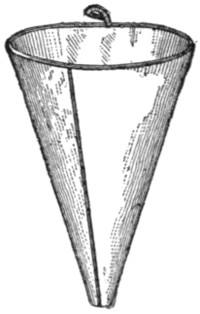
PASTRY-BAG.
This pastry-bag is essential and useful for kitchen and pastry use, being
both facile and economical, but care must be taken to wash it thoroughly,
and immediately after using it, and to let it dry perfectly, otherwise it
will soon become useless.
—To avoid the trouble of preparing them each time they are
needed, it were better to clean many at a time, for they will keep in
perfect condition for five or six months, if put away in a well-closed tin
box. Procure ten pounds of currants or Sultana raisins, lay them on a
table, and should they be damp, dredge a little flour over to prevent them
adhering to the hands. Rub them thoroughly, then take a wire sieve,
No. 3 (or as fine a one as will prevent them passing
through), place the
currants on it, and shake them well for two or three minutes, so that they
be perfectly free from flour and stalks. Lay the sieve containing the
currants in a large dish-pan, filling it to the level of the sieve with hot
water, then, with a skimmer, stir them, so that they get washed thoroughly
for at least five minutes. Lift up the sieve, and let them drain in the
same for three minutes. Cover an iron oven-pan with a sheet of brown
paper, pour the currants on it, spreading them out evenly, and set it in a
very slow oven for ten minutes; remove, and lay them aside in the warmest
spot on the kitchen shelf, and leave them to dry thoroughly for at least
two days. If in the country, the pan can be left out in the sun during the
day. When dry, lay them on the table, and should any more foreign
matter be found among them, pick it out carefully with the fingers, and
examine them well to see whether they be free of stones, stalks, stems,
sand, &c. When finished, put them away in a closed tin box, and they
will then be ready for use.
—Have as many Malaga raisins
as deemed necessary, but it were better to purchase five pounds at a
time. Lay the raisins on a table, have a bowl of cold water on the right
hand, and the raisins in front; pick off the dry stalks adhering to them,
then, either using a small knife or the fingers, pick out the seeds, taking
care to wet the fingers in the bowl of water, so as to prevent them sticking
while seeding them. Close up again, giving them their original form;
when finished, put them in a tin can, cover well, and place in a moderate
temperature for use when required. Raisins prepared in this way will
surely keep six months.
—Put into a vessel two ounces of currants, prepared
as for No. 1080, two ounces of Sultana, and three ounces of Malaga raisins,
as for No. 1081, one ounce of finely chopped citron, two ounces of well-chopped,
cold, boiled beef, and two ounces of beef-suet, also chopped
very fine. Mix the whole well together for five minutes, then add
one ounce of powdered sugar, a saltspoonful of salt, one drachm
of ground allspice, half a drachm of ground cloves, half a drachm
of ground cinnamon, and mix together for one minute. Peel, core,
and chop up very fine three large, sound apples, add them to the preparation,
then pour in half a gill each of brandy and sherry wine, mixing
again for three minutes. Take half a pound of pie-paste as for No. 1077,
cut out a piece of three ounces, roll it round-shaped, ten inches in diameter,
and lightly butter a pie-plate nine and a half inches in diameter. Arrange
the paste over, and pour the preparation in the centre, flattening it evenly,
and leaving an inch space clear around the edge of the plate; take the
remaining five ounces of paste, roll it out round-shaped, the same as
before, fold it in two, and, with a knife, make incisions in the centre, of half
an inch each. Moisten lightly the edge of the plate with a little beaten
egg, then cover with the paste, pressing down with the hand all around
the edge, so as to inclose the preparation entirely, then moisten the surface
slightly with the beaten egg. Place in a moderate oven, and let bake for
fifty minutes; remove it to the oven-door, sprinkle plenty of powdered
sugar over, return it to the oven, closing the door for two minutes, so
that the sugar melts entirely, then slide it carefully onto a dessert-dish,
and serve either hot or cold.
—Peel, core, and slice four medium-sized, fine, sound
apples; put them into a vessel, and add three ounces of powdered sugar
and a saltspoonful of ground cinnamon. Have a plate covered as for the
above (No. 1082); arrange the apples on top, cover, and finish exactly the
same as for the mince pie. Serve cold.
—Peel and slice six medium-sized, fine, sound, pears;
put them into a vessel with three ounces of powdered sugar; put this over
a lined plate, and proceed exactly the same as for mince pie (No. 1082).
—Pare off the leaves, and peel the stalks neatly
from two bunches of fine rhubarb, cut them into small pieces about half
an inch long, and put them in a vessel with three ounces of powdered
sugar; mix well; lay them on the pie-plate, cover, and bake the same as
for mince pie (No. 1082).
—Take one and a half pounds of apple sauce (No.
1328), put it in a vessel, adding one ounce of powdered sugar, and one
ounce of corn-starch; grate in the peel of a medium-sized lemon, squeezing
in the juice of two others, and mix the whole well together with a spatula
for three minutes. Pour the preparation over a lined plate, as for mince
pie (No. 1082), cover, and finish exactly the same.
—Procure a medium-sized, fine, sound, pineapple;
pare, peel, and slice it into fine slices, laying them in a vessel, and mixing
in three ounces of powdered sugar. Have a pie-plate lined with paste, as
for mince pie (No. 1082), spread over one tablespoonful of apple sauce
(No. 1328); arrange the pineapple nicely on top, then take three ounces of
pie-paste, roll it out lengthwise, two feet long, and fold it carefully in
two, so as to make a long narrow strip; roll it slightly again until about
thirty inches long by one wide, paring off both sides evenly, so as to have
it exactly the one inch in width. Moisten the edge of the pie-plate with
beaten egg, and arrange the strip around, fastening the two ends together,
one over the other; glaze the surface of the strip with beaten egg, then
place the pie in a moderate oven, and let bake for fifty minutes. Remove
to the door, dredge the pie well with powdered sugar, return to the oven
for two minutes to allow the sugar to melt, then spread evenly over the
top two ounces of apple jelly (No. 1327), and send to the table.
—Peel and slice six medium-sized fine and
sound pears; place them in a vessel with three ounces of powdered sugar,
mix well, and proceed exactly the same as for pineapple pie (No. 1087).
—Put in a vessel one pint and a half of well-picked
and cleaned huckleberries, add two ounces of powdered sugar, mix
well, and proceed the same as for pineapple pie (No. 1087).
—Put in a vessel a pint and a half of well-picked
and cleaned currants, with four ounces of powdered sugar, and
proceed exactly the same as for pineapple pie (No. 1087).
—To be prepared the same as the above
(No. 1090), only using one pint and a half of gooseberries instead of the
currants.
—Wipe neatly and slice eight fine, sound, medium-sized
peaches; put them in a vessel with three ounces of powdered sugar,
and proceed exactly the same as for pineapple pie (No. 1087).
—Select one dozen ripe, sound, green-gages; cut
them in two, remove the stones, and put them in a vessel with three
ounces of powdered sugar. Finish the same as for pineapple pie (No.
1087).
—To be prepared as for the above (No. 1093), substituting
one dozen plums for the green-gages.
—Have a pie-plate lined as for pineapple
pie (No. 1087), lay in three-quarters of a pound of apple sauce (No. 1328),
arrange the strip around, then place it in the oven for thirty minutes only;
remove to the oven door, dredge profusely the strip with powdered sugar,
return to the oven, close the door, and leave it for two minutes to let the
sugar melt. Take it out, and let it get thoroughly cold, then, with a
spoon, remove half of the apple sauce, and fill the interior with a pint and
a half of well-picked and cleaned strawberries, mixed with two ounces of
powdered sugar. Spread two ounces of apple jelly (No. 1327) evenly
over the strawberries, and serve.
—Have the pie prepared exactly the same as for
strawberry pie (No. 1095), and fill it with a pint and a half of well-picked
and cleaned raspberries mixed with two ounces of powdered sugar, and
spread evenly over the top two ounces of apple jelly (No. 1327); then
serve.
—Blackberry pie is to be prepared exactly the
same as strawberry pie (No. 1095), only substituting a pint and a half of
well-picked and cleaned blackberries for the strawberries.
—Procure two pounds of fine, sound cherries; pick
off the stalks, then stone them with the hands, and place them in a vessel
with four ounces of powdered sugar, mixing well. Have ready a lined
pie-plate, fill it with the cherries, arrange the strip around, and proceed
the same as for pineapple pie (No. 1087), then serve.
—Have a deep pie-plate, one and a half inches
deep by nine and a half wide; line it with four ounces of pie-paste (No.
1077). Cut a two-pound piece off a sound pumpkin, peel it well with a
knife, remove the seeds and soft parts, then cut it into twelve pieces;
place them in a saucepan with three quarts of cold water, leave the pan
on the hot stove, and let cook for twenty-five minutes. Take from the
fire, put the pumpkin in a drainer, leaving it for one hour, then press out
the water thoroughly with the hand, and rub it through a sieve into
another vessel. Add two ounces of powdered sugar, and break in three
whole eggs; add a saltspoonful of ground cloves, a saltspoonful of ground
allspice, half a saltspoonful of salt, and the same quantity of cinnamon; mix
all together for two minutes, and pour in half a pint of cold milk, mixing
well again for one minute, then strain through a sieve into another vessel,
and use the preparation to fill up the pie-plate, then lay it carefully in a
moderate oven, and let bake for thirty minutes. Take it from the oven,
put aside to cool, and cut it into six equal parts; dress them on a dessert
dish with a folded napkin, sprinkle liberally with powdered sugar,
and serve.
—Put four ounces of powdered sugar into a vessel;
break in five whole eggs, and with a pastry whip beat together for
three minutes. Add one quart of cold milk, and flavor with a teaspoonful
of lemon essence; mixing well together for two minutes longer; strain
through a sieve into another vessel. Have a deep pie-plate lined exactly
the same as for pumpkin pie (No. 1099), and fill it with the above preparation.
Place it in a moderate oven, and let bake for thirty minutes, then
remove, and let get thoroughly cold; cut the pie into six equal pieces,
and with the blade of a knife dress them onto a dessert-dish with a folded
napkin, and serve.
—Prepare and proceed exactly the same as for
custard pie (No. 1100), and when filled, before placing it in the oven,
spread evenly over six ounces of dried cocoanut; baking and serving it
exactly the same.
—Boil one pint of water in a
saucepan; put in another vessel four ounces of powdered sugar, mix in
one ounce of corn-starch, grate in the rind of a sound lemon, squeezing in
the juice, and mingle well together with the spatula for one minute.
Break in two whole eggs, beat all together for one minute, and add it to
the boiling water in the pan, stirring sharply with a wire whip until it
comes to a boil; then take from off the fire. Have ready a lined, flat pie-plate
as for mince pie (No. 1082), put it in the oven, and let it bake for
ten minutes, so that the crust gets a good golden color. Remove from
the oven, and pour the preparation into it, then let it get thoroughly cold.
Beat in a copper basin three egg whites to a stiff froth, using a wire
pastry-whip; mix in three ounces of powdered sugar, and with a spoon lay
half of it over the pie, using a knife to flatten it evenly on the top and
sides. Slide down a fancy tube (No. 3) into a pastry-bag (No. 1079), and
pour the rest of the froth into it, then decorate the top of the pie artistically,
laying it in any fanciful design. Sprinkle plenty of sugar over, place
it in a slow oven for ten minutes to let get a pale brown color, then
remove it, put it away to cool, slide it carefully onto a dessert-dish, and
send to the table.
—Butter and line a pie-plate as for mince
pie (No. 1082); put in a vessel one pound of apple sauce (No. 1328), one
ounce of powdered sugar, and one ounce of corn-starch. Mix well for
one minute, then grate in the rind of a sound lemon, squeezing in the
juice as well; add half a saltspoonful of grated nutmeg, and mix the
whole well together for two minutes, then with this fill the pie-plate.
Place it in the oven, and let bake for twenty minutes; remove, let get
thoroughly cold, and finish the same as for lemon pie, méringué (No.
1102), serving it as for the above.
—Put one quart of fresh cranberries in a saucepan
with a gill of cold water and three ounces of powdered sugar; place
on a hot stove, stir lightly with the spatula, and let cook for fifteen minutes.
Remove from the fire, and rub through a sieve into a vessel, then
pour it into a lined pie-plate, the same as for mince pie (No. 1082). Place
it in the oven, and let bake for twenty minutes, then take it out, and let
cool thoroughly, and finish by decorating it exactly the same as for lemon
cream pie, méringué (No. 1102); return it to the oven for ten minutes,
then serve as for the lemon pie.
—Peel four ounces of almonds;
put them in a mortar with two ounces of powdered sugar, then pound
them thoroughly, adding gradually one raw egg. When well pounded,
add two ounces more of powdered sugar, two ounces of melted fresh butter,
half a gill of rum, half a saltspoonful of ground cinnamon, six drops
of orange-flower water, and break in another whole egg. Pound the
whole briskly for five minutes, then add two ounces of well-pounded
macaroons (No. 1210), and mix again for two minutes more. Line a pie-plate
as for mince pie (No. 1082), pour all the preparation over, cover,
and bake exactly the same as for the mince pie; when arranged on a dessert-dish,
decorate the top and sides artistically with two ounces of candied
cherries, three ounces of pear, one of angelica, two of apricot, and
two of pineapple, all the fruits being candied, then send to the table.
—Take half a pound of feuilletage (No. 1076), roll
it out twelve inches long by eight wide, then with a paste-cutter (No. 7)
cut out six pieces, and arrange them neatly on six scalloped tart-molds,
each three and a half inches wide. Take each separate mold in the
hand, and with the thumb press the paste gently at the bottom and sides,
so to give it the perfect shape of the mold, but avoid pressing the paste
on the edge, so that in baking it will swell and raise beautifully. Divide
three ounces of apple marmalade (No. 1332) into six equal parts, and fill
the bottom of the tarts with it, then wipe six good-sized, solid, fine
peaches, peel and cut them into six quartered pieces; arrange them nicely
over the marmalade in the tarts, then distribute two ounces of powdered
sugar evenly over all; lay them on a baking-sheet, put them in a moderate
oven for twenty minutes, draw them to the door, and sprinkle the
edges lightly with powdered sugar; then leave them in the closed oven
for two minutes to allow the sugar to melt thoroughly. Remove them
from the fire, put to cool for twenty minutes, and then spread evenly over
the peaches one and a half ounces of apple jelly (No. 1327). Dress the
tarts on a dessert-dish with a folded napkin, and serve.
—Procure twelve ripe green-gages, wipe
well, cut them in quarters, remove the stones, and proceed to prepare
them exactly the same as for the above peach tarts (No. 1106).
—Prepare and proceed exactly the same as for
peach tarts (No. 1106), using ten apricots instead of the peaches, and serving
the same.
—to be prepared precisely the same as peach
tarts (No. 1106), only substituting six sound, sliced pears for the
peaches.
—Have twelve good, ripe plums; wipe and quarter
them; remove the stones, and prepare them exactly the same as for
peach tarts (No. 1106).
—Have a pound of picked and stoned cherries;
divide them evenly into six tarts, prepared as for peach tarts (No. 1106),
and finishing them the same.
—Take six medium-sized rhubarb stalks, pare
off the green parts, and peel them well. Then cut them into small pieces
half an inch long; put them into a saucepan, on a very slow fire; cover,
and let cook slowly for fifteen minutes; then remove, and add three ounces
of powdered sugar; mix well for one minute, then transfer to another
vessel, and set aside in a cool place for at least an hour and a half. Divide
the rhubarb into six tarts, as for peach tarts (No. 1106); finish, and serve
exactly the same.
—Put in a vessel one pint of well-picked and
cleaned, sound huckleberries; mix in two ounces of powdered sugar, and
with it fill evenly six tarts; cook and serve the same as for peach tarts
(No. 1106).
—Are to be prepared precisely
the same as for the above (No. 1113); using either one pint of gooseberries
or currants instead of the huckleberries.
—Choose a small, sound pineapple, cut it
in two, roll a towel round one-half and lay it in the ice-box for further
use. Pare and peel neatly the other half; then cut it into small and very
thin slices; lay them in a vessel with two ounces of powdered sugar, mixing
lightly for one minute. Arrange the slices carefully over the marmalade
in the six tarts, prepared as for peach tarts (No. 1106); then finish,
and serve exactly the same.
—Have six tart-molds lined as for peach tarts
(No. 1106); divide into them twelve ounces of cranberry sauce (No. 1329),
then cook, and serve the same.
—Line six tart-molds as for peach tarts (No.
1106), divide into them evenly eight ounces of apple marmalade (No.
1332); lay them on a baking-sheet, and put them in a moderate oven for
twenty minutes; remove them to the door; sprinkling the edges liberally
with powdered sugar, return them to the oven, and close the door for
two minutes, so that the sugar melts thoroughly; lift them out, put them
to cool for twenty minutes, then take out half the marmalade. Pick and
wash neatly a pint of ripe and sound strawberries; put them in a vessel with
two ounces of powdered sugar; mix well for one minute, then divide them
equally into the six tarts; spread over one and a half ounces of apple jelly
(No. 1327); dress them on a dessert-dish with a folded napkin, and serve.
—Prepare and proceed precisely the same as
for strawberry tarts (No. 1117), only substituting a pint of raspberries for
the strawberries.
—Are to be prepared exactly the same as
strawberry tarts (No. 1117), using one pint of the smallest sized blackberries
instead of the strawberries, and serving the same.
—Take four ounces of pie-paste (No. 1077), and
with it line six oval, channeled tart-molds, four inches long, three inches
wide, and one deep. Have three ounces of apple marmalade, and divide
it evenly at the bottom of the molds; then peel, core, and cut four sound,
medium-sized apples into quarters, and put them in a saucepan, with a
pint of cold water; place the lid on, and let cook on the hot stove for ten
minutes; remove, and pour into a drainer; let drain thoroughly; then
put to cool for thirty minutes. Cut the quartered apples each into three
lengthwise slices; arrange them nicely over the marmalade, dredging
equally over them two ounces of powdered sugar; lay them on a baking-sheet,
and bake for twenty-five minutes in a moderate oven; leave to cool
for twenty minutes; then spread evenly over them two ounces of apple
jelly (No. 1327); dress them onto a dessert-dish with a folded napkin,
and serve.
—Peel three ounces of shelled almonds, as
for No. 1207; put them in a mortar, and pound them thoroughly with
three ounces of powdered sugar, adding one whole raw egg. When a fine
paste, mix in two ounces of melted fresh butter, half a spoonful of ground
cinnamon, six drops of orange-flower water, one more egg, and half a gill
of rum. Stir well together for ten minutes with the powder. Have ready
six tart-molds, lined as for peach tarts (No. 1106); then fill them with the
above preparation; lay them on a baking-sheet, put them in a moderate
oven for thirty-five minutes; when done, put them to cool for twenty
minutes; then glaze the surface with a glace à l’eau and rum (No. 1197).
Dress on a hot dessert-dish, with a folded napkin, and send to the table.
—Sift one pound of flour on the table,
make a hollow in the centre, laying in it half a pound of butter, mingling
it slightly with the flour for five minutes; when done, make another
hollow in the centre, pour into it half a pint of cold water and two ounces
of powdered sugar. Mix all together gradually for five minutes longer;
it will then be a firm dough. Roll it together with the hands, and put it
in a cool place for five minutes. Peel and core six medium-sized pippin
apples, sprinkle the table lightly with flour, lay the butter on it, roll it
out twelve inches long by eight wide, and about the thickness of a silver
dollar, then cut it into six equal-sized, square pieces. Arrange the apples
upwards in the middle of each square piece; mix together two ounces of
granulated sugar with one teaspoonful of ground cinnamon, and fill the
cavities of the apples with this. Break one egg into a bowl, beat it well,
adding two tablespoonfuls of cold milk, mix well, and with a pastry hair-brush
moisten the edges of the pieces of dough, and fold them firmly so that
the apples are entirely enclosed. Lay them on a baking-pan, and with the
rest of the beaten egg brush over the surface and sides of the dumplings.
Place them in a moderate oven for thirty minutes, and after they are
a nice light golden color, remove, and dress them on a dessert-dish,
leaving them to rest in the open oven for twenty minutes, then pour the
following sauce over before serving: put into a saucepan one pint of
water, six ounces of granulated sugar, one bay-leaf, six cloves, and an
inch-long stick of cinnamon. Place the pan on the hot stove, and let boil
for five minutes; dilute half an ounce of corn-starch in a bowl with half a
gill of cold water, add it to the sauce, mix well, and let cook for two minutes
longer, stirring briskly with a spatula. Remove from the fire, and
immediately add half a pint of good claret; stir again, and when ready to
serve, strain the sauce through a sieve over the dumplings. Hard sauce,
as in the following number, may be substituted if desired, or both.
—Put in a bowl two ounces of very good fresh
butter with four ounces of powdered sugar, then with a spatula, beat together
sharply for twenty minutes; add half a saltspoonful of powdered
mace, beat briskly for five minutes longer, then arrange it tastefully on
a dessert-dish, and place it in the ice-box for two hours before serving.
—Core with an apple-corer six fine, sound Newtown
apples, lay them in a tin pan. Put in a plate two ounces of granulated
sugar with a saltspoonful of cinnamon, mix well, and with this fill
the holes in the apples; add half a pint of cold water, and place the pan
in a moderate oven to let bake for twenty-five minutes; remove, and
dress them on a dessert-dish, pouring over the juice remaining in the
pan, and serve either hot or cold.
—Put in a vessel half a pound of well-sifted
flour, mixed with half an ounce of baking-powder; make a hollow
in the centre, and pour into it a gill of lukewarm milk, half an ounce of
butter, half a saltspoonful of salt, and break in one whole egg. Mix
these ingredients well for two minutes, then incorporate the flour gradually.
Lay the paste on a lightly floured board or table, roll it into a
square a quarter of an inch thick, then with a plain paste-cutter (No. 7)
cut out six pieces, putting in the middle of each piece two ounces of
stewed peaches (No. 1334), fold up the edges all round, so as to enclose
the peaches entirely, then have six small pieces of thick white cloth, eight
inches square, butter and flour them well, then arrange the dumplings in
them; tie them firmly, leaving an empty space of an inch to allow the
dumplings to swell, and plunge them in a large saucepan, holding a gallon
of boiling water, and let them boil for twenty minutes; remove from
the fire, and lift them out with a fork; let drain for two minutes, then
cut the strings and remove the cloths. Dress the dumplings on a hot
dessert-dish, pour over a hot wine sauce as for No. 1122, and serve.
—Prepare and proceed exactly the
same as for boiled peach dumplings (No. 1125), only substituting twelve
ounces of stewed apricots (No. 1335) for the peaches, and serve with a
rum sauce (No. 1162), instead of wine sauce.
—Prepare and proceed precisely as for
boiled peach dumplings (No. 1125), only using twelve ounces of stewed
apples (No. 1332) for the peaches, and pouring the sauce (No. 1128) over,
instead of the wine sauce.
—Put four ounces of apricot marmalade (No.
1335) into a saucepan with one ounce of fresh butter and a gill of water;
set it on the hot stove and stir briskly with the spatula until it comes to a
boil, then take from off the fire, and add immediately a gill of good
brandy, mixing again with the spatula for one minute more, then pour the
sauce over the boiled apple dumplings, and serve.
—Pare off, remove the skin
and strings from four ounces of veal-suet and three ounces of beef-marrow,
lay them in a saucepan with two ounces of finely chopped plums and
three ounces of flour. Place the saucepan on a slow fire, and stir well
with the spatula for six minutes; add three egg yolks and one whole egg,
half a gill of sweet cream, half a gill of maraschino, a saltspoonful of salt,
and half a saltspoonful of grated nutmeg. Stir all together thoroughly
for six minutes, not letting it boil, then take it off the fire, and lay the pan
in a cool place, adding one ounce of whole pistache, also two ounces of
macaroons pounded in a mortar, half an ounce of angelica, and half an
ounce of candied cherries, all well chopped. Mix well for one minute;
peel, core, and chop up three medium-sized apples, add them to the preparation
with two ounces of powdered sugar, and a tablespoonful of vanilla
flavoring; then stir all together for twelve or fifteen minutes. Butter
and flour neatly a cloth, arrange it in a deep vessel, and pour the preparation
into it; lift up the four corners, close them together, and tie firmly
with a string, leaving an empty space, about the eighth of the contents, to
allow it to swell. Have a saucepan half full of boiling water ready to
plunge the pudding into, then let boil for three full hours; the pudding
will constantly float, therefore turn it every hour, when it will be thoroughly
cooked. Remove it, let drain for two minutes, untie, lift it from
the cloth, and dress it on a hot dessert-dish. Have ready the following
sauce: put in a saucepan half a gill of rum, three ounces of powdered
sugar, the grated rind of half an orange, and a teaspoonful of vanilla
flavoring. Put it on the stove, and as soon as the liquid catches a light
flame, put on the lid and let all infuse for one minute. Take from off the
fire, and immediately squeeze in the juice of one orange; strain through a
sieve over the pudding, and serve very hot.
—Clean half a pound of fine rice;
wash it in lukewarm water, then drain in a colander, put three pints of
milk into a saucepan, place it on the hot stove, and when near a boil, drop
in the rice. Let cook slowly for twelve minutes, stirring it frequently
from the bottom with a spatula; remove it from the fire, and add one
ounce of fresh butter, three ounces of powdered sugar, and the grated
rind of a medium-sized orange. Mix well for two minutes, then add three
ounces of well-skinned and stringed marrow, finely chopped, two ounces
of dried and cleaned currants (No. 1080), two ounces of bitter almond
macaroons (No. 1209), one ounce of finely shred candied orange-peel, three
egg yolks, one whole one, half a gill of brandy, and half a saltspoonful of
salt; mix well together for ten minutes. Have a buttered and floured
cloth, arrange it in a deep vessel, and pour the preparation into it; lift up
the four corners, tie it firmly, being careful to leave an empty space of
about an eighth of the contents.
Place a deep saucepan on the stove, half filled with boiling water;
plunge the pudding in, and let cook for one hour and a half, turning it over
a couple of times; remove, drain for one minute, untie, and lift from the
cloth. Dress on a dessert-dish, and serve with the following sauce (No.
1131).
—Put in a saucepan four egg
yolks with four ounces of powdered sugar, and stir with a spatula until it
becomes a whitish color. Add two gills of sweet cream, little by little,
beating continually, then grate in the rind of an orange. Place the pan
on a slow stove, and stir well for four minutes, being careful not to let it
boil; take it off, strain through a sieve over the pudding, and serve very
hot.
—Take a deep, oval dish as for a
pot-pie, and large enough to hold three pints. Pare off the crust of half
a loaf of stale American bread, and cut it into slices the third of an inch
thick; butter them well with melted butter, and with them line the dish.
Put in a vessel six ounces of currants, prepared as for No. 1080, two whole
eggs, a pint of cold milk, four ounces of powdered sugar, and grate in the
rind of a medium-sized lemon, adding its juice. Mix well together with
a spatula for two minutes, then pour it into the lined dish, and place it in
a moderate oven to cook for thirty minutes. Take it from the oven,
lay it on another dish, and serve very hot.
—Put a pint of milk to boil in a saucepan on the
stove. Break into a vessel two whole raw eggs, add one ounce of flour,
half an ounce of corn-starch, and three ounces of powdered sugar, beating
the whole well together with a spatula for three minutes. If the milk be
boiling, add it gradually to the preparation, stirring continually for two
minutes, return the whole to the saucepan, place it on the stove, and stir
briskly till it comes to a boil, then remove, and add immediately a teaspoonful
of vanilla flavoring. Strain the sauce through a sieve into a
sauce-bowl, and serve.
—Put in a copper basin a quarter of
a pound of powdered sugar, two whole raw eggs, and grate in the rind of
a quarter of a medium-sized lemon, and with a pastry whip beat the whole
sharply for two minutes; put the basin on a very moderate fire, then beat
it vigorously for five minutes more. Remove it from the fire, lay the basin
on a table, continue beating slowly for two minutes longer, then give the
whip a sharp shake, so that all that adheres to it falls into the basin. Now
add a quarter of a pound of flour, and with a wooden spoon mix slowly and
carefully the whole for two minutes. Cover a pastry baking-pan with a
sheet of brown paper, pour the paste over it, spread out to the thickness of
half an inch; put it into a moderate oven, and let bake for fifteen minutes,
then take it out, let cool for another fifteen minutes, and remove from the
pan. Place it on a table upside down, remove the paper, and with a knife
cut it into small, square, dice-shaped pieces, mixing with them one ounce
of dried currants, as for No. 1080, and one ounce of finely chopped candied
citron.
Butter and sugar well six small pudding-molds, each capable of containing
one and a half gills. Fill them equally with the above preparation,
then put in a vessel four ounces of powdered sugar with two raw eggs;
beat well with a pastry-whip for two minutes, then add a pint of cold milk,
mixing again for one minute, strain through a sieve into another vessel,
add half a teaspoonful of lemon essence, and stir lightly for one minute
more. Pour this slowly over the puddings, a little each time, so as to
give the necessary opportunity for it to absorb; lay them on a tin pan,
filled to half the height of the molds with warm but not boiling water,
then place in a moderate oven to steam for thirty minutes; remove them
from the pan, and lay them in a cool place for one hour, afterwards leaving
them in the ice-box until ready to serve. Take a pint of whipped
cream, as for No. 1254, put it in a vessel, mixing in for two minutes half
a gill of good maraschino, and leave it in the ice-box until ready; then
prepare a cold dessert-dish. Run a thin knife down each pudding separately,
from top to bottom, pass it carefully around the mold, so as to
detach them easily. Pour the maraschino sauce over, and send to the
table immediately.
—Prepare six small puddings
exactly the same as for No. 1134, only substituting sauce à la Diaz (No.
1136) for the maraschino sauce.
—Put into a saucepan half a pint of Jamaica
rum, three ounces of granulated sugar, half a split vanilla-bean, grate in
the rind of a medium-sized orange, and add a gill of Marcella wine. Place
the pan on the stove, and as soon as the liquid catches fire put on the
cover, and let boil for one minute only. Set the pan on one side to allow
it to infuse for five minutes, then strain through a fine sieve into a bowl,
transfer it to a jar, cover tightly, and let cool off thoroughly. When ready
to serve, pour the sauce over the puddings, distributing it evenly, and
then send to the table.
—Put in a saucepan two gills of sweet
cream, three ounces of powdered sugar, and the peel of half a medium-sized
lemon, place the pan on the stove, and, with a spatula, stir, and let
boil for three minutes and take off the fire. Have ten ounces of stale
French bread, pare off the crust and cut it into small, dice-shaped pieces;
add them to the preparation, mixing lightly; put on the lid, and let the
bread soak for ten minutes. Chop up very fine one ounce of candied citron;
mix it with four ounces of dried currants, prepared as for No. 1080,
four ounces of melted butter, four ounces of melted and strained beef-marrow,
and a saltspoonful of salt. With the hand stir thoroughly for
two minutes. Pour this preparation in with the soaked bread, and mix
gently, either with the hand or a spatula, for ten minutes; meanwhile
breaking in three eggs, one by one at a minute’s interval, and adding a
gill of Madeira wine and half a gill of cognac. Butter, and sprinkle well
with bread-crumbs a two-quart pudding-mold; pour in all the preparation,
lay it on a baking-pan, and place it in a slow oven to bake for one
and a half hours. Remove, and with the aid of a towel turn it onto a hot
dessert-dish, serving it with a hot Sabayon sauce au madère (No. 1138).
—Put in a saucepan four egg yolks
and an ounce and a half of powdered sugar; place it on a hot stove, and
with a wire whip stir well for two minutes. Drop in gradually two gills
of Madeira wine; stir continually for two minutes; take from the fire, and
strain through a fine sieve over the pudding.
—Line the insides of six oval,
channeled, deep tart-molds, each holding one and a half gills, with four
ounces of pie-paste (No. 1077). Prepare a cake exactly as for Maraschino
pudding (No. 1134), and when cooked and on the table, remove the paper,
and break up the cake in small pieces, into a vessel. Moisten with two
gills of cold milk and two eggs, and mix well with the spatula for two
minutes; add two ounces of dried currants (No. 1080). Mix in a saucer a
saltspoonful of cinnamon, with one of allspice and one of cloves, all
ground, and add it to the preparation in the bowl; stir well for three
minutes; then, with a wooden spoon, fill up the molds, and lay them on a
baking-pan. Put it into a moderate oven for ten minutes; then remove,
cool off, and unmold; lay them on a table, and pour over each pudding
3 teaspoonful of rum, and with a light pastry-brush glaze the surface
with glace à l’eau (No. 1197). Dress them on a dessert-dish, and
serve.
—Boil in a saucepan one quart of milk; add a
quarter of a pound of sago, and, with a pastry wire-whip, stir briskly and
continually for fifteen minutes. Take from off the fire; let cool; then
add four ounces of powdered sugar, mixing well again for one minute.
Break in four eggs, and flavor with a teaspoonful of vanilla essence; then
mix well for two minutes longer. Butter and sugar well six small pudding-molds,
the same size as for maraschino pudding (No. 1134), and, with a
ladle, fill up the molds with the sago; place them in a tin pan, filling it to
half the height of the molds with warm but not boiling water. Then put
in the oven and let steam for thirty-five minutes. Remove; take the
molds from the pan with a towel, and with a thin knife detach them properly.
Then turn them on a hot dessert-dish, serving them with a sauce
à la crême (No. 1133).
—The same as for the above, using tapioca.
—The same, using vermicelli.
—The same, using rice.
—The same, using farina.
—The same, using corn-meal.
—Put in a saucepan five ounces of fresh
butter, five ounces of powdered sugar, five ounces of finely cut cocoa, and
five egg yolks; place the pan on the hot stove, and with a pastry-whip
stir briskly for five minutes, then take from off the fire. Beat up in a
copper basin the whites of the five eggs to a firm froth, and add them to
the preparation in the saucepan, mixing all well together for two minutes.
Butter and sugar well six small pudding-molds as for No. 1134, and fill
them with the preparation, then place them in a tin pan, filling the pan to
half the height of the molds with warm but not boiling water. Put in
the oven for thirty minutes, then take out, turn them on a hot dessert-dish,
and serve with a sauce à la crême (No. 1133) poured over.
—Butter and sugar well six small pudding-molds
as for No. 1134; distribute evenly in them half a pound of dried
cocoanut. Put into a vessel four ounces of powdered sugar, break in
three whole eggs, mix well for two minutes with the wire whip, then add
one and a half pints of cold milk; flavor with a teaspoonful of vanilla
flavoring, then mix two minutes longer. Strain through a sieve into
another vessel, and with it fill up the molds; arrange them on a tin pan,
fill to half their height with warm but not boiling water, then put in the
oven and let steam for thirty-five minutes. Take from the oven, turn on
a hot dessert-dish, and serve with a sauce à la crême (No. 1133), flavored
with half a gill of brandy.
—Boil in a saucepan two
gills of milk, adding two ounces of fresh butter; let melt well. Have
half a pound of flour and the spatula ready. Drop the flour in, and stir
immediately with the spatula as briskly as possible for two minutes;
remove from off the fire, add three egg yolks, and stir again vigorously
for two minutes more, drop in three ounces of powdered sugar, continue
stirring for one minute, then pour in a gill of cold milk, mixing well.
Beat to a stiff froth the whites of the three eggs, and add them gradually
to the preparation, mixing slowly for two minutes. Butter and sugar a
mold holding three pints; put a layer of the preparation half an inch
thick at the bottom, cover with two ounces of fine slices of stewed pineapple,
then another layer of the preparation, again the same quantity of
pineapple, and repeat twice more. Place the mold in a tin pan, fill it to
half the height of the mold with warm water, and set it in the oven to
steam for one hour. Remove, and with a towel turn it on a hot dessert-dish,
and serve with a sauce-bowl of sauce au Kirsch (No. 1149).
—Pour in a saucepan one pint of cold
water and half a pound of granulated sugar; place it on a hot stove.
Dilute an ounce of corn-starch in a cup with a gill of cold water, and
when the water in the saucepan is boiling, add it to it, stirring well for two
minutes with the pastry-whip. Take off from the fire, then add immediately
half a gill of kirsch, and mix again for one minute; strain
through a fine sieve into a sauce-bowl, and serve very hot with the pudding.
—Prepare and proceed exactly
the same as for the above, No. 1148, only instead of using pineapple,
have eight peeled and finely sliced peaches, either fresh or preserved.
Steam, arrange on the dish, and serve precisely the same, with the sauce
au kirsch (No. 1149).
—The same as for the pineapple
pudding (No. 1148), but using twelve sound, peeled, and finely
sliced apricots instead of the pineapples, and then serve the pudding and
sauce exactly the same.
—Prepare a pudding-paste
exactly the same as for pineapple pudding (No. 1148); when ready, peel,
core, and slice finely five medium-sized, sound apples; put them into a
vessel, mix with them one ounce of powdered sugar and a teaspoonful of
powdered cinnamon, and add this to the paste, and with a spatula mix
thoroughly all together for three minutes. Butter and sugar well a three-pint
mold, pour in the preparation, and lay the mold in a tin pan, filled
to half the height of the mold with warm water; place in the oven, and
let steam for one hour; take it from the oven, and with a towel turn it on
a hot dessert-dish, and serve with the following sauce (No. 1153) in a
sauce-bowl.
—Put half a pint of cold water in a saucepan,
with three ounces of powdered sugar, six cloves, a bay-leaf, and a
piece of cinnamon about an inch long. Put the pan on the fire, and let it
boil for five minutes; then dilute an ounce of corn-starch with a gill of
cold water; add it to the contents of the pan, and with a whip stir briskly
for two minutes. Add one pint of Chaufausen wine, still stirring for one
minute longer, then take from off the fire, strain through a sieve into a
sauce-bowl, and serve.
—Put into a vessel a quarter of a pound of
powdered sugar, break in five whole eggs, and with the pastry-whip mix
well for two minutes; add a quart of good, cold milk, and flavor with a
teaspoonful of lemon essence; mix well together for one minute. Butter
and sugar well six small pudding-molds, as for maraschino pudding (No.
1134); strain the preparation into another bowl, and then pour it into the
molds; arrange them on a tin pan filled to half the height of the molds
with warm but not boiling water; then place them in a moderate oven
to steam for forty minutes. Remove from the oven, and with a towel
turn them on a hot dessert-dish, serving with a sauce à la crême.
(No. 1133).
—Butter and sugar well six small pudding-molds,
as for maraschino pudding (No. 1134). Prepare twelve lady-fingers
(No. 1231), cut them in two, paring them neatly and carefully, so
as to be able to line the molds evenly, then cut the parings into small
pieces. Mix in a plate three ounces of candied cherries with two ounces
of well-chopped citron; cover the bottom of the molds with two ounces
of this, then a layer of the lady-fingers; spread half of the remaining fruit
on top, and fill in with the rest of the cake, finishing with the balance of
the fruit; then pour over the following custard: put into a vessel four
ounces of powdered sugar, three whole eggs, and beat briskly with a
pastry-whip for two minutes, then add a pint of cold milk, flavor with a
teaspoonful of lemon essence, mix for one minute longer, then strain
through a sieve into another vessel, and with a ladle divide it evenly over
the six puddings. Set the molds in a tin pan, filling it to half their
height with warm water, and place it in a moderate oven to steam for
thirty-five minutes; take out from the oven, turn them on a hot dessert-dish,
and serve with a Daniel Webster sauce (No. 1156).
—Put into a saucepan four ounces of
apricot marmalade (No. 1335), with half a gill of cold water; place it on
the fire, and stir until boiling; then take it off, and add immediately half a
pint of Saint Angelos Tokay wine, stirring thoroughly for one minute.
Strain through a sieve over the puddings, and serve.
—Put in a saucepan six
ounces of fresh butter, six ounces of powdered sugar, six egg yolks, and
the grated peel of a medium-sized, sound lemon, squeezing in the juice as
well. Set the pan on the hot stove, and with a wire pastry-whip stir
sharply for at least five minutes. Remove from the fire and lay it on
a table; beat in a copper basin the six egg-whites to a stiff froth, and add
them to the other preparation, beating with the whip thoroughly but not
briskly for ten minutes. Butter and sugar well six pudding-molds as for
No. 1134, fill them with the preparation, steam them in a tin pan, and
serve exactly the same as for custard pudding (No. 1154).
—Proceed and prepare the same as for lemon
pudding (No. 1157), only substituting an orange for the lemon, and serving
with the following sauce: put in a saucepan two ounces of powdered sugar,
half an ounce of flour, and break in three eggs, adding a teaspoonful of
corn-starch, and then with the pastry-whip beating all together for three
minutes. Mix in three gills of boiling milk, place it on the stove, and stir
well until boiling; then remove, and add immediately a gill of sherry wine,
mixing well for a minute longer, then strain through a sieve over the
puddings. Send to the table hot.
—Cut into small pieces six biscuits
à la cuillère (No. 1231); put them into a vessel with three ounces of
candied cherries cut in two, three ounces of preserved quinces cut into
very fine pieces, two ounces of dried currants (No. 1080), three ounces of
powdered sugar, and two ounces of finely chopped candied apricots; break
in three whole eggs, and pour over half a pint of cold milk, and with the
spatula mix well together for two minutes. Peel, core, and chop up three
medium-sized, fine, sound apples; add them to the other ingredients, and
mix lightly for one minute. Butter and sugar well around the inside of a
three-pint pudding-mold, pour in the preparation, lay the mold in a tin
pan, filling it to half the height of the mold with warm water; put it in a
moderate oven, and let steam for one hour, then remove, and with a towel
turn it on a hot dessert-dish, serving with the following sauce (No. 1160),
in a sauce-bowl.
—Put five ounces of peach
marmalade (No. 1331) into a saucepan with one ounce of quince jelly and
one ounce of fresh butter; place the pan on the stove, and stir with the
spatula, letting it boil for one minute; take from off the fire, add immediately
a pint of champagne, then return to the stove, and stir well, heating
it thoroughly, but not allowing it to boil. Remove, and strain through a
sieve into a sauce-bowl, and send to the table very hot with the pudding.
—Butter well a pudding-mold
four inches high, containing one quart, line the interior with half a pound
of dumpling-batter (No. 1125). Put into a vessel four ounces of stoned
cherries, three ounces of stoned plums, and three ounces of stoned apricots;
sift four ounces of powdered sugar over, mix well, and pour it into
the mold. Have half a pint of water in a saucepan with six ounces of
granulated sugar, place it on the stove, and let boil for five minutes, then
fill up the mold with this syrup, and lay it in a baking-pan in a very hot
oven for thirty minutes. Remove, and keep it in a warm place.
—Put in a saucepan half a pint of water with four
ounces of granulated sugar, and place it on the stove, adding a teaspoonful
of caramel (No. 1252); when boiling add half an ounce of corn-starch,
diluted in two tablespoonfuls of cold water, stir well with a spatula, and
let cook for two minutes. Remove from the fire, and add immediately
half a gill of Jamaica rum, mixing well, then strain it through a fine sieve
into a bowl. Lay a dessert-dish over the mold, turn the pudding onto
it, pour the sauce over, and serve.
—Remove the skin and strings from six ounces
of fresh beef-marrow; chop it up very fine, and place it in a basin; pick
and wash, as for No. 1080, three ounces of dried currants, three ounces of
dried Sultanas (No. 1080), and mix them well together with the marrow;
add three ounces of Malaga raisins (No. 1081), three-quarters of a pound
of crumbled bread-crumbs, half a gill of Madeira wine, half a gill of
brandy, half a gill of rum, the grated rind of half a lemon, two ounces of
candied citron, shred very fine, two ounces of powdered sugar, a saltspoonful
of salt, and two whole eggs. Moisten the whole with a gill of
cold milk, add a saltspoonful each of allspice, ground clove, and cinnamon,
and half the quantity of grated nutmeg; knead well with the hands, so
that the ingredients are thoroughly incorporated, which will take ten minutes.
Boil some water in a saucepan capable of holding the pudding;
butter and flour a cloth, lay it on a large colander, which will answer for
a hollow mold; pour the mixture into it, then hold the four corners
together, and tie it firmly, allowing sufficient space for it to swell.
Plunge the pudding into the boiling water, and let cook, leaving it half
covered; the water must boil steadily for five hours; every hour turn it
over, and then make the following sauce: put into a saucepan one ounce
of fresh butter, two drachms of flour, and three drops of lemon juice, the
finely sliced rind of a quarter of a lemon, half a saltspoonful of salt, and
half an ounce of powdered sugar. Moisten with a gill of port wine, then
place the pan on the stove, and with a spatula stir well, until it comes to
a boil. Remove from the fire, and strain through a fine sieve into a bowl.
When ready to serve, drain the plum pudding for one moment, untie, and
open the cloth; serve it immediately, pouring some of the sauce over.
—Butter and sugar a pudding-mold
of the capacity of three pints. Have ready four ounces of
Malaga raisins, prepared as for No. 1081, three ounces of Sultana, three
ounces of currants, as for No. 1080, three ounces of
finely chopped candied
citron, and three ounces of candied cherries, cut in two. Mix well
together, then with four ounces of the fruit cover the bottom of the mold,
put on top a layer of biscuits à la cuillère (No. 1231), or slices of sponge
cake, four more ounces of fruit, another layer of cake, and repeat twice
more, and the mold will then be full. Put into a vessel a pint and a half
of cold milk, six ounces of powdered sugar, three raw, fresh eggs, and a
teaspoonful of lemon essence, and with a pastry-whip beat well for two
minutes. Strain into another vessel, then pour it slowly and carefully
over the cake in the mold, so that it will be thoroughly impregnated. Lay
the mold in a square tin pan, filling it to half its height with hot water,
then place in a moderate oven for one hour. Remove it from the pan,
lay a dessert-dish over the mold, unmold, and decorate the top with fanciful
designs of red-currant jelly (No. 1326); serve it hot with a sauce-bowlful
of the following sauce (No. 1165).
—Put in a saucepan two ounces of fresh
butter, stir in one ounce of flour, and moisten slowly with a gill of cold
water, turning continually; add two ounces of powdered sugar, place the
pan on the stove, add half a pint of Château-Lagrange wine, and a teaspoonful
of vanilla flavoring. Stir well, and let boil for one minute, then
remove, and strain it through a sieve into another saucepan; replace the
pan on the corner of the stove so as to keep it hot, then take one ounce of
citron, slice it as fine as possible, also one ounce of finely minced pistache;
add them to the other ingredients, and finally stir in slowly a tablespoonful
of red curaçoa; mix well together for one minute, then pour into the
sauce-bowl, and serve.
—Put in a vessel four eggs with three ounces
of powdered sugar, mix briskly with the pastry-whip for two minutes,
then add one and a half pints of cold milk, and a teaspoonful of lemon
essence; then mix well again for one minute, strain this through a sieve
into another vessel. Butter and sugar well six small molds as for maraschino
pudding (No. 1134), fill them one inch high with caramel (No. 1252),
let cool off for five minutes, then pour in the preparation, dividing it
equally; place them in a tin pan filled to half the height of the molds with
warm but not boiling water, put in a moderate oven, and let steam for
forty minutes. Take them out, turn them on a hot dessert-dish, and
serve in their own sauce. This pudding may be prepared in cups instead
of molds.
—Select four large or six medium-sized Newtown
pippins. Peel, core, and cut them into quarters. Put them into a
saucepan with two ounces of fresh butter and four ounces of powdered
sugar, and place on a moderate fire. Toss them for two minutes, then
moisten with a gill of white wine, and grate in the peel of half a lemon.
Cover the saucepan, and let cook for ten minutes so that the liquid be
almost entirely absorbed by the apples. Remove from the fire, and put
aside to cool. Take a three-pint charlotte-mold; line it, beginning from
the bottom, with cut slices of American bread the thickness of a silver
dollar. Glaze them well with melted butter, using a hair brush for the
purpose, and sprinkle powdered sugar lightly over. Let each slice overlap
slightly until the bottom is covered. Then line the sides to the edge
in the same way. Fill the mold with the prepared apples, and cover
with slices of bread. Lay it on a baking-pan, and place it in a brisk oven
for forty-five minutes, or until the bread be a good golden color. Then
take it out, lay a hot dessert-dish on top, turn it over, and remove the
mold. Heat in a saucepan two ounces of apricot marmalade with two
tablespoonfuls of maraschino and one of water. Mix well, pour it over
the charlotte, and serve very hot.
—Prepare and cook the apples the
same as for No. 1167, and when removed from the fire, put it aside to cool.
Trim the crust off of a quarter of a loaf of stale American bread. Cut it
into slices the thickness of a silver dollar. Butter and sugar well six
small, round pudding-molds. Shape the slices of bread carefully, to line
the insides. Butter them lightly; place them in a clean baking-pan, and
leave in the oven for five minutes to get a brown color. Remove them;
let them cool a little, and then line the molds with them. Fill in with
the apples, and lay the full molds on a baking-pan in the oven for twenty
minutes. Turn the charlottes out on a dessert-dish. Heat half a pint of
raspberry juice in a saucepan, pour it over them, and serve hot.
—Core and peel neatly six sound, fine Newtown
apples. Put into a saucepan with a gill of water and two ounces of
sugar. Place it on a hot stove, put the lid on, and let cook for ten minutes.
Meanwhile boil four ounces of rice in a pint and a half of milk,
with half a saltspoonful of salt. Flavor it with six drops of orange-flower
water, and let cook for twelve minutes. Place the cooked apples in a
square tin pan, pour the boiled rice over them, and put into a moderate
oven for ten minutes. Then have a hot dessert-dish ready, and with a
tinned cake-turner dress them carefully on the dish, decorating the sides
with the rice. Should a pyramidal shape be desired, place three apples
in the centre, two on top of these, and the last one above them all, then
fill up the empty space around them with the rice, and serve with half a
pint of vanilla syrup in a separate sauce-bowl.
The sauce is made thus: put two pounds of granulated sugar into a
saucepan with one quart of cold water, and set it on the hot stove. Stir
well for two minutes; add two vanilla-beans split in halves, and boil for
ten minutes longer. Remove from the fire; strain through a sieve into
another vessel, and use when required. This syrup, when cold, may be
poured into bottles, and if corked tightly and put away in a cool place,
will keep in good condition for a month at least.
—Into one pint of boiling water in a
saucepan drop four ounces of well-cleaned rice, with half a saltspoonful
of salt, the peel of a quarter of a medium-sized, sound lemon, and two
leaves of the almond branch. Let all cook together for twelve minutes.
Meanwhile peel four ounces of almonds. Pound them in a mortar with
two tablespoonfuls of sweet cream, or the same quantity of cold milk will
answer. Tie a clean napkin over a vessel; pour on the pounded almonds,
and with a spatula rub the liquid gently through. Remove the rice from
the stove; take out the almond-leaves and lemon-peel; then sweeten with
three ounces of powdered sugar, and add the almond milk. Return it to
the stove, and with a spatula stir gently while cooking for twelve minutes.
Pour into a hot china or glass bowl, and send to the table.
—Proceed and prepare the
rice exactly as for the above (No. 1170), but after removing it from the
stove add immediately half a gill of pure Swiss kirschwasser, mixing it
in well with a spatula for five minutes. Pour into a china or glass bowl;
cool for one hour at least; then place it in the ice-box until ready to serve.
—Put a pint of milk in a
saucepan on the stove. When boiling, add three ounces of well-cleaned
rice and half a saltspoonful of salt. Let cook for twenty minutes, adding
one ounce of butter. Mix for one minute; then remove from the fire,
and let it cool off for thirty minutes. Add the yolks of two eggs. Beat
the whites to a froth in a basin with a wire whip, and add them to the
rice. Sweeten with three ounces of powdered sugar and flavor with a
teaspoonful of orange-flower water. Mix well together for five minutes.
Peel and core four sound Newtown pippin apples, and cut in slices about the
thickness of a silver dollar. Butter the sides of a saucepan lightly; then
cover the bottom with a layer of the prepared rice half an inch thick; put
a layer of sliced apples over this, and so dispose of all the apples and rice
in alternate layers. Put on the lid, and put the saucepan into a moderate
oven for fifteen minutes. Remove, dress on a hot dish, and serve.
—Prepare rice and apples as above
(No. 1172), but before putting into the oven, run a larding needle down
through it in a dozen places at equal distances, and pour over half a gill
of Russian kummel. Put on the lid; place in a moderate oven and let
cook for twenty minutes. Remove, and dress it neatly on a dish, sending
it to the table with a bowl of sauce à la crême (No. 1133), but using two
tablespoonfuls of the kummel instead of the brandy for flavoring, as
described in cocoanut pudding (No. 1147).
—Prepare half a pound of boiled
rice as for No. 1172. Butter a mold holding three pints. Garnish the
bottom and sides with the rice, using a wooden spoon for the purpose.
Peel, core, and cut into quarters six fine, sound, Newtown pippin
apples. Put them into a saucepan with three ounces of powdered
sugar, a gill of cold water, and half a saltspoonful of salt. Place
the pan on a hot stove, put on the lid, and let cook for ten minutes.
Remove, and fill the mold with eighteen of the pieces, reserving the other
six for later use; then put it in a slow oven for twelve minutes. Use an
ordinary towel to remove it from the oven. Lay a dessert-dish on top,
turn over, and lift off the mold. Decorate the base with the rest of the
apples, inclining them slightly; and the top with two ounces of cleaned
currants (No. 1080). Garnish between the apples with four ounces of
candied fruits, placing some on top. Pears, angelica, and cherries, all sliced,
make a pretty effect. Return to the oven for five minutes, and serve.
—Line a timbale-mold holding three
pints with a quarter of a pound of pie-paste (No. 1077). Have ready
three-quarters of a pound of boiled rice (No. 1172). Peel, core, and cut
into quarters three fine, sound apples; put them into a saucepan with two
ounces of powdered sugar, one ounce of butter, half a gill of cold water,
and half a saltspoonful of salt. Cover, and let cook for ten minutes. Remove
the lid, and add to the apples two tablespoonfuls of apricot marmalade
(No. 1335). Stir slightly at the bottom for four minutes with the spatula,
being careful to avoid breaking the apples. Cover the bottom and sides
of the timbale with half a pound of the boiled rice; pour in the apples,
lay the remainder of the rice on top, and cover with an ounce and a half of
pie-paste. Put the timbale into a moderate oven, and cook for thirty
minutes. When the surface is of a good golden color, remove, and put
aside to cool thoroughly, leaving it at least two hours. Turn it over onto
a dessert-dish, remove the mold, and lay the timbale in a short, low, wide
freezer; cover, then put it in a tub of nearly the same size, filling it well
with chopped ice; sprinkle the top and sides freely with rock salt, and
freeze thoroughly for an hour and a half. Remove the cover carefully
to avoid any ice or salt falling into the freezer. Take out the timbale, and
wipe well the dish. Have ready one pint of whipped cream (No. 1254)
with half a gill of maraschino; beat this well for two minutes. Pour it
over the timbale, and send immediately to the table. Should there be no
freezer handy, the timbale may be cooled by placing in the ice-box for
three hours.
—On a floured board roll half a
pound of feuilletage paste (No. 1076) into an oval shape, and a quarter of
an inch thick. Lay it upside down on an oval dish ten inches long by six
wide, and with a knife cut away the superfluous paste. Remove the
dish, and place the oval paste in a baking-dish; then roll out the pieces
which were cut away, and with a small fancy paste-cutter (No. 1) cut
it all up. With a small hair pastry-brush dipped in beaten egg, wet the
edges of the oval, and arrange the pieces all around, crown-shaped. Bake
this croustade in a moderate oven thirty minutes. Have ready six ounces
of boiled rice (No. 1172). Peel and core six medium-sized fine apples.
Put them into a saucepan with two ounces of powdered sugar, a gill of
cold water, and half a saltspoonful of salt. Put on the lid, and let cook
on a slow fire for twenty minutes. Arrange half the rice on the croustade,
dress the apples over, and fill up the cavities with the rest of the rice.
Add to the juice of the apples in the pan two ounces of apricot marmalade
(No. 1335). Mix well for two minutes and pour it over the whole.
Then set it in a slow oven for fifteen minutes. Remove, and beat up two
eggs as for a méringue (No. 1247), mixing in two ounces of powdered
sugar. Put this into a pastry-bag (No. 1079), and decorate the surface of
the croustade artistically with it, sprinkling a little sugar over. Return
it to the oven for five minutes, to get a good color. Pass a knife gently
under the croustade, and dexterously slide it from the baking-pan onto a
hot dessert-dish, and serve.
—Cleanse well a quarter of a pound of fine Italian
rice. Place it in a saucepan with half a pint of water, adding half a
pinch of salt, the zest of half a lemon, and one bay-leaf. Cook slowly for
twenty-five minutes. Then put in three tablespoonfuls of powdered
sugar and a pint of hot milk; finish cooking on a slow fire for ten minutes,
and serve in a hot, deep dish.
—Wash well a quarter of a pound of rice, and
blanch for ten minutes in boiling water. Put it into a saucepan, with a
pint of milk, and let cook firmly; adding three tablespoonfuls of powdered
sugar, and a lump of sugar onto which has been rubbed the peel of half a
small lemon; also half an ounce of good butter, one ounce of cleaned currants
(No. 1080), and a saltspoonful of salt. After twenty minutes,
remove from the fire and thoroughly stir in the yolks of four eggs. Place
this in a croustade, as for 1176, and put it in a slow oven for fifteen minutes.
Remove, sprinkle with a little sugar, pass a hot shovel or salamander
over the top; glaze it well, and serve at once.
—Prepare the rice as for the above (No.
1178), adding the third of a glassful of rum and a small infusion of
diluted powdered saffron, to give it a good color. Serve glazed, as for
the preceding (No. 1178).
—Wash well, and blanch in boiling water
for ten minutes, one-quarter of a pound of Italian rice. Boil in a saucepan
with an ounce of butter, adding three tablespoonfuls of powdered
sugar, a pint of milk, two bitter almond macaroons (No. 1209), half a teaspoonful
of orange-flower water, half an ounce of candied orange-peel cut
into shreds, about twelve candied cherries cut into halves, and twelve
large, seeded, Muscatel raisins (No. 1081); also a quarter of an ounce of
thin slices of candied angelica. Finish as for rice à la Turque (No. 1178),
and serve with a sauce thickened with a gill of Alicante or Val-de-peras
wine, or sherry, kirsch, or rum.
—Boil one pint of milk with one pint of water.
When boiling, add four ounces of well-cleaned rice. Boil twenty-five
minutes, stirring at the bottom every three minutes with a spatula. Set
the saucepan on a table; add half a saltspoonful of salt, four ounces of
powdered sugar, and six drops of orange-flower water. Mix well for one
minute, break in three whole eggs, and stir again for two minutes.
Arrange the rice nicely in a hot dessert-dish, keeping it high in the centre,
and decorate with twelve pieces of stewed peaches (No. 1332), two ounces
of dried currants (No. 1080), and one ounce of candied angelica cut in
small lozenge-shaped pieces; beginning with the peaches on the top, and
arranging the remainder of the fruit around.
—Sift onto a table one pound of flour; make
a hollow space in the centre, and place therein six egg yolks, half a gill
of lukewarm water, one ounce of fresh butter, and half a saltspoonful of
salt. Knead these thoroughly for five minutes; then mix in the flour
gradually, and knead again for five minutes. Pile up the paste into a
lump, flour the table slightly, and use the left hand to press the paste
down in the centre, and with the right bring up the edges all around.
Continue to repeat this for five minutes. Roll the paste into a ball, put
it on a dish, cover with a napkin, and set it in a cool place to rest for
fifteen minutes. Roll it out to the thickness of a fifty-cent piece. With a
knife cut it into strips two inches wide, and from these, beginning at the
end of each, shred it with the knife into narrow pieces resembling matches.
Leave these to dry slightly on a floured board for thirty minutes, and they
will be ready for use.
—Dilute one drachm of compressed yeast with
a gill of lukewarm water, and let it rest for ten minutes. Add it to a half
pound of buckwheat flour in a basin, pouring in a pint of cold water, and
season with a light pinch of salt. Mix thoroughly with the spatula, cover
the basin with a cloth, and let rest for four hours.
Have a griddle large enough to hold six cakes. Grease lightly with a
piece of fat pork-rind, and place it on a hot stove. Pour half of the batter
into the six sections of the griddle, distributing it evenly. Bake two and
a half minutes, turn over and bake two and a half minutes longer. Heap
them on a hot dessert-dish. Make the other six exactly the same way.
Send to the table with honey or maple sugar separately.
—Put into a vessel four ounces of sifted wheat
flour, half an ounce of powdered sugar, one drachm of compressed yeast.
Break in four whole eggs, and mix well with the spatula for three minutes.
Add half a pint of cold milk, and beat well with the pastry-whip for four
minutes. Strain through a sieve into another vessel. Place on the stove
a small griddle, greasing the surface lightly. Drop about two ounces of
the batter onto the griddle: bake ten seconds; turn it with a cake-turner,
and bake ten seconds on the other side. See that the cake is a light brown
color on both sides. Put them on a hot dish, keeping it warm on a corner
of the range, and proceed to make eleven more with the remainder of the
batter. Serve very hot, with honey or maple sugar separately.
—Put half a pound of flour into
a basin. Make a hollow in the centre, and drop into it one egg yolk, half
a teaspoonful of sweet oil, a tablespoonful of brandy, and a light saltspoonful
of salt. Mix all the ingredients, except the flour, for three minutes,
using the hand. Then gradually knead in the flour, meanwhile dropping
in, little by little, one gill of cold water. Mix well, moving in the same
direction for five minutes. Then put it into a vessel, cover with a cloth,
and set aside to rest for three or four hours. When ready to use, beat
the whites of three eggs to a froth with a pastry-whip, add it to the batter,
and mix together thoroughly with the spatula for two minutes. It will
now be ready for use, but should it not all be required, it will keep in a
cool place.
—Sift half a pound of wheat flour into a bowl.
Break in three whole eggs. Add one ounce of powdered sugar, and mix
well with the spatula, adding half a pint of cold milk, pouring it in very
gradually, and mixing for five minutes. Butter lightly a griddle or frying-pan;
place it on the stove, and when it is hot, drop on to it two and a half
ounces of the batter, and bake two minutes; turn over, and bake the
other side as long. Turn the pancake on a hot dessert-dish, and sprinkle
over plenty of powdered sugar. Make eleven more out of the remaining
batter. Serve very hot.
—Make the batter exactly the same
as for No. 1186. When cooked, arrange the pancakes neatly upon a napkin,
and spread over each one about a teaspoonful of currant jelly. Roll
them up nicely, and dress on a hot dessert-dish, sprinkling a little powdered
sugar over. Then, with a red-hot iron, glaze the surface of each cake
in three different parts; wipe the sides of the dish nicely, and send to the
table.
French pancakes with apple, apricot, plum, pineapple, strawberry,
raspberry, or peach jelly are to be prepared exactly the same, using different
jellies.
—Prepare a batter as for French pancakes
(No. 1186); butter an iron pan, one foot in diameter and one and a half
inches deep. Place this on a hot stove, and pour all the batter into it,
letting it cook for three minutes. Remove to a brisk oven for seven minutes.
Take it out, slide the cake carefully on a hot dessert-dish, and send
it to the table with six pieces of lemon.
—Prepare the batter exactly as
for No. 1188. Butter the pan as for the above. When the batter has been
poured in, spread over it evenly, one pint of preserved apples, cut into
small pieces, and finish cooking exactly as for the plain pancake (No. 1188).
When ready, slide it carefully on a hot dessert-dish, sprinkle plentifully
with powdered sugar, and send to the table very hot, with six pieces of
lemon separately.
—Mix a quarter of a pound of sifted flour in
a small basin, with half a pint of lukewarm water, to which three-quarters
of an ounce of fresh butter has been added. Place in a saucepan,
which should be tilted on the range so that when the water boils the
butter can be skimmed off the top. Add, if necessary, a little more water
to make a soft paste, beating well with a spatula, to keep it free from
lumps, and of a proper consistence; it must be gray and compact-looking.
Add just a little warm water to render the paste soft and diluted, although
sufficiently thick to cover the objects for which it is intended; that means,
it must drop easily from the spoon. Add to this half a pinch of salt and
two egg-whites; beat well together for one minute, and use at once.
—Take three medium-sized, fine, sound apples;
peel and core them neatly. Cut each into six equal round slices. Place
them in a vessel; pour over a gill of good brandy, add a light saltspoonful
of ground cinnamon, and let all steep for two hours. Strain them
through a fine sieve, being careful to keep them whole, and saving the
liquid for further use. Prepare a fritter batter, as for No. 1190, dip each
slice separately into it, and with a spoon, drop them singly into very hot
but not boiling lard, being careful to remove them with a skimmer as
soon as they are of a good golden color. Two minutes will be sufficient
to have them properly done. Then lay them on a clean cloth, to dry off
the grease. Arrange a folded napkin on a hot dessert-dish; arrange the
fritters on it, and leave it at the oven door for two minutes. Dredge
about an ounce of powdered sugar over, and serve.
—Infuse in a saucepan half of a
vanilla-bean in half a pint of boiling milk, and reduce it to half. Remove
the vanilla-bean, and put in one ounce of good butter. Let it come to a
boil, then add two ounces of sifted flour, and with the spatula stir briskly,
to form a paste so stiff that it will no longer adhere to the saucepan.
Remove it to another vessel. Add one ounce of powdered sugar, two
egg yolks, and half a saltspoonful of salt. Beat the white of one egg to
a stiff froth, and mix it in with half a spoonful of whipped cream (No.
1254); this will form a consistent paste. Roll it on a floured board,
besprinkle lightly with flour, and cut out pieces the size of a walnut.
With a skimmer drop them into very hot but not boiling fat. Cook
quickly for three minutes, until they are a fine golden color. Arrange upon
a folded napkin, and serve with powdered sugar sifted over.
—Put in a vessel half a pound of butter, with half
a pound of powdered sugar. Grate in the rind of half a lemon, and with
the hand knead well for twenty minutes. Break into a plate five whole
raw eggs; add gradually and carefully, kneading sharply with the hand
for ten minutes longer. Now add half a pound of well-sifted flour, mixing
the whole slowly and thoroughly for five minutes more. Butter a
two-quart, round cake-mold, and line it with brown paper at the bottom
and sides. Fill it with the preparation, and put it in a slow oven to bake
for fully one hour. Remove, and let cool off for about two hours.
Unmold, detach the paper, and lay it on a pastry wire-grate. Glaze the
top and sides with a preparation as for vanilla éclairs (No. 1245). Lay the
cake on a dessert-dish with a fancy white paper. Prepare three ounces of
candied cherries, two ounces of angelica, two ounces of red and the same
of white pears, both candied; cut the cherries in two, the angelica lozenge-shaped,
and the pears each in six parts (except one white one, which is
kept whole), keeping the fruits all separate. Place the whole pear on top
of the cake in the centre, stem upward. Then decorate thus: at the base
of the pear lay two slices of red pear, carefully, one against the other on
one side. Repeat on the other side, and arrange in the same way two
slices of the white pear in the middle of the space on one side, and two
more slices opposite. Now cover the four empty spaces nearest the pear
with half a cherry each, and arrange four angelica lozenges in the empty
place at the end of the layers of pear. Then on each of the four angelica
points lay half a cherry. Begin decorating the edge of the cake all around
in a crown-shape with one angelica lozenge, putting near the point one
half cherry, then another lozenge, and continue the same all around until
joined. Arrange the remaining slices of pear in the empty space near the
border, and it will be ready to send to the table.
—Place in a large bowl one pound of powdered
sugar and one pound of well-washed butter. Grate in the rind of two
lemons; and with the hand knead well for ten minutes. Break in ten
whole eggs, two at a time, and knead for ten minutes longer. Mix in a
plate a teaspoonful of ground cinnamon, a teaspoonful of ground cloves,
two of ground allspice, one of mace, and one of grated nutmeg, and add
these, with half a gill of confectioners’ molasses. Mix well for one minute
with the hand. Add one pound of well-sifted flour, stirring for two
minutes more. Add two pounds of currants, as for No. 1080, two pounds
of Sultana (No. 1080), two pounds of Malaga raisins (No. 1081), one
pound of candied citron, finely sliced, one gill of Jamaica rum, and one
gill of brandy. Mix the whole well together for fifteen minutes—using
both hands, if necessary. Butter the interior of a plain, five-quart, round
cake-mold. Line the bottom and sides with paper, leaving it an inch and
a half higher than the edge of the mold. Pour in all the preparation, and
place it in a very slow oven to bake for five hours. When done, lay it on
a table, to cool off for four hours. Unmold, detach the paper, and turn
the cake bottom up on a wire pastry-grate. After ten minutes, glaze it
with one egg-white which has been beaten in a bowl with four ounces of
extra fine sugar, using the spatula; use a knife to apply the glazing.
Now lay the cake in a warm place to dry for two hours. Then beat up
the white of an egg with four ounces of extra fine sugar for ten minutes,
and glaze the cake as before, evenly all around, and lay aside for two
hours more. After it is thoroughly dried, lay it on a round wooden board,
with a fancy paper over, two inches wider than the board. Procure a
fancy wedding-bell, with a miniature bride and groom standing under, lay
it in the centre of the cake, fastening it on with glace royale (No. 1206),
pressing it through a paper cornet with a fancy tube. Decorate the surface
of the cake with ornaments made of the glace; also a fancy border
around the edge and base. Let it dry slightly for two hours, and it is
ready for use.
—Put into a copper basin half a pound of powdered
sugar. Break in seven whole eggs, and grate in the rind of half a
lemon. Beat well together with the wire whip for one minute; then
place it on a slow fire and heat it slightly, stirring it sharply and continually.
Take it from the fire, and beat it well until thoroughly cold. Remove
the whip, and with a skimmer mix in carefully and slowly half a
pound of well-sifted flour; two minutes and a half will be sufficient. Butter
the interior of a one-quart, round cake-mold, and line it with paper,
keeping it an inch and a half higher than the mold. Then fill it with the
preparation, and bake for one hour and fifteen minutes in a moderate
oven. Let it cool thoroughly for two hours; unmold, place it on a pastry
wire-grate, and glaze it the same as for vanilla éclairs (No. 1245). Decorate
artistically with a glace royale (No. 1206), arranging it in any desired
fanciful design. Serve on a dessert-dish covered with a fancy paper.
—Put in a vessel three ounces of powdered
sugar, one pound of flour, three raw eggs, three ounces of melted butter;
mix all well together with a spatula for five minutes. Add a pint and a
half of sweet cream, and mix again well for two minutes. Have your
waffle-iron hot on both sides, and on a clear fire. Grease with melted
butter, using a feather for the purpose, and drop into each of the holes
two tablespoonfuls of the paste. Bake two minutes on each side, and if
they have not a good golden color bake one minute longer on each side.
Heap them as fast as cooked on a hot dessert-dish. When all are done,
besprinkle plentifully with powdered sugar, and serve very hot.
—Dissolve two drachms of compressed yeast in
a gill of lukewarm cream. Add four ounces of sifted flour, knead well
for two minutes, and set in a warm place for five minutes. Sift into
another vessel six ounces of flour. Make a hollow in the centre, and
pour into it two ounces of powdered sugar, four eggs, a gill of lukewarm
milk, and a saltspoonful of salt. Knead these well for two minutes, but
do not mix in the flour. Add three ounces of melted butter and half a
gill of curaçoa (or any other liquor desired), then knead in the flour with
the other ingredients, adding the yeast-dough previously laid aside, and
mix with the hands, briskly beating the whole in a contrary direction for
twenty minutes without ceasing. Cover with a cloth, and set in a warm
closet to raise double, which will take about half an hour. Butter a
crown-shaped mold holding about three pints. When ready, take two
ounces of peeled almonds (No. 1207), mince fine, and add them to the
dough, and beat well together for two minutes longer. Then with a
spoon drop the paste carefully into the mold; this not being quite filled
to the top. Set aside again in the warm closet until the paste raises to
the edge; then place in a moderately brisk oven for twenty-five minutes.
Should the oven be slow, thirty-five minutes will be necessary. To
ascertain whether the cake be perfectly baked, thrust the point of a larding-needle
into the centre, and should any dough adhere to it, the cake
must be left in five minutes longer.
When done, turn it out on a plain, round wire grate, and glaze it with
a firm glace à l’eau made as follows: put into a sugar-pan one ounce of
granulated sugar, with one tablespoonful of cold water, and let it come to
a boil; remove, and add immediately a tablespoonful of curaçoa, mixing
well together. Glaze the cake with this, then let cool. Place a folded
napkin on a dessert-dish, dress the cake nicely on top, and serve.
—Prepare a savarin cake exactly as for the
above (No. 1197), and when unmolded, place it on a wire grate, but do
not glaze it. Pour into a saucepan a pint of cold water with five ounces
of granulated sugar, and let boil for five minutes. Take it off, and add
immediately half a gill of kirsch, mixing it in well. Place the grate with
the savarin in a vessel, take hold of the handle with the right hand, and
drop the syrup carefully all over the top; lift up the grate and cake. Remove
the syrup remaining in the vessel into the pan, boil it again; return
the grate and cake to the vessel, and pour over the remaining syrup.
Then, lifting the grate on one side, glide the cake carefully onto a dessert-dish.
Put into a saucepan four ounces of candied cherries with half a gill
of kirsch. Stir it slightly until it comes to a boil and decorate the top of
the cake with it; then serve.
—Prepare a savarin cake as for No.
1197; when unmolded, place it on a wire grate; do not glaze it. Cut it
evenly through the centre, so as to make two equal discs. Garnish the
top of the under one with four ounces of apricot marmalade (No. 1335);
arrange the other half on top as carefully as possible, so that the cake has
its original form. Have a dessert-dish with a folded napkin; dress the
cake on top, and serve with a sauce-bowl of crême à l’Anglaise (No. 1200)
separately.
—Put into a saucepan two ounces of butter
and one ounce of flour. Place on a slow fire, and with a spatula stir
slightly for two minutes, adding two ounces of sugar, half a gill of
Madeira wine, and one gill of Middletown milk; stir well again for two
minutes, to avoid its coming to a boil. Then take it from the fire, and
immediately add half a gill of rum, stirring it slightly again. Pour the
crême into a sauce-bowl and serve with the savarin.
—Take half a pound of sifted flour, put two ounces of
it into a vessel. Make a hollow in the centre, and put into this two
drachms of compressed yeast and half a gill of lukewarm milk. Dissolve
well the yeast with the milk for about one minute, then quickly beat in
the flour for one minute. Cover the vessel with a cloth, and let it rest in
a warm closet for fifteen minutes. Put in another vessel the remaining
six ounces of flour, make a hollow in the centre, and put into it half a
saltspoonful of salt, three whole eggs, two tablespoonfuls of sweet cream,
two ounces of fresh butter, and one ounce of powdered sugar. Mix
thoroughly with the hand, all except the flour, for three minutes, then
incorporate the flour gradually, and beat it sharply with the hands for three
minutes. Add one egg, beat one minute; add another, and beat one minute
longer. Take four ounces of fresh butter, spread it in pieces over the
paste, then mix in well for two minutes. The yeast being properly raised
double by this time, add it to the other ingredients, and mix the whole
carefully by cutting it several times with the hand, being sure to repeat
this for at least five minutes. Cover the vessel with a cloth, and lay it in
a closet or elsewhere, at a moderate temperature of about eighty degrees,
for three hours, when it will be raised to twice the size. Then with the
right hand cut it again into pieces in every direction, for about four minutes.
Then recover the vessel with the cloth, and leave it in a cool
place for thirty minutes. Dredge a board with flour, pour the paste over
it; then cut off a three-ounce piece, and lay it aside. With the hands roll
up the remaining part of the paste into a ball. Butter well a round, two-quart
mold, line it with paper, and put in the paste. Take the piece laid
aside, and roll it pear-shaped with the hands. Make a small cavity in the
centre of the paste in the mold, using a spoon. Arrange the pear-shaped
piece in this, having the larger part on top. Then lay the mold on a
baking-sheet; glaze the top lightly with beaten egg, and put it in a
moderate oven. After it has been in fifteen minutes, cover it with a
buttered paper, close the oven door, and bake for one hour more; test it
by thrusting in a larding-needle, and if no dough adheres to this the brioche
is thoroughly cooked: if not, leave it in ten minutes longer. Remove
from the oven, unmold, and let it cool. Dress on a dessert-dish with a
folded napkin, and serve.
—Prepare the dough as for the above (No.
1201), and when raised to twice the size, lay it upon a board which has
been lightly dredged with flour. Cut out a piece of three ounces, and lay
it aside until needed, then cut the rest of the paste into twelve equal
pieces, and with the right hand roll them into separate balls. Lay these
in a pastry baking-pan. Divide the paste laid aside into twelve parts, roll
them out, and give each a pear-shape. With a spoon make a cavity in the
centre of each ball, and put into each one of the pear pieces, having the
larger part on the top. Leave them to rise in a closet for fifteen minutes;
glaze them lightly with beaten egg, and put them in a brisk oven for twelve
or fifteen minutes, but no longer. Remove, and with a light hair-brush
glaze them all over with fresh butter. Keep in a warm place until ready
to serve. If the brioches should be required cold, do not glaze them with
butter, but dress them on a dessert-dish with a folded napkin. It is better
to prepare the paste the evening previous, covering it with a cloth, and
leaving it in a cool place over night.
—Have a brioche cooked as for No. 1201,
and when done, cut it in two, crosswise. Then with a spoon spread over
the top of the lower half four ounces of apricot marmalade (No. 1335),
mixed with one ounce of melted butter. Then replace the other half on
top. Put in a saucepan two ounces of candied cherries, four ounces of
candied apricots, cut in slices, and four ounces of candied pineapple. Add
half a pint of cold water, and boil well together on a hot fire for three
minutes. Dress the brioche on a dessert-dish, pour the preparation over,
and serve hot.
—Prepare a brioche paste, as for No. 1203;
lay it on a floured board, and cut it into twelve equal pieces. Roll out
each one separately with the hands until it is ten inches, or three finger-lengths,
long, rounding them into shape. Put them in a pastry baking-pan,
and leave them in a closet to rise for ten minutes; take out and
glaze them lightly with beaten eggs, sprinkle them over with powdered
sugar, and put them in the oven for ten minutes; remove, and dress them
on a dessert-dish with a folded napkin, and serve when cool. These
brioches will keep well for three or four days, and they are delicious
when served with tea, coffee, or chocolate.
—Take three quarters of a pound of feuilletage (No.
1076); spread it out twelve inches long to four inches wide. Cover with
a thin layer of glace royale (No. 1206). Divide it into six even pieces;
put them in a pan, and let rest for five minutes. Then place in a moderate
oven, and bake for forty minutes, until of a good golden color. Serve
either hot or cold.
—Put into a small bowl half the
white of a raw egg and two ounces of extra fine sugar, and beat well
with a spatula. Drop in carefully just one drop, and no more, of lemon
juice; beat again for five minutes, until thickened; it will then be ready
for use.
—Put the almonds into boiling
water; let them soak three minutes; strain, and lay them in cold
water to thoroughly cool. Drain well again, and peel by pressing each
almond between the thumb and fingers. Then put them into a sieve, and
place them at the door of a slow oven to dry for ten minutes. Now pound
them gently in a mortar, stirring well to prevent them from getting oily,
and taking care to pound them very fine for at least ten minutes. Lay
them on a cold dish, and use when needed.
—Put a quarter of a pound of powdered
sugar and a quarter of a pound of butter into a bowl; beat well together
with a wooden spatula for ten minutes. Break in two eggs; beat well,
and break in two more; continue beating, and break in two more (six in
all), until well mixed together. Then grate in the peel of the third of a
small lemon. Add two ounces of peeled and pounded almonds (No. 1207),
and a quarter of a pound of flour. Mix gradually together for no longer
than two minutes. Butter and sugar a round form holding one quart,
and pour the preparation into it. Place it in a slow oven for one hour.
See that it gets a good golden color. Take it out; let it get thoroughly
cool, and remove from the mold. Lay it on a dish with a folded napkin.
Glaze the top lightly with a small hair-bush, as for No. 1206, until it
looks well, and send to the table.
—Take a quarter of a pound of sweet
almonds, and two ounces of bitter almonds; peel and pound them as for
No. 1207. Put them into a bowl with twelve ounces of powdered sugar
and the whites of two eggs. Mix thoroughly with a wooden spatula for
at least five minutes. Then take a pastry-bag (No. 1079), slide down to
the bottom of it a No. 3 tube (which should not be larger than a five-cent
piece), and pour the preparation into the bag. Prepare a pastry baking-pan;
lay on it a piece of brown paper the full size of the pan (do not put
it on the stove at present); then with the two hands press the preparation
down gently into the papered pan, dropping it carefully into bits the size
and shape of a silver quarter-dollar, trying to have them as near alike as
possible, and taking care that each is entirely separated from the others.
Take a damp towel and drop it gently on to the macaroons, so as to shape
them perfectly. Then place the pan in a slow oven for twenty minutes.
Before lifting them out, be careful that they are a good golden color. Let
them get thoroughly cool. To remove the macaroons easily from the
paper, wet part of a table; lay the paper over this for two minutes, and
the macaroons will detach very easily. The above quantity will make
about fifty macaroons. Put aside in a jar those not needed, as they will
keep perfectly fresh for several days.
—Proceed as for bitter macaroons (No. 1209),
only omitting the two ounces of bitter almonds, and substituting for them
two extra ounces of sweet almonds, or six ounces in all.
—Peel and core four fine, sound pippin apples.
Put them into a saucepan with two ounces of boiled and peeled chestnuts,
and a piece of cinnamon an inch long. Toss well on the fire for ten minutes,
then transfer them to a copper basin, stirring in a teaspoonful of
corn-starch, and adding a quarter of a pound of powdered sugar. Place
on a slow stove for ten minutes, then put aside. When thoroughly
cooled, add three egg yolks and one whole one; mix well with a wooden
spatula, and the preparation will be ready for use. Take a three-pint,
square mold, butter it lightly, and with a small hair-brush sprinkle in a
little powdered sugar, and pour in the prepared apple. Place the mold in
a tin pastry-pan, filling the latter to half the height of the mold with cold
water, and place the whole in a moderate oven for thirty minutes. Take
the mold from the pan, and lay on top of it a hot, deep dessert-dish,
slightly larger than the cake; turn the mold bottom up, and lift it off,
leaving the cake on the dish. While the cake is in the oven, prepare the
following sauce: mix in a saucepan two egg yolks, one ounce of powdered
sugar, half a pint of water, and half a teaspoonful of ground cinnamon.
Place on a brisk fire, and stir constantly for five minutes, not
allowing it to boil. When the cream is ready, add half a glassful or a
gill of rum, or any other kind of liquor. Mix well for half a minute, pour
the sauce over the cake, and serve very hot.
—Peel neatly two medium-sized,
sound, red oranges. Separate the sections carefully to avoid tearing
the skin, as, should they lose any of their juice, they would become
useless. Lay a sheet of paper over a tin pan, arrange the pieces of
orange on top, and leave them in a warm place to dry for four hours.
Wipe neatly twenty-four Malaga grapes, leaving on each about a quarter
of an inch of stem, so that they shall remain firm while using them. Beat
up a pint and a half of sweet cream à la vanille as for No. 1254, and lay it
aside in a cool place until needed. Roll three ounces of pie-paste (No.
1077) into a round piece eight inches in diameter. Lay it on a baking-sheet
ten inches wide, and proceed to prepare a pâte-à-chou as follows:
Put into a saucepan a gill of cold milk with one ounce of good butter,
place it on a hot fire, and when boiling, add at once three ounces of well-sifted
flour. Stir briskly with the spatula all round; take it from the
fire, set on a table, and add immediately a saltspoonful of powdered
sugar, mixing well for one minute more. Break in an egg, stir briskly
for one minute, break in another, mix again, and then another, mixing all
together for two minutes. Slide down the pastry-bag (No. 1079) a tube
(No. 3), pour in the above preparation, and press down the top with the
hands onto the edge of the paste in the baking-sheet, so as to make an even
border half an inch high, and with the remainder of the paste press down
onto another baking-sheet into twenty-four small, round choux, half an inch
in diameter, leaving them one inch apart. Glaze the surfaces with beaten
egg, and place them in a brisk oven to bake for twelve minutes. Remove,
and let them get thoroughly cold. Spread over the paste, inside the border,
two tablespoonfuls of apple sauce (No. 1328); then put it in a moderate
oven to bake for twenty-five minutes. Remove, and put to cool for
thirty minutes. Make a paper cornet, cut off a quarter of an inch from
the point and put into it three ounces of currant jelly (No. 1326). Press
this out gently, dividing it evenly into the twenty-four small choux.
Cook one pound of granulated sugar as for No. 1264. Oil two square
feet of the surface of a marble table, and place at hand the pan containing
the sugar. Plunge one of the grapes into this; remove it immediately
with a fork and lay it on the oiled table. Proceed the same with the other
twenty-three, being careful to lay them one inch apart from each other.
Now dip twelve of the sections of prepared oranges into the sugar, one by
one, and lay them on the oiled table exactly the same as the grapes. Dip
carefully the surfaces of the small choux into the sugar, and lay them on
the same oiled table. Then take the St. Honoré bottom in the baking-sheet,
and proceed to arrange it as follows: with the cooked sugar standing
on the right, lift the choux up, one by one, dipping one side of each
lightly in the cooked sugar, arranging them on top of the pâte-à-chou
border close together to form a crown. Should the sugar be too thick,
return it to the stove, and let it boil up once; then take it off, and dip the
thin part of the oranges lightly in it, and lay them over the small choux,
the thick part upward, each one adhering to the other, until they form
the crown. Dip the tops of the grapes lightly into the same sugar,
and place one on each join of the oranges, with another in the centre, the
stems being upward; attach to the small choux the six remaining grapes,
dividing them evenly. Arrange a fancy paper on a dessert-dish, and lay
the St. Honoré over carefully, then take the froth part only of the
whipped cream; transfer it to another vessel, and, with the whip, beat
briskly for five minutes, adding half a gill of good cognac, a quarter of a
gill of Swiss kirsch, and three ounces of well-pounded and sifted macaroons
(No. 1210). Mix well together for two minutes longer, and fill the
empty space of the St. Honoré with three-quarters of this preparation,
keeping it as high as possible. With the use of the pastry-bag and fancy
tube press down the rest of the cream, and decorate artistically the top
and sides, taking care not to put any on the oranges, and send to the
table.
—Make a hollow space in a pound
of flour laid on the table. Peel and chop up very fine five ounces of
almonds; put them into the hollow with a saltspoonful of grated nutmeg,
the same quantity of ground cloves, four ounces of powdered sugar, and
seven ounces of fresh honey. Knead the ingredients well for five minutes,
then mix in the flour, and knead the preparation with the hands in all
directions for fully thirty minutes without ceasing. Finish by forming it
into a ball. Lay this on a dish, cover it with a napkin, and place it in a
temperature of about 60° for six hours. Lay the paste on a floured table,
and roll it out eighteen inches long by twelve wide. Butter well a baking-sheet,
lay the paste on top, and put it in a very slow oven to bake for
forty-five minutes. Remove, lay the baking-sheet on the table, cut the cake
immediately into small pieces, lozenge shaped, one and a half inches long
by one inch wide, or any other shape desired; let cool off thoroughly for
about twenty minutes, then dress on a glass bowl, and serve. The above
cakes can be glazed with a glace à l’eau, as for No. 1197, and served the
same.
—Put into a vessel half a pound of
powdered sugar with half a pound of well-washed butter, grate in the
rind of half a sound lemon, and, with the hand, mix well for ten minutes.
Break in five whole eggs, one at a time, meanwhile mixing for ten minutes
longer, always with the hand. Then add gradually half a pound of
well-sifted flour, and mix for three minutes. Cover a baking-sheet with
brown paper, place on top three tin cake-rings, nine inches in diameter
and one inch high. Divide the preparation equally into the three rings;
then place in a moderate oven to bake for thirty minutes. Remove, and
allow the cakes thirty minutes more to cool. Lift up the paper, with the
cakes, turn it upside down on the table, remove the paper, and detach the
cakes from the rings by passing a knife all around. Pick and clean thoroughly
three pints of fine, sound, ripe strawberries; have a dessert-dish
with a fancy paper over, lay one of the cakes on top of this, spread over
evenly two tablespoonfuls of whipped cream (No. 1254), then cover
with half the strawberries, nicely and evenly divided. Sprinkle liberally
with powdered sugar, then cover with another cake, spread over the same
quantity of cream as before, then arrange the other half of the strawberries
on top; dredge again with powdered sugar, and lay the last cake over
all, sprinkling with more sugar. Slide down a tube (No. 2) into a pastry-bag
(No. 1079), put into it six tablespoonfuls of whipped cream à la vanille
(No. 1254), and with it decorate the top of the cake in an artistic manner,
and send to the table.
—Prepare and proceed exactly the
same as for strawberry shortcake (No. 1214), only substituting three pints
of well-picked, and thoroughly cleaned, fine, sound, ripe blackberries for
the strawberries, and serving the same.
—Have ready half a pound of the best flour, one drachm
of compressed yeast, and half a gill of warm water. Put three ounces of
the flour into a vessel, make a hollow in the centre, and in it lay the yeast
and water; with the hands mix the yeast gently with the water for three
minutes, then mix all together gradually for three minutes more.
Cover the vessel with a towel, and leave it in the warmest
place in the kitchen (not on the stove), and after thirty minutes it will
rise to twice the size. Lay the remainder of the flour on the table, make
a hollow in the centre, putting in it an ounce of powdered sugar and four
raw eggs. Mix the sugar and eggs with the hands; then add a gill of
cream and half a gill of good Madeira wine. Season with a drachm of
very fine salt, and mix all with the flour for five minutes. Make a hollow
in the centre again, and into this put five ounces of good, fresh, soft butter;
mix well again for two minutes. If the prepared yeast-dough be now
raised to its proper height, mix the two pastes together for at least five
minutes; return it to the vessel, leave it in the same warm place, covering
it as before. When rested one hour, have ready two ounces of cleaned
Sultana currants (No. 1080), two ounces of cleaned raisins (No. 1081), and
one ounce of finely chopped citron. Grease with cold butter the inside of
a cylindrical copper or tin form large enough to hold three pints. If the
paste be now raised to twice the size, mix in the raisins, currents, and
citron, stirring for five minutes; put it in the mold, and lay it in a warm
place (not on the stove) for another twenty minutes. Then place it in a
moderate oven for one hour. When a good golden color, remove, and let
it cool slightly. Place a round dish over the mold, turn upside down,
lift off the form, and glaze the cake with a glace à l’eau (No. 1197). Decorate
the top and dish with candied fruits, and send to the table.
—Prepare a baba cake exactly the same as for
the above (No. 1216); but do not glaze it. Slit the cake in two, and remove
the top piece. Pour a pint of cold water in a very clean pan, add half a
pound of sugar and half a medium-sized sound lemon. Place it on the
stove, and boil well for three minutes; then remove, and at once add a
gill of good sherry wine and half a gill of curaçoa. Lay the top part of
the cake in a round, flat-bottomed vessel. To avoid breaking it, a wire
basket is recommended, with which it can be lowered carefully onto the
pan. Pour gradually over it the prepared sauce; let it rest for two minutes,
then replace it carefully on top of the other half of the cake.
Arrange it nicely on a dessert serving-dish, garnish tastefully with candied
cherries, and decorate the border with small, thin slices of candied
pineapple.
For Baba au Rhum, substitute Jamaica rum for the sherry.
—Prepare a baba cake as for No.
1216. When removed from the mold and laid on a dish, cut it into six
equal parts. Take six ounces of apricot marmalade (No. 1335), and proceed
as follows: take one piece of cake in the left hand, and with a knife
in the right, cover both sides, where they were cut, with the marmalade.
When finished, arrange the six pieces together on the dish, and give them
the same form as before they were cut; to be eaten with the following
sauce (No. 1219).
—Boil one pint of cold milk in a
saucepan; put three egg yolks into a small vessel with two ounces of powdered
sugar, one ounce of flour, and a piece of vanilla-bean one inch long.
Beat well together with a wire whip for two minutes. Pour this into the
boiling milk. Stir again briskly with the whip until it boils once more;
remove from the fire, and add half a gill of maraschino. Beat again for
one minute, and pour the cream nicely over the cake before sending to
the table.
—Put into a bowl half a pound of sugar and
half a pound of good butter. Mix thoroughly with the hand for fifteen
minutes. Break four eggs, leaving the whites in a basin, and drop the
yolks in with the butter and sugar. Mix again. Now beat the whites to
a froth and add them to the other ingredients. Grate in half a saltspoonful
of nutmeg; add half a pound of flour; mix well again; stir in two
ounces of well-cleansed currants (No. 1080),
and two ounces of peeled
sweet almonds (No. 1207) cut into small pieces. Mingle all well together
with the hand for five minutes, and with the other hand drop in one gill
of brandy. Have a round cake-mold holding two quarts; butter it lightly
with a hair brush, and sprinkle in a little sugar. Drop a third of the
preparation into the mold; spread over it two ounces of candied orange,
shred into thin slices; then add half of the remaining preparation; spread
on top of it two ounces of shred, candied citron, and fill the mold with the
rest. Lay a piece of brown paper over, and put the mold into a very moderate
oven for two hours. Let it get a good golden color. Remove, and
cool off in the mold, which will take about three hours. Remove the cake
by turning it bottom up. Arrange a lace paper on a dessert-dish. Glaze
the cake with a glace à l’eau (No. 1197), dress it on the dish, and decorate
the top and border tastefully with assorted candied fruits.
—Knead well and finely together in a vessel one
pound of good flour with six ounces of fresh butter, one gill of cold water,
and a saltspoonful of salt. After ten minutes, when it becomes soft, roll
it into a flat, circular cake—using a rolling-pin, well floured, to prevent
its adhering. Place it in a baking-pan. Bake in a very slow oven for
thirty-five minutes. When a nice light color, remove and let it cool. Serve
it on a dessert-dish, over a folded napkin.
—Boil two ounces of rice for twenty-five minutes.
When well done, drain, and add to it a short paste, made of half a pound
of flour, six ounces of butter, two egg-whites, and half a saltspoonful of
salt. Pound the paste and rice well together in a mortar, and have a baking-pan
covered with a sheet of buttered paper; lay the paste on top,
spreading it out about six inches square. Put it in the oven for twenty
minutes. Remove it, detach it from the paper, lay it on a dessert-dish,
with a folded napkin, and serve hot.
Vermicelli cake is prepared the same way, only the vermicelli should
not cook longer than twelve minutes.
—Take a pound of short paste or feuilletage
(No. 1076), and divide it into five equal parts. Roll out each piece
twelve inches long by four wide, then lay them in a baking-pan, sprinkle
a little powdered sugar over, and place them in the oven for ten minutes.
Remove, and form the cake by laying these one on top of the other, with
layers of preserves between, each layer being of different colored preserves.
Put the fifth piece on top of the last layer for a cover. Then cut
the cake into six equal pieces; decorate either with different colored preserves,
or with whipped cream (No. 1254), and serve on a dessert-dish
with a folded napkin.
—Make a plain paste in a vessel with four ounces
of butter, three egg yolks, half a pound of well-sifted flour, four ounces
of powdered sugar, a quarter of a pound of finely pounded almonds (No.
1207), a saltspoonful of salt, and about six drops of orange-flower water.
Mix and stir well for five minutes. It will then be of a proper consistency,
spread it round about eight inches in diameter on a buttered paper in a
pan, and with a light hair-brush moisten the surface slightly with beaten
egg. Bake twenty minutes. Remove, detach from the paper, set away
to cool, and serve.
—Put in a vessel four ounces of pounded
almonds (No. 1207), half a pound of powdered sugar, two ounces of
chopped, candied lemon-peel, and a quarter of a pound of good, fresh butter.
Mix in gradually four eggs, well beaten, and finish as for the almond
cake (No. 1224), serving it the same.
—Rub the rind of two small lemons on a lump of
sugar; crush it very fine with a roller, mixing three ounces of powdered
sugar with it. Put two ounces of this into a saucepan with two ounces of
sifted flour, one egg yolk, and two whole eggs, two teaspoonfuls of good
brandy, and half a saltspoonful of salt. Stir all together with a wooden
spatula, and after two minutes, when the paste is well mixed, stir it again
for one minute only. Put two ounces of good butter into a separate saucepan;
as soon as the scum rises, stir it carefully for one minute, and let it
cool slightly. Then spread it well over the sides of a three-pint madeleine-mold.
Put the saucepan containing the preparation on a very slow
fire; stir slightly to prevent it adhering to the bottom of the saucepan,
and as soon as it becomes liquid take it off, and fill the mold. Lay it
in a moderately heated oven for forty-five minutes; remove, and let cool.
Unmold it on a dessert-dish over a folded napkin, and serve.
—Prepare the cake as for the above
(No. 1226) until the mold is ready to be filled. Butter the interiors of
twelve small madeleine-molds, fill them with the preparation, lay them on
a pastry baking-pan, and place them in a moderate oven for twenty minutes.
Remove, let them cool, unmold, and turn them up-side down; cut
a piece from the thinnest part of the top of each madeleine to serve as a
cover. With a dessert-spoon scoop out of each madeleine a cavity one
inch deep, fill this with a plombière à la vanille (No. 1294). Replace the
covers, lay them on a wire grate, and, with a brush, glaze gently with glace
à l’eau (No. 1197), flavored with two tablespoonfuls of strawberry juice,
and sprinkle over with three ounces of well-chopped pistache. Place in
the oven for one minute more; then dress on a dessert-dish with a folded
napkin, and serve.
—One pound of flour, half a pound of butter, half
a pound of powdered sugar, and four whole eggs. Sift the flour on the
table. Make a hollow in the centre, and fill it with the sugar and butter,
and the grated rind of a lemon. Knead well the butter and sugar for
three minutes; add the eggs, one at a time, and incorporate the flour
slowly, so as not to burn the paste. Let it rest for about half an hour in a
cool place. Then roll out about a quarter of an inch thick. Cut out six
pieces with a round cake-cutter; glaze the surfaces with beaten egg and
milk, and bake in a moderate oven for twenty minutes. When cold, dress
on a dessert-dish with a folded napkin, and serve. Keep the rest of the
paste for further use, as it will remain sweet and fresh for two or three
days.
—Half a pound of flour, two ounces of sugar, three
whole eggs, one ounce of butter, and two drachms of compressed yeast.
Sift the flour on a board. Take one third of it; make a hollow in its
centre, and put into it the yeast and half a gill of warm milk. When the
yeast is dissolved, mix well for one minute. Then put it into a bowl,
cover with a cloth, and let it rise in a warm place until twice the size. Take
the rest of the flour, make a hollow in the centre, and put into it the
sugar, eggs, and six drops of orange-flower water. Knead well together,
slowly incorporating the flour; then gradually add the butter and the
prepared yeast-dough. Mix all together for five minutes; return to the
bowl, and again lay it aside to rise to twice its size. Butter well six
round rum-cake molds, fill them about three quarters high with the
dough, and let it rise until they are full; then lay them on a baking-pan
in a moderate oven for twenty minutes. When well browned, remove,
unmold, place them on a pastry-wire, and pour over them a sauce made
thus: put a quarter of a pound of sugar in a saucepan with half a pint
of water, adding half a sliced lemon. When boiling, take from the fire,
and pour in half a gill of rum, then throw it over the cakes. Dress on a
dish, and serve.
—Put a pint of cold milk into a saucepan
on a hot stove, and when it boils add half a pound of well-cleaned
rice and let it cook slowly for twenty minutes, stirring frequently to the
bottom with a spatula. Then set the saucepan in a cool place for thirty
minutes. Add six ounces of powdered sugar; mix well for one minute,
and break in three whole eggs; flavor with eight drops of orange-flower
water, mixing well together for three minutes longer. Take a quarter of
a pound of pie-paste (No. 1077), roll it out very thin, and with it line a
three-pint, round, channeled mold; fill it with the preparation, and place
it in a moderate oven to bake for forty minutes. Remove, and let it
become thoroughly cold, which will take an hour. Then unmold, and lay
the cake over a round pastry-grate. Have a quarter of a pound of
vanilla éclair glazing (No. 1245), put it in a saucepan, adding a teaspoonful
of cold water. Place it on the hot range, and with a spatula mix it
gently and thoroughly until it becomes lukewarm; then pour it over the
cake. Arrange the cake on a dessert-dish, and serve.
—Put four ounces of
powdered sugar and the yolks of five eggs into a small bowl. Beat thoroughly
with a spatula for five minutes. Put the whites of the eggs into
a copper basin, and with a wire whip beat them to a stiff froth. Add to
the sugar and yolks four ounces of flour; mix together gently for half a
minute, and immediately add the whites. Beat gently for one minute
more, and the preparation will be ready. Take a well-cleaned pastry-bag
(No. 1079), slide into it a No. 2 tube, and with a wooden spoon or small
skimmer pour the preparation into the bag. When it is all in, close the
upper part of the bag very firmly, and lay it aside for one moment. Take
two separate sheets of solid brown paper, each measuring seventeen
inches long by five inches wide; lay them on the table, one beside the
other. Take hold of the lower part of the bag near the tube with the left
hand, and the upper part with the right, press with the latter, and drop
the batter on the paper in straight strips four inches long by one inch
wide. Make ten of equal size on each paper, being careful to leave an
empty space of three quarters of an inch between each. Then with a
sugar-dredger sprinkle them lightly with powdered sugar three times, at
one minute’s interval between each sprinkling. When finished, lift up
one paper at a time, keeping it perfectly straight, and shake off the loose
sugar, being particular that the biscuits do not detach from the paper.
Now lay them in a pastry baking-pan, and let rest for, two minutes; put
them into a slow oven, and bake for twenty minutes, until of a light golden
color. Remove, lift them from the pan, and lay on a table to cool off.
Have ready a dessert-dish with a folded napkin, then detaching the biscuits
gently from the paper with the hands, dress them neatly on the
dish, and send to the table.
—Put half a pound of sugar, half a pound
of peeled and pounded almonds as for No. 1207, and four egg yolks into
a bowl, and with a spatula mix well together for two minutes. Place the
whites of eight eggs in a copper basin, with half a saltspoonful of salt,
and with a wire whip beat them to a stiff froth: add this to the above
preparation, with three ounces of melted butter, three ounces of flour, and
a teaspoonful of vanilla flavoring. Mix slowly together for three minutes.
Butter a plain mold holding three quarts; line the interior thoroughly,
and pour in the preparation; place it in a moderate oven for an
hour and a half, then remove, and let it cool, and unmold. Dress on a
dessert-dish with a folded napkin, and serve.
—Prepare the paste exactly as for the
above (No. 1232), and when ready have a square tin pan, lined all through
with paper. Spread the paste over an inch thick with a knife, and put it
in a moderate oven for eighteen minutes. Take it out, and when cool
lay the cake on a table; detach the paper, sprinkle the surface freely
with powdered sugar, and cut it into any shaped pieces desired. Dress
on a dessert-dish with a folded napkin, and serve.
—Proceed the same as for biscuits
à la cuillère (No. 1231). After the paste has been placed in the bag, have
a well-cleaned pastry baking-pan, well buttered and lightly sprinkled with
flour. Drop the paste carefully into the pan, forming biscuits, each
about two inches long, by one inch wide. There should be in all about
forty biscuits. Place them in a moderate oven for twenty minutes. Remove,
and lay them on a table. With a hair-brush spread over them six
ounces of apricot marmalade (No. 1335), and glaze them with a glace à
l’eau (No. 1197), flavored with half a gill of white curaçoa. Sprinkle
over them four ounces of finely chopped pistaches; shake the pan lightly,
and they will adhere to the glace. Set for two minutes in the oven to get
dry; remove, and when cool, dress neatly in a glass bowl, and serve.
—Take two ounces of sweet almonds and half
an ounce of bitter, peel, and pound them as for No. 1207. Then put them
in a vessel with eight ounces of powdered sugar. Add the yolks of five
eggs, and beat the preparation thoroughly for five minutes; then
separately beat the whites to a froth with a pastry wire whip, and mix in
with the yolks and sugar, adding also one ounce of flour. Stir thoroughly
with a wooden spatula until perfectly firm, which will require about five
minutes. It is now ready. Have six paper boxes, any shape desired,
and fill them with the preparation, using a tablespoon for the purpose.
Sprinkle the tops with a little finely powdered sugar, arrange them in a
pastry baking-pan, and put in a slow oven for fifteen minutes; they must
get a good golden color. Remove, and when cooled off, dress nicely on a
dish, and serve.
—Roll half a pound of feuilletage paste (No.
1076) into a piece eighteen inches long by three wide, and pare off the
edges lightly. Cut out six square pieces, all the same size, and with a
pastry-brush moisten the surfaces with beaten egg. Fold up each piece
by laying one corner over the other, so they will have a triangular shape.
Put them on a baking-sheet in the oven for twenty minutes; remove them
to the oven door; dredge plenty of powdered sugar over, put them back,
and close the door for one minute and a half, to allow the sugar to melt
thoroughly. Remove from the oven, and cool for twenty minutes. The
cakes will have risen about two inches in front. Then, with the thickest
part of a larding-needle, make a hollow in front of each cake. Put three
ounces of currant jelly (No. 1326) into a paper cornet, and with it fill the
insides of the cakes. Dress them on a dessert-dish with a folded napkin,
and serve.
—Put into a pastry-bag (No. 1079)
half the quantity of biscuits-à-la-cuillère preparation (No. 1231). Butter
and flour a baking-sheet, and form about fifty small, round biscuits the
exact shape of macaroons. Sprinkle slightly with powdered sugar, and
place in a brisk oven to bake for twelve minutes. Remove, and set to
cool for fifteen minutes. Then lift them from the pan, and lay them upside
down on a table. With a knife make a small cavity in the centre of
each, half an inch in diameter, and fill these with a pastry cream (No.
1242). Fasten them, two by two, to enclose the cream; they will then be
ball-shaped. Dip carefully one after the other into a glace preparation
as for chocolate éclairs (No. 1243). Lay them on a pastry-grate to
dry for fifteen minutes; then dress on a dessert-dish with a folded napkin,
and send to the table.
—Butter and flour a baking-sheet.
Put into a pastry-bag (No. 1079) half the quantity of the biscuits-à-la-cuillère
preparation (No. 1231), and drop it on the baking-sheet into
Lima-bean-shaped pieces one and a half inches long by half an inch wide.
Sprinkle them lightly with powdered sugar, and place them in a brisk
oven to bake for twelve minutes. Take them out and let them cool for
fifteen minutes, then put them on a table upside down, and in the
middle of each one cut a hole one inch long by a quarter of an inch wide.
Fill the holes with apricot marmalade (No. 1335), then unite them, two by
two, so as to enclose the marmalade and be the perfect shape of Lima
beans. Glaze them neatly by dipping them separately into a glace preparation
as for éclairs à la vanille (No. 1245), and lay them at once on
a pastry-grate to dry for fifteen minutes. Dress them on a dessert-dish
with a folded napkin, and serve. The remainder of the paste may
be used the following day.
—Peel and pound half a pound of
almonds as for No. 1207; then add two egg whites; when thoroughly
pounded, put them into a vessel with ten ounces of powdered sugar, and
the grated rind of a good lemon; then, with the hand, knead well together
for twenty minutes. Slide a fancy tube (No. 3) into a pastry-bag (No.
1079), and pour in the above preparation. Cover a baking-sheet with
brown paper, and holding the top of the bag with the right hand, guide
the bottom with the left, and press the paste through onto the paper in
small round bits one inch wide and half an inch high. Make ten of these,
being careful to keep them one inch apart. Make ten more, shaped like
the letter S, using the same quantity as for the others; then ten more,
crescent-shaped, or like the letter C; and with the remainder of the paste
make ten more, heart-shaped, being careful to keep them from touching
one another. Take five candied cherries, cut them in halves, and arrange
them on top of the round cakes; have twenty dried currants (No. 1080),
and place one on each end of the S. Cut a candied apricot in two, and each
half into five slices, and lay them on top of the crescents, and lastly have
one ounce of candied angelica cut into very thin strips, and arrange them
nicely on the heart-shaped pieces.
It would be advisable to prepare these cakes the evening before they
are needed, and lay them aside in a warm place over night. The next
morning, glaze them lightly with beaten egg, using a pastry-brush, and
place them in a brisk oven to bake for ten minutes. When of a nice brown
color, remove, and let them become thoroughly cold. Lift them up carefully
with the paper, laying them gently upside down on a table, and
with a wet towel moisten the paper, so that the cakes will detach easily.
Turn the paper over immediately as it stood before, let rest for two minutes;
then remove the cakes. Lay them on a pastry-grate upside down,
to allow them to dry for thirty minutes. Dress them on a glass stand
with a folded napkin, and send to the table.
—Put into a saucepan two gills of cold milk and
two ounces of butter. Place it on the range, stir slightly with the spatula,
and when boiling, immediately add a quarter of a pound of well-sifted flour;
stir briskly for two minutes. Then stand the pan on a table. Break in one
egg; mix sharply for two minutes, break in a second egg, mix sharply again;
and repeat with a third and a fourth egg; then the pâte-à-chou is ready.
—Arrange in a pastry-bag (No. 1079), a tube (No. 3); put
into it the above quantity of pâte-à-chou (No. 1240), and press out upon a
baking-sheet fifteen éclairs, each one three inches long. Bake them in a
hot oven for twenty minutes. Remove, and let them cool; then with a
pair of scissors open each éclair on one side, and with a spoon fill the
interiors with a crême patissière (No. 1242).
—Put a pint of cold milk into a saucepan, and
place it on the stove. Mix in another vessel two ounces of powdered
sugar, with one ounce of flour, and half an ounce of corn-starch. Break
in two whole eggs, and beat well together with the whip for two minutes.
When the milk is boiling, add it to the preparation, and after stirring for
one minute longer, put it into another saucepan, and place it on the stove.
Beat well until it comes to a boil; then remove from the fire, and add
immediately a teaspoonful of vanilla essence. Mix thoroughly again for
one minute longer; then pour it into a bowl, and let it get cold.
—Put in a saucepan one
pound and three quarters of granulated sugar and a gill of cold water.
Place on the stove, and with a spatula mix well until the sugar is thoroughly
melted, and when boiling remove from the stove, and pour it
gradually on a marble slab, on which it will spread about three feet
square. Let it cool off for ten minutes. Then cut two ounces of cocoa
into small pieces; put them on a plate, and leave them at the oven door to
melt. With a spatula begin working the sugar that is on the marble as
rapidly as possible in every direction until it begins to whiten; then add
the melted cocoa, mixing it thoroughly again until it becomes hard;
remove the spatula, and detach the preparation quickly from the marble
with a knife. Put it into a vessel, and covering it with a damp cloth, let
it rest for thirty minutes. Then place half of it in a saucepan on the hot
stove, and with the spatula mix thoroughly and slowly until it is lukewarm,
meanwhile adding a teaspoonful of cold water. Take the éclairs,
one by one, and with the hand dip them into this preparation. Lay them
on a pastry-grate; let them cool off for five minutes; dress on a
dessert-dish with a folded napkin, and serve.
Keep the rest of the preparation for further use. When laid aside in
a cool place, and properly taken care of, it will be as good in two weeks’
time as when freshly made.
—Have a pâte-à-chou ready, as for No. 1240;
then proceed to make the éclairs. Bake, and fill them with a crême patissière
(No. 1242) exactly as for the chocolate éclairs; glazing them the same
as for No. 1243, only instead of cocoa use half a gill of coffee essence
(No. 1263). Serve precisely the same.
—Prepare a pâte-à-chou as for No. 1240.
Make the éclairs, bake, and fill them with a crême patissière, as No. 1242.
Glaze them as for No. 1243, only substituting two teaspoonfuls of vanilla
essence for the cocoa, and serving them the same.
—Prepare a pâte-à-chou as for No. 1240, and
put it into the bag. Press it down onto a baking-sheet into six round, equal
cakes, about two inches high. Glaze the surface of each with beaten egg.
Bake in a moderate oven for thirty minutes. Watch them carefully, and
when they are of a good golden color, remove from the oven and let cool
for half an hour. Make an incision on one side, about half-way in the
cakes, using a pair of scissors. Fill the insides with crême patissière
(No. 1242), and close them again. Dredge well
with powdered sugar,
and dress on a dessert-dish, with a folded napkin, before sending to the
table.
—Put six egg whites into a copper basin, with a
light half saltspoonful of salt, and with a wire whip begin beating slowly,
but gradually increase until a stiff froth is obtained. Should it become
grainy, beat briskly again, adding half an ounce of powdered sugar.
(Eight minutes should suffice to have a proper froth.) Remove the whip.
Have on a plate one pound of powdered sugar, and with a spatula drop
the sugar slowly and carefully over the froth, mixing it in meanwhile
with the spatula. This should take about two minutes. Flavor it with
any desired flavoring, and it will be ready for use.
—Have six fine apples cooked as for No.
1169; dress them on a dessert-dish, filling the cavities with currant jelly
(No. 1326); then decorate all round and the tops with méringue, prepared
as for No. 1247, half the quantity being sufficient. Sprinkle them moderately
with powdered sugar; lay the dish on a baking-pan, and put it in the
oven for five minutes. When a light brown color, remove, and serve
either hot or cold.
—Put into a
sugar-pan one pound of granulated sugar with half a pint of cold water,
and place on the hot stove. Have two quarts of ice-water in a vessel,
and when the sugar comes to a boil, dip the fingers of the right hand into
the ice-water and pass them quickly around the inside of the pan, and let
boil for five minutes. Dip a wooden stick, similar to a pen-holder, in the
ice-water, then quickly into the boiling sugar, and again in the ice-water,
lifting up the stick to feel the sugar that adheres. Should it not be sufficiently
consistent to form into a ball, let boil a little longer; then try once
more; and should it be a proper thickness, remove from the fire and set
it on the corner of the stove, so that it no longer boils. While the sugar
is cooking, beat the whites of five eggs in a copper basin until they are a
firm froth; and while beating, have an assistant pour very gradually the
prepared sugar into the egg-froth; and When all is added, lay the basin
containing the preparation into a vessel half filled with ice-water. Remove
the whip, and using a wooden spatula, mix gently for five minutes, adding
a teaspoonful of vanilla flavoring. Cover the basin with a napkin,
letting it rest for ten minutes. Butter and flour a baking-sheet; slide
down a fancy tube (No. 3) into a pastry-bag (No. 1079), fill it with the
preparation, press down onto the baking-sheet, giving a C-shape, two
inches long by one wide, to forty of them; and then forming twenty more,
shaped like the letter D. Sprinkle them lightly with powdered sugar;
place in a very slow oven, and let bake for fifteen minutes. When baked,
these cakes should be perfectly white. Remove them from the oven, let
get thoroughly cold; dress on a glass stand, and send to the table.
—Prepare a méringue as for No. 1247. Slide a
tube (No. 4) down a pastry-bag (No. 1079); lay a piece of paper over a baking-sheet,
and after putting the méringue into the bag, press it out onto
the paper, giving it an egg-shape, two and a half inches long by one inch
high. There will be enough to make eighteen equal-sized shells. Be
careful to keep them one inch apart. Sprinkle over liberally with powdered
sugar, and place in a very slow oven to bake thirty minutes. Remove,
and set to cool for twenty-five minutes. Then turn the paper containing
the shells upside down on the table; and with a wet cloth or
brush moisten well the paper; turn them over again, and let rest for two
minutes, when the shells will detach easily. With the finger press them
gently, one by one, in the bottom, into a perfect shell-shape. Return
them to the baking-sheet, laying them upside down, and put them in the
oven to dry thoroughly for ten minutes; then leave them to cool for thirty
minutes more. Keep them in a dry place, either in a tin or paper box,
and use when required. Méringue-shells prepared this way will keep
nicely for at least twenty-five days.
—Have a méringue preparation
as for No. 1247; slide down in a pastry-bag
(No. 1079) a tube (No. 4).
Butter and flour a baking-sheet; make on it one design eight inches in
diameter; another exactly the same shape, only six inches, and another of
the same, only four inches. Put the méringue into the bag, and press it
down gently over and around the first design, making the paste three-quarters
of an inch thick; repeat the same for the second and third forms.
Press down in the pan some more méringue, making a little cone four
inches high, two inches in diameter at the base, and tapering gradually to
a point at the top. Sprinkle the whole lightly with powdered sugar, and
place the pan in a very moderate oven to bake for twenty-five minutes.
Take it out, and let it thoroughly cool for half an hour. Have a quart of
whipped crême à la vanille (No. 1254), add to it half a gill of Swiss kirsch
and half a gill of maraschino, and with a pastry-whip beat the whole
together for three minutes. Have ready a round dessert-dish with a
fancy paper over, detach carefully the largest form from the pan, lay it
on the dish, detach the second, lay it over the first, and fill the hollow
space with half of the cream; now detach the third and smallest piece and
lay it over the others, filling it entirely with part of the cream, and finally
detach the cover, and arrange it nicely on the top. Pour the remaining
cream into the pastry-bag containing the fancy tube, and with it decorate
the places where the rings are joined. Then send to the table.
—Put in a copper sugar-pan three ounces of
granulated sugar with half a gill of cold water. Toss the pan briskly to
melt the sugar well; then place it on the stove, and let it boil slowly until it
becomes a light brown color. If a moderate fire, it will require four minutes,
but if a brisk one only two will suffice; this will now be a caramel.
Take a pudding-mold holding one quart; line the interior with all the
caramel, holding the mold in the left hand, and spreading it evenly all
round. Put the mold in a cool place, and let it become thoroughly cold.
Have one pint of milk in a bowl; break in four eggs, add a quarter of a
pound of powdered sugar and a teaspoonful of lemon essence. Beat well
for five minutes; strain through a sieve into another bowl, and fill the
mold with this cream. Place it in a tin pan filled with water to half the
height of the mold, and place in a very moderate oven for forty-five minutes.
When of a good golden color remove, and cool for at least two
hours. Turn it on a dessert-dish, and serve with its own juice.
—Take a pint of whipped cream as
for No. 1254, add three tablespoonfuls of coffee essence (No. 1263), and
beat well together for five minutes. Transfer it to a china bowl, and put
it in a cold ice-box. When ready to serve, use a spoon to drop the cream
carefully upon the centre of a cold, round dessert-dish, keeping it as high
as possible, shaping it into a pretty, artistic dome. Send immediately to
the table.
—Put a pint of sweet cream into a
basin. Have a tub or large dish-pan containing chopped ice and a little
water, and lay the basin on top. With a soft wire egg-whip beat the
cream slowly at first, and increase in swiftness until it is a firm froth.
Sweeten with two ounces of powdered sugar, and add a teaspoonful of
vanilla flavoring, beating constantly. Let it rest, and use when needed.
Remove all the superfluous milk which may be found with the cream,
before using it.
—With a pint of fresh, sweet cream
proceed as for No. 1254, adding a gill of rum, and beating well together
for five minutes. Transfer it into a china bowl, and place in the ice-box
until ready to use. When serving, have a cold dessert-dish, and with a
wooden spoon drop the cream carefully into the centre of the dish, keeping
it piled high as possible so to give it a pretty dome form, and send to
the table immediately.
—Proceed as for No. 1255, only
substituting a gill of kirsch for the gill of rum; serve in the same
manner.
—Prepared the same as crême
en mousse au rhum (No. 1255), substituting a gill of maraschino for the
rum.
—The same as for No. 1255, adding
a gill of cognac instead of the rum, but serving the same way.
—Substituting a gill of curaçoa
for a gill of rum, and proceeding precisely the same as for No. 1255.
—To be prepared exactly the same, only
using a gill of any other liquor desired, and serving the same as No. 1255.
—Take six small, round charlotte
russe molds two and a half inches high, three inches in diameter at the
top by two at the bottom. When thoroughly cleaned, line them with
biscuits à la cuillère (No. 1231), cut them in two, and should they be
higher than the mold, trim them off to the edge. Pour the whipped cream
(No. 1254) into a pastry-bag (No. 1079), and fill up the molds. Turn them
over onto six dessert-plates, spread a little more cream on the top of each,
and cover them each with one macaroon (No. 1210). Dress the rest of
the cream nicely around the plates, and serve.
—Line and prepare six small charlotte-molds
as for the above (No. 1261), adding to the whipped cream two tablespoonfuls
of coffee essence (No. 1263). Beat thoroughly together for two
minutes, then fill the molds, and serve as for the above.
—Take one ounce of good, ground coffee; place
it in a small saucepan with half a pint of cold water, and let boil until
reduced to about two tablespoonfuls. Then strain through a cloth, pressing
it well, and let cool thoroughly. Add it to the cream as described in
No. 1262.
—Put into a sugar-pan one pound of
granulated sugar, with half a pint of cold water; place it on a brisk stove.
Have a vessel containing two quarts of ice-water, and when the sugar
comes to a boil dip the fingers of the right hand into the water, and quickly
pass them all around the inside of the pan, being careful to avoid touching
the sugar; repeat this two or three times. However difficult this operation
may appear, it is essential that it should be done, in order to have
the sugar in a perfect condition. Take care to dip the fingers into the ice-water
each time. Let the sugar boil; then squeeze in three drops of
lemon juice. To know when it is sufficiently boiled, have a thin piece of
wood the shape of a larding-needle. Dip the point into the ice-water, and
then plunge it into the boiling sugar; remove it quickly, and dip it immediately
into the water again. Lift it out, and see whether the sugar adhering
to the wood be thoroughly hard. If not, let boil again, and continue
to test with the stick as before. To be certain that the sugar is perfectly
done, place the point of the stick between the teeth, and bite it. Should
the sugar stick to the teeth, it needs more boiling, but if it cracks easily
without sticking, it is thoroughly done. Remove it immediately from the
fire, and place the bottom of the pan in the ice-water to prevent the sugar
from turning brown.
The above cooked sugar can be used for glazing dried fruits and candied
fruits of all kinds; also to fasten on pieces of nougat, and to make any
kind of caramels, etc., etc.
—Put into a small iron omelet-pan half a pound
of granulated sugar, and place on a slow stove, to burn thoroughly for
thirty minutes. Remove the pan to the table to cool slightly for five
minutes, and then add half a pint of boiling water, mixing well with an
iron spoon. Replace the pan on the stove, and boil for five minutes, stirring
continually; then strain the sugar through a sieve into a vessel, and
put in a cold place to cool thoroughly. Pour it into a bottle, and use
when required. Burned sugar prepared this way will keep in perfect
condition for several weeks.
—Have ready four ounces of peeled and dried almonds
(No. 1207). Cut each into four slices, and lay them in a tin pan with a
sheet of paper under them. Put the pan in a warm place, but not on the
stove. Take a copper sugar-pan, or dropper, put into it six ounces of
powdered sugar, and place it on a hot stove; then with a dry, wooden
spatula stir continually, until the sugar is dissolved, being careful to avoid
browning it. Remove from the fire, add one drop of lemon juice, and let
it cool off slightly for three minutes, stirring constantly; then add the
almonds, mixing all gently with the spatula for two minutes. The nougat
is now ready for use, and can be molded into cornets-d’abondance, columns,
bases, or any shape the fancy may dictate.
—Oil slightly the interior of a
small, round base. Take half the nougat, prepared as for No. 1266,
lay it on a marble table (the nougat should always be hot), roll it out very
thin with an oiled roller, and with this line the oiled base. Then with a
whole lemon sharply press the nougat onto the mold to give it a perfect
form, cutting it evenly away all around the edge. Put the pieces with
the rest in the pan, and place near the fire to keep hot. Have a small
cornet-d’abondance (cornucopia), oil it slightly, and line the inside with half
the remaining nougat, rolled out as before, and pressing it the same. Cut
away all the superfluous part, and let it cool slightly. Then unmold both
the base and cornet. Oil a tartlet-mold, and line it with the rest of the
nougat. Lay the base carefully upon a glass stand of suitable size, the
covered part uppermost, and fasten to the stand with cooked sugar (No.
1264). With cooked sugar fasten the cornet in the middle, small end
uppermost, using cooked sugar for the purpose. Put the remaining
piece from the tartlet-mold on top of all, and fasten it in the same way.
All this should be done carefully and patiently. Have ready two well-peeled,
sound oranges, pull them gently to pieces, looking closely at each
separate section to see that the skin is not broken or loosened. Have a
quarter of a pound of fresh Malaga grapes, detach them, leaving on each
grape about a quarter of an inch of stem. Take also two ounces of candied
cherries, plunge the grapes into the cooked sugar (No. 1264), and with a
fork lift them up, and immediately lay them on a well-cleaned, oiled,
marble table. Treat the pieces of orange and the cherries each the same
way. During this time, should the sugar become cool, heat it up once
more; fill the cornet with these fruits, dipping one side of each piece into
the cooked sugar to make them adhere together. With a part of them fill
the tart-shaped piece on top, proceeding in the same manner, and decorate
with glace royale (No. 1269).
—Put the white of one egg into a small bowl.
Beat it well with a small spatula, adding six ounces of extra fine sugar,
and squeezing in three drops of lemon juice. Then continue beating for
twenty minutes. When finished, it should be snow-white and pulpy.
Make a small brown paper cornet, cut off the lower end, slide down a
small fancy tube, and pour in some of the glace royale, covering the
remainder of it with a damp cloth. Then with the cornet decorate the
edge of the nougat base as in the preceding (No. 1268), also the upper
edge, and all around the edge of the cornet, and finish by decorating
artistically the tart-shaped piece on top; then send it to the table.
All nougat pieces, when finished, should be kept in a moderate
temperature.
—Peel neatly six
ounces of sweet almonds and two ounces of bitter almonds (No. 1207).
Put in a vessel, cover with cold water, and let them soak for fully one
hour. Drain thoroughly through a sieve, and pound them well in a
mortar, adding, little by little, a gill of cold water, and continue pounding
for ten minutes. Now remove to a vessel and add two gills of lukewarm
water, and mix together with the spatula for two minutes. Spread a
large napkin over another vessel, pour on the above preparation, lift up
the four corners, and holding it with the left hand, squeeze the liquid
through with the right. Lay this almond milk aside for further use. Put
into a saucepan two gills of cold water, half an ounce of gelatine, a piece
of vanilla-bean two inches long and split in two, and four ounces of
powdered sugar. Mix well with the spatula for two minutes; remove the
spatula, put on the lid, and let infuse for thirty minutes. Then place the
saucepan on the hot stove, and stir gently from the bottom, allowing it to
boil slowly for four minutes. Remove it from the fire, and let the pan
rest on the table for three minutes. Pour in the almond milk, mix again
for two minutes, using the spatula, and strain the whole through a fine
sieve into another vessel. Have a three-pint, channeled blanc-manger
mold; put some broken ice at the bottom of a pail, place the mold on it,
arranging more broken ice around the sides, so that the mold be entirely
sunk in the ice as far up as the edge. Stir the preparation for one minute,
then pour it into the mold, cover the pail with a napkin, and leave it to
congeal for one hour. Take up the mold carefully from the pail, wipe off
the ice with a towel, and have ready a cold dessert-dish with a folded napkin
over. Turn out the blanc-manger onto this; decorate the surface with
two ounces of candied cherries and one ounce of angelica, and it is ready
for the table.
—Boil in a saucepan one pint of milk with
half a vanilla-bean; put in a vessel half a pound of powdered sugar, and
six egg yolks, and with a spatula mix thoroughly for ten minutes; then
add it to the boiling milk, stirring for two minutes longer, and pour the
whole into a copper basin, placing it on a moderate stove to heat for five
minutes, stirring at the bottom continually with the spatula, and being
careful not to let it boil. Remove from off the fire, place it on a table, and
add immediately one pint of sweet cream, still mixing it for two minutes
more; let cool off for thirty minutes, then strain through a sieve into an
ice-cream freezer; put on the lid, and lay it in an ice-cream tub, filling the
freezer all round with broken ice, mixed slightly with rock-salt; then turn
the handle on the cover as briskly as possible for three minutes. Lift up
the lid, and with a wooden spoon detach the cream from all around the
freezer, and the bottom as well. Re-cover it, and turn the handle sharply
for three minutes more; uncover, and detach the cream the same as before,
being careful that no ice or salt drops in. Put the lid on, and repeat the
same three times more. The ice-cream should by this time be quite firm,
so have a cold dessert-dish with a folded napkin, dress the ice-cream over,
and send to the table.
This same ice-cream can be formed into a single brick by having a
brick-shaped form, filling it with the cream, and pressing it down quickly
with a spoon; cover closely, being careful that the form is completely
filled, so that no salted water can penetrate into it. Put broken ice at the
bottom of a pail, mixing in a little rock-salt, lay the form on top, covering
it entirely with broken ice and salt; let freeze for one hour, remove, and
bathe it in a vessel containing lukewarm water; wash off the ice and salt
that adhere, and lift it out as quickly as possible; remove the cover, and
turn it on a dessert-dish with a folded napkin, lift up the mold, and send
the ice-cream to the table.
—Prepare and cook exactly the same as
for vanilla ice-cream (No. 1271); put in a saucepan two ounces of well-chopped
cocoa and an ounce of powdered sugar, add to it half the cream
preparation; place the pan on the stove, and with a pastry-whip stir
briskly, and let boil for three minutes; take it from the fire, add it to the
remaining half of cream, then mix the whole well together for two minutes.
Strain through a fine sieve into an ice-cream freezer, let cool for
thirty minutes, then proceed to freeze it exactly the same as for the
vanilla ice-cream, and serve it also the same.
—Put in a vessel half a pound of powdered
sugar and six egg yolks; mix well with the spatula for ten minutes, then
add one pint of boiling milk, stir for two minutes longer, and pour the
whole into a copper basin; place it on the hot stove, and with the spatula
stir gently at the bottom until well heated, but it must not boil. Take
from off the fire, set it on a table, then immediately add a pint of sweet
cream, mixing again for two minutes, and throw in two ounces of freshly
ground Mocha coffee, stirring for two minutes longer; return the basin
to the stove, beat it up again with the pastry-whip, and lay it on the table
once more. Cover with a napkin, so that the coffee can infuse thoroughly
for half an hour, then strain through a fine sieve into the freezer, and
proceed freezing, and serving exactly the same as for vanilla ice-cream
(No. 1271).
—Prepare and proceed exactly the same
as for the coffee ice-cream (No. 1273), suppressing the coffee, and when
the cream is cooked and cool, add half a pint of well picked and cleaned
strawberries. Mix well with the spatula for two minutes, then strain
through a fine sieve into the freezer, pressing the strawberries through
with a wooden spoon; remove the sieve, cover the freezer, and proceed
to freeze, and serve precisely the same as for vanilla ice-cream (No.
1271).
—Have two ounces of fine, dried pistaches,
using only the best quality; put them into a pie-plate, place it in the
oven to let the nuts get a light brown color, which will take about six
minutes; remove from the oven, lay the pistaches in a mortar with one
ounce of granulated sugar, and pound slightly. Have a cream preparation
exactly the same as for coffee ice-cream (No. 1273), suppressing the
coffee. When cooked, add the pint of sweet cream and the pistache, then
place it on the stove and beat well, stirring continually. Remove from
the fire, cover the basin with a napkin, and let get thoroughly cool for
thirty minutes. Add three drops of orange-flower water and five drops
of spinach-green, mix the whole well for two minutes, then strain through
a fine sieve into the freezer, and proceed to freeze and serve exactly the
same as for vanilla ice-cream (No. 1271).
—Put in a vessel half a pound of powdered
sugar with six egg yolks, then mix well with the spatula for ten minutes;
add a pint of boiling milk, stir for two minutes longer, and pour the whole
into a copper basin. Place it on a hot stove, and heat it thoroughly, stirring
continually, but not letting it boil; remove, lay it on the table, and
mix in immediately one pint of sweet cream; then leave it to cool for
thirty minutes. Have six ripe, fine, sound peaches, wipe them nicely,
cut them in two, remove the stones, then mash them into the cream, mixing
thoroughly for three minutes; strain through a fine sieve into a
freezer, pressing the peaches through with a wooden spoon, then proceed
to freeze, and serve precisely the same as for the vanilla ice-cream (No.
1271).
—Prepare and proceed exactly the same as
for the peach ice-cream (No. 1276), using four peeled, sound, and ripe
bananas instead of the peaches, and finishing exactly the same as for the
other.
—Put half a pound of powdered sugar into
a basin; grate in the rind of two fine lemons, add four egg whites, and
mix well with a wire whip for two minutes, then add a pint of cold milk,
stirring again for one minute. Place the basin on the hot stove, stir
briskly with the whip, and take it off when coming to a boil, lay it on the
table, and pour in a pint of sweet cream, mixing well for two minutes.
Let it get cool during half an hour, then strain through a fine sieve into a
freezer, and finish precisely the same as for vanilla ice-cream (No. 1271).
—Put in a vessel half a pound of powdered
sugar, with one quart of cold water; grate in the rind of a large lemon,
or of two small ones, squeezing in the juice of three good-sized ones, or
of four if small, and with the spatula beat well together for five minutes.
Have a syrup-weigher, place it in the centre of the preparation, and if it
be twenty-one degrees it is correct, if not, add a little more powdered
sugar; remove the weigher, mix a little more, and then strain through a
sieve into the freezer, putting on the cover, and proceed to freeze it precisely
the same as for vanilla ice-cream (No. 1271), serving it the same.
—Put into a vessel one quart of cold water,
half a pound of powdered sugar, and grate in the rind of two fine, ripe,
medium-sized, red oranges, adding their juice besides, the juice of three
medium-sized, sound lemons, then finish the same as for lemon water-ice
(No. 1279).
—Place in a vessel half a pound of powdered
sugar, squeeze in the juice of three sound lemons, add a pint of
nicely picked and cleaned raspberries, then with the spatula beat briskly
for five minutes; add a quart of cold water, mixing again for one minute,
and proceed to finish and serve the same as for lemon water-ice (No. 1279).
—Procure one pound of sound, solid, sour
cherries; put them in a vessel, after picking off the stems nicely, with
half a pound of powdered sugar, and squeeze in the juice of three fine
lemons. Mix well with the spatula for five minutes, then add a quart of
cold water, stirring the mixture for two minutes longer, and strain through
a fine sieve into the ice-cream freezer, pressing the cherries down with a
wooden spoon. Proceed to freeze, and serve exactly the same as for the
vanilla ice-cream (No. 1271).
—Cut a small-sized, ripe pineapple in
two; put one half away for further use, paring and peeling the other
half neatly, then cut it into small pieces; place them in a mortar, and
pound them thoroughly to a pulp; ten minutes will suffice for this. Add
half a pound of powdered sugar, and pound again for five minutes; transfer
the whole into a vessel, squeeze in the juice of three sound lemons,
then pour in a quart of cold water, and mix well with the spatula for two
minutes. Strain through a fine sieve into the freezer, adding two egg
whites, beaten to a stiff froth, then beat well for one minute more. Cover
with the lid, and finish it the same as the vanilla ice-cream (No. 1271).
—Procure eight medium-sized, fine, ripe
peaches; wipe them neatly, cut in two, remove the stones, then mash
them in a vessel with half a pound of powdered sugar; squeeze in the
juice of three fine lemons, mix well with the spatula for two minutes, and
pour in a quart of cold water, mixing for two minutes more. Strain
through a fine sieve into the freezer, cover, and proceed to freeze the
cream as for vanilla ice-cream (No. 1271), serving it the same.
—Have twelve good-sized, fine, sound apricots;
wipe them neatly, cut them in two, remove the stones, and put
them in a vessel with half a pound of powdered sugar, mashing them
thoroughly. Have two ounces of bitter almonds, peel, and pound without
drying them; add one gill of cold water and one ounce of powdered
sugar, pounding the whole together. Arrange a napkin over
the vessel containing the apricot preparation; pour over it the contents
of the mortar, pressing the juice through the napkin into the vessel, and
mix well together for two minutes with the spatula. Squeeze in the juice
of three sound lemons; add a pint and a half of cold water, mix again for
two minutes, then strain through a fine sieve into the freezer. Put on
the cover, and proceed to finish exactly the same as for the vanilla ice-cream
(No. 1271).
—Put six egg yolks in a copper basin, with two
ounces of powdered sugar, half a gill of maraschino, and a quarter of a
gill of Swiss kirsch. Then with a pastry-whip beat well together for two
minutes. Place the basin on a hot stove, and stir briskly with the whip
for five minutes. Remove it from the fire, and immediately put the
basin into a vessel containing ice-water, and stir continually for two minutes
more. Add a pint and a half of whipped cream à la vanille (No. 1254),
and mix well with the rest for three minutes. Then cover the basin with
a napkin, and let repose for ten minutes. Have six paper cases, four
inches long, two inches wide, and one and a half inches high, and fill
equally with the above preparation. Have ready a square biscuit-glacé
box, ten inches high by six inches square, and having inside a loose, two-tier
frame. Place this box in an ice-cream tub, filling it with broken ice
mixed with rock-salt. Wipe the cover neatly, and after lifting it up,
remove the frame and place three biscuits on each tier; return the frame
to the box, put the cover on, and let freeze for one and a half hours. Have
a cold dessert-dish covered with a folded napkin; uncover the box, lift up
the frame, and dress the biscuits nicely on the dish, sending them to the
table at once.
—Prepare and proceed exactly the same as for
biscuits glacés (No. 1286), only placing the preparation into six round,
fancy paper cases, instead of square ones. When filled, sift evenly over
the surfaces two ounces of finely powdered macaroons (No. 1210); lay
them on the tiers of the frame, and freeze them, serving them precisely
as the biscuits glacés.
—Have a biscuit-glacé preparation
exactly the same as for No. 1286; cut ten biscuits à la cuillère (No.
1231) into dice-shaped pieces, and add them to the preparation. Then,
with a wooden spoon, mix lightly for two minutes. With this fill a three-pint,
melon-shaped form, and place the cover on. Have a pail, with broken
ice in the bottom; lay the form on it, and fill the pail with more broken ice
and rock-salt, and let it freeze thoroughly for two hours. Have ready a
vessel with warm water; take out the mold from the pail, plunge it into the
warm water, to wash away the ice and salt; then remove it immediately.
Unmold it onto a dessert-dish with a fancy paper, and serve.
—Have ready three ounces
of Malaga raisins, prepared as for No. 1081; place them in a stone jar
with half a pint of good old sherry, adding three ounces of candied cherries
cut into quarters, one ounce of finely chopped candied citron, and
two ounces of candied apricots, also cut into small pieces; then with the
spatula mix gently together for one and a half minutes. Cover the jar,
and let infuse for fully twelve hours. Prepare a chocolate ice-cream, as
for No. 1272, and just before removing it from the freezer add the above
fruit preparation, mixing well with the spatula for fully two minutes. Put
on the cover, and let freeze again for five minutes longer. Take a three-pint
melon-form, and with a spoon fill it with the pudding preparation;
cover it well, and put it in a pail containing broken ice and rock-salt at
the bottom; then fill up the pail with more ice and salt, allowing it to
freeze for fully two hours. In the meanwhile prepare the following sauce:
put in a saucepan two egg yolks with one ounce of powdered sugar;
place it on a slow stove, and with a pastry-whip stir briskly, adding gradually
one gill of old English brandy. Heat it well, but it must not boil.
Then take from the fire, set the pan on a table, and continue stirring for
twelve minutes. Add a pint of well-whipped crême à la vanille (No. 1254),
mixing the whole well together with the whip for two minutes, and pour
the sauce into a china bowl, placing it in the ice-box. Have a vessel
ready containing warm water; lift the mold from the pail, plunge it into
the water to remove the ice and salt adhering; then lift it up, unmold the
pudding immediately, and place it on a dessert-dish, with a fancy paper
cover. Beat well the sauce; transfer it to a silver sauce-bowl, and send
it to the table with the plum pudding, serving it separately.
—Take six ounces of macaroons (No. 1210);
put them into a tin pan, and place it in a moderate oven to dry for ten
minutes. Remove, and lay them on a table to cool off for twenty minutes,
then put them in a mortar, pound thoroughly, and sift them over a
sheet of paper. Have ready a vanilla ice-cream as for No. 1271, and just
before serving add to it the sifted macaroons, and with the spatula mix
thoroughly for five minutes, and with this fill a three-pint brick-mold,
covering it tightly. Have ready a pail with broken ice and rock-salt at
the bottom, lay the mold over, and fill up the pail with more ice and salt.
Let it freeze for two hours, and when ready to serve, have ready a vessel
with warm water, take up the mold, bathe it in the water, and wash off
all the salt and ice that adhere, then unmold the ice-cream onto a dessert-dish
with a fancy paper over, and send to the table immediately.
—Prepare half the quantity
of vanilla ice-cream as for No. 1271; when frozen, let it rest, and prepare
also half the quantity of biscuit-glacé preparation (No. 1286), and
when ready cover the basin, and let rest also. Have half a pound of
marrons glacés (candied chestnuts); break them into pieces onto a plate;
take a three-pint melon-form, arrange the vanilla ice-cream all around it,
dividing it evenly, and filling up with alternate layers of the biscuit preparation
and the marrons glacés; cover the mold tightly, and place it in a
pail with broken ice mixed with rock-salt at the bottom, also filling the
pail with more ice and salt, then let freeze for fully two hours. Two
minutes before serving, bathe the mold in warm water to remove the ice
and salt that adhere, unmold, and send to the table immediately with a
sauce-bowl full of the following sauce: add to half a pint of whipped
cream à la vanille (No. 1254) one gill of strawberry juice, and half a gill,
or two ounces, of yellow chartreuse; beat well together with the whip
for two minutes, then pour it into the sauce-bowl.
—Prepare a pint of vanilla ice-cream as
for No. 1271; a pint of pistache ice-cream (No. 1275), and a pint of raspberry
water-ice (No. 1281). Take a long brick-form holding three pints,
put at the bottom of this the raspberry water-ice, arrange the vanilla ice-cream
on top, and fill up with the pistache, then cover tightly. Take a
pail with broken ice mixed with rock-salt at the bottom, lay the form
over, and fill up the pail with more ice and salt, and let freeze for two
hours. Plunge the form in warm water to wash off the ice and salt, and
unmold the ice-cream onto a piece of paper laid on the table. Dip a long
knife in warm water, cut the brick lengthwise through the centre, then
each piece into three, so that the Napolitaine will be divided into six
equal-sized square pieces, each one having the three kinds of cream.
Dress on a cold dessert-dish with a fancy paper over, and serve.
—Prepare a pint of vanilla ice-cream as for No.
1271, half a pint of strawberry ice-cream (No. 1274), and half a pint of
lemon water-ice (No. 1279); let them remain in the freezers. Put four
ounces of candied cherries onto a plate, cut them in halves, and add two
candied apricots cut into small pieces. Take six tutti-frutti molds, open
one of them, and lay on the cover a spoonful of strawberry ice-cream,
with a spoonful of the lemon water-ice, one beside the other, press the
sixth part of the candied fruits onto the ice-cream in the cover of the
mold, filling the bottom with vanilla ice-cream, and close together firmly.
Lay it immediately into a pail with broken ice and rock-salt at the bottom,
cover the mold slightly with more ice and salt, then proceed to prepare
the other five molds exactly the same. When they are all in the pail and
covered as the first one, fill it up entirely with broken ice and salt, and let
it freeze for one hour. Have a vessel containing warm water ready at
hand, and prepare six small dessert-plates with a small fancy paper on
each, lift up the molds, one after the other, wash them off quickly with
the warm water, and unmold the tutti-fruttis onto the cold plates, and
serve.
—Put together into a saucepan eight
egg yolks, half a pound of powdered sugar, a piece of vanilla-bean one
inch long and split in two, also a pint of sweet cream, and six ounces of
finely grated cocoa. Mix well with the spatula for two minutes, then
place the pan on the hot stove, and stir constantly while heating, but
under no circumstances must it boil. Remove it from the fire, and lay
the pan in a cool place on the table for thirty minutes. Put an ice-cream
freezer into a tub, fill it all round with broken ice mixed with rock-salt,
remove the cover, and after wiping the freezer well, strain the preparation
through a sieve into it, cover it again, and with the hands turn the
handle of the cover for five minutes in opposite directions. Lift up the
cover, and with the spatula detach the preparation that adheres to the
sides, readjust the cover, and turn again the handle, beginning in an
opposite direction from the first time; after five minutes, detach from the
sides as before, and repeat for the third time the turning process. Finally
lift off the cover, and detach the cream from all around, and it will now
be thoroughly firm, so cover it again, and let it rest. Beat up to a froth
one gill of sweet cream as for No. 1254; take a glass or silver stand, and
with an ice-cream spoon remove the cream from the freezer, spoonful by
spoonful, and dress it in the centre of the bowl, keeping it as high as possible,
and giving it a pretty, pyramid shape. Fill a paper cornet with the
whipped cream, cut off the point, and decorate artistically the top and
sides of the plombière. Chop up very fine two ounces of pistache, and
sprinkle them evenly over the surface, then send to the table.
—Place six ounces of powdered
sugar in a saucepan with six egg yolks and a pint of sweet cream, and
mix well together for two minutes; set the saucepan on the hot stove,
then stir gently and continually from the bottom, using a spatula, until
nearly coming to a boil; as this is difficult to determine on account of the
briskness of the fire, the best way to tell when it is sufficiently done is to
lift up the spatula and see whether the cream adheres thickly to it, if so,
remove the saucepan from the fire and lay it on the table, add immediately
to it four ounces of freshly roasted Mocha coffee in beans, then stir
again well for one minute more. Remove the spatula, cover the saucepan
with a napkin, put the lid on, and let infuse for one hour. Beat up
one pint of fresh sweet cream as for No. 1254, and let rest until needed.
Place an ice-cream freezer in a tub, fill it up all round with broken ice
mixed with rock-salt, wipe the cover nicely, and then remove it; strain
the infused preparation through a fine sieve into the freezer, put on the
cover, then take hold of the handle, and turn the freezer briskly in opposite
directions for five minutes; remove the cover, and with the spatula
detach all the cream that adheres to the sides and bottom, recover, and
turn sharply as before; remove the cover, detach the cream from the
sides and bottom, replace the cover, and begin turning again in opposite
directions for five minutes longer. The cream should now be thoroughly
frozen. Drop the whipped cream into the freezer, very little at a time,
meanwhile mixing it gently with the spatula, which should take four minutes
to accomplish it; then have ready a three-pint, channeled, ice-cream
mold, and with an ice-cream spoon fill the mold with the preparation, and
put on the lid. Place some broken ice with rock-salt at the bottom of a
pail, lay the mold over, and fill up the pail with more ice and salt, then
let freeze for fully one hour. Afterward remove the mold, dip it into
lukewarm water, wipe away the ice and salt, and lift it up immediately,
take off the cover, and turn the cream onto a cold dessert-dish with a
folded napkin, and serve.
—Put one pint of cold milk into a
saucepan, adding one pint of cold water and half a saltspoonful of salt,
place the pan on the hot stove, and when boiling, throw in four ounces of
well-cleaned, raw rice; then with a spatula stir slowly and continually at
the bottom while it is cooking for twenty-five minutes, then take the pan
from off the fire, lay it on a table, and add immediately four ounces of
powdered sugar and one ounce of fresh butter; mix well together with a
spatula for two minutes, then transfer it into another vessel, and set it in
a cold place for one hour to have it thoroughly cooled off. Whip to a
froth one pint of sweet cream as for No. 1254, cover the basin with a napkin,
and let rest for twenty minutes; should there be any milk settled at
the bottom, pour it off, and add to the cream two ounces of powdered
sugar and one teaspoonful of vanilla flavoring, then with a wire whip beat
well together for two minutes longer, and remove the whip. Take the
rice from the vessel, drop it gradually into the whipped cream, then mix
the whole together slowly and carefully for three minutes. Line a two-quart,
tin melon-form with three ounces of peach marmalade (No. 1331),
fill the mold with the preparation, put on the cover, and after placing a
little broken ice at the bottom of a pail, lay in the mold, and cover it
entirely with broken ice (no salt is necessary for this), and let freeze for
one hour. Have a vessel with two quarts of lukewarm water; lift up
the mold from the pail, dip it into the water, wash off the ice, and raise
it up immediately; remove the cover, turn the preparation onto a cold
dessert-dish, and send to the table.
—Have six fine, solid
oranges, and with a pastry-tube, one and a quarter of an inch in diameter,
cut off the tops of the oranges, then with a small knife remove the covers
gently, laying them aside until later. With either a Parisian-potato cutter
or a spoon, empty the insides of the oranges, being careful to avoid
breaking any of the skin, for should that occur, they will be useless; the
interiors can be used for some other purpose. Arrange the oranges, with
their covers on, in a square biscuit-glacé box as for No. 1286; place the
box in a tub, filling it with broken ice mixed with rock-salt, and let freeze
for one hour. Prepare a champagne punch as for No. 1307, and with it
fill the interior of the oranges, put on the covers, and with different colored
ribbons tie each one, beginning at the top; when at the bottom, turn
the ribbon and bring it back to the top in an opposite direction, then make
a graceful bow on top of the covers. Lay them again in the box, and let
them freeze for one hour longer, then dress them on a dessert-dish with
a folded napkin, and serve.
—Prepare a pint of lemon ice-cream
as for No. 1278, also a pint of coffee ice-cream (No. 1273), leaving
them in their freezers. Take two ounces of candied cherries, cut in
halves, two ounces of candied apricots, cut in slices, one ounce of candied
angelica, cut into very small, lozenge-shaped pieces, two ounces of candied
pineapple, cut into very thin slices, and twelve French walnuts,
shelled and divided. Have a three-pint, square ice-cream mold, place
half the lemon ice-cream at the bottom, arrange a third part of the fruits
nicely over, dividing them equally, then cover with half of the coffee ice-cream,
and with a spoon press it down well. Lay half the remaining
fruits on top of this, and spread over the rest of the lemon ice-cream,
then the last of the fruits, and fill up the mold with the balance of the
coffee ice-cream. Close very firmly, and lay it into a pail with broken ice
mixed with rock-salt at the bottom, and filling it with the same, then let
freeze for two hours. Two minutes before serving prepare a vessel with
warm water, lift up the mold, and wash off the ice and salt, then unmold
the macédoine immediately on a cold dessert-dish with a fancy paper
over, and send it to the table.
—Take six small charlotte-molds, and line
them nicely with twelve biscuits à la cuillère (No. 1231) cut crosswise
into halves. Have ready one pint and a half of vanilla ice-cream (No.
1271), and fill the interiors of the molds with it, and turn them onto a dessert-dish
with a folded napkin over. Divide the remaining ice-cream
evenly over the six charlottes, with one macaroon (No. 1210) on top of
each, then send immediately to the table.
—Have six charlotte-molds lined as for
charlottes glacées (No. 1299); fill them with a pint of vanilla ice-cream
(No. 1271), then turn them onto six cold dessert-plates.
Take a pastry-bag
(No. 1079), slide down in it a fancy tube (No. 3), and pour into it a
pint of whipped crême à la vanille (No. 1254); press a little of this onto
the top of the charlottes, arrange over them six macaroons (No. 1210),
press a little more cream about the size of a nut on the top of each macaroon,
then with the balance of the cream decorate the bottom of the charlottes
all around, and serve.
—Prepare a pint and a half of vanilla ice-cream
(No. 1271), and with a round ice-cream spoon divide it evenly onto
six cold dessert-plates, and arrange over each two méringue-shells
(No. 1250), so as to nearly enclose the ice-cream, and then send to the
table.
—Have six meringue-shells (No. 1250);
divide evenly into them a pint of vanilla ice-cream (No. 1271). Slide into
a pastry-bag (No. 1079) a fancy tube (No. 3), and pour into it a pint of
whipped crême à la vanille (No. 1254); press half of it into six other
méringue-shells, then join them to the other six containing the ice-cream.
Lay them on six cold dessert-plates, and decorate the joints nicely with
the balance of the cream, then send to the table at once.
—Put in a china bowl half a
pound of powdered sugar, squeeze in the juice of three fine, sound, large
lemons and the juice of a fine, large, red orange, then with a very clean
wooden spoon mix together for three minutes. Add half a pint of cold
water, a gill of Swiss kirsch, and stir for four minutes more, then strain
through a fine sieve into the ice-cream freezer, remove the sieve, and
pour into the freezer half a gill of St. Croix rum, a quarter of a gill of
Delmonico’s fine champagne cognac, and half a pint of Delmonico’s champagne.
Cover immediately with the lid, and place the freezer in a narrow
ice-cream tub, filling the latter all round with broken ice mixed with rock-salt;
then with the handle on the cover turn as sharply as possible for
three minutes; wipe the cover neatly, uncover, and with a wooden spoon
detach the punch from the sides of the freezer, as also from the bottom;
cover again, turn the handle for three minutes more, uncover, detach the
punch as before, cover, and repeat this three times as explained for the
vanilla ice-cream (No. 1271). Have six cold dessert-plates covered with
fancy papers, each one having an L. D. designed on it; fill six punch-glasses
with the punch, arrange them on the plates, and send to the
table.
—Make half the quantity of the preparation the
same as lemon water-ice (No. 1279), and before freezing add a gill of
Jamaica rum; then finish the same, only serving the romaine punch in six
small punch-glasses.
—To be prepared precisely as for the above
(No. 1304), only substituting a gill of kirsch for the rum, and serving it
the same.
—Prepare half the quantity of the preparation
as for raspberry water-ice (No. 1281); strain it through a sieve into
the freezer, then pour in half a gill of red curaçoa, and half a gill of
maraschino; put on the lid, and freeze it the same as for vanilla ice-cream
(No. 1271), only serving it in six punch-glasses.
—Have half the quantity of preparation
described for orange water-ice (No. 1280), strain it through a sieve into
the freezer, and add half a pint of good champagne. Place the cover on,
and proceed to freeze it exactly as for vanilla ice-cream (No. 1271), serving
it in six punch-glasses.
—Have ready half the quantity of
preparation of vanilla ice-cream (No. 1271); strain it through a fine sieve
into the freezer, adding one gill of Jamaica rum; freeze it the same, and
serve it in glasses.
—Have six fancy forms; one the shape of
a pear, one of an apple, one of a banana, one of a tomato, one of a pineapple,
and one of a peach. Fill a tin pan with finely cracked ice well
mixed with rock-salt, lay on it the six molds, opened flat, fill them with
cold water, also the pan to half its height, and let it all rest for one hour;
feel the inside of the molds to find whether a frozen crust adheres to them;
if so, continue to finish the punch. Have any kind of desired punch
ready; take up each mold separately, empty out the water, and fill
them one after another; close tightly, and lay them in a pail previously
prepared with broken ice and rock-salt at the bottom; cover them with
plenty more ice and salt, and let freeze one hour. Have ready a cold
dessert-dish with a folded napkin over; put some warm water in a vessel,
take up each mold, one by one, dip them into the water, and hastily wash
off any ice or salt which may adhere, unmold them carefully, and lay
them nicely on the dessert-dish, and send to the table at once.
—Put in a saucepan on the hot
range one pint of Jamaica rum, with twelve ounces of granulated sugar;
stir continually with the spatula until reduced to half the quantity. Add
the juice of three lemons, the juice of four sweet oranges, then set the
pan on the corner of the stove to keep hot. Put into a tea-pot one ounce
of green tea, pouring over it a pint of boiling water, and let infuse for ten
minutes, then strain into the preparation; return it on the hot place, and
when about boiling, skim thoroughly with a skimmer. Take it from the
fire, pour it into a punch-bowl, and serve.
—Have a punch à la Française
ready as for the above (No. 1310), and let cool off. Pour it into a small
freezer, cover it, and lay it in a wooden tub filled with chopped ice all
around. Sprinkle the ice well with rock-salt, and with the hands turn the
freezer sharply around in opposite directions. While doing this, stop
every two minutes to detach the punch from around the freezer (using a
spatula), so that it will be perfectly firm. If sharply handled, fifteen minutes
will suffice to freeze it thoroughly, then serve in six punch-glasses,
dividing it equally.
—Place in a copper or tin vessel one
pound of granulated sugar, half a pint of Swiss kirsch, four ounces of St.
Croix rum, and two ounces of good cognac. Light this mixture with a
match, and let it burn until the sugar is dissolved, then pour in a quart of
Roederer’s champagne, not colder than fifty degrees Fahrenheit. Squeeze
in the juice of a good-sized mellow orange, and add twelve thin slices of
pineapple; mix the whole well with a ladle, heat it slightly, being careful
it does not boil, then pour the punch into a fancy bowl, and serve hot
with six punch-glasses.
—Squeeze the juice of half a good-sized, sound
lemon into a fancy glass pitcher large enough to contain five pints;
sweeten with one tablespoonful of powdered sugar,then add two ponies
of red curaçoa, one bottle of plain soda, and two slices of cucumber-rind.
Pour in three pints of any brand of champagne, adding about a quarter of
a pound of ice, then mix thoroughly with a spoon, and ornament the
punch nicely with strawberries, very thin slices of pineapple, a finely
sliced, medium-sized orange, and half a bunch of fine, fresh mint; send the
cup to the table with six champagne-glasses.
—Have a glass pitcher holding two and a half
quarts, or five pints; squeeze in the juice of three medium-sized, sound
lemons, add four tablespoonfuls of powdered sugar, two ponies of red
curaçoa, and two slices of cucumber-rind, then pour in three pints of
claret, and one bottle of plain soda; or a pint of either Clysmic, Apollinaris,
or carbonic water will answer. Mix thoroughly with a spoon,
adding a lump of ice weighing about three quarters of a pound; mix again,
then decorate with a finely sliced orange, cut into small pieces, berries of
any kind, and finally with half a bunch of fresh mint. Serve in six punch-glasses,
and the effect will be exceedingly pretty.
—Have a fine, sound, large, ripe
water-melon, and with a very thin knife cut out a piece in the centre two
inches square by three and a half inches deep; remove the piece carefully,
and pour gradually into the inside one quart bottleful of champagne;
replace the piece of melon in its former position, then lay the melon in
the ice-box for six hours to infuse; set it on a silver dessert-dish, and send
to the table, cutting it according to taste.
—Proceed and prepare exactly the
same as for the above (No. 1315), only substituting one pint of Jamaica
rum for the champagne, and serving the same.
—Prepare a water-melon as for No.
1315, pouring into it one pint of Delmonico’s cognac, instead of the champagne,
and serving it the same.
—Put one quart of cold water into a saucepan
with half a pound of granulated sugar; break in two ounces of gelatine
in small pieces, and grate in the rind of a medium-sized lemon, squeezing
in the juice as well. Mix well, and place the saucepan on the hot stove.
Beat up in a basin two egg whites, and add them to the other ingredients,
then grate in a saltspoonful of nutmeg, adding six cloves, and one bay-leaf,
mixing well with the whip for one minute. Have ready a seamless
jelly-bag (which can be purchased ready made), tie it on a jelly-stand, or
if none handy, two kitchen chairs will answer the purpose. Stir the
preparation, and when coming to a boil, set it back to a cooler part of the
stove to prevent it overflowing; stir, while boiling, for six minutes. Place
a vessel under the jelly-bag, remove the pan from the fire, and pour the
whole into the bag, immediately adding to it half a pint of good sherry
wine, and a teaspoonful of burned sugar (No. 1265). Let it drain into the
vessel, then return it to the bag, placing another vessel underneath, then
let it drain through for fully two hours. Have a quart jelly-mold, pour
the jelly from the vessel into it, and set it aside in a cool place for two
hours, then put it into the ice-box to harden for two hours more. Prepare
a cold dessert-dish, and after dipping the mold lightly and carefully to
near its edge in lukewarm water, take it up immediately, and turn it onto
the dish, wiping neatly the latter all around, then send to the table.
—This jelly is to be prepared the same as the
sherry-wine jelly (No. 1318), omitting the burned sugar, and replacing the
sherry wine by a gill of Swiss Kirschwasser, then serving it the same.
—Proceed exactly the same as for sherry-wine
jelly (No. 1318), only substituting a gill of Jamaica rum for the
sherry, then finish and serve the same.
—To be prepared precisely the same as the sherry-wine
jelly (No. 1318), substituting a gill of good brandy for the sherry, and
served the same as the other jellies.
—To be made the same as the sherry-wine
jelly (No. 1318), suppressing the burned sugar, and using half a pint of
Delmonico’s champagne, instead of the sherry. To be served the same.
—Prepare and proceed exactly as for sherry-wine
jelly (No. 1318), suppressing the burned sugar, and replacing the sherry
by a gill of Russian kümmel, sending it to the table the same as for the
others.
—The same as for sherry-wine jelly (No. 1318),
omitting the burned sugar, and using half a pint of Lieberfraumilch wine,
instead of the sherry, and serving the same.
—To be made exactly the
same as sherry-wine jelly (No. 1318,) using half a pint of Marcella wine in
place of the sherry, and finished the same.
—Select sixteen pounds of small, old Dutch currants,
not too ripe; those are preferable which are picked at the end of
the month of June. Place them in a copper basin on the hot stove,
and begin stirring them immediately from the bottom, using a wooden
spatula; when they begin to scald, pour them into a clean tub, and with a
pounder mash them thoroughly. Strain them through a flannel jelly-bag
back into the copper basin, adding to the juice seven pounds of granulated
sugar. Return the pan to the fire, and let boil until reduced to about half
the quantity, then dip in a skimmer, lift it up, and feel the jelly with the
two forefingers; close them, and open them slowly, if the jelly is
mucilaginous, then it is done; if not, cook for a few minutes longer.
Take it from the fire, and pour a little into every glass jar ready to use,
as this will prevent them cracking. Afterwards fill them up. When
thoroughly cold, which will be in about two hours, during which time
they must not be disturbed, cork them tightly, and put them in a closet.
Currant jelly prepared in this way will keep in good condition for two
years.
—Put six good-sized apples into a saucepan after
cutting them into quarters; add a pint of cold water and a quarter of a
lemon, then place it on a hot stove, and let boil for fifteen minutes. Place
a sieve over a vessel, pour the contents of the pan onto it, and let drain
thoroughly for fifteen minutes, then remove the sieve, and pour the apple
juice into a saucepan with a pound of granulated sugar. Replace it on
the hot stove, and let boil for thirty minutes, so that it be reduced to
half, then take it from the fire, and pour it into a stone jar to cool off
thoroughly, and use it when required for pies, cakes, or any other desired
purpose.
—Press the apples cooked in the above (No. 1327)
through the sieve into a bowl, add half a pound of powdered sugar, a
teaspoonful of ground cinnamon, and mix well together for two minutes,
place it in a stone jar, and use when required.
—Put in a saucepan one quart of fine, red,
cleaned cranberries with a gill of water; place it on a hot stove and boil
for fifteen minutes, then add five ounces of powdered sugar, and stir
lightly with a spatula for five minutes. Remove it from the fire, pour it
into a sieve over a vessel, and press well through with a wooden spoon.
Transfer it into a stone jar, and use when required.
—Procure ten ounces of
the best imported prunes (which should invariably be purchased at a
responsible dealer’s), and put them in a vessel with a quart of cold water,
letting them soak for four hours; then thoroughly drain them. Put them
in a saucepan with half a pint of cold water, the zest of a sound lemon,
a two-inch-length piece of cinnamon, two ounces of fresh butter, and four
ounces of powdered sugar. Place the pan on a slow fire, and with the
spatula stir carefully and gently once in a while, to avoid breaking them.
After letting them cook slowly for two hours, remove the pan from the
stove, and add immediately a pint of Bordeaux wine, replace it on the
stove to heat thoroughly, but not allowing it to boil again; take from off
the fire, pour the prunes into a stone jar, let get cold, then serve.
—Peel and cut into slices twelve good-sized,
sound peaches; put into a saucepan half a pound of granulated sugar and
a pint of cold water; place it on a hot stove, and let come to a boil, then
add the peaches, and cook for twelve minutes, stirring continually with
the spatula. Remove from the fire, and strain through a pastry-sieve
into a bowl, adding twelve peeled almonds (No. 1207), then let cool off
thoroughly. Put it into a china bowl, lay it aside in a cool place, and
use when needed. This marmalade will keep for several days if properly
prepared.
—Take six fine, sound Middletown pippin apples,
peel them neatly, and with an apple-corer core them thoroughly, then cut
each apple into four quarters, and lay them in a saucepan with a pint of
cold water, adding half a pound of granulated sugar. When the contents
of the pan come to a boil, skim well, and then flavor with the juice of
half an orange, or the same quantity of lemon, and a saltspoonful of
ground cinnamon can also be added. When flavored, let cook for five
minutes longer, and with a spatula stir slowly from the bottom to avoid
mashing the apples. Remove from the fire, pour into a china bowl, and
cool off thoroughly before serving.
—Are to be prepared and cooked exactly the
same as for the above (No. 1332).
—Peel and cut into quarters ten medium-sized,
sound, ripe peaches, removing the stones, put them into a saucepan with
a pint of cold water, adding half a pound of granulated sugar. Place the
pan on the stove, and when boiling skim well; let cook for five minutes,
meanwhile stirring them slowly from the bottom, to avoid mashing the
fruit; then remove, and immediately add a gill of kirsch, mixing well
together for about half a minute. Pour into a china bowl, let get cool,
then dress on a dessert-dish, and serve.
—Peel, cut, and stone twelve good-sized apricots,
or fifteen if they be small; then proceed to prepare them exactly as
for stewed peaches (No. 1334), only substituting a gill of brandy for the
kirsch.
—Have eighteen or twenty solid, ripe,
green-gages, peel them neatly, cut them in halves, and stone them. Proceed
exactly the same as for stewed peaches (No. 1334), only replacing the
kirsch by a gill of red curaçoa, and serving the same.
—Proceed exactly the same as for the above (No.
1336), substituting the same quantity of plums for the green-gages.
—Take twelve fine, firm, ripe quinces, peel and
core them thoroughly, then cut them into quarters, and put them in a
saucepan with a pint of cold water and half a pound of granulated sugar.
Place them on the stove; when boiling, skim well, and let cook for fifteen
minutes, stirring them gently at the bottom with a spatula to avoid mashing
the fruit. Remove from the fire, and immediately add a gill of
maraschino; stir lightly again, then pour into a china bowl to let cool.
Dress on a dessert-dish and serve.
—Put seven pounds of granulated
sugar into a sugar-pan, adding five pints of cold water, and when on the
hot stove, stir with the spatula until thoroughly heated, but it must not
boil. Remove it from the fire, lay it aside, and use when needed for
different fruits. The above quantity will produce five quarts at thirty
degrees Fahrenheit.
—The best variety for preserving are
either the “Crawford Late,” or “Smoke.” Select one hundred thoroughly
ripe, sound, medium-sized peaches; peel them neatly, cut them in halves,
and remove the stones with care. Have ready ten patent lightning-glass
jars, each holding one quart, or twenty holding only a pint each; then divide
the peaches equally into them, and pour into each one pint of syrup
prepared as for No. 1339, or half a pint, if using the pint jars, taking care
that the peaches floating on the top should be entirely covered, even if it
be necessary to press them down lightly. Put on the cover very tight,
then bring the larger wire up in the very centre between the two small
knobs, and press the smaller one downwards. Place the jars in a large
saucepan standing, seeing that they do not touch each other, otherwise
they might break, and arrange a little hay or straw between every one.
Fill the pan with cold water so as to cover them entirely, and placing it
on the hot stove, let boil for ten minutes. Take from off the fire, stand
the pan on a table, and with a towel lift up the jars one by one, laying
them most carefully on a dry kitchen table, and avoid putting them in a
cold place. When all are so arranged, taking the towel into the hand, lift
up the smaller wire, so that the gas slightly escapes for one minute, then
immediately pull it down again until hermetically sealed. Let them stand
till thoroughly cold, then put them away for general use. The right
temperature for keeping them is from 65 to 75 degrees. Should the saucepan
not be sufficiently large to contain all the jars, boil five at a time.
The best time to select the peaches is from August 20 to September
20.
—Procure one hundred medium-sized,
sound, and fully ripe pears, fit to eat in their natural state; peel them
carefully keeping them in their original form, then split in halves, and cut
out the cores and seeds. Fill ten lightning-glass jars with the pears,
and pour over five quarts of syrup (No. 1339), covering them tightly the
same as for the peaches (No. 1340), placing them likewise in the saucepan,
but boiling for fifteen minutes instead of ten. When lifted from the pan,
proceed precisely as for the peaches. The best time to purchase the
fruit is from August 25 to September 26.
—Select sixty medium-sized, fine, sound, ripe
Newtown pippins, the best time for this being from October 1 to December
1. Peel and core them with a corer, then cut them into quarters,
and divide them equally into ten glass jars as for peaches (No. 1340).
Fill them up with the syrup at thirty degrees, then cover tightly, put
them in the saucepan exactly the same as for the peaches, and boil for
fifteen minutes instead of ten. Take from off the fire, and finish the same
as for the peaches, putting them away in the same temperature.
—Have two hundred medium sized egg-plums,
ripe enough to break easily from the stones; wash them carefully,
drain, then divide them equally into the ten quart lightning-jars.
Fill them up with the thirty-degree syrup (No. 1339), cover tightly, and
arrange them in the pan precisely as for peaches (No. 1340). Boil them
for eight minutes instead of ten, then take from the stove, and finish preparing
them exactly as for the peaches. The best time to procure these
is from August 5 to September 1.
—Procure two hundred and fifty fine,
ripe green-gages, selecting those which break easily from the stones;
wash them well in cold water, drain thoroughly, then divide them equally
into the ten patent glass jars, exactly as described for peaches (No. 1340).
Fill up with five quarts of thirty-degree syrup (No. 1339), and finish preparing
them the same as for peaches, but boiling them only for eight
minutes instead of ten; put them away the same as the other fruits. The
best time to procure green-gages is from August 1 to September 1.
—Always purchase the berries from
June 7 to July 20, when residing in New York. Have fully the
equivalent of ten quarts of well-picked and thoroughly washed, ripe,
sound, and perfect strawberries, drain them well. To have these well
selected it will doubtless require twenty-two to twenty-five quart baskets
of unpicked fruit. When well drained, fill the ten quart lightning-glass
jars with the berries, and pour in the thirty-degree syrup (No. 1339), but
using it hot instead of cold. Cover them tightly, and proceed precisely
the same as for peaches (No. 1340), only boiling them five minutes instead
of ten, and putting them away the same.
—Have ready the equivalent of ten
quarts of fine, ripe, solid, well-washed, and thoroughly drained raspberries;
sixteen quart baskets will be about the necessary quantity to purchase.
When ready, fill up the ten lightning-glass jars, and proceed to
prepare them as explained for peaches (No. 1340), the only exception
being that they must be boiled five minutes instead of ten. The proper
time to obtain the berries is from July 10 to July 20.
—Purchase twenty-five pounds of fine,
sound, ripe, white wax cherries; pick off the stems neatly, and should
there be any unripe or spoilt ones among them, throw them away, as
they would likely ruin the rest. When finished, there should be about
twenty pounds of sound cherries suitable for preserving. Have ready
ten quart lightning-glass jars, same as for the peaches (No. 1340); divide
the picked cherries evenly into them, and fill up with the thirty-degree
syrup (No. 1339). Cover them tightly and carefully, then arrange them
in a large saucepan precisely the same as the peaches, and finish them
exactly as described in that number, boiling them for the same length of
time. June 15 to July 1 is the best time to obtain the fruit.
—If practicable, procure a small family
coffee-roaster. Have three quarters of a pound of Java, mixed with a
quarter of a pound of Mocha, place it in the roaster, and taking one of the
lids from off the stove, put the roaster on a moderate fire, and turn the
small handle constantly and slowly until the coffee becomes a good brown
color; for this it should take about twenty-five minutes; open the cover to
see when it is done, then transfer it to an earthen jar, cover it tightly, and
use when needed; or, a more simple way, and even more effectual, is to
take a tin baking-dish, butter well the bottom, and placing the same
quantity of coffee therein, put it in a moderate oven to let get a good
golden color; twenty minutes will suffice for this, being careful to toss it
frequently with a wooden spoon, then remove to an earthen jar and cover
it well.
Roasting one’s own coffee is a sure way of having it always fresh;
besides, it retains its full flavor; but care must also be taken to purchase
coffee from a responsible, first-class dealer.
—Take six light tablespoonfuls of
coffee-beans from the jar (No. 1348); grind them in a mill, neither too
coarse nor too fine. Have a well-cleaned French coffee-pot, put the coffee
on the filter, with the small strainer over, then pour on a pint and a half
of boiling water, little by little, recollecting, at the same time, that too
much care cannot be taken to impress on those making the coffee, the
necessity of having the water boiling thoroughly, otherwise it were as
useless to attempt the feat as to try and raise musk-melons at the North
Pole, notwithstanding that the coffee be of the very first quality. When
all the water is consumed put on the cover, and let infuse slightly, but on
no account must it boil again; then serve in six after-dinner cups. Coffee
should never be prepared more than five minutes before the time to serve.
—Put in an earthen pot on
the hot range three pints of cold water; when boiling, immediately add
four and a half ounces of freshly ground coffee, and as soon as the coffee
has been added, put the pot on the corner of the stove to rest for three
minutes. Have a piece of hot, red (very red) charcoal the size of a small
banana, plunge it into the coffee. (If no charcoal at hand, a piece of red
stove-coal will answer). Let rest again for three minutes; then you will see
a heavy foam appearing at the surface of the coffee, thoroughly skim it off
with a skimmer. Then carefully and gently pour it into a hot coffee-pot,
and send to the table with six small, hot demi-tasses; accompanied with
six ponies of old Renauldt cognac.
I would recommend that, after the scum has been removed, the coffee
should be handled as gently as possible, so that all undesirable elements
will remain at the bottom.
—Have a clean French coffee-filter
ready on the hot range; place in it four and a half ounces of freshly
ground coffee, as for No. 1349; then gradually pour over it, all around,
half a pint of boiling water; let rest for three minutes, then gradually
pour over two pints and a half more of boiling water (taking special care
that, under no circumstances, should it be allowed to boil again after the
water has been poured over). When all dripped down, pour it into a hot
coffee-pot. Take three pints of good, freshly and thoroughly heated milk
(but do not boil it), pour it into a hot pitcher, send to the table with six
hot cups à café au lait, pouring into each cup half coffee and half milk.
—Place in an earthen pot on the
hot range two quarts of very fresh milk, and let it heat until near the boiling-point,
then immediately add two and a half ounces of fresh, finely ground
coffee (No. 1349). Shuffle the pot in contrary directions until it comes to
a boil; then let it rest for three minutes.
Strain it through a clean napkin into a hot serving-pitcher, and serve
with six café-au-lait cups.
—Prepare one quart of coffee as for
No. 1349, and also one quart of thoroughly heated milk (not boiled).
Pour both coffee and milk into a small ice-cream freezer. Sweeten with
three tablespoonfuls of powdered sugar; tightly cover the freezer, place
it in a tub containing broken ice and rock-salt a little higher than the
height of the coffee, then sharply turn it by the handle of the cover, in
different directions, for five or six minutes; neatly wipe the cover of the
freezer all around to avoid that any ice should fall in; and with the aid of
a ladle pour it into a pitcher, and serve with six coffee-glasses, and
powdered sugar separately.
—Place in a tea-pot three heaped tablespoonfuls, or
one and a half ounces, of the best English-breakfast tea, purchased from a
responsible dealer. Pour over five pints of boiling water. See to it that
the water is boiling, else, even with the best quality of tea, you will never
succeed to have it made to perfection. Let infuse for five minutes (but
do not boil again), then send to the table with a pint of cold milk, or a
pint of sweet cream.
Thé Glacé (Iced Tea).—Prepare the same quantity of tea the same as
above, pour into an ice-cream freezer, sweeten, and proceed the same as
for iced coffee (No. 1353), (omitting the milk); pour it into a cold pitcher,
and send to the table with six coffee-glasses, six slices of sound lemon, and
powdered sugar separately.
—Place in a tea-pot three heaped
tablespoonfuls of English-breakfast tea; pour over a little boiling water,
just sufficient to cover the tea, about two tablespoonfuls; let infuse for
one minute, then draw the water out, but do not use it. Pour in half a
pony of good old Jamaica rum and three pints of boiling water; let infuse
for four minutes, and then serve in cup with a decanter of old Jamaica
rum separately, thin slices of lemon, and powdered sugar.
This is the old Russian style. Later fashion is to flavor it with a little
vanilla flavor and a few drops of lemon juice.
—Select three quarters of a pound of
good chocolate (Maillard’s is preferable), break it into pieces, and put
them in a saucepan on the stove with half a pint of boiling water; stir
well with a wooden spoon, and when the chocolate is thoroughly dissolved
pour one quart of boiling water over, using a quart of milk instead
of the water when chocolate and milk is desired. Let it cook well for ten
minutes, then serve.
—Have a stone pot
on the hot range with half a pint of cold water. Break in six tablets of
one ounce each of Maillard’s chocolate, sharply mix with a very clean
wooden spoon or spatula until it is thoroughly dissolved; then add two
quarts of good cold milk, thoroughly heat until it comes to a boil, mixing
lightly with the wooden spoon meanwhile. Pour it into a hot pitcher,
and send to the table with cups and powdered sugar separately.
A pinch of salt represents 205 grains, or a tablespoonful.
Half a pinch of pepper represents 38 grains, or a teaspoonful.
A third of a pinch of nutmeg represents 13 grains, or half a teaspoonful.
—Select three fine, fresh lobsters, each
weighing two pounds; boil them in salted water for ten minutes, then
take them out and put to cool for eighteen minutes. Pick out all the
meat, leaving the main body-shells intact for further use. Mince up the
tail-parts, coral, and claws into pieces a quarter of an inch thick by three
quarters of an inch wide. Put a sautoire containing half an ounce of fresh
butter on the hot stove; chop up very fine one good-sized, sound shallot,
add it to the butter in the pan, also the minced lobster, and season with a
light pinch of salt, a light saltspoonful of cayenne pepper, and half a
glassful of good white wine; let the whole reduce for ten minutes, stirring
it meanwhile with a wooden spoon. Add one tablespoonful of tomato
sauce (No. 205), four tablespoonfuls of Espagnole sauce (No. 151), and
six mushroom-stalks chopped up very fine. Let cook well for ten minutes
longer, then set the sautoire on the corner of the stove to keep warm.
Take the three main shells of the lobsters, split them evenly in two,
lengthwise, pare the ends off neatly, wash them thoroughly, and wipe
them dry. These shells should not be longer than four and a half inches.
Fill the six shells with the prepared lobster, lay two mushroom heads on
top of each, put them on a tin plate and pour over the remainder of the
sauce in the sautoire. Set them in the hot oven to bake for five minutes,
then remove and dress them on a hot dish with a folded napkin, and send
to the table.
—Chop up two pounds of beef the same
as for cooked Hamburg steak (No. 526), only selecting more tender pieces,
and return it to the machine two or three times so as to have it finer.
Season with one large pinch of salt, half a pinch of pepper, and the third
of a pinch of nutmeg. Place the meat on a dish, divide it into six small,
flattened steaks, and throw a raw egg yolk over each one; garnish with
two shallots, one tablespoonful of parsley, the same quantity of capers,
and three anchovies, all finely minced, and arranged in clusters around the
dish.
—Procure a fine, tender leg
of lamb, bone it with a sharp knife so as to detach the meat from the
knuckle, beginning from the hip-side downwards. Cut out from this six
even pieces or steaks, one inch thick by two and a half in diameter, pare
them nicely, and with a small, keen knife remove any sinews that are
liable to adhere to the meat. Lay them on a cold dish, and season with a
good pinch of salt and a light pinch of pepper, and roll them well, so that
the seasoning be equally distributed. Put half an ounce of good butter
in a frying-pan, set it on a brisk fire, and add the pieces, or mignons, immediately,
being careful that they do not lay one on top of the other, and
cook them very briskly for two and a half minutes on each side. Prepare
half a pint of Béarnaise sauce (No. 166), pour it on a hot serving-dish,
dress the six mignons nicely over, one overlapping the other, and send to
the table immediately.
Any lamb that may be left over after cutting off the mignons can be
utilized for minced lamb, soup, or any other purpose desired.
—Procure a medium-sized, fine,
white hind-quarter of lamb; pare it neatly, trim the small handle-bone,
and fold the flank over the ribs, to prevent them being overdone; that
means that the leg and ribs will be equally cooked the same length of
time. Tie it well together, then season with one and a half pinches of
salt divided evenly, and envelop it well in its caul or leaf-fat; lay it in a
roasting-pan, pouring in one tablespoonful of broth or water, then place
it in a moderate oven, and let roast for one hour, basting it occasionally
with its own dripping. Take it from the oven, remove the caul, untie,
and dress it on a hot dish, adjusting a neat paper ruffle to the handle-bone.
Skim the fat from off the gravy, strain the latter over the lamb
and serve.
—Select from a good
poultry-dealer two fine, tender Philadelphia spring-chickens weighing
two pounds each. Singe them over a little alcohol poured onto a plate,
draw the entrails, wash well the interiors, then wipe them dry with a
clean cloth. Cut each chicken into six pieces, place them in a sautoire
with two tablespoonfuls of sweet oil, season with a good pinch of salt and
one pinch of pepper, then set the sautoire on a very brisk fire, and let
cook until the pieces assume a good, light brown color (ten minutes will
suffice), stirring them lightly in the meanwhile. Chop up very fine one
sound shallot; cut one green pepper into small, dice-shaped pieces, also
the end part only of a medium-sized, peeled carrot; place all these with
the chickens, and let cook together for one minute and a half, then add
one glassful of good white wine, and let the liquid reduce to one-half,
which will take ten minutes on a brisk fire, stirring it occasionally. Now
add one gill of Espagnole sauce (No. 151), a tablespoonful of tomato
sauce (No. 205), the juice of a good-sized, very sound lemon, and a quarter
of an ounce of fresh butter; let all cook for ten minutes longer, stirring
it lightly with a spoon. Plunge three canned artichoke-bottoms into
very hot water, lift them up immediately with a skimmer, wipe them
thoroughly dry with a napkin, then cut each one into four quarters; slice
three medium-sized truffles very fine, and add all these to the chickens
two minutes before serving. Dress the chickens and sauce on a very
hot serving-dish, adjust paper ruffles to the ends of the four legs; garnish
the dish artistically with the artichokes star-shaped. Place a slice of
truffle on the centre of each artichoke, and a very small, round slice of
Spanish sweet pepper on top of each truffle, and send to the table very hot.
—Select two fine, tender chickens
weighing two pounds each; singe them well, draw the entrails, wash
thoroughly, and wipe very dry; then cut each chicken into six pieces, and
season them with a good pinch of salt and a light pinch of pepper. Place
the pieces of chicken in a sautoire with three quarters of an ounce of
good butter and half a tablespoonful of sweet oil, and set it on a very
hot stove. Chop up one shallot very fine, and one sound, green pepper
cut in small, dice-shaped pieces; when the chickens are of a light brown
color, add the shallot and pepper, and stir well for one minute; then add
a wine-glassful of good white wine, and let reduce to one quarter, which
will take six minutes. Pour in one gill of tomato sauce (No. 205) and one
and a half gills of Espagnole sauce (No. 151), and let cook rather slowly
for ten minutes longer, stirring it occasionally. Dress the chickens and
sauce on a very hot serving-dish, adjust paper ruffles on the ends of
the four legs, and decorate the dish with the following garnishing: take
six canned artichoke-bottoms, spread a tablespoonful of Duxelle (No. 215)
in the centre of each one; empty the interiors of six fine, sound, medium-sized
green peppers, cooked in the oven for five minutes, stuff them with
Duxelle garnishing (No. 189), and arrange them on top of the artichokes,
their thin part uppermost, so as to give them a pyramidal shape; then
lay them on a buttered tin plate or dish, and set them in a slow oven to
bake for five minutes; remove them, but while they are baking cut out
six round pieces of fresh bread, half an inch thick by two and a half
inches in diameter; place them on a hot stove in a frying-pan with half
a tablespoonful of butter, and let get a light brown color for two minutes.
Arrange the six artichokes and peppers on top of the pieces of bread,
garnish the dish nicely, and send to the table at once.
—After preparing six timbales
as described below, and when removed from the oven, have ready six
fine filets mignons as for No. 509, and serve with the following garnishing
and sauce: take six small timbale-molds, measuring one and three
quarter inches in diameter and two inches deep; butter well the insides,
and set them in the ice-box to get thoroughly cold. Have one medium-sized,
cooked carrot, also one cooked turnip; cut them both with a tube a
quarter of an inch in diameter by one inch long; have also half a
medium-sized, fine, white cabbage, and trim the outer leaves neatly. Put
into a stewpan one ounce of salt pork cut into small dice-shaped pieces;
add the cabbage, and season with half a pinch of pepper; set the pan on a
rather slow fire, cover it tightly, and let cook slowly for thirty minutes,
without removing the lid; during this time decorate the six cold timbales
by laying a slice of truffle, half an inch in diameter, at the bottom of each,
and just in the centre, and with the aid of a larding-needle arrange a row
of cooked green peas around this, then decorate half the interior of each
timbale with half the prepared carrots and turnips, using the utmost care,
and keeping them inclining slightly toward the right, and the other half
inclining toward the left. Fill up the timbales with the cooked cabbage,
using a spoon to press it in gently, so that they are filled entirely as far
as the top. Put them on a roasting-pan, filling it with hot water to half
the height of the timbales, then place them in a hot oven, and heat from
three and a half to four minutes. Take them from the oven, and leave
the pan on the corner of the stove to keep warm. Cut an oval-shaped
slice from an American loaf of bread, one inch in thickness, pare the edges
neatly, then butter it lightly, and place it in the oven on a tin plate to get
a light brown color; two minutes will be sufficient for this; lay it on a
very hot dish, and dress the six filets mignons on top of the bread
croustade, each one lengthwise and slightly overlapping one another, and
so on until all are used. Pour over the mignons half a pint of hot Colbert
sauce (No. 190), to which add whatever parings or pieces of truffle
remain, one minute before using; then with a towel remove the timbales
from the pan, one after the other, turn them upside down, unmold, and
with these decorate the dish, placing one at each end and two on each
side, then send to the table immediately.
It would be advisable to prepare and cook the fillets after the timbales
are removed from the oven.
—Take three quarters of a quart
can of fine, French flageolet beans, parboil them in boiling and lightly
salted water for one and a half minutes, then drain them on a colander,
and place them immediately in a saucepan on the hot stove with an ounce
of good butter; season with a teaspoonful of salt, and shuffle lightly
with a wooden spoon while cooking for three minutes, and when serving,
add half a teaspoonful of finely chopped parsley. Dress them on a hot
dish, and serve.
—Wash and scrape neatly one good-sized, sound
carrot, then, with a vegetable-scoop, scoop out twelve round pieces; place
them in a sautoire with one gill of white broth (No. 99), and a teaspoonful
of good butter. Cook them on the hot range for twenty minutes.
Place twelve fine, sound, roasted, and shelled Italian chestnuts
into the sautoire with the carrots, let come to a boil. Remove all the
skin from two uncooked sausages. Make twelve equal balls out of it,
place on a tin plate, and bake in the hot oven four minutes. Remove, and
add them to the carrots and chestnuts. Season with a light pinch of salt
and the third of a saltspoonful of red pepper; add one gill of Madeira sauce
(No. 185). Cook for two minutes longer. Have a silver dish sufficiently
large to contain twelve eggs so that they do not touch one another.
Place in the centre of the dish half a pint of hot purée of chestnuts (No.
131), then arrange twelve fried eggs over the purée prepared the same
as in No. 412. Carefully and equally divide in clusters around the dish,
the carrots, chestnuts, and sausage balls, then pour the sauce around the
eggs with a spoon, but none over the eggs. Place on top of each egg
one thin slice of truffle cut with a tube. Place in the hot oven to heat for
one minute. Take from out the oven, and serve.
—Carefully open thirty
large, fine, fresh box-oysters; place them in a saucepan with their own
juice, season with the third of a saltspoonful of red pepper, adding half a
medium-sized fine, sound lemon, cut into thin slices, one sprig of thyme,
a small bay-leaf, and a branch of well-washed parsley. Place on the hot
range, and heat up very fast without boiling, for which, on a very brisk
fire, it should be done in one minute and a quarter; then place the whole
in an earthen bowl to cool.
Beat up one raw egg in a bowl with one gill of cold milk, seasoned
with a light pinch of pepper and a light pinch of salt; steep the oysters in
this, one by one, then lightly roll them in cracker-dust; give them a nice
even shape in the palm of the hand, and lay them on a dish. Heat up
thoroughly in a frying-pan on the hot range one gill of clarified butter
and half a gill of olive oil (it must be very hot before placing in the
oysters), and fry them for one minute on each side. Remove them with
a skimmer, dress on a hot dish with a folded napkin, and serve with the
following sauce separately:
Strain the juice of the oysters into a saucepan, and reduce it to one
half on the hot range, with half a saltspoonful of red pepper, adding also
the juice of half a sound lemon and a gill of sauce Espagnole (No. 151).
Cook for three minutes, add a teaspoonful of chopped chives, pour it into
a sauce-bowl, and send to the table.
—Split lengthwise two very fine
medium-sized, freshly boiled, and cooled lobsters, pick all the meat out
from the shells, as well as from the cracked claws, suppress both intestines
and pouch. Cut the meat into very small, equal, square pieces, and
place them in a salad-bowl. Finely chop up, as fine as hashed potatoes,
three hard-boiled eggs; add them to the lobster. Peel and chop, also very
fine, two small, sound shallots, and add to the lobster, with one and a half
teaspoonfuls of very fine freshly chopped chives and one and a half teaspoonfuls
of finely chopped parsley. Chop also, very fine, one root of
thoroughly pared and well-cleaned sound celery (using nothing but the
perfect white), add it to the lobster. Season with a light tablespoonful
and a half of salt, a teaspoonful and a half of fresh, finely crushed white
pepper, half a teaspoonful of Worcestershire sauce, a tablespoonful and
a half of olive oil, two tablespoonfuls of very good white vinegar. Mix
well, then add three tablespoonfuls of freshly made mayonnaise sauce
(No. 206). Gently but thoroughly mix the whole well together; wipe
neatly the edges of the salad-bowl with a napkin. Plant right in the
centre a branch of parsley-greens, and send to the table.
—Take one fine partridge, one
grouse, and one medium-sized rabbit; pick, draw, and singe well. Thoroughly
bone them. Place the fillets in a saucepan with one tablespoonful
of clarified butter. Season with one pinch of salt, half a pinch of pepper,
and a quarter of a pinch of thyme. Cook on a brisk fire for one minute
on each side; then add half a glassful of good Madeira wine, and reduce
to one half, which will take five minutes. Place in a bowl and let thoroughly
cool. Chop up the bones into fine pieces; place them in a saucepan
with one medium-sized, sound onion cut into slices, a small carrot
cut the same, one bay-leaf, three cloves, twelve whole peppers, and a
blade of thyme. Cook all together with one ounce of butter until it has
obtained a light brown color; then add one glassful of Madeira wine,
half a medium-sized, sound lemon cut in slices, one quart of white broth
(No. 99), and two ounces of gelatine. Let cook one hour. Then strain
through a napkin or a fine sieve into a china bowl, and lay aside to thoroughly
cool. Chop up very fine a quarter of a pound of lean, raw veal,
a quarter of a pound of fresh pork, and six ounces of larding-pork. Season
with one good pinch of salt and half a pinch of pepper. Cut into dice-shaped
pieces eight truffles, three ounces of cooked smoked beef-tongue;
mix well together, and it will be ready for use. Knead well together, on
a marble table, wooden board, or in a vessel, half a pound of flour with
four ounces of butter, then gradually add a gill of cold water, mixing well
until it is a perfect dough, for five minutes at least without ceasing. Then
place it in a cool place, and let rest ten minutes before using. Lightly
butter the interior of an oval-shaped mold ten inches in length, six inches
wide, and four and a half high. Place the mold in an iron roasting-pan.
Roll out three quarters of the dough to one quarter of an inch thick, and
with it evenly line the inside of the mold, taking special care not to make
any holes in the dough. Cut some very thin slices of larding-pork, and line
the dough all around with it. Then place one layer of the forcemeat and
one layer of the game, and so on, until all is used. Make a hole with a
teaspoon right in the centre down to half the depth of the patty (pâté).
Roll out the other quarter of dough to the same thickness, quarter of an
inch; cut a cover out oval-shaped, and with it cover the pâté, making a
small hole in the centre to connect with the other. Decorate the surface
with leaves made out of the dough, glaze it with the yolk of one fresh
egg and half a gill of cold water. Place in a moderate oven to cook for
two hours. Remove from the oven. Put away in the ice-box for six
hours. Take the pie from the ice-box, melt the prepared jelly, and then
fill the game-pie through the hole in the centre; then return it to the ice-box,
and let thoroughly cool for at least two hours, and it will be ready
to serve. N. B.—The jelly should never be poured into the pie until it
is perfectly cooled off.
—Beat up one and a half pints of
sweet cream as in No. 1254. Let it rest for half an hour. Neatly pick
one and a half pints of sound, ripe strawberries; carefully wash them in
cold water, then drain them on a colander. Transfer the whipped cream
into another vessel with a skimmer. Briskly beat the cream again for
two minutes. Mix in three ounces of powdered sugar, one teaspoonful of
vanilla flavor, and half a gill of cognac. Mix the whole well together for
one minute longer. Remove the wire whip, add the prepared strawberries,
and with the aid of a wooden spoon gently mix for one minute.
Pour the preparation into a well-cleaned, two-quart freezer, cover, and
lay it into a pail; fill the pail all around with broken ice (but no rock-salt),
and let freeze for one hour. Have a fruit-stand ready, then with an
ice-cream spoon dress the plombière on the stand, giving a dome shape,
and immediately send to the table. The above makes a delicious dessert,
also, when served without being frozen.
—Line the interior of a three-pint
melon-form with a pint of vanilla ice-cream (No. 1271). Cut four
ounces of candied apricots into small pieces, also four ounces of candied
cherries into halves. Mix these together. Evenly spread half the quantity
of the fruits all around the ice-cream in the form. Carefully arrange
a pint of raspberry water-ice (No. 1281) evenly around the fruits. Spread
the balance of the fruits all around the water-ice; then fill the form with
a pint of pistache ice-cream (No. 1275). Tightly cover the form. Lay it
in a pail with a layer of broken ice and rock-salt at the bottom, and then
fill up to the surface with the same. Let freeze for one and a half hours.
Unmold the tutti-frutti; dress on a glass stand, and serve with the following
sauce: put in a vessel a pint of whipped cream (No. 1254) with
two ounces of powdered sugar and a gill of maraschino. Beat the whole
well together for two minutes. Pour it over the tutti-frutti, and immediately
send to the table.
—Neatly pare off the claws of half a
pound of very fine, fat, fresh frogs’ legs. Cut them into pieces at each
joint. Place them in a saucepan on the hot range, with half an ounce of
very good butter. Season with one pinch of salt and half a saltspoonful
of red pepper. Cook on a brisk fire for five minutes, then add a wineglassful
of Madeira wine, with two finely minced truffles; reduce for three
minutes. Crack into a bowl three egg yolks, add to it half a pint of
sweet cream, beat well together one minute, pour it into the pan with the
frogs, then gently shuffle the pan in opposite directions until the sauce
thickens, which will take two minutes and a half. Pour into a hot soup-tureen,
and serve.
—After selecting and thoroughly washing the
berries, fill the cans and cover with a twenty-five-degree syrup, seal up,
and cook five minutes. Open the vent, to let hot air out, about one minute,
then close the vent and put away. The best berries are in market
between June 7 and 14.
—The best pineapples (the sugar-loaf) come to
market between June 15 and July 15. After selecting the ripest fruit,
pare and cut all the eyes out, take the core out, cut in slices, and fill
cans; cover with a twenty-five-degree syrup; seal up and cook twenty
minutes. Open vent to let hot air out, close, and put away.
—The best asparagus for canning is the Colossal,
from Monmouth County, New Jersey, and the best time from May 12
to June 12. After selecting the large, perfect spears, wash thoroughly,
then scald about ten minutes, and after filling the cans full, cover with a
light salt water, and seal the cans up, leaving the vent open; then cook
ten minutes; then close the vent and cook two and one half hours. Open
vent to let the gas out, and close it again.
—After peeling and cutting the rhubarb
in pieces about one inch long, fill cans and cover with a light syrup, seal
up, and boil five minutes; open vent to let the air out, close, and put
away. The best time is from May 20 to June 1.
—The best cherry, the white Ox-heart, ripens between
June 20 and July 1. Select the fruit, fill cans, and cover with a twenty-five-degree
syrup, seal up, cook fifteen minutes, open vent, close, and
put away.
—Select the berries when green, between June
17 and July 1. After filling the cans, cover with a light syrup, seal up,
and bathe five minutes; open vent, close, and put away.
—The best jelly can only be made before the currants
are fully ripe—between June 25 and July 3. After scalding the
currants well, press them through a flannel bag, and while the juice is
hot, boil six or seven pounds of the best crushed sugar with one gallon of
juice, watching closely until it attains the proper consistency; then pour
in molds to cool.
Another way to make a very delicate jelly is to boil one gallon of juice
about ten minutes, and while boiling hot stir in eight pounds of granulated
sugar, and keep stirring until all dissolved, then pour into molds.
—The best time is between July 5 and 15, and proceed
same as strawberries.
between July 15 and August
15. After carefully washing the berries, put on any degree of syrup you
wish, as this fruit will make pies or do for the table. Seal up, and cook
eight minutes; open vent, close, and put away.
are so hard to keep that it is impossible
for a family to put them up. They require a greater heat than
boiling water, and have to be cooked in a super-heated steam chest.
are best when nearly ripe—between
August 15 and September 1. After filling cans cover with a
twenty-five-degree syrup and cook ten minutes, then open the vents, close
and put away.
—Between August 15 and September 15, select
thoroughly ripe tomatoes, scald them about two minutes in hot water, so
that the skin will peel off very thin to leave the perfect shape of the fruit;
then fill the cans as full as you can press them in; seal them and cook
twenty minutes, then put away.
—Last of August to last of September,
select ripe fruit; pare carefully; fill cans and cover with a twenty-five-degree
syrup; seal up, cook twenty minutes, then open vent, close and
put away.
are best in October. Select the small refugee
beans; after taking strings off, wash and scald well; then fill cans with
whole beans, and cover with a light brine. Seal up; cook one half hour,
then open vent, close again, and cook three fourths of an hour more, then
put away.
—Newtown pippins are the best about November 15.
Pare and quarter; take cores out; then fill cans and cover with any
strength syrup required. Seal up, and cook five minutes, open vent,
close and put away.
Six pounds of the best crushed sugar to a gallon of water will make
a syrup of twenty to twenty-five degrees.
—Prepare three fillets exactly as
in No. 503, and one minute before they are cooked, lightly devil them on
both sides; then broil half a minute on each side.
Chop very fine one small, well-peeled, sound shallot, place it in a small
saucepan on the hot range with a teaspoonful of butter, fry for one minute;
then add half a glassful of good white wine, and reduce to one half.
Add one medium-sized, sound pickle, and one sweet pepper cut into small
dice-shaped pieces. Season with half a pinch of salt and half a saltspoonful
of red pepper; add half a gill of Spanish sauce (No. 151). Cook for one
minute rather briskly, then pour the sauce on a hot serving-dish, dress
the fillets over it; arrange six heart-shaped croûtons (No. 133) around the
dish, place a slice of truffle on top of each croûton, then a round slice of
Spanish sweet pepper, cut with a tube, over each slice of truffle, and send
to the table.
—Chop very fine one medium-sized,
sound, peeled shallot, place it in a small saucepan on the hot range, with
a teaspoonful of very good butter; heat well for one minute without
browning; add half a wine-glassful of good Madeira wine, boil for two minutes,
then add half a teaspoonful of freshly chopped tarragon, one good-sized
sweet pepper cut in small dice-shaped pieces, twelve stoned and stuffed
olives, six whole mushrooms, and one artichoke-bottom, cut in dice-shape,
also a gill of sauce Espagnole (No. 151). Season with half a
pinch of salt and half a saltspoonful of red pepper. Cook for three minutes
and a half, then pour this garnishing on a hot serving-dish. Nicely
dress over it six freshly cooked mignons filets as in No. 509, one overlapping
another; decorate the dish with six heart-shaped croûtons (No.
133), and serve.
—Prepare and broil three fine,
tender grouse, precisely the same as for No. 854, but one minute before
they are cooked, lightly devil them, and then gently broil again for half
a minute on each side.
Place in a small saucepan on the hot range one medium-sized, sound,
peeled, and finely chopped shallot, with a tablespoonful of good butter;
cook for one minute, then add two chopped mushrooms, one chopped
pickle; moisten with a tablespoonful of English sauce; add a light teaspoonful
of English mustard; mix all well together. Season with half a
pinch of salt and half a saltspoonful of red pepper. Cook for one minute
and a quarter. Pour the sauce on a hot serving-dish, place the grouse
over it, decorate the dish with six slices of broiled bacon (No. 754), six
thin half slices of lemon; arrange six slices of truffles in the centre of the
slices of lemon, and serve very hot.
—This will be found a superior
and pleasantly stimulating summer beverage for ladies, as well as for the
sterner sex.
Prepare the same quantity of coffee as in No. 1349. Have six goblets
half filled with clean ice, pour in the coffee, evenly divided; add a pony
of good cognac to each glass, mix thoroughly with a teaspoon, and serve.
The above is a delicious and healthful after-dinner summer drink, and
is enjoyed in nearly all the large cities of Europe, especially by military
men, who prefer it to the usual after-dinner demi-tasse, or “gloria,” as
they call it in Paris.
The name is derived from the village of Mazagran, Province d’Oran,
Algeria, famous for a long and heroic siege in 1840, wherein one hundred
and twenty-three French soldiers were victorious against twelve thousand
Arabs.
—The same as above, only substituting
a pony of Swiss kirsch instead of cognac.
—Wash well, and thoroughly
dry, eighteen fine, fresh Long Island smelts. Split them right along the
backbone in the centre; remove the backbone of each. Season with a
pinch of salt and half a pinch of pepper; sprinkle them with half an ounce
of flour, then place them in a pan with one ounce of good butter on the hot
range, and fry for two minutes on each side, or until they obtain a good
light brown color. Dress them on a hot dish; place in a pan one ounce of
good butter, fry it until it becomes of a good nut-brown color; add to it a
tablespoonful of vinegar, then pour over the smelts; decorate the dish all
around with parsley-greens, and serve.
—Wash in cold water six fine,
red, sound, equal-sized tomatoes, wipe them dry, then cut off the top of
each tomato (keeping them on a plate until needed); remove the seeds of
the tomatoes with a vegetable-scoop. Season the inside of each with half
a pinch of pepper and half a pinch of salt.
Place them in a well-buttered pan. Place two ounces of well-picked
rice in a cup or in a dish, add to it one teaspoonful of melted butter,
half a medium-sized, sound, peeled, and finely chopped shallot; season
with half a pinch of salt only, mix all well together, then put into
each tomato one teaspoonful of rice; place the tops on as a cover, sprinkle
a little clarified butter over, and then cover them with a well-buttered
paper. Bake them in a moderate oven for thirty minutes.
Thoroughly wash six large, fresh mushrooms. Cut off the stalks, chop
up very fine half a sound, peeled shallot, as well as the mushroom stalks,
place in a pan with a tablespoonful of good butter and two drops of lemon
juice. Season with half a pinch of salt and half a saltspoonful of pepper.
Cook five minutes, without browning, then add the mushroom-tops, with
half a glassful of Madeira wine; reduce for two minutes; add now half a
gill of demi-glace (No. 185); let cook for five minutes longer.
Dress the tomatoes on a hot serving-dish, place one head of mushroom
on top of each tomato, upside down, pour a little of the sauce over
the six mushrooms, and the rest on the dish around the tomatoes; arrange
a thin slice of truffle on top of each head of mushroom, and send to the
table.