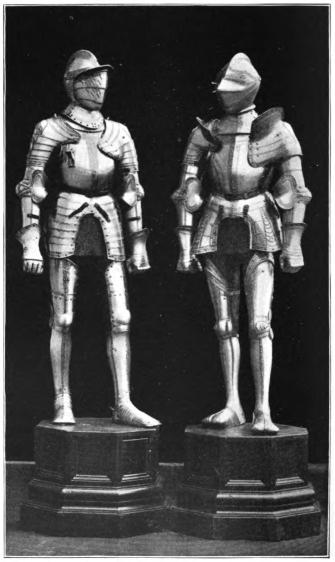
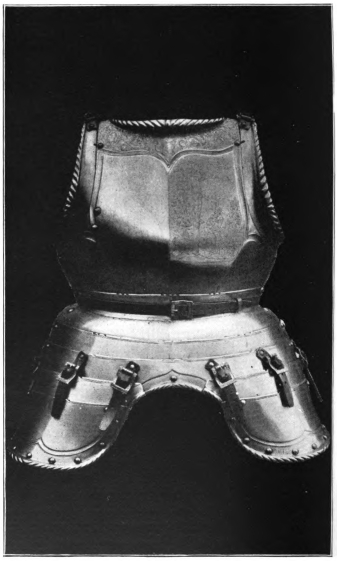
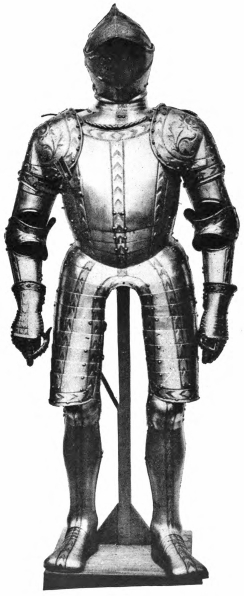
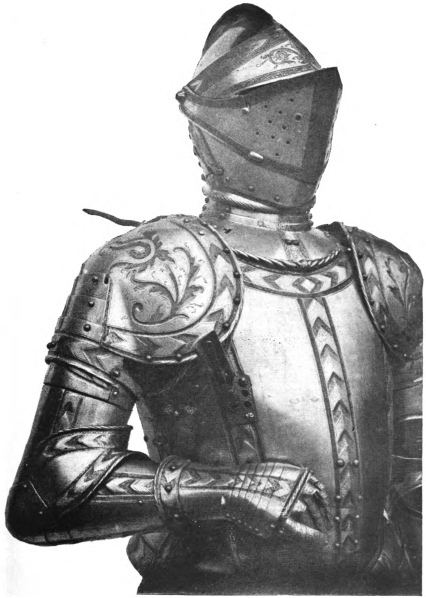
It was late in the reign of Edward II. when considerable
progress was made in the direction of full
“plain” armour in England, but, as shown in the
section headed “Chain-mail,” etc., the use of the standard
of mail survived until the beginning of the fifteenth
century and even later. It is, in fact, impossible to lay
down any arbitrary dates, or anything like a clear line
of demarcation in respect to the relative proportions of
chain and plate armour in use by English men-at-arms up
to the beginning of the fifteenth century; but the fortunate
preservation in our churches of the remarkable series
of effigies and monumental brasses helps us greatly.
There is, however, very little evidence of this kind
before the middle of the thirteenth century. Breastplates,
as distinguished from the old plastrons-de-fer,
were to be met with early in the reign of Edward II.,
but the general rule was still a hauberk of mail, with
épaulières, coudières of plate, and some splint plates on
the arms, all fastened with straps and buckles; the legs
were still generally encased in mail, with, of course,
genouillières at the knees.
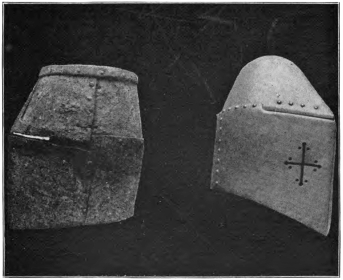
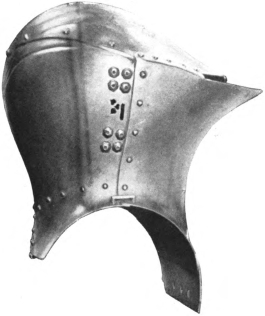
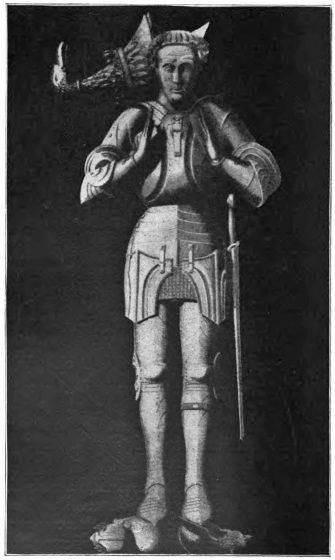
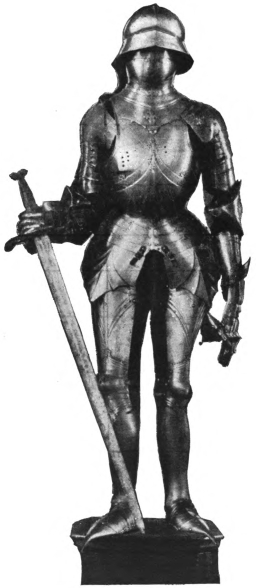
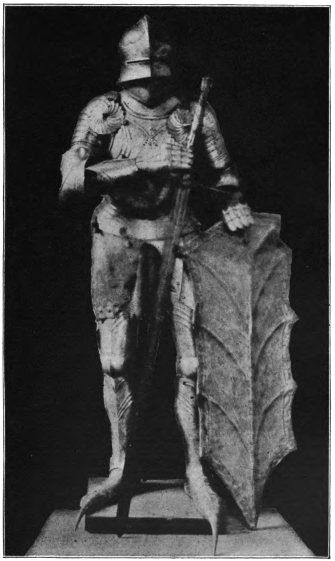
Fig. 2.—Great Helms at Berlin.
1250–1300. 1350–1400.
The long reign of Edward III. (1327–77) saw great
strides towards the general use of full plate armour.
An illumination on the psalter of Sir Geoffrey Loutterell
(died 1345) furnishes an interesting example of the
time. The knight is on horseback, sheathed in plate;
he wears the pointed bassinet, a rectangular ailette on
his right shoulder. His coat-of-arms (“azure,” a bend
between six martlets “argent”) is repeated wherever
possible: on the ailette, helm, pennon, shield, and
housings; and again on the dress of a lady who is
handing up the helm. Another lady holds the shield:
her dress impales “azure,” a bend “or,” a label “argent”
for Scrope of Masham. The saddle is the “well,” and the
spurs rowelled. The lance-rest (an adjustable hook of
iron for supporting the lance shaft) was introduced about
1360. A brass of Sir John Lowe, at Battle, Sussex, gives
a good idea of the armour prevailing late in the reign of
Richard II. and in that of Henry IV. The surcoat is
omitted, so that in this instance the whole front panoply
is exposed to view, though the garment continues to
appear occasionally on monuments well into the fifteenth
century, as shown on the brass of Sir William de Tendering
in Stoke-by-Nayland Church (1408). The bassinet
becomes less acutely pointed than on the effigy of
the Black Prince. Épaulières show articulations, and
gauntlets are articulated at the fingers. This is the case
on the brass of Sir John Lowe, where the armpits
are protected by rondelles, and the now visible taces
of steel hoops form a skirt of from six to eight
laminations. The cuisse is articulated, and the sollerets
are “à la poulaine,” though not in the extreme form.
The spurs are of the rowel type, and the figure is
armed with sword and dagger.
Full plate armour was used in Germany and Italy
earlier than in England. There is ample evidence of
this, but care must be taken in sifting the testimony of
old “Chronicles.” In the “Tristan and Isolde” MS., by
Godfrey of Strasburg, of the second half of the thirteenth
century, the German men-at-arms are represented in
“white” armour; helms with the bevor attached to the
cuirass, the upper part of the face open, jambs of plate
and sollerets “à la poulaine.” Their horses appear with
bards. A statute of Florence of the year 1315 is remarkable
for the following statement, viz.:—“Every
knight to have a helm, breastplate, gauntlets, cuisses,
and jambs, all of iron!”
These manuscripts, however, must not be taken as
conclusive. On the contrary, they really represent what
is now considered to be a late stage of mixed armour.
An Italian example figured in Hewitt (Plate XXVII.)
shows the statue of a knight in a church at Naples
(1335). He wears a hauberk of mail, with rondelles at
the shoulders and elbows, rounded plates strapped over
the upper arm, and jambs of iron. The sollerets are in
chain-mail. The heavy horsemen of the “middle ages”
are often referred to as “knights,” but of course there
could only be a very small percentage of them enjoying
that degree. Presumably many were eligible for the
honour of knighthood for marked bravery in the field.
* * * * *
Before the use of gunpowder in warfare the baronial
fortress was almost impregnable, but cannon turned the
tables on the feudal nobility, dealing a severe blow at
extreme feudalism, of which these castles were the
invariable centres.
The reason for the introduction of the cuirass proper
was the exceeding weight of the hauberk of chain-mail,
in conjunction with the heavy plates often riveted on to
it, and the quilted gambeson, etc., underneath; and also
by reason of the inefficient protection it afforded against
the lance in full career, or strokes from the greatly
improved and heavier swords, or blows from the deadly
battle-axe; indeed, it often happened that a portion of
the chain-mail itself was driven into a wound. It was,
however, far from uncommon early in the fifteenth
century for a hauberk of chain-mail to be worn under
the cuirass, with a gambeson next the body, and another
between the mail and the cuirass; but this multiplicity
of garments was far too heating, heavy and cumbersome,
and at least one of them, and generally two, were discarded
on the full introduction of plate armour. These cast-off
garments were, however, utilised by the lighter troops.
The gambeson is a quilted tunic, often worn in battle
in early times without other armour, having been made
tough enough to turn a sword stroke; but when plate
armour became general it was of quilted linen, fortified
with rings under the arms and breastplate. There is a
most interesting gambeson of the kind in the national
museum at Munich, an example of late fourteenth century
date, and the only one known as surviving; it also
covers the legs, and is strengthened with mail over the
knees. There is a specimen at Munich, thought to be
unique, of the familiar horizontal belt one sees on effigies
of the fourteenth and early fifteenth centuries. The
underclothing varied greatly at the different periods,
and there is often some confusion of terms among the
“Chroniclers” regarding these garments. Chaucer calls
the gambeson a “haketon,” the habergeon of his day
being a shirt of chain-mail. He says:—
“Next his shirt an haketon,
And over that an habergeon,
And over that a fin hauberke,
Full strong it was of plate.”
There is a fine specimen of a fifteenth century habergeon
in the Porte de Hal Museum, Brussels. A MS. of this
period says that esquires were not allowed a sautoir
(stirrup) to their saddles. The order had a distinct
status, even to its costume. The esquire was the
auxiliary and companion of the knight. His duty
consisted in carrying the knight’s arms, breaking-in
and seeing to his horses, and generally looking after
him; he fought at his side and guarded his prisoners.
The spurs of the knight were of gold, those of the
esquire of silver. To “win his spurs” and be dubbed a
knight, he was required to have performed some valiant
deed. There was an intermediate grade between a
knight and an esquire in the pursuivant-at-arms. There
was a varied and costly elaboration of ornament used by
the more courtly cavaliers of the fourteenth century and
later times. The figure of the Black Prince in Canterbury
Cathedral is highly decorated. The knightly belt
has a blue enamel ground, with bosses of gilt leopards’
heads. The bassinet bears a coronet embellished with
precious stones. The sword scabbard is inlaid with
lapis-lazuli, and the spurs are gilt. Inventories of the
period often divulge items such as rich velvet and
embroideries, gold and silver. Pearls and carbuncles
among gems were especially affected for decorative
purposes. The inventory of Piers Gaveston (1313) has
been already referred to as mentioning “les alettes
garniz et frettez de perles.” Mr. Hewitt mentions the
inventory of Louis Hutin, temp. 1316, which has “Item,
cote, bracières, houce d’escu, et chapel de veluyan, et
couvertures a cheval des armes du Roy, les fleurs de lys
d’or de Chypre broudées de pelles [pearls]. Item,
picières et flanchières de samit [satin] des armes le Roy,
les fleurs de lys d’or de Chypre. Item, uns gantelez
couvers de velveil vermeil.” Such portable and valuable
adjuncts induced a deal of looting among the fallen
champions after a battle, and many wounded lost their
lives from this cause who would otherwise have been
put to ransom. Stringent sumptuary laws were very
rife at this time, but these severe enactments were found
very difficult to enforce, and were much evaded; indeed,
this has always been the case. Single feathers were
worn in the fourteenth century; but in the fifteenth and
sixteenth great plumes, drooping gracefully behind, were
the rule. The degradation of a knight under King
René d’Anjou was a very elaborate ceremony: he was
stripped of his armour, which was broken to pieces
before him, and his spurs were thrown on a dunghill;
there was also much besides. In later times, the
knight’s spurs were hacked off by the king’s master-cook.
Early representations of bards are very rare; they
probably originated in the twelfth century, when they
were most likely of fortified leather. They did not
become general in England until towards the close of
the thirteenth century. Wace says that the horse of
William Fitz-Osbert was housed in chain-mail at the
battle of Hastings, but this is incredible.
As already mentioned, German men-at-arms appear
with barded horses in the second half of the thirteenth
century, but it was towards its close, or at the beginning
of the fourteenth, that they became common. The
earliest English official mention occurs in the statute of
27 Edward I., when bards were of chain-mail, leather,
or quilted material. In the inventory of the armour of
Louis X. occurs, “item, a chanfrein.” Nothing like a full
equipment in steel plate for horses was attained before
the second quarter of the fifteenth century, when,
according to a picture in the imperial arsenal at Vienna,
“Der Ritter sitzt auf seinem, bis auf die Hufe, verdeckten
Hengst.” The material differs very much in the
fifteenth century, being of full plate, fortified mail,
quilted cloth, or cuir-bouilli.
Bards comprised the chamfron or chanfrein, for the
face, worn sometimes with a crest; picière, breast;
flanchière, flanks; croupière, hinder parts; estivals, legs.
The crinet, neck, appears first in England on the seal of
Henry V. The horses were gaily caparisoned. The
emblazoned housings were often made of costly material,
such as satin embroidered with gold or silver. Examples
are given in Figs. 3 and 24.
The horsemen of late in the twelfth, thirteenth, and
fourteenth centuries consisted of men-at-arms or heavy
cavalry,15 hobilers and armati, or common horse troops.
The infantry consisted of spear and billmen,—that is, men
armed with long-handled weapons,—crossbowmen and
archers. Hobilers were light cavalry taken from the
better class of yeomen. The “hobby” horse was a
much lighter steed than that used by a knight or man-at-arms,
clad in his armour of proof. Part of the light
cavalry consisted of bowmen. The gynours had charge
of the catapultæ, ballistæ, and other siege engines.
Grose, in his Military Antiquities, vol. i., p. 278, cites
an old Latin MS., giving the numbers of the army
of King Edward III. in Normandy and before Calais,
in the twentieth year of his reign, with their several
stipends, as follows, viz.:—
| |
|
At per Diem. |
| |
|
£ |
s. |
d. |
| |
My Lord the Prince |
1 |
0 |
0 |
| |
Bishop of Durham |
0 |
6 |
8 |
| 13 |
Earls, each |
0 |
6 |
8 |
| 44 |
Barons and bannerets |
0 |
4 |
0 |
| 1046 |
Knights |
0 |
2 |
0 |
| 4022 |
Esquires, constables, centenary, and leaders |
0 |
1 |
0 |
| 5104 |
Vintenars and archers on horseback |
0 |
0 |
6 |
| 335 |
Paunceners |
—— |
| 500 |
Hoblers |
—— |
| 15,480 |
Foot Archers |
0 |
0 |
3 |
| 314 |
Masons, carpenters, smiths, engineers, some at 12d., 10d., tent-makers, miners, armourers, gunners, and artillery men, 6d. and 3d. per diem |
| 4474 |
Welch foot, of whom 200 vintenars at |
0 |
0 |
4 |
| |
the rest at |
0 |
0 |
2 |
| 700 |
Masters, constables, mariners, and pages |
—— |
| 900 |
Ships, barges, balingers, and victuallers |
| |
Sum total of the aforesaid men, besides Lords |
31,000—294 |
| Of whom some men from Germany and France, each receive for their wages 15 florins a month. |
It would appear from this “establishment” that King
Edward’s main force consisted of foot archers, and that
the predominance of this item largely accounts for the
English victories of the time, against greatly superior
numbers on the side of the French. It will be observed
that gunners and artillerymen are mentioned in this
MS., but they were probably for serving siege-guns
before Calais.
The institution of feudalism, which was in direct
opposition to the Roman system, exercised an immense
influence on the form and constitution of the armies of
Northern and Central Europe during the “middle ages”
and later. The inauguration of the movement proceeded
mainly from the division of lands by Clovis
among his followers; but it was the policy of Charlemagne
that gave it form and substance in the direct
creation of a martial and a sacerdotal aristocracy.
Europe then became dotted over with seigniories and
strong places, erected originally with a view to save the
countries from being overrun and enslaved by barbarous
hordes; and by these means the invaders were compelled
to confine their depredations mainly to the sea-coast
regions, which they ravaged without mercy. Each
vassal swore fealty to his liege-lord in the ceremonial
“homage-lige.” The vassal was bound to fight under
the banner of his liege-lord for a continuous term of
from twenty to sixty days when called upon, and to
assist him in many other ways; and as long as his
duties were faithfully and diligently performed he
remained master of his fief, and was also permitted to
infeudate or sub-feudalise it. The seignior on his part
extended his protection to his vassals, and was bound to
render them full justice; and in cases of default an
appeal to the suzerain of the seignior was provided for.
This was the theory, but the practice too often meant
an organised system for the oppression of the weaker
classes, and so on down to the lowest rung of the feudal
ladder. The church itself united in exercising a feudal
as well as a spiritual jurisdiction, and bishops wielded
this double power over the seigniory in their bishoprics.
The rise of the third estate, and especially that of
communal government, brought about modifications of
the system as time moved on. These causes, with their
influence on military matters, will be lightly touched
upon in these pages as they arise; but it must be borne
in mind that though feudalism was the same in principle
everywhere, it differed in its application in the
various countries it dominated, according to the characteristics
and circumstances of the peoples.
The principle of the ban or feudal levy was that those
holding land should contribute to the king’s army in
war time a certain fixed proportion of retainers, according
to the acreage of their holding; but in cases of great
national peril the levy, the arrière-ban, was much
larger, and there was often an arrangement under which
actual service might be compounded by a money payment
called “scutage.” The arrière-ban or the ban-fieffé
dates from the sixth century. It summoned the vassals,
which the suzerain alone had a right to command. The
increasing number of mercenary troops employed
steadily diminished the importance of the ban, and
“scutage” became more general.
The battle of Courtray, fought in 1302, was the
turning point in the greater estimation of the use of
infantry combinations, when the French chivalry was
so completely routed by the Flemish guild-bands, armed
with the goedendag, which, whatever its form really was,
then proved a most effective weapon against a rush of
horsemen. About six thousand of the chevaliers were
killed, a heavy blow struck at the nobility of France.
The object-lesson thus afforded showed, even at this
early period, that heavy horsemen charging with the
lance, or striking with the mace or battle-axe, had
ceased to be “the strength of the battle.” This experience
was amply confirmed at a later period at the
decisive battles—Granson, Morat, and Nancy. After
the death of Charles the Bold at Nancy, in 1477, a
victory won by the Swiss infantry with staff weapons,
the “chivalry” of battle became much discredited, and
the extreme feudalism which had hitherto dominated the
military systems of Europe underwent its first serious
check in the diminished importance of the mailed
horseman, and the growing power of the third estate,
which henceforward became a more weighty factor in
warlike tactics and combinations. This process, which
had been growing for some time in the gradual enfranchisement
of the communes, developed from the
motley swarms of yeomen and peasants at length into
a communal militia. To these were now added “condottieri”
and other free companies, such as stradiots,
routiers, brabançons, and tard-venus, and with these
more stable elements of an army, tactics and generalship,
which had hitherto been of the most elementary
character, soon made great strides. There are, however,
early instances of the addition of “mercenary bands”
to armies in the field. William the Conqueror’s army
at Hastings contained a large proportion of these troops,
which were placed in the first division during the
battle. The Plantagenets also used them very freely.
Mercenary troops, however efficient in action, had
many drawbacks in campaigning. They were not unfrequently
known to change sides at a critical moment,
such as on the eve of, or even during an engagement.
A notable instance of this may be cited in the case of
the battle of Pavia, in 1525, when Francis I. was made
prisoner.
The growing power of the Hanseatic Bund did more
than anything else in Germany towards the enfranchisement
of the towns from the galling fetters of feudalism.
This mighty organisation, in the heyday of its power,
consisted of over a hundred of the most important
towns, scattered over Germany and Northern Europe,
and extending as far as Wisby in the Gulf of Bothnia,
and even to Novgorod in Russia. Its power became so
great that even the Emperor exercised but a nominal
supremacy over the German cities enrolled. Almost the
entire commerce and banking of the time in Northern
Europe centred in this powerful association, fenced in
its walled towns. It supplied the sinews of war, and the
equipments for nearly every campaign; often indeed for
both the opposing armies. Its power and monopolies
in England, where it had stations, especially in London,
were immense.16 Feudalism thus became greatly
banished to the country districts, which constantly underwent
a depletion of able-bodied men by a rush of serfs
towards freedom under the syndics. Soon the standards
and war-cries of the great seigniors ceased to cause confusion
in the ranks.
The equipment of each man-at-arms in the fifteenth
century was two archers with two mounted followers;
and a little later a sixth man and horse were added.
An army of fifteen hundred “complete lances” required
a contingent of at least five thousand mounted archers.
It was not uncommon for armour to be imported
from Italy during the fourteenth century. Froissart
states that Henry IV., when Duke of Hereford, sent
messengers to Milan asking Duke Galeazzo to forward
him a harness. The Duke complied with the request,
sending four Italian armourers with the suit.
Broadly, the period of full plate body armour is
reached in England early in the fifteenth century,
when the mentonnière, rondelles, cuirass, taces and
tuilles, garde de reine, épaulières, gauntlets, cuisse,
genouillières, jambs and sollerets were all of plate. The
ingenious application of overlapping or lobster-tail plates,
first applied to the solleret and rerebrace, had now
extended to the shoulders and taces, and we find this
system gradually developing towards the fine ridged
and escalloped armour, which originated in Italy in the
second quarter of the fifteenth century. Effigies of the
first quarter of the fifteenth century are characterised by
the bassinet, standard of mail, and beautiful fan-shaped
coudières pointed over the elbow-joint. The skirt of
mail shows itself beneath the taces, with an escalloped
fringing. Articulated épaulières prevailed until towards
the middle of the century, when pauldrons began to
displace rondelles over the armpits; an early example
of which may be seen on a brass in Arkesdon Church,
Essex. Pauldrons are, however, exceptional until the
“Maximilian” period. Examples of most of the features
of the period may be seen in the series of plates published
by Stothard, Hollis, Creeny, and others. We pass now
out of the period during which we have been mainly
indebted to effigies, brasses, and pictorial representations
for our knowledge of armour, and enter on much surer
ground, when there are actual and contemporaneous
specimens to deal with. Still there is but too frequently
ground for doubt and perplexity, as comparatively
few suits are quite homogeneous; in many cases
some of the parts are often restorations, faulty enough,
as most restorations are. Pieces sometimes belonged
to other suits, and not unfrequently to widely different
periods. New tactics in battle had to be parried by
the armour-smith with changes and modifications in
armour; for instance, at the battle of Creçy the English
men-at-arms fought for the first time in foot formation,
and they adopted the same tactics at the battle of
Poitiers on the 19th September, 1356. This innovation
having been copied by the French, the armourer had to
meet the occasion, and different harnesses began to be
made for foot-fighting and horseback; and somewhat
later additional pieces were added to screw on to the
other armour, for further protection in tilting and in
battle. These pieces were devised for the protection of
the more vulnerable places, on the principle that energy
always takes the line of the least resistance. Besides
this, at various periods when defence was stronger than
attack, improvements in the arms then in use took
place; and new weapons were devised with a view
to the attack of weak points in armour. Before the
battle of Poitiers the French men-at-arms were ordered
to shorten their lances to five feet, and to take off their
spurs; and the lances were similarly shortened at the
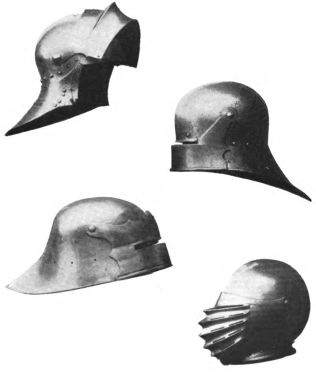
battle of Auray in 1364. The great helm was now
rarely used, giving place to the visored bassinet, the
visor to be raised or lowered at pleasure. The bassinet
was in its turn superseded by the sallad in the first quarter
of the fifteenth century, and the latter towards its close by
the armet, followed closely by the burgonet. A monument
in the cathedral at Posen gives a good idea of the
armour in use in Germany in the first half of the fifteenth
century—it is a figure of Lucas de Corta, who died in
1475. The armament consists of a mentonnière of
several laminated plates to be raised or lowered, cuirass
with rondelles, taces of five or more overlapping plates,
going right across the lower body, but no tuilles, cuisse
with genouillières and hinged jambs; laminated rerebraces,
and large pointed coudières. The fingers of the
gauntlets are articulated, with a sharp gadling over each
knuckle, and sollerets “à la poulaine.” This monument
doubtless represents armour of the first half of the
century. A brass in the church at Altenberg gives a
figure of Gerart, Duke of Gulich, who died in 1475, with a
similar armament excepting that he wears an early form
of armet, and the tuilles are attached to the taces. The
armour of this period, with its pretty shell-like ridgings,
is both graceful and practical, and also lithe and supple.
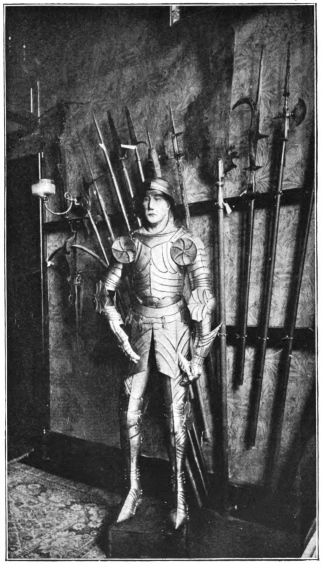
The armour of the second half of the fifteenth century,
which is usually styled “Gothic,” it is impossible to
say why, is by far the most graceful of all the periods,
combining beauty of form and contour with excellence
of material and workmanship; together with an admirable
adaptability for defence against the then existing
weapons of attack. The main features of this remarkable
period are the escalloped and shell-like form of some of
the pieces, and especially the presence of tuilles. The
coudières are excessively large, sometimes preposterously
so, and channelled with a view to the lance glancing off
them. The breastplate is rendered both stronger and
more elastic by being made in two and even three
laminated plates. Sollerets are “à la poulaine.” The
helmet of this armour is the sallad with the mentonnière.
An excellent English example may be seen on the
Beauchamp effigy at Warwick (1454); and another on
the brass of Sir Robert Staunton at Castle Donnington
(1458). There is a very instructive series of monumental
effigies at Meissen, engraved by Hollis, of successive
dukes of Saxony, showing the continuous advances in
armour. Albert, who died in 1500, wears the armet,
pauldrons with pikeguards,17 and broad sollerets. Another
duke, who died seventeen years later, shows tassets
of five lames, and “bear-paw” sollerets. The armour
of Duke Frederick, who died in 1539, shows mitten
gauntlets of numerous narrow lames.
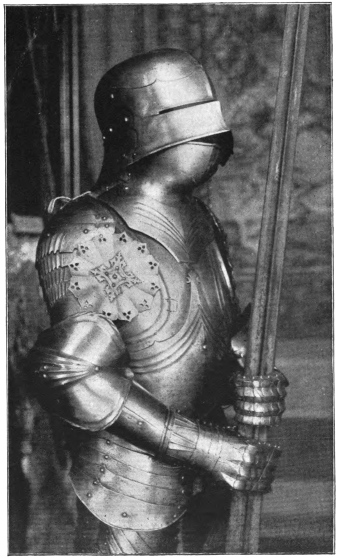
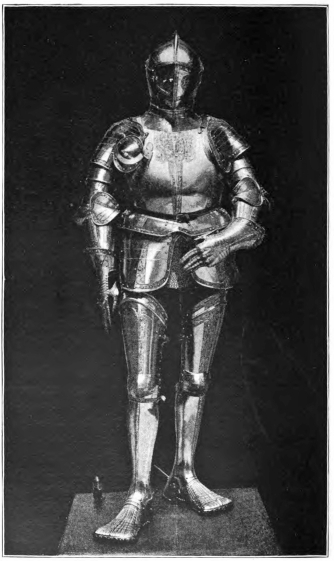
Gothic armour is the most perfect of all. It is more
“mobile” than any of the later schools, and was made to
fit almost like a glove; and as the details of suits are no
longer obscured by the surcoat on effigies, we have these
representations to guide us, as well as actual specimens.
The steel, which looks as if it had an admixture of
silver, is stronger in texture, brighter and tougher than
that of any other period. Sad it is that there are
so few perfect specimens of this armour left to us, for
most of the armour wrought up to the middle of the
century has become the prey of rust, the iconoclast, and
the melting pot. The suits at Sigmaringen, Munich,
Nuremberg, Vienna, and Berlin are among the most
homogeneous the author has seen.
Armour made at Milan was already famous at the end
of the fourteenth century, and many suits were ordered
there at that time for English account; and later in Germany,
for it took a considerable time before the wave
of the “renaissance” reached the more northern country.
The famous Milan armour-smiths, the Missaglias and
Negrolis, and in Germany, the Kolmans of Augsburg,
Hans Grünewald of Nuremberg, and the Seusenhofers
of Innsbruck, all turned out work of the highest
character and finish; as also did many of the later
masters, such as Anton Peffenhauser of Augsburg,
Lucio Piccinino of Milan, and Georgio Ghisi of Mantua.
Both armour and weapons of a high quality were produced
in other towns in Italy, such as Florence, Brescia,
Lucca, Pisa, and Pistoja. The work of the armour-smith,
pure and simple, seems generally to have reached
its highest point of excellence during the second half of
the fifteenth century, the force of the “renaissance”
expending itself more on ornamentation.
Until comparatively recently very little was known
concerning the great armour-smiths and their coadjutors
of the fifteenth, sixteenth, and even seventeenth
centuries; but much has now been accomplished in this
direction by Dr. Wendelin Boeheim in Vienna, and
given to the world in his work, Der Waffenschmiede,
etc. Dr. Cornelius Gurlitt has also thrown much light
on the masters of Saxony in his booklet entitled
Deutsche Turnier, etc., of the sixteenth century. We
owe much to these savants for their arduous labours in
rescuing the names, and much besides, of so many of
these great artists from an undeserved oblivion; and
also by the identification of their work in providing
valuable and reliable material for fixing the dates of
armour within comparatively narrow limits.
Scale armour is but very rarely found in the fifteenth
century.
Monograms are not often seen on armour of English
make, but they were common in Germany towards the
end of the fifteenth century, when armour was occasionally
inscribed with the year. The comparatively few
instances of dated armour are intensely valuable, as we
have then no inferences or doubtful ancestral legends,
but the actual year of make. Examples of both fifteenth
and sixteenth centuries occur at Nuremberg and Berlin.
There is an idea generally prevailing that the stature of
the men of the middle ages was shorter than nowadays.
After the comparison of many suits, both at home and
abroad, it is certain that this is not the case, but the
average development of the calf of the leg is greater
now. An ordinary-sized leg of to-day would not fit into
the average cuisse and jamb of the sixteenth century,
but it must be remembered that a very large proportion
of the suits preserved, made in the fifteenth and sixteenth
centuries, were for Italy, South Germany, France,
and Spain. The build and stature of these peoples were
slighter than that of the Englishman. The wearers
spent such a large proportion of their time on horseback,
that the calves of their legs were naturally like those of
the “horsey” man of to-day.
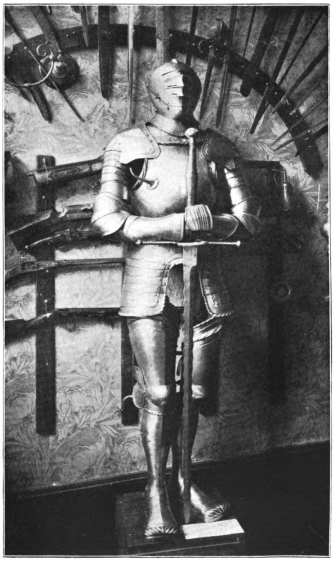
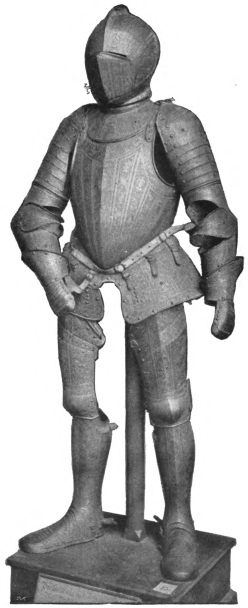
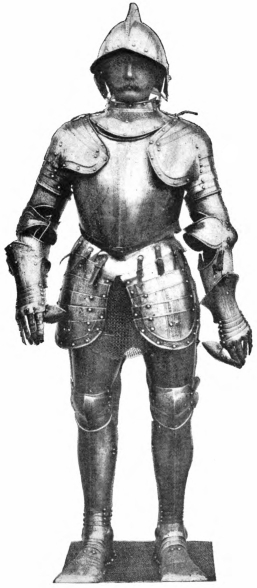
From early in the sixteenth century the changes were
greatly matters of detail, the differences in suits being
principally those of form. The shell or tile-formed
tuilles, after having been in use for nearly a century,
gave place to the more comprehensive tassets of overlapping
plates. Épaulières developed into pauldrons,
which gradually increased in size, covering both
shoulders and upper-arm, and at length extended over
each breast, and then diminished again in size. Pikeguards
were introduced to protect the neck from pike
thrusts, and there are instances of these plates as early
as the middle of the century. Sometimes they are
double on each shoulder—see the brass at Qui, Cambridgeshire.
In cases where a pikeguard appears on
one shoulder only, a close examination will generally
reveal holes for the fixing of its fellow. At the beginning
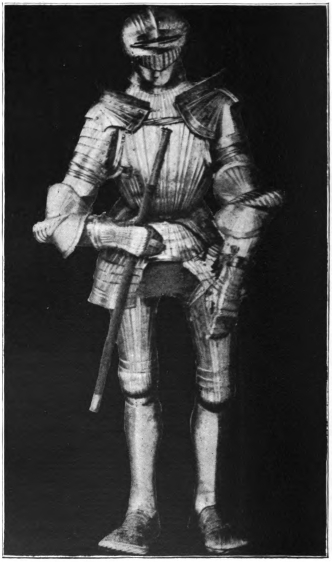
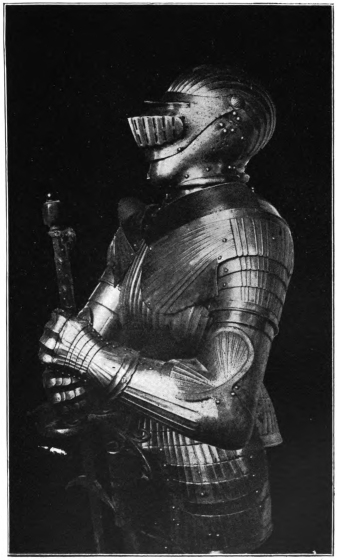
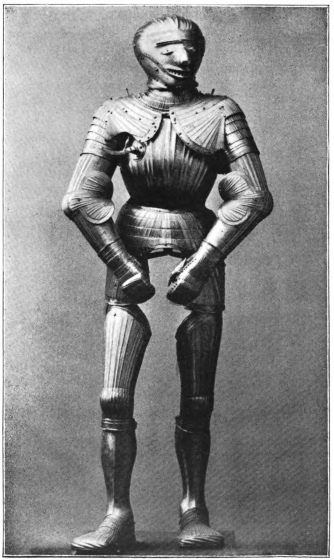
of the sixteenth century, or a few years later, the so-called
“Maximilian” armour superseded that termed
“Gothic,” when a large proportion of this armour (the
“Maximilian”) was fluted everywhere except the jambs.
It had pauldrons, with pikeguards, and great “bear-paw”
or “cow-mouth” shaped sollerets. This style became à
la mode, in imitation of the prevailing fashion in dress,
which was then largely puffed and slashed. It must be
understood, however, that fluted suits were in a majority
of the armour made, but not to the exclusion of plain
armour. The cuirass is shorter than in the later
Gothic form; it is more globose, with the top cut
straight, and the breastplate is usually in one piece.
The headpiece is the armet and burgonet. Sliding
rivets (Almayne) gave increased elasticity to armour of
this period. As may be seen from some notes in
Archæologia, vol. li., p. 168, written by Viscount Dillon,
P.S.A., the term “Almayne rivets” was sometimes applied
to complete harnesses; for an order sent to Florence by
Henry VIII., in 1512, runs: “The 2000 complete harness,
called Almayne ryvettes, were to be alway a salet, a
gorget, a breastplate, a backplate, and a pair of splints
(tassets) for every complete harness at 16s. the set.”
There is a sixteenth century specimen of an armourer’s
pincers, with claw and hammer head for riveting armour,
in the Rotunda collection at Woolwich. It was soon
found that arms of attack would not glance so well off
fluted suits, and smooth armour was again generally
reverted to. Blackened armour was not uncommon at
this time; and a black, white, or coloured tunic of stuff
was often worn over bright. The first instance of black
armour that we have met with is mentioned by Froissart,
under the year 1359.18 While in “Gothic” armour the
taste of the period found expression in beauty of outline,
already in the fifteenth century it had become fashionable
to have armour engraved and otherwise ornamented.
Perhaps the only brass that is to be seen in Spain
represents a beautiful specimen of inlaid armour; the
figure is of Don Parafan, Duke of Alcola, who died in
1571. The pikeguard has ceased, sollerets are the
shape of the foot, and he wears a morion. The morion
and cabasset were late sixteenth and seventeenth century
helmets, while armets and burgonets were greatly worn
early in the sixteenth. Late in the fifteenth and during
the sixteenth centuries there was a description of
armour called “penny-plate.” It consisted of round
pieces of steel riveted on to leather. There is a specimen
of this kind of armour at the Rotunda, Woolwich.
By the end of the fifteenth century heavy tilting-suits
had attained their greatest strength, and as
the sixteenth century advanced so did ornamentation.
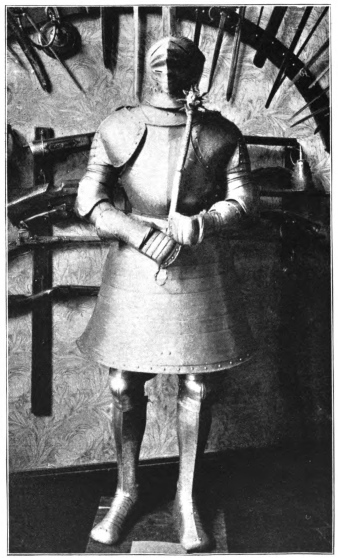
Under the Emperor Maximilian skirts or petticoats
of plate began to be worn—another illustration of the
influence exercised on armour by the prevailing fashion
in dress, in fact the form was reproduced in the surcoat
before 1470; and indeed the application of taces during
the fourteenth and early in the fifteenth centuries, before
the introduction of tuilles, was also something in the
same fashion. These skirts were called bases or lamboys.
There is an example in the Tower of London,
and another on the Hertford tomb (1568). Another
example is in the author’s collection, of which a detailed
description and drawing is given later in these pages
(Fig. 25). These lamboys were specially designed for
fighting on foot, but there is often an arrangement by
which a portion is detachable in order to enable the
wearer to sit on horseback. There is a style of armour
the Germans call “Pfeifenharnisch,” which has embossed
pipings in high relief like puffs. Such a harness was
made by Hans Seusenhofer for Prince Charles, later
the Emperor Charles V. Visors of this period were
often wrought in the form of a grotesque face. There
is more than one example at Vienna, and indeed they
were far from uncommon; the author possesses a couple.
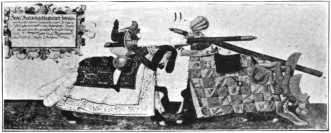
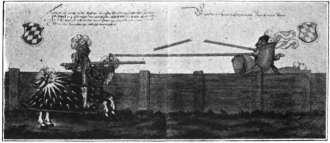
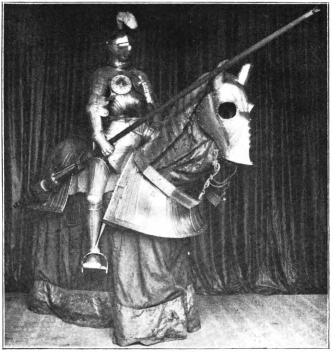
Bards had become highly decorated, and with the
housings were sometimes designed in close imitation
of the dress fabrics of the period. Such a suit of
bards on a charger, on which is mounted a rider in a
piped suit of the “Maximilian” type, may be seen in
the Kungl. Lifrustkammar, in Stockholm. An illustration
is given in Fig. 3.
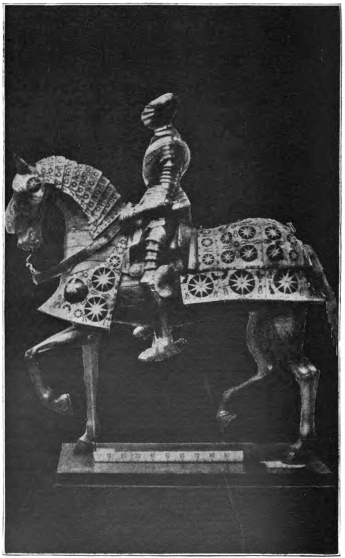
Fig. 3.—Mounted Suit with Bards, in the Kungl.
Lifrustkammar Collection, Stockholm.
Towards the end of this century (the sixteenth) defensive
armour had reached its highest point of development.
Tassets gradually became lowered to cover the knees in
a series of lobster-shell plates, as on a brass of Queen
Elizabeth’s reign, that of Sir William Harper, in St. Paul’s
Church, Bedford. Examples of these elongated cuisses
occur, however, much earlier. Jambs and sollerets were
at length laid aside in favour of jackboots, and plate
armour fell gradually into disuse, mainly owing to the
new tactics rendered necessary by the general use of
firearms, and the growing desirability of lightly-armed
squadrons and companies; indeed, before the accession
of Elizabeth the use of armour in campaigning had
ceased to be a sine qua non, and, all regulations notwithstanding,
a constantly increasing proportion of campaigners,
especially among the infantry, insisted on
discarding it. It became at length more used for purposes
of display rather than for actual service, and hence
armour became more and more decorative. There is
a scarcity of plate armour of the fourteenth century,
and but little remains of the fifteenth. This is
not surprising, as the quantity made in those days
was strictly limited; but what does seem strange
is the scarcity of armour of the sixteenth century,
and especially of the first half, over which time such
immense quantities were in use. One explanation of
this may be found in Archæologia, vol. li., p. 222,
when Viscount Dillon gives examples of great quantities
of armour having been converted, during Elizabeth’s
reign, into “targets” and “jacks” for the navy.
* * * * *
Now that the armour period has been roughly covered,
the evolution of each important piece will be followed
to its decadence, when hand-to-hand fighting was rarer,
and strategy in masses more developed, as the proud
knight had at length become of minor importance
as against organised infantry, which was now “the
strength of the battle,” and when the use of various
weapons of attack, especially the harquebus, became
general. Tactics in warfare were at a very low ebb during
the fourteenth century, and the military scandals of that
time were many. Agincourt is an example of confusion
among the French ranks that had many parallels at the
time; but with the advent of the fifteenth century, much
systematic improvement was effected. It was not before
the reign of Elizabeth that any large body of troops could
advance in close column without breaking its formation.
Armies in the sixteenth century no longer consisted
of mere feudal and communal levies, but were organised
into companies and regiments, the battalion becoming
the recognised unit for the infantry in the reign of
James I. Systematic tactics were introduced, and the
proper proportions of horse, foot, and artillery in the
field determined. The effective use of gunpowder in
battle, and its influence on armour and tactics, was very
gradual, but during the sixteenth century it progressively
compassed great changes in both. Boys in the fifteenth
and sixteenth centuries were taught the use and
practice of arms at an early age. An interesting
group of boys’ harnesses, of various sizes and periods,
may be seen at the Dresden Museum. Numerous dints
on the armour, some of them heavy, show that very
hard knocks had been exchanged.
The mode indicated of treating the subject will be
clearer than any attempt made at elaborate contemporary
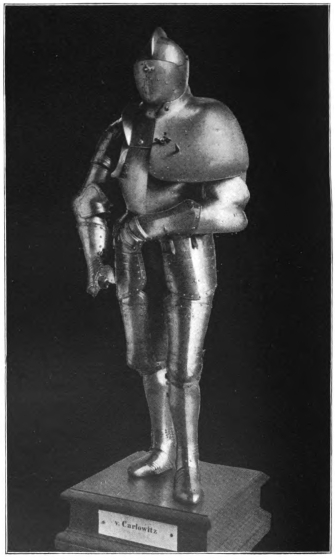
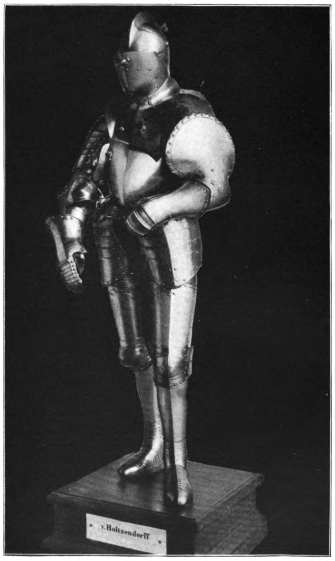
classification as a whole. Representative suits,
especially from local and foreign collections, will now
be taken more or less in detail, thus showing the combinations
of the various periods they represent, leaving
separate chapters for tilting suits, extra tilting pieces,
and the tournament generally, besides enriched armour
and a slight sketch of prominent armour-smiths, and
some of the most important collections of arms and
armour.
A large proportion of the armour used in England
continued to be imported from Italy and Germany.
Henry VIII. bought and received in presents, harnesses,
both for foot-fighting and horseback, from these countries;
indeed, the trade in armour and arms formed a not
inconsiderable item in the importations of the Hanseatic
Bund already mentioned, and the bulk of the armour in
private collections of fifteenth and sixteenth century
make is of German or Italian origin. Not only was
armour imported, but foreign smiths and artificers,
principally of German nationality, known as Almayne
armourers, were introduced. Milan armourers were
working at Greenwich in 1514.19 Exportation from
England was not allowed without royal licence.
Although the matchless Beauchamp effigy (Fig. 16)
was the work of an Englishman, it is probable that most
of the fine suits in English collections, with the least
possible pretensions to any historic connection with this
country, were principally of Italian or German make, up
to the meeting of Henry VIII. with the Emperor Maximilian;
but a good deal of English armour was turned
out later in Henry’s reign, and in that of Elizabeth, by
the “Almayne” smiths, already referred to, brought over
from Germany and Italy. The Armourers’ Album at
South Kensington, with drawings of twenty-nine
harnesses, throws much light on the armour of the
earlier Elizabethan period, and some of the suits
mentioned therein have been identified. It is certain,
however, that the influence exercised by the imported
German and Italian smiths on armour of English make
was of comparatively short duration, for suits made by
armour-smiths in this country after the early portion of
Elizabeth’s reign were characterised by a vast inferiority
in design, execution, and material to those turned out by
their German and Italian confrères. With the exception
of the fine specimens in the collection at the Tower
of London, it is in Germany where most of the Gothic
and Maximilian suits have been preserved, and a few
are still to be met with in Italy and Spain. It is a great
pity that the armour possessed by the nation should be
scattered over so many places, instead of being concentrated
in one grand national collection. Could this
be arranged, we would possess an armoury worthy of
the empire. The Wallace armour is a great accession
to our store, but this collection still remains unpacked.
The almost constant warfare, both in Germany and
Italy, during the middle ages naturally made the manufacture
of armour more of a speciality in these countries
than in England, and the effect of the Italian “renaissance”
was especially seen in profuse and artistic
ornamentation, which at length came to be more
regarded even than strength itself—it was, in fact, a
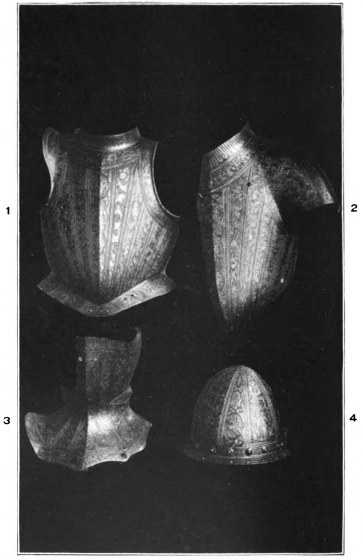
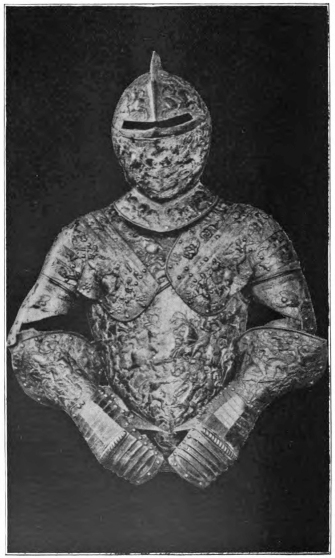
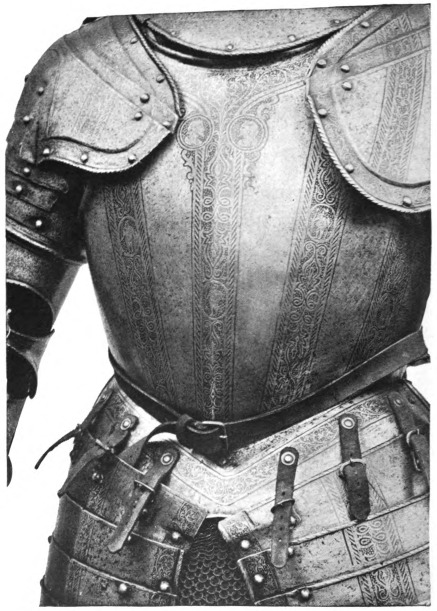
fine art. Much of the armour was covered with
embossed figures, engraved, chased, and damascened
with gold. The work of the Augsburg, Nuremberg,
and Innsbruck armourers was really, if not quite, equal,
both in design and workmanship, to that of Italy; and
many historic suits until recently classed as Italian have
been since proved to be of German workmanship.
The counties of Northumberland, Cumberland, and
Durham are not rich in armour, especially in that of the
sixteenth century, and the only Gothic suit is, we believe,
one in the author’s possession, and there is no perfect
harness of the “Maximilian” type in the district. As
many as possible of what may be termed north-country
examples will be given in these pages.
Military experts of the sixteenth and even seventeenth
centuries differ widely in their estimation of the
value of steel armour in battle, and many of them strove
valiantly against its growing partial abandonment.
James I. is said to have made the remark that body-armour
was a double protection; for it secured the
wearer from being injured, and also prevented him from
injuring others! It became impossible to forge armour,
for man and horse, proof against the improved musketry
fire; and little by little the old chivalry of battle had to
give way against overwhelming odds. The full effect
of the movement was, however, much retarded by
various causes. The earlier firearms were clumsy,
dilatory, heavy to carry, and ineffective in practice;
besides new supports, formations and tactics took time
to organise and develop before firearms could reap the
full benefit of their superiority, which they eventually
achieved with the musket, in conjunction with “covers”
of halbardiers, and especially pikemen, before these
footmen’s weapons were superseded by the bayonet.
These causes, and the increasing demand for lighter
and more easily manœuvred troops, and newer tactics
demanding greater mobility and longer marches, brought
about the downfall of the man-at-arms, who was effective
only on the level; and with his disuse plate-armour had
ceased to be generally worn.