MARTIN CARR did a fine thing that afternoon. Martin and John Marsh were
hauling trawls, when a sea capsized their dory. The same sea washed them
both clear of the dory. John Marsh could not swim. It looked as if he
had hauled his last trawl, and so beyond all question he had, but for
Martin, who seized one of their buoy-kegs, which happened to bob up near
by, and pushed it into John’s despairing arms. “Hang on for your life,
John!” said Martin, and himself struck out for the dory, knowing that
the buoy could not support two. It was perhaps forty feet to the bottom
of the dory—not a great swim, that; but this was a winter’s day on the
Grand Banks, and a man beaten back by a rough sea and borne down by the
weight of heavy clothing, oilskins, and big jack-boots. When he had
fought his way to the dory he had to wait a while before he dared try to
climb up on it, he was that tired; and after he got there he found no
strap to the plug, and so nothing to hang on to. He remembered then that
he and John had often spoken of fixing up a strap for the plug, but had
never fixed it.
“My own neglect,” muttered Martin, “and now I’m paying for it.”
Clinging to the smooth planking on the bottom of the dory was hard work
that day, and becoming harder every minute, for the sea was making. And
there was John to keep an eye on. “How’re you making out, Johnnie-boy?”
he called.
“It’s heavy dragging, but I’m all right so far,” John answered.
“And how is it with you now, Johnnie-boy?” he called in a little while
again.
“I can hang on a while yet, Martin.”
“Good for you!” said Martin to that.
“Can you see the vessel?” asked John after another space.
“He’s giving out, and I see no vessel,” thought Martin, but answered
cheerily, “Aye, I see her.”
“And how far away is she, and what’s she doing?”
Aloud Martin said, “Five or six miles, maybe, up to wind’ard; and she’s
taking aboard all but the last dory, and there’s men gone aloft to look
for us.” But under his breath, “And God forgive me if I go to my death
with that lie on my lips; but ’tis no deeper than my lips—no deeper.”
Then they waited and waited, until John said, “Martin, I’ll have to go
soon— I can’t hang on much longer.”
“Bide a while, Johnnie-boy—bide a while. Dory-mates we’ve been for many
a trip—bide a while with me now, Johnnie.”
But Martin knew that it would be for but a little while for John—for
them both, if help did not come soon. Scanning the sea for whatever hope
the sea might give, he saw the trawl-line floating on the water. That
was the line that ran from their anchor somewhere on the bottom to the
buoy-keg to which John was clinging. If he could but get hold of that
line he could draw John to the dory, with a better chance to talk to
him—to put heart into him, for Johnnie was but a lad, no more than five
and twenty.
To get the line, he would have to swim; and to swim any distance in that
rising and already bad sea he would have to cast off most of his
clothing. And with most of his clothing gone he would not last too long.
Certainly if the vessel did not get them by dark, he would never live
through the night. He would freeze to death—that he knew well. But
could he live through the night, anyway? And even if he could— But what
was the good of thinking all night over it? He pulled off his boots,
untied his oilskins, hauled off his heavy outer woollens.
“Johnnie-boy, can you hang on a while longer?”
“I dunno, Martin— I dunno. Where’s the vessel?”
“She’s bearing down, John.” And with the thought of that second lie on
his lips Martin scooped off for the buoy-line, which, after a battle, he
grabbed and towed back to the dory. It was a hard fight, and he would
have liked well to rest a while; but there was Johnnie. So in he hauled
many a long fathom of slack ground-line, with gangings and hooks, and
after that the buoy-line. He sorrowfully regarded the fine fat fish that
he passed along; every hook seemed to have a fish on it. “Man, man, but
’twas only last night I baited up for ye in the cold hold of the
vessel—baited with the cold frozen squid, and my fingers nigh
frost-bitten.” But every hook was bringing him nearer to his dory-mate.
He felt the line tauten at last. “Have a care now, Johnnie, while I draw
you to me,” and hauled in till Johnnie was alongside.
But “Good-by,” said Johnnie ere yet Martin had him safe.
“Not yet, Johnnie-boy,” said Martin, and reached for him and held him
up and lashed him to the buoy. “You can rest your arms now, lad,” he
said, and Johnnie gratefully let go.
“’Tis made of iron a man should be that goes winter trawling,” said
Martin, and up on the bottom of the dory he climbed again, this time
with infinite difficulty.
They had had the leeward berth and now were farthest from the vessel,
and by this time it was dark. But Martin knew the Skipper would not give
them up in a hurry, as he explained to John. And by and by they saw the
torches flare up.
“Wait you, John,” said Martin then, “and save your strength. I’ll hail
when I think they’re near enough to hear.” Which he did, in a voice that
obeyed the iron will and carried far across the waters.
Then the vessel saw them and bore down, the Skipper to the wheel and the
men lining the rail.
“Be easy with John,” said Martin to the man who first stretched his arms
out and remarked, “I’m thinking he’s nigh gone.”
“Nigh gone? He is gone,” as they lifted John aboard.
“But all right with him now,” they said as they passed him along the
deck. “And how is it with yourself, Martin?” they asked him as he was
about to step over the rail.
“Fine and daisy,” said Martin. “How is it yourself, boy?” stepping
jauntily up, and then, unable longer to stand, falling flat on the deck.
Seeing how it had been with him, they made him go below also, which he,
with shipmates helping, did; and also, later, put on the dry shift of
clothes they made ready. In the middle of it all he asked, “Where’s
Johnnie?”
“In his bunk—and full of hot coffee—where you’ll be in a minute.”
“The hell I will! there’s my dory yet to be hoisted in.”
“Your dory, Martin? Why, she’s in, drained dry and griped long ago.”
“What! and me below? And dory in already? What was it? Did I fall
asleep, or what? Lord! but it’s an old man I must be getting. I
wouldn’t’ve believed it. In all my time to sea, that’s the first time
ever I warn’t able to lift hand to tayckles and my own dory hoisting
in.” He made for the companion-way, but so weak was he that he fell back
down the companion-way when he tried to make the deck.
But a really strong man recuperates rapidly. An hour later Martin was
enjoying a fine hot supper, while the crew sat around and hove questions
at him. They asked for details, and he gave them, or at least such of
them as had become impressed on his mind; particularly did he condemn,
in crisp phrases, the botheration of boots that leaked and the need of a
second plug-strap on the bottom of a dory. “There ought to be a new law
about plug-straps,” said Martin.
“Did ever a man yet come off the bottom of a dory and not speak about
the plug-straps?” commented one.
“And leaky boots is the devil,” affirmed another—a notorious talker
this one, who bunked up in the peak, where he could be dimly seen now,
his head out of his bunk that his voice might carry the better. “I
bought a pair of boots in Boston once—a Jew up on Atlantic Avenue——”
“In Heaven’s name, will you shut up, you and your Atlantic Avenue boots?
We’ll never hear the end of those boots.”
The man in the peak subsided, and he who had quelled him, near to the
stove and smoking a pipe, went on for himself: “And what were you
thinkin’ of, Martin, when you thought you were goin’?”
“Or did you think any time that you was goin’?” asked somebody else.
“Indeed and I did, and a dozen times I thought it—and that ’twas a
blessed cold kind of a day for a man to be soaking his feet in the
ocean.”
“And yet”—the lad in the peak was in commission again—“and yet warn’t
it some professor said in that book that somebody was reading out of the
other day—warn’t it him said that salt water ain’t nigh so cold as
fresh. Is it, Martin?”
“As to that,” answered Martin, “I dunno. But I wish ’twas that
professor’s feet, not mine, was astraddle the bottom of that dory—not
to wish him any harm. But winter’s day and the wind no’therly, I found
it cold enough.”
“I went into a Turkish bath parlor in New York one time,” came the
conversational voice from the peak, “and hot? My Lord——”
“The man,” said the next on watch, taking his mitts from the line above
the stove—“the man that’d talk about hot Turkish baths on a night like
this to sea— Turkish baths, and, Lord in heaven, two good long hours up
there——” He halted to take a sniff up the companion-way. “Two
hours—what ought to be done with the like o’ him?”
The man by the stove, who a while before had vanquished the lad in the
peak, took his pipe long enough from his mouth to observe, “And for four
years now, to my knowledge, he’s been tryin’ to tell how hot ’twas in
that Turkish bath.”
“Hit him with a gob-stick,” suggested the cook—“or this rolling-pin.”
He was flattening out pie-crust.
“A gob-stick or a rolling-pin,” said the next on watch, “is too good for
him. Here, take this,” and passed the cook’s hatchet along the lockers.
The opening and closing of the hatch after the watch had gone on deck
admitted a blast of air that made the man in the bunk nearest the steps
draw up his legs. The flame in the lamp flared, whereat the original
inquirer got up to set the lamp chimney more firmly over the base of the
burner, and before he sat down put the question again. How did Martin
feel when he thought he was sure enough going. “The last fifteen or
twenty minutes or so I bet you did some thinkin’—didn’t you, Martin?”
“A little,” admitted Martin, and with a long arm gaffed another potato.
“Toward the end of it the sea did begin to take on a gray look that I
know now was grayer than any mortal sea ever could’ve been.”
“And what were you thinkin’ of then, Martin?”
“What was I thinking of? What— Lord, but these apple dumplings are great
stuff, aren’t they? You don’t want to let any of those dumplings get
past you, Johnnie. Never mind how used-up you feel, come out of your
bunk and try ’em. Five or six good plump dumplings inside of you and
you’ll forget you ever saw a dory.”
“He’s asleep, Martin.”
“Is he? Well, maybe ’tis just as well. ’Twas a hard drag for poor John
to-day. What was I thinking of? you asked me. Well, I’ll tell you what I
was thinking of. You know what store I set by a good razor. I’d go a
hundred mile for a good razor—a good razor—any time. You all know
that, don’t you?”
“Yes—yes——”
“Well, this last time out I brought aboard as fine a looking razor as
ever a man laid against his face. Oh, I saw you all eying it the last
time I took it out. Don’t pretend— I know you. It’s right there in my
diddy-box, and before I turn in to-night it’s a good scrape I’m going to
give myself with it—yes. Well, when Johnnie’d said ‘Good-by,
Martin’—said it for the second time—‘Good-by, Martin, don’t mind me
any more, look out for yourself’—said that, and I’d said, ‘Hold on a
little longer’ to him for about the tenth time—well, about that time,
when I did begin to think we were sure enough going—with it coming on
dark and no sign of the vessel in sight—then it was I couldn’t help
wondering who in hell aboard the vessel was going to get that razor.”
When everybody had done laughing, and after two or three had told how
they felt when they were on the bottom of a dory, the persistent one
asked again, “Martin, but you must’ve had some close calls in your
time?”
“My share—no more.” He was taking a look around the table as he
spoke—a lingering, regretful look—and then he gave up any further
thought of it. “Ah-h,” he sighed, “but I cert’nly took the good out of
that meal,” and leaning against the nearest bunk-board—his own—drew
out his pipe from beneath the mattress. “My share and no more,” he
repeated, and reached across to the shelf in his bunk and drew forth a
plug of tobacco. He cut off the proper quantity and rolled it around
between his palms the proper length of time before he spoke again. With
the pipe between his teeth he had to speak more slowly. “Any man that’s
been thirty years trawling will nat’rally have a few things happen to
him. To-day makes the third time I’ve been on the bottom of a dory, and
cold weather each time—just my blessed luck—cold weather each
time”—three times he blew through the stem of his pipe—“and I don’t
want to be there the fourth. Eddie-boy, hand me a wisp out of the broom
at your elbow.”
While Martin was cleaning out his pipe somebody put the question
generally. Would they rather be on the bottom of a dory out to sea, or
on a vessel piled up on the rocky shore somewhere?
“On the rocks for me.”
“And for me.”
“Yes, a chance to get ashore from a wreck, but the bottom of a dory with
the sea breaking over you, and it cold maybe—cert’nly it’s never any
too warm—wr-r-h!”
There seemed to be no doubt of what they would take for their choice.
“And yet,” commented Martin when the last word had been said, “I dunno
but the closest call ever I had was when the Oliver Cromwell went
ashore and was lost off Whitehead.”
“Cripes, but I’m glad I warn’t on her. A bad business that—a bad
business. Hand me that plate, will you, Martin”—this from the cook.
“Sure, boy—here y’are—an armful of plates. Cook on a fisherman’s the
last job I’d want—you’re never done. And you’re right it was a bad
business, cook. When you’ve seen nineteen men washed over one after the
other, every man—every man but one, that is—putting up the divil’s own
fight for his life before he went— I dunno but what it must be worse
than going down at sea altogether, all hands in one second, with no
chance at all—though that must be hard enough, too.”
Silence for a while, and then Martin continued: “If I had it to do over
again”—two long puffs—“to do it over and be lost instead of saved, I
dunno but what I’d rather founder at sea myself. Nineteen men
lost—eighteen good men— Lord, but ’twas cruel!”
Martin, with his head back, was gazing thoughtfully up at the
deck-beams. A gentle leading question, and he resumed.
“We left Gloucester that trip with the Skipper’s— But to tell that story
right a man ought to begin away back. But will you give me a match,
somebody?”
He lit up again, and then settled himself snugly between the edge of the
table and his bunk-board, after the manner of a man who is in for a long
sitting-out. Once he really started there were but few interruptions.
The loss of the Cromwell was a serious affair, and nobody broke in
thoughtlessly; and only when Martin would stop to refill his pipe, or to
light up again when he found he had let it go out, did he make any halt
himself.
“What the Hoodleys of Cape Ann were, and are still,” began Martin, “of
course all of you, or most all of you, anyway, know. Or maybe some of
you don’t know. Well, they were a hard crowd—but didn’t know it—the
kind of people that whenever they got to talking about their own kind,
never had any tales to prove maybe that there was even the lightest bit
of wit or grace or beauty among them; no, none of that for the Hoodleys
of Cape Ann. But to show you what thrifty, hard-headed fore-people they
had, they could spin off, any of ’em, a hundred little yarns, almost any
day, as if anybody on earth that knew those of them that were alive
would ever doubt what the dead-and-gone ones must’ve been. Hard they
were—even neighbors that didn’t take life as a dream of poetry said
that much of them. Hard they were—man, yes—the kind that little
children never toddled up to and climbed on to their knees, nor a man in
hard luck by any mistake ever asked the loan of a dollar of—the kind
that never a man walked across the street to shake hands with. That’s
the kind they were. Take ’em all in all, I guess that the Hoodleys were
about as hard a tribe as you’d find in all Essex County—surely ’tisn’t
possible there were any harder. And yet you couldn’t pick a flaw in ’em
before the law. They were honest. Everybody had to say that for
them—paying their debts, their just debts—as they put it
themselves—and collecting their own dues, don’t fear, and a great
respect for the letter of the law—for the letter of it. And I mind
they used to boast that for generations their people had kept clear of
the poorhouses, and that all had been church-members in good standing.
Well, not exactly all; for, to be exact and truthful—they themselves
used to put it that way—there was one here and there that had broken
away. But such had been rare, as one of them—a strong
church-member—used to put it, and the devil is ever active; and
speaking of the devil, this particular member’d go on, there is always
the blistering pit for the unrighteous. That last I s’pose he thought he
ought to put in, because everybody knew that of all the people that fell
from grace, the wickedest, the most blasphemous, the most evil of all
evil livers had been those of the Hoodleys that had back-slided. Once
they went to the bad they cert’nly went beyond all hope; and nobody did
they curse out more furiously than their own people every time they did
start in.
“Well, the Hoodleys weren’t a seafaring people originally. They moved
over to Gloucester, y’see, at one particular time when everybody was
expecting in some way to make money out of fishing. George Hoodley was a
lad then—seventeen—with the hard kind of a face and the awkward body
that everybody nat’rally looked for in one of his breed. And he had the
kind of a mind, I cal’late, that his father would like a boy of his to
have. Well, George signed right away for a boy’s wages with a prudent
master—old Sol Tucker it was—that went in the Distant Shore so long.
They used to say that Sol wore the same pair of jack-boots out of her
that he had when he first went aboard, and there was eighteen years
between his first and last trips in her. I mind the jack-boots—and they
were cert’nly well patched when I saw them—though no more than twelve
year old then. That’ll give you an idea of Sol. And George Hoodley put
in thirteen years with Sol, and thirteen long hard drags of years they
must’ve been. I misdoubt that any of us here could’ve stood those
thirteen—no, sir, not for vessel’s, skipper’s, and hand’s share
together. Well, George stood it, and I don’t b’lieve he ever knew he was
missing anything in life. But he had something to show for it, as he’d
say himself. When he left old Sol he was able to buy a half interest and
go master of a good vessel. I went with him in her—the Harding—two
trips—just two, no more.”
Martin halted to light up again, and somebody asked, “Warn’t it the
Harding, Martin, that had the small cabin?”
“Yes, the smallest, they say, that ever was seen in a fisherman. Just
about room to stand between the steps and the stove and between the
stove and the bulkhead again; and not much better for’ard—a forec’s’le
so small that the crew used to say they had to go on deck to haul on
their oilskins. She was all hold. Well, while he was in the Harding
George made a great reputation for all kinds of carefulness. Most men
that went with him said he was altogether too careful for any mortal
use; and maybe that was so. But his savings kept piling up, and there
was plenty of other careful men to ship with him and abide by him.
“One thing that George and his people used to boast about was that he
warn’t like a good many other fishermen. While a good many of them were
putting in time ashore drinking, skylarking, or if it warn’t no more
than to spend a quiet sociable evening with their friends or their own
families—during all that George was attending to business, for business
it was to him. He was talking one day of those who said fishing was a
venture, or even adventure, and he’d been reading somewhere, he said, of
the joy that somebody thought fine, strong men ought to get out of
fishing. He almost smiled when he was telling it. The joy of fishing! If
you had a good trip of fish and got a good price for it, why, yes,
fishing was good fun then. But as far as he could see it was like any
other kind of work. You put in about so much time at it and took good
care of your money, and at the end of the year you had about so much to
show for it. And as for the fun of fighting a breeze of wind that some
of them talked about, seeing how long you could hang on to your canvas
without losing your spars, or how far down you could let your vessel
roll before she’d capsize—none of that for him. And it was all rot,
their pretending they got any fun out of it. They had the same blood and
nerve and senses as any other humans, and he knew that for himself he
was content to stay hove-to when it blew one of the living gales they
talked about, and satisfied, too, to shorten sail in time, even if he
was bound home, when it blew hard enough. Gloucester would be there when
he got there—it wouldn’t blow away. Cert’nly, he’d admit, the drivers’d
outsail him on a passage and beat him out of the market once in a while;
but in the long run his way paid best. He could name the foolish fellows
that’d been lost, and the fingers of both hands wouldn’t begin to name
them. Yes, and left families to starve, some of ’em. And he himself was
alive and still bringing home the fish, and everybody in Gloucester knew
what he had to show for it.
“Well, by that time everybody in Gloucester did know what he had to show
for it, and everybody in Gloucester said it was about time he began to
look around for a wife, though nobody expected George Hoodley to look
around for a wife after the regular manner of fishermen, who don’t look
around at all, so far as I c’n see. We ourselves, or most of us, anyway,
liking the girl pretty well and she willing, gen’rally hurry up to get
married ’bout as soon as we find ourselves with a couple of months’ rent
ahead.
“But not that way with George Hoodley. It wasn’t until he was forty-five
that he began to look around after the manner of his people for a wife.
There was to be no rushing into the expenses of matrimony; but with two
good vessels, and a house all clear, a man might well think of it—or
leastways I imagine that’s the way he thought it out, if he wasted any
time thinking of it at all.
“Now, if George Hoodley had not been like other men during all the years
he was fishing, if he hadn’t joined in the talk of his mates on what was
worth having in life—you know how fishermen gen’rally talk when they
get going on some things—even if George Hoodley pretended to think that
he thought they were a lot of blessed fools, yet it is more than likely
that the opinions of the men he went to sea with had their influence
with him just the same. It stands to reason they were bound to, after
years of it. And then, clear back he must’ve come of flesh-and-blood
people, like anybody else. For, though nobody could imagine the Hoodleys
having weaknesses like other people, yet cert’nly, if you went far
enough back, there must’ve been ancestors among ’em all—one or
two—that enjoyed life the same as other people.
“Well, for a wife George took a very pretty girl who was young
enough—some of you that know her know that well—young enough to have
had grandchildren to him. Twenty or twenty-one, light-haired, pretty
face, and a trim figure. I didn’t like her eyes or her mouth myself, but
everybody agreed she was pretty. She had never been so far away from
home that she could not be back again the same day—and that certified
to her character with some people. For other things, she would come into
some money when her father died. And her father didn’t object to George
Hoodley. He was a thrifty man, too, and said all right—made George’s
way easy, in fact.
“Now, I cal’late that George thought that he never did a wiser thing in
all his life than when he married that girl. Among the men he knew there
were some that’d got pretty wives, but no money; and others money, but
plain-lookers. He was getting both, good looks and money, and he could
laugh at them all—those who wanted her because of the money in prospect
or those others who were in love with her face. And maybe he didn’t
laugh at some of ’em!—the sail-carriers and others who imagined that a
reputation for foolishness at sea won women’s hearts. It was a great
stroke of business altogether. He would get his share of good living
yet—he boasted of that. He had always taken the best care of
himself—never drank and seldom smoked, and then only in the way of
business—was in the prime of life, had a tough constitution, and his
wife-to-be was young and pretty. He could laugh at all of them.
“Nearly everybody in Gloucester said nice things to George. ‘My, but
you’re the deep one—and lucky? Oh, no, you’re not a bit lucky! But you
always did have a long head—’ That’s the way most people talked to him,
and he liked it. As for the few who didn’t seem pleased—the three or
four who hinted, but didn’t ask outright if he thought he was doing a
wise thing— George said it was easy enough to place them—they’d like to
get her themselves. If he was only another kind of a man he might have
been warned in time, but he was that kind that nobody felt sorry for.
And that’s a hard thing, too.
“Well, they were married, and the wonderful thing of George letting his
vessel go out a trip without him was on exhibition to the people of
Gloucester. Yes, sir, she went to sea the day he was married. He stayed
ashore that trip—that trip, but not the second.
“The truth was, they didn’t get along well together; which warn’t
remarkable, maybe—she young and pretty, and he the age he was and more
than looking it. Forty-seven’s a fine age for some men, but not for
George’s kind. Leather-skinned he was, with lean chops of jaws, a mouth
as tight as a deck beam, a turkey neck—you’ve seen turkey necks—and
eyes that were cold as a dead haddock’s.
“George, I cal’late, was beginning to learn that a woman was a different
proposition from a vessel, and that there were things about a woman that
had to be studied out. Not that I think he tried overhard to study this
one out. Listening to him as I had many a time before he got married, I
knew that he figured that a woman, like everything else, had her place
in the universe, and she ought to know it, or be made to know it. And
now here was his wife’s case: a steady man for a husband, a good house
to live in, grub and her clothes all found, or, anyway, as much clothes
as he thought fit and proper for her to have. Could a woman expect
more, or a man do more, than that?
“’Twarn’t long after he got married that things began to go wrong, not
only at home but out to sea. There was the trip he broke his ankle.
Coming home, he looked maybe for a little show of grief on the part of
his wife, but, if he did, he didn’t find it. Indeed, she even said he
ought to go to a hospital instead of making it hard for her at home.
’Twas common talk that she said that.
“Going out his next trip, with his leg not yet well-knit and himself
having to limp out the door, he and his wife had words. Billie Shaw,
passing by, heard them. ‘I don’t care if I never see you again,’ he
said. ‘And if you think I’d care if I never saw you again either, you’re
mistaken. I wouldn’t care if you’re lost—you and your vessel. Only I
wouldn’t like to see all the crew lost.’
“That last must have set him to thinking, for he didn’t sail that day,
as he said he would, but put in a day talking to people around town. I
know he asked me, for one, a lot of questions. I didn’t know till later
what he was driving at. ’Twas while he was questioning me that he coaxed
me into shipping with him. ‘Just this trip, Martin,’ he said. ‘And your
cousin Dan Spring’s thinking of coming out with me this time, to help
me out. Two men left me suddenly to-day, and if you’ll come out Dan’ll
surely come.’ And so out of good-nature I said I’d go with him. It’s
blessed little he got out of me, though, in answer to his other
questions, but he found plenty of others willing to talk.
“Well, on the passage out we all noticed he seemed an absent-minded man.
We noticed, too, or thought we did, that he used to forget that his leg
warn’t yet very strong, and that now and then he had to pull up when it
seemed to hurt him bad.
“That trip—well, it was a queer one from the first. With myself and my
cousin Dan, who were dory-mates, it warn’t nothing but accidents. There
was that after the first haul of fish when we were dropping down to come
alongside. It was a bit rough, that’s a fact. Some said that for so
careful a man it was surprising that the Skipper had ordered the dories
out at all that day. However, we were just ahead of her—under the end
of her bowsprit almost—and of course Dan and myself nat’rally looked
for the Skipper to look out for us. We were so near that Dan had taken
in his oars and had the painter ready to heave aboard. I was at the
oars. One stroke more, I thought, and we’ll be all right, when whing!
the first thing we knew around came the vessel and down on us. I
couldn’t do anything with the dory, she being down to her gunnels with
fish. Well, Dan had time to holler to me, and I hollered to him—no more
than that—when she was on us. By a miracle, you might say, we both
managed to grab the bob-stay. The stem of the vessel cut the dory like
it was a cracker, and then under her keel it went.
“Not knowing what to make of it all, we climbed aboard over the bow. Our
faces were no more than above the knight-heads than the Skipper yelled.
We ran aft and asked him what was wrong. He stared at us for a second as
if he couldn’t understand.
“‘What’s it?’ I asked.
“‘Why, I thought you two were gone.’
“‘And so we were, for all of you. A man that’s been to sea as long you,
George Hoodley,’ I said, ‘and put a wheel the wrong way! Nobody ever
said you were the cleverest man out of Gloucester to handle a vessel,
but cert’nly you know down from up.’
“‘Martin,’ he said, ‘I give you my word. Just as I grabbed the wheel
that time a sea came aboard, the vessel lurched, and down on deck I
went, with my weak ankle giving way under me.’
“Well, our dory was gone, but later in the trip one of the crew, Bill
Thornton, was troubled with a felon on his finger. ’Twarn’t anything
very bad, and Bill himself said it didn’t amount to anything, but the
Skipper thought Bill’d better stay aboard, and his dory-mate with him.
‘And Martin, you and Dan take his dory,’ says the Skipper—‘you two
being so used to each other it’ll be the best way.’
“Well, that was all right. We took their dory and gear and went out the
next set—only two days after our own dory had been lost, mind you.
Well, this time we got lost in the fog and were out overnight. It turned
out a snowy night, and cold, with fog again in the morning. That
morning, so we heard from the crew later, the Skipper said, after a
little jogging about, ‘They must be gone; we may as well give it up.’
Well, everybody aboard thought there was a good chance for us yet, and
one or two hinted at that. But he wouldn’t have it. ‘Run her westerly,’
he said, and went below. Well, to everybody’s surprise we popped up just
then almost under her bow. ’Twas quite a little sea on at the time, but
the man at the wheel this time didn’t have any bad ankle. He jibed her
over in time and we climbed aboard. One man ran down to call the Skipper
and tell him the news, but the Skipper only swore at him. ‘Do you mean
to tell me that the watch shifted the course of this vessel without
orders from me? I’ll talk to him.’ And he did talk to him, and in a
most surprising way. We didn’t know what to make of it. He raved.
‘Discipline,’ he said—he’d always been a great hand for discipline
aboard his vessel, but this warn’t any case for discipline—’twas men’s
lives.
“Well, they expected to have two or three more days of fishing aboard
the Cromwell after that day, but I made a kick. Never again would I
haul a trawl for a skipper of his kind, I said.
“‘What?’ asked the Skipper. ‘You mean to mutinize on me?’
“‘Call it mutiny or what you please,’ said I, ‘but myself and Dan don’t
leave this vessel again in a dory.’
“‘Don’t you know I can run into the nearest port, Newf’undland or Nova
Scotia, and put you ashore?’
“‘I do.’
“‘Or take you both back to Gloucester and have you up before the court?’
“‘You can put us up before forty courts—the highest in the land, if you
want—and maybe they’ll sentence us to ten years in jail, or to be
strung up to a yard-arm somewheres. But I don’t cal’late they will— I
don’t cal’late so—not after we tell our story. It’s a fine thing
fishermen have come to when their own skippers try to lose ’em.’
“‘Lose you? Me try to lose you? And why, in God’s name, would I try to
lose you?’
“‘Lord knows. But you do, and there’s an end of it. Dan and I don’t
swing any dory over the rail of this vessel this trip again.’
“He said nothing to that. Only he looked at me, then a long look at Dan,
and turned into his bunk again. Later in the day he drew out a quart
bottle of whiskey and began to drink. That was a new thing to his crew
that knew him so long. They’d pretty good reason to believe that he’d
kept a bottle in his closet under lock and key for a little drink on the
quiet when the dories were out and nobody by; but they knew he did it
slyly so as not to have the name of it, or maybe so’s not to have to ask
anybody to join him, and so save expense. But everybody knew that
whatever liquor he took that way was not enough to hurt him. Yes, a
sober man he’d always been—everybody had to say that for him. But now
he was drinking with all hands looking on, taking it down in gulps, and
when the first quart was gone he brought out another, drinking by
himself all the time.
“However, he warn’t drunk by a good deal when in the middle of the night
he ordered all hands on deck to make sail. The men thought he was crazy;
but he was the skipper. If anything happened, ’twas his lookout, not
theirs. So they gave her the full mains’l, and then he ordered the man
at the wheel to swing her off.
“‘Yes, sir, and what course?’
“‘What course? Didn’t I say to swing her off? Put her fair before it.
Jibe over your fores’l and let her run—let her run, I tell you!
Whichever way she goes, let her run.’
“And we let her run all that night and all next day. She was under her
winter rig—in March it was—no topm’sts; but the four lower sails alone
were enough for any Gloucester fisherman that second night. I mind ’twas
nine o’clock that night, and Abner Tucker’s watch. A staid, sober man
was Abner. He’d been to sea for twenty years, and been with George for
ten years—stayed with him because he knew him for a prudent man, I
s’pose. Well, Abner took the wheel, and getting the feel of it, cried
out, ‘Lord in heaven, it’s like trying to steer two vessels—she’s
running wild!’ and braced himself against the wheel, but warn’t braced
firm enough, or he warn’t strong enough, for he let her broach, and a
sea swept her quarter, burying him and the vessel both. Over the top of
the house went that sea and down into the cabin by the ton. They were
floated out in the cabin and came tumbling up on deck. Josh Whitaker, a
bait knife in his hand, jumped to the main peak halyards.
“The Skipper noticed him. ‘What you goin’ to do?’
“‘Cut,’ says Josh.
“‘You cut, and I’ll cut you!’ The Skipper, too, had a bait-knife, and he
lunged with it for Josh. Then he stood guard by the halyards. ‘Or if
anybody else thinks to cut’—and we saw the rest of it in his face—dark
as it was, we saw that.
“The Skipper was still on guard there when Dan and myself came on deck
for our watch. That was eleven o’clock. Dan went for’ard to look out and
I took the wheel from Abner, and glad enough he was to turn the wheel
over when he gave me the course. I looked in the binnacle to make sure
he had it right.
“‘Still on that course?’ I asked, when I’d seen ’twas so. ‘Where’s the
Skipper?’
“‘Here,’ said the Skipper himself from between the house and the weather
rail, where he was still watching that nobody bothered the halyards, I
s’pose. ‘What’s it?’
“‘How about the course?’ I asked.
“‘What’s wrong with the course?’
“‘No’west by west half west—is it right?’
“‘No’west by west half west, or whatever it is—yes. And why not?’
“‘Oh, nothin’, if you say it’s right.’
“‘And why isn’t it right? Why not? Why don’t you spit it out? What’s
wrong, anyway?’
“‘What’s wrong?’ I said. ‘Don’t you know we warn’t much more than three
hundred miles off shore on this course when we swung her off last night,
and we’ve been coming along now for twenty-three hours—and the clip
she’s been coming!’
“He said nothing to that for a while, and then it was, ‘And so you don’t
think the course is right?’
“‘No, I don’t—not if you’re intending to make Gloucester.’
“‘That so? Not if I was intending to make Gloucester? And where in the
name o’ heaven am I headin’ for if not Gloucester?’
“‘Where? where? Damned if I know,’ says I. ‘Hell, maybe.’
“‘That so? Well, Gloucester or hell, drive her you.’
“‘Oh, I’ll drive her.’ I threw it back in his teeth that way, spat to
looard, took a fresh hold of the wheel, and did drive her just to let
him know he couldn’t scare me. Cripes, but I gave her all she wanted!
“It was wicked, though, the way she was going. She warn’t a big sailer,
the Cromwell— George Hoodley never did believe in the racing kind—but
any old plug could’ve sailed that night. Along toward midnight it got
thick o’ snow, I mind, and we came near running into a vessel hove-to
under a fores’l. ‘A fisherman!’ Dan for’ard called out, and as we shot
by her a warning hail came to us.
“‘What’s that he said?’ asked the Skipper of Dan.
“‘Something about where we’re bound for,’ answered Dan.
“‘That so? What’s it of his business?’ and went below for a spell.
“From the wheel I could see him taking another drink under the cabin
light. He had got to where he wasn’t bothering to pour it into a mug,
but took it straight from the bottle—long pulls, too. He came on deck
again just as my watch and Dan’s was up. To Charlie Feeney, who was next
man to the wheel, I said that the Skipper ought to be spoken to about
hauling her up. So Charlie did.
“‘Who in the devil’s name is skipper of this vessel, anyway?’ was all
the answer he got.
“Henry Carsick, who was Charlie’s dory-mate, said he didn’t know what to
make of it. ‘I’m blessed if ever I knew him to carry half this sail in a
breeze before, and I’ve been with him three years,’ said he to me as he
went for’ard.
“Well, Dan and me hadn’t more than got off our oilskins after standing
watch, when a hail came from Henry on watch for’ard. ‘Some kind of a
roaring ahead of us,’ repeated Charlie from the wheel. And just then it
was that, leaping like a hound, she hit something good and hard—a
check, a grinding along her bottom, a rearing of her bow. But nothing
small was going to stop her the clip she was going then, and whatever it
was, she was clear of it. By that time the whole crew was tumbling up on
deck. ‘God in heaven, what is it?’ they called out one to another.
Another leap of her, and it was clear white astern and on either side.
‘A wall of rock ahead!’ said Henry Carsick, and came tumbling aft—‘a
ledge of solid rock, Skipper!’
“‘Yes,’ said the Skipper, in a kind of studyin’ tone—‘and it was hell
or Gloucester, warn’t it’—he turned to me. ‘I said it’d be, didn’t I?’
“‘That’s what you did,’ said I, ‘and it ain’t Gloucester. You ought to
be proud of yourself—nineteen men, maybe, lost for you—nineteen men.
I’m not counting yourself—you ought to be lost. Will we put a dory
over?’
“‘Put it over, if you want to. Do what you please. I’m done with this
vessel— I’m done with fishing.’
“‘I guess that’s right,’ says I. ‘And I guess you ain’t th’ only one
that gets through with fishing to-night.’ Then I turned to the crew:
‘What d’y’ say if we try and get a dory over and see what’s around us?’
“They said all right, and we unhooked the tackles. A few heaves, and up
went the dory into the air. It hung there for a second or two. We tried
to push it over, but the wind took it, tore it from us and dropped it
into the sea. The sea took it, tossed it up and back against the rail
and on to the deck. One smash—another—another—and it was
kindling-wood.
“‘Try another,’ said Dan, who was standing by the rail to his waist in
water. He had a line about his waist, and that was all kept him inboard.
We hoisted another dory out of the nest, and we had to fight, even as we
were hoisting, for a footing on her deck, it was that steep and the
great seas running clean over her. Up into the air we hoisted the second
dory—up and out again. Once more the howling wind and the boiling sea
took it—once more ’twas kindling-wood.
“‘There’s seven more left—try another,’ said Dan. A great man, Dan. If
I go to sea for forty years I never expect to see a better— I could
’most cry when I think of how he was lost that night.
“‘One of my hands mashed to a pulp,’ said somebody.
“‘Well, we can’t stop to doctor you,’ I called to him. ‘Let somebody
take your place at the tayckles. Now then, lads. I don’t know that
it’ll do any good when we do get it over, but maybe we c’n take a look
around—maybe find a landing-place somewheres.’
“‘I’ll go in her,’ calls out someone. ‘Give me a chance now——’
“‘My chance,’ said Dan—‘my chance, ain’t it, Martin?’
“‘Yes,’ says I to Dan, and looking back at it now I say, ‘God forgive
you, Martin Carr,’ and yet ’twarn’t no fault of mine.
“Out went the dory, and when she hung for a second Dan swung himself
after it. He made it, and called, ‘Pay out that line!’ and dug in with
the oars. We could just see him. We were still paying out the line, we
could still hear his voice, when ‘Haul in! I broke an oar!’ he called.
“‘Haul in!’ said I; but when we went to haul in there was nothing to
haul—the line had parted.
“‘God, he’s gone!’ said somebody.
“‘That’s what he is,’ said a voice beside me—‘I was bound he would be.’
“’Twas the Skipper. From by the rail he crept up to me with a
knife-blade shining—a bait-knife it was, the same he’d had all night.
And then I knew what it meant—he had cut the line. I stood away from
him first, then I grabbed him and picked him up, and had a mind to
heave him over the rail, and then— I don’t know why— I didn’t. I dropped
him on the deck. ‘You’ll get yours before this night’s over,’ I said.
“‘A devil of a lot I care,’ he said.
“The rest of them, or at least those that warn’t too busy with the next
dory or trying to look out for themselves, called out to ask what was
wrong with the two of us. I didn’t answer, nor did the Skipper.
“Dan was the first to go that night. We kept trying to launch
dories—trying, but losing them—smashed to kindling-wood they were,
until the whole nine of them were gone. During that time four men were
washed over. One, with a line about him, made a desperate try, but was
hauled back dead, I mind. We laid his body on the house, and afterward,
when I went to look for it, it was gone—swept over. The seas were
wicked.
“The wind was blowing harder, the big combers were coming even higher,
and the gang began to be washed off her deck and lost one after the
other. We took to the rigging when we saw ’twarn’t any more use on deck.
And in the middle of it all, what d’y’ think the Skipper did? What d’y’
think he did, the man that was the cause of it all? Well, while his crew
were going—to heaven or hell, as it might be—washed over and lost, one
after the other—he goes below and has a mug-up for himself. Yes, sir,
goes into the forec’s’le and has a mug of coffee and a piece of pie.
Somebody that’d seen him going below called out to the rest of us. The
Lord’s truth, that. And the rest of us blasphemed to God, we were that
black with rage against him.
“Well, there was ten of us, I think, in the rigging, all hoping to be
able to last until daylight, when we thought we might be able to see
where we were. Hoping only—’twas not expecting—for ’twas getting
colder, with the spray beginning to freeze where it struck and making
hard work of holding on to the rigging. ’Twas wild—her sails still up,
with the reef points beating a devil’s tattoo where the canvas warn’t
tearing up and flying out like long-tailed, ghostly things in the
blackness. Lashed to the rigging we must’ve been for all of two hours, I
cal’late. Some began to take note of the numbness creeping over
them—one or two—the most discouraged. The warmer-blooded, or the
strongest, tried to keep up a cheering talk—tried to crack jokes and
one thing or another.
“Well, we had hope, some of us, of lasting through the night, when
crack! We knew what was coming then. I slipped the half-hitch that had
been holding me to the shrouds and climbed higher. I was ’most to the
mast-head, clear of the gaff, when over the side went her forem’st,
half a dozen men clinging to the forerigging, a-swaying and shaking; and
after it went the mainm’st, with four more, I think, in her rigging.
“Well, sir, when the forem’st went I was thrown into clear water. I had
plenty of line to my hand, with a turn of it around the mast-head, and
with that I hauled myself back. I hung on to an arm of the cross-trees
for a while there before I started to work my way back along the mast
toward the vessel. I didn’t believe then I’d ever live to reach the
vessel. The sail, as I said, had been kept standing on her, and now it
was lying flat on the water, now sagging down with the weight of the
water over it, and now bellying into the air when a great sea would get
under it. I saw a shadow of a man—hanging on to a reef point he was—go
down with that sail once, then go up with it once, and then the sail
split under the weight of the sea, and I never saw him again. But I
heard him holler as he went. What he said I don’t know— I had to keep on
crawling. The hoops of the sail were around the mast, of course, and I
used them and the bolt-rope of the fores’l where the sail was torn away
to pull myself along. And, mind you, I had to watch out for the forem’st
itself. It reared and tossed with one sea after another—me astride it
most of the time—like a man on horseback, though hard riding enough I
found it. The least little tap of that, and I knew where I’d be—bait
for the fishes that I’d baited for so often. Well, between the hoops and
the bolt-rope and the rigging I hauled myself along. And the way that
mast rolled! Forty times I swear I thought I was good as dead. But no.
And so I dragged myself along, watching out when I went upon the crests
and holding my breath when I was pulled down into the depths—hung on
desperately, mindful that the quietest knock of that big spar would end
me then and there, and mindful, too, that once my grip loosed I’d be
swallowed up in the roaring. Tired I was, aye, and weak, but I kept on
working toward the vessel’s hull always.
“Against the white sails and white foam I made out two others struggling
like myself. ‘That you, Bill?’ said one. ‘Yes—that you, Mike?’ I heard
from the other. I knew who they were then, and called out myself.
Between two seas one slipped from sight. The other still crept on. ‘That
you, Bill?’ I called out. ‘Bill’s gone,’ said the voice. ’Twas Mike
Cannon. ‘That’s tough,’ I said. ‘It is that,’ says Mike, ‘after the
fight he put up. But how’re you making out yourself?’ ‘Pretty good;
how’re you?’ I said. ‘Kind of tired. I doubt if I’ll hold out much
longer—something smashed inside my oilskins. My chest and a few ribs,
I think—and one arm, too. A wild night and tough going, Martin.’
“There was no more chance to talk. Two awful seas followed, and after
the second a quiet spell—the back suction. I looked around. I thought I
saw Mike, but warn’t sure. I guess now I didn’t, for another sea, the
biggest of all, tossed the whole lot of wreckage back against the hull
of the Cromwell. There was a grinding and a battering as the spars met
the hull. Myself up in the air, I looked down and found myself over her
deck, and then—my guardian angel it must’ve been that whispered me
then— I let go. ‘God in heaven!’ I found myself saying, and fetched up
on her deck, the luckiest man in all the North Atlantic.
“Against what was left of the rail I found myself, close to the balance
of the forerigging. At first I warn’t sure just where I was at all, but
that’s where I found myself when my eyes were clear to see again. And
when my eyes were clear I looked around. The hull of her was heaving to
every sea, moving inshore maybe a foot at a time, with her bowsprit
pointing to a shadow of rock or cliff ahead. I looked around again, and,
so far as I could make out, everything—house, gurry-kids,
booby-hatches, everything—was gone off her. Only the two stumps of her
masts seemed to be left on deck. But, no—the forec’s’le hatch was
left. Her bow, being so much higher than her stern, saved that. I saw
that, and— I don’t know why—toward the forec’s’le I crawled. The
hatches were closed. I slid them back. Down the steps I went, and when I
was below— I don’t know why, either— I thought of the razors in my bunk.
I might’s well get them couple of razors, I says to myself, and starts
for my bunk, which was in the peak—the same bunk, clear for’ard on the
starb’d side, that the Turkish-bath lad is in now. ’Twas like swimming
down there. The water by the butt of the forem’st, ’bout like where I’m
sitting here to-night, was over my waist. I couldn’t help thinking then
how deep ’twas, and getting deeper fast, with the seas pouring down the
companionway. I was thinking of that—thinking I ought to’ve closed the
hatches after me—and was looking back toward the steps, when I heard a
little noise, or thought I did, for the pounding of the seas overhead
was making an awful racket and I warn’t sure. But I heard it again, the
clinking of crockery like, and I looked around—back behind the
steps—at last, and there, behind the stove, leaning up against the
cook’s lockers— I’d clean forgot him—was the Skipper. He was having
another mug-up for himself.
“‘God! ‘I said, ‘you here?’
“He half-turned, dropping a coffee mug he had in his hand. Then taking
a second look: ‘Man, but I thought it was the ghost of Dan Spring. But
you two look something alike. Come to think, you’re cousins, ain’t you?
Man, if you could only see yourself! Blood, blood, and bruises—and your
eyes, man—your eyes! But have a mug of coffee. Warn’t it lucky? here’s
the coffee-boiler hove up here on the lockers, and some coffee still
left in it—and hot. And there’s a pie in the grub locker—on the top
shelf. If it’d been on the bottom shelf it’d be all wet and floating
around. Ain’t that luck? And look here—a good half pint of whiskey left
yet! It’s been an awful night, ain’t it? What d’y’ say?”
“He held the bottle toward me. I took it from him and smashed it on the
stove. And then I gave him a bit of my mind. ‘And so, George Hoodley,
you’re so afraid, after all, to go to your death that you must go drunk,
hah? The soul that the Lord gave you—that soul is going from a drunken
body straight to the God that’s going to judge you. And how’ll you be
judged, d’y’ think, for this night’s work, George Hoodley? Could you
listen to what was said on deck to-night and not die of fright at what
you’ve done? Did you hear Sam Catiss? “I’m not afraid to go, if go I
must,” says Sam, “but, Lord, there’s one or two things I wish I hadn’t
done,” says Sam. You heard him—we all
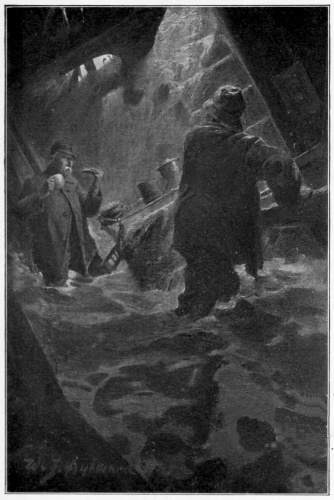
He was having another mug-up for himself.
heard him—and then he was swept over. And but for you, George Hoodley,
maybe he’d have had time to make his peace before he went. And up in the
rigging—you warn’t there, I know—even you, if you’d heard what Peter
Harkins said when we all knew her spars were going—when Peter heard the
first crack and knew what it meant; and knowing he was going, with his
last free breath he said things of you that if I had an enemy I wouldn’t
want him to hear—not if I hated him bad enough to want to see him in
the bottom of the deepest, hottest hold of hell——’
“‘Hell!’ he breaks in—‘there ain’t no hell—nor heaven, nor God, nor
anything.’
“‘God forgive you for that! You——’
“‘God forgive me? Martin, you talk like an old woman. I tell you, since
I was no higher than one of my jack-boots I’ve been listening to talk of
hell and heaven—mostly hell, though—and I used to believe it one time.
Nobody believed it any more than I did till when—till I began to see
that the very people that was talking it so hard warn’t governed by what
they said. What they wanted was everybody else to be governed by what
they preached. I tell you I know. I’ve seen it in my own people— I know
them better than you do. It’s years now— I was one of the fools, one
that never let anybody, I thought, get the best of me at anything.
You’re one—though you’re a good man in your fool way, Martin. I had no
grudge against you, not even when I tried to lose you in the dory. But I
had to get rid of your dory-mate.’
“‘Get rid of Dan? And why Dan?’
“‘Why? There again! You mean to tell me you don’t know?... I looked
around before I went out this trip. Nobody’d tell me, but I knew his
first name was Dan— Dan something. One day, when the crew was out
hauling the trawls, I rummaged his bunk and found part of a letter in my
wife’s writing under his mattress. That was the same day I ran over Dan
and you in the dory. ’Twas for that chance I’d been pretending my ankle
warn’t better. Weak ankle, bah!’ He drove the bad foot against the stove
and crushed in the oven door. ‘Anything weak about that foot!—bah!
“Dear Dan,” the note read— I know my wife’s handwriting, and his name’s
Dan.’
“‘Wait a bit—wait a bit. How do you know it was this Dan? Are there no
other Dans in Gloucester?’
“‘How do I know? And it in his bunk—under the mattress in his bunk.’
“‘That’s all right. And whose bunk was it before Dan Spring got it?
Another Dan’s, warn’t it— Dan Powell’s? And didn’t he leave the
mattress behind him when he left this vessel, trip before last? Didn’t
he? And warn’t Dan Powell just the kind of a man that’d do a thing like
that, and not Dan Spring, my own cousin? And so that’s the bottom of it?
Nineteen souls gone because you thought—just thought only—that one of
them was fooling you. And for a woman that warn’t worth Dan Spring’s
little finger. That’s the truth, George Hoodley. But if you’d been
brought up different, if you’d studied to understand the good side of
people, instead of the other side, and how to get the best of them and
to make money out of them and save it, you both might’ve come safe out
of it. But you warn’t that kind. ’Twarn’t in your blood, nor in none of
your people. Wrong’s wrong— I got nothing to say about that—but human
nature’s human nature. Why should you expect, George Hoodley, to get the
fine things in life? Why warn’t you content with money? You’d earned
that. What had you to offer a handsome young woman that liked a good
time? What had you, even supposing she was the kind you could
trust—anything that women love? Not a blessed thing. You’ve spent your
life with about one idea in your head, and that idea had nothing to do
with being pleasant or kind to others, or good to anybody but yourself.
Miles away from the kind of thing that women love were you all the time.
You come to nigh fifty year of age—you, with your hard face and hard
mouth, and eyes like— God! like a dead fish’s eyes to-night, no
less—don’t you know that whoever was going to marry you warn’t going to
for love? You had a right to marry some lean old sour-mouthed spinster
with a little money like yourself. What made you think that beauty and
love was for you? But even in marrying you thought to make a good
bargain—and got fooled. And by the daughter of a man of your own kind,
too. D’y’ s’pose her father didn’t know? God help you, George Hoodley,
’twas him hooked you—’twas him made the good bargain, not you. Why,
before ever you married her ’twas common talk she warn’t the girl for
any man to trust. But what good is it to talk of that now? Nineteen men
gone, for I don’t count you—you’re no man. You’re a— But I won’t say
it. Lord, but I’m tempted to choke you where you stand. Only when I
think of those fine men—and poor Dan Spring——”
“‘Dan Spring? Don’t tell me ’twarn’t Dan Spring, the——’
“‘Hold up,’ I says to that—‘hold up, or close as we both are to death
now and soon to go, I’ll choke you where you stand— I’ll send you to
your God, or to the devil, with the print of my fingers around your
turkey gobbler’s throat, if you say aught of Dan. Dan was my own kind
and I knew him. Whatever faults he had—and maybe he had some—it warn’t
in the heart of Dan Spring to undervalue good women, or to mix with
married women of any kind, let alone the wife of a man he was to go
ship-mate with. No, sir, not if he didn’t have a wife and children of
his own—wife and children that’ll have to suffer all their lives
because of you, and never know what brought it all about. But years from
now they’ll still be without food and clothing because of you. When I
think of it, George Hoodley, I misdoubt they’d count it against me in
the other world, where we’ll both be soon with the others, if I was to
take you by the throat and wind my fingers around your windpipe, and
choke and choke and squeeze and squeeze you till your tongue came out
and your eyes popped, and your face got blue and then black, and you——’
“He drew back against the lockers and put his hands before his face.
‘Martin, Martin, don’t!’ he said; for, in truth, I all but had hold of
him in spite of myself.
“‘I’m not going to,’ I said. ‘I have enough already to account for.
There’s two or three things I wish I hadn’t done, and maybe if I sent
you to death a few minutes sooner than you’re going, I’d be sorry for
it, too, later on. I’m going on deck now. This vessel won’t last much
longer. She’s breaking as it is—and up to our chests in water here
now.’
“Well, all the time we were below the big seas never let up. Some of her
outside planks were working loose from their frames when I left him to
go on deck again. Her deck planking, too, was coming apart. I almost
fell into her hold when I was coming out of the forec’s’le. I didn’t
know what to do quite, but climbed up on toward her bow at last, hanging
on where I could, dodging seas and the loose bits of wreck they were
carrying with them. At the knight-heads I looked around and ahead.
Astern and to either side ’twas nothing but rocks and the white sea
beating over them. Ahead I could make out a wall of rock— I guessed
where I was—to the west’ard of Canso, off Whitehead. I knew that coast,
and a bad coast it was. Up on the bowsprit, crawling out with the help
of the footropes and the stops hanging down and the wreck of the jib and
stays, I began to think I had a chance—if I could only live till the
daylight that was coming on. I climbed farther out. Hard work it was,
and I soon cast off my boots. At the end of the bowsprit I got a better
look. A dozen feet away was the ledge with a chance for a footing. If a
man could jump that—but what man could, from a vessel’s bowsprit? But
now and then, perhaps every minute or so, the bowsprit, under a more
than average big sea, lifted and sagged a little nearer the cliff. At
the right time a man might make the leap, I thought. But if he missed? I
looked down with the thought and saw nothing but rocks and a white
boiling below. ‘If you miss, Martin,’ I said to myself, ‘maybe you’ll
live five seconds, maybe ten—but more likely maybe you’d keep clear of
being mashed to jelly for just about a wink of your eye.’ And ’twas
enough to make a man wink his eyes just to look at the white boiling
hell beneath. I cast off my oilskin jacket while I was thinking of it,
and then my oil pants. After that went my jersey, flannel shirt, and
trousers. I meant to have a good try at it, anyway.
“Looking back before I should leap, who did I see but the Skipper. In
the noise of the sea I had not heard him. He, too, had cast off his
boots and was even then unbuttoning his oilskins. He must’ve known I was
watching him, for he said, ‘Don’t throw me off, Martin—don’t!’
“‘Who’s going to?’ I asked.
“‘That’s right—don’t. Give me a chance now, Martin.’
“‘Like you gave your crew?’
“‘Oh, don’t, Martin—don’t! I was crazy. All that I said about not
believing in God and hell, I didn’t mean that. I’m afraid of
it—afraid. I was always afraid of it, but never like now, Martin—never
so afraid of the burning pit as now—never, never. Help me up,
Martin— I’m weak— I can hardly stand. Help me, won’t you, Martin? You’re
twice the man I am—no man ever sailed with me had your strength,
Martin. Help me, won’t you, Martin?’
“I lifted him up, and the two of us clung to the end of the bowsprit. He
looked weak as water then, and I pitied him, and pitying him I pointed
out what chance we had. ‘There’s the cliff, and there’s what’s below.
It’s one chance in ten to a man that can leap well.’
“‘I never could leap well, Martin.’
“‘No, you couldn’t—nor do anything much that other boys could do—no
money in leaping, I s’pose. But there it is—and you c’n have your
choice. Will you jump first, or last?’
“‘You go first, Martin. If you make it, maybe you c’n help me—maybe
pass me a bit of line or something. See, I’ve got a bit of line I took
along. You go first, Martin—you go first. It’s an awful jump to take,
though.’
“‘There’s men of your crew took more awful jumps to-night, George
Hoodley. They jumped from this world to the other when the spars went.
Well, I’m going. Give me room to swing my arms. Now, if I miss,
good-by. If we both miss, then I s’pose we’ll be standing up and giving
account together in a few minutes. I’ve got enough on my conscience, but
I’m glad I’m not you. Stand clear of me now—when she lifts, I’m going.’
“The Cromwell lifted. Her bowsprit rose up and up till the end of it
was higher than the ledge in the wall of rock before us. I waited till
the last little second—till the bowsprit swayed in toward the cliff,
and then, while it balanced there and before it started to settle again,
knowing, as you all know, the power that’s in the uplift of a sea, I
gathered myself and jumped. And ’twas a good leap. I didn’t think I
could do it, cold and numb as I’d been feeling. A good leap, yes. And
’twas the wet, slippery shelf of rock I landed on; but I went a yard
clear, and even when I slipped a little I checked myself before I
slipped back to the edge, and was safe. Well, I lay there till I felt my
nerve steady again, then stood up and called for the line from the
Skipper.
“‘Now, when you jump,’ I says, ‘I’ll get what brace I can here, so if
you slip on the edge same’s I did there’ll be a chance to save you. But
mind you, George Hoodley, if I find I can’t hold you up—if it’s to be
your life or mine—it’s you that’s got to go. Mind that. And
hurry—throw it quick, or I’ll cast off the line altogether. That
bowsprit won’t be there in a few minutes, maybe. Hurry up!’
“‘But you’ll hang on, won’t you, Martin? You’ve got the strength, if you
want to use it.’
“‘Jump, man, jump afore you lose your nerve entirely,’ I hollers.
“He threw the line to me, after taking one end of it around his waist.
The other end I took around my waist, my end half hitched so I could
slip it in a hurry. I warn’t throwing my life away for him, if I knew
it.
“Well, he jumped at last. And the bowsprit rose full as high and gave
him full as good a chance as I’d got. But even so he fell a little
short. His feet only caught the edge of the shelf. He staggered, and
seeing how it was, I braced my feet well as I could and hauled. He came
in, sagged away, I bracing my feet—they were slipping. In a crack in
the rock of the ledge I dug the fingers of one hand, the other hand to
the line, and hung on. We were gaining; he was fairly on his feet, and I
felt the strain easing, when a sea that swept up the side of the cliff
like a tidal wave took him clear of everything. It would have swept me,
too, but I gripped where I could get a hold, with the fingers of my one
loose hand in the crack in the rocks, and hung on there—one hand to
the crack and the other to the line—hung on so, supporting the weight
of myself and the Skipper, until I felt my muscles getting hot and heavy
and my breath coming fast. He was floundering somewhere on the edge of
the cliff. I hollered to him, though feeling almost certain he was
battered to pieces by then—‘How is it with you, George—how is it,
man?’ but there was no answer. Again I hollered, and again no answer.
And then, when I was satisfied that it was only the last ounce of
strength I had left, I called out, ‘Help yourself, George—why don’t you
help yourself?’ No answer. Once more I called, and once more getting no
answer, I knew then he must’ve been beaten to death against the rocks,
and that ’twas his dead weight was hanging to me. And yet I called once
more to make sure. But still getting no answer, ‘The Lord have mercy on
your soul, George Hoodley,’ I said, and let slip the line.”
Toward the end of Martin’s story it had become very quiet in the
forec’s’le. Nobody said anything, neither broke in with a question nor
offered any comment, until after a long silence, and then not until
after Martin himself had repeated absently, as if to himself, and after
a long indrawn breath, “And then I let slip the line.” Only then did he
look around and seem to realize that he was not on the ledge off
Whitehead.
“And after you cast off the line, what then, Martin?”
“Well,” resumed Martin, “the weight being gone made a great difference
to me, but it was quite a while before I could stand on my feet. Even
then I didn’t have the courage to look down right away, but climbing to
one side to the very top of the cliff, I laid flat on my stomach and
looked over the edge. ’Twas good light then, and I could see the body of
George Hoodley below—tossing about like an eggshell, as if ’twas no
more than sea-weed in a sea-way. And that was the end of it. Even if he
warn’t dead at the time—even if he warn’t dead when I let go the line
and it had to be me or him, it ought to’ve been him. If it was a friend,
now—if it was Dan, say— I don’t know what I would do. I hope I’d have
the strength not to cast loose the line.”
It was very quiet again. The boot-heels of the new watch on deck, the
rasping of the booms as the vessel jibed, the whistle of the rising
gale, the slap of the sea outside them, the Skipper’s voice on deck, the
atmosphere, stirred Martin again. “’Twas a night like this we swung the
Cromwell off to the west’ard. I shouldn’t wonder but what he’d be
takin’ the mains’l off her soon, won’t he?”—this to the old watch, who
had just come down the companion-way and was wringing his mitts out by
the stove.
“The mains’l, Martin?” repeated the watch in surprise. “Why, the
mains’l’s been off her for hours—she’s under a trys’l and jumbo.”
“The mains’l, Martin,” explained one, “was taken off her just after you
and Johnnie were taken aboard. You were pretty tired and didn’t notice,
maybe, at the time.”
“Lord, I must’ve been tired—not to know it when the mains’l’s taken off
a vessel I’m in. There was never a minute the night the Cromwell was
lost that I was tired as that. No, sir, not even when I laid on the
cliff in the morning and looked down for George Hoodley’s body.”
“Speakin’ of that, Martin, didn’t some of the bodies come ashore?” This
from the cook, who incidentally, feeling a little less hurried, was
putting a few shovels of coal into the stove before he should turn in
for the night.
“There were two bodies came ashore,” resumed Martin. “And that was a sad
thing, too. I was going up to see if I couldn’t get some clothes to hide
my nakedness, and maybe a pair of boots and a bite to eat and a bit of
fire to warm up by somewhere, when I met a man. ’Twas good light by
then. He was coming down a bit of beach behind the cliff. I told him my
vessel had been wrecked, and I was all that was left of the crew. And he
fixed me up as well as he could and came back with me to the beach, and
there’s where the sad part came in. One of the Cromwell’s crew, Angus
MacPherson, had been fishing out of Gloucester twelve years, and every
fall he said he was going home to see the old people. I knew that as
well as I knew that he’d been sending money home regularly to the old
people. If it hadn’t been for Angus they’d’ve had a hard time of it, I
cal’late, those twelve years. Well, he never went home, as he said; but
here was the very place Angus came from, and this was the way he came
home at last. That same afternoon I helped to bury him and to carry his
old mother away from the grave when she couldn’t carry herself. God help
us, but there’s hard spots in life, ain’t there?
“The other body that came up was the Skipper’s. And him I went to
Gloucester with. And maybe there’d be no more to that, but getting into
the Gloucester station, just as the train hauled up, who should happen
to be at the station but the Skipper’s wife—his widow, then, of course.
She knew well enough what had happened—everybody in Gloucester
knew—the papers full of it the day before; but she didn’t know that I,
the one man saved from the wreck, was on the train. Nobody knew. I
didn’t send any word ahead. It was only three days since the vessel was
lost, but was she crying her eyes out? Was she?—the—the— But I won’t
say it.
“I goes up to her. ‘Mrs. Hoodley,’ says I, ‘I’ve brought home your
husband’s body for burial.’
“D’y’ think she thanked me? Indeed, I saw by her face I’d made a mistake
not to bury him with Angus down Whitehead way. And then she makes eyes
at me— God’s truth—makes eyes at me, while the box that her husband’s
corpse was in—and I knew what a battered, bloody corpse it was—was
being lifted out of the baggage-car and put into a wagon. She gave
orders then and there to have it taken straight to the graveyard; and
when it was buried, mind you, she warn’t there—not even for decency’s
sake. But going from the station while her husband’s body was being
carried away, she held her head up and took note of who was looking at
her. That’s what she liked—people to notice her. And looking at her I
cursed George Hoodley for a fool that didn’t drown her if he was bound
to drown somebody, instead of the man that he thought had wronged him.
So there you have it—the truth of the Oliver Cromwell—the part that
didn’t get into the papers.”
“What was it the papers did say about it, Martin?”
“Oh, what they said was pretty near right so far as it went, but they
didn’t know the whole truth, and don’t yet. They said a word or two
’bout his leaving a wife. No great harm done in that, I s’pose. As for
himself, they said he was thrifty, and hard-working, and
careful—gen’rally careful, they might’ve said—and successful. And so
he was, I s’pose. But I think I’ll be turning in, for after all there’s
nothing like a good sleep, is there? Where’s Johnnie? Still asleep?
Well, he’s the wise lad to be getting his good sleep ’stead of listening
to my long-winded stories. Maybe if we all turn in there’ll be more of
us good and strong to haul a trawl again to-morrow.” He picked up his
pipe. It was cold. “And now there’s something. The man that’d invent
something to keep a pipe going when you lay it down without smokin’
itself all up’d make a lot of money, wouldn’t he? And yet maybe it’s
just as well for some of us. I cal’late I’ve smoked enough, anyway.”
“But, Martin, before you turn in, what’s become of Hoodley’s widow?”
“Oh, her? She and Dan Powell got married since, and they’re both
getting all that’s coming to them. He’ll go out and get lost some day
too, maybe, to get away from her. I wouldn’t be surprised, anyway, if he
did. Only before he goes, being a different kind of a man from George
Hoodley and knowing women of her kind better, he won’t worry so much
about the man as about her. He’ll see that she’s put out of the way
before he sails—or at least that’s my idea of it; or maybe it’s only
that I half hope he will. But I think I’ll be turning in.”
He tucked his pipe away under his mattress, slipped out of his
slip-shods, slacked away his suspenders, and laid his length in his
bunk. He was about to draw the curtain, but his eye catching the eye of
the watch, who was then hauling off his wet boots, he had to ask,
“What’s it look like for the morning, Stevie—what’d the Skipper say?”
“He says that unless it moderates a bit more than it looks as if ’twill
now, we’ll stay aboard in the morning.”
“Well, here’s one that ain’t sorry to hear that. I don’t mind sayin’,
now that it’s all over, that hanging on to the bottom of that dory
warn’t any joke to-day. I’m good and tired. ’Twas a night like this we
headed the Cromwell to the west’ard. ‘Hell or Gloucester,’ says he,
and hell it was for him. Good-night.”


