The day and the night had passed, and the new morning
had come, before the husband and wife could trust themselves
to speak calmly of the Secret, and to face resignedly the duties
and the sacrifices which the discovery of it imposed on
them.
Leonard's first question referred to those lines in the letter
which Rosamond had informed him were in a handwriting
that she knew. Finding that he was at a loss to understand
what means she could have of forming an opinion on this
point, she explained that, after Captain Treverton's death,
many letters had naturally fallen into her possession which
had been written by Mrs. Treverton to her husband. They
treated of ordinary domestic subjects, and she had read them
often enough to become thoroughly acquainted with the peculiarities
of Mrs. Treverton's handwriting. It was remarkably
large, firm, and masculine in character; and the address,
the line under it, and the uppermost of the two signatures in
the letter which had been found in the Myrtle Room, exactly
resembled it in every particular.
The next question related to the body of the letter. The
writing of this, of the second signature ("Sarah Leeson"), and
of the additional lines on the third page, also signed by Sarah
Leeson, proclaimed itself in each case to be the production of
the same person. While stating that fact to her husband,
Rosamond did not forget to explain to him that, while reading
the letter on the previous day, her strength and courage
had failed her before she got to the end of it. She added
that the postscript which she had thus omitted to read was
of importance, because it mentioned the circumstances under
which the Secret had been hidden; and begged that he
would listen while she made him acquainted with its contents
without any further delay.
Sitting as close to his side, now, as if they were enjoying
their first honey-moon days over again, she read these
last lines—the lines which her mother had written sixteen
years before, on the morning when she fled from Porthgenna
Tower:
"If this paper should ever be found (which I pray with
my whole heart it never may be), I wish to say that I have
come to the resolution of hiding it, because I dare not show
the writing that it contains to my master, to whom it is addressed.
In doing what I now propose to do, though I am
acting against my mistress's last wishes, I am not breaking
the solemn engagement which she obliged me to make before
her on her death-bed. That engagement forbids me to destroy
this letter, or to take it away with me if I leave the
house. I shall do neither—my purpose is to conceal it in the
place, of all others, where I think there is least chance of its
ever being found again. Any hardship or misfortune which
may follow as a consequence of this deceitful proceeding on
my part, will fall on myself. Others, I believe, in my conscience,
will be the happier for the hiding of the dreadful Secret
which this letter contains."
"There can be no doubt, now," said Leonard, when his wife
had read to the end; "Mrs. Jazeph, Sarah Leeson, and the servant
who disappeared from Porthgenna Tower, are one and the
same person."
"Poor creature!" said Rosamond, sighing as she put down
the letter. "We know now why she warned me so anxiously
not to go into the Myrtle Room. Who can say what she
must have suffered when she came as a stranger to my bedside?
Oh, what would I not give if I had been less hasty
with her! It is dreadful to remember that I spoke to her as
a servant whom I expected to obey me; it is worse still to
feel that I can not, even now, think of her as a child should
think of a mother. How can I ever tell her that I know the
Secret? how—" She paused, with a heart-sick consciousness
of the slur that was cast on her birth; she paused, shrinking
as she thought of the name that her husband had given to
her, and of her own parentage, which the laws of society disdained
to recognize.
"Why do you stop?" asked Leonard.
"I was afraid—" she began, and paused again.
"Afraid," he said, finishing the sentence for her, "that
words of pity for that unhappy woman might wound my
sensitive pride by reminding me of the circumstances of your
birth? Rosamond! I should be unworthy of your matchless
truthfulness toward me, if I, on my side, did not acknowledge
that this discovery has wounded me as only a proud man can
be wounded. My pride has been born and bred in me. My
pride, even while I am now speaking to you, takes advantage
of my first moments of composure, and deludes me into
doubting, in face of all probability, whether the words you
have read to me can, after all, be words of truth. But,
strong as that inborn and inbred feeling is—hard as it may
be for me to discipline and master it as I ought, and must
and will—there is another feeling in my heart that is stronger
yet." He felt for her hand, and took it in his; then added—"From
the hour when you first devoted your life to your
blind husband—from the hour when you won all his gratitude,
as you had already won all his love, you took a place in
his heart, Rosamond, from which nothing, not even such a
shock as has now assailed us, can move you! High as I
have always held the worth of rank in my estimation, I have
learned, even before the event of yesterday, to hold the worth
of my wife, let her parentage be what it may, higher still."
"Oh, Lenny, Lenny, I can't hear you praise me, if you talk
in the same breath as if I had made a sacrifice in marrying
you! But for my blind husband I might never have deserved
what you have just said of me. When I first read that fearful
letter, I had one moment of vile, ungrateful doubt if your
love for me would hold out against the discovery of the Secret.
I had one moment of horrible temptation, that drew me away
from you when I ought to have put the letter into your hand.
It was the sight of you, waiting for me to speak again, so innocent
of all knowledge of what happened close by you, that
brought me back to my senses, and told me what I ought to
do. It was the sight of my blind husband that made me conquer
the temptation to destroy that letter in the first hour
of discovering it. Oh, if I had been the hardest-hearted of
women, could I have ever taken your hand again—could I kiss
you, could I lie down by your side, and hear you fall asleep,
night after night, feeling that I had abused your blind dependence
on me to serve my own selfish interests? knowing that
I had only succeeded in my deceit because your affliction
made you incapable of suspecting deception? No, no; I can
hardly believe that the basest of women could be guilty of
such baseness as that; and I can claim nothing more for myself
than the credit of having been true to my trust. You
said yesterday, love, in the Myrtle Room, that the one faithful
friend to you in your blindness, who never failed, was
your wife. It is reward enough and consolation enough for
me, now that the worst is over, to know that you can say so
still."
"Yes, Rosamond, the worst is over; but we must not forget
that there may be hard trials still to meet."
"Hard trials, love? To what trials do you refer?"
"Perhaps, Rosamond, I overrate the courage that the sacrifice
demands; but, to me at least, it will be a hard sacrifice
of my own feelings to make strangers partakers in the knowledge
that we now possess."
Rosamond looked at her husband in astonishment. "Why
need we tell the Secret to any one?" she asked.
"Assuming that we can satisfy ourselves of the genuineness
of that letter," he answered, "we shall have no choice
but to tell it to strangers. You can not forget the circumstances
under which your father—under which Captain Treverton—"
"Call him my father," said Rosamond, sadly. "Remember
how he loved me, and how I loved him, and say 'my father'
still."
"I am afraid I must say 'Captain Treverton' now," returned
Leonard, "or I shall hardly be able to explain simply and
plainly what it is very necessary that you should know. Captain
Treverton died without leaving a will. His only property
was the purchase-money of this house and estate; and you
inherited it, as his next of kin—"
Rosamond started back in her chair and clasped her hands
in dismay. "Oh, Lenny," she said simply, "I have thought
so much of you, since I found the letter, that I never remembered
this!"
"It is time to remember it, my love. If you are not Captain
Treverton's daughter, you have no right to one farthing
of the fortune that you possess; and it must be restored at
once to the person who is Captain Treverton's next of kin—or,
in other words, to his brother."
"To that man!" exclaimed Rosamond. "To that man
who is a stranger to us, who holds our very name in contempt!
Are we to be made poor that he may be made
rich?—"
"We are to do what is honorable and just, at any sacrifice
of our own interests and ourselves," said Leonard, firmly. "I
believe, Rosamond, that my consent, as your husband, is
necessary, according to the law, to effect this restitution. If
Mr. Andrew Treverton was the bitterest enemy I had on
earth, and if the restoring of this money utterly ruined us
both in our worldly circumstances, I would give it back of
my own accord to the last farthing—and so would you!"
The blood mantled in his cheeks as he spoke. Rosamond
looked at him admiringly in silence. "Who would have
him less proud," she thought, fondly, "when his pride speaks
in such words as those!"
"You understand now," continued Leonard, "that we have
duties to perform which will oblige us to seek help from
others, and which will therefore render it impossible to keep
the Secret to ourselves? If we search all England for her,
Sarah Leeson must be found. Our future actions depend
upon her answers to our inquiries, upon her testimony to the
genuineness of that letter. Although I am resolved beforehand
to shield myself behind no technical quibbles and delays—although
I want nothing but evidence that is morally conclusive,
however legally imperfect it may be—it is still impossible
to proceed without seeking advice immediately.
The lawyer who always managed Captain Treverton's affairs,
and who now manages ours, is the proper person to direct
us in instituting a search, and to assist us, if necessary, in
making the restitution."
"How quietly and firmly you speak of it, Lenny! Will
not the abandoning of my fortune be a dreadful loss to us?"
"We must think of it as a gain to our consciences, Rosamond,
and must alter our way of life resignedly to suit our
altered means. But we need speak no more of that until we
are assured of the necessity of restoring the money. My immediate
anxiety, and your immediate anxiety, must turn now
on the discovery of Sarah Leeson—no! on the discovery of
your mother; I must learn to call her by that name, or I
shall not learn to pity and forgive her."
Rosamond nestled closer to her husband's side. "Every
word you say, love, does my heart good," she whispered,
laying her head on his shoulder. "You will help me and
strengthen me, when the time comes, to meet my mother as I
ought? Oh, how pale and worn and weary she was when
she stood by my bedside, and looked at me and my child!
Will it be long before we find her? Is she far away from
us, I wonder? or nearer, much nearer than we think?"
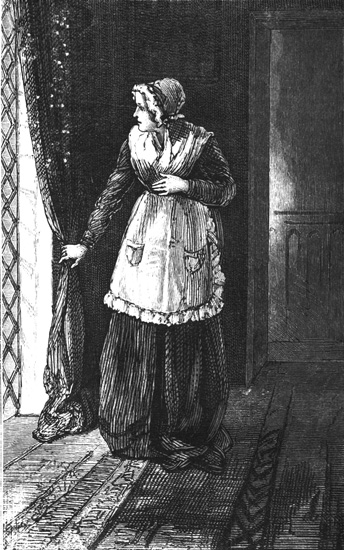
Before Leonard could answer, he was interrupted by a
knock at the door, and Rosamond was surprised by the appearance
of the maid-servant. Betsey was flushed, excited,
and out of breath; but she contrived to deliver intelligibly a
brief message from Mr. Munder, the steward, requesting permission
to speak to Mr. Frankland, or to Mrs. Frankland, on
business of importance.
"What is it? What does he want?" asked Rosamond.
"I think, ma'am, he wants to know whether he had better
send for the constable or not," answered Betsey.
"Send for the constable!" repeated Rosamond. "Are
there thieves in the house in broad daylight?"
"Mr. Munder says he don't know but what it may be
worse than thieves," replied Betsey. "It's the foreigner
again, if you please, ma'am. He come up and rung at the
door as bold as brass, and asked if he could see Mrs. Frankland."
"The foreigner!" exclaimed Rosamond, laying her hand
eagerly on her husband's arm.
"Yes, ma'am," said Betsey. "Him as come here to go
over the house along with the lady—"
Rosamond, with characteristic impulsiveness, started to her
feet. "Let me go down!" she began.
"Wait," interposed Leonard, catching her by the hand.
"There is not the least need for you to go down stairs.—Show
the foreigner up here," he continued, addressing himself to
Betsey, "and tell Mr. Munder that we will take the management
of this business into our own hands."
Rosamond sat down again by her husband's side. "This
is a very strange accident," she said, in a low, serious tone.
"It must be something more than mere chance that puts the
clew into our hands, at the moment when we least expected
to find it."
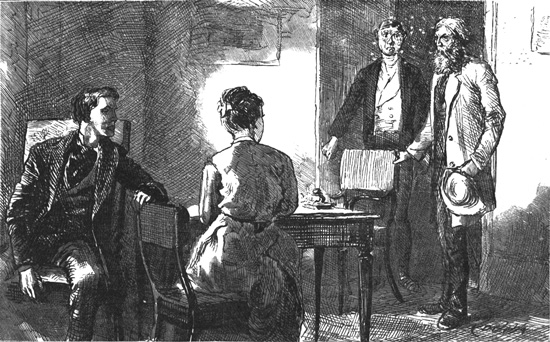
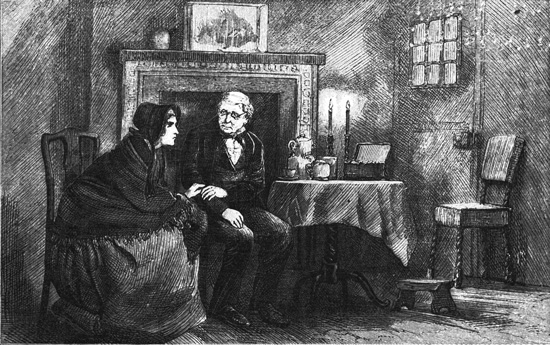
The door opened for the second time, and there appeared,
modestly, on the threshold, a little old man, with rosy cheeks
and long white hair. A small leather case was slung by a
strap at his side, and the stem of a pipe peeped out of the
breast pocket of his coat. He advanced one step into the
room, stopped, raised both his hands, with his felt hat crumpled
up in them, to his heart, and made five fantastic bows in quick
succession—two to Mrs. Frankland, two to her husband, and
one to Mrs. Frankland again, as an act of separate and special
homage to the lady. Never had Rosamond seen a more
complete embodiment in human form of perfect innocence
and perfect harmlessness than the foreigner who was described
in the housekeeper's letter as an audacious vagabond,
and who was dreaded by Mr. Munder as something worse
than a thief!
"Madam and good Sir," said the old man, advancing a
little nearer at Mrs. Frankland's invitation, "I ask your pardon
for intruding myself. My name is Joseph Buschmann.
I live in the town of Truro, where I work in cabinets and
tea-caddies, and other shining woods. I am also, if you please,
the same little foreign man who was scolded by the big
major-domo when I came to see the house. All that I ask
of your kindness is, that you will let me say for my errand
here and for myself, and for another person who is very near
to my love—one little word. I will be but few minutes,
Madam and good Sir, and then I will go my ways again,
with my best wishes and my best thanks."
"Pray consider, Mr. Buschmann, that our time is your
time," said Leonard. "We have no engagement whatever
which need oblige you to shorten your visit. I must tell
you beforehand, in order to prevent any embarrassment on
either side, that I have the misfortune to be blind. I can
promise you, however, my best attention as far as listening
goes. Rosamond, is Mr. Buschmann seated?"
Mr. Buschmann was still standing near the door, and was
expressing sympathy by bowing to Mr. Frankland again, and
crumpling his felt hat once more over his heart.
"Pray come nearer, and sit down," said Rosamond. "And
don't imagine for one moment that any opinion of the
steward's has the least influence on us, or that we feel it at
all necessary for you to apologize for what took place the
last time you came to this house. We have an interest—a
very great interest," she added, with her usual hearty frankness,
"in hearing any thing that you have to tell us. You
are the person of all others whom we are, just at this time—" She
stopped, feeling her foot touched by her husband's, and
rightly interpreting the action as a warning not to speak too
unrestrainedly to the visitor before he had explained his object
in coming to the house.
Looking very much pleased, and a little surprised also,
when he heard Rosamond's last words, Uncle Joseph drew a
chair near to the table by which Mr. and Mrs. Frankland
were sitting, crumpled his felt hat up smaller than ever, and
put it in one of his side pockets, drew from the other a little
packet of letters, placed them on his knees as he sat down,
patted them gently with both hands, and entered on his explanation
in these terms:
"Madam and good Sir," he began, "before I can say comfortably
my little word, I must, with your leave, travel backward
to the last time when I came to this house in company
with my niece."
"Your niece!" exclaimed Rosamond and Leonard, both
speaking together.
"My niece, Sarah," said Uncle Joseph, "the only child of
my sister Agatha. It is for the love of Sarah, if you please,
that I am here now. She is the one last morsel of my flesh
and blood that is left to me in the world. The rest, they are
all gone! My wife, my little Joseph, my brother Max, my
sister Agatha and the husband she married, the good and
noble Englishman, Leeson—they are all, all gone!"
"Leeson," said Rosamond, pressing her husband's hand
significantly under the table. "Your niece's name is Sarah
Leeson?"
Uncle Joseph sighed and shook his head. "One day," he
said, "of all the days in the year the evilmost for Sarah, she
changed that name. Of the man she married—who is dead
now, Madam—it is little or nothing that I know but this:
His name was Jazeph, and he used her ill, for which I think
him the First Scoundrel! Yes," exclaimed Uncle Joseph,
with the nearest approach to anger and bitterness which his
nature was capable of making, and with an idea that he was
using one of the strongest superlatives in the language—"Yes!
if he was to come to life again at this very moment
of time, I would say it of him to his face—Englishman Jazeph,
you are the First Scoundrel!"
Rosamond pressed her husband's hand for the second time.
If their own convictions had not already identified Mrs. Jazeph
with Sarah Leeson, the old man's last words must have
amply sufficed to assure them that both names had been
borne by the same person.
"Well, then, I shall now travel backward to the time when
I was here with Sarah, my niece," resumed Uncle Joseph.
"I must, if you please, speak the truth in this business, or,
now that I am already backward where I want to be, I shall
stick fast in my place, and get on no more for the rest of my
life. Sir and good Madam, will you have the great kindness
to forgive me and Sarah, my niece, if I confess that it was not
to see the house that we came here and rang at the bell, and
gave deal of trouble, and wasted much breath of the big
major-domo's with the scolding that we got. It was only to
do one curious little thing that we came together to this
place—or, no, it was all about a secret of Sarah's, which is
still as black and dark to me as the middle of the blackest
and darkest night that ever was in the world—and as I
nothing knew about it, except that there was no harm in it
to any body or any thing, and that Sarah was determined to
go, and that I could not let her go by herself; as also for
the good reason that she told me she had the best right of
any body to take the letter and to hide it again, seeing that
she was afraid of its being found if longer in that room she
left it, which was the room where she had hidden it before—why,
so it happened that I—no, that she—no, no, that I—Ach
Gott!" cried Uncle Joseph, striking his forehead in despair,
and relieving himself by an invocation in his own language.
"I am lost in my own muddlement; and whereabouts
the right place is, and how I am to get myself back
into it, as I am a living sinner, is more than I know!"
"There is not the least need to go back on our account,"
said Rosamond, forgetting all caution and self-restraint in her
anxiety to restore the old man's confidence and composure.
"Pray don't try to repeat your explanations. We know already—"
"We will suppose," said Leonard, interposing abruptly before
his wife could add another word, "that we know already
every thing you can desire to tell us in relation to your
niece's secret, and to your motives for desiring to see the
house."
"You will suppose that!" exclaimed Uncle Joseph, looking
greatly relieved. "Ah! thank you, Sir, and you, good
Madam, a thousand times for helping me out of my own muddlement
with a 'Suppose.' I am all over confusion from my
tops to my toes; but I can go on now, I think, and lose myself
no more. So! Let us say it in this way: I and Sarah,
my niece, are in the house—that is the first 'Suppose.' I
and Sarah, my niece, are out of the house—that is the second
'Suppose.' Good! now we go on once more. On my way
back to my own home at Truro, I am frightened for Sarah,
because of the faint she fell into on your stairs here, and because
of a look in her face that it makes me heavy at my
heart to see. Also, I am sorry for her sake, because she has
not done that one curious little thing which she came into
the house to do. I fret about these same matters, but I console
myself too; and my comfort is that Sarah will stop with
me in my house at Truro, and that I shall make her happy
and well again, as soon as we are settled in our life together.
Judge, then, Sir, what a blow falls on me when I hear that
she will not make her home where I make mine. Judge you,
also, good Madam, what my surprise must be, when I ask for
her reason, and she tells me she must leave Uncle Joseph,
because she is afraid of being found out by you." He stopped,
and looking anxiously at Rosamond's face, saw it sadden
and turn away from him after he had spoken his last words.
"Are you sorry, Madam, for Sarah, my niece? do you pity
her?" he asked, with a little hesitation and trembling in his
voice.
"I pity her with my whole heart," said Rosamond, warmly.
"And with my whole heart, for that pity I thank you!" rejoined
Uncle Joseph. "Ah, Madam, your kindness gives me
the courage to go on, and to tell you that we parted from
each other on the day of our getting back to Truro! When
she came to see me this time, it was years and years, long
and lonely and very many, since we two had met. I was
afraid that many more would pass again, and I tried to make
her stop with me to the very last. But she had still the same
fear to drive her away—the fear of being found and put to
the question by you. So, with the tears in her eyes (and in
mine), and the grief at her heart (and at mine), she went
away to hide herself in the empty bigness of the great city,
London, which swallows up all people and all things that
pour into it, and which has now swallowed up Sarah, my
niece, with the rest. 'My child, you will write sometimes to
Uncle Joseph,' I said, and she answered me,'I will write often.'
It is three weeks now since that time, and here, on my
knee, are four letters she has written to me. I shall ask your
leave to put them down open before you, because they will
help me to get on further yet with what I must say, and because
I see in your face, Madam, that you are indeed sorry
for Sarah, my niece, from your heart."
He untied the packet of letters, opened them, kissed them
one by one, and put them down in a row on the table, smoothing
them out carefully with his hand, and taking great pains
to arrange them all in a perfectly straight line. A glance at
the first of the little series showed Rosamond that the handwriting
in it was the same as the handwriting in the body
of the letter which had been found in the Myrtle Room.
"There is not much to read," said Uncle Joseph. "But if
you will look through them first, Madam, I can tell you after
all the reason for showing them that I have."
The old man was right. There was very little to read in
the letters, and they grew progressively shorter as they became
more recent in date. All four were written in the formal,
conventionally correct style of a person taking up the
pen with a fear of making mistakes in spelling and grammar,
and were equally destitute of any personal particulars relative
to the writer; all four anxiously entreated that Uncle
Joseph would not be uneasy, inquired after his health, and
expressed gratitude and love for him as warmly as their
timid restraints of style would permit; all four contained
these two questions relating to Rosamond—First, had Mrs.
Frankland arrived yet at Porthgenna Tower? Second, if
she had arrived, what had Uncle Joseph heard about her?
And, finally, all four gave the same instructions for addressing
an answer—"Please direct to me, 'S. J., Post-office,
Smith Street, London'"—followed by the same apology,
"Excuse my not giving my address, in case of accidents; for
even in London I am still afraid of being followed and found
out. I send every morning for letters; so I am sure to get
your answer."
"I told you, Madam," said the old man, when Rosamond
raised her head from the letters, "that I was frightened and
sorry for Sarah when she left me. Now see, if you please,
why I got more frightened and more sorry yet, when I have
all the four letters that she writes to me. They begin here,
with the first, at my left hand; and they grow shorter, and
shorter, and shorter, as they get nearer to my right, till the
last is but eight little lines. Again, see, if you please. The
writing of the first letter, here, at my left hand, is very fine—I
mean it is very fine to me, because I love Sarah, and because
I write very badly myself; but it is not so good in
the second letter—it shakes a little, it blots a little, it crooks
itself a little in the last lines. In the third it is worse—more
shake, more blot, more crook. In the fourth, where there is
least to do, there is still more shake, still more blot, still more
crook, than in all the other three put together. I see this; I
remember that she was weak and worn and weary when she
left me, and I say to myself, 'She is ill, though she will not
tell it, for the writing betrays her!'"
Rosamond looked down again at the letters, and followed
the significant changes for the worse in the handwriting, line
by line, as the old man pointed them out.
"I say to myself that," he continued; "I wait, and think
a little; and I hear my own heart whisper to me, 'Go you,
Uncle Joseph, to London, and, while there is yet time, bring
her back to be cured and comforted and made happy in your
own home!' After that I wait, and think a little again—not
about leaving my business; I would leave it forever sooner
than Sarah should come to harm—but about what I am to do
to get her to come back. That thought makes me look at
the letters again; the letters show me always the same questions
about Mistress Frankland; I see it plainly as my own
hand before me that I shall never get Sarah, my niece, back,
unless I can make easy her mind about those questions of
Mistress Frankland's that she dreads as if there was death to
her in every one of them. I see it! it makes my pipe go out;
it drives me up from my chair; it puts my hat on my head;
it brings me here, where I have once intruded myself already,
and where I have no right, I know, to intrude myself again;
it makes me beg and pray now, of your compassion for my
niece and of your goodness for me, that you will not deny
me the means of bringing Sarah back. If I may only say to
her, I have seen Mistress Frankland, and she has told me with
her own lips that she will ask none of those questions that
you fear so much—if I may only say that, Sarah will come
back with me, and I shall thank you every day of my life for
making me a happy man!"
The simple eloquence of his words, the innocent earnestness
of his manner, touched Rosamond to the heart. "I will
do any thing, I will promise any thing," she answered eagerly,
"to help you to bring her back! If she will only let me
see her, I promise not to say one word that she would not
wish me to say; I promise not to ask one question—no, not
one—that it will pain her to answer. Oh, what comforting
message can I send besides? what can I say—?" She stopped
confusedly, feeling her husband's foot touching hers again.
"Ah, say no more! say no more!" cried Uncle Joseph,
tying up his little packet of letters, with his eyes sparkling
and his ruddy face all in a glow. "Enough said to bring
Sarah back! enough said to make me grateful for all my life!
Oh, I am so happy, so happy, so happy—my skin is too small
to hold me!" He tossed up the packet of letters into the
air, caught it, kissed it, and put it back again in his pocket,
all in an instant.
"You are not going?" said Rosamond. "Surely you are
not going yet?"
"It is my loss to go away from here, which I must put up
with, because it is also my gain to get sooner to Sarah," replied
Uncle Joseph. "For that reason only, I shall ask your
pardon if I take my leave with my heart full of thanks, and
go my ways home again."
"When do you propose to start for London, Mr. Buschmann?"
inquired Leonard.
"To-morrow, in the morning early, Sir," replied Uncle
Joseph. "I shall finish the work that I must do to-night, and
shall leave the rest to Samuel (who is my very good friend,
and my shopman too), and shall then go to Sarah by the first
coach."
"May I ask for your niece's address in London, in case we
wish to write to you?"
"She gives me no address, Sir, but the post-office; for even
at the great distance of London, the same fear that she had
all the way from this house still sticks to her. But here is
the place where I shall get my own bed," continued the old
man, producing a small shop card. "It is the house of a
countryman of my own, a fine baker of buns, Sir, and a very
good man indeed."
"Have you thought of any plan for finding out your niece's
address?" inquired Rosamond, copying the direction on the
card while she spoke.
"Ah, yes—for I am always quick at making my plans,"
said Uncle Joseph. "I shall present myself to the master
of the post, and to him I shall say just this and no more—'Good-morning,
Sir. I am the man who writes the letters
to S. J. She is my niece, if you please; and all that I want
to know is—Where does she live?' There is something like
a plan, I think? Aha!" He spread out both his hands interrogatively,
and looked at Mrs. Frankland with a self-satisfied
smile.
"I am afraid," said Rosamond, partly amused, partly touched
by his simplicity, "that the people at the post-office are
not at all likely to be trusted with the address. I think you
would do better to take a letter with you, directed to 'S. J.;'
to deliver it in the morning when letters are received from
the country; to wait near the door, and then to follow the
person who is sent by your niece (as she tells you herself) to
ask for letters for S. J."
"You think that is better?" said Uncle Joseph, secretly
convinced that his own idea was unquestionably the most
ingenious of the two. "Good! The least little word that
you say to me, Madam, is a command that I follow with all
my heart." He took the crumpled felt hat out of his pocket,
and advanced to say farewell, when Mr. Frankland spoke to
him again.
"If you find your niece well, and willing to travel," said
Leonard, "you will bring her back to Truro at once? And
you will let us know when you are both at home again?"
"At once, Sir," said Uncle Joseph. "To both these questions,
I say, At once."
"If a week from this time passes," continued Leonard,
"and we hear nothing from you, we must conclude, then,
either that some unforeseen obstacle stands in the way of
your return, or that your fears on your niece's account have
been but too well-founded, and that she is not able to
travel?"
"Yes, Sir; so let it be. But I hope you will hear from me
before the week is out."
"Oh, so do I! most earnestly, most anxiously!" said Rosamond.
"You remember my message?"
"I have got it here, every word of it," said Uncle Joseph,
touching his heart. He raised the hand which Rosamond
held out to him to his lips. "I shall try to thank you better
when I have come back," he said. "For all your kindness to
me and to my niece, God bless you both, and keep you happy,
till we meet again." With these words, he hastened to the
door, waved his hand gayly, with the old crumpled hat in it,
and went out.
"Dear, simple, warm-hearted old man!" said Rosamond,
as the door closed. "I wanted to tell him every thing,
Lenny. Why did you stop me?"
"My love, it is that very simplicity which you admire, and
which I admire, too, that makes me cautious. At the first
sound of his voice I felt as warmly toward him as you do;
but the more I heard him talk the more convinced I became
that it would be rash to trust him, at first, for fear of his disclosing
too abruptly to your mother that we know her secret.
Our chance of winning her confidence and obtaining an interview
with her depends, I can see, upon our own tact in
dealing with her exaggerated suspicions and her nervous
fears. That good old man, with the best and kindest intentions
in the world, might ruin every thing. He will have
done all that we can hope for, and all that we can wish, if he
only succeeds in bringing her back to Truro."
"But if he fails?—if any thing happens?—if she is really
ill?"
"Let us wait till the week is over, Rosamond. It will be
time enough then to decide what we shall do next."
The week of expectation passed, and no tidings from Uncle
Joseph reached Porthgenna Tower.
On the eighth day Mr. Frankland sent a messenger to
Truro, with orders to find out the cabinet-maker's shop kept
by Mr. Buschmann, and to inquire of the person left in charge
there whether he had received any news from his master.
The messenger returned in the afternoon, and brought word
that Mr. Buschmann had written one short note to his shopman
since his departure, announcing that he had arrived
safely toward nightfall in London; that he had met with a
hospitable welcome from his countryman, the German baker;
and that he had discovered his niece's address, but had been
prevented from seeing her by an obstacle which he hoped
would be removed at his next visit. Since the delivery of
that note, no further communication had been received from
him, and nothing therefore was known of the period at which
he might be expected to return.
The one fragment of intelligence thus obtained was not of
a nature to relieve the depression of spirits which the doubt
and suspense of the past week had produced in Mrs. Frankland.
Her husband endeavored to combat the oppression of
mind from which she was suffering, by reminding her that
the ominous silence of Uncle Joseph might be just as probably
occasioned by his niece's unwillingness as by her inability
to return with him to Truro. Remembering the obstacle at
which the old man's letter hinted, and taking also into consideration
her excessive sensitiveness and her unreasoning
timidity, he declared it to be quite possible that Mrs. Frankland's
message, instead of re-assuring her, might only inspire
her with fresh apprehensions, and might consequently
strengthen her resolution to keep herself out of reach of all
communications from Porthgenna Tower.
Rosamond listened patiently while this view of the case
was placed before her, and acknowledged that the reasonableness
of it was beyond dispute; but her readiness in admitting
that her husband might be right and that she might be wrong
was accompanied by no change for the better in the condition
of her spirits. The interpretation which, the old man had
placed upon the alteration for the worse in Mrs. Jazeph's
handwriting had produced a vivid impression on her mind,
which had been strengthened by her own recollection of her
mother's pale, worn face when they met as strangers at West
Winston. Reason, therefore, as convincingly as he might,
Mr. Frankland was unable to shake his wife's conviction that
the obstacle mentioned in Uncle Joseph's letter, and the silence
which he had maintained since, were referable alike to
the illness of his niece.
The return of the messenger from Truro suggested, besides
this topic of discussion, another question of much greater importance.
After having waited one day beyond the week
that had been appointed, what was the proper course of action
for Mr. and Mrs. Frankland now to adopt, in the absence of
any information from London or from Truro to decide their
future proceedings?
Leonard's first idea was to write immediately to Uncle
Joseph, at the address which he had given on the occasion of
his visit to Porthgenna Tower. When this project was communicated
to Rosamond, she opposed it, on the ground that
the necessary delay before the answer to the letter could arrive
would involve a serious waste of time, when it might,
for aught they knew to the contrary, be of the last importance
to them not to risk the loss of a single day. If illness
prevented Mrs. Jazeph from traveling, it would be necessary
to see her at once, because that illness might increase. If
she were only suspicious of their motives, it was equally important
to open personal communications with her before
she could find an opportunity of raising some fresh obstacle,
and of concealing herself again in some place of refuge which
Uncle Joseph himself might not be able to trace.
The truth of these conclusions was obvious, but Leonard
hesitated to adopt them, because they involved the necessity
of a journey to London. If he went there without his wife,
his blindness placed him at the mercy of strangers and servants,
in conducting investigations of the most delicate and
most private nature. If Rosamond accompanied him, it
would be necessary to risk all kinds of delays and inconveniences
by taking the child with them on a long and wearisome
journey of more than two hundred and fifty miles.
Rosamond met both these difficulties with her usual directness
and decision. The idea of her husband traveling any
where, under any circumstances, in his helpless, dependent
state, without having her to attend on him, she dismissed at
once as too preposterous for consideration. The second objection,
of subjecting the child to the chances and fatigues
of a long journey, she met by proposing that they should
travel to Exeter at their own time and in their own conveyance,
and that they should afterward insure plenty of comfort
and plenty of room by taking a carriage to themselves
when they reached the railroad at Exeter. After thus smoothing
away the difficulties which seemed to set themselves in
opposition to the journey, she again reverted to the absolute
necessity of undertaking it. She reminded Leonard of the
serious interest that they both had in immediately obtaining
Mrs. Jazeph's testimony to the genuineness of the letter which
had been found in the Myrtle Room, as well as in ascertaining
all the details of the extraordinary fraud which had been
practiced by Mrs. Treverton on her husband. She pleaded
also her own natural anxiety to make all the atonement in
her power for the pain she must have unconsciously inflicted,
in the bedroom at West Winston, on the person of all others
whose failings and sorrows she was most bound to respect;
and having thus stated the motives which urged her husband
and herself to lose no time in communicating personally
with Mrs. Jazeph, she again drew the inevitable conclusion
that there was no alternative, in the position in which they
were now placed, but to start forthwith on the journey to
London.
A little further consideration satisfied Leonard that the
emergency was of such a nature as to render all attempts to
meet it by half-measures impossible. He felt that his own
convictions agreed with his wife's; and he resolved accordingly
to act at once, without further indecision or further
delay. Before the evening was over, the servants at Porthgenna
were amazed by receiving directions to pack the trunks
for traveling, and to order horses at the post-town for an
early hour the next morning.
On the first day of the journey, the travelers started as
soon as the carriage was ready, rested on the road toward
noon, and remained for the night at Liskeard. On the second
day they arrived at Exeter, and slept there. On the
third day they reached London by the railway, between six
and seven o'clock in the evening.
When they were comfortably settled for the night at their
hotel, and when an hour's rest and quiet had enabled them
to recover a little after the fatigues of the journey, Rosamond
wrote two notes under her husband's direction. The
first was addressed to Mr. Buschmann: it simply informed
him of their arrival, and of their earnest desire to see him at
the hotel as early as possible the next morning, and it concluded
by cautioning him to wait until he had seen them before
he announced their presence in London to his niece.
The second note was addressed to the family solicitor, Mr.
Nixon—the same gentleman who, more than a year since,
had written, at Mrs. Frankland's request, the letter which informed
Andrew Treverton of his brother's decease, and of
the circumstances under which the captain had died. All
that Rosamond now wrote, in her husband's name and her
own, to ask of Mr. Nixon, was that he would endeavor to
call at their hotel on his way to business the next morning,
to give his opinion on a private matter of great importance,
which had obliged them to undertake the journey from
Porthgenna to London. This note, and the note to Uncle
Joseph, were sent to their respective addresses by a messenger
on the evening when they were written.
The first visitor who arrived the next morning was the solicitor—a
clear-headed, fluent, polite old gentleman, who had
known Captain Treverton and his father before him. He
came to the hotel fully expecting to be consulted on some
difficulties connected with the Porthgenna estate, which the
local agent was perhaps unable to settle, and which might
be of too confused and intricate a nature to be easily expressed
in writing. When he heard what the emergency
really was, and when the letter that had been found in the
Myrtle Room was placed in his hands, it is not too much to
say that, for the first time in the course of a long life and a
varied practice among all sorts and conditions of clients,
sheer astonishment utterly paralyzed Mr. Nixon's faculties,
and bereft him for some moments of the power of uttering a
single word.
When, however, Mr. Frankland proceeded from making the
disclosure to announcing his resolution to give up the purchase-money
of Porthgenna Tower, if the genuineness of the
letter could be proved to his own satisfaction, the old lawyer
recovered the use of his tongue immediately, and protested
against his client's intention with the sincere warmth
of a man who thoroughly understood the advantage of being
rich, and who knew what it was to gain and to lose a fortune
of forty thousand pounds.
Leonard listened with patient attention while Mr. Nixon
argued from his professional point of view against regarding
the letter, taken by itself, as a genuine document, and against
accepting Mrs. Jazeph's evidence, taken with it, as decisive
on the subject of Mrs. Frankland's real parentage. He expatiated
on the improbability of Mrs. Treverton's alleged
fraud upon her husband having been committed without other
persons besides her maid and herself being in the secret.
He declared it to be in accordance with all received experience
of human nature that one or more of those other persons
must have spoken of the secret either from malice or
from want of caution, and that the consequent exposure of
the truth must, in the course of so long a period as twenty-two
years, have come to the knowledge of some among the
many people in the West of England, as well as in London,
who knew the Treverton family personally or by reputation.
From this objection he passed to another, which admitted
the possible genuineness of the letter as a written document;
but which pleaded the probability of its having been produced
under the influence of some mental delusion on Mrs.
Treverton's part, which her maid might have had an interest
in humoring at the time, though she might have hesitated,
after her mistress's death, at risking the possible consequences
of attempting to profit by the imposture. Having
stated this theory, as one which not only explained the writing
of the letter, but the hiding of it also, Mr. Nixon further
observed, in reference to Mrs. Jazeph, that any evidence she
might give was of little or no value in a legal point of view,
from the difficulty—or, he might say, the impossibility—of
satisfactorily identifying the infant mentioned in the letter
with the lady whom he had now the honor of addressing as
Mrs. Frankland, and whom no unsubstantiated document in
existence should induce him to believe to be any other than
the daughter of his old friend and client, Captain Treverton.
Having heard the lawyer's objections to the end, Leonard
admitted their ingenuity, but acknowledged at the same
time that they had produced no alteration in his impression
on the subject of the letter, or in his convictions as to the
course of duty which he felt bound to follow. He would
wait, he said, for Mrs. Jazeph's testimony before he acted decisively;
but if that testimony were of such a nature, and
were given in such a manner, as to satisfy him that his wife
had no moral right to the fortune that she possessed, he
would restore it at once to the person who had—Mr. Andrew
Treverton.
Finding that no fresh arguments or suggestions could
shake Mr. Frankland's resolution, and that no separate appeal
to Rosamond had the slightest effect in stimulating her
to use her influence for the purpose of inducing her husband
to alter his determination; and feeling convinced, moreover,
from all that he heard, that Mr. Frankland would, if he was
opposed by many more objections, either employ another
professional adviser, or risk committing some fatal legal error
by acting for himself in the matter of restoring the money,
Mr. Nixon at last consented, under protest, to give his
client what help he needed in case it became necessary to
hold communication with Andrew Treverton. He listened
with polite resignation to Leonard's brief statement of the
questions that he intended to put to Mrs. Jazeph; and said,
with the slightest possible dash of sarcasm, when it came to
his turn to speak, that they were excellent questions in a
moral point of view, and would doubtless produce answers
which would be full of interest of the most romantic kind.
"But," he added, "as you have one child already, Mr. Frankland,
and as you may, perhaps, if I may venture on suggesting
such a thing, have more in the course of years; and as
those children, when they grow up, may hear of the loss of
their mother's fortune, and may wish to know why it was
sacrificed, I should recommend—resting the matter on family
grounds alone, and not going further to make a legal
point of it also—that you procure from Mrs. Jazeph, besides
the vivâ voce evidence you propose to extract (against the
admissibility of which, in this case, I again protest), a written
declaration, which you may leave behind you at your
death, and which may justify you in the eyes of your children,
in case the necessity for such justification should arise
at some future period."
This advice was too plainly valuable to be neglected. At
Leonard's request, Mr. Nixon drew out at once a form of
declaration, affirming the genuineness of the letter addressed
by the late Mrs. Treverton on her death-bed to her husband,
since also deceased, and bearing witness to the truth of the
statements therein contained, both as regarded the fraud
practiced on Captain Treverton and the asserted parentage
of the child. Telling Mr. Frankland that he would do well
to have Mrs. Jazeph's signature to this document attested
by the names of two competent witnesses, Mr. Nixon handed
the declaration to Rosamond to read aloud to her husband,
and, finding that no objection was made to any part of it,
and that he could be of no further use in the present early
stage of the proceedings, rose to take his leave. Leonard engaged
to communicate with him again in the course of the
day, if necessary; and he retired, reiterating his protest to
the last, and declaring that he had never met with such an
extraordinary case and such a self-willed client before in the
whole course of his practice.
Nearly an hour elapsed after the departure of the lawyer
before any second visitor was announced. At the expiration
of that time, the welcome sound of footsteps was heard
approaching the door, and Uncle Joseph entered the room.
Rosamond's observation, stimulated by anxiety, detected
a change in his look and manner the moment he appeared.
His face was harassed and fatigued, and his gait, as he advanced
into the room, had lost the briskness and activity
which so quaintly distinguished it when she saw him, for the
first time, at Porthgenna Tower. He tried to add to his
first words of greeting an apology for being late; but Rosamond
interrupted him, in her eagerness to ask the first important
question.
"We know that you have discovered her address," she
said, anxiously, "but we know nothing more. Is she as you
feared to find her? Is she ill?"
The old man shook his head sadly. "When I showed you
her letter," he said, "what did I tell you? She is so ill,
Madam, that not even the message your kindness gave to
me will do her any good."
Those few simple words struck Rosamond's heart with a
strange fear, which silenced her against her own will when
she tried to speak again. Uncle Joseph understood the anxious
look she fixed on him, and the quick sign she made toward
the chair standing nearest to the sofa on which she and
her husband were sitting. There he took his place, and there
he confided to them all that he had to tell.
He had followed, he said, the advice which Rosamond had
given to him at Porthgenna, by taking a letter addressed to
"S. J." to the post-office the morning after his arrival in London.
The messenger—a maid-servant—had called to inquire,
as was anticipated, and had left the post-office with his letter
in her hand. He had followed her to a lodging-house in
a street near, had seen her let herself in at the door, and had
then knocked and inquired for Mrs. Jazeph. The door was
answered by an old woman, who looked like the landlady;
and the reply was that no one of that name lived there. He
had then explained that he wished to see the person for
whom letters were sent to the neighboring post-office, addressed
to "S. J.;" but the old woman had answered, in the
surliest way, that they had nothing to do with anonymous
people or their friends in that house, and had closed the door
in his face. Upon this he had gone back to his friend, the
German baker, to get advice; and had been recommended to
return, after allowing some little time to elapse, to ask if he
could see the servant who waited on the lodgers, to describe
his niece's appearance, and to put half a crown into the girl's
hand to help her to understand what he wanted. He had
followed these directions, and had discovered that his niece
was lying ill in the house, under the assumed name of "Mrs.
James." A little persuasion (after the present of the half-crown)
had induced the girl to go up stairs and announce his
name. After that there were no more obstacles to be overcome,
and he was conducted immediately to the room occupied
by his niece.
He was inexpressibly shocked and startled when he saw
her by the violent nervous agitation which she manifested
as he approached her bedside. But he did not lose heart
and hope until he had communicated Mrs. Frankland's message,
and had found that it failed altogether in producing
the re-assuring effect on her spirits which he had trusted
and believed that it would exercise. Instead of soothing, it
seemed to excite and alarm her afresh. Among a host of
minute inquiries about Mrs. Frankland's looks, about her
manner toward him, about the exact words she had spoken,
all of which he was able to answer more or less to her satisfaction,
she had addressed two questions to him, to which he
was utterly unable to reply. The first of the questions was,
Whether Mrs. Frankland had said any thing about the Secret?
The second was, Whether she had spoken any chance word
to lead to the suspicion that she had found out the situation
of the Myrtle Room?
The doctor in attendance had come in, the old man added,
while he was still sitting by his niece's bedside, and still trying
ineffectually to induce her to accept the friendly and re-assuring
language of Mrs. Frankland's message. After making
some inquiries and talking a little while on indifferent
matters, the doctor had privately taken him aside; had informed
him that the pain over the region of the heart and the
difficulty in breathing, which were the symptoms of which
his niece complained, were more serious in their nature than
persons uninstructed in medical matters might be disposed
to think; and had begged him to give her no more messages
from any one, unless he felt perfectly sure beforehand that
they would have the effect of clearing her mind, at once and
forever, from the secret anxieties that now harassed it—anxieties
which he might rest assured were aggravating her
malady day by day, and rendering all the medical help that
could be given of little or no avail.
Upon this, after sitting longer with his niece, and after
holding counsel with himself, he had resolved to write privately
to Mrs. Frankland that evening, after getting back
to his friend's house. The letter had taken him longer to
compose than any one accustomed to writing would believe.
At last, after delays in making a fair copy from many rough
drafts, and delays in leaving his task to attend to his niece,
he had completed a letter narrating what had happened
since his arrival in London, in language which he hoped
might be understood. Judging by comparison of dates, this
letter must have crossed Mr. and Mrs. Frankland on the road.
It contained nothing more than he had just been relating
with his own lips—except that it also communicated, as a
proof that distance had not diminished the fear which tormented
his niece's mind, the explanation she had given to
him of her concealment of her name, and of her choice of an
abode among strangers, when she had friends in London to
whom she might have gone. That explanation it was perhaps
needless to have lengthened the letter by repeating, for
it only involved his saying over again, in substance, what he
had already said in speaking of the motive which had forced
Sarah to part from him at Truro.
With last words such as those, the sad and simple story of
the old man came to an end. After waiting a little to recover
her self-possession and to steady her voice, Rosamond
touched her husband to draw his attention to herself, and
whispered to him—
"I may say all, now, that I wished to say at Porthgenna?"
"All," he answered. "If you can trust yourself, Rosamond,
it is fittest that he should hear it from your lips."
After the first natural burst of astonishment was over, the
effect of the disclosure of the Secret on Uncle Joseph exhibited
the most striking contrast that can be imagined to the
effect of it on Mr. Nixon. No shadow of doubt darkened the
old man's face, not a word of objection dropped from his lips.
The one emotion excited in him was simple, unreflecting, unalloyed
delight. He sprang to his feet with all his natural
activity, his eyes sparkled again with all their natural brightness;
one moment he clapped his hands like a child; the
next he caught up his hat, and entreated Rosamond to let
him lead her at once to his niece's bedside. "If you will
only tell Sarah what you have just told me," he cried, hurrying
across the room to open the door, "you will give her
back her courage, you will raise her up from her bed, you will
cure her before the day is out!"
A warning word from Mr. Frankland stopped him on a
sudden, and brought him back, silent and attentive, to the
chair that he had left the moment before.
"Think a little of what the doctor told you," said Leonard.
"The sudden surprise which has made you so happy might
do fatal mischief to your niece. Before we take the responsibility
of speaking to her on a subject which is sure to agitate
her violently, however careful we may be in introducing it,
we ought first, I think, for safety's sake, to apply to the doctor
for advice."
Rosamond warmly seconded her husband's suggestion,
and, with her characteristic impatience of delay, proposed
that they should find out the medical man immediately.
Uncle Joseph announced—a little unwillingly, as it seemed—in
answer to her inquiries, that he knew the place of the
doctor's residence, and that he was generally to be found at
home before one o'clock in the afternoon. It was then just
half-past twelve; and Rosamond, with her husband's approval,
rang the bell at once to send for a cab.
She was about to leave the room to put on her bonnet,
after giving the necessary order, when the old man stopped
her by asking, with some appearance of hesitation and confusion,
if it was considered necessary that he should go to
the doctor with Mr. and Mrs. Frankland; adding, before the
question could be answered, that he would greatly prefer, if
there was no objection to it on their parts, being left to wait
at the hotel to receive any instructions they might wish to
give him on their return. Leonard immediately complied
with his request, without inquiring into his reasons for making
it; but Rosamond's curiosity was aroused, and she asked
why he preferred remaining by himself at the hotel to going
with them to the doctor.
"I like him not," said the old man. "When he speaks
about Sarah, he looks and talks as if he thought she would
never get up from her bed again." Answering in those brief
words, he walked away uneasily to the window, as if he desired
to say no more.
The residence of the doctor was at some little distance,
but Mr. and Mrs. Frankland arrived there before one o'clock,
and found him at home. He was a young man, with a mild,
grave face, and a quiet, subdued manner. Daily contact with
suffering and sorrow had perhaps prematurely steadied and
saddened his character. Merely introducing her husband
and herself to him, as persons who were deeply interested in
his patient at the lodging-house, Rosamond left it to Leonard
to ask the first questions relating to the condition of her
mother's health.
The doctor's answer was ominously prefaced by a few
polite words, which were evidently intended to prepare his
hearers for a less hopeful report than they might have come
there expecting to receive. Carefully divesting the subject
of all professional technicalities, he told them that his patient
was undoubtedly affected with serious disease of the heart.
The exact nature of this disease he candidly acknowledged
to be a matter of doubt, which various medical men might
decide in various ways. According to the opinion which he
had himself formed from the symptoms, he believed that the
patient's malady was connected with the artery which conveys
blood directly from the heart through the system. Having
found her singularly unwilling to answer questions relating
to the nature of her past life, he could only guess that
the disease was of long standing; that it was originally produced
by some great mental shock, followed by long-wearing
anxiety (of which her face showed palpable traces); and
that it had been seriously aggravated by the fatigue of a
journey to London, which she acknowledged she had undertaken
at a time when great nervous exhaustion rendered her
totally unfit to travel. Speaking according to this view of
the case, it was his painful duty to tell her friends that any
violent emotion would unquestionably put her life in danger.
At the same time, if the mental uneasiness from which she
was now suffering could be removed, and if she could be
placed in a quiet, comfortable country home, among people
who would be unremittingly careful in keeping her composed,
and in suffering her to want for nothing, there was
reason to hope that the progress of the disease might be
arrested, and that her life might be spared for some years to
come.
Rosamond's heart bounded at the picture of the future
which her fancy drew from the suggestions that lay hidden
in the doctor's last words. "She can command every advantage
you have mentioned, and more, if more is required!"
she interposed eagerly, before her husband could speak again.
"Oh, Sir, if rest among kind friends is all that her poor weary
heart wants, thank God we can give it!"
"We can give it," said Leonard, continuing the sentence
for his wife, "if the doctor will sanction our making a communication
to his patient, which is of a nature to relieve her
of all anxiety, but which, it is necessary to add, she is at
present quite unprepared to receive."
"May I ask," said the doctor, "who is to be intrusted
with the responsibility of making the communication you
mention?"
"There are two persons who could be intrusted with it,"
answered Leonard. "One is the old man whom you have
seen by your patient's bedside. The other is my wife."
"In that case," rejoined the doctor, looking at Rosamond,
"there can be no doubt that this lady is the fittest person to
undertake the duty." He paused, and reflected for a moment;
then added—"May I inquire, however, before I venture
on guiding your decision one way or the other, whether
the lady is as familiarly known to my patient, and is on the
same intimate terms with her, as the old man?"
"I am afraid I must answer No to both those questions,"
replied Leonard. "And I ought, perhaps, to tell you, at the
same time, that your patient believes my wife to be now in
Cornwall. Her first appearance in the sick-room would, I
fear, cause great surprise to the sufferer, and possibly some
little alarm as well."
"Under those circumstances," said the doctor, "the risk
of trusting the old man, simple as he is, seems to be infinitely
the least risk of the two—for the plain reason that his presence
can cause her no surprise. However unskillfully he may
break the news, he will have the great advantage over this
lady of not appearing unexpectedly at the bedside. If the
hazardous experiment must be tried—and I assume that it
must, from what you have said—you have no choice, I think,
but to trust it, with proper cautions and instructions, to the
old man to carry out."
After arriving at that conclusion, there was no more to be
said on either side. The interview terminated, and Rosamond
and her husband hastened back to give Uncle Joseph
his instructions at the hotel.
As they approached the door of their sitting-room they
were surprised by hearing the sound of music inside. On
entering, they found the old man crouched upon a stool,
listening to a shabby little musical box which was placed on
a table close by him, and which was playing an air that Rosamond
recognized immediately as the "Batti, Batti" of
Mozart.
"I hope you will pardon me for making music to keep myself
company while you were away," said Uncle Joseph, starting
up in some little confusion, and touching the stop of the
box. "This is, if you please, of all my friends and companions,
the oldest that is left. The divine Mozart, the king of
all the composers that ever lived, gave it with his own hand,
Madam, to my brother, when Max was a boy in the music
school at Vienna. Since my niece left me in Cornwall, I
have not had the heart to make Mozart sing to me out of
this little bit of box until to-day. Now that you have made
me happy about Sarah again, my ears ache once more for the
tiny ting-ting that has always the same friendly sound to my
heart, travel where I may. But enough so!" said the old
man, placing the box in the leather case by his side, which
Rosamond had noticed there when she first saw him at
Porthgenna. "I shall put back my singing-bird into his
cage, and shall ask, when that is done, if you will be pleased
to tell me what it is that the doctor has said?"
Rosamond answered his request by relating the substance
of the conversation which had passed between her husband
and the doctor. She then, with many preparatory cautions,
proceeded to instruct the old man how to disclose the discovery
of the Secret to his niece. She told him that the circumstances
in connection with it must be first stated, not as
events that had really happened, but as events that might be
supposed to have happened. She put the words that he
would have to speak into his mouth, choosing the fewest
and the plainest that would answer the purpose; she showed
him how he might glide almost imperceptibly from referring
to the discovery as a thing that might be supposed, to referring
to it as a thing that had really happened; and she
impressed upon him, as most important of all, to keep perpetually
before his niece's mind the fact that the discovery
of the Secret had not awakened one bitter feeling or one resentful
thought toward her, in the minds of either of the
persons who had been so deeply interested in finding it out.
Uncle Joseph listened with unwavering attention until
Rosamond had done; then rose from his seat, fixed his eyes
intently on her face, and detected an expression of anxiety
and doubt in it which he rightly interpreted as referring to
himself.
"May I make you sure, before I go away, that I shall forget
nothing?" he asked, very earnestly. "I have no head to
invent, it is true; but I have something in me that can remember,
and the more especially when it is for Sarah's sake.
If you please, listen now, and hear if I can say to you over
again all that you have said to me?"
Standing before Rosamond, with something in his look and
manner strangely and touchingly suggestive of the long-past
days of his childhood, and of the time when he had said his
earliest lessons at his mother's knee, he now repeated, from
first to last, the instructions that had been given to him, with
a verbal exactness, with an easy readiness of memory, which,
in a man of his age, was nothing less than astonishing.
"Have I kept it all as I should?" he asked, simply, when he
had come to an end. "And may I go my ways now, and
take my good news to Sarah's bedside?"
It was still necessary to detain him, while Rosamond and
her husband consulted together on the best and safest means
of following up the avowal that the Secret was discovered
by the announcement of their own presence in London.
After some consideration, Leonard asked his wife to produce
the document which the lawyer had drawn out that
morning, and to write a few lines, from his dictation, on the
blank side of the paper, requesting Mrs. Jazeph to read the
form of declaration, and to affix her signature to it, if she felt
that it required her, in every particular, to affirm nothing
that was not the exact truth. When this had been done,
and when the leaf on which Mrs. Frankland had written had
been folded outward, so that it might be the first page to
catch the eye, Leonard directed that the paper should be
given to the old man, and explained to him what he was to
do with it, in these words:
"When you have broken the news about the Secret to
your niece," he said, "and when you have allowed her full
time to compose herself, if she asks questions about my wife
and myself (as I believe she will), hand that paper to her for
answer, and beg her to read it. Whether she is willing to
sign it or not, she is sure to inquire how you came by it.
Tell her in return that you have received it from Mrs. Frankland—using
the word 'received,' so that she may believe at
first that it was sent to you from Porthgenna by post. If
you find that she signs the declaration, and that she is not
much agitated after doing so, then tell her in the same
gradual way in which you tell the truth about the discovery
of the Secret, that my wife gave the paper to you with her
own hands, and that she is now in London—"
"Waiting and longing to see her," added Rosamond.
"You, who forget nothing, will not, I am sure, forget to say
that."
The little compliment to his powers of memory made Uncle
Joseph color with pleasure, as if he was a boy again. Promising
to prove worthy of the trust reposed in him, and engaging
to come back and relieve Mrs. Frankland of all
suspense before the day was out, he took his leave, and went
forth hopefully on his momentous errand.
Rosamond watched him from the window, threading his
way in and out among the throng of passengers on the pavement,
until he was lost to view. How nimbly the light little
figure sped away out of sight! How gayly the unclouded
sunlight poured down on the cheerful bustle in the street!
The whole being of the great city basked in the summer
glory of the day; all its mighty pulses beat high, and all its
myriad voices whispered of hope!
The afternoon wore away and the evening came, and still
there were no signs of Uncle Joseph's return.
Toward seven o'clock, Rosamond was summoned by the
nurse, who reported that the child was awake and fretful.
After soothing and quieting him, she took him back with her
to the sitting-room, having first, with her usual consideration
for the comfort of any servant whom she employed, sent the
nurse down stairs, with a leisure hour at her own disposal,
after the duties of the day. "I don't like to be away from
you, Lenny, at this anxious time," she said, when she rejoined
her husband; "so I have brought the child in here. He is
not likely to be troublesome again, and the having him to
take care of is really a relief to me in our present state of
suspense."
The clock on the mantel-piece chimed the half-hour past
seven. The carriages in the street were following one another
more and more rapidly, filled with people in full dress, on
their way to dinner, or on their way to the opera. The hawkers
were shouting proclamations of news in the neighboring
square, with the second editions of the evening papers under
their arms. People who had been serving behind the counter
all day were standing at the shop door to get a breath
of fresh air. Working men were trooping homeward, now
singly, now together, in weary, shambling gangs. Idlers,
who had come out after dinner, were lighting cigars at corners
of streets, and looking about them, uncertain which way
they should turn their steps next. It was just that transitional
period of the evening at which the street-life of the
day is almost over, and the street-life of the night has not
quite begun—just the time, also, at which Rosamond, after
vainly trying to find relief from the weariness of waiting by
looking out of window, was becoming more and more deeply
absorbed in her own anxious thoughts—when her attention
was abruptly recalled to events in the little world about
her by the opening of the room door. She looked up immediately
from the child lying asleep on her lap, and saw
that Uncle Joseph had returned at last.
The old man came in silently, with the form of declaration
which he had taken away with him, by Mr. Frankland's desire,
open in his hand. As he approached nearer to the window,
Rosamond noticed that his face looked as if it had
grown strangely older during the few hours of his absence.
He came close up to her, and still not saying a word, laid
his trembling forefinger low down on the open paper, and
held it before her so that she could look at the place thus indicated
without rising from her chair.
His silence and the change in his face struck her with a
sudden dread which made her hesitate before she spoke to
him. "Have you told her all?" she asked, after a moment's
delay, putting the question in low, whispering tones, and not
heeding the paper.
"This answers that I have," he said, still pointing to the
declaration. "See! here is the name, signed in the place
that was left for it—signed by her own hand."
Rosamond glanced at the paper. There indeed was the
signature, "S. Jazeph;" and underneath it were added, in
faintly traced lines of parenthesis, these explanatory words—"Formerly,
Sarah Leeson."
"Why don't you speak?" exclaimed Rosamond, looking at
him in growing alarm. "Why don't you tell us how she
bore it?"
"Ah! don't ask me, don't ask me!" he answered, shrinking
back from her hand, as she tried in her eagerness to lay
it on his arm. "I forgot nothing. I said the words as you
taught me to say them—I went the roundabout way to the
truth with my tongue; but my face took the short cut, and
got to the end first. Pray, of your goodness to me, ask nothing
about it! Be satisfied, if you please, with knowing that
she is better and quieter and happier now. The bad is over
and past, and the good is all to come. If I tell you how she
looked, if I tell you what she said, if I tell you all that happened
when first she knew the truth, the fright will catch me
round the heart again, and all the sobbing and crying that I
have swallowed down will rise once more and choke me. I
must keep my head clear and my eyes dry—or how shall I
say to you all the things that I have promised Sarah, as I
love my own soul and hers, to tell, before I lay myself down
to rest to-night?" He stopped, took out a coarse little cotton
pocket-handkerchief, with a flaring white pattern on a
dull blue ground, and dried a few tears that had risen in his
eyes while he was speaking. "My life has had so much happiness
in it," he said, self-reproachfully, looking at Rosamond,
"that my courage, when it is wanted for the time of
trouble, is not easy to find. And yet, I am German! all
my nation are philosophers!—why is it that I alone am as soft
in my brains, and as weak in my heart, as the pretty little
baby there, that is lying asleep in your lap?"
"Don't speak again; don't tell us any thing till you feel
more composed," said Rosamond. "We are relieved from
our worst suspense now that we know you have left her
quieter and better. I will ask no more questions; at least,"
she added, after a pause, "I will only ask one." She stopped;
and her eyes wandered inquiringly toward Leonard. He had
hitherto been listening with silent interest to all that had
passed; but he now interposed gently, and advised his wife
to wait a little before she ventured on saying any thing
more.
"It is such an easy question to answer," pleaded Rosamond.
"I only wanted to hear whether she has got my
message—whether she knows that I am waiting and longing
to see her, if she will but let me come?"
"Yes, yes," said the old man, nodding to Rosamond with
an air of relief. "That question is easy; easier even than
you think, for it brings me straight to the beginning of all
that I have got to say."
He had been hitherto walking restlessly about the room;
sitting down one moment, and getting up the next. He now
placed a chair for himself midway between Rosamond—who
was sitting, with the child, near the window—and her husband,
who occupied the sofa at the lower end of the room.
In this position, which enabled him to address himself alternately
to Mr. and Mrs. Frankland without difficulty, he soon
recovered composure enough to open his heart unreservedly
to the interest of his subject.
"When the worst was over and past," he said, addressing
Rosamond—"when she could listen and when I could speak,
the first words of comfort that I said to her were the words
of your message. Straight she looked at me, with doubting,
fearing eyes. 'Was her husband there to hear her?' she says.
'Did he look angry? did he look sorry? did he change ever
so little, when you got that message from her?' And I said,
'No; no change, no anger, no sorrow—nothing like it.' And
she said again: 'Has it made between them no misery? has
it nothing wrenched away of all the love and all the happiness
that binds them the one to the other?' And once more
I answer to that, 'No! no misery, no wrench. See now! I
shall go my ways at once to the good wife, and fetch her
here to answer for the good husband with her own tongue.'
While I speak those words there flies out over all her face a
look—no, not a look—a light, like a sun-flash. While I can
count one, it lasts; before I can count two, it is gone; the
face is all dark again; it is turned away from me on the pillow,
and I see the hand that is outside the bed begin to
crumple up the sheet. 'I shall go my ways, then, and fetch
the good wife,' I say again. And she says, 'No, not yet. I
must not see her, I dare not see her till she knows—;' and
there she stops, and the hand crumples up the sheet again,
and softly, softly, I say to her, 'Knows what?' and she answers
me, 'What I, her mother, can not tell her to her face,
for shame.' And I say, 'So, so, my child! tell it not, then—tell
it not at all.' She shakes her head at me, and wrings
her two hands together, like this, on the bed-cover. 'I must
tell it,' she says. 'I must rid my heart of all that has been
gnawing, gnawing, gnawing at it, or how shall I feel the
blessing that the seeing her will bring to me, if my conscience
is only clear?' Then she stops a little, and lifts up
her two hands, so, and cries out loud, 'Oh, will God's mercy
show me no way of telling it that will spare me before my
child!' And I say, 'Hush, then! there is a way. Tell it to
Uncle Joseph, who is the same as father to you! Tell it to
Uncle Joseph, whose little son died in your arms; whose tears
your hand wiped away, in the grief time long ago. Tell it,
my child, to me; and I shall take the risk, and the shame (if
there is shame), of telling it again. I, with nothing to speak
for me but my white hair; I, with nothing to help me but
my heart that means no harm—I shall go to that good and
true woman, with the burden of her mother's grief to lay before
her; and, in my soul of souls I believe it, she will not
turn away!'"
He paused, and looked at Rosamond. Her head was bent
down over her child; her tears were dropping slowly, one by
one, on the bosom of his little white dress. Waiting a moment
to collect herself before she spoke, she held out her
hand to the old man, and firmly and gratefully met the look
he fixed on her. "Oh, go on, go on!" she said. "Let me
prove to you that your generous confidence in me is not misplaced."
"I knew it was not, from the first, as surely as I know it
now!" said Uncle Joseph. "And Sarah, when I had spoken
to her, she knew it too. She was silent for a little; she cried
for a little; she leaned over from the pillow and kissed me
here, on my cheek, as I sat by the bedside; and then she
looked back, back, back, in her mind, to the Long Ago, and
very quietly, very slowly, with her eyes looking into my
eyes, and her hand resting so in mine, she spoke the words to
me that I must now speak again to you, who sit here to-day
as her judge, before you go to her to-morrow as her child."
"Not as her judge!" said Rosamond. "I can not, I must
not hear you say that."
"I speak her words, not mine," rejoined the old man, gravely.
"Wait before you bid me change them for others—wait
till you know the end."
He drew his chair a little nearer to Rosamond, paused for
a minute or two to arrange his recollections, and to separate
them one from the other; then resumed.
"As Sarah began with me," he said, "so I, for my part,
must begin also—which means to say, that I go down now
through the years that are past, to the time when my niece
went out to her first service. You know that the sea-captain,
the brave and good man Treverton, took for his wife an artist
on the stage—what they call play-actress here? A grand,
big woman, and a handsome; with a life and a spirit and a
will in her that is not often seen; a woman of the sort who
can say, We will do this thing, or that thing—and do it in
the spite and face of all the scruples, all the obstacles, all the
oppositions in the world. To this lady there comes for maid
to wait upon her, Sarah, my niece—a young girl then, pretty
and kind and gentle, and very, very shy. Out of many others
who want the place, and who are bolder and bigger and
quicker girls, Mistress Treverton, nevertheless, picks Sarah.
This is strange, but it is stranger yet that Sarah, on her part,
when she comes out of her first fears and doubts, and pains
of shyness about herself, gets to be fond with all her heart
of that grand and handsome mistress, who has a life and a
spirit and a will of the sort that is not often seen. This is
strange to say, but it is also, as I know from Sarah's own
lips, every word of it true."
"True beyond a doubt," said Leonard. "Most strong attachments
are formed between people who are unlike each
other."
"So the life they led in that ancient house of Porthgenna
began happily for them all," continued the old man. "The
love that the mistress had for her husband was so full in her
heart that it overflowed in kindness to every body who was
about her, and to Sarah, her maid, before all the rest. She
would have nobody but Sarah to read to her, to work for
her, to dress her in the morning and the evening, and to undress
her at night. She was as familiar as a sister might
have been with Sarah, when they two were alone, in the long
days of rain. It was the game of her idle time—the laugh
that she liked most—to astonish the poor country maid, who
had never so much as seen what a theatre's inside was like,
by dressing in fine clothes, and painting her face, and speaking
and doing all that she had done on the theatre-scene in
the days that were before her marriage. The more she puzzled
Sarah with these jokes and pranks of masquerade, the
better she was always pleased. For a year this easy, happy
life went on in the ancient house—happy for all the servants—happier
still for the master and mistress, but for the want
of one thing to make the whole complete, one little blessing
that was always hoped for, and that never came—the same,
if you please, as the blessing in the long white frock, with
the plump, delicate face and the tiny arms, that I see before
me now."
He paused, to point the allusion by nodding and smiling
at the child in Rosamond's lap; then resumed.
"As the new year gets on," he said, "Sarah sees in the
mistress a change. The good sea-captain is a man who loves
children, and is fond of getting to the house all the little
boys and girls of his friends round about. He plays with
them, he kisses them, he makes them presents—he is the best
friend the little boys and girls have ever had. The mistress,
who should be their best friend too, looks on and says nothing—looks
on, red sometimes, and sometimes pale; goes away
into her room where Sarah is at work for her, and walks
about and finds fault; and one day lets the evil temper fly
out of her at her tongue, and says, 'Why have I got no child
for my husband to be fond of? Why must he kiss and play
always with the children of other women? They take his
love away for something that is not mine. I hate those
children and their mothers too!' It is her passion that
speaks then, but it speaks what is near the truth for all that.
She will not make friends with any of those mothers; the
ladies she is familiar-fond with are the ladies who have no
children, or the ladies whose families are all upgrown. You
think that was wrong of the mistress?"
He put the question to Rosamond, who was toying thoughtfully
with one of the baby's hands which was resting in hers.
"I think Mrs. Treverton was very much to be pitied," she
answered, gently lifting the child's hand to her lips.
"Then I, for my part, think so too," said Uncle Joseph.
"To be pitied?—yes! To be more pitied some months after,
when there is still no child and no hope of a child, and the
good sea-captain says, one day, 'I rust here, I get old with
much idleness; I want to be on the sea again. I shall ask
for a ship.' And he asks for a ship, and they give it him;
and he goes away on his cruises—with much kissing and
fondness at parting from his wife—but still he goes away.
And when he is gone, the mistress comes in again where
Sarah is at work for her on a fine new gown, and snatches it
away, and casts it down on the floor, and throws after it all
the fine jewels she has got on her table, and stamps and cries
with the misery and the passion that is in her. 'I would
give all those fine things, and go in rags for the rest of my
life, to have a child!' she says. 'I am losing my husband's
love: he would never have gone away from me if I had
brought him a child!' Then she looks in the glass, and says
between her teeth, 'Yes! yes! I am a fine woman, with a
fine figure, and I would change places with the ugliest, crookedest
wretch in all creation, if I could only have a child!'
And then she tells Sarah that the Captain's brother spoke
the vilest of all vile words of her, when she was married, because
she was an artist on the stage; and she says, 'If I have
no child, who but he—the rascal-monster that I wish I could
kill!—who but he will come to possess all that the Captain
has got?' And then she cries again, and says, 'I am losing
his love—ah, I know it, I know it!—I am losing his love!'
Nothing that Sarah can say will alter her thoughts about
that. And the months go on, and the sea-captain comes
back, and still there is always the same secret grief growing
and growing in the mistress's heart—growing and growing
till it is now the third year since the marriage, and there is no
hope yet of a child; and once more the sea-captain gets tired
on the land, and goes off again for his cruises—long cruises,
this time; away, away, away, at the other end of the world."
Here Uncle Joseph paused once more, apparently hesitating
a little about how he should go on with the narrative. His
mind seemed to be soon relieved of its doubts, but his face
saddened, and his tones sank lower, when he addressed Rosamond
again.
"I must, if you please, go away from the mistress now,"
he said, "and get back to Sarah, my niece, and say one word
also of a mining man, with the Cornish name of Polwheal.
This was a young man that worked well and got good
wage, and kept a good character. He lived with his mother
in the little village that is near the ancient house; and,
seeing Sarah from time to time, took much fancy to her, and
she to him. So the end came that the marriage-promise was
between them given and taken; as it happened, about the
time when the sea-captain was back after his first cruises,
and just when he was thinking of going away in a ship
again. Against the marriage-promise nor he nor the lady
his wife had a word to object, for the miner, Polwheal, had
good wage and kept a good character. Only the mistress
said that the loss of Sarah would be sad to her—very sad;
and Sarah answered that there was yet no hurry to part.
So the weeks go on, and the sea-captain sails away again for
his long cruises; and about the same time also the mistress
finds out that Sarah frets, and looks not like herself, and that
the miner, Polwheal, he lurks here and lurks there, round
about the house; and she says to herself, 'So! so! Am I
standing too much in the way of this marriage? For Sarah's
sake, that shall not be!' And she calls for them both one
evening, and talks to them kindly, and sends away to put
up the banns next morning the young man Polwheal. That
night, it is his turn to go down into the Porthgenna mine,
and work after the hours of the day. With his heart all
light, down into that dark he goes. When he rises to the
world again, it is the dead body of him that is drawn up—the
dead body, with all the young life, by the fall of a rock,
crushed out in a moment. The news flies here; the news
flies there. With no break, with no warning, with no comfort
near, it comes on a sudden to Sarah, my niece. When
to her sweet-heart that evening she had said good-by, she
was a young, pretty girl; when, six little weeks after, she,
from the sick-bed where the shock threw her, got up, all her
youth was gone, all her hair was gray, and in her eyes the
fright-look was fixed that has never left them since."
The simple words drew the picture of the miner's death,
and of all that followed it, with a startling distinctness—with
a fearful reality. Rosamond shuddered, and looked at
her husband. "Oh, Lenny!" she murmured, "the first news
of your blindness was a sore trial to me—but what was it to
this!"
"Pity her!" said the old man. "Pity her for what she
suffered then! Pity her for what came after, that was worse!
Yet five, six, seven weeks pass, after the death of the mining
man, and Sarah in the body suffers less, but in the mind suffers
more. The mistress, who is kind and good to her as
any sister could be, finds out, little by little, something in
her face which is not the pain-look, nor the fright-look, nor
the grief-look; something which the eyes can see, but which
the tongue can not put into words. She looks and thinks,
looks and thinks, till there steals into her mind a doubt
which makes her tremble at herself, which drives her straight
forward into Sarah's room, which sets her eyes searching
through and through Sarah to her inmost heart. 'There is
something on your mind besides your grief for the dead and
gone,' she says, and catches Sarah by both the arms before
she can turn way, and looks her in the face, front to front,
with curious eyes that search and suspect steadily. 'The
miner man, Polwheal,' she says; 'my mind misgives me about
the miner man, Polwheal. Sarah! I have been more friend
to you than mistress. As your friend I ask you now—tell
me all the truth?' The question waits; but no word of answer!
only Sarah struggles to get away, and the mistress
holds her tighter yet, and goes on and says, 'I know that the
marriage-promise passed between you and miner Polwheal;
I know that if ever there was truth in man, there was truth
in him; I know that he went out from this place to put the
banns up, for you and for him, in the church. Have secrets
from all the world besides, Sarah, but have none from
me. Tell me, this minute—tell me the truth! Of all the lost
creatures in this big, wide world, are you—?' Before she
can say the words that are next to come, Sarah falls on her
knees, and cries out suddenly to be let go away to hide and
die, and be heard of no more. That was all the answer she
gave. It was enough for the truth then; it is enough for
the truth now."
He sighed bitterly, and ceased speaking for a little while.
No voice broke the reverent silence that followed his last
words. The one living sound that stirred in the stillness of
the room was the light breathing of the child as he lay
asleep in his mother's arms.
"That was all the answer," repeated the old man, "and
the mistress who heard it says nothing for some time after,
but still looks straight forward into Sarah's face, and grows
paler and paler the longer she looks—paler and paler, till on
a sudden she starts, and at one flash the red flies back into
her face. 'No,' she says, whispering and looking at the door,
'once your friend, Sarah, always your friend. Stay in this
house, keep your own counsel, do as I bid you, and leave the
rest to me.' And with that she turns round quick on her
heel, and falls to walking up and down the room—faster,
faster, faster, till she is out of breath. Then she pulls the
bell with an angry jerk, and calls out loud at the door—'The
horses! I want to ride;' then turns upon Sarah—'My
gown for riding in! Pluck up your heart, poor creature!
On my life and honor, I will save you. My gown, my gown,
then; I am mad for a gallop in the open air!' And she goes
out, in a fever of the blood, and gallops, gallops, till the horse
reeks again, and the groom-man who rides after her wonders
if she is mad. When she comes back, for all that ride in the
air, she is not tired. The whole evening after, she is now
walking about the room, and now striking loud tunes all
mixed up together on the piano. At the bed-time, she can
not rest. Twice, three times in the night she frightens Sarah
by coming in to see how she does, and by saying always
those same words over again: 'Keep your own counsel, do
as I bid you, and leave the rest to me.' In the morning she
lies late, sleeps, gets up very pale and quiet, and says to
Sarah, 'No word more between us two of what happened
yesterday—no word till the time comes when you fear the
eyes of every stranger who looks at you. Then I shall speak
again. Till that time let us be as we were before I put the
question yesterday, and before you told the truth!'"
At this point he broke the thread of the narrative again,
explaining as he did so that his memory was growing confused
about a question of time, which he wished to state correctly
in introducing the series of events that were next to
be described.
"Ah, well! well!" he said, shaking his head, after vainly
endeavoring to pursue the lost recollection. "For once,
I must acknowledge that I forget. Whether it was two
months, or whether it was three, after the mistress said those
last words to Sarah, I know not—but at the end of the one
time or of the other she one morning orders her carriage
and goes away alone to Truro. In the evening she comes
back with two large flat baskets. On the cover of the one
there is a card, and written on it are the letters 'S. L.' On
the cover of the other there is a card, and written on it are
the letters 'R. T.' The baskets are taken into the mistress's
room, and Sarah is called, and the mistress says to her, 'Open
the basket with S. L. on it; for those are the letters of your
name, and the things in it are yours.' Inside there is first a
box, which holds a grand bonnet of black lace; then a fine
dark shawl; then black silk of the best kind, enough to make
a gown; then linen and stuff for the under garments, all of
the finest sort. 'Make up those things to fit yourself,' says
the mistress. 'You are so much littler than I, that to make
the things up new is less trouble than, from my fit to yours,
to alter old gowns.' Sarah, to all this, says in astonishment,
'Why?' And the mistress answers, 'I will have no questions.
Remember what I said—Keep your own counsel, and leave
the rest to me!' So she goes out; and the next thing she
does is to send for the doctor to see her. He asks what is
the matter; gets for answer that Mistress Treverton feels
strangely, and not like herself; also that she thinks the soft
air of Cornwall makes her weak. The days pass, and the
doctor comes and goes, and, say what he may, those two answers
are always the only two that he can get. All this
time Sarah is at work; and when she has done, the mistress
says, 'Now for the other basket, with R. T. on it; for those
are the letters of my name, and the things in it are mine.'
Inside this, there is first a box which holds a common bonnet
of black straw; then a coarse dark shawl; then a gown of
good common black stuff; then linen, and other things for
the under garments, that are only of the sort called second
best. 'Make up all that rubbish,' says the mistress, 'to
fit me. No questions! You have always done as I told you;
do as I tell you now, or you are a lost woman.' When the
rubbish is made up, she tries it on, and looks in the glass,
and laughs in a way that is wild and desperate to hear. 'Do
I make a fine, buxom, comely servant-woman?' she says.
'Ha! but I have acted that part times enough in my past
days on the theatre-scene.' And then she takes off the clothes
again, and bids Sarah pack them up at once in one trunk, and
pack the things she has made for herself in another. 'The
doctor orders me to go away out of this damp, soft Cornwall
climate, to where the air is fresh and dry and cheerful-keen,'
she says, and laughs again, till the room rings with it. At
the same time Sarah begins to pack, and takes some knickknack
things off the table, and among them a brooch which
has on it a likeness of the sea-captain's face. The mistress
sees her, turns white in the cheeks, trembles all over, snatches
the brooch away, and locks it up in the cabinet in a great
hurry, as if the look of it frightened her. 'I shall leave that
behind me,' she says, and turns round on her heel, and goes
quickly out of the room. You guess now what the thing was
that Mistress Treverton had it in her mind to do?"
He addressed the question to Rosamond first, and then repeated
it to Leonard. They both answered in the affirmative,
and entreated him to go on.
"You guess?" he said. "It is more than Sarah, at that
time, could do. What with the misery in her own mind, and
the strange ways and strange words of her mistress, the wits
that were in her were all confused. Nevertheless, what her
mistress has said to her, that she has always done; and together
alone those two from the house of Porthgenna drive away.
Not a word says the mistress till they have got to the journey's
end for the first day, and are stopping at their inn among
strangers for the night. Then at last she speaks out. 'Put
you on, Sarah, the good linen and the good gown to-morrow,'
she says, 'but keep the common bonnet and the common
shawl till we get into the carriage again. I shall put on the
coarse linen and the coarse gown, and keep the good bonnet
and shawl. We shall pass so the people at the inn, on our
way to the carriage, without very much risk of surprising
them by our change of gowns. When we are out on the road
again, we can change bonnets and shawls in the carriage—and
then, it is all done. You are the married lady, Mrs.
Treverton, and I am your maid who waits on you, Sarah Leeson.'
At that, the glimmering on Sarah's mind breaks in at
last: she shakes with the fright it gives her, and all she can
say is, 'Oh, mistress! for the love of Heaven, what is it you
mean to do?' 'I mean,' the mistress answers, 'to save you,
my faithful servant, from disgrace and ruin; to prevent every
penny that the captain has got from going to that rascal-monster,
his brother, who slandered me; and, last and most,
I mean to keep my husband from going away to sea again,
by making him love me as he has never loved me yet. Must
I say more, you poor, afflicted, frightened creature—or is it
enough so?' And all that Sarah can answer, is to cry bitter
tears, and to say faintly, 'No.' 'Do you doubt,' says the
mistress, and grips her by the arm, and looks her close in the
face with fierce eyes—'Do you doubt which is best, to cast
yourself into the world forsaken and disgraced and ruined,
or to save yourself from shame, and make a friend of me for
the rest of your life? You weak, wavering, baby woman, if
you can not decide for yourself, I shall for you. As I will,
so it shall be! To-morrow, and the day after that, we go
on and on, up to the north, where my good fool of a doctor
says the air is cheerful-keen—up to the north, where nobody
knows me or has heard my name. I, the maid, shall spread
the report that you, the lady, are weak in your health. No
strangers shall you see, but the doctor and the nurse, when
the time to call them comes. Who they may be, I know not;
but this I do know, that the one and the other will serve our
purpose without the least suspicion of what it is; and that
when we get back to Cornwall again, the secret between us
two will to no third person have been trusted, and will remain
a Dead Secret to the end of the world!' With all the strength
of the strong will that is in her, at the hush of night and in
a house of strangers, she speaks those words to the woman
of all women the most frightened, the most afflicted, the most
helpless, the most ashamed. What need to say the end?
On that night Sarah first stooped her shoulders to the burden
that has weighed heavier and heavier on them with every
year, for all her after-life."
"How many days did they travel toward the north?"
asked Rosamond, eagerly. "Where did the journey end?
In England or in Scotland?"
"In England," answered Uncle Joseph. "But the name
of the place escapes my foreign tongue. It was a little town
by the side of the sea—the great sea that washes between
my country and yours. There they stopped, and there they
waited till the time came to send for the doctor and the nurse.
And as Mistress Treverton had said it should be, so, from
the first to the last, it was. The doctor and the nurse, and
the people of the house were all strangers; and to this day,
if they still live, they believe that Sarah was the sea-captain's
wife, and that Mistress Treverton was the maid who waited
on her. Not till they were far back on their way home with
the child did the two change gowns again, and return each
to her proper place. The first friend at Porthgenna that the
mistress sends for to show the child to, when she gets back,
is the doctor who lives there. 'Did you think what was the
matter with me, when you sent me away to change the air?'
she says, and laughs. And the doctor, he laughs too, and
says, 'Yes, surely! but I was too cunning to say what I
thought in those early days, because, at such times, there is
always fear of a mistake. And you found the fine dry air
so good for you that you stopped?' he says. 'Well, that
was right! right for yourself and right also for the child.'
And the doctor laughs again and the mistress with him, and
Sarah, who stands by and hears them, feels as if her heart
would burst within her, with the horror, and the misery, and
the shame of that deceit. When the doctor's back is turned,
she goes down on her knees, and begs and prays with all her
soul that the mistress will repent, and send her away with
her child, to be heard of at Porthgenna no more. The mistress,
with that tyrant-will of hers, has but four words of answer
to give—'It is too late!' Five weeks after, the sea-captain
comes back, and the 'Too late' is a truth that no
repentance can ever alter more. The mistress's cunning hand
that has guided the deceit from the first, guides it always to
the last—guides it so that the captain, for the love of her and
of the child, goes back to the sea no more—guides it till the
time when she lays her down on the bed to die, and leaves
all the burden of the secret, and all the guilt of the confession,
to Sarah—to Sarah, who, under the tyranny of that tyrant-will,
has lived in the house, for five long years, a stranger
to her own child!"
"Five years!" murmured Rosamond, raising the baby
gently in her arms, till his face touched hers. "Oh me! five
long years a stranger to the blood of her blood, to the heart
of her heart!"
"And all the years after!" said the old man. "The lonesome
years and years among strangers, with no sight of the
child that was growing up, with no heart to pour the story
of her sorrow into the ear of any living creature, not even
into mine! 'Better,' I said to her, when she could speak to
me no more, and when her face was turned away again on
the pillow—'a thousand times better, my child, if you had
told the Secret!' 'Could I tell it,' she said, 'to the master
who trusted me? Could I tell it afterward to the child,
whose birth was a reproach to me? Could she listen to the
story of her mother's shame, told by her mother's lips? How
will she listen to it now, Uncle Joseph, when she hears it
from you? Remember the life she has led, and the high
place she has held in the world. How can she forgive me?
How can she ever look at me in kindness again?'"
"You never left her," cried Rosamond, interposing before
he could say more—"surely, surely, you never left her with
that thought in her heart!"
Uncle Joseph's head drooped on his breast. "What words
of mine could change it?" he asked, sadly.
"Oh, Lenny, do you hear that? I must leave you, and
leave the baby. I must go to her, or those last words about
me will break my heart." The passionate tears burst from
her eyes as she spoke; and she rose hastily from her seat,
with the child in her arms.
"Not to-night," said Uncle Joseph. "She said to me at
parting, 'I can bear no more to-night; give me till the morning
to get as strong as I can.'"
"Oh, go back, then, yourself!" cried Rosamond. "Go, for
God's sake, without wasting another moment, and make her
think of me as she ought! Tell her how I listened to you,
with my own child sleeping on my bosom all the time—tell
her—oh, no, no! words are too cold for it!—Come here, come
close, Uncle Joseph (I shall always call you so now); come
close to me and kiss my child—her grandchild!—Kiss him on
this cheek, because it has lain nearest to my heart. And now,
go back, kind and dear old man—go back to her bedside, and
say nothing but that I sent that kiss to her!"
The night, with its wakeful anxieties, wore away at last;
and the morning light dawned hopefully, for it brought with
it the promise of an end to Rosamond's suspense.
The first event of the day was the arrival of Mr. Nixon,
who had received a note on the previous evening, written by
Leonard's desire, to invite him to breakfast. Before the lawyer
withdrew, he had settled with Mr. and Mrs. Frankland
all the preliminary arrangements that were necessary to effect
the restoration of the purchase-money of Porthgenna
Tower, and had dispatched a messenger with a letter to Bayswater,
announcing his intention of calling upon Andrew Treverton
that afternoon, on private business of importance relating
to the personal estate of his late brother.
Toward noon, Uncle Joseph arrived at the hotel to take
Rosamond with him to the house where her mother lay ill.
He came in, talking, in the highest spirits, of the wonderful
change for the better that had been wrought in his niece
by the affectionate message which he had taken to her on the
previous evening. He declared that it had made her look
happier, stronger, younger, all in a moment; that it had given
her the longest, quietest, sweetest night's sleep she had enjoyed
for years and years past; and, last, best triumph of all,
that its good influence had been acknowledged, not an hour
since, by the doctor himself.
Rosamond listened thankfully, but it was with a wandering
attention, with a mind ill at ease. When she had taken leave
of her husband, and when she and Uncle Joseph were out in
the street together, there was something in the prospect of
the approaching interview between her mother and herself
which, in spite of her efforts to resist the sensation, almost
daunted her. If they could have come together, and have
recognized each other without time to think what should be
first said or done on either side, the meeting would have been
nothing more than the natural result of the discovery of the
Secret. But, as it was, the waiting, the doubting, the mournful
story of the past, which had filled up the emptiness of the
last day of suspense, all had their depressing effect on Rosamond's
impulsive disposition. Without a thought in her
heart which was not tender, compassionate, and true toward
her mother, she now felt, nevertheless, a vague sense of embarrassment,
which increased to positive uneasiness the nearer
she and the old man drew to their short journey's end. As
they stopped at last at the house door, she was shocked to
find herself thinking beforehand of what first words it would
be best to say, of what first things it would be best to do, as
if she had been about to visit a total stranger, whose favorable
opinion she wished to secure, and whose readiness to receive
her cordially was a matter of doubt.
The first person whom they saw after the door was opened
was the doctor. He advanced toward them from a little
empty room at the end of the hall, and asked permission to
speak with Mrs. Frankland for a few minutes. Leaving Rosamond
to her interview with the doctor, Uncle Joseph gayly
ascended the stairs to tell his niece of her arrival, with an
activity which might well have been envied by many a man
of half his years.
"Is she worse? Is there any danger in my seeing her?"
asked Rosamond, as the doctor led her into the empty room.
"Quite the contrary," he replied. "She is much better
this morning; and the improvement, I find, is mainly due to
the composing and cheering influence on her mind of a message
which she received from you last night. It is the discovery
of this which makes me anxious to speak to you now
on the subject of one particular symptom of her mental condition
which surprised and alarmed me when I first discovered
it, and which has perplexed me very much ever since.
She is suffering—not to detain you, and to put the matter at
once in the plainest terms—under a mental hallucination of
a very extraordinary kind, which, so far as I have observed
it, affects her, generally, toward the close of the day, when
the light gets obscure. At such times, there is an expression
in her eyes as if she fancied some person had walked
suddenly into the room. She looks and talks at perfect vacancy,
as you or I might look or talk at some one who was
really standing and listening to us. The old man, her uncle,
tells me that he first observed this when she came to see
him (in Cornwall, I think he said) a short time since. She
was speaking to him then on private affairs of her own, when
she suddenly stopped, just as the evening was closing in,
startled him by a question on the old superstitious subject
of the re-appearance of the dead, and then, looking away at a
shadowed corner of the room, began to talk at it—exactly
as I have seen her look and heard her talk up stairs. Whether
she fancies that she is pursued by an apparition, or whether
she imagines that some living person enters her room at
certain times, is more than I can say; and the old man gives
me no help in guessing at the truth. Can you throw any
light on the matter?"
"I hear of it now for the first time," answered Rosamond,
looking at the doctor in amazement and alarm.
"Perhaps," he rejoined, "she may be more communicative
with you than she is with me. If you could manage to be
by her bedside at dusk to-day or to-morrow, and if you think
you are not likely to be frightened by it, I should very much
wish you to see and hear her, when she is under the influence
of her delusion. I have tried in vain to draw her attention
away from it, at the time, or to get her to speak of it afterward.
You have evidently considerable influence over her,
and you might therefore succeed where I have failed. In her
state of health, I attach great importance to clearing her
mind of every thing that clouds and oppresses it, and especially
of such a serious hallucination as that which I have
been describing. If you could succeed in combating it, you
would be doing her the greatest service, and would be materially
helping my efforts to improve her health. Do you
mind trying the experiment?"
Rosamond promised to devote herself unreservedly to this
service, or to any other which was for the patient's good.
The doctor thanked her, and led the way back into the hall
again.—Uncle Joseph was descending the stairs as they came
out of the room. "She is ready and longing to see you," he
whispered in Rosamond's ear.
"I am sure I need not impress on you again the very serious
necessity of keeping her composed," said the doctor,
taking his leave. "It is, I assure you, no exaggeration to
say that her life depends on it."
Rosamond bowed to him in silence, and in silence followed
the old man up the stairs.
At the door of a back room on the second floor Uncle
Joseph stopped.
"She is there," he whispered eagerly. "I leave you to go
in by yourself, for it is best that you should be alone with
her at first. I shall walk about the streets in the fine warm
sunshine, and think of you both, and come back after a little.
Go in; and the blessing and the mercy of God go with you!"
He lifted her hand to his lips, and softly and quickly descended
the stairs again.
Rosamond stood alone before the door. A momentary
tremor shook her from head to foot as she stretched out her
hand to knock at it. The same sweet voice that she had last
heard in her bedroom at West Winston answered her now.
As its tones fell on her ear, a thought of her child stole
quietly into her heart, and stilled its quick throbbing. She
opened the door at once and went in.
Neither the look of the room inside, nor the view from the
window; neither its characteristic ornaments, nor its prominent
pieces of furniture; none of the objects in it or about it,
which would have caught her quick observation at other
times, struck it now. From the moment when she opened
the door, she saw nothing but the pillows of the bed, the
head resting on them, and the face turned toward hers. As
she stepped across the threshold, that face changed; the eyelids
drooped a little, and the pale cheeks were tinged suddenly
with burning red.
Was her mother ashamed to look at her?
The bare doubt freed Rosamond in an instant from all the
self-distrust, all the embarrassment, all the hesitation about
choosing her words and directing her actions which had fettered
her generous impulses up to this time. She ran to the
bed, raised the worn, shrinking figure in her arms, and laid
the poor weary head gently on her warm, young bosom.
"I have come at last, mother, to take my turn at nursing
you," she said. Her heart swelled as those simple words
came from it—her eyes overflowed—she could say no more.
"Don't cry!" murmured the faint, sweet voice timidly.
"I have no right to bring you here and make you sorry.
Don't, don't cry!"
"Oh, hush! hush! I shall do nothing but cry if you talk
to me like that!" said Rosamond. "Let us forget that we
have ever been parted—call me by my name—speak to me
as I shall speak to my own child, if God spares me to see
him grow up. Say 'Rosamond,' and—oh, pray, pray—tell
me to do something for you!" She tore asunder passionately
the strings of her bonnet, and threw it from her on the
nearest chair. "Look! here is your glass of lemonade on
the table. Say 'Rosamond, bring me my lemonade!' say it
familiarly, mother! say it as if you knew that I was bound
to obey you!"
She repeated the words after her daughter, but still not
in steady tones—repeated them with a sad, wondering smile,
and with a lingering of the voice on the name of Rosamond,
as if it was a luxury to her to utter it.
"You made me so happy with that message and with the
kiss you sent me from your child," she said, when Rosamond
had given her the lemonade, and was seated quietly by the
bedside again. "It was such a kind way of saying that you
pardoned me! It gave me all the courage I wanted to speak
to you as I am speaking now. Perhaps my illness has
changed me—but I don't feel frightened and strange with
you, as I thought I should, at our first meeting after you
knew the Secret. I think I shall soon get well enough to
see your child. Is he like what you were at his age? If
he is, he must be very, very—" She stopped. "I may think
of that," she added, after waiting a little, "but I had better
not talk of it, or I shall cry too; and I want to have done
with sorrow now."
While she spoke those words, while her eyes were fixed
with wistful eagerness on her daughter's face, the whole instinct
of neatness was still mechanically at work in her weak,
wasted fingers. Rosamond had tossed her gloves from
her on the bed but the minute before; and already her
mother had taken them up, and was smoothing them out
carefully and folding them neatly together, all the while she
spoke.
"Call me 'mother' again," she said, as Rosamond took the
gloves from her and thanked her with a kiss for folding them
up. "I have never heard you call me 'mother' till now—never,
never till now, from the day when you were born!"
Rosamond checked the tears that were rising in her eyes
again, and repeated the word.
"It is all the happiness I want, to lie here and look at you,
and hear you say that! Is there any other woman in the
world, my love, who has a face so beautiful and so kind as
yours?" She paused and smiled faintly. "I can't look at
those sweet rosy lips now," she said, "without thinking how
many kisses they owe me!"
"If you had only let me pay the debt before!" said Rosamond,
taking her mother's hand, as she was accustomed to
take her child's, and placing it on her neck. "If you had
only spoken the first time we met, when you came to nurse
me! How sorrowfully I have thought of that since! Oh,
mother, did I distress you much in my ignorance? Did it
make you cry when you thought of me after that?"
"Distress me! All my distress, Rosamond, has been of
my own making, not of yours. My kind, thoughtful love!
you said, 'Don't be hard on her'—do you remember? When
I was being sent away, deservedly sent away, dear, for frightening
you, you said to your husband, 'Don't be hard on her!'
Only five words—but, oh, what a comfort it was to me afterward
to think that you had said them! I did want to kiss
you so, Rosamond, when I was brushing your hair. I had
such a hard fight of it to keep from crying out loud when I
heard you, behind the bed-curtains, wishing your little child
good-night. My heart was in my mouth, choking me all
that time. I took your part afterward, when I went back to
my mistress—I wouldn't hear her say a harsh word of you.
I could have looked a hundred mistresses in the face then,
and contradicted them all. Oh, no, no, no! you never distressed
me. My worst grief at going away was years and
years before I came to nurse you at West Winston. It was
when I left my place at Porthgenna; when I stole into your
nursery on that dreadful morning, and when I saw you with
both your little arms round my master's neck. The doll you
had taken to bed with you was in one of your hands, and
your head was resting on the Captain's bosom, just as mine
rests now—oh, so happily, Rosamond!—on yours. I heard
the last words he was speaking to you—words you were too
young to remember. 'Hush! Rosie, dear,' he said, 'don't
cry any more for poor mamma. Think of poor papa, and try
to comfort him!' There, my love—there was the bitterest
distress and the hardest to bear! I, your own mother, standing
like a spy, and hearing him say that to the child I dared
not own! 'Think of poor papa!' My own Rosamond! you
know, now, what father I thought of when he said those
words! How could I tell him the Secret? how could I give
him the letter, with his wife dead that morning—with nobody
but you to comfort him—with the awful truth crushing
down upon my heart, at every word he spoke, as heavily
as ever the rock crushed down upon the father you never
saw!"
"Don't speak of it now!" said Rosamond. "Don't let us
refer again to the past: I know all I ought to know, all I
wish to know of it. We will talk of the future, mother, and
of happier times to come. Let me tell you about my husband.
If any words can praise him as he ought to be praised,
and thank him as he ought to be thanked, I am sure mine
ought—I am sure yours will! Let me tell you what he said
and what he did when I read to him the letter that I found
in the Myrtle Room. Yes, yes, do let me!"
Warned by a remembrance of the doctor's last injunctions;
trembling in secret, as she felt under her hand the
heavy, toilsome, irregular heaving of her mother's heart, as
she saw the rapid changes of color, from pale to red, and from
red to pale again, that fluttered across her mother's face, she
resolved to let no more words pass between them which were
of a nature to recall painfully the sorrows and the suffering
of the years that were gone. After describing the interview
between her husband and herself which ended in the disclosure
of the Secret, she led her mother, with compassionate abruptness,
to speak of the future, of the time when she would
be able to travel again, of the happiness of returning together
to Cornwall, of the little festival they might hold on arriving
at Uncle Joseph's house in Truro, and of the time after that,
when they might go on still farther to Porthgenna, or perhaps
to some other place where new scenes and new faces
might help them to forget all sad associations which it was
best to think of no more.
Rosamond was still speaking on these topics, her mother
was still listening to her with growing interest in every word
that she said, when Uncle Joseph returned. He brought in
with him a basket of flowers and a basket of fruit, which he
held up in triumph at the foot of his niece's bed.
"I have been walking about, my child, in the fine bright
sunshine," he said, "and waiting to give your face plenty of
time to look happy, so that I might see it again as I want to
see it always, for the rest of my life. Aha, Sarah! it is I who
have brought the right doctor to cure you!" he added gayly,
looking at Rosamond. "She has made you better already.
Wait but a little while longer, and she shall get you up from
your bed again, with your two cheeks as red, and your heart
as light, and your tongue as fast to chatter as mine. See
the fine flowers and the fruit I have bought that is nice to
your eyes, and nice to your nose, and nicest of all to put into
your mouth! It is festival-time with us to-day, and we must
make the room bright, bright, bright, all over. And then,
there is your dinner to come soon; I have seen it on the dish—a
cherub among chicken-fowls! And, after that, there is
your fine sound sleep, with Mozart to sing the cradle song,
and with me to sit for watch, and to go down stairs when
you wake up again, and fetch your cup of tea. Ah, my child,
my child, what a fine thing it is to have come at last to this
festival-day!"
With a bright look at Rosamond, and with both his hands
full of flowers, he turned away from his niece to begin decorating
the room. Except when she thanked the old man for
the presents he had brought, her attention had never wandered,
all the while he had been speaking, from her daughter's
face; and her first words, when he was silent again, were addressed
to Rosamond alone.
"While I am happy with my child," she said, "I am keeping
you from yours. I, of all persons, ought to be the last to
part you from each other too long. Go back now, my love,
to your husband and your child; and leave me to my grateful
thoughts and my dreams of better times."
"If you please, answer Yes to that, for your mother's sake,"
said Uncle Joseph, before Rosamond could reply. "The doctor
says she must take her repose in the day as well as her
repose in the night. And how shall I get her to close her
eyes, so long as she has the temptation to keep them open
upon you?"
Rosamond felt the truth of those last words, and consented
to go back for a few hours to the hotel, on the understanding
that she was to resume her place at the bedside in the evening.
After making this arrangement, she waited long enough
in the room to see the meal brought up which Uncle Joseph
had announced, and to aid the old man in encouraging her
mother to partake of it. When the tray had been removed,
and when the pillows of the bed had been comfortably arranged
by her own hands, she at last prevailed on herself to
take leave.
Her mother's arms lingered round her neck; her mother's
cheek nestled fondly against hers. "Go, my dear, go now,
or I shall get too selfish to part with you even for a few
hours," murmured the sweet voice, in the lowest, softest
tones. "My own Rosamond! I have no words to bless you
that are good enough; no words to thank you that will speak
as gratefully for me as they ought! Happiness has been
long in reaching me—but, oh, how mercifully it has come at
last!"
Before she passed the door, Rosamond stopped and looked
back into the room. The table, the mantel-piece, the little
framed prints on the wall were bright with flowers; the musical
box was just playing the first sweet notes of the air
from Mozart; Uncle Joseph was seated already in his accustomed
place by the bed, with the basket of fruit on his knees;
the pale, worn face on the pillow was tenderly lighted up by
a smile; peace and comfort and repose, all mingled together
happily in the picture of the sick-room, all joined in leading
Rosamond's thoughts to dwell quietly on the hope of a happier
time.
Three hours passed. The last glory of the sun was lighting
the long summer day to its rest in the western heaven,
when Rosamond returned to her mother's bedside.
She entered the room softly. The one window in it looked
toward the west, and on that side of the bed the chair was
placed which Uncle Joseph had occupied when she left him,
and in which she now found him still seated on her return.
He raised his fingers to his lips, and looked toward the bed,
as she opened the door. Her mother was asleep, with her
hand resting in the hand of the old man.
As Rosamond noiselessly advanced, she saw that Uncle Joseph's
eyes looked dim and weary. The constraint of the
position that he occupied, which made it impossible for him
to move without the risk of awakening his niece, seemed to
be beginning to fatigue him. Rosamond removed her bonnet
and shawl, and made a sign to him to rise and let her
take his place.
"Yes, yes!" she whispered, seeing him reply by a shake
of the head. "Let me take my turn, while you go out a
little and enjoy the cool evening air. There is no fear of
waking her; her hand is not clasping yours, but only resting
in it—let me steal mine into its place gently, and we shall
not disturb her."
She slipped her hand under her mother's while she spoke.
Uncle Joseph smiled as he rose from his chair, and resigned
his place to her. "You will have your way," he said; "you
are too quick and sharp for an old man like me."
"Has she been long asleep?" asked Rosamond.
"Nearly two hours," answered Uncle Joseph. "But it has
not been the good sleep I wanted for her—a dreaming, talking,
restless sleep. It is only ten little minutes since she has
been so quiet as you see her now."
"Surely you let in too much light?" whispered Rosamond,
looking round at the window, through which the glow of the
evening sky poured warmly into the room.
"No, no!" he hastily rejoined. "Asleep or awake, she always
wants the light. If I go away for a little while, as you
tell me, and if it gets on to be dusk before I come back, light
both those candles on the chimney-piece. I shall try to be
here again before that; but if the time slips by too fast for
me, and if it so happens that she wakes and talks strangely,
and looks much away from you into that far corner of the
room there, remember that the matches and the candles are
together on the chimney-piece, and that the sooner you light
them after the dim twilight-time, the better it will be." With
those words he stole on tiptoe to the door and went out.
His parting directions recalled Rosamond to a remembrance
of what had passed between the doctor and herself that
morning. She looked round again anxiously to the window.
The sun was just sinking beyond the distant house-tops;
the close of day was not far off.
As she turned her head once more toward the bed, a momentary
chill crept over her. She trembled a little, partly
at the sensation itself, partly at the recollection it aroused of
that other chill which had struck her in the solitude of the
Myrtle Room.
Stirred by the mysterious sympathies of touch, her mother's
hand at the same instant moved in hers, and over the sad
peacefulness of the weary face there fluttered a momentary
trouble—the flying shadow of a dream. The pale, parted lips
opened, closed, quivered, opened again; the toiling breath
came and went quickly and more quickly; the head moved
uneasily on the pillow; the eyelids half unclosed themselves;
low, faint, moaning sounds poured rapidly from the lips—changed
ere long to half-articulated sentences—then merged
softly into intelligible speech, and uttered these words:
"Swear that you will not destroy this paper! Swear that
you will not take this paper away with you if you leave the
house!"
The words that followed these were whispered so rapidly
and so low that Rosamond's ear failed to catch them. They
were followed by a short silence. Then the dreaming voice
spoke again suddenly, and spoke louder.
"Where? where? where?" it said. "In the book-case?
In the table-drawer?—Stop! stop! In the picture of the
ghost—"
The last words struck cold on Rosamond's heart. She
drew back suddenly with a movement of alarm—checked
herself the instant after, and bent down over the pillow
again. But it was too late. Her hand had moved abruptly
when she drew back, and her mother awoke with a start and
a faint cry—with vacant, terror-stricken eyes, and with the
perspiration standing thick on her forehead.
"Mother!" cried Rosamond, raising her on the pillow. "I
have come back. Don't you know me?"
"Mother?" she repeated, in mournful, questioning tones—"Mother?"
At the second repetition of the word a bright
flush of delight and surprise broke out on her face, and she
clasped both arms suddenly round her daughter's neck. "Oh,
my own Rosamond!" she said. "If I had ever been used to
waking up and seeing your dear face look at me, I should
have known you sooner, in spite of my dream! Did you
wake me, my love? or did I wake myself?"
"I am afraid I awoke you, mother."
"Don't say 'afraid.' I would wake from the sweetest sleep
that ever woman had to see your face and to hear you say
'mother' to me. You have delivered me, my love, from the
terror of one of my dreadful dreams. Oh, Rosamond! I think
I should live to be happy in your love, if I could only get
Porthgenna Tower out of my mind—if I could only never
remember again the bed-chamber where my mistress died,
and the room where I hid the letter—"
"We will try and forget Porthgenna Tower now," said
Rosamond. "Shall we talk about other places where I have
lived, which you have never seen? Or shall I read to you,
mother? Have you got any book here that you are fond of?"
She looked across the bed at the table on the other side.
There was nothing on it but some bottles of medicine, a few
of Uncle Joseph's flowers in a glass of water, and a little oblong
work-box. She looked round at the chest of drawers
behind her—there were no books placed on the top of it.
Before she turned toward the bed again, her eyes wandered
aside to the window. The sun was lost beyond the distant
house-tops; the close of day was near at hand.
"If I could forget! Oh, me, if I could only forget!" said
her mother, sighing wearily, and beating her hand on the
coverlid of the bed.
"Are you well enough, dear, to amuse yourself with work?"
asked Rosamond, pointing to the little oblong box on the
table, and trying to lead the conversation to a harmless,
every-day topic, by asking questions about it. "What work
do you do? May I look at it?"
Her face lost its weary, suffering look, and brightened once
more into a smile. "There is no work there," she said.
"All the treasures I had in the world, till you came to see
me, are shut up in that one little box. Open it, my love, and
look inside."
Rosamond obeyed, placing the box on the bed where her
mother could see it easily. The first object that she discovered
inside was a little book, in dark, worn binding. It was
an old copy of Wesley's Hymns. Some withered blades of
grass lay between its pages; and on one of its blank leaves
was this inscription—"Sarah Leeson, her book. The gift of
Hugh Polwheal."
"Look at it, my dear," said her mother. "I want you to
know it again. When my time comes to leave you, Rosamond,
lay it on my bosom with your own dear hands, and
put a little morsel of your hair with it, and bury me in the
grave in Porthgenna church-yard, where he has been waiting
for me to come to him so many weary years. The other
things in the box, Rosamond, belong to you; they are little
stolen keepsakes that used to remind me of my child, when I
was alone in the world. Perhaps, years and years hence,
when your brown hair begins to grow gray like mine, you
may like to show these poor trifles to your children when
you talk about me. Don't mind telling them, Rosamond,
how your mother sinned and how she suffered—you can always
let these little trifles speak for her at the end. The
least of them will show that she always loved you."
She took out of the box a morsel of neatly folded white
paper, which had been placed under the book of Wesley's
Hymns, opened it, and showed her daughter a few faded
laburnum leaves that lay inside. "I took these from your
bed, Rosamond, when I came, as a stranger, to nurse you at
West Winston. I tried to take a ribbon out of your trunk,
love, after I had taken the flowers—a ribbon that I knew had
been round your neck. But the doctor came near at the
time, and frightened me."
She folded the paper up again, laid it aside on the table,
and drew from the box next a small print which had been
taken from the illustrations to a pocket-book. It represented
a little girl, in gypsy-hat, sitting by the water-side, and weaving
a daisy chain. As a design, it was worthless; as a print,
it had not even the mechanical merit of being a good impression.
Underneath it a line was written in faintly pencilled
letters—"Rosamond when I last saw her."
"It was never pretty enough for you," she said. "But
still there was something in it that helped me to remember
what my own love was like when she was a little girl."
She put the engraving aside with the laburnum leaves,
and took from the box a leaf of a copy-book, folded in two,
out of which there dropped a tiny strip of paper, covered
with small printed letters. She looked at the strip of paper
first. "The advertisement of your marriage, Rosamond,"
she said. "I used to be fond of reading it over and over
again to myself when I was alone, and trying to fancy how
you looked and what dress you wore. If I had only known
when you were going to be married, I would have ventured
into the church, my love, to look at you and at your husband.
But that was not to be—and perhaps it was best so, for the
seeing you in that stolen way might only have made my
trials harder to bear afterward. I have had no other keepsake
to remind me of you, Rosamond, except this leaf out of
your first copy-book. The nurse-maid at Porthgenna tore up
the rest one day to light the fire, and I took this leaf when
she was not looking. See! you had not got as far as words
then—you could only do up-strokes and down-strokes. Oh
me! how many times I have sat looking at this one leaf of
paper, and trying to fancy that I saw your small child's hand
traveling over it, with the pen held tight in the rosy little
fingers. I think I have cried oftener, my darling, over that
first copy of yours than over all my other keepsakes put together."
Rosamond turned aside her face toward the window to
hide the tears which she could restrain no longer.
As she wiped them away, the first sight of the darkening
sky warned her that the twilight dimness was coming soon.
How dull and faint the glow in the west looked now! how
near it was to the close of day!
When she turned toward the bed again, her mother was
still looking at the leaf of the copy-book.
"That nurse-maid who tore up all the rest of it to light
the fire," she said, "was a kind friend to me in those early
days at Porthgenna. She used sometimes to let me put you
to bed, Rosamond; and never asked questions, or teased me,
as the rest of them did. She risked the loss of her place by
being so good to me. My mistress was afraid of my betraying
myself and betraying her if I was much in the nursery,
and she gave orders that I was not to go there, because it
was not my place. None of the other women-servants were
so often stopped from playing with you and kissing you,
Rosamond, as I was. But the nurse-maid—God bless and
prosper her for it!—stood my friend. I often lifted you into
your little cot, my love, and wished you good-night, when my
mistress thought I was at work in her room. You used to
say you liked your nurse better than you liked me, but you
never told me so fretfully; and you always put your laughing
lips up to mine whenever I asked you for a kiss!"
Rosamond laid her head gently on the pillow by the side
of her mother's. "Try to think less of the past, dear, and
more of the future," she whispered pleadingly; "try to think
of the time when my child will help you to recall those old
days without their sorrow—the time when you will teach
him to put his lips up to yours, as I used to put mine."
"I will try, Rosamond—but my only thoughts of the future,
for years and years past, have been thoughts of meeting
you in heaven. If my sins are forgiven, how shall we meet
there? Shall you be like my little child to me—the child I
never saw again after she was five years old? I wonder if
the mercy of God will recompense me for our long separation
on earth? I wonder if you will first appear to me in the
happy world with your child's face, and be what you should
have been to me on earth, my little angel that I can carry
in my arms? If we pray in heaven, shall I teach you your
prayers there, as some comfort to me for never having taught
them to you here?"
She paused, smiled sadly, and, closing her eyes, gave herself
in silence to the dream-thoughts that were still floating
in her mind. Thinking that she might sink to rest again if
she was left undisturbed, Rosamond neither moved nor spoke.
After watching the peaceful face for some time, she became
conscious that the light was fading on it slowly. As that
conviction impressed itself on her, she looked round at the
window once more.
The western clouds wore their quiet twilight colors already:
the close of day had come.
The moment she moved the chair, she felt her mother's
hand on her shoulder. When she turned again toward the
bed, she saw her mother's eyes open and looking at her—looking
at her, as she thought, with a change in their expression,
a change to vacancy.
"Why do I talk of heaven?" she said, turning her face
suddenly toward the darkening sky, and speaking in low,
muttering tones. "How do I know I am fit to go there?
And yet, Rosamond, I am not guilty of breaking my oath to
my mistress. You can say for me that I never destroyed the
letter, and that I never took it away with me when I left the
house. I tried to get it out of the Myrtle Room; but I
only wanted to hide it somewhere else. I never thought
to take it away from the house: I never meant to break my
oath."
"It will be dark soon, mother. Let me get up for one moment
to light the candles."
Her hand crept softly upward, and clung fast round Rosamond's
neck.
"I never swore to give him the letter," she said. "There
was no crime in the hiding of it. You found it in a picture,
Rosamond? They used to call it a picture of the Porthgenna
ghost. Nobody knew how old it was, or when it came
into the house. My mistress hated it, because the painted
face had a strange likeness to hers. She told me, when first
I lived at Porthgenna, to take it down from the wall and destroy
it. I was afraid to do that; so I hid it away, before
ever you were born, in the Myrtle Room. You found the
letter at the back of the picture, Rosamond? And yet that
was a likely place to hide it in. Nobody had ever found the
picture. Why should any body find the letter that was hid
in it?"
"Let me get a light, mother! I am sure you would like
to have a light!"
"No! no light now. Give the darkness time to gather
down there in the corner of the room. Lift me up close to
you, and let me whisper."
The clinging arm tightened its grasp as Rosamond raised
her in the bed. The fading light from the window fell full
on her face, and was reflected dimly in her vacant eyes.
"I am waiting for something that comes at dusk, before
the candles are lit," she whispered in low, breathless tones.
"My mistress!—down there!" And she pointed away to
the farthest corner of the room near the door.
"Mother! for God's sake, what is it! what has changed
you so?"
"That's right! say 'mother.' If she does come, she can't
stop when she hears you call me 'mother,' when she sees us
together at last, loving and knowing each other in spite of
her. Oh, my kind, tender, pitying child! if you can only deliver
me from her, how long may I live yet!—how happy we
may both be!"
"Don't talk so! don't look so! Tell me quietly—dear,
dear mother, tell me quietly—"
"Hush! hush! I am going to tell you. She threatened
me on her death-bed, if I thwarted her—she said she would
come to me from the other world. Rosamond! I have
thwarted her and she has kept her promise—all my life since,
she has kept her promise! Look! Down there!"
Her left arm was still clasped round Rosamond's neck.
She stretched her right arm out toward the far corner of the
room, and shook her hand slowly at the empty air.
"Look!" she said. "There she is as she always comes to
me at the close of day—with the coarse, black dress on, that
my guilty hands made for her—with the smile that there was
on her face when she asked me if she looked like a servant.
Mistress! mistress! Oh, rest at last! the Secret is ours no
longer! Rest at last! my child is my own again! Rest, at
last; and come between us no more!"
She ceased, panting for breath; and laid her hot, throbbing
cheek against the cheek of her daughter. "Call me
'mother' again!" she whispered. "Say it loud; and send
her away from me forever!"
Rosamond mastered the terror that shook her in every
limb, and pronounced the word.
Her mother leaned forward a little, still gasping heavily
for breath, and looked with straining eyes into the quiet twilight
dimness at the lower end of the room.
"Gone!!!" she cried suddenly, with a scream of exultation.
"Oh, merciful, merciful God! gone at last!"
The next instant she sprang up on her knees in the bed.
For one awful moment her eyes shone in the gray twilight
with a radiant, unearthly beauty, as they fastened their last
look of fondness on her daughter's face. "Oh, my love! my
angel!" she murmured, "how happy we shall be together
now!" As she said the words, she twined her arms round
Rosamond's neck, and pressed her lips rapturously on the
lips of her child.
The kiss lingered till her head sank forward gently on
Rosamond's bosom—lingered, till the time of God's mercy
came, and the weary heart rested at last.
No popular saying is more commonly accepted than the
maxim which asserts that Time is the great consoler; and,
probably, no popular saying more imperfectly expresses the
truth. The work that we must do, the responsibilities that
we must undertake, the example that we must set to others—these
are the great consolers, for these apply the first remedies
to the malady of grief. Time possesses nothing but
the negative virtue of helping it to wear itself out. Who
that has observed at all, has not perceived that those among
us who soonest recover from the shock of a great grief for
the dead are those who have the most duties to perform
toward the living? When the shadow of calamity rests on
our houses, the question with us is not how much time will
suffice to bring back the sunshine to us again, but how much
occupation have we got to force us forward into the place
where the sunshine is waiting for us to come? Time may
claim many victories, but not the victory over grief. The
great consolation for the loss of the dead who are gone is
to be found in the great necessity of thinking of the living
who remain.
The history of Rosamond's daily life, now that the darkness
of a heavy affliction had fallen on it, was in itself the
sufficient illustration of this truth. It was not the slow lapse
of time that helped to raise her up again, but the necessity
which would not wait for time—the necessity which made
her remember what was due to the husband who sorrowed
with her, to the child whose young life was linked to hers,
and to the old man whose helpless grief found no support
but in the comfort she could give, learned no lesson of resignation
but from the example she could set.
From the first the responsibility of sustaining him had
rested on her shoulders alone. Before the close of day had
been counted out by the first hour of the night, she had been
torn from the bedside by the necessity of meeting him at
the door, and preparing him to know that he was entering
the chamber of death. To guide the dreadful truth gradually
and gently, till it stood face to face with him, to support
him under the shock of recognizing it, to help his mind
to recover after the inevitable blow had struck it at last—these
were the sacred duties which claimed all the devotion
that Rosamond had to give, and which forbade her heart,
for his sake, to dwell selfishly on its own grief.
He looked like a man whose faculties had been stunned
past recovery. He would sit for hours with the musical box
by his side, patting it absently from time to time, and whispering
to himself as he looked at it, but never attempting to
set it playing. It was the one memorial left that reminded
him of all the joys and sorrows, the simple family interests
and affections of his past life. When Rosamond first sat by
his side and took his hand to comfort him, he looked backward
and forward with forlorn eyes from her compassionate
face to the musical box, and vacantly repeated to himself the
same words over and over again: "They are all gone—my
brother Max, my wife, my little Joseph, my sister Agatha,
and Sarah, my niece! I and my little bit of box are left
alone together in the world. Mozart can sing no more. He
has sung to the last of them now!"
The second day there was no change in him. On the
third, Rosamond placed the book of Hymns reverently on
her mother's bosom, laid a lock of her own hair round it, and
kissed the sad, peaceful face for the last time.
The old man was with her at that silent leave-taking, and
followed her away when it was over. By the side of the
coffin, and afterward, when she took him back with her to
her husband, he was still sunk in the same apathy of grief
which had overwhelmed him from the first. But when they
began to speak of the removal of the remains the next day
to Porthgenna church-yard, they noticed that his dim eyes
brightened suddenly, and that his wandering attention followed
every word they said. After a while he rose from his
chair, approached Rosamond, and looked anxiously in her
face. "I think I could bear it better if you would let me
go with her," he said. "We two should have gone back to
Cornwall together, if she had lived. Will you let us still go
back together now that she has died?"
Rosamond gently remonstrated, and tried to make him see
that it was best to leave the remains to be removed under
the charge of her husband's servant, whose fidelity could be
depended on, and whose position made him the fittest person
to be charged with cares and responsibilities which near relations
were not capable of undertaking with sufficient composure.
She told him that her husband intended to stop in
London, to give her one day of rest and quiet, which she absolutely
needed, and that they then proposed to return to
Cornwall in time to be at Porthgenna before the funeral took
place; and she begged earnestly that he would not think of
separating his lot from theirs at a time of trouble and trial,
when they ought to be all three most closely united by the
ties of mutual sympathy and mutual sorrow.
He listened silently and submissively while Rosamond
was speaking, but he only repeated his simple petition when
she had done. The one idea in his mind now was the idea
of going back to Cornwall with all that was left on earth of
his sister's child. Leonard and Rosamond both saw that it
would be useless to oppose it, both felt that it would be cruelty
to keep him with them, and kindness to let him go away.
After privately charging the servant to spare him all trouble
and difficulty, to humor him by acceding to any wishes that
he might express, and to give him all possible protection and
help without obtruding either officiously on his attention,
they left him free to follow the one purpose of his heart
which still connected him with the interests and events of
the passing day. "I shall thank you better soon," he said
at leave-taking, "for letting me go away out of this din of
London with all that is left to me of Sarah, my niece. I will
dry up my tears as well as I can, and try to have more courage
when we meet again."
On the next day, when they were alone, Rosamond and
her husband sought refuge from the oppression of the present
in speaking together of the future, and of the influence
which the change in their fortunes ought to be allowed to
exercise on their plans and projects for the time to come.
After exhausting this topic, the conversation turned next on
the subject of their friends, and on the necessity of communicating
to some of the oldest of their associates the events
which had followed the discovery in the Myrtle Room.
The first name on their lips while they were considering
this question was the name of Doctor Chennery; and Rosamond,
dreading the effect on her spirits of allowing her mind
to remain unoccupied, volunteered to write to the vicar at
once, referring briefly to what had happened since they had
last communicated with him, and asking him to fulfill that
year an engagement of long standing, which he had made
with her husband and herself, to spend his autumn holiday
with them at Porthgenna Tower. Rosamond's heart yearned
for a sight of her old friend; and she knew him well enough
to be assured that a hint at the affliction which had befallen
her, and at the hard trial which she had undergone, would
be more than enough to bring them together the moment
Doctor Chennery could make his arrangements for leaving
home.
The writing of this letter suggested recollections which
called to mind another friend, whose intimacy with Leonard
and Rosamond was of recent date, but whose connection
with the earlier among the train of circumstances which had
led to the discovery of the Secret entitled him to a certain
share in their confidence. This friend was Mr. Orridge, the
doctor at West Winston, who had accidentally been the
means of bringing Rosamond's mother to her bedside. To
him she now wrote, acknowledging the promise which she
had made on leaving West Winston to communicate the result
of their search for the Myrtle Room; and informing him
that it had terminated in the discovery of some very sad
events, of a family nature, which were now numbered with
the events of the past. More than this it was not necessary
to say to a friend who occupied such a position toward them
as that held by Mr. Orridge.
Rosamond had written the address of this second letter,
and was absently drawing lines on the blotting-paper with
her pen, when she was startled by hearing a contention of
angry voices in the passage outside. Almost before she had
time to wonder what the noise meant, the door was violently
pushed open, and a tall, shabbily dressed, elderly man,
with a peevish, haggard face, and a ragged gray beard,
stalked in, followed indignantly by the head waiter of the
hotel.
"I have three times told this person," began the waiter,
with a strong emphasis on the word "person," "that Mr. and
Mrs. Frankland—"
"Were not at home," broke in the shabbily dressed man,
finishing the sentence for the waiter. "Yes, you told me
that; and I told you that the gift of speech was only used
by mankind for the purpose of telling lies, and that consequently
I didn't believe you. You have told a lie. Here are
Mr. and Mrs. Frankland both at home. I come on business,
and I mean to have five minutes' talk with them. I sit down
unasked, and I announce my own name—Andrew Treverton."
With those words, he took his seat coolly on the nearest
chair. Leonard's cheeks reddened with anger while he was
speaking, but Rosamond interposed before her husband could
say a word.
"It is useless, love, to be angry with him," she whispered.
"The quiet way is the best way with a man like that." She
made a sign to the waiter, which gave him permission to
leave the room—then turned to Mr. Treverton. "You have
forced your presence on us, Sir," she said quietly, "at a time
when a very sad affliction makes us quite unfit for contentions
of any kind. We are willing to show more consideration
for your age than you have shown for our grief. If you
have any thing to say to my husband, he is ready to control
himself and to hear you quietly, for my sake."
"And I shall be short with him and with you, for my own
sake," rejoined Mr. Treverton. "No woman has ever yet had
the chance of sharpening her tongue long on me, or ever shall.
I have come here to say three things. First, your lawyer has
told me all about the discovery in the Myrtle Room, and how
you made it. Secondly, I have got your money. Thirdly, I
mean to keep it. What do you think of that?"
"I think you need not give yourself the trouble of remaining
in the room any longer, if your only object in coming
here is to tell us what we know already," replied Leonard.
"We know you have got the money; and we never doubted
that you meant to keep it."
"You are quite sure of that, I suppose?" said Mr. Treverton.
"Quite sure you have no lingering hope that any future
twists and turns of the law will take the money out of my
pocket again and put it back into yours? It is only fair to
tell you that there is not the shadow of a chance of any such
thing ever happening, or of my ever turning generous and
rewarding you of my own accord for the sacrifice you have
made. I have been to Doctors' Commons, I have taken out a
grant of administration, I have got the money legally, I have
lodged it safe at my banker's, and I have never had one kind
feeling in my heart since I was born. That was my brother's
character of me, and he knew more of my disposition, of
course, than any one else. Once again, I tell you both, not a
farthing of all that large fortune will ever return to either
of you."
"And once again I tell you," said Leonard, "that we have
no desire to hear what we know already. It is a relief to my
conscience and to my wife's to have resigned a fortune which
we had no right to possess; and I speak for her as well as
for myself when I tell you that your attempt to attach an interested
motive to our renunciation of that money is an insult
to us both which you ought to have been ashamed to
offer."
"That is your opinion, is it?" said Mr. Treverton. "You,
who have lost the money, speak to me, who have got it, in
that manner, do you?—Pray, do you approve of your husband's
treating a rich man who might make both your fortunes
in that way?" he inquired, addressing himself sharply
to Rosamond.
"Most assuredly I approve of it," she answered. "I never
agreed with him more heartily in my life than I agree with
him now."
"Oh!" said Mr. Treverton. "Then it seems you care no
more for the loss of the money than he does?"
"He has told you already," said Rosamond, "that it is as
great a relief to my conscience as to his, to have given it
up."
Mr. Treverton carefully placed a thick stick which he carried
with him upright between his knees, crossed his hands
on the top of it, rested his chin on them, and, in that investigating
position, stared steadily in Rosamond's face.
"I rather wish I had brought Shrowl here with me," he
said to himself. "I should like him to have seen this. It
staggers me, and I rather think it would have staggered him.
Both these people," continued Mr. Treverton, looking perplexedly
from Rosamond to Leonard, and from Leonard back
again to Rosamond, "are, to all outward appearance, human
beings. They walk on their hind legs, they express ideas
readily by uttering articulate sounds, they have the usual allowance
of features, and in respect of weight, height, and size,
they appear to me to be mere average human creatures of
the regular civilized sort. And yet, there they sit, taking
the loss of a fortune of forty thousand pounds as easily as
Croesus, King of Lydia, might have taken the loss of a half-penny!"
He rose, put on his hat, tucked the thick stick under his
arm, and advanced a few steps toward Rosamond.
"I am going now," he said. "Would you like to shake
hands?"
Rosamond turned her back on him contemptuously.
Mr. Treverton chuckled with an air of supreme satisfaction.
Meanwhile Leonard, who sat near the fire-place, and whose
color was rising angrily once more, had been feeling for the
bell-rope, and had just succeeded in getting it into his hand
as Mr. Treverton approached the door.
"Don't ring, Lenny," said Rosamond. "He is going of
his own accord."
Mr. Treverton stepped out into the passage—then glanced
back into the room with an expression of puzzled curiosity
on his face, as if he was looking into a cage which contained
two animals of a species that he had never heard of before.
"I have seen some strange sights in my time," he said to
himself. "I have had some queer experience of this trumpery
little planet, and of the creatures who inhabit it—but I
never was staggered yet by any human phenomenon as I am
staggered now by those two." He shut the door without
saying another word, and Rosamond heard him chuckle to
himself again as he walked away along the passage.
Ten minutes afterward the waiter brought up a sealed letter
addressed to Mrs. Frankland. It had been written, he
said, in the coffee-room of the hotel by the "person" who
had intruded himself into Mr. and Mrs. Frankland's presence.
After giving it to the waiter to deliver, he had gone away in
a hurry, swinging his thick stick complacently, and laughing
to himself.
Rosamond opened the letter.
On one side of it was a crossed check, drawn in her name,
for Forty Thousand Pounds.
On the other side were these lines of explanation:
"Take your money back again. First, because you and
your husband are the only two people I have ever met with
who are not likely to be made rascals by being made rich.
Secondly, because you have told the truth, when letting it
out meant losing money, and keeping it in, saving a fortune.
Thirdly, because you are not the child of the player-woman.
Fourthly, because you can't help yourself—for I shall leave
it to you at my death, if you won't have it now. Good-by.
Don't come and see me, don't write grateful letters to me,
don't invite me into the country, don't praise my generosity,
and, above all things, don't have any thing more to do with
Shrowl.
Andrew Treverton."
The first thing Rosamond did, when she and her husband
had a little recovered from their astonishment, was to disobey
the injunction which forbade her to address any grateful
letters to Mr. Treverton. The messenger, who was sent
with her note to Bayswater, returned without an answer,
and reported that he had received directions from an invisible
man, with a gruff voice, to throw it over the garden wall,
and to go away immediately after, unless he wanted to have
his head broken.
Mr. Nixon, to whom Leonard immediately sent word of
what had happened, volunteered to go to Bayswater the same
evening, and make an attempt to see Mr. Treverton on Mr.
and Mrs. Frankland's behalf. He found Timon of London
more approachable than he had anticipated. The misanthrope
was, for once in his life, in a good humor. This extraordinary
change in him had been produced by the sense
of satisfaction which he experienced in having just turned
Shrowl out of his situation, on the ground that his master
was not fit company for him after having committed such
an act of folly as giving Mrs. Frankland back her forty thousand
pounds.
"I told him," said Mr. Treverton, chuckling over his recollection
of the parting scene between his servant and himself—"I
told him that I could not possibly expect to merit his
continued approval after what I had done, and that I could
not think of detaining him in his place under the circumstances.
I begged him to view my conduct as leniently as
he could, because the first cause that led to it was, after all,
his copying the plan of Porthgenna, which guided Mrs. Frankland
to the discovery in the Myrtle Room. I congratulated
him on having got a reward of five pounds for being the
means of restoring a fortune of forty thousand; and I bowed
him out with a polite humility that half drove him mad.
Shrowl and I have had a good many tussles in our time; he
was always even with me till to-day, and now I've thrown
him on his back at last!"
Although Mr. Treverton was willing to talk of the defeat
and dismissal of Shrowl as long as the lawyer would listen to
him, he was perfectly unmanageable on the subject of Mrs.
Frankland, when Mr. Nixon tried to turn the conversation to
that topic. He would hear no messages—he would give no
promise of any sort for the future. All that he could be prevailed
on to say about himself and his own projects was that
he intended to give up the house at Bayswater, and to travel
again for the purpose of studying human nature, in different
countries, on a plan that he had not tried yet—the plan of
endeavoring to find out the good that there might be in people
as well as the bad. He said the idea had been suggested
to his mind by his anxiety to ascertain whether Mr. and
Mrs. Frankland were perfectly exceptional human beings or
not. At present, he was disposed to think that they were,
and that his travels were not likely to lead to any thing at
all remarkable in the shape of a satisfactory result. Mr.
Nixon pleaded hard for something in the shape of a friendly
message to take back, along with the news of his intended
departure. The request produced nothing but a sardonic
chuckle, followed by this parting speech, delivered to the
lawyer at the garden gate.
"Tell those two superhuman people," said Timon of London,
"that I may give up my travels in disgust when they
least expect it; and that I may possibly come back to look
at them again—I don't personally care about either of them—but
I should like to get one satisfactory sensation more
out of the lamentable spectacle of humanity before I die."
Four days afterward, Rosamond and Leonard and Uncle
Joseph met together in the cemetery of the church of Porthgenna.
The earth to which we all return had closed over Her: the
weary pilgrimage of Sarah Leeson had come to its quiet end
at last. The miner's grave from which she had twice plucked
in secret her few memorial fragments of grass had given her
the home, in death, which, in life, she had never known. The
roar of the surf was stilled to a low murmur before it reached
the place of her rest; and the wind that swept joyously over
the open moor paused a little when it met the old trees that
watched over the graves, and wound onward softly through
the myrtle hedge which held them all embraced alike in its
circle of lustrous green.
Some hours had passed since the last words of the burial
service had been read. The fresh turf was heaped already
over the mound, and the old head-stone with the miner's
epitaph on it had been raised once more in its former place
at the head of the grave. Rosamond was reading the inscription
softly to her husband. Uncle Joseph had walked
a little apart from them while she was thus engaged, and had
knelt down by himself at the foot of the mound. He was
fondly smoothing and patting the newly laid turf—as he had
often smoothed Sarah's hair in the long-past days of her
youth—as he had often patted her hand in the after-time,
when her heart was weary and her hair was gray.
"Shall we add any new words to the old, worn letters as
they stand now?" said Rosamond, when she had read the
inscription to the end. "There is a blank space left on the
stone. Shall we fill it, love, with the initials of my mother's
name, and the date of her death? I feel something in my
heart which seems to tell me to do that, and to do no more."
"So let it be, Rosamond," said her husband. "That short
and simple inscription is the fittest and the best."
She looked away, as he gave that answer, to the foot of the
grave, and left him for a moment to approach the old man.
"Take my hand, Uncle Joseph," she said, and touched him
gently on the shoulder. "Take my hand, and let us go back
together to the house."
He rose as she spoke, and looked at her doubtfully. The
musical box, inclosed in its well-worn leather case, lay on
the grave near the place where he had been kneeling. Rosamond
took it up from the grass, and slung it in the old place
at his side, which it had always occupied when he was away
from home. He sighed a little as he thanked her. "Mozart
can sing no more," he said. "He has sung to the last of
them now!"
"Don't say 'to the last,' yet," said Rosamond—"don't say
'to the last,' Uncle Joseph, while I am alive. Surely Mozart
will sing to me, for my mother's sake?"
A smile—the first she had seen since the time of their grief—trembled
faintly round his lips. "There is comfort in
that," he said; "there is comfort for Uncle Joseph still, in
hearing that."
"Take my hand," she repeated softly. "Come home with
us now."
He looked down wistfully at the grave. "I will follow
you," he said, "if you will go on before me to the gate."
Rosamond took her husband's arm, and guided him to the
path that led out of the church-yard. As they passed from
sight, Uncle Joseph knelt down once more at the foot of the
grave, and pressed his lips on the fresh turf.
"Good-by, my child," he whispered, and laid his cheek for
a moment against the grass before he rose again.
At the gate, Rosamond was waiting for him. Her right
hand was resting on her husband's arm; her left hand was
held out for Uncle Joseph to take.
"How cool the breeze is!" said Leonard. "How pleasantly
the sea sounds! Surely this is a fine summer day?"
"The calmest and loveliest of the year," said Rosamond.
"The only clouds on the sky are clouds of shining white;
the only shadows over the moor lie light as down on the
heather. Oh, Lenny, it is such a different day from that day
of dull oppression and misty heat when we found the letter
in the Myrtle Room! Even the dark tower of our old house,
yonder, looks its brightest and best, as if it waited to welcome
us to the beginning of a new life. I will make it a
happy life to you, and to Uncle Joseph, if I can—happy as
the sunshine we are walking in now. You shall never repent,
love, if I can help it, that you have married a wife who
has no claim of her own to the honors of a family name."
"I can never repent my marriage, Rosamond, because I
can never forget the lesson that my wife has taught me."
"What lesson, Lenny?"
"An old one, my dear, which some of us can never learn
too often. The highest honors, Rosamond, are those which
no accident can take away—the honors that are conferred
by Love and Truth."
THE END.
WILKIE COLLINS'S NOVELS.
HARPER'S
ILLUSTRATED LIBRARY EDITION.
12mo, Cloth, $1 50 per Volume.
WITH STEEL PORTRAIT OF THE AUTHOR BY HALPIN.
In view of the visit of Mr. Wilkie Collins to this country,
Messrs. Harper & Brothers have the pleasure of announcing a
New Library Edition of the Works of this popular novelist, embellished
with many illustrations by English and American artists—some
of which have been drawn expressly for this edition—and
with a New Portrait of the author, engraved on Steel by Halpin.
One volume will be issued each month until the completion of the
series. The convenient size of the volumes will commend this
tasteful edition to the favor of American readers, among whom the
author of "No Name," "The Woman in White," "Man and Wife,"
and "The New Magdalen," is no less widely known than among
his own countrymen.
Wilkie Collins has no living superior in the art of constructing a
story. Others may equal if not surpass him in the delineation of
character, or in the use of a story for the development of social theories,
or for the redress of a wrong against humanity and civilization;
but in his own domain he stands alone, without a rival. * * *
He holds that "the main element in the attraction of all stories is
the interest of curiosity and the excitement of surprise." Other
writers had discovered this before Collins; but, recognizing the
clumsiness of the contrivances in use by inferior authors, he essays,
by artistic and conscientious use of the same materials and similar
devices, to captivate his readers.—N. Y. Evening Post.
We can not call to mind any novelist or romancer of past times
whose constructive powers fairly can be placed above his. He is a
literary artist, and a great one too, and he always takes his readers
with him.—Boston Traveller.
Of all the living writers of English fiction, no one better understands
the art of story-telling than Wilkie Collins. He has a faculty
of coloring the mystery of a plot, exciting terror, pity, curiosity, and
other passions, such as belongs to few if any of his confrères, however
much they may excel him in other respects. His style, too, is singularly
appropriate—less forced and artificial than the average modern
novelist.—Boston Transcript.
- THE NEW MAGDALEN.
- BASIL.
- HIDE-AND-SEEK.
- NO NAME.
- THE DEAD SECRET.
- POOR MISS FINCH.
- ARMADALE.
- MAN AND WIFE.
- THE MOONSTONE.
- THE WOMAN IN WHITE.
- QUEEN OF HEARTS.
☞Harper & Brothers also publish a Cheap Edition of
Wilkie Collins's Novels:
| ARMADALE |
Illustrated |
8vo, Paper, $1 00. |
| ANTONINA |
|
8vo, Paper, 50c. |
| MAN AND WIFE |
Illustrated |
8vo, Paper, $1 00. |
| THE MOONSTONE |
Illustrated |
8vo, Paper, $1 00. |
| NO NAME |
Illustrated |
8vo, Paper, $1 00. |
| POOR MISS FINCH |
Illustrated |
8vo, Paper, $1 00. |
| THE WOMAN IN WHITE |
Illustrated |
8vo, Paper, $1 00. |
| THE NEW MAGDALEN |
|
8vo, Paper, 50c. |
PUBLISHED BY HARPER & BROTHERS, NEW YORK.
☞Sent by mail, postage prepaid, to any part of the United States,
on receipt of the price.
LORD LYTTON'S WORKS.
PUBLISHED BY
HARPER & BROTHERS, New York.
Who is there uniting in one person the imagination, the passion, the humor,
the energy, the knowledge of the heart, the artist-like eye, the originality,
the fancy, and the learning of Edward Lytton Bulwer? In a vivid wit—in
profundity and a Gothic massiveness of thought—in style—in a calm certainty
and definitiveness of purpose—in industry—and, above all, in the
power of controlling and regulating, by volition, his illimitable faculties of
mind, he is unequaled—he is unapproached.—Edgar A. Poe.
KENELM CHILLINGLY. 8vo, Paper, 75 cents; 12mo, Cloth,
$1 25.
THE PARISIANS. (In course of publication in Harper's
Weekly.)
THE COMING RACE. 12mo, Paper, 50 cents; Cloth, $1 00.
KING ARTHUR. A Poem. 12mo, Cloth, $1 75.
THE ODES AND EPODES OF HORACE. A Metrical
Translation into English. With Introduction and Commentaries.
With Latin Text from the Editions of Orelli, Macleane,
and Yonge. 12mo, Cloth, $1 75.
MISCELLANEOUS PROSE WORKS. 2 vols., 12mo,
Cloth, $3 50.
CAXTONIANA: a Series of Essays on Life, Literature, and
Manners. 12mo, Cloth, $1 75.
THE LOST TALES OF MILETUS. 12mo, Cloth, $1 50.
A STRANGE STORY. A Novel. Illustrated by American
Artists. 8vo, Paper, $1 00; 12mo, Cloth, $1 25.
WHAT WILL HE DO WITH IT? A Novel. 8vo, Paper,
$1 50; Cloth, $2 00.
MY NOVEL; or, Varieties in English Life. 8vo, Paper, $1 50;
Library Edition, 12mo, Cloth, $2 50.
THE CAXTONS. A Novel. 8vo, Paper, 75 cents; Library
Edition, 12mo, Cloth, $1 25.
LUCRETIA; or, The Children of Night. A Novel. 8vo, Paper,
75 cents.
THE LAST OF THE BARONS. A Novel. 8vo, Paper,
$1 00.
NIGHT AND MORNING. A Novel. 8vo, Paper, 75 cents.
HAROLD, the Last of the Saxon Kings. A Novel. 8vo, Paper,
$1 00.
PELHAM; or, The Adventures of a Gentleman. A Novel.
With a New Introduction. 8vo, Paper, 75 cents.
DEVEREUX. A Tale. 8vo, Paper, 50 cents.
THE DISOWNED. A Novel. 8vo, Paper, 75 cents.
THE LAST DAYS OF POMPEII. A Novel. 8vo, Paper,
50 cents.
THE PILGRIMS OF THE RHINE. A Novel. 8vo, Paper,
25 cents.
ZANONI. A Novel. 8vo, Paper, 50 cents.
PAUL CLIFFORD. A Novel. A New and Enlarged Edition.
8vo, Paper, 50 cents.
EUGENE ARAM. A Tale. 8vo, Paper, 50 cents.
ERNEST MALTRAVERS. A Novel. 8vo, Paper, 50 cents.
ALICE; or, The Mysteries. A Novel. A Sequel to "Ernest
Maltravers." 8vo, Paper, 50 cents.
LEILA; or, The Siege of Grenada. A Novel. 12mo, Cloth,
$1 00; 8vo, Paper, 50 cents.
CALDERON THE COURTIER. A Novel. 12mo, Paper,
25 cents.
RIENZI. A Novel. 8vo, Paper, 75 cents.
GODOLPHIN. A Novel. 12mo, Cloth, $1 50; 8vo, Paper, 50 cts.
THE STUDENT. A Novel. 12mo, Cloth, $1 50.
ATHENS, ITS RISE AND FALL. With Views of the Literature,
Philosophy, and Social Life of the Athenians. 2 vols.,
12mo, Cloth, $1 50.
ENGLAND AND THE ENGLISH. 2 vols., 12mo, Cloth,
$1 50.
THE RIGHTFUL HEIR. A Play. 16mo, Paper, 15 cents.
☞Harper & Brothers will send the above books by mail,
postage free, on receipt of price.
VALUABLE AND INTERESTING WORKS
FOR
PUBLIC & PRIVATE LIBRARIES,
Published by HARPER & BROTHERS, New York.
☞For a full List of Books suitable for Libraries, see Harper & Brothers'
Trade-List and Catalogue, which may be had gratuitously on application
to the Publishers personally, or by letter enclosing Six Cents
in Postage Stamps.
☞Harper & Brothers will send any of the following works by mail, postage
prepaid, to any part of the United States, on receipt of the price.
FLAMMARION'S ATMOSPHERE. The Atmosphere. Translated from the
French of Camille Flammarion. Edited by James Glaisher, F.R.S.,
Superintendent of the Magnetical and Meteorological Department of the
Royal Observatory at Greenwich. With 10 Chromo-Lithographs and 86
Woodcuts. 8vo, Cloth, $6 00.
HUDSON'S HISTORY OF JOURNALISM. Journalism in the United States,
from 1690 to 1872. By Frederick Hudson. Crown 8vo, Cloth, $5 00.
PIKE'S SUB-TROPICAL RAMBLES. Sub-Tropical Rambles in the Land
of the Aphanapteryx. By Nicolas Pike, U. S. Consul, Port Louis,
Mauritius. Profusely Illustrated from the Author's own Sketches; containing
also Maps and Valuable Meteorological Charts. Crown 8vo,
Cloth, $3 50.
TRISTRAM'S THE LAND OF MOAB. The Result of Travels and Discoveries
on the East Side of the Dead Sea and the Jordan. By H. B. Tristram,
M.A., LL.D., F.R.S., Master of the Greatham Hospital, and Hon.
Canon of Durham. With a Chapter on the Persian Palace of Mashita,
by Jas. Ferguson, F.R.S. With Map and Illustrations. Crown 8vo,
Cloth, $2 50.
SANTO DOMINGO, Past and Present; with a Glance at Hayti. By Samuel
Hazard. Maps and Illustrations. Crown 8vo, Cloth, $3 50.
LIFE OF ALFRED COOKMAN. The Life of the Rev. Alfred Cookman;
with some Account of his Father, the Rev. George Grimston Cookman.
By Henry B. Ridgaway, D.D. With an Introduction by Bishop Foster,
LL.D. Portrait on Steel. 12mo, Cloth, $2 00.
HERVEY'S CHRISTIAN RHETORIC. A System of Christian Rhetoric,
for the Use of Preachers and Other Speakers. By George Winfred
Hervey, M.A., Author of "Rhetoric of Conversation," &c. 8vo, Cloth,
$3 50.
CASTELAR'S OLD ROME AND NEW ITALY. Old Rome and New Italy.
By Emilio Castelar. Translated by Mrs. Arthur Arnold. 12mo,
Cloth, $1 75.
THE TREATY OF WASHINGTON: Its Negotiation, Execution, and the
Discussions Relating Thereto. By Caleb Cushing. Crown 8vo, Cloth,
$2 00.
PRIME'S I GO A-FISHING. I Go a-Fishing. By W. C. Prime. Crown 8vo,
Cloth, $2 50.
HALLOCK'S FISHING TOURIST. The Fishing Tourist: Angler's Guide
and Reference Book. By Charles Hallock. Illustrations. Crown
8vo, Cloth, $2 00.
SCOTT'S AMERICAN FISHING. Fishing in American Waters. By Genio
C. Scott. With 170 Illustrations. Crown 8vo, Cloth, $3 50.
ANNUAL RECORD OF SCIENCE AND INDUSTRY FOR 1872. Edited
by Prof. Spencer F. Baird, of the Smithsonian Institution, with the Assistance
of Eminent Men of Science. 12mo, over 700 pp., Cloth, $2 00.
(Uniform with the Annual Record of Science and Industry for 1871.
12mo, Cloth, $2 00.)
COL. FORNEY'S ANECDOTES OF PUBLIC MEN. Anecdotes of Public
Men. By John W. Forney. 12mo, Cloth, $2 00.
MISS BEECHER'S HOUSEKEEPER AND HEALTHKEEPER: Containing
Five Hundred Recipes for Economical and Healthful Cooking; also,
many Directions for securing Health and Happiness. Approved by Physicians
of all Classes. Illustrations. 12mo, Cloth, $1 50.
FARM BALLADS. By Will Carleton. Handsomely Illustrated. Square
8vo, Ornamental Cloth, $2 00; Gilt Edges, $2 50.
POETS OF THE NINETEENTH CENTURY. The Poets of the Nineteenth
Century. Selected and Edited by the Rev. Robert Aris Willmott.
With English and American Additions, arranged by Evert A.
Duyckinck, Editor of "Cyclopædia of American Literature." Comprising
Selections from the Greatest Authors of the Age. Superbly Illustrated
with 141 Engravings from Designs by the most Eminent Artists.
In elegant small 4to form, printed on Superfine Tinted Paper, richly
bound in extra Cloth, Beveled, Gilt Edges, $5 00; Half Calf, $5 50; Full
Turkey Morocco, $9 00.
THE REVISION OF THE ENGLISH VERSION OF THE NEW TESTAMENT.
With an Introduction by the Rev. P. Schaff, D.D. 618 pp.,
Crown 8vo, Cloth, $3 00.
This work embraces in one volume:
I. ON A FRESH REVISION OF THE ENGLISH NEW TESTAMENT.
By J. B. Lightfoot, D.D., Canon of St. Paul's, and Hulsean
Professor of Divinity, Cambridge. Second Edition, Revised.
196 pp.
II. ON THE AUTHORIZED VERSION OF THE NEW TESTAMENT
in Connection with some Recent Proposals for its Revision.
By Richard Chenevix Trench, D.D., Archbishop of Dublin. 194 pp.
III. CONSIDERATIONS ON THE REVISION OF THE ENGLISH
VERSION OF THE NEW TESTAMENT. By C. J. Ellicott, D.D.,
Bishop of Gloucester and Bristol. 178 pp.
NORDHOFF'S CALIFORNIA. California: For Health, Pleasure, and Residence.
A Book for Travelers and Settlers. Illustrated. 8vo, Paper,
$2 00; Cloth, $2 50.
MOTLEY'S DUTCH REPUBLIC. The Rise of the Dutch Republic. By
John Lothrop Motley, LL.D., D.C.L. With a Portrait of William of
Orange. 3 vols., 8vo, Cloth, $10 50.
MOTLEY'S UNITED NETHERLANDS. History of the United Netherlands:
from the Death of William the Silent to the Twelve Years' Truce—1609.
With a full View of the English-Dutch Struggle against Spain,
and of the Origin and Destruction of the Spanish Armada. By John
Lothrop Motley, LL.D., D.C.L. Portraits. 4 vols., 8vo, Cloth, $14 00.
NAPOLEON'S LIFE OF CÆSAR. The History of Julius Cæsar. By His
late Imperial Majesty Napoleon III. Two Volumes ready. Library Edition,
8vo, Cloth, $3 50 per vol.
HAYDN'S DICTIONARY OF DATES, relating to all Ages and Nations.
For Universal Reference. Edited by Benjamin Vincent, Assistant Secretary
and Keeper of the Library of the Royal Institution of Great Britain;
and Revised for the Use of American Readers. 8vo, Cloth, $5 00; Sheep,
$6 00.
MACGREGOR'S ROB ROY ON THE JORDAN. The Rob Roy on the
Jordan, Nile, Red Sea, and Gennesareth, &c. A Canoe Cruise in Palestine
and Egypt, and the Waters of Damascus. By J. Macgregor, M.A.
With Maps and Illustrations. Crown 8vo, Cloth, $2 50.
WALLACE'S MALAY ARCHIPELAGO. The Malay Archipelago: the
Land of the Orang-Utan and the Bird of Paradise. A Narrative of Travel,
1854-1862. With Studies of Man and Nature. By Alfred Russel
Wallace. With Ten Maps and Fifty-one Elegant Illustrations. Crown
8vo, Cloth, $2 50.
WHYMPER'S ALASKA. Travel and Adventure in the Territory of Alaska,
formerly Russian America—now Ceded to the United States—and in
various other parts of the North Pacific. By Frederick Whymper.
With Map and Illustrations. Crown 8vo, Cloth, $2 50.
ORTON'S ANDES AND THE AMAZON. The Andes and the Amazon; or,
Across the Continent of South America. By James Orton, M.A., Professor
of Natural History in Vassar College, Poughkeepsie, N. Y., and
Corresponding Member of the Academy of Natural Sciences, Philadelphia.
With a New Map of Equatorial America and numerous Illustrations.
Crown 8vo, Cloth, $2 00.
WINCHELL'S SKETCHES OF CREATION. Sketches of Creation: a
Popular View of some of the Grand Conclusions of the Sciences in reference
to the History of Matter and of Life. Together with a Statement
of the Intimations of Science respecting the Primordial Condition and
the Ultimate Destiny of the Earth and the Solar System. By Alexander
Winchell, LL.D., Chancellor of the Syracuse University. With
Illustrations. 12mo, Cloth, $2 00.
WHITE'S MASSACRE OF ST. BARTHOLOMEW. The Massacre of St
Bartholomew: Preceded by a History of the Religious Wars in the Reign
of Charles IX. By Henry White, M. A. With Illustrations. 8vo, Cloth,
$1 75.
LOSSING'S FIELD-BOOK OF THE REVOLUTION. Pictorial Field-Book
of the Revolution; or, Illustrations, by Pen and Pencil, of the History,
Biography, Scenery, Relics, and Traditions of the War for Independence.
By Benson J. Lossing. 2 vols., 8vo, Cloth, $14 00; Sheep, $15 00;
Half Calf, $18 00; Full Turkey Morocco, $22 00.
LOSSING'S FIELD-BOOK OF THE WAR OF 1812. Pictorial Field-Book
of the War of 1812; or, Illustrations, by Pen and Pencil, of the History,
Biography, Scenery, Relics, and Traditions of the Last War for American
Independence. By Benson J. Lossing. With several hundred Engravings
on Wood, by Lossing and Barritt, chiefly from Original Sketches
by the Author. 1088 pages, 8vo, Cloth, $7 00; Sheep, $8 50; Half
Calf, $10 00.
ALFORD'S GREEK TESTAMENT. The Greek Testament: with a critically
revised Text; a Digest of Various Readings; Marginal References
to Verbal and Idiomatic Usage; Prolegomena; and a Critical and Exegetical
Commentary. For the Use of Theological Students and Ministers.
By Henry Alford, D.D., Dean of Canterbury. Vol. I., containing
the Four Gospels. 944 pages, 8vo, Cloth, $6 00; Sheep, $6 50.
ABBOTT'S FREDERICK THE GREAT. The History of Frederick the
Second, called Frederick the Great. By John S. C. Abbott. Elegantly
Illustrated. 8vo, Cloth, $5 00.
ABBOTT'S HISTORY OF THE FRENCH REVOLUTION. The French
Revolution of 1789, as viewed in the Light of Republican Institutions.
By John S. C. Abbott. With 100 Engravings. 8vo, Cloth, $5 00.
ABBOTT'S NAPOLEON BONAPARTE. The History of Napoleon Bonaparte.
By John S. C. Abbott. With Maps, Woodcuts, and Portraits on
Steel. 2 vols., 8vo, Cloth, $10 00.
ABBOTT'S NAPOLEON AT ST. HELENA; or, Interesting Anecdotes and
Remarkable Conversations of the Emperor during the Five and a Half
Years of his Captivity. Collected from the Memorials of Las Casas,
O'Mears, Montholon, Antommarchi, and others. By John S. C. Abbott.
With Illustrations. 8vo, Cloth, $5 00.
ADDISON'S COMPLETE WORKS. The Works of Joseph Addison, embracing
the whole of the "Spectator." Complete in 3 vols., 8vo, Cloth,
$6 00.
ALCOCK'S JAPAN. The Capital of the Tycoon: a Narrative of a Three
Years' Residence in Japan. By Sir Rutherford Alcock, K.C.B., Her
Majesty's Envoy Extraordinary and Minister Plenipotentiary in Japan.
With Maps and Engravings. 2 vols., 12mo, Cloth, $3 50.
ALISON'S HISTORY OF EUROPE. First Series: From the Commencement
of the French Revolution, in 1789, to the Restoration of the Bourbons,
in 1815. [In addition to the Notes on Chapter LXXVI., which correct
the errors of the original work concerning the United States, a copious
Analytical Index has been appended to this American Edition.]
Second Series: From the Fall of Napoleon, in 1815, to the Accession of
Louis Napoleon, in 1852. 8 vols., 8vo, Cloth, $16 00.
BARTH'S NORTH AND CENTRAL AFRICA. Travels and Discoveries in
North and Central Africa: being a Journal of an Expedition undertaken
under the Auspices of H.B.M.'s Government, in the Years 1849-1855. By
Henry Barth, Ph.D., D.C.L. Illustrated. 3 vols., 8vo, Cloth, $12 00.
HENRY WARD BEECHER'S SERMONS. Sermons by Henry Ward
Beecher, Plymouth Church, Brooklyn. Selected from Published and
Unpublished Discourses, and Revised by their Author. With Steel Portrait.
Complete in 2 vols., 8vo, Cloth, $5 00.
LYMAN BEECHER'S AUTOBIOGRAPHY, &c. Autobiography, Correspondence,
&c., of Lyman Beecher, D.D. Edited by his Son, Charles
Beecher. With Three Steel Portraits, and Engravings on Wood. In 2
vols., 12mo, Cloth, $5 00.
BOSWELL'S JOHNSON. The Life of Samuel Johnson, LL.D. Including
a Journey to the Hebrides. By James Boswell, Esq. A New Edition,
with numerous Additions and Notes. By John Wilson Croker, LL.D.,
F.R.S. Portrait of Boswell. 2 vols., 8vo, Cloth, $4 00.
DRAPER'S CIVIL WAR. History of the American Civil War. By John
W. Draper, M.D., LL.D., Professor of Chemistry and Physiology in the
University of New York. In Three Vols. 8vo, Cloth, $3 50 per vol.
DRAPER'S INTELLECTUAL DEVELOPMENT OF EUROPE. A History
of the Intellectual Development of Europe. By John W. Draper,
M.D., LL.D., Professor of Chemistry and Physiology in the University
of New York. 8vo, Cloth. $5 00.
DRAPER'S AMERICAN CIVIL POLICY. Thoughts on the Future Civil
Policy of America. By John W. Draper, M.D., LL.D., Professor of
Chemistry and Physiology in the University of New York. Crown 8vo,
Cloth, $2 50.
DU CHAILLU'S AFRICA. Explorations and Adventures in Equatorial Africa,
with Accounts of the Manners and Customs of the people, and of
the Chase of the Gorilla, the Crocodile, Leopard, Elephant, Hippopotamus,
and other Animals. By Paul B. Du Chaillu. Numerous Illustrations.
8vo, Cloth, $5 00.
DU CHAILLU'S ASHANGO LAND. A Journey to Ashango Land: and
Further Penetration into Equatorial Africa. By Paul B. Du Chaillu.
New Edition. Handsomely Illustrated. 8vo, Cloth, $5 00.
BELLOWS'S OLD WORLD. The Old World in its New Face: Impressions
of Europe in 1867-1868. By Henry W. Bellows. 2 vols., 12mo, Cloth,
$3 50.
BRODHEAD'S HISTORY OF NEW YORK. History of the State of New
York. By John Romeyn Brodhead. 1609-1691. 2 vols. 8vo, Cloth,
$3 00 per vol.
BROUGHAM'S AUTOBIOGRAPHY. Life and Times of Henry, Lord
Brougham. Written by Himself. In Three Volumes. 12mo, Cloth,
$2 00 per vol.
BULWER'S PROSE WORKS. Miscellaneous Prose Works of Edward Bulwer,
Lord Lytton. 2 vols., 12mo, Cloth, $3 50.
BULWER'S HORACE. The Odes and Epodes of Horace. A Metrical
Translation into English. With Introduction and Commentaries. By
Lord Lytton. With Latin Text from the Editions of Orelli, Macleane,
and Yonge. 12mo, Cloth, $1 75.
BULWER'S KING ARTHUR, A Poem. By Lord Lytton. New Edition.
12mo, Cloth, $1 75.
BURNS'S LIFE AND WORKS. The Life and Works of Robert Burns.
Edited by Robert Chambers. 4 vols., 12mo, Cloth, $6 00.
REINDEER, DOGS, AND SNOW-SHOES. A Journal of Siberian Travel
and Explorations made in the Years 1865-67. By Richard J. Bush, late
of the Russo-American Telegraph Expedition. Illustrated. Crown 8vo,
Cloth, $3 00.
CARLYLE'S FREDERICK THE GREAT. History of Friedrich II., called
Frederick the Great. By Thomas Carlyle. Portraits, Maps, Plans,
&c. 6 vols., 12mo, Cloth, $12 00.
CARLYLE'S FRENCH REVOLUTION. History of the French Revolution.
2 vols., 12mo, Cloth, $3 50.
CARLYLE'S OLIVER CROMWELL. Letters and Speeches of Oliver
Cromwell. With Elucidations and Connecting Narrative. 2 vols., 12mo,
Cloth, $3 50.
CHALMERS'S POSTHUMOUS WORKS. The Posthumous Works of Dr.
Chalmers. Edited by his Son-in-Law, Rev. William Hanna, LL.D.
Complete in 9 vols., 12mo, Cloth, $13 50.
COLERIDGE'S COMPLETE WORKS. The Complete Works of Samuel
Taylor Coleridge. With an Introductory Essay upon his Philosophical
and Theological Opinions. Edited by Professor Shedd. Complete in
Seven Vols. With a Portrait. Small 8vo, Cloth, $10 50.
DOOLITTLE'S CHINA. Social Life of the Chinese: with some Account of
their Religious, Governmental, Educational, and Business Customs and
Opinions. With special but not exclusive Reference to Fuhchau. By
Rev. Justus Doolittle, Fourteen Years Member of the Fuhchau Mission
of the American Board. Illustrated with more that 150 characteristic
Engravings on Wood. 2 vols., 12mo, Cloth, $5 00.
GIBBON'S ROME. History of the Decline and Fall of the Roman Empire.
By Edward Gibbon. With Notes by Rev. H. H. Milman and M. Guizot.
A new cheap Edition. To which is added a complete Index of the whole
Work, and a Portrait of the Author. 6 vols., 12mo, Cloth, $9 00.
HAZEN'S SCHOOL AND ARMY IN GERMANY AND FRANCE. The
School and the Army in Germany and France, with a Diary of Siege
Life at Versailles. By Brevet Major-General W. B. Hazen, U.S.A., Colonel
Sixth Infantry. Crown 8vo, Cloth, $2 50.
HARPER'S NEW CLASSICAL LIBRARY. Literal Translations.
The following Vols, are now ready. 12mo, Cloth, $1 50 each.
Cæsar. — Virgil. — Sallust. — Horace. — Cicero's Orations. — Cicero's
Offices, &c. — Cicero on Oratory and Orators. — Tacitus
(2 vols.). — Terence. — Sophocles. — Juvenal. — Xenophon. — Homer's Iliad. — Homer's
Odyssey. — Herodotus. — Demosthenes. — Thucydides. — Æschylus. — Euripides
(2 vols.). — Livy (2 vols.).
DAVIS'S CARTHAGE. Carthage and her Remains: being an Account of
the Excavations and Researches on the Site of the Phœnician Metropolis
in Africa and other adjacent Places. Conducted under the Auspices
of her Majesty's Government. By Dr. Davis, F.R.G.S. Profusely Illustrated
with Maps, Woodcuts, Chromo-Lithographs, &c. 8vo, Cloth,
$4 00.
EDGEWORTH'S (Miss) NOVELS. With Engravings. 10 vols., 12mo,
Cloth, $15 00.
GROTE'S HISTORY OF GREECE. 12 vols., 12mo, Cloth, $18 00.
HELPS'S SPANISH CONQUEST. The Spanish Conquest in America, and
its Relation to the History of Slavery and to the Government of Colonies.
By Arthur Helps. 4 vols., 12mo, Cloth, $6 00.
HALE'S (Mrs.) WOMAN'S RECORD. Woman's Record; or, Biographical
Sketches of all Distinguished Women, from the Creation to the Present
Time. Arranged in Four Eras, with Selections from Female Writers of
Each Era. By Mrs. Sarah Josepha Hale. Illustrated with more than
200 Portraits. 8vo, Cloth, $5 00.
HALL'S ARCTIC RESEARCHES. Arctic Researches and Life among the
Esquimaux: being the Narrative of an Expedition in Search of Sir John
Franklin, in the Years 1860, 1861, and 1862. By Charles Francis Hall.
With Maps and 100 Illustrations. The Illustrations are from the Original
Drawings by Charles Parsons, Henry L. Stephens, Solomon Eytinge,
W. S. L. Jewett, and Granville Perkins, after Sketches by Captain Hall.
8vo, Cloth, $5 00.
HALLAM'S CONSTITUTIONAL HISTORY OF ENGLAND, from the Accession
of Henry VII. to the Death of George II. 8vo, Cloth, $2 00.
HALLAM'S LITERATURE. Introduction to the Literature of Europe during
the Fifteenth, Sixteenth, and Seventeenth Centuries. By Henry
Hallam. 2 vols., 8vo, Cloth, $4 00.
HALLAM'S MIDDLE AGES. State of Europe during the Middle Ages.
By Henry Hallam. 8vo, Cloth, $2 00.
HILDRETH'S HISTORY OF THE UNITED STATES. First Series:
From the First Settlement of the Country to the Adoption of the Federal
Constitution. Second Series: From the Adoption of the Federal Constitution
to the End of the Sixteenth Congress. 6 vols., 8vo, Cloth,
$18 00.
HUME'S HISTORY OF ENGLAND. History of England, from the Invasion
of Julius Cæsar to the Abdication of James II., 1688. By David
Hume. A new Edition, with the Author's last Corrections and Improvements.
To which is Prefixed a short Account of his Life, written by
Himself. With a Portrait of the Author. 6 vols., 12mo, Cloth, $9 00.
JAY'S WORKS. Complete Works of Rev. William Jay: comprising his
Sermons, Family Discourses, Morning and Evening Exercises for every
Day in the Year, Family Prayers, &c. Author's enlarged Edition, revised.
3 vols., 8vo, Cloth, $6 00.
JEFFERSON'S DOMESTIC LIFE. The Domestic Life of Thomas Jefferson:
compiled from Family Letters and Reminiscences, by his Great-Granddaughter,
Sarah N. Randolph. With Illustrations. Crown 8vo,
Illuminated Cloth, Beveled Edges, $2 50.
JOHNSON'S COMPLETE WORKS. The Works of Samuel Johnson, LL.D.
With an Essay on his Life and Genius, by Arthur Murphy, Esq. Portrait
of Johnson. 2 vols., 8vo, Cloth, $4 00.
KINGLAKE'S CRIMEAN WAR. The Invasion of the Crimea, and an Account
of its Progress down to the Death of Lord Raglan. By Alexander
William Kinglake. With Maps and Plans. Two Vols. ready.
12mo, Cloth, $2 00 per vol.
KINGSLEY'S WEST INDIES. At Last: A Christmas in the West Indies.
By Charles Kingsley. Illustrated. 12mo, Cloth, $1 50.
KRUMMACHER'S DAVID, KING OF ISRAEL. David, the King of Israel:
a Portrait drawn from Bible History and the Book of Psalms. By
Frederick William Krummacher, D.D., Author of "Elijah the Tishbite,"
&c. Translated under the express Sanction of the Author by the
Rev. M. G. Easton, M.A. With a Letter from Dr. Krummacher to his
American Readers, and a Portrait. 12mo, Cloth, $1 75.
LAMB'S COMPLETE WORKS. The Works of Charles Lamb. Comprising
his Letters, Poems, Essays of Elia, Essays upon Shakspeare, Hogarth,
&c., and a Sketch of his Life, with the Final Memorials, by T. Noon
Talfourd. Portrait. 2 vols., 12mo, Cloth, $3 00.
LIVINGSTONE'S SOUTH AFRICA. Missionary Travels and Researches
in South Africa; including a Sketch of Sixteen Years' Residence in the
Interior of Africa, and a Journey from the Cape of Good Hope to Loando
on the West Coast; thence across the Continent, down the River
Zambesi, to the Eastern Ocean. By David Livingstone, LL.D., D.C.L.
With Portrait, Maps by Arrowsmith, and numerous Illustrations. 8vo,
Cloth, $4 50.
LIVINGSTONES' ZAMBESI. Narrative of an Expedition to the Zambesi
and its Tributaries, and of the Discovery of the Lakes Shirwa and Nyassa.
1858-1864. By David and Charles Livingstone. With Map and
Illustrations. 8vo, Cloth, $5 00.
M'CLINTOCK & STRONG'S CYCLOPÆDIA. Cyclopædia of Biblical,
Theological, and Ecclesiastical Literature. Prepared by the Rev. John
M'Clintock, D.D., and James Strong, S.T.D. 5 vols. now ready. Royal
8vo, Price per vol., Cloth, $5 00; Sheep, $6 00; Half Morocco, $8 00.
MARCY'S ARMY LIFE ON THE BORDER. Thirty Years of Army Life
on the Border. Comprising descriptions of the Indian Nomads of the
Plains; Explorations of New Territory; a Trip across the Rocky Mountains
in the Winter; Descriptions of the Habits of Different Animals
found in the West, and the Methods of Hunting them; with Incidents
in the Life of Different Frontier Men, &c., &c. By Brevet Brigadier-General
R. B. Marcy, U.S.A., Author of "The Prairie Traveller." With
numerous Illustrations. 8vo, Cloth, Beveled Edges, $3 00.
MACAULAY'S HISTORY OF ENGLAND. The History of England from
the Accession of James II. By Thomas Babington Macaulay. With
an Original Portrait of the Author. 5 vols., 8vo, Cloth, $10 00; 12mo,
Cloth, $7 50.
MOSHEIM'S ECCLESIASTICAL HISTORY, Ancient and Modern; in
which the Rise, Progress, and Variation of Church Power are considered
in their Connection with the State of Learning and Philosophy, and the
Political History of Europe during that Period. Translated, with Notes,
&c., by A. Maclaine, D.D. A new Edition, continued to 1826, by C.
Coote, LL.D. 2 vols., 8vo, Cloth, $4 00.
THE DESERT OF THE EXODUS. Journeys on Foot in the Wilderness
of the Forty Years' Wanderings; undertaken in connection with the
Ordnance Survey of Sinai and the Palestine Exploration Fund. By E.
H. Palmer, M.A., Lord Almoner's Professor of Arabic, and Fellow of
St. John's College, Cambridge. With Maps and numerous Illustrations
from Photographs and Drawings taken on the spot by the Sinai Survey
Expedition and C. F. Tyrwhitt Drake. Crown 8vo, Cloth, $3 00.
OLIPHANT'S CHINA AND JAPAN. Narrative of the Earl of Elgin's Mission
to China and Japan, in the Years 1857, '58, '59. By Laurence Oliphant,
Private Secretary to Lord Elgin. Illustrations. 8vo, Cloth, $3 50.
OLIPHANT'S (Mrs.) LIFE OF EDWARD IRVING. The Life of Edward
Irving, Minister of the National Scotch Church, London. Illustrated by
his Journals and Correspondence. By Mrs. Oliphant. Portrait. 8vo,
Cloth, $3 50.
RAWLINSON'S MANUAL OF ANCIENT HISTORY. A Manual of Ancient
History, from the Earliest Times to the Fall of the Western Empire.
Comprising the History of Chaldæa, Assyria, Media, Babylonia, Lydia,
Phœnicia, Syria, Judæa, Egypt, Carthage, Persia, Greece, Macedonia,
Parthia, and Rome. By George Rawlinson, M.A., Camden Professor
of Ancient History in the University of Oxford. 12mo, Cloth, $2 50.
RECLUS'S THE EARTH. The Earth: A Descriptive History of the Phenomena
and Life of the Globe. By Élisée Reclus. Translated by the
late B. B. Woodward, and Edited by Henry Woodward. With 234 Maps
and Illustrations and 23 Page Maps printed in Colors. 8vo, Cloth, $5 00.
RECLUS'S OCEAN. The Ocean, Atmosphere, and Life. Being the Second
Series of a Descriptive History of the Life of the Globe. By Élisée Reclus.
Profusely Illustrated with 250 Maps or Figures, and 27 Maps
printed in Colors. 8vo, Cloth, $6 00.
SHAKSPEARE. The Dramatic Works of William Shakspeare, with the
Corrections and Illustrations of Dr. Johnson, G. Stevens, and others.
Revised by Isaac Reed. Engravings. 6 vols, Royal 12mo, Cloth, $9 00.
2 vols., 8vo, Cloth, $4 00.
SMILES'S LIFE OF THE STEPHENSONS. The Life of George Stephenson,
and of his Son, Robert Stephenson; comprising, also, a History of
the Invention and Introduction of the Railway Locomotive. By Samuel
Smiles, Author of "Self-Help," &c. With Steel Portraits and numerous
Illustrations. 8vo, Cloth, $3 00.
SMILES'S HISTORY OF THE HUGUENOTS. The Huguenots: their Settlements,
Churches, and Industries in England and Ireland. By Samuel
Smiles. With an Appendix relating to the Huguenots in America.
Crown 8vo, Cloth, $1 75.
SPEKE'S AFRICA. Journal of the Discovery of the Source of the Nile.
By Captain John Hanning Speke, Captain H.M. Indian Army, Fellow
and Gold Medalist of the Royal Geographical Society, Hon. Corresponding
Member and Gold Medalist of the French Geographical Society, &c.
With Maps and Portraits and numerous Illustrations, chiefly from Drawings
by Captain Grant. 8vo, Cloth, uniform with Livingstone, Barth,
Burton, &c., $4 00.
STRICKLAND'S (Miss) QUEENS OF SCOTLAND. Lives of the Queens of
Scotland and English Princesses connected with the Regal Succession
of Great Britain. By Agnes Strickland. 8 vols., 12mo, Cloth, $12 00.
THE STUDENT'S SERIES.
France. Engravings. 12mo, Cloth, $2 00.
Gibbon. Engravings. 12mo, Cloth, $2 00.
Greece. Engravings. 12mo, Cloth, $2 00.
Hume. Engravings. 12mo, Cloth, $2 00.
Rome. By Liddell. Engravings. 12mo, Cloth, $2 00.
Old Testament History. Engravings. 12mo, Cloth, $2 00.
New Testament History. Engravings, 12mo, Cloth, $2 00.
Strickland's Queens of England. Abridged. Eng's. 12mo, Cloth, $2 00.
Ancient History of the East. 12mo, Cloth, $2 00.
Hallam's Middle Ages. 12mo, Cloth, $2 00.
Hallam's Constitutional History of England. 12mo, Cloth, $2 00.
Lyell's Elements of Geology. 12mo, Cloth, $2 00.
TENNYSON'S COMPLETE POEMS. The Complete Poems of Alfred Tennyson,
Poet Laureate. With numerous Illustrations by Eminent Artists,
and Three Characteristic Portraits. 8vo, Paper, 75 cents; Cloth, $1 25.
THOMSON'S LAND AND THE BOOK. The Land and the Book; or, Biblical
Illustrations drawn from the Manners and Customs, the Scenes
and the Scenery of the Holy Land. By W. M. Thomson, D.D., Twenty-five
Years a Missionary of the A.B.C.F.M. in Syria and Palestine. With
two elaborate Maps of Palestine, an accurate Plan of Jerusalem, and
several hundred Engravings, representing the Scenery, Topography, and
Productions of the Holy Land, and the Costumes, Manners, and Habits
of the People. 2 large 12mo vols., Cloth, $5 00.
TYERMAN'S WESLEY. The Life and Times of the Rev. John Wesley,
M.A., Founder of the Methodists. By the Rev. Luke Tyerman. Portraits.
3 vols., Crown 8vo, Cloth, $7 50.
TYERMAN'S OXFORD METHODISTS. The Oxford Methodists: Memoirs
of the Rev. Messrs. Clayton, Ingham, Gambold, Hervey, and Broughton,
with Biographical Notices of others. By the Rev. L. Tyerman. With
Portraits. Crown 8vo, Cloth, $2 50.
VÁMBÉRY'S CENTRAL ASIA. Travels in Central Asia. Being the Account
of a Journey from Teheren across the Turkoman Desert, on the
Eastern Shore of the Caspian, to Khiva, Bokhara, and Samarcand, performed
in the Year 1863. By Arminius Vámbéry, Member of the Hungarian
Academy of Pesth, by whom he was sent on this Scientific Mission.
With Map and Woodcuts. 8vo, Cloth, $4 50.
WOOD'S HOMES WITHOUT HANDS. Homes Without Hands: being a
Description of the Habitations of Animals, classed according to their
Principle of Construction. By J. G. Wood, M.A., F.L.S. With about
140 Illustrations. 8vo, Cloth, Beveled Edges, $4 50.