"Death is the liberator of him whom freedom cannot
release, the physician of him whom medicine cannot
cure, and the comforter of him whom time cannot
console."—Colton.
And now began a veritable
reign of terror for the
Jews of Medina. The
first evidence of the
closing of Mohammed's
iron hand was
shown in his forcing
them to make Mecca,
rather than Jerusalem,
their kebla, or
point of prayer. Many refused to obey this
command, and were consequently dragged
off to await the pleasure of the prophet.
At first the keenest edge of Moslem vindictiveness
seemed to be directed against the
bards or poets, for the power of stirring and
pathetic poetry in arousing the passionate
Oriental blood to revenge was recognized as
an instrument too potent to be overlooked.
Ere long even the form of imprisonment
was, to a great extent, set aside, and the
knife of the assassin was set at work.
Among those who thus fell were Kaab, a
Jewish poet who strove to incite the Koreish
to aggressive measures against the Moslems;
and Assina, a young woman who had been
guilty of writing satires directed against the
prophet himself.
Yusuf and Amzi became greatly alarmed
for the safety of Dumah. Every possible
means of rendering assistance to the poor
singer seemed to be cut off. They could not
even find any clue to his whereabouts, and
feared that he, too, had fallen beneath some
treacherous blade.
As yet, Amzi and Yusuf had been permitted
to wander at will. For hours and
hours did they roam about the streets seeking
for some clue to Dumah's place of imprisonment,
but all efforts were futile, until
one day Amzi heard a faint voice singing in
the cellar of one of the Moslem buildings.
He lay down by the wall, closed his eyes,
and strained his ears to catch the sound.
It was assuredly Dumah, singing weakly:
"Oh, why will they not come,
The friends of Dumah!
For living death is upon him,
And the walls of his tomb close over,
Yet will not in mercy fall on him.
Does the sun shine still on the mountain,
And the trees wave?
Do the birds still sing in the palm-trees,
And the flowers still bloom in Kuba?
And yet doth Dumah languish
"But Dumah's friends have forgotten him,
Nor seek him more,
And even the angels vanish,
And the tomb is all about him:
O Death, come, haste to Dumah!"
The voice sank away in a low wail, and
Amzi sprang up. His first impulse was to
rush in and batter at the door of Dumah's
cell; his second, to call words of comfort
through the wall. Yet either would be imprudent
and might ruin all, so he hastened
home to Yusuf.
"I will go to him immediately," said the
priest.
"But how?"
"In disguise if need be," was the reply.
"In disguise!" exclaimed Amzi. "Friend,
with your physique, think you you can disguise
yourself? Not a Moslem in Mecca who
does not know the figure of Yusuf the
Christian. Nay, Yusuf, your friend Amzi
can effect a disguise much more easily.
Here,"—running his fingers through his gray
beard,—"a few grains of black dye can soon
transform this; some stain will change the
Meccan's ruddy cheeks into the brown of a
desert Arab. The thing is easy."
"As you will, then," said the priest; and
the two were soon busy at work at the transforming
process.
With the garb of a Moslem soldier, Amzi
was soon, to all appearance, a passable Mussulman,
with divided beard, and chocolate-brown
skin.
He set out, and, having arrived at the door
of the sort of barracks in which Dumah was
imprisoned, mingled with the soldiers, quite
unnoticed among the new arrivals who constantly
swelled the prophet's army.
With the greatest difficulty, yet without
exciting apparent suspicion, he found out the
exact spot in which Dumah was confined.
Upon the first opportunity he slipped noiselessly
after the attendant who was carrying
the prisoner's pittance of food. Under his
robe he had tools for excavating a hole beneath
the wall, and his plan was to step
silently into the room, secrete himself behind
the door, and permit himself to be locked in,
trusting to subsequent efforts for effecting
the freedom of himself and Dumah.
Silently he glided into the darkened room
behind the keeper. All within seemed dark
as night after the brighter light without;
but Dumah's eyes, accustomed to the darkness,
could see more clearly. He penetrated
the disguise at once.
"Amzi! Amzi!" he cried out delightedly,
"you have come! You have come!"
Amzi knew that all was undone.
"Treachery!" called the keeper.
The Moslems came pouring into the room.
Amzi was overpowered, and pinioned on the
spot.
"What means this?" cried Asru, the captain
of the guard.
"Treachery, if it please you," returned the
keeper. "An asp which has been in our
camp with its poison-fangs hid! No Moslem,
but an enemy—a friend of this dotard poet!"
"Search him!" was the order.
The tools were found.
"Aha!" said the captain. "Most conclusive
proof, wretch! We will teach you,
knave, that foxes are sometimes trapped in
their own wiles. Off with him! Chain him!"
Amzi was hurried off, and Asru strode
away to execute some other act of so-called
justice. He was a man of immense stature,
heavy-featured, and covered with pock-marks,
yet his face was full of strength of
character, and bore traces of candor and
honesty, though the lines about the mouth
told of unrestrained cruelty and passion.
At home Yusuf waited in an agony of suspense.
The day passed into night, the night
into day, the day into night again, yet Amzi
did not come. Yusuf could bear it no longer.
Anything was better than this awful waiting.
Only once he almost gave up hope and
cried in the words of the Psalmist, "O Lord,
why castest thou off my soul? Why hidest
thou thy face from me?" Then like balm of
healing came the words, "Cast thy burden
upon the Lord, and he will sustain thee; he
shall never suffer the righteous to be
moved."
Dressed in his quiet, scholarly raiment,
and quite unarmed, he set out in search of
Amzi. Arriving at the place, he saw none
whom he knew. He was stopped at the
door.
"I wish to see the captain who has command
here," he said.
"You are a peaceable-looking citizen
enough," said a guard, "yet we have orders
to search all new-comers, and you will have
to submit, stranger."
Yusuf was searched, but as neither arms
nor tools were found upon him, he was allowed
to have audience with the captain.
"Ah!" said Asru, recognizing him at once.
"What seeks Yusuf, a Christian, of a follower
of Mohammed the prophet?"
"I seek but the deliverance of two harmless,
inoffensive friends," he replied.
"A bold request, truly," said the other.
"Yet have I not forgotten my debt of gratitude
to you. I have not forgotten that it
was Yusuf who nursed me through the foul
disease whose marks I yet bear, when all
others fled;" and he passed his hand over his
pock-marked face.
"Of that speak not," returned Yusuf, with
a gesture of impatience. "'Twas but the service
which any man with a heart may render
to a needy brother. However, if you are
grateful, as you say, you can more than repay
the debt, you can make me indebted to
you, by telling me aught of Amzi, the
benevolent Meccan, whose hand would not
take the life of a worm were he not forced
into it."
"He is here in chains," said Asru haughtily,
"as every spy who enters a Moslem
camp should be."
"Amzi is no spy!" declared Yusuf emphatically.
"His sole object, then, was to free that
half-witted poet?" asked Asru, incredulously.
"It was none other. He loves him as his
own son, as do I. Amzi would suffer death
willingly, Yusuf would suffer death willingly,
would it spare that poor, confiding
innocent!"
The priest's eyes were flashing, and his
tones bore witness to his earnestness. He
did not notice, nor did Asru, a pair of
bright eyes that peered at him from the
chink of the doorway; he did not know that
a face full of petty, vindictive spite was
partially hidden by the darkness without, or
that two keen ears were listening to every
word he said.
"Yusuf," returned the captain in a low
tone, "you are the only man who has ever
seemed to me good. Your words, at least,
are ever truth. You wonder, then, that I
follow the prophet? Simply because the excitement
of war suits me, and"—he shrugged
his shoulders with a laugh—"it is the best
policy to be on the winning side. Most of
these crazed idiots believe in him, and fear
that he will work enchantments upon them
if they do not; but the doctrine of the sword
and of plunder goes farther with a few, of
whom Asru is one. Because I believe in
you, Yusuf, I shall try to carry out your
request. But it would cost me my life were
it found out, so it must be seemingly by
chance. Rest assured that, bad as I am,
cruel as I am, I shall see that Yusuf's
friends have some 'accidental' way of escape."
So spoke Asru, nor knew that a pair of
feet were hurrying and shuffling towards
the prophet, while a soldier kept guard at
the door.
"May heaven bless you for this!" cried
the priest. "So long as Amzi and Yusuf
breathe you shall not lack an earthly
friend."
"Tush!" exclaimed the captain. "'Tis but
the wish to make old scores even. You
serve me; I serve you. We are even."
"Then I shall leave you," said Yusuf, rising
with a smile.
Asru opened the door.
"Hold!" cried a guard. "By order of the
prophet, Asru is my prisoner!"
"Wherefore?" cried Asru, attempting to
seize his dagger.
"Because, though it is politic to be on the
winning side, it is not always safe to be a
traitor and to countermand Mohammed's
orders," replied the prophet's musical voice,
as the soldiers gave way to permit his advance.
Asru freed himself and dashed forward,
wielding his dagger right and left, but it
was a rash effort. He was instantly overpowered
and bound hand and foot. The
priest shared the same fate.
The prophet looked down upon the captain.
"Asru," he said, "you whom I deemed a
most faithful one, you who have proved
false, know that death is the meed of a
traitor. Yet that you may know Mohammed
can show mercy, I give you your life.
For the sake of your past services I grant
it you, and trust that, having learned obedience
and humility, you may once again
grace our battle-fields nobly. Guards, chain
him, yet see that he is kept in easy confinement
and lacks nothing. Send me Uzza."
The Oman Arab came forward. He was
a dark-browed man, under-sized, and with
one shoulder higher than the other. His
eyes were long and narrow, with a look of
extreme cunning about them, and his mouth
was cruel, his lips being pressed together so
tightly that they looked like a long white
line.
"Upon you, Uzza, O faithful, as next in
command, I confer the honor of the position
left vacant by Asru. Do thou carry out its
obligations with honor to thyself and to the
prophet of Allah."
Uzza prostrated himself to the ground.
Mohammed turned to Yusuf. "Whom
have we here? What said you in your accusation,
Abraham? An accomplice of Asru,
was it?"
The little peddler, the silent watcher at
the door, came forward, hopping along as
usual, but with malignant triumph in his
face.
"This, O prophet," he said, making obeisance,
"is not only an accomplice of Asru,
but a sworn enemy of the prophet of Allah
and of all who believe in him."
"Why, methinks I have seen him before,"
said Mohammed, passing his hand over his
brow. "Is not this the gentle friend of
Amzi?"
"He is the friend of Amzi," returned the
Jew, "but even Amzi lies in chains as a spy
among the Moslems."
"I had forgotten," said the prophet. "Yet
what harm hath this gentle Meccan done?"
"He is Yusuf, the Magian priest," said
the Jew. "And believe, O prophet of Allah,
the Magians are your most bitter enemies."
Uzza started and leaned forward with intense
interest. Yusuf felt his burning gaze
fixed on his face.
"What proof have you that this is a
Magian priest?" asked the prophet, wearily.
"See!" exclaimed the Jew.
He tore back the priest's garment, and
there was the red mark of the torch outlined
distinctly against the white skin.
"Ha!" cried Uzza, starting forward, the
veins of his forehead swelling with excitement.
"The very mark! The secret mark
of the priests among those who worship fire
and the sun! This, O Mohammed, is not
only a priest, but a
priest who has fed the
temple fires, and as
such has been pledged
to uphold the Guebre
religion at whatever
cost."
Yusuf said nothing.
"Can you not speak,
Yusuf?" asked Mohammed.
"Have you
no word to say to all
this?"
"It is all true, O
Mohammed," replied
Yusuf, quietly. "It is
true that in my youthful
days I was a
priest at Guebre
altars. Now, I am
not Yusuf the Magian
priest, but Yusuf the
Christian, and a humble
follower of our
Most High God and
his Son Jesus."
"Dare you thus
proclaim yourself a
Christian to my very
face?" exclaimed Mohammed.
"Magian
or Christian, ye are
all alike enemies. Off
with him! Do with
him as you will, Uzza,—yet,"
relenting, "I
commend him to your
mercy." He turned
abruptly and left the
apartment.
Yusuf was immediately taken and thrown
into a close, dark room. He was still bound
hand and foot.
The little Jew entered, and sat down with
his head on one side.
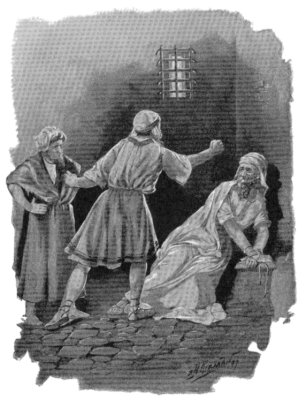 "He knows that Yusuf's hands reek with blood," said Uzza.—See page 58.
"Now, proud Yusuf," he said, "has come
Abraham's day. Once it was Yusuf's day;
then the poor peddler, the little dervish, was
scourged and chained, and well-nigh smothered
in that vile Meccan chamber. Now it
has come Abraham's day, and Yusuf and
Abraham will be even. How does this suit
your angelic constitution? Angelic as you
are, you cannot slip through chains and
bolted doors so easily as the little Jew. Oh,
Yusuf, are you not happy? Uzza hates you;
I saw it in his face. Did you ever know him
before?" The Jew's propensity for news
was to the fore as usual.
Yusuf answered nothing.
"Tell me," said the Jew, giving him a
shake, "what does Uzza know of you?"
"He knows," said a thin, grating voice
from behind, "that Yusuf's hands reek with
the blood of Uzza's only child, the fair little
Imri, murdered in the cause of religion; and
ere I could reach him—yes, priest, with
vengeance in my heart, for had I found you
then your blood would have blotted out the
stain of my child's on your altar!—the false
priest had fled, forsaken the reeking altar,
left it black in ashes, black as his own false
heart. And then, that vengeance might be
satisfied, was Uzza's blade turned against
the aged grandmother who had delivered
the little one up to Persian gods. O priest,
your work is past, but not forgotten!"
"Uzza," cried the priest, "I neither ask
nor hope for mercy. Yet would God I could
restore you your child! Its smile and its
death gurgle have haunted my dreams
through these long years! 'Twas in my
heathendom I did it!"
"That excuse will not give her back to
me," said Uzza, stepping out of the room
with the Jew, as the warden came with the
keys.
It was not Uzza's purpose to bring about
Yusuf's speedy death. As the cat torments
the mouse which has fallen into its power,
so he resolved to keep the priest on the rack
for a considerable length of time.
Hearing of the conversation between him
and Asru, he knew that exquisite torture
could be inflicted on the priest through
Dumah, and determined to strike at him
first through the poor singer. Dumah's execution
was, accordingly, ordered.
Early one morning, Amzi, looking out of a
little chink in his window through which the
bare court-yard below was visible, was horrified
to see a scene revolting in its every
detail, and over which we shall hasten as
speedily as may be.
There in the gray morning light stood Yusuf,
bound and forced to look on at the
death of the bright-haired singer, whose
sunny smile had been as a ray of sunshine
to the two men.
Amzi looked on as if turned to stone—heard
Dumah's last cheerful words, "Do not
weep, Yusuf; it will be all flowers, all angels,
soon. Dumah is going home happy,"—then,
he fell on his face, and so lay for hours unconscious
of all. Reason came slowly back,
and he realized that another of the tragedies
only too common in those perilous days
had taken place.
"I am going home happy," rang in his
ears. The cold moonlight crept in, shining
in a dead silver bar on the ceiling. Amzi
lay looking at it, until it seemed a path of
glory leading, for Dumah's feet, through the
window and up to heaven.
"I am going home happy." Was that home
Amzi's home too? Ah, he had never thought
of it as his home, though he remembered the
words—"In my Father's house are many
mansions." He imagined he saw Dumah in
one of those bright mansions, happy in
eternal love and sunshine, while he, Amzi,
was without.
For the first time in his life Amzi was concerned
deeply about his soul; and now there
was no Yusuf to answer his questions. Ere
another day had passed he, too, might be
called upon to undergo Dumah's fate. He
could not say "I am going home happy."
How, then, might this blessed assurance be
his? He strove to remember Yusuf's words,
but they seemed to flit away from his memory.
His whole life appeared so listless, so
selfish, so taken up with gratification of
self! At last he seemed a sinner. How
could he obtain forgiveness?
He turned over in agony, and the little
stone tablet fell against his bosom. With difficulty,
on account of the manacles on his
hands, he drew it forth and traced the words
with his finger.
"For God so loved the world, that he gave
his only begotten Son, that whosoever believeth
in him should not perish, but have
everlasting life."
As when a black cloud passes away from
the moon and a flood of brightness fills the
whole air below, so the light burst upon
Amzi. He saw it all now! His talk with
Yusuf on the love of God came back to him,
and he shouted aloud with joy:
"Praise the Lord, he hath set me free!"
"Then for the sake of mercy, help me to
get out of this too," said a voice from the
other side of the partition. It was Asru.
"Alas, my friend," returned Amzi, "chains
are still on my body. It is my soul that
soareth upward as an eagle."
"Wherefore?"
Amzi read the verse of Scripture aloud.
"I have heard somewhat of that before,"
said Asru. "Read it again."
Amzi did so, and explained it as well as he
could. Asru listened eagerly. This new
creed interested him by its novelty, especially
since he was in forced inaction and
had nothing else to think of. But it also appealed
to a heart which had some noble
traits among many evil ones; and as Amzi
talked, sorrow for his sins came upon him.
"But the promise cannot be given to such
as I," he said, wistfully. "A long life of
wickedness surely cannot win forgiveness."
"O friend," returned Amzi, eagerly, "'believe
on the Lord Jesus Christ, and thou
shalt be saved.' How often did they tell me
those words and I would not believe, could
not understand!"
And then Amzi told the story of the thief
on the cross, as he had read it and talked it
over with Yusuf. His voice thrilled with
eagerness, and, on the other side of the wall,
Asru wept tears of repentance. To him too,
the door was opening, and a great longing
for the love of Christ and for a better life
filled his bosom. So they talked until the
noise of the awakening Moslems in the passage
without rendered it impossible for them
to hear each other. But joy had come to
both Amzi and Asru within the prison-walls.