The following letter and document were the first
causes of the long journey, and strange adventure.
“Dear Miss Cameron:—You will probably be
much surprised to hear from me in this out-of-the-way
place, but knowing the pleasure you take in everything
pertaining to Africa, I thought you might be interested
in a matter which came before my notice recently.
Some months ago I joined a hunting party bound for
the interior of Africa, and on our return march at Rehenoko
we fell in with another caravan bound for the
coast. Having a common destination, Zanzibar, we
travelled together. An Abyssinian, Sedai by name,
was in charge of this caravan. He is a large, powerful
man, and very intelligent. I often talked with him during
the long marches, and one day he told me that he
had on this trip, come across a strange manuscript, a
part of which he had been able to decipher, but some
8words of which he could not make out. He asked me
to help him decipher the difficult phrases; so that evening,
after everything had been made snug for the night,
Sedai produced a piece of goat-skin, on which was inscribed
the following strange tale.
‘Name Philip Harding—English—left England July
6, 1801—Zanzibar, February 16, 1802—expedition just
left Bagamayo—myself and nine other sailors started to
overtake it—on 26th, lost our way—wandered long and
far—hostile tribes—fight—four men killed—others escaped—three
die with fever, reach mountains—one man
killed by lion—discover opening into mountain—make
torches and enter—companion starved—discovered
line of broken stones—followed these—found bridge—crossed
this—followed stones again—found secret door—Land
of On—people thought me from another
planet—lived in temple—strange people—no knowledge
or connection with outside world—highly civilized in
their way—have strange Day of Resis—mysterious ceremonies
on this day—people never mention it—day sacred—here
nineteen years one month and sixteen days—made
escape—looked five days for opening key—removed
stone set in cliff behind palm tree under eagle’s
rock mountain—lifted lever seen in spring—rock door
turned giving time to pass through—passed into cave—crossed
bridge—dropped torches in lake, am lost—exhausted—starving—if
document ever found write
friends—growing weaker—can write no mo——’
Here the writing ended. The first part, or that
part which had been written before entering the cave
was in regular lines, but the last was evidently written
after entering the dark cave, or passage, as the characters
9were scattered and very irregular. Sedai intends
placing the matter before the next party who are about
to enter the interior, and have them look up the mysterious
cave and land. He says that the old man, of
whom he got the manuscript, is still living, and knows
the entrance to the cave, in which he found the body
of Harding still warm, and on it this strange document.
Sedai is a trustworthy fellow, or otherwise I would
take no stock in his story, or manuscript.
Hoping you may find some interest in this strange
tale, I am,
Very Sincerely Yours,
Frank Boyd.”
Such was the letter and weird tale which came in
Enola Cameron’s mail one morning in the early nineties.
Only the fact of hearing from Frank Boyd in
Zanzibar surprised her. The story in itself did not
surprise her, for she had so long made a study of
Africa and its dark secrets, that nothing pertaining to
it seemed strange to her. She was as enthusiastic in
this research as most women were in studying the art
of dress and beauty. She had met the great explorer
Stanley during his late visit to New York, and had
read the story of his travels again and again. She had
met Herbert Warde socially, had overhauled his trophies
to her heart’s content, and his books had also been
added to the long shelf of African works in her library.
Here poor Jameson’s story had filled her eyes
with tears, and here, too, she had escorted Glave that
she might, in confidence, reveal to him the one great
desire of her heart, and to learn from him the possibility
10of its fulfillment. She had studied the history of
the dark continent from every obtainable source.
Works, which for the average woman held no attraction,
aroused in her the liveliest interest. Her enthusiasm
had reached such a pitch that but one course
seemed open to her, namely, to experience the adventures
which had made the names of Baker, Grant,
Speke, Livingstone and Stanley famous. She had
passed her twentieth birthday; she was of medium
height and well-rounded figure, brimming over with
health and strength, as was shown by her clear, rosy
complexion and bright eyes, which lighted up with
enthusiasm as new thoughts opened to life in her
active brain.
There was nothing of the so-called New Woman
about her; far from it; she was a womanly woman
with a great sympathetic heart and kindly nature.
She was an orphan, her parents having died when she
was yet a child, leaving her with a life-long friend of
the mother. This was Mrs. Graham, a most estimable
woman, wealthy and moving in the best circle in the
city in which they lived. Enola had long since learned
to look upon Mrs. Graham and her kind husband as
her second parents, and she was as dearly loved by
them as were their own children. She had a snug fortune
of her own and was thoroughly independent.
But now that she had made up her mind to go to
Africa and ascertain the truth, or fallacy, of the tale
which had just reached her, she felt a little hesitancy
in broaching the subject to her friends. But she was
not the one to be intimidated so easily, so went direct
to the library, where she knew that Mr. Graham and
11Harry, the son, would be, and opened the subject at
once.
“Uncle,” she said (she always called her second
parents uncle and aunt), “I am going to Africa, and
will want your help.”
Mr. Graham’s glasses fell from his nose, so suddenly
did he look up.
“To Africa,” said he; “Well, has it come to this.”
“Exactly,” said Enola. “Now don’t look as if I
had declared my intention of committing suicide, although
in your eyes I suppose the two are synonymous.”
“When do you start?” asked Mr. Graham. Having
long since learned that to cross Enola was to make
her the more determined to carry out her own plans.
“To-day or to-morrow, or as soon as you can make
preparations. Now remember, I am only suggesting
this adventure; you are the real instigator of the
project, and have asked me to accompany you, you
know.”
“Well, if that isn’t a woman for you,” said Mr.
Graham, laughing in spite of himself. “You come
here declaring your intention of going to Africa, asking
my help and then tell me that it is I who must assume
all responsibility. Well, I will do it for your
sake, but I hope it is not to be out of the regular
beaten paths of travel in Africa, for it might not be
pleasant, you know, fighting hostile natives with a
woman about.” And Mr. Graham again laughed.
“The woman will take care of herself, never fear,”
said Enola. “But seriously, uncle, I never would
have asked you to accompany me on this journey, but
for your having spoken some time ago of your intention
12of going to France to spend your vacation, and
the thought occurred to me that you might care to go
with me for two reasons. First, of course, to be my
escort, and secondly, because the adventure would
please you. And as for the danger, from what I can
glean from Mr. Boyd’s letter, I should say that we
will not meet with any great amount of this, for, from
the coast to the mountains, the road leads through a
comparatively open country, and if we start now we
will get to Zanzibar about the right time to enter the
interior. I anticipate but very little trouble in reaching
the mountains. What will happen after that I
cannot say.”
“The adventure will just suit my ideas of such
things,” said Mr. Graham, “and I will go with you
gladly. And you want to start immediately?”
“Why, yes,” said Enola. “This man Sedai was to
present the matter before the first party entering the
interior, and if we should wish to be the ones to discover
this strange land, we must lose no time in getting
to Zanzibar. It will not take long to make preparations,
will it?”
“Well, no,” said Mr. Graham. “We will take but
very little with us from this country, for everything
can be obtained in Zanzibar. Let us see,” and he
consults a New York paper. “To-day is Friday and
the Paris sails from New York next Wednesday. We
can leave here on Sunday evening if you wish to, and
mother and Nellie can get packed in that time, and
arrive in New York Tuesday morning. We can make
what few purchases we need, and go on the steamer
that same night. Now what do you think of that for
quick work?”
13“I see you are quite as enthusiastic as myself in
this matter,” said Enola. “But where will we leave
Auntie and Nellie while we are making our longer
journey?”
“Oh, they can stop somewhere in Europe,” said
Mr. Graham, “or go on to Zanzibar if they wish, and
wait there for our return. I am afraid, Enola, that
you will have harder work to convince them of the
advisability of this trip, than you have had with me.”
“I am afraid so,” said Enola, “but you must
help me.”
“I will do the best I can,” said Mr. Graham.
“But look here,” said Harry, who had kept
perfectly quiet up to this time. “Where do I
come in?”
“Why, Harry, I supposed you understood that you
were to accompany us,” said Enola. “Your father is
perfectly willing, I know, and your mother will not
object when she learns that I am determined on going.
It will be pleasanter to have you with us, for there
will be so few of us at the most, and among strangers
home faces will be very comforting.”
“It will have to be pleasant or otherwise,” said
Harry, “for I intend accompanying you, most certainly.
I wouldn’t see you take such a journey without
me. There ought to be two of us with you anyway
Enola, so that in case anything should happen
one of us, you would still have another to protect you.
It is a serious thing I should judge, to have to trust
wholly to the half savage negroes who will make up
your escort. So we must guard against any contingency.”
14“Very well,” said Enola, “then it is settled that we
start on Sunday night.”
“Sunday night if you can get ready and I can get
accommodations on the steamer,” said Mr. Graham.
“Don’t worry about me, uncle,” said Enola.
“Look out for yourself and Auntie. I will be ready,”
and saying this Enola turned and left the room.
Harry had long since learned to love Enola, but she
had told him positively when he approached her on the
subject of marriage, that she only thought of him as
a brother, but that sometime she might learn to think
of him in a different way; until that time, however, he
must not mention the subject again. Harry had
promised, and so the matter had rested; but he had
not forgotten her words, and he now saw a chance,
while on this long journey, to win the love he craved.
He was twenty-eight, and by hard work, and strict
attention to his duties, had been promoted to the position
of cashier in the bank of which his father was
president. He and his father had both left the
bank for an indefinite period just a few days before
our story opens, fully decided on taking a long vacation,
spending the time in Europe. So Enola’s plans
had not upset theirs to any great extent; they would
now take a trip into Africa, instead of through Europe.
When they had thought the matter over for some
time, they came to the conclusion that the African
trip would be more to their liking, for they were both
good hunters and lovers of adventure. So Harry
and his father lost no time but went out that same
afternoon and made purchases of shotguns, rifles and
pistols, fishing tackle, and some of the more necessary
15medicines. They trusted to getting everything else
which they might need in New York and in Zanzibar.
That evening at the dinner table, the subject was
brought up before Mrs. Graham and Nellie. Both objected,
but when Mr. Graham and Harry both avowed
their intention of accompanying Enola, then the ladies
gave their consent.
Sunday came around and the party had gotten all
ready and started for New York. Arriving there some
few purchases were made, and then in the evening
the party boarded the great steamer which was to
carry them to Southampton. The following day
opened up bright and beautiful, Enola remarking that
this foretold success. The steamer left the dock early
and moved slowly down the bay, past Governor’s
Island, Bedloe’s Island, the Statue of Liberty, and
then along the Staten Island shore, past Quarantine,
the forts, Fire Island, Sandy Hook, and then, after a
glimpse of Coney Island, Brighton, Manhattan Beach
and Far Rockaway, the steamer turned her nose
toward the Old World, and land was soon out of sight.
The trip was an enjoyable one, the steamer not breaking
her record, but still reaching Southampton in less
than seven days. They did not tarry in England, but
took one of the Channel steamers for Boulogne Sur
Mer, and arriving here boarded a train for Paris, which
city was reached the same night. The following day
Mr. Graham looked up a steamer for Alexandria, and
learned that one sailed for that port on Saturday from
Marseilles. This was Thursday, so no time must be
lost in reaching Marseilles. Sleeping accommodations
were secured on the night train, and the following
morning found them in the quaint old city. The day
16was spent in taking a drive along the Mediterranean.
It was at a time when the Reviera is generally crowded,
and the beautiful driveway was filled with elegant
equipages.
The following morning they took the steamer for
Alexandria.
This was the most delightful part of the trip. The
sky never looked so blue, the water never so calm, the
sun never so bright, and the air never seemed so pure
as on this two weeks’ trip, from Marseilles to Alexandria.
Stops were made at Algiers, Tunis and at several
other points before reaching Alexandria, and at
these different places, the boat stopping for a few
hours, our friends disembarked, and made short excursions
over the towns.
At Alexandria a freight steamer was found bound
for Madagascar, and arrangements were made with
the Captain to give the ladies his cabin, Mr. Graham
and Harry being satisfied with humbler quarters.
Down through the Suez Canal, into the Red Sea, out
through the Gulf of Aden and then into the Indian
Ocean, and the little steamer headed due south. This
trip was rather slow but without much hardship, the
Island of Zanzibar was at last sighted, and, later in the
day, they were taken off in lighters.
“The civilized part,” as Enola called it, of the
journey was finished, and it remained now to make
preparations for that other journey, which might prove
less agreeable and a great deal more dangerous.
CHAPTER II. INTO THE HEART OF AFRICA.
17
After landing at Zanzibar, the labor of equipment
began. Bales of cloth and boxes of wire, innumerable
colored beads and trinkets were shipped to Bagamayo
in charge of reliable Zanzibari, the most trustworthy
of African carriers.
Harry first looked up the reputation of Sedai, the
Abyssinian, and finding this to be good, he then went
in search of the man himself. He was found on the
quay with a lot of natives, and upon Harry telling him
what he wanted, he followed him to the hotel. Sedai
was a monstrous fellow, standing fully six and a half
feet high, and built like a Hercules. His skin was of
a bronze color, smooth and shiny; his eyes were piercing
black, his forehead high, and his face above the
average in intellect for one of his race.
“You remember Mr. Boyd, do you not?” asked
Mr. Graham, when the hotel had been reached.
“Perfectly well,” answered the Abyssinian.
“And you believe that the mysterious Land of On
exists?”
“I do.”
“I wish to make that belief a certainty. Will you
join us and get together a proper number of carriers
and natives to insure comparative safety in making the
journey?”
“Gladly,” said Sedai.
“You shall have something more than the usual
18amount paid for such services, for the journey may
entail more than the usual amount of work and danger.”
“I shall expect nothing more than I have been accustomed
to getting,” answered the Abyssinian.
“We will decide on that later,” said Mr. Graham,
“but tell us now of the finding of the goat-skin.”
“I will do so,” said Sedai. “When on my last expedition,
far up in the country, I heard this story from
the mouth of an old man. It may be false, but I believe
it to be true. Umsaga, that is the name of the
old man, said: “One day when I was quite a boy I was
out hunting on the mountain side, and among the undergrowth
disclosed a flat stone, which had at some
remote period covered an opening about four feet
square, in the side of the mountain. Being curious to
know whither the hole led, I entered, but had gone only
a short distance when I heard a groan. This scared me
but I determined to learn what it was that had made
the noise. I returned to the outside and procuring a
torch, again entered the cave, and followed in the direction
from which the sound came, and had not gone
far when I almost stumbled over the prostrate body of
a man. I felt it and found it still warm, but upon
close examination found that life was extinct. He
was of the white race, but exposure and starvation
had tanned and drawn the skin tight over the bones.
By his side was a knife, and clutched in his hand was
a piece of goat-skin, on which he had cut strange characters,
which I could not decipher. I took the goat-skin
and never again entered the cave.”
“This was the old man’s story,” continued Sedai,
19“and offering him a piece of cloth for the goat-skin,
he eagerly accepted it and I left him.”
“And you could read it?” asked Mr. Graham.
“I was for a time in the service of an Englishman in
my own country and knew some English. I have
learned more since, but I could not make out all of
the letters. With Mr. Boyd’s help, however, all was
made plain. It is here,” and Sedai saying this, handed
the parchment to Mr. Graham.
The party gathered around Mr. Graham and examined
the goat-skin closely.
“And the old man never sought to solve the mystery?”
said Harry.
“So he said,” answered Sedai.
“This parchment tells us how to leave this strange
country, when once it is entered,” said Mr. Graham,
“but it does not tell how to find the secret door
which is to admit us.”
“The sailor found it,” said Enola, “and it seems
to me that we ought to.”
“Well, we will never know until we get to the
point where we may expect to find it,” said Mr.
Graham. “How far is it, Sedai, to this mountain,
through which we will have to go to find the strange
country?”
“About three hundred miles,” said Sedai, “through
a country not difficult to travel, and among natives
not usually hostile.”
“Can you be ready to start to-morrow?” asked
Mr. Graham of Sedai.
“I can,” said Sedai.
“Then be at Bagamayo to-morrow at daybreak,
ready to start.”
20“I will be there,” answered Sedai, and with this he
left.
That day a Mr. Bruce called on Mr. Graham, making
a request to accompany the expedition, and Mr.
Graham, having looked up his reference and found
that he was a Scotchman of first-class standing both
socially and financially, he consented to his accompanying
them. Later in the day the party crossed
over to Bagamayo, so as to be there for an early start
in the morning.
Early on the following morning the caravan was
drawn up and carefully inspected by Mr. Bruce, Mr.
Graham, Harry and Enola. Twenty donkeys and one
hundred carriers, with one cart, were to transport the
goods of barter. A double relay of six carriers was
detailed to carry each of the sedan chairs of Mrs.
Graham and Nellie, after having learned that the
country through which they would pass would be
open, and the tribes not hostile had decided to accompany
the caravan. They were desirous of seeing the
strange land and people. Mr. Graham, Mr. Bruce and
Harry had procured horses from an Arab in Bagamayo,
and when the caravan was drawn up it made an imposing
sight, and one well calculated to inspire hostile
tribes with a wholesome fear.
At six o’clock, with the sun shining brightly, and
amid the shouts of many Arabs and natives who had
assembled to see them depart, the caravan moved
slowly out of Bagamayo. The American flag was unfurled,
and floated merrily in the breeze at the head
of the column. Out through a narrow lane they
passed, the sun speeding to the west, beckoning them
on. Loveliness glowed around them, the fertile fields,
21rich vegetation, strange trees bordering their path, the
jubilant sounds of many insects, the cry of cricket and
pewit, all seemed to tell them that they had started.
The first camp was only five miles distant, and the
next few days were spent in completing the preparations
for their long land journey. After all was in
readiness the caravan again started. From here on
the roads were mere footpaths, leading through fields
in which naked women were at work, who looked up
and giggled as they passed. Passing on they entered
an open forest. Reaching the Kingimi, they passed
over a bridge of felled trees, made by some previous
party.
Harry came to the side of Enola’s chair and laughingly
said:
“One would think from the half-sad expression in
your eyes, that you were already regretting having
taken this trip.”
“You are mistaken, Harry; I was simply lost in admiration
of the beautiful scene about us.”
“Yes, it is beautiful,” said Harry, “but it is so different
from what I have been used to, that I often
find myself thinking, or wondering if it is not all a
dream, and if I will not wake up some morning in my
room at home, and find that I have only visited these
lands in my dreams.”
“Yes, it is decidedly out of the ordinary,” laughed
Enola, as she saw the serious look in Harry’s face;
“but if you were as well read in African history and
lore of the people as I am, you would accept all this
as genuine at once. Listen. For centuries Africa
has been known as the Dark Continent. The edges of
this immense tract have been known as far back as
22history goes. Egypt, on the North, is the oldest
government on earth; while the nations bordering on
the Mediterranean and Red seas, were actors in the
earliest recorded histories. Still, Africa to-day is an
unknown land. That Africa was a rich country, was
proven by the treasures brought from the interior by
the rivers Nile, Niger and Congo. That it was populous,
was demonstrated by the millions of slaves furnished
by the native tribes to the outside world. For
curiosity alone, explorations were made in the early
part of the century; but it remained with Livingstone
to first open up the Dark Continent, and with Stanley,
to pierce its very heart. Africa is to-day, however, a
mystery which, it seems, will never be penetrated.
Strange stories come to us of people never seen by
white men, of customs foreign to all history, of abandoned
cities, of desolated countries. Africa is synonymous
with mystery and darkness, and nothing seems
strange to me which is connected with it.”
“Such words should be convincing,” said Harry,
“but my education in life has been too practical to
realize that there is so much mystery left in the world
in this, the nineteenth century.”
“It will all be real enough before we get back to
civilization, I have an idea,” said Enola.
“Well, it looks real enough now,” said Harry.
“This moving caravan, those hippopotami in the river,
and the antelope in the forest, all scout the idea of
there being anything uncanny about our present surroundings.”
And so days passed, some amid pleasant surroundings,
and others in a part of the country not so agreeable.
23One day they passed through a continuous jungle.
The path was only a foot wide, each side being bordered
with thorny plants and creepers, the spiky twigs
of which were as sharp as needles. The entire party
was badly scratched with these irritating twigs, and
the caravan was in a sad plight when it reached Msuwa
that night. The chief of this tribe was very kind to
the tired and wounded party, however, and they remained
in this camp two days. After leaving here,
the country was open and beautiful, presenting a natural
park, and the roads were good.
They reached the Ungerangeri River on the evening
of the twenty-fourth day, where they encamped, and
on the following morning crossed the river and entered
the Wakami territory. Five days later they reached
the Wassagahha district. Here several of the party
were stricken with fever, and several days were lost,
but all getting better at last, the caravan again moved
on. Away off to the North and West, could be seen
a long range of mountains, in which, Sedai informed
them, was situated the hidden country of “On.”
Shortly after leaving here they entered a very wild
tract. Numberless antelope, spring-bok, zebra and giraffes
were seen, but upon their approach they would
scamper away. Here was a hunter’s paradise. What
nobleman’s reserve in civilization could compare with
this vast expanse of field and forest? How small and
insignificant would they seem in comparison! The
first herd of elephant was also seen here, but they
passed them by without disturbing them. That evening
they entered the Usugara district, and although
the mountains were a considerable number of miles
nearer, they still looked just as far away. The atmosphere
24in this country is so clear it makes distances
very deceiving. It was a mountain world which they
looked upon, for peak beyond peak, cone beyond
cone, fold above fold, they rolled away like so many
waves.
“We shall soon descend into the valley and across
this to those distant mountains directly west of us, at
the base of which we shall find the village in which
lives the old man of whom I obtained the parchment.
We will reach there in four marches,” said Sedai.
“And you say there are lions and tigers in the
valley?” said Mr. Bruce.
“Yes,” answered Sedai, “and this part of the journey
will be very dangerous.”
And this proved to be true, for two evenings later,
when the supper had been eaten and all had been
made snug for the night, Harry and Enola came very
near falling victims to one of these ferocious beasts.
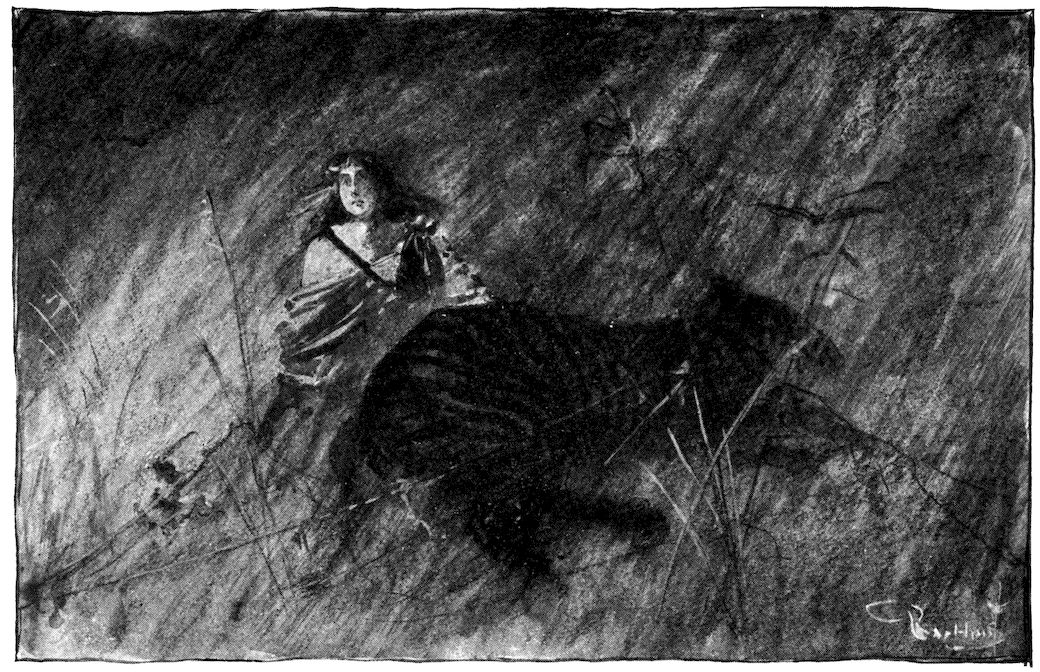
They had wandered a little distance from the camp,
and had sat down on a mossy bank for a few moments’
talk before going to bed. They had been here only a
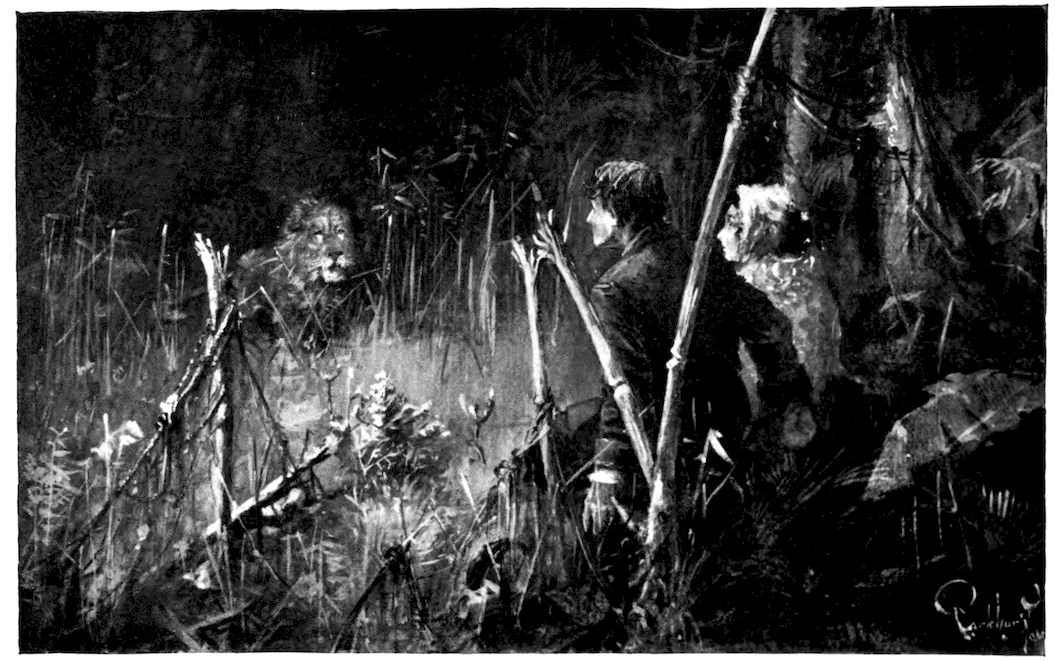
short time when they heard a rustle in the bushes,
and turning they saw, standing not ten yards away,
with his yellow eyes glowing through the semi-darkness,
and his long tail swaying from side to side,
an immense lion. Harry had not brought his rifle,
and they were at the mercy of the beast. The lion
seemed to realize this, for he quietly settled down on
his haunches and watched them intently.
“Listen,” said Harry, and his lips hardly moved,
“he will make a leap for us, and when he does, stoop
low and run toward him. We will try to pass under
25him while he is in the air, and before he alights and
turns we may be able to reach camp.”
“I understand,” said Enola.
The lion again rose to his feet, and then settling
on his haunches prepared to spring.
“Be ready,” said Harry. “Now,” and he darted
forward, but stopped again as soon as he could, for
Enola’s hand had left his and she had fallen. There
she lay with the lion’s paw resting across her breast.
Harry could see that she had neither lost consciousness
nor presence of mind, for she was gazing steadfastly
into the eyes of the huge beast.
It was a terrible moment. Harry was afraid to
move or cry for help, for fear of the lion seizing
Enola and making for the bush.
All this time the lion was watching Harry intently,
seeming to know that interference would come from
that quarter. But he was as powerless to help Enola
as if he had been bound hand and foot. He could see
that she was becoming weak from terror and loss of
blood, and that she could scarcely breathe owing to
the weight of that fearful paw on her breast. Her
eyes closed several times, and Harry could see that
she would soon be unconscious. Something must be
done. Would the lion, if he made a rush for him,
turn his attention from Enola long enough for her to
get out of reach? It mattered little what became of
himself if he could but save Enola.
Harry seized a short piece of wood lying near him
and made a rush for the lion. The lion raised on his
haunches as Harry struck him a powerful blow between
the eyes.
“Roll out of the way,” said Harry.
26Enola rolled over once and then staggered to her
feet, but sank down again too weak to move farther.
The lion was dazed for an instant by the blow, but
only for an instant, and with a lightning stroke of the
paw, struck Harry on the shoulder, knocking him
senseless and bleeding on the ground.
“Help,” cried Enola, but the sound was so faint
that she despaired of its reaching the camp. Nevertheless
it was heard, and the commotion caused the
lion to turn to see what was happening. That look was
his death warrant, for a bullet struck him squarely in
the eye, and he rolled over with scarcely a groan,
dead. One paw was lying across Harry’s neck, as
though defying them even in death to take his prey
from him.
Mr. Bruce rushed up gun in hand, and with several
of the carriers bore Enola and Harry to the camp. Restoratives
were administered and Enola soon regained
consciousness, but Harry lay in a stupor for hours.
Both were badly torn by the claws of the lion, and it
was several days before the caravan could move on.
The journey from here on, was through an open
forest, watered by numerous streams which sprung
from the mountains. Their progress was somewhat
impeded by these streams, but two evenings later they
camped near the village in which dwelt the old man,
who was going to show them the entrance to the cave.
Was he still alive and would they find him?
CHAPTER III. IN THE CAVERN.
27
Early the following morning, Sedai went into the
village to find the old man Umsaga. After much inquiry
he learned that the old man still lived but was
very feeble. He went to his hut and telling him what
he wanted, and that he would be well paid for the information
which he would give to the party, the old
man agreed to go. Sedai had to support him,
for he was too feeble to walk alone. They reached
the camp and Sedai acting as interpreter, Mr. Graham
asked Umsaga:
“Do you know where the opening to the cave is?”
The old man made quite a long speech, which when
interpreted ran as follows:
“I will show you the opening on condition that you
take none of the carriers or soldiers with you, and for
this service I demand one hundred yards of cloth, and
one pack of beads. The opening is about four hours’
march from here, and one of your men will have to
carry me to the place, as I will not allow either my
countrymen, or your carriers to accompany us. If you
will agree to this I will go with you to-day, to-morrow,
or any time that you wish.”
“We will remain here to-day to settle up with our
carriers, and to-morrow morning we will have him
show us the opening.”
Sedai interpreted this to Umsaga, and then helped
him back to the village.
28The caravan had only been engaged to go this far,
but it was decided to have it wait three months for
them. If they had not returned at the end of that
time, the carriers need wait no longer. They had paid
the natives well for their work, and had promised
them still more for the return trip if they would but
wait for them. They hoped that these inducements
would hold them until the expiration of the three
months. Arrangements were made with the chief of
the village to give sustenance and shelter to the members
of the caravan during this time.
Late in the afternoon, the goods promised Umsaga,
besides a liberal present to the chief were sent to the
village, after which the remaining bales and boxes
were carried up the mountain side to a place designated
by Umsaga. This place was near the opening
of the mountain, and here the party camped for the
night.
Early the following morning, Sedai went into the
village and helped the old man up the mountain. Umsaga
directed them in the way to go, and it was not
long before they reached a level spot well up on the
mountain. The trees in this vicinity appeared to have
been planted in the far distant past, with a peculiar
regard for regularity. A broad avenue of stately trees
of an unknown species to the travelers, led directly to
the face of the cliff. It suggested that the hand of
man had long ago intended that they should serve as
a hint of the possibilities within the mountain.
The party moved through the avenue and halted at
the extreme end. Here the high cliff seemed to stop all
further progress, but Umsaga hobbled up to the rock
barrier and with the help of Sedai, removed some of
29the bushes growing at the base, and disclosed a large
flat stone leaning against it. This, Sedai with difficulty
moved aside, opening to view an entrance about
four feet in diameter. All started forward and gazed
intently into the darkness. It required considerable
courage to even think of entering this dark passage
which the sunlight penetrated but a few feet.
For hours the men labored in transferring the bales
and boxes to the cavern, where they were to remain
until their return. Torches had been procured from
the natives, and lighting one of these the party started
on their long underground journey. The passage was
very narrow for about twenty yards, and was very
smooth and clear cut, but at the end of this distance a
vaulted cave, lofty and wide, opened before them.
The dim light of the torch lit up this vast subterranean
cavern but indifferently, the roof being so high that it
could just be seen in the darkness.
The goods were stored safely and the journey commenced
in earnest. The men carried what provisions
and torches they thought would be needed in the
march across the cave. They had gone but a short
distance when Enola and Harry, who were a little in
advance of the others, stumbled over something, which
the light of the torch revealed as the body of a man.
The skin, dry as parchment was drawn tightly over
the bones; the eyes were sunken; the head was
covered with a growth of long hair; the hands, which
with their long finger-nails looked like talons, clutched
the garment at the throat, as if the man, when dying,
had tried to tear it away, in order to gain greater
freedom to breathe. This garment was all that the
body was clothed in, but around the neck of the dead
30was a chain of gold engraved in a peculiar manner and
in which diamonds and opals were set. The ends of
the chain were attached in front to a strange red
stone, that resembled liquid fire.
Mr. Graham unfastened the garment, and slipped it
off. A solid substance was discovered inserted in the
middle of the back, and slitting the garment with a
knife, a piece of thin, highly polished hard wood was
revealed. Tracings were found on it which seemed to
be the diagram or map of a country; but these were
so dim it was difficult to discover what they represented.
After studying further, however, a circle was
seen in the corner with the word “ON” written in its
centre. This then told the tale; this was a map
showing the location of the mysterious country. On
the other side were more tracings. A straight line
was drawn from one corner to the centre, where a hole
about an inch deep was cut. On the opposite side of
this hole the tracing continued in a straight line, but
just before reaching the corner it turned to the left
and ended at the edge of the block. Nothing more
could be made out until Mr. Bruce, who had looked at
it more closely, and whose eyes seemed keener than
those of the others, discovered the letter “u” and a
little ways further the letters “g” and “e.” All
looked at the tracing intently for a few moments trying
to guess the riddle. It was finally decided that
the “u” was the first letter of underground, and
“ge” the last two letters of passage. This then
was the path to be followed through the cave. Along
the edge of the block could be faintly discerned
the name “Philip Harding;” this was the body of
the man who long ago had visited the mysterious
31land, and had suffered and died in this cave. This
was he who had given them the knowledge of the hidden
country, and who, years after, was staring at them
with those sightless eyes that seemed to warn them
back.
“How terrible,” said Mrs. Graham.
“Yes,” said Enola, “my heart turns sick at the
sight. And to think that he died so near help and
liberty.”
“And do you still feel like going on?” asked Mr.
Graham.
“Yes,” said Enola, “for now my doubts are at rest;
all the fears that I had of this strange country being
a myth are gone. Success seems sure now and all our
long journey has not been in vain. But how strange
that this body should have lain here all these years
and not decayed.”
“There must be some preserving quality in the
atmosphere of this cave,” said Mr. Bruce, “or else the
body would have turned to dust long since.”
“But come,” said Mr. Graham, “we must yet find
the line of broken stone which is mentioned in the
document.”
“Yes,” said Mr. Bruce, “the block would be of
little use to us in this vast cavern without some better
guide than its tracings.”
So the party began looking for the string of broken
stone, and found it but a short distance from the body.
From here on the cave widened, and the roof became
too lofty to longer be in the rays of the torch. Monstrous
stalactite formations hung from the ceiling, and
tremendous stalagmite pillars reached from the floor
into the darkness far overhead. These pillars were of
32fantastic shapes. Some were perfectly symmetrical,
others irregular, but all were of wondrous beauty,
their surfaces being covered with delicate tracery as fine
as lace. On every hand could be heard the dropping
of lime-water forming new pillars. Ages must have
passed since this cave was cut out of the solid rock by
the action of some subterranean sea, or by a weakening
and wasting away of the lighter strata, or by some
tremendous convulsion of nature, which, raising but the
upper part of the mountain, had left this vast open
space.
A little further on a halt was made for the midday
meal, and after this had been partaken of, Harry and
Enola walked a little apart from the others, and sat
down on some of the broken stone to talk over their
future plans.
“Harry,” said Enola, “I am a little slow in doing so,
but I want to thank you for having saved me from the
jaws of that fearful lion. While I was lying beneath
the paw of that awful beast, I for one short moment
wished that I had not come.”
“And what did you think I would do?” asked
Harry.
“Just what you did do,” said Enola, “A brave man
could not have done otherwise. But there are few
brave men when it comes to a question of their own
lives, or those of others. There must be no selfishness
where bravery is to play a part, and it is this unselfishness
that must be rewarded, and I can only do this
by thanking you, and by telling you that I appreciate
the brave act.”
“Let us forget that fearful moment,” said Harry.
“It was little enough to do for a life-long friend, and
33I would do the same thing over again a thousand
times if the opportunities should offer.”
“Let us hope that they will not,” said Enola.
“It is hard to tell in this strange country,” said
Harry.
At this moment, they heard a loud shout to the
right. They could see their friends rushing in the
direction of the sounds, and Enola and Harry hurried
to join them. Nellie was standing wringing her hands
and trying to explain how she and Mr. Bruce were
walking along leisurely, when he suddenly dropped
out of sight, the torch being extinguished leaving her
in utter darkness. She had called to him, but receiving
no answer, had shouted for the others, whom she
could just see in the torchlight some distance from
her. Taking torches they went to where Mr. Bruce
had so mysteriously disappeared, calling to him constantly.
They proceeded carefully for fear of falling
into the same pit; and it was well that they did so,
for before them, gaping as if anxious to swallow up
the whole party, was an abyss opening into the very
bowels of the earth. They leaned far over the edge
and peered into the darkness, calling, but no answer
came to them, and they felt assured that Mr. Bruce
was lost.
Harry brought a coil of fine silk rope, and fastening
one end to a stalagmite, prepared to descend into the
darkness. Sedai pushed him gently aside, however,
and taking one of the torches between his teeth, he
let himself down. Down, down he went, until he
could see a black torrent rushing madly through the
crevice. He saw a rock near him, and swung so as to
land upon it. He could see but a few feet about him
34and Mr. Bruce was nowhere visible. He called
again and again, and once he thought he heard a
faint answer. He grasped the rope and jumped into
the stream and let it bear him down until, clinging to
a jagged rock he saw Mr. Bruce. He swung toward
him, and catching him under the arms, began working
his way back. This was tedious work, and would
have been an impossibility to a man not endowed with
Sedai’s herculean strength, but happily Sedai was
equal to the task and soon had Mr. Bruce on the rock.
He gave the signal to those above, and tying the rope
under Mr. Bruce’s arms, he was pulled to the surface.
The rope came falling back, and Sedai, hand over hand,
rejoined his companions. It took some time to restore
Mr. Bruce to consciousness, but he was finally
brought around.
After he became stronger he said that he had fallen
head first, but hearing a rush of waters, he clasped his
hands above his head in the manner of divers, and
thus broke the blow which his head otherwise would
have sustained. He had gone down a hundred feet
he thought, but had then began to rise again, and
reaching the surface he had grasped the first object
which his hand came in contact with, which proved to
be the rock upon which Sedai had found him. Then
he saw Sedai coming and lost consciousness. The
party moved no farther that day but on the following
morning they took up the journey with renewed vigor.
They had but one fear, and that was as to the possibility
of their finding a door when they had reached
the other side of the cavern. This did not worry
them a great deal, for the path laid out for them to
follow both by the broken stones and the tracings on
35the block of wood, led to one point and this would
undoubtedly be near the stone door, but the secret of
the spring had not been learned, and they might have
trouble in finding it.
CHAPTER IV. DEATH FACES THEM.
The next morning they had gone but a short distance
when they came to a vast inland lake. The
bridge mentioned in the manuscript stood before them,
and mounting this they startled to cross the lake. They
had followed this about four miles when they came to
a break in the solid masonry. The hole was fully
eight feet wide, and it was a serious question as to
how they were to get to the opposite side; but Sedai
offered to tie the rope to his arm and leap across.
The end of the rope could be fastened and the ladies
and Mr. Graham could cross over, while Mr. Bruce
and Harry could make the leap as did Sedai.
This Sedai did, and fastening one end of the rope to
one of the huge stones, which had evidently come
from the break, Mr. Bruce and Harry held the other
end, and Mrs. Graham and Enola worked their way
slowly across. Nellie then grasped the rope and was
half way over, when a terrible commotion was heard
near the bridge, and a spout of water was sent thirty
feet into the air. The whole party was deluged; the
torches were put out, and when their first surprise was
36over, they saw with horror that Nellie had loosened
her hold on the rope and had dropped into the water.
Hastily relighting the torches, they saw Nellie disappearing
in the swift current. It took but a second for
Mr. Bruce to throw off his jacket and plunge in after
her. He hoped by the help the current and his long
easy strokes to overtake her. He could just see her
above the surface of the water about one hundred
yards ahead of him, evidently fast giving out. He
strained every nerve, put forth every effort, resorted
to every means to force himself through the water, and
he could see that he was gaining slowly. He called
to her to keep her hands and feet moving and to keep
up courage. He could see her beating the water
making frantic efforts to keep afloat, but her struggles
were becoming weaker and weaker, and at last they
ceased altogether and she began to sink when he was
only a few feet away. Making one grand final effort
he caught her by the hair just as she was sinking
beneath the surface.
Grasping her about the waist, and holding her head
above the water with one arm, he tried to swim out of
the current. This was a hard task, but he was an
excellent swimmer, and nearly succeeded. But the
struggle was an unequal one and having but one hand
to use, he soon found that the current was getting the
better of him. He now threw Nellie over his shoulder
and grasping her dress between his teeth, he in this
way gained the use of both hands, and soon made his
way into more quiet water. Turning he saw the
flickering torches far in the distance, but close at hand
were two round balls that shone like fire. The
water was terribly agitated and he soon found himself
37struggling against waves like those thrown up by the
paddles of a steamboat.
Nearer and nearer came those fearful eyes, and Mr.
Bruce thought all was lost. Happily for Nellie she
had fainted, so she was spared the terror of this new
danger. Mr. Bruce was not one to give up, however,
as long as there was a shadow of a hope, and he was
thinking hard to devise a means to escape this monster.
Those eyes were nearing him, and in an instant he
would feel the hot breath in his face. Down he sank
holding Nellie about the waist. Rising to the surface
again he started for the lights. He was afraid to
look back for fear of seeing those fearful eyes following
him. Larger and larger grew the lights, nearer
and nearer he came to his friends. His strength was
fast failing but he must not give up when so near to
those who could rescue them. A few strokes more and
he was in the radius of the torchlight, and a shout of
encouragement from his friends greeted him. This
seemed to rouse Nellie for she gave a long sigh.
“Throw your arms about my neck and hold on for
your life,” said Mr. Bruce, and Nellie having done this
it left his mouth free, and he breathed with greater
ease.
“Look behind you,” called Mr. Graham, and looking
over his shoulder, he saw those awful eyes again, with
the huge black body, following them. He turned and
faced the monster again, just as it was opening its
cavernous jaws. Once more he sank bidding Nellie to
hold her breath. The huge mass passed over him, and
coming to the surface he saw the great black body
going straight ahead at a fearful speed. The serpent
made a big circle and then turned and came toward
38them again. Mr. Bruce was nearly exhausted and
felt that he could not risk again that terrible plunge
under the passing monster, and still have strength
to reach the pier. He could see Harry and Sedai
preparing to swim to them, and knew that Nellie
and he were safe if the terrible serpent did not make
another charge on them. Sedai now came towards
them holding a flaming torch. Back of them but a
few yards could be seen the sea monster again making
for them. They were fast nearing the bridge. The
rope was thrown to them and Mr. Bruce fastening this
around Nellie’s body, she was pulled out of the water.
It was then thrown to Mr. Bruce and Sedai, just as the
terrible monster opened his jaws. Sedai thrust his
blazing torch into the creature’s mouth, and then with
Mr. Bruce, hurried hand over hand up the rope.
The water was lashed into foam by the struggles of
the serpent, and bullets from Harry’s revolver seemed
to have no effect. They got a good look now at the
monster. The largest part of the body was just back
of the head and tapered from this to the end of the
tail. The head was at least six feet long, and flat, or
nearly so. The wide jaws, when open, showed a
double set of irregular teeth. The tongue was forked.
A large horn about three feet long sprang from the
head just back of the nostrils, and from this to the
point of the tail was a succession of smaller horns.
Just back of the large horn or tusk, was a hole through
which the monster forced a stream of water high into
the air. Three great fins on either side of the body
were tipped with long claws looking as if they might
be used for crawling. Its rage was terrible when maddened
39by the flaming torch and by the escaping of its
prey.
The party now hurried on over the bridge after they
had transferred the packs by a succession of leaps
across the break. The monster followed them for
awhile but finally turned and swam away. They
reached the end of the bridge about two hours later,
and calculated that it must be about ten miles long.
Leaving the shores of the lake they again followed the
line of broken stone, and two days later reached the
opposite wall.
For awhile they sought a possible opening in the
wall, but could nowhere detect any evidence of human
handiwork. To and fro they went, pressing hard upon
every piece of rock which projected from the wall.
This they kept up all of the first day, and they laid
down to rest that night pretty well disheartened.
Their provisions were getting low for they had calculated
in getting through in much less time. They had
been living on short rations for the past twenty-four
hours, but now they had but a few crackers left. They
still had hopes, however, of finding this secret door on
the morrow, when they would find food in plenty on
the other side of the wall. The following morning
after a frugal repast of dry crackers, they again began
the search. They first examined the wall directly in
front of them, but could see no crack or crevice which
might indicate the presence of a door. They had carefully
followed the line of broken stone, and they might
reasonably expect to find the door at the end of this.
Striking on the rock with a hammer at different
places, they could not distinguish any difference in
tone, which would indicate a thinner part of the rock
40wall. They examined the rock for about four hundred
feet, and all seemed perfectly solid. They discovered
in their search many holes about four feet square, two
feet wide, and three feet deep. These were arranged
along the side of the cavern, having been cut in the
wall, and upon close inspection they found them to
contain what proved to be mummies. These were
wrapped in heavy sacking, many of the envelopes
being of fantastic colors. Harry took one of these
bundles from its place and cut it open. A number of
cloth coverings were found under the outside wrapping,
and then came a covering of large leaves which
crumbled into dust when exposed. Next to the leaves
was a wrapping of fine silk. This having been removed
the body was discovered. It was that of a man who
must have been more than six feet in height when
alive. The head was brought forward between the
knees, which were drawn up; the skin was dry and
hard and drawn closely over the bones; the hair was
long and still retained a beautiful lustre. The head
was small but beautifully formed; the hands and feet
were also small and symmetrical. Inside the covering
were a number of gold balls about one half inch in
diameter; two characters were engraved on one side
of each of these balls. Examining them closely, Mr.
Bruce declared that the hieroglyphics were undoubtedly
Egyptian. Around the neck of the mummy was
a chain of gold set with diamonds and opals. This
chain was similar to the one found around Harding’s
neck, but the bright red stone was missing.
Eight o’clock had arrived and they were still searching
for the opening. A supper of crackers had been
eaten. They were already suffering from the pangs
41of thirst. The water gourds which had been refilled
before leaving the lake were again empty. The food,
with the exception of a few crackers, was gone.
Mrs. Graham and Nellie laid down to get a few
hours’ rest, but Enola, with the men of the party, kept
bravely on in search of the opening. Midnight came
and found them still searching. Hungry and thirsty,
they, too, at last lay down, feeling that they must reserve
their strength as much as possible. Their few
hours of sleep, however, did not seem to refresh them,
for the thirst had made them restless. The whole
party arose about the same time and the search was
soon taken up again. They examined the wall more
closely, going farther on either side, but with no success.
Late in the afternoon Mrs. Graham became so
feverish for want of water that Sedai started with two
large gourds for the lake. If they should find the
opening in the meantime, they were to leave directions
as to how to open the rock door, and then pass on.
About midnight Mr. Graham also became delirious,
and Mrs. Graham’s and Nellie’s lips were so swollen
that they could scarcely articulate. Mr. Bruce and
Harry, although suffering terribly, still kept up the
search. All night they tramped up and down the
cave, trying to find the secret opening. Toward
morning they became so famished and their tongues
and lips were so parched and swollen they could not
make each other understand what they were saying.
Enola alone seemed to retain her clear and unfailing
senses.
Mr. Bruce and Harry had thrown themselves on the
ground at last, thoroughly worn out, their lips and
42tongues swollen terribly. Mrs. Graham and Nellie
were mumbling something in their delirium which was
unintelligible. This drove Mr. Bruce and Harry
nearly frantic, and again they arose and took up the
search. Their breath came hard through their parched
throats, and their eyes were wild and glaring. Mr.
Bruce walked over to where Mrs. Graham and Nellie
were lying, and suddenly drawing his knife, he slit the
sleeve of his jacket and shirt, and made a deep incision
in his arm; then carefully raising Nellie’s head
with his other arm he let the warm blood from the
wound drop between her half-open lips; then going
to Mrs. Graham he partially alleviated her sufferings
in the same way. Finally overcome with weakness
Mr. Bruce fell back, and Harry, who had stood by
looking at the strange sight, but hardly realizing what
Mr. Bruce was doing, now came up, and tearing off
the sleeve of the shirt, bound the arm tightly above
the wound. Enola stood watching this self-sacrificing
act on the part of Mr. Bruce, and when Harry had
bandaged his arm, she turned and walked toward the
wall, mumbling something to herself. Harry saw that
she, too, was fast becoming delirious, but he was
powerless to help her, he being almost too weak now
to again take up the search.
He arose to his feet, however, and again joining
Enola, they together staggered from point to point of
the wall, feverishly looking for some indication of a
revolving stone. Hours had passed since Sedai had
left them, but they seemed like years to his suffering
companions. Praying for his return, praying for deliverance
from this cavern, Enola felt her senses leaving
her. She fought against this but to no purpose.
43Harry finally sank to the ground in a delirium.
Enola gazed at him for a moment, and making one
final effort, stumbled along leaning against the wall for
support. She had gone but five or six paces when her
strength gave way entirely, and she sank back upon
the rock floor. Death seemed inevitable.
CHAPTER V. THE CITY OF ON.
But Enola had not lost consciousness entirely when
she sank to the floor. She had rested there only a
moment, when she thought she felt something pushing
her. She half rose, and looking over her shoulder
thought she saw a ray of light. Could she be
dreaming? Was this some awful torturing vision
come to torment her in her fearful suffering? No.
She could see the sun, the sky, and far away she
caught a glimpse of a beautiful city. She now realized
it all; her weight upon this particular part of the
floor had set the door to moving. She must move
through the opening quickly. Her senses were roused
to action by this revelation. She knew the door
would revolve and close again perhaps forever.
She had by some strange fatality accidentally found
the means of opening it, for which they had searched
so vainly, but while in such a semi-conscious state she
might not be able to repeat the operation. She knew
where to find the spring on the other side, and as the
opening began to grow smaller, the door slowly swinging
44into its place again, she gave one frantic leap and
turned to find herself cut off from the rest by the
solid wall of rock.
From the ground she began to tear bits of grass
and succulent weeds, and partially allaying her thirst
with these, she hurried to the point which might be,
she thought, the hiding place of the spring. Almost
tearing the flesh from her hands in pulling the underbrush
away, she was rewarded by seeing a loose piece
of rock set into the solid cliff. Removing this the
lever was before her. It took nearly all the strength
she had left to move the lever, but she was rewarded
at last by seeing the door swing on its pivots again.
Peering through the opening she saw the light of a
torch moving quickly toward the door, and she knew
that it was Sedai returning. Sedai had caught the
glimpse of daylight, and hastening his steps, he had
moistened the lips of the sufferers, and when the door
again swung open he hurried through with Mrs.
Graham, and as often as Enola would lift the heavy
lever he would carry out another of the prostrated
companions.
One by one, all were carried out, and Sedai returned
for the arms and accoutrements. Ladened with these
he lacked the rapidity of motion necessary, and the
massive stone as it revolved, caught him squarely between
the shoulders. Slowly the grinding mass
pressed closer, while Enola, petrified with horror for
the moment, pressed her hands to her throbbing temples.
Finally, realizing the fearful position that Sedai
was in, she seized one of the rifles, and using it as
a lever, placed it in the crack of the door and threw
her whole weight against it. At the same time Sedai,
45with a herculean effort of his mighty muscles, strained
every nerve, pushed himself through, and fell on the
ground bruised and bleeding. Enola, taking one of
the water gourds which Sedai had tramped so far to
fill, placed it to the lips of the noble fellow, and then
gave the others a very little. Her strength now gave
out again and she sank down thoroughly worn out.
The few drops of water had partially roused the
others, and Mr. Bruce especially seemed to have regained
complete consciousness. He looked about him,
but it had grown dark and he could see nothing; but
he could hear, and the cries of many beasts reached
his ears. He tried hard to remember how he had
come here, and wondered where his companions were.
The cries of the wild beasts, however, brought him
back to himself, and he knew that a fire must be built
or the beasts would be on him. He rose and began
looking for some dry twigs with which to build the
fire; he stumbled over something, and stooping, he
found it to be one of his companions. He felt about
him and found a torch, and lighting this, he saw the
rest of the party lying about him. He started a fire,
and not a moment too soon, for the cries of the animals
were growing dangerously near; and a little while
after he saw two bright eyes looking at him from out
the darkness; then all about him he could see those
glaring eyes. The number was growing, and Mr.
Bruce becoming thoroughly alarmed, roused the
others, and all gathering near the fire, waited for further
developments. They were jackals, as nearly as
the party could make out; and occasionally one a little
bolder than the rest, would come within the circle
of light; but a ball from one of the rifles would stop
46him, when his bloodthirsty comrades would jump on
the body and devour it in an instant. They increased
in numbers until those in the rear, crowding
forward, pushed the foremost nearer and nearer the
fire, it became necessary to use the rifles as clubs and
beat them back.
The situation had become most alarming when the
roar of a lion almost in their midst struck terror to
the hearts of the travelers, and made the jackals scamper
off into the jungle. A crashing of the underbrush
was followed by another mighty roar, and looking,
our friends could just see, in the outer edge of light,
two tawny monsters about to engage in a combat, evidently
over the possession of a beautiful lioness which
was moving about urging the lions on. The two lions
sprang at each other simultaneously, and meeting in
midair, down to the earth they fell, fastened together
by teeth and claws. Over and over they rolled, biting
and snarling, and striking murderous blows with
their powerful paws. It was a magnificent battle, and
in spite of bleeding wounds, raged furiously for a quarter
of an hour, when, through loss of blood, the blows
became weaker, and the biting less fierce. The royal
combat was drawing to a close. Suddenly, as though
determined to win or lose all in one final struggle they
separated and once more came together in savage
fury. A terrific blow from the paw of the one laid
open the neck of the other, but not soon enough to
check the fearful crunch of the powerful jaws upon the
throat of his opponent, and in a moment the writhing
mass lay quiet on the ground, dead.
Our friends had stood gazing at the awful fight
with a horrible fascination, and it was some minutes
47before they could take their eyes off the fallen foes.
When they did, and looked at the east they saw that
dawn was breaking.
As the shadows faded before the rising sun the
sounds from the forest grew less and less, until nothing
was heard but the songs of the wakening birds.
Slowly the dawn crept into the heavens. The gray
turned to pink, the pink to a rich red and then to a
yellow, and the sun rose in all its equatorial splendor.
A mist hung over the landscape, but gradually this
was dissipated before the hot rays of the sun, and the
country and city of On lay before them.
They were standing on a small plateau on the
eastern slope, a lofty range of mountains or cliffs.
As far as the eye could reach westward, these mountains
rose in perpendicular cliffs, thousands of feet into
the air. A few miles east of them the range turned in
a northerly direction, and extended on and on until
the eye could follow it no farther. The mountain descended
about six hundred feet from where they were
standing, and ended in a beautiful valley.
In their immediate vicinity was a dense jungle, and
to the north of a magnificent forest. At the base of
the mountain was a wide river, and on the opposite
bank of this was a stone wall fifty feet in height. Beyond
this wall stretched a beautiful valley, dotted with
numerous groves and small lakes. To the northwest
of them a few miles rose the tall towers of a vast and
beautiful city, all glistening in the sunlight. The city
rose from the valley to the top of a high hill on the summit
of which was a grand structure, probably a temple.
The scene was ineffably grand, and our friends looked
on it in wonder.
48“Are you now convinced, Harry, that there are a few
real things in Africa?” asked Enola.
“The scene before me would hardly convince me
of this,” said Harry, “for everything seems too beautiful
to be real.”
“Disabuse your mind of its being a dream?” said
Enola. “It is a most sublime reality, and a happy
ending to the horrors and sufferings of the cavern.
But look, do you not see a body of horsemen yonder?
Probably they saw our fire last night and are coming
to investigate.”
The horsemen were lost to view for a moment but
again appeared to the party as they came out on a
clear stretch of road. In a short while the men had
arrived at the wall, and opening a gate in this which
was at the end of the bridge, they waited for our
friends to approach. The travelers moved slowly
toward them, and as they came nearer the men dismounted
and made a respectful obeisance. These men
were the handsomest and most beautifully formed
ever looked upon. They were fully seven feet high,
and their figures showed great strength and suppleness;
their heads were rather small but beautifully
shaped; the skin was a light bronze color, soft and
healthful-looking; the face was covered with a short
beard of dark brown color; the eyes were large, dark,
and full of expression; the nose straight and well-proportioned.
Each wore a loose garment with large flowing
sleeves; this tunic was belted in at the waist by a
girdle of gold; sandals were fastened to the feet by
golden lacings extending to the knee; a round helmet
was worn on the head, but as our party approached
49these helmets were removed disclosing short curly
heads of hair.
Their steeds were of the same species but much
larger than the ordinary zebra, standing at least eighteen
hands high; they were beautiful creatures, with
small heads, arched necks and finely shaped bodies
and limbs; stripes encircled them from the tip of the
nose to the tail; the manes and tails nearly touched
the ground.
The trappings of the animals were gorgeous; the
bridle was of polished gold wire with large ostrich
plumes reaching up from the head-piece; the reins and
martingales were made of white leather heavily
studded with precious stones which glistened in the
sunlight; the saddle was flat, being nothing more than
a pad made of cloth-of-gold and without stirrups.
As our friends approached them, the men stood
leaning against their steeds, holding their helmets in
their hands. The rest of the party having halted, Mr.
Graham went up quite close to the natives and by
signs made them understand that they were tired, and
hungry, and wanted food and shelter. One of the men
showed by signs that he knew that which Mr. Graham
wished to convey, and that they would send to the
city and get other beasts to carry them there. Four
men now left the band and rode off toward the city,
and about two hours later the adventurers were surprised
to see approaching them a body of at least one
thousand zebramen and in front six monstrous white
elephants.
With the greatest care all were helped upon the backs
of the royal beasts, but Enola was given the largest,
whitest and most richly caparisoned. These elephants
50were partially covered with cloth-of-gold, and
on each of their backs was a comfortable howdah
shaded by a canopy of palm branches.
When all was in readiness they started with Enola’s
elephant in the lead. The cavalcade moved slowly
over the beautiful highway on through green fields,
along the shores of miniature lakes, over low eminences,
past well-cultivated farms, under stately palms
and eucalyptus trees until the white city was seen but
a short distance away. Here some of the party left
the cavalcade and rode on ahead.
Shortly after this the road widened into a wide well-paved
boulevard, lined on each side by lofty trees, and
bordered by beautiful villas built of an exquisite pinkish
white stone which resembled Mexican onyx.
These villas were broad and deep, and moderately
high; a wide flight of steps led up to each entrance
which was easily twenty-five feet high, and which was
sheltered by a portico, with immense pillars supporting
its roof. The surrounding grounds were large, delightfully
shaded and bright with flowers.
On the cavalcade moved, through the broad avenue,
the houses becoming larger and more magnificent as
they approached the centre of the city.
CHAPTER VI. THE BANQUET.
They came at last to a large opening, at least one
thousand feet square and paved with exquisite onyx.
In the centre of this square was a huge column, surmounted
51by a statue of magnificent workmanship.
Surrounding this statue were five immense fountains.
In each was a heroic statue of a woman with her
head thrown back, from whose mouth spouted a stream
of water high into the air. The arms were outstretched
with the palms of the hands turned upward,
and from these also sprang streams of water. Beyond
the fountain, facing the avenue through which
they had entered the square, was a stone sphere ten
feet in diameter, on the top of which was a beautifully
carved chair of onyx inlaid with gold. A man was seated
in this chair who was probably thirty-five years old
and of immense build. As the cavalcade approached
he arose, showing to the full his magnificent figure.
This personage afterwards proved to be the King.
The square was thronged with the inhabitants of the
city, the porticos and roofs of the surrounding houses
being filled with the populace.
The men were magnificent specimens of the human
race. The women were six feet six inches in height,
of stately figure and dignified bearing; their heads
were small but well-shaped; the hair was of a dark
brown color fastened in a coil at the back of the neck.
A band of gold passed around the forehead just below
the hair and was studded with precious stones. They
wore loose, flowing robes of white silken cloth drawn
in at the waist with a girdle of gold; around each neck
was a golden chain set with diamonds and opals; these
chains were similar to those worn by the men but of
finer workmanship.
As the King raised his hand the mighty throng
broke forth in beautiful song, the King moving his
hand right and left as if directing. The voices of the
52men were deep and melodious, and those of the women
soft and musical. When the song was finished, the
King turned his back to our friends, and facing the
magnificent building on the summit of the hill, made
a movement with his right hand. The doors of the
temple were thrown open, and a band of beautiful young
girls came forth singing the same song that the populace
had sung. Merrily these maidens came tripping
toward the square, the great throng of people making
an opening through which they could pass.
Upon reaching the space before the great sphere of
stone, they waited for the occupant of the throne to
descend, then fastening gold cords to the tusks of the
elephants they led them toward the temple, the populace
falling in behind. Slowly the maidens led the
animals over the beautiful square, through the mass of
eager and interesting people, all of whom made deep
salaams as they passed on through the wide avenue
which led to the temple and past the magnificent
buildings to the summit of the hill. When nearing
the temple ten men came forth, each wearing a long
robe of embroidered white silk.
The elephants were stopped at the main entrance of
the temple, and immediately fell to their knees, when
the party dismounted. Carefully the priests assisted
them to the pavement and then walked before them
burning sweet smelling incense from silver vessels,
which they swayed to and fro. Through a wide court
with a lofty colonnade on either side, up a broad
staircase with battlemented towers they proceeded,
and then entered a hexagonal hall, one hundred and
fifty feet square. From here they passed into a second
court of quadrangular form. All around the court ran
53arcades, forming chambers or recesses open in front,
with long silken curtains hanging from the top of the
arcade, and caught up at the sides to be used when
needed. The roofs of the chambers were supported
by columns, the beauty of conception, and the exquisite
finish of which, astonished our friends. The decorations
were most elaborate. Nobly sculptured statues
occupied spacious niches, and showed that those who executed
them were masters of their art. The quadrangle
itself was about three hundred and fifty feet square.
Enola was led by a priest to one of the semi-circular
chambers and the curtains were drawn. Each of the
others was shown to one of these recesses.
Enola, upon entering the chamber, looked about her
and was surprised to see the preparations made for her.
In the centre of the chamber was a beautiful designed
square onyx table, supported by four spheres. Upon
this table, in great profusion lay girdles and circles of
gold, all heavily studded with diamonds and opals,
similar to those worn by the native women but of more
exquisite design; also gold pins, bottles of gold, filled
with delightful perfumes, golden combs and highly
polished mirrors of silver. Upon a smaller table at
the far end of the chamber was a ewer filled with perfumed
water. Near this table, resting on an onyx
sphere, was placed an extinguished lamp of fine workmanship.
Couches were in various places in this
luxurious apartment; upon one of them lay a gown of
silk and gold with short flowing sleeves, and near it
another gown of pinkish white silk which was evidently
meant to be worn as an undergarment.
Across the end of the chamber were hung heavy
silk curtains, which, when parted, disclosed a bath
54sunken in the floor. About the bath stood six of the
maidens who had conducted the party to the temple.
The maidens stood motionless watching Enola as if
waiting for her to come to the bath. Enola hesitated
for a moment, then determined to accept the situation
and walked towards the bath. The maidens disrobed
her, and leading her into the bath, forced her gently
backward in a reclining position with her head resting
on an onyx head-piece, and then poured the perfume
from the golden vessels over her body, rubbing her
gently with a silken towel while doing so.
She being tired and worn out, the luxury of the perfumed
bath, with the pleasing treatment of the maidens,
rested and refreshed her.
After remaining in the bath for some time the
maidens raised her in their arms, and carrying her to a
couch laid her down and rubbed the moist skin until it
was perfectly dry. They then sprinkled scented
powder over her body, rubbing it gently; then motioning
her to arise, the undergarment was thrown
over her shoulders, after which one of the maidens
dressed her hair in a low knot on the back of her head.
A band of gold was placed over her forehead and then
the outer robe was donned. This was fastened in at
the waist by a girdle of gold; the necklace from Harding’s
neck was brought to her, but Enola noticed that
none of the maidens touched it with their naked hands,
and she soon divined that in some way her royal reception
was connected with the necklace and its flame-colored
stone. Enola was then led to an alcove before
which a curtain was hung, and then the curtain being
drawn aside she found the alcove faced on either side
with polished silver mirrors. She was surprised at the
55lovely picture she presented, in rich gown and golden
bands around her head and waist, making her appear
like an ancient Egyptian goddess.
The long tramp through the cavern with its scarcity
of water and clean garments had left Enola in a pitiable
plight, and this sudden change was most gratifying
to the natural pride of the woman. Enola was next
conducted to a couch and a pair of sandals were fitted
to her shapely feet; these were laced as far as the
knee with silken cords. One of the maidens left them
for a few moments, and upon her return, motioned to
Enola and the others to follow her. They passed into
the quadrangular court and from here into one of the
other semi-circular chambers. Here on a long onyx
table was spread a sumptuous repast.
Enola was led to a seat or couch at the head of the
table, and half reclining upon the soft cushions, while
waiting for her friends, looked in wonderment at the
elaborate prodigality in the equipment of the room.
The sides of the chamber were hung with heavy
silk curtains alternating white and red, on which
scenes of the chase, of banqueting and of worship were
gorgeously embroidered with gold thread. Exquisite
sculptures rested upon spherical pedestals. Lion,
tiger and leopard skins covered the floor, and upon
the ceiling, beautifully carved, was an immense eagle
with outstretched wings, the tips reaching almost to
the ends of the chamber. In the talons of the eagle
was a scroll upon which were engraved strange hieroglyphics.
At one end of the chamber a human
skeleton was standing, the only discordant object in the
entire furnishings. The table was of semi-circular form,
and was covered with flowers, fruits and chalices of
56wine. The flowers were held in high, beautifully
carved vases of gold and were profuse and fragrant.
In the center of the table a tiny fountain threw forth
a spray of perfumed water.
Enola was lost in admiration and did not hear a
slight noise behind her, and was suddenly startled by
the immense figure of the King as he entered and
stood before her. She motioned him to the couch
and he sank down beside her. He kept his eyes intently
upon her, but noticing his look of respectful
admiration Enola was half amused, and soon began a
conversation by signs all of which were readily understood
by the King. The rest of the party now came
in, each of the ladies accompanied by three maids, and
the men by two male servitors each.
Nellie and Mrs. Graham were attired much the
same as Enola; Mr. Graham, Mr. Bruce and Harry
were dressed as the native men, but their garments
were of a finer quality of silk.
Upon entering the chamber the male servitors
retired and six maidens took their places. Nellie was
given a seat next to Enola, and next to her came Mr.
Bruce and then Harry; Mrs. Graham sat next to the
King with her husband at her left.
When all were seated, a strain of exquisite music
from some hidden orchestra of stringed instruments
burst forth. The King gave a command and fifteen
maidens came tripping in singing a pretty song, their
harmonious voices blending deliciously with the music.
Seven of the maidens carried gold dishes containing
chipped ice, while the others carried cups in one hand
and a vase of honey in the other. They rested the
cups on the tables and after filling them partly with
57honey added wine from the chalices and then dropped
into the cups some of the chipped ice, stirring this
gently with small golden ladles. This done they
stepped back and the King raising his cup, waited for
the others to do so; when they had done this the
King arose and looking toward the skeleton at the end
of the room, raising his cup and saying a few words,
drank the contents. All had followed the King in his
movements, and as the cool beverage touched their
lips it seemed that they had never tasted anything half
so sweet or refreshing. Months had passed since they
had known such luxuries as ice and wine and they
emptied their cups almost greedily, hoping that the
etiquette of the feast would allow them to drink long
and unsparingly of the delicious beverage.
The maidens bore the cups away, and others
brought in trays containing small silken napkins and
golden finger bowls filled with perfumed water.
Other maidens brought in trays, covered with figs,
fresh herbs, chipped ice and eggs of a peculiar kind in
tiny cups of gold.
Thus far not a word had been spoken; the King,
however, seemed surprised at the silence, and probably
surmising the reason pointed to his lips and then
to the guests, making them understand that he would
like to hear them talk. Enola took upon herself to
instruct the King as far as possible in English, pointing
to different articles on the table and then naming
them. Onrai, for this was the King’s name, named
the articles slowly after her and then gave the names
in his native tongue.
Mr. Bruce, who had listened intently to the names
given the articles by the King, and who had carefully
58studied a piece of papyrus upon which the King had
inscribed some characters when passed to him, declared
the characters to be Egyptian hieroglyphics or
closely resembling them. He had been a close student
of the Egyptian hieroglyphics while at college, and
had spent many spare moments in the great British
museum going over the ancient inscriptions in the vast
collection of that home of relics. He had noticed also
the inscription upon the pennant held in the eagle’s
talons on the ceiling, and the characters above the
skeleton at the end of the room. All these convinced
him that the strange people around him had originally
come from Egypt, but it must have been thousands of
years before, for the language and written characters
of the ancient Egyptians had been obsolete for centuries.
The skeleton in the banqueting hall was an
old Egyptian custom, and this but added to the belief
that these people had originally sprung from that
race.
“One would think,” said Harry, “that we had been
taken from the world of hurry and bustle which we so
recently knew, and set back two or three thousand
years into this ancient city.”
“Yes, it all seems very strange,” said Mr. Bruce,
“but I must admit there is novelty in the change at
least, and for my part I am enjoying it immensely.”
“Well, I never expected to find iced wine in the
heart of Africa,” said Mr. Graham.
“Nor I,” said Mrs. Graham, “nor cups of gold from
which to drink it.”
“Truly, we must have discovered a city of the
gods,” exclaimed Mr. Graham.
“Yes,” said Mr. Bruce, “one could easily imagine
59from the beauty of the city, the stateliness and
courtesy of the people, and the delights of the feast,
that we have dropped into something supernatural.”
The music changed to a livelier measure, and the
maidens tripped more lightly to and fro as the feast
progressed. Roast kid with wine sauce, composed the
third course, and when this was removed, the finger
bowls were again passed among the guests. Then,
after more iced wine and honey, a delicate kind of
fish was served, after which came fowl, followed by
sliced fruits covered with shaved ice, and accompanied
by a new and delicious wine. The feast ended, the
King arose, and leading the way with Enola at his
side, passed into the large court, where they witnessed
a magnificent entertainment.
CHAPTER VII. THE LAW OF THE LAND OF ON.
Four weeks of constant enjoyment passed. The
greatest kindness had been shown the explorers by
both king and subjects. The most sumptuous repasts
were set before them; the most beautiful robes were
presented to them, and the most glorious entertainments
gotten up for their delight. Their attendants
anticipated their least desires and the King himself
personally supervised the festivities. Great hunts had
been projected and carried out; excursions through
the beautiful country had been made on the backs of
white elephants; points of interest in the city had
60been visited; moonlight rambles through the beautiful
groves had been taken, and there seemed no prospect
of diminution of enjoyment.
They were living under the laws of three thousand
years ago. Little had been learned of their history
or religion, for they had not become sufficiently acquainted
with the language to have these things imparted
to them. With Mr. Bruce’s help, however,
they had learned that these people were closely affiliated
with the ancient Egyptians. Onrai had promised
to give the party some of the laws that night.
During the four weeks which had passed so pleasantly,
the adventurers had studied closely the people
and their country. The rays of the sun were intensely
hot during the day, but owing to the thickness of the
onyx walls of the temple and the system by which air
was forced over blocks of ice, the apartments were
delightfully pleasant and cool. The streets during
the day were deserted, but as evening came on the
people would leave their homes and promenade the
principal thoroughfares and squares, enjoying the cool
and refreshing breezes which sprung up from the
south as the day declined. The people themselves
were the most remarkable feature of this strange country.
The women stood fully six feet and six inches
high and the men seven feet.
Another very noticeable thing was the total absence
of aged people. In all their excursions they had not
met a man or woman who looked to be past middle
life. Had they discovered a fountain of youth, which,
when bathed in, gave them a long lease on life with
health and beauty? No cripples or infirm people were
seen, all being robust and healthy. All resembled
61each other. It could be seen that their dispositions
varied to some extent but not radically, since all
seemed inspired by the same motives. They were easy
in their movements and very graceful.
After four weeks of studying these people and their
lives, our friends considered them the happiest mortals
they had ever known, for they did not seem to have a
care or trouble in the world.
That evening Onrai took the evening meal with
them as usual and after this was over, and they had
repaired to the large court, Enola said:
“Onrai, you promised to tell us of your laws to-night
and we are waiting patiently to learn the government
of such a happy people.”
“Our laws are simply nature’s law,” said Onrai.
“In the first place, the laws governing our physical
welfare are very strict, for we believe that happiness
springs from a strong constitution and a healthy body.
Our tables are spread with an abundance of viands,
but just so much must be eaten and no more. We
have certain hours for work and certain hours for entertainment
and recreation; the hours for work are
few, because we believe that overwork is injurious to
the constitution and this we always try to prevent.
Our people are educated in religious laws and language
between the ages of seven and twelve.”
“Who are the teachers?” asked Enola.
“We are all teachers,” answered Onrai. “In our
temples of learning all above the age of twenty have
their days for teaching. This is considered one of
the lightest duties, and we arrange the days so that
they may come directly after those of the hardest
toil.”
62“But is it with all other occupations as it is with
teaching?” asked Mr. Graham. “Do you not assign
certain work to those who are most proficient in that
work?”
“We have none who are more proficient in one
thing than another,” answered Onrai. “Between the
ages of twelve and twenty, our young people devote
certain hours each day to the study of trades and professions.
They may work for two weeks on a farm,
and for the next two weeks study architecture, and so
on until they arrive at the age of twenty, when they
are as well versed in one thing as in another.”
“But are there no differences in the intellects of the
people?” asked Mr. Graham. “Are not some brighter
and more clever than others?”
“No,” said Onrai. “Our duties are simple and
easily learned, and when we have once mastered them
thoroughly, what difference would it make, if, as you
say, some should be brighter than others.”
“But,” said Enola, “Do you not have those who go
beyond the things taught them and develop new principles
and invent new contrivances, which might make
their duties less irksome, their labors less arduous?”
“No, we have none such,” said Onrai, “or, if we
have, their ideas never take shape or form, for the one
great law is to be content with what is taught us.
Look about you, see this beautiful country, the grand
palaces, the statuary and paintings; could we conceive
of more beautiful architecture, or grander statuary,
with which to adorn these beautiful palaces? No, I
think not. We have certain lines to follow in architecture,
certain forms to copy in our statuary, and
certain rules to observe in our painting, and these
63lead to but the one thing, and that is, perfection,
which, when once reached cannot be surpassed.”
“Tell us more of the laws,” said Mr. Graham.
“After the physical welfare of our people is looked
after, we make it imperative that they study, and learn
and adhere to the laws governing the spiritual being.
Our religion teaches us that if we abuse the body and
die before our time we shall not enter the great hereafter;
we shall be condemned to everlasting punishment.
This religious law, and the dire future for those
who break it, makes all observe it, and consequently
you see no sick or infirm about you. We are taught
to believe in one God, and live so that we may enter a
home of everlasting bliss when we have lived out our
lives on this earth.”
“Tell us how you punish murder and stealing,” said
Mr. Bruce.
“Stealing, murder?” asked Onrai.
“Yes, taking from another that which belongs to
him, either property or life.”
“These are unknown to us,” said Onrai. “We are
all equal; we have the same duties to perform, the
same garments to wear, the same things to eat and
drink. Why should we take from another that which
we have ourselves?”
“Is there no buying and selling?” asked Mr.
Bruce.
“No,” said Onrai, “We all share alike. When a
citizen wants a certain article he has but to ask for it
and it is his. We have an abundance of all things, at
all times and it is as free to one as to another.”
“What are your laws concerning marriage?” inquired
Enola.
64“Our religious laws govern this,” replied Onrai.
“At the age of eighteen the young people are taken
before a council of ten and a careful examination is made
of both physical and mental health. These examinations
are reported on tablets and at the age of twenty
they are again summoned and a husband or wife is
allotted.”
“But love,” said Mrs. Graham, “does not love enter
into the compact at all?”
“No”, said Onrai, “We are taught by our religion,
not to allow ourselves to love until married. Those,
who from association learn to seek one young person
more than another, are brought before the council of
ten and steps are taken to prevent a recurrence. It is
by this law that we have attained a point in physical
culture which shows a race of healthy, strong and
vigorous beings. In the course of events there are
occasional errors which render it necessary to forbid
the further production of children. When the young
people are examined, if any organ seems at all weak a
companion is selected in whom that organ is at its
best. If three decided weaknesses are found, the person
is not allowed to marry. Dispositions and tempers
are also considered by the council before selection
is made. We, of course, in our short lives, cannot notice
the great effects such a method brings about, but
reason tells us that it must be a safeguard to the
strength of the people.”
“But what of the history of your people, Onrai?”
asked Mr. Bruce.
“Our history is unknown to us,” said Onrai. “The
history of the people is not divulged. They know the
events which occur during their own lives, and that is
65all. At the expiration of each king’s reign, the history
of his reign in inscribed on a tablet of hard wood, and
this is placed in a secret chamber. Those who are
living at the time of his death are forbidden to ever
mention the events of his reign when his successor has
ascended to the throne.”
“We are greatly disappointed,” said Mr. Bruce.
“We have become very much interested in your
country and people, and we had hoped that we might
learn their history.”
Onrai at this moment called an attendant to him,
and speaking a few words to him the attendant withdrew.
Presently the High Priest came forward, and
Onrai held quite a conversation with him, after which
he turned to our friends, and said:
“The High Priest informs me that he knows of no
law which would forbid your entering this secret
chamber, and there read from the tablets the history
of our country and people.”
Our friends were much surprised at being granted
this privilege, and thanking Onrai, they repaired to the
Secret Chamber with the High Priest. While going to
the chamber with the priest, he informed the party
that he was entrusted with certain religious secrets
which the rest of the people were not allowed to know,
but as far as the history of the country was concerned
he was forbidden, as were all others, to consult the
tablets. Upon arriving at the Secret Chamber, a
secret spring was touched, and an immense stone door
turned on a pivot, much the same as the door to the
cave. After entering the Priest showed them the location
of the secret spring on the inside, and also the
location of the most ancient tablets, and then retired.
66The great gate swung shut and they were left alone in
the immense chamber which contained the unknown
records of the history of On. They removed a great
number of tablets, until those bearing the earliest dates
were uncovered, and found them in a state of excellent
preservation. With Mr. Bruce’s knowledge of ancient
hieroglyphics he was able to decipher most of the inscriptions;
by deciphering certain portions it was not
difficult to fill in between without the labor of actual
translation. The research stretched over several days,
but condensed, the account ran as follows:
“During the reign of Amenophis of Egypt, the
country was scourged by numerous and grievous
plagues, and the people were sorely tried. These
plagues were inflicted upon the Egyptians by the God
of the Israelites, as a punishment for the severe treatment
of the latter race. One Moyses, who had been
reared in the royal house of the Pharaohs as a son,
adopted the religion of the Israelites and was chosen
by them for their leader to deliver them out of the
land of Egypt. But they had no remedy at hand and
still bowed in submission to the fearful task imposed
upon them until Moyses at last saw a favorable opportunity
for their deliverance. Reminding them of their
former freedom, and of the God of their fathers, and
that their cause was His, he prevailed upon them to
regard their deliverance as an article of religion, and
they again became a united people in their determination
to seek refuge from the oppression of the Egyptians
in the wilderness, which was the dwelling place
of their kindred and the seat of their God. Then the
fearful plagues were visited upon the people of Egypt
and they became desperate.
67“Many Egyptians in the vicinity of Goshen, the
dwelling place of the Israelites, had accepted the religion
of that people, and seeing no end to the plagues
which were scourging this country, they gathered together
and determined to emigrate to some distant
land where they could live in peace and happiness,
and without fear of molestation from their idolatrous
countrymen. At the final meeting of these people,
On, of the city of Goshen, and the land of Egypt, was
chosen as their leader, and it was determined to follow
the Nile as far as expedient, until they had reached
such a land as would suit them for a dwelling place.
It is I, On, who am now inscribing this record. There
were six thousand and six hundred of us, men, women
and children. To leave Egypt together would create
suspicion, so choosing forty sub-commanders, an equal
number of companies set out at stated intervals and
marched until the southern boundary of the country
had been crossed, when all were consolidated and
marched into the vast interior. When all were united,
preparations were made for the great journey. Boats
were built, and many provisions were procured, for we
knew not the country into which we were going, or
how long it would take to reach a desirable land in
which to take up our abode. When all was in readiness
we embarked in the boats and followed the Nile
until coming to the many streams which comprise its
source. Here we disembarked, leaving the boats in
the river. Towards the south we marched, the journey
being very slow, tedious, and fraught with much sickness
and danger. Strange tribes of people we met,
much darker in color than we, and very hostile. We
struggled on for many weary leagues, fighting the
68strange people and being a prey to fever and wild
beasts. Our band was altogether discouraged; still
I pleaded with them, telling them that we would,
sooner or later, come to an uninhabited country with
fertile fields and cooling streams.
“We came at last to a lofty range of mountains, running
north and south, extending, peak beyond peak,
far to the westward. Following the mountains south,
for many leagues farther, the range suddenly turned
west. Still following along their base, we came to a
beautiful open country. Here we decided to take up
our dwelling.
“We had been here but a short time when one of the
men discovered a hole in the side of the mountain. Ten
men were sent to explore the vast cave which this opening
led into. At the end of three days they returned and
told us that an immense lake of water had stopped
their further progress, and that they had returned for
boats. These were made, and with them the men
again started. Many times did the sun rise and set
before they again returned, but at last they came with
a story which made us all joyful. They had crossed
the lake but had been lost on the opposite shore, and
had wandered for many days until they saw a ray of
light and making for it found an opening which led
into a beautiful country, stretching far to the west and
north. They explored a part of the country, finding
numerous lakes and rivers, and then returned to tell
of the wonderful hidden land.
“After a consultation it was determined to pass
through the mountains and take up a permanent
abode beyond. Preparations were made and together
we started. The lake was crossed, the opening found
69and we reached the country which was to be the scene
of our remaining life and death. Our numbers were
taken, and it was found that during the two years’
march to this land we had lost more than half of our
band. But three thousand and two hundred remained
of the six thousand and six hundred which had started
from Egypt. Fifteen hundred of those remaining
were men, the women and children having succumbed
more readily to the hardships of the journey.
“A site for a city was picked out and a part of the
country cultivated. Our land abounded in wild animals
and fruits so we were well-provided with food.
A quarry of beautiful hard stone was found and we
determined to build our city of this. The architects
drew up the plans for the city and work was commenced.
The Temple, which when finished will be the
grandest which the world has ever known, will stand
in the northern end of the city on a slight eminence.
The streets are to be broad and paved. At frequent
distances will be squares for public amusement, and
parks for recreation will be placed conveniently near
the city. We made two discoveries which have helped
us in the manufacture of necessary implements and
added to our comfort. A mine of gold was found, and
in a cavern through which the wind rushes like a blast
from a mountain of snow we found a lake of pure ice.
This ice was of great thickness and it took us a great
while to cut through it. We have also a mountain of
iron, a field of diamonds and a forest of wood so hard
that we find great difficulty in cutting it. On blocks
of this wood I am now inscribing the infant history of
our country.
“I am growing very old. My people have increased
70rapidly and great work has been done. The City and
Temple are fast nearing completion; most of the streets
are paved with hard stone and cultivated fields are
about us; we have measured the length and breadth
of our country and find that it is nearly three hundred
miles square. We have driven the wild animals from
our cultivated land into a section near the mountains,
and at the border of this vast land of jungle and forest
we are building a wall fifty feet high to keep the animals
within bounds. We also built a stone viaduct
to cross the lake in the cavern and several across the
river which flows at the base of the southern mountains.
During the building of these viaducts hundreds were
engaged in keeping the laborers furnished with meat,
the animals being skinned and dressed for food in the
cavern. The inhabitants who died during the first
twenty years of our settlement here were embalmed,
and their bodies placed in the niches of the rock in the
cavern. After this date the dead were cremated and
this is now a law. I am now ninety years old and we
have been in this country fifty years. The city and
country has been named “ON,” in honor of me, because
I led the people to it, and I have been the people’s
chosen King since we left Egypt. I have laid
down the laws which are to govern the people for all
time. These laws I have made simple and just, guarding
against any contingency or cause for dissension,
profiting by the experiences of other countries. I
have tried to formulate laws which will not allow of
jealousies or covetousness.
“Again, the laws are aimed to make a race of people
grand in physical strength and beautiful in moral
character. All are equal in the eyes of the law. All
71are made to work at the different vocations. All are
furnished with the same provisions and raiment. The
best artisans have laid down rules to be followed by
the people in architecture, sculpture, painting, and in
the making of ornaments. The best agriculturists, the
foremost of our quarrymen and miners have made new
inventions and laid down rules which will lighten and
facilitate their labors.
“To the religion taught by the Israelites I have
added nothing. From their teachings I learned that
they expected to have the Son of their God visit them
at some future time. They also taught us that there
was a great and eternal hereafter which was to be entered
into after death, and I have made this hereafter
so bright and beautiful that my countrymen will hail
with delight their day of death. I have also made it
possible to stop the over-increase of our people by a
certain law. To guard against intemperate habits of
any kind, by which so many diseases and so much
unhappiness are brought into the world, I have established
a law that all dying because of intemperance or
over-indulgence in any of the necessary things of life
will enter into everlasting punishment. I have made
the delights of our future life so bright that my people
will guard against everything which might bring on
disease and premature death. Already the effects of
these laws have been seen, for disease is passing away
and my people are striving in every way to live until
their day of death.
“I alone of the many Kings who are to follow me am
allowed to reign for so many years. I have given
myself the right to reign thus long because I wish to
have my laws well-established before abdicating in
72favor of another. I have found that some of the laws
first laid down were defective and by still retaining my
sceptre I have been able to correct them. To the
High Priest I have given certain knowledge which is
denied the remainder of the people, and this knowledge
is to be guarded by him as a sacred commandment to
be imparted only to his successor.
“The language of my forefathers I have changed but
little. I have added some few words from the language
of the Israelites and a few from the Syriac. I
have made the language as simple as possible as well
as the hieroglyphics. The history of the reign of each
King shall be inscribed on tablets of wood and placed
in the secret chamber of the Temple but the people
are to know nothing of their former history. This is
done to keep them from knowing anything of the outside
world. I wish them to believe that the world is
bounded by the mountains which enclose their country;
for thus believing they will remain together and will
never undertake needless excursions into other countries,
which would result in war and bloodshed. I
wish them to be a peaceable, law-abiding people believing
that they are the people and that theirs is the only
country.
“I have fitted to the opening in the mountain a stone
turning on pivots and opening by a secret spring, of
which I alone know the secret. Those who fitted the
stone were forbidden to speak of it and they have long
since died, and the laws forbidding access to the
inscribed history have been so well kept that none of
my countrymen to-day are aware of the existence of
an outside world.
“This is not a history, but a simple outline of the
73events which led to our emigration, the long journey,
and the discovery of the country and the laws which I
have made. I have inscribed this during my few
leisure hours more for recreation than aught else. The
history of our people and country will be found inscribed
on the King’s tablets.
“I have made the one holiday of the Land of On,
‘The Day of Resis,’ and this day, if all of my laws
are adhered to, will be the happiest day in the lives of
those who participate in its ceremonies.”
CHAPTER VIII. THE ROYAL HUNT.
Mrs. Graham had, during the past few weeks, given
herself up to the comforts of her delightful boudoir,
seldom accompanying her friends on the many
excursions which were projected for their pleasure.
The splendid attendance, the magnificent apartment,
the sumptuous table, all tended to make her new life
a happy one. It was just suited to the fastidious
tastes of such a woman as Mrs. Graham, and she had
determined to startle her native city with a reproduction
of many of its delightful features.
Nellie had enjoyed the new life quite as much as
her mother but in a different way. With Mr. Bruce
she had visited every nook and corner of the Temple,
and had taken sketches of the principal courts, colonnades
and terraces, intending to copy them in oil at
home. Then they had taken long walks through the
74city and visited the schools in which Nellie was especially
interested; had remained one whole day in
the provision market, where the inhabitants went each
morning for the day’s supplies, and another in the
mills where the cloth for wearing apparel was woven.
They had spent many happy hours in the fine art
studio, where beautiful statues were being carved out
of blocks of onyx, and where pictures were being
painted on flat pieces of hard wood.
There was also the school of architecture, where
students between the ages of twelve and twenty were
busy working out the difficult problems and drawings.
In this building also were made the gold ornaments
which were used in every household in rich profusion,
in the shape of girdles for the waist, bands and
ornaments for the hair. It was noticed that certain
models were used for all these different works of fine
art, and that nothing new was ever executed. As
Onrai had told them, though, the models were perfect
and nothing more beautiful could be conceived. They
had also visited the parks, squares and principal
thoroughfares, and had taken an interest in studying
the architecture and furnishings of the different residences.
All places were open to them and the greatest
attention was paid them wherever they went.
This constant association and similarity of tastes
had brought these two closer together, and although
Mr. Bruce had never yet mentioned his love to Nellie,
still he felt that she reciprocated that love.
Mr. Graham, sometimes accompanied by Harry, but
oftener alone, had gone everywhere. He was in his
element, for, astride of a beautiful zebra, he would take
long rides into the country and spend whole days fishing
75on the small lakes, or at other times, would
venture a short distance into the great hunting reserve.
In this grand expanse of wild jungle and forest could
be found every known species of African animal, and
Mr. Graham was especially delighted in the hunting of
large game. The laws governing these hunts were
rather strange; the smallest of each species of animal
was killed, the largest always being left. The same
laws which governed the inhabitants were applied to
the wild animals and also to those domesticated, allowing
the larger to mate and bring forth healthy offspring.
If a colt or baby elephant should be dwarfed at birth,
or show any ailment afterward, it was instantly killed.
By observing this law with the domestic animals, and
in killing only the smaller of the wild animals, the
whole race had become large and powerful.
Harry seemed to be the only unhappy one in the
party. This was easily accounted for. During the
long excursions the King would be at Enola’s side constantly,
and Harry had hardly found time to speak
with her alone since they had arrived in this, as he
called it, barbarous land. Onrai always dined with
the party and sat at Enola’s right. Harry had been
given a seat the farthest from her; whether this was
done intentionally or not, Harry could not say, but he
fumed in silence. After the evening meal, Enola
would invariably accompany Onrai to the terrace
where they would sit until near midnight. Occasionally
Harry would have a short talk with Enola in the
morning, but even then their conversation was of
Onrai.
Sedai had been given a home with one of the inhabitants
and was enjoying the new life greatly. He had
76been given a zebra and spent most of the time on its
back. Once each day he would go to the Temple to see
his friends, and while there would tell of his exploits
among the fair woman of the city. Because he was
one of the party he was looked upon with great
admiration. As he was but little below the height of
the native men and was only a shade darker in color,
the inhabitants had been led to believe that he was
one of their own race, but had in some mysterious
way left his own land and visited that planet from
which the strangers were supposed to have come.
The women smiled on him, the men treated him with
the greatest respect and he could hardly help liking
this new life. He had come up to the Temple on this
morning to join the party in the royal hunt.
The rifles which our friends had brought with them
they had never used for fear of the natives coveting
them when they learned their value in the hunt, but
now they felt, because of the great respect which had
been shown them, that they and everything pertaining
to them was held as sacred by the natives, and they
had decided to use the guns on to-day’s hunt.
The morning was bright and the hour early when
the party started. Enola and her friends were seated
on huge black elephants with long formidable tusks
and trained to the hunt. Around the neck and also
around the body, just back of the howdah of each
elephant was a band of gold, in which were embedded
the handles of large pointed daggers, the blades pointing
outward. These were placed for the protection of
the elephants and of those who rode them. The rest
of the party rode zebras which were to-day only plainly
caparisoned. The weapons of the natives consisted
77of large cross-bows with quivers of flint-pointed arrows,
daggers with long, narrow blades and axes with short
handles.
About one hundred comprised the party, all well
armed and impatient for the hunt. They traversed
the same road over which our friends had been conducted
when they first came to the city, and very soon
passed through a huge gate on the border of the hunting
reserve and then across the long stone bridge. Before
going through the gate, the zebramen had all dismounted,
leaving the zebras to graze in a near-by field
until they returned. These men were to beat and cut
the bush, to stir up the game and also to make a pathway
for the hunters. The footmen went forward, and
with huge clubs in one hand and axes in the other,
opened up a passage-way. A little while later an
open forest was reached and passed; the trees of this
forest were literally alive with monkeys which chattered
and made grimaces as the party passed. Deer
were seen scampering away, and occasionally a huge
boa constrictor could be seen crawling through the
high grass or suspended from the limb of a tree waiting
for its prey. On the opposite side of the forest a
thick and almost impenetrable jungle confronted them,
but the bush-beaters went to work again and a way
was opened up.
Suddenly a roar was heard which was almost deafening.
The elephants stopped and began to move
their huge ears forward and back and give short cries
similar to those of a baby. The men immediately
scattered, dividing equally and moving to the right
and left. Soon they had formed a circle about two
hundred feet in diameter, and then commenced to
78close in toward the centre. This was slow work but
they knew that it would not last long, as the lion or
lioness would make a dash for liberty or jump at one
of the party. Mr. Graham had directed his elephant
near the circle and from his elevated point of view he
could occasionally catch a glimpse of a tail above the
bush. The men were slowly closing in on the lion
and Mr. Graham held his rifle in readiness to get the
first shot. Suddenly the lion raised on his haunches
so that his head appeared above the bush. This was
enough for Mr. Graham, and taking a quick aim at the
head, he fired. The lion dropped, and the natives
stood aghast at the sound of the shot and the sudden
flash of fire and smoke which followed. Mr. Graham
slipped from the back of the elephant and made for
the bush and, with the help of an axe, which he was
wielding, was fast nearing the lion, when the huge
beast leaped into the air and struck him fairly on the
side of the head. Mr. Bruce, who had half-expected
something of the kind, had been waiting for the lion
to leap, and as he appeared above the bushes, had
aimed at a point just behind the brute’s shoulder and
fired. Mr. Graham had been stunned by the powerful
blow of the lion and Mrs. Graham screamed and
fainted. Leaving the backs of their elephants, Onrai,
Harry and Mr. Bruce hurried to their companion’s assistance,
and soon reached the spot where he and the
lion lay together. He was insensible and bleeding
badly from his wound and with the lion lying dead
over his lower limbs. Harry and Mr. Bruce called
some of the natives, and together they moved the
body of the lion, after which they carried Mr. Graham
79to an open place where his wound was washed and
wine being poured between his lips he was soon restored
to consciousness. Mrs. Graham was revived by
Enola and Nellie, and Mr. Graham refusing to return,
he again took his place in the howdah and the hunting
party proceeded after leaving a number of the natives
behind to skin the lion.
Mr. Bruce’s shot had struck the lion just behind the
right shoulder and the bullet had penetrated the
heart. It was lucky for Mr. Graham that it did so,
for the lion, being maddened with pain, would soon
have torn him to pieces. The King and his men
looked at the lion carefully, turning it over and over,
trying to find the marks of wounds such as their
arrows would have made. Harry took his rifle, and
handing it to the King, showed him how to hold it
properly, and then how to aim it, telling him to aim
at one of the lion’s paws. He did so, and pulled the
trigger. The King dropped the gun as soon as it was
discharged, alarmed at the loud report it had made so
near his ears. Harry and the King went up to the
lion and pointing to its huge paw, Harry showed
Onrai the hole made by the bullet. He was greatly
surprised, but could not understand it. Harry then
showed him one of the cartridges and explained to
him how the concussion caused the powder to ignite,
forcing the bullet from the tube and through the gun-barrel
with such swiftness as to penetrate anything
that it came in contact with. Onrai slowly shook his
head as if it were still a puzzle to him.
They again took up the march through the jungle,
and presently came to a large stream which must have
found its outlet in the river at the base of the mountains.
80They followed the bank of the river for some
distance, until they came to a stone bridge over which
they passed. Another open forest was entered, and
here was seen the first herd of elephants. Upon
catching sight of the elephants which our friends were
riding, the curiosity of the herd was aroused, and they
came crowding about the hunting party by scores.
So quick had been their movements that the men on
foot had time to do nothing but climb trees. These
elephants were huge monsters, but did not seem ill-disposed
towards our friends. They were very curious,
and could not understand the queer things on the
necks and backs of the domesticated elephants. They
came crowding around our friends, shoving their
trunks up into their faces and under the saddle-cloths,
as if trying to find out all they could about these
strange visitors. Occasionally one would come too
close to the elephants of our party, and would be
pricked by the long daggers about their bodies, when
it would give a cry and retreat. The tame elephants
paid no attention to the others, seeming to consider
them as beneath their notice. They probably looked
upon these denizens of the forest as our friends would
on a band of savages. Their curiosity satisfied, they
slowly retreated through the forest, throwing their
enormous trunks into the trees and breaking off limbs
half the size of a man’s body. The men came down
from the trees and the party again took up the march.
They had proceeded but a short distance when a
shriek of terror from Mrs. Graham caused all to look
in her direction. A huge gorilla had sprung from a
neighboring tree and seized her with his powerful arm,
showing his white teeth and chattering wildly. For
81an instant all was confusion. Harry sprang to the rescue
and before the animal could drag Mrs. Graham
from the elephant, his rifle was emptied of its deadly
load and the gorilla laid writhing on the ground.
With two such experiences in such a short time it
was deemed expedient to abandon the hunt for the
day, and though Mrs. Graham was sorry to cause this
break in the programme she could not but admit her
desire to leave a place so fraught with danger. So
back through the jungle and forest, over the bridge
and through the gate, and along the white road, the
cool evening breeze now refreshing them after the fearful
heat of the day, the party made its way toward the
city.
CHAPTER IX. THE GOLD MINE AND CAVE OF ICE.
The shock of the day before had left Mrs. Graham
in a very nervous condition. Having arrived at the
Temple, she was given into the hands of her attendants,
who soon had her in the perfumed bath, and
with a treatment much resembling our massage, she
was soon brought out of her nervousness. Still to-day
she was far from feeling like herself, and when Onrai
had proposed a trip to the gold mine and quarries,
she declined to go.
Mr. Graham, having already visited these places,
decided to remain with his wife.
Onrai had each day since their arrival, projected
82some novel excursion or entertainment for our friends,
the preparation for these always being both elaborate
and complete. So much of interest was to be seen in
this strange city and country, our friends never tired
of these excursions. Many things were seen which
contrasted favorably with similar contrivances in their
own country. The streets were paved with the beautiful
onyx, and were always scrupulously clean.
There were no sidewalks, the pavements stretching
from lawn to lawn. These pavements were cleaned
once a day with a combination of sweeper, watering
cart and dirt gatherer in one, which did its work most
effectually. The contrivance, but for the material
used in its construction, the striped animals pulling it,
and the queer costumes of the drivers, would have
caused no comments on the streets of an American
city; for it looked like the invention of some modern
genius.
This had been used, however, as had every other
contrivance or machine, since the foundation of the
city. In fact, the city or country must have been
founded by a race who had reached a high point in
civilization, for their architecture, their fine arts, their
implements of manufacture and farming, all showed
deep thought, careful study, and great knowledge of
the principles involved. And the laws which were
made to govern the people were perfect, and, being
carried out, left perfect results.
But our friends had not seen all the wonders of this
strange country, or the works of its people; nor had
Onrai given to Enola or the rest of the strangers, any
idea of the immense resources of this land. They had
many things to learn still, and one thing in particular,
83which would startle and surprise them. Our friends
were happy though, and not one of them had as yet
given a thought to the returning to their homes. This
life was so pleasant, every feature of it so enjoyable,
they had little time or desire to think of aught else.
The time would come, however, when a longing to
see their friends left behind, to once more taste the
delights and pleasures of modern civilization, to be
where people talked and acted as themselves, would
take such hold on them that they would wonder how
they ever could have found any pleasure in this strange
city and among a people which knew nothing, or
cared to know nothing, but what had passed down to
them from the founder of this country, who had lived
thousands of years before.
But as yet this longing had not come to disturb
their peaceful thoughts, and to-day, as they were about
to start on another excursion to see more of the wonders
of this strange country, they were never happier.
As was customary on such occasions, our friends were
mounted on the white elephants, accompanied by the
king and ten zebramen, who acted as on escort.
Their first stop was to be at the onyx quarries, five
miles distant. They started early, so as to reach the
farthest point before the middle of the day, when the
heat was so intense, it was hard to withstand it.
Their way led through a broad avenue lined on
either side by tall palms, back of which were beautiful
palaces, the large entrances being open, showing their
dark, cool interiors. Many of the inhabitants were
also on the street, enjoying the fresh morning breeze.
Some were lounging about the broad terraces, while
84others were seated on onyx chairs, in the great gardens
surrounding each house.
The sun, just rising above the eastern mountain,
the songs of the birds, the perfume of the flowers
wafted to them by the cool morning breeze, the beautiful
palaces with the white-robed inhabitants lounging
about them, the broad, paved avenue with the
white elephants and beautiful zebras, moving stately
along it, left but one thought in the minds of our
friends, namely, that they would willingly brave the
hardships, trials and dangers of their past journey, for
this one short hour in the beautiful city of On. The
paved avenue reached on as far as the Cave of Ice,
which the party was to visit before their return.
At last the immense quarry of onyx was reached,
and our friends stood in wonder, gazing at its great
extent. At least forty acres of onyx had already been
taken from the quarry, and huge blocks of the beautiful
stone lay finished on the broad pavement, while
others were being placed by means of levers, on rollers
in readiness to be moved to the new building in course
of construction in the city. Some of these blocks
measured twenty feet in length, being five feet square.
These were moved to the city, and placed in position
by means of rollers and derricks, the huge elephants
doing most of the work. About the quarry were a
great many beautiful columns, capitols, pedestals,
stones for arches, balustrades, stairs, and roughly hewn
statues, ready to be moved to the school of fine arts.
A great many men were at work, all taking the greatest
interest in their labors. The king explained that
these men discontinued work at eleven o’clock, and
were through for the day. At three o’clock another
85body of men went to work, and continued until seven
in the evening. The following morning another body
of men would take up the work, and so on, until each
company of workingmen had taken their turn at the
work in the quarries. From the time one company of
men leave the quarry for any one of the other duties,
which had to be performed, two weeks elapsed before
they again returned. Four hours comprised a day’s
work, and each day found the men at different employment
from the one preceding it, until all of the
different vocations had been temporarily filled.
The party now continued their journey, passing the
gold mine on their way to the cave of winds, or ice.
Arriving at the latter place, before going into the
cave they were taken into a small house and given
very warm garments of untanned lion skins, their attendants
telling them that the air was very cold in the
cave and the heavy garments would not feel uncomfortable.
The King taking the lead, they were led to
a large arched opening into the side of the mountain.
Torches were carried by the attendants who preceded
them.
A loud rumbling, which resembled the noise made
by the great cataract of Niagara, soon fell on their
ears, and this increased in volume as they penetrated
farther into the mountain. The passage for some distance
after entering, was about ten feet wide and that
many high and large cakes of ice were piled up on
each side as if waiting transportation. The passage
soon widened until they found themselves in a large
cave, the sides of which could not be seen in the darkness.
The air was growing colder each moment and the
86awful rumbling had become almost deafening. Far on
ahead could be seen numerous lights flickering in the
darkness, and upon our friends asking the King what
this meant, he told them they were used to light the
lake on which men were cutting ice. Here the torches
were exchanged for a kind of lantern with a globe of
mica, and before our friends had proceeded much further
they realized why this was done, for a howling
wind struck them broadside nearly knocking them
from off their feet. The wind and the deafening noise
it made in its wild rush through this subterranean passage
was terrible. It was fearfully cold, too, and the
attendants went among the party and adjusted the
warm fur hoods over the heads and faces, leaving
space only for the eyes and nose. Even these precautions
did not save our friends from the piercing
cold, for the blood had been accustomed to the equatorial
heat on the outside and this quick change could
not but make them shiver. Mr. Bruce calculated that
the extreme cold would lower the mercury to 40 degrees,
Fah., below zero, but he might have been mistaken,
so long had it been since he experienced such
freezing atmosphere.
On they went, fighting against the wind and cold
until they reached the shore of the lake. Here about
one hundred men were at work cutting ice, using a
sort of long saw and an axe with a very large but narrow
blade. The men were bundled up very carefully
and worked very fast. The lake extended as far as
could be seen in the darkness and was one solid sheet
of ice with the exception of the place cut by the men,
and even a film was already beginning to form over
this. Near where our friends were standing was a
87flume or chute declining towards the entrance of the
cave. The blocks of ice were brought to a point directly
under this and being caught in a fork were
raised by means of a windlass to the flume, where they
were sent sliding to the entrance. An acre of ice was
cut one day, and the following day another acre was
cut, and by the next day, or at the end of forty-eight
hours the ice had gained a thickness of ten inches over
the acre that was cut on the first day. Thus had it
gone on for centuries, each day an acre of ice being
cut and supplied to the inhabitants. Each palace was
furnished a quantity of ice sufficient for its needs. It
was used for cooling the atmosphere as well as for
drinks and preserving provisions.
Our friends now being thoroughly chilled, and having
seen all they wished to, they left the cavern and as
soon as the villa was entered, attendants took charge
of them, and disrobing them, plunged them into a hot
bath, after which they were given a good rubbing and
dressed in the clothes which they had worn upon arriving.
After this a meal was served them.
At three o’clock a start was made for the gold mine,
and upon reaching this they were put into large cages
and lowered down, down, down, until the very bowels
of the earth must have been reached. They could see
by the light of the torches, as they were lowered, the
abandoned shafts which centuries before had probably
been mined.
Down they went until the bottom was at last reached
and they left the cage to explore the mines. The air
was fearfully hot and would have been unbearable but
for the cool air forced into the mines from above.
Miners were at work, wearing nothing but a breechcloth.
88The quartz found at this depth was the richest
our friends had ever seen or heard of. Mr. Graham
calculated that it would assay about eighty per cent.
pure gold, and the quartz was easily mined. Not
many men were working in this mine, as the quartz
was so heavy with gold, that but very little was needed
to satisfy the demand.
Our friends wondered no longer at the profusion of
gold ornaments and implements. Here was enough
gold apparently to furnish the world for hundreds of
years. The shaft which they were now working was
easily one hundred feet wide and ten feet high. Just
think of quartz assaying sixteen hundred pounds to the
ton and thousands of tons in sight! Still these people
did not consider it as valuable as iron, of which latter
they had plenty, but which they found so hard to work.
Onrai explained to our friends that the miners only
worked one hour at a time and there were months at
times when the mines were not worked at all, owing to
an over-supply of gold. Truly these people were rich
if they only knew it, but wealth was an unknown word
to them.
The party, after being shown through some of the
unused shafts, where there was also plenty of quartz,
but of an inferior quality, was hoisted to the surface.
The mill for crushing the quartz was shown them and
the process proved very interesting.
They returned to the city in the cool of the evening,
well satisfied with their day’s excursion. The longer
our friends remained in this strange country, and the
more they saw of its beauties and wealth, the more
they were astonished at its vast resources. But they
had seen only a small part of its wonders.
CHAPTER X. THE JOURNEY TO THE LAKE.
89
In the centre of this vast country was an immense
lake, covering at least fifteen thousand square feet,
and this was filled with almost every conceivable species
of fresh-water fish. This lake was undoubtedly fed
by springs, for no inlet had ever been found. The
river was its outlet, and this, as has been said before,
emptied its waters into a large gulf, or hole in the
ground which had a subterranean outlet.
For a long time our friends had wished to visit this
inland sea, but their days had been so taken up with
their other pleasures, a visit to the lake had been quite
impossible, heretofore. However, the day was fixed
for the long-looked-for pleasure, and they were about
to start. It was intended that three days should be
spent on this journey, one in going, one in fishing and
the next in returning.
Mr. Graham was here in his element, for he found
more real pleasure in fishing than in any other sport;
and then, from what he could learn, this fishing excursion
was liable to have its adventures, for it was said,
that not only were there small fish in this lake, but
also marine monsters too fearful for description and
still more fearful to come in contact with. He would
rather that the ladies remain in the city, but all were
determined to go, so he gave his consent.
The morning, like all others in this fair land, was
beautiful, and early, even before the sun had risen, the
90party started from the Temple. The ladies on the
backs of the huge elephants, and the men riding ahead
on sleek, well-groomed zebras, made a picture as they
rode through the beautiful streets.
The populace was already astir, and the royal party
was greeted on all sides with that respectful salute
which was so graceful, but which had so little humility
in it. A road new to the visitors was now taken, one
which led in a straight line due northwest, and which was
smoothly paved with onyx. This road, or avenue, was
lined with tremendous trees, the thick foliage of which
met and mingled a hundred feet above their heads,
making a vast shady arch through which the sun’s
rays could not penetrate. As far as their eyes could
reach this tree-arched avenue extended.
“How far is it to the lake?” asked Nellie.
“Twenty miles, according to your method of measuring
distances,” answered Onrai.
“And does this magnificent avenue extend so far?”
asked Enola.
“Not only to the lake,” answered Onrai, “but it
borders its shores, its entire circumference.”
“And is it all paved as it is here?” asked Harry.
“Yes, throughout its entire length,” added Onrai.
“And has this been done recently?” asked Enola.
“Recently,” answered Onrai, “I do not understand
you.”
“Has it been done during your reign or the reign of
your predecessor?” exclaimed Enola.
“No, it has not been done during my reign or during
my life, so I, as a consequence, know nothing of
the time of its laying,” answered Onrai.
“But it must have been laid but a short time,” said
91Enola, “for not one of these beautifully polished
stones shows the least defacement.”
“Oh, that counts for naught,” said Mr. Bruce, “for
they are placed together so carefully, and the onyx itself
is so hard, there is no possibility of its chipping.”
“This is called the Avenue of On,” said Onrai, “and
not only circumvents the lake, but stretches on from
the opposite side to the farthest corner of On, or to
the great field of brilliants.”
“To the field of brilliants? Tell us of this, Onrai,”
said Enola.
“Far away in the direction in which we are now
going is a large field devoid of all verdure. Rocks
from the size of a zebra’s hoof to those half as large as
the Temple cover the ground. The cliffs which surround
our country at this point are seamed and very
irregular, which shows that at some remote age the
rocks which now cover the field were torn from
them, and having been ground and crushed in their
rush to the level field, have finally there found a resting
place. But these stones and rocks do not entirely
cover the field, for there seems to be an ashy substance
and in places a bluish sandstone, and covering
these are small, white brilliants as pure, white and
clear as the water from a spring. During the day
these stones catch the sun’s rays and gleam forth like
polished silver but with a brilliancy much more intense.
But at night when the great white sentinel rises in the
heavens and throws its soft light on these stones, they
look like the reflection of stars in the lake. I have
never looked upon this field but once at night and it
impressed me then as being the grandest sight in our
whole land.”
92“Diamonds,” said Mr. Graham.
“May be so, or they may be nothing but brilliants,
as he calls them,” said Mr. Bruce.
“But do you use these?” asked Harry.
“Yes, we use them,” said Onrai, “the larger ones in
our sling-shots for killing small game; the smaller
ones we polish and use for ornamentation. They are
very hard, harder than onyx, and we find it very difficult
to polish them.”
“You are undoubtedly right, Mr. Graham,” said Mr.
Bruce. “They must be diamonds.”
“How strange it is that these people think so little
of everything on which civilization places the greatest
value,” said Enola.
“Yes,” answered Mr. Graham, “but it is because
these articles, gold and diamonds are so plentiful. I
doubt not but that if these were as plentiful in our
world we would care but little for them.”
“May be,” said Mr. Bruce.
It was now high noon, and although the sun’s rays
did not reach them, still the day was very hot and it
was decided best to wait over for three or four hours
in one of the farm villas which they were now opposite.
They accordingly dismounted, and although the
house was unoccupied at the time, still the same comforts
and conveniences which were found in all of these
charming villas were also found here. After partaking
of a light lunch of iced wine and honey and cake, the
party retired for a short siesta.
The sun was well toward the western horizon when
they again took up their journey and now a cool breeze
had sprung up which made the ride along the shady
flower-scented avenue, delightful in the extreme. They
93now began to meet the fishermen with their day’s catch
on their way to the city. There were a great many of
these for the lake furnished most of the fish for the
entire populace. These fish were carried in a sort of
kettle which was partly filled with ice; this kettle was
swung between two zebras, the back saddles of which
were connected by the rod from which the kettle hung.
So well-trained were the zebras to this work that they
went along perfectly and one man was able to manage
eight or ten of these teams.
Now through the trees in the distance could be seen
the blue waters of the beautiful lake. As far as the
eye could reach stretched the calm waters, the surface
as smooth as glass. As they drew near the shore
numerous small boats could be seen.
“These are the boats of the fishermen,” said Onrai,
“and that black speck well down toward the horizon
is the island Myrrh, on which is a villa in which we
will spend the night.”
“But can we reach it before dark?” asked Mr.
Bruce.
“We will have to,” said Onrai, “for it is not safe to
be on the lake after nightfall.”
“And why?” asked Enola.
“Because of certain sea monsters which inhabit its
waters,” said Onrai.
Mr. Bruce looked at Nellie and the thought occurred
to both.
“Can these fearful monsters be like the one which so
nearly proved our death in the cave?”
“These marine animals are not seen during the day
for they lie at the bottom of the lake as long as the
sun is shining, but when the glorious orb of day has
94set and can no longer cast its hot rays on their hideous
bodies, they then come to the surface and very often
fearful fights occur among them. They prey on each
other and after one of these nights of terrible battle I
have seen the surface of the water red as far as the
eye could reach, and may be several of their ugly dead
bodies would be floating about the water near the
island.”
“It is fearful,” said Mrs. Graham.
“Yes, it is the one fearful thing in this fair land of
ours,” said Onrai.
They now reached the shore and Onrai signaled one
of the boats to approach. These boats, long and narrow,
were propelled by six oarsman. They almost
flew through the water and in a very short space of time
the boat which Onrai had signaled drove its bow far
up on the shore of the island. Those who had accompanied
the company thus far, were to wait on shore
until the following morning when Onrai and his friends
should return. The boatmen pulled a quick stroke
and in a half hour the island was reached.
Attendants had anticipated them and had prepared
the evening meal and all were soon enjoying the delights
of fair On’s cuisine.
CHAPTER XI. THE FIGHT OF THE SEA MONSTERS.
The island on which they now were was very small,
not being more than one half mile in circumference.
In fact it was a mere dot on the surface of this vast
95inland lake, but it was of considerable importance,
nevertheless, for here the King made periodical excursions,
and often took up his residence for weeks at a
time in its charming villa. From the shore on which
the party landed, the island rose gently to the centre,
and on this slight eminence stood the villa. On the
opposite side the shores were precipitous, rising in a
cliff about fifty feet high. Bordering this cliff had been
built a low, onyx wall and the intervening space between
this and the villa had been laid out in a magnificent
garden, filled with the redolent flowers so numerous
in this country.
It was this delightful spot, shaded by immense palms
and eucalyptus trees, which so pleased the King and
which brought him here so frequently. From this
garden could be seen the cliffs far away to the south
and east and the fertile country lying between, and on
the opposite side of the lake spreading on and on until
merged into the blue horizon. Even from the broad
dining hall, in which the party were now sitting, could
be caught glimpses of the city as it lay bathed in the
bright moonlight far away, and occasionally dim lights
could be seen which shone from the open villa of the
pink-white city.
“Look,” said Enola. “Is the scene not grand?”
“Yes,” said Harry, “the most exquisite picture I
ever looked upon.”
“It is because of this natural picturesqueness that I
visit this island so frequently,” said Onrai. “To me it
has no equal, and I can conceive of nothing more
beautiful.”
“No,” said Enola, “nothing could be more beautiful,
for here we have every element which goes to make
96up a grand landscape; the distant city standing on the
gentle slope of the foothills, the towering cliffs beyond,
their jagged rocks softened by the moonlight; the
broad fields, the noble forests, and about us the blue
waters of the lake.”
“Truly a good country to live in,” said Mr. Bruce.
“Yes, a fair country, with which God has dealt most
kindly,” said Mr. Graham.
The party arose and through the broad halls and
lofty entrance they went into the garden; across this
and near to the stone wall reclining seats had been
placed for them. The scene which now met their gaze
was ineffably grand. The lake lay before them like a
sea of liquid silver the surface scarcely ruffled by the
soft evening breeze; beyond, the shore of the mainland
with its flickering lights, dimmed by the bright
rays of the moon, and beyond these the magnificent
panorama already described. The party sat for a long
time lost in contemplation of the magnificent scenery.
“Look,” said Enola, “a boat.”
“No, Enola, not a boat,” said Onrai, “for it means
death to any who may venture on the lake at night.”
“It may mean death, Onrai, but nevertheless some
one of your countrymen has undertaken the hazardous
journey to-night, for see, the lights in the bow shine
brightly,” replied Enola.
Onrai had arisen as Enola had spoken, and stepping
to the wall looked long at the black object coming
toward them, then resuming his seat, he said:
“No, it is one of the monsters; those lights are its
fiery eyes.”
A shudder ran through the frames of all present
excepting Onrai, who had long since become accustomed
97to look upon these fearful sea serpents.
On the black mass came, growing larger and larger as
it neared them. Remembrances of the fearful race
with and escape from the monster in the cavern came
to the minds of those who had participated in this
dreadful scene, and Mrs. Graham arising, said:
“Onrai, you will pardon, I hope, a woman’s faintheartedness,
but I cannot look upon the scenes which
we have been told by you will shortly take place near
us; so with your kind permission I will retire to my
apartment.”
“You have my permission most assuredly, Mrs.
Graham, and it grieves me to think that I have been
the cause of this disturbance of mind. When these
monsters come together the battle will be fearful, and
if the other ladies feel that they cannot witness it, it
would be better for them to retire also, for see! other
monsters are now coming, and the fight will soon commence.”
At this Nellie arose and together with her mother
they entered the villa.
As Onrai had said, other black masses were now
seen and the glow of red eyes shone through the semi-darkness
from all directions. On came their bodies
growing larger as they came nearer. Now the foremost
had reached the base of the cliff and raising its
huge body half out of the water, threw its ugly head
back and fastened its glittering eyes on those who
were watching its movements from above. The moon
shone full on its long, dragon-like body and the party
shuddered with horror as they recognized in it the
exact counterpart of the sea-monster of the cave.
After gazing on those above it for a full minute, and
98then realizing probably that they were out of its
reach, the monster became enraged and, throwing
itself back into the water beat the surface with its
wing-like fins and long tail until almost lost to view
in the foam thus created. But others had now come
close to the rock, and as the number increased the
water was blackened by their dark bodies. It was a
mass of writhing, horror-depicting sea reptiles, and as
they wound in and out under and over each other,
their eyes glowing the while, it was enough to make
the stoutest heart grow faint.
Suddenly one of them, which had been crowded
close to the rocks by the great number from behind,
and finding it impossible to extricate itself in any
other way, dove, and piercing the body of the one
next to it, held it half out of water, pinioned on its
formidable horn.
“Ah, the battle has commenced,” said Onrai.
“It is fearful,” again said Enola.
“Horrible but fascinating,” said Mr. Bruce.
“This is but the beginning,” said Onrai. “In a
few moments the whole seething mass will be engaged
in one grand battle royal. If, Enola, you think you
cannot look on this hideous spectacle, it would be
better for you to retire now.”
“No,” said Enola, “I wish to see it all.”
They again turned their attention to the monsters.
When the beast had been pierced by the horn of its
companion, it had given out a fearful groan like that
of a dying man. This seemed to be a signal, for
immediately the beast began to beat the water with
fins and tail, until the spray was forced upward almost
splashing our friends. In fact the lake looked as if it
99had been struck by a hurricane so turbulent had the
waters become. All this commotion was but preliminary,
however, for it soon ceased, and all was perfectly
quiet for a moment, when, as if moved by a
common impulse the battle commenced in earnest.
Each had, seemingly, during the short interval of
rest, selected its prey or opponent, for as far as could
be seen the fight was a succession of duels, not more
than two being engaged at once in tearing each other
to pieces. Fastening their fiery eyes on each other
they would retreat for a short distance, and then, with
heads thrown back and their enormous jaws opened,
would make a rush for each other, coming together
with sickening force, their huge jaws crunching into
each other’s bodies, or, perhaps fastening jaw into jaw.
Then they would writhe and squirm, beating each
other with their fins and tails. Upon becoming
exhausted, if one or the other had not been overcome
with the struggle they would disengage themselves,
and retreating, rest for a moment and then
make another rush for each other. Now they would
dive, ripping each other with their murderous tusks,
frequently both being beneath the surface, but the
agitation of the water telling that the fearful battle
was being continued far beneath.
Again they would rise to the surface, their bodies torn
and lacerated, and blood from the gaping wounds
dyeing the water a crimson red. One would finally
succumb and the survivors, after giving their fallen
antagonists a parting thrust, would swim away until
outside the seething, battling mass. Here it would
nurse its wounds, waiting seemingly for the horrible
struggle to end. Here also it would be joined by
100other victors, but these undoubtedly having the proper
respect for the fighting powers of those about them,
would not again take the risk of being annihilated.
The duelling was becoming less fierce each moment
for the weaker were fast being overcome and the survivors
joining their victorious comrades. All this time
the dreadful groans continued. Now the last victor
had vanquished his foe and joined the others.
“Ah, the battle is finished,” said Mr. Bruce.
“No, not yet,” said Onrai. “Watch the line of
victors.”
These had formed a straight compact line, and as if
by a signal, they charged on the bodies of the dead
and wounded floating on the surface. Their movements
were as swift as lightning, and like a body of
well-drilled cavalrymen they charged, killing the helpless
wounded, and lacerating the bodies of the dead.
Then they again retreated and, as the first faint rays of
morn streaked the eastern heavens, they sank beneath
the surface, leaving the bodies of their victims to rot in
the heat of the equatorial sun.
When the party again reached the mainland, they
were taken to the villa in which they were to spend
the night. The men returned to the lake in the evening
and watched the process of cutting up the monsters,
and taking from them the fat which produced
the oil. The remains of the animals were then piled
in heaps and burned. One hundred and four had been
killed the night before, but how many still remained
to be slaughtered by their mates?
As the men stood watching the scene, Onrai said:
“This sight is even becoming loathsome to me; let
us return to the villa.”
101As they were crossing the broad avenue, a suspicion
of music was wafted from the direction of the city. It
was so faint that our friends could not say whether it
was the music of distant harps, or the song of some
night bird, far away. They stopped for a moment and
listened, but the sound not again being heard, they resumed
their walk toward the villa.
Onrai had also stopped and seemed to be listening,
but had offered no explanation until they again started
for the villa. Our friends seemed to think he could
explain this distant music if he wished to, and they
looked at him inquiringly. Noticing this look, Onrai
said:
“In two months comes the Day of Resis. It is our
custom during the two months previous to this day to
sing songs of praise at this hour each evening.”
“Are they songs of joy and happiness?” asked Mr.
Bruce.
“They are,” said Onrai. But he would say nothing
further on the subject.
CHAPTER XII. THE NIGHT OF PRAYER.
As the night came on and the glorious moon rose
high into the heavens, bathing all in its silvery rays,
the very beauty of the scene made our friends forget
the horrors of the night before. They had assembled
in the garden, and the swinging chairs, as they were
moved slowly backward and forward by the attendants,
102were conducive to rest and comfort. They were far
enough removed from the lake to be entirely free
from any suggestions which its busy scenes might
make.
Near Enola stood the great white elephant, which
she rode on all journeys, its huge body towering into
the air and nearly touching the lower boughs of the
trees. This elephant had become so attached to
Enola that it seemed happy only when with her, and
she had requested of Onrai that he allow “Gip,” as
she had named it, to come into the garden while they
were there. He had now taken hold of the rope with
his trunk and was swinging the chair as carefully as
could be done by the attendants. Occasionally he
would let out that peculiar cry so much like an infant’s,
when Enola would hand him one of the sweets
which she always had about her when he was near.
Several of the zebras were also grazing in the garden
and the deer, which were numerous, would come
up now and then, and with their great liquid eyes,
gaze into the faces of our friends. There was no timidity
in these animals, for they were all treated so
kindly, and had so long been made pets of, that all
fear of the human form had left them.
The lofty trees, the flower-bedecked garden with the
animals wandering through it, the perfumed air, the
pink onyx villa in the background, the silk-robed party
swinging lazily to and fro, the attendants standing
near, and above all, the glorious moon, made an enchanting
scene. Suddenly, as if in a dream, too faint
almost to be heard, was wafted on the evening breeze
a strain as sweet and indistinct as the low melody of
103an Æolian harp. Onrai half rose and as the music
grew stronger he became erect, and bowing his head,
almost whispered, “’Tis the night of prayer.”
The attendants discontinued the swinging of the
chairs and also bowed their heads. Our friends, half
aroused from the sweet languor into which they had
fallen, looked with wondering eyes at Onrai. The
exquisite music was coming nearer and nearer, and
now could be discerned harmonious voices mingling
with the strains of the harp. On and on they came,
the music growing louder and stronger, but losing none
of its sweetness. Onrai and the attendants still stood
with bowed heads, and in a subdued voice, Onrai was
evidently repeating a prayer. So impressive was the
beautiful music and the devout attitude of those
about them, our friends were deeply moved, and had
now also arisen and were standing with bent heads and
clasped hands, breathing a prayer.
Now those who were making such sweet music had
reached the villa, and our friends raising their eyes,
looked upon a picture. Standing in the foreground,
with his arm thrown over the neck of the zebra, from
which he had dismounted, and holding in one hand a
shepherd’s hook, was a white-robed priest. Grouped
in a semicircle about him, were a number of maidens
all carrying tiny torches. Back of them was a body
of men, and still further in the background were the
elephants and zebras which had brought the party from
the city.
As they stood there, Onrai approached and spoke
to the priest in the native tongue. Then, with the
King leading, they went direct to the villa and entered.
104“How strange,” said Enola, when Onrai with his
visitors had left them alone.
“Strange indeed,” said Mr. Graham. “Can it be
that they bring unexpected news from the city?”
“It is hard to tell,” said Mr. Bruce. “But I think
not. It is evidently a celebration of one of their religious
rites. From the solemn proceedings I should
say that this was so.”
Just then Onrai was seen approaching them and
when he was directly opposite, he said:
“’Tis the night of prayer, come;” and turning, he retraced
his steps with our friends following.
They were led through the wide hall to a spacious
apartment in the rear. This apartment was the exact
counterpart of the large devotional chamber in the
Temple, but somewhat smaller. Subdued lights were
placed at frequent intervals about the sides of the
apartment, and others hung from the lofty ceiling. In
the centre was a wide, crescent-shaped platform, and
standing about its base were those who had so recently
come from the city.
As the King entered with our party the natives
commenced playing on their native harps, and the low,
sweet music penetrated to the very souls of our friends.
Onrai led them to the platform on which seats had
been placed; then the priest also mounted the platform,
and facing the King, commenced reading in the
native tongue from one of the polished tablets of
wood. He then passed this to the King and he, arising,
read from it the same inscription. Then the priest
raised his hand, and all joined in a chant, the maidens
accompanying the voices on the harps. It was solemn
but grand and very impressive. The chant ended, the
105priest again turned toward the King and began speaking,
the maidens in the meanwhile playing a sweet refrain
on the harps. The priest having finished speaking,
the King arose, turned his face heavenward and
prayed:
“God our Father, God of the Heavens and earth,
God of On, God of all, as the flowers turn their faces
to the great orb of day, so we on this night of prayer,
turn our faces to Thee. O God, we know that all
blessings come from Thee and we thank Thee. We
thank Thee for the fertile fields, the green pastures, the
silvery waters, the shady forest, the life-giving sun of
day, the soft-lighted moon and cool breezes of the
night. We feel Thy presence O God, we know that
Thou art near us. Still be with us and when our time
has come take us home to Thee, our God, our Father.”
Onrai ceased praying and the sweet voices and the
music of the harps again broke forth. Now the voices
grew fainter, the music more subdued, the lights growing
dimmer and dimmer. Now the voices were almost
whispering, the strains of music are dying, dying,
the lights are flickering. At last all is hushed and
dark. Suddenly the Temple was flooded with brilliant
light, a glorious grand flood of song and music burst
forth. More brilliant becomes the light, louder and
grander grows the music, as if from a thousand voices,
as if from a thousand harps. Now comes a troop of
maidens robed in shimmering white, singing and playing.
Lightly they trip over the polished floor, their
forms swaying and their limbs bending gracefully as
they dance.
Our friends hold their breath for fear of losing one
strain of the sweet music; they lean forward eagerly
106to catch every movement of the willowy figures. All
is grand beyond conception. The music becomes
more soul-stirring, the dance grows quicker, the lights
blinding in their brilliancy. Our friends arise in their
eagerness to see and hear. ’Tis glorious!
Suddenly the maidens leave the room, the song and
music cease, the lights are darkened. ’Tis over.
The night of prayer with its grand and imposing
ceremonies had passed, and now the party had again
assembled and were partaking of the morning meal
preparatory to starting on the day’s journey. It was
yet very early, for in this equatorial climate the journeys
had to be taken in the cool of the mornings and
evenings. The sun’s rays in the middle of the day
were too hot to withstand. Through the open door
could be seen the elephants and zebras trapped and
waiting for the start. Nearby stood, not only the attendants,
but also the party which had arrived the
night before. Turning to Onrai, Enola asked:
“Are those who came from the city also to accompany
us, Onrai?”
“Yes,” answered Onrai, “it is essential that they
should go with us, for we shall not have returned to
the city before the night of prayer shall have again
come, and on this night we must have a priest and attendants.”
CHAPTER XIII. THE ACCUSATION.
107
The heat of the day had been excessive, but our
friends had not suffered to any great extent because
of the shade which the avenue trees had afforded;
and then they had rested during the midday hour, and
had not taken up the journey until late in the afternoon.
Then, too, the brisk trot of the animals, as they
moved over the smooth stone pavement, had created a
breeze which was very cooling to the riders; but as
they emerged from the forest, dark clouds were seen
rising out of the west; dark, forboding clouds, which
portended rain and probably a hard blow. The forerunner
of this equatorial storm reached them before
they arrived at the villa, in the shape of quick, rapidly
moving gusts of wind, which would overtake them and
moving on would leave the air perfectly calm, hot and
humid, until the next gust would spring out of the
ground seemingly, and fly after its leaders.
The riders hurried on, one minute fanned by a refreshing
breeze and the next almost sweltering in the
dead calm. But they suffered only a short time, as
the villa was reached and once inside its cool, onyx
walls, all thought of the humidity of the outside was
forgotten, and the on-coming storm was only thought
of as making the air cool for the morrow’s journey.
After dinner the travelers went into the garden and
hardly any signs were seen now of the approaching
storm; in fact, the evening was much the same as had
been many others since their arrival. They retired
108late but had not slept long when the wind rose almost
to a gale. The storm was a novelty, and our friends
never having seen an equatorial storm, all arose and
went on the terrace.
The elephants had already sniffed the approaching
storm and began to throw their trunks in the air, moving
their huge ears back and forth, all the time making
those funny sounds, which seemed so strange in such
large animals. The storm meant to them a refreshing
bath, coupled with a feed of grass and herbs washed
by the cooling rain; they gloried in it. The zebras
were already grazing, or half buried in the long grass,
were rolling and kicking, happy to be free from bridle
and saddle.
Onrai alone, of all the party, after going onto
the terrace, seemed to be worried over the storm. He
had gone to one end of the terrace, and now stood
looking intently at the black mass of clouds which
were rolling on, coming nearer and nearer, and reaching
out huge, dark arms toward the earth. He was
muttering in the strange tongue of his people:
“An omen. Is our great God angry? Have my people
failed in their duties? Have we neglected our
work? Have we treated lightly our teachings? No;
but our God is great. He sees all things, and goes deep
into the hearts of his people, and he knows even if they
contemplate doing wrong. Oh!——” Onrai raises
his hand to his forehead, and pressing it tightly against
his throbbing temples, he staggers and almost falls.
“Can this thing be?” he gasped. “Is this a warning
to me, the King of the Land of On? Is this to
show me that God knows my sinful thoughts and
would check them before it is forever too late? Oh,
109my God, spare me!” he cries, and sinks into one of
the onyx chairs near him. His powerful frame shook
like an aspen leaf; his breath came in gasps; his hands
twitched nervously; his eyes almost started from their
sockets as he gazed on the black clouds, which seemed
to engulf him. Unable to look upon the fearful sight
any longer, he sprung to his feet, and shading his eyes
with his hand as if to hide from view those fearful
clouds, he staggered towards the entrance. He struck
something as he hurried forward, and started back
frightened. Looking up he saw that it was Enola, and
raising his hand as if to warn her back, he said:
“You, too? Have you come to accuse me at this
moment? Could you not have spared me?”
Onrai again started for the entrance, but Enola
noticing the pained look in his face, and being totally
at a loss to know why he should address her in this
manner, caught him by the light tunic as he was passing
her. He stopped and looked at her with frightened
eyes.
“Onrai,” said Enola, “don’t look at me in that way.
How have I offended you? Tell me, is it I or one of
my people?”
Onrai looked at her, his heroic figure standing erect,
his shoulders thrown back as if to defy the influence
which Enola was exerting over him. But his face was
deathly pale and his hands clutched nervously as they
hung by his side; his eye never flinched, however, as
he looked at her.
“Onrai, do not look at me so,” said Enola, stepping
back, growing afraid of that unbending figure and
steely gaze.
“What have I done?” she continued. “I come to
110seek you to-night to thank you for the happy, happy
day which you have given me; for having suggested
this pleasant journey. The beautiful music of the
evening made me forget for a time this duty, but I
thought of it as I retired to my apartment and was
glad of the opportunity which the storm afforded me
to thank you yet to-night. My heart was light as I
came from the villa, expecting to find that great, noble
Onrai glad to see me and ready to hear my thanks,
but I find him excited and nervous, and when he sees
me he speaks as I never heard him speak before. Tell
me, oh, tell me, Onrai, what have I done?”
Enola stopped near the entrance and waited for
Onrai’s answer.
“What have you done?” he said. “Everything.
You have come from that planet home of yours and
have stolen into our land in the night; but we have
received you as guests and have treated you as we would
those who come from afar and sought our hospitality.
“Myself and my people have done all in our power
to make your sojourn in our world a happy one.
From that world of yours, far above, in one of those
shining stars which twinkles and throws its soft light
on us on the clear beautiful nights, we believe that
your people have for ages looked down on us, and have
learned our life, our customs and our secrets. This
we have learned to believe since you have come among
us, for before that time we knew nothing of another
people. And you come to us with the chain of the
high priest about your neck, and this is proof that you
know the great secrets of the high priests and those of
the Day of Resis. For this reason we have looked for
you to respect our laws and customs. To all but me
111you seem to have done this. I have just begun to believe
that you, and may be your people, have no respect
for the sacred laws that govern me, the King of On.
To-night has been a revelation to me. Never before,
during my life, has there come such a storm at this
season. I looked at the dark heavens and saw the
black clouds hurried on by the mad winds, almost
sweeping the earth, and I could see in it only a warning.
Then it flashed over my bewildered brain that
the warning was meant for me. I had sinned. But
why had I sinned? Because tempted by you who
knew our laws, and knew the fearful punishment which
would be the King’s who would dare disobey these laws.
You who cared naught for all these, but still threw
out your alluring temptations, your subtle fascinations,
in order to entrap me. But God has spoken in this
storm and I am saved. Listen to His voice,” and as he
ceased speaking a fearful peal of thunder broke through
the air as if in answer to him.
Enola stood aghast during this accusation, unable
to account for this fearful change in Onrai’s conduct
toward her, until he had mentioned the storm, and
then she realized that it was this unusual phenomenon
which had wakened in his mind the sin he was committing
in loving her; she must let him know that
these fascinations were only those which God had
given her, and that the seeming allurements were but
the graceful acknowledgments of his many courtesies.
But how to tell him, how to convince him! He still
stood like a statue, like an accusing Apollo who had
but little mercy for one who had caused him even a
moment’s pain. To suffer for even an instant was such
a new sensation to the man, and it was so acute withal,
112that for the time he could find no forgiveness for the
one who had caused it, and he stood contemplating
Enola, for the moment a savage, glaring at the one
who had caused him a moment’s pain, and whom he
had in his power to torture as he saw fit.
He forgot his love for her for the moment; he only
remembered that she had hurt him, and when the
first great fear of the discovery was over, he grew
hard and cold and wanted revenge. Enola saw that
she had blind superstition to deal with, superstition
whose birth was in sin, and she knew that it would be
hard to convince Onrai of her innocence. But this she
must do; so taking a step timidly toward him, she
raised her hand as if she would touch his arm, but
when he saw this movement he involuntarily drew his
arm away as if afraid that her touch would contaminate
him. The movement hurt her more than all his
harsh words had done, and she partially turned as if
to walk away, but remembering the fearful consequences
that might ensue unless Onrai’s mind should be
disabused of this fearful mistake which he had made,
she turned again, and placing her hands behind her,
walked up to him and looking him straight in the eye,
said:
“Onrai, look at me. Do you see any guilt or flinching
in my eye? Do you think that I, who have the
same faith in the same God that you have, could look
at you now if I were guilty, and too, when this fearful
storm is raging, which you call the voice and anger
of God? No, Onrai; you and your people have a
mistaken idea when you think we knew your life, customs
and laws before we came to your world. We
did not even know that your people existed; but we
113knew that there was a world here and we determined
to visit it, and learn whether it was inhabited or
not. So we came and found this glorious land
and this beautiful, justice-loving people. And never
until to-night have I learned to think that they had
any but the grandest minds, with the most charitable
thoughts for those who had been thrown in with them
for awhile. I understand your laws but imperfectly,
and I do not understand why you should treat me
thus, or accuse me of wishing to make you sin or suffer
because of an unusual phenomenon. Search your
mind, Onrai, and see if it was not yourself who sinned
willingly and not because I have tempted you; ask
yourself if in any way I have been less modest than
your native women; whether I have sought you, or
you me; whether I have not avoided you rather than
sought you. Ask yourself these questions, and then
accuse me if you can.” And as Enola finished speaking,
she drew herself up nobly and started to walk toward
the entrance. She had nearly reached this when
Onrai stepped forward and almost in a whisper, said:
“Enola, wait; wait; let me think; let me think;
my brain is whirling; I cannot see all clearly yet;
but it is growing brighter. Oh, Enola, forgive, forgive
me. I cannot now tell you the great sin which I
thought was your making, but which I can now see
was all my own. The laws of the Land of On are stringent
on this point, and if I should give up to the
temptation I would be killed. To be killed for sinning
means not only the death of the body, but the everlasting
torture of the soul. It is a fearful thing for
any of us to sin, but how much more so is it for the
King, the chosen one, who is the people’s choice not
114because he is the greatest physically, but the purest
of mind, if there can be one purer than the others.
But I have sinned unwittingly, and it is because of this
that I was so ready to accuse you. But I look at you
now and see in that clear, unflinching eye, that smooth
brow and erect body, no guilt. You are innocent,
Enola; innocent and I ask forgiveness. It seems
strange that I should use the word to one on earth, for it
belongs to God, and is never used among us. But I
have wronged you fearfully and I know not how else
to make amends. Forgive me, Enola,” and as he finished,
he took her hand and raised it to his lips.
Enola was crying, for the pleading words of this
strong man, this King, touched her strangely.
“But tell me, Onrai, of this strange sin, that I may
know,” she said.
“No,” Onrai answered, “it would be a greater sin
to tell it to you. But listen; what is that fearful
rumbling sound?”
CHAPTER XIV. THE STORM.
So absorbed had Enola and Onrai been in their
talk that the storm had been forgotten for the moment.
But it had not abated but had rather grown
fiercer and blacker, until now it was so dark that
objects only a short distance away could not be seen.
The elephants could be heard stalking through the
garden, and occasionally their huge bodies and also
115the zebras would be lit up by the lurid lightning.
But the wind had died down to almost a calm a few
moments before, and nothing had broken the stillness
of the night but the sharp peals of thunder which
would follow the brilliant lightning.
But as Onrai spoke, a rumbling was heard, not like
distant thunder, but less distinct, like the rattling of a
distant railway train, the sound being regular but
growing louder each moment. The others of the party
now joined Enola and Onrai, and the attendants
grouped themselves about the terrace. There was no
fear depicted on their faces, or shown in their actions,
but there was the greatest wonderment. This was
something unheard of, a storm like this promised to
be, in the heart of the dry season; still fear was unknown
to them, or that fear which is caused by a possibility
of bodily suffering. They simply wondered
and did not even try to make out the mystery.
Now the elephants seemed to scent danger, for they
would sniff the air and then give out that peculiar cry.
The zebras had gathered together in one part of the
garden and would neigh in a pitiful manner as if expecting
danger. The rumbling grew louder and more
distinct and now sounded like the falling of many
trees. The heavens were lurid with flash after flash
of lightning, this lending a fearfulness to the scene
which was awful. Now the elephants came up quite
near to the terrace as if trying to find a place of refuge,
and standing together with their backs turned
toward the storm waited for the worst. Then the
trees gave out a gentle wail as they were touched with
the first breath of the wind; then they began to sway
and groan as if in mortal agony. Each moment the
116wind grew more fierce, the lightning more vivid, the
rumbling more deafening.
“Is this not unusual, Onrai?” asked Mr. Graham.
“It has never before happened at this time of the
year,” said Onrai. “At this season we never expect
rain and depend wholly on the heavy dews to moisten
our vegetation.”
“It seems to be very fierce. Are your storms all
like this?” asked Mr. Bruce.
“We have very hard storms accompanied by very
strong winds, but I have never seen, or heard anything
like this. Listen; is it not growing worse?” and
Onrai’s face for the first time looked troubled.
“Yes, very much worse,” said Harry, “and I would
advise that we all go inside the villa.”
“No, Harry,” said Enola, “let us remain outside
until driven in. The sight is too grand to lose.”
“I am willing to remain but it is much safer inside
during a storm like this,” said Harry.
Now the noise drowned their voices and conversation
was given up. The air seemed full of electricity;
the flesh tingled with it; the nostrils inhaled it and a
copperish taste was left in the mouth.
“Look,” shouted Enola, “what is that fearful mass
approaching, and hear that terrible sound. It is like
the dashing of thousands of waves against the rocks,
or the tearing asunder of mighty mountains.”
This was true; and now in the lurid lightning could
be seen the dark clouds flying over Mother Earth,
crushing all in its way. On the left of the villa was an
open space, probably five miles broad, and on the far
edge of this, as Enola spoke, could be seen the black
cloud approaching. It seemed to take everything in
117its course and now the air was filled with all kinds of
debris; huge logs of wood and even large boulders
were seen flying through the air. It was a seething,
hurling mass, made more awful by the ear-piercing
noise and the continuous lightning.
“A cyclone,” shouted Mr. Graham, but his voice
could hardly be heard above the fearful din. “Hasten,”
he continued, “into the house,” and leading his wife
by one hand and Nellie by the other he hurried toward
the entrance.
Onrai took Enola by the arm and was hurrying with
all speed toward the large arch, when Enola, looking at
the elephants, saw Gip looking pitifully at her and extending
his trunk toward her as if begging her to help
him. “Poor Gip,” she said, and freeing herself from
Onrai’s retaining arm, she walked to the edge of the
terrace and patted the elephant on the trunk stretched
toward her.
“Come Enola or it will be too late,” said Onrai.
But it was even then too late, for Enola had leaned
too far over the edge and losing her balance, fell to
the lawn beneath. The distance was not great and
Enola was not hurt, so she picked herself up and
started for the steps leading to the terrace. But the
wind had now grown so fierce she could hardly keep
an upright position, and before she realized it she was
being hurried forward with a speed which almost took
her feet from under her. On by the steps she sped,
unable to battle against the wind and force her way
up these.
Gip had followed her, wonderingly at first, but at
last, seeming to realize her peril, quickened his pace
and just as the wind was about to hurl her to the
118ground, he grasped her about the waist with his powerful
trunk and turned toward the terrace again; but the
awful wind was even stronger than this mighty animal,
and he was losing ground each step. Bravely
he battled, holding Enola far above his head, his trunk
encircling her body just tightly enough to keep her
from slipping through its folds. His great body now
began to sway in the gale and it looked for a moment
as if both elephant and Enola would be picked up and
swept into the fearful, swirling holocaust overhead.
Gip knew his danger, so turning his back to the
storm he hurried on with it. At first he traveled only
in a trot as if reluctant to give up to the power of the
storm, but his pace grew faster and faster as this fearful
power asserted itself, until he was flying over the
ground, he seemed to no longer touch the ground so
rapid was his pace. He had thrown Enola over on
his back so that she could rest her limbs, but he still
kept a firm hold on her with his trunk, and they kept
up the mad rush together. The air was filled with
debris of all kinds and Enola was afraid to open her
eyes for fear of being blinded. On they rushed, the
elephant keeping up the mad pace before the wind.
One moment it would be as black as Erebus; the next
the lightning’s glare would break through the dirt filled
atmosphere. It was a seething mass, a hurricane
sweeping all before it; twisting trees from their roots
or snapping their huge trunks like straws; sucking up
great quantities of water as it crossed inlets of the
lake; picking up in its mighty grasp cows, sheep, deer,
zebra and all other animals excepting the huge elephants,
whose great weight kept them from being carried
from earth.
119Enola was lying flat on Gip’s back, he holding her
there as if he understood that she would be drawn
from his grasp if he allowed her to sit up for even a
moment. Grandly the noble beast fought against the
fearful storm; the awful pace had now kept up so
long he was fast giving out, and Enola could feel his
grasp growing weaker, and feel the weary limbs give
way when they would strike the earth; his breath came
quick and he was gasping like a dying human being;
but he kept on fighting, still fighting that enemy which
was each moment getting the best of his efforts.
He stumbled and fell to his knees, but he was up
again in an instant and hurrying before the wind;
again he fell, and this time his huge body lay flat on
its side, but he had held Enola aloof and she had been
only slightly jarred. A groan escaped the noble
beast as he tried to regain his feet. “Brave Gip!”
said Enola, as she patted him on the trunk. “Once
more, Gip, just once more, my noble friend, and we
may yet escape.” Gip made a supreme effort, and
regained his feet. The thought now occurred to
Enola that if she could guide the elephant out of this
current of wind which was hurrying them on to destruction,
they might yet be saved. She had seen the
attendants touch the elephants on the right or left
side of the head when wanting them to move in either
direction, and she determined to try it. Reaching her
hand out as far as she could, she was just able to
touch the right ear of the elephant.
She struck this with her open hand, saying, “Try it,
Gip, good Gip,” and Gip, with strength nearly gone,
turned as much to the right as possible, and beating
against the strong wind, hurried on as fast as his
120weakened condition would allow him. In thus beating
against the storm in an oblique direction, it
brought them in a direct line with the flying debris,
and Enola began to be bruised by the sticks and
small stones which filled the air. She could hardly
breathe either, for the dust and dirt which were swept
up by the swirling current. She tried to protect her
face with her hands, but these were soon raw and
bleeding with the sand blast. Her eyes were filled
with dirt, and her throat was dry and parched with the
inhalation of the dirt-filled atmosphere.
She was suffering fearful agonies, and her suffering
was growing worse every moment; she tried to hold
her face closer to the elephant’s back, but she was too
weak now to make any exertion at all. On the great,
brave beast moved, his body swaying with the wind,
and each minute looking as if he must give up the
struggle. Now the fury of the storm seemed to have
grown worse, and the next instant it seemed to be
abating. This would give hope to the suffering girl
and to the animal, and a moment’s breathing space in
which they could recuperate slightly and prepare for
a renewed effort.
It was just after one of these momentary spells of
comparative quiet, that Gip, reeling and almost falling,
had tried to pull himself together for another trial.
His massive body seemed almost rigid as he stopped
for a moment and braced himself; he half released his
hold on Enola, and she, almost exhausted, felt that
the grand fortitude of the animal and his sublime
strength had given way, and that hope was indeed
gone. But no; Gip shook all over; and, his nerves
again relieved, made a last effort to go on. Painfully
121he strode on, never for a moment leaving the course
which Enola had started him on.
The air seemed to grow thicker with sand and dust,
while above them and all about them were flying logs,
trees and stones. Enola was bruised and bleeding
and she was on the point of fainting, when she opened
her eyes for a moment, and just in time to see a huge
tree fly through the air, and strike Gip fairly on the
side of the head. Down he went like a shot, carrying
Enola with him, but still holding her in his trunk. He
had made a brave fight and lost.
CHAPTER XV. IN THE TRACK OF THE STORM.
Sedai, who had been such a prominent figure in the
first part of the journey, and who had played such a
part in the real cause of the expedition, had not been
forgotten since reaching the Land of On, but so many
new and strange things had come up to occupy the
time and minds of our friends, and so many attendants
had been placed at their disposal, Sedai had not
been called upon to perform the many little duties
to which he had become accustomed, and he was
left to enjoy himself much as he saw fit. He had accompanied
the party on the first part of the journey, but
the King wished to send word back to the city, of the
change in the programme and of their intention to proceed
to the far end of the country before their return,
and Sedai had offered to carry the message. Not
122that native messengers were wanting, but Sedai seemed
to find more enjoyment in the delightfully cool and
comfortable city than he did riding through the somewhat
heated country.
But he had been too long accustomed to the march,
and the white companions of the past few weeks had
become too dear to him, to long remain away from
them; so after spending one day in the city, he determined
to start out and overtake the party. But now
a strange thing occurred. Far off in the west, just
creeping up from the horizon, rose a dark cloud, at
first no larger than a zebra, but growing in size each
moment and fast approaching the city. It soon overcast
half the heavens and the entire populace was
standing in the streets gazing at this wonder. The
cloud had cut off the twilight completely and now,
while it was yet early, darkness was over all, a darkness
which was appalling. The populace exchanged
looks of wonderment, but offered no explanation of
this strange freak of the elements.
Sedai, who had long been accustomed to seeing
these fearful electric and wind storms, was surprised
to see the wonderment in the faces of these people.
Turning to one who was near him, he said:
“Why do you gaze at the heavens in that way;
have you never before seen a storm?”
“Many of them,” answered the man, “but never at
this time of the year, and never at any time as fierce a
one as this promises to be.”
“It does indeed look very threatening,” said Sedai.
The night grew even darker, and then the lightning
broke through the black clouds for a moment illuminating
the beautiful city which the inhabitants had
123for the first time in their lives, failed to lighten. The
thunder rolled up from the west, making a deafening
roar, and still the people stood gazing, so overpowered
were they by this strange event. And now the fitful
gusts of wind reached them, and then a few drops of
rain fell; and listen: what is that fearful sound. It is
not thunder, for the thunder is roaring peal on peal
and cannot be mistaken. This is something else. It
can be heard only when the thunder rests for a
moment. And it is growing nearer, and a little longer
and it seems to be almost on them.
Like a flash it comes to Sedai.
“It is the simoon,” he cries, in such an alarmed
voice that all look at him in surprise. Again he
called out, “the simoon.” And now the natives all
crowded around asking him what he meant. He had
not learned the language sufficiently to make them
understand by words, but by making signs he
explained to them how the great winds sweep over the
earth, leveling houses, trees and all else to the ground.
Even then they showed no signs of fear. But one of
them happened to remember the King, and that he,
with the strange guests, was somewhere in the
country, over which the storm was now approaching.
“The King,” the man cried, and then, the others
catching his meaning, and realizing the King’s danger,
the cry of “the King” rose high above the roar of the
storm.
Sedai grasped the situation at once and knew that
the King and his friends must be in imminent peril.
The storm had come up just at that hour of the evening
when the party, having rested during the heat of
the day, might be expected to be on the road. If this
124was true and they were near no villa at the time, they
must have fallen victims to the storm. But the populace
was also fully aroused now, and already men were
appearing in the streets astride of zebras, waiting only
for others to congregate when they would hurry on to
the rescue of the King and his party, if it was not already
too late.
Sedai also brought out his zebra and joining the
party, they started for the shore of the lake, knowing
that somewhere near this would be found the King
and his party. They started down the Avenue of On
with the hope of reaching the King and his friends in
time to help them, but the air was now becoming
thick with sand and even sticks and stones, and the
rescuing party were riding right in the face of this
merciless hurricane. The zebras held their heads far
down and moved on determinedly. Their riders lay
close to their necks, endeavoring in this way to protect
their faces. But it grew worse. The zebras, now
thoroughly blinded, stumbled on, making heroic efforts
to keep up the uneven struggle, but their pace was
growing slower and slower and there seemed to be no
chance for their getting much further. Suddenly
Sedai’s zebra turned to the right and left the avenue,
the others followed. The party dared not open their
eyes to see where the zebras were taking them, but
after a little while noticing a cessation of the pitiless
rain of sand and gravel, they opened their eyes as well
as they could, and found that the animals had left the
road and had sought shelter from the fearful storm
near one of the farm villas. They had stopped under
the east wall which protected them to some extent.
The men hurriedly dismounted and led the zebras
125to the large stable in the rear. All realized that it
was useless to try to proceed further in the pitiless
storm; it would only be death to do so, and they
could not help their friends if they were in such a condition
as the storm promised to put them in if they
continued. Another hour of that fearful onslaught
of gravel and sand, and small sticks and twigs, and
every man would be dead. So they determined to
wait until the storm would abate, when they would
hurry on and give assistance to their friends, if it was
not forever too late.
The inky blackness of the night, lit up only occasionally
by the lightning, the fearful peals of thunder,
the roaring of the storm as it rushed madly on, made
the night one never to be forgotten. It must have
been several hours past midnight before it abated in
the least, and after it had once spent its wild fury it
died quickly, and in a very short time it was perfectly
calm.
Sounds of wounded and distressed animals could
now be heard, pitiful in their mournful cries; trees
could still be heard falling, and the night-birds which had
escaped the fury of the storm, again took up their
flight, giving out most dismal screeches. But the
storm had passed, and Sedai and his party were again
moving slowly along the avenue, for the night was still
dark and many fallen trees now covered this beautiful
highway.
So hurrying was out of the question, but the zebras,
who had had their eyes washed out in the stable, and
keen-sighted and sure-footed now, they went along at
a good pace, considering the condition of the road.
But it was so dark, and they had now proceeded far
126enough on their journey to expect to meet couriers
from the King and party, if there were any left to tell
the tale. Torches had been procured at the villa at
which they had sought shelter, and lighting these,
they carried them high above their heads with good
effect. The lights threw weird shadows along the
avenue as they picked their way through the debris.
The storm seemed not to have touched the avenue or
the grand trees bordering it, but had taken a course
parallel to this, the outer edge of which had come very
close to the southern border of the avenue. It was
not, then, the avenue shade trees which occasionally lay
across it, but the forest trees which covered the fields
on each side. So close, however, had the tornado or
cyclone come to the avenue, that some of the branches
of its bordering trees had been cut off as with a knife.
Occasionally, in the glare of the torches, a wounded
or dead animal would be seen. In one instance, a
deer had been killed by a falling tree, and its mate,
which had probably been with it at the time, now lay
beside its dead licking the eyes and face. Again, a
zebra had been torn and lacerated by the fierceness of
the storm, and as it saw the lights and the familiar
forms of the zebra in the cavalcade, it made a painful
effort to rise and follow. Sedai seeing its suffering,
dismounted and killed the poor beast, thus putting it
out of its misery. The onyx pavement was covered
with dead and wounded birds, the storm having played
greater havoc among the winged inhabitants, than
among any of the other.
At last faint streaks of dawn lighted up the eastern
heaven, and gradually it grew lighter, until the great
hot sun burst forth, its rays disclosing a scene of fearful
127devastation. But our friends had but little time to
notice all of this. They were looking for the wounded
or dead bodies of the King and his party. But look as
they might, they could not see either a wounded or
dead zebra or elephant, in this part of the avenue.
This was probably because these animals had stables,
into which they could run if they chose, and as all the
buildings were of onyx, and built to stand for centuries,
the storm’s violence had no effect on them.
The rescuing party’s progress had necessarily been
slow, for they were not only hindered by fallen trees
and other debris which strewed the avenue, but a great
deal of time had been taken up in looking over the
ground carefully, they fearing that if they did not do
this, they might pass some of their wounded friends.
They had now reached the lake, and the numerous
inlets, or bays, which stretched into the mainland for a
short distance, showed, from the appearance of their
banks, that they had also received harsh treatment by
the storm. Near one of these, lay, with its body half
twisted in two, one of the sea monsters which had
been sucked from the stream and hurled against a
neighboring tree. Many fishermen’s boats were
strewn along the banks smashed to splinters. The
villa in which the King and party had spent the night
of prayer, was visited by the rescuers, but the bewildered
attendants here could only say that the King
and his party had left the morning before, and had
not again returned. Then Sedai, and those with him,
after exchanging their poor, tired zebras for fresh
ones, and after a hasty meal, pushed on. They might
reasonably suppose that the party had reached a point
at least twenty miles farther to the northwest before
128the storm broke in its fury; but it might have been
that they saw the storm approaching even before
those in the city did, and fearing serious consequences
had turned back. In this case the rescuers might expect
to meet them at any time now and especial care
was taken to look behind each fallen tree or pile of
debris.
An elephant had been taken along from the last
villa in hopes that he might be able to sooner detect
their near approach to any of his companions used by
Onrai and his party. These animals are very sagacious
and their senses are very acute, they being able to
hear the slightest noise or see the most minute object,
while their scent is only equaled by a bloodhound.
Carefully this great beast picked his way, stepping
gingerly over the fallen trees and testing each bridge
with his fore legs before venturing to cross it. The
distance between the villa and where our friends might
expect to be found, if safe, was now half covered and
the rescuers had gained heart with each step forward,
for if those whom they were seeking were not found
within the next few miles, they would know that they
were safe. Suddenly the elephant stopped, and sniffing
the air gave a sharp, quick cry. Looking to the
left the party saw the huge body of an elephant, and
beside it that of a woman.
CHAPTER XVI. ENOLA FOUND.
129
Onrai had seen Enola slip and fall, and then carried
away from him, with the greatest anguish. He
stood for a moment gazing at the retreating figure,
and saw the noble elephant grasp her. He now
thought her safe and started toward her, but the storm
caught him in its folds and he was also being hurried
before it. But the attendants had been watching him
and Enola from the entrance, and seeing him hurried
on by the storm, they formed a line by clasping hands,
and throwing this human barrier across the terrace
they prevented the King from being blown further by
the storm, and before he could realize it, he was hurried
into the villa and was standing among his friends
and attendants. The action had been so quick that
he was at first bewildered, but the truth having suddenly
dawned upon him, he made a rush for the door.
“Back, man,” said Mr. Bruce, throwing himself
across his path. “What would you do? Do you not
know that it is sure death to venture forth in this
storm?”
Onrai stopped and looked at Mr. Bruce almost
scornfully, then said:
“And would you let Enola perish?”
“No, not if the giving of my life would save hers,”
said Mr. Bruce, “but to throw myself into that howling
vortex, would mean instant death, and in no way
could I help Enola. We must wait until the storm
130abates and then look for our friend. She has the protection
of the only living thing which can help her
now, her good friend, Gip. God grant that his powerful
strength may prove mightier than the power of
the storm,” and as he finished speaking, Mr. Bruce
raised his hand to his eye and brushed away a tear.
Onrai turned away and paced the long hall like a
caged lion, his hands crossed behind his back, and his
body slightly bent forward, as if ready to spring
through the open entrance and run, as soon as the elements
would permit. Harry, who was also crazed
with pain because of the fate of Enola, was also on the
alert to give Onrai a race in his rush to rescue his
friend.
The storm grew fiercer each moment and the noise
more fearful. Mr. Graham stepped up to Mr. Bruce
and with a white face, said, “No human being could
possibly live in that storm; it is fearful.”
“Yes, the most terrible I have ever seen,” said Mr.
Bruce. “But let us hope that in some way Enola has
reached safety.”
“If I could only hope; but I cannot, that storm
would kill every hope,” said Mr. Graham.
“Enola was not in the heart of the storm,” said Mr.
Bruce. “She was not carried into the centre of that
seething, swirling tornado. She was only in the outer
edge, and maybe the elephant was sagacious enough
to work its way out of danger. Let us hope so at
least.”
But hope seemed futile when they looked into that
fearful on-rushing storm.
“Look,” said Mr. Bruce. They all turn toward the
door. The elephants had gathered beneath the trees
131in one corner of the garden, and here, bunched together
they had resisted the storm, but as Mr. Bruce
spoke, the storm had reached the height of its fury, and
the elephants no longer being able to withstand its
power had been blown forward, some of them falling
and the others tumbling over them. Those that were
able to keep their feet had been rushed forward with
such force, that in striking the trees they were crushed
and badly wounded; those that were left prone on
the ground were rolling over and over in their efforts
to regain their feet, the wind blowing them over again
before they could stand erect.
Most of the zebras had run to the stables when they
actually realized their danger, but others, which had
remained to graze the fresh grass until too late, had
been drawn into the circling, whirling mass and hurried
on.
Onrai was still pacing the floor, almost crazed with
the thought that Enola was in fearful peril and he
unable to help her. Frequently he would walk to the
door and clasping his hands, cry in an agonized voice:
“Will it never cease?” It was now three hours after
midnight and the fierce winds had slackened, and the
storm seemed broken. All were watching it now with
an eager look, praying for its speedy death. The attendants
went into the stables, and in a little while
brought zebras to the terrace, and Onrai with his
guests and twenty attendants started in search of
Enola. But the night was still very dark and the
torches helped them but little. Every foot of ground
was gone over carefully. They did not keep in the
avenue, but to the right, or in a direct line with that
taken by Gip as he left the garden.
132Several elephants were lying about the garden or in
the surrounding fields, dead or too badly disabled to
work. In the clear light of day Gip could have been
easily distinguished from any of these, but in the darkness
all looked alike, and each prostrate form was examined
carefully, and in some cases ropes were thrown
about the legs and the elephant turned over, the party
thinking that Enola might possibly be lying crushed beneath
it. But none of these proved to be Gip, and
the party moved slowly on.
“I feel hopeful that the elephant with Enola has
escaped,” said Mr. Bruce to Onrai, as they rode along.
“Oh, I hope so,” answered Onrai, “but it was fearful,”
and he shuddered.
“But tell me, Onrai, when you have such storms as
these, are many of your people killed?” asked Mr.
Bruce.
“We have never before had such a storm, never during
my life. We have some storms in this season, but
never like this, and death has never resulted. The death
and ruin which I have seen to-night appalls me. Never
before have I, or any of my race, I believe, experienced
such sensations as these fearful sights bring forth. I
cannot understand why this should be. That it is a
visitation of our God, I know; but why? That the
punishment is just I cannot doubt; but for what is
this punishment? I or my people have sinned, but
I know not what this sin is, unless——” and Onrai’s
face turned ghastly pale in the glare of the torches.
“Unless what, Onrai?” asked Mr. Bruce.
“Unless it be in a way of which I cannot tell you,”
said Onrai, “or, unless my people have failed, in my
133absence, to carry out certain rites preparatory to the
Day of Resis, which must not be neglected.”
Mr. Bruce looked at him for a moment with the intention
of asking him something further regarding this
strange day, but something kept him from doing so.
The dawn was breaking and it seemed that these
hours had been spent in a fruitless search. But so
careful had been the search, that all felt assured that
Enola had not been passed. They had covered but
few miles, but in this space the whole width of the
storm’s track had been carefully looked over.
“I cannot see how the elephant could have held out
sufficiently long to reach this distance,” said Mr.
Graham to Mr. Bruce, “and I think that it is convincing
proof, that the beast beat his way out of the trail
of the storm and took a circuitous route back to the
villa.”
“If that was so,” answered Mr. Bruce, “he should
have reached the villa before we departed, or else we
would have met him on the way.”
“No, I think that we will yet find both the elephant
and Enola safe,” said Harry, who then joined them,
but probably too exhausted to return, and awaiting
assistance. “See there,” and as he spoke all looked in
the direction of the avenue and saw a party of natives,
headed by Sedai, approaching.
“They are coming towards us,” said Onrai. “Let
us meet them.”
They started towards the approaching party, Onrai
in the lead. He turned his zebra to one side to go
around a pile of debris, when, upon reaching the far
side of this, he pulled up his zebra so quickly, that it
nearly dismounted him. His eyes were bulging from
134their sockets and a groan left his lips; he seemed
paralyzed, so rigid had he grown. The rest of the
party had now come up, and also Sedai and his followers,
and all looked in the direction in which was
Onrai, and there, half hidden by the debris and great
body of the elephant, lay Enola, her robe almost torn
from her body and her face and hands black and
bleeding.
CHAPTER XVII. “SHE IS MAD.”
As both parties met and looked down on the bruised
and blackened face of Enola, a cry of horror went up
from each one of them. Hope had still had life as long
as there was any uncertainty, but now it had met its
death.
“Look,” said Harry, “the elephant is not dead.
See, he is trying to move his head.”
Hurriedly the party dismounted, and Onrai lifted
Enola carefully in his arms. She had fallen across
Gip’s outstretched trunk when the crash came, and
here she now laid. When Onrai lifted her up, Gip
tried to raise his head, but this he could not do. The
whole side of it was crushed in, or the lower part of it
was, and he looked up with pitiful eyes, begging help
from the party bending over him.
Onrai still had Enola in his arms when Mr. Bruce
came up and said:
“Lay her down on the grass, Onrai, until I can make
135an examination. Quick, she may yet be living; the
elephant is.”
Carefully Onrai laid her on the grass, holding her
head in his lap. Mr. Bruce bent down, and placing
his ear to her heart, said:
“She yet lives. Quick, bring me a flask of brandy.”
A flask was handed him, and placing this to the lips of
Enola, poured a few drops down her throat. “Bring
some water,” he again commanded, and this having
been handed him, he bathed her bruised face and hands
with it. She was badly lacerated, the cuts not being
deep, but so many of them that an inch of whole skin
could scarcely be found.
Harry looked as long as he could, but finally walked
away; the sight of his loved one in this condition
crazing him.
But for the faint beating of the heart, all would
have pronounced her dead, for it could scarcely be
hoped that one so terribly cut and bruised could survive.
Even the body had not been spared, and great
blotches of flesh had been torn from it by contact with
the flying debris.
“Is there hope?” almost whispered Onrai.
“I cannot say,” said Mr. Bruce. “But if blood-poisoning
does not set in, I should think, with her
splendid constitution, she might get well. But she has
laid here for hours exposed, and it is greatly against
her chances for recovery. She must be taken where
women attendants can help her, and that immediately.”
And Mr. Bruce had to again place his ear over the
region of the heart in order to tell whether she was yet
alive.
136“See, she opens her eyes,” said Harry, as he again
comes up.
Yes, it was true, she had opened her eyes, but only
for an instant, and then closed them again.
“Enola, look; do you not know us?” said Harry,
as he bent over her.
Her eyes again opened, and she tried to part her
parched and bleeding lips, but she had not yet the
strength.
“There may be some hope now, I think,” said Mr.
Bruce.
Hurriedly a litter was made from the blanket taken
from the elephant, and with one of her friends at each
corner of this, Enola was carried to the nearest villa.
This was not far away, and, when reached, attendants
were found in waiting, and Enola being carried to one
of the large, cool and comfortable apartments, she was
soon under the care of female attendants. Carefully
they bathed the bruised and bleeding body, and under
Mr. Bruce’s orders they anointed and bandaged the
cuts. Finally, after long and hard work, and after
hope of resuscitating her was nearly lost, she opened
her eyes.
Mr. Bruce was standing at her side at the time, and
seeing that she had regained consciousness, and that
danger for the time was passed, he carried the glad
news to the anxious ones waiting for his report. All
immediate anxiety being allayed they breathed freer.
Onrai, who now felt at liberty to return to the city,
began to make preparations for so doing, he feeling
that at such a time his presence was greatly needed
among his people. Accordingly he took a few of his
attendants, and after making arrangements for hourly
137messengers to be sent him, giving full account of
Enola’s condition, he started. Just before leaving,
Enola opened her eyes, and after a moment, uttered
the one word, “Gip.”
It was perfectly natural that returning consciousness
should bring to memory the fearful experiences
of the night before and of the brave animal which had
fought so nobly to protect, and save her life. In their
anxiety for Enola all thought of poor Gip had been
forgotten, but when she spoke his name and they knew
that she was anxious about him, and when they remembered
all that he had done for her, they censured
themselves for having forgotten him for even a
moment.
Onrai gave orders to some of his people to go to the
assistance of Gip, and to do all in their power to relieve
the noble beast, if yet alive. Mr. Bruce, not
being needed for the time in the sick-room, went
with the party as did also Sedai. The great animal
heard them coming, and tried to raise his shattered
head, but could not. A slight movement of the trunk
was the only sign of life he could give. Mr. Bruce
had not made a study of the anatomy of the elephant,
and he understood very little about them, but he determined
to do all he could for the animal.
Gip had unfortunately fallen on his right side and it
was necessary for them to turn him over. This was
no easy task; in fact it looked at first as if this could
not be accomplished; but Mr. Bruce quickly thought
out a plan which proved successful. Large ropes were
tied to the legs of the side on which the animal was
lying, and by a long and hard pull he was turned over
onto the unbruised side. A groan, almost human in
138its intensity, escaped the crushed beast, as he was
pulled over but he seemed to understand that his
friends were there to help him. Mr. Bruce commenced
at once to examine his wounds.
The lower side of the head had been crushed and
the body for half its length was lacerated. He had
fallen on these wounds and the sand and gravel which
covered the ground had worked into the wounds and
were now held there by clotted blood. Water was
brought from the lake and poured into the wounds
until cleansed of all dirt, and then soothing liniments
were poured into them. Gip did not make a movement,
the great intelligent beast realizing that all this
washing and anointing was being done to help him.
It was a question as to how they were going to bandage
the huge body, and after careful consideration
this was deemed impossible until he could stand, as
they could not carry the bandage about the body
otherwise. The head, however, was lifted by the exertions
of a dozen of the attendants and great, white
silk bandages were carried around the monstrous hulk.
Pails of water were now brought and he drew in great
draughts with his trunk. Food was also brought
where he could reach it. Everything that could possibly
be done for his comfort was done, and two men
were left to watch over the animal until evening, when
he was to be again bandaged, and, if possible, gotten
on his feet and taken to the villa.
Mr. Bruce now hurried back to the villa. He had
been gone for some time and he feared that Enola
might need his attention. He had considerable misgiving
regarding her speedy recovery, or even her recovery
at all, for she had been fearfully bruised and
139cut, and had been so long exposed afterward, that
there was great fear of blood-poisoning setting in. He
realized what this wonderful woman had undergone in
these few short hours, and he doubted if another could
have passed through such an ordeal and lived. But
Enola had a perfectly healthy constitution and Mr.
Bruce had a faint hope that this intrepid girl might
pull through.
As he entered the villa, Nellie, who had been sent
for, met him in the hall, and to his look of inquiry,
said,
“She has awakened but her mind is gone; she is
mad.”
CHAPTER XVIII. ONRAI VISITS THE PRIEST.
Onrai hurried on to the city. At frequent intervals
on his journey he met couriers from the city, all
hurrying to give him the details of new discoveries of
the storm’s devastation. The track of the tempest, as
he now followed it, so shortly after its fearful advent,
showed ruin and death everywhere. But so far no loss
of human life had been reported and the King felt more
than thankful for this. As the inhabitants would meet
the King, they would look at him in the same wondering
way as they had at the storm the night before,
they were evidently seeking an explanation from their
King, of the phenomenon. When they did ask him why
140such ruin had overtaken them, he would invariably
answer by saying that there was sin among them.
Then they would look one at the other as if wondering,
if it were he or she who was guilty.
Arriving at the city, he found the populace awaiting
him. On all previous occasions when Onrai had been
away from the city for a season, upon his return the
people had been glad to see him and had met him at
the city limits with harps and glad songs. But now
they stood and looked with no joy in their faces; but
this was easy to account for. The people had never
before in their lives had one little thing to occur to
disturb the even tenor of their existence. Their lives
were simply one long, happy or perfectly contented
existence, they knowing no pains or sorrows.
The seasons came and went, each occupying just so
many months, never varying greatly one from the
other, for it was perpetual spring in this delightful
country. But at one season more rain fell than at
another, and for several months of each year rain
never fell. Severe storms were very infrequent and
such storms as the one of the night previous had never
been known before. And this had happened right in
the middle of the dry season. It was not so much this
latter fact probably which made the people wonder,
as it was the death and ruin which it left in its wake.
This the people could not understand, for life to them
was a sacred thing, even those animals of a meat-serving
kind, never being allowed to be killed wantonly,
or where there was no use in the slaughter. Why had
the poor dumb beasts been killed in this way? There
was a world of inquiry in their looks as they stood
perfectly still, and saw the King pass.
141But Onrai heeded them not. He hurried on past
the great square and up the broad avenue to the Temple,
where the head priest was awaiting him, and as the
King drew up, the priest approached him, saying, “You
have come, oh King. Throughout the night I have
prayed for you and those with you. You are safe, God
be praised,” and taking Onrai by the hand he led him
into the Temple.
“It was your prayers then which brought us to shelter
before the storm overtook us,” said the King.
“But tell me, you who know all of the sacred writings,
what has caused this death-dealing and destroying
storm. I can only believe that our people are sinning.
Tell me, do you not think this so?”
“I have made research, knowing that both you, King,
and the people would want to know the cause of the
storm, and I too have wished to learn the reason. I
find among the sacred writings words admonishing us
to do right at all times and if laws were broken and
the inhabitants of this great Land of On treated lightly,
the commands laid down for their good and prosperity,
they would be made to suffer in such ways as God
would devise. I also find that God will give warning
to the good of coming events. I do not know what
to think, but I hardly believe that our good people are
sinning.”
“Are there any motives which might make us break
the laws?” asked the King.
“I think not,” answered the priest, and as he said
this, he looked at the King and was surprised to see
his face so pale. “No, it must be a warning,” he continued.
142“But what unusual event can come to our country?”
asked Onrai.
“Was not the storm of last night an unusual event?”
asked the priest, “and should this not be a sufficient
warning to us to guard against all such? I believe
that naught else can come to the Land of On but the
wars of the elements, and if these visit us, it is God’s
will and they purpose some good.”
“If it be God’s will, he must have some object in it,”
said Onrai. “But tell me, priest, did the Kings of On
ever marry?”
The question almost staggered the priest and he
started back for the moment unable to answer. But
controlling himself he came forward and looked Onrai
straight in the eye, asking sternly, “Why do you
ask? Do you not know that it means death to the
King who even contemplates marriage? Were not
the sacred teachings imparted to you when you were
yet young, and have these not been told you many
times since and expanded on, and explained? And
does not the law say that the King shall not marry?
I cannot understand you, King.”
Onrai’s face was puzzled as he looked at the priest
as he spoke.
“I hardly understand myself,” said the King.
“I have indeed read the great laws and have heard
them read since my earliest childhood, and I know
that the King cannot marry and that there are great
and good reasons given for his not marrying. But
God forgive me if I have thought for one moment that
this law was unjust. I am King, chosen by the people
because of my physical attainments and stature. I
am strong, powerful; through my veins courses the
143blood of endless generations of perfect manhood;
every nerve, every tissue, every muscle tingles with
life; I have been trained until my naturally healthy
sinews are as hard as the black metal which we dig
out of the foothill of the cliffs; my whole being vibrates
with health and vitality and for these reasons I am
chosen King and denied a wife; I of all men who
should be granted a mate,” and as he ceased speaking
he strode up and down the Temple, his powerful form
shaking like an aspen; his breath came quick and
short; his hands opened and shut nervously.
The priest looked at him in wonderment and seemed
at a loss to know how to answer him. But he must
say something to this rash man, this ruler of the
people, who was supposed to be pure, to be sinless. If
others should hear him talk in this mad way the consequences
might be fearful. He stepped in front of
the King as he came near him and said, “Onrai, are you
not mad? Do you not realize the consequences of such
ravings? Do you not know that death awaits you if
you give up to such sinful thoughts? Oh, Onrai, King,
brother, great and good, strong and beautiful, drive
these fearful thoughts from your mind; smother these
emotions, which can only lead you to destruction. Remember
that endless line of ancestors of whom you
speak, and let not an act of yours disgrace their memory
or make sorrowful the people who chose you for
their King. Tell me, oh my brother, what it is which
has wrought this great change in you,” and then, seeming
to remember the strangers, he clutched Onrai’s
arm nervously and said, “Tell me, is it they?”
“Of whom do you speak,” asked the King.
“Of the strangers,” answered the priest.
144“Why should you suspicion our guests,” asked
Onrai. “Is it just to them, who for the time may expect
only the kindest treatment from us? I do not
like this,” but as he spoke, his heart smote him for being
the first to suspicion the good motives of the
strangers.
“Forgive me, King,” said the priest. “I had but
your interest at heart and thought only of you when I
spoke; but I could not suspicion you of fostering such
thoughts unless encouraged by some one. And I
could not suspicion any of our people, for they have
too great a reverence for our holy laws to ever speak
on such subjects. Then, who could I think of but they
of the fair skin? But I was wrong, forgive me.”
“No, it has been nature itself, this strong vital
power which permeates my being, which has prompted
the thoughts. I cannot be held responsible for these
thoughts, but only for nurturing them, and allowing
them to influence me in doing wrong. It has not
reached this point yet and it never shall. If I am
weak in the body I am strong here,” and Onrai tapped
his forehead.
“Now, you are the Onrai I have known since a boy,”
said the priest. “But Onrai be careful; guard against
temptation, as our sacred writing commands us to do.
Come to me and tell me if you are again tempted;
I have never had such thoughts as yours and I can
better counsel and advise you. And if others should
hear you vent such thoughts, the whole populace
would soon know it and the end would be death. Let
me again admonish you, my King, to fortify your mind
against such temptations. If certain ones create such
145thoughts, go not near them,” and the priest, with this
advice, left him.
Onrai walked down the main hall of the Temple, his
mind trying to throw from it the gloomy thoughts
which the priest’s negative assertion had raised. So
the hope, which sprung into being when he saw Enola’s
innocence, could not be cherished; the fulfilment of
it could never be realized. The thought was maddening
and Onrai groaned aloud in his fearful agony.
“God help me in this struggle,” he cried, “is it sin,
can it be sin, this longing to be like other men, be allowed
to take unto myself a wife? I cannot believe
that it is, but the law says “No,” and I, with every
impulse fighting against it, must comply.”
He now left the Temple and walked down the
broad avenue. Word had gone forth that the King
would speak at the large open square, and crowds who
had seen the King come to the city had now, with
their friends gathered and were waiting with those
same wonder-depicting countenances, for the King to
come and tell them why the strange storm had come
and ruined the Land of On. Walking straight to the
fountain, Onrai mounted the dais and glancing about
him for a moment at the hushed, bewildered Onians,
said:
“It has pleased our great God to give us a warning;
this warning admonishes us to be careful, watchful and
diligent. If any among you have sinned or are sinning,
this fearful storm tells you to turn from the evil
of your ways; if you have intentions of sinning, it
speaks to you a warning, but I cannot believe that my
people are sinning. I look among you to-day and see
not one guilty face. You are bewildered, in wonderment,
146but this is not guilt. It can be a warning to us
of some disastrous event which may visit our fair land.
It may be that it will all be revealed to us later, but
let us not be worried, but obeying the laws, go on in
our happy way. The fearful storm has caused no loss
of life of our people, and we may believe from this
that God was not angry with us. Let us be watchful
of coming harm, but let us not live in dread, for such
will destroy happiness. The storm has left a vast track
of ruin behind it, but ruin easily righted. We must,
for the time, give up all other occupations and repair
the damage done by the storm. Only let the food be
furnished and the city kept clean. All traces of the
devastation will soon be gone and we will forget, or it
will only be a memory to us after a short time. Our
guests from the far-away planet escaped injury, all
but one and that one was the fair and sweet Enola,
who is so much loved by you all. But I left her
better and she will recover, for God would not take
one of our guests, and leave our people unharmed.”
As if in denial of Onrai’s words, a messenger stepped
to the edge of the crowd and waved a piece of papyrus
over his head. Onrai saw him at once and raising his
hand, said:
“A courier has just arrived from the villa in which
lies the fair Enola. I must hasten to this villa as these
people are our guests, and I should be with them.
Again I pray of you, be watchful, and keeping from
sin, be happy and contented as in the past.”
Onrai ceased speaking and descending to the pavement
took the message from the courier. It read as
follows:
“Enola lives, but her reason is dead.” His face
147turned ashen and he jumped on to the zebra held for
him by an attendant, and dashed off madly down the
avenue. The populace watched his retreating figure
in still greater wonderment, and the attendants who
followed him were soon left far in the rear, as the
zebra which he rode was fleeter than any other in the
land. On the King rode, each moment urging the
zebra to greater efforts, each moment shortening the
distance between Enola and himself. The avenue had
been almost cleared of fallen trees by the large body
of men who had immediately gone to work after the
storm, and Onrai hardly met with any obstructions in
his mad rush. It was growing dark now and Onrai
had ridden nearly fifty miles that day, but he showed
no fatigue as he bent well over the zebra’s shoulders
and urged it on. He had but one thought, an excruciating
one: “Enola was mad.” The agony of that
thought. She would no longer look at him with those
beautiful eyes or speak to him in those charming
accents, or smile on him with those lips which seemed
only made to kiss. Mad, mad, mad; the word rang
in his ears, the zebra’s hoofs seemed to pound it out of
the flinty pavement, the birds in the air were screeching
it; everything seemed to be telling him the fearful
story. On, on he rushed with unabated speed, the
zebra reeking with sweat and panting as if it would
drop each moment, its eyes bulged and glaring, until,
pulling up in front of the villa, and Onrai jumping from
its back, the beast falls dead.
CHAPTER XIX. ONRAI CONFESSES HIS LOVE.
148
Yes, it was only too true. The sufferings of that
mad ride before the storm and the long exposure had
unbalanced Enola’s reason. As Mr. Bruce entered the
apartment after visiting Gip he found two women attendants
struggling with her trying to prevent her
leaving the couch, while Mrs. Graham was standing
near trying to reason with her. But there was no
longer any reason in Enola. She had awakened to
oblivion, her mind groveling in darkness.
Mr. Bruce walked up, and looking at Enola closely,
saw that she was in a high fever; feeling her pulse he
knew that she was in a very dangerous condition. His
troubled look told the story to Mrs. Graham and Nellie
as they stood watching him anxiously. He sent
for the small medicine chest which they had brought
with them from the States, and which they had thought
to place with the equipments when starting on this
excursion. From this he took medicines that would
allay the fever, first giving Enola a quieting powder.
This had to be forced down her throat as she closed
her teeth tightly and refused to take anything. It
soon had its effect and as her muscles relaxed and
bruised limbs became quiet, Mr. Bruce could better
diagnose the disease.
After a careful examination he came to the conclusion
that she was suffering more from a nervous fever
149than anything else, caused by the fearful suspense, suffering
and exposure of the night before.
“Is there any hope for her?” asked Harry, who had
come into the apartment.
“I cannot say,” said Mr. Bruce, “but we will hope
until the disease has run its course and the change
comes.”
“But of her reason,” questioned Harry. “If she
lives, will her mind always be clouded?” and Harry’s
look of agony was fearful.
“That I cannot say, for unfortunately, I am not an
expert in mind diseases,” answered Mr. Bruce. “It may
be though only the ravings of a fever-racked brain,
and when this has passed she may regain her reason.”
“God grant that this may be true,” said Harry.
Mr. Bruce was a great advocate of ice in cases of
fever and he had at once ordered a liberal use of this.
Fortunately Mrs. Graham and Nellie were with Enola,
for they had both had experience as nurses and knew
just what to do, and then their love for her would
insure her the very best of treatment.
The day rolled by and Enola had not yet come out
of the long sleep into which the morphine had thrown
her. Harry had strolled up and down before the
door of the sick chamber, stopping occasionally to
listen, hoping to hear signs of returning consciousness
from within. But all had remained quiet and Harry
had kept up the vigil from without. He had suffered
fearfully in those few short hours since Enola, snatched
by the storm, had been carried away, giving her up
only after it had destroyed the greatest gift of God—reason.
It seemed an age to him, these few short
hours and the suffering had grown more intense as the
150day advanced, and the possibilities of returning life
and reason grew less. Harry was not one to say much
or to carry his heart on his sleeve, but his love for
Enola was deep and sincere, and his suffering now
fearful as a consequence. He had seen Enola’s growing
friendliness or infatuation for the King and this
had wounded him terribly. Still he had so much faith
in her that he could not doubt but that she would be
perfectly true to herself in the matter, and if, in the
meantime she should learn to love Onrai, she would
tell him candidly.
But the thought was torturing, the very possibility
of his losing her after these long years. The barbarous
grandeur, so it might be called, of the King and
his people, was enough to turn the head of any woman
or man, for that matter, and he could not blame Enola
if she should turn from him to the King. Yet there
was something about these people which could not be
understood, a certain mystery unsolved and unsolving;
they had now been among them several weeks, and
had been let into all their mode of life, their customs,
habits, and nothing, seemingly, had been kept from
them; but there had been mentioned a certain day, the
Day of Resis, over which there hung a cloud. This had
only been mentioned unguardedly, and there seemed
to be a secret connected with it, which was not to be
divulged to the vulgar ears of the strangers. Harry
had hopes that the uncertainty of this mystery would
guard Enola from allowing herself to form an alliance
with the King, an alliance which might make life a
hell ever afterwards.
Harry was not superstitious, but there was a certain
dread of the future with these people; a sort of premonition
151of coming evil; that before long this pleasant
life would end, and a something would occur which
would make the party forever regret the day they
entered this strange country. These thoughts might
have been occasioned by the fear that Enola was being
infatuated by the subtle influence of the King; an influence,
which he, Harry, thought lay in the mystery
overhanging the entire race. But when Enola would
once come to believe as he did, that there was a future
life with these people, which was the very reverse to
the one they were now enjoying, she would at once
turn a deaf ear to the love-making of Onrai. But had
he made love to her? Harry could not make himself
believe that Enola would allow this from one whom
she had known but such a short while; and then Onrai,
when Harry came to think of him, was such a great,
powerful man, so straightforward and free from all deceit,
so brave and strong; he looked a lover, and yet he
did not know. One thing Harry was assured of: Onrai
did not make love to Enola with those simple nothings
which make up the wooings of modern lovers in civilized
countries. And it might be the total absence of
these idiotic expressions which won her friendship and
esteem, and finally, love. It might be the grand physique
and strength of the man which attracted her.
But at any rate, Harry would not relinquish all hope
of yet winning Enola, and when he thought of that
mysterious something which threw a sort of shroud
over the future of these people, he felt almost confident
that Enola would not allow herself to become entirely
infatuated, or, as it has been said, allianced with this
King.
But now this slender hope had been shattered.
152Enola lay at death’s door physically and mentally,
with but slight hopes of regaining bodily health, and
less of her ever regaining her reason. For the
first time Harry regretted their ever having started on
this hazardous journey, but when he thought of the
determination of Enola, and realized that she would
have come at any rate whether he had or not, he felt
glad at least that he was now here to help her. He
must be resigned and await the future. But this was
easier said than done, especially when the one great
loved one was lying at death’s door. Again he stopped
and listened, and hearing no sound, walked to the
entrance, and looking out saw Onrai dash madly up
on his winded charger and dismount. Onrai almost
stumbled over Harry as he hurried through the entrance.
Looking up almost angrily, he was about to
make some passionate remark, when, seeing that
it was Harry, he grasped him by the shoulders, and
said, hoarsely:
“Tell me quickly, how is she?”
“The same,” answered Harry. “Still mad, and no
hope.”
“It is fearful!” cried Onrai, as he dropped his hands
from Harry’s shoulders and commenced pacing the
floor.
Harry watched the suffering of this strong man, and
for a time, almost gloated over the thought of this
rival’s agony. But why should he feel this way? Had
not Onrai been open and above board with him, and
did he, Onrai, ever suspect that he had a rival in himself?
So if they were to be rivals, let it be an open
and square fight, and not for a moment harbor such
153miserable jealous thoughts. Going up to Onrai, he
said:
“Tell me, King, why do you take such an interest
in us—in Enola? We are your guests, certainly, but
your interest in us is even greater than we might expect
from you, our host.”
“I cannot answer you,” said Onrai, “further than
as you have suggested, it is because you are my guests.
You come to us strangers; you knew not what to expect
when you threw yourselves on our bounty, but
you trusted us, and for that reason you are deserving
of every attention which we can give you.”
“But pardon me, Onrai,” said Harry, “if I ask you
a pointed question. I saw your fearful agitation as
you witnessed Enola being borne away from you last
night in the teeth of the storm; I saw that you suffered
far more than if you had only a friendly interest
in her; and I saw you to-night when you came tearing
up the driveway and then up the steps of the terrace,
the dead zebra testifying that you must have ridden
like mad: I see you now, your face pale, your eyes
bloodshot, your whole appearance displaying mental
anguish. Have you not a personal interest in Enola,
and is not this interest prompted by a feeling deeper
than friendship?”
Onrai now stood with his arms crossed over his
breast, his bearing erect and scornful, as if to give
Harry the impression that he was accountable to himself
alone for his actions and did not recognize Harry’s
right to question him. He stood looking at Harry
for some time after he had finished speaking, as if debating
with himself as to whether he would answer
154him or not. But his just nature asserted itself, and he
said:
“Your question is a strange one, but I feel that you
have some right to ask it; for you have been Enola’s
companion for years and must have a brotherly regard
or love for her. I cannot blame you, now that I remember
the difference in our lives, for this solicitation
for her future. But have not my attentions to Enola
been honorable? Do you think that I, the King of
the Land of On, chosen by the people because they
knew that I was pure of mind, do you think that I
could so far forget my natural traits or early teachings,
as to have any but the purest thoughts of Enola, and
do you not know that the Kings of On cannot marry?”
“So I have learned,” answered Harry, “but are you
not still a man, and as a man have you not human
emotions and passions? Because you are a chosen King,
is the ruling passion, love, driven from your heart?”
“No, I would to God that it was,” answered Onrai,
and his face betrayed his fearful agony of mind. “No,
this passion is still ours, but sufficient strength is given
us to keep it in check. We must smother it and cast
it out. We must so interest ourselves in our people as
to forget all else.”
“But can you do this?” asked Harry. “Is not love
all-powerful? Even among your people, who are supposed
to keep it in check until after marriage? You
have lived, Onrai, thirty-five years; have you not in
that time felt the delightful sensations of love, and
have you found it possible to smother it?”
“Yes, I have loved,” answered Onrai. “But it
came over me like a dream and was so subtle in its
movements that I did not realize that it had taken possession of me until a long time afterwards. But an
unlooked for event opened my eyes to my sin and the
knowledge of it nearly crazed me.”
155“Your sin?” asked Harry. “Do you consider it a
sin when you did not realize that it was love that had
taken possession of you? I would not call it by such
a name.”
“Still it was a sin,” said Onrai, “for I had allowed
myself to be drawn into its meshes without even making
an effort to extricate myself. To escape this
tempter it is necessary that we guard against the influences
which lead to it, and I have not done this.”
“But, King, could you, after your discovery, tear
this love from your breast and go on as if you had
never experienced this grand emotion?” questioned
Harry again.
“I must,” answered Onrai, “for it would be death
for me to nurture it and allow it to influence my life,
which it would do if I did not kill it. Still, the struggle
will be terrible, and I know not how it will end. It is
too early now in the fight, perhaps, to expect great
results, but I almost doubt my strength to overcome
its machinations. But I must see her,” and Onrai
hurried toward the door of Enola’s apartment, Mr.
Bruce having beckoned him to come.
CHAPTER XX. THE AGONY OF ONRAI.
156
The day must have seemed interminable to the
wounded elephant as he lay on the hard, sand-covered
earth. All that could be done for his comfort, however,
had been done; his wounds had been dressed
again in the evening and repeated efforts had been
made to get him on his feet, but without success.
They had, though, gotten him on his haunches and he
seemed easier in this position. They had gone to the
villa and procured ropes and a sort of pulley, which
they were now rigging to one of the trees above Gip.
They thought that by getting him on his feet he might
be able to walk to the villa stables, as the trouble all
lay in the right foreleg, which had been sprained by
the log striking it. The block and fall had been rigged
and the rope worked under the immense body and
fastened in a loop; then two other elephants were
hitched to the other end of the rope and started.
They moved slowly, and as the rope tightened about
Gip’s shoulders, he did all in his power to help regain
his feet. But his help was not needed for the two
elephants lifted him bodily until his forelegs were
pulled from off the ground, his hind feet alone touching;
then he was lowered until the forelegs again
touched the ground, and after awhile, when he had become
used to the weight, the rope was taken from about
his body and the other two elephants taking up a position,
157one on either side of him, he was gently urged to
take a step forward.
It was painful to see the effort he made to walk.
His right foreleg was stiff and he had to limp in a
distressing manner. It took a long time to reach the
villa stables, where a soft bed had been made for
him with a sling rigged above, so that he could be
raised or lowered as the attendants saw fit.
“I declare,” said Mr. Bruce, “it does me good to
see the brave animal housed. If it were not for him
we would not now have even a small hope of Enola
again being with us, alive and well.”
“It is a small hope, indeed,” said Mr. Graham.
“But it is a hope, and even that is better than knowing
that the bruised and mangled body lay buried under
a pile of debris. Gip, you do not realize the full
significance of your brave act. It may mean health
and happiness or it may mean suffering and mental
death. God forbid that it should be the latter.”
Mr. Graham and Mr. Bruce now turned and went
into the house and direct to Enola’s apartment. She
lay still in that death-like sleep into which she had
fallen after taking the morphine. Mr. Bruce looked
at her anxiously, and stepping up to her couch, felt
her pulse.
“Her fever is abating,” he said, “and I can now say
there may be some hope of her recovery. When I
first felt her pulse this morning it was beating at the
rate of 105; but the smallest rise in this and she could
not have survived,” and saying this, Mr. Bruce proceeded
to rebandage the swollen and inflamed face
and limbs. Now that the fever was checked he feared
blood-poison, and especial precaution against this had
158to be taken. As Mr. Bruce and the attendant unwound
the old bandages, Enola opened her eyes and
looked about her in a half-dreamy way, but there was
no intelligence in that look; the eyes were dull and
seemed to recognize none of the friends about her;
her lips parted and she again breathed the word
“Gip.” That was all. Everything else was forgotten,
friends, past, all was wrapped in darkness now.
“The experiences of that night must have been
terrible,” said Mr. Graham, as he looked upon Enola
with tearful eyes.
“More terrible than we can even imagine,” said Mr.
Bruce, “but the strong constitution may bring her
back to health and happiness again; I feel more
hopeful now.”
Nellie, who was standing by one of the large curtained
arches at the far end of the room for a moment,
breathing the fresh air from the garden, exclaimed hurriedly:
“Father, come quickly, it is Onrai dashing madly
up the drive. Look, he is now at the terrace. Oh!
his poor zebra has dropped dead, and he hurries up
the steps. He looks wild, crazed by the experiences of
the past few hours.”
“He will come directly to the apartment,” said Mr.
Graham. “Mr. Bruce, warn him back.”
Mr. Bruce stepped into the wide corridor and motioned
to Onrai to remain where he was. Coming
back into the room, he said:
“Care must be taken when the King comes in, for
he is not the Onrai we have known for the past few
weeks. One short night and day has changed him
159wonderfully. He may, in his impetuosity, do something
which will injure our fair patient.”
“How strange,” said Mrs. Graham, “that he should
have changed so. Why, only yesterday, as we rode
along, happy and without a care, I thought to myself
that I had never seen a man so thoroughly free from
all care and trouble as Onrai.”
“I think,” said Nellie, “that an explanation is easy
enough to find.”
“Then tell us, Nellie,” said her mother.
“Why, he has fallen in love with Enola and the
events of the past few hours have crazed him. We
do not wonder at ourselves for being buried in grief at
Enola’s sufferings, and it is but natural that Onrai
should feel the same.”
“Don’t say that,” said Mrs. Graham. “It would
grieve Harry deeply if he suspected such a thing to be
true.”
“I doubt not that but Harry has seen the trend of
things, for I have watched him closely lately and he
seems to be worried,” said Mr. Graham, “but he would
never admit it.”
Enola had fallen into the stupor during this short
conversation and this was probably better so, for any
violent movement would loosen the bandages and open
the wounds afresh, and this must be avoided. As she
lay partially on her side, a full view of her bandaged
face could be had; nothing but the eyes could be seen
however, the remainder of the face being entirely
covered. She looked like one dead and with scarcely
a breath stirring the gauze over her nostrils, and with
the white silk robe falling about her, one could easily
believe that she had succumbed to the excruciating
160sufferings. Just at this moment Mr. Bruce stepped to
the arch and motioned Onrai to enter.
“Be very quiet,” said Mr. Bruce, as the King came
forward hurriedly. Harry also came up quickly, and
together they entered the apartment where the dearest
one on earth to them, lay at death’s door.
Both stepped up to the couch, and as Onrai’s eyes
fell on the white bandages and saw only the discolored
eyelids, he fell back exclaiming in an agonized voice,
“Dead;” then, almost beside himself with grief, he
rushed forward and falling beside the couch would
have clasped her in his arms had not Harry, who was
also suffering untold agony, caught him by the arm
and held him back. Mr. Bruce also stepped up and
said calmly;
“Onrai, what would you do. Do you not realize that
such an act on your part would endanger her life?
Calm yourself and do not ruin the small chance which
this poor girl has for recovery.”
Onrai arose and stepped back slowly, his whole
frame convulsed with strong emotion. Drawing his
hand over his eyes he said slowly.
“She is not dead then, thank God. Forgive me, I
should not have acted thus for her sake and my own.”
Then looking about him and seeing several native
women attendants in the apartment, his glance fell on
the floor, for the first time in his life ashamed of his
own actions.
Mr. Graham noticing the look of humiliation and
guessing its cause, felt for this strong man to the bottom
of his heart, and taking his arm, said;
“No, Onrai, she is not dead; but come with me, I
would talk with you.”
161Onrai, with his glance still resting on the floor, went
out with Mr. Graham. When they had reached the
terrace, Mr. Graham said:
“Onrai, I saw your suffering to-night, and, believe
me, it touched my heart. But do you realize what
you are doing? Are you doing this with your eyes
open? Have you forgotten the laws of your land? I
know but little about these, but I do know that you
cannot marry. Then, are you doing yourself or that
dear one inside, justice, by harboring such feelings?
It can only bring unhappiness to both of you; therefore,
banish such thoughts from your mind.”
“It is easy enough to say, do this, and I found it
easy enough to resolve to do this, but I cannot do it.
I cannot understand my weakness. My life has been
spent, like my people’s, adhering to the laws laid down
for us to follow. I have never questioned these, and
have, by living up to them, been perfectly contented,
as are all of my people. But you come to us from
afar, and my life is changed immediately; at first I was
pleased with you all, and then I found myself happier
when alone with Enola and discontented when away
from her; and not until last night did I realize that it
was love which had wrought this change in me. Since
then, what with the discovery of my sin and the fear
for Enola’s life, I have suffered the tortures of hell.”
As Onrai ceased speaking a noise like the marching of
a heavy body of cavalry reached their ears. It was
coming nearer and nearer. What did it mean?
CHAPTER XXI. IN PERIL.
162
The rumbling noise came nearer and nearer, and
Onrai and Mr. Graham stood without saying a word.
In some respects the noise resembled that of the night
before, but it came from the opposite direction. Involuntarily
the two watchers looked at the heavens,
but seeing the stars shining brightly, all fears of another
storm were allayed.
“What can it be?” asked Mr. Graham.
“I cannot tell,” said Onrai. “It sounds like the
tramp of many zebra, but I cannot understand why
there should be any riders out to-night, unless it be a
body of men who are on their way to to-morrow’s work.
But even they would have started so as to have reached
their destination long before this. It puzzles me
greatly.”
“Could it be a body of men coming to you on a
mission of some kind?” asked Mr. Graham.
“No, none would come to me at this time of night,”
said Onrai. “And then there is no reason whatever
for any of my people coming to me. The people
know my wishes regarding the repairs to be made
where the storm has brought ruin, and this is the only
thing which they could wish to consult me upon. But
they come nearer, and now we can distinguish the different
sounds; yes, it is a body of riders, but where
they are bound I cannot say,” and as Onrai finished
163speaking, a hundred flickering lights could be seen far
down the avenue toward the town.
“Yes, it is a large body of men,” said Mr. Graham,
as the riders came in sight, “and they are riding fast,
as if their mission, whatever it may be, was important.”
“Yes, they seem in earnest,” said Onrai, “and they
are turning toward the villa. They are coming here.
I cannot understand,” and Onrai looked puzzled.
There seemed to be thousands of them as they rode
toward the villa, winding in and out between the trees,
for they disdained the single roadway. The leaders
at last reached the terrace and seeing the King standing
with Mr. Graham, they dismounted and stood
beside their steeds. One of the leaders came forward
and doffing his helmet and bowing low before the
King, said,
“We have come from the city, oh King, to consult
you on a matter which has come up to-day before the
people.”
“I am always glad to heed the matters of my
people. But why do you come to me at this hour of
the night; would not the morrow do as well? It is
late and within the villa lies one of our guests very
near unto death, a victim of yesternight’s storm. Will
the matter not rest then until daylight when a more
suitable place can be chosen for its discussion, and
where there will be no fear of disturbing the fair sufferer?
I ask this not for myself but for one whose
comfort you should all consider.”
“It is of her and her companions that we wish to
speak,” answered the man.
“And what manner of business can the people possibly
164have with the strangers? Have they not been
given into my charge and am I not responsible for
their welfare and comfort? I cannot understand
your reasons, man, for coming here on such an errand
or the object the people had in sending you. Have
you lost confidence in the ability of the King, to take
care of and make enjoyable the life of our guests?”
“No, it is not that, oh King,” said the man. “We
do not fear for the well-being of the strangers nor do
we doubt your power to make all things pleasing for
them. Our mission is of a different character; we
wish to complain of them.”
“To complain of them,” said Onrai. “What do you
mean, man? Have my people then so far forgotten
their respect to the King’s wishes as to complain to
him of his guests or the guests of the Land of On?
For have not these strangers come to us from afar
and have they not thrown themselves on to our hospitality,
and is it not our sacred duty to care for them
as long as they are with us? It is your duty as well
as mine, then why do you forget this so far as to make
complaints of them?”
“We have not made these complaints as yet, oh
King,” said the man, “and we wished to place our
suspicions before you and let you decide if they be
well-grounded before we would call them complaints.
But complaints to us seems to be the only fitting word
to use in this connection.”
“I cannot understand you, my people,” said Onrai,
“I was among you only to-day and you said naught to
me about this matter. You allowed me to depart and
come here without so much as a hint of your protest.
Now, you follow me but a short time after, at the dead
165of night, and here where a fair life hangs by a thread;
you come a thousand strong and voice your miserable
suspicions. Our life has been so quietly peaceful that
this trait has never before shown itself. A word which
has almost passed from our vocabulary alone can fit
the act, and that is cowardice,” and as Onrai ceased
speaking he drew himself up grandly and faced them
with such a haughty bearing and scornful look that the
leader drew back involuntarily.
“No, no, King, not that,” said the man, “not that,
for we had only your and our own best wishes at heart
when we came here at this hour of night.”
“And had you no thought for those who are now
under our protection? Had you a right, even with
complaints to make, to sneak here like a band of jackals,
in the dead of night? Why do you not come in
the bright open light of the day and then in numbers
only equaling those against whom you are going to
make complaints, and not with a horde as if to intimidate
them.”
“Listen, oh King,” answered the man. “You must
know that this is an event which has never before occurred
in our land, and the people did not know how
to act. They then got together and decided that we
were to come to-night, and in a large body; this is to
impress the strangers within our land that, although war
and strife, such as our sacred writings speak of, are unknown
to us, still we can come before them in a formidable
body and fight for our fair Land of On.”
“Are you mad, man?” asked Onrai. “What is this
I hear? Are you talking of waging war against a
handful of strangers, whom you ought to protect? Do
you speak of war, that which has never been heard of
166in this land? Have the people of On gone mad with
the advent of the storm?” and Onrai turned and
strode up and down the terrace.
Mr. Bruce and Harry had come on to the terrace
and now stood back with Mr. Graham but saying nothing,
so alarmed were they over the new turn things
had taken. The leader of the party said nothing for
a few moments after the King had finished speaking
the last time. He seemed convinced of the justice of
the King’s remarks, but still he had a mission to perform
and he was expected to carry it out to the letter.
Again stepping forward, he said:
“We do not come to fight the few of another sphere,
who are now here but to fight those of this race who
might come to help them. These people came in the
dead of night to our land; we know not how they
came or whence they came and how should we know
but that they could call to their assistance thousands
of others. It is this possibility that we have prepared
ourselves for.”
Onrai turned on the man almost savagely and said:
“Enough, now. I will listen to no more to-night.
Begone, and find you quarters until morning, when I
will meet you near here on the shore of the lake and
hear these miserable complaints which you have to
make. Discuss the matter well among yourselves to-night,
but remember this, that I come to you to-morrow
morning prepared to refute any statements which
you may make against our guests. Your fears, whatever
they are, are based on superstition and are simple.
Now go and move away quietly, so as not to disturb
the woman whom you come to war against.”
The men remounted after this and rode away, but
167not far, for when the shores of the lake were reached
they halted, and made preparations to spend the
night. Even at the villa the low hum of their voices
could be heard as they discussed the subject which
had brought them here.
After their departure Mr. Bruce stepped up to
Onrai, who was standing, lost in thought over the unexpected
turn which events had taken, and said, “What
is it, Onrai?”
“I cannot tell,” said the King, “but the people
seem to have taken a sudden fear of your party. Never
before have I seen this quality in my people and it
worries me, for now that it is aroused it is hard to tell
where it will end.”
“But why should this sudden dislike and fear of us
have taken possession of them,” asked Mr. Bruce.
“Heretofore they have done all in their power to make
our stay in their country pleasant. Something strange
must have happened to make them change so suddenly.”
“Have no fear, my friends,” said Onrai. “Whatever
it is, I will learn to-morrow and then I will know
how to meet their arguments. They will abide by my
decision and will again extend to you their friendship.”
They were now called into the sick-room for Enola
had again awakened. She was still raving about Gip,
nothing else seeming to break through the dark pall
which had fallen over her mind. Loudly she called
“Gip, Gip, Gip,” half raising from her couch.
As if in answer to her call a noise is heard outside
and through one of the open arches Gip pushes his
great bandaged head. Enola seems to hear the sound
168and, turning, sees the mighty head and before they can
restrain her, she springs forward and clasping the
trunk in her arms cries, “My noble, true friend, Gip,
you have saved me.”
CHAPTER XXII. “THEY MUST DIE!”
Yes, Gip, the great, noble, loyal Gip, had saved Enola.
When that great cry of hers had broken out, it had
floated through the arches and out to the open stables
where Gip had been placed. He had just been raised
to his feet preparatory to having his wounds rebandaged,
and as the agonized cry reached him, he raised
his head and listened, and when the second cry came
he pushed the attendants aside who tried to stop him
and limping and almost falling he started for the open
arches through which the sound came. Such loyalty,
such love for a mistress had never before been displayed
by the domestic animals of On and Onrai and
the attendants looked with astonishment at Gip as he
pushed his great head through the arch of Enola’s
apartment, and gave that peculiar cry.
Enola a moment before had seemed very close to
death’s door, her breath being scarcely perceptible and
no movement of the body showing any signs of life.
But she had awakened and in her delirium had called
on that friend who had shared the danger with her and
had suffered in trying to protect her. Her movement
had been so quick when she had seen Gip, that those
169about her had not time to stop her before she had
fallen on the floor clasping the great trunk of the
animal. But it was well perhaps that they did not, for
any hindrance or objection on their part in allowing
her to go to that protector, the only one she had recognized,
might have resulted seriously to her reason,
that reason which was already darkened, but which
now gave a glimpse of light.
All looked at her in astonishment as she caressed
the elephant, throwing her arms about the great trunk,
patting him and calling him by endearing names in the
meantime. She now noticed the bandages about his
head and said.
“Oh, my poor Gip, and you were wounded? Ah,
yes, I remember now, that great, cruel log struck you,”
and as she said this she almost fell backwards in her
weakness, but Mr. Graham caught her and attempted
to bear her to the couch, but she clutched Gip’s trunk
and cried so pitifully not to be taken from him, that
Mr. Bruce stepped forward and said:
“It will not hurt her and it may do her an inestimable
amount of good. Listen, she already remembers
a few of the instances of the storm and mad ride.”
“It was terrible, was it not, Gip?” Enola went on,
“and you tried so hard to keep me from danger; but
it blew so furiously and the air was so thick with stones
and sand and sticks, and you were blinded, dear friend.
But you are safe now, all but that poor head which the
cruel log struck. But where are we now, Gip? The
storm is over and we are together; but where?” and
Enola looked about her with eyes which began to
show some signs of returning reason.
“Ah, I see, they have found us and have taken us
170back to the Temple; and what are these?” and she
looked at her bandaged hands and arms. “And my
face, too! Oh, they hurt so,” and the poor girl seeming
for the first time to realize her suffering, fell back
on the floor.
“Come, Enola,” said Mr. Graham, “you are tired
and weak, and must lie down. Gip shall stay near
you,” he continued, as Enola again turned toward the
elephant.
“Oh, uncle, I am so tired,” said Enola, as Mr. Graham
laid her on the couch.
“Thank Heaven!” almost whispered Harry, “her
reason is not destroyed.”
“No,” said Mr. Bruce, as he gave her a quieting
powder, “Gip has indeed saved her life and her reason,
too, for the sight of him has brought from out of the
chaos the scenes of last night, and these have brought
in their train other thoughts, until reason itself has
been restored.”
This news was received with tears of joy. All fears
were now allayed regarding Enola, but there were the
greater ones awaiting them on the morrow. What
was to be the result of the conference of the King
with the people to-morrow? Onrai had assured them
that it would be all right, that they would abide by
his decision in the matter; but was there not a possibility
of these people, who were experiencing for the
first time the fears which superstition brought out,
being swayed by these rather than by the King?
Such thoughts had occurred to Mr. Bruce, but he had
said nothing of his fears to the others, not wishing to
worry them unnecessarily. Indeed, the thought had
come to Mr. Bruce to suggest their immediate departure
171from On, but Enola’s condition forbade this, and
again, they could not possibly reach the cave before
morning, and if this intended escape was once discovered,
they would be stopped and dealt with roughly to
say the least.
The news of the coming conference had not been
imparted to Mrs. Graham and Nellie and they, happy
at Enola’s assured recovery, were quietly dozing in
their chairs, the events of the past twenty-four hours
having tired them greatly. The watches were now set
for the night and the men had retired with the exception
of Onrai, who went into the garden and strolled
up and down, his arms hanging listlessly by his side
and his head bowed as if in deep thought. Was he, too,
thinking of that coming conference and of the possibility
of the men refusing to heed him, and following
their own blind reasoning? Whatever his thoughts
were he was completely wrapped up in them and
hardly heeded the approaching morn. The eastern
heavens grew lighter and lighter, but still Onrai paced
the drive, his head bending low and his eyes cast on
the ground. The whistle of a bird seemed to rouse
him at last, and raising his head and noticing the rosy
tints of morn lighting the east, he shook himself and
said:
“The battle is fought and I now feel stronger; but
it has been cruelly hard.”
A song sung by a thousand male voices, now arose
on the morning air, and Onrai, turning toward the
lake, exclaimed:
“Oh, I had forgotten. I must meet the people this
morning at the lake,” and he started off in that direction.
172Mr. Bruce came running from the villa, and hurrying
up to the retreating figure of Onrai, said:
“Onrai, you are about to go to your people. They
have a grievance with us. Is it not best that we also
accompany you, and plead our own defense?”
“No,” said Onrai, “I can better do this myself. I
am dealing with a new phase in their character to-day,
and I do not know just how I will handle them, but, at
any rate, it is best that I should go alone.”
“I would ask one favor of you before you leave,”
said Mr. Bruce. “We came to your land uninvited,
and it is not right that we should create any disturbance,
or destroy the peace of mind which your people
have always known. If they demand our departure, and
you feel that their demand is just, and this decree is
irrevocable, do not hesitate to tell us, and we will leave
immediately, although it would grieve us greatly to be
compelled to do so, just when we have fully experienced
the full delights of your beautiful country, and
tasted the pleasures of your hospitality. We cannot
understand why they have learned to fear us, but we
do not question their motive, in wishing us to leave, if
this be so.”
“Fear not,” said Onrai, “Some question of difference
has come up probably, which has led them to
fear that if you should remain here long, established
customs might be changed. By talking on this subject
and expatiating on it, it has assumed great proportions,
and has seemed of greater importance because
of the mystery which surrounds you. They have
never been able to understand how you came to our
country. They found you on the side of the cliff one
morning in the heart of our wild beast range; you
173had been there overnight, and had been unmolested
by the ferocious beasts. This alone made them look
on you with awe, and they have never forgotten it.
As I have said, it is superstitious fear, which is now
urging them on, and we will have to first destroy
this.”
“I hope that you may be able to do this completely,”
said Mr. Bruce, “for we wish to be friends
with your people, and remain a long time with them.”
“I would have it so,” answered Onrai, as he turned
and again started for the shore. “I can understand
now, I think, why these people have turned on their
guests. In some way they have learned of my love
for Enola, and a fear has taken possession of them that
I would give myself up to the fascinations of this fair
woman. And they have attributed a supernatural
power to her, for they could not believe that any other
could make me so far forget my laws and people as to
love; and I do not know just how I am going to deny
their charges and still ask them to allow the strangers
to remain with us. This they must do, however, for
I would have them with us until they have fully
learned our customs and ways. They will not fully
know these until they have seen the ceremony of the
Day of Resis. And, am I still weak? May be so;
but I cannot now see Enola leave me. I will be strong,
I will bury the love, which, if mentioned, will ruin my
whole life and that life to come. But I must see her;
I must have her with me yet awhile. Ah, I am
approaching the appointed place. Now for the
struggle.”
The party had seen him coming and were now
drawn up before a large rock, which was intended for
174a platform, from which Onrai was to speak; Onrai
approached and took his stand on the rock; the men
stood in a semicircle about him, their heads uncovered
and as Onrai took his position on the rock they bent
their bodies respectfully, and then stood waiting for
him to speak.
“My people,” he commenced, “you came to me
last night with a strange complaint. For a short time
we have had in the Land of On a number of strange
people, the first which has ever visited our world
since we can remember. If at any previous time such
visitors came to the Land of On, we know not, for the
events of the past ages are not made known to us.
But we are concerned only with these strangers from
a distant planet. When we stop to consider, we cannot
wonder that these enlightened people, of another
world, seeing our world as we see theirs, should wish
to visit it and learn, if here was a race of people like
unto themselves. We cannot fully understand, perhaps,
the curiosity which should prompt this desire, for
we have been taught to be contented with the good
land which God has given us and not to seek anything
which we have not here given us. We have certain
laws to follow, and these laws are life and death. But
it is not so with the people who are now here as our
guests; they have certain political and moral laws, as
they call them, which they must adhere to, but they
have no laws restricting their research into the
unknown. They may invent new contrivances for
making their labor easier, they may advance new
theories on great subjects, even their religion, not
being altogether as ours is, but a number of different
beliefs, these beliefs being subdivided, each advancing
175different theories, which in the end are widely varying.
And they are allowed to study the heavens and learn
the different stars and to name them; and they
learned that there was a world similar to theirs and
they determined to visit it, and immediately devised
new means to do so; and they came and found that
another race was here, a race much like themselves in
many respects but different in others, principally in
physique; but they worshiped the same God, the
great God, and this makes them brothers, and now
you would destroy them, or send them back to that
world from whence they came, even before they have
fully learned the world or people which they traveled
so far to find. You have an imaginary complaint to
make against them; it cannot be a genuine complaint
for I have been with them almost constantly since they
came to our land and I know that they are as pure in
heart and deed as any among us. Accept your King’s
word for this, for he knows of what he speaks. I have
done.”
The party of men had stood perfectly still during
this speech of the King, but it would be impossible to
tell from their mobile features whether they were being
convinced or not. They stood stolidly silent, not
a muscle moving, leaning against their zebras. They
made a grand sight, these thousand men in their beautiful
tunics, holding their bright helmets. A body of
men which would make the armies of the civilized
world look like pigmies and which would make the
eyes of a general open wide with admiration. But
that stolidity; not one among them betrayed an
emotion in the face. As Onrai finished they did not
176even change the position which they had held while
he was speaking.
Onrai now stepped to one side of the rock and the
leader, who had spoken the night before, came forward
and mounting the rock, bowed to Onrai and then proceeded
with his explanation.
“Oh, King, I was chosen by the people, who sent us
here to make the charge against the strangers last
night, but you ordered us away, and we have always
learned to obey our King before all else, so we have
waited until this morning. The decision reached by
the people was caused by a report which was brought
to the city by one, who has been a member of your
expedition since you left the city and was for some
time before attached to the woman Enola before she
left the Temple. She was alarmed by certain things
which transpired, and no longer being able to keep
them to herself, rode to the city yesterday morning,
arriving even before you did, oh, King. She tells of
the King of On, being in the company of the woman
Enola most of the time, and that certain expressions
passed between the King and this woman, which could
mean but one thing; the King had become infatuated
with the woman. This news could hardly be credited
and would not have been believed probably, if one of
our men, who was also in the party, had not rushed
madly into the city yesterday, giving out that the
King was mad; that he had stood on the terrace of
the villa, occupied by Onrai and his party on the night
of the storm, and had heard the King accuse the woman
Enola of having bewitched him; of her having
known before the laws and customs of the people of
On, even before she had come here; but notwithstanding
177this she had thrown a spell over him, the
King. The King told her that she had been balked in
her machinations before it was forever too late, by the
warning of God. This warning was the storm. The
man had not stopped to listen longer; the storm causing
him to seek shelter. The people had seen the
King come to the city, where he should be in the time
of great trouble, but that word had come from the
woman Enola and he had forgotten his people and had
rushed off quickly, even killing the zebra which he had
ridden. This latter, we learned afterwards. The
people love their King, oh, Onrai; they feel that he
has not sinned but that he is in the meshes of one who
would ruin him, and they have decided that the woman
and her party should die, and we have come to fulfill
this mission.” And the man, as if this declaration
ended the matter, stepped down from the rock and
commanded the men to don their helmets and again
mount.
“Hold,” cried Onrai, “what would you do? Consider
well the step which you would take. Have you
forgotten that these people are our guests and as such
demand our protection? The stories which you bring
are true, but they are the results of my own blindness
and are not due to any supernatural influence, which
Enola has had over me. She is innocent and even
now lies at the point of death, and, will you not at
least wait and see if her injuries are fatal? Oh, heed
your King and do not this thing which hurts him.
Let them be escorted to the place where they were
found, and let them from there return to their own
world. Do not kill them,” and Onrai wrung his hands
in despair.
178The only answer the leader made him was, “We
must save our King, for we love him and this
is the only way,” and he ordered the men to march.
Onrai jumped from the rock and ran like a deer ahead
of the riders, and reaching the villa, met Mr. Bruce,
Mr. Graham and Harry on the terrace awaiting his return.
The hurrying figure of Onrai coming toward
them told them that something was wrong, and stepping
up quickly toward him, Mr. Bruce asked, “What
is it?”
“It is settled,” said Onrai; “they are coming to kill
you; I tried to dissuade them, but it was useless. Rush
to the rear and take zebras and make all possible speed
to where you were found. I will try to keep them
back for a while; it will mean my death, but that matters
little.”
The three men turned white, but did not move.
“But what of Enola?” asked Mr. Bruce.
“She must be taken too,” said Onrai, “but it is too
late.”
The riders had now reached the terrace and dismounting,
a number of them stepped forward and laid
hands on the strangers. Others prepared to enter the
villa, for the women. Onrai stood with bowed head,
overcome with emotion. This then was to be the miserable
end of the expedition.
CHAPTER XXIII. A MESSAGE FROM THE PRIEST.
179
The moment was a critical one and the three men
realized it fully; what could they do? They were
powerless against such a mob; their only hope seemed
to lay in Onrai, but he had said that the men would no
longer listen to him. Onrai stood with arms crossed
and head bowed and it could be seen that he was fearfully
agitated. But he made no move to stop the
men, who were now entering the villa to take the
women. But the thought of these men, laying their
hands on Enola, on that poor bruised body, finally
overcame Onrai, and rushing madly into the villa, he
grabbed the two men who were about to enter the
sick chamber and pushed them forcibly from the
house.
“What would you do?” said he, beside himself
with anguish. “Would you war against poor defenseless
women, or worse, sick women? Men, have you
forgotten your manhood; have you no longer any self-respect?
Has your pride and honor all been killed by
this horrible suspicion?”
The men stood quietly by as they had at the lake,
listening, but not seeming to heed their King. Those
who had laid hands on Mr. Bruce, Mr. Graham and
Harry still stood guarding them, waiting for those who
had been sent for the women to come from the villa,
when they would carry out the rest of the miserable
programme.
180“Why do you look at me in that strange way?”
continued Onrai, “do you not know that it is the King
who is talking to you, that it is he who implores you,
that it is Onrai who commands you; have you forgotten
that it is I, Onrai, whom you yourselves chose for
King, and whom you have sworn to love and obey,
that now entreats you? How are you keeping that
oath? Oh, that I should ever be chosen ruler of such
cowards.”
The men did not move, but when Onrai ceased
speaking the leader walked up, and again bowing to
the King, that King, whom he still respected, but did
not obey, said:
“King, we know of the great goodness of your heart;
we know that that great goodness of heart would still
be influenced by the love; no, not love, but unholy infatuation,
which this woman has thrown about you,
and we know that because of this, you will forget yourself,
your future, your people, the holy laws and all,
and would plead for the lives of these people. We
knew this and we hardened our hearts against such
pleadings before we came to you. It was decided that
we would not be influenced by these pleadings, for we
knew that it would not be our King, our great, noble
Onrai, who would ask pardon for these people, but the
evil one, which the woman Enola had possessed him
with. We believe this with all our hearts and consequently
we cannot listen to you. We are chosen by
all the citizens of On to carry out this mission and we
must do it or go back to our people traitors.”
“Traitors, traitors, did you say? The word is well-chosen,
but one which heretofore has never been used
in the Land of On. Traitors to those who sent you!
181Would you then rather be traitors to the King than to
the people? Which is the greater sin, if you would
call obedience to your King a sin, which is the greater
sin to be traitor to the people or to the King, which
you have sworn to love, cherish and obey? Come,
man, can you answer?”
“Quickly,” said the leader, “for as I have said, it is
not now the King which commands us, but that evil
one within. If it were the King, he would say, ‘Take
these people who have made your King sin; take
these people who have called the great God’s vengeance
down on us, because we harbored them; take them
and show them no mercy, for they stole upon us like
thieves in the night; and when we clothed and fed
them, when we made them honored guests, giving them
every comfort and luxury which the Land of On knows,
even taking them into the most sacred sanctuary, making
them special guests of the King, thinking that he
alone was fitted to entertain them, when we did all
this for them, they repaid us by making our King sin,
and bringing God’s wrath upon us. Take these and
kill them, for they have betrayed our confidence.’
This is what the true, noble King, the great Onrai
would say to his people if it were he talking to us.
Oh King, we pity you, for we do believe that even
now you suffer, when you see the people, whom you
have learned to love through their machinations, going
to their death. But the people have settled the
matter, having first given it just consideration and they
know that it is best that the cause of your sin and the
land’s suffering should be put out of the way, for if
they remain, even if you no longer fell under their
spell, the land or people would no longer be safe. We
182know that you are suffering for these strangers; these
traitors are making you suffer, because they would
have you intercede for them, but when the spell is
broken, when you are no longer in the power of this
subtle Circe, you will thank your people for thus delivering
you.”
“I look at you now and wonder if this be the happy,
care and superstition-free people, whom I have known
for so long and I am almost persuaded to believe that
you are not; that I have been transported in some
unknown way in my sleeping to another world, where
the people have never known what happiness, contentment
and lack of all superstition is; where the people
are governed by the most imaginative fantasies of the
brain; where common sense and reason play no part
in their decisions or judgment. No, you are not the
strong, mighty people that I once knew, and yet you
are the same. I know you all, every face is familiar to
me, but that is all. The solid mind has wandered, leaving
in its place nothing, or worse than nothing—superstition.
That you believe in your own ignorance that
you are now right and that you are following the dictates
of sensible minds can easily be seen and your
decision is as much as could be expected from such miserable
beings, as would be swayed by superstition. Oh,
where are the noble minds which once dominated over
those bodies? Have they gone beyond recall? Have
they been so outraged by these miserable superstitions
that they have gone forever? Will not sense, and reason
and justice break the flimsy wall of these superstitions
and place the right mind again in possession? Oh,
men of little brain, why will you insult me by still calling
me King?” And as Onrai finished he turned his back
183on them as if their presence was hateful to him; as if
their stolid gaze would contaminate him.
The leader stepped forward again and motioned the
men back. Mr. Graham and his companions watched
these proceedings with renewed hope, but Onrai did
not even turn to see what they were doing. His
strong nature and nobleness of mind would no longer
allow of his suing for mercy, even for the sick girl,
whose life meant so much to him.
He had first plead; then he called on them as men;
then he had commanded them as King, and all had
been useless; they had still stared at him with that set
look which would indicate that their decision was so
irrevocable that nothing, not even positive proof of this
decision being wrong, would make them change it.
Then he had used contempt, he had belittled their
manhood, their intellect, and unwittingly he had made
an impression; an impression surely, but whether a
good or bad one could not yet be said, for the men
had taken a position at the edge of the park and were
now in conference.
Mr. Bruce had slipped into the sick chamber and
had looked at Enola. She was now resting quietly;
her breathing being regular, her temperature being
almost normal. Mrs. Graham and Nellie were sitting
near her, and the women attendants were gathered in
a group in one end of the apartment, conversing in
low whispers.
“Mr. Bruce,” asked Nellie, “what is that great body
of men doing outside; are they here to congratulate
the King and his party upon their escape from the
storm?”
“Exactly,” said Mr. Bruce, and he tried to smile.
184“They came as a delegation from the people of the
city to express their heartfelt thankfulness for our
escape; and also sympathy for Enola’s suffering.”
“But they were here last night,” said Nellie, “and
still remain. I cannot see why they should do so.”
“They are waiting for further news of Enola’s condition,
and when this is learned they will depart for
the upper part of the country, where they are bound
to repair the devastations of the storm;” answered Mr.
Bruce; but as he spoke, Mrs. Graham had walked to
the curtained arch and parting the hangings, said:
“See, Mr. Bruce, they are returning; their movements
are very strange; can anything be wrong?”
“Nothing, I assure you, Mrs. Graham,” said Mr.
Bruce, “I will see what it is,” and saying this he again
went on to the terrace.
The leader was just pulling up his zebra, and raising
his voice, said:
“Oh King, we cannot heed your command or
words. Our duty is plain and we must do it. Men
do your duty.” Again the men placed their hands on
the shoulders of the three men and two again entered
the villa for the women. Onrai stood motionless as
if turned to stone. The men came from the house,
one leading Mrs. Graham and Nellie, and the other
with the still sleeping figure of Enola in his arms.
A zebra’s gallop was heard on the hard pavement of
the avenue. Whoever it was, was keeping up a most
fearful pace, for the sound of falling hoofs came
and quick. The men turned to see who this rapid
rider could be and just then Sedai hove in sight, his
zebra fairly flying over the ground. He turned into
185the park and the body of men parted to allow his
panting zebra to pass between them.
“Hold!” he cried. “A message from the high
priest!”
CHAPTER XXIV. THE CRISIS PASSED.
The noise of the zebra galloping madly over the
avenue, had so surprised the men that for the moment
all else had been forgotten, and those holding the
strangers had let go their hold, and stood with necks
craned to catch the first glimpse of the mad rider.
Mrs. Graham and Nelly had stood where their guard
had stopped when the first sound of the zebra’s hoofs
had reached them. They had been so surprised by
the entrance of the men into the sick chamber, and by
their command to follow them, that they could not at
first realize what the men meant. But when one of
them attempted to raise Enola from the couch, Mrs.
Graham rushed forward, and would have tried to stop
him, but for the retaining hand of the other man.
“What does this mean?” indignantly asked Mrs.
Graham.
But the man did not understand English, and simply
stared at Mrs. Graham.
But now that Enola had been secured, Mrs. Graham
and Nellie were made to understand that they were to
go with the man. They then began to realize that
186something was wrong, and that this was being done
with the knowledge of those outside. They walked
to the terrace, and when they saw the men holding
their male companions also, they knew that they were
being made captives for some reason or other. They
turned pale, and thoughts of dungeon cells and murder
came into their minds, which were probably not
far from the truth, if they but knew it. But the men
stopped as Sedai rode furiously up, flourishing a piece
of parchment in his hand. Onrai stepped forward
hurriedly, and taking the parchment into his hand,
read the hieroglyphics inscribed on it. His face at
first wore a puzzled look, then became brighter, and
finally broke into a smile, as he handed the parchment
to the leader, saying:
“There, man, read that to your followers. It is
from the high priest, one whose authority you cannot
question. Read also how fickle are the people whom
you represent, for they now order you to return without
fulfilling your mission,” and saying this, he walked
over to where the man stood who was holding Enola,
and taking her in his arms, carried her into the apartment,
and laying her on the couch, kissed the fair
cheek, saying:
“Mine, all mine, and they were trying to take you
from me. Oh, God, I thank thee.”
Outside the leader had taken the parchment, and,
first reading it to himself, turned to the men who were
watching him closely and expectantly, and said:
“This message, as you have heard the King say, is
from the high priest, and it relieves us from the painful
duty of disobeying our King’s orders, listen:
“‘I, the high priest of On, who has access to the
187most sacred laws, have, knowing that a matter of great
moment depended on the proper reading of these
laws, perused them carefully, studying each character
as it is written, and have made this discovery: in those
laws which govern the King and his conduct, I find the
law which says he shall not marry; this has always
been read that the King shall not marry. But it does
not end here. In believing that our race is the only
one on earth, and that we could never be visited by
other people, we have read but the first part of this
law which says, the King shall not love or marry. But
the whole reading of the law is this: ‘The King shall
not take unto himself a wife chosen from among his
own people.’ The great law-giver of our land undoubtedly
foresaw that at some future day, people of another
race would visit us, and although he has virtually
given no consent to the King’s marrying one of
his people, he has, by writing the law in this way, namely:
‘The King shall not marry one of his own people,’ made
it possible for him to marry one of his own race, if he
so choses, providing, of course, if such a woman comes
to the land of On. Therefore I, the high priest of the
Land of On, do hereby declare that Onrai, the King
of On, has full and proper rights to marry the
woman, Enola, who is of another race, and that the
men who have been sent to kill the strangers, because
of Onrai loving one of their women, are on an unlawful
mission, and must be recalled.’”
As the man finished his reading, he turned to face
those whom he and his men had been sent to take and
kill, and said:
“I came to you with orders from the people to make
you prisoners, and to take you to a certain place and
188kill you. We had learned to respect you, and it was
hard for us to believe that you were guilty of that of
which you were accused. But all signs seemed to be
against you, and we were compelled at last to believe
that you were guilty. But we have just learned from
the words of the high priest, that the King’s love was
sinless, and if there be no sin in his loving, Enola must
be sinless. If we have shaken your confidence in us, we
know not how to regain it. All we can do is to assure
you that if we have doubted you and have proven
ourselves traitors to the confidence you have placed in
us, we will now strive all the harder to make your stay
among us a happy sojourn. We crave you to pardon
us, and believe it was the respect to our laws, as we
knew them, which made us act as we did.”
The man waited for a moment after he had finished
speaking, as if expecting a reply from one of the
strangers, but none of them understood the language
well enough to make themselves understood as they
would wish. Onrai came forward, however, after telling
him that they wished him to express to his people
that they freely forgave their mistaken understanding
of their mission to their country, and further intention
of killing them. Onrai turned and interpreted this to
the men, who then mounted their zebras and departed.
The party again entered the sick chamber and looked
at Enola. She had awakened from the stupor or sleep
into which she had fallen after taking the powder, and
as they entered she was looking wistfully at the great
open arch, which had framed the bandaged head of
Gip the night before. She looked up as the party came
in and tried to smile, but the effort was lost, the bandages
189covering her face so completely, that they hid
all expression.
“Was I so badly wounded then?” she asked, as she
half raised her head and looked at them.
“Yes, dear,” said Mrs. Graham, who had hardly yet
got over the scare which the recent event had given
her. “But you are going to get well now and we will
be so happy.”
“Yes, Enola,” said Onrai, as he stepped up and
took the poor bruised hand, “happiness has been unknown
to us since you were wounded, but we know
now that you will get well, and our happiness has returned,”
and he raised her hand to his lips.
CHAPTER XXV. “HE WILL MARRY YOU.”
One week had now passed and Enola had almost
entirely recovered. Her fever had lasted only a day
or two and with Mr. Bruce’s prescriptions and treatment,
and Mrs. Graham’s and Nellie’s gentle care she
mended rapidly. Her wounds, too, had healed so
quickly, the bandages had been discontinued and altogether
Enola was nearly in as good a condition as
before her fateful ride.
“Why, Enola,” said Mr. Graham, “you look as
bright and happy as ever, this beautiful morning, and
I prescribe a good long walk for you in the garden.”
“And I feel quite as well as usual, Uncle,” answered
Enola. “My arms and limbs are a little stiff yet, but
190outside of that I am all right and will gladly accept
your invitation. Ah, the morning is beautiful, glorious,”
she continued, as they stepped to the terrace.
“Uncle, have you noticed that the sun seems to be
brighter, the air purer, that all verdure is greener, that
the waters of the lake and river bluer, that the birds’
notes clearer and their plumage gayer, that all nature
seems brighter and happier here than in the civilized
world?”
“Ah, that is quite a speech, Enola,” answered Mr.
Graham, smiling; “but seriously, I have noticed all
this many times, and I have long ago ceased wondering
at the happiness and contentment of the people,
for they could hardly be aught else with such environments.”
“Yes, they are truly a happy lot,” said Enola, “yet
how human. For centuries, more than likely, their
ancestors had never known such words as fear and
superstition and they themselves could hardly have
defined the meaning of these words, yet one little
word set them wondering and just a word more and a
little act on the part of their King made them slaves
to superstitious fears.”
“Yes, that is so,” said Mr. Graham, “I am very
much afraid we are all alike after all.”
“No, not all alike,” said Enola, “for we, with our
advanced notions on such matters could never believe
as did these people for a short time.”
“May be not,” said Mr. Graham, “but we must
take into consideration that these people have always
been led to believe that they were the only people on
earth, and have never been told of other people on
other planets, so our advent among them was a great
191surprise in the first place and they looked on us with
awe, mingled with fear; and Onrai’s strange actions
and the storm simply ‘capped the climax.’”
“We had rather a narrow escape, don’t you think?”
asked Enola.
“Yes,” answered Mr. Graham, “too narrow for comfort;
but I think we stand on a better footing with
these people since, and that for this reason the occurrence
should be looked upon as being a decidedly
lucky one for us.”
“That is very true,” said Enola, “but look, Gip has
seen us and is coming to meet us.”
Across the lawn strode the great monstrous beast,
his limp nearly gone, but his head still bandaged.
This great elephant stood fully twenty feet high and
as he stalked under the trees his back touched the
lower boughs. He had been given the freedom of the
garden from the first night of his removal from the
scene of the accident to the villa, and he had taken up
his position beneath the arch which opened into
Enola’s apartment, and here he had remained, only
going to his stall for a few moments’ rest; he knowing
that if he lay down beneath the window, he could not
again rise. Such love for a mistress had never been
displayed before, according to Onrai, and his people
could not understand it; but it was clear enough to
them that the elephant was attached to Enola, and
this was quite enough to let him have his own way.
Quickly he passed over the smooth lawn until he
had reached them, when he affectionately stuck his
great trunk into Enola’s face. Perhaps this was not
a very pleasant way of having him show his love, but
192it was the only way he knew of, and Enola seemed to
enjoy it.
“Good Gip,” she said, “and could you not see me
in my room? I saw you poke your big head in the
arch and pull it out again and look about. You are a
dear, good fellow, Gip, and you can come right along
and walk with us.”
And he did. Back and forth on the lawn the three
walked, the great elephant keeping close to Enola’s
side, occasionally thrusting his trunk over her shoulder,
giving out that little squeak, as if to let her know
that he was still with her. And his great moving
hulk shook the ground at every step, making Mr.
Graham look around now and then with apprehension.
But Gip paid no attention to him, simply looking at
Enola and trying to make her look at him.
The day before Onrai had gone to the city to attend
to any matters which might need his attention. He
was to return to-day, and on the morrow they were
again going to take up the journey to the field of diamonds,
which had been so unexpectedly interrupted
by the storm. Mr. Graham and Enola had now
walked to the edge of the garden, and were standing
looking down the beautiful roadway, when far away,
where the perspective came to a point, could be seen
a small black spot. At first it looked like a pedestrian,
then like a zebra, and finally the form of zebra and
rider were made out. It was Onrai returning, and as
impatient as on the night when the message had
reached him of Enola’s serious illness. Gip pricked
up his ears, and looking down the road, saw the rider
approaching; then kneeling, he placed his trunk for
Enola to step on, as of old. She divined his intention
193and placing her foot on his trunk, he raised her to his
back and started off down the avenue, she sitting Turkish
fashion on the silk covering which was always
worn by the white elephant.
Onrai was now near enough to distinguish her form,
and seeing her approach he urged his zebra into a still
faster gallop and in a moment he and Enola had met,
and Gip, turning, strode along beside the zebra. Far
above Onrai Enola sat, her face almost hidden by the
huge figure of the elephant, but Onrai was happy in
the thought that he was near her. That was enough
for him at least.
“You came to meet me, then?” asked he.
“No, I think it was Gip, who came to meet you,”
answered Enola, smiling, “I simply accompanied
him.”
Onrai laughed as he said, “Well, you are here and
that is enough. You are looking entirely well this
morning; are you feeling so?”
“Perfectly so,” answered Enola, “and ready and
waiting to again take up the journey.”
“We will start to-morrow, at break of day,” said
Onrai, “and let us hope that our journey will not again
be broken by such an event as the storm.”
“Yes, it was fearful,” answered Enola, “but let us
not talk of gloomy things on this beautiful morning.
The miserable past is gone and let us forget it. I
hope your people will not again mistrust us, for this
hope only will again insure us comfort and happiness.”
They had now reached the villa and Gip, placing
his trunk for Enola to step on and kneeling for her,
she was soon standing beside the King.
194“I thank you for having met me,” he said.
“Don’t thank me,” said Enola. “Thank Gip.”
Then she tripped lightly up the terrace stairs.
“She seems to have lost all seriousness since her recovery,”
said Onrai to himself, as he followed Enola
into the villa, “but this may be joyousness over that
recovery. But she will have to be serious when the
time comes, for my people will demand it.”
Enola had gone into her own apartment, where she
found Nellie awaiting her.
“Has Onrai said anything to you yet?” asked
Nellie.
“About what?” asked Enola.
“About his intended marriage,” said Nellie, and she
tried to smile, but could not, the whole matter seemed
such a farce.
“About his marriage? why he has not mentioned
it to me,” said Enola.
“It is strange he should not have spoken to you
about it,” said Nellie, “for it concerns you quite as
much as himself.”
“In what way?” asked Enola. “I cannot possibly
see how I am concerned in his marriage.” But as she
spoke she remembered the conversation of the night
of the storm and of his accusation. For he had told
her then that a King was not allowed to marry, how
was this then, that he was going to break the law.
“Tell me, Nellie,” said she.
“I can hardly bring myself to do so,” said Nellie.
“We told you that we had trouble with the people
when you were sick, which nearly ended in our massacre,
but we did not tell you all concerning that
trouble. You are strong enough now and can hear it.
195They accused you of bewitching the King, when you
knew he was forbidden by the laws to either love or
marry. They said that the storm had come to them
as a warning, and was God’s wrath on them for harboring
us, and they were going to kill us. But the high
priest learned that the King could marry you if he so
desired, and so we were pardoned, and now it is the
King’s intention and the people’s desire that you
should marry him. But I cannot understand why he
has not spoken to you about it. Oh, Enola, can you
marry this barbarous king?”
“Don’t ask me, now, Nellie, I cannot answer—I cannot
understand.” And Enola drew her hand across
her eyes as if to break the spell.
CHAPTER XXVI. A STRANGE DISCOVERY.
The following morning opened bright and beautiful;
all rose early, and after a light breakfast again took up
the journey. Gip had sufficiently recovered to be allowed
to go, and as it was intended that for the first
few days’ the marches were to be short in order not to
fatigue Enola, it was thought best for her to ride in
the large howdah on Gip’s back, for the motion would
be less and the position more comfortable than it
would be on the back of a zebra. So Gip was happy
in carrying the precious burden, and strode out at the
head of the large cavalcade as proud as any of them,
with scarcely any sign of lameness left. Onrai had
also mounted an elephant so as to be on a level with
196Enola, for the idea of trying to keep up a conversation
when he was riding some feet below her, was entirely
out of the question.
Harry preferred his zebra, notwithstanding this left
the field entirely open to Onrai. Still, he thought it
might as well be thus, for Enola might look on his riding
near her as an intrusion, and this would hurt his
cause far more than it would help it.
Mrs. Graham and Nellie were both on elephants
this morning, Mrs. Graham being stretched out in a
half reclining position, enjoying to the fullest the comforts
of the huge howdah and easy motion of the elephant.
Mr. Bruce, Mr. Graham and Harry rode well
on ahead of the rest of the party, and Sedai was directly
in their rear. The story of his hard ride from
the city, when bringing the message from the high
priest, he had kept silent on for a long time, but Mr.
Bruce finally prevailed upon him to tell how he had
been chosen as a courier. His story was substantially
this:
“I was standing just before the terrace when I saw
the body of men come up. I heard them make the
demand and knew that they would make trouble. I
heard one of the number say that it was because of
Enola having made the King sin by wishing to marry
her, she knowing that the King could not marry. I
then remembered having heard one of the men, whom
I had talked with in the city, say that the law did not
forbid the King marrying a woman of another country.
I heard Onrai tell them to wait until morning.
I then determined to ride to the city and look up the
man who had made this remark. After the men had
withdrawn, I stole to the stable, and jumping on my
197zebra started for the city. I rode hard and it was
still night when I reached there. I found the man
after considerable trouble and he told me that that was
his opinion only, but that the people had decided that
the King could not marry, and he must believe this
as did they. He told me to go to the high priest.
While on my way to the Temple some of the populace
saw me, and fearing that I had broken away from
those who had been sent to kill our party, they pursued
and overtook me at the base of the terrace steps
which led to the Temple. I fought hard but they
overpowered me and bore me into the Temple. The
high priest came forward and asked me how it was
that I was not with my friends. I told him as well as
I could, for I knew little of the language, that there
was a doubt regarding the law governing the King’s
marriage; that I had been sent to him with the request
that he examine carefully this law and give me
his decision and let me bear it to the King. The high
priest left us for a few moments and then came back
and handing me a piece of parchment, commanded the
people to leave me go, and bade me ride with all
speed to the King and my friends.
“The priest was very much agitated as he said this
to me, and kept urging me to use all speed. I rushed
down the steps and jumped on one of the zebras of
the natives, mine being winded, and never stopped
until I had reached the villa.”
This was the story Sedai told in his quiet and unassuming
way and he never seemed to realize that he
had, by his quick forethought, put into immediate
action, saved the lives of his friends. And Sedai had
ever since this held a new place in the hearts of the
198party and Onrai himself seemed to look on the Abyssinian
as one who had done him a personal act of
kindness which could never be repaid. He was a
hero, was Sedai, and it was decided by the party that
although he might never again have an opportunity to
help them in a like way, still it was good always to
have him with them, and upon their telling him this
he said that he would never again leave them; not
even for a day. And so he was one of the party
to-day, his sturdy figure riding the zebra like a native.
The journey would occupy some ten days yet and
it was decided to travel early in the morning and in the
cool of the evening; spending the warm part of the
day in one of the villas en route, as they had on previous
marches. The storm’s track could be seen very
plainly from the avenue and a large body of men
were still employed cleaning away the debris. A
remarkable thing about the terrible storm was that it
had not killed a single human being. Some had been
very badly injured, but these had all recovered or were
recovering, so that not one death could be laid to the
storm; many animals had been killed and it was
expected that many of the wild animals in the hunting
reservation had also been killed, but this had not yet
been ascertained, as none had gotten as far as the
northwestern part of the country, where the storm
was supposed to have started.
It would remain with Onrai and his party to ascertain
this.
All was life and happiness this beautiful morning
and all thoughts of the storm had been relegated to the
past. On their right stretched the lake, its clear
waters stretching far to the north; on the left were
199the farms and pastures, through which the storm had
ploughed its way; on ahead of them, as far as the eye
could reach, stretched out the shaded avenue; way off
to the northwest could just be seen in the blue distance,
hardly perceptible, the faces of the cliffs, and at
the base of these cliffs was their destination, and there
too were the points of interest, which the party were
to see before their return.
“The journey for the next few days will be uneventful
enough, will it not?” said Mr. Graham, as he
pulled up for a moment alongside of Onrai’s elephant.
“Yes, we will have little to break the monotony
between here and the field of brilliants, but the
country is beautiful and I think you will find it all
interesting,” said Onrai.
“It is all interesting to me,” said Mr. Graham, “but
I wished to know if there was anything of special interest,
such as mines and quarries.”
“No, nothing of that kind,” said Onrai, “but wait
a minute; there is a deserted mine or something,
which has never been explored by any of my people,
since I can remember, and I cannot tell whether it be
a mine or well or natural hole in the ground. It is
about the width of the avenue and goes down, down,
down, far below where the eyes can reach. I have
only looked down this dark hole when I have been
passing and know positively nothing about it, but if
you would like to do so, we will halt there to-morrow
and go down with ropes and explore it as far as we
can. A villa stands near in which the ladies can wait
for us.”
200“I should like to see what this curious place is,”
said Mr. Graham.
“Well, then, it is settled, we will explore it to-morrow,”
said Onrai.
Mr. Graham again rode up alongside of Mr. Bruce,
and telling him of the hole in the ground, had his interest
aroused at once. All along the track of the
storm many men were at work, but for some time past
none had been seen.
“It is strange, is it not?” asked Harry of Mr. Bruce.
“Yes, decidedly so,” said Mr. Bruce.
“But, look, what is that in the distance?”
“It looks like a body of men,” answered Harry.
“Perhaps they have congregated there for some
special work.”
No further comment was made about these men.
They could now be plainly seen standing in a circle.
They were not working as far as could be seen, but
were standing with heads bowed as if contemplating
something on the ground before them. They now saw
the King and his party approaching, and one of their
party hurried to the avenue and came towards the
travelers.
“He seems to be excited over something,” said Mr.
Graham.
“Yes, he acts differently than most other men I
have seen in this country,” said Mr. Bruce.
“May be they have made a discovery.”
“Something agitates him,” said Harry, “that is
sure.”
The man now came near, and seeing that it was the
King and his party he stopped, and making a respectful
bow, said:
201“I have come, oh, King, not knowing that you was
of the party, to call attention to a strange being which
we have found in the field. We know not whether it
be human or not, and we would ask you to look at it
and tell us how to act with it.”
“Go, we will follow,” said the King, and the party
followed the man from the avenue into the field to the
left.
The body of natives moved, upon seeing the King
and party approaching, to one side, disclosing the object
which had so interested them. The party looked
and saw the body of an African negress with a child
strapped to her back.
But how had it gotten here?
CHAPTER XXVII. IN THE HOLE.
Yes, it was a negro mother and her babe. The body
was that of a slight woman, weighing not more than
one hundred pounds, and perfectly black. The babe
was probably three months old, and was strapped to
the back of her mother. The features of the mother
were flat and broad, and showed but little intelligence.
Both bodies were considerably mutilated; this being
caused, very likely, by the storm; not a rag of clothing
covered the bodies. Silently the native men and
women stood gazing on the strange figures; they could
offer no explanation on this as to how these bodies
had come here or from whence they had come; they
202looked at the bodies and then at the white strangers
as if to trace some likeness, but there was none, and
this puzzled them all the more. Involuntarily they
glanced into the heavens, as if expecting to see a new
planet looming up in the midday sun from which these
black bodies had fallen. That they had come from the
same world which they themselves inhabited—that
world which was theirs alone, they could not believe,
of course.
Onrai looked at one of the guests and then at another,
as if expecting some explanation from them, but
they offered none; they being nearly as much in the
dark as was he. But finally Onrai, stepping up to Mr.
Bruce, said:
“You know so much of the heavens and of the stars,
can you not tell me whence came this woman!”
“I can only offer one explanation,” answered Mr.
Bruce, “and that is that the woman and child were
caught up by the great storm and blown from their
own country into this.”
“Ah,” said Onrai, “that explanation maybe truthful,
and looking over his people he called them all closely
about him and told them what Mr. Bruce had said. It
seemed to satisfy them, but it raised their curiosity to
a greater extent, and they crowded more closely about
the bodies. The hot sun had poured down on these
bodies until they were in a bad state of decomposition
and our friends soon moved away, leaving the find
wholly in possession of the natives.
“What shall we do with these bodies?” asked Onrai
of Mr. Graham.
“I would order them burned,” said Mr. Graham.
So Onrai told some of the men to throw together a
203pile of wood and lay the bodies on it; this was soon
done and the torch was then applied. As the flames
shot into the air, licking the reeking flesh off the bodies,
our friends again mounted and moved on.
“What do you think of this, Mr. Bruce?” asked Mr.
Graham.
“I can only say what I have already said to Onrai,”
answered Mr. Bruce. “The force of the storm must
have blown this woman and her child over the cliff and
thus far into the heart of the land.”
“Do you not think that another explanation might
be made of their appearance?” asked Mr. Graham.
“There may be many explanations made,” answered
Mr. Bruce, “but if this country is impregnable, how
else could this woman and her child reach here?”
“I think myself that the storm has played a great
part in this woman’s appearance in this part of the
country, but I cannot help but think that she was this
side of the cliffs before the storm,” answered Mr.
Graham.
“If that be so, then these people have lived in ignorance
of this tribe’s having taken up a residence in this
country,” said Mr. Bruce.
“Yes,” said Mr. Graham, “but these Onians very
seldom visit the northwestern part of this country, as
Onrai has said, and this tribe might have found an entrance
and settled in a fertile part near the cliffs, and
may now be living there in total ignorance of their
having entered a country which has for ages been shut
in from the rest of the world?”
“This may all be so,” said Mr. Bruce, “but I would
rather cling to my theory.”
“I would gladly accept your explanation,” said Mr.
204Graham, “if it were not for that part of it, which says
that the woman was blown over the cliffs. Now, if
this storm had started on the western side of these
cliffs, the cliffs themselves would have broken the
force, or destroyed it entirely before it reached this
side. Therefore, I claim that the storm must have
started from this side of the cliff.”
“When put in that way,” said Mr. Bruce, “you almost
convince me that I have made a mistake. But
whatever the way in which this woman reached this
country, I believe that we will hear more of it. It
would be strange indeed if we should find a race of
negroes quietly villaged in this country.”
“Well, there is a possibility that we may,” said Mr.
Graham.
Off to the right, in a clump of trees, is now seen a
villa and the party made for it, it now being nearly
midday. Once in the cool villa, and all thought of
the morning adventure was forgotten. Lunch was
served and then came the afternoon siesta.
Late in the afternoon they again started, intending
to ride until late in the evening. The journeys in the
cool of the evening were delightful. There was always
a breeze coming off the lake at this time and it
was very refreshing after the close, warm air of the
day. Along toward evening the villa, which they had
occupied on the evening of the storm, was passed.
The storm had made great ravages here, tearing up
immense trees by the roots and piling them one above
the other. The earth was gouged out in places to a
depth of twenty feet, and all along the track of the
storm were immense piles of debris.
Thoughts of the storm had long since passed from
205the minds of our friends; they were interested only in
the far northwest toward which they were headed, and
which promised them so many surprises and adventures.
This northwest was almost unknown even to
the natives; they knew certain parts of it very well,
such as the field of diamonds and one or two other
points, which had come under their notice for some
special reason. But taken as a whole very little was
known of the country, and for this reason Mr. Bruce
and the others expected to make some very interesting
discoveries. The country had wonderful resources;
every known part of it producing certain products,
which made it a veritable Eldorado, and it might be
expected that the northwest held resources which
would astonish all, even Onrai and his people. The
field of diamonds alone was enough to make this part
of the country interesting to the strangers, and for
this alone they had started on this journey.
The following morning the party was up and off
exceptionally early, long before the sun had risen.
They were only to make half a march that day, for
the shaft, which Onrai had spoken of on the previous
day, was to be explored. That is, men were to be
lowered into it and if the bottom could be reached and
openings found leading from it, then all of the men of
the party were to go down and explore these. Such
was the programme laid out for the day and with this
prospect of new diversions the men started off with
happy hearts.
Each day now was bringing them nearer to the great
northwest and the cliffs were growing plainer as they
advanced. The country began to assume a wilder appearance;
still there were well-kept fields and numerous
206farm villas and many men at work in the fields.
At another point to-day they had passed a great herd
of elephants, which had been brought from the city to
recuperate, the former hospital having been almost
entirely destroyed by the storm. These elephants, like
many others which they had passed, had followed
them until driven back by the attendant.
The morning was getting pretty well-advanced and
the hopes of reaching the shaft shortly were making
the men keep up a constant watch on both sides of
them for fear of passing it. It was partially hid in a
piece of woods which bordered the lake at this point
for some distance. None of the party knew the exact
locality of the opening and so care had to be taken in
order not to pass it.
“What do you think of this hole in the ground?”
asked Mr. Graham of Mr. Bruce.
“I do not know what to think of it,” said Mr. Bruce,
“but I do know that it is a very strange thing that
these people should be in ignorance of its origin. It
seems to me that such things would start the curiosity
in these people, but I have seen very little of this article
in their make-up. They did look a little bewildered
yesterday when they saw the negress and child,
but I will wager you a shilling they have forgotten all
about it by this time. This very lack of curiosity in
these people almost puts me out of patience with
them.”
“It may be, though,” said Mr. Graham, smiling at
Mr. Bruce’s impatience, “that it is better that they
have left to us the exploring of this extinct mine or
well, or whatever it is; anyway I would feel better
satisfied finding something, which is not already known
207by this people. There goes one of the attendants now
towards the trees; perhaps we have reached the
hole.”
And they had, for the fellow, pulling aside some
underbrush, disclosed a large, dark opening running
straight into the ground. The wind seemed to be rushing
into this hole with great force. He turned and motioned
to the party and they rode toward them. All dismounting,
ropes were procured and tied to the trunks
of the trees, surrounding the hole. A glance down
the dark aperture would have been enough for most
men, but for those here assembled, the blackness but
whetted their curiosity and desire to investigate. A
lighted torch was thrown down, but the fearful wind
which rushed down the hole extinguished this before
it had fallen far.
“Let us all go down in a bunch and with our combined
efforts we may be able to keep our feet,” Harry
said.
And so it was decided; Mr. Bruce, Mr. Graham and
Harry and Onrai were to go down, well tied together,
only allowing enough freedom for the limbs to move
easily. A small supply of food and a few skins of water
were put up and strapped to the back of each and several
torches were also taken. It was strange, but Onrai
seemed to take quite as much interest in the contemplated
subterranean journey as did the other members
of the expedition, and he showed more enthusiasm than
he had at any time since the arrival of the strangers.
This was the first opportunity though that he had had
to display any enthusiasm, for everything in this country
had been familiar to him since childhood and he
could hardly be expected to show any great interest in
208things. But now, though by the eagerness displayed
by his guests, he had also had his curiosity aroused and
he was really impatient to get started.
“Are you ready, Onrai?” asked Harry.
“I am,” answered Onrai, “and eager to start. If
there is anything new in my country, I want to know
it.”
“Well, I think you will be surprised by the things
that you will see and learn to-day,” said Mr. Bruce.
“That is, if the passage-way and its gale of wind are
any criterion.”
“’Tis well, let us start,” Onrai answered.
All bade the ladies good-bye, Enola almost crying
because Mr. Bruce forbade her accompanying them.
Sedai was left to look out for the interest of the
women folks.
The four men were now tied together, and many
sturdy hands grabbing the strong rope, they were lowered
over the side of the hole. Slowly they descended,
each moment nearing the passage. Suddenly,
without any warning, they were swung in, and
the line giving way, they landed on the floor of the
cavern. They scrambled to their feet in the dark, for
they had not lit the torches in descending, and by
keeping breast to back and throwing themselves well
against the wind by leaning as far back as possible,
they were enabled to keep their feet and advance.
The angle was reached and they turned; now the
wind caught them full force again, and it was hard to
keep an upright position. They were in hopes of reaching
another passage though, through which the wind
did not rush with such force, and where they could
keep their torches lit. If they could not find such a one,
they might as well return, for they could explore or
learn nothing in this Egyptian darkness.
“Grinning at them with open mouths and sightless eyes.”—Page 209.
209Slowly they proceeded, feeling their way every step,
and keeping tight against the right wall. Mr. Bruce,
who was in the lead, suddenly felt an opening on the
right, and telling his companions to follow him, turned
into this new avenue. They were now comparatively
out of the wind and, stopping, they lit a torch. Looking
about them they saw, grinning at them with open
mouths and sightless eyes, thousands of human faces.
CHAPTER XXVIII. PRISONERS IN THE CAVERN OF THE DEAD.
Mr. Bruce, who held the torch, dropped it to the
floor at the ghastly sight which met his gaze. From all
sides these horrible visages were looking at them.
There seemed to be thousands of them; in fact, the
number seemed unlimited and as the torch flickered
away on the floor, casting long shadows over these
sombre surroundings, the scene was enough to curdle
the blood of the strongest. Mr. Bruce stooped and
picked up the torch again, he having recovered from
the shock which the scene first gave him.
The hall was about fifty feet wide and ten feet high;
the depth could not be ascertained because it went
beyond the vision. They had entered the hall by a
door about seven feet high from the corridor of winds.
This hall or chamber was like the corridor hewn out
210of the solid rock, the ceiling, sides and floor being
perfectly smooth. The party now began to examine
the bodies which were arranged in groups about the
walls and piled in heaps all over the chamber. These
figures were small, being on an average about five feet
in length; but the bodies had been well-proportioned
in life more than likely, but now the skin was drawn
tightly over the bones; the lips having dried and drawn
away from the teeth, leaving the grinning, ghastly expression,
which first struck such horror to the hearts of
the explorers. The bodies were nude, having no
covering whatever, but around each, just below the
arms, was a band of copper. There were no signs of
embalming cloths at all about the chamber and their
bodies had seemingly been preserved by a process of
injection of some powerful fluid, whilst there was a
natural means of some kind in these underground
passages which preserved them. The skin was almost
black and rather thin, having that dull color which
death or age gives to the skin; it shone like ebony.
Mr. Bruce took hold of several of the bodies and
removing them, found their limbs and arms as pliable
as in life. This, too, was against all natural and scientific
principles and could not be explained.
“What do you think of all this?” asked Mr. Bruce
of Mr. Graham.
“I should say that these bodies had been here for
some time, but how long it would be impossible to
say,” answered Mr. Graham.
“Onrai,” said Mr. Bruce, “have you ever seen any
such people in your country?”
“Never,” answered Onrai, and his face looked puzzled.
“I cannot understand this at all. Can it be that
211these people have always inhabited these underground
passages, here under our country? Can this be the
great death hole, to which the wicked are condemned?”
and Onrai turned to look about him.
“No, no, Onrai, let not such thoughts come into
your mind,” said Mr. Bruce. “These are dead and
they know no suffering. If they were, as you suppose,
they would be alive and undergoing great torture.
You have been kept in ignorance of the existence of
these people for good reasons, or it may be that the
founder of your country knew nothing of this.”
“But are there any of these now living, I wonder?
This we must learn before returning, so let us go on,
taking good care not to lose our way,” said Mr. Graham.
They accordingly moved along through the death
chamber, keeping straight ahead. The chamber seemed
unending and went on and on, with the dead still piled
in heaps and leaning against the walls. It must have
taken ages to accumulate these thousands of dead.
“There seems no end to all this,” said Mr. Graham.
“I would prefer that we get out of this place and into
another not so thickly populated with the dead.”
“It must end some place,” said Mr. Bruce, and he
had hardly finished speaking, when a wall loomed up
ahead of him and the chamber was ended.
“Well, we are a nice lot,” said Harry; “there is no
opening here and we will have to return.”
But after looking around for some time, and by
moving several of the bodies, an opening was discovered
in one corner. This was small, but after crawling
through it the party found themselves in another corridor,
resembling the one of the winds. The hideous
212sight of the dead was now lost and they passed on
down a smooth hallway quickly, nothing obstructing
their headway. On, on they went, the corridor leading
in a straight line, as near as they could calculate,
in a southeasterly direction.
“I should much rather have followed the windy passage,
if it had been possible,” said Mr. Bruce.
“And I,” said Mr. Graham. “But to fight against
being blown away by that strong current would soon
have exhausted us. But we may strike it again further
on.”
“Yes,” said Harry, “and this passage may be leading
us to great discoveries. I believe that if any of
the strange race of people are yet alive, they must use
this passage, for it would be quite impossible for them
to get through the windy one.”
“How long it must have taken to cut this hall from
a solid rock,” said Mr. Bruce, “and how many thousands
of men it must have taken to accomplish this
immense work.”
“It was not done in a day or a year, or in many
years,” said Mr. Graham. “Still the work looks as if
it might have been done years or hundreds of years
ago.”
“We have made a greater discovery than the one of
On,” said Mr. Bruce.
“That’s so,” answered Mr. Graham, “for this has
the additional interest of being underground.”
“Is it possible?” said Onrai, “that my people
have lived so long over these strange inhabitants
of the under world and have learned nothing of
them?”
“Your people are not at all curious, Onrai, or they
213would have long ago investigated these things,” said
Mr. Bruce. “The desire for discoveries is altogether
lacking in your make-up, and your laws have had a
great deal to do with it. You believe that yours is the
only race on this earth and that all things are known
to you, so you have never thought it necessary to look
beyond the things that be.”
“There is much for us to learn here,” said Onrai, a
puzzled look coming into his face.
“No,” answered Mr. Bruce, “you know enough to
make your lives contented and happy and anything
beyond that would be folly. But that certain things
exist that you do not know of, there is no doubt; these,
however, are not necessary to your happiness or well-being,
and for this reason have been kept from you. I
would not let the things which you are now learning
of for the first time, worry me in the least if I were
you. Whatever these underground passages may
bring to light, they cannot in the least effect you or
yours; so it would be best not to give these any serious
thought yourself or ever mention them to your
subjects.”
“I believe you are right,” said Onrai, “for we are
happy now and any greater knowledge might make us
discontented, giving us a desire to reach out and learn
more, thus making us restless. I can now realize how
this can be.”
They were still following the smooth-floored corridor
and throughout its entire length it had kept up
that uniform width and height. The angle formed by
the meeting of the floor and walls was sharp and perfectly
cut as could be, and the beautiful arched roof
showed wonderful skill in chiseling. They all walked
214along, after this conversation, each one engrossed in
his own thoughts, when Onrai, who was in the lead,
stopped, and stooping, picked up a peculiar-shaped
spear; the handle was short and made of the backbone
of some kind of fish; the head was long and
narrow and made of a very flinty stone; this head was
set into the handle, a slot being cut into the latter for
this purpose; a cement was used to fasten this head
firmly into the handle, it also being bound to it by
thongs in much the same manner as are all spearheads
of the African tribe. Examining it more closely,
stains were seen on the head and handle, and the
handle was notched in several places. The spear
might have been left there a day before or a century
before; it was in a perfect state of preservation, but
the substance of which it was made was very nigh indestructible,
so it might have laid there for ages.
“This passage has never been used since that spear
was left here,” said Mr. Bruce.
“Why do you think so?” asked Mr. Graham.
“Because,” answered Mr. Bruce, “if it had been
the spear would undoubtedly have been picked up, as
it is more than likely that these are not so easily
made as to be thrown away or left without being
picked up.”
“If that be so,” said Mr. Graham, “it tells nothing
that we may want to know. We are only interested
in the live portion of this race, if there be any of them
yet extant, and we want some clew that will lead us to
them.”
“Well, I can say this much,” said Mr. Bruce, “that
we will find them ahead of us if we find any at all.”
215“Another indefinite declaration,” said Mr. Graham,
“tell us how you know this, Mr. Bruce?”
“Why this spearhead was lying, turned in that
direction in which we are going and when it was
dropped, it was but natural that its loser was moving
in the same direction, for in falling it would naturally
fall that way.”
“There is considerable in that argument,” said
Harry, “and I agree with you, Mr. Bruce, that whoever
dropped it was the last person through here and
was going in the direction in which we are now
moving.”
“Well, we shall see,” said Mr. Graham, “have you
made out the stains on the handle, Mr. Bruce?”
“No, but they look very much like congealed blood
and I suppose they are nothing else. These people
probably use the spear for killing fish.”
“Why fish,” asked Onrai.
“Well, that was only another supposition of mine,”
said Mr. Bruce. “You see it is hardly likely that
these people have any land animals down here. Such
things have never been found yet or at least not in
any numbers. But fish in subterranean rivers and
lakes are very prevalent; in fact an underground
river or lake is seldom found without these fish, some
of them, as is the case in the great Mammoth Cave of
Kentucky, being without eyes. Then, we know that
these people find fish in some part of their underground
home, for we have the proof of it here,” and Mr.
Bruce held up the spear handle.
“But do you know that that is fish bone?” asked
Harry.
216“Well, from what I have learned on the subject, I
should say that it was,” said Mr. Bruce.
“Yes, it looks like a bone in the fish we catch in the
lake,” said Onrai.
“Well, it is decided that it is a fish bone and the
stains are made by the fish blood,” said Mr. Bruce.
“Now, we know that somewhere in this cave there is a
river or lake and I would say that the passage, which
we are now traversing, is but the avenue leading to
the death chamber. These people probably realize
that it is best to have the dead well-removed from the
living quarters, for the same reason, may be, that we
do this above. Therefore we are on the right road to
the living habitations of this people, if there be any
of them now living. Listen,” and as Mr. Bruce,
ceased speaking, he stopped and the others following
his example, a low buzzing sound was heard like the
hum of many voices.
“What is it,” whispered Mr. Graham.
“Hard to tell,” said Mr. Bruce, “but we will soon
learn for it is growing louder,” and raising his torch he
blew it out, leaving them in perfect darkness.
“What shall we do?” asked Onrai.
“It is hardly safe to look forward, and it looks
decidedly cowardly to retreat, and we will be an open
mark if we stand still,” said Mr. Bruce.
“Let us move a little further forward,” said Mr.
Graham, “and we may find a hiding place. If we
find that these people are coming this way and are in
great numbers, we can keep ahead of them until we
reach the death chamber, when we can barricade the
small entrance with the bodies and in this way hold
off an army.”
217They all agreed to this and moved a little further
forward. The passage at this point made a slight
turn to the south and as our friends rounded the
corner they came in sight of a number of lights far
down the passage. These were being carried by a
number of beings, who looked, at this distance, to
resemble the bodies in the death chamber. Our
friends stopped, not knowing whether to turn and go
back or keep on for a short distance.
“Look well down on the left,” said Harry, “don’t
you see that hole in the wall?” They looked and all
saw it, but it was fully half-way between the torchbearers
and themselves. It would be almost suicidal to
try and reach it, but Mr. Bruce, who was looked on as
the ringleader of the party, said: “Come, keep close to
the left wall and walk sideways and step as quickly as
possible. I think we can reach the hole before they
see us. They seem to be engrossed in something else
at present and not expecting to find any strangers in
this hole, which has never seen one before probably.
We may escape them.”
And so saying, Mr. Bruce took the lead. They hurried
forward, walking with their backs to the wall.
The natives were coming towards them slowly and
each moment brought them into better view. Their
figures were perfectly nude and of a bluish-white color;
looking as if they might have been black originally,
but long absence from the light of day had faded them
to the present color. They were not over five feet in
height and their bodies were slender. They were
chanting a strange dirge in a peculiar tone and this
did not make the strangers’ position any brighter.
Slowly our friends moved toward them and the hole.
218They were still hid in the shadows, but they could
not expect to be out of the light of the torches much
longer, for the natives were now getting very near
them. The hole was nearly reached when a shout
went up from the natives, but instead of hurrying forward
they crowded back, apparently afraid to encounter
the strangers which they saw coming toward
them.
“Keep on to the hole,” said Mr. Bruce.
They did so, and a moment later reached it and
passed through. When they were all inside the new
chamber or hall, they stopped; it being perfectly dark.
The torchbearers, after running back for a short distance,
stopped, and again resuming their chant, started
forward. Our friends stood perfectly still, and threw
themselves on the defensive. They could see the light
through the doorway growing brighter and brighter,
and could hear the voices growing louder. Had they
seen them, or was the shout caused by something else?
It might have been a part of the strange proceedings
which they were now going through.
“Do nothing until they attempt to enter the opening,”
said Mr. Bruce, “then use your weapons.”
The procession outside came nearer and the chant
grew louder, as if the strange people would in this
way strengthen their courage. What would it be,
fight, or run, or neither? Whatever it was to be they
would soon know, for now they were at the doorway
and passing. They are safe.
“No, look,” said Mr. Graham, “the door——”
It was true. A huge stone was slowly moving into
the open place, making them prisoners.
CHAPTER XXIX. THE DEATH-TRAP.
219
“Light a torch,” said Mr. Bruce, as he saw the
stone door slowly slide into place.
One hideous head of a native stooped and looked
under the lowering door, and shaking a torch in his
hand, dodged back as if afraid of being charged upon
by the prisoners. The door fell to its place and a
torch was lighted at Mr. Bruce’s command, and an inspection
of their quarters was made. This did not
take long, for the chamber was only about twenty feet
square; the ceiling was about the height of that in the
hall or passage. Try as they would they could discover
no other opening, nor any opening now, for the
stone fitted the doorway so perfectly, that not even a
crack was left to show where this had been.
“We are in for it,” said Harry.
“Yes,” said Mr. Bruce, “and it looks very much as
if we were here for good, for there is no opening that
I can see at all, and all our energy and strength would
be wasted in trying to dig our way out.”
“We must make an effort of some kind,” said Mr.
Graham, “so let us consider the matter for a moment.”
They all stopped, and putting their wits to work,
tried to devise some means for escape. When they
realized that they were not only entombed in a room
cut out of the solid rock, but this rock, hundreds of
feet beneath the surface, the thought was not very
220cheering; but they were not the ones to give up without
a struggle. They had stood for some moments
thinking over their unpleasant position, and trying to
formulate some plan of procedure, when Onrai, who
was probably the most helpless of the number, began
sniffing the air as if he had detected some foreign substance
in it.
“Can you not smell something strange?” said
Onrai.
They all drew in a deep breath. Yes, there was
something; a nasty odor, which they had not noticed
before, and it was getting plainer each moment.
They looked about them, but could see nothing.
“It may be the torch,” said Mr. Graham.
“No, it is a different smell from that, but we must
extinguish the torch or the smoke will soon suffocate
us, if this other smell does not,” and saying this, Mr.
Bruce blew out the torch. But that fearful smell,
what could it be? In a short time their eyes began to
smart.
“It is smoke of some kind,” said Harry, “and I am
going to find out from where it is coming.”
He relighted the torch, and for a moment the men
could hardly see, so thick had the smoke become in
those few minutes.
“It is stifling,” said Mr. Bruce. “Can you see
where it comes from?”
Harry, who had the torch and who was looking for
the source of this new danger, examined every nook
and corner, but could find no hole or opening. The
smoke was getting thicker each moment, and the men
were gasping for breath; it would only take a very
few minutes of this to kill them all; still there seemed
221to be no avenue of escape. These natives had shown
great cunning in thus allowing them to get into the
chamber, imprisoning them and choke them to death
with smoke.
Mr. Bruce took the torch from Harry and started
inspecting himself. He was staggering about the room
half-blinded and choked by the smoke, when the torch
fell from his hands, and falling to the floor went out.
He stooped to pick it up again, when he felt a draft
near the floor; he hurriedly relit the torch and placed
it near the floor; he had to get down onto his knees
and bend close to the floor before he could see, and
there, coming in a great broad stream, he saw the smoke
coming through a crack about an inch in width, and
five feet in length. The crack ran with the floor, and
Mr. Bruce at once came to the conclusion that another
stone door must be at this point, and it had been lifted
to leave a space for the smoke’s entrance.
“Come quickly,” he called to the others, not knowing
but that they had already succumbed to the fearful
smoke, as he could not see them. They had been
leaning against the opposite wall, fighting off that fearful
suffocation, when they heard Mr. Bruce’s voice.
“Hurry, pull yourselves together and help me, and
we may escape. Who has the spear? Bring it here.”
Harry, who had been holding on to the spear, using
it for support, staggered towards Mr. Bruce, and
handed it to him mechanically.
“Brace up there, men,” he again called out, and
they shuffled towards him almost falling. “Now, get
your fingers into that crack, and lift, lift for your lives,
for it is our only chance. I will work the spear under
and hold all you can get. Now.”
222The men seemed to realize that there was a chance
to escape, no matter how faint a one, so making a despairing
effort to overcome the suffocation, which was
parching their throats and bursting their heads, placed
their fingers in the cracks, and lifted. They strained
every nerve, stretched every muscle, and look, it was
raising. Yes, the huge stone was moving; now it was
an inch higher, and now two inches higher, and then
there was a space of a foot under the door, but the
wider became the space the more smoke poured in,
and the men were almost ready to drop the fearful
weight and fall over unconscious. Mr. Bruce realizing
this, broke the handle of the spear, and placed this
under the stone just as the men fell exhausted.
This act of his, if delayed one second longer, would
have cost them their lives, for he had barely gotten it
under the huge stone when the men dropped. The
solid straight piece of bone held the stone, however,
but would he have strength to pull the three men
through the opening; and would there not be a body
of their would-be murderers on the opposite side to
fight him back? He had no time to spend in conjectures,
however, so catching Harry by the feet he pulled
him to the hole; he rolled him through and then Mr.
Graham, but when it came to Onrai, he had to roll
the man over and over, his body being too heavy to
move in any other way. And he was fast giving out
himself, but he must not do so before he got him and
his friends on the other side of the hole. Getting Onrai
to the opening and pushing him through, and then
crawling through himself, he looked about him for the
generator of this fearful smoke. Groping his way
about, he stumbled over a large stone brazier in
223which was a powdered substance, and it was this which
was smoldering and making a dense smoke. Taking
his water-skin from his back, he quickly poured its contents
over the smoldering coals and extinguished
them. He was nearly fainting and he felt that he
must soon give up; his eyes were nearly blinded, he
was choking and his head was bursting; he was fast
losing his senses, but he staggered about the room,
and finally found an open archway. Through this he
plunged, falling to the floor, but the air was pure here
and a cooling breeze was blowing through the apartment,
and it was this draught probably, which had
forced the smoke through the crack. Mr. Bruce lay
still for a moment in the refreshing air, but realizing
that his three friends were still in the stifling smoke
and unable to help themselves, he again picked himself
up, and by rolling them over and over succeeded in
getting them all in the outer chamber or corridor.
But where were the natives? Mr. Bruce had not
seen or heard them since leaving the death-trap, and
he could not account for their absence. But he felt
very thankful for their not having interfered with
him, for if they had it would have been all over with
him and his friends. He had his companions in the
pure air now, and unstrapping the water-bag from
Harry’s back, he bathed their faces and poured some
down each parched throat. He worked hard with
them, and at last brought them all around; but they
were not able to do much walking for a while, so while
they were recruiting, Mr. Bruce took the torch and
reconnoitered. They seemed to be in another corridor,
somewhat wider than the other, but about the same
height.
224Mr. Bruce, after following this for some distance, returned
to his companions and made his report.
“What had we better do?” asked Mr. Graham.
“Turn back or go on?”
“I say, go on,” said Mr. Bruce, “but if you think
the risk is too great and wish to return, we will do so;
what do you say, Onrai?”
“I know not what to say,” said Onrai, “but if you
would like to proceed, I am willing. I am afraid,
though, I should be nothing but a hindrance to
you.”
“No, no, Onrai, you must not say that,” said Harry.
“Such an ordeal as we have just passed through is
enough to make any man go under; any man but Mr.
Bruce, and he is a wonder. How did you do it, Mr.
Bruce?”
“By pure force of will,” said Mr. Bruce. “I felt like
giving up several times, I can tell you; but a man can
do a good deal, I believe, when his life and the lives
of his friends depend on it. But don’t let us talk of
that now. The question is, shall we retreat or advance?”
“Advance, I should say,” said Harry, “what do you
say, father?”
“I am willing; but before we run into a trap again,
rather let us retreat.”
“Agreed,” said Mr. Bruce.
They now rose, and stretching their legs and taking
another drink of water, they advanced cautiously
down the corridor; not knowing what moment their
escape might be detected and the natives of this hellhole
be after them again. They had not long to remain
225in suspense, when suddenly into the corridor
rushed a mob of howling naked natives, making
straight for them.
CHAPTER XXX. THE CAVE DWELLER’S FUNERAL.
The howling mob came hurrying toward them;
their faces distorted with horrible grimaces, their arms
flying in the air, brandishing spears like the one found
in the corridor. They came on howling, yelling and
shouting in a blood-curdling way.
“Fall back, slowly,” said Mr. Bruce, “but keep in
this corridor.”
They retreated slowly, keeping their faces on the
approaching mob.
“If they come too near discharge your pistols in
their midst,” continued Mr. Bruce.
The natives were gaining on them fast, but they
were not moving as quickly as they might, showing
that they were undecided as to whether it would be
best to attack the strangers or not. There seemed to
be about two hundred of them, each bearing a torch
in one hand and a spear in the other.
As time went on and they saw the hostile movements
on the part of the strangers, they became bold and
moved more rapidly. They were closing up quickly
when our friends heard a shout in the rear, and looking
over their shoulders saw another mob of the
natives closing in on them from that direction.
226“Which shall it be?” said Mr. Bruce, “advance or
retreat.”
“Advance,” said Harry, “and give those howling
demons a taste of lead.”
On all the excursions our friends had carried their
small arms but had never used them; but they had
these with them now and it was well that they had
taken this precaution, for nothing else would have had
as much effect on this barbarous race of underground
dwellers, as the noise and explosion of the pistols
would. Our friends were still standing waiting for the
men to advance. The natives, seeing that they now
had their game safe, became wilder in their demonstrations
and bolder in their movements. The body in the
rear also hurried forward and in a very short time the
strangers in this horrible place found themselves very
sorely pressed.
“Now,” said Mr. Bruce, “make a rush and fire
as you go. Harry, you and I will take the lead, for it
is best to go in twos. When the chambers of our
revolvers are empty, we will drop behind and let Mr.
Graham and Onrai take the lead. If these beasts do
not turn and run, charge right into them, for it is our
only chance. Now, forward, double quick.”
The men started on a run, discharging their revolvers
as they went. At each discharge, one of the natives
would fall, for they were so tightly wedged in the
narrow passage, there was no chance of missing them.
As our friends started and the fearful noise of the
pistols, as they were discharged, rung through the
cavern, the natives stopped and watched the advance
with open-mouthed wonder. Then they saw their companions
dropping one at a time as the weapons were
227discharged, they began to grow uneasy, and then to
move slowly backward and then, at last, as the full force
of the panic struck them, they turned and fled down
the corridor, each trying to outrun the other and
trampling those under foot who were unlucky enough
to fall. On, on they flew over the hard surface of the
cave, occasionally throwing frightened glances over
their shoulders as they ran; then, seeing those strangers
still after them, they strove still harder to place a
greater distance between themselves and their pursuers.
Those in the rear of our friends had turned and ran
in the opposite direction from which they came, when
they saw their companions retreat. They saw too the
work of those awful barking, smoke-belching weapons
and thinking that they might be turned on them in
the same manner, probably thought it best to get out
of the way as quickly as possible. This took a considerable
load from off the minds of our friends, for they had
feared that these howling barbarians would attack
them from the rear as they ran. After the first three
or four discharges of the pistols had started their enemies,
they had discontinued firing in order to save
their ammunition, but they kept up the pace and were
close on the heels of the devils. Suddenly the mob
turned to the right and disappeared. As our friends
had thrown away the lighted torch, when first surprised
by the natives they were now left in total darkness
again and when the danger disappeared, they stopped
to hold a consultation. Looking back they saw that
their former pursuers had also left the corridor and
this decided them to wait a few minutes for further
developments.
“We must be careful now,” said Mr. Bruce, “for
228these natives may lay in ambush and attack us, as we
advance or retreat. They are cunning, as they have
shown by their smoking process, and we must be on
our guard.”
“I think they are so badly scared they will not again
bother us;” said Harry.
“Perhaps so,” said Mr. Bruce, “but if they have a
means of attacking us without running any risk of
personal injury to themselves, you may remain assured
they will do so.”
“They are a strange race of men,” said Onrai, “I
thought, when I first looked upon your people, that
you were small in stature, but these are very much
smaller and are hideous. Do you think them human?”
“Human, yes,” said Mr. Bruce, “but of a very low
order of humanity. The race has so long inhabited
these underground dwellings that they have become
wild and barbarous.”
“They must be,” said Onrai, “for they are so unlike
your race. But do you suppose that they have always
lived here or have they come from another world like
yourselves? I cannot believe that they have been
here, right under our fair Land of On, for long, for if
they had we would have known it.”
“But how would you have known it, Onrai?” asked
Mr. Graham. “You nor yours have ever investigated
nor have you ever cared to, and you might have
gone down to your graves and countless generations
of those who follow you have done the same, without
ever knowing that these strange people lived beneath
your land, in the very bowels of the earth. And, we
have said so frequently, Onrai, your people have no
229curiosity and take no heed of things which do not
directly concern them.”
“It is better so, I think,” answered Onrai; “for
surely you can find no happiness in an undertaking
like this, can you?”
“Well, yes, we can,” answered Mr. Bruce, “for in
the first place it is a pleasure to us to see and learn of
new and strange things. That is where one’s curiosity
comes in, you see; and then we enjoy, in a way, the
excitement which such adventures always bring.
But at the same time I would not recommend any
such questionable pleasures to those who have never
had any desire for them. But we are in a strange
place and predicament now to be discussing this question.
We must decide on which way we are going
and how we are going to proceed.”
“What do you say, Mr. Graham?” asked Onrai.
“Well,” said Mr. Graham, “we have kept in one
direction so far and I see no reason for returning now.
Our friends will not worry about us if we do not return
for two or three days and there are many things
here which I would like to find out before going back.
We have proceeded so far and it will be no more difficult
for us to get back from a short distance beyond
here than it would be from this point. So let us go
ahead.”
“Agreed,” said Harry, “and let us keep close
together, for we may need each other’s immediate
help.”
“Yes,” said Mr. Bruce, “we must move cautiously
and silently if possible and may be we will pass the
point where the natives turned off.”
With this they moved on, feeling their way by the
230walls of the corridor and keeping close together. A
braver lot of men it would have been hard to find; in
fact, not one of these men felt the least fear even after
their recent experience, unless it might have been
Onrai, and it was not a fear with him, but more that
unexplained uncertainty. He had been led to think,
throughout his life, that his race was the only one inhabiting
this world and he had first been visited by a
number of strange people, even coming into his company
in a strange way. He had accounted for these
by believing that they had come from another planet.
This had not worried him but only a few days before,
while moving through his country his men had found
a woman and child, which had evidently belonged to
another race of people. This had set him to thinking
and now, down here in the bowels of the earth, living
in caves hewn out of rock, he had found still another
race, a miserable half-dwarfed race, and Mr. Bruce had
assured him that these people had lived here for ages,
probably longer than had his people in the open
country above. All these things had upset the teachings
and the beliefs of a lifetime and Onrai now was
in a doubt as to what to believe. But he felt no fear
really, but only a disgust, brought on by all this doubt.
The party calculated that they had now reached the
point where the natives had disappeared and the precautions
were doubled. The floor of the cavern at
this point was strewn with spears, which had been
dropped by the frightened natives and it was hard
work to walk over these in the dark without making
some noise, but no signs of natives were seen, as it was
supposed that they had hid themselves in some remote
part of the cave. After passing this point, the explorers
231moved faster but did not attempt to light a
torch.
“Do you think that we can be able to find the other
corridor again, the one by which we entered this
place?” asked Onrai.
“That’s so,” said Mr. Bruce. “I had forgotten that
we were now in another corridor.”
“No,” said Harry, “and even if we look for it we
would not know where to find it. We may wander
about here for weeks or months and never find our
way out.”
“Now, these are disagreeable things which we must
not think of if we would enjoy this adventure to the
fullest,” said Mr. Graham. “I can understand that to
be lost in this hole would be fearful, but we are not
lost yet, for if we are, we are not aware of the fact; so
let us not think of that. We must try, however, to keep
in this corridor or one which leads off from it and to
know at all times just how many turns we make.”
“It would be well for us to notch these walls occasionally,
or in some other way leave marks by which
we can find our way back,” said Mr. Bruce.
“That is a grand idea,” said Harry, “and I will
commence right here by scratching the wall.”
The torch was lit and Harry, taking one of the spears,
attempted to chip the wall with this, but one stone was
as hard as the other, seemingly, and the spearhead
would make no impression.
“We will have to find some other means than this,”
said Harry. And stooping, he looked over the floor of
the cave, in hopes of finding something which would
cut the hard stone. But he was not successful, so the
notching was given up.
232The corridor still stretched out straight ahead of
them, and they hurried along as fast as their tired
limbs would allow their doing.
“What time is it, Mr. Bruce?” asked Harry.
“Why, it is nine o’clock,” answered Mr. Bruce;
“and to tell the truth I feel as though it were twelve.
A little rest would not go amiss.”
“But I do not think it advisable to sleep here,” said
Mr. Graham, “we are not far enough away from that
bloodthirsty mob.”
“No,” said Mr. Bruce, “we will hurry on for a while
yet, and if no side aisle leads off into which we can
hide for a few hours, we will lie down in this, leaving
watchers.”
For another hour they trudged along, until thoroughly
exhausted and ready to drop, they decided
upon taking a short rest. The first watch fell to
Harry, and he took his stand against the wall, being
afraid that if he sat down he would go to sleep. The
others stretched themselves out upon the hard floor of
the corridor, and in a moment were fast asleep. Harry
put out the torch for fear of its attracting attention to
them, should any of the natives happen in the corridor.
The moments passed on leaden wings; his eyes grew
heavy and he began pacing the corridor to keep awake;
his legs were too weary to longer support his body
and he squatted down upon the floor with his back
resting against the side wall. The scenes of the day
passed through his mind in a dreamy sort of way. In
a short time he caught himself dozing; then tired
nature asserted itself and his eyes closed and refused
to open again; his head dropped to one side and he
233slept. How long he had slept he did not know, but
he was awakened by a humming noise, which seemed
far away and yet very close. Starting up and opening
his eyes he looked far up the corridor in the direction
in which they were traveling and there he saw a
procession of torches coming toward him. He hastily
awakened his companions and telling them what was
up they held a consultation.
It seemed folly to longer go ahead, for these bodies
of natives might be met continually and to have to
chase them every few hours would be nonsense.
Harry had walked up the corridor a ways, while the
others were talking, feeling his way by the wall when
his hand, which went out to touch this wall failed to
come in contact with it; he tried again with the same
result and then moved his body in that direction
thinking that he might have wandered away from the
wall. But there was no wall at this point and after
moving in this direction for a short distance, he struck
a match; he could not see very closely, but he understood
that he was in a side corridor or room of some
kind. He at once called to his companions and they
having joined him, they lit a torch; the natives still
being a great distance up the corridor. This room
was considerably larger than the one in which they
had been imprisoned and was evidently a living chamber;
for in one corner was a raised slab, on which
were dead coals and some fish offal. The room had
evidently been used very recently from the looks of
the fish remains.
On the opposite side of the room was another door,
leading into another corridor, and upon examining this
corridor it was found to extend only a short distance
234and end against a solid rock. But if there was a
secret door in this rock, the explorers could not see
and they had no time to give it a thorough examination,
because of having to extinguish the torch, the
natives now getting very close.
“What shall we do now?” asked Harry.
“I think,” said Mr. Bruce, “it will be well to hide
behind the slab on which are the coals and watch the
procession as it passes. They cannot certainly be
after us, for they have not had time to get so far ahead
of us. It is probably another band on their way to
this part of the cave for some purpose or other.”
They took up their positions behind the slab, lying
on their sides with their heads just above the stone,
looking for the natives. They could be heard coming,
chanting a dismal dirge; the glare of the torches
already lighting up the hall outside. “I would not
care to be made a prisoner again,” said Harry.
“They can’t catch us in the same way here,” said
Mr. Bruce, “for these arches have no sliding doors.”
“This may be some holiday celebration,” said Mr.
Graham.
“It may be their Day of Resis,” said Onrai, “that is
if they have a Day of Resis.”
“I doubt their having such a day, Onrai, although
we do not know what the ceremonies of your Day of
Resis are, but look they are opposite.”
The first one of the procession now came up and
our friends lowered their heads as they passed, but the
natives were seemingly oblivious of their presence, the
explorers grew bolder and raising their heads well
above the slab watched the procession. First the
men came, bearing torches stuck on the ends of spears,
235then came a number of men bearing spears alone;
following these were a number of women each carrying
a peculiar-shaped fish—a sort of combination fish
and lizard, as it had four short legs and feet; there
were a great number of these and it took a long time
for them to pass; after them came a great number of
children, ranging, as nearly as the explorers could
guess, between the ages of five and ten; each of these
children bore a small piece of coal, which brought to
the minds of our friends thoughts of the great cave
which they had crossed in coming to the Land of On.
Following the children was another body of men and
it was these men who were chanting. The wailing
tones of these men, as they came nearer, were fearful
to hear and our friends felt the cold chills running
down their backs. These men also carried torches,
black torches, which looked as though they were made
of sharpened pieces of coal; they made a very bright
light and but little smoke. As the men came forward
it could be seen that they were bearing a very thin
slab of stone on their shoulders and on the slab lay
the body of a native. It was a funeral procession.
CHAPTER XXXI. LOST IN THE CAVERN.
They watched the funeral rites, and soon afterward
discovered that they were lost in the ground, and
did not know their bearings. They thought they must
be several miles within, as the direction taken from
236the point where they entered the cave was several days’
journey from the City of On, and as they had traveled
nearly due south, or as nearly as they could calculate,
they must now be a good many miles from the secret
door. They might take the same corridor which they
had traversed in coming to the lake, as this would take
them directly to the hole near which the rest of the
excursionists were awaiting them; but this was dangerous
and it was quite possible that before they had
gone far into this, they would again fall into the hands
of the natives.
They were in a quandary as to what to do. If they
traveled to the east in quest of the hidden door, they
might not find it, and before they could again reach
the long corridor they would be overcome by hunger,
thirst and fatigue.
“What shall we do,” asked Harry.
“I think,” said Mr. Bruce, “it would be well to strike
straight for the north wall and when this is reached we
may find another opening which will take us in a
roundabout way to the hole leading to the surface.
You know we left the windy corridor and took one to
the right. This windy corridor may lead to this cavern
also. If this were so it would come out further
to the east, or may be at a point directly south of
where we are now.”
“Even if that should be so,” said Mr. Graham,
“could we beat against that wind for so many miles?”
“I am afraid not,” said Mr. Bruce, “but other corridors
may lead from it, which would carry us into one
or the other halls which we have already traversed, but
at a point beyond all danger.”
237“It is a chance, at least,” said Harry, “that is, if this
corridor leads into the cave.”
“Are we beneath the Land of On, now?” asked
Onrai, who had spoken but seldom since coming into
this strange place.
“No, Onrai,” said Mr. Graham, “we are under the
mountains or cliffs which surround your country.
These though may be said to belong to the Land of On,
or half of them at least, for they stand on the dividing
line.”
“It is strange,” said Onrai, “that I should never have
known of all this or that my people had never learned
of it before me.”
For a second time Onrai had spoken thus and the
events of the past few hours seemed to have made a
great impression on his mind; he could not realize
that all these things had existed for years and hundreds
of years. It all seemed so improbable to one who had
been taught to believe that his race was the only
people and that his or their land above the surface,
was the only country. He had seen strange things in
the past few hours the only strange things he had ever
seen in his life, with the exception of our friends, if
they may be classed under this category.
“I will have strange tales to tell my people,” said
Onrai.
“You must not tell them of these things,” said Mr.
Graham, “for it would but make them discontented
and long to see them also. It would be much better
never to mention these; you can easily evade the subject
when broached and our people will never say anything.”
“Do you think they would care to investigate?”
238asked Onrai. “I would never care to come here again
and I cannot believe that they would ever care to visit
this place if I should explain to them the danger and
trouble attending the trip.”
“Yes, it would be better, would it not?” said Mr.
Bruce, “to obey the laws which have governed you
for centuries, and which forbids your prying into anything
which has not already been explained by these
laws.”
“I begin to think as you do,” said Onrai, “but I
doubt my ability to keep from my people, should they
ask me, the things which I have learned here. We
have never had secrets, as you have taught me to call
these things, and I have not learned the art of withholding
things which I do not wish to say.”
“Nothing may be said to you about your journey,
and then it would be easy enough, would it not, to
keep these things to yourself?”
“It may be so,” said Onrai.
They were traveling in a good easy walk, and were
covering considerable ground, but they were growing
weary and it was decided to rest for a few hours.
This they proceeded to do, but before they stretched
out on the hard floor, they blew out the torches so
that any of the natives, who might be prowling about,
would not see them and again be on them. The journey
had been long and they had had but little rest,
so when they finally lay down and stretched out their
weary limbs, their eyes soon closed and all was forgotten
in a very few moments. The hard floor of the
cave, the memories of the recent events, the fear of
not again finding their way out of the dark hole, these
things could not keep them awake for they were worn
239out, mind and body, and once they had fallen into a
reclining position, they were soon oblivious to everything.
They had been sleeping for hours, it seemed to
Harry, when he was awakened by a distant cry. It
sounded to him like the yell of the natives, when they
had first discovered the strangers. He looked about
him half dreamily but could see nothing and turned
over, thinking he would sleep awhile longer as the
others had not yet awakened. He was just falling off
again, when that cry broke out just a little shriller
than before. This time Harry jumped to his feet,
certain now of its being a human cry. He looked
about him, he even took a few steps away from his
sleeping companions, and stopping again, listened.
No, he could hear nothing; still, he was sure that he
had not been mistaken. All sleep had now been
knocked out of him, and feeling refreshed he knew
that he had been sleeping for some time. He walked
over to his companions and awakened them, but before
he had time to interfere or explain to them what it
was that had awakened him, Mr. Bruce had lit a match,
and with this, the torch. Harry made a movement as
if he would extinguish this, and not having heard the
sound after this second awakening, he thought there
might be just a possibility of his having been mistaken.
But he told his companions of the occurrence
so that they might not blame him if anything should
come of it later.
“I could not say that you were mistaken, Harry,”
said Mr. Bruce, “but it seems very probable that we
would see some light if these natives were again on
our track.”
240“Yes,” said Harry, “I don’t suppose they have
dark lanterns which would give them light, but would
still keep the light hid from us.”
“They might have such lights,” said Mr. Graham,
“but we would see the reflection on the ground, at
least.”
They had now started again when Harry stopped,
saying:
“How do we know that we are moving in the right
direction? We may have turned completely in our
moving about, and may now be making a bee line for
the lake.”
The party stopped, looking at each other in a puzzled
way. Mr. Bruce’s face lighted up though as he
asked:
“Did you touch my torch, Harry?”
“No,” answered Harry.
“Well, and then we can depend on it, that we are
moving in the same direction that we were before, for
I laid down the torch with the burnt end looking in
the direction we were going when I laid down, and
when I picked it up and lighted it again, after you had
awakened us, I remember I was standing facing the
same way, and I did not turn again before we
started.”
“But that tells nothing,” said Mr. Graham, “for we
may be walking round and round in a circle not a mile
in circumference. We have nothing to guide us, and
it very often occurs, in cases of this kind, that the
travelers who think themselves miles away from their
starting point will, the next moment, bring up at the
same spot.”
The friends stood and looked at each other as Mr.
241Bruce said this; the terrible truth flashing upon them.
It was only too true; they were helpless in this great
dark cavern. They might wander until starved and
famished, and still be miles from the encircling wall,
or may be but a few feet from it. It would only be
chance if they should come up to the wall; not chance
either, for even chance was barred in this Egyptian
darkness. It would be the hand of Providence which
saved them if they should ever now escape from this
cave. If they had followed the lake until the bridge
had been reached, they could then have followed the
old path to the hidden door, and in that way have gotten
out. But no, the only thought they had in getting
away from the scene of such carnage, was to leave it
far behind and to reach their friends as soon as possible.
They realized their mistake, but now it was too late.
The thought completely prostrated them as its full
significance dawned upon them.
“But we must not give up while there is strength
left,” said Mr. Bruce; “so let us go on in some way,
even if we are bearing right away from our goal. We
may be right, you know. Anyway we will never find
our way out of this by standing still.”
They again took up their way, but with a halfheartedness,
which made every step a task and every
movement painful. It was strange how these strong
men, who had just gotten up from a refreshing sleep,
well and hearty, should so soon be changed to despondent
beings; their faces looking years older and their
gait indicating feebleness. Such is the change which
the awful sense of complete helplessness had wrought
in these men. They had hit upon a possibility, even a
242probability, and all else had been forgotten from that
moment they had given themselves up for lost, lost in
this vast cavern, which had probably been the tomb of
many others.
When these thoughts took possession of them, they
could not be persuaded that there was any possibility
of escape, and it was no wonder they lost hope so
quickly, for here was a cave miles in extent, without a
guiding light or post to beckon them on. All was
dark and still as the death which would so soon claim
them. For some strange reason, Onrai seemed to be
more affected than any of the others. He said but
little, but his face was painful to look at, so frightfully
changed had it become. He shuffled along, his shoulders
bent and feet dragging over the ground like a man
of eighty.
Occasionally he would mutter to himself:
“I have missed my Day of Resis!”
This seemed to be the thing which was worrying
him.
“Wait,” said Harry, and they all stopped suddenly,
for this was the first word which had been spoken by
any of the party excepting Onrai. “When wandering
in the cave, as we came,” went on Harry, “I
remember seeing pieces of coal lying along the path.
The thought has just occurred to me that these
marked the path, or else how could the natives find
their way. Now, if we could find these.”
“But these would be as hard to find as the border
wall,” said Mr. Graham.
“True,” said Harry, his face again falling, “but it
is another chance and this makes two.”
This cheered them but little, however, and despair
243took possession of them completely a few moments
later. They ought to have reached the wall hours
before, yet there were no signs of it. Suddenly they
were brought to a stand by the same cry, which had
awakened Harry. There was no mistaking it now; it
was human and right in front of them.
Our friends stopped. There was no mistaking the
cry now; it was human and only a few feet ahead of
them. They peered through the gloom but could see
nothing; the man, whoever he was, could not be far
away, so they moved forward and a moment later a
dark mass was seen lying on the floor of the cave just
ahead of them. As they hurried up to this, another
cry went up from the heap. Our friends now came
up to the object and found it to be a native. As they
approached and stood over him, he raised his head and
looked at them in a half-scared way and then tried to
crawl away from them. Seeing them following him
he raised to his feet and staggered along for a short
distance but again fell. The party now saw that his
left side from knee to shoulder was badly lacerated,
but how had he come into this condition? Had he
been wounded in a fight or in a blast and brought to
this fearful place to die?
Although this man was probably one of their captors
and would have helped to kill them if they had
not turned the tables on them, still the man’s plight
was so pitiful and his condition so helpless that their
sympathy went out to him at once and coming up
close to where he had fallen, Mr. Graham stooped and
taking the bag of water from his back, poured its contents
over the raw wounds of the native. He writhed
under the momentary pain, but realizing that they
244wished to help him, he tried to facilitate their good
acts by turning his side to them, exposing the
wound. He kept looking at Onrai, as if the King
had a fascination for him, which he could not resist
and at last he raised his hand and motioned to Onrai
to approach. Onrai came up to him and the native
looked at him for fully a moment, then addressed him
in the language of On.
Onrai started back completely surprised by hearing
his own language spoken by this man. The native’s
face fell, showing that he had built much on this disclosure
to the King and the result had bitterly disappointed
him.
“Speak to him, Onrai,” said Mr. Bruce.
Onrai again stepped up to the native and asked him
how he had become acquainted with his language.
“The story is long and I am hurt,” answered the
man, “but if you will carry me to the lake, where my
companions were killed, and let me there wash my
wounds, I will tell you all.”
“The lake,” said Mr. Graham, “why, my good man,
that is many miles away.”
“No,” answered the man, “it is only a short distance
from here.”
Our friends looked at each other with astonishment;
they had seen the lake upon their entrance; their fears
then had been realized; they had been describing a
circle and were now but a few feet from the starting
point. But there was now hope and the men carefully
lifted the native and carried him in the direction indicated
by him and in less than five minutes they were
again standing by an underground lake. The man
was laid on the floor of the cave and his wounds
245washed again with water. Harry tore from his tunic
a piece of the silk and this was bound about the
wound.
“Do you know a way by which we can reach the
death chamber without traversing that part of the
cave where your people live?” Onrai asked.
“I do,” said the man, “but I could not explain so
that you could understand.”
“But if we took you with us, could you guide us?”
asked Onrai.
“But am I strong enough to walk?” asked the man,
and he tried to rise to his feet.
“You may be able to walk a part of the way and
we will carry you the remainder,” said Onrai.
“I can guide you,” said the stranger, and his face
lighted up with hope as he thought that he might yet
see that great outside world of which he had heard.
The more the native thought of this, the more probable
it seemed to him and with this great hope springing
into life came renewed energy, and after awhile,
when Mr. Bruce had bandaged the wounds well and
he had been given something to eat he stood erect and
declared that he could walk as well as ever. But this
he could not do, although with help he got along very
well for a time, and then Onrai picked him up in his
powerful arms and carried him as if he were a babe.
Before leaving the lake they had caught some fish
after the method of the natives and had cooked them
over a slow fire. This they hoped would last them
until they reached the upper world. They found the
line of coals and found it easy work to follow it. The
way was long but not tedious, still there was that desire
to leave this place which made the time long and
246the journey anything but pleasant. The native was
doing very well with the help of Onrai and would very
frequently relate such things concerning his people and
country which would help to while away the time.
“We do not know,” said he, “when first our people
came into this underground world, nor do we know
from whence they came; but we do know from traditions
handed down, that we have had this world many,
many ages. Then our old tunnels have been abandoned
many ages, how many we know not, nor do we
know why these have been laid aside for new ones,
unless it be because new ones had to be built in order
to keep down our population.”
“What do you mean by that?” inquired Mr.
Bruce.
“Why,” said the native, “our people increase very
rapidly and we can only keep them within bounds by
constantly blasting these tunnels. Each blast costs
the life of one of our men.”
“But what of the women,” asked Mr. Bruce.
“The women and criminals are all fed to the water-monster,”
said the man.
“But are none of these placed in the death chamber?”
again asked Mr. Bruce.
“None,” answered the native. “The death chamber
is only for the men. At the end of these long
tunnels, is the Tunnel of Wind, which keeps a circulation
of air in all of them. The wind flies through this
tunnel, making no sound and giving no warning, and
when once in its awful clutch you are lost.”
“But how do you embalm the bodies of your men,”
questioned Mr. Bruce.
“With a preparation of coal and yellow stone, which
247we find in one part of our country. These are pounded
into a powder and are then mixed with fish oil and
rolled into small cakes and left to dry. These we burn
beneath the bodies and the smoke puts them in a state
of preservation.”
Our friends had now reached the wall and were
about to enter the tunnel indicated by the native when
a body of natives jumped forth only a few feet distant
and rushed onto them. The explorers started back
and seeing that there was a great number of them, decided
on retreating. They accordingly followed the
wall to the east, running as fast as they could with the
wounded native. The natives were following them
closely, and our friends, seeing another tunnel, opening
out from the cave, turned into it and hurried forward.
The natives were hurrying after them. On they
rushed covering mile after mile, until breath and
strength were nearly exhausted. The natives had
called out to them in their language to drop the one
of their number which Onrai was carrying. The man
interpreted this to Onrai but it only had the effect of
making him hold him all the tighter. But after a while
the natives began to drop off one by one and our
friends were thinking of turning on them, when they
saw their tunnel ending in one running at right angles
with it. Hurriedly they pushed forward and were just
on the edge of the cross-tunnel, when the native called
out:
“Not in there, it is the Tunnel of Wind;” but it
was too late. They were launched into it and were
even now in the power of the mighty wind.
CHAPTER XXXII. THE TORTUOUS TRAMP.
248
Our friends might have turned and faced the natives
but they were still a great number of them following,
and the capture of the strangers would have
been certain if they had tried to fight it out. Their
treatment at the hands of these natives had been such
that they might expect nothing else but death if they
were again captured, so the thought of taking any
risk by fighting had not occurred to them until the last
moment. There was but one way to escape these beings
and that was by flight and they had been so intent
on making their escape in this way, that they had
forgotten for the moment the windy corridor, their
former experience in this and the experience of the
native of On, which their new companion had so recently
related. They had rushed madly forward, caring
little where the cross corridor led, so long as it enabled
them to keep ahead of their pursuers. And they
had dashed into the windy corridor, not giving it a
thought and were now being blown through this at
break neck speed.
It would be impossible for human being to stand
alone in this gale, and in an instant the men were
thrown violently forward and were now rolling over
and over unable to stop themselves. Onrai, although
he carried the wounded native, was the first in the
tunnel and was now some feet ahead of his companions,
but was being borne on just as fast as the others.
249The native had fallen behind him and his wounded
body was suffering fearful tortures in this violent exercise;
each time the wounded side would strike the
rock a cry of pain would escape him. Mr. Bruce was
right back of the native, and after a while managed to
call to Onrai to work himself toward the wall, if possible,
and get head on to the wind and thus offer less
resistance to the awful gale. Onrai immediately began
edging his way toward the wall and would have
succeeded in doing this if the native had not struck
him full force on the side, thus starting him rolling
again. But Onrai had caught the native and had
clung fast to him and they were not moved nearly so
rapidly, being together. As a consequence Mr. Bruce,
Mr. Graham and Harry came bowling along and
bumped into them, and as they did this the men
grabbed each other, and held on, and in this way they
were all joined and the wind could no longer move
them.
“Now,” said Mr. Bruce, “let us get into position
and try to regain our feet, and in single file, as we did
upon our first entering this corridor, try to resist its
awful power.”
They worked around until one was immediately behind
the other, and at a given signal, first rose to one
knee and then to both knees, and in this way continued
until they were standing on their feet. The poor native
asked them to leave him in the corridor to die, but
they would not hear of this, and Onrai again threw
him over his shoulder, when they were ready to move.
They started, leaning well back so to offer greater
resistance to the wind, but it was hard work tramping
along in this darkness, frequently hitting up against
250the walls, and bruising their already sore bodies. And
then the uncertainty of where the tunnel would finally
land them, was making things all the more unpleasant.
They could not possibly guess where this would lead
them; they had had some experience in the tunnel
before, and had heard more about it from the native,
but all this had told them nothing. They knew that
this gale of wind must have an outlet some place, but
what sort of place was this? Would it be a shaft
leading to the surface as did the shaft which seemed
to be its source? Would it take them back to the
great cavern, or to the center of the earth, or where?
The thought was maddening, but they could do nothing
but go with it, wherever it might lead them.
They had gone on in this way for miles, they
thought, and their bodies were bruised and exhausted;
still there was no way to stop and rest even for a moment;
they would have to keep up the awful rush
until too exhausted to longer keep their feet, they
would drop and be blown—where? To death, surely.
Onrai, who was still carrying the native, tried hard to
keep up, but he was fast giving out, and our friends
knew that when he should do so, their mainstay was
gone, and hope might be abandoned. Onrai suddenly
stumbled, and would have fallen had not Mr. Bruce,
who was next to him, held fast, thus saving him and
may be the others.
“What is wrong, Onrai,” asked Mr. Bruce.
“It was something on the floor,” said Onrai. He
had hardly said this when he stumbled again, and this
time Mr. Bruce lost his hold, and Onrai went down
bearing the native with him. The others threw themselves
251back, and managed to save themselves from
falling.
“Can you get up, Onrai?” asked Mr. Bruce.
“I will try in a moment,” said Onrai. “But can
you take the native?”
The others now held on to Mr. Bruce, and he
stooped and raised the native.
“Can you stand?” asked Mr. Bruce of the native.
“Yes,” the man answered; but when Mr. Bruce
lowered him to the ground, the poor fellow’s legs gave
way under him, and he would have fallen had not Mr.
Bruce held him. He then raised him again with the
others’ help, and threw the man over his shoulder.
Onrai had risen and had again taken his place at
the head of the column. But they had noticed something;
the wind was not blowing so violently in this
part of the tunnel. They could not account for this,
neither did they try to, but it made their progress much
easier. And another thing which was being forced on
their notice, was the great number of loose stones
which covered the floor of the tunnel at this point;
it must be that the tunnel here had never been finished
completely, or it might be that the rock, being softer
at this point, had crumbled and fallen from the ceiling.
They were suddenly brought up by Onrai striking violently
against a rock, which seemed to end the tunnel.
For a moment they stood still, Onrai having been
shocked in being brought up so suddenly.
“What is it, now?” asked Mr. Bruce.
“It is the end of the tunnel,” said Onrai, “or else
we have suddenly turned in our course and have struck
the side wall.”
252“Move to your right, and see if there be an opening,”
said Mr. Bruce.
Onrai did so and then moved forward again.
“It seemed to be a projection,” said Onrai.
He kept his hand on the rock and followed its curves
closely until they were on the other side of it and at
last they were out of the fearful wind.
“Have you a match?” asked Mr. Graham of Mr.
Bruce. “If you have, light a torch and let us see each
other. Onrai move about and see what kind of a
place we are in.”
Mr. Bruce fumbled about his tunic for a moment and
then produced a match; this flickered for a moment
as he applied it to the torch and then a bright light
lit up the scene about them. They were surprised at
the strange scene, for they were no longer in the
smooth walled and floored tunnel, but in a natural
cave, which looked very much like the great cavern;
but whether it was the same or not, they could not say.
The ceiling was high above their heads and could just
be seen in the dim rays of light. The wall to which
belonged the projecting rock, behind which they were
now standing, was ribbed and seamed and was the only
one to be seen. The cavern had widened until they
could not see across it.
“If this be the large cave then we are safe, for all
we have to do is to look for the hidden door,” said
Harry.
“But I do not think it is the same,” said Mr. Bruce,
“for the reason, that never, in the large cavern, did we
feel this draught or wind.”
“That is so;” said Harry, “we must have struck
253another cave altogether, and it is probably all the worse
for us that we have.”
“Why do you think so?” asked Onrai.
“Why, because we knew how to get out of the other,
but how to find an opening to the outside world here,
we have no idea.”
“I believe, though,” said Mr. Bruce, “that if we can
hold out longer, we will come to a shaft leading up to
the surface.”
“There must be some great hole leading to the surface,
which causes this draught.”
“It would be well for us to take some rest before
trying it again,” said Mr. Graham.
“But what of the poor native?” asked Onrai.
They had forgotten him in their surprise at finding
themselves where they did, and the poor fellow had
laid on the floor of the cave almost dead with pain and
fatigue. They went to work on him, though, and used
very nearly all of the little water left, bathing his
wounds. Then they rearranged the bandages and
fixed them as comfortable as possible, so that he might
rest; then they also laid down and were soon asleep.
The native laid for a long time with his eyes closed,
completely exhausted; but he could not sleep, and
after a while his eyes again opened, and he looked
about him. The torch had been left in a crevice in
the projecting rock, and it threw its fitful glare about
them. The ceiling arched far above them, the torchlight
throwing long shadows along its rugged crevices; the
wall at his side he could follow with his eyes for some
distance, but it was then lost in the gloom. He tried to
penetrate this gloom and look far beyond and find there
a ray of that same light which he had heard his friends
254tell about. If he could only see such a light, then he
would know that these kind companions, who had done
so much for him, when they could have left him behind
to die, he would know then that they were safe, and
that they would again reach their friends. He cared
little for himself, for his life had never known any of
that strange feeling which he had heard his present
companions speak of. He was nothing but a burden
and retarded their progress. Oh, if he could but die
before they again awakened, it would be so much better
for both him and those who had so long kept him
with them, even when they would have been fully justified
in leaving him behind. Suddenly he starts and
half rises. What was that he saw away off there in
the darkness? Was it a light? Yes, several of them.
They were very dim; in fact he could hardly say they
were lights, but they surely resembled the lights of
torches in the distance, and they were growing thicker.
He could see great numbers of them moving about
like will-o’-the-wisps, or was it his fevered brain which
was calling up these phantom lights? He raised a
little higher to look at the things about him so as to
assure himself that he was still in his right mind and
would then let his gaze penetrate the gloom, seeking
the strange lights.
Yes, he could not be mistaken, they were torchlights;
but did they belong to his people or some other strange
people, who inhabited this part of the cave. He could
not tell this, and as he was not certain that there were
others near them, he determined to awaken his companions.
Leaning over and touching Onrai, who was
lying next to him, he wakened him and then pointing
255into the darkness said, “Look, do you not see the
lights?”
Onrai looked long and carefully before he spoke,
then said, “Yes, they must be,” and waking his other
companions he bade them look also.
It was soon decided by all that there were others in
the cavern beside themselves, but who these others
were was the question, and could only be answered by
getting closer to them. Eating a small lunch of fish
and merely wetting the lips with the little water which
they had, they again started, Onrai carrying the native.
They blew out the torch before starting, thinking it
best not to attract attention with it.
The strong wind, too, which still blew from out the
tunnel, would make it almost impossible to keep the
torch lit. So they stumbled along in the darkness,
feeling their way as best they could, but receiving frequent
bumps, which bruised their bodies and exhausted
their patience; but they kept the flickering
lights in view.
The air was, for some reason or other, getting much
cooler, and the explorers began to shudder, and hurry
as they would, the exercise would not keep them warm.
Every moment now the wind blew colder, and seemed
to come from a direction to the right. The scant
clothing, which had covered their bodies at the start,
had mostly been torn away in the rough experiences
which they had had, and their bodies were almost
laid bare to this merciless cold. And the poor native
had nothing on whatever, excepting a bandage, which
bound his side.
They were nearing the lights very rapidly, and now
dark forms could be seen moving about. But the cold
256had grown so intense, they doubted if they would be
able to hold out until they reached the strangers.
When these were reached what might they expect?
Would they be antagonistic or friendly; they could
not be a body of the tribe which they had already
found, for the native now with them had never heard
of such a cold region as this, and had never seen one
of his tribe wearing clothing, and it would be an utter
physical impossibility to remain here and not wear
clothing.
But who were they then? It mattered little, for
they must seek aid of them. So stumbling and falling,
their benumbed flesh freezing to the bone, they hurried
on as fast as they could. They had again clasped
hands for fear of getting lost one from the other, and
in this way one helped the other.
A horrible rumbling sound now broke on their ears,
and grew louder as they advanced. They were getting
closer and closer to the men, and far beyond them
they could now see one bright ray of daylight. This
spurred them on until completely exhausted, their
bodies frozen and bleeding, they fell at the feet of the
surprised torchbearers.
They had come to the cave of ice.
CHAPTER XXXIII. AGAIN IN THE WORLD OF LIGHT.
The ice-cutters, for it were they, had never before
in their lives been surprised. They saw coming out
of that inky blackness, from far up that windy quarter,
257where none of their people had ever dared to go,
a party of half-clad human beings, who staggered on
as if intoxicated and, at last, falling at their feet.
They hurriedly gathered about the fallen fugitives and
throwing restoratives in their faces, tried to make out
who they were and if they were any of their people,
but these had been rolled about the floor of the windy
cavern so long, that what with bruises and dirt, they
were unrecognizable. Onrai, who still had enough
life left to whisper a few words, motioned for one of
the men to stoop; the man did so and started back
with still greater surprise, as Onrai said:
“Hurry, get us out of here into the sun. Don’t
you know me? I am Onrai.”
The man could not speak for a moment, but then,
regaining his senses, said:
“It is Onrai, the King, and his guests; hurry or
they will perish.”
In an instant those about them began to take from
their bodies the warm garments and place them about
the half-frozen bodies of our friends. Then, taking
them in their strong arms, they hurried towards the
entrance of the cave. This was soon reached, and in
the villa just outside, the attendants were soon working
hard with their benumbed and bruised bodies. They
were first plunged in a bath of warm water and then
rubbed down thoroughly; then their wounds were
dressed, after which they were placed on comfortable
couches and made to rest. The poor underground
native was treated likewise, and a suit of the cool silk
was thrown about his body after his wound was
dressed. He could not understand why all this was
being done to him, but he could appreciate the delicate
258touches and the comfort which he was deriving
from the treatment. Everything was strange to him;
the peculiar white light of the sun, the green fields, the
great shady trees, the high elephants, which he could
see from his apartment stalking about the garden, and
this grand house, to which he had been brought. And
the food which they had given him was so different
from the fish, which had always been his only diet;
and the cooling honey wine, which they poured down
his throat.
There was comfort in all this though and very
shortly, his wound dressed and pain gone, his weary
body soothed by the bath and treatment which the
natives had given him, he fell asleep at last; his
troubles ended, with no care on his wearied mind.
It had been early morning when our friends had
emerged from the cave and after being thoroughly
revived, they fell asleep and it was late in the evening
before they awakened.
“Onrai,” said Harry, “will you ask one of the
attendants what day this is?”
Onrai did so, and turned to him and said:
“We have been gone just six days, according to
your method of measuring time.”
“Six days,” exclaimed they all in chorus, “impossible.”
“But then,” continued Mr. Bruce, “when we consider
how far we have traveled, we can hardly expect
that we have been gone less time than that.”
“Yes, it has been just six days,” said Onrai, “but
remember where we were when we started and see
where we are now. Why, our friends are three days
march from us, that is, easy marches, but I think we
259can overtake them in two days by not taking too long
rests.”
“But when shall we start?” asked Mr. Bruce, “our
friends must be worried about us.”
“Just whenever you wish to,” answered Onrai,
“to-night if you choose.”
“Why not to-night?” asked Harry, “we still have
some hours left and going through the cool avenue at
night would be grand.”
“Well, so it shall be,” said Onrai, “we will travel
with elephants so that, if we get sleepy, we can rest in
the howdahs.”
“And can I go with you?” asked the stranger.
“You can, my good man,” said Onrai. “Our friends
would want to see and thank the one who has saved
us; for if you had not helped us out that night, or day
in the tunnel, we might have been wandering until now
and on until death relieved us, in that awful hole.”
Elephants were brought and the party again took up
their way. The elephants had been kept in an easy
gait and had covered many miles and our friends
hoped soon to reach the rest of the party.
“When shall we take up the journey again to the
fields of diamonds, Onrai?” asked Mr. Bruce, as they
rode along.
“Just as soon as you are all ready to start,” answered
Onrai.
“And how far are we from the field,” asked Harry.
“Fully two hundred miles, as you would compute
it,” answered Onrai.
“Then it will take us about ten days, will it not?”
asked Harry.
260“Yes, unless we make longer marches,” said Onrai,
“and that is hardly necessary.”
“Not at all necessary,” answered Mr. Bruce, “and
we can, by taking easy stages, better see the strange
country through which we are passing.”
“Yes,” said Onrai, “and the scenery will be wilder
and different in some respects.”
“Ten days to go and fourteen days to return,” said
Harry. “That will take pretty near a month.”
“Yes, it will be fully that long before we return,”
said Onrai, “and besides we will return by a different
route, which will take us considerably longer. The
new route will be over the regular macadamized roads,
which, for many miles, are used very infrequently; but
they are always kept in first-class repair, so that we
will experience no discomforts for having left our
onyx-floored avenue.”
“It is surely delightful riding over this perfect avenue,”
said Mr. Graham, “everything though is delightful
in this fair land. How different from that fearful
country far down below us.”
“Probably only to us who know the difference,”
said Onrai. “They may have their pleasures and comforts
and hopes and Day of Resis. We know only
what this man has taught us, and he has told us little.”
Again Onrai had mentioned The Day of Resis.
What did it mean?
CHAPTER XXXIV. AGAIN WITH FRIENDS.
261
The day came to a close; the stars came out and
the cavalcade came nearer its destination. They had
traveled now nearly twenty-four hours constantly,
and if it were not for meeting their friends, they
might wish that the journey would last as long again.
It had been more than pleasant and was so restful,
after the long tramp underground, that they appreciated
it more for this reason. A little longer and
they were in sight of the hole through which they had
gone into the underground world. It was dark now
and they could not see very far through the fields, but
near where they thought the hole ought to be, there
were lights flickering about. It seemed strange that
there should be lights here at this time in the evening,
for there was nothing to call them there.
“What do you suppose brings these lights here?”
asked Mr. Bruce of Onrai.
“I can’t tell,” said Onrai, “but we will ascertain.”
He gave the leader of the caravan orders to turn into
the field on the left and make for the lights. As
they came nearer they could see that a number of
men were standing about the hole, while others were
lying about in the grass as if resting. Near by stood
a group of women attendants and standing with them
were Enola, Nellie, Mrs. Graham and Sedai. The
parade of elephants seemed to attract their attention
and they were now watching them closely and had
262even started to move toward them. The cavalcade
stopped, the elephants fell on their haunches and our
friends scrambled from their howdahs and ran towards
the ladies.
“Oh,” they cried, as they, too, hurried towards the
travelers.
Mrs. Graham threw herself into her husband’s arms,
Nellie fell on Harry’s shoulder, and Enola? Well, she
seemed for a moment to be puzzled, but then walked
up very gracefully and placed both hands in Onrai’s.
Onrai, however, was not satisfied with this and pulling
Enola toward him, he threw his great arms about her
and pressed her to his heart.
“Are you glad to see me back again, Enola?” said
he.
“Why, certainly, Onrai,” said Enola, as soon as she
could extricate herself from his arms, “more than
glad, for we thought you were lost.”
“We were,” answered Onrai, “and the thought of
perishing without again seeing you, nearly drove me
mad.”
“But did it not grieve you, too, to think that you
would not again see your own people?” asked Enola,
trying to call the conversation from herself.
“Yes,” said Onrai, “but it was a different grief.
My religion has taught me to expect that I will meet
my people again in the next world, and this softened
the pain caused by parting from them. But you,” and
here Onrai again clasped her in his arms, “I have just
found you and learned to love you, with all that love,
which has been kept locked in my heart for years
waiting for you to come and break the locks which
held it captive. It seemed my life had only commenced
263when I met you, Enola, and the thought that,
at the very beginning of our happiness, I was to be
taken from you forever, was maddening; and you,
Enola, did you not grieve when you thought I was
lost?” and Onrai asked this with all the simplicity of
a child.
“Yes, Onrai,” answered Enola, “I grieved for all of
you.”
“We found a strange people, Enola,” said Mr.
Bruce, “but their attractiveness lay only in their
strangeness.”
“What did you say, Mr. Bruce?” asked Enola, “a
strange people in the bowels of the earth? It is hard
for me to believe this. Are you not jesting?” and
Enola seemed incredulous.
“No,” said Onrai, “we fell in with a strange race of
people down there, and it was they who detained
us.”
“Tell me all about them,” said Enola, and she was
all attention at once.
“Not now, Enola,” said Mr. Bruce, “wait until we
have reached the villa, and all are together, and we
will give you a full account of our six days’ jaunt in
the Land, not of, but under On.”
“I think,” said Mr. Graham, “this is the happiest
moment of my life.”
“Why, my dear,” said Mrs. Graham, “I have often
heard you make the same remark concerning the eventful
time when you first met me.”
“Why, certainly, wife,” answered her husband,
“that was the happiest moment which I had known
even up to the present time, but now you see I am
264happier for having been brought out of a position
where I never expected to see you again.”
“And was it as bad as that, father?” asked Nellie.
“Quite,” answered her father; “in fact, it was dollars
to cents that we would never again see daylight,
but it all goes to show how little we know of what will
transpire in our little lives.”
“Yes, things looked pretty dark in every way,” said
Harry. “In fact, we couldn’t see our hands before
our eyes. And all chances for escape were equally
dark and obscure. Where do you suppose we were,
mother?”
“Why, somewhere down there in the bowels of the
earth,” answered Mrs. Graham.
“Well, we were in the great cave, which so nearly
cost us our lives.”
“Where did you come out of this wonderful place?”
asked Enola, “I have not heard that yet; and here
you have been back nearly twenty minutes.”
“Why, we came out in the ice cave,” said Harry.
“The ice cave,” exclaimed Enola, “and is this then
a part of the great cavern?”
“All the same,” said Harry; “or no, not the same,
but connected by a tunnel. But if we don’t reach the
villa shortly, Mr. Bruce will have little to tell.”
They had now reached the grounds surrounding the
villa, and after a short walk through these, they
mounted the terrace, and taking seats, Mr. Bruce told
the strange story.
CHAPTER XXXV. A BLACK SURPRISE.
265
The party rose early the morning following the
story of Mr. Bruce. All were happy now that they
were together again and all were eager to take up the
journey.
“What do you think about starting to-day?” said
Mr. Bruce.
“I am perfectly willing, if the others are,” answered
Onrai.
“We have been here now about eight days,” said
Enola, “and the time has seemed long without you all,
and the place has become lonesome. Why not start
this morning?”
“Well, we will, if that is the way you look at it,”
said Onrai.
“I would like to extend this journey much farther,
if such a thing could be possible,” said Mr. Bruce, as
they rode along.
“But why?” asked Onrai.
“Well, because it has been so full of pleasant surprises
and adventures. It is these things which have
made our stay in On a pleasant one, and we have
found many of them on this journey and elsewhere.”
“It has been fruitful of these things,” said Onrai,
“but even these might grow monotonous in time.”
“Yes, I suppose so, but I could not imagine so at
this time,” said Mr. Bruce.
“To us, of course,” said Onrai, “none of the things
in On are new; but the adventures under this land
266were of a very startling nature, and I would not care
to have many like it.”
“It is not at all likely that you will ever experience
another such a one,” said Mr. Graham.
“I cannot tell,” said Onrai. “There is still a mystery
to solve which worries me considerably.”
“And what is that?” asked Mr. Graham.
“Have you forgotten the black woman and child
which you found lying in the track of the storm?”
asked Onrai.
“Oh,” exclaimed Mr. Graham, “I had forgotten it
for the time.”
“It has puzzled me not a little, and I do not know
now whether it be woman or beast, but if it be woman,
where did she come from?”
“The storm comes from the heavens,” said Mr.
Bruce, “and could not the woman have been brought
with it from one of the distant worlds?”
“Yes,” said Onrai, “but why should she come to us
dead?”
“The storm, in its great fury, killed her,” said Mr.
Bruce.
“I cannot understand why it should,” said Onrai,
“for it killed none in our world.”
“No,” said Mr. Bruce, “but you forget that it
nearly killed Enola.”
“No, I can never forget that,” said Onrai, and he
looked up quickly at Enola, as if afraid now, that she
might not be with him.
“Hush, do not speak of unpleasant things to-day,”
said Enola. “We can put in our time to so much
better advantage. See, is not the country beautiful
hereabouts?”
267“It grows wilder as we go farther and the scenes
change very frequently. We can just see the great
cliffs on the western side of On and they do not look
so far away, do they? And we can hardly believe in
looking at them that it would take ten days to reach
them. And look, there is a column of smoke arising
from them. What causes that?”
The men looked at the strange sight, but could give
no answer. There was certainly a column of smoke
ascending from what looked like the cliffs, but this
might have been at a point far this side of them. Still
the sight was very unusual, in fact, it was entirely
unaccountable and it puzzled all the natives as well as
the strangers.
“It could not be some of your people burning the
debris left by the storm,” said Mr. Bruce to Onrai.
“No, that smoke comes from far away,” said Onrai,
“but it would take a tremendous fire to cause smoke
which could be seen from here.”
“I should say,” said Mr. Graham, “that the smoke
rose from the cliff and not from any point this side.”
“Yes, but what would make such a smoke at the
cliffs?” asked Onrai.
“I cannot answer that,” said Mr. Graham, “But I
think that you will find that I am right. Have you
ever had any active volcanoes in your country?”
“I do not understand you,” said Onrai.
“You do not know the meaning of the word?”
asked Mr. Bruce.
“No,” answered Onrai.
“Well, volcanoes, in our world,” said Mr. Bruce,
“are mountains, through the sides of which great
268volumes of molten rocks and sand and earth come
rushing and pouring.”
Onrai looked in astonishment at this, never having
heard of such a thing before.
For the rest of the day nothing else was looked
after or talked about but the column of smoke in the
far northwest. In the evening, after the arrival at the
villa in which the night was to be spent and after the
party had been somewhat separated into little groups,
Mr. Bruce found himself for the first time during the
day, alone with Mr. Graham and immediately the conversation
reverted to the column of smoke.
“What do you think of it, anyway?” asked Mr.
Bruce.
“I think there can be but one answer to that question,”
said Mr. Graham, “and that is that the column
of smoke belongs to a volcano, that the volcano was
the outcome of the earthquake and the first cause of
the terrible storm.”
At this moment a song rose on the night air, which,
for its brilliancy, eclipsed anything yet heard by the
strangers, and immediately after Onrai came on to the
terrace and stood with bowed head. Mr. Bruce and
Mr. Graham watched him for a moment and then going
up to him Mr. Bruce asked, “What is it, Onrai?”
“It is the song of joy,” answered Onrai, “of those
who will participate in the chiefest ceremonies of the
coming Day of Resis.”
The party had now been out nine days on this last
stage of the journey, and to-morrow would bring them
to the villa near the field of diamonds. The column
of smoke had grown in size, and was much blacker at
this point than when first seen. There was no longer
269any doubt about its coming from the top of the cliffs,
or else from a point directly back of them, and there
was scarcely any further doubt about its coming from
a volcano, for even at this distance, some thirty-five
miles, as near as Mr. Bruce could calculate, a regular
storm of flying cinders began to fall, covering them
completely.
They watched the great volume of smoke anxiously,
and as they came nearer to it, and as it grew larger
and blacker, and as they could see no real cause for it,
they began to regard it with superstitious awe. Nothing
else could be talked about. The great belching
cliff stood directly in their pathway, and the black
smoke rose some thousands of feet above it. A great
shower of ashes came rolling down on them, giving
them all a grayish coat.
“If it is like this all the way it will be far from pleasant,”
said Enola.
“Yes,” said Mr. Bruce, “but think of the field of
diamonds at the end of our journey; we could undergo
much worse trials at home than this, to get to a
field of diamonds, and think nothing of it.”
They were stumbling along now, almost blinded by
the dust, and the zebras were getting fractious. At
times they would stop, refusing to go further, and it
would take all the persuasion the men could muster, to
get them started again. But they were nearing the
villa where they were to stop and still had hopes of
reaching it. It lay very near to the field of diamonds,
and would also be near the volcano, which the men
had resolved to visit before returning.
It was awful work, though, this blindly stumbling
along, only the solid pavement of the avenue letting
270them know that they had not lost their way. But a
light loomed up in the darkness at last, and they decided
this must be the villa, where some of the men
working in this part of the country had taken refuge.
They made for it as fast as possible, but as they came
nearer to it the light grew brighter, until a flame shot
up and they knew that it did not come from the villa.
Slowly they approached it, having left the avenue and
taken their way through the fields. They came closer,
but suddenly all pulled up their steeds as of one accord.
Ahead of them was a camp-fire, and about it,
dancing and throwing their arms in the air, were a
hundred naked black Africans.
The scene was a weird one, and the whole thing
was such a complete surprise to our friends, that they
could do nothing but stare in open-mouthed wonderment.
The negroes were naked, with the exception
of a cloth about the loins. There were but few
women among them and these were seated about the
fire, while the men clasped hands and danced in a circle
about them. The dance was wild and the yells, which
broke from the large mouths of the men, were terrible.
Their black bodies had been covered with oil of some
kind and shone in the firelight like polished ebony.
They were of average height, probably five feet five
or six inches, and their bodies showed good feeding;
they looked half intelligent.
Each one carried, slung over the back, a shield,
made of some kind of hardened hide, and a spear with
a long arrow-point made of bone; another strange instrument
of war, or for the hunt, was a sort of stone
hatchet with spear-point. This hatchet had a stone
head or blade, with one side sharpened, and the butt
271end or side, running to a sharp point; the handle,
which was about eighteen inches long, passed through
the head and extended beyond this about six inches,
ending in a point of bone as sharp as the point of a
stiletto; to the other end of this handle was fastened
a long piece of leather string, which was now wrapped
around the handle.
All these things were taken in by our friends before
the negroes seemed to see them, for they had stopped
well back among the trees, and the negroes were making
such a fearful noise with their hideous yells, they
could not hear the rather quiet approach of the cavalcade.
But when they caught sight of them at last,
they stood as if paralyzed, and then moved up a little
nearer, as if to get a better look and satisfy themselves
that they were not mistaken. When they at last
caught a good glimpse of the huge elephants and great
zebras, all beautifully trapped, and the large men and
women, they seemed suddenly overcome with fear,
and turning, ran off into the darkness. Our friends
would have pursued them but for Onrai, who said that
such a move would be simply suicidal in such dust-laden
darkness. They accordingly started for the
avenue again and following this for a short distance
further, saw another light, and coming up to this,
found that their dusty ride was at an end.
The inside of the villa was a pleasant change to
them after the dust-filled air of the outside, and the
bath was first sought by all, and then the meal-table.
There was no great mirth at this meal to-night, though,
for the different scenes of the day and night, had had
their effect, and all were thinking. The last adventure
of all had clapped the climax. What could it mean?
272Where had the negroes come from, and how had they
entered the Land of On?
That night the party was attacked by the negroes,
but they were on the lookout and repelled them.
About fifty of the negroes had been killed, or mortally
wounded by the forty Onians, as nearly as Mr. Bruce
could estimate, and there, were now about fifty of the
black bodies fleeing over the rock-covered plain. They
had dropped their assagais and hatchets in their fear,
and their yells now was something pitiful. They evidently
supposed that they were being followed by a
whole army of the powerful men, which they had seen
that evening. Fear lent them wings and they actually
flew over the hard flooring of the plain, and were increasing
the distance very perceptibly between themselves
and their pursuers. Still the Onians kept up
the race determinedly, their feet now being torn and
bleeding with the tramp over the sharp pebbles of the
plain. The stone wall bordering the hunting ground
was reached, and a long hole was found in it, broken
probably by the storm. The river was crossed by a
stone bridge at this point and still they hurried on.
The light was getting brighter as they neared the
volcano and the negroes could easily be seen away
ahead of them. They were nearing the great cliffs
and they could now be seen looming up far into the
heavens. A little while longer and the negroes had
disappeared. Our friends hurrying forward nearly
fell into a great gulf which opened at their feet.
CHAPTER XXXVI. CLEFT BY THE EARTHQUAKE.
273
Our friends pulled up just in time, or they would
have gone tumbling into the black chasm. They moved
back hurriedly, almost expecting to see the hole open
still further and engulf them as it had the negroes, for
they could make no other explanation of the negroes’
disappearance. The light from the volcano made most
objects discernable about this point, and our friends
could look into the great gulf for some distance, but
then the further view was lost in the darkness.
“What shall we do now,” asked Onrai of Mr. Bruce.
“We can no longer follow the negroes.”
“No, this hole has swallowed them up,” said Mr.
Bruce, “but we cannot tell whether they have dropped
to eternity, or have followed a path into its depth, of
which they alone know. Has the chasm always been
here?”
“I can remember no such crevice,” said Onrai, “nor
have I ever heard any of my people speak of it. I
think it is another of the mysteries which seem to
abound now,” said Onrai, and his face seemed in the
half-light to wear a very troubled look.
“These mysteries as you call them, Onrai, are only
such to the uninitiated,” said Mr. Bruce. “They are
all understood by those who are acquainted with the
great principles of nature. This crevice is undoubtedly
caused by the earthquake, as this very often
occurs during a disturbance of this kind.”
274“But these strange people,” said Onrai. “Can you
explain their presence?”
“If you cannot understand it, Onrai,” said Mr.
Bruce, “don’t worry yourself in trying to, but look on
those negroes as I have before told you to, as wild
beasts, and treat them as such if they should break
down a portion of the retaining wall and intrude upon
your inhabited country. These beings are human, of
course, but they have never felt the quieting hand of
civilization, and they are but little removed from the
wild beasts which inhabit the forests.”
“Then we shall kill them all as we did those last
night,” asked Onrai.
“Yes, as opportunity offers,” replied Mr. Bruce.
“Listen; these people must never be allowed to gain
a footing in your land, or the result might be your
extermination. You must fight them from the first
and never allow them to rest for a moment in your
domain. You may lose many men in thus defending
your country, but it is your only chance to retain it.
So, imbue in your men the necessity of fighting with
all their hearts, and souls, and might, and strength, for
God and their country, and impress them with the
fact that only in so doing can they ever expect to
again enjoy those privileges and that great freedom
which has always been theirs.”
“I will do this,” said Onrai, “but what shall we do
now?”
“We must wait here,” said Mr. Bruce, “until daylight
and see what we can make of the hole, and
whether the negroes have been killed or have used it
as a means of escape. We will also investigate the
volcano while here. But you must send men back to
275the villa immediately, to bury those dead negroes before
the women see them; and tell this body of men
to inform the women that we will return in a day or
two; that we started early to look into the volcano or
would have bade them good-bye. Don’t, by any
means, let them know of the fight of last night. Impress
upon your men the necessity of secrecy; it
would only worry the women unnecessarily if they knew
that the negroes were making trouble.”
The other men now laid down on the hard ground,
making themselves as comfortable as possible, to rest
until morning, when they could explore the hole and
the volcano. They had tramped nearly twelve miles
during the night and were now well up against the
cliffs. The black cloud of smoke was still being blown
to the north, however, and they were saved the extra
misery of the falling ashes.
At last the east began to show signs of returning
day, and long before the sun had crept into the heavens,
our friends were up and looking down the great
crevice. They were surprised to see the strange formation
of this hole in the ground. It had undoubtedly
been made by the earthquake, and was probably
about ten feet broad at the top and narrowed in width
as it went down, until it had reached a depth of two
hundred feet, where it was only a narrow crack hardly
six inches in width. But along one side had been left
a natural foot path, about eighteen inches in width.
This run up and down in a very irregular fashion and
was narrower in some places than in others, but there
was enough space at any point of it on which to walk,
and it was this which had probably been followed by
the negroes. They had known of this then, or they
276could never have found it in the darkness of night.
Mr. Bruce and Mr. Graham followed the crevice for
some distance, and then had returned and taking the
footpath, had determined to follow it until they had
learned what had become of the negroes.
They were accompanied by Harry and several of the
Onians, Onrai remaining behind with the others. The
footpath would bring them very near the surface at
times, and again it would carry them so deep into the
crevice, they could almost touch the opposite side by
stretching out their hands. Taken on the whole, the
chasm ascended with the foothills of the cliffs, or in
other words, it kept a mean depth throughout its
length until reaching the face of the cliff, where it ascended
very rapidly, and upon looking up, our friends
were not surprised to see the great cliff a thousand feet
high, cleft as clean as if cut by a monstrous knife.
And this cut was at straight as a die, our friends being
able to see through it in a direct line a great distance.
Still the footpath continued as it had commenced,
along one side of the crevice. When once inside of
the cliff the explorers could look up through the cavern,
far above their heads and see the stars, for the
crevice here was narrow and of such a depth, the light
of the sun could not penetrate it.
“I think it would be better to return,” said Mr.
Bruce, “we can only follow this path through the
mountain and that is too great a journey for to-day,
especially when we have had no breakfast.”
“I think as you do,” said Mr. Graham. “These
negroes must certainly have escaped by this route, and
it will be an easy matter to keep them from again entering
277the Land of On, for ten men could guard this
pass against an army.”
They turned and retraced their steps and were soon
with their companions again. They now turned their
attention to the volcano. As the morning advanced
and the wind changed, the smoke was again driven
over them, and the ashes fell in great sheets about
them. They had to cross the crevice and tramp some
distance to the north to reach the base of the cliff, over
which towered the cloud of smoke. The question as
to how they should cross the crevice was easily answered
by their going to the end of it; which was a
mile distant from where they now were. The whole
party joined in this exploration tour, the attendants
keeping their eyes open for any small game which
might be induced, by some cause or other, to enter
these bad lands. They were now in the Hunting Reserve,
but the land here was so barren, and of such
great extent, these animals would not come into it for
any reason, unless it might be to cross it. Just at this
time, too, it was made worse by a thick covering of
ashes which had deluged everything. And the same
shroud of ashes was now coming down in a blinding
sheet, and was worse than it had been the night before,
because of the heat which now went with them.
They were very near the belching crater now, and
when the wind would change for a moment, blowing
the cloud in a different direction, they could see the
great black mass of smoke coming from the cliff, and
bringing in its folds, very often, live coals of considerable
size. The wind did not change very often, however,
and most of the time our friends were engulfed
in the awful dust and ashes, which at times were so
278thick, they were even hid from each other. But by
perseverance, they reached the foot of the cliff right
above which rose the volume of smoke. They stood
here for a moment gazing up at the towering wall of
rock, it being, at this point, fully two thousand feet high,
and perpendicular, and wondered how they were going
to scale its great height. They could not possibly
do it; there was not even a foothold on the face of
that rock wall, and our friends turned away disheartened.
They had hoped to find fissures or rents in the rock,
caused by the earthquake, which might allow them to
reach the summit; but their hopes in this direction
were all shattered by that one glance up the palisade.
It was now beyond noon and they had had nothing to
eat that morning, and they were all beginning to feel
desperately hungry. This, too, puzzled them, for they
could not expect to find anything to eat here or anything
to kill nearer than two miles, where the good
lands began again. But something must be had, so
three of the attendants were sent to the woods, two
miles away, to procure, if possible, a deer or something
light, which they might carry back with them, and
which would be so palatable in their present condition
of hunger.
They took up a position just at the base of the cliff,
at a point where they were sheltered from the shower,
and prepared to await the hunters.
“What do you think of our chances for reaching the
summit of the cliff?” asked Mr. Graham of Mr. Bruce.
“Well, I should say they were bad,” answered Mr.
Bruce.
“Bad,” said Harry, “well I should say so. There
279is no chance at all. That cliff rising above us is duplicated
throughout the entire circumference of On.”
“So Onrai says, and it is true,” said Mr. Bruce.
“There is but little difference in the face of the
cliffs,” said Onrai. “Those about here are seamed to
a greater degree than those at other points, but one
can just as easily scale those as any of the others.”
“That is not very encouraging,” said Mr. Bruce,
“but I do not think you have taken into consideration
the earthquake and the changes which it might have
made. We have already found one place where the
earthquake has split these mighty walls and I think we
may find others. At any rate I will not give up trying
to find a place where I can reach the summit.”
“I will follow the base of these cliffs for miles but
what I find a place,” said Mr. Graham.
“You forget that the base of the cliffs lie, throughout
their entire length, in the Hunting Reserve,” said
Onrai, “and I do not think that they could be followed
closely for ten miles, let alone their entire length.”
“True, I had forgotten that,” said Mr. Graham, and
his face fell.
“It is only here,” continued Onrai, “that we can follow
them at all, for the animals do not bother us here,
and there is no underbrush to hamper us.”
The men talked on in this way until the hunters returned,
two of them with a small deer, and the third
with a bear cub. Their burdens were heavy and the
trip had been quite long, but the prospect of the feast
which would be theirs when they again reached their
friends, buoyed them up and the party greeted them
with cheers, and all fell to and cut the choicest parts
of the deer and bear to roast; but one important thing
280had been forgotten. They were in a barren waste and
not a sprig of wood could be found with which to
make a fire. They were looking at each other in blank
amazement, when a huge boulder flew through the air
and fell in their midst.
CHAPTER XXXVII. IN THE CRATER.
They jumped back in affright, as the great rock
rushed through the air and half buried itself in the
soft earth before them. They looked from one to the
other, as if seeking an explanation of this new surprise,
but none could answer. They could not suppose for
a moment that the rock had been broken from the
great cliff, for the surface of these was so smooth,
nothing could come from this source. They looked
above them, but the air was so full of the ashes and
dust, they could not penetrate it over a hundred feet.
They hurriedly moved away from such a dangerous
position, taking the bear and deer with them.
“Where could this rock have come from?” asked
Harry.
It puzzled them to answer this question, and they
kept their gaze fastened on the cliff above, hoping to
see the wind change for a moment, and the cloud of
smoke blown from them long enough to see the top.
After waiting for some time, the cloudy atmosphere
did break for a moment, and far up, so high that they
looked like pigmies on top of the cliff, they saw a number
281of negroes, their bodies half hanging over the
edge.
“Ah! the mystery is solved,” exclaimed Mr. Bruce.
“They are probably the same band which we drove
from here last night.”
“Yes, and now we can feel assured that there is a
way to reach the summit. Look out!” said Harry,
as he saw the negroes start another large stone from
the summit.
Down it came dangerously near to the party, and
they decided to go back to the old position of the
morning, for there they would be out of the way of
these falling stones, and they could also drive back
any of the negroes if they again tried to return. Back
they trudged, taking a part of the deer and bear meat
with them, and upon reaching the old stand, and while
looking around, they saw, not far away from them, a
monstrous tree, which had probably been blown from
the summit of the cliffs by the storm. A fire was soon
built and the meat roasted and eaten, after which they
laid down for a night’s sleep, their day having profited
them little but experiences which might do them some
good in the near future. They had learned that there
was a way to the summit of the cliff, and the finding of
this way was to be the work of the morrow. The night
was passed as comfortably as could be, on the fearfully
hard bed of stone and earth, and early in the morning
they were astir again, and after a meal of the roasted
venison, they all started for the small pathway in the
crevice.
They soon reached this, and falling into single file,
with Mr. Bruce in the lead, they kept up the march
for a couple of hours, when they were well into the
282heart of the cliff. No other footpath had yet been
reached by which they could gain the summit.
“I think,” said Mr. Bruce to Mr. Graham, who was
following him, “that we will have to walk right through
this mountain, and on to the end of the crevice, when
we can turn and climb the cliff from the back, which I
expect to find of easy ascent.”
“I quite agree with you,” said Mr. Graham. “It is
quite certain that there could be no way of reaching
the summit from this crevice; at least, not at this
point.”
“It has taken a powerful stirring up of the internal
fires to cause this fearful crack,” said Mr. Bruce.
“Yes,” said Mr. Graham, “and that volcano looks
as if it might throw out something more than dust and
ashes very soon.”
“That it will, and sooner than we will want it to,”
replied Mr. Bruce. “We are treading dangerous
ground, and we cannot tell what moment we may be
overtaken by a flow of molten lava, or a greater shower
of ashes, such as buried Pompeii.”
“But,” said Mr. Graham, “if we stop to think of
such things, we will not do a great deal of exploring.”
“No,” said Mr. Bruce, “but it is always best to bear
these things in mind, and be ready at any moment to
meet them as well as we can under the circumstances.
But I can scarcely see my way here. Were any
torches brought along?”
“Yes, the attendants have torches,” said Mr.
Graham.
It was true; at this point the crevice was so deep
one might think it was night, so dark had it grown.
The torch was lighted, and Mr. Bruce, taking it, they
283all again took up the march. But from this point the
path began to widen and ascend, until they were not
only again in the sunlight but two could walk abreast,
and a little further, and the path had widened until
four and five men could walk abreast. The path
ascended gradually, so gradually that it was not
difficult to climb, and in a short while it ran out even
with the surface.
This was a great and pleasant surprise to the explorers,
for they had expected to have to tramp much
farther before getting out of the hole. They looked
about them and saw that they were on the side of a
lofty mountain, the cliff opposite being but a precipitous
side of the same mountain. This side was very
fertile and wooded with great trees almost to its
summit.
Below them lay a verdant valley stretching on and
on as far as the eye could reach. Onrai looked on in
wonderment at this unexpected sight. He had, and
so had his people, been led to believe that the world
ended at the cliffs, that beyond these was naught but
space. He could not have told, had he been asked,
how this land ended or how it must look to see no
land or water beyond, nothing but that infinite space.
It had never occurred to him to think of this himself,
but if it had, he would have immediately banished the
thought as being perfectly absurd. He had been told
that the end was there, and that was enough; it
couldn’t be different, and as to how the end might
look, that didn’t matter at all. So this was a wonderful
sight to him, all this land as far as he could see,
covered with verdure and with occasional streams of
water running through it. So much like his own fertile
284country, that he might have supposed that he had
turned in some magical way on his tramp through the
mountains, and was now looking upon that Land of On.
If this picture, which stretched out before him, was real
and not a dream, as he was almost led to believe, then
what of those teachings which declared that their land
was the only land, and that their people were the only
people. The very foundation of this teaching was
shaken when this idea was exploded. He turned and
looked at his companions, and then at the great landscape
which opened out before him. The attendants
were no less surprised at the strange scene, but none
of them made any comments.
Turning and looking far up the mountain or volcano,
they could now see a round cap at the summit,
and out of this poured the fearful smoke. The wind
was favorable for the ascent, for it was blowing the
smoke over the Land of On, and they could climb
without being hampered by the falling ashes.
“We are extremely lucky so far,” said Mr. Graham.
“Yes, and the ascent looks easy enough,” rejoined
Mr. Bruce.
“It may prove otherwise before we reach the summit,
though,” said Mr. Graham.
“Well,” said Mr. Bruce, “we must get at it, for we
should get back to On to-day, if possible.”
“How different are the mountains on this side,” said
Mr. Graham.
“They are different, yes,” said Mr. Bruce. “One
would hardly suppose that beyond they are so precipitous.
The whole Land of On must have been the
immense crater of some mighty volcano, at some prehistoric
period.”
285“It is hard to tell,” said Mr. Graham. “In my
estimation it has been at some remote age a vast inland
sea.”
“Either explanation might fit,” said Mr. Bruce.
“But let us start. We are losing valuable time.”
Turning toward Onrai they saw him still standing
wrapped in deep thought, with the attendants standing
near, also looking at that great expanse of field,
forest, river and lake before them, with wondering
faces.
“Come,” said Mr. Bruce, “we must start. From
the summit you can get a better view both of this and
your own country. And now we must hasten to
reach that summit.”
“You do not seem surprised at the great expanse
of land beyond the cliffs,” said Onrai to Mr. Bruce.
“No, I am not surprised,” replied Mr. Bruce,
“because I knew that it existed before we ever came
to you.”
“And you did not tell me?” inquired Onrai.
“And why should I tell you, Onrai,” asked Mr.
Bruce. “Have you not a beautiful country with everything
that heart could wish for? Were you not
happy there in your belief, and could the knowledge
of the fallacy of the teachings which has helped to
make you happy make you any happier? You would
not have thanked me for such information and I
would advise you now, as I have before, to try and forget
that you have seen these things.”
“That I can never do,” said Onrai. “But they
may never have any great impression on me, further
than in making me disbelieve that part of the teachings
286which relates to the end of our world. I cannot
believe that any longer, of course.”
“No,” said Mr. Bruce, “but you can refrain from
speaking of it, and you can make it a punishable offense
for any of these attendants, who have also witnessed
these scenes, to ever speak of it; and in this way it
will soon be forgotten, and the next generation will go
on in blissful ignorance of the existence of the land
beyond the cliff. It will be better, will it not?”
“I think so,” answered Onrai.
They were now ascending the mountain, the ascent
for a way being very gradual, but as they proceeded
further the ascent became steeper and more rugged.
No trace of negroes were seen, but our friends knew
that the negroes seen the day before on the summit,
must be somewhere near. They had probably
ascended the mountain in order to get a sight, if possible,
of that land from which they had been driven,
and in thus doing they had spied those who had driven
them from it, and had immediately conceived the idea
of hurling the great stones in their midst, and may be,
by so doing, kill all, thus giving them an open sesame
into the coveted country. They had villages near this
point, according to Sedai, and if our friends should
fall in with any of these tribes, there would very evidently
be more bloodshed, for they were the intruders
now and the African negro considers this a sacrilege.
Nothing is so sacred to him as his country, and they
will fight for this quicker than they will for their
wives.
But nothing was seen of these, and no trace was
found of a beaten path which might indicate that they
lived as high as this on the mountain, or that they
287visited this altitude very frequently. The verdure
grew thinner as they ascended, and great hunks of
lava were now cropping through the surface soil.
The cloud of smoke grew more ominous as they
neared it, and looked like a huge umbrella spread,
and with the handle resting on the summit of the
mountain. The party were getting very close to the
summit now, and low rumblings could be heard far
beneath the surface; hissing noises were also heard,
like that made by water striking hot coals.
At last, after considerable tortuous climbing, they
stood at the base of a rugged cliff, which was not
more than a hundred feet in height; this was seamed
and rough as if it had been thrown up hundreds and
may be thousands of years before by an overflow of
lava, which, upon cooling, had left this wall about the
crater. Following about the base of this for some
distance, a place was at last discerned where an ascent
might be made, and after hard work and much
slipping backward, and three or four narrow escapes
from instant death by falling into one of the crevices,
the summit was reached. The sight which here met
their gaze was forboding, to say the least. They
were standing on the top of a wall not more than ten
feet thick at this point, and as near as they could
guess about one and a half miles long, running about
a deep hole or crater, one hundred feet deep. Looking
down into this they could see the black smoke
issuing from great crevices in the flooring. As it
came from these crevices, it was lurid with the glow
of the hot fires which was its cause. These crevices
were numerous and in places our friends could almost
look into them, and into the bright fires burning far
288beneath. After much discussion on the matter, it
was determined to try and get down to the floor of
this fiery hole which might so soon be filled with
molten lava. A place was found where the descent
could be made easily and the party started. As they
descended, the foul smoke would be blown about them
occasionally, almost choking them with its density,
but the bottom was reached and they started to cross
it in order to get to the opposite side, from which
they could look into the Land of On. The flooring
was found to be warm and really hot in places, and so
crumbling beneath their feet that it was almost impossible
to walk. Several of the great crevices were
approached, but the smoke would drive them back
before they could reach the edge and look into the
depths. Most of these crevices were narrow and ran
from east to west, but when the centre of the crater
was reached a great hole was found, probably the
true mouth of the crater. The rumbling here was
very distinct and the hissing very plain. The party
tried to reach the edge of this wall but was again
fought off by the dense smoke. They had passed
this and were nearer to the opposite side of the crater,
when an unusual loud rumbling was heard and a great
crack suddenly opened before them, the shock throwing
them off their feet, prostrating them on the ground.
Mr. Bruce fell so near this new crevice that his head
leaned far over the side, and for a moment it looked
as if he would roll into the fearful hole. But he soon
recovered himself, and rolling over and over he put
a safe distance between himself and the crevice before
he ventured to rise to his feet.
When they had all recovered from this surprise and
289fear and had again regained their feet, they approached
the crevice and peered into its black depths.
Down, down, down it seemed to open, into the very
bowels of the earth, and at the bottom they could see
a molten mass, boiling, and seething, and hissing, but
just for a moment and then the scene was hidden by
the black smoke which came pouring up from it.
“Come,” said Mr. Bruce, “we must get out of this.”
The party then hurried as fast as they could to the
opposite side of the crater to where the wall was
several hundred feet thick, ending on the opposite
side in the cliff. A long look was taken at the beautiful
Land of On and then the retreat was ordered.
They now followed the top of the wall of the crater
until they had come to the place where they had ascended
this, and then, with but very little difficulty,
reached the sloping side and hurriedly descended. It
was growing late and already the sun was throwing
long shadows over the mountain side.
They had several miles of the strange footpath to
cover yet through the dark crevice. They began to
feel anxious and hurried still faster as they neared the
bottom. The sun sank into the distant valley as they
reached the crevice. They were hurriedly following
the side of this, looking for a beginning of the footpath,
when they heard a loud yell as if from a hundred
throats, and looking down they saw a great crowd of
black demons holding the end of the footpath.
CHAPTER XXXVIII. KILLED IN THE CREVICE.
290
The fearful yell startled them, and they fell back
out of sight of the wild band.
“They have watched us ascend the mountain,” said
Mr. Bruce, “and have held this vantage point awaiting
our return, knowing well that they had us here.”
“Yes, but we can’t stay here,” said Mr. Graham.
“I am afraid that we will have to,” said Mr. Bruce,
“until these fellows will kindly consent to go away.”
“But can’t we beat them off?” said Harry.
“No. I think not,” said Mr. Bruce. “We are about
twenty-five, and they must number fully one hundred.”
“We ought to be good for that number, I should
think,” said Mr. Graham.
“I don’t know,” said Mr. Bruce, “they may fight
better in daylight. They were taken by surprise the
other night, and had but little else to do but run. I
am in for giving them a chance to show their fighting
qualities at any rate. As you say, we can’t stay here;
if we do, we may be attacked by such a horde of these
blacks that we could do nothing but surrender.”
“Then we had better get to fighting at once,” said
Mr. Graham. “It will be better, perhaps, for us three
to head the column, for with our fire-arms we may
scare them away, leaving the road open to us.”
“I think as you do in the matter,” said Mr. Bruce.
Onrai was told then, to form his men into columns of
291threes and not to make a rush, or use the daggers until
they were attacked by the negroes. The men formed,
and Mr. Graham, Mr. Bruce and Harry heading the
column, they started for the crevice. Here they saw
the negroes, still waiting for them, their black faces
grinning hideously in the semi-light. Slowly our
friends advanced with their revolvers in position,
ready to start at a given signal from Mr. Bruce. The
negroes seemed to consider this a matter of amusement,
for they only grinned the broader, and yelled
the louder when they saw the queer column approaching
them.
The party advanced until only a few feet from
the negroes, who were so confident of capturing
their enemies alive, they had not even brought with
them the ugly-looking hatchet. They took no concern
at the approaching column then, but looked on,
as though the whole matter was a huge joke. So
when Mr. Bruce said deliberately: “Now make ready,
fire,” and the three leaden missiles went on their mission
of death, the negroes jumped backward, and several,
losing their balance, fell into the ravine. Again
the pistols were raised, and three more shots were
fired.
“We are disturbing them,” said Mr. Bruce. “Once
more, and we will have them on the run.”
And again the pistols were fired, this time at very
close range.
The expression on the negroes’ faces had changed
now, and they looked at the slowly approaching party
with eyes almost standing on their cheeks, and mouths
wide open, showing their white ivories. They stood
still after the first shots, paralyzed with fear, but
292when the last shots were fired, and they saw three
more of their companions topple over, their fright induced
them to seek safety in flight, and they turned
and ran down the footpath, crowding, shoving and
jostling each other in their frantic efforts to get farther
away from these death-dealing missiles, many of
them being pushed off into the crevice in the wild
rush. Our friends fell into line with Mr. Bruce again
in the lead, and followed slowly after the negroes.
It was now quite dark and as they descended further
into the ravine, it became so dark that they could no
longer see the path, and a torch was lit. The negroes
had long since passed out of sight and hearing, and
our friends were giving them little heed, having enough
to think about in looking after themselves, for they
were in a very dangerous position, the pathway being
so narrow at places, that a misstep would undoubtedly
hurl them into eternity. They kept close to the side
of the crevice and moved slowly, and the mountain
was passed through without a mishap.
The light from the volcano now lit up the scene
somewhat, and our friends began to congratulate each
other on getting out of the several difficulties so easily,
when a shout was heard, and looking through the
semi-gloom they saw the negroes coming hastily toward
them, and a band of Onians following them
along the top of the crevice hurling stones at them.
The party halted, and raising their arms fired, when
the negroes came within range. The negroes stopped
and in a moment realized that they were between two
fires; but the pistols were too much for them, so they
again turned and ran toward the Land of On. The
Onians, seeing them do this, started for the end of the
path to head them off. This they did, and one of
their number, a mighty fellow, jumped into the path
and with his dagger began plunging it into the backs
of the unfortunate negroes who had again turned toward
their own land. As one would receive his death-wound
and would fall over the side of the crevice, this
great Onian would stab another, and he kept this up
until his arm was red to the shoulder with the blood
of his victims.
“As one would receive his death-wound and would fall over the side of the crevice, this great Onian would stab another.”—Page 293.
293The head of the column now came up within
range of the pistols again, and they were shot down
like sheep, the few who were not killed with the knife
of the Onian. The slaughter did not last long, for in a
short time the negroes were all killed and the bodies
lay at the bottom of the crevice. It had been a onesided
fight, for the negroes had not raised a hand to
defend themselves.
The party were finally out of the crevice and found
quite a number of Onians camped near the base of the
cliff, and with them Enola. Their surprise was great
when they saw her with the party, and upon asking
her why she was here, she told them that she had gotten
tired of remaining at the villa and as she had come
to this land to see all that there was in it, she did not
intend being cheated out of any part of it.
“Your departure was so unexpected,” she continued,
“and the attendants had been so mysterious
in their movements ever since, I began to fear that all
was not right and came to see for myself. Are you
not all glad to see me? But where have you been?
Your faces and garments are as black as the skin of
the negroes which have just been killed.”
It was true, they had been so long exposed to the
294smoke of the crater that they had become perfectly
black, and it might have been this which made the
negroes laugh so when they saw them approaching.
They had seen the white skins before and they must
have thought that it was a ruse to fool them, in thus
blacking their faces.
“But Enola, this has been a long, hard tramp for
you,” said Mr. Graham.
“Tramp, Uncle,” said Enola, “have you so soon forgotten
the zebras and elephants? I came on a
zebra.”
“Oh, that is so,” said Mr. Graham, “I had forgotten
for the moment. You look tired though, nevertheless,
Enola.”
“And I am tired,” said Enola. “It is quite a journey
even on the back of a zebra. But I see little
chance for a comfortable night’s rest here.”
“The only bed is this stony surface,” said Mr.
Bruce, “but you surely cannot expect to stay here
over night.”
“And why not, pray,” said Enola. “And am I better
than are you? Did I not withstand the hardships
of the jungle? I want to remain here to-night and to-morrow
and see this crevice and more of these stony
surroundings.”
“Very well,” said Mr. Graham, “I know there is no
use in talking to you when you once get a notion in
your head; but you will find this the hardest bed you
ever slept upon.”
“Don’t worry about me, Uncle, I will get along all
right, but I brought you all something to eat and you
had better get at it.”
“I will forgive you now for having come,” said Mr.
295Graham, “for I, as well as the rest of us, am just about
starved.”
“I am glad that you look on my sin as pardonable,”
laughed Enola, “but, believe me, bringing food was a
secondary thought. I came only to see the strange
things in this part of the world, and when about to
start, thought that, as I was coming here, I might as
well bring this food with me.”
“I know you too well to believe any such story,”
said Mr. Graham.
The attendants had now gotten their meal ready and
a hungry party it was who sat down to it. They had
eaten nothing since morning and their fatigue of the
day but added to their hunger.
“What are we to do to-morrow,” asked Mr. Graham,
as they all sat down on rocks which had been placed
for them, holding their platters of food in their laps.
“I know of no reason why we should remain here
any longer,” said Mr. Bruce. “I think the negroes
are done for, for awhile at least. This band, which has
been entering the land of On, are wiped out; they cannot
return and there is hardly a chance now of other
bands or tribes knowing of the new passage-way
through the cliff.”
“But it is only a matter of time until they will know
it,” said Mr. Graham.
“True,” said Mr. Bruce, “but before that time the
crevice might be filled and the Land of On made impregnable
again.”
They all looked up in astonishment at this.
“Do you think this possible?” asked Onrai.
“Possible, yes,” said Mr. Bruce. “It would be a
stupendous work and would take a long time to carry
296it out, but it can be done, and this fair land will be forever
free from intruders, unless of course some such
like occurrence as the one, which has made this fissure
in the rock, should cause a like one.”
“Then you would commence on this work immediately?”
asked Onrai.
“Just as soon as possible,” said Mr. Bruce, “but the
sooner you do it the less chance there will be for invasion.”
“It shall be done,” answered Onrai.
The party, after the meal, stood up in groups and it
was but natural that Enola and Onrai should be together.
They walked to a point well up toward the
cliff, and seating themselves on a large rock, Onrai
again told Enola of his great love and of his intention
of making her his wife on the Day of Resis. But
when she asked him why he had chosen the Day of
Resis for their wedding day, he made her no answer.
Onrai sent messengers throughout the country and
to the city, for men to build this wall across the crevice.
He sent for all of the available men in On, ordering
all other branches of work to stop for the time
being.
“It will take a considerable body of men to do the
work,” said Mr. Bruce. “But more than a wall must
be constructed. The crevice at the face of the cliff
must be at least three thousand feet deep, and this has
to be filled for considerable distance to get a safe
foundation for the wall. It will take many men and
most of them will have to work from the crater of the
volcano, casting large rocks into the crevice from the
first, until it is filled up as high as the shelf or footpath,
297from which point I think it would be well to
commence the solid masonry.”
“But if this work goes on and is finished before we
leave, chances are against us ever again reaching civilization,”
said Mr. Graham.
“That is true,” replied Mr. Bruce, “for we have seen
enough of the rock-bound country to know that the
cliffs cannot be scaled. It would be an utter impossibility
to get out by that way, and we would have to
resort to a balloon.”
“You have suggested a way which is always available,”
said Mr. Graham. “The silk of this country is
especially adapted to this purpose, I should say, and
the other materials can be had easy enough. And
these people could raise no objections to our building
such a conveyance, even if they objected to our leaving
them, and we would be up and away before they could
possibly know what we were about. So we need not
worry about the means of escape.”
“The volcano is throwing off more rock and ashes
than ever, to-day,” said Mr. Bruce, as he glanced up at
the ominous cloud of smoke.
“Yes, and there seems to be a new element this
morning,” said Mr. Graham. “Look at that white vapor.
Would you not say that that was steam?”
“It looks like it,” said Mr. Bruce.
“If it is,” said Mr. Graham, “it will but hasten the
coming eruption.”
“The eruption is not far off, anyway,” said Mr.
Bruce, “for the lava is already near the surface, as was
shown by its running through the crack of the tunnel
to-day.”
“This alone will be well worth the trip,” said Mr.
298Graham; “but we must be well out of the way before
it takes place.”
“I think we will be safe at the villa,” said Mr.
Bruce.
As he ceased speaking, the earth trembled beneath
their feet, and, looking at the volcano, they saw a huge
mass of red-hot cinders and smoke shoot high in the
air.
CHAPTER XXXIX. THE FIELD OF DIAMONDS.
The rumbling was heard fully five minutes before
the shock came, and our friends had stopped when it
had first reached their ears, wondering what could
make such a noise. It was all explained, however,
when the earth trembled beneath them, nearly throwing
them from their feet. Thoughts of the volcano
immediately rushed into their minds, and they turned
just in time to see a great mass of stone, rock and
molten lava mixed with steam and smoke, shoot into
the air. It rose to a height of nearly a thousand feet
above the mountain, and then fell back into the yawning
abyss from which it sprang. Then came another
shock and another discharge of rock and ashes, and
another and another in such rapid succession that our
friends were afraid to move for fear of being thrown
flat on the ground.
The air was black with ashes, and smoke, and dust,
and a vapor seemed to be rising from the ground,
299which, with the rest, nearly suffocated them. From
where our friends now were, they could not see the
crevice in the cliff, but they could see the summit of
the mountains, and saw huge rocks tumbling from the
top and rolling over the edge, being lost to view in the
thick atmosphere as they descended.
“We must get out of this,” said Mr. Bruce, “for
that volcano may belch forth a stream of lava which
will take but a few moments to reach us.”
“Do you think it would flow this way?” asked Mr.
Graham. “The opposite side of the mountain would
give it a freer channel, I think.”
“It is impossible to tell,” said Mr. Bruce. “The
whole side of the cliff might open up and let the lava
flow into this slope, entirely unobstructed. These
volcanoes change their craters and channels so frequently,
there is no telling from what direction the
lava will come, or which way it will go.”
“It is quieter now,” said Mr. Graham, “and as we
cannot be far from the villa, we had better try and
reach it.”
Everybody at this started again and were groping
along in the dust-filled atmosphere, when they saw,
right ahead of them, the bridge. It took them only a
minute to cross this and to get through the break in
the wall, and to reach the villa and get into its cool
and ash-free atmosphere. It was certainly a great relief
for these weary, hungry and dust-besmeared travelers
to enjoy once more the delights of a bath, and
the splendid cuisine of the villa. They were tired out,
and had inhaled the thick atmosphere so long, that
their lungs had become almost raw, while their eyes
were nearly closed, being swollen and sore. But a
300bath and several applications of sweet honey and wine
had made them feel like new persons, and after the
evening meal was over, they all declared that such delights
as On could offer, were all the more welcome
and could be better appreciated after a few days separation
from them.
The evening was spent on the terrace, the wind
having again shifted, leaving the atmosphere free from
the dust and ashes. The column of smoke was very
bright to-night, the fire seeming to be nearer the surface,
lighting up the great black mass as it poured
forth from the crater. In fact at this distance it cast
its light, making objects at some distance, quite perceptible.
But our friends were surprised to see to
what depth the ground about the villa and all the barren
waste had been covered by the ashes and dust.
Fully one foot of this lay over the surface of the country
for miles around. The beautiful lawn here was no
more, and the large fields adjoining the villa, which had
been used as a pasture for the zebras and cattle were
now made useless by the volcano. But this extended
only a mile beyond the villa, so said the attendants
who had arrived that evening, bringing fresh provisions
and ice. This being so, the zebras, cattle and
elephants, would be able to find pasturage close at
hand, and they were taken there immediately as they
were already suffering for food.
But the depth of ashes destroyed the beauty of
everything about here; the green lawn, the beautiful
trees, all bore the same dull, gray appearance. There
was but little enthusiasm then shown by the party on
this night, as they walked on to the terrace. The volcano
attracted all the attention with its lurid glare,
301mass of smoke and bright red rocks, which were thrown
into the air at times.
“I am afraid we have forgotten our object in coming
here,” said Enola to Onrai, as they came on to the
terrace.
“No,” said Onrai, “I have not forgotten, but I am
afraid the brilliants have met the same fate as all else
about here. They are buried beneath the ashes of
the volcano.”
“What a pity!” said Enola. “We have thus lost
one of the most beautiful sights of On.”
“I am afraid so,” continued Onrai. “But wait, let
me think. The field of brilliants extends far to the
north, if I remember rightly, and we may reach a point
beyond this circle of ashes; but you are too tired to
go over there to-night, are you not, Enola?”
“How far is it?” asked Enola. “I am tired, but if
there be a chance of seeing this beautiful sight, then
we had better accept it, for a delay may mean to lose
this pleasure, for the possibilities of that volcano are
beyond reckoning.”
“It is about three miles due north of here, as you
would say,” said Onrai, “and if you wish to go we will
find elephants plenty to carry all of us.”
“But we will have no moonlight to enhance the
beauty of the brilliants,” said Enola.
“No,” said Onrai, “but we have the light from the
volcano, and this may have a grander effect.”
“That is true,” said Enola, “let us go immediately.”
Onrai gave the order, and several elephants were
soon standing in front of the terrace, awaiting the
pleasure of the party. The other ladies also decided
302to go, not having been out of the villa since their arrival,
and the men jumped at the chance, surprised to
think that there might be a field of these diamonds
still uncovered by the ashes.
The elephants followed a road, or path rather, which
led almost due north for a distance of three or four
miles. The easy motion of the elephants had most of
the tired party asleep before the point was reached,
and they were awakened from their sleep when the
elephants stopped. They were entirely unprepared
for the beautiful sight which met their gaze. As far
as they could see to the north, the ground was strewn
with brilliant sparks of light, looking up from its black
surface, like bright eyes from a dusky face. The red
glare of the volcano made the scene all the more beautiful,
in bringing out so many varied lights from the
diamonds.
“How far are we from the volcano?” asked Mr.
Graham.
“Only about a mile farther from it than we are when
at the villa, I should judge,” said Mr. Bruce.
“And is the land here as barren as it is at the villa,”
asked Mrs. Graham, of Onrai, as he came up.
“Quite,” answered Onrai, “and the field which you
see here is but a continuation of the field directly back
of the villa. We were just too late, or we might have
had this scene closer at hand.”
“It is indeed too bad,” said Mr. Graham, “but it
has lost none of its beauty by having the volcano’s
light thrown on it.”
Mr. Bruce here stooped and picked up one of the
twinkling stars; it was about the size of a hen’s egg
and almost the same shape; rough on all sides but
303one, this being polished to a brightness which was
hard to account for.
“Can you account for this smooth side,” asked Mr.
Graham, as he walked up to Mr. Bruce with another
diamond very much like the one he had picked up.
“I have been trying to solve the riddle,” replied
Mr. Bruce, “and can only offer one solution of the
mystery. These stones probably have been thrown
from the bowels of the earth by the last eruption of
the volcano. How many years, or thousands of years
ago this has been, we cannot say, but since that time
a part of these diamonds have been exposed to the
storms and all kinds of weather. These have gradually
polished the stones until they have reached this state
of smoothness. You will notice that the polished side
is somewhat flatter than the others, and as this side is
always turned upward, I think these things but emphasize
my theory.”
“I can only interpose one objection to your theory,”
said Mr. Graham, “and that is, that diamonds are so
hard that it is a question as to whether the wear of
the elements would affect them at all.”
“The dropping of water for long has washed away
great cliffs, has bored holes in monstrous rocks, and
why should diamonds alone be proof against this influence?”
argued Mr. Bruce.
“I do not say that they are,” replied Mr. Graham,
“and I am willing to accept your explanation for the
want of a better one.”
“They are diamonds, I think, without a doubt,”
said Mr. Bruce.
“If they are not,” said Mr. Graham, “then we have
discovered a jewel, the brilliancy of which is superior
304to that of diamonds, and there lies about us fortunes,—thousands
of fortunes.”
“But fortunes which will never benefit the civilized
peoples,” said Mr. Bruce.
“Probably not,” said Mr. Graham, “unless it be ourselves,
for I shall surely not leave here without a generous
supply of these beautiful gems,” and he and Mr.
Bruce proceeded to each gather a bag full of the precious
stones, the ladies doing likewise.
At this point Onrai came up and Mr. Bruce asked:
“Onrai, do you not use these stones for aught else
than for the sling-shots, and ornaments, and decorations?”
“Yes,” answered Onrai. “We find here a peculiar
brilliant, which the direct participants in the ceremonies
of the Day of Resis wear as an emblem,” and the King
here remounted, and the remainder of the party doing
so, they started toward the villa in silence, our
friends thinking what fortunes they carried in the little
bags at their waists, and what immense sensations they
would create when these stones were brought before
the world.
Two weeks had now elapsed since the night of the
visit to the field of diamonds, and our friends were still
at the villa near the volcano. This had remained about
as active as it had on the night in mention, and our
friends had stayed on to see the development of the
eruption.
At times the earth would tremble slightly, and at such
times the volcano would always become more active.
The fall of ashes had become much less in this part of
the surrounding country, but this was due to the wind
305which had blown steadily from the northeast, carrying
the cloud of smoke over the country beyond the cliff.
Onrai was daily expecting the arrival of his army
of subjects to perform his bidding.
At the end of two weeks, after an exciting day hunting
the jungles of this strange new land, the party one
day approached the villa, and saw encamped about it
thousands of men, elephants and zebras.
CHAPTER XL. THE CAMP OF THE ONIANS.
Yes, there were thousands of these. The great
field on the opposite side of the avenue was completely
filled with them and their animals. Tents of beautiful
colors spread over the plain, their peculiar shape
suggesting scenes of the Orient. These tents were
large and roomy, one side being half turned back so
as to admit plenty of air; the floor was covered with
soft, skin rugs, and in the centre was a small, round
table of wood, on which was resting a lamp.
As our friends approached, the scene was so strange
and novel, they thought they had never before seen
anything quite so interesting. The glare of the
volcano half lighted the level plain giving a reddish
glow to everything within its rays, and the lights
inside the tents throwing out the varied colors of the
beautiful cloth, made these tents look like huge,
Japanese lanterns. The ashes had been removed from
the floor of each tent and piled up at one side, thus
306giving a clean floor for the rugs and small mattresses
which were used for sleeping on.
As our party came up the whole body of men, who
had been informed of the King’s approach, drew up in
front of the camp in a line along the avenue, and
waited for him to say something to them.
“My men,” said the King, “you are called here on
a mission which had never before fallen to the lot of
Onians. A great storm has visited On and has left as
a legacy of its mighty strength, a great crack in the
wall which surrounds our world. This must not
remain so, for it is meant that we should be guarded
by the wall, and consequently we must close up the
trench. It will be a mighty undertaking, the great
wall about the hunting reserve being nothing in comparison
to it. It will require a great length of time
to do this work and you who have come to do this,
will have to remain here at the same work until it is
finished, as it will be impossible to go from here each
day and take up other duties. We are a great distance
from the city, and it will not be possible for you
to return frequently, but this you shall do as often as
you decide upon among yourselves. To-morrow we
will move to the pit where the great work is to be
done, and after finishing all preliminary arrangements
we will commence at once.
“This is to protect our good country and I know the
work will be done well and quickly. Until to-morrow,
then, I will bid you farewell.”
The men bowed in their stately way and the King
and his party moved on to the villa.
The volcano seemed to be especially active to-night,
the smoke not being as black, but more steam seemed
307to be mixed with it. The fires, too, seemed to be very
active, for the glare would be very bright at times
and illuminate the entire heavens, and then dying
until scarcely a ray of light could be seen. And
several times during the evening a low rumbling was
heard, and the earth trembled slightly; then the volcano
would throw forth an immense shower of hot
ashes, rocks and stones and make the hissing noise,
reaching over this great distance to the party at the
villa, who were on the terrace watching the scene
which was ever changing and ever interesting.
“It is more fitful to-night than ever,” said Mr.
Bruce, to Mr. Graham.
“Yes,” said Mr. Graham, “and I think we are foolish
in staying so close to this seething mass of lava,
rock and ashes which may overflow its bounds and engulf
us at any moment.”
“But we are far enough away to escape if we should
be threatened,” said Mr. Bruce.
“So the Pompeiians and even those of Herculaneum
thought, as they laughed and jested on, while old
Vesuvius was preparing to bury them,” said Mr.
Graham.
“Then you think we had better leave this place?”
asked Mr. Bruce, convinced himself that they were
playing with fire by remaining here.
“I do most assuredly,” replied Mr. Graham, “but I
hate to do so, for this sight is grand and one which we
may never see again.”
“Would it not be well to conduct the ladies to some
villa at a safe distance and then return and see the
thing out. I confess it has a strange fascination for
308me, and I would like to see the grand climax,” said
Mr. Bruce.
“That may be a long time coming,” said Mr.
Graham, “for these things are very uncertain.”
“That is true,” said Mr. Bruce, “but I have a
strange premonition or something, whatever you might
call it, that this grand finale will come very soon.”
“If it does,” said Mr. Graham, “and catches us here
we are doomed.”
Onrai and Enola then came up and turning to the
King, Mr. Bruce said: “Aren’t you a little hasty in
sending your men to work on that dreadful volcano?”
“I may be,” said Onrai, “but I have taken your
advice in the matter.”
“I did give you such advice,” said Mr. Bruce, “but
I did not think at the time that the volcano would assume
such a lively attitude. You may be interested
in knowing, Onrai, that that great seething mass of
ashes and melted rock, may overflow its confines at
any time and destroy every man in this party, if he
were near enough to it.”
As Mr. Bruce finished speaking, an unusually severe
shock was felt, and great showers of red-hot coals were
driven high into the air, and then, falling back into
the crater, all was dark for a moment, after which the
volcano assumed the same appearance as it had ever
in its quieter moments, for the last twenty-four hours.
“I do not think it is advisable to send the men to
the mountain just yet,” said Mr. Bruce. “We will
want them.”
The party remained on the terrace until far into the
night, witnessing the weird sight. The volcano might
309be said to be in a state of eruption now, but not a violent
state of eruption.
“It is certainly throwing off enough matter to be
considered in a state of eruption,” said Mr. Graham,
as he and Mr. Bruce were about to retire for the night.
“But if it grows no worse than this, we are safe.”
“But it will get worse,” said Mr. Bruce.
But, notwithstanding this prediction, on the following
morning when the party arose and looked at the
volcano, the first thing that had been their wont to do
ever since being here, they were surprised to see only
a thin column of smoke rising from the volcano. The
black cloud had entirely disappeared and a vaporous
volume now rising might be taken for that coming
from a camp fire, so small and insignificant was it.
Mr. Graham and Mr. Bruce looked in astonishment at
this new freak in the rather prolific volcano, and
were unable to offer any explanations.
“It is beyond explaining, I think,” said Mr. Graham,
after the two had stood for a long time contemplating
the now almost lifeless volcano.
“It is more than I expected, at any rate,” said Mr.
Bruce, a little slowly, as he remembered his last words
of the night before.
“You were not alone in your belief of yesterday,”
said Mr. Graham, “for we all expected to see a mighty
eruption.”
“It is better as it is, probably,” said Mr. Bruce,
“but I am disappointed. If it remains as tranquil as
this another twenty-four hours, I shall make another
visit to its crater and see if it is really as quiet as it
looks.”
“And I will go with you,” said Mr. Graham.
310So the day wore on and night came and went and
another day broke fresh, beautiful and sunshiny, and
the volcano was as quiet as on the morning previous.
“What do you think of the volcano, to-day?” asked
Onrai of Mr. Bruce. “Will it be advisable for me to
start the men to work?”
“I think you can send them to the volcano to-day
with perfect safety,” said Mr. Bruce. “The danger is
past, I think, for the present, but may not be for good,
for the volcano, now that it has again broken out, may
become active frequently.”
“Enough,” said Onrai, “I will get the men in readiness,
for they can work but a week at this time, as they
will have to return to the city to celebrate the Day of
Resis. All are required to be there on that day.
During this week they can get well started, and upon
their return they can begin where they left off.
Would you like to accompany me?”
“With pleasure,” added they all in chorus, and together
they started for the camp on the other side of
the avenue.
The men had been up for sometime, the morning
meal had been eaten and the remains cleared away,
and they were now awaiting orders from the King.
The party crossed the avenue and immediately upon
the word being sent around the camp that the King
was with them, all were attention and awaiting
orders. One of the men, who seemed to have command,
came forward and received orders from the
King to get in readiness at once, and proceed to the
cliff to begin operations. It took but a moment for
the word to be sent flying around the camp, and in an
instant, almost, the tents were lowered, rolled up and
311placed upon the backs of the zebras and elephants, and
the men in line to start.
“If these men are as practical in their fighting as
they are in this kind of work, what an army they would
make,” said Harry, who had spent five years in one of
the crack regiments of the O. N. G., and thought he
understood the art of breaking camp.
“These men could be made regular fighting machines,”
said Mr. Bruce. “Did you see how they
fought on the nights when the negroes tried to make
the attack on the villa? They stood like statues until
the hot breath of the negroes were in their faces, and
then their arms rose and fell like automatons, and each
stroke killed its man. I never saw a cooler piece of
business in my life.”
“Their great ability in this direction is to be wasted
though, if such an ability can be wasted,” said Harry;
“for with the crevice closed again, they will never have
a chance to try their powers in this direction against
invaders.”
“No,” said Mr. Bruce, “but it is far better as it
is.”
The men had now fallen into line, none of them riding,
for only the pack animals were to be taken. In a
column of tens they started on their march over the
bad lands toward the crevice. There were fully five
thousand of these, and they made a most imposing
sight as they marched in perfect order, each man having
slung over his shoulder, his cross-bow, and in his
belt, his dagger and ax. These equipments had been
brought along for two reasons; they might have to
fight off the negroes, and then they had to make hunting
tours to get meat for the camp. In perfect step,
312this army of giants moved toward the cliffs. They
had gone several miles, when, looming up before them,
they saw an immense body of negroes, speared and
hatcheted, and ready for the fray.
CHAPTER XLI. THE SLAUGHTER.
The leader of the large body stopped short and
those in the rear craned their necks to see what had
caused the sudden halt; but they could see nothing,
for it was only the leaders, who had just reached the
top of a slight eminence, who could see the large body
of negroes, standing with shields in place and spears
in hand as if expecting the Onians. The men looked
again and could hardly believe their eyes. No, they
could not be mistaken; there they were; an array of
black, grinning devils, brandishing their spears, or
pounding their shields with them.
Onrai and his friends, who had been riding in the
rear, hurried forward when the column stopped, to see
what was the matter. It took them sometime to do
this, but when they arrived at the head of the column
and saw from their high position on the elephants’
backs, the great body of negroes facing them and only
half a mile distant, their surprise knew no bounds.
The Onians looked at the King and his white companions,
as if wondering if they had been led to this
point by a lie, to fight these black animals, for none of
them realized that these black, shiny-skinned and nude
313beings were human. But why should the King lie to
them? They were perfectly willing to come here on
any mission for the King, and it was not necessary to
get them here by a ruse.
Again that superstitious fear of the whites took possession
of them, and their faces began to assume that
startled look as if afraid that some unknown calamity
was about to overtake them. They kept their eyes
on the whites as they advanced and consulted with
the King. Why were they talking in such low tones?
Why did they not address the men and explain this
new mystery? Not a word had passed between the
Onians, but the same fear seemed to take possession
of them at the same time, and they looked from one
to the other and knew that the same thoughts had
come to all.
Mr. Bruce looked over the men and noticed that
hunted look in their faces, and he knew that immediate
action must be taken or they would be lost; that these
men, crazed for the moment by a superstitious fear,
might turn on them first and, getting them out of the
way, turn and flee from the strange enemy.
“Onrai,” said Mr. Bruce, as he rode up hastily beside
the King, “Quick, don’t lose a moment, but order
the pack animals to the rear. The men are becoming
demoralized and need immediate action or all is lost.
The old suspicion in regard to us has again taken possession
of them and they may turn on us at any moment.
It matters little about us, but the negroes
must be driven back. Give your orders.”
Onrai turned to the men and he too, saw that dread
look on their faces.
“Men,” said he, almost beside himself with fear of the
314consequences if he should lose control of them; “men,
yonder horde of black demons are here to take your
country, to take your lives, but worse, to take your wives,
mothers, brothers and sisters. They are here to destroy
our land, to devastate our fields of grain and fruit, to
steal and kill our animals, to destroy our beautiful city
and the many villas throughout our land. They know
no law, they have no religion, they care nothing for
the lives of others. They will kill us or drive us from
our own land, into a distant world where we will starve
and die. Will you not fight for country, home, loved
ones and for the right? These demons have come
through the crevice which we were this day to commence
closing, and they must be driven back. If we
do not drive them back, killing as many as is in our
power in doing so, then will they force us to travel
that path which leads from our old Land of On, and
which, when once followed, can never be retraced.
Come, Onians, quickly; shall it be those black beasts
who shall leave On, or ourselves?”
The men looked at each other in astonishment.
They could not realize at first that such a state of
affairs could possibly exist, as there being the remotest
possibility of their being driven from this land,
which was theirs by right of inheritage and possession.
The truth began to dawn on them, though, as Onrai
continued speaking, and when he had finished, a low
rumbling sound was heard, like the first faint sound of
the approaching earthquake, but like this it grew in
volume, until it broke in a mighty shout, and the men
were Onrai’s, to do with as he wished. Only let
them drive from the beautiful land of On the hated
beasts which faced them, waiting the end of the parley.
315Onrai understood that shout, although he had never
heard it before as a shout of consent, he had heard it
frequently as one of approbation, when he or others of
the land would perform some particularly hard feat in
athletics, or show great heroism in the hunt. It simply
meant that they were pleased with what he said,
and they were anxious to get at the fray.
“I will give you orders at first,” said Onrai, “but
you must obey those of my companions when they
give them. They have had invaders in their land and
have learned to repulse them, and drive them back.
Do as they command you and we will be victorious.
Are you ready?”
Again that shout.
“Then get the pack animals to the rear quickly.”
Without a word the elephants were driven to the
rear, and the men awaited further orders.
“Mr. Bruce,” said Mr. Graham, “we think you are
better capable of handling these men and we will act
as your subordinates.”
“I accept the commission,” replied Mr. Bruce, “not
because I feel myself superior to yourself or Harry,
but because some one must act at once. We will
divide our men into three battalions and march in
line of battle. Harry, you will take the right. Mr.
Graham, you will take the left and I will take the centre.
If the negroes, as I expect them to do, charge
straight for the centre, you will each close in on their
flanks; but if you see the centre giving way, rush for
that point at once for we must hold the position. Now
we will divide our men.”
They divided the men into three battalions and
formed them into the line of battle, explaining to them,
316in the meantime, that they must hold fast together,
and not allow the negroes to break their line. The
men went about the different manœuvres like old soldiers,
when they once saw through them.
The line now drew up and Mr. Graham, Mr.
Bruce and Harry, each in front of his battalion,
mounted on elephants, with Onrai riding next to Mr.
Bruce in the centre, they marched slowly toward the
negroes. Every man had his cross-bow in position and
arrows ready for use. The formidable hatchet and
daggers were in the belts handy, and where they could
be gotten at the most easily. The negroes’ faces had
lost the grin, and the yells had ceased for the moment
as they saw the array of giants advancing. They had
never before, in all their many wars, stood before such
a formidable body of men, and their courage was failing
them. But they had a chief, a wild, barbarous fellow,
who knew not what fear was, and seeing that
cowardly look stealing over the faces of his men, he
jumped before them and racing up and down in front
of the line, halloed and yelled, pounding his spear on
the shield, and in this way worked the men into such
a state of bravery, which was only equaled by his own.
Then again facing the army, which was moving
silently toward them, he gave a few words of command,
and with a yell and a rush, they came tearing
toward the Onians.
“Halt!” thundered Mr. Bruce. “Stand fast and
do not let them force your line.”
And the black demons came, never stopping until
within range, when Mr. Bruce, giving command, a volley
of arrows poured into the negroes and nearly the entire
front line of these fell. This checked the negroes
317but rallying in a moment they again charged, and
before the Onians could raise their bows, the negroes
had raised their spears and hurled them at their enemy.
The volley made most frightful havoc with the front
rank, and the Onians fell back for a moment, for the
first time in their lives seeing a body of their men
killed in this way. They looked at the dead and
wounded, not knowing what to think of this fearful
slaughter, and again the strange fear began to creep
over them.
“On, men, do not stop!” commanded Onrai, seeing
them falter, “or they will kill you all. Don’t you see
they have killed your comrades? Avenge them!”
And the men, looking up, and seeing the black
demons on them, and fearing the same fate which had
met their companions, made a rush, and with the daggers
uplifted, on they went at the blacks, meeting them
with a crash as they came forward, and hurling them
back by their superior weight. Then began a most
fearful slaughter. The Onians, remembering the
death of their companions, became as Bruce had said
they would, regular fighting machines. Even he and
his subordinates were swept on by the irresistible
ranks from the rear as they pushed their companions
forward. Perfect order was kept, however, and those
in the front ranks wielded the dagger with fearful force
and alacrity. The negroes, overpowered, and almost
crazed with fear at the slaughter going on among their
people, forgot all about fighting or even defending
themselves.
The one great desire to escape these fearful daggers
took complete possession of them; they turned on
their countrymen who were crowding them forward,
318and using their hatchets, fists or feet, they walked,
ran, rolled or crowded over these, trying to get out of
reach of those muscular arms which were now as
bloody as the knives they wielded, but stained with
the blood of the negroes. At last they broke into a
run and started for the crevice, which was a good four
or five miles distant. The Onians needed no orders
now, but rushed wildly after the fleeing negroes. The
negroes being light of limb, however, and probably
used to such rough fields as this, gained on the Onians
and were some distance ahead, when, looking ahead of
them they saw another band marching toward them.
This proved to be a reinforcement, and the chief of
the routed band, after haranguing his tribe for a moment,
prevailed on them to turn, and with the reinforcement
again give the giants battle.
The flying Onians were again brought to a halt by
Mr. Bruce, and formed in regular line of battle. The
remaining negroes also formed in line of battle and
advanced, as nearly as could be judged, almost in equal
numbers to the Onians. Their chief was again running
up and down in front of the line crying, and soon
had the men worked up into another fiendish frenzy.
Mr. Bruce halted his men, determined to wait for the
negroes. The negroes came tearing forward until
within a few feet of the Onians, when the latter again
raised their cross-bows and sent a volley of arrows
into the front ranks of the negroes. But the negroes
were expecting them now, and turned the arrows aside
with their shields, scarcely a dozen having fallen.
They did not stop, but kept up the mad rush until
within twenty-five feet of the Onians, when they
stopped suddenly and their right arms shooting out
319quickly the fearful, sharp, spear-pointed hatchets, flew
toward the Onians, and striking the unprotected
bodies of the giants, passed clear through them. Then,
with a sudden jerk of the wrist, the hatchet was
wrenched from the gaping wound, and pulled back to
the negro by the leather string which was attached to
the handle of the hatchet. Then again would the
deadly weapon be hurled, and again buried in the
breast of a fresh victim; and again and again, the
whole fearful thing being done so quickly that the
weapon could scarcely be seen flying through the air.
The slaughter was worse than had been that of the
negroes by the knives of the Onians. The horribly
lacerated bodies were being piled up high on the
ground, but the brave Onians still stood perfectly
helpless in front of those merciless hatchets.
Mr. Bruce was nonplussed for a moment. This
style of warfare was so new to him and so horrible, he
could but look and wonder at the horrible ingenuity of
the weapons.
“Send a volley of arrows into them,” cried the
King, who seemed to come to his senses first.
The men mechanically raised their bows, but before
they could spring them, the deadly hatchets struck
them full in the chests or bodies, and torn and bleeding,
with a hole clean through them, in which an arm
could have been shoved, they fell headlong over the
bodies of their companions, who had met the same
miserable fate. The situation was becoming desperate.
Men who had shown such bravery, and
who could on equal terms annihilate the army before
them, were beginning to quail before that fearful
onslaught, and were unconsciously probably, falling
320back. Still that fearful, never-ceasing charge of flying
hatchets. Slowly the men fell back, but the movement
was becoming quicker each moment. In a few
minutes more they would be in a run, and all would
be lost.
Mr. Bruce was growing desperate, as he saw this
grand army being demoralized by one which was so
inferior in every respect. Riding down the line with
the huge elephant, which was pierced by the hatchets
as he passed before them, he called to the men to take
courage and rally once more. Onrai, too, rode before
them, and by every word he knew, tried to imbue them
with new courage. But he understood how these poor
men, who had been kept in ignorance their whole lives,
of the existence of other races, and the art of fighting,
could not understand why this awful slaughter should
be, or who these demons could be who were mowing
them down by hundreds. The horrible dread was
taking possession of them again, and Onrai and his
companions saw this.
“Men of On,” said Onrai, in despair, “these devils
will not only kill you and your companions, but they
will kill your wives, sisters and brothers; they will
throw down your houses, they will destroy the land.
Brave men of On, who turn not from the lion, tiger or
elephant, do not let these black beasts show themselves
the greater. Turn on them, cut them, chop them, beat
them, hammer their foul bodies into the earth, slash
them until not a piece large enough is left to feed a
jackal. On to them.”
Mr. Bruce had given Harry and Mr. Graham orders
to close in with their battalions, as soon as Onrai
could again encourage the men to advance, and show
321no mercy; to ride into the black ranks with the elephants,
and crush them beneath their feet. Accordingly,
when Onrai had ceased speaking, and had turned
and had himself led the way into the black ranks, the
men went with a rush, notwithstanding that hundreds
of them dropped in the advance. Harry and Mr.
Graham closed in on their flanks, and were slowly surrounding
the now emboldened blacks.
Still they plied the frightful weapons, and scores of
the Onians were dropping. It was a fearful advance,
but the men were sticking to it bravely; but there
were great chances against their ever overcoming this
hellish tribe, with their fiendish weapons. The Onians
were again losing ground, they could not withstand
that awful massacre.
But what is this coming up in the rear? The earth
trembles as with another earthquake, but there is no
rumbling with it now. The men looked back. Ah,
yes, it is Sedai mounted on Gip, and with a hundred
immense elephants back of him, all being hurried on
by their riders. Quickly the elephants come forward,
their swinging gait turning their bodies from side to
side, the earth trembling with each fall of their huge
feet. Straight for the blacks they made the ranks of
the Onians breaking away to allow them to pass. The
blacks look and see the awful enemy coming straight
for them, on which their murderous hatchets could
have no effect. They hurled once more the hatchets
at the Onians, and pulling these back, dropped them
at their sides, and tried by flight to escape the crushing
feet of the elephants. But the elephants rushed
into their midst, not only killing with their fearful feet
but using their trunks and tusks as well, slaying and
322crushing as they went. Now the Onians made a
charge, and clutching their daggers in one hand and
the hatchets in the other, done as Onrai had told them
to do, and hacked and chopped, and cut and beat and
pounded the enemy, their faces and arms being covered
with the blood, but still showing no mercy; they
were for the time merciless brutes. They had fallen
on to the flanks of the negroes, and such was their
fearful onslaught, and so fast were these hacked and
mutilated bodies piled up, that it looked as if the awful
carnage would not cease, until every black carcass was
heaped up in one fearful mass of reeking and quivering
flesh.
But a low, rumbling sound is heard, which grows
louder and louder, and comes nearer and nearer. It
is another earthquake. The Onians stop for a moment
in their awful massacre, and in this one moment
the remainder of the black horde turn and make for
the crevice. The earth was shaking fearfully though
and the men could hardly keep their feet. On they
staggered, until the Onians, finally realizing that the
blacks were escaping them, made a rush after
them. But the earth still trembled and it was suddenly
growing dark. What was wrong with the volcano?
A huge mass of stones and smoke came forth
in a rush in a greater volume than it had at any time
before, and great showers of rock and ashes were
pouring from its hellish mouth. On the negroes ran,
and on the Onians sped after them. The negroes had
now reached the crevice, and were fighting for a foothold
on the ledge. Some of them were successful, but
most of them were forced over the side, falling into
the yawning abyss below. The Onians were about to
323dash after them, when a fearful, deafening report was
heard, and looking up to the volcano, they saw a
mighty mass of molten lava thrown far into the heavens,
and then dropping back into the crater, overflow
the wall of this, and fall in a great stream into the
crevice. Our friends, spellbound, watched the sight,
while the immense flow of lava rolled over the sides of
the mountain, and into the crevice, filling up that
great hole. It was running in a monstrous flow, easily
five hundred feet wide, and twenty feet deep, as near
as our friends could calculate. It came pouring through
the crevice, well up toward the party, and they started
back, in alarm; but it gained on them, and to make it
worse, a terrible shower of hot ashes and water was
pouring down on them. They were blinded and gasping
for breath, turned toward the villa. They were
being burned and scalded, their feet becoming blistered;
they could not see, they could not breathe.
CHAPTER XLII. BURIED ALIVE.
And so they stumbled blindly on, blindly, for they
could not open their eyes because of the fearful dust
and ashes. The thick cloud of dust and ashes came
forth in a mighty avalanche, burying the land and
filling the air with its death-dealing particles; making
such a darkness as could be felt; a close, suffocating
darkness more like the blackness of an unventilated
dungeon than the open darkness of night; a darkness
which was penetrated only by the mighty light of the
324belching volcano, the light varying with every phase
of the eruption; now a lurid glare which gave the
dust-covered earth the appearance of a blood-stained
floor; again it would change to a blue which would
almost equal the soft rays of the moon; then it would
die away to a faint green, casting a death-like glow
over all.
And the fearful rumbling continued and far down in
the bowels of the earth, could be heard that great lake
or river of molten rock and ore, rushing to the outlet
which would free it; and the earth would tremble
with the fearful fight of the mass as it surged and
burned and crushed its way through its underground
channels. Then again could be heard the hissing and
blowing off of the steam as it escaped from the crevice
in the crater.
About the fleeing army fell the hot ashes and steam.
They had made a wild rush toward the villa when the
first shower had struck them, and they were still
hurrying as fast as their bleeding feet could carry
them. They had covered miles, and this was wonderful
when it was considered, that the ashes had fallen
almost to the depth of a foot; and each step that they
took they would sink into the hot, ragged substance
which would burn and blister their feet, protected only
by sandals. And their progress would be suddenly
checked now and then, by great fragments of rock,
having been hurled by the awful power of the volcano,
falling directly in their path, perhaps crushing one of
the poor Onians beneath its weight. Then in their
blindness they would rush into each other, knocking
each other down, and burnt and bleeding, and almost
smothered by the fearful dust, they could hardly regain
325their feet. But hurry as they would their progress
was growing slower each moment and they were
not getting out of the fearful shower of dust and
ashes. This seemed to grow worse as they advanced,
and the survivors, who were still left to suffer on, were
fast giving out.
It looked as if they could not possibly survive the
terrible struggle, this unequal fight with the forces of
the earth’s interior. The atmosphere would clear for
a moment, and the lurid glare of the volcano would
again light up the scene, giving a momentary hope
which would be killed again by a heavier downpour of
ashes and dust. Then the struggle would recommence;
a silent struggle, for no sound was made by
these helpless creatures, as they fought on, gasping for
breath, reeling in their weakness, falling now; but
putting forth another great effort and standing erect
once more they would stumble ahead again and so on,
until, strength exhausted, they would fall for the last
time, the shower of ashes and dust soon choking their
last breath, and burying the burned and bleeding
bodies beneath their awful folds. But these Onians
were more than ordinary men, they had more vital life
in their bodies, they were strong to the last muscle;
their every sinew was developed and health and exercise
made them powerful, and so they kept up the struggle
longer than would our friends had they been on foot.
But they had been mounted on great elephants during
the battle. They at first mounted them upon leaving
the camp in the morning, expecting only to accompany
the men to their scene of labor when they would return.
So when the negroes were met, and they saw
326that a battle was inevitable, they remained mounted
so as to better conduct the fight.
At first it had been suggested that they should ride
zebras, but it was decided to take the elephants, as
they would stand the hard journey over the bad lands
better. And it had been a lucky decision on their
part, for now they were saved the fearful fight with
that hot shower of ashes, which not only filled the air,
making it almost impossible to breathe, but which also
made a bed which was nearly impossible to walk over
or through, as the bed had grown to such a depth, that
it was nothing more than wading, Sedai had been foremost,
in the charge of the elephants into the negro
band, and had gotten far ahead of his friends, reaching
the volcano even before some of the negroes had.
When he saw that awful sea of lava pouring over the
side of the crevice, he had turned and motioned his
comrades to follow, and had made Gip understand
that he must travel as he had never traveled before.
The intelligent animal seemed to understand, and
hurried on, too, by the heat and burning ashes as they
fell on his back, he started on a run which would have
soon brought them safely to the villa, if the air and
road had not been obstructed by the miserable ashes.
But the elephants, all of which had followed Gip,
were, too, experiencing the torture of the awful cloud
and shower, and they had stumbled many times, over
the rocks and in the soft bed which was getting deeper
each moment. The elephants had kept close together
though, and had in this way, kept trodden a very good
path. Our friends could see, during the few intervals
when the cloudy atmosphere would break and the
light of the volcano penetrate this, the poor Onians
327stumbling along in the darkness and scorching cinders.
They had called to them to keep up courage, but it
was needless advice to these men, for they would not
give up until the last moment.
They had tried to get the elephants to kneel, and
take on their backs, as many as they could carry; but
the animals, crazed by pain and fear, dashed on, often
crushing beneath their feet, those whom their riders
would save. And so the elephants rushed on and as
the light would break through the awful blackness, the
riders could see that the number of poor pedestrians
was growing less and less, until at last, none were
seen. They had all succumbed to the overpowering
cloud of ashes, and their bodies now strewed the
ground, which but a few hours before they had passed
over, strong in healthful life; and of the five thousand
who had started on the march that morning not one
was left; all, all had met their fate. Some by the
deadly hatchets of the negroes, others by the fearful
downpour of hot cinders.
The Land of On had met its first great catastrophe;
it had for the first time in his history, experienced
some of those adversities, which had so frequently
befallen the other countries of the world. But our
friends were still alive. Onrai, Mr. Graham, Mr.
Bruce, Harry and Sedai, were being borne through the
blackness by the elephants. Their throats were
parched, even their lungs seemed burning up with the
great heated shower of ashes, which they had been
compelled to breathe so long. Their eyes were almost
swollen shut, their faces and bodies were covered with
blisters where the cruel, hot cinders had struck them.
Even they, who had not been exposed wholly to the
328storm, and who had been spared the awful struggle of
limping through the hot bed of cinders, even they
began to despair of ever getting out of this radius of
dust and ashes.
And the elephants were now beginning to stumble
and sway from side to side, growing weaker and
weaker with the terrible exertion, their strength being
sapped by the plungings into the ash-bed, which was
now beyond their knees. They would rock from side
to side striking each other, but, again bracing up, try it
once more. The position of our friends was becoming
unsafe, as the elephants were liable to fall at any
moment and crush them beneath their huge bodies;
but it meant sure death to leave their backs, so expecting
death to overtake them each moment, either from
the burning air which was scorching their very lungs,
or beneath the prostrate animals which were now
struggling so bravely to save them. They were hurrying
on, but where? Only to death. Again there was
a fearful rumbling, the very bowels of the earth seeming
to be disjointed and ground to fragments. It
grew louder and louder; it almost deafened the sounds
of hissing steam and ashes which fell around the little
group, and the sucking sound caused by the sinking in
and pulling out of the feet of the fast-failing animals.
Finally the earth began to shake and the exhausted
elephants, unable to withstand this new enemy, fell to
their knees and then flat on their sides. The men had
strength enough left to jump and save themselves
from being crushed, but they were forced nearly to
the hips into the ashes, and they could not extricate
themselves. Then this was the last, this was the end
of the happy sojourn in the Land of On. No, it could
329not be, they must not die here in this miserable way
and be buried by the never-ceasing shower; they must
struggle on.
“Up,” said Mr. Bruce to his elephant, as the rumbling
ceased and the earth again became steady.
“Once more, now,” he halloed out as he reached
forward and struck the poor beast across the ear
with his hook. But the elephant, after making several
ineffectual struggles, gave a plaintive cry and let its
head drop into the relentless ashes. As in a quicksand,
the five men stood perfectly helpless, and their
lives fast going out. The elephants had, one by one,
given up the struggle, and were now panting and gasping
and waiting for the end. They seemed to realize
that they were doomed and the plaintive cry would
break from their gasping throats, as if asking aid of
those whom they had tried to save, but all were powerless.
Hope was fast failing them. They could not
possibly last much longer, but what mattered it
whether they went now, or lived to suffer for a few
moments longer. There was no power on earth that
could save them now, and they must look death square
in the face. It seemed hard surely, to die so near to
friends, and life and sunshine, for they knew that this
death-dealing shower could not extend many miles unless
it be worse than was that other.
They knew that the dear ones were safe in the villa,
for, though they were in the radius of the shower, they
were sheltered from this, and the flow of lava had not
run toward the villa, or they would have seen it. It
was some consolation then to know, that if they must
die, these dear ones at least were safe. But what will
become of them alone in this strange land? They
330would have to entrust themselves wholly to the people,
who had once looked upon them with superstitious
fear, and who might again, after this dreadful catastrophe,
turn on them, and having no longer any one to
protect them, or having no defense to offer as they had
before, destroy them. It was not pleasant to think
thus as the awful ashes continued to pile up around
them, burying them alive.
The pain which this thought gave them of possible
danger to their loved ones, was worse than the physical
tortures which they were now suffering, and they
turned and wrenched their bodies in their living graves,
in very agony of mind. And Onrai, too, seemed to
be suffering more than bodily pain. If his thoughts
could have been read, they probably would have told
the story of baffled hopes, and of the death of aspirations
which the love for Enola had kindled in him. It
was harder for him to die thus than for any of the
others, for he had been so strong and mighty, and his
life was full of such bright hopes, and he had so much
to live for, but it was ended. All, all was lost.
But may be not, thought Mr. Bruce, for Gip, who
had laid for a moment perfectly quiet, had now begun
to again exert his awful strength and was twisting and
plunging about, as if to make a place on which he
could stand. He accomplished this finally and rose to
his feet. He had had a short rest from the fearful
struggles of the flight, and he could again commence
the fight. Sedai, who was near him, caught the
howdah as he rose and was lifted out of the ashes.
He then made Gip understand that he was to help
the others, and one by one the great elephant, lifted
by his trunk, raised them to his back. Then starting
331in the direction, which they had kept since starting on
the awful ride, the great beast fought on; they had
been moving thus for several moments, when he suddenly
stopped and refused to move further. Just then
the sky became light for the moment, and a zebra was
seen lying in their path, and lying beneath it, the body
of Enola.
CHAPTER XLIII. LOST.
But what of those who had been left behind?
What had been their fate, and how had they spent
those dreadful hours, when they could but reasonably
expect that their companions, who had left them only
that morning alive with hope and health, had met the
most miserable death? The morning had been beautiful,
and all had gone to see the striking of the tents
and breaking of camp, and they had followed the
marching army for some distance over the bad lands;
but at the earnest request of the men they had at last
turned and gone back to the villa. They had noticed
the continued inactivity of the volcano and had hoped,
woman fashion, that the worst might be over, and their
spirits had been, accordingly, bright.
But the long morning hours grew tiresome, and the
women became restless, and could find no way to pass
the weary time. They spent a while on the terrace,
but the garden had lost all its beauty by the shower of
ashes. They ate their luncheon mechanically at midday
and then tried to sleep awhile, but made a sad
332failure of this, and at last, not knowing what else to
do, they had ordered their zebras and started for a ride
down the avenue. It was not long before they were
well beyond the radius of falling ashes, and it was a
great relief to them to see green fields and shady trees
again, and the beautiful smooth pavement of the
avenue. They rode for a long distance, forgetting, in
their pleasure, that they were getting a long way from
the villa. But the sun was so bright here, and everything
so fresh and green, and the air so pure, they
dreaded returning to the rather doubtful atmosphere
of the villa.
But they must turn now, for the sun was getting
well down toward the west, and what is that? The
question was easily answered, for they had become
quite accustomed to the rumbling sound of the earthquakes.
Still it startled them, and they urged their
beasts forward. The sound grew nearer, and then the
earth began to shake so violently the zebras tottered
and almost fell. And then another awful shock came,
and the zebras became frightened, and, taking the soft
bit between their teeth, they tore down the avenue.
Then the awful explosion came like the report of a
thousand cannons, and the riders saw the awful spout
of dust, ashes, steam, smoke, pouring from the volcano,
and almost immediately afterward they were engulfed
in that fearful black atmosphere which choked and
blinded them.
The zebras stopped so suddenly that their riders almost
lost their seats, but by kind words, and by gently
patting them, they were persuaded to proceed carefully.
Here the avenue was plain to see, and there
was little fear of losing the way, but the ashes were
333falling with such force and such volume, the roadway
was fast becoming blocked. Still the zebras were
light-footed, and their riders had hopes of their being
able to reach the villa. But the borders of the avenue
continued in that unbroken line of trees, and the surrounding
country was so much alike, it was hard to
tell just where to turn off to the villa. The thought
had occurred to Enola that they might be carried
by this, and on and on until the beasts, overcome,
would sink to the ground, leaving the riders to their
fate. It was impossible to see anything, excepting
now and then, when the light of the volcano would
break through the awful gloom for a moment. Even
then the air was so thick with the cinders and dust,
they could not penetrate it more than a few feet.
And so they plodded along, each moment the gloom
becoming more dense and the avenue pavement
harder for the zebras to traverse. They must certainly
have reached the villa by this time, but for all
they could see, they might still be ten miles from it.
They could not place any dependence on the zebras,
for they were too badly scared to act rationally; besides
their senses of smell and sight were entirely lost
in this stifling atmosphere.
The situation was becoming desperate, but there
was positively nothing to do but ride on with the forlorn
hope of riding beyond the circle of the shower.
But if they could not reach the villa, why not turn
and ride back to the green fields and open country
again? Aye, why not. The thought had occurred to
Enola, and the more she thought of it, the more feasible
the idea seemed to be, and at last it occurred to
her that this might be their only chance of escape.
334Waiting until the volcano’s light broke through the
gloom for a moment, she motioned to her friends to
follow her, and after a moment she managed to turn
her zebra’s head, and when this was done, and they
had gotten started in the opposite direction, they
seemed to have the wind at their backs and they
could ride with a little more comfort. But the darkness
was intense now, for night had closed in, and if
possible, had added to the Egyptian blackness. The
riders could only see each other at very infrequent
intervals when the volcano’s light would, for a moment,
melt the gloom and give the almost exhausted
women a moment’s respite.
They were moving very slowly, the ashes getting so
thick over the avenue pavements, that the zebras
found it almost impossible to further beat their way
through it. But one of the infrequent light spells now
allowed them to look about again, and Enola saw
that they had left the avenue. On an ordinary
dark night this could have been easily detected by
the sound of the zebras’ hoofs, but now the grass sod
and the hard onyx pavement were the same; they
were both lost beneath the carpet of ashes. This new
aspect of things did not please our friends. They
were being overcome very rapidly by the thick atmosphere;
it was killing them by inches. They could
scarcely breathe any longer; every breath was like
the stab of a stiletto, the sharp particles of the ashes
had penetrated and cut the soft membranes of the
throat and lungs, and then that steamy air, upon
touching the raw flesh would cause the most acute
pain. Their hands and faces were blistered, and their
eyes seemed to be burning out of their heads.
335Enola and Nellie stood it better than Mrs. Graham.
She had almost fallen from her zebra several times,
and Nellie and Enola were now trying to ride on
either side of her, to save her from falling, if possible.
But it was growing worse each moment, and hope
was nearly dead. They were staggering along in the
darkness, the zebras every now and then stumbling
up against a tree, and nearly rubbing their riders from
their backs. They felt satisfied that they had lost
their way, and if this was so, and they could not again
reach the avenue, then, indeed, might all hope be
abandoned. Black as Erebus, the air was not only
laden with the death-dealing ashes, but was so hot
and humid, that no living thing could withstand it for
any length of time.
It seemed an age since that first awful rumbling of
the earth, and this fearful darkness overtook them;
it seemed that night ought to have given way to day
and the day to night again. So acute was their pain,
so fearful the darkness, so quiet all else but the rumbling
of the earth and the hissing of the steam in the
volcano, that time itself seemed to stand still waiting
for the hellish scene to pass. In such a moment one
could imagine that a lifetime had been passed, and if
youthful features should be changed to those of old
age in such a night of suffering, it would not seem
strange, for in those few short hours more suffering is
crowded than in many years of ordinary life, and when
it is all over with, one cannot realize that this could
be in such a short space of time. Then these women
were fast losing consciousness; their brains were in a
whirl; they could no longer think; they had almost
grown insensible to their pain; their eyes no longer
336tried to penetrate the darkness about them; they no
longer tried to guide the zebras as they had done heretofore,
notwithstanding that the zebras were more
likely to know the right path than themselves. They
still clung to the mane and rein and tried hard to retain
their seats on the backs of the zebras, but they
did this mechanically and not because they were guided
by any spirit of self-protection.
They had now became separated too, and each of
the zebra was trying to pick out a path for itself. But
it was dreadful, for the zebras were now also wandering
on from a mere sense of habit, and not because
they had any longer any hope of escaping. Their
heads dropped until their noses almost touched the
ash-covered ground. Their eyelids seemed frozen in
a cramped position over the eyes and the balls of their
eyes looked out like pieces of glass which had been
rubbed with sand paper. There was no longer any
sight in those eyes; there could not be after being exposed
to the beating ashes and dust as long as they
had. The legs of the poor beasts were raw to the
knees, but still they plodded through the ashes which
must have set them crazy with pain, if they too had
not lost all sense of pain.
Such dreadful sufferings could not help but make one
helplessly mad. It was a hell, an awful, reason-destroying
hell, but a merciful hell in a way, for although it
lacerated the poor, tortured bodies of its victims, it at
the same time destroyed all consciousness of their suffering.
So like poor, undying spirits in a helpless state
of painless suffering, if such a thing could be, the zebras
wandered on, bearing the almost lifeless bodies of the
women.
337Suddenly Enola half roused herself and opened her
swollen eyes. Only for a moment, however, for they
soon closed again and she lapsed into that comatose
state, and then had dropped to the zebra’s neck as before.
But again the eyes half opened and this time
she showed signs of returning consciousness.
But the eyes closed again for a moment and then she
starts as if having been struck; no, she had not been
mistaken, there it was, a light burning through the
darkness. Could she call for help? Her throat was
dry and parched; she had not tried to make a sound
in hours, days it seemed to her, but she must try now;
so opening the baked lips she made an effort, but it
was useless. She could not articulate. But the zebras
were moving slowly toward the light and they might
see her yet. It must be the villa and they were safe
at last. She turned to point the light out to her companions,
but they are gone. She looked again, for
just at that moment, the flash of light broke through
the gloom. But no, her companions were no longer
with her. Had they found their way to a place of
safety and had she been lost in the darkness, or had
they been lost? She tried to remember when she last
saw them, but she could not. She had a faint recollection
of their having all been together sometime
during this awful night, or, was it night? She could
not say. It might have been years ago, so indefinite
had grown the flight of time. She again turned toward
the light; yes, it was still there, and then she tried to
turn the head of her zebra towards the spot. Her
arm was stiff and she could hardly move, but she managed
to slap the zebra on the side of the neck, but he
338did not turn. He still wandered on in that aimless
way, seeming to heed nothing.
Oh, this was fearful. She tried again and again but
the only response the poor beast made, was to drop
dead in his tracks. She felt him giving way under her
and made a last effort to save herself, but too late;
the beast caught her limbs as he fell and half burying
her in the soft ashes, held her fast. She tried hard and
wrenched the tender limbs until torn and bleeding, but
to no purpose; she was held as secure as if tied to the
side of the beast. She was too exhausted to make
much of an effort, and the little she had made, had
caused her to lose consciousness for the moment.
The moments flew by but all unknown to the poor,
insensible girl and death seemed inevitable. There
was no hope now, there could be none, unless it came
from where that mocking light still gleamed through
the darkness. But it would have been as helpful to
the dying woman had it been ten miles away. It was
better then, that the poor wanderer should never again
wake to consciousness, for she would be saved the
helpless suffering caused by knowing that she was near
help and yet was beyond it.
The ashes still fell in torrents, the humid air was
growing more intolerable each moment with the hot
steam and dust, and the blackness had grown more intense.
Yes, it could be felt, and here in the midst of
all its hellish night, lay Enola dying.
But no, what is that huge mass which has almost
tramped on her, but which stops just in time? It is
Gip.
She tried hard and wrenched her limbs until torn and bleeding, but to no purpose.—Page 338.
CHAPTER XLIV. OUT OF THE ASHES.
339
Yes it was Gip. Great, strong and faithful Gip.
The only surviving animal of all that vast number which
had started on that fateful morning for the cliffs. His
great strength had enabled him to overcome all dangers
and obstacles thus far, and on his back he bore the few
whom he had saved. And his almost human intelligence,
coupled with his animal sagacity, had enabled
him to direct his course straight for the villa, through
the almost impenetrable atmosphere and fearful darkness.
Each moment the riders had expected to see him
overcome by these obstacles, but he stumbled on, going
down on his knees at times, when he would become
too exhausted to move another step; but after resting
for a moment, he would struggle to his feet again and
make another effort. He was almost blind; he must
be for he had been exposed for so many hours to this
cyclone of ashes. But he could still see a little, or
else he would not have stopped when he was about to
crush out the little remaining life left in Enola. Or,
was it that animal instinct that made him realize
that he was about to tread on a human being? But the
light from the volcano which now half lit up the weird
scene, must have enabled him to see the prostrate
zebra and Enola, for he had only stood for a moment,
when he lowered his monstrous trunk and catching the
zebra firmly about the neck, lifted him completely from
340off Enola and laid it at one side. Then he caught up
Enola as tenderly as a mother would lift her babe, and
raised her to his back, where Onrai, who seemed to be
the only one who had retained consciousness, took her
in his arms, and after patting the noble beast gently on
the end of his trunk to make him understand that he
appreciated this last noble deed of his, he settled back
in the crowded howdah and also lost consciousness.
Gip stood for a moment longer and looked about
him. Yes, he must have seen, for his head turned
until it was in range with the light seen by Enola, and
then he starts towards it. The light grew larger as he
drew nearer to it, and he was finally stopped by the
terrace of the villa. He had only hesitated for a moment,
however, and then had mounted the few steps
and crossed the terrace to the high arched doorway
of the villa. Over this had been drawn a silk covering,
to keep out, as much as possible, the ashes and
dust. Gip did not stop for this, however, but pushed
right through it. Two or three frightened attendants
saw the great beast enter with its burden of unconscious
human beings, and hurrying up to it they stood
for a moment, while Gip kneeled for those whom he
had so bravely rescued, to step from his back. He
was weak and almost exhausted; his great body heaved
with a short quick respiration, which the heated air
and over-exertion had caused. His back was covered
with a thick coating of the ashes, and those who were
lying or sitting in the howdah were almost buried in
this awful death-dealing substance.
But Gip could no longer keep the tiring position,
and giving a last short pant, he fell over on his side.
Those in the howdah were thrown upon the hard
341stone flooring and laid there in a heap. The attendants
now recognizing the King and his white companions,
hastened to their assistance, and in a very
short time they were laid upon couches and after the
scorched garments had been removed from the bodies,
they were deluged with cool water and oil. No part
of their bodies had escaped the tortures of the hot
ashes and steam, and they were almost raw. The
limbs of the men who had been buried for some time
in the bed of cinders, were horribly burned and blistered,
and even Enola, who, having laid under the
dead zebra for quite a while, had escaped with hardly
less injury. Gently the attendants worked on the
bleeding bodies, not knowing whether life had left
them or not. It matters little, they thought, for it was
but a question of a little while longer until all would
be buried beneath the shower of death, which was
slowly but surely burying them.
But their love for the King and their regard for his
guests still dominated over all other feelings, and they
worked hard and faithfully on the survivors. Enola
was the first to recover consciousness, and when she
had fully recovered, and she remembered the awful
ride and that Mrs. Graham and Nellie had been her
companions, she tried hard to make the attendants
understand that she wanted to know something of her
friends. But the poor, bewildered women could not
comprehend her meaning and sadly shook their heads.
But Enola did not despair, and kept at them, until, in
their desire to help her, they sent for one of the men
who managed to grasp her meaning, and going out
made inquiries about her companions.
They had not returned with the others who had
342been saved, and he now gave this information to
Enola. She almost became frantic and made such
pitiful signs for the attendant to go and search for
her friends, that, notwithstanding his awful fear of the
dust-laden atmosphere outside, which had killed so
many of his companions, he went for Enola, promising
to make a search for Mrs. Graham and Nellie.
And he did. He persuaded two of his companions to accompany
him, and with them he managed to reach the
stables, where the only three remaining elephants had
been left before the eruption. It took considerable time
to persuade the beasts to leave their comfortable quarters
and go into the darkness outside. But the darkness
cleared in a short time, and the lurid light from the
volcano made things as light as day. The shower of
ashes ceased, and the atmosphere became comparatively
clear, and the elephants strode forth into the
deep covering of ashes.
The attendant had been able to get but little information
from Enola, as to what direction they had
come from when they turned their zebras back. She
could give them positively no information and could
not even make them understand that her zebra had
wandered from the avenue, some distance, she thought
from the villa; for she could not articulate a word,
and the men were not accustomed to reading signs.
But the men started, each taking a different course
from the front of the villa, hoping in this way to find
the lost women. One of the attendants stumbled over
the body of Enola’s zebra the first thing, but after examining
this and learning that neither of the women
were with it, he again took up the tramp and had gone
but a little distance further, when his elephant
343stopped. The man looked about him but could see
nothing. He tried to urge the elephant forward, but
he would not move. He then slid from its back and
was half buried in the soft ashes. But his foot had
struck something which was soft and giving, and stooping
down, just above the surface he saw a woman’s
head. It was Mrs. Graham. He gently pushed the
ashes away from her body, and speaking to the elephant,
it kneeled, and the man, after much trouble,
managed to crawl into the howdah with his lifeless
burden. He continued a short distance further, when,
not finding the body of Nellie, he returned to the villa.
Mrs. Graham was carried carefully into one of the
apartments and given the same treatment as had been
the others. It was only a few moments later when
one of the other men brought in Nellie. He had found
her in much the same position as had been found her
mother, but nearly a mile distant from her. It was
thought for a long time by those who were working on
them, that they were surely dead, but after very hard
rubbing and frequent applications of native restoratives,
they began to show signs of life, and after a
little they opened their eyes and looked about them.
That these women had withstood the dreadful experiences
of the past few hours, could scarcely be believed,
but so they had, and had regained consciousness long
before the men.
They too, though, had been brought back to life
and their first inquiries had been of the women. The
attendants had told them that the ladies were safe but
had been somewhat overcome by the close atmosphere,
and were slightly indisposed as a consequence. But
Onrai knew that he had seen Enola and had assisted
344her in some way, but how he could not tell, for the
whole fearful experience seemed, in some way, like a
horrible nightmare. He could not yet fully realize
that the events of the day had really occurred. They
seemed too horrible to be real. He shuddered as he
thought of the massacre of his men and later, the horrible
slaughter of the negroes, and then the last occurrence,
when the remainder of his men had perished.
Then the fearful ride for life, the last hope, when the
elephants gave out, and then the terrible fear that Gip
would give out after he had once more renewed hope
in them.
Then he saw Enola lying there nearly buried beneath
the dead zebra; he had seen Gip raise her with
his trunk, then he had clasped her in his arms; but all
was a blank from here on, until he had wakened and
found the attendants standing about him, and had felt
himself bandaged from head to foot. Yes, it must be,
the whole fearful story must be real; else why this
terrible weakness and soreness and all these bandages.
He was convinced at last, that it was no dream, but a
terrible reality. But he marveled that he and his
companions yet lived. The whole thing now passed
before the mind’s eye and as he remembered the flying
assagais and the formidable spear-pointed hatchets,
and later, the death-dealing shower of ashes; when he
thought of how men and beasts had dropped about
him like sheep, he could but wonder that they, of all
the others, should survive.
But that brought him to Gip, and he wondered what
had become of the noble beast. He signed to his
attendant that he wished to know of the elephant
which had brought them back. The man left the
345apartment for a moment, and then returning, said that
the elephant had borne them directly into the large
hall of the villa, and had dropped dead a moment
later. But this did not please Onrai, and he gave
orders to see that the elephant had restoratives given
him, and to be sure that he was dead before they gave
him up. The man had taken several of his companions,
and they had gone to work on the great
beast. He was turned on his back with great difficulty,
and buckets full of stimulants were poured
down his throat. His head was deluged with water,
and everything was done to restore the brave animal
to which the survivors owed their lives. And their
work was rewarded at last by the animal showing signs
of life, and a little later, by his again turning on his
side and attempting to rise. This he finally did, and
staggering about for a while, he then laid down in one
corner of the hall and was now resting quietly.
So all the survivors were doing as well as could be
expected after the dreadful experiences through which
they had passed. But what of the eruption?
Shortly after Gip had burst into the villa with his
precious load, the shower had ceased, as if the volcano
had known that now there were no more victims for
it to destroy, and it was useless for it to further keep
up the terrible strain which had shook the earth and
covered a great part of the surrounding country with
a layer of ashes. But the internal fires were still raging,
for the great, lurid light flashed into the dark
heavens above, and made all bright within the radius
of several miles. There were no more shocks, and the
violent eruption seemed to have spent its greatest
force. From the cliff to a point some three miles beyond
346the villa, in which lay our friends, the ground
was covered with a layer of ashes well mixed with a
sort of loam, which would probably make a fertile soil
in time. Some large rocks of a lava formation lay
here and there, having been hurled by the mighty
internal fires to this distance.
The lava flow had ceased, too, as far as could be
seen, for none of the red stream was now visible coming
over the side of the cliff.
It had been very fortunate for the survivors that the
flow of lava had confined itself to certain channels, for
if it had taken the old course, which was shown plainly
by the bad lands, there would be no hope of their escaping.
It had run over the sides of the great crevice
when our friends stood looking at it, and it, together
with the falling ashes, had been fast filling the awful
crevice. But would the great eruption end here?
Truly it had done damage enough, but would the internal
fires be satisfied with this temporary vent? It
seemed hardly possible that they would, and if they
did burst forth again, what would be the further outcome?
But now it was quiet. The hot bed of steam
and ashes were fast cooling into an almost solid mass,
and there would be no more plunging and falling when
walking over its surface, hereafter. It would be as the
surface had been before, only a few feet higher.
A few days longer, and if the party had convalesced
sufficiently to allow them to travel, they would start
on their return to the city, for Onrai had said that all
must be in the city on the Day of Resis. Then, after
the ceremonies of the day, after its mysteries had been
learned, on the evening of that day, Enola was to become
the bride of the King.
CHAPTER XLV. SEARCHING FOR BODIES.
347
One week had passed away since the fearful eruption,
and our friends had convalesced rapidly under
the care of the attendants, until now all were entirely
recovered. The sun had shown brightly for a week, its
light unobstructed by any further shower of ashes.
The fire and smoke from the volcano had subsided,
until now but a faint blue line was seen slowly ascending
into the heavens from the summit of the mountain.
All about the villa, as far as could be seen, was a bed
of ashes, or not so much a bed of ashes now as it was a
cinder soil. But the trees had been stripped of their
verdure and no green thing was seen. If it were not
so excessively hot, our friends could have easily believed
that they were in some temperate zone and
winter was on them.
But the cooling of the thick mass had made the
air hot and humid, almost suffocating; still, notwithstanding
this, the air had not seemed unhealthful, for
our friends declared that they had never felt better in
their lives, with the exception of the stiffness and the
soreness, which was the direct outcome of the bruises
and the burns. But if the eruption had lasted but a
few hours, its consequences had been fearful.
The slaughter of human beings and beasts had been
terrible. On that fateful morning, five thousand men,
one hundred elephants and nearly as many zebras, had
left the villa, strong in perfect health and vigor; but
348a few hours later, and but one elephant and five men
were left to tell the fearful tale. Those who had not
been killed in battle, had been slaughtered or had
been buried beneath the hot shower of cinders and
steam. And fully as many of the negroes had perished
also, in all making a fearful total.
It had had an awful effect on the King for a few
days. He had wandered about the villa like one demented,
and had spoken to no one, keeping well to himself,
his head bowed and face pale, and eyes sunken.
One could hardly imagine that this was the great and
powerful King of On. But Enola had been persevering
in her efforts to draw his mind away from the saddening
events, and he could not long remain insensible
to her pleadings, to try and forget. She would tell
him pleasing stories of the life in her own world;
would relate strange tales of adventure and daring,
which, for the time, would blot out the thought of his
fearful loss. And when he would turn to Enola with
words of love, she would no longer turn from him, but
would encourage him in this. She had wanted to
make him forget, knowing that if his mind brooded on
these events, he would surely go mad, and then what
would become of her and her friends?
Such fears had already taken possession of them, for
they knew that such an occurrence as this would impress
the Onians fearfully, and this impression might
be as it had once been before, namely: that they were
in some way the cause of the fearful event. If such a
belief should become fully established in their minds,
nothing could save them they knew, unless it would
be the interference of the King, whose desires they
held in high regard.
349So Enola, although now determined never to marry
the great King, would, to save her friends and herself,
humor him in the belief that she loved him. It was a
deception which was loathsome to her, but so much
depended on it that she could not help herself.
It was one week ago to-day that the volcano had
belched forth, and the few survivors were sitting at
their morning meal.
“Well, shall we venture to the volcano, to-day?”
said Mr. Bruce.
“Yes, we must go to-day, or give it up altogether,”
replied the King, “for our provisions are fast giving
out and we must get back to the country that has not
been devastated by the eruption.”
“Yes, let us leave this horrible place as soon as
possible,” added Mrs. Graham.
“I confess that I, myself, am desirous of leaving the
place which has so nearly been the scene of our
deaths,” rejoined Mr. Graham. “But Mr. Bruce
thinks that we ought to look over the ground where
so many of the Onians have fallen.”
“I will find no pleasure in thus going,” said Mr.
Bruce, “but we should know the exact state of things
here before returning to the city. The relatives and
friends of all these buried thousands, will want to
know if it will be possible to recover their bodies.
And then it would be well to see the crevice. I think
Onrai still holds the idea that this should be closed.”
“Yes, it will be one of my first duties, now,” said
Onrai. “But what a task it will be for the men who
do the work. The first unpleasant task they have
ever had to perform.”
“The hole may have been closed somewhat by
350the stream of lava which poured into it,” said Mr.
Bruce.
“Yes, I feel quite sure that it has,” said Mr. Graham,
“for it poured into it in such a volume it could
hardly be otherwise.”
“Yet there will be much to do,” said Mr. Bruce,
“and it will mean a great deal of hard work before the
break is made impassable.”
“Let us start,” said Onrai, “so as to be able to investigate
as much as possible and return before nightfall.
To-morrow we must start for the city in order
to be there for the Day of Resis. It will be a sad return;”
and again the King fell into that melancholy
condition out of which Enola had tried so hard to
draw him.
“True, Onrai,” said Enola, “but the only sadness
which has ever darkened your life. It will cast a
gloom over your life for awhile, but as time goes by
and you see those about you again happy, and your
life falls into the old routine, then will you also grow
contented and happy once more. In our world we
have so much sadness that we at last become accustomed
to it, and expect it. But here you hardly know
the meaning of the word. This experience has been
fearful, I know, but it is better that you lose a few of
your mighty men, than that all should lose country
and, may be, life too, and even be sold into slavery.
That must certainly have been the fate of your people,
if they had fallen into the hands of the negroes. But
that time has forever passed and out of this sad experience,
which will cause so much grief, comes this grand
assurance. The men who have been thus slain might
have been spared until they had the wall on the way,
351and while in the country beyond the cliff, for they
would have had to be there some of the time, they
might have been overpowered by the natives, and the
land been overspread with these hated negroes, before
the majority of your people could have learned of their
presence. In such a case your country would have
been destroyed with all its villas and its beautiful city.
But such a thing can never occur now. God has
simply taken the work out of your hands, and in his
own way has avenged your people and has also, by
turning the lava into the crevice, helped to close to the
outside world, the only means of ingress into your
country. The present generation will die, and as it is
forbidden your people to ever mention or talk of such
things to those who will live beyond your reign, the
thing will die from memory, the same as has all of the
previous events of your history. This fearful occurrence
has been ordained to come during your reign,
but it casts no reflection upon you or your people, for
it has been wholly the work of God.
“If He has chosen to take the men before their
time, He has had a good purpose in it and I think
that purpose has been shown. So don’t give up to
despair in this moment, but be the brave, noble King
which we have all learned to love. Be superior to the
events which would crush most other men. Be strong,
and set such an example before your people. They
will look to you for strength and comfort, and you
must be able to give them both.”
The King had listened quietly to the words of Enola,
and seemed much impressed by her strong, clear-cut
remarks and the sound advice which she had given.
For the first time he realized that it would not do for
352him to give way to his feelings, in this hour of trial,
for, as Enola had said, his people would look to him
for comfort and strength, and he must be able to give
them both. Somehow or other he felt better after
Enola had talked to him in this way, and he felt that
he could meet the inquisitive looks of his people and
answer their mute questions without flinching.
“But come, we must be off,” said Onrai.
So the men-folk went to the terrace, where the only
four elephants, which had been left, were awaiting
them. Gip had entirely recovered, and was now with
the three which had been left in the stable on that
fateful morning. The five men mounted, and were
soon making good time over the smooth surface of the
bad lands. This new covering was of better soil than
the old, and would some day become very productive.
The elephants, heavy as they were, hardly made an
impression in this, so solid had it become. They
jogged along for nearly an hour, when they came on
the body of an elephant lying on its side, nearly
covered with the new soil. Digging away some of the
dirt from his back the body of an Onian was disclosed
to view. He had been one of three who had leaped
to the elephant’s back when the eruption first broke
forth. Further on they came across all of the one
hundred elephants and a few of the zebras. Only one
or two Onians were found with any part of their
bodies above the soil. They were buried almost completely.
It was thought at first that they would take
these bodies back to the villa, and cremate them as
was the custom this land, but Mr. Bruce had dissuaded
Onrai from this, saying that as all of their companions
were lying here in one common grave, there
353also might better be they. The King declared his
intention of exhuming all of the many bodies which
filled the immense graveyard, but his companions also
made him change his mind in regard to this, saying
that such an undertaking would take a great amount
of time, and would be next to an impossibility.
At last the crevice was reached, but little of it remained.
The hole in the ground was not even ten feet
deep. It had been filled by the flowing lava up to
that height. The party followed the crevice to the
cliff, where a most unexpected scene met their astonished
eyes. The crevice in the cliff was entirely filled,
for the lava had run into the crevice until on a level
with the surrounding country, after which it had still
dropped its flinty substance into the hole and gradually
cooled until the chasm had been entirely filled,
when it had turned its stream into the country beyond,
leaving the face of the cliff as straight and impregnable
as it had been before the earthquake.
“It is more than I expected,” said Mr. Bruce.
“Yes, it is the handiwork of God,” answered Onrai.
“You need have no further fears about your country
being again invaded, Onrai,” said Mr. Graham.
“It is as Enola has said,” replied the King. “A
blessed assurance that we are safe from those who
would molest us.”
“Come, let us move on up to the cliff,” said Mr.
Bruce. “I would like to see where the stream of lava
has ended in the cavern.”
“I wonder how it has affected that part of the
Hunting Reserve which the storm has covered,” said
Mr. Graham.
“It must have driven the animals farther back into
354the jungle,” said Onrai. “But there is plenty of room
for them all. A few miles, as you would call it, cut off
of this great tract, amounts to but little.”
“But the whole tract will again be fertilized now, I
think,” said Mr. Graham. “Those ashes have a great
deal of good loam mixed with them, and it will be very
productive, I think.”
“Yes, the animals will find as good grazing here as
in any other part of the Reserve, at some future day,”
said Mr. Bruce.
“Look,” said Mr. Graham, “what is that black object
away there in the distance? It is moving, is it not?”
They all looked and came to the conclusion that it
must be some sort of animal, but what, they could not
say. As they proceeded the black spot grew larger
and larger, but they could now see that the animals, or
whatever they might be, were not moving but standing
still. They had now come to the hole in the side
of the mountain and concluded to enter this first, and
investigate the black spot later. Accordingly they entered
the hole and lighting a torch turned to the right
and moved toward the upper end of the cave. From
where they were, they could see no change in the
crevice, but there might be nearer the crater, for it
was from this that the stream of lava was running.
They hurried on for they had much to look after before
returning, and already half of the day had passed.
The end wall was at last reached and they turned to
follow this until they had reached the small tunnel,
through which had run the lava. Arriving at this they
were not surprised to find it considerable wider than it
had been before the lava had found its way through it.
The lava had raised the floor of it to quite a height,
355but this new flooring was cool now and they decided
to follow up the tunnel for some distance, and see
what had taken place in the farther end.
As they advanced up the tunnel the air got somewhat
warmer, but still not excessively so: The lava
bed also grew thicker as they advanced until the floor
had become so raised, they could extend their hands
and touch the ceiling. They at last reached the end
of the tunnel and were surprised to see that the crack
had widened until it was nearly five feet broad.
“Shall we enter?” asked Mr. Bruce, as they all
stood looking at the crack rather hesitatingly.
“Most assuredly, if there is no danger,” replied Mr.
Graham.
“I cannot answer for the safety of it,” said Mr.
Bruce, “but I can say that it would be interesting to
look into it a ways.”
“Let us proceed then,” said the King, who was fast
becoming as curious as his white companions.
The party then, headed by Mr. Bruce, stepped
rather gingerly into the passage-way, and moved along
slowly. The side-walls were still very hot and very
soon the soles of their feet became almost burned with
the hot flooring, for the hot lava had passed through
there so recently, that it could hardly be expected to
be very cool yet. They had gone some distance into
the crack when Mr. Bruce suddenly stopped and said:
“Look ahead, can’t you see a ray of daylight?”
All heads were immediately screwed to one side and
a glance thrown ahead.
“Yes, that is surely daylight,” said Mr. Graham,
“but how in the world, or in this hole, does it get
there?”
356“Shall we go on and see?” asked Mr. Bruce.
“Yes, by all means,” answered the King.
So the party again pushed on, now at a little livelier
gait, for they could no longer be mistaken that that was
the light of day penetrating this dark crevice. Hurriedly
now they advanced, so anxious had they grown to
see what sort of hole it was that admitted the sunlight;
and after a short walk further they burst out into the
bright open light of day. They looked above them
and there, sure enough, was the bright, blue sky.
“What do you make of it, Mr. Graham?” asked Mr.
Bruce.
“Well,” replied Mr. Graham, “I should say that we
are looking up out of one of the crevices which opened
into the crater of the volcano.”
“That’s so,” replied Mr. Bruce, “I did not think of
that. But I supposed these cracks must have opened
far into the bowels of the earth, and were vents for
the steam, ashes and lava.”
“Some of them undoubtedly are,” said Mr. Graham,
“but this is surely not. This may have been caused
by one of the earthquakes, and was later widened by
the excessive heat. Whatever the cause, it is here at
any rate.”
The tunnel at this point was very wide and fully
two thousand feet deep.
“Can you notice any peculiarities in this crevice?”
asked Mr. Bruce of Mr. Graham.
“None,” replied Mr. Graham, “unless it be its crookedness,
but they are all crooked. But why do you
ask?”
“I was just thinking,” said Mr. Bruce, “that we
might have occasion to use this crevice some day.”
357“I hope not,” replied Mr. Graham, “for if we had
to trust to scaling these perpendicular walls, I am
afraid we would perish here at the bottom.”
“Yes,” said Mr. Bruce, “but it is well to have several
strings to your bow.”
“It might be possible,” said Mr. Graham, “to lower
one’s self into this cavern, but I don’t believe it would
be possible to hoist one’s self out of it.”
“We may have occasion some day to lower ourselves
into it,” said Mr. Bruce. “At any rate, we have
found another way to enter the Land of On.”
“But one never to be used as long as the other is
open,” said Mr. Graham.
“As you like,” said Mr. Bruce. “Shall we return,
Onrai?”
“If you are ready,” answered the King.
They accordingly turned and retraced their steps
until again in the cavern. Instead of turning to the
left and following the wall as they had done previously,
they followed the lava bed which had gradually spread
over a very wide area in the cavern, in one place being
fully a mile wide. They followed this until opposite
the hole, when they moved over to this and left the
cavern.
The large black group again attracted their attention,
and they determined to see what it was before
returning to the villa. The sun was getting well down
toward the western horizon, and they had a good fifteen
miles to make, but they must see what it was that
could make such a mark in the heart of this ash-covered
plain. From as near as they could make out the
animals were nearly two miles away. They hurried
on, wishing to reach home before it grew very dark.
358When within a mile of the dark object, they saw that
it was a herd of elephants, lying down. They
drew up to these cautiously, so as not to be molested,
if possible, but they saw that the elephants were undoubtedly
very much exhausted, or else dead, for they
paid but little or no attention to the approaching riders.
But just before they came up to them, one of the
animals half raised his head, but that was all, they
made no further sign. The riders now came up to
them and saw their predicament. These animals had
undoubtedly been overcome by the shower of ashes,
and sinking down had been too weak to again rise,
and now, after a week of suffering and fasting, they
were nearly dead. There were fully a hundred of them
and they had been perfectly wild, but were now as
docile as so many lambs.
“If we can save them,” said Onrai, “they will take
the place of the hundred we lost.”
CHAPTER XLVI. “WE DIE TOGETHER.”
The elephants were sadly emaciated, for they had
now been seven days without food or water. Their
great bodies looked gaunt, and their little eyes were
sunken well into the head. Their bodies were nearly
half covered with the ashes, and together with this and
the fact that they were so weak they could only move
their heads, turning them from side to side, showing
that there was still life in their huge bodies.
359“Yes, if we could get these elephants to the villa,”
said Onrai, “they could well take the place of those
which were killed.”
“But even if you were to get them there, they
would, with returning strength, grow as wild as ever,
would they not?” said Mr. Bruce.
“No,” said Onrai, “hunger always tames an
elephant, and if he is taken while hungry, and given
food and placed with tame elephants, he is generally
as docile and manageable as any of those which have
been in captivity all their lives.”
“This is strange,” said Mr. Graham.
“Yes,” replied the King, “it is, but nevertheless
true. Elephants do not seem to have the fear of
human beings that many other animals have, but seem
rather to like the association of man. I have seen
wild elephants follow us from out of the jungle, right
down to the gate of the Hunting Reserve, as gentle
and seemingly as tame as the ones we were riding, and
I have no doubt that if we had let them through the
gate, they would have followed us to the city, and
would have been just as happy and contented with
their tame companions as they had been running wild
in the jungle.”
“It seems a pity, then, that we have to leave them
here,” said Mr. Bruce, “when with help they might be
gotten to where they could be nursed back to life.”
“It would take considerable time and trouble,
though, to do so,” said Onrai. “Still, if we had men
with us they could bring them food and water and in
this way put life enough into them to get them to the
villa. But come, the sun is nearly hidden behind the
cliffs, and we have a long ride before us.”
360As if the dying elephants knew that their would-be
rescuers were leaving them, they turned their heads
and watched them as they rode away, the most pitiful
expression coming into their little black eyes. There
were easily a hundred of them, and they made a great
black spot on the plain with their bodies, which were
only half covered.
Our friends now hurried toward the villa, and after
a ride of two hours, again pulled up in front of the
terrace. They had entered the villa, and were just
about to seat themselves to the evening meal, when
the tramping of many zebras’ hoofs were heard, and
our friends, going to the front entrance, looked toward
the now covered avenue, and there saw in the half
light, a band of not less than two hundred mounted
men. When they saw the lights of the villa they
turned and came toward it. Silently they picked
their way between the trees and up to the terrace,
where, recognizing the King, they gave a loud shout
and then began a chant, which Onrai explained to his
companions, was a chant of praise. After the chant
was finished, the King stood on the terrace steps and
said:
“Onians, my countrymen, the sight of your faces,
coming so unexpectedly, pleases me greatly and draws
from my heart some of the sadness which the events
of the past short while have caused. Your presence
makes me feel that if some of our dearly beloved men
have gone, there yet remains their sons and brothers
and fathers, who will make this fair Land of On yet
the same as we knew it before the fearful eruption.
We have met with a terrible loss, but our men died
in a good cause, and died bravely.”
361“We do not understand you, oh King,” said one
of the foremost.
“Ah, I forgot,” said Onrai, “but enough to-night.
Find quarters for yourselves and beasts, and on the
morrow I will explain further. Prepare yourselves,
however, for sad news, for such you will hear.”
The men turned from the terrace and the King and
his guests again went into the villa. Onrai seemed
much depressed, for how was he going to tell these
men that their fathers, sons and brothers had perished
by the hands of a band of negroes, and the terrible
shower of ashes. They would not understand either
unless they could realize that this new covering of
ashes had overtaken their friends unexpectedly, and
had buried them. But then it would be hard to make
them understand the eruption and what caused it.
They were too far away at the time to see or know
anything of the awful overflow, unless it be a black
cloud which they could possibly see. They may have
felt the shocks of earthquake, but even this they
might not have experienced. Then they could know
nothing of how their friends had met death, nor could
they understand the means by which they had fallen.
So the King had a hard task before him in the morning
and it worried him fearfully. Enola had seen his
downcast countenance, and guessing the cause, had
followed him out on the terrace. Taking hold of his
arm, as he paced up and down, she said:
“Onrai, do not give up at the outstart. This
is a sad task which you have to perform. But it is
only the first one of a number like ones which will
come later, when the mothers and sisters and wives
of the unfortunates will come to gain information
362from you, when you will be in the city. So if you
give up now what will you do after awhile? Be
strong and make these men understand as well as
possible, the real condition of things. Try and impress
them with the greatness of the deed which made
such heroes of their dead comrades, and of the fearful
consequences if they had failed to act so nobly and
bravely. Say not too much about the eruption, but
leave the impression that it buried and burned the
hated negroes who had invaded this country, and had
slaughtered so many of their countrymen. Impress
them with the fact that all of these brave Onians were
killed in defence of their country and their loved ones,
and then, if you can make them understand why these
negroes were here, and how they entered the country,
they will better appreciate the great sacrifice of life
which has been made for them. Let them still retain
their old belief that theirs is the only world on this
sphere, letting them think that the negroes came from
another world far away. They can better understand
the latter for they have seen us and believe that we
came from another planet, and this too, would leave
the old belief unshaken, and would insure less unhappiness,
than if their life-long teachings were destroyed.”
“You are right,” said Onrai, “as you always are,
and I will act upon your advice. But Enola, have
you thought of the time when we will be married?
We are about to return to the city and the word has
gone forth that on the Day of Resis you will marry me.”
“The day has then been fixed?” questioned Enola.
“I had not learned this.”
“Yes, it has been decided upon,” said the King.
“On that great day when so many of my countrymen
363will meet, with joy and loud songs of praise, on the
evening of that day, after the ceremonies have been
performed, you will become my wife.”
Enola had expected that Onrai would make some
such announcement soon, but she had no idea that he
would name such an early day, for, as she understood
it, the Day of Resis, was but a short time away.
“When is the Day of Resis?” asked Enola.
“Four weeks from to-day, according to your calendar,”
said Onrai.
“Is not that very soon, Onrai?” asked Enola.
“Too soon?” exclaimed Onrai; “how can you ask
such a question, Enola? If you love me as I do you,
you would wish, as do I, that the day was to-morrow.
The time to me seems a long way off. Our days will
not be too many after our marriage, and it is well we
should add to these as many as possible. And again,
my people have so decreed that we should be married
on that day.”
“What are the ceremonies of the great Day of
Resis?” again questioned Enola.
“Hush, Enola, you must not ask me. The secret
of the day is never divulged, or even spoken of among
those who know its secrets. But once seen, the secret
is then yours, and you will then know the meaning of
the Day of Resis. It is a glorious day, a day of great
rejoicing and happiness. Not one on that great day
but feels a wonderful happiness, even those who are
not direct participants in its great ceremonies. It
falls to the lot of all, though, to be principal participants
in the proceedings of the day, one day of his life,
and this is the greatest day of all his or her days.
364Their joy is supreme, and their happiness knows no
bounds.”
“It must, indeed, be a great day,” said Enola, “and
the people have chosen this day to be my wedding day.
How they must love their King!”
“Yes, the King and the fair stranger whom he is to
marry,” said Onrai.
“I doubt the latter,” said Enola, “for they were too
ready to kill both her and her friends when they
thought that she had been the cause of the storm.”
“Don’t, don’t, Enola, mention that fearful time. I
would blot it from my mind. It was the one time in my
life that I lost confidence in my people, and the one time
when I would have turned against them. I feel, though,
that they have now bitterly regretted their action, for
they have seen the folly of it.”
“Will we be married in the Temple?” asked Enola,
wishing to take Onrai’s mind from such a painful subject
as the one she had mentioned.
“Yes,” said Onrai; “in the Temple, surrounded by
my people, and the ceremony will be grand in the extreme.
I am, I suppose, the first King who has ever
been married, but this, of course, I cannot say positively,
for we know nothing of the reign or history of
past Kings. Still, the high priest has said as much.
Our marriage ceremonies are mostly of a religious nature,
and are accompanied by much song and music.
Our marriage garments are made of pure cloth of gold,
and those who will be with us, will be robed much in
the same way.”
“Shall we live in the Temple?” again asked Enola.
“Yes,” said Onrai; “but in apartments which you
have never seen; apartments grand beyond description.
365These apartments were made by the builder of the
Temple, for the King in whose reign an unusual event
would occur. So says the high priest; and he further
says that my marriage is an event never before heard
of, and that it must have been this which the founder
of the country foresaw when he had these chambers
planned and held for this purpose. None but the
high priest has ever entered them, but they must be
sublime from what he has told me of them.”
“And what will be my life as the King’s wife?”
questioned Enola.
“Your life will be much the same as it is now, but
you will be called upon to take a part in all duties
which belong to the King. In the ceremonies of the
Day of Resis, for instance, you will stand near me and
perform the same duties which alone belong to myself,
and in this way, sharing the duties of my office, we go
down to our death, happy, knowing no sorrows or
troubles and assured of that great happiness in the
eternity beyond.”
“And do we then go together?” asked Enola, as she
remembered the mode of death of some of the women
of India.
“Yes; it is so decreed,” said Onrai.
The horror of this made Enola faint for a moment,
and she made a resolve to leave this land as soon as
possible. Until beyond the rocky cliffs again, all happiness
for her had flown.
CHAPTER XLVII. IN THE CITY AGAIN.
366
On the following morning the men were up early
and at the terrace, awaiting their King and the strange,
sad tale which they must hear. Onrai came on to the
terrace with his friends and told the sad story of the
battle and the eruption. The Onians stood drinking
in every word, their eyes changing from curiosity to
pain, and then to horror, their faces depicting the
same emotions. Onrai related all of the fearful tale,
of how the men had stood up before the negroes even
when they were being mowed down like wheat before
the scythe, and then of how the elephants had rushed
on to them, thus turning the tide of battle, and then
of the mad rush for the crevice, and the awful eruption
which had killed and burned the survivors.
For some time after the King had finished speaking
the men stood with that look of horror overcasting
their faces, their very bodies having assumed an attitude
which showed the greatest dejection. Onrai then continued:
“We will start for the city again to-day and
will make as long marches as possible, as we wish to
reach there in time to rest, before the ceremonies of
the Day of Resis takes place. On the plain, some few
miles from here, will be found a herd of nearly a hundred
elephants. They were driven, on this desperate
night, into the worst part of the downfall of ashes, and
half buried and nearly starving, are dying there now,
on the plain. I wish one hundred of you to go, and
367if possible, revive these elephants and bring them to a
place where they can receive proper care. The remainder
of you will accompany us to the city. We
start immediately,” and saying this, he again turned to
his friends and told them to make immediate preparations.
This they did and it was only a short while until
they were mounted, and on their way from the spot
which had become most hateful and loathsome to
them. To the avenue, which could only be told now by
the bordering trees, they went, and following its
course they headed for the city. Hope was rejuvenated
as they left the scene of so much pain and death, and
life seemed again to be putting on a garment of happiness
which had long since been cast aside. The
cavalcade of the witnesses of the recent fearful scene,
left the place without a regret and without one glance
backward to either volcano, bad lands or villa.
Their thoughts turned to things more pleasant, of
the green fields and shady trees; even the lake with
its memories of night horrors seemed less repulsive
than the place they were leaving. But the thought of the
city and its quiet pleasures were more pleasing than
all others. In a half hour they could see ahead of
them the green fields and trees, which they had so
longed for. The layer of ashes gradually thinned until
there was no longer any trace of it, and the hard,
onyx-paved avenue again stretched before them in all
its beauty. An hour later and they could see no traces
of the eruption at all, and the long track of the cyclone
had been cleared, until it presented very much the
same appearance as did the rest of the surrounding
country.
368The country became more cultivated as they proceeded,
and men were now seen frequently working in
the fields. None of them approached the cavalcade,
and none were made acquainted with the sad story of
the battle and eruption. And so day after day passed
in much the same way as they had on the journey
out, the marches being somewhat longer only, and the
midday rests somewhat shorter. But the evenings
were spent in the cool villas, the nights of prayer being
observed now as usual, for with the last body of
men who had come to meet them, before leaving the
villa near the volcano, had been another priest and
attendants, and these were now with the party.
The lake had been reached and its banks followed.
All former plans of taking another route back to the
city had been abandoned on account of the eruption,
and the party was not sorry for this, for the avenue,
with its magnificent shade trees and its beautiful surroundings
made it an enviable route. The days had
passed and with them many miles of the long journey,
until on the evening of the ninth day after leaving the
villa in the bad lands they were at the point where
they had embarked for the island, on the memorable
night of the sea-fight. Here they put up for the night
at the same villa which had held them once before.
“To-morrow,” said Mr. Bruce, after the evening
meal had been disposed of and all had gathered on the
terrace for their regular chat before retiring, “to-morrow,
if nothing happens, will be our last day’s journey.
We will reach the city before noon if we start very
early in the morning.”
“I am not sorry that this excursion is so near an
end,” said Mr. Graham; “but it has been loaded with
369adventures and that is what we were looking for when
coming here.”
“Yes, but the adventures of the past month or so
have none of them been agreeable ones,” said Mr.
Bruce.
“I do not agree with you, Mr. Bruce,” said Harry.
“I think the last horrible experience has cast a gloom
over all of the others, and if it were not for the fearful
slaughter of the Onians and our own narrow
escape, we would have considered the other adventures
as being at least, excitable, if not altogether enjoyable.”
“This land has not seemed the same to me since
that fearful day,” said Mr. Bruce.
“I have noticed the change in you,” said Nellie.
“It has made this fair land almost hateful to me and
I long to get away from it,” and Mr. Bruce spoke in
such a bitter tone, that all looked at him in surprise.
“We have now seen most of the people and their
country,” said Mr. Graham, “and it would be well for us
to leave as soon as possible, especially as the King has
decided that Enola shall marry him on the Day of
Resis. By the way, Enola, have you learned anything
of Onrai, in regard to this red-letter day?”
“Nothing,” answered Enola, “excepting that it is a
day of great joy to all of the participants in its ceremonies.”
“But do not all participate?” questioned Mr. Graham.
“It seems not,” answered Enola. “That is, they
do not all participate on the same day; but a day
comes to each one when he or she participates. It has
a strange meaning, this Day of Resis.”
370“Yes, and one which will never be learned until the
day comes,” said Harry, “for Onrai told me himself
that none of his people were allowed to mention the
secrets of the day, but all understood them.”
“And when is this day, which is to make you the
wife of the King?” asked Mr. Graham.
“It is barely a week distant,” answered Enola.
“And do you think that you could be happy as the
wife of Onrai?” asked Mr. Graham.
“I have never given the subject much thought,” answered
Enola, “until the evening preceding our departure
from the villa in the bad lands, then he spoke
of our marriage and told of our apartments in the
Temple, and of our marriage gowns, and another
thing, which makes the very thought of marrying
Onrai repulsive. He then told me that if he should
die first that I would be sacrificed on his bier, and the
King and wife would be buried together.”
“That is certainly fearful to contemplate,” said Mr.
Graham, “and it but adds to the necessity of our getting
out of this country before this eventful day.”
“What do you suppose, though, will be the outcome
if we should leave the country before you become
the wife of the King?” asked Mr. Bruce.
“It is hard to tell,” answered Enola, “but these
people might object seriously to our doing so. It is
certain that the King has fully decided on marrying
me, and that his people have not only sanctioned the
marriage, but it was they who fixed the Day of Resis
as the one on which we should be married. They are
a strange people. They have gone through life following
certain laws and rules and have never been crossed
in anything, and it might be a very serious matter to
371try and balk them in this, probably the most important
event which has ever taken place in their history.”
“Yes, but if you do not wish to marry Onrai,” said
Mr. Graham, “and you have just said that you would
not, we must get away from here before this Day of
Resis, in some way or other, whether they object or
not.”
“Yes,” said Mr. Bruce, “and as the time is so short
it would be well for us to feel around and see just how
the land lays.”
Onrai, who had been overseeing some work in another
part of the villa, came strolling carelessly on to
the terrace, his very carriage lending a gracefulness to
his majestic figure, which was charming, to say the
least, and Enola thought how easy it could be to love
this giant under any other circumstances.
“Onrai,” said Mr. Bruce, “we have been your guests
for many weeks now and we feel that to remain with
you much longer would be a breach of etiquette, to
say the least, and as the affairs in our own country
need our almost immediate attention, we feel that we
should leave your hospitable country, and return to
our own.”
Onrai looked surprised at the very mention of such
a thing and made no answer for some time; at last,
however, he said:
“Your words grieve me; I had never thought of
such a thing as your ever returning to your own country.
I have always supposed that you would remain
with us for the remainder of your lives. Why should
you want to leave us? Have we not been kind to you,
and is ours not a good land to live in? You have told
me that you have much care, worry, trouble and unhappiness
372in your world; you have found none of
those disturbing influences here; that is, until the
awful fight and eruption came, but even that is over
now, and your lives will soon drop into the old groove
which you have said was the most delightful existence
which one could desire. My people love you for
yourselves alone, and if they forgot themselves for
once, they must not be blamed, for you can readily
see how superstition could spring to life in such uneventful
lives as theirs. But they have forgotten those
fears, and are now as much your friends as is their
King. Then why should you wish to leave us? We
love you; and as Enola is to marry me, and is to remain
with us, it will be pleasant for both her and you
to be together. Don’t ever again mention leaving us,
let alone ever putting such a suggestion into action.
Why, we look upon you no longer as strangers, but as
part of us.”
“We thank you for those kind words,” said Mr.
Bruce, “but you must understand us, Onrai, we have
many personal interests in our world which would
take us there, and we have brothers and sisters and
friends who would grieve greatly if we should never
return. If such were not the case, it would be an easy
matter for us to take up our life residence with you.”
“I have, as I had said before,” said Onrai, “never
thought of your leaving us, and I cannot now say how
such a thing would affect my people or myself. I can
only say that we have always thought that you would
remain with us, and we cannot think of anything else
just now.” And saying this, the King took hold of
Enola’s arm gently, and drawing it through his, as
she had taught him to, they started to promenade the
373terrace. After they had gotten out of hearing, Mr.
Bruce turned to Mr. Graham, and said:
“Rather non-committal, is he not?”
“I should say so,” said Mr. Graham. “And if I am
not mistaken, we will have trouble in getting away
from here.”
“One thing sure,” said Mr. Bruce, “he has no intention
of letting Enola leave the country.”
“He is a strange man, this Onrai,” said Mr. Graham,
“and, in fact, the people are a queer anomaly
and hard to make out. They have no secrets, seemingly,
their lives are like open books, and they have
no reason for being otherwise; but they can be as
mum as oysters, as they say in America, when they
wish to keep anything from you, and as evasive as a
man paying taxes, when they take such a notion. For
a race who has never had occasion to use any deception,
they are certainly without a peer.”
The talk now turned onto other subjects, and after a
short time, all retired to their apartments to take their
last sleep in the country, or away from the beautiful
Temple. All were up very early the following morning,
for they desired to reach the city before noon, so
as not to have to stop before getting there for the
midday rest. There was more life and gayety in the
party on this morning than had been seen among
them for weeks. All seemed happy and glad that the
long journey was so near an end, and there was much
joyous conversation and singing as they rode out before
the sun had yet risen.
Straight to the beautiful avenue, which had been
their guide for so many, many miles, and the trees of
which had given them such shady comfort, they rode.
374Even the animals seemed to realize that their long
journey was at an end, for they started off at a good
lively gait and maintained it throughout the morning.
Onrai this morning seemed depressed; his head was
bent and he seemed dejected. He had forbidden those
who had joined the party, just before starting on this
journey, never to speak of or mention in any way the
things which he had told them on the morning of
their departure. He had said that it was his duty as
King and head of the people to impart to them the
sad news; that the details of this great calamity were
better known to him than to any other of his people,
and he could the better tell the story for this reason.
Therefore, his men had said nothing during the long
journey, and those of the Onians whom they had met
had learned nothing of the horrible event. Onrai now
realized that the time had almost come for him to
stand up before the mighty throng which would gather
at his command, and tell them of the fearful death of
five thousand of the fathers, sons, husbands and
brothers of On.
He had seen in his mind’s eye, the look of utter despair
and great pain, and had heard the cries of the sufferers,
and all this saddened him. He felt that it would
be next to an impossibility for him to explain so they
could understand, and the doubt which would accompany
his explanation would but add to the pain of those
who had lost loved ones.
But the elephants and zebras were bearing them fast
toward the city, as if mocking the King and being desirous
of hurrying him to that time and place so
dreaded.
The sun had nearly reached its zenith, when the first
375one of the beautiful city villas was seen through the
green trees in the distance, and not long after they were
once more, after many weeks’ riding, between rows of
the pink villas. All was quiet, for this was resting hour;
but as they got nearer the heart of the city, numerous
ones of the Onians would show themselves, and upon
seeing that it was the King and his party, they would
make a respectful obeisance and watch them until lost
in the distance.
At last the Temple was reached, and our friends
were once more in their delightful apartments. Every
comfort had been found in the villas en route, but
none that they were ever in had such large and magnificent
apartments as this grand Temple. The attendants
took them in hand at once, and after a bath and
light lunch, all of the tired wanderers slept.
In the evening all gathered in the dining hall as
usual, and it was hard to suppose that they had been
away for so long. Mr. Graham and Mr. Bruce started
to take their evening promenade on the terrace, and
were surprised to see a number of soldiers, so they
looked, walking in a measured beat about the
grounds.
“As I thought,” said Mr. Bruce, “we are prisoners.”
CHAPTER XLVIII. NO HOPE OF ESCAPE.
376
At the usual morning gathering of the adventurers,
on the following morning, Mr. Bruce said:
“It seems that we are prisoners, but why I cannot
understand. It may be, though, that the Temple alone
is to be guarded, and that when we desire to leave it
for a walk or a ride, the guards may not follow us.
Let us make the experiment, Mr. Graham, if we are
accompanied by the guards we shall know that extra
effort is needed.”
“I wonder,” said Mr. Graham, “if this custom of
guarding a prospective bride, which this seems to be,
applies to their courtiers as well. Anyway we can
ascertain this, by ordering our zebras and taking a ride,”
and stepping to the curtain which separated the apartment
from the one which he occupied, Mr. Graham
called one of his attendants, and told him they wanted
their zebras at once. In a short time the zebras were
awaiting them, and Mr. Bruce and he went to the entrance,
and were not surprised to see ten mounted men
standing near, seemingly waiting for them to start.
Apparently unconcerned, our friends mounted and rode
leisurely down the main avenue. And the ten men
followed.
“As I supposed,” said Mr. Graham, “our escape is
going to be a serious matter after all.”
“Yes,” answered Mr. Bruce, “we will undoubtedly be
guarded by these men wherever we go, and it is hardly
377reasonable to believe that they will allow us to go to
the cave, and make our escape without trying to stop
us.”
“There is Sedai,” said Mr. Graham, “he may be
able to offer some suggestion.”
They stopped their zebras and motioning to Sedai, he
came up and asked what he could do for them.
“We are virtually prisoners, Sedai,” said Mr.
Graham, “and we need your help. The King has announced
his intention of marrying Enola on the Day
of Resis, and to avoid this, we shall have to leave the
city; but a guard has been placed about the Temple
and a guard is now following us, and it may be hard
for us to get away.”
“I have heard of this intended marriage,” said Sedai,
“but I thought that Miss Enola must have given her
consent.”
“Far from it,” said Mr. Graham, “she is most desirous
of getting away immediately. Exert your thinking
powers, Sedai, and try to devise some means by which
we can leave the country. If you think of anything,
come up to the Temple and give us the result.”
“I will do so,” said Sedai, as he walked away.
“Mr. Bruce,” said Mr. Graham, “our friends in the
rear do not seem to be appointed as guards to ward
off danger, but more as a guard of honor. This is
probably what they are for, simply to announce to the
people that we have marriageable children,” and Mr.
Graham smiled.
“I think myself that they have no idea of danger
befalling us, but it looks to me as if they had some
suspicion of our intended escape. You know we mentioned
378the matter to the King a few evenings since,”
said Mr. Bruce.
“That’s so; I wonder if that can have anything to
do with it. It may be that he intends to keep us prisoners,
at least, until he has Enola secure,” said Mr.
Graham.
“It is hard to tell,” said Mr. Bruce.
They turned their zebras and headed for the Temple,
and upon arriving there told their companions of
how they had been followed.
Sedai came up in the afternoon, and, after talking
with the guard for awhile, reported what he had
learned. The guard was changed every four hours,
and the old guard marched to the house used by them
as headquarters. Here they reported, and a relief was
sent to the Temple. From the time the old guard left
until the relief arrived, fifteen minutes elapsed, and
during this fifteen minutes escape must be made.
This was their only chance. It was not allowing much
time for accidents, but they might be some distance
before their escape was discovered, and a guard sent
after them. This might not take the right direction
at first, and in this way some time might be gained.
It was decided to have Sedai carry the provisions to
the cave, since he would not be watched; consequently,
he left them to make preparations. No time
was to be lost, and Sedai went directly to the provision
storehouse and asked for four days’ provisions for himself,
as he intended going to the large lake on a fishing
excursion. The provisions were given him, but, to his
surprise, when he came out of the storehouse and
mounted his zebra, five mounted men, who were near
and who were seen awaiting him, started just after he
379did and followed him. Straight on he went in the direction
of the secret door, and upon arriving at the
gate of the wall, his followers rode up and stopped
him, saying, that as none of them had weapons they
could not think of entering that wild part or of letting
him do so. He made no objection, and leaving his
bundle of provisions in a shady place near the gate,
rode back to the city and went directly to the Temple
to notify his friends.
“It begins to look very serious,” said Mr. Graham,
“but we must go, provisions or no provisions. It may
be that some of the dried food which we left along the
way as we crossed the cave, may be in good condition
still, and if so, this would sustain us for quite awhile.”
“I have an idea,” said Enola, “which is not pleasant
to contemplate, but which may mean the saving of
life. The opening into the mountain is large enough to
admit the zebras, and if we can get them through it,
our journey will be much easier and quicker; and if
the worst comes, we can sacrifice them.”
“A splendid idea,” said Harry, “but we must be
ready to start by to-morrow night. But five days remain
for us before the Day of Resis, and we must not put
off our first attempt until the last moment. It may be
that we will make some miscalculation the first time
and have to try again, so let us be ready by to-morrow
night.”
During that day and the next they made as many
preparations as they could without being observed.
Each secreted some dried meats and a bottle of the
exquisite wine and honey. Sedai had visited the
guard frequently, and had learned when the changes
were made. The stables, where the zebras were kept,
380was about three hundred yards to the rear of the Temple.
They were guarded by one man, the attendants
of our friends grooming and taking care of them during
the day. This man would have to be overcome,
or called from the stable on some pretense.
The day intended for their escape drew slowly to an
end. The evening meal had been eaten, as usual, with
the King, but Enola had declined to accompany him
to the terrace. They had gathered in Mrs. Graham’s
room, and were waiting anxiously for Sedai to announce
that the time had come and all was in readiness.
Sedai at last came, but the moment he entered
they saw that some slip had been made in the arrangements,
or that something had gone wrong.
“What is it, Sedai?” asked Mr. Bruce.
“This,” said Sedai. “The guard, as usual, had left
for their headquarters, and I had sent the stableman
on an errand which would take some time to carry out.
I started to the Temple to notify you, when, to my
surprise, twenty men came up to the stable, and when
I asked their leader why they were there, he told me
that the Day of Resis was but three days off, and
that all zebras and elephants were sent into the country
to carry into the city those working in the fields,
quarries and mines, one day’s journey hence; and saying
this, they took the zebras and elephants and went
away with them.”
The friends looked from one to the other speechless.
The zebras being away they could no longer
calculate on their help, but something must be done.
They could not think of walking to the cave, for their
escape would soon be discovered, and the inhabitants,
381having found out their intentions, would guard against
any further attempt.
“When will the zebras be returned,” asked Mr.
Bruce.
“He said that the men who were to use them were
one day’s journey from here,” answered Sedai. “If
they come to this city immediately, they will be here
the evening of the day after to-morrow.”
“Let us see,” said Mr. Bruce, “that will be two days
before the Day Of Resis. Cheer up friends, we shall
yet escape,” and telling Sedai to keep his eyes open
and to report to them the moment the zebras were
returned, they dismissed him.
The next two days were spent by Mr. Bruce in the
Secret Chamber, for he determined to learn from the
tablets more of the history of this strange people and
country. Harry and Enola scarcely left each other,
for Enola now realized that she loved Harry, and now
that there was a possibility of their being separated
from each other forever, they determined to see as
much of each other as possible in the few remaining
hours before the Day Of Resis.
Mr. and Mrs. Graham and Nellie walked about the
beautiful Temple and tried to calm their anxiety.
On the second afternoon Sedai came to them and
said that the zebras had been returned, but that the
young men who had come with them had been given
quarters in a villa adjoining the stable, and some of
them were constantly lounging about and would
undoubtedly see them, and give the alarm if they tried
to escape. It seemed as if they must remain until the
dreaded day. Sedai was told to try and find some
means to get rid of the men about the stable, and to endeavor
382to have everything ready for that night. Night
came but Sedai reported that the men had ridden a long
distance that day, and were lying on the lawn of the
park and could not be persuaded to move, so comfortable
were they in the cool evening breeze.
“When is the next relief?” questioned Mr. Bruce.
“At twelve o’clock,” said Sedai, “and they may
go to their apartments before then, thus enabling us
to get away.”
“We will wait,” said Mr. Bruce, who had constituted
himself the leader of the party.
Slowly the evening wore into the night and twelve
o’clock came. The attendants had all been dismissed.
Sedai came in at last but his face showed disappointment.
“The men are still lying in the garden,” said he,
“some asleep, while others are awake and talking.”
“How many of them are there?” asked Harry.
“Thirty,” said Sedai, “and that many more in the
large villa near the stable, so that it would be foolish
for us to try to overcome them.”
“No, we must not resort to violence,” said Mr.
Bruce, “for that would only hurt our cause. To-morrow
these men will be thoroughly rested, and we can
reasonably expect that they will go about the city
visiting their friends. We must not lose courage but
hope for better results to-morrow.”
On the afternoon of the next day our friends,
mounted the zebras and with a guard of fifty following
them, rode through the principal streets of the
city. The city was crowded owing to all work in the
fields, mines and quarries being suspended for five
days. The people never seemed happier, for singing
383and laughing was heard on every side. Just as our
friends reached the large square, the King mounted
the pedestal from which he had greeted them upon
their arrival in the city. From a tablet of wood in his
hand he read the law proclaiming the Day of Resis
to be the only holiday, and, being now at hand, the
direct participants in its ceremonies must prepare for
them. He did not mention the secrets of the day, or
did he give them idea as to what the ceremonies
would be.
On the bare wrists of the right arm of the older men
and women could be seen a peculiarly-shaped diamond
of a reddish cast. This was about half an inch in width
and held to the wrist by a chain of gold. Mr. Bruce
turned to one of the guards, and asked:
“Why do certain ones wear this peculiar stone and
chain of gold about their wrists?”
“It is the mark of Resis,” answered the man.
And upon Mr. Bruce asking what this meant, the man
made no further answer.
The faces of those wearing these bracelets were
radiant. They seemed the happiest of the whole vast
multitude, and the younger people appeared to look
on them with envy. Truly, the happiness of the day
must be supreme to those who participated in its
ceremonies.
The King, after reading the law twice, descended
from the pedestal, mounted his zebra and joined Enola
and her friends. Carefully the zebras picked their
way through the throng of people crowding the
streets. Girls were dancing, men were giving exhibitions
of skill in athletics; others were singing quaint,
harmonious songs, and all were happy and joyous.
384They soon reached the Temple and retired to the
dining hall. After the meal the King excused himself,
saying that he would have to go among his people, as
on the Eve of Resis all were in the city and were
anxious to have him appear at their games and pastimes.
Mr. Graham, Mr. Bruce and Harry walked toward
the stables, and to their dismay saw their zebras
again being taken away.
“Where are they taking the zebras?” asked Harry
of Sedai, who stood near.
“To the great square,” answered Sedai. “These
zebras are trained to do certain tricks, and are to give
an exhibition to-night before the people.”
Harry almost broke down in despair. All hope of
their escape on that night had fled, and all were thoroughly
disturbed. Enola’s despair could be seen in her
white face, but she said nothing. A resolve had taken
shape in her mind, that if all else failed, before she
would become the wife of the King of On she would
end her life, for the thought now of marrying this man
had become abhorrent to her, and the longer she
brooded over it, the more hateful did it become to her,
and hence this determination.
Slowly the night grew on, and all listened with
bated breath for Sedai, for they still had a faint hope
that the zebras might be returned in time for them to
get away at the midnight relief; but midnight came
and passed, and our friends knew that their last hope
was gone. They separated for the night without a
word, even Mr. Bruce, who was usually so hopeful,
now not having a word to say.
The morrow was the Day of Resis, and after its
385mysterious ceremonies had been performed, the King
of this strange people was to demand Enola for his
wife.
CHAPTER XLIX. THE DAY OF RESIS.
“The Day of Resis” had come, and long before
the sun had shed its golden beams on the Temple of
On, the people were astir. The tramp of many
zebras and the rumbling of chariots could be faintly
heard by the adventurers as they lay tossing on their
couches, the night having brought them but little rest.
They listened with bated breath to the sounds as they
floated through the wide arches of the Temple, and
wondered what the day would bring forth. That it
would be fateful, was certain, for if they did not effect
their escape, Enola would become the unwilling bride
of the King of On; and what would be the subsequent
events? Would they longer be held prisoners, or,
would they be allowed to go and come as they saw
fit?
But if they failed to get away before the eventful
ceremony should take place, would there be any
further inducement to leave this beautiful country?
Would not Enola be the wife of Onrai, and would not
the bonds be binding, having been welded by the laws
of this country? Would she not still be the wife of
Onrai, even if she should go back to civilization, and
would it not be better for her to remain here with the
386man whom she had been forced to marry? It was a
difficult question to answer, and puzzled and troubled,
the small party of adventurers rose, and after the morning
bath, the last, they hoped, in the Temple, they repaired
to the dining hall.
“The night has been a disappointing one in every
respect,” said Mr. Graham, as he took a seat by the
side of Enola, “for I had hoped that after the suspense
and failure of the early evening, we would at least forget
for awhile in our sleep. But I see in the haggard
faces about me traces of unrest, and I know that we
have all spent the night in worrying and in wondering
as to what the day would bring forth.”
“The night has been a fearful one to me,” said
Enola; “but it has seemed all too short, for I could
remember only that with its darkness went all hope of
mine.”
“Come, Enola,” said Mr. Bruce, “do not give up
entirely. Remember that it is on the eve of this day
that you are to marry the King, and there are many
hours left us yet in which to escape.”
“No,” said Enola, “I feel that all hope is gone.
We will be the central figures of attraction to-day and
all eyes will be upon us, thus making it an impossibility
to escape.”
“I differ with you,” said Mr. Bruce, “for we have
learned that this is the greatest of all days with these
people, and the ceremonies of the day may call attention
from us, thus giving us a chance to get away.
Listen, even now, the avenues seem crowded with the
chariots and zebras, and the sandaled feet of the multitude
can be heard shuffling over the hard pavement.
The day for me has the greatest interest, for I long to
387fathom its mysteries, but not at the expense of your
happiness, Enola, and I will watch every chance, as
will all of us, to get you away from the hateful ceremony.”
“I had forgotten, in our trouble,” said Mr. Graham,
“that there were secrets to be learned to-day. What
can they be?”
“They must be of an exceedingly happy nature,”
said Harry, “for I have seen the faces of those who
have spoken of the day, light up as if with pleasurable
anticipation.”
“Yes,” said Mr. Bruce, “Onrai has said that the day
was the happiest one in the lives of the people, and
that must mean a great deal, for these people are
always happy, or, have been so until the news reached
them of the great battle and eruption. Hark,” and
as Mr. Bruce ceased speaking, a song rose on the morning
air so exquisitely beautiful and grand, that our
friends almost held their breath, for fear of losing
one note of its delightful harmony. It rose and fell
one moment loud and powerful, ringing through the
entrance and wide hall of the Temple, and the next
dying away almost to a whisper.
“Ah,” said Enola, as the voices ceased, “it is beautiful.
Oh, why could not Onrai have left me in peace,
so that we might enjoy even yet awhile the delights
of this grand country and people.”
“It is indeed too bad,” said Mr. Bruce. “But has
Sedai been here this morning?”
“No,” said Mr. Graham, “but it is time that he
was. Perhaps he is afraid of losing a chance for escape
by coming to us,” but the curtain moves at this moment
and Sedai enters.
388“We were just speaking of you, Sedai,” said Mr.
Bruce. “What are the chances this morning?”
“Better, I think,” replied Sedai. “I was sitting
near the stables last night waiting for the watch to
sleep, when Ephmer came to me and said:
“‘Listen, Sedai, your friends of the far-away country
would escape, for the fair one whom Onrai the King,
would marry, can see no happiness in becoming his
wife. To-morrow is the Day of Resis, and on that day
is the first King of On to marry. But you would
escape. I have seen the look of fear and suspense on
the faces of your friends since they have again arrived
in the city, and I have seen you here day and night
watching closely the movements of the men who have
been placed to watch your friends. Now listen. I
have longed to leave my native land and go to that
far-away country, of which I have heard you speak, and
I will help you escape. I only ask that you take me
with you, and also my friend Shal, of the underground
world. I cannot promise to effect your escape, but I
will do all in my power to help you. Will you accept
my help?’
“I looked at the Onian for a moment, but did not
answer, for fear that if I should admit that we were
trying to escape, he would report the matter to the
King.
“Don’t mistrust me,” he continued, “and I decided
to accept his offer. Have I done right?”
“You have,” said Mr. Bruce, “and if this man can
help us, he shall see that great world beyond the cliffs
to which he has so longed to go.”
“’Tis well,” said Sedai, “Ephmer will be near you
to-day during the ceremonies and will explain all to
389you. I will immediately notify you if an opportunity
affords for our escape,” and with this Sedai withdrew.
Onrai was heard outside a moment later, and very
shortly he came into the apartment. His face wore
a happy smile, as he walked to where Enola was sitting,
and taking her hand, said:
“Greeting, Enola. This is the greatest day of my
life and the happiest.”
“The day seems strange to me,” said Enola.
“Why strange, Enola,” asked Onrai, his face
troubled for the moment.
“Because I cannot realize that in this strange land,
so far from our own, and where the customs are so
very different, I have found the one whom I am to
marry, and that on this day I am to become his wife.
I cannot accustom myself to the idea, that is all,” and
Enola tried to smile, knowing that she must still keep
up the miserable farce in order to avert suspicion.
“The strangeness will wear off with the day’s ceremonies,”
said Onrai, “and now the ceremonies are
about to commence, and places on the terrace are
awaiting you.”
“Then we are about to learn the day’s mysteries,”
said Mr. Bruce.
“They are mysteries to you only; to my people,
the day’s ceremonies are well-known,” said the King.
“Then why are they never mentioned?” questioned
Mr. Bruce.
“Because they are too sacred,” answered Onrai,
solemnly, as he left the apartment.
“Ah, they are mysteries still,” said Mr. Bruce, after
the King had left. “Not even at this late hour will he
explain them to us, but leaves us to learn them ourselves,
390and that we are willing to do. Let us go to
the terrace and there learn what it is which makes the
day one of mystery.”
They all now left the dining hall and stepped into
the large court. Here attendants were awaiting to
conduct them to their seats. Ephmer, who was one
of these, stepped up as they approached, and asked:
“Has Sedai spoken?”
“Yes,” said Mr. Bruce, “and we have consented.
You will not fail us?”
“I shall do all in my power,” and saying this, Ephmer
led the way to the terrace where they found seats
awaiting them.
The scene which now met the gaze of the adventurers
was strange, yet grand. The populace thronged
the court of the Temple, the garden, the avenues leading
to it, and even the tops of the villas were crowded
with the happy-looking people. Before many of the
villas could be seen a square pile of wood about ten feet
high. These had been placed during the night, and
our friends could but wonder what part these played
in the ceremonies of the day. Turning to Ephmer,
Mr. Bruce asked:
“Why are these piles of wood placed before some
villas and not before others?”
“In these villas with the biers before them, live the
principal participants in to-day’s ceremonies,” answered
Ephmer.
“What did you call these? Biers?” asked Mr.
Bruce, with a puzzled look on his face.
“Yes,” answered Ephmer, “for on these are burned
the bodies of those who have this day met their Day
of Resis.”
391“Burned? Day of Resis? Why, what do you
mean, man?” asked Mr. Bruce, and they all looked at
the man with troubled faces.
“Only this,” said Ephmer, “that all Onians who
have reached the age of sixty-five, since this day last
year, will to-day be put to death by the hand of the
King.”
Our friends looked at the Onian, as he said this, with
fearful wonderment depicted in their faces. Could it
be that the man told the truth? Could this race of
enlightened people do this thing?
“But why are these put to death?” asked Mr. Bruce,
as soon as he could find his voice.
“Because they have reached that time when old age
creeps on; and having reached this age, too, they have
earned the reward which is rightfully theirs, by having
lived a sinless life,” answered Ephmer.
“But why should you kill a man because he has
seen his best days?” asked Mr. Bruce, now interested in
spite of himself.
“Because we would leave none but the strong and
vigorous to bring children into our world, and, also,
because our world would become over-populated if the
old were not killed. The same law governs our domestic
animals.”
And this, then, was the secret, or one of the secrets
of the great height, strength and healthfulness of this
people, and it also explained the absence of all aged
people in this strange land. Yes, such a law could
have but this effect, but at what a cost was the beautiful
stature and healthfulness acquired?
“But do not those who are to be killed, object?”
asked Mr. Bruce.
392“Never,” answered Ephmer, “it is the happiest day
of their lives. Look at them. The ceremonies are
about to commence.”
“I cannot stand this,” said Mrs. Graham, and she
and Nellie rising, entered the Temple. Enola also
arose intending to go to her apartment, but at that
moment the King came on to the terrace wearing a
long, crimson robe, and seeing Enola about to retire,
said to her: “It is important that you witness the
scenes of the day, because hereafter, you will have to
perform the same duties which I am this day performing.”
“I cannot look on this wholesale murder,” answered
Enola, with a shudder.
“It is the law,” replied Onrai, as he moved away.
And Enola again sank into her seat. It was fearful,
but what could she or the others do? Nothing.
Suddenly the blare of a trumpet sounded over the
city, and the vast throng burst forth in a weird chant
which rose and fell in great waves of sound, and almost
stopped the beating of the heart with its impressive
solemnity. Up the long avenue came a procession
of men and women, and across the wrist of each
was the gold chain and peculiar diamond, which
symbolized the bloody ending of the day. A white
bag of goat skin was suspended by a silken cord which
encircled the wrist just below the gold band. All
were in spotless white with golden girdles and fillets
of gold about their brows.
The King, in a crimson robe, accompanied by
seven priests, took his place in the court and faced the
line of the doomed. At the sound of another trumpet
the singing ceased. An onyx pedestal was brought
from the Temple and placed before the King. On the
pedestal was a shallow basin of gold.
“Again the flashing dagger was raised in the air.”—Page 393.
393At a given signal the lines of the doomed moved
forward, keeping the right foot foremost, and again
the chant of the multitude rose higher and higher,
growing wilder and wilder, until the front rank of the
victims was ranged before the King. He drew from
his girdle a glittering dagger, that flashed in the sunlight
when he held it aloft, as the doomed men and
women thrust out their naked wrists over the golden
basin. One swift stroke severed the main artery and
the goat-skin bag was instantly drawn up and tied
above the wound, scarcely a drop of blood falling into
the shallow golden vessel on the pedestal.
Again the flashing dagger was raised in the air as two
members of each victim’s family stepped from the
throng and assisted the doomed into the chariot which
stood waiting. On the faces of the vast throng no
horror was depicted, but rather the intent look of
serious and solemn interest. Even upon the faces of
the victims a beatified look of hopeful expectancy,
was the only evidence that they were not to mingle
again with their fellow-men, in the duties and pleasures
of the Land of On.
For a time Enola was enabled to keep her face
turned away from the actual sight of the massacre,
but under the influence of that wonderful music, she
at last stole one brief glance at the King as the gleaming
knife crossed the wrist of a victim, and from that
time until the long procession had passed the pedestal
of death, she was held as if by the glittering eyes of a
serpent.
As the last man received his death-thrust, the
394King dropped the knife into the basin, and holding
aloft both hands, intoned the words of the ceremony
which were supposed to justify the deeds of the day,
and speed the departing souls into the sublimity of
the hereafter. At last Mr. Bruce exclaimed hoarsely:
“It is over!” and he looked up just in time to see
Enola fall fainting into Harry’s arms. She was immediately
borne to her apartments and was soon revived.
As the men left the terrace, there was not a
sign to show that the day had been one of dreadful
tragedies. No drop of blood, no confusion. Simply
the orderly dispersing of the multitude engaged in
low-toned conversation.
All now met in Mr. Bruce’s rooms and breathlessly
awaited Sedai’s arrival. The news which he would
bring from the stables would decide how much or how
little of hope they might have, for effecting an escape
before Onrai should come.
Suddenly the curtain stirred and Sedai’s face appeared.
He beckoned to them to follow, and noiselessly
they crossed the starlit terrace and entered the
garden. Here they found Ephmer and Shal awaiting
them with zebras. Enola was about to mount her
zebra when she heard a peculiar cry, and turning she
saw the great white body of Gip looming up in the
half light and coming toward her.
“Oh, Gip,” she cried, “this is my only regret in
leaving On. I cannot take you with me,” and patting
the great noble beast, which had saved her life on two
different occasions and the lives of her friends, she
turned and mounted her zebra and rode away with
tears streaming from her eyes, afraid to look back,
fearful of the pitiful look on Gip’s face.
395Cautiously they picked their way through the park
toward the road to the mountains. Along this road,
which was used only for bringing the fodder for the
stables, Sedai led them, explaining that it joined the
main road leading to the cave a short distance from
the city. As soon as they reached the main road they
urged on their zebras with all speed, for, turning to
look back at the city, they could see torches glittering
about rapidly and could hear a confused murmur of
sounds which indicated that their escape had been detected.
Here and there a steady flame shooting
straight into the air, denoted the burning funeral
pyres of the day’s victims. Sedai motioned them to
stop for a moment, and listening intently, he said:
“We are pursued.”
On they flew again over the hard road, through bits
of forest, past the shores of small lakes and over green
fields. Far ahead they could see the dark forest on
the side of the mountain. Through the gate of the
mighty wall they sped, and Sedai dismounted to
hastily close and barricade it from the inside. Their
pursuers would have to climb the wall, or seek one of
the other gates and every moment was precious now.
They crossed the bridge and plunged into the woods
that intervened between them and the cave. The
roar of a lion was heard to the right, but they did not
hesitate.
The eastern horizon was growing brighter and
brighter, and by the time they had passed the forest,
the moon had risen high above the mountains. The
rapid gallop of zebras could be heard and looking
back, they saw a large body of mounted men struggling
at the barricaded gate. Finding the gate impassable,
396they formed a pyramid and in this way the men
reached the top of the wall, and then used ropes to let
themselves down into the Hunting Reserve.
Harry first reached the secret door, but strove in
vain to find the hidden spring. The pursuers were
gaining upon them, and Enola, urging her zebra forward,
sprang to the ground and, grasping the lever,
pressed hard on it, but the stone door of the cave
failed to open. Her heart sank within her. She remembered
the last revolution it had made, and the
difficulty with which she had rescued Sedai from its
stony embrace. Could it be that the mechanism was
then injured? The mighty spring broken, perhaps?
She reeled for a second, as the dreadful possibility
suggested itself to her. Then seizing Harry’s rifle
she dashed its butt against the lever and the heavy
stone door began to revolve.
Sedai, seizing a heavy branch, struck the zebra upon
which Mrs. Graham was riding, and the frightened
animal sprang through the opening, followed by the
one ridden by Nellie. One after another they were
driven through, and as the leaders of the pursuing
party dashed into the open glade, Sedai drove the
last unmounted zebra through the opening. Springing
to the ground, the foremost of the pursuers sought
to grasp Sedai, but with a swing of his club about his
head, the assailant was laid low, and Sedai disappeared.
Through the crack of the door, as it swung shut, came
a heart-rending cry of “Enola, Enola,” from the
King.
Once more, with pale faces and beating hearts, the
explorers stood within the great subterranean cavern,
which had so nearly been their tomb, but which now
397was a place of refuge. The hidden City of On had
been discovered, its history and its people were known
to them, the object of their journey had been accomplished.
After the party had rested, they took their way
across the cave, and with the zebras this was found
easy to do. These trained animals easily leaped across
the break in the bridge, but when it came to the small
entrance at the opposite side of the cave, it was feared
that they would have to be left here to die, as the hole
was too small for them to pass through. Our friends
were greatly grieved to think that they would have to
leave these noble beasts to die in such a cruel way, in
the cave, but there seemed no other alternative, and they
dismounted and passed through the hole, but they had
not calculated on the training of these animals, and
they had hardly stepped into the open air, when one
of the zebras came crawling through on his haunches,
and shortly after the others followed him. These
had been trained to do this, and our friends now remembered
having seen them perform this trick on the night
preceding the Day of Resis.
It took them but a short time to reach the village
of Umsaga, where they found the carriers still waiting
for them, and in a few weeks they were again in Zanzibar,
and had no difficulty in getting passage to England,
from where they sailed for home.
A few weeks after their arrival in New York, a
double wedding was announced, and on the evening of
the happy day, carriage after carriage rolled to the
door of the Graham mansion, depositing richly clad
women and courtly men. Under an arch of flowers, a
398little later, stood four people, arrayed in strange robes
of silk, with bands of gold binding their brows and
with girdles of gold about their waists.
In the costume of the Land of On, the double wedding
was in progress, and in the faces of the women
could be read a story of trust and confidence and love
supreme, and in those of the men, the satisfaction of
proud manhood fitly crowned.
THE END.
MRS. MARY J. HOLMES’ NOVELS.
Over a MILLION Sold.
As a writer of domestic stories, which are extremely interesting, Mrs. Mary
Holmes is unrivalled. Her characters are true to life, quaint, and admirable.
Tempest and Sunshine.
English Orphans.
Homestead on the Hillside.
’Lena Rivers.
Meadow Brook.
Dora Deane.
Cousin Maude.
Marian Grey.
Edith Lyle.
Daisy Thornton.
Chateau D’Or.
Queenie Hetherton.
Darkness and Daylight.
Hugh Worthington.
Cameron Pride.
Rose Mather.
Ethelyn’s Mistake.
Millbank.
Edna Browning.
West Lawn.
Mildred.
Forrest House.
Madeline.
Christmas Stories.
Bessie’s Fortune.
Gretchen.
Marguerite.
Dr. Hathern’s Daughters. (New.)
Price $1.50 per Vol.
AUGUSTA J. EVANS’
MAGNIFICENT NOVELS.
Beulah, $1.75
St. Elmo, $2.00
Inez, $1.75
Macaria, $1.75
Vashti, $2.00
Infelice, $2.00
At the Mercy of Tiberius (New), $2.00.
“The author’s style is beautiful, chaste, and elegant. Her ideas are clothed
in the most fascinating imagery, and her power of delineating character is truly
remarkable.”
MARION HARLAND’S
SPLENDID NOVELS.
Alone.
Hidden Path.
Moss Side.
Nemesis.
Miriam.
Sunny Bank.
Ruby’s Husband.
At Last.
My Little Love.
Phemie’s Temptation.
The Empty Heart.
From My Youth Up.
Helen Gardner.
Husbands and Homes.
Jessamine.
True as Steel.
Price $1.50 per Vol.
“Marion Harland understands the art of constructing a plot which will gain
the attention of the reader at the beginning, and keep up the interest to the last
page.”
MAY AGNES FLEMING’S
POPULAR NOVELS.
Silent and True.
A Wonderful Woman.
A Terrible Secret.
Norine’s Revenge.
A Mad Marriage.
One Night’s Mystery.
Kate Danton.
Guy Earlscourt’s Wife.
Heir of Charlton.
Carried by Storm.
Lost for a Woman.
A Wife’s Tragedy.
A Changed Heart.
Pride and Passion.
Sharing Her Crime.
A Wronged Wife.
Maude Percy’s Secret.
The Actress’ Daughter.
The Queen of the Isle.
The Midnight Queen. (New.)
Price $1.50 per Vol.
“Mrs. Fleming’s stories are growing more and more popular every day. These
life-like conversations, flashes of wit, constantly varying scenes and deeply
interesting plots, combine to place their author in the very first rank of Modern
Novelists.”
JULIE P. SMITH’S NOVELS
Widow Goldsmith’s Daughter
$1 50
Chris and Otho
1 50
Ten Old Maids
1 50
Lucy
1 50
His Young Wife
1 50
The Widower
1 50
The Married Belle
1 50
Courting and Farming
50
Kiss and be Friends
50
Blossom Bud
1 50
JOHN ESTEN COOKE’S WORKS.
Surry of Eagle’s Nest
$1 50
Fairfax
1 50
Hilt to Hilt
1 50
Beatrice Hallam
1 50
Leather and Silk
1 50
Miss Bennybel
1 50
Out of the Foam
1 50
Hammer and Rapier
1 50
Mohun
1 50
Captain Ralph
1 50
Col. Ross of Piedmont
1 50
Robert E. Lee
1 50
Stonewall Jackson
1 50
Her Majesty the Queen
1 50
CELIA E. GARDNER’S NOVELS.
Stolen Waters. (In verse)
$1 50
Broken Dreams. Do.
1 50
Compensation. Do.
1 50
A Twisted Skein. Do.
1 50
Tested
1 50
Rich Medway
1 50
A Woman’s Wiles
1 50
Terrace Roses
1 50
Seraph—or Mortal? (New)
1 50
A. S. ROE’S NOVELS.
True to the Last
$1 50
A Long Look Ahead
1 50
The Star and the Cloud
1 50
I’ve Been Thinking.
1 50
How could He Help It
1 50
Like and Unlike
1 50
To Love and Be Loved
1 50
Time and Tide
1 50
Woman Our Angel
1 50
Looking Around
1 50
The Cloud on the Heart
1 50
Resolution
1 50
CAPTAIN MAYNE REID’S WORKS.
The Scalp Hunters
$1 50
The Rifle Rangers
1 50
The War Trail
1 50
The Wood Rangers
1 50
The Wild Huntress
1 50
The Maroon
1 50
The Headless Horseman
1 50
The Rangers and Regulators
1 50
The White Chief
1 50
The Tiger Hunter
1 50
The Hunter’s Feast
1 50
Wild Life
1 50
Osceola, the Seminole
1 50
The Quadroon
1 50
The White Gauntlet
1 50
Lost Leonore
1 50
POPULAR HAND-BOOKS.
The Habits of Good Society—The nice points of taste and good manners
$1 00
The Art of Conversation—For those who wish to be agreeable talkers
1 00
The Arts of Writing, Reading and Speaking—For Self-Improvement
1 00
Carelton’s Hand-Book of Popular Quotations
1 50
1000 Legal Don’ts—By Ingersoll Lockwood
75
600 Medical Don’ts—By Ferd. C. Valentine, M.D.
75
On the Chafing Dish—By Harriet P. Bailey
50
Pole on Whist
1 00
Draw Poker without a Master
50
POPULAR NOVELS, COMIC BOOKS, ETC.
Les Miserables—Translated from the French. The only complete edition
$1 50
Stephen Lawrence—By Annie Edwardes
1 50
Susan Fielding Do. Do.
1 50
A Woman of Fashion Do. Do.
1 50
Archie Lovell Do. Do.
1 50
Love (L’Amour)—English Translation from Michelet’s famous French work
1 50
Woman (La Femme)—The Sequel to “L’Amour.” Do. Do.
1 50
Verdant Green—A racy English college story. With 200 comic illustrations
1 50
Doctor Antonio—By Ruffini
1 50
Beatrice Cenci—From the Italian
1 50
Josh Billings His Complete Writings—With Biography, Steel Portrait, and 100 Ill.
2 00
Artemas Ward. Complete Comic Writings—With Biography, Portrait, and 50 Ill.
1 50
Children’s Fairy Geography—With hundreds of beautiful Illustrations
1 00
AUGUSTA J. EVANS’
MAGNIFICENT NOVELS.
BEULAH,
$1.75
ST. ELMO,
2.00
INEZ,
1.75
MACARIA,
1.75
VASHTI,
2.00
INFELICE,
2.00
AT THE MERCY OF TIBERIUS,
2.00
A Prominent Critic says of these Novels:
“The author’s style is beautiful, chaste, and elegant.
Her ideals are clothed in the most fascinating imagery, and
her power of delineating character is truly remarkable. One
of the marked and striking characteristics of each and all
her works is the purity of sentiment which pervades every
line, every page, and every chapter.”
Mrs. Mary J. HOLMES’ Works.
TEMPEST AND SUNSHINE.
ENGLISH ORPHANS.
HOMESTEAD ON HILLSIDE.
’LENA RIVERS.
MEADOW BROOK.
DORA DEANE.
COUSIN MAUDE.
MARIAN GREY.
EDITH LYLE.
DAISY THORNTON.
CHATEAU D’OR.
QUEENIE HETHERTON.
BESSIE’S FORTUNE.
MARGUERITE.
DARKNESS AND DAYLIGHT.
HUGH WORTHINGTON.
CAMERON PRIDE.
ROSE MATHER.
ETHELYN’S MISTAKE.
MILLBANK.
EDNA BROWNING.
WEST LAWN.
MILDRED.
FOREST HOUSE.
MADELINE.
CHRISTMAS STORIES.
GRETCHEN.
DR. HATHERN’S DAUGHTERS.
MRS. HALLAM’S COMPANION. (New.)
OPINIONS OF THE PRESS.
“Mrs. Holmes’ stories are universally read. Her admirers are numberless.
She is in many respects without a rival in the world of fiction. Her
characters are always life-like, and she makes them talk and act like human
beings, subject to the same emotions, swayed by the same passions, and
actuated by the same motives which are common among men and women
of every-day existence. Mrs. Holmes is very happy in portraying domestic
life. Old and young peruse her stories with great delight, for she writes in
a style that all can comprehend.”—New York Weekly.
THE NORTH AMERICAN REVIEW, vol. 81, page 557, says of Mrs.
Mary J. Holmes’ novel “English Orphans”: “With this novel of Mrs.
Holmes’ we have been charmed, and so have a pretty numerous circle of
discriminating readers to whom we have lent it. The characterization is
exquisite, especially so far as concerns rural and village life, of which
there are some pictures that deserve to be hung up in perpetual memory of
types of humanity fast becoming extinct. The dialogues are generally
brief, pointed, and appropriate. The plot seems simple, so easily and naturally
is it developed and consummated. Moreover, the story thus gracefully
constructed and written, inculcates without obtruding, but only pure
Christian morality in general, but, with especial point and power, the
dependence of true success on character, and of true respectability on
merit.”
“Mrs. Holmes’ stories are all of a domestic character, and their interest,
therefore, is not so intense as if they were more highly seasoned with sensationalism,
but it is of a healthy and abiding character. The interest in
her tales begins at once, and is maintained to the close. Her sentiments
are so sound, her sympathies so warm and ready, and her knowledge of
manners, character, and the varied incidents of ordinary life is so thorough,
that she would find it difficult to write any other than an excellent tale if
she were to try it.”—Boston Banner.
☞ The volumes are all handsomely printed and bound in cloth, sold
everywhere, and sent by mail, postage free, on receipt of price [$1.50 each].
G. W. DILLINGHAM CO., Publishers,
33 WEST 23d STREET, NEW YORK.
TRANSCRIBER’S NOTES
Silently corrected obvious typographical errors and variations in spelling.
Retained archaic, non-standard, and uncertain spellings as printed.