IN WHICH WE SEEK FOR GOD, AND IN OUR SEARCH, DESCRIBE
THE UNIVERSE.
 THE author now asks his reader's leave to relate a
conversation which took place between himself,
and a friend named Theophilus, to whom he had
confided the manuscript of "The Day After
Death," in order to obtain his opinion and impressions of the
work. He will allow the interlocutors to express themselves
in the ordinary form of dialogue.
Theophilus, (who comes into the Author's study, and lays
the manuscript upon the table). I have read your work, and
I will tell you presently my impressions of the details, but
I must in the first place point out the great deficiency of the
book.
The Author. What is wanting in it?
Theophilus. God.
The Author. But——
Theophilus. (Interrupts him.) You are going to remind
me that you frequently mention the sacred name, that Providence,
the Author of nature, the Creator of the worlds, and
so on, are words you constantly employ. That is true, but it
is equally true that you restrict yourself to these vague expressions,
that you say nothing about the person of God, that
you assign to Him no place in the world which you range
over in company with more or less spiritualized souls. Why
this reserve? Since you tell us that entirely spiritualized
souls inhabit the sun, why do you not tell us where your
system places God, the sovereign master of those souls!
What is your motive for leaving aside a question of such
great importance?
The Author. I have several. In the first place, I have
everybody's motive. The idea of God which must be formed
in order to place Him in harmony with the boundless immensity
of this universe which is His work, so far surpasses
the limit of the human intellect, it is so overwhelming to
our mind, that we stop, powerless and even frightened at our
boldness, when we venture to ask ourselves, what is God?
Theophilus. Nevertheless, I am surprised at your hesitation.
When a system of the universe is to be constructed, one does
not pause in the task, and I can hardly believe that when
you venture, as you do, to place on the ladder-steps of your
theory all the elements of the solar world—the planets and
their satellites, stars and asteroïds, plants, men and animals,
creatures visible and invisible, bodies and souls, matter and
spirit—you have not assigned a place to the Creator. Have
you classified everything in this immense edifice of the worlds,
except its Sovereign Architect?
The Author. No, my friend, you are not mistaken; God
has His place in my system.
Theophilus. Why, then, have you not said so! Why have
you kept silence on this point?
The Author. My book contains so many daring assertions,
I have already exposed myself so fully to the animosity of
both the learned and the ignorant, that I feared to furnish an
additional pretext to their diatribes.
Theophilus. That is not a reason. If you dread discussion
and fear detraction, why do you take up your pen at all?
You were at liberty to keep your ideas on the origin and the
destiny of man to yourself, but, when you decided on submitting
them to the public, you became bound to explain all
your mind on the subject. If you believe in your system,
you must explain it without any reserve.
The Author. Your words are wise, and I ought therefore to
bow to them, and follow your imperative advice. Nevertheless
I cannot make up my mind to do so, absolutely. I am
going to propose a middle course to you. In confidence, and
between ourselves, I will explain my ideas about God to you,
I will tell you in what part of the immense universe I place
this dazzling personality. If the idea seems to you absurd,
untenable, or even too hazardous, you will frankly tell me so,
and thus duly warned, I will keep my theory to myself; if
not——
Theophilus. (Interrupting him.) An excellent plan. There
can be no objection to that. Go on, I am listening.
(At this point, Theophilus seats himself, his elbow resting
on a book, and a cigar in his mouth, and composes himself
to listen, with an expression of grave attention, dashed with
suspicious severity, suitable to the arbitrator in a literary and
philosophical matter.)
The Author. You want to know, my dear Theophilus,
where I place God? I place Him at the centre of the universe,
or, I had better say, at the central focus, which must
exist somewhere, of all the stars which compose the universe,
and which, carried along by a common motion, circulate in
concert around this central focus.
Theophilus. Forgive me, but I do not seize your meaning
exactly.
The Author. You will understand it presently. Remember,
to start from, that I place God at the common focus of the
actual motion of the entire universe. But, where is the
common focus? In order to know that, we must first of all
know the universe, and all the order of its movements.
Theophilus. All that is explained in the course of your
work.
The Author. No, my friend, you are mistaken. In my
work I have spoken of the solar system only, and a very
incomplete and insufficient idea would be gained of the universe
by contemplating that system alone. We must not, as
is too often done, confound the world and the universe. The
world is our world, that is to say, the solar system, of which
we form a part; the universe is the agglomeration of all the
worlds or systems similar to our world, or solar system. In
the manuscript which you have just read, I have only been
able to expound one little corner, one insignificant fraction of
the universe.
Theophilus. You call the solar world a little corner.
The Author. Yes. Our whole solar system, the sun, with
its immense following of planets and asteroïds, with the satellites
of those planets, with the comets which from time to
time come sweeping on, to fall into the burning furnace of
the radiant star, all that, compared with the universe, is no
more than an ear of corn in a huge granary, than a grain of
sand upon the shore, than a drop of water in the ocean. The
terrible vastness of the universe is such that it is absolutely
inaccessible to our measurement, and it is for us the image of
the infinite, or the infinite itself. Now, my friend, attend
to me. Most certainly God, as to His nature, is absolutely
inconceivable by our minds. His essence escapes us, and
always must escape us. We can only affirm that He is infinite
in His moral perfections, and in His intellectual power.
But if, on the one hand, God is The Infinite in the moral
order, and if, on the other hand, the universe is The Infinite
in the physical order; if one is The Infinite in spirit, and the
other is The Infinite in extent, these two ideas, although in
themselves inaccessible to human intelligence, are nevertheless
of the same order, and may be regarded in contiguity. It is
then possible, without laying one's self open to the charge of
presumption or absurdity, to place the Infinite, which is
called God, in the Infinite which is called the Universe, in
other words, to locate the person of God at the common focus
of the worlds which compose the Universe.
Theophilus. Your reasoning is just. But you must prove,
or, if you prefer the phrase, you must teach me that the
universe is truly The Infinite by its extent. I could not admit
that assertion without very convincing evidence.
The Author. Very well. Lend me your best attention,
and excuse me if my demonstration resembles a lecture on
astronomy. I have said that our solar system is only a little
corner of the universe. When you look at the vault of the
sky on a bright clear night, you see it thickly strewn with
stars, which, you will at once acknowledge, it would be impossible
to count. But all that you see with the naked eye
is next to nothing. Take a good telescope, and direct it to
any part of the sky. There where a moment before you saw
nothing, you will now discern legions of stars, bright spots
will come out upon the darkness of space, like diamonds upon
the velvet lining of a casket, each of them a star, exactly like
those which we see at night in the sky. And now, let me
ask you, do you know what a star is?
Theophilus. Yes, I know from your manuscript, and I had
already known, that the stars which we see by night, but
which the greater light of the sun hides from us in the day-time,
are self-luminous orbs, each the centre of attraction and
the lamp to the particular world it lights, and which revolves
around it. As a whole company of planets, satellites, asteroïds,
and comets revolve round our sun, receiving heat,
motion, and light from that great central orb, so, the stars
dispersed throughout space, communicate motion and activity
to a vast aggregate of planets and satellites. These planets,
which revolve round the stars, constitute stellar worlds,
analogous to our solar world. We cannot see the planets,
which accompany these stars, by reason of their smallness,
and the prodigious distance between us and them, beyond the
reach of the most powerful telescopes; we only see the suns
which govern them, i.e., the stars. But the existence of the
fixed stars, like our sun, implies the existence of planets revolving
around them.
The Author. Perfectly correct. Thus, our solar world is
not unique, it is only one member of the family of stellar
worlds, which resemble our world in the disposition and the
motions of the stars within them. The universe is composed
of the agglomeration of them all. You know all this, but
there is one fact which, as it is the result of recent discoveries,
you may not be aware of; it is, the great variety of disposition
or of physical aspect presented by certain stars, in which
a kind of overturn of that which constitutes nature on our
globe has taken place. While they remain similar to our
world in the order of their movements, certain stars differ
widely in the forces which govern nature in them.
Theophilus. Pray explain your meaning.
The Author. While our solar system is governed by a single
central star, there are stellar systems which are governed by
two, three, and even four suns. It is evident that worlds
which have two or three centres of light and heat must present
physical and mechanical peculiarities of which we have no idea.
There are also other differences proper to many of the
stellar worlds. The light of our sun and of the greater number
of the stars is constant: it never undergoes either augmentation
or diminution. But this is not the case with many of those
distant suns which we call stars. We see their light alternately
fade and revive; sometimes they shine brightly, then
become almost imperceptible, and anon brilliant again. Some
of them become altogether extinct. The decrease in lustre of
several stars has been noted by different astronomers.[23]
Stars which have been observed in other times no longer
exist.[24] Others have suddenly appeared, shone with excessive
lustre, and at the end of some years have been seen no more.
These successive augmentations and diminutions of luminous
brilliance are not uncommon in the stars with which we are
acquainted. According to M. Flammarion,[25] star ο of the
Whale varies very much in luminous intensity and the constellation
itself frequently disappears. Star χ of the Swan
passes from the fifth to the tenth size under our eyes, the
thirtieth star of the Hydra, which is of the fourth size, almost
always disappears at intervals of 500 days. These variations
must, as M. Flammarion observes, produce strange results.
To-day, the radiant star is shedding floods of light and fire
upon the planets which it governs, and the soul of that planet
is warmed by its burning rays. A few months later, without
the least cloud in the sky, the shining of the sun becomes
fainter, and then, by degrees, the obscurity increases, until at
length the planet is plunged into thick darkness. When the
diminution of the light of the sun is periodical, this universal
night lasts for a fixed time, at the end of which the light returns,
if not, the darkness is dispersed after varying periods.
The light grows, little by little, until at length the radiant star
reappears in all its primitive brightness. The fine days, the
glorious light returns, until the moment when the same fading
recommences and the darkness sets in once more.
Can we picture to ourselves the strange alterations which
nature undergoes in regions which are subjected to torrid heat
and glacial cold by turns? I am convinced that the glacial
period which geologists have defined in the history of our
globe, during which an extraordinary and sudden lowering of
the temperature caused the death of multitudes of living
beings, and covered Europe with glaciers from the mountains—was
caused by a momentary weakening of the intensity of
the sun's light. When it resumed its ordinary brightness,
the sun dispersed the ice which had covered the earth with a
death mantle.[26]
I have said that there are double stars, that is to say, worlds
illuminated by two suns, and sometimes even by three or four.
It is a strange fact that in almost every instance one of these
suns is white, like ours, but the second is coloured, blue, red,
or green. In the constellation Perseus for example, a double
star can be distinctly seen by the aid of a good telescope. The
star η is in fact accompanied by a second, which makes part
of the same solar system. Now, this second star is blue. In
the constellation Ophiochus there is a similar system of double
stars, one of which is red and the other blue. The same
peculiarity exists in the constellation of the Dragon. In a
double star of the constellation of the Bull, there is a red sun,
and a blue sun. There are double solar systems red and blue;
such are the constellations Hercules and Cassiopœia. Other
double solar systems are yellow and green, and sometimes
yellow and blue. In all the worlds which are illuminated by
these coloured suns, the effect of light must be very strange.
No painter could represent them, and indeed we, who know
only the white light of our own sun, cannot form any idea of
them.
Theophilus. These features of the stellar worlds are very
interesting, and I am glad to learn them. But are we not
straying from our subject?
The Author. No. After having made you understand that
the solar system which we inhabit is only a member of an
immense family of other solar worlds, only a small fraction of
the universe, I wished to show you by the diversity of those
worlds, the facility with which nature varies the forces and
the physical conditions proper to the stellar worlds, and consequently
the living and inanimate types which make a portion
of these different stellar worlds. Now that you understand
the prodigious diversity of the solar worlds which compose
the universe, I will go on to our principal object. I have
not lost sight of my intention of proving to you that the
universe has no limits, that in its extent it is really the
Infinite. I am now approaching this great question. By
the consideration of the stars, I am going to bring out into
relief the immeasurable vastness of the universe. Let me
speak, first, of the appalling distances which separate the
stars from the earth, and the figures will show you that on
that side we fall into the Infinite, and then I will speak of
the numbers of the stars which people space; and on this
side also the abyss of the Infinite will yawn before us. First,
as to the distances which separate the stars from the earth,
from whence we may logically infer the distances which separate
these stars from one another. The distance between the
earth and the sun is 38,000,000 leagues, and this shall be
our unit, our standard of measurement, by which to estimate
the distance of the stars.
I do not know, my dear Theophilus, whether you have
formed an exact idea of this extent of 38,000,000 leagues,
which lie between us and the sun. In general, we can only
conceive prodigious distances such as astronomy deals with,
by representing them by the interval of time which certain
movable bodies known to us would consume in traversing
them. Let us then have recourse to comparisons of this kind.
A cannon-ball weighing 12 kilogrammes, exploded by 6
kilogrammes of powder, proceeding at a uniform rate of 500
metres a second, would take 10 years to travel from the earth
to the sun.
Supposing sound to travel at the same rate as on the surface
of the air, and at a uniform rate, it would take 15 years to
accomplish this journey. If a railway were laid through
space between the earth and the sun, a train travelling at
express speed, 12½ leagues an hour, would not arrive at its
destination until the end of 338 years. This imaginary train,
if dispatched from the earth in January, 1872, would arrive
at the sun in the year 2210. The light from the sun, which
travels 77,000 leagues in a second, takes 7 minutes 13 seconds
to reach the earth.
Theophilus. The distance between the earth and the sun is,
then, 38,000,000 miles—that is our unit of measurement for the
distances of the stars. Now let us hear about these distances.
The Author. I will deal first with those stars which are
nearest to us. One of these is a star in the constellation of
the Swan. This star is distant from the earth 551,000 times
our unit of measurement, that is to say, that we must
multiply 551,000 times the distance of the earth from the
sun to represent the distance of the star which we are considering,
and yet it is one of the nearest to the earth. If we
wish to represent this distance by the time occupied in the
transit of light, supposing this light to travel, like that of our
sun, 77,000 leagues a second, it would take 9½ years to travel
from the star to us.
Now, if you wish to know the distance of other stars, and
remember that I only speak of the nearest, look at this table,
which I found in an astronomical treatise:
DISTANCE OF CERTAIN STARS FROM THE EARTH.
| Names of the Stars. |
Distances from the Earth. |
Time of transit of light. |
| α Of the Swan |
551,000 times |
9 years and a half. |
| α Of the Lyre |
1,330,700 |
21 years. |
| α Of the Great Dog |
1,375,000 |
22 years. |
| α Of the Great Bear |
1,550,800 |
25 years. |
| Polar Star |
3,678,000 | 50 years. |
Thus, the star α of the Lyre is distant from us more than
1,330,000 times as far as the earth is from the sun, and its
light takes 21 years to reach us. If, by any celestial catastrophe,
star α of the Lyre were to disappear, to be annihilated,
we should still see it for 21 years, as its light takes that time
to reach us.
Theophilus. It is then possible that our astronomers are
now observing stars which no longer exist, and are only
visible to us because the light which they omitted is still
travelling towards the earth.
The Author. Just so. But to continue. I have begun
with the stars which are nearest to the earth. There are the
stars of first and second magnitude. You know, I suppose,
the signification of those terms first, second, and third magnitude
in astronomy?
Theophilus. Yes, I know that the word magnitude is only
applied to the luminous appearance of the star, and not to its
real bulk. A star of the first magnitude is one which forms
part of the group of the most luminous stars; a star of the
second magnitude is one which comes next in point of
brilliancy.
The Author. You must bear in mind that the word magnitude
signifies in astronomy the opposite of that which it expresses.
The more luminous a star appears to us, the nearer
it is to us; the paler and less visible, the farther it is away.
The brilliance diminishes in proportion as the figure increases.
This is an introversion of terms, sufficiently exceptional to be
taken note of, and it ought to be remembered, for fear of
mistakes. Hitherto we have considered only stars of the
first and second magnitudes. Those of the third, fourth,
fifth, and sixth, lead us to the contemplation of such immense
distances, that the unit which we have adopted, enormous
as it is, is no longer of use. The instruments of celestial
observation which may be applied to the examination
and measurement of stars of the first and second magnitudes,
do not serve for stars of the third and following magnitudes,
and, because the small visible diameter of those stars make
them appear mere specks of light, measuring instruments are
equally inapplicable to them. In estimating the distances of
the stars after the third magnitude, a method of comparison,
based on the amplifying power of the telescopes successively
used, is employed. I cannot enter into details of this method,
which we owe to Sir William Herschel, but must content
myself with explaining its results, which are as follows in the
case of stars of the sixth magnitude. From certain stars of
that class, light would take 1042 years to reach us: from
others it would take 2700. After the sixth magnitude, the
stars can only be discerned by the aid of the telescope, and
their distances become perfectly stupefying in immensity.
Certain of these telescopic stars are so far from the earth, that
their light can only reach us in 5000, and even 10,000 years
after it leaves the luminous centre. From the stars of the
last category (fourteenth magnitude), light would take 100,000
years to reach the earth, supposing it to travel at the same rate
as the light of our sun, i.e., 77,000 leagues per second.
Theophilus. But, if we are to accept the results of the labours
of recent naturalists, man exists on the earth only within
100,000 years, and some of those stars may have been extinct
during all that time, so that the human race may have been
contemplating stars no longer in being for 100,000 years. To
what strange consequences does such a science lead us!
The Author. Yes, the luminous rays which these stars send
us from the deepest depths of space may perhaps be emanations
from solar systems no longer in existence. The present
shows us only the past. There may be stars so profoundly
lost in immensity, that their light has not yet had time to
reach us. They exist, but we cannot see them, not because
the telescope could not discover them, but because thousands
of centuries are required for the journey of their luminous rays
to our earth, and those thousands of centuries have not yet
elapsed; so that this grand spectacle is reserved, in that awfully
remote future, for our descendants.
And now, my friend, will you not acknowledge with me,
that the universe, considered merely by the distances which
separate us from the stars, and the stars from each other, is
truly the Infinite?
Theophilus. Yes, it is the Infinite which unfolds itself before
my eyes. Let me breathe a moment.
The Author. If we contemplate the number of the stars, we
shall also have the perspective of the Infinite. It is easy to
reckon those of the first magnitude, i.e., the nearest to us.
They are 20. Those of the second magnitude are 65; of the
third, 170. The number of the stars increases as their visibility
diminishes, in a very rapid proportion. The number of
stars of each class of visibility, in apparent magnitude, is three
times greater than that of the stars of the preceding class.
There are 500 stars of the fourth, 1500 of the fifth, 4500 of
the sixth magnitudes. The stars visible by the naked eye are
6000 in number. A practised eye can succeed in counting
the 6000 stars in the two hemispheres.
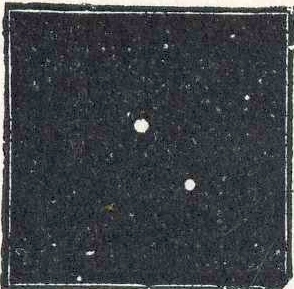
Fig. 6.—A Corner of
the Constellation of
Gemini.
But the telescope enables us to push the numbering of the
suns much farther: it opens up to us the depths of the heavens.
Instead of the small number of stars which our eyes
can see, it shows us a myriad of others, so
thickly thronged together that they seem to
cover the sky with fine silver sand. Here,
for instance (fig. 6), is the aspect which one
corner of the constellation of Gemini presents
to the naked eye. And here is the
same portion of the sky seen by the telescope.
By the aid of this wonderful instrument stars of the
thirteenth and fourteenth magnitudes have been distinguished.
The number of stars of the twelfth magnitude is 9,556,000,
which, joined to the number of the same stars proper to the
preceding categories, gives a total of more than 14,000,000.
In the third magnitude, a total number of 42,000,000 of stars
is counted. Thus, reckoning those visible to the naked eye,
and by the telescope, we have 56,000,000 of suns, and we
stop at this number only because the telescope does not enable
us to see smaller stars than those of the fourteenth magnitude.
But, let the telescope be brought to greater perfection, and the
whole region of the sky will be seen to be covered with this
silver sand, with this diamond dust, of which each grain is
a sun. And such will be the accumulation of these suns, in
the depths of space, that nothing will be seen on the field of
the telescope but a luminous network, formed by the agglomeration
of the suns, which will appear to touch each other.
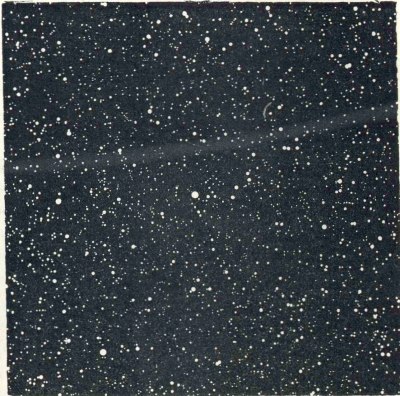
Fig. 7.—A Corner of the Constellation of Gemini, seen through the telescope.
Theophilus. The Infinite is beginning again. Let me shut
my eyes.
The Author. Wait, I have not said all, I have only begun.
I am coming to the nebulæ. Here, indeed, you may expect
to grow giddy. The telescope has dispersed all the theories
on which the different explanations of the nebulæ were built,
and has shown us that they are collections of stars, which, in
consequence of their excessive number, and their closeness to
each other, appear to form a whole, a single vague and continuous
brightness. But, when their dimensions and distances
are amplified by the telescope, this diffused light transforms
itself into a brilliant point, analogous to that presented
by the sky, tapestried with small stars, in the same telescope.
These nebulæ are groups of enormous numbers of stars, and
even their nearness to each other is only in appearance. They
are, in reality, separated by enormous distances, and it must
not be supposed that they are all in the same plane; they
belong, on the contrary, to very unequal depths in space, and
it is only an optical effect which gathers them together on the
field of the telescope in the same apparent plane.
The nebula of the Centaur is one of the most wonderful.
To the naked eye it is but a dimly-lighted point in the sky;
but, looked at through a good telescope, it takes the aspect
represented by figure 8.
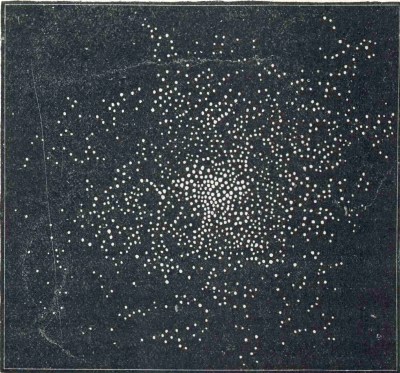
Fig. 8.—The Nebula of the Centaur.
On examination of this figure, it will be seen that a nebula
is not the result of a collection of stars simply spread out upon a
level in space, but of that of an assemblage of stars all placed
at unequal distances, and forming almost a sphere. In fact
the stars are crowded towards the centre, and are, on the contrary,
more and more distant from one another as the outer
edge is approached. If a spherical assemblage of stars were
observed from a distance, it would present a similar aspect.
This leads us to believe that the nebula of the Centaur, like
the greater number of agglomerations of this kind, is spherical.
Is it possible to reckon the stars which form a nebula?
Only approximately. Arago estimates the number of stars
which form a nebula no larger than the tenth part of the
apparent disc of the moon, at twenty thousand, at least.
This result may give us an idea of the swarms of suns contained
in the nebulæ, for these stellar masses are very numerous
in the sky. In the depths of the nebulæ there are
luminous points whose nature is as yet unrevealed by the
telescope, which cannot be resolved into stars; but analogy
leads us to believe that they are other and still more distant
nebulæ, which, by reason of their apparent littleness, elude
the scope of our instruments. But the time will come, when,
thanks to the perfection which our telescopes shall have
attained, this theory will be confirmed, and we shall thus see
deeper and farther into immensity.
The stars which form the nebulæ are sometimes grouped so
as to form regular shapes, spheres, or more or less lengthened
ellipses. Sometimes the sphere is hollow in the centre, and
so forms a ring. Nothing more varied, nothing more
strange can be imagined than the forms of those nebulæ
which have hitherto been examined, and which already
number more than a million, of which no two are precisely
alike. Certain nebulæ seem to be double, or joined. Others
are lengthened out, like serpents, as in that of the Shield of
Sobieski, represented in figure 9.
Lord Rosse was the first to discover that curious disposition
of the nebulæ called spiral.
Such a form is inexplicable, but it is certain that the suns
which compose the nebulæ are often grouped, not around a
centre, not in shapeless heaps, but in regular curves, on a
system which seems to reveal the existence of some mysterious
force acting upon those stars, which are distributed along
lines representing spirals of different diameter.
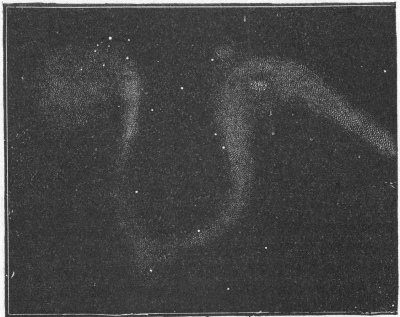
Fig. 9.—The Shield of Sobieski.
In speaking of the stars, I have said that there are coloured
stars or suns. I will add here that nebulæ are observed
coloured red, green, and yellow, which is an additional proof
that they are only agglomerations of stars. That immense
semi-luminous band which traverses the celestial vault, girding
it with a silver belt, is not, as it was long supposed to be,
a diffused quantity of luminous matter. The telescopic analysis
of the Milky Way shows that it consists of a long series
of nebulæ. The length of the Milky Way is from 700 to
800 times the distance from Sirius to the sun, a distance
which is 1,373,000 times that from the earth to the sun.[27]
Theophilus. Can any idea be formed of the number of stars
comprised in the Milky Way?
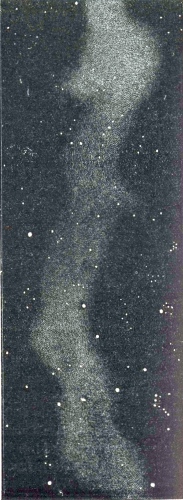
Fig. 10.—The Milky Way.
The Author. Herschel,
having examined
the sky of the
southern hemisphere
from the Cape of Good
Hope, in applying his
observations to the
whole extent of the
Milky Way, estimated
the number of suns
comprised in that immense
nebulæ at 18
millions. I have just
told you the length of
the Milky Way. A
ray of light emitted
from a star at one of
its extremities, and
reaching the other,
would take 15,000
years to accomplish
the transit. So that,
when we are looking
through the telescope
at one of the suns of
this nebula, we receive
the impression
of a ray of light
emitted from that star
7000 or 8000 years ago, i.e., long before the dawn of the
historic ages.[28] The measurement of the Milky Way enables
us therefore to measure the extent of other nebulæ, still
more distant from us. There are, as I have already said,
masses of diffused light in the midst of nebulæ which telescopic
analysis has resolved into stars, which are probably
much more distant nebulæ. The real distance of these
luminous masses can be fixed. If it were asked, to what distance
the Milky Way should be removed in order to offer us
the aspect of an ordinary nebula, Arago would answer that
according to his researches, the Milky Way ought to be
removed to a distance equal to 334 times its length. According
to this the Milky Way would be seen from the earth at
an angle of 10°, and its light would take 5,010,000 years to
travel that distance. Thus, light would take more than five
millions of years to travel from one of the telescopic nebulæ
to our earth. Such are the intervals which exist in the
universe, and which our instruments can appreciate. It
seems to me that we are now on the borders of the Infinite.
Theophilus. We are indeed.
The Author. When we know that those terrible distances,
which appal the imagination, are only the results of observations
made by our telescopes, and capable of any amount
of extension; when we reflect that the innumerable worlds
thus revealed to us continue farther and farther, that ever new
agglomerations of suns, planetary earths and their satellites add
themselves to those which we can measure, without limit and
without end, that the imagination cannot err in following
them to the uttermost limits of its powers; then, my dear
Theophilus, we comprehend that the universe is truly infinite.
And if you consider that these endless ranks of solar systems
have all their following of planets and satellites, filled with
living beings, plants, animals, men, and superhuman creatures,
that flaming comets traverse the orbit of each world at intervals
and plunge into the burning furnace of its sun; that these
milliards of suns are endlessly various, and that all the complicated
motions of these different systems are accomplished
with perfect order, without any mutual disturbance, you will
find that the universe is not only the infinite in extent, but,
also in order, harmony, equilibrium of motion, and laws!
Theophilus. The mind loses itself in such thoughts; for the
idea of the infinite is not made for our feeble intelligence.
Let us go no farther, or our reason will fail us.
The Author. Nevertheless, I must pursue my long argument
to the end. I must add that in the midst of this
boundless space, above this immense cortége of stars, which
are the dwelling places of living creatures and sentient souls,
there exists the Supreme Author, the Sovereign Ordainer,
from Whom, as their sacred source, all that our eyes behold,
our souls feel, and our intelligence admires, is derived. He,
whom I bless with all the gratitude of my heart—God!
Theophilus. Thus, then, you have reached the true object
of your discourse. This journey through space is undertaken
to prove that God, being infinite in moral perfections, may be
placed in that infinitude in extent, called the universe. It
only remains now to say in what precise spot you place the
sojourn of the Divinity, for I do not see how there can be a
centre to the Infinite, seeing it has neither beginning nor end.
The Author. I am about to explain myself on this point.
The absolute fixity of the sun and the stars was an astronomical
principle, which, in the time of Newton, appeared to
be indubitable. But science never stands still. Observations
made in the present century have proved that the fixity, the
immobility of the sun is only relative. The truth is that
the sun, and with him the entire system of planets, asteroïds,
satellites, and comets, which he carries, in his train, change
their places, very slightly no doubt, but still appreciably.
Our sun appears to advance slowly, with all the planetary
family, towards that part of the sky in which the constellation
of Hercules is situated, at the rate of 62,000,000 of leagues
each year, or two leagues each second, describing an orbit
which comprehends millions of centuries. That which is the
case with our sun is equally the case with the other suns, that
is to say, the stars. This general motion of translation must
be common to all the stellar systems, and it is indubitable
that the countless millions of solar systems suspended in infinite
space, are moving more or less quickly towards an unknown
point in the sky. Now, there is nothing to forbid the supposition
that all these circles or ellipses traced by myriads of
solar systems, have a common centre of attraction, towards
which our system and all the others gravitate. Thus, all
these celestial bodies, without exception, all this ant-hill of
worlds which we have enumerated, may be turning round one
point, one centre of attraction. What forbids us to believe
that God dwells at this centre of attraction for all the worlds
which fill infinite space?
Theophilus. Now I understand your thought, and I am
struck by its grandeur. This God, placed at the mathematical
centre of the worlds which compose the universe,
this infinite intelligence, throned in the centre of the infinite
universe, and presiding over the movements of all the innumerable
phalanxes of heavenly bodies which our imagination
can conceive, responds to the idea which we form of God,
if we venture to face the awful personality of His Omnipotence.
You have done well to develop this theory in your
work. It will be in harmony with the kind of religious
spirit which animates it, and which is, besides, the expression
of the desires, and the aspirations of the men of our
time.
In the present day a deep and profound need of belief in
Providence makes itself felt. Men want to render homage to
God, in whom they feel there is truth, peace, and safety for
the present and in the future. But the established religions
leave many minds in cruel uncertainty. In "The Day after
Death" you have endeavoured to lay the foundations of the
religion of science and of nature. These principles respond, as
I believe, to the prevalent wishes of mankind. They satisfy
the mind and the heart, sentiment and reason; they console
and strengthen; in short, they consecrate the idea of God,
without laying aside either the universe or nature.
The Author. So be it!
THE END.
BILLING AND SONS, LTD., PRINTERS, GUILDFORD
MACMILLAN'S LIBRARY
OF
ENGLISH CLASSICS
Edited by A. W. POLLARD.
A Series of Reprints of Standard Works in Library Form.
Demy 8vo. Cloth elegant. Price 3s. 6d. net per volume. Also in
Roxburgh Binding. Specially suitable for Presentation.
Green Morocco Backs, Cloth Sides, and Gilt Tops.
Price 5s. net per volume.
| BACON'S ESSAYS: Colours of Good and Evil; and Advancement of Learning
|
1 vol. |
| SHERIDAN'S PLAYS |
1 vol. |
| MALORY'S MORTE D'ARTHUR |
2 vols. |
| STERNE'S TRISTRAM SHANDY and SENTIMENTAL JOURNEY |
2 vols. |
| BOSWELL'S LIFE OF JOHNSON |
3 vols. |
| CARLYLE'S FRENCH REVOLUTION |
2 vols. |
| FIELDING'S TOM JONES |
2 vols. |
| WHITE'S NATURAL HISTORY OF SELBORNE |
1 vol. |
| TRAVELS OF SIR JOHN MANDEVILLE, with Illustrative Narratives from
Hakluyt |
1 vol. |
| LOCKHART'S LIFE OF SCOTT |
5 vols. |
| DON QUIXOTE, Translated by SHELTON |
3 vols. |
| WALTON'S LIVES and COMPLETE ANGLER |
1 vol. |
| DE QUINCEY'S CONFESSIONS OF AN ENGLISH OPIUM-EATER; Murder as a Fine
Art; The English Mail Coach, and other Essays |
1 vol. |
| CARLYLE'S SARTOR RESARTUS and HEROES AND HERO-WORSHIP |
1 vol. |
| SELECT WORKS OF OLIVER GOLDSMITH (The Vicar of Wakefield, The Plays,
and Poems) |
1 vol. |
| HAZLITT'S CHARACTERS OF SHAKESPEARE'S PLAYS and LECTURES ON THE
ENGLISH POETS |
1 vol. |
| MILTON'S POETICAL WORKS |
2 vols. |
MACMILLAN AND CO., Ltd., LONDON.
English Men of Letters.
Edited by JOHN MORLEY.
Popular Edition. Crown 8vo. Paper covers, 1s. each. Cloth, 1s. 6d. each.
Library Edition. Uniform with the New Series.
Crown 8vo. Gilt tops. Flat backs. 2s. net each.
- ADDISON.
- By W. J. Courthope.
- BACON.
- By Dean Church.
- BENTLEY.
- By Sir Richard Jebb.
- BUNYAN.
- By J. A. Froude.
- BURKE.
- By John Morley.
- BURNS.
- By Principal Shairp.
- BYRON.
- By Professor Nichol.
- CARLYLE.
- By Professor Nichol.
- CHAUCER.
- By Dr. A. W. Ward.
- COLERIDGE.
- By H. D. Traill.
- COWPER.
- By Goldwin Smith.
- DEFOE.
- By W. Minto.
- DE QUINCEY.
- By Professor Masson.
- DICKENS.
- By Dr. A. W. Ward.
- DRYDEN.
- By Professor Saintsbury.
- FIELDING.
- By Austin Dobson.
- GIBBON.
- By J. C. Morrison.
- GOLDSMITH.
- By W. Black.
- GRAY.
- By Edmund Gosse.
- HAWTHORNE.
- By Henry James.
- HUME.
- By Professor Huxley, F.R.S.
- JOHNSON.
- By Sir Leslie Stephen, K.C.B.
- KEATS.
- By Sidney Colvin.
- LAMB, CHARLES.
- By Canon Ainger.
- LANDOR.
- By Sidney Colvin.
- LOCKE.
- By Thomas Fowler.
- MACAULAY.
- By J. C. Morrison.
- MILTON.
- By Mark Pattison.
- POPE.
- By Sir Leslie Stephen, K.C.B.
- SCOTT.
- By R. H. Hutton.
- SHELLEY.
- By J. A. Symonds.
- SHERIDAN.
- By Mrs. Oliphant.
- SIDNEY.
- By J. A. Symonds.
- SOUTHEY.
- By Professor Dowden.
- SPENSER.
- By Dean Church.
- STERNE.
- By H. D. Traill.
- SWIFT.
- By Sir Leslie Stephen, K.C.B.
- THACKERAY.
- By Anthony Trollope.
- WORDSWORTH.
- By F. W. H. Myers.
MACMILLAN AND CO., Ltd., LONDON.
English Men of Letters.
NEW SERIES.
Crown 8vo. Gilt tops. Flat backs. 2s. net each.
- GEORGE ELIOT. By Sir Leslie Stephen, K.C.B.
- HAZLITT. By Augustine Birrell, K.C.
- MATTHEW ARNOLD. By Herbert W. Paul.
- RUSKIN. By Frederic Harrison.
- TENNYSON. By Sir Alfred Lyall.
- RICHARDSON. By Austin Dobson.
- BROWNING. By G. K. Chesterton.
- CRABBE. By Alfred Ainger.
- FANNY BURNEY. By Austin Dobson.
- JEREMY TAYLOR. By Edmund Gosse.
- DANTE GABRIEL ROSSETTI. By A. C. Benson.
- HOBBES. By Sir Leslie Stephen, K.C.B.
- MARIA EDGEWORTH. By the Hon. Emily Lawless.
- ADAM SMITH. By Francis W. Hirst.
- JANE AUSTEN. By the Rev. Canon Beeching.
- SYDNEY SMITH. By George W. E. Russell.
- ANDREW MARVELL. By Augustine Birrell, K.C.
- MRS. GASKELL. By Clement Shorter.
- THOMAS MOORE. By Stephen Gwynn.
- CHARLES KINGSLEY. By G. K. Chesterton.
- SHAKESPEARE. By Walter Raleigh.
English Men of Action Series.
Crown 8vo. Cloth. With Portraits. 2s. 6d. each.
- CAMPBELL (Colin).
- By ARCHIBALD FORBES.
- CLIVE.
- By Sir CHARLES WILSON.
- COOK (Captain).
- By Sir WALTER BESANT.
- DAMPIER.
- By W. CLARK RUSSELL.
- DRAKE.
- By JULIAN CORBETT.
- DUNDONALD.
- By the Hon. J. W. FORTESCUE.
- GORDON (General).
- By Sir W. BUTLER.
- HASTINGS (Warren).
- By Sir A. LYALL.
- HAVELOCK (Sir Henry).
- By A. FORBES.
- HENRY V.
- By the Rev. A. J. CHURCH.
- LAWRENCE (Lord).
- By Sir RICHARD TEMPLE.
- LIVINGSTONE.
- By THOMAS HUGHES.
- MONK.
- By JULIAN CORBETT.
- MONTROSE.
- By MOWBRAY MORRIS.
- NAPIER (Sir Charles).
- By Colonel Sir W. BUTLER.
- NELSON.
- By Professor J. K. LAUGHTON.
- PETERBOROUGH.
- By W. STEBBING.
- RODNEY.
- By DAVID HANNAY.
- STRAFFORD.
- By H. D. TRAILL.
- WARWICK, the King-Maker.
- By C. W. OMAN.
- WELLINGTON.
- By GEORGE HOOPER.
- WOLFE.
- By A. G. BRADLEY.
Twelve English Statesmen.
Crown 8vo. 2s. 6d. each.
⁂ A Series of Short Biographies, not designed to be a complete roll of
famous Statesmen, but to present in historic order the lives and work of those
leading actors in our affairs who by their direct influence have left an abiding
mark on the policy, the institutions, and the position of Great Britain among
States.
- WILLIAM THE CONQUEROR.
- By EDWARD A. FREEMAN,
D.C.L., LL.D., late Regius
Professor of Modern History in the
University of Oxford.
- HENRY II.
- By Mrs. J. R. GREEN.
- EDWARD I.
- By T. F. TOUT, M.A., Professor of
History, The Owens College, Manchester.
- HENRY VII.
- By JAMES GAIRDNER.
- CARDINAL WOLSEY.
- By Bishop CREIGHTON, D.D., late
Dixie Professor of Ecclesiastical History
in the University of Cambridge.
- ELIZABETH.
- By E. S. BEESLY, M.A., Professor
of Modern History, University College,
London.
- OLIVER CROMWELL.
- By FREDERIC HARRISON.
- WILLIAM III.
- By H. D. TRAILL.
- WALPOLE.
- By JOHN MORLEY.
- CHATHAM. [In preparation.
- By FREDERIC HARRISON.
- PITT.
- By Lord ROSEBERY.
- PEEL.
- By J. R. THURSFIELD, M.A., late
Fellow of Jesus College, Oxford.
MACMILLAN AND CO., Ltd., LONDON.