Hines's self-disgust held until the ambulance left and the crowd
had dwindled to a mere sprinkling of sightseers who pointed out
to each other where the two men had been standing when shot, and
other argumentative persons who debated with much vehemence and no
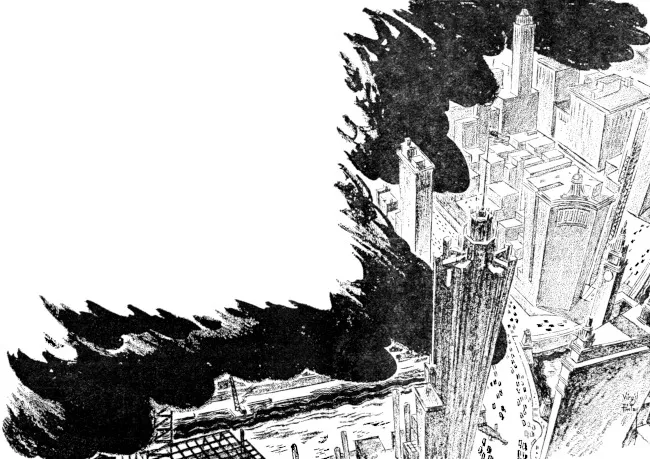
information whatever on whether or not the reported cloud of darkness
had actually been present.
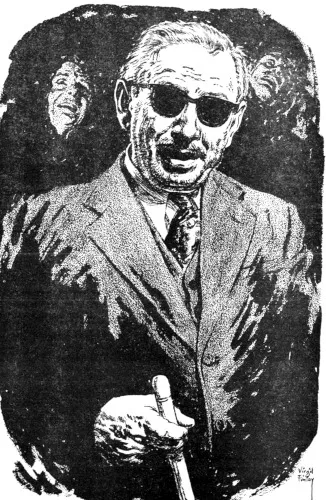
The man with the yellow whiskers was breathing, but that was all. He
needed surgical attention in a hurry. He was rushed to a hospital. The
same ambulance took away a huddled figure in very natty clothing and a
sporty cap to whom surgical attention would be of no use at all.
There would be only commendation for Hines for shooting that second
man. He was Micky the Dope, wanted by several States and by the Federal
government in addition. Decidedly, Hines had come out of the affair
with credit.
But he was bitterly disgusted with himself. He had more than a hunch,
now, that there was much more at stake than merely the shooting down of
a still unidentified man. There was, it was very clear to Hines, more
involved than the capture of Lefty Dunn.
Hines was the only man in New York who saw the possibilities inherent
in the settlement of darkness down upon parts of Central Park the night
before. He was the only man in New York who could have nipped those
possibilities in the bud. And he had let the man with the clipped,
precise voice walk right past him after speaking to him.
"There's going to be hell to pay before we get him," he groaned, "if I
know Lefty Dunn and if I guess right what that man's got."
He waited impatiently for the fingerprint wagon and rushed the
photographer and the fingerprint technician up to the deserted office
with the radio batteries on the floor.
"There'll be fingerprints on those batteries," he announced. "At least
two sets—the man who sold them and the man who handled them in here. I
want to know which is which, and the best set of prints you can cook up
of that second man. And here, by the window." He pointed. "Here on the
sill, and right here where a man'd steady himself when he looked out to
get a good sight of that house next door. There were five men up here,
I think, and they were watching and waiting for a man to get ready to
go out."
"Yes?" said the fingerprint man. He yawned. "Anything else you want?"
Hines managed to grin.
"Plenty," he admitted. "The commissioner thinks I'm crazy. If he finds
out I dragged you up here—when the shooting happened down in the
street—he'll be sure of it. I want proof that Lefty Dunn was here this
morning, and Micky the Dope—that's the man I plugged—and Joe the
Greek, and I think Pete Lazzarini. The last two have records, but they
aren't being looked for. Lefty and Micky were supposed to be out of
town. Now, will you find those prints for me?"
"If they're there," said the fingerprint man.
He got right to work. First he dusted a little of his grayish powder
about the B batteries and blew very gently. He surveyed the result with
satisfaction.
"Pretty," he said pleasantly. He went over to the window and went
through a slightly more involved process on a small area.
"Plenty of prints here," he said boredly. "All right, lieutenant. These
prints are new ones, and some of them are very nice ones. I'll have
photos ready in two or three hours, but I can't promise they'll be
untangled right away. That'll take time."
With a sigh of relief, Hines left. He debated an instant down in the
lobby of the building. He ought to—But the man in the hospital might
recover consciousness. It was most important of all that he tell who
had wanted him out of the way.
Trace down the man with the motive, and sooner or later Hines would
trace down the gunmen themselves. And if he traced down the gunmen,
sooner or later he'd find out who had flung on a curtain of darkness at
a remarkably convenient moment. And if he caught that man, he'd have
forestalled a number of undesirable happenings he began to feel more
and more sure were in the wind.
At the hospital the blond man was still unconscious and Hines was
impatient.
"But he may come to any moment," the surgeon told him comfortably. "I
took a chance. Unconscious, no response to stimuli, severe shock. No
need to give him anæsthetic, shock besides. I had an ether-cone handy,
but he didn't murmur while I worked on him. Much better off. He can
talk as soon as he comes to, instead of your having to wait an hour."
Hines was thinking busily. His eyes hardened.
"Any chance of his living a few days?" he demanded. "Long enough to do
some identifying if I catch a man I'm looking for?"
"He should live ten years," the surgeon said placidly. "A bullet
glanced off his skull, and there's not even concussion. Another went
through the fleshy part of his shoulder. A third just missed his
knee-tendons—a narrow thing, that. He'll be able to walk out of here
in three or four days, most likely. He was lucky. Why was he shot at?"
"That's what I want to find out," said Hines.
"Go up to his bed, then," said the surgeon.
Hines was pacing impatiently up and down the corridor outside the ward
when an idea struck him. He examined it warily. Then he called a nurse.
In five minutes the still unconscious man was shifted to a private
room, and his clothes were brought in.
Hines was going busily through the pockets and frowning savagely at the
lack of identifying data when there was a knock on the door. A nurse
put her head in and said:
"The young lady you were expecting."
Hines' face was blank when Kathryn Bush came in.
"You're not playing fair!" she said, her eyes stormy. "I had to fib to
get in. But the press must be served. I told them you were expecting
me. I guessed you'd be here. How is he?"
"Knocked cold," said Hines. "That's all." Then he added exasperatingly,
"But look here—"
"Look here?" she echoed reproachfully. "I'm responsible for your
getting the leads in this affair from the beginning. If I hadn't had a
hunch and gone to the park, and if I hadn't risked arrest by speaking
to a police officer who happened to be moon-gazing, and if I hadn't
kept him talking to me, he'd never have known a darned thing was out of
the way! And I gave you some important stuff this morning. It wasn't
fair to hedge."
"Good Lord!" said Hines irritably. "It came too fast. I didn't have
time to do anything. Certainly not to telephone you—"
"Oh!" She seemed mollified. "You would have phoned me if you could?
That's all right. Now, what happened? A wild account of mysterious
shootings, and darkness in broad daylight, was phoned in, and I grabbed
the assignment. Threatened to weep all over the city editor's desk
if he didn't give it to me. So I'm handling this for the Star. It
sounded too insane to be true, but I knew better, especially when I
heard you were in it. What really did happen?"
Hines went back to his investigation of the clothing, while he told her
jerkily about the whole thing.
"The city editor wouldn't believe it," she said placidly. "As an
assignment it is a dud. I told him about the moon and the accident last
night and he looked at me as if he expected me to say I was Mary, Queen
of Scots in one minute more. I blushed. Actually, I blushed! I felt
proud of that blush afterward. Something of youth has survived even the
city room."
Kathryn was possibly twenty-two or three, but whatever Hines might have
intended to say, it was interrupted by a nurse. She came in, bent over
the bed, and glanced up.
"He's conscious."
Hines moved swiftly to the bedside. Bland, clear blue eyes looked up at
him above the rather incredible yellow whiskers. A booming voice said
without emotion:
"I have been conscious for some time. Verdamm! Is that what happened?"
There was a distinct accent in his speech, but his sentence-structure
was the careful accuracy of the educated European, tinged, presently,
with exotic colloquialisms.
"If you heard me talking," said Hines, "you heard what happened. Yes.
I'm Police Lieutenant Hines, and I want to know some things. Please try
to tell me who you are and who you think wanted to have you killed."
"In spite of the very deffil of a headache," said the booming voice
from the bed, "I have been trying to think of the answers to those
questions for at least fife minutes. I saw the gentlemen who shot at
me, yes. You, Herr Hines, were running toward them when I fell. But I
nefer saw any of them before at any time. And I am verdammt if I know
why they should shoot me. I am being calm, howefer. I shall give it my
attention. Maybe I shall think it out. How much am I hurt?"
"Not badly," Hines assured him. He was biting at his lips and frowning
in thought.
"Tell me," said Kathryn suddenly, smiling down at the bandaged man on
the bed. "Were you ever in a place called Edginton, New York, or a
place called Stony Mountain?"
The candid blue eyes turned to her, but they were wide with
astonishment.
"Young lady," said the booming voice plaintively, "as a scientist I
haff refused to admit magic into my considerations. But how in der name
of forty-sefen deffils do you know that I came from there only a short
time ago?"
Kathryn was twinkling triumphantly at Hines. He grunted.
"You win," he said briefly. "Go on."
"Who worked with you up there?" she asked. "I think he had you shot."
"Breston? No. He is a scoundrel in his way, and I do not like him. But
he is a good scientist, and I haff no quarrel with him."
Hines grunted at the name. "Preston: he's about thirty-five," the
detective said shortly, "very broad-shouldered, and he affects a
Vandyke beard. His voice is rather harsh, and he speaks very precisely."
The wide blue eyes swung blankly to him.
"I think I will haff to call on more than forty-sefen deffils,"
the booming voice said more plaintively still. "Himmel! You know
eferything. That is him. Do I need to say that my name is Schaaf—"
Kathryn looked up.
"Oh! You made the direct measurements of the size of a molecule."
The patient blinked.
"I nearly starff to death," he observed, "because there is in America
no way for a theoretic physicist to earn a lifing. Nobody has efer
heard of me. And I am shot at by utter strangers, I wake up in
hospital—I must be in a hospital—and a young lady tells me where I
haff been, a gentleman describes to me a man I most prifately dislike,
and then I am reminded of a relatifely unimportant mistake I made six
years ago."
Hines grunted impatiently.
"Preston's the man who had you shot, all right. And I think I know why.
Professor Schaaf, it all works down to this. Up in Edginton you were
working on the production of darkness, the neutralization of light—"
"No. Not I. I merely did measurements for Breston. He offered to gife
me passage-money back to Europe if I did them. He got them cheap.
Measurements of der mass and dimensions of der atmospheric ion, and
changes in der mass and volume of der molecule when der allotropy of
ionization took place."
"Well, then, Breston, or Preston, he was working on the neutralization
of light—"
"Ach, no! On der production of fluorescence in ionized bodies under
der influence of short Hertzian wafes. Wait—yes, I suppose you could
say that. It is not scientific, but you might say that. When his
apparatus finally got working it gafe off darkness that was like der
bottom of hell."
Hines emitted a grunt that was almost explosive.
"Ha! Now we're getting somewhere! He has an outfit that makes darkness.
It was used to help his gunmen escape when you were shot at, and I
have excellent reason to think it's going to be used for more criminal
purposes still."
"Criminal? It was pure science. Theoretic science. Der fluorescence of
ionized substances under der influence of short Hertzian wafes. Does
that sound like a help to safe-blowers?"
Hines drew a deep breath and began to talk. When he mentioned the
shutting off of moonlight in Central Park, Schaaf nodded rapidly. He
seemed to have lost surprisingly little strength.
"Yes. He could do that. He was working on a beam apparatus when I left,
so that der darkness would be gifen off on one side only. He could not
read der instruments before."
The account of the automobile accident that seemed to have been
deliberately produced made the yellow-bearded man frown angrily. When
Hines had given a succinct account of Lefty Dunn's police record and
the ambitions he might be expected to cherish, Schaaf was rumbling in
his beard.
"Hm—I see. I see. Maybe I can help you. Maybe I can't. I try, anyhow.
I did not like Breston. He made me mad. When I saw der success of
his experiments come about I said, 'Breston, I congratulate you. Der
Atchison medal is der same as yours. If you carry on your work as
splendidly as this, it may be efen that I shall yet read of you as a
Nobel Prize man. You haff der disposition of a dyspeptic crab, but
you are a great scientist and I congratulate you from der bottom of my
heart.' I said that to him, in spite of der fact that he had made me
mad. And he laughed at me. 'Atchison medal?' he said in a sneering sort
of way, 'Nobel Prize! Schaaf, you are a damned fool. I am for bigger
things than that.' And I turned around and left him. I thought he must
be crazy."
Hines said curtly:
"With Lefty Dunn's organizing ability, he might pick up anywhere from a
hundred thousand dollars to half a million within the next week, in New
York City alone."
"Maybe, then, he is not crazy. You tell me, anyhow, he tried to get
me killed. Hm—Lieutenant Hines, you send somebody to my room at that
abominable house where I liff. Get eferything out of it. Eferything. I
have papers of my own, and there are some memoranda of his that I took
by mistake. I had intended to send them back to him. It was by accident
that I took them. We will begin to see what we see. I haff an idea. And
I will need all that I can findt about his figures."
Hines looked at the girl. She had been listening. But a good reporter,
these days, does not go about with a pencil and a pad of paper. With
soft shirts and soft cuffs in vogue, he does not even write on his
cuffs. And Kathryn had no cuffs, anyhow.
"I'll go myself," said Hines briefly. "I'm going to post a guard at
your door in case anybody has heard that you're still alive. My own
opinion is that it would be wisest for you to die."
Schaaf blinked, and then smiled wryly.
"Ach, yes. It is better that I die. For der sake of my health, let us
say. Fery well, I haff expired, and while you go get der things from my
room I will think der wise deep thoughts of der defunct."
Kathryn smiled at the man in the bed and followed Hines from the room.
"I'm coming, too, if you don't mind," she announced, in the hall
outside. "As a news story, this is a dud. Even if the Star printed
it, the other papers would laugh. But I want to follow up what happens,
because if Lefty Dunn and his friend Preston do use that darkness, I'll
have the whole story for the Star while the other papers are just
guessing. You see?"
"I do," said Hines, relieved. "It shouldn't be printed just now. I
was trying to think of some way to persuade you to kill it, as far as
publication."
It took less than five minutes to get two uniformed men on guard
outside the yellow-bearded man's door, but it took ten to arrange that
if any inquiries were made, by telephone or otherwise, the answer would
be given that the bearded man shot on Fifty-Eighth Street had died
without regaining consciousness.
"Schaaf knows too much about what Preston has developed," said Hines
dryly. "Of course Preston wants him killed."
Then the little police runabout went sliding through traffic down
town again. The fingerprint car had vanished from before the Blowbar
Building. Hines let his mind linger hopefully on the possibilities
fingerprints might offer if they turned out well. He went up the steps
of the blowsy brownstone house. An angular woman with her head in a
towel opened the door.
"I'm Police Lieutenant Hines," said Hines briefly. "A lodger here was
shot about two hours ago and taken to the hospital. I've come to take
charge of his effects."
He displayed his badge. The woman wiped her hands nervously.
"O' course you can go up," she said uneasily. "O' course! But his
things have been took. A friend of his came an' said he'd helped put
Mr. Schaaf in the ambulance, an' Mr. Schaaf was very likely hurt bad,
an' he paid the room rent that was due an' packed the things up, an'
'bout half an hour ago he sent a taxi for the things that were left. He
said Mr. Schaaf would be in the hospital for a long time an' he'd take
care of them for him."
Hines's jaws snapped shut.
"He was a broad-shouldered man," he said grimly, "with a beard like a
doctor."
The woman nodded, relieved.
"Yes, sir. He'd been to see Mr. Schaaf before, sir, but he missed him."
"When did he come in, to-day?" demanded Hines.
"Why, right after the ambulance left, sir."
Hines ground his teeth.
"I'll look at the room," he said savagely, "but it's no use."
It was very clearly useless to look in the room. It had been stripped
clean of everything but the furnishings plainly provided by the house
itself. The bureau drawers were emptied. The suitcase one would expect
any transient to possess were gone.
"That was Preston," said Hines to Kathryn Bush with a savage calmness.
"He was in here, packing up papers and such things, while I was in the
building next door. He was probably in this room when I stopped on the
sidewalk, not certain whether to come here or go first to the hospital.
Nerve? That man has it!"
"And you think—"
"He'll bleed New York dry," snapped Hines. "He'll make the police force
a laughing-stock."