Author of “The Girl Philippa,” “Who Goes There,” “The Hidden Children,” Etc.
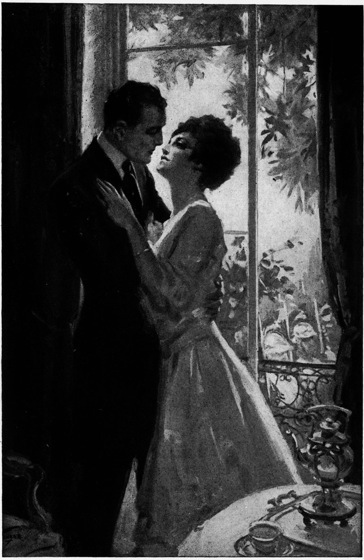
WITH FRONTISPIECE By W. D. STEVENS
A. L. BURT COMPANY
Publishers
New York
Published by Arrangement with D. Appleton & Company
Copyright, 1917, by
ROBERT W. CHAMBERS
Copyright, 1916, 1917, by the International Magazine Company
Printed in the United States of America
TO MY FRIEND
EDGAR SISSON
Dans c’métier-là, faut rien chercher à comprendre.
René Benjamin
vii
ALAK’S SONG
Where are you going,
Naïa?
Through the still noon—
Where are you going?
To hear the thunder of the sea
And the wind blowing!—
To find a stormy moon to comfort me
Across the dune!
Why are you weeping,
Naïa?
Through the still noon—
Why are you weeping?
Because I found no wind, no sea,
No white surf leaping,
Nor any flying moon to comfort me
Upon the dune.
What did you see there,
Naïa?
In the still noon—
What did you see there?
Only the parched world drowsed in drought,
And a fat bee, there,
Prying and probing at a poppy’s mouth
That drooped a-swoon.
viii
What did you hear there,
Naïa?
In the still noon—
What did you hear there?
Only a kestrel’s lonely cry
From the wood near there—
A rustle in the wheat as I passed by—
A cricket’s rune.
Who led you homeward,
Naïa?
Through the still noon—
Who led you homeward?
My soul within me sought the sea,
Leading me foam-ward:
But the lost moon’s ghost returned with me
Through the high noon.
Where is your soul then,
Naïa?
Lost at high noon—
Where is your soul then?
It wanders East—or West—I think—
Or near the Pole, then—
Or died—perhaps there on the dune’s dry brink
Seeking the moon.
“The dying star grew dark; the last light faded from it;
went out. Prince Erlik laughed.
“And suddenly the old order of things began to pass
away more swiftly.
“Between earth and outer space—between Creator and
created, confusing and confounding their identities,—a rushing
darkness grew—the hurrying wrack of immemorial
storms heralding whirlwinds through which Truth alone
survives.
“Awaiting the inevitable reëstablishment of such temporary
conventions as render the incident of human existence
possible, the brooding Demon which men call Truth
stares steadily at Tengri under the high stars which are
passing too, and which at last shall pass away and leave
the Demon watching all alone amid the ruins of eternity.”
Not the dark companion of Sirius, brightest of all
stars—not our own chill and spectral planet rushing
toward Vega in the constellation of Lyra—presided at
the birth of millions born to corroborate a bloody
horoscope.
But a Dark Star, speeding unseen through space,
known to the ancients, by them called Erlik, after the
Prince of Darkness, ruled at the birth of those myriad
souls destined to be engulfed in the earthquake of the
ages, or flung by it out of the ordered pathway of their
lives into strange byways, stranger highways—into
deeps and deserts never dreamed of.
Also one of the dozen odd temporary stars on record
blazed up on that day, flared for a month or two, dwindled
to a cinder, and went out.
But the Dark Star Erlik, terribly immortal, sped on
through space to complete a two-hundred-thousand-year
circuit of the heavens, and begin anew an immemorial
journey by the will of the Most High.
What spectroscope is to horoscope, destiny is to
chance. The black star Erlik rushed through interstellar
darkness unseen; those born under its violent
augury squalled in their cradles, or, thumb in mouth,
slumbered the dreamless slumber of the newly born.
xix
One of these, a tiny girl baby, fussed and fidgeted in
her mother’s arms, tortured by prickly heat when the
hot winds blew through Trebizond.
Overhead vultures circled; a stein-adler, cleaving the
blue, looked down where the surf made a thin white
line along the coast, then set his lofty course for
China.
Thousands of miles to the westward, a little boy of
eight gazed out across the ruffled waters of the mill
pond at Neeland’s Mills, and wondered whether the
ocean might not look that way.
And, wondering, with the salt sea effervescence working
in his inland-born body, he fitted a cork to his fishing
line and flung the baited hook far out across the
ripples. Then he seated himself on the parapet of the
stone bridge and waited for monsters of the deep to
come.
And again, off Seraglio Point, men were rowing in a
boat; and a corded sack lay in the stern, horridly and
limply heavy.
There was also a box lying in the boat, oddly bound
and clamped with metal which glistened like silver under
the Eastern stars when the waves of the Bosporus
dashed high, and the flying scud rained down on box
and sack and the red-capped rowers.
In Petrograd a little girl of twelve was learning to
eat other things than sour milk and cheese; learning to
ride otherwise than like a demon on a Cossack saddle;
learning deportment, too, and languages, and social
graces and the fine arts. And, most thoroughly of all,
the little girl was learning how deathless should be her
hatred for the Turkish Empire and all its works; and
xx
how only less perfect than our Lord in Paradise was
the Czar on his throne amid that earthly paradise
known as “All the Russias.”
Her little brother was learning these things, too, in
the Corps of Officers. Also he was already proficient
on the balalaika.
And again, in the mountains of a conquered province,
the little daughter of a gamekeeper to nobility was
preparing to emigrate with her father to a new home
in the Western world, where she would learn to perform
miracles with rifle and revolver, and where the
beauty of the hermit thrush’s song would startle
her into comparing it to the beauty of her own untried
voice. But to her father, and to her, the most
beautiful thing in all the world was love of Fatherland.
Over these, and millions of others, brooded the spell
of the Dark Star. Even the world itself lay under it,
vaguely uneasy, sometimes startled to momentary seismic
panic. Then, ere mundane self-control restored
terrestrial equilibrium, a few mountains exploded, an
island or two lay shattered by earthquake, boiling mud
and pumice blotted out one city; earth-shock and fire
another; a tidal wave a third.
But the world settled down and balanced itself once
more on the edge of the perpetual abyss into which it
must fall some day; the invisible shadow of the Dark
Star swept it at intervals when some far and nameless
sun blazed out unseen; days dawned; the sun of the
solar system rose furtively each day and hung around
the heavens until that dusky huntress, Night, chased
him once more beyond the earth’s horizon.
xxi
The shadow of the Dark Star was always there,
though none saw it in sunshine or in moonlight, or in
the silvery lustre of the planets.
A boy, born under it, stood outside the fringe of
willow and alder, through which moved two English
setters followed and controlled by the boy’s father.
“Mark!” called the father.
Out of the willows like a feathered bomb burst a big
grouse, and the green foliage that barred its flight
seemed to explode as the strong bird sheered out into
the sunshine.
The boy’s gun, slanting upward at thirty degrees,
glittered in the sun an instant, then the left barrel
spoke; and the grouse, as though struck by lightning
in mid-air, stopped with a jerk, then slanted swiftly
and struck the ground.
“Dead!” cried the boy, as a setter appeared, leading
on straight to the heavy mass of feathers lying on the
pasture grass.
“Clean work, Jim,” said his father, strolling out of
the willows. “But wasn’t it a bit risky, considering the
little girl yonder?”
“Father!” exclaimed the boy, very red. “I never even
saw her. I’m ashamed.”
They stood looking across the pasture, where a little
girl in a pink gingham dress lingered watching them,
evidently lured by her curiosity from the old house at
the crossroads just beyond.
Jim Neeland, still red with mortification, took the
big cock-grouse from the dog which brought it—a
tender-mouthed, beautifully trained Belton, who stood
with his feathered offering in his jaws, very serious,
very proud, awaiting praise from the Neelands, father
and son.
xxii
Neeland senior “drew” the bird and distributed the
sacrifice impartially between both dogs—it being the
custom of the country.
Neeland junior broke his gun, replaced the exploded
shell, content indeed with his one hundred per cent performance.
“Better run over and speak to the little girl, Jim,”
suggested old Dick Neeland, as he motioned the dogs
into covert again.
So Jim ran lightly across the stony, clover-set
ground to where the little girl roamed along the old
snake fence, picking berries sometimes, sometimes
watching the sportsmen out of shy, golden-grey
eyes.
“Little girl,” he said, “I’m afraid the shot from my
gun came rattling rather close to you that time.
You’ll have to be careful. I’ve noticed you here before.
It won’t do; you’ll have to keep out of range
of those bushes, because when we’re inside we can’t see
exactly where we’re firing.”
The child said nothing. She looked up at the boy,
smiled shyly, then, with much composure, began her
retreat, not neglecting any tempting blackberry on the
way.
The sun hung low over the hazy Gayfield hills; the
beeches and oaks of Mohawk County burned brown and
crimson; silver birches supported their delicate canopies
of burnt gold; and imperial white pines clothed
hill and vale in a stately robe of green.
Jim Neeland forgot the child—or remembered her
only to exercise caution in the Brookhollow covert.
The little girl Ruhannah, who had once fidgeted with
prickly heat in her mother’s arms outside the walls of
Trebizond, did not forget this easily smiling, tall young
xxiii
fellow—a grown man to her—who had come across the
pasture lot to warn her.
But it was many a day before they met again, though
these two also had been born under the invisible shadow
of the Dark Star. But the shadow of Erlik is always
passing like swift lightning across the Phantom Planet
which has fled the other way since Time was born.
Allahou Ekber, O Tchinguiz Khagan!
A native Mongol missionary said to Ruhannah’s
father:
“As the chronicles of the Eighurs have it, long ago
there fell metal from the Black Racer of the skies; the
first dagger was made of it; and the first image of the
Prince of Darkness. These pass from Kurd to Cossack
by theft, by gift, by loss; they pass from nation to
nation by accident, which is Divine design.
“And where they remain, war is. And lasts until
image and dagger are carried to another land where
war shall be. But where there is war, only the predestined
suffer—those born under Erlik—children of the
Dark Star.”
“I thought,” said the Reverend Wilbour Carew, “that
my brother had confessed Christ.”
“I am but repeating to you what my father believed;
and Temujin before him,” replied the native
convert, his remote gaze lost in reflection.
His eyes were quite little and coloured like a lion’s;
and sometimes, in deep reverie, the corners of his upper
lip twitched.
This happened when Ruhannah lay fretting in her
mother’s arms, and the hot wind blew on Trebizond.
Under the Dark Star, too, a boy grew up in Minetta
Lane, not less combative than other ragged boys about
xxiv
him, but he was inclined to arrange and superintend
fist fights rather than to participate in battle, except
with his wits.
His name was Eddie Brandes; his first fortune of
three dollars was amassed at craps; he became a hanger-on
in ward politics, at race-tracks, stable, club,
squared ring, vaudeville, burlesque. Long Acre attracted
him—but always the gambling end of the operation.
Which predilection, with its years of ups and downs,
landed him one day in Western Canada with an “Unknown”
to match against an Athabasca blacksmith,
and a training camp as the prospect for the next six
weeks.
There lived there, gradually dying, one Albrecht Dumont,
lately head gamekeeper to nobility in the mountains
of a Lost Province, and wearing the Iron Cross
of 1870 on the ruins of a gigantic and bony chest, now
as hollow as a Gothic ruin.
And if, like a thousand fellow patriots, he had been
ordered to the Western World to watch and report to
his Government the trend and tendency of that Western,
English-speaking world, only his Government and
his daughter knew it—a child of the Dark Star now
grown to early womanhood, with a voice like a hermit
thrush and the skill of a sorceress with anything that
sped a bullet.
Before the Unknown was quite ready to meet the
Athabasca blacksmith, Albrecht Dumont, dying faster
now, signed his last report to the Government at Berlin,
which his daughter Ilse had written for him—something
about Canadian canals and stupid Yankees and
their greed, indifference, cowardice, and sloth.
xxv
Dumont’s mind wandered:
“After the well-born Herr Gott relieves me at my
post,” he whispered, “do thou pick up my burden and
stand guard, little Ilse.”
“Yes, father.”
“Thy sacred promise?”
“My promise.”
The next day Dumont felt better than he had felt
for a year.
“Ilse, who is the short and broadly constructed
American who comes now already every day to see thee
and to hear thee sing?”
“His name is Eddie Brandes.”
“He is of the fight gesellschaft, not?”
“He should gain much money by the fight. A theatre
in Chicago may he willingly control, in which light
opera shall be given.”
“Is it for that he hears so willingly thy voice?”
“It is for that.... And love.”
“And what of Herr Max Venem, who has asked of
me thy little hand in marriage?”
The girl was silent.
“Thou dost not love him?”
“No.”
Toward sunset, Dumont, lying by the window, opened
his eyes of a dying Lämmergeier:
“My Ilse.”
“Father?”
“What has thou to this man said?”
“That I will be engaged to him if thou approve.”
“He has gained the fight?”
“Today.... And many thousand dollars. The
xxvi
theatre in Chicago is his when he desires. Riches, leisure,
opportunity to study for a career upon his stage,
are mine if I desire.”
“Dost thou desire this, little Ilse?”
“Yes.”
“And the man Venem who has followed thee so long?”
“I cannot be what he would have me—a Hausfrau—to
mend his linen for my board and lodging.”
“And the Fatherland which placed me here on outpost?”
“I take thy place when God relieves thee.”
“So ist’s recht!... Grüs Gott—Ilse––”
Among the German settlers a five-piece brass band
had been organised the year before.
It marched at the funeral of Albrecht Dumont, lately
head gamekeeper to nobility in the mountains of a
long-lost province.
Three months later Ilse Dumont arrived in Chicago
to marry Eddie Brandes. One Benjamin Stull was
best man. Others present included “Captain” Quint,
“Doc” Curfoot, “Parson” Smawley, Abe Gordon—friends
of the bridegroom.
Invited by the bride, among others were Theodor
Weishelm, the Hon. Charles Wilson, M. P., and Herr
Johann Kestner, a wealthy gentleman from Leipsic
seeking safe and promising investments in Canada and
the United States.
A year later Ilse Dumont Brandes, assuming the
stage name of Minna Minti, sang the rôle of Bettina
in “The Mascotte,” at the Brandes Theatre in Chicago.
A year later, when she created the part of Kathi in
“The White Horse,” Max Venem sent word to her that
xxvii
she would live to see her husband lying in the gutter
under his heel. Which made the girl unhappy in her
triumph.
But Venem hunted up Abe Grittlefeld and told him
very coolly that he meant to ruin Brandes.
And within a month the latest public favourite, Minna
Minti, sat in her dressing-room, wet-eyed, enraged, with
the reports of Venem’s private detectives locked in the
drawer of her dressing table, and the curtain waiting.
So complex was life already becoming to these few
among the million children of the Dark Star Erlik—to
everyone, from the child that fretted in its mother’s
arms under the hot wind near Trebizond, to a deposed
Sultan, cowering behind the ivory screen in his zenana,
weeping tears that rolled like oil over his fat jowl to
which still adhered the powdered sugar of a Turkish
sweetmeat.
Allahou Ekber, Khodja; God is great. Great also,
Ande, is Ali, the Fourth Caliph, cousin-companion of
Mahomet the Prophet. But, O tougtchi, be thy name
Niaz and thy surname Baï, for Prince Erlik speeds on
his Dark Star, and beneath the end of the argument between
those two last survivors of a burnt-out world—behold!
The sword!
THE DARK STAR
1
CHAPTER I — THE WONDER-BOX
As long as she could remember she had been permitted
to play with the contents of the late Herr
Conrad Wilner’s wonder-box. The programme on
such occasions varied little; the child was permitted
to rummage among the treasures in the box until she
had satisfied her perennial curiosity; conversation with
her absent-minded father ensued, which ultimately included
a personal narrative, dragged out piecemeal from
the reticent, dreamy invalid. Then always a few pages
of the diary kept by the late Herr Wilner were read as
a bedtime story. And bath and bed and dreamland followed.
That was the invariable routine, now once more
in full swing.
Her father lay on his invalid’s chair, reading; his
rubber-shod crutches rested against the wall, within
easy reach. By him, beside the kerosene lamp, her
mother sat, mending her child’s stockings and underwear.
Outside the circle of lamplight the incandescent eyes
of the stove glowed steadily through the semi-dusk; and
the child, always fascinated by anything that aroused
her imagination, lifted her gaze furtively from time to
time to convince herself that it really was the big, familiar
stove which glared redly back at her, and not
2
a dragon into which her creative fancy had so often
transformed it.
Reassured, she continued to explore the contents of
the wonder-box—a toy she preferred to her doll, but
not to her beloved set of water-colours and crayon pencils.
Some centuries ago Pandora’s box let loose a world
of troubles; Herr Wilner’s box apparently contained
only pleasure for a little child whose pleasures were
mostly of her own invention.
It was a curious old box, made of olive wood and
bound with bands of some lacquered silvery metal to
make it strong—rupee silver, perhaps—strangely
wrought with Arabic characters engraved and in shallow
relief. It had handles on either side, like a sea-chest;
a silver-lacquered lock and hasp which retained
traces of violent usage; and six heavy strap hinges of
the same lacquered metal.
Within it the little child knew that a most fascinating
collection of articles was to be discovered, taken out
one by one with greatest care, played with discreetly,
and, at her mother’s command, returned to their several
places in Herr Wilner’s box.
There were, in this box, two rather murderous-looking
Kurdish daggers in sheaths of fretted silver—never
to be unsheathed, it was solemnly understood, except
by the child’s father.
There was a pair of German army revolvers of the
pattern of 1900, the unexploded cartridges of which
had long since been extracted and cautiously thrown
into the mill pond by the child’s mother, much to the
surprise, no doubt, of the pickerel and sunfish.
There were writing materials of sandalwood, a few
sea shells, a dozen books in German with many steel
3
plate engravings; also a red Turkish fez with a dark
blue tassel; two pairs of gold-rimmed spectacles; several
tobacco pipes of Dresden porcelain, a case full of
instruments for mechanical drawing, a thick blank book
bound in calf and containing the diary of the late
Herr Wilner down to within a few minutes before his
death.
Also there was a figure in bronze, encrusted with tarnished
gold and faded traces of polychrome decoration.
Erlik, the Yellow Devil, as Herr Wilner called it,
seemed too heavy to be a hollow casting, and yet, when
shaken, something within rattled faintly, as though
when the molten metal was cooling a fissure formed
inside, into which a few loose fragments of bronze had
fallen.
It apparently had not been made to represent any
benign Chinese god; the aspect of the yellow figure was
anything but benevolent. The features were terrific;
scowls infested its grotesque countenance; threatening
brows bent inward; angry eyes rolled in apparent fury;
its double gesture with sword and javelin was violent
and almost humorously menacing. And Ruhannah
adored it.
For a little while the child played her usual game of
frightening her doll with the Yellow Devil and then
rescuing her by the aid of a fairy prince which she herself
had designed, smeared with water-colours, and cut
out with scissors from a piece of cardboard.
After a time she turned to the remaining treasures
in the wonder-box. These consisted of several volumes
containing photographs, others full of sketches in pencil
and water-colour, and a thick roll of glazed linen
scrolls covered with designs in India ink.
The photographs were of all sorts—landscapes, rivers,
4
ships in dock, dry dock, and at sea; lighthouses,
forts, horses carrying soldiers armed with lances and
wearing the red fez; artillery on the march, infantry,
groups of officers, all wearing the same sort of fez
which lay there in Herr Wilner’s box of olive wood.
There were drawings, too—sketches of cannon, of
rifles, of swords; drawings of soldiers in various gay
uniforms, all carefully coloured by hand. There were
pictures of ships, from the sterns of which the crescent
flag floated lazily; sketches of great, ugly-looking objects
which her father explained were Turkish ironclads.
The name “ironclad” always sounded menacing
and formidable to the child, and the forbidding pictures
fascinated her.
Then there were scores and scores of scrolls made
out of slippery white linen, on which had been drawn
all sorts of most amazing geometrical designs in ink.
“Plans,” her father explained vaguely. And, when
pressed by reiterated questions: “Plans for military
works, I believe—forts, docks, barracks, fortified cuts
and bridges. You are not yet quite old enough to understand,
Ruhannah.”
“Who did draw them, daddy?”
“A German friend of mine, Herr Conrad Wilner.”
“What for?”
“I think his master sent him to Turkey to make those
pictures.”
“For the Sultan?”
“No; for his Emperor.”
“Why?”
“I don’t exactly know, Rue.”
At this stage of the conversation her father usually
laid aside his book and composed himself for the inevitable
narrative soon to be demanded of him.
5
Then, although having heard the story many times
from her crippled father’s lips, but never weary of the
repetition, the child’s eyes would grow round and very
solemn in preparation for her next and inevitable question:
“And did Herr Wilner die, daddy?”
“Yes, dear.”
“Tell me!”
“Well, it was when I was a missionary in the
Trebizond district, and your mother and I
went––”
“And me, daddy? And me, too!”
“Yes; you were a little baby in arms. And we all
went to Gallipoli to attend the opening of a beautiful
new school which was built for little Mohammedan converts
to Christianity––”
“Did I see those little Christian children, daddy?”
“Yes, you saw them. But you are too young to remember.”
“Tell me. Don’t stop!”
“Then listen attentively without interrupting, Rue:
Your mother and you and I went to Gallipoli; and my
friend, Herr Wilner, who had been staying with us at
a town called Tchardak, came along with us to attend
the opening of the American school.
“And the night we arrived there was trouble. The
Turkish people, urged on by some bad officials in the
Sanjak, came with guns and swords and spears and
set fire to the mission school.
“They did not offer to harm us. We had already
collected our converts and our personal baggage. Our
caravan was starting. The mob might not have done
anything worse than burn the school if Herr Wilner
had not lost his temper and threatened them with a
6
dog whip. Then they killed him with stones, there in
the walled yard.”
At this point in the tragedy, the eagerly awaited
and ardently desired shivers passed up and down the
child’s back.
“O—oh! Did they kill him dead?”
“Yes, dear.”
“Was he a martyr?”
“In a way he was a martyr to his duty, I suppose.
At least I gather so from his diary and from what he
once told me of his life.”
“And then what happened? Tell me, daddy.”
“A Greek steamer took us and our baggage to Trebizond.”
“And what then?”
“And then, a year later, the terrible massacre at our
Trebizond mission occurred––”
That was what the child was waiting for.
“I know!” she interrupted eagerly. “The wicked
Turks and the cruel Kurds did come galloping and
shouting ‘Allah!’ And all the poor, converted people
became martyrs. And God loves martyrs, doesn’t
He?”
“Yes, dear––”
“And then they did kill all the poor little Christian
children!” exclaimed the child excitedly. “And they
did cut you with swords and guns! And then the kind
sailors with the American flag took you and mamma and
me to a ship and saved us by the grace of our Lord
Jesus!”
“Yes, dear––”
“Tell me!”
“That is all––”
“No; you walk on two crutches, and you cannot be
7
a missionary any more because you are sick all the time!
Tell me, daddy!”
“Yes. And that is all, Rue––”
“Oh, no! Please! Tell me!... And then, don’t
you remember how the brave British sailors and our
brave American sailors pointed their cannon at the
I-ronclads, and they said, ‘Do not shoot or we shall
shoot you to pieces.’ And then the brave American
sailors went on shore and brought back some poor little
wounded converted children, and your baggage and the
magic box of Herr Wilner!”
“Yes, dear. And now that is enough tonight––”
“Oh, daddy, you must first read in the di-a-ry which
Herr Wilner made!”
“Bring me the book, Rue.”
With an interest forever new, the Carew family prepared
to listen to the words written by a strange man
who had died only a few moments after he had made the
last entry in the book—before even the ink was entirely
dry on the pages.
The child, sitting cross-legged on the floor, clasped
her little hands tightly; her mother laid aside her sewing,
folded it, and placed it in her lap; her father
searched through the pencilled translation which he had
written in between the lines of German script, found
where he had left off the time before, then continued
the diary of Herr Conrad Wilner, deceased:
March 3. My original plans have been sent to the Yildiz
Palace. My duplicates are to go to Berlin when a
messenger from our Embassy arrives. Murad Bey
knows this. I am sorry he knows it. But nobody
except myself is aware that I have a third set of
plans carefully hidden.
March 4. All day with Murad’s men setting wire
8
entanglements under water; two Turkish destroyers
patrolling the entrance to the bay, and cavalry patrols
on the heights to warn away the curious.
March 6. Forts Alamout and Shah Abbas are being reconstructed
from the new plans. Wired areas under
water and along the coves and shoals are being plotted.
Murad Bey is unusually polite and effusive, conversing
with me in German and French. A spidery
man and very dangerous.
March 7. A strange and tragic affair last night. The
heat being severe, I left my tent about midnight
and went down to the dock where my little sailboat
lay, with the object of cooling myself on the
water. There was a hot land breeze; I sailed out
into the bay and cruised north along the coves which
I have wired. As I rounded a little rocky point I
was surprised to see in the moonlight, very near,
a steam yacht at anchor, carrying no lights. The
longer I looked at her the more certain I became
that I was gazing at the Imperial yacht. I had no
idea what the yacht might be doing here; I ran my
sailboat close under the overhanging rocks and anchored.
Then I saw a small boat in the moonlight,
pulling from the yacht toward shore, where the
crescent cove had already been thoroughly staked and
the bottom closely covered with barbed wire as far
as the edge of the deep channel which curves in
here like a scimitar.
It must have been that the people in the boat miscalculated
the location of the channel, for they were
well over the sunken barbed wire when they lifted
and threw overboard what they had come there to get
rid of—two dark bulks that splashed.
I watched the boat pull back to the Imperial yacht.
A little later the yacht weighed anchor and steamed
northward, burning no lights. Only the red reflection
tingeing the smoke from her stacks was visible.
I watched her until she was lost in the moonlight,
thinking all the while of those weighted sacks so often
dropped overboard along the Bosporus and off Seraglio
Point from that same Imperial yacht.
9
When the steamer had disappeared, I got out my
sweeps and rowed for the place where the dark
objects had been dropped overboard. I knew that
they must be resting somewhere on the closely criss-crossed
mesh of wires just below the surface of the
water; but I probed for an hour before I located anything.
Another hour passed in trying to hook into
the object with the little three-fluked grapnel which
I used as an anchor. I got hold of something
finally; a heavy chest of olive wood bound with metal;
but I had to rig a tackle before I could hoist it
aboard.
Then I cast out again; and very soon my grapnel
hooked into what I expected—a canvas sack, weighted
with a round shot. When I got it aboard, I hesitated
a long while before opening it. Finally I made a long
slit in the canvas with my knife....
She was very young—not over sixteen, I think, and
she was really beautiful, even under her wet, dark
hair. She seemed to be a Caucasian girl—maybe a
Georgian. She wore a small gold cross which hung
from a gold cord around her neck. There was another,
and tighter, cord around her neck, too. I cut
the silk bowstring and closed and bound her eyes
with my handkerchief before I rowed out a little
farther and lowered her into the deep channel which
cuts eastward here like the scimitar of that true believer,
Abdul Hamid.
Then I hoisted sail and beat up slowly toward my
little dock under a moon which had become ghastly
under the pallid aura of a gathering storm––
“A poor dead young lady!” interrupted the child,
clasping her hands more tightly. “Did the Sultan kill
her, daddy?”
“It seems so, Ruhannah.”
“Why?”
“I don’t know. He was a very cruel and wicked Sultan.”
10
“I don’t see why he killed the beautiful poor dead
lady.”
“If you will listen and not interrupt, you shall learn
why.”
“And was the chest that Herr Wilner pulled up the
very same chest that is here on the floor beside me?”
insisted the child.
“The very same. Now listen, Rue, and I shall read
a little more in Herr Wilner’s diary, and then you must
have your bath and be put to bed––”
“Please read, daddy!”
The Reverend Wilbour Carew turned the page and
quietly continued:
March 20. In my own quarters at Trebizond again, and
rid of Murad for a while.
A canvas cover and rope handles concealed the
character of my olive wood chest. I do not believe
anybody suspects it to be anything except one of
the various boxes containing my own personal effects.
I shall open it tonight with a file and chisel, if
possible.
March 21. The contents of the chest reveal something
of the tragedy. The box is full of letters written
in Russian, and full of stones which weigh collectively
a hundred pounds at least. There is nothing
else in the chest except a broken Ikon and a bronze
figure of Erlik, a Yildiz relic, no doubt, of some
Kurdish raid into Mongolia, and probably placed beside
the dead girl by her murderers in derision. I
am translating the letters and arranging them in
sequence.
March 25. I have translated the letters. The dead girl’s
name was evidently Tatyana, one of several children
of some Cossack chief or petty prince, and on the
eve of her marriage to a young officer named Mitya
the Kurds raided the town. They carried poor Tatyana
off along with her wedding chest—the chest
fished up with my grapnel.
11
In brief, the chest and the girl found their way
into Abdul’s seraglio. The letters of the dead girl—which
were written and entrusted probably to a faithless
slave, but which evidently never left the seraglio—throw
some light on the tragedy, for they breathe
indignation and contempt of Islam, and call on her
affianced, on her parents, and on her people to rescue
her and avenge her.
And after a while, no doubt Abdul tired of reading
fierce, unreconciled little Tatyana’s stolen letters,
and simply ended the matter by having her bowstrung
and dumped overboard in a sack, together with
her marriage chest, her letters, and the Yellow Devil
in bronze as a final insult.
She seems to have had a sister, Naïa, thirteen years
old, betrothed to a Prince Mistchenka, a cavalry officer
in the Terek Cossacks. Her father had been Hetman
of the Don Cossacks before the Emperor Nicholas reserved
that title for Imperial use. And she ended in
a sack off Gallipoli! That is the story of Tatyana and
her wedding chest.
March 29. Murad arrived, murderously bland and assiduous
in his solicitude for my health and comfort. I
am almost positive he knows that I fished up something
from Cove No. 37 under the theoretical guns
of theoretical Fort Osman, both long plotted out but
long delayed.
April 5. My duplicate plans for Gallipoli have been
stolen. I have a third set still. Colonel Murad Bey
is not to be trusted. My position is awkward and is
becoming serious. There is no faith to be placed in
Abdul Hamid. My credentials, the secret agreement
with my Government, are no longer regarded even
with toleration in the Yildiz Kiosque. A hundred
insignificant incidents prove it every day. And if
Abdul dare not break with Germany it is only because
he is not yet ready to defy the Young Turk
party. The British Embassy is very active and
bothers me a great deal.
April 10. My secret correspondence with Enver Bey has
been discovered, and my letters opened. This is a
12
very bad business. I have notified my Government
that the Turkish Government does not want me here;
that the plan of a Germanised Turkish army is becoming
objectionable to the Porte; that the duplicate
plans of our engineers for the Dardanelles and the
Gallipoli Peninsula have been stolen.
April 13. A secret interview with Enver Bey, who
promises that our ideas shall be carried out when
his party comes into power. Evidently he does not
know that my duplicates have been stolen.
Troubles threaten in the Vilayet of Trebizond,
where is an American Mission. I fear that our emissaries
and the emissaries of Enver Bey are deliberately
fomenting disorders because Americans are
not desired by our Government. Enver denies this;
but it is idle to believe anyone in this country.
April 16. Another interview with Enver Bey. His scheme
is flatly revolutionary, namely, the deposition of Abdul,
a secret alliance, offensive and defensive, with us;
the Germanisation of the Turkish army and navy;
the fortification of the Gallipoli district according
to our plans; a steadily increasing pressure on Serbia;
a final reckoning with Russia which is definitely to
settle the status of Albania and Serbia and leave the
Balkan grouping to be settled between Austria, Germany,
and Turkey.
I spoke several times about India and Egypt, but
he does not desire to arouse England unless she interferes.
I spoke also of Abdul Hamid’s secret and growing
fear of Germany, and his increasing inclination
toward England once more.
No trace of my stolen plans. The originals are
in the Yildiz Palace. I have a third set secreted,
about which nobody knows.
April 21. I have been summoned to the Yildiz Palace. It
possibly means my assassination. I have confided my
box of data, photographs, and plans, to the Reverend
Wilbour Carew, an American missionary in the
Trebizond sanjak.
There are rumours that Abdul has become mentally
13
unhinged through dread of assassination. One of
his own aides-de-camp, while being granted an audience
in the Yildiz, made a sudden and abrupt movement
to find his handkerchief; and Abdul Hamid
whipped out a pistol and shot him dead. This is
authentic.
April 30. Back at Tchardak with my good missionary and
his wife. A strange interview with Abdul. There
were twenty French clocks in the room, all going and
all striking at various intervals. The walls were set
with French mirrors.
Abdul’s cordiality was terrifying; the full original
set of my Gallipoli plans was brought in. After a
while, the Sultan reminded me that the plans were
in duplicate, and asked me where were these duplicates.
What duplicity! But I said pleasantly that
they were to be sent to General Staff Headquarters
in Berlin.
He pretended to understand that this was contrary
to the agreement, and insisted that the plans
should first be sent to him for comparison. I merely
referred him to his agreement with my Government.
But all the while we were talking I was absolutely
convinced that the stolen duplicates were at that moment
in the Yildiz Kiosque. Abdul must have known
that I believed it. Yet we both merely smiled our
confidence in each other.
He seemed to be unusually good-natured and
gracious, saying that no doubt I was quite right in
sending the plans to Berlin. He spoke of Enver Bey
cordially, and said he hoped to be reconciled to him
and his friends very soon. When Abdul Hamid becomes
reconciled to anybody who disagrees with him,
the latter is always dead.
He asked me where I was going. I told him about
the plans I was preparing for the Trebizond district.
He offered me an escort of Kurdish cavalry, saying
that he had been told the district was not very safe.
I thanked him and declined his escort of assassins.
I saw it all very plainly. Like a pirate captain,
Abdul orders his crew to dig a secret hole for his
14
treasure, and when the hole is dug and the treasure
hidden, he murders the men who hid it for him,
so that they shall never betray its location. I am
one of those men. That is what he means for me,
who have given him his Gallipoli plans. No wonder
that in England they call him Abdul the Damned!
May 3. In the Bazaar at Tchardak yesterday two men
tried to stab me. I got their daggers, but they escaped
in the confusion. Murad called to express horror
and regret. Yes; regret that I had not been
murdered.
May 5. I have written to my Government that my usefulness
here seems to be ended; that my life is in
hourly danger; that I desire to be more thoroughly
informed concerning the relations between Berlin and
the Yildiz Palace.
May 6. I am in disgrace. My Government is furious because
my correspondence with Enver Bey has been
stolen. The Porte has complained about me to Berlin;
Berlin disowns me, disclaims all knowledge of
my political activities outside of my engineering work.
This is what failure to carry out secret instructions
invariably brings—desertion by the Government from
which such instructions are received. In diplomacy,
failure is a crime never forgiven. Abandoned by my
Government I am now little better than an outlaw
here. Two courses remain open to me—to go back
in disgrace and live obscurely for the remainder of
my life, or to risk my life by hanging on desperately
here with an almost hopeless possibility before me of
accomplishing something to serve my Government and
rehabilitate myself.
The matter of the stolen plans is being taken up
by our Ambassador at the Sublime Porte. The British
Embassy is suspected. What folly! I possess a third
set of plans. Our Embassy ought to send to Trebizond
for them. I don’t know what to do.
May 12. A letter I wrote May 10 to the German Embassy
has been stolen. I am now greatly worried about
the third set of plans. It seems safest to include
the box containing them among the baggage of the
15
American missionary, the Reverend Wilbour Carew;
and, too, for me to seek shelter with him.
As I am now afraid that an enemy may impersonate
an official of the German Embassy, I have the
missionary’s promise that he will retain and conceal
the contents of my box until I instruct him otherwise.
I am practically in hiding at his house, and
in actual fear of my life.
May 15. The missionary and his wife and baby travel
to Gallipoli, where an American school for girls is
about to be opened.
Today, in a café, I noticed that the flies, swarming
on the edge of my coffee cup, fell into the saucer
dead. I did not taste my coffee.
May 16. Last night a shot was fired through my door.
I have decided to travel to Gallipoli with the missionary.
May 18. My groom stole and ate an orange from my
breakfast tray. He is dead.
May 20. The Reverend Mr. Carew and his wife are most
kind and sympathetic. They are good people, simple,
kindly, brave, faithful, and fearlessly devoted to God’s
service in this vile land of treachery and lies.
May 21. I have confessed to the Reverend Mr. Carew as
I would confess to a priest in holy orders. I have
told him all under pledge of secrecy. I told him
also that the sanctuary he offers might be violated
with evil consequences to him; and that I would travel
as far as Gallipoli with him and then leave. But
the kind, courageous missionary and his wife insist
that I remain under the protection which he says the
flag of his country affords me. If I could only get
my third set of plans out of the country!
May 22. Today my coffee was again poisoned. I don’t
know what prevented me from tasting it—some vague
premonition. A pariah dog ate the bread I soaked
in it, and died before he could yelp.
It looks to me as though my end were inevitable.
Today I gave my bronze figure of Erlik, the Yellow
Devil, to Mrs. Carew to keep as a dowry for her
little daughter, now a baby in arms. If it is hollow,
16
as I feel sure, there are certain to be one or two
jewels in it. And the figure itself might bring five
hundred marks at an antiquary’s.
May 30. Arrived at the Gallipoli mission. Three Turkish
ironclads lying close inshore. A British cruiser, the
Cobra, and an American cruiser, the Oneida, appeared
about sunset and anchored near the ironclads.
The bugles on deck were plainly audible. If a German
warship appears I shall carry my box on board.
My only chance to rehabilitate myself is to get the
third set of plans to Berlin.
June 1. In the middle of the religious exercises with
which the new school is being inaugurated, cries of
“Allah” come from a great crowd which has gathered.
From my window where I am writing I can see how
insolent the attitude of this Mohammedan riffraff is
becoming. They spit upon the ground—a pebble is
tossed at a convert—a sudden shout of “Allah”—pushing
and jostling—a lighted torch blazes! I take
my whip of rhinoceros hide and go down into the
court to put a stop to this insolence––
Her father slowly closed the book.
“Daddy! Is that where poor Herr Wilner died?”
“Yes, dear.”
After a silence his wife said thoughtfully:
“I have always considered it very strange that the
German Government did not send for Herr Wilner’s
papers.”
“Probably they did, Mary. And very probably Murad
Bey told them that the papers had been destroyed.”
“And you never believed it to be your duty to send
the papers to the German Government?”
“No. It was an unholy alliance that Germany sought
with that monster Abdul. And when Enver Pasha seized
the reins of government such an alliance would have
been none the less unholy. You know and so do I that
if Germany did not actually incite the Armenian massacres
17
she at least was cognisant of preparations made
to begin them. Germany is still hostile to all British
or American missions, all Anglo-Saxon influence in
Turkey.
“No; I did not send Herr Wilner’s papers to Berlin;
and the events of the last fifteen years have demonstrated
that I was right in withholding them.”
His wife nodded, laid aside her work basket, and
rose.
“Come, Ruhannah,” she said with decision; “put
everything back into the wonder-box.”
And, stooping, she lifted and laid away in it the
scowling, menacing Yellow Devil.
And so, every month or two, the wonder-box was
opened for the child to play with, the same story told,
extracts from the diary read; but these ceremonies,
after a while, began to recur at lengthening intervals as
the years passed and the child grew older.
And finally it was left to her to open the box when
she desired, and to read for herself the pencilled translation
of the diary, which her father had made during
some of the idle and trying moments of his isolated and
restricted life. And, when she had been going to school
for some years, other and more vivid interests replaced
her dolls and her wonder-box; but not her beloved case
of water-colours and crayon pencils.
18
CHAPTER II — BROOKHOLLOW
The mother, shading the candle with her work-worn
hand, looked down at the child in silence. The subdued
light fell on a freckled cheek where dark lashes rested,
on a slim neck and thin shoulders framed by a mass of
short, curly chestnut hair.
Though it was still dark, the mill whistle was blowing
for six o’clock. Like a goblin horn it sounded ominously
through Ruhannah’s dream. She stirred in her
sleep; her mother stole across the room, closed the
window, and went away carrying the candle with her.
At seven the whistle blew again; the child turned over
and unclosed her eyes. A brassy light glimmered between
leafless apple branches outside her window.
Through the frosty radiance of sunrise a blue jay
screamed.
Ruhannah cuddled deeper among the blankets and
buried the tip of her chilly nose. But the grey eyes
remained wide open and, under the faded quilt, her little
ears were listening intently.
Presently from the floor below came the expected
summons:
“Ruhannah!”
“Oh, please, mother!”
“It’s after seven––”
“I know: I’ll be ready in time!”
“It’s after seven, Rue!”
“I’m so cold, mother dear!”
19
“I closed your window. You may bathe and dress
down here.”
“B-r-r-r! I can see my own breath when I breathe!”
“Come down and dress by the kitchen range,” repeated
her mother. “I’ve warm water all ready for
you.”
The brassy light behind the trees was becoming
golden; slim bluish shadows already stretched from the
base of every tree across frozen fields dusted with
snow.
As usual, the lank black cat came walking into the
room, its mysterious crystal-green eyes brilliant in the
glowing light.
Listening, the child heard her father moving heavily
about in the adjoining room.
Then, from below again:
“Ruhannah!”
“I’m going to get up, mother!”
“Rue! Obey me!”
“I’m up! I’m on my way!” She sprang out amid a
tempest of bedclothes, hopped gingerly across the
chilly carpet, seized her garments in one hand, comb
and toothbrush in the other, ran into the hallway and
pattered downstairs.
The cat followed leisurely, twitching a coal-black
tail.
“Mother, could I have my breakfast first? I’m so
hungry––”
Her mother turned from the range and kissed her as
she huddled close to it. The sheet of zinc underneath
warmed her bare feet delightfully. She sighed with
satisfaction, looked wistfully at the coffeepot simmering,
sniffed at the biscuits and sizzling ham.
“Could I have one little taste before I––”
20
“Come, dear. There’s the basin. Bathe quickly,
now.”
Ruhannah frowned and cast a tragic glance upon the
tin washtub on the kitchen floor. Presently she stole
over, tested the water with her finger-tip, found it not
unreasonably cold, dropped the night-dress from her
frail shoulders, and stepped into the tub with a perfunctory
shiver—a thin, overgrown child of fifteen, with
pipestem limbs and every rib anatomically apparent.
Her hair, which had been cropped to shoulder length,
seemed to turn from chestnut to bronze fire, gleaming
and crackling under the comb which she hastily passed
through it before twisting it up.
“Quickly but thoroughly,” said her mother.
“Hasten, Rue.”
Ruhannah seized soap and sponge, gasped, shut her
grey eyes tightly, and fell to scrubbing with the fury
of despair.
“Don’t splash, dear––”
“Did you warm my towel, mother?”—blindly stretching
out one thin and dripping arm.
Her mother wrapped her in a big crash towel from
head to foot.
Later, pulling on stockings and shoes by the range,
she managed to achieve a buttered biscuit at the same
time, and was already betraying further designs upon
another one when her mother sent her to set the table
in the sitting-room.
Thither sauntered Ruhannah, partly dressed, still
dressing.
By the nickel-trimmed stove she completed her toilet,
then hastily laid the breakfast cloth and arranged the
china and plated tableware, and filled the water pitcher.
Her father came in on his crutches; she hurried from
21
the table, syrup jug in one hand, cruet in the other, and
lifted her face to be kissed; then she brought hot plates,
coffeepot, and platters, and seated herself at the
table where her father and mother were waiting in
silence.
When she was seated her father folded his large, pallid,
bony hands; her mother clasped hers on the edge of
the table, bowing her head; and Ruhannah imitated
them. Between her fingers she could see the cat under
the table, and she watched it arch its back and gently
rub against her chair.
“For what we are about to receive, make us grateful,
Eternal Father. This day we should go hungry except
for Thy bounty. Without presuming to importune
Thee, may we ask Thee to remember all who awake
hungry on this winter day.... Amen.”
Ruhannah instantly became very busy with her
breakfast. The cat beside her chair purred loudly and
rose at intervals on its hind legs to twitch her dress; and
Ruhannah occasionally bestowed alms and conversation
upon it.
“Rue,” said her mother, “you should try to do better
with your algebra this week.”
“Yes, I do really mean to.”
“Have you had any more bad-conduct marks?”
“Yes, mother.”
Her father lifted his mild, dreamy eyes of an invalid.
Her mother asked:
“What for?”
“For wasting my time in study hour,” said the girl
truthfully.
“Were you drawing?”
“Yes, mother.”
“Rue! Again! Why do you persist in drawing pictures
22
in your copy books when you have an hour’s lesson
in drawing every week? Besides, you may draw
pictures at home whenever you wish.”
“I don’t exactly know why,” replied the girl slowly.
“It just happens before I notice what I am doing....
Of course,” she explained, “I do recollect that I
oughtn’t to be drawing in study hour. But that’s after
I’ve begun, and then it seems a pity not to finish.”
Her mother looked across the table at her husband:
“Speak to her seriously, Wilbour.”
The Reverend Mr. Carew looked solemnly at his long-legged
and rapidly growing daughter, whose grey eyes
gazed back into her father’s sallow visage.
“Rue,” he said in his colourless voice, “try to get all
you can out of your school. I haven’t sufficient means
to educate you in drawing and in similar accomplishments.
So get all you can out of your school. Because,
some day, you will have to help yourself, and perhaps
help us a little.”
He bent his head with a detached air and sat gazing
mildly at vacancy—already, perhaps, forgetting what
the conversation was about.
“Mother?”
“What, Rue?”
“What am I going to do to earn my living?”
“I don’t know.”
“Do you mean I must go into the mill like everybody
else?”
“There are other things. Girls work at many things
in these days.”
“What kind of things?”
“They may learn to keep accounts, help in
shops––”
“If father could afford it, couldn’t I learn to do
23
something more interesting? What do girls work at
whose fathers can afford to let them learn how to
work?”
“They may become teachers, learn stenography and
typewriting; they can, of course, become dressmakers;
they can nurse––”
“Mother!”
“Yes?”
“Could I choose the business of drawing pictures? I
know how!”
“Dear, I don’t believe it is practical to––”
“Couldn’t I draw pictures for books and magazines?
Everybody says I draw very nicely. You say so, too.
Couldn’t I earn enough money to live on and to take
care of you and father?”
Wilbour Carew looked up from his reverie:
“To learn to draw correctly and with taste,” he said
in his gentle, pedantic voice, “requires a special training
which we cannot afford to give you, Ruhannah.”
“Must I wait till I’m twenty-five before I can have
my money?” she asked for the hundredth time. “I do
so need it to educate myself. Why did grandma do
such a thing, mother?”
“Your grandmother never supposed you would need
the money until you were a grown woman, dear. Your
father and I were young, vigorous, full of energy; your
father’s income was ample for us then.”
“Have I got to marry a man before I can get enough
money to take lessons in drawing with?”
Her mother’s drawn smile was not very genuine.
When a child asks such questions no mother finds it
easy to smile.
“If you marry, dear, it is not likely you’ll marry in
order to take lessons in drawing. Twenty-five is not
24
old. If you still desire to study art you will be able
to do so.”
“Twenty-five!” repeated Rue, aghast. “I’ll be an
old woman.”
“Many begin their life’s work at an older age––”
“Mother! I’d rather marry somebody and begin to
study art. Oh, don’t you think that even now I could
support myself by making pictures for magazines?
Don’t you, mother dear?”
“Rue, as your father explained, a special course of
instruction is necessary before one can become an artist––”
“But I do draw very nicely!” She slipped from her
chair, ran to the old secretary where the accumulated
masterpieces of her brief career were treasured, and
brought them for her parents’ inspection, as she had
brought them many times before.
Her father looked at them listlessly; he did not understand
such things. Her mother took them one by
one from Ruhannah’s eager hands and examined these
grimy Records of her daughter’s childhood.
There were drawings of every description in pencil,
in crayon, in mussy water-colours, done on scraps of
paper of every shape and size. The mother knew them
all by heart, every single one, but she examined each
with a devotion and an interest forever new.
There were many pictures of the cat; many of her
parents, too—odd, shaky, smeared portraits all out of
proportion, but usually recognisable.
A few landscapes varied the collection—a view or
two of the stone bridge opposite, a careful drawing of
the ruined paper mill. But the majority of the subjects
were purely imaginary; pictures of demons and
angels, of damsels and fairy princes—paragons of
25
beauty—with castles on adjacent crags and swans
adorning convenient ponds.
Her mother rose after a few moments, laid aside the
pile of drawings, went to the kitchen and returned with
her daughter’s schoolbooks and lunch basket.
“Rue, you’ll be late again. Get on your rubbers
immediately.”
The child’s shabby winter coat was already too short
in skirt and sleeve, and could be lengthened no further.
She pulled the blue toboggan cap over her head, took a
hasty osculatory leave of her father, seized books and
lunch basket, and followed her mother to the door.
Below the house the Brookhollow road ran south
across an old stone bridge and around a hill to Gayfield,
half a mile away.
Rue, drawing on her woollen gloves, looked up at her
mother. Her lip trembled very slightly. She said:
“I shouldn’t know what to do if I couldn’t draw
pictures.... When I draw a princess I mean her for
myself.... It is pleasant—to pretend to live with
swans.”
She opened the door, paused on the step; the frosty
breath drifted from her lips. Then she looked back
over her shoulder; her mother kissed her, held her
tightly for a moment.
“If I’m to be forbidden to draw pictures,” repeated
the girl, “I don’t know what will become of me. Because
I really live there—in the pictures I make.”
“We’ll talk it over this evening, darling. Don’t draw
in study hour any more, will you?”
“I’ll try to remember, mother.”
When the spindle-limbed, boyish figure had sped away
beyond sight, Mrs. Carew shut the door, drew her wool
26
shawl closer, and returned slowly to the sitting-room.
Her husband, deep in a padded rocking-chair by the
window, was already absorbed in the volume which lay
open on his knees—the life of the Reverend Adoniram
Judson—one of the world’s good men. Ruhannah had
named her cat after him.
His wife seated herself. She had dishes to do, two
bedrooms, preparations for noonday dinner—the usual
and unchangeable routine. She turned and looked out
of the window across brown fields thinly powdered with
snow. Along a brawling, wintry-dark stream, fringed
with grey alders, ran the Brookhollow road. Clumps
of pines and elms bordered it. There was nothing else
to see except a distant crow in a ten-acre lot, walking
solemnly about all by himself.
... Like the vultures that wandered through the
compound that dreadful day in May ... she thought
involuntarily.
But it was a far cry from Trebizond to Brookhollow.
And her husband had been obliged to give up after
the last massacre, when every convert had been dragged
out and killed in the floating shadow of the Stars and
Stripes, languidly brilliant overhead.
For the Sublime Porte and the Kurds had had their
usual way at last; there was nothing left of the Mission;
school and converts were gone; her wounded husband,
her baby, and herself refugees in a foreign consulate;
and the Turkish Government making apologies
with its fat tongue in its greasy cheek.
The Koran says: “Woe to those who pray, and in
their prayers are careless.”
The Koran also says: “In the name of God the Compassionate,
the Merciful: What thinkest thou of him
who treateth our religion as a lie?”
27
Mrs. Carew and her crippled husband knew, now,
what the Sublime Porte thought about it, and what
was the opinion of the Kurdish cavalry concerning
missionaries and converts who treated the Moslem religion
as a lie.
She looked at her pallid and crippled husband; he
was still reading; his crutches lay beside him on the
floor. She turned her eyes to the window. Out there
the solitary crow was still walking busily about in the
frozen pasture. And again she remembered the vultures
that hulked and waddled amid the débris of the burned
Mission.
Only that had been in May; and above the sunny
silence in that place of death had sounded the unbroken
and awful humming of a million million flies....
And so, her husband being now hopelessly broken
and useless, they had come back with their child, Ruhannah,
to their home in Brookhollow.
Here they had lived ever since; here her grey life
was passing; here her daughter was already emerging
into womanhood amid the stark, unlovely environments
of a country crossroads, arid in summer, iron naked
in winter, with no horizon except the Gayfield hills, no
outlook save the Brookhollow road. And that led to
the mill.
She had done what she could—was still doing it.
But there was nothing to save. Her child’s destiny
seemed to be fixed.
Her husband corresponded with the Board of Missions,
wrote now and then for the Christian Pioneer,
and lived on the scanty pension allowed to those who,
like himself, had become incapacitated in line of duty.
There was no other income.
28
There was, however, the six thousand dollars left to
Ruhannah by her grandmother, slowly accumulating
interest in the Mohawk Bank at Orangeville, the county
seat, and not to be withdrawn, under the terms of the
will, until the day Ruhannah married or attained, unmarried,
her twenty-fifth year.
Neither principal nor interest of this legacy was
available at present. Life in the Carew family at
Brookhollow was hard sledding, and bid fair to continue
so indefinitely.
The life of Ruhannah’s father was passed in reading
or in gazing silently from the window—a tall, sallow,
bearded man with the eyes of a dreaming martyr
and the hands of an invalid—who still saw in the
winter sky, across brown, snow-powdered fields, the
minarets of Trebizond.
In reading, in reflection, in dreaming, in spiritual
acquiescence, life was passing in sombre shadows for
this middle-aged man who had been hopelessly crushed
in Christ’s service; and who had never regretted that
service, never complained, never doubted the wisdom
and the mercy of his Leader’s inscrutable manœuvres
with the soldiers who enlist to follow Him. As far as
that is concerned, the Reverend Wilbour Carew had
been born with a believing mind; doubt of divine goodness
in Deity was impossible for him; doubt of human
goodness almost as difficult.
Such men have little chance in a brisk, busy, and
jaunty world; but they prefer it should be that way
with them. And of these few believers in the goodness
of God and man are our fools and gentlemen composed.
On that dreadful day, the Kurd who had mangled
him so frightfully that he recovered only to limp
29
through life on crutches bent over him and shouted
in his face:
“Now, you Christian dog, before I cut your throat
show me how this Christ of yours can be a god!”
“Is it necessary,” replied the missionary faintly, “to
light a candle in order to show a man the midday sun?”
Which was possibly what saved his life, and the lives
of his wife and child. Your Moslem adores and understands
such figurative answers. So he left the Reverend
Mr. Carew lying half dead in the blackened doorway
and started cheerfully after a frightened convert praying
under the compound wall.
30
CHAPTER III — IN EMBRYO
A child on the floor, flat on her stomach in the red
light of the stove, drawing pictures; her mother by
the shaded lamp mending stockings; her father reading;
a faint odour of kerosene from the glass lamp in
the room, and the rattle of sleet on roof and window;
this was one of her childhood memories which never
faded through all the years of Ruhannah’s life.
Of her waking hours she preferred that hour after
supper when, lying prone on the worn carpet, with
pencil and paper, just outside the lamp’s yellow circle
of light, her youthful imagination kindled and caught
fire.
For at that hour the magic of the stove’s glowing
eyes transformed the sitting-room chairs to furtive
watchers of herself, made of her mother’s work-table a
sly and spidery thing on legs, crouching in ambush; bewitched
the ancient cottage piano so that its ivory keys
menaced her like a row of monstrous teeth.
She adored it all. The tall secretary stared at her
with owlish significance. Through that neutral veil
where lamplight and shadow meet upon the wall, the
engraved portrait of a famous and godly missionary
peered down at her out of altered and malicious eyes;
the claw-footed, haircloth sofa was a stealthy creature
offering to entrap her with wide, inviting arms; three
folded umbrellas leaned over the edge of their shadowy
stand, looking down at her like scrawny and baleful
31
birds, ready to peck at her with crooked handles. And
as for Adoniram, her lank black cat, the child’s restless
creative fancy was ever transforming him from goblin
into warlock, from hydra to hippogriff, until the earnestness
of pretence sent agreeable shivers down her
back, and she edged a trifle nearer to her mother.
But when pretence became a bit too real and too
grotesque she had always a perfect antidote. It was
merely necessary to make a quick picture of an angel
or two, a fairy prince, a swan, and she felt herself in
their company, and delightfully protected.
There was a night when the flowing roar of the gale
outside filled the lamplit silence; when the snow was
drifting level with the window sills; when Adoniram,
unable to prowl abroad, lay curled up tight and sound
asleep beside her where she sat on the carpet in the
stove radiance. Wearied of drawing castles and swans,
she had been listening to her father reading passages
aloud from the book on his knees to her mother who
was sewing by the lamp.
Presently he continued his reading:
“I asked Alaro the angel: ‘Which place is this, and
which people are these?’
“And he answered: ‘This place is the star-track; and
these are they who in the world offered no prayers
and chanted no liturgies. Through other works they
have attained felicity.’”
Her mother nodded, continuing to sew. Ruhannah
considered what her father had read, then:
“Father?”
“Yes––” He looked down at her absently.
“What were you reading?”
“A quotation from the Sacred Anthology.”
32
“Isn’t prayer really necessary?”
Her mother said:
“Yes, dear.”
“Then how did those people who offered no prayers
go to Heaven?”
Her father said:
“Eternal life is not attained by praise or prayer
alone, Ruhannah. Those things which alone justify
prayer are also necessary.”
“What are they?”
“What we really think and what we do—both only in
Christ’s name. Without these nothing else counts very
much—neither form nor convention nor those individual
garments called creed and denomination, which
belief usually wears throughout the world.”
Her mother, sewing, glanced gravely down at her
daughter:
“Your father is very tolerant of what other people
believe—as long as they really do believe. Your father
thinks that Christ would have found friends in Buddha
and Mahomet.”
“Do such people go to Heaven?” asked Ruhannah,
astonished.
“Listen,” said her father, reading again:
“‘I came to a place and I saw the souls of the liberal,
adorned above all other souls in splendour. And it
seemed to me sublime.
“‘I saw the souls of the truthful who walked in lofty
splendour. And it seemed to me sublime.
“‘I saw the souls of teachers and inquirers; I saw
the friendly souls of interceders and peacemakers; and
these walked brilliantly in the light. And it seemed
to me sublime––’”
He turned to his wife:
33
“To see and know is sublime. We know, Mary; and
Ruhannah is intelligent. But in spite of her faith in
what she has learned from us, like us she must one day
travel the common way, seeking for herself the reasons
and the evidences of immortality.”
“Perhaps her faith, Wilbour––”
“Perhaps. But with the intelligent, faith, which is
emotional, usually follows belief; and belief comes only
from reasoning. I think that Ruhannah is destined
to travel the way of all intelligence when she is ready
to think for herself.”
“I am ready now,” said the girl. “I have faith in
our Lord Jesus, and in my father and mother.”
Her father looked at her:
“It is good building material. Some day, God willing,
you shall build a very lofty temple with it. But
the foundation of the temple must first be certain. Intelligence
ultimately requires reasons for belief. You
will have to seek them for yourself, Ruhannah. Then,
on them build your shrine of faith; and nothing shall
shake it down.”
“I don’t understand.”
“And I cannot explain. Only this; as you grow
older, all around you in the world you will become aware
of people, countless millions and millions of people, asking
themselves—ready with the slightest encouragement,
or without it, to ask you the question which is
the most vital of all questions to them. And whatever
way it is answered always they ask for evidence. You,
too, will one day ask for evidence. All the world asks
for it. But few recognise it as evidence when it is
offered.”
He closed his book and dropped a heavy hand
upon it.
34
“Amid the myriad pursuits and interests and trades
and professions of the human race, amid their multitudinous
aspirations, perplexities, doubts, passions, endeavours,
deep within every intelligent man remains one
dominant desire, one persistent question to be answered
if possible.”
“What desire, father?”
“The universal desire for another chance—for immortality.
Man’s never-ending demand for evidence of
an immortality which shall terminate for him the most
tremendous of all uncertainties, which shall solve for
him the most vital of all questions: What is to become
of him after physical death? Is he to live again? Is
he to see once more those whom he loved the best?”
Ruhannah sat thinking in the red stove light, cross-legged,
her slim ankles clasped in either hand.
“But our souls are immortal,” she said at last.
“Yes.”
“Our Lord Jesus has said it.”
“Yes.”
“Then why should anybody not believe it?”
“Try to believe it always. Particularly after your
mother and I are no longer here, try to believe it....
You are unusually intelligent; and if some day your
intelligence discovers that it requires evidence for belief
seek for that evidence. It is obtainable. Try to
recognise it when you encounter it.... Only, in any
event, remember this: never alter your early faith, never
destroy your childhood’s belief until evidence to prove
the contrary convinces you.”
“No.... There is no such evidence, is there,
father?”
“I know of none.”
“Then,” said the girl calmly, “I shall take Christ’s
35
evidence that I shall live again if I do no evil....
Father?”
“Yes.”
“Is there any evidence that Adoniram has no soul?”
“I know of none.”
“Is there any that he has a soul?”
“Yes, I think there is.”
“Are you sure?”
“Not entirely.”
“I wonder,” mused the girl, looking gravely at the
sleeping cat.
It was the first serious doubt that Ruhannah had
ever entertained in her brief career.
That night she dreamed of the Yellow Devil in Herr
Wilner’s box, and, awaking, remembered her dream.
It seemed odd, too, because she had not even thought
of the Yellow Devil for over a year.
But the menacing Mongol figure seemed bound to
intrude into her life once more and demand her attention
as though resentful of long oblivion and neglect;
for, a week later, an old missionary from Indo-China—a
native Chinese—who had lectured at the Baptist
Church in Gayfield the evening previous, came to pay
his respects to the Reverend Wilbour Carew. And Rue
had taken the Yellow Devil from the olive-wood box
that day and was busily making a pencil drawing of it.
At sight of the figure the native missionary’s narrow
almond eyes opened extremely wide, and he leaned on
the table and regarded the bronze demon very intently.
Then he took from his pocket and adjusted to his
button nose a pair of large, horn spectacles; and he
carefully examined the Chinese characters engraved on
the base of the ancient bronze, following them slowly
with a yellow and clawlike forefinger.
36
“Can you read what is written there?” inquired the
Reverend Mr. Carew.
“Yes, brother. This is what is written: ‘I am Erlik,
Ruler of Chaos and of All that Was. The old order
passes when I arrive. I bring confusion among the
peoples; I hurl down emperors; kingdoms crumble where
I pass; the world begins to rock and tip, spilling nations
into outer darkness. When there are no more
kingdoms and no more kings; no more empires and no
emperors; and when only the humble till, the blameless
sow, the pure reap; and when only the teachers teach
in the shadow of the Tree, and when the Thinker sits
unstirring under the high stars, then, from the dark
edges of the world I let go my grasp and drop into
those immeasurable deeps from which I came—I, Erlik,
Ruler of All that Was.’”
After a silence the Reverend Mr. Carew asked
whether the figure was a very old one.
“It is before the period called ‘Han’—a dynasty
during which the Mongols were a mighty people. This
inscription is Mongol. Erlik was the Yellow Devil of
the Mongols.”
“Not a heathen god, then?”
“No, a heathen devil. Their Prince of Darkness.”
Ruhannah, pencil in hand, looked curiously at this
heathen Prince of Darkness, arrived out of the dark
ages to sit to her for his scowling portrait.
“I wonder what he thinks of America,” she said,
partly to herself.
The native missionary smiled, picked up the Yellow
Devil, shook the figure, listening.
“There is something inside,” he said; “perhaps
jewels. If you drilled a hole in him you could find out.”
The Reverend Mr. Carew nodded absently:
37
“Yes; it might be worth while,” he said.
“If there is a jewel,” repeated the missionary, “you
had better take it, then cast away the figure. Erlik
brings disaster to the land where his image is set up.”
The Reverend Mr. Carew smiled at his Chinese and
Christian confrère’s ineradicable vein of superstition.
38
CHAPTER IV — THE TRODDEN WAY
There came the indeterminate year when Ruhannah
finished school and there was no money available to send
her elsewhere for further embellishment, no farther
horizon than the sky over the Gayfield hills, no other
perspective than the main street of Gayfield with the
knitting mill at the end of it.
So into Gayfield Mill the girl walked, and found a
place immediately among the unskilled. And her career
appeared to be predetermined now, and her destiny a
simple one—to work, to share the toil and the gaieties
of Gayfield with the majority of the other girls she
knew; to marry, ultimately, some boy, some clerk in
one of the Gayfield stores, some farmer lad, perhaps,
possibly a school teacher or a local lawyer or physician,
or possibly the head of some department in the mill,
or maybe a minister—she was sufficiently well bred and
educated for any one of these.
The winter of her seventeenth year found her still
very much a child at heart, physically backward, a late
adolescent, a little shy, inclined to silences, romantic,
sensitive to all beauty, and passionately expressing
herself only when curled up by the stove with her pencil
and the red light of the coals falling athwart the
slim hand that guided it.
She went sometimes to village parties, learned very
easily to dance, had no preferences among the youths
39
of Gayfield, no romances. For that matter, while she
was liked and even furtively admired, her slight shyness,
reticence, and a vague, indefinite something about
her seemed to discourage familiar rustic gallantry.
Also, she was as thin and awkward as an overgrown lad,
not thought to be pretty, known to be poor. But for
all that more than one young man was vaguely haunted
at intervals by some memory of her grey eyes and the
peculiar sweetness of her mouth, forgetting for the
moment several freckles on the delicate bridge of her
nose and several more on her sun-tanned cheeks.
She had an agreeable time that winter, enchanted
to learn dancing, happy at “showers” and parties, at
sleigh rides and “chicken suppers,” and the various species
of village gaiety which ranged from moving pictures
every Thursday and Saturday nights to church
entertainments, amateur theatricals at the town hall,
and lectures under the auspices of the aristocratic
D. O. F.—Daughters of the Old Frontier.
But she never saw any boy she preferred to any
other, never was conscious of being preferred, excepting
once—and she was not quite certain about that.
It was old Dick Neeland’s son, Jim—vaguely understood
to have been for several years in Paris studying
art—and who now turned up in Gayfield during Christmas
week.
Ruhannah remembered seeing him on several occasions
when she was a little child. He was usually
tramping across country with his sturdy father, Dick
Neeland of Neeland’s Mills—an odd, picturesque pair
with their setter dogs and burnished guns, and old
Dick’s face as red as a wrinkled winter apple, and his
hair snow-white.
There was six years’ difference between their ages,
40
Jim Neeland’s and hers, and she had always considered
him a grown and formidable man in those days.
But that winter, when somebody at the movies pointed
him out to her, she was surprised to find him no older
than the other youths she skated with and danced with.
Afterward, at a noisy village party, she saw him
dancing with every girl in town, and the drop of Irish
blood in this handsome, careless young fellow established
him at once as a fascinating favourite.
Rue became quite tremulous over the prospect of
dancing with him. Presently her turn came; she rose
with a sudden odd loss of self-possession as he was presented,
stood dumb, shy, unresponsive, suffered him to
lead her out, became slowly conscious that he danced
rather badly. But awe of him persisted even when he
trod on her slender foot.
He brought her an ice afterward, and seated himself
beside her.
“I’m a clumsy dancer,” he said. “How many times
did I spike you?”
She flushed and would have found a pleasant word
to reassure him, but discovered nothing to say, it being
perfectly patent to them both that she had retired
from the floor with a slight limp.
“I’m a steam roller,” he repeated carelessly. “But
you dance very well, don’t you?”
“I have only learned to dance this winter.”
“I thought you an expert. Do you live here?”
“Yes.... I mean I live at Brookhollow.”
“Funny. I don’t remember you. Besides, I don’t
know your name—people mumble so when they introduce
a man.”
“I’m Ruhannah Carew.”
“Carew,” he repeated, while a crease came between
41
his eyebrows. “Of Brookhollow–– Oh, I know!
Your father is the retired missionary—red house facing
the bridge.”
“Yes.”
“Certainly,” he said, taking another look at her;
“you’re the little girl daddy and I used to see across
the fields when we were shooting woodcock in the
willows.”
“I remember you,” she said.
“I remember you!”
She coloured gratefully.
“Because,” he added, “dad and I were always afraid
you’d wander into range and we’d pepper you from
the bushes. You’ve grown a lot, haven’t you?” He
had a nice, direct smile though his speech and manners
were a trifle breezy, confident, and sans façon.
But he was at that age—which succeeds the age of
bumptiousness—with life and career before him, attainment,
realisation, success, everything the mystery
of life holds for a young man who has just flung open
the gates and who takes the magic road to the future
with a stride instead of his accustomed pace.
He was already a man with a profession, and meant
that she should become aware of it.
Later in the evening somebody told her what a personage
he had become, and she became even more deeply
thrilled, impressed, and tremulously desirous that he
should seek her out again, not venturing to seek him,
not dreaming of encouraging him to notice her by
glance or attitude—not even knowing, as yet, how to
do such things. She thought he had already forgotten
her existence.
But that this thin, freckled young thing with grey
42
eyes ought to learn how much of a man he was remained
somewhere in the back of Neeland’s head; and when he
heard his hostess say that somebody would have to
see Rue Carew home, he offered to do it. And presently
went over and asked the girl if he might—not too
patronisingly.
In the cutter, under fur, with the moonlight electrically
brilliant and the world buried in white, she ventured
to speak of his art, timidly, as in the presence of
the very great.
“Oh, yes,” he said. “I studied in Paris. Wish I
were back there. But I’ve got to draw for magazines
and illustrated papers; got to make a living, you see.
I teach at the Art League, too.”
“How happy you must be in your career!” she said,
devoutly meaning it, knowing no better than to say
it.
“It’s a business,” he corrected her, kindly.
“But—yes—but it is art, too.”
“Oh, art!” he laughed. It was the fashion that year
to shrug when art was mentioned—reaction from too
much gabble.
“We don’t busy ourselves with art; we busy ourselves
with business. When they use my stuff I feel I’m getting
on. You see,” he admitted with reluctant honesty,
“I’m young at it yet—I haven’t had very much
of my stuff in magazines yet.”
After a silence, cursed by an instinctive truthfulness
which always spoiled any little plan to swagger:
“I’ve had several—well, about a dozen pictures reproduced.”
One picture accepted by any magazine would have
awed her sufficiently. The mere fact that he was an
artist had been enough to impress her.
43
“Do you care for that sort of thing—drawing, painting,
I mean?” he inquired kindly.
She drew a quick breath, steadied her voice, and said
she did.
“Perhaps you may turn out stuff yourself some
day.”
She scarcely knew how to take the word “stuff.”
Vaguely she surmised it to be professional vernacular.
She admitted shyly that she cared for nothing so
much as drawing, that she longed for instruction, but
that such a dream was hopeless.
At first he did not comprehend that poverty barred
the way to her; he urged her to cultivate her talent,
bestowed advice concerning the Art League, boarding
houses, studios, ways, means, and ends, until she felt
obliged to tell him how far beyond her means such
magic splendours lay.
He remained silent, sorry for her, thinking also that
the chances were against her having any particular
talent, consoling a heart that was unusually sympathetic
and tender with the conclusion that this girl
would be happier here in Brookhollow than scratching
around the purlieus of New York to make both ends
meet.
“It’s a tough deal,” he remarked abruptly. “—I
mean this art stuff. You work like the dickens and kick
your heels in ante-rooms. If they take your stuff they
send you back to alter it or redraw it. I don’t know
how anybody makes a living at it—in the beginning.”
“Don’t you?”
“I? No.” He reddened; but she could not notice
it in the moonlight. “No,” he repeated; “I have an
allowance from my father. I’m new at it yet.”
“Couldn’t a man—a girl—support herself by drawing
44
pictures for magazines?” she inquired tremulously.
“Oh, well, of course there are some who have arrived—and
they manage to get on. Some even make wads,
you know.”
“W-wads?” she repeated, mystified.
“I mean a lot of money. There’s that girl on the
Star, Jean Throssel, who makes all kinds of wealth,
they say, out of her spidery, filmy girls in ringlets and
cheesecloth dinner gowns.”
“Oh!”
“Yes, Jean Throssel, and that Waythorne girl, Belinda
Waythorne, you know—does all that stuff for
The Looking Glass—futurist graft, no mouths on her
people—she makes hers, I understand.”
It was rather difficult for Rue to follow him amid
the vernacular mazes.
“Then, of course,” he continued, “men like Alexander
Fairless and Philip Lightwood who imitates him, make
fortunes out of their drawing. I could name a dozen,
perhaps. But the rest—hard sledding, Miss Carew!”
“Is it very hard?”
“Well, I don’t know what on earth I’d do if dad
didn’t back me as his fancy.”
“A father ought to, if he can afford it.”
“Oh, I’ll pay my way some day. It’s in me. I feel
it; I know it. I’ll make plenty of money,” he assured
her confidently.
“I’m sure you will.”
“Thank you,” he smiled. “My friends tell me I’ve
got it in me. I have one friend in particular—the Princess
Mistchenka—who has all kinds of confidence in my
future. When I’m blue she bolsters me up. She’s quite
wonderful. I owe her a lot for asking me to her Sunday
nights and for giving me her friendship.”
45
“A—a princess?” whispered the girl, who had drawn
pictures of thousands but was a little startled to realise
that such fabled creatures really exist.
“Is she very beautiful?” she added.
“She’s tremendously pretty.”
“Her—clothes are very beautiful, I suppose,” ventured
Rue.
“Well—they’re very—smart. Everything about her
is smart. Her Sunday night suppers are wonderful.
You meet people who do things—all sorts—everybody
who is somebody.”
He turned to her frankly:
“I think myself very lucky that the Princess Mistchenka
should be my friend, because, honestly, Miss
Carew, I don’t see what there is in me to interest such a
woman.”
Rue thought she could see, but remained silent.
“If I had my way,” said Neeland, a few moments
later, “I’d drop illustrating and paint battle scenes.
But it wouldn’t pay, you see.”
“Couldn’t you support yourself by painting battles?”
“Not yet,” he said honestly. “Of course I have
hopes—intentions––” he laughed, drew his reins; the
silvery chimes clashed and jingled and flashed in the
moonlight; they had arrived.
At the door he said:
“I hope some day you’ll have a chance to take lessons.
Thank you for dancing with me.... If you ever do
come to New York to study, I hope you’ll let me
know.”
“Yes,” she said, “I will.”
He was halfway to his sleigh, looked back, saw her
looking back as she entered the lighted doorway.
46
“Good night, Rue,” he said impulsively, warmly sorry
for her.
“Good night,” she said.
The drop of Irish blood in him prompted him to go
back to where she stood framed in the lighted doorway.
And the same drop was no doubt responsible for his
taking her by the waist and tilting back her head in its
fur hood and kissing her soft, warm lips.
She looked up at him in a flushed, bewildered sort of
way, not resisting; but his eyes were so gay and mischievous,
and his quick smile so engaging that a breathless,
uncertain smile began to edge her lips; and it remained
stamped there, stiffening even after he had
jumped into his cutter and had driven away, jingling
joyously out into the dazzling moonshine.
In bed, the window open, and the covers pulled to her
chin, Rue lay wakeful, living over again the pleasures
of the evening; and Neeland’s face was always before
her open eyes, and his pleasant voice seemed to be
sounding in her ears. As for the kiss, it did not trouble
her. Girls she went with were not infrequently so saluted
by boys. That, being her own first experience,
was important only in that degree. And she shyly
thought the experience agreeable. And, as she recalled,
revived, and considered all that Neeland had said, it
seemed to her that this young man led an enchanted
life and that such as he were indeed companions fit
for princesses.
“Princess Mistchenka,” she repeated aloud to herself.
And somehow it sounded vaguely familiar to the
girl, as though somewhere, long ago, she had heard
another voice pronounce the name.
47
CHAPTER V — EX MACHINA
After she had become accustomed to the smell of
rancid oil and dyestuffs and the interminable racket of
machinery she did not find her work at the knitting
mill disagreeable. It was like any work, she imagined,
an uninteresting task which had to be done.
The majority of the girls and young men of the
village worked there in various capacities; wages were
fair, salaries better, union regulations prevailed. There
was nothing to complain of.
And nothing to expect except possible increase in
wages, holidays, and a disquieting chance of getting
caught in the machinery, which familiarity soon discounted.
As for the social status of the mill workers, the mill
was Gayfield; and Gayfield was a village where the
simpler traditions of the Republic still survived; where
there existed no invidious distinction in vocations; a
typical old-time community harbouring the remains of
a Grand Army Post and too many churches of too
many denominations; where the chance metropolitan
stranger was systematically “done”; where distrust of
all cities and desire to live in them was equalled only by
a passion for moving pictures and automobiles; where
the school trustees used double negatives and traced
their ancestry to Colonial considerables—who, however,
had signed their names in “lower case” or with a
Maltese cross—the world in miniature, with its due
48
proportion of petty graft, petty squabbles, envy, kindness,
jealousy, generosity, laziness, ambition, stupidity,
intelligence, honesty, hypocrisy, hatred, affection, badness
and goodness, as standardised by the code established
according to folk-ways on earth—in brief, a perfectly
human community composed of the usual ingredients,
worthy and unworthy—that was Gayfield, Mohawk
County, New York.
Before spring came—before the first robin appeared,
and while icy roads still lay icy under sunlit pools of
snow-water—a whole winter indoors, and a sedentary
one, had changed the smoothly tanned and slightly
freckled cheeks of Rue Carew to a thinner and paler
oval. Under her transparent skin a tea-rose pink
came and went; under her grey eyes lay bluish shadows.
Also, floating particles of dust, fleecy and microscopic
motes of cotton and wool filling the air in the room
where Ruhannah worked, had begun to irritate her
throat and bronchial tubes; and the girl developed an
intermittent cough.
When the first bluebird arrived in Gayfield the cough
was no longer intermittent; and her mother sent her
to the village doctor. So Rue Carew was transferred
to the box factory adjoining, in which the mill made
its own paper boxes, where young women sat all day
at intelligent machines and fed them with squares of
pasteboard and strips of gilt paper; and the intelligent
and grateful machines responded by turning out hundreds
and hundreds of complete boxes, all neatly gilded,
pasted, and labelled. And after a little while Ruhannah
was able to nourish one of these obliging and responsive
machines. And by July her cough had left
her, and two delicate freckles adorned the bridge of
her nose.
49
The half-mile walk from and to Brookhollow twice
a day was keeping her from rapid physical degeneration.
Yet, like all northern American summers, the
weather became fearfully hot in July and August, and
the half-mile even in early morning and at six in the
evening left her listless, nervously dreading the great
concrete-lined room, the reek of glue and oil, the
sweaty propinquity of her neighbours, and the monotonous
appetite of the sprawling machine which she fed
all day long with pasteboard squares.
She went to her work in early morning, bareheaded,
in a limp pink dress very much open at the throat,
which happened to be the merciful mode of the moment—a
slender, sweet-lipped thing, beginning to move with
grace now—and her chestnut hair burned gold-pale by
the sun.
There came that movable holiday in August, when
the annual shutdown for repairs closed the mill and
box factory during forty-eight hours—a matter of
prescribing oil and new bearings for the overfed machines
so that their digestions should remain unimpaired
and their dispositions amiable.
It was a hot August morning, intensely blue and
still, with that slow, subtle concentration of suspended
power in the sky, ominous of thunder brooding somewhere
beyond the western edges of the world.
Ruhannah aided her mother with the housework,
picked peas and a squash and a saucer full of yellow
pansies in the weedy little garden, and, at noon, dined
on the trophies of her husbandry, physically and
æsthetically.
After dinner, dishes washed and room tidied, she sat
down on the narrow, woodbine-infested verandah with
50
pencil and paper, and attempted to draw the stone
bridge and the little river where it spread in deeps
and shallows above the broken dam.
Perspective was unknown to her; of classic composition
she was also serenely ignorant, so the absence of
these in her picture did not annoy her. On the contrary,
there was something hideously modern and recessional
in her vigorous endeavour to include in her
drawing everything her grey eyes chanced to rest on.
She even arose and gently urged a cow into the already
overcrowded composition, and, having accomplished its
portrait with Cezanne-like fidelity, was beginning to
look about for Adoniram to include him also, when her
mother called to her, holding out a pair of old gloves.
“Dear, we are going to save a little money this year.
Do you think you could catch a few fish for supper?”
The girl nodded, took the gloves, laid aside her pencil
and paper, picked up the long bamboo pole from the
verandah floor, and walked slowly out into the garden.
A trowel was sticking in the dry earth near the
flower bed, where poppies, and pansies, and petunias,
and phlox bordered the walk.
Under a lilac the ground seemed moister and more
promising for vermicular investigation; she drew on her
gloves, dug a few holes with the trowel, extracted an
angleworm, frowned slightly, holding it between gloved
fingers, regarding its contortions with pity and
aversion.
To bait a hook was not agreeable to the girl; she
managed to do it, however, then shouldering her pole
she walked across the road and down to the left,
through rank grasses and patches of milkweed, bergamot,
and queen’s lace, scattering a cloud of brown
and silver-spotted butterflies.
51
Alder, elder, and Indian willow barred her way; rank
thickets of jewelweed hung vivid blossoming drops
across her path; woodbine and clematis trailed dainty
snares to catch her in their fairy nets; a rabbit scurried
out from behind the ruined paper mill as she came
to the swift, shallow water below the dam.
Into this she presently plumped her line, and the next
instant jerked it out again with a wriggling, silvery
minnow flashing on the hook.
Carrying her pole with its tiny, glittering victim
dangling aloft, Rue hastily retraced her steps to the
road, crossed the bridge to the further end, seated
herself on the limestone parapet, and, swinging her pole
with both hands, cast line and hook and minnow far
out into the pond. It was a business she did not care
for—this extinguishing of the life-spark in anything.
But, like her mill work, it appeared to be a necessary
business, and, so regarding it, she went about it.
The pond above the half-ruined dam lay very still;
her captive minnow swam about with apparently no discomfort,
trailing on the surface of the pond above him
the cork which buoyed the hook.
Rue, her pole clasped in both hands between her
knees, gazed with preoccupied eyes out across the water.
On the sandy shore, a pair of speckled tip-ups ran
busily about, dipping and bobbing, or spread their
white, striped wings to sheer the still surface of the
pond, swing shoreward with bowed wings again, and
resume their formal, quaint, and busy manners.
From the interstices of the limestone parapet grew a
white bluebell—the only one Rue had ever seen. As
long as she could remember it had come up there every
year and bloomed, snow-white amid a world of its blue
comrades in the grass below. She looked for it now,
52
saw it in bud—three sturdy stalks sprouting at right
angles from the wall and curving up parallel to it.
Somehow or other she had come to associate this white
freak of nature with herself—she scarcely knew why.
It comforted her, oddly, to see it again, still surviving,
still delicately vigorous, though where among those
stone slabs it found its nourishment she never could
imagine.
The intense blue of the sky had altered since noon;
the west became gradually duller and the air stiller;
and now, over the Gayfield hills, a tall cloud thrust up
silvery-edged convolutions toward a zenith still royally
and magnificently blue.
She had been sitting there watching her swimming
cork for over an hour when the first light western
breeze arrived, spreading a dainty ripple across the
pond. Her cork danced, drifted; beneath it she caught
the momentary glimmer of the minnow; then the cork
was jerked under; she clasped the pole with all her
strength, struck upward; and a heavy pickerel, all
gold and green, sprang furiously from the water and
fell back with a sharp splash.
Under the sudden strain of the fish she nearly lost
her balance, scrambled hastily down from the parapet,
propping the pole desperately against her body, and
stood so, unbending, unyielding, her eyes fixed on the
water where the taut line cut it at forty-five degrees.
At the same time two men in a red runabout speeding
westward caught sight of the sharp turn by the bridge
which the ruins of the paper mill had hidden. The man
driving the car might have made it even then had he not
seen Ruhannah in the centre of the bridge. It was
instantly all off; so were both mud-guards and one
53
wheel. So were driver and passenger, floundering on
their backs among the rank grass and wild flowers.
Ruhannah, petrified, still fast to her fish, gazed at the
catastrophe over her right shoulder.
A broad, short, squarely built man of forty emerged
from the weeds, went hastily to the car and did something
to it. Noise ceased; clouds of steam continued
to ascend from the crumpled hood.
The other man, even shorter, but slimmer, sauntered
out of a bed of milkweed whither he had been catapulted.
He dusted with his elbow a grey felt hat as
he stood looking at the wrecked runabout; his comrade,
still clutching a cigar between his teeth, continued
to examine the car.
“Hell!” remarked the short, thickset man.
“It’s going to rain like it, too,” added the other. The
thunder boomed again beyond Gayfield hills.
“What do you know about this!” growled the thickset
man, in utter disgust. “Do we hunt for a garage,
or what?”
“It’s up to you, Eddie. And say! What was the
matter with you? Don’t you know a bridge when you
see one?”
“That damn girl––” He turned and looked at
Ruhannah, who was dragging the big flapping pickerel
over the parapet by main strength.
The men scowled at her in silence, then the one addressed
as Eddie rolled his cigar grimly into the left
corner of his jaw.
“Damn little skirt,” he observed briefly. “It seems
to worry her a lot what she’s done to us.”
“I wonder does she know she wrecked us,” suggested
the other. He was a stunted, wiry little man of thirty-five.
His head seemed slightly too large; he had a
54
pasty face with the sloe-black eyes, button nose, and
the widely chiselled mouth of a circus clown.
The eyes of the short, thickset man were narrow and
greyish green in a round, smoothly shaven face. They
narrowed still more as the thunder broke louder from
the west.
Ruhannah, dragging her fish over the grass, was
coming toward them; and the man called Eddie stepped
forward to bar her progress.
“Say, girlie,” he began, the cigar still tightly
screwed into his cheek, “is there a juice mill anywhere
near us, d’y’know?”
“What?” said Rue.
“A garage.”
“Yes; there is one at Gayfield.”
“How far, girlie?”
Rue flushed, but answered:
“It is half a mile to Gayfield.”
The other man, noticing the colour in Ruhannah’s
face, took off his pearl-grey hat. His language was
less grammatical than his friend’s, but his instincts
were better.
“Thank you,” he said—his companion staring all the
while at the girl without the slightest expression. “Is
there a telephone in any of them houses, miss?”—glancing
around behind him at the three edifices which
composed the crossroads called Brookhollow.
“No,” said Rue.
It thundered again; the world around had become
very dusky and silent and the flash veined a rapidly
blackening west.
“It’s going to rain buckets,” said the man called
Eddie. “If you live around here, can you let us come
into your house till it’s over, gir—er—miss?”
55
“Yes.”
“I’m Mr. Brandes—Ed Brandes of New York––”
speaking through cigar-clutching teeth. “This is Mr.
Ben Stull, of the same.... It’s raining already. Is
that your house?”
“I live there,” said Rue, nodding across the bridge.
“You may go in.”
She walked ahead, dragging the fish; Stull went to
the car, took two suitcases from the boot; Brandes
threw both overcoats over his arm, and followed in the
wake of Ruhannah and her fish.
“No Saratoga and no races today, Eddie,” remarked
Stull. But Brandes’ narrow, grey-green eyes were following
Ruhannah.
“It’s a pity,” continued Stull, “somebody didn’t
learn you to drive a car before you ask your friends
joy-riding.”
“Aw—shut up,” returned Brandes slowly, between
his teeth.
They climbed the flight of steps to the verandah,
through a rapidly thickening gloom which was ripped
wide open at intervals by lightning.
So Brandes and his shadow, Bennie Stull, came into
the home of Ruhannah Carew.
Her mother, who had observed their approach from
the window, opened the door.
“Mother,” said Ruhannah, “here is the fish I caught—and
two gentlemen.”
With which dubious but innocent explanation she
continued on toward the kitchen, carrying her fish.
Stull offered a brief explanation to account for their
plight and presence; Brandes, listening and watching
the mother out of greenish, sleepy eyes, made up his
mind concerning her.
56
While the spare room was being prepared by mother
and daughter, he and Stull, seated in the sitting-room,
their hats upon their knees, exchanged solemn commonplaces
with the Reverend Mr. Carew.
Brandes, always the gambler, always wary and
reticent by nature, did all the listening before he came
to conclusions that relaxed the stiffness of his attitude
and the immobility of his large, round face.
Then, at ease under circumstances and conditions
which he began to comprehend and have an amiable
contempt for, he became urbane and conversational,
and a little amused to find navigation so simple, even
when out of his proper element.
From the book on the invalid’s knees, Brandes took
his cue; and the conversation developed into a monologue
on the present condition of foreign missions—skilfully
inspired by the respectful attention and the
brief and ingenious questions of Brandes.
“Doubtless,” concluded the Reverend Mr. Carew,
“you are familiar with the life of the Reverend
Adoniram Judson, Mr. Brandes.”
It turned out to be Brandes’ favourite book.
“You will recollect, then, the amazing conditions in
India which confronted Dr. Judson and his wife.”
Brandes recollected perfectly—with a slow glance at
Stull.
“All that is changed,” said the invalid. “—God be
thanked. And conditions in Armenia are changing for
the better, I hope.”
“Let us hope so,” returned Brandes solemnly.
“To doubt it is to doubt the goodness of the Almighty,”
said the Reverend Mr. Carew. His dreamy
eyes became fixed on the rain-splashed window, burned
a little with sombre inward light.
57
“In Trebizond,” he began, “in my time––”
His wife came into the room, saying that the spare
bedchamber was ready and that the gentlemen might
wish to wash before supper, which would be ready in a
little while.
On their way upstairs they encountered Ruhannah
coming down. Stull passed with a polite grunt;
Brandes ranged himself for the girl to pass him.
“Ever so much obliged to you, Miss Carew,” he
said. “We have put you to a great deal of trouble,
I am sure.”
Rue looked up surprised, shy, not quite understanding
how to reconcile his polite words and pleasant voice
with the voice and manner in which he had addressed
her on the bridge.
“It is no trouble,” she said, flushing slightly. “I
hope you will be comfortable.”
And she continued to descend the stairs a trifle more
hastily, not quite sure she cared very much to talk
to that kind of man.
In the spare bedroom, whither Stull and Brandes had
been conducted, the latter was seated on the big and
rather shaky maple bed, buttoning a fresh shirt and
collar, while Stull took his turn at the basin. Rain beat
heavily on the windows.
“Say, Ben,” remarked Brandes, “you want to be
careful when we go downstairs that the old guy don’t
spot us for sporting men. He’s a minister, or something.”
Stull lifted his dripping face of a circus clown from
the basin.
“What’s that?”
58
“I say we don’t want to give the old people a shock.
You know what they’d think of us.”
“What do I care what they think?”
“Can’t you be polite?”
“I can be better than that; I can be honest,” said
Stull, drying his sour visage with a flimsy towel.
After Brandes had tied his polka-dotted tie carefully
before the blurred mirror:
“What do you mean by that?” he asked stolidly.
“Ah—I know what I mean, Eddie. So do you.
You’re a smooth talker, all right. You can listen and
look wise, too, when there’s anything in it for you.
Just see the way you got Stein to put up good money
for you! And all you done was to listen to him and
keep your mouth shut.”
Brandes rose with an air almost jocular and smote
Stull upon the back.
“Stein thinks he’s the greatest manager on earth.
Let him tell you so if you want anything out of him,”
he said, walking to the window.
The volleys of rain splashing on the panes obscured
the outlook; Brandes flattened his nose against the
glass and stood as though lost in thought.
Behind him Stull dried his features, rummaged in the
suitcase, produced a bathrobe and slippers, put them
on, and stretched himself out on the bed.
“Aren’t you coming down to buzz the preacher?”
demanded Brandes, turning from the drenched window.
“So you can talk phony to the little kid? No.”
“Ah, get it out of your head that I mean phony.”
“Well, what do you mean?”
“Nothing.”
Stull gave him a contemptuous glance and turned
over on the pillow.
59
“Are you coming down?”
“No.”
So Brandes took another survey of himself in the
glass, used his comb and brushes again, added a studied
twist to his tie, shot his cuffs, and walked out of the
room with the solid deliberation which characterised
his carriage at all times.
60
CHAPTER VI — THE END OF SOLITUDE
A rain-washed world, smelling sweet as a wet rose,
a cloudless sky delicately blue, and a swollen stream
tumbling and foaming under the bridge—of these Mr.
Eddie Brandes was agreeably conscious as he stepped
out on the verandah after breakfast, and, unclasping a
large gold cigar case, inserted a cigar between his teeth.
He always had the appearance of having just come
out of a Broadway barber shop with the visible traces
of shave, shampoo, massage, and manicure patent upon
his person.
His short, square figure was clothed in well-cut blue
serge; a smart straw hat embellished his head, polished
russet shoes his remarkably small feet. On his small
fat fingers several heavy rings were conspicuous. And
the odour of cologne exhaled from and subtly pervaded
the ensemble.
Across the road, hub-deep in wet grass and weeds,
he could see his wrecked runabout, glistening with raindrops.
He stood for a while on the verandah, both hands
shoved deep into his pockets, his cigar screwed into his
cheek. From time to time he jingled keys and loose
coins in his pockets. Finally he sauntered down the
steps and across the wet road to inspect the machine at
closer view.
Contemplating it tranquilly, head on one side and
his left eye closed to avoid the drifting cigar smoke,
61
he presently became aware of a girl in a pink print
dress leaning over the grey parapet of the bridge. And,
picking his way among the puddles, he went toward
her.
“Good morning, Miss Carew,” he said, taking off his
straw hat.
She turned her head over her shoulder; the early
sun glistened on his shiny, carefully parted hair and
lingered in glory on a diamond scarf pin.
“Good morning,” she said, a little uncertainly, for
the memory of their first meeting on the bridge had not
entirely been forgotten.
“You had breakfast early,” he said.
“Yes.”
He kept his hat off; such little courtesies have their
effect; also it was good for his hair which, he feared,
had become a trifle thinner recently.
“It is beautiful weather,” said Mr. Brandes, squinting
at her through his cigar smoke.
“Yes.” She looked down into the tumbling water.
“This is a beautiful country, isn’t it, Miss Carew?”
“Yes.”
With his head a little on one side he inspected her.
There was only the fine curve of her cheek visible, and
a white neck under the chestnut hair; and one slim,
tanned hand resting on the stone parapet.
“Do you like motoring?” he asked.
She looked up:
“Yes.... I have only been out a few times.”
“I’ll have another car up here in a few days. I’d like
to take you out.”
She was silent.
“Ever go to Saratoga?” he inquired.
“No.”
62
“I’ll take you to the races—with your mother.
Would you like to go?”
She remained silent so long that he became a trifle
uneasy.
“With your mother,” he repeated, moving so he could
see a little more of her face.
“I don’t think mother would go,” she said.
“Would she let you go?”
“I don’t think so.”
“There’s nothing wrong with racing,” he said, “if
you don’t bet money on the horses.”
But Rue knew nothing about sport, and her ignorance
as well as the suggested combination of Saratoga,
automobile, and horse racing left her silent again.
Brandes sat down on the parapet of the bridge and
held his straw hat on his fat knees.
“Then we’ll make it a family party,” he said, “your
father and mother and you, shall we? And we’ll just
go off for the day.”
“Thank you.”
“Would you like it?”
“Yes.”
“Will you go?”
“I—work in the mill.”
“Every day?”
“Yes.”
“How about Sunday?”
“We go to church.... I don’t know.... Perhaps
we might go in the afternoon.”
“I’ll ask your father,” he said, watching the delicately
flushed face with odd, almost sluggish persistency.
His grey-green eyes seemed hypnotised; he appeared
unable to turn them elsewhere; and she, gradually
63
becoming conscious of his scrutiny, kept her own
eyes averted.
“What were you looking at in the water?” he asked.
“I was looking for our boat. It isn’t there. I’m
afraid it has gone over the dam.”
“I’ll help you search for it,” he said, “when I come
back from the village. I’m going to walk over and find
somebody who’ll cart that runabout to the railroad
station.... You’re not going that way, are you?” he
added, rising.
“No.”
“Then––” he lifted his hat high and put it on with
care—“until a little later, Miss Carew.... And I
want to apologise for speaking so familiarly to you
yesterday. I’m sorry. It’s a way we get into in New
York. Broadway isn’t good for a man’s manners....
Will you forgive me, Miss Carew?”
Embarrassment kept her silent; she nodded her head,
and finally turned and looked at him. His smile was
agreeable.
She smiled faintly, too, and rose.
“Until later, then,” he said. “This is the Gayfield
road, isn’t it?”
“Yes.”
She turned and walked toward the house; and as
though he could not help himself he walked beside her,
his hat in his hand once more.
“I like this place,” he said. “I wonder if there is a
hotel in Gayfield.”
“The Gayfield House.”
“Is it very bad?” he asked jocosely.
She seemed surprised. It was considered good, she
thought.
With a slight, silent nod of dismissal she crossed the
64
road and went into the house, leaving him standing
beside his wrecked machine once more, looking after
her out of sluggish eyes.
Presently, from the house, emerged Stull, his pasty
face startling in its pallor under the cloudless sky, and
walked slowly over to Brandes.
“Well, Ben,” said the latter pleasantly, “I’m going
to Gayfield to telegraph for another car.”
“How soon can they get one up?” inquired Stull, inserting
a large cigar into his slitted mouth and lighting
it.
“Oh, in a couple of days, I guess. I don’t know.
I don’t care much, either.”
“We can go on to Saratoga by train,” suggested
Stull complacently.
“We can stay here, too.”
“What for?”
Brandes said in his tight-lipped, even voice:
“The fishing’s good. I guess I’ll try it.” He continued
to contemplate the machine, but Stull’s black
eyes were turned on him intently.
“How about the races?” he asked. “Do we go or
not?”
“Certainly.”
“When?”
“When they send us a car to go in.”
“Isn’t the train good enough?”
“The fishing here is better.”
Stull’s pasty visage turned sourer:
“Do you mean we lose a couple of days in this God-forsaken
dump because you’d rather go to Saratoga
in a runabout than in a train?”
“I tell you I’m going to stick around for a while.”
“For how long?”
65
“Oh, I don’t know. When we get our car we can talk
it over and––”
“Ah,” ejaculated Stull in disgust, “what the hell’s
the matter with you? Is it that little skirt you was
buzzing out here like you never seen one before?”
“How did you guess, Ben?” returned Brandes with
the almost expressionless jocularity that characterised
him at times.
“That little red-headed, spindling, freckled, milk-fed
mill-hand––”
“Funny, ain’t it? But there’s no telling what will
catch the tired business man, is there, Ben?”
“Well, what does catch him?” demanded Stull angrily.
“What’s the answer?”
“I guess she’s the answer, Ben.”
“Ah, leave the kid alone––”
“I’m going to have the car sent up here. I’m going
to take her out. Go on to Saratoga if you want to.
I’ll meet you there––”
“When?”
“When I’m ready,” replied Brandes evenly. But he
smiled.
Stull looked at him, and his white face, soured by
dyspepsia, became sullen with wrath. At such times,
too, his grammar suffered from indigestion.
“Say, Eddie,” he began, “can’t no one learn you
nothin’ at all? How many times would you have been
better off if you’d listened to me? Every time you
throw me you hand yourself one. Now that you got a
little money again and a little backing, don’t do anything
like that––”
“Like what?”
“Like chasin’ dames! Don’t act foolish like you done
in Chicago last summer! You wouldn’t listen to me
66
then, would you? And that Denver business, too!
Say, look at all the foolish things you done against all
I could say to save you—like backing that cowboy plug
against Battling Jensen!—Like taking that big hunk o’
beef, Walstein, to San Antonio, where Kid O’Rourke
put him out in the first! And everybody’s laughing at
you yet! Ah––” he exclaimed angrily, “somebody
tell me why I don’t quit you, you big dill pickle! I
wish someone would tell me why I stand for you, because
I don’t know.... And look what you’re doing now;
you got some money of your own and plenty of syndicate
money to put on the races and a big comish! You
got a good theayter in town with Morris Stein to back
you and everything—and look what you’re doing!” he
ended bitterly.
Brandes tightened his dental grip on his cigar and
squinted at him good-humouredly.
“Say, Ben,” he said, “would you believe it if I told
you I’m stuck on her?”
“Ah, you’d fall for anything. I never seen a skirt
you wouldn’t chase.”
“I don’t mean that kind.”
“What kind, then?”
“This is on the level, Ben.”
“What! Ah, go on! You on the level?”
“All the same, I am.”
“You can’t be on the level! You don’t know how.”
“Why?”
“You got a wife, and you know damn well you have.”
“Yes, and she’s getting her divorce.”
Stull regarded him with habitual and sullen distrust.
“She hasn’t got it yet.”
“She’ll get it. Don’t worry.”
“I thought you was for fighting it.”
67
“I was going to fight it; but––” His slow, narrow,
greenish eyes stole toward the house across the road.
“Just like that,” he said, after a slight pause; “that’s
the way the little girl hit me. I’m on the level, Ben.
First skirt I ever saw that I wanted to find waiting
dinner for me when I come home. Get me?”
“I don’t know whether I do or not.”
“Get this, then; she isn’t all over paint; she’s got
freckles, thank God, and she smells sweet as a daisy
field. Ah, what the hell––” he burst out between his
parted teeth “—when every woman in New York smells
like a chorus girl! Don’t I get it all day? The whole
city stinks like a star’s dressing room. And I married
one! And I’m through. I want to get my breath and
I’m getting it.”
Stull’s white features betrayed merely the morbid
suffering of indigestion; he said nothing and sucked
his cigar.
“I’m through,” repeated Brandes. “I want a home
and a wife—the kind that even a fly cop won’t pinch
on sight—the kind of little thing that’s over there in
that old shack. Whatever I am, I don’t want a wife
like me—nor kids, either.”
Stull remained sullenly unresponsive.
“Call her a hick if you like. All right, I want that
kind.”
No comment from Stull, who was looking at the
wrecked car.
“Understand, Ben?”
“I tell you I don’t know whether I do or not!”
“Well, what don’t you understand?”
“Nothin’.... Well, then, your falling for a kid
like that, first crack out o’ the box. I’m honest; I
don’t understand it.”
68
“She hit me that way—so help me God!”
“And you’re on the level?”
“Absolutely, Ben.”
“What about the old guy and the mother? Take ’em
to live with you?”
“If she wants ’em.”
Stull stared at him in uneasy astonishment:
“All right, Eddie. Only don’t act foolish till Minna
passes you up. And get out of here or you will. If
you’re on the level, as you say you are, you’ve got to
mark time for a good long while yet––”
“Why?”
“You don’t have to ask me that, do you?”
“Yes, I do. Why? I want to marry her, I tell you.
I mean to. I’m taking no chances that some hick
will do it while I’m away. I’m going to stay right
here.”
“And when the new car comes?”
“I’ll keep her humming between here and Saratoga.”
“And then what?”
Brandes’ greenish eyes rested on the car and he
smoked in silence for a while. Then:
“Listen, Ben. I’m a busy man. I got to be back in
town and I got to have a wedding trip too. You know
me, Ben. You know what I mean. That’s me. When
I do a thing I do it. Maybe I make plenty of mistakes.
Hell! I’d rather make ’em than sit pat and do
nothing!”
“You’re crazy.”
“Don’t bet on it, Ben. I know what I want. I’m
going to make money. Things are going big with
me––”
“You tinhorn! You always say that!”
“Watch me. I bet you I make a killing at Saratoga!
69
I bet you I make good with Morris Stein! I bet you
the first show I put on goes big! I bet––”
“Ah, can it!”
“Wait! I bet you I marry that little girl in two
weeks and she stands for it when I tell her later we’d
better get married again!”
“Say! Talk sense!”
“I am.”
“What’ll they do to you if your wife makes a holler?”
“Who ever heard of her or me in the East?”
“You want to take a chance like that?”
“I’ll fix it. I haven’t got time to wait for Minna
to shake me loose. Besides, she’s in Seattle. I’ll fix it
so she doesn’t hear until she gets her freedom. I’ll get
a license right here. I guess I’ll use your name––”
“What!” yelled Stull.
“Shut your face!” retorted Brandes. “What do you
think you’re going to do, squeal?”
“You think I’m going to stand for that?”
“Well, then, I won’t use your name. I’ll use my own.
Why not? I mean honest. It’s dead level. I’ll remarry
her. I want her, I tell you. I want a wedding
trip, too, before I go back––”
“With the first rehearsal called for September fifteenth!
What’s the matter with you? Do you think
Stein is going to stand for––”
“You’ll be on hand,” said Brandes pleasantly. “I’m
going to Paris for four weeks—two weeks there, two
on the ocean––”
“You––”
“Save your voice, Ben. That’s settled.”
Stull turned upon him a dead white visage distorted
with fury:
“I hope she throws you out!” he said breathlessly.
70
“You talk about being on the level! Every level’s
crooked with you. You don’t know what square means;
a square has got more than four corners for you! Go
on! Stick around. I don’t give a damn what you do.
Go on and do it. But I quit right here.”
Both knew that the threat was empty. As a shadow
clings to a man’s heels, as a lost soul haunts its slayer,
as damnation stalks the damned, so had Stull followed
Brandes; and would follow to the end. Why? Neither
knew. It seemed to be their destiny, surviving everything—their
bitter quarrels, the injustice and tyranny
of Brandes, his contempt and ridicule sometimes—enduring
through adversity, even penury, through good
and bad days, through abundance and through want,
through shame and disgrace, through trickery, treachery,
and triumph—nothing had ever broken the occult
bond which linked these two. And neither understood
why, but both seemed to be vaguely conscious that
neither was entirely complete without the other.
“Ben,” said Brandes affably, “I’m going to walk
over to Gayfield. Want to come?”
They went off, together.
71
CHAPTER VII — OBSESSION
By the end of the week Brandes had done much to
efface any unpleasant impression he had made on Ruhannah
Carew.
The girl had never before had to do with any mature
man. She was therefore at a disadvantage in every
way, and her total lack of experience emphasised the
odds.
Nobody had ever before pointedly preferred her,
paid her undivided attention; no man had ever sought
her, conversed with her, deferred to her, interested himself
in her. It was entirely new to her, this attention
which Brandes paid her. Nor could she make any comparisons
between this man and other men, because she
knew no other men. He was an entirely novel experience
to her; he had made himself interesting, had
proved amusing, considerate, kind, generous, and apparently
interested in what interested her. And if his
unfeigned preference for her society disturbed and perplexed
her, his assiduous civilities toward her father
and mother were gradually winning from her far more
than anything he had done for her.
His white-faced, odd little friend had gone; he himself
had taken quarters at the Gayfield House, where a
car like the wrecked one was stabled for his use.
He had already taken her father and mother and
herself everywhere within motoring distance; he had
accompanied them to church; he escorted her to the
72
movies; he walked with her in the August evenings after
supper, rowed her about on the pond, fished from the
bridge, told her strange stories in the moonlight on the
verandah, her father and mother interested and attentive.
For the career of Mr. Eddie Brandes was capable of
furnishing material for interesting stories if carefully
edited, and related with discretion and circumspection.
He had been many things to many men—and to several
women—he had been a tinhorn gambler in the Southwest,
a miner in Alaska, a saloon keeper in Wyoming, a
fight promoter in Arizona. He had travelled profitably
on popular ocean liners until requested to desist;
Auteuil, Neuilly, Vincennes, and Longchamps knew him
as tout, bookie, and, when fitfully prosperous, as a
plunger. Epsom knew him once as a welcher; and
knew him no more.
He had taken a comic opera company through the
wheat-belt—one way; he had led a burlesque troupe into
Arizona and had traded it there for a hotel.
“When Eddie wants to talk,” Stull used to say, “that
smoke, Othello, hasn’t got nothing on him.”
However, Brandes seldom chose to talk. This was
one of his rare garrulous occasions; and, with careful
self-censorship, he was making an endless series of wonder-tales
out of the episodes and faits divers common
to the experience of such as he.
So, of moving accidents by flood and field this man
had a store, and he contrived to make them artistically
innocuous and perfectly fit for family consumption.
Further, two of his friends motored over from Saratoga
to see him, were brought to supper at the Carews’;
and they gave him a clean bill of moral health. They
were, respectively, “Doc” Curfoot—suave haunter of
73
Peacock Alley and gentleman “capper”—whom Brandes
introduced as the celebrated specialist, Doctor Elbert
Curfoot—and Captain Harman Quint, partner in
“Quint’s” celebrated temple of chance—introduced as
the distinguished navigating officer which he appeared
to be. The steering for their common craft, however,
was the duty of the eminent Doc.
They spent the evening on the verandah with the
family; and it was quite wonderful what a fine fellow
each turned out to be—information confidentially
imparted to the Reverend Mr. Carew by each of the
three distinguished gentlemen in turn.
Doc Curfoot, whose business included the ability to
talk convincingly on any topic, took the Reverend Mr.
Carew’s measure and chose literature; and his suave
critique presently became an interesting monologue
listened to in silence by those around him.
Brandes had said, “Put me in right, Doc,” and Doc
was accomplishing it, partly to oblige Brandes, partly
for practice. His agreeable voice so nicely pitched, so
delightfully persuasive, recapitulating all the commonplaces
and cant phrases concerning the literature of
the day, penetrated gratefully the intellectual isolation
of these humble gentlepeople, and won very easily their
innocent esteem. With the Reverend Mr. Carew Doc
discussed such topics as the influence on fiction of the
ethical ideal. With Mrs. Carew Captain Quint exchanged
reminiscences of travel on distant seas.
Brandes attempted to maintain low-voiced conversation
with Rue, who responded in diffident monosyllables to
his advances.
Brandes walked down to their car with them after
they had taken their leave.
74
“What’s the idea, Eddie?” inquired Doc Curfoot,
pausing before the smart little speeder.
“It’s straight.”
“Oh,” said Doc, softly, betraying no surprise—about
the only thing he never betrayed. “Anything in it for
you, Eddie?”
“Yes. A good girl. The kind you read about. Isn’t
that enough?”
“Minna chucked you?” inquired Captain Quint.
“She’ll get her decree in two or three months. Then
I’ll have a home. And everything that you and I are
keeps out of that home, Cap. See?”
“Certainly,” said Quint. “Quite right, Eddie.”
Doc Curfoot climbed in and took the wheel; Quint
followed him.
“Say,” he said in his pleasant, guarded voice, “watch
out that Minna don’t double-cross you, Eddie.”
“How?”
“—Or shoot you up. She’s some schutzen-fest, you
know, when she turns loose––”
“Ah, I tell you she wants the divorce. Abe Grittlefeld’s
crazy about her. He’ll get Abe Gordon to star
her on Broadway; and that’s enough for her. Besides,
she’ll marry Maxy Venem when she can afford to keep
him.”
“You never understood Minna Minti.”
“Well, who ever understood any German?” demanded
Brandes. “She’s one of those sour-blooded, silent
Dutch women that make me ache.”
Doc pushed the self-starter; there came a click, a
low humming. Brandes’ face cleared and he held out
his square-shaped hand:
“You fellows,” he said, “have put me right with the
old folks here. I’ll do the same for you some day.
75
Don’t talk about this little girl and me, that’s
all.”
“All the same,” repeated Doc, “don’t take any
chances with Minna. She’s on to you, and she’s got a
rotten Dutch disposition.”
“That’s right, Doc. And say, Harman,”—to Quint—“tell
Ben he’s doing fine. Tell him to send me what’s
mine, because I’ll want it very soon now. I’m going
to take a month off and then I’m going to show Stein
how a theatre can be run.”
“Eddie,” said Quint, “it’s a good thing to think big,
but it’s a damn poor thing to talk big. Cut out the
talk and you’ll be a big man some day.”
The graceful car moved forward into the moonlight;
his two friends waved an airy adieu; and Brandes went
slowly back to the dark verandah where sat a young
girl, pitifully immature in mind and body—and two
old people little less innocent for all their experience in
the ranks of Christ, for all the wounds that scarred
them both in the over-sea service which had broken them
forever.
“A very handsome and distinguished gentleman, your
friend Dr. Curfoot,” said the Reverend Mr. Carew. “I
imagine his practice in New York is not only fashionable
but extensive.”
“Both,” said Brandes.
“I assume so. He seems to be intimately acquainted
with people whose names for generations have figured
prominently in the social columns of the New York
press.”
“Oh, yes, Curfoot and Quint know them all.”
Which was true enough. They had to. One must
know people from whom one accepts promissory notes
to liquidate those little affairs peculiar to the temple
76
of chance. And New York’s best furnished the neophytes
for these rites.
“I thought Captain Quint very interesting,” ventured
Ruhannah. “He seems to have sailed over the
entire globe.”
“Naval men are always delightful,” said her mother.
And, laying her hand on her husband’s arm in the dark:
“Do you remember, Wilbour, how kind the officers from
the cruiser Oneida were when the rescue party took us
aboard?”
“God sent the Oneida to us,” said her husband
dreamily. “I thought it was the end of the world for
us—for you and me and baby Rue—that dreadful
flight from the mission to the sea.”
His bony fingers tightened over his wife’s toilworn
hand. In the long grass along the creek fireflies
sparkled, and their elfin lanterns, waning, glowing,
drifted high in the calm August night.
The Reverend Mr. Carew gathered his crutches; the
night was a trifle damp for him; besides, he desired to
read. Brandes, as always, rose to aid him. His wife
followed.
“Don’t stay out long, Rue,” she said in the doorway.
“No, mother.”
Brandes came back. Departing from his custom, he
did not light a cigar, but sat in silence, his narrow eyes
trying to see Ruhannah in the darkness. But she was
only a delicate shadow shape to him, scarcely detached
from the darkness that enveloped her.
He meant to speak to her then. And suddenly found
he could not, realised, all at once, that he lacked the
courage.
This was the more amazing and disturbing to him
77
because he could not remember the time or occasion
when the knack of fluent speech had ever failed
him.
He had never foreseen such a situation; it had never
occurred to him that he would find the slightest difficulty
in saying easily and gracefully what he had determined
to say to this young girl.
Now he sat there silent, disturbed, nervous, and
tongue-tied. At first he did not quite comprehend what
was making him afraid. After a long while he understood
that it was some sort of fear of her—fear of her
refusal, fear of losing her, fear that she might have—in
some occult way—divined what he really was, that
she might have heard things concerning him, his wife,
his career. The idea turned him cold.
And all at once he realised how terribly in earnest
he had become; how deeply involved; how vital this
young girl had become to him.
Never before had he really wanted anything as compared
to this desire of his for her. He was understanding,
too, in a confused way, that such a girl and such
a home for him as she could make was going not only
to give him the happiness he expected, but that it also
meant betterment for himself—straighter living, perhaps
straighter thinking—the birth of something resembling
self-respect, perhaps even aspiration—or at
least the aspiration toward that respect from others
which honest living dare demand.
He wanted her; he wanted her now; he wanted to
marry her whether or not he had the legal right; he
wanted to go away for a month with her, and then return
and work for her, for them both—build up a fortune
and a good reputation with Stein’s backing and
Stein’s theatre—stand well with honest men, stand well
78
with himself, stand always, with her, for everything a
man should be.
If she loved him she would forgive him and quietly
remarry him as soon as Minna kicked him loose. He
was confident he could make her happy, make her love
him if once he could find courage to speak—if once he
could win her. And suddenly the only possible way to
go about it occurred to him.
His voice was a trifle husky and unsteady from the
nervous tension when he at last broke the silence:
“Miss Rue,” he said, “I have a word to say to your
father and mother. Would you wait here until I come
back?”
“I think I had better go in, too––”
“Please don’t.”
“Why?” She stopped short, instinctively, but not
surmising.
“You will wait, then?” he asked.
“I was going in.... But I’ll sit here a little while.”
He rose and went in, rather blindly.
Ruhannah, dreaming there deep in her splint armchair,
slim feet crossed, watched the fireflies sailing over
the alders. Sometimes she thought of Brandes, pleasantly,
sometimes of other matters. Once the memory
of her drive home through the wintry moonlight with
young Neeland occurred to her, and the reminiscence
was vaguely agreeable.
Listless, a trifle sleepy, dreamily watching the fireflies,
the ceaseless noise of the creek in her ears, inconsequential
thoughts flitted through her brain—the vague, aimless,
guiltless thoughts of a young and unstained
mind.
She was nearly asleep when Brandes came back, and
79
she looked up at him where he stood beside her porch
chair in the darkness.
“Miss Rue,” he said, “I have told your father and
mother that I am in love with you and want to make
you my wife.”
The girl lay there speechless, astounded.
80
CHAPTER VIII — A CHANGE IMPENDS
The racing season at Saratoga drew toward its close,
and Brandes had appeared there only twice in person,
both times with a very young girl.
“If you got to bring her here to the races, can’t you
get her some clothes?” whispered Stull in his ear. “That
get-up of hers is something fierce.”
Late hours, hot weather, indiscreet nourishment, and
the feverish anxiety incident to betting other people’s
money had told on Stull. His eyes were like two smears
of charcoal on his pasty face; sourly he went about the
business which Brandes should have attended to, nursing
resentment—although he was doing better than
Brandes had hoped to do.
Their joint commission from his winnings began to
assume considerable proportions; at track and club and
hotel people were beginning to turn and stare when the
little man with the face of a sick circus clown appeared,
always alone, greeting with pallid indifference
his acquaintances, ignoring overtures, noticing neither
sport, nor fashion, nor political importance, nor yet
the fair and frail whose curiosity and envy he was gradually
arousing.
Obsequiousness from club, hotel, and racing officials
made no impression on him; he went about his business
alone, sullen, preoccupied, deathly pale, asking no information,
requesting no favours, conferring with nobody,
doing no whispering and enduring none.
81
After a little study of that white, sardonic, impossible
face, people who would have been glad to make use
of him became discouraged. And those who first had
recognised him in Saratoga found, at the end of the
racing month, nothing to add to their general identification
of him as “Ben Stull, partner of Eddie Brandes—Western
sports.”
Stull, whispering in Brandes’ ear again, where he sat
beside him in the grand stand, added to his earlier comment
on Ruhannah’s appearance:
“Why don’t you fix her up, Eddie? It looks like you
been robbing a country school.”
Brandes’ slow, greenish eyes marked sleepily the distant
dust, where Mr. Sanford’s Nick Stoner was leading
a brilliant field, steadily overhauling the favourite,
Deborah Glenn.
“When the time comes for me to fix her up,” he said
between thin lips which scarcely moved, “she’ll look
like Washington Square in May—not like Fifth Avenue
and Broadway.”
Nick Stoner continued to lead. Stull’s eyes resembled
two holes burnt in a sheet; Brandes yawned.
They were plunging the limit on the Sanford favourite.
As for Ruhannah, she sat with slender gloved hands
tightly clasped, lips parted, intent, fascinated with the
sunlit beauty of the scene.
Brandes looked at her, and his heavy, expressionless
features altered subtly:
“Some running!” he said.
A breathless nod was her response. All around them
repressed excitement was breaking out; men stood up
and shouted; women rose, and the club house seemed
82
suddenly to blossom like a magic garden of wind-tossed
flowers.
Through the increasing cheering Stull looked on
without a sign of emotion, although affluence or ruin, in
the Sanford colours, sat astride the golden roan.
Suddenly Ruhannah stood up, one hand pressed to
the ill-fitting blue serge over her wildly beating heart.
Brandes rose beside her. Not a muscle in his features
moved.
“Gawd!” whispered Stull in his ear, as they were
leaving.
“Some killing, Ben!” nodded Brandes in his low, deliberate
voice. His heavy, round face was deeply
flushed; Fortune, the noisy wanton, had flung both
arms around his neck. But his slow eyes were continually
turned on the slim young girl whom he was teaching
to walk beside him without taking his arm.
“Ain’t she on to us?” Stull had enquired. And
Brandes’ reply was correct; Ruhannah never dreamed
that it made a penny’s difference to Brandes whether
Nick Stoner won or whether it was Deborah Glenn
which the wild-voiced throng saluted.
They did not remain in Saratoga for dinner. They
took Stull back to his hotel on the rumble of the runabout,
Brandes remarking that he thought he should
need a chauffeur before long and suggesting that Stull
look about Saratoga for a likely one.
Halted in the crush before the United States Hotel,
Stull decided to descend there. Several men in the
passing crowds bowed to Brandes; one, Norton Smawley,
known to the fraternity as “Parson” Smawley,
came out to the curb to shake hands. Brandes
83
introduced him to Rue as “Parson” Smawley—whether with
some sinister future purpose already beginning to take
shape in his round, heavy head, or whether a perverted
sense of humour prompted him to give Rue the idea that
she had been in godly company, it is difficult to determine.
He added that Miss Carew was the daughter of a
clergyman and a missionary. And the Parson took his
cue. At any rate Rue, leaning from her seat, listened
to the persuasive and finely modulated voice of Parson
Smawley with pleasure, and found his sleek, graceful
presence and courtly manners most agreeable. There
were no such persons in Gayfield.
She hoped, shyly, that if he were in Gayfield he would
call on her father. Once in a very long while clergymen
called on her father, and their rare visits remained
a pleasure to the lonely invalid for months.
The Parson promised to call, very gravely. It would
not have embarrassed him to do so; it was his business
in life to have a sufficient knowledge of every man’s business
to enable him to converse convincingly with anybody.
He took polished leave of her; took leave of Brandes
with the faintest flutter of one eyelid, as though he understood
Brandes’ game. Which he did not; nor did
Brandes himself, entirely.
They had thirty miles to go in the runabout. So
they would not remain to dinner. Besides, Brandes did
not care to make himself conspicuous in public just
then. Too many people knew more or less about him—the
sort of people who might possibly be in communication
with his wife. There was no use slapping chance
in the face. Two quiet visits to the races with Ruhannah
84
was enough for the present. Even those two visits
were scarcely discreet. It was time to go.
Stull and Brandes stood consulting together beside
the runabout; Rue sat in the machine watching the
press of carriages and automobiles on Broadway, and
the thronged sidewalks along which brilliant, animated
crowds were pouring.
“I’m not coming again, Ben,” said Brandes, dropping
his voice. “No use to hunt the limelight just now.
You can’t tell what some of these people might do. I’ll
take no chances that some fresh guy might try to start
something.”
“Stir up Minna?” Stull’s lips merely formed the
question, and his eyes watched Ruhannah.
“They couldn’t. What would she care? All the
same, I play safe, Ben. Well, be good. Better send me
mine on pay day. I’ll need it.”
Stull’s face grew sourer:
“Can’t you wait till she gets her decree?”
“And lose a month off? No.”
“It’s all coming your way, Eddie. Stay wise and
play safe. Don’t start anything now––”
“It’s safe. If I don’t take September off I wait a
year for my—honeymoon. And I won’t. See?”
They both looked cautiously at Ruhannah, who sat
motionless, absorbed in the turmoil of vehicles and
people.
Brandes’ face slowly reddened; he dropped one hand
on Stull’s shoulder and said, between thin lips that
scarcely moved:
“She’s all I’m interested in. You don’t think much
of her, Ben. She isn’t painted. She isn’t dolled up the
way you like ’em. But there isn’t anything else that
matters very much to me. All I want in the world is
85
sitting in that runabout, looking out of her kid eyes at
a thousand or two people who ain’t worth the pair of
run-down shoes she’s wearing.”
But Stull’s expression remained sardonic and unconvinced.
So Brandes got into his car and took the wheel; and
Stull watched them threading a tortuous path through
the traffic tangle of Broadway.
They sped past the great hotels, along crowded
sidewalks, along the park, and out into an endless
stretch of highway where hundreds of other cars were
travelling in the same direction.
“Did you have a good time?” he inquired, shifting
his cigar and keeping his narrow eyes on the road.
“Yes; it was beautiful—exciting.”
“Some horse, Nick Stoner! Some race, eh?”
“I was so excited—with everybody standing up and
shouting. And such beautiful horses—and such pretty
women in their wonderful dresses! I—I never knew
there were such things.”
He swung the car, sent it rushing past a lumbering
limousine, slowed a little, gripped his cigar between his
teeth, and watched the road, both hands on the wheel.
Yes, things were coming his way—coming faster and
faster all the while. He had waited many years for
this—for material fortune—for that chance which
every gambler waits to seize when the psychological second
ticks out. But he never had expected that the
chance was to include a very young girl in a country-made
dress and hat.
As they sped westward the freshening wind from distant
pine woods whipped their cheeks; north, blue hills
and bluer mountains beyond took fairy shape against
the sky; and over all spread the tremendous heavens
86
where fleets of white clouds sailed the uncharted wastes,
and other fleets glimmered beyond the edges of the
world, hull down, on vast horizons.
“I want to make you happy,” said Brandes in his
low, even voice. It was, perhaps, the most honest statement
he had ever uttered.
Ruhannah remained silent, her eyes riveted on the
far horizon.
It was a week later, one hot evening, that he telegraphed
to Stull in Saratoga:
“Find me a chauffeur who will be willing to go
abroad. I’ll give you twenty-four hours to get him
here.”
The next morning he called up Stull on the telephone
from the drug store in Gayfield:
“Get my wire, Ben?”
“Yes. But I––”
“Wait. Here’s a postscript. I also want Parson
Smawley. I want him to get a car and come over to
the Gayfield House. Tell him I count on him. And
he’s to wear black and a white tie.”
“Yes. But about that chauffeur you want––”
“Don’t argue. Have him here. Have the Parson,
also. Tell him to bring a white tie. Understand?”
“Oh, yes, I understand you, Eddie! You don’t want
anything of me, do you! Go out and get that combination?
Just like that! What’ll I do? Step into the
street and whistle?”
“It’s up to you. Get busy.”
“As usual,” retorted Stull in an acrid voice. “All
the same. I’m telling you there ain’t a chauffeur you’d
have in Saratoga. Who handed you that dope?”
“Try. I need the chauffeur part of the combine,
87
anyway. If he won’t go abroad, I’ll leave him in town. Get
a wiggle on, Ben. How’s things?”
“All right. We had War-axe and Lady Johnson.
Some killing, eh? That stable is winning all along.
We’ve got Adriutha and Queen Esther today. The
Ocean Belle skate is scratched. Doc and Cap and me
is thick with the Legislature outfit. We’ll trim ’em tonight.
How are you feeling, Eddie?”
“Never better. I’ll call you up in the morning.
Ding-dong!”
“Wait! Are you really going abroad?” shouted
Stull.
But Brandes had already hung up.
He walked leisurely back to Brookhollow through the
sunshine. He had never been as happy in all his life.
88
CHAPTER IX — NONRESISTANCE
“Long distance calling you, Mr. Stull. One moment,
please.... Here’s your party,” concluded the operator.
Stull, huddled sleepily on his bed, picked up the transmitter
from the table beside him with a frightful yawn.
“Who is it?” he inquired sourly.
“It’s me—Ben!”
“Say, Eddie, have a heart, will you! I need the
sleep––”
Brandes’ voice was almost jovial:
“Wake up, you poor tout! It’s nearly noon––”
“Well, wasn’t I singing hymns with Doc and Cap
till breakfast time? And believe me, we trimmed the
Senator’s bunch! They’ve got their transportation
back to Albany, and that’s about all––”
“Careful what you say. I’m talking from the Gayfield
House. The Parson got here all right. He’s just
left. He’ll tell you about things. Listen, Ben, the
chauffeur you sent me from Saratoga got here last
evening, too. I went out with him and he drives all
right. Did you look him up?”
“Now, how could I look him up when you gave me
only a day to get him for you?”
“Did he have references?”
“Sure, a wad of them. But I couldn’t verify them.”
“Who is he?”
“I forget his name. You ought to know it by now.”
89
“How did you get him?”
“Left word at the desk. An hour later he came to
my room with a couple of bums. I told him about the
job. I told him you wanted a chauffeur willing to go
abroad. He said he was all that and then some. So
I sent him on. Anything you don’t fancy about
him?”
“Nothing, I guess. He seems all right. Only I like
to know about a man––”
“How can I find out if you don’t give me time?”
“All right, Ben. I guess he’ll do. By the way, I’m
starting for town in ten minutes.”
“What’s the idea?”
“Ask the Parson. Have you any other news except
that you killed that Albany bunch of grafters?”
“No.... Yes! But it ain’t good news. I was going
to call you soon as I waked up––”
“What’s the trouble?”
“There ain’t any trouble—yet. But a certain party
has showed up here—a very smooth young man whose
business is hunting trouble. Get me?”
After a silence Stull repeated:
“Get me, Eddie?”
“No.”
“Listen. A certain slippery party––”
“Who, damn it? Talk out. I’m in a hurry.”
“Very well, then. Maxy Venem is here!”
The name of his wife’s disbarred attorney sent a chill
over Brandes.
“What’s he doing in Saratoga?” he demanded.
“I’m trying to find out. He was to the races yesterday.
He seen Doc. Of course Doc hadn’t laid eyes on
you for a year. Oh, no, indeed! Heard you was somewhere
South, down and out. I don’t guess Maxy was
90
fooled none. What we done here in Saratoga is growing
too big to hush up––”
“What we’ve done? Whad’ye mean, we? I told you
to work by yourself quietly, Ben, and keep me out of
it.”
“That’s what I done. Didn’t I circulate the news
that you and me had quit partnership? And even then
you wouldn’t take my advice. Oh, no. You must show
up here at the track with a young lady––”
“How long has Maxy Venem been in Saratoga?”
snapped Brandes.
“He told Doc he just come, but Cap found out he’d
been here a week. All I hope is he didn’t see you with
the Brookhollow party––”
“Do you think he did?”
“Listen, Eddie. Max is a smooth guy––”
“Find out what he knows! Do you hear?”
“Who? Me? Me try to make Maxy Venem talk?
That snake? If he isn’t on to you now, that would be
enough to put him wise. Act like you had sense, Eddie.
Call that other matter off and slide for town––”
“I can’t, Ben.”
“You got to!”
“I can’t, I tell you.”
“You’re nutty in the head! Don’t you suppose that
Max is wise to what I’ve been doing here? And don’t
you suppose he knows damn well that you’re back of
whatever I do? If you ain’t crazy you’ll call that party
off for a while.”
Brandes’ even voice over the telephone sounded a
trifle unnatural, almost hoarse:
“I can’t call it off. It’s done.”
“What’s done?”
“What I told you I was going to do.”
91
“That!”
“The Parson married us.”
“Oh!”
“Wait! Parson Smawley married us, in church, assisted
by the local dominie. I didn’t count on the
dominie. It was her father’s idea. He butted in.”
“Then is it—is it––?”
“That’s what I’m not sure about. You see, the
Parson did it, but the dominie stuck around. Whether
he got a half nelson on me I don’t know till I ask. Anyway,
I expected to clinch things—later—so it doesn’t
really matter, unless Max Venem means bad. Does
he, do you think?”
“He always does, Eddie.”
“Yes, I know. Well, then, I’ll wait for a cable
from you. And if I’ve got to take three months off
in Paris, why I’ve got to—that’s all.”
“Good God! What about Stein? What about the
theaytre?”
“You’ll handle it for the first three months....
Say, I’ve got to go, now. I think she’s waiting––”
“Who?”
“My—wife.”
“Oh!”
“Yes. The chauffeur took her back to the house
in the car to put something in her suitcase that she
forgot. I’m waiting for her here at the Gayfield
House. We’re on our way to town. Going to motor
in. Our trunks have gone by rail.”
After a silence, Stull’s voice sounded again, tense,
constrained:
“You better go aboard tonight.”
“That’s right, too.”
“What’s your ship?”
92
“Lusitania.”
“What’ll I tell Stein?”
“Tell him I’ll be back in a month. You look out for
my end. I’ll be back in time.”
“Will you cable me?”
“Sure. And if you get any later information about
Max today, call me at the Knickerbocker. We’ll dine
there and then go aboard.”
“I get you.... Say, Eddie, I’m that worried! If
this break of yours don’t kill our luck––”
“Don’t you believe it! I’m going to fight for what
I got till someone hands me the count. She’s the first
thing I ever wanted. I’ve got her and I guess I can
keep her.... And listen: there’s nothing like her in
all God’s world!”
“When did you do—it?” demanded Stull, coldly.
“This morning at eleven. I just stepped over here
to the garage. I’m talking to you from the bar. She’s
back by this time and waiting, I guess. So take care
of yourself till I see you.”
“Same to you, Eddie. And be leery of Max. He’s
bad. When they disbar a man like that he’s twice as
dangerous as he was. His ex-partner, Abe Grittlefeld,
is a certain party’s attorney of record. Ask yourself
what you’d be up against if that pair of wolves
get started after you! You know what Max would
do to you if he could. And Minna, too!”
“Don’t worry.”
“I am worrying! And you ought to. You know
what you done to Max. Don’t think he ever forgets.
He’ll do you if he can, same as Minna will.”
Brandes’ stolid face lost a little of its sanguine colour,
where he stood in the telephone box behind the
bar of the Gayfield House.
93
Yes, he knew well enough what he had once done
to the disbarred lawyer out in Athabasca when he was
handling the Unknown and Venem, the disbarred, was
busy looking out for the Athabasca Blacksmith, furnishing
the corrupt brains for the firm of Venem and Grittlefeld,
and paying steady court to the prettiest girl
in Athabasca, Ilse Dumont.
And Brandes’ Unknown had almost killed Max Venem’s
blacksmith; Brandes had taken all Venem’s money,
and then his girl; more than that, he had “made” this
girl, in the theatrical sense of the word; and he had
gambled on her beauty and her voice and had won out
with both.
Then, while still banking her salary to reimburse
himself for his trouble with her, he had tired of her
sufficiently to prove unfaithful to his marriage vows
at every opportunity. And opportunities were many.
Venem had never forgiven him; Ilse Dumont could not
understand treachery; and Venem’s detectives furnished
her with food for thought that presently infuriated her.
And now she was employing Max Venem, once senior
partner in the firm of Venem and Grittlefeld, to guide
her with his legal advice. She wanted Brandes’ ruin,
if that could be accomplished; she wanted her freedom
anyway.
Until he had met Rue Carew he had taken measures
to fight the statutory charges, hoping to involve Venem
and escape alimony. Then he met Ruhannah, and became
willing to pay for his freedom. And he was still
swamped in the vile bog of charges and countercharges,
not yet free from it, not yet on solid ground, when the
eternal gambler in him suggested to him that he take
the chance of marrying this young girl before he was
legally free to do so.
94
Why on earth did he want to take such a chance?
He had only a few months to wait. He had never before
really cared for any woman. He loved her—as he
understood love—as much as he was capable of loving.
If in all the world there was anything sacred to him,
it was his sentiment regarding Rue Carew. Yet, he
was tempted to take the chance. Even she could not
escape his ruling passion; at the last analysis, even
she represented to him a gambler’s chance. But in
Brandes there was another streak. He wanted to take
the chance that he could marry her before he had a
right to, and get away with it. But his nerve failed.
And, at the last moment, he had hedged, engaging Parson
Smawley to play the lead instead of an ordained
clergyman.
All these things he now thought of as he stood undecided,
worried, in the telephone booth behind the bar
at the Gayfield House. Twice Stull had spoken, and
had been bidden to wait and to hold the wire.
Finally, shaking off the premonition of coming trouble,
Brandes called again:
“Ben?”
“Yes, I’m listening.”
“I’ll stay in Paris if there’s trouble.”
“And throw Stein down?”
“What else is there to do?”
“Well, you can wait, can’t you? You don’t seem to
be able to do that any more, but you better learn.”
“All right. What next?”
“Make a quick getaway. Now!”
“Yes, I’m going at once. Keep me posted, Ben. Be
good!”
He hung up and went out to the wide, tree-shaded
street where Ruhannah sat in the runabout
95
awaiting him, and the new chauffeur stood by the car.
He took off his straw hat, pulled a cap and goggles
from his pocket. His man placed the straw hat in the
boot.
“Get what you wanted, Rue?”
“Yes, thank you.”
“Been waiting long?”
“I—don’t think so.”
“All right,” he said cheerily, climbing in beside her.
“I’m sorry I kept you waiting. Had a business matter
to settle. Hungry?”
Rue, very still and colourless, said no, with a mechanical
smile. The chauffeur climbed to the rumble.
“I’ll jam her through,” nodded Brandes as the car
moved swiftly westward. “We’ll lunch in Albany on
time.”
Half a mile, and they passed Neeland’s Mills, where
old Dick Neeland stood in his boat out on the pond and
cast a glittering lure for pickerel.
She caught a glimpse of him—his sturdy frame,
white hair, and ruddy visage—and a swift, almost wistful
memory of young Jim Neeland passed through her
mind.
But it was a very confused mind—only the bewildered
mind of a very young girl—and the memory of the boy
flashed into its confusion and out again as rapidly as
the landscape sped away behind the flying car.
Dully she was aware that she was leaving familiar
and beloved things, but could not seem to realise it—childhood,
girlhood, father and mother, Brookhollow,
the mill, Gayfield, her friends, all were vanishing in
the flying dust behind her, dwindling, dissolving into an
infinitely growing distance.
They took the gradual slope of a mile-long hill as
96
swallows take the air; houses, barns, woods, orchards,
grain fields, flew by on either side; other cars approaching
passed them like cannon balls; the sunlit, undulating
world flowed glittering away behind; only the stainless
blue ahead confronted them immovably—a vast, magnificent
goal, vague with the mystery of promise.
“On this trip,” said Brandes, “we may only have
time to see the Loove and the palaces and all
like that. Next year we’ll fix it so we can stay in Paris and you
can study art.”
Ruhannah’s lips formed the words, “Thank you.”
“Can’t you learn to call
me Eddie?” he urged.
The girl was silent.
“You’re everything in the world to me, Rue.”
The same little mechanical smile fixed itself on her
lips, and she looked straight ahead of her.
“Haven’t you begun to love me just a little bit, Rue?”
“I like you. You are very kind to us.”
“Don’t your affection seem to grow a little stronger
now?” he urged.
“You are so kind to us,” she repeated gratefully; “I
like you for it.”
The utterly unawakened youth of her had always
alternately fascinated and troubled him. Gambler that
he was, he had once understood that patience is a
gambler’s only stock in trade. But now for the first
time in his career he found himself without it.
“You said,” he insisted, “that you’d love me when
we were married.”
She turned her child’s eyes on him in faint surprise:
“A wife loves her husband always, doesn’t she?”
“Do you?”
“I suppose I shall.... I haven’t been married very
long—long enough to feel as though I am really
97
married. When I begin to realise it I shall understand, of
course, that I love you.”
It was the calm and immature reply of a little girl
playing house. He knew it. He looked at her pure,
perplexed profile of a child and knew that what he had
said was futile—understood that it was meaningless
to her, that it was only confusing a mind already dazed—a
mind of which too much had been expected, too
much demanded.
He leaned over and kissed the cold, almost colourless
cheek; her little mechanical smile came back. Then
they remembered the chauffeur behind them and Brandes
reddened. He was unaccustomed to a man on the
rumble.
“Could I talk to mother on the telephone when we
get to New York?” she asked presently, still painfully
flushed.
“Yes, darling, of course.”
“I just want to hear her voice,” murmured Rue.
“Certainly. We can send her a wireless, too, when
we’re at sea.”
That interested her. She enquired curiously in regard
to wireless telegraphy and other matters concerning
ocean steamers.
In Albany her first wave of loneliness came over her
in the stuffy dining-room of the big, pretentious hotel,
when she found herself seated at a small table alone
with this man whom she seemed, somehow or other, to
have married.
As she did not appear inclined to eat, Brandes began
to search the card for something to tempt her. And,
glancing up presently, saw tears glimmering in her eyes.
For a moment he remained dumb as though stunned
98
by some sudden and terrible accusation—for a moment
only. Then, in an unsteady voice:
“Rue, darling. You must not feel lonely and frightened.
I’ll do anything in the world for you. Don’t
you know it?”
She nodded.
“I tell you,” he said in that even, concentrated voice
of his which scarcely moved his narrow lips, “I’m just
crazy about you. You’re my own little wife. You’re
all I care about. If I can’t make you happy somebody
ought to shoot me.”
She tried to smile; her full lips trembled; a single
tear, brimming, fell on the cloth.
“I—don’t mean to be silly.... But—Brookhollow
seems—ended—forever....”
“It’s only forty miles,” he said with heavy joviality.
“Shall we turn around and go back?”
She glanced up at him with an odd expression, as
though she hoped he meant it; then her little mechanical
smile returned, and she dried her eyes naïvely.
“I don’t know why I cannot seem to get used to being
married,” she said. “I never thought that getting
married would make me so—so—lonely.”
“Let’s talk about art,” he suggested. “You’re crazy
about art and you’re going to Paris. Isn’t that fine.”
“Oh, yes––”
“Sure, it’s fine. That’s where art grows. Artville
is Paris’ other name. It’s all there, Rue—the Loove,
the palaces, the Latin Quarter, the statues, the
churches, and all like that.”
“What is the Louvre like?” she asked, tremulously,
determined to be brave.
As he had seen the Louvre only from the outside, his
imaginary description was cautious, general, and brief.
99
After a silence, Rue asked whether he thought that
their suitcases were quite safe.
“Certainly,” he smiled. “I checked them.”
“And you’re sure they are safe?”
“Of course, darling. What worries you?”
And, as she hesitated, he remembered that she had
forgotten to put something into her suitcase and that
the chauffeur had driven her back to the house to get
it while he himself went into the Gayfield House to
telephone Stull.
“What was it you went back for, Rue?” he asked.
“One thing I went back for was my money.”
“Money? What money?”
“Money my grandmother left me. I was to have it
when I married—six thousand dollars.”
“You mean you have it in your suitcase?” he asked,
astonished.
“Yes, half of it.”
“A cheque?”
“No, in hundreds.”
“Bills?”
“Yes. I gave father three thousand. I kept three
thousand.”
“In bills,” he repeated, laughing. “Is your suitcase
locked?”
“Yes. I insisted on having my money in cash. So
Mr. Wexall, of the Mohawk Bank, sent a messenger
with it last evening.”
“But,” he asked, still immensely amused, “why do
you want to travel about with three thousand dollars
in bills in your suitcase?”
She flushed a little, tried to smile:
“I don’t know why. I never before had any money.
It is—pleasant to know I have it.”
100
“But I’ll give you all you want, Rue.”
“Thank you.... I have my own, you see.”
“Of course. Put it away in some bank. When you
want pin money, ask me.”
She shook her head with a troubled smile.
“I couldn’t ask anybody for money,” she explained.
“Then you don’t have to. We’ll fix your allowance.”
“Thank you, but I have my money, and I don’t
need it.”
This seemed to amuse him tremendously; and even
Rue laughed a little.
“You are going to take your money to Paris?” he
asked.
“Yes.”
“To buy things?”
“Oh, no. Just to have it with me.”
His rather agreeable laughter sounded again.
“So that was what you forgot to put in your suitcase,”
he said. “No wonder you went back for it.”
“There was something else very important, too.”
“What, darling?”
“My drawings,” she explained innocently.
“Your drawings! Do you mean you’ve got them,
too?”
“Yes. I want to take them to Paris and compare
them with the pictures I shall see there. It ought to
teach me a great deal. Don’t you think so?”
“Are you crazy to study?” he asked, touched to the
quick by her utter ignorance.
“It’s all I dream about. If I could work that way
and support myself and my father and mother––”
“But, Rue! Wake up! We’re married, little girl.
You don’t have to work to support anybody!”
101
“I—forgot,” said the girl vaguely, her confused
grey eyes resting on his laughing, greenish ones.
Still laughing, he summoned the waiter, paid the
reckoning; Ruhannah rose as he did; they went slowly
out together.
On the sidewalk beside their car stood the new chauffeur,
smoking a cigarette which he threw away without
haste when he caught sight of them. However, he
touched the peak of his cap civilly, with his forefinger.
Brandes, lighting a cigar, let his slow eyes rest on
the new man for a moment. Then he helped Rue into
the tonneau, got in after her, and thoughtfully took the
wheel, conscious that there was something or other
about his new chauffeur that he did not find entirely to
his liking.
102
CHAPTER X — DRIVING HEAD-ON
It was mid-afternoon when they began to pass
through that series of suburbs which the city has flung
like a single tentacle northward for a hundred miles
along the eastern banks of the Hudson.
A smooth road of bluestone with a surface like velvet,
rarely broken by badly paved or badly worn sections,
ran straight south. Past mansions standing amid spacious
lawns all ablaze with late summer and early autumn
flowers they sped; past parks, long stretches of
walls, high fences of wrought iron through which brief
glimpses of woodlands and splendid gardens caught
Rue’s eye. And, every now and then, slowing down
to traverse some village square and emerging from
the further limits, the great river flashed into view,
sometimes glassy still under high headlands or along
towering parapets of mountains, sometimes ruffled
and silvery where it widened into bay or inland sea,
with a glimmer of distant villages on the further
shore.
Over the western bank a blinding sun hung in a sky
without a cloud—a sky of undiluted azure; but farther
south, and as the sun declined, traces of vapours from
the huge but still distant city stained the heavens.
Gradually the increasing haze changed from palest lavender
and lemon-gold to violet and rose with smouldering
undertones of fire. Beneath it the river caught the
stains in deeper tones, flowing in sombre washes of flame
103
or spreading wide under pastel tints of turquoise set
with purple.
Now, as the sun hung lower, the smoke of every river
boat, every locomotive speeding along the shores below,
lay almost motionless above the water, tinged with the
delicate enchantment of declining day.
And into this magic veil Rue was passing already
through the calm of a late August afternoon, through
tree-embowered villages and towns, the names of which
she did not know—swiftly, inexorably passing into the
iris-grey obscurity where already the silvery points of
arc-lights stretched away into intricate geometrical designs—faint
traceries as yet sparkling with subdued
lustre under the sunset heavens.
Vast shadowy shapes towered up ahead—outlying
public buildings, private institutions, industrial plants,
bridges of iron and steel, the ponderous bowed spans of
which crossed wildernesses of railroad tracks or craft-crowded
waters.
Two enormous arched viaducts of granite stretched
away through sparkling semi-obscurity—High Bridge
and Washington Bridge. Then it became an increasing
confusion of phantom masses against a fading sky—bridges,
towers, skyscrapers, viaducts, boulevards,
a wilderness of streets outlined by the growing brilliancy
of electric lamps.
Brandes, deftly steering through the swarming maze
of twilight avenues, turned east across the island, then
swung south along the curved parapets and spreading
gardens of Riverside Drive.
Perhaps Brandes was tired; he had become uncommunicative,
inclined to silence. He did point out to
her the squat, truncated mass where the great General
slept; called her attention to the river below, where
104
three grey battleships lay. A bugle call from the decks
came faintly to her ears.
If Rue was tired she did not know it as the car swept
her steadily deeper amid the city’s wonders.
On her left, beyond the trees, the great dwellings
and apartments of the Drive were already glimmering
with light in every window; to the right, under the
foliage of this endless necklace of parks and circles, a
summer-clad throng strolled and idled along the river
wall; and past them moved an unbroken column of
automobiles, taxicabs, and omnibuses.
At Seventy-second Street they turned to the east
across the park, then into Fifth Avenue south once
more. She saw the name of the celebrated avenue on
the street corner, turned to glance excitedly at Brandes;
but his preoccupied face was expressionless, almost forbidding,
so she turned again in quest of other delightful
discoveries. But there was nothing to identify for
her the houses, churches, hotels, shops, on this endless
and bewildering avenue of grey stone; as they swung
west into Forty-second Street, she caught sight of the
great marble mass of the Library, but had no idea what
it was.
Into this dusky cañon, aflame with light, they rolled,
where street lamps, the lamps of vehicles, and electric
signs dazzled her unaccustomed eyes so that she saw
nothing except a fiery vista filled with the rush and
roar of traffic.
When they stopped, the chauffeur dropped from the
rumble and came around to where a tall head porter
in blue and silver uniform was opening the tonneau
door.
Brandes said to his chauffeur:
“Here are the checks. Our trunks are at the Grand
105
Central. Get them aboard, then come back here for us
at ten o’clock.”
The chauffeur lifted his hand to his cap, and looked
stealthily between his fingers at Brandes.
“Ten o’clock,” he repeated; “very good, sir.”
Rue instinctively sought Brandes’ arm as they entered
the crowded lobby, then remembered, blushed, and
withdrew her hand.
Brandes had started toward the desk with the intention
of registering and securing a room for the few
hours before going aboard the steamer; but something
halted him—some instinct of caution. No, he would
not register. He sent their luggage to the parcels
room, found a maid who took Rue away, then went on
through into the bar, where he took a stiff whisky and
soda, a thing he seldom did.
In the toilet he washed and had himself brushed.
Then, emerging, he took another drink en passant,
conscious of an odd, dull sense of apprehension for
which he could not account.
At the desk they told him there was no telephone message
for him. He sauntered over to the news stand,
stared at the display of periodicals, but had not sufficient
interest to buy even an evening paper.
So he idled about the marble-columned lobby, now
crowded with a typical early-autumn throng in quest
of dinner and the various nocturnal amusements which
the city offers at all times to the frequenters of its
thousand temples.
Rue came out of the ladies’ dressing room, and he
went to her and guided her into the dining-room on the
left, where an orchestra was playing. In her blue, provincial
travelling gown the slender girl looked oddly out
of place amid lace and jewels and the delicate tints
106
of frail evening gowns, but her cheeks were bright with
colour and her grey eyes brilliant, and the lights touched
her thick chestnut hair with a ruddy glory, so that more
than one man turned to watch her pass, and the idly
contemptuous indifference of more than one woman
ended at her neck and chin.
What Rue ate she never afterward remembered. It
was all merely a succession of delicious sensations for
the palate, for the eye, for the ear when the excellent
orchestra was playing some gay overture from one of
the newer musical comedies or comic operas.
Brandes at times seemed to shake off a growing depression
and rouse himself to talk to her, even jest with
her. He smoked cigarettes occasionally during dinner,
a thing he seldom did, and, when coffee was served,
he lighted one of his large cigars.
Rue, excited under an almost childishly timid manner,
leaned on the table with both elbows and linked
fingers, listening, watching everything with an almost
breathless intelligence which strove to comprehend.
People left; others arrived; the music continued.
Several times people passing caught Brandes’ eye, and
bowed and smiled. He either acknowledged such salutes
with a slight and almost surly nod, or ignored them
altogether.
One of his short, heavy arms lay carelessly along the
back of his chair, where he was sitting sideways looking
at the people in the lobby—watching with that same
odd sensation of foreboding of which he had been
conscious from the first moment he had entered the
city line.
What reason for apprehension he had he could not
understand. Only an hour lay between him and the
107
seclusion of the big liner; a few hours and he and this
girl beside him would be at sea.
Once he excused himself, went out to the desk, and
made an inquiry. But there was no telephone or telegraph
message for him; and he came back chewing his
cigar.
Finally his uneasiness drew him to his feet again:
“Rue,” he said, “I’m going out to telephone to Mr.
Stull. It may take some little time. You don’t mind
waiting, do you?”
“No,” she said.
“Don’t you want another ice or something?”
She confessed that she did.
So he ordered it and went away.
As she sat leisurely tasting her ice and watching with
unflagging interest the people around her, she noticed
that the dining-room was already three-quarters empty.
People were leaving for café, theatre, or dance; few
remained.
Of these few, two young men in evening dress now
arose and walked toward the lobby, one ahead of the
other. One went out; the other, in the act of going,
glanced casually at her as he passed, hesitated, halted,
then, half smiling, half inquiringly, came toward her.
“Jim Neeland!” she exclaimed impulsively. “—I
mean Mr. Neeland––” a riot of colour flooding her
face. But her eager hand remained outstretched. He
took it, pressed it lightly, ceremoniously, and, still
standing, continued to smile down at her.
Amid all this strange, infernal glitter; amid a city
of six million strangers, suddenly to encounter a familiar
face—to see somebody—anybody—from Gayfield—seemed
a miracle too delightful to be true.
“You are Rue Carew,” he said. “I was not certain
108
for a moment. You know we met only once before.”
Rue, conscious of the startled intimacy of her first
greeting, blushed with the memory. But Neeland was
a tactful young man; he said easily, with his very engaging
smile:
“It was nice of you to remember me so frankly and
warmly. You have no idea how pleasant it was to
hear a Gayfield voice greet me as ‘Jim.’”
“I—didn’t intend to––”
“Please intend it in future, Rue. You don’t mind,
do you?”
“No.”
“And will you ever forget that magnificent winter
night when we drove to Brookhollow after the party?”
“I have—remembered it.”
“So have I.... Are you waiting for somebody? Of
course you are,” he added, laughing. “But may I sit
down for a moment?”
“Yes, I wish you would.”
So he seated himself, lighted a cigarette, glanced up
at her and smiled.
“When did you come to New York?” he asked.
“Tonight.”
“Well, isn’t that a bit of luck to run into you like
this! Have you come here to study art?”
“No.... Yes, I think, later, I am to study art
here.”
“At the League?”
“I don’t know.”
“Better go to the League,” he said. “Begin there
anyway. Do you know where it is?”
“No,” she said.
He called a waiter, borrowed pencil and pad, and
wrote down the address of the Art Students’ League.
109
He had begun to fold the paper when a second thought
seemed to strike him, and he added his own address.
“In case I can do anything for you in any way,”
he explained.
Rue thanked him, opened her reticule, and placed
the folded paper there beside her purse.
“I do hope I shall see you soon again,” he said, looking
gaily, almost mischievously into her grey eyes.
“This certainly resembles fate. Don’t you think so,
Rue—this reunion of ours?”
“Fate?” she repeated.
“Yes. I should even call it romantic. Don’t you
think our meeting this way resembles something very
much like romance?”
She felt herself flushing, tried to smile:
“It couldn’t resemble anything,” she explained with
quaint honesty, “because I am sailing for Europe tomorrow
morning; I am going on board in less than an
hour. And also—also, I––”
“Also?”—he prompted her, amused, yet oddly
touched by her childishly literal reply.
“I am—married.”
“Good Lord!” he said.
“This morning,” she added, tasting her ice.
“And you’re sailing for Europe on your honeymoon!”
he exclaimed. “Well, upon my word! And
what is your ship?”
“The Lusitania.”
“Really! I have a friend who is sailing on her—a
most charming woman. I sent flowers to her only an
hour ago.”
“Did you?” asked Rue, interested.
“Yes. She is a widow—the Princess Mistchenka—a
delightful and pretty woman. I am going to send a
110
note to the steamer tonight saying that—that my very
particular friend, Ruhannah Carew, is on board, and
won’t she ask you to tea. You’d love her, Rue. She’s a
regular woman.”
“But—oh, dear!—a Princess!”
“You won’t even notice it,” he said reassuringly.
“She’s a corker; she’s an artist, too. I couldn’t begin
to tell you how nice she has been to me. By the way,
Rue, whom did you marry?”
“Mr. Brandes.”
“Brandes? I don’t remember—was he from up-state?”
“No; New York—I think––”
As she bent forward to taste her ice again he noticed
for the first time the childlike loveliness of her throat
and profile; looked at her with increasing interest,
realising that she had grown into a most engaging creature
since he had seen her.
Looking up, and beyond him toward the door, she
said:
“I think your friend is waiting for you. Had you
forgotten him?”
“Oh, that’s so!” he exclaimed. Then rising and
offering his hand: “I wish you happiness, Rue. You
have my address. When you return, won’t you let me
know where you are? Won’t you let me know your
husband?”
“Yes.”
“Please do. You see you and I have a common bond
in art, another in our birthplace. Gayfield folk are
your own people and mine. Don’t forget me, Rue.”
“No, I won’t.”
So he took his leave gracefully and went away
through the enthralling, glittering unreality of it all
111
leaving a young girl thrilled, excited, and deeply impressed
with his ease and bearing amid awe-inspiring
scenes in which she, too, desired most ardently to find
herself at ease.
Also she thought of his friend, the Princess Mistchenka.
And again, as before, the name seemed to
evoke within her mind a recollection of having heard
it before, very long ago.
She wondered whether Neeland would remember to
write, and if he did she wondered whether a real princess
would actually condescend to invite her to take tea.
112
CHAPTER XI — THE BREAKERS
The east dining-room was almost empty now, though
the lobby and the café beyond still swarmed with people
arriving and departing. Brandes, chafing at the telephone,
had finally succeeded in getting Stull on the wire,
only to learn that the news from Saratoga was not
agreeable; that they had lost on every horse. Also,
Stull had another disquieting item to detail; it seemed
that Maxy Venem had been seen that morning in the act
of departing for New York on the fast express; and
with him was a woman resembling Brandes’ wife.
“Who saw her?” demanded Brandes.
“Doc. He didn’t get a good square look at her. You
know the hats women wear.”
“All right. I’m off, Ben. Good-bye.”
The haunting uneasiness which had driven him to
the telephone persisted when he came out of the booth.
He cast a slow, almost sleepy glance around him, saw
no familiar face in the thronged lobby, then he looked
at his watch.
The car had been ordered for ten; it lacked half an
hour of the time; he wished he had ordered the car
earlier.
For now his uneasiness was verging on that species
of superstitious inquietude which at times obsesses all
gamblers, and which is known as a “hunch.” He had
a hunch that he was “in wrong” somehow or other;
an overpowering longing to get on board the steamer
113
assailed him—a desire to get out of the city, get away
quick.
The risk he had taken was beginning to appear to
him as an unwarranted piece of recklessness; he was
amazed with himself for taking such a chance—disgusted
at his foolish and totally unnecessary course
with this young girl. All he had had to do was to wait
a few months. He could have married in safety then.
And even now he didn’t know whether or not the ceremony
performed by Parson Smawley had been an illegally
legal one; whether it made him a bigamist for the
next three months or only something worse. What on
earth had possessed him to take such a risk—the terrible
hazard of discovery, of losing the only woman he
had ever really cared for—the only one he probably
could ever care for? Of course, had he been free he
would have married her. When he got his freedom he
would insist on another ceremony. He could persuade
her to that on some excuse or other. But in the meanwhile!
He entered the deserted dining-room, came over to
where Rue was waiting, and sat down, heavily, holding
an unlighted cigar between his stubby fingers.
“Well, little girl,” he said with forced cheerfulness,
“was I away very long?”
“Not very.”
“You didn’t miss me?” he inquired, ponderously
playful.
His heavy pleasantries usually left her just a little
doubtful and confused, for he seldom smiled when he
delivered himself of them.
He leaned across the cloth and laid a hot, cushiony
hand over both of hers, where they lay primly clasped
on the table edge:
114
“Don’t you ever miss me when I’m away from you,
Rue?” he asked.
“I think—it is nice to be with you,” she said, hotly
embarrassed by the publicity of his caress.
“I don’t believe you mean it.” But he smiled this
time. At which the little rigid smile stamped itself
on her lips; but she timidly withdrew her hands from
his.
“Rue, I don’t believe you love me.” This time there
was no smile.
She found nothing to answer, being without any
experience in give-and-take conversation, which left her
always uncertain and uncomfortable.
For the girl was merely a creature still in the making—a
soft, pliable thing to be shaped to perfection
only by the light touch of some steady, patient hand
that understood—or to be marred and ruined by a
heavy hand which wrought at random or in brutal haste.
Brandes watched her for a moment out of sleepy,
greenish eyes. Then he consulted his watch again,
summoned a waiter, gave him the parcels-room checks,
and bade him have a boy carry their luggage into the
lobby.
As they rose from the table, a man and a woman
entering the lobby caught sight of them, halted, then
turned and walked back toward the street door which
they had just entered.
Brandes had not noticed them where he stood by the
desk, scratching off a telegram to Stull:
“All O. K. Just going aboard. Fix it with Stein.”
He rejoined Rue as the boy appeared with their luggage;
an under porter took the bags and preceded them
toward the street.
“There’s the car!” said Brandes, with a deep breath
115
of relief. “He knows his business, that chauffeur of
mine.”
Their chauffeur was standing beside the car as they
emerged from the hotel and started to cross the sidewalk;
the porter, following, set their luggage on the
curbstone; and at the same instant a young and pretty
woman stepped lightly between Rue and Brandes.
“Good evening, Eddie,” she said, and struck him a
staggering blow in the face with her white-gloved hand.
Brandes lost his balance, stumbled sideways, recovered
himself, turned swiftly and encountered the full,
protruding black eyes of Maxy Venem staring close
and menacingly into his.
From Brandes’ cut lip blood was running down over
his chin and collar; his face remained absolutely expressionless.
The next moment his eyes shifted, met
Ruhannah’s stupefied gaze.
“Go into the hotel,” he said calmly. “Quick––”
“Stay where you are!” interrupted Maxy Venem,
and caught the speechless and bewildered girl by the
elbow.
Like lightning Brandes’ hand flew to his hip pocket,
and at the same instant his own chauffeur seized both
his heavy, short arms and held them rigid, pinned behind
his back.
“Frisk him!” he panted; Venem nimbly relieved him
of the dull black weapon.
“Can the fake gun-play, Eddie,” he said, coolly shoving
aside the porter who attempted to interfere.
“You’re double-crossed. We got the goods on you;
come on; who’s the girl?”
The woman who had struck Brandes now came up
again beside Venem. She was young, very pretty, but
deathly white except for the patches of cosmetic on
116
either cheek. She pointed at Brandes. There was
blood on her soiled and split glove:
“You dirty dog!” she said unsteadily. “You’ll marry
this girl before I’ve divorced you, will you? And you
think you are going to get away with it! You dog!
You dirty dog!”
The porter attempted to interfere again, but Venem
shoved him out of the way. Brandes, still silently
struggling to free his imprisoned arms, ceased twisting
suddenly and swung his heavy head toward Venem. His
hat had fallen off; his face, deeply flushed with exertion,
was smeared with blood and sweat.
“What’s the idea, you fool!” he said in a low voice.
“I’m not married to her.”
But Ruhannah heard him say it.
“You claim that you haven’t married this girl?” demanded
Venem loudly, motioning toward Rue, who
stood swaying, half dead, held fast by the gathering
crowd which pushed around them from every side.
“Did you marry her or did you fake it?” repeated
Venem in a louder voice. “It’s jail one way; maybe
both!”
“He married her in Gayfield at eleven this morning!”
said the chauffeur. “Parson Smawley turned the
trick.”
Brandes’ narrow eyes glittered; he struggled for a
moment, gave it up, shot a deadly glance at Maxy
Venem, at his wife, at the increasing throng crowding
closely about him. Then his infuriated eyes met Rue’s,
and the expression of her face apparently crazed him.
Frantic, he hurled himself backward, jerking one arm
free, tripped, fell heavily with the chauffeur on top,
twisting, panting, struggling convulsively, while all
around him surged the excited crowd, shouting, pressing
117
closer, trampling one another in eagerness to see.
Rue, almost swooning with fear, was pushed, jostled,
flung aside. Stumbling over her own suitcase, she fell
to her knees, rose, and, scarce conscious of what she
was about, caught up her suitcase and reeled away
into the light-shot darkness.
She had no idea of what she was doing or where she
was going; the terror of the scene still remained luridly
before her eyes; the shouting of the crowd was in her
ears; an indescribable fear of Brandes filled her—a
growing horror of this man who had denied that he had
married her. And the instinct of a frightened and bewildered
child drove her into blind flight, anywhere to
escape this hideous, incomprehensible scene behind her.
Hurrying on, alternately confused and dazzled in the
patches of darkness and flaring light, clutched at and
followed by a terrible fear, she found herself halted on
the curbstone of an avenue through which lighted tramcars
were passing. A man spoke to her, came closer;
and she turned desperately and hurried across a street
where other people were crossing.
From overhead sounded the roaring dissonance of
an elevated train; on either side of her phantom shapes
swarmed—figures which moved everywhere around her,
now illumined by shop windows, now silhouetted against
them. And always through the deafening confusion in
her brain, the dismay, the stupefaction, one dreadful
fear dominated—the fear of Brandes—the dread and
horror of this Judas who had denied her.
She could not drive the scene from her mind—the
never-to-be forgotten picture where he stood with blood
from his cut lip striping his fat chin. She heard his
voice denying her through swollen lips that scarcely
moved—denying that he had married her.
118
And in her ears still sounded the other voice—the
terrible words of the woman who had struck him—an
unsteady, unreal voice accusing him; and her brain
throbbed with the horrible repetition: “Dirty dog—dirty
dog—dirty dog––” until, almost out of her
mind, she dropped her bag and clapped both hands
over her ears.
One or two men stared at her. A taxi driver came
from beside his car and asked her if she was ill. But
she caught up her suitcase and hurried on without
answering.
She was very tired. She had come to the end of the
lighted avenue. There was darkness ahead, a wall,
trees, and electric lights sparkling among the foliage.
Perhaps the sudden glimpse of a wide and star-set
sky quieted her, calmed her. Freed suddenly from the
cañon of the city’s streets, the unreasoning panic of
a trapped thing subsided a little.
Her arm ached; she shifted the suitcase to her other
hand and looked across at the trees and at the high
stars above, striving desperately for self-command.
Something had to be done. She must find some place
where she could sit down. Where was she to find it?
For a while she could feel her limbs trembling; but
gradually the heavy thudding of her pulses quieted;
nobody molested her; nobody had followed her. That
she was quite lost did not matter; she had also lost this
man who had denied her, somewhere in the depths of
the confusion behind her. That was all that mattered—escape
from him, from the terrible woman who had
struck him and reviled him.
With an effort she checked her thoughts and struggled
for self-command. Somewhere in the city there
119
must be a railroad station from which a train would
take her home.
With the thought came the desperate longing for
flight, and a rush of tears that almost choked her.
Nothing mattered now except her mother’s arms; the
rest was a nightmare, the horror of a dream which still
threatened, still clutched at her with shadowy and
spectral menace.
For a moment or two she stood there on the curb,
her eyes closed, fighting for self-control, forcing her
disorganized brain to duty.
Somebody must help her to find a railroad station
and a train. That gradually became clear to her. But
when she realised that, a young man sauntered up beside
her and looked at her so intently that her calmness
gave way and she turned her head sharply to conceal
the starting tears.
“Hello, girlie,” he said. “Got anythin’ on tonight?”
With head averted, she stood there, rigid, dumb, her
tear-drenched eyes fixed on the park; and after one or
two jocose observations the young man became discouraged
and went away. But he had thrust the fear
of strangers deep into her heart; and now she dared
not ask any man for information. However, when two
young women passed she found sufficient courage to
accost them, asking the direction of the railroad station
from which trains departed for Gayfield.
The women, who were young and brightly coloured
in plumage, displayed a sympathetic interest at once.
“Gayfield?” repeated the blonder of the two. “Gee,
dearie, I never heard of that place.”
“Is it on Long Island?” inquired the other.
“No. It is in Mohawk County.”
120
“That’s a new one, too. Mohawk County? Never
heard of it; did you, Lil?”
“Search me!”
“Is it up-state, dearie?” asked the other. “You better
go over to Madison Avenue and take a car to the
Grand Central––”
“Wait,” interrupted her friend; “she better take a
taxi––”
“Nix on a taxi you pick up on Sixth Avenue!” And
to Rue, curiously sympathetic: “Say, you’ve got friends
here, haven’t you, little one?”
“No.”
“What! You don’t know anyone in New York!”
Rue looked at her dumbly; then, of a sudden, she
remembered Neeland.
“Yes,” she said, “I know one person.”
“Where does your friend live?”
In her reticule was the paper on which he had written
the address of the Art Students’ League, and, as
an afterthought, his own address.
Rue lifted the blue silk bag, opened it, took out her
purse and found the paper.
“One Hundred and Six, West Fifty-fifth Street,” she
read; “Studio No. 10.”
“Why, that isn’t far!” said the blonder of the two.
“We are going that way. We’ll take you there.”
“I don’t know—I don’t know him very well––”
“Is it a man?”
“Yes. He comes from my town, Gayfield.”
“Oh! I guess that’s all right,” said the other woman,
laughing. “You got to be leery of these men, little one.
Come on; we’ll show you.”
It was only four blocks; Ruhannah presently found
herself on the steps of a house from which dangled
121
a sign, “Studios and Bachelor Apartments to
Let.”
“What’s his name?” said the woman addressed as Lil.
“Mr. Neeland.”
By the light of the vestibule lantern they inspected
the letter boxes, found Neeland’s name, and pushed
the electric button.
After a few seconds the door clicked and opened.
“Now, you’re all right!” said Lil, peering into the
lighted hallway. “It’s on the fourth floor and there
isn’t any elevator that I can see, so you keep on going
upstairs till your friend meets you.”
“Thank you so much for your great kindness––”
“Don’t mention it. Good luck, dearie!”
The door clicked behind her, and Rue found herself
alone.
The stairs, flanked by a massive balustrade of some
dark, polished wood, ascended in spirals by a short
series of flights and landings. Twice she rested, her
knees almost giving way, for the climb upward seemed
interminable. But at last, just above her, she saw a
skylight, and a great stair-window giving on a court;
and, as she toiled up and stood clinging, breathless, to
the banisters on the top landing, out of an open door
stepped Neeland’s shadowy figure, dark against the
hall light behind him.
“For heaven’s sake!” he said. “What on earth––”
The suitcase fell from her nerveless hand; she swayed
a little where she stood.
The next moment he had passed his arm around her,
and was half leading, half carrying her through a
short hallway into a big, brilliantly lighted studio.
122
CHAPTER XII — A LIFE LINE
She had told him her story from beginning to end,
as far as she herself comprehended it. She was lying
sideways now, in the depths of a large armchair, her
cheek cushioned on the upholstered wings.
Her hat, with its cheap blue enamel pins sticking in
the crown, lay on his desk; her hair, partly loosened,
shadowed a young face grown pinched with weariness;
and the reaction from shock was already making her
grey eyes heavy and edging the under lids with bluish
shadows.
She had not come there with the intention of telling
him anything. All she had wanted was a place in which
to rest, a glass of water, and somebody to help her find
the train to Gayfield. She told him this; remained reticent
under his questioning; finally turned her haggard
face to the chairback and refused to answer.
For an hour or more she remained obstinately dumb,
motionless except for the uncontrollable trembling of
her body; he brought her a glass of water, sat watching
her at intervals; rose once or twice to pace the studio,
his well-shaped head bent, his hands clasped behind
his back, always returning to the corner-chair before
the desk to sit there, eyeing her askance, waiting for
some decision.
But it was not the recurrent waves of terror, the ever
latent fear of Brandes, or even her appalling loneliness
that broke her down; it was sheer fatigue—nature’s
123
merciless third degree—under which mental and physical
resolution disintegrated—went all to pieces.
And when at length she finally succeeded in reconquering
self-possession, she had already stammered out
answers to his gently persuasive questions—had told
him enough to start the fuller confession to which he
listened in utter silence.
And now she had told him everything, as far as she
understood the situation. She lay sideways, deep in the
armchair, tired, yet vaguely conscious that she was resting
mind and body, and that calm was gradually possessing
the one, and the nerves of the other were growing
quiet.
Listlessly her grey eyes wandered around the big
studio where shadowy and strangely beautiful but incomprehensible
things met her gaze, like iridescent, indefinite
objects seen in dreams.
These radiantly unreal splendours were only Neeland’s
rejected Academy pictures and studies; a few
cheap Japanese hangings, cheaper Nippon porcelains,
and several shaky, broken-down antiques picked up for
a song here and there. All the trash and truck and
dust and junk characteristic of the conventional artist’s
habitation were there.
But to Ruhannah this studio embodied all the wonders
and beauties of that magic temple to which, from
her earliest memory, her very soul had aspired—the
temple of the unknown God of Art.
Vaguely she endeavoured to realise that she was now
inside one of its myriad sanctuaries; that here under
her very tired and youthful eyes stood one of its countless
altars; that here, also, near by, sat one of those
blessed acolytes who aided in the mysteries of its wondrous
service.
124
“Ruhannah,” he said, “are you calm enough to let
me tell you what I think about this matter?”
“Yes. I am feeling better.”
“Good work! There’s no occasion for panic. What
you need is a cool head and a clear mind.”
She said, without stirring from where she lay resting
her cheek on the chairback:
“My mind has become quite clear again.”
“That’s fine! Well, then, I think the thing for you
to do is––” He took out his watch, examined it, replaced
it—“Good Lord!” he said. “It is three o’clock!”
She watched him but offered no comment. He went
to the telephone, called the New York Central Station,
got General Information, inquired concerning trains,
hung up, and came back to the desk where he had been
sitting.
“The first train out leaves at six three,” he said. “I
think you’d better go into my bedroom and lie down.
I’m not tired; I’ll call you in time, and I’ll get a taxi
and take you to your train. Does that suit you, Ruhannah?”
She shook her head slightly.
“Why not?” he asked.
“I’ve been thinking. I can’t go back.”
“Can’t go back! Why not?”
“I can’t.”
“You mean you’d feel too deeply humiliated?”
“I wasn’t thinking of my own disgrace. I was thinking
of mother and father.” There was no trace of emotion
in her voice; she stated the fact calmly.
“I can’t go back to Brookhollow. It’s ended. I
couldn’t bear to let them know what has happened to
me.”
“What did you think of doing?” he asked uneasily.
125
“I must think of mother—I must keep my disgrace
from touching them—spare them the sorrow—humiliation––”
Her voice became tremulous, but she turned
around and sat up in her chair, meeting his gaze
squarely. “That’s as far as I have thought,” she said.
Both remained silent for a long while. Then Ruhannah
looked up from her pale preoccupation:
“I told you I had three thousand dollars. Why
can’t I educate myself in art with that? Why can’t
I learn how to support myself by art?”
“Where?”
“Here.”
“Yes. But what are you going to say to your parents
when you write? They suppose you are on your
way to Paris.”
She nodded, looking at him thoughtfully.
“By the way,” he added, “is your trunk on board
the Lusitania?”
“Yes.”
“That won’t do! Have you the check for it?”
“Yes, in my purse.”
“We’ve got to get that trunk off the ship,” he said.
“There’s only one sure way. I’d better go down now,
to the pier. Where’s your steamer ticket?”
“I—I have both tickets and both checks in my bag.
He—let me have the p-pleasure of carrying them––”
Again her voice broke childishly, but the threatened
emotion was strangled and resolutely choked back.
“Give me the tickets and checks,” he said. “I’ll go
down to the dock now.”
She drew out the papers, sat holding them for a few
moments without relinquishing them. Then she raised
her eyes to his, and a bright flush stained her
face:
126
“Why should I not go to Paris by myself?” she
demanded.
“You mean now? On this ship?”
“Yes. Why not? I have enough money to go there
and study, haven’t I?”
“Yes. But––”
“Why not!” she repeated feverishly, her grey eyes
sparkling. “I have three thousand dollars; I can’t
go back to Brookhollow and disgrace them. What
does it matter where I go?”
“It would be all right,” he said, “if you’d ever had
any experience––”
“Experience! What do you call what I’ve had today!”
She exclaimed excitedly. “To lose in a single
day my mother, my home—to go through in this city
what I have gone through—what I am going through
now—is not that enough experience? Isn’t it?”
He said:
“You’ve had a rotten awakening, Rue—a perfectly
devilish experience. Only—you’ve never travelled
alone––” Suddenly it occurred to him that his lively
friend, the Princess Mistchenka, was sailing on the
Lusitania; and he remained silent, uncertain, looking
with vague misgivings at this girl in the armchair opposite—this
thin, unformed, inexperienced child who
had attained neither mental nor physical maturity.
“I think,” he said at length, “that I told you I had
a friend sailing on the Lusitania tomorrow.”
She remembered and nodded.
“But wait a moment,” he added. “How do you
know that this—this fellow Brandes will not attempt to
sail on her, also––” Something checked him, for in
the girl’s golden-grey eyes he saw a flame glimmer;
something almost terrible came into the child’s still
127
gaze; and slowly died out like the afterglow of lightning.
And Neeland knew that in her soul something had
been born under his very eyes—the first emotion of
maturity bursting from the chrysalis—the flaming consciousness
of outrage, and the first, fierce assumption
of womanhood to resent it.
She had lost her colour now; her grey eyes still remained
fixed on his, but the golden tinge had left them.
“I don’t know why you shouldn’t go,” he said
abruptly.
“I am going.”
“All right! And if he has the nerve to go—if he
bothers you—appeal to the captain.”
She nodded absently.
“But I don’t believe he’ll try to sail. I don’t believe
he’d dare, mixed up as he is in a dirty mess. He’s
afraid of the law, I tell you. That’s why he denied marrying
you. It meant bigamy to admit it. Anyway, I
don’t think a fake ceremony like that is binding; I mean
that it isn’t even real enough to put him in jail. Which
means that you’re not married, Rue.”
“Does it?”
“I think so. Ask a lawyer, anyway. There may be
steps to take—I don’t know. All the same—do you
really want to go to France and study art? Do you
really mean to sail on this ship?”
“Yes.”
“You feel confidence in yourself? You feel sure of
yourself?”
“Yes.”
“You’ve got the backbone to see it through?”
“Yes. It’s got to be done.”
“All right, if you feel that way.” He made no move,
128
however, but sat there watching her. After a while he
looked at his watch again:
“I’m going to ring up a taxi,” he said. “You might
as well go on board and get some sleep. What time
does she sail?”
“At five thirty, I believe.”
“Well, we haven’t so very long, then. There’s my
bedroom—if you want to fix up.”
She rose wearily.
When she emerged from his room with her hat and
gloves on, the taxicab was audible in the street below.
Together they descended the dark stairway up which
she had toiled with trembling knees. He carried her
suitcase, aided her into the taxi.
“Cunard Line,” he said briefly, and entered the cab.
Already in the darkness of early morning the city
was awake; workmen were abroad; lighted tramcars
passed with passengers; great wains, trucks, and country
wagons moved slowly toward markets and ferries.
He had begun to tell her almost immediately all that
he knew about Paris, the life there in the students’
quarters, methods of living economically, what to seek
and what to avoid—a homily rather hurried and condensed,
as they sped toward the pier.
She seemed to be listening; he could not be sure that
she understood or that her mind was fixed at all on
what he was saying. Even while speaking, numberless
objections to her going occurred to him, but as he had
no better alternatives to suggest he did not voice them.
In his heart he really believed she ought to go back
to Brookhollow. It was perfectly evident she would
not consent to go there. As for her remaining in New
York, perhaps the reasons for her going to Paris were
as good. He was utterly unable to judge; he only knew
129
that she ought to have the protection of experience,
and that was lacking.
“I’m going to remain on board with you,” he said,
“until she sails. I’m going to try to find my very good
friend, the Princess Mistchenka, and have you meet
her. She has been very kind to me, and I shall ask her
to keep an eye on you while you are crossing, and to
give you a lot of good advice.”
“A—princess,” said Rue in a tired, discouraged
voice, “is not very likely to pay any attention to me, I
think.”
“She’s one of those Russian or Caucasian princesses.
You know they don’t rank very high. She told me herself.
She’s great fun—full of life and wit and intelligence
and wide experience. She knows a lot about
everything and everybody; she’s been everywhere, travelled
all over the globe.”
“I don’t think,” repeated Rue, “that she would care
for me at all.”
“Yes, she would. She’s young and warm-hearted and
human. Besides, she is interested in art—knows a lot
about it—even paints very well herself.”
“She must be wonderful.”
“No—she’s just a regular woman. It was because
she was interested in art that she came to the League,
and I was introduced to her. That is how I came to
know her. She comes sometimes to my studio.”
“Yes, but you are already an artist, and an interesting
man––”
“Oh, Rue, I’m just beginning. She’s kind, that’s
all—an energetic, intelligent woman, full of interest in
life. I know she’ll give you some splendid advice—tell
you how to get settled in Paris—Lord! You don’t
even know French, do you?”
130
“No.”
“Not a word?”
“No.... I don’t know anything, Mr. Neeland.”
He tried to laugh reassuringly:
“I thought it was to be Jim, not Mister,” he reminded
her.
But she only looked at him out of troubled eyes.
In the glare of the pier’s headlights they descended.
Passengers were entering the vast, damp enclosure;
porters, pier officers, ship’s officers, sailors, passed to
and fro as they moved toward the gangway where, in
the electric glare of lamps, the clifflike side of the
gigantic liner loomed up.
At sight of the monster ship Rue’s heart leaped,
quailed, leaped again. As she set one slender foot on
the gangway such an indescribable sensation seized her
that she caught at Neeland’s arm and held to it, almost
faint with the violence of her emotion.
A steward took the suitcase, preceded them down
abysmal and gorgeous stairways, through salons, deep
into the dimly magnificent bowels of the ocean giant,
then through an endless white corridor twinkling with
lights, to a stateroom, where a stewardess ushered
them in.
There was nobody there; nobody had been there.
“He dare not come,” whispered Neeland in Ruhannah’s
ear.
The girl stood in the centre of the stateroom looking
silently about her.
“Have you any English and French money?” he
asked.
“No.”
“Give me—well, say two hundred dollars, and I’ll
have the purser change it.”
131
She went to her suitcase, where it stood on the
lounge; he unstrapped it for her; she found the big
packet of treasury notes and handed them to him.
“Good heavens!” he muttered. “This won’t do. I’m
going to have the purser lock them in the safe and give
me a receipt. Then when you meet the Princess Mistchenka,
tell her what I’ve done and ask her advice. Will
you, Rue?”
“Yes, thank you.”
“You’ll wait here for me, won’t you?”
“Yes.”
So he noted the door number and went away hastily
in search of the purser, to do what he could in the
matter of foreign money for the girl. And on the
upper companionway he met the Princess Mistchenka
descending, preceded by porters with her luggage.
“James!” she exclaimed. “Have you come aboard
to elope with me? Otherwise, what are you doing on
the Lusitania at this very ghastly hour in the morning?”
She was smiling into his face and her daintily gloved
hand retained his for a moment; then she passed her
arm through his.
“Follow the porter,” she said, “and tell me what
brings you here, my gay young friend. You see I am
wearing the orchids you sent me. Do you really mean
to add yourself to this charming gift?”
He told her the story of Ruhannah Carew as briefly
as he could; at her stateroom door they paused while
he continued the story, the Princess Mistchenka looking
at him very intently while she listened, and never uttering
a word.
She was a pretty woman, not tall, rather below middle
stature, perhaps, beautifully proportioned and
132
perfectly gowned. Hair and eyes were dark as velvet; her
skin was old ivory and rose; and always her lips seemed
about to part a little in the faint and provocative
smile which lay latent in the depths of her brown eyes.
“Mon Dieu!” she said, “what a history of woe you
are telling me, my friend James! What a tale of innocence
and of deception and outraged trust is this that
you relate to me! Allons! Vite! Let us find this poor,
abandoned infant—this unhappy victim of your sex’s
well-known duplicity!”
“She isn’t a victim, you know,” he explained.
“I see. Only almost—a—victim. Yes? Where is
this child, then?”
“May I bring her to you, Princess?”
“But of course! Bring her. I am not afraid—so
far—to look any woman in the face at five o’clock in
the morning.” And the threatened smile flashed out
in her fresh, pretty face.
When he came back with Rue Carew, the Princess
Mistchenka was conferring with her maid and with her
stewardess. She turned to look at Rue as Neeland came
up—continued to scrutinise her intently while he was
presenting her.
There ensued a brief silence; the Princess glanced at
Neeland, then her dark eyes returned directly to the
young girl before her, and she held out her hand,
smilingly:
“Miss Carew—I believe I know exactly what your
voice is going to be like. I think I have heard, in
America, such a voice once or twice. Speak to me and
prove me right.”
Rue flushed:
“What am I to say?” she asked naïvely.
133
“I knew I was right,” exclaimed the Princess Mistchenka
gaily. “Come into my stateroom and let each
one of us discover how agreeable is the other. Shall
we—my dear child?”
When Neeland returned from a visit to the purser
with a pocket full of British and French gold and silver
for Ruhannah, he knocked at the stateroom door of
the Princess Mistchenka.
That lively personage opened it, came out into the
corridor holding the door partly closed behind her.
“She’s almost dead with fatigue and grief. I undressed
her myself. She’s in my bed. She has been
crying.”
“Poor little thing,” said Neeland.
“Yes.”
“Here’s her money,” he said, a little awkwardly.
The Princess opened her wrist bag and he dumped
in the shining torrent.
“Shall I—call good-bye to her?” he asked.
“You may go in, James.”
They entered together; and he was startled to see
how young she seemed there on the pillows—how pitifully
immature the childish throat, the tear-flushed face
lying in its mass of chestnut hair.
“Good-bye, Rue,” he said, still awkward, offering his
hand.
Slowly she held out one slim hand from the covers.
“Good voyage, good luck,” he said. “I wish you
would write a line to me.”
“I will.”
“Then––” He smiled; released her hand.
“Thank you for—for all you have done,” she said.
“I shall not forget.”
134
Something choked him slightly; he forced a laugh:
“Come back a famous painter, Rue. Keep your head
clear and your heart full of courage. And let me know
how you’re getting on, won’t you?”
“Yes.... Good-bye.”
So he went out, and at the door exchanged adieux
with the smiling Princess.
“Do you—like her a little?” he whispered.
“I do, my friend. Also—I like you. I am old enough
to say it safely, am I not?”
“If you think so,” he said, a funny little laugh in
his eyes, “you are old enough to let me kiss you good-bye.”
But she backed away, still smiling:
“On the brow—the hair—yes; if you promise discretion,
James.”
“What has tottering age like yours to do with discretion,
Princess Naïa?” he retorted impudently. “A
kiss on the mouth must of itself be discreet when bestowed
on youth by such venerable years as are yours.”
But the Princess, the singularly provocative smile
still edging her lips, merely looked at him out of dark
and slightly humorous eyes, gave him her hand, withdrew
it with decision, and entered her stateroom, closing
the door rather sharply behind her.
When Neeland got back to the studio he took a couple
of hours’ sleep, and, being young, perfectly healthy,
and perhaps not unaccustomed to the habits of the
owl family, felt pretty well when he went out to breakfast.
Over his coffee cup he propped up his newspaper
against a carafe; and the heading on one of the columns
immediately attracted his attention.
135
ROW BETWEEN SPORTING MEN
EDDIE BRANDES, FIGHT PROMOTER AND
THEATRICAL MAN, MIXES IT WITH
MAXY VENEM
A WOMAN SAID TO BE THE CAUSE: AFFRAY DRAWS
A BIG CROWD IN FRONT OF THE HOTEL
KNICKERBOCKER
BOTH MEN, BADLY BATTERED, GET AWAY BEFORE THE
POLICE ARRIVE
Breakfasting leisurely, he read the partly humorous,
partly contemptuous account of the sordid affair.
Afterward he sent for all the morning papers. But
in none of them was Ruhannah Carew mentioned at all,
nobody, apparently, having noticed her in the exciting
affair between Venem, Brandes, the latter’s wife, and
the chauffeur.
Nor did the evening papers add anything material
to the account, except to say that Brandes had been
interviewed in his office at the Silhouette Theatre and
that he stated that he had not engaged in any personal
encounter with anybody, had not seen Max Venem in
months, had not been near the Hotel Knickerbocker,
and knew nothing about the affair in question.
He also permitted a dark hint or two to escape him
concerning possible suits for defamation of character
against irresponsible newspapers.
The accounts in the various evening editions agreed,
however, that when interviewed, Mr. Brandes was nursing
a black eye and a badly swollen lip, which, according
to him, he had acquired in a playful sparring
136
encounter with his business manager, Mr. Benjamin Stull.
And that was all; the big town had neither time nor
inclination to notice either Brandes or Venem any
further; Broadway completed the story for its own
edification, and, by degrees, arrived at its own conclusions.
Only nobody could discover who was the
young girl concerned, or where she came from or what
might be her name. And, after a few days, Broadway,
also, forgot the matter amid the tarnished tinsel and
raucous noises of its own mean and multifarious preoccupations.
137
CHAPTER XIII — LETTERS FROM A LITTLE GIRL
Neeland had several letters from Ruhannah Carew
that autumn and winter. The first one was written a
few weeks after her arrival in Paris:
Dear Mr. Neeland:
Please forgive me for writing to you, but I am homesick.
I have written every week to mother and have made
my letters read as though I were still married, because
it would almost kill her if she knew the truth.
Some day I shall have to tell her, but not yet. Could
you tell me how you think the news ought to be broken
to her and father?
That man was not on the steamer. I was quite ill crossing
the ocean. But the last two days I went on deck with
the Princess Mistchenka and her maid, and I enjoyed the
sea.
The Princess has been so friendly. I should have died,
I think, without her, what with my seasickness and homesickness,
and brooding over my terrible fall. I know it
is immoral to say so, but I did not want to live any longer,
truly I didn’t. I even asked to be taken. I am sorry now
that I prayed that way.
Well, I have passed through the most awful part of my
life, I think. I feel strange and different, as though I
had been very sick, and had died, and as though it were
another girl sitting here writing to you, and not the girl
who was in your studio last August.
I had always expected happiness some day. Now I
know I shall never have it. Girls dream many foolish
things about the future. They have such dear, silly hopes.
All dreams are ended for me; all that remains in life
138
for me is to work very hard so that I can learn to support
myself and my parents. I should like to make a
great deal of money so that when I die I can leave it to
charity. I desire to be remembered for my good works.
But of course I shall first have to learn how to take care
of myself and mother and father before I can aid the
poor. I often think of becoming a nun and going out to
nurse lepers. Only I don’t know where there are any.
Do you?
Paris is very large and a sort of silvery grey colour,
full of trees with yellowing leaves—but Oh, it is so lonely,
Mr. Neeland! I am determined not to cry every day,
but it is quite difficult not to. And then there are so
many, many people, and they all talk French! They talk
very fast, too, even the little children.
This seems such an ungrateful letter to write you, who
were so good and kind to me in my dreadful hour of trial
and disgrace. I am afraid you won’t understand how full
of gratitude I am, to you and to the Princess Mistchenka.
I have the prettiest little bedroom in her house.
There is a pink shade on my night lamp. She insisted
that I go home with her, and I had to, because I didn’t
know where else to go, and she wouldn’t tell me. In
fact, I can’t go anywhere or find any place because I
speak no French at all. It’s humiliating, isn’t it, for
even the very little children speak French in Paris.
But I have begun to learn; a cheerful old lady comes
for an hour every day to teach me. Only it is very hard
for me, because she speaks no English and I am forbidden
to utter one word of my own language. And so far I
understand nothing that she says, which makes me more
lonely than I ever was in all my life. But sometimes it
is so absurd that we both laugh.
I am to study drawing and painting at a studio for
women. The kind Princess has arranged it. I am also
to study piano and voice culture. This I did not suppose
would be possible with the money I have, but the Princess
Mistchenka, who has asked me to let her take charge of
my money and my expenses, says that I can easily afford
it. She knows, of course, what things cost, and what I
am able to afford; and I trust her willingly because she
139
is so dear and sweet to me, but I am a little frightened
at the dresses she is having made for me. They can’t
be inexpensive!—Such lovely clothes and shoes and hats—and
other things about which I never even heard in Brookhollow.
I ought to be happy, Mr. Neeland, but everything is so
new and strange—even Sunday is not restful; and how
different is Nôtre Dame de Paris and Saint Eustache from
our church at Gayfield! The high arches and jewelled
windows and the candles and the dull roar of the organ
drove from my mind those quiet and solemn thoughts of
God which always filled my mind so naturally and peacefully
in our church at home. I couldn’t think of Him;
I couldn’t even try to pray; it was as though an ocean were
rolling and thundering over me where I lay drowned in a
most deep place.
Well, I must close, because déjeuner is ready—you see
I know one French word, after all! And one other—“Bonjour,
monsieur!”—which counts two, doesn’t it?—or
three in all.
It has made me feel better to write to you. I hope you
will not think it a presumption.
And now I shall say thank you for your great kindness
to me in your studio on that most frightful night of
my life. It is one of those things that a girl can never,
never forget—your aid in my hour of need. Through all
my shame and distress it was your help that sustained me;
for I was so stunned by my disgrace that I even forgot
God himself.
But I will prove that I am thankful to Him, and worthy
of your goodness to me; I will profit by this dreadful
humiliation and devote my life to a more worthy and lofty
purpose than merely getting married just because a man
asked me so persistently and I was too young and ignorant
to continue saying no! Also, I did want to study art.
How stupid, how immoral I was!
And now nobody would ever want to marry me again
after this—and also it’s against the law, I imagine. But
I don’t care; I never, never desire to marry another man.
All I want is to learn how to support myself by art;
and some day perhaps I shall forget what has happened
140
to me and perhaps find a little pleasure in life when I
am very old.
With every wish and prayer for your happiness and
success in this world of sorrow, believe me your grateful
friend,
Rue Carew.
Every naïve and laboured line of the stilted letter
touched and amused and also flattered Neeland; for
no young man is entirely insensible to a young girl’s
gratitude. An agreeable warmth suffused him; it
pleased him to remember that he had been associated
in the moral and social rehabilitation of Rue Carew.
He meant to write her some kind, encouraging advice;
he had every intention of answering her letter. But in
New York young men are very busy; or think they are.
For youth days dawn and vanish in the space of a fire-fly’s
lingering flash; and the moments swarm by like
a flight of distracted golden butterflies; and a young
man is ever at their heels in breathless chase with as
much chance of catching up with the elusive moment as
a squirrel has of outstripping the wheel in which he
whirls.
So he neglected to reply—waited a little too long.
Because, while her childish letter still remained unanswered,
came a note from the Princess Mistchenka,
enclosing a tremulous line from Rue:
Mon cherJames:
Doubtless you have already heard of the sad death of
Ruhannah’s parents—within a few hours of each other—both
stricken with pneumonia within the same week. The
local minister cabled her as Mrs. Brandes in my care.
Then he wrote to the child; the letter has just arrived.
My poor little protégée is prostrated—talks wildly of
going back at once. But to what purpose now, mon ami?
Her loved ones will have been in their graves for days before
Ruhannah could arrive.
141
No; I shall keep her here. She is young; she shall
be kept busy every instant of the day. That is the only
antidote for grief; youth and time its only cure.
Please write to the Baptist minister at Gayfield, James,
and find out what is to be done; and have it done. Judge
Gary, at Orangeville, had charge of the Reverend Mr.
Carew’s affairs. Let him send the necessary papers to
Ruhannah here. I enclose a paper which she has executed,
conferring power of attorney. If a guardian is to be
appointed, I shall take steps to qualify through the good
offices of Lejeune Brothers, the international lawyers
whom I have put into communication with Judge Gary
through the New York representatives of the firm.
There are bound to be complications, I fear, in regard
to this mock marriage of hers. I have consulted my attorneys
here and they are not very certain that the ceremony
was not genuine enough to require further legal
steps to free her entirely. A suit for annulment is possible.
Please have the house at Brookhollow locked up and
keep the keys in your possession for the present. Judge
Gary will have the keys sent to you.
James, dear, I am very deeply indebted to you for
giving to me my little friend, Ruhannah Carew. Now, I
wish to make her entirely mine by law until the inevitable
day arrives when some man shall take her from me.
Write to her, James; don’t be selfish.
Yours always, Naïa.
The line enclosed from Ruhannah touched him deeply:
I cannot speak of it yet. Please, when you go to Brookhollow,
have flowers planted. You know where our plot
is. Have it made pretty for them.
Rue.
He wrote at once exactly the sort of letter that an
impulsive, warm-hearted young man might take time
to write to a bereaved friend. He was genuinely
142
grieved and sorry for her, but he was glad when his
letter was finished and mailed, and he could turn his
thoughts into other and gayer channels.
To this letter she replied, thanking him for what
he had written and for what he had done to make the
plot in the local cemetery “pretty.”
She asked him to keep the keys to the house in Brookhollow.
Then followed a simple report of her quiet
and studious daily life in the home of the Princess
Mistchenka; of her progress in her studies; of her hopes
that in due time she might become sufficiently educated
to take care of herself.
It was a slightly dull, laboured, almost emotionless
letter. Always willing to shirk correspondence, he persuaded
himself that the letter called for no immediate
answer. After all, it was not to be expected that a very
young girl whom a man had met only twice in his life
could hold his interest very long, when absent. However,
he meant to write her again; thought of doing so
several times during the next twelve months.
It was a year before another letter came from her.
And, reading it, he was a little surprised to discover
how rapidly immaturity can mature under the shock
of circumstances and exotic conditions which tend toward
forced growth.
Mon cher ami:
I was silly enough to hope you might write to me. But I
suppose you have far more interesting and important matters
to occupy you.
Still, don’t you sometimes remember the girl you drove
home with in a sleigh one winter night, ages ago? Don’t
you sometimes think of the girl who came creeping upstairs,
half dead, to your studio door? And don’t you
sometimes wonder what has become of her?
Why is it that a girl is always more loyal to past
143
memories than a man ever is? Don’t answer that it is because
she has less to occupy her than a man has. You have no
idea how busy I have been during this long year in which
you have forgotten me.
Among other things I have been busy growing. I am
taller by two inches than when last I saw you. Please be
impressed by my five feet eight inches.
Also, I am happy. The greatest happiness in the world
is to have the opportunity to learn about that same world.
I am happy because I now have that opportunity.
During these many months since I wrote to you I have
learned a little French; I read some, write some, understand
pretty well, and speak a little. What a pleasure,
mon ami!
Piano and vocal music, too, occupy me; I love both, and
I am told encouraging things. But best and most delightful
of all I am learning to draw and compose and paint
from life in the Académie Julian! Think of it! It is
difficult, it is absorbing, it requires energy, persistence, self-denial;
but it is fascinating, satisfying, glorious.
Also, it is very trying, mon ami; and I descend into
depths of despair and I presently soar up out of those
depressing depths into intoxicating altitudes of aspiration
and self-confidence.
You yourself know how it is, of course. At the criticism
today I was lifted to the seventh heaven. “Pas mal,” he
said; “continuez, mademoiselle.” Which is wonderful for
him. Also my weekly sketch was chosen from among all
the others, and I was given number one. That means my
choice of tabourets on Monday morning, voyez vous? So
do you wonder that I came home with Suzanne, walking
on air, and that as soon as déjeuner was finished I flew in
here to write to you about it?
Suzanne is our maid—the maid of Princess Naïa, of
course—who walks to and from school with me. I didn’t
wish her to follow me about at first, but the Princess insisted,
and I’m resigned to it now.
The Princess Mistchenka is such a darling! I owe her
more than I owe anybody except mother and father. She
simply took me as I was, a young, stupid, ignorant, awkward
country girl with no experience, no savoir-faire, no
144
clothes, and even no knowledge of how to wear them;
and she is trying to make out of me a fairly intelligent
and presentable human being who will not offend her by
gaucheries when with her, and who will not disgrace her
when in the circle of her friends.
Oh, of course I still make a faux pas now and then,
mon ami; there are dreadful pitfalls in the French
language into which I have fallen more than once. And
at times I have almost died of mortification. But everybody
is so amiable and patient, so polite, so gay about my
mistakes. I am beginning to love the French. And I am
learning so much! I had no idea what a capacity I had
for learning things. But then, with Princess Naïa, and
with my kind and patient teachers and my golden opportunities,
even a very stupid girl must learn something.
And I am not really very stupid; I’ve discovered that. On
the contrary, I really seem to learn quite rapidly; and
all that annoys me is that there is so much to learn and
the days are not long enough, so anxious am I, so ambitious,
so determined to get out of this wonderful opportunity
everything I possibly can extract.
I have lived in these few months more years than my
own age adds up! I am growing old and wise very fast.
Please hasten to write to me before I have grown so old
that you would not recognize me if you met me.
Your friend, Ruhannah.
The letter flattered him. He was rather glad he had
once kissed the girl who could write such a letter.
He happened to be engaged, at that time, in drawing
several illustrations for a paper called the Midweek
Magazine. There was a heroine, of course, in the story
he was illustrating. And, from memory, and in spite
of the model posing for him, he made the face like the
face of Ruhannah Carew.
But the days passed, and he did not reply to her
letter. Then there came still another letter from her:
145
Why don’t you write me just one line? Have you
really forgotten me? You’d like me if you knew me
now, I think. I am really quite grown up. And I am so
happy!
The Princess is simply adorable. Always we are busy,
Princess Naïa and I; and now, since I have laid aside
mourning, we go to concerts; we go to plays; we have
been six times to the opera, and as many more to the
Théâtre Français; we have been to the Louvre and the
Luxembourg many times; to St. Cloud, Versailles, Fontainebleau.
Always, when my studies are over, we do something interesting;
and I am beginning to know Paris, and to care
for it with real affection; to feel secure and happy and at
home in this dear, glittering, silvery-grey city—full of
naked trees and bridges and palaces. And, sometimes
when I feel homesick, and lonely, and when Brookhollow
seems very, very far away, it troubles me a little to find
that I am not nearly so homesick as I think I ought to be.
But I think it must be like seasickness; it is too frightful
to last.
The Princess Mistchenka has nursed me through the
worst. All I can say is that she is very wonderful.
On her day, which is Thursday, her pretty salon is
thronged. At first I was too shy and embarrassed to be
anything but frightened and self-conscious and very miserable
when I sat beside her on her Thursdays. Besides,
I was in mourning and did not appear on formal occasions.
Now it is different; I take my place beside her; I am
not self-conscious; I am interested; I find pleasure in
knowing people who are so courteous, so considerate, so
gay and entertaining.
Everybody is agreeable and gay, and I am sorry that
I miss so much that is witty in what is said; but I am
learning French very rapidly.
The men are polite to me! At first I was so gauche,
so stupid and provincial, that I could not bear to have anybody
kiss my hand and pay me compliments. I’ve made
a lot of other mistakes, too, but I never make the same
mistake twice.
146
So many interesting men come to our Thursdays; and
some women. I prefer the men, I think. There is one
old French General who is a dear; and there are young
officers, too; and yesterday two cabinet ministers and several
people from the British and Russian embassies. And
the Turkish Chargé, whom I dislike.
The women seem to be agreeable, and they all are most
beautifully gowned. Some have titles. But all seem to be
a little too much made up. I don’t know any of them except
formally. But I feel that I know some of the men
better—especially the old General and a young military
attaché of the Russian Embassy, whom everybody likes
and pets, and whom everybody calls Prince Erlik—such
a handsome boy! And his real name is Alak, and I think
he is very much in love with Princess Naïa.
Now, something very odd has happened which I wish
to tell you about. My father, as you know, was missionary
in the Vilayet of Trebizond many years ago.
While there he came into possession of a curious sea chest
belonging to a German named Conrad Wilner, who was
killed in a riot near Gallipoli.
In this chest were, and still are, two very interesting
things—an old bronze Chinese figure which I used to play
with when I was a child. It was called the Yellow Devil;
and a native Chinese missionary once read for us the
inscription on the figure which identified it as a Mongol
demon called Erlik, the Prince of Darkness.
The other object of interest in the box was the manuscript
diary kept by this Herr Wilner to within a few
moments of his death. This I have often heard read
aloud by my father, but I forget much of it now, and I
never understood it all, because I was too young. Now,
here is the curious thing about it all. The first time you
spoke to me of the Princess Naïa Mistchenka, I had a
hazy idea that her name seemed familiar to me. And ever
since I have known her, now and then I found myself trying
to recollect where I had heard that name, even before
I heard it from you.
Suddenly, one evening about a week ago, it came to me
that I had heard both the names, Naïa and Mistchenka,
when I was a child. Also the name Erlik. The two
147
former names occur in Herr Wilner’s diary; the latter
I heard from the Chinese missionary years ago; and that
is why they seemed so familiar to me.
It is so long since I have read the diary that I can’t
remember the story in which the names Naïa and Mistchenka
are concerned. As I recollect, it was a tragic story
that used to thrill me.
At any rate, I didn’t speak of this to Princess Naïa; but
about a week ago there were a few people dining here
with us—among others an old Turkish Admiral, Murad
Pasha, who took me out. And as soon as I heard his name
I thought of that diary; and I am sure it was mentioned
in it.
Anyway, he happened to speak of Trebizond; and,
naturally, I said that my father had been a missionary
there many years ago.
As this seemed to interest him, and because he questioned
me, I told him my father’s name and all that I
knew in regard to his career as a missionary in the Trebizond
district. And, somehow—I don’t exactly recollect
how it came about—I spoke of Herr Wilner, and his death
at Gallipoli, and how his effects came into my father’s
possession.
And because the old, sleepy-eyed Admiral seemed so
interested and amused, I told him about Herr Wilner’s
box and his diary and the plans and maps and photographs
with which I used to play as a little child.
After dinner, Princess Naïa asked me what it was I
had been telling Murad Pasha to wake him up so completely
and to keep him so amused. So I merely said that
I had been telling the Admiral about my childhood in
Brookhollow.
Naturally neither she nor I thought about the incident
any further. Murad did not come again; but a few days
later the Turkish Chargé d’Affaires was present at a very
large dinner given by Princess Naïa.
And two curious conversations occurred at that dinner:
The Turkish Chargé suddenly turned to me and asked
me in English whether I were not the daughter of the
Reverend Wilbour Carew who once was in charge of the
American Mission near Trebizond. I was so surprised
148
at the question; but I answered yes, remembering that
Murad must have mentioned me to him.
He continued to ask me about my father, and spoke of
his efforts to establish a girls’ school, first at Brusa, then
at Tchardak, and finally near Gallipoli. I told him I had
often heard my father speak of these matters with my
mother, but that I was too young to remember anything
about my own life in Turkey.
All the while we were conversing, I noticed that the
Princess kept looking across the table at us as though
some chance word had attracted her attention.
After dinner, when the gentlemen had retired to the
smoking room, the Princess took me aside and made me
repeat everything that Ahmed Mirka had asked me.
I told her. She said that the Turkish Chargé was an
old busybody, always sniffing about for all sorts of information;
that it was safer to be reticent and let him do the
talking; and that almost every scrap of conversation with
him was mentally noted and later transcribed for the
edification of the Turkish Secret Service.
I thought this very humorous; but going into the little
salon where the piano was and where the music was kept,
while I was looking for an old song by Messager, from
“La Basoche,” called “Je suis aimé de la plus belle—”
Ahmed Mirka’s handsome attaché, Colonel Izzet Bey, came
up to where I was rummaging in the music cabinet.
He talked nonsense in French and in English for a
while, but somehow the conversation led again toward my
father and the girls’ school at Gallipoli which had been
attacked and burned by a mob during the first month after
it had been opened, and where the German, Herr Wilner,
had been killed.
“Monsieur, your reverend father, must surely have told
you stories about the destruction of the Gallipoli school,
mademoiselle,” he insisted.
“Yes. It happened a year before the mission at
Trebizond was destroyed by the Turks.” I said maliciously.
“So I have heard. What a pity! Our Osmanli—our
peasantry are so stupid! And it was such a fine school. A
German engineer was killed there, I believe.”
“Yes, my father said so.”
149
“A certain Herr Conrad Wilner, was it not?”
“Yes. How did you hear of him, Colonel Izzet?”
“It was known in Stamboul. He perished by mistake,
I believe—at Gallipoli.”
“Yes; my father said that Herr Wilner was the only
man hurt. He went out all alone into the mob and began
to cut them with his riding whip. My father tried to
save him, but they killed Herr Wilner with stones.”
“Exactly.” He spread his beautifully jewelled hands
deprecatingly and seemed greatly grieved.
“And Herr Wilner’s—property?” he inquired. “Did
you ever hear what became of it?”
“Oh, yes,” I said. “My father took charge of it.”
“Oh! It was supposed at the time that all of Herr
Wilner’s personal property was destroyed when the school
and compound burned. Do you happen to know just what
was saved, mademoiselle?”
Of course I immediately thought of the bronze demon,
the box of instruments, and the photographs and papers
at home with which I used to play as a child. I remembered
my father had said that these things were taken on
board the Oneida when he, my mother, and I were rescued
by marines and sailors from our guard vessel which came
through the Bosporus to the Black Sea, and which escorted
us to the Oneida. And I was just going to tell this
to Izzet Bey when I also remembered what the Princess
had just told me about giving any information to Ahmed
Pasha. So I merely opened my eyes very innocently and
gazed at Colonel Izzet and shook my head as though I
did not understand his question.
The next instant the Princess came in to see what I was
about so long, and she looked at Izzet Bey with a funny
sort of smile, as though she had surprised him in mischief
and was not angry, only amused. And when Colonel
Izzet bowed, I saw how red his face had grown—as red
as his fez.
The Princess laughed and said in French: “That is the
difference between professional and amateur—between
Nizam and Redif—between Ahmed Pasha and our esteemed
but very youthful attaché—who has much yet to learn
about that endless war called Peace!”
150
I didn’t know what she meant, but Izzet Bey turned a
bright scarlet, bowed again, and returned to the smoking
room.
And that night, while Suzanne was unhooking me,
Princess Naïa came into my bedroom and asked me some
questions, and I told her about the box of instruments and
the diary, and the slippery linen papers covered with drawings
and German writing, with which I used to play.
She said never to mention them to anybody, and that I
should never permit anybody to examine those military
papers, because it might be harmful to America.
How odd and how thrilling! I am most curious to know
what all this means. It seems like an exciting story just
beginning, and I wonder what such a girl as I has to do
with secrets which concern the Turkish Chargé in Paris.
Don’t you think it promises to be romantic? Do you
suppose it has anything to do with spies and diplomacy
and kings and thrones, and terrible military secrets? One
hears a great deal about the embassies here being hotbeds
of political intrigue. And of course France is always
thinking of Alsace and Lorraine, and there is an ever-present
danger of war in Europe.
Mr. Neeland, it thrills me to pretend to myself that
I am actually living in the plot of a romance full of mystery
and diplomacy and dangerous possibilities. I hope
something will develop, as something always does in
novels.
And alas, my imagination, which always has been vivid,
needed almost nothing to blaze into flame. It is on fire
now; I dream of courts and armies, and ambassadors,
and spies; I construct stories in which I am the heroine
always—sometimes the interesting and temporary victim
of wicked plots; sometimes the all-powerful, dauntless,
and adroit champion of honour and righteousness against
treachery and evil!
Did you ever suppose that I still could remain such a
very little girl? But I fear that I shall never outgrow
my imagination. And it needs almost nothing to set me
dreaming out stories or drawing pictures of castles and
princes and swans and fairies. And even this letter seems
a part of some breathlessly interesting plot which I am
151
not only creating but actually a living part of and destined
to act in.
Do you want a part in it? Shall I include you? Rather
late to ask your permission, for I have already included
you. And, somehow, I think the Yellow Devil ought to
be included, too.
Please write to me, just once. But don’t speak of the
papers which father had, and don’t mention Herr Conrad
Wilner’s box if you write. The Princess says your letter
might be stolen.
I am very happy. It is rather cold tonight, and presently
Suzanne will unhook me and I shall put on such
a pretty negligée, and then curl up in bed, turn on my
reading light with the pink shade, and continue to read the
new novel recommended to me by Princess Naïa, called
“Le Crime de Sylvestre Bonnard.” It is a perfectly
darling story, and Anatole France, who wrote it, must be a
darling, too. The Princess knows him and promises that
he shall dine with us some day. I expect to fall in love
with him immediately.
Good night, dear Mr. Neeland. I hope you will write
to me.
Your little Gayfield friend grown up, Ruhannah Carew.
This letter he finally did answer, not voluminously,
but with all cordiality. And, in a few days, forgot
about it and about the girl to whom it was written.
And there was nothing more from her until early
summer.
Then came the last of her letters—an entirely mature
missive, firm in writing, decisive, concise, self-possessed,
eloquent with an indefinite something which
betrayed a calmly ordered mind already being moulded
by discipline mondaine:
My dear Mr. Neeland:
I had your very kind and charming letter in reply to
mine written last January. My neglect to answer it,
152
during all these months, involves me in explanations which, if
you like, are perhaps due you. But if you require them
at all, I had rather surrender them to you personally when
we meet.
Possibly that encounter, so happily anticipated on my
part, may occur sooner than you believe likely. I permit
myself to hope so. The note which I enclose to you from
the lady whom I love very dearly should explain why I
venture to entertain a hope that you and I are to see
each other again in the near future.
As you were kind enough to inquire about myself and
what you describe so flatteringly as my “amazing progress
in artistic and worldly wisdom,” I venture to reply to your
questions in order:
They seem to be pleased with me at the school. I have
a life-drawing “on the wall,” a composition sketch, and a
“concours” study in oil. That I have not burst to atoms
with pride is a miracle inexplicable.
I have been told that my progress at the piano is fair.
But I am very certain I shall do no more with vocal and
instrumental music than to play and sing acceptably for
such kind and uncritical friends as do not demand much
of an amateur. Without any unusual gifts, with a rather
sensitive ear, and with a very slightly cultivated and
perfectly childish voice—please do not expect anything
from me to please you.
In French I am already becoming fluent. You see, except
for certain lessons in it, I have scarcely heard a word
of English since I came here; the Princess will not use it
to me nor permit its use by me. And therefore, my ear
being a musical one and rather accurate, I find—now that
I look back upon my abysmal ignorance—a very decided
progress.
Also let me admit to you—and I have already done so,
I see—that, since I have been here, I have had daily lessons
in English with a cultivated English woman; and in
consequence I have been learning to enlarge a very meagre
vocabulary, and have begun to appreciate possibilities in
my own language of which I never dreamed.
About my personal appearance—as long as you ask me—I
think perhaps that, were I less thin, I might be rather
153
pretty. Dress makes such a vast difference in a plain
girl. Also, intelligent care of one’s person improves
mediocrity. Of course everybody says such gracious
things to a girl over here that it would not do to accept
any pretty compliment very literally. But I really believe
that you might think me rather nice to look at.
As for the future, the truth is that I feel much encouraged.
I made some drawings in wash and in pen and
ink—just ideas of mine. And Monsieur Bonvard, who is
editor of The Grey Cat—a very clever weekly—has accepted
them and has paid me twenty-five francs each for
them! I was so astonished that I could not believe it.
One has been reproduced in last week’s paper. I have
cut it out and pasted it in my scrapbook.
I think, take it all in all, that seeing my first illustrations
printed has given me greater joy than I shall ever
again experience on earth.
My daily intercourse with the Princess Mistchenka continues
to comfort me, inspire me, and fill me with determination
so to educate myself that when the time comes
I shall be ready and able to support myself with pen and
pencil.
And now I must bring my letter to its end. The prospect
of seeing you very soon is agreeable beyond words.
You have been very kind to me. I do not forget it.
Yours very sincerely, Ruhannah Carew.
The enclosure was a note from the Princess Mistchenka:
Dear Jim:
If in the past it has been my good fortune to add anything
to yours, may I now invoke in you the memory of
our very frank and delightful friendship?
When you first returned to America from Paris I found
it possible to do for you a few favours in the way of making
you known to certain editors. It was, I assure you,
merely because I liked you and believed in your work,
not because I ever expected to ask from you any favour in
return.
154
Now, Fate has thrown an odd combination from her
dice-box; and Destiny has veiled herself so impenetrably
that nobody can read that awful visage to guess what
thoughts possess her.
You, in America, have heard of the murder of the
Austrian Archduke, of course. But—have you, in America,
any idea what the consequences of that murder may lead
to?
Enough of that. Now for the favour I ask.
Will you go at once to Brookhollow, go to Ruhannah’s
house, open it, take from it a chest made of olive wood
and bound with some metal which looks like silver, lock
the box, take it to New York, place it in a safe deposit
vault until you can sail for Paris on the first steamer that
leaves New York?
Will you do this—get the box I have described and
bring it to me yourself on the first steamer that sails?
And, Jim, keep your eye on the box. Don’t trust anybody
near it. Rue says that, as she recollects, the box is
about the size and shape of a suitcase and that it has a
canvas and leather cover with a handle which buttons
over it.
Therefore, you can carry it yourself exactly as though
it were your suitcase, keep it with you in the train and
on shipboard.
Will you do this, Jim? It is much to ask of you. I
break in upon your work and cause you great inconvenience
and trouble and expense. But—will you do it for
me?
Much depends upon your doing this. I think that possibly
the welfare of your own country might depend on
your doing this for me.
If you find yourself embarrassed financially, cable me
just one word, “Black,” and I shall arrange matters
through a New York bank.
If you feel that you do not care to do me this favour,
cable the single word, “White.”
If you have sufficient funds, and are willing to bring the
box to me yourself, cable the word, “Blue.”
In case that you undertake this business for me, be
careful of the contents of the box. Let nobody see it
155
open. Be certain that the contents are absolutely secure.
I dare not tell you how vitally important to civilisation
these papers already are—how much they may mean to
the world; what powers of evil they might encourage if
in any way they fall into other hands than the right ones.
Jim, I have seldom taken a very serious tone with you
since we have known each other. I am very serious now.
And if our friendship means anything to you, prove it!
Yours, Naïa.
As he sat there in his studio, perplexed, amazed, annoyed,
yet curious, trying to think out what he ought
to do—what, in fact, must be done somehow or other—there
came a ring at his door bell. A messenger with
a cable despatch stood there; Neeland signed, tore open
the envelope, and read:
Please go at once to Brookhollow and secure an olive-wood
box bound with silver, containing military maps,
plans, photographs, and papers written in German, property
of Ruhannah Carew. Lose no time, I implore you, as
an attempt to rob the house and steal the papers is likely.
Beware of anybody resembling a German. Have written,
but beg you not to wait for letter.
Naïa.
Twice he reread the cablegram. Then, with a half-bewildered,
half-disgusted glance around at his studio,
his belongings, the unfinished work on his easel, he
went to the telephone.
It being July he had little difficulty in reserving a
good stateroom on the Cunarder Volhynia, sailing the
following day. Then, summoning the janitor, he
packed a steamer trunk and gave order to have it taken
aboard that evening.
On his way downtown to his bank he stopped at a
156
telegraph and cable office and sent a cable message to
the Princess Mistchenka. The text consisted of only
one word: “Blue.”
He departed for Gayfield on the five o’clock afternoon
train, carrying with him a suitcase and an automatic
pistol in his breast pocket.
157
CHAPTER XIV — A JOURNEY BEGINS
It was a five-hour trip. He dined aboard the train
with little desire for food, the July evening being oppressive,
and a thunder storm brewing over the Hudson.
It burst in the vicinity of Fishkill with a lively display
of lightning, deluging the Catskills with rain. And
when he changed to a train on the Mohawk division the
cooler air was agreeably noticeable.
He changed trains again at Orangeville, and here
the night breeze was delightful and the scent of rain-soaked
meadows came through the open car window.
It was nearly ten o’clock and already, ahead, he
caught sight of the lights of Neeland’s Mills. Always
the homecoming was a keen delight to him; and now, as
he stepped off the train, the old familiar odours were
in his nostrils—the unique composite perfume of the
native place which never can be duplicated elsewhere.
All the sweet and aromatic and homely smells of
earth and land and water came to him with his first
deep-drawn breath. The rank growth of wild flowers
and weeds were part of it—the flat atmosphere of the
mill pond, always redolent of water weed and lily pads,
tinctured it; distant fields of buckwheat added heavier
perfume.
Neither in the quaint brick feed mill nor in the lumber
mill were there any lights, but in his own home,
almost buried among tall trees and vines, the light
streamed from the sitting-room windows.
158
From the dark yard two or three dogs barked at
him, then barked again in a different key, voicing an
excited welcome; and he opened the picket gate and
went up the path surrounded by demonstrative setters
and pointers, leaping and wagging about him and making
a vast amount of noise on the vine-covered verandah
as he opened the door, let himself into the house,
and shut them out.
“Hello, dad!” he said, crossing swiftly to where his
father sat by the reading lamp.
Their powerful grip lingered. Old Dick Neeland,
ruddy, white-haired, straight as a pine, stood up in his
old slippers and quilted smoking coat, his brier pipe
poised in his left hand.
“Splendid, Jim. I’ve been thinking about you this
evening.” He might have added that there were few
moments when his son was not in his thoughts.
“Are you all right, dad?”
“Absolutely. You are, too, I see.”
They seated themselves.
“Hungry, Jim?”
“No; I dined aboard.”
“You didn’t telegraph me.”
“No; I came at short notice.”
“Can’t you stay?”
“Dad, I have a drawing-room reserved for the midnight
tonight, and I am sailing on the Volhynia tomorrow
at nine in the morning!”
“God bless me! Why, Jim?”
“Dad, I’ll tell you all I know about it.”
His father sat with brier pipe suspended and keen
blue eyes fixed on his son, while the son told everything
he knew about the reason for his flying trip to Paris.
“You see how it is, don’t you, dad?” he ended. “The
159
Princess has been a good and loyal friend to me. She
has used her influence; I have met, through her, the
people I ought to know, and they have given me work
to do. I’m in her debt; I’m under real obligation to
her. And I’ve got to go, that’s all.”
Old Dick Neeland’s clear eyes of a sportsman continued
to study his son’s face.
“Yes, you’ve got to go,” he said. He smoked for a
few moments, then: “What the devil does it mean, anyway?
Have you any notion, Jim?”
“No, I haven’t. There seems to be some military
papers in this box that is mentioned. Evidently they
are of value to somebody. Evidently other people have
got wind of that fact and desire to obtain them for
themselves. It almost seems as though something is
brewing over there—trouble of some sort between Germany
and some other nation. But I haven’t heard of
anything.”
His father continued to smoke for a while, then:
“There is something brewing over there, Jim.”
“I hadn’t heard,” repeated the young man.
“I haven’t either, directly. But in my business
some unusual orders have come through—from abroad.
Both France and Germany have been making inquiries
through agents in regard to shipments of grain and
feed and lumber. I’ve heard of several very heavy rush
orders.”
“What on earth could cause war?”
“I can’t see, Jim. Of course Austria’s attitude
toward Servia is very sullen. But outside of that I
can see no trouble threatening.
“And yet, the Gayfield woollen mill has just received
an enormous order for socks and underwear from the
French Government. They’re running all night now.
160
And another thing struck me: there has been a man
in this section buying horses for the British Government.
Of course it’s done now and then, but, taking
this incident with the others which have come to my
personal knowledge, it would seem as though something
were brewing over in Europe.”
Jim’s perplexed eyes rested on his father; he shook
his youthful head slightly:
“I can’t see why,” he said. “But if it’s to be France
and Germany again, why my sympathy is entirely for
France.”
“Naturally,” nodded his father.
Their Irish ancestors had fought for Bonaparte, and
for the Bourbons before him. And, cursed with cousins,
like all Irish, they were aware of plenty of Neelands
in France who spoke no English.
Jim rose, glanced at his watch:
“Dad, I’ll just be running over to Brookhollow to
get that box. I haven’t such a lot of time, if I’m to
catch the midnight train at Orangeville.”
“I should say you hadn’t,” said his father.
He was disappointed, but he smiled as he exchanged
a handclasp with his only son.
“You’re coming right back from Paris?”
“Next steamer. I’ve a lot of work on hand, thank
goodness! But that only puts me under heavier obligations
to the Princess Mistchenka.”
“Yes, I suppose so. Anything but ingratitude, Jim.
It’s the vilest vice of ’em all. They say it’s in the Irish
blood—ingratitude. They must never prove it by a
Neeland. Well, my boy—I’m not lonesome, you understand;
busy men have no time to be lonesome—but
run up, will you, when you get back?”
“You bet I will.”
161
“I’ll show you a brace of promising pups. They
stand rabbits, still, but they won’t when the season is
over.”
“Blue Bird’s pups?”
“Yes. They take after her.”
“Fine! I’ll be back for the shooting, anyway. Many
broods this season?”
“A fair number. It was not too wet.”
For a moment they lingered, smiling at each other,
then Jim gave his father’s hand a quick shake, picked
up his suitcase, turned.
“I’ll take the runabout, dad. Someone from the
Orangeville garage will bring it over in the morning.”
He went out, pushed his way among the leaping dogs
to the garage, threw open the doors, and turned on
the electric light.
A slim and trim Snapper runabout stood glistening
beside a larger car and two automobile trucks. He exchanged
his straw hat for a cap; placed hat and suitcase
in the boot; picked up a flash light from the work-table,
and put it into his pocket, cranked the Snapper,
jumped in, ran it to the service entrance, where his
father stood ready to check the dogs and close the
gates after him.
“Good-bye, dad!” he called out gaily.
“Good-bye, my son.”
The next instant he was speeding through the starry
darkness, following the dazzling path blazed out for
him by his headlights.
162
CHAPTER XV — THE LOCKED HOUSE
From the road, just before he descended to cross the bridge into Brookhollow, he caught a gleam of light
straight ahead. For a moment it did not occur to him
that there was anything strange in his seeing a light
in the old Carew house. Then, suddenly, he realised
that a light ought not to be burning behind the lowered
shades of a house which was supposed to be empty and
locked.
His instant impulse was to put on his brakes then
and there, but the next moment he realised that his car
must already have been heard and seen by whoever had
lighted that shaded lamp. The car was already on
the old stone bridge; the Carew house stood directly
behind the crossroads ahead; and he swung to the right
into the creek road and sped along it until he judged
that neither his lights nor the sound of his motor could
be distinguished by the unknown occupant of the Carew
house.
Then he ran his car out among the tall weeds close
to the line of scrub willows edging the creek; extinguished
his lights, including the tail-lamp; left his engine
running; stood listening a moment to the whispering
whirr of his motor; then, taking the flash light from
his pocket, he climbed over the roadside wall and ran
back across the pasture toward the house.
As he approached the old house from the rear, no
crack of light was visible, and he began to think he
163
might have been mistaken—that perhaps the dancing
glare of his own acetylenes on the windows had made
it seem as though they were illuminated from within.
Cautiously he prowled along the rear under the
kitchen windows, turned the corner, and went to the
front porch.
He had made no mistake; a glimmer was visible between
the edge of the lowered shade and the window
casing.
Was it some impudent tramp who had preëmpted this
lonely house for a night’s lodging? Was it, possibly,
a neighbour who had taken charge in return for a garden
to cultivate and a place to sleep in? Yet, how could
it be the latter when he himself had the keys to the
house? Moreover, such an arrangement could scarcely
have been made by Rue Carew without his being told
of it.
Then he remembered what the Princess Mistchenka
had said in her cable message, that somebody might
break into the house and steal the olive-wood box unless
he hastened to Brookhollow and secured it immediately.
Was this what was being done now? Had somebody
broken in for that purpose? And who might it be?
A slight chill, not entirely agreeable, passed over
Neeland. A rather warm sensation of irritation succeeded
it; he mounted the steps, crossed the verandah,
went to the door and tried the knob very cautiously.
The door was locked; whoever might be inside either
possessed a key that fitted or else must have entered by
forcing a window.
But Neeland had neither time nor inclination to prowl
around and investigate; he had a duty to fulfil, a train
to catch, and a steamer to connect with the next morning.
Besides, he was getting madder every second.
164
So he fitted his key to the door, careless of what
noise he made, unlocked and pushed it open, and started
to cross the threshold.
Instantly the light in the adjoining room grew dim.
At the same moment his quick ear caught a sound as
though somebody had blown out the turned-down flame;
and he found himself facing total darkness.
“Who the devil’s in there!” he called, flashing his
electric pocket lamp. “Come out, whoever you are.
You’ve no business in this house, and you know it!”
And he entered the silent room.
His flash light revealed nothing except dining-room
furniture in disorder, the doors of a cupboard standing
open—one door still gently swinging on its hinges.
The invisible hand that had moved it could not be
far away. Neeland, throwing his light right and left,
caught a glimpse of another door closing stealthily,
ran forward and jerked it open. His lamp illuminated
an empty passageway; he hurried through it to the
door that closed the farther end, tore it open, and
deluged the sitting-room with his blinding light.
Full in the glare, her face as white as the light itself,
stood a woman. And just in time his eyes caught the
glitter of a weapon in her stiffly extended hand; and he
snapped off his light and ducked as the level pistol-flame
darted through the darkness.
The next second he had her in his grasp; held her
writhing and twisting; and, through the confused trample
and heavy breathing, he noticed a curious crackling
noise as though the clothing she wore were made of
paper.
The struggle in pitch darkness was violent but brief;
she managed to fire again as he caught her right arm
and felt along it until he touched the desperately
165
clenched pistol. Then, still clutching her closed fingers,
he pulled the flash light from his side pocket and threw
its full radiance straight into her face.
“Let go your pistol,” he breathed.
She strove doggedly to retain it, but her slender fingers
slowly relaxed under his merciless grip; the pistol
fell; and he kicked the pearl-handled, nickel-plated
weapon across the dusty board floor.
They both were panting; her right arm, rigid, still
remained in his powerful clutch. He released it presently,
stepped back, and played the light over her from
head to foot.
She was deathly white. Under her smart straw hat,
which had been pushed awry, the contrast between her
black hair and eyes and her chalky skin was startling.
“What are you doing in this house?” he demanded,
still breathing heavily from exertion and excitement.
She made an effort:
“Is it your house?” she gasped.
“It isn’t yours, is it?” he retorted.
She made no answer.
“Why did you shoot at me?”
She lifted her black eyes and stared at him. Her
breast rose and fell with her rapid breathing, and she
placed both hands over it as though to quiet it.
“Come,” he said, “I’m in a hurry. I want an explanation
from you––”
The words died on his lips as she whipped a knife
out of her bosom and flew at him. Through the confusion
of flash light and darkness they reeled, locked together,
but he caught her arm again, jerking it so violently
into the air that he lifted her off her feet.
“That’s about all for tonight,” he panted, twisting
the knife out of her helpless hand and flinging it
166
behind him. Without further ceremony, he pulled out his
handkerchief, caught her firmly, reached for her other
arm, jerked it behind her back, and tied both wrists.
Then he dragged a chair up and pushed her on it.
Her hat had fallen off, and her hair sagged to her
neck. The frail stuff of which her waist was made had
been badly torn, too, and hung in rags from her right
shoulder.
“Who are you?” he demanded.
As she made no reply, he went over and picked up the
knife and the pistol. The knife was a silver-mounted
Kurdish dagger; the engraved and inlaid blade appeared
to be dull and rusty. He examined it for a few moments,
glanced inquiringly at her where she sat, pale
and mute on the chair, with both wrists tied behind
her.
“You seem to be a connoisseur of antiques,” he said.
“Your dagger is certainly a collector’s gem, and your
revolver is equally out of date. I recommend an automatic
the next time you contemplate doing murder.”
Walking up to her he looked curiously into her dark
eyes, but he could detect no expression in them.
“Why did you come here?” he demanded.
No answer.
“Did you come to get an olive-wood box bound with
silver?”
A slight colour tinted the ashy pallor under her
eyes.
He turned abruptly and swept the furniture with his
searchlight, and saw on a table her coat, gloves, wrist
bag, and furled umbrella; and beside them what appeared
to be her suitcase, open. It had a canvas and
leather cover: he walked over to the table, turned back
the cover of the suitcase and revealed a polished box
167
of olive wood, heavily banded by some metal resembling
silver.
Inside the box were books, photographs, a bronze
Chinese figure, which he recognised as the Yellow Devil,
a pair of revolvers, a dagger very much like the one
he had wrested from her. But there were no military
plans there.
He turned to his prisoner:
“Is everything here?” he asked sharply.
“Yes.”
He picked up her wrist bag and opened it, but discovered
only some money, a handkerchief, a spool of
thread and packet of needles.
There was a glass lamp on the table. He managed
to light it finally; turned off his flash light, and examined
the contents of the box again thoroughly. Then
he came back to where she was seated.
“Get up,” he said.
She looked at him sullenly without moving.
“I’m in a hurry,” he repeated; “get up. I’m going
to search you.”
At that she bounded to her feet.
“What!” she exclaimed furiously.
But he caught hold of her, held her, untied the handkerchief,
freeing her wrists.
“Now, pull out those papers you have concealed
under your clothing,” he said impatiently. And, as
she made no motion to comply: “If you don’t, I’ll do
it for you!”
“You dare lay your hand on me!” she flamed.
“You treacherous little cat, do you think I’ll hesitate?”
he retorted. “Do you imagine I retain any respect
for you or your person? Give me those papers!”
“I have no papers!”
168
“You are lying. Listen to me once for all; I’ve a
train to catch and a steamer to catch, and I’m going
to do both. And if you don’t instantly hand out those
papers you’ve concealed I’ll have no more compunction
in taking them by force than I’d have in stripping an
ear of corn! Make up your mind and make it up
quick!”
“You mean you’d strip—me!” she stammered, scarlet
to her hair.
“That’s what I mean, you lying little thief. That’s
just what I mean. Kick and squall as you like, I’ll take
those papers with me if I have to take your clothing
too!”
Breathless, infuriated, she looked desperately around
her, caught sight of the Kurdish dagger, leaped at it;
and for the third time found herself struggling in his
arms.
“Don’t!” she gasped. “Let me go! I—I’ll give you
what you want––”
“Do you mean it?”
“Yes.”
He released the dishevelled girl, who shrank away
from him. But the devil himself glowed in her black
eyes.
“Go out of the room,” she said, “if I’m to get the
papers for you!”
“I can’t trust you,” he answered. “I’ll turn my
back.” And he walked over to the olive-wood box,
where the weapons lay.
Standing there he heard, presently, the rustle of
crumpling papers, heard a half-smothered sob,
waited, listening, alert for further treachery on her
part.
“Hurry!” he said.
169
A board creaked.
“Don’t move again!” he cried. The floor boards
creaked once more; and he turned like a flash to find
her in her stocking feet, already halfway to where he
stood. In either hand she held out a bundle of papers;
and, as they faced each other, she took another step
toward him.
“Stand where you are,” he warned her. “Throw
those papers on the floor!”
“I––”
“Do you hear!”
Looking him straight in the eyes she opened both
hands; the papers fell at her feet, and with them
dropped the two dagger-like steel pins which had held
her hat.
“Now, go and put on your shoes,” he said contemptuously,
picking up the papers and running over them.
When he had counted them, he came back to where
she was standing.
“Where are the others?”
“What others?”
“The remainder of the papers! You little devil,
they’re wrapped around your body! Go into that pantry!
Go quick! Undress and throw out every rag
you wear!”
She drew a deep, quivering breath, turned, entered
the pantry and closed the door. Presently the door
opened a little and her clothing dropped outside in a
heap.
There were papers in her stockings, papers stitched
to her stays, basted inside her skirts. A roll of drawings
traced on linen lay on the floor, still retaining
the warmth of her body around which they had been
wrapped.
170
He pulled the faded embroidered cover from the old
piano and knocked at the pantry door.
“Put that on,” he said, “and come out.”
She emerged, swathed from ankle to chin, her flushed
face shadowed by her fallen mass of dark hair. He
turned his flash light on the cupboard, but discovered
nothing more. Then he picked up her hat, clothes, and
shoes, laid them on the pantry shelf, and curtly bade
her go back and dress.
“May I have the lamp and that looking glass?”
“If you like,” he said, preoccupied with the papers.
While she was dressing, he repacked the olive-wood
box. She emerged presently, carrying the lamp, and
he took it from her hurriedly, not knowing whether she
might elect to throw it at his head.
While she was putting on her jacket he stood watching
her with perplexed and sombre gaze.
“I think,” he remarked, “that I’ll take you with me
and drop you at the Orangeville jail on my way to
town. Be kind enough to start toward the door.”
As she evinced no inclination to stir he passed one
arm around her and lifted her along a few feet; and she
turned on him, struggling, her face convulsed with
fury.
“Keep your insolent hands off me,” she said. “Do
you hear?”
“Oh, yes, I hear.” He nodded again toward the door.
“Come,” he repeated impatiently; “move on!”
She hesitated; he picked up the olive-wood box, extinguished
the lamp, opened his flash, and motioned
with his head, significantly. She walked ahead of him,
face lowered.
Outside he closed and locked the door of the house.
“This way,” he said coldly. “If you refuse, I’ll pick
171
you up and carry you under my arm. I think by this
time you realise I can do it, too.”
Halfway across the dark pasture she stopped short
in her tracks.
“Have I got to carry you?” he demanded sharply.
“Don’t have me locked up.”
“Why not?”
“I’m not a—a thief.”
“Oh! Excuse me. What are you?”
“You know. Don’t humiliate me.”
“Answer my question! What are you if you’re not a
lady crook?”
“I’m employed—as you are! Play the game fairly.”
She halted in the dark pasture, but he motioned her to
go forward.
“If you don’t keep on walking,” he said, “I’ll pick
you up as I would a pet cat and carry you. Now, then,
once more, who are you working for? By whom are
you employed, if you’re not a plain thief?”
“The—Turkish Embassy.”
“What!”
“You knew it,” she said in a low voice, walking
through the darkness beside him.
“What is your name?” he insisted.
“Dumont.”
“What else?”
“Ilse Dumont.”
“That’s French.”
“It’s Alsatian German.”
“All right. Now, why did you break into that
house?”
“To take what you took.”
“To steal these papers for the Turkish Embassy?”
“To take them.”
172
“For the Turkish Ambassador!” he repeated incredulously.
“No; for his military attaché.”
“What are you, a spy?”
“You knew it well enough. You are one, also. But
you have treated me as though I were a thief. You’ll
be killed for it, I hope.”
“You think I’m a spy?” he asked, astonished.
“What else are you?”
“A spy?” he repeated. “Is that what you are? And
you suppose me to be one, too? That’s funny. That’s
extremely––” He checked himself, looked around at
her. “What are you about?” he demanded. “What’s
that in your hand?”
“A cigarette.”
They had arrived at the road. He got over the wall
with the box; she vaulted it lightly.
In the darkness he caught the low, steady throbbing
of his engine, and presently distinguished the car standing
where he had left it.
“Get in,” he said briefly.
“I am not a thief! Are you going to lay that charge
against me?”
“I don’t know. Is it worse than charging you with
three separate attempts to murder me?”
“Are you going to take me to jail?”
“I’ll see. You’ll go as far as Orangeville with me,
anyhow.”
“I don’t care to go.”
“I don’t care whether you want to go or not. Get
into the car!”
She climbed to the seat beside the wheel; he tossed
in the olive-wood box, turned on his lamps, and took
the wheel.
173
“May I have a match for my cigarette?” she asked
meekly.
He found one, scratched it; she placed a very thick
and long cigarette between her lips and he lighted it
for her.
Just as he threw in the clutch and the car started,
the girl blew a shower of sparks from the end of her
cigarette, rose in her seat, and flung the lighted cigarette
high into the air. Instantly it burst into a flare
of crimson fire, hanging aloft as though it were a fire
balloon, and lighting up road and creek and bushes and
fields with a brilliant strontium glare.
Then, far in the night, he heard a motor horn screech
three times.
“You young devil!” he said, increasing the speed.
“I ought to have remembered that every snake has its
mate.... If you offer to touch me—if you move—if
you as much as lift a finger, I’ll throw you into the
creek!”
The car was flying now, reeling over the dirt road
like a drunken thing. He hung grimly to the wheel, his
strained gaze fixed on the shaft of light ahead, through
which the road streamed like a torrent.
A great wind roared in his ears; his cap was gone.
The car hurled itself forward through an endless tunnel
of darkness lined with silver. Presently he began to
slow down; the furious wind died away; the streaking
darkness sped by less swiftly.
“Have you gone mad?” she cried in his ear. “You’ll
kill us both!”
“Wait,” he shouted back; “I’ll show you and your
friends behind us what speed really is.”
The car was still slowing down as they passed over a
wooden bridge where a narrow road, partly washed out,
174
turned to the left and ran along a hillside. Into this
he steered.
“Who is it chasing us?” he asked curiously, still incredulous
that any embassy whatever was involved in
this amazing affair.
“Friends.”
“More Turks?”
She did not reply.
He sat still, listening for a few moments, then hastily
started his car down the hill.
“Now,” he said, “I’ll show you what this car of mine
really can do! Are you afraid?”
She said between her teeth:
“I’d be a fool if I were not. All I pray for is that
you’ll kill yourself, too.”
“We’ll chance it together, my murderous little
friend.”
The wind began to roar again as they rushed downward
over a hill that seemed endless. She clung to her
seat and he hung to his wheel like grim death; and, for
one terrible instant, she almost lost consciousness.
Then the terrific pace slackened; the car, running
swiftly, was now speeding over a macadam road; and
Neeland laughed and cried in her ear:
“Better light another of your hell’s own cigarettes if
you want your friends to follow us!”
Slowing, he drove with one hand on the wheel.
“Look up there!” he said, pointing high at a dark
hillside. “See their lights? They’re on the worst road
in the Gayfield hills. We cut off three miles this way.”
Still driving with one hand, he looked at his watch,
laughed contentedly, and turned to her with the sudden
and almost friendly toleration born of success and a
danger shared in common.
175
“That was rather a reckless bit of driving,” he admitted.
“Were you frightened?”
“Ask yourself how you’d feel with a fool at the
wheel.”
“We’re all fools at times,” he retorted, laughing.
“You were when you shot at me. Suppose I’d been
seized with panic. I might have turned loose on you,
too.”
For a while she remained silent, then she looked at
him curiously:
“Were you armed?”
“I carry an automatic pistol in my portfolio pocket.”
She shrugged.
“You were a fool to come into that house without
carrying it in your hand.”
“Where would you be now if I had done that?”
“Dead, I suppose,” she said carelessly.... “What
are you going to do with me?”
He was in excellent humour with himself; exhilaration
and excitement still possessed him, keyed him up.
“Fancy,” he said, “a foreign embassy being mixed
up in a plain case of grand larceny!—robbing with attempt
to murder! My dear but bloodthirsty young
lady, I can hardly comprehend it.”
She remained silent, looking straight in front of her.
“You know,” he said, “I’m rather glad you’re not a
common thief. You’ve lots of pluck—plenty. You’re
as clever as a cobra. It isn’t every poisonous snake
that is clever,” he added, laughing.
“What do you intend to do with me?” she repeated
coolly.
“I don’t know. You are certainly an interesting
companion. Maybe I’ll take you to New York with me.
You see I’m beginning to like you.”
176
She was silent.
He said:
“I never before met a real spy. I scarcely believed
they existed in time of peace, except in novels. Really,
I never imagined there were any spies working for embassies,
except in Europe. You are, to me, such a rare
specimen,” he added gaily, “that I rather dread parting
with you. Won’t you come to Paris with me?”
“Does what you say amuse you?”
“What you say does. Yes, I think I’ll take you to
New York, anyway. And as we journey toward that
great metropolis together you shall tell me all about
your delightful profession. You shall be a Scheherazade
to me! Is it a bargain?”
She said in a pleasant, even voice:
“I might as well tell you now that what you’ve been
stupid enough to do tonight is going to cost you your
life.”
“What!” he exclaimed laughingly. “More murder?
Oh, Scheherazade! Shame on your naughty, naughty
behaviour!”
“Do you expect to reach Paris with those papers?”
“I do, fair houri! I do, Rose of Stamboul!”
“You never will.”
“No?”
“No.” She sat staring ahead of her for a few moments,
then turned on him with restrained impatience:
“Listen to me, now! I don’t know who you are. If
you’re employed by any government you are a novice––”
“Or an artist!”
“Or a consummate artist,” she admitted, looking at
him uncertainly.
“I am an artist,” he said.
177
“You have an excellent opinion of yourself.”
“No. I’m telling you the truth. My name is Neeland—James
Neeland. I draw little pictures for a living—nice
little pictures for newspapers and magazines.”
His frankness evidently perplexed her.
“If that is so,” she said, “what interests you in the
papers you took from me?”
“Nothing at all, my dear young lady! I’m not interested
in them. But friends of mine are.”
“Who?”
He merely laughed at her.
“Are you an agent for any government?”
“Not that I know of.”
She said very quietly:
“You make a terrible mistake to involve yourself in
this affair. If you are not paid to do it—if you are
not interested from patriotic motives—you had better
keep aloof.”
“But it’s too late. I am mixed up in it—whatever
it may mean. Why not tell me, Scheherazade?”
His humorous badinage seemed only to make her
more serious.
“Mr. Neeland,” she said quietly, “if you really are
what you say you are, it is a dangerous and silly thing
that you have done tonight.”
“Don’t say that! Don’t consider it so tragically.
I’m enjoying it all immensely.”
“Do you consider it a comedy when a woman tries to
kill you?”
“Maybe you are fond of murder, gentle lady.”
“Your sense of humour seems a trifle perverted. I
am more serious than I ever was in my life. And I tell
you very solemnly that you’ll be killed if you try to
178
take those papers to Paris. Listen!”—she laid one
hand lightly on his arm—“Why should you involve
yourself—you, an American? This matter is no concern
of yours––”
“What matter?”
“The matter concerning those papers. I tell you it
does not concern you; it is none of your business. Let
me be frank with you: the papers are of importance to
a foreign government—to the German Government.
And in no way do they threaten your people or your
country’s welfare. Why, then, do you interfere? Why
do you use violence toward an agent of a foreign and
friendly government?”
“Why does a foreign and friendly government employ
spies in a friendly country?”
“All governments do.”
“Is that so?”
“It is. America swarms with British and French
agents.”
“How do you know?”
“It’s my business to know, Mr. Neeland.”
“Then that is your profession! You really are a
spy?”
“Yes.”
“And you pursue this ennobling profession with an
enthusiasm which does not stop short of murder!”
“I had no choice.”
“Hadn’t you? Your business seems to be rather a
deadly one, doesn’t it, Scheherazade?”
“Yes, it might become so.... Mr. Neeland, I have
no personal feeling of anger for you. You offered me
violence; you behaved brutally, indecently. But I want
you to understand that no petty personal feeling incites
me. The wrong you have done me is nothing; the
179
injury you threaten to do my country is very grave. I
ask you to believe that I speak the truth. It is in the
service of my country that I have acted. Nothing
matters to me except my country’s welfare. Individuals
are nothing; the Fatherland everything.... Will
you give me back my papers?”
“No. I shall return them to their owner.”
“Is that final?”
“It is.”
“I am sorry,” she said.
A moment later the lights of Orangeville came into
distant view across the dark and rolling country.
180
CHAPTER XVI — SCHEHERAZADE
At the Orangeville garage Neeland stopped his car,
put on his straw hat, got out carrying suitcase and box,
entered the office, and turned over the care of the machine
to an employee with orders to drive it back to
Neeland’s Mills the next morning.
Then he leisurely returned to his prisoner who had
given him her name as Ilse Dumont and who was standing
on the sidewalk beside the car.
“Well, Scheherazade,” he said, smiling, “teller of
marvellous tales, I don’t quite believe your stories, but
they were extremely entertaining. So I won’t bowstring
you or cut off your unusually attractive head!
No! On the contrary, I thank you for your wonder-tales,
and for not murdering me. And, furthermore,
I bestow upon you your liberty. Have you sufficient
cash to take you where you desire to waft yourself?”
All the time her dark, unsmiling eyes remained fixed
on him, calmly unresponsive to his badinage.
“I’m sorry I had to be rough with you, Scheherazade,”
he continued, “but when a young lady sews her
clothes full of papers which don’t belong to her, what,
I ask you, is a modest young man to do?”
She said nothing.
“It becomes necessary for that modest young man
to can his modesty—and the young lady’s. Is there
anything else he could do?” he repeated gaily.
181
“He had better return those papers,” she replied in
a low voice.
“I’m sorry, Scheherazade, but it isn’t done in ultra-crooked
circles. Are you sure you have enough money
to go where destiny and booty call you?”
“I have what I require,” she answered dryly.
“Then good-bye, Pearl of the Harem! Without rancour,
I offer you the hand that reluctantly chastened
you.”
They remained facing each other in silence for a moment;
his expression was mischievously amused; hers
inscrutable. Then, as he patiently and good-humouredly
continued to offer her his hand, very slowly she
laid her own in it, still looking him directly in the eyes.
“I’m sorry,” she said in a low voice.
“For what? For not shooting me?”
“I’m sorry for you, Mr. Neeland.... You’re only
a boy, after all. You know nothing. And you refuse
to learn.... I’m sorry.... Good-bye.”
“Could I take you anywhere? To the Hotel Orange?
I’ve time. The station is across the street.”
“No,” she said.
She walked leisurely along the poorly lighted street
and turned the first corner as though at hazard. The
next moment her trim and graceful figure had disappeared.
With his heart still gay from the night’s excitement,
and the drop of Irish blood in him lively as champagne,
he crossed the square briskly, entered the stuffy station,
bought a ticket, and went out to the wooden platform
beside the rails.
Placing box and suitcase side by side, he seated himself
upon them and lighted a cigarette.
Here was an adventure! Whether or not he
182
understood it, here certainly was a real, story-book adventure
at last. And he began to entertain a little more respect
for those writers of romance who have so persistently
attempted to convince an incredulous world
that adventures are to be had anywhere and at any time
for the mere effort entailed in seeking them.
In his case, however, he had not sought adventure.
It had been thrust upon him by cable.
And now the drop of Irish in him gratefully responded.
He was much obliged to Fate for his evening’s
entertainment; he modestly ventured to hope for
favours to come. And, considering the coolly veiled
threats of this young woman whom he had treated with
scant ceremony, he had some reason to expect a sequel
to the night’s adventure.
“She,” he thought to himself, “had nothing on Godiva—except
a piano cover!”
Recollection of the absurd situation incited his reprehensible
merriment to the point of unrestrained laughter;
and he clasped his knees and rocked to and fro,
where he sat on his suitcase, all alone under the stars.
The midnight express was usually from five to forty
minutes late at Orangeville; but from there east it
made up time on the down grade to Albany.
And now, as he sat watching, far away along the
riverside a star came gliding into view around an unseen
curve—the headlight of a distant locomotive.
A few moments later he was in his drawing-room,
seated on the edge of the couch, his door locked, the
shade over the window looking on the corridor drawn
down as far as it would go; and the train rushing
through the starry night on the down grade toward
Albany.
He could not screen the corridor window entirely;
183
the shade seemed to be too short; but it was late, the
corridor dark, all the curtains in the car closed tightly
over the berths, and his privacy was not likely to be
disturbed. And when the conductor had taken both
tickets and the porter had brought him a bottle of
mineral water and gone away, he settled down with
great content.
Neeland was in excellent humour. He had not the
slightest inclination to sleep. He sat on the side of his
bed, smoking, the olive-wood box lying open beside him,
and its curious contents revealed.
But now, as he carefully examined the papers, photographs,
and drawings, he began to take the affair a
little more seriously. And the possibility of further
trouble raised his already high spirits and caused that
little drop of Irish blood to sing agreeably in his
veins.
Dipping into Herr Wilner’s diary added a fillip to
the increasing fascination that was possessing him.
“Well, I’m damned,” he thought, “if it doesn’t really
look as though the plans of these Turkish forts might
be important! I’m not very much astonished that the
Kaiser and the Sultan desire to keep for themselves the
secrets of these fortifications. They really belong to
them, too. They were drawn and planned by a German.”
He shrugged. “A rotten alliance!” he muttered,
and picked up the bronze Chinese figure to examine
it.
“So you’re the Yellow Devil I’ve heard about!” he
said. “Well, you certainly are a pippin!”
Inspecting him with careless curiosity, he turned the
bronze over and over between his hands, noticing a
slight rattling sound that seemed to come from within
but discovering no reason for it. And, as he curiously
184
considered the scowling demon, he hummed an old song
of his father’s under his breath:
“Wan balmy day in May
Th’ ould Nick come to the dure;
Sez I ‘The divil’s to pay,
An’ the debt comes harrd on the poor!’
His eyes they shone like fire
An’ he gave a horrid groan;
Sez I to me sister Suke, ‘Suke!!!!
Tell him I ain’t at home!’
“He stood forninst the dure,
His wings were wings of a bat,
An’ he raised his voice to a roar,
An’ the tail of him switched like a cat,
‘O wirra the day!’ sez I,
‘Ochone I’ll no more roam!’
Sez I to me brother Luke, ‘Luke!!!!
Tell him I ain’t at home!’”
As he laid the bronze figure away and closed, locked
and strapped the olive-wood box, an odd sensation crept
over him as though somebody were overlooking what he
was doing. Of course it could not be true, but so sudden
and so vivid was the impression that he rose, opened
the door, and glanced into the private washroom—even
poked under the bed and the opposite sofa; and of
course discovered that only a living skeleton could lie
concealed in such spaces.
His courage, except moral courage, had never been
particularly tested. He was naturally quite fearless,
even carelessly so, and whether it was the courage of
ignorance or a constitutional inability to be afraid
never bothered his mind because he never thought about
it.
185
Now, amused at his unusual fit of caution, he
stretched himself out on his bed, still dressed, debating
in his mind whether he should undress and try to sleep,
or whether it were really worth while before he boarded
the steamer.
And, as he lay there, a cigarette between his lips,
wakeful, his restless gaze wandering, he suddenly
caught a glimpse of something moving—a human face
pressed to the dark glass of the corridor window
between the partly lowered shade and the cherry-wood
sill.
So amazed was he that the face had disappeared
before he realised that it resembled the face of Ilse Dumont.
The next instant he was on his feet and opening
the door of the drawing-room; but the corridor between
the curtained berths was empty and dark and still; not
a curtain fluttered.
He did not care to leave his doorway, either, with
the box lying there on his bed; he stood with one hand
on the knob, listening, peering into the dusk, still excited
by the surprise of seeing her on the same train
that he had taken.
However, on reflection, he quite understood that she
could have had no difficulty in boarding the midnight
train for New York without being noticed by him; because
he was not expecting her to do such a thing and
he had paid no attention to the group of passengers
emerging from the waiting room when the express rolled
in.
“This is rather funny,” he thought. “I wish I could
find her. I wish she’d be friendly enough to pay me a
visit. Scheherazade is certainly an entertaining girl.
And it’s several hours to New York.”
He lingered a while longer, but seeing and hearing
186
nothing except darkness and assorted snores, he stepped
into his stateroom and locked the door again.
Sleep was now impossible; the idea of Scheherazade
prowling in the dark corridor outside amused him intensely,
and aroused every atom of his curiosity. Did
the girl really expect an opportunity to steal the box?
Or was she keeping a sinister eye on him with a view to
summoning accomplices from vasty metropolitan deeps
as soon as the train arrived? Or, having failed at
Brookhollow, was she merely going back to town to
report “progress backward”?
He finished his mineral water, and, still feeling
thirsty, rang, on the chance that the porter might still
be awake and obliging.
Something about the entire affair was beginning to
strike him as intensely funny, and the idea of foreign
spies slinking about Brookhollow; the seriousness with
which this young girl took herself and her mission; her
amateur attempts at murder; her solemn mention of
the Turkish Embassy—all these excited his sense of the
humorous. And again incredulity crept in; and presently
he found himself humming Irwin’s immortal Kaiser
refrain:
“Hi-lee! Hi-lo!
Der vinds dey blow
Joost like die wacht am Rhine!
Und vot iss mine belongs to me,
Und vot iss yours iss mine!”
There came a knock at his door; he rose and opened
it, supposing it to be the porter; and was seized in the
powerful grasp of two men and jerked into the dark
corridor.
One of them had closed his mouth with a gloved hand,
187
crushing him with an iron grip around the neck; the
other caught his legs and lifted him bodily; and, as they
slung him between them, his startled eyes caught sight
of Ilse Dumont entering his drawing-room.
It was a silent, fierce struggle through the corridor
to the front platform of the vestibule train; it took
both men to hold, overpower, and completely master
him; but they tried to do this and, at the same time,
lift the trap that discloses the car steps. And could
not manage it.
The instant Neeland realised what they were trying
to do, he divined their shocking intention in regard to
himself, and the struggle became terrible there in the
swaying vestibule. Twice he nearly got at the automatic
pistol in his breast pocket, but could not quite
grasp it. They slammed him and thrashed him around
between them, apparently determined to open the trap,
fling him from the train, and let him take his chances
with the wheels.
Then, of a sudden, came a change in the fortunes of
war; they were trying to drag him over the chain sagging
between the forward mail-car and the Pullman,
when one of them caught his foot on it and stumbled
backward, releasing Neeland’s right arm. In the same
instant he drove his fist into the face of his other assailant
so hard that the man’s head jerked backward as
though his neck were broken, and he fell flat on his
back.
Already the train was slowing down for the single
stop between Albany and New York—Hudson. Neeland
got out his pistol and pointed it shakily at the man
who had fallen backward over the chain.
“Jump!” he panted. “Jump quick!”
The man needed no other warning; he opened the
188
trap, scrambled and wriggled down the mail-car steps,
and was off the train like a snake from a sack.
The other man, bloody and ghastly white, crept under
the chain after his companion. He was a well-built,
good-looking man of forty, with blue eyes and a
golden beard all over blood. He seemed sick from the
terrific blow dealt him; but as the train had almost
stopped, Neeland pushed him off with the flat of his
foot.
Drenched in perspiration, dishevelled, bruised, he
slammed both traps and ran back into the dark corridor,
and met Ilse Dumont coming out of his stateroom
carrying the olive-wood box.
His appearance appeared to stupefy her; he took the
box from her without resistance, and, pushing her back
into the stateroom, locked the door.
Then, still savagely excited, and the hot blood of
battle still seething in his veins, he stood staring wickedly
into her dazed eyes, the automatic pistol hanging
from his right fist.
But after a few moments something in her naïve astonishment—her
amazement to see him alive and standing
there before her—appealed to him as intensely ludicrous;
he dropped on the edge of the bed and burst into
laughter uncontrolled.
“Scheherazade! Oh, Scheherazade!” he said, weak
with laughter, “if you could only see your face! If you
could only see it, my dear child! It’s too funny to be
true! It’s too funny to be a real face! Oh, dear, I’ll
die if I laugh any more. You’ll assassinate me with
your face!”
She seated herself on the lounge opposite, still gazing
blankly at him in his uncontrollable mirth.
After a while he put back the automatic into his
189
breast pocket, took off coat and waistcoat, without paying
the slightest heed to her or to convention; opened
his own suitcase, selected a fresh shirt, tie, and collar,
and, taking with him his coat and the olive-wood box,
went into the little washroom.
He scarcely expected to find her there when he
emerged, cooled and refreshed; but she was still there,
seated as he had left her on the lounge.
“I wanted to ask you,” she said in a low voice, “did
you kill them?”
“Not at all, Scheherazade,” he replied gaily. “The
Irish don’t kill; they beat up their friends; that’s all.
Fist and blackthorn, my pretty lass, but nix for the
knife and gun.”
“How—did you do it?”
“Well, I got tired having a ham-fisted Dutchman
pawing me and closing my mouth with his big splay
fingers. So I asked him to slide overboard and shoved
his friend after him.”
“Did you shoot them?”
“No, I tell you!” he said disgustedly. “I hadn’t a
chance in hot blood, and I couldn’t do it in cold. No,
Scheherazade, I didn’t shoot. I pulled a gun for dramatic
effect, that’s all.”
After a silence she asked him in a low voice what he
intended to do with her.
“Do? Nothing! Chat affably with you until we
reach town, if you don’t mind. Nothing more violent
than that, Scheherazade.”
The girl, sitting sideways on the sofa, leaned her
head against the velvet corner as though very tired.
Her small hands lay in her lap listlessly, palms up-turned.
“Are you really tired?” he asked.
190
“Yes, a little.”
He took the two pillows from his bed and placed
them on the sofa.
“You may lie down if you like, Scheherazade.”
“Won’t you need them?”
“Sunburst of my soul, if I pillow my head on anything
while you are in the vicinity, it will be on that
olive-wood box!”
For the first time the faintest trace of a smile
touched her lips. She turned, settled the pillows to her
liking, and stretched out her supple figure on the sofa
with a slight sigh.
“Shall I talk to you, Scheherazade, or let you snuggle
into the chaste arms of Morpheus?”
“I can’t sleep.”
“Is it a talk-fest, then?”
“I am listening.”
“Then, were the two recent gentlemen who so rudely
pounced upon me the same gentlemen who so cheerfully
chased me in an automobile when you made red fire?”
“Yes.”
“I was betting on it. Nice-looking man—the one
with the classical map and the golden Frick.”
She said nothing.
“Scheherazade,” he continued with smiling malice,
“do you realise that you are both ornamental and
young? Why so young and murderous, fair houri?
Why delight in manslaughter in any degree? Why cultivate
assault and battery? Why swipe the property
of others?”
She closed her eyes on the pillow, but, as he remained
silent, presently opened them again.
“I asked them not to hurt you,” she said irrelevantly.
191
“Who? Oh, your strenuous friends with the footpad
technique? Well, they obeyed you unwillingly.”
“Did they hurt you?”
“Oh, no. But the car-wheels might have.”
“The car-wheels?”
“Yes. They were all for dumping me down the steps
of the vestibule. But I’ve got a nasty disposition, Scheherazade,
and I kicked and bit and screamed so lustily
that I disgusted them and they simply left the train
and concluded to cut my acquaintance.”
It was evident that his good-humoured mockery
perplexed her. Once or twice the shadow of a smile
passed over her dark eyes, but they remained uncertain
and watchful.
“You really were astonished to see me alive again,
weren’t you?” he asked.
“I was surprised to see you, of course.”
“Alive?”
“I told you that I asked them not to really hurt
you.”
“Do you suppose I believe that, after your pistol
practice on me?”
“It is true,” she replied, her eyes resting on him.
“You wished to reserve me for more pistol practice?”
“I have no—enmity—for you.”
“Oh, Scheherazade!” he protested, laughing.
“You are wrong, Mr. Neeland.”
“After all I did to you?”
To his surprise a bright blush spread over her face
where it lay framed by the pillows; she turned her head
abruptly and lay without speaking.
He sat thinking for a few minutes, then leaning forward
from where he sat on the bed’s edge:
“After a man’s been shot at and further intimidated
192
with a large, unpleasantly rusty Kurdish dagger, he is
likely to proceed without ceremony. All the same, I
am sorry I had to humiliate you, Scheherazade.”
She lay silent, unstirring.
“A girl would never forgive that, I know,” he said.
“So I shall look for a short shrift from you if your
opportunity ever comes.”
The girl appeared to be asleep. He stood up and
looked down at her. The colour had faded from the
one cheek visible. For a while he listened to her quiet
breathing, then, the imp of perversity seizing him, and
intensely diverted by the situation, he bent over her,
touched her cheek with his lips, put on his hat, took
box and suitcase, and went out to spend the remaining
hour or two in the smoking room, leaving her to sleep
in peace.
But no sooner had he closed the door on her than
the girl sat straight up on the sofa, her face surging in
colour, and her eyes brilliant with starting tears.
When the train arrived at the Grand Central Station,
in the grey of a July morning, Neeland, finding the
stateroom empty, lingered to watch for her among the
departing passengers.
But he lingered in vain; and presently a taxicab took
him and his box to the Cunard docks, and deposited him
there. And an hour later he was in his cabin on board
that vast ensemble of machinery and luxury, the Cunarder
Volhynia, outward bound, and headed straight
at the dazzling disc of the rising sun.
And thought of Scheherazade faded from his mind as
a tale that is told.
193
CHAPTER XVII — A WHITE SKIRT
It was in mid-ocean that Neeland finally came to the
conclusion that nobody on board the Volhynia was
likely to bother him or his box.
The July weather had been magnificent—blue skies,
a gentle wind, and a sea scarcely silvered by a comber.
Assorted denizens of the Atlantic took part in the
traditional vaudeville performance for the benefit of the
Volhynia passengers; gulls followed the wake to mid-ocean;
Mother Carey’s chickens skimmed the baby billows;
dolphins turned watery flip-flaps under the bows;
and even a distant whale consented to oblige.
Everybody pervaded the decks morning, noon, and
evening; the most squeamish recovered confidence in
twenty-four hours; and every constitutional lubber
concluded he was a born sailor.
Neeland really was one; no nausea born from the bad
adjustment of that anatomical auricular gyroscope recently
discovered in man ever disturbed his abdominal
nerves. Short of shipwreck, he enjoyed any entertainment
the Atlantic offered him.
So he was always on deck, tranquilly happy and with
nothing in the world to disturb him except his responsibility
for the olive-wood box.
He dared not leave it in his locked cabin; he dared
not entrust it to anybody; he lugged it about with him
wherever he went. On deck it stood beside his steamer
chair; it dangled from his hand when he promenaded,
194
exciting the amazement and curiosity of others; it reposed
on the floor under the table and beneath his attentive
feet when he was at meals.
These elaborate precautions indicated his wholesome
respect for the persistence of Scheherazade and her
friends; he was forever scanning his fellow-voyagers
at table, in the smoking room, and as they strolled to
and fro in front of his steamer chair, trying to make
up his mind concerning them.
But Neeland, a clever observer of externals, was no
reader of character. The passenger list never seemed
to confirm any conclusions he arrived at concerning any
of the passengers on the Volhynia. A gentleman he
mistook for an overfed broker turned out to be a popular
clergyman with outdoor proclivities; a slim, poetic-looking
youth who carried a copy of “Words and
Wind” about the deck travelled for the Gold Leaf Lard
Company.
Taking them all in all, Neeland concluded that they
were as harmless a collection of reconcentrados as he
had ever observed; and he was strongly tempted to
leave the box in his locked stateroom.
He decided to do so one afternoon after luncheon,
and, lugging his box, started to return to his stateroom
with that intention, instead of going on deck, as usual,
for a postprandial cigarette.
There was nobody in the main corridor as he passed,
but in the short, carpeted passage leading to his stateroom
he caught a glimpse of a white serge skirt vanishing
into the stateroom opposite to his, and heard the
door close and the noise of a key turned quickly.
His steward, being questioned on the first day out,
had told him that this stateroom was occupied by an
invalid gentleman travelling alone, who preferred to
195
remain there instead of trusting to his crutches on a
temperamental deck.
Neeland, passing the closed and curtained door, wondered
whether the invalid had made a hit, or whether
he had a relative aboard who wore a white serge skirt,
white stockings and shoes, and was further endowed
with agreeable ankles.
He fitted his key to his door, turned it, withdrew the
key to pocket it; and immediately became aware that
the end of the key was sticky.
He entered the stateroom, however, and bolted the
door, then he sat down on his sofa and examined his
fingers and his door key attentively. There was wax
sticking to both.
When he had fully digested this fact he wiped and
pocketed his key and cast a rather vacant look around
the little stateroom. And immediately his eye was
arrested by a white object lying on the carpet between
the bed and the sofa—a woman’s handkerchief, without
crest or initials, but faintly scented.
After he became tired of alternately examining it
and sniffing it, he put it in his pocket and began an uneasy
tour of his room.
If it had been entered and ransacked, everything had
been replaced exactly as he had left it, as well as he
could remember. Nothing excepting this handkerchief
and the wax on the key indicated intrusion; nothing,
apparently, had been disturbed; and yet there was the
handkerchief; and there was the wax on the end of his
door key.
“Here’s a fine business!” he muttered to himself; and
rang for his steward.
The man came—a cockney, dense as his native fog—who
maintained that nobody could have entered the
196
stateroom without his knowledge or the knowledge of
the stewardess.
“Do you think she’s been in my cabin?”
“No, sir.”
“Call her.”
The stewardess, an alert, intelligent little woman
with a trace of West Indian blood in her, denied entering
his stateroom. Shown the handkerchief and invited
to sniff it, she professed utter ignorance concerning
it, assured him that no lady in her section used that
perfume, and offered to show it to the stewardesses of
other sections on the chance of their identifying the
perfume or the handkerchief.
“All right,” said Neeland; “take it. But bring it
back. And here’s a sovereign. And—one thing more.
If anybody pays you to deceive me, come to me and
I’ll outbid them. Is that a bargain?”
“Yes, sir,” she said unblushingly.
When she had gone away with the handkerchief, Neeland
closed the door again and said to the steward:
“Keep an eye on my door. I am positive that somebody
has taken a wax impression of the keyhole. What
I said to that stewardess also holds good with you. I’ll
outbid anybody who bribes you.”
“Very good, sir.”
“Sure it’s good! It’s devilish good. Here’s a beautiful
and newly minted gold sovereign. Isn’t it artistic?
It’s yours, steward.”
“Thanky, sir.”
“Not at all. And, by the way, what’s that invalid
gentleman’s name?”
“’Awks, sir.”
“Hawks?”
“Yes, sir; Mr. ’Erbert ’Awks.”
197
“American?”
“I don’t know, sir.”
“British?”
“Shall I inquire, sir?” starting to go.
“Not of him! Don’t be a lunatic, steward! Please
try to understand that I want nothing said about this
matter or about my inquiries.”
“Yes, sir.”
“Very well, then! Find out, if you can, who Mr.
Herbert Hawks is. Find out all you can concerning
him. It’s easy money, isn’t it?”
“Oh, yes, sir––”
“Wait a moment. Has he any friends or relatives
on board?”
“Not that I know, sir.”
“Oh, no friends, eh? No ladies who wear white serge
skirts and white shoes and stockings?”
“No, sir, not as I knows of.”
“Oh! Suppose you step across to his door, knock,
and ask him if he rang. And, if the door is opened,
take a quick slant at the room.”
“Very good, sir.”
Neeland, his door at the crack, watched the steward
cross the corridor and knock at the door of Mr. Herbert
Hawks.
“Well, what iss it?” came a heavy voice from within.
“Mr. ’Awks, sir, did you ring?”
“No, I did not.”
“Oh, beg pardon, sir––”
The steward was starting to return to Neeland, but
that young man motioned him violently away from his
door and closed it. Then, listening, his ear against
the panel, he presently heard a door in the passage
creak open a little way, then close again, stealthily.
198
He possessed his soul in patience, believing that Mr.
Hawks or his fair friend in the white skirt had merely
taken a preliminary survey of the passage and perhaps
also of his closed door. But the vigil was vain; the door
did not reopen; no sound came from the stateroom
across the passageway.
To make certain that the owner of the white shoes
and stockings did not leave that stateroom without his
knowledge, he opened his door with many precautions
and left it on the crack, stretching a rubber band from
knob to bolt, so that the wind from the open port in
the passage should not blow it shut. Then, drawing his
curtain, he sat down to wait.
He had a book, one of those slobbering American
novels which serve up falsehood thickly buttered with
righteousness and are consumed by the morally sterilised.
And, as he smoked he read; and, as he read he listened.
One eye always remained on duty; one ear was
alert; he meant to see who was the owner of the
white shoes if it took the remainder of the voyage to
find out.
The book aided him as a commonplace accompaniment
aids a soloist—alternately boring and exasperating
him.
It was an “uplift” book, where the heroine receives
whacks with patient smiles. Fate boots her from pillar
to post and she blesses Fate and is much obliged. That
most deadly reproach to degenerate human nature—the
accidental fact of sex—had been so skilfully extirpated
from those pages that, like chaste amœbæ, the
characters merely multiplied by immaculate subdivision;
and millions of lineal descendants of the American Dodo
were made gleeful for $1.50 net.
199
It was hard work waiting, harder work reading, but
between the two and a cigarette now and then Neeland
managed to do his sentry go until dinner time approached
and the corridors resounded with the trample
of the hungry.
The stewardess reappeared a little later and returned
to him his handkerchief and the following information:
Mr. Hawks, it appeared, travelled with a trained
nurse, whose stateroom was on another deck. That
nurse was not in her stateroom, but a similar handkerchief
was, scented with similar perfume.
“You’re a wonder,” said Neeland, placing some more
sovereigns in her palm and closing her fingers over
them. “What is the nurse’s name?”
“Miss White.”
“Very suitable name. Has she ever before visited
Herr—I mean Mr.—Hawks in his stateroom?”
“Her stewardess says she has been indisposed since
we left New York.”
“Hasn’t been out of her cabin?”
“No.”
“I see. Did you inquire what she looked like?”
“Her stewardess couldn’t be certain. The stateroom
was kept dark and the tray containing her meals was
left at the bedside. Miss White smokes.”
“Yes,” said Neeland reflectively, “she smokes Red
Light cigarettes, I believe. Thank you, very much.
More sovereigns if you are discreet. And say to my
steward that I’ll dine in my stateroom. Soup, fish,
meat, any old thing you can think of. Do you understand?”
“Perfectly, sir.”
When she had withdrawn he kneeled down on his
200
sofa and looked out through the port at the sunset
sea.
There was a possibility that Scheherazade and her
friends might be on board the Volhynia. Who else
would be likely to take wax impressions of his keyhole
and leave a scented scrap of a handkerchief on his
stateroom floor?
That they had kept themselves not only out of sight
but off the passenger list merely corroborated suspicion.
That’s what they’d be likely to do.
And now there was no question in his mind of leaving
the box in his cabin. He’d cling to it like a good
woman to alimony. Death alone could separate his box
from him.
As he knelt there, sniffing the salt perfume of the sea,
his ears on duty detected the sound of a tray in the
corridor.
“Leave it on the camp-table outside my door!” he
said over his shoulder.
“Very good, sir.”
He was not hungry; he was thinking too hard.
“Confound it,” he thought to himself, “am I to squat
here in ambush for the rest of the trip?”
The prospect was not agreeable for a man who loved
the sea. All day and most of the starry night the hurricane
deck called to him, and his whole anatomy responded.
And now to sit hunched up here like a rat in
the hold was not to his taste. Suppose he should continue
to frequent the deck, carrying with him his box,
of course. He might never discover who owned the
white serge skirt or who owned the voice which pronounced
is as “iss.”
Meanwhile, it occurred to him that for a quarter of
an hour or more his dinner outside his door had been
201
growing colder and colder. So he slid from the sofa,
unstrapped the rubber band, opened the door, lifted
table and tray into his stateroom with a sharp glance
at the opposite door, and, readjusting the rubber band,
composed himself to eat.
202
CHAPTER XVIII — BY RADIO
Perhaps it was because he did not feel particularly hungry that his dinner appeared unappetising; possibly
because it had been standing in the corridor outside
his door for twenty minutes, which did not add to its
desirability.
The sun had set and the air in the room had grown
cold. He felt chilly; and, when he uncovered the silver
tureen and discovered that the soup was still piping hot,
he drank some of it to warm himself.
He had swallowed about half a cupful before he discovered
that the seasoning was not agreeable to his
palate. In fact, the flavour of the hot broth was so
decidedly unpleasant that he pushed aside the cup and
sat down on the edge of his bunk without any further
desire to eat anything.
A glass of water from the carafe did not seem to rid
him of the subtle, disagreeable taste lingering in his
mouth—in fact, the water itself seemed to be tainted
with it.
He sat for a few moments fumbling for his cigarette
case, feeling curiously uncomfortable, as though the
slight motion of the ship were affecting his head.
As he sat there looking at the unlighted cigarette in
his hand, it fell to the carpet at his feet. He started
to stoop for it, caught himself in time, pulled himself
erect with an effort.
Something was wrong with him—very wrong. Every
203
uneven breath he drew seemed to fill his lungs with the
odour of that strange and volatile flavour he had noticed.
It was beginning to make him giddy; it seemed
to affect his vision, too.
Suddenly a terrible comprehension flashed through
his confused mind, clearing it for a moment.
He tried to stand up and reach the electric bell; his
knees seem incapable of sustaining him. Sliding to the
floor, he attempted to crawl toward the olive-wood box;
managed to get one arm around it, grip the handle.
Then, with a last desperate effort, he groped in his
breast pocket for the automatic pistol, freed it, tried
to fire it. But the weapon and the unnerved hand that
held it fell on the carpet. A muscular paralysis set in
like the terrible rigidity of death; he could still see and
hear as in a thickening dream.
A moment later, from the corridor, a slim hand was
inserted between the door and jamb; the supple fingers
became busy with the rubber band for a moment, released
it. The door opened very slowly.
For a few seconds two dark eyes were visible between
door and curtain, regarding intently the figure lying
prone upon the floor. Then the curtain was twitched
noiselessly aside; a young woman in the garb of a
trained nurse stepped swiftly into the stateroom on tip-toe,
followed by a big, good-looking, blue-eyed man
wearing a square golden beard.
The man, who carried with him a pair of crutches,
but who did not appear to require their aid, hastily set
the dinner-tray and camp-table outside in the corridor,
then closed and bolted the door.
Already the nurse was down on her knees beside the
fallen man, trying to loosen his grasp on the box. Then
her face blanched.
204
“It’s like the rigor of death itself,” she whispered
fearfully over her shoulder. “Could I have given him
enough to kill him?”
“He took only half a cup and a swallow of water.
No.”
“I can’t get his hand free––”
“Wait! I try!” He pulled a big, horn-handled
clasp-knife from his pocket and deliberately opened the
eight-inch blade.
“What are you doing?” she whispered, seizing his
wrist. “Don’t do that!”
The man with the golden beard hesitated, then
shrugged, pocketed his knife, and seized Neeland’s
rigidly clenched hand.
“You are right. It makes too much muss!” tugging
savagely at the clenched and unconscious hand. “Sacreminton!
What for a death-grip is this Kerls? If I
cut his hand off so iss there blood and gossip right
away already. No—too much muss. Wait! I try another
way––”
Neeland groaned.
“Oh, don’t! Don’t!” faltered the girl. “You’re
breaking his wrist––”
“Ugh!” grunted her companion; “I try; I can it not
accomplish. See once if the box opens!”
“It is locked.”
“Search this pig-dog for the key!”
She began a hurried search of Neeland’s clothing;
presently discovered her own handkerchief; thrust it
into her apron pocket, and continued rummaging while
the bearded man turned his attention to the automatic
pistol. This he finally succeeded in disengaging, and
he laid it on the wash basin.
“Here are his keys,” whispered the nurse feverishly,
205
holding them up against the dim circle of evening sky
framed by the open port. “You had better light the
stateroom; I can’t see. Hurry! I think he is beginning
to recover.”
When the bearded man had switched on the electric
light he returned to kneel once more beside the inert
body on the floor, and began to pull and haul and tug
at the box and attempt to insert the key in the lock.
But the stiffened clutch of the drugged man made it
impossible either to release the box or get at the keyhole.
“Ach, was! Verflüchtete’ schwein-hund––!” He
seized the rigid hand and, exerting all the strength of
a brutally inflamed fury, fairly ripped loose the fingers.
“Also!” he panted, seizing the stiffened body from
the floor and lifting it. “Hold you him by the long
and Yankee legs once, und I push him out––”
“Out of the port?”
“Gewiss! Otherwise he recovers to raise some hell!”
“It is not necessary. How shall this man know?”
“You left your handkerchief. He iss no fool. He
makes a noise. No, it iss safer we push him overboard.”
“I’ll take the papers to Karl, and then I can remain
in my stateroom––”
“No! Lift his legs, I tell you! You want I hold him
in my arms all day while you talk, talk, talk! You take
his legs right away quick––!”
He staggered a few paces forward with his unwieldy
burden and, setting one knee on the sofa, attempted to
force Neeland’s head and shoulders through the open
port. At the same moment a rapid knocking sounded
outside the stateroom door.
“Quick!” breathed the nurse. “Throw him on his
bed!”
206
The blue-eyed, golden-bearded man hesitated, then
as the knocking sounded again, imperative, persistent,
he staggered to the bed with his burden, laid it on the
pillows, seized his crutches, rested on them, breathing
heavily, and listening to the loud and rapid knocking
outside the door.
“We’ve got to open,” she whispered. “Don’t forget
that we found him unconscious in the corridor!” And
she slid the bolt noiselessly, opened the stateroom door,
and stepped outside the curtain into the corridor.
The cockney steward stood there with a messenger.
“Wireless for Mr. Neeland––” he began; but his
speech failed and his jaw fell at sight of the nurse in
her cap and uniform. And when, on his crutches, the
bearded man emerged from behind the curtain, the steward’s
eyes fairly protruded.
“The young gentleman is ill,” explained the nurse
coolly. “Mr. Hawks heard him fall in the corridor and
came out on his crutches to see what had happened. I
chanced to be passing through the main corridor, fortunately.
I am doing what I can for the young gentleman.”
“Ow,” said the steward, staring over her shoulder
at the bearded man on crutches.
“There iss no need of calling the ship’s doctor,” said
the man on crutches. “This young woman iss a hospital
nurse und she iss so polite and obliging to volunteer
her service for the poor young gentleman.”
“Yes,” she said carelessly, “I can remain here for
an hour or two with him. He requires only a few simple
remedies—I’ve already given him a sedative, and he is
sleeping very nicely.”
“Yess, yess; it iss not grave. Pooh! It is notting.
He slip and knock his head. Maybe too much
207
tchampagne. He sleep, and by and by he feel better. It iss
not advisable to make a fuss. So! We are not longer
needed, steward. I return to my room.”
And, nodding pleasantly, the bearded man hobbled
out on his crutches and entered his own stateroom
across the passage.
“Steward,” said the nurse pleasantly, “you may leave
the wireless telegram with me. When Mr. Neeland
wakes I’ll read it to him––”
“Give that telegram to me!” burst out a ghostly
voice from the curtained room behind her.
Every atom of colour left her face, and she stood
there as though stiffened into marble. The steward
stared at her. Still staring, he passed gingerly in front
of her and entered the curtained room.
Neeland was lying on his bed as white as death;
but his eyes fluttered open in a dazed way:
“Steward,” he whispered.
“Yes, sir, Mr. Neeland.”
“My—box.” His eyes closed.
“Box, sir?”
“Where—is—it?”
“Which box, sir? Is it this one here on the floor?”—lifting
the olive-wood box in its case. The key was in
the lock; the other keys hung from it, dangling on a
steel ring.
The nurse stepped calmly into the room.
“Steward,” she said in her low, pleasant voice, “the
sedative I gave him has probably confused his mind a
little––”
“Put that box—under—my head,” interrupted Neeland’s
voice like a groan.
“I tell you,” whispered the nurse, “he doesn’t know
what he is saying.”
208
“I got to obey him, ma’am––”
“I forbid you––”
“Steward!” gasped Neeland.
“Sir?”
“My box. I—want it.”
“Certainly, sir––”
“Here, beside my—pillow.”
“Yes, sir.” He laid the box beside the sick man.
“Is it locked, steward?”
“Key sticking in it, sir. Yes, it’s locked, sir.”
“Open.”
The nurse, calm, pale, tight-lipped, stood by the curtain
looking at the bed over which the steward leaned,
opening the box.
“’Ere you are, sir,” he said, lifting the cover. “I
say, nurse, give ’im a lift, won’t you?”
The nurse coolly stepped to the bedside, stooped,
raised the head and shoulders of the prostrate man.
After a moment his eyes unclosed; he looked at the contents
of the box with a perceptible effort.
“Lock it, steward. Place it beside me.... Next
the wall.... So.... Place the keys in my pocket....
Thank you.... I had a—pistol.”
“Sir?”
“A pistol. Where is it?”
The steward’s roving glance fell finally upon the
washbasin. He walked over, picked up the automatic,
and, with an indescribable glance at the nurse, laid it
across Neeland’s up-turned palm.
The young man’s fingers fumbled it, closed over the
handle; and a ghost of a smile touched his ashen face.
“Do you feel better, sir?”
“I’m tired.... Yes, I feel—better.”
“Can I do anything for you, Mr. Neeland?”
209
“Stay outside—my door.”
“Do you wish the doctor, sir?”
“No.... No!... Don’t call him; do you hear?”
“I won’t call him, sir.”
“No, don’t call him.”
“No, sir.... Mr. Neeland, there is a—a trained
nurse here. You will not want her, will you, sir?”
Again the shadow of a smile crept over Neeland’s
face.
“Did she come for—her handkerchief?”
There was a silence; the steward looked steadily at
the nurse; the nurse’s dark eyes were fixed on the man
lying there before her.
“You shan’t be wanting her any more, shall you,
sir?” repeated the steward, not shifting his gaze.
“Yes; I think I shall want her—for a little while.”...
Neeland slowly opened his eyes, smiled up at the
motionless nurse: “How are you, Scheherazade?” he
said weakly. And, to the steward, with an effort: “Miss
White and I are—old friends.... However—kindly
remain outside—my door.... And throw what remains
of my dinner—out of—the port.... And be
ready—at all times—to look after the—gentleman on
crutches.... I’m—fond of him.... Thank you,
steward.”
Long after the steward had closed the stateroom
door, Ilse Dumont stood beside Neeland’s bed without
stirring. Once or twice he opened his eyes and looked
at her humorously. After a while he said:
“Please be seated, Scheherazade.”
She calmly seated herself on the edge of his couch.
“Horrid soup,” he murmured. “You should attend
a cooking school, my dear.”
210
She regarded him absently, as though other matters
absorbed her.
“Yes,” he repeated, “as a cook you’re a failure,
Scheherazade. That broth which you seasoned for me
has done funny things to my eyes, too. But they’re
recovering. I see much better already. My vision is
becoming sufficiently clear to observe how pretty you
are in your nurse’s cap and apron.”
A slow colour came into her face and he saw her
eyebrows bend inward as though she were annoyed.
“You are pretty, Scheherazade,” he repeated. “You
know you are, don’t you? But you’re a poor cook
and a rotten shot. You can’t be perfection, you know.
Cheer up!”
She ignored the suggestion, her dark eyes brooding
and remote again; and he lay watching her with placid
interest in which no rancour remained. He was feeling
decidedly better every minute now. He lifted the
automatic pistol and shoved it under his pillow, then
cautiously flexed his fingers, his arms, and finally his
knees, with increasing pleasure and content.
“Such dreadful soup,” he said. “But I’m a lot better,
thank you. Was it to have been murder this time,
too, Scheherazade? Would the entire cupful have made
a pretty angel of me? Oh, fie! Naughty Scheherazade!”
She remained mute.
“Didn’t you mean manslaughter with intent to exterminate?”
he insisted, watching her.
Perhaps she was thinking of her blond and bearded
companion, and the open port, for she made no
reply.
“Why didn’t you let him heave me out?” inquired
Neeland. “Why did you object?”
211
At that she reddened to the roots of her hair, understanding
that what she feared had been true—that
Neeland, while physically helpless, had retained sufficient
consciousness to be aware of what was happening
to him and to understand at least a part of the conversation.
“What was the stuff with which you flavoured that
soup, Scheherazade?”
He was merely baiting her; he did not expect any
reply; but, to his surprise, she answered him:
“Threlanium—Speyer’s solution is what I used,” she
said with a sort of listless effrontery.
“Don’t know it. Don’t like it, either. Prefer other
condiments.”
He lifted himself on one elbow, remained propped so,
tore open his wireless telegram, and, after a while,
contrived to read it:
“James Neeland,
“S. S. Volhynia.
“Spies aboard. Be careful. If trouble threatens captain
has instructions British Government to protect you
and order arrests on your complaint.
“Naïa.”
With a smile that was almost a grin, Neeland handed
the telegram to Ilse Dumont.
“Scheherazade,” he said, “you’ll be a good little girl,
now, won’t you? Because it would be a shocking thing
for you and your friend across the way to land in
England wearing funny bangles on your wrists and
keeping step with each other, wouldn’t it?”
She continued to hold the slip of paper and stare at
it long after she had finished reading it and the words
became a series of parallel blurs.
212
“Scheherazade,” he said lightly, “what on earth am
I going to do with you?”
“I suppose you will lodge a charge with the captain
against me,” she replied in even tones.
“Why not? You deserve it, don’t you? You and
your humorous friend with the yellow beard?”
She looked at him with a vague smile.
“What can you prove?” said she.
“Perfectly true, dear child. Nothing. I don’t want
to prove anything, either.”
She smiled incredulously.
“It’s quite true, Scheherazade. Otherwise, I shouldn’t
have ordered my steward to throw the remains of my
dinner out of the corridor porthole. No, dear child.
I should have had it analysed, had your stateroom
searched for more of that elusive seasoning you used
to flavour my dinner; had a further search made for
a certain sort of handkerchief and perfume. Also,
just imagine the delightful evidence which a thorough
search of your papers might reveal!” He laughed.
“No, Scheherazade; I did not care to prove you anything
resembling a menace to society. Because, in the
first place, I am absurdly grateful to you.”
Her face became expressionless under the slow flush
mounting.
“I’m not teasing you,” he insisted. “What I say is
true. I’m grateful to you for violently injecting romance
into my perfectly commonplace existence. You
have taken the book of my life and not only extra
illustrated it with vivid and chromatic pictures, but you
have unbound it, sewed into its prosaic pages several
chapters ripped bodily from a penny-dreadful, and
you have then rebound the whole thing and pasted your
own pretty picture on the cover! Come, now! Ought
213
not a man to be grateful to any philanthropic girl who
so gratuitously obliges him?”
Her face burned under his ridicule; her clasped
hands in her lap were twisted tight as though to maintain
her self-control.
“What do you want of me?” she asked between lips
that scarcely moved.
He laughed, sat up, stretched out both arms with a
sigh of satisfaction. The colour came back to his
face; he dropped one leg over the bed’s edge; and she
stood erect and stepped aside for him to rise.
No dizziness remained; he tried both feet on the floor,
straightened himself, cast a gaily malicious glance at
her, and slowly rose to his feet.
“Scheherazade,” he said, “isn’t it funny? I ask you,
did you ever hear of a would-be murderess and her
escaped victim being on such cordial terms? Did you?”
He was going through a few calisthenics, gingerly
but with increasing abandon, while he spoke.
“I feel fine, thank you. I am enjoying the situation
extremely, too. It’s a delightful paradox, this situation.
It’s absurd, it’s enchanting, it’s incredible!
There is only one more thing that could make it perfectly
impossible. And I’m going to do it!” And he
deliberately encircled her waist and kissed her.
She turned white at that, and, as he released her,
laughing, took a step or two blindly, toward the door;
stood there with one hand against it as though supporting
herself.
After a few moments, and very slowly, she turned
and looked at him; and that young man was scared for
the first time since their encounter in the locked house
in Brookhollow.
Yet in her face there was no anger, no menace,
214
nothing he had ever before seen in any woman’s face, nothing
that he now comprehended. Only, for the moment,
it seemed to him that something terrible was gazing
at him out of this girl’s fixed eyes—something that
he did not recognise as part of her—another being
hidden within her, staring out through her eyes at
him.
“For heaven’s sake, Scheherazade––” he faltered.
She opened the door, still watching him over her
shoulder, shrank through it, and was gone.
He stood for a full five minutes as though stupefied,
then walked to the door and flung it open. And met
a ship’s officer face to face, already lifting his hand
to knock for admittance.
“Mr. Neeland?” he asked.
“Yes.”
“Captain West’s compliments, and he would be glad
to see you in his cabin.”
“Thank you. My compliments and thanks to Captain
West, and I shall call on him immediately.”
They exchanged bows; the officer turned, hesitated,
glanced at the steward who stood by the port.
“Did you bring a radio message to Mr. Neeland?”
“Yes, sir.”
“Yes, I received the message,” said Neeland.
“The captain requests you to bring the message with
you.”
“With pleasure,” said Neeland.
So the officer went away down the corridor, and
Neeland sat down on his bed, opened the box, went over
carefully every item of its contents, relocked it with
a grin of satisfaction, and, taking it with him, went
off to pay a visit to the captain of the Volhynia.
The bearded gentleman in the stateroom across the
215
passage had been listening intently to the conversation,
with his ear flat against his keyhole.
And now, without hesitating, he went to a satchel
which stood on the sofa in his stateroom, opened it,
took from it a large bundle of papers and a ten-pound
iron scale-weight.
Attaching the weight to the papers by means of a
heavy strand of copper wire, he mounted the sofa and
hurled the weighted package into the Atlantic Ocean.
“Pig-dogs of British,” he muttered in his golden
beard, “you may go and dive for them when The Day
dawns.”
Then he filled and lighted a handsome porcelain pipe,
and puffed it with stolid satisfaction, leaving the
pepper-box silver cover open.
“Der Tag,” he muttered in his golden beard; and his
clear eyes swept the starlit ocean with the pensive and
terrifying scrutiny of a waiting eagle.
216
CHAPTER XIX — THE CAPTAIN OF THE VOLHYNIA
The captain of the Volhynia had just come from the
bridge and was taking a bite of late supper in his cabin
when the orderly announced Neeland. He rose at once,
offering a friendly hand:
“Mr. Neeland, I am very glad to see you. I know
you by name and reputation already. There were some
excellent pictures by you in the latest number of the
Midweek Magazine.”
“I’m so glad you liked them, Captain West.”
“Yes, I did. There was a breeze in them—a gaiety.
And such a fetching girl you drew for your heroine!”
“You think so! It’s rather interesting. I met a
young girl once—she comes from up-state where I
come from. There was a peculiar and rather subtle
attraction about her face. So I altered the features
of the study I was making from my model, and put
in hers as I remembered them.”
“She must be beautiful, Mr. Neeland.”
“It hadn’t struck me so until I drew her from memory.
And there’s more to the story. I never met her
but twice in my life—the second time under exceedingly
dramatic circumstances. And now I’m crossing
the Atlantic at a day’s notice to oblige her. It’s an
amusing story, isn’t it?”
“Mr. Neeland, I think it is going to be what you
call a ‘continued’ story.”
“No. Oh, no. It ought to be, considering its
217
elements. But it isn’t. There’s no further romance in
it, Captain West.”
The captain’s smile was pleasant but sceptical.
They seated themselves, Neeland declining an invitation
to supper, and the captain asking his indulgence
if he talked while eating.
“Mr. Neeland,” he said, “I’m about to talk rather
frankly with you. I have had several messages by
wireless today from British sources, concerning you.”
Neeland, surprised, said nothing. Captain West finished
his bite of supper; the steward removed the dishes
and went out, closing the door. The captain glanced
at the box which Neeland had set on the floor by his
chair.
“May I ask,” he said, “why you brought your suitcase
with you?”
“It’s valuable.”
The captain’s keen eyes were on his.
“Why are you followed by spies?” he asked.
Neeland reddened.
“Yes,” continued the captain of the Volhynia, “my
Government instructs me, by wireless, to offer you any
aid and protection you may desire. I am informed
that you carry papers of military importance to a certain
foreign nation with which neither England nor
France are on what might be called cordial terms. I
am told it is likely that agents of this foreign country
have followed you aboard my ship for the purpose of
robbing you of these papers. Now, Mr. Neeland, what
do you know about this business?”
“Very little,” said Neeland.
“Have you had any trouble?”
“Oh, yes.”
The captain smiled:
218
“Evidently you have wriggled out of it,” he said.
“Yes, wriggled is the literal word.”
“Then you do not think that you require any protection
from me?”
“Perhaps I do. I’ve been a singularly innocent and
lucky ass. It’s merely chance that my papers have
not been stolen, even before I started in quest of them.”
“Have you been troubled aboard my ship?”
Neeland waved his hand carelessly:
“Nothing to speak of, thank you.”
“If you have any charge to make––”
“Oh, no.”
The captain regarded him intently:
“Let me tell you something,” he said. “Since we
sailed, have you noticed the bulletins posted containing
our wireless news?”
“Yes, I’ve read them.”
“Did they interest you?”
“Yes. You mean that row between Austria and
Servia over the Archduke’s murder?”
“I mean exactly that, Mr. Neeland. And now I am
going to tell you something else. Tonight I had a
radio message which I shall not post on the bulletins
for various reasons. But I shall tell you under the seal
of confidence.”
“I give you my word of honour,” said Neeland
quietly.
“I accept it, Mr. Neeland. And this is what has happened:
Austria has decided on an ultimatum to Servia.
And probably will send it.”
They remained silent for a moment, then the captain
continued:
“Why should we deceive ourselves? This is the most
serious thing that has happened since the Hohenzollern
219
incident which brought on the Franco-Prussian War.”
Neeland nodded.
“You see?” insisted the captain. “Suppose the
humiliation is too severe for Servia to endure? Suppose
she refuses the Austrian terms? Suppose Austria
mobilises against her? What remains for Russia to
do except to mobilise? And, if Russia does that, what
is going to happen in Germany? And then, instantly
and automatically, what will follow in France?” His
mouth tightened grimly. “England,” he said, “is the
ally of France. Ask yourself, Mr. Neeland, what are
the prospects of this deadly combination and deadlier
situation.”
After a few moments the young man looked up from
his brown study:
“I’d like to ask you a question—perhaps not germane
to the subject. May I?”
“Ask it.”
“Then, of what interest are Turkish forts to any of
the various allied nations—to the Triple Entente or
the Triple Alliance?”
“Turkish fortifications?”
“Yes—plans for them.”
The captain glanced instinctively at the box beside
Neeland’s chair, but his features remained incurious.
“Turkey is supposed to be the ally of Germany,”
he said.
“I’ve heard so. I know that the Turkish army is
under German officers. But—if war should happen,
is it likely that this ramshackle nation which was fought
to a standstill by the Balkan Alliance only a few months
ago would be likely to take active sides?”
“Mr. Neeland, it is not only likely, it is absolutely
certain.”
220
“You believe Germany would count on her?”
“There is not a doubt of it. Enver Pasha holds the
country in his right hand; Enver Pasha is the Kaiser’s
jackal.”
“But Turkey is a beaten, discredited nation. She
has no modern guns. Her fleet is rusting in the Bosporus.”
“The Dardanelles bristle with Krupp cannon, Mr.
Neeland, manned by German gunners. Von der Goltz
Pasha has made of a brave people a splendid army.
As for ships, the ironclads and gunboats off Seraglio
Point are rusting at anchor, as you say; but there are
today enough German and Austrian armored ships
within running distance of the Dardanelles to make
for Turkey a powerful defensive squadron. Didn’t you
know any of these facts?”
“No.”
“Well, they are facts.... You see, Mr. Neeland,
we English sailors of the merchant marine are also
part of the naval reserve. And we are supposed to
know these things.”
Neeland was silent.
“Mr. Neeland,” he said, “in case of war between the
various powers of Europe as aligned today, where do
you imagine your sympathy would lie—and the sympathies
of America?”
“Both with France and England,” said Neeland
bluntly.
“You think so?”
“Yes, I do—unless they are the aggressors.”
The captain nodded:
“I feel rather that way myself. I feel very sure of
the friendliness of your country. Because of course we—France
and England—never would dream of attacking
221
the Central Powers unless first assailed.” He
smiled, nodded toward the box on the floor: “Don’t
you think, Mr. Neeland, that it might be safer to entrust
those—that box, I mean—to the captain of the
Royal Mail steamer, Volhynia?”
“Yes, I do,” said Neeland quietly.
“And—about these spies. Do you happen to entertain
any particular suspicions concerning any of the
passengers on my ship?” urged the captain.
“Indeed, I entertain lively suspicions, and even a few
certainties,” replied the young fellow, laughing.
“You appear to enjoy the affair?”
“I do. I’ve never had such a good time. I’m not
going to spoil it by suggesting that you lock up anybody,
either.”
“I’m sorry you feel that way,” said the captain
seriously.
“But I do. They’re friends of mine. They’ve given
me the time of my life. A dirty trick I’d be serving
myself as well as them if I came to you and preferred
charges against them!”
The captain inspected him curiously for a few moments,
then, in a soft voice:
“By any chance, Mr. Neeland, have you any Irish
blood in your veins?”
“Yes, thank God!” returned the young fellow, unable
to control his laughter. “And I’ll bet there isn’t a
drop in you, Captain West.”
“Not a drop, thank G—I’m sorry!—I ask your pardon,
Mr. Neeland!” added the captain, very red in the
face.
But Neeland laughed so hard that, after a moment,
the red died out in the captain’s face and a faint grin
came into it.
222
So they shook hands and said good night; and Neeland
went away, leaving his box on the floor of the captain’s
cabin as certain of its inviolability as he was of
the Bank of England.
223
CHAPTER XX — THE DROP OF IRISH
The usual signs of land greeted Neeland when he
rose early next morning and went out on deck for the
first time without his olive-wood box—first a few gulls,
then puffins, terns, and other sea fowl in increasing
numbers, weed floating, fishing smacks, trawlers tossing
on the rougher coast waters.
After breakfast he noticed two British torpedo boat
destroyers, one to starboard, the other on the port bow,
apparently keeping pace with the Volhynia. They
were still there at noon, subjects of speculation among
the passengers; and at tea-time their number was increased
to five, the three new destroyers appearing
suddenly out of nowhere, dead ahead, dashing forward
through a lively sea under a swirling vortex of
gulls.
The curiosity of the passengers, always easily
aroused, became more thoroughly stirred up by the bulletins
posted late that afternoon, indicating that the
tension between the several European chancelleries was
becoming acute, and that emperors and kings were exchanging
personal telegrams.
There was all sorts of talk on deck and at the dinner
table, wild talk, speculative talk, imaginative discussions,
logical and illogical. But, boiled down to its
basic ingredients, the wildest imagination on board
the Volhynia admitted war to be an impossibility of
modern times, and that, ultimately, diplomacy would
224
settle what certainly appeared to be the ugliest international
situation in a hundred years.
At the bottom of his heart Neeland believed this, too;
wished for it when his higher and more educated spiritual
self was flatly interrogated; and yet, in the everyday,
impulsive ego of James Neeland, the drop of Irish
had begun to sing and seethe with the atavistic instinct
for a row.
War? He didn’t know what it meant, of course. It
made good poetry and interesting fiction; it rendered
history amusing; made dry facts succulent.
Preparations for war in Europe, which had been
going on for fifty years, were most valuable, too, in
contributing the brilliant hues of uniforms to an otherwise
sombre civilian world, and investing commonplace
and sober cities with the omnipresent looming mystery
of fortifications.
To a painter, war seemed to be a dramatic and gorgeous
affair; to a young man it appealed as all excitement
appeals. The sportsman in him desired to witness
a scrap; his artist’s imagination was aroused; the
gambler in him speculated as to the outcome of such
a war. And the seething, surging drop of Irish fizzed
and purred and coaxed for a chance to edge sideways
into any fight which God in His mercy might provide
for a decent gossoon who had never yet had the pleasure
of a broken head.
“Not,” thought Neeland to himself, “that I’ll go
trailing my coat tails. I’ll go about my own business,
of course—but somebody may hit me a crack at
that!”
He thought of Ilse Dumont and of the man with
the golden beard, realising that he had had a wonderful
time, after all; sorry in his heart that it was all over
225
and that the Volhynia was due to let go her mudhooks
in the Mersey about three o’clock the next morning.
As he leaned on the deck rail in the soft July darkness,
he could see the lights of the destroyers to port
and starboard, see strings of jewel-like signals flash,
twinkle, fade, and flash again.
All around him along the deck passengers were
promenading, girls in evening gowns or in summer
white; men in evening dress or reefed in blue as nautically
as possible; old ladies toddling, swathed in veils,
old gentlemen in dinner coats and sporting headgear—every
weird or conventional combination infested the
decks of the Volhynia.
Now, for the first time during the voyage, Neeland
felt free to lounge about where he listed, saunter wherever
the whim of the moment directed his casual steps.
The safety of the olive-wood box was no longer on his
mind, the handle no longer in his physical clutch. He
was at liberty to stroll as carelessly as any boulevard
flâneur; and he did so, scanning the passing throng for
a glimpse of Ilse Dumont or of the golden-bearded one,
but not seeing either of them.
In fact, he had not laid eyes on them since he had
supped not wisely but too well on the soup that Scheherazade
had flavoured for him.
The stateroom door of the golden-bearded man had
remained closed. His own little cockney steward, who
also looked out for Golden Beard, reported that gentleman
as requiring five meals a day, with beer in
proportion, and the porcelain pipe steaming like Ætna
all day long.
His little West Indian stewardess also reported the
gossip from her friend on another corridor, which was,
in effect, that Miss White, the trained nurse, took all
226
meals in her room and had not been observed to leave
that somewhat monotonous sanctuary.
How many more of the band there might be Neeland
did not know. He remembered vaguely, while lying
rigid under the grip of the drug, that he had heard Ilse
Dumont’s voice mention somebody called Karl. And
he had an idea that this Karl might easily be the big,
ham-fisted German who had tried so earnestly to stifle
him and throw him from the vestibule of the midnight
express.
However, it did not matter now. The box was safe
in the captain’s care; the Volhynia would be lying at
anchor off Liverpool before daylight; the whole exciting
and romantic business was ended.
With an unconscious sigh, not entirely of relief,
Neeland opened his cigarette case, found it empty,
turned and went slowly below with the idea of refilling
it.
They were dancing somewhere on deck; the music
of the ship’s orchestra came to his ears. He paused
a moment on the next deck to lean on the rail in the
darkness and listen.
Far beneath him, through a sea as black as onyx,
swept the reflections of the lighted ports; and he could
hear the faint hiss of foam from the curling flow
below.
As he turned to resume his quest for cigarettes, he
was startled to see directly in front of him the heavy
figure of a man—so close to him, in fact, that Neeland
instinctively threw up his arm, elbow out, to avoid
contact.
But the man, halting, merely lifted his hat, saying
that in the dim light he had mistaken Neeland for a
friend; and they passed each other on the almost
227
deserted deck, saluting formally in the European fashion,
with lifted hats.
His spirits a trifle subdued, but still tingling with
the shock of discovering a stranger so close behind him
where he had stood leaning over the ship’s rail, Neeland
continued on his way below.
Probably the big man had made a mistake in good
faith; but the man certainly had approached very
silently; was almost at his very elbow when discovered.
And Neeland remembered the light-shot depths over
which, at that moment, he had been leaning; and
he realised that it would have been very easy for a
man as big as that to have flung him overboard
before he had wit to realise what had been done to
him.
Neither could he forget the curious gleam in the
stranger’s eyes when a ray from a deck light fell across
his shadowy face—unusually small eyes set a little too
close together to inspire confidence. Nor had the man’s
slight accent escaped him—not a Teutonic accent, he
thought, but something fuller and softer—something
that originated east of Scutari, suggesting the Eurasian,
perhaps.
But Neeland’s soberness was of volatile quality; before
he arrived at his stateroom he had recovered his
gaiety of spirit. He glanced ironically at the closed
door of Golden Beard as he fitted his key into his own
door.
“A lively lot,” he thought to himself, “what with
Scheherazade, Golden Beard, and now Ali Baba—by
jinx!—he certainly did have an Oriental voice!—and
he looked the part, too, with a beak for a nose and a
black moustache à la Enver Pasha!”
Much diverted by his own waxing imagination, he
228
turned on the light in his stateroom, filled the cigarette
case, turned to go out, and saw on the carpet just inside
his door a bit of white paper folded cocked-hat
fashion and addressed to him.
Picking it up and unfolding it, he read:
May I see you this evening at eleven? My stateroom
is 623. If there is anybody in the corridor, knock; if
not, come in without knocking.
I mean no harm to you. I give my word of honour.
Please accept it for as much as your personal courage
makes it worth to you—its face value, or nothing.
Knowing you, I may say without flattery that I expect
you. If I am disappointed, I still must bear witness
to your courage and to a generosity not characteristic of
your sex.
You have had both power and provocation to make my
voyage on this ship embarrassing. You have not done
so. And self-restraint in a man is a very deadly weapon
to use on a woman.
I hope you will come. I desire to be generous on my
part. Ask yourself whether you are able to believe this.
You don’t know women, Mr. Neeland. Your conclusion
probably will be a wrong one.
But I think you’ll come, all the same. And you will be
right in coming, whatever you believe.
Ilse Dumont.
It was a foregone conclusion that he would go. He
knew it before he had read half the note. And when he
finished it he was certain.
Amused, his curiosity excited, grateful that the adventure
had not yet entirely ended, he lighted a cigarette
and looked impatiently at his watch.
It lacked half an hour of the appointed time and his
exhilaration was steadily increasing.
He stuck the note into the frame of his mirror over
the washstand with a vague idea that if anything
229
happened to him this would furnish a clue to his whereabouts.
Then he thought of the steward, but, although he
had no reason to believe the girl who had written him,
something within him made him ashamed to notify the
steward as to where he was going. He ought to have
done it; common prudence born of experience with Ilse
Dumont suggested it. And yet he could not bring
himself to do it; and exactly why, he did not understand.
One thing, however, he could do; and he did. He
wrote a note to Captain West giving the Paris address
of the Princess Mistchenka, and asked that the olive-wood
box be delivered to her in case any accident befell
him. This note he dropped into the mailbox at the end
of the main corridor as he went out. A few minutes
later he stood in an empty passageway outside a door
numbered 623. He had a loaded automatic in his breast
pocket, a cigarette between his fingers, and, on his
agreeable features, a smile of anticipation—a smile in
which amusement, incredulity, reckless humour, and a
spice of malice were blended—the smile born of the drop
of Irish sparkling like champagne in his singing veins.
And he turned the knob of door No. 623 and went in.
She was reading, curled up on her sofa under the
electric bulb, a cigarette in one hand, a box of bonbons
beside her.
She looked up leisurely as he entered, gave him a
friendly nod, and, when he held out his hand, placed
her own in it. With delighted gravity he bent and
saluted her finger tips with lips that twitched to control
a smile.
“Will you be seated, please?” she said gently.
The softness of her agreeable voice struck him as
230
he looked around for a seat, then directly at her; and
saw that she meant him to find a seat on the lounge
beside her.
“Now, indeed you are Scheherazade of the Thousand
and One Nights,” he said gaily, “with your cigarette
and your bonbons, and cross-legged on your
divan––”
“Did Scheherazade smoke cigarettes, Mr. Neeland?”
“No,” he admitted; “that is an anachronism, I suppose.
Tell me, how are you, dear lady?”
“Thank you, quite well.”
“And—busy?” His lips struggled again to maintain
their gravity.
“Yes, I have been busy.”
“Cooking something up?—I mean soup, of course,”
he added.
She forced a smile, but reddened as though it were
difficult for her to accustom herself to his half jesting
sarcasms.
“So you’ve been busy,” he resumed tormentingly,
“but not with cooking lessons! Perhaps you’ve been
practising with your pretty little pistol. You know
you really need a bit of small arms practice, Scheherazade.”
“Because I once missed you?” she inquired serenely.
“Why so you did, didn’t you?” he exclaimed, delighted
to goad her into replying.
“Yes,” she said, “I missed you. I needn’t have. I
am really a dead shot, Mr. Neeland.”
“Oh, Scheherazade!” he protested.
She shrugged:
“I am not bragging; I could have killed you. I supposed
it was necessary only to frighten you. It was
my mistake and a bad one.”
231
“My dear child,” he expostulated, “you meant murder
and you know it. Do you suppose I believe that
you know how to shoot?”
“But I do, Mr. Neeland,” she returned with good-humoured
indifference. “My father was head jäger to
Count Geier von Sturmspitz, and I was already a dead
shot with a rifle when we emigrated to Canada. And
when he became an Athabasca trader, and I was only
twelve years old, I could set a moose-hide shoe-lace
swinging and cut it in two with a revolver at thirty
yards. And I can drive a shingle nail at that distance
and drive the bullet that drove it, and the next and
the next, until my revolver is empty. You don’t believe
me, do you?”
“You know that the beautiful Scheherazade––”
“Was famous for her fantastic stories? Yes, I know
that, Mr. Neeland. I’m sorry you don’t believe I fired
only to frighten you.”
“I’m sorry I don’t,” he admitted, laughing, “but
I’ll practise trying, and maybe I shall attain perfect
credulity some day. Tell me,” he added, “what have
you been doing to amuse yourself?”
“I’ve been amusing myself by wondering whether you
would come here to see me tonight.”
“But your note said you were sure I’d come.”
“You have come, haven’t you?”
“Yes, Scheherazade, I’m here at your bidding, spirit
and flesh. But I forgot to bring one thing.”
“What?”
“The box which—you have promised yourself.”
“Yes, the captain has it, I believe,” she returned
serenely.
“Oh, Lord! Have you even found out that? I don’t
know whether I’m much flattered by this surveillance
232
you and your friends maintain over me. I suppose you
even know what I had for dinner. Do you?”
“Yes.”
“Come, I’ll call that bluff, dear lady! What did I
have?”
When she told him, carelessly, and without humour,
mentioning accurately every detail of his dinner, he
lost his gaiety of countenance a little.
“Oh, I say, you know,” he protested, “that’s going
it a trifle too strong. Now, why the devil should your
people keep tabs on me to that extent?”
She looked up directly into his eyes:
“Mr. Neeland, I want to tell you why. I asked you
here so that I may tell you. The people associated with
me are absolutely pledged that neither the French
nor the British Government shall have access to the
contents of your box. That is why nothing that
you do escapes our scrutiny. We are determined to
have the papers in that box, and we shall have
them.”
“You have come to that determination too late,” he
began; but she stopped him with a slight gesture of
protest:
“Please don’t interrupt me, Mr. Neeland.”
“I won’t; go on, dear lady!”
“Then, I’m trying to tell you all I may. I am trying
to tell you enough of the truth to make you reflect
very seriously.
“This is no ordinary private matter, no vulgar attempt
at robbery and crime as you think—or pretend
to think—for you are very intelligent, Mr. Neeland,
and you know that the contrary is true.
“This affair concerns the secret police, the embassies,
the chancelleries, the rulers themselves of nations long
233
since grouped into two formidable alliances radically
hostile to one another.
“I don’t think you have understood—perhaps even
yet you do not understand why the papers you carry
are so important to certain governments—why it is
impossible that you be permitted to deliver them to
the Princess Mistchenka––”
“Where did you ever hear of her!” he demanded in
astonishment.
The girl smiled:
“Dear Mr. Neeland, I know the Princess Mistchenka
better, perhaps, than you do.”
“Do you?”
“Indeed I do. What do you know about her? Nothing
at all except that she is handsome, attractive, cultivated,
amusing, and apparently wealthy.
“You know her as a traveller, a patroness of music
and the fine arts—as a devotee of literature, as a graceful
hostess, and an amiable friend who gives promising
young artists letters of introduction to publishers who
are in a position to offer them employment.”
That this girl should know so much about the Princess
Mistchenka and about his own relations with her
amazed Neeland. He did not pretend to account for
it; he did not try; he sat silent, serious, and surprised,
looking into the pretty and almost smiling face of a
girl who apparently had been responsible for three
separate attempts to kill him—perhaps even a fourth
attempt; and who now sat beside him talking in a soft
and agreeable voice about matters concerning which
he had never dreamed she had heard.
For a few moments she sat silent, observing in his
changing expression the effects of what she had said
to him. Then, with a smile:
234
“Ask me whatever questions you desire to ask, Mr.
Neeland. I shall do my best to answer them.”
“Very well,” he said bluntly; “how do you happen to
know so much about me?”
“I know something about the friends of the Princess
Mistchenka. I have to.”
“Did you know who I was there in the house at
Brookhollow?”
“No.”
“When, then?”
“When you yourself told me your name, I recognised
it.”
“I surprised you by interrupting you in Brookhollow?”
“Yes.”
“You expected no interruption?”
“None.”
“How did you happen to go there? Where did you
ever hear of the olive-wood box?”
“I had advices by cable from abroad—directions
to go to Brookhollow and secure the box.”
“Then somebody must be watching the Princess Mistchenka.”
“Of course,” she said simply.
“Why ‘of course’?”
“Mr. Neeland, the Princess Mistchenka and her
youthful protégée, Miss Carew––”
“What!!!”
The girl smiled wearily:
“Really,” she said, “you are such a boy to be mixed
in with matters of this colour. I think that’s the reason
you have defeated us—the trained fencer dreads a left-handed
novice more than any classic master of the
foils.
235
“And that is what you have done to us—blundered—if
you’ll forgive me—into momentary victory.
“But such victories are only momentary, Mr. Neeland.
Please believe it. Please try to understand, too,
that this is no battle with masks and plastrons and
nicely padded buttons. No; it is no comedy, but a
grave and serious affair that must inevitably end in
tragedy—for somebody.”
“For me?” he asked without smiling.
She turned on him abruptly and laid one hand lightly
on his arm with a pretty gesture, at once warning,
appealing, and protective.
“I asked you to come here,” she said, “because—because
I want you to escape the tragedy.”
“You want me to escape?”
“Yes.”
“Why?”
“I—am sorry for you.”
He said nothing.
“And—I like you, Mr. Neeland.”
The avowal in the soft, prettily modulated voice, lost
none of its charm and surprise because the voice was a
trifle tremulous, and the girl’s face was tinted with a
delicate colour.
“I like to believe what you say, Scheherazade,” he
said pleasantly. “Somehow or other I never did think
you hated me personally—except once––”
She flushed, and he was silent, remembering her humiliation
in the Brookhollow house.
“I don’t know,” she said in a colder tone, “why I
should feel at all friendly toward you, Mr. Neeland,
except that you are personally courageous, and you
have shown yourself generous under a severe temptation
to be otherwise.
236
“As for—any personal humiliation—inflicted upon
me––” She looked down thoughtfully and pretended
to sort out a bonbon to her taste, while the hot colour
cooled in her cheeks.
“I know,” he said, “I’ve also jeered at you, jested,
nagged you, taunted you, kiss––” He checked himself
and he smiled and ostentatiously lighted a cigarette.
“Well,” he said, blowing a cloud of aromatic smoke
toward the ceiling, “I believe that this is as strange a
week as any man ever lived. It’s like a story book—like
one of your wonderful stories, Scheherazade. It
doesn’t seem real, now that it is ended––”
“It is not ended,” she interrupted in a low voice.
He smiled.
“You know,” he said, “there’s no use trying to
frighten such an idiot as I am.”
She lifted her troubled eyes:
“That is what frightens me,” she said. “I am afraid
you don’t know enough to be afraid.”
He laughed.
“But I want you to be afraid. A really brave man
knows what fear is. I want you to know.”
“What do you wish me to do, Scheherazade?”
“Keep away from that box.”
“I can’t do that.”
“Yes, you can. You can leave it in charge of the
captain of this ship and let him see that an attempt
is made to deliver it to the Princess Mistchenka.”
She was in deadly earnest; he saw that. And, in
spite of himself, a slight thrill that was almost a chill
passed over him, checked instantly by the hot wave
of sheer exhilaration at the hint of actual danger.
“Oho!” he said gaily. “Then you and your friends
are not yet finished with me?”
237
“Yes, if you will consider your mission accomplished.”
“And leave the rest to the captain of the Volhynia?”
“Yes.”
“Scheherazade,” he said, “did you suppose me to be
a coward?”
“No. You have done all that you can. A reserve
officer of the British Navy has the box in his charge.
Let him, protected by his Government, send it toward
its destination.”
In her even voice the implied menace was the more
sinister for her calmness.
He looked at her, perplexed, and shook his head.
“I ask you,” she went on, “to keep out of this affair—to
disassociate yourself from it. I ask it because
you have been considerate and brave, and because
I do not wish you harm.”
He turned toward her, leaning a little forward on the
lounge:
“No use,” he said, smiling. “I’m in it until it
ends––”
“Let it end then!” said a soft, thick voice directly
behind him. And Neeland turned and found the man
he had seen on deck standing beside him. One of his
fat white hands held an automatic pistol, covering him;
the other was carefully closing the door which he had
noiselessly opened to admit him.
“Karl!” exclaimed Ilse Dumont.
“It is safaire that you do not stir, either, to interfere,”
he said, squinting for a second at her out of his
eyes set too near together.
“Karl!” she cried. “I asked him to come in order
to persuade him! I gave him my word of honour!”
“Did you do so? Then all the bettaire. I think we
238
shall persuade him. Do not venture to move, young
man; I shoot veree willingly.”
And Neeland, looking at him along the blunt barrel
of the automatic pistol, was inclined to believe him.
His sensations were not agreeable; he managed to
maintain a calm exterior; choke back the hot chagrin
that reddened his face to the temples; and cast a half
humorous, half contemptuous glance at Ilse Dumont.
“You prove true, don’t you?” he said coolly.
“—True to your trade of story-telling, Scheherazade!”
“I knew—nothing—of this!” she stammered.
But Neeland only laughed disagreeably.
Then the door opened again softly, and Golden Beard
came in without his crutches.
239
CHAPTER XXI — METHOD AND FORESIGHT
Without a word—with merely a careless glance at
Neeland, who remained seated under the level threat of
Ali Baba’s pistol, the big, handsome German removed
his overcoat. Under it was another coat. He threw
this off in a brisk, businesslike manner, unbuckled a
brace of pistols, laid them aside, unwound from his
body a long silk rope ladder which dropped to the floor
at Ilse Dumont’s feet.
The girl had turned very pale. She stooped, picked
up the silk ladder, and, holding it in both hands, looked
hard at Golden Beard.
“Johann,” she said, “I gave my word of honour to
this young man that if he came here no harm would
happen to him.”
“I read the note you have shoved under his door,”
said Golden Beard. “That iss why we are here, Karl
and I.”
Neeland remembered the wax in the keyhole then. He
turned his eyes on Ilse Dumont, curiously, less certain
of her treachery now.
Meanwhile, Golden Beard continued busily unwinding
things from his apparently too stout person, and
presently disengaged three life-belts.
One of these he adjusted to his own person, then, putting
on his voluminous overcoat, took the pistol from
Ali Baba, who, in turn, adjusted one of the remaining
life-belts to his body.
240
Neeland, deeply perplexed and uncomfortable,
watched these operations in silence, trying to divine
some reason for them.
“Now, then!” said Golden Beard to the girl; and
his voice sounded cold and incisive in the silence.
“This is not the way to do it,” she said in a low
tone. “I gave him my word of honour.”
“You will be good enough to buckle on that belt,”
returned Golden Beard, staring at her.
Slowly she bent over, picked up the life-belt, and,
looping the silk rope over her arm, began to put on
the belt. Golden Beard, impatient, presently came to
her assistance; then he unhooked from the wall a cloak
and threw it over her shoulders.
“Now, Karl!” he said. “Shoot him dead if he stirs!”
And he snatched a sheet from the bed, tore it into
strips, walked over to Neeland, and deftly tied him hand
and foot and gagged him.
Then Golden Beard and Ali Baba, between them,
lifted the young man and seated him on the iron bed
and tied him fast to it.
“Go out on deck!” said Golden Beard to Ilse Dumont.
“Let me stay––”
“No! You have acted like a fool. Go to the lower
deck where is our accustomed rendezvous.”
“I wish to remain, Johann. I shall not interfere––”
“Go to the lower deck, I tell you, and be ready to
tie that rope ladder!”
Ali Baba, down on his knees, had pulled out a steamer
trunk from under the bed, opened it, and was lifting out
three big steel cylinders.
These he laid on the bed in a row beside the tied
man; and Golden Beard, still facing Ilse Dumont,
turned his head to look.
241
The instant his head was turned the girl snatched
a pistol from the brace of weapons on the washstand
and thrust it under her cloak. Neither Golden Beard
nor Ali Baba noticed the incident; the latter was busy
connecting the three cylinders with coils of wire; the
former, deeply interested, followed the operation for
a moment or two, then walking over to the trunk,
he lifted from it a curious little clock with two dials
and set it on the railed shelf of glass above the washstand.
“Karl, haf you ship’s time?”
Ali Baba paused to fish out his watch, and the two
compared timepieces. Then Golden Beard wound the
clock, set the hands of one dial at the time indicated
by their watches; set the hands of the other dial at
2:13; and Ali Baba, carrying a reel of copper wire
from the bed to the washstand, fastened one end of
it to the mechanism of the clock.
Golden Beard turned sharply on Ilse Dumont:
“I said go on deck! Did you not understand?”
The girl replied steadily:
“I understood that we had abandoned this idea for
a better one.”
“There iss no better one!”
“There is! Of what advantage would it be to blow
up the captain’s cabin and the bridge when it is not
certain that the papers will be destroyed?”
“Listen once!” returned Golden Beard, wagging his
finger in her face:
“Cabin and bridge are directly above us and there
remains not a splinter large like a pin! I know. I
know my bombs! I know––”
The soft voice of Ali Baba interrupted, and his shallow,
lightish eyes peered around at them:
242
“Eet ees veree excellent plan, Johann. We do not
require these papers; eet ees to destroy them we are
mooch anxious”—he bent a deathly stare on Neeland—“and
this yoong gentleman who may again annoy
us.” He nodded confidently to himself and continued
to connect the wires. “Yes, yes,” he murmured absently,
“eet ees veree good plan—veree good plan to
blow him into leetle pieces so beeg as a pin.”
“It is a clumsy plan!” said the girl, desperately.
“There is no need for wanton killing like this, when we
can––”
“Killing?” repeated Golden Beard. “That makes
nothing. This English captain he iss of the naval reserve.
Und this young man”—nodding coolly toward
Neeland—“knows too much already. That iss not
wanton killing. Also! You talk too much. Do you
hear? We are due to drop anchor about 2:30. God
knows there will be enough rushing to and fro at 2:13.
“Go on deck, I say, and fasten that rope ladder!
Weishelm’s fishing smack will be watching; und if we
do not swim for it we are caught on board! Und that
iss the end of it all for us!”
“Johann,” she began tremulously, “listen to me––”
“Nein! Nein! What for a Frauenzimmer haff we
here!” retorted Golden Beard, losing his patience and
catching her by the arm. “Go out und fix for us our
ladder und keep it coiled on the rail und lean ofer it
like you was looking at those stars once!”
He forced her toward the door; she turned, struggling,
to confront him:
“Then for God’s sake, give this man a chance! Don’t
leave him tied here to be blown to atoms! Give him a
chance—anything except this! Throw him out of the
port, there!” She pointed at the closed port, evaded
243
Golden Beard, sprang upon the sofa, unscrewed the
glass cover, and swung it open.
The port was too small even to admit the passage of
her own body; she realised it; Golden Beard laughed
and turned to examine the result of Ali Baba’s wiring.
For a second the girl gazed wildly around her, as
though seeking some help in her terrible dilemma, then
she snatched up a bit of the torn sheeting, tied it to
the screw of the porthole cover, and flung the end out
where it fluttered in the darkness.
As she sprang to the floor Golden Beard swung round
in renewed anger at her for still loitering.
“Sacreminton!” he exclaimed. “It is time you do
your part! Go to your post then! We remain here
until five minutes is left us. Then we join you.”
The girl nodded, turned to the door.
“Wait! You understand the plan?”
“Yes.”
“You understand that you do not go overboard until
we arrive, no matter what happens?”
“Yes.”
He stood looking at her for a moment, then with a
shrug he went over and patted her shoulder.
“That’s my brave girl! I also do not desire to kill
anybody. But when the Fatherland is in danger, then
killing signifies nothing—is of no consequence—pouf!—no
lives are of importance then—not even our own!”
He laughed in a fashion almost kindly and clapped her
lightly once more on her shoulder: “Go, my child. The
Fatherland is in danger!”
She went, not looking back. He closed and locked
the door behind her and calmly turned to aid Ali Baba
who was still fussing with the wires. Presently, however,
he mounted the bed where Neeland sat tied and
244
gagged; pulled from his pockets an auger with its bit,
a screw-eye, and block and tackle; and, standing on
the bed, began to bore a hole in the ceiling.
In a few moments he had fastened the screw-eye,
rigged his block, made a sling for his bombs out of a
blanket, and had hoisted the three cylinders up flat
against the ceiling from whence the connecting wires
sagged over the foot of the bedstead to the alarm clock
on the washstand.
To give the clock more room on the glass shelf, Ali
Baba removed the toilet accessories and set them on
the washstand; but he had no room for a large jug
of water, and, casting about for a place to set it, noticed
a railed bracket over the head of the bed, and
placed it there.
Then, apparently satisfied with his labours, he sat
down Turk fashion on the sofa, lighted a cigarette,
selected a bonbon from the box beside him, and calmly
regaled himself.
Presently Golden Beard tied the cord which held up
the sling in which the bombs were slung against the
ceiling. He fastened it tightly to the iron frame of
the bed, stepped back to view the effect, then leisurely
pulled out and filled his porcelain pipe, and seated himself
on the sofa beside Ali Baba.
Neither spoke; twice Golden Beard drew his watch
from his waistcoat pocket and compared it carefully
with the dial of the alarm clock on the washstand shelf.
The third time he did this he tapped Ali Baba on the
shoulder, rose, knocked out his pipe and flung it out
of the open port.
Together they walked over to Neeland, examined
the gag and ligatures as impersonally as though the
prisoner were not there, nodded their satisfaction,
245
turned off the electric light, and, letting themselves out,
locked the door on the outside.
It lacked five minutes of the time indicated on the
alarm dial.
246
CHAPTER XXII — TWO THIRTEEN
To Neeland, the entire affair had seemed as though
it were some rather obvious screen-picture at which he
was looking—some photo-play too crudely staged, and
in which he himself was no more concerned than any
casual spectator.
Until now, Neeland had not been scared; Ali Baba
and his automatic pistol were only part of this unreality;
his appearance on the scene had been fantastically
classical; he entered when his cue was given
by Scheherazade—this oily, hawk-nosed Eurasian with
his pale eyes set too closely and his moustache hiding
under his nose à la Enver Pasha—a faultless make-up,
an entry properly timed and prepared. And then, always
well-timed for dramatic effect, Golden Beard had
appeared. Everything was en règle, every unity nicely
preserved. Scheherazade had protested; and her protest
sounded genuine. Also entirely convincing was the
binding and gagging of himself at the point of an automatic
pistol; and, as for the rest of the business, it was
practically all action and little dialogue—an achievement
really in these days of dissertation.
All, as he looked on at it over the bandage which
closed his mouth, had seemed unreal, impersonal, even
when his forced attitude had caused him inconvenience
and finally pain.
But now, with the light extinguished and the closing
of the door behind Golden Beard and Ali Baba, he
247
experienced a shock which began to awaken him to the
almost incredible and instant reality of things.
It actually began to look as though these story-book
conspirators—these hirelings of a foreign government
who had not been convincing because they were too obvious,
too well done—actually intended to expose him
to serious injury.
In spite of their sinister intentions in regard to him,
in spite of their attempts to harm him, he had not,
so far, been able to take them seriously or even to
reconcile them and their behaviour with the commonplaces
of the twentieth century in which he lived.
But now, in the darkness, with the clock on the washstand
shelf ticking steadily, he began to take the matter
very seriously. The gag in his mouth hurt him cruelly;
the bands of linen that held it in began to stifle him so
that his breath came in quick gasps through his nostrils;
sweat started at the roots of his hair; his heart leaped,
beat madly, stood still, and leaped again; and he threw
himself against the strips that held him and twisted and
writhed with all his strength.
Suddenly fear pierced him like a poignard; for a
moment panic seized him and chaos reigned in his
bursting brain. He swayed and strained convulsively;
he strove to hurl all the inward and inert reserve of
strength against the bonds that held him.
After what seemed an age of terrible effort he found
himself breathing fast and heavily as though his lungs
would burst through his straining, dilating nostrils,
seated exactly as he had been without a band loosened,
and the icy sweat pouring over his twitching face.
He heard himself trying to shout—heard the imprisoned
groan shattered in his own throat, dying there
within him.
248
Suddenly a key rattled; the door was torn open; the
light switched on. Golden Beard stood there, his blue
eyes glaring furious inquiry. He gave one glance
around the room, caught sight of the clock, recoiled,
shut off the light again, and slammed and locked the
door.
But in that instant Neeland’s starting eyes had seen
the clock. The fixed hands on one of the dials still
pointed to 2:13; the moving hands on the other lacked
three minutes of that hour.
And, seated there in the pitch darkness, he suddenly
realised that he had only three minutes more of life on
earth.
All panic was gone; his mind was quite clear. He
heard every tick of the clock and knew what each one
meant.
Also he heard a sudden sound across the room, as
though outside the port something was rustling against
the ship’s side.
Suddenly there came a click and the room sprang
into full light; an arm, entering the open port from
the darkness outside, let go the electric button, was
withdrawn, only to reappear immediately clutching an
automatic pistol. And the next instant the arm and
the head of Ilse Dumont were thrust through the port
into the room.
Her face was pale as death as her eyes fell on the
dial of the clock. With a gasp she stretched out her
arm and fired straight at the clock, shattering both
dials and knocking the timepiece into the washbasin
below.
For a moment she struggled to force her other shoulder
and her body through the port, but it was too
narrow. Then she called across to the bound figure
249
seated on the bed and staring at her with eyes that
fairly started from their sockets:
“Mr. Neeland, can’t you move? Try! Try to break
loose––”
Her voice died away in a whisper as a flash of bluish
flame broke out close to the ceiling overhead, where the
three bombs were slung.
“Oh, God!” she faltered. “The fuses are afire!”
For an instant her brain reeled; she instinctively recoiled
as though to fling herself out into the darkness.
Then, in a second, her extended arm grew rigid, slanted
upward; the pistol exploded once, twice, the third time;
the lighted bombs in their sling, released by the severed
rope, fell to the bed, the fuses sputtering and fizzling.
Instantly the girl fired again at the big jug of water
on the bracket over the head of the bed; a deluge
drenched the bed underneath; two fuses were out; one
still snapped and glimmered and sent up little jets and
rings of vapour; but as the water soaked into the match
the cinder slowly died until the last spark fell from
the charred wet end and went out on the drenched
blanket.
She waited a little longer, then with an indescribable
look at the helpless man below, she withdrew her head,
pushed herself free, hung to the invisible rope ladder
for a moment, swaying against the open port. His eyes
were fastened on her where she dangled there against
the darkness betwixt sky and sea, oscillating with the
movement of the ship, her pendant figure now gilded by
the light from the room, now phantom dim as she swung
outward.
As the roll of the ship brought her head to the level
of the port once more, she held up her pistol, shook it,
and laughed at him:
250
“Now do you believe that I can shoot?” she called
out. “Answer me some time when that mocking tongue
of yours is free!”
Then, climbing slowly upward into darkness, the
light, falling now across her body, now athwart her
skirt, gilded at last the heels of her shoes; suddenly she
was gone; then stars glittered through the meshes of
the shadowy, twitching ladder which still barred the
open port. And finally the ladder was pulled upward
out of sight.
He waited. After a little while—an interminable
interval to him—he heard somebody stealthily trying
the handle of the door; then came a pause, silence, followed
by a metallic noise as though the lock were being
explored or picked.
For a while the scraping, metallic sounds continued
steadily, then abruptly ceased as though the unseen
meddler had been interrupted.
A voice—evidently the voice of the lock-picker—pitched
to a cautious key, was heard in protest as
though objecting to some intentions evident in the
new arrival. Whispered expostulations continued for
a while, then the voices became quarrelsome and
louder; and somebody suddenly rapped on the door.
Then a thick, soft voice that he recognised with a
chill, grew angrily audible:
“I say to you, steward, that I forbid you to entaire
that room. I forbid you to disturb thees yoong lady.
Do you know who I am?”
“I don’t care who you are––”
“I have authority. I shall employ it. You shall lose
your berth! Thees yoong lady within thees room ees
my fiancée! I forbid you to enter forcibly––”
“Haven’t I knocked? Wot’s spilin’ you? I am
251
doing my duty. Back away from this ’ere door, I tell
you!”
“You spik thees-a-way, so impolite––”
“Get out o’ my way! Blime d’you think I’ll stand
’ere jawin’ any longer?”
“I am membaire of Parliament––”
And the defiant voice of Jim’s own little cockney
steward retorted, interrupting:
“Ahr, stow it! Don’t I tell you as how a lydy telephones
me just now that my young gentleman is in
there? Get away from that door, you blighter, or I’ll
bash your beak in!”
The door trembled under a sudden and terrific kick;
the wordy quarrel ceased; hurried steps retreated along
the corridor; a pass key rattled in the lock, and the
door was flung wide open:
“Mr. Neeland, sir—oh, my Gawd, wot ever ’ave they
gone and done, sir, to find you ’ere in such a ’orrid
state!”
But the little cockney lost no time; fingers and pen-knife
flew; Neeland, his arms free, tore the bandage
from his mouth and spat out the wad of cloth.
“I’ll do the rest,” he gasped, forcing the words from
his bruised and distorted lips; “follow that man who
was outside talking to you! Find him if you can. He
had been planning to blow up this ship!”
“That man, sir!”
“Yes! Did you know him?”
“Yes, sir; but I darsn’t let on to him I knew him—what
with ’earing that you was in here––”
“You did know him?”
“Yes, sir.”
“Who is he?”
“Mr. Neeland, sir, that there cove is wot he says
252
he is, a member of Parliament, and his name is Wilson––”
“You’re mad! He’s an Eurasian, a spy; his name
is Karl Breslau—I heard it from the others—and he
tried to blow up the captain’s cabin and the bridge with
those three bombs lying there on the bed!”
“My God, sir—what you tell me may be so, but what
I say is true, sir; that gentleman you heard talking
outside the door to me is Charles Wilson, member of
Parliament, representing Glebe and Wotherness; and
I knew it w’en I ’anded ’im the ’ot stuff!—’strewth I
did, sir—and took my chance you’d ’elp me out if I
got in too rotten with the company!”
Neeland said:
“Certainly you may count on me. You’re a brick!”
He continued to rub and slap and pinch his arms and
legs to restore the circulation, and finally ventured to
rise to his shaky feet. The steward offered an arm;
together they hobbled to the door, summoned another
steward, placed him in charge of the room, and went
on in quest of Captain West, to whom an immediate
report was now imperative.
253
CHAPTER XXIII — ON HIS WAY
The sun hung well above the river mists and threw
long, cherry-red beams across the choppy channel where
clotted jets of steam and smoke from tug and steamer
drifted with the fog; and still the captain of the Volhynia
and young Neeland sat together in low-voiced
conference in the captain’s cabin; and a sailor, armed
with cutlass and pistol, stood outside the locked and
bolted door.
Off the port bow, Liverpool spread as far as the eye
could see through the shredded fog; to starboard, off
Birkenhead, through a haze of pearl and lavender, the
tall phantom of an old-time battleship loomed. She
was probably one of Nelson’s ships, now only an apparition;
but to Neeland, as he caught sight of her dimly
revealed, still dominating the water, the old ship seemed
like a menacing ghost, never to be laid until the sceptre
of sea power fell from an enervated empire and the
glory of Great Britain departed for all time. And in
his Yankee heart he hoped devoutly that such disaster
to the world might never come upon it.
Few passengers were yet astir; the tender had not
yet come alongside; the monstrous city beyond had
not awakened.
But a boat manned by Liverpool police lay off the
Volhynia’s port; Neeland’s steamer trunk was already
in it; and now the captain accompanied him to the
ladder, where a sailor took his suitcase and the olive-wood
254
box and ran down the landing stairs like a monkey.
“Good luck,” said the captain of the Volhynia. “And
keep it in your mind every minute that those two men
and that woman probably are at this moment aboard
some German fishing craft, and headed for France.
“Remember, too, that they are merely units in a vast
system; that they are certain to communicate with
other units; that between you and Paris are people
who will be notified to watch for you, follow you, rob
you.”
Neeland nodded thoughtfully.
The captain said again:
“Good luck! I wish you were free to turn over that
box to us. But if you’ve given your word to deliver it
in person, the whole matter involves, naturally, a point
of honour.”
“Yes. I have no discretion in the matter, you see.”
He laughed. “You’re thinking, Captain West, that I
haven’t much discretion anyway.”
“I don’t think you have very much,” admitted the
captain, smiling and shaking the hand which Neeland
offered. “Well, this is merely one symptom of a very
serious business, Mr. Neeland. That an attempt should
actually have been made to murder you and to blow
me to pieces in my cabin is a slight indication of what
a cataclysmic explosion may shatter the peace of the
entire world at any moment now.... Good-bye. And
I warn you very solemnly to take this affair as a deadly
serious one and not as a lark.”
They exchanged a firm clasp; then Neeland descended
and entered the boat; the Inspector of Police took the
tiller; the policemen bent to the oars, and the boat shot
away through a mist which was turning to a golden
vapour.
255
It was within a few boat-lengths of the landing stairs
that Neeland, turning for a last look into the steaming
golden glory behind him, saw the most splendid sight
of his life. And that sight was the British Empire
assuming sovereignty.
For there, before his eyes, militant, magnificent, the
British fleet was taking the sea, gliding out to accept
its fealty, moving majestically in mass after mass of
steel under flowing torrents of smoke, with the phantom
battle flags whipping aloft in the blinding smother of
mist and sun and the fawning cut-water hurrying too,
as though even every littlest wave were mobilised and
hastening seaward in the service of its mistress, Ruler
of all Waters, untroubled by a man-made Kiel.
And now there was no more time to be lost; no more
stops until he arrived in Paris. A taxicab rushed him
and his luggage across the almost empty city; a train,
hours earlier than the regular steamer train, carried
him to London where, as he drove through the crowded,
sunlit streets, in a hansom cab, he could see news-venders
holding up strips of paper on which was printed
in great, black letters:
THE BRITISH FLEET SAILS
SPY IN THE HOUSE OF COMMONS
CHARLES WILSON, M. P., ACCUSED
MISSING MEMBER SUPPOSED TO BE KARL BRESLAU,
INTERNATIONAL SPY
And he noticed knots of people pausing to buy the
latest editions of the papers offered.
But Neeland had no time to see much more of London
than that—glimpses of stately grey buildings and
256
green trees; of monuments and palaces where soldiers
in red tunics stood guard; the crush of traffic in the
city; trim, efficient police, their helmets strapped to
their heads, disentangling the streams of vehicles, halting,
directing everything with calm and undisturbed
precision; a squadron of cavalry in brilliant uniforms
leisurely emerging from some park between iron railings
under stately trees; then the crowded confusion
of a railroad station, but not the usual incidents of
booking and departure, because he was to travel by a
fast goods train under telegraphed authority of the
British Government.
And that is about all that Neeland saw of the mightiest
city in the world on the eve of the greatest conflict
among the human races that the earth has ever witnessed,
or ever shall, D. V.
The flying goods train that took him to the Channel
port whence a freight packet was departing, offered
him the luxury of a leather padded armchair in a
sealed and grated mail van.
Nobody disturbed him; nobody questioned him; the
train officials were civil and incurious, and went calmly
about their business with all the traditional stolidity
of official John Bull.
Neeland had plenty of leisure to think as he sat there
in his heavy chair which vibrated but did not sway very
much; and his mind was fully occupied with his reflections,
for, so far, he had not had time to catalogue,
index, and arrange them in proper order, so rapid and
so startling had been the sequence of events since he
had left his studio in New York for Paris, via Brookhollow,
London, and other points east.
One thing in particular continued to perplex and
astonish him: the identity of a member of Parliament,
257
known as Charles Wilson, suddenly revealed as Karl
Breslau, an international spy.
The wildest flight of fancy of an irresponsible novelist
had never created such a character in penny-dreadful
fiction. It remained incomprehensible, almost incredible
to Neeland that such a thing could be true.
Also, the young man had plenty of food for reflection,
if not for luncheon, in trying to imagine exactly
how Golden Beard and Ali Baba, and that strange,
illogical young girl, Ilse Dumont, had escaped from
the Volhynia.
Probably, in the darkness, the fishing boat which
they expected had signalled in some way or other. No
doubt the precious trio had taken to the water in their
life-jackets and had been picked up even before armed
sailors on the Volhynia descended to their empty state-rooms
and took possession of what luggage could be
discovered, and of the three bombs with their charred
wicks still soaking on the sopping bed.
And now the affair had finally ended, Neeland believed,
in spite of Captain West’s warnings. For how
could three industrious conspirators in a fishing smack
off the Lizard do him any further damage?
If they had managed to relay information concerning
him to their friends ashore by some set of preconcerted
signals, possibly the regular steamer train to and
out of London might be watched.
Thinking of this, it presently occurred to Neeland
that friends in France, also, might be stirred up in time
to offer him their marked attentions. This, no doubt,
was what Captain West meant; and Neeland considered
the possibility as the flying train whirled him toward
the Channel.
He asked if he might smoke, and was informed that
258
he might; and he lighted a cigarette and stretched out
on his chair, a little hungry from lack of luncheon, a
trifle tired from lack of sleep, but, in virtue of his vigorous
and youthful years, comfortable, contented, and
happy.
Never, he admitted, had he had such a good time in
all his life, despite the fact that chance alone, and not
his own skill and alertness and perspicacity, had saved
his neck.
No, he could not congratulate himself on his cleverness
and wisdom; sheer accident had saved his skin—and
once the complex and unaccountable vagary of a
feminine mind had saved him from annihilation so utter
that it slightly sickened him to remember his position
in Ilse Dumont’s stateroom as she lifted her pistol and
coolly made good her boast as a dead-shot. But he
forced himself to take it lightly.
“Good Lord!” he thought to himself. “Was ever a
man in such a hellish position, except in melodrama?
And what a movie that would have made! And what
a shot that girl proved herself to be! Certainly she
could have killed me there at Brookhollow! She could
have riddled me before I ducked, even with that nickel-plated
affair about which I was ass enough to taunt
her!”
Lying in his chair, cheek on arm, he continued to
ponder on what had happened, until the monotonous
vibration no longer interfered with his inclination for
a nap. On the contrary, the slight, rhythmic jolting
soothed him and gradually induced slumber; and he
slept there on the rushing train, his feet crossed and
resting on the olive-wood box.
A hand on his arm aroused him; the sea wind blowing
259
through the open doors of the mail-van dashed in his
face like a splash of cool water as he sat up and looked
around him.
As he descended from the van an officer of the freight
packet greeted him by name; a sailor piled his luggage
on a barrow; and Neeland walked through the vista of
covered docks to the pier.
There was a lively wind whipping that notoriously
bad-mannered streak of water known as the English
Channel. Possibly, had it been christened the French
Channel its manners might have been more polite. But
there was now nothing visible about it to justify its sentimental
pseudonym of Silver Streak.
It was a dirty colour, ominous of ill-temper beyond
the great breakwater to the northward; and it fretted
and fumed inshore and made white and ghastly faces
from the open sea.
But Neeland, dining from a tray in a portholed pit
consecrated to the use of a casual supercargo, rejoiced
because he adored the sea, inland lubber that he had
been born and where the tides of fate had stranded him.
For, to a New Yorker, the sea seems far away—as far
as it seems to the Parisian. And only when chance
business takes him to the Battery does a New Yorker
realise the nearness of the ocean to that vast volume of
ceaseless dissonance called New York.
Neeland ate cold meat and bread and cheese, and
washed it down with bitters.
He was nearly asleep on his sofa when the packet
cast off.
He was sound asleep when, somewhere in the raging
darkness of the Channel, he was hurled from the
sofa against the bunk opposite—into which he
260
presently crawled and lay, still half asleep, mechanically
rubbing a maltreated shin.
Twice more the bad-mannered British Channel was
violently rude to him; each time he crawled back to
stick like a limpet in the depths of his bunk.
Except when the Channel was too discourteous, he
slept as a sea bird sleeps afloat, tossing outside thundering
combers which batter basalt rocks.
Even in his deep, refreshing sea sleep, the subtle sense
of exhilaration—of well-being—which contact with the
sea always brought to him, possessed him. And, deep
within him, the drop of Irish seethed and purred as a
kettle purrs through the watches of the night over a
banked but steady fire.
261
CHAPTER XXIV — THE ROAD TO PARIS
Over the drenched sea wall gulls whirled and eddied
above the spouting spray; the grey breakwater was
smothered under exploding combers; quai, docks, white-washed
lighthouse, swept with spindrift, appeared and
disappeared through the stormy obscurity as the tender
from the Channel packet fought its way shoreward
with Neeland’s luggage lashed in the cabin, and
Neeland himself sticking to the deck like a fly to a
frantic mustang, enchanted with the whole business.
For the sea, at last, was satisfying this young man;
he savoured now what he had longed for as a little boy,
guiding a home-made raft on the waters of Neeland’s
mill pond in the teeth of a summer breeze. Before he
had ever seen the ocean he wanted all it had to give
short of shipwreck and early decease. He had experienced
it on the Channel during the night.
There was only one other passenger aboard—a tall,
lean, immaculately dressed man with a ghastly pallor,
a fox face, and ratty eyes, who looked like an American
and who had been dreadfully sick. Not caring for
his appearance, Neeland did not speak to him. Besides,
he was having too good a time to pay attention to anybody
or anything except the sea.
A sailor had lent Neeland some oilskins and a sou’-wester;
and he hated to put them off—hated the calmer
waters inside the basin where the tender now lay
262
rocking; longed for the gale and the heavy seas again, sorry
the crossing was ended.
He cast a last glance of regret at the white fury
raging beyond the breakwater as he disembarked among
a crowd of porters, gendarmes, soldiers, and assorted
officials; then, following his porter to the customs, he
prepared to submit to the unvarying indignities incident
to luggage examination in France.
He had leisure, while awaiting his turn, to buy a
novel, “Les Bizarettes,” of Maurice Bertrand; time,
also, to telegraph to the Princess Mistchenka. The
fox-faced man, who looked like an American, was now
speaking French like one to a perplexed official, inquiring
where the Paris train was to be found. Neeland
listened to the fluent information on his own account,
then returned to the customs bench.
But the unusually minute search among his effects
did not trouble him; the papers from the olive-wood
box were buttoned in his breast pocket; and after a
while the customs officials let him go to the train which
stood beside an uncovered concrete platform beyond
the quai, and toward which the fox-faced American
had preceded him on legs that still wobbled with seasickness.
There were no Pullmans attached to the train, only
the usual first, second, and third class carriages with
compartments; and a new style corridor car with central
aisle and lettered doors to compartments holding
four.
Into one of these compartments Neeland stepped,
hoping for seclusion, but backed out again, the place
being full of artillery officers playing cards.
In vain he bribed the guard, who offered to do his
best; but the human contents of a Channel passenger
263
steamer had unwillingly spent the night in the quaint
French port, and the Paris-bound train was already
full.
The best Neeland could do was to find a seat in a
compartment where he interrupted conversation between
three men who turned sullen heads to look at
him, resenting in silence the intrusion. One of them
was the fox-faced man he had already noticed on the
packet, tender, and customs dock.
But Neeland, whose sojourn in a raw and mannerless
metropolis had not blotted out all memory of gentler
cosmopolitan conventions, lifted his hat and smilingly
excused his intrusion in the fluent and agreeable French
of student days, before he noticed that he had to do
with men of his own race.
None of the men returned his salute; one of them
merely emitted an irritated grunt; and Neeland recognised
that they all must be his own delightful country-men—for
even the British are more dignified in their
stolidity.
A second glance satisfied him that all three were undoubtedly
Americans; the cut of their straw hats and
apparel distinguished them as such; the nameless grace
of Mart, Haffner and Sharx marked the tailoring of
the three; only Honest Werner could have manufactured
such headgear; only New York such footwear.
And Neeland looked at them once more and understood
that Broadway itself sat there in front of him,
pasty, close-shaven, furtive, sullen-eyed, the New York
Paris Herald in its seal-ringed fingers; its fancy waistcoat
pockets bulging with cigars.
“Sports,” he thought to himself; and decided to
maintain incognito and pass as a Frenchman, if
264
necessary, to escape conversation with the three tired-eyed
ones.
So he hung up his hat, opened his novel, and settled
back to endure the trip through the rain, now beginning
to fall from a low-sagging cloud of watery
grey.
After a few minutes the train moved. Later the
guard passed and accomplished his duties. Neeland
inquired politely of him in French whether there was
any political news, and the guard replied politely that
he knew of none. But he looked very serious when he
said it.
Half an hour from the coast the rain dwindled to a
rainbow and ceased; and presently a hot sun was gilding
wet green fields and hedges and glistening roofs
which steamed vapour from every wet tile.
Without asking anybody’s opinion, one of the men
opposite raised the window. But Neeland did not object;
the rain-washed air was deliciously fragrant; and
he leaned his elbow on his chair arm and looked out
across the loveliest land in Europe.
“Say, friend,” said an East Side voice at his elbow,
“does smoking go?”
He glanced back over his shoulder at the speaker—a
little, pallid, sour-faced man with the features of a
sick circus clown and eyes like two holes burnt in a
lump of dough.
“Pardon, monsieur?” he said politely.
“Can’t you even pick a Frenchman, Ben?” sneered
one of the men opposite—a square, smoothly shaven
man with slow, heavy-lidded eyes of a greenish tinge.
The fox-faced man said:
“He had me fooled, too, Eddie. If Ben Stull didn’t
get his number it don’t surprise me none, becuz he was
265
on the damn boat I crossed in, and I certainly picked
him for New York.”
“Aw,” said the pasty-faced little man referred to as
Ben Stull, “Eddie knows it all. He never makes no
breaks, of course. You make ’em, Doc, but he doesn’t.
That’s why me and him and you is travelling here—this
minute—because the great Eddie Brandes never
makes no breaks––”
“Go on and smoke and shut up,” said Brandes, with
a slow, sidewise glance at Neeland, whose eyes remained
fastened on the pages of “Les Bizarettes,” but whose
ears were now very wide open.
“Smoke,” repeated Stull, “when this here Frenchman
may make a holler?”
“Wait till I ask him,” said the man addressed as
Doc, with dignity. And to Neeland:
“Pardong, musseer, permitty vous moi de fumy ung
cigar?”
“Mais comment, donc, monsieur! Je vous en
prie––”
“He says politely,” translated Doc, “that we can
smoke and be damned to us.”
They lighted three obese cigars; Neeland, his eyes on
his page, listened attentively and stole a glance at the
man they called Brandes.
So this was the scoundrel who had attempted to deceive
the young girl who had come to him that night in
his studio, bewildered with what she believed to be her
hopeless disgrace!
This was the man—this short, square, round-faced
individual with his minutely shaven face and slow greenish
eyes, and his hair combed back and still reeking with
perfumed tonic—this shiny, scented, and overgroomed
sport with rings on his fat, blunt fingers and the silk
266
laces on his tan oxfords as fastidiously tied as though
a valet had done it!
Ben Stull began to speak; and presently Neeland
discovered that the fox-faced man’s name was Doc Curfoot;
that he had just arrived from London on receipt
of a telegram from them; and that they themselves
had landed the night before from a transatlantic liner
to await him here.
Doc Curfoot checked the conversation, which was
becoming general now, saying that they’d better be very
sure that the man opposite understood no English before
they became careless.
“Musseer,” he added suavely to Neeland, who looked
up with a polite smile, “parly voo Anglay?”
“Je parle Français, monsieur.”
“I get him,” said Stull, sourly. “I knew it anyway.
He’s got the sissy manners of a Frenchy, even if he
don’t look the part. No white man tips his lid to nobody
except a swell skirt.”
“I seen two dudes do it to each other on Fifth
Avenue,” remarked Curfoot, and spat from the window.
Brandes, imperturbable, rolled his cigar into the corner
of his mouth and screwed his greenish eyes to narrow
slits.
“You got our wire, Doc?”
“Why am I here if I didn’t!”
“Sure. Have an easy passage?”
Doc Curfoot’s foxy visage still wore traces of the
greenish pallor; he looked pityingly at Brandes—self-pityingly:
“Say, Eddie, that was the worst I ever seen. A
freight boat, too. God! I was that sick I hoped she’d
turn turtle! And nab it from me; if you hadn’t wired
267
me S O S, I’d have waited over for the steamer train
and the regular boat!”
“Well, it’s S O S all right, Doc. I got a cable
from Quint this morning saying our place in Paris is
ready, and we’re to be there and open up tonight––”
“What place?” demanded Curfoot.
“Sure, I forgot. You don’t know anything yet, do
you?”
“Eddie,” interrupted Stull, “let me do the talking
this time, if you please.”
And, to Curfoot:
“Listen, Doc. We was up against it. You heard.
Every little thing has went wrong since Eddie done
what he done—every damn thing! Look what’s happened
since Maxy Venem got sore and he and Minna
started out to get him! Morris Stein takes away the
Silhouette Theatre from us and we can’t get no time
for ‘Lilith’ on Broadway. We go on the road and bust.
All our Saratoga winnings goes, also what we got invested
with Parson Smawley when the bulls pulled
Quint’s––!”
“Ah, f’r the lov’ o’ Mike!” began Brandes. “Can
that stuff!”
“All right, Eddie. I’m tellin’ Doc, that’s all. I ain’t
aiming to be no crape-hanger; I only want you both to
listen to me this time. If you’d listened to me before,
we’d have been in Saratoga today in our own machines.
But no; you done what you done—God! Did anyone
ever hear of such a thing!—taking chances with that
little rube from Brookhollow—that freckled-faced mill-hand—that
yap-skirt! And Minna and Max having
you watched all the time! You big boob! No—don’t
interrupt! Listen to me! Where are you now? You
had good money; you had a theaytre, you had backing!
268
Quint was doing elegant; Doc and Parson and you and
me had it all our way and comin’ faster every day.
Wait, I tell you! This ain’t a autopsy. This is business.
I’m tellin’ you two guys all this becuz I want you
to realise that what Eddie done was against my advice.
Come on, now; wasn’t it?”
“It sure was,” admitted Curfoot, removing his cigar
from his lean, pointed visage of a greyhound, and
squinting thoughtfully at the smoke eddying in the
draught from the open window.
“Am I right, Eddie?” demanded Stull, fixing his
black, smeary eyes on Brandes.
“Well, go on,” returned the latter between thin lips
that scarcely moved.
“All right, then. Here’s the situation, Doc. We’re
broke. If Quint hadn’t staked us to this here new game
we’re playin’, where’d we be, I ask you?
“We got no income now. Quint’s is shut up; Maxy
Venem and Minna Minti fixed us at Saratoga so we
can’t go back there for a while. They won’t let us
touch a card on the liners. Every pug is leery of us
since Eddie flimflammed that Battling Smoke; and I
told you he’d holler, too! Didn’t I?” turning on
Brandes, who merely let his slow eyes rest on him
without replying.
“Go on, Ben,” said Curfoot.
“I’m going on. We guys gotta do something––”
“We ought to have fixed Max Venem,” said Curfoot
coolly.
There was a silence; all three men glanced stealthily
at Neeland, who quietly turned the page of his book as
though absorbed in his story.
“That squealer, Max,” continued Curfoot with placid
ferocity blazing in his eyes, “ought to have been put
269
away. Quint and Parson wanted us to have it done.
Was it any stunt to get that dirty little shyster in
some roadhouse last May?”
Brandes said:
“I’m not mixing with any gunmen after the Rosenthal
business.”
“Becuz a lot of squealers done a amateur job like
that, does it say that a honest job can’t be pulled?”
demanded Curfoot. “Did Quint and me ask you to go
to Dopey or Clabber or Pete the Wop, or any of them
cheap gangsters?”
“Ah, can the gun-stuff,” said Brandes. “I’m not for
it. It’s punk.”
“What’s punk?”
“Gun-play.”
“Didn’t you pull a pop on Maxy Venem the night
him and Hyman Adams and Minna beat you up in front
of the Knickerbocker?”
“Eddie was stalling,” interrupted Stull, as Brandes’
face turned a dull beef-red. “You talk like a bad actor,
Doc. There’s other ways of getting Max in wrong.
Guns ain’t what they was once. Gun-play is old stuff.
But listen, now. Quint has staked us and we gotta
make good. And this is a big thing, though it looks
like it was out of our line.”
“Go on; what’s the idea?” inquired Curfoot, interested.
Brandes, the dull red still staining his heavy face,
watched the flying landscape from the open window.
Stull leaned forward; Curfoot bent his lean, narrow
head nearer; Neeland, staring fixedly at his open book,
pricked up his ears.
“Now,” said Stull in a low voice, “I’ll tell you guys
all Eddie and I know about this here business of
270
Captain Quint’s. It’s like this, Doc: Some big feller comes
to Quint after they close him up—he won’t tell who—and
puts up this here proposition: Quint is to open a
elegant place in Paris on the Q. T. In fact, it’s ready
now. There’ll be all the backing Quint needs. He’s
to send over three men he can trust—three men who
can shoot at a pinch! He picks us three and stakes us.
Get me?”
Doc nodded.
Brandes said in his narrow-eyed, sleepy way:
“There was a time when they called us gunmen—Ben
and me. But, so help me God, Doc, we never did
any work like that ourselves. We never fired a shot to
croak any living guy. Did we, Ben?”
“All right,” said Stull impatiently. And, to Curfoot:
“Eddie and I know what we’re to do. If it’s on
the cards that we shoot—well, then, we’ll shoot. The
place is to be small, select, private, and first class. Doc,
you act as capper. You deal, too. Eddie sets ’em up.
I deal or spin. All right. We three guys attend to
anything American that blows our way. Get that?”
Curfoot nodded.
“Then for the foreigners, there’s to be a guy called
Karl Breslau.”
Neeland managed to repress a start, but the blood
tingled in his cheeks, and he turned his head a trifle as
though seeking better light on the open pages in his
hands.
“This here man Breslau,” continued Stull, “speaks
all kinds of languages. He is to have two friends with
him, a fellow named Kestner and one called Weishelm.
They trim the foreigners, they do; and––”
“Well, I don’t see nothing new about this––” began
Curfoot; but Stull interrupted:
271
“Wait, can’t you! This ain’t the usual. We run a
place for Quint. The place is like Quint’s. We trim
guys same as he does—or did. But there’s more to it.”
He let his eyes rest on Neeland, obliquely, for a full
minute. The others watched him, too. Presently the
young man cut another page of his book with his pen-knife
and turned it with eager impatience, as though
the story absorbed him.
“Don’t worry about Frenchy,” murmured Brandes
with a shrug. “Go ahead, Ben.”
Stull laid one hand on Curfoot’s shoulder, drawing
that gentleman a trifle nearer and sinking his voice:
“Here’s the new stuff, Doc,” he said. “And it’s
brand new to us, too. There’s big money into it. Quint
swore we’d get ours. And as we was on our uppers we
went in. It’s like this: We lay for Americans from
the Embassy or from any of the Consulates. They are
our special game. It ain’t so much that we trim them;
we also get next to them; we make ’em talk right out
in church. Any political dope they have we try to get.
We get it any way we can. If they’ll accelerate we accelerate
’em; if not, we dope ’em and take their papers.
The main idee is to get a holt on ’em!
“That’s what Quint wants; that’s what he’s payin’
for and gettin’ paid for—inside information from the
Embassy and Consulates––”
“What does Quint want of that?” demanded Curfoot,
astonished.
“How do I know? Blackmail? Graft? I can’t call
the dope. But listen here! Don’t forget that it ain’t
Quint who wants it. It’s the big feller behind him
who’s backin’ him. It’s some swell guy higher up who’s
payin’ Quint. And Quint, he pays us. So where’s the
squeal coming?”
272
“Yes, but––”
“Where’s the holler?” insisted Stull.
“I ain’t hollerin’, am I? Only this here is new stuff
to me––”
“Listen, Doc. I don’t know what it is, but all these
here European kings is settin’ watchin’ one another like
toms in a back alley. I think that some foreign political
high-upper wants dope on what our people are finding
out over here. Like this, he says to himself: ‘I
hear this Kink is building ten sooper ferry boats. If
that’s right, I oughta know. And I hear that the Queen
of Marmora has ordered a million new nifty fifty-shot
bean-shooters for the boy scouts! That is indeed serious
news!’ So he goes to his broker, who goes to a
big feller, who goes to Quint, who goes to us. Flag
me?”
“Sure.”
“That’s all. There’s nothing to it, Doc. Says Quint
to us: ‘Trim a few guys for me and get their letters,’
says Quint; ‘and there’s somethin’ in it for me and you!’
And that’s the new stuff, Doc.”
“You mean we’re spies?”
“Spies? I don’t know. We’re on a salary. We get
a big bonus for every letter we find on the carpet––”
He winked at Curfoot and relighted his cigar.
“Say,” said the latter, “it’s like a creeping joint.
It’s a panel game, Ben––”
“It’s politics like they play ’em in Albany, only it’s
ambassadors and kinks we trim, not corporations.”
“We can’t do it! What the hell do we know about
kinks and attachés?”
“No; Weishelm, Breslau and Kestner do that. We
lay for the attachés or spin or deal or act handy at the
bar and buffet with homesick Americans. No; the fine
273
work—the high-up stuff, is done by Breslau and Weishelm.
And I guess there’s some fancy skirts somewhere
in the game. But they’re silent partners; and anyway
Weishelm manages that part.”
Curfoot, one lank knee over the other, swung his
foot thoughtfully to and fro, his ratty eyes lost in
dreamy revery. Brandes tossed his half-consumed cigar
out of the open window and set fire to another. Stull
waited for Curfoot to make up his mind. After several
minutes the latter looked up from his cunning abstraction:
“Well, Ben, put it any way you like, but we’re just
plain political spies. And what the hell do they hand
us over here if we’re pinched?”
“I don’t know. What of it?”
“Nothing. If there’s good money in it, I’ll take a
chance.”
“There is. Quint backs us. When we get ’em coming––”
“Ah,” said Doc with a wry face, “that’s all right for
the cards or the wheel. But this pocket picking––”
“Say; that ain’t what I mean. It’s like this: Young
Fitznoodle of the Embassy staff gets soused and starts
out lookin’ for a quiet game. We furnish the game.
We don’t go through his pockets; we just pick up whatever
falls out and take shorthand copies. Then back
go the letters into Fitznoodle’s pocket––”
“Yes. Who reads ’em first?”
“Breslau. Or some skirt, maybe.”
“What’s Breslau?”
“Search me. He’s a Dutchman or a Rooshian or
some sort of Dodo. What do you care?”
“I don’t. All right, Ben. You’ve got to show me;
that’s all.”
274
“Show you what?”
“Spot cash!”
“You’re in when you handle it?”
“If you show me real money—yes.”
“You’re on. I’ll cash a cheque of Quint’s for you at
Monroe’s soon as we hit the asphalt! And when you
finish counting out your gold nickels put ’em in your
pants and play the game! Is that right?”
“Yes.”
They exchanged a wary handshake; then, one after
another, they leaned back in their seats with the air
of honest men who had done their day’s work.
Curfoot blinked at Brandes, at his excessively
groomed person, at his rings.
“You look prosperous, Eddie.”
“It’s his business to,” remarked Stull.
Brandes yawned:
“It would be a raw deal if there’s a war over here,”
he said listlessly.
“Ah,” said Curfoot, “there won’t be none.”
“Why?”
“The Jews and bankers won’t let these kinks mix
it.”
“That’s right, too,” nodded Brandes.
But Stull said nothing and his sour, pasty visage
turned sourer. It was the one possibility that disturbed
him—the only fly in the amber—the only mote that
troubled his clairvoyance. Also, he was the only man
among the three who didn’t think a thing was certain to
happen merely because he wanted it to happen.
There was another matter, too, which troubled him.
Brandes was unreliable. And who but little Stull should
know how unreliable?
For Brandes had always been that. And now Stull
275
knew him to be more than that—knew him to be treacherous.
Whatever in Brandes had been decent, or had, blindly
perhaps, aspired toward decency, was now in abeyance.
Something within him had gone to smash since Minna
Minti had struck him that night in the frightened
presence of Rue Carew.
And from that night, when he had lost the only
woman who had ever stirred in him the faintest aspiration
to better things, the man had gradually
changed. Whatever in his nature had been unreliable
became treacherous; his stolidity became sullenness. A
slow ferocity burned within him; embers of a rage which
no brooding ever quenched slumbered red in his brain
until his endless meditation became a monomania. And
his monomania was the ruin of this woman who had
taken from him in the very moment of consummation
all that he had ever really loved in the world—a thin,
awkward, freckled, red-haired country girl, in whom,
for the first and only time in all his life, he saw the
vague and phantom promise of that trinity which he
had never known—a wife, a child, and a home.
He sat there by the car window glaring out of his
dull green eyes at the pleasant countryside, his thin lips
tightening and relaxing on his cigar.
Curfoot, still pondering over the “new stuff” offered
him, brooded silently in his corner, watching the others
out of his tiny, bright eyes.
“Do anything in London?” inquired Stull.
“No.”
“Who was you working for?”
“A jock and a swell skirt. But Scotland Yard got
next and chased the main guy over the water.”
“What was your lay?”
276
“Same thing. I dealt for the jock and the skirt
trimmed the squabs.”
“Anybody holler?”
“Aw—the kind we squeezed was too high up to holler.
Them young lords take their medicine like they
wanted it. They ain’t like the home bunch that is
named after swell hotels.”
After a silence he looked up at Brandes:
“What ever become of Minna Minti?” he asked.
Brandes’ heavy features remained stolid.
“She got her divorce, didn’t she?” insisted Curfoot.
“Yes.”
“Alimony?”
“No. She didn’t ask any.”
“How about Venem?”
Brandes remained silent, but Stull said:
“I guess she chucked him. She wouldn’t stand for
that snake. I got to hand it to her; she ain’t that
kind.”
“What kind is she?”
“I tell you I got to hand it to her. I can’t complain
of her. She acted white all right until Venem stirred
her up. Eddie’s got himself to blame; he got in wrong
and Venem had him followed and showed him up to
Minna.”
“You got tired of her, didn’t you?” said Curfoot to
Brandes. But Stull answered for him again:
“Like any man, Eddie needed a vacation now and
then. But no skirt understands.”
Brandes said slowly:
“I’ll live to fix Minna yet.”
“What fixed you,” snapped Stull, “was that there
Brookhollow stuff––”
“Can it!” retorted Brandes, turning a deep red.
277
“Aw—don’t hand me the true-love stuff, Eddie! If
you’d meant it with that little haymaker you’d have
respected her––”
Brandes’ large face became crimson with rage:
“You say another word about her and I’ll push your
block off—you little dough-faced kike!”
Stull shrugged and presently whispered to Curfoot:
“That’s the play he always makes. I’ve waited two
years, but he won’t ring down on the love stuff. I guess
he was hit hard that trip. It took a little red-headed,
freckled country girl to stop him. But it was comin’
to Eddie Brandes, and it certainly looks like it was
there to stay a while.”
“He’s still stuck on her?”
“I guess she’s still the fly paper,” nodded Stull.
Suddenly Brandes turned on Stull such a look of concentrated
hatred that the little gambler’s pallid features
stiffened with surprise:
“Ben,” said Brandes in a low voice, which was too indistinct
for Neeland to catch, “I’ll tell you something
now that you don’t know. I saw Quint alone; I talked
with him. Do you know who is handling the big stuff
in this deal?”
“Who?” asked Stull, amazed.
“The Turkish Embassy in Paris. And do you know
who plays the fine Italian hand for that bunch of
Turks?”
“No.”
“Minna!”
“You’re crazy!”
Brandes took no notice, but went on with a sort of
hushed ferocity that silenced both Stull and Curfoot:
“That’s why I went in. To get Minna. And I’ll get
her if it costs every cent I’ve got or ever hope to get.
278
That’s why I’m in this deal; that’s why I came; that’s
why I’m here telling you this. I’m in it to get Minna,
not for the money, not for anything in all God’s world
except to get the woman who has done what Minna did
to me.”
Neeland listened in vain to the murmuring voice; he
could not catch a word.
Stull whispered:
“Aw, f’r God’s sake, Eddie, that ain’t the game. Do
you want to double-cross Quint?”
“I have double-crossed him.”
“What! Do you mean to sell him out?”
“I have sold him out.”
“Jesus! Who to?”
“To the British Secret Service. And there’s to be
one hundred thousand dollars in it, Doc, for you and me
to divide. And fifty thousand more when we put the
French bulls on to Minna and Breslau. Now, how does
one hundred and fifty thousand dollars against five
thousand apiece strike you two poor, cheap guys?”
But the magnitude of Brandes’ treachery and the
splendour of the deal left the two gamblers stunned.
Only by their expressions could Neeland judge that
they were discussing matters of vital importance to
themselves and probably to him. He listened; he could
not hear what they were whispering. And only at intervals
he dared glance over his book in their direction.
“Well,” said Brandes under his breath, “go on. Spit
it out. What’s the squeal?”
“My God!” whispered Stull. “Quint will kill you.”
Brandes laughed unpleasantly:
“Not me, Ben. I’ve got that geezer where I want him
on a dirty deal he pulled off with the police.”
279
Curfoot turned his pointed muzzle toward the window
and sneered at the sunny landscape.
A few minutes later, far across the rolling plain set
with villas and farms, and green with hedgerows, gardens,
bouquets of trees and cultivated fields, he caught
sight of a fairy structure outlined against the sky.
Turning to Brandes:
“There’s the Eiffel Tower,” remarked Curfoot.
“Where are we stopping, Eddie?”
“Caffy des Bulgars.”
“Where’s that?”
“It’s where we go to work—Roo Vilna.”
Stull’s smile was ghastly, but Curfoot winked at
Brandes.
Neeland listened, his eyes following the printed pages
of his book.
280
CHAPTER XXV — CUP AND LIP
Through the crowded Paris terminal Neeland pushed
his way, carrying the olive-wood box in his hand and
keeping an eye on his porter, who preceded him carrying
the remainder of his luggage and repeating:
“Place, s’il vous plaît, m’sieu’, dames!”
To Neeland it was like a homecoming after many
years’ exile; the subtle but perfectly specific odour of
Paris assailed his nostrils once again; the rapid, emphatic,
lively language of France sounded once more
delightfully in his eager ears; vivacity and intelligence
sparkled in every eye that met his own. It was a throng
of rapid movement, of animated speech, of gesticulation.
And, as it was in the beginning when he first arrived
there as a student, he fell in love with it at first sight
and contact.
All around him moved porters, passengers, railroad
officials; the red képis of soldiers dotted the crowd; a
priest or two in shovel hat and buckled shoes, a Sister
of Charity from the Rue de Bac lent graver accents to
the throng; and everywhere were the pretty bourgeois
women of the capital gathered to welcome relatives or
friends, or themselves starting on some brief summer
voyage so dear to those who seldom find it in their
hearts to leave Paris for longer than a fortnight at a
time.
As he pressed onward he witnessed characteristic reunions
between voyagers and friends who awaited
281
them—animated, cordial, gay scenes complicated by many
embraces on both cheeks.
And, of a sudden, he noticed the prettiest girl he had
ever seen in his life. She was in white, with a black
straw hat, and her face and figure were lovely beyond
words. Evidently she was awaiting friends; there was
a charming expectancy on her fresh young face, a slight
forward inclination of her body, as though expectancy
and happy impatience alone controlled her.
Her beauty almost took his breath away.
“Lord!” he thought to himself. “If such a girl as
that ever stood waiting for me––”
At the same moment her golden-grey eyes, sweeping
the passing crowd, met his; a sharp thrill of amazement
passed through him as she held out both gloved
hands with a soft exclamation of recognition:
“Jim! Jim Neeland!”
“Rue Carew!” He could scarcely credit his eyesight,
where he stood, hat in hand, holding both her
little hands in one of his.
No, there was no use in trying to disguise his astonishment.
He looked into the face of this tall young
girl, searched it for familiar features, recognised a
lovely paraphrase of the freckled face and thin figure
he remembered, and remained dumb before this radiant
reincarnation of that other unhappy, shabby, and
meagre child he had known two years ago.
Ruhannah, laughing and flushed, withdrew her hands.
“Have I changed? You haven’t. And I always
thought you the most wonderful and ornamental young
man on this planet. I knew you at once, Jim Neeland.
Would you have passed without recognising me?”
“Perhaps I wouldn’t have passed after seeing
you––”
282
“Jim Neeland! What a remark!” She laughed.
“Anyway, it’s nice to believe myself attractive enough
to be noticed. And I’m so glad to see you. Naïa is
here, somewhere, watching for you”—turning her
pretty, eager head to search for the Princess Mistchenka.
“Oh, there she is! She doesn’t see us––”
They made their way between the passing ranks of
passengers and porters; the Princess caught sight of
them, came hastily toward them.
“Jim! It’s nice to see you. Thank you for coming!
So you, found him, Rue? How are you, Jim? And
where is the olive-wood box?”
“I’m well, and there’s that devilish box!” he replied,
laughing and lifting it in his hand to exhibit it. “Naïa,
the next time you want it, send an escort of artillery
and two battleships!”
“Did you have trouble?”
“Trouble? I had the time of my life. No moving
picture can ever again excite me; no best seller. I’ve
been both since I had your cable to get this box and
bring it to you.”
He laughed as he spoke, but the Princess continued
to regard him very seriously, and Rue Carew’s smile
came and waned like sunlight in a wood, for she was
not quite sure whether he had really encountered any
dangers on this mission which he had fulfilled so well.
“Our car is waiting outside,” said the Princess.
“Where is your porter, Jim?”
Neeland glanced about him, discovered the porter,
made a sign for him to follow, and they moved together
toward the entrance to the huge terminal.
“I haven’t decided where to stop yet,” began Neeland,
but the Princess checked him with a pretty gesture:
“You stop with us, Jim.”
283
“Thank you so much, but––”
“Please. Must I beg of you?”
“Do you really wish it?”
“Certainly,” she replied absently, glancing about her.
She added: “I don’t see my car. I don’t see my footman.
I told him to wait here. Rue, do you see him
anywhere?”
“No, I don’t,” said the girl.
“How annoying!” said the Princess. “He’s a new
man. My own footman was set upon and almost killed
by Apaches a week ago. So I had to find a substitute.
How stupid of him! Where on earth can he be waiting?”
They traversed the court of the terminal. Many
automobiles were parked there or just leaving; liveried
footmen stood awaiting masters and mistresses; but
nowhere was the car of the Princess Mistchenka in
sight.
They stood there, Neeland’s porter behind with his
suitcase and luggage, not knowing whether to wait
longer or summon a taxicab.
“I don’t understand,” repeated the Princess impatiently.
“I explained very carefully what I desired.
That new groom is stupid. Caron, my chauffeur, would
never have made a mistake unless that idiot groom misunderstood
his instructions.”
“Let me go and make some inquiries,” said Neeland.
“Do you mind waiting here? I’ll not be long––”
He went off, carrying the olive-wood box, which his
grasp never quitted now; and presently the Princess
and Ruhannah saw him disappear among the ranks of
automobiles and cabs.
“I don’t like it, Rue,” repeated the Princess in a low
voice. “I neither understand nor relish this situation.”
284
“Have you any idea––”
“Hush, child! I don’t know. That new groom, Verdier,
was recommended by the Russian Embassy. I
don’t know what to think of this.”
“It can’t be anything—queer, can it, dear?” asked
Rue.
“Anything can have happened. Nothing is likely to
have occurred, however—unless—unless those Apaches
were––”
“Naïa!”
“It’s possible, I suppose. They may have attacked
Picard as part of a conspiracy. The Russian Embassy
may have been deceived in Verdier. All this may be
part of a plan. But—I scarcely believe it.... All
the same, I dislike to take a taxicab––”
She caught sight of Neeland returning; both women
moved forward to meet him.
“I’ve solved the mystery,” he said. “Naïa, your car
was run into outside the station a few minutes after
you left it. And I’m sorry to say that your chauffeur
was badly enough hurt to require an ambulance.”
“Where on earth did you learn that?”
“The official at the taxicab control told me. I went
to him because that is where one is likely to receive information.”
“Caron hurt!” murmured the Princess. “What a
shame! Where did they take him, Jim?”
“To the Charité.”
“I’ll go this afternoon. But where is that imbecile
groom of mine?”
“It appears that he and a policeman went to a garage
on the repair truck that took your car.”
“Was he arrested?”
“I believe so.”
285
“What a contretemps!” exclaimed the Princess Mistchenka.
“We shall have to take a taxicab after
all!”
“I’ve ordered one from the control. There it comes
now,” said Neeland, as a brand new taxicab, which
looked like a private car, drew up at the curb, and a
smiling and very spick and span chauffeur saluted.
Neeland’s porter hoisted trunk and suitcase on top;
the Princess stepped into the limousine, followed by
Rue and Neeland; the chauffeur took the order, started
his car, wheeled out into the square, circled the traffic
policeman, and whizzed away into the depths of the
most beautiful city in the world.
Neeland, seated with his back to the driver, laid the
olive-wood box on his knees, unlocked it, drew from his
breast pocket the papers he carried; locked them in the
box once more, and looked up laughingly at the
Princess and Ruhannah as he placed it at his feet.
“There you are!” he said. “Thank heaven my task
and your affair have been accomplished. All the papers
are there—and,” to Ruhannah, “that pretty gentleman
you call the Yellow Devil is inside, along with some
assorted firearms, drawing instruments, and photographs.
The whole business is here, intact—and so am
I—if that irrelevant detail should interest you.”
Rue smiled her answer; the Princess scrutinised him
keenly:
“Did you have trouble, Jim?”
“Yes, I did.”
“Serious trouble?”
“I tell you it was like a movie in five reels. Never
before did I believe such things happened outside a
Yonkers studio. But they do, Naïa. And I’ve learned
that the world is full of more excitingly melodramatic
286
possibilities than any novel or scenario ever contained.”
“You’re not serious, of course,” began Rue Carew,
watching the varying expressions on his animated features;
but the Princess Mistchenka said, unsmiling:
“A film melodrama is a crude and tawdry thing compared
to the real drama so many of us play in every
moment of our lives.”
Neeland said to Rue, lightly:
“That is true as far as I have been concerned with
that amazing box. It’s full of the very devil—of that
Yellow Devil! When I pick it up now I seem to feel a
premonitory tingling all over me—not entirely disagreeable,”
he added to the Princess, “but the sort of half-scared
exhilaration a man feels who takes a chance and
is quite sure he’ll not have another chance if he loses.
Do you understand what I mean?”
“Yes,” said the Princess unsmilingly, her clear, pleasant
eyes fixed on him.
In her tranquil, indefinite expression there was something
which made him wonder how many such chances
this pretty woman had taken in her life of intellectual
pleasure and bodily ease.
And now he remembered that Ilse Dumont apparently
knew about her—about Ruhannah, too. And Ilse Dumont
was the agent of a foreign government.
Was the Princess Mistchenka, patron and amateur
of the arts, another such agent? If not, why had he
taken this journey for her with this box of papers?
The passage of the Boulevard was slow; at every
square traffic was halted; all Paris crowded the streets
in the early afternoon sunshine, and the taxicab in
which they sat made little speed until the Place de la
Concorde opened out and the great Arc—a tiny phantom
of lavender and pearl—spanned the vanishing
287
point of a fairy perspective between parallel and endless
ramparts of tender green.
“There was a lot of war talk on the Volhynia,” said
Neeland, “but I haven’t heard any since I landed, nor
have I seen a paper. I suppose the Chancelleries have
come to some agreement.”
“No,” said the Princess.
“You don’t expect trouble, do you? I mean a general
European free-for-all fight?”
“I don’t know, Jim.”
“Haven’t you,” he asked blandly, “any means of acquiring
inside information?”
She did not even pretend to evade the good-humoured
malice of his smile and question:
“Yes; I have sources of private information. I have
learned nothing, so far.”
He looked at Rue, but the smile had faded from her
face and she returned his questioning gaze gravely.
“There is great anxiety in Europe,” she said in a
low voice, “and the tension is increasing. When we
arrive home we shall have a chance to converse more
freely.” She made the slightest gesture with her head
toward the chauffeur—a silent reminder and a caution.
The Princess nodded slightly:
“One never knows,” she remarked. “We shall have
much to say to one another when we are safely home.”
But Neeland could not take it very seriously here in
the sunshine, with two pretty women facing him—here
speeding up the Champs Elysées between the endless
green of chestnut trees and the exquisite silvery-grey
façades of the wealthy—with motors flashing by on
every side and the cool, leafy alleys thronged with children
and nurse-maids, and Monsieur Guignol squeaking
and drumming in his red-curtained box!
288
How could a young man believe in a sequel to the
almost incredible melodrama in which he had figured,
with such a sane and delightful setting, here in the familiar
company of two charming women he had known?
Besides, all Paris and her police were at his elbow;
the olive-wood box stood between his knees; a smartly
respectable taxi and its driver drove them with the
quiet éclat and precision of a private employé; the Arc
de Triomphe already rose splendidly above them, and
everything that had once been familiar and reassuring
and delightful lay under his grateful eyes on every
side.
And now the taxicab turned into the rue Soleil d’Or—a
new street to Neeland, opened since his student
days, and only one square long, with a fountain in the
middle and young chestnut trees already thickly
crowned with foliage lining both sides of the street.
But although the rue Soleil d’Or was a new street to
him, Paris construction is also a rapid affair. The
street was faced by charming private houses built of
grey Caen stone; the fountain with its golden sun-dial,
with the seated figure—a life-size replica of Manship’s
original in the Metropolitan Museum—serenely and
beautifully holding its place between the Renaissance
façades and rows of slender trees.
Summer had not yet burned foliage or flowers; the
freshness of spring itself seemed still to reign there.
Three blue-bloused street-sweepers with hose and
broom were washing the asphalt as their cab slowed
down, sounding its horn to warn them out of the way.
And, the spouting hose still in their hands, the street-cleaners
stepped out of the gutter before the pretty
private hotel of Madame la Princesse.
Already a butler was opening the grille; already the
289
chauffeur had swung Neeland’s steamer trunk and suitcase
to the sidewalk; already the Princess and Rue were
advancing to the house, while Neeland fumbled in his
pocket for the fare.
The butler, bowing, relieved him of the olive-wood
box. At the same instant the blue-bloused man with the
hose turned the powerful stream of water directly into
the butler’s face, knocking him flat on the sidewalk; and
his two comrades tripped up Neeland, passed a red
sash over his head, and hurled him aside, blinded, half
strangled, staggering at random, tearing furiously at
the wide band of woollen cloth which seemed to suffocate
him.
Already the chauffeur had tossed the olive-wood box
into the cab; the three blue-bloused men sprang in after
it; the chauffeur slipped into his seat, threw in the
clutch, and, driving with one hand, turned a pistol on
the half drowned butler, who had reeled to his feet and
was lurching forward to seize the steering wheel.
The taxicab, gathering speed, was already turning
the corner of the rue de la Lune when Neeland managed
to free throat and eyes from the swathe of woollen.
The butler, checked by the levelled pistol, stood dripping,
still almost blinded by the force of the water from
the hose; but he had plenty of pluck, and he followed
Neeland on a run to the corner of the street.
The street was absolutely empty, except for the sparrows,
and the big, fat, slate-coloured pigeons that strutted
and coo-cooed under the shadow of the chestnut
trees.
290
CHAPTER XXVI — RUE SOLEIL D’OR
Marotte, the butler, in dry clothes, had served
luncheon—a silent, respectable, self-respecting man,
calm in his fury at the incredible outrage perpetrated
upon his person.
And now luncheon was over; the Princess at the telephone
in her boudoir; Rue in the music-room with Neeland,
still excited, anxious, confused.
Astonishment, mortification, anger, had left Neeland
silent; and the convention known as luncheon had not
appealed to him.
But very little was said during that formality; and
in the silence the serious nature of the episode which so
suddenly had deprived the Princess of the olive-wood
box and the papers it contained impressed Neeland
more and more deeply.
The utter unexpectedness of the outrage—the helpless
figure he had cut—infuriated him. And the more
he reflected the madder he grew when he realised that
all he had gone through meant nothing now—that every
effort had been sterile, every hour wasted, every step
he had taken from Brookhollow to Paris—to the very
doorstep where his duty ended—had been taken in
vain.
It seemed to him in his anger and humiliation that
never had any man been so derided, so heartlessly
mocked by the gods.
And now, as he sat there behind lowered blinds in the
291
cool half-light of the music-room, he could feel the hot
blood of resentment and chagrin in his cheeks.
“Nobody could have foreseen it,” repeated Rue Carew
in a pretty, bewildered voice. “And if the Princess
Naïa had no suspicions, how could I harbour any—or
how could you?”
“I’ve been sufficiently tricked—or I thought I had
been—to be on my guard. But it seems not. I ought
never to have been caught in such a disgusting trap—such
a simple, silly, idiotic cage! But—good Lord!
How on earth was a man to suspect anything so—so
naturally planned and executed—so simply done. It
was an infernal masterpiece, Rue. But—that is no consolation
to a man who has been made to appear like a
monkey!”
The Princess, entering, overheard; and she seated
herself and looked tranquilly at Neeland as he resumed
his place on the sofa.
“You were not to blame, Jim,” she said. “It was my
fault. I had warning enough at the railroad terminal
when an accident to my car was reported to me by the
control through you.” She added, calmly: “There was
no accident.”
“No accident?” exclaimed Neeland, astonished.
“None at all. My new footman, who followed us to
the waiting salon for incoming trains, returned to my
chauffeur, Caron, saying that he was to go back to
the garage and await orders. I have just called the
garage and I had Caron on the wire. There was no
accident; he has not been injured; and—the new footman
has disappeared!”
“It was a clear case of treachery?” exclaimed Neeland.
“Absolutely a plot. The pretended official at the
292
terminal control was an accomplice of my footman, of
the taxicab driver, of the pretended street-cleaners—and
of whom else I can, perhaps, imagine.”
“Did you call the terminal control?”
“I did. The official in charge and the starter had
seen no such accident; had given no such information.
Some masquerader in uniform must have intercepted
you, Jim.”
“I found him coming toward me on the sidewalk not
far from the kiosque. He was in uniform; I never
dreamed he was not the genuine thing.”
“There is no blame attached to you––”
“Naïa, it actually sickens me to discover how little
sense I possess. I’ve been through enough to drive
both suspicion and caution into this wooden head of
mine––”
“What have you been through, Jim?” asked the
Princess calmly.
“I’ll tell you. I didn’t play a brilliant rôle, I’m sorry
to admit. Not common sense but sheer luck pulled me
through as far as your own doorstep. And there,” he
added disgustedly, “the gods no doubt grew tired of
such an idiot, and they handed me what was coming to
me.”
He was so thoroughly and so boyishly ashamed and
angry with himself that a faint smile flitted over the
Princess Naïa’s lips.
“Proceed, James,” she said.
“All right. Only first may I ask—who is Ilse Dumont?”
For a moment the Princess sat silent, expressionless,
intent on the man whose clear, inquiring eyes still questioned
her.
The Princess finally answered with a question:
293
“Did she cause you any trouble, Jim?”
“Every bit I had was due to her. Also—and here’s
a paradox—I shouldn’t be here now if Ilse Dumont had
not played square with me. Who is she?”
The Princess Naïa did not reply immediately. Instead,
she dropped one silken knee over the other,
lighted a cigarette, and sat for a few moments gazing
into space. Then:
“Ilse Dumont,” she said, “is a talented and exceedingly
pretty young woman who was born in Alsace of
one German and one thoroughly Germanised parent.
“She played two seasons in Chicago in light opera
under another name. She had much talent, an acceptable
voice and she became a local favourite.”
The Princess looked at her cigarette; continued
speaking as though addressing it:
“She sang at the Opéra Comique here in Paris the
year before last and last year. Her rôles were minor
ones. Early this spring she abruptly broke her contract
with the management and went to New York.”
Neeland said bluntly:
“Ilse Dumont is an agent in the service of the Turkish
Government.”
The Princess nodded.
“Did you know it, Naïa?”
“I began to suspect it recently.”
“May I ask how?”
The Princess glanced at Rue and smiled:
“Ruhannah’s friend, Colonel Izzet Bey, was very devoted
to Minna Minti––”
“To whom!” exclaimed Neeland, astounded.
“To Ilse Dumont. Minna Minti is her stage name,”
said the Princess.
Neeland turned and looked at Rue, who, conscious
294
of his excitement, flushed brightly, yet never suspecting
what he was about to say.
The Princess said quietly:
“Yes, tell her, Jim. It is better she should know.
Until now it has not been necessary to mention the matter,
or I should have done so.”
Rue, surprised, still prettily flushed with expectancy,
looked with new curiosity from one to the other.
Neeland said:
“Ilse Dumont, known on the stage as Minna Minti,
is the divorced wife of Eddie Brandes.”
At the mention of a name so long hidden away, buried
in her memory, and almost forgotten, the girl quivered
and straightened up, as though an electric shock had
passed through her body.
Then a burning colour flooded her face as at the
swift stroke of a lash, and her grey eyes glimmered with
the starting tears.
“You’ll have to know it, darling,” said the Princess
in a low voice. “There is no reason why you should
not; it no longer can touch you. Don’t you know
that?”
“Y-yes––” Ruhannah’s slowly drooping head
was lifted again; held high; and the wet brilliancy
slowly dried in her steady eyes.
“Before I tell you,” continued Neeland, “what happened
to me through Ilse Dumont, I must tell you what
occurred in the train on my way to Paris.... May I
have a cigarette, Princess Naïa?”
“At your elbow in that silver box.”
Rue Carew lighted it for him with a smile, but her
hand still trembled.
“First,” he said, “tell me what particular significance
those papers in the olive-wood box have. Then I can
295
tell you more intelligently what happened to me since I
went to Brookhollow to find them.”
“They are the German plans for the fortification of
the mainland commanding the Dardanelles, and for the
forts dominating the Gallipoli peninsula.”
“Yes, I know that. But of what interest to England
or France or Russia––”
“If there is to be war, can’t you understand the importance
to us of those plans?” asked the Princess in
a low, quiet voice.
“To—‘us’?” he repeated.
“Yes, to us. I am Russian, am I not?”
“Yes. I now understand how very Russian you are,
Princess. But what has Turkey––”
“What is Turkey?”
“An empire––”
“No. A German province.”
“I did not know––”
“That is what the Ottoman Empire is today,” continued
the Princess Mistchenka, “a Turkish province
fortified by Berlin, governed from Berlin through a
Germanised Turk, Enver Pasha; the army organised,
drilled, equipped, officered, and paid by the Kaiser Wilhelm;
every internal resource and revenue and development
and projected development mortgaged to Germany
and under German control; and the Sultan a nobody!”
“I did not know it,” repeated Neeland.
“It is the truth, mon ami. It is inevitable that Turkey
fights if Germany goes to war. England, France,
Russia know it. Ask yourself, then, how enormous to
us the value of those plans—tentative, sketchy, perhaps,
yet the inception and foundation of those German-made
and German-armed fortifications which today
296
line the Dardanelles and the adjacent waters within the
sphere of Ottoman influence!”
“So that is why you wanted them,” he said with an
unhappy glance at Rue. “What idiotic impulse
prompted me to put them back in the box I can’t imagine.
You saw me do it, there in the taxicab.”
Ruhannah said:
“The chauffeur saw you, too. He was looking at
you in his steering mirror; I saw his face. But it never
entered my mind that anything except idle curiosity
possessed him.”
“Perhaps,” said the Princess to Neeland, “what you
did with the papers saved your life. Had that chauffeur
not seen you place them in the box, he might
have shot and robbed you as you left the cab, merely
on the chance of your having them on your person.”
There was a silence; then Neeland said:
“This is a fine business! As far as I can see murder
seems to be the essence of the contract.”
“It is often incidental to it,” said the Princess Mistchenka
serenely. “But you and Ruhannah will soon
be out of this affair.”
“I?” said the girl, surprised.
“I think so.”
“Why, dear?”
“I think there is going to be war. And if there is,
France will be concerned. And that means that you
and Ruhannah, too, will have to leave France.”
“But you?” asked the girl, anxiously.
“I expect to remain. How long can you stay here,
Jim?”
Neeland cast an involuntary glance at Rue as he
replied:
297
“I intended to take the next steamer. Why? Can I
be of any service to you, Princess Naïa?”
The Princess Mistchenka let her dark eyes rest on
him for a second, then on Rue Carew.
“I was thinking,” she said, “that you might take
Ruhannah back with you if war is declared.”
“Back to America!” exclaimed the girl. “But where
am I to go in America? What am I to do there? I—I
didn’t think I was quite ready to earn my own living”—looking
anxiously at the Princess Naïa—“do you think
so, dear?”
The Princess said:
“I wanted you to remain. And you must not worry,
darling. Some day I shall want you back–– But if
there is to be war in Europe you cannot remain here.”
“Why not?”
“In the first place, only useful people would be wanted
in Paris––”
“But, Naïa, darling! Couldn’t I be useful to you?”
The girl jumped up from the sofa and came and knelt
down by the Princess Mistchenka, looking up into her
face.
The Princess laid aside her cigarette and put both
hands on Rue’s shoulders, looking her gravely, tenderly
in the eyes.
“Dear,” she said, “I want James Neeland to hear
this, too. For it is partly a confession.
“When I first saw you, Rue, I was merely sorry for
you, and willing to oblige Jim Neeland by keeping an
eye on you until you were settled somewhere here in
Paris.
“Before we landed I liked you. And, because I saw
wonderful possibilities in the little country girl who
shared my stateroom, I deliberately made up my mind
298
to develop you, make use of your excellent mind, your
quick intelligence, your amazing capacity for absorbing
everything that is best, and your very unusual attractions
for my own purposes. I meant—to train you—educate
you—to aid me.”
There was a silence; the girl looked up at her, flushed,
intent, perplexed; the Princess Mistchenka, her hands
on the girl’s shoulders, looked back at her out of grave
and beautiful dark eyes.
“That is the truth,” said the Princess. “My intention
was to develop you along the lines which I follow
as a—profession; teach you to extract desirable information
through your wit, intelligence, and beauty—using
your youth as a mask. But I—I can’t do it––”
She shook her head slightly. “Because I’ve lost my
heart to you.... And the business I follow is a—a
rotten game.”
Again silence fell among those three; Rue, kneeling
at the elder woman’s feet, looked up into her face in
silence; Neeland, his elbows resting on his knees, leaned
slightly forward from the sofa, watching them.
“I’ll help you, if you wish,” said Rue Carew.
“Thank you, dear. No.”
“Let me. I owe you everything since I have been
here––”
“No, dear. What I said to you—and to James—is
true. It’s a merciless, stealthy, treacherous business;
it’s dangerous to a woman, body and soul. It is one
long lifetime of experience with treachery, with greed,
with baser passions, with all that is ignoble in mankind.
“There is no reason for you to enter such a circle;
no excuse for it; no duty urges you; no patriotism
incites you to such self-sacrifice; no memory of wrong
done to your nearest and dearest inspires you to
299
dedicate your life to aiding—if only a little, in the downfall
and destruction of the nation and the people who encompassed
it!”
The Princess Mistchenka’s dark eyes began to gleam,
and her beautiful face lost its colour; and she took Rue’s
little hands in both of hers and held them tightly
against her breast.
“Had I not lost my heart to you, perhaps I should
not have hesitated to develop and make use of you.
“You are fitted for the rôle I might wish you to play.
Men are fascinated by you; your intelligence charms;
your youth and innocence, worn as a mask, might make
you invaluable to the Chancellerie which is interested
in the information I provide for it.
“But, Rue, I have come to understand that I cannot
do this thing. No. Go back to your painting and your
clever drawing and your music; any one of these is certain
to give you a living in time. And in that direction
alone your happiness lies.”
She leaned forward and kissed the girl’s hair where it
was fine and blond, close to the snowy forehead.
“If war comes,” she said, “you and James will have
to go home, like two good children when the curfew
rings.”
She laughed, pushed Rue away, lighted another cigarette,
and, casting a glance partly ironical, partly
provocative, at the good-looking young man on the
sofa, said:
“As for you, James, I don’t worry about you. Impudence
will always carry you through where diplomacy
fails you. Now, tell me all about these three
unpleasant sporting characters who occupied the train
with you.”
Neeland laughed.
300
“It seems that a well-known gambler in New York,
called Captain Quint, is backing them; and somebody
higher up is backing Quint––”
“Probably the Turkish Embassy at Washington,”
interposed the Princess, coolly. “I’m sorry, Jim; pray
go on.”
“The Turkish Embassy?” he repeated, surprised
that she should guess.
“Yes; and the German Embassy is backing that.
There you are, Jim. That is the sequence as far as
your friend, Captain Quint. Now, who comes next in
the scale?”
“This man—Brandes—and the little chalk-faced
creature, Stull; and the other one, with the fox face—Doc
Curfoot.”
“I see. And then?”
“Then, as I gathered, there are several gentlemen
wearing Teutonic names—who are to go into partnership
with them—one named Kestner, one called Theodore
Weishelm, and an exceedingly oily Eurasian gentleman
with whom I became acquainted on the Volhynia—one Karl Breslau––”
“Breslau!” exclaimed the Princess. “Now I understand.”
“Who is he, Princess?”
“He is the most notorious international spy in the
world—a protean individual with aliases, professions,
and experiences sufficient for an entire jail full of criminals.
His father was a German Jew; his mother a
Circassian girl; he was educated in Germany, France,
Italy, and England. He has been a member of the socialist
group in the Reichstag under one name, a member
of the British Parliament under another; he did
dirty work for Abdul Hamid; dirtier for Enver Bey.
301
“He is here, there, everywhere; he turns up in Brazil
one day, and is next in evidence in Moscow. What
he is so eternally about God only knows: what
Chancellery he serves, which he betrays, is a question
that occupies many uneasy minds this very hour, I
fancy.
“But of this I, personally, am now satisfied; Karl
Breslau is responsible for the robbery of your papers
today, and the entire affair was accomplished under
his direction!”
“And yet I know,” said Neeland, “that after he and
Kestner tried to blow up the captain’s cabin and the
bridge aboard the Volhynia yesterday morning at a
little after two o’clock, he and Kestner must have
jumped overboard in the Mersey River off Liverpool.”
“Without doubt a boat was watching your ship.”
“Yes; Weishelm had a fishing smack to pick them
up. Ilse Dumont must have gone with them, too.”
“All they had to do was to touch at some dock, go
ashore, and telegraph to their men here,” said the Princess.
“That, evidently, is what they did,” admitted Neeland
ruefully.
“Certainly. And by this time they may be here,
too. They could do it. I haven’t any doubt that Breslau,
Kestner, and Ilse Dumont are here in Paris at this
moment.”
“Then I’ll wager I know where they are!”
“Where?”
“In the Hôtel des Bulgars, rue Vilna. That’s where
they are to operate a gaming house. That is where
they expect to pluck and fleece the callow and the aged
who may have anything of political importance about
them worth stealing. That is their plan. Agents,
302
officials, employees of all consulates, legations, and embassies
are what they’re really after. I heard them
discussing it there in the train today.”
The Princess had fallen very silent, musing, watching
Neeland’s animated face as he detailed his knowledge
of what had occurred.
“Why not notify the police?” he added. “There
might be a chance to recover the box and the papers.”
The Princess shook her pretty head.
“We have to be very careful how we use the police,
James. It seems simple, but it is not. I can’t explain
the reasons, but we usually pit spy against spy, and
keep very clear of the police. Otherwise,” she added,
smiling, “there would be the deuce to pay among the
embassies and legations.” She added: “It’s a most
depressing situation; I don’t exactly know what to do....
I have letters to write, anyway––”
She rose, turned to Rue and took both her hands:
“No; you must go back to New York and to your
painting and music if there is to be war in Europe.
But you have had a taste of what goes on in certain
circles here; you have seen what a chain of consequences
ensue from a chance remark of a young girl at
a dinner table.”
“Yes.”
“It’s amusing, isn’t it? A careless and innocent
word to that old busybody, Ahmed Mirka Pasha, at my
table—that began it. Then another word to Izzet
Bey. And I had scarcely time to realise what had
happened—barely time to telegraph James in New
York—before their entire underground machinery was
set in motion to seize those wretched papers in Brookhollow!”
Neeland said:
303
“You don’t know even yet, Princess, how amazingly
fast that machinery worked.”
“Tell me now, James. I have time enough to write
my warning since it is already too late.” And she
seated herself on the sofa and drew Ruhannah down
beside her.
“Listen, dear,” she said with pretty mockery, “here
is a most worthy young man who is simply dying to
let us know how picturesque a man can be when he
tries to.”
Neeland laughed:
“The only trouble with me,” he retorted, “is that
I’ve a rather hopeless habit of telling the truth. Otherwise
there’d be some chance for me as a hero in what
I’m going to tell you.”
And he began with his first encounter with Ilse Dumont
in Rue Carew’s house at Brookhollow. After
he had been speaking for less than a minute, Rue Carew’s
hands tightened in the clasp of the Princess Naïa,
who glanced at the girl and noticed that she had lost
her colour.
And Neeland continued his partly playful, partly
serious narrative of “moving accidents by flood and
field,” aware of the girl’s deep, breathless interest,
moved by it, and, conscious of it, the more inclined to
avoid the picturesque and heroic, and almost ashamed
to talk of himself at all under the serious beauty of
the girl’s clear eyes.
But he could scarcely tell his tale and avoid mentioning
himself; he was the centre of it all, the focus
of the darts of Fate, and there was no getting away
from what happened to himself.
So he made the melodrama a comedy, and the moments
of deadly peril he treated lightly. And one thing
304
he avoided altogether, and that was how he had kissed
Ilse Dumont.
When he finished his account of his dreadful situation
in the stateroom of Ilse Dumont, and how at the
last second her unerring shots had shattered the bomb
clock, cut the guy-rope, and smashed the water-jug
which deluged the burning fuses, he added with a very
genuine laugh:
“If only some photographer had taken a few hundred
feet of film for me I could retire on an income
in a year and never do another stroke of honest
work!”
The Princess smiled, mechanically, but Rue Carew
dropped her white face on the Princess Naïa’s shoulder
as though suddenly fatigued.
305
CHAPTER XXVII — FROM FOUR TO FIVE
The Princess Mistchenka and Rue Carew had retired
to their respective rooms for that hour between
four and five in the afternoon, which the average woman
devotes to cat-naps or to that aimless feminine fussing
which must ever remain a mystery to man.
The afternoon had turned very warm; Neeland, in
his room, lay on the lounge in his undershirt and trousers,
having arrived so far toward bathing and changing
his attire.
No breeze stirred the lattice blinds hanging over
both open windows; the semi-dusk of the room was
pierced here and there by slender shafts of sunlight
which lay almost white across the carpet and striped
the opposite wall; the rue Soleil d’Or was very silent in
the July afternoon.
And Neeland lay there thinking about all that had
happened to him and trying to bring it home to himself
and make it seem plausible and real; and could not.
For even now the last ten days of his life seemed
like a story he had read concerning someone else.
Nor did it seem to him that he personally had known
all those people concerned in this wild, exaggerated,
grotesque story. They, too, took their places on the
printed page, appearing, lingering, disappearing, reappearing,
as chapter succeeded chapter in a romance
too obvious, too palpably sensational to win the confidence
and credulity of a young man of today.
306
Fed to repletion on noisy contemporary fiction, his
finer perception blunted by the daily and raucous yell
of the New York press, his imagination too long over-strained
by Broadway drama and now flaccid and incapable
of further response to its leering or shrieking
appeal, the din of twentieth-century art fell on nerveless
ears and on a brain benumbed and sceptical.
And so when everything that he had found grotesque,
illogical, laboured, obvious, and clamorously redundant
in literature and the drama began to happen and continued
to happen in real life to him—and went on happening
and involving himself and others all around
him in the pleasant July sunshine of 1914, this young
man, made intellectually blasé, found himself without
sufficient capacity to comprehend it.
There was another matter with which his mind was
struggling as he lay there, his head cradled on one
elbow, watching the thin blue spirals from his cigarette
mount straight to the ceiling, and that was the
metamorphosis of Rue Carew.
Where was the thin girl he remembered—with her
untidy chestnut hair and freckles, and a rather sweet
mouth—dressed in garments the only mission of which
was to cover a flat chest and frail body and limbs
whose too rapid growth had outstripped maturity?
To search for her he went back to the beginning,
where a little girl in a pink print dress, bare-legged
and hatless, loitered along an ancient rail fence and
looked up shyly at him as he warned her to keep out
of range of the fusillade from the bushes across the
pasture.
He thought of her again at the noisy party in Gayfield
on that white night in winter; visualised the tall,
shy, overgrown girl who danced with him and made no
307
complaint when her slim foot was trodden on. And
again he remembered the sleigh and the sleighbells
clashing and tinkling under the moon; the light from
her doorway, and how she stood looking back at him;
and how, on the mischievous impulse of the moment, he
had gone back and kissed her––
At the memory an odd sensation came over him, scaring
him a little. How on earth had he ever had the
temerity to do such a thing to her!
And, as he thought of this exquisite, slender, clear-eyed
young girl who had greeted him at the Paris terminal—this
charming embodiment of all that is fresh
and sweet and fearless—in her perfect hat and gown
of mondaine youth and fashion, the memory of his
temerity appalled him.
Imagine his taking an unencouraged liberty now!
Nor could he dare imagine encouragement from the
Rue Carew so amazingly revealed to him.
Out of what, in heaven’s name, had this lovely
girl developed? Out of a shy, ragged, bare-legged
child, haunting the wild blackberry tangles in Brookhollow?
Out of the frail, charmingly awkward, pathetic,
freckled mill-hand in her home-made party clothes, the
rather sweet expression of whose mouth once led him
to impudent indiscretion?
Out of what had she been evolved—this young girl
whom he had left just now standing beside her boudoir
door with the Princess Naïa’s arm around her waist?
Out of the frightened, white-lipped, shabby girl who
had come dragging her trembling limbs and her suitcase
up the dark stairway outside his studio? Out
of the young thing with sagging hair, crouched in an
armchair beside his desk, where her cheap hat lay with
308
two cheap hatpins sticking in the crown? Out of the
fragile figure buried in the bedclothes of a stateroom
berth, holding out to him a thin, bare arm in voiceless
adieu?
And Neeland lay there thinking, his head on his elbow,
the other arm extended—from the fingers of which
the burnt-out cigarette presently fell to the floor.
He thought to himself:
“She is absolutely beautiful; there’s no denying that.
It’s not her clothes or the way she does her hair, or
her voice, or the way she moves, or how she looks at
a man; it’s the whole business. And the whole bally
business is a miracle, that’s all. Good Lord! And to
think I ever had the nerve—the nerve!”
He swung himself to a sitting posture, sat gazing
into space for a few moments, then continued to undress
by pulling off one shoe, lighting a cigarette, and regarding
his other foot fixedly.
That is the manner in which the vast majority of
young men do their deepest thinking.
However, before five o’clock he had scrubbed himself
and arrayed his well constructed person in fresh linen
and outer clothing; and now he sauntered out through
the hallway and down the stairs to the rear drawing-room,
where a tea-table had been brought in and tea
paraphernalia arranged. Although the lamp under the
kettle had been lighted, nobody was in the room except
a West Highland terrier curled up on a lounge,
who, without lifting his snow-white head, regarded Neeland
out of the wisest and most penetrating eyes the
young man had ever encountered.
Here was a personality! Here was a dog not to be
approached lightly or with flippant familiarity. No!
That small, long, short-legged body with its thatch of
309
wiry white hair was fairly instinct with dignity, wisdom,
and uncompromising self-respect.
“That dog,” thought Neeland, venturing to seat
himself on a chair opposite, “is a Presbyterian if ever
there was one. And I, for one, haven’t the courage
to address him until he deigns to speak to me.”
He looked respectfully at the dog, glanced at the
kettle which had begun to sizzle a little, then looked
out of the long windows into the little walled garden
where a few slender fruit trees grew along the walls
in the rear of well-kept flower beds, now gay with
phlox, larkspur, poppies, and heliotrope, and edged
with the biggest and bluest pansies he had ever beheld.
On the wall a Peacock butterfly spread its brown
velvet and gorgeously eyed wings to the sun’s warmth;
a blackbird with brilliant yellow bill stood astride a
peach twig and poured out a bubbling and incessant
melody full of fluted grace notes. And on the grass
oval a kitten frisked with the ghosts of last month’s
dandelions, racing after the drifting fluff and occasionally
keeling over to attack its own tail, after the
enchanting manner of all kittens.
A step behind him and Neeland turned. It was
Marotte, the butler, who presented a thick, sealed envelope
to him on his salver, bent to turn down the flame
under the singing silver kettle, and withdrew without a
sound.
Neeland glanced at the letter in perplexity, opened
the envelope and the twice-folded sheets of letter paper
inside, and read this odd communication:
Have I been fair to you? Did I keep my word? Surely
you must now, in your heart, acquit me of treachery—of
any premeditated violence toward you.
I never dreamed that those men would come to my
310
stateroom. That plan had been discussed, but was abandoned
because it appeared impossible to get hold of you.
And also—may I admit it without being misunderstood?—I
absolutely refused to permit any attempt involving
your death.
When the trap shut on you, there in my stateroom, it
shut also on me. I was totally unprepared; I was averse
to murder; and also I had given you my word of honour.
Judge, then, of my shame and desperation—my anger
at being entrapped in a false position involving the loss
in your eyes of my personal honour!
It was unbearable: and I did what I could to make it
clear to you that I had not betrayed you. But my comrades
do not yet know that I had any part in it; do not
yet understand why the ship was not blown to splinters.
They are satisfied that I made a mistake in the rendezvous.
And, so far, no suspicion attaches to me; they believe the
mechanism of the clock failed them. And perhaps it is
well for me that they believe this.
It is, no doubt, a matter of indifference to you how the
others and I reached safety. I have no delusions concerning
any personal and kindly feeling on your part toward
me. But one thing you can not—dare not—believe, and
that is that I proved treacherous to you and false to my
own ideas of honour.
And now let me say one more thing to you—let me say
it out of a—friendship—for which you care nothing—could
not care anything. And that is this: your task is
accomplished. You could not possibly have succeeded.
There is no chance for recovery of those papers. Your
mission is definitely ended.
Now, I beg of you to return to America. Keep clear
of entanglement in these events which are beginning to
happen in such rapid succession in Europe. They do not
concern you; you have nothing to do with them, no interest
in them. Your entry into affairs which can not concern
you would be insulting effrontery and foolish bravado.
I beg you to heed this warning. I know you to be
personally courageous; I suppose that fear of consequences
would not deter you from intrusion into any affair,
however dangerous; but I dare hope that perhaps
311
in your heart there may have been born a little spark of
friendliness—a faint warmth of recognition for a woman
who took some slight chance with death to prove to you
that her word of honour is not lightly given or lightly
broken.
So, if you please, our ways part here with this letter
sent to you by hand.
I shall not forget the rash but generous boy I knew
who called me
Scheherazade.
312
CHAPTER XXVIII — TOGETHER
He sat there, holding the letter and looking absently
over it at the little dog who had gone to sleep again.
There was no sound in the room save the faint whisper
of the tea-kettle. The sunny garden outside was very
still, too; the blackbird appeared to doze on his peach
twig; the kitten had settled down with eyes half closed
and tail tucked under flank.
The young man sat there with his letter in his hand
and eyes lost in retrospection for a while.
In his hand lay evidence that the gang which had
followed him, and through which he no longer doubted
that he had been robbed, was now in Paris.
And yet he could not give this information to the
Princess Naïa. Here was a letter which he could not
show. Something within him forbade it, some instinct
which he did not trouble to analyse.
And this instinct sent the letter into his breast
pocket as a light sound came to his ears; and the
next instant Rue Carew entered the further drawing-room.
The little West Highland terrier looked up, wagged
that section of him which did duty as a tail, and watched
her as Neeland rose to seat her at the tea-table.
“Sandy,” she said to the little dog, “if you care to
say ‘Down with the Sultan,’ I shall bestow one lump
of sugar upon you.”
“Yap-yap!” said the little dog.
313
“Give it to him, please––” Rue handed the sugar
to Neeland, who delivered it gravely.
“That’s because I want Sandy to like you,” she
added.
Neeland regarded the little dog and addressed him
politely:
“I shouldn’t dare call you Sandy on such brief acquaintance,”
he said; “but may I salute you as Alexander?
Thank you, Alexander.”
He patted the dog, whose tail made a slight, sketchy
motion of approval.
“Now,” said Rue Carew, “you are friends, and we
shall all be very happy together, I’m sure.... Princess
Naïa said we were not to wait. Tell me how to
fix your tea.”
He explained. About to begin on a buttered croissant,
he desisted abruptly and rose to receive the
Princess, who entered with the light, springy step characteristic
of her, gowned in one of those Parisian afternoon
creations which never are seen outside that capital,
and never will be.
“Far too charming to be real,” commented Neeland.
“You are a pretty fairy story, Princess Naïa, and your
gown is a miracle tale which never was true.”
He had not dared any such flippancy with Rue
Carew, and the girl, who knew she was exquisitely
gowned, felt an odd little pang in her heart as this
young man’s praise of the Princess Mistchenka fell so
easily and gaily from his lips. He might have noticed
her gown, as it had been chosen with many doubts, much
hesitation, and anxious consideration, for him.
She flushed a little at the momentary trace of envy:
“You are too lovely for words,” she said, rising. But
the Princess gently forced her to resume her seat.
314
“If this young man has any discrimination,” she said,
“he won’t hesitate with the golden apple, Ruhannah.”
Rue laughed and flushed:
“He hasn’t noticed my gown, and I wore it for him
to notice,” she said. “But he was too deeply interested
in Sandy and in tea and croissants––”
“I did notice it!” said Neeland. And, to that young
man’s surprise and annoyance, his face grew hot with
embarrassment. What on earth possessed him to blush
like a plow-boy! He suddenly felt like one, too, and
turned sharply to the little dog, perplexed, irritated
with himself and his behaviour.
Behind him the Princess was saying:
“The car is here. I shan’t stop for tea, dear. In
case anything happens, I am at the Embassy.”
“The Russian Embassy,” repeated Rue.
“Yes. I may be a little late. We are to dine here
en famille at eight. You will entertain James––
“James!” she repeated, addressing him. “Do you
think Ruhannah sufficiently interesting to entertain
you while I am absent?”
But all his aplomb, his lack of self-consciousness,
seemed to be gone; and Neeland made some reply which
seemed to him both obvious and dull. And hated himself
because he found himself so unaccountably abashed,
realising that he was afraid of the opinions that this
young girl might entertain concerning him.
“I’m going,” said the Princess. “Au revoir, dear;
good-bye, James––”
She looked at him keenly when he turned to face her,
smiled, still considering him as though she had unexpectedly
discovered a new feature in his expressive face.
Whatever it was she discovered seemed to make her
smile a trifle more mechanical; she turned slowly to
315
Rue Carew, hesitated, then, nodding a gay adieu,
turned and left the room with Neeland at her elbow.
“I’ll tuck you in,” he began; but she said:
“Thanks; Marotte will do that.” And left him at
the door.
When the car had driven away down the rue Soleil
d’Or, Neeland returned to the little drawing-room
where Rue was indulging Sandy with small bits of
sugar.
He took up cup and buttered croissant, and for a
little while nothing was said, except to Sandy who,
upon invitation, repeated his opinion of the Sultan and
snapped in the offered emolument with unsatiated satisfaction.
To Rue Carew as well as to Neeland there seemed to
be a slight constraint between them—something not entirely
new to her since they had met again after two
years.
In the two years of her absence she had been very
faithful to the memory of his kindness; constant in the
friendship which she had given him unasked—given him
first, she sometimes thought, when she was a little child
in a ragged pink frock, and he was a wonderful young
man who had taken the trouble to cross the pasture
and warn her out of range of the guns.
He had always held his unique place in her memory
and in her innocent affections; she had written to him
again and again, in spite of his evident lack of interest
in the girl to whom he had been kind. Rare, brief
letters from him were read and reread, and laid away
with her best-loved treasures. And when the prospect
of actually seeing him again presented itself, she had
been so frankly excited and happy that the Princess
Mistchenka could find in the girl’s unfeigned delight
316
nothing except a young girl’s touching and slightly
amusing hero-worship.
But with her first exclamation when she caught sight
of him at the terminal, something about her preconceived
ideas of him, and her memory of him, was suddenly
and subtly altered, even while his name fell from
her excited lips.
Because she had suddenly realised that he was even
more wonderful than she had expected or remembered,
and that she did not know him at all—that she had no
knowledge of this tall, handsome, well-built young fellow
with his sunburnt features and his air of smiling
aloofness and of graceful assurance, almost fascinating
and a trifle disturbing.
Which had made the girl rather grave and timid,
uncertain of the estimation in which he might hold her;
no longer so sure of any encouragement from him in
her perfectly obvious attitude of a friend of former
days.
And so, shyly admiring, uncertain, inclined to warm
response at any advance from this wonderful young
man, the girl had been trying to adjust herself to this
new incarnation of a certain James Neeland who had
won her gratitude and who had awed her, too, from
the time when, as a little girl, she had first beheld him.
She lifted her golden-grey eyes to him; a little unexpected
sensation not wholly unpleasant checked her
speech for a moment.
This was odd, even unaccountable. Such awkwardness,
such disquieting and provincial timidity wouldn’t
do.
“Would you mind telling me a little about Brookhollow?”
she ventured.
Certainly he would tell her. He laid aside his plate
317
and tea cup and told her of his visits there when he
had walked over from Neeland’s Mills in the pleasant
summer weather.
Nothing had changed, he assured her; mill-dam and
pond and bridge, and the rushing creek below were
exactly as she knew them; her house stood there at the
crossroads, silent and closed in the sunshine, and under
the high moon; pickerel and sunfish still haunted the
shallow pond; partridges still frequented the alders
and willows across her pasture; fireflies sailed through
the summer night; and the crows congregated in the
evening woods and talked over the events of the
day.
“And my cat? You wrote that you would take care
of Adoniram.”
“Adoniram is an aged patriarch and occupies the
place of honour in my father’s house,” he said.
“He is well?”
“Oh, yes. He prefers his food cut finely, that is all.”
“I don’t suppose he will live very long.”
“He’s pretty old,” admitted Neeland.
She sighed and looked out of the window at the kitten
in the garden. And, after an interval of silence:
“Our plot in the cemetery—is it—pretty?”
“It is beautiful,” he said, “under the great trees. It
is well cared for. I had them plant the shrubs and
flowers you mentioned in the list you sent me.”
“Thank you.” She lifted her eyes again to him. “I
wonder if you realise how—how splendid you have always
been to me.”
Surprised, he reddened, and said awkwardly that he
had done nothing. Where was the easy, gay and debonaire
assurance of this fluent young man? He was
finding nothing to say to Rue Carew, or saying what
318
he said as crudely and uncouthly as any haymaker in
Gayfield.
He looked up, exasperated, and met her eyes
squarely. And Rue Carew blushed.
They both looked elsewhere at once, but in the girl’s
breast a new pulse beat; a new instinct stirred, blindly
importuning her for recognition; a new confusion
threatened the ordered serenity of her mind, vaguely
menacing it with unaccustomed questions.
Then the instinct of self-command returned; she
found composure with an effort.
“You haven’t asked me,” she said, “about my work.
Would you like to know?”
He said he would; and she told him—chary of self-praise,
yet eager that he should know that her masters
had spoken well of her.
“And you know,” she said, “every week, now, I contribute
a drawing to the illustrated paper I wrote to
you about. I sent one off yesterday. But,” and she
laughed shyly, “my nostrils are no longer filled with
pride, because I am not contented with myself any
more. I wish to do—oh, so much better work!”
“Of course. Contentment in creative work means
that we have nothing more to create.”
She nodded and smiled:
“The youngest born is the most tenderly cherished—until
a new one comes. It is that way with me; I am
all love and devotion and tenderness and self-sacrifice
while fussing over my youngest. Then a still younger
comes, and I become like a heartless cat and drive away
all progeny except the newly born.”
She sighed and smiled and looked up at him:
“It can’t be helped, I suppose—that is, if one’s going
to have more progeny.”
319
“It’s our penalty for producing. Only the newest
counts. And those to come are to be miracles. But
they never are.”
She nodded seriously.
“When there is a better light I should like to show
you some of my studies,” she ventured. “No, not now.
I am too vain to risk anything except the kindest of
morning lights. Because I do hope for your approval––”
“I know they’re good,” he said. And, half laughingly:
“I’m beginning to find out that you’re a rather
wonderful and formidable and overpowering girl, Ruhannah.”
“You don’t think so!” she exclaimed, enchanted.
“Do you? Oh, dear! Then I feel that I ought to show
you my pictures and set you right immediately––” She
sprang to her feet. “I’ll get them; I’ll be only a
moment––”
She was gone before he discovered anything to say,
leaving him to walk up and down the deserted room
and think about her as clearly as his somewhat dislocated
thoughts permitted, until she returned with both
arms full of portfolios, boards, and panels.
“Now,” she said with a breathless smile, “you may
mortify my pride and rebuke my vanity. I deserve it;
I need it; but Oh!—don’t be too severe––”
“Are you serious?” he asked, looking up in astonishment
from the first astonishing drawing in colour which
he held between his hands.
“Serious? Of course––” She met his eyes anxiously,
then her own became incredulous and the swift
colour dyed her face.
“Do you like my work?” she asked in a fainter
voice.
320
“Like it!” He continued to stare at the bewildering
grace and colour of the work, turned to another and
lifted it to the light:
“What’s this?” he demanded.
“A monotype.”
“You did it?”
“Y-yes.”
He seemed unable to take his eyes from it—from the
exquisite figures there in the sun on the bank of the
brimming river under an iris-tinted April sky.
“What do you call it, Rue?”
“Baroque.”
He continued to scrutinise it in silence, then drew
another carton prepared for oil from the sheaf on the
sofa.
Over autumn woods, in a windy sky, high-flying crows
were buffeted and blown about. From the stark trees
a few phantom leaves clung, fluttering; and the whole
scene was possessed by sinuous, whirling forms—mere
glimpses of supple, exquisite shapes tossing, curling,
flowing through the naked woodland. A delicate finger
caught at a dead leaf here; there frail arms clutched
at a bending, wind-tossed bough; grey sky and ghostly
forest were obsessed, bewitched by the winnowing, driving
torrent of airy, half seen spirits.
“The Winds,” he said mechanically.
He looked at another—a sketch of the Princess Naïa.
And somehow it made him think of vast skies and endless
plains and the tumult of surging men and rattling
lances.
“A Cossack,” he said, half to himself. “I never before
realised it.” And he laid it aside and turned to
the next.
“I haven’t brought any life studies or school
321
drawings,” she said. “I thought I’d just show you the—the
results of them and of—of whatever is in me.”
“I’m just beginning to understand what is in you,”
he said.
“Tell me—what is it?” she asked, almost timidly.
“Tell you?” He rose, stood by the window looking
out, then turned to her:
“What can I tell you?” he added with a short laugh.
“What have I to say to a girl who can do—these—after
two years abroad?”
Sheer happiness kept her silent. She had not dared
hope for such approval. Even now she dared not permit
herself to accept it.
“I have so much to say,” she ventured, “and such an
appalling amount of work before I can learn to say
it––”
“Your work is—stunning!” he said bluntly.
“You don’t think so!” she exclaimed incredulously.
“Indeed I do! Look at what you have done in two
years. Yes, grant all your aptitude and talents, just
look what you’ve accomplished and where you are!
Look at you yourself, too—what a stunning, bewildering
sort of girl you’ve developed into!”
“Jim Neeland!”
“Certainly, Jim Neeland, of Neeland’s Mills, who
has had years more study than you have, more years
of advantage, and who now is an illustrator without
anything in particular to distinguish him from the several
thousand other American illustrators––”
“Jim! Your work is charming!”
“How do you know?”
“Because I have everything you ever did! I sent for
the magazines and cut them out; and they are in my
scrapbook––”
322
She hesitated, breathless, smiling back at him out of
her beautiful golden-grey eyes as though challenging
him to doubt her loyalty or her belief in him.
It was rather curious, too, for the girl was unusually
intelligent and discriminating; and Neeland’s work was
very, very commonplace.
His face had become rather sober, but the smile still
lurked on his lips.
“Rue,” he said, “you are wonderfully kind. But I’m
afraid I know about my work. I can draw pretty well,
according to school standards; and I approach pretty
nearly the same standards in painting. Probably that
is why I became an instructor at the Art League. But,
so far, I haven’t done anything better than what is
called ‘acceptable.’”
“I don’t agree with you,” she said warmly.
“It’s very kind of you not to.” He laughed and
walked to the window again, and stood there looking out
across the sunny garden. “Of course,” he added over
his shoulder, “I expect to get along all right. Mediocrity
has the best of chances, you know.”
“You are not mediocre!”
“No, I don’t think I am. But my work is. And, do
you know,” he continued thoughtfully, “that is very
often the case with a man who is better equipped to act
than to tell with pen or pencil how others act. I’m
beginning to be afraid that I’m that sort, because I’m
afraid that I get more enjoyment out of doing things
than in explaining with pencil and paint how they are
done.”
But Rue Carew, seated on the arm of her chair, slowly
shook her head:
“I don’t think that those are the only alternatives;
do you?”
323
“What other is there?”
She said, a little shyly:
“I think it is all right to do things if you like; make
exact pictures of how things are done if you choose;
but it seems to me that if one really has anything to
say, one should show in one’s pictures how things might
be or ought to be. Don’t you?”
He seemed surprised and interested in her logic, and
she took courage to speak again in her pretty, deprecating
way:
“If the function of painting and literature is to reflect
reality, a mirror would do as well, wouldn’t it?
But to reflect what might be or what ought to be requires
something more, doesn’t it?”
“Imagination. Yes.”
“A mind, anyway.... That is what I have thought;
but I’m not at all sure I am right.”
“I don’t know. The mind ought to be a mirror reflecting
only the essentials of reality.”
“And that requires imagination, doesn’t it?” she
asked. “You see you have put it much better than I
have.”
“Have I?” he returned, smiling. “After a while
you’ll persuade me that I possess your imagination,
Rue. But I don’t.”
“You do, Jim––”
“I’m sorry; I don’t. You construct, I copy; you
create, I ring changes on what already is; you dissect,
I skate over the surface of things—Oh, Lord! I don’t
know what’s lacking in me!” he added with gay pretence
of despair which possibly was less feigned than
real. “But I know this, Rue Carew! I’d rather experience
something interesting than make a picture of
it. And I suppose that confession is fatal.”
324
“Why, Jim?”
“Because with me the pleasures of reality are substituted
for the pleasures of imagination. Not that I
don’t like to draw and paint. But my ambition in
painting is and always has been bounded by the visible.
And, although that does not prevent me from appreciation—from
understanding and admiring your work, for
example—it sets an impregnable limit to any such
aspiration on my part––”
His mobile and youthful features had become very
grave; he stood a moment with lowered head as though
what he was thinking of depressed him; then the quick
smile came into his face and cleared it, and he said
gaily:
“I’m an artistic Dobbin; a reliable, respectable sort
of Fido on whom editors can depend; that’s all. Don’t
feel sorry for me,” he added, laughing; “my work will
be very much in demand.”
325
CHAPTER XXIX — EN FAMILLE
The Princess Mistchenka came leisurely and gracefully
downstairs a little before eight that evening, much
pleased with her hair, complexion, and gown.
She found Neeland alone in the music-room, standing
in the attitude of the conventional Englishman with his
back to the fireless grate and his hands clasped loosely
behind him, waiting to be led out and fed.
The direct glance of undisguised admiration with
which he greeted the Princess Naïa confirmed the impression
she herself had received from her mirror, and
brought an additional dash of colour into her delicate
brunette face.
“Is there any doubt that you are quite the prettiest
objet d’art in Paris?” he enquired anxiously, taking her
hand; and her dark eyes were very friendly as he saluted
her finger-tips with the reverent and slightly exaggerated
appreciation of a connoisseur in sculpture.
“You hopeless Irishman,” she laughed. “It’s fortunate
for women that you’re never serious, even with
yourself.”
“Princess Naïa,” he remonstrated, “can nothing
short of kissing you convince you of my sincerity
and––”
“Impudence?” she interrupted smilingly. “Oh, yes,
I’m convinced, James, that, lacking other material,
you’d make love to a hitching post.”
326
His hurt expression and protesting gesture appealed
to the universe against misinterpretation, but the
Princess Mistchenka laughed again unfeelingly, and
seated herself at the piano.
“Some day,” she said, striking a lively chord or two,
“I hope you’ll catch it, young man. You’re altogether
too free and easy with your feminine friends....
What do you think of Rue Carew?”
“An astounding and enchanting transformation. I
haven’t yet recovered my breath.”
“When you do, you’ll talk nonsense to the child, I
suppose.”
“Princess! Have I ever––”
“You talk little else, dear friend, when God sends a
pretty fool to listen!” She looked up at him from the
keyboard over which her hands were nervously wandering.
“I ought to know,” she said; “I also have listened.”
She laughed carelessly, but her glance lingered
for an instant on his face, and her mirth did not sound
quite spontaneous to either of them.
Two years ago there had been an April evening after
the opera, when, in taking leave of her in her little
salon, her hand had perhaps retained his a fraction
of a second longer than she quite intended; and he had,
inadvertently, kissed her.
He had thought of it as a charming and agreeable
incident; what the Princess Naïa Mistchenka thought
of it she never volunteered. But she so managed that
he never again was presented with a similar opportunity.
Perhaps they both were thinking of this rather ancient
episode now, for his face was touched with a mischievously
reminiscent smile, and she had lowered her
head a trifle over the keyboard where her slim, ivory-tinted
327
hands still idly searched after elusive harmonies
in the subdued light of the single lamp.
“There’s a man dining with us,” she remarked, “who
has the same irresponsible and casual views on life and
manners which you entertain. No doubt you’ll get
along very well together.”
“Who is he?”
“A Captain Sengoun, one of our attachés. It’s likely
you’ll find a congenial soul in this same Cossack whom
we all call Alak.” She added maliciously: “His only
logic is the impulse of the moment, and he is known as
Prince Erlik among his familiars. Erlik was the Devil,
you know––”
He was announced at that moment, and came marching
in—a dark, handsome, wiry young man with winning
black eyes and a little black moustache just shadowing
his short upper lip—and a head shaped to contain
the devil himself—the most reckless looking head,
Neeland thought, that he ever had beheld in all his life.
But the young fellow’s frank smile was utterly irresistible,
and his straight manner of facing one, and of
looking directly into the eyes of the person he addressed
in his almost too perfect English, won any listener immediately.
He bowed formally over Princess Naïa’s hand, turned
squarely on Neeland when he was named to the American,
and exchanged a firm clasp with him. Then, to
the Princess:
“I am late? No? Fancy, Princess—that great
booby, Izzet Bey, must stop me at the club, and I exceedingly
pressed to dress and entirely out of humour
with all Turks. ‘Eh bien, mon vieux!’ said he in his
mincing manner of a nervous pelican, ‘they’re warming
up the Balkan boilers with Austrian pine. But I hear
328
they’re full of snow.’ And I said to him: ‘Snow boils
very nicely if the fire is sufficiently persistent!’ And I
think Izzet Bey will find it so!”—with a quick laugh of
explanation to Neeland: “He meant Russian snow,
you see; and that boils beautifully if they keep on
stoking the boiler with Austrian fuel.”
The Princess shrugged:
“What schoolboy repartée! Why did you answer
him at all, Alak?”
“Well,” explained the attaché, “as I was due here at
eight I hadn’t time to take him by the nose, had I?”
Rue Carew entered and went to the Princess to make
amends:
“I’m so sorry to be late!”—turned to smile at Neeland,
then offered her hand to the Russian. “How do
you do, Prince Erlik?” she said with the careless and
gay cordiality of old acquaintance. “I heard you say
something about Colonel Izzet Bey’s nose as I came
in.”
Captain Sengoun bowed over her slender white hand:
“The Mohammedan nose of Izzet Bey is an admirable
bit of Oriental architecture, Miss Carew. Why should
it surprise you to hear me extol its bizarre beauty?”
“Anyway,” said the girl, “I’m contented that you left
devilry for revelry.” And, Marotte announcing dinner,
she took the arm of Captain Sengoun as the
Princess took Neeland’s.
Like all Russians and some Cossacks, Prince Alak ate
and drank as though it were the most delightful experience
in life; and he did it with a whole-souled heartiness
and satisfaction that was flattering to any hostess and
almost fascinating to anybody observing him.
His teeth were even and very white; his appetite
329
splendid: when he did his goblet the honour of noticing
it at all, it was to drain it; when he resumed knife and
fork he used them as gaily, as gracefully, and as thoroughly
as he used his sabre on various occasions.
He had taken an instant liking to Neeland, who
seemed entirely inclined to return it; and he talked a
great deal to the American but with a nice division of
attention for the two ladies on either side.
“You know, Alak,” said the Princess, “you need not
torture yourself by trying to converse with discretion;
because Mr. Neeland knows about many matters which
concern us all.”
“Ah! That is delightful! And indeed I was already
quite assured of Mr. Neeland’s intelligent sympathy in
the present state of European affairs.”
“He’s done a little more than express sympathy,”
remarked the Princess; and she gave a humorous outline
of Neeland’s part in the affair of the olive-wood
box.
“Fancy!” exclaimed Captain Sengoun. “That impudent
canaille! Yes; I heard at the Embassy what
happened to that accursed box this morning. Of course
it is a misfortune, but as for me, personally, I don’t
care––”
“It doesn’t happen to concern you personally, Prince
Erlik,” said Princess Naïa dryly.
“No,” he admitted, unabashed by the snub, “it does
not touch me. Cavalry cannot operate on the Gallipoli
Peninsula. Therefore, God be thanked, I shall be
elsewhere when the snow boils.”
Rue tuned to Neeland:
“His one idea of diplomacy and war is a thousand
Kuban Cossacks at full speed.”
“And that is an excellent idea, is it not, Kazatchka?”
330
he said, smiling impudently at the Princess, who only
laughed at the familiarity.
“I hope,” added Captain Sengoun, “that I may live
to gallop through a few miles of diplomacy at full
speed before they consign me to the Opolchina.” Turning
to Neeland, “The reserve—the old man’s home, you
know. God forbid!” And he drained his goblet and
looked defiantly at Rue Carew.
“A Cossack is a Cossack,” said the Princess, “be he
Terek or Kuban, Don or Astrachan, and they all know
as much about diplomacy as Prince Erlik—or Izzet
Bey’s nose.... James, you are unusually silent, dear
friend. Are you regretting those papers?”
“It’s a pity,” he said. But he had not been thinking
of the lost papers; Rue Carew’s beauty preoccupied
him. The girl was in black, which made her skin dazzling,
and reddened the chestnut colour of her hair.
Her superb young figure revealed an unsuspected
loveliness where the snowy symmetry of neck and shoulders
and arms was delicately accented by the filmy
black of her gown.
He had never seen such a beautiful girl; she seemed
more wonderful, more strange, more aloof than ever.
And this was what preoccupied and entirely engaged his
mind, and troubled it, so that his smile had a tendency
to become indefinite and his conversation mechanical at
times.
Captain Sengoun drained one more of numerous goblets;
gazed sentimentally at the Princess, then with
equal sentiment at Rue Carew.
“As for me,” he said, with a carelessly happy gesture
toward the infinite, “plans are plans, and if they’re
stolen, tant pis! But there are always Tartars in Tartary
and Turks in Turkey. And, while there are,
331
there’s hope for a poor devil of a Cossack who wants to
say a prayer in St. Sophia before he’s gathered to his
ancestors.”
“Have any measures been taken at your Embassy to
trace the plans?” asked Neeland of the Princess.
“Of course,” she said simply.
“Plans,” remarked Sengoun, “are not worth the
tcherkeske of an honest Caucasian! A Khirgize pony
knows more than any diplomat; and my magaika is better
than both!”
“All the same,” said Rue Carew, “with those stolen
plans in your Embassy, Prince Erlik, you might even
gallop a sotnia of your Cossacks to the top of Achi-Baba.”
“By heaven! I’d like to try!” he exclaimed, his black
eyes ablaze.
“There are dongas,” observed the Princess dryly.
“I know it. There are dongas every twenty yards;
and Turkish gorse that would stop a charging bull!
My answer is, mount! trot! gallop! and hurrah for
Achi-Baba!”
“Very picturesque, Alak. But wouldn’t it be nicer to
be able to come back again and tell us all about it?”
“As for that,” he said with his full-throated, engaging
laugh, “no need to worry, Princess, for the newspapers
would tell the story. What is this Gallipoli
country, anyway, that makes our Chancellery wag its
respected head and frown and whisper in corners and
take little notes on its newly laundered cuffs?
“I know the European and Asiatic shores with their
forts—Kilid Bahr, Chimilik, Kum Kale, Dardanos. I
know what those Germans have been about with their
barbed wire and mobile mortar batteries. What do we
want of their plans, then––”
332
“Nothing, Prince Erlik!” said Rue, laughing. “It
suffices that you be appointed adviser in general to his
majesty the Czar.”
Sengoun laughed with all his might.
“And an excellent thing that would be, Miss Carew.
What we need in Russia,” he added with a bow to the
Princess, “are, first of all, more Kazatchkee, then myself
to execute any commands with which my incomparable
Princess might deign to honour me.”
“Then I command you to go and smoke cigarettes in
the music-room and play some of your Cossack songs
on the piano for Mr. Neeland until Miss Carew and I
rejoin you,” said the Princess, rising.
At the door there was a moment of ceremony; then
Sengoun, passing his arm through Neeland’s with boyish
confidence that his quickly given friendship was welcome,
sauntered off to the music-room where presently
he was playing the piano and singing some of the entrancing
songs of his own people in a voice that, cultivated,
might have made a fortune for him:
“We are but horsemen,
And God is great.
We hunt on hill and fen
The fierce Kerait,
Naiman and Eighur,
Tartar and Khiounnou,
Leopard and Tiger
Flee at our view-halloo;
We are but horsemen
Cleansing the hill and fen
Where wild men hide—
Wild beasts abide,
Mongol and Baïaghod,
Turkoman, Taïdjigod,
Each in his den. 333
The skies are blue,
The plains are wide,
Over the fens the horsemen ride!”
Still echoing the wild air, and playing with both
hands in spite of the lighted cigarette between his fingers,
he glanced over his shoulder at Neeland:
“A very old, old song,” he explained, “made in the
days of the great invasion when all the world was fighting
anybody who would fight back. I made it into English.
It’s quite nice, I think.”
His naïve pleasure in his own translation amused
Neeland immensely, and he said that he considered it a
fine piece of verse.
“Yes,” said Sengoun, “but you ought to hear a love
song I made out of odd fragments I picked up here and
there. I call it ‘Samarcand’; or rather ‘Samarcand
Mahfouzeh,’ which means, ‘Samarcand the Well
Guarded’:
“‘Outside my guarded door
Whose voice repeats my name?’
‘The voice thou hast heard before
Under the white moon’s flame!
And thy name is my song; and my song is ever the same!’
“‘How many warriors, dead,
Have sung the song you sing?
Some by an arrow were sped;
Some by a dagger’s sting.’
‘Like a bird in the night is my song—a bird on the wing!’
“‘Ahmed and Yucouf bled!
A dead king blocks my door!’
‘If thy halls and walls be red,
Shall Samarcand ask more?
Or my song shall cleanse thy house or my heart’s blood foul thy floor!’ 334
“‘Now hast thou conquered me!
Humbly thy captive, I.
My soul escapes to thee;
My body here must lie;
Ride!—with thy song, and my soul in thy arms; and let me die.’”
Sengoun, still playing, flung over his shoulder:
“A Tartar song from the Turcoman. I borrowed it
and put new clothes on it. Nice, isn’t it?”
“Enchanting!” replied Neeland, laughing in spite of
himself.
Rue Carew, with her snowy shoulders and red-gold
hair, came drifting in, consigning them to their seats
with a gesture, and giving them to understand that she
had come to hear the singing.
So Sengoun continued his sketchy, haphazard recital,
waving his cigarette now and then for emphasis, and
conversing frequently over his shoulder while Rue Carew
leaned on the piano and gravely watched his
nimble fingers alternately punish and caress the keyboard.
After a little while the Princess Mistchenka came in
saying that she had letters to write. They conversed,
however, for nearly an hour before she rose, and Captain
Sengoun gracefully accepted his congé.
“I’ll walk with you, if you like,” suggested Neeland.
“With pleasure, my dear fellow! The night is beautiful,
and I am just beginning to wake up.”
“Ask Marotte to give you a key, then,” suggested the
Princess, going. At the foot of the stairs, however, she
paused to exchange a few words with Captain Sengoun
in a low voice; and Neeland, returning with his latchkey,
went over to where Rue stood by the lamplit table
absently looking over an evening paper.
335
As he came up beside her, the girl lifted her beautiful,
golden-grey eyes.
“Are you going out?”
“Yes, I thought I’d walk a bit with Captain Sengoun.”
“It’s rather a long distance to the Russian Embassy.
Besides––” She hesitated, and he waited. She
glanced absently over the paper for a moment, then,
not raising her eyes: “I’m—I—the theft of that box
today—perhaps my nerves have suffered a little—but
do you think it quite prudent for you to go out alone
at night?”
“Why, I am going out with Captain Sengoun!” he
said, surprised at her troubled face.
“But you will have to return alone.”
He laughed, but they both had flushed a little.
Had it been any other woman in the world, he had
not hesitated gaily to challenge the shy and charming
solicitude expressed in his behalf—make of it his capital,
his argument to force that pretty duel to which
one day, all youth is destined.
He found himself now without a word to say, nor
daring to entertain any assumption concerning the
words she had uttered.
Dumb, awkward, afraid, he became conscious that
something in this young girl had silenced within him
any inclination to gay effrontery, any talent for casual
gallantry. Her lifted eyes, with their clear, half shy
regard, had killed all fluency of tongue in him—slain
utterly that light good-humour with which he had encountered
women heretofore.
He said:
“I hadn’t thought myself in any danger whatever.
Is there any reason for me to expect further trouble?”
336
Rue raised her troubled eyes:
“Has it occurred to you that they might think you
capable of redrawing parts of the stolen plans from
memory?”
“It had never occurred to me,” he admitted, surprised.
“But I believe I could remember a little about
one or two of the more general maps.”
“The Princess means to ask you, tomorrow, to draw
for her what you can remember. And that made me
think about you now—whether the others might not
suspect you capable of remembering enough to do them
harm.... And so—do you think it prudent to go
out tonight?”
“Yes,” he replied, quite sincerely, “it is all right.
You see I know Paris very well.”
She did not look convinced, but Sengoun came up
and she bade them both good night and went away with
the Princess Mistchenka.
As, arm in arm, the two young men sauntered around
the corner of the rue Soleil d’Or, two men who had been
sitting on a marble bench beside the sun-dial fountain
rose and strolled after them.
337
CHAPTER XXX — JARDIN RUSSE
At midnight the two young men had not yet parted.
For, as Sengoun explained, the hour for parting was
already past, and it was too late to consider it now.
And Neeland thought so, too, what with the laughter
and the music, and the soft night breezes to counsel
folly, and the city’s haunting brilliancy stretching away
in bewitching perspectives still unexplored.
From every fairy lamp the lustrous capital signalled
to youth her invitation, her challenge, and her menace.
Like some jewelled sorceress—some dreaming Circe by
the river bank, pondering new spells—so Paris lay in
all her mystery and beauty under the July stars.
Sengoun, his arm through Neeland’s, had become affectionately
confidential. He explained that he really
was a nocturnal creature; that now he had completely
waked up; that his habits were due to a passion for
astronomy, and that the stars he had discovered at odd
hours of the early morning were more amazing than
any celestial bodies ever before identified.
But Neeland, whose head and heart were already
occupied, declined to study any constellations; and they
drifted through the bluish lustre of white arc-lights
and the clustered yellow glare of incandescent lamps
toward a splash of iridescent glory among the chestnut
trees, where music sounded and tables stood amid flowers
and grass and little slender fountains which balanced
silver globes upon their jets.
338
The waiters were in Russian peasant dress; the orchestra
was Russian gipsy; the bill of fare was Russian;
and there was only champagne to be had.
Balalaika orchestra and spectators were singing some
evidently familiar song—one of those rushing, clattering,
clashing choruses of the Steppes; and Sengoun
sang too, with all his might, when he and Neeland were
seated, which was thirsty work.
Two fascinating Russian gipsy girls were dancing—slim,
tawny, supple creatures in their scarlet and their
jingling bangles. After a deafening storm of applause,
their flashing smiles swept the audience, and, linking
arms, they sauntered off between the tables under the
trees.
“I wish to dance,” remarked Sengoun. “My legs
will kick over something if I don’t.”
They were playing an American dance—a sort of
skating step; people rose; couple after couple took the
floor; and Sengoun looked around for a partner. He
discovered no eligible partner likely to favour him without
a quarrel with her escort; and he was debating with
Neeland whether a row would be worth while, when the
gipsy girls sauntered by.
“Oh,” he said gaily, “a pretty Tzigane can save my
life if she will!”
And the girls laughed and Sengoun led one of them
out at a reckless pace.
The other smiled and looked at Neeland, and, seating
herself, leaned on the table watching the whirl on the
floor.
“Don’t you dance?” she asked, with a sidelong glance
out of her splendid black eyes.
“Yes; but I’m likely to do most of my dancing on
your pretty feet.”
339
“Merci! In that case I prefer a cigarette.”
She selected one from his case, lighted it, folded her
arms on the table, and continued to gaze at the dancers.
“I’m tired tonight,” she remarked.
“You dance beautifully.”
“Thank you.”
Sengoun, flushed and satisfied, came back with his
gipsy partner when the music ceased.
“Now I hope we may have some more singing!” he
exclaimed, as they seated themselves and a waiter filled
their great, bubble-shaped glasses.
And he did sing at the top of his delightful voice
when the balalaikas swept out into a ringing and familiar
song, and the two gipsy girls sang, too—laughed
and sang, holding the frosty goblets high in the sparkling
light.
It was evident to Neeland that the song was a favourite
one with Russians. Sengoun was quite overcome;
they all touched goblets.
“Brava, my little Tziganes!” he said with happy emotion.
“My little compatriots! My little tawny panthers
of the Caucasus! What do you call yourselves
in this bandbox of a country where two steps backward
take you across any frontier?”
His dancing partner laughed till her sequins jingled
from throat to ankle:
“They call us Fifi and Nini,” she replied. “Ask yourself
why!”
“For example,” added the other girl, “we rise from
this table and thank you. There is nothing further.
C’est fini—c’est Fifi—Nini—comprenez-vous, Prince
Erlik?”
“Hi! What?” exclaimed Sengoun. “I’m known, it
appears, even to that devilish name of mine!”
340
Everybody laughed.
“After all,” he said, more soberly, “it’s a gipsy’s
trade to know everybody and everything. Tiens!”
He slapped a goldpiece on the table. “A kiss apiece
against a louis that you don’t know my comrade’s name
and nation!”
The girl called Nini laughed:
“We’re quite willing to kiss you, Prince Erlik, but
a louis d’or is not a copper penny. And your comrade
is American and his name is Tchames.”
“James!” exclaimed Sengoun.
“I said so—Tchames.”
“What else?”
“Nilan.”
“Neeland?”
“I said so.”
Sengoun placed the goldpiece in Nini’s hand and
looked at Neeland with an uncomfortable laugh.
“I ought to know a gipsy, but they always astonish
me, these Tziganes. Tell us some more, Nini––”
He beckoned a waiter and pointed indignantly at the
empty goblets.
The girls, resting their elbows on the tables, framed
their faces with slim and dusky hands, and gazed at
Sengoun out of humorous, half-veiled eyes.
“What do you wish to know, Prince Erlik?” they
asked mockingly.
“Well, for example, is my country really mobilising?”
“Since the twenty-fifth.”
“Tiens! And old Papa Kaiser and the Clown Prince
Footit—what do they say to that?”
“It must be stopped.”
“What! Sang dieu! We must stop mobilising
341
against the Austrians? But we are not going to stop,
you know, while Francis Joseph continues to pull faces
at poor old Servian Peter!”
Neeland said:
“The evening paper has it that Austria is more reasonable
and that the Servian affair can be arranged.
There will be no war,” he added confidently.
“There will be war,” remarked Nini with a shrug of
her bare, brown shoulders over which her hair and her
gilded sequins fell in a bright mass.
“Why?” asked Neeland, smiling.
“Why? Because, for one thing, you have brought
war into Europe!”
“Come, now! No mystery!” said Sengoun gaily.
“Explain how my comrade has brought war into Europe,
you little fraud!”
Nini looked at Neeland:
“What else except papers was in the box you lost?”
she asked coolly.
Neeland, very red and uncomfortable, gazed back at
the girl without replying; and she laughed at him,
showing her white teeth.
“You brought the Yellow Devil into Europe, M’sieu
Nilan! Erlik, the Yellow Demon. When he travels
there is unrest. Where he rests there is war!”
“You’re very clever,” retorted Neeland, quite out of
countenance.
“Yes, we are,” said Fifi, with her quick smile. “And
who but M’sieu Nilan should admit it?”
“Very clever,” repeated Neeland, still amazed and
profoundly uneasy. “But this Yellow Devil you say I
brought into Europe must have been resting in
America, then. And, if so, why is there no war
there?”
342
“There would have been—with Mexico. You brought
the Yellow Demon here, but just in time!”
“All right. Grant that, then. But—perhaps he was
a long time resting in America. What about that,
pretty gipsy?”
The girl shrugged again:
“Is your memory so poor, M’sieu Nilan? What has
your country done but fight since Erlik rested among
your people? You fought in Samoa; in Hawaii; your
warships went to Chile, to Brazil, to San Domingo;
the blood of your soldiers and sailors was shed in Hayti,
in Cuba, in the Philippines, in China––”
“Good Lord!” exclaimed Neeland. “That girl is
dead right!”
Sengoun threw back his handsome head and laughed
without restraint; and the gipsies laughed, too, their
beautiful eyes and teeth flashing under their black cascades
of unbound hair.
“Show me your palms,” said Nini, and drew Sengoun’s
and Neeland’s hands across the table, holding
them in both of hers.
“See,” she added, nudging Fifi with her shoulder,
“both of them born under the Dark Star! It is war
they shall live to see—war!”
“Under the Dark Star, Erlik,” repeated the other
girl, looking closely into the two palms, “and there is
war there!”
“And death?” inquired Sengoun gaily. “I don’t
care, if I can lead a sotnia up Achi-Baba and twist the
gullet of the Padisha before I say Fifi—Nini!”
The gipsies searched his palm with intent and brilliant
gaze.
“Zut!” said Fifi. “Je ne vois rien que d’l’amour et
la guerre aux dames!”
343
“T’en fais pas!” laughed Sengoun. “I ask no further
favour of Fortune; I’ll manage my regiment myself.
And, listen to me, Fifi,” he added with a frightful
frown, “if the war you predict doesn’t arrive, I’ll come
back and beat you as though you were married to a
Turk!”
While they still explored his palm, whispering together
at intervals, Sengoun caught the chorus of the
air which the orchestra was playing, and sang it lustily
and with intense pleasure to himself.
Neeland, unquiet to discover how much these casual
strangers knew about his own and intimate affairs, had
become silent and almost glum.
But the slight gloom which invaded him came from
resentment toward those people who had followed him
from Brookhollow to Paris, and who, in the very moment
of victory, had snatched that satisfaction from
him.
He thought of Kestner and of Breslau—of Scheherazade,
and the terrible episode in her stateroom.
Except that he had seized the box in the Brookhollow
house, there was nothing in his subsequent conduct on
which he could plume himself. He could not congratulate
himself on his wisdom; sheer luck had carried him
through as far as the rue Soleil d’Or—mere chance, and
that capricious fortune which sometimes convoys the
stupid, fatuous, and astigmatic.
Then he thought of Rue Carew. And, in his bosom,
an intense desire to distinguish himself began to burn.
If there were any way on earth to trace that accursed
box––
He turned abruptly and looked at the two gipsies,
who had relinquished Sangoun’s hand and who were
still conversing together in low tones while Sangoun
344
beat time on the jingling table top and sang joyously
at the top of his baritone voice:
“Eh, zoum—zoum—zoum! Boum—boum—boum!
Here’s to the Artillery Gaily riding by!
Fetch me a distillery, Let me drink it dry—
Fill me full of sillery!
Here’s to the artillery! Zoum—zoum—zoum! Boum—boum—boum!”
“Fifi!”
“M’sieu?”
“You’re so clever! Where is that Yellow Devil now?”
“Pouf!” giggled Fifi. “On its way to Berlin, pardie!”
“That’s easy to say. Tell me something else more
expensive.”
Nini said, surprised:
“What we know is free to Prince Erlik’s friend. Did
you think we sell to Russians?”
“I don’t know anything about you or where you get
your information,” said Neeland. “I suppose you’re
in the Secret Service of the Russian Government.”
“Mon ami, Nilan,” said Fifi, smiling, “we should feel
lonely outside the Secret Service. Few in Europe are
outside—few in the world, fewer in the half-world. As
for us Tziganes, who belong to neither, the business of
everybody becomes our secret to sell for a silver piece—but
not to Russians in the moment of peril!...
Nor to their comrades.... What do you desire to
know, comrade?”
“Anything,” he said simply, “that might help me to
regain what I have lost.”
345
“And what do you suppose!” exclaimed Fifi, opening
her magnificent black eyes very wide. “Did you imagine
that nobody was paying any attention to what
happened in the rue Soleil d’Or this noon?”
Nini laughed.
“The word flew as fast as the robber’s taxicab. How
many thousand secret friends to the Triple Entente do
you suppose knew of it half an hour after it happened?
From the Trocadero to Montparnasse, from the Point
du Jour to Charenton, from the Bois to the Bièvre, the
word flew. Every taxicab, omnibus, sapin, every bateau-mouche,
every train that left any terminal was
watched.
“Five embassies and legations were instantly under
redoubled surveillance; hundreds of cafés, bars, restaurants,
hôtels; all the theatres, gardens, cabarets, brasseries.
“Your pigs of Apaches are not neglected, va! But,
to my idea, they got out of Paris before we watchers
knew of the affair at all—in an automobile, perhaps—perhaps
by rail. God knows,” said the girl, looking
absently at the dancing which had begun again. “But
if we ever lay our eyes on Minna Minti, we wear toys
in our garters which will certainly persuade her to take
a little stroll with us.”
After a silence, Neeland said:
“Is Minna Minti then so well known?”
“Not at the Opéra Comique,” replied Fifi with a
shrug, “but since then.”
“An artiste, that woman!” added Nini. “Why deny
it? It appears that she has twisted more than one red
button out of a broadcloth coat.”
“She’ll get the Seraglio medal for this day’s work,”
said Fifi.
346
“Or the croix-de-fer,” added Nini. “Ah, zut! She
annoys me.”
“Did you ever hear of a place called the Café des
Bulgars?” asked Neeland, carelessly.
“Yes.”
“What sort of place is it?”
“Like any other.”
“Quite respectable?”
“Perfectly,” said Nini, smiling. “One drinks good
beer there.”
“Munich beer,” added Fifi.
“Then it is watched?” asked Neeland.
“All German cafés are watched. Otherwise, it is not
suspected.”
Sengoun, who had been listening, shook his head.
“There’s nothing to interest us at the Café des Bulgars,”
he said. Then he summoned a waiter and pointed
tragically at the empty goblets.
347
CHAPTER XXXI — THE CAFÉ DES BULGARS
Their adieux to Fifi and Nini were elaborate and
complicated by bursts of laughter. The Tziganes recommended
Captain Sengoun to go home and seek further
adventures on his pillow; and had it not been for
the gay babble of the fountain and the persistent perfume
of flowers, he might have followed their advice.
It was after the two young men had left the Jardin
Russe that Captain Sengoun positively but affectionately
refused to relinquish possession of Neeland’s arm.
“Dear friend,” he explained, “I am just waking up
and I do not wish to go to bed for days and days.”
“But I do,” returned Neeland, laughing. “Where do
you want to go now, Prince Erlik?”
The champagne was singing loudly in the Cossack’s
handsome head; the distant brilliancy beyond the Place
de la Concorde riveted his roving eyes.
“Over there,” he said joyously. “Listen, old fellow,
I’ll teach you the skating step as we cross the Place!
Then, in the first Bal, you shall try it on the fairest
form since Helen fell and Troy burned—or Troy fell
and Helen burned—it’s all the same, old fellow—what
you call fifty-fifty, eh?”
Neeland tried to free his arm—to excuse himself;
two policemen laughed; but Sengoun, linking his arm
more firmly in Neeland’s, crossed the Place in a series
of Dutch rolls and outer edges, in which Neeland was
compelled to join. The Russian was as light and graceful
348
on his feet as one of the dancers of his own country;
Neeland’s knowledge of skating aided his own less agile
steps. There was sympathetic applause from passing
taxis and fiacres; and they might, apparently, have had
any number of fair partners for the asking, along the
way, except for Sengoun’s headlong dive toward the
brightest of the boulevard lights beyond.
In the rue Royal, however, Sengoun desisted with
sudden access of dignity, remarking that such gambols
were not worthy of the best traditions of his Embassy;
and he attempted to bribe the drivers of a couple of
hansom cabs to permit him and his comrade to take
the reins and race to the Arc de Triomphe.
Failing in this, he became profusely autobiographical,
informing Neeland of his birth, education, aims,
aspirations.
“When I was twelve,” he said, “I had known already
the happiness of the battle-shock against Kurd, Mongol,
and Tartar. At eighteen my ambition was to slap
the faces of three human monsters. I told everybody
that I was making arrangements to do this, and I
started for Brusa after my first monster—Fehim Effendi—but
the Vali telegraphed to the Grand Vizier,
and the Grand Vizier ran to Abdul the Damned, and
Abdul yelled for Sir Nicholas O’Connor; and they
caught me in the Pera Palace and handed me over to
my Embassy.”
Neeland shouted with laughter:
“Who were the other monsters?” he asked.
“The other two whose countenances I desired to slap?
Oh, one was Abdul Houda, the Sultan’s star-reader,
who chattered about my Dark Star horoscope in the
Yildiz. And the other was the Sultan.”
“Who?”
349
“Abdul Hamid.”
“What? You wished to slap his face?”
“Certainly. But Kutchuk Saïd and Kiamil Pasha
requested me not to—accompanied by gendarmes.”
“You’d have lost your life,” remarked Neeland.
“Yes. But then war would surely have come, and
today my Emperor would have held the Dardanelles
where the Turkish flag is now flying over German guns
and German gunners.”
He shook his head:
“Great mistake on my part,” he muttered. “Should
have pulled Abdul’s lop ears. Now, everything in Turkey
is ‘Yasak’ except what Germans do and say; and
God knows we are farther than ever from St. Sophia....
I’m very thirsty with thinking so much, old fellow.
Did you ever drink German champagne?”
“I believe not––”
“Come on, then. You shall drink several gallons and
never feel it. It’s the only thing German I could ever
swallow.”
“Prince Erlik, you have had considerable refreshment
already.”
“Copain, t’en fais pas!”
The spectacle of two young fellows in evening dress,
in a friendly tug-of-war under the lamp-posts of the
Boulevard, amused the passing populace; and Sengoun,
noticing this, was inclined to mount a boulevard bench
and address the wayfarers, but Neeland pulled him
down and persuaded him into a quieter street, the rue
Vilna.
“There’s a German place, now!” exclaimed Sengoun,
delighted.
And Neeland, turning to look, perceived the illuminated
sign of the Café des Bulgars.
350
German champagne had now become Sengoun’s fixed
idea; nothing could dissuade him from it, nothing persuade
him into a homeward bound taxi. So Neeland,
with a rather hazy idea that he ought not to do it, entered
the café with Senguon; and they seated themselves
on a leather wall-lounge before one of the numerous
marble-topped tables.
“Listen,” he said in a low voice to his companion,
“this is a German café, and we must be careful what
we say. I’m not any too prudent and I may forget this;
but don’t you!”
“Quite right, old fellow!” replied Sengoun, giving
him an owlish look. “I must never forget I’m a diplomat
among these sales Boches––”
“Be careful, Sengoun! That expression is not diplomatic.”
“Careful is the word, mon vieux,” returned the other
loudly and cheerfully. “I’ll bet you a dollar, three
kopeks, and two sous that I go over there and kiss the
cashier––”
“No! Be a real diplomat, Sengoun!”
“I’m sorry you feel that way, Neeland, because she’s
unusually pretty. And we might establish a triple entente
until you find some Argive Helen to quadruple it.
Aha! Here is our German champagne! Positively the
only thing German a Russian can––”
“Listen! This won’t do. People are looking at
us––”
“Right, old fellow—always right! You know, Neeland,
this friendship of ours is the most precious, most
delightful, and most inspiring experience of my life.
Here’s a full goblet to our friendship! Hurrah! As
for Enver Pasha, may Erlik seize him!”
After they had honoured the toast, Sengoun looked
351
about him pleasantly, receptive, ready for any eventuality.
And observing no symptoms of any eventuality
whatever, he suggested creating one.
“Dear comrade,” he said, “I think I shall arise and
make an incendiary address––”
“No!”
“Very well, if you feel that way about it. But there
is another way to render the evening agreeable. You
see that sideboard?” he continued, pointing to a huge
carved buffet piled to the ceiling with porcelain and
crystal. “What will you wager that I can not push it
over with one hand?”
But Neeland declined the wager with an impatient
gesture, and kept his eyes riveted on a man who had
just entered the café. He could see only the stranger’s
well-groomed back, but when, a moment later, the man
turned to seat himself, Neeland was not surprised to
find himself looking at Doc Curfoot.
“Sengoun,” he said under his breath, “that type who
just came in is an American gambler named Doc Curfoot;
and he is here with other gamblers for the purpose
of obtaining political information for some government
other than my own.”
Sengoun regarded the new arrival with amiable curiosity:
“That worm? Oh, well, every city in Europe swarms
with such maggots, you know. It would be quite funny
if he tries any blandishments on us, wouldn’t it?”
“He may. He’s a capper. He’s looking at us now.
I believe he remembers having seen me in the train.”
“As for an hour or two at chemin-de-fer, baccarat,
or roulette,” remarked Sengoun, “I am not averse to
a––”
“Watch him! The waiter who is taking his order
352
may know who you are—may be telling that gambler....
I believe he did! Now, let us see what happens....”
Sengoun, delighted at the prospect of an eventuality,
blandly emptied his goblet and smiled generally upon
everybody.
“I hope he will make our acquaintance and ask us to
play,” he said. “I’m very lucky at chemin-de-fer. And
if I lose I shall conclude that there is trickery. Which
would make it very lively for everybody,” he added
with a boyish smile. But his dark eyes began to glitter
and he showed his beautiful, even teeth when he
laughed.
“Ha!” he said. “A little what you call a mix-up
might not come amiss! That gives one an appetite;
that permits one to perspire; that does good to everybody
and makes one sleep soundly! Shall we, as you
say in America, start something?”
Neeland, thinking of Ali-Baba and Golden Beard and
of their undoubted instigation by telegraph of the
morning’s robbery, wondered whether the rendezvous
of the robbers might not possibly be here in the Café
des Bulgars.
The gang of Americans in the train had named Kestner,
Breslau, and Weishelm—the one man of the gang
whom he had never seen—as prospective partners in
this enterprise.
Here, somewhere in this building, were their gambling
headquarters. Was there any possible chance that the
stolen box and its contents might have been brought
here for temporary safety?
Might it not now be hidden somewhere in this very
building by men too cunning to risk leaving the city
when every train and every road would be watched
353
within an hour of the time that the robbery was committed?
Leaning back carelessly on the lounge and keeping
his eyes on the people in the café, Neeland imparted
these ideas to Sengoun in a low voice—told him everything
he knew in regard to the affair, and asked his
opinion.
“My opinion,” said Sengoun, who was enchanted at
any prospect of trouble, “is that this house is ‘suspect’
and is worth searching. Of course the Prefect could
be notified, arrangements made, and a search by the
secret police managed. But, Neeland, my friend, think
of what pleasure we should be deprived!”
“How do you mean?”
“Why not search the place ourselves?”
“How?”
“Well, of course, we could be picturesque, go to my
Embassy, and fill our pockets with automatic pistols,
and come back here and—well, make them stand around
and see how high they could reach with both hands.”
Neeland laughed.
“That would be a funny jest, wouldn’t it?” said
Sengoun.
“Very funny. But––” He nudged Sengoun and
directed his attention toward the terrace outside, where
waiters were already removing the little iron tables
and the chairs, and the few lingering guests were coming
inside the café.
“I see,” muttered Sengoun; “it is already Sunday
morning, and they’re closing. It’s too late to go to the
Embassy. They’d not let us in here when we returned.”
Neeland summoned a waiter with a nod:
“When do you close up inside here?”
354
“Tomorrow being Sunday, the terrace closes now,
monsieur; but the café remains open all night,” explained
the waiter with a noticeable German accent.
“Thank you.” And, to Sengoun: “I’d certainly
like to go upstairs. I’d like to see what it looks like up
there—take a glance around.”
“Very well, let us go up––”
“We ought to have some excuse––”
“We’ll think of several on the way,” rising with alacrity,
but Neeland pulled him back.
“Wait a moment! It would only mean a fight––”
“All fights,” explained Sengoun seriously, “are agreeable—some
more so. So if you are ready, dear comrade––”
“But a row will do us no good––”
“Pardon, dear friend, I have been in serious need of
one for an hour or two––”
“I don’t mean that sort of ‘good,’” explained Neeland,
laughing. “I mean that I wish to look about up
there—explore––”
“Quite right, old fellow—always right! But—here’s
an idea! I could stand at the head of the stairs and
throw them down as they mounted, while you had leisure
to look around for your stolen box––”
“My dear Prince Erlik, we’ve nothing to shoot with,
and it’s likely they have. There’s only one way to get
upstairs with any chance of learning anything useful.
And that is to start a row between ourselves.” And,
raising his voice as though irritated, he called for the
reckoning, adding in a tone perfectly audible to anybody
in the vicinity that he knew where roulette was
played, and that he was going whether or not his friend
accompanied him.
Sengoun, delighted, recognised his cue and protested
355
in loud, nasal tones that the house to which his comrade
referred was suspected of unfair play; and a noisy
dispute began, listened to attentively by the pretty but
brightly painted cashier, the waiters, the gérant, and
every guest in the neighbourhood.
“As for me,” cried Sengoun, feigning to lose his
temper, “I have no intention of being tricked. I was
not born yesterday—not I! If there is to be found an
honest wheel in Paris that would suit me. Otherwise,
I go home to bed!”
“It is an honest wheel, I tell you––”
“It is not! I know that place!”
“Be reasonable––”
“Reasonable!” repeated Sengoun appealingly to the
people around them. “Permit me to ask these unusually
intelligent gentlemen whether it is reasonable
to play roulette in a place where the wheel is notoriously
controlled and the management a dishonest one!
Could a gentleman be expected to frequent or even to
countenance places of evil repute? Messieurs, I await
your verdict!” And he folded his arms dramatically.
Somebody said, from a neighbouring table:
“Vous avez parfaitement raison, monsieur!”
“I thank you,” cried Sengoun, with an admirably
dramatic bow. “Therefore, I shall now go home to
bed!”
Neeland, maintaining his gravity with difficulty, followed
Sengoun toward the door, still pretending to
plead with him; and the gérant, a tall, blond, rosy and
unmistakable German, stepped forward to unlock the
door.
As he laid his hand on the bolt he said in a
whisper:
“If the gentlemen desire the privilege of an exclusive
356
club where everything is unquestionably conducted––”
“Where?” demanded Neeland, abruptly.
“On the third floor, monsieur.”
“Here?”
“Certainly, sir. If the gentlemen will honour me
with their names, and will be seated for one little moment,
I shall see what can be accomplished.”
“Very well,” said Sengoun, with a short, incredulous
laugh. “I’m Prince Erlik, of the Mongol Embassy,
and my comrade is Mr. Neeland, Consul General of the
United States of America in the Grand Duchy of Gerolstein!”
The gérant smiled. After he had gone away toward
the further room in the café, Neeland remarked to Sengoun
that doubtless their real names were perfectly well
known, and Sengoun disdainfully shrugged his indifference:
“What can one expect in this dirty rat-nest of Europe?
Abdul the Damned employed one hundred thousand
spies in Constantinople alone! And William the
Sudden admired him. Why, Neeland, mon ami, I never
take a step in the streets without being absolutely certain
that I am watched and followed. What do I care!
Except that towns make me sick. But the only cure
is a Khirgiz horse and a thousand lances. God send
them. I’m sick of cities.”
A few moments later the gérant returned and, in a
low voice, requested them to accompany him.
They passed leisurely through the café, between
tables where lowered eyes seemed to deny any curiosity;
but guests and waiters looked after them after they had
passed, and here and there people whispered together—particularly
two men who had followed them
357
from the sun-dial fountain in the rue Soleil d’Or to the
Jardin Russe, across the Place de la Concorde, and into
the Café des Bulgars in the rue Vilna.
On the stairs Neeland heard Sengoun still muttering
to himself:
“Certainly I am sick of cities and narrow strips of
sky. What I need is a thousand lances at a gallop,
and a little Kirghiz horse between my knees.”
358
CHAPTER XXXII — THE CERCLE EXTRANATIONALE
The suite of rooms into which they were ushered appeared
to be furnished in irreproachable taste. Except
for the salon at the further end of the suite, where play
was in progress, the charming apartment might have
been a private one; and the homelike simplicity of the
room, where books, flowers, and even a big, grey cat
confirmed the first agreeable impression, accented the
lurking smile on Sengoun’s lips.
Doc Curfoot, in evening dress, came forward to receive
them, in company with another man, young, nice-looking,
very straight, and with the high, square shoulders
of a Prussian.
“Bong soire, mussoors,” said Curfoot genially. “J’ai
l’honnoor de vous faire connaitre mong ami, Mussoor
Weishelm.”
They exchanged very serious bows with “Mussoor”
Weishelm, and Curfoot retired.
In excellent French Weishelm inquired whether they
desired supper; and learning that they did not, bowed
smilingly and bade them welcome:
“You are at home, gentlemen; the house is yours.
If it pleases you to sup, we offer you our hospitality;
if you care to play, the salon is at your disposal, or, if
you prefer, a private room. Yonder is the buffet; there
are electric bells at your elbow. You are at home,” he
repeated, clicked his heels together, bowed, and took
his leave.
359
Sengoun dropped into a comfortable chair and sent
a waiter for caviar, toast, and German champagne.
Neeland lighted a cigarette, seated himself, and
looked about him curiously.
Over in a corner on a sofa a rather pretty woman,
a cigarette between her jewelled fingers, was reading an
evening newspaper. Two others in the adjoining room,
young and attractive, their feet on the fireplace fender,
conversed together over a sandwich, a glass of the
widely advertised Dubonnet, and another of the equally
advertised Bon Lait Maggi—as serenely and as comfortably
as though they were by their own firesides.
“Perhaps they are,” remarked Sengoun, plastering
an oblong of hot toast with caviar. “Birds of this kind
nest easily anywhere.”
Neeland continued to gaze toward the salon where
play was in progress. There did not seem to be many
people there. At a small table he recognised Brandes
and Stull playing what appeared to be bridge whist
with two men whom he had never before seen. There
were no women playing.
As he watched the round, expressionless face of
Brandes, who was puffing a long cigar screwed tightly
into the corner of his thin-lipped mouth, it occurred
to him somewhat tardily what Rue Carew had said concerning
personal danger to himself if any of these people
believed him capable of reconstructing from memory
any of the stolen plans.
He had not thought about that specific contingency;
instinct alone had troubled him a little when he first
entered the Café des Bulgars.
However, his unquiet eyes could discover nothing of
either Kestner or Breslau; and, somehow, he did not
even think of encountering Ilse Dumont in such a place.
360
As for Brandes and Stull, they did not recognise him at
all.
So, entirely reassured once more by the absence of
Ali-Baba and Golden Beard, and of Scheherazade whom
he had no fear of meeting, Neeland ate his caviar with
a relish and examined his surroundings.
Of course it was perfectly possible that the stolen
papers had been brought here. There were three other
floors in the building, too, and he wondered what they
were used for.
Sengoun’s appetite for conflict waned as he ate and
drank; and a violent desire to gamble replaced it.
“You poke about a bit,” he said to Neeland. “Talk
to that girl over there and see what you can learn. As
for me, I mean to start a little flirtation with Mademoiselle
Fortuna. Does that suit you?”
If Sengoun wished to play it was none of Neeland’s
business.
“Do you think it an honest game?” he asked, doubtfully.
“With negligible stakes all first-class gamblers are
honest.”
“If I were you, Sengoun, I wouldn’t drink anything
more.”
“Excellent advice, old fellow!” emptying his goblet
with satisfaction. And, rising to his firm and graceful
height, he strolled away toward the salon where
play progressed amid the most decorous and edifying
of atmospheres.
Neeland watched him disappear, then he glanced curiously
at the girl on the sofa who was still preoccupied
with her newspaper.
So he rose, sauntered about the room examining the
few pictures and bronzes, modern but excellent. The
361
carpet under foot was thick and soft, but, as he strolled
past the girl who seemed to be so intently reading, she
looked up over her paper and returned his civil recognition
of her presence with a slight smile.
As he appeared inclined to linger, she said with pleasant
self-possession:
“These newspaper rumours, monsieur, are becoming
too persistent to amuse us much longer. War talk is
becoming vieux jeu.”
“Why read them?” inquired Neeland with a smile.
“Why?” She made a slight gesture. “One reads
what is printed, I suppose.”
“Written and printed by people who know no more
about the matter in question than you and I, mademoiselle,”
he remarked, still smiling.
“That is perfectly true. Why is it worth while for
anyone to search for truth in these days when everyone
is paid to conceal it?”
“Oh,” he said, “not everyone.”
“No; some lie naturally and without pay,” she admitted
indifferently.
“But there are still others. For example, mademoiselle,
yourself.”
“I?” She laughed, not troubling to refute the suggestion
of her possible truthfulness.
He said:
“This—club—is furnished in excellent taste.”
“Yes; it is quite new.”
“Has it a name?”
“I believe it is called the Cercle Extranationale.
Would monsieur also like to know the name of the club
cat?”
They both laughed easily, but he could make nothing
of her.
362
“Thank you,” he said; “and I fear I have interrupted
your reading––”
“I have read enough lies; I am quite ready to tell you
a few. Shall I?”
“You are most amiable. I have been wondering what
the other floors in this building are used for.”
“Private apartments,” she replied smiling, looking
him straight in the eyes. “Now you don’t know
whether I’ve told you the truth or not; do you?”
“Of course I know.”
“Which, then?”
“The truth.”
She laughed and indicated a chair; and he seated
himself.
“Who is the dark, nice-looking gentleman accompanying
you?” she enquired.
“How could you see him at all through your newspaper?”
“I poked a hole, of course.”
“To look at him or at me?”
“Your mirror ought to reassure you. However, as
an afterthought, who is he?”
“Prince Erlik, of Mongolia,” replied Neeland solemnly.
“I supposed so. We of the infernal aristocracy belong
together. I am the Contessa Diabletta d’Enfer.”
He inclined gravely:
“I’m afraid I don’t belong here,” he said. “I’m only
a Yankee.”
“Hell is full of them,” she said, smiling. “All Yankees
belong where Prince Erlik and I are at home....
Do you play?”
“No. Do you?”
“It depends on chance.”
363
“It would give me much pleasure––”
“Thank you, not tonight.” And in the same, level,
pleasant voice: “Don’t look immediately, but from
where you sit you can see in the mirror opposite two
women seated in the next room.”
After a moment he nodded.
“Are they watching us?”
“Yes.”
“Mr. Neeland?”
He reddened with surprise.
“Get Captain Sengoun and leave,” she said, still smiling.
“Do it carelessly, convincingly. Neither of you
needs courage; both of you lack common sense. Get
up, take leave of me nicely but regretfully, as though I
had denied you a rendezvous. You will be killed if
you remain here.”
For a moment Neeland hesitated, but curiosity won:
“Who is likely to try anything of that sort?” he
asked. And a tingling sensation, not wholly unpleasant,
passed over him.
“Almost anyone here, if you are recognised,” she
said, as gaily as though she were imparting delightful
information.
“But you recognise us. And I’m certainly not dead
yet.”
“Which ought to tell you more about me than I
am likely to tell anybody. Now, when I smile at you
and shake my head, make your adieux to me, find Captain
Sengoun, and take your departure. Do you understand?”
“Are you really serious?”
“It is you who should be serious. Now, I give you
your signal, Monsieur Neeland––”
But the smile stiffened on her pretty face, and at
364
the same moment he was aware that somebody had entered
the room and was standing directly behind him.
He turned on his chair and looked up into the face
of Ilse Dumont.
There was a second’s hesitation, then he was on his
feet, greeting her cordially, apparently entirely at
ease and with nothing on his mind except the agreeable
surprise of the encounter.
“I had your note,” he said. “It was charming of
you to write, but very neglectful of you not to include
your address. Tell me, how have you been since I last
saw you?”
Ilse Dumont’s red lips seemed to be dry, for she
moistened them without speaking. In her eyes he saw
peril—knowledge of something terrible—some instant
menace.
Then her eyes, charged with lightning, slowly turned
from him to the girl on the sofa who had not moved.
But in her eyes, too, a little flame began to flicker and
play, and the fixed smile relaxed into an expression of
cool self-possession.
Neeland’s pleasant, careless voice broke the occult
tension:
“This is a pretty club,” he said; “everything here is
in such excellent taste. You might have told me about
it,” he added to Ilse with smiling reproach; “but you
never even mentioned it, and I discovered it quite by
accident.”
Ilse Dumont seemed to find her voice with an effort:
“May I have a word with you, Mr. Neeland?” she
asked.
“Always,” he assured her promptly. “I am always
more than happy to listen to you––”
“Please follow me!”
365
He turned to the girl on the sofa and made his adieux
with conventional ceremony and a reckless smile which
said:
“You were quite right, mademoiselle; I’m in trouble
already.”
Then he followed Ilse Dumont into the adjoining
room, which was lined with filled bookcases and where
the lounges and deep chairs were covered with
leather.
Halting by the library table, Ilse Dumont turned to
him—turned on him a look such as he never before
had encountered in any living woman’s eyes—a dead
gaze, dreadful, glazed, as impersonal as the fixed regard
of a corpse.
She said:
“I came.... They sent for me.... I did not
believe they had the right man.... I could not believe
it, Neeland.”
A trifle shaken, he said in tones which sounded steady
enough:
“What frightens you so, Scheherazade?”
“Why did you come? Are you absolutely mad?”
“Mad? No, I don’t think so,” he replied with a
forced smile. “What threatens me here, Scheherazade?”—regarding
her pallid face attentively.
“Death.... You must have known it when you
came.”
“Death? No, I didn’t know it.”
“Did you suppose that if they could get hold of
you they’d let you go?—A man who might carry in his
memory the plans for which they tried to kill you? I
wrote to you—I wrote to you to go back to America!
And—this is what you have done instead!”
“Well,” he said in a pleasant but rather serious
366
voice, “if you really believe there is danger for me if I
remain here, perhaps I’d better go.”
“You can’t go!”
“You think I’ll be stopped?”
“Yes. Who is your crazy companion? I heard that
he is Alak Sengoun—the headlong fool—they call
Prince Erlik. Is it true?”
“Where did you hear all these things?” he demanded.
“Where were you when you heard them?”
“At the Turkish Embassy. Word came that they
had caught you. I did not believe it; others present
doubted it.... But as the rumour concerned you, I
took no chances; I came instantly. I—I had rather
be dead than see you here––” Her voice became unsteady,
but she controlled it at once:
“Neeland! Neeland! Why did you come? Why have
you undone all I tried to do for you––?”
He looked intently at Ilse Dumont, then his gaze
swept the handsome suite of rooms. No one seemed to
notice him; in perspective, men moved leisurely about
the further salon, where play was going on; and
there seemed to be no one else in sight. And, as he
stood there, free, in full pride and vigour of youth
and strength, he became incredulous that anything
could threaten him which he could not take care
of.
A smile grew in his eyes, confident, humorous, a little
hint of tenderness in it:
“Scheherazade,” he said, “you are a dear. You
pulled me out of a dreadful mess on the Volhynia. I
offer you gratitude, respect, and the very warm regard
for you which I really cherish in my heart.”
He took her hands, kissed them, looked up half laughing,
half in earnest.
367
“If you’re worried,” he said, “I’ll find Captain Sengoun
and we’ll depart––”
She retained his hands in a convulsive clasp:
“Oh, Neeland! Neeland! There are men below who
will never let you pass! And Breslau and Kestner are
coming here later. And that devil, Damat Mahmud
Bey!”
“Golden Beard and Ali Baba and the whole Arabian
Nights!” exclaimed Neeland. “Who is Damat Mahmud
Bey, Scheherazade dear?”
“The shadow of Abdul Hamid.”
“Yes, dear child, but Abdul the Damned is shut up
tight in a fortress!”
“His shadow dogs the spurred heels of Enver Pasha,”
she said, striving to maintain her composure. “Oh,
Neeland!—A hundred thousand Armenians are yet to
die in that accursed shadow! And do you think Mahmud
Damat will hesitate in regard to you!”
“Nonsense! Does a murderous Moslem go about
Paris killing people he doesn’t happen to fancy? Those
things aren’t done––”
“Have you and Sengoun any weapons at all?”
she interrupted desperately, “Anything!—A sword
cane––?”
“No. What the devil does all this business mean?”
he broke out impatiently. “What’s all this menace of
lawlessness—this impudent threat of interference––”
“It is war!”
“War?” he repeated, not quite understanding her.
She caught him by the arm:
“War!” she whispered; “War! Do you understand?
They don’t care what they do now! They mean to kill
you here in this place. They’ll be out of France before
anybody finds you.”
368
“Has war actually been declared?” he asked,
astounded.
“Tomorrow! It is known in certain circles!” She
dropped his arm and clasped her hands and stood there
twisting them, white, desperate, looking about her like
a hunted thing.
“Why did you do this?” she repeated in an agonised
voice. “What can I do? I’m no traitor!... But I’d
give you a pistol if I had one––” She checked herself
as the girl who had been reading an evening newspaper
on a sofa, and to whom Neeland had been talking
when Ilse Dumont entered, came sauntering into the
room.
The eyes of both women met; both turned a trifle
paler. Then Ilse Dumont walked slowly up to the other:
“I overheard your warning,” she said with a deadly
stare.
“Really?”
Ilse stretched out her bare arm, palm upward, and
closed the fingers tightly:
“I hold your life in my hand. I have only to speak.
Do you understand?”
“No.”
“You are lying. You do understand. You take
double wages; but it is not France you betray! Nor
Russia!”
“Are you insane?”
“Almost. Where do you carry them?”
“What?”
“Answer quickly. Where? I tell you, I’ll expose you
in another moment if you don’t answer me! Speak
quickly!”
The other woman had turned a ghastly white; for a
second or two she remained dumb, then, dry-lipped:
369
“Above—the knee,” she stammered; but there was
scarcely a sound from the blanched lips that formed
the words.
“Pistols?”
“Yes.”
“Loaded? Both of them?”
“Yes.”
“Clips?”
“No.”
“Unstrap them!”
The woman turned, bent almost double, twisting
her supple body entirely around; but Ilse Dumont
was at her side like a flash and caught her wrist as
she withdrew her hand from the hem of her fluffy
skirt.
“Now—take your life!” said Ilse Dumont between
her teeth. “There’s the door! Go out!”—following
her with blazing eyes—“Stop! Stand where you are
until I come!”
Then she came quickly to where Neeland stood,
astonished; and thrust two automatic pistols into his
hands.
“Get Sengoun,” she whispered. “Don’t go down-stairs,
for God’s sake. Get to the roof, if you can.
Try—oh, try, try, Neeland, my friend!” Her voice
trembled; she looked into his eyes—gave him, in that
swift regard, all that a woman withholds until the right
man asks.
Her lips quivered; she turned sharply on her heel,
went to the outer hallway, where the other woman stood
motionless.
“What am I to do with you?” demanded Ilse Dumont.
“Do you think you are going out of here to
summon the police? Mount those stairs!”
370
The woman dropped her hand on the banisters,
heavily, set foot on the first stair, then slowly mounted
as though her little feet in their dainty evening slippers
were weighted with ball and chain.
Ilse Dumont followed her, opened a door in the passage,
motioned her to enter. It was a bedroom that
the electric light revealed. The woman entered and
stood by the bed as though stupefied.
“I’ll keep my word to you,” said Ilse Dumont.
“When it becomes too late for you to do us any mischief,
I’ll return and let you go.”
And she stepped back across the threshold and
locked the door on the outside.
As she did so, Neeland and Sengoun came swiftly
up the stairs, and she beckoned them to follow, gathered
the skirts of her evening gown into one hand,
and ran up the stairs ahead of them to the fifth
floor.
In the dim light Neeland saw that the top floor was
merely a vast attic full of débris from the café on the
ground floor—iron tables which required mending or
repainting, iron chairs, great jars of artificial stone
with dead baytrees standing in them, parts of rusty
stoves and kitchen ranges, broken cutlery in boxes,
cracked table china and heavier kitchen crockery in
tubs which once had held flowers.
The only windows gave on a court. Through their
dirty panes already the grey light of that early Sunday
morning glimmered, revealing the contents of the
shadowy place, and the position of an iron ladder
hooked to two rings under the scuttle overhead.
Ilse Dumont laid her finger on her lips, conjuring
silence, then, clutching her silken skirts, she started up
the iron ladder, reached the top, and, exerting all her
371
strength, lifted the hinged scuttle leading to the leads
outside.
Instantly somebody challenged her in a guttural
voice. She stood there a few moments in whispered conversation,
then, from outside, somebody lowered the
scuttle cover; the girl locked it, descended the iron
ladder backwards, and came swiftly across to where
Neeland and Sengoun were standing, pistols lifted.
“They’re guarding the roof,” she whispered, “—two
men. It is hopeless, that way.”
“The proper way,” said Sengoun calmly, “is for us
to shoot our way out of this!”
The girl turned on him in a passion:
“Do you suppose I care what happens to you?” she
said. “If there were no one else to consider you might
do as you pleased, for all it concerns me!”
Sengoun reddened:
“Be silent, you treacherous little cat!” he retorted.
“Do you imagine your riffraff are going to hold me
here when I’m ready to depart! Me! A free Cossack!
Bah!”
“Don’t talk that way, Sengoun,” said Neeland
sharply. “We owe these pistols to her.”
“Oh,” muttered Sengoun, shooting a menacing glance
at her. “I didn’t understand that.” Then his scowl
softened and a sudden laugh cleared his face.
“I’m sorry, mademoiselle,” he said. “You’re quite
welcome to your low opinion of me. But if anyone
should ask me, I’d say that I don’t understand what is
happening to us. And after a while I’ll become angry
and go downstairs for information.”
“They know nothing about you in the salle de jeu,”
she said, “but on the floor below they’re waiting to
kill you.”
372
Neeland, astonished, asked her whether the American
gamblers in the salon where Sengoun had been playing
were ignorant of what was going on in the house.
“What Americans?” she demanded, incredulously.
“Do you mean Weishelm?”
“Didn’t you know there were Americans employed
in the salle de jeu?” asked Neeland, surprised.
“No. I have not been in this house for a year until
I came tonight. This place is maintained by the Turkish
Government—” She flashed a glance at Sengoun—“you’re
welcome to the information now,” she added
contemptuously. And then, to Neeland: “There was, I
believe, some talk in New York about adding one or
two Americans to the personnel, but I opposed it.”
“They’re here,” said Neeland drily.
“Do you know who they are?”
“Yes. There’s a man called Doc Curfoot––”
“Who!!”
And suddenly, for the first time, Neeland remembered
that she had been the wife of one of the men below.
“Brandes and Stull are the others,” he said mechanically.
The girl stared at him as though she did not comprehend,
and she passed one hand slowly across her forehead
and eyes.
“Eddie Brandes? Here? And Stull? Curfoot?
Here in this house!”
“In the salon below.”
“They can’t be!” she protested in an odd, colourless
voice. “They were bought soul and body by the British
Secret Service!”
All three stood staring at one another; the girl
flushed, clenched her hand, then let it fall by her side as
though utterly overcome.
373
“All this espionage!” cried Sengoun, furiously.
“—It makes me sick, I tell you! Where everybody
betrays everybody is no place for a free Cossack!––”
The terrible expression on the girl’s face checked
him; she said, slowly:
“It is we others who have been betrayed, it seems.
It is we who are trapped here. They’ve got us all—every
one of us. Oh, my God!—every one of us—at
last!”
She lifted her haggard face and stared at the increasing
light which was turning the window panes a sickly
yellow.
“With sunrise comes war,” she said in a stunned
voice, as though to convince herself. “We are caught
here in this house. And Kestner and Weishelm and
Breslau and I––” she trembled, framing her burning
face in slim hands that were like ice. “Do you understand
that Brandes and Curfoot, bought by England,
have contracted to deliver us to a French court martial?”
The men looked at her in silence.
“Kestner and Breslau knew they had been bought.
One of our own people witnessed that treachery. But
we never dreamed that these traitors would venture into
this house tonight. We should have come here ourselves
instead of going to the Turkish Embassy. That was
Mahmud Damat’s meddling! His messenger insisted.
God! What a mistake! What a deathly mistake for
all of us!”
She leaned for a moment against one of the iron
pillars which supported the attic roof, and covered her
face with her hands.
After a moment, Neeland said:
“I don’t understand why you can’t leave this house
374
if you are in danger. You say that there are men
downstairs who are waiting to kill us—waiting only
for Kestner and Breslau and Mahmud Damat to arrive.”
She said faintly:
“I did not before understand Mahmud’s delay. Now,
I understand. He has been warned. Breslau and Kestner
will not come. Otherwise, you now would be barricaded
behind that breastwork of rubbish, fighting for
your lives.”
“But you say there are men on the stairs below who
are ready to kill us if we try to leave the house.”
“They, too, are trapped without knowing it. War
will come with sunrise. This house has been under surveillance
since yesterday afternoon. They have not
closed in on us yet, because they are leaving the trap
open in hopes of catching us all. They are waiting for
Breslau and Kestner and Mahmud Damat.... But
they’ll never come, now.... They are out of the city
by this time.... I know them. They are running for
their lives at this hour.... And we—we lesser ones—caught
here—trapped—reserved for a French court
martial and a firing squad in a barrack square!”
She shuddered and pressed her hands over her temples.
Neeland said:
“I am going to stand by you. Captain Sengoun will
do the same.”
She shook her head:
“No use,” she said with a shiver. “I am too well
known. They have my dossier almost complete. My
procès will be a brief one.”
“Can’t you get away by the roof? There are two
of your men up there.”
375
“They themselves are caught, and do not even know
it. They too will face a squad of execution before the
sun rises tomorrow. And they never dream of it up
there––”
She made a hopeless gesture:
“What is the use! When I came here from the
Turkish Embassy, hearing that you were here but believing
the information false, I discovered you conversing
with a Russian spy—overheard her warn you to
leave this house.
“And there, all the while, unknown to me, in the
salle de jeu were Curfoot and that unspeakable scoundrel
Brandes! Why, the place was swarming with enemies—and
I never dreamed it!... Yet—I might have
feared some such thing—I might have feared that the
man, Brandes, who had betrayed me once, would do it
again if he ever had the chance.... And he’s done
it.”
There was a long silence. Ilse stood staring at the
melancholy greyish light on the window panes.
She said as though to herself:
“I shall never see another daybreak.”... After
a moment she turned and began to pace the attic, a
strange, terrible figure of haggard youth in the shadowy
light. “How horribly still it is at daybreak!” she
breathed, halting before Neeland. “How deathly
quiet––”
The dry crack of a pistol cut her short. Then, instantly,
in the dim depths of the house, shot followed
shot in bewildering succession, faster, faster, filling the
place with a distracting tumult.
Neeland jerked up his pistol as a nearer volley rattled
out on the landing directly underneath.
Sengoun, exasperated, shouted:
376
“Well, what the devil is all this!” and ran toward
the head of the stairs, his pistol lifted for action.
Then, in the garret doorway, Weishelm appeared, his
handsome face streaming blood. He staggered, turned
mechanically toward the stairs again with wavering
revolver; but a shot drove him blindly backward and
another hurled him full length across the floor, where
he lay with both arms spread out, and the last tremors,
running from his feet to his twitching face.
377
CHAPTER XXXIII — A RAT HUNT
The interior of the entire house was now in an uproar;
shots came fast from every landing; the semi-dusk
of stair-well and corridor was lighted by incessant
pistol flashes and the whole building echoed the deafening
racket.
“What do you make of it?” shouted Sengoun furiously,
standing like a baited and perplexed bull.
“Who’s fighting who in this fool of a place? By Erlik!
I’d like to know whom I’m to fire at!”
Ilse Dumont, creeping along the wall, looked fearfully
down at Weishelm who no longer moved where he
lay on the dusty floor, with eyes and mouth open and
his distorted face already half covered by a wet and
crawling scarlet mask.
“Brandes and Stull are betraying us,” she whispered.
“They are killing my comrades—on the stairs down
there––”
“If that is true,” called out Neeland in a low, cautious
voice, “you’d better wait a moment, Sengoun!”
But Sengoun’s rage for combat had already filled
him to overflowing, and the last rag of patience left
him.
“I don’t care who is fighting!” he bellowed. “It’s all
one to me! Now is the time to shoot our way out of
this. Come on, Neeland! Hurrah for the Terek Cossacks!
Another town taken! Hurrah!”
Neeland caught Ilse by the wrist:
378
“You’d better get free of this house while you can!”
he said, dragging her with him after Sengoun, who had
already reached the head of the stairs and was starting
down, peering about for a target.
Suddenly, on the landing below, Golden Beard and
Ali Baba appeared, caught sight of Sengoun and Neeland
above, and opened fire on them instantly, driving
them back from the head of the staircase flat against
the corridor wall. But Golden Beard, seeming to realise
now that the garret landing was held and the way
to the roof cut off, began to retreat from the foot of
the garret stairs with Ali Baba following, their restless,
upward-pointed pistols searching for the slightest
movement in the semi-obscurity of the hallway
above.
Sengoun, fuming and fretting, had begun to creep
toward the head of the stairs again, when there came
a rattling hail of shots from below, a rush, the trample
of feet, the crash of furniture and startling slam of
a door.
Downstairs straight toward the uproar ran Sengoun
with Neeland beside him. The halls were swimming in
acrid fumes; the floors trembled and shook under the
shock as a struggling, fighting knot of men went tumbling
down the stairway below, reached the landing
and burst into the rooms of the Cercle Extranationale.
Leaning over the banisters, Neeland saw Golden
Beard turn on Doc Curfoot, raging, magnificent as a
Viking, his blue eyes ablaze. He hurled his empty pistol
at the American; seized chairs, bronzes, andirons, the
clock from the mantel, and sent a storm of heavy missiles
through the doorway among the knot of men who
were pressing him and who had already seized Ali Baba.
Then, from the banisters above, Neeland and
379
Sengoun saw Brandes, moving stealthily, swiftly, edge his
way to a further door.
Steadying the elbow of his pistol hand in the hollow
cup of his left palm, his weapon level, swerving as his
quarry moved, he presently fired at Golden Beard and
got him through the back. And then he shot him again
deliberately, through the body, as the giant turned,
made a menacing gesture toward him; took an uncertain
step in his direction; another step, wavering,
blindly grotesque; then stood swaying there under the
glare of the partly shattered chandelier from which
hung long shreds of crystal prisms.
And Brandes, aiming once more with methodical and
merciless precision, and taking what time he required to
make a bull’s-eye on this great, reeling, golden-crowned
bull, fired the third shot at his magnificent head.
The bronze Barye lion dropped from Golden Beard’s
nerveless fist; the towering figure, stiffening, fell over
rather slowly and lay across the velvet carpet as rigid
as a great tree.
Brandes went into the room, leaned over the dying
man and fired into his body until his pistol was empty.
Then he replaced the exhausted clip leisurely, leering
down at his victim.
There was a horrid sound from the stairs, where Curfoot
and another man were killing a waiter. Strange,
sinister faces appeared everywhere from the smoke-filled
club rooms; Stull came out into the hallway below
and shouted up through the stair-well:
“Say, Eddie! For Christ’s sake come down here!
There’s a mob outside on the street and they’re tearing
the iron shutters off the café!”
Curfoot immediately started downstairs; Brandes,
pistol in hand, came slowly out of the club rooms, still
380
leering, his slitted, greenish eyes almost phosphorescent
in the semi-obscurity.
Suddenly he caught sight of Ilse Dumont standing
close behind Sengoun and Neeland on the landing above.
“By God!” he shouted to Curfoot. “Here she is,
Doc! Tell your men! Tell them she’s up here on the
next floor!”
Sengoun immediately fired at Brandes, who did not
return the shot but went plunging downstairs into the
smoky obscurity below.
“Come on!” roared Sengoun to Neeland, starting
forward with levelled weapon. “They’ve all gone crazy
and it’s time we were getting out of this!”
“Quick!” whispered Neeland to Ilse Dumont. “Follow
me downstairs! It’s the only chance for you now!”
But the passageway was blocked by a struggling,
cursing, panting crowd, and they were obliged to retreat
into the club rooms.
In the salle de jeu, Ali Baba, held fast by three men
dressed as waiters, suddenly tripped up two of them,
turned, and leaped for the doorway. The two men who
had been tripped scrambled to their feet and tore after
him. When they reached the hallway the Eurasian
was gone; but all of a sudden there came the crash of
a splintered door from the landing above; and the dim
corridor rang with the frightful screaming of a woman.
“It’s—that—that—Russian girl!” stammered Ilse
Dumont; “—The girl I locked in! Oh, my God!—my
God! Karl Breslau is killing her!”
Neeland sprang into the hall and leaped up the
stairs; but the three men disguised as waiters had
arrived before him.
And there, across the threshold of the bedroom,
backed up flat against the shattered door, Ali Baba
381
was already fighting for his life; and the frightened
Russian girl crept out from the bedroom behind him
and ran to Neeland for protection.
Twice Neeland aimed at Ali Baba, but could not
bring himself to fire at the bleeding, rabid object which
snarled and slavered and bit and kicked, regardless of
the blows raining on him. At last one of his assailants
broke the half demented creature’s arm with a chair;
and the bloody, battered thing squeaked like a crippled
rat and darted away amid the storm of blows
descending, limping and floundering up the attic
stairs, his broken arm flapping with every gasping
bound.
After him staggered his sweating and exhausted assailants,
reeling past Neeland and Ilse Dumont and
the terrified Russian girl who crouched behind them.
But, halfway up the stairs all three halted and stood
clinging to the banisters as though listening to something
on the floor above them.
Neeland heard it, too: from the roof came a ripping,
splintering sound, as though people on the slates were
prying up the bolted scuttle. The three men on the
stairs hesitated a moment longer; then turned to flee,
too late; a hail of pistol shots swept the attic stairs;
all three men came pitching and tumbling down to the
landing.
Two of them lay still; one rose immediately and
limped on again down the hallway, calling over the
banisters to those below:
“The Germans on the leads ’ave busted into the garret!
Breslau is up ’ere! Send along those American
gunmen, or somebody what can shoot!”
He was a grey-haired Englishman, smooth shaven
and grim; and, as he stood there at the head of the
382
further stairs, breathing heavily, awaiting aid from
below, he said to Neeland coolly enough:
“You’d better go below, sir. We ’ad our orders to
take this Breslau rat alive, but we can’t do it now, and
there’s like to be a ’orrid mess ’ere directly.”
“Can we get through below?”
“You can,” said the man significantly, “but they’ll
be detaining one o’ them ladies at the door.”
“Do you mean me?” said Ilse Dumont.
“Yes, ma’am, I do––”
She sprang toward the attic stairway, but the British
agent whipped out a pistol and covered her.
“No,” he said grimly. “You’re wanted below. Go
down!”
She came slowly back to where Neeland was standing.
“You’ll have to take your chance below,” he said
under his breath. “I’ll stand by you to the end.”
She smiled and continued on toward the stairs where
the English agent stood. Neeland and the Russian girl
followed her.
The agent said:
“There’s ’ell to pay below, sir.”
The depths of the house rang with the infernal din
of blows falling on iron shutters. A deeper, more sinister
roar rose from the mob outside. There was a
struggle going on inside the building, too; Neeland
could hear the trampling and surging of men on every
floor—voices calling from room to room, shouts of
anger, the terrible outcry of a man in agony.
“Wot a rat’s nest, then, there was in this here blessed
’ouse, sir!” said the British agent, coolly. “If we get
Breslau and the others on the roof we’ve bagged ’em
all.”
The Russian girl was trembling so violently that
383
Neeland took her by the arm. But Ilse Dumont, giving
her a glance of contempt, moved calmly past the British
agent to the head of the stairway.
“Come,” she said to Neeland.
The agent, leaning over the banisters, shouted to a
man on the next floor:
“Look sharp below there! I’m sendin’ Miss Dumont
down with Mr. Neeland, the American! Take her in
charge, Bill!”
“Send her along!” bawled the man, framing his face
with both hands. “Keep Breslau on the roof a bit and
we’ll ’ave the beggar in a few moments!”
Somebody else shouted up from the tumult below:
“It’s war, ’Arry! ’Ave you ’eard? It’s war this
morning! Them ’Uns ’as declared war! And the perlice
is a-killin’ of the Apaches all over Paris!”
Ilse Dumont looked curiously at the agent, calmly at
Neeland, then, dropping one hand on the banisters, she
went lightly down the stairs toward the uproar below,
followed by Neeland and the Russian girl clinging to
his arm with both desperate little hands.
The British agent hung far over the banisters until
he saw his colleague join them on the floor below; then,
reassured, and on guard again, he leaned back against
the corridor wall, his pistol resting on his thigh, and
fixed his cold grey eyes on the attic stairs once more.
The secret agent who now joined Neeland and Ilse
Dumont on the fourth floor had evidently been constructing
a barricade across the hallway as a precaution
in case of a rush from the Germans on the roof.
Chairs and mattresses, piled shoulder high, obstructed
the passageway, blocking the stairs; and the
secret agent—a very young man with red hair and in
the garb of a waiter—clambered over it, revolver in
384
one hand, a pair of handcuffs in the other. He lost his
balance on top of the shaky heap; strove desperately
to recover it, scrambled like a cat in a tub, stumbled,
rolled over on a mattress.
And there Neeland pinned him, closing his mouth
with one hand and his throat with the other, while Ilse
Dumont tore weapon and handcuffs from his grasp,
snapped the latter over his wrists, snatched the case
from a bedroom pillow lying among the mattresses, and,
with Neeland’s aid, swathed the struggling man’s head
in it.
“Into that clothes-press!” whispered Ilse, pointing
along the hallway where a door swung open.
“Help me lift him!” motioned Neeland.
Together they got him clear of the shaky barricade
and, lugging him between them, deposited him on the
floor of the clothes-press and locked the door.
So silent had they been that, listening, they heard
no movement from the watcher on the floor above, who
stood guard at the attic stairs. And it was evident
he had heard nothing to make him suspicious.
The Russian girl, dreadfully pale, leaned against the
wall as though her limbs scarcely supported her. Neeland
passed his arm under hers, nodded to Ilse Dumont,
and started cautiously down the carpeted stairs, his
automatic pistol in one hand, and the revolver taken
from the imprisoned secret agent clutched tightly in
the other.
Down the stairs they crept, straight toward the
frightful tumult still raging below—down past the
wrecked club rooms; past a dead man sprawling on
the landing across the blood-soaked carpet—down into
the depths of the dusky building toward the lighted café
floor whence came the uproar of excited men, while,
385
from the street outside, rose the frantic yelling of the
mob mingled with the crash of glass and the clanging
dissonance of iron grilles and shutters which were being
battered into fragments.
“It’s my chance, now!” whispered Ilse Dumont, slipping
past him like a shadow.
For a moment he saw her silhouetted against the yellow
electric glare on the stairs below, then, half carrying
the almost helpless Russian girl, he stumbled down
the last flight of stairs and pushed his way through
a hurrying group of men who seemed to be searching
for something, for they were tearing open cupboards
and buffets, dragging out table drawers and tumbling
linen, crockery, and glassware all over the black and
white marble floor.
The whole place was ankle deep in shattered glass
and broken bottles, and the place reeked with smoke
and the odour of wine and spirits.
Neeland forced his way forward into the café,
looked around for Sengoun, and saw him almost immediately.
The young Russian, flushed, infuriated, his collar
gone and his coat in tatters, was struggling with some
men who held both his arms but did not offer to strike
him.
Behind him, crowded back into a corner near the
cashier’s steel-grilled desk, stood Ilse Dumont, calm,
disdainful, confronted by Brandes, whose swollen,
greenish eyes, injected with blood, glared redly at her.
Stull had hold of him and was trying to drag him
away:
“For God’s sake, Eddie, shut your mouth,” he pleaded
in English. “You can’t do that to her, whatever she
done to you!”
386
But Brandes, disengaging himself with a jerk, pushed
his way past Sengoun to where Ilse stood.
“I’ve got the goods on you!” he said in a ferocious
voice that neither Stull nor Curfoot recognised. “You
know what you did to me, don’t you! You took my wife
from me! Yes, my wife! She was my wife! She is my
wife!—For all you did, you lying, treacherous slut!—For
all you’ve done to break me, double-cross me, ruin
me, drive me out of every place I went! And now I’ve
got you! I’ve sold you out! Get that? And you know
what they’ll do to you, don’t you? Well, you’ll see
when––”
Curfoot and Stull threw themselves against him, but
Brandes, his round face pasty with fury, struggled
back again to confront Ilse Dumont.
“Ruined me!” he repeated. “Took away from me
the only thing God ever gave me for my own! Took my
wife!”
“You dog!” said Ilse Dumont very slowly. “You
dirty dog!”
A frightful spasm crossed Brandes’ features, and
Stull snatched at the pistol he had whipped out. There
was a struggle; Brandes wrenched the weapon free; but
Neeland tore his way past Curfoot and struck Brandes
in the face with the butt of his heavy revolver.
Instantly the group parted right and left; Sengoun
suddenly twisted out of the clutches of the men who
held him, sprang upon Curfoot, and jerked the pistol
from his fist. At the same moment the entire front of
the café gave way and the mob crashed inward with a
roar amid the deafening din of shattered metal and the
clash of splintering glass.
Through the dust and falling shower of débris, Brandes
fired at Ilse Dumont, reeled about in the whirl of
387
the inrushing throng engulfing him, still firing blindly
at the woman who had been his wife.
Neeland put a bullet into his pistol arm, and it fell.
But Brandes stretched it out again with a supreme
effort, pointing at Ilse Dumont with jewelled and
bloody fingers:
“That woman is a German spy! A spy!” he
screamed. “You damn French mutts, do you understand
what I say! Oh, my God! Will someone who
speaks French tell them! Will somebody tell them
she’s a spy! La femme! Cette femme!” he shrieked.
“Elle est espion! Esp––!” He fired again, with his
left hand. Then Sengoun shot him through the head;
and at the same moment somebody stabbed Curfoot in
the neck; and the lank American gambler turned and
cried out to Stull in a voice half strangled with pain
and fury:
“Look out, Ben. There are apaches in this mob!
That one in the striped jersey knifed me––”
“Tiens, v’la pour toi, sale mec de malheur!” muttered
a voice at his elbow, and a blow from a slung-shot
crushed the base of his skull.
As Curfoot crumpled up, Stull caught him; but the
tall gambler’s dead weight bore Stull to his knees among
the fierce apaches.
And there, fighting in silence to the end, his chalky
face of a sick clown meeting undaunted the overwhelming
odds against him, Stull was set upon by the apaches
and stabbed and stabbed until his clothing was a heap
of ribbons and the watch and packet of French bank-notes
which the assassins tore from his body were dripping
with his blood.
Sengoun and Neeland, their evening clothes in tatters,
hatless, dishevelled, began shooting their way out
388
of the hell of murder and destruction raging around
them.
Behind them crept Ilse Dumont and the Russian girl:
dust and smoke obscured the place where the mob raged
from floor to floor in a frenzy of destruction, tearing
out fixtures, telephones, window-sashes, smashing tables,
bar fixtures, mirrors, ripping the curtains from the
windows and the very carpets from the floor in their
overwhelming rage against this German café.
That apaches had entered with them the mob cared
nothing; the red lust of destruction blinded them to
everything except their terrible necessity for the annihilation
of this place.
If they saw murder done, and robbery—if they heard
shots in the tumult and saw pistol flashes through the
dust and grey light of daybreak, they never turned
from their raging work.
Out of the frightful turmoil stormed Neeland and
Sengoun, their pistols spitting flame, the two women
clinging to their ragged sleeves. Twice the apaches
barred their way with bared knives, crouching for a
rush; but Sengoun fired into them and Neeland’s bullets
dropped the ruffian in the striped jersey where he stood
over Stull’s twitching body; and the sinister creatures
leaped back from the levelled weapons, turned, and ran.
Through the gaping doorway sprang Sengoun, his
empty pistol menacing the crowd that choked the
shadowy street; Neeland flung away his pistol and
turned his revolver on those in the café behind him, as
Ilse Dumont and the Russian girl crept through and
out into the street.
The crowd was cheering and shouting:
“Down with the Germans! To the Brasserie
Schwarz!”
389
An immense wave of people surged suddenly across
the rue Vilna, headed toward the German cafés on the
Boulevard; and then, for the first time, Neeland
caught sight of policemen standing in little groups,
coolly watching the destruction of the Café des
Bulgars.
Either they were too few to cope with the mob, or
they were indifferent as to what was being done to a
German café, but one thing was plain; the police had
not the faintest idea that murder had been rampant in
the place. For, when suddenly a dead body was thrown
from the door out on the sidewalk, their police whistles
shrilled through the street, and they started for the
mob, resolutely, pushing, striking with white-gloved
fists, shouting for right of way.
Other police came running, showing that they had
been perfectly aware that German cafés were being attacked
and wrecked. A mounted inspector forced his
horse along the swarming sidewalk, crying:
“Allons! Circulez! C’est défendu de s’attrouper
dans la rue! Mais fichez-moi le camp, nom de Dieu! Les
Allemands ne sont pas encore dans la place!”
Along the street and on the Boulevard mobs were
forming and already storming three other German
cafés; a squadron of Republican Guard cavalry arrived
at a trot, their helmets glittering in the increasing daylight,
driving before them a mob which had begun to
attack a café on the corner.
A captain, superbly mounted, rode ahead of the advancing
line of horses, warning the throng back into
the rue Vilna, up which the mob now recoiled, sullenly
protesting.
Neeland and Sengoun and the two women were forced
back with the crowd as a double rank of steel-helmeted
390
horsemen advanced, sweeping everybody into the rue
Vilna.
Up the street, through the vague morning light, they
retired between ranks of closed and silent houses, past
narrow, evil-looking streets and stony alleys still dark
with the shadows of the night.
Into one of these Neeland started with Ilse Dumont,
but Sengoun drew him back with a sharp exclamation
of warning. At the same time the crowd all around
them became aware of what was going on in the maze
of dusky lanes and alleys past which they were being
driven by the cavalry; and the people broke and scattered
like rabbits, darting through the cavalry, dodging,
scuttling under the very legs of the horses.
The troop, thrown into disorder, tried to check the
panic-stricken flight; a brigadier, spurring forward to
learn the cause of the hysterical stampede, drew bridle
sharply, then whipped his pistol out of the saddle-holster,
and galloped into an impasse.
The troop captain, pushing his horse, caught sight
of Sengoun and Neeland in the remains of their evening
dress; and he glanced curiously at them, and at
the two young women clad in the rags of evening
gowns.
“Nom de Dieu!” he cried. “What are such people as
you doing here? Go back! This is no quarter for
honest folk!”
“What are those police doing in the alleys?” demanded
Sengoun; but the captain cantered his horse up
the street, pistol lifted; and they saw him fire from his
saddle at a man who darted out of an alley and who
started to run across the street.
The captain missed every shot, but a trooper, whose
horse had come up on the sidewalk beside Neeland, fired
391
twice more after the running man, and dropped him at
the second shot.
“A good business, too,” he said calmly, winking at
Neeland. “You bourgeois ought to be glad that we’re
ordered to clean up Paris for you. And now is the time
to do it,” he added, reloading his weapon.
Sengoun said in a low voice to Neeland:
“They’re ridding the city of apaches. It’s plain
enough that they have orders to kill them where they
find them! Look!” he added, pointing to the dead wall
across the street; “It’s here at last, and Paris is cleaning
house and getting ready for it! This is war, Neeland—war
at last!”
Neeland looked across the street where, under a gas
lamp on a rusty iron bracket, was pasted the order for
general mobilisation. And on the sidewalk at the base
of the wall lay a man, face downward, his dusty shoes
crossed under the wide flaring trousers, the greasy
casquet still crowding out his lop ears; his hand
clenched beside a stiletto which lay on the stone flagging
beside him.
“An apache,” said Sengoun coolly. “That’s right,
too. It’s the way we do in Russia when we clean house
for war––”
His face reddened and lighted joyously.
“Thank God for my thousand lances!” he said, lifting
his eyes to the yellowing sky between the houses in the
narrow street. “Thank God! Thank God!”
Now, across the intersections of streets and alleys
beyond where they stood, policemen and Garde cavalry
were shooting into doorways, basements, and up the
sombre, dusky lanes, the dry crack of their service revolvers
re-echoing noisily through the street.
Toward the Boulevard below, a line of police and of
392
cavalrymen blocked the rue Vilna; and, beyond them,
the last of the mob was being driven from the Café des
Bulgars, where the first ambulances were arriving and
the police, guarding the ruins, were already looking
out of windows on the upper floors.
A cavalryman came clattering down the rue Vilna,
gesticulating and calling out to Sengoun and Neeland
to take their ladies and depart.
“Get us a taxicab—there’s a good fellow!” cried Sengoun
in high spirits; and the cavalryman, looking at
their dishevelled attire, laughed and nodded as he rode
ahead of them down the rue Vilna.
There were several taxicabs on the Boulevard, their
drivers staring up at the wrecked café. As Neeland
spoke to the driver of one of the cabs, Ilse Dumont
stepped back beside the silent girl whom she had locked
in the bedroom.
“I gave you a chance,” she said under her breath.
“What may I expect from you? Answer me quickly!—What
am I to expect?”
The girl seemed dazed:
“N-nothing,” she stammered. “The—the horror of
that place—the killing—has sickened me. I—I want
to go home––”
“You do not intend to denounce me?”
“No—Oh, God! No!”
“Is that the truth? If you are lying to me it means
my death.”
The girl gazed at her in horror; tears sprang to her
eyes:
“I couldn’t—I couldn’t!” she stammered in a choking
voice. “I’ve never before seen death—never seen
how it came—how men die! This—this killing is horrible,
revolting!” She had laid one trembling little
393
hand on Ilse Dumont’s bare shoulder. “I don’t want to
have you killed; the idea of death makes me ill! I’m
going home—that is all I ask for—to go home––”
She dropped her pretty head and began to sob hysterically,
standing there under the growing daylight of
the Boulevard, in her tattered evening gown.
Suddenly Ilse Dumont threw both arms around her
and kissed the feverish, tear-wet face:
“You weren’t meant for this!” she whispered. “You
do it for money. Go home. Do anything else for wages—anything
except this!—Anything, I tell you––”
Neeland’s hand touched her arm:
“I have a cab. Are you going home with her?”
“I dare not,” she said.
“Then will you take this Russian girl to her home,
Sengoun?” he asked. And added in a low voice: “She
is one of your own people, you know.”
“All right,” said Sengoun blissfully. “I’d take the
devil home if you asked me! Besides, I can talk to her
about my regiment on the way. That will be wonderful,
Neeland! That will be quite wonderful! I can talk
to her in Russian about my regiment all the way home!”
He laughed and looked at his friend, at Ilse Dumont,
at the drooping figure he was to take under his escort.
He glanced down at his own ragged attire where he
stood hatless, collarless, one sleeve of his evening coat
ripped open to the shoulder.
“Isn’t it wonderful!” he cried, bursting out into uncontrollable
laughter. “Neeland, my dear comrade,
this has been the most delightfully wonderful night of
my entire life! But the great miracle is still to come!
Hurrah for a thousand lances! Hurrah! Town taken
by Prince Erlik! Hurrah!”
And he seized the young girl whom he was to escort
394
to her home—wherever that hazy locality might be—and
carried her in his arms to the taxicab, amid encouraging
shouts of laughter from the line of cavalrymen
who had been watching the proceedings from the
corner of the rue Vilna.
That shout of Gallic appreciation inflamed Sengoun:
he reached for his hat, to lift and wave it, but found no
hat on his head. So he waved his tattered sleeve instead:
“Hurrah for France!” he shouted. “Hurrah for
Russia! I’m Sengoun, of the Terek!—And I am to
have a thousand lances with which to explain to the
Germans my opinion of them and of their Emperor!”
The troopers cheered him from their stirrups, in spite
of their officers, who pretended to check their men.
“Vive la France! Vive la Russie!” they roared.
“Forward the Terek Cossacks!”
Sengoun turned to Ilse Dumont:
“Madame,” he said, “in gratitude and admiration!”—and
he gracefully saluted her hand. Then, to his
comrade: “Neeland!”—seizing both the American’s
hands. “Such a night and such a comrade I shall never
forget! I adore our night together; I love you as a
brother. I shall see you before I go?”
“Surely, Sengoun, my dear comrade!”
“Alors—au revoir!” He sprang into the taxicab.
“To the Russian Embassy!” he called out; and turned
to the half fainting girl on the seat beside him.
“Where do you live, my dear?” he asked very gently,
taking her icy hand in his.
395
CHAPTER XXXIV — SUNRISE
When the taxicab carrying Captain Sengoun and
the unknown Russian girl had finally disappeared far
away down the Boulevard in the thin grey haze of early
morning, Neeland looked around him; and it was a
scene unfamiliar, unreal, that met his anxious eyes.
The sun had not yet gilded the chimney tops; east
and west, as far as he could see, the Boulevard stretched
away under its double line of trees between ranks of
closed and silent houses, lying still and mysterious in
the misty, bluish-grey light.
Except for police and municipal guards, and two
ambulances moving slowly away from the ruined café,
across the street, the vast Boulevard was deserted; no
taxicabs remained; no omnibuses moved; no early workmen
passed, no slow-moving farm wagons and milk wains
from the suburbs; no chiffoniers with scrap-filled sacks
on their curved backs, and steel-hooked staves, furtively
sorting and picking among the night’s débris on sidewalk
and in gutter.
Here and there in front of half a dozen wrecked cafés
little knots of policemen stood on the glass-littered
sidewalk, in low-voiced consultation; far down the
Boulevard, helmets gleamed dully through the haze
where municipal cavalry were quietly riding off the
mobs and gradually pushing them back toward the
Montmartre and Villette quarters, whence they had
arrived.
396
Mounted Municipals still sat their beautiful horses in
double line across the corner of the rue Vilna and parallel
streets, closing that entire quarter where, to judge
from a few fitful and far-away pistol shots, the methodical
apache hunt was still in progress.
And it was a strange and sinister phase of Paris that
Neeland now gazed upon through the misty stillness of
early morning. For there was something terrible in
the sudden quiet, where the swift and shadowy fury of
earliest dawn had passed: and the wrecked buildings
sagged like corpses, stark and disembowelled, spilling
out their dead intestines indecently under the whitening
sky.
Save for the echoes of distant shots, no louder than
the breaking of a splinter—save for the deadened
stamp and stir of horses, a low-voiced order, the fainter
clash of spurs and scabbards—an intense stillness
brooded now over the city, ominously prophetic of what
fateful awakening the coming sunrise threatened for
the sleeping capital.
Neeland turned and looked at Ilse Dumont. She
stood motionless on the sidewalk, in the clear, colourless
light, staring fixedly across the street at the
débris of the gaping, shattered Café des Bulgars. Her
evening gown hung in filmy tinted shreds; her thick,
dark hair in lustrous disorder shadowed her white shoulders;
a streak of dry blood striped one delicate bare
arm.
To see her standing there on the sidewalk in the full,
unshadowed morning light, silent, dishevelled, scarcely
clothed, seemed to him part of the ghastly unreality of
this sombre and menacing vision, from which he ought
to rouse himself.
She turned her head slowly; her haggard eyes met his
397
without expression; and he found his tongue with the
effort of a man who strives for utterance through a
threatening dream:
“We can’t stay here,” he said. The sound of his
own voice steadied and cleared his senses. He glanced
down at his own attire, blood-stained, and ragged; felt
for the loose end of his collar, rebuttoned it, and knotted
the draggled white tie with the unconscious indifference
of habit.
“What a nightmare!” he muttered to himself. “The
world has been turned upside down over night.” He
looked up at her: “We can’t stay here,” he repeated.
“Where do you live?”
She did not appear to hear him. She had already
started to move toward the rue Vilna, where the troopers
barring that street still sat their restive horses.
They were watching her and her dishevelled companion
with the sophisticated amusement of men who, by clean
daylight, encounter fagged-out revellers of a riotous
night.
Neeland spoke to her again, then followed her and
took her arm.
“Where are you going?” he repeated, uneasily.
“I shall give myself up,” she replied in a dull
voice.
“To whom?”
“To the Municipals over there.”
“Give yourself up!” he repeated. “Why?”
She passed a slender hand over her eyes as though
unutterably weary:
“Neeland,” she said, “I am lost already.... And
I am very tired.”
“What do you mean?” he demanded, drawing her
back under a porte-cochère. “You live somewhere,
398
don’t you? If it’s safe for you to go back to your
lodgings, I’ll take you there. Is it?”
“No.”
“Well, then, I’ll take you somewhere else. I’ll find
somewhere to take you––”
She shook her head:
“It is useless, Neeland. There is no chance of my
leaving the city now—no chance left—no hope. It is
simpler for me to end the matter this way––”
“Can’t you go to the Turkish Embassy!”
She looked up at him in a surprised, hopeless
way:
“Do you suppose that any Embassy ever receives a
spy in trouble? Do you really imagine that any government
ever admits employing secret agents, or stirs
a finger to aid them when they are in need?”
“I told you I’d stand by you,” he reminded her
bluntly.
“You have been—kind—Neeland.”
“And you have been very loyal to me, Scheherazade.
I shall not abandon you.”
“How can you help me? I can’t get out of this
city. Wherever I go, now, it will be only a matter
of a few hours before I am arrested.”
“The American Embassy. There is a man there,”
he reminded her.
She shrugged her naked shoulders:
“I cannot get within sight of the Trocadero before
the secret police arrest me. Where shall I go? I have
no passport, no papers, not even false ones. If I go
to the lodgings where I expected to find shelter it means
my arrest, court martial, and execution in a caserne
within twenty-four hours. And it would involve others
who trust me—condemn them instantly to a firing
399
squad—if I am found by the police in their company!...
No, Neeland. There’s no hope for me. Too many know
me in Paris. I took a risk in coming here when war
was almost certain. I took my chances, and lost. It’s
too late to whimper now.”
As he stared at her something suddenly brightened
above them; and he looked up and saw the first sunbeam
painting a chimney top with palest gold.
“Come,” he said, “we’ve got to get out of this!
We’ve got to go somewhere—find a taxicab and get
under shelter––”
She yielded to the pressure of his arm and moved forward
beside him. He halted for a moment on the curb,
looking up and down the empty streets for a cab of any
sort, then, with the instinct of a man for whom the
Latin Quarter had once been a refuge and a home,
he started across the Boulevard, his arm clasping
hers.
All the housetops were glittering with the sun as
they passed the ranks of the Municipal cavalry.
A young officer looked down mischievously as they
traversed the Boulevard—the only moving objects in
that vast and still perspective.
“Mon Dieu!” he murmured. “A night like that is
something to remember in the winter of old age!”
Neeland heard him. The gay, bantering, irresponsible
Gallic wit awoke him to himself; the rising sun,
tipping the city’s spires with fire, seemed to relight a
little, long-forgotten flame within him. His sombre features
cleared; he said confidently to the girl beside
him:
“Don’t worry; we’ll get you out of it somehow or
other. It’s been a rather frightful dream, Scheherazade,
nothing worse––”
400
Her arm suddenly tightened against his and he turned
to look at the shattered Café des Bulgars which they
were passing, where two policemen stood looking at a
cat which was picking its way over the mass of débris,
mewing dismally.
One of the policemen, noticing them, smiled sympathetically
at their battered appearance.
“Would you like to have a cat for your lively
ménage?” he said, pointing to the melancholy animal
which Neeland recognised as the dignified property of
the Cercle Extranationale.
The other policeman, more suspicious, eyed Ilse Dumont
closely as she knelt impulsively and picked up
the homeless cat.
“Where are you going in such a state?” he asked,
moving over the heaps of splintered glass toward her.
“Back to the Latin Quarter,” said Neeland, so cheerfully
that suspicion vanished and a faint grin replaced
the official frown.
“Allons, mes enfants,” he muttered. “Faut pas
s’attrouper dans la rue. Also you both are a scandal.
Allons! Filez! Houp! The sun is up already!”
They went out across the rue Royale toward the
Place de la Concorde, which spread away before them
in deserted immensity and beauty.
There were no taxicabs in sight. Ilse, carrying the
cat in her arms, moved beside Neeland through the
deathly stillness of the city, as though she were walking
in a dream. Everywhere in the pale blue sky above
them steeple and dome glittered with the sun; there
were no sounds from quai or river; no breeze stirred
the trees; nothing moved on esplanade or bridge; the
pale blue August sky grew bluer; the gilded tip of the
obelisk glittered like a living flame.
401
Neeland turned and looked up the Champs Elysées.
Far away on the surface of the immense avenue a
tiny dark speck was speeding—increasing in size, coming
nearer.
“A taxi,” he said with a quick breath of relief.
“We’ll be all right now.”
Nearer and nearer came the speeding vehicle, rushing
toward them between the motionless green ranks of
trees. Neeland walked forward across the square to
signal it, waited, watching its approach with a slight
uneasiness.
Now it sped between the rearing stone horses, and
now, swerving, swung to the left toward the rue Royale.
And to his disgust and disappointment he saw it was
a private automobile.
“The devil!” he muttered, turning on his heel.
At the same moment, as though the chauffeur had
suddenly caught an order from within the limousine,
the car swung directly toward him once more.
As he rejoined Ilse, who stood clasping the homeless
cat to her breast, listlessly regarding the approaching
automobile, the car swept in a swift circle around the
fountain where they stood, stopped short beside them;
and a woman flung open the door and sprang out to
the pavement.
And Ilse Dumont, standing there in the rags of her
frail gown, cuddling to her breast the purring cat,
looked up to meet her doom in the steady gaze of the
Princess Naïa Mistchenka.
Every atom of colour left her face, and her ashy
lips parted. Otherwise, she made no sign of fear, no
movement.
There was a second’s absolute silence; then the dark
eyes of the Princess turned on Neeland.
402
“Good heavens, James!” she said. “What has happened
to you?”
“Nothing,” he said gaily, “thanks to Miss Dumont––”
“To whom?” interrupted the Princess sharply.
“To Miss Dumont. We got into a silly place where
it began to look as though we’d get our heads knocked
off, Sengoun and I. I’m really quite serious, Princess.
If it hadn’t been for Miss Dumont—” he shrugged; “—and
that is twice she has saved my idiotic head for
me,” he added cheerfully.
The Princess Naïa’s dark eyes reverted to Ilse Dumont,
and the pallid girl met them steadily enough.
There was no supplication in her own eyes, no shrinking,
only the hopeless tranquillity that looks Destiny
in the face—the gaze riveted unflinchingly upon the
descending blow.
“What are you doing in Paris at such a time as
this?” said the Princess.
The girl’s white lips parted stiffly:
“Do you need to ask?”
For a full minute the Princess bent a menacing gaze
on her in silence; then:
“What do you expect from me?” she demanded in a
low voice. And, stepping nearer: “What have you to
expect from anyone in France on such a day as this?”
Ilse Dumont did not answer. After a moment she
dropped her head and fumbled with the rags of her
bodice, as though trying to cover the delicately rounded
shoulders. A shaft of sunlight, reflected from the obelisk
to the fountain, played in golden ripples across her
hair.
Neeland looked at the Princess Naïa:
“What you do is none of my business,” he said
403
pleasantly, “but—” he smiled at her and stepped back beside
Ilse Dumont, and passed his arm through hers:
“I’m a grateful beast,” he added lightly, “and if I’ve
nine lives to lose, perhaps Miss Dumont will save seven
more of them before I’m entirely done for.”
The girl gently disengaged his arm.
“You’ll only get yourself into serious trouble,” she
murmured, “and you can’t help me, dear Neeland.”
The Princess Naïa, flushed and exasperated, bit her
lip.
“James,” she said, “you are behaving absurdly. That
woman has nothing to fear from me now, and she ought
to know it!” And, as Ilse lifted her head and stared
at her: “Yes, you ought to know it!” she repeated.
“Your work is ended. It ended today at sunrise. And
so did mine. War is here. There is nothing further
for you to do; nothing for me. The end of everything
is beginning. What would your death or mine signify
now, when the dawn of such a day as this is the death
warrant for millions? What do we count for now,
Mademoiselle Minna Minti?”
“Do you not mean to give me up, madame?”
“Give you up? No. I mean to get you out of Paris
if I can. Give me your cat, mademoiselle. Please help
her, James––”
“You—offer me your limousine?” stammered Ilse.
“Give that cat to me. Of course I do! Do you
suppose I mean to leave you in rags with your cat on
the pavement here?” And, to Neeland: “Where is
Alak?”
“Gone home as fit as a fiddle. Am I to receive the
hospitality of your limousine also, dear lady? Look at
the state I’m in to travel with two ladies!”
The Princess Naïa’s dark eyes glimmered; she tucked
404
the cat comfortably against her shoulder and motioned
Ilse into the car.
“I’m afraid I’ll have to take you, James. What on
earth has happened to you?” she added, as he put her
into the car, nodded to the chauffeur, and, springing
in beside her, slammed the door.
“I’ll tell you in two words,” he explained gaily.
“Prince Erlik and I started for a stroll and landed,
ultimately, in the Café des Bulgars. And presently a
number of gentlemen began to shoot up the place, and
Miss Dumont stood by us like a brick.”
The Princess Mistchenka lifted the cat from her lap
and placed it in the arms of Ilse Dumont.
“That ought to win our gratitude, I’m sure,” she
said politely to the girl. “We Russians never forget
such pleasant obligations. There is a Cossack jingle:
“To those who befriend our friends
Our duty never ends.”
Ilse Dumont bent low over the purring cat in her
lap; the Princess watched her askance from moment
to moment, and Neeland furtively noted the contrast
between these women—one in rags and haggard disorder;
the other so trim, pretty, and fresh in her morning
walking suit.
“James,” she said abruptly, “we’ve had a most horrid
night, Ruhannah and I. The child waited up for you,
it seems—I thought she’d gone to bed—and she came
to my room about two in the morning—the little goose—as
though men didn’t stay out all night!”
“I’m terribly sorry,” he said contritely.
“You ought to be.... And Ruhannah was so
disturbed that I put on something and got out of bed.
And after a while”—the Princess glanced sardonically
405
at Ilse Dumont—“I telephoned to various sources of
information and was informed concerning the rather
lively episodes of your nocturnal career with Sengoun.
And when I learned that you and he had been seen
to enter the Café des Bulgars, I became sufficiently
alarmed to notify several people who might be interested
in the matter.”
“One of those people,” said Neeland, smiling, “was
escorted to her home by Captain Sengoun, I think.”
The Princess glanced out of the window where the
early morning sun glimmered on the trees as the car
flew swiftly through the Champs Elysées.
“I heard that there were some men killed there last
night,” she said without turning.
“Several, I believe,” admitted Neeland.
“Were you there, then?”
“Yes,” he replied, uncomfortably.
“Did you know anybody who was killed, James?”
“Yes, by sight.”
She turned to him:
“Who?”
“There was a man named Kestner; another named
Weishelm. Three American gamblers were killed also.”
“And Karl Breslau?” inquired the Princess coolly.
There was a moment’s silence.
“No. I think he got away across the roofs of the
houses,” replied Neeland.
Ilse Dumont, bent over the cat in her lap, stared absently
into its green eyes where it lay playfully patting
the rags that hung from her torn bodice.
Perhaps she was thinking of the dead man where he
lay in the crowded café—the dead man who had confronted
her with bloodshot eyes and lifted pistol—whose
voice, thick with rage, had denounced her—whose
406
stammering, untaught tongue stumbled over the foreign
words with which he meant to send her to her death—this
dead man who once had been her man—long ago—very,
very long ago when there was no bitterness in
life, no pain, no treachery—when life was young in
the Western World, and Fate gaily beckoned her, wearing
a smiling mask and crowned with flowers.
“I hope,” remarked the Princess Mistchenka, “that
it is sufficiently early in the morning for you to escape
observation, James.”
“I’m a scandal; I know it,” he admitted, as the car
swung into the rue Soleil d’Or.
The Princess turned to the drooping girl beside her
and laid a gloved hand lightly on her shoulder.
“My dear,” she said gently, “there is only one chance
for you, and if we let it pass it will not come again—under
military law.”
Ilse lifted her head, held it high, even tilted back a
little.
The Princess said:
“Twenty-four hours will be given for all Germans to
leave France. But—you took your nationality from
the man you married. You are American.”
The girl flushed painfully:
“I do not care to take shelter under his name,” she
said.
“It is the only way. And you must get to the coast
in my car. There is no time to lose. Every vehicle,
private and public, will be seized for military uses this
morning. Every train will be crowded; every foot of
room occupied on the Channel boats. There is only
one thing for you to do—travel with me to Havre as
my American maid.”
“Madame—would you do that—for me?”
407
“Why, I’ve got to,” said the Princess Mistchenka
with a shrug. “I am not a barbarian to leave you to a
firing squad, I hope.”
The car had stopped; the chauffeur descended and
came around to open the door.
“Caron,” said the Princess, “no servants are stirring
yet. Take my key, find a cloak and bring it out—and
a coat for Monsieur Neeland—the one that Captain
Sengoun left the other evening. Have you plenty of
gasoline?”
“Plenty, madame.”
“Good. We leave for Havre in five minutes. Bring
the cloak and coat quickly.”
The chauffeur hastened to the door, unlocked it, disappeared,
then came out carrying a voluminous wrap
and a man’s opera cloak. The Princess threw the one
over Ilse Dumont; Neeland enveloped himself in the
other.
“Now,” murmured the Princess Naïa, “it will look
more like a late automobile party than an ambulance
after a free fight—if any early servants are watching
us.”
She descended from the car; Ilse Dumont followed,
still clasping the cat under her cloak; and Neeland followed
her.
“Be very quiet,” whispered the Princess. “There is
no necessity for servants to observe what we do––”
A small and tremulous voice from the head of the
stairs interrupted her:
“Naïa! Is it you?”
“Hush, Ruhannah! Yes, darling, it is I. Everything
is all right and you may go back to bed––”
“Naïa! Where is Mr. Neeland?” continued the voice,
fearfully.
408
“He is here, Rue! He is all right. Go back to your
room, dear. I have a reason for asking you.”
Listening, she heard a door close above; then she
touched Ilse on the shoulder and motioned her to follow
up the stairs. Halfway up the Princess halted, bent
swiftly over the banisters:
“James!” she called softly.
“Yes?”
“Go into the pantry and find a fruit basket and fill
it with whatever food you can find. Hurry, please.”
He discovered the pantry presently, and a basket of
fruit there. Poking about he contrived to disinter from
various tins and ice-boxes some cold chicken and biscuits
and a bottle of claret. These he wrapped hastily
in a napkin which he found there, placed them in the
basket of fruit, and came out into the hall just as Ilse
Dumont, in the collar and cuffs and travelling coat of
a servant, descended, carrying a satchel and a suitcase.
“Good business!” he whispered, delighted. “You’re
all right now, Scheherazade! And for heaven’s sake,
keep out of France hereafter. Do you promise?”
He had taken the satchel and bag from her and
handed both, and the fruit basket, to Caron, who stood
outside the door.
In the shadowy hall those two confronted each other
now, probably for the last time. He took both her
hands in his.
“Good-bye, Scheherazade dear,” he said, with a
new seriousness in his voice which made the tone of it
almost tender.
“G-good-bye––” The girl’s voice choked; she bent
her head and rested her face on the hands he held
clasped in his.
He felt her hot tears falling, felt the slender fingers
409
within his own tighten convulsively; felt her lips against
his hand—an instant only; then she turned and slipped
through the open door.
A moment later the Princess Naïa appeared on the
stairs, descending lightly and swiftly, her motor coat
over her arm.
“Jim,” she said in a low voice, “it’s the wretched
girl’s only chance. They know about her; they’re looking
for her now. But I am trusted by my Ambassador;
I shall have what papers I ask for; I shall get her
through to an American steamer.”
“Princess Naïa, you are splendid!”
“You don’t think so, Jim; you never did.... Be
nice to Rue. The child has been dreadfully frightened
about you.... And,” added the Princess Mistchenka
with a gaily forced smile, resting her hand on Neeland’s
shoulder for an instant, “don’t ever kiss Rue
Carew unless you mean it with every atom of your
heart and soul.... I know the child.... And I
know you. Be generous to her, James. All women
need it, I think, from such men as you—such men as
you,” she added laughingly, “who know not what
they do.”
If there was a subtle constraint in her pretty laughter,
if her gay gesture lacked spontaneity, he did not
perceive it. His face had flushed a trifle under her
sudden badinage.
“Good-bye,” he said. “You are splendid, and I do
think so. I know you’ll win through.”
“I shall. I always do—except with you,” she added
audaciously. And “Look for me tomorrow!” she
called back to him through the open door; and slammed
it behind her, leaving him standing there alone in the
dark and curtained house.
410
CHAPTER XXXV — THE FIRST DAY
Neeland had undressed, bathed his somewhat battered
body, and had then thrown himself on the bed,
fully intending to rise in a few moments and await
breakfast.
But it was a very weary young man who stretched
himself out for ten minutes’ repose. And, when again
he unclosed his eyes, the austere clock on the mantel
informed him that it was five—not five in the morning
either.
He had slept through the first day of general mobilisation.
Across the lowered latticed blinds late afternoon sunshine
struck red. The crests of the chestnut trees in
the rue Soleil d’Or had turned rosy; and a delicate
mauve sky, so characteristic of Paris in early autumn,
already stretched above the city like a frail tent of silk
from which fragile cobweb clouds hung, tinted with
saffron and palest rose.
Hoisting the latteen shades, he looked out through
lace curtains into the most silent city he had ever beheld.
Not that the streets and avenues were deserted:
they swarmed with hurrying, silent people and with
taxicabs.
Never had he seen so many taxicabs; they streamed
by everywhere, rushing at high speed. They passed
through the rue Soleil d’Or; the rue de la Lune fairly
411
whizzed with them; the splendid avenue was merely a
vista of flying taxis; and in every one of them there
was a soldier.
Otherwise, except for cyclists, there seemed to be very
few soldiers in Paris—an odd fact immediately noticeable.
Also there were no omnibuses to be seen, no private
automobiles, no electric vehicles of any sort except
great grey army trucks trundling by with a sapper at
the wheel.
And, except for the whiz and rush of the motors and
the melancholy siren blasts from their horns, an immense
silence reigned in the streets.
There was no laughter to be heard, no loud calling,
no gay and animated badinage. People who met and
stopped conversed in undertones; gestures were sober
and rare.
And everywhere, in the intense stillness, Red Cross
flags hung motionless in the late afternoon sunshine;
everywhere were posted notices warning the Republic of
general mobilisation—on dead walls, on tree-boxes, on
kiosques, on bulletin boards, on the façades of public
and ecclesiastical buildings.
Another ordinance which Neeland could read from
where he stood at the window warned all citizens from
the streets after eight o’clock in the evening; and on
the closed iron shutters of every shop in sight of his
window were pasted white strips of paper bearing, in
black letters, the same explanation:
“Fermé à cause de la mobilisation.”
Nowhere could he see the word “war” printed or
otherwise displayed. The conspiracy of silence concerning
it seemed the more ominous.
Nor, listening, could he hear the sinister voices of
412
men and boys calling extra editions of the papers.
There seemed to be no need for the raising of hoarse
and threatening voices in the soundless capital. Men
and youths of all ages traversed the avenues and streets
with sheafs of fresh, damp newspapers over their ragged
arms, but it was the populace who crowded after and
importuned them, not they the people; and no sooner
did a paper-seller appear than he was stripped of his
wares and was counting his coppers under the trees
before hurrying away for a fresh supply.
Neeland dressed himself in sections, always returning
to the window to look out; and in this manner he
achieved his toilet.
Marotte, the old butler, was on the floor below, carrying
a tea tray into the wide, sunny sitting-room as
Neeland descended.
“I overslept,” explained the young American, “and
I’m nearly starved. Is Mademoiselle Carew having
tea?”
“Mademoiselle requested tea for two, sir, in case you
should awake,” said the old man solemnly.
Neeland watched him fussing about with cloth and
table and silver.
“Have you any news?” he asked after a moment.
“Very little, Monsieur Neeland. The police have
ordered all Germans into detention camps—men,
women, and children. It is said that there are to be
twelve great camps for these unfortunates who are to
assemble in the Lycée Condorcet for immediate transportation.”
Neeland thought of Ilse Dumont. Presently he asked
whether any message had been received from the
Princess Mistchenka.
“Madame the Princess telephoned from Havre at
413
four o’clock this afternoon. Mademoiselle Carew has
the message.”
Neeland, reassured, nodded:
“No other news, Marotte?”
“The military have taken our automobiles from the
garage, and have requisitioned the car which Madame la
Princess is now using, ordering us to place it at their
disposal as soon as it returns from Havre. Also, Monsieur
le Capitaine Sengoun has telephoned from the
Russian Embassy, but Mademoiselle Carew would not
permit Monsieur to be awakened.”
“What did Captain Sengoun say?”
“Mademoiselle Carew received the message.”
“And did anyone else call me up?” asked Neeland,
smiling.
“Il y avait une fe—une espèce de dame,” replied the
old man doubtfully, “—who named herself Fifi la Tzigane.
I permitted myself to observe to her,” added the
butler with dignity, “that she had the liberty of writing
to you what she thought necessary to communicate.”
He had arranged the tea-table. Now he retired, but
returned almost immediately to decorate the table with
Cloth of Gold roses.
Fussing and pottering about until the mass of
lovely blossoms suited him, he finally presented himself
to Neeland for further orders, and, learning that there
were none, started to retire with a self-respecting dignity
that was not at all impaired by the tears which
kept welling up in his aged eyes, and which he always
winked away with a demi-tour and a discreet cough correctly
stifled by his dry and wrinkled hand.
As he passed out the door Neeland said:
“Are you in trouble, Marotte?”
414
The old man straightened up, and a fierce pride
blazed for a moment from his faded eyes:
“Not trouble, monsieur; but—when one has three
sons departing for the front—dame!—that makes one
reflect a little––”
He bowed with the unconscious dignity of a wider
liberty, a subtler equality which, for a moment, left
such as he indifferent to circumstances of station.
Neeland stepped forward extending his hand:
“Bonne chance! God be with France—and with us
all who love our liberty. Luck to your three sons!”
“I thank monsieur––” He steadied his voice, bowed
in the faultless garments which were his badge of service,
and went his way through the silence in the house.
Neeland had walked to the long windows giving on
the pretty balcony with its delicate, wrought-iron rails
and its brilliant masses of geraniums.
Outside, along the Avenue, in absolute silence, a regiment
of cuirassiers was passing, the level sun blazing
like sheets of crimson fire across their helmets and
breastplates. And now, listening, the far clatter of
their horses came to his ears in an immense, unbroken,
rattling resonance.
Their gold-fringed standard passed, and the sunlight
on the naked sabres ran from point to hilt like liquid
blood. Sons of the Cuirassiers of Morsbronn, grandsons
of the Cuirassiers of Waterloo—what was their
magnificent fate to be?—For splendid it could not fail
to be, whether tragic or fortunate.
The American’s heart began to hammer in his breast
and throb in his throat, closing it with a sudden spasm
that seemed to confuse his vision for a moment and turn
the distant passing regiment to a glittering stream of
steel and flame.
415
Then it had passed; the darkly speeding torrent of
motor cars alone possessed the Avenue; and Neeland
turned away into the room again.
And there, before him, stood Rue Carew.
A confused sense of unreasoning, immeasurable happiness
rushed over him, and, in that sudden, astounding
instant of self-revelation, self-amazement left him
dumb.
She had given him both her slim white hands, and he
held to them as though to find his bearings. Both were
a trifle irrelevant and fragmentary.
“Do you c-care for tea, Jim?... What a night!
What a fright you gave us.... There are croissants,
too, and caviar.... I would not permit anybody to
awaken you; and I was dying to see you––”
“I am so sorry you were anxious about me. And I’m
tremendously hungry.... You see, Sengoun and I
did not mean to remain out all night.... I’ll help you
with that tea; shall I?...”
He still retained her hands in his; she smiled and
flushed in a breathless sort of way, and looked sometimes
at the tea-kettle as though she never before had
seen such an object; and looked up at him as though
she had never until that moment beheld any man like
him.
“The Princess Naïa has left us quite alone,” she said,
“so I must give you some tea.” She was nervous and
smiling and a little frightened and confused with the
sense of their contact.
“So—I shall give you your tea, now,” she repeated.
She did not mention her manual inability to perform
her promise, but presently it occurred to him to release
her hands, and she slid gracefully into her chair and
took hold of the silver kettle with fingers that trembled.
416
He ate everything offered him, and then took the
initiative. And he talked—Oh, heaven! How he talked!
Everything that had happened to him and to Sengoun
from the moment they left the rue Soleil d’Or the night
before, this garrulous young man detailed with a relish
for humorous circumstance and a disregard for anything
approaching the tragic, which left her with an
impression that it had all been a tremendous lark—indiscreet,
certainly, and probably reprehensible—but
a lark, for all that.
Fireworks, shooting, noise, and architectural destruction
he admitted, but casualties he skimmed over, and
of death he never said a word. Why should he? The
dead were dead. None concerned this young girl now—and,
save one, no death that any man had died there
in the shambles of the Café des Bulgars could ever mean
anything to Rue Carew.
Some day, perhaps, he might tell her that Brandes
was dead—not where or how he had died—but merely
the dry detail. And she might docket it, if she cared
to, and lay it away among the old, scarcely remembered,
painful things that had been lived, and now were to be
forgotten forever.
The silence of intensest interest, shy or excited questions,
and the grey eyes never leaving his—this was her
tribute.
Grey eyes tinged with golden lights, now clear with
suspense, now brilliant at a crisis, now gentle, wondering,
troubled, as he spoke of Ilse Dumont and the Russian
girl, now charmingly vague as her mind outstripped
his tongue and she divined something of the sturdy part
he had played—golden-grey eyes that grew exquisite
with her pride in him, tender with solicitude for him
in dangers already passed away—this was her tribute
417
Engaging grey eyes of a girl with the splendour and
mystery of womanhood possessing her—attracting him,
too, fascinating him, threatening, conquering, possessing
him—this, the Greek gift of Rue Carew, her tribute.
And he took all, forgetting that the Greeks bore
gifts; or, perhaps, remembering, rejoicing, happy in
his servitude, he took into his heart and soul the tribute
this young girl offered, a grateful, thankful captive.
The terrible cataclysm impending, menacing the
world, they seemed powerless, yet, to grasp and comprehend
and understand.
Outside, the street rippled and roared with the interminable
clatter of passing cavalry: the girl looked
into the eyes of the boy across the tea-table, and her
young eyes, half fearful yet enchanted, scarce dared
divine what his eyes were telling her while his hurrying
tongue chattered irrelevancies.
Three empires, two kingdoms, and a great republic
resounded with the hellish din of arming twenty million
men. Her soft lips were touched with the smile of youth
that learns for the first time it is beloved; her eyes of
a child, exquisite, brooding, rested with a little more
courage now on his—were learning, little by little, to
sustain his gaze, endure the ardour that no careless,
laughing speech of his could hide or dim or quench.
In the twilight of the streets there was silence, save
for the rush of motors and the recurrent trample of
armed men. But the heart of Rue Carew was afire with
song—and every delicate vein in her ran singing to her
heart.
There was war in the Eastern world; and palace
and chancellery were ablaze. But they spoke of the
West—of humble places and lowly homes; of still
418
woodlands where mosses edged the brooks; of peaceful villages
they both had known, where long, tree-shaded
streets slept in the dappled shadow under the sun of
noon.
Marotte came, silent, self-respecting, very grey and
tranquil in his hour of trial.
There were two letters for Neeland, left by hand.
And, when the old man had gone away bearing his silver
tray among his heavier burdens:
“Read them,” nodded Rue Carew.
He read them both aloud to her: the first amused
them a little—not without troubling them a little, too:
Monsieur Neeland:
It is the Tzigane, Fifi, who permits herself the honour
of addressing you.
Breslau escaped. With him went the plans, it seems.
You behaved admirably in the Café des Bulgars. A Russian
comrade has you and Prince Erlik to remember in
her prayers.
You have done well, monsieur. Now, your task is ended.
Go back to the Western World and leave us to end this
battle between ourselves.
It is written and confirmed by the stars that what the
Eastern World has sown it shall now reap all alone.
We Tziganes know. You should not mock at our knowledge.
For there is a dark star, Erlik, named from the
Prince of Hell. And last night it was in conjunction
with the red star, Mars. None saw it; none has ever beheld
the dark star, Erlik.
But we Tziganes know. We have known for five thousand
years that Erlik hung aloft, followed by ten black
moons. Ask your astronomers. But we Tziganes knew
this before there ever were astronomers!
Therefore, go home to your own land, monsieur. The
Prince of Hell is in the heavens. The Yellow Devil shall
see the Golden Horn again. Empires shall totter and fall.
Little American, stand from under.
419
Adieu! We Tziganes wish you well—Fifi and Nini of
the Jardin Russe.
“Adieu, beau jeune homme! And—to her whom you
shall take with you—homage, good wishes, good augury,
and adieux!”
“‘To her whom you shall take with you,’” he repeated,
looking at Rue Carew.
The girl blushed furiously and bent her head, and
her slender fingers grew desperately busy with her handkerchief.
Neeland, as nervous as she, fumbled with the seal of
the remaining letter, managed finally to break it,
glanced at the writing, then laughed and read:
My dear Comrade Neeland:
I get my thousand lances! Congratulate me! Were
you much battered by that canaille last night? I laugh
until I nearly burst when I think of that absurd bousculade!
That girl I took with me is all right. I’m going to
Petrograd! I’m going on the first opportunity by way
of Switzerland.
What happiness, Neeland! No more towns for me, except
those I take. No more politics, no more diplomacy!
I shall have a thousand lances to do my talking for me.
Hurrah!
Neeland, I love you as a brother. Come to the East with
me. You shall make a splendid trooper! Not, of course,
a Terek Cossack. A Cossack is God’s work. A Terek
Cossack is born, not made.
But, good heavens! There is other most excellent
cavalry in the world, I hope! Come with me to Russia.
Say that you will come, my dear comrade Neeland, and
I promise you we shall amuse ourselves when the world’s
dance begins––
“Oh!” breathed the girl, exasperated. “Sengoun is
a fool!”
420
Neeland looked up quickly from his letter; then his
face altered, and he rose; but Rue Carew was already
on her feet; and she had lost most of her colour—and
her presence of mind, too, it seemed, for Neeland’s arms
were half around her, and her hands were against his
shoulders.
Neither of them spoke; and he was already amazed
and rather scared at his own incredible daring—already
terribly afraid of this slender, fragrant creature who
stood rigid and silent within the circle of his arm, her
head lowered, her little, resisting hands pressed convulsively
against his breast.
And after a long time the pressure against his breast
slowly relaxed; her restless fingers moved nervously
against his shoulders, picked at the lapels of his coat,
clung there as he drew her head against his breast.
The absurd beating of his heart choked him as he
stammered her name; he dropped his head beside her
hot and half hidden cheek. And, after a long, long
time, her face stirred on his breast, turned a very
little toward him, and her young lips melted against
his.
So they stood through the throbbing silence in the
slowly darkening room, while the street outside echoed
with the interminable trample of passing cavalry, and
the dim capital lay like a phantom city under the
ghostly lances of the searchlights as though probing
all Heaven to the very feet of God in search of reasons
for the hellish crime now launched against the guiltless
Motherland.
And high among the planets sped the dark star, Erlik,
unseen by men, rushing through viewless interstellar
space, hurled out of nothing by the Prince of Hell into
the nothing toward which all Hell is speeding, too; and
421
whither it shall one day fade and disappear and pass
away forever.
“My darling––”
“Oh, Jim—I have loved you all my life,” she whispered.
And her young arms crept up and clung around
his neck.
“My darling Rue—my little Rue Carew––”
Outside the window an officer also spoke through the
unbroken clatter of passing horsemen which filled the
whole house with a hollow roar. But she heard her
lover’s voice alone as in a hushed and magic world; and
in her girl’s enchanted ears his words were the only
sounds that stirred a heavenly quiet that reigned between
the earth and stars.
Popular Copyright Novels AT MODERATE PRICES Ask Your Dealer for a Complete List of
A. L. Burt Company’s Popular Copyright Fiction
Abner Daniel. By Will N. Harben. Adventures of Gerard. By A. Conan Doyle. Adventures of a Modest Man. By Robert W. Chambers. Adventures of Sherlock Holmes. By A. Conan Doyle. Adventures of Jimmie Dale, The. By Frank L. Packard. After House, The. By Mary Roberts Rinehart. Alisa Paige. By Robert W. Chambers. Alton of Somasco. By Harold Bindloss. A Man’s Man. By Ian Hay. Amateur Gentleman, The. By Jeffery Farnol. Andrew The Glad. By Maria Thompson Daviess. Ann Boyd. By Will N. Harben. Anna the Adventuress. By E. Phillips Oppenheim. Another Man’s Shoes. By Victor Bridges. Ariadne of Allan Water. By Sidney McCall. Armchair at the Inn, The. By F. Hopkinson Smith. Around Old Chester. By Margaret Deland. Athalie. By Robert W. Chambers. At the Mercy of Tiberius. By Augusta Evans Wilson. Auction Block, The. By Rex Beach. Aunt Jane. By Jeanette Lee. Aunt Jane of Kentucky. By Eliza C. Hall. Awakening of Helena Richie. By Margaret Deland.
Bambi. By Marjorie Benton Cooke. Bandbox, The. By Louis Joseph Vance. Barbara of the Snows. By Harry Irving Green. Bar 20. By Clarence E. Mulford. Bar 20 Days. By Clarence E. Mulford. Barrier, The. By Rex Beach. Beasts of Tarzan, The. By Edgar Rice Burroughs. Beechy. By Bettina Von Hutten. Bella Donna. By Robert Hichens. Beloved Vagabond, The. By Wm. J. Locke. Beltane the Smith. By Jeffery Farnol. Ben Blair. By Will Lillibridge. Betrayal, The. By E. Phillips Oppenheim. Better Man, The. By Cyrus Townsend Brady. Beulah. (Ill. Ed.) By Augusta J. Evans. Beyond the Frontier. By Randall Parrish. Black Is White. By George Barr McCutcheon.
Popular Copyright Novels AT MODERATE PRICES Ask Your Dealer for a Complete List of
A. L. Burt Company’s Popular Copyright Fiction
Blind Man’s Eyes, The. By Wm. MacHarg & Edwin Balmer. Bob Hampton of Placer. By Randall Parrish. Bob, Son of Battle. By Alfred Ollivant. Britton of the Seventh. By Cyrus Townsend Brady. Broad Highway, The. By Jeffery Farnol. Bronze Bell, The. By Louis Joseph Vance. Bronze Eagle, The. By Baroness Orczy. Buck Peters, Ranchman. By Clarence E. Mulford. Business of Life, The. By Robert W. Chambers. By Right of Purchase. By Harold Bindloss.
Cabbages and Kings. By O. Henry. Calling of Dan Matthews, The. By Harold Bell Wright. Cape Cod Stories. By Joseph C. Lincoln. Cap’n Dan’s Daughter. By Joseph C. Lincoln. Cap’n Eri. By Joseph C. Lincoln. Cap’n Warren’s Wards. By Joseph C. Lincoln. Cardigan. By Robert W. Chambers. Carpet From Bagdad, The. By Harold MacGrath. Cease Firing. By Mary Johnson. Chain of Evidence, A. By Carolyn Wells. Chief Legatee, The. By Anna Katharine Green. Cleek of Scotland Yard. By T. W. Hanshew. Clipped Wings. By Rupert Hughes. Coast of Adventure, The. By Harold Bindloss. Colonial Free Lance, A. By Chauncey C. Hotchkiss. Coming of Cassidy, The. By Clarence E. Mulford. Coming of the Law, The. By Chas. A. Seltzer. Conquest of Canaan, The. By Booth Tarkington. Conspirators, The. By Robt. W. Chambers. Counsel for the Defense. By Leroy Scott. Court of Inquiry, A. By Grace S. Richmond. Crime Doctor, The. By E. W. Hornung. Crimson Gardenia, The, and Other Tales of Adventure. By Rex Beach. Cross Currents. By Eleanor H. Porter. Cry in the Wilderness, A. By Mary E. Waller. Cynthia of the Minute. By Louis Jos. Vance.
Dark Hollow, The. By Anna Katharine Green. Dave’s Daughter. By Patience Bevier Cole.