The strictest secrecy was maintained with regard
to the new landing in Gallipoli, thus preventing
anything but the vaguest rumours leaking out as to
the point chosen for disembarkation. It was presumed
that the Turks must have taken every possible
protective measure to guard against surprise. I was
very fortunate in being attached to the ship which
the Admiral conducting operations had chosen as his
temporary flagship.
It is difficult to give any idea of the strange
feelings that possessed us as we crept through the
darkness on the night of August 6, knowing that
big events loomed ahead. Would it be a surprise
to the enemy? Had they any information of our
movements? A single bright light showing on the
northerly end of Imbros looked suspiciously like a
signal to the Turks, a simple matter when one
realised that our bases in these islands were held
entirely on sufferance and we had practically no
jurisdiction over spies. Our occupation of the
various islands was somewhat Gilbertian; after the
war between Turkey and Greece both parties claimed
the islands in the Ægean, neither being in a position
to hold them successfully. Consequently, when the
Dardanelles operations commenced, we naturally
decided to regard the islands as "No Man's Land,"
although the Greeks knew that, in the event of a
successful campaign, we should probably hand them
over to their keeping. It is certain that without
them we could never have carried on the operations
in this theatre of war.
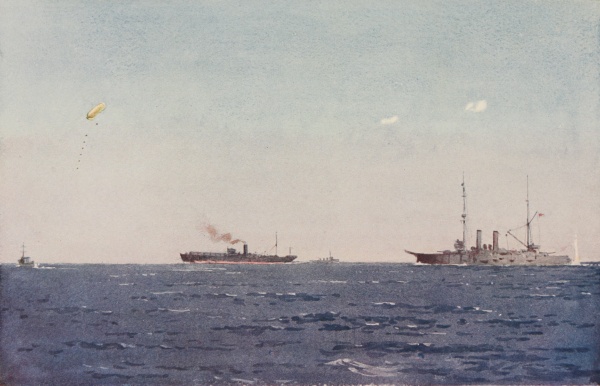
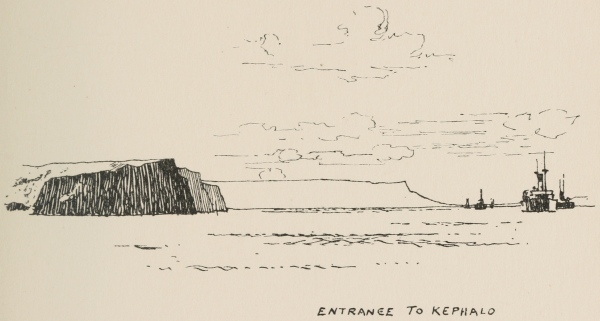
We left the anchorage of Kephalo with every
light obscured and silence enjoined, even white
clothes and cigarettes being forbidden on deck. It
was fortunately a dark night even for these parts.
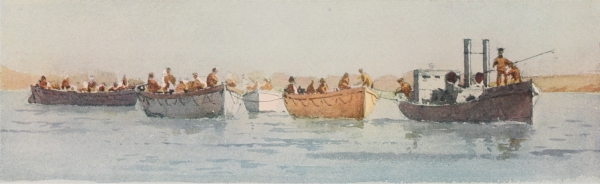
At slow speed with a picket-boat close on our
quarter we crept across the twelve miles separating
us from Suvla Bay, which by now was generally
presumed to be the place chosen for what we hoped
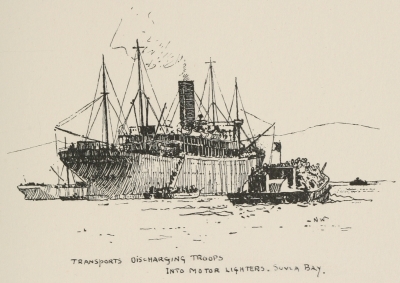
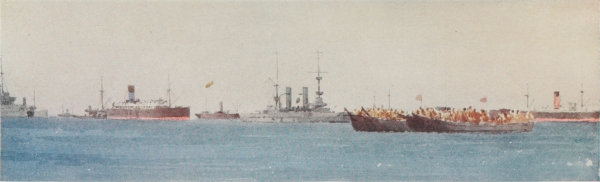
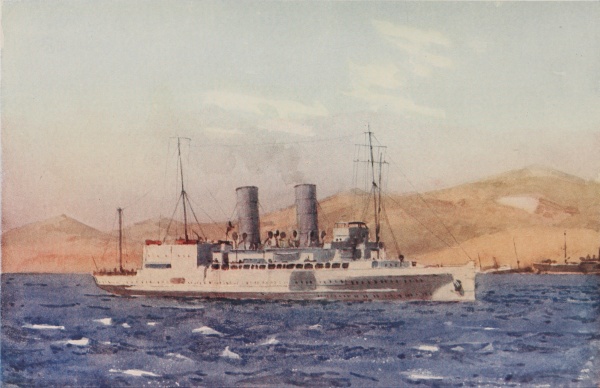
would be a surprise landing. Two cruisers, the
Theseus and Endymion, carrying large numbers of
men, and specially fitted with gangways over their
sterns to allow the troops to walk down into motor-lighters,
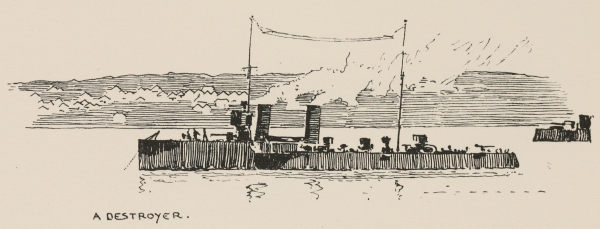
were sent on with destroyers towing
motor-lighters full of troops to be at the point of
disembarkation at about 11.30 p.m. We on the
flagship steered a slightly more northerly course, in
order not to interfere with these vessels in the
darkness, and arrived in Suvla Bay at about
12.30 a.m.
The fact that the landing had already begun was
shown by desultory rifle-fire from the shore, but of
so spasmodic a character that a feeling of hope arose
that the surprise was complete. Impatience now
became general for the first gleam of daylight.
After an apparently endless wait the dawn began to
make in the eastern sky, and there was enough light
to get some idea of the general state of affairs.
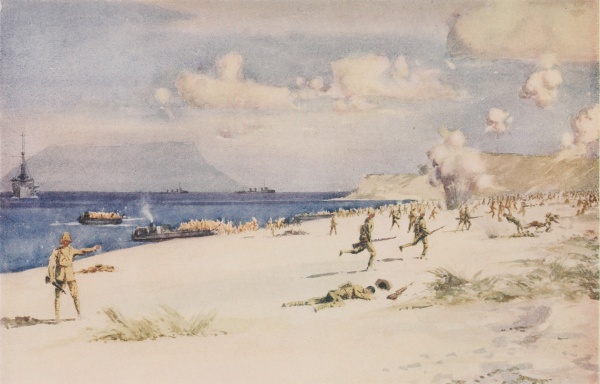
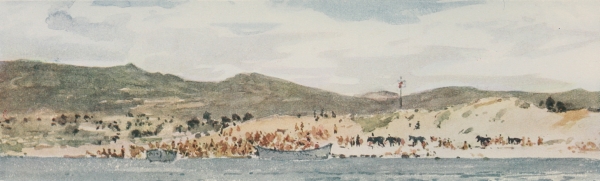
On C beach the troops had landed from the
cruisers and destroyers in the darkness with practically
no opposition. A beautiful sandy shore,
sloping at sufficiently steep an angle to allow the
motor-lighters to beach without difficulty, facilitated
the landing. The troops, dashing forward, were able
to penetrate inland and drive the small bodies of
Turks out of their trenches. They then advanced
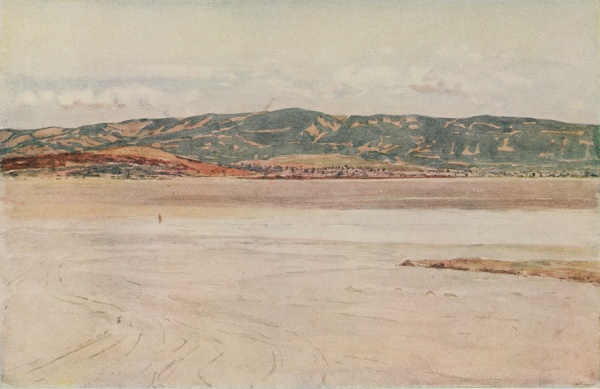
over the now dry salt lake some considerable
distance.
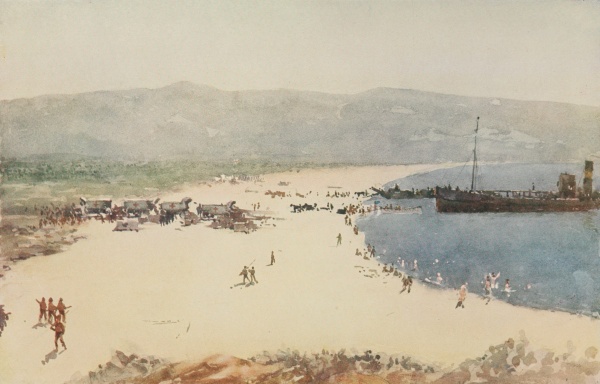
On A beach things were not so successful. Here,
a shallow ridge of sand, running parallel to the shore,
held up three of the motor-lighters carrying some
1500 men at a point where wading was impossible,
owing to the deeper water inside the ridge. Here
the men were subjected to considerable rifle-fire from
bodies of Turkish troops and suffered a number of
casualties. Picket-boats, however, succeeded in taking
them off and landing them on the beach.
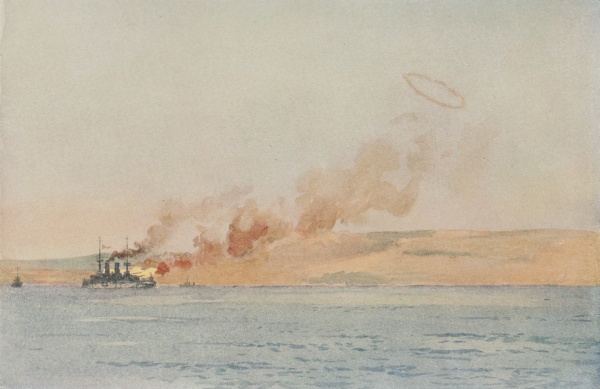
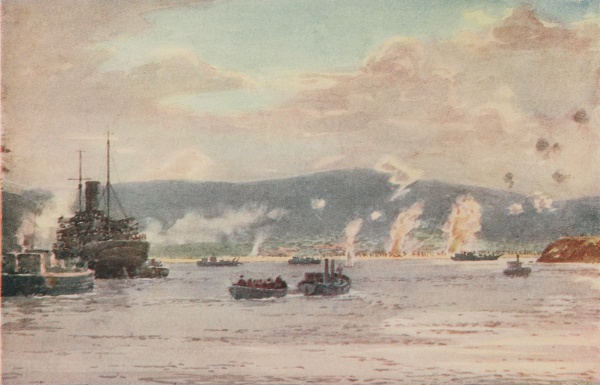
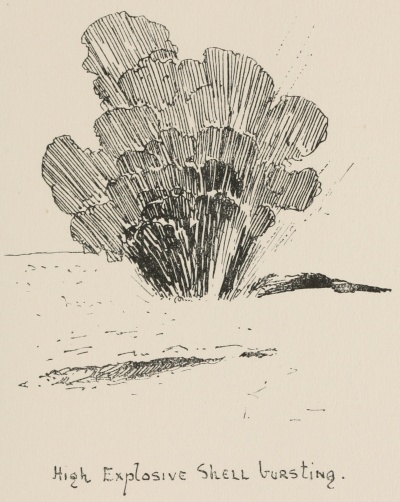
By this time it was possible to see more plainly
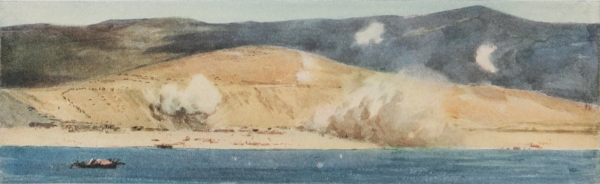
what was taking place. Two batteries of Turkish
field-guns opened fire with shrapnel and high
explosives on the landing-parties and on the three
lighters which were firmly fixed on the sand reef.
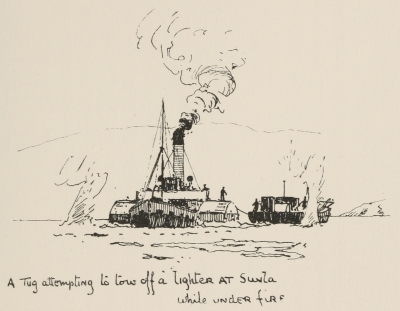
The lighters specially claimed the attention of the
enemy's guns, doubtless under the impression that
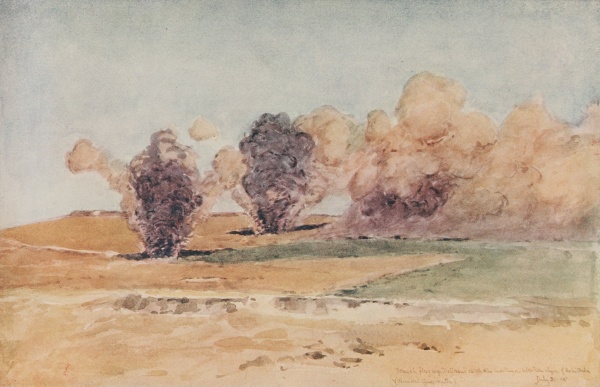
they still contained troops. Beyond the lighters
large numbers of men could be seen filing along the
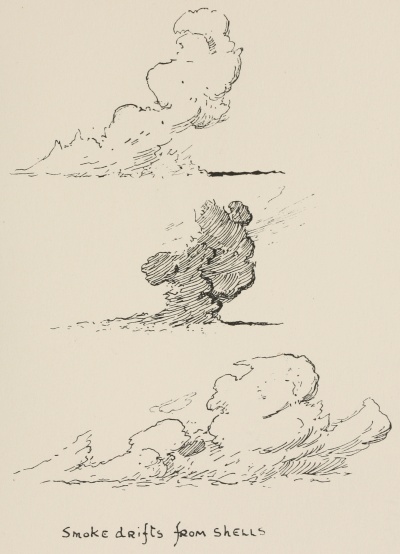
beach, or forming up, and amongst these, large
columns of sand and dust showed where the shells
pitched, causing many casualties.
At about five o'clock an enemy aeroplane was
sighted, but so occupied was everyone with the
work in hand that practically no attention was
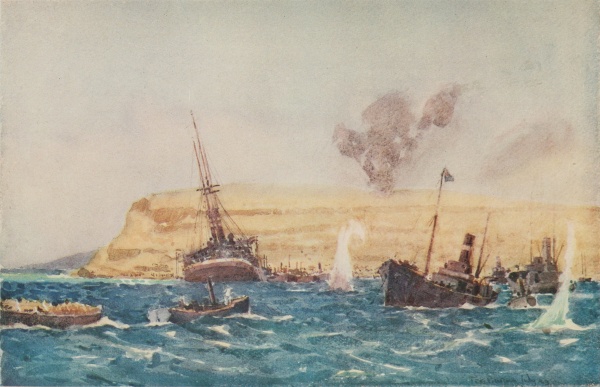
paid to her; and shortly after, four large bombs
were dropped in quick succession in the harbour,
causing huge columns of discoloured water to rise,
but doing no damage to the shipping, which by
now had grown in numbers. Five fleet sweepers
arrived bringing large numbers of men, who were
landed rapidly to support those already ashore, and
as quickly disappeared into the scrub beyond the
beach. The Talbot and Chatham were now busy
with their 6-inch guns driving back those Turks
who still endeavoured to oppose our landing. The
Talbot by a few well-placed shots entirely disposed
of a battery which had considerably annoyed us
during the early part of the operations. It was
impossible now to see exactly what was taking place,
as the low-lying land, over which the troops were
advancing, was hidden by sand dunes from the
harbour.
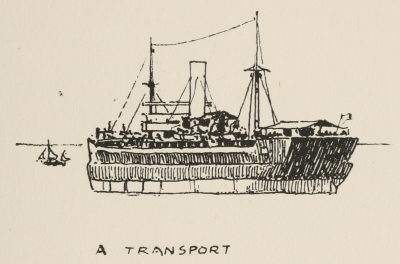
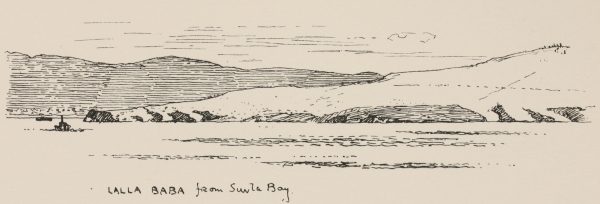
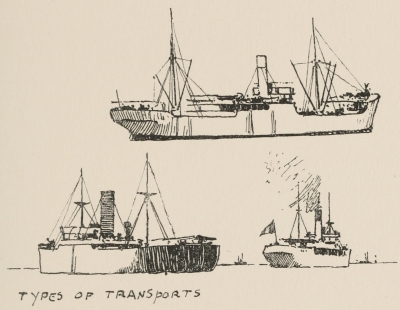
By now large transports were arriving with more
troops and stores, and a battery of field artillery was
landed and quickly galloped into a position on Lalla
Baba, where they could give good support to the
advance.
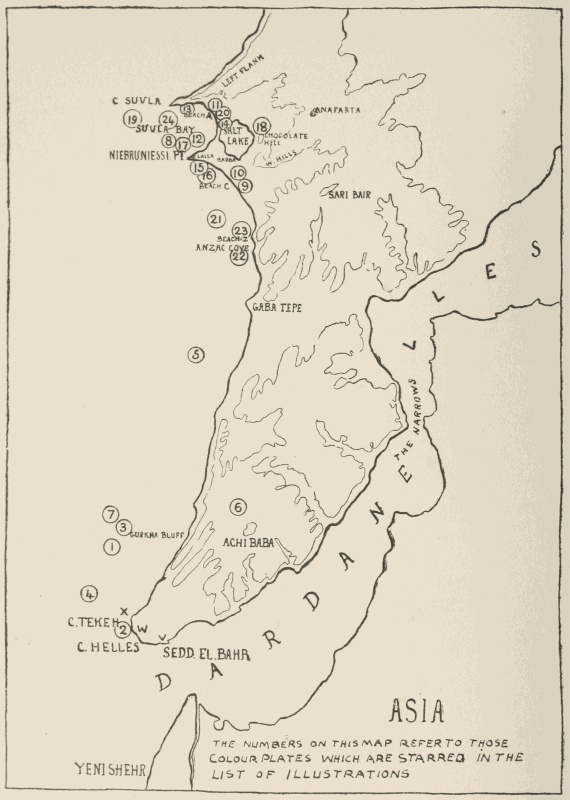
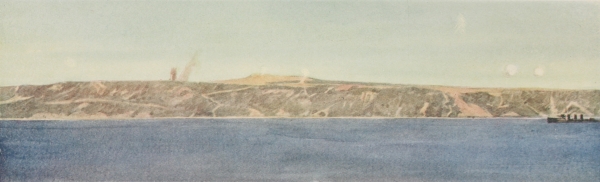
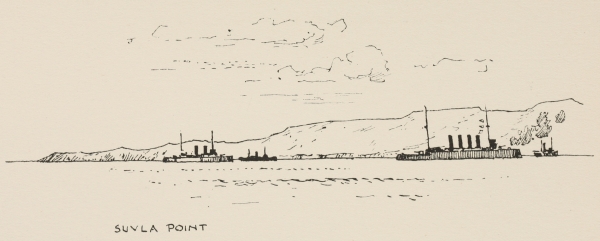
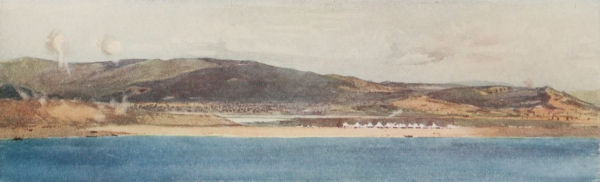
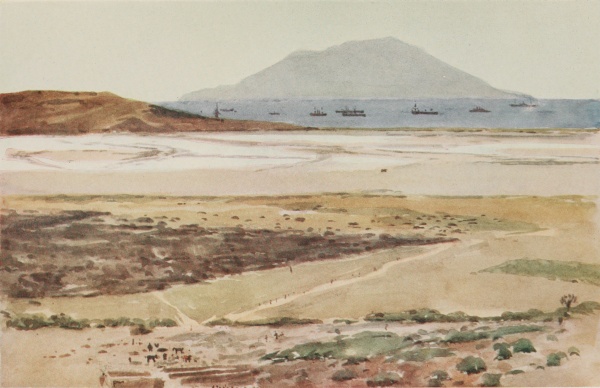
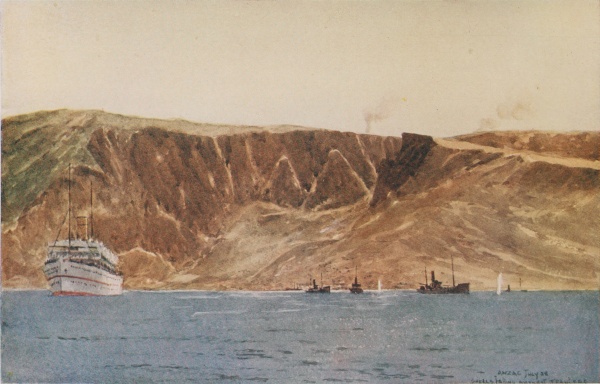
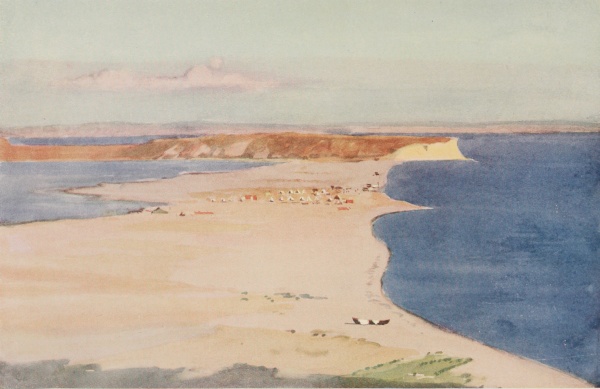
A slight description of the country in which this
attempt to straddle the peninsula was taking place
may be of interest, as seen from the sea. On our
left Suvla Point, with Nebruniessi Point to the right,
formed a small bay known as Suvla Bay some mile
and a half across. To the right of Nebruniessi Point
a long gently curving sandy beach some four or
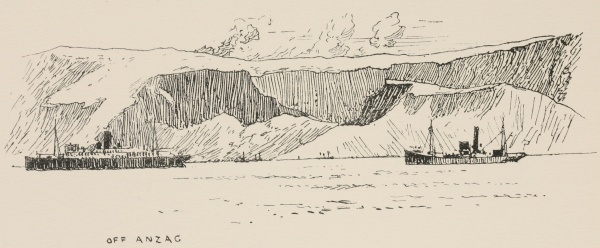
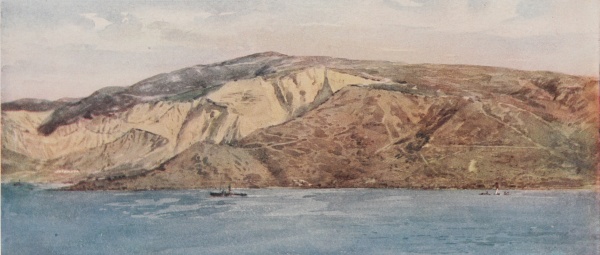
five miles in extent terminated where the Australian
position at Anzac rose steeply to the Sari Bair range. Inside
and immediately in front of us was a large
flat sandy plain covered with scrub, while the dry
salt lake showed dazzlingly white in the hot morning
sun. Immediately beyond was Chocolate Hill, and
behind this again lay the village of Anafarta some
four miles from the shore. As a background, the
Anafarta ridge ran from the village practically
parallel with the sea until it took a sharp turn due
west to Suvla Point, where it gradually sloped down
to the coast. Beyond the plain in front of us a
number of stunted oaks, gradually becoming more
dense further inland, formed excellent cover for the
enemy's snipers—a mode of warfare at which the
Turk has become an adept.
By climbing into the foretop of the vessel, it
was possible to watch the living cinema of battle.
Glasses were necessary to distinguish the light khaki
of our men against the scrub and sand. The troops
marching in open order across the salt lake formed
a most stirring picture as they crossed the unbroken
surface of silver-white. Overhead shrapnel burst
unceasingly, leaving small crumpled forms on the
ground, one or more of which would slowly rise
and walk shorewards, while others lay where they
fell. Beyond this open space it became almost
impossible to follow the movements of the battle,
but the continual rattle of musketry showed where
the advance was proceeding into the more thickly
wooded plain. Our hopes that the surrounding
ridges would be taken before nightfall were unfortunately
not realised. The enemy, though not in
great strength to commence with, were continually
reinforced, while the broken nature of the ground
made anything like perfect cohesion amongst our
various units extremely difficult. To make matters
still worse, the enemy's shells caused dense bush
fires, which, driven by the wind, burst into sheets
of flame. Great difficulty was experienced in dealing
with snipers. Officers and men were continually shot
down, not only by rifle fire from advanced posts of
the enemy, but by men and even women behind our
own firing-line. The particular kind of tree in this
part, a stunted oak, lends itself peculiarly to concealment,
being short with dense foliage. Here, a
sniper would lurk with face painted green and so
well hidden as to defy detection. Others would
crouch in the dense brushwood, where anyone passing
could be shot with ease. When discovered, these
snipers had in their possession enough food and
water for a considerable period as well as an ample
supply of ammunition. Although this seems a
murderous kind of warfare, there is no question as
to the pluck of the sniper, of whatever nationality,
for he has little chance of getting back to his comrades
and small likelihood of quarter if caught.
Water, or rather the want of it, was a serious bar
to our progress in the initial stages. Those who
formed the first landing-parties carried provisions
and water for forty-eight hours; but in a country of
this nature and under a boiling sun it is naturally
impossible to convince the young soldier fighting in a
temperature he has never experienced before, of the
necessity of husbanding his water supply. So it
proved in this instance. The advanced troops were
completely exhausted by thirst. Could this have
been remedied at once it is certain a different tale
would have been told.
The question which now arose amongst those
who were conducting the naval side of the operations
was, how long would the Turkish guns allow the shipping
to remain in the harbour (it became a harbour,
theoretically, as soon as the steamer detailed for the
work had laid submarine defence nets).
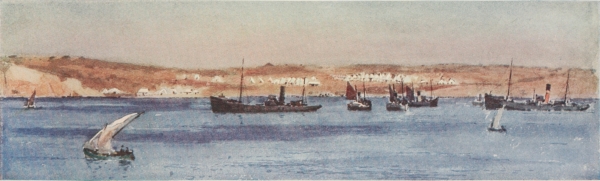
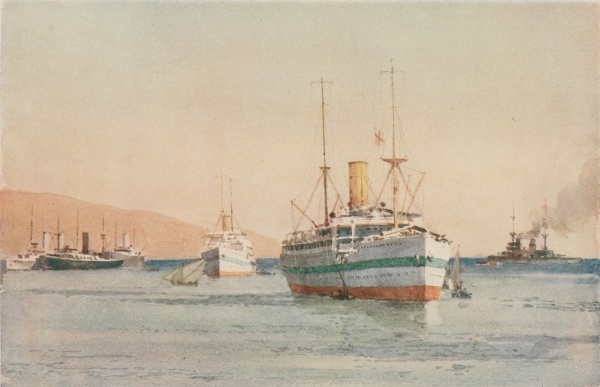
The bay was now thickly crowded with shipping,
including such tempting bait as big transports full of
troops, store-ships, and every kind of vessel which
goes to the support of an army. Yet, fortunately, we
were only subjected to intermittent shell-fire, the
Turks probably experiencing some difficulty in getting
guns into position in addition to those required
against the troops.
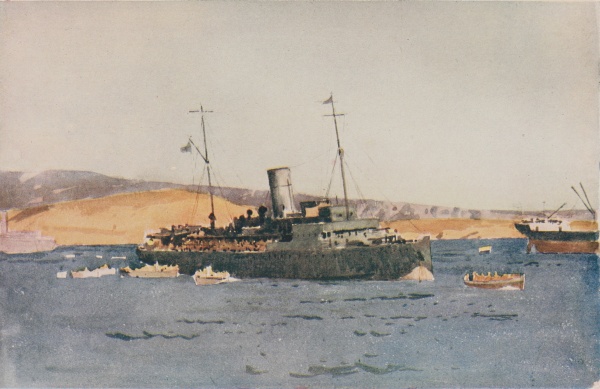
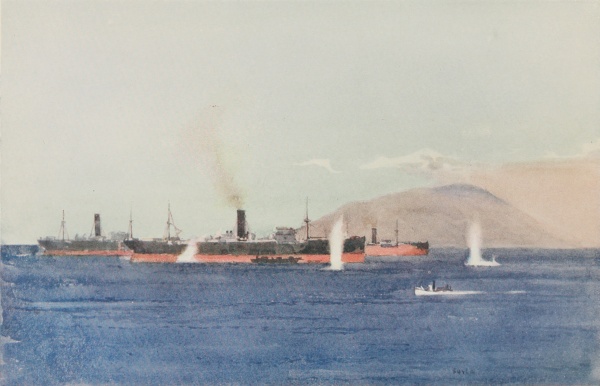
It was not until the 12th August that any serious
action was taken by the enemy against the ships in
harbour. On that day the vessels inside the defence
net consisted of a large monitor lying close in
shore, several smaller monitors at intervals off the
beach, the Cornwall, Chatham, and Swiftsure, and a
number of transports and storeships. The Swiftsure
was the flagship of Rear-Admiral Christian, who
conducted the naval side of the operations.
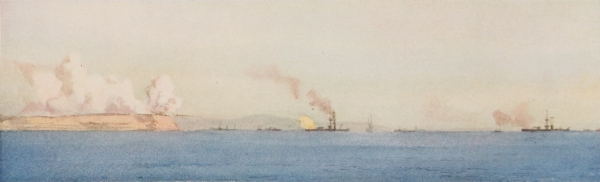
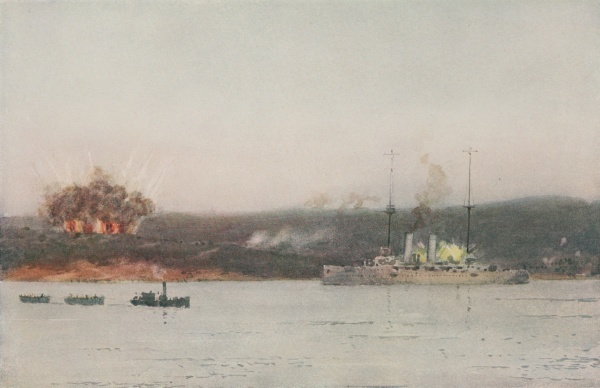
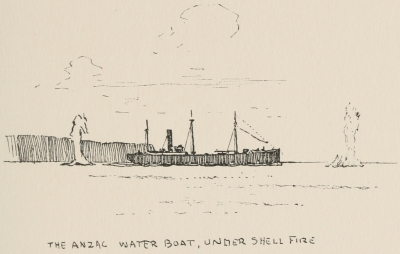
Shortly after midday the Turks opened fire on the
monitor Havelock. The range was good, but the
first shells were ineffective, though they fell close
round her. As she was lying at anchor, and things
were becoming rather uncomfortable, she weighed
and was just moving when a shell burst on the upper
deck behind the funnel, without, however, doing
serious damage. The enemy's gunners realising now
that their chances of hitting the Havelock were
small, turned their attention to the Swiftsure.
The latter, surrounded as she was by picket-boats
and lighters, found it difficult to get under weigh
quickly. Several of us were standing on the quarter-deck
of the flagship when the shells began to come in
our direction. The first shell pitched some fifty
yards short; the next passed overhead, falling fairly
close to our port side. They had our range to a
nicety. The probability that the third would hit us
caused a hurried exodus below deck, where, although
the protection afforded was not great, one felt a sense
of security which was perhaps more theoretical than
practical. Almost immediately the heavy thud of a
projectile outside the ward-room told us that our
judgment was not far wrong. Fortunately this failed
to explode, and was afterwards picked up on the net
shelf. Another entered the ship's side close to the
padre's cabin, and, going through three steel partitions,
brought up in the petty officers' pantry, where
a peaceful domestic was engaged in washing-up.
Fortunately for him this also failed to explode.
Immediately afterwards three high explosive shells
came inboard on the upper deck, and bursting there
killed 7 men and wounded 16. Curiosity in this
case had overcome a sense of prudence, for they had
been watching the enemy's attempt to drive us out of
the harbour.
The numerous picket-boats, lighters, etc., had
now left us, so we were able to get weigh on the
ship. We slowly steamed in a circle without going
outside the defence net, in case a submarine might
be lying in wait as part of a preconceived plan.
The fact that we had moved from our former billet
was sufficient to stop the enemy's fire, as practically
all his guns were field artillery, making it almost
impossible to follow a moving object with the
accuracy of a naval gun.
It is not my intention to attempt any elaborate
description of the land operations, as it was very
difficult to obtain really reliable news. Moreover,
after the first few days, the Turks had succeeded in
bringing up a number of fresh troops and artillery,
and were strongly entrenched. It was increasingly
evident, therefore, that, unless a very large body of
men could be brought up the advance had virtually
ceased and resolved itself into a digging-in competition.
Up till now the Turks had made no
concerted effort to drive us out; but one night, at
about eight o'clock, a heavy bombardment suddenly
commenced on the left flank, which lasted about an
hour and a half. The sky was lit by hundreds of
bursting shrapnel, high explosives and star shells:
the prelude, presumably, to an attack in force. From
our position in the bay it certainly looked as if a
big fight were in progress, and a great deal of speculation
was rife on the ships in harbour as to the
outcome. About 9.30 a signal arrived from the
Headquarters 9th Army Corps, saying "Situation
well in hand." It appeared, for some reason unknown
to us, that the enemy had entirely failed to follow
up the bombardment and attack. Indeed, as far as
could be ascertained, not a single Turk had left the
trenches, and we afterwards learned from deserters
that even flogging and threats had failed to move
them.
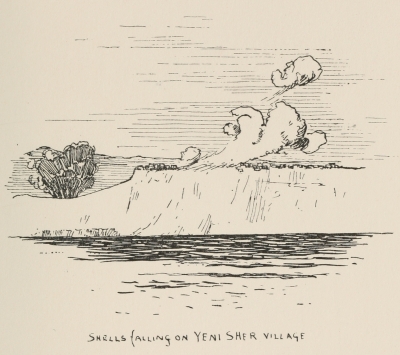
After this, day succeeded day with a desultory
artillery duel morning and evening, the afternoons
being presumably spent by the Turks in a siesta.
Little was accomplished by the artillery fire, beyond
the annoyance caused by shells falling amongst the
stores and dug-outs at the bases. It was astonishing
to see high explosive shells bursting in what appeared
to be crowded areas and to learn afterwards
from the soldiers that comparatively few casualties
had resulted. Certainly, at times, a shell would
cause considerable damage, especially if it fell on
rock or hard earth: one of these killed and wounded
upwards of 100 mules, and another, which I saw,
killed 9 men and wounded 7; but these were exceptions.
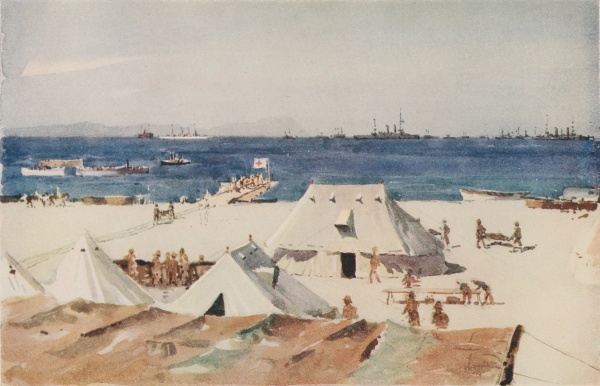
The Red Cross dressing stations had been
shelled in the early days of the landing, as, owing
possibly to the restricted area held by us, or more
probably to carelessness and want of thought, large
quantities of stores and ammunition were landed
close to the dressing stations. These suffered considerably
in consequence from shell-fire. This was
not a deliberate act, as no nation could possibly have
conducted warfare in a more above-board and clean-handed
manner than the Turks. The fact that such
qualities could be attributed to the Turk was a
surprise to me, though naval officers generally have
long regarded him as the gentleman of the Eastern
Mediterranean. This is further borne out by his
reported refusal to use poisonous gas when attacking.
On the afternoon of the landing the Turks sent
in an emissary to say that the Red Cross stations
would be respected provided no stores were landed
in the vicinity. Also at a later date the Turkish
Headquarters made a helio to the effect that they
had seen tows of boats communicating between warships
and the dressing stations. This they very
naturally resented, and said it must cease or they
would feel compelled to open fire. In another case
a surgeon told me that the enemy had actually sent
to apologise to him for the accidental shooting of one
of his stretcher-bearers. All this is, of course, only
what one would expect from a chivalrous enemy.
So brutally, however, have many of the theoretical
usages of war been violated that the action of the
Turk stands out in bright contrast, and shows that
this much-maligned race retains a sense of honour
which seems to be lacking in others who claim the
right to lead the world in this direction.
The Turkish prisoners taken by us were few
in number. Many were farmers whose one wish
appeared to be to see the end of the war. After all,
when one remembers that the Turk has always been
friendly to the British, it is not surprising that in
fighting against us he should still retain a good deal
of his old feeling. At the same time he is fighting
in defence of his own country, and is regarded by
all who know him as never so effective as when on
the defensive. All one hears and reads of dissension
amongst the Turkish and German officers may be
true, as no doubt the German officer has taken a high
hand in his dealings with the Turkish Army. At
the same time the Turk is not so blind but that
he realises, to the full, the value of the German
as a teacher of the latest methods and devices of
warfare.