Larger versions of most illustrations may be seen by right-clicking them
and selecting an option to view them separately, or by double-tapping and/or
stretching them.
By the same Author
ESSAYS IN
REBELLION
7/6 net
The Spectator says:
“We have enjoyed it immensely.”
The Bookman says:
“More than engrossing ... to
read it is to add to one’s mental
equipment.”
The Westminster Gazette says:
“Interested and delighted us.”
Punch says:
“A gallant book.”
Nisbet & Co. Ltd.
NEIGHBOURS OF OURS: Scenes of
East End Life.
IN THE VALLEY OF TOPHET:
Scenes of Black Country Life.
THE THIRTY DAYS’ WAR: Scenes
in the Greek and Turkish War of 1897.
LADYSMITH: A Diary of the Siege.
CLASSIC GREEK LANDSCAPE AND
ARCHITECTURE: Text to John Fulleylove’s
Pictures of Greece.
THE PLEA OF PAN.
BETWEEN THE ACTS: Scenes in
the Author’s Experience.
ON THE OLD ROAD THROUGH
FRANCE TO FLORENCE: French
Chapters to Hallam Murray’s Pictures.
BOOKS AND PERSONALITIES: A
Volume of Criticism.
A MODERN SLAVERY: An Investigation
of the Slave System in Angola and
the Islands of San Thomé and Principe.
THE DAWN IN RUSSIA: Scenes in
the Revolution of 1905–1906.
THE NEW SPIRIT IN INDIA:
Scenes during the Unrest of 1907–1908.
ESSAYS IN FREEDOM.
THE GROWTH OF FREEDOM: A
Summary of the History of Democracy.
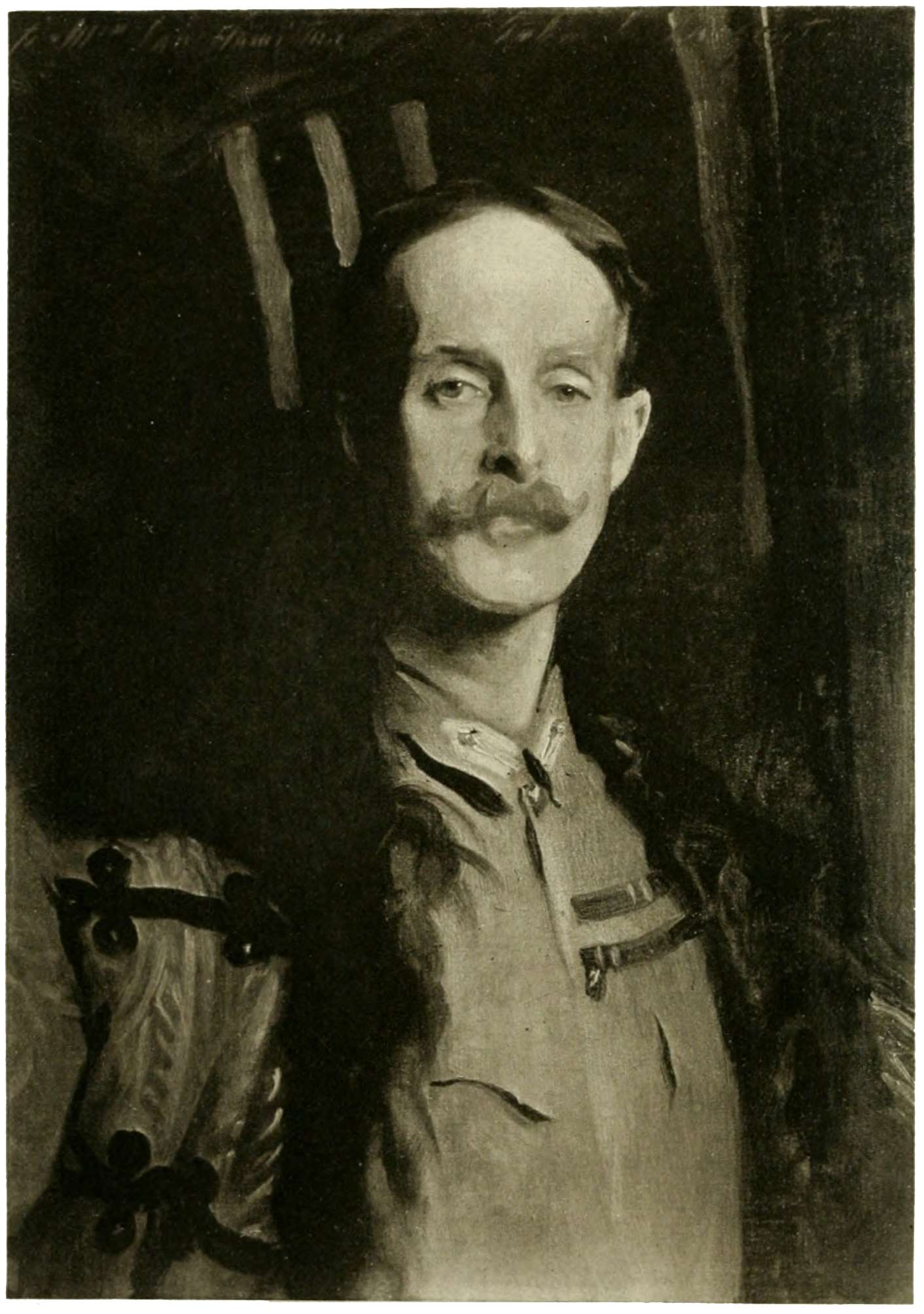
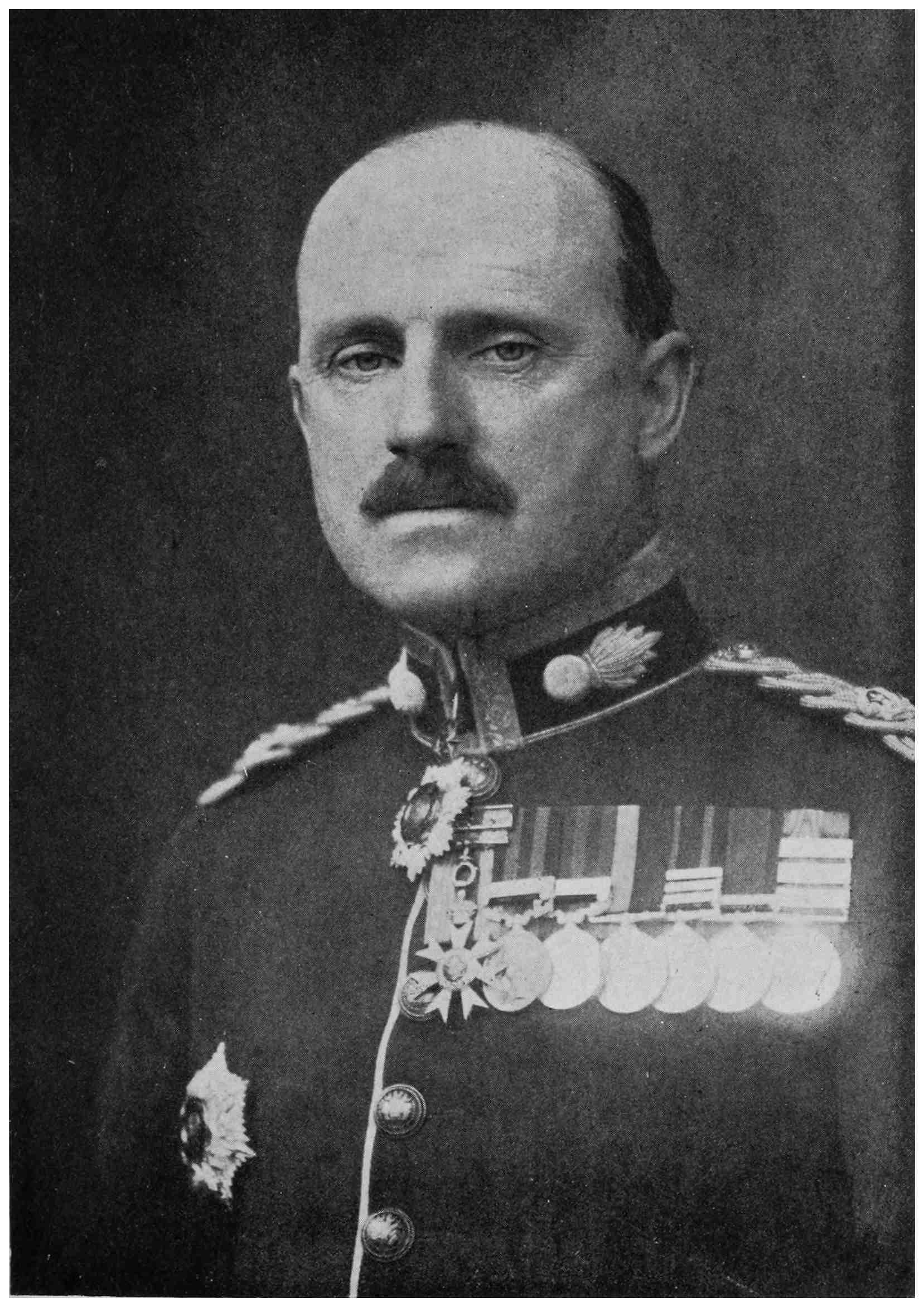
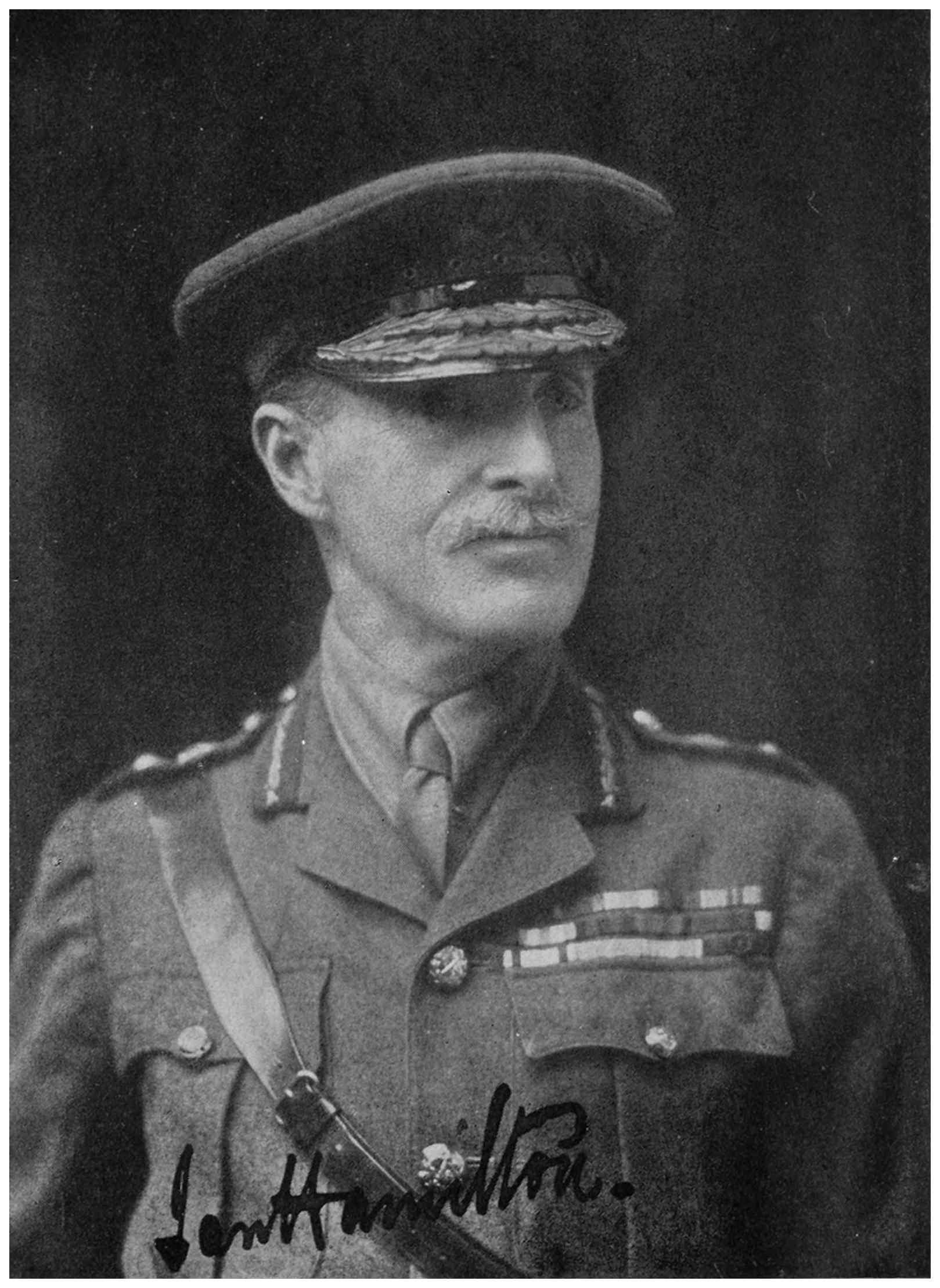
GENERAL SIR IAN HAMILTON. G.C.B., D.S.O.
FROM A PORTRAIT BY JOHN S. SARGENT. R.A.
THE DARDANELLES
CAMPAIGN
BY HENRY W. NEVINSON
THIRD AND REVISED EDITION
London NISBET & CO. LTD.
22 BERNERS STREET W. 1
First Published
November 1918
Second Edition
December 1918
Third and Revised Edition
March 1920
DEDICATED TO
THOSE WHO FELL ON THE
GALLIPOLI PENINSULA
Οἱ δ’ αὐτοῦ περὶ τεῖχος
θήκας Ἰλιάδος γᾶς
εὔμορφοι κατέχουσιν’ ἐχθρὰ δ’ ἔχοντας ἔκρυψεν.
Beside the ruins of Troy they lie buried,
those men so beautiful; there they have their
burial-place, hidden in an enemy’s land.
Of conspicuous men the whole world is the
tomb, and it is not only inscriptions on
tablets in their own country which chronicle
their fame, but rather, even in distant lands,
unwritten memorials living for ever, not upon
visible monuments, but in the hearts of
mankind.
Pericles’ Funeral Speech; Thucydides, ii. 43.
PREFACE
From the outset the Dardanelles Campaign
attracted me with peculiar interest. The
shores of the Straits were the scene of
the Trojan epics and dramas. They were explored
and partly inhabited by a race whose legends and
history had been more familiar to me from boyhood
than my own country’s, and more inspiring.
They belonged to that beautiful part of the world
with which I had become personally intimate during
the wars, rebellions, and other disturbances of the
previous twenty years. But, above all, I was
attracted to the Campaign because I regarded it as
a strategic conception surpassing others in promise.
My reasons are referred to in various chapters of
this book, and indeed they were obvious. The
occupation of Constantinople would have paralysed
Turkey as an ally of the Central Powers; it would
have blocked their path to the Middle East, and
averted danger from Egypt, the Persian Gulf, and
India; it would have released the Russian forces
in the Caucasus for action elsewhere; it would have
secured the neutrality, if not the active co-operation,
of the Balkan States, and especially of Bulgaria,
not only the most resolute and effective of them,
but a State well disposed to ourselves and the
Russian people by history and sentiment; by securing
Bulgaria’s friendship, it would have delivered
Serbia from fear of attack upon her eastern frontier,
and have relieved Roumania from similar apprehensions
along the Danube and in the Dobrudja;
it would have confirmed the influence of Venizelos
in Greece, and saved King Constantine from military,
financial, and domestic temptations to Germanise;
above all, it would thus have secured Russia’s left
flank, so enabling her to concentrate her entire
forces upon the Lithuanian, Polish, and Galician
frontiers from the Memel to the Dniester.
The worst apprehensions of the Central Powers
would then have been fulfilled. Blockaded by the
Allied fleets in the Adriatic, and by the British
fleet in the Channel and the North Sea, they would
have found themselves indeed surrounded by an iron
ring, and, so far as prophecy was possible, it seemed
likely that the terms which our Alliance openly
professed as our objects in the war might have been
obtained in the spring of 1916. The subsidiary and
more immediate consequences of success in the
Dardanelles, such as the supply of munitions to
Russia, and of Ukrainian wheat to our Alliance,
were also to be considered. The saying of Napoleon,
in May, 1808, still held good: “At bottom the great
question is—Who shall have Constantinople?”
Under the prevailing influence of “Westerners”
upon French and British strategy, these probable
advantages were either disregarded or dismissed,
and to dwell upon them now is a useless speculation.
The hopes suggested by the conception in 1915
have faded like a dream. The dominant minds in
our Alliance either failed to imagine their significance,
or were incapable of supplying the power required
for their realisation while at the same time pressing
forward the proposed offensive in France. The
international situation of Europe, and indeed of the
world, is now changed, and the strategic map has
been completely altered. Early belligerents have
disappeared from the field, and new belligerents have
entered the shifting scene. Already, in 1918, the
Dardanelles Expedition has passed into history, and
may be counted among the ghosts which history
tries in vain to summon up. It is as an episode of
a vanished past that I have attempted to represent
it—a tragic episode enacted in the space of eleven
months, but marked by every attribute of noble
tragedy, whether we consider the grandeur of theme
and personality, or the sympathy aroused by the
spectacle of heroic figures struggling against the
unconscious adversity of fate and the malign influences
of hostile or deceptive power.
In treatment, I have made no attempt to rival
my friend John Masefield’s Gallipoli—that excellent
piece of work, at once so accurate and so brilliantly
illuminated by poetic vision. Mine has been the
humbler task of simply recording the events as they
occurred, with such detail as seemed essential to
complete the history, or was accessible to myself.
In this endeavour, I have trusted partly to the
books and documents mentioned below, partly to
information generously supplied to me by many of
the principal actors upon the scene; also to my
own notes, writings, and memory, especially with
regard to the nature of the country and the events
of which I was a witness. Accuracy and justice
have been my only aims, but in a work involving
so much detail and so many controverted questions
mistakes in accuracy and justice are scarcely to be
avoided. I know the confusion of mind and the
distorted vision so frequent in all great crises of
war, and I know from long experience how ignorant
may be the criticism applied to any soldier from the
Commander-in-Chief down to the private with a
rifle.
The mention of the private with a rifle suggests
my chief regret. The method I have followed, in
treating divisions or brigades or, at the lowest,
battalions as the units of action, almost obliterates
the individual soldier from consideration. Divisions,
brigades, and battalions are moved like pieces on
a board, and Commanding Officers must regard
each of them only as a certain quantity of force
acting under the laws of time and space. Yet each
of the so-called units is made up of living men—men
of distinctive personality and incalculably
varying nature. Men are the actual units in war
as in the State, and I do not forget the “common
soldiers.” I do not overlook either their natural
failures or their astonishing performance. In various
campaigns and in many countries I have shared
their apprehensions, their hardships, their brief
intervals of respite, and their laborious triumphs.
They, like the rest of mankind, have always filled
me with surprised admiration or poignant sympathy.
Among the soldiers of many races, but especially
among the natives of these islands, whom I could
best understand, I have always found the fine
qualities which distinguish the majority of hardworking
people, all of whom live perpetually in
perilous hardship. I have found a freedom from
rhetoric and vanity, a simple-hearted acceptance of
life “in the first intention,” taking life and death
without much criticism as they come, and concealing
kindliness and the longing for happiness under a
veil of silence or protective irony. But a book of
this kind has little place for the mention of them,
and that is my regret. Like a general, I have
been obliged to consider forces mainly in the mass,
and must leave to readers the duty of remembering,
as I never cease to remember, that all divisions
and all platoons upon the Peninsula were composed
of ordinary men like ourselves—individual personalities
subject to the common sufferings of hunger,
thirst, sickness, and pain; filled also with the
common delight in life, the common horror of death,
and the desire for peace and home. As in the case
of general mankind, it was their endurance, their
courage, self-sacrifice, and all that is implied in
the ancient meanings of “virtue,” which excited my
wonder.
Among those who have given me very kind
assistance either on the Dardanelles Peninsula or
in London, I may mention with gratitude General
Sir Ian Hamilton, G.C.B., etc.; General Sir William
R. Birdwood, K.C.B., K.C.S.I., etc.; Major-General
Sir Alexander Godley, K.C.B., etc.; Major-General
Sir A. H. Russell, K.C.M.G., etc.; the late Lieut.-General
Sir Frederick Stanley Maude, K.C.B.;
Major-General Sir W. R. Marshall, K.C.B.; Major-General
H. B. Walker, C.B.; Major-General Sir
William Douglas, K.C.M.G.; Major-General F. H.
Sykes, C.M.G.; Major-General Sir D. Mercer, K.C.B.;
Brigadier-General Freyberg, V.C.; Colonel Leslie
Wilson, D.S.O., M.P.; and Lieut. Douglas Jerrold,
R.N.V.D.; Vice-Admiral Sir Roger Keyes, K.C.B.,
etc.; Rear-Admiral Heathcote Grant, C.B., etc.;
Captain A. P. Davidson, R.N.; Captain the Hon.
Algernon Boyle, R.N.; Staff-Surgeon Levick, R.N.;
and the Rev. C. J. C. Peshall, R.N. It would indeed
be difficult to draw up a complete list of the Naval
and Military officers to whom I owe my thanks.
Having taken many photographs on the Peninsula,
I posted them, as I was directed, to the War Office,
and never saw them again. I can only hope that
any one into whose possession they may happen to
have come upon the route, may find them as useful
as I should have found them in illustrating this book.
My friend, Captain C. E. W. Bean, has generously
supplied me with some of his own photographs in
their place. For the rest I am permitted to use
official pictures, taken by my friend, Mr. Brooks.
They are of course far superior to any I could
have taken, but some are already familiar.
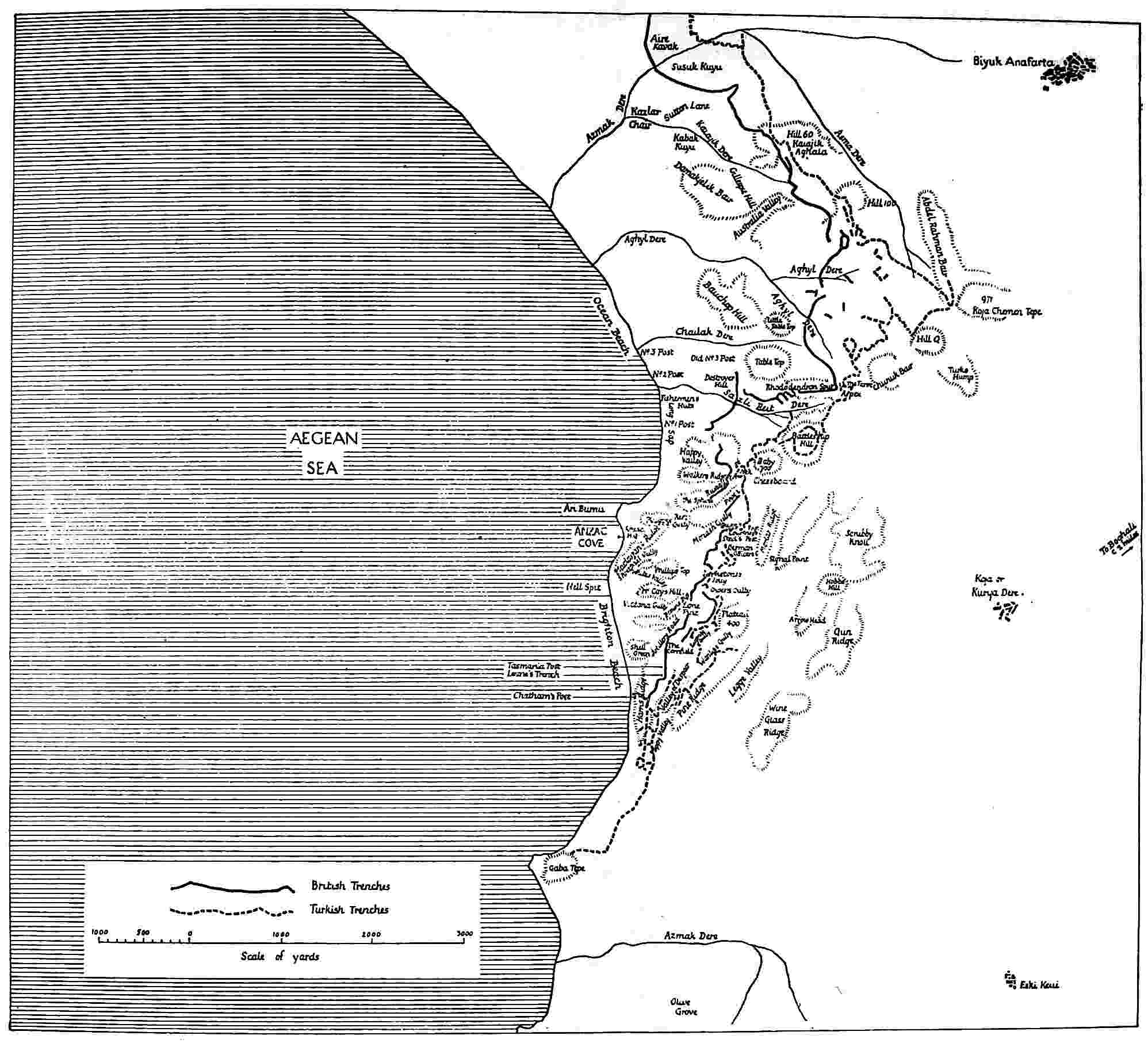
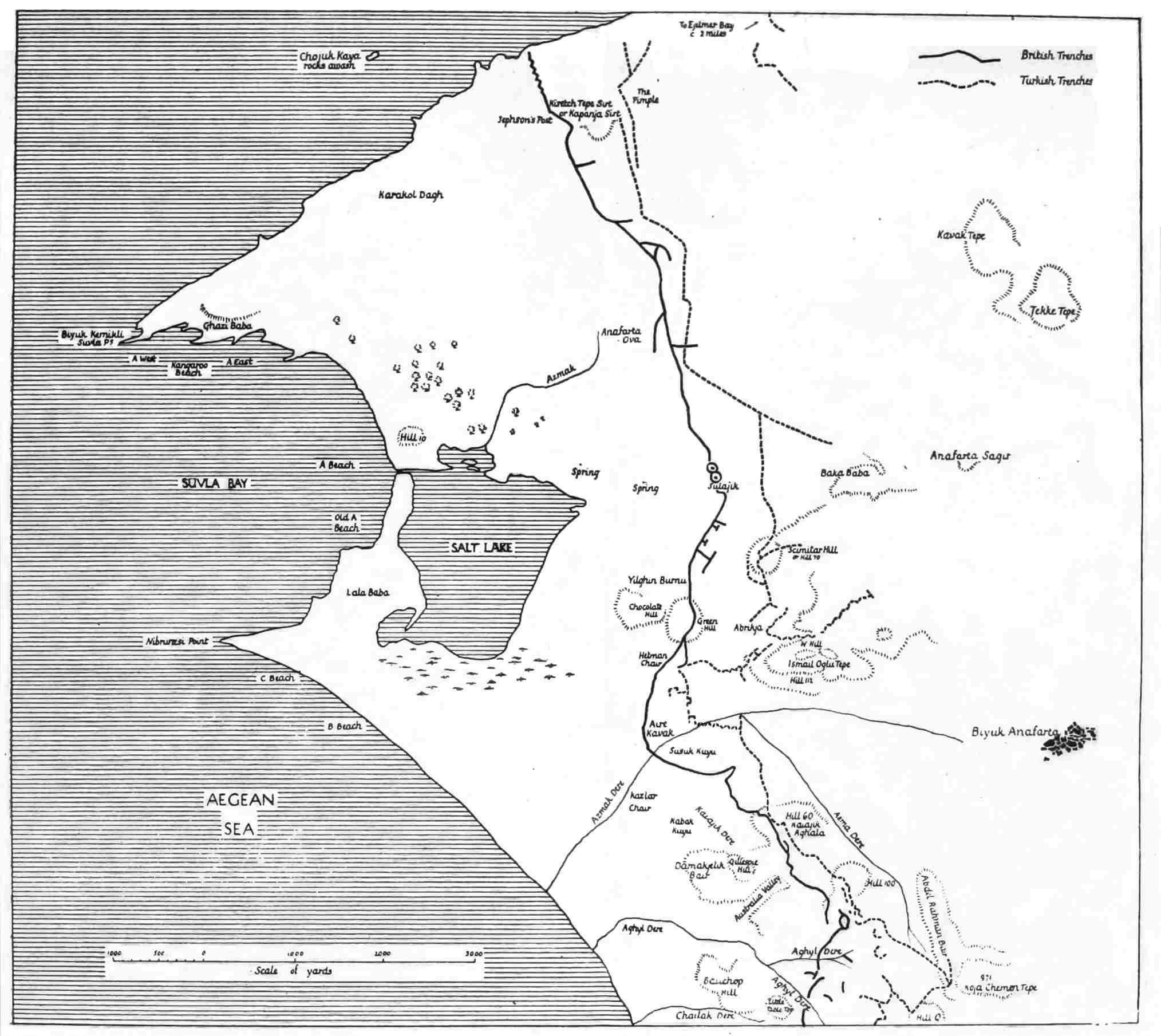
The maps are for the most part constructed
from the Staff Maps (nominally Turkish, but mainly
Austrian I believe) used by the G.H.Q. upon the
Peninsula. Some also are derived from drawings by
Generals and Staff Officers. For the larger maps
of Anzac and Suvla I am indebted to the assistance
of Captain Treloar and the Australian Staff
in London, with permission of Sir Alexander Godley,
and Brigadier-General Richardson (formerly of the
Royal Naval Division); and to Mr. S. B. K. Caulfield.
The following is a list of the chief books and
documents which I have found useful:—
Sir Ian Hamilton’s Dispatches.
Sir Charles Monro’s Dispatch on the Evacuation.
The Dardanelles Commission Report, Part I.
With the Twenty-ninth Division in Gallipoli,
by the Rev. O. Creighton, Chaplain to the
86th Brigade (killed in France, April 1918).
The Tenth (Irish) Division in Gallipoli, by
Major Bryan Cooper, 5th Connaught Rangers.
With the Zionists in Gallipoli, by Lieut.-Colonel
J. S. Patterson.
The Immortal Gamble, by A. J. Stewart, Acting
Commander, R.N., and the Rev. C. J. E.
Peshall, Chaplain, R.N.
Uncensored Letters from the Dardanelles, by a
French Medical Officer.
Australia in Arms, by Phillip F. E. Schuler.
The Story of the Anzacs. (Messrs. Ingram &
Sons, Melbourne.)
Mr. Ashmead Bartlett’s Dispatches from the
Dardanelles.
What of the Dardanelles? by Granville Fortescue.
Two Years in Constantinople, by Dr. Harry
Stürmer.
Inside Constantinople, by Lewis Einstein.
Nelson’s History of the War, by Colonel John
Buchan.
The “Times” History of the War.
The “Manchester Guardian” History of the
War.
H. W. N.
London, 1918.
Secrets of the Bosphorus, by Henry Morgenthau
(1919), especially illustrate pp. 144–145.
An interview with General von Sanders, by Mr.
G. Ward Price, of the Daily Mail, in Constantinople
(Nov. 13, 1918), contains points of
military interest.
(Note to Second Edition.)
CONTENTS
CHAPTER I
THE ORIGIN
PAGE
Naval Bombardment, November 1914—Causes of German-Turkish Alliance—Germany’s Eastern aims—Mistakes of British diplomacy—The Goeben and Breslau—The position of Greece—Turkey declares war
Mr. Churchill first suggests attack on Gallipoli—Russia’s appeal for aid—A demonstration decided upon—The War Council—Lord Kitchener—Mr. Asquith—Mr. Churchill—Objects of his scheme—Lord Kitchener’s objections—Admirals Fisher and Arthur Wilson—Their duty as advisers—Lord Fisher’s opinion—Admiral Jackson’s view—Admiral Carden on the scheme—War Council orders a naval attack—Lord Fisher’s opposition—He gives reluctant assent—Decision for a solely naval expedition
Council’s hesitation renewed—A military force prepared—The 29th Division detained—Description of the Dardanelles—Mudros and the islands—Formation of the fleet—Bombardment of February 19—Renewed on February 25—Further attacks in early March—Effect on Balkan States—Mr. Churchill urges greater vigour—Admiral de Robeck succeeds to command—The naval attack of March 18—Losses and comparative failure—Purely naval attacks abandoned
Sir Ian Hamilton’s appointment—His qualifications—Misfortune of delay—Transports returned for reloading—Sir Ian in Egypt—The forces there—The “Anzacs”—Possible lines of attack considered—The selected scheme—Chief members of Sir Ian’s staff—Available forces—Sir Ian’s address—Rupert Brooke’s death
The Start from Mudros—Landing at De Tott’s Battery—Seddel Bahr and V Beach—The River Clyde—Landing at V Beach—Night there—W Beach or Lancashire Landing—Landing at X Beach—Y2 and Y Beaches—Landing at Y Beach—Its failure—Landing at Anzac—The positions won there—Feint off Bulair—Captain Freyberg’s exploit—French feint at Kum Kali
Sir Ian’s decision to hold Anzac—Advance from V Beach—Death of Doughty-Wylie—The French at V Beach—Position of Krithia—Advance of April 28—Turkish attack of May 1—Reinforcements arrive—Position at Anzac—Casualties—Underestimate of wounded—Unhappy results
State of Constantinople—Our submarines—Sir Ian’s reduced forces—The guns—May 6 at Helles—May 7—May 8—The Australian charge—The 29th Division—Trench warfare—Death of General Bridges at Anzac—May 19 at Anzac—Armistice at Anzac—Loss by hostile submarines—G.H.Q. at Imbros—Hope of Russian aid abandoned—Mr. Churchill and Lord Fisher resign
Situation on Peninsula—June 4 at Helles—French Colonial troops—Arrival of General De Lisle—June 6 to 8 at Helles—Losses—Want of guns—June 28 at Helles—The Gully Ravine—Turkish proclamations—Position at Anzac—June 29 at Anzac—Discouragement—General Gouraud wounded—The war in Poland and Italy
Local Turkish attacks—Turkish reinforcements—Our attacks of July 12 and 13 at Helles—General Hunter-Weston invalided—General Stopford’s arrival—Description of Helles—Rations—Description of Anzac—The Aragon at Mudros—Arrival of General Altham—The Saturnia—Arrival of Colonel Hankey—The monitors, “blister ships,” and “beetles”—The 10th, 11th, and 13th Divisions—The 53rd and 54th Divisions—Total forces in August—New scheme of attack considered
Feints and arrangement of forces—August 6 at Helles—August 7 to 13—Fight for the Vineyard—Leane’s trenches at Anzac—Lone Pine—Assault of August 6—Continuous fighting till August 12—Assault on German officers’ trenches—Assault on the Nek, August 7
Description of the range—Nature of the approaches—General Godley’s force—His dispositions—Evening August 6 to evening August 7—Capture of Old No. 3 Post—Capture of Big Table Top—Capture of Bauchop’s Hill—Ascent of Rhododendron Ridge—General Monash on Aghyl Dere—Evening August 7 to evening August 8—Fresh dispositions—Summit of Chunuk Ridge reached—Death of Colonel Malone—Attempt at Abdel Rahman—Evening August 8 to evening August 9—Error of Baldwin’s column—Major Allanson on Hill Q—View of the Dardanelles—Party driven off by shells—Turks regain the summit—Baldwin at the Farm—Party on Chunuk Ridge relieved—Evening August 9 to evening August 10—Fresh party on Chunuk Ridge destroyed—Turks swarm over summit—Fighting at the Farm—Death of General Baldwin—Turks driven back to summit—Causes of comparative failure
Description of the bay and surrounding country—General Stopford and IXth Corps—Divisional Generals—Evening August 6 to evening August 7—The embarkation—Work of the Navy—The landing beaches—Capture of Lala Baba—Ill-luck of 34th Brigade—Delay and confusion of Brigades and Divisions—Hill’s Brigade (31st)—Its advance round Salt Lake—Capture of Chocolate Hill—General Mahon on Kiretch Tepe Sirt—Evening August 7 to evening August 8—Silence at Suvla—Failure of water distribution—Sir Ian visits Suvla—His orders to General Hammersley—Scimitar Hill abandoned by mistake—Evening August 8 to evening August 9—Turks reinforced return to positions—Failure of our attack on Scimitar Hill—Sir Ian proposes occupation of Kavak and Tekke Tepes—He sends his last reserve to Suvla—Evening August 9 to evening August 10—Renewed attack on Scimitar Hill—Its failure—General Stopford ordered to consolidate line—Evening August 10 to evening August 11—Landing of 54th Division—Confusion of front lines—Battalions reorganised—Evening August 11 to evening August 12—Sir Ian again urges occupation of Kavak and Tekke Tepes—Disappearance of 5th Norfolks—General Stopford’s objections—The 10th Division on Kiretch Tepe Sirt (August 15)—Failure to maintain advance—General De Lisle succeeds General Stopford temporarily in command of IXth Corps—Other changes in command
Causes of the failure in August—Advantages gained—Approximate losses—Adequate reinforcements refused—Arrival of Peyton’s mounted Division—Renewed attempt against Scimitar Hill (August 21)—Mistakes in the advance on right—The 29th Division in centre—Advance of the Yeomanry—Failure to occupy the hill—Attack on Hill 60 from Anzac—Kabak Kuyu (August 21)—Connaught Rangers—Slow progress of attack—Second attack (August 27)—Third attack (August 29)—Last battle on the Peninsula
Sickness increases during September—Monotonous food—Regret for dead and wounded—New drafts—Fears of winter—Sir Julian Byng commands IXth Corps—Events in France, Poland, and the Balkans—Attitude of Bulgaria and Greece—The 10th Division and one French sent to Salonika—Bulgaria declares war—Venizelos resigns—Serbia invaded—Salonika expedition too late, but destroys hope of Dardanelles—Lord Kitchener inquires about evacuation—Sir Ian’s reply—He is recalled
Sir Charles Monro arrives—His report—The advocates of evacuation—Lord Kitchener visits the Peninsula—General Birdwood appointed to command—Storm and blizzard of November—General Birdwood ordered to evacuate Suvla and Anzac—Estimate of Turkish forces—Our ruses—Arrangements at Suvla—Risks of the final nights—Embarkation at Suvla—Problem at Anzac—Final arrangements—Evacuation of Anzac—Uncertainty about Helles—Evacuation ordered—Turkish attacks—Final withdrawal (January 8, 1916)—Recapitulation of causes of failure—Concluding observations—The end
On November 3, 1914, the silence of the
Dardanelles was suddenly broken by an
Anglo-French naval squadron, which opened
fire upon the forts at the entrance of that historic
strait. The bombardment lasted only ten minutes,
its object being merely to test the range of the
Turkish guns, and no damage seems to have been
inflicted on either side. The ships belonged to the
Eastern Mediterranean Allied Squadrons, commanded
by Vice-Admiral Sackville Carden, and the order
to bombard was given by the Admiralty, Mr. Winston
Churchill being First Lord. The War Council was
not consulted, and Admiral Sir Henry Jackson,
Commander-in-Chief in the Mediterranean, in his
evidence before the Dardanelles Commission described
the bombardment as a mistake, because it was likely
to put the Turks on the alert. Commodore de
Bartolomé, Naval Secretary to the First Lord, also
said he considered it unfortunate, presumably for the
same reason.1 Even Turks, unaided by Germans,
might have foreseen the ultimate necessity of
strengthening the fortification of the Straits, but at
the beginning they would naturally trust to the long-recognised
difficulty of forcing a passage up the
swift and devious channel which protects the entrance
to the Imperial City more securely than a mountain
pass.
War between the Allies and Turkey became
certain only three days before (October 31), but from
the first the temptation of the Turkish Government
to throw in their lot with “Central Europe” was
powerful. It is true that, during three or four
decades of last century, Turkey counted upon
England for protection, and that by the Crimean
War and the Treaty of Berlin England had protected
her, with interested generosity, as a serviceable
though frail barrier against Russian designs. But
the British occupation of Egypt, the British intervention
in Crete and Macedonia, and perhaps also
the knowledge that a body of Englishmen fought for
Greece in her disastrous campaign of 1897, shook
Turkish confidence in the supposed protection;
while, on the other hand, Abdul Hamid’s atrocious
persecution of his subject races proved to the British
middle classes that, though the Turk was described
as “the gentleman of the Near East,” he still
possessed qualities undesirable in an ally of professing
Christians. Besides, within the last eight
years (since 1906), the understanding between
England and Russia had continually grown more
definite, until it resulted in open alliance at the outbreak
of the war; and Russia had long been Turkey’s
relentless and insatiable foe. For she had her mind
steadily set upon Constantinople, partly because, by
a convenient and semi-religious myth, the Tsars regarded
themselves as the natural heirs of the Byzantine
Emperors, and partly in the knowledge that the
possession of the Bosphorus and the Dardanelles was
essential for the development of Russia’s naval power.
HOW GERMANY WON TURKEY
Germany was not slow in taking up the part of
Turkey’s friend as bit by bit it fell from England’s
hand. If, in Lord Salisbury’s phrase, England found
in the ’nineties that at the time of the Crimean War
she had put her money on the wrong horse, Germany
continued to back the weak-kneed and discarded outsider.
Germany’s voice was never heard in the widespread
outcry against “the Red Sultan.” German
diplomacy regarded all Balkan races and Armenians
with indifferent scorn. It called them “sheepstealers”
(Hammeldiebe), and if Abdul Hamid chose to stamp
upon troublesome subjects, that was his own affair.
With that keen eye to his country’s material interest
which, before the war, made him the most enterprising
and successful of commercial travellers, Kaiser
Wilhelm II., repeating the earlier visit of 1889, visited
the Sultan in state at the height of his unpopularity
(1898), commemorated the favour by the gift of a
deplorable fountain to the city, and proceeded upon a
speculative pilgrimage to Jerusalem, which holy city
German or Turkish antiquarians patched with the
lath and plaster restorations befitting so curious an
occasion.
The prolonged negotiations over the concession
of the Bagdad railway ensued, the interests of Turkey
and Germany alike being repeatedly thwarted by
England’s opposition, up to the very eve of the
present war, when Sir Edward Grey withdrew our
objection, providing only for our interests on the
section between Bagdad and the Persian Gulf.2
During the Young Turk revolution of 1908–1909,
English Liberal opinion was enthusiastic in support
of the movement and in the expectation of reform.
But our diplomacy, always irritated at new situations
and suspicious of extended liberties, eyed the change
with a chilling scepticism which threw all the advantage
into the hands of Baron Marschall von Biberstein,
the German Ambassador in Constantinople. His
natural politeness and open-hearted industry contrasted
favourably with the habitual aloofness or
leisured indifference of British Embassies; and so it
came about that Enver Pasha, the military leader of
Young Turkey, was welcomed indeed by the opponents
of Abdul Hamid’s tyranny at a public dinner
in London, but went to reside in Berlin as military
attaché.
GERMANY’S EASTERN AIMS
Germany’s object in this astute benevolence was
not concealed. With her rapidly increasing population,
laborious, enterprising, and better trained than
other races for the pursuit of commerce and technical
industries, she naturally sought outlets to vast spaces
of the world, such as Great Britain, France, and
Russia had already absorbed. The immense growth
of her wealth, combined with formidable naval and
military power, encouraged the belief that such expansion
was as practicable as necessary. But the best places
in the sun were now occupied. She had secured pretty
fair portions in Africa, but France, England, and
Belgium had better. Brazil was tempting, but the
United States proclaimed the Monroe doctrine as a
bar to the New World. Portugal might sell Angola
under paternal compulsion, but its provinces were
rotten with slavery, and its climate poisonous.
Looking round the world, Germany found in the
Turkish Empire alone a sufficiently salubrious and
comparatively vacant sphere for her development;
and it is difficult to say what more suitable sphere we
could have chosen to allot for her satisfaction, without
encroaching upon our own preserves. Even the
patch remaining to Turkey in Europe is a fine
market-place; with industry and capital most of Asia
Minor would again flourish as “the bright cities of
Asia” have flourished before; there is no reason but
the Ottoman curse why the sites of Nineveh and
Babylon should remain uninhabited, or the Garden of
Eden lie desolate as a wilderness of alternate dust and
quagmire.
But to reach this land of hope and commerce the
route by sea was long, and exposed to naval attack
throughout its length till the Dardanelles were
reached. The overland route must, therefore, be
kept open, and three points of difficulty intervened,
even if the alliance with Austria-Hungary permanently
held good. The overland route passed
through Serbia (by the so-called “corridor”), and
behind Serbia stood the jealous and watchful
power of the Tsars; it passed through Bulgaria,
which would have to be persuaded by solid arguments
on which side her material interests lay; and it
passed through Constantinople, ultimately destined to
become the bridgehead of the Bagdad railway—the
point from which trains might cross a Bosphorus
suspension bridge without unloading. There the
German enterprise came clashing up against Russia’s
naval ambition and Russia’s rooted sentiment. There
the Kaiser, imitating the well-known epigram of
Charles v., might have said: “My cousin the Tsar
and I desire the same object—namely, Constantinople.”
There lay the explanation of Professor
Mitrofanoff’s terrible sentence in the Preussische
Jahrbücher of June 1914: “Russians now see plainly
that the road to Constantinople lies through Berlin.”
The Serajevo murders on the 28th of the same month
were but the occasion of the Great War. The corridor
through Serbia, and the bridgehead of the Bosphorus,
ranked among the ultimate causes.
The appearance (Dec. 1913) of a German General,
Liman von Sanders, in Constantinople shortly after
the second Balkan War, if it did not make the Great
War inevitable, drove the Turkish alliance in case of
war inevitably to the German side. He succeeded to
more than the position of General Colman von der
Goltz, appointed to reorganise the Turkish army in
1882. Accompanied by a German staff, the Kaiser’s
delegate began at once to act as a kind of Inspector-General
of the Turkish forces, and when war broke
out they fell naturally under his control or command.
The Turkish Government appeared to hesitate nearly
three months before definitely adopting a side. The
uneasy Sultan, decrepit with forty years of palatial
imprisonment under a brother who, upon those terms
only, had borne his existence near the throne, still retained
the Turk’s traditional respect for England and
France. So did his Grand Vizier, Said Halim. So
did a large number of his subjects, among whom
tradition dies slowly. With tact and a reasonable
expenditure of financial persuasion, the ancient sympathy
might have been revived when all had given
it over; and such a revival would have saved us
millions of money and thousands of young and noble
lives, beyond all calculation of value.
ENGLAND’S ATTITUDE TO TURKEY
But, most disastrously for our cause, the tact and
financial persuasion were all on the other side. The
Allies, it is true, gave the Porte “definite assurances
that, if Turkey remained neutral, her independence
and integrity would be respected during the war and
in the terms of peace.”3 But similar and stronger
assurances had been given both at the Treaty of
Berlin and at the outbreak of the first Balkan War in
1912. Unfortunately for our peace, Turkey had discovered
that at the Powers’ perjuries Time laughs,
nor had Time long to wait for laughter. Following
upon successive jiltings, protestations of future affection
are cautiously regarded unless backed by solid
evidences of good faith; but the Allies, having previously
refused loans which Berlin hastened to
advance, had further revealed the frivolity of their
intentions the very day before war with Germany was
declared, by seizing the two Dreadnought battleships,
Sultan Osman and Reshadie, then building for the
Turkish service in British dockyards. Upon these
two battleships the Turks had set high, perhaps
exaggerated, hopes, and Turkish peasants had contributed
to their purchase; for they regarded them
as insurance against further Greek aggression among
the islands of the Asiatic coast. Coming on the top
of the Egyptian occupation, the philanthropic interference
with sovereign atrocity, the Russian alliance,
and the refusal of loans, their seizure overthrew the
shaken credit of England’s honesty, and one might
almost say that for a couple of Dreadnoughts we lost
Constantinople and the Straits.4
GERMANY TAKES HER ADVANTAGE
With lightning rapidity, Germany seized the
advantage of our blunder. At the declaration of war,
the Goeben, one of her finest battle-cruisers, a ship of
22,625 tons, capable of 28 knots, and armed with ten
11-inch guns, twelve 5·9-inch, and twelve lesser
guns, was stationed off Algeria, accompanied by the
fast light cruiser Breslau (4478 tons, twelve 4·1 inch
guns), which had formed part of the international
force at Durazzo during the farcical rule of Prince von
Wied in Albania. After bombarding two Algerian
towns, they coaled at Messina, and, escaping thence
with melodramatic success, eluded the Allied Mediterranean
command, and reached Constantinople through
the Dardanelles, though suffering slight damage from
the light cruiser Gloucester (August 8 or 9). When
Sir Louis Mallet and the other Allied Ambassadors
demanded their dismantlement, the Kaiser, with constrained
but calculated charity, nominally sold or
presented them to Turkey as a gift, crews, guns, and
all. Here, then, were two fine ships, not merely
building, but solidly afloat and ready to hand. The
gift was worth an overwhelming victory to the foreseeing
donor.5
Germany’s representatives pressed this enormous
advantage by inducing the Turkish Government to
appoint General Liman Commander-in-Chief, and to
abrogate the Capitulations. They advanced fresh
loans, and fomented the Pan-Islamic movement in
Asia Minor, Egypt, Persia, and perhaps in Northern
India. They even disseminated the peculiar rumour
that the Kaiser, in addition to his material activities,
had adopted the Moslem faith. The dangerous
tendency was so obvious that, after three weeks’ war,
Mr. Winston Churchill concluded that Turkey might
join the Central Powers and declare war at any
moment. On September 1 he wrote privately to
General Douglas, Chief of the Imperial General
Staff:
“I arranged with Lord Kitchener yesterday that
two officers from the Admiralty should meet two
officers from the D.M.O.’s (Director of Military
Operations) Department of the War Office to-day
to examine and work out a plan for the seizure, by
means of a Greek army of adequate strength, of the
Gallipoli Peninsula, with a view to admitting a British
Fleet to the Sea of Marmora.”
Two days later, General Callwell, the D.M.O.,
wrote a memorandum upon the subject, in which he
said:
“It ought to be clearly understood that an attack
upon the Gallipoli Peninsula from the sea side
(outside the Straits) is likely to prove an extremely
difficult operation of war.”
He added that it would not be justifiable to undertake
this operation with an army of less than 60,000
men.6
Here, then, we have the first mention of the
Dardanelles Expedition. It will be noticed that the
idea was Mr. Churchill’s, that he depended upon a
Greek army to carry it out, and that General Callwell,
the official adviser upon such subjects, considered it
extremely difficult, and not to be attempted with a
landing force of less than 60,000 men.
In mentioning a Greek army, Mr. Churchill justly
relied upon M. Venizelos, at that time by far the
ablest personality in the Near East, entirely friendly
to ourselves, and Premier of Greece, which he had
saved from chaos and greatly extended in territory by
his policy of the preceding five or six years. But
Mr. Churchill forgot to take account of two important
factors. After the Balkan Wars of 1912 and 1913,
King Constantine’s imaginative but unwarlike people
had acclaimed him both as the Napoleon of the Near
East and as the “Bulgar-slayer,” a title borrowed
from Byzantine history. Priding himself upon these
insignia of a military fame little justified by his military
achievements from 1897 onward, the King of
Greece posed as the plain, straightforward soldier,
and, perhaps to his credit, from the first refused
approval of a Dardanelles campaign, though he professed
himself willing to lead his whole army along
the coast through Thrace to the City. The profession
was made the more easily through his consciousness
that the offer would not be accepted.7 For the other
factor forgotten by Mr. Churchill was the certain
refusal of the Tsar to allow a single Greek soldier to
advance a yard towards the long-cherished prize of
Constantinople and the Straits.
TURKEY DECLARES WAR
Turkish hesitation continued up to the end of
October, when the war party under Enver Pasha,
Minister of War, gained a dubious predominance
by sending out the Turkish fleet, which rapidly
returned, asserting that the ships had been fired upon
by Russians (Oct. 28)—an assertion believed by few.
On the 29th, Turkish torpedo boats (at first reported
as the Goeben and Breslau) bombarded Odessa and
Theodosia, and a swarm of Bedouins invaded the
Sinai Peninsula. Turkey declared war on the 31st.
Sir Louis Mallet left Constantinople on November 1,
and on the 5th England formally declared war upon
Turkey.
CHAPTER II THE INCEPTION
The breach with Turkey, so pregnant with
evil destiny, did not attract much attention
in England at the moment. All thoughts
were then fixed upon the struggle of our thin and
almost exhausted line to hold Ypres and check the
enemy’s straining endeavour to command the Channel
coast by occupying Dunkirk, Calais, and Boulogne.
The Turk’s military reputation had fallen low in the
Balkan War of 1912, and few realised how greatly
his power had been re-established under Enver and
the German military mission. Egypt was the only
obvious point of danger, and the desert of Sinai appeared
a sufficient protection against an unscientific
and poverty-stricken foe; or, if the desert were penetrated,
the Canal, though itself the point to be protected,
was trusted to protect itself. On November 8,
however, some troops from India seized Fao, at the
mouth of the Tigris-Euphrates, and, with reinforcements,
occupied Basrah on the 23rd, thus inaugurating
that Mesopotamian expedition which, after terrible
vicissitudes, reached Bagdad early in March 1917.
THE CAMPAIGN SUGGESTED
These measures, however, did not satisfy Mr.
Churchill. At a meeting of the War Council on
November 25, he returned to his idea of striking at
the Gallipoli Peninsula, if only as a feint. Lord
Kitchener considered the moment had not yet arrived,
and regarded a suggestion to collect transport in
Egypt for 40,000 men as unnecessary at present. In
his own words, Mr. Churchill “put the project on one
side, and thought no more of it for the time,” although
horse-boats continued to be sent to Alexandria “in
case the War Office should, at a later stage, wish to
undertake a joint naval and military operation in the
Eastern Mediterranean.”8
On January 2, 1915, a telegram from our Ambassador
at Petrograd completely altered the situation.
Russia, hard pressed in the Caucasus, called for a
demonstration against the Turks in some other
quarter. Certainly, at that moment, Russia had
little margin of force. She was gasping from the
effort to resist Hindenburg’s frontal attack upon
Warsaw across the Bzura, and the contest had barely
turned in her favour during Christmas week. In the
Caucasus the situation had become serious, since
Enver, by clever strategy, attempted to strike at
Kars round the rear of a Russian army which then
appeared to threaten an advance upon Erzeroum. On
the day upon which the telegram was sent, the worst
danger had already been averted, for in the neighbourhood
of Sarikamish the Russians had destroyed
Enver’s 9th Corps, and seriously defeated the 10th
and 11th. But this fortunate and unexpected result
was probably still unknown in Petrograd when our
Ambassador telegraphed his appeal.
On the following day (January 3, 1915) an
answer, drafted in the War Office, but sent through
the Foreign Office, was returned, promising a demonstration
against the Turks, but fearing that it would
be unlikely to effect any serious withdrawal of
Turkish troops in the Caucasus. Sir Edward Grey
considered that “when our Ally appealed for assistance
we were bound to do what we could.” But
Lord Kitchener was far from hopeful. He informed
Mr. Churchill that the only place where a demonstration
might have some effect in stopping reinforcements
going East would be the Dardanelles. But he
thought we could not do much to help the Russians
in the Caucasus; “we had no troops to land anywhere”;
“we should not be ready for anything big
for some months.”9
So, by January 3, we were bound to some sort
of a demonstration in the Dardanelles, but Lord
Kitchener regarded it as a mere feint in the hope
of withholding or recalling Turkish troops from the
Caucasus, and he evidently contemplated a purely
or mainly naval demonstration which we could easily
withdraw without landing troops, and without loss of
prestige. In sending this answer to Petrograd, he
does not appear to have consulted the War Council
as a whole. His decision, though not very enthusiastic,
was sufficient; for in the conduct of the war he
dominated the War Council, as he dominated the
country.
THE WAR COUNCIL
The War Council had taken the place of the old
Committee of Imperial Defence (instituted in 1901,
and reconstructed in 1904). The change was made
towards the end of November 1914, but, except in
one important particular, it was little more than a
change in name. Like the old Committee, the
Council were merely a Committee of the Cabinet,
with naval and military experts added to give advice.
The main difference was that the War Council, instead
of laying its decisions before the Cabinet for
approval or discussion, gave effect even to the most
vital of them upon its own responsibility, and thus
gathered into its own hands all deliberative and executive
powers regarding military and naval movements.
Sir Edward Grey, as Foreign Secretary,
Mr. Lloyd George, as Chancellor of the Exchequer,
and Lord Crewe, as Secretary for India, occasionally
attended the meetings, and Mr. Balfour was invited
to attend. But the real power remained with Mr.
Asquith, the Prime Minister, Lord Kitchener, the
Secretary for War, and Mr. Winston Churchill, First
Lord of the Admiralty. In Mr. Asquith’s own words:
“The daily conduct of the operations of the war was
in the hands of the Ministers responsible for the
Army and Navy in constant consultation with the
Prime Minister.”10
LORD KITCHENER’S POWER
This inner trinity of Ministers was dominated, as
we said, by Lord Kitchener’s massive personality.
In his evidence before the Dardanelles Commission,
Mr. Churchill thus described the effect of that remarkable
man upon the other members:
“Lord Kitchener’s personal qualities and position
played at this time a very great part in the decision
of events. His prestige and authority were immense.
He was the sole mouthpiece of War Office opinion in
the War Council. Every one had the greatest admiration
for his character, and every one felt fortified,
amid the terrible and incalculable events of the opening
months of the war, by his commanding presence.
When he gave a decision, it was invariably accepted
as final. He was never, to my belief, overruled
by the War Council or the Cabinet in any
military matter, great or small. No single unit was
ever sent or withheld contrary, not merely to his
agreement, but to his advice. Scarcely any one ever
ventured to argue with him in Council. Respect for
the man, sympathy for him in his immense labours,
confidence in his professional judgment, and the belief
that he had plans deeper and wider than any we could
see, silenced misgivings and disputes, whether in
the Council or at the War Office. All-powerful, imperturbable,
reserved, he dominated absolutely our
counsels at this time.”11
These sentences accurately express the ideal of
Lord Kitchener as conceived by the public mind.
His large but still active frame, his striking appearance,
and his reputation for powerful reserve, in themselves
inspired confidence. His patient and ultimately
successful services in Egypt, the Soudan, South
Africa, and India were famed throughout the country,
which discovered in him the very embodiment of the
silent strength and tenacity, piously believed to distinguish
the British nature. Shortly before the outbreak
of war, Mr. Asquith as Prime Minister had taken the
charge of the War Office upon himself, owing to
Presbyterian Ulster’s threat of civil war, and the
possibility of mutiny among the British garrison in
Ireland, if commanded to proceed against that rather
self-righteous population. When war with Germany
was declared, it so happened that Lord Kitchener
was in England, on the point of returning to Egypt,
and Mr. Asquith handed over to him his own office
as Secretary for War. The Cabinet, and especially
Lord Haldane (then Lord Chancellor, but Minister
of War from 1905 to 1912), the most able of army
organisers, urged him to this step. But he needed
no persuasion. He never thought of any other
successor as possible. As he has said himself:
“Lord Kitchener’s appointment was received
with universal acclamation, so much so indeed that
it was represented as having been forced upon a
reluctant Cabinet by the overwhelming pressure of an
intelligent and prescient Press.”12
By the consent of all, Lord Kitchener was the one
man capable of conducting the war, and by the consent
of most he remained the one man, though he
conducted it. Yet it might well be argued that the
public mind, incapable of perceiving complexity,
accepted a simple ideal of their hero which he himself
had deliberately created. A hint of the mistake may
be found in Mr. Asquith’s speech.13 He admitted
that Lord Kitchener was a masterful man; that he
had been endowed with a formidable personality, and
was by nature rather disposed to keep his own
counsel. But he maintained that he “was by no
means the solitary and taciturn autocrat in the way
he had been depicted.” One may describe him as
shy rather than aggressive, genial rather than relentless,
a reasonable peacemaker rather than a man of
iron. Under that unbending manner, he studiously
concealed a love of beauty, both human and artistic.
Under a rapt appearance of far-reaching designs, his
mind was much occupied with inappropriate detail,
and could relax into trivialities. He was distinguished
rather for sudden flashes of intuition than for
reasoned and elaborated plans. During the first year
of the war, his natural temptation to occupy himself
in matters better delegated to subordinates was increased
by the absence in France of experienced
officers whom he could have trusted for staff work.
He became his own Chief of Staff,14 and diverted
much of his energy to minor services. At the War
Council he acted as his own expert, and Sir James
Murray, who always attended the meetings as Chief
of the Imperial General Staff, was never even asked
to express an opinion. The labours thus thrown
upon Lord Kitchener, or mistakenly assumed, when
he was engaged upon the task of creating new
armies out of volunteers, and organising an unmilitary
nation for war while the war thundered across the
Channel, were too vast and multifarious for a single
brain, however resolute. It is possible also that the
course of years had slightly softened the personal will
which had withstood Lord Milner in carrying through
the peace negotiations at Pretoria, and Lord Curzon
in reforming the Viceroy’s Council at Simla. Nevertheless,
when all is said, all-powerful, imperturbable,
reserved, Lord Kitchener dominated absolutely the
counsels of the war’s first year, and his service to
the country was beyond all estimate. It raises his
memory far above the reach of the malignant detraction
attempted after his death by certain organs of
that “intelligent and prescient Press” which had
shrieked for his appointment.15
MR. ASQUITH AS PRIME MINISTER
Second in authority upon the War Council and
with the nation, but only second, stood Mr. Asquith.
For six years he had been Prime Minister—years
marked by the restlessness and turbulence of expanding
liberty at home, and abroad by ever-increasing
apprehension. Yet his authority was derived less
from his office than from personal qualities which, as
in Lord Kitchener’s case, the English people like to
believe peculiarly their own. He was incorruptible,
above suspicion. His mind appeared to move in a cold
but pellucid atmosphere, free alike from the generous
enthusiasm and the falsehood of extremes. Sprung
from the intellectual middle-class, he conciliated by
his origin, and encouraged by his eminence. His
eloquence was unsurpassed in the power of simple
statement, in a lucidity more than legal, and, above
all, in brevity. The absence of emotional appeal, and,
even more, the absence of humour, promoted confidence,
while it disappointed. Here, people thought,
was a personality rather wooden and unimaginative,
but trustworthy as one who is not passion’s slave.
No one, except rivals or journalistic wreckers, ever
questioned his devotion to the country’s highest
interests as he conceived them, and, as statesmen go,
he appeared almost uninfluenced by vanity.
Balliol and the Law had rendered him too fastidious
and precise for exuberant popularity, but under
an apparent immobility and educated restraint he
concealed, like Lord Kitchener, qualities more attractive
and humane. Although conspicuous for cautious
moderation, he was not obdurate against reason, but
could sing a palinode upon changed convictions.16
Unwavering fidelity to his colleagues, and a magnanimity
like Cæsar’s in combating the assaults of
political opponents, and disregarding the treachery of
most intimate enemies, surrounded him with a personal
affection which surprised external observers; while
his restrained and unexpressive demeanour covered an
unsuspected kindliness of heart. In spite of his lapses
into fashionable reaction, most supporters of the
Gladstonian tradition still looked to him for guidance
along the lines of peaceful and gradual reform, when
suddenly the war-cloud burst, obliterating in one deluge
all the outlines of peace and progress and law. The
Tsar who, with assumed philanthropy, had proposed
the Peace Conferences at The Hague; the ruler to
whom the ambition of retaining the title of “Friedenskaiser”
was, perhaps honestly, attributed; the President
who had known how passionately France clung
to peace; the Belgian King who foresaw the devastation
of his wealthy country; the stricken Emperor
who, through long years of disaster following disaster,
had hoped his distracted heritage might somehow
hang together still—all must have suffered a torture
of anxiety and indecision during those fateful days of
July and August 1914. But upon none can the
decision have inflicted deeper suffering than upon a
Prime Minister naturally peaceful, naturally kindly,
naturally indisposed to haste, plagued with the
scholar’s and the barrister’s torturing ability to perceive
many sides to every question, and hoping to
crown a laborious life by the accomplishment of
political and domestic projects which, at the first
breath of war, must wither away. Yet he decided.
MR. CHURCHILL’S IDEA
Third in influence upon the War Council (that is
to say, upon the direction of all naval and military
affairs) stood Mr. Winston Churchill. In his evidence
before the Commission, Mr. Churchill stated:
“I was on a rather different plane. I had not
the same weight or authority as those two Ministers,
nor the same power, and if they said, This is to be
done or not to be done, that settled it.”17
The Commissioners add in comment that Mr.
Churchill here “probably assigned to himself a more
unobtrusive part than that which he actually played.”
The comment is justified in relation to the Dardanelles,
not merely because it is difficult to imagine
Mr. Churchill playing an unobtrusive part upon any
occasion, but because, as we have seen, the idea of
a Dardanelles Expedition was specially his own. It
was one of those ideas for which we are sometimes
indebted to the inspired amateur. For the amateur,
untrammelled by habitual routine, and not easily
appalled by obstacles which he cannot realise, allows
his imagination the freer scope, and contemplates his
own particular vision under a light that never was in
office or in training-school. In Mr. Churchill’s case,
the vision of the Dardanelles was, in truth, beatific.
His strategic conception, if carried out, would have
implied, not merely victory, but peace. Success
would at once have secured the defence of Egypt, but
far more besides. It would have opened a high road,
winter and summer, for the supply of munitions and
equipment to Russia, and a high road for returning
ships laden with the harvests of the Black Earth. It
would have severed the German communication with
the Middle East, and rendered our Mesopotamian
campaign either unnecessary or far more speedily
fortunate. On the political side, it would have held
Bulgaria steady in neutrality or brought her into our
alliance. It might have saved Serbia without even
an effort at Salonika, and certainly it would have
averted all the subsequent entanglements with Greece.
Throughout the whole Balkans, the Allies would at
once have obtained the position which the enemy
afterwards held, and have surrounded the Central
Powers with an iron circle complete at every point
except upon the Baltic coast, the frontiers of Denmark,
Holland, and Switzerland, and a strip of the
Adriatic. Under those conditions, it is hardly possible
that the war could have continued after 1916.
In a speech made during the summer of the year
before that (after his resignation as First Lord), Mr.
Churchill was justified in saying:
“The struggle will be heavy, the risks numerous,
the losses cruel; but victory, when it comes, will make
amends for all. There never was a great subsidiary
operation of war in which a more complete harmony
of strategic, political, and economic advantages has
combined, or which stood in truer relation to the main
decision which is in the central theatre. Through the
Narrows of the Dardanelles and across the ridges of
the Gallipoli Peninsula lie some of the shortest paths
to a triumphant peace.”18
LORD KITCHENER’S EARLY OBJECTION
The strategic design, though not above criticism
(for many critics advised leaving the Near East alone,
and concentrating all our force upon the Western
front)—the design in itself was brilliant. All depended
upon success, and success depended upon the
method of execution. Like every sane man, professional
or lay, Mr. Churchill favoured a joint naval
and military attack. The trouble—the fatal trouble—was
that in January 1915 Lord Kitchener could
not spare the men. He was anxious about home
defence, anxious about Egypt (always his special
care), and most anxious not to diminish the fighting
strength in France, where the army was concentrating
for an offensive which was subsequently abandoned,
except for the attack at Neuve Chapelle (in
March). He estimated the troops required for a
Dardanelles landing at 150,000, and at this time
he appears hardly to have considered the suggested
scheme except as a demonstration from which the
navy could easily withdraw.
Mr. Churchill’s object was already far more extensive.
Like the rest of the world, he had marvelled
at the power of the German big guns—guns of unsuspected
calibre—in destroying the forts of Liége and
Namur. In his quixotic attempt to save Antwerp
(an attempt justly conceived but revealing the
amateur in execution) by stiffening the Belgian
troops with a detachment of British marines and the
unorganised and ill-equipped Royal Naval Division
under General Paris, he had himself witnessed
another proof of such power. For he was present
in the doomed city from October 4 to 7, two days
before it fell. Misled by a false analogy between
land and sea warfare, he asked himself why the guns
of super-Dreadnoughts like the Queen Elizabeth
should not have a similarly overwhelming effect
upon the Turkish forts in the Dardanelles; especially
since, under the new conditions of war, their fire
could be directed and controlled by aeroplane observation,
while the ships themselves remained out of
sight upon the sea side of the Peninsula. It was this
argument which ultimately induced Lord Kitchener
to assent, though reluctantly, to a purely naval attempt
to force the Straits, for he admitted that “as to
the power of the Queen Elizabeth he had no means of
judging.”19
But, for the moment, Mr. Churchill contented
himself with telegraphing to Vice-Admiral Carden
(January 3):
“Do you think that it is a practicable operation to
force the Dardanelles by the use of ships alone?...
The importance of the results would justify severe
loss.”
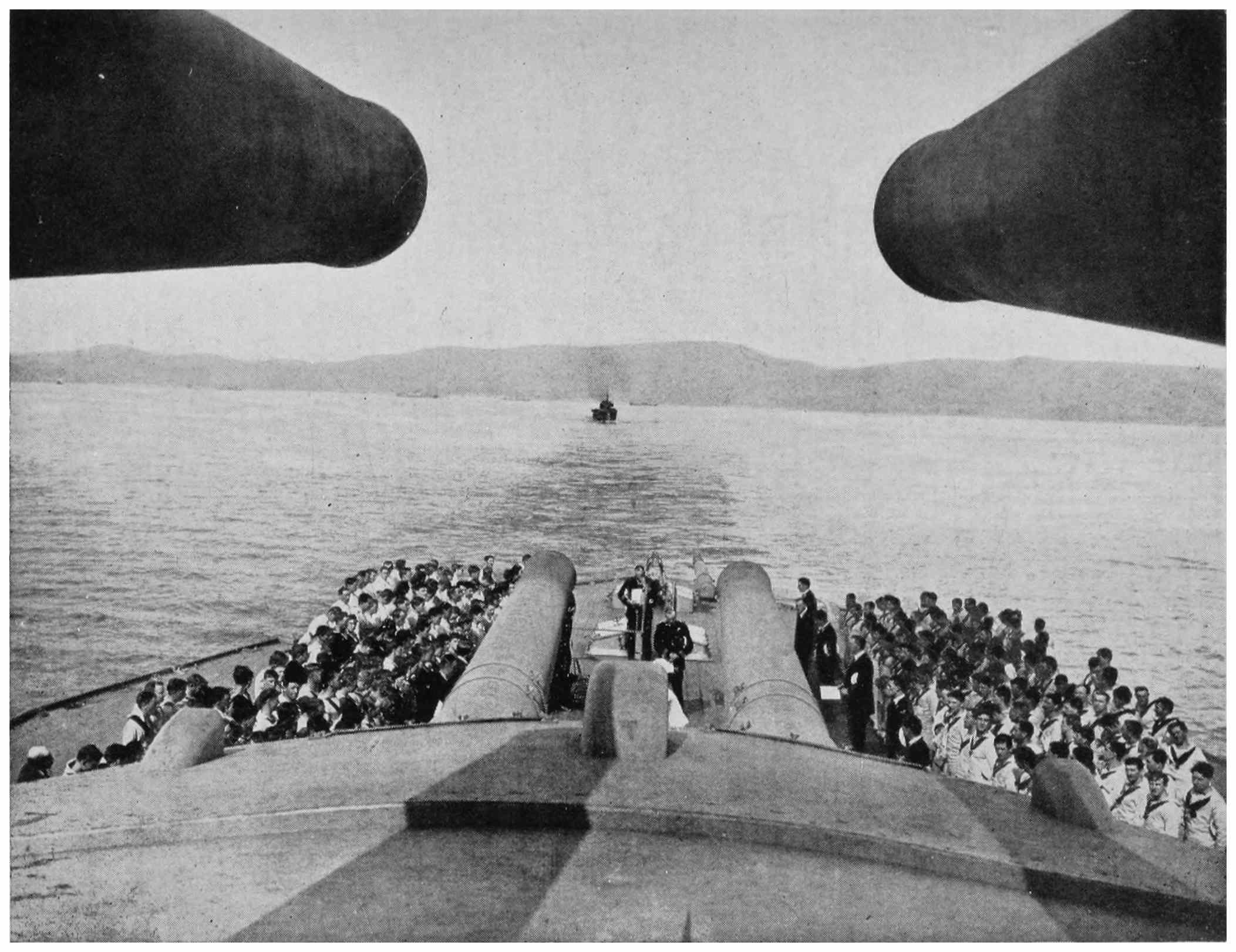
SERVICE ON BOARD H.M.S. QUEEN ELIZABETH, SEEN BETWEEN HER 15-INCH GUNS
At the same time he stated that it was assumed
that “older battleships” would be employed, furnished
with mine-sweepers, and preceded by colliers or other
merchant vessels as sweepers and bumpers. On
January 5 Carden replied:
“I do not think that the Dardanelles can be
rushed, but they might be forced by extended operations
with a large number of ships.”
Next day Mr. Churchill telegraphed: “High
authorities here concur in your opinion.” He further
asked for detailed particulars showing what force
would be required for extended operations.20
THE ADMIRALS IN AUTHORITY
Among the “high authorities,” Carden naturally
supposed that one or more of the naval experts who
attended the War Council were included. These
naval experts were, in the first place, Lord Fisher
(First Sea Lord) and Sir Arthur Wilson, Admirals
of long and distinguished service. Both were over
seventy years of age, and both were regarded by the
navy and the whole country with the highest respect,
though for distinct and even opposite qualities.
Lord Fisher had been exposed to the criticism
merited by all reformers, or bestowed upon them.
Especially it was argued that his insistence upon the
Dreadnought type, by rendering the former fleet obsolete,
had given our hostile rival upon the seas the
opportunity of starting a new naval construction on
almost equal terms with our own. But, none the less,
Lord Fisher was recognised as the man to command
the fleet by the right of genius, and his authority
at sea was hardly surpassed by Lord Kitchener’s on
land. The causes of the confidence and respect inspired
by Sir Arthur Wilson are sufficiently suggested
by his invariable nickname of “Tug.” Both Admirals
were members of the War Staff Group, instituted
by Prince Louis of Battenberg in the
previous November,21 and both attended the War
Council as the principal naval experts. Admiral
Sir Henry Jackson and Vice-Admiral Sir Henry
Oliver (Chief of the Staff) were also present on
occasion.
THEIR DUTY AS ADVISERS
The expert’s duty in such a position has been
much disputed. The question, in brief, is whether
he acts as adviser to his Minister only (in this case,
Mr. Churchill), or to the Council as a whole. Lord
Fisher and Sir Arthur Wilson, supported by Sir
James Wolfe Murray, Chief of the Imperial General
Staff under Lord Kitchener (who was always his own
expert), maintained they were right in acting solely
as Mr. Churchill’s advisers. Though they sat at the
same table, they did not consider themselves members
of the War Council. It was not for them to speak,
unless spoken to. They were to be seen and not
heard. The object of their presence was to help the
First Lord, if their help was asked, as it never was.
In case of disagreement with their chief, there could
be “no altercation.” They must be silent or resign.
Their office doomed them, as they considered, to the
old Persian’s deplorable fate of having many thoughts,
but no power.22 In this view of their duties, they
were strongly supported among the Dardanelles
Commissioners by Mr. Andrew Fisher (representing
Australia) and Sir Thomas Mackenzie (representing
New Zealand). Following official etiquette, they
were, it seems, justified in holding themselves bound
by official rules to acquiesce in anything short of
certain disaster rather than serve the country by an
undisciplined word.23
If this attitude was technically correct, it is the
more unfortunate that the Ministers most directly
concerned, as being members of the War Council,
should have taken exactly the opposite view, though
masters of parliamentary technique. In his evidence
before the Commission, Mr. Churchill, the man most
closely concerned, protested:
MR. CHURCHILL’S OBJECTS
“Whenever I went to the War Council I always
insisted on being accompanied by the First Sea Lord
and Sir Arthur Wilson, and when, at the War
Council, I spoke in the name of the Admiralty, I was
not expressing simply my own views, but I was expressing
to the best of my ability the opinions we had
agreed upon at our daily group meetings; and I was
expressing these opinions in the presence of two
naval colleagues and friends who had the right, the
knowledge, and the power at any moment to correct
me or dissent from what I said, and who were fully
cognizant of their rights.”24
Mr. Asquith said “he should have expected any
of the experts there, if they entertained a strong
personal view on their own expert authority, to express
it.”25 Lord Grey, Lord Haldane, Lord Crewe,
Mr. Lloyd George, and Colonel Maurice Hankey,
the very able Secretary to the War Council, gave
similar evidence. Mr. Balfour said: “I do not believe
it is any use having in experts unless you try
and get at their inner thoughts on the technical
questions before the Council.”26 In the House of
Commons, at a later date, Mr. Asquith maintained:
“They (the experts) were there—that was the
reason, and the only reason, for their being there—to
give the lay members the benefit of their advice....
To suppose that these experts were tongue-tied or
paralysed by a nervous regard for the possible opinion
of their political superiors is to suppose that they had
really abdicated the functions which they were intended
to discharge.”27
These views appear so reasonable that we might
suppose them unofficial, had not the speakers occupied
the highest official positions themselves. The
result of this difference of opinion regarding the duty
of expert advisers was disastrous. The War Council
assumed the silence of the experts to imply acquiescence,
whereas it sprang from obedience to etiquette.
Before the Commission, Lord Fisher stated that from
the first he was “instinctively against it” (i.e. against
Admiral Carden’s plan);28 that he “was dead against
the naval operation alone because he knew it must be
a failure”; and he added, “I must reiterate that as
a purely naval operation I think it was doomed to
failure.”29 It may be supposed that these statements
were prophecies after the event, and the Commissioners
observe that Lord Fisher did not at the time
record any such strongly adverse opinions. Nevertheless,
on the very day when a demonstration was
first discussed, he wrote privately to Mr. Churchill:
“I consider the attack on Turkey holds the field,
but only if it is immediate; however, it won’t be.
We shall decide on a futile bombardment of the Dardanelles,
which wears out the invaluable guns of the
Indefatigable, which probably will require replacement.
What good resulted from the last bombardment?
Did it move a single Turk from the Caucasus?”30
Two days later he sent Mr. Churchill a formal
minute, saying that our policy must not jeopardise
our naval superiority, but the advantages of possessing
Constantinople and getting wheat through the
Black Sea were so overwhelming that he considered
Colonel Hankey’s plans for Turkish operations vital
and imperative, and very pressing. The object of
these plans (circulated to the War Council on
December 28, 1914) was to strike at Germany
through her allies, particularly by weaving a web
around Turkey; and for this purpose Lord Fisher
sketched a much wider policy requiring the co-operation
of Roumania, Bulgaria, Greece, and Serbia.31
The scheme was not identical with another design
of naval strategy which was already occupying Lord
Fisher’s mind, and the frustration of which by the
Dardanelles Expedition ultimately caused his resignation
(in May). But the evidence here quoted shows
that Lord Fisher could not be included among the
“high authorities” referred to by Mr. Churchill as
concurring with Admiral Carden’s opinion. Mr.
Churchill said in his evidence that he did not wish to
include either Lord Fisher or Sir Arthur Wilson (who
throughout agreed with Lord Fisher in the main).
He was thinking of Admirals Jackson and Oliver.
Yet to Admiral Carden’s mind Lord Fisher would
naturally be suggested as one of the high authorities;
and was suggested.32
ADMIRAL JACKSON’S OPINION
So soon as a demonstration of some sort was
decided upon, Mr. Churchill asked Admiral Jackson
to prepare a memorandum, which the Admiral described
as a “Note on forcing the passages of the
Dardanelles and Bosphorus by the Allied fleets in
order to destroy the Turko-German squadron and
threaten Constantinople without military co-operation.”
The last three words are important, for it is
evident that, though Admiral Jackson expressed no
resolute opposition at the time, he was strongly
opposed to the idea of a merely naval attack. In
this memorandum he pointed out facts which even a
layman might have discerned: that the ships, even if
they destroyed the enemy squadron, would be exposed
to torpedo at night, to say nothing of field-guns
and rifles in the Straits, and would hold no line of
retreat unless the shore batteries had been destroyed;
that, though they might dominate the city, their position
would not be enviable without a large military
force to occupy it; that the bombardment alone would
not be worth the considerable loss involved; that the
city could not be occupied without troops, and there
was a risk of indiscriminate massacre.33
The dangers of an unsupported naval attack were
so obvious that Admiral Jackson can have needed no
further authority in urging them. Yet he may have
recalled a memorandum drawn up by the General
Staff (December 19, 1906), stating that “military
opinion, looking at the question from the point of
view of coast defence, would be in entire agreement
with the naval view that unaided action by the Fleet,
bearing in mind the risks involved, was much to be
deprecated.”34
Admiral Jackson’s discouraging memorandum of
January 5 was not shown to the War Council. Yet
it was of vital importance. In his evidence, Admiral
Jackson insisted that he had always stuck to this
memorandum:
“It would be a very mad thing,” he said, “to try
and get into the Sea of Marmora without having the
Gallipoli Peninsula held by our own troops or every
gun on both sides of the Straits destroyed. He had
never changed that opinion, and he had never given
any one any reason to think he had.”
Long afterwards, Mr. Churchill suggested that
what Admiral Jackson meant by a mad thing was an
attempt to rush the Straits without having strong
landing-parties available, and transports ready to
enter when the batteries were seen to be silent.35 It
is just possible to put that interpretation on the words,
but both they and the memorandum itself appear
naturally to imply a far larger military force than
landing-parties as essential.
On January 11 Vice-Admiral Carden telegraphed
a detailed scheme for gradually forcing the Dardanelles
by four successive stages, the operations to
cover about a month. The plan was considered by
the War Staff Group at the Admiralty, and in subsequent
evidence all agreed that they were very
dubious, if not hostile. Lord Fisher said he was
instinctively against it. Sir Arthur Wilson said he
never recommended it. Admiral Oliver and Commodore
Bartolomé said they were definitely opposed
to a purely naval attempt. But all agreed that the
operations could not lead to disaster, as they might
be broken off at any moment.36 Admiral Jackson
(not a member of the Group) also drew up a detailed
memorandum upon all stages of the plan, “concurring
generally,” and suggesting that the first stage should
be approved at once, as the experience gained might be
useful. He insisted in evidence that he recommended
only an attack on the outer forts. He accepted the
policy of a purely naval attack solely on the ground
that it was not for him to decide. His responsibility
was limited to his staff work, which he performed.37
THE WAR COUNCIL’S FIRST DECISION
The two decisive meetings of the War Council on
January 13 and January 28 followed. At the former
meeting Mr. Churchill explained the details of
Admiral Carden’s plan, adding that, besides certain
older ships, two new battle-cruisers, one being the
Queen Elizabeth, could be employed.38 He thus revived
his Antwerp experience of big-gun power
against fortresses. When the exposition of the whole
design was completed, Lord Kitchener gave it as his
opinion that “the plan was worth trying. We could
leave off the bombardment if it did not prove effective.”
In this delusive belief the War Council
arrived at the momentous decision:
“The Admiralty should prepare for a naval expedition
in February to bombard and take the Gallipoli
Peninsula, with Constantinople as its objective.”39
Although the word “take” is used, the Council had
no intention at this time of employing a military force.
It was assumed that none was available. The same
meeting sanctioned Sir John French’s plan for an
offensive in France (the offensive which degenerated
into the attack on Neuve Chapelle in March). In
case of a naval failure, the ships could be withdrawn;
in case of success, there was talk of a revolution in
Constantinople, and upon that hope the Council
gambled.40
During this meeting Lord Fisher, together with
Admiral Wilson and Sir James Murray, sat dumb as
usual, and his silence was as usual taken for assent.
When the Council had arrived at their resolution, he
considered his sole duty was to assist in carrying it
out. The very next day he signed a memorandum
from Mr. Churchill strongly advising that we should
devote ourselves to “the methodical forcing of the
Dardanelles,”41 and he added the two powerful battleships
Lord Nelson and Agamemnon to the fleet allotted
for this operation. But his underlying difference
of opinion became steadily stronger. In evidence,
Mr. Churchill said he “could see that Lord Fisher was
increasingly worried about the Dardanelles situation.
He reproached himself for having agreed to begin
the operation.... His great wish was to put a
stop to the whole thing.... I knew he wanted to
break off the whole operation and come away.”42 On
January 25 Lord Fisher took the unusual course of
writing to Mr. Asquith and stating his objections.
He considered the Dardanelles would divert from
another large plan of naval policy which he had in
mind; further, that it was calculated to dissipate our
naval strength, and to risk the older ships (besides
the invaluable men) which formed our only reserve
behind the Grand Fleet.43
MR. CHURCHILL’S INSISTENCE
Mr. Churchill replied in a similar memorandum
to the Prime Minister, defending his Dardanelles
plan on the plea of its value, even at a cost which,
after all, would be relatively small. In hope of
obtaining some agreement, Mr. Asquith invited Lord
Fisher and Mr. Churchill to his room just before
the meeting of the War Council on January 28—the
second decisive meeting. After discussion, the Prime
Minister expressed his satisfaction with Mr. Churchill’s
view, and all three proceeded to the Council.
It was a fairly full meeting, Sir Edward Grey and
Mr. Balfour being present, besides the three dominating
members and the experts. Mr. Churchill pressed
his plan with eloquent enthusiasm. “He was very
keen on his own views,” said Sir Arthur Wilson in
evidence; “he kept on saying he could do it without
the army; he only wanted the army to come in and
reap the fruits ... and I think he generally minimised
the risks from mobile guns, and treated it as
if the armoured ships were immune altogether from
injury.”44 Mr. Churchill re-stated the political and
strategic advantages of success. He said that the
Grand Duke Nicholas had replied with enthusiasm,
and that the French Admiralty had promised co-operation.45
He said the Commander-in-Chief in
the Mediterranean believed it could be done in three
weeks or a month. The necessary ships were already
on their way.
All the members of the War Council were won
by these persuasive arguments. They needed little
persuasion, and no persuasion is so strong as an
enterprise begun. But Lord Fisher for once broke
silence. He said he had not supposed the matter
would be raised that day, and that the Prime Minister
was well aware of his views. When he found that a
final decision was to be taken, he got up to leave the
room, intending to resign. But Lord Kitchener
intercepted him, and taking him to the window
strongly urged him to remain, pointing out that he
was the only dissentient and it was his duty to carry
on the work of his office as First Sea Lord. Whereupon
Lord Fisher reluctantly yielded to the entreaty
and returned to his seat.46
It is remarkable that at a meeting of such decisive
moment no mention was made of Lord Fisher’s
memorandum, nor of Mr. Churchill’s reply, nor of
their conference with the Prime Minister an hour
before. None the less, not only Mr. Asquith and
Mr. Churchill knew of Lord Fisher’s opposition.
Lord Kitchener knew of it; so did Sir Edward Grey.
Yet the opinion of the chief naval authority in England
was overruled. Mr. Asquith subsequently stated
that “the whole naval expert opinion available to us
(the War Council), whether our own or the French,
was unanimously and consentiently in favour of this
as a practical naval operation. There was not one
dissentient voice.” As to Lord Fisher, he continued,
it was quite true that he expressed on the morning
of that day an adverse, or at least an unfavourable
opinion, but not upon the ground of its merits or
demerits from a technical naval point of view:
“Lord Fisher’s opinion and advice were not
founded upon the naval technical merits or demerits
of this operation, but upon his avowed preference
for a wholly different objective in a totally different
sphere.”
No doubt Lord Fisher insisted mainly upon that
different objective as being the more important cause
of his opposition. But it seems evident that from
the first he was also opposed to a merely naval attack
and bombardment. His letter to Mr. Churchill on
January 2 (quoted above) proves this. And so does
the following clause in his memorandum to the Prime
Minister on January 25:
“The sole justification of coastal bombardments
and attacks by the fleet on fortified places, such as the
contemplated prolonged bombardment of the Dardanelles
forts by our fleet, is to force a decision at sea,
and so far and no further can they be justified.”47
Yet, in this case, there was no suggestion or possibility
of forcing a decision at sea.
LORD FISHER’S RELUCTANT ASSENT
In the afternoon of the same day (January 28)
Mr. Churchill had a private interview with Lord
Fisher, and “strongly urged him to undertake the
operation.” Lord Fisher definitely consented. Mr.
Churchill says that if he had failed to persuade him,
there would have been no need to altercate, or to
resign, or even to argue. He would have gone back
to the War Council and told them they must either
appoint a new Board of Admiralty or abandon the
project. “For the First Sea Lord has to order the
fleets to steam and the guns to fire.”48 Lord Fisher,
on the other hand, insisted in evidence that he had
taken every step, short of resignation, to show his
dislike of the proposed operations; that the chief
technical advisers of the Government ought not to
resign because their advice is not accepted, unless
they think the operations proposed must lead to
disastrous results; and that the attempt to force the
Dardanelles as a purely naval operation would not
have been disastrous so long as the ships employed
could be withdrawn at any moment, and only such
vessels were employed as could be spared without
detriment to the general service of the fleet.49
The divergence of opinion here is not so complete
as it seems; for by admitting that the War Council
could have appointed a new Board of Admiralty if
Lord Fisher had refused to carry out their decision,
Mr. Churchill showed that, though the First Sea
Lord could order the fleets to steam and the guns to
fire, the ultimate control did not lie with him. The
ultimate control lay with the Government (in this
case the War Council), and Lord Fisher was undoubtedly
right in thinking his constitutional duty
consisted in carrying out the Council’s decisions or
resigning his office. He did not resign at this time,
because he thought the naval attack did not necessarily
imply disaster. He agreed to undertake the charge.
He considered it his duty simply to carry out the
Council’s decision as best he could. With Mr.
Churchill he attended another Council meeting later
in the afternoon, and there the fateful, if not fatal,
step was taken. It was decided that an attack should
be made by the fleet alone, with Constantinople as its
objective.50
Though Lord Fisher agreed to do his best, and
though the members of the War Council accepted
the plan with more or less enthusiasm, the ultimate
decision was arrived at owing to Mr. Churchill’s
insistence upon his own brilliant idea, and his resolve
to attempt it even without military aid. The Commissioners
remark that in this resolve he was carried
away by his sanguine temperament and his firm
belief in the success of the undertaking which he
advocated.51 They were probably right. But as
evidence of the complexity in all natures—even in
a character apparently so self-confident, impetuous,
and sanguine—we may recall the passage in Mr.
Churchill’s speech upon these events, where, after
referring to “the doubts and the misgivings which
arise in every breast when these great hazards of
war are decided,” he went on to say:
“No one who has not had to take these decisions
can know how serious and painful are the stresses
which search every man’s heart when he knows that
an order is going to be given as a result of which
great ships may be lost, great interests may be
permanently ruined, and hundreds or even thousands
of men may be sent to their last account.”52
A NAVAL EXPEDITION DECREED
If ever the heart of man was searched by serious
and painful stress, it may well have been in that
Council chamber of January 28, 1915. For then a
decision was taken, and an order given, as a result
of which great ships were lost, great interests
permanently ruined, and thousands of men sent to
their last account.
CHAPTER III THE NAVAL ATTACKS
At the War Council meetings of January 28
a demonstration extending to the possible
capture of Constantinople was thus decided
upon, and the demonstration was to be purely naval.
All the members of the Council would have agreed
that a joint naval and military (or “amphibious”)
attack would have made success surer; but Lord
Kitchener declared the necessary troops could not
be supplied, and his decision was accepted without
question. The evidence shows that when first
Admiral Carden was commanded to attack, no hint
of military support was given him. He was expected
to depend entirely upon small landing-parties of his
own marines to demolish the forts.53 Mr. Churchill
has himself told us that, if an amphibious attack
had then been thought essential or seriously contemplated,
nothing at all would have been done.
Nothing less than 100,000 or 150,000 men could
have been asked for, together with large supplies
of high explosives and artillery. Whereupon, “all
the military experts” (i.e. Lord Kitchener, with the
possible addition of Lord French) “unanimously
would have said that the men were not available,
and the ammunition could not be spared from the
French front.”54 Whether it would not have been
well, even at this last moment, to abandon the
whole scheme rather than act contrary to the best
judgment of experts and laymen alike, has now,
unfortunately, become a matter of vain speculation.
HESITATION RENEWED
Hardly had the naval orders been given, and
the ships dispatched, when the Council began to
waver. It is impossible to fix a day for this change,
for the change itself wavered. In his evidence,
General Callwell (the D.M.O.) said: “We drifted
into the big military attack”;55 and “drift” is the
precise word for the Council’s uncertain course.
By the middle of February the feeling had evidently
set towards an amphibious movement; but up to the
middle of March they hoped that the need of landing
troops upon a large scale might be avoided by purely
naval success. It appears that early in February
Lord Kitchener began to yield. Probably his former
decision was shaken by the abandonment of a large-scale
offensive in France, and by the failure of the
Turkish attack upon the Suez Canal (February 3
and 4). Though the Turkish force was allowed to
retreat without the destruction which greater energy
in the Egyptian Command might have brought upon
it, the troops then in Egypt had proved more than
sufficient for defence; and Egypt, as we have noticed,
was always Lord Kitchener’s peculiar care. On
February 9 he remarked in the War Council that
“if the Navy required the assistance of the land
forces at a later stage, that assistance would be
forthcoming.”
THE 29TH DIVISION DETAINED
But, by the majority of the Council, the claim
for assistance was not postponed to a later stage.
On February 15 Sir Henry Jackson sent a long
memorandum of “suggestions” to Admiral Carden
in regard to the approaching naval attack. Not
only did this memorandum speak of strong military
landing-parties with strong covering forces as necessary,
but it added that “full advantage of the
undertaking would only be obtained by the occupation
of the Peninsula by a military force acting in conjunction
with the naval operations.” The very
next day (February 16) the War Council decided
to send the 29th Division (hitherto destined for
France) at the earliest possible date to Lemnos;
to arrange for a force from Egypt, if required; and
to order the Admiralty to prepare transport for the
conveyance and landing of 50,000 men.56 The navy
and army were thus at last committed to an amphibious
enterprise; but nineteen days had been lost.
What was worse: the 29th Division was to have
started on February 22, but on the 20th Lord
Kitchener, on his own initiative, without consulting
the First Lord or the Admirals, told the Director
of Naval Transport to stop the preparation of
transport, as the Division was not to go. In spite
of Mr. Churchill’s vehement protests (for even his
confidence in a purely naval attack was now shaking),
Lord Kitchener stood by his decision till March 10,
and the Division did not begin to start till March 16.
Twenty-two more days lost! Add the nineteen of
the Council’s hesitation, and forty-one days were
lost in all. Forty-one days in an enterprise which
depended upon speed and secrecy!
Undoubtedly Lord Kitchener had sufficient
reason for delay. The Russian armies were hard
pressed on their right or northern flank, and in the
centre Hindenburg was pushing his third attempt
upon Warsaw. If the Germans were successful at
either point, it was probable that they would transfer
large forces to their Western front, with which the
French were then heavily engaged in Champagne
and between the Moselle and Meuse, while the
British were preparing and executing the assault
at Neuve Chapelle (March 10 to 14).57 There may
have been other reasons, but those were enough to
justify caution in allowing a splendid Regular Division
like the 29th to be diverted from the critical strategic
lines in France. Its retention, without due notice
to the War Council, was sudden and arbitrary.
That was Lord Kitchener’s way, and no more could
be said. Perhaps the Division should not have
been offered, and the Secretary for War, who also
held supreme military command, could not be blamed
for retaining it under his hand. Nevertheless, its
retention stands high among the causes of ultimate
disaster.
By the middle of February the War Council had
tacitly abandoned the idea of a mere demonstration
from which the ships could be at any moment withdrawn.
But both Lord Kitchener and Mr. Churchill
still thought that troops, if used at all, would be
wanted only for “minor operations,” such as the final
destruction of batteries, and both clung to this idea
for about four weeks longer. Yet, in the first week
of March, General Birdwood, who had been sent
from Egypt to report upon this very question, telegraphed
to Lord Kitchener that he was doubtful if
the navy could force a passage unassisted, and that
Admiral Carden’s forecast was too sanguine.58
THE DARDANELLES
By that time General Birdwood had definite
experience to guide him; for, in obedience to
Mr. Churchill’s orders, Admiral Carden had on
February 19 begun to execute his detailed plan for
forcing the Straits by naval power alone. The
scene of our narrative accordingly shifts from the
Council Chambers of Whitehall to that famous
channel which, like a broad, deep river, divides
the European from the Asiatic coast. Celebrated
beyond all other waters of the world by legend and
history, and by one of mankind’s noblest poems,
it is haunted by almost overwhelming memories, to
which the great tragedy here described has added
new. At the very entrance, where the passage
is three miles broad, you see upon your right hand
the flat and gently curving beach upon which
Agamemnon tied his ships for the prolonged siege
of a low hill, formed even in his time of ruined and
piled-up cities. It rises, still quite visible from the
opposite shore, above the marshes where Simois and
Scamander unite their small and immortal streams.
Vandyk]
GENERAL SIR WILLIAM BIRDWOOD
Steering north-east, a vessel beats up against the
swirling eddies of a tideless current, always pouring
down against her bows, with a force that varies
from three knots to four, and even to five in the
centre when the wind drives it on. Sailors have
told me that they believe an undercurrent passes the
water back; else, they think, it could not perpetually
run so strong. What was the experience of submarine
officers like Lieutenant Holbrook, who, on
December 13, 1914, groped his way below the
surface and through the mines till he emerged near
the entrance to the Sea of Marmora, and destroyed
the Turkish warship Messoudieh, I do not know.
But it seems probable that enough water is poured
into the Black Sea by the Dnieper, Dniester, and
Don, rivers of the Steppes, to account for a rapid
current, not to speak of the glacier streams issuing
from the snows of the Caucasus beyond the magic
Phasis. All the more likely is the current to be
swift since the waters from the shores of Azoff, the
Euxine, and Marmora are discharged down a constricted
funnel, which at the narrowest point, between
Chanak and Kilid Bahr, is hardly more than three-quarters
of a mile across. At Chanak, as a ship
makes its way against the stream, the strait turns
north from north-east for about four miles, and at
the point of Nagara (the old Abydos) the channel
becomes again almost as narrow as at Chanak.
That part of the strait between Chanak and Nagara
(both on the Asiatic side) is called especially
“The Narrows,” and it forms, as it were, “The
Gut” of the whole salt river. Here Xerxes stretched
his bridge of boats, having chained and flogged the
turbulent waters. Here Alexander crossed upon
his way to India. Seven hundred years later the
Goths crossed here, and the Turks here entered
Europe, a century before they stormed the city of
Constantine, which still retained the traditions of
the classic world. Beyond the Narrows the strait
runs north-east again with a channel about two
miles broad for some twenty miles, until between
Gallipoli and Chardak it begins to widen gradually
into the Sea of Marmora. The total length of the
strait from Cape Helles to Gallipoli is between thirty-five
and forty miles. The Asiatic side is the coast
of the ancient Troad, rising to high hills when the
plain of Troy is passed. On the European side the
long promontory or peninsula of Gallipoli precludes
the channel from issuing into the Gulf of Xeros at
the neck of Bulair, or lower down into the Ægean
Sea. It is the south-western third of that peninsula
which is the scene of the present tragic episode in
history. There is no railway on either side of the
strait. A coast road is marked from Kum Kali (at
the entrance on the Asiatic side) up to Chanak;
but it is probably of the usual Turkish quality, as
were all roads upon the peninsula. Along both
coasts the inhabitants in peace-time communicate
chiefly by water, in spite of the current.
THE ISLAND OF LEMNOS
The small island of Tenedos lies about fifteen miles
south-west from Kum Kali, and the domed hill at
the farther end of the island stands up like a large
haycock, visible not only from the Trojan plain, but
from all the surrounding seas and islands. The
town is a pleasant and well-built place, serviceable
to the French for the purchase of extra luxuries in
the months following; and as Turkey had refused
to yield the island to Greece at the end of the Balkan
Wars of 1912–1913, it had been seized by the Allies
as a station for watching the mouth of the strait.
From epic times, however, it was known as an
untrustworthy anchorage, and for a naval base the
Allies occupied the great harbour of Mudros upon
the island of Lemnos, sixty miles from the scene
of action. The greater part of this island is bare
of trees, and barren but for patches of cultivation
around the scattered villages. In summer the low
hills are scorched to a pale brown, and, for an
Ægean island, the country possesses little beauty
or interest apart from the hot springs for which it
was consecrated to the god of fire.59 But into the
centre of the southern coast runs a deep and broad
inlet, protected at its entrance by two small islands,
and affording space and anchorage enough for a vast
navy. Its size is indeed excessive; for when the
wind sweeps down from the north-east across the
dismal and dusty town of Mudros, it can raise such
a storm in the harbour that pinnaces and smaller
boats have trouble in lying alongside the ships, and
in loading up or unloading. There are, of course,
no docks or wharves, though our sailors subsequently
constructed a few small piers and landing-stages.
All supplies, including most of the water, had to be
brought from the remote base at Alexandria; but
the harbour became, none the less, invaluable as a
secure port for our navy and transports, a forwarding
station for supply and ammunition, the headquarters
of the Communication and Transport departments,
and an advanced hospital base. The use of it was
granted by the Greek Government under Venizelos;
for the island had fallen into Greek possession in
consequence of the Balkan Wars; and King Constantine
appears to have acquiesced graciously in a
concession which could not be refused.
SHIPS OF THE FLEET
In this vast harbour, and upon the open roadstead
of Tenedos, Admiral Carden had gathered
a large fleet by the middle of February. Ships
were collected from various parts of the world (the
Triumph had lately come from China);60 but
Gibraltar, Malta, and Egypt supplied most of them.
At Lord Fisher’s own suggestion the super-Dreadnought
Queen Elizabeth had been added to
the pre-Dreadnought ships upon which Mr. Churchill
had originally depended. The Inflexible was also
a “Dreadnought” battle-cruiser (she had shared
in the Falkland Islands battle of December 8,
1914), and the sister ships Agamemnon and Lord
Nelson, which Lord Fisher also added a little later
than the rest of the fleet, were generally regarded
as fit to fight in line with “Dreadnoughts.” The
French Admiralty, at our request, also supplied
a few ships, though of old types, which have an
overhampered and top-heavy appearance. The most
important units in the fleet as concentrated at that
time may be tabulated thus:
To these main fighting ships were added four
light cruisers (the Amethyst, Sapphire, Dublin, and
Doris), two destroyer depôts, sixteen destroyers, six
submarines, twenty-one mine-sweeping trawlers, and
a seaplane ship (the Ark Royal) accommodating six
seaplanes; besides from the French navy six torpedo-boats
and fourteen mine-sweepers.
Out of this fleet, Admiral Carden selected the
British ships Inflexible, Agamemnon, Cornwallis,
Triumph, and Vengeance, together with the French
ships (under Admiral Guépratte) Suffren, Bouvet, and
Gaulois, covered by a large number of destroyers,
for the first attack upon the outer forts. Orders for
washing and clean clothes (to avoid septic wounds)
were issued on February 18, and next morning, in
clear and calm weather, “General Quarters” was
sounded. The firing began at eight, and the first
scene in the drama of the Dardanelles Expedition was
enacted.62
The main forts to be destroyed were four in
number; two on either side the entrance. One
stood on the cliff of Cape Helles, just to the left or
south-west of the shelving amphitheatre afterwards
celebrated as V Beach. Another lay low down, on
the right of the same beach, close in front of the
medieval castle of Seddel Bahr, where still one sees
lying in heaps or scattered over the ground huge
cannon-balls of stone, such as were hurled at Duckworth’s
fleet more than a century before. Upon the
Asiatic side stood the fort of Kum Kali, at the very
mouth of the strait, not far from the cliff village of
Yenishehr, and separated from the plain of Troy by
the river Mendere, near neighbour to the Simois and
Scamander conjoined. About a mile down the coast,
close beside Yenishehr village, is the remaining fort
of Orkhanieh. None of these forts was heavily
armed. The largest guns appear to have been
10·2 inch (six on Seddel Bahr, and four on Kum
Kali), and when our squadron drew their fire, as
before narrated, on November 3, 1914, their extreme
range was found to be 12,500 yards.
FIRST NAVAL ACTION
Throughout the morning Admiral Carden concentrated
his bombardment upon these forts at long
range, and they made no reply. Hoping that he
had silenced or utterly destroyed them, he advanced
six ships to closer range in the afternoon, and then
the reply came in earnest, though the shooting was
poor. At sunset he withdrew the ships, though
Kum Kali was still firing. In evidence, he admitted
that “the result of the day’s action showed apparently
that the effect of long range bombardment by direct
fire on modern earthwork forts is slight.”63 It was a
lesson repeated time after time throughout the campaign.
The big naval shells threw up stones and
earth as from volcanoes, and caused great alarm.
But the alarm was temporary, and the effect, whether
on earthworks or trenches, usually disappointing. For
naval guns, constructed to strike visible objects at
long range with marvellous accuracy, have too flat a
trajectory for the plunging fire (as of howitzers) which
devastates earthworks and trenches. It was with heavy
howitzers that the Germans destroyed the forts of
Liége, Namur, and Antwerp, and, owing to this obvious
difference in the weapons employed, Mr. Churchill’s
expectation of crushing the Dardanelles defences by
the big guns of the Queen Elizabeth and the Inflexible
was frustrated.64
Nevertheless, after a few days of driving rain and
heavy sea (a common event at this season, which
might have been anticipated), Admiral Carden renewed
the bombardment on February 25, employing
the Queen Elizabeth, Irresistible, Agamemnon, and
Gaulois. The Queen Elizabeth, firing beyond the
enemy’s range, assisted in silencing the powerful
batteries on Cape Helles, and though the Agamemnon
was severely struck at about 11,000 yards range, the
subsidiary ships Cornwallis, Vengeance, Triumph,
Albion, Suffren, and Charlemagne stood in closer,
and by the evening compelled all the outer forts to
cease fire. Next day landing-parties of marines
were put ashore to complete their destruction; which
they did, though at Kum Kali they were driven back
to their boats with some loss. The story that
marines had tea at Krithia and climbed Achi Baba
for the view—places soon to acquire such ill-omened
fame—is mythical. But certainly they met with no
opposition on the Peninsula, and if a large military
force had then been available, the gallant but appalling
events of the landing two months later would
never have occurred. Had not the War Council
persisted in the design of a solely naval attack, even
after their resolve had begun to waver, a large
military force might have been available, either then,
or to co-operate with a similar naval movement only
a week or two later.
SUBSEQUENT NAVAL ACTIONS
Stormy weather delayed further attack till March 4,
when a squadron, including the Triumph, Albion,
Lord Nelson, and Ocean, passed up the strait to a
position beyond the village of Erenkeui, conspicuous
upon a mountain-side of the Asiatic coast, and bombarded
Fort Dardanus. The fort stands upon
Kephez Point, which projects as though to defend
the very entrance of the Narrows. Over the top of
the promontory the houses and mosques of Chanak
and Kilid Bahr could be plainly seen, where those
towns face each other across the narrowest part of the
passage. Of the eight lines of mine-field drawn
across the strait, five lay between Kephez Point and
Chanak. Day and night our mine-sweeping trawlers
were engaged upon them, and considerable praise
must be given to the courage and endurance of
their crews, who for the most part had been North
Sea fishermen before the expedition. Their service
throughout, whether for mine-sweeping or transport,
was of very high value. It almost justified the
remark made to me by a skipper whom I had met
before on the Dogger Bank: “If the Kayser had
knowed as we’d got trawlers, he would never have
declared war!”
A similar advance to engage the forts at Dardanus,
and, after those were thought to be silenced, the forts
at Chanak and Kilid Bahr, was made next day, and
again, in stronger force, on March 6.65 The Prince
George, Albion, Vengeance, Majestic, and Suffren
were employed, and suffered damage, though without
loss of life. At the same time, on the 6th, the Queen
Elizabeth, stationed off Gaba Tepe on the outer
coast, flung her vast shells clear over the Peninsula
into the Chanak forts, her fire being directed by
aeroplanes. She was supported by the Agamemnon
and Ocean, and there were high hopes of thus crushing
out the big guns defending the Narrows, some of
which were believed to be 14-inch. Nevertheless,
when the four French battleships advanced up the
strait on the following day (March 7), supported at
long range by the Agamemnon and her sister ship
Lord Nelson, the Chanak forts replied with an
effective and damaging fire. It was impossible to say
when a fort was really out of action. After long
silence, the Turkish and German gunners frequently
returned and reopened fire, as though nothing had
happened. In his evidence, Admiral Carden stated
that when the demolition parties landed after the
bombardment of the outer forts, they found 70 per
cent. of the guns apparently intact upon their mountings,
although their magazines were blown up and
their electrical or other communications destroyed.66
Still worse than these disappointing results was the
opportunity left to the enemy of moving, not only
bodies of men, but field-guns and heavy howitzers
from one point of the Peninsula and Asiatic coast
to another, and opening fire upon the ships from
concealed and unexpected positions. Our landing-parties
of marines also suffered considerably from the
advantage thus given to the enemy, as happened to a
body which landed at Kum Kali for the second time
on March 4. All such dangers and hindrances would
have been removed if the navy had been supported by
sufficient military force to occupy the ground behind
the ships as they advanced.
EFFECT ON BALKAN STATES
A bombardment of the Smyrna forts farther down
the coast of Asia was carried out on March 5 and 7
by a detachment under Vice-Admiral Peirse. It was
hoped that the Vali of Smyrna might come over to
us, and that in any case the attack would detain a
Turkish force there by means of a rather obvious
feint.67 Nothing of vital importance was as yet
accomplished there or in the Straits, but up to about
March 10 the Admiralty at home remained sanguine,
in spite of General Birdwood’s rather discouraging
telegram of March 5, mentioned above. They had
a right to consider that the attack upon the Dardanelles
had produced a stirring effect in the Near
East. The Turks withdrew large forces from the
Caucasus, greatly easing the situation for the Russian
Grand Duke. They concentrated more troops round
Adrianople, fearing that Bulgaria might clutch this
opportunity for retrieving her loss of that city in 1913.
Bitter as was the Bulgarian hatred of Serbia and
Greece for their reversal of the Balkan League policy
in that year, and for their breach of treaties and
territorial arrangements, it now seemed certain that
if Bulgaria departed from neutrality at all, she would
stand among our Allies. Only a few days later
(March 17) General Paget, then engaged on a special
mission to the Balkans, telegraphed to Lord
Kitchener:
“The operations in the Dardanelles have made a
deep impression; all possibility of Bulgaria attacking
any Balkan State that might side with the Entente
is now over, and there is some reason to think that
shortly the Bulgarian army will move against Turkey
to co-operate in the Dardanelles operations.”68
That was a high hope, for the attitude of Bulgaria
was then, as it became still more definitely later on,
the key of the Near Eastern situation. But for the
moment, the effect upon Greece appeared even more
propitious. M. Venizelos had in the previous month
refused to allow Greece to be drawn into a war for
the defence of Serbia, though England and France
promised a Division each at Salonika, and it was
believed that this strategy was specially favoured by
Mr. Lloyd George. Now, however (March 1), he
voluntarily offered our Minister in Athens three
Greek Divisions for Gallipoli on condition that Greece
received the vilayet of Smyrna; and next day our
Minister telegraphed that the King had been sounded
and “wanted war.”69 The proposal was abruptly
checked by the jealousy of the Tsar’s Government,
which refused to allow a Greek soldier to approach
the long-desired prize of Constantinople. But to
make Constantine “want war” must have required
a miraculous interposition, and the effect of three
Divisions—even Greek Divisions—landing upon the
Peninsula at that moment might have been more
miraculous still.70 Of even greater ultimate importance
was the influence upon Italy; for it was now that,
under the guidance of Baron Sonnino, and the strong
encouragement of Mr. Asquith, she entered upon the
devious negotiations which led to her declaration of
war against Austria on May 23.
But valuable as were these political results, the
naval attack itself was going slow, and Mr. Churchill
read the daily telegrams with increasing impatience.
The fact was that the enemy, having the free run of
the Peninsula as well as of the Asiatic coast, could
plant and conceal his movable howitzers and other
armaments where he pleased, and it was becoming
increasingly evident that, unless the Peninsula was
occupied by our military forces, the passage of the
Narrows would mean extreme risk for our ships, and,
even if they got through, the channel would not be
cleared for transports following them. Now was the
moment when a permanent landing would be of the
highest service, and on March 10 Mr. Churchill
evidently realised the need of troops acutely. But
it was only on that very day that Lord Kitchener
finally decided to allow the 29th Division to start
from England, and they did not leave port till the
16th. Regarding the other detailed troops as less
trained and experienced than they really were, Lord
Kitchener refused to allow a landing till the Regular
Division arrived. And, indeed, he still clung to the
idea that no landing would be necessary.
MR. CHURCHILL URGES GREATER VIGOUR
Accordingly, Mr. Churchill, though striving to
restrain his impatience, strongly urged Admiral
Carden to press forward the naval attack with the
utmost vigour. In a telegram of March 11 he
wrote:
“If success cannot be obtained without loss of
ships and men, results to be gained are important
enough to justify such a loss. The whole operation
may be decided, and consequences of a decisive
character upon the war may be produced by the turning
of the corner Chanak.... We have no wish to
hurry you or urge you beyond your judgment, but we
recognise clearly that at a certain period in your operations
you will have to press hard for a decision; and
we desire to know whether, in your opinion, that
period has now arrived. Every well-conceived
action for forcing a decision, even should regrettable
losses be entailed, will receive our support.”
To this Admiral Carden replied that he considered
the stage for vigorous action had now been reached,
but that, when the fleet entered the Sea of Marmora,
military operations on a large scale should be opened
at once, so as to secure communications. On March
15 Mr. Churchill, still anxious not to allow his impatience
to drive him into rashness, telegraphed again
that, though no time was to be lost, there should be
no undue haste. An attempt to rush the passage
without having cleared a channel through the mines
and destroyed the primary armament of the forts was
not contemplated. The close co-operation of army
and navy must be carefully studied, and it might be
found that a naval rush would be costly without
military occupation of the Kilid Bahr plateau. On
these points the Admiral was to consult with the
General who was being sent out to take command of
the troops. To all of this Admiral Carden agreed.
He proposed to begin vigorous operations on March
17, but did not intend to rush the passage before a
channel was cleared. This answer was telegraphed
on March 16. But on the same day the Admiral
resigned his command owing to serious ill-health.71
DE ROBECK SUCCEEDS CARDEN
Rear-Admiral Sir John de Robeck, second in
command, was next day appointed his successor. He
was five years younger, was, of course, fully cognizant
of the plans, and expressed his entire approval of
them. Yet it appears from his evidence that though
strongly urged by Mr. Churchill to act on “his independent
and separate judgment,” and not to
hesitate to state objections, his real motive in carrying
on the pre-arranged scheme was not so much his confidence
in success as his fear lest a withdrawal might
injure our prestige in the Near East; and, secondly,
his desire to make the best he could of an idea which
he regarded as an order. “The order was to carry
out a certain operation,” he said, “or try to do it, and
we had to do the best we could.” If the ships got
through, he, like many others, expected a revolution
or other political change in Turkey. Otherwise, he
saw that transports could not come up, and that the
ships could not remain in the Sea of Marmora for more
than a fortnight or three weeks, but would have to run
the gauntlet coming down again, just as Admiral
Duckworth did in 1807.72 In his telegram accepting
the command, however, he made no mention of these
considerations, but only said that success depended
upon clearing the mine-fields after silencing the forts.
Indeed, he had small time for any considerations.
For on the very first day after receiving his command
(March 18) he undertook the main attempt to force
the Narrows. The weather was favourable—no mist
and little wind. The scheme was to attack in three
squadrons successively. The first blow was given
by the four most powerful ships—Queen Elizabeth,
Inflexible, Lord Nelson, and Agamemnon—which
poured heavy shell at long range into the forts at
Chanak and Kilid Bahr, while the Triumph and
Prince George bombarded Fort Dardanus on the
Asiatic coast, and Fort Soghandere, opposite to it
upon the Peninsula. This bombardment lasted from
about 11 a.m. till 12.30 p.m., and all six ships found
themselves exposed to heavy fire from the forts, and
from hidden howitzers and field-guns in varied
positions upon both shores. At about 12.30 the
second squadron, consisting of the four French ships,
came up into action, advancing beyond the former
line in the direction of Kephez Point. Though
suffering considerably (chiefly owing to their inability
to manœuvre in such narrow waters, thus presenting
very visible and almost fixed targets to the enemy’s
guns), the ten ships maintained the bombardment
for about an hour (till nearly 1.30). The enemy’s
forts then fell silent, and it was hoped that many of
them, at all events, had been destroyed.
THE MAIN NAVAL ACTION
Accordingly, the third squadron, consisting of six
British ships (Irresistible, Vengeance, Ocean, Swiftsure,
Majestic, and Albion), were brought up, with
the design of advancing first through the Narrows,
so as to ensure a clear passage for the greater ships
which made the first attack. At the same time the
four French ships, together with the Triumph and
Prince George, were ordered to withdraw, so as to
leave more room for the rest. During this manœuvre,
all or nearly all the guns in the forts opened fire
again, their silence having been due, not to destruction,
but to the absence of the gunners, driven away
by the gases or terror of our shells. Most of the
ships suffered, and as the Bouvet moved down
channel with her companion ships, she was struck
by three big shells in quick succession. The blows
were immediately followed by a vast explosion. It
is disputed whether this was due to a shell bursting
in her magazine, or to a torpedo fired from the
Asiatic coast, or, as the Admiralty report said, to a
mine drifting down the current. In two or three
minutes she sank in deep water just north of Erenkeui,
carrying nearly the whole of her crew to the bottom.
The cries of the men dragged down with her, or
struggling in the water as they were swept downstream,
sounded over the strait.
At 2.30 the bombardment of all the forts was
renewed, but they were not silenced. At 4 o’clock
the Irresistible drew away with a heavy list. Apparently
she also was struck by a mine adrift; but
she remained afloat for nearly two hours, and nearly
all her crew were saved by destroyers, which swarmed
round her at great risk to themselves, since they
offered a crowded target. A quarter of an hour after
she sank, the Ocean was struck in a similar manner
(6.5 p.m.) and sank with great rapidity. Most of
her crew, however, were also saved by destroyers
near at hand. Many of the other ships were
struck by shell. The Inflexible and Gaulois suffered
especially, and only just crawled back to be beached,
the one at Tenedos, the other at Rabbit Island. At
sunset the fleet was withdrawn. It had been proved
once more that, in an attack upon land forts, ships
lie at a great disadvantage. In this case the disadvantage
was much increased by the narrowness of
the waters, which brought the ships within range of
howitzer and other batteries hidden upon both shores,
and also gave special opportunity for the use of
mines drifting on the rapid current, or anchored
right across the channel in successive rows. The
mines of the second row were opposite the intervals
in the first, and so on, until the passage was covered
as with a net, each row containing twenty-six mines.
Whether shore-torpedoes were also used is still uncertain.
But, without them, the fleet suffered under
sufficient disadvantages to explain the failure. The
first serious attempt to force the Straits was the last.73
Mr. Churchill wished to renew the attempt at
once. Perhaps he thought that English people are
given to exaggerate the loss of a battleship. After
all, the loss of even three battleships is far surpassed
by the loss of lives and calculable wealth in one day’s
ordinary fighting in France, and the objective in the
Dardanelles was at least as vital.74 Lord Fisher and
Sir Arthur Wilson agreed that the action should be
continued, and the London and Prince of Wales, in
addition to the Queen and Implacable, were actually
sent to reinforce. The French also sent an old
battleship (the Henri IV.) to replace the Bouvet.
At first Admiral de Robeck shared this view. It
was suspected at the Admiralty that the ammunition
in the forts was running short, and, at a much later
date, Enver Pasha is reported to have said:
“If the English had only had the courage to rush
more ships through the Dardanelles, they could have
got to Constantinople; but their delay enabled us
thoroughly to fortify the Peninsula, and in six weeks’
time we had taken down there over 200 Austrian
Skoda guns.”75
PURELY NAVAL ACTION ABANDONED
That delay of six weeks was fatal, but the navy
was not to blame. On March 22 Admiral de Robeck
and Admiral Wemyss consulted with Sir Ian Hamilton
(who on the very day before the engagement had
arrived at Tenedos to take command of the land
forces) and with General Birdwood; and as their
decision to await the concentration of the army was
accepted by Lord Fisher and the other Admiralty
advisers, Mr. Churchill reluctantly yielded. General
Birdwood, it is true, wished to land at once, even
with such troops as were at hand. Sir Ian “thought
there was a good deal to be said for it,” and as to
the fleet, he urged the Admiral to keep on hammering
the forts. But his orders from Lord Kitchener
were “not to land if he could avoid it,” and in any
case to await the arrival of the 29th Division.76
And where was the 29th Division? On March
23 its first transport was just reaching Malta, where
nearly all the officers attended a special performance
of Faust.77
CHAPTER IV THE PREPARATION
SIR IAN’S APPOINTMENT
As was mentioned, Sir Ian Hamilton reached
Tenedos on March 17, the day before the
naval engagement. The appointment to
command the military forces had come to him unexpectedly
but five days earlier, and on March 13 he
started from London. He had received only slight
and vague instructions from Lord Kitchener, but on
certain limitations the Secretary for War insisted, and
all of them strongly influenced Sir Ian’s subsequent
action. If possible a landing was to be avoided;
none was to be attempted until the fleet had made
every effort to penetrate the Straits and had failed;
if a landing became unavoidable, none should be
made until the full force available had assembled;
and no adventurous operations were to be undertaken
on the Asiatic side. All these instructions were
followed.78
But they revealed the hesitating reluctance with
which the Dardanelles campaign was regarded, not
only by Lord Kitchener himself, but by his subordinate
generals at home and in France. The
“Westerners” were, naturally, in the ascendant.
The danger to the Allied cause lay close at hand. It
had only recently been averted from the Channel
and from Paris. The British Staff, equally with the
French, represented that not a man could be spared
from France, and that the only assured road to
victory lay straight through the German lines. The
opposition to any “side-show,” especially if it diverted
a Regular Division such as the 29th, was expressed
with the emphasis of jealous alarm.
SIR IAN’S QUALIFICATIONS
Even the appointment of Sir Ian Hamilton to
the distant enterprise was likely to be received with
mingled sentiments. He counted forty-two years of
service in the army. Since the days of the Afghan
War and Majuba Hill (where his left hand was
shattered), he had risen step by step to all but the
highest commands. The Nile, Burma, Chitral, and
Tirah had known him. He commanded the infantry
in the rapid but vital engagement at Elandslaagte,
and during the siege of Ladysmith had charge of the
extensive and dangerous sector known as Cæsar’s
Camp and Wagon Hill. In the final months of the
Boer War he was Lord Kitchener’s Chief of Staff,
and commanded mobile columns in the Western
Transvaal, greatly contributing to the conclusion of
the war. Since then he had served at home as
Quartermaster-General, as G.O.C.-in-Chief of the
Southern Command, and as Adjutant-General.
Abroad he had served as Military Representative of
India with the Japanese army in Manchuria (1904–1905,
when, in A Staff Officer’s Scrap-Book, he foretold
the disappearance of cavalry and the prevalence
of the trench in future warfare), as General
Officer-Commanding-in-Chief in the Mediterranean,
and Inspector-General of the Overseas Forces
(1910–1915). Except that he had never yet held
supreme command in any considerable campaign,
his experience in military affairs and in almost
every phase of our army’s activity was hardly to
be surpassed.
On the other hand, he was sixty-two; and,
though he was a year younger than Lord French, and
retained a slim and active figure such as enabled Lord
Roberts to take command in South Africa at seventy,
sixty-two was regarded as a full age for any officer
in so difficult a campaign upon a desert promontory.
From a mingled Highland and Irish descent he had
inherited the so-called Celtic qualities which are
regarded by thorough Englishmen with varying
admiration and dislike. His blood gave him so
conspicuous a physical courage that, after the battles
of Cæsar’s Camp and Diamond Hill, the present
writer, who knew him there, regarded him as an
example of the rare type which not merely conceals
fear with success, but does not feel it. Undoubtedly
he was deeply tinged with the “Celtic charm”—that
glamour of mind and courtesy of behaviour which
create suspicion among people endowed with neither.
Through his nature ran a strain of the idealistic spirit
which some despise as quixotic, and others salute as
chivalrous, while, with cautious solicitude, they avoid
it in themselves. It was known also that Sir Ian
was susceptible to the influence of beauty in other
forms than those usually conceded to military men.
He was an acknowledged master of English prose,
and though our people read more in quantity than
any other nation, the literary gift is regarded among
us as a sign of incapacity, and is not, as in France and
ancient Greece, accepted as assurance of far-reaching
powers. What was worse, he was known to have
written poetry.
Before the war, his opposition to the introduction
of conscription in the United Kingdom had roused
the animosity of all who aimed at establishing militarism
as a permanent system in this country. Thus
political animosity was added to the official prejudice
against a buoyant and liberal temperament, conjoined
with a politeness and an open-hearted manner startlingly
at variance with official usage. One must
acknowledge that, in choosing the man for command,
Lord Kitchener hardly took sufficient account of
qualities likely to arouse antipathy among certain
influential classes and the newspapers which represent
their opinions. But careless of such prudent considerations,
as his manner was, he allowed his decision
to be guided by the General’s long experience of warfare,
and designedly selected an eager temperament,
liable to incautious impetuosity, but suited, as might
be supposed, to an undertaking which demanded
impetuous action. It was, however, probably in fear
lest natural impulse should be given too loose a rein
that the instructions mentioned above impressed only
caution upon the appointed commander. In view
of the strong opposition to the whole enterprise, it
was also assumed that no reinforcements could be
promised, and none should be asked for. Even the
allotted Divisions were not allowed the ten per cent.
extra men usually granted to fill up the gaps of
immediate loss.
After that conference in the Queen Elizabeth on
March 22 (when Sir Ian left the final decision to the
naval authorities), it was evident that a military
landing could not be avoided, unless the whole expedition
were abandoned. It is easy now for belated
prudence to maintain that Sir Ian should then have
abandoned it, secured (if he could) the acquiescence
of the navy in defeat, counter-ordered the assembling
troops, and returned to London. Prudence could
have said much for such a retirement. Small preparation
had been made; the strongest part of the
striking force was still distant; the number of the
enemy (though roughly estimated at 40,000 on the
Peninsula, and 30,000 in reserve beyond Bulair) was
quite unknown; ever since the appearance of our
fleet, Turks had been digging like beavers every night
at most of the possible points of our offence; and it
had been proved that the cross-fire of naval guns
could not dislodge them even from the toe of the
Peninsula, where, for about five miles up to the rising
ground in front of Achi Baba, the surface appeared
comparatively level. All these objections could have
been urged, and, indeed, were urged at the time by
Generals to whom, as to the German commanders of
the Turkish defence, a landing appeared impossible.
But if any one believes that a high-spirited and optimistic
officer was likely to consider a retirement to be
his duty just when he had received a command which
he regarded as the surest means of terminating the
war, he errs like a German psychologist in his judgment
of mankind.
DELAY OF RELOADING TRANSPORTS
So, in the face of all objections, the preparations
for an assault upon the Peninsula began. The immediate
difficulty was a question of transport. Besides
5000 Australians from Egypt, the Royal Naval
Division (less three battalions) had already arrived at
Mudros, and their twelve transports were anchored in
the great harbour. But it was found that the ships
were indeed well enough packed for peace conditions,
but the freight had not been arranged with a view to
launching separate units complete upon the field of
action. Men were divided from their ammunition,
guns from their carriages, carts from their horses.
Perhaps, for a long voyage, it is impossible to load
transports so as to make each unit self-supporting.
At all events, it was not done, and on the desert
shores of the Mudros inlet it was impossible to unload
and sort out and repack. Unless incalculable time
was to be lost, such a confused piece of work could
not be undertaken apart from wharves and cranes
and docks. Wharves and cranes and docks were
to be found at Alexandria, but no nearer; and to
Alexandria the transports were ordered to return.
That historic city thus became the main base—Mudros
harbour, which had previously been selected,
now serving as intermediate or advanced base.79
Lord Kitchener approved the return and repacking
of the transports, and certain advantages in the
matter of drill and organisation were gained by the
delay, to say nothing of the inestimable advantage of
more settled weather. But the enemy also gained
advantages, and in the extra month allowed them
they increased their defensive works with laborious
anxiety.
THE FORCES IN EGYPT
On March 25 (a calendar month before the great
landing) Sir Ian Hamilton followed the transports to
Egypt and remained there till April 7. While he
was there his Administrative Staff arrived (April 1).
It had been appointed after he left England, and
until its arrival the administrative work had been,
with much extra exertion, carried on by his Chief of
Staff, General Braithwaite, and the rest of the
General Staff. Sir Ian took the opportunity of his
presence in Egypt to inspect the 29th Division
(under Major-General Hunter-Weston), which began
to arrive in Alexandria on March 28 and was
encamped at Mex outside the city while its
transports were being reloaded for the landing. He
also inspected the Royal Naval Division (under
Major-General Paris) at Port Said, and the French
Division (under Général d’Amade) near Alexandria,
where their transports also were being reloaded. At
least equally significant, when viewed from what was
then the future, was his inspection of the Australian
and New Zealand Army Corps, or “Anzacs,” as they
came to be called. The corps was commanded by
Lieut.-General Sir W. R. Birdwood: the Australian
Division under Major-General W. T. Bridges, the
mixed New Zealand and Australian Division under
Major-General Sir Alexander Godley. The Australian
Division was encamped at Mena, near the Pyramids;
the mixed Division at Heliopolis on the other side
of Cairo. Sir Ian also inspected the 42nd (East
Lancashire) Division (under Major-General W.
Douglas, the first Territorials to volunteer for
foreign service), although they were not as yet part
of his own force, but stood under command of
Major-General Sir John Maxwell for the defence
of Egypt. Beside these fighting Divisions, since
so renowned, there remained the Assyrian Jewish
Refugee Mule Corps (better known as “the Zionists”),
organised only a few days before out of Jewish
refugees from Syria and Palestine, chiefly Russian
subjects, who had sought safety in Egypt. Colonel
J. H. Patterson had been commissioned to select a
body of about 500, with 750 transport mules. Orders
were given in Hebrew and partly in English; the
men were armed with rifles taken from the Turks in
the battle of the Canal; and the regimental badge
was the Shield of David. Probably this was the first
purely Jewish fighting corps that went into action since
Jerusalem fell to the Roman armies under Titus.80
THE ANZACS IN EGYPT
The fortunate presence of the “Anzacs” in Egypt
was due to Lord Kitchener’s constant apprehension
of a Turkish attack upon the Suez Canal and the
main country, in which it was natural to suppose that
a nationalist and religious feeling would rally a large
part of the inhabitants to the enemy’s side. At the
outbreak of war with Germany thousands of the
youth in Australia and New Zealand (including large
numbers of Maoris) had eagerly volunteered, moved
by love of adventure and a racial affection for the
mother-country. After nearly three months’ preparation—a
difficult task, persistently effected in Australia
by Major-General Bridges, who for three years had
been commandant of Duntroon Military College—the
whole force assembled at King George Sound on
October 31, 1914, and set sail next day (the day of
Turkey’s entrance into the war as the Central Powers’
Ally). Thirty-eight transports carried the army corps,
and they were convoyed by cruisers, one of which
(the Sydney, under Captain Glossop) gained the
distinction upon the route of destroying the active
raider Emden at Cocos Island, and taking her gallant
and resourceful captain, Karl von Müller, prisoner
(November 9). Having reached Egypt on December
3, the “Anzacs” went into camps at points near Cairo
for further training, and some selected battalions took
part in the repulse of Djemal Pasha’s attack upon the
Canal near Ismailia in the first week of February 1915.
A finer set of men than the “Anzacs” after their
three months’ training upon the desert sands could
hardly be found in any country. With the aid of
open-air life, sufficient food, and freedom from
grinding poverty, Australia and New Zealand had
bred them as though to display the physical excellence
of which the British type is capable when released
from manufacturing squalor or agricultural subjection.
Equally distinguished in feature and in figure—the
eyes rather deep-set and looking level to the front,
the nose straight and rather prominent, shoulders
loose and broad, moving easily above the slim waist
and lengthy thighs, the chest, it is true, rather broad
than deep, owing to Australia’s clear and sunny air—they
walked the earth with careless and dare-devil self-confidence.
Gifted with the intelligence that comes
of freedom and healthy physique, they were educated
rather to resourceful energy in the face of nature than
to scientific knowledge and the arts. Since they
sprang from every Colonial class, and had grown
up accustomed to natural equality, military discipline
at first appeared to them an irritating and absurd
superfluity, and they could be counted upon to face
death but hardly to salute an officer. Indeed, their
general conception of discipline was rather reasonable
than regular, and their language, habitually violent,
continued unrestrained in the presence of superiors;
so to the natural irony of our race was added a
Colonial independence.
Except in action, the control of such men was
inevitably difficult. Released from a long voyage,
exposed to the unnatural conditions of warfare, and
beguiled by the curious amenities of an Oriental city,
now for the first time experienced, many availed
themselves of Cairo’s opportunity for enjoyment
beyond the strict limit of regulations. The most
demure of English tourists upon the Continent,
having escaped from the trammels of identity, have
been known in former times to behave as they would
not behave in their own provincial towns; much
more might unrestrained behaviour be expected in
men whose sense of personal responsibility in a
foreign city had been further reduced by uniform, and
who were encouraged to excess by the easy standard
of military tradition, and by the foreknowledge that,
to get beforehand with death, the interval for pleasure
might be short. It was no wonder, therefore, that,
while twenty per cent. of the Colonial forces (later ten
per cent.) poured into Cairo daily upon any animal
or conveyance which could move, the beautiful city
became a scene of frequent turmoil.81
Upon his journey back to the advanced base,
there were many thoughts to divide and even oppress
the mind of the most sanguine Commander-in-Chief.
The fateful decision had now to be made—a decision
upon which the future destiny of the war, and, indeed,
of his country, so largely depended. The burden of
responsibility lay upon his head alone. To his single
judgment were entrusted, not only the lives of many
thousand devoted men, but the highest interests of
an Alliance in the justice of whose cause he whole-heartedly
believed. As the inevitable hour approached,
the difficulties of the appointed task were recognised
as greater even than foreseen. The strongest nerve
might well hesitate to confront them. Even at this
crisis of decision, the chief among his commanding
Generals were inclined to turn aside from the
Peninsula as from impossibility. One advocated an
attack upon Asia Minor, with a view to diverting the
enemy’s main force, and so clearing a passage for the
fleet. Another favoured further delay and continuous
training, in hope of some more propitious opportunity.
A third, while offering no alternative, considered the
attempt too desperate to be tried. Upon a sensitive
and imaginative nature the risk, the sacrifice of lives,
the difficulties of a small force too rapidly organised,
insufficiently equipped with modern ammunition, and
unsupported by reinforcements, weighed heavily. To
these were added the discouraging representations
of friendly, trusted, and experienced officers, upon
whose diligent co-operation the success of the whole
design entirely depended. In such hours as those,
deep searchings of mind and heart are the unenviable
lot of the man whose word decides.
ATTACK THROUGH BULAIR CONSIDERED
But Sir Ian’s decision was already taken, and
subsequent conference with the Admirals de Robeck
and Wemyss only confirmed it. On their arrival at
Mudros, his Generals also agreed, and the General
whose objections to landing on any condition had
been the most serious, became enthusiastic for the
scheme, if landing was attempted. Various lines of
attack were possible, and each was carefully considered.
To the lay mind, an assault upon the neck
of the Peninsula at Bulair appeared so obvious that,
from the very outset of operations, Sir Ian was blamed
for not attempting it. The neck is narrow—not more
than three miles across. If it were cut, the enemy on
the main Peninsula might be expected to surrender
for want of supplies; the Straits would then be free
from obstacle on the European side, and the Asiatic
side could be commanded by big guns on Achi Baba
and the Kilid Bahr plateau opposite Chanak. The
main objection to this obvious strategy was the disconcerting
truth that the enemy’s chief line of communication
did not run through Bulair, but across the
strait itself, chiefly from the Asiatic coast to the town
of Gallipoli, and even if Bulair were occupied, the
supply of the Turkish army on the Peninsula could
be maintained; while an Allied force advancing from
Bulair towards the Narrows (which was the objective
of the whole expedition) would be perpetually
threatened from the rear. Bulair itself was also a
formidable obstacle. The famous lines, originally
fortified by the Allies in the Crimean War, and renewed
to resist Russian, Bulgarian, and Greek attacks
from the north, had been incalculably strengthened in
the preceding weeks under German direction. On
his first survey (March 18) Sir Ian had observed the
labyrinth of white lines marking the newly-constructed
trenches upon which thousands of Turks had
already been long at work. The gleam of wire was
apparent around the only two possible points of landing,
both difficult, and unsuited for naval co-operation.
An assault upon Bulair would have involved immense
losses, and, even if successful, could not have advanced
the solution of the problem—the problem of
the Narrows—without further dubious and speculative
fighting, front and rear.
OTHER POSSIBLE LINES OF ATTACK
Another proposal, which found favour with some,
was a landing at Enos, on the mouth of the Thracian
river Maritza (the ancient Hebrus). Except that the
actual landing upon the level coast might have been
easier, the same objections held, but in exaggerated
form. The distance from the Narrows was more
than twice as long. An army on the march round
the head of the Gulf of Xeros would have had its left
flank exposed the whole way to the large Turkish
reserves known to be stationed at Rodosto and
Adrianople. The two main roads from those important
towns meet at Keshan, about fifteen miles from
the Xeros coast, and from that base fairly good roads
extend to Enos on the one side, and to Kavak, at the
head of the Bulair neck, on the other. The Turkish
armies could thus concentrate as at the handle of a
fan, ready to strike at any point along the edge where
the British were moving within reach of the coast.
Nor could the navy have afforded much protection
to our troops upon the march, the head-waters of the
gulf being shallow far out from shore. Had Sir Ian
attempted, as others have suggested, to turn inland
and fight his way towards Constantinople, disregarding
his appointed task at the Straits, he would, of
course, have lost the assistance of the navy altogether,
except as defence to his precarious base and
lines of communication along the bit of coast; and,
apart from the navy, he had no transport available
for a long march.
Between Bulair and the sharp northern point of
Suvla Bay, steep cliffs and the absence of beach,
except in tiny inlets, prevent the possibility of landing.
But inland from Suvla Bay itself there is open
ground, and a practicable beach extends south as far
as the cliff promontory of Gaba Tepe, although the
main mass of the Sari Bair mountain rises close
behind the southern part of the beach in a series of
broken precipices and ravines. From Suvla Point to
Gaba Tepe it would certainly have been possible to
put the whole united force ashore, and, to judge from
subsequent events, this might have been the wisest
course. On the other hand, Suvla is far removed
from the Narrows; a straight line thence to Maidos
measures nearly fifteen miles; it passes over the top
of Sari Bair, a formidable barrier; while, upon the
long and devious route alone possible for a movement
of troops, the army would have had both flanks exposed,
on the right to the strong Turkish position of
Kilid Bahr plateau, and on the left to large forces
available to the enemy from Rodosto and Gallipoli.
It is probable that Sir Ian’s troops were not then
numerous enough to hold so long a line of communications
and at the same time resist flank attacks,
especially the strong attack to be anticipated from the
left.
A landing at Gaba Tepe itself, where north and
south the ground is open, and a fairly level gap
between the Sari Bair range and the Kilid Bahr
plateau allows the long and wandering road from
Krithia to cross the Peninsula to Maidos, would have
exposed the army to similar flank attacks; but the
distance is short (not much over five miles), and in all
probability a landing in full force might have been
attempted here had not the fortification and armament
on the promontory itself, and on the gradually sloping
land upon both sides of it, appeared too powerful
for assault. The barbed-wire entanglements extended
into the sea, and the country formed the most
dangerous of all approaches—a glacis with no dead
ground and little cover. South of this position the
cliffs rise abruptly again, and along all the coast
round Cape Helles to Morto Bay (which was commanded
by guns from the Asiatic side) a survey
showed no beach or opening, except at a few small
gaps and gullies, so soon to be celebrated.
HELLES AND THE STRAITS
THE SELECTED LANDING-PLACES
As he rejected the coast between Suvla and Gaba
Tepe, Sir Ian was compelled to disregard Napoleon’s
maxim of war and divide his forces. His object was
to shake the enemy’s moral, and puzzle the command
by several simultaneous attacks, threatening front
and rear, and keeping the Turkish Staff in flustered
uncertainty where the main defence should be concentrated.
Accordingly, a few of those small but
practicable landing-places round the extremity of the
Peninsula were selected. Here the assault upon the
Turkish defences was to be made chiefly by units of
the 29th Division. The chosen points were S Beach,
or De Tott’s Battery, on the farther side of Morto
Bay, where only a small force was to attempt holding
on so as to protect our right flank; V Beach, just
below the large village and ancient castle of Seddel
Bahr, where a main attack was to be made and the
ground permanently occupied; W Beach, where a
similar force was to land, and link up with V Beach,
having the same object in view; X Beach (round the
point of Cape Tekke, looking out towards the Gulf of
Xeros), where a force was to work up the face of a
cliff and attempt to join hands with W Beach; and
Y Beach, about three and a half miles north along the
cliffs, where a small body was to scramble up a precipitous
ravine and make a feint upon Krithia. Both
flanks of the main attack were further protected by
the sea and the naval guns.
Such was the task of the 29th Division, their
general objective being the low but formidable position
of Achi Baba, a hill sitting asquat almost across
the Peninsula about five miles from Cape Helles, and
rising by gradual and bare slopes to a truncated
pyramid, some 600 to 700 feet high. About nine
miles along the coast beyond Y Beach, between a
point north of Gaba Tepe and a slight projection then
called Fisherman’s Hut, three miles farther up the
coast from Gaba Tepe, the Anzacs were to land on
Z Beach, and work their way into the defiles and up
the heights of Sari Bair. Their main purpose was
to distract the enemy forces south of Achi Baba by
threatening their rear and communications. With a
similar object the greater part of the Royal Naval
Division, which had no guns, and for which no small
boats could be supplied, was to make a feint near the
Bulair lines at the head of the Gulf. Further to distract
the enemy’s attention, one infantry regiment and
one battery from the French mixed Division were
instructed to land on the Asiatic shore near Kum
Kali; but not to remain there, nor advance beyond
the river Mendere. Such, in brief, was the general
design for attacking the Peninsula position, confidently
described by German authorities as impregnable.
By the middle of April the force appointed to accomplish
this overwhelming task had assembled in the
Mudros harbour or loch. Large as that inlet is, the
surface was so crowded with ships that the naval
authorities, among whom Commodore Roger Keyes
was Chief of Staff to Admiral de Robeck, had
difficulty in finding anchorage for all. Beside the
ships of war, places had to be fixed for 108 transports
and other vessels. The 29th Division had arrived in
twenty transports;82 the Anzacs in forty; the Royal
Naval Division in twelve; the French Division in
twenty-three; the Supply and Store Ships numbered
twelve, and the Arcadian was detailed for General
Headquarters.
PRINCIPAL STAFF OFFICERS
The names of the officers appointed to the
most important positions upon Sir Ian’s Staff
may here be mentioned, his personal Aides being
Captain S. H. Pollen and Lieutenant G. St. John
Brodrick:
Chief of the General Staff, Major-General W. F. Braithwaite;
other members of the General Staff, Lieut.-Colonel M. C.
P. Ward, R.A.; Lieut.-Colonel Doughty-Wylie (Royal
Welsh Fusiliers); Captain C. F. Aspinall (Royal Munster
Fusiliers); Captain G. P. Dawnay (Reserve of Officers);
Captain W. H. Deedes (King’s Royal Rifles).
Deputy Adjutant-General, Brigadier-General E. M. Woodward.
Deputy Quartermaster-General, Brigadier-General S. H. Winter.
Liaison Officers, with the British, Commandant de Cavalerie Breveté
Berthier de Sauvigny, Lieut. Pelliot, and Lieut. de
Laborde.
With the French, Lieut.-Colonel H. D. Farquharson,
and Captain C. de Putron.
Camp Commandant, Major J. S. S. Churchill (Oxfordshire Fusiliers).
Censor, Captain William Maxwell (the well-known war correspondent
in former campaigns).
Principal Chaplain, The Rev. A. C. Hordern.
Headquarters of Base.
Base Commandant, Brigadier-General C. R. M‘Grigor, C.B.
General Staff Officer, Major E. A. Plunkett (Lincolnshire Regiment).
Assistant Quartermaster-General, Lieut.-Colonel P. C. J. Scott
(A.S.C.).
Assistant Director of Medical Services, Major M. J. Sexton
(R.A.M.C.).
Headquarters of Administrative Services.
Director of Army Signals, Lieut.-Colonel M. G. E. Bowman-Manifold
(R.E.).
Director of Supplies and Transport, Colonel F. W. B. Koe, C.B.
Assistant Director of Transport, Major O. Striedinger (A.S.C.).
Director of Ordnance Services, Colonel R. W. M. Jackson, C.B.,
C.M.G.
Director of Works, Brigadier-General G. S. M‘D. Elliot.
Director of Medical Services, Surgeon-General W. E. Birrell.
Paymaster-in-Chief, Lieut.-Colonel J. C. Armstrong (A.P.D.).
The total number of the Staff at the beginning
of the great enterprise was eighty-four. Brigadier-General
Woodward and Surgeon-General Birrell did
not arrive till April 19, having remained in Egypt
under orders to organise the hospitals. In their
absence the general scheme for the evacuation of the
wounded was drawn up by Lieut.-Colonel A. E. C.
Keble, R.A.M.C.
AVAILABLE FORCES
The military force under Sir Ian’s command at
the beginning of the campaign was composed as
follows:
The 29th Division.
Commander, Major-General A. G. Hunter-Weston, C.B., D.S.O.
Divisional Artillery Commander, Brigadier-General R. W. Breeks.
Division Engineers Commander, Lieut.-Colonel C. B. Kingston
(R.E.).
86th Infantry Brigade.
Commander, Brigadier-General S. W. Hare.
(1) 2nd Royal Fusiliers.
(2) 1st Lancashire Fusiliers.
(3) 1st Royal Munster Fusiliers.
(4) 1st Royal Dublin Fusiliers.
87th Infantry Brigade.
Commander, Brigadier-General W. R. Marshall.
(1) 2nd South Wales Borderers.
(2) 1st King’s Own Scottish Borderers.
(3) 1st Royal Inniskilling Fusiliers.
(4) 1st Border Regiment.
88th Infantry Brigade.
Commander, Brigadier-General H. E. Napier.
(1) 4th Worcester Regiment.
(2) 2nd Hampshire Regiment.
(3) 1st Essex Regiment.
(4) 5th Royal Scots (Territorials).
The Anzac Army Corps.
General Officer Commanding, Lieut.-General Sir W. R. Birdwood,
K.C.S.I., C.B., C.I.E., D.S.O.
Brigadier-General, General Staff, Brigadier-General H. B. Walker,
D.S.O.
General Staff Officer, Lieut.-Colonel A. Skeen (24th Punjabis).
Deputy Adjutant and Quartermaster-General, Brigadier-General
R. A. Carruthers, C.B.
Medical Officer, Colonel C. S. Ryan, V.D. (A.A.M.C.).
Attached as Specialist on Water Supply, Lieut.-Colonel A. C. Joly
de Lotbinière, C.S.I., C.I.E.
Australian Division.
Commander, Major-General W. T. Bridges, C.M.G.
General Staff Officer, Lieut.-Colonel C. B. B. White (R.A.A.).
Commanding Divisional Artillery, Colonel J. J. T. Hobbs, V.D.
Commanding Divisional Engineers, Lieut.-Colonel G. C. E. Elliott
(R.E.).
1st (New South Wales) Infantry Brigade.
Commander, Colonel H. N. M‘Laurin. (1st, 2nd, 3rd, and
4th Battalions, New South Wales.)
2nd (Victoria) Infantry Brigade.
Commander, Colonel the Hon. J. W. M‘Cay, V.D. (5th, 6th,
7th, and 8th Battalions, Victoria.)
3rd (Australia) Infantry Brigade.
Commander, Colonel E. G. Sinclair Maclagan, D.S.O. (Yorkshire
Regiment). (9th Queensland, 10th South Australian,
11th West Australian, 12th South Australian, West
Australian, and Tasmania.)
Divisional. 4th (Victoria) Light Horse.
New Zealand and Australian Division.
General Officer Commanding, Major-General Sir A. J. Godley,
K.C.M.G., C.B.
Chief Staff Officer, Lieut.-Colonel W. G. Braithwaite, D.S.O.
(Royal Welsh Fusiliers).
Commanding Divisional Artillery, Lieut.-Colonel G. N. Johnston
(R.A.).
Commanding Divisional Engineers, Lieut.-Colonel G. R. Pridham
(R.E.).
New Zealand Mounted Rifle Brigade.
Commander, Brigadier-General A. H. Russell, A.D.C. (Auckland,
Canterbury, and Wellington Mounted Rifles.)
1st Australian Light Horse Brigade.
Commander, Colonel H. G. Chauvel, C.M.G. (1st New South
Wales, 2nd Queensland, 3rd South Australian, and
Tasmania Regiments.)
New Zealand Infantry Brigade.
Commander, Colonel F. C. Johnston (North Staffordshire
Regiment). (Auckland, Canterbury, Otago, and Wellington
Battalions.)
4th Australian Infantry Brigade.
Commander, Colonel J. Monash. (13th New South Wales,
14th Victoria, 15th Queensland and Tasmania, and 16th
South and West Australia Battalions.)
Divisional. Otago Mounted Rifles.
Corps Troops.
2nd Australian Light Horse Brigade. (5th, 6th, and 7th Regiments.)
Commander, Colonel G. de L. Ryrie.
3rd Australian Light Horse Brigade. (8th, 9th, and 10th Regiments.)
Commander, Colonel F. G. Hughes, V.D.
The Mounted Units had left their horses behind
them in Egypt, and the popular pictures representing
cavalry charging over broken ground upon the
Peninsula are imaginative.
Royal Naval Division.
General Officer Commanding, Major-General A. Paris, C.B.
General Staff Officer, Lieut.-Colonel A. H. Ollivant (R.A.).
(The Division had no guns.)
Commanding Divisional Engineers, Lieut.-Colonel A. B. Carey
(R.E.).
First Naval Brigade.
Commander, Brigadier-General D. Mercer (R.M.L.I.). (Drake,
Nelson, Hawke, and Collingwood Battalions.)
Second Naval Brigade.
Commander, Commodore O. Backhouse (R.N.). (Howe, Hood,
Anson, and Benbow Battalions.)
Third Naval Brigade. (Marine.)
Commander, Brigadier-General C. N. Trotman (R.M.L.I.).
(Chatham, Portsmouth, Plymouth, and Deal Battalions.)
French Expeditionary Force.
Général Commandant le Corps Expeditionnaire Français d’Orient,
Général de Division d’Amade.
Général de Brigade, Général Vandenberg. Comprising 175ème
Régiment d’Infanterie Metropolitaine (Lieut.-Colonel
Philippe), and a Régiment de marche d’Afrique (Lieut.-Colonel
Desruelles), mixed Zouaves and Foreign Legion.
Brigade Coloniale.
Général de Brigade, Colonel Ruef. Comprising 4ème Régiment
mixte Colonial (Lieut.-Colonel Vacher), and 6ème
Régiment mixte Colonial (Lieut.-Colonel Noguès). The
Division had six batteries of “75’s,” and three of “65”
mountain guns; four guns to each battery.
Most unfortunately, the Indian Brigade, under
General Cox, was for the present left in Egypt,
though its service there was no longer required,
and Sir Ian had appealed to Lord Kitchener
for it. Ultimately it arrived, just too late, on
May 1.
The total number of the force was under 70,000;
of these certainly not more than 60,000 could be used
for action, even including the necessary reserves.
SIR IAN’S ADDRESS
Landing was intended on April 23, but on the
20th a heavy wind arose, and blew for forty-eight
hours, rendering the movement of small boats difficult
even in Mudros harbour. On the 21st the Commander-in-Chief
issued the following address to his
forces:
“Soldiers of France and of the King:
“Before us lies an adventure unprecedented in
modern war. Together with our comrades of the
Fleet, we are about to force a landing upon an open
beach in face of positions which have been vaunted
by our enemies as impregnable.
“The landing will be made good, by the help of
God and the Navy; the positions will be stormed,
and the War brought one step nearer to a glorious
close.
“‘Remember,’ said Lord Kitchener, when bidding
adieu to your Commander, ‘Remember, once you set
foot upon the Gallipoli Peninsula, you must fight the
thing through to a finish.’
“The whole world will be watching your progress.
Let us prove ourselves worthy of the great feat of
arms entrusted to us.
“Ian Hamilton, General.”
A few further points remain to be mentioned.
On April 17, one of our submarines, E15, ran
aground off Kephez Point, and by a very gallant
action was destroyed by the two picket-boats of the
Triumph and Majestic (ships afterwards sent to the
bottom by submarines). Lieut.-Commander Eric
Robinson was in command, and, though coming
under heavy fire, he succeeded in torpedoing the
submarine and rendering it useless to the enemy.
CONTEMPORARY EVENTS
On the 23rd, just after the transports had started,
news came from the rugged island of Skyros, eighty
miles south-west of Lemnos, that Rupert Brooke, the
poet, had died there of blood-poisoning that evening.
During his visit to the Royal Naval Division at Port
Said, Sir Ian had seen him in his tent upon the sand,
prostrate with fever, and had offered him a place on
his Staff. With fine resolution, and a modesty equally
characteristic, Brooke refused, being determined to
abide by the Royal Naval Division, which he had
joined before the quixotic fiasco at Antwerp. On
April 20 he took part in a field-day on Skyros, and
in an olive grove there, high up on the mountain
Pephko, looking over Trebaki Bay, he was buried at
midnight of the 23rd, his own petty officers carrying
his body over the rocks and prickly bushes. A
wooden cross, surrounded by lumps of marble, marks
the spot. His colonel in the Hood Battalion,
Arnold Quilter, Grenadier Guards, who was killed
a fortnight later, wrote to his mother: “His men were
devoted to him, and he had all the makings of a first-rate
officer.” Alas! his friends know that he had all
the makings of so much beside, and for them the
world was darkened by the loss of so singularly
beautiful a character, a personality so fine and full of
the noblest promise.83
Upon other fronts of the war, the chief events of
the weeks following the costly and inconclusive movement
at Neuve Chapelle (March 10) were the capture
of Przemysl by the Russians (March 22), followed by
heavy fighting in the Carpathian passes, and the
second battle of Ypres, inaugurated (April 22) on the
German side by the earliest use of poison gas.
CHAPTER V THE LANDINGS
The wind, which had continued to blow hard
on April 22, abated next day, and in the
afternoon the transports bearing the covering
force of the 29th Division began very slowly to
move out from Mudros harbour. In that land-locked
inlet, the water was now still, and singularly blue.
“The black ships,” as the navy called the transports
owing to their fresh coat of black paint, wound their
way in and out among others still lying at anchor.
They passed the battleships and cruisers of our own
fleet; they passed the Anzac transports, which were
to follow them next day; they passed the battleships
and transports of the French contingents, and the
five-funnelled Russian cruiser Askold, lying nearer
the little islands which protect the entrance of the far-extended
haven; and as they passed, the pellucid air
which still illuminates the realms of ancient Greece
rang with the cheers of races whose habitation the
Greeks had not imagined. Perhaps it is in Greek
history that we find the nearest parallel to such a
scene of heroic joy, the preface to heroic disaster.
For when the bright troops of Athenians started for
the conquest of Sicily, we read that nearly the whole
population of the city accompanied their five-mile
march down the Piræus; that there, in sacred
silence, libation to the gods was made; and issuing
in line ahead from the harbour, the transport galleys
raced, in pure exhilaration of heart, to the pointed
island of Ægina, fifteen miles away, while far in the
air bystanders heard the cries of invisible spirits, like
the wailings of women upon the Phœnician shore
lamenting the beauty of Adonis yearly wounded.84
THE FORCE LEAVING MUDROS
The British covering force consisted mainly of
the 86th Brigade (29th Division), under Brigadier-General
S. W. Hare, but two battalions of the
87th Brigade and half a battalion of the 88th were
attached to it, beside the Plymouth Battalion of the
Royal Naval Division, as the General’s own reserve,
and the Anson Battalion, detailed for beach duties.
Their three transports were escorted by the Euryalus
(flagship of Admiral Wemyss, commanding the first
and fourth of the seven squadrons into which the fleet
was divided), the Implacable, and the Cornwallis,
and their station was Tenedos. The next afternoon
(Saturday, April 24) they were followed from
Mudros harbour by the Queen Elizabeth (flagship
of Admiral de Robeck), with Sir Ian Hamilton and
the General Headquarter Staff on board, leading the
other battleships in line ahead. After them went the
Anzac covering force, consisting of the 3rd Brigade
under Colonel Sinclair Maclagan (the Queensland,
South Australian, West Australian, and a mixed
Australian and Tasmanian battalion). The remainder
of the Anzac army corps followed, escorted
by the Queen (flagship of Admiral Thursby, commanding
the second squadron), the London, and the
Prince of Wales. Their destination was a point off
Imbros, near Cape Kephalos, where they were to
wait during the night till the moon went down. The
covering force occupied four transports, beside the
1500 men of the brigade placed upon the Queen.
General Birdwood’s headquarters were on the
Minnewaska, and about thirty transports carried
the remainder of his corps. As they passed out
of harbour, leaving the Lemnian shore with which
many, by practised landings, had become familiar,
they too were greeted with tumultuous cheering by
the ships which had not started yet, and tumultuously
they replied. Moved onward irresistibly into imminent
death, knowing that by the morrow’s afternoon
at least one in ten of their numbers would have fallen
in all the splendour of youthful vitality, still they
cheered like schoolboys bound for a football match or
a holiday by the sea. Excitement, comradeship, the
infectious joy of confronting a dangerous enterprise
side by side, made them cheer. Never before had
those men known what battle means, but the sinking
dread of the unknown, which all men feel as the
shadow of extreme peril approaches, was allayed by
the renunciation of self, and the clear belief that,
whoever else was wrong in the world, it was not
they.
The night was very still. The three-quarter
moon set soon after 3 a.m., and there was total
darkness over sea and mountains until a cold and
windless dawn gradually appeared. The water was
smooth as a mirror, and a thin veil of mist covered
the shore. Just before the sun rose in a blaze of
gold, four of the battleships and four cruisers opened
fire upon the defences at the main landing-places
round Cape Helles, and continued a heavy bombardment.
At the same time, the landing of the covering
parties at the five selected points around the end
of the Peninsula began, and account of them may
here be given in succession from the extreme right
flank at S to the extreme left at Y.
LANDING AT DE TOTT’S
On the evening of the 24th, about 750 of the
2nd South Wales Borderers under Colonel Casson
had come on board the Cornwallis in four trawlers
from their transport. Just before sunrise they put
off in the trawlers again, each trawler towing six
boats, and proceeded up the strait for about 2½ miles
to the point called Eski Hissarlik or De Tott’s Battery,
on the north-east end of Morto Bay. The Cornwallis
followed, with the Lord Nelson as covering ship,
but, being delayed by the Agamemnon and some
French mine-sweepers coming across her course, she
did not reach the point till the men had approached
the shore, rowing the boats as best they could,
though unaccustomed to the water, and encumbered
with their packs, rifles, and trenching tools. Almost
before the boats grounded, they leapt into the sea,
and struggled to shore, under a heavy rifle fire which
immediately opened from the Turkish trenches.
In perfect order, but at great speed, these veteran
troops made for the height, some scrambling up the
cliff, some approaching by a gradual slope on the
west side. They were already nearing the summit
when a mixed naval party of about 100 marines
and sailors put to shore, and were of great assistance
in taking two lines of trenches and working side by
side with the South Wales Borderers, who were
already driving the Turks down the farther slope
of the ridge. Guns from the Asiatic side opened
fire upon the beach, but most of the shells, striking
the mud at the water’s edge, did not burst, and the
Cornwallis, firing by signal from shore, silenced the
battery about 10 a.m. Being urgently summoned
from W Beach, and seeing that the soldiers now
held the position firmly, Captain Davidson then
withdrew the naval party, and steamed to his second
position down the strait.85 Colonel Casson’s battalion
clung to the point they had gained for the critical
forty-eight hours of the landing, thus preventing
Turkish reinforcements from coming down to Seddel
Bahr, and protecting the right flank of our possible
advance. The post was then taken over by the
French, who held it throughout the campaign, though
much exposed to the Asiatic guns. This successful
enterprise cost about sixty casualties, including Major
Margesson, who was killed.
SEDDEL BAHR
Walking along the coast south-west from De
Tott’s Battery, one rounds the two-mile arc of Morto
Bay, near the middle of which the combined “Deres”
or watercourses of the Krithia region run out into
the strait. Across the valley, nearly a mile inland,
a few lofty piles of an ancient, perhaps Byzantine,
aqueduct then stood, probably at one time carrying
water to a more ancient town than Seddel Bahr.
Later in the campaign they were destroyed, but for
some months they formed a conspicuous landmark.
Along the rest of the bay the land slopes gently
down to the beach, and had been laid out in gardens
cypress-fringed, such as Islam loves. The gardens
were now entrenched and thickly netted with barbed
wire; but the bay would have afforded the finest
landing-place upon the southern Peninsula, had it
not been fully commanded by guns across the strait.
Upon the south-west point of the bay, the old
Turkish castle and fortress of Seddel Bahr, projecting
boldly into the sea, guards the entrance to
the strait, and, as already described, at the foot of
its towers and curtain-walls are still heaped the huge
round stones which the Turks once deemed sufficient
to hurl at intruders beating up against the current.
Behind the castle was huddled a grey stone village
or small town, of the usual Turkish character, with
narrow and winding alleys between secretive houses,
and just beyond the point there projected a low reef
of rocks round which the deep-blue water, hurrying
out to the open sea, perpetually eddied.
THE RIVER CLYDE AT V BEACH
From the Seddel Bahr point the coast falls back
a little into the shallow arc of a bay barely over a
quarter of a mile long if one follows the sandy beach.
Around the curve, the ground rises rather steeply,
almost exactly in the form of a classic theatre, to
which the beach would serve as orchestra and the
sea as stage. This little bay, to be renowned as
V Beach, ends on the western side in precipitous
cliffs, round the foot of which it is possible to clamber
over masses of fallen rocks, but no path leads. On
the top of the cliff stood one of the most powerful
of the entrance forts destroyed by the naval attack
on February 19. The beach itself is narrow—about
10 yards across—and was edged by a small but
perpendicular bank, not over 4 or 5 feet in height.
The slopes of the theatre were at that time covered
with grass, to be changed later on for dust and heavy
sand. The slope measures about 200 yards from
beach to summit. Along the edge of the beach ran
an entanglement of the peculiarly strong barbed wire
used by the Turks; a second entanglement ran round
the curving slope two-thirds of the way up, and a
third joined the two at right angles at the eastern
end of the bay. The upper part of the semicircle
was strongly entrenched and armed with pom-poms,
while in the ruins of the old fortress, in the village,
and in a shattered barrack on the top of the western
summit, machine-guns and a multitude of snipers
were concealed. Nature and man’s invention had
converted the little bay into a defensive engine of
manifold destruction.
THE RIVER CLYDE, “V” BEACH, AND SEDDEL BAHR, ABOUT TWO MONTHS AFTER LANDING
At daybreak the Albion opened a heavy bombardment.
There was no answer. The little semicircle
remained still as an empty theatre, and sanguine
spirits hoped that defence had been abandoned.
Transhipping rapidly from a fleet-sweeper, three
companies of the 1st Dublin Fusiliers and a party
of the Anson Battalion, Royal Naval Division, arranged
themselves in six tows, each made up of a pinnace
and four cutters, and carrying 125 men apiece.
In line abreast the tows started for the shore over
the glassy water, pale with morning. Except for
the continuous crash of our bursting shells, not a
sound came from the shore. On the right of the
main party of tows loomed a large collier, called
the River Clyde, but known to the classical as the
“Trojan Horse,” and to the unlearned as the “Dun
Cow.” She carried the 1st Munster Fusiliers, half
the 2nd Hampshire Regiment, one company of the
Dublin Fusiliers, and details of sappers, signallers,
field ambulance, and an Anson beach-party. Commander
Edward Unwin, R.N., was in charge of
her, a man of eagle features and impetuous but
noble personality, inclined to pour imprecations
upon “the Army” while he assisted them with
untiring ingenuity and a courage conspicuous even
on that heroic day. His orders were to run his
ship hard aground after the tows had landed their
first party. A hopper alongside the collier was then
to proceed under her own steam and momentum,
towing a string of lighters so as to form a pontoon
for the troops, who were to issue from square iron
doors opening close up to the ship’s bow on the port
and starboard sides. But the tow-rope attaching the
lighters to the hopper fouled; the current drove the
River Clyde ashore 30 yards west of the spot designed;
and tows and ship touched ground almost at the same
moment. The hopper ran forward with the lighters,
which were secured after a short delay. The gangways
dropped. Shoving each other eagerly forward,
the Munster Fusiliers rushed from the opened ports.
THE V BEACH LANDING
Hardly had the first man set foot on the gangways,
when the invisible enemy broke the silence
with an overwhelming outburst of rifle fire, pom-poms,
and machine-guns. The Munster Fusiliers of the
first company fell so thick that many were suffocated
or crushed by the sheer weight of the dead dropping
upon them. Few if any of those eager Irishmen
struggled across the lighters to the beach unwounded.
In the tows, the boats were riddled with holes, and
the greater number destroyed. The Dublin Fusiliers
and the crews supplied by the navy were shot down
either in the boats or as they leapt into the shallow
water and attempted to rush across the narrow beach.
A few succeeded in reaching the low and perpendicular
bank of sand, and lay under its uncertain
cover, unable to show a head above the top without
death. The Turks had carefully marked the ranges
of every point along the shore with stakes, and they
fired in security from dug-outs and deep trenches,
against which no naval bombardment availed.
Inspired by a courage which baffles reason with
amazement (for what reasonable motive had these
men—these Irishmen—to spring into the face of
instant death?), the second company of Munster
Fusiliers crowded upon the gangway, and rushed
along the lighters over the dead bodies of their
friends. As they ran, the end of the pontoon nearest
the shore was torn loose by the rip of the current,
and drifted off into deep water. The men fell in
masses, and many, either to escape the torrent of
bullets or in passionate eagerness to reach the shore,
attempted to swim to land, but were dragged down
by the weight of their equipment, and lay visible
upon the sand below. With unwavering decision,
the sailors laboured to restore the pontoon.
Commander Unwin ran down the gangway and,
plunging into the sea, worked beside the men.
Midshipman Malleson and Midshipman Drewry (in
honour of whom the French afterwards named the
jetty which they built on the spot) swam out, carrying
ropes to and from the drifting lighters under the
ceaseless splash of bullets and shells. The names of
all these have become celebrated, and they won the
most envied of all our country’s distinctions, but it is
almost invidious to select even such names as theirs
among the men and boys of every rank, and of both
services, whose self-devotion made that day and place
so memorable.86
By such devoted efforts, a reserve lighter
was brought into position, and the pontoon again
completed. A third company of the Munster Fusiliers
dashed along it, with similar heroism, towards the
shore, suffering terrible loss from accurate and low-firing
shrapnel, now added to the other missiles of
death. The survivors joined the survivors under
shelter of the low bank of sand. There was a brief
pause in the attempt to land, but when it began
again, the pontoon was again carried adrift by the
current, bearing upon it a number of Hampshire men,
together with Brigadier-General Napier, commanding
the 88th Brigade, and his Brigade-Major, Captain
Costeker. They lay down flat upon the lighters, but
nearly all were killed as they lay, including these two
officers of distinguished military name. Connection
with the shore was thus severed. Nearly all the
boats in the tows had been destroyed, and some were
idly drifting, manned only by the dead. The dead
lay upon the lighters, and below the water, and
awash upon the edge of the beach. The ripple of
the tormented sea broke red against the sand.
One of the tows had taken half a company of the
Dublin Fusiliers to a point called the “Camber
Beach,” just north-east of the Seddel Bahr castle.
Perhaps they were intended to threaten the enemy’s
position from his left flank by creeping round the
castle and attacking the village streets. This they
proceeded to do, and, as the Turks had not entrenched
this position, the Irishmen with great skill crawled
from cover to cover till they reached the village
windmills and the entrance to the houses. There
they were overwhelmed by the crowd of snipers.
Many were killed, some cut off, only twenty-five
returned. The wounded had to be left. One who
afterwards saw the dead in a room said the bodies
were charred, and the base of a 6-in. shell lay there.
Probably hence arose reports of mutilation.87
THE NIGHT ON V BEACH
Before noon, any further attempt to effect a
landing was abandoned, and the main body of troops
which was to have followed close upon the covering
party was diverted to W Beach. The mixed
survivors of Dublin and Munster Fusiliers, and of
the Hampshire companies, remained crouching behind
the low parapet of the bank, with no food or water
beyond such small quantities as they had brought
with them. There they lay, exposed to the full blaze
of sun, and only just sheltered from the incessant rain
of bullets and shells. But for some machine-guns
mounted on the bows of the River Clyde and
protected by sandbags, the Turks would have found
little difficulty in exterminating their whole number.
With them were two officers of the General Staff—Colonel
Doughty-Wylie, our humane and gallant
military consul at Konia during the Adana massacres
in 1909, and Colonel W. de L. Williams (Hampshire
Regiment), who did their utmost to hearten the men
during the remaining hours of that terrible day and
through the night. As the Turks had no big guns
on the spot, and the fire of the Asiatic guns was to
some extent checked by the fleet, the remainder of
the party on board the River Clyde were comparatively
secure. The heavy loss in officers included the
General of the 88th Brigade, as we have seen,
and Colonel Carrington Smith, commanding that
brigade’s Hampshire Regiment, both killed. During
the afternoon and evening the naval boats were
constantly engaged in removing the wounded from
the River Clyde and other points where they could
be reached. In this duty Commander Unwin again
distinguished himself, going along the shore in a
lifeboat and rescuing the wounded lying in shallow
water, under persistent fire from the semicircular
heights. Throughout the day and far into the
moonlit night the Queen Elizabeth, Cornwallis, and
Albion and other ships maintained a heavy bombardment,
which restrained the furious Turkish attempts
at counter-attack, and assisted the remainder of the
covering party in landing from the River Clyde
under the comparative darkness. But later in the
night the noise of battle was renewed. Outbursts of
rifle and machine-gun fire, varied by shells thrown
over from W Beach by two of our own field
guns, allowed the wearied men no rest; and at
dawn the Albion turned on her 12-in. shells, like
trains rushing headlong down a tunnel to the crash
of collision.
W BEACH LANDING
At V Beach, in spite of the incalculable courage
and skill of the Irish Regulars and the sailors combined,
the landing on the 25th had failed. At
W Beach, not much more than half a mile north-west,
over the cliff of Cape Helles where the lighthouse
and Fort I had stood, the English covering
party displayed equal heroism and gained greater
success. W Beach is a shallower but longer arc of
sandy shore, curving between Cape Helles and Cape
Tekke, the two extreme points of the Peninsula.
Between the two inaccessible cliffs and the fallen
rocks which the sea washes, a gully has been cut by
a short watercourse, draining the extremity of the
high and slightly undulating plateau in which the
Peninsula ends. Except after heavy rains, the gully
is dry, but its occasional stream, working upon the
sandstone formation, and aided by the north-east
wind blowing dust over the plateau’s surface, has
piled up low heaps of sand dune, at that time covered
with bent-grass, spring flowers, and the aromatic
herbs which flourish upon the dry seacoasts of the
Near East. Along its gentle curve the actual beach
is rather more than a quarter of a mile in length,
and its broadest part, where the gully runs out, is
some 40 yards across. Hidden in the shallows a
strong wire entanglement had been laid, and another
protected the whole length of the beach from end to
end at the water’s edge. To check communication
with V Beach, two redoubts had been constructed
upon the plateau south-east, and from them thick
entanglements ran down to the cliffs edge at Cape
Helles. Other entanglements on the north-west cut
off communication with the more distant X Beach.
The top rows, as it were, of the theatre, broken near
the centre of the gully, were strongly entrenched;
machine-guns, commanding the beach by converging
fire, were lodged in caves upon the cliffs on both
sides; and the land and sea were planted with mines.
In his dispatch, Sir Ian Hamilton justly says:
“So strong, in fact, were the defences of
W Beach that the Turks may well have considered
them impregnable, and it is my firm conviction that
no finer feat of arms has ever been achieved by
the British soldier—or any other soldier—than the
storming of these trenches from open boats.”88
These unsurpassed soldiers were men of the 1st
Lancashire Fusiliers (86th Brigade), and, in their
honour, W Beach was afterwards generally known
as “Lancashire Landing.” The Euryalus was the
guardian ship of this covering party, and after half
an hour’s naval bombardment, to which no answer
came, eight picket boats in line abreast, towing four
cutters apiece, steamed toward the shore till they
reached the shallows, and the tows were cast off to
row to land. As at V Beach, the Turks maintained
their silence till the boats grated. Then, in an instant,
a storm of lead and iron swept down upon
the Lancashire men. Some leapt into the water,
and were caught by the hidden entanglement there.
The foremost hurled themselves ashore, and struggled
with the terrible wire, compared with which our
British barbed wire is as cotton to rope. In vain
the first line hacked and tore. Machines and rifles
mowed them flat as with a scythe. Witnesses eagerly
watching from the distant ships asked each other,
“What are they resting for?” But they were dead.
THE LANDING EFFECTED
Fortunately two of the tows, carrying a company,
with which was General S. W. Hare, C.O. of this
86th Brigade, put to shore a little to the left of the
central beach, and found shelter under a ledge of
rock at the foot of Cape Tekke cliff. Here they
escaped the cross-fire, and were able partly to enfilade
the enemy’s trenches. The Brigadier-General
was severely wounded, either at this time or a little
later, but part of the company succeeded in scrambling
up the rocks in front of them to the summit, and
a party from three tows to the right of the beach
were equally successful upon the Cape Helles side.89
Meanwhile the covering warships had moved close
in to bombard the trenches along the edge of the
summit, and the beach entanglements were at last
broken. The companies, re-formed under cover of
the cliffs on both sides of the beach, chiefly to the
left, and supported by the arrival of further tows,
began the assault on the highest point of the
plateau above the bay (known as Hill 138, about
the spot where the military cemetery was afterwards
laid out). In the centre the assault was made
with bayonets only, the rifles being clogged with
sand. By 11.30 three trenches had been taken—in
spite of the explosion of many land mines—the
point was occupied, and communication established
with the landing-party at X Beach, to be afterwards
described.90
Similarly, a small party of Lancashire Fusiliers
succeeded in scrambling to the summit of the cliff
on the right above Cape Helles, but were there held
up by the redoubts and entanglements, and there
they lost Major Frankland, Brigade-Major of the
86th. No further advance could be made till
2 p.m., when, owing to the positions held by the
companies on the left, the landing had become fairly
secure. Colonel Woolly-Dod, of the Divisional
General Staff, then took the place of General Hare
in command, and the Worcester and Essex Regiments
were sent to reinforce the covering party.
Following a heavy naval bombardment they advanced,
the Essex leading, cut passages through the entanglements,
and after two hours’ contest captured the
redoubt, though with heavy loss.
An attempt was then made to relieve the terrible
situation at V Beach by advancing along the top
of the headland north-east. Lancashire and Royal
Fusiliers from W and X Beaches came over in
small parties to assist the Worcesters. The distance
to V Beach was not great—barely half a
mile—and if it could have been covered, the enemy
must have abandoned their V Beach trenches. Wire-cutters
fearlessly advanced. From headquarters on
the Queen Elizabeth they could be watched, clipping
the powerful entanglements as though pruning a
garden at home. But the rows of wire were too
thick, the fire from the ruins of No. 1 Fort too
deadly. Exhausted by a sleepless night and the
hot day’s fighting, these bravest of men abandoned
the attempt, and sought rest in the trenches along
the summit of the cliffs now deserted by the enemy.
Violent counter-attacks were repeated through the
night. Except the Anson Battalion beach-party
and a company of sappers, there were no available
reserves. But the lines defending W Beach were
held, and the landing of stores, rations, and water
in kerosine tins (for the Divisional supply of which
General Hunter-Weston’s Staff had provided) began
without interruption. Part of the remainder of the
division also disembarked, and the sappers set to
work at constructing the road which afterwards wound
up the dusty ascent from the beach to the plateau.
LANDING AT X BEACH
If one could scramble round the foot of Cape
Tekke till the face of the cliff looking westward
towards the Ægean and Gulf of Xeros was reached,
rather over half a mile along the sea-washed rocks,
one would come to a narrow strip of sand about
200 yards long. The cliff above it is lower and
less steep, the surface soft and crumbling. This is
X Beach, to be known afterwards as “Implacable
Landing,” owing to the fine service of the guardian
battleship Implacable (15,000 tons, 1901; Captain
Lockyer). Here half the battalion of the 2nd Royal
Fusiliers was disembarked from the Implacable in
four tows of six boats each, the battleship advancing
in the centre of them with anchor hanging over the
bows to six fathoms, when it dragged. Captain
Lockyer opened fire upon the slope and summit of
the cliffs at very short range with every available
gun, and under this protection the half-battalion
landed with small loss. Using the same tows
as they returned empty, the second half-battalion
followed from two mine-sweepers. But the advanced
party were already swarming up the face of the cliffs
under Lieut.-Colonel Newenham (C.O., 2nd Royal
Fusiliers). At the summit the fire from rifles,
machine-guns, and shrapnel was very heavy. Securing
his left with one company, and the front with
part of another, and leaving one company to bring
up ammunition and water, Colonel Newenham proceeded
to effect communication with the Lancashire
Fusiliers on W Beach. This was accomplished by
a violent bayonet attack up the height on the top
of Cape Tekke (Hill 114). In this attack the remainder
of the battalion was engaged, encouraged
by cheers from the Implacable, so close to shore had
the ship put in. After heavy loss, the summit was
taken about noon, and Royal Fusiliers shared with
the W Beach troops in the endeavour to relieve
V Beach. But meantime the centre above X Beach
was severely threatened; Colonel Newenham was
wounded; and the situation was only saved by the
arrival of the 1st Borderers and the 1st Inniskilling
Fusiliers of the 87th Brigade, whose Brigadier,
General Marshall, had also been wounded.91
Y2 AND Y BEACHES
Rather less than a mile farther up the coast from
X Beach one comes to a wide opening in the cliffs,
known at that time as Y2, and later as Gully Beach.
Along the shore it could be reached by climbing
over rocks, but there was then no path. Along the
summit it was easily reached by the usual Turkish
tracks from the high ground at Cape Helles and Cape
Tekke, but these tracks, like the rest of the Peninsula
inland, were hidden from the sea by the slope of the
ground from the edge towards the centre. The
opening is caused partly by a short gully running
from the summit almost at right angles to the beach,
but especially by a long, deep gully, or “cañon,”
coming down from the Krithia direction, and running
for about three miles almost parallel with the sea,
from which its existence is entirely concealed. In
dry weather it shows a trickle of water in some
places; after rain it becomes the bed of a torrent
or a channel of liquid mud. Owing to our want of
trustworthy maps, its course was at that time unknown,
but it came to be called the Gully Ravine, or
the Gully simply (in Turkish, Saghir Dere). Its
depth might conceal an army in ambush, and its issue
upon the shore forms a broad, flat beach, commanded
by heights in a semicircle fronting the sea. Here the
Turks had massed large forces of infantry, deeply
entrenched, and supported by machine and Hotchkiss
guns. Formidable as the position was, it could
hardly have been stronger than V or W Beach, and
one may conclude it was refused by the General in
command mainly for want of men to storm another
point at which the enemy would naturally expect
attack. Perhaps also he considered the position not
far enough removed from Helles to turn the defences
there and threaten the line of retreat.
About two miles farther up the coast there is
another beach known to the end of the campaign as
Y. The navy put it at 7000 yards from Cape Tekke.
So small is it, and the cleft or dry waterfall which
forms it so steep and narrow, that the Turks had
neglected the position as unassailable. Nevertheless,
lying south-west from Krithia village, and about four
miles from Cape Helles, it was chosen as a protection
to our left flank and a threat to the enemy’s line
of communication, or of retreat in the event of his
withdrawal from the end of the Peninsula. It was
intended to serve the same purpose as De Tott’s
Battery (Eski Hissarlik) upon our extreme right, and,
if it were securely held, its value was obvious.
The 1st King’s Own Scottish Borderers and one
company of the South Wales Borderers had been
detailed for this service, but the Commander-in-Chief
added the Plymouth (Marine) Battalion, R.N.D., on
account of the importance of the position, or because
the landing-party was beyond reach of reinforcement.
The Goliath, Sapphire, and Amethyst were the conducting
ships, and at the first light the troops were
put ashore by trawlers with four tows. They had to
leap out into deep water owing to reefs, but reached
the shore without opposition, and at once climbed the
precipitous watercourse and cliffs on each side. The
battleship Goliath shelled only the reported emplacements
near X Beach, hoping to delude. But Turkish
snipers immediately set to work, and the fire became
more and more searching as the day went on.
Still there was no organised attack, and the men dug
shallow and far-extended trenches along the summit
on both sides of the deep ravine, the Marine Battalion
on the left, the K.O.S.B. in the centre, the S.W.
Borderers on the right. Colonel Matthews of the
Plymouth Battalion was in command throughout, but
his second in command, Colonel Koe (K.O.S.B.), was
mortally wounded early in the day. It was impossible
to fulfil Staff orders by gaining touch with X Beach,
because communication was shut off by the powerful
Turkish force at Y2—a misfortune which might have
been foreseen. During the afternoon, the sniping
developed into assault. Turks were seen swarming
out from Krithia, and others probably came up from
Y2 along the Gully Ravine (Saghir Dere), which at
this point is only a short distance away, and was
hitherto unknown to our men.
THE FAILURE AT Y BEACH
At twilight the repeated assaults increased in
violence. Under the rising moon, line after line of
Turks advanced, at some points reaching the trenches
before they were cut down. Sir Ian mentions
a pony led right through the trenches with a
machine-gun on his back, and an eye-witness saw a
German officer killed by a blow from a shovel as,
with grenade in hand, he called upon a trench to
surrender. All night the savage conflict continued,
the Turks charging with religious courage, our men
driving them back with the bayonet when the rifles
became foul and choked with dirt. But just before
daylight the shrapnel terrifically increased, the Turks
swarmed round in irresistible crowds, the centre of
the K.O.S.B. trenches was rushed, and the men
driven headlong down the gorge. Only those who
know the nature of the ground, the cliffs some 200
feet high, and the depth of the ravine, half hidden by
thick and prickly scrub, can realise the horror of that
scene, or the superb devotion of those who still
remained to hold the summit while the wounded were
being carried on waterproof sheets (without stretchers)
down to the beach. More than half the officers and
nearly half the men were killed or wounded. By
morning it had become impossible to cling any longer
to the position. Protected by a small and heroic
rearguard, and by the heavy fire of the ships Goliath,
Talbot, Dublin, Sapphire, and Amethyst, the wounded,
the stores, and the survivors of the two battalions and
the S.W. Borderers company were taken off by the
boats and returned in the early afternoon on the warships
to the southern end of the Peninsula. In spite
of the heroism displayed, and in spite of the service
in holding up a large Turkish force for the critical
twenty-four hours, the effort at Y Beach failed, and
the failure was serious.
About nine miles from Y Beach farther north
along the coast, the snub-nosed promontory of Gaba
Tepe suddenly projects. It is of no great height—just
under 100 feet—but deep water washes the foot
of the steep and rugged cliffs, its caves and artificial
tunnels concealed guns which no shell could touch,
and from those caves and tunnels nearly the whole
coast north and south could be enfiladed. North, the
coast falls into an open, gently sloping shore of quiet
meadows and scattered olive groves, crossed by a
track to the Old Village (Eski Keui) in the centre of
the Peninsula, and so to Maidos on the strait. Next
to Bulair, this is the shortest way over, for it
measures less than five miles in a straight line. But
on the right stands the threatening plateau of Kilid
Bahr, strongly held, and forming a central base for
the enemy’s army, and on the left rise the heights of
Sari Bair, intersected by inextricable entanglements
of gully and ravine. At the northern end of that
gentle slope, rising like the fields around a Lowland
loch, just where the cliffs begin again, the main landing
of the Anzac corps was intended. Remembering
the V and W Beaches, no one can call any position
impregnable to such men as ours; but the spot was
thickly wired from the water’s edge; it was fully
exposed to the guns hidden on Gaba Tepe, in an
olive grove farther inland, and on Kilid Bahr plateau
itself; to advance over the gradual slope would have
meant advancing up an unsheltered glacis crossed
by almost impenetrable obstacles, in the face of
entrenched and invisible machine-guns and rifles. It
was fortunate that man’s proposals here went astray.
THE ANZAC ORDERS
The object of the Anzac landing was to detain the
Turkish forces on Kilid Bahr plateau, to check the
reinforcement of the southern Peninsula by them or
by other troops from the Bulair district, and to
threaten the Turkish line of retreat. The enemy’s
forces in these central regions were vaguely estimated at
about 20,000; but reconnaissance had been impossible,
the country was unknown, except in so far as it can
be surveyed from the sea, and hitherto the Staff had
no maps even fairly trustworthy, as the maps afterwards
found on the bodies of Turkish officers were.
The landing was officially called Z Beach, but was
always known as “Anzac,” and so history will know it.
As already stated, the covering force consisted of the 3rd
Australian Brigade under Colonel Sinclair Maclagan.
It was conveyed in four transports, but the first
landing-party (about 1500 men) had been transferred
at Mudros to the warships Queen (Admiral Thursby’s
flagship), the London, and the Prince of Wales.
Twelve tows were provided, each consisting of a
steam pinnace and a trail of four cutters or “lifeboats,”
and carrying about 125 men.92 As soon as
the first party had started in the tows, the remainder
of the covering party was to tranship from the transports
into eight destroyers, and to follow slowly
towards shore until taken off by the returning tows,
three tows being allotted to each pair of destroyers.
When the covering brigade had made sure of the
landing, the transports of the whole army corps were
to close in to shore and disembark. The Triumph, the
Majestic, and the cruiser Bacchante were to cover the
landing by gun-fire. As throughout the expedition,
the entire organisation on the water was directed by
the navy, and the boats were commanded by boy
midshipmen, whose imperturbable calm in moments
of extreme peril was, from beginning to end, and at
every crisis, only rivalled by the dogged heroism of
their crews.
POSITION AT ANZAC IN THE WEEKS FOLLOWING LANDING
The whole force assembled at a point about half-way
between Imbros and the intended landing. It
was 1.30 a.m. of the 25th. The smoke rising against
the westering moon probably betrayed their presence,
but they waited till the moon set behind the jagged
mountains of Imbros soon after three. As directed,
the first tows were then manned, and the three warships
moved abreast slowly towards the shore,
followed by the trailing boats. At 4.10 a.m. they
stopped, within about one and a quarter mile of shore,
and the tows moved slowly forward, the destroyers
following them at about half an hour’s interval.
Probably it was in that interval that the salutary
mistake occurred. Whether misled by ignorance of
the coast and by the starlit darkness, or carried
unconsciously by a current which sets along shore
towards the Gulf of Xeros, the tows approached land
rather more than a mile north of the appointed landing.
The beach to which they made is a shallow
arc of sand stretching for about half a mile between
two small projections in the coast-line—Ari Burnu
to the north, and what the Australians called Hell
Spit to the south. One deep ravine, starting from
an almost precipitous cliff (to be known as “Plugge’s
Plateau”) divides the arc near the northern extremity
at right angles to the shore; but confusedly broken
and steep, though not absolutely precipitous, ground
rises all around the cove—“Anzac Cove”—to a
general height of over 200 feet. Wherever the
ground—a mixture of soft sandstone and marl—was
not too steep for vegetation, it was then covered
with thick green or blackish scrub, chiefly prickly oak,
difficult to penetrate, and in places six feet high. In
later months the scrub served as a danger signal, for
the spots where it remained were exposed to rifle or
shell-fire. Everywhere else it disappeared, leaving
the yellow surface bare.
THE ANZAC LANDING
The tows approached the beach in absolute
silence. Trusting to the cliffs, the Turks had
neglected defence at this point, but for two slight
trenches—one close to the water’s edge, the second
a little up the height. Even these seem to have been
left unmanned, for about a battalion of Turks was
dimly perceived running along the shore, no doubt
hurried up from the open ground where our landing
had been intended. Just before 5 a.m. they opened
fire, and many of the soldiers and crews were struck
in the boats. The Australians made no answer, but
before the keels grated, leapt into water up to their
chests, and surged ashore. Throwing off their packs,
they dashed straight with the bayonet upon the enemy
wherever they could see him. The two trenches
were carried with a rush, and still the men charged
on. They began to struggle up the gully and the
steep ascent on its right (afterwards called Maclagan’s
Ridge). The tows returned for the remainder of the
brigade on the destroyers, and these men joined in the
rush and scramble. Some of the tows crossed each
other, and added to the excited confusion. Some,
either for want of space or yielding to the current,
passed north of Ari Burnu and attempted a landing
on the broad and open beach beside fishermen’s
huts, standing almost in front of the perpendicular
and strangely shaped cliff afterwards called “The
Sphinx.” Here they suffered terrible loss from rifles
and machine-guns; for this beach, gradually broadening
out till it merges into the open, marshy plain
at the mouth of Anafarta Biyuk valley, extends
to Suvla and the Salt Lake, and the Turks were
here prepared to oppose a landing. A few of the
boats went adrift, having no men left to control them.
One at least swayed with the current, full of dead.
Several had to be left for some days aground against
the beach, full also of dead.
THE ANZAC ADVANCE
Crossing the top of Maclagan’s Ridge, the scattered
groups of the 3rd Brigade suddenly looked down
into a deep valley running right across their advance.
It was the hidden valley afterwards known as
Shrapnel Gully. From its issue upon the beach just
south of Hell Spit, it runs up north-east for something
over a mile through the very heart of the
subsequent position. Many gullies and small watercourses
(all dry except after heavy rain) lead into it,
and it afterwards became the chief means of communication
with the outposts along the centre of the
Anzac lines. Down into this valley the 3rd Brigade
plunged. The thick bushes and devious watercourses
split them up. Battalions and companies lost touch
in haphazard advance. Shrapnel from the opposite
height and both flanks swept the valley in bursting
storms. From the rear and every side, hidden
snipers picked the isolated men off as they struggled
forward. Officers fell. Orders ceased. In separate
knots, without leading or control, the men ran, and
leapt, and stumbled on. Right across the valley they
struggled, shouting their battle-song, “Australia will
be there,” bayoneting all Turks they caught, and
cursing as they fell. Up the opposing heights they
climbed—heights so steep on the face that, later in
the campaign, steps had to be cut for paths, and
supplies were hauled up by pullies. Over the top of
that steep ridge the groups charged on. Many got
farther than Anzacs were ever to go again. Some
looked down into the valleys where the nearest
Turkish camps of Koja Dere and Boghali stood.
Many disappeared for ever into the unknown
wilderness. “They refused to surrender,” the Turks
said at the armistice of a month later—“they refused
to surrender, so we had to kill them all.”
In a contest of such confusion, the thought of time
is lost, and it becomes impossible to trace the course
of consecutive events. But early in the morning—some
say at 5.30, others about 9.30—there was a
pause in the firing for about an hour. The Turks
appear to have been overwhelmed by the dash and
violence of an assault such as that leisurely and
dreamy race had never imagined. It seems to have
been about this time that Major Brand (Brigade-Major
of the 3rd Brigade) with a party of the 9th
(Queensland) and 10th (South Australian) battalions,
standing on one of the sharp crests, and seeing a
redoubt and earthworks upon a hillside below,
charged down the valley and captured a battery of
three Krupp guns. The Turks, after the pause, were
then advancing to their first counter-attack, and the
Australians were compelled to spike and destroy the
guns instead of getting them away. But it was a
serviceable deed.
THE ANZAC POSITIONS
So soon as it was light, the guns hidden on Gaba
Tepe and hidden guns on some hill to the north
poured converging shrapnel upon the boats coming
to shore, and upon the beach itself, although it was
to some extent protected by Hell Spit and Ari Burnu.
The Triumph and Bacchante succeeded in keeping
down the fire from Gaba Tepe at intervals, but it
repeatedly burst out again with fury. Under this
recurrent storm of shell, the 1st (New South Wales)
and the 2nd (Victoria) Brigades, closely followed by
two brigades of the New Zealand and Australian
Division (the New Zealand and the 4th Australian),
put to shore. All had landed soon after midday, and
two batteries of Indian mountain guns came into
action. But the losses were severe, and the shelling
so heavy that the remaining artillery could not be
landed. In the extremity of peril and excitement,
battalions and brigades became hopelessly mixed up,
and many groups lost touch with units and officers.
But for the most part, the 2nd Brigade appears to
have climbed to the right of the 3rd or covering
brigade, to have crossed the long (Shrapnel) gully
nearer its mouth, and to have advanced up the continuation
of the farther ridge towards the point
afterwards called M‘Laurin Hill (Colonel M‘Laurin
being C.O. of the Victorians). The 1st Brigade
appears to have supported the 3rd, and held a position
on its left, probably near “Pope’s Hill.” The extreme
left of the whole position, which gradually took
the shape of an irregular semicircle or triangle, was
later occupied and held by the joint Division of
New Zealanders and Australians. Near the centre
the Auckland Battalion under Colonel Plugge held
“Plugge’s Plateau,” overlooking the beach. To the
left, the New Zealanders stormed the steep ridge
afterwards known as “Walker’s,” from Brigadier-General
H. B. Walker, of the General Staff. Just
beyond “The Sphinx” it rises steeply from the beach
to a height which faces the sea in a sheer precipice of
150 feet, and its long summit became the main line
of defence on the north and north-east. Moving still
farther left, over a broad beach (“Ocean Beach”)
and fairly open ground, afterwards crossed by the
“Great Sap,” Captain Cribb with a party of New
Zealanders rushed a strong redoubt and store at the
“Fishermen’s Huts” and established the outlying
position of “No. 1 Post.”
In the afternoon and early evening, the 4th
Australian Brigade (2nd Division) under Colonel
Monash, apparently advancing from the beach straight
across the central ridge, filled in the dangerous gaps
between the Australian brigades on the right and
the New Zealanders on the left. The upper end of
“Shrapnel Gully,” leading up to “Pope’s Hill”
between “Walker’s Ridge” and the steep farthest
line of defence afterwards held by “Quinn’s Post,”
“Courtney’s” and “Steel’s,” was accordingly known
as “Monash Gully.”
By the evening the Anzac position, which varied
little for the next three months, was thus roughly
drawn, and the names of the officers who had seized
the various points were vaguely attached to them.
The whole position was hardly more than three-quarters
of a mile deep by a mile and a half long, not
counting the outpost by Fishermen’s Huts. In fact,
on the first day hardly more than a mile in length
was gained. But to the end it was almost impossible
to realise how small the area was, so steep are its
heights and so entangling its valleys and ravines.
Entangled in those ravines, exhausted by scaling the
heights, and lost in the deep scrub of that unknown
country, the Anzacs fought till dark to maintain their
plot of ground against repeated counter-attacks.
There was no time to dig in. From Koja Dere,
Boghali, and Kilid Bahr plateau, the Turks rolled up
waves of reinforcement. It was estimated that 20,000
came clashing against the 3rd Brigade and the left
of the 2nd in the middle morning. The attack
was renewed at 3 p.m. and again at 5. Groups of
Australians were driven back from the most advanced
positions; many were cut off and shot down. Only
along the edge of the heights beyond Shrapnel Valley
a thin line held, growing hourly thinner.
In the afternoon, General Birdwood came ashore
with the Divisional Generals. The beach was a
scene of wild and perilous confusion. Men, stores,
ammunition, and watercans were being dumped on
the sand as the boats brought them in. Parties
loaded up with rations, water, and cartridges were
climbing out to supply the firing lines. In long
streams the wounded were staggering or being carried
down to lie on the beach till boats could take them
off, at first to hospital ships, and afterwards to any
kind of ship which the navy could allot. For here,
as elsewhere, the casualties had been greatly underestimated.
Originally only two hospital ships had
been provided for the whole attack, and though the
navy lent two more, the supply was not nearly adequate.
On the small beach, Colonel N. R. Howse
(Assistant Director of Medical Service to the Corps)
hurriedly erected a dressing-station; but the wounded,
however heroic in their suffering, suffered much.
And over the whole scene, shrapnel crashed and
shrieked perpetually, while the air was filled with the
tearing wail of bullets passing in thousands across the
beach from the cliffs above, and dropping like hail-stones
upon the boats and sea. At nightfall the
Turks, shouting their battle-cry of “Allah, Allah
Din!” renewed the attack with intensified violence.
Appeals for reinforcement came pouring in. It
seemed impossible to hold on. Orders to prepare for
evacuation were whispered from group to group.93
THE FEINT OFF BULAIR
Still farther up the coast, at the head of the Gulf
of Xeros, the Royal Naval Division (less the Plymouth
Battalion detailed for Y Beach) was engaged
upon a feint, as though a landing were intended
either north of the Bulair lines, or at Karachali on
the opposite coast. Accompanied by destroyers and
the battleship Canopus (Captain Grant) of Admiral
Thursby’s squadron, the division proceeded in its
own transports. The destroyers opened fire at
Karachali and other points along the shore. Towards
nightfall the Canopus bombarded the Bulair lines, and
preparations as though for a landing were ostensibly
made. There was no answer from the enemy, but
silence never proved that their trenches were not
manned, and their guns ready. Later in the campaign
one heard rumours of a landing having been effected
here without opposition by a party of Marines, but
the only man who went ashore was Lieut.-Commander
Bernard Freyberg of the Hood Battalion. Painted
brown and thickly oiled, he was dropped from a
destroyer into a boat at 10 p.m. on the 24th and from
the boat swam ashore, about two miles, carrying four
Homi flares and three oil flares. Landing at midnight,
he crawled 400 yards up to a trench, and there
heard talking, which proved that the trenches were
occupied. Crawling back, he lit three lots of flares a
quarter of a mile apart, along the shore in the direction
of Bulair. Two of the destroyers at once opened fire,
and the Turks fired back. Lieut.-Commander Freyberg
then swam out, and was picked up an hour later.
During the night the Canopus was recalled to
Anzac to support the dubious contest there.
THE FRENCH FEINT AT KUM KALI
Another feint, on a much larger scale, was made
by the French Division upon the Asiatic entrance to
the Straits. The object was partly to hold a Turkish
force, partly to check the fire from the Asiatic side
upon the S and V landings. For this purpose,
General D’Amade selected the 6th Regiment (Lieut.-Colonel
Noguès), mixed Senegalese and Lyons men,
of the Brigade Coloniale, supported by the Jeanne
d’Arc and the Russian cruiser Askold (called the
“Woodbines,” because she has five thin funnels close
together, like the five cigarettes in a penny “Woodbine”
packet). At the same time, the remainder of
the French squadron was ordered to Besika Bay, five
or six miles south of the point. Landing from the
boats of their own transports, the infantry captured
Kum Kali and Yenishehr villages after severe fighting,
taking about 600 prisoners. In spite of violent counter-attacks,
they held on through that night and the
following day, not advancing farther along the coast
than the mouth of the Mendere, but drawing the fire
of the Asiatic guns, and thus defending both our
transports and landings. The action was in every
respect successful, but the regiment was re-embarked
after nightfall on the 26th in accordance with pre-arranged
plans, since Lord Kitchener had forbidden
Asiatic adventures. The French lost 167 killed,
459 wounded, and 116 missing. They put the
Turkish casualties at 2000, apart from prisoners.94
When night came, the small force at De Tott’s
Battery (Eski Hissarlik) was fairly secure; the landing
at V Beach had failed, and the few survivors
ashore were barely sheltered from extreme peril by
the low bank of sand; W Beach was held, but the
partially entrenched troops on the plateau which protected
it were exposed to repeated attack; X Beach
was comparatively safe, owing to dead ground and
the Implacable’s guns, and connection with W had
been established; in shallow trenches above the
ravine on Y Beach the diminishing companies desperately
clung to the ground, but were exposed to
irresistible numbers; at Z Beach (Anzac) the cove
and a rough triangle of unexplored cliffs and ravines
were barely held against persistent onsets; near
Bulair the feint was probably successful in holding a
certain number of Turkish troops, and Captain Freyberg
was lighting his flares, a daring and lonely
figure; at Kum Kali the French were fulfilling their
task, but under orders to withdraw. Of the three
Brigadier-Generals in the 29th Division, one had
been killed and the other two wounded. Upon those
scenes of anguish and death, of scarcely endurable
anxiety and a self-devotion unsurpassed in any
annals, the Sabbath evening closed, but scarcely for
one moment did the tumult of battle cease.
CHAPTER VI THE TEN DAYS AFTER
Throughout the long and anxious hours
of the 25th, while the fate of his army hung
uncertain, the Commander-in-Chief was
compelled to remain on board the Queen Elizabeth
with his Headquarter Staff. There was no place for
him ashore. In modern warfare a commanding
General cannot allow himself to become entangled in
one part of the widely-extended front or in another.
When once his dispositions have been made and his
orders issued, the control passes out of his hands; and
the more complete his dispositions and orders have
been, the less is the part he is justified in taking upon
himself. He can but await the result, listening
anxiously to reports as they come. The wretchedness
of such a position, for a soldier born to lead
forlorn hopes or to command the rush of onset, was
here increased by the sea. At no point was it possible
even to remain on land without losing touch
with all the other points. Only at sea could communication
be maintained and reports delivered.
The Commander-in-Chief was reduced to a position
of inactive but restless security, all the more pitiable
because, from the shelter of the great battleship,
telescopes revealed incidents of heroic resolution in
which it was impossible to share.
The day passed. In the evening the Queen
Elizabeth flung a violent bombardment upon the defences
of V Beach, bringing renewed courage to the
line of survivors still crouching under the bank. At
midnight, Sir Ian was called upon to take a decision
as rapid as vital. It has been already mentioned
that rumours of evacuation went round Anzac cove
at sunset. The men were much exhausted by prolonged
fighting, extreme danger, and heavy loss; the
battalions were mixed; ammunition was running
short; water, though brought ashore in boats, and
already found by digging in one or two places, was
scarce, and had to be carried up the cliffs on men’s
backs; the wounded—over 2000 in number—though
energetically tended, as already mentioned, and
taken off rapidly to any available ship, still lay
thick on the beach, or came dribbling back from
the heights; along the bit of coast, over sea and
shore, the shrapnel crashed and whirled perpetually;
brave as the Anzacs had proved themselves, they
were new to battle. If evacuation was unavoidable,
now, at night, was the only possible time.
Sir Ian’s decision was unhesitating. The Turks
were actually pressing upon the Anzac lines. Evacuation
could not remain secret, and would take many
hours. It would involve incalculable slaughter on
the shore and in the boats. It meant defeat. It
meant withdrawal such as Lord Kitchener had specially
ordered him never to consider. It meant a breach
in any high-spirited soldier’s instinct. The command
was quick. Let them dig for their lives. Let them
cling on like tigers. Help would come in the morning.
HOW ANZAC WAS HELD
And in the morning help came. Just after daylight
the Queen Elizabeth herself appeared off Anzac
cove. For three hours she threw her huge shrapnel
from 15-in. guns, each shell flinging out a cone of
some 13,000 bullets far to both sides and front.95 The
Triumph and Bacchante supported her. The Anzacs,
outworn by the night struggle against repeated
charges, stood their ground with courage renewed.
Along the very edge of the steep cliff or ridge on the
farther side of Shrapnel Gully they furiously dug.
Battalions and brigades remained still confused.
Men and groups fought or dug where they were
wanted at the nearest line. By extreme effort thus
was gradually formed that famous arc, or more properly
triangle, which contained the Anzac of the next
three months. It had the beach as base, Pope’s Hill
near the apex (where a dangerous gap remained),
Walker’s Ridge as one irregular side, and the long
and devious line through Quinn’s Post, M‘Laurin’s
Hill, and Bolton’s Hill to the coast as the other side,
more irregular still.
The trenches began to afford some cover from
shrapnel. A few 18-pounder guns were dragged up
hastily constructed paths, and placed right in the
firing line. But so continuous were the Turkish
counter-attacks throughout the whole of Monday and
the greater part of Tuesday the 27th that little
attempt at reorganising the brigades was possible,
the only recognisable distribution being that as a
whole the Australians held the right side of the triangle,
and the New Zealanders the left. Even within
our lines many Turkish snipers continued for some
days hidden in the scrub, maintained there by bags of
provisions and cartridges brought with them to the
lairs. The main or Shrapnel Gully was especially
exposed to snipers of this kind and to more regular
fire from the Nek, a narrow connecting link between
the chief Anzac ridges and the main range of Sari
Bair. To the last the southern end of the gully on
its right side was so harassed by rifle fire that it
retained its thick coating of scrub, as being too
dangerous for dug-outs or any movement of men.
For this reason the gully was sometimes called by
the longer name of the Valley of the Shadow of
Death, and it appears to have been while reconnoitring
here that Colonel M‘Laurin, Brigadier of the
1st Brigade, and Major Irvine, his Brigade-Major,
were killed side by side.96
The more regular attacks were chiefly aimed at
the apex, near the top of the gully, between Pope’s
Hill and Quinn’s Post. The dominating position of
Pope’s Hill had been stormed early on Sunday by a
party of the 1st Battalion, and was taken over that
evening by Colonel Pope with a mixed force of 400
men, who proceeded to entrench it as the valuable
fortress which it remained. Quinn’s Post, always a
point of danger, being within a few yards of the
enemy’s line, was gallantly held for the first three
days by a party of the 14th Battalion, and on
Wednesday (28th) was taken over by Major Quinn
(15th Battalion).97
On Wednesday (April 28) the general reorganisation
and sifting out of Anzac could begin, but no
attempt to reach the objective of Koja Chemen
Tepe (Hill 971, the highest point of the Sari Bair
range) or to cross the Peninsula to Maidos could then
be made. In the fighting of Sunday and Monday
alone, the three Australian brigades had lost 4500
killed and wounded. By Wednesday, at least one-fifth
of the total force was out of action. Fortunately
for General Birdwood, the Anzacs could fill up many
gaps by the ten per cent. margin usually allotted to
divisions on active service, but refused to Sir Ian’s
troops from home. Hardly any amount of untried
formations can reinforce an army in action so serviceably
as drafts added to divisions which have proved
their quality on the field, as the 29th had proved
theirs.
ADVANCE FROM V BEACH
By early afternoon of Monday the 26th, the position
at the south end of the Peninsula had greatly
improved. After dark on the previous evening, the
remainder of the landing force on V Beach had come
ashore, as already narrated, and though exposed to
a violent outbreak of fire under the clear moonlight
about 1.30 a.m., they had found better cover among
the rocks at the foot of old Seddel Bahr castle. At
daylight, Admiral Wemyss opened a heavy bombardment
upon the castle, village, and slopes of the semicircular
theatre. Thus encouraged, the wearied relics
of the Hampshires and Dublin and Munster Fusiliers
prepared for advance. To such an advance they
were largely inspired by Lieutenant-Colonel Doughty-Wylie
and Lieutenant-Colonel Williams of the
Headquarter Staff, who, as narrated, had remained
under the parapet of sand all night to keep the men
in good heart. Only magic personality can organise
a fresh assault out of hungry and thirsty men, who
have for the most part been lying under almost continuous
fire for twenty-four hours, and who leave
more than half of their friends lying dead or wounded
behind them. Yet it was done. Led by Doughty-Wylie
and Captain Walford (Brigade-Major, 29th
Divisional Artillery), the men fought their way up
into the village under a stream of rifle and machine-gun
fire, and from the village advanced to the attack
of the plateau above it. On the slope Captain
Walford was killed. Between the village and the
summit, fearlessly leading the men forward, Doughty-Wylie,
a noble type of English soldier and administrator,
was killed in like manner.98 Irreparable as
was the loss of that knightly figure, the attack pushed
onward. By 2 p.m. Hill 141, the old castle, and the
battered village were securely gained. On the south-west
side of the theatre, connection with W Beach
was confirmed, and V Beach became a fairly safe
landing-place at last.
Beresford]
LIEUT.-COLONEL C. H. H. DOUGHTY-WYLIE
THE FRENCH AT V BEACH
That evening and next day the French Corps
began to disembark upon that scene of death and
persistent courage. To the end of the campaign, V
Beach remained the French landing-place and depôt
for stores. The French constructed a solid pier out
to the bow of the River Clyde, and kept also a gangway
of lighters for approach to the floating platforms
under shelter of her port side. A British naval and a
military officer remained on board to direct the landing
of troops or stores and the embarkation of the
wounded. The ship’s bridge was fortified with sandbags,
and as forming a north-east breakwater to the
small harbour the old collier performed useful service.
Though fully exposed to the Asiatic guns, she was
rarely shelled, perhaps because her funnel served as a
guide to the gunners for dropping over the headland
heavy shells which burst upon W Beach. This they
sometimes did with deadly success. The remainder
of V Beach and the sandy theatre above it the
French organised with characteristic exactness and
practical skill. Stores were arranged in faultless
piles, and a light railway for bringing up stone was
laid along the shore to the cliff of Cape Helles.
The old castle served as a depôt for ammunition.
Compressed forage was piled up to limit the effect
of shell-fire. In everything except “sanitation” the
arrangement of the French lines surpassed ours.
They were forbidden to our officers and men, but
between adjacent battalions friendly communication
was frequent, and by simple barter our tedious
ration of apricot jam was frequently exchanged for
the French ration of a light red wine, though these
articles of exchange were received with scornful hilarity
by each side.
On the 27th, two days after the landing, the whole
line was able to advance without opposition so as to
cover all the landing beaches except Y, which had so
unfortunately been abandoned under extreme pressure
of numbers. The strong Turkish position at the
mouth of the Gully Ravine (“Gully Beach,” or “Y2”)
was found deserted. The Turks had withdrawn
farther up the ravine, their flanks being now exposed
to an advance of the Royal Fusiliers from X or “Implacable
Landing.” At Gully Beach the left or western
end of our line was accordingly fixed, and the line
extended for about three miles to the right, across the
Peninsula to the point S, or Eski Hissarlik. This
point was soon afterwards taken over by the French,
who now put four battalions on their front. The
expansion of ground left room for a landing of
stores and guns upon the beaches, and also slightly
increased the water supply, a few old wells being
discovered within the area, and new wells dug. But,
owing to the heavy losses, the men holding the front
made but a thin line of defence, and the want of
water, here as at all points throughout the campaign,
remained a perpetual anxiety.
KRITHIA AND THE SOUTHERN PENINSULA
Worn out as his men were by Wednesday (the
28th) morning, almost deprived of sleep since the
Saturday before, reduced by heavy loss, especially
in officers, and calling in vain for reinforcements to
fill up their ranks, Sir Ian resolved to press forward
upon the Turks while they were still disorganised.
At 8 a.m. a general advance was ordered, the 29th
Division moving forward on the left and centre, with
the deserted village of Krithia as objective, the
French on the right aiming to reach the western
or right slope of Kereves Dere, a broad and deep
valley which runs down from the foot of Achi Baba
and issues into the strait about a mile above De
Tott’s Battery (Eski Hissarlik). Next to Seddel
Bahr, the village of Krithia was the largest collection
of houses upon the end of the Peninsula. It stands
on the gradual slope leading up to Achi Baba, about
four and a half miles from Cape Helles, whence its
grey walls and squat windmills are distinctly visible.
The land between the high plateau at Helles and the
approaches to Achi Baba falls from both ends into a
long and shallow scoop, like the inside of a flattish
spoon. On the Ægean, or Xeros side, the rim of
the spoon looks fairly complete, though in fact it
is broken at the Gully Beach by the mouth of that
long and hidden valley of Saghir Dere or Gully
Ravine. On the side of the strait the rim is much
less obvious, being broken at Morto Bay by the
combined watercourses which drain the western and
central slopes of Achi Baba, and farther north by the
Kereves Dere. At the time of landing, the centre,
or scoop of the spoon, was still bright with grass and
aromatic plants. Olive trees were scattered over it,
and here and there thin woods of stunted fir. At one
spot, near the bottom of the curve, rose large trees
like elms, which afforded a welcome grove of shade
to the Royal Naval Division’s headquarters during
the greater part of the campaign. On the whole, the
French lines on our right were rather more thickly
wooded than ours. At rare intervals stood the ruins
of some isolated cottage, surrounded by a patch of
cultivation for maize or vines.
Almost exactly down the centre ran the Krithia
road from Seddel Bahr, having the “Achi Baba
nullah,” which runs into Morto Bay, close on the
right. Almost parallel to the road, at an average
distance of 300 yards to the left or west side, runs
the main or “Krithia” gully, which drains the
greater part of the central scoop, and also issues
into Morto Bay. A track, which became a road, ran
beside this gully as far as a dividing-point, called
“Clapham Junction,” where the trickle of water
branched into East Krithia and West Krithia nullahs.
Almost every yard of this wide scoop of land was
fully exposed to the guns on Achi Baba, and some of
it to the Asiatic guns as well. In consequence, as
the campaign continued, it rapidly became covered
with a network of trenches and dug-outs, looking like
a vast graveyard, and terminating in an almost inextricable
maze at the front, where it was checked
by the Turkish system, equally elaborated. Except
close to the front, however, transport and other
communications were always carried on above ground;
the grass was turned into sandy waste, and the
paths into roads thick with dust. About half-way
between Cape Helles and Krithia, the Peninsula
was cut right across from sea to strait by the
Eski or Old Line, which crossed the Gully Ravine
near Gully Farm, and the Krithia nullah about
250 yards north of Clapham Junction, and ended
about a third of a mile below the mouth of Kereves
Dere.
ADVANCE OF APRIL 28
Over this slightly hollow plain, and these roads
and gullies then unnamed, the advance of April 28
was made. The 87th Brigade led upon the left or
seacoast flank, and penetrated rapidly over the open
ground almost parallel to the Gully Ravine for nearly
two miles. As the K.O.S.B. and S.W. Borderers
had been separately engaged at Y and S Beaches,
the Drake Battalion, R.N.D., took their place, the
remainder of the brigade consisting only of the
1st Border Regiment and 1st Inniskillings. The
88th Brigade was on their right; the 86th, which
had covered the first landings, was held in reserve
under Colonel Casson (S.W. Borderers). In spite
of weariness and the prolonged shock of battle, the
relics of this unsurpassed Division advanced sturdily
against increasing opposition; but by midday their
progress was stopped. Small parties came within a
short distance of Krithia, but the 86th Brigade
reinforced them in vain. There is a human limit
even for the bravest; ammunition ran short, and
could not be brought up; and only a few guns had
yet been landed. The brigades, accordingly, made
a rough line conforming with the 88th in the centre,
and the hope of reaching Achi Baba faded, though
near fulfilment. The French on our right had
reached the approaches to Kereves Dere, but an
attempt to advance towards Krithia failed. In the
afternoon the Turks counter-attacked with the bayonet,
and the French line shook. A rapid retirement
exposed the Worcesters to heavy loss on their right
flank, and a line had to be rapidly secured from a
point about three miles up the coast from Tekke
Bornu to a point about a mile farther up the strait
than De Tott’s Battery. Here it rested, and two
days were spent in strengthening the defences and
sorting out the confused battalions.
In order to encourage the worn-out divisions (for
it was impossible for any soldiers to maintain the
spirit of the first landing without flagging), Sir Ian
issued the following order on April 29:
“I rely on all officers and men to stand firm and
steadfastly to resist the attempts of the enemy to
drive us back from our present position which has
been so gallantly won.
“The enemy is evidently trying to obtain a local
success before reinforcements can reach us; but the
first portion of these arrive to-morrow, and will be
followed by a fresh Division from Egypt.
“It behoves us all, French and British, to stand
fast, hold what we have gained, wear down the
enemy, and thus prepare for a decisive victory.”
A TURKISH COUNTER-ATTACK
The enemy was not long in taking up the
challenge. On the 29th, Sir Ian visited the front
lines at Helles and Anzac with his personal staff.
Next day he visited the British position at Helles
again, and on May 1 the French lines in the same
manner. There he found the trenches in the firing
line incomplete compared with ours, but the celebrated
“75’s” were already in action, and from that time
onwards the French gunners, never being stinted in
shells, were the envy as well as the admiration of our
artillery. On May 1 also the promised reinforcements
began to arrive, the 29th Indian Infantry Brigade
from Egypt, under Major-General Sir Herbert Cox,
being the first comers. Hardly had they taken their
position as reserve, with some battalions of the R.N.D.,
when, in the darkness before the waning moon had
risen, the Turks began a furious attack upon the
whole French and British front. The Turks’
enthusiasm in defence of their splendid city (for
the fate of Constantinople was involved) had been
further stimulated by the following proclamation over
the signature of their German commandant, General
von Löwenstern:
“Attack the enemy with the bayonet and utterly
destroy him!
“We shall not retire one step; for, if we do, our
religion, our country, and our nation will perish!
“Soldiers! The world is looking at you! Your
only hope of salvation is to bring this battle to a
successful issue or gloriously to give up your life in
the attempt.”
The Turks responded to this appeal with unusual
hardihood in attack, and it was evident that the best
Nizam troops were now on the Peninsula. For this
attack 16,000 were employed, with 2000 in reserve.99
They came on in three solid lines. All crawled on
hands and knees till the word was given, and the
front was allowed no cartridges, but bayonets only.
Their first charge aimed in the centre at the 86th
Brigade, so much shaken by loss of men and officers.
Here they forced a gap, dangerous had not the 5th
Royal Scots at once filled it. This battalion (88th
Brigade), under Lieutenant-Colonel J. D. R. Wilson,
was the only Territorial unit in the 29th Division. It
was anxious to prove itself worthy of that unequalled
corps, and now it proved itself. Facing to their right
flank, the men charged with the bayonet, the Essex
(of the same brigade) supporting them. The next
attack fell heavily upon the Senegalese, immediately
on our right. Two battalions of the Worcesters
(also 88th Brigade) were sent to strengthen the line,
and later in the night one R.N.D. battalion reinforced
the extreme right of the French.
Between 11 p.m. and 2 a.m., the conflict appeared
strangely terrific. The boom and flash of guns, the
ceaseless repetition of machine-guns and rifles, the
shouts of “Allah! Allah!” answered by British
cheers and the yells of savage Africans, the liquid
brilliance of star shells, the Bengal lights, red, white,
and green, fired by Turkish officers from their pistols
as signals to their gunners to lengthen range, or to
avoid firing on taken trenches and main positions—all
produced the din and spectacle of some battle in
hell, lit by infernal fireworks. To spectators on the
ships or the high ground in our rear, the scene
was the more terrible as the bursting shells and
variegated lights came farther and farther into the
hollow land, down the centre of which the Allies
were being forced.
ARRIVAL OF THE 42ND DIVISION
But with approaching light the worst was over,
and at dawn the whole of the Allied line advanced to
counter-attack. The British forced their way onward
for about a quarter of a mile. But the French made
no progress. Machine-guns and barbed wire were
used by the Turkish defence with deadly result, and
before noon the whole of our line was withdrawn to
its former position. It had been an appalling night
for both forces, and the Turks spent the next day
burying their dead under the Red Crescent. That
night and the next (May 2 and 3) violent attacks
were repeated, especially upon the French front, and
terrifying rumours of disaster flew. On May 4 the
2nd Naval Brigade, R.N.D. (under Commodore
Backhouse, R.N.), took over part of the French line,
and the whole position was reorganised. Next day
the Lancashire Fusilier Brigade (East Lancashire
Division) disembarked as welcome reinforcement.
While Sir Ian was in Egypt he had watched this
Division (the 42nd) with admiration, and now, by
order from Lord Kitchener, General Maxwell sent it
in his support. Barely in time they began to arrive.
The Division was under command of Major-General
Sir William Douglas, and consisted of the Lancashire
Fusiliers (125th Brigade), the East Lancashire (126th),
and the Manchester (127th). All were Territorials.100
While the British and French were thus strengthening
their hold upon the southern end of the Peninsula,
the Anzacs clung desperately to the rugged
triangle which was to be “a thorn in the enemy’s
side.” By Friday, the 30th, units had been sorted
out, the firing line was reinforced by the 1st Light
Horse Brigade (Brigadier-General Chauvel) and by
four battalions of the R.N.D. Part of the original
fighting line, worn out by continuous firing, digging,
sleeplessness, and want of warm food, was withdrawn
into sheltered gullies to cook and rest. For the
next day (May 1) a general advance was ordered.
The Australian Division on the right was to make
for the villages Koja Dere and Boghali, the mixed
Australian and New Zealand Division on the left
to attempt the main Sari Bair ridge, leading up to
the dominating heights of Chunuk and Koja Tepe.
On the previous evening, however, General Monash,
commanding the 4th Brigade, and defending the
serious gap in the lines at the top of Shrapnel Gully,
protested that such a movement would only extend
the gap still more dangerously. As it was, the
R.N.D. battalions, which had been thrust in to hold
this gap at the triangle’s apex, were at that moment
very hard pressed, and after further reconnoitring
both General Godley and General Bridges appear
to have agreed that the contemplated advance was
impracticable. At all events it was not attempted.101
ANZAC COVE
ATTEMPT TO ADVANCE ANZAC LINES
To close that gap at the apex was obviously the
first essential move, and on Sunday, May 2 (a week
after the landing), a determined effort was made.
The objective was a round knoll, known as Baby
700, on the slope of Sari Bair. It stood about three
hundred yards beyond the lines on Pope’s Hill, and
its possession would have blocked the entrance from
which the enemy commanded large sections of
Monash Gully and Shrapnel Gully. The attempt
began at 7 p.m. with a rapid bombardment, and
throughout the night the Australians of the 13th and
16th Battalions endeavoured to storm the terrible
position. The Otago Battalion was sent in support;
then part of the Nelson (R.N.D.), and after midnight
the Portsmouth and Chatham (R.M.L.I.).
The Australians gained some trenches near the
Bloody Angle, but the plateau had by now been carefully
fortified with wire and machine-guns. It was
impossible for our destroyers, firing up the length
of Shrapnel Gully, to distinguish friend from foe.
Five shells, perhaps coming from them, temporarily
checked and divided the Portsmouth Battalion in its
advance. It was speedily rallied, but under the heavy
machine-gun and rifle fire no support was able to
establish the position at the Bloody Angle. Parties
of the 13th, 16th, and Otago Battalions clung to the
edges of the steep ascent till far into May 3. But in
the end, all survivors returned to the original lines.
The attempt failed, and it cost 800 men.102 On the
following day (May 4) an effort to seize Gaba Tepe
and end the continuous loss inflicted by its shrapnel
upon the beach and upon bathers in Anzac Cove also
failed, owing to the mass and strength of wire along the
edge of the sea. Meantime, the warships had been
continuously assisting all troops on sea and land.
On the 27th the Queen Elizabeth, hearing from a
seaplane that the Goeben had ventured down the
strait, apparently with the object of firing over the
Peninsula, forestalled that intention by dropping one
of her largest shells from near Gaba Tepe into the
strait. Narrowly missed, the Goeben retired under
shelter of the steep shore, but the Queen Elizabeth’s
second shell sank a transport in the middle of the
current.
By May 5 the phase of the landing was completed.
A firm hold had been gained upon the end of the
Peninsula and at Anzac. The world’s history had
been enriched by hardly credible examples of
courage, élan, and the fortitude of endurance which
Napoleon accounted a more valuable quality in
soldiers than courage and élan. But the objects
specified in the scheme of attack had not been gained.
The Turks were still at Krithia. They still held
the lines drawn across the slopes of Achi Baba.
Koja Dere and Boghali were still far from the eager
youths clinging like flies to the Anzac cliffs. Maidos
was farther beyond, nor was the fleet a cable’s length
nearer to the Narrows than before. It was evident
to all that the campaign, deprived of the incalculable
advantage of surprise by the hesitation, delay, and
disapproval or indifference at home, would now be
long and costly in life. Already in ten days the losses
were officially reckoned:
Killed.
Wounded.
Missing.
Officers
177
412
13
Men
1990
7807
3580
These figures give a total casualty list of 13,979.
The loss may be realised by another table. On
April 30 the Fusilier Brigade (86th) of the 29th
Division, out of a normal strength of 104 officers
and about 4000 men, mustered as follows:
For no such numbers of casualties had estimate
or preparation been made. The casualties, in fact,
amounted to something like three times the estimate,
and the treatment of the wounded became a serious,
if not insoluble, difficulty. In his dispatch, Sir
Ian notices that his “Administrative Staff had not
reached Mudros by the time when the landings were
finally arranged.” We have seen that they did not
reach Alexandria from home till April 1; that they
were left there to embark the remaining troops and
complete the base hospital arrangements, and did
not reach Mudros till April 18. The Administrative
Staff included Brigadier-General E. M. Woodward,
who, as Deputy Adjutant-General, was ultimately responsible
for all questions of personnel and casualties.
And it included Surgeon-General W. E. Birrell, who,
as Director of Military Services, was immediately
responsible for the treatment of the wounded. In
the absence of these officers, Sir Ian says “all the
highly elaborate work involved by these landings
was put through by my General Staff working in
collaboration with Commodore Roger Keyes,” who
was Chief of the Staff to Admiral de Robeck. But
Lieutenant-Colonel A. E. C. Keble, R.A.M.C., Assistant
Director of Medical Services, reached Mudros
before the chief officers of the Administrative Staff,
and to him, as above noticed, the scheme for dealing
with the wounded was due. Merely owing to a
mistaken estimate of the enemy’s opposition, the
means provided were inadequate for the actual
numbers. As we have seen, only two hospital ships,
each accommodating about 500 cases, had been
allotted for the army. The navy lent two more,
and supplied such transport as could now be spared,
but these were not fitted with hospital necessities.
Doctors, nurses, and orderlies, all were short. Army
surgeons and stretcher-bearers displayed their fine
devotion in bringing the wounded to the beaches
both at Helles and Anzac; but in spite of the navy’s
energy and fearlessness in control of the boats, many
of the wounded remained waiting long for treatment;
in one case a fleet-sweeper crowded with Australian
wounded went wandering from ship to ship in vain,
and at last tied up against the General Headquarters
ship (at that time, May 9, the Arcadian, to which
Sir Ian had transferred); and upon the transports
taking them to Alexandria—a voyage of two to
three days and nights—the wounded suffered much.
Many were unable to move without help, and no
help was there. Most had been treated only with
first dressings. In some cases the wounds corrupted.
Many died. Warships, like the Cornwallis, afforded
as much room as they could, acting as clearing-stations
for the wounded, and transmitting the dead
to a trawler which daily went round the fleet to
collect them.104 The efforts of the fleet surgeons were
untiring. But no scheme and no effort could avail
against a false estimate of the enemy’s strength and
defensive power. Rightly or wrongly, the campaign
had from the first been regarded in London as of
secondary importance, and secondary provision had
been made for an estimate of secondary loss.
* * * * *
AUTHORITIES
My main authorities for this chapter, as for the
last, have been the Dispatches of Sir Ian Hamilton
and Admiral de Robeck, Mr. Ashmead Bartlett’s
Dispatches from the Dardanelles, the late Phillip
Schuler’s Australia in Arms, the Rev. D. Creighton’s
With the Twenty-ninth Division in Gallipoli, The
Immortal Gamble, by Commander A. T. Stewart, R.N.,
and the Rev. C. J. E. Peshall, With Machine-guns
in Gallipoli, by Lieutenant-Commander Josiah
Wedgwood, M.P., and my own observation of the
ground and conversations with eye-witnesses on the
spot.
CHAPTER VII THE BATTLES OF MAY
In Constantinople the naval attacks of February
had created the dismay natural to a crowded
population threatened with destruction. Preparations
were hurriedly made for removing the
Government to Eski Chehir in Asia, or even to
Konia. In spite of Enver’s dominance, the Committee
was charged with bringing ruin on the land,
and the German Ambassador, Baron von Wangenheim,
feared a separate peace. Ahmed Riza, the
honourable visionary, aging survivor of the Parisian
Young Turks whose revolution seven years before
inspired all Europeans but the Governments with
enthusiasm, now stole about the streets honoured but
shunned. In his palace on the Bosphorus, the Sultan,
Mehmed V., for some inscrutable reason called El
Ghazi (the Hero), maundered with imbecility. Removed
in March from his palace-prison of Beyler-bey
on the Bosphorus to the ancient city of Magnesia,
near Smyrna, the “Red Sultan,” Abdul Hamid, surrounded
by ministering daughters, beguiled an abstemious
and peaceful old age by watching the
progress of Christianity with sardonic appreciation.105
CONSTANTINOPLE AND SUBMARINES
The failure of the naval attempt to force the
Narrows in March restored the city’s confidence.
People felt that, since the British Navy failed, the
Dardanelles indeed formed an impregnable pass.
Enver and Liman von Sanders regained power, if
not popularity. The German bureaucracy, organising
every department with efficient despotism, justified
the satiric compliment which cried, “Deutschland,
Deutschland über Allah!” During the subsequent
five weeks of our silence it was believed that the
British Government admitted failure and had abandoned
the campaign. The distant sound of Russian
ships bombarding the Black Sea forts at the entrance
to the Bosphorus was listened to periodically with the
indifference of custom. When news of the landings
began to filter through, decisive Turkish victories
over France and England were proclaimed. In Asia
and on the Peninsula the enemy, it was said, had
been repulsed with incredible loss. If any still clung
to the shores of Islam, in a day or two they would be
driven into the water. The anxious citizens had
Enver’s word for that.
Enver himself was hurrying reinforcements to the
front. Some went by the Bulair road, though it was
exposed to possible fire from British warships in the
Gulf of Xeros. The majority were transported down
the Sea of Marmora to Gallipoli or Maidos. But
within a few days of the landings, this route was
rendered equally dangerous by the skill and gallantry
of our submarines, two of which—E14 under Lieutenant-Commander
Edward Courtney Boyle and
E11 under Lieutenant-Commander Eric Naismith—explored
their way under the minefields of the strait,
entered the Marmora and played havoc among
Turkish transports and gunboats. E14 sank two
gunboats and one transport with troops. E11 was
even more successful, sinking two transports, one gunboat,
one communication ship, and three store ships,
and driving another store ship ashore. It created
alarm in the city by emerging close to the quays, and
on its return down the strait it stopped and backed to
torpedo another transport.106 After this, most reinforcements
were sent either through Muradhi (the
nearest station to Rodosto), risking the Bulair road,
or by ships hugging the Asiatic coast by night to the
ferry at the Narrows, both routes long and arduous.
Some also went by rail to Smyrna and thence
by rail to Panderma on the Marmora before being
embarked.
In early May, Enver admitted that the Turkish
losses already amounted to 45,000, and all Turkish
towns, even to the distance of Kirk Kilisse, were
crammed with wounded. Liman, in command at the
front, called for 50,000 reinforcements, and about
30,000, chiefly brought in from Adrianople and
Smyrna, were actually sent. Within a few weeks,
divisions were also withdrawn from Syria for the
same destination. For Turkish troops, the equipment
was unusually good—arms, guns, and other
stores passing freely through Bulgaria, or coming
from the Roumanian port of Constanza down the
Black Sea, where the Russian patrols remained torpid
or unfortunate. For Turkish troops, the commissariat
was also sufficient, the disaster of Lula Burgas having
taught the authorities that even Turks cannot fight
beyond a certain degree of starvation.107
SIR IAN’S REDUCED FORCES
Before the Turkish reinforcements could consolidate
a new position across the southern slopes of
Achi Baba, and convert it into an impenetrable maze
of trench and wire, it was essential for Sir Ian to
continue striking at their front. Only so could the
pressure upon the beaches be relieved, and the continuous
danger from dropping shells to some small
extent be reduced; and only so could the Turks be
interrupted in their schemes for driving us into the
sea. So heavy had been the losses of the 29th Division
that the new Lancashire Fusilier Territorials and
the 29th Indian Infantry Brigade were added to the
87th and 88th Brigades so as to make up the Division,
the 86th being now so much reduced in numbers that
it was temporarily divided between the other two
brigades. Two brigades (the 2nd Australian (Victoria)
and the New Zealand Infantry) were withdrawn from
Anzac and formed into a composite division in reserve
with the Drake and Plymouth Battalions, R.N.D.
Two battalions of the 2nd Naval Brigade, R.N.D.
(Howe and Hood), were sent to reinforce the French
Division on the right.
On May 6, when the attempt to push forward
began, Sir Ian could count only on about 33,000
rifles, of which only 5000 were British and Irish
Regulars. This total included about 8000 French
troops; but of these at least 5000 were Africans.
The remainder of his army consisted, as we have
seen, of Lancashire Territorials, Anzacs (both excellent),
and the Royal Naval Division, that finely
tempered, though partially trained, body, made up
partly of public-school men, but chiefly of northern
and west of England miners, R.F.R. stokers and
marines, whose heavy losses were due rather to
devotion and courage than to lack of skill. Against
them were arrayed at least 40,000 regular Turkish
troops (Nizam), skilfully disposed in a system of
trenches and redoubts designed by German officers
and held with Turkish tenacity. As to guns, the
French at this time had twenty-four of their “75’s,”
together with five or six howitzers, and they never ran
short of ammunition. The British had something
over fifty 18-pounders, a few old and inaccurate
howitzers, very few H.E. shells, and other ammunition
always so short that a bombardment in preparation
for attack had to be rigorously limited for
fear of drawing on the small reserve. The Turkish
guns in concealed positions on Achi Baba and its
slopes, or behind its shelter, were estimated at about
a hundred. In addition, the Turks had large guns and
howitzers on the Asiatic side, the most dangerous
being hidden between the Trojan plain and Erenkeui
village. From time to time they exploded “Black
Marias,” as the soldiers called the 9·2 and 11-inch
shells, among the French depôts on V Beach and
among the British signalling stations and stores on
Lancashire Landing. Except beneath the cliffs on
the Xeros coast, no point upon the southern Peninsula
was secure from fire.
MAY 6 AT HELLES
The battle lasted three days (May 6 to 8 inclusive).
The reorganised 29th Division began the attack on
the left, the French being on the right, the Plymouth
and Drake Battalions keeping the two sections in
touch from the centre. At 11 a.m. the advance was
prepared by a brief bombardment, the French batteries
as usual expending far the greater number of shells,
and firing with their customary method and precision.
The 87th Brigade and Lancashire Fusiliers (Territorials)
on the British left then moved along the
flat and open ground between the Gully Ravine
(Saghir Dere) and the sea. Part also penetrated up
the gully itself, which swarmed with Turkish snipers,
and at the farther end was commanded by machine-guns.
On their right, the 88th Brigade with the
Indians attempted to conform to the advance, fighting
for every yard over ground affording cover to the
enemy in unsuspected pits and dry ravines, but
especially in a scattered wood of firs, which grew
along the edge of a downward slope near the centre.
Against this wood, company after company of the
88th Brigade was led in vain. Hidden machine-guns
also checked the progress of the R.N.D.
battalions. On the right the French threw forward a
swarm of Senegalese in open order. They struggled
almost to the crest overlooking Kereves Dere, but
were there encountered by a strong redoubt. The
French troops advanced through the Senegalese
as they came back, but made no further progress.
All the R.N.D. battalions suffered heavy loss.108
The fighting developed into a struggle of scattered
groups to push forward. The naval guns continued a
heavy bombardment, but so deep and narrow were the
Turkish trenches that naval shells had little but moral
effect, and moral effect rapidly diminishes. By middle
afternoon (4.30) it became evident that the wearied
and harassed men could go no farther, and the order
was given to dig in, keeping a fairly connected line.
By sheer hard “hammering,” between 200 and 300
yards had been gained, but no more, and the main
Turkish defences were still far ahead.
MAY 7 AT HELLES
In the night, the Turks rushed upon the French
lines with the bayonet, but the French lines held.
Next morning at ten o’clock our attack was resumed.
After a short but violent bombardment, the Lancashire
Fusiliers attempted to push forward again upon
the extreme left so as to clear the Gully Ravine,
about half-way between Gully Beach and Y Beach,
but were stopped by a redoubt and machine-guns
upon the ridge overlooking the sea. On their right,
in the difficult ground of scrub and donga between
the Gully Ravine and the Krithia Nullah, the
88th Brigade struggled to advance the line, and for
a time the 5th Royal Scots obtained a footing in the
savagely disputed fir wood. Here they discovered
snipers perched on wooden platforms among the
branches; and here, as in other places during the
campaign, Turks had cleverly “camouflaged” themselves
with green paint and boughs of trees till they
looked like moving or stationary bushes, though
hitherto the process of “camouflage” had not been
generally practised. The Inniskilling Fusiliers of the
87th Brigade came up to the support of the Scots,
but soon after 1 p.m. a violent Turkish counter-attack
recaptured the firs. The French and Naval
Brigade had made little progress, and in the early
afternoon the battle paused. But it was impossible
to lose the advantage of attack and leave the initiative
to an enemy only eager to rush forward and chase the
Allies back to slaughter upon the beaches. Accordingly,
just before five o’clock, after another violent
bombardment, especially from the French guns, Sir
Ian ordered a general advance of the whole line.
French, British, and Irish (the Dublins and Munsters
having been united into the “Dubsters”) all rose
visibly together, and charged forward with the
bayonet. The firs were again taken and held. The
line swept over the first Turkish trenches; considerable
ground was gained, in places as much as 400
yards. The success was general, except on the extreme
left. Here the original failure to hold Y Beach
at the first landing was now bitterly felt, for in that
direction the Lancashire Fusiliers found it impossible
to advance. Indeed, their advance appears to have
been counter-ordered at the last moment, perhaps
in the belief that the position was too difficult to
storm. For a time, on the right also, the situation
was serious. Such a storm of shrapnel met the
French advance that African fugitives in great
numbers came sweeping down through the Naval
Brigade, and spread a confusion only checked by the
advance of the French reserves.109
The battle had now lasted without intermission
for two days, and the nights brought little rest. The
Regular troops had been fighting close upon a fortnight
without relief. More than half their comrades
were killed, wounded, or prisoners; more than half
their officers gone. The relics of battalions were
merged together; one whole brigade had disappeared.
The surface of the hollow plain was strewn with dead,
whom there was hardly time to bury; and before the
lines, dead and wounded lay together in places which
no one could reach and live. The bare sand, the
flowering heaths, the groves of olive and fir were
splashed with patches of sticky blood. The sinister
smell of death pervaded all. On windless days the
heat was severe, and a slight breeze from the north
stirred up dust storms which increased with the increasing
traffic, blinding the eyes, choking the throat,
and streaming far out to sea in yellow clouds. Perpetually
exposed to fire, no matter where they were
placed, the men longed for sleep, shade, an interval of
security, and drink of any kind. Short as is the time
allowed for a soldier’s grief, yet grief for the loss of
friends was there, and in the heart of each lurked the
knowledge that in another day or another minute he
might be as they.110
MAY 8 AT HELLES
Though well aware of loss and exhaustion, Sir
Ian resolved to make another call upon his troops for
the following day. A new French Division had been
long but indecisively promised, and it was gradually
arriving during these three days.111 General Bailloud
was in command, a bald-headed veteran of seventy,
very small, active, and alert, endowed with an irrepressible
sense of comedy, which he gaily diffused
among men and officers alike. One of his brigades
was at once sent forward to strengthen the French
position. On the British section, the Lancashire
Fusiliers and the Indian Brigade were withdrawn
into reserve; the 87th Brigade was left to struggle
on the terribly exposed and narrow height between
the Gully Ravine and the sea; the New Zealanders
were ordered to pass through the 88th Brigade and
advance directly upon Krithia; the Australians remained
temporarily on their right in reserve, and, as
before, R.N.D. battalions formed the connecting link
with the French on both sides of the main Krithia road.
Sir Ian and the Headquarter Staff had pitched
camp in a depression of the ground above Cape
Tekke, too close to the Divisional Headquarters, but
the limited space allowed no choice. Before the
neighbouring high ground above W Beach, beside
the cemetery, the scene of battle lay openly extended,
and the movements of each section could be watched
from hour to hour, except when advancing lines disappeared
for a while into dongas, or when the smoke
and upheaval of bursting shells obscured the view with
black or yellow clouds. Otherwise, all was visible
except the enemy, and, from the vacant appearance
of the ground before them, it would have seemed
possible for the army to advance in uninterrupted
lines across the gently rising slopes to Krithia or the
truncated pyramid of Achi Baba itself.
At 10.15 on May 8, the customary bombardment
from sea and land began, and was received with the
customary silence. At 10.30 the infantry moved,
and at once the roar of rifles and machine-guns
arose from the Turkish trenches, while overhead
the Turkish shrapnel burst incessantly. The 87th
Brigade attempted to push forward, but could hardly
advance a hundred yards, the South Wales Borderers
losing heavily. Among the scattered trees and
rugged ravines on the right of the gully, the New
Zealanders, under Brigadier-General F. E. Johnston,
advanced by short rushes for nearly 300 yards, but,
exposed to machine-guns on both flanks, were forced
to dig in soon after midday.112 Shortly before, General
Paris, R.N.D., commanding the composite division,
ordered the Australians to advance into the centre of
the attacking line upon the New Zealanders’ right.113
They were under command of Brigadier-General J.
W. M‘Cay, who, with his Brigade-Major, Major Cass,
went up into the firing line with his battalions, recklessly
exposing himself to the heaviest fire until evening,
when he was wounded, as Major Cass had twice
been at an earlier stage.
THE AUSTRALIAN CHARGE
The Australians advanced to a slight hollow in
the ground, giving some amount of cover. Here it
seemed likely they would bivouac, for during the
early afternoon an ominous pause ensued. But Sir
Ian had determined upon one more effort to secure
victory by movement. At 5.15 all the battleships
and cruisers, all the French “75’s,” and such heavy
guns as we possessed, opened a tremendous bombardment.
The bursting shells concealed the slopes of
Achi Baba on both sides. Sudden volcanoes spouted
rock and earth in dark cones. The orange of the
lyddite curled over the enemy’s trenches. It seemed
impossible for human beings to survive that quarter
of an hour. At 5.30 all guns ceased like one, and
with bayonets fixed and rifles at the slope, the whole
line again moved forward. The brunt of the fighting
now fell to the Australians. Two battalions in front
and two in support, they walked or ran in “rushes”
of 50 or 60 yards on about 1000 yards of front to
the left of the Krithia road. The ground was open,
and their appearance was at once greeted by the roar
of rifles, machine-guns and field-guns, which the bombardment
had again utterly failed to silence. The
Australians, though heavily laden with packs, shovels,
picks, and entrenching tools, and exposed to intense
fire, pressed on, rush after rush, their Brigadier
directing and encouraging by waving a stick in front.
Without a sight of their deadly enemy, they advanced
over 800 yards, the support battalions joining up into
the bayonet line. They swept across a long Turkish
trench. They shot those who ran, and bayoneted
those who stayed. They came within half a mile of
the eastern approaches to Krithia itself. Seldom in
this war has so reckless and irresistible an advance
been recorded. None the less, after an addition of a
quarter of a mile beyond our original lines, it was
checked. Suddenly upon the right Major Cass,
wounded in both shoulders, had discovered a yawning
gap of 300 yards, into which groups of Turks were
pouring down a gully to harass the Australian line on
flank and rear.114
The French, though late, had advanced gallantly
to the attack, drums beating, bugles blowing, as in a
Napoleonic battle. The French white troops in good
order fought their way about 300 yards farther along
the Kereves Ridge, capturing the much-disputed
redoubt. But the gap was left. The Naval Brigade
were delayed in filling it, and in the falling darkness
the whole line, exhausted and reduced, had barely
life left in them to dig trenches for the night. An
average advance of 500 yards had been accomplished.
Next day (May 9) Sir Ian issued the following
special order to the Australians and to the British troops,
which had now become the VIIIth Army Corps:
“Sir Ian Hamilton wishes the troops of the
Mediterranean Expeditionary Force to be informed
that in all his past experiences, which include the
hard struggle of the Russo-Japanese campaign, he
has never seen more devoted gallantry displayed than
that which has characterised their efforts during the
past three days. He has informed Lord Kitchener
by cable of the bravery and endurance displayed by
all ranks here, and has asked that the necessary
reinforcements be forthwith dispatched. Meanwhile,
the remainder of the East Lancashire Division is
disembarking, and will henceforth be available to
help us to make good and improve upon the positions
we have so hardly won.”
THE 29th DIVISION PRAISED
In spite of a heavy counter-attack against the
French position on the night of the 9th-10th, comparative
quiet prevailed during the next two or three days.
But at Helles, even on the quietest days, shell-fire
never ceased, and, to say nothing of the V and W
Beaches, the troops withdrawn from the firing line to
rest were continually exposed to danger. For such
rest, it was time to withdraw the 29th Division, now
that the East Lancashires (42nd) could take its place.
The Division had lost about 11,000 men and 400
officers. The relics of those unyielding battalions
began to come back on the 11th. That night and next
day it rained heavily for the first time, but the over-wearied
men sank down into mud or pools of water,
indifferent to everything but sleep. In their honour,
so well deserved, Sir Ian issued a second special
order, dated May 12:
“For the first time for eighteen days and nights
it has been found possible to withdraw the 29th
Division from the fire fight. During the whole of
that long period of unprecedented strain the Division
has held ground or gained it, against the bullets
and bayonets of the constantly renewed forces of
the foe.
“During the whole of that long period they have
been illuminating the pages of military history with
their blood. The losses have been terrible, but
mingling with the deep sorrow for fallen comrades
arises a feeling of pride in the invincible spirit which
has enabled the survivors to triumph where ordinary
troops must inevitably have failed.
“I tender to Major-General Hunter-Weston and
to his Division at the same time my profoundest
sympathy with their losses and my warmest congratulations
on their achievement.”115
Only five days’ rest could be allowed. Immediately
before the withdrawal began, the 29th Indian
Brigade, as though to prove themselves worthy of the
Division to which they were now attached, carried
through a dashing adventure, suitable to the
character of the men. The design was due to Sir
Herbert Cox, commanding the brigade, and the
object was to capture the high cliff or “bluff” overlooking
the ravine of Y Beach on the farther side.
It has been seen how greatly the failure to hold this
position at the first landing had impeded the advance
of our left wing. Upon the bluff, the Turks had
constructed a formidable redoubt, whence machine-guns
and rifles rendered movement along the west
side of the Gully Ravine impossible. On the night
of the 10th-11th, the scouts of the 6th Gurkhas (Lieut.-Colonel
the Honourable C. G. Bruce) scrambled along
the shore to the foot of the cliff, and climbed right up
the precipitous face. On the summit they were met
by heavy fire, and as a surprise the attempt failed.
But on the evening of the next day but one (the 12th),
the Manchester Brigade (one of those Territorial
Corps fit to rank with veteran Regulars) made a feint
upon the position from our right, assisted by the 29th
Division’s artillery and the guns of the Dublin and
Talbot from the sea. While the attention of the
Turks was thus occupied, a double-company of
Gurkhas again crawled up the cliff, and rushed the
redoubt with a sudden charge. During the night and
at early morning, they were supported by three
Gurkha reinforcements of double-companies, the
entrenchment was rapidly completed, and the position
permanently held. It was afterwards always known
as “Gurkha Bluff,” and its value for the protection of
our extreme left was incalculable.
TRENCH WARFARE BEGUN
It had now become evident that victory by open
movement upon the surface could scarcely be hoped
for. As in France and Flanders, the two modern
instruments of barbed wire and machine-guns had so
strengthened the power of defence that open assault
would always cost many lives, and was rendered impossible
without a “barrage” of shells such as the
Dardanelles force was incapable of affording. Indeed,
the very word “barrage” was then hardly known to
British troops. The opposing lines were brought
almost to a standstill, and advance became possible
only by trench and sap, as in an old-fashioned siege,
varied by almost continuous attacks and separate
exploits, designed partly to save our own men from
the rot of inactivity, but chiefly to prevent the enemy
from concentrating his efforts to drive us off the land.
The line was, accordingly, organised into four
permanent sections from left to right—the 29th
Division (with the Indian Brigade), the 42nd Division
(one brigade of which, the East Lancashire, was
split up to gain experience with the 29th Division),116
the Royal Naval Division, and the French Expeditionary
Corps, now counting two divisions. In the
middle of May (the 14th) the French Commandant,
General d’Amade, a soldier with unusual knowledge
of foreign affairs, who knew the Far East well,
was French Attaché in the South African War, and
served with distinction in Morocco, retired from the
Peninsula, having found the prolonged strain too great
for nerves impoverished by illness. He was sent on
a special mission to Russia, and was succeeded by
General Gouraud, a cool, solid, and imperturbable
soldier of the best French type, who had won high
reputation in the Argonne.
At Anzac, although deprived for a few days (till
May 15) of the two brigades withdrawn to Helles,
the Australasians continued to strengthen their hold
upon the perilous edges of their rough triangle. But
in the middle of the month (May 15), just as the two
brigades were returning, General Bridges, commanding
the 1st Australian Division, was mortally wounded.
In crossing the mouth of Shrapnel Valley, where the
protecting parapets had not yet been completed, he
was struck in the thigh by a sniper hidden somewhere
in the bushes beyond Pope’s Hill. His last words
on leaving Anzac in a hospital ship were, “Anyhow,
I have commanded an Australian Division for nine
months.”117 Before Alexandria was reached, he died:
a stern, outwardly cold, and lonely man, pitiless to
apathy, capable of organisation, and inspiring the
confidence always felt in unyielding and unselfish
capacity. The command of the 1st Division was at
once taken over by Major-General H. B. Walker, a
resolute and gallant leader, who had served in the
British Army in the Soudan campaigns, the N.-W.
Frontier, and South Africa. He was among the
most determined opponents of evacuation on the
night after the Anzac landing. His headquarters
were fixed at the top of the “White Valley,” close
to the region afterwards famous as Lone Pine.
MAY 19 AT ANZAC
On May 19, three days after the loss of their own
General, the Australians, together with the rest of
Anzac, were called upon to resist the most violent
attempt that the Turks ever made to drive them off
the cliffs. The enemy had now largely increased
their artillery, which included at least one 11-inch
gun, some 8-inch, and several 4·7-inch, all well posted
and concealed. Liman von Sanders had also brought
up forces amounting to 30,000 men, believed to
include five fresh regiments, and he took command
in person. Directly the moon set on the night of
the 18th-19th, a tremendous fire of guns and rifles
burst from the surrounding Turkish lines. This
often happened at Anzac, and now, as usual, the
noise died down after about an hour. But at 3.30,
crowds of silent figures were detected in the darkness
creeping close up to the centre of the Australian
trenches. Directly the sentries fired, masses of the
enemy in thick lines came rushing forward, yelling
their battle-cry to the Prophet’s God. Though
most severe along the ridge between Quinn’s and
Courtney’s Posts, the assault extended over the
whole front, with great violence at the dangerously
exposed apex of the triangle. The assailants came
on so thick, the ground to be covered was so narrow—in
places only a few yards across between the
confronting trenches—that the Anzacs had but to
fire point-blank into the half-visible darkness before
them, and at every shot an enemy fell. Many
Australians mounted the parapet, and, sitting astride
upon it, fired continuously, as in an enormous drive
of game. Morning broke, the sun rose behind the
teaming assailants, machine-guns and rifles mowed
them down in rows, and piled them up into barriers
and parapets of the dead and scarcely living. Still
the peasants of Islam, summoned from quiet villages
of Thrace and Asia, unconscious of the cause for
which they died, except that it was the cause of
Islam—still they came on, shouting their battle-cry.
Emptying their rifles into trenches manned with
equal constancy, rushing wildly up to the sandbag
lines, they scrambled over them, only to die of rifles
which scorched their skin, or of bayonets dripping
blood.
From 3.30 till nearly 11 the conflict raged; but
before the sun was at its height the noise and shouting
gradually died away. The great assault was finished,
and had failed. In heaps and lines, more than 3000
Turks lay dying or already dead. The defence lost
only 100 killed, and about 500 wounded. Not
a yard of Anzac had been yielded up. The enemy
never again attempted an attack upon that scale.
ARMISTICE AT ANZAC
So appalling had the thin strip of neutral ground
now become owing to the ghastly heaps of swollen
or shrinking bodies piled upon it, so overpowering
was the stink of rotting men, that the Turks, waving
white flags and red crescents, requested an armistice
for burial. After some naturally suspicious hesitation
(for the enemy mustered in thick lines, and fighting
was frequently renewed) a Turkish officer was
brought blindfold into Anzac Cove, four Australian
officers carrying him through the sea round the end
of the entanglement beyond Hell Spit. Major-General
Braithwaite, Chief of Sir Ian’s Staff, met
him at General Birdwood’s headquarters, close beside
the beach opposite the chief landing-place, called
“Watson’s Pier,” because built by Anzac signallers
under Captain Watson. An armistice for May 24
was arranged, and duly carried out. It lasted from
early morning till late afternoon, and was attended
with the usual ironic circumstances. Within certain
limits marked by white flags, Australians freely
conversed with Turkish officers who spoke faultless
English, and were lavish in politeness and cigarettes.
It is said that General Liman von Sanders himself,
disguised as a Red Crescent sergeant, mixed undetected
with the crowd upon that wet and misty
morning.118
It may have been so, nor was there cause for
disguise. It was by his authority as Commandant
of the 5th Ottoman Army that Lieutenant-Colonel
Fahreddin concluded the armistice, as narrated. The
note in which Sir Ian was informed of this authorisation
concluded with the words: “J’ai l’honneur d’être
avec l’assurance de ma plus haute considération,
Liman von Sanders.” So the courteous amenities
of slaughter were maintained, and the Turks buried
3000 corpses, all killed since May 18.
Formidable as the Turkish onset had been, a
still more serious peril now threatened the expedition.
For some days past, rumours of two hostile
submarines had reached the Staff. Since all communication
was by sea, since the guns were largely
furnished by the fleet, and even General Headquarters
were afloat, no news more ominous could
have arrived. A foretaste of danger was given on
May 13, when, in the darkness, a Turkish destroyer
slid silently down the strait and torpedoed the battleship
Goliath, lying at anchor off Morto Bay to
support the French flank. She was a fifteen-year-old
ship (12,950 tons), and she sank at once, carrying
down her captain, Thomas Shelford, 19 officers, and
over 500 men. As they drowned, they were swept by
the current past the Cornwallis, lying nearly a mile
astern, and their cries for help were pitiful. The Cornwallis
boats saved 56, but only 183 were saved in all.119
ARRIVAL OF HOSTILE SUBMARINES
Nearly a fortnight later (May 25 and 27), a
large German submarine, U51, which had come
round by Gibraltar (others perhaps hailed from the
Austrian naval base at Pola), struck two heavy
blows in succession. Off Anzac, the Triumph
(11,800 tons, completed 1904) lay at anchor, with nets
out. Suddenly she was struck by a torpedo, which
cut through her nets like thread. In ten minutes she
sank, carrying down three officers and sixty-eight
men, within sight of the Anzac forces, which she had
so finely served. All of the Anzacs volunteered a
month’s pay toward the expense of salving her, but
that was impossible. The next morning but one,
the Majestic (Captain Talbot), 1895, 14,900 tons,
Rear-Admiral Stuart Nicholson’s flagship, lying at
anchor close off Helles, her nets out, and surrounded
by small craft of all kinds, met the same fate. The
submarine picked her out as a good sportsman picks
out the king of a herd. Fortunately, she was prepared
for the stroke, and only forty-eight men were
lost. She sank in six fathoms, listing heavily to
starboard, and then turning completely over, so that
her keel remained visible, like the back of a huge
whale, above the surface till near the end of the
campaign, when she was blown up as an obstruction.
On the same day as the disaster to the Triumph,
a submarine also aimed at the Vengeance, the Lord
Nelson (Admiral de Robeck’s flagship), and three
of the French battleships. It was evident that the
whole system of naval action, anchorage, and supply
must be changed.
Warships and transports were rapidly withdrawn,
for the most part to Mudros harbour. The Queen
Elizabeth had been sent home at the first rumour of
the peril, as being too valuable to risk upon a distant
and secondary purpose. For the rest, the neighbouring
island of Imbros, lying only from ten to twelve
miles west and south-west from the landing-places on
the Peninsula, afforded an open bay as roadstead,
sandy, shallow, and fully exposed to the north wind.
On the east side, the bay or inlet is protected by a
long promontory of sand dunes and sandstone cliff,
known as Cape Kephalos. On the west rise the
mountains of Imbros, perhaps the most beautiful
even of Ægean islands. On this part of the island
only three small hamlets stand, squalid with poverty.
But a mountain track over a pass in the central range
leads to the chief village of Panaghía, and two other
large villages, rich, as Greek islands go, in maize,
vines, fig trees, and olives. About two miles beyond
Panaghia lies the crumbling little port of Kastro,
dominated by an ancient ruined castle, Byzantine,
Venetian, or Turkish, into which slabs of white
marble have been built, remnants of some Greek
temple. The island appears to have small place in
Greek history and literature, though an unknown
staff officer, meeting me in one of the valleys, unexpectedly
quoted perhaps from Sappho a passage
about it or Lemnos. And, indeed, it is a haunt fit
for rugged and pastoral gods rather than for polite
literature, civilisation, and war. From the top of the
pass the whole of the Peninsula is seen; the Straits
and the plain of Troy beyond; and far in the distance
the grey heights of Ida, and dim mountains of
Mitylene. Looking west across a narrow water,
one sees near at hand the vast red peaks of Samothrace,
a natural home of savage mysteries.
G.H.Q. AT IMBROS
The arrival of hostile submarines caused the dispersal
of the fleet and transports, leaving the main
supply of the army to indefatigable trawlers, fleet-sweepers,
and other small craft, and involving the
removal of General Headquarters from sea to land.
For some days the Arcadian had a merchant ship
lashed each side of her for protection, but the navy
refused further responsibility, and at the end of May
Sir Ian and his Staff put ashore on Imbros. There
was no choice, for Tenedos was largely occupied by
the French; Mudros was too distant; and on the
Peninsula no place could be found for General Headquarters
without entanglement in the headquarters
of divisions or the Anzac Corps. Kephalos Bay
was nearly equidistant from both landings (about
twelve miles from Anzac, and ten from Helles), with
both of which it was rapidly connected by telephone
and telegraph. Accordingly, the camp was pitched
among the sand dunes at the base of the Kephalos
promontory, looking over the bay to jagged mountains
beyond. A small stone pier was built, for
Headquarter use only, whence Sir Ian visited the
Peninsula on a torpedo boat three or four times every
week. On the opposite side of the bay the navy
constructed a similar but longer pier, and sank a
collier and two smaller Italian vessels to form a
breakwater against the north. Thus a fairly
sheltered port was made for the trawlers running
daily to the Peninsula with drafts and supplies, and
for those which returned to Mudros for more. Level
ground, stretching over a mile south-west, was used
as a store-depôt, a rest-camp, and a training-place for
reinforcements. Up in the hills a camp was laid out
for Turkish prisoners, who worked at road-making.
Two or three miles away, above a salt marsh, and
upon the south coast, were stations for R.N.A.S.
aeroplanes, which numbered about 60 in all, but
never counted more than 25 or 30 in action. In the
later months of the expedition, General Headquarters
were removed to the entrance of the deep valley leading
up to the pass, because gales, dust storms, hostile
aeroplanes, and want of water and shade upon the
sand dunes added, as might have been foreseen, to
the inevitable discomforts of war.
On May 25 (one month after the landing) Sir Ian
issued a special order “to explain to officers, non-commissioned
officers, and men the real significance
of the calls made upon them to risk their lives,
apparently for nothing better than to gain a few
yards of uncultivated land.” He pointed out that
“a comparatively small body of the finest troops in
the world, French and British, had effected a lodgment
close to the heart of a great Continental
Empire, still formidable even in its decadence.”
Owing to their attacks, the Government at Constantinople
was gradually wearing itself out. Understating
the estimates received from the agents of
neutral Powers, he showed that, at the beginning, the
Peninsula had been defended by 34,000 Nizam (first
line) troops and 100 guns, with 41,000 half-Nizam,
half-Redif (second line) on the Asiatic side. By
May 12 these had been reinforced by 20,000 infantry
and 21 batteries of field artillery. Since then at least
24,000 had been added from Constantinople and
Smyrna. Our small expeditionary force, though so
much reduced,120 had during the month held in check
nearly 130,000 of the enemy, and, at a low estimate,
had inflicted on him the loss of 55,000, thus diminishing
the fully trained men at his disposal. The order
concluded with the words:
“Daily we make progress, and whenever the
reinforcements close at hand begin to put in an
appearance, the Mediterranean Expeditionary Force
will press forward with a fresh impulse to accomplish
the greatest Imperial task ever entrusted to an
army.”
HOPE OF RUSSIAN SUPPORT FADES
The task was indeed great, if not the greatest;
but in London and on the fronts of war events combined
to increase its difficulty. So far as the
expedition was concerned, the collapse of the Russian
armies under General von Hindenburg’s violent
attacks in Courland, Poland, and Galicia was the
event of most vital importance. In this month of
May the enemy seized the port of Libau, approached
Przemysl, threatened Warsaw, and drove the
Russians back from the Carpathians into the basin
of the Dniester. In consequence of these successive
blows, it became certain that the Russian Army
Corps of 43,000 men under General Istomine, which
was to advance upon Constantinople from the eastern
side as soon as our fleet and army dominated the
Dardanelles, would be withdrawn, and the expectation
of Russian assistance was abandoned. No
longer threatened from the Black Sea, Turkey could
now divert an equivalent force to the defence of the
Peninsula, and did, in fact, divert four or five Divisions.
What was worse, Ferdinand of Bulgaria, long hesitating
on which side his interests lay, was encouraged
by the Russian defeats to put his calculating trust
upon the German alliance. Yet our diplomatists,
apparently unpractised in deception and ingratitude,
had fondly supposed that Bulgaria would never take
arms against her Russian deliverer, and were even
counting upon her co-operation in the Near East.
In spite of such errors, it is currently believed that
aristocratic diplomatists and Foreign Ministers are
endowed with an ancestral instinct for diplomacy
beyond the possible possession of people less nobly
born, and for this reason, if for no other, we must
indeed be thankful that our aristocracy has survived
to protect us from blunders even more disastrous
than their own.
In the middle of May the Salandra-Sonnino
Ministry, urged on by the poet D’Annunzio and the
Futurist Marinetti, declared war upon Austria; but
Italy’s intervention had small influence on the position
in the Dardanelles. Mr. Asquith’s deliberate overthrow
of his own Cabinet, and his attempt to promote
the national cause by a large Coalition Ministry, in
which he might well have anticipated a hostility fatal
to his leadership, had greater effect, and the effect
was malign. Mr. Winston Churchill, who could be
counted upon to promote the interests of the expedition
as his own particular child, retired to the
Duchy of Lancaster, resigning the Admiralty to Mr.
Balfour’s charge. Just before his resignation his
trusted adviser and opponent, Lord Fisher, had
himself resigned, and refused to return, though called
upon by the appeal of the whole nation, outside the
industrious promoters of panic. His place as First
Sea Lord was taken by Sir Henry Jackson; but the
country deplored the loss to her service of a great
personality. That element of luck which forms part
of a successful General’s endowment was already
turning against the expedition, and critics were
beginning to advise retreat, foretelling disasters which
the prophecy of evil often contributes to promote.121
CHAPTER VIII THE BATTLES OF JUNE
Thus, within five or six weeks of the first
landing, the situation had become serious.
At home, the originator of the campaign
had ceased to hold important office; its opponents
were encouraged by despondent criticism; and the
Government, which had hitherto controlled it, was
transformed. On the Continent, the retirement of
the Russian armies in Galicia and Poland cancelled
the expectation of a Russian force to co-operate from
the Black Sea, and rendered the position of Bulgaria
dubious. On the Peninsula, the only lines of communication
were threatened by submarines; such
assistance as naval guns could supply to the flanks
was greatly diminished; the lack of guns and ammunition,
specially of howitzers and H.E. shells, was
severely felt; the new drafts were unacquainted with
their officers, and the officers with each other; at
Helles and Anzac the positions were fairly secured,
but the men were much worn by almost continuous
struggle, and harassed by repeated and random shelling.
From this, indeed, the dead ground below the
cliffs at Anzac offered protection, but hardly any point
at Helles was safe, or even sheltered, whether the
enemy’s guns fired from Achi Baba or the Asiatic
coast. As reinforcement, Sir Ian had received the
42nd Division and already had been promised the 52nd
(Lowland Territorial); but this did not begin to arrive
till the middle of June, and he was now compelled to
ask Lord Kitchener for two complete army corps in
addition. Yet the expedition had justified itself in
that, but for its presence in the Dardanelles, the
whole of the Near East would have fallen to the
enemy’s influence, the Russian left flank would have
hung in air without hope of succour, and an overwhelming
attack upon the Suez Canal would almost
certainly have been attempted.
JUNE 4 AT HELLES
It was now essential to gain more room at Helles,
and by repeated assaults to push the enemy’s lines
farther away from the landing beaches. Accordingly,
Sir Ian issued orders for another general attack on
June 4. It was a Friday, the day after Przemysl
had fallen into the enemy’s hands once more. At
early morning Sir Ian and the Headquarter Staff
crossed to Helles, and were there joined by General
Gouraud. They stationed themselves on the high
ground of the command-post above Cape Tekke,
whence a prospect of the slightly hollow plain and
opposite slopes of Krithia and Achi Baba could be
obtained, although, under the northerly breeze, a
violent dust storm blew. As before, the British VIIIth
Corps (consisting of the remains of the 29th Division,
together with Sikhs and Gurkhas of the Indian
Brigade, the 42nd Division, and the R.N.D.,
in that order from left to right) held the left and
centre of the line, while the French and Colonial
Corps of two Divisions held the right. The Ægean
and the Straits protected either flank, but, as was
inevitable on the Peninsula, this very protection
rendered flank movements in attack impossible, and
every advance was necessarily made straight against
the enemy’s front. The British front of about three
and a half miles was occupied by 17,000 infantry,
with 7000 in reserve.
The attack was preceded by a longer bombardment
than usual, probably because the French General
had generously lent the British two groups of “75’s”
(six batteries of four guns apiece) with H.E. shell.
The guns from sea and land opened fire at 8 a.m. and
continued till midday, with short intervals. During
the latest interval a feint was practised in the hope of
inducing the Turks to fill up their first line of trenches,
which were thinly held. Our men fixed bayonets,
and waved them above the parapets, as though about
to advance. The Turks swarmed down the communication
trenches to their front line, and were
caught by a sudden renewal of our bombardment.
At noon the guns lengthened their range, and, protected
by their “barrage,” as the manœuvre came to
be called later in the war, the infantry advanced in
earnest. For the first half-hour the advance was
rapid, especially in the centre, and hope of decisive
victory rose high.
This success was chiefly due to the extraordinary
dash of the Manchester (42nd Division) and the 2nd
Naval (R.N.D.) Brigades. Under young and high-spirited
leaders such as few troops possessed,122 the so-called
“amateurs” of the Anson, Hood, and Howe
Battalions rushed forward through the bushes and
small ravines of the neutral ground, stormed the first
trench, and captured the southern face of a projecting
Turkish redoubt. It was done in a quarter of an
hour, and in five-and-twenty minutes their consolidating
parties were at work upon the positions gained.
The Manchester Brigade (always a model of what
Lord Haldane’s Territorials could become) swept
forward with even greater success. In five minutes
they were over the first line; in half an hour they
had captured the second, and it was believed that no
defences lay between them and Achi Baba. The
belief was probably too sanguine, but at all events
they had won a third of a mile, and the working
parties began reversing the aspect of the excellently
constructed Turkish trenches.
Farther to the left, the 88th Brigade (29th
Division), though exposed to heavy fire from front
and left flank, and met with the bayonet by Turks
who courageously awaited their assault, succeeded in
capturing the first line of trenches, the Worcesters
especially distinguishing themselves. But the farther
advance of the division was checked because the 14th
Sikhs on their left were held up by barbed wire at
the first trench, remaining undamaged by the bombardment.
For the same reason, the 6th Gurkhas,
who had skilfully advanced along the extreme edge
of the cliffs, were compelled to withdraw, and reinforcements
were hurried up from the reserve. But
even the new battalions were unable to advance
against the heavy rifle-fire, and the left of the British
line was thus kept in check, unable to conform with
the victorious advance in the centre.
FRENCH DUG-OUT AT HELLES
FAILURE OF FRENCH COLONIAL TROOPS
With the French upon our right, all seemed at
first to go well. The 1st Division carried the first
trenches. The 2nd or new Division, with characteristic
élan, at last rushed the formidable redoubt which
commanded the approach to the southern slope leading
up to the crest above Kereves Dere, and had barred
the French advance almost since the first advance.
From its bulging crescent shape, the French called it
the “Haricot.” Unfortunately, here again, as before,
the Senegalese and Colonial troops were found unable
to retain positions which they had won. Within
an hour of the first infantry advance, the Turks
projected an overwhelming counter-attack upon the
“Haricot,” shelling it heavily and pouring masses of
reinforcements down the deep communication trenches.
A fatal gap was thus opened between the French
and British lines. The right flank of the 2nd Naval
Brigade became dangerously exposed. The fortune
of the battle turned.
In less than half an hour from their great success,
the Howe, Hood, and Anson Battalions were thus
subjected to intense enfilading fire. The lately
arrived Collingwood Battalion came to their support,
but in this their first battle they were almost exterminated,
losing over 600 men and their commanding
officer, Commander Spearman, R.N., killed.123 Compelled
to retire across the open ground over which they
had charged, and exposed to a torrential rain of bullets
from machine-guns and rifles, this brigade of the
unfortunate but invariably noble division suffered
the losses of massacre. Even worse followed. The
retirement and partial destruction of the Naval
Brigade left the right flank of the Manchesters “in
air” upon a very advanced position. Their Brigadier,
General Noel Lee, an excellent leader of men, and
in civil life partner in a well-known Lancashire shipping
and cotton firm, was wounded; many of their
officers killed. Yet the men declared they would for
ever hold the ground they had so rapidly won; they
only asked for help upon their right. To check the
enfilading fire their right flank was thrown back to
face it, and in the midst of tangled scrub and enemy
trenches the brigade fought on two fronts at right
angles to each other. It was an impossible position,
but still the men clung on. Our reinforcements had
already been almost exhausted in drafts to the extreme
left, where the advance was held up, as described.
INSUFFICIENT RESULTS
At 6.30, General Hunter-Weston, commanding
the VIIIth Corps, after consultation with Sir Ian, was
constrained to “pull out” the Manchesters from
their exposed and untenable salient. With almost
mutinous reluctance the troops withdrew into the
first line of Turkish trenches, taken in the first rush,
and the remainder of the Division conformed. In
spite of an endeavour made by the Royal Fusiliers
at 4 p.m. to establish themselves beyond this first
line, the 29th Division and the Indians had been
unable to advance farther upon the left, and the
gain so confidently expected, especially in the centre,
was now reduced to an advance of 200 yards in some
places and 400 yards in others. The prisoners
amounted to 400, including 11 officers, among whom
were 5 Germans, the relics of a machine-gun detachment
from the Goeben.124
During the night an excellent piece of work
was accomplished by the Nelson Battalion, R.N.D.
(Colonel Evelegh).125 They were sent up to establish
touch between the right of the 42nd Division and
the left of the R.N.D. This task involved digging
forward a “switch trench” under very heavy fire,
but the connection between the exposed flanks was
thus made good.
Late in the afternoon of the battle, Major-General
De Lisle, famous as a dashing leader of mounted
troops in the South African War, and now coming
fresh from command of the 1st Cavalry Division in
France, arrived at Helles to take over the command
of the 29th Division. The news that met him there,
illustrated by the streams of wounded passing down
to W Beach, was not encouraging. As had happened
before in this campaign, and was to happen more than
once in the future, the hope of victory had been dashed
at the moment when victory appeared most certain, and
it had been frustrated by failure at one single point.
The losses were unusually heavy—estimated at 5000
at the time—and large numbers of the best remaining
officers in the 29th Division and the R.N.D., not to
mention the Manchester Brigade, had fallen.126 Owing
to the retirement of the line from the positions they
had taken, some of the wounded were of necessity
left on the neutral ground together with the dead,
and uniforms, hanging loosely upon the shrunken
corpses, were long visible at exposed points, whence
nothing could be reclaimed. By Sir Ian’s personal
orders attempts were made to recover the dead and
wounded under the white flag, but they failed.127 The
fact was that when small parties went out under a
white flag they were fired upon. This frequently
happened at the termination of a severe battle,
though the Turks appear to have fired rather as a
warning than with immediate intent to kill. But for
this hostile attitude it is possible that a formal armistice
might have been arranged, such as Sir Ian tacitly
granted to the Turks at Helles on May 2, and by
negotiation at Anzac on May 24.
SERIOUS LOSSES
Heavy fighting was renewed before dawn on
the 6th, and continued at intervals for two days and
nights, the Turks repeating their counter-attacks,
especially down the upper reach of the Gully Ravine.
Here the Royal Fusiliers (86th Brigade) suffered
terrible loss. Major Brandreth, a singularly fine
officer, then in command of the battalion, wounded
on the day of landing, was now killed. Many of
the new officers who had lately arrived with the
drafts were killed also, including Captain Jenkinson
of Oxford, one of the greatest authorities on embryology.
By June 8 only one officer, the former
Sergeant-Major, was left of those who had originally
come out, besides the Quartermaster. Of the
original regiment only 140 remained. All the ten
officers who had recently joined were lost. Their
places were taken by a new Captain from the Dublins,
in command, and about fifteen other officers, collected
from various regiments, and all strange to each other
and the men. The Hampshires (88th Brigade) had
fared still worse, having only about 100 of the
original men left, and no officers at all.128 Thus,
under the stress of frontal attacks upon entrenched
and commanding positions, manned by Turks, and
assaulted without suitable or adequate artillery,
battalions dwindled to companies, brigades to
battalions, divisions to brigades, and an army corps
to a division. Amid losses so overwhelming it
seemed impossible to retain a regimental spirit.
Yet such is the power of a name endowed with
traditional honour that in a week or two the new
arrivals, both of officers and men, as they came
drifting in, became inspired with a resolve to carry
forward the inherited reputation maintained by so
many deaths.
For the next fortnight repeated small assaults and
counter-attacks continued to reduce the numbers,
while holding the Turks in check and preserving
the activity and confidence of the men. On June
21 the French Divisions captured the “Haricot”
Redoubt. The attack began at dawn, and by noon
the 2nd Division had occupied the position. But
the 1st Division, after taking a line of trenches,
was driven out in a counter-attack, and exposed to
victorious troops on their left, as so often happened
in the French engagements at Helles. In the afternoon
General Gouraud called upon his right flank
for a renewed effort, and at 6 p.m. the lines were
taken again and held. The possession of these lines
and the “Haricot” gave the French a partial command
of the Kereves Dere, reduced the salient of
our centre by bringing up their forces on the right,
and generally shortened and straightened out our
line across the Peninsula. The French loss was
estimated at 2500,129 the Turkish at nearly three times
that amount. But this estimate of “over 7000” is
probably an exaggeration, though one of the Turkish
trenches, 200 yards long and 10 feet deep, was described
as brimming over with the dead,130 and 50
prisoners were taken.
By this time two brigades of the 52nd Division
had arrived, and the third was nearly due. It was
a Territorial Division (the “Lowland”), commanded
for the first few months by Major-General G. G. A.
Egerton. After the fighting of July 12 and 13, he
was ordered to a hospital ship owing to natural fatigue;
but returning next day, he retained command till mid-September,
when he was succeeded by Major-General
H. A. Lawrence, son of the great Lord Lawrence of
the Indian Mutiny.131 It was a fairly homogeneous
and steady division, and, though rapidly reduced in
strength, its improvement after the first month or
six weeks was much remarked.
SHORTAGE OF ARTILLERY
It was not long before one of the newly arrived
brigades was called into action. The artillery, even
with French help, was now insufficient for another
general advance. The shells were running out; few
H.E. shells were left; the howitzers numbered eight,
or two to a division (four others which arrived later
had seen service at Omdurman in 1898); whereas,
even at the beginning of the war, eighteen howitzers
went to each division in France. Among the field-guns
were batteries of old 15-pounders, which had
established their futility in the Boer War (one
Vickers gun was reported to have come from a well-known
museum); but such things were thought good
enough for the Dardanelles. Except the 29th and
the Anzacs, the Divisions had no other field-guns,
and the R.N.D. had no guns at all. It was, therefore,
essential to limit the thrust, and General Hunter-Weston
formed a scheme for pushing forward on the
left, so as to clear the obstacles which had hitherto
checked our advance along the coast, and to reduce
the salient in the centre, as the French had reduced
it by seizing the “Haricot.” While the centre
remained steady about a mile from the sea, the left
was to swing forward upon it as upon a pivot, covering
less ground as the pivotal point was approached.
Thus five Turkish lines had to be captured by the
29th Division on the extreme left, and two by the
156th Brigade (52nd Division), which had been
inserted on their right.
THE GULLY RAVINE
The battle began on June 28 with a severe but
brief bombardment, limited to the Turkish trenches
on our front nearest the coast. The batteries were
assisted from the sea by the light cruiser Talbot
(5600 tons, 1896) and the destroyers Wolverine and
Scorpion, which were able to enfilade such positions
as remained visible. But, for want of ammunition,
the land bombardment was limited in extent, and
lasted only twenty minutes. The 87th Brigade
(Major-General W. R. Marshall),132 supplied with the
new drafts which had been gradually coming in, at
once advanced on both sides of the Gully Ravine
(Saghir Dere). Their part in the attack was to clear
a further lap of this long and deep ravine or cañon,
which forms one of the most surprising features of
the southern Peninsula. Advance along the bottom
was impossible. Near the entrance from the sea the
cliffs on both sides rise 200 feet. The slope upwards
along the Gully is very gradual, and the sides nearly
up to the very end remain steep, in parts bare sandy
cliff, in parts covered with bush. The ravine curves
frequently, twice turning for a short distance almost
at right angles. Here and there, along the middle
and upper reaches, the bottom was dangerously
exposed to snipers creeping down and hiding among
the bushes. Up to the last, even after it became the
main line of communication with our positions on the
left, it was constantly shelled, and beyond a point
about two-thirds up its length no horses were allowed
to proceed. In spite of screens and sandbag barriers,
shrapnel and unaimed or dropping rifle-fire frequently
inflicted loss upon the drafts, reliefs, and supply
parties continually passing to and fro. There was
the greater danger because, under the stress of thirst
and extreme heat, men and animals gathered round
the water which was in places discovered, especially
at one clear and cold spring rising from the foot of a
precipitous cliff upon the right. About half-way up,
the Turks had barred the valley with a complicated
entanglement reaching from side to side, and other
entanglements existed farther on. The only possibility
of clearing such a ravine was to clear the rough
and bush-covered plateau on both sides.
Upon the left, after the brief bombardment, three
battalions of the 87th Brigade (South Wales Borderers,
K.O.S.B., and Inniskilling Fusiliers) advanced along
the strip of land between the sea and the ravine,
already the scene of gallantry and loss. By eleven
o’clock, forty minutes after the opening of the gun-fire,
they had rushed the first three trenches. They
were at once followed by the 86th Brigade, which
pushed right through them, over the three captured
trenches. Led by the 2nd Royal Fusiliers, and
keeping their formations in spite of the scrub and
a searching rifle-fire, this renowned Fusilier Brigade
stormed onward till two more trenches were taken,
and the task of the 29th Division completed. At the
same time, the Gurkhas had worked forward along
the edge of the sea cliffs, and secured a green knoll
projecting from the end of a spur which marked our
farthest advance. A few nights after (July 2), the
Gurkhas were driven out here, but the position was
retaken by the Inniskilling Fusiliers, though with
great loss, only two officers being left. On the seacoast
west of the ravine our objective was gained,
and in honour of the achievement the extreme point
won was always known as Fusilier Bluff.
On the right of the Gully the remaining battalion
of the 87th Brigade (1st Borderers) within five
minutes stormed a redoubt overhanging the ravine,
and called the Boomerang from its curved shape.
Advancing rapidly, they next carried a stronger redoubt,
known as the Turkey Trot, perhaps from the
speed of the enemy in abandoning it, though the
trenches right up to the redoubt remained in Turkish
possession, separated by a sandbag wall. These rapid
successes were mainly due to two trench-mortars,
lent by General Gouraud and dropping bombs containing
some 30 lb., some 70 lb., of melinite, vertically
into the trenches at short range. The British force
at this time possessed a few Japanese trench-mortars—very
effective, but numbering only six, and these
short of ammunition. We had no others of any kind.
Yet, in the scarcity of howitzers, trench-mortars were
more needed than any gun. Our hand-grenades
were improvised out of jam-pots.
To the right of the Borderers, the 156th Brigade
of the newly arrived 52nd Division came into action
for the first time. The 4th and 7th Royal Scots
quickly gained the two trenches allotted to them, but
the rest of the brigade (7th and 8th Scottish Rifles),
owing to severe losses (22 officers and 509 men killed)
could hardly advance, and an attempt upon the trenches
in front of Krithia that afternoon also failed. Nevertheless,
the morning’s work was a victory. It marked
the most decisive advance upon the Peninsula hitherto.
Three-quarters of a mile along the coast, and about
half a mile up the Gully Ravine were won, and the
Gully’s lower reaches and beach rendered more secure.
Large quantities of stores and ammunition were taken,
together with about 100 prisoners. The Gully was
for some distance cleaned of the dangerous filth and
rubbish characteristic of Turkish lines—the more
dangerous owing to the unimaginable hosts of flies
which now added to the discomfort of life on the
Peninsula, and probably diffused the malignant type
of diarrhœa with which almost every one was afflicted.
Our casualties for the day were 1750, the Royal,
Lancashire, and Dublin Fusiliers suffering most.
The losses of the 156th Brigade included their
Brigadier, General Scott-Moncrieff, who was killed
on “Worcester Flat.”
JUNE 28 AT HELLES
The Turks lost more heavily, especially in their
determined counter-attacks during the next few nights,
when they attempted to recover the lost trenches by
rushing upon them with bayonet and bombs, their
supply of which was plentiful. All these attempts
were vain, and the useless loss of life severe.133 They
seem to have been prompted by Enver Pasha, in
opposition to his German advisers, and the Turkish
troops were specially stimulated to the sacrifice by the
following divisional order, discovered upon a wounded
officer. The trenches referred to were the five
captured by the 29th Division on June 28:
“There is nothing causes us more sorrow, increases
the courage of the enemy, and encourages him
to attack more freely, causing us great losses, than
the losing of these trenches. Henceforth commanders
who surrender trenches, from whatever side the
attack may come, before the last man is killed, will
be punished in the same manner as if they had run
away. Especially will the commanders of units told
off to guard a certain front be punished if, instead of
thinking about their work, supporting their units, and
giving information to the Higher Command, they only
take action after a regrettable incident has occurred.
“I hope that this will not happen again. I give
notice that if it does I shall carry out the punishment.
I do not desire to see a blot made on the courage of
our men by those who escape from the trenches to
avoid the rifle and machine-gun fire of the enemy.
Henceforth I shall hold responsible all officers who
do not shoot with their revolvers all privates trying
to escape from the trenches on any pretext.
“Colonel Rifaat, C.O., 11th Division.”
To this order a regimental commander added the
following note:
“To the C.O. of 1st Battalion.
“The contents will be communicated to the officers,
and I promise to carry out the orders till the last drop
of our blood has been shed. Sign and return.
“Hassan, C.O., 127th Regiment.”
TURKISH PROCLAMATIONS
Two days before the battle, a Turkish aeroplane
scattered copies of a long proclamation intended to
shake the discipline of the Mohammedan Indian
troops. It called upon Mussulmans to ask themselves
why they were sacrificing their lives for
English people, who had grabbed their country,
made them slaves, and now ruled them by tyranny,
sucking their blood by taxes, taking their wealth to
London, and regarding them as more contemptible
than English dogs. It further dwelt upon the
desperate position of the Allies, the triumphs of
Germany in Belgium, France, Russia, and by
submarines on the sea. It said that in Singapore
and Ceylon the native armies had killed all the
English and occupied the forts. It asserted that
many more submarines were coming, and the British
communications on the Peninsula would be entirely
cut off. Therefore, it called upon the Indian soldiers
to slay their tyrant enemies, or at least to join their
fellow-Moslems in the Turkish army, where they
would be treated as brothers. It concluded by
offering a grim dilemma:
“You are at liberty either to desert to us, and
save your lives, or to have your heads cut off, to no
purpose, along with the English.”
The Sikh and Gurkha troops, however, preferred
to risk the latter alternative.134
To both the main battles at Helles during this
month (June 4 and 28) the Anzac corps rendered
valuable support. Their task was to retain in
position the large Turkish forces which hemmed
them round in their triangle of cliff and ravine. By
repeated threatenings and attacks they continually
remained “a thorn in the side” of the enemy’s
defence, always endangering his communications and
delaying his reinforcement. The chief share of the
service naturally fell to the troops allotted in “shifts”
to maintain the apex of the triangle at the farthest
end of Monash Gully, the continuation of the main
ravine or valley called “Shrapnel.” This position
was mainly guarded by Pope’s Hill, throughout
commanded by Lieut.-Colonel Harold Pope, 16th
Battalion (South and Western Australia), and by
Quinn’s, Courtney’s, and Steel’s Posts, stationed at
short intervals along the edge of the steep ridge on
the right, slightly in advance of “Pope’s.” By the
digging of narrow and complicated trenches and
subterranean passages, all these points had been
converted into small forts; but the proximity of the
enemy’s counterworks exposed them to continuous
danger; for the lines of trench approached each
other in places within 15 yards, and even within
five. It was easy to lob bombs and grenades over
from one side to the other, and to converse with
taunts or ironic compliments in such languages as
Colonials and Turks could master in common.
QUINN’S POST AT ANZAC
But perilous as the whole position was, “Quinn’s,”
hanging on the summit of its almost precipitous
ascent, was regarded as the point of greatest danger
and highest honour. Here Major Quinn, 15th
(Queensland and Tasmania) Battalion, was killed on
May 29 in repelling a violent and almost successful
Turkish assault, preceded by a mine explosion, which
obliterated part of his carefully dug defences. After
this severe loss, the position was commanded by
Lieut.-Colonel Malone, Wellington (New Zealand)
Battalion, for a little over two months, until he fell
in the great assault upon Sari Bair in August.
Though not a professional soldier, being a solicitor
in civil life, he was, none the less, an Irish officer of
the finest type. Never tired of impressing upon
myself and other friends the true and serviceable
paradox that “the whole art of war lies in the
exercise of the domestic virtues,” he maintained his
exposed position by the unflinching practice of the
cleanliness, punctuality, courage, and humorous
endurance of perpetual provocation in which the
domestic virtues consist.
From this Post a sortie was made on the night
of June 4 to destroy an enemy’s trench close in front.
The trench was taken, but the small party was
bombed out of it in the early morning. Next night
a somewhat larger party (100 men and 2 officers,
1st Australian Infantry Brigade) assaulted the strong
position to the right from Quinn’s, known as
“German Officers’ Trenches” from the appearance
of German officers there during the armistice.
Here a special party of ten men, under Lieutenant
E. E. L. Lloyd, 1st Battalion (New South Wales),
was told off to destroy a dangerous machine-gun. It
was a difficult task, for, like most Turkish trenches in
this quarter, the trench was protected by heavy
overhead beams. But one of the ten discharged a
few rounds into the gun through holes at 5-foot range,
and the remainder of the sortie party destroyed some
of the trench. These sorties cost 116 casualties—a
heavy loss in proportion to the numbers engaged;
but the Turkish loss was reported considerably
greater.
JUNE 29 AT ANZAC
Fighting of some sort was continuous day and
night along that ridge of Posts. Bombs, rifles,
machine-guns, and artillery were incessantly at work.
At night especially the Turks would sometimes be
seized with a kind of frenzy, and pour out streams of
bullets, most of which went wailing and whining
overhead to fall in showers upon the sea. But on the
29th they made another genuine night attack under
orders from Enver, who again called upon them to
chase the Infidel from the soil of Islam. It was
further provoked by a sortie the previous afternoon
from the southern end of the Anzac position. About
half a battalion of Queenslanders (1st Australian
Light Horse Brigade, of course unmounted) and
some of the Queensland Infantry (9th Battalion, 3rd
Australian Brigade), led by Lieut.-Colonel H. Harris,
rushed from the trenches near the so-called “Wheat
Field,” where the farthest Anzac ridge falls gradually
towards the coast, and dashed upon a strongly held
Turkish position opposite. The object seems to
have been to divert Turkish reinforcements making
for Krithia, and in this the movement was successful.
Large numbers of Turks were seen coming up from
Eski Keui, supposing the Australian outburst to be
a serious assault, and when they were entangled in
the scrub and gullies, exposed to various fire from
Anzac and from destroyers close off shore, the
Queenslanders withdrew.
Next day was fairly quiet until afternoon, when
the Turks were seized by one of the frenzies above
mentioned. It died away, but at midnight, after
various feints, they made a violent assault up the
Nek, or apex of the triangle. It began with heavy
firing for an hour and a half, and then in the
moonlight swarms of Turks were seen trotting
forward across the narrow Nek against our trenches,
hardly more than 100 yards away, and shouting
“Allah! Allah!” as their religious manner was.
They were Nizam troops—18th Regiment, 6th
Division—fresh arrivals from Asia. As they came on,
they encountered an overwhelming fire from the New
Zealand Mounted Rifle Brigade (Brigadier-General
Russell, one of the most distinguished of N.Z. officers),
together with some South Australian Light Horse
under Brigadier-General F. G. Hughes, destined
to win still higher reputation upon the same scene.
These were stationed on Russell Top, commanding
the Nek and the complicated Turkish position known
as the Chessboard, close beyond it. Three times
the Turks ran forward, but rifles and machine-guns
shattered them as they came, and the shadowy forms
ceased to move. Others tried to work round the
Nek on each side, down Monash Gully on their left,
and by the precipitous front of Walker’s Ridge on
their right. Both attempts failed. Few survived.
Next morning the Nek and defiles were littered with
the dead. At least 600 were counted. It was the
last Turkish attack upon the heights of Anzac.135
GENERAL GOURAUD WOUNDED
So the midsummer month drew to an end. There
was a sense of victory in the air. Officers and men
grew elated by confidence in superiority. All felt the
Turks were beaten, if only Helles and Anzac could
maintain the pressure. Drafts came dribbling in, a
hundred or so at a time. But, though nominally in
sufficient numbers to fill up the gaps reported when
they left England or Egypt, they arrived only to find
the gaps had meantime increased, and their numbers
never filled them. Since the landing, two Divisions
(Territorials) had now arrived. Three more (New
Army or “Kitchener’s”) had been promised, but were
delayed for another month, and few soldiers can
retain the elation of victory at high pitch through
weeks of inaction. “You cannot bottle up enthusiasm
for future use, as you do pickled herrings,” said
Goethe. Guns were short; ammunition was worse
than short; the lack of it was perilous; trench-mortars
and hand-grenades hardly existed. Heat,
dust, flies, want of water, and the restriction of large
forces to narrow limits of ground increased sickness
and wastage in the trenches and dug-outs of both
Helles and Anzac landings. On the whole, the
French retained health and vigour best, their rations
being less monotonous, and themselves more fastidious
in cookery. But on the last day of the month the
French, and, indeed, the whole army, suffered an
almost irreparable blow. General Gouraud, commanding
the French Army Corps, was visiting the wounded
on V Beach when an 8-inch shell from Asia
burst within six yards. As though by miracle, the
fragments missed him, but the explosive force flung
him over a six-foot wall and into a fig tree, which
perhaps lessened the shock. His thigh, ankle, and
arm were broken, and he was compelled to surrender
the command, though ultimately he recovered, and
won further fame at Châlons and in command at
Rheims. General Bailloud, that volatile and high-spirited
veteran, succeeded to the command till he was
transferred to Salonika in October, and was succeeded
by General Brulard, of the 1st Division.
Upon the Russian front, of which the Dardanelles
should always have been regarded as an essential
strategic part, the course of war continued disastrous
for the Allies. As noticed above, Przemysl was
retaken by German-Austrian armies on June 3. The
fall of Lemberg followed on June 22; nearly the
whole of Galicia was reoccupied; Warsaw was
threatened; and at various points, north and south,
the Russian frontier was crossed. So far as Turkey
was concerned, the Russian armies were withdrawn
from the war, and Sir Ian’s mixed and mainly inexperienced
forces, insufficient in numbers, ill supplied
with guns, worse supplied with ammunition, dependent
upon long and hazardous communications, were left to
confront the full strength of the Turkish Empire alone.136
During the month, the Italians crossed the Isonzo,
but against Turkey no declaration of war had yet
been made. Both sides in the European struggle
still looked to Bulgaria as a vital point. Each was
still trying to outbid the other by offers of territorial
advantage, and both were equally confident of a
successful bargain with that tough and secretive, but,
in point of territorial ambitions, typically Balkan race.
GENERAL GOURAUD STANDING WITH GENERAL BAILLOUD
CHAPTER IX THE PAUSE IN JULY
While dwelling upon prominent actions in
our efforts to advance, such as those of
June 4, June 21, and June 28 and the
following days, one must always realise that the
fighting in various parts of the front lines was in fact
continuous by day and night. On both sides local
attempts were repeatedly made to capture or destroy
some section of the opposing trenches. It frequently
happened that different parts of the same trench
would be held by the enemy and our companies. At
the turn of an angle, or the mouth of a communication
trench, the men on either side would suddenly
find themselves face to face with the enemy, and a
combat, waged for bare life with bombs, bayonets,
and revolvers, ensued. Sandbag barriers were quickly
erected across entrances, but sometimes, while one
section was at rest or engaged in cooking, a sentry
would give warning that a party of about fifty men
in blue-grey uniforms had crept over the parapets
to right or left, cleared out the section there, and
threatened to enfilade. At such moments the safety
of a line depended upon the alert resource of some
junior officer and the steady nerves of the platoon
under his command. No history will ever record the
deeds of silent self-sacrifice which ennobled these
daily struggles, and passed almost unnoticed at the
time, except by the men who witnessed them and
were themselves too often afterwards obliterated with
their memories.
Nor must it be forgotten that the Turkish
bombardment was daily repeated at intervals in so-called
“hates.” Though the front lines both at
Helles and Anzac were too close together to be
shelled with safety to their own men, all the beaches,
except Gully Beach, were exposed; and though the
effect of the fire could not be seen on Anzac Cove
and Lancashire Landing, the range on both was
accurately registered, and no one there was safe,
whether disembarking stores, or dressing wounds, or
just coming to land, or at rest, or bathing, or engaged
in workshops and signalling offices, plump into which
at Helles I saw a large shell fall on August 1 with
terrible results in deaths and wounds.137 But, certainly,
V Beach, beside the River Clyde, was most openly
exposed. The French depôt there constantly suffered,
especially after the Turks late in June placed four
heavy batteries on the opposite shore in a hidden
position between Erenkeui and the Trojan plain.
Nor were communications safe. On July 4 a large
transport, the Carthage, a British ship but used by
the French, was torpedoed by a submarine just off
W Beach. Fortunately, she was empty.
TURKISH ATTACKS
Every day and night at the end of June and
beginning of July was marked by minor attacks from
the Turkish lines. But the attack on July 2 was
evidently intended to be more than minor. It began
with a violent bombardment of our extreme left, to
which our guns, for mere want of ammunition, could
make no efficient reply. At 6 p.m. the Turks came
swarming down from the upper reaches of the Gully
Ravine. Checked by machine-guns and the fire of
the destroyer Scorpion, they renewed the bombardment,
and immediately afterwards two battalions were
seen advancing in regular order, shoulder to shoulder,
across the open, their officers waving their swords,
and running bravely forward to encourage their men.
To machine-guns the shrapnel of the 10th Battery,
R.F.A., was now added, and the Gurkhas were sent
up to reinforce. No one could stand against our
fire. The surviving Turks ran back into the ravine
in disorder. Two clearly marked lines of dead
showed the limit of the advance.
A similar attack on a grand scale was tried only
two days later (the night of July 4–5). Anzac was
heavily bombarded, a Turkish battleship in the
Narrows near Chanak throwing at least twenty
11·2-inch shells into the lines there, right across the
Peninsula, to say nothing of the guns in the Olive
Grove and on the Anafarta Hills. At Helles, every
gun on Achi Baba and the Asiatic shore was brought
to bear. On W Beach alone, 700 big shells from
Asia fell. At least 5000 shells exploded on our lines
and beaches. At 7.30 a.m. the Turkish infantry
attempted to storm, rightly choosing the junction of
the Royal Naval Division with the French as our
weakest point. A few yards of front line were
entered, but in fifteen minutes cleared again. A
similar attempt to cut in between the 42nd Division
and the 29th entirely failed, and again the Turks
were driven to the shelter of the upper Ravine. The
General Staff estimated the enemy’s losses during
the preceding week at over 5000 killed and 15,000
wounded. So encumbered was their position with
the dead rotting in the intense heat that on July 10 a
request for five hours’ armistice to bury them came
from the German Commandant, signing himself
“Weber Pasha.”138 Unwillingly, and only in justice
to his own men, Sir Ian refused. For it was known
that Turks, even more than most troops, were reluctant
to charge over their dead comrades, whose
bodies thus became for us an extra barrier of defence,
equal to a barbed-wire hedge.
OUR ATTACKS ON JULY 12 AND 13
As the enemy’s loss was so heavy, the advantage
in their repeated counter-attacks would have rested
with us, had it not become evident that they could
draw upon large reinforcements. Early in July five
fresh Nizam divisions arrived on the Peninsula.
They were perhaps partly released by the disappearance
of danger from Russia; but, as most of them
came from Adrianople, their presence was more probably
due to the growing understanding between the
Central Powers and Bulgaria—an understanding
believed to have developed into a secret Treaty
about the middle of July. The arrival of these fresh
troops rendered the enemy’s attacks more serious and
more frequent. Only by strong counter-attack could
our position at Helles be maintained and the initiative
remain with us. Accordingly, a formal assault,
similar to those in June, was ordered for July 12.
This time the main attack devolved upon our right
and right-centre, the French and the 52nd (Lowland)
Division being chiefly engaged. After the customary
bombardment, supported by heavy naval guns, the
infantry rushed forward and gained the first two lines,
but the French and Scots (155th Brigade) lost touch,
the 4th K.O.S.B., parties of whom actually reached
the slopes of Achi Baba, came under gun-fire, and
nothing further was possible till the afternoon. Then,
after another bombardment, the 157th Brigade pushed
on and captured a strong redoubt on the edge of the
Kereves Dere. Soon after dawn on the 13th, however,
this Brigade was attacked by bombers, and a
portion of its right was driven back. It was speedily
rallied, and three battalions of the R.N.D. were sent
up to reinforce and advance the position.139 A certain
advance was also made on their left, while on the
extreme right the French succeeded in reaching the
mouth of the Kereves Dere itself. Nearly 500
prisoners were taken, and but for inefficient Staff work,
considerable advantage might have been secured.
But little advance was thus effected towards the
summit of the elaborately entrenched and fortified
hill, the base of which was protected by great redoubts
and sprinkled with concealed guns beyond the maze
of trenches. After this action our supply of shell
was so much reduced, the reserve so dangerously
encroached upon, that further attack became for the
present impossible without heavy risk. Even such
bombardment as was sanctioned for those two days
could only be effected by borrowing French guns—about
six batteries of “75’s” and a few howitzers.
CHANGES IN COMMANDS
Under the strain of these successive days and
nights of fighting Major-General Egerton, as already
mentioned, was ordered to hospital for twenty-four
hours’ rest, and the command of the 52nd Division was
entrusted to Major-General F. C. Shaw, recently
arrived to command the 13th Division (“Kitchener’s”
or New Army) now coming in. General Egerton resumed
his command next day, and retained it till mid-September,
when he was appointed Base-Commandant
at Alexandria, and was succeeded by Major-General
Lawrence. But in mid-July the army suffered a still
more serious loss in Major-General Hunter-Weston, the
experienced Officer Commanding the famous 29th Division
in the earlier battles, and subsequently the VIIIth
Army Corps. For three months, without cessation
by day or night, this General, who certainly never
spared his troops, had himself endured all the perils,
anxieties, and sorrows of an officer directing a series
of desperate actions, or rather one continuous desperate
action, which, as the price of an unparalleled
achievement, had deprived him of nearly all his most
trusted subordinates, devastated devoted troops with
irreparable loss, and stretched his mind on the rack
of ceaseless apprehension how best to encounter
imminent dangers with insufficient means. Burning
sun, dust storms, and repeated incalculable crises of
peril may wear down the bravest physical nature,
and in high fever he was compelled to seek refuge
first in the Admiral’s Triad, and then in a hospital
ship leaving the scene of his great exploits. Such
consolation as is possible for a man so placed he
might derive from the eulogy justly bestowed upon
“the incomparable 29th Division” by the Commander-in-Chief
when the brigades were withdrawn
in turn for a brief rest at Imbros after the battle of
late June. For, after speaking of their recent deeds,
Sir Ian concluded:
“Therefore it is that Sir Ian Hamilton is confident
he carries with him all ranks of his force when
he congratulates Generals Hunter-Weston and De
Lisle, the Staff, and each officer, N.C.O., and man in
this Division, whose sustained efforts have added fresh
lustre to British arms all the world over.”
The command of the VIIIth Army Corps was
temporarily taken over by Lieut.-General Sir
Frederick Stopford, who had arrived at Imbros with
his Staff on July 11. He was thus given an opportunity
of experience in the kind of fighting required
of his forces when he commanded the IXth Army
Corps, then gradually concentrating for a new enterprise.
Major-General Douglas (42nd Division) next
took command for a time. For the permanent command,
perhaps, Sir Bruce Hamilton might have been
appointed but for his deafness. Ultimately Lieut.-General
Sir F. J. Davies, who had seen much service
of every kind since entering the Grenadier Guards in
1884, was sent out. He arrived from France on
August 5, took over the command on August 8, and
commanded the VIIIth Army Corps to the end.
On the part of the French, the losses during the
first half of July were also heavy. Of individual
losses, the most serious were caused in the early
morning of July 12 by a heavy shell which destroyed
the 1st Division command-post, killing Major
Romieux, Chief of Staff, and mortally wounding
General Masnou, commanding the 1st Division. He
was succeeded by General Brulard, who had seen
much service in Morocco. Lieut.-Colonel Vernhol
was his Chief of Staff.
Some idea of the habitual life in the fighting lines
during the next two or three weeks of comparative
quiet may be gathered from notes which I wrote
hurriedly at the time. Towards the end of July I
was staying on the wreck of the River Clyde, daily
visiting one section or other of the British lines (the
French being “out of bounds,” though in later months
I found all French officers and men anxious to welcome
us). One day when I had been chiefly with
the 42nd Division and the 38th Brigade (13th Division)
temporarily attached to them for training, I
made the following notes among others:
DESCRIPTION OF HELLES
“Starting from W Beach, you struggle through
dust clouds, ‘left shoulder up,’ till you find one of the
dusty white tracks by which Krithia villagers used to
visit the town of Seddel Bahr. One passes through
what was lately a garden of wild flowers, fields, vineyards,
and scattered olive trees, but is now the desolation
which people make and call war. It is a wilderness
of mounds and pits and trenches, of heaped-up
stores and rows of horses stabled in the open, of
tarpaulin dressing-stations behind embankments, of
carts and wagons continually on the move, of Indian
muleteers continually striving to inculcate human
reason into mules. Except for a few surviving trees,
hardly a green thing remains. Over all this wilderness
a cloud of dust sweeps perpetually, and on the
results of war flies multiply with a prosperity unknown
to them before.
“Shaded by the largest remaining trees lay the
headquarters of the Royal Naval Division, always near
the front, always engaged, and hardly enough recognised.
Being neither army nor navy, they share the
common danger of nondescripts, and people at home
do not forget the untrained condition in which they
were rushed out to Antwerp. Now war has given
them the sternest training, and here they stand,
always ready to take a foremost place in the fighting
line, singularly clean in dug-out and trench, singularly
free from all the common ailments of a war in sun and
flying dirt.
“I went on to the 42nd Division, and passing the
Divisional Headquarters entered a shallow nullah,
rather safer than the track; for the whole of the open
ground right away from Cape Helles is exposed to
shell-fire. The peculiarity of this watercourse is that
there is visible water in it—a trickle of filthy greenish
water unfit for washing or drinking; but still the men
wash where it has settled down in the large holes
made by ‘Jack Johnsons’ or ‘Black Marias’ which
have pitched in its bed.
“One point where the watercourse divides is inevitably
called ‘Clapham Junction.’ But Lancashire
names have been given to the main trenches and
‘dumps.’ Burnley, Warrington, and Accrington
have given names to the narrow clefts which are
the homes of the Lancashire men, and a long communication
trench, constructed by the Turks with
extraordinary ingenuity, has now become Wigan
Road. Like all this part of our position, that trench
was captured in the fighting of June 4–6, relics of
which, in the shape of the dead who cannot be reached
for burial, still lie exposed in certain places among our
own lines, so keen is the watch of the Turkish
sniper.
“The 38th Brigade is all Lancastrian too. In
its headquarters, General Baldwin was giving a
discourse to his officers. A young Captain Chadwick,
of the machine-guns, showed the way round
the trenches. Through periscopes, or by raising the
eyes for a few seconds above the parapet (for I found
it hard to judge distances through a periscope), one
could see the Turkish black and white sandbags only
forty or fifty yards from our front, and follow the long
lines and mazes of trenchwork round the base of Achi
Baba. Holes through the tops of the periscopes
proved the vigilance of the Turkish outlook, and in
passing certain points everybody has to run.
“The rifle-fire was not very frequent. Shells
kept flying over our heads, but only to burst far away
upon the wilderness, or on W Beach. Except during
an attack, the firing line is not the most dangerous part
of the Peninsula. In the midday heat, the men who
were not ‘standing to,’ were quietly engaged in cooking
or eating their dinner. They cooked on little
wood fires lighted in holes scooped out in the trench
side, and their tin ‘canteens’ served for cooking pots
and plates.
“So there these sons of Lancashire stood, almost
naked in the blaze of sun, jammed between high walls
of white and parching marl; some were cooking, some
having their dinner from the pans, some crouching
in any corner of shade that could be found, some
engaged upon war’s invariable occupation of picking
lice off the inside of their clothes. I don’t know
what work they had done before—weaving, spinning,
mining, smelting, I don’t know what—but they were
at an unaccustomed sort of work now, and yet how
quickly they have adapted themselves to so strange a
life in so strange a land!”
MONOTONOUS FOOD
The food thus cooked was abundant but monotonous.
The chief luxury was the ration of apricot jam—welcome
for a time, but always apricot. Officials
naturally find monotony the easiest form of supply,
and forget that variety is essential in human food.
The case of “bully beef” was worse. Certain kinds
of it (South American) were so salt that it ought to
have been stewed or boiled before issued. Salt meat,
unvaried week after week under a burning sun and in
stifling trenches where water is limited to teacupfuls,
is not attractive. To troops afflicted with violent
diarrhœa it is uneatable and dangerous. When the
Anzac men threw over tins of meat to the Turks in
exchange for packets of cigarettes, it was a cheap gift,
and the enemy returned the message, “Bully Beef
Non. Envoyez milk.” Salt, hard and distasteful
food, in persistent monotony, increased the prevalent
disease until the demand for castor oil (which was
considered the most soothing remedy) far exceeded
the calculated supply, and at Anzac General Birdwood
was obliged to issue orders against excessive
indulgence, lest castor oil should become Australia’s
national drink. Appeals for a canteen where variety
could be purchased remained unheeded till much
later in the campaign. At Imbros, a few Greeks
were licensed to erect stalls where fruit, cigarettes,
“Turkish Delight” (lakoumi), candles, and various
tinned goods could be purchased by the brigades
mustering there, or withdrawn there for rest. Greek
sailing-boats anchored along K Beach, the main
landing-place on that island, also did a similar trade,
especially in fruit. At Helles, on W Beach, stood a
canteen shed, nearly always empty. Late in August
or in September a canteen ship at last reached Anzac,
but the supply was so small that the representative
purchaser from each battalion was not allowed more
than a sixth of what he asked and had money to pay
for. Yet whenever the simplest alteration in rations
was possible, such as the issue of rice, cocoa, raisins, or
even a different jam, the health of the men improved.
WATER-CARRIERS AT ANZAC
The water supply was a perpetual anxiety, especially
at Anzac. Water could be found in a few places
by digging, especially near the shore, where, however,
it soon became brackish. At Helles there were a few
springs and a few old wells. At the extreme left or
north of the Anzac position (near the hill known as
Fort 3), Colonel Bauchop, then in command there,
showed me in July an excellent spring of pure water,
said to have been discovered by a “diviner,” Sapper
Stephen Kelly, of Melbourne, with a hazel twig. As
it was close to the sea, at the mouth of one of the
largest watercourses that drain the range of Sari
Bair, though dry on the surface in summer, it might
have been possible to divine the presence of water
beneath the surface without supernatural aid; but the
source was soon fitted up with pumps and cisterns,
supplying that district well. For the centre of Anzac
and the outlying trenches along the heights, most of
the water was brought from the Nile in lighters and
pumped into iron reservoirs upon the Cove beach in
front of General Headquarters. A larger one containing
30,000 gallons was also constructed on a platform
up the cliff, but without great success, owing to the
breakdown of the pumping-engine. The water was
carefully rationed out into water-bottles or tins—so
carefully that a man was fortunate to get a mugful for
washing and shaving. “Having a good clean up?”
said General Birdwood, in his friendly way, to an
Australian thus engaged. “Yes, sir,” the man replied,
“and I only wish I was a bloody canary!”
DAILY LIFE AT ANZAC
From notes written down by myself in the middle
of that July, I take the following description:
“So here the Anzacs live, practising the whole
art of war. Amid dust and innumerable flies, from
the mouths of little caves cut in the face of the cliffs,
they look over miles of sea to the precipitous peaks of
Samothrace and the grey mountains of Imbros. Up
and down the steep and narrow paths, the Colonials
arduously toil, like ants which bear the burdens of
their race. Uniforms are seldom of the regulation
type. Usually they consist of bare skin dyed to a
deep reddish copper by the sun, tattooed decorations
(a girl, a ship, a dragon), and a covering that can
hardly be described even as ‘shorts,’ being much
shorter. Every kind of store and arm has to be
dragged or ‘humped’ up these ant-hills of cliff, and
deposited at the proper hole or gallery. Food, water,
cartridges, shells, building timber, guns, medical stores—up
the tracks all must go, and down them the
wounded come.
“So the practice of the simple life proceeds, with
greater simplicity than any Garden Suburb can boast,
and the domestic virtues which constitute the whole
art of war are exercised with a fortitude rarely maintained
upon the domestic hearth.”
July 23 was the anniversary of the “constitution”
proclaimed by the Young Turks in 1908, and it was
expected that the enemy would celebrate the dawn by
another attack. Being then at Anzac, I made the
following notes, which are here included as giving
some idea of usual daily life upon the outer lines:
“Reinforcements were known to be arriving, or
perhaps arrived, across the Narrows—100,000 men,
as reported. It was Ramazan, and the sacred moon,
three-quarters full, gave light for climbing the precipitous
yellow cliffs. By eleven I was at the highest
point. Through deeply cut saps and ‘communications,’
the work of Australian miners, the way runs in
winding labyrinth. Though the depth of our three-mile
position measures no more than three-quarters of
a mile from the shore to the farthest point inland (not
counting by the measurement of cliff and valley surface,
but straight through the air), the length of sap
and trench runs to much over a hundred miles. The
point I reached had served as a machine-gun emplacement,
but that evening it was watched by a Sikh
sentry who stood in the shadow, silent as the shadow.
Mounted on the firing-step I looked over the sandbag
parapet upon a peculiar scene.
“Far on my right lay the sea, white with the
pathway of the setting moon. Up from the shore
ran the lines of our position. Close outside the lines,
north, south, and east, the Turks stood hidden in their
trenches—25,000 to 35,000 of them, as estimates say.
All the time they kept up a casual rifle-fire. Some
six miles away, in the centre of the Peninsula south, I
could see the long and steep position of Kilid Bahr
plateau, where the Turks drill new troops daily, and
three or four miles farther still away rose the dangerously
gentle slopes and low, flat summit of Achi Baba.
Beyond it gleamed the sudden flashes of Turkish and
British guns defending or assaulting the sand-blown
point of land between Krithia and Cape Helles.
Sometimes, too, a warship’s searchlight shot a
brilliant ray across the view.
“At one o’clock the moon set in a deep red haze
over the sea. But nothing happened. The enemy
merely kept up a casual fire upon our sandbags,
shaking the sand down upon my face as I lay on a
kind of shelf beside the parapet. Then suddenly, just
on the stroke of two (about midnight in London), an
amazing disturbance arose.
A TURKISH OUTBURST
“Every Turk who held a rifle or commanded a
machine-gun began to fire as fast as he could. From
every point in their lines arose such a din of rifle-fire
as I have seldom heard even at the crisis of a
great engagement. It was one continuous blaze and
rattle. From a gap in the parapet I could see the
sharp tongues of flame flashing all along the edges,
like a belt of jewels. Minute followed minute, and
still the incalculable din continued. Now and again
one of our guns flung up a shell which burst like a
firework into brilliant stars, as though to ask, ‘What
on earth is the matter with you?’ Now and again
another gun threw a larger shell which came lumbering
up Shrapnel Gully with a leisurely note, to burst
crashing among the enemy’s trenches. And still the
roar of rifles and machine-guns went on incessantly,
and still nothing occurred. Suddenly, after just a
quarter of an hour, the tumult ceased, with as little
reason as it had begun.
“What was the origin of it all, no one who knows
the Turk would guess. A salutation to the dawn of
Constitution Day; panic at the imaginary appearance
of ghostly bayonets fixed for the charge; the
instinct which impels a man to fire a rifle when
another fires? In lately captured orders, the Turks
were seriously warned against wasting ammunition,
and now, in a quarter of an hour, they had expended
thousands of rounds upon sandbags; one man killed
and two slightly wounded. I afterwards learnt that
the Anzacs fired off only two belts (500 rounds) of
machine-gun, and 74 rounds of rifle.
“When the storm subsided, we and the Turkish
snipers settled down again to normal relations, and
all was star-lit peace. At half-past three the phantom
of false dawn died into daylight, and the men who
had been ‘standing to’ all night sank to sleep
at the bottom of the trenches. Picking my way
over their splendid forms, I climbed down the
cliffs again to my cavern beside the sea. I was
told that, as an attack was expected that night
(spies so reported), not a single man in the Anzac
force had gone sick.”
That was a special occasion, but no matter where
one slept at Anzac, the air overhead wailed ceaselessly
with bullets, and from time to time shrapnel burst or
heavy shell exploded, especially around headquarters
close to the beach in the centre of Anzac Cove.
There, up a short flight of steps, General Birdwood
had his dug-out, and there during the night of
July 27, Lieutenant B. W. Onslow (11th K.E.O.
Lancers), the General’s A.D.C., an excellent soldier,
sleeping on the top of his dug-out owing to the intense
heat, was killed instantly as he slept.
THE ARAGON
At the advanced base in Mudros harbour (the
third vital point in the expedition at this time), an
important change in command was effected in the
middle of this month. Throughout the first weeks
of fighting and organisation, this base was left
destitute of an Inspector-General of Communications.
The heavy and complicated work involved, especially
in the transhipment of all drafts and supplies and
ammunition from the ordinary transports to trawlers
and small craft after the danger of submarines was
reported, fell upon the Principal Naval Transport
Officer (Admiral Phillimore) and the Quartermaster-General
(Brigadier-General S. H. Winter). In June,
Major-General Wallace was appointed to the office,
but his long experience as an executive officer in
India had not specially qualified him for a peculiarly
difficult piece of administrative work, and complaints
arose of the confusion and delay on board the s.s.
Aragon, assigned to him as headquarters. Hitherto
this liner (hired at great cost from the Royal Mail
Steam Packet Company) had served as offices for the
Principal Naval Transport Officer, and as the General
Post Office. The new Staff of enormous size was
now added, and the ship also became a kind of
clearing-house or depôt for officers passing to and
fro. She acquired an evil name owing to frequent loss
of parcels from home for officers and men upon the
Peninsula. Unhappily, there was no question about
the losses; but this unpardonable crime against the
fighting men, who were literally dying for want of
variety and small pleasures in food, may have been
committed at other points of the postal service. More
definite, though less serious, was the charge of luxury
on board. Certainly, to any one coming fresh from
the dug-outs, dust storms, monotonous rations, and
perpetual risks of the Peninsula, the Aragon was like
an Enchanted Isle. All who have campaigned in a
desert land know the first physical delight of getting
on board a well-equipped vessel—the plenty and
variety of food, the clean cooking, the iced drinks,
tablecloths for dinner, sheets in the bunks, a good
chance of washing, and baths. To the campaigning
soldier, those are comforts beyond the dreams of
luxury, but in ordinary life the most ascetic of saints
does not renounce them all as necessarily sinful.
Perhaps it was the arbitrary exclusion of many passing
officers from the delights of a real dinner and other
pleasurable contrasts to life at the front which made
the Aragon a byword, as though she were “a
sink of iniquity”; and from the same contrasts
arose the report that at the end of the campaign
she was discovered to be aground upon empty
bottles, as upon a coral reef. This appears unlikely,
since the harbour took battleships with ease,
to say nothing of the Aquitania and the largest
liners afloat.140
In the first half of July, Major-General Altham
(Royal Scots), a Christ Church, Oxford, man, who
served as Chief Intelligence Officer under Sir George
White in Ladysmith, succeeded as Inspector-General
of Communications, and he also made his headquarters
in the Aragon. The expense of maintaining
the ship was estimated at £300 a day, and proposals
were made for removing the headquarters to land in
order to save money. But on the east side of the
harbour stood the dusty and unwholesome town or
village of Mudros, together with various camps, and
the western shore and rising slopes behind it were
covered with hospitals, Australian, Irish-Canadian
(run by women), and others, besides rest-camps
beyond. It was also thought necessary to remain on
the water in order to keep touch with the naval
organisation under direction of the flagship Europa
(Admiral Wemyss), and this, together with the
absence of deep-water piers and wharves, was probably
the decisive reason. And as to expense, the
saving of some £9000 a month has, unfortunately,
never been regarded as particularly praiseworthy in
this war. The Minnetonka (Atlantic Transport
Company) served as headquarters of the Ordnance
Services and depôt for the supply of engineering
implements, tools, and ammunition, which, however,
was not usually unloaded from the smaller craft.
Brigadier-General R. W. M. Jackson, Director of
Ordnance Services, worked sometimes at Mudros,
sometimes at the base in Alexandria. Brigadier-General
F. W. B. Koe, Director of Supplies and
Transports, did the same.
THE SATURNIA
In spite of the lamentable experiences at the first
landings, the arrangements for the removal of the
wounded from the Peninsula were still inadequate.
The four original hospital ships were present—two
military and two lent by the navy—each adapted to
receive about 500 men. The remainder of the
wounded had to be put on transports not specially
prepared, and not protected by The Hague Convention
from attack. Before new hospital ships arrived
(about fifty at the end), this lack of accommodation
caused many deaths and much suffering after a battle
on the Peninsula. A particular instance, much
spoken of and strongly condemned at the time, was
the case of the transport Saturnia, which appeared at
Mudros after the attack of June 28 with about 700 on
board, crowded haphazard into any corner, in much
confusion, and so neglected that their wounds were
in many cases putrefying and full of maggots. The
transport, having been used for horses and mules,
was also in a filthy and stinking condition. Naval
and military surgeons were ordered to assist. Among
the foremost was Staff-Surgeon Levick of the cruiser
Bacchante (Captain Boyle), who had accompanied
Captain Scott on the Antarctic expedition, and was
the author of an excellent scientific monograph on
penguins. Supported by Surgeon Lorrimer of the
same ship, and a priest, Father Barry, he remained
on board four days and nights, constantly operating.
But, for want of adequate assistance, and owing to
the lack of bandages, dressings, and instruments,
comparatively little could be effected, and many died
who might have recovered with proper care.
Such incidents were but further evidences of the
general confusion due to an unexpected war, and of
the secondary position assigned to the Dardanelles
in the Cabinet’s strategy. Prompted, perhaps, by
the depressing reports which had lately reached them,
the “Dardanelles Committee” of the Cabinet, as the
former “War Council” was called after June,141 resolved
to institute an inquiry for themselves. On the
Peninsula it was widely rumoured that Mr. Winston
Churchill was coming, and variegated opinions were
expressed. Perhaps it would have been well if he
had come; for he, at all events, realised the vital
importance of the expedition in relation to the war
as a whole. Ultimately, Colonel Maurice Hankey,
Secretary to the Committee of Imperial Defence since
1912, came alone—a man of high reputation for
intelligence and capacity. He arrived in the last
week of July, and stayed till August 20, but before his
arrival the Cabinet had already resolved upon sending
out such reinforcements as they considered sufficient
to comply with Sir Ian’s demands.
A “BEETLE”
MONITORS, “BLISTER SHIPS,” & “BEETLES”
On July 13 a new and strange type of warship,
called a “Monitor,” arrived at Kephalos, and next
day began bombarding the guns on the Asiatic coast.
The monitors were originally constructed for operations
in another sphere. They were, in fact, large
floating platforms or flat-bottomed forts, supporting,
some two 12-inch, and others two 14-inch, guns of
American make, without further armament. Their
tonnage was about 6000, and their chief peculiarity
a broad, flat shelf or platform extending from the
hull just below the water-line; so broad and flat that
numbers of men could walk upon it while bathing,
so that they appeared to be walking upon the water.
The shape of the vessels rendered them difficult to
steer, and so slow in motion that their progress
against such a current as ran in the Narrows would have
been very gradual. About the same time, smaller
“monitors” arrived. They were nicknamed “Whippets,”
and were marked by numbers only. Four
“blister ships” (cruisers protected against torpedoes
by bulging protuberances along both sides) also came.
The “blisters” reduced their speed by about three
knots, but, being safe at anchor, they served especially
as marking points for survey and “registration.” All
these ships played an important part in the coming
operations; and in the later months of the campaign,
when cross-observation from De Tott’s Battery point
and Cape Helles had been established, the large
“monitors” stationed off Rabbit Island did invaluable
service by suppressing the heavy guns on the Asiatic
side.
Almost equally surprising was the appearance of
several motor-lighters, inevitably called “Beetles.”
Originally constructed for the same proposal as the
monitors, they were long, iron barges moving under
their own oil power, and built to transport 500 men
or 50 horses apiece. From the prow projected
a swinging platform or drawbridge, which, hanging
elevated as the lighter moved, had the look of a
beetle’s forceps and antennæ. The iron deck and
sides gave absolute protection against rifle-fire or
shrapnel, and if the lighters had been sent out
for the first landings, hundreds of lives might
have been saved and the history of the war transformed,
but only few were ready before May or June.
THE 10th, 11th, AND 13th DIVISIONS
As to military reinforcement, its necessity was
obvious, since by the end of July the casualties
amounted to nearly 50,000; in round numbers, 8000
killed, 30,000 wounded (many, of course, returned to
service), and 11,000 missing (many killed).142 The
29th Division was the best supplied with drafts, but
on the last day of July it counted only 219 officers
and 8424 men. As we have seen, the brigades of the
13th (Western) Division, under Major-General
F. C. Shaw, began to arrive in the first half of July,
and were stationed with the divisions at Helles to
gain experience, which served them well.143 The
11th (Northern) Division, under Major-General
Frederick Hammersley, began to arrive early in the
second half of July, two brigades being stationed at
Imbros, and one (the 33rd) sent to Helles for a brief
experience.144 The 10th (Irish) Division, under Lieutenant-General
Sir Bryan Mahon, arrived towards the
end of July, and half of it was stationed at Mitylene
(Lesbos) on the inlet of Iero (about 6 miles from the
town of Mitylene), guarded by the old battleship
Canopus (Captain Grant).145 These three Divisions
belonged to the New (so-called Kitchener’s) Army.
The infantry of two Territorial Divisions were also
promised—the 53rd (Welsh) and 54th (East Anglian)—but
they did not begin to arrive till August 10.
They were about half below their nominal strength,
and had no guns.146
AEROPLANES AND REINFORCEMENTS
As to aeroplanes, compared with subsequent
developments the service was necessarily rather
primitive. The six or eight seaplanes attached to
the Ark Royal were unable to rise to any great
height—not over 2000 feet. Commander Charles
Samson established an aerodrome at Tenedos early
in the campaign for British and French planes,147 and
there was an emergency landing-place at Helles. In
June, Tenedos was left to the French, and Colonel
Frederick Sykes, R.N.A.S., took command over the
two British wings (Commander Samson and Lieut.-Colonel
Gerard) stationed at Imbros. At the end of
July about 30 planes of different types were in action,
doing excellent service in observation and photography.
But none of them were “fighting machines,” and, as
no anti-aircraft guns were supplied till just at the end
of the campaign, the Turkish “Fokker” planes from
Chanak were able to continue bombing our lines on
the Peninsula and the General Headquarters at
Imbros. On the sandy cliff beside the headquarters
a large shed was erected for a few small
airships, cigar-shaped, with silvery balloons (they
were known as “Silver Babies”), which were used
to scout over the channel between Imbros and the
Peninsula on the watch for submarines. The late
autumn gales tore the green canvas covering off the
shed, and ultimately it was removed to Mudros.
By the beginning of August, Sir Ian Hamilton
had the following military forces under his command:
VIIIth Army Corps (29th, 42nd, and 52nd Divisions);
IXth Army Corps (10th, 11th, and 13th Divisions);
Anzac Army Corps (Australian and New-Zealand-and-Australian
Divisions); French Corps Expéditionnaire
d’Orient (1st and 2nd Divisions); General
Headquarter Troops (Royal Naval Division), together
with the infantry of the 53rd and 54th Divisions then
on their way out. Eleven divisions present and two
more coming represented a nominal force of about
240,000 to 250,000. The actually available forces
amounted to less than half those numbers (about
120,000 rifles), always short of howitzers, guns, shells,
trench-mortars, and bombs. The Turkish forces on
the Peninsula at the same time were estimated at
about 61,000, with 39,000 in reserve.148
The reinforcements by land and sea rendered a
change of strategy possible. They were, in fact,
supplied for this purpose. It had now become
evident that the Achi Baba lines were too strong
for direct assault. Its gradual slopes, free from dead
ground, made the hill an ideal position for defence,
and this natural advantage had been so increased by
a complicated system of frontal and communication
trenches, by barbed wire, machine-guns, scattered
batteries, and a series of powerful redoubts, that an
almost impregnable fortress by this time checked
further advance. In fact, the army at Helles was
like a besieged garrison, being continually threatened
with assault from the front, and by the Asiatic guns
on its right flank and rear. The sea remained open,
but that outlet for communication, already exposed
to the enemy’s submarines and heavy artillery, would
soon be imperilled by autumnal storms. The Army
Corps at Anzac was similarly besieged, except that
the dead ground sheltered by precipitous cliffs reduced
the danger to life in rear of the firing trenches. To
break down the siege a sortie in force had become
essential. The only alternative was to cling to the
positions in the hope of a diversion from Russia or
Bulgaria. But during July the great Russian retreat
from Galicia and Poland continued almost uninterrupted,
and on August 4, Warsaw fell. As to
Bulgaria, the Russian disasters confirmed Tsar
Ferdinand’s confidence in the ultimate victory of his
German compatriots, and a resolute people’s ancestral
detestation of the Serbs gave him the support of their
passionate desire to recover the lands lost to them
in the second Balkan War.
REJECTED SCHEMES FOR FRESH ADVANCE
The design of breaking down the siege and freeing
the Narrows for the fleet, by cutting the neck of the
Peninsula at Bulair, by a landing at Enos, or by a
direct attack, was obvious and tempting. As before,
its weakness was that the occupation of Bulair would
neither have cut the enemy’s communications nor
freed the Narrows. In spite of the daring resource
of our submarines in penetrating into the Sea of
Marmora, and even shelling the trains and destroying
the culverts on the railway which runs from Scutari
along the north coast of the Gulf of Ismid, the main
Turkish supplies and drafts still came to the Peninsula
by sea. Some crossed to the Asiatic side from Constantinople;
some came up by train from Smyrna to
Panderma; in either case, the transports edged along
the coast by stages at night till they reached the
Straits and crossed at Gallipoli, Galata, or Maidos,
always keeping beyond the range or vision of any
guns on Bulair. A landing at Enos would have
lengthened the journey from Mudros by about
50 miles. An attempt at Bulair would have implied
a landing against lines long reputed impregnable,
and lately developed even more carefully than the
April defences at Helles. The attempt also would
have contained no element of surprise; for an attack
at that point would be the merest amateur’s first
expectation.
SIR IAN’S DESIGN
An advance in Asia, as from Adramyti Bay
opposite Mitylene, with a view to reaching the
Smyrna-Panderma railway, might have looked more
promising. It was much favoured by British authorities
in Mitylene. The arrival of half the 10th
Division appeared to point that way, and Mr. Compton
Mackenzie was sent there to encourage the false
report, for the benefit of Turkish spies. The French,
harassed by the Asiatic guns, were probably anxious
for some movement along that coast. But Sir Ian
was perhaps still bound by Lord Kitchener’s express
orders not to entangle himself in Asia. At all
events, he refused to dissipate his comparatively
small forces at such distances apart. Committed to
the Peninsula, he felt that there or nowhere lay his
hope of victory. Already in June, with the full concurrence
of Generals Gouraud and Birdwood, he
had laid his plan. Anzac, instead of remaining subsidiary
as “a thorn in the side,” was now to become
the main base of attack. The first objective was
to be the Sari Bair range; the ultimate object an
advance across the five miles to Maidos. A new
frontal attack was to detain the enemy at Achi Baba.
A surprise landing at Suvla Bay was to protect the
Anzac left flank, occupy the heights threatening that
flank with artillery, and assist the assault upon the
central mountains of Sari Bair range—Koja Chemen
Tepe (Hill 971) and Chunuk Bair. When once
those heights were gained, the Turkish communications
would indeed be cut in two; the positions on
Achi Baba and Kilid Bahr plateau would be turned
and taken in rear; the very gate of the Narrows
would be exposed to our guns. It was a high hope.
The battle for its realisation is generally known as
Suvla, but more accurately as Sari Bair. In the
first week of August it began.
Note to p. 199.—During the assault on July 12 and 13 there was
“much confused fighting,” as Sir Ian’s dispatch states. General Paris,
then commanding the R.N.D., writes: “I know the confusion was
immense, and the difficulty of locating actual positions continued for
some (say two or three) days.” I now take the following to be the order
of events: On the morning of the 12th, the 155th Brigade went forward,
with the French on its right, and captured two lines of trenches.
It was counter-attacked, and one battalion suffered severe loss. In
support, General Hunter-Weston ordered the 157th Brigade to attack
in prolongation of the left, and this Brigade captured three lines of
trenches. Early on the morning of the 13th, part of its right was driven
back by a counter-attack of bombers, and the left of the 155th Brigade
was also heavily pressed. The men were, however, rallied almost
immediately, and returned.
As to the reinforcement by the R.N.D., I quote Sir Ian’s dispatch:
“I decided that three battalions of the R.N.D. should reinforce a fresh
attack to be made that afternoon (July 13) on such portions of our
original objectives as remained in the enemy’s hands. This second
attack was a success. The Nelson Battalion on the left valiantly
advanced and made good, well supported by the artillery of the French.
The Portsmouth Battalion, pressing on too far, fell into precisely the same
error at precisely the same spot as did the 4th K.O.S.B. on the 12th, an
over-impetuosity which caused them heavy losses.”
It was on the morning of the 13th that Major Sketchley (R.M.L.I.)
added to his previous services on the Staff of the R.N.D. by the action
which gained his D.S.O.—“a very gallant affair,” as General Paris
writes.
CHAPTER X THE VINEYARD, LONE PINE, AND THE NEK
Friday, August 6, was the day fixed for the
new attempt. The waning moon was due
to rise at 2 of the 7th. To have waited
longer would have meant a month’s delay, until
moonless nights returned. A month’s experience
would have increased the fighting value of the new
Divisions, as was seen in the case of the 13th Division
at Helles; but the collapse of Russia in Poland, and
the growing danger of Bulgaria’s attitude, would have
given the greater advantage to the enemy; and
the approach of autumn had to be considered.
Accordingly, utterly untried as four of his five new
Divisions were, Sir Ian resolved to strike at once,
even before two of them had arrived, chiefly in hope
of gaining the incalculable advantage of surprise.
To distract the enemy’s attention, he had arranged
a scare at Mitylene by sending a brigade and a
half (31st and 30th) of the 10th Division there, as
we have seen; by visiting the island himself on
August 2; by causing maps of the Asiatic coast to
be distributed with surreptitious freedom; and by
deputing Mr. Compton Mackenzie and others to
spread indiscreet rumours among the gossips and
spies there under pledge of deathlike secrecy.
Beyond the extreme left of his new line, of which
Anzac had now become the centre, he also arranged
a smaller but more violent scare by dispatching a
party of about 300 men (chiefly Greek and Cretan
“Andarti,” under command of a Levantine, Captain
Binns) to Karachali, on the northern shore of the Gulf
of Xeros, as though an attack on the Bulair lines
were contemplated.149 But the two chief “containing”
movements to distract the enemy’s notice from the
main attack, and at the same time to make any
possible local advance, were directed against the
enemy opposite the centre of our line at Helles, and
opposite the right at Anzac.
ARRANGEMENT OF FORCES
At noon on August 6 the forces were thus
situated: At Anzac the Australian and New
Zealand Army Corps, together with the 13th Division,
the Indian Brigade, and the 29th Brigade of the
10th Division, all of which had been secretly and
with great skill added to the Anzac force in the
darkness of the two preceding nights, and stowed
away in prepared dug-outs among the most hidden
ravines; at Helles, the 29th, the 42nd, the 52nd,
the R.N.D., and the two French Divisions; at
Mitylene, the 31st Brigade and half the 30th of the
10th Division; at Mudros, the other half of the
30th Brigade; and at Imbros, the 11th Division.
The infantry of the 53rd and 54th Divisions, to
be kept as general reserve, were on the sea, approaching
Mudros, whence they were ultimately hurried
to Suvla without disembarking.
The day was fine; the water perfectly calm; and
at Imbros the 11th Division spent the hot and sunny
hours in practising disembarkation from the unaccustomed
“beetles,” or playing in naked crowds
among the shallows of Kephalos beach. The first
anniversary of the war had only just passed; most
of the men had volunteered at the very beginning;
the Division had been organised for nine or ten
months, and held a high reputation in the New Army.
Nevertheless, the physique and bearing were not
exceptionally fine, and, though the men displayed
the cheerful and ironic stoicism usual among English
working-people, observers noticed an absence of
eager enthusiasm—of that excitement straining for
adventure which had illuminated the departure from
Mudros three months before. Hope was not so
high; knowledge of the enemy’s power, or the depressing
criticism which had permeated the nation at
home, increased the common apprehensions of war;
and it may be that the unconscious paralysis of
cautious and uninspiring age had crept downwards
from the higher commands, through that infection
of personality which acts as by magic for good or
evil.
AUGUST 6 AT HELLES
As though perceiving this absence of devoted
enthusiasm, Sir Ian issued a characteristic Order,
calculated to stir the spirits of the troops.150 As
Commander-in-Chief, he was himself compelled to
remain at Imbros, so as to retain communication
with the three principal scenes of action, and, in case
of emergency, to visit one or other point; Suvla,
the most distant, being fifty minutes, and Helles,
the nearest, only forty minutes away by torpedo-boat.
So narrow is the dividing sea that all that
afternoon of August 6 the booming of the guns,
and even the incessant rattle of rifle-fire at Helles
and Anzac, could be plainly heard in the headquarters
at Imbros, and by the newcomers enjoying
their last security upon the beach. For
that afternoon the two main blows designed as
feints to deceive the enemy regarding our real objective,
and to hold him to his positions, were
struck, the one at Helles, the other at Anzac, as far
away as was possible from our intended advance on
the left.
At Helles the main attack covered about two-thirds
of a mile along the right centre of the British
lines, and was carried out by the 88th Brigade of
the 29th Division, and the 42nd (East Lancashire)
Division. The advance across open ground began
just before 4 p.m., the brigades pushing forward
resolutely against massed fire from crowded Turkish
trenches, which our want of howitzers and trench-mortars
prevented us from suppressing. The Essex
Battalion of the 88th Brigade especially distinguished
itself by plunging into a trench crammed with the
enemy; but, exposed to rifle-fire on both flanks and
to showers of bombs, the men were shattered. Nor
could the 42nd Division make headway against the
withering fire. It was evident that in the pause of
the last three weeks the Turks had gained in confidence
owing to the success of their Allies in Galicia
and Poland, their reinforcement by two fresh Divisions,
and the fast of Ramazan or its termination. Officers’
night patrols discovered that they had even designed
an attack on our lines that very evening, which was
the reason why their trenches were so crowded with
men. Better intelligence, either by aeroplane or the
investigation of spies and prisoners, might have
warned us of this intention, and our object in holding
the Turks to their position would in that case have
been gained with greater loss to them and less terrible
loss to ourselves.
J. Russell & Sons]
GENERAL SIR IAN HAMILTON (1918)
Nevertheless, Sir Ian resolved to renew the
attack the following morning. It was August 7,
the first and critical day at Anzac and Suvla—the
day which was expected to be decisive. At all
costs the Turks at Helles were to be prevented from
reinforcing their vitally threatened positions, and as
long as possible to be kept ignorant of the threats.
In the early morning they appear to have remained
ignorant, for they were preparing a counter-attack
upon our centre when they were confronted by our
renewed onset along a half-mile front. Why an
advance was not then attempted by all the Divisions
upon our lines from sea to sea has not been stated.
Guns and gun-ammunition were short, but that was
an invariable condition on the Peninsula, and big
attacks had been made in spite of helpless deficiency.
Probably the higher command had now concluded
that frontal attacks against the complicated works on
Krithia and Achi Baba only implied fruitless loss;
but now if ever, when the enemy’s rear and communications
were threatened, an opportunity might
have offered itself.
FIGHT FOR THE VINEYARD
Yet the attack was made only in the centre,
chiefly by two brigades of the 42nd Division (the
125th and 127th—Lancashire Fusiliers and Manchesters).
A few yards of ground were won, but
lost again. Only exactly in the centre of our lines
the fighting continued all that day, and indeed, with
short intervals, for six days longer. Here there
was an oblong vineyard, running for about 200 yards
beside the left of the straight Krithia road, about
250 yards from the junction of the East Krithia
nullah with the West Krithia nullah still farther to
the left. The vineyard had hitherto lain just outside
our firing line, but now the East Lancashire Brigades
seized and clung to it. All that day and through
the night they clung to it, in spite of a massed
counter-attack at night, the 6th and 7th Battalions,
Lancashire Fusiliers, showing the finest endurance.
The next day (Sunday, 8th), when the chances of our
main strategy were just hanging in the balance, two
more counter-attacks were delivered, before dawn
and after sunset, but still the Lancastrians held, the
4th East Lancashire Battalion now coming into
action.151 On the Monday the position seemed comparatively
secure, and these battalions were relieved,
though fighting continued. But three days later the
enemy attacked in mass again at night, and captured
the vineyard. Next day (the 13th) they were bombed
out of it, and a line across the oblong, nearly up to
the farther end, was finally wired, loopholed, and
consolidated. The actual territory gained was not
much—barely 200 yards—but “The Vineyard” will
always remain a memory in Lancastrian annals. The
42nd Division’s own C.O., Major-General Douglas,
who had taken over the command of the VIIIth Army
Corps at Helles after Hunter-Weston’s departure,
shared the almost ruinous honour. For on August 8,
Lieut.-General Davies had assumed command of the
Army Corps himself, and Major-General Douglas
had returned to his Division.
Though the feint at Helles did not gain much
local advantage, its service to the general strategic
plan must not be overlooked; for the violence and
partial success of the attack retained the new Turkish
divisions, which otherwise would have reinforced the
enemy on Sari Bair and at Suvla. The second great
feint, from our right at Anzac, was even more violent
and more successful. It began about an hour and a half
later on the same afternoon (August 6), and its scene was
the section of Turkish trenches known as Lone Pine.
LEANE’S TRENCHES AT ANZAC
Just a week before the action (on the night of
July 31), the extreme right of the Anzac position,
close to Chatham’s Post where that side of the
triangle ended at the centre of “Brighton Beach,”
was further strengthened by a dashing sortie to destroy
a hundred yards of trench which the Turks,
working through a tunnel, had constructed within
bombing distance of the so-called Tasmania Post.
After two rapidly excavated mines had been exploded
at the ends of the trench, four parties of
fifty men each (11th West Australian Battalion,
3rd Australian Brigade) crossed our wire entanglements
on planks placed in position by the sappers,
and plunged straight into the midst of the confused
and chattering Turks, almost before the explosions
were over. After severe fighting, in which the
Australians were heavily bombed from the Turkish
communication trenches, they succeeded in barricading
the entrances, transferring the Turkish parapets
to the other sides of the trenches, and including the
position within the Anzac lines. The Anzac loss
was comparatively small—11 killed and 74 wounded,
against 100 Turks killed; but Major Leane, who commanded
the storming party, was mortally wounded,
and the trenches afterwards bore his name.152
This enterprise had strengthened the Anzac right
at the extreme end, securing that flank from attack
across the comparatively flat and low-lying ground
between our lines and Gaba Tepe. The “containing
attack” or feint from Anzac was now to be delivered
about half a mile farther up the same right flank or
side of the Anzac triangle.
PREPARATIONS FOR LONE PINE
From the beach past Chatham’s Post and along
the Tasmanian trenches, the Anzac lines rose steeply
to a height of some 400 feet until they crossed a
small plateau, known as Lone Pine. The name
was due to a solitary tree which the Turks had
left standing alone out of a small wood or fringe of
firs lining their side of the ground. They had cut
down the rest for their dug-outs or head-cover, and
in fact the solitary pine itself was felled just before
the attack, or even on the very morning; but the
place kept its name, to be remembered in all records
of the war. Upon the plateau, which measured
little over 300 yards across and was covered with
heath and low bushes, our lines bulged slightly into
a salient, called the Pimple, separated from the
Turkish lines by an open space, in some points a
little over 100 yards broad, in others only 60 yards.
Opposite this slight salient, over the southern portion
of the plateau, the Turks had been long and busily
engaged in constructing complicated lines and
trenches to the strength of an underground fortress.
Always apprehensive of attack at this point, as commanding
a deep gully (known to Anzac as “Surprise
Gully”), up which they brought their water and
supplies for the front in this section, they had
further covered the position and the open ground
between the lines by strongly fortifying another
small plateau across a shallow gully on their right,
to the north. This fortress was known in Anzac
as “Johnston’s Jolly,” and the two fortresses combined
to subject any attack to a cross-fire of field-guns,
machine-guns, and rifles.153
The chief feint from Anzac was directed against
the Lone Pine fortress; and it was not merely a
feint, for the position itself was of value in covering
the approach of the main army to Maidos. For the
attack, the 1st New South Wales Brigade (Brigadier-General
N. M. Smyth) of the Australian Division,
commanded now by that resolute British officer,
Major-General H. B. Walker, was selected, and it
was soon to rival the exploits of the 3rd Brigade at
the landing, and of the 2nd Brigade on May 7 at
Helles. It numbered barely 2000 strong as it came
up White Gully and mustered round Brown’s Dip, a
depression behind the firing lines of the Pimple.
The men wore white armlets and a square white
patch on the back, to distinguish them from the
enemy in the dust and confusion of such fighting.
They carried their packs and full equipment. The
2nd (Colonel Scobie, killed), the 3rd (Colonel Brown,
killed), and the 4th (Colonel Macnaghton) Battalions
were to lead the attack, the 1st Battalion (Colonel
Dobbin) being held in reserve. The three battalions
took up their positions, crouching below the parapets,
from which the barbed wire had been cautiously
removed. A small party was stationed along an
advanced subterranean trench or corridor, connected
with the main firing trench by tunnels, which the
miners had elaborately constructed. Thence it
was to burst out through the thin coating of earth
overhead, and join in the charge.154
The attack was timed for 5.30 in the afternoon.
A casual bombardment of the Turkish guns in the
olive grove behind Gaba Tepe had been carried on
all day by the monitor Humber, but at 4 o’clock
the cruiser Bacchante appeared, and began shelling
the Turkish lines in earnest. At 4.30 the land
batteries joined in, but the bombardment was not
more severe than usual, so that the Turks continued
uncertain of the approaching event. Slowly the
minutes passed, the officers standing watch in hand,
as time ticked out for so many the remaining seconds
of life. Only fifty from each of the three battalions
were to spring over the parapet first, but so thickly
did the men press up against the fire-step to get a
good start that there was hardly room along the 200
yards of front.155
ASSAULT AT LONE PINE
Just before 5.30 the guns suddenly stopped.
The officers passed the word, “Prepare to go over.”
Next second the Brigade-Major blew his whistle.
Whistles sounded all along the trench. The 150
clambered over the sandbags without a word.
There was no cheering. With eyes fixed upon the
low white line of loopholed parapet in front, the
heavily laden men trotted and stumbled forward
across that open patch of heath, rugged with pitfalls,
fragments of shell, and wire. The Turkish guns,
sighted for our trenches, could not range upon them,
and in the first rush few fell. In less than a minute
from the start, nearly all had reached that white and
loopholed line, and, with sharpened bayonets raised,
were prepared to burst through the entanglements
and leap into the trench below. They burst the
entanglement, but there was no visible trench below.
The whole trench was thickly roofed with heavy
baulks of fir timber, railway sleepers, branches of
trees, earth, and rocks. The trench was one
prolonged, impenetrable dug-out, loophooled along
the front line like a subterranean castle.
Some of the advanced party ran forward over the
solid roof, reached the open second line of trenches,
reached the communication trenches up which the
Turks were crowding, and fired into the thick of the
enemy wherever they found them. They sprang
down separately into the midst of them, and fought
single-handed with bayonet and bombs, spreading
terror and confusion before they died. But the
majority scattered out in line along the face of the
first parapet, as though along a curb, peering and
poking for an entrance, while the Turks poured
bullets upwards upon them through loopholes and
imperceptible apertures. Some of our men fired
back through the loopholes; some, in groups, with
desperate strength, wrenched up the heavy beams
and tore the roof open; some discovered narrow
man-holes left in the covering for the exit and
entrance of “listeners” at night. Wherever a
sufficient opening was made or found, a man
wriggled feet foremost down through it, helpless
and exposed until he dropped into the thick of foes
scarcely visible in the cavernous obscurity. It took
fifteen minutes for all the men standing exposed in
the open to get down.
Close upon the heels of the advanced party, the
main bodies of the three battalions had followed,
leaving only their reserves. Before twenty minutes
had passed, the reserves also went forward. Within
a few minutes of the start, the Turkish guns had the
range of the open ground, and swept it from end to
end with a cross-fire of machine-guns and low-bursting
shrapnel. At the same time, Turkish 6-in. howitzers
continued to fling their crunching shells sheer into
the emplacements of the Anzac guns, drawn right up
among the parapets of the firing line. So thick was
the air with shrieking missiles of death that it seemed
impossible to live unsheltered. Yet as soon as the gun
parapets were shattered, they were rebuilt, and across
that deadly open space of heath, now thickly strewn
with lumps of khaki marked with white, group after
group of companies steadily ran forward, and the
wounded—only the wounded—came staggering or
crawling back. Along the foot of that first white
parapet the dead lay in line, and here, as at the
landing on W Beach, eager watchers in our trenches
asked each other what the men were doing there.
FIGHTING IN THE TRENCHES
Fifty minutes from the start, the 1st Battalion
was sent up to reinforce and consolidate, but the
blind struggle for life or death continued in the
trenches. No one will ever fully describe what
happened in those twisting galleries and passages
and pits, for neither actors nor witnesses of the deeds
survived. Crowded in places so tightly together that
they could hardly use their rifles, in other places
hidden singly in dark corners, or lurking in groups
behind angles of traverses, the unhappy Anatolians,
Syrians, and peasants from the Asiatic shores awaited
and repelled the fiery and tumultuous onset with
unyielding persistence. Rifles were fired at scorching
range; bayonet clashed with bayonet, and
plunged into the softness of living bodies full of
blood; bomb-thrower flung his bomb into the face
of bomb-thrower flinging at him. It was like a battle
of infuriated beasts tearing each other to death in the
narrow confines of a pit. The bottom of the trenches
was soon so thick with the dead and dying that
Australians and Turks alike trampled upon bodies
without discrimination of race, and the sides of the
trenches no longer sheltered from fire the heads of
those who still fought on.
Where all displayed a reckless disregard of life
beyond the imagination of peace, it is hard to select
conspicuous courage. But one may mention Major
Fullerton, an army surgeon, who stumbled through
the rain of fire across the open ground, and stayed
for six hours dressing the wounded in the midst of
the fighting; also Captain J. W. Bean, who went to
and fro under the terrifying shell-fire which crumbled
up the parapets of our former line, and attended to
the wounded till he fell wounded himself. Of the
calm gallantry of some signallers, his brother,
Captain C. E. W. Bean, the correspondent, made
mention in some notes which he jotted down hour by
hour on that wild evening and night, until he himself
fell wounded also; at 7 p.m. he wrote:
“Presently two men come racing back carrying a
reel between them. One drops suddenly out of sight
below the scrub; the other, who overran him, drops
in also; they had hit a concealed pit in our front line
of trenches. They were signallers, and carried a
telephone at least five times across that space, but
the line was generally cut by shrapnel.
“I can see a few bayonets sticking out from the
Turkish trench immediately to the north” (probably
Johnston’s Jolly). “A report comes along that
Turks have been seen massing for a counter-attack....
Messengers say the head-cover of the Turkish
trench consisted of beams 9 inches by 4 inches.”
At 7.30. “Messages sent back from all commanders
in the captured trenches say the position is
satisfactory. Seventy Turkish prisoners are awaiting
an opportunity to be sent across. We have taken
three trenches, about 200 to 300 yards ahead. Fire
is quietening, although shells are still falling thick.”156
TURKISH COUNTER-ATTACKS
The Turks thus seen were indeed massing for a
counter-attack. At 6.30 the signal, “Everything
O.K.,” had been passed to the Brigade Headquarters,
but about half an hour later the enemy came swarming
up the slope through communication trenches,
bent upon recovering the position with bombs and
bayonets. The desperate hand-to-hand conflict was
renewed in the gathering darkness; but, impeded
though they were by prisoners, wounded, and the
numbers of dead bodies (which they attempted to
arrange in rows along the sides of the trenches so as
to leave a gangway clear), the Australians held the
ground already won. Again, at 1.30, in the blackness
of night, the Turks in great masses attempted to
bomb them out with showers of hand missiles, and for
seven hours the counter-attacks continued. So heavy
were the losses that the 12th Battalion (South
Australian, West Australian, and Tasmanian), which
had been held as reserve for the 3rd Brigade, was
thrown in to reinforce. At 1.30 p.m. of Saturday the
7th, the attacks were renewed, and the struggle lasted
till about 5 p.m. (twenty-four hours after our first
assault), broke out again at midnight, and was continued
till dawn on Sunday the 8th.
Meantime, the peril of crossing the open ground
had been to some extent averted by parties of sappers
under Colonel Elliott and Major Martyn. In the
early afternoon of the 6th, before the attack began,
three mines had been exploded from tunnels thrown
forward from the subterranean trench or gallery above
mentioned. Taking advantage of the craters thus
made, the sappers hurriedly bored tunnels through
into the Turkish trenches, so connecting the gallery
with the Lone Pine position. Down these new
tunnels the wounded and prisoners could be safely
conveyed on the 7th, past the craters into the gallery,
and from the gallery down the old tunnels into our
original trenches on the Pimple. It was a noble piece
of engineering, saving many lives, and for the rest of
the campaign all communication with the Lone Pine
outpost passed through tunnels.
Sunday was chiefly spent in barricading the
entrances of the enemy’s communication trenches
with hundreds of sandbags, and in fortifying the position
at other points. As it was impossible to bring
away all the dead for burial, some of the bodies, both
Turk and Australian, were buried by being built in
among the sandbags and other barricades, so that for
many weeks afterwards the position was haunted by
the smell of corruption. During this fortification, the
men were continually exposed to bombing and
assaults. So heavy had been the 2nd Battalion’s loss
that on Sunday it was relieved by the 7th Battalion
(Victoria), which had been held in reserve for the
2nd Brigade. The reinforcement was fortunate, for
at dawn on Monday the 9th the new battalion was
called upon to resist the last of the violent counter-attacks,
when for nearly three hours the Turks
attempted to recover the position by repeated assaults
up the southern and eastern slopes. After this repulse,
the enemy continued to attack with bombs and
guns till Thursday the 12th, but with less determination.
Thus the conflict lasted for six days and nights
in all. The position was finally won and held, but
Lone Pine remained a dangerous or “unhealthy”
point to the end. Our losses were very heavy.
After the first counter-attacks, 1000 dead—Anzac
and Turk—were roughly reckoned in the trenches.
But the service in gaining the fortress, and in holding
a large Turkish force in position, was incalculable.
Praising the resolute tenacity of the Australian men
and officers, Sir Ian wrote in his dispatch:
“The stout-heartedness with which they clung to
the captured ground in spite of fatigue, severe losses,
and the continual strain of shell-fire and bomb attacks
may seem less striking to the civilian; it is even more
admirable to the soldier.”
GERMAN OFFICERS’ TRENCHES ATTACKED
In this manner Lone Pine was taken and held.
But before the sun rose on August 7, the remainder
of the Australian Division’s line from the Pimple
running left or north to the apex of the triangle at the
Nek was the scene of contests no less heroic though
less successful. The whole line was engaged, but the
points from which our attacks issued were four—Steel’s
Post, Quinn’s Post, Pope’s Hill, and Russell’s
Top—from right to left. The 2nd Infantry Brigade
(Victoria) was holding the line at Steel’s Post, and
the 6th Battalion (Colonel Bennett) was chosen for
an assault upon the opposite Turkish stronghold,
known as German Officers’ Trenches, because at the
armistice some German officers came out of them. It
was a position of strength almost equal to Lone Pine,
and here also tunnels had been dug forward from our
lines and connected by a gallery at the end. Three
mines were exploded between eleven and twelve on
the night of the 6th, and a heavy bombardment was
concentrated on the Turkish position, but without
much effect beyond warning the enemy to expect
attack. On the stroke of midnight, the first line
struggled out of the gallery through holes in the surface,
but were at once mowed down by concentrated
machine-gun fire. Few advanced more than 2 yards.
Most fell back dying or wounded into the gallery.
A second attempt was made just before 4 a.m. on the
7th, but failed in like manner. It seems that a third
attempt was contemplated by General Walker, but
Brigadier-General Forsyth perceived the uselessness
of further sacrifice, believing that the object of holding
the Turks in position had been gained now that
the main attacks on Sari Bair and at Suvla were in
full progress.157
Farther to the left, the line was held by the
1st Light Horse Brigade (Brigadier-General H. G.
Chauvel), and from Quinn’s Post the 2nd Regiment
(Queensland) was ordered to attack in four lines of
fifty each, apparently about dawn. The Turkish
trenches were barely more than 15 yards away, but
not one of our first line reached them, unless it was
Major Logan, who led one of the two parties into
which the line was divided, and is believed to have
fallen dead over the Turkish parapet. Lieutenant
Bourne, who led the other party, was killed in the
first 10 yards. All in the line were killed or wounded,
except one man, who said he observed where the
machine-gun bullets were striking our parapet most
thickly, and leapt clean above them and over the top.
So terrible was the loss that the order for the other
three lines to attack was cancelled.158
During this brief and deadly attempt, the 1st Regiment
(New South Wales) of the same Light Horse
Brigade made a sortie from Pope’s Hill, lying to the
left of Quinn’s but slightly in rear. The object was
to recover some trenches dug by the 4th Infantry
Brigade on May 2 upon the farther side of a steep
cleft in which one of the ravines contributing to
Monash Gully ends. From these trenches, one above
the other, the Turks harassed, not only Pope’s Hill
and Monash Gully, but exposed parts of the main
Shrapnel Gully itself. Soon after dawn Major T. W.
Glasgow led the attack with two squadrons, and succeeded
in storming the first three trenches, though
at one moment the men in the second trench were
bombing their own comrades in the third, in ignorance
of their rapid advance. It was a fight with
bombs, and our supply had to be brought from Pope’s
across the open. The Turks, flinging bombs from
the top edge of the steep gully, which is only 40 or
50 yards across at this point, had every advantage,
and after two hours’ conflict the survivors of the
squadrons were withdrawn, but carried in the wounded.
Major Glasgow, though in the thick of the fighting
throughout, was almost the only man untouched.
THE NEK
Even more terrible than these lesser contests
along the right side of the Anzac triangle was the
attempt to capture the open Nek, still farther to the
left, just at the apex of the whole Anzac position, as
has been before explained. The Nek itself is an
isthmus of high cliff, flat and open at the top, connecting
the main range of Sari Bair with the elevated
Anzac position known as Russell’s Top. It is about
80 yards long and little over 100 yards in breadth
across. On the right or south-east side it falls steeply
down into Monash Gully, and looks across to Pope’s
Hill and Quinn’s. On the left or north-west side it
falls as a precipitous and almost inaccessible cliff,
looking over the deep ravines that run to Ocean
Beach. Since the furious counter-attacks in the days
following the landing, the Nek had been a vital point
for both sides, and at their end, to guard against a
sortie across the isthmus, the Turks had constructed
a powerful redoubt, known as “The Chessboard”
from its complicated chequer of trenches. Behind
this redoubt the ground slopes gradually up to the
smooth, round knoll, called Baby 700, whence the
main ridge could be easily ascended to the height of
Chunuk Bair. But Koja Chemen Tepe (Hill 971),
the loftiest point of the Sari Bair range, is divided
from Chunuk Bair by a precipitous ravine visible only
from the Suvla district.
THE LIGHT HORSE CHARGE
The assault from Russell’s Top across this terrific
position was entrusted to the 8th (Victorian) and the
10th (West Australian) Regiments of the 3rd Light
Horse Brigade (Brigadier-General F. G. Hughes).
Two parties of 150 men apiece were selected for the
charge from each of the two regiments—600 men in
all. Just before dawn on Saturday, the 7th, they filed
into the Russell’s Top trenches, all in their shirts and
“shorts,” with sleeves rolled up, but carrying water-bottles
and their packs containing food, photographs,
letters, and “souvenirs,” such as soldiers like, though
hardly one of them wanted food or looked at mementoes
again. Each man had 200 rounds also, but was
ordered to trust to the fixed bayonet alone. The
first line took two scaling-ladders, and the fourth was
provided with picks and shovels.
MONASH GULLY, LOOKING TOWARDS THE NEK
At 4 a.m. a heavy bombardment from all available
guns was poured upon the carefully registered Chessboard,
and it lasted twenty-five minutes. Lieut.-Colonel
A. H. White, commanding the 8th Regiment,
said to the Brigade-Major, “Good-bye, Antill!” and
with two other officers stood by the parapet watching
the minute hand move. “Three minutes to go,” he
said, and then simply “Go!”159 Springing from pegs
placed in the parapet as foot-rests, the 150 leapt into
the open. They leapt into a blinding storm of
bullets. Turks, raised tier above tier in the Chessboard,
poured bullets upon them at 80 yards’ distance.
Machine-guns in the Chessboard and in the
trenches opposite Quinn’s pumped bullets upon them
as from fire-hoses in convergent streams. A French
“75,” captured by the Turks from the Serbians in the
first Balkan War, burst shrapnel low above their
heads every ten seconds. Many rolled back from
the parapet to die in their own trenches. Colonel
White was killed within the first 10 yards. Not one
of the 150 got more than half-way across the brief
space of the Nek.
Two minutes later, the second line sprang over
the parapet in like manner, and followed to the same
destruction. But by some means unknown a few of
them—probably not more than five or six—actually
reached an enemy’s trench opposite our extreme right;
for a small red and yellow flag was seen for about
two minutes waving over the enemy’s parapet, and
this was the agreed signal for another stage in the
attack. It disappeared, but none the less a party of
the 8th Royal Welsh Fusiliers (40th Brigade, 13th
Division) answered the signal by attempting to force
their way up the end of Monash Gully on to the Nek,
and their first two groups shared the fate of the
Australians on the open top. Almost at the same
moment (ten minutes after the second line had gone)
the third line (Western Australians) followed them.
But while about forty were still under cover of a
depression on our left, General Hughes, no doubt
appalled at the useless slaughter, ordered the attack
to cease, and a few crawled back into safety. The
next night a private who had shammed death all day
at the foot of the Turkish parapet also came in. The
assault lasted just a quarter of an hour, and so far as
holding a large force of the enemy went, it was successful.
But in that quarter of an hour the loss was
435, including 20 officers and 232 men killed or
missing—the words were identical.
If we seek a parallel to the 600 at Balaclava, it
was there. But a Turkish schoolmaster, who fought
in the first trench of the Chessboard that morning and
was afterwards taken prisoner, said that the Turks did
not lose a single man.160 Our two scaling-ladders
remained abandoned in the open.
CHAPTER XI SARI BAIR — Evening, August 6, to evening, August 7. — From the evening of August 7 to the evening of August 8. — From the evening of August 8 to the evening of August 9. — From the evening of August 9 to the evening of August 10.
From the Nek, the Chessboard, and Baby 700,
the main ridge or mountain of Sari Bair rises
steadily, like a great rounded shoulder, to
Battleship Hill (so called from an early naval bombardment),
and thence, after a long but slight depression,
which from the sea looks like a continuous ridge,
rises again to the broad and massive front of Chunuk
Bair, about 850 feet in height. Towards the sea, the
mountain Chunuk shows an apparently precipitous
face, split in the centre by a cleft too steep to be
called a watercourse. It is rather what mountaineers
mean by a “chimney.” But except on this actual
face, the mountain range is not so steep as it appears,
nor so inaccessible, being of softish sandstone mixed
with marl, like the whole of the district. Hard limestones,
or the only formations which are called “rock”
by every one but geologists, are not found till one
reaches the genuinely rocky hill on the south side of
Suvla Bay, and the still more rocky edge on the
north.
From Chunuk Bair the range continues its north-easterly
trend, the sky-line again showing a slight depression
or dip till it rises to a similar but lesser
height, which we at first called “Nameless Hill,” but
more generally “Hill Q.” Beyond “Hill Q” the
ridge is again slightly lower and flattish along the
summit till it is split across unexpectedly by a precipitous
ravine, which appears to cut sheer down to a
level of less than half the mountain’s height. Both
sides of the ravine are unusually steep and jagged, so
that it would be impossible for troops by continuing
an advance along the sky-line of the ridge to gain the
highest summit, which rises steeply from the farther
side of the ravine. This summit, the crowning-point
of the range gradually rising, as we have seen, from
the beach at Chatham Post, is Koja Chemen Tepe,
generally known as Hill 971 (its height in feet). The
top, being thrown back to the north-east, is invisible
from Anzac, but plainly seen from Imbros, the sea,
and Suvla, dominating the region. The ravine is not
revealed till Suvla is reached.
These joint heights of Chunuk and “Hill Q,”
together with the disconnected height of Koja
Chemen, were the first objectives in the main attack
of August 6 to 10. The ultimate objective remained
as before—the clearing of the Narrows by reaching
Maidos, cutting the Turkish communications with
Achi Baba and Krithia over the Kilid Bahr plateau,
and dominating the forts on the Asiatic side. Some
critics, both at the time and since, have maintained
that the ultimate objective could better have been
won by making the main attack from Suvla with all
available forces. But at the time, when many believed
this to be Sir Ian’s design, an advance from Suvla
into the heart of the Peninsula appeared to me impossible
so long as the enemy held the Sari Bair range
as a perpetual threat to the right flank of our advancing
columns; and not merely the heart of the
Peninsula, but the coast-line of the Straits, would have
to be reached before the enemy’s forces to the south
could be cut off. It is true that an advance from
Anzac, or even from Suvla, was partially threatened
by forces on Kilid Bahr plateau. But from Anzac
the passage to the Straits was brief, and from Suvla it
was protected by Sari Bair itself, provided only that
we held that mountain range. Otherwise it was out
of the question.
THE NATURE OF THE COUNTRY
So the objective of the main attack from Anzac
was simple; but the means of approach presented
extraordinary difficulties. As at Anzac itself, the
front of the range breaks down to the sea in a
crumbled and complicated formation of edges, ridges,
spurs, cliffs, and ravines, the haphazard and perennial
work of winter storms and rains acting for ages upon
soft sandstone and sandy deposits mixed with clay
and a little chalk. This labyrinthine region naturally
follows the north-easterly course of the hills out of
which water has carved it, leaving a gradually extending
plain along the seacoast as far as the low hills
forming Nibrunesi Point, the southern extremity of
Suvla Bay. Sometimes at night small parties of
chosen New Zealand officers stole out to explore the
labyrinth, and their reconnaissance was of the highest
value. But the district had never been surveyed,
and the tortuous watercourses, the unexpected cliffs
and ravines, complicated by almost impenetrable and
spiky bush, threatened inextricable error to any
wanderer there, even by daylight and in peace.
Imagine, then, the perplexity of threading those
unknown ways in a total darkness haunted by the
expectation of deadly fire at every turn in the ravines,
from the blackness of every thicket, and the edge of
every cliff! One or two Greek and Turkish guides
were available, but employed without much confidence.
For the better understanding of the great assault,
the following points in the geography might be
remembered. Proceeding by the Long Sap, then
lately constructed, parallel with the seashore from
Ari Burnu northward, soon after passing No. 1 Post
one crosses Sazli Beit Dere, a dry watercourse on
which the “Fishermen’s Huts” of the first landing
stood. About 600 yards farther on, after passing
No. 2 and No. 3 Posts, one reaches Chailak Dere,
close to the mouth of which the “diviner” discovered
copious subterranean water, as previously described.
Both these Deres, or dry watercourses, run at right
angles to the coast, coming down from the fort of
Chunuk Bair by devious, zigzag courses, but generally
parallel in direction, though the upper courses tend
to converge. The steep and lofty ground standing
between the two Deres is marked by the three points
of Old No. 3 Post, Table Top, and Rhododendron
Spur, which runs up to the shoulder of Chunuk Bair
itself.
Emerging from the Long Sap near the mouth of
Chailak Dere, and proceeding along the flats sheltered
after this attack by a parapet for about 1000 yards,
one reaches the Aghyl Dere, which runs fairly parallel
with the other two in its lower course, but splits into
two Deres about a mile from the mouth, the right-hand
tributary converging rapidly with Chailak Dere,
till they almost meet at the foot of Chunuk Bair, the
left-hand tributary bearing away north-east towards
the foot of Hill Q and Koja Chemen Tepe. The
ground between Chailak Dere and Aghyl Dere is
chiefly marked by Bauchop’s Hill and Little Table
Top. At the source of Aghyl Dere’s southern
tributary, high up the front of the mountain, and just
at the foot of Chunuk Bair’s precipitous cliff, lies a
small patch of cultivated ground, in that year yellow
with corn stubble, conspicuous from Suvla and the
sea. A few brown sheds and a sort of dwelling stood
on the farther side. This was the Farm.
THE MAIN WATERCOURSES
Proceeding northward again along “Ocean Beach”
from the mouth of Aghyl Dere, one reaches a Dere
commonly called Asmak, though it has other names
(Iram Chai or Kasa Dere). This is the main watercourse
draining the broad and open valley in which
Biyuk (or Greater) Anafarta stands in a beautiful
grove of cypresses, about three and a half miles from
the sea. Several other Deres in the district are called
“Asmak,” and it is probable that the name “Asma,”
by which we knew the main tributary to this Dere, is
really the same word. But, to keep the distinction,
the Asma Dere runs into the Asmak nearly a mile
from the mouth, and following its course, instead of
going straight on to Biyuk Anafarta, one proceeds by
a wide arc southward till the foot of Koja Chemen
is reached. There one finds that the source is not
far removed from the source of the northern branch
of the Aghyl Dere, since both drain the highest
section of the main ridge. The large space of ground
thus almost enclosed between the Aghyl Dere on the
south and the Asmak and Asma Deres beyond is
singularly difficult and intricate. The low but steep
hills and cliffs are sharply intersected by ravines
running in every direction. The district is a jumble
of sandy but hard mounds and scarps and fissures,
with here and there a narrow slip or tongue of level
ground running up among them. Few distinctive
features mark locality, but about a mile from the sea
stands a mass of low hill or broken plateau called
Damakjelik Bair or Hill 40; and about another two-thirds
of a mile inland to the north-east, across
a brief but steep watercourse called Kaiajik Dere
(another tributary to the Asmak), rises a similar but
slightly higher mass of low hill or broken plateau
called Kaiajik Aghala, soon to be famous as Hill 60.
The Asma Dere runs past the farther side of Hill 60,
and beyond the Asma rises the steep, long ridge of
Abdel Rahman Bair, one of the main northern spurs
or buttresses of Koja Chemen itself.
This bare analysis of a difficult country covers
the ground of the main August attack, and the hills
or watercourses named may serve as guides to the
comprehension of the obscure and desperate conflicts.
But no analysis or map or description can adequately
express the roughness and complexity of that desert
jungle, the steepness of its cliffs and spurs and edges,
or the bewilderment of its dry watercourses, creeks,
fissures, and ravines. Neither in the British island
nor in Ireland is there a scene to compare with it,
because in our islands the frequent rain and prevailing
moisture smooth off the edges, fill the ravines with
water, and cover even the crags with moss and ferns
or grasses. The nearest resemblance I have seen
was in the crinkled hills and cliffs upon the West
Coast of Africa near Benguela. But there the yellow
spurs and ravines are absolutely bare. On the Sari
Mountains, parts of the lower slopes are concealed
with the thick, prickly bush so often mentioned; parts
with low pines. The summits are coated with thin
grass and heath, while some of the ravines and
sheltered spurs were then brilliant with the crimson
flowering oleander, which our men called rhododendron,
though it differs from the alien product
introduced as an embellishment into English parks.
GENERAL GODLEY’S FORCE
The design of the main attack was drawn by
Brigadier-General A. Skeen, the very able Chief
of Staff at Anzac. It was accepted by Lieut.-General
Birdwood, and approved by Sir Ian. Its
execution was entrusted to Major-General Sir
Alexander J. Godley, commanding the New Zealand
and Australian Division. It was a complicated
scheme—perhaps necessarily complicated owing to
the intricacy of the ground, which prevented the
united action of large bodies of troops, and rendered
advance impossible except by thin columns sinuously
winding up the Deres like snakes. Accordingly,
General Godley was compelled to divide his troops.
For the night attack of August 6–7 he divided them
into two columns—a right and a left—each column
being subdivided into a covering or advanced force,
and an assaulting or main force. In Anzac as a
whole (Sir Ian in his dispatch tells us) the troops
at General Birdwood’s disposal amounted in round
numbers to 37,000 rifles and 72 guns, with naval
support from two cruisers, four monitors, and two
destroyers. Of these military forces the following
contingents were allotted to Major-General Godley
for his enterprise:
His own New Zealand and Australian Division
(less the 1st and 3rd Light Horse Brigades, desperately
engaged upon the Anzac heights and the Nek, as we
have seen);
The 13th Division under Major-General Shaw
(less the 38th Brigade allotted to Army Corps
Reserve and two battalions of the 40th Brigade at
Anzac);
The 29th Indian Infantry Brigade (Major-General
Cox);
The Indian Mountain Artillery Brigade (Lieut.-Colonel
Parker, R.A.).
The Army Corps Reserve was the 29th Brigade,
10th Division (less one battalion), the 38th Brigade,
13th Division, and two battalions of the 40th Brigade.
* * * * *
HIS ARRANGEMENT OF THE FORCE
For the approach and first assault General Godley
divided this force as follows, assigning to each of
the four parts the objective mentioned below:
(1) Right Covering Force—
Brigadier-General A. H. Russell, New Zealand Mounted Rifles—
New Zealand Mounted Rifles Brigade (Auckland, Canterbury,
and Wellington Regiments);
The Maori Contingent (about 500 under Lieut.-Colonel
A. H. Herbert).
This force was to advance up Sazli Beit and
Chailak Deres, and seize Old No. 3 Post, Big Table
Top, and Bauchop Hill.
(2) Right Assaulting Column—
Brigadier-General F. E. Johnston, New Zealand Infantry
Brigade—
New Zealand Infantry Brigade (Auckland, Canterbury,
Otago, and Wellington Battalions);
26th Indian Mountain Battery (less one section);
No. 1 Company New Zealand Engineers.
This assaulting column was to follow the covering
force up the Sazli Beit and Chailak Deres, and
push on to the attack of Chunuk Bair.
(3) Left Covering Force—
Brigadier-General J. H. du B. Travers, 40th Infantry Brigade—
Two Battalions of the 40th Infantry Brigade, i.e. 4th South
Wales Borderers and 5th Wiltshire;
Half the 72nd Field Company Royal Engineers.
This force was to occupy Damakjelik Bair so as
to cover the advance up Aghyl Dere, and to come
into touch with the troops landing at Suvla.
(4) Left Assaulting Column—
Brigadier-General H. V. Cox, 29th Indian Infantry Brigade—
29th Indian Infantry Brigade (14th Sikhs, 5th, 6th, and
10th Gurkha Rifles);
4th Australian Infantry Brigade (13th New South Wales,
14th Victoria, 15th Queensland and Tasmania, 16th
South and West Australian Battalions);
21st Indian Mountain Battery (less one section);
No. 2 Company New Zealand Engineers.
This left assaulting column was to advance up
the Aghyl Dere to the attack on Koja Chemen
(Hill 971), and at the same time to protect the
left flank of the whole force as soon as it had
cleared its own covering force.
The Divisional Reserve was made up of remaining
battalions of the 13th Division under Major-General
F. C. Shaw, two battalions being stationed
at Chailak Dere, and the 39th Brigade at Aghyl
Dere, with half the 72nd Field Company R.E.
The total forces under General Godley’s command
were estimated at about 12,000 men.161
* * * * *
For the sake of clearness, the ensuing movements
may be divided into four stages of about twenty-four
hours each, counting from evening to evening.
In the gathering darkness, about 9 p.m., on
Friday, August 6, the whole force mustered between
No. 2 and No. 3 Posts, having marched out from
Anzac concealed by the shelter of the Long Sap.
General Godley fixed his headquarters at No. 2
Post, and here the main supply of ammunition and
water-cans was organised. The movements of the
two covering forces and the two assaulting columns
may be followed in the order given above, but it
must be remembered that, in point of time, they
were frequently simultaneous. The first task of the
Right Covering Force (Brigadier-General Russell
with his New Zealanders) was to clear the Turkish
positions which dominated the lower course of the
Sazli Beit and Chailak Deres—Old No. 3 Post,
Big Table Top, between the Deres, and Bauchop’s
Hill on the farther side of Chailak.
Elliott & Fry]
MAJOR-GENERAL SIR ALEXANDER GODLEY
OLD NO. 3 POST CAPTURED
Old No. 3 Post is a steep and prominent hill,
some 200 feet high, which we occupied as an extreme
outpost soon after the landing, but lost on
May 30, since when No. 3 Post, a similar but
lower hill close to the shore, had been held as outpost
by Lieut.-Colonel Bauchop with his Otago
Mounted Rifles, other New Zealanders, and Maoris
in turn. Since the Turks had recovered the Old
Post they had converted it into a fortress of great
strength, with entanglements, deep trenches, and
head cover of solid timber balks. For its recapture
a successful ruse was practised. For some weeks
past, the destroyer Colne (Commander Claude
Seymour) had turned a vivid searchlight on to the
hill, and bombarded it from 9 p.m. to 9.10 p.m.
precisely, always repeating both operations from
9.20 to 9.30. This regularity had persuaded the
Turks to regard the bombardment as a kind of
Angelus or signal for a consecrated interval during
which it was permissible to retire from the front
trenches into the restful seclusion of tunnels and
dug-outs. When the rite concluded, an old Turk,
naturally nicknamed Achmet, used to trot round like
a lamplighter, tying up the broken wires, and in a
friendly spirit the New Zealanders agreed not to
shoot him.162 But now there was no more work for
Achmet. Hidden beneath the blaze of the searchlight
during the second customary bombardment, the
Auckland Regiment (Lieut.-Colonel Mackesy) stole
across to the hill and climbed to the very top of the
trenches. The moment that the light was switched
off they were in among the Turks with bayonet and
bomb (no rifle cartridges were issued to the covering
forces that night). They found many Turks taking
their ease in the cool of the evening, without coats
or boots. Seventy were captured. The rest died,
or scurried away down communication trenches.
These trenches were not finally cleared till 11 p.m.
Meanwhile the attack on Big Table Top had far
advanced. This hill, so conspicuous from northern
Anzac for its precipitous sides and a flat top which
appears even to overhang the sides, in reality forms
part of the same long spur as Old No. 3 Post, and
is connected with it by a ridge worn to a razor-edge
by weather. The main hill, which rises to about
400 feet, was heavily bombarded by howitzers from
the shore and by the Colne, as she turned her
guns off the Old Post at 9.30. It appears probable
that the destroyer Chelmer (Commander Hugh T.
England) joined in this bombardment; at all events,
for this or other service she was coupled with the
Colne in dispatches. The bombardment lasted half
an hour, and at 10 p.m. the infantry assault began
upon a precipice steeper than the angle noted in
text-books as “impracticable for infantry.” The
Canterbury Regiment led the way. Impeded by
rifles, fixed bayonets, packs, and other equipment,
in darkness lit only by stars, they scaled a height
which appears as precipitous as any overhanging
English cliff, held by a brave and religiously inspired
enemy. Of this exploit Sir Ian in his dispatch
justly observes, “there are moments during battle
when life becomes intensified.” In such a moment
the New Zealanders, some of whom had practised
mountain-climbing in the New Zealand Alps under
such mountaineers as Mr. Malcolm Ross, their
correspondent, climbed that seemingly inaccessible
redoubt, more like a huge fortress tower than a hill.
Pulling themselves up by their arms, while their legs
hung in air, they stood upon the summit and stormed
in upon the Turkish defences. The surviving Turks
escaped up a long communication trench running
across a narrow dip or Nek to the main Rhododendron
Ridge, and the second dominating height between
the Sazli Beit and Chailak Deres was won. The
time was close upon midnight.
Whilst part of the covering force was thus
victorious, the Otago Mounted Rifles, with some
Maoris, had been for a while checked in attempting
to penetrate up the Chailak Dere. Not more than
a few hundred yards up this watercourse (then no
more watery than those mounted troops were on
horseback) the Turks had constructed an enormously
strong barricade of thick wire and beams, commanded
by an outpost only a few yards farther up. Right
against this obstacle the Otago men came. A sudden
outburst of fire from the trench beyond cut many
down. They were so thick and close that no bullet
which made its way through the deep network of
wires could miss. The cutters came forward and
began snipping the spiky ropes of iron. But many
fell before a party of New Zealand Engineers (Captain
Shera) forced a narrow passage. The advance
up the Dere was thus delayed; but we who saw
the remains of that barricade after it was partially
cleared know there was nothing to choose between
the heroism of those who cut the way through and
of those who scaled the Table Top.
CAPTURE OF BAUCHOP’S HILL
Perhaps owing to this delay, or perhaps by plan,
the main body of Otago Mounted Rifles did not
follow up the Chailak Dere, but crossed it near the
mouth, and turning sharply to the right a little
farther on, advanced to assault the mass of low and
complicated hill already known as Bauchop’s owing
to his reconnaissance. Nature and military art had
entrenched the position throughout, and it was
intersected criss-cross by deep ravines. But the
Turks did not hold it strongly. Startled by the
Otago men, who worked round their right flank
and attacked from the north side, they began to
clear out of the bivouacs in which they had long
lived in fairly comfortable leisure and were now
surprised. At the first assault, Lieut.-Colonel A.
Bauchop, while shouting, “Come on, boys! Charge!”
fell mortally wounded by a bullet in the spine. The
army thus lost one of its most capable officers, and
a man of exceptionally attractive nature, who for
months had commanded a position of great risk
and responsibility. The occupation of the hill or
system of ravines was completed just after 1 a.m.
(August 7). The task set the Right Covering Force
was accomplished.
BIG TABLE TOP
CLIMBING OF RHODODENDRON RIDGE
Half an hour after midnight the Right Assaulting
Column was thus enabled to begin its advance up
the two Deres. As above mentioned, its main force
was the New Zealand Infantry Brigade (Brigadier-General
F. E. Johnston). The Canterbury Battalion
proceeded alone up the Sazli Beit Dere, and met
with small difficulty except from the nature of the
ground, which, indeed, was so intricate that half the
battalion lost its way and found itself back at the
starting-point.163 In consequence, Colonel J. G.
Hughes could not muster the battalion for the
ascent of the main spur (Rhododendron Ridge, at
first called Canterbury Ridge) till just before dawn.
The other three battalions (Otago, Auckland, and
Wellington, in that order) advancing up the Chailak
Dere were equally hampered by the obscure and
tangled country. They also encountered violent
opposition, which compelled the leading battalion to
deploy in the darkness. Some of the troops were
told off to assist the covering force on their left in
finally clearing Bauchop’s Hill and another smaller
eminence known as Little Table Top.164 But pushing
steadily forward, the three battalions succeeded, though
late, in joining up with the Canterbury Battalion on the
lower slopes of the main Rhododendron Ridge, which
ran straight up to the right or southern shoulder of
Chunuk Bair, now deep purple against the rising sun.
The attack upon this central height was to have
been made before dawn. It was late. Under increasing
daylight, shrapnel began to spit and shower
overhead, striking with cross-fire from Battleship
Hill and a position on the left crest of Chunuk. The
men were much exhausted. They had accomplished
a night march of extreme difficulty, exposed to continuous
perils and surprises. Nevertheless, the
united battalions struggled forward up the ridge,
rough with every obstacle and rising with a steep
gradient. After a toilsome climb, at 8 a.m. they
reached a point (almost at once called the Mustard
Plaster, but afterwards known as the Apex) where
a depression in the ridge afforded some slight cover
from the guns, and there they hurriedly entrenched
a position. On the left it hangs above the Farm,
upon which the farthest end of it looks steeply down.
A narrow but uninterrupted Nek of some 400 or 500
yards (roughly a quarter-mile) extends the ridge to
the sky-line summit—the right or southern shoulder
of Chunuk Bair.
THE ASMA DERE AND THE FARM
Meantime, on the previous evening, the Left
Covering Force (Brigadier-General Travers) had
followed so closely upon the heels of the Right
Covering Force along the shore that they had to
pass through them at the mouth of Chailak Dere.
When clear, they proceeded straight forward along
the level to Aghyl Dere, though exposed to desultory
fire from Bauchop’s Hill, not yet fully occupied.
Turning sharply up the Dere, they emerged from it
to the left and seized the entrenchments on the
confused heights of Damakjelik Bair with so impetuous
a rush that some Turkish officers were caught
in the unsuspecting security of pyjamas. In this
attack the 4th South Wales Borderers (under Lieut.-Colonel
F. M. Gillespie, an exceptionally fine officer)
especially distinguished themselves, and by 1.30 a.m.
the position was securely held. The force was thus
able to cover the advance of the assaulting column
up the Aghyl Dere, and to come into touch with the
Suvla landing farther north.
The Left Assaulting Column, consisting, as was
mentioned, of the 4th Australian Infantry Brigade
(Brigadier-General Monash) and the Indian Brigade,
the whole under command of Brigadier-General Cox,
after breaking from their permanent camp at the foot
of the Sphinx, came at once under a storm of shrapnel.
They followed the Covering Force almost too closely,
and found themselves strongly opposed after advancing
some distance up the Aghyl Dere. General
Monash threw out one battalion as a screen, and
progress was very slow, the intersecting ravines
making the ground almost impenetrable. At the
confluence of the two tributaries which form the
main Dere, General Monash moved up the northern
fork, keeping two battalions well away to his left
in the hope of co-operating with the Suvla force in
the projected assault upon Koja Chemen Tepe.
During this slow and obstructed advance, the Australians
discovered the emplacements of two “75’s,”
which had long troubled Anzac, where they were
called “the Anafartas,” but the guns had been hurried
away. It was not till dawn that the brigade reached
the ridge above the upper reaches of the Asma Dere.
There General Monash received the order to concentrate
the battalions, leave a guard for his present
position, and attack the towering height of Koja
Chemen. The Sikh Battalion of the Indian Brigade
was sent up from the southern branch of the Aghyl
Dere in his support. But the enemy in front was
now strong and fully aroused. The Australians
were exhausted by their toilsome and hazardous
march. No farther advance could be made, and
the ridge overlooking the Asma was hurriedly
entrenched.
The remaining three Indian Battalions (Gurkha
Rifles) persistently clambered up the steep course
of the Aghyl Dere’s southern fork, till they reached
a position facing the Farm. Their right thus came
into touch with the New Zealanders on Rhododendron
Ridge, while their centre and left stood ready to
climb the steep front of the main range and assault
“Hill Q.” By about 9 a.m. (August 7) the whole
force was thus extended in a broken and irregular
line from the upper slopes of Rhododendron Ridge,
past the front of the Farm, down the southern fork
of the Aghyl Dere, along the northern fork, and
across the rugged ground above the Asma Dere.
The right flank rested on Anzac and held the
important positions of Old No. 3 Post and Table
Top. The left flank was guarded by Damakjelik
Bair and by the division now landed at Suvla, whose
co-operation was counted upon. Except for a delay
of about three hours, all the movements had been
carried out as designed. But the Turks could now
be seen swarming along the summits from Battleship
Hill. Every hour the heat was increasing to extreme
intensity. General Birdwood truly said in his report,
“The troops had performed a feat which is without
parallel.” But by this feat they were now exhausted.
A general attempt to renew the attack was made
at 9.30 a.m., but the task was too heavy. About
11 a.m. again, the Auckland Battalion, hitherto in
reserve, bravely struggled up the narrow Nek (only
some 40 yards broad), which, as described above,
forms the end of Rhododendron Ridge, connecting
it with the summit. But they were swept by Turkish
guns apparently near “Hill Q,” and on reaching a
Turkish trench only about 200 yards from the top,
they were driven back.165 Orders were, therefore,
issued to both columns to strengthen and hold their
present positions with a view to further advance
before dawn on the following day. Meantime,
supplies were sent up, so far as possible, from the
advanced base at No. 2 Post. As usual throughout
the campaign, the supply of water was the greatest
need and the greatest difficulty, fine as was the
conduct of the Indian drivers of water mules. The
convoys were also continually exposed to shrapnel
from the heights, and to the rifle-fire of snipers still
lurking in large numbers invisible among the bushes
and ravines of the wide stretch of country occupied
during the night.
RE-ARRANGEMENT FOR AUGUST 8
During the evening both of the Assaulting
Columns were reinforced. The Right Column
(Brigadier-General F. E. Johnston) received the
Auckland Mounted Rifles and the Maori contingent
from the Right Covering Force, together with
two battalions (8th Welsh Pioneers and 7th Gloucesters)
from the 13th Division in reserve. The
Left Assaulting Column (Brigadier-General H. V.
Cox) received three battalions from the 39th Brigade,
13th Division (9th R. Warwicks, 9th Worcesters,
and 7th North Staffords, the 7th Gloucesters going
to the Right Column, as above), together with the
6th South Lancashire (38th Brigade). The Right
Column was to proceed with the attack on Chunuk
Bair; the Left Column to assault “Hill Q” in the
centre, and with its left to work round north-east
to the steep ridge called Abdel Rahman Bair for
an assault upon Koja Chemen Tepe.
THE SUMMIT OF RHODODENDRON RIDGE
Before daylight on Sunday, August 8, the edge
of the heights from Battleship Hill to “Hill Q” was
heavily bombarded by monitors and cruisers, together
with the batteries on the flats. At the first dawn
(4.15) a column, led by Lieut.-Colonel W. G. Malone,
the hero of Quinn’s Post, with his accustomed enthusiasm,
dashed up the steep and narrow slope
to the summit of Rhododendron Ridge. Colonel
Malone’s own Wellington Battalion went first. The
7th Gloucesters closely followed. The Auckland
Mounted Rifles and Welsh Pioneers came in support.
The Wellingtons reached the actual top of the ridge.
They sprang into a long Turkish communication
trench, which they found empty but for an isolated
party with a machine-gun just arrived from Achi
Baba. They spread out towards the right. Immediately
on their left, two companies of the Gloucesters
also reached the summit, and sprang into the trench.
Against the sunrise their figures could be dimly
discerned from the sea, and the hope of victory
rose high. Two other Gloucester Companies swung
slightly to the right and entrenched below the sky-line
in rear of the Wellingtons. But during the rush
the Gloucesters had been exposed to a terrible storm
of shrapnel and rifle-fire coming from the higher
ground northward on their left, and were already
much reduced. As often happens in a charge, the
supports came under a heavier fire than the first lines,
and though the Auckland Mounted Rifles got through
and joined the Wellingtons, it was not till the
afternoon. The remainder appear to have been
checked.166
In the meantime the position of the British and
New Zealanders upon the summit was indeed terrible.
Perceiving how small their numbers were, the Turks
turned every kind of fire upon the trench. Large
parties of them kept creeping up the trench itself
from the right or southern end, and hurling bombs.
So exposed was the position that Colonel Malone
drew his men out of the trench, and marked out a
fresh trench 15 yards in rear of it. Here they dug;
but tools were short, bombs were short, and water
had run out. The trench was less than a foot deep.
On the left, the Gloucester companies were almost
annihilated. Attack after attack swept up against
them. Every officer was killed or wounded. In his
dispatch, Sir Ian says that by midday the battalion
(apparently the other two companies had by that time
come into line) consisted of small groups of men
commanded by junior non-commissioned officers or
privates.
“Chapter and verse,” he adds, “may be quoted
for the view that the rank and file of an army cannot
long endure the strain of close hand-to-hand fighting
unless they are given confidence by the example of
good officers. Yet here is at least one instance
where a battalion of the New Army fought right on,
from midday till sunset, without any officers.”
In a few hours Colonel Malone was compelled to
withdraw again to a new trench a few yards to the
rear, because the trench recently dug was too full of
dead and dying to give the slightest cover. He
himself, as was told me by one present, carried a
rifle pierced with bullets, which he said he was
keeping as a trophy for his home. Whilst he was
still carefully marking the completion of the new
trench, sedulously cultivating the domestic virtues to
the last, a terrific outburst of shrapnel showered down
upon his devoted party, and he fell. It was about
4 p.m., just after the Auckland Mounted Rifles had
succeeded in reaching the position. At 5 o’clock
he died. Colonel Moore of the Otago Battalion
succeeded him, but was wounded during the night
while the dwindling force still clung to the position,
and the south-west shoulder of Chunuk Bair was
ours—was uncertainly ours.
In the centre, around the Farm at the foot of the
precipitous front of Chunuk Bair, the remaining three
battalions of the 39th Brigade attempted to advance
up the mountain side by keeping to the right or
south of the cultivated yellow patch and empty
buildings. Similarly, on the left or north-east side,
the three Gurkha battalions crept some distance up
the spurs leading to the dip or saddle between
Chunuk Bair and “Hill Q.” This advance served
them well on the following day, but on the Sunday
the proposed attack upon this section of the summit
line came to nothing owing to the murderous fire
poured upon both attempts.
ATTEMPT AT ABDEL RAHMAN
On the same Sunday (August 8) the extreme left
of Brigadier-General Cox’s assaulting columns was
under orders, as mentioned, to attack the dominating
height of Koja Chemen Tepe itself by way of the
precipitous northern ridge or spur called Abdel
Rahman Bair. The advance began in darkness at
3 a.m. Leaving the 13th (New South Wales)
Battalion to hold the ridge overlooking Asma Dere
and now entrenched, Brigadier-General Monash
placed the 15th (Queensland and Tasmania, under
Lieut.-Colonel Cannan) Battalion of his 4th Australian
Brigade in front, the 14th (Victoria, under Major
Rankine) and the 16th (S. and W. Australia, under
Lieut.-Colonel Pope) following closely. Sliding down
the steep descent of sandstone rock from the top of
their ridge, the men formed up into column in the
valley of Asma Dere below, and cautiously advanced,
avoiding a field of standing wheat lest the rustle should
arouse the enemy. They had not gone far over the
rough and pathless waste when a few shots and dimly
discerned figures hastening away showed that they
had struck into the enemy’s outposts. The 15th
Battalion accordingly deployed, and threw a platoon
forward as a screen. Thus the advance was continued
for about half a mile, when the dark mass of Abdel
Rahman was seen against the gradually increasing
light, running like a vast barrier straight across their
course. Hardly had their right touched the first
slopes when an overwhelming machine-gun and rifle-fire
burst upon them from the whole length of the
front. All three battalions deployed into platoons,
and attempted to continue the advance in spite of
continuous loss. A screen was thrown out to protect
the left flank, which hung “in air,” exposed to attack
from Biyuk Anafarta valley and any guns there
chanced to be on Ismail Oglu Tepe (“W Hill”)
beyond it.167 If only the Divisions landed at Suvla
had seized that vital hill! Now if ever was their
support called for. But no help came. The platoons
struggled up the steep bastions of the ridge in their
attempt to scale the height. But the fire was
impenetrable: the deaths too numerous. It appears
that the brigade had, in fact, fallen up against strong
Turkish reinforcements coming from Biyuk Anafarta
to the main range. Sir Ian’s dispatch describes the
battalions as “virtually surrounded.” Overwhelmed,
at all events, by numbers and forced into an untenable
position, they had no choice but to hew their way
back. Their loss was already 1000—more than a
third of their force. Grimly they retired, bringing
their wounded in. By 9 a.m. they were back behind
the ridge they had entrenched the night before.
There, though exhausted by heat, thirst, and the
weariness of prolonged effort without sleep, they
maintained themselves for the rest of the day against
violent and repeated attacks.
That Sunday evening the Right Assaulting
Column lay upon Rhododendron Ridge, the main
body partially sheltered in the depression afterwards
called the Apex, and the relics of three battalions
clinging to the top where it reaches the summit of the
Chunuk Bair right shoulder. The Left Assaulting
Column was divided, part round the Farm and high
upon its north-east ridges, part entrenched but heavily
attacked upon the ridge overlooking Asma Dere.
BALDWIN’S COLUMN ON AUGUST 9
For the renewed attack next morning, a third
assaulting column was organised out of the 10th and
13th Divisions in the Army Corps reserve. Brigadier-General
A. H. Baldwin (38th Brigade) was instructed
to take two battalions of his own brigade (6th East
Lancashire and 6th Loyal North Lancashire) together
with two from the 29th Brigade (10th Hampshire
and 6th Royal Irish Rifles) and one from the 40th
Brigade (5th Wiltshire), and assemble in the evening
of August 8 in the Chailak Dere. Advancing thence
through the night, he was to follow up Rhododendron
Ridge, and co-operating with the Right Assaulting
Column (General Johnston’s) was to move in
successive lines to the summit, and thence to the
left towards “Hill Q.” This was to form the main
attack of the day. General Baldwin sent the Loyal
North Lancashires forward in advance, and with the
remaining four battalions began the long and toilsome
march upward. The track was by this time fairly
well trodden, and every precaution was taken to keep
it clear of wounded and “empties” coming down.
Guides for the column were also provided. It is
true, the night was pitch dark, the ascent rough and,
towards the end, very steep. The column moved
slowly, and was behind the appointed time; but it is
difficult to imagine that, in Sir Ian’s words, “in plain
English, Baldwin lost his way—through no fault of
his own.” It was sunrise by the time the main
ascent was reached. His column would be perfectly
visible to the enemy’s artillery, and the fire was very
heavy. Perhaps the officers were attracted by the
Farm as a sheltered place in which to pause and
reorganise. At all events, the column did not reach
its appointed destination, but found itself at 5.15 a.m.
down in the deep hollow of the Farm on the left of
the ridge which it should have climbed to the Apex.
The Farm, being a definite point visible for miles
around owing to its patch of yellow stubble, and
affording also a certain amount of cover against fire
from the height, probably tended to attract or mislead
guides and troops from their proper direction.
SUMMIT NEAR HILL Q STORMED
Just at the very time when General Baldwin’s
brigade began at last to emerge upon the Farm, a
tragic and much disputed scene was being enacted
upon the summit far above them. On the previous
day, as we have noticed, part of General Cox’s
column had worked their way up the spurs on the
left (north-east) of the Farm. During the night they
pushed still farther up the height, which, as noticed,
appears almost precipitous. The 6th Gurkhas were
leading, under command of Major Cecil G. L.
Allanson. The 6th South Lancashires (38th Brigade)
were close behind, supported by the 9th Warwicks
and 7th North Staffords (39th Brigade), sent up to
reinforce this column on the night of August 7–8,
as above mentioned. The Gurkhas climbed during
the darkness to a line about 150 yards below the
crest. Here they dug what trench or shelter was
possible upon such an angle of slope, and two companies
of the South Lancashires joined them. At
early dawn, about 4.30, the warships, monitors, and
guns along the shore began a terrible bombardment
of the whole crest along Chunuk Bair, “Hill Q,”
and the saddle between. The enormous shells burst
upon the edge just above the small assaulting party
which crouched below, almost deafened but unharmed.
A monitor’s shell striking the sky-line flings up a
spout of black smoke, huge fragments, and dust
which spreads fan-shape like the explosion of a
sudden volcano. With such explosions the whole
mountain edge smoked and shook. All parapets
and shallow trenches lining the top were torn to
pieces, uprooted, and flattened out. It seemed impossible
for any human being to endure so overwhelming
a visitation or to remain alive. Yet Turks
remained.
According to orders, this terrific bombardment
was to be switched off on to the flanks and reverse
slopes at 5.16 a.m.168 The moment came. Suddenly
the guns were silent. It was the signal for the
storming party. The little Gurkha mountaineers
crawled up the precipice like flies. The South
Lancashire crawled, mixed up among them. They
reached the topmost edge. Hand to hand the Turks
rushed upon them as they rose. The struggle was
for life or death. Major Allanson was wounded.
Men and officers fell together. But the fight was
brief. Shaken by the bombardment, overcome in
daring and activity by some 400 startling Gurkhas
and solid Lancastrians, the surviving Turks suddenly
turned and ran for life down the steep slope to the
refuge of the steeper gullies below.
For a moment Major Allanson and his men
paused to draw breath. They were standing on the
saddle between Chunuk Bair and “Hill Q.” The
dead lay thick around them. But below, straight in
front, lit by the risen sun, like a white serpent sliding
between the purple shores, ran the sea, the Narrows,
the Dardanelles, the aim and object of all these battles
and sudden deaths. Never since Xenophon’s Ten
Thousand cried “The sea! the sea!” had sight been
more welcome to a soldier’s eyes. There went the
ships. There were the transports bringing new
troops over from Asia. There ran the road to
Maidos, though the town of Maidos was just hidden
by the hill before it. There was the Krithia road.
Motor-lorries moved along it carrying shells and
supplies to Achi Baba. So Sir Ian had been right.
General Birdwood had been right. This was the
path to victory. Only hold that summit and victory
is ours. The Straits are opened. A conquered
Turkey and a friendly Bulgaria will bar the German
path to the East. Peace will come back again, and
the most brilliant strategic conception in the war
will be justified.
In triumphant enthusiasm, Gurkhas and Lancastrians
raced and leapt down the reverse slope,
pursuing the Turks as they scattered and ran. Major
Allanson, though wounded, himself raced with them.
They fired as they went. It was a moment of
supreme exultation. Suddenly, before they had gone
a hundred yards, crash into the midst of them fell
five or six large shells and exploded. In the words
of Sir Ian’s dispatch: “Instead of Baldwin’s support
came suddenly a salvo of heavy shell.”
WHENCE CAME THE DISASTROUS SHELLS?
Where those fatal shells came from was at the
time, and still remains, a cause of bitter controversy.
All on the summit believed them British. This may
have been a mistake. It is a common error for an
advance line to suppose it is being shelled by its own
side. But probably the shells were British. Outside
the navy, nearly every one at the time believed them
to be naval,169 and though the range must have been
some four or five miles, the accuracy of the naval
shooting at a visible mark had been proved by that
morning’s bombardment, over the same distance.
But the general belief may have been founded on
a mere suspicion constantly repeated. It has long
appeared to me that two sentences in Sir Ian’s
dispatch suggest a more probable explanation. As
quoted above, he says the orders were for the
bombardment to be switched on to the flanks and
reverse slopes of the heights at 5.16 a.m. He further
says that the Gurkhas and South Lancashires, after
reaching the crest, “began to attack down the far
side of it,” i.e. down the reverse slopes of the hill. It
would be natural for our gunners to wait some minutes
before bombarding the reverse slope, so as to catch
the enemy retreating or reinforcements coming up.
In any case, they were under orders to bombard the
reverse slope, and they obeyed. But what guns
could bombard a reverse slope? As was proved
throughout the campaign, the trajectory of naval
guns was so flat that either they hit the top of the
mountain (as they almost invariably did) or their
shells skimmed across the top to burst miles away
in Asia. A reverse slope would be exactly the thing
they could never hit. For a reverse slope, mortars
or howitzers are wanted. There were howitzers
near No. 2 Post and along the flats beside the shore,
and their orders were to bombard the reverse slope
after 5.16 a.m. This explanation is suggested, but
the controversy will be forgotten before settled.
Whatever the cause, the effect was disaster irretrievable—disaster
leaving its lamentable mark upon
the world’s history. Amid the scattered limbs and
shattered bodies of their comrades, the exultant
pursuers stopped aghast. They began to stumble
back. They scrambled to the crest and over it.
Major Allanson with a small group stood firm, taking
one last look upon that scene of dazzling hope. But
the Turkish officers with the supports had observed
the check. Seizing the moment, they urged their
fresh companies upward, in turn pursuing. Against
the gathering crowd a handful could not stand.
Wounded and isolated, Major Allanson withdrew
the last of his men. Down the face of the mountain
they came upon the little trench from which they
had adventurously started less than half an hour
before. They alone had witnessed and shared the
crisis. They alone had watched the moment when
the campaign swung upon the fateful hinge. No
soldier in our army was ever to behold that triumphant
prospect again.170
Why the troops who were a little lower down the
slope, in support, did not at once push up to the
assistance of the Gurkhas and Lancastrians on the
summit has not been explained. They belonged to
the New Army, and were rushed into a most difficult
and terrible conflict. It was Monday morning, and
they had been given little sleep since Saturday, and
little if any food or water except in the rations and
water-bottles (1½ pint) which they brought with them.
No doubt they were exhausted. But every one was
exhausted, and others had been out longer in the
assaulting column. One might have supposed that
here their great opportunity had come. Why they
did not take it, we are not informed.
TURKS RECAPTURE THE SUMMIT
It was in vain now that General Baldwin’s brigade,
arriving at the Farm at the very crisis of frustrated
design, began to push up the steep with the 10th
Hants and two companies of the 6th East Lancashires.
They appear to have attempted a spur nearer the
Farm than the point where the Gurkhas climbed,
which was half a mile away to the left. But they
made little progress. The Turks, crowding the
summit, now exultant in their turn, poured down such
storms of fire that the new advance was checked, and
General Baldwin was compelled to order re-concentration
at the Farm, where the brigade remained.
The Turks in their triumph, though not daring
as yet to advance far over the crest, turned in exultant
assault upon the exhausted body of New Zealanders
and Gloucesters still lying exposed near the summit
of the Chunuk Bair shoulder, just to the right of the
Nek on Rhododendron Ridge, up which Baldwin’s
brigade ought to have advanced at dawn. About
800 men still clung to the shallow and hastily constructed
trenches there. They lay unprotected by
wire, and below the sky-line, so that when the enemy
came swarming over the summit with bayonet or
bomb, our rifles had only some twenty or thirty yards’
interval in which to mow them down. This mistake
in position was thought at the time to spring from a
memory of old South African tactics, in which the
sky-line was always avoided. But we have seen the
reasons why Colonel Malone had been compelled
twice to remove the trenches a few yards farther
from the top.
Through the heat of the day and afternoon the
men lay there resisting repeated onset. Late on that
Monday evening, they were at last withdrawn and
relieved. The New Zealanders had been fighting
continuously and under extreme strain since Friday
night; the Gloucesters since Saturday. The noblest
endurance could stand no more. The 6th Loyal
North Lancashires (38th Brigade) and the 5th Wilts
(40th Brigade) were sent up to occupy the extreme
position which had been so steadfastly retained.
No more than these two battalions were ordered
because, in Sir Ian’s words, “General Sir William Birdwood
is emphatic on the point that the nature of the
ground was such that there was no room on the crest
for more than this body of 800 to 1000 rifles.” Had
Major Allanson been able to hold his splendidly won
position to the right of “Hill Q,” the whole crest of
Chunuk Bair would have been free for our occupation.
Had the expected advance from Suvla been pushed
forward with vigour between August 7 and 9, the
Turks could not have concentrated forces for the
fatal counter-attack upon Chunuk Bair on the 10th.
Those two failures combined to frustrate the admirably
designed movement of August, and ultimately involved
the whole campaign in failure.
As it was, the 6th Loyal Lancashires passed up
the Rhododendron Ridge in good time during the
night, and duly occupied the trenches near the summit
as the New Zealanders and Gloucesters were withdrawn.
Their commandant, Lieut.-Colonel H. G.
Levinge, even attempted to improve the position by
throwing out observation posts to the sky-line, so as
to command the reverse slope. The 5th Wiltshire
(Lieut.-Colonel J. Carden), delayed by the difficulties
of the steep and encumbered ascent, did not arrive
till 4 a.m., just as dawn was breaking, and lay down
in a position believed to be covered but really
exposed.
LANCASHIRES AND WILTSHIRES DESTROYED
Hardly had they settled down when every available
Turkish gun was turned upon the two weak
and harassed battalions. The bombardment was
endured for about an hour, and then, at 5.30 a.m.,
the Turks under German leaders directed an overwhelming
counter-attack upon the devoted New
Army men. For this attack they were able to
employ a full Division and three extra battalions,
certainly not less than 12,000 men, probably more.
Crouching in their unfortunate positions, our two
battalions were engulfed or swept away, as by an
irresistible tide. They were driven from their shallow
and hurriedly constructed trenches. Both their
Colonels were killed. The Wiltshires were “literally
almost annihilated.”171
Recognising the significance of the summit’s reoccupation,
and triumphant as never before, the Turks
swarmed over the edge down into the deep gullies on
the right or south of Rhododendron Ridge, probably
with the design of cutting our assaulting columns off
from the base at Anzac and encircling them to destruction.
This threatening movement was checked
partly by the battalions in support upon the Ridge
itself, but mainly by the naval guns (now secure of
a visible target), the New Zealand, Australian, and
Indian guns, and the 69th Brigade R.F.A. The
service of a ten machine-gun battery, part of the
New Zealand Machine-gun Section organised and
commanded by Major J. Wallingford (Auckland
Battalion),172 was the subject of great eulogy at the
time. This battery “played upon their serried ranks
at close range until the barrels were red-hot.
Enormous losses were inflicted, especially by these
ten machine-guns.”173 Reinforcements hurrying along
the sky-line from Battleship Hill were similarly exposed
to the larger guns. Brave as the Turks showed
themselves in this their hour of apparent triumph,
they could make no progress against so violent a
storm of destruction. The attack melted away. Few
struggled back into safety over the summit, and the
right flank of our columns was secured.
THE FIGHTING AT THE FARM
Simultaneously with the onset which overwhelmed
our two battalions on the summit, the Turks appearing
in similar massed lines along the sky-line of
Chunuk Bair itself and the saddle between that and
“Hill Q,” began to pour down the face of the range.
They must have swept over the thin defences which
had sheltered the 6th Gurkhas. They broke through
the outposts of General Baldwin’s central column.
They broke through our line at various points. They
reached the Farm. Some of our companies were
driven in confusion down the tangled spurs and
ravines. Near the foot of the mountain they were
finely rallied by Staff-Captain Street, who was looking
after the supply of food and water. By sheer
force of personality, he led them unhesitatingly back
into the thick of the intense conflict upon that conspicuous
stubble-field. In Sir Ian’s words:
“It was a series of struggles in which Generals
fought in the ranks and men dropped their scientific
weapons and caught one another by the throat. So
desperate a battle cannot be described. The Turks
came on again and again, fighting magnificently,
calling upon the name of God. Our men stood to it,
and maintained, by many a deed of daring, the old
traditions of their race. There was no flinching.
They died in the ranks where they stood.”
Here fell General Baldwin, whom I had known first
as a Captain in the 1st Manchesters on Cæsar’s Hill
in Ladysmith, and later in the lines at Helles. As
in some medieval battle, all his Staff fell with him.
Lieut.-Colonel M. H. Nunn, 9th Worcesters, was
killed. The Worcesters were left that day without
a single officer. So were the Warwicks. So, as we
have seen, were the Gloucesters. At the Farm also
Brigadier-General Cooper (29th Brigade) was severely
wounded. Brigadier-General Cayley (39th Brigade)
was mentioned for distinguished courage. The
Farm, though recovered that day, was ultimately
abandoned to the Turks, who drove an enormous
trench across the stubble-field, and entangled the
whole front with wire. But to the end the shrunken
relics of the dead who fell that morning remained in
lines and heaps upon the ground.
Hearing of the violent and almost successful
counter-attack, General Birdwood hurried up the
last two battalions of his Corps Reserve—the 5th
Connaught Rangers (29th Brigade) being one.174 But
by 10 a.m. the immediate danger was over. The
force of the attack was spent. The few surviving
Turks began to scramble back over the summit. As
Captain Bean wrote at the time:
“A few Turks could still be seen at about two
o’clock, hopping desperately into any cover that suggested
itself. Out of at least three or four thousand
who came over the ridge only twos and threes got
back—probably not five hundred in all. But the
attack had one result. It had driven the garrison
down from the trenches which Wellington and the
Gloucesters had won on the summit of Chunuk Bair,
and back on to the high spur 500 yards distant which
New Zealand had won the first night. The lines
were now beginning to coagulate into the two settled
rows of opposing trenches in which every modern
battle seems to end.”
The Turks cleared the dead from the summit by
dropping them over the edge at the highest point
of Chunuk Bair, and letting them slide down that
precipitous ravine or “chimney” which was mentioned
above. To the end of the campaign that chimney
was black with corpses and uniforms, weathered and
wasting between the rocky sides.
Far away to the left, on the low but deeply
intersected hills and ridges overlooking the Asma
Dere, General Monash’s 4th Australian Brigade and
the 4th South Wales Borderers were also compelled on
the morning and afternoon of the same day (August
10) to resist violent counter-attacks coming across
from the Abdel Rahman spur. They held their
position, but the South Wales Borderers lost their
commandant, the excellent soldier, Lieut.-Colonel
Gillespie, who left his name on part of the district
he had helped to win.
OUR LOSSES
The total casualties in General Birdwood’s Army
Corps from the Friday night to the Tuesday night
amounted to 12,000,175 by far the greater proportion
of whom were lost in General Godley’s two divisions
allotted for the main attack on Sari Bair. The
gallantry and skill of divisions cannot be estimated
by losses. But still it is noticeable that the New
Army Division (13th, under Major-General Shaw)
lost more than 50 per cent. (6000 out of 10,500), and
10 commanding officers out of 13. The proportion
of officers killed and wounded was, indeed, unusually
high in all brigades. As to the troops in general,
perhaps only those who are well acquainted with the
extreme complexity of the country, and with the
strain of night marches into the heart of an enemy’s
positions, followed by assaults upon strongly held
mountain heights at dawn, can fully appreciate the
true significance of the last paragraph in General
Godley’s report, as quoted in Sir Ian’s dispatch:
“I cannot close my report without placing on
record my unbounded admiration of the work
performed, and the gallantry displayed, by the
troops and their leaders during the severe fighting
involved in these operations. Though the Australian,
New Zealand, and Indian units had been confined to
trench duty in a cramped space for some four months,
and though the troops of the New Armies had only
just landed from a sea voyage, and many of them
had not been previously under fire, I do not believe
that any troops in the world could have accomplished
more. All ranks vied with one another in the
performance of gallant deeds, and more than worthily
upheld the best traditions of the British Army.”
VIEW OF OCEAN BEACH, LOOKING TOWARDS SUVLA BAY (END OF AUGUST)
THE FAILURE AND ITS CAUSES
In his dispatch, Sir Ian mentions that at times
he thought of throwing his reserves (the 53rd and
54th Divisions, coming up through Mudros) into this
central battle. He thinks they probably would have
turned the scale. The Corps and Divisional Commanders
assured him there was no room for additional
troops. But it was the water difficulty, he says,
which made him give up the idea. The thirst of the
troops in this part of the general attack was such that
when the mules with the water “pakhals” arrived at
the front, the men rushed up to them just to lick the
moisture oozing through the canvas bags. Thirst is
the most terrible of physical sufferings, and no one
who has known it will wonder at Sir Ian’s decision.
Still the want of water was almost equally cruel at
Suvla, whither the Reserve Divisions were ultimately
sent. There they arrived after the decisive days
were passed, and fell under the curse of an inert
spirit, very different from the spirit of the Sari Bair
assault. If their presence at Anzac would indeed
have turned the scale, it is part of the Dardanelles
tragedy that the Commander-in-Chief, unable to
foresee the Suvla conditions, or still hoping too
much from the new landing there, did not venture
upon the risk, however dangerous.
For in spite of all the gallantry and endurance
(which Napoleon counted a more essential quality in
a soldier than courage), and in spite of all the careful
organisation of supply and medical care, the main
attack had failed by sunset of Tuesday, August 10.
A large extent of ground had been occupied. From
Rhododendron Ridge on the right to Asma Dere on
the left, and all between those two points and the sea,
the country was now in our possession. Anzac was
enlarged from barely 300 acres to about 8 square
miles.176 It was possible now to walk or ride from
Anzac to Suvla Bay, though snipers always endangered
the route. Yet the attack had failed.
The summits of Sari Bair were not held. The
Straits were still closed; Constantinople still distant.
Mistakes, no doubt, had been made, but mistakes
could have been retrieved. The ultimate cause of
failure was simply this: our attacking forces were
outnumbered and checked by an enemy holding
positions of enormous natural strength, and the task
of diverting and reducing the enemy’s force from
Suvla, or of actually contributing new troops thence
to the central movement, was not fulfilled.
CHAPTER XII SUVLA BAY — From the evening of Friday, August 6, to the evening of August 7. — From the evening of August 7 to the evening of August 8. — From the evening of August 8 to the evening of the 9th. — From the evening of August 9 to the evening of the 10th. — From the evening of August 10 to the evening of the 11th. — From the evening of August 11 to the evening of the 12th.
Beyond the Asmak Dere, which, as described
in the last chapter, formed the northern limit
of the Anzac movement against the Sari
Bair range, the coast continues its north-westerly
trend till the sharp and rocky headland of Nibrunesi
Point is reached. Inland, the plain naturally increases
in area as the hills diverge towards the north-east.
It is flat and open land, studded with low trees and
bushes. Nearly all the surface is waste, but small
farms, surrounded by larger trees and patches of
cultivation, occur here and there, as at Kazlar Chair
close to the Asmak, and Hetman Chair about a mile
north of it (“Chair” meaning meadow). The soil
becomes more and more marshy as one proceeds, and
in winter the region nearest the Salt Lake is waterlogged.
The bush also grows more dense, but is
crossed by sheep tracks, and is nowhere impenetrable.
The plain, as we have seen, forms the entrance to
the broad and open valley of Biyuk (Big) Anafarta,
the cypress groves of which are clearly visible about
three and a half miles to the right.
THE SUVLA LANDING
HILLS COMMANDING THE BAY
Nibrunesi Point, or Kuchuk Kemikli, rises with
steep cliffs on both sides, but steeper on the north,
where they fall abruptly into Suvla Bay. It is the
extremity of what was once a high ridge or chain of
reddish conglomerate rock, hard but friable. The
chain is now marked by a series of isolated knolls—first
the low knolls upon the Point itself; then the
broad-based rounded hill of Lala Baba, which rises
to about 150 feet; then, beyond the southern end of
the Salt Lake and a stretch of marsh and bushy plain,
Yilghin Burnu (better known to us as “Chocolate
Hill,” from its reddish-brown colour even before it
was burnt), which is a similar but larger rounded hill,
like an inverted bowl, rising about 160 feet; then,
beyond a brief but steepish dip or saddle, Hill 50 or
“Green Hill” (so called because the thick bush
covering it was not burnt), rising to nearly equal
height, but not so round or definite in shape; lastly,
beyond a wide and distinctive break, the formidable
mass of Ismail Oglu Tepe (known to us as “W Hill”
from the waving outline of its crest, but more officially
called “Hill 112” from its approximate height in
metres). Ismail Oglu, thus rising about 330 feet,
forms the rectangular corner of the high plateau on
which Anafarta Sagir (Kuchuk or Little Anafarta)
stands, and from the southern face it commands the
Biyuk Anafarta valley and the hills across it at the
foot of Sari Bair, while from the western face it
commands Green and Chocolate Hills, almost the
whole of the plain north of them, the Salt Lake, and
the northern shores of Suvla Bay. It is, therefore,
the most vital and dominating position, unless long-range
guns were placed on the much loftier height of
Tekke Tepe.
But of almost equal importance in the campaign
was a rounded hill which projects sharply from the
Anafarta ridge or plateau north of Ismail Oglu Tepe.
Down the western front of this hill, which looks over
the plain to the very centre of the Salt Lake, and to
Suvla Bay beyond, runs a broad yellow “blaze” of
bare ground, showing a marl and soft sandstone
surface (the formation of this plateau being again of
the same character as the Sari Bair range). This
“blaze” appears from the sea to be shaped like a
Gurkha’s “kukri” or an old-fashioned Turkish
scimitar, and so the hill came to be called “Scimitar
Hill.” But officially it was “Hill 70” from its
height in metres (say 200 feet), and commonly the
soldiers called it “Burnt Hill,” which was no
distinction. It was connected, apparently without
much break or dip, with the plateau behind it bearing
the general name of Baka Baba, on which the
windmills, the white minaret, and some of the houses
of Little Anafarta could be distinctly seen from the
beach. The minaret, however, was destroyed by the
Turks on Sept. 6, as affording a sighting point for
naval fire. This description covers the southern and
south-east positions to be attacked in the Suvla district.
THE SALT LAKE AND BAY
From Nibrunesi Point the coast-line curves
sharply into a semicircular bay, the diameter of
which is close upon two miles. The north side of
the Point itself falls, as described, in steep cliffs to a
narrow and rocky beach. The cliff continues till the
foot of Lala Baba is passed, and then it suddenly
ends in low dunes of soft and drifting sand. These
in turn sink into a spit or isthmus, about 700
yards long, and some 200 yards across at its broadest
part. It is all of loose sand, very tiring to walk on,
though bent grass and patches of heath bind it
together here and there. The shallow bay lies on
the left; the large expanse of the Salt Lake on the
right. The Salt Lake measures about a mile and a
half at its greatest length and breadth each way,
forming a kind of square with irregular sides. Its
surface in summer is thinly crusted with salt deposit
upon caked and fissured mud, fairly sound for walking
or riding, though in places the foot sinks above
the ankle, and on the south side above the knees.
Consequently, the south side, thickly covered with
high reeds and ending in the marshy plain, is
always impassable for troops, though a track not far
from the edge can be used in summer for carts and
even guns.
At the end of the sandy spit is a channel, which in
winter admits the sea into the lake under a strong
west wind, and drains it out again. In summer,
though sticky, it can be crossed on foot, but we
bridged it. After crossing it, one continues upon
loose and wearisome sand, the sandhills on the right
combining to form a low, heathy plateau, at first
mistaken for “Hill 10” (so called from its height
in metres) about 1000 yards inland. The beach
continues sandy, the sea shallow, and walking very
tedious till nearly half-way round the northern side of
the semicircle, when one strikes the rocky formation
of the northern point. The coast-line then rises into
rocky cliffs of no great height under a low hill called
Ghazi Baba, and runs into rocky inlets or creeks. The
sea becomes deeper, the land undulates and is thickly
covered with heath and prickly bush. So it continues
up to the final hill, where the bay ends in the
jagged rocks of the extremity called by us Suvla
Point, and by the Turks Biyuk Kemikli.
There the coast turns suddenly north-east, and
forms the side of the Gulf of Xeros. The land rises
into a steep razor-edge or whale-back of grey limestone,
looking white in the sun, and bare but for
shrubs and aromatic plants growing in the crannies
between the rocks. This razor-edge is really continuous
except for notches, knolls, and shallow scoops
along the sky-line. But the Turks have given the
ridge the separate names of Karakol Dagh (Coastguard
Mountain) and Kiretch Tepe Sirt. This Tepe
Sirt or Hill Summit rises to the height of 600 feet at
the points which we afterwards called Jephson’s Post
and the Pimple. Thence the ridge runs at a varying
but lower level till it reaches Ejelmer Bay, where
there is good anchorage and an opening into a
central plain of the Peninsula. The distance from
Suvla Point to Ejelmer Bay is nearly 7 miles.
HILLS NORTH AND NORTH-EAST OF BAY
The whole of this ridge is steep and rocky on the
south side overlooking Suvla Bay, but is everywhere
accessible by climbing, and admits of paths being
cut obliquely or in zigzag. The northern side falls
abruptly into the Gulf of Xeros, across which the
opposite coast of Thrace, from the mouth of the
Maritza eastward, can be distinctly seen. Near Suvla
Point the cliffs are precipitous, and leave little or no
beach. Farther along, the face of the ridge, though
always very steep, becomes accessible, and spreads
out at the bottom into a kind of “undercliff” above
the shore, which is indented by a succession of
miniature bays, like bathing coves. All this part of
the slope is deeply scored by ravines, rocky, steep,
and covered with thick bush. This face was commanded
by the enemy’s guns only from Kartal Tepe,
a barren promontory of fantastic cliffs, different in
formation, and apparently of dark and slaty shale,
which projects from the coast a mile or so beyond the
farthest point reached by our lines.
Farther along the coast towards Ejelmer Bay the
razor-edge meets almost at right angles with a mass
of mountain running south towards the Anafarta
plateau. The range rises rapidly to the conjoined
heights of Kavak Tepe and Tekke Tepe (Saint’s
Hill), each about 850 feet. It completely shuts in
the Suvla region on the north-east side, presenting a
steep, though not really a precipitous, western face
towards the bay, and commanding the whole district
from end to end. It is dark with thick scrub to the
rounded summits, and always reminded me of the
Wrekin’s western face, looking towards Shrewsbury,
as seen from the site of Uriconium. At the southern
end it falls by a similar steep slope to the Anafarta
plateau, throwing up one little isolated hill above the
plateau, like the spadeful of rocks which the devil
dropped in his hurry to pile the Wrekin.
From these descriptions of the northern, eastern,
and southern positions around Suvla, it will be seen
that the heights, starting from Kiretch Tepe and
running round over Kavak Tepe and Tekke Tepe to
the elevated Anafarta plateau, Scimitar Hill, and
Ismail Oglu Tepe, form an irregular semicircle,
roughly corresponding to the regular semicircle of
Suvla Bay, and commanding it from a wide circumference.
This outer semicircle encloses a fairly open
plain, cultivated in parts by ancient farms, such as
Anafarta Ova (Plain) and Sulajik. Large trees, so
rarely seen in the Near East, give that part of the
plain the appearance of a park in one of the fatted
counties of England. But most of it is bare except
for heath and thin grass, until the foot of the hills is
reached, when the prickly bush becomes thick as usual,
interrupting any advance in line, effectively concealing
numberless snipers, and impenetrable except by
devious and isolating paths. Each farm has a well or
fountain, and one of the watercourses, running into
the north-east corner of the Salt Lake, contains water.
There is a spring at the foot of the Karakol Dagh,
not far from the bay. Two good running fountains,
constructed with low bridges, stone spouts, and
troughs, are to be found on the plain north-east of the
Salt Lake among the large trees mentioned; and
there is a smaller source just south-west of Chocolate
Hill. But these wells and springs might easily be
missed by troops advancing under fire across an
unknown and almost pathless country.
GENERAL STOPFORD AND THE IXth CORPS
Such was the district into which the IXth Army
Corps was launched in the night of August 6–7.
As has been mentioned, Lieut.-General Sir Frederick
Stopford had arrived in the middle of July to take
command, and for a short time had succeeded
General Hunter-Weston in command of the VIIIth
Army Corps at Helles, so as to gain experience
in Peninsula warfare. He had entered the Grenadier
Guards in the early “Seventies”; had seen the usual
service of officers at the end of last century, in India,
West Africa, and Egypt; during the South African
War he was Military Secretary to General Buller,
and entered Ladysmith with him at the relief. Since
then he had occupied various military positions at
home and was still on the Active List though a little
over sixty. His reputation stood high as a student
and teacher of military history, and long experience
had given him an accurate knowledge of army routine.
But he had never held high command in the field,
and neither history nor routine in itself inspires to
action; still less do years of official duty in the
Metropolis. Rather they suppress the hopeful
buoyancy of spirit and rapid fertility of resource
essential for generalship, while they tend to
accentuate the hesitating deliberation and cautious
apprehension of risk which too often develop with
increasing years. Habits mainly sedentary are also
likely to reduce the enthusiasm for physical activity
as middle age is passing.
At the same time it is fair to remember that the
force now entrusted to General Stopford for this
vital enterprise was an Army Corps only in name.
Nominally it consisted of the 10th, 11th, and 13th
Divisions, composed as we have seen. But the
13th Division (Major-General Shaw) had been
deflected to Anzac for the assault against Sari Bair,
together with the 29th Brigade (Brigadier-General
Cooper) of the 10th Division. General Stopford
was thus left with only the 11th (Northern) Division
under Major-General Hammersley, and two brigades
of the 10th (Irish) Division under Lieut.-General Sir
Bryan Mahon. All the battalions in these Divisions
were New Army men, and had never been in action
before. Normally each Division should have
possessed sixteen batteries of artillery (including
the H.Q. Divisional Artillery), so that (allowing
for the absence of the 13th Division and the
29th Brigade) the IXth Army Corps should have
commanded twenty-eight batteries, or 112 guns;
whereas, at the time of landing, it had only one
Field Artillery battery and two Highland Mountain
batteries of small calibre—old and useless for
service—counting twelve guns in all.177 It is true
that General Stopford could also command the
support of naval guns, but by the nature of the
case the guns had been unable to register for fear
of thwarting the surprise, the maps were uncertain,
and most of the Suvla plain was invisible from the
sea owing to its flatness.
Of the Divisional Generals, Sir Bryan Mahon
was fifty-three, was a cavalryman (8th Royal Irish
Hussars), held a long record of service in India and
Egypt, and had won distinction by the relief of
Mafeking in 1900. Since then he had been Military
Governor of Kordofan, and had commanded the
Lucknow Division till the outbreak of the war.
Possessing many of the fine Irish qualities, and
some of the supposed Irish defects, he was regarded
with patriotic affection by his Division; but, like
most of our Generals, had seen no active service
for fourteen or fifteen years, and then in wars unlike
the present. Major-General Frederick Hammersley
(Lancashire Fusiliers) had also served in India,
Egypt, and South Africa, and on various Staff
appointments; but owing to serious illness had
recently held no military position.
As in the last chapter, on Sari Bair, it will be
convenient to divide the Suvla fighting by days and
nights, counting from evening to evening.
THE FORCE AT SEA
By the time darkness set in, Brigadier-General
F. F. Hill was making up the Asiatic coast from
Mitylene (120 miles) with his 31st Brigade and two
battalions of the 30th (10th Division), which had
been transhipped from their transports into ten
trawlers and passenger steamers. Brigadier-General
L. L. Nicol was on his way from Mudros (60 miles)
with the remaining two battalions of his 30th Brigade
and the 5th Royal Irish (Pioneers), accompanied by
Sir Bryan Mahon and his Divisional Staff. At
Imbros, the three brigades of the 11th Division
(the 32nd, 33rd, and 34th, under Brigadier-Generals
Haggard, Maxwell, and Sitwell) were embarked in
destroyers and “beetles” (motor-lighters), about
500 men being packed in each destroyer and “beetle.”
The “beetles” were under charge of Captain Unwin,
the hero of the River Clyde. Three of each kind of
vessel were allotted to each brigade, the destroyers
towing the “beetles.” Two cruisers (“blister ships”)
also carried 1000 men apiece, to be landed by the
“beetles” as soon as their own contingents and
those on the destroyers had been discharged.
Behind the infantry followed trawlers towing horse-boats
with horses and guns;178 and the sloop Aster with
500 men, presumably gunners, towing a lighter with
eight mountain-guns, and four water-lighters specially
provided by Brigadier-General Lotbinière, then
Director of Works.
THE WATER SUPPLY
Each of the water-lighters carried about 50 or
60 tons, and was to be refilled from two water-ships,
the Krene and Phido, each carrying 250 tons of
water brought from Alexandria. The men embarked
with full water-bottles, and each “beetle” and destroyer
was supplied with water for refills on landing,
and for the wants of beach-parties. It was also
confidently expected that plentiful water would be
discovered during the advance. But, though some
water was there, it was not discovered, or was not
accessible. Inexperienced soldiers might be expected
to drain their water-bottles soon, and in the excitement
and confusion of landing to neglect the precaution
of refilling. So it happened, and to this
natural carelessness must be added the absence of
the Prah, an Elder Dempster vessel of 3000 tons,
carefully equipped with water-pumps, hose, tanks,
troughs, and the implements required for the development
of wells or springs—exactly the stores which the
experience of the April landings had proved essential
to relieve the torture of thirst among men exhausted
by the nervous excitement of battle, and by the heat,
which in August had risen to glaring intensity. The
danger of thirst had always been present in the minds
of General Headquarters and the Administrative
Staff. Petrol tins, milk cans, camel tanks, water-bags,
and pakhals for mules had been provided in large
quantities from India and Egypt. More than 4000
mules for carrying water as well as rations and
ammunition were by this time collected for Anzac
and Suvla, about 600 being allotted to Suvla alone
for the first landing. Critics after the event
suggested that the men should have carried half a
dozen water-bottles apiece instead of their packs.
But, as a matter of fact, the 11th Division, at all
events, carried only their haversacks with two days’
iron rations, and left their packs at Imbros. As to
carrying more water-bottles, no one could have
foreseen the partial failure of the most elaborate
precautions, partly owing to the inexperience of a
New Army Staff.179
The naval side of the whole landing—the organisation
of all transport until each detail came ashore—was
in charge of Rear-Admiral Arthur Christian, on
board the sloop Jonquil, together with General
Stopford and his Chief of Staff, Brigadier-General
H. L. Reed, V.C. Vice-Admiral de Robeck, with his
Chief of Staff, Commodore Roger Keyes, was also
present on the light cruiser Chatham, and on the
light cruiser Talbot was Brigadier-General S. C. V.
Smith, R.A., in command of the guns. Soon after
8 p.m. the flotilla began to glide northward through
the winding narrows of the netted and buoyed passage
from Kephalos Bay. The last of the vessels except
the Prah and water-lighters cleared about 10 p.m.
We heard the firing round the Vineyard at Helles,
and the perpetual whisper and rumble of rifles and
guns at Lone Pine. On our right front as we
advanced past Anzac the New Zealanders were
standing mustered for the great assault. The water
was dead calm, which was a mercy for the soldiers
crowded on the destroyers and “beetles.” No lights
were shown. There was no light but the brilliant
stars. No one except the Generals and Admirals
knew our destination.
THE LANDING BEACHES
Sir Ian’s original design had been to land the
whole of the 11th Division at the continuous beach
just south of Nibrunesi Point. Here the shore is
“steep to,” and the water comes up deep. A large
part of the force would be concealed or sheltered by
the cliffs and hills, but the beach itself is level and
wide enough for mustering. The brigades, after
capturing the Lala Baba promontory, could then have
advanced in unison along the marshy but practicable
ground south of the Salt Lake, or before dawn even
over the centre of the Lake itself, to the assault upon
Chocolate and W Hills. Meantime, we must suppose,
Sir Ian had intended the two brigades of the
10th Division to land on the north side of the bay
near Suvla Point and occupy the commanding razor-edge
of Kiretch Tepe Sirt. Most unfortunately, as
it turned out, against his better judgment he accepted
General Stopford’s desire to land one brigade inside
the bay itself, apparently with the intention of
advancing across the plain on the north of the Salt
Lake. Accordingly, the navy was directed to put
the 34th Brigade (Sitwell’s) ashore on the sands of
the north-east segment of the bay, while the 32nd
(Haggard’s) and the 33rd (Maxwell’s) were to land
on the beach south of Nibrunesi Point. This beach
was divided into C (nearer the Point) for the artillery,
and B for the infantry, but it was one and continuous.
The navy originally chose the south-east arc of the bay
for landing, hence called “Old A Beach.” Among
the rocky creeks near Suvla Point, A East and A
West were found on the 7th, and A West ultimately
became the main landing-place. But the true A
Beach on which the 34th Brigade was ordered to land
was the long and sandy stretch just beside the
entrance or “cut” into the Salt Lake; and there the
34th Brigade landed.
Together with the two brigades of the 10th
Division the total number of all ranks and arms,
including transport and supply, was from 25,000 to
27,000 to be landed. There was no wire entanglement
along the shore; the entrenchments were few
and slight; the Turkish force holding the district was
estimated under 4000, apart from possible reserves
behind Sari Bair; and the actual bay was guarded,
as was believed, only by about 1000 gendarmes—700
on Lala Baba, 300 on Suvla Point. Sir Ian
confidently expected, therefore, that the two Divisions,
though short in numbers (showing a total of about
20,000 rifles or rather less), almost destitute of guns
apart from the fleet, and unavoidably destitute of
experience in actual war, would certainly be able to
occupy the inner semicircle of the bay and the outer
semicircle of the commanding heights, or at all events
the vital points of Kiretch Tepe and W Hill, by the
following morning.
But, like nearly every movement in war, the landing
took longer than was expected, and the customary
delay was increased by partial confusion. In the
darkness of midnight the 32nd and 33rd Brigades
approached the shore at B Beach south of Nibrunesi
Point. The destroyers stopped and slipped the
“beetles,” which crept ashore under their own power.
Driving close in, they dropped their elevated drawbridges
right on the beach itself, and the crowded
men swarmed over them as over a landing-stage.
The “beetles” then returned to the destroyers for
their second load, and so the two brigades came to
shore in good time and without mishap. As soon as
the battalions were formed up, two from the 32nd
Brigade (the 6th Yorkshire and the 9th West Yorkshire)
were instructed to occupy Lala Baba. Advancing
in that order along the beach and up the hills
from the south, they stormed the trenches with the
bayonet in the darkness, but the 6th Yorks lost
heavily. Colonel Chapman, in command, was killed
while cheering on his men. Fifteen officers fell and
250 men, but apart from that battalion the loss was
not great, and the occupation of the Hill gave us
command of the southern side of the bay.
MISFORTUNE OF THE 34TH BRIGADE
With the 34th Brigade things did not go so
smoothly. The navy brought up the destroyers with
the “beetles” in time with the rest; but after the
“beetles” had been cast off as they approached the
shore in the middle of the bay, it was found that they
could not make A Beach at all, but went aground
with their weight on the sandy shallows. The
disaster might have been anticipated even from
the distant appearance of shelving shore, which
possessed all the familiar features of a children’s
bathing-place. Led by their officers, the men
plunged into the water, which in places came up to
their armpits, and struggled ashore. Dripping wet,
they reached the sands well below the centre of the
bay’s arc, and south of the entrance to the Salt Lake,
considerably south of the appointed position. Both in
the lighters and on shore they were exposed to considerable
fire from Lala Baba (not yet occupied) and
the rocky promontories towards Suvla Point. Many
Turks even crept into their midst in the darkness, and
at close quarters killed them unawares. Nearly the
whole of the northern shore had also been sown with
land-mines, exploding on contact and causing some
casualties.
The delay and confusion due to the oversight of
obvious shallows were serious. They were the first
step in failure. For by the time the brigade got
ashore and sorted itself out it was useless to think of
reaching W Hill, or even Chocolate Hill, under cover
of darkness. In fact, by the time the battalions were
reorganised it was nearly dawn. To protect the
left, one battalion (11th Manchester) was now sent up
the rocky steep of Karakol Dagh, which it succeeded
in clearing of the concealed parties of gendarmes.
The Colonel was wounded, the second in command
killed, and nearly half the strength put out of
action.180 But its service in saving the rest of the
brigade from enfilading fire was inestimable. The
5th Dorsets appears to have followed the Manchesters
by mistake of direction.
About the same time another of the battalions
(9th Lancashire Fusiliers) succeeded in the task of
clearing the low eminence of heath-covered sandhill
which stood close at hand to the left front of the landing
beach, and was mistaken for Hill 10. The Turks
had a strong outpost there, and the loss to this
battalion was also considerable. In fact, the brigade
stood in an isolated and unsatisfactory position when,
just as the eastern sky began to show streaks of
brown among the purple, the 32nd Brigade
(Haggard’s) began to appear along the sandy spit,
coming from Lala Baba, which it had seized and
left in charge of the 33rd Brigade (Maxwell’s). As
it approached it opened fire upon the low plateau, where
confused fighting was still going on. The 9th West
Yorks (32nd Brigade) also joined in the attack, and
suffered considerable loss.
HESITATION AND CONFUSION
Brigadier-General Sitwell, as senior in command,
had now two brigades, half of each still untouched
by action. It was the moment for him, one would
have thought, to advance at all hazards upon
Chocolate and W Hills. Yet he hesitated. Perhaps
he thought it went beyond his orders to cross
the open plain now that daylight was increasing
every minute. Perhaps he was deterred by a brief
counter-attack which the Turks, noticing the confusion
or supineness of the brigades, attempted
against the plateau, though the 9th Lancashire Fusiliers
again drove them off with the bayonet, compelling
them to retreat through the low bushes on the north
edge of the plain. Now that the sun was rising,
shrapnel from the two Turkish batteries posted
on the hills across the Salt Lake began to burst
over his position, and the naval guns, attempting to
harass the groups of enemy as they stole away, set
fire to a large area of bush straight in his front and
to the left.181 Perhaps he thought enough had been
done by battalions already thirsty, tired after a
sleepless night, and probably shaken by their first
losses in battle. At all events he allowed at least one
battalion to gather in crowds under the shelter of
some high sand dunes along the shore north of the
spit, and there for many hours they lay immovable.
The second step in failure had been taken.
The third was already preparing. About an
hour before dawn, the ten trawlers and steamers
bringing Brigadier-General Hill’s six battalions from
Mitylene punctually arrived off the bay. As they
all belonged to Sir Bryan Mahon’s 10th Division,
General Stopford had intended them to land near
A Beach, to seize the whole length of the razor-edge
on the north of the bay, to occupy the Kiretch
Tepe Sirt, and advance as far as possible towards
Ejelmer Bay, whence the great hills of Tekke Tepe
could be turned. They were, of course, to be joined
by Sir Bryan Mahon’s other three battalions on their
arrival with their General from Mudros. But the
General had not yet arrived: the navy had witnessed
only too plainly the failure of A Beach as a landing-place
owing to the shallows, and they had not yet
discovered the practicable creeks among the rocks
near Suvla Point. Accordingly, General Stopford
was advised to land them at B Beach, and after
the delay of more than two hours this was done.182
That is to say, five of the six battalions were landed
there with Brigadier-General Hill; but before the
5th Royal Inniskilling Fusiliers (of Hill’s own 31st
Brigade) had disembarked, Sir Bryan Mahon put
into the bay from Mudros with the remaining three,
and was landed in the creeks which the navy had
now discovered among the rocks east of Suvla Point.
Accordingly, the Inniskilling Fusiliers were counter-ordered
to join him there. Thus the 10th Division
was now divided into three entirely different parts:
the 29th Brigade was at Anzac; three battalions of
the 31st and two of the 30th were with Hill at B
Beach; two battalions of the 30th, one of the 31st,
and the 5th Royal Irish (Pioneers) were at Suvla
Point, where the Divisional General landed with
nothing of his Division left under his command
except these four. Confusion of command and
position was inevitable.183
GENERAL HILL’S NEW ORDERS
Confusion immediately resulted. As Hill with
his five battalions was landed in the sphere of the
11th Division on the right, instead of being with
his own 10th Division on the extreme left, he was
ordered by General Stopford to put himself under
the command of Major-General Hammersley. His
battalions did not begin to disembark till 5.30 a.m.,
when it was nearly full daylight. The enemy’s
shrapnel was bursting over his boats and the beach.
Two of our mountain-guns were hurried up into the
Turkish trenches on Lala Baba, though the battery of
Field Artillery did not come into action from behind
the cover of that hill until evening. The ships also
maintained a heavy but ineffectual fire upon invisible
or unregistered positions. But the loss at the landing
was considerable while Hill was away looking
for the Divisional General and new orders. This
was a long process. Finding at last that his orders
were to combine with the 32nd and 34th Brigades,
now under Sitwell’s command upon the dunes near
Hill 10, and then to attack Chocolate Hill and advance
to W Hill, he mustered the five battalions
behind the slopes of Lala Baba, and ordered an
advance along the sandy spit. The march round
by Hill 10, and then along the north side of the
Salt Lake, and again south-east to Chocolate Hill,
would describe three parts of a circle. An advance
from B Beach along the south side of the Salt Lake
would have followed an almost straight line to
Chocolate Hill; the ground, though marshy in
places, was better going than loose sand, and the
apprehended wire was afterwards found to be
negligible. By this route General Hammersley could
have brought these five battalions into action many
hours earlier, could have occupied Chocolate Hill
by noon, and pushed on to W Hill before night.
It is true they would not then have co-operated with
the brigades under Sitwell, but the value of that
co-operation was not great.
As it was, owing to the delay of changed command,
and to co-operation with a Brigadier in another
Division, with whom Hill, having just come from
Mitylene, was probably unacquainted, Hill’s column
did not begin to leave Lala Baba for the sandy spit
till noon. The march across that unprotected spit
was a trying passage. The Irishmen (6th Inniskilling
Fusiliers, 5th and 6th Royal Irish Fusiliers, of the
31st Brigade, and 6th and 7th Royal Dublin Fusiliers
of the 30th Brigade) had started closely packed together
for their long sea voyage on the previous
afternoon; except for a cup of tea at 3 a.m. and a
snatch of their rations after landing, they were empty
of food; for some hours they had stood uncertain
under a blazing sun and exposed for the first time
to shrapnel, often fatal and continually unnerving.
The Turkish guns on Anafarta and W Hills had
carefully registered the sandy spit, and now swept it
with shrapnel from end to end. For sleepless, hungry,
and miserably thirsty men, loose sand is the worst
of trials. They crossed in batches, or “by a section
at a time rushing over.”184
HILL’S ADVANCE ROUND SALT LAKE
As each battalion arrived after this ordeal, it
formed up under the slight cover of the sand dunes
about Hill 10, but it was 3 p.m. before all the five
mustered there and Hill could organise the attack
upon Chocolate Hill, which was to have been completed
before dawn. Keeping only the 6th Dublin
Fusiliers in reserve, he pushed the other four battalions
forward across the dry bed of the Asmak
on the north side of the Salt Lake, and began the
difficult movement of wheeling the whole force southward
through the open country round the lake shore.
It was thus marching across the enemy’s front—an
operation of proverbial risk. The farther it advanced,
the more exposed the left flank became.
Sitwell, as senior officer, was, as we have seen, in
command of the 34th and 32nd Brigades, which had
lain so many hours under the sand dunes. He was
now, indeed, in sole command, since Haggard had
been seriously wounded at noon. But he considered
he was justified in sparing only two battalions in support
(6th Lincolns and 6th Borders, which, however,
belonged to the 33rd Brigade and must have been
sent over from Lala Baba by their Brigadier-General
Maxwell under General Hammersley’s order). Even
these two appear to have been moved too late to protect
the left flank, for Hill was compelled to defend it, as
it was “in air,” by deploying the 5th Royal Irish
Fusiliers (Colonel Pike, an excellent officer, who was
with the regiment in Ladysmith) and advancing them
so as to face half-left. An increasing gap was thus
formed between left and right as the force slowly
wheeled round the lake, and the 7th Dublins had to be
brought up to fill it.
As the rough country in front of Anafarta plateau
was thus being crossed, the line was continually
harassed by an enfilading fire from swarms of snipers
concealed in the bushes on the left, as well as by
copious shrapnel and high explosives from the hills.
Contact mines also exploded, and a Taube dropped
a few bombs. Fortunately, about 4 p.m. a sudden
squall and shower of rain swept over the bay and
plain, obscuring the enemy’s view, and refreshing the
troops, who were suffering greatly from the extreme
heat and from thirst, though they were passing close
to two excellent water-sources, had they but known
it. Their Brigadier Hill, a man of almost excessive
indifference to danger, as I observed on several
occasions, did not follow them in person till midnight.
By 5 p.m. they had reached a line within
300 yards of Chocolate Hill, and there they lay
down while the ships and the few batteries on
land bombarded.185
CHOCOLATE HILL TAKEN
The moment the bombardment ceased, the men
rose and charged up the steep and bushy slopes of
that rounded hill with fixed bayonets. The two
Royal Irish Fusilier battalions were on the left (the
side of greatest danger), the Dublins in the centre,
the Inniskillings on the right. The 6th Lincolns and
6th Borders then passed through the line, and were, in
fact, first in the charge. The hill was fortified by an
old trench which ran completely round the circumference
some yards below the summit. One long communication
trench afterwards ran down the saddle or
neck connecting the hill with “Hill 50” or “Green
Hill” beyond, and probably followed the line of an
old excavation. The Turks poured rifle-fire from the
parapets, and fought gallantly with bayonets. But
they were at last all killed or chased away. Just as
the sun set over the distant peaks of Samothrace, the
summit was gained. If only it had been gained as
that sun rose!
The battalions spent the night in sorting themselves
out, burying the dead, trying to collect the
wounded in the darkness, bringing up what supplies
they could find on the beach (all of which had to
be carried on men’s backs), and, above all, in the
endeavour to bring up water. A certain amount was
being distributed on the beach, more than 2 miles off
by the nearest way, which probably no one could find
in the dark. And every drop had to be carried by
hand in camp kettles or even in ammunition boxes or
in water-bottles strung by the dozen round one man’s
neck. The night was thus occupied, but thirst was
not appeased. Before sunrise the 6th Lincolns and
the 6th Borderers were withdrawn to rejoin their own
brigade, the 7th South Staffords replacing them.
To return to the remaining battalions of the 10th
Division. As we have seen, the Divisional General,
Sir Bryan Mahon, arrived from Mudros with only
three battalions—the 6th and 7th Munster Fusiliers
of the 30th Brigade (Brigadier-General L. L. Nicol),
and the 5th Royal Irish (Pioneers). In addition he
was able to retain the 5th Inniskilling Fusiliers (31st
Brigade) before it disembarked with Hill’s force.
Ordering it to follow, he landed soon after 11 a.m.
with the three battalions among the rocks near Suvla
Point, where his men suffered much from contact
mines. He then proceeded to climb Karakol Dagh,
and passed through the shattered companies of the
11th Manchesters, who had early occupied this part
of the rocky razor-edge. Deploying the Munsters in
two lines, he advanced to the attack on Kiretch Tepe
Sirt, the more lofty but continuous edge beyond.
The ground is very difficult, being a steep hillside
broken into rocks and craggy ravines, the lower
slopes covered with high bush. The enemy delayed
the advance along the whole mountain-side by
accurate and concealed fire, causing many wounds
and deaths, especially among officers. It was past
sunset when the attacking force of Munsters, supported
by the Royal Irish, came within about
100 yards of the highest knoll, which the Turks held
strongly. Here the battalions, wearied and tormented
by thirst, like the whole army corps, lay for
the night. But next morning (August 8), the 6th
Munsters under Major Jephson took the knoll by
assault. It was afterwards known as Jephson’s Post,
was fortified, in spite of its rocky and exposed position,
and, but for a few hours in the next week,
remained the farthest point in our lines along the
north side of the bay.
RESULTS OF THE FIRST DAY
Thus, on the late evening of the 7th, we held the
bay and both extremities, the Salt Lake, Hill 10, a
point near Jephson’s Post on the north, and Chocolate
Hill on the south-east. We had not even
attempted W Hill, or Scimitar Hill, or the Anafarta
plateau, or the Tekke Tepe mountain, and from all
those points the bay was commanded. Except along
the shore we had established no connection with
Anzac, and could give no support at Sari Bair. Still,
something had been gained. The landing had been
effected punctually and with small loss. The 32nd
and 34th Brigades had certainly lost much time in
hanging about Hill 10, as though their work was
done. The 31st Brigade had been hampered and
delayed by confused commands and the varied positions
allotted to it apart from its own Division. But
the situation seemed fairly hopeful, and with energy and
organisation all might be retrieved. Some battalions
had lost heavily, but as a whole the loss was not great—for
so large a movement. Only a little over 1000
wounded were taken off to the hospital ships.
So satisfied was General Stopford with the situation
that he telegraphed to Sir Ian that in his opinion
Major-General Hammersley and his troops deserved
great credit for the result attained. Anxiously awaiting
news in General Headquarters at Imbros, Sir Ian
replied with congratulations to General Stopford,
stating also how much was hoped from Hammersley’s
bold and rapid advance. The message must have
been prompted by Sir Ian’s inborn optimism or by
official courtesy and a desire to encourage action.
For even before the telegram was sent, tormenting
doubts intruded. It was Sunday morning. The
Wellingtons and 7th Gloucesters had climbed
the shoulder of Chunuk Bair; the 4th Australian
Brigade was advancing to the assault up
Koja Chemen Tepe by way of Abdel Rahman
Bair; at Lone Pine the battle still raged desperately.
If ever help from Suvla was called for,
it was now. But from Suvla came only silence.
Hardly a gun could be heard. No further message
arrived.
In Suvla Bay itself a Sabbath peace appeared to
reign. No shells burst; no bullets whined. It was
evident that the Turks had withdrawn both guns and
infantry during the night. We could walk at leisure
round the whole beach from Suvla Point to Lala
Baba. We could examine the surface of the Salt
Lake, or climb Karakol Dagh and view the calm
prospect over the Gulf of Xeros with equal security.
Men whom good fortune had stationed near the
beaches enjoyed the enviable refreshment of bathing
in the sandy shallows. No attempt was being made
seriously to push forward the advance, although W
Hill, the most vital point, could have been occupied
by little more than marching, and the distance even
from the beach was 4 miles at most. There was no
Turk along the whole range of Tekke Tepe.
FAILURE OF WATER DISTRIBUTION
The Divisional Generals reported to the Corps
Commander that they were unable to move owing to
the exhaustion of their men.186 Undoubtedly the men
were exhausted. The sea journey, the sleepless
nights, the great heat, the excitement of their first
battle, the toilsome marching upon loose sand, and
the rations of hard biscuit and salt “bully” had
exhausted them. The 11th Division from Imbros
was also infected with the prevailing diarrhœa, and
in a few cases with dysentery. But the worst
exhaustion came from thirst. In spite of all those
elaborate precautions, the water supply broke down.
Plenty of water was there. The water-lighters had
arrived on the 7th. One was at A West; one went
aground at “Old A,” and men swam out to her; but
Commodore Keyes towed her near enough ashore for
the hose to reach the men that afternoon. A third
was on C Beach, and probably the fourth, for the
Krene had tugged in two, and was there herself, her
stem on the shore. What was wanting was not
water, but the troughs and receptacles for issuing and
distribution. Men came with nothing but water-bottles,
sometimes a dozen or more, slung round their
necks, and went naked with them into the sea in
hopes of drawing from the tanks. When a hose was
attached, they pierced holes in the cover, and drank,
then leaving the water to run waste. By Sunday
morning a poor and leaking trough was stuck up at
one point, but it would not hold water, and the men
and mules crowding round it impeded distribution.
The Prah (containing all the requisites for supply—troughs,
hose, and implements for well-sinking), owing
to some over-scrupulous observance of regulations,
did not issue them till some days later. The anguish
of thirst was intolerable. Up in the firing lines some
went almost mad.187 The suffering of the men exposed
to the glaring sun upon the rocks of Kiretch Tepe
was most severe during Sunday, though it was afterwards
(perhaps that night) relieved by the kindly
generosity of a destroyer (some say the Grampus,
but evidence is for the Foxhound), which was deputed
always to patrol that Gulf of Xeros coast, and on this
occasion cut her own water-tank loose and brought
it ashore. Even on the beach, where fresh water
was running to waste, men filled water-bottles from
the sea. So serious were the reports from the front
that General Stopford ordered the disembarkation of
the artillery horses to be delayed till the mules for
carrying up water had been landed.188 Thus one thing
acted upon another, for it was want of artillery which
finally induced the Corps Commander to believe that
immediate advance was impossible. Brigades and
even battalions were also much confused and scattered,
as we have seen. But the ultimate cause of the confusion,
and of the failure in water supply, and so of the
lack of guns, was the decision to land part of the force
inside the bay, and at a beach where any observer
might have suspected shallows fit only for wading.189
SIR IAN AT SUVLA
Meantime Sir Ian, growing continually more
impatient at the silence, resolved about noon to leave
his central position at Imbros and investigate for
himself the situation of his northern force. For some
unexplained reason his destroyer, the Arno, instead
of keeping steam always up, had just had her fires
drawn, and could not start till 4 p.m. During those
hours of maddening delay, Sir Ian’s worst suspicions
were confirmed by a telegram from a General Staff
Officer (Lieut.-Colonel Aspinall, a trustworthy judge
of military affairs) “drawing attention to the inaction
of our own troops, and to the fact that golden
opportunities were being missed.”190 Arriving at Suvla
at 5 p.m., Sir Ian at once visited General Stopford on
board the Jonquil, where he still kept his headquarters
so as to advise upon any action, if any action seemed
advisable. There Sir Ian heard, as he dreaded to hear,
that nothing could be done that day. The exhaustion
of the men, the confusion of units, and other pleas
mentioned above were given as reasons. But the
deeper reason lay in comfortable satisfaction with
present results, and in the absence of inspiring or
remorseless energy. It is an old military principle
that “A General who refuses to pursue a retreating
enemy on the plea that his troops are tired, should be
at once relieved of his command.” In Sir Ian’s own
words: “Driving power was required, and even a
certain ruthlessness, to brush aside pleas for respite
for tired troops. The one fatal error was inertia.
And inertia prevailed.”
Finding it so, Sir Ian, driven by the extremity of
the crisis, took a step unusual in a Commander-in-Chief.
He resolved to try what personal influence
he could use upon the Divisional Commanders. The
Corps Commander raised no objection, and, accompanied
by Commodore Roger Keyes and Lieut.-Colonel
Aspinall, Sir Ian hastened to Major-General
Hammersley’s headquarters at the foot of Lala Baba.
He pointed out that time above all price was slipping
away unused; that “the sands were running out
fast”; that information showed Turkish reinforcements
already approaching. General Hammersley
replied that his force was much scattered; it was
impossible to get orders for a night attack round to
the battalions; and that a general attack was arranged
for the early morning. He admitted, however, that
the 32nd Brigade (formerly under Haggard, who was
wounded on the previous day, and now under Colonel
Minogue) was more or less concentrated and could
move. His General Staff Officer, Colonel Neil
Malcolm, an experienced soldier, confirmed this
opinion, and Sir Ian took the further unusual step of
directly ordering this brigade or any force, even if it
were only a company, to advance at once without
waiting for the morning’s general attack. Their
objective was to be the high ground rising towards
Tekke Tepe on the north of Anafarta Sagir. They
were to act as the advance guard to the attack.
POSITION OF 32ND BRIGADE, EVENING, AUGUST 8
SCIMITAR HILL ABANDONED
It was now 6 p.m. In ignorance, Sir Ian had
given an order destined to entail disaster. It appears
almost certain that neither General Hammersley nor
his Chief of Staff knew exactly where the battalions
of the 32nd Brigade stood at the time. Otherwise
they must have informed Sir Ian that, as a matter
of fact, one of the battalions (the 6th East York
Pioneers) had advanced that day, had occupied Hill
70 (Scimitar Hill), and were at that moment in position
there—Scimitar Hill, next to W Hill the most vital
of all the semicircle of heights overlooking the bay!
Closely supported by the 7th South Staffords, the
Pioneer Battalion was there only waiting for the
brigade’s further advance upon W Hill or Anafarta
Sagir, to both of which it is the key. Lieut.-Colonel
Moore, in command of that battalion, had even sent
out three officers’ patrols, one of which actually
reached the top of Tekke Tepe, another the outskirts
of Anafarta Sagir, the third a point near
Abrikja, though unable to return till dark. But no one
in high authority appears to have known of these
movements. In consequence of this ignorance, the
Divisional General, instead of leaving the selection of
battalions to the Brigadier, named the 6th East York
Pioneers as the battalion to lead the advance, believing
it to be the freshest and least tried. Colonel
Minogue obeyed and ordered the battalion to rejoin
the brigade concentrated at Sulajik. Colonel Moore,
commanding the 6th East Yorks, obeyed also, but did
not receive the order till 3 a.m. of the 9th. He then
withdrew his tired and sleepless battalion to Sulajik.
Without a blow, Scimitar Hill was abandoned. It
was one of those apparently casual misfortunes which
throughout the campaign balked the fairest hopes
just at the moment of victory, as though an evil and
ironic destiny mocked at the best-laid schemes.
Having heard from General Hammersley that the
water supply was now arranged and the troops rested,
Sir Ian returned to the Arno and remained on board
that night in the bay. Hearing no sound of fighting,
he assumed that the brigade had accomplished its task
and established itself on the slopes of Tekke Tepe
overlooking Anafarta, without opposition.191
Unfortunately, Sir Ian’s assumption was groundless.
The 32nd Brigade was far from being concentrated
as was supposed by the Divisional General.
One battalion, as we have just seen, was actually on
Scimitar Hill. The 9th West Yorks were half-way
up the Anafarta Ridge, and they tried to advance
before dawn, but were overwhelmed by the enemy’s
reinforcements, thus proving that the intended morning
attack would have been dangerously late in any
case.192 The remainder were among the trees near the
farm Sulajik, where there was water. Verbal orders
reached them at 7.30 p.m., but no definite written
orders arrived till nearly 3 a.m. The mistakes were
chiefly due to ignorance of location. Instead of
beginning at eight on Sunday evening, as Sir Ian
intended, the movement did not start till 4 a.m. on
Monday. Then the brigade attacked the steep slope
leading up to Anafarta. It is covered with thick and
high bush, up which men can advance only in single
file along the cattle-tracks. On their right, Scimitar
Hill had been abandoned, its reverse slope being now
occupied by swarms of Turkish snipers and troops in
formation, which were coming up in strong reinforcement.
On their left, one company of the 6th East
Yorks (the selfsame battalion which had occupied
Scimitar Hill) succeeded in reaching that isolated
offshoot from Tekke Tepe above mentioned. But the
brigade retired to the line of Sulajik. The losses were
heavy, chiefly among the Royal Engineers, one company
of whom (the 67th) accompanied the brigade.
Colonel Moore of the 6th East Yorks (Pioneers), who
had shown such grasp of the situation, was killed.
THE TURKS RETURN REINFORCED
As day advanced, the position only grew worse.
It was the morning when the party of Lancastrians
and Gurkhas reached the summit near Hill Q and
stared upon the Dardanelles below. As at Chunuk
Bair, so at Suvla, the Turks were rushing up reinforcements.
Three Divisions, starting from Bulair, were
beginning to debouch along the valley between the
two Anafartas, and to crowd the heights. Perceiving
our inactivity or hesitation throughout the previous
day (Sunday), they now brought back the guns they
had removed on Saturday night, and increased the
number. Hill’s 31st Brigade, and that General himself,
were still on Chocolate Hill, but three battalions
of Maxwell’s Brigade had now arrived there, and the
orders for the attack devolved upon him. On the
right he pushed forward those battalions of his own
33rd Brigade, which made fair progress. Some of
the leading troops were reported as even reaching
W Hill, but that appeared to me very doubtful, as I
watched the movements all day from a machine-gun
emplacement near the top of Chocolate Hill. In the
centre Brigadier-General Maxwell ordered part of the
32nd Brigade to advance again, reinforced by two of
the 10th Division battalions under Hill (6th Royal Irish
Fusiliers and 6th Royal Dublin Fusiliers). Their objective
was Scimitar Hill—that hill which had been quietly
occupied and quietly abandoned only the day before!
On the left the line was extended by the 6th Lincolns
(33rd Brigade) and the whole of the 34th Brigade, which
had moved from the sand dunes near Hill 10 at last, and
arrived in two detachments. Beyond them were two
battalions from the 53rd (Welsh) Division, which had
been held by Sir Ian as part of his special reserve, and
was being thrown into Suvla early that morning.
OUR ADVANCE CHECKED
Partly owing to the mixture of brigades, the
attack went to pieces. There was little combination,
and no cohesion. Battalions advanced separately
here and there, and separately came back. Two or
three times one or other of them (especially the two
battalions of Hill’s brigade) came close to the summit
of Scimitar Hill. A fraction of the 7th South
Staffords in the centre actually reached it. But every
hour the enemy’s fire increased. Shrapnel burst low
over us. The men of the 32nd Brigade were much
shaken by their experience and heavy losses in the
early morning. All were much exhausted. Fire broke
out on the left side of the hill itself, and swept over the
front and summit, consuming the dry scrub in sheets of
flame. The wounded, both British and Turk, came
creeping out on hands and knees to seek safety upon
that yellow open space or “blaze” which, as I
mentioned, gave the name of “Scimitar” to the hill.
But many perished from suffocation and the extreme
heat. Many also were burnt alive, being unable to
move. Except a few isolated parties, which bravely
endeavoured to hold their ground, the firing lines and
supports came swarming back. It was no wonder.
The situation was intolerable. The most hardened
Regulars could not have endured it, and hardly any
of these officers and men of the New Army had
known fighting before. At length they were formed
up into a confused line along the ditches and shallow
trenches between the Sulajik and Green Hill. It
was about noon.
From Chocolate Hill General Maxwell ordered
the battalions to be reorganised at once for another
attack, but reorganisation was impossible. One of
the wells, which in the early morning I had found
safe, was now exposed to almost continuous rifle-fire.
The usual scenes of a battlefield added to the distress
and alarm. The dead were lying about; the wounded
crying for help; the hands and faces of hastily buried
men protruded from the ground. The 6th Lincolns
and 6th Borders, posted on either flank, were mentioned
for “steady and gallant behaviour” during this
ordeal. The 9th Sherwood Foresters (same Brigade)
and the Herefords of the 159th were also mentioned.
No further movement was attempted. Walking back
to Lala Baba towards evening, I was asked to report
to General Hammersley in his headquarters
there, but could report little good. I found, however,
that he had now three R.F.A. batteries in position
behind the seaward slope of Lala Baba, and three
batteries of mountain-guns ashore, some of the guns
being close behind the summit of the hill. The warships
were also firing at intervals upon W Hill and
the farthest points of Kiretch Tepe Sirt.
Along that razor-edge or whale-back ridge, Sir
Bryan Mahon had now firmly established himself
with the few battalions left to his command out of
the 10th Division. Near the sea-end of the ridge,
about three-quarters of a mile from Suvla Point,
General Stopford was engaged upon the construction
of a permanent Corps Headquarters in a partially
sheltered depression among the rocks. Having visited
him there in the morning, Sir Ian climbed along the
ridge to Mahon’s headquarters among the stones close
behind his firing line. He found that General confident
of carrying the whole summit of Kiretch Tepe,
and it was probably whilst on that point of widely
commanding view over the whole plain to Koja
Chemen Tepe and the Anzac heights that Sir Ian
resolved to press forward the attack upon the left,
since the advance upon W Hill and Anafarta Sagir
was obviously now impeded. If Mahon’s Division
could fight its way along the ridge to Ejelmer Bay,
and fresh troops could win the line from Ejelmer Bay
over Kavak and Tekke Tepes to Anafarta Sagir, not
only would Suvla remain safe from interference on
that side, but the Turkish reinforcements on W Hill
and Scimitar Hill would be paralysed by the threat
from their right, and rendered incapable of advancing
farther towards the sea.
In the afternoon Sir Ian went to Anzac with
Commodore Keyes, and, after consultation with
Generals Birdwood and Godley, telephoned to General
Stopford, urging upon him the importance of immediately
seizing Kavak Tepe and the rest of the
Ejelmer-Anafarta line, which an aeroplane reported
as still unoccupied and unentrenched. At the same
time he determined to devote to this purpose the
last of his own reserve—the 54th (East Anglian)
Division, which, however, like the 53rd, consisted of
infantry only, and those little over half strength. The
battle to hold the summit just south of Chunuk Bair
was raging at the time. It is possible that reinforcement
by a new Division might have made all the
difference there. But to supply water up those
heights was difficult, as we noticed in the last chapter,
and the Generals on the spot considered there was
scarcely room for more troops in the ravines and up
the ridges. So to Suvla the 54th Division was
ordered to follow the 53rd, and Sir Ian was left
without reserve. The new Division was to arrive on
the next day but one, the 11th.
RENEWED ATTACK ON SCIMITAR HILL
General Stopford, however, was naturally still
anxious to retrieve the check suffered by General
Hammersley’s command, and indeed W Hill was still
the most vital and threatening point upon the encompassing
heights. He, therefore, determined to renew
the attack upon Scimitar Hill and the more open
field country between it and W Hill, around the
Abrikja farm. For this task he allotted nine battalions
of the 53rd Division (Major-General Lindley), supported
by two battalions of the 11th Division on
each flank. The result was more lamentable even
than the failure of the previous day. The troops
of the 53rd Division set off about six a.m. across
the Salt Lake. The Turkish shrapnel and rifle-fire
poured upon them as they advanced, and only
increased at the foot of Scimitar Hill. To watch
parties of them attempting to steal up sheltered
portions of the hill was a piteous sight. The cover
was much reduced, because the ground was now black
with burning, and most of the bushes gone. Many
fell on all sides. The corner of a small wheatfield
near Abrikja was fringed with dead who looked like
a company lying down in the shade. One saw many
deeds of courage among officers and men.
Backwards and forwards, the fighting went on
all morning, but without result. In the evening the
battalions were withdrawn to their original lines, only
more confused, more disheartened, and fewer in
numbers. Generals Maxwell and Hill remained on
Chocolate Hill that day. Hill’s brigade was chiefly
occupied in holding Green Hill just in front of the
other, and we were much exposed to shrapnel there,
as the trenches were incomplete. That evening,
however, the withdrawal of Hill’s five battalions in
turn began. They were allowed rest and the joy
of bathing on the beach till the 13th (Friday), when
they rejoined their own 10th Division upon Kiretch
Tepe Sirt.193
On this day, the 10th, Chunuk Bair was lost, and
the chance of advance from Suvla was almost gone.
It was the saddest day in the record of the expedition.
Sir Ian telegraphed to General Stopford, ordering
him not to risk the proposed renewal of the attacks
with tired and disintegrated troops, but to consolidate
the line from the Asmak Dere past the front of
Chocolate Hill through Sulajik to Kiretch Tepe Sirt.
THE LAST RESERVE LANDED
It was indeed time that the line was consolidated.
During the night and early morning, the 54th (East
Anglian) Division was being landed on the new A
Beaches near Suvla Point.194 They formed, as has
been noticed, Sir Ian’s last reserve, and were commanded
by Major-General F. S. Inglefield, a stalwart
and experienced soldier, who had seen service in
South Africa and had commanded this Territorial
Division for two years, but was already sixty. As in
the case of the 53rd (Welsh) Division, some of the
best battalions had been taken for France, and others
suddenly inserted without knowledge of him or of the
other battalions, so that the essential bond of the
Territorial spirit was severed. The landing of some
10,000 or 12,000 inexperienced Territorials ignorant
of cohesion was inevitably a confused business, though
only the infantry had been sent. But that would not
have mattered if the confusion upon the front lines
had not been far worse. There the condition was
indeed deplorable. Along the most critical part of
the line, between Green Hill and Sulajik, battalions
and brigades were hopelessly mixed together. The
men had lost sight of their officers and their units.
They lay in any ditch or cover they could find.
Here and there a party dug trenches or improved the
trenches dug at night. But theirs was not the spirit
of victory. One of the bridged fountains was now
almost deserted, as it came under fire from snipers or
from the troops on Scimitar Hill. But round the
other, which was concealed among large trees, the
men still swarmed. In consequence, there was much
delay and much waste of the plentiful water, nor did
any attempts to get them into file, so that each might
take his turn, avail for long.
There was no help for it. The only thing to be
done was to pull out the battalions gradually and
reorganise. It was now Wednesday, and so far as
action went the day was wasted, as Sunday had been,
though there was better reason for the waste.
That evening Sir Ian again sailed over to Suvla
with the object of urging forward his project for the
occupation of the Kavak Tepe and Tekke Tepe
heights before the Turkish reinforcements could
arrive and entrench there. He had expected the
54th Division to start at once upon a night march,
so as to make the ascent at dawn, while the 53rd
Division stood in reserve. But General Stopford
raised objections, foresaw difficulties, and asked for
at least twenty-four hours’ delay. He hoped that
by that time the 53rd Division would have been
reorganised sufficiently to clear the way for the
passage of the 54th through the jungly, tree-covered
ground at the foot of the mountain.
THE 5TH NORFOLKS DISAPPEAR
Unfortunately, even this hope was disappointed.
Though the 54th Division had not come under serious
fire, the Brigadiers in both Divisions reported that
they were not yet ready for the attack. General
Inglefield, however, was able to send forward one
brigade in advance. It was the 163rd (Brigadier-General
F. F. W. Daniell), consisting of the 4th and
5th Norfolks and the 5th Suffolks and 8th Hants.
The advance began in the afternoon, and the brigade
reached the farm called Anafarta Ova, though the
enemy’s opposition steadily increased as the forest
and bush became thicker. Then occurred one of the
minor but startling tragedies of the war. The 5th
Norfolks, on the right of the brigade, were led by
Colonel Sir Horace Beauchamp, a bold and self-confident
cavalry officer, who had commanded the
20th Hussars, and seen hard service in Egypt, the
Soudan, and South Africa. In the army he had been
known as “The Bo’sun” owing to his love and
knowledge of the sea.195 Perhaps inspired by old
memories, perhaps hoping to inspire Territorials also
with the tradition of Regulars, or to show the Generals
what this Division could do under dashing leadership,
he led his battalion rapidly forward in advance of
the brigade. He was last seen among the scattered
outbuildings of the farm, carrying a cane and encouraging
his men to follow. They reached the
rising ground from which the steep front of Tekke
Tepe springs. Whether Colonel Beauchamp intended
to carry the mountain unassisted, or to secure the
edge of the Anafarta plateau to his right front, cannot
be known. The bush grew thicker; the battalion
lost formation; the enemy’s fire increased; many
stragglers turned back and reached the Division
during the night.
“But,” in Sir Ian’s words, “the Colonel, with
16 officers and 250 men, still kept pushing on, driving
the enemy before him. Amongst those ardent
souls was part of a fine company enlisted from the
King’s Sandringham estates. Nothing more was
ever seen or heard of any of them. They charged
into the forest, and were lost to sight or sound. Not
one of them ever came back.”
One cannot doubt that their bones lie among the
trees and bushes at the foot of that dark and ominous
hill, and the last real hope of Suvla Bay faded with
their tragic disappearance.
In spite of all discouragement, Sir Ian’s mind was
still set on securing a further advance by the occupation
of Kavak and Tekke Tepes. He agreed to the
postponement of attack for another twenty-four hours,
and it was arranged for the night and morning of
August 13–14. But on the afternoon of the 13th
(Friday), on returning to Suvla with Major-General
Braithwaite, his Chief of Staff, he found that General
Stopford still raised objections. Two out of his four
Divisional Generals despaired of success. The line,
he considered, was already too long for his troops.
Some of the brigades were still disorganised and
shaken. Finding that this temper of uncertainty and
depression prevailed, Sir Ian could do nothing but
cancel the scheme of attack, and order the IXth
Corps to reorganise and consolidate a line as far
forward as possible.
THE 10TH DIVISION ON AUGUST 15
One further effort was, however, made on Sunday,
August 15, when General Stopford called upon the
Irish 10th Division to advance along the Kiretch
Tepe Sirt in the direction of Ejelmer Bay. The
two brigades now under Sir Bryan Mahon advanced
along the lofty ridge, part along the summit, the rest
strung out down the steep slope towards the sea.
The brigades were the 30th (Nicol’s) and 31st (Hill’s).
On the reverse or southern slope the 162nd (De
Winton’s) Brigade, 54th Division, advanced through
thick bushes and deep ravines in support. An
unusual amount of artillery was employed. The 15th
Heavy Battery had arrived a few days before. The
58th Brigade R.F.A. (10th Division) had marched
along the coast from Anzac with safety, and all these
guns were engaged, besides a mountain battery, some
machine-guns, and the guns of the destroyers Grampus
and Foxhound, firing from the Gulf of Xeros.
But in spite of this support the advance moved very
slowly. It started about noon, and crept bit by bit
along the “whale-back,” a good line being kept from
the summit down to the sea, but halts frequent, and
progress difficult. The ground was all rocky, and
most of it covered with prickly scrub, burnt in parts.
The summit was bare rock, and the distance to be
traversed under fire about a mile and a half. A
prisoner told us the Turks had six fresh battalions in
line or in strongly fortified redoubts, each battalion
provided with twelve machine-guns. That may be
exaggerated, but the machine-guns were numerous
and deadly. Soon after the beginning of the general
advance, Major Jephson was mortally wounded upon
the Post which he had originally won and which
always bore his name.
Meantime, the 5th Inniskilling Fusiliers, supported
by the 6th, had been extended over the southern slope
in front of the 162nd Brigade. Here the difficulties
of advance were even greater, owing to the tangle of
very thick and lofty bush, the steep gullies, the inability
of the naval guns to afford assistance, and the
deadly fire from the long Turkish trench running
down the slope in front, as well as from the guns on
the Anafarta and W Hills. Having left the summit,
I happened to be with this part of the attack soon
after five o’clock, and found the men broken up into
small groups by the impenetrable bush. Their loss,
especially in officers, was very heavy. Again and
again the groups attempted to combine and advance,
but were driven back by the storm of fire. Progress
on that side was impossible. Three battalions of the
162nd Brigade (10th and 11th London and 5th Beds)
supported the attack upon these foothills, and gained
their supposed objective, but suffered heavy loss.
Suddenly, hearing a yell of shouting on our left, I
looked up to the summit, and saw a body of men
charging along it with flashing bayonets. Others,
standing up on higher ground behind them, were
pouring out a rapid magazine fire. Two companies
of the 6th Munsters and two of the 6th Dublins had
worked half-way along the edge between Jephson’s
Post and the Pimple. The remaining 250 yards they
now covered with a charge, cheering as they ran.
Some Turks met bayonet with bayonet, and died.
Some threw up their hands. Most ran. One could
see them scurrying back along the ridge and down
the southern slope. The Irish pursued them through
the Pimple redoubt and beyond. It was six o’clock.196
In the gathering darkness the men attempted to
build small sangars of the rocks, but no real trenching
was possible. They lay out in lines along the
seaward slope just below the summit. Then the
failure to win the southern slope was bitterly felt.
Twice in the night the Turks counter-attacked,
creeping along that landward side, and, for the first
attack, rushing over the top, only to be cut down
by rifle and bayonet. In the attack just before dawn
they trusted chiefly to a deadly form of round bomb,
which they lobbed over the crest in vast numbers.
The Irish could only reply with improvised jam-pot
bombs, and few of those. Sometimes, however, they
caught the Turkish bombs and flung them back.
Private Wilkin, of the 7th Dublins, flung back five,
but was blown to pieces by the sixth.
FAILURE TO ADVANCE ON KIRETCH TEPE
So the harassing conflict continued. It continued
all next day under the burning sun. The loss was
extreme. Many of the very best officers fell. The
5th and 6th Royal Irish Fusiliers were almost exterminated.
During the night of the 16th-17th the
shattered brigades were withdrawn from the untenable
position. It was never recovered. Jephson’s Post
and the steep slopes leading down on either side, one
to the sea, the other to the plain, remained the farthest
points held by our lines along the Kiretch Tepe Sirt.
This attack of August 15 was General Stopford’s
last order. That evening he gave up the command
of the IXth Corps, and Major-General De Lisle took
his place, awaiting the arrival of Major-General
Julian Byng. Brigadier-General H. L. Reed, however,
remained as Chief of Staff to the Corps.
Meantime, in place of De Lisle, Major-General
W. R. Marshall (87th Brigade) took command of
the 29th Division. A few days later, Major-General
Lindley (at his own request) gave up the command
of the 53rd (Welsh) Division, and was appointed to
the military command at Mudros. Major-General
Hammersley retired from command of the 11th Division
owing to serious illness. The same cause unfortunately
removed Major-General F. C. Shaw from the
13th (Western) Division, which he had commanded
with such skill and firmness during the assault on
Sari Bair. Brigadier-General Sitwell was succeeded
in command of the 34th Brigade by Brigadier-General
J. Hill. Soon afterwards the command of the 31st
Brigade was taken over by Lieut.-Colonel J. G.
King-King in place of Brigadier-General F. F. Hill,
who fell seriously ill. It became known that, besides
General Julian Byng, Major-General E. A. Fanshawe
and Major-General F. Stanley Maude (afterwards
the hero of Bagdad) were coming out.
Note.—Subsequent Turkish information gives the Turkish forces on
the Peninsula on August 6 as follow:—
At Helles, 4 divisions in the line, and 1 in reserve (c. 40,000 men)
with 94 guns; at Anzac, 3 divisions and 1 regiment in the line, with 2
regiments in reserve (c. 20,000 men) with 76 guns; at Suvla, 3 battalions
(c. 2000 men) and 20 guns; between Helles and Anzac, 1 division on
guard, and 1 in reserve (c. 10,000 men); at Bulair, 3 divisions (c. 20,000
men) and 80 guns; on the Asiatic coast, 3 divisions. Total on the
Peninsula, c. 92,000 men and 270 guns.
CHAPTER XIII THE LAST EFFORTS
The great assault of the second week in
August, extending from Lone Pine to
Kiretch Tepe Sirt, and having the mountain
height of Chunuk Bair as the centre of its line, must
be described as a failure. It failed of its objects—the
objects of the whole military campaign—to open
the Straits for the fleet, to secure the possession of
Constantinople, to hold all the Balkan States steady
for our Alliance, to complete the blockade of the
Central Powers by land and sea, to divert any possible
threat towards Egypt, or towards the Persian Gulf,
and so to hasten the termination of the war. The
aim of this fine strategical conception was not accomplished,
and the causes of failure have been suggested
in the narrative of the three preceding chapters.
Incidents and accidents contributed—the gallant but
hopeless attempt to cross the Nek in face of the
Chessboard redoubt, the gallant but unsuccessful
attempts to hold the summits at Chunuk Bair and
“Hill Q,” the error of Baldwin’s brigade, the confusion
of the landing inside Suvla Bay, the separation
of the units in the 10th Division, the immobility of
the 11th Division on August 7 and 8, the breakdown
of the water supply through want of receptacles,
the unwitting recall of a battalion from Scimitar
Hill on the evening of Sunday the 8th, and the
apparent failure of the Higher Command at Suvla
to realise the vital necessity of speed and energy,
no matter at what cost, during the four critical days
from the morning of the 7th to the evening of the
10th.
But at the back of all these causes of failure lay
the ultimate reason that many of the troops employed,
especially at Suvla, were not strong or experienced
enough for the difficult task of attacking an enemy
posted in the most favourable positions for defence,
over an unknown, complicated, and deserted country,
and in unaccustomed conditions of intense heat and
insatiable thirst. Few in the New Army or Territorial
Divisions were acquainted with the realities of war;
few had been exposed to its sudden and overwhelming
perils. They had neither the traditions, nor the
veteran experience, nor the disciplined self-confidence
of the Regular Army. They had neither the physique,
nor the adventurous spirit, nor the intense national
bond of the Anzacs. What they might have done
under more decisive or youthful or inspiring leadership
we can judge only from their subsequent rapid
improvement even upon the Peninsula, and from their
excellent service in later campaigns—such service as
was performed in Palestine by these Territorial
Divisions. But in August 1915 their leadership
was not conspicuously decisive, youthful, or inspiring.
And so it came about that General Stopford suffered
the worst fate which can befall a commanding officer
in the field.
GAINS AND FAILURES
On the other hand, the gain had been considerable.
The important, though not vital positions of
the Vineyard at Helles, and Lone Pine on the right
front at Anzac, had been won. In the centre, the
Anzac Corps were relieved from an arduous, if not
untenable, situation. It could now move freely over
a widely extended ground; many points formerly
harassed by the enemy’s guns and snipers were now
secure; water-springs had been gained; and the lines
were drawn three or four miles nearer the summits
of Sari Bair. On the left, Suvla Bay afforded a
more sheltered winter roadstead than Kephalos. The
lofty ridge of Kiretch Tepe Sirt was ours to the
summit, and the wide plain around the Salt Lake,
including Chocolate and Green Hills, was ours also.
We held the entrance of the broad valley leading up
to Biyuk Anafarta, and, but for the risk from occasional
snipers, communication with Anzac was freely
open.197 To these great advantages must be added
the heavy losses inflicted upon the Turks—losses,
however, which were counterbalanced by our own,
and could be more speedily replaced.
The immediate weakness of our position was due
to the enemy’s continued occupation of the heights
in the range of varied mountain and plateau from
Ejelmer Bay to W Hill; for guns on those heights
commanded the greater part of the Salt Lake plain
and the positions round the bay, especially on the
north side, where our main landing-places and headquarters
were situated. Another weakness was the
enemy’s occupation of Hill 60 (Kaiajik Aghala),
which faces W Hill across the Biyuk Anafarta valley
and commanded the approach to the upper reaches,
as well as threatening the communication between
Anzac and Suvla. Reckoning up the advantages
gained, and refusing to be discouraged by the ill-success
of his main design, Sir Ian resolved at
once to remove these causes of weakness by a
renewal of the combined attack. It was probable
also that, if the reinforced Turkish Army were
allowed to remain undisturbed, it would assume
a violent offensive, especially directed against
Suvla.
ADEQUATE REINFORCEMENTS REFUSED
The losses during the second week in August
had been serious—not less than 30,000 on all three
fronts together. Sir Ian estimated his total force at
95,000 in the middle of August (40,000, including
17,000 French troops, at Helles; 25,000 at Anzac;
under 30,000 at Suvla).198 But this was a sanguine
estimate. The real fighting strength of the British
and Anzac troops was probably not over 60,000,
and of the French about 15,000. The British Divisions
alone were short by nearly 1500 officers. On
August 16 he telegraphed to Lord Kitchener stating
that 45,000 rifles to fill up gaps in the British Divisions,
and 50,000 rifles as fresh reinforcements, were
essential for a quick and victorious decision.199 Unfortunately,
as it now appears, the great strategic and
political conception of the Dardanelles had now less
support than ever in the Cabinet. The fall of
Warsaw (August 4) had destroyed the last hope
of Russian co-operation. The influence of the
“Westerners” was supreme. The attempt to break
through the German line at Loos in September was
already in preparation, and all available forces were
concentrated upon that. By various means, an
increasingly despondent or hostile criticism of the
Gallipoli campaign was insinuated throughout the
country, and Sir Ian’s request for further assistance
was refused. The hesitating Cabinet may have
hoped that, if the Western offensive succeeded, the
Dardanelles campaign, after remaining suspended for
two or three months, might then be pushed forward
again without loss of opportunity. If that was their
expectation, they had forgotten Napoleon’s maxim,
that war is like a woman in that, if once you miss
your opportunity, you need never expect to find either
war or woman the same again.
All the reinforcement allowed for the moment was
the 2nd Mounted Division from Egypt, where it had
been in training since April. This Division of four
brigades, numbering just under 5000 men, was composed
of Yeomanry regiments from the Midland and
Southern counties. The men were of singularly fine
physique, accustomed to hunting, and well trained in
cavalry manœuvres. But, like all “mounted” forces
on the Peninsula, they left their horses in Egypt and
fought on foot. They were under the command of
Major-General William Peyton, a cavalry officer, who
had served with distinction in Egypt and South
Africa, and was now about fifty.200 His Brigadiers
and regimental officers were also cavalrymen of distinction,
and, so far as its numbers allowed, the
Division could be counted upon to strengthen any
attack.201
THE ASSAULT OF AUGUST 21
But, however excellent in itself, the Mounted
Division was not numerous enough to give stability
to the Suvla Divisions, most of which were still
fatigued and disheartened by the ill success of their
first attempts at warfare.202 In the hope of affording
the much-needed stiffening to the IXth Corps, Major-General
De Lisle, accordingly, was instructed to
bring the three brigades of his own 29th Division
round from Helles by night, and land them at Suvla
for the attack. They were under the command of
their next senior officer, Major-General W. R.
Marshall of the 87th Brigade. De Lisle himself,
being in temporary command of the IXth Corps,
directed the whole action. His scheme was very
simple. On his right, the 11th Division was to
assault the trenches which the Turks had now dug
across the Biyuk Anafarta valley or plain, south and
a little east of Chocolate and Green Hills, and so to
protect the right flank until the moment came for a
general attack upon W Hill, the ultimate objective
of the whole movement. On his centre, the 29th
Division was to storm Scimitar Hill, the possession
of which, as before explained, was essential to any
advance against W Hill itself. To his left, the long
line from Sulajik Farm across the wooded plain up to
the summit of Kiretch Tepe was held by the two
Territorial Divisions, the 53rd and 54th, so as to
check any attempt to turn the flank on that side by
getting behind our attacking force. Chocolate Hill,
1000 yards from the summit of Scimitar Hill, was the
centre of our advance, and on the night of August
20–21 the 29th Division entered the trenches close
to the left of that hill, the 11th Division stretching
down the slope and into the plain on the right.
The action was to open with the customary bombardment,
intended to shatter the enemy’s trenches.
For this purpose, two battleships and two cruisers
were available, and on land the IXth Corps’ artillery
now counted two R.F.A. Brigades (short of horses),
two heavy batteries, two mountain batteries, and two
batteries of 5-inch howitzers.203 For an Army Corps
of nominally six Divisions the number of guns was
absurdly small. But as the front to be attacked
measured only a mile, it was hoped the bombardment
would be effective. Unfortunately, even this hope
was frustrated by a condition which could not be foreseen.
Usually, in the afternoon, the prospect from
Suvla towards the hills is brilliantly clear. The
whole range stands visible in every detail. The
westering sun appears to reveal every kink and
cranny, every tree and mass of bush. Even as far
away as Sari Bair, the rocks of Koja Chemen ravine,
the “chimney” down the face of Chunuk Bair, and
the yellow patch of the Farm are distinct in the clear
air and sunlight. For this reason the afternoon had
been chosen for attack, the sun being then behind us,
but glaring, as might be hoped, in the enemy’s eyes.
But that day it so happened that the whole country
was covered with a thin grey mist, as on an October
morning in England. From the sea, the hills were
dim. From the front, all details were obscured.
Sir Ian, who had come over from Imbros, wished to
postpone the attack, and prudence might have been
wise for once. But he tells us that “various reasons”
which remain unknown, but were perhaps concerned
with the presence of the 29th Division in the Suvla
sphere, made postponement impossible.
Accordingly, at 2.45 a violent bombardment
began, directed upon Scimitar and W Hills. It was
a terrific sight. Our large shells flung up great
spouts and fountains of earth and stones, so that the
summits smoked with repeated eruption. At the
same time, the air was full of the white balls of
bursting shrapnel. But the Turks could answer now.
At first they directed their shrapnel and high explosives
upon Chocolate Hill, where we had twenty-eight
machine-guns in position. Besides the guns on
W Hill, the Turks now had guns concealed somewhere
on the Anafarta plateau or on the foothills of
Tekke Tepe, whence they could bring a converging
fire to bear. Their bombardment of our position was
very heavy. The shells tore at our parapets. The
air above our trenches hissed with bullets and
fragments. Many of us were struck. But at 3.15
our infantry began to advance.204
Contour in Metres.
(1m. = 39.87 in.)
ATTACK OF 11TH DIVISION, AUGUST 21
MISTAKES IN ADVANCE ON RIGHT
On the right the 34th Brigade (now under
Brigadier-General J. Hill) advanced successfully
across the narrow front of plain between the small
farms of Hetman Chair and Aire Kavak (a quarter-mile
south of Hetman). They took the trenches
on the plain without great loss. But the 32nd
Brigade (now under Lieut.-Colonel J. T. R. Wilson),
which was to have kept in touch with them at
Hetman Chair, and to have seized a long trench
running thence towards W Hill, lost direction and
kept edging off to their left or north-east, instead of
due east. The plain is open but for a sprinkling of
small trees, and the mist was not thick enough to
confuse. They may have been attracted by the
chance of cover among the slopes leading up to the
hills on their left, and the fire from the long communication
trench was certainly very severe. It
was still more unfortunate that when the 33rd Brigade
(Maxwell’s) was sent up to capture the trench at all
costs, they “fell into precisely the same error,” as we
are told. Some of the brigade followed the 32nd
to the left; some edged away to their right in the
direction of Susuk Kuyu, which must have taken
them behind the 34th Brigade, almost into the Anzac
country. But as we are further told that the 32nd,
though without success, attempted to rectify the error
by bravely attacking the trench from the north-east,
the solution remains uncertain.205 The attack on that
side did not develop further. After 4.30 p.m. one
could perceive that the battalions were confused, and
still suffering heavily both from that long and loopholed
trench which ran across the open almost
diagonally to their right flank, and from most
formidable trenches which the Turks had now
visibly constructed right across the sombre face of
W Hill, against which they showed up as lines of
whitish grey, loopholed also and roofed with head-cover.
Parties tried to press forward here and there,
and the dead lay scattered. Two stretcher-bearers
I saw quietly going up a slope under very heavy
fire, when both fell dead simultaneously, dropping
on hands and knees, so that the stretcher remained
supported on their shoulders after they were dead.
But no individual courage could retrieve the error
of direction.
THE 29TH DIVISION IN THE CENTRE
The attack in the centre suffered from the mistake.
The 29th Division now contained far less than half of
the troops who landed in April. Few indeed of their
original officers were left, few of the trusted sergeants
and corporals whom they knew. They had been
brought hurriedly into the midst of an unknown
scene, and found themselves included between lines
of unknown and untried battalions. Their former
General was gone. His successor was compelled to
remain in the Corps Headquarters far away on
Karakol Dagh. The Division was commanded by
the C.O. of a brigade. None the less, this indomitable
Division, in this its last battle upon the Peninsula,
displayed to the last the indomitable spirit habitual to
its nature, and fought with the same proud self-sacrifice
and confident enthusiasm as had distinguished it at the
landing.
Between 3.30 and 4, the 87th Brigade (2nd South
Wales Borderers, 1st K.O.S.B., 1st Royal Inniskilling
Fusiliers, and 1st Border Regiment) advanced from
our front trenches, and began working up through
the bush on the left front of Scimitar Hill. At first
they were partially concealed by the thickets or
covered by dead ground in ravines. Reaching the
top of the slope, they charged forward to the summit.
The Inniskillings, who were leading, actually gained
it. They drove the Turks back along the communication
trenches towards Anafarta Sagir. They even
pursued them down the reverse slope, which is not
steep but runs without much fall toward the village
plateau. For a few minutes the Hill was ours. But
still stronger trenches had been constructed on the
edge of the plateau beyond. They were invisible
from the ascent to Scimitar Hill; but from Chocolate
Hill we could see fire flashing from them, and Turks
springing on to the parapets to pour bullets upon our
scattered line as it advanced. At the same time the
enemy’s guns on W Hill and on the concealed point
near the foot of Tekke Tepe hurled a storm of incessant
shrapnel over the summit of Scimitar Hill
and all its slopes. The converging fire was intolerable.
Unless help came speedily, the position could
not be held. It is doubtful whether any help could
have retained the hold. But none came.
On the right of the hill the 86th Brigade (2nd
Royal Fusiliers, 1st Lancashire Fusiliers, 1st Munster
Fusiliers, and 1st Dublin Fusiliers) was intended to
storm the position in a similar manner from that side.
But as they advanced they found their progress
hindered by battalions of the 32nd and 33rd Brigades,
which, as narrated above, had edged off to their left
instead of keeping their direction straight forward
and working on parallel lines with the 29th Division.
Battalions in the three brigades thus converged and
became confused. The men were mixed up in the
shallow valley beyond Green Hill and upon the south-west
slopes of Scimitar Hill. Instead of being
covered by the 11th Division as intended, the right
flank of the 29th Division was hampered and almost
paralysed. Such battalions as got clear attempted
to work up that side of the hill, turning north-east.
But the confusion was increased by a raging fire,
which with long tongues of flame consumed what was
left of the bush around the base of the hill already
called “Burnt,” and entirely shut off co-operation
with the 87th Brigade on the left. Such parties as
reached the broad bare patch of ravine from which
the other name of “Scimitar” was derived, became
at once exposed to the storm of shrapnel and rifle-fire.
Sir Ian in his dispatch says, “The leading
troops were simply swept off the top of the spur, and
had to fall back to a ledge south-west of Scimitar Hill,
where they found a little cover.” If the “top of the
spur” means the summit of the hill, it is certain that
none of this brigade ever reached it. The Inniskillings
were the only men who occupied it even for
a time.
ADVANCE OF THE YEOMANRY
About five o’clock the Yeomanry Division was
ordered to advance from the cover of Lala Baba,
where it had remained in reserve, and to take up its
position under the slighter cover of Chocolate Hill.
In extended order the small brigades, each numbering
about 350, advanced with the steadiness and regularity
of parade across the bare and fully exposed
level of the Salt Lake. Some of the enemy’s guns
diverted their fire from Scimitar Hill and showered
shrapnel over the slowly moving lines. But their
regularity was exactly maintained, and owing to the
accurate distance kept in the intervals the loss was
small. Only too eager to reach the firing line,
they forced their way through the reserves of the
11th Division around the slopes on the left side of
Chocolate Hill, and plunged into the brigades at the
centre of the lines, already so much confused and
embarrassed. There was much delay, and in places
the crowding troops exposed themselves unnecessarily
to heavy fire. But the 2nd South Midland Brigade
(Bucks, Berks, and Dorsets) concentrated, as was
intended, behind Chocolate Hill itself, and was at
last able to advance with fair cohesion. Very slowly
the men made their way across our trenches to the
left front of the hill, and through the difficult and
intricate ground beyond, still swept by the flames of
the burning bushes, and encumbered by groups of
men who had lost leadership. It was past seven by
the time they reached the foot of the main ascent,
and began to work their way up through fire and
smoke and shrapnel.
At 7.30, through the gathering obscurity of mists
and evening, we from the parapet in front of Chocolate
Hill dimly discerned a crowd of khaki figures
struggling at full speed up that broad, bare patch
of the “Scimitar.” They seemed to gain the summit,
and then darkness covered them. All thought the
terrible position was won at last, and though there
was no cheering, and hardly a word was said, all felt
the joy of hope renewed. We did not know the hope
was disappointed as soon as raised. The cross-fire of
shrapnel, machine-guns, and rifles from the two
hidden trenches beyond the summit, swept off the
Yeomanry as it had swept off the 87th Brigade at an
earlier hour. Hearing that the position was utterly
untenable, General Marshall was compelled to order
a withdrawal to the original line, and in the darkness
the sorely tried and exhausted men came back. One
regiment, working round the right of the hill later in
the evening, gained a knoll between Scimitar and
W Hills, apparently near the Abrikja Farm, and
reported they had taken W Hill itself. When the
mistake was discovered, they also were withdrawn,
for in daylight they would have been exterminated
there.206
FAILURE AT SCIMITAR HILL
This unsuccessful attempt to capture the hill so
ominously known as “Scimitar,” and occupied, it
may be remembered, without opposition by a single
battalion on Sunday evening, August 8, cost little
less than 6500 casualties. Most of the loss fell on
the 29th Division, but the Yeomanry lost nearly
1000 of their small force, and among the killed were
Brigadier-General F. A. Kenna, V.C. (formerly of
the 21st Lancers), Brigadier-General the Earl of
Longford (formerly of the 2nd Life Guards), whose
body was never found, and Sir John Milbanke, V.C.
(formerly of the 10th Hussars), commanding the
Sherwood Rangers.207 The failure of the attempt had
proved that even when acting in combination with
the finest Regulars, inexperienced and untried
brigades cannot be hurried into the firing lines of
an important attack without risk of confusion or
collapse. For neither in officers nor in men had the
sense of leadership, confidence, or even of direction
been trained into an instinct strong enough to bear
the strain of the shocks and confused impressions
inevitable to a violently opposed advance.
On the south or Anzac side of the broad valley
leading up to Biyuk Anafarta, the action was far
more successful. The main object in this region was
to secure complete possession of the Kaiajik Aghala,
that rough and intersected ridge partly occupied by
the 4th Australian Infantry Brigade during the
general attack upon Sari Bair a fortnight earlier.
That brigade, reduced to some 1500 men, now held
a position separated by a deep creek from the main
ridge, the whole of which, and especially the broad
and flattish eminence at the northern extremity, had
been occupied by the Turks and strongly fortified.
The white lines of their trenches were visible from
Suvla and the whole district, the earth being whitish
there, as though mixed with chalk. The eminence,
which we knew as Hill 60, was chequered with these
lines, and resembled the back of a large tortoise with
the markings picked out in white. It was, indeed,
converted into a fortress commanding the broad and
flattish valley between it and W Hill about one and a
half miles away. As before explained, the possession
of Hill 60 was essential for the security of communication
between Anzac and Suvla. If W Hill had
been occupied, Biyuk Anafarta and the northern
approaches to Koja Chemen Tepe would also have
lain open.
ATTACK ON KABAK KUYU WELLS
Only a short distance west of Hill 60, just where
the ridge begins to rise from the plain, two wells
called Kabak (or Kaba) Kuyu are situated, equally
desirable to the enemy and to ourselves. These also
the Turks had strongly fortified, and our first stroke
was to seize them. Major-General Sir Herbert Cox,
who was in command of the whole movement, had at
his disposal his own Indian Brigade, two regiments
(Canterbury and Otago) of New Zealand Mounted
Rifles, a mixed force of the 4th Australian Infantry
Brigade, the 4th South Wales Borderers (40th
Brigade, 13th Division), the 5th Connaught Rangers,
and the 10th Hampshires (both of the 29th Brigade,
10th Division, now under Lieut.-Colonel Agnew).208
His guns were commanded by Brigadier-General
Napier Johnston. He arranged his line so as to have
the 5th Gurkhas in the open ground on his extreme
left, guarding the communication with Suvla, the
Connaught Rangers in the centre opposite the wells,
the New Zealanders under Brigadier-General Russell
to the right of them, the Hampshires in support of
the Australians who attacked on the right, and the
remainder in reserve. After a preliminary but insufficient
bombardment, the advance began about 3.30
p.m. on August 21, almost exactly at the same time as
the attack upon Scimitar Hill across the broad valley.
The moment the guns ceased, the Connaught
Rangers, who were finely commanded throughout by
Lieut.-Colonel Jourdain, issued from a ravine in the
maze of Damakjelik Hill, where they had lain
concealed all day. “With a yell like hounds
breaking covert,” they dashed forward by platoons
in line. They had nearly 400 yards to run, and the
ground was open. A terrible fire from the parapets
around the wells and from the slopes of Hill 60 itself
met them at once. Without firing a shot in answer,
they charged forward with bayonets level. It was a
race which a young officer won—an International
football player for Ireland. The Turks stood the
wild onset, but not for long. In a few minutes
they had died or escaped; the wells were ours, the
communications cleared. A reserve company charged
still farther forward to assist the New Zealanders at
the foot of Hill 60, but was almost exterminated.209
The remainder became scattered in the confusion of
the assault, lost direction, and were not re-formed till
nightfall.
FIRST ATTACK ON HILL 60
To the right of the Connaught Rangers, the New
Zealanders issued at the same time from the almost
inextricable gullies of the Damakjelik, but between
them and Hill 60 ran a singularly deep ravine, one
of the branches of the Kaiajik Dere. In climbing
down the steep side of this ravine, entangled in
prickly bushes, many fell to the bullets poured from
the opposite trenches, and the bodies of many who
fell there could not be recovered for burial. The
only chance for safety was to rush down to the
bottom of the ravine and shelter in the dead ground
against the steep side of the hill itself. The New
Zealanders made the rush, and some succeeded in
climbing up the dead ground opposite and driving
the enemy out from 50 yards of his lowest trench.
Others remained clinging to the steep side, and there
a few of the South Wales Borderers, who came
between the New Zealanders and the Connaught
Rangers, succeeded in joining them. Three hundred
yards farther to their right, a party of the 4th
Australian Brigade rushed across the ravine in the
same manner, and the hundred who came over
untouched also clung to the side of the hill just below
the trench. So the night was passed, our men along
the steep dead ground just holding their position, but
exposed to repeated bombing from the trench above
them. Fortunately, the Australian Brigade dug a
deep zigzag right across the middle of the ravine as
a communication trench, thus rendering the approach
over the upper or southern reach of the Dere fairly
secure. During the night also many wounded, lying
on the exposed slope of the ravine, and drawing
attention by their cries, were brought in. But the
hours passed in great peril and discomfort.210
SECOND ATTACK ON HILL 60
Next morning a new battalion (the 18th Australian)
appeared. It had arrived at Anzac only the day
before as the first instalment of the 2nd Australian
Division, commanded by Major-General J. G. Legge,
who had occupied various military positions in New
South Wales, had served in South Africa, and represented
Australia on the Imperial General Staff.211
Early on August 22 the 18th Battalion (Lieut.-Colonel
A. E. Chapman) passed through the Gurkhas
on our left, and charging across the open, fought
their way up the northern end of the hill and
captured another piece of the outer trench. Bombed
and enfiladed there, most of them struggled along
the trench to their right—a difficult task, for the
Turks had dug it so deep and narrow that only one
man at a time could squeeze along it. Thus they
linked up with the New Zealanders, still in the same
position where they had passed the night. The
trench, in fact, ran continuously all round the oval
of the hill, and for the next five days we could but
cling on to the small segment gained. Meantime
the Connaught Rangers were withdrawn for four
days to rest. They had lost 12 officers and over
250 men.212 After the first attack, the 29th (British)
Brigade under Colonel Agnew was employed by
General Russell to dig a communication trench
past Kaba Kuyu to Hill 60. They therefore had
little rest.
The hill was not taken, but so important was the
position considered that Major-General Cox was
instructed to attack once more on August 27, three
weeks after the beginning of the great battle of
Suvla-Sari Bair. The fighting round Hill 60 had,
in fact, been almost continuous since the 21st. The
battalions were now worn so thin by losses and sickness
(especially by dysentery) that definite numbers
of men were allotted for action instead of units.
On the right, 350 men were chosen from the 4th
Australian Brigade; in the centre, 100 Maoris and
300 New Zealanders from the Mounted Rifles Brigade
(Auckland, Canterbury, Wellington, and Otago), together
with 100 of the new 18th Australian Battalion;
on the left, 250 of the Connaught Rangers—only 1100
men in all.213 This attacking party was under the
direct command of Brigadier-General Russell.
The action began at 4 p.m. with the usual, as it
was the last, bombardment. Sir Ian describes it
as “the heaviest we could afford,” and certainly
it appeared sufficient to flatten out any trenches.
None the less, as was usual from first to last in
this campaign, its terrors were deceptive, and the
moment that the assaulting parties advanced they
were met by overwhelming fire. The Australians
on the right were swept back by a whole battery
of machine-guns. The Connaught Rangers on the
left, though much enfeebled by dysentery, charged
upon the northern trenches with their accustomed
enthusiasm. Torn by accurate shrapnel as they ran
forward, they still fought their way into the first
narrow trench, and occupied it by 6 p.m. But all
that evening and night, by the light of the crescent
moon, the Turks stormed down upon them in successive
waves, shouting their battle-cry of “Allah!
Allah!” At 10.30 p.m. they bombed and shot the
Rangers out of the northern extremity, and drove
them along the trench upon the centre. It was in
vain that their own reserves (forty-four sick men!)
came up to reinforce, and the 9th Light Horse (3rd
Australian Light Horse Brigade) attempted about
midnight to recapture the position. Only in the
centre were the New Zealanders able to cling tight
to the 150 yards they had by this time already won.
THE LAST BATTLE
All next day (August 28) the Turkish attacks
upon that position continued with repeated violence.
The shattered remnants of the Connaught Rangers
were withdrawn, but still the New Zealanders held
on through the long hours and the next night, until
at 1 a.m. on the 29th all that remained of the 10th
Light Horse, after their wild assault upon the Nek
three weeks before, formed up in the trenches
occupied by the New Zealanders, and stormed
across the centre of the fortified hill, driving the
enemy sheer off the circumference of the western
semicircle. The eastern side of the hill was never
taken, but our line was advanced till it ran across
the summit, and there consolidated. Our loss was
about 1000. The Turkish loss was roughly estimated
at 5000, and we captured 46 prisoners and a
considerable quantity of rifles and ammunition, besides
three trench-mortars and three machine-guns. It
was not a great action judged by the standard of
the battles in the war elsewhere. But it was an
action worthy of the persistence, courage, and endurance
displayed throughout by Anzacs, Irish, and
British upon the Peninsula; and it was the last.
The whole of the Anzac force, which had never
left the fighting zone since the landing in April, was
now gradually withdrawn by battalions (only 200 or
300 men in each) to rest in Mudros, their places
being filled in turn by the newly arrived 2nd Australian
Division, which, however, was not completely settled
upon that hard-won ground till after the first week
in September.214 The 54th (East Anglian) Division
was also brought round from Suvla, Major-General
Inglefield’s headquarters being dug upon the Aghyl
Dere, and his Division extended north over the
ravines of Damakjelik up to the confines of Hill 60
itself. But the 13th Division, now under Major-General
F. Stanley Maude, was returned to the
IXth Corps at Suvla, so that Anzac did not gain.
CHAPTER XIV SIR IAN’S RECALL
Upon the Peninsula, it was difficult to estimate
the general spirit of the army during
the six weeks which followed the valiant
but only partially successful efforts of August. They
were a period of enforced inactivity seldom interrupted,
and the usual effect of inactivity upon an army, as
upon civilians, is depression. During the campaign it
was often observed that in most Divisions the prospect
of action, however perilous, at once reduced the sickness,
as though to prove tedium more unwholesome
than death. But in September tedium supervened,
and the diseases of dysentery and diarrhœa, always
prevalent since June, spread like a plague. The
average of serious cases rose to 1000 a day, and
though by far the greater number of the patients
returned to duty, the percentage of “casualties”
from sickness alone was in some weeks calculated
at 300 per annum of the total force, so that large
drafts were required to maintain the army even at
its shrunken strength. It must also be remembered
that both these diseases have a peculiarly depressing
effect upon the spirit, weakening the will equally
with the bodily powers. Certainly it was expected
that the approach of winter would compel the perilous
germs to hibernate in torpor, and would reduce the
multitude of flies which now enjoyed a livelihood so
rich and unexpected upon that desert land. But in
other respects the prospect of a winter campaign
was not exhilarating.
SICKNESS AND MONOTONOUS FOOD
The Indians stood the climate far better than the
British or Australians, either as vegetarians or as
habituated to the sun and protected by their colour,
whereas the Australians and many of the British
sought to avoid heat by going naked, and so exposed
their white skins to the unaccustomed and
baleful rays. Life in the bazaar or jungle had also
rendered Indians immune to diseases against which
our civilisation stands unprotected, and flies did not
pursue the cleanly food of Hindus and Sikhs with
the same persistent avidity. If some of the British
troops upon the Peninsula had been exchanged for
the Indian troops serving in France and Flanders,
both armies would have gained in health. But
perhaps a greater cause of disease than sun or flies
or infection was the monotony of the diet, as
mentioned before. Sir Ian’s appeals for canteens
remained unheard till August 30, when a canteen-ship
actually appeared at Anzac. Deputed purchasers
from every unit hurried down to buy. Bursting
with money, they stood in queues, but none received
more than one-sixth of what he asked, and, as in
a starving town, scarcity laughed at cash. But after
the arrival of that one shipload of variety, the
numbers of sick suddenly fell, and ultimately ten
shiploads came. Allowance must also be made
for the arrival of the 2nd Australian Division, which
raised the average of health, until the infection spread
among its members also; and that was soon.
But more disheartening even than inactivity or
disease was the disappearance of the dead and
wounded. During August some 40,000—about one-third
of the whole force—had gone. Entirely sufficient
provision had now been made for the wounded
alike in the largely increased number of hospital ships
running to Alexandria, and in the hospital camps
established near Suvla A Beach (too near the Hill 10
batteries) and on two positions along the Suvla promontory
(also disturbed by shells owing to the
proximity of store depôts, landing-places, and Corps
Headquarters); at well-sheltered points along the
Ocean Beach, near Anzac; upon the flats at the end
of Kephalos Bay, in Imbros; and especially on the
breezy rising ground overlooking Mudros harbour on
the opposite side to Mudros town. The dead either
lay beyond reach, gradually shrinking to dust on
“No Man’s Land,” or were buried in carefully
tended little cemeteries, their graves marked with
wooden crosses and decorated with shell-cases or
white stones arranged in patterns. Brief as regret
and lamentation must be in war, it is melancholy to
return to familiar dug-outs and find that the familiar
occupants have gone, leaving possessions which they
will not need again, and perhaps a written notice to
warn off intruders from the deserted habitation. The
sense of loss was especially poignant at Anzac, where,
united by the bonds of adventure and nationality,
the men had lived as in a crowded community of
fellowship.
DISADVANTAGES OF NEW DRAFTS
Drafts came, but though the drafts were small
they sometimes overwhelmed the original battalions,
and, partly owing to the unavoidable suspension of
drill, they were long in imbibing a good battalion’s
spirit.215 Even more serious was the necessity of
hurrying new drafts at once into advanced positions.
In a note written at Helles on August 30, after visiting
the lines before Krithia, I observed:
“A newly arrived draft has usually to join the rest
of the battalion in the trenches or firing line at once.
The men know nothing of the realities of war and
weather. Shells and bullets affect them as they affect
every one at first, and most people to the end. The
sun strikes through them like X-rays. Dust fills
their eyes and mouths. Flies cover their food, and
keep them irritated and sleepless. In the advanced
trenches, ten to one they get little beyond biscuit and
bully beef, with an occasional share in an onion or
pot of jam. Diarrhœa begins to affect them. They
grow weak and their spirit sinks. In that condition
they are probably called upon to resist or deliver an
attack against a tough race of semi-barbarous soldiers
famous at trench fighting for generations.”
Interrupted by only few cool and rainy days, the
heat continued through September, and the victims
to dysentery increased. The shadow of approaching
winter also lay upon the army, and its horrors were
exaggerated, partly through the classic reputation of
inhospitable Thrace, partly by the inexperience of the
Anzacs, who had never seen snow or endured cold.
More serious than cold was the anticipated downpour
of rain, which would convert our roads along ravines
into torrents, and fill the dusty communication trenches
with mud. Unhappily, owing to the steep ascent to
such positions as Quinn’s Post, and the far longer
climb to the Apex, where we still clung to a scarcely
tenable position overhanging the Farm below the
summit of Chunuk Bair, the chief hardships of winter
were likely to fall upon Anzac, where the men were
least accustomed to resist them. In a note during
the first week of September I observed:
“If we remain through the winter, Anzac will
need looking to. Cement, solid iron plates, corrugated
iron to support sandbag roofs, timber such as
the Turks already use for trenches, careful and difficult
drainage in a country where the dry watercourses
which become torrents in winter are now used as
roads, spiked boots to climb the slimy paths now deep
in dust—all must be prepared. The daily toil, already
severe, will be much increased, and the fighting force
can hardly be expected to carry it out. A crowd of
ordinary labourers will be needed.”
Gangs of Egyptian labourers were, in fact, brought
to Imbros and set to work upon the main road
through the camps there.
As to numbers, at the end of August we had
83,000, including 15,000 French troops, on the
Peninsula, as against an estimate of 100,000 Turks
there, with 25,000 in reserve. During September, a
few small but serviceable units arrived, such as the
Scottish Horse (about 3000 men unmounted) under
their commandant, the Marquis of Tullibardine; the
1st and 2nd Regiments of “Lovat’s Scouts,” under
Lord Lovat, between whose force and Lord Tullibardine’s
a rivalry as of old Highland clans persists; a
brigade of East and West Kent and Sussex Yeomanry
(Brigadier-General Clifton-Browne); a South-Western
Mounted Brigade of North Devons, Royal
1st Devons, and West Somersets; and the 1st Newfoundlanders’
Battalion (Colonel Burton) attached to
the 29th Division. These units, together with drafts,
brought the forces upon the Peninsula up to about
half their nominal strength at the end of September.
In the beginning of that month, two brigades of the
10th Division’s artillery also arrived at last. The
55th was stationed at Helles, the 56th at Suvla.216
But even so, on September 10, there were only
60 guns at Suvla in place of the full complement
of 340.
BYNG IN COMMAND OF IXth CORPS
None the less, in spite of inactivity, sickness, and
the discouragement of decreasing strength, the Divisions
continued to improve. The improvement was
most marked in the 53rd Division (now under Major-General
Marshall), the 54th (still under Major-General
Inglefield), and the 11th (now under Major-General
E. A. Fanshawe). The 13th Division, which had
done so well at Anzac under Major-General Shaw,
was sure only to increase its reputation under so fine
and ardent a commandant as Major-General Stanley
Maude. Finally, there was Major-General Sir Julian
Byng, who arrived from his cavalry command in
France together with Generals Maude and Fanshawe
on August 23. He took over the command of the
IXth Corps at Suvla from Major-General De Lisle,
who returned to his 29th Division, which was retained
at Suvla, except that the brigades went separately
to the rest camp on Imbros.
Every one expected the order for fresh advance so
soon as the new Generals had thoroughly re-established
confidence and the IXth Corps Staff had
recovered a more sanguine temper. As is usual in
times of inaction, rumours flew. The French, it was
stated, were sending out new Divisions under General
Sarrail. Another landing was to be made on the
Asiatic coast, perhaps at Kum Kali, perhaps at
Smyrna, more likely at Adramyti Bay, a scheme
much favoured by authorities in Mitylene. Another
very persistent rumour was for sending the fleet up
the Dardanelles again, and hope rose high in the
Navy, tired and irritated at their effective but subsidiary
service to the military force. Meantime, the
actual fighting was limited to the stationary trench
warfare of bombing, casual bombardments, and local
assault or defence on either side. It gradually became
evident that the fate of the expedition depended
no longer upon itself, but upon events and speculations
far removed from the scene.217
EFFECT OF EUROPEAN EVENTS
On the Western Front, the Allied armies were
occupied through September in preparing for the
combined effort which culminated during the last
week of the month in the prolonged battles known by
the names of Loos and Champagne. As I before
noticed, it was mainly for fear of weakening this effort
that British reinforcements were refused to Sir Ian,
and that the scheme of advancing on the Asiatic side
of the Straits with new French Divisions was abandoned,
if ever seriously intended by the High Command
in France. The efforts so carefully prepared
and gallantly carried out succeeded in gaining valuable
positions for future advance, but were not sufficiently
successful to break through the German line
or to diminish the increasing peril of Near Eastern
complications. It would be difficult to compute the
exact proportion of the men and explosives thus
expended without definite result in France which
might have effected a decisive and permanent victory
in the Dardanelles; but the proportion would not
have been high, and how beneficent the issue for
the world’s history! Successive disasters upon the
Russian Front continued to encourage the military
parties in the Balkan States which trusted to German
victory for the furtherance of their national aggrandisement.
In August the Russian armies were driven
from Warsaw, Kovno, and Brest-Litovsk; in September
from Grodno and Vilna. Although their
skilful retirement won military praise, and although
the exhausted German forces were unable to break
the lines beyond their points of advance, or even to
occupy Riga, it was evident that from Russia neither
danger to her enemies nor assistance to her friends
could be expected, even though her unmilitary and
vacillating Autocrat assumed command. The encouraging
effect of such events as the fall of Warsaw
upon the Turkish moral was distinctly marked.
In the Balkan Peninsula, fate was supposed still
to hang upon the decision of Bulgaria—a decision
secretly taken two months before (July 17), although
Ferdinand, with lachrymose solicitude, continued to
profess the neutrality of a fox between two packs of
hounds. From the first, both belligerents had rightly
calculated that, in spite of the strong national sympathy
with England and Russia inherited by the
Bulgarian people, their Tsar, if not their representative
Government, could be won by the highest bidder
for alliance, and each side attempted to outbid the
other with profuse offers of other people’s territory.
But when, in mid-September, England and her Allies
proposed the cession of Serbian territory at Monastir
(a mainly Bulgarian district), Doiran and Ghevgheli
(mainly Turkish in race), and part of the Dobrudja,
then occupied by Roumania, they had been forestalled
by more tempting promises from Turkey and the
Central Powers. To the force of such temptation
was added the animosity rankling in all Bulgarian
hearts against the neighbouring states which two years
before (August 1913), by the Treaty of Bucharest, had
torn from their country the reward of her decisive
victories over the Turk in 1912. Especially against
Serbia was this animosity directed, and one might
have supposed that even a slight acquaintance with
the Balkan States would have warned the Allied
Governments of Serbia’s extreme and imminent peril.
Yet up to September 20 they continued to hope.
ATTITUDE OF BULGARIA AND GREECE
On that day, M. Radoslavoff announced that
Bulgaria had signed a treaty with Turkey, but would
maintain an armed neutrality for the protection of
her frontiers. No one, except perhaps the British
Government, was deceived as to the real intention.
On September 19 a large German-Austrian army
under Field-Marshal von Mackensen had renewed
the attack upon Serbia’s capital, and Bulgaria after
mobilising her 350,000 rifles could strike at Serbia’s
exposed eastern flank almost without opposition from
the exhausted Serbian army. Serbia’s one poor
chance was to attack her hereditary enemy at once,
before the Germans had crossed the rivers in the
north. But from this course England discouraged
her, and, with unfounded confidence, she awaited the
assistance due from Greece according to her treaty of
1913. But Greece, always so justly apprehensive of
warlike risks, was presented with a passable means
of escape by her own warrior King, that “Bulgar-slayer”
and “Napoleon of the East,” whose titles
belied his earlier reputation as a leader of panic-stricken
flight at Larissa in April 1897.
As a result of the Greek elections in June, when
his supporters were returned to power by a two-thirds
majority, Venizelos had resumed the Premiership
in the middle of August. Clearly perceiving the
enemy’s intention of overwhelming the relics of the
Serbian forces by armies converging from the north
and east, he imagined that Greece was bound by
honour and treaty to hasten to her ally’s protection.
Greece could nominally mobilise eighteen Divisions,
but their fighting strength was probably not over
200,000, for the most part ill-equipped, ill-instructed,
and averse from war. Of the Serbian army probably
little over 100,000 organised and disciplined troops
was left after the struggles of a year. The German-Austrian
invaders were estimated at 200,000; the
Bulgarians at 300,000, or perhaps not more than
250,000, since the Roumanian frontier needed watching.
Attacked on two fronts, Serbia’s strategic position,
in any case perilous, became desperate with such
inferior numbers. In his zeal for the Serbian alliance,
which he recognised as the ultimate defence of Greece
herself, Venizelos called upon the Entente to furnish
150,000 men (September 21), and two days later
induced King Constantine to mobilise.
On September 28 Sir Edward Grey spoke in the
House of Commons, the most significant part of his
speech being the sentence:
“If the Bulgarian mobilisation were to result in
Bulgaria assuming an aggressive attitude on the side
of our enemies, we are prepared to give to our friends
in the Balkans all the support in our power in the
manner that would be most welcome to them, in
concert with our Allies, without reserve and without
qualification.”218
BRITISH & FRENCH DIVISIONS FOR SALONIKA
Our friends in the Balkans can only have been
Serbia and Greece. The support most welcome to
them was men, but arms, money, and equipment were
welcome. To provide the men, Lord Kitchener
asked Sir Ian if he could spare two British Divisions
and one French for Salonika. Sir Ian replied by
offering the 53rd (Welsh) and the 10th (Irish) Divisions.
The French offered their 2nd Division on the
Peninsula (156), and the veteran General Bailloud,
anxious for fresh fields of youthful ambition, claimed
command.
The 10th Division—perhaps the pick of the New
Army troops on the Peninsula—being ordered to sail
at once, embarked on September 30, and, though
passing by way of Mudros, was able to land its first
detachments at Salonika on October 5, finding two
French Divisions already there.219 General Bailloud’s
Division, leaving on October 3, began to reach the
rendezvous on the same day. There the whole force
soon came under the command of General Sarrail,
who arrived on October 12, and it was shortly afterwards
augmented by other French and British
Divisions, two of which were believed to have left
England as reinforcements for Sir Ian, but to have
been diverted to the new scene of action upon their
way.220
So far as the immediate protection of Serbia was
concerned, the Allied force thus hurried over from
Gallipoli—not more than 15,000 men221—was almost
an absurdity, though its arrival caused futile rejoicing
among the Serbian people. Its only possible service
was to inspire some sort of confidence in a Greek
army hastening to save the ally of Greece from destruction.
But the Greek army did not hasten. On
September 28 (the day of Sir Edward Grey’s speech)
Venizelos announced the necessity of mobilisation.
On October 3 Russia issued an ultimatum to Bulgaria
warning her to break off relations with the
Central Powers and dismiss their officers from Sofia.
Two days later, the Entente withdrew their representatives,
and Bulgaria entered the war as an ally
of Germany, though England did not actually declare
war upon her till October 15. But on the very day
upon which Bulgaria’s intentions were declared, an
unexpected blow, which might have been expected,
fell. King Constantine informed Venizelos that he
did not support the policy of intervention. “I do
not wish to assist Serbia,” he said, “because Germany
will be victorious, and I do not wish to be defeated.”
After pleading the cause of honour and probable advantage,
not for the first time in vain, Venizelos
resigned, and M. Zaimis, a peaceful banker, formed
a Government based on a neutrality of “complete
and sincere benevolence” toward the Western Allies.222
BULGARIAN INVASION OF SERBIA
It was in vain that on October 7 England again
offered to cede Cyprus to Greece as a tempting inducement
to fulfil the claims of honour. The King
could only repeat his sentiment of “complete and sincere
benevolence,” while, as for honour, he maintained
a benevolent correspondence, at least equally complete
and sincere, with the Court and General Staff in
Berlin. He further soothed the conscientious scruples
of his people—a task well within the limits of his
capacity—by pointing out that the treaty with Serbia
did indeed bind them to resist an attack upon her
by Bulgaria, but not an invasion supported by other
Powers. Once again the people of Greece had cause
to congratulate themselves upon possessing a monarch
resolute enough to resist the popular will, and adroit
enough to interpret the code of honour in accordance
with their interests and their conscience. It was true
that the most complete and sincere benevolence, as
practised by the Greek officers and officials at
Salonika, was designed to hinder rather than assist
the small and war-worn body of Allies now landing
there. So far as saving Serbia went, their landing
had now become a belated and unserviceable chivalry.
But a King’s function is to further the interests of his
own people, and Greeks might fairly hope to derive
material advantage from the presence of a lavishly expensive
foreign army in their port; and they derived it.223
As any one with some knowledge of Macedonia,
Drama, and the Bulgarian frontier might have anticipated,
the objects of the Salonika adventure were
frustrated from the outset. Serbia was not saved;
Bulgaria was not penetrated; the enemy’s communication
with Sofia and Constantinople was not
threatened. Salonika certainly was rescued from
Austrian or Bulgarian occupation; the enemy was
thwarted of its possible use as a submarine base (a
dubious possibility, as many naval authorities thought);
the Entente retained some hold, however small, upon
the Balkan Peninsula, and could treat their position
as a fulcrum for levering the Greek monarch from his
throne. Those were the only advantages, and one
may estimate them as considerable. But upon the
far grander strategic conception of the Dardanelles,
the Salonika project fell like a headsman’s blow.
Little life was left beyond the subsiding spasms of a
decapitated man. Balked of reinforcement, deprived
of half the French contingent and one among his
finest new Divisions, Sir Ian called up all his reserve
of indomitable hopefulness—a General’s finest quality—for
the support of himself and the army that still
remained, however diminished. But the powers of
darkness gathered round. In front lay the Turks,
soon to be supplied with more German officers, more
heavy guns, high explosives, and food. Close around
him, and at the centre in London, unexpected figures
could be discerned moving in obscurity, whispering
despair, and suggesting disaster with the malign
satisfaction of prophets whose gloomy forebodings
fulfil their prognostications. It became evident that
a General’s essential supports—the confidence and
zealous co-operation of his own Government, never
very enthusiastic in Sir Ian’s case—were melting
away faster even than his army.
The Turks, on their side, evidently knew that
the Irish and French Divisions were going and had
gone; for the morning after the departure of the last
detachments their aeroplanes dropped messages over
the Indian encampments telling the Indians that
they were being abandoned only to have their throats
cut on the Peninsula. Otherwise, except for occasional
air-raids to drop bombs upon the General Headquarters
at Imbros, the impenetrable Turks remained
quiescent, perhaps already calculating that the Peninsula
would be relieved of invaders without their
stir, or perhaps merely awaiting the supply of big
guns and ammunition, soon to be so easily transmitted
by way of Nish and Sofia. Their very silence was
ominous; but more ominous still, for the moment,
seemed a violent southerly gale which on the night of
October 8–9 swept away the two landing-piers at
Anzac, sank the valuable water-lighters there, and
drove three of the motor-“beetles” ashore at Suvla.
Happily, the Australians had recently constructed a
new pier in the bay north of Ari Burnu, sheltered
from the south wind by that small promontory.
There supplies could be landed in any weather both
for Suvla and Anzac, but the storm presaged evil for
the approaching winter.
KITCHENER INQUIRES ABOUT EVACUATION
Two days later (on October 11) Lord Kitchener
telegraphed asking Sir Ian for an estimate of the losses
which would be involved in an evacuation of the Peninsula.
After consultation with Major-General Braithwaite,
his Chief of Staff, and other members of the Staff,
Sir Ian replied that the probable loss was estimated at
50 per cent. No estimate could be anything but a
guess. All depended upon incalculable weather and
incalculable Turks. Earlier in the campaign, General
Gouraud had estimated a loss of two Divisions out of
six in case of evacuation at Helles. In any case, Sir
Ian replied on October 12 in terms showing that such
a step as evacuation was to him unthinkable.224 Apart
from losses, evacuation would release an army of the
best Turkish troops for renewed attack in Mesopotamia
or Egypt, to say nothing of the Caucasus and
Persia. The risk to our position throughout Asia,
dependent as it was upon prestige rather than power,
had in such a case also to be gravely considered.
On October 16 Lord Kitchener again telegraphed,
saying that the War Council wished to make a change
in the command. As he afterwards informed Sir Ian,
“the Government desired a fresh, unbiased opinion,
from a responsible Commander, upon the question of
early evacuation.”225 To supply this fresh, unbiased
opinion they had appointed General Sir Charles
Monro, with Major-General Lynden-Bell as his Chief
of Staff. Until their arrival, General Birdwood was
to assume command on the Peninsula.
During the morning of the 17th General Brulard,
who had succeeded General Bailloud in command of
the French contingent, came over to Imbros with his
Staff to say good-bye. Generals Davies and Byng,
with the Staffs of the VIIIth and IXth Corps,
followed. To say good-bye to his own Staff, Sir Ian
rode to the new Headquarters at the entrance of the
main valley across the bay, whither he was himself to
have removed that very afternoon. To the army he
issued the following special order as farewell:
SIR IAN LEAVES THE PENINSULA
“On handing over the command of the Mediterranean
Expeditionary Force to General Sir Charles
Monro, the Commander-in-Chief wishes to say a few
farewell words to the Allied troops, with many of
whom he has now for so long been associated. First,
he would like them to know his deep sense of the
honour it has been to command so fine an army in
one of the most arduous and difficult campaigns which
have ever been undertaken; secondly, he must express
to them his admiration of the noble response
which they have invariably given to the calls he has
made upon them. No risk has been too desperate;
no sacrifice too great. Sir Ian Hamilton thanks all
ranks, from Generals to private soldiers, for the
wonderful way they have seconded his efforts to lead
them towards that decisive victory which, under their
new Chief, he has the most implicit confidence they
will achieve.”
On the Triad he said good-bye to Admiral de
Robeck, and to Commodore Roger Keyes, the
Admiral’s Chief of Staff. He then embarked on
the cruiser Chatham. As she passed down Kephalos
Bay, each of the war vessels manned ship in salute.
Cape Kephalos was rounded; Suvla, Anzac, and the
Helles of the landings were seen by their Commander-in-Chief
for the last time, and the Peninsula, which
had been the dramatic stage of such high hopes,
noble achievement, and bitter frustration, faded in
the distance, as the living events there enacted were
already fading into a story of the past.
Note.—After the failure of the military operations in August, a section
of responsible naval officers, foremost among whom were Admiral
Wemyss and Sir John de Robeck’s Chief of the Staff, Commodore
Keyes, held very strongly that the fleet should renew the attempt to
force the Straits in order to relieve the army. A plan of operations had
been worked out, with the assent of Sir John de Robeck. It was
thought by these officers that, if three or four battleships and six or
eight destroyers could pass through the Straits, they would be able, in
combination with the submarines, to dominate the Sea of Marmora,
thus cutting the main Turkish lines of communication and supply, which
ran from the Asiatic side of the Peninsula. Sir John de Robeck was
not in favour of this project (Second Dardanelles Report, p. 55).
Nevertheless Commodore Keyes came to London at the end of
October and strongly advocated the proposal. But it was rejected.
CHAPTER XV THE FIFTH ACT
The departure of a Commander-in-Chief acts
upon an army like sudden heart disease in
a man, or the collapse of a ship’s steering-gear.
All is at once bewilderment and uncertainty.
A sense of loss and change and failure pervades all
ranks. The daily routine appears hardly worth the
trouble of accurate performance, and for enterprise
no spirit is left. This is so, even when the General
stands aloof and regards his men with small esteem,
as was Wellington’s way; but the depression is
increased when the recall removes one who is by
nature tempted to companionship in action, and who,
at the lowest ebb of fortune, stands always ready
with the encouraging word and the outwardly serene
aspect of hope.
GENERAL MONRO’S REPORT
In General Birdwood, it is true, such another
leader was found. His adventurous and sunny spirit,
always alert, free of intercourse, and incapable of
depression, made him accepted as Sir Ian’s natural
successor by all except the few whose minds were set
immovably towards despair. Yet, in spite of this
well-justified confidence, the mere fact of the change
suggested speculation upon other changes, and the
pulse of action flagged, as though paralysed by uncertainty.
In this condition General Sir Charles
Monro found the army when, after two days spent in
the Headquarters at Imbros, he visited the Peninsula
on October 30. He was a man of fifty-five, who
before the war had performed the services usual to
an officer of that period in South Africa, India, and at
home. During the war he had won reputation in high
command on the Western Front. The Government
had sent him out with a view to obtaining the report
of an unbiased opinion, and by appointing a General
from the Western Front, and a man of opposite
temperament to his predecessor’s, they had ensured
themselves against any possible bias, at all events in
one direction. His orders were to report upon the
military situation; to give an opinion whether on
purely military grounds the Peninsula should be
evacuated; and, otherwise, to estimate the troops
required (1) to carry the Peninsula, (2) to keep the
Straits open, and (3) to take Constantinople.226
Upon all these points General Monro formed a
rapid and decisive opinion. He represented the
military situation as unique in history, and in every
respect unfavourable. The Force, he maintained,
held a line possessing every possible military defect.
The position was without depth, the communications
insecure and dependent on weather, the entrenchments
dominated almost throughout by the enemy,
the possible artillery positions insufficient and defective,
whereas the enemy enjoyed full powers of observation,
abundant artillery positions and opportunity
to supplement the natural advantages by all the
devices of engineering. For the troops, they could
not be withdrawn to rest out of the shell-swept area,
because every corner of the Peninsula was exposed;
they were much enervated by the endemic diseases
of the summer; there was a grave dearth of competent
officers; and the Territorial Divisions had been
augmented by makeshifts in the form of Yeomanry
and Mounted Brigades. As to military objects, the
Turks could hold the army in front with a small
force; an advance could not be regarded as a reasonable
operation to expect; and any idea of capturing
Constantinople was quite out of the question. These
considerations, in General Monro’s opinion, made it
urgent to divert the troops locked up on the Peninsula
to a more useful theatre, and convinced him that a
complete evacuation was the only wise course to
pursue.227
THE ADVOCATES OF EVACUATION
About that judgment there was, at all events, no
hesitating ambiguity. Having condemned the whole
expedition, root and branch, the General was obviously
not called upon to discuss such minor details
as reinforcements, or the reports of Turkish exhaustion
and demoralisation, or the exact “theatre” in which
the army would be likely to immobilise so large a
Turkish force (Mr. Asquith estimated it as 200,000),228
and restrain them from co-operating in further assaults
upon Mesopotamia or Egypt. To be sure, there was
Salonika as a possible alternative; but Sir Charles
Monro must have been aware that Serbia was by
that time past saving, and that the transference of
the Gallipoli army to Salonika would simply relieve
Turkey of all anxiety and restraint. The probable
loss of prestige and of men involved in the
evacuation does not appear to have influenced his
decision; and, indeed, as the event afterwards
proved, the loss in both was vastly overestimated
by the advocates of evacuation as well as by its
opponents.
The report was, naturally, grateful to such of the
Generals on the spot and such of Sir Ian’s former
Staff as had already abandoned hope. Some, indeed,
were now of opinion that the evacuation should have
been ordered at midsummer or before. Still more
welcome was the report to the party in England
which had always distrusted the Dardanelles adventure,
and had so largely contributed to its failure both by
their depreciation and by their encouragement to irresponsible
counsellors of despair. They kept their
thoughts fixed upon the Western Front, since, by a
law of human nature, interest varies directly with
proximity, and some mental or imaginative effort is
required to realise the importance of distant undertakings.
Already (on October 14, two days before
Sir Ian’s recall) Lord Milner had made the following
statement in the House of Lords:
“When I hear that it would be a terrible thing
to abandon our Dardanelles adventure because this
would have so bad an effect in Egypt, in India,
upon our prestige in the East, I cannot help
asking myself whether it will not have a worse
effect if we persist in that enterprise and it ends
in complete disaster.”
Lord Lansdowne, naturally, deprecated so public
a suggestion; but Lord Milner found support in Lord
Ribblesdale, who urged the Government to “get out
of the unfortunate adventure.”229 A few days afterwards
(October 18) Sir Edward Carson, the Attorney-General,
resigned in protest against the Government’s
hesitation to evacuate the Peninsula and concentrate
upon Serbia’s protection, for which, however, any
efforts would then have been at least a month too late.
Thus impelled, Mr. Asquith’s Cabinet, in hopes of
justifying their firm resolution to adopt one course or
the other, decided upon another preliminary step.
They commissioned Lord Kitchener to visit the
Dardanelles in person and assume the responsibility
of decision.
LORD KITCHENER VISITS THE PENINSULA
Lord Kitchener left England on November 5,
and on reaching Mudros consulted with Sir Charles
Monro, who meantime had visited Egypt and now
returned in company with Sir H. McMahon, the High
Commissioner, and Sir John Maxwell, Commanding
the Forces in Egypt. On his part, Lord Kitchener
was strongly opposed to evacuation. His military
and political instinct showed him the advantage of
maintaining this “thorn in the side” of Turkey, even
if no farther advance were possible during the winter,—an
advantage illustrated too late when Kut-el-Amara
fell in the following April. Some of the most
active spirits in the navy were also continually urging
a renewed attempt to force the Narrows with the
fleet now that ships were far more numerous, the
position was better understood, and the army could at
least effect a strong diversion on the Peninsula and
protect the communications in case of success. To
them, as to many of the Generals ashore, it seemed
still possible to retrieve the situation and terminate
the war from the Eastern side. But on the Aragon
at Mudros Lord Kitchener was surrounded by
advocates of evacuation. We know with what solicitous
anxiety he always regarded any possible danger
that might threaten Egypt, and the highest representatives
of our authority there were present, always
ready to urge the danger of a Turco-German invasion
from the East, and trouble with the Senussi on the
West. Sir Charles Monro was also present, and we
have seen his opinion—an opinion decisively supported
by his Staff. Support also came from one or two
recently attached members of Sir Ian’s old Staff. As
one among them said, “We brought Lord Kitchener
round to our way of thinking.”230
This congenial task, perhaps less difficult than it
might have proved ten years before, was no doubt
rendered easier still by Lord Kitchener’s hurried
visits to the main points on the Peninsula. At Helles
the visit was little more than a call upon the Headquarters
of the VIIIth Corps, and a walk among the
remnant of the French force at Seddel Bahr. At
Anzac (November 13), the Australians received Lord
Kitchener with an enthusiasm due to his massive
personality and his record of service. With resolute
energy, outdistancing his retinue, he strode up the
steep ascent of Walker’s Ridge to Russell’s Top, and
penetrated the front trenches whence the assault upon
the Nek had started to destruction. By coincidence,
it was a day of singular calm, and not a shot or shell
was fired. At Suvla, in the same way, he climbed up
Karakol Dagh to a prominent cluster of rocks whence
a wide view is obtained over the Salt Lake and the
plain to the encompassing arc of heights still held by
the enemy, and to the unassailed eminence of Koja
Chemen Tepe and the fateful bastion of Chunuk Bair
beyond. At the conclusion of a Special Order issued
to the Anzac Corps (now under command of General
Godley), General Birdwood wrote:
“Lord Kitchener much regretted that time did
not permit of his seeing the whole corps, but he was
very pleased to see a considerable proportion of officers
and men, and to find all in such good heart and so
confidently imbued with that grand spirit which has
carried them through all their trials and many dangerous
feats of arms—a spirit which he is quite confident
they will maintain until they have taken their full
share in completely overthrowing their enemies.”
The passage, though apparently confident, was
guarded. Upon a sudden and hurried visit to such
scenes, even the shrewdest and most rapid mind would
be likely to exaggerate the disadvantages of the
unusual positions, without taking account of trenches
and shelters rendered impenetrable, or of supplies
stored in quantity to defy the weather on sea; and
Lord Kitchener’s mind was deliberative and vasty
rather than shrewdly alert to the moment. But
ultimately it was the political situation, and especially
the deflection of Bulgaria into open hostility, together
with the stealthy neutrality of King Constantine,
which compelled Lord Kitchener and even the most
high-spirited of the Peninsula Generals reluctantly to
assent to the surrender of hope.
BIRDWOOD COMMANDS ON PENINSULA
While at Mudros, Lord Kitchener ordered General
Monro to assume command of all British forces in
the Mediterranean east of Malta, excluding Egypt.
General Monro naturally divided these forces into
the “Salonika Army,” under command of Lieut.-General
Sir Bryan Mahon, and the “Dardanelles
Army,” under command of Lieut.-General Sir William
Birdwood. Part of the original Headquarters Staff
of the Mediterranean Expeditionary Force was now
transferred from Imbros to the Aragon in Mudros
harbour, where Sir Charles Monro himself fixed his
headquarters. For there he could keep closely in
touch with General Altham, Inspector-General, Line
of Communications, whose energy and accurate
organisation continued to confront the perpetual or
increasing difficulties caused by weather, submarines,
and the absence of wharves and piers for transferring
all ordnance and engineering stores from one ship to
another. General Birdwood henceforward to the last
retained command upon the Peninsula, and to him
the main credit for the unexpected issue of the
following weeks is due. He and his Staff
occupied the newly constructed headquarters at
the foot of the hills rather more than a mile from
the chief landing-stage at Imbros, handing over his
command at Anzac to General Godley, as has been
mentioned.
Few events varied the monotony of trench warfare.
The mine-sweeper Hythe was sunk in collision on
October 28 and 155 men lost, including two military
officers. The submarine E20 was sunk in the Sea
of Marmora early in November, Lieut.-Commander
Clyfford and nine others being rescued and made
prisoner. On November 15 part of the 156th Brigade
(52nd Division) captured nearly 300 yards of Turkish
trench between the Vineyard and the Gully Ravine.
Once or twice the Turks attempted half-hearted
attacks both at Helles and Anzac, but were easily
repulsed. For the rest, little was done, except
bombing, mining, and preparing for the winter.
Wooden beams and sheets of plate iron arrived in
some quantity, and were especially needed at Anzac.
The beaches were, as far as possible, cleared. Stores
which had been piled up in the gullies were removed
to higher positions. On the left, among the Anzac
foothills, Brigadier-General Monash ordered vast
caverns to be excavated as sheltered barracks for his
4th Brigade. Up at the “Apex,” long subterranean
galleries were dug clean through the crest of
Rhododendron Ridge, so as to command the deep
ravines between it and Battleship Hill. On one
occasion the fumes in an exploded mine tunnel
caused several deaths. On another, an Anzac party
was cut off in a gallery exploded by a Turkish mine,
but dug themselves out and reappeared over the
parapet after three days’ burial.231
GREAT STORM OF NOVEMBER
To the end of November the weather remained
fairly fine, except for heavy showers and occasional
mists and frosts. The dust was laid, even at Helles
and Suvla; flies almost disappeared, and the prevailing
sickness was much reduced. But on November 27
and the following four days a natural disaster as
deadly as a serious engagement befell the Peninsula.
A heavy south-westerly gale brought with it a
thunderstorm accompanied with torrents of rain,
which poured down upon the Ægean and the
Peninsula for nearly twenty-four hours. In half an
hour the wind rose to a hurricane, lashing the sea to
tempest. At Kephalos one of the ships forming a
breakwater was sunk, and all the craft inside the little
harbour were driven ashore. At Helles and Suvla
the light piers and landing-stages were destroyed,
and the shores strewn with wreck. A destroyer was
driven ashore in Suvla Bay. At Anzac the trenches
were filled with water, and streams roared down the
gullies. The fate of Suvla was more terrible. Across
a long and deep ravine leading obliquely down from
the “whale-back” ridge of Kiretch Tepe Sirt, high
parapets had been constructed by Turks and British
alike. Against these parapets the water was dammed
up, as in a reservoir. They gave way, as when a
reservoir’s embankment bursts, and the weight of
accumulated water swept down the ravine into the
valley, and from the valley into the Salt Lake and
the shore, bearing with it stores and equipment, and
mule-carts and mules and the drowning bodies of
Turks and Britons, united in vain struggles against
the overwhelming power of nature. Along the other
sections of the lines, the men stood miserably in the
trenches, soaked to the skin, and in places up to their
waists in water.
Then, of a sudden, the wind swung round to the
north and fell upon the wrecked and inundated scene
with icy blast. For nearly two days and nights snow
descended in whirling blizzards, and two days and
nights of bitter frost succeeded the snow. The
surface of the pools and trenches froze thick. The
men’s greatcoats, being soaked through with the rain,
froze stiff upon them. Men staggered down from
the lines numbed and bemused with the intensity of
cold. They could neither hear nor speak, but stared
about them like bewildered bullocks. The sentries
and outposts in the advanced trenches could not pull
the triggers of their rifles for cold. They saw the
Turks standing up on their firing steps and gazing
at them over the parapets, and still they did not fire.
It was reported at the time that the General, knowing
that the condition of the enemy was probably worse
than ours, desired a general attack. But movement
was hardly possible. Overcome by the common
affliction, our men also stood up and gazed back at
the Turks. Few can realise the suffering of those
four days.
ANZAC IN SNOW
EFFECT OF THE BLIZZARD
As though to test their power of endurance up to
the very last, the full weight of misery fell upon the
29th Division, detained at Suvla since their final
battle of August 21. Of that Division’s celebrated
battalions, the 2nd Royal Fusiliers (86th Brigade)
suffered most, their sentries standing immovable at
their posts until they froze to death, and being found
afterwards watching from the parapet, rifle in hand.
The dead in the IXth Army Corps alone numbered
over 200. From the Peninsula about 10,000 sick
had to be removed. Many were “frost-bitten”;
many lost their limbs; some, their reason. It is
probable that the Turks suffered even worse; for
prisoners said their men had no blankets, no covering
at all except their thin uniforms and frozen greatcoats.
But an enemy’s suffering is small consolation
for one’s own; nor throughout the campaign
was the element of vengeful hatred of the Turk
ever one of the impelling motives among our
fighting men, whether British, Irish, Anzac, or
Hindu.232
This disastrous storm, though none raged again
with such fury, may have hastened the approaching
end; but the Cabinet’s decision was probably
taken immediately after Lord Kitchener’s visit. On
November 15, Mr. Winston Churchill, in resigning
his office as Chancellor of the Duchy of Lancaster—an
office, it is true, which afforded little
scope for the activity of his restless interests—defended
his conception of the Dardanelles Expedition
in the House of Commons, and expressed
a judgment which I believe will be the judgment
of future time until the campaign fades from
memory:
“If,” he said, “there were any operations in the
history of the world which, having been begun, it
was worth while to carry through with the utmost
vigour and fury, with a consistent flow of reinforcements,
and an utter disregard of life, it was the
operations so daringly and brilliantly begun by
Sir Ian Hamilton in the immortal landing of
April 25.”
That was the natural and just lamentation over
the decease of the fine conception of whose being
Mr. Churchill was the author. But now nothing
remained for it but decent burial. On November 30,
having visited Salonika and Italy, Lord Kitchener
returned. On December 8, Sir Charles Monro
ordered General Birdwood to proceed with the
evacuation of Suvla and Anzac. By him the
whole scheme was designed, in co-operation with
Rear-Admiral Rosslyn Wemyss, who was in command
of the naval side owing to the temporary
absence of Vice-Admiral de Robeck through
illness.
THE PROBLEM OF EVACUATION
To bring away an army from open beaches fully
exposed to a resolute enemy has always been recognised
as one of the most difficult military operations,
involving risk of heavy loss if not disaster. On
principle it is not to be undertaken except after a
defeat of the enemy’s forces. But in this case there
could be no question of defeat, and the enemy was
nowhere more than 300 yards distant from our front,
and at many points no more than 10 or 20 yards.
At Anzac and Suvla alone, rather more than 83,000
men had to be embarked, together with nearly 5000
horses and mules, nearly 2000 carts, about 200 guns,
and at each place thirty days’ supply at an average of
4 lb. per man, to say nothing of engineering and
medical stores, and all the baggage of Staffs and
officers.233
The highest estimate of the probable loss was
50 per cent.; the lowest (and this was the estimate
I heard most commonly given by Staff officers just
before the event) was 15 per cent. At Mudros preparation
was made for 6000 to 10,000 wounded, and
in case of such losses, many of the wounded must have
been left ashore.234
The force of the enemy opposite Suvla and
Anzac was roughly calculated at about 60,000,
equally divided between the two positions, and consisting
of Anatolians, Syrians, and Arabs. But,
including reserves, it was thought there were 120,000
in all upon the Peninsula.235
OUR SIMPLE RUSES
They were engaged upon constructing new gun-positions
with cement platforms, especially behind
Kavak Tepe. It was reported that a battery of
12-inch howitzers and two or three batteries of 9-inch
guns were on their way from Germany, and the
violence of the shell-explosions upon our lines proved
that superior ammunition had already arrived. For
the rest, the Turks laboured continuously at deepening
or multiplying their trenches, and up to the
final evening we watched their spades throwing the
earth over their parapets. To keep them thus occupied
in improving their time, the army and navy
employed many ingenious devices. Men who had
been embarked at night, or under tarpaulins by day,
were brought back again fully exposed to view, as
in a stage army. The Indian muleteers were ordered
to drive their carts continuously to and fro, making
as much dust as possible. On the final days all ranks
were ordered to maintain the immemorial British
custom of showing themselves upon the sky-line and
serving their country by walking where they could
best be observed. Both at Anzac and Suvla the
guns also had during the last few weeks been ordered
not to fire a shot during certain intervals, which sometimes
lasted three days together. At Anzac on one
occasion, the Turks came creeping over towards our
parapets, and even entered the galleries to see if we
still were there; but they were so terribly received
with rifles and bayonets that the question of our
intentions appeared to them settled. Prisoners and
deserters (who continued to come in up to the last
hour) told us that, in consequence of these simple
artifices, the Turks were even expecting a renewed
attack. They also spread a persistent rumour that
the Turks themselves contemplated evacuation. This
report was probably due to the deserter’s natural
exaggeration of his miseries; but since the tempest
and snow the condition of the men in the Turkish
trenches had, no doubt, been deplorable.
ARRANGEMENTS FOR EMBARKATION
At Suvla, so soon as the order to evacuate
arrived, our men began fortifying the points at each
end of the bay, as positions where a last stand could
be made. The front line extended for 11,000 yards,
running from the shore of the Gulf of Xeros,236 over
the lofty “whale-back” of Kiretch Tepe Sirt at
Jephson’s Post, down the steep southern slope, across
the tree-covered and partly cultivated plain through
the farms of Anafarta Ova and Sulajik, in front of
Green and Chocolate Hill, and out into the swampy
level of the Biyuk Anafarta valley, till it joined
up with the Anzac lines. Fortunately, the recent
tempest had filled the Salt Lake with water to an
average depth of 4 feet; so that in the centre of the
Suvla position no further defence was required, and,
on the right, only about 1000 yards of marshy and
waterlogged plain had to be entrenched or covered
by wire entanglement. The remaining positions
were defended by three lines, wired and entrenched,
barbed-wire gates ready to close being prepared at
all openings of paths and roads.
The embarkation was carried out from the north
and south points of Suvla Bay. At the extreme end
of the north or Suvla Point a small harbour, capable
of receiving rafts, “beetles,” and even trawlers, had
been constructed, chiefly by the skill of the 5th
Anglesey Company R.E. (Captain Glenn), who had
blasted away the rock and built an oblong of low
walls to serve as wharves. Near the narrow entrance
of this small harbour a steamer was also run aground
as a stage alongside of which larger transports could
lie. Guns, horses, mules, and stores were taken off
on rafts and “beetles” in the little harbour. The
battalions embarked from the sunken steamer, usually
also on “beetles” or trawlers. The 53rd Division
went first. Of the old fighting 29th Division, the
86th Brigade followed, getting away on the night of
December 14–15. There remained the 11th, 13th,
and Mounted Divisions, together with the 88th
Brigade of the 29th, and it was arranged that the
11th Division with the 88th Brigade and one brigade
of the 13th should leave from the north point, and
the other two brigades of the 13th, together with
the “mounted” forces and 500 Gurkhas of the Indian
Brigade from Anzac, from the south or Nibrunesi
Point, where they could embark from the C and B
Beaches of the original landing, under cover of Lala
Baba and the cliffs. A new pier had also been
constructed near the point on the inside of Suvla Bay,
fairly sheltered, though exposed to observation and
shell-fire from “The Pimple” and that part of Kiretch
Tepe Sirt. In fact, on the very last day (December
19), while I was at General Maude’s 13th Division
Headquarters overlooking the pier from the cliff,
a 5·7-inch shell tore a large gap in the middle of it;
but it was rapidly repaired by the Engineers. A
similar pier had been constructed on the far or Xeros
side of Suvla Point, below the cliff on which General
Byng had now fixed the IXth Army Corps Headquarters.
This was entirely sheltered and unobserved,
but was only to be used for the withdrawal of the
very last detachment. The naval part of the embarkation
at Suvla Point was under the direction of
Captain Unwin, who organised and conducted it
with the same enthusiastic, not to say explosive,
energy which he had displayed during the landing on
V Beach from the River Clyde.
Night after night, and all night long, the anxious
labour was resumed. Guns—the “heavies,” the
howitzers, and the field-guns—were drawn down to
the harbour, and pushed or pulled with ropes upon
the rafts. Mules and horses were brought down, but
gradually, lest the enemy should notice the emptiness
of the horse-lines along the point.237 Stores were
brought down, all that might have been needed only
for summer or for a long campaign coming first. Then
came the men, brigade by brigade, battalion by
battalion, mustering at definite points about half a
mile from the harbour, and in turn filing down to the
transports. There was no confusion, no visible excitement.
Silently the men took their places, and
moved to quiet orders. Each carried full kit with
pick and shovel or periscope.
RISKS DURING THE FINAL NIGHTS
As each night of the final week passed and the
defences became weaker, the anxiety increased,
though none was shown or mentioned. Apart from
a general attack, danger lay in three points—the
wind, the moon, and shelling by night. A south-west
gale, or even a strong breeze arising in the last
two days, would have stopped embarkation and left
us almost defenceless. The moon was waxing, but a
thin mist veiled it almost every night, and the half-obscured
radiance helped to guide our men down the
paths, and did not betray the meaning of the thin
black lines which were just visible upon the twilit sea
as trawlers, “beetles,” and rafts slid away. The
Turks had the beaches exactly registered. At any
hour of the night a dozen of their heavy shells would
have reduced the little harbour to a bloody mash of
animals and men. On the morning of December 16
they threw six 4·7-inch shells of improved bursting
quality right into the middle of the embarkation
beach, but it was almost empty then, and only one
man was hurt. In the afternoon of the 17th they
shelled A West Beach heavily for an hour. Such
events showed their power for our destruction, but
the nights remained undisturbed, except by our own
ceaseless toil. An immense blaze of stores, lighted
accidentally at Anzac before dawn on December 18,
increased the peril of discovery, but the Turks remained
indifferent to portents.
SCENE ON SUVLA POINT, TWENTY-FOUR HOURS BEFORE THE DEPARTURE
THE FINAL NIGHT AT SUVLA
The last day came. It was Sunday, December 19.
Little by little the forces at Suvla had been reduced
to 12,000 men and 16 guns, whereas, to hold a front
line the length of ours, 33,000 men would be required
by regulation. The day was passed as usual, each
man doing his utmost to give a crowded appearance
to the scene. At sunset, the guns fired their parting
salute and were withdrawn—the last at 9.30. The
men were then brought away—rather more than
6000 to Suvla Point, rather less to Nibrunesi. A
small party was left to keep up rifle-fire in the front
trenches. Larger parties were left to hold the second
and third lines. The rest embarked. Shortly before
midnight the front line came in, leaving lighted
candles which at irregular intervals burnt a string
to discharge a rifle, so that a desultory fusillade was
maintained for about an hour. The second and third
lines followed in turn, only sappers remaining behind
to close up the barbed-wire gates, to cut the telephone
wires, and to set trip- and contact-mines at
points of likely resort. A party of 200 (I think, 9th
West Yorks) were to hold the fourth line to the last,
and sacrifice themselves if the Turks attacked.
Intermittent outbursts of firing came from the
Turks, and we could hear the rumbling explosions as
they toiled at blasting new trenches—an interesting
example of labour lost. Once an aeroplane whirred
overhead, invisible until she dropped one green star,
which blazed for a few seconds just below Saturn
and showed her to be ours. On the earth a few
fires burned where camps were once inhabited, but
gradually they faded out. Two lights glimmered
from deserted hospital tents along the curving shore;
for our doctors had remained to the last in readiness
for the deaths and wounds of disaster. But now
even they had gone, leaving notes to thank the Turks
for their consideration towards the Red Cross.
Otherwise, only the sea and the moon showed light,
and over the white surface of the water those thin
black lines kept moving away.
From the little harbour arose the varied noise of
screaming mules, rattling anchor chains, shouting
megaphones, engines throbbing and steamers hooting
low. Still the Turks gave no sign of hearing,
though they lay almost visible in the moonlight across
that familiar scene. At last the final lines of defenders
began silently to steal down the paths of Karakol
Dagh, leaving four A.S.C. officers under Col. Hodsoll
to fire vast piles of abandoned stores—biscuits, bully-beef,
and bacon. Officers of the beach party, which
had accomplished such excellent and sleepless work,
collected. At 4.30 a.m. of the 20th the defenders of
the fourth line—about 200 in all—embarked from
the concealed pier on the Gulf of Xeros side of the
cliffs. And at the same time, General Byng, motioning
Brigadier-General Reed, his Chief of Staff, to
pass in front of him, left Suvla Point, being the last
to leave.
From Nibrunesi Point, under the direction of
General Maude, the evacuation was accomplished in
the same manner and with the same success. The
whole movement involved the loss of only two men,
and those by accident. Hospital tents remained
standing, and some provisions were burnt. Not a
man or gun or cart or horse was left behind.
Those of us who had reached the Cornwallis in
Captain Unwin’s pinnace at four in the morning,
were roused at six by bugles sounding to action
quarters. Dawn was just breaking, as on the day
when we landed upon that shore four and a half
months earlier. But it was still dark except for the
glare of flames consuming the piles of stores on Suvla
Point and Lala Baba, and the lesser flames of a
wrecked hospital lighter ashore by the “cut” in the
sandy spit. By seven it was almost daylight, and the
Turks began pouring shells into the fires to deter us
from putting them out. With the increasing light,
they turned all their guns on to the empty beaches,
trenches, and especially the positions on Hill 10, where
a battery had stood. Meantime our picket-boats had
searched the shores, but found no stragglers, not
even an army medical, left behind. The Turkish
guns were then directed against the battleships, but
they fired wildly and without effect. The Cornwallis
answered, her big guns throwing shells upon the slope
of Kiretch Tepe Sirt, her lesser armament destroying
the breakwaters, piers, and little harbour, so industriously
constructed. At nine o’clock she turned and
left the long-familiar scene, passing westward towards
the mountains of Imbros over a tranquil and sunlit
sea. The evacuation had been hurried forward by a
day, and fortunate indeed was that anticipation. By
nine o’clock next morning a south-west gale was
raging, rain fell in deluge, and the sea roared upon the
coast. What if the movement had been delayed for
those few hours more?
THE EVACUATION OF ANZAC
At Anzac the withdrawal was carried out with
equal daring and skill. The problem was slightly
different, for the position extended in an irregular
fan-shape, the centre being very short (only about
500 yards in direct line from the Nek to the Cove)
but stretching northward on the left for rather over
3 miles to Hill 60 and the Biyuk Anafarta plain; and
southward on the right for about 1½ miles to Chatham
Post. The flanks had therefore to be brought in
first, and no interior defences were made except a
strong redoubt as a kind of “keep” within the Cove
itself. It is probable that the withdrawal of the left
flank, where the ground is comparatively open, could
not have escaped observation but for the supposed
presence of a large force at Suvla, and, in that sense,
Suvla may be said to have been the salvation of
Anzac. The embarkation was carried out partly
from the new pier on Ocean Beach north of Ari
Burnu, partly from the repaired piers in the Cove.
Of the 40,000 at Anzac, about 20,000 had been
gradually taken off to Mudros by December 18.
That night over 10,000 more were sent away. All
but nine worn-out guns had gone, two being left close
up to the firing line, where they had been stationed
from the first. Aeroplanes kept watch all day, five
being at times up together—a large number for Gallipoli—and
no hostile plane was allowed to approach.
On the morning of Sunday, 19th, the few guns kept
up a brave show of bombardment, the Turks answering
with their increased number of guns, no less than
seventeen of which were now posted in the Olive
Grove, commanding the main beach of embarkation.
As at Suvla, the few remaining men (about 10,000 in
all) were directed to show themselves freely, and
many spent the morning in tending for the last time
the graves of the 8000 comrades who there lay
buried.
The 6000 stationed in the afternoon to guard the
outer lines were divided into three groups—A, B,
and C—of 2000 each, and there arose a violent competition
to belong to the C group, known as “Die-hards,”
because they were to be the last to leave.
Group A came from the northern positions and included
parties of the 1st and 3rd Light Horse
Brigades, the 4th Australian Brigade, and the New
Zealand Mounted Rifles with the Maoris (from
Hill 60). They marched in absolute silence, magazines
empty, no smoking allowed, footsteps deadened
by sacking spread over the hard patches of ground
and over the planks. By ten o’clock they had all
embarked from Ocean Beach. At midnight Group B
gathered in the Cove. Among them were New
Zealand Infantry from the heights of Sari Bair, 20th
Infantry from the Nek, 17th Infantry from Quinn’s,
23rd and 24th from Lone Pine, 6th Light Horse from
Chatham’s Post far on the right. Thus the veteran
1st Australian Division of the Landing was now
mingled with the 2nd Division, sent to uphold them
and give them some opportunity for relief. Descending
the diverse gullies from the fan-like extremities,
each position bearing so fine a record during the eight
months of struggle and endurance, they concentrated
punctually and without confusion. The Navy held
the transports ready, and they went.
ANZAC ABANDONED
Only 2000 men now remained to guard the long
and devious lines from Chatham’s Post to the Apex
and the Farm. About 1.30 a.m. of Monday the 20th,
a bomb thrown from the “Apex” marked the abandonment
of that hard-won and hard-held position.
Thence New Zealanders came down: from Courtney’s
and Pope’s, 18th and 19th Infantry; from Ouinn’s,
the 17th. By 3 a.m. only 800 “Die-hards” were left
in groups at points where the Turkish lines came
within a few yards’ distance. By 3.30, Lone Pine,
Quinn’s, and Pope’s were finally abandoned, and
Anzacs rushed down White’s Valley and Shrapnel
Gully for the last time. As they reached the Cove,
a violent explosion, which seemed to shake even the
ships at Suvla, thundered from the heights. Three
and a half tons of amenol, laid by the 5th Company
Australian Engineers, had blown a great chasm across
the Nek, and that ready entrance to the deserted
lines was blocked as by a moat and rampart. Rifles
continued to fire from the old positions—fired by sand
running from buckets. The Turks burst into one of
their panic rages of fire against the empty trenches,
from which they now expected a general assault.
The naval guns pounded the hills. The last of the
transports departed, and Anzac shore was nothing but
a lasting name.
A few stragglers were taken off by picket-boats in
the early morning. A few guns—four 18-pounders,
two 5-inch howitzers, one 4·7 naval gun (said to have
been in Ladysmith, and, in that case, called the
“Lady Anne” or the “Bloody Mary”), one anti-aircraft,
and two 3-pounder Hotchkiss guns had to be
left, but were disabled. Some carts without wheels,
and fifty-six mules were also left, and some stores
burnt. The execution of the whole movement conferred
just honour upon Major-General Sir Alexander
Godley and Brigadier-General Cyril B. B. White, his
Chief of Staff, not to mention other names well
worthy of mention, and now regretfully to be parted
with.238
Even after the evacuation of Suvla and Anzac,
many hoped that Helles at least would be retained as
a perpetual threat to the heart of the Turkish Empire.
But being by this time deeply entangled at Salonika,
where the French and English forces had lately been
driven back from the edges of Serbia across the Greek
frontier, the Cabinet resolved to wipe out the Dardanelles
Expedition, as a gambler “cuts his losses,”
and leave no trace or profit of all the army’s incomparable
deeds. Certainly, it would have been difficult
to remain at Helles now that heavy guns were being
brought down from Suvla and Anzac; superior
German shells had arrived, and German guns were
on the way. Throughout the end of December the
bombardment was at times very violent, reaching
extreme intensity about 1 p.m. on December 24,
when the right and centre of our line, from the front
trenches to the sea, suffered the severest shelling
experienced at Helles.239 With the help of the
Navy, and by the construction of deeper trenches
and solid shelter, it might have been possible to hold
the position as a kind of Gibraltar guarding the
Straits. But Imbros and Tenedos, for a naval Power,
served that purpose with less risk, and since the
glorious hope of advancing upon Constantinople was
definitely abandoned, it was argued best to quit Helles
and the whole Peninsula.
EVACUATION OF HELLES ORDERED
On Christmas Eve, General Birdwood was
directed to prepare a scheme; four days later to
complete the evacuation as quickly as possible.240 The
problem was to bring away unnoticed rather more
than 35,000 men, about 4000 animals, about 110 guns,
and over 1000 tons of stores. Most of the remaining
French Division had been gradually withdrawn during
December, and the 4000 left at the end of the
year were embarked on French warships during the
night of January 1–2. By consent of General Brulard,
however, the French guns were left under command
of General Davies with the VIIIth Corps. The
French lines were taken over by the Royal Naval
Division—that military maid-of-all-work. Some
have said that the soldier-sailors were dressed in
French grey to deceive such of the enemy as could
not hear or understand their language; but this
was untrue.
The 42nd (East Lancashire) Division, which had
throughout done such steady and persistent work
under Major-General Douglas, was withdrawn for a
much-needed rest,241 and the 13th (Major-General
Stanley Maude), having been at Imbros since the
Suvla evacuation, was transferred to Helles. The
redoubtable 29th Division was also sent back to the
scene of its early triumphs. The troops to go at the
last belonged, therefore, to the 13th, 29th, 52nd, and
Royal Naval Divisions.
LAST FIGHTING ON THE PENINSULA
During the days of preparation, little happened to
break the appearance of routine. Almost the last
assault from our side had been made on December 19,
when, simply to distract attention from the evacuation
in the north, parts of the 42nd and 52nd Divisions attacked
beside the Krithia Nullah, and the 5th Highland
Light Infantry (157th Brigade) especially distinguished
themselves. Sir Charles Monro also mentions
a successful attack by the 52nd Division on December
29. But, for the most part, on our side we beguiled
the Turk by periods of complete silence,
especially between 8 p.m. and 2 a.m., so as to
habituate him to inattentive repose. For the last
days, one British 6-inch gun and six old-fashioned
French “heavies” alone were retained, to give a
semblance of active hostility. On January 7, however,
the very day before our departure, the enemy, possessed
by one of his unaccountable moods, directed a
terrible bombardment against the 13th Division on
our left from Achi Baba, and a slighter fire against
the R.N.D. on our right from Asia. It lasted all
afternoon, and at 3.30 the Turks attempted an attack
near Fusilier Bluff, between Gully Ravine and the sea.
Officers were seen urging the men forward as in
earlier days; but the men had no longer the spirit of
earlier days, and since they were disinclined to move,
the attack faded away. Fortunately, our want of
artillery was compensated by a naval squadron off
the west coast. None the less, we lost a hundred
and six wounded and fifty-eight killed—the last
to lay their bones upon the earth of that dedicated
Peninsula. The 7th North Staffords were chiefly
engaged.
Next morning (January 8) rose fair, with a light
southerly breeze. The Turks kept unusually quiet,
and it was resolved to accomplish the evacuation
as arranged. Major-General Lawrence (C.O. 52nd
Division) had been put in charge of the embarkation
on the military side. Positions on all the beaches
were fortified as redoubts for a small garrison to hold
to the last. On Gully Beach, Major-General Maude
selected the position and prepared the evacuation of
his 13th Division. Specially selected officers superintended
the W and V Beaches. The naval arrangements
were carried out by Captain C. M. Staveley,
R.N., assisted by naval officers at each point of
embarkation. In addition to the three strongly
wired lines of defence across the Peninsula, a fourth
had been constructed from Gully Beach to De
Tott’s Battery. Troops on the left naturally withdrew
from Gully Beach or W (four piers); on the
right from V Beach (three piers and the River
Clyde).
THE EVACUATION OF HELLES
On the afternoon of the final day the Divisions
had only four battalions apiece remaining upon the
Peninsula. They came away in three groups or trips,
the first withdrawing soon after 7 p.m. and getting off
in destroyers and “beetles” without difficulty. But at
sunset the breeze freshened, and it began to blow
hard from the south-west, the quarter to which W
Beach was most exposed. The connecting platform
between the shore and the hulks which served as
wharves there was washed away by heavy seas.
Still, the second group, and even guns, were safely
taken off about midnight. On V Beach, while the
second group was waiting at eleven o’clock, the
Asiatic guns began to bombard, but fortunately all
but two shells fell short into the sea, and only one
man was wounded. Hardly, however, had fifty of
the R.N.D. put off to the Prince George in a
“beetle” at 11.30 and got under way for Mudros
with 1500 others, when they felt the dull thud of a
torpedo against the vessel’s side. The torpedo did
not explode, but the presence of the submarine,
known to the navy all the evening, added to the
anxiety of the final hours. Starting from Gully
Beach, a lighter also went aground after all had left,
and the 160 men had to be landed again and
marched over to W Beach for embarkation.
At 11.30 the final party or rearguard—about
sixty men from each Division—withdrew from the
front lines. With bombs and rifle-fire they had kept
up as much noise as they could to conceal the movement
of the rest. Now, leaving lights and devices
by which dropping water filled tins and discharged
rifles when the tins were full, they crept away under
cover of officers’ patrols, who maintained a desultory
fire, barred the gates, and connected the mines.
About 2.30 all arrived at the beaches, to find a
heavy surf dashing upon the shore. Nevertheless,
though under great stress and peril, by 3.30 the
beaches were cleared. The Military Transport
Officer, coming off the River Clyde, was the last
man to leave. Time fuses lighted the heaps of abandoned
stores, and exploded masses of ammunition.
In all, fourteen of our well-worn old 15-pounders, a
6-inch gun, and the six old French “heavies” were
abandoned and destroyed. Far worse was the fate
of 508 horses and mules, most of which were killed.
All animals and stores might have been embarked,
had it been safe to wait. But the rising storm of
that night was a warning, and, as at Suvla, only by
the barest luck in weather was disaster avoided. The
Turks began shelling the beaches at the first sight of
the fires, and continued that unprofitable expenditure
till 6.30 a.m. of January 9. At Helles, as at Suvla
and Anzac, those incalculable Orientals remained
ignorant of our departure, though here expecting it.
No doubt they were glad at our going; naturally,
they were glad. And so, by the evacuation, our
authorities, whether political or military, were
acting contrary to Napoleon’s maxim of war:
“Never do what you know your enemy wants you
to do.”
So the episode of the Dardanelles Expedition,
equal in splendour of conception, heroism, and
tragedy, came to an end. During the eight and a
half months of its continuance upon the Peninsula
itself, the land forces, including the Royal Naval
Division, but not counting the Navy or the French
(whose losses are not published), suffered the following
loss:
Killed.
Wounded.
Missing.
Total.
Officers
1,745
3,143
353
5,241
Other ranks
26,455
74,952
10,901
112,308
Totals
28,200
78,095
11,254
117,549
A large proportion of the missing must be counted
as killed. The number of sick admitted to hospital
between April 25 and December 11, 1915, was
96,683, of whom also a considerable proportion died.
If we may take about one-quarter of the missing as
killed, and about one-twentieth of the sick as having
died, the total of lives lost amounts to about 36,000.
The total losses of the Turks have been variously
estimated between 400,000 and 500,000, but those
estimates are conjectural.
MILITARY CAUSES OF THE FAILURE
The causes of our failure have been, as I hope,
reasonably signified in the preceding account of the
campaign. They may be summarised in relation either
to the movements on the spot, or to the attitude of
the home Government. On the spot, we failed chiefly
owing to the premature naval attacks, which gave
the enemy warning of our intention, and owing to the
design of forcing the Straits with the Navy alone,
which might indeed have been temporarily successful
if persisted in, but in the end would have given us
only a dubious advantage; for a fleet penetrating to
the Sea of Marmora would have remained dangerously
isolated so long as both sides of the Straits
were strongly held by the enemy. The second initial
error was the delay in concentrating the military
forces for the land attack—a delay chiefly due to the
retention of the 29th Division in England, and to the
necessity of returning the transports from Mudros to
Alexandria for the rearrangement of the military
stores and munitions. As to the actual operations on
land, it might be argued, in the light of wisdom after
the event, that the first landing had better have been
made by a combined force at Suvla Bay and on the
Ocean Beach at Anzac, though, in that case, larger
numbers than those allotted to the Expedition at the
beginning must have been demanded. Again, with
regard to the failure of the August operations, it
might now be maintained that the forces at Anzac
were dissipated by the assaults at Lone Pine and the
Nek, and by the over-elaborate subdivision of the
attacking forces upon our left. Even in spite of the
natural intricacy of the ground, a concentration of all
available troops into one main body (or at most into
two) for a grand assault upon the Sari Bair range
from Chunuk Bair to Koja Chemen Tepe might have
given better results. As to the “inertia” which
prevailed at Suvla on the critical day of August 8,
and the confusion, delay, and fatal mistakes of the
preceding and following days, thus precluding the
support to the Anzac movement upon which the
Commander-in-Chief had fairly calculated, no more
need be said. Owing partly to the temperament of
Generals, partly to the inexperience of their Staffs,
and perhaps chiefly to the want of confidence between
the poorly trained troops and their senior officers, the
instrument to which he trusted broke in his hand.
POLITICAL CAUSE OF THE FAILURE
The ultimate burden of failure, however, lies on
the authorities at home. The Allies were presented
with the most brilliant and promising strategical
conception of the war up to the present time (spring,
1918). Success would have given them advantages
already repeatedly enumerated: a passage would
have been opened for the supply of grain from
Russia, and a supply of munitions to that country;
the enemy’s hope of advancing either towards Egypt
or the Persian Gulf would have been frustrated; the
Balkan States would, at worst, have remained neutral,
or, calculating on future favours, would have joined
our Alliance in hurried gratitude; Venizelos would
have remained in power, and King Constantine’s
military and domestic predilections have been suppressed;
the belated attempt to rescue Serbia after
her destruction was assured would not have been
required; Tsar Ferdinand would have scented his
own advantage on the side of Bulgaria’s natural
sympathies; Roumania, relieved from apprehension
on her southern frontier, could have watched the
Transylvanian passes or crossed them at pleasure;
Russia might possibly have retained her front lines
intact, and, at the worst, would have immobilised large
armies of the enemy. The Central Powers would
then indeed have been surrounded with an “iron
ring,” and peace secured in the spring of 1916.
The main disadvantages of such a peace to the
world would have been the probable occupation of
Constantinople by Russia, the fortification of the
Straits in her interest, and the continuance in
power of the autocratic Tsardom, surrounded by
its attendant supporters in bureaucrats, secret police,
provocative agents, censors of public opinion, and all
the other instruments of political and religious tyranny.
At that time the future of Russia could not be
foretold, any more than it can be foretold now. But
the advantages here recapitulated should have been
too obvious even for insular statesmen to overlook.
Mr. Winston Churchill was justified in the protest
already quoted, that “if there were any operations
in the history of the world which, having been begun,
it was worth while to carry through with the utmost
vigour and fury,” it was those. Far from displaying
vigour, let alone fury, the Government appears to
have regarded the Expedition rather as an overburdened
father regards an illegitimate child put out
to nurse in a distant village. It was a “by-blow,”
a “side-show,” something apart from the normal and
recognised order of things. A certain allowance had,
unfortunately, to be apportioned for it, but if the
person who superintended its welfare clamoured for
more, that person must be kept in the proper place,
or palmed off with gifts that were no gifts. Every
breath of suspicion or detraction must be listened to,
every chance of abandonment welcomed, and the
news of a peaceful ending accepted with a sigh of
relief.
THE END
For myself, in coming to the conclusion of this
account—faithful as far as I could make it, but so
inadequate to the tragic splendour of the theme—I
feel again a mingled admiration and poignant sorrow,
as when for the last time I watched the scene from
the battered deck of the River Clyde and, under the
dying brilliance of sunset, looked across the purple
current of the Dardanelles to those deserted plains
which long ago also rang with tragic battle. The
time is fast approaching when the deserted Peninsula
of Gallipoli looking across to Troy will be
haunted by kindred memories. There the many men
so beautiful had their habitation. There they knew
the finest human joy—the joy of active companionship
in a cause which they accounted noble. There
they faced the utmost suffering of hardship and pain,
the utmost terrors of death, and there they endured
separation from those whom they most loved. The
crowded caverns in which they made their dwelling-place
are already falling in, except where some
shepherd uses a Headquarters as more weatherproof
than his hut, or as a sheltered pen for sheep. The
trenches which they dug and held to the death have
crumbled into furrows, covered with grass and flowers,
or with crops more fertile for so deep a ploughing.
The graves are obliterated, and the scattered bones
that cost so much in the breeding have returned to
earth. But in our history the Peninsula of the
Dardanelles, the Straits, the surrounding seas, and
the islands set among them will always remain as
memorials recording, it is true, the disastrous and
tragic disabilities of our race, but, on the other hand,
its versatility, its fortitude, and its happy though
silent welcome to any free sacrifice involving great
issues for mankind.
THE PENINSULA, THE STRAITS, AND CONSTANTINOPLE
Map showing British & French Trenches.
Gallipoli Peninsula.
SOUTHERN ZONE. 7TH. JULY 1915
POSITIONS AT ANZAC (END OF AUGUST)POSITIONS AT SUVLA (END OF AUGUST)
2 Speech in Foreign Office Debate, July 10, 1914. The whole question
of Germany’s relations to Turkey is discussed with his usual
knowledge by Mr. H. N. Brailsford in A League of Nations, chap. v.
3 Sir Edward Grey, in the House of Commons, October 14, 1915;
Foreign Office Statement, November 1, 1914. On the authority of the
Kaiser, in conversation with M. Theotokis, Greek Minister in Berlin, it
now appears that Germany had already concluded an alliance with
Turkey on August 4, 1914. (See Greek White Book, published August
24, 1917.)
4 See Turkey, Greece, and the Great Powers, by G. F. Abbott (1917),
pp. 167–200.
5 Changing their religion with their sky, the Goeben and Breslau
became the Jawuz Sultan Selim and the Midilli in the Turkish Navy.
See Two War Years in Constantinople, by Dr. Harry Stürmer, p. 113.
In an action at the entrance to the Dardanelles, January 20, 1918, the
Breslau was sunk, and the Goeben had to be beached at Nagara Point.
We lost the monitor Lord Raglan.
6 Dardanelles Commission; First Report, par. 45 (omitted in first
publication, but inserted shortly afterwards).
7 The subject was fully discussed with the present writer by M.
Skouloudis, at that time Premier in Athens (November 9, 1915). That
veteran statesman was apparently honest in his belief both in the King’s
military genius and in the King’s good faith towards the Allies—a belief
unfounded in both cases.
8 Dardanelles Commission; First Report, pars. 47, 48.
9 Dardanelles Commission; First Report, pars. 50–52.
10 Speech in the House of Commons upon the Dardanelles Commission’s
First Report, March 20, 1917 (Hansard, 1743).
14 Mr. Asquith, Speech in the House of Commons, March 20, 1917.
Cf. Sir James Wolfe Murray: “Lord Kitchener acted very much as his
own Chief of the Staff.” Dardanelles Commission; First Report, par. 18.
15 “I suppose that upon no man in our history has a heavier burden
fallen than fell upon him, and nothing in connection with this Report—it
may be no imputation upon anybody connected with the Report itself—has
filled me with more indignation and disgust than that the publication
of the criticisms made in it of Lord Kitchener’s conduct and
capacity should have been taken advantage of by those who only two
years ago were in a posture of almost slavish adulation to belittle his
character, and, so far as they can, to defile his memory. Lord Kitchener’s
memory is in no danger. It lives, and will live, in the gratitude and
admiration of the British people and of the whole Empire.”—Mr. Asquith,
Speech in the House of Commons, March 20, 1917 (Hansard, 1748).
16 See his speech in the House of Commons on Woman Suffrage,
March 28, 1917.
21 This War Staff Group took the place of the Board of Admiralty in
strategical matters, the Second, Third, and Fourth Sea Lords being
thus released for their special functions of manning, shipbuilding, and
transport. Its other members were the First Lord, the Chief of the
Staff (Sir Henry Oliver), the Secretary of the Board (Sir Graham
Greene), and the Naval Secretary (Commodore de Bartolomé).—See
“The Dardanelles Report,” by Mr. Archibald Hurd (Fortnightly
Review, April 1917), where the whole subject is discussed with the
writer’s well-known knowledge of naval affairs.
33Ibid., Majority Report, par. 57; Mr. Roch’s Minute, par. 14.
Admiral Jackson’s view as to the unenviable position of a fleet bottled
up off Constantinople without commanding the line of retreat was probably
influenced by the record of Admiral Duckworth’s risk when in a
similar position (1807), and Admiral Hornby’s hesitation about entering
the Straits in 1877.—See Nelson’s History of the War, by John Buchan,
vol. vi. pp. 130–36.
45 M. Augagneur, Minister of Marine, had visited London after the
decision of January 13. He approved the subsequent plan, pronouncing
it “prudent et prévoyant.” Mr. Roch’s Minute, par. 29.
52 Speech in the House of Commons, March 20, 1917.
53 Mr. Archibald Hurd (“The Dardanelles Report,” Fortnightly Review,
April 1917, pp. 587, 591) considers that a military force “was
apparently a part of the original scheme.” But the whole evidence of
the Report and of Mr. Churchill’s speech of March 20, 1917, appears
to be against him.
54 Speech in House of Commons, March 20, 1917 (Hansard, 1789).
Cf. Majority Report, par. 94, and Mr. Roch’s Minute, pars. 29, 32.
67With the Fleet in the Dardanelles, p. 66; the Triumph was one of
ships detailed for this operation.
68 Dardanelles Commission; Mr. Roch’s Minute, par. 43.
69 It appears to have been on this occasion that the King, yielding to
the representations of M. Venizelos in favour of actively sharing in the
Dardanelles enterprise, exclaimed, “So be it then, for the love of God!”
See M. Venizelos’ speech to the Chamber in Athens, August 26, 1917
(The Times, August 31).
70 Mr. Roch’s Minute, par. 43; Mr. Churchill’s speech on March 20,
1917 (Hansard, 1793). Unhappily, M. Venizelos resigned on March 6,
1915, owing to Constantine’s renewed opposition to a combination with
the Allies.
73 In What of the Dardanelles? Mr. Martin Fortescue, an American
correspondent, gives a brief but interesting criticism of this unfortunate
action from the Turkish-German point of view (pp. 27–47). As seen
from the Cornwallis the action is described in The Immortal Gamble,
pp. 45–53.
74 The total British casualties during the whole naval enterprise were
350; on March 18 they were 61.
75 Dardanelles Commission; First Report, par. 119. Speaking of
this naval attack, Dr. Stürmer writes: “To their great astonishment
the gallant defenders of the coast forts found that the attack had
suddenly ceased. Dozens of the German naval gunners who were
manning the batteries of Chanak on that memorable day told me later
that they had quite made up their minds the fleet would ultimately win,
and that they themselves could not have held out much longer.”—Two
War Years in Constantinople, p. 84.
76 Dardanelles Commission; First Report, pars. 115, 119.
77With the Twenty-ninth Division in Gallipoli, by Chaplain D.
Creighton, p. 23.
78 Dardanelles Commission; First Report, pars. 107, 108.
80 The formation and subsequent exploits of this peculiar body are
described by Colonel Patterson himself in With the Zionists in
Gallipoli.
81 For the history of the Australians in Egypt and Gallipoli, see
Australia in Arms, by Phillip Schuler, the fine young correspondent
of The Age, Melbourne. To the deep regret of all who knew him, he
was afterwards killed by a chance shell while teaching cookery to some
men in France. Everything written by Captain Bean and Mr. Malcolm
Ross, the authorised correspondents for Australia and New Zealand
respectively, is also invaluable for history.
82 One of these transports, the Manitou, had a narrow escape upon
the voyage from Egypt. She was attacked by a Turkish destroyer,
whose captain courteously gave an opportunity for removing the men in
their boats. In the hurry two of the boats were overturned and fifty-one
men drowned. The enemy destroyer, apprehending the approach of
British ships, then drew in close, and fired three torpedoes, all of which
passed under the transport, the range being too short to allow a torpedo
to rise after its plunge. The destroyer was afterwards driven ashore in
Asia by two of our destroyers and broken up.—See The Immortal
Gamble, p. 67.
83 See also Charles Lister, by Lord Ribblesdale, p. 164. Charles
Lister himself was one of the young men of brilliant promise whose
death was due to the Gallipoli campaign. After gallant service in the
Hood Battalion of the Royal Naval Division at Helles, he died of his
third wound, August 28, 1915.
84 Thucydides, vi. 32; Diodorus, xiii. 3. From Athens herself only
about 3000 of the troops for the Sicilian expedition started. It is curious
to remember that Plato was a boy in Ægina at the time, and probably
watched the race.
85The Immortal Gamble, pp. 72–82 and 98–104 (account by Captain
Davidson, who went ashore himself).
86 Besides the names here mentioned, Vice-Admiral de Robeck in his
dispatch especially noticed Able Seaman William Williams (killed),
Seaman George M‘Kenzie Samson (dangerously wounded), Lieutenant
John A. V. Morse, R.N., and Surgeon P. B. Kelly, R.N., as rendering
great and perilous service at this landing.
87 For this incident and others at V Beach, see The Immortal
Gamble, pp. 81–92, besides Sir Ian Hamilton’s and Admiral de Robeck’s
dispatches.
88 Sir Ian Hamilton’s first dispatch, “The Gallipoli Landing.”
89 See Mr. Ashmead Bartlett’s dispatches, “Seddel Bahr Landing,”
p. 92. Mr. Bartlett was not present, being at the Anzac landing, and
Sir Ian’s dispatch mentions only the company at the foot of Cape
Tekke on the left.
90 Excellent personal accounts of W Beach landing by three 1st
Lancashire officers are given in With the Twenty-ninth Division,
pp. 57–63. It is hard to choose between the three; but I give some
sentences from Major Adams, who had been twenty-five years in the
regiment, and was killed a few days later, as were the other two: “As
the boats touched the shore a very heavy and brisk fire was poured
into us, several officers and men being killed and wounded in the
entanglements, through which we were trying to cut a way. Several
of my company were with me under the wire, one of my subalterns was
killed next to me, and also the wire-cutter who was lying the other side
of me. I seized his cutter and cut a small lane myself, through which
a few of us broke and lined up under the only available cover procurable—a
small sand ridge covered with bluffs of grass. I then
ordered fire to be opened on the crests; but owing to submersion in
the water and dragging rifles through the sand, the breech mechanism
was clogged, thereby rendering the rifles ineffective. The only thing
left to do was to fix bayonets and charge up the crests, which was done
in a very gallant manner, though we suffered greatly in doing so.
However, this had the effect of driving the enemy from his trenches,
which we immediately occupied.... In my company alone I had
95 casualties out of 205 men.”
A still more detailed account of the Lancashire landing, specially
describing the services of Major Frankland (killed while trying to take
assistance to V Beach about 8.30 a.m.) and of Captains Willis, Shaw,
Cunliffe, and Haworth, is given in an additional chapter by Major
Farmar (Lancashire Fusiliers) at the end of the same book, pp. 175–191.
91 Beside Sir Ian’s dispatch, see Colonel Newenham’s own account
in With the Twenty-ninth Division, pp. 55–57.
92 Authorities differ widely as to the number of boats to each tow,
but four appears to be right, though six was more usual.
93 During the Anzac landing, Mr. Ashmead Bartlett was in the
London, and his account was unusually brilliant, even for that brilliant
writer. Besides that and Sir Ian’s dispatch, the best published account
is in Australia in Arms, pp. 94–114. Mr. Schuler was not present, but
he had the advantage of going over the ground and discussing the
action thoroughly. I had the same advantages, especially owing to
the generous assistance of the Anzac correspondents, Captain Bean and
Mr. Malcolm Ross.
94Uncensored Letter from the Dardanelles, by a French Medical
Officer, pp. 44–74.
97 Having held it with skill and resolution for a month, Major Quinn
was himself killed there in a furious attempt which the Turks made to
mine and break through the position (May 29).
98 From an account privately written by a friend who knew Doughty-Wylie
intimately, I may quote the following sentences: “As the
result of many wounds, he had suffered in health and had transferred
from the army to the Consular Service, and had spent some years in
Asia Minor. I arrived in Adana after the massacres in 1909, just before
he left for Abyssinia, and stayed at the Consulate, learning much from
him about those terrible days of the preceding April. My memories are
permeated with a sense of his oneness with all the warring sects in that
fanatical province. He was the emblem of what they needed: unity—greatness
of heart and mind—an entire absence of self-seeking or
pride.... An Armenian girl described the scene to me: ‘We were all
in a church, hundreds of us huddled together, and the Turks set light
to it. But he came, the Consul Anglais. He forced his way through
the mob, and we saw his face. “Come, my children,” he called to us,
and we followed him out. Like frightened sheep we were, but he calmed
us and led us to safety.’ ... ‘The oppressor is often in the right, and the
oppressed always,’ he used playfully to quote to me.” A permanent
monument to Doughty-Wylie and Walford was erected in Seddel Bahr.
100 The battalions in the brigades were: 125th Brigade, the 5th, 6th,
7th, and 8th Lancashire Fusiliers; 126th Brigade, the 4th and 5th East
Lancashire, and the 9th and 10th Manchester; the 127th Brigade, the
5th, 6th, 7th, and 8th Manchester.
101 In Australia in Arms, pp. 136–139, Phillip Schuler gives a detailed
account, obviously derived from officers who were present.
102 Sir Ian’s dispatch; and Australia in Arms, pp. 139–142.
103With the Twenty-ninth Division, p. 189. The one surviving officer
of the Dublin Fusiliers was Lieutenant O’Hara, afterwards mortally
wounded at Suvla Bay.
105 Abdul Hamid died at last in Constantinople, February 1918.
106 The submarine campaign began with E2, 11, 14, and 15; four or
five were subsequently added. Some were lost. On May 25 the E11
also torpedoed the transport Stamboul inside the Golden Horn, causing
great panic. On April 30 the Australian AE2 had been lost at the
entrance of Marmora. Her crew were taken prisoner.
107 For the state of Constantinople at this time, see Inside Constantinople,
by Lewis Einstein, special agent at the American Embassy, and
Two War Years in Constantinople, by Dr. Harry Stürmer, correspondent
of the Kölnische Zeitung, but a writer of decidedly pro-Entente
sympathies.
108 In this attack Mr. Asquith’s son Arthur (Hood Battalion), and
Lieutenant-Commander Josiah Wedgwood, M.P., who had come out
with the machine-gun section, were wounded.
109 Compare Ashmead Bartlett’s Dispatches from the Dardanelles,
p. 118.
110 John Masefield’s account of the soldier’s mind in this battle is a fine
instance of imaginative sympathy. Gallipoli, pp. 72–81.
111 This 2nd French Division was composed as follows: 3rd Brigade
Metropolitaine (C.O. Colonel Ruef), comprising the 176ème Régiment
d’Infanterie (Commandant Costemalle), and the 2ème Régiment de
Marche d’Afrique (Lieut.-Colonel Hautville); Brigade Coloniale (C.O.
Général de Brigade Simonin, who afterwards commanded the division),
comprising the 7ème Régiment Colonial (Lieut.-Colonel Bordeaux),
partly Senegalese, and the 8ème Régiment Colonial (Lieut.-Colonel
d’Adhémar), also partly Senegalese. The Division had six batteries of
“75’s” and two of mountain guns. The Corps of the two Divisions had
two regiments of Chasseurs d’Afrique, four 120 mm. guns, four 155 mm.
guns (long), six 155 mm. guns (short), besides detachments of engineers,
supply, army service, and ambulance.
112 The brigade consisted of the Wellington Battalion (Lieut.-Colonel
W. G. Malone, a splendid soldier and man, afterwards killed at Anzac),
the Auckland (Lieut.-Colonel A. Plugge), the Canterbury (Lieut.-Colonel
D. M. Stewart), and the Otago (Lieut.-Colonel T. W. M‘Donald).
113 The 2nd Australian Brigade consisted of the 5th Victoria Battalion
(Lieut.-Colonel Wanliss), the 6th (Lieut.-Colonel M‘Nicol), the 7th
(Lieut.-Colonel Garside), and the 8th (Lieut.-Colonel Bolton).
119The Immortal Gamble, pp. 167–174. Lieutenant Cather, R.N.,
went down with the Goliath, but was kept afloat by a safety waistcoat.
This he gave to a sailor much exhausted. Ultimately he was himself
rescued, and for some months commanded on the River Clyde. It is
impossible to mention all such heroic actions, but hard to omit the deeds
of personal friends. One midshipman, also protected by a safety waistcoat,
was found floating about two days and nights after the disaster,
but was too exhausted to live.
121 “We went on board the Implacable on the way back, where I met
Ashmead Bartlett, the official newspaper correspondent, who was most
pessimistic. ‘The best thing we could do was to evacuate the place.
This was developing into a major operation, and we had not the troops
for it. Achi Baba was untakable, except after months of siege warfare’”
(Diary for May 13, by the Rev. O. Creighton, With the
Twenty-ninth Division in Gallipoli, p. 90). After his fortunate escape
from the Majestic as she sank, Mr. Ashmead Bartlett returned to
London for a short time, and a memorandum by him, strongly criticising
Sir Ian’s positions, and advising an attack on Bulair, was considered by
the “Dardanelles Committee” (Second Dardanelles Report, p. 26).
122 Such as Col. Crauford Stewart of the Hood (wounded) and Col.
Roberts, R.A. (Egyptian Army), of the Anson (killed).
123 The original Collingwood, with the Hawke and Benbow Battalions,
crossed the Dutch frontier in retiring from Antwerp, and were interned.
The new battalions were left to complete their training in England,
when the R.N.D. sailed. Thus the Collingwood (Commander Spearman,
R.N.) was now for the first time under fire. The brother of Lieut.-Commander
Freyberg (see p. 120) was killed on this occasion. The
Collingwood relics and the Benbow were incorporated soon after this
battle with the Hood, Howe, and Anson Battalions as the 2nd Naval
Brigade—an arrangement resented on both sides, but inevitable owing
to reduction of men.
124 Notes of the battle from hour to hour were taken by a French
medical officer (Uncensored Letters from the Dardanelles, pp. 121–125).
125 This fine officer was killed in the battle of July 13.
126 One brigade of the R.N.D. alone lost 60 officers.
127 “The worst was that the wounded had not been got back, but lay
between ours and the Turks’ firing line. It was impossible to get at
some of them. The men said they could see them move. The firing
went on without ceasing.... The General had suggested putting up a
white flag, and some one going out to the wounded. They tried this
later, but it failed” (With the Twenty-ninth Division, pp. 122, 123).
Who the General was is left uncertain. The passage is from a diary of
June 5.
128With the Twenty-ninth Division, pp. 122–129. Of original officers
in this famous division, the South Wales Borderers now had the most left.
They had eight.
129 The loss, unhappily, included Colonel Giraudon, Chief of the Staff,
who had been rashly put to command the 2nd Colonial Brigade of the
1st Division on this occasion—a serious, brave, and intellectual soldier.
He was dangerously wounded, as was Colonel Noguès, commanding the
6th Colonial Regiment in that brigade, who with his regiment had distinguished
himself greatly in the attack upon Kum Kali and elsewhere
(see Uncensored Letters from the Dardanelles, p. 137). Colonel
Giraudon returned to his position in the Dardanelles, and survived to
do excellent work in France, where he was, however, ultimately killed
in action.
130 Account by Mr. Compton Mackenzie, who acted as authorised
correspondent for the London papers during Mr. Ashmead Bartlett’s
temporary absence.
131 The division consisted of the 155th Brigade (Brig.-General J. F.
Erskine, succeeded by Lieut.-Colonel Pollok-M‘Call), containing the
4th and 5th Battalions Royal Scottish Fusiliers, and the 4th and 5th
Battalions K.O.S.B.; the 156th Brigade (Brig.-General Scott-Moncrieff,
killed on June 28; then Brig.-General H. G. Casson, succeeded by
Brig.-General L. C. Koe), containing the 4th and 7th Royal Scots, and
the 7th and 8th Scottish Rifles; and the 157th Brigade (Brig.-General
R. W. Hendry, succeeded by Brig.-General H. G. Casson), containing
the 5th, 6th, and 7th Highland Light Infantry, and the 5th Argyll and
Sutherland Highlanders.
132 Now (spring, 1918) Commander-in-Chief in Mesopotamia in succession
to Sir Stanley Maude, who commanded the 13th Division
during the later part of the Dardanelles campaign.
133 “Scenes of desperate fighting are plainly visible all around our
front line. On a small rise a little to the left (i.e. of our advanced
position up the Gully) lie half a dozen of our men killed in the final
advance, whom it had been impossible to get at and bury. Right in
front a line of khaki figures lie in perfect order only a few yards away,
yet the sniping is so heavy that even at night it is almost impossible to
bring them in. Farther up the ravine are heaps of Turkish dead, piled
together, who have fallen in the big counter-attack. In a gorse patch
farther to the left lie a further large number of the enemy, mixed up
with some of our men, for there seems to have been a general mêlée in
the open at dawn on the 29th, when our men issued from their trenches
and hunted the enemy out of the gorse, killing large numbers of them.”—Dispatches
from the Dardanelles, by E. Ashmead Bartlett, p. 152
(July 4).
136 “A rough estimate of their number (Turkish troops) since mobilisation
is as follows: At the Dardanelles, 130,000; in Thrace, 30,000; at
Constantinople and Chitaldja, 20,000; on the Bosphorus, 20,000; in
the Caucasus, 60,000; at Bagdad and the Persian Gulf, 20,000;
Syria, 30,000; Aleppo and Mersine, 30,000; Smyrna district, 30,000;
gendarmerie, 30,000; at the depôts, 50,000; scattered, 30,000” (Inside
Constantinople, p. 125). This makes a total of 480,000, and the writer
estimates that Turkey had by that time (June 18, 1915) lost 260,000,
including 100,000 on Gallipoli. But these statistics are probably of little
more than Turkish value.
As to the neglect to supply the Dardanelles Expedition with guns
and shells, it must, of course, be remembered that they were then short
on all fronts, and it was only in the beginning of June that Mr.
Lloyd George was appointed to a Ministry of Munitions.
137 This destruction of a signal and telegraph station was probably the
incident referred to at the end of Sir Ian’s second dispatch. He tells
how Corporal G. A. Walker, R.E., although much shaken, repaired the
damage, collected men, and within 39 minutes reopened communication
by apologising for the incident and saying he required no
assistance. Twelve were killed or wounded, beside the officer on duty,
killed.
138 This was the German General Weber, commanding the “Southern
Group” on the Peninsula. He was superseded by Vehib Pasha, “a
grim and fanatical Turk,” the change causing great discontent among
the Germans. “In this case, the Turkish point of view prevailed,
for General Liman von Sanders, Commander-in-Chief of the Gallipoli
Army, was determined not to lose his post, and agreed slavishly with all
that Enver Pasha ordained” (Two War Years in Constantinople, p. 46).
140 The Aragon was torpedoed in the Mediterranean, January 1918.
141 First Dardanelles Commission Report, par. 14, note. It seems to
have been a section of the “War Committee” established by the
Coalition Government of May 19.
142 This estimate does not include the French casualties, which are
not published.
143
The 13th Division consisted of the following brigades:
38th (Brigadier-General Baldwin)—
6th Royal Lancashire, 6th East Lancashire, 6th South Lancashire, and 6th North Lancashire.
39th (Brigadier-General W. de S. Cayley)—
9th Royal Warwick, 7th Gloucester, 9th Worcester, and 7th North Stafford.
40th (Brigadier-General J. H. du B. Travers)—
4th South Wales Borderers, 8th Royal Welsh Fusiliers, 8th Cheshire, and 5th Wilts.
The 8th Welsh Regiment were Divisional Pioneers.
144
The 11th Division consisted of the following brigades:
32nd (Brigadier-General H. Haggard)—
9th West York, 6th Yorkshire, 8th West Riding, and 6th York and Lancaster.
33rd (Brigadier-General R. P. Maxwell)—
6th Lincolnshire, 6th Border, 7th South Stafford, and 9th Sherwood Foresters.
145
The 10th Division consisted of the following brigades:
29th (Brigadier-General R. J. Cooper)—
10th Hampshire, 6th Royal Irish Rifles, 5th Connaught Rangers, and 6th Leinster.
30th (Brigadier-General L. L. Nicol)—
6th and 7th Royal Munster Fusiliers, 6th and 7th Royal Dublin Fusiliers.
31st (Brigadier-General F. F. Hill)—
5th and 6th Inniskilling Fusiliers, 5th and 6th Royal Irish Fusiliers.
The 5th Royal Irish Regiment were Divisional Pioneers. Only
about 60 per cent. of the men in these battalions were Irish, the rest
being chiefly North-country miners and Somerset. For the complete
list of the battalions in this Division, the Artillery, Engineers, etc., see
The Tenth (Irish) Division in Gallipoli, by Major Bryan Cooper, pp.
2 and 3.
146 I am unable to give the exact formations of these Divisions. The
battalions were changed shortly before they left England. From
dispatches and other sources, however, one can make the following
list:
53rd (Welsh) Division:
158th Brigade (Brigadier-General E. A. Cowans)—
5th, 6th, and 7th Royal Welsh Fusiliers, and the 1/1st Herefordshire.
159th Brigade (Brigadier-General F. C. Lloyd)—
4th and 7th Cheshires, and the 4th and 5th Welsh.
160th Brigade (Brigadier-General J. J. F. Hume)—
4th Queen’s (Royal West Surrey), 4th Royal Sussex, a composite Kent Battalion, and the 10th Middlesex.
54th (East Anglian) Division:
161st Brigade (Brigadier-General C. M. Brunton)—
4th, 5th, 6th, and 7th Essex.
162nd Brigade (Brigadier-General C. de Winton)—
10th and 11th London, 5th Bedfordshire, and 4th Northants.
163rd Brigade (Brigadier-General Brunker, later under F. F. W. Daniell)—
4th and 5th Norfolks, 5th Suffolks, and 8th Hants.
147Uncensored Letters, p. 170. There were 10 French planes.
148 Our estimates of the enemy’s forces for the days of fighting in
August were:
149 Part of this small and undisciplined body actually landed, but
meeting with opposition rapidly withdrew to the ship in characteristic
disorder, assuming their object to be accomplished.
“General Headquarters, Mediterranean Expeditionary Force, August 5, 1915.
“Soldiers of the Old Army and the New.—Some of you
have already won imperishable renown at our first landing, or have since
built up our footholds upon the Peninsula, yard by yard, with deeds of
heroism and endurance. Others have arrived just in time to take part
in our next great fight against Germany and Turkey, the would-be
oppressors of the rest of the human race.
“You, veterans, are about to add fresh lustre to your arms. Happen
what may, so much at least is certain.
“As to you, soldiers of the new formations, you are privileged indeed
to have the chance vouchsafed you of playing a decisive part in events
which may herald the birth of a new and happier world. You stand for
the great cause of freedom. In the hour of trial remember this, and
the faith that is in you will bring you victoriously through.
“Ian Hamilton, General.”
151 Here, as in other places, it is impossible to record individual acts
of courage, but the service of Lieut. W. T. Forshaw (9th Manchesters)
became almost a legend on the Peninsula. On the night 7th-8th, he
was holding a northern corner of the vineyard with half a company when
he was attacked by a swarm of Turks converging down three trenches.
“He held his own, not only directing his men and encouraging them
by exposing himself with the utmost disregard of danger, but personally
throwing bombs continuously for forty-one hours. When his detachment
was relieved, after twenty-four hours, he volunteered to continue
the direction of operations. Three times during the night of August
8–9 he was again heavily attacked, and once the Turks got over the
barricade; but after shooting three with his revolver he led his men
forward and recaptured it. When he rejoined his battalion he was
choked and sickened by bomb fumes, badly bruised by a fragment
of shrapnel, and could barely lift his arm from continuous bomb
throwing.”—Official Report for his V.C.
152 Sir Ian’s Suvla dispatch; and Australia in Arms, pp. 221–223.
153 The name was due to a repeated saying of Colonel J. L. Johnston
(11th West Australian Battalion), that if only he could bring howitzers
instead of field-guns to bear on it, he would have “a jolly good time
there.”—Australia in Arms, p. 188.
154Australia in Arms, p. 225. The author, Phillip Schuler, was
present, but it is noticeable that Captain C. E. W. Bean, who was also
present, does not directly mention this underground line.
155 Of this eagerness, Capt. Bean, the Australian correspondent, gives
an example: “‘Is there any room up there?’ I heard a man in the
trench ask of those who were crouching under the parapet. One of the
men on the fire-step looked down. ‘I dare say we could make room
for one,’ he said. ‘Shift along, you blokes—we can squeeze in a little
one.’ The man in the trench was clearly relieved. ‘I want to get up
here along with Jim,’ he said. ‘Him and me are mates.’”—See the
Australian newspapers, October 17, 1915.
156 As to these seventy prisoners (who were caught and disarmed
in one tunnel) and the Turkish wounded, Major-General Walker,
commanding the division, and my old schoolfellow at Shrewsbury, told
me shortly afterwards as we stood on the spot that, until they could be
brought safely across the open, they were carefully placed lying down
in line under the shelter of that white loopholed parapet as the most
secure place the Australians could find for their comfort.
158 Captain C. E. W. Bean, in the Australian papers, October 4, 1915.
159 Captain C. E. W. Bean’s account in Australian papers of October 4,
1915. Phillip Schuler (Australia in Arms, p. 241) says his words were:
“Men, you have ten minutes to live,” and “Three minutes, men.” But
this is an unlikely utterance from so good an officer.
160 Captain C. E. W. Bean in the Australian papers of November 2,
1915.
161 The arrangement of these forces is given in Sir Ian’s dispatch.
162 Captain Bean, Australian papers, October 14, 1915.
163 See “From Quinn’s to Rhododendron,” in the Chronicles of the
N.Z.E.F., August 8, 1917.
164 It was either on this position or upon a neighbouring knoll known
as Destroyer Hill that the following peculiar event occurred, as narrated
by Captain Bean (Australian papers, October 25, 1915): “The Otago
Battalion, which was clearing out the small trenches ahead of it as its
head wormed up the Chailak Ravine, swung up the slopes of this hill.
The battalion had just reached the shelf below the Table Top, and was
pushing up its line for the final rush over the hill when there arose a
strange uproar on the top above them. There was the sound of the
piling of arms, followed by vociferous cheering and wild rounds of
applause and hand-clapping. It was the Turks on the top of the hill
who had decided to surrender, and who did not want any mistake to be
made as to their intention.” The Otagos alone are said to have taken
250 prisoners that night (Australia in Arms, p. 253).
165 Captain Bean, Australian papers, October 25. He adds: “I
believe that fifteen men actually managed to reach the Turkish trench
on the summit. They never came back.”
166 Captain Bean’s account in Australian papers, October 25, 1915.
167 Fortunately for the brigade, the Turks had withdrawn their guns
during the night (7th and 8th) owing to the Suvla landing, and had not
yet brought them back to W Hill.
169 Phillip Schuler definitely says: “Mistaking the target, the
destroyers dropped 6-inch high-explosive shells amongst the Indian
troops” (Australia in Arms, p. 261). But, accurate though he generally
was, I believe he is here mistaken. I never heard the destroyers
mentioned at the time, and I doubt if their guns could have shelled a
reverse slope. Further on (p. 263) he says that during the Turkish
counter-attack next day the Anzac guns shelled “the reverse slope.” If
that was possible, another explanation besides the one I suggest above
may be considered.
170 Apparently, it was mainly to this incident that Dr. Stürmer referred
in the following passage: “In those September” (he means August)
“days I had already had some experience of Turkish politics and their
defiance of the laws of humanity, and my sympathies were all for those
thousands of fine Colonial troops—such men as one seldom sees—sacrificing
their lives in one last colossal attack, which if it had been prolonged
even for another hour might have sealed the fate of the Straits
and would have meant the first decisive step towards the overthrow
of our forces; for the capture of Constantinople would have been the
beginning of the end.”—Two War Years in Constantinople, p. 86.
174 For a detailed account of the four battalions in the 29th Brigade
during this action see The Tenth (Irish) Division in Gallipoli, pp. 62–120.
Two companies of the 5th Connaught Rangers (Colonel Jourdain)
went up to the Farm on the evening of the 10th after the other troops
had been withdrawn, and brought in many wounded whom they found
lying there in great need of water and attention.
175 Phillip Schuler put them at 18,000 (Australia in Arms, p. 270).
177 Sir Ian’s dispatch twice mentions these batteries as the sole land
artillery. All three belonged to the 11th Division. Other batteries of
field-guns and howitzers arrived later, but we are speaking of the Suvla
first landing—the really critical time.
178 Sir Ian in his dispatch reckons twelve 18-pounder guns and eight
mountain-guns as starting. Only the mountain-guns and four of the
18-pounders were in action by August 8, but the 59th Brigade, R.F.A.,
and the 4th Highland Mountain Brigade, R.G.A., were attached to the
11th Division. On the 9th, two field batteries were on Lala Baba. On
August 13 to 15 the 58th Brigade also arrived at Suvla, and was attached
to the 10th Division. On the 19th a battery of the 4th Howitzer Lowland
Brigade, R.F.A., was placed in position on Lala Baba.
179 Sir Ian’s dispatch gives a full account of the warships, lighters,
and trawlers sent with the landing-force, together with details about the
water-supply provided. He does not mention the large transport
Minneapolis, which I think must have taken the place of the sloop
Aster, for we certainly had batteries of mountain-guns with their teams
on board. She was a liner, taken over with all her staff; and as instances
of petrifying routine I remember that, as I hoped to land at
4 a.m., I asked if one could get a cup of tea then, and was haughtily
informed, “On this ship breakfast is always at 8.30”; and later in the
morning, when the fighting was at crisis, the “stewards” were sweeping
out the gangways with vacuum-cleaners as they had swept for years.
Habits of routine were, however, fatally disturbed in the following spring
when the Minneapolis was torpedoed between Egypt and Salonika.
180The Tenth (Irish) Division in Gallipoli, p. 142.
181 These fires appear to have arisen near the true Hill 10, which was
taken about this time by a mixed force of Northumberland Fusiliers,
Dorsets, and West Yorks, after a severe struggle against a redoubt there.
182 Sir Ian’s dispatch says the naval authorities were unwilling to land
them at A Beach “for some reason not specified.” Considering what
misfortune had already happened there, the above explanation appears
to me at least sufficient. But A East and A West had been discovered
by the navy before the unfortunate landing at B Beach began.
183The Tenth (Irish) Division at Gallipoli, pp. 125 and 140.
184 So Major Bryan Cooper in The Tenth (Irish) Division, p. 129. My
impression at the time was of no rush, but a calm though laborious
trudge. Major Cooper, however, continues: “The 7th Dublins in particular
were much encouraged by the example of their Colonel....
While every one else was dashing swiftly across the neck, or keeping
close under cover, it is recorded that Colonel Downing—a man of unusual
height and girth—stood in the centre of the bullet-swept zone,
quietly twisting his stick.” “Dashing swiftly across” that sand would,
I think, be impossible under any impulse, and cover did not exist; at
least I never found it, though I toiled over that spit many dozen times,
and it always remained exposed to shell-fire from W Hill.
185 The movements of Hill’s battalions, and their relation to Sitwell’s
are difficult to follow, chiefly owing to the changes of command and intention.
After speaking of these changes, Sir Ian in his dispatch continues:
“I have failed in my endeavours to get some live human detail
about the fighting which followed.” The detail has now been largely
supplied by Major Bryan Cooper in The Tenth (Irish) Division in
Gallipoli, pp. 127–135. In the main, I have followed his account, the
chief outstanding difficulty being the presence of the 6th Lincoln and
6th Border Battalions, which did not belong to Sitwell’s or Haggard’s
Brigades, but to Maxwell’s (the 33rd). Major Cooper says two battalions
of the 11th Division reinforced Hill’s column, and Sir Ian mentions
those two as distinguished at the taking of the hill. But how they came
to be under Sitwell’s command, or under Hill’s, is not yet clear. I can
only suppose that, as Sitwell’s force could not or did not move, General
Hammersley ordered Maxwell to send them over from Lala Baba.
After Brigadier-General Haggard was wounded, Colonel J. O‘B. Minogue
(9th W. Yorks) took temporary command of the 32nd Brigade.
187 For an account of the thirst, see Sir Ian’s dispatch and The Tenth
(Irish) Division, pp. 137, 145, 148, 157–158. Also Suvla Bay and After,
by Juvenis, pp. 37, 40–43, where the services of the destroyer to the
10th Division are mentioned.
189 The water question was much disputed at the time, and many
contradictory versions were given. I have here followed the account
given me in recent (1917) conversation by a naval officer who was closely
connected with the superintendence of the landing. The real causes of
the thirst, in any case, were the want of receptacles and the distance
from the firing line. As to the failure at A Beach, it must of course be
remembered that the naval chart was old and useless, and no survey had
been possible without betraying the point chosen for landing.
191 So as not to interrupt the narrative, one is obliged to mention only
in a note the remarkable achievement of our submarines on this critical
and unfortunate day. In order to help E14, which was already in the
Sea of Marmora, E11 had forced her way through the nets in the
Straits, and on the 8th torpedoed a Turkish warship coming down
towards Maidos with reinforcements.
192 Turkish information has since shown that Liman von Sanders had
brought up two divisions (7th and 12th) by forced marches from Xeros.
194 One of these was called A East, the other A West. Between them
was Kangaroo Beach, where the Australian Bridging Train built a landing-stage.
They also built a very useful little pier close to the “cut”
into the Salt Lake, chiefly for the service of the wounded being taken
off to hospital ships. Of the Suvla beaches A West was the most
generally used, though a small harbour was afterwards blasted out of
the rocks at the extreme point.
195The “Times” History of the War, chap. cxii. p. 198.
196 A detailed account of this small but gallant action is given in The
Tenth (Irish) Division in Gallipoli, pp. 161–180.
197 The daring of the Turkish snipers, who crept across our lines at
night and perched in the small trees, was proved when, on September 8,
General Inglefield’s horse was shot under him as he rode along the
beach from Anzac.
Warwickshire and Worcestershire Yeomanry, Gloucestershire
Hussars.
(2) 2nd South Midland (Brigadier-General Lord Longford)—
Bucks Hussars, Berks and Dorset Yeomanry.
(3) North Midland (Brigadier-General F. A. Kenna, V.C.)—
Derbyshire Yeomanry, Sherwood Rangers, South Notts
Hussars.
(4) London Brigade (Brigadier-General Scatters Wilson)—
City of London Roughriders, 1st County of London Middlesex
Hussars, 3rd County of London Sharpshooters.
Divisional Cavalry—
Westminster Dragoons, Herts Yeomanry.
202 The two brigades (30th and 31st) of the 10th Division, at Suvla,
having lost nearly three-quarters of their officers and half the men, were
withdrawn to rest near Suvla Beach on August 17, and on August 22
General F. F. Hill, the trusted Brigadier of the 31st, was invalided away
with dysentery. As previously noticed, he was succeeded in command
by Brigadier-General J. G. King-King, General Staff Officer (1).—The
Tenth (Irish) Division, p. 208.
203The “Times” History of the War, Part 84, p. 205.
204 It was unfortunate that, standing beside a machine-gun at the front
parapet of Chocolate Hill, I was just at that moment struck on the head
by shrapnel, and so was unable to witness the confused advance which
led to the failure. By the time I returned to my position at 4.15, the
mistake had been made. It may, perhaps, be medically interesting
that for the previous forty-eight hours I had been suffering from high
fever, but the violent rush of blood from the wound appeared to reduce
the temperature, and at night I walked to the dressing-station at Suvla
Point in perfect health, except for mere pain and exhaustion.
205 Sir Ian’s dispatch. In a Supplementary Dispatch the 9th Sherwood
Foresters and 6th Borders were also specially mentioned.
207 As usual throughout this history, I have found it impossible to
record the countless instances of individual bravery, but I may mention
the case of Captain O’Sullivan (1st Inniskilling Fusiliers). Early in
July, describing one of the actions at Helles, Sir Ian had written:
“A young fellow called O’Sullivan, in the Inniskilling Fusiliers, led a
bombing party into one end of an enemy trench, and cleared it of the
enemy. The Turks counter-attacked with bombs, and drove him and
his men out with a good deal of loss. Again he cleared the trench,
filling his pockets and belt with bombs. Again he was driven back.
A third time he led the attack, and this time the trench was held and
remains in our possession. Within an hour of this last feat of arms, a
trench was lost to the right in prolongation of the Inniskilling Fusiliers.
This same young fellow, who had already gone through enough to
shake the nerves of the most veteran soldiers, led his company down
into the trench himself, running along a few yards ahead of them out
on the parapet, exposed to a tremendous musketry fire, chucking bombs
into the trench just in front of the leading files, so as to clear the way
for them. There is a limit to luck, and this time he was wounded, but
I hope he may pull through.” He pulled through, and on August 21
twice led his company up against the Turkish trenches on Scimitar Hill,
and twice was driven back. Collecting the men in a little hollow of the
ground, he said, “Now I depend on you, my lads, and we’ll just have
one more charge for the honour of the regiment.” He led them all by
a clear 20 yards up the hill, leapt into the trench, and there died.
208 Brigadier-General R. S. Vandeleur succeeded to the command of
this brigade on September 22.
209The Tenth (Irish) Division, pp. 188–192. Until that volume
appeared, the Connaught Rangers had not received the public credit
due to this serviceable exploit, though in Gallipoli they were spoken of
with the highest praise.
210 During the night Captain Gilleson, the Presbyterian chaplain of the
14th Australian (Victoria) Battalion, worked incessantly at bringing the
wounded back to safety. After daylight next morning, still hearing
cries from the exposed slope over the crest of the ridge, he crept out
and found a British soldier (probably Hants or Connaught Rangers)
wounded and tormented by ants. With help of two others (one also a
Presbyterian chaplain) he had dragged the man about a yard when he
fell mortally wounded. The man, I believe, was also killed; the
Presbyterian was wounded. Later on (August 28) Captain Grant, a
New Zealand padre (the form of religion was not mentioned to me at
the time) went searching for a wounded friend along a trench filled with
dead and wounded Turks. To the wounded he attended on his way;
but hearing conversation farther on, he thought he recognised his
friend’s voice. Turning a sharp corner of a traverse, he came face to
face with the Turks, and was instantly killed.
Both Captain C. E. W. Bean (Australian papers, Oct. 28, 1915) and
Phillip Schuler (Australia in Arms, p. 275) mention these incidents,
which were described to me on the spot a few days after they happened.
Taken with Sir Ian’s dispatch, these two authorities give a clear idea
of the confused fighting around Hill 60. For the action of the
Connaught Rangers, The Tenth (Irish) Division in Gallipoli should be
read, as mentioned above. For myself, I had the great advantage of
going over the ground with General A. H. Russell a day or two after
the final action of August 29.
211 Lieut.-Colonel C. W. Gwynn was Chief of Staff. The Division
consisted of:
5th Australian Brigade (Brigadier-General W. Holmes)—
17th, 18th, 19th, and 20th Battalions.
6th Australian Brigade (Colonel R. S. Browne)—
21st, 22nd, 23rd, and 24th Battalions.
7th Australian Brigade (Colonel J. Burston)—
25th, 26th, 27th, and 28th Battalions.
214 One of the transports (the Southland), conveying a battalion of the
2nd Australian Division, was torpedoed on September 2, thirty-one
miles from Mudros. The firemen took to the boats, but the engineers
kept sufficient head of steam to work the pumps and electric light.
Finding she was filling only slowly, they called for soldier volunteers to
help with the stoking, and in an hour got steam up to the blowing-off
point. The destroyer Racoon, which had come alongside, was then
able to supply practised stokers, and they, with the engineers, stoked
the boilers into Mudros harbour.
215 “It was not entirely an easy matter to assimilate these reinforcements.
As a rule, a draft is a comparatively small body of men which
easily adopts the character of the unit in which it is merged. In Gallipoli,
however, units had been so much reduced in strength that in some
cases the draft was stronger than the battalion that it joined, while it
almost invariably increased the strength of what was left of the original
unit to half as much again. As a result, after two or three drafts had
arrived, the old battalions had been swamped.”—The Tenth (Irish)
Division, p. 235.
216The Tenth (Irish) Division, p. 229. The 54th Brigade remained in
Egypt.
217 During this period of comparative inaction, it was announced that
Flight-Lieutenant Edmonds in a seaplane sank a Turkish transport full
of reinforcements with a heavy bomb, and that a submarine sank a
transport of 11-inch guns in the Sea of Marmora (September 7).—The
“Times” History of the War, Part 84, p. 211.
218 The full speech is quoted in Nelson’s History of the War, by
Colonel John Buchan, vol. xi. p. 18.
219 See Sir Charles Monro’s dispatch on the Dardanelles evacuation.
220 The further history of the 10th Division (which I visited once more
among the mountains beyond Lake Doiran), as well as of the whole
Salonika campaign up to summer 1917, is told in The Story of the
Salonika Army, by my colleague, Mr. G. Ward Price.
221 Colonel John Buchan puts the number at 13,000 (Nelson’s History
of the War, xi. 26).
222 See the speech of Venizelos to the Athenian Chamber, August 26,
1917.
223 Belgrade fell to Mackensen on October 9; the Bulgarians crossed
the Serbian frontier on the 11th, occupied Uskub on the 22nd, and Nish
on November 5, thus opening direct railway communication between the
Central Powers and Constantinople through Sofia. Monastir fell on
December 2, and by the middle of that month the Serbian army and the
Allies had been entirely driven out of Serbian territory.
228 Speech in the House of Commons, November 2, 1915.
229 See The “Times” History of the War, Part 84, p. 213. It is worth
noticing that on November 18, Lord Ribblesdale in the House of Lords
declared that it was common knowledge that Sir Charles Monro had
“reported in favour of withdrawal from the Dardanelles, and adversely
to the continuance of winter operations there.” One can only suppose
that, in saying this, Lord Ribblesdale deliberately intended to mislead
the enemy, who could hardly believe so rash a betrayal of intention
could be made with impunity, if the statement were true.
230 Lord Kitchener’s original objection to evacuation may perhaps be
supported by a passage in an article by Dr. E. J. Dillon (Fortnightly
Review, February 1918): “The evacuation of Gallipoli was not warranted
in the light of all the elements of the problem, because from the
point of view of the Coalition it meant the asphyxiation of Russia and
her ultimate disappearance as a belligerent, and to ward off this calamity
the sacrifice of several warships would not have been excessive.”
231 See Australia in Arms, pp. 284, 285. The fate of those suffocated
by fumes perhaps caused the rumour that the Turks used poison gas.
I never heard an authentic case of this, though at one time we were all
ordered to carry gas-masks.
232 That little animosity existed on the Turkish side either is shown by
the following note which I made early in December, though I cannot
date the incident precisely: “The community of human nature between
men who are out to kill each other was lately shown here by an interval
of friendliness, as often in France. It began with the wagging of a
Turkish periscope over the sandbags. One of the Australians (it was at
Anzac) wagged his periscope in answer. Then Turkish hands were
held up, moving the fingers together in the Turkish sign of amity.
Presently heads appeared on both sides, the few words that could be
understood were said, cigarettes and fruit were thrown from one side to
the other, and a note, written in bad French, was thrown to the
Australians, saying, ‘We don’t want to fight you. We want to go home.
But we are driven on by the people you know about.’ I presume that
meant the Germans. Then signs were made that an officer was
approaching. The heads disappeared, and bombs were thrown from
trench to trench in place of fruit.”
233 The figures for Suvla, as given me by the Staff at the time, were
44,000 men; 90 guns of all calibre, including one anti-aircraft gun;
3000 mules; 400 horses; 30 donkeys; 1800 carts; 4000 to 5000 cartloads
of stores.
234 The account of the Suvla evacuation is founded on notes I made
at the time and on an article of mine which passed the Military Censor
two days after the event, but was not published in full till I received
General Birdwood’s permission in the following spring. It is perhaps
worth while here contradicting the report that the Turks were bribed
to allow the army to withdraw without opposition. That malignant
depreciation of a most skilful enterprise was a libel both on the enemy
and on our own officers and men. There was not a vestige of truth
in it.
235 The following rough estimate of the Turkish forces was made by
the General Staff about a week before the evacuation:
Place.
Regiment.
Number.
Suvla Lines—
Kiretch Tepe
126th
2100
At foot of Kiretch Tepe
127th
3000
Farther in plain
33rd
3000
Anafarta plain
79th
Uncertain
Farther south
35th
Uncertain
Still farther south
34th
1800
Near Scimitar Hill
66th
Uncertain
Foot of W Hill
25th
2400
Opposite Hetman Chair
66th
Uncertain
Anzac Lines—
Opposite Kabak Kuyu
17th
1600
Opposite Hill 60
16th
1200
Upper Asma Dere
20th
1800
Abdel Rahman Bair
19th
2300
Koja Chemen Tepe
24th
2000
The Farm
22nd
1800
Battleship Hill
48th
2000
Opposite Russell’s Top
72nd
2000
In reserve there
48th
Uncertain
Opposite Quinn’s
27th
2000
German Officers’ and Johnston’s Jolly
57th
2000
Lone Pine
125th
1600
South of Lone Pine
47th
1800
Leane’s Trench
36th
1000
Extreme south to Gaba Tepe
77th
2700
Three regiments were in reserve at Suvla, and three at Anzac.
The Army Headquarters were just south of Koja Dere; Corps Headquarters
in the north behind Anafarta Sagir; in the south at Koja
Dere. There were large camps at Ejelmer Bay and Turchen Keui
(a few miles inland from the bay) in the north, and at Koja Dere in
the south.
At Helles the numbers were then uncertain or not available, but the
following regiments were posted opposite our lines from our left to right:
Place.
Regiment.
West of Gully Ravine
70th
East of Gully Ravine
71st
West of Krithia Nullah
124th
East of Krithia Nullah
38th
On Achi Baba Nullah
45th
Between that and Kerevez Dere
56th
In Kerevez Dere
55th
Opposite Fort Gouez
42nd
Overlooking the Strait
41st
Taking an average of 2000 per regiment, this gives a total of 18,000,
apart from reserves; but it is a low estimate. The Headquarters were
at Ali Bey Farm.
236 The 11th Division (Major-General Fanshawe) now held the Xeros
shore and the Kiretch Tepe Sirt. On the broad and deeply ravined
undercliff below Jephson’s Post, and even beyond it, the 32nd Brigade
(9th West Yorks, 6th Yorkshire, 8th West Riding, and 6th York and
Lancaster) had elaborately entrenched and fortified positions which they
called the “Green Knoll” and “The Boot.” Brigadier-General Dallas
was justifiably proud of the work and of his Yorkshire Brigade. After
going round the complicated trenches with me on December 11, he
whispered sorrowfully, “Pity to leave them! Pity to leave them!”
And to the last he went from man to man, adjuring one to shave,
another to wash his shirt, and all to keep smart whatever happened.
To such temper the difficult operation owed its success.
237 The management of their mules by the Indians was remarkable.
They controlled those incalculable animals as though they were trained
dogs. It was pathetic that the Indians mistook the name of their
destination (Mudros) for Madras. “Do you want to go to India so
much, then?” an officer asked. “Does a man want to go to heaven?”
was the reply.
238 Beside my personal observation during visits from Suvla in the
final days, my chief authorities upon the Anzac evacuation are Phillip
Schuler’s Australia in Arms, an officer’s diary in the “Manchester
Guardian’s” History of the War, Part 43, p. 187; Sir Charles
Monro’s dispatch; and conversation with men who were present. A
German correspondent with the Turks on the night of the evacuation
wrote in the Vossische Zeitung of January 21, 1916: “So long as wars
exist, the British evacuation of the Ari Burnu and Anafarta fronts will
stand before the eyes of all strategists of retreat as a hitherto quite
unattained masterpiece.”
239 A dilatory and whispering 6-inch shell, thrown from a black-powder
battery north of Troy, was called “Creeping Caroline” by our men.
Similarly the French called one particular shell “Marie pressée”—no
doubt a “high velocity.”
240 On December 30 Sir Charles Monro handed over his command to
General Sir Archibald Murray and left Mudros for Alexandria on his
way back to France.
241 Shortly before it left, a deed of singular heroism added honour to
the 42nd Division. On December 22, in front of Krithia, Second Lieut.
Alfred Victor Smith (5th East Lancashire, 126th Brigade), only son of
the Chief Constable of Burnley, was throwing a grenade when it slipped
from his hand and fell to the bottom of the trench, close to several
officers and men. He shouted a warning, and jumped clear into safety.
But seeing that the others were unable to get into cover, and knowing
the grenade was due to explode, he returned without hesitation and
flung himself down on it. He was instantly killed by the explosion.
See the London Gazette announcing that the Victoria Cross had been
conferred on him after death.
INDEX
(I am indebted toMrs. E. M. Whitefor undertaking the difficult task of this
Index.—H. W. N.)
PRINTED IN GREAT BRITAIN BY
MORRISON AND GIBB LIMITED
EDINBURGH
Transcriber’s Notes
Punctuation, hyphenation, and spelling were made
consistent when a predominant preference was found
in the original book; otherwise they were not changed.
Simple typographical errors were corrected; unbalanced
quotation marks were remedied when the change was
obvious, and otherwise left unbalanced.
Illustrations in this eBook have been positioned
between paragraphs and outside quotations. In versions
of this eBook that support hyperlinks, the page
references in the List of Illustrations lead to the
corresponding illustrations.
Odd-page running headers are shown here as
left-aligned sans-serif paragraph headings
with a gray background on most ereaders. They are positioned between
paragraphs and sometimes occur a little earlier than
the topics to which they refer.
Footnotes, originally at the bottoms of pages,
have been sequentially renumbered, collected
together, and placed after the last page of text,
just before the Index.
The index was not checked for proper alphabetization
or correct page references. References to footnotes
still refer to the pages on which those footnotes
originally appeared.