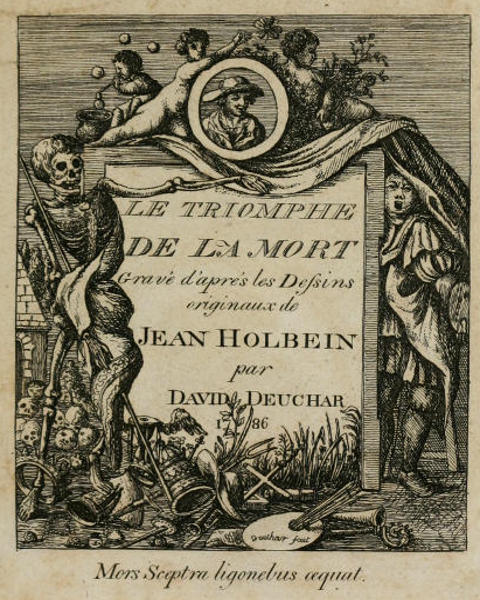
At the side of a stone table, placed vertically, Holbein appears
behind a curtain, which Death opens to him, to place
before his eyes the great Spectacle of the Scenes of human Life
that he is going to sketch. This is also expressed by an heap of
the attributes of grandeur, dignities, riches, arts, and sciences,
mixed with death-heads, which Death is trampling under his
feet. Below is an epitaph from Lucan—Mors sceptra ligonibus
æquat. Death confounds the sceptre with the spade. This table
is topped with a medallion, with the portrait of Holbein. Two
Genii support this medallion; the one surrounded with a garland
of flowers, the other lets fly a butterfly, whilst a third is amusing
himself with making soap bubbles. What these allegories
mean is easily understood.
À côté d’une table de pierre posée verticalement, Holbein
paroît derrière un rideau que la Mort lui ouvre, pour mettre sous
ses yeux le grand Spectacle des Scènes de la Vie humaine qu’il
va dessiner. Ce qui est encore désigné par un amas d’attributs
de la grandeur, des dignités, des richesses, d’arts, de sciences,
entremêlés de têtes de morts, et que la Mort elle-même foule à
ses pieds. On lit au has cette épigraphe tirée de Lucain:—Mors
sceptra ligonibus æquat, La Mort confond la sceptre & la bêche.
Cette table est surmountée d’un médaillon avec le portrait de
Holbein. Deux Génies soutiennent ce médaillon; l’un l’entoure
d’une guirlan de defleurs, & l’autrelaisse échapper un papillon,
tandis qu’un troisième s’amuse à faire des bulles de savon. On
sent assez ce que signifient ces deux allégories.
Holbein has begun the scenes of life by that which had such
influence on all the rest. The Mother of the human race holds
in her right hand, the fatal apple, which she has just received
from the serpent with a young man’s head; and Adam, at the
same time, is plucking another, enticed by the solicitations of
the too credulous Eve, who shews him the one she has received.
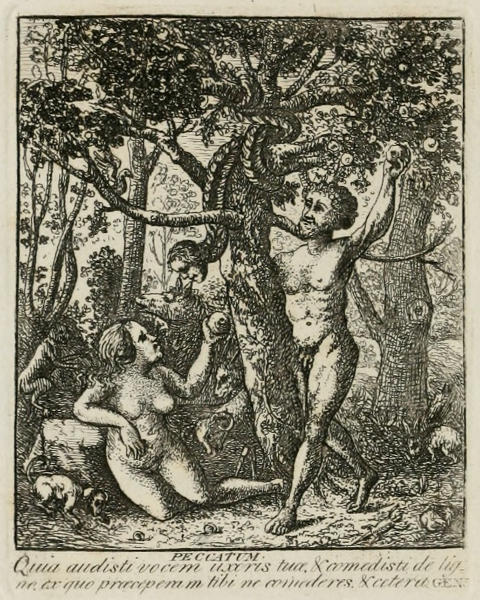
Quia audisti vocem uxoris tuæ, et comedisti de ligno, ex quo
præceperam tibi ne comederes, &c. Gen. iii. 17.
Holbein a commencé ces scènes de la vie par celle qui eut tant
d’influence sur toutes les autres. La Mère du genre humain,
tient dans sa main droite, la pomme fatale qu’elle vient de recevoir
du serpent à tête de jeune homme, & Adam en cueille en
même tems une autre, excité par les sollicitations de la trop
crédule Eve, qui lui montre celle qu’elle a reçue.
Our first parents, driven out by the Angel, are flying from
the terrestrial Paradise, preceded by Death, who is playing on
the fiddle, and shews by dancing the joy he feels for his triumph.
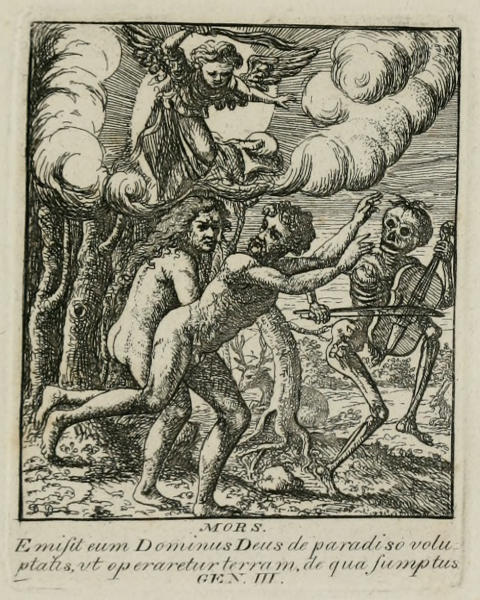
Emisit eum Dominus Deus de Paradiso voluptatis, ut operaretur
terram, de qua sumptus est. Gen. iii. 23.
Nos premiers Parens chassés par l’Ange, s’enfuyent du Paradis
terrestre précédés de la Mort, qui joue de la guitare, & démontre
en dansant la joie qu’elle ressent de son triomphe.
Holbein, to mark at once the species of labour which is the
lot of man, and that which falls to the share of the woman, represents
Adam employed in rooting up a tree, along with Death,
who helps him with all his might; and at a little distance Eve
suckling her child, and holding a distaff.
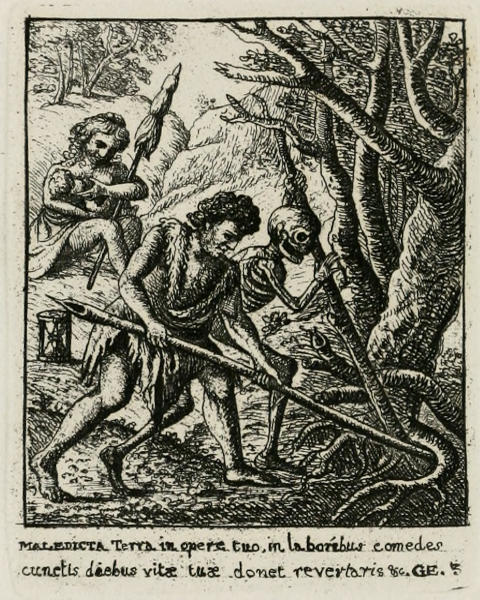
Maledicta terram in opere tuo, in laboribus comedes cunctis diebus
vitæ tuæ donet revertaris, &c. Gen. iii. 14.
Holbein, pour marquer en même tems le genre de travail qui
est le partage de l’homme, & celui qui est le partage de la femme,
représente Adam occupé à déraciner un arbre, avec la Mort
qui l’aide de toutes ses forces, & un peu plus loin, Eve allaitant
son enfant & tenant une quenouille.
A cardinal and three bishops are assisting at the ceremony;
Death is there also under the figure of two skeletons, one of
which is dressed in cardinal’s robes, the other embraces the holy
Father, with the right hand, and is leaning on a crutch with the
left.
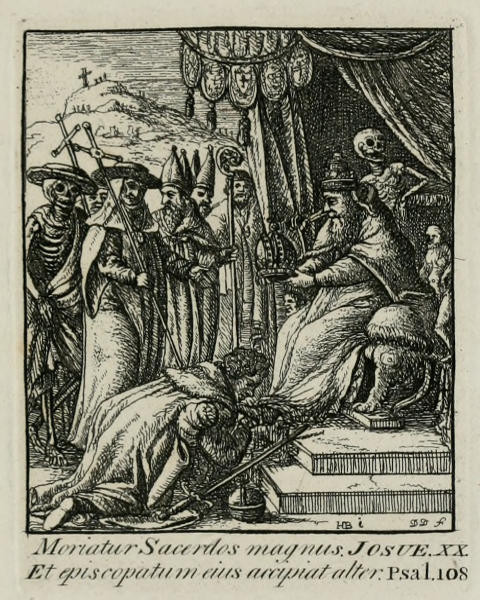
Moriatur sacerdos magnus. Josh. xx. 6.
Et episcopatum ejus accipiat alter. Psal. cviii. 8.
Un cardinal & trois evêques assistent à cette cérémonie; la
Mort s’y trouve aussi sous la figure de deux squelettes, dont
l’un est revêtu des habits de cardinal; l’autre embrasse le St.
Père de la main droite, et s’appuie de la gauche sur une béquille.
A messenger has just presented to him, on his knees, the
bull that constitutes him a cardinal. Death seizes this moment
to make his appearance, and seems to want to turn his hat upon
his head. The messenger is holding in his right hand a tin box,
hung by a strap, in which he had, no doubt, carried the bull,
which the new made cardinal holds in his right hand with the
seals appended to it.
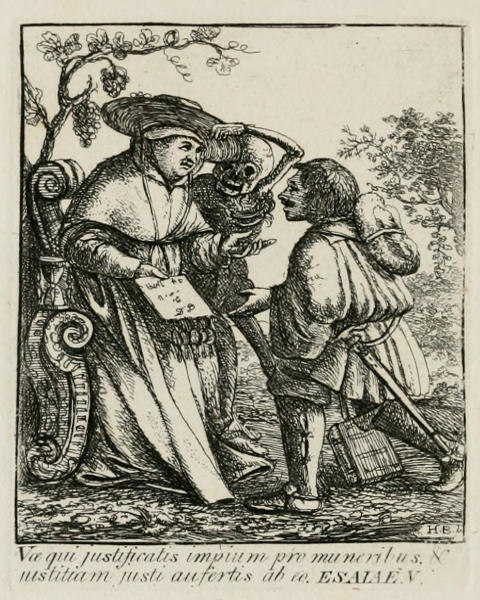
Væ qui justificatis impium pro muneribus, et justitiam justi
aufertis ab eo. Isa. v. 23.
Un messager vient de lui remettre, en faisant une génuflexion,
la bulle qui le fait cardinal. La Mort saisit ce moment pour
paroître, et semble vouloir lui faire tourner son chapeau sur la
tête. Le messager tient de la main droite une boîte de fer-blanc,
pendu à une courroie, et dans laquelle il avoit sans doute apporté
la bulle, que le cardinal nouvellement créé tient à la main droite
avec les sceaux y affixé.
This prince, as he is coming out of his palace with his courtiers,
is accosted by a poor woman, who implores his help for
herself and the infant she holds by the hand; but he, insensible
to the distresses of the widow and orphan, refuses to listen, and
is turning aside with a disdainful air to his courtiers. Death at
this instant appears; and his severe aspect announces, that he
is just about to make him repent his hard-heartedness.
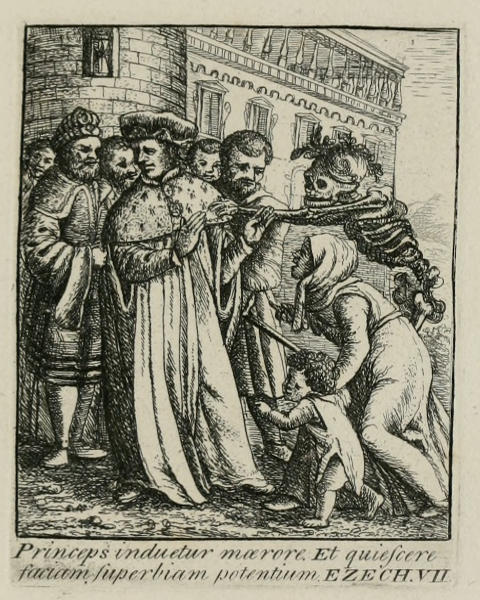
Princeps induetur mœrore, et quiescere faciam superbiam potentium.
Ezek. vii. 24, 27.
Ce prince sortant de son palais avec ses courtisans, est abordé
par une pauvre femme qui implore son secours, pour elle & pour
l’enfant qu’elle tient par la main; mais insensible aux besoins
de la veuve & de l’orphelin, il refuse de l’écouter, & se tourne
d’un air dédaigneux du côté de ses courtisans. La Mort paroît
dans cet instant, & son air sévère annonce qu’elle va le faire
répentir de la dureté.
With an air of tranquillity and resignation, this worthy Pastor
follows Death, who is leading him away laughing and dancing,
whilst some shepherds, forgetting their flocks, are wandering
here and there through the country, in despair for the loss of
their chief. The sun, now ready to set, is just about to leave
in darkness the ill-fated flocks, who, having no longer a conductor,
will soon become the prey of wolves and other ravenous
animals.
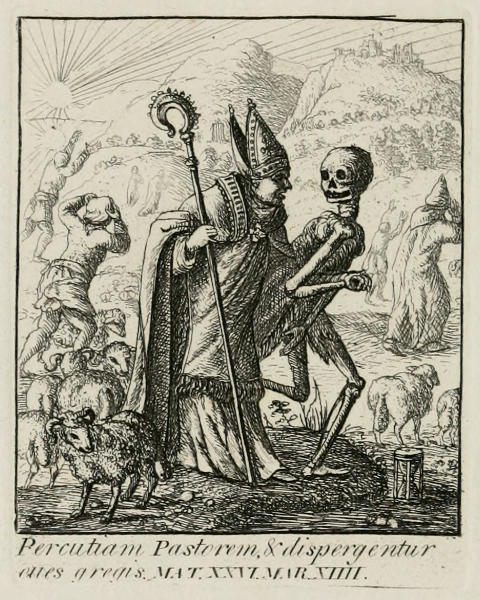
Percutiam pastorem, et dispergentur oves gregis. Matt. xxvi. 31.
D’un air de tranquillité & de résignation ce bon Pasteur suit
la Mort, qui l’emmène en riant et en dansant, tandis que quelques
bergers, oubliant leur troupeau, errent çà & là dans la
campagne, désespérés de la perte de leur chef. Le soleil prêt
à se coucher, va laisser dans les ténèbres ce malheureux troupeau,
qui n’ayant plus de conducteur, sera bientôt la proie du
loup & des autres bêtes féroces.
At the moment he is entering the church, Death accosts him;
and, shewing him an hour-glass run down, announces that his
hour is come. He appears to be a dignitary of the first rank;
for he is followed by a page, a huntsman, who carries a falcon
on his fist, and a fool.
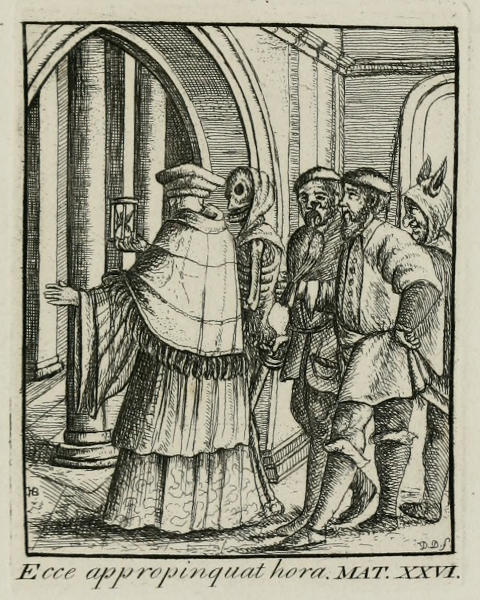
Ecce appropinquat hora. Matth. xxvi. 45.
Au moment où il entre dans l’église, la Mort l’aborde, & en
lui montrant un sable écoulé, lui annonce que son heure est
venue. Il paroît que c’est un dignitaire du premier rang, puis
qu’il est suivi d’un page, d’un veneur qui porte un faucon sur
le poing, & d’un bouffon.
As he is just stepping into his convent, with his Christmas-box
and wallet, Death stops him at the door; and deaf to his
cries, as well as regardless of the fright he throws him into, drags
him with all his might by the cloak, and renders all the good
Friar’s attempts to disengage himself ineffectual.
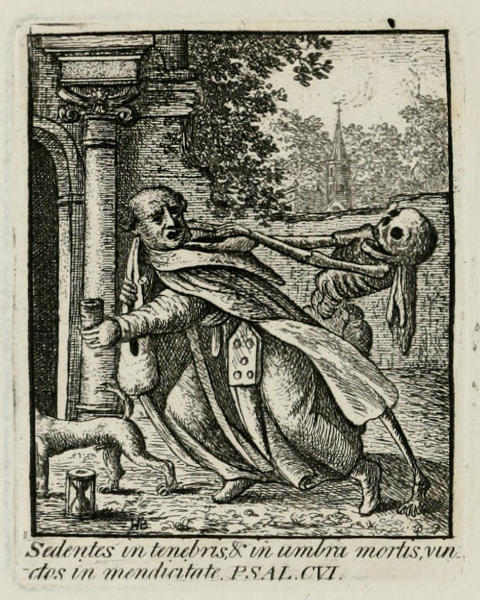
Sedentes in tenebris & umbra Mortis: vinctos in mendicitate.
Psal. cvi. 10.
Pret à rentrer dans son couvent avec sa tire-lire & sa besace,
la Mort l’arrête à la porte, & toute aussi sourde à ses cris,
qu’insensible à l’effroi qu’elle lui cause, elle le tire de toutes
ses forces par son capuchon, & rend impuissans les efforts du
bon Frère pour se dérober de ses mains.
Death, not contented with stripping this fat Prelate of his
crosier, which he is carrying in triumph on his shoulder, and his
mitre, with which he is dressing himself, is dragging him away
without pity. He raises his breviary with one hand, and with
the other is making some vain efforts to push him off.
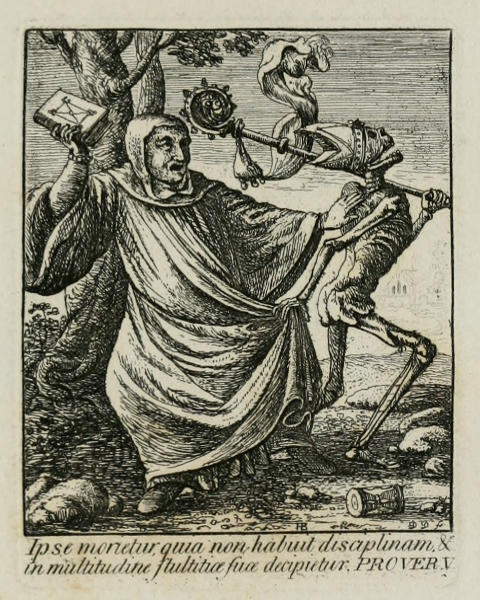
Ipse morietur, quia non habuit disciplinam, et in multitudine
stultitiæ decipietur. Prov. v. 23.
La Mort non contente d’avoir arraché à ce gros Prélat sa
crosse, qu’elle porte en triomphe sur son épaule, & sa mitre,
dont elle s’est affublée, le tire encore impitoyablement après
elle; il élève d’une main son breviaire, & fait de l’autre de vains
efforts pour la repousser.
Death ludicrously hooded with several flowing plumes, and
robed in a kind of gown, carries out of her convent an Abbess,
whom he is dragging with all his might by her scapulary. The
reverend Mother with regret is leaving life and the honours she
enjoys; and expresses, by the alteration of her features and by
her cries, the fright that Death has produced in her soul. Behind
her, under the gate of the convent, appears a young Nun,
strangely agitated with terror and grief.
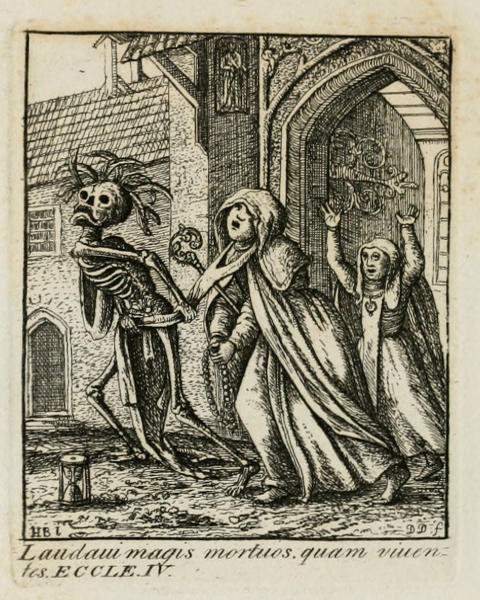
Laudavi magis mortuos, quam viventes. Eccl. iv. 2.
La Mort ridiculement coiffée de diverses plumes flottantes,
& vêtue d’une espèce de mante, emmène hors de son couvent
une Abbesse qu’elle tire de toutes ses forces par son scapulaire.
La révérendissime Mère quitte à regret la vie & les honneurs
dont elle jouit, & exprime par l’altération de ses traits & par
ses cris, l’effroi que la Mort a jeté dans son âme. On voit derrière
elle, sous la porte de l’abbaye, une jeune Nonne vivement
agitée par la crainte & par la douleur.
As he is preaching to his congregation, Death, who is behind
him with a stole about his neck, holds over his head the bone of
a dead body, and by shewing it to the assembly, preaches to
them, undoubtedly, the most eloquent of all sermons.
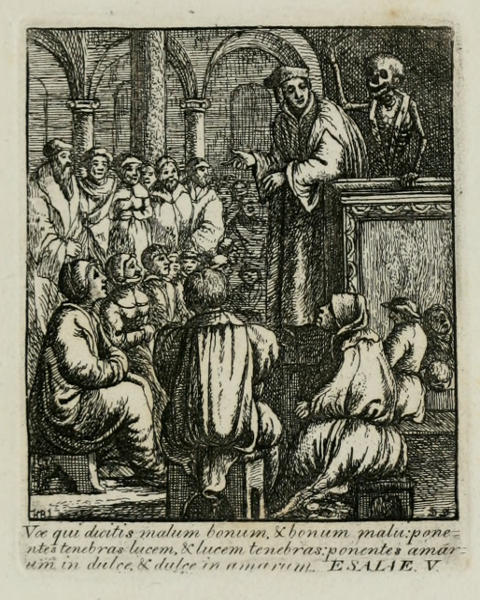
Væ qui dicitis malum bonum, et bonum malum: ponentes
tenebras lucem, et lucem tenebras: ponentes amarum in dulce,
& dulce in amarum. Esaiæ v. 20.
Tandis qu’il prêche son auditoire, la Mort qui est derrière
lui, une étole au cou, élève par-dessus sa tête un os de mort, &
en la montrant à l’assemblée lui fait sans doute le plus éloquent
de tous les sermons.
He appears carrying the Holy Sacrament along the street to a
dying man. Death marches before him, carrying the lantern
and a little bell. He is followed by a boy, who carries the holy
water and a taper, and by a young woman with a mournful aspect,
who seems to have come in quest of him.
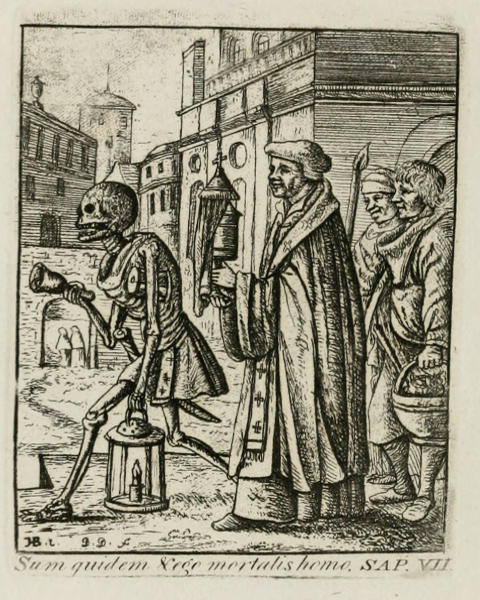
Sum quidem & ego mortalis homo. Sap. vii. 1.
On le voit dans la rue porter le St. Sacrement à un moribond.
La Mort marche devant lui, et porte la lanterne & la clochette.
Il est suivi d’un garçon qui porte l’eau bénite & un cierge, &
d’une jeune femme affligée qui paroît être venue le chercher.
Death is leading to him a sick old man, whose urine he is
presenting to him in a phial, and appears saying, in a jeering
manner, Dost thou think that thou art able to save a man whom
I have already in my power?
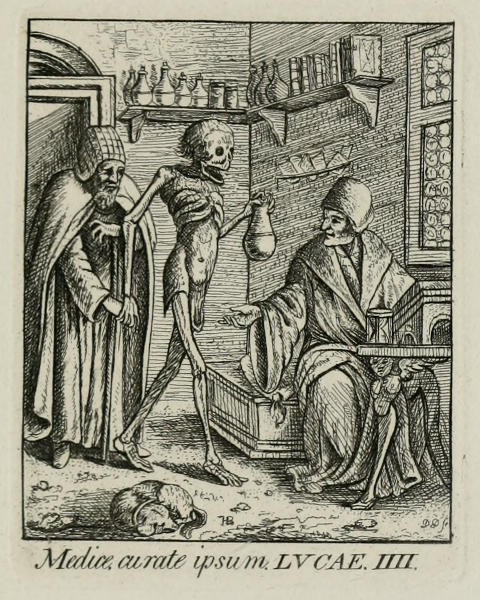
Medice curate ipsum. Lucæ iv. 23.
La Mort lui amène un vieillard malade dont elle lui présente
l’urine dans une phiole, & paroît lui dire d’un air moqueur;
Crois-tu pouvoir sauver un homme que je tiens déjà en ma puissance?
He has his eyes fixed on a sphere hanging from the ceiling, and
appears profoundly engaged in the vain chimeras of judicial
astrology, while Death comes to turn his attention upon a death-head,
which he is presenting to him in a most grotesque attitude,
seeming to say, in a jeering tone, Could thy sublime art inform
thee, that I was coming to pay thee this visit to-day?
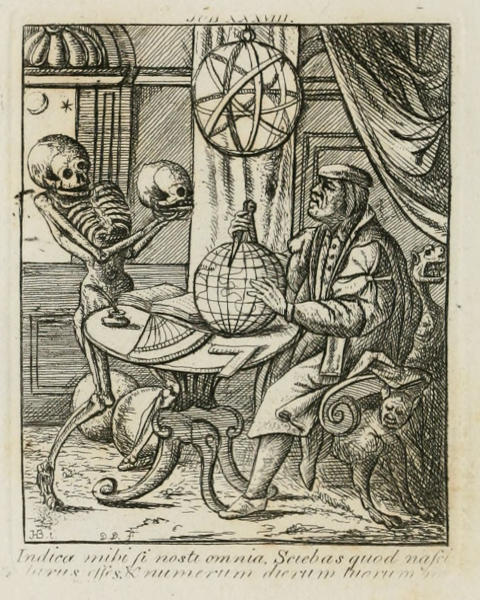
Indica mihi, si nosti, omnia sciebas. Tunc quod nasciturus
esses? & numerum dierum tuorum noveras? Job xxxviii. 18, 21.
Il a les yeux fixés sur une sphère suspendue au plancher, &
paroît profondément occupé des vaines chimères de l’astrologie
judiciaire, tandis que la Mort vient tourner son attention sur une
tête de mort, qu’elle lui présente dans l’attitude la plus grotesque,
& semble lui dire d’un ton railleur; Ton art sublime a-t-il pu
t’apprendre que je viendrois te rendre aujourd’hui cette visite?
Seated on a throne, and holding in his hand the sword of state,
he is attentively listening to an advocate pleading in a soothing
tone, against an unfortunate peasant, who trembling waits, in
the most suppliant posture, the decree that is to determine his
fate. Death at this moment displays all his power; he proudly
takes possession of the bottom of the throne, and is carelessly
leaning his arm on the Monarch’s crown. The angry aspect, with
which the Emperor views the advocate and his two clients, who
are seen standing with their heads uncovered, is a happy presage
for the poor oppressed peasant. At the foot of the throne are
lying the sceptre and globe of the empire, placed on a cushion.
Death has set down his fatal glass beside these attributes of grandeur,
which he can cause to vanish at his pleasure.
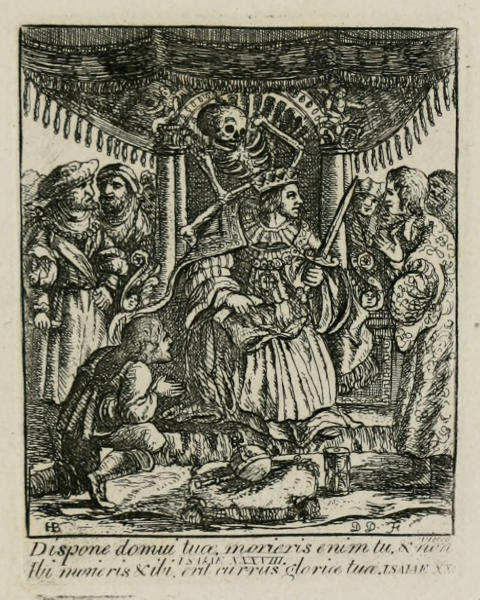
Dispone domui tuæ, quia morieris tu, et non vives. Isaiæ xxxviii. 1.
Ibi morieris, et ibi erit currus gloriæ tuæ. Isaiæ xxii. 18.
Assis sur son trône, & tenant dans sa main le glaive de l’empire,
il écoute attentivement un avocat qui plaide d’un ton doucereux
contre un malheureux paysan, tandis que celui-ci attend
en tremblant, & dans la posture la plus suppliante, l’arrêt qui
doit décider de son sort. La Mort développe en ce moment
toute sa puissance; elle occupé fièrement la fond du trône, &
appuie nonchalemment son brass sur la couronne du Monarque.
L’air irrité avec lequel le Chef de l’Empire regarde l’avocat &
ses deux cliens qu’on voit, la tête découverte, à côté de leur défenseur,
est d’un heureux présage pour le pauvre opprimé. On
voit au bas du trône le sceptre & le globe de l’empire posés sur
un coussin. La Mort a placé son sable fatal à côté de ces atributs
d’une grandeur qu’elle peut faire évanouir à son gré.
He is seen, eating in state, under a canopy, and served by the
officers of the court. Death is come to put himself in the number,
and is at this instant performing the office of cupbearer. He
is pouring out drink to the Monarch, who holds out to him his
great cup, which he is now probably to empty for the last time.
The Prince holds in his left hand a paper, without doubt a petition,
that has just been presented to him.
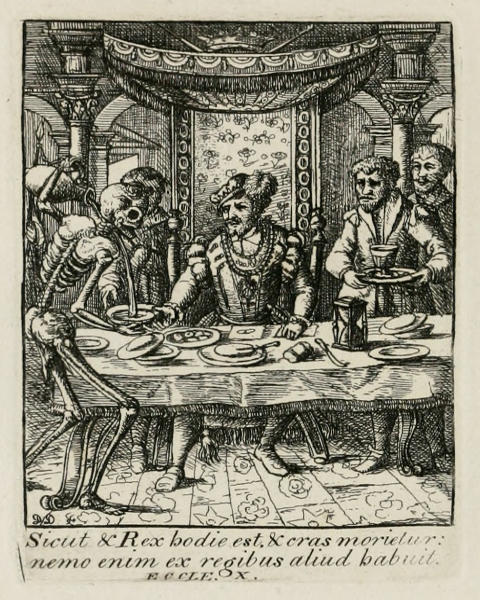
Sicut et Rex hodie est, et cras morietur. Eccle. x. 12.
Nemo enim ex regibus aliud habuit.
On le voit manger en cérémonie, assis sous un dais & servi par
ses grands officiers; la Mort est venue se mettre du nombre, &
fait en ce moment l’office d’echanson. Elle verse à boire au
Monarque qui lui tend sa large coupe, qu’il va vraisemblablement
vuider pour la dernière fois. Ce Prince tient de la main gauche
un papier, sans doute un placet qu’on vient de lui remettre.
In the midst of a pompous march, in the court of a great palace,
Death, who seems here to do the office of gentleman-usher,
leads this Princess to the brink of a grave, and shews her the
bounds within which all her grandeur is to be confined.
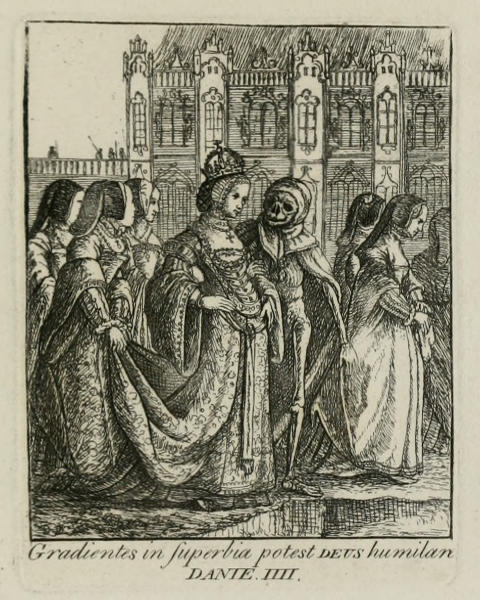
Gradientes in superbia potest Deus humiliare. Daniel iv. 34.
Au milieu d’une marche pompeuse, dans la cour d’un vaste
palais, la Mort qui paroît faire ici l’office d’ecuyer, amène cette
Princesse jusqu’au bord d’une fosse sépulcrale, pour lui faire
voir le terme auquel ses grandeurs viendront aboutir.
Death, arrayed in the habits of folly, drags away violently this
young Princess, just as she is coming out of her palace to enjoy
the pleasure of walking. With terror painted in her countenance,
she is making the air resound with mournful cries; the maid of
honour, who accompanies her, agitated with the most violent
despair, is imploring the aid of Heaven, while the buffoon is
making vain efforts to defend her against Death, who holds aloft
his glass, to shew that the fatal hour is come.
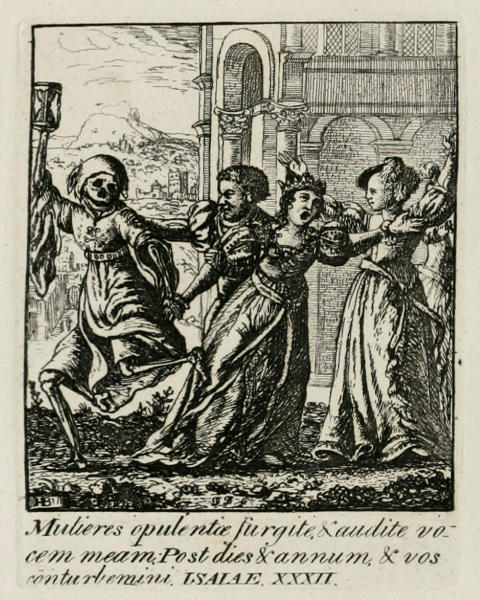
Mulieres opulentæ surgite, & audite vocem meam: post dies
enim & annum, vos conturbabimini confidentes. Isaiæ xxxii.
9, 10.
La Mort revêtue des habits de la folie, entraine avec violence
cette jeune Princesse, au moment qu’elle sort de son palais pour
jouïr du plaisir de la promenade; la terreur peinte sur le visage
elle faite rétentir les airs de ses cris douloureux; la dame d’honneur
qui l’accompagne, agitée du plus violent désespoir, implore
le secours du Ciel, tandis que le bouffon de la Reine fait de vains
efforts pour la défendre contre la Mort, qui tient son sable élevé
pour faire voir que l’heure fatale est arrivée.
Death, in the shape of two hideous skeletons, comes to surprise
her as she is lying softly on an elegant bed. One of the
skeletons awakes her with the sound of a violin, while the other
is pulling off her bed-clothes, making frightful grimaces.
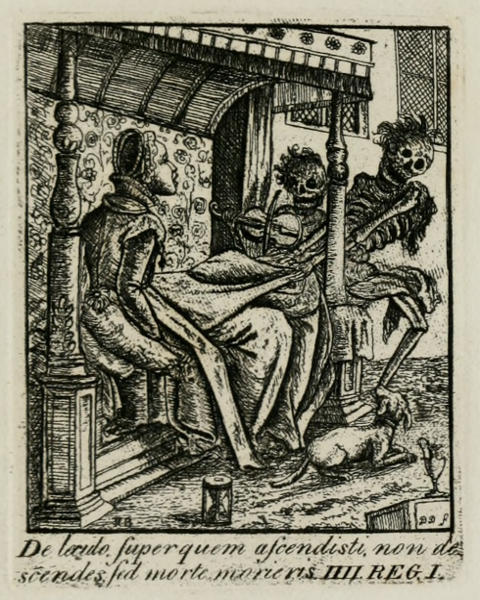
De lectulo, super quem ascendisti, non descendes, sed morte
morieris. 4 Reg. i. 4.
Sous la figure de deux sequelettes hideux, la Mort vient la
surprendre, mollement couchée sur un lit élégant. L’un des
squelettes la réveille au son d’un violon, tandis que l’autre lui
arrache sa couverture en faisant d’effroyables grimaces.
She is wholly taken up with the care of her dress, and is receiving
with eagerness, from the hands of one of her maids, a very
rich robe with a gold chain. Death comes to derange her
toilet, and has already, without being perceived, slipped round
her neck a collar made of small bones.
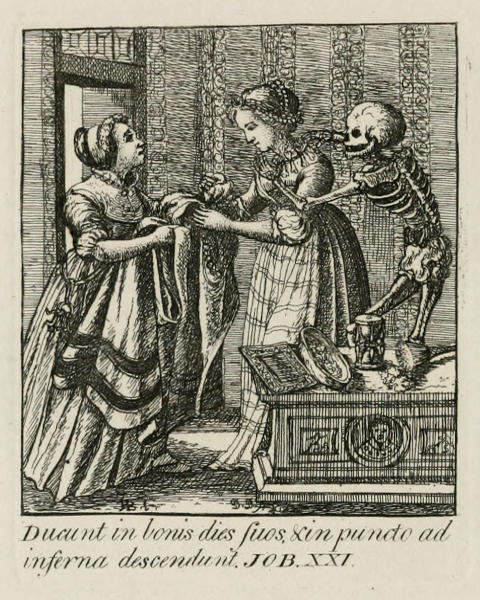
Ducunt in bonis dies suos, et in puncto ad inferna descendunt.
Job xxi. 13.
Elle n’est occupée que du soin de sa parure, & reçoit avec
empressement, des mains d’une de ses femmes, un habillement
très-riche avec une chaîne d’or. La Mort vient troubler sa
toilette, & lui a déjà passé autour du cou, sans qu’elle s’en soit
encore aperçue, un collier fait de petits os de mort.
In the first transports of an happy union, this tender couple
appears so wholly taken up with each other, and so inebriated
with their mutual happiness, that they neither see nor hear.
Death, who is marching before them, beating furiously on a
little drum, is soon to give a cruel interruption to their enjoyments.
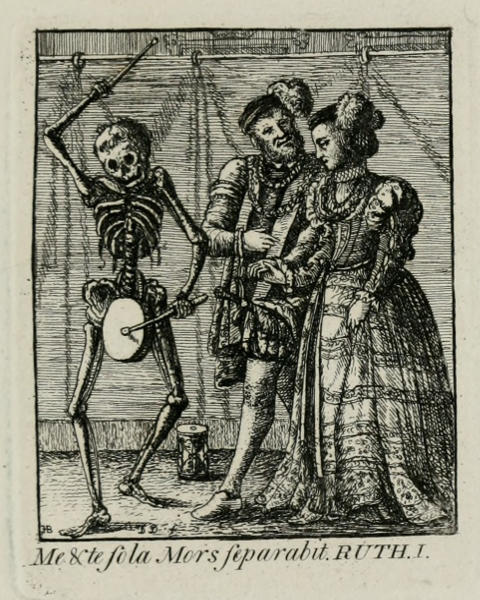
Sola mors me et te separaverit. Ruth i. 17.
Dans les premiers transports d’une douce union, ces deux
tendres époux paroissent tellement occupés l’un de l’autre, ils
sont si enivrés de leur bonheur mutuel, qu’ils ne voient ni n’entendent
la Mort qui marche devant eux, en frappant vigoureusement
sur un petit tambour, & qui va leur donner bientôt un cruel
trouble-fête.
There appears in this young and beautiful recluse, a striking
mixture of gallantry and devotion. On her knees before a little
altar, with her rosary in her hand, she is amorously listening to
the songs which a young man, seated on a bed, addresses to her,
accompanying them with his lute. Death comes to put out the
tapers burning on the altar, and to change into sadness the pleasures
of this conversation.
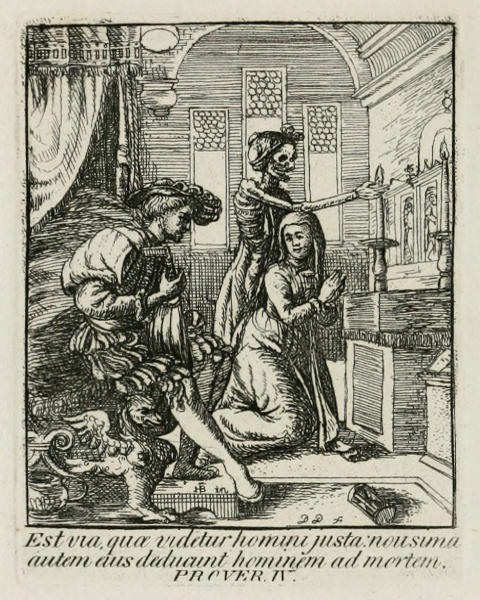
Est via, quæ videtur homini justa: novissima autem ejus deducunt
hominem ad mortem. Prov. xiv. 12.
L’on voit dans cette jeune & belle recluse un mélange frappant
de galanterie & de dévotion. Agenouillée devant un petit autel,
son rosaire à la main, elle écoute amoureusement les chansons
qu’un jeune homme, assis sur son lit, lui adresse en les accompagnant
de son luth. La Mort vient éteindre les cierges allumés
sur l’autel, & changer en amertume les douceurs de ce tête-à-tête.
Death here adds to his usual employment that of avenger of
oppressed vassals. He is throwing with violence at the head of
this Lord, his coat of arms, the dear object of his pride, under
the weight of which he is ready to make him fall. He appears
trampling under foot a flail, to mark his inhumanity to labourers,
a class of society so necessary and respectable. On the ground
also are to be seen the remains of the helmet which formed the
crest of his arms, with the other ornaments that decorated
them.
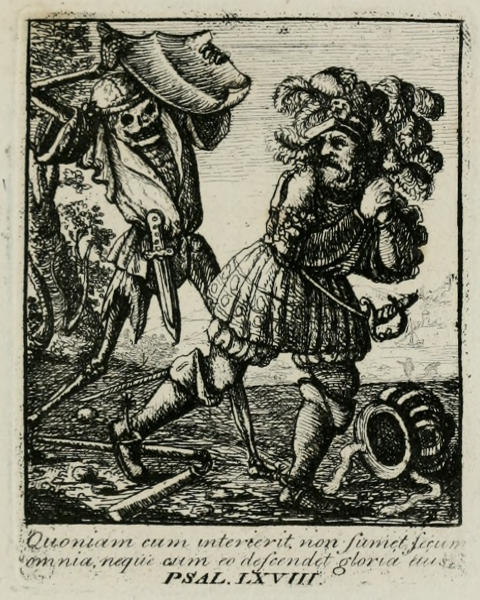
Quoniam cum interierit, non sumet omnia: neque descendet
cum eo gloria ejus. Psal. xlvii. 18.
La Mort ajoute ici à l’exercice de son emploi accoutumé celui
de vengeur de vassaux opprimés; elle jette avec violence à la
tête de ce Seigneur ses armoiries, l’objet chéri de son orgueil,
sous le poids desquelles elle va le faire périr. On le voit fouler
à ses pieds un fléau, pour désigner son inhumanité envers les
laboureurs, cette classe de la société si nécessaire & si respectable;
on peut encore remarquer à terre, les débris du casque dont ces
armoiries étoient surmontées avec d’autres ornemens qui les
décoroient.
This worthy Cavalier, returned victorious from so many combats
and tournaments, comes at length to meet his match. Death
has run him through the body with a furious stroke of the lance,
and is laughing at the vain efforts he makes to defend himself.
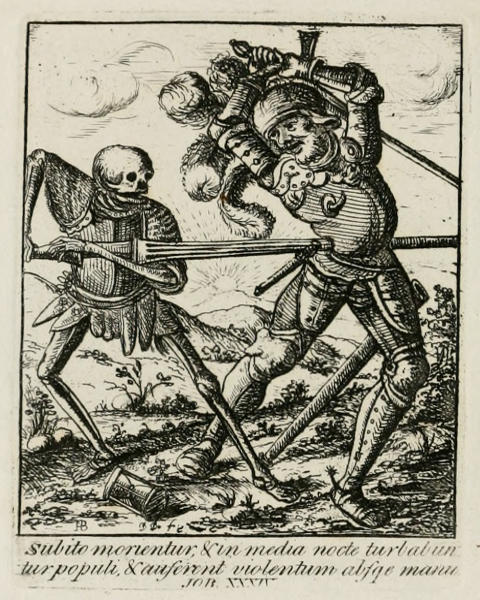
Subito morientur, & in media nocte turbabuntur populi, &
auferent violentum absque manu. Job xxxiv. 20.
Ce preux Chevalier sorti vainqueur de tant de combats & de
tant de tournois, vient enfin de trouver son maître. La Mort
l’a percé de part en part d’un furieux coup de lance, & se rit des
vains efforts qu’il met en usage pour se défendre contr’elle.
He is doing every thing in his power to put off the moment
that is to separate him for ever from his possessions, and his fine
seat, which appears in the back ground; but Death inexorable
has already set down beside him the fatal bier, into which he is
about to make him enter.
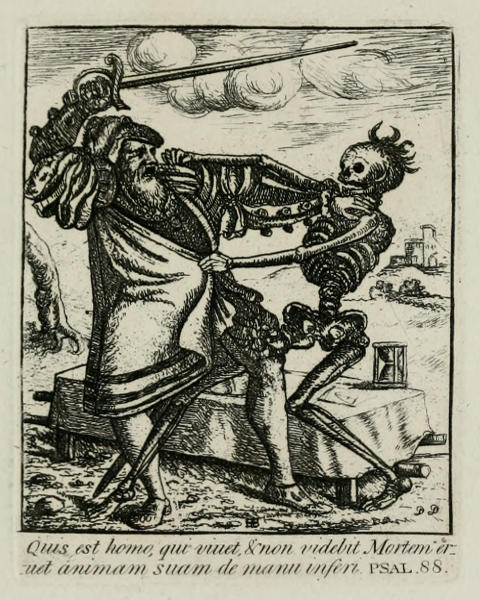
Quis est homo, qui vivet, et non videbit mortem: eruet animam
suam de manu inferi? Psal. lxxxviii. 49.
Il fait tout ce qu’il peut pour reculer le moment qui doit le
séparer pour toujours de ses possessions, & de son beau château
qui paroît dans le lointain; mais la Mort inexorable a déjà placé
près de lui la bière fatale où elle va le faire entrer.
On a field of battle, covered with dead carcasses, Death, armed
with a buckler and a huge dart, attacks this warrior, in the
bosom of victory, escaped alone from the carnage of the day,
and is giving him some terrible blows. It is in vain that this
brave Soldier, whose courage seems invincible, is obstinately attempting
to dispute the victory with an irresistible adversary.
In the back ground appears another Death, running, and beating
on a drum, who is followed by several soldiers.
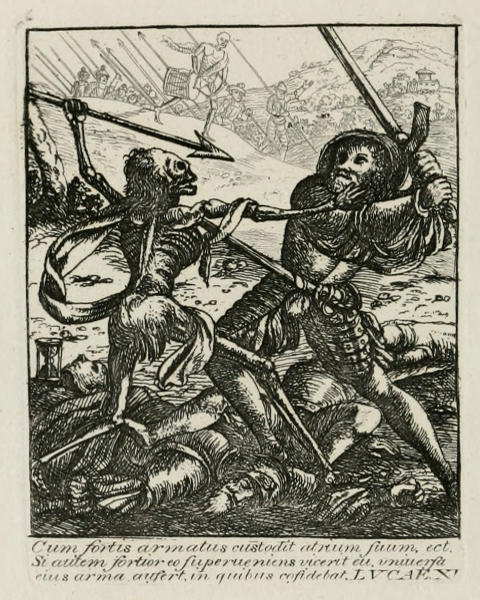
Cum fortis armatus custodit atrium suum, &c. Si autem
fortior eo superveniens vicerit eum, universa ejus arma auferet,
in quibus confidebat. Lucæ xi. 21, 22.
Sur un champ de bataille jonché de cadavres, la Mort armée
d’un bouclier & d’un grand javelot, attaque dans le sein de la
victoire ce guerrier échappé seul au carnage, & lui port des coups
terribles. C’est en vain que ce brave Soldat dont la valeur sembloit
indomptable, s’acharne à disputer la victoire à un adversaire
auquel rien ne sauroit résister. Dans le lointain on apperçoit
une autre Mort qui bat du tambour en courrant, & qui
est suivie de quelques soldats.
It appears that this supporter of Justice, forgetting the dignity
of his station, abandons himself without shame to injustice. He
is stretching out his hand for the gold that the rich man is going
to give him, without doubt to obtain of him a favourable decision,
and to bear down the poor unfortunate man, who appears in a
trembling posture at the side of the Judge. Death comes to
surprise him in the midst of his prevarications, and is snatching
out of his hands the rod which is the mark of his dignity.
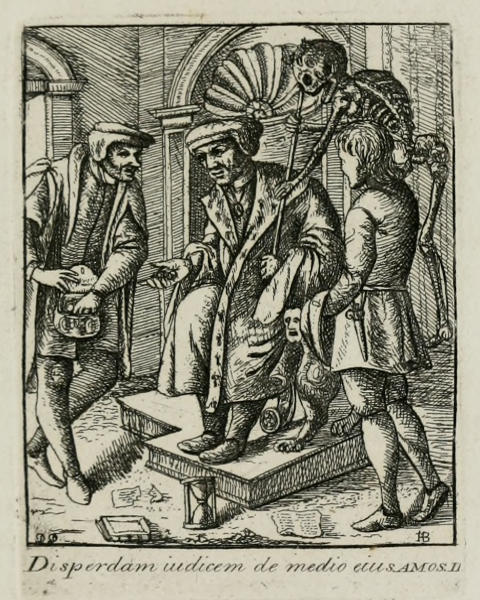
Disperdam judicem de medio ejus. Amos ii. 3.
Il paroît que ce suppôt de Thémis, oubliant la dignité de sa
place, s’abandonne sans pudeur à l’iniquité. Il tend la main à
l’or que cet homme riche va lui donner, sans doute pour en obtenir
un jugement favorable, & faire succomber le pauvre malheureux
qu’on voit dans une attitude craintive à côté du Juge.
La Mort vient le surprendre au milieu de ses prévarications, &
lui arrache des mains la baguette qui est la marque de sa dignité.
This magistrate appears deeply engaged in giving, in the open
street, to a rich man, the advices which a little devil, astride on
his neck, is blowing into his ears, while he pays no sort of regard
to the poor man, who is tapping his shoulder, and in the most
suppliant posture asking to be heard. Death seems to be rising
from the earth, in indignation, to put an end to this interesting
conversation.
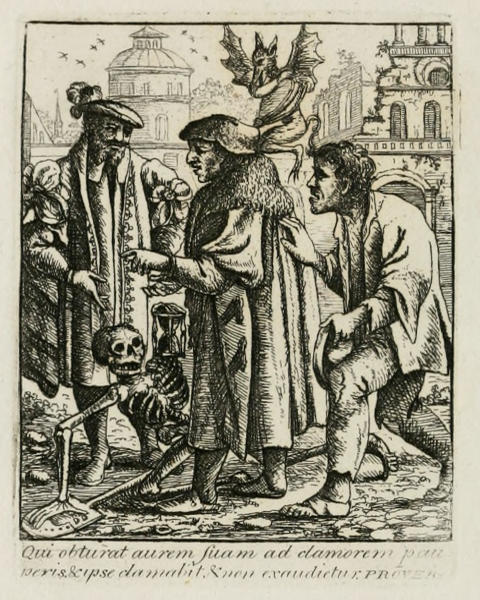
Qui obturat aurem suam ad clamorem pauperis, et ipse clamabit,
& non exaudietur. Prov. xxi. 13.
Ce magistrat paroît fort occupé à donner en pleine rue à un
homme riche, des conseils qu’un petit diable à califourchon sur
son cou lui souffle aux oreilles, tandis qu’il ne fait aucune attention
au pauvre qui lui touche doucement l’épaule, & démande
dans l’attitude la plus suppliante à être écouté. La Mort indignée
semble sortir de terre, pour mettre fin à cette conversation
intéressée.
This subject answers to No. 29. The example of the Judge
seems to authorize the Advocate to get himself well paid for his
prevarication, and that even in the presence of his poor client,
whose wretched condition would raise compassion in any breast
less obdurate than that of the lawyer. But Death will avenge
the oppressed; he is pouring into the hands of the Advocate
money in abundance, of which he will have little use, for he is,
at the same instant, shewing him, with an air of insult, his sand
run out.
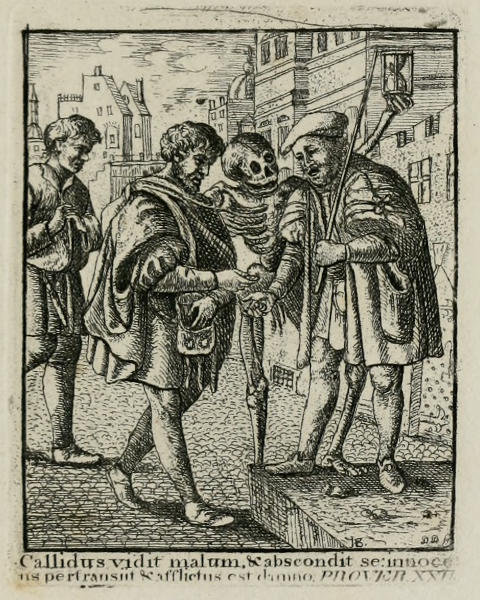
Callidus vidit malum, & abscondit, sed innocens pertransiit &
afflictus est damno. Prov. xxii. 3.
Ce sujet se rapporte au No. 29. L’exemple du Juge semble autoriser
l’Avocat à se faire payer chèrement ses prévarications, &
cela même en présence de son pauvre client qui se tient dans un
certain éloignement, & dont l’état misérable feroit pitié à une
âme moins dure que celle de l’homme de loi. Mais la Mort
vengera l’opprimé; elle verse abondamment dans les mains de
l’Avocat de l’argent dont il ne profitera guère, car elle lui
montre en même tems d’un air moqueur son sable écoulé.
Escaped from the dangers of the sea, and safely arrived in
port, this rich Merchant believes himself now in perfect safety;
but he is mistaken. Employed in counting his money, examining
his goods, and treating about their disposal, a bad customer,
Death himself, comes up, and it is his person only that he wants
to bargain for.
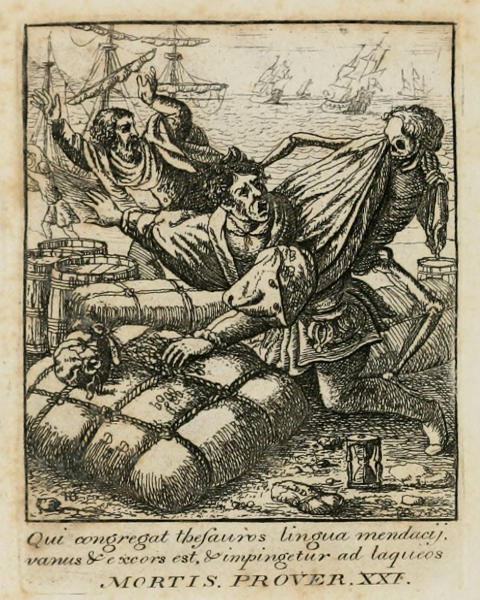
Qui congregat thesauros lingua mendacii, vanus et excors est,
& impingetur ad laqueos Mortis. Prov. xxi. 6.
Echappé aux périls de la mer, arrivé heureusement au port,
ce riche Marchand se croit en pleine sécurité; il se trompe. Occupé
à compter son argent, à examiner ses marchandises & à
traiter de leur vente, un mauvais chaland, la Mort elle-même, arrive,
& ce n’est que de sa personne qu’elle veut faire emplette.
Bending under the weight of his load, he is advancing, with
a quick pace, to the neighbouring town, comforting himself with
thinking on the gain he is to make there; but Death, in the
form of two skeletons, is come to put a sudden end to his labours
and his hopes. One of the skeletons is dragging him forcibly by
the arm, while the other behind him is playing on a marine
trumpet. It is in vain that the poor Hawker points with his
finger to the place where his business calls him; this disagreeable
company appears desirous of making him take another road.
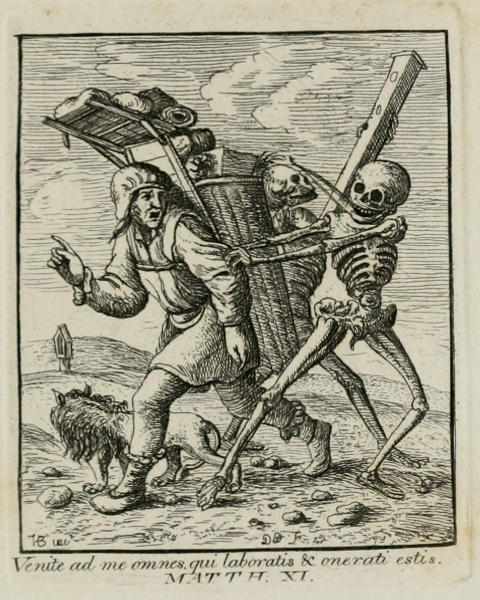
Venite ad me omnes, qui laboratis, et onerati estis. Matth. xi. 28.
Courbé sous le poids de sa charge, il avance à grands pas vers
le lieu voisin, & trouve du soulagement en rêvant au gain qu’il
pourroit y faire; mais la Mort, sous la figure de deux squelettes,
est venue subitement mettre fin à ses peines & à ses espérances.
L’un des squelettes le tire avec force par le bras, tandis que
l’autre joue derrière lui de la trompette marine. C’est en vain
que le pauvre Colporteur montre des doigts l’endroit où ses
affaires l’appellent, cette fâcheuse compagnie paroît vouloir lui
faire prendre une autre route.
Death here is exercising his power on one of his most fertile
domains. He himself is breaking the mast of a ship violently
tossed by the tempest, and throws all the passengers into the
most fearful despair. One alone we can distinguish, near the
mast, who preserves the tranquillity of mind which, in the
greatest danger, a good conscience yields to firm and intrepid
minds; his head has all the features with which Socrates is usually
represented.
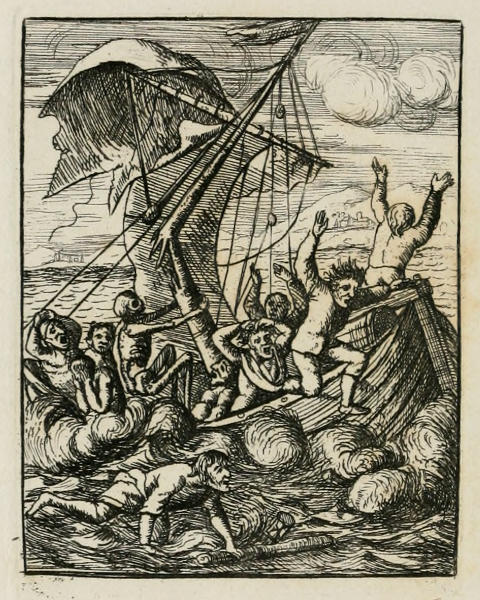
Qui volunt ditescere incidunt in tentationem & laqueum, &
cupiditates multas stultas & noxias, quæ demergunt homines in
exitum & interitum. 1 ad Timo. vi. 9.
La Mort exerce ici son empire sur un de ses plus fertiles domaines;
elle brise elle-même le mât d’un vaisseau violemment
agité par la tempête, & jette tous les passagers dans le plus affreux
désespoir. On en distingue un seul placé près du mât,
qui a conservé cette tranquillité d’âme qu’une bonne conscience
accorde dans les plus grands périls aux esprits fermes & courageux;
sa tête a tous les traits sous lesquels on représente ordinairement
Socrate.
We see Death here venting his capricious fury on a cart of
wine that a poor Waggoner is conducting. Without doubt, the
man himself will soon come, in his turn, to be the sport of his
caprice; and the same cause that has now produced, will ere
long effectually finish his despair.
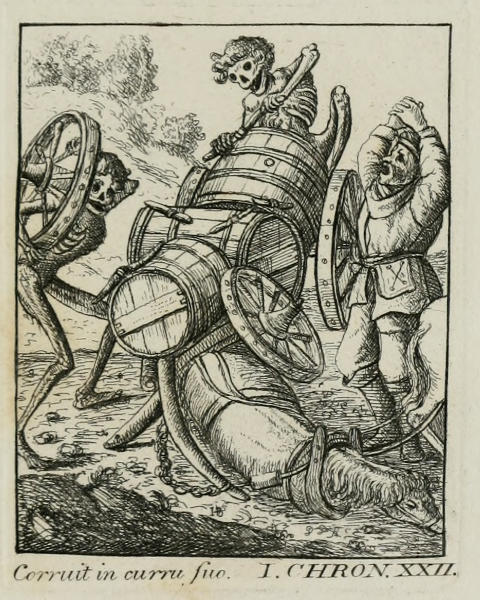
Cæcus cæcum ducit: & ambo in foveam cadunt. Matth. xv. 14.
On voit ici la Mort exercer ses bizarres fureurs sur un char de
vin que conduit un pauvre Voiturier. Sans doute que lui-même
va devenir à son tour le jouet de ses caprices, & que la même
cause qui vient d’occasionner son désespoir ne tardera pas à le
terminer.
Were Death capable of considerations, what class of society
would better deserve to be exempted from his ravages, than the
labourers; incontestably the most useful, most laborious, and
most productive of real opulence? But he is now striking the
horses harnessed to this Husbandman’s plough; and this enemy
of the human race can strike no blow more severely felt, than by
thus attacking it in the source of its subsistence.
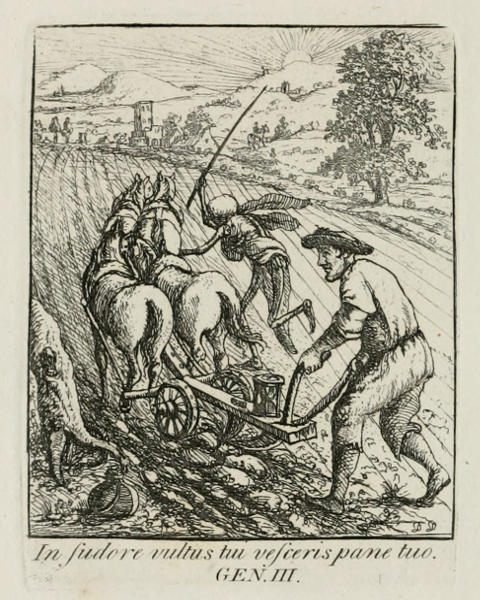
In sudore vultus tui vesceris pane tuo. Gen. iii. 19.
Si la Mort pouvoit user de quelque considération, quelle classe
de la société mériteroit mieux d’en être ménagée que celle du
laboureur, sans contredit la plus utile, la plus laborieuse, & la
plus productive des véritables richesses? Mais elle frappe déjà
les chevaux attelés à la charrue de ce Cultivateur, & cette ennemie
du genre humain ne sauroit lui porter des coups plus sensibles
qu’en l’attaquant dans les sources de sa subsistance.
The character of the Miser is very forcibly expressed in this
sketch. Shut up in a vault, which receives the light only through
a wicket, secured with a double grate of thick iron bars, he is
entirely taken up with his beloved treasure, a considerable part
whereof Death is snatching up before his eyes. This loss excites
in him all the symptoms of the most violent desperation, and it
plainly appears that his gold is an hundred times dearer to his
heart than his life.
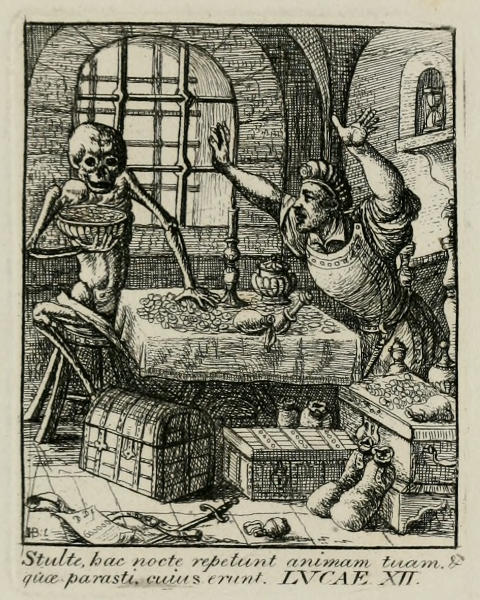
Stulte, hac nocte repetunt animam tuam: & quæ parasti, cujus
erunt? Lucæ xii. 20.
Le caractère de l’Avare est rendu dans ce dessein avec beaucoup
d’énergie. Renfermé dans un caveau qui ne reçoit du jour
que par une lucarne garnie d’une double grille d’épais barreaux
de fer, il n’est occupé que de son cher trésor, dont la Mort lui
enlève à ses yeux un portion très-considérable. Cette perte
excite en lui tous les symptômes du plus violent désespoir, & l’on
voit bien que son or lui tient cent fois plus à cœur que la vie.
This ill-fated man attacks in a forest, a country girl returning
from the fair, and is endeavouring to take from her what she is
bringing from thence; but, fortunately for the poor woman,
Death comes to her assistance; and laying hold of the Robber,
prevents, probably only by a few days, the hangman, who would
have made him bear on a scaffold the punishment due to his
crimes.
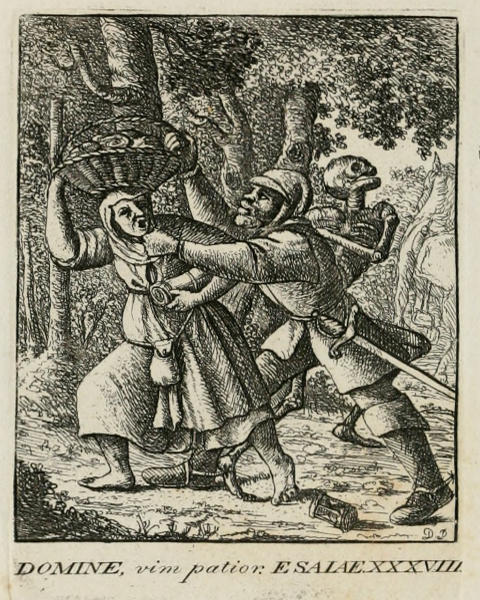
Quasi agnus lasciviens & ignorans, nescit quod ad vincula
stultus trahatur. Prov. vii. 22.
Ce malheureux attaque dans une forêt une paysanne qui revient
de la foire, & veut lui enlever ce qu’elle en rapporte; mais
heureusement pour la pauvre femme, la Mort vient à son secours,
& en se saisissant du Voleur elle ne prévient peut-être
que de quelques jours le bourreau, qui lui auroit fait porter
sur un échaffaut la peine de ses crimes.
Debauchery, and, above all, excess in drinking, undoubtedly
furnish Death with powerful arms for committing his ravages.
Here he appears pouring the wine in great abundance into the
throat of one of these Drunkards, and the most beastly drunkenness
reigns in these disgusting orgies.
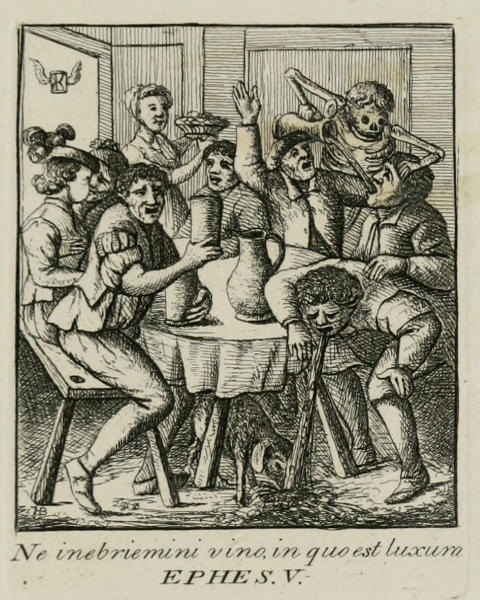
Et nolite inebriari vino, in quo est luxuria. Eph. v. 18.
La débauche & surtout les excès de la boisson fournissent sans
cesse à la Mort des armes puissantes pour exercer ses ravages.
On la voit ici qui entonne le vin à grands flots dans le gozier
d’un de ces Yvrognes, & la plus grossière crapule préside à cette
dégoûtante orgie.
Here is another company well worthy of the former; and the
fate of those who compose it is nearly the same; it only differs in
this, that the Devil and Death are disputing which of them
shall carry off the losing Gamester. It is a contest, if we may
say so, frightful as well as ludicrous, so much the more so, that
the second Gamester, interesting himself in the fate of the first,
is addressing fervent prayers to the Devil on his behalf; but
the third is doing still better, taking the advantage of this moment
of trouble and terror, to gather in the money that is lying
on the table.
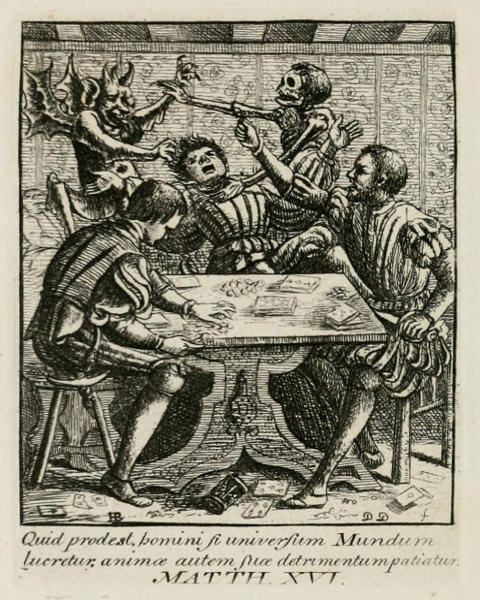
Quid enim prodest homini, si mundum universum lucretur,
animæ vero suæ detrimentum patiatur? Matth. xvi. 26.
Voici une autre compagnie bien digne de la précédente; aussi
le sort de ceux qui la composent est-il à peu près le même; il
ne diffère qu’en ce que le Diable & la Mort se disputent qui
des deux emportera le Joueur qui a perdu. C’est un combat,
s’il est permis de le dire, aussi effroyable que comique, d’autant
plus que le second Joueur, s’intéressant au sort du premier,
adresse de ferventes prières au Diable en sa faveur; mais le
troisième fait encore mieux, & profite de ce moment de trouble
& d’effroi, pour ramasser l’argent qui se trouve sur la table.
Here we see Death leading away, playing on a psaltery, an
Old Man to the brink of the grave, bent under the load of
years, and verging to the last degree of frailty. The Old Man
allows himself to be carried off, with that calmness and tranquillity,
which are the effects of wisdom, and the fruits of a
good conscience.
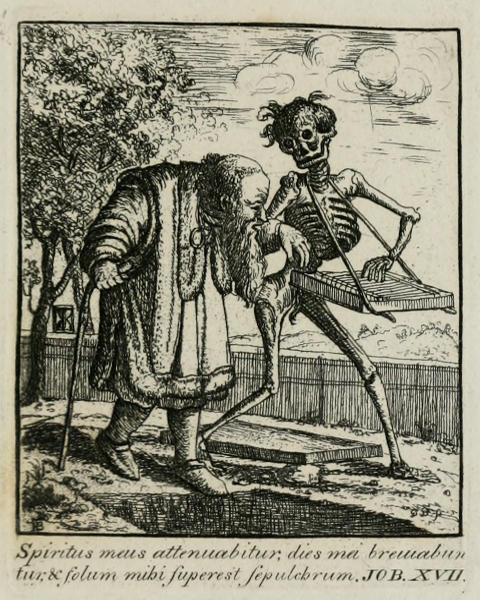
Spiritus meus attenuabitur, dies mei breviabuntur, & solum
mihi superest sepulchrum. Job xvii. 1.
L’on voit ici la Mort qui conduit sur le bord de sa fosse, en
jouant du psalterion, un Vieillard courbé sous le poids des
années, & parvenu au dernier degré de la caducité. Le Vieillard
se laisse emmener avec ce calme & cette tranquillité qui sont
l’apanage de la sagesse & les fruits d’une bonne conscience.
The grim countenance of this good old Dame does not indicate
the same resignation as appears in the former subject.
Wholly occupied in mumbling her rosary, she pays no attention
to the sound of a dulcimer, on which one of her conductors is
playing. The other skeleton, impatient of the slowness of the
Old Woman’s march, is employing menaces and blows to make
her advance.
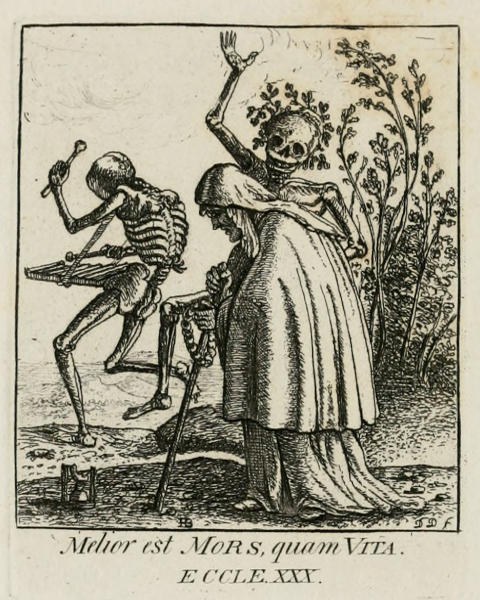
Melior est mors quam vita. Eccle. xxx. 17.
Le visage rechigné de cette bonne Vieille n’annonce pas la
même résignation que dans le sujet précédent. Toute occupée
à marmotter son rosaire, elle ne prête aucune attention au son
du timpanon dont joue l’une de ses conductrices. L’autre squelette
impatient de la lenteur que la bonne Vieille met dans sa
marche, emploie les menaces & les coups pour la faire avancer.
This poor Blind Man is following, with an air of chagrin,
his new conductor, who, without pity, is leading him through
wretched roads. In vain does he attempt, by groping his way,
to avoid the obstacles that oppose his reluctant march; he will
not avoid that fatal goal to which Death is conducting him, and
which will be the only termination of his evils.
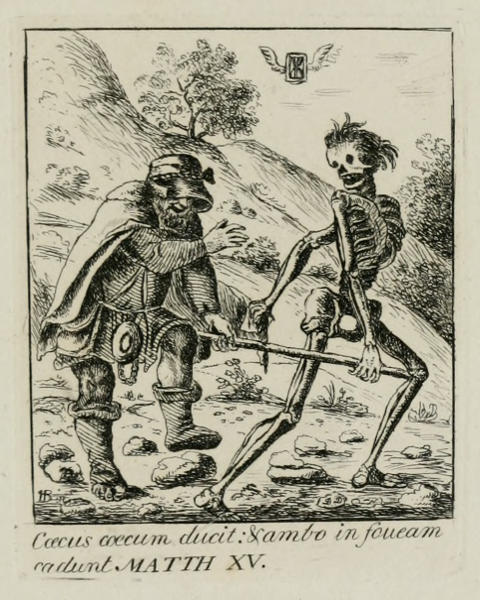
Domine vim patior. Isaiæ xxxviii. 14.
Cæci sunt, & duces cæcorum. Cæcus autem si cæco ducatum
præstet, ambo in foveam cadunt. Matth. xv. 14.
Ce pauvre Aveugle suit d’un air chagrin son nouveau
conducteur qui le mène impitoyablement par les plus mauvais
chemins; en vain veut-il éviter, en tâtonnant, les obstacles qui
s’opposent à sa marche forcée; il n’évitera pas le terme fatal où
la Mort le conduit, et qui ne sera dans le fond que celui de ses
maux.
In the most deplorable situation, lame, and exposed almost
naked to the injuries of the weather, he is set down before a rich
man’s house, into which he has the mortification to see several
enter, who look at him without ever thinking of relieving his
distress. Death, not less cruel than capricious, whose aid alone
he implores, and in whose power it is to make him happy, deaf
to his prayers, allows him to groan under the load of evils which
overwhelm him, whilst he delights to tear from this life those who
think themselves happy, or are attached to it by the strongest ties.
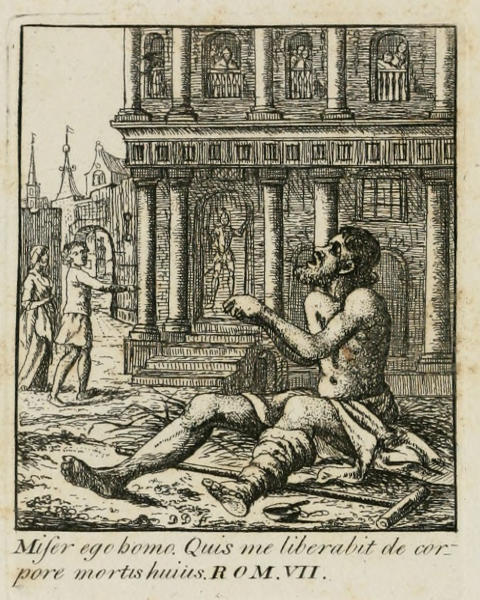
Corruit in curru suo. Chron. xxii.
Dans l’état le plus déplorable, estropié, exposé presque nud
aux injures du tems, il est assis devant la maison d’un homme
opulent, dans laquelle il a la douleur de voir entrer plusieurs
personnes qui le regardent sans songer à soulager ses peines.
La Mort non moins cruelle que bizarre, dont lui seul implore le
secours, & qui pourroit faire son bonheur, sourde à ses prières,
le laisse gémir sous le poids des maux qui l’accablent, tandis
qu’elle se plaît à arracher de cette vie ceux qui s’y croient
heureux, ou qui y tiennent par les liens les plus puissans.
If under the roof of poverty there is any comfort, it is in
having children, by whom we may hope one day to be solaced.
This is the case with this poor widow; but death is of a different
opinion, and is come to carry off her youngest Child, unmoved
by her prayers and lamentations.
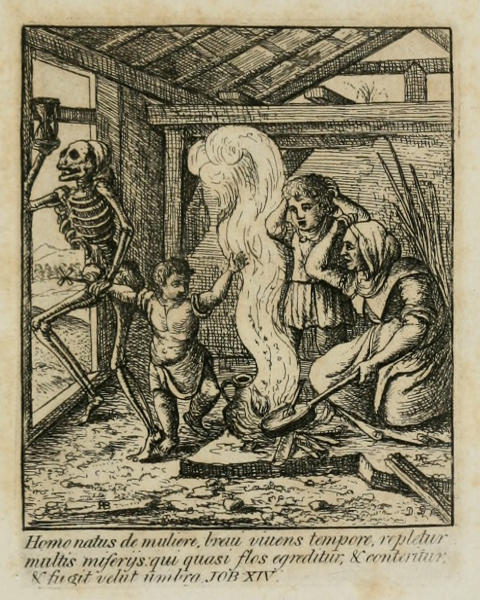
Homo natus de muliere, brevi vivens tempore, repletur multis
miseriis: qui quasi flos egreditur & conteritur, & fugit
velut umbra. Job xiv. 1, 2.
Si sous le toit de la pauvreté il y a quelque consolation, c’est
d’avoir des enfans dont on peut espérer d’être un jour soulagé.
C’est le cas de cette pauvre veuve, mais la Mort n’est point de
cet avis, & vient de lui enlever le plus petit sans se laisser
fléchir, ni par ses prières ni par ses lamentations.
Death is leading him away gaily, making him dance to the
sound of a bagpipe. The Fool, ignorant without doubt of the
catastrophe that awaits him, seems to be meditating some piece
of mischief, which will probably be his last.
This dancing couple finish the procession, wherein Holbein
has had the skill to unite a salutary moral with the gayest and
liveliest sallies that form a singular contrast with the sadness of
the subject.
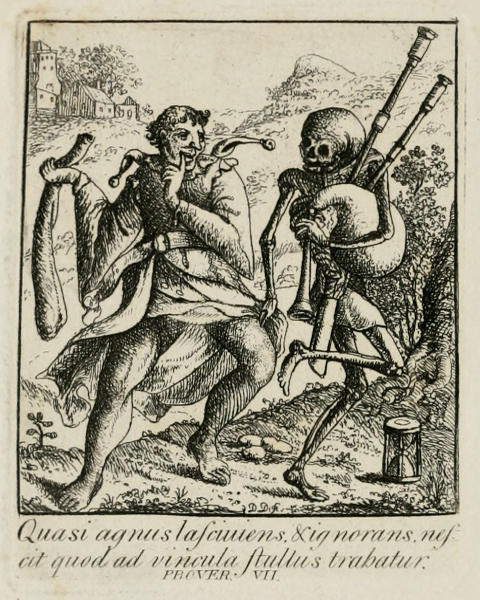
Quasi agnus lasciviens, & ignorans quod ad vincula stultus
trahatur. Prov. vii. 22.
La Mort l’emmène gaiement en le faisant danser au son d’une
cornemuse; le Fou qui ne sait pas sans doute la catastrophe qui
l’attend, paroît méditer une malice qui sera vraisemblablement
la dernière.
Ce couple dansant termine la marche de cette suite où
Holbein a su réunir une morale salutaire, aux sallies les plus
gaies & les plus plaisantes qui contrastent singulièrement avec
la tristesse du sujet.
THE END.
W. SMITH AND CO. Printers, KING STREET, SEVEN DIALS.