Single prints connected with the Dance of Death.
1500-1600.
(N. B. The right and left hands are those of the spectator. The prints on
wood are so specified.)
 n ancient engraving, in the manner of Israel Van Meckenen. Death is
playing at chess with a king, who is alarmed at an impending check-mate. A
pope, cardinal, bishop, and other persons are looking on. Above are three
labels. Bartsch x. 55. No. 32.
n ancient engraving, in the manner of Israel Van Meckenen. Death is
playing at chess with a king, who is alarmed at an impending check-mate. A
pope, cardinal, bishop, and other persons are looking on. Above are three
labels. Bartsch x. 55. No. 32.
Albert Durer’s knight preceded by Death, and followed by a demon, a
well-known and beautiful engraving.
A very scarce and curious engraving, representing the interior of a
brothel. At the feet of a bed a man is sitting by a woman almost naked,
who puts her hand into his purse, and clandestinely delivers the money she
takes from it to a fellow standing behind one of the curtains. On the
opposite side is a grinning fool making significant signs with his fingers
to a figure of Death peeping in at a window. This singular print has the
mark L upon it, and is something in the manner of Lucas Van Leyden, but is
not mentioned in Bartsch’s catalogue of his prints. Upright 7½ by
5½.
A small etching, very delicately executed, and ascribed to Lucas Van
Leyden, whose manner it certainly resembles. At a table on the left a
family of old and young persons are assembled. They are startled by the
appearance of a hideous figure of Death with a long beard and his head
covered. Near him is a young female, crowned with a chaplet of flowers,
holding in her hand a scull, Death’s head, and hour-glass, and which the
father of the family turns round to contemplate. Above is an angel or
genius shooting an arrow at the family, and as it were at random. At top
on the right is the letter L, and the date 1523. See Bartsch, vol. vii. p.
435. Oblong, 5½ by 4.
A small upright print of Death with a spade on his shoulder, and leading
an armed soldier. The mark L below on a tablet. Not mentioned by Bartsch.
A small circular engraving, of several persons feasting and dancing. Death
lies in wait behind a sort of canopy. Probably a brothel scene, as part of
the story of the prodigal son. The mark is L. Not noticed by Bartsch.
A reverse of this engraving, marked S.
An engraving on wood of Death presenting an hour-glass, surmounted by a
dial, to a soldier who holds with both his hands a long battle-axe. The
parties seem to be conversing. With Albert Durer’s mark, and the date
1510. It has several German verses. See Bartsch, vii. 145, No. 132.
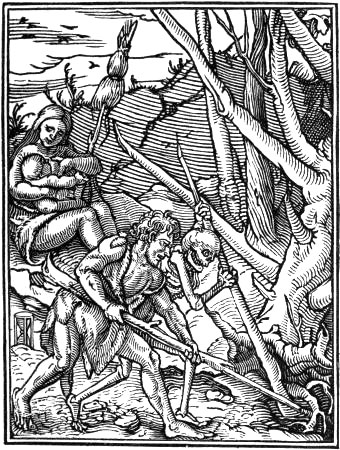
A wood print of Death in a tree pointing with his right hand to a crow on
his left, with which he holds an hour-glass. At the foot of the tree an
old German soldier holding a sword pointed to the ground. On his left,
another soldier with a long pike. A female sitting by the side of a large
river with a lap-dog. The mark of Urs Graaf ![[monogram]](https://openoldbooks.sgp1.digitaloceanspaces.com/books/the-dance-of-death-38724/images/mono_vg.jpg) and the date
1524 on the tree. Upright, 8 by 4½.
and the date
1524 on the tree. Upright, 8 by 4½.
Death as a buffoon, with cap, bauble, and hour-glass, leading a lady. The
motto, OMNEM IN HOMINE
VENVSTATEM MORS ABOLET. With the mark and date
![[monogram]](https://openoldbooks.sgp1.digitaloceanspaces.com/books/the-dance-of-death-38724/images/mono_hsb.jpg) 1541. Bartsch, viii. 174.
1541. Bartsch, viii. 174.
An engraving of Adam and Eve near the tree of life, which is singularly
represented by Death entwined with a serpent. Adam holds in one hand a
flaming sword, and with the other receives the apple from Eve, who has
taken it from the serpent’s mouth. At top is a tablet with the mark and
date 1543. A copy from Barthol. Beham. Bartsch, viii. 116.
Death seizing a naked female. A small upright engraving. The motto, OMNEM
IN HOMINE VENVSTATEM MORS ABOLET. With the mark and date 1546.
Bartsch, viii. 175.
A small upright engraving, representing Death with three naked women, one
of whom he holds by the hair of her head. A lascivious print. The mark
![[monogram]](https://openoldbooks.sgp1.digitaloceanspaces.com/books/the-dance-of-death-38724/images/mono_hcb.jpg) on a label at bottom. Bartsch, viii. 176, who calls the women
sorceresses.
on a label at bottom. Bartsch, viii. 176, who calls the women
sorceresses.
A small upright engraving of Death holding an hour-glass and dial to a
soldier with a halberd. At top, the mark and date 1532.
Bartsch, viii. 276.
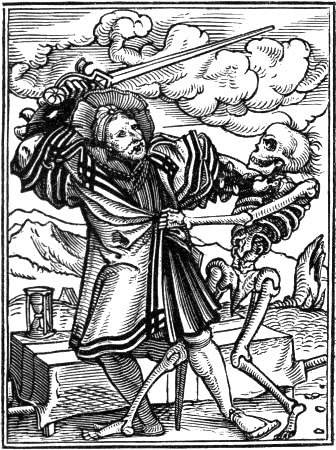
An upright engraving of Death seizing a soldier, who struggles to escape
from him. Below, an hour-glass. In a corner at top, the mark .
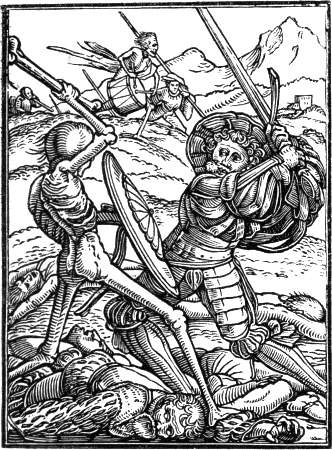
An upright engraving of Death trampling upon a vanquished soldier, who
endeavours to parry with his sword a blow that with one hand his adversary
aims at him, whilst with the other he breaks the soldier’s spear. In a
corner at top, the mark . A truly terrific print, engraved also
by ![[monogram]](https://openoldbooks.sgp1.digitaloceanspaces.com/books/the-dance-of-death-38724/images/mono_ac_mod.jpg) . Bartsch, viii. 277.
. Bartsch, viii. 277.
A naked female seized by a naked man in a very indecent manner. Death who
is behind seizes the man whose left hand is placed on a little boy taking
money out of a bag.
The motto, HO: MORS VLTIMA LINEA RERVM, with the mark
and date ![[monogram]](https://openoldbooks.sgp1.digitaloceanspaces.com/books/the-dance-of-death-38724/images/mono_hsp.jpg) 1529. See Bartsch, viii. 176.
1529. See Bartsch, viii. 176.
Near the end of an English Primer, printed at Paris, 1538, 4to. is a small
print of Death leading a pope, engraved with great spirit on wood, but it
has certainly not formed part of a series of a Dance of Death.
An upright engraving of a pair of lovers interrupted by Death with scythe
and hour-glass, with the mark and date ![[monogram]](https://openoldbooks.sgp1.digitaloceanspaces.com/books/the-dance-of-death-38724/images/mono_hm.jpg) 1550. Not in
Bartsch.
1550. Not in
Bartsch.
A small wood print of a gentleman conducting a lady, whose train is held
up by Death with one hand, whilst he holds up an hour-glass with the
other. In a corner below, the supposed mark of Jost de Negher, ![[monogram]](https://openoldbooks.sgp1.digitaloceanspaces.com/books/the-dance-of-death-38724/images/mono_yf.jpg) .
Upright, 2 by 1¾.
.
Upright, 2 by 1¾.
A German anonymous wood print of the prodigal son at a brothel, a female
fool attending. Death unexpectedly appears and takes him by the hand,
whilst another female is caressing him. Oblong, 4½ by 4.
An upright engraving on wood, 14 by 11, of a naked female on a couch.
Death with a spade and hour-glass approaches her. With her left hand she
holds one corner of a counterpane, Death seizing the other, and trampling
upon it. Under the counterpane, and at the foot of the couch is a dead and
naked man grasping a sword in one hand. There is no indication of the
artist of this singular print.
An upright wood engraving, 14½ by 11, of a whole-length naked female
turning her head to a mirror, which she holds behind her with both hands.
Death, unnoticed, with an hour-glass, enters the apartment; before him a
wheel. On the left at bottom a blank tablet, and near the woman’s left
foot a large wing.
An engraving on wood by David Hopfer of Death and the Devil surprizing a
worldly dame, who admires herself in a mirror. Oblong, 8 inches by 5½.
An upright engraving of a lady holding in one hand a bunch of roses and in
the other a glove. Death behind with his hour-glass; the motto, OMNEM IN
HOMINE VENVSTATEM MORS ABOLET. and the mark F. B. Bartsch, ix. 464.
A wood print of Death seizing a child. On the left, at top, is a blank
tablet. Upright, 2½ by 2.
A small oblong anonymous engraving of a naked female asleep on a couch. A
winged Death places an hour-glass on her shoulder. A lascivious print.
An ancient anonymous wood print: scene, a forest. Death habited as a
woodman, with a hatchet at his girdle and a scythe, shoots his arrows into
a youth with a large plume of feathers, a female and a man lying prostrate
on the ground; near them are two dead infants with amputated arms; the
whole group at the foot of a tree. In the back-ground, a stag wounded by
an arrow, probably by the young man. 4to. size.
A small wood-cut of Death seizing a child. Anonymous, in the manner of A.
Durer. 2¼ by 1⅞.
A very old oblong wood-cut, which appears to have been part of a Dutch or
Flemish Macaber Dance. The subjects are, Death and the Pope, with “Die
doot seyt,” “die paens seyt,” &c. and the Cardinal with “Die doot seyt,”
and “Die Cardinael seyt.” There have been verses under each character.
9½ by 6½.
A small wood print of a tree, in which are four men, one of whom falls
from the tree into a grave at the foot of it. Death, as a woodman, cuts
down the tree with a hatchet. In the back-ground, another man fallen into
a grave.
A figure of Death as a naked old man with a long beard. He leans on a
pedestal, on which are placed a scull and an hour-glass, and with his left
hand draws towards him a draped female, who holds a globe in her left
hand. At the bottom of the print, MORS OMNIA
MVTAT, with the unknown
monogram ![[monogram]](https://openoldbooks.sgp1.digitaloceanspaces.com/books/the-dance-of-death-38724/images/mono_bad.jpg) . Upright, 5 inches by 2¾. It is a very rare
print on copper, not mentioned by Bartsch.
. Upright, 5 inches by 2¾. It is a very rare
print on copper, not mentioned by Bartsch.
A small anonymous wood print of Death playing on a vielle, or beggar’s
lyre.
An ancient anonymous copper engraving of Death standing on a bier, and
laying hands upon a youth over whom are the words, “Ach got min sal ich,”
and over Death, “hie her by mich.” Both inscriptions on labels. Bartsch,
x. p. 54, No. 30.
An allegorical engraving on copper by Cuerenhert, after Martin Heemskirk,
1550. A naked man bestrides a large sack of money, on which a figure or
statue of Hope is standing. Death with one hand levels his dart at the
terrified man, and holds a circle in the other. The money is falling from
the sack, and appears to have demolished the hour-glass of Death. Upright,
11 inches by 8. At bottom, these lines:
Maer als hemdie eininghe doot comt voer ogen
Dan vint hii hem doer üdele hope bedrogen.
There is a smaller copy of it.
A circular engraving, two inches diameter, of a pair of lovers in a
garden. The lady is playing on a harp, her companion’s lute is on the
ground. They are accompanied by a fool, and Death behind is standing with
a dart in his hand ready for aim at the youthful couple.
A very large engraving on wood tinted in chiaroscuro. It represents a sort
of triumphal arch at the top of which is a Death’s head, above, an
hour-glass between two arm bones, that support a stone; evidently borrowed
from the last cut of the arms of Death in the Lyons wood-cuts. Underneath,
the three Fates between obelisks crowned with Deaths’ heads and crosses,
with the words ΜΝΗΜΟΝΕΥΕ ΑΠΟΨΥΧΕΙΝ
and ITER AD VITAM. In the middle, a circle with eight compartments, in which are skeleton heads of a
pope, an emperor, &c. with mottoes. In the extremity of the circle, the
words “Post hoc autem judicium statutum est omnibus hominibus semel mori.”
The above obelisks are supported by whole length figures of Death, near
which are shields with BONIS BONA and MALIS MALA. On the pedestals that
support the figures of Death are shields inscribed MEMENTO MORI and
MEMORARE NOVISSIMA. Underneath the circle, a sort of table monument with
Death’s head brackets, and on its plinth a sceptre, cardinal’s cross,
abbot’s crozier, a vessel with money, and two books. Between the brackets,
in capitals:
TRIA SUNT VERE
QVÆ ME FACIVNT
FLERE.
And underneath in italics:
Primum quidem durum, quia scio me moriturum.
Secundum vero plango, quia moriar, et nescio quando.
Tertium autem flebo, quia nescio ubi manebo.
In a corner at bottom, “Ill. D. Petro Caballo J. C. Poutrém Relig. D.
Steph. ordinisq. milit. Ser. M. D. Hetr: Auditori mon: Joh. Fortuna
Fortunius Inven. Seni..... MDLXXXVIII.” It is a very fine print, engraved
with considerable spirit.
1600-1700.
A very beautiful engraving by John Wierix, of a large party feasting and
dancing, with music, in a garden. Death suddenly enters, and strikes a
young female supported by her partner. At bottom, “Medio, lusu, risuque
rapimur æternum cruciandi.” Oblong, 6½ by 4½.
Its companion—Death, crowned with serpents, drags away a falling female,
round whom he has affixed his chain, which is in vain held back by one of
the party who supplicates for mercy. At bottom these lines:
Divitibus mors dura venit, redimita corona
Anguifera, et risus ultimo luctus habet.
On the top of the print, “O mors quam amara est memoria tua homini pacem
habenti in substantiis suis, etc.” Eccl. cap. xli.
An allegorical print by one of the Wierxes, after H. Van Balen. The Virgin
Mary and a man are kneeling before and imploring Christ, who is about to
strike a bell suspended to the branch of a tree, the root of which Death
cuts with an axe, whilst the Devil assists in pulling at it with a rope.
Upright, 4½ by 3½.
Time holding a mirror to two lovers, Death behind waiting for them. At
bottom, “Luxuries predulce malum cui tempus, &c.” Engraved by Jerom Wierx.
Oblong, 12 by 8.
An allegorical engraving by Jerom Wierx, after Martin De Vos, with four
moral stanzas at bottom, beginning “Gratia magna Dei cælo demittitur
alto.” A figure of Faith directs the attention of a man, accompanied with
two infants, to a variety of worldly vanities scattered in a sun-beam. On
the right, a miser counting his gold is seized and stricken by Death. At
top, four lines of Latin and Dutch. Oblong, 13 by 10.
A rare etching, by Rembrant, of a youthful couple surprized by Death.
Date, 1639. Upright, 4¼ by 3.
Rembrant’s “Hour of Death.” An old man sitting in a tent is visited by a
young female. He points to a figure of Death with spade and hour-glass.
Upright, 5¼ by 3½.
An engraving by De Bry. In the middle, an oblong oval, representing a
marriage, Death attending. On the sides, grotesques of apes, goats, &c. At
bottom, S. P. and these lines:
Ordo licet reliquos sit præstantissimus inter
Conjugium, heu nimium sæpe doloris habet.
Oblong, 5½ by 2¼.
Its companion—Death digging a grave for an old man, who looks into it.
Psal. 49 and 90.
An engraving by Crispin de Pas of Death standing behind an old man, who
endeavours, by means of his money spread out upon a table, to entice a
young female, who takes refuge in the arms of her young lover. At bottom,
the following dialogue.
Senex.
Nil aurei? nil te coronati juvant?
Argenteis referto bulga nil movet?
Mors.
Varios quid at Senex amores expetis:
Tumulum tuæ finemque vitæ respice.
Juvenis.
Quid aureorum me beabit copia.
Amore si privata sim dulcissimo.
Its companion—Death with his hour-glass stands behind an old woman, who
offers money to a youth turning in disdain to his young mistress. At
bottom, these lines:
Juvenis.
Facie esse quid mihi gratius posset tua
Ipsius haud Corinthi gaza divitis.
Vetula.
Formam quid ah miselle nudam respicis
Cum plus beare possit auri copia.
Mors.
At tu juventa quid torquêre frustra anus
Quin jam sepulchri instantis es potius memor.
Both oblong, 6 by 4.
An engraving by Bosse of a queen reposing on a tent bed, Death peeps in
through the curtains, another Death stands at the corner of the bed,
whilst a female with a shield, inscribed PIETAS, levels a dart at the
queen. Underneath, these verses:
Grand Dieu je suis donc le victime
Qu’une vengeance legitime
Doit immoler à tes autels
Je n’ay point de repos qui n’augmente ma peine
Et les tristes objets d’une face inhumaine
Me sont autant de coups mortels.
Oblong, 4½ by 3.
An engraving by John Sadeler, after Stradanus, of an old couple, with
their children and grandchildren, in the kitchen of a farm-house. Death
enters, fantastically crowned with flowers and an hour-glass, and with a
bagpipe in his left hand. Round his right arm and body is a chain with a
hook at the extremity. He offers his right hand to the old woman, who on
her knees is imploring him for a little more delay. In the back-ground, a
man conducted to prison; beggars receiving alms, &c. At bottom, these
lines:
“Pauperibus mors grata venit; redimita corona
Florifera, et luctus ultima risus habet.”
On the top of the print, “O mors bonum est judicium tuum homini indigenti,
et qui minoratur viribus defecto ætate, &c.” Eccl. cap. xli. Oblong, 11 by
8½.
An exceedingly clever etching by Tiepolo of a group of various persons, to
whom Death, sitting on the ground and habited grotesquely as an old woman,
is reading a lecture. Oblong, 7 by 5½.
A small circle, engraved by Le Blond, of Death appearing to the
astrologer, copied from the same subject in the Lyons wood-cuts.
A print, painted and engraved by John Lyvijus of two card players
quarrelling. Death seizes and strikes at them with a bone. Below,
Rixas atque odia satagit dispergere serpens,
Antiquus, cuncta at jurgia morte cadunt.
Oblong, 10 by 7½.
An engraving by Langlois. Death with a basket at his shoulder, on which
sits an owl, and holding with one hand a lantern, seizes the dice of a
gambler sitting at a table with his winnings spread before him. At top,
these verses:
Alarme O le pipeur, chassez, chassez le moy,
Je ne veux pas jouer a la raffle avec toy.
La Mort.
A la raffle je joue avec toutes personnes
Toutes pieces je prends, tant meschantes que bonnes.
At bottom, a dialogue between the gambler and Death, in verse, beginning
“J’ay ramenè ma chance il n’y a plus reméde.” Upright, 10 by 7½.
A print by De Gheyn, but wanting his name, of an elegantly attired lady,
with a feather on her head, and a fan mirror in her hand. She is
accompanied by Death handsomely attired, with a similar feather, and
holding an hour-glass. At bottom,
Qui genio indulges, media inter gaudia morti
Non dubiæ certum sis memor esse locum.
Upright, 8 by 5½.
Hollar’s etching in Dugdale’s Monasticon and his history of St. Paul’s,
from the old wood-cut in Lydgate’s Dance of Macaber, already described,
and an outline copy in Mr. Edwards’s publication of Hollar’s Dance of
Death.
Death and two Misers, 11¾ by 10. Engraved by Michael Pregel, 1616. At
bottom, six Latin lines, beginning “Si mihi divitiæ sint omnes totius
orbis.”
An oblong allegorical print, 14 by 10½. Death and Time at war with man
and animals. In the foreground, Death levels three arrows at a numerous
group of mortals of all ranks and conditions, who endeavour, in every
possible way, to repel his attack. In the back-ground, he shoots a single
arrow at various animals. It is a very rare and beautiful engraving by
Bolsverd, after Vinck-boons, dated 1610. At bottom, six lines in Latin, by
J. Semmius, beginning “Cernis ut imperio succumbant omnia Mortis.”
An oblong print, 18½ by 13, intitled, “Alle mans vrees,” i. e. “Every
man’s terror,” and engraved by Cornelius Van Dalen, after Adrian Van
Venne. It exhibits Death armed with a spade, and overturning and putting
to flight a variety of persons. At bottom, four stanzas of Dutch verses,
beginning “Dits de vrees van alle man.”
A large allegorical oblong engraving, 18½ by 13, by Peter Nolpe, after
Peter Potter. On the left, a figure of religion, an angel hovering over
her with a crown and palm branch. She points to several figures bearing
crosses, and ascending a steep hill to heaven. On the right, the Devil
blowing into the ear of a female, representing worldly vanity. In the
middle, Death beating a drum to a man and woman dancing. In the
back-ground, several groups of people variously employed, and a city in
flames.
An anonymous Venetian engraving of Death striking a lady sitting at a
table covered with various fruits, a lute, &c. She falls into the arms of
her lover or protector. Oblong, 9½ by 7.
A print, after Martin Heemskirk, of Charon ferrying over souls. On the
right, a winged Death supporting an emperor about to enter the fatal boat.
Below, four lines, beginning “Sed terris debentur opes, quas linquere
fato.”
An oblong engraving, 14 by 12, after John Cossiers. On the right, Death
entering at a door, seizes a young man. In the middle, a music-master
teaching a lady the lute, Death near them holding a violin and music-book.
On the left, in another apartment, Death in a dancing attitude, with a
double bagpipe, leads an aged man with a rosary in his left hand, and
leaning on a staff with his right. At bottom, three stanzas of French
verses, beginning “La Mort qui n’a point d’oreilles.”
A very small wood print, that seems to have belonged to some English book,
about 1600. It represents Death behind a female, who sees his reflected
image in a mirror which she holds, instead of her own. 1½ by 1½.
The Devil’s Ruff shop, into which a young gallant introduces his mistress,
whose ruff one of the Devils is stiffening with a poking-stick. Death,
with a ruff on his neck, waits at the door, near which is a coffin. This
very curious satirical print, after Martin De Vos, is covered with
inscriptions in French and Dutch. Oblong, 11½ by 8.
A small anonymous engraving of two Deaths hand in hand; the one holds a
flower, the other two serpents; a man and woman also hand in hand; the
latter holds a flower in her hand; they are preceded by a little boy on a
cock-horse and a girl with a doll. Underneath, four lines, beginning “Quid
sit, quid fuerit, quid tandem aliquando futurus.”
An anonymous engraving of a young gallant looking up to an image of Hope
placed on a bag of money, near which plate, jewels, and money lie
scattered on the ground. Death enters at a door, holding a circle in one
hand and a dart with the other, in a menacing attitude. At bottom, these
Latin lines:
Namque ubi Mors trucibus supra caput adstitit armis,
Hei quam tunc nullo pondere nummus erit.
The same in Dutch. Upright, 8½ by 6. This print was afterwards copied
in a reduced form into a book of emblems, with the title, “Stulte hoc
nocte repetent animam tuam,” with verses in Latin, French, and German.
A small anonymous wood engraving of five Deaths dancing in a circle; the
motto, DOODEN DANS OP LESTEM, i. e. the last Dance of Death.
A very clever etching of a winged and laurelled Death playing on the
bagpipe and making his appearance to an old couple at table. The man puts
off his cap and takes the visitor by the hand, as if to bid him welcome.
Below, two Dutch lines, beginning “Maerdie hier sterven, &c.” At top, on
the left, “W. V. Valckert, in. fe. 1612.” Oblong, 8½ by 6½.
A very complicated and anonymous allegorical print, with a great variety
of figures. In the middle, Death is striking with a sledge-hammer at a
soul placed in a crucible over a sort of furnace. A demon with bellows is
blowing the fire, and a female, representing the world, is adding fuel to
it. In various parts of the print are Dutch inscriptions. Oblong, 10½
by 6.
Two old misers, a man and a woman. She weighs the gold, and he enters it
in a book. Death with an hour-glass peeps in at one window, and the Devil
at another. On the left, stands a demon with a book and a purse of money.
On the right, in a corner, I. V. BRVG: F. “Se vend chez Audran rue S.
Jaques aux deux piliers d’or.” An upright mezzotint, 11½ by 8½.
Two old misers, a man and a woman. He holds a purse, and she weighs the
money. Death behind lies in wait for them. Below, a French stanza,
beginning “Fol en cette nuit on te redemande ton ame,” and the same in
Latin. Below, “J. Meheux sculp. A Paris chez Audran rue St. Jaques aux
deux pilliers d’or.” An upright mezzotint, 10 by 7½.
An oval engraving in a frame of slips of trees. Death pulling down a fruit
tree; a hand in a cloud cutting a flower with a sickle. Motto, “Fortior
frango, tenera meto.” Upright, 6½ by 4.
An anonymous engraving of a lady sitting at her toilet. She starts at the
reflected image of Death standing behind her, in her looking glass. Her
lover stands near her in the act of drawing his sword to repel the
unwelcome visitor. Upright, 7¼ by 6½. To some such print or
painting, Hamlet, holding a scull in his hand, evidently alludes in Act v.
Sc. 1. “Now get you to my lady’s chamber, and tell her let her paint an
inch thick, to this favour she must come.”
A print of the tree of knowledge, the serpent holding the apple in his
mouth. Below, several animals, as in the usual representations of
Paradise. On one side a youth on horseback with a hawk on his fist; on the
other, Death strikes at him with his dart. On the right, at bottom, the
letters R. P. ex. and these verses:
Nor noble, valiant, youthfull or wise, have
The least exemption from the gloomy grave.
Upright, 6 by 4.
A large oblong engraving, on copper, 22 by 17. On the left, is an arched
cavern, from which issue two Deaths, one of whom holds a string, the end
of which is attached to an owl, placed as a bird decoy, on a pillar in the
middle of the print. Under the string, three men reading. On the left,
near a tree, is a ghastly sitting figure, whose head has been flayed. On
the opposite side below, a musical group of three men and a woman. In the
back-ground, several men caught in a net; near them, Death with a hound
pursuing three persons who are about to be intercepted by a net spread
between two trees. In the distance, a vessel with a Death’s head on the
inflated sail. On the top of the arched cavern, a group of seven persons,
one of whom, a female, points to the interior of an urn; near them a
flying angel holding a blank shield of arms. In the middle of the print,
at bottom, some inscription has been erased.
A print, intitled “Cursus Mundi.” A woman holds, in one hand, a broken
vessel with live coals; in the other, a lamp, at which a little boy is
about to light a candle. Death appears on the left. At bottom, a Latin
inscription stating that the picture was painted by William Panneels, the
scholar of Rubens, in 1631, and that it is in the palace of Anselm
Casimir, archbishop of Mentz. Upright, 9½ by 6½.
A small anonymous engraving of Death sitting on a large fractured
bass-viol, near which, on the ground, is a broken violin.
An elegant small and anonymous engraving of a young soldier, whom Death
strikes with his dart whilst he despoils him of his hat and feather. At
bottom, six couplets of French verses, beginning “Retire toy de moy O
monstre insatiable.” Upright, 3¾ by 2¾.
A small anonymous engraving of a merchant watching the embarkation of his
goods, Death behind waiting for him. Motto from Psalm 39, “Computat et
parcit nec quis sit noverit, hæres, &c.” Upright, 3¼ by 1½.
Its companion—Death striking a child in a cradle. Job 14. “Vita brevis
hominum variis obnoxia curis, &c.” These were probably part of a series.
An anonymous engraving of a man on his death-bed. On one side, the vision
of a bishop saint in a cloud; on the other, Death has just entered the
room to receive his victim. Oblong, 5½ by 2½.
An anonymous engraving of a woman sitting under a tree. Sin, as a boy,
with PECCATVM inscribed on his forehead, delivers a globe, on which a
serpent is entwined, to Death. At bottom, “A muliere initium factum est
peccati et per illam omnes morimur. Eccl. C. XXV.”
A small anonymous engraving of Death interrupting a Turkish sultan at
table. In the back ground, another Turk contemplating a heap of sculls.
A mezzotint by Gole, of Death appearing to a miser, treading on an
hour-glass and playing on the violin. In the back-ground, a room in which
is Death seizing a young man. The floor is covered with youthful
instruments of recreation. This subject has been painted by Old Franks
and Otho Vænius. Upright, 9 by 6½. Another mezzotint of the same
subject by P. Schenck is mentioned by Peignot, p. 19. It is inscribed
“Mortis ingrata musica.”
A very singular, anonymous, and unintelligible engraving of a figure that
seems intended for a blacksmith, who holds a large hammer in his hand. On
his right, two monks, and behind him, Death folding his arms to his
breast. Below, writing implements, &c. Upright, 4 by 3.
The triumphal car of Time drawn by genii, and accompanied by a pope,
cardinal, emperor, king, queen, &c. At the top of the car, Death blows a
trumpet, to which a banner is suspended, with “Je trompe tout le monde.”
In the back-ground a running fountain, with “Ainsi passe la gloire du
monde.” An anonymous upright engraving, 4 by 2½.
A very neat engraving by Le Blon of several European coins. In the centre,
a room in which Death strikes at two misers, a man and a woman sitting at
a table covered with money. On the table cloth, “Luc. 12 ca.”
Its companion—Death and the Miser. The design from the same subject in
the Lyons wood-cuts. A label on the wall, with “Luc. 12.” Oblong, 6½ by
3½.
A German anonymous print, apparently from a book of emblems, representing
Death waiting with a scythe to cut off the following persons: 1. A lady.
2. A gentleman. 3. An advocate. 4. A soldier: and, 5. A preacher. Each has
an inscription. 1. Ich todt euch alle (I kill you all). 2. Ich erfrew euch
alle (I rejoice you all). 3. Ich eruhr euch alle (I honour you all). 4.
Ich red fur euch alle (I speak for you all). 5. Ich fecht fur euch alle (I
fight for you all). 6. Ich bett fur euch alle (I pray for you all). With
verses at bottom, in Latin and German. Oblong, 5¼ by 4.
An anonymous engraving of a naked youth who with a sword strikes at the
head of Death pursuing another youth. Oblong, 9½ by 5½.
An upright engraving, 5½ by 4, representing a young man on horseback
holding a hawk on his fist, and surrounded by various animals. Death
holding an hour-glass, strikes at him with his dart. Behind, the tree of
knowledge, with the serpent and apple. At bottom, on the right, are the
initials T. P. ex.
An engraving of the Duke of Savoy, who, attended by his guards, receives
petitions from various persons. Before him stands in a cloud the angel of
Death, who points towards heaven. At bottom, on the left, “Delphinus
pinxit. Brambilla del. 1676,” and on the right, “Nobilis de Piene S. R. C.
Prim. cælator f. Taur.” Oblong, 10½ by 7½.
An engraving by De Gheyn, intitled, “Vanitas, idelheit.” A lady is sitting
at a table, on which is a box of jewels and a heap of money. A hideous
female Death strikes at her with a flaming dart, which, at the same time,
scatters the leaves of a flower which she holds in her left hand. Upright,
9 by 7.
A very small circular wood-cut, apparently some printer’s device,
representing an old and a young man, holding up a mirror, in which is
reflected the figure of Death standing behind them, with the motto,
“Beholde your glory.”
An anonymous print of Death and the miser. Death seizes his money, which
he conveys into a dish. Upright, 3½ by 2½. It is a copy from the
same subject in the Lyons wood-cuts.
1700-1800.
An anonymous modern copy of Death and the bridegroom, copied from the
Lyons wood-cuts, edition 1562.
An etching of Death, with an hour-glass in one hand and a cane in the
other, entering a room where a poor poet has been writing, and who would
willingly dispense with the visit. At bottom “And when Death himself
knocked at my door, ye bad him come again; and in so gay a tone of
careless indifference did ye do it, that he doubted of his commission.
There must certainly be some mistake in this matter, quoth he.” The same
in Italian. This is one of Patch’s caricatures after Ghezzi. Upright,
16½ by 12.
A print intitled “Time’s lecture to man,” with eight stanzas in verse,
beginning “Why start you at that skeleton.” It consists of three
divisions. At top a young man starts at the appearance of time and death.
Under the youth “Calcanda semel via lethi.” At each extremity of this
division is a figure of Death sitting on a monument. The verses, in double
columns, are placed between two borders with compartments. That on the
right a scull crowned with a mitre; an angel with a censer; time carrying
off a female on his back; Death with an infant in his arms; Death on
horseback with a flag; Death wrestling with a man. The border on the left
has a scull with a regal crown; an angel dancing with a book; Death
carrying off an old man; Death leading a child; Death with a naked corpse;
Death digging a grave. At bottom “Sold by Clark and Pine, engravers, in
Castle Yard, near Chancery Lane, T. Witham, frame-maker, in Long Lane,
near West Smithfield, London.” With a vignette of three Deaths’ heads. 13
by 9½.
There is a very singular ancient gem engraved in “Passeri de Gemmis
Astriferis,” tom. ii. p. 248. representing a skeleton Death standing in a
car drawn by two animals that may be intended for lions; he holds a whip
in his hand, and is driving over other skeletons. It is covered with
barbarous and unintelligible words in Greek characters, and is to be
classed among those gems which are used as amulets or for magical
purposes. It seems to have suggested some of the designs that accompany
the old editions of Petrarch’s Triumph of Death.
A folio mezzotint of J. Daniel von Menzel, an Austrian hussar. Behind him
is a figure of Death with the hussar’s hat on his head, by whom he is
seized. There are some German verses, and below
Mon amis avec moi à la danse
C’est pour vous la juste recompense.
The print is dated 1744.
A Dutch anonymous oblong engraving on copper, 10½ by 10, intitled
“Bombario, o dood! te schendig in de nood.” Death leads a large group of
various characters. At bottom verses beginning “De Boertjes knappen al
temaal.” On each side caricatures inscribed Democritus and Heraclitus. It
is one of the numerous caricatures on the famous South Sea or Mississippi
bubble.
An engraving, published by Darly, entitled “Macaronies drawn after the
life.” On the left a macaroni standing. On the floor dice and dice-box. On
a table cards and two books. On the right, Death with a spade, leaning on
a sarcophagus, inscribed “Here lies interred Dicky Daffodil, &c.” Oblong,
9 by 6.
A very clever private etching by Colonel Turner, of the Guards, 1799,
representing, in the foreground, three Deaths dancing in most grotesque
attitudes. In the distance several groups of skeletons, some of whom are
dancing, one of them beating a drum. Oblong, 5½ by 3½.
A small engraving by Chodowiecki. Death appears to a medical student
sitting at a table; underneath these lines,
De grace epargne moi, je me fais medecin,
Tu recevras de moi la moitié des malades.
Upright, 3½ by 2. This is not included in his Dance of Death.
The same slightly retouched, with German verses.
A small engraving, by Chodowiecki, of Death approaching a dying man
attended by his family and a physician. Oblong, 2½ by 2.
A modern engraving, intitled “An emblem of a modern marriage.” Death
habited as a beau stands by a lady, who points to a monument inscribed
“Requiescat in pace.” Above a weeping Cupid with an inverted torch. At
bottom
... No smiles for us the Godhead wears,
His torch inverted and his face in tears.
Drawn by M. H. from a sketch cut with a diamond on a pane of glass.
Published according to act of parliament, June 15, 1775.
A modern caricature intitled “A patch for t’other eye.” Death is about to
place a patch on the right eye of an old general, who has one already on
the other. His hat and truncheon lie on the ground, and he is drawing his
sword for the purpose of opposing the intention of his grim adversary,
exclaiming at the same time, “Oh G—d d—n ye, if that’s your sport, have
at ye.” Upright, 8 inches by 7.
A small engraving by Chr. de Mechel, 1775, of an apothecary’s shop. He
holds up a urinal to a patient who comes to consult him, behind whom Death
is standing and laying hands upon him. Below these verses:
Docteur, en vain tu projettes
De prononcer sur cette eau,
La mort rit de tes recettes
Et conduit l’homme au tombeau.
Oblong, 4 by 3.
An anonymous and spirited etching of Death obsequiously and with his arms
crossed entering a room in which is a woman in bed with three infants.
With uplifted arms she screams at the sight of the apparition. Below in a
corner the husband, accompanied with four other children. Upright, 11 by
10½.
“The lawyer’s last circuit.” He is attacked by four Deaths mounted on
skeleton horses. He is placed behind one of them, and all gallop off with
him. A road-post inscribed “Road to hell.” Below, the lines from Hamlet,
“Where be his quiddits now? his quillets, his cases, his tenures, and his
tricks, &c.” Published April 25, 1782, by R. Smith, opposite the Pantheon,
Oxford Street. Oblong, 10 by 6½.
1800.
A modern wood-cut of a drinking and smoking party. Demons of destruction
hover over them in the characters of Poverty, Apoplexy, Madness, Dropsy,
and Gout. In the bowl on the table is a monstrous head inscribed
“Disease.” Behind, a gigantic figure of Death with scythe and hour-glass.
Oblong, 3½ by 3.
A Sketch by Samuel Ireland, after Mortimer, in imitation of a chalk
drawing, apparently exhibiting an Englishman, a Dutchman, and a Spaniard.
Death behind stretching his arms upon all of them. Oblong 10½ by 8.
A wood print intitled “Das betruhte Brautfest.” Death seizes a man looking
at a table covered with wedding-cakes, &c. From a modern Swiss almanack.
Oblong 6½ by 5½.
A mezzotint of a physician, who attending a sick patient in bed is
attacked by a group of Deaths bearing standards, inscribed “Despair,”
“l’amour,” “omnia vincit amor,” and “luxury.” Oblong, 11 by 8½.
An etching from a drawing by Van Venne of Death preaching from a
charnel-house to a group of people. His text book rests on the figure of a
skeleton as a reading desk. It is prefixed to Mr. Dagley’s “Death’s
Doings,” mentioned in p. 157. Oblong, 5½ by 4¼.
Mr. Dagley, in the second edition of his “Death’s Doings,” p. 9, mentions
a print of “a man draining an enormous bowl, and Death standing ready to
confirm the title of the print, “the last drop.”
An etching by Dagley, after Birch, of Baxter, a famous cricketer, bowled
out by Death. Below, his portrait at full length. Oblong, 9 by 7.
“Sketches of the celebrated skeletons, originally designed on the long
wall between Turnham-Green and Brentford.” Etchings of various groups; the
subjects, billiards, drafts, cards, dice, toss, and pitch. Oblong, 18 by
11.
“Humorous sketches of skeletons engaged in the various sciences of
Singing, Dancing, Music, Oratory, Painting, and Sculpture.” Drawn by H.
Heathcote Russell as a companion to the skeletons copied from the long
wall at Brentford. Published 3d June, 1830. Same size as the preceding
print.
A lithographic print of a conjurer pointing with his magic wand to a table
on which are cups, a lanthorn, &c. In the back-ground, the Devil running
away with a baker, and a group of three dancing Deaths. Below, birds in
cages, cards, &c. Oblong, 8 by 6.
A small modern wood-cut of Death seizing a lady at a ball. He is disguised
as one of the party. Underneath, “Death leads the dance.”—Young—Night
5.
From “the Christian’s Pocket Magazine.” Oblong, 2½ by 1½.
A design for the ballad of Leonora, by Lady Diana Beauclerc. A spectre, as
Death, carrying off a lady on horseback, and striking her with his dart.
Other Death-like spectres waiting for her. Oblong, 11¾ by 9.
A small modern engraving of Death presenting a smelling bottle to a
fainting butcher with one hand, and with the other fanning him. The motto,
“A butcher overcome with extreme sensibility, is as strangely revived.”
A modern halfpenny wood-cut of several groups, among which is a man
presenting an old woman to Death. The motto, “Death come for a wicked
woman.”
An oval etching, by Harding, intitled “Death and the Doctor.” Upright,
4½ by 3½.
A modern etching of Death striking a sleeping lady leaning on a table, on
which little imps are dancing. At bottom, “Marks fecit.” Oblong, 4 by 3.
An anonymous modern wood-cut of Death seizing a usurer, over whom another
Death is throwing a counterpane. Square, 4 by 4.
An etching, intitled “the Last Drop.” A fat citizen draining a punch-bowl.
Death behind is about to strike him with his dart. Upright, 8½ by
6½.
In an elegant series of prints, illustrative of the poetical works of
Goethe, there is a poem of seven stanzas, intitled “Der Todtentanz,” where
the embellishment represents a church-yard, in which several groups of
skeletons are introduced, some of them rising, or just raised, from their
graves; others in the attitude of dancing together or preparing for a
dance. These prints are beautifully etched in outline in the manner of the
drawings in the margins of Albert Durer’s prayer-book in the library of
Munich.
Prefixed to a poem by Edward Quillinan, in a volume of wood-cuts used at
the press of Lee Priory, the seat of Sir Egerton Brydges, intitled “Death
to Doctor Quackery,” there is an elegant wood-cut, representing Death
hob-and-nobbing with the Doctor at a table.
In the same volume is another wood-cut on the subject of a dance given by
the Lord of Death in Clifton Halls. A motley group of various characters
are dancing in a circle whilst Death plays the fiddle.
In 1832 was published at Paris “La Danse des Morts, ballade dediée à
Madame la Comtesse de Tryon Montalembert. Paroles et musique de P.
Merruau.” The subject is as follows: A girl named Lise is admonished by
her mother not to dance on a Saturday, the day on which Satan calls the
dead to the infernal Sabbat. She promises obedience, but whilst her
mother is napping, escapes to the ball. She forgets the midnight hour,
when a company of damned souls, led by Satan, enter the ball-room
hand-in-hand, exclaiming “Make way for Death.” All the party escape,
except Lise, who suddenly finds herself encircled by skeletons, who
continue dancing round her. From that time, on every Saturday at midnight,
there is heard under ground, in the church-yard, the lamentation of a soul
forcibly detained, and exclaiming “Girls beware of dancing Satan!” At the
head of this ballad is a lithographic print of the terrified Lise in
Satan’s clutches, surrounded by dancing, piping, and fiddling Deaths.
About the same time there appeared a silly ballad, set to music, intitled
“the Cork Leg,” accompanied by a print in which the man with the cork leg
falling on the ground drops his leg. It is seized by Death, who stalks
away with it in a very grotesque manner.

 I
I
![[monogram]](https://openoldbooks.sgp1.digitaloceanspaces.com/books/the-dance-of-death-38724/images/mark_64.jpg) .
.![[monogram]](https://openoldbooks.sgp1.digitaloceanspaces.com/books/the-dance-of-death-38724/images/mono_hl.jpg) on one of the cuts cannot possibly belong to
Holbein, but may possibly be that of the engraver, of whom more
hereafter.
on one of the cuts cannot possibly belong to
Holbein, but may possibly be that of the engraver, of whom more
hereafter.![[monogram]](https://openoldbooks.sgp1.digitaloceanspaces.com/books/the-dance-of-death-38724/images/mono_hn.jpg) . Annexed are two
tablets, one of which is inscribed
. Annexed are two
tablets, one of which is inscribed 
![[monogram]](https://openoldbooks.sgp1.digitaloceanspaces.com/books/the-dance-of-death-38724/images/mono_a.jpg) , concerning which more
will be said under one of the ensuing articles. As many engravings on wood
by this person appeared in the middle of the sixteenth century, it is
probable that he had already used these original blocks in some edition of
the Dance of Death that does not seem to have been recorded. There are
evident marks of retouching in these cuts, but when they first appeared
cannot now be ascertained. The mark might have been placed on them, either
to denote ownership, according to the usual practice at that time, or to
indicate that they had been repaired by that particular artist.
, concerning which more
will be said under one of the ensuing articles. As many engravings on wood
by this person appeared in the middle of the sixteenth century, it is
probable that he had already used these original blocks in some edition of
the Dance of Death that does not seem to have been recorded. There are
evident marks of retouching in these cuts, but when they first appeared
cannot now be ascertained. The mark might have been placed on them, either
to denote ownership, according to the usual practice at that time, or to
indicate that they had been repaired by that particular artist.![[monogram]](https://openoldbooks.sgp1.digitaloceanspaces.com/books/the-dance-of-death-38724/images/mono_cross.jpg) , and one that of
, and one that of ![[monogram]](https://openoldbooks.sgp1.digitaloceanspaces.com/books/the-dance-of-death-38724/images/mono_w.jpg) with a
knife or graving tool.
with a
knife or graving tool.![[monogram]](https://openoldbooks.sgp1.digitaloceanspaces.com/books/the-dance-of-death-38724/images/mono_evi.jpg) , and on that of the Duchess in bed, there is the
date 1542. From the above colophon we are to infer that Dennecker, or as
he is sometimes, and perhaps more properly, called De Necker or De Negher,
was the engraver, as he is known to have executed many other engravings on
wood, especially for Hans Schaufelin, with whom he was connected. He was
also employed in the celebrated triumph of Maximilian, and in a collection
of saints, to whom the family of that emperor was related.
, and on that of the Duchess in bed, there is the
date 1542. From the above colophon we are to infer that Dennecker, or as
he is sometimes, and perhaps more properly, called De Necker or De Negher,
was the engraver, as he is known to have executed many other engravings on
wood, especially for Hans Schaufelin, with whom he was connected. He was
also employed in the celebrated triumph of Maximilian, and in a collection
of saints, to whom the family of that emperor was related.![[monogram]](https://openoldbooks.sgp1.digitaloceanspaces.com/books/the-dance-of-death-38724/images/mono_a2.jpg) , perhaps the mark of the unknown engraver. The explanations
on the pages opposite to each print are in German and Latin verses, the
latter by Æmylius, with occasional variations. This edition has the sixty
prints in the two preceding Nos. some of them having been retouched; and
the cut of the King at table, No. 9, is by a different engraver from the
artist of the same No. in the preceding 4to. edition, No. I. The present
edition has also an additional engraving at the end, representing a gate,
within which are seen several sculls and bones, other sculls in a niche,
and in the distance a cemetery with coffins and crosses. Over the gate a
scull on each side, and on the outer edge of the arch is the inscription,
“Quis Rex, quis subditus hic est?” At bottom,
, perhaps the mark of the unknown engraver. The explanations
on the pages opposite to each print are in German and Latin verses, the
latter by Æmylius, with occasional variations. This edition has the sixty
prints in the two preceding Nos. some of them having been retouched; and
the cut of the King at table, No. 9, is by a different engraver from the
artist of the same No. in the preceding 4to. edition, No. I. The present
edition has also an additional engraving at the end, representing a gate,
within which are seen several sculls and bones, other sculls in a niche,
and in the distance a cemetery with coffins and crosses. Over the gate a
scull on each side, and on the outer edge of the arch is the inscription,
“Quis Rex, quis subditus hic est?” At bottom,![[monogram]](https://openoldbooks.sgp1.digitaloceanspaces.com/books/the-dance-of-death-38724/images/mono_uh.jpg) and on three others that of
and on three others that of ![[monogram]](https://openoldbooks.sgp1.digitaloceanspaces.com/books/the-dance-of-death-38724/images/mono_wh.jpg) . This is the
first and most desirable state of the work, the borders having afterwards
fallen into the hands of Petau and Van Morle, two foreign printsellers,
whose impressions are very inferior. It has not been ascertained what
became of these elegant additions, but the work afterwards appeared
without them, and with the additional mark
. This is the
first and most desirable state of the work, the borders having afterwards
fallen into the hands of Petau and Van Morle, two foreign printsellers,
whose impressions are very inferior. It has not been ascertained what
became of these elegant additions, but the work afterwards appeared
without them, and with the additional mark ![[monogram]](https://openoldbooks.sgp1.digitaloceanspaces.com/books/the-dance-of-death-38724/images/mono_hb.jpg) i. on every
print, and intended for Holbein invenit. It is very certain that Hollar
himself did not place this mark on the prints; he has never introduced it
in any of his copies from Holbein, always expressing that painter’s name
in these several ways:
i. on every
print, and intended for Holbein invenit. It is very certain that Hollar
himself did not place this mark on the prints; he has never introduced it
in any of his copies from Holbein, always expressing that painter’s name
in these several ways: ![[monogram]](https://openoldbooks.sgp1.digitaloceanspaces.com/books/the-dance-of-death-38724/images/mono_hh.jpg) ,
, ![[monogram]](https://openoldbooks.sgp1.digitaloceanspaces.com/books/the-dance-of-death-38724/images/mono_hholbein.jpg) inv.
inv.
![[monogram]](https://openoldbooks.sgp1.digitaloceanspaces.com/books/the-dance-of-death-38724/images/mono_lbf.jpg) . This edition was printed at Antwerp
by Jan Baptist Jacobs, without date, but the privilege has that of 1698.
12mo.
. This edition was printed at Antwerp
by Jan Baptist Jacobs, without date, but the privilege has that of 1698.
12mo.
![[monogram]](https://openoldbooks.sgp1.digitaloceanspaces.com/books/the-dance-of-death-38724/images/mono_ci.jpg) , though
they have been most unwarrantably ascribed to Holbein, and even to Agnes
Frey, the wife of Albert Durer, who is not known with any certainty to
have practised the art of engraving. At the end is a Dance of Death
different from every other of the kind, and of singular interest, as
exhibiting the costume of its time with respect to all ranks and
conditions of life, male and female.
, though
they have been most unwarrantably ascribed to Holbein, and even to Agnes
Frey, the wife of Albert Durer, who is not known with any certainty to
have practised the art of engraving. At the end is a Dance of Death
different from every other of the kind, and of singular interest, as
exhibiting the costume of its time with respect to all ranks and
conditions of life, male and female.
![[monogram]](https://openoldbooks.sgp1.digitaloceanspaces.com/books/the-dance-of-death-38724/images/mono_ac.jpg) . 1. Death beating a drum,
precedes a lady and gentleman accompanied by a little dog. 2. Death
playing on a stickado, precedes a lady and gentleman dancing back to back,
below an hour-glass. 3. Death, with an hour-glass in his right hand, lays
his left on the shoulder of a gentleman taking hold of a lady with his
right hand, and carrying a hawk with his left. 4. Death crowned with a
garland, and holding an hour-glass in his left hand, stands between a lady
and gentleman joining hands. 5. Death, with a fool’s cap and hood, a
dagger of lath, and a bladder, holds up an hour-glass with his right hand;
with his left he seizes the hand of a terrified lady accompanied by a
gentleman, who endeavours to thrust away the unwelcome companion. 6.
Another couple led by Death. 7. Death with a cap and feathers holds an
hour-glass in his right hand, and with his left seizes a lady, whom a
gentleman endeavours to draw away from him. All have the date 1562. 12mo.
Size, three inches by two. They are described also in Bartsch, Peintre
Graveur, ix. 482, and have been sometimes erroneously ascribed to
Aldegrever.
. 1. Death beating a drum,
precedes a lady and gentleman accompanied by a little dog. 2. Death
playing on a stickado, precedes a lady and gentleman dancing back to back,
below an hour-glass. 3. Death, with an hour-glass in his right hand, lays
his left on the shoulder of a gentleman taking hold of a lady with his
right hand, and carrying a hawk with his left. 4. Death crowned with a
garland, and holding an hour-glass in his left hand, stands between a lady
and gentleman joining hands. 5. Death, with a fool’s cap and hood, a
dagger of lath, and a bladder, holds up an hour-glass with his right hand;
with his left he seizes the hand of a terrified lady accompanied by a
gentleman, who endeavours to thrust away the unwelcome companion. 6.
Another couple led by Death. 7. Death with a cap and feathers holds an
hour-glass in his right hand, and with his left seizes a lady, whom a
gentleman endeavours to draw away from him. All have the date 1562. 12mo.
Size, three inches by two. They are described also in Bartsch, Peintre
Graveur, ix. 482, and have been sometimes erroneously ascribed to
Aldegrever.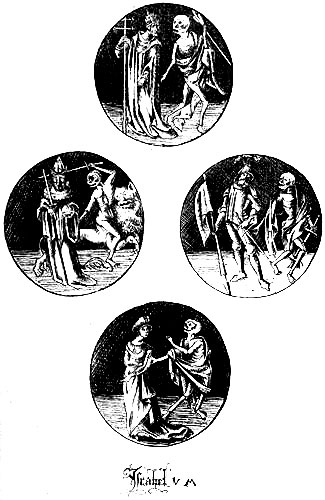
![[monogram]](https://openoldbooks.sgp1.digitaloceanspaces.com/books/the-dance-of-death-38724/images/mono_hf.jpg) 8vo.
8vo.
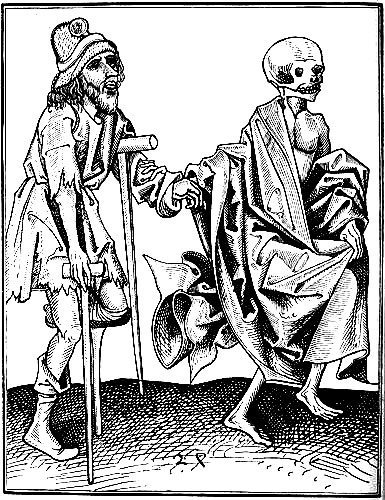
![[monogram]](https://openoldbooks.sgp1.digitaloceanspaces.com/books/the-dance-of-death-38724/images/mono_fig.jpg) at bottom indicate its having been part of a Macaber Dance. Upright, 5¼
by 4. In the author’s possession.
at bottom indicate its having been part of a Macaber Dance. Upright, 5¼
by 4. In the author’s possession.![[monogram]](https://openoldbooks.sgp1.digitaloceanspaces.com/books/the-dance-of-death-38724/images/mono_hs.jpg) ,
representing Death seizing a naked female, who turns her head from
him with a very melancholy visage. It is executed in a masterly manner.
Diameter, 4 inches. In the author’s possession.
,
representing Death seizing a naked female, who turns her head from
him with a very melancholy visage. It is executed in a masterly manner.
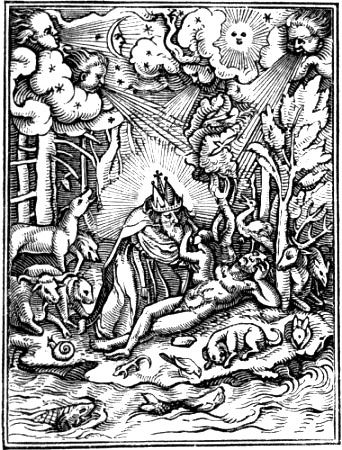
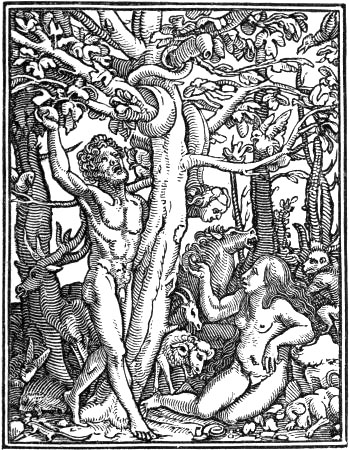
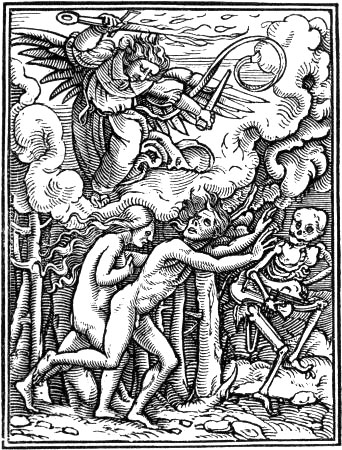
Diameter, 4 inches. In the author’s possession.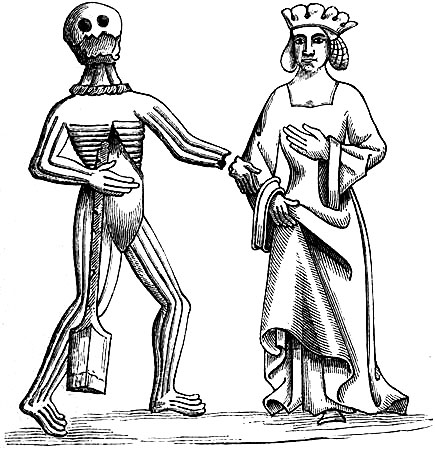

![[monogram]](https://openoldbooks.sgp1.digitaloceanspaces.com/books/the-dance-of-death-38724/images/mono_ah1517.jpg)
![[monogram]](https://openoldbooks.sgp1.digitaloceanspaces.com/books/the-dance-of-death-38724/images/mono_1519hf.jpg)
![[monogram]](https://openoldbooks.sgp1.digitaloceanspaces.com/books/the-dance-of-death-38724/images/mono_h_sword_h.jpg)
![[monogram]](https://openoldbooks.sgp1.digitaloceanspaces.com/books/the-dance-of-death-38724/images/mono_hf_fancy.jpg)
![[monogram]](https://openoldbooks.sgp1.digitaloceanspaces.com/books/the-dance-of-death-38724/images/mono_hh_sword.jpg)
